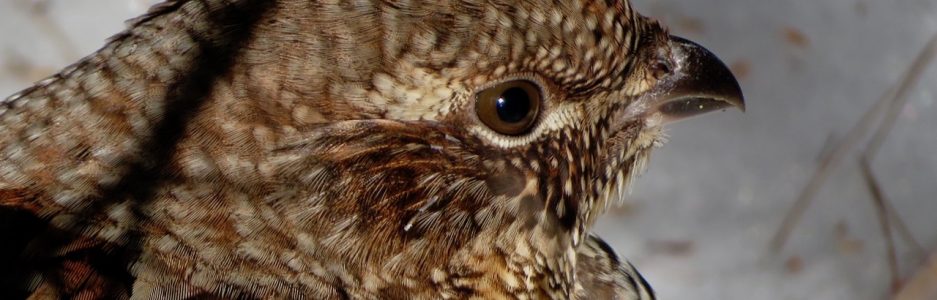
I have a new toy. While I’m still learning how to use it, I’m having the best time making discoveries. And trying to understand what I see. Actually, it’s two new toys. One that sees. And a second one that sees what the first one sees. Now that you either need to know more, or have already clicked out of this blog, let me explain.
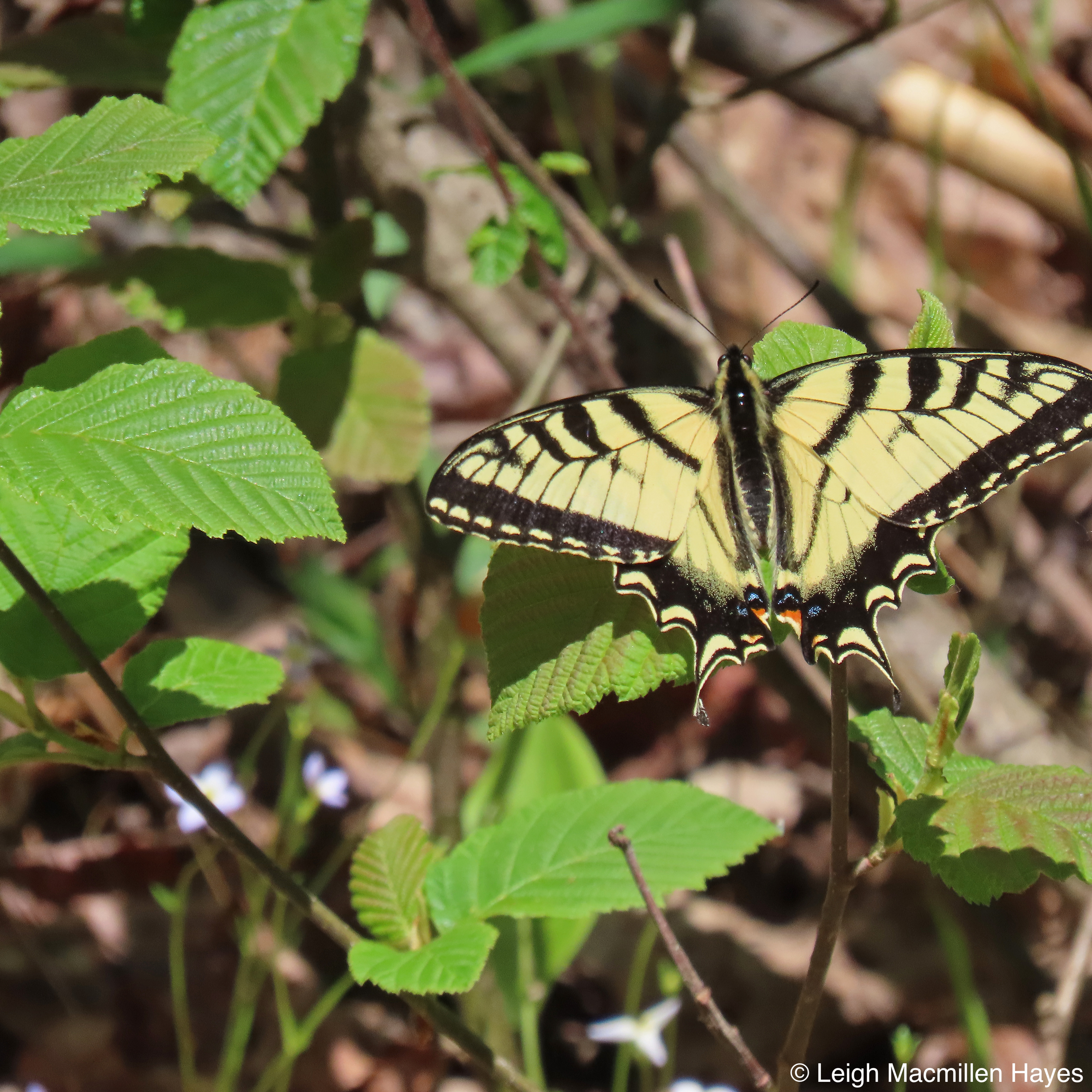
It all begins with a Tiger Swallowtail butterfly, one of exquisite color and form. This is one I spotted recently.

But one of my Pam friends, being Pam M., tells a story of finding a tattered one that still had some life and how she tended it for a few days and hoped it would fly, but alas, the other day she found it did not survive. So she did what good friends do and saved a piece of the wing for me to look at under my new microscope. Check out each of those scales, which put together form the color pattern we see.
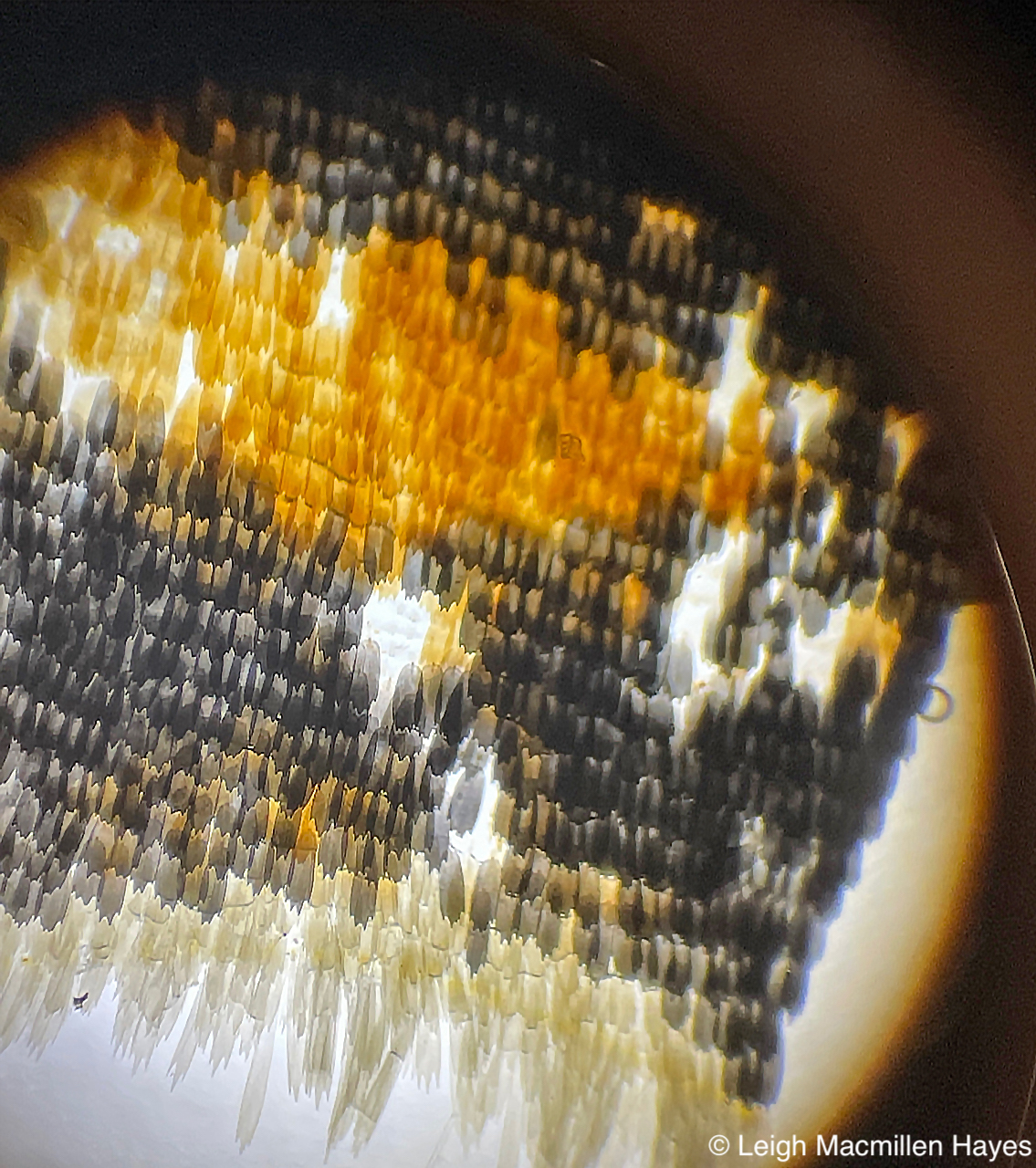
The wings consist of thousands of tiny scales that overlap. If you were to touch the wings of a butterfly, and I don’t encourage that unless it is dead, it might feel like you have powder on your hands. That powder is actually the scales, so if handling a butterfly, you may be removing some of these delicate forms that together make up the mosaic which becomes the color pattern we recognize.

Our next look is at a leaf I gathered last week while tramping with some friends. I regret that I didn’t take a photo immediately. Instead, the leaf spent a week in a bag in my truck and when I took it out yesterday, the bag was full of insect frass. This is an upper view of the leaf.

And this is the underside. When we spotted it last week, we all used our loupes to take a closer look and what we saw intrigued us, but we didn’t quite understand what we were seeing. Where the leaf is brown-gray on the left-hand side and a bit deformed, there was a series of structures all in a row. They seemed to be a bit raised. Sad to say I cannot share that image with you because I did not take it.
But . . .
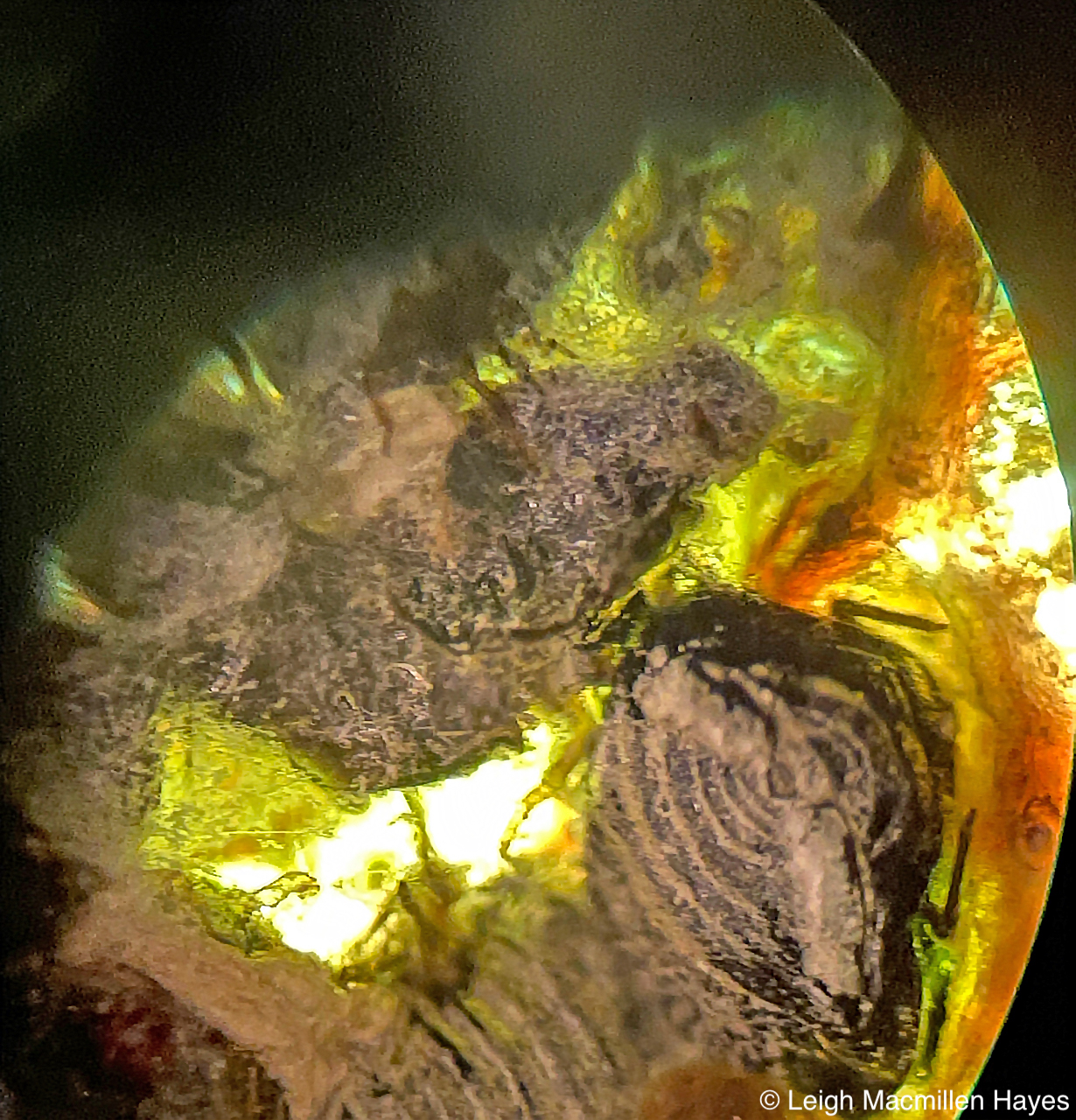
When I looked through the microscope, these critters appeared. they are minute, and some sort of leaf eater.
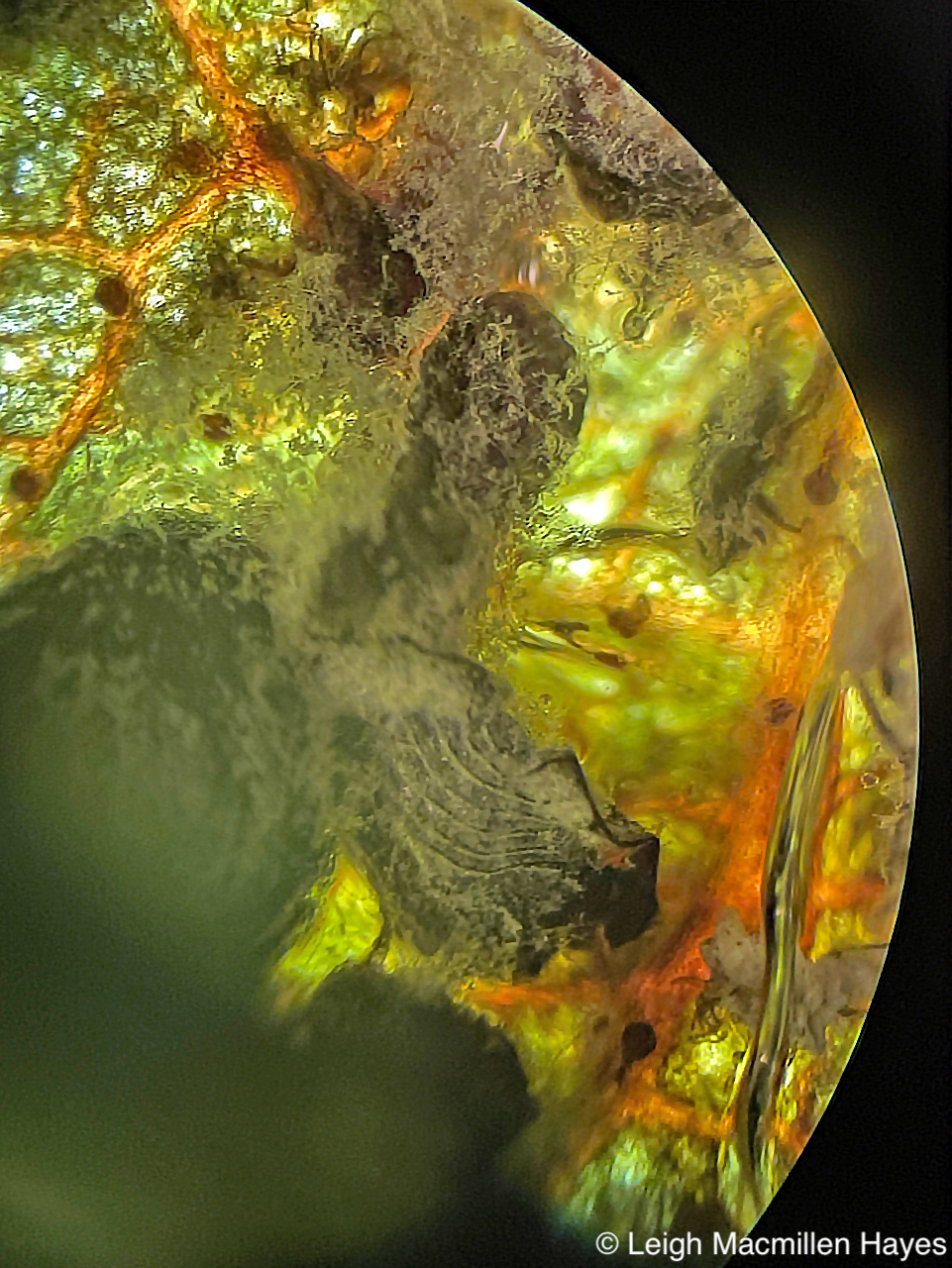
As best I can describe it, you are looking at several insects, some frass (think mammal scat or bird poop), leaf veins and tissue and colors that don’t appear to the naked eye.

I’m not the best with using the second toy I mentioned earlier, which is an adapter so I can take photos through the microscope with my phone, but at least I have something to work toward. And understanding all that I’m seeing will also take time. In the meantime, I’m just enjoying it for the sake of the different world it has opened up to me.
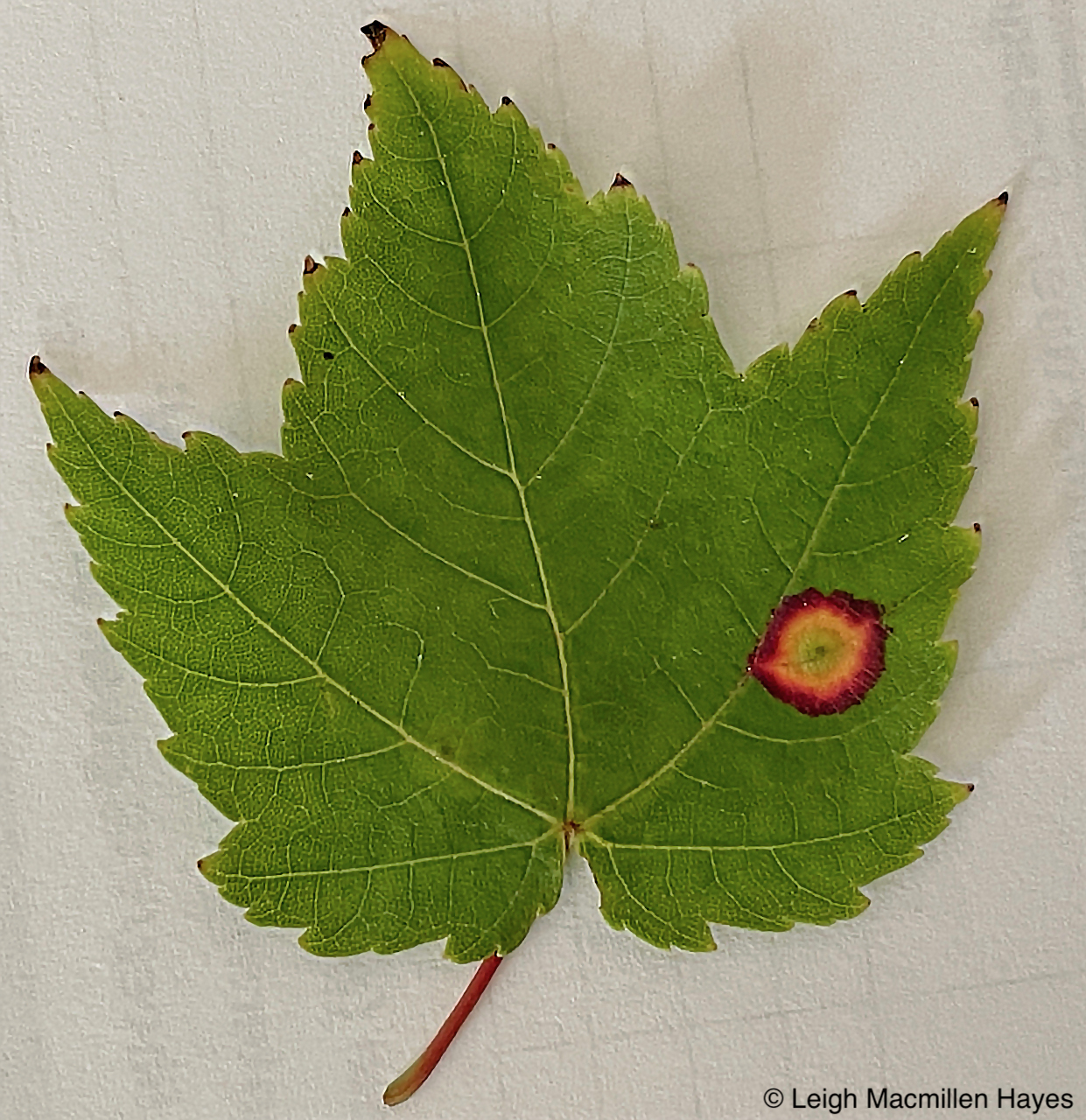
The final selection was found by a group of us today and it’s a Maple Eyespot Gall created by a Maple Eyespot Gall Midge (Ocellate Gall Midge). The curious thing about this fly midge is that larvae develop in leaves, but after about a week during which time the gall forms, the larva falls to the ground and burrows under the leaf litter to pupate.
This is a view of the top side of the leaf. I’m in awe not only of the colors of the gall, but of the intricate structure of the leaf as well. The midge larva had been in the upper right-hand corner until recently based on the vivid colors, which will fade with time.

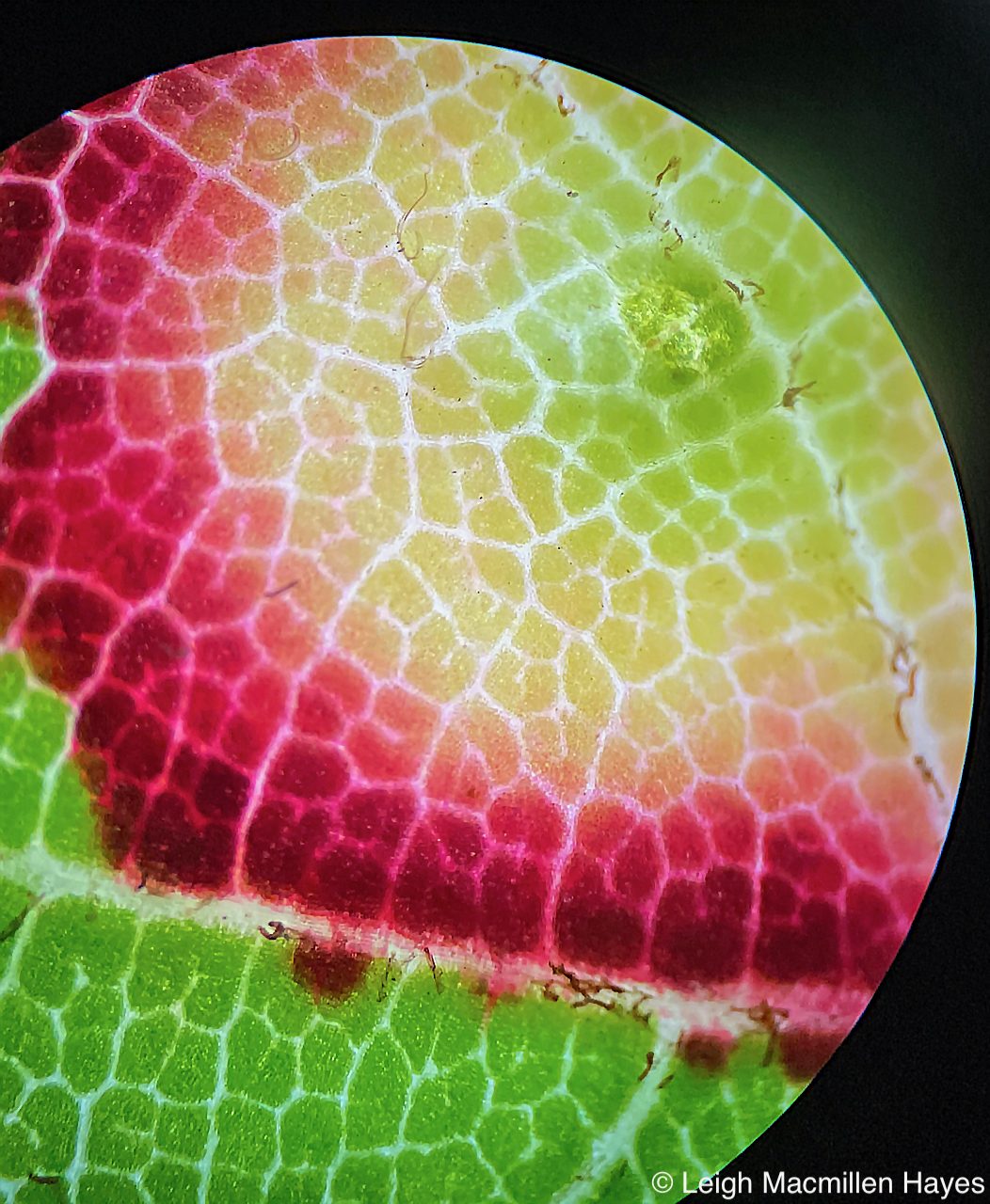
Here is the underside, and that same area that had stored the midge, now visible toward the center, appears to be an open hole, meaning the larva had moved from tree to earth, but this also gives a sneak peek at the cellular structure of the leaf. A topic to explore more down the road.

That’s all for my first attempts at taking a closer look with the microscope and then trying to capture what I saw with a phone, but I had to share this little critter because I don’t often get to see the actual creator of the Snake Spit. Yes, I grew up believing that all that plants that had this foamy white “spit” on them had been visited by a snake. It’s actually the protective covering for the larval form of a Spittlebug.
This was a first attempt to wonder with the help of some new technology. I don’t know about you, but it’s opening a whole new world to me so stay tuned for occasional closer looks through the lens.
 wondermyway
I think this new toy may slow down your pace in the woods. Uh oh. Linda
LikeLiked by 1 person
LOL! Can one move at a negative pace? Yup! We can. We got this. And next time it rains on a Tuesday, it’s a microscope party at my house so start your collection, Linda.
LikeLike
so awesome to be a geek and have geek friends!! L
LikeLiked by 1 person