Places new to us and those so much more familiar rounded out the week as My Guy and I made time to explore. Our first journey found us driving over an hour and a half south and only getting fake lost as we searched for routes and a place to eat lunch. Mike’s Diner won, a hearty ham and cheese sandwich for him, and grilled cheese with tomato for me. Comfort food.

And then we headed along a few sandy trails in a land known for its Pitch Pine-Heath and Pitch Pine-Scrub Oak Barrens. It was vast. And flat. And offered so many shades of . . . green.

The Pitch Pines, with their bundles of three needles each (think: three strikes you are out–pitch, baseball, I didn’t make this mnemonic up, but use it all the time) were happily producing prickly cones, which take two years to mature.
This is a fire-dependent ecosystem, meaning the health of this place depends upon consistent fires. The Pitch Pine and other species that thrive here have developed adaptations to survive. The pine’s serotinous cones and thick armor-like bark are its adaptive features. The cone is covered in a thick resin that must be melted in order for it to open and release seeds. The Pitch Pine’s thick bark protects the tree from those fires.
And so in this place, periodic controlled fires occur in order to maintain its rarity.

Scrub Oak or Bear Oak is the other dominant tree species in the shrub layer of this space. There are lower shrubs like blueberry and huckleberry, and grasses, and ferns, all completing the picture.
The soil–sandy and acidic.

We left that place and drove a few miles to an abutting property to follow a longer trail system through a similar habitat. I think we were both quite taken by the vastness of the grassland.
As in the first, this is a place where fires are intentionally set to keep the species that have adapted to this space here, and not allow other species to take over. I think it’s rather like mowing a field. If you don’t mow for several years, as I’ve been watching on a hillside field closer to home (no, not the field that abuts our yard), White Pines have taken foot and are taking over the space. In fact, the same obviously happened in our woodlot, which was once a plowed plot, and now, 60 – 80 years later, it’s a forest of White Pine and Hemlock trees, but mainly the former.

Like the previous spot, this is a grassland and a heathland, with similar trees in the landscape. Blueberries make My Guy smile, always, and they grow abundantly here because of the soil conditions, but also because they have underground rhizomes with lateral stems that allow them to resprout after a fire.
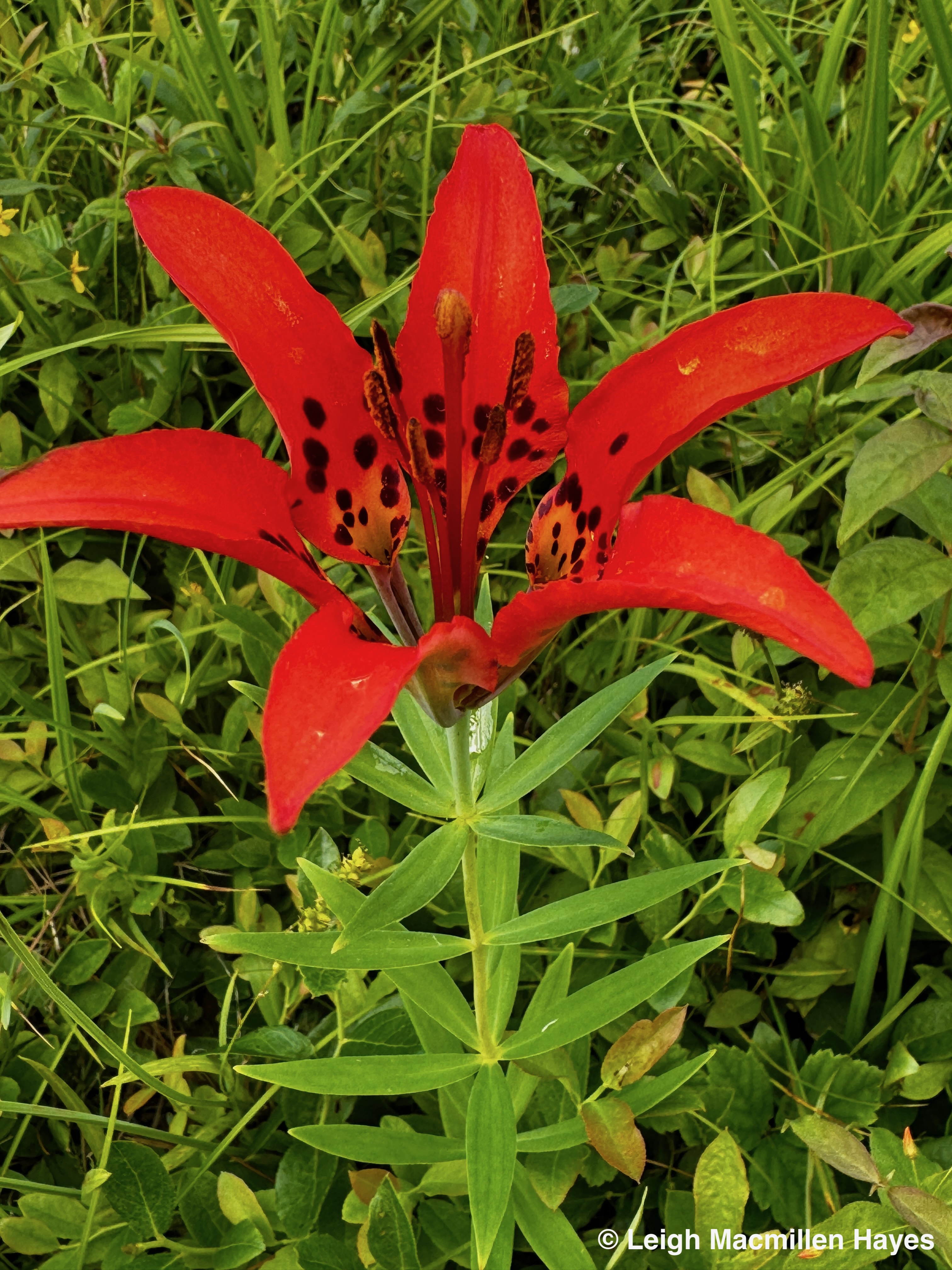
Much to my delight, I spotted a Wood Lily in bloom, with its tiers of whorled leaves along the sturdy stem below. It is present here in Maine, especially in places like this, but even in woodlands. That said, my encounters with it are infrequent and therefore memorable. And as I type I’m picturing it at the summit of Pleasant Mountain and along the Heritage Trail on Amos Mountain in Lovell.
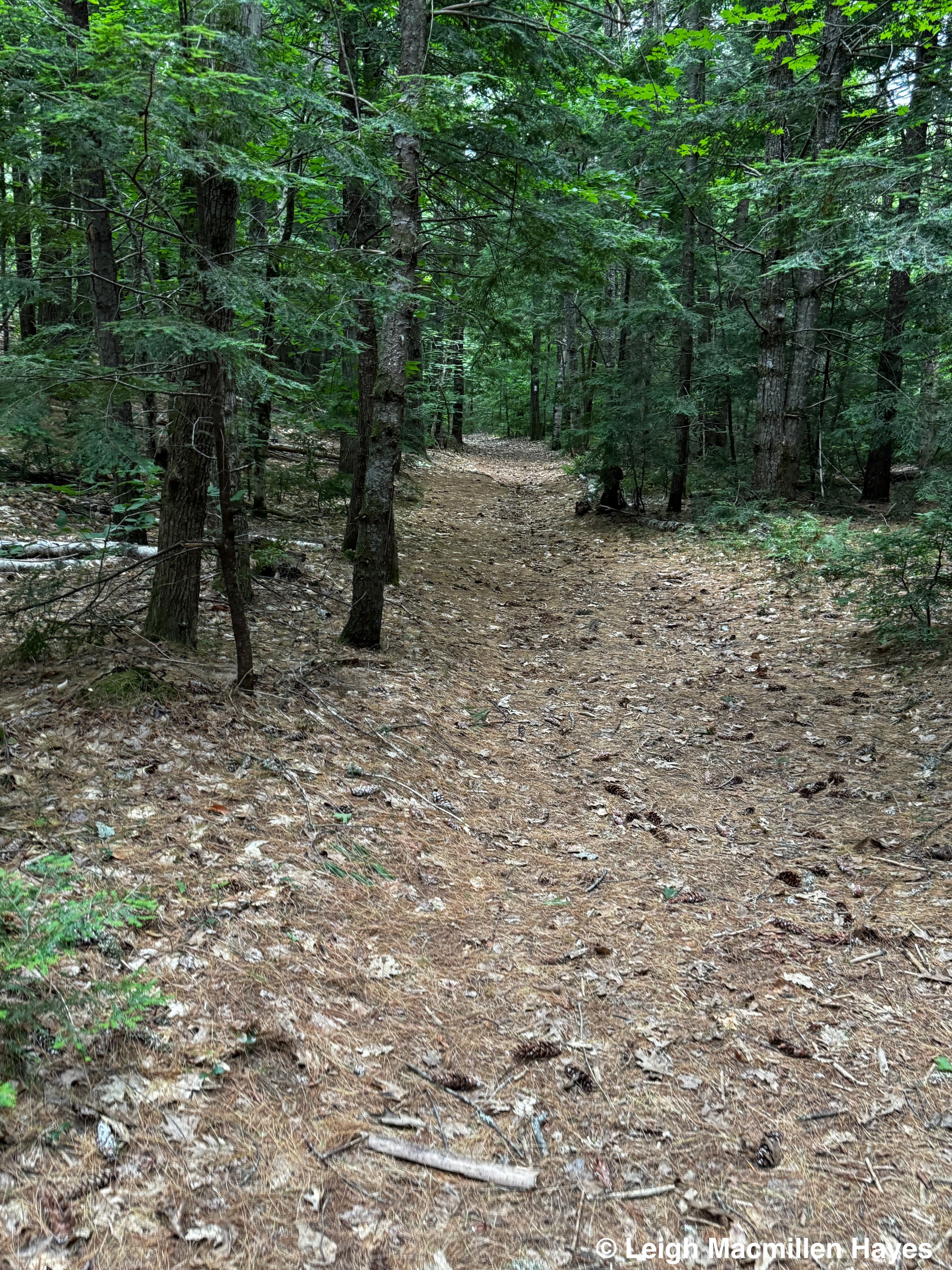
We enjoyed our time in those first two locations, and have so much more to learn about them, but returning to the home stage, even with rain in the forecast, was much more to our likening. And so we did.
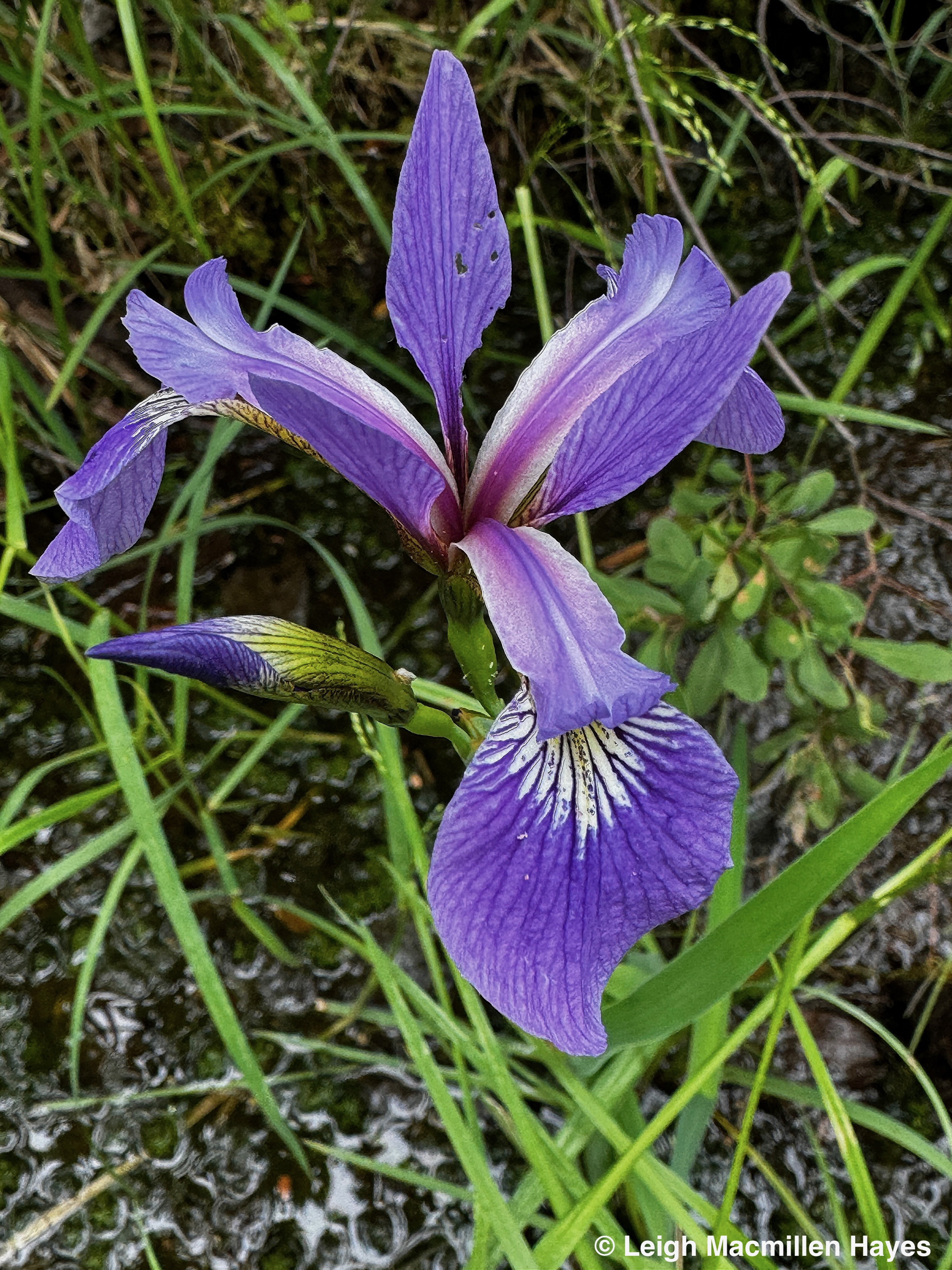
It was here that we spotted Blue Flag Iris in bloom, with its showy runway and lack of a beard like the Irises that grow in our home gardens. I know I have a difficult time walking past without stopping to honor these flowers each time I see them. Blue Flag doesn’t mind having wet feet, which is good since it was growing in a wetland.
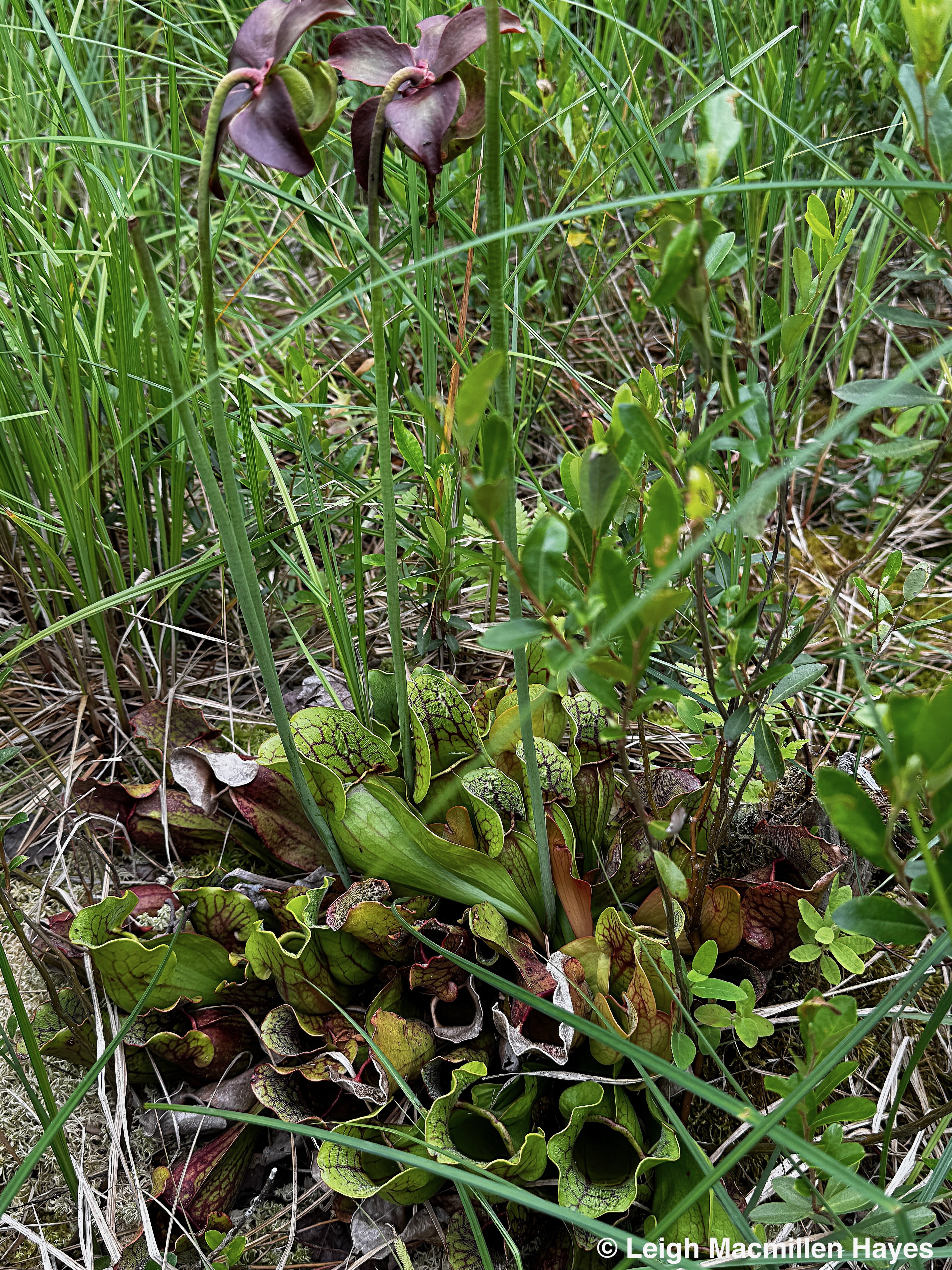
The sight of this next beauty will give you even more of an idea about where we’d ventured. It’s an area where Pitcher Plants grow in abundance and right now show off their parasol-like flowers.
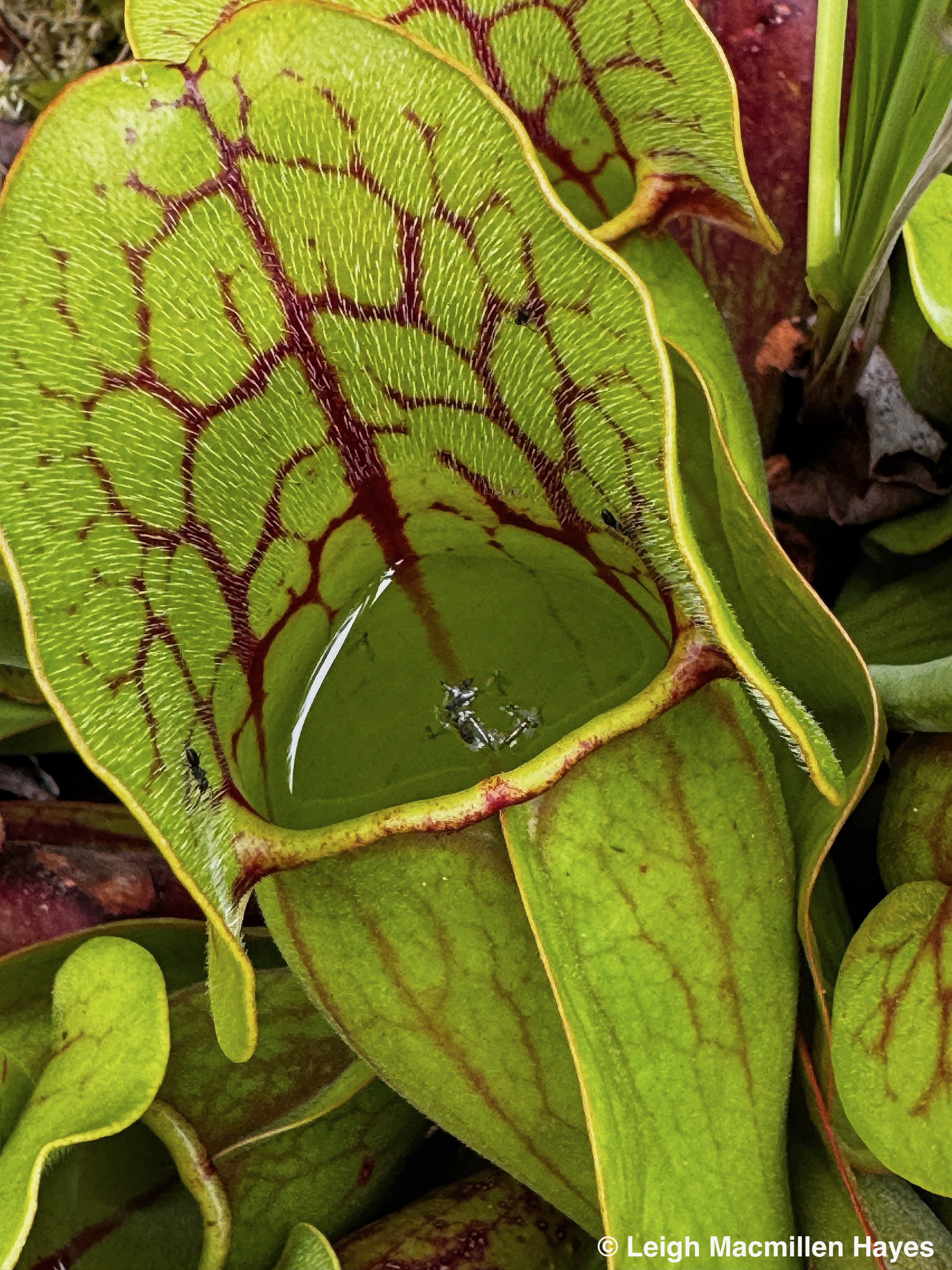
The carnivorous Pitcher Plant obtains nitrogen and phosphorus by “eating” insects. Its oddly shaped leaves form a pitcher partly filled with rainwater and digestive enzymes. The spout is a hairy landing platform for insects attracted by its red venation and nectar glands. Imagine this: An insect crawls to the edge of the leaf, aka pitcher, slips on the downward-sloping hairs and plunges into the liquid below, where it drowns and enzymes and bacteria break it down. Any chances for escape are zapped by those stiff hairs. As it decomposes, it is digested by the liquid.
Do you see some insect body parts floating atop the water within the pitcher? And an ant trying to travel across the hairs rather than down. Unfortunately, I didn’t have a chance to watch its ultimate fate. Next time, for sure.

I want to jump back to the nodding flower of this carnivorous plant for a second. I tiptoed gingerly on the spongy carpet of sphagnum moss to take a closer look.
At two to three inches wide, it appears on the top of a thick, leafless stalk that can grow to two feet tall.
A flower consists of five sepals surrounded by three bracts, numerous anthers and an umbrella-like five-pointed style, over which five long yellow or red petals dangle. The whole inflorescence (flower) is held upside-down, so that the umbrella-like style underneath catches the pollen dropped by the anthers. Stigmas are located at the tips of the umbrella-like style.

This is also the land of native orchids, such as this Rose Pogonia, which to some resembles a snake’s head poking out of the heath or a fern with a snake’s name (Adder’s Tongue Fern). A bearded snake, if there is such a thing. The labellum or lip of the flower is bearded and some petals point outward and to the side. Despite all of that, it’s a delicate and intricate flower.

While the Rose Pogonia seemed to be waning, Tuberous Grass-Pink was putting on quite a display. The labellum or lip is not bearded, though it does have a yellow crest atop it, and petals and sepals point in all directions.
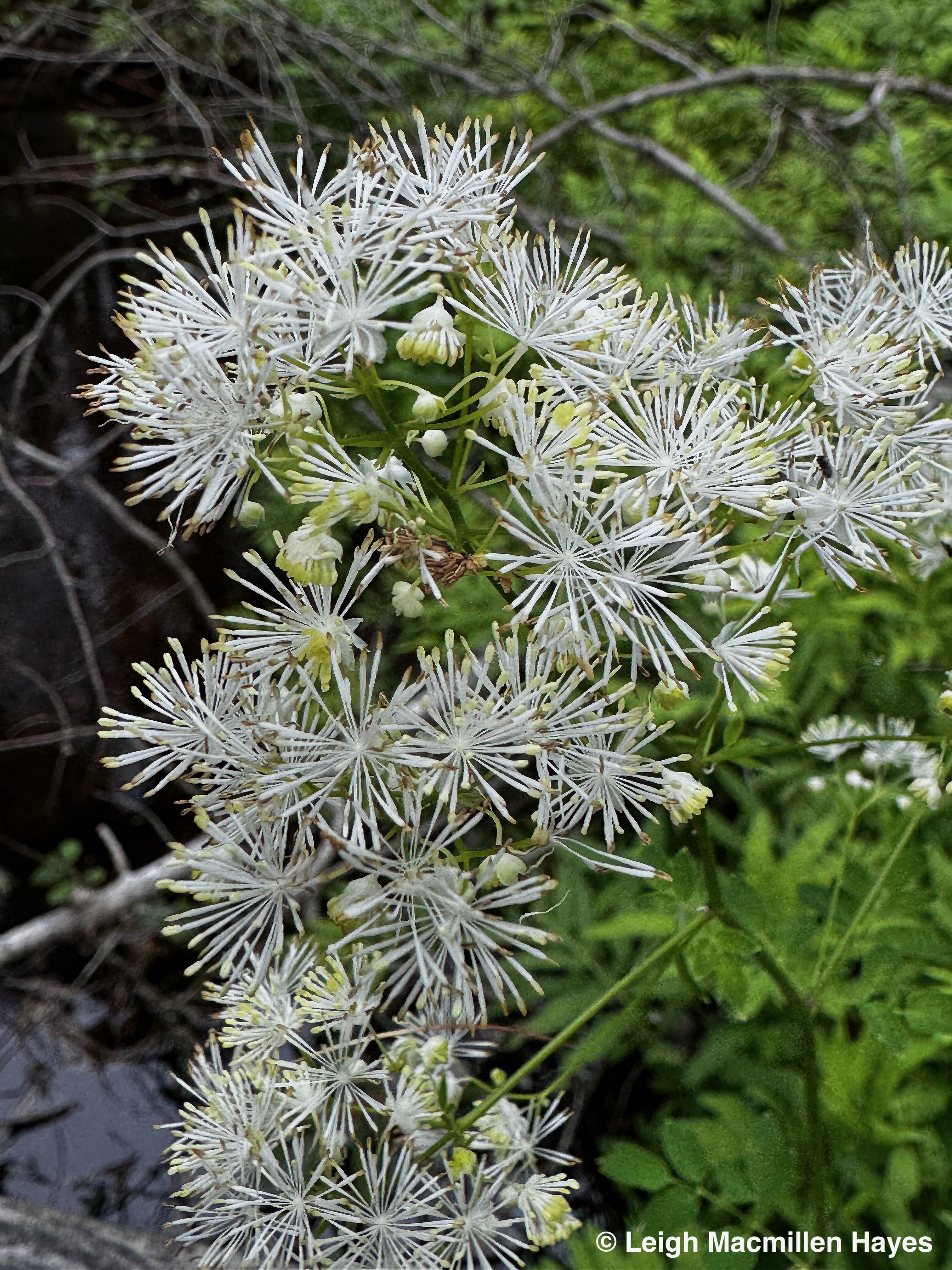
Farther along the trail, Tall Meadow Rue showed it had gotten an early start on the July 4th celebration with silent fireworks making a huge bang. (If only all fireworks could be like this. Quiet and beautiful.)
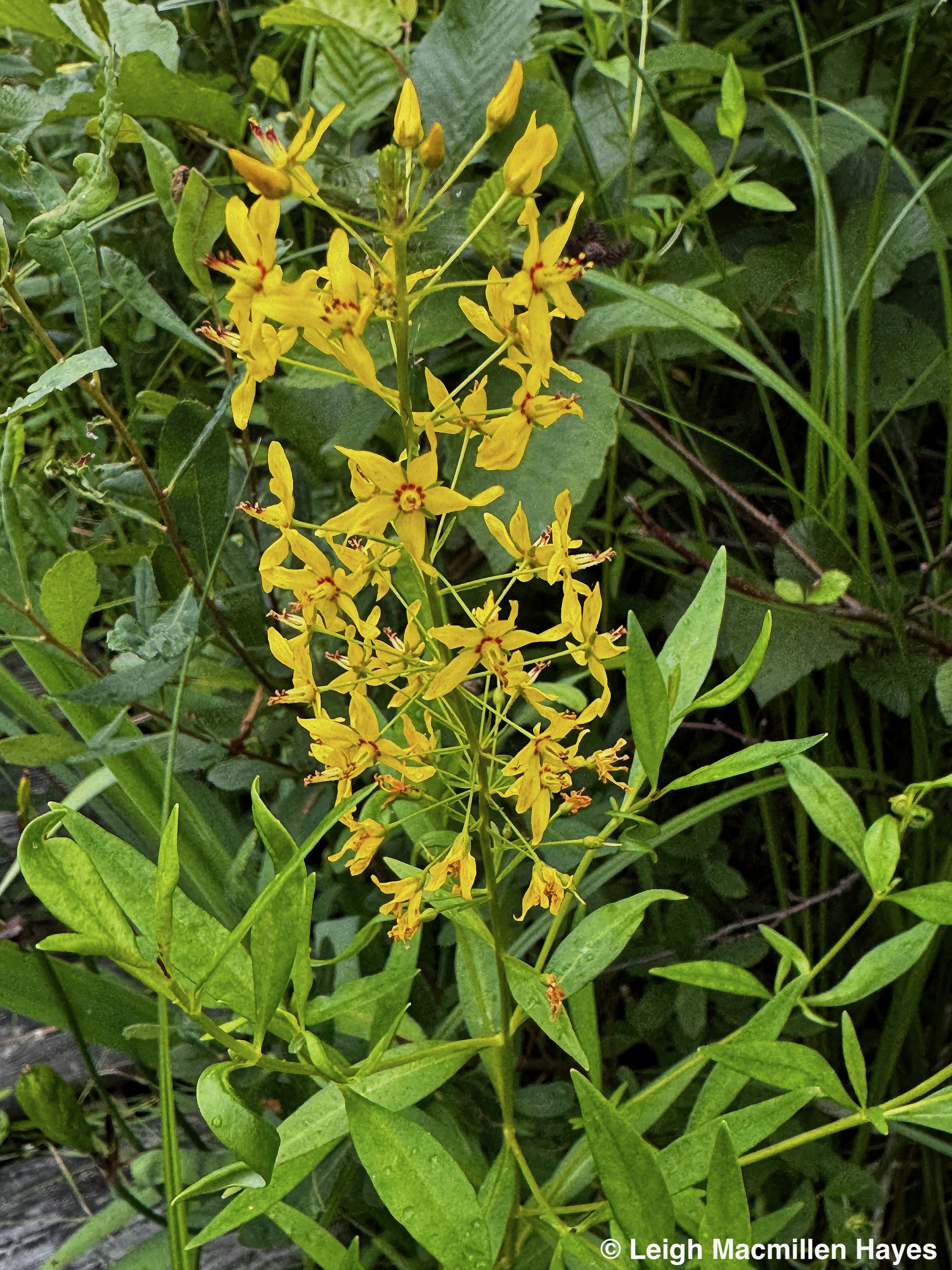
Swamp Candles were lit up as well, adding more color to the landscape.

As you can see, it was beginning to rain when we reached a display of Swamp Roses, and I loved how the droplets stood in a row on the folded edge of the uppermost petal.

And I don’t know why I should be surprised each time I meet these little gems because we’ve met so many times over the years, but it’s always as sweet as the first introduction. Please make the acquaintance of Water Forget-Me-Nots.

It was not just flora that made our trek so delightful, but also a few others who greeted us, or rather we greeted them, like the Red-backed Salamanders that I often find in a certain spot under some old Hemlock bark.

And the ever present chittering and chattering Red Squirrel.

That all brings me round to where we explored. The first trip included Kennebunk Plains and Wells Barrens Preserve. We did enjoy those, but it was our hometown tramp encircling Holt Pond that probably made us the happiest because though we know this space well, there’s always something different to see, and I’ve only shared a wee bit with you.

That said, if you go to Holt Pond Preserve, please know that from the parking lot off of Grist Mill Road to the Quaking Bog, the boardwalks are clear and highly visible. The rest of the board walk system, however is not, and we had to fight our way through vegetation and under downed trees. Once we reached the Southern Shore Trail, it was free sailing again. (Default: we maintain that section of the trail system).
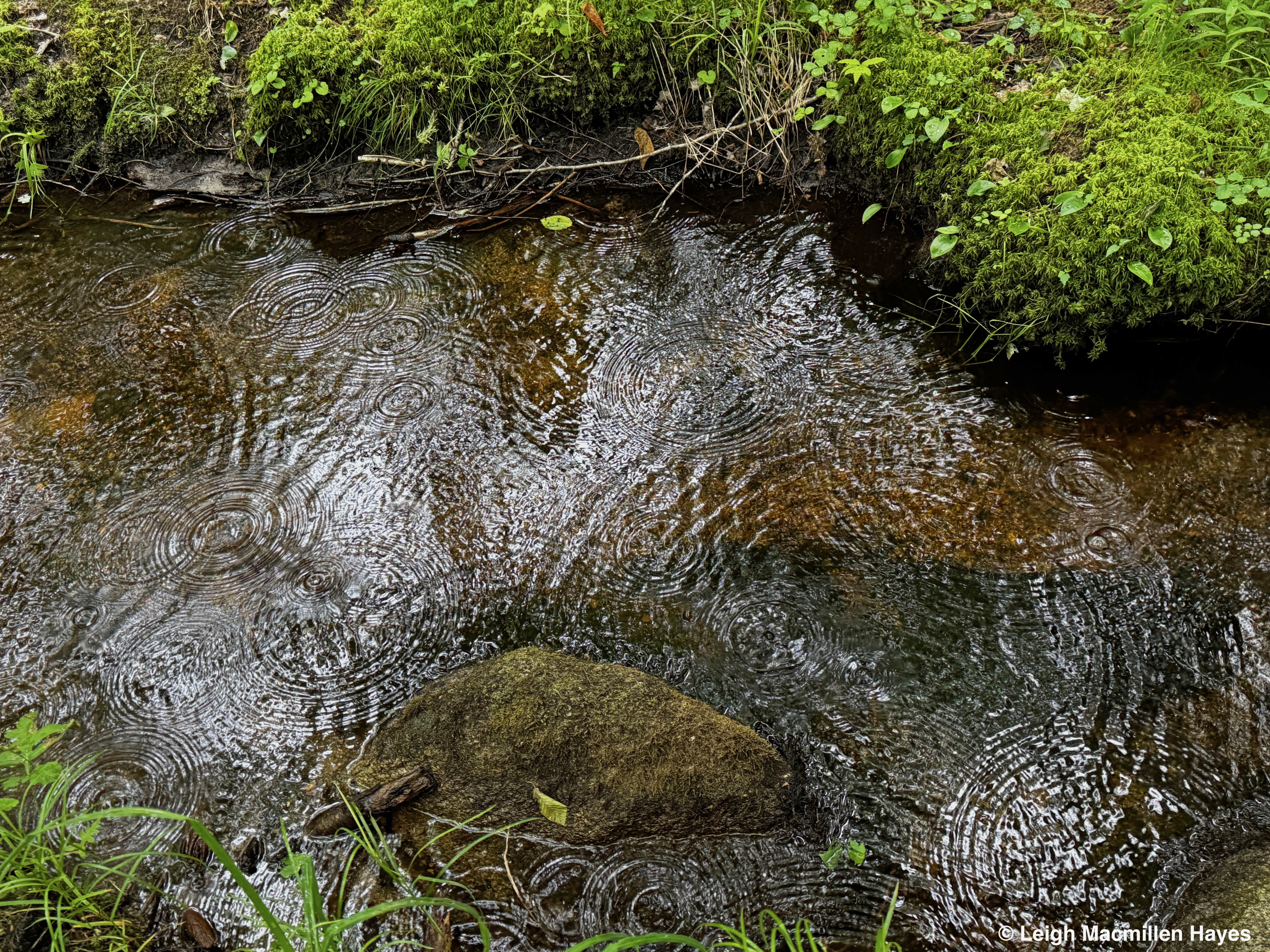
And the bridge over this creek washed out last spring, but right now there is a stepping stone or two to help you leap across.
Yes, those swirls in the water are from raindrops and not insects (in fact, the bugs weren’t too bad), for by the time we got close to Chaplin’s Mill Road, the rain was falling steadily. But, we were prepared. And once again, we didn’t melt.
Plains, Barrens, and Bogs, Oh My! Just another reason to love Maine.
 wondermyway