For the last fifteen years I’ve had the honor of stepping into a wetland or two early in the morning on a regular basis for at least six weeks to check on the activity of heron rookeries. It’s a community science program called HERON that the State of Maine runs: “HERON” is short for the Heron Observation Network, a network of volunteers across Maine who monitor nesting areas, or colonies, of wading birds such as the Great Blue Heron. HERON is managed by the Maine Dept. of Inland Fisheries and Wildlife.”
Herons are colonial nesting birds, meaning they nest in groups. Their nesting community is known as a rookery.
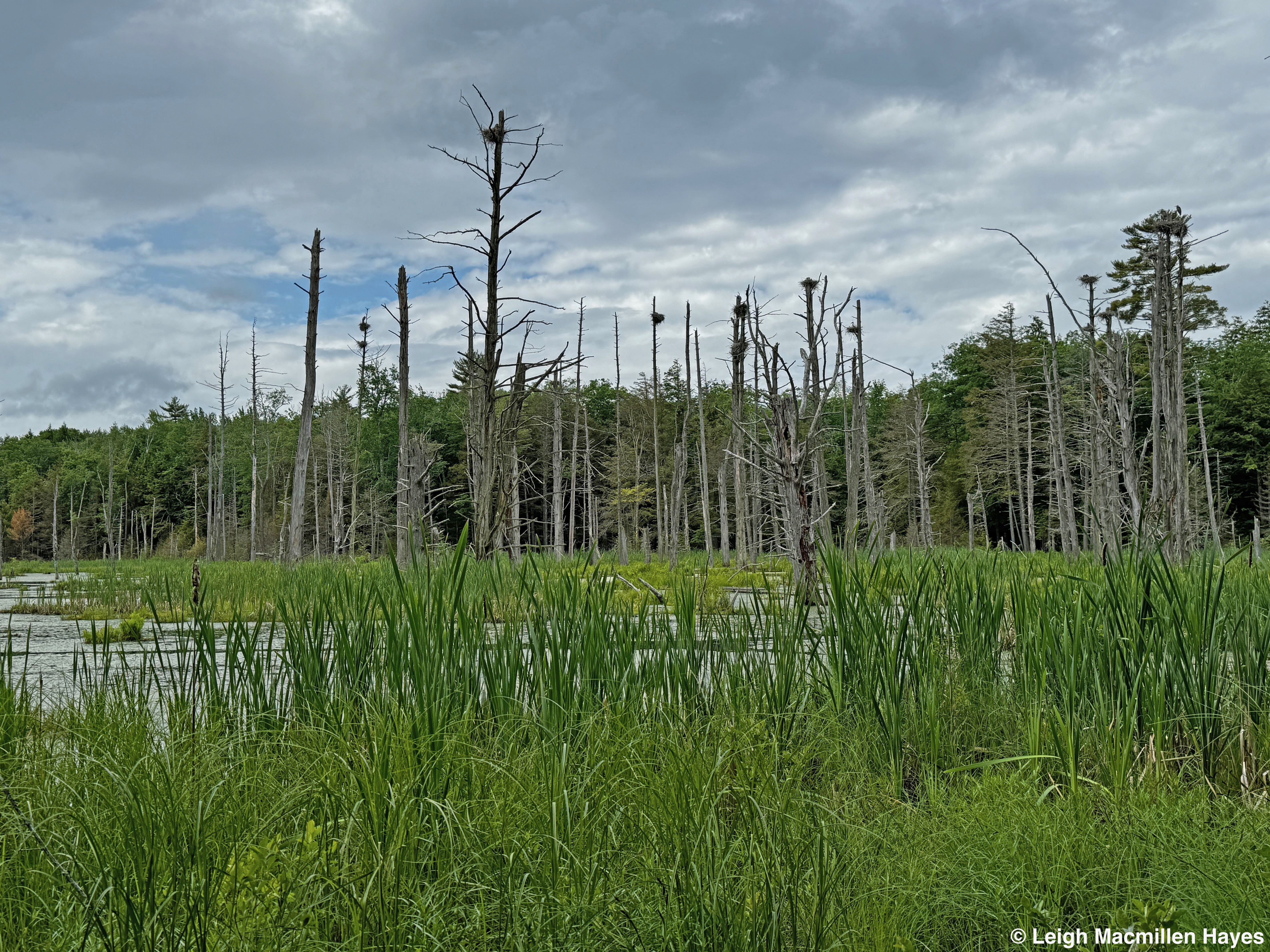
If I could get away with it, I’d spend all day in this place where the wild things go about their daily duties as co-observers and I stay on the edge in hopes of not disturbing them.
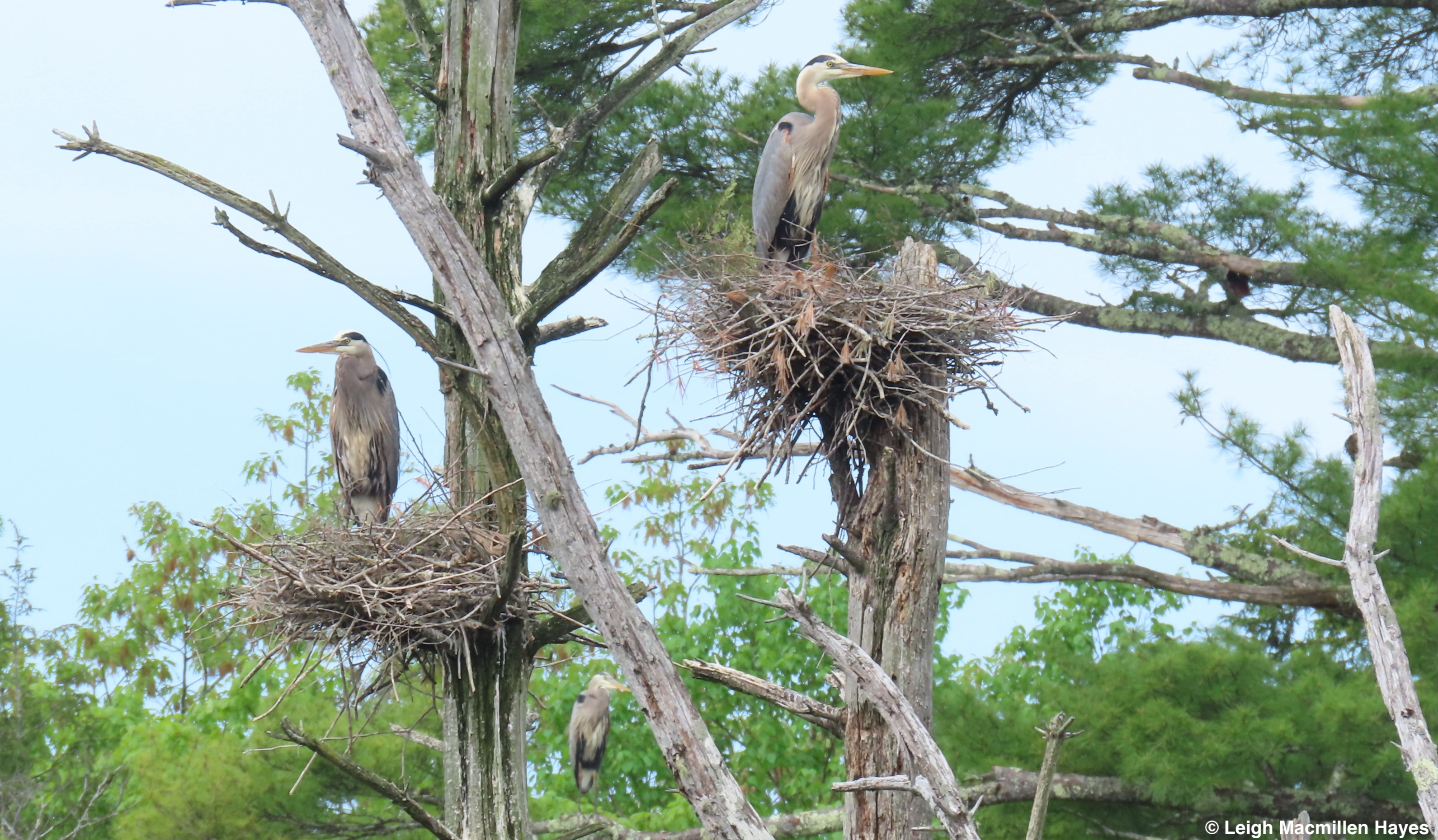
I think what amazes me most is that they build their stick nests high up in trees and I always expect the wolf in The Three Little Pigs to huff and puff and blow their homes down. Or at least the wind to do such.
The most difficult day of the count may be the first. May be. First, the number of nests must be counted. Then the number of active nests, those with birds in them. Next, it’s the number of adults and then young, if visible. If the adults are incubating, for how long?
And that’s where it gets tricky. If eggs aren’t visible because one cannot get close to the nests, since they are anywhere from about 50 to 200 feet from land, and high up in dead snags, this is a challenge. Spotting adults on the nest, however, indicates there possibly are eggs within.

Nest building and rebuilding is a constant, and a clue that there’s hope for a new generation. Adding sticks with one’s mouth sounds difficult to us, but it is the way of life for a bird.

Spotting little bundles of fuzz brings smiles to observers’ faces–as if we have given birth or are at least the grandparents of these bouncing babies.

Two weeks later and they already have Great Blue Heron markings and crazy hairdos and the counting gets a wee bit easier. Of course, the youngsters hop up and down and so nests have to be reviewed several times to make sure the number is at least close to accurate. It’s not unusual for a nest to support three, four, or five youngsters.

If you’ve never been near a heron rookery in those early days, you haven’t experienced the pterodactyl fly ins as adults arrive with food or the intense and loud and constant squawking of the youngsters demanding to be fed.

Once the adult has landed, the birds still must beg, sometimes for ten or more minutes and I can’t help but wonder if the squawking encourages adult regurgitation.
If you look closely at this photo, you’ll notice the two on the left are in one nest waiting ever so patiently for an adult to return with a meal, while the nest in the back to the right hosts two beggars waiting for the food to slide up the adult’s throat and down into their mouths.

Those awkward tween years only last a few weeks in a bird’s life, for so rapidly must they grow given the short season of our northern clime. Hairdos are a good indication to separate adult from young.

Remember when I said that the first day was the most difficult day to count. Well, that is debatable, for as the weeks go on and the youngsters grow, it becomes difficult sometimes to distinguish parent from child. If the plume on the head is spotted, then it’s an adult, but sometimes the lighting or angle isn’t right.
That said, the count is completed about six weeks after the first visit for the birds begin to fledge and the nests won’t be used again . . . until next spring.

There are so many joys about spending time in the wetland, but a few include dew upon spider webs,
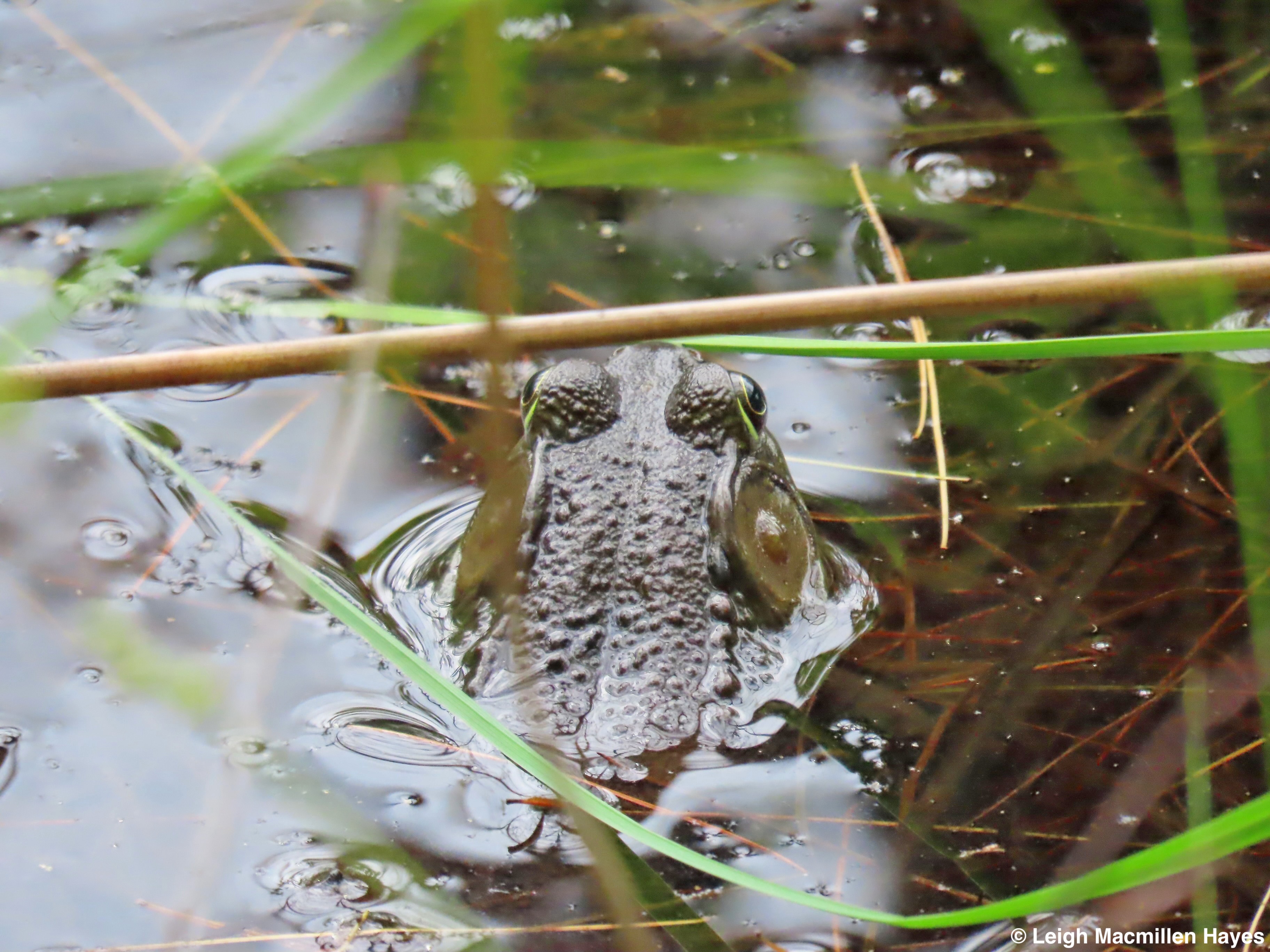
Frogs who ga-dunk, ga-dunk at our feet,

a young Robin calling for its parents,

and the spotting of four Wood Ducks on a snag.
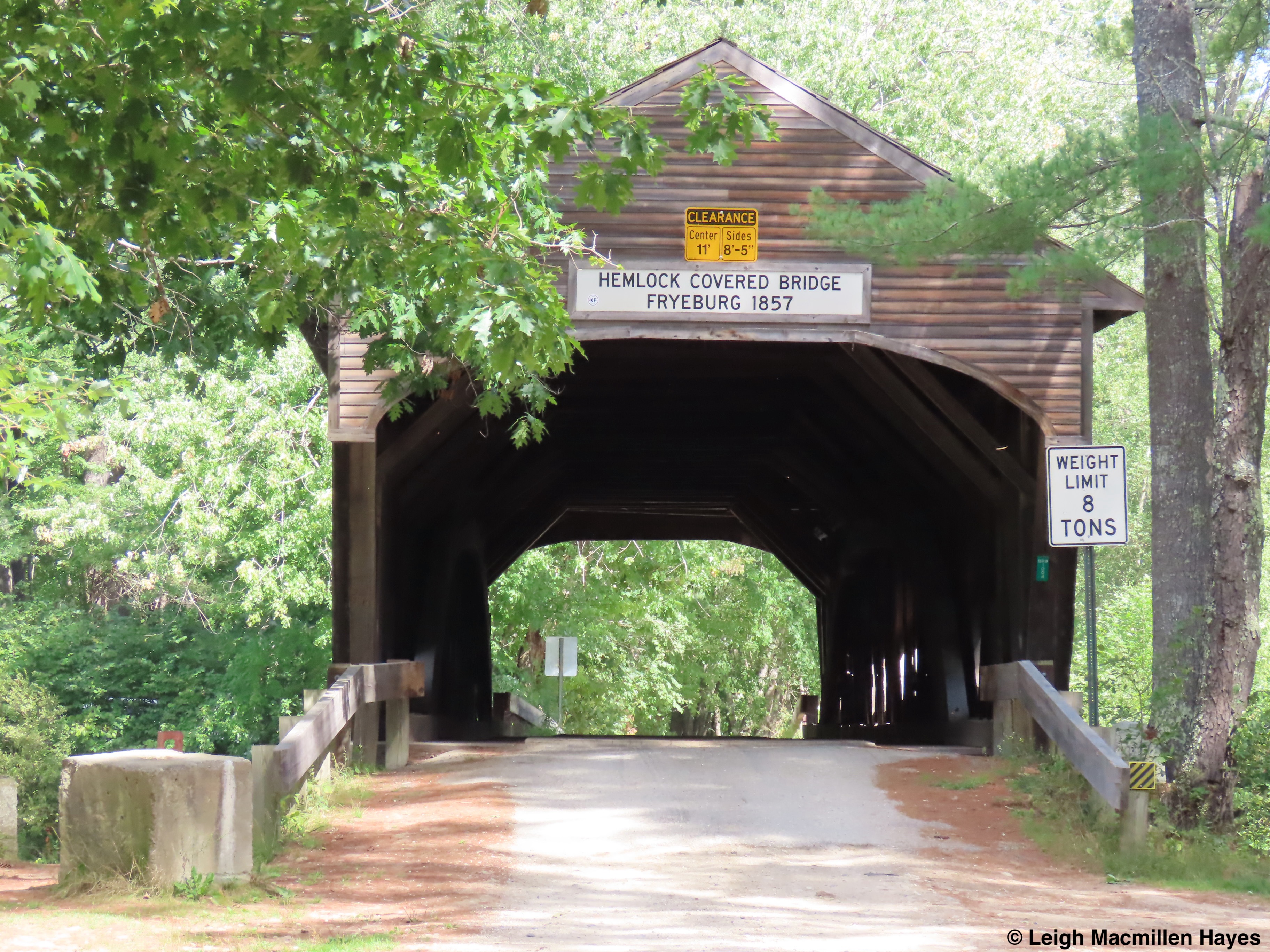
Fast forward two months and this afternoon found me walking the roadway on either side of Hemlock Bridge, my eyes darting here and there taking in flora and fauna with each step.

I love the Paddeford construction of this bridge. Or maybe it’s just that I love that we live so close to a covered bridge. And recently, because I’m taking a painting course, I tried my hand at showing off some of its beauty.
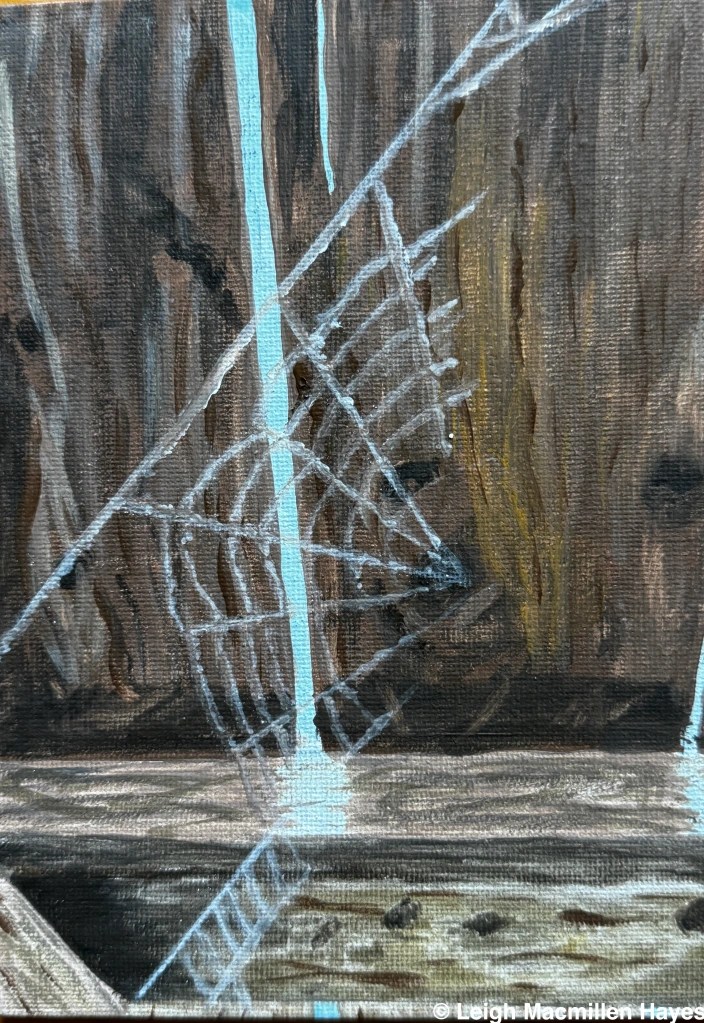
Spider webs did not go unnoticed by me. I didn’t spot the creator, but trust that an orb weaver was hiding somewhere nearby.

As I walked along the old course of the Saco River, I spotted a few Painted Turtles basking in the sun, but also noted all the debris clinging to branches, a sign of the high water we had this past spring.

And then something else caught my eye. One of my teenagers was on a fishing expedition. And panting to cool down.

I got excited when it seemed he’d spotted a meal.

Apparently that didn’t pan out and he turned his attention in the other direction. As I watched, he tiptoed ever so gently for such a big bird, and I was certain he was on to something.
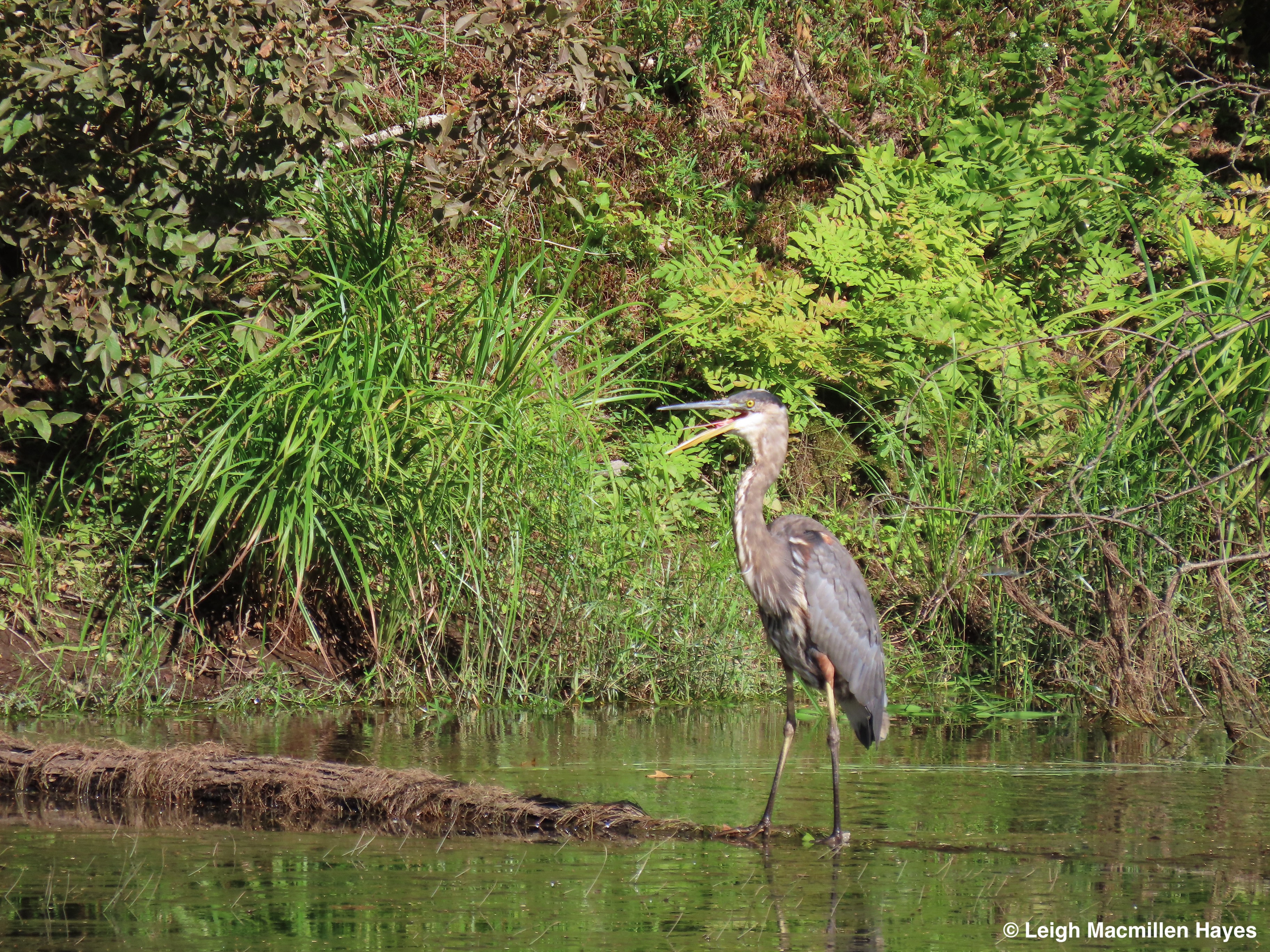
But then he stood there and panted some more.

Until there was a bit of a tussle and I realized he and a snake had a brief encounter. Both survived. And left each other alone.
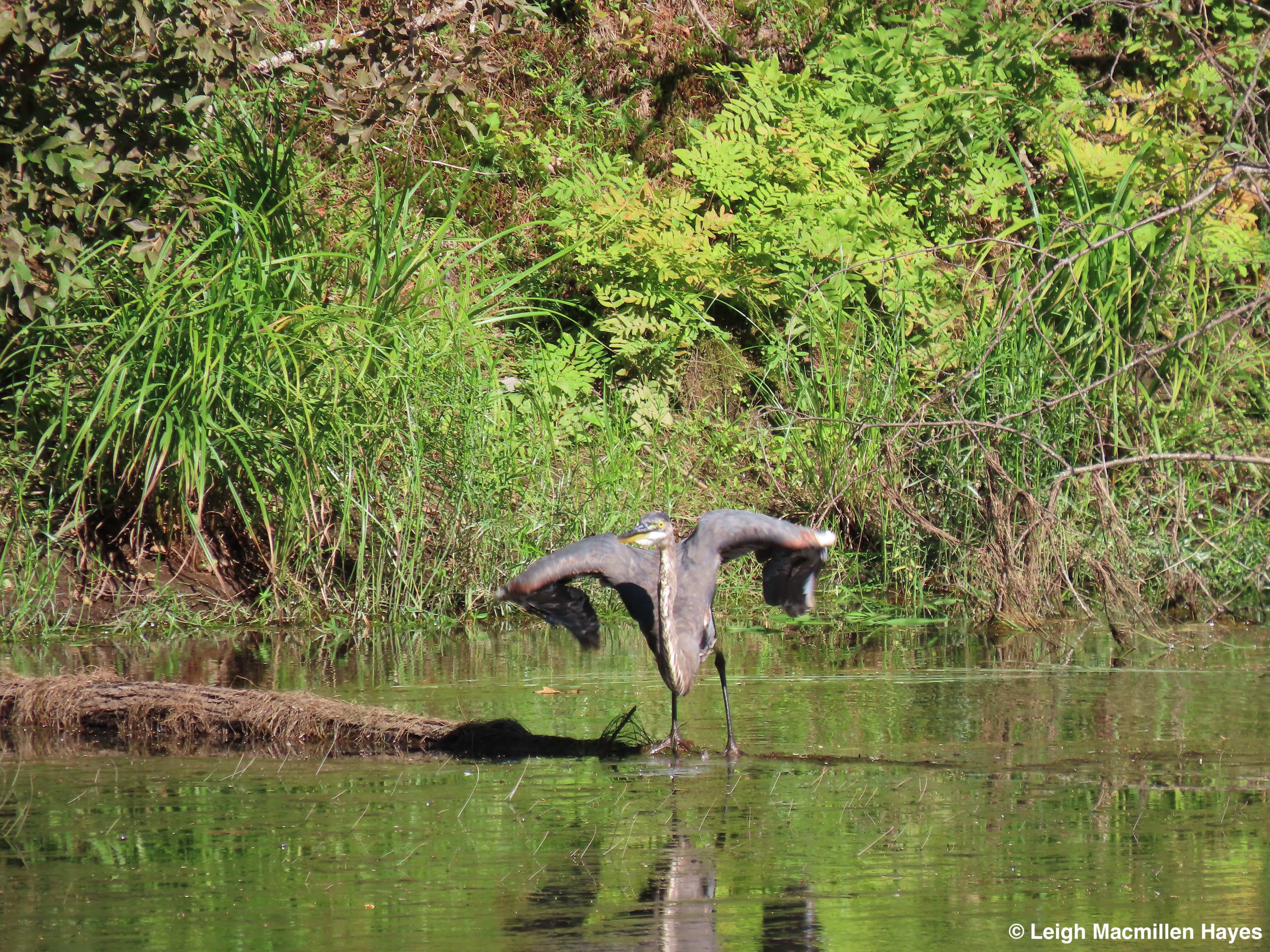
And then the bird flew and I was bummed. I wanted to witness a meal being taken. But I have to have faith that it found success somewhere else upon the river. Just as I trust that the sun will rise tomorrow, and the day after that. This bird will not go hungry.
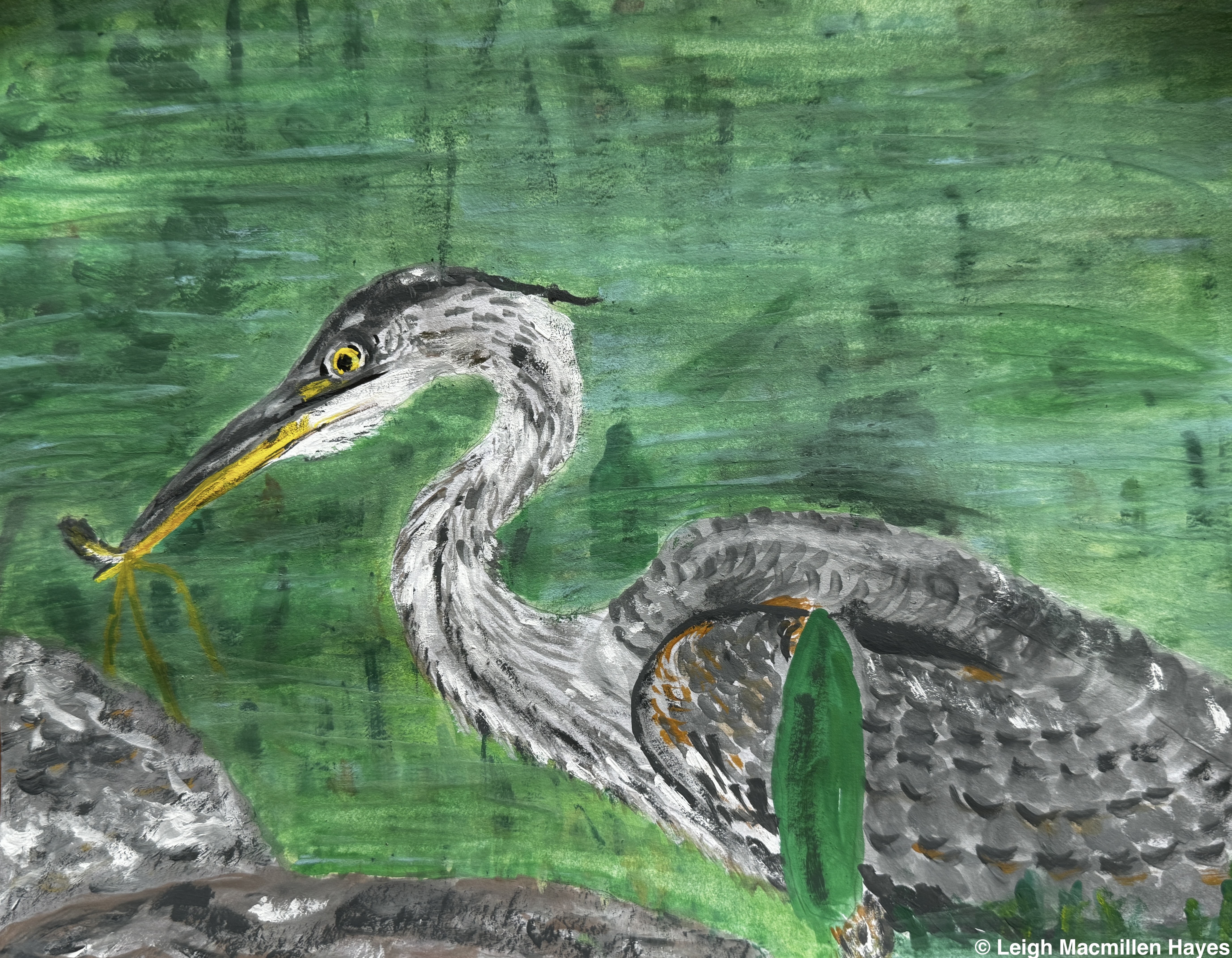
Instead, upon arriving home I pulled out a painting I completed a couple of weeks ago of a Great Blue Heron I watched snatch a fish last summer.
Just as the young heron’s accomplishments may take time, so do mine as a painter. But it sure is fun trying.
As for the count:
One rookery featured 19 active nests at the start, but only three toward the end, and I have to wonder if a predator found many a meal high up in those trees.
The other rookery featured 53 nests, with all but a few being active and lots of youngsters produced.
That, in itself, is a great heron accomplishment.
 wondermyway
I love your adventures. You must be amongst the biting bugs
LikeLiked by 1 person
Mind over matter. Mind over matter. Thanks Roberta!
LikeLike