
“This won’t take us long,” My Guy said moments after we launched our kayaks onto a small pond in New Hampshire.
“Oh, I think I can make it last a while,” I replied.

I knew there were Pitcher Plants to look for and I could see by the color of the trees on the far shore that there were wetlands to explore and there was the potential for so much more in this very quiet spot.

A friend who kayaks here often had told me where to park and some of the things to look for along the way. What was most impressive from the start is that there were flower pots on the dam and by the kiosk. Well tended, at that.

And a rather large Little Free Library, where one can take a book or share a book.

I unlatched the door and it even smelled like a library. What’s not to love?!
But, we’d ventured there to paddle.
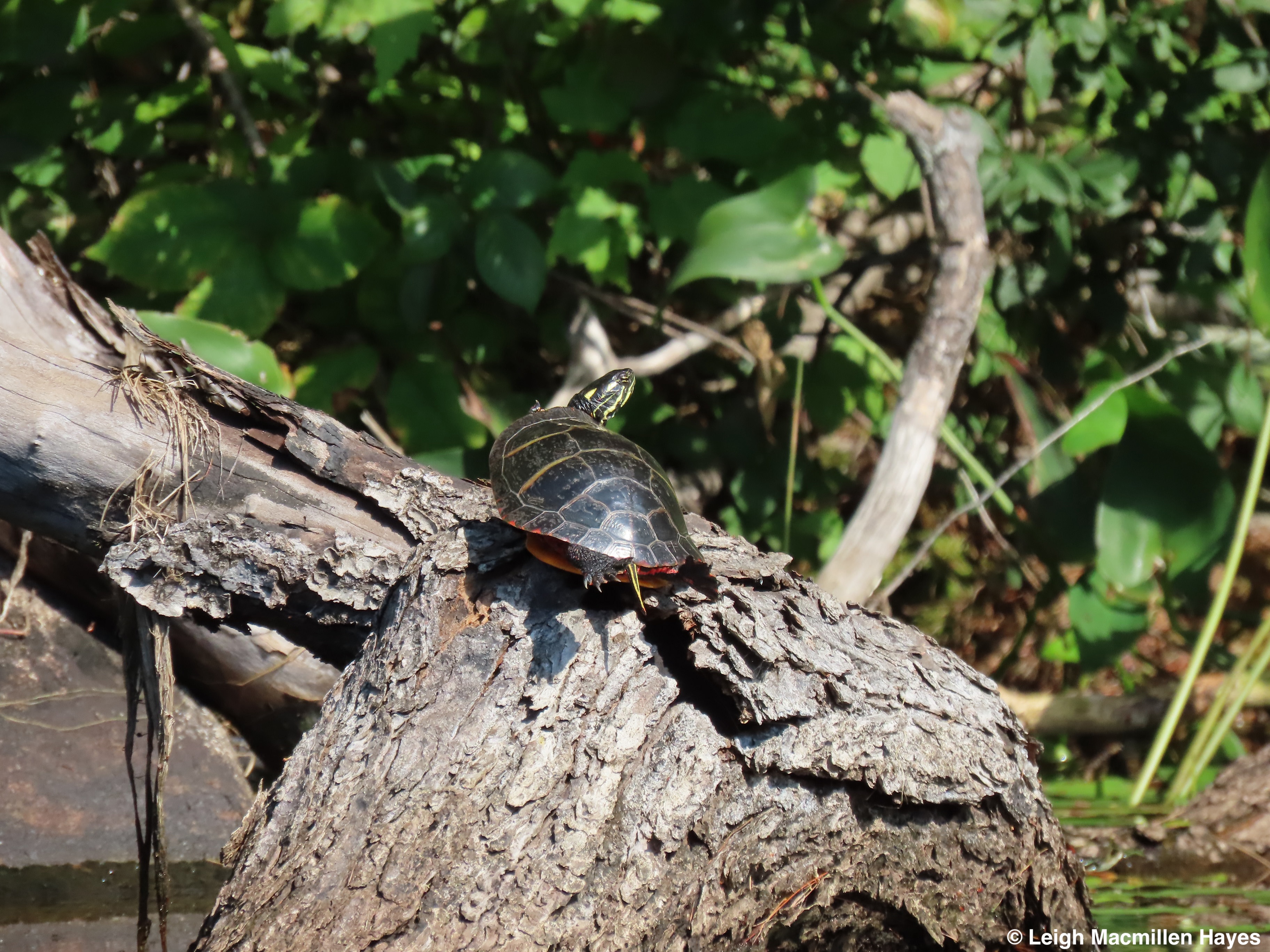
Or better yet, to dawdle. To be like the Painted Turtle and enjoy the sunshine of a perfect September day.
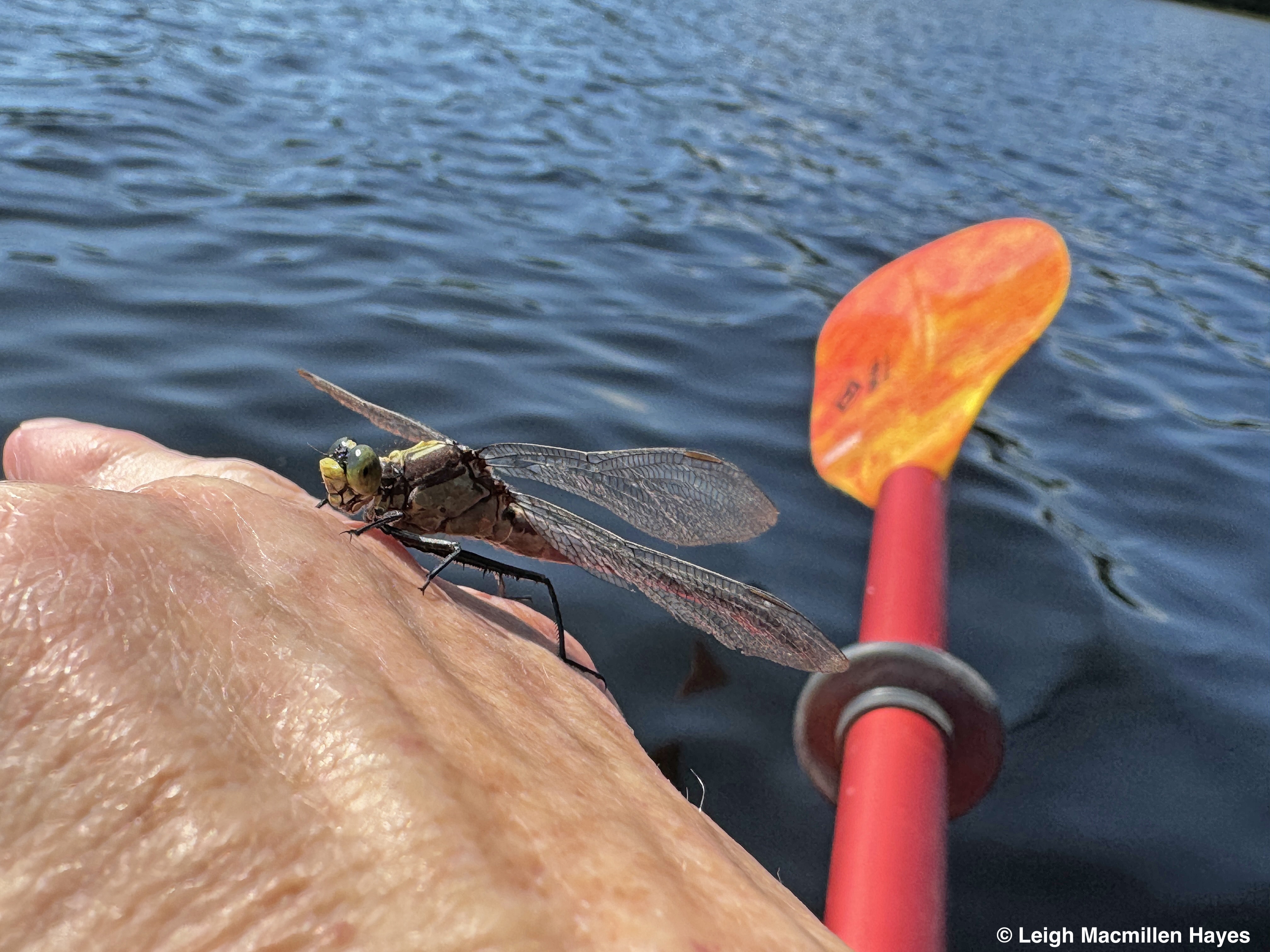
And then one of my favorite things happened. A dragonfly in the clubtail family landed on my knee and I coaxed it onto my hand for a better look. It was perfectly content to be there. Which made me think of a darner on another day on another pond this past week that I rescued as it flailed in the water. The moment I picked that darner up, it tried to take a nip out of my finger and was frantic, even when I set it on the edge of the boat. I wanted to give it a chance to dry its wings. It wanted only to fly. And so it did with wings still wet and back into the water it landed, slipping under a lily pad. I rescued it again and this time it didn’t bite and it did sit for another minute or two upon the boat, but not long enough for me to get a good look at its colors and patterns for identification, or to snap a photo and then suddenly it flew and I can only hope survived.

My new friend, however, allowed me to move him from my hand to the boat, the better to take a look.
This one didn’t speak its name immediately, until I looked at its spiny back legs. As a Black-shouldered Spinyleg it is commonly known, and it’s in the clubtail family, but I’m not exactly convinced that the shoulders are actually ebony in hue. To me, they seem to be chocolate brown.
Another characteristic is the thorax pattern: two long ovals on either side with a yellowish I-shaped mark in between them.
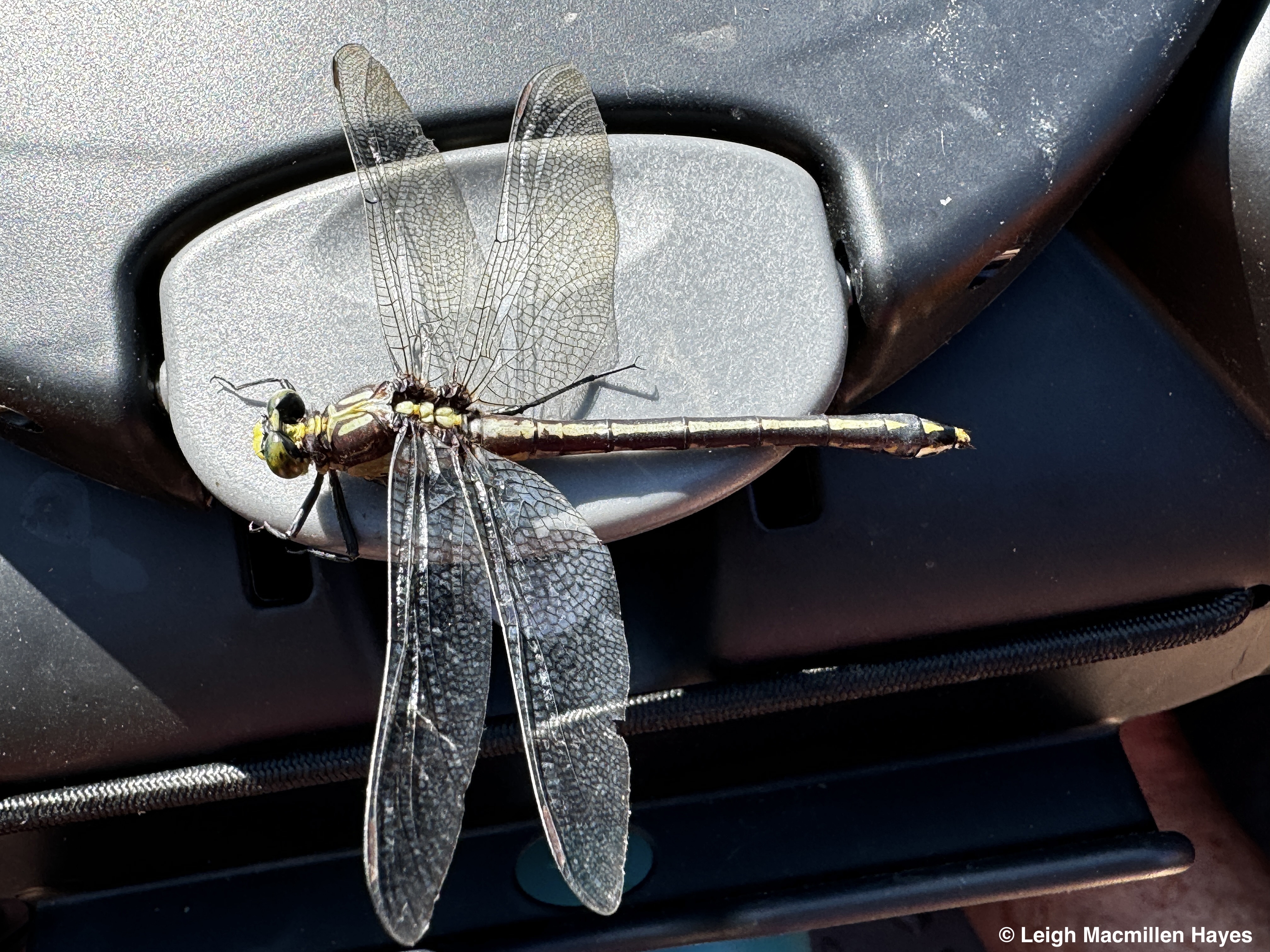
It was the pattern on the abdomen that also helped me confirm ID, with the yellow stripes on each segment becoming triangular shaped on segments 8 and 9, while the final segment, #10, was almost completely coated with splash of yellow.
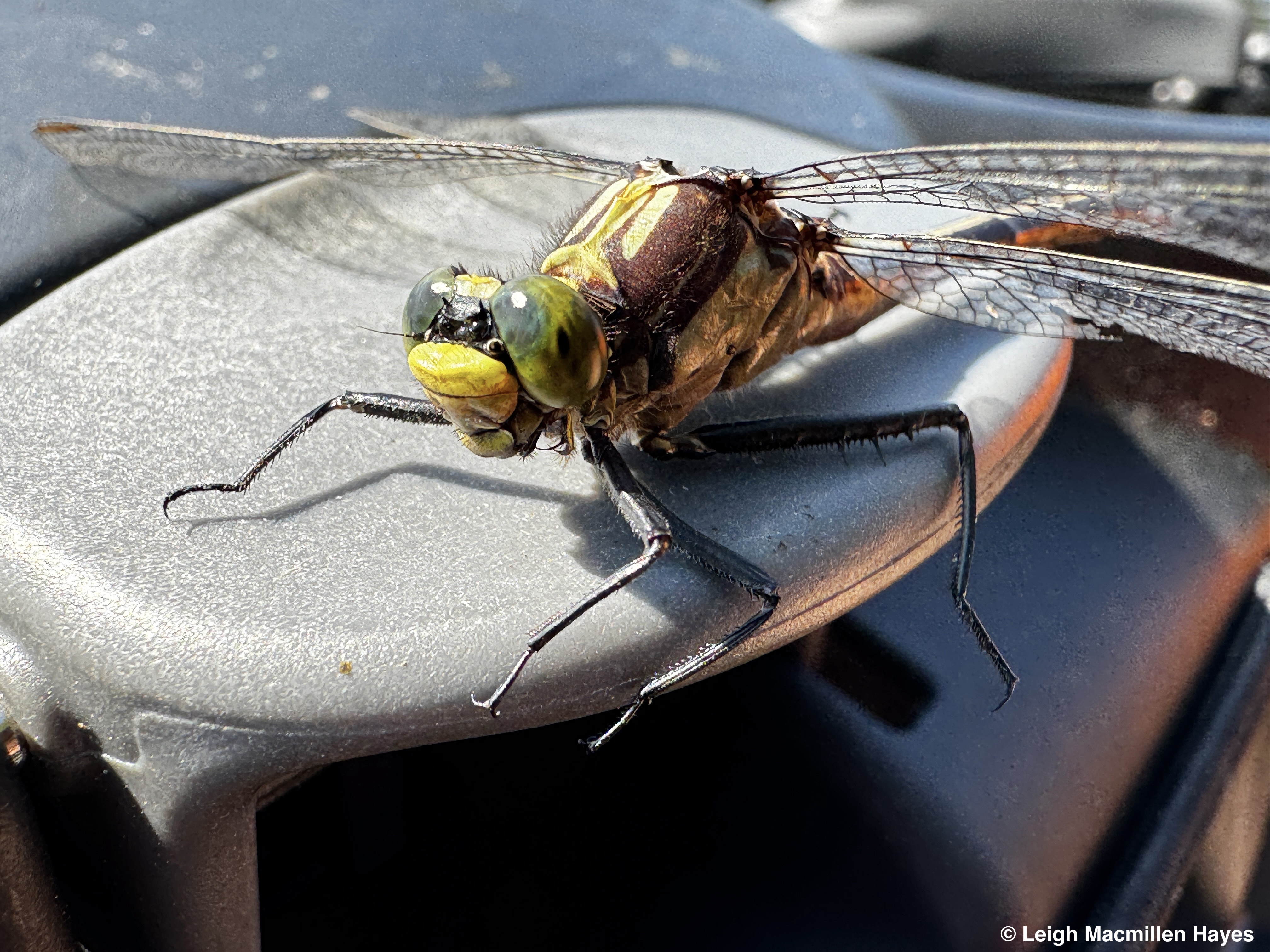
With each minute that passed I fell more and more in love as my new friend let me enter its personal space. Such big eyes–compound as they are. But then there are the ocelli, or three small black “eyes” located on top of the head–to us they look like three little bumps, but according to the field guides in my own library, they “may serve to measure light intensity.”
And all those body hairs. They work like sensors–detecting odors, temperature, humidity, and most likely wind direction.
If you have a loupe or magnifying lens, I encourage you to look at insects and plants–it’s a hairy world out there.
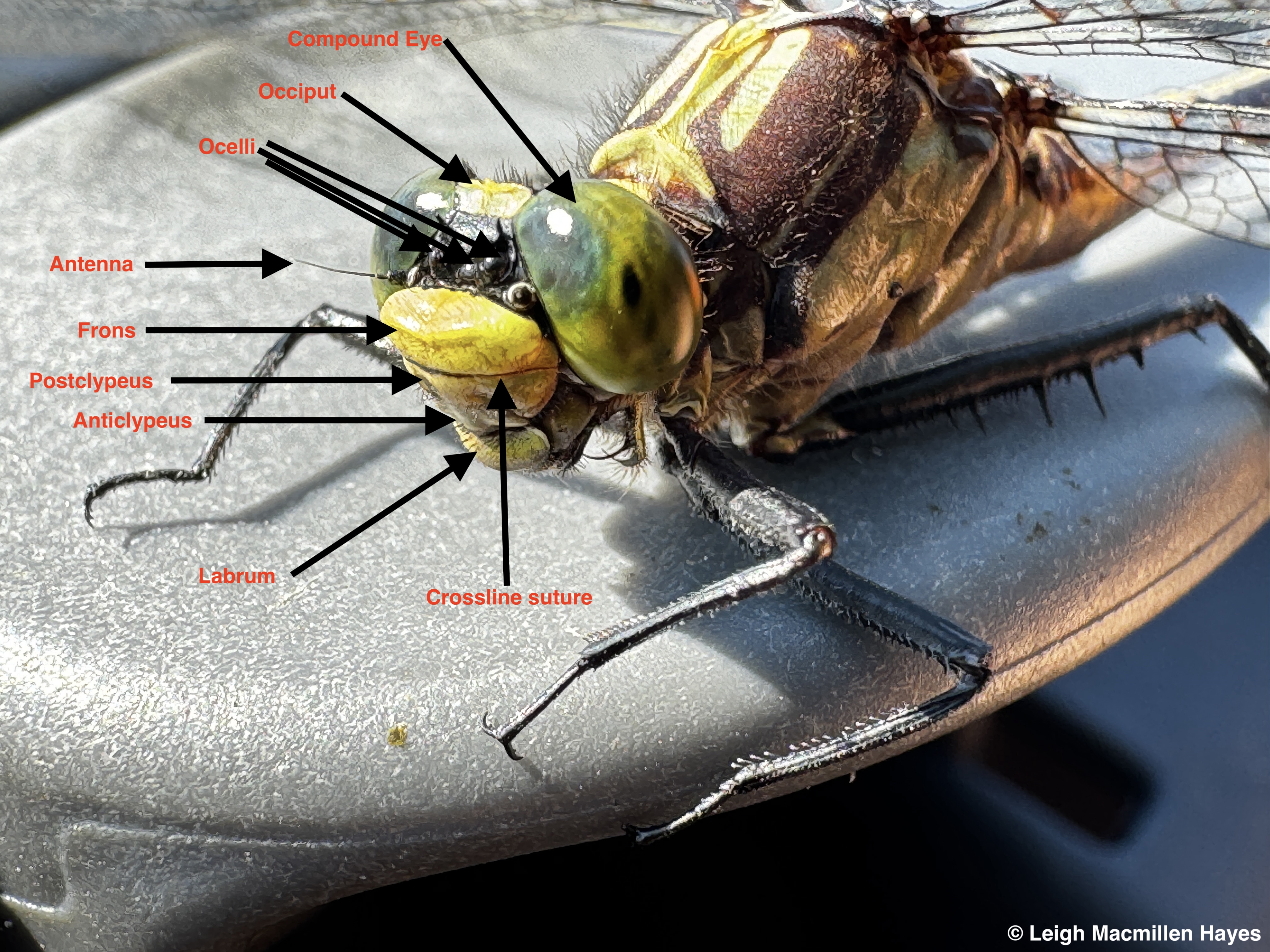
Let’s take a closer look at that face. It’s rather other-worldly in structure. Two dragonfly families feature eyes that don’t touch each other along any margin: Clubtails and Petaltails. I’m not sure I’ve ever met a Petaltail, so that already narrows it down for me when trying to figure out the species.
Beginning with the large compound eyes, we’ll work our way down. But first, can you imagine seeing the world through 30,000 lenses or facets? I’m happy to have moved on from progressive lenses (three lenses) that threw me off, especially when hiking or walking down stairs. 30,000?!!! A dragonfly certainly has no excuse for not seeing even the tiniest of insects on the move.
And notice how the eye is two toned, the darker being above.
Between the eyes is a plate called the occiput, which covers the upper part of the head. You might also notice, though I didn’t label them, that there are occipital horns.
Below that is the triangle of ocelli, or three tiny and simple eyes as compared to the two compound eyes. These may measure light intensity.
And then there are two antennas, perhaps for measuring wind speed. All of this and we haven’t reached the face yet.
Ah, the dragonfly face–beauty is definitely in the eye of the beholder.
Dragonfly faces consist of plates and the upper plate is the frons. In some species there are certain dark shapes or lines that help with ID. Not on this one, however.
Below the frons a crossline suture is a seam that separates the frons from the postclypeus, an upper plate that we might think of as the upper lip.
And below it, the anticlypeus, a lower plate located about where our tongue might be on a human face.
Finally, the labrum, or lower lip, and below that the mandibles, not labeled.
Such complexity for an insect that spends months to a few years as an aquatic naiad, growing through several molts, and then crawls out of the water and slowly ecloses upon vegetation, pumping insect blood into its wings and body, before flying off to control the airways and the insects who bug us. And within two months of emerging from the water, it’s life cycle comes to an end.
And to think this one simply landed on my knee and now you have all this information to digest. Don’t worry, there will be a quiz at the end.
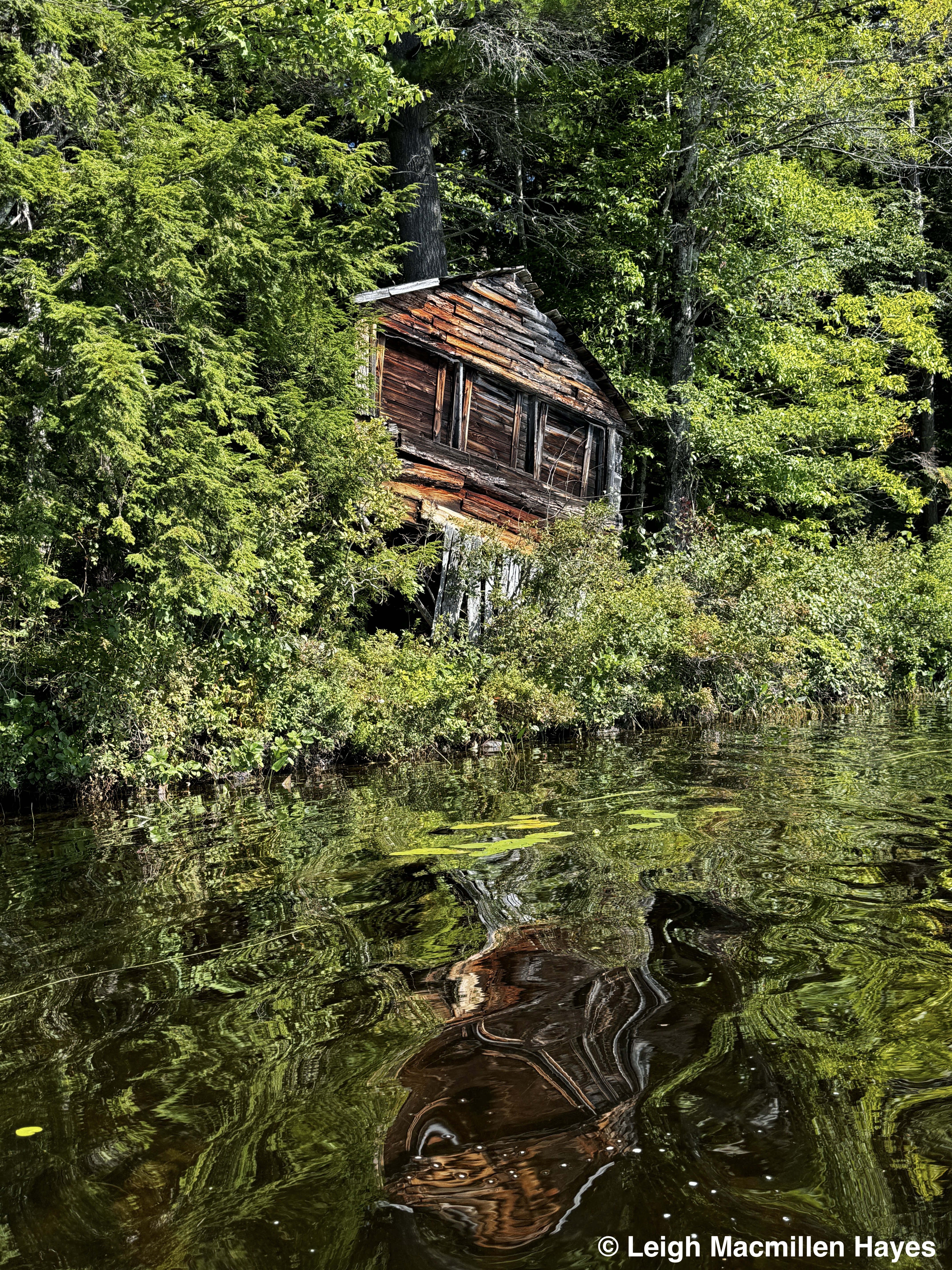
Suddenly, the dragonfly flew off. And my focus returned to the pond. If you’ve paddled here, then you know that we hadn’t gone far as we’d only reached the third of the crooked houses.
My Guy was ready to purchase one and fix it up. I just want to paint this scene when I have time for so beautiful was it despite its lack of TLC and the reflection was equally delightful as lines were interrupted by the water’s current.

At last we reached the opposite end of the pond from which we’d begun our journey and the colorful leaves of the Swamp Maples told me we were in a different sort of wetland.

The layers. From Pickerel Weed leaves to grasses and sedges, including Cotton Sedge, to the Swamp Maples, actually being Red Maples with very wet feet which are among the first to turn as fall approaches and days shorten, to a backdrop of deciduous and conifers.
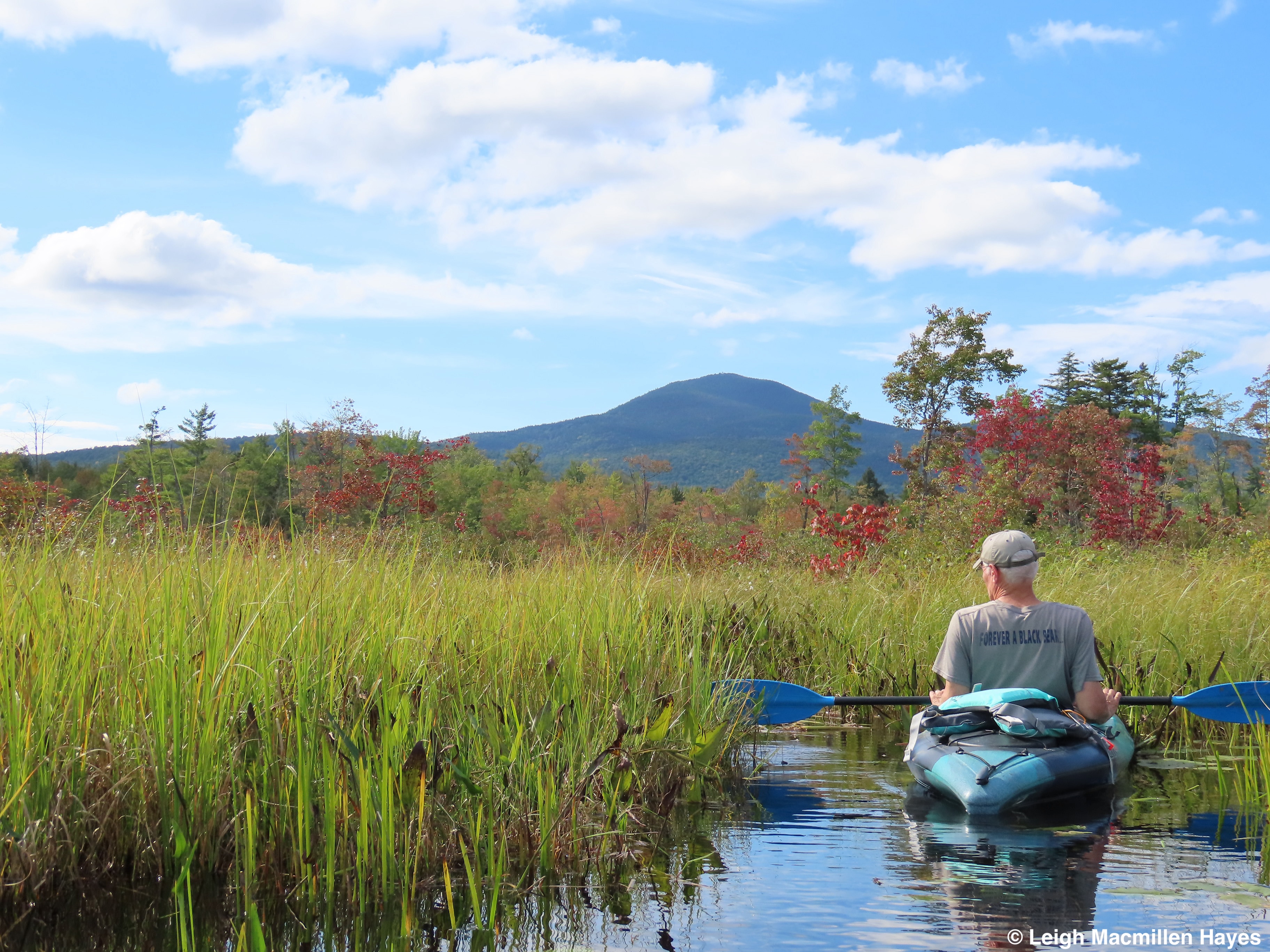
Just the colors made me happy as I followed My Guy who followed a brook as far as we could until the growth was too thick and we could hear water flowing over what was probably a beaver dam ahead. And so we turned around, but first honored Mount Kearsarge North, the pyramid mountain in the distance.

I extended the telescopic lens on my camera farther than I should have, but I wanted to see the fire tower at the summit of Kearsarge. It was incentive enough for us to decide to hike there again soon.

As we continued our clockwise journey around the perimeter of the pond, I was on a hunt–for those Pitcher Plants I’d been promised. But what caught my eye in the meantime was the late afternoon sun glowing on bowl and doily spider webs. And a beaver lodge in the background.
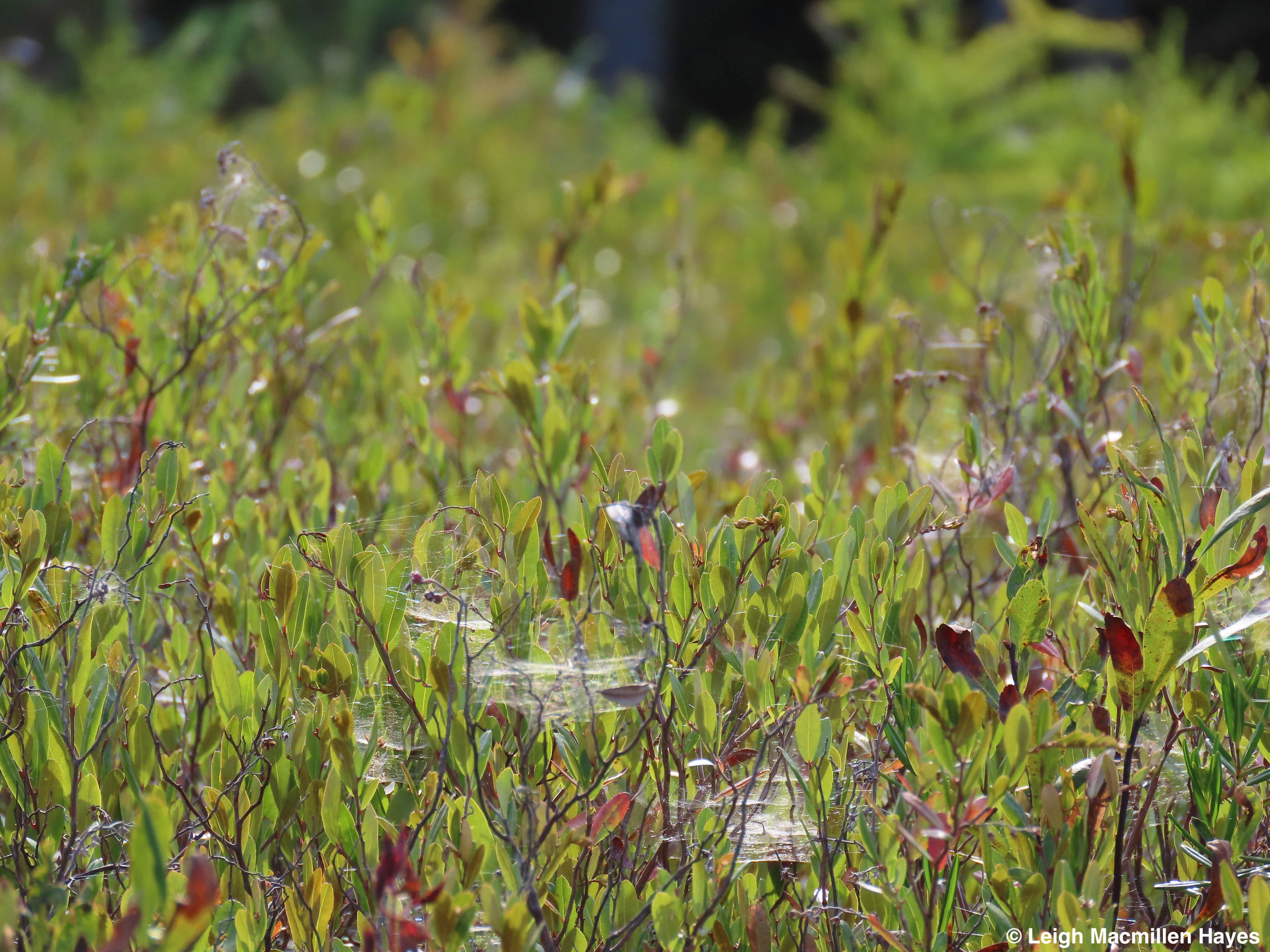
It always amazes me to find so many of the same type of spider webs in any one area. The spiders who wove these are rather small, but their web is incredibly complex.
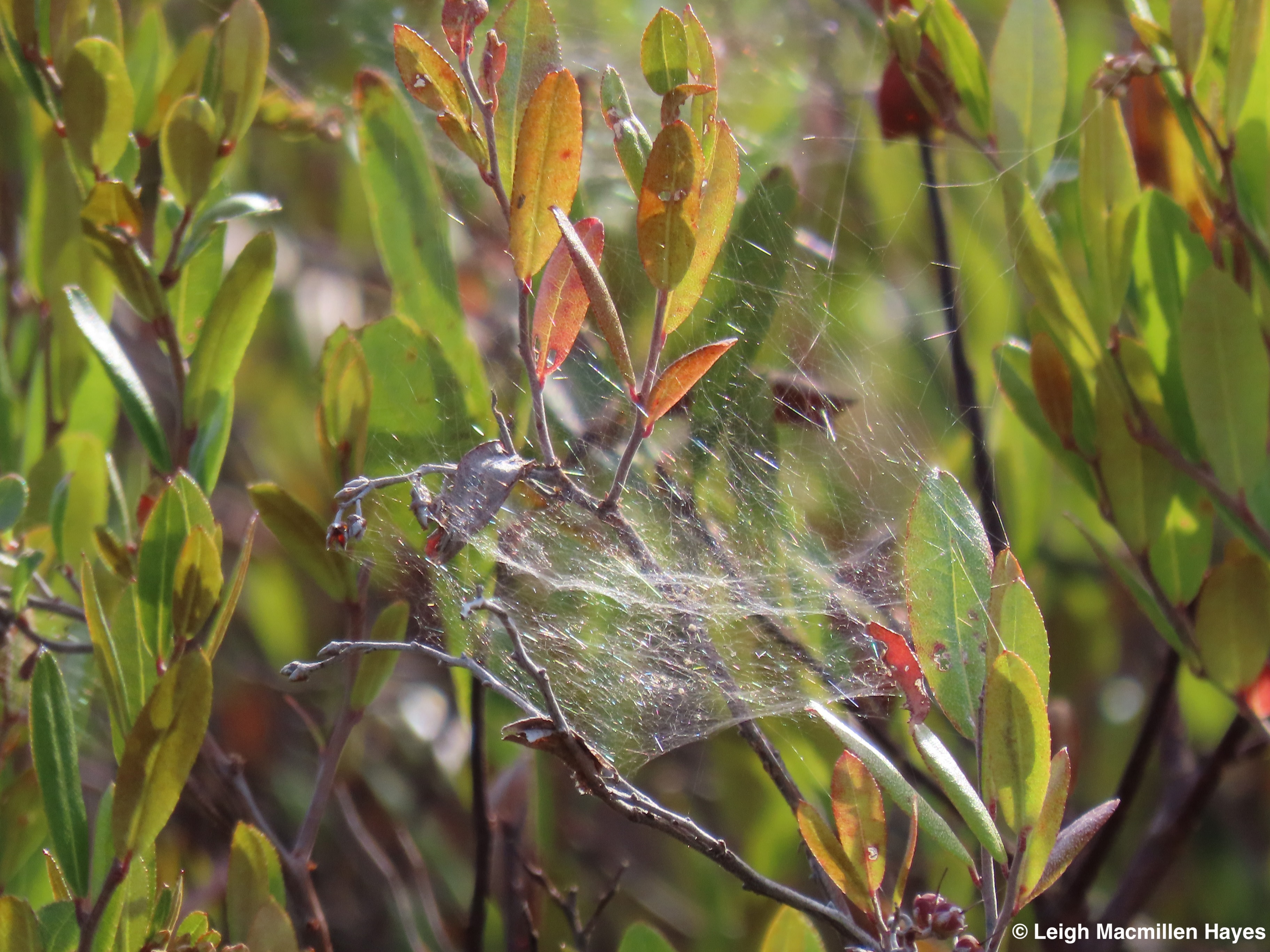
They weave a sheet web system consisting of an inverted dome or “bowl,” suspended above a horizontal sheet web, or “doily,” hence its common name. And then they wait for a meal to announce itself. Should the meal fall through the bowl, the doily serves as a safety net, thus the spider makes sure to not miss a bite.
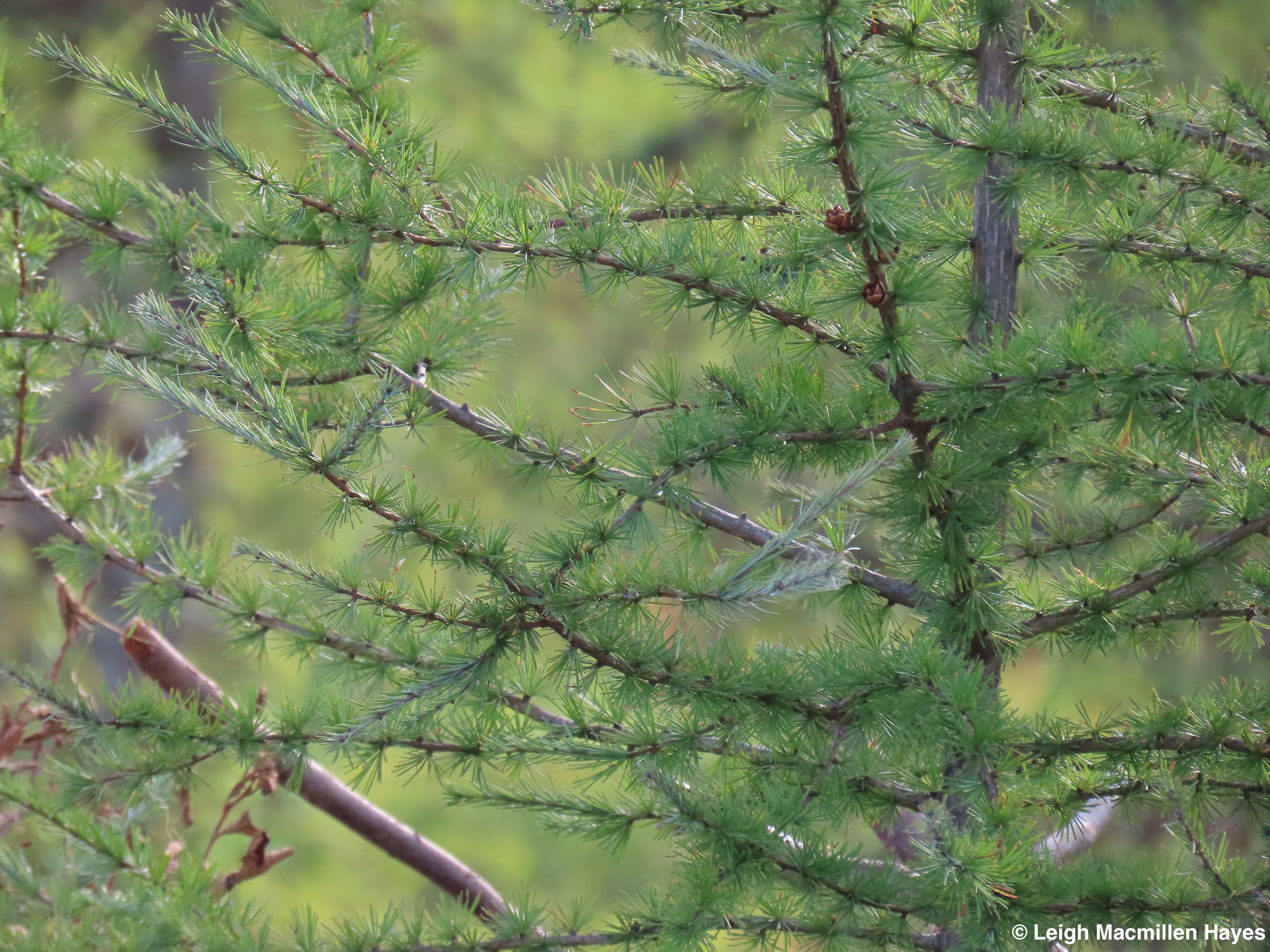
Before turning my boat to follow the shoreline again and continue my PP quest, I realized that a Tamarack grew upon the lodge. And there were several others nearby. I love these trees because they aren’t every day sights. And because they are kinda like me–beings that can’t make up their minds. Thus, they are deciduous conifers, meaning they are cone bearers who shed their needles (leaves), unlike other cone bearers in our neck of the woods who are evergreen.

I had only turned a wee bit when two structures standing above other plants caught my attention and I knew my quest had come to an end. Pitcher Plant flowers.

And below them the pitchers (leaves) for which they were named. That ruby red rim. The tree-of-life venation. And downward facing hairs. “Here little insects. Come check me out. I have a special drink I made just for you.”

At the base of the Pitcher Plant grew Sphagnum Moss and Leatherleaf, and . . . Sundews! Round-leaved Sundews–another carnivorous plant like the Pitchers. It’s a plant eats insect world out there.

As we rounded a bend nearing the end of our journey, a flock of Canada Geese honked and cackled.

And suddenly lifted off. My Guy counted 30.

At last we approached the launch site, but truth be told it took us about twenty more minutes to go the short distance because there were so many more turtles to spot. Do you see the second one in this photo?

And one climbing atop another as is their habit since turtles are ecothermic and the sun’s rays help raise their body temperature. So if your brother is on top of the log, why not climb on top of him to get even closer to the sun?

I spotted twelve in all, and love that the one on the right upon this log waved–as if to wish us farewell, for really, it was time for us to leave.

So we did, but first we gave a quiet thanks to our friend, Pam K., for recommending this delightful pond and telling me about a few of its highlights.
And I did promise a quiz, so here ’tis. Can you name at least one part of this dragonfly’s face? And can you name the species? Don’t worry if you don’t get all of the parts–that’s why I write a blog–so I can go back and remind myself.
Basking in the sights. That’s what we did much the same way the turtles basked in the sun.
Oh, and that line that the journey wouldn’t take us long–ahem. It was at least a two and a half hour tour. After all, it’s a wonder-filled world out there.
 wondermyway