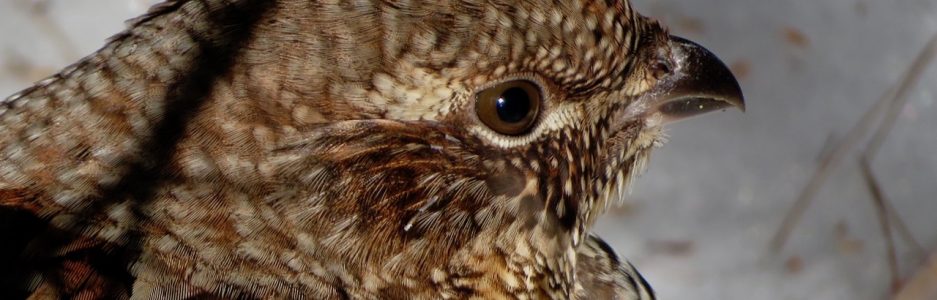
The car in front of us pulled just off the road and then we saw a hand reach out the window and beckon us to drive forward. And so we did. And rolled down the passenger side window. We thought something was wrong.
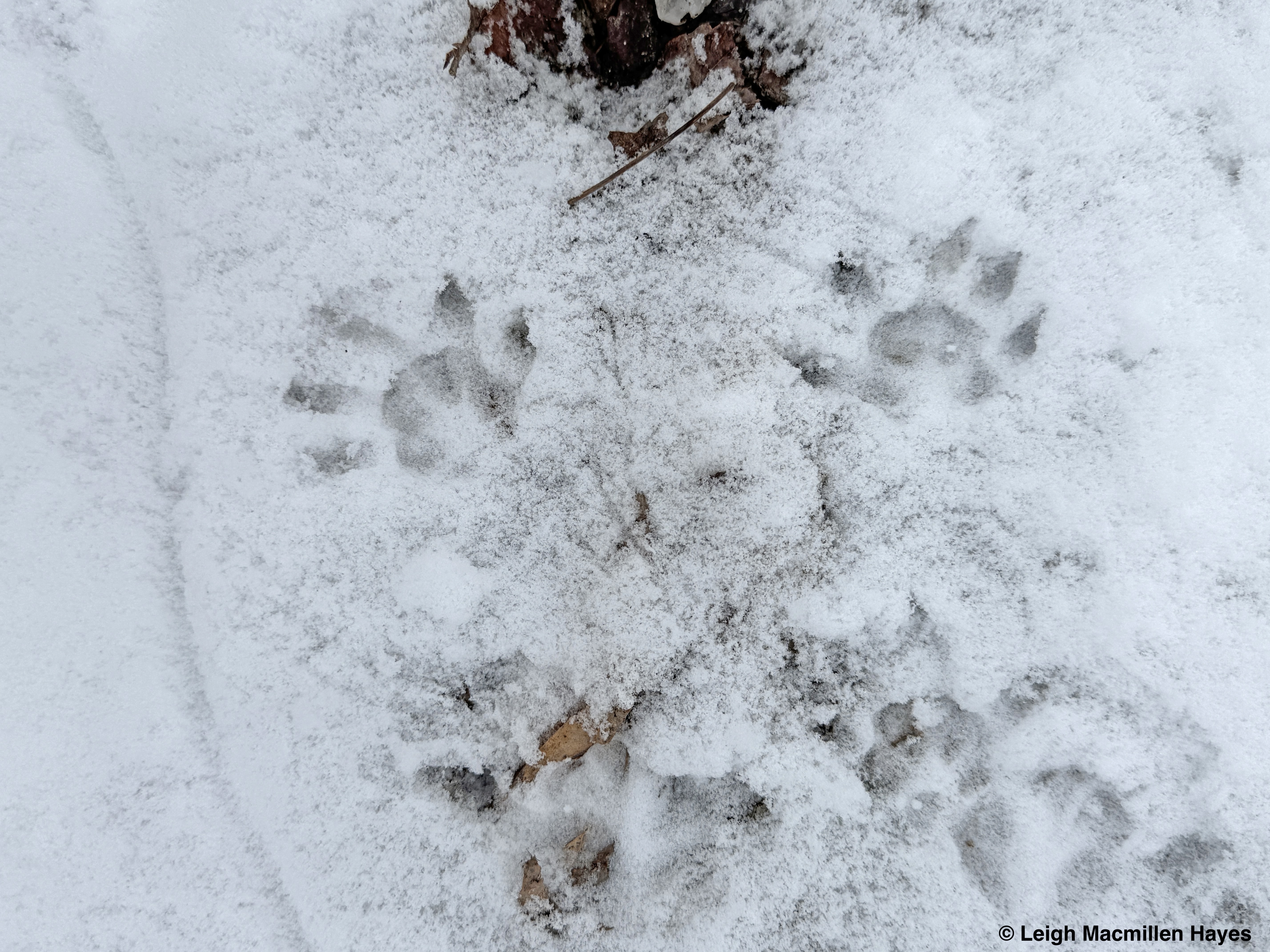
Instead, we learned everything was incredibly right. For on the road between the two vehicles was a mammal track. Our driver pulled over to the side of the road and seven of us quickly emerged from the two cars.

In the dusting of snow that had fallen before we met in China, Maine, on Tuesday morning, the prints were almost perfect. Not quite because they’d been created a wee bit before the storm ended and/or wind had filled them in a tad. Close enough to perfect though that we could easily read them.
And we knew we were in the right place with the right guide, because who else would stop in the road to begin our tracking lesson? We were six Maine Master Naturalists and our guide: Professional Tracker and Naturalist Dan Gardoqui of Lead with Nature.

We could easily look at the tracks and prints from the three perspectives of flying (what was the setting?), standing (how was the animal moving?), getting down to look for details, and I think we all quickly surmised the creator was in the cat family, but . . . the lines in the snow indicate our brand new learning. If we started paying more attention to the trail width, we could determine whether the animal or in this case, more than one animal, was walking or trotting. It’s one of those things I think my brain processes without giving it much thought most of the time, unless I’m actually backtracking and pulling more of the story together, but the two gaits side by side and Dan’s lines outlining the differences, gave it a whole new perspective.
Back into the cars we piled and continued down the road.

About ten feet.
And then we pulled over again.
Another set of tracks, much more unique than the first set. With a tail mark between them.
The opposable thumb helped us ID these as belonging to a Virginia Opossum. Just look at those toes and nails. It’s been a few years since I’ve spotted Opossum tracks in our woods, and they are always so fun to locate.

The thing was, there were multiple Possum tracks, and we soon learned when the neighbor came out to see what we were doing (a bunch of weirdos crouching over snow in the middle of the road should cause concern?) that they were well feed. One lived under a shed or something by his house, but the others came nightly because he feeds them.

My big take away: I knew that the deeper grooved line was created by the prehensile tail as it dragged behind the Opossum, (which would be a tail-slap in deep snow, and not quite as prominent), but I’ve never noticed the lighter drag lines on either side of the tail. Dan explained that those are nail drags.

At last we reached our intended destination of Thurston Park, a 400-acre forest on the edge of town.

Almost immediately, well, after noting the routes and patterns of mice and voles, everyone’s favorite meals, we came upon the track of a predator who placed a hind foot exactly where a front foot had been before moving forward. Again, we looked at the setting, pattern, and other hints like the X between the toe pads and metacarpal pad, plus the gait, and without following it out too much to search for other clues, surmised that despite the not-so-clear prints, we had found the track of a Red Fox.
And then he showed us another cool thing that I need to remember to employ–imagine and actually draw the legs and then the body of the animal and you have a sense of size. Most of the time. It helps to add the head and tail like he did.

A bit later, we stepped out into a wetland and headed to a spot where Dan had seen Otter activity last Friday on a pre-hike, before the storms of the last few days. Most of that action was obliterated or almost undecipherable, but we spotted something else in the middle of the ice that we really wanted to examine.

Not a pretty site, but a kill site never is. That being said, Dan did not see any of this on Friday, and by the fact that there was a game camera overlooking the scene, and there were bones from several animals, and one carcass looked a bit folded up, we surmised it had been placed here either to attract predators for the sake of hunting them, or to watch what predators came in to feast. It was the thought of the latter that appealed to most of us. So we looked around for signs of dinner guests and found mostly Raven tracks.
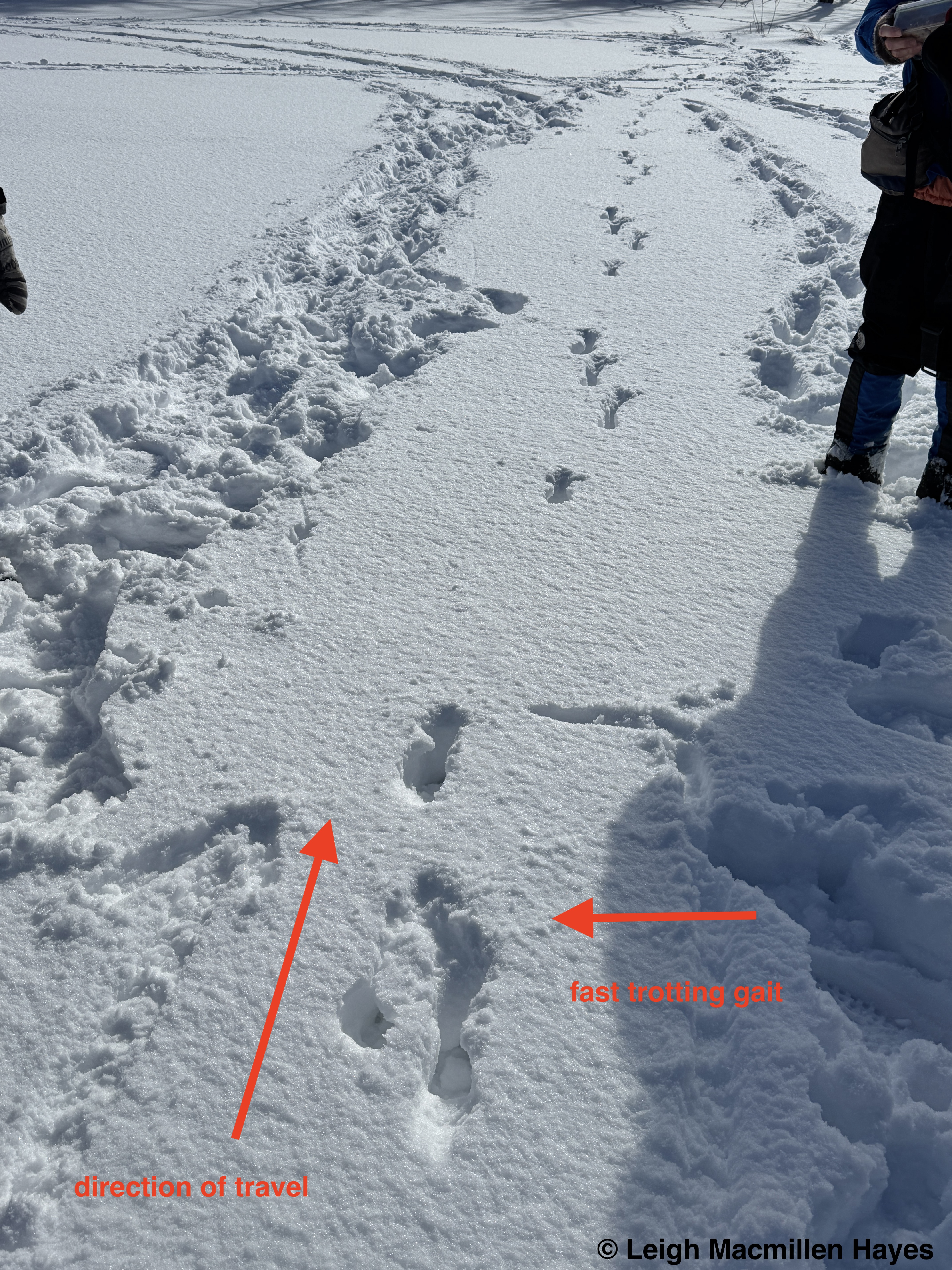
Farther out on the snow-covered ice, we discovered that deer had crossed multiple times. One of those crossings provided another interpretive lesson. We could tell the direction of travel by the way the cloven hooves faced, and would see the changes in the gait, but what Dan helped us to understand better was the fast trotting gait and then the slow down (almost like it put the brakes on) to a walking gait. And then a change of pace again. We had to wonder what may have spooked the White-tailed Deer, causing it to speed up and then slow down.
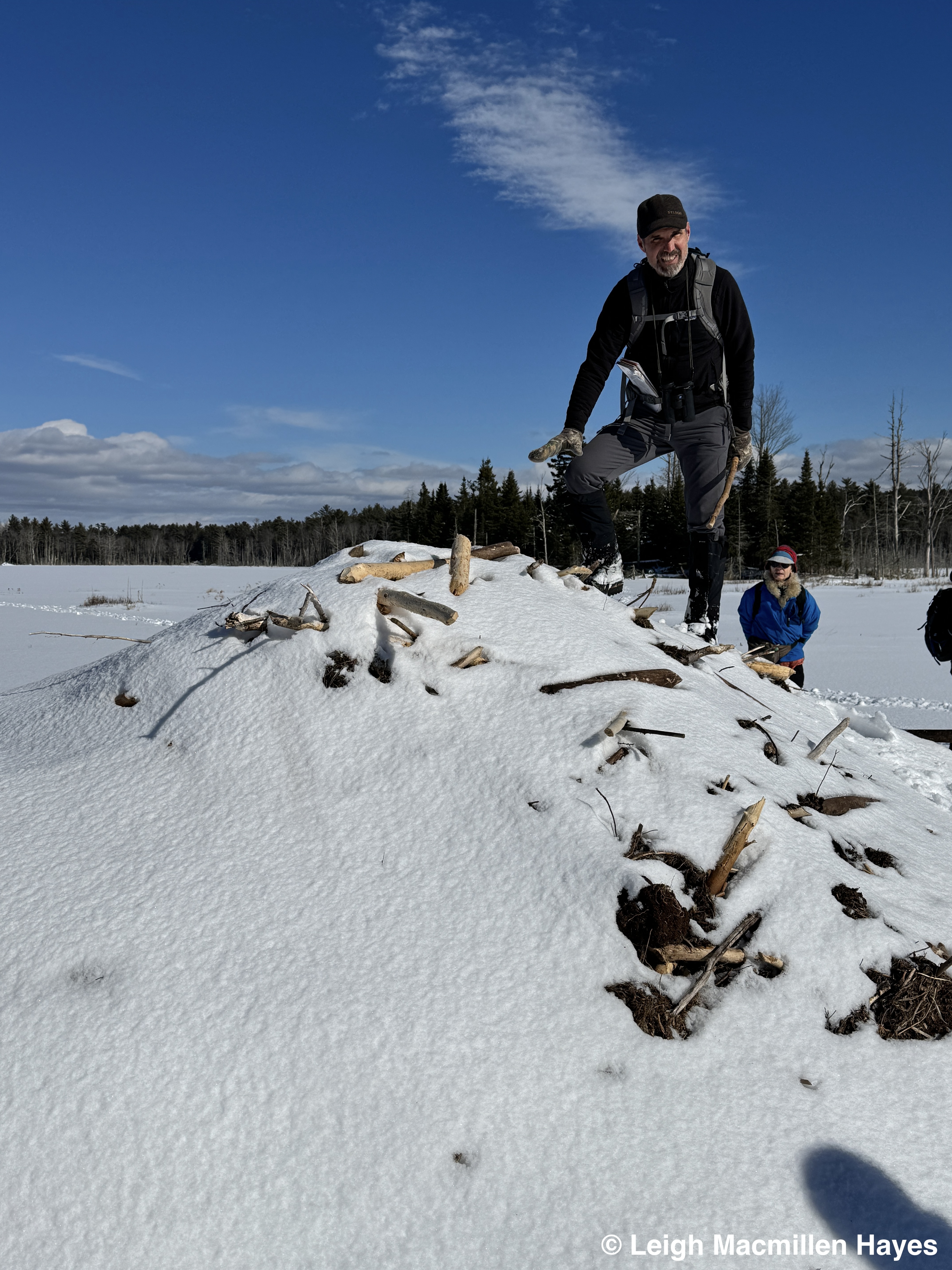
Our next stop, after exploring an island for a bit, was to check out one of several beaver lodges. The sticks were rather on the fresh side and it had been mudded this past fall.
Were the beavers home and wondering who the heck was knocking on the roof?

Possibly, but given that it was another brisk day in Maine, I expected to see hoar frost at the steam hole and am not convinced there was any. I could be mistaken.
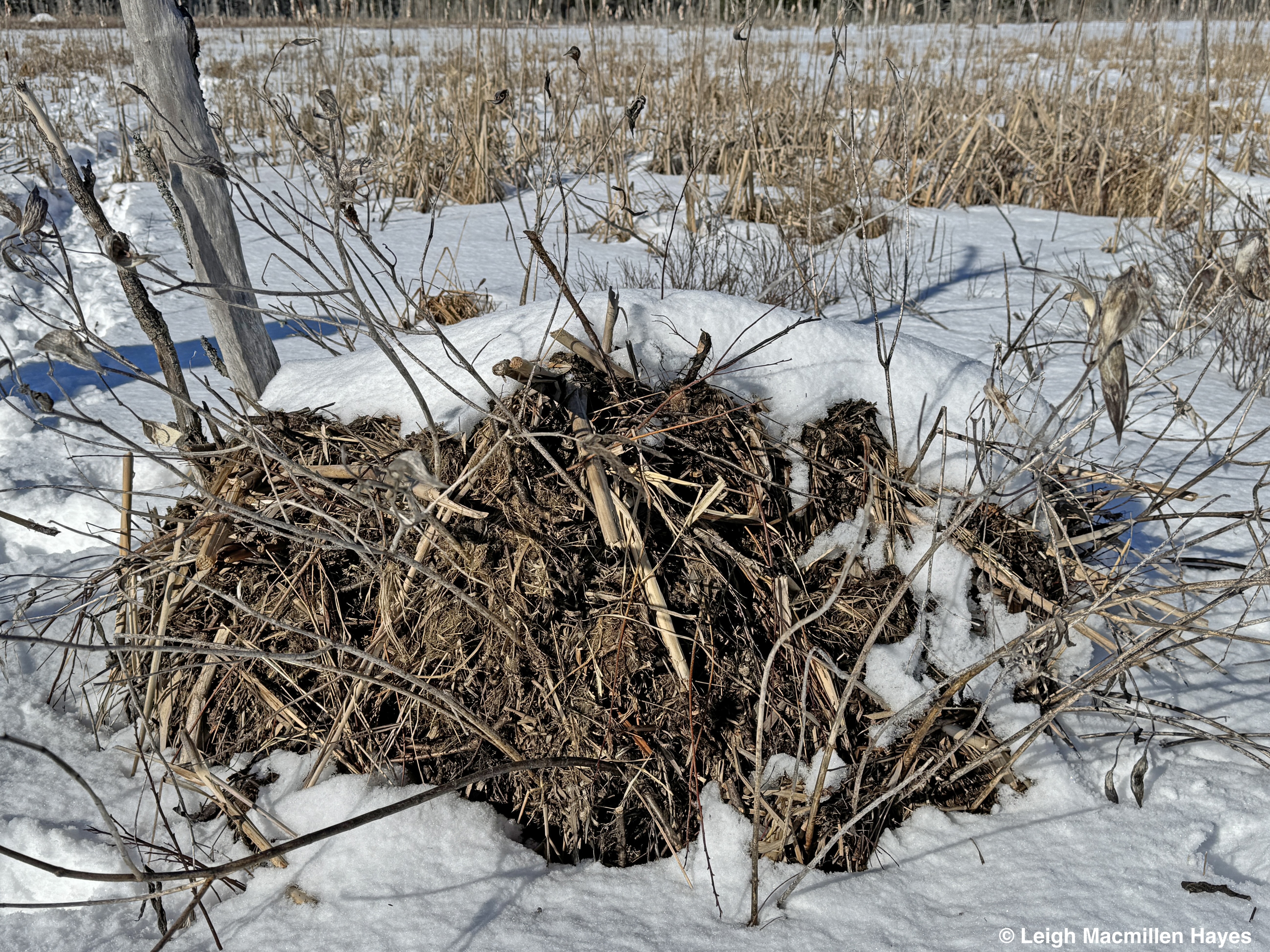
The next find as we headed off the ice and back toward the woods was a lodge of another critter. I may have seen one of these twenty plus years ago at Brownfield Bog, but have failed to identify any since then so was grateful for this lesson.
Meet the home of a Muskrat. Anyone home? Again, we couldn’t be sure. But it was the ability to look at the structure and gain a better understanding of its construction that I so appreciated. Rather than a home of sticks like the Beaver lodge, these are made of vegetation, including the cattails that were abundant in the wetland.
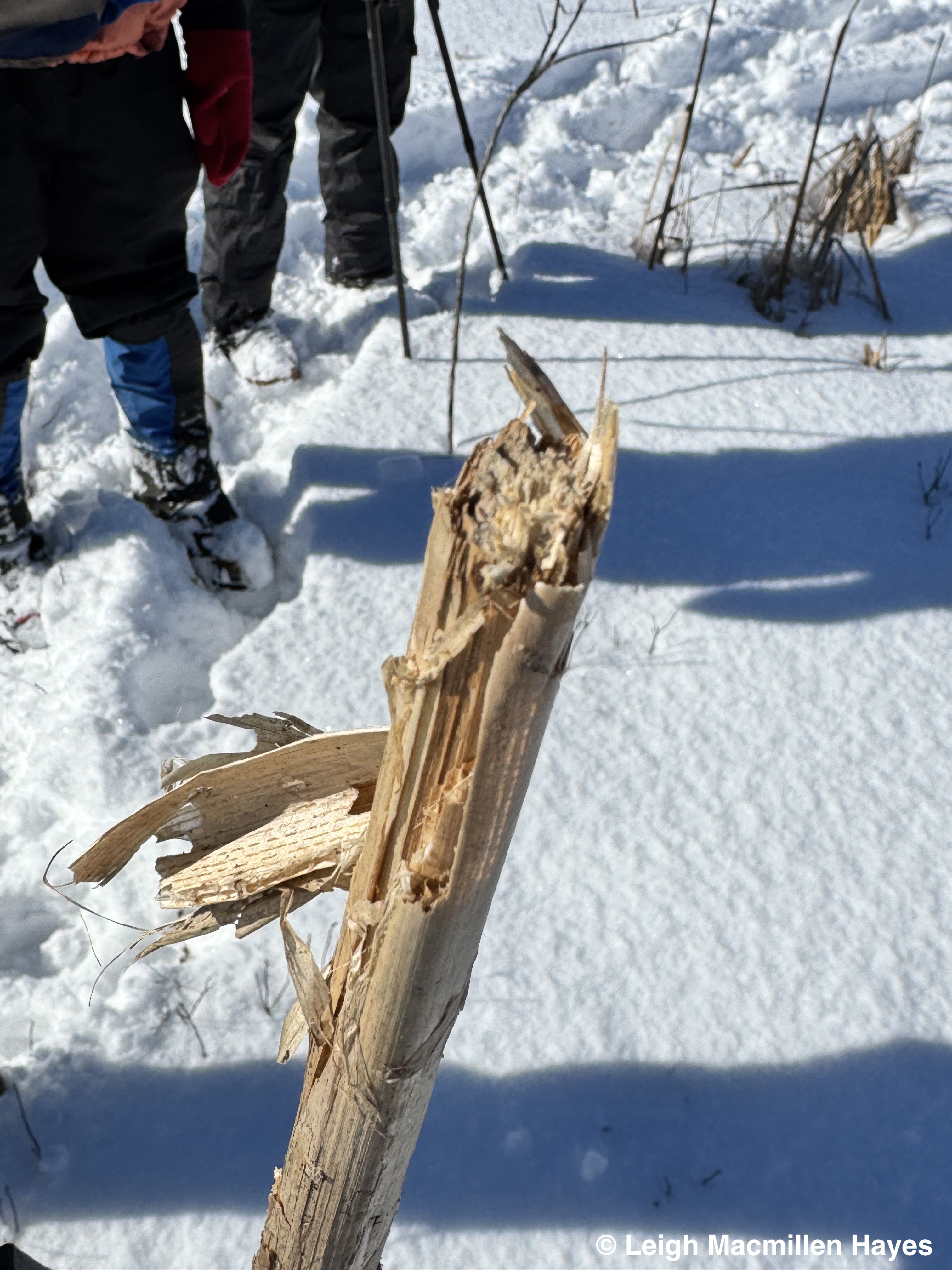
We took a look at the 45˚ cut of the cattail stalk, given a Muskrat is a rodent.

Back on land, we found a sunny spot protected by trees and took a lunch break out of the wind, during which we learned more about Dan’s career as a naturalist and shared with him about our Master Naturalist training and volunteering.
And then we continued, noting abundant snowshoe hare tracks. What we wanted to see were signs of them eating, which we finally found upon some Beaked Hazelnut branches. Again, it was the 45˚ angle cut.
While looking at that, something else caught our attention: Glue Crust Fungus (Hymenochaete corrugata), which migrates from tree to tree and glues twigs and branches together. What we couldn’t see happening is that the fungus was feeding off the decaying wood beneath its dark crust.
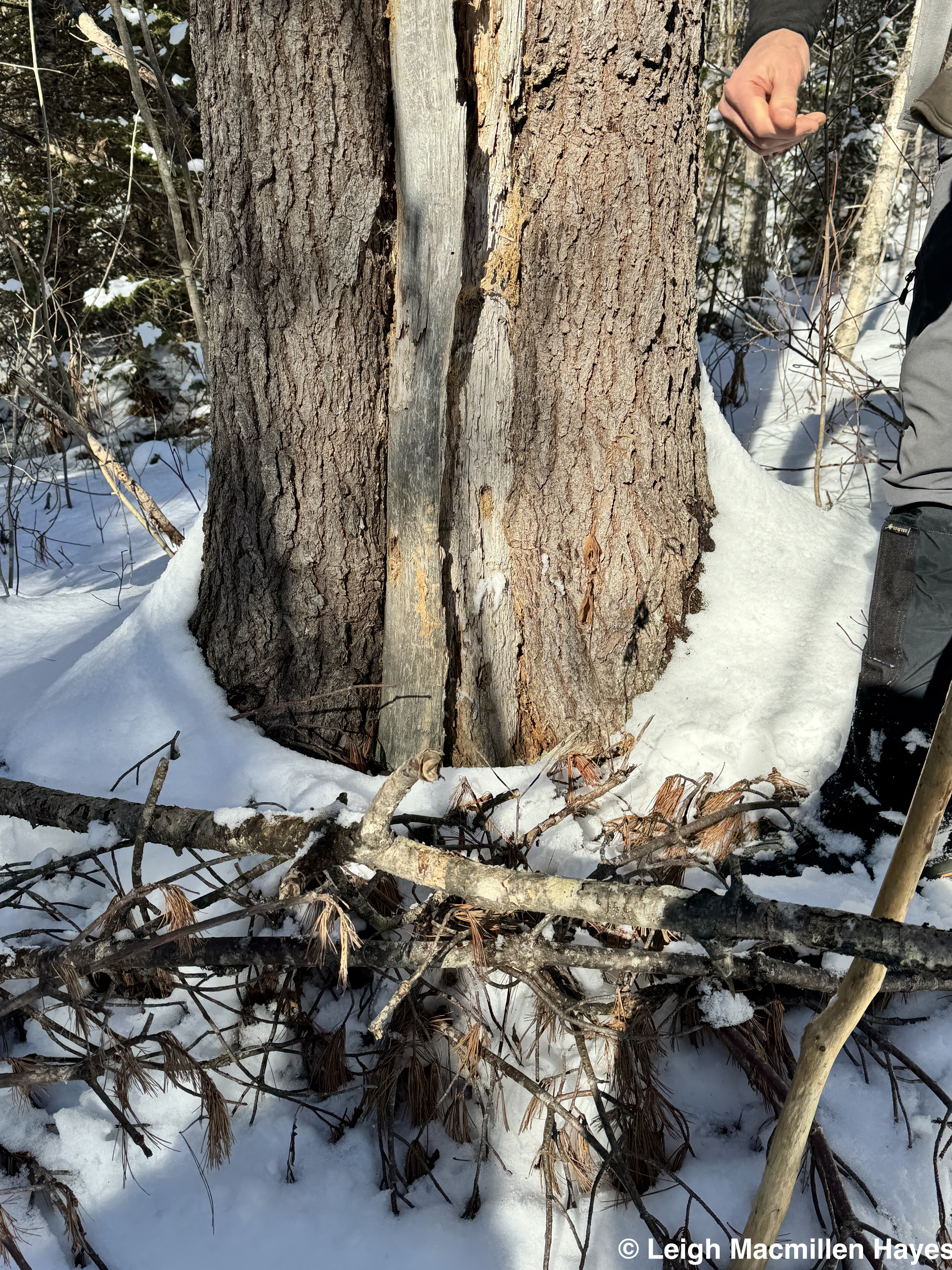
Another stop and another sign I need to start looking for at home and beyond: do you see the yellowey-orange coloration on the the tree scar?

It turns out this is the work of a Gray Squirrel. It’s called Squirrel Striping and is a scent post. Similar to how a Black Bear bites trees or telephone poles by cocking its head to the side, and rubbing against it, so does the Gray Squirrel, perhaps announcing its territory or making a statement about its health or availability. After biting, the critter rubs its check and/or deposits saliva on the area to leave a scent. And it may return to the same spot year after year to mark it.
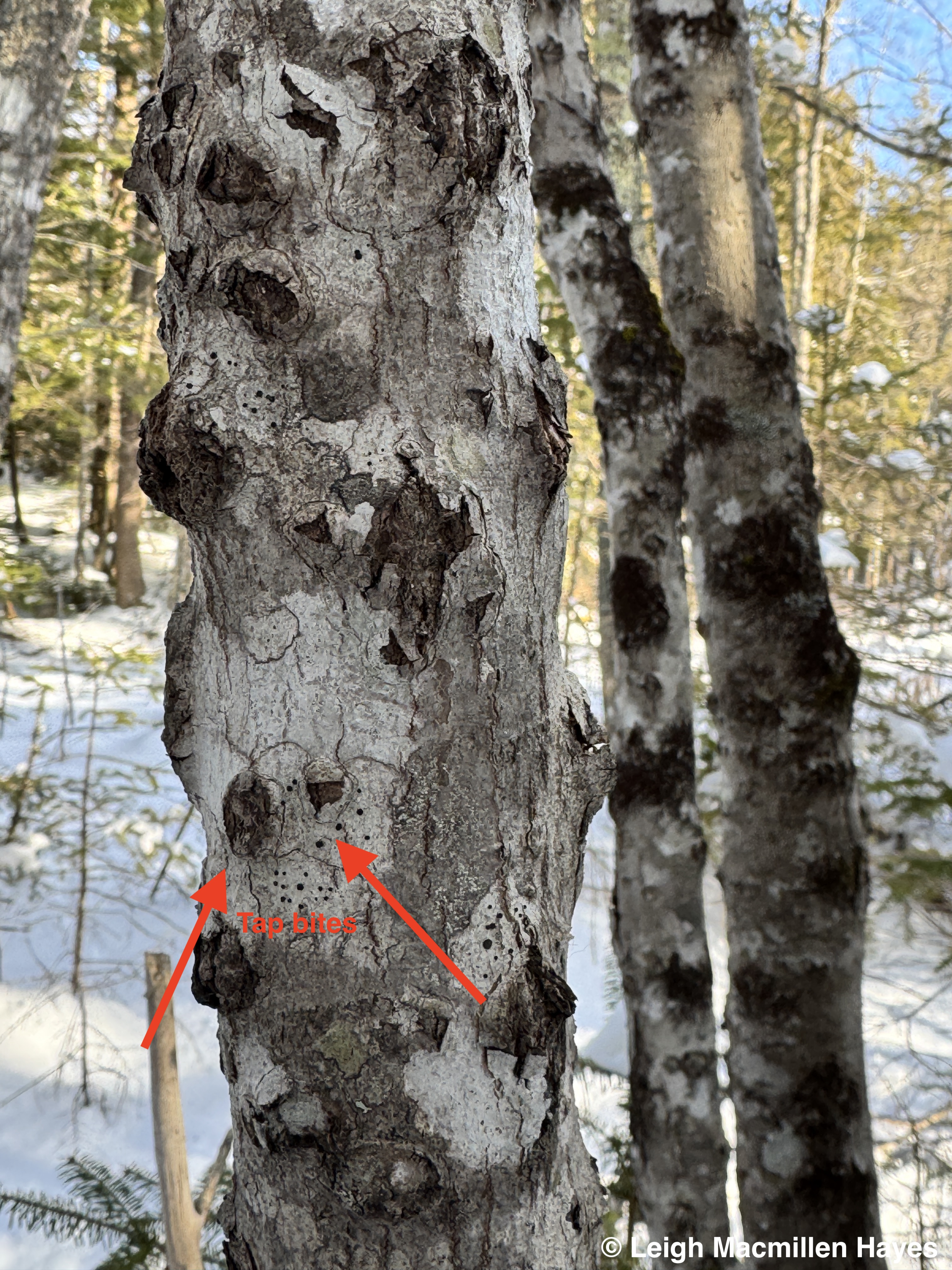
Not to be outdone, we found the tap bites of a Red Squirrel upon a Red Maple. Okay, so I never would have guessed that that was what we were looking at on the bark. Instead, I would have talked about the tree being diseased. And I would have been wrong.
These marks are old and show how the tree healed the wound. And now I must pay attention and look for fresh evidence, but what happened is the same dot and dash (Thank you to Susan Morse for teaching me that description during a two day workshop about twelve years ago) behavior as the Gray Squirrel and Black Bear. The squirrel anchored its upper incisors, creating the dot, and the dash is the cut made by the lower incisors as they were drawn toward the upper ones. Again, head cocked to the side.
After tapping a tree, apparently they don’t lick the flowing sap immediately, but rather wait until the sugar has crystalized. It’s kinda like hard candy.
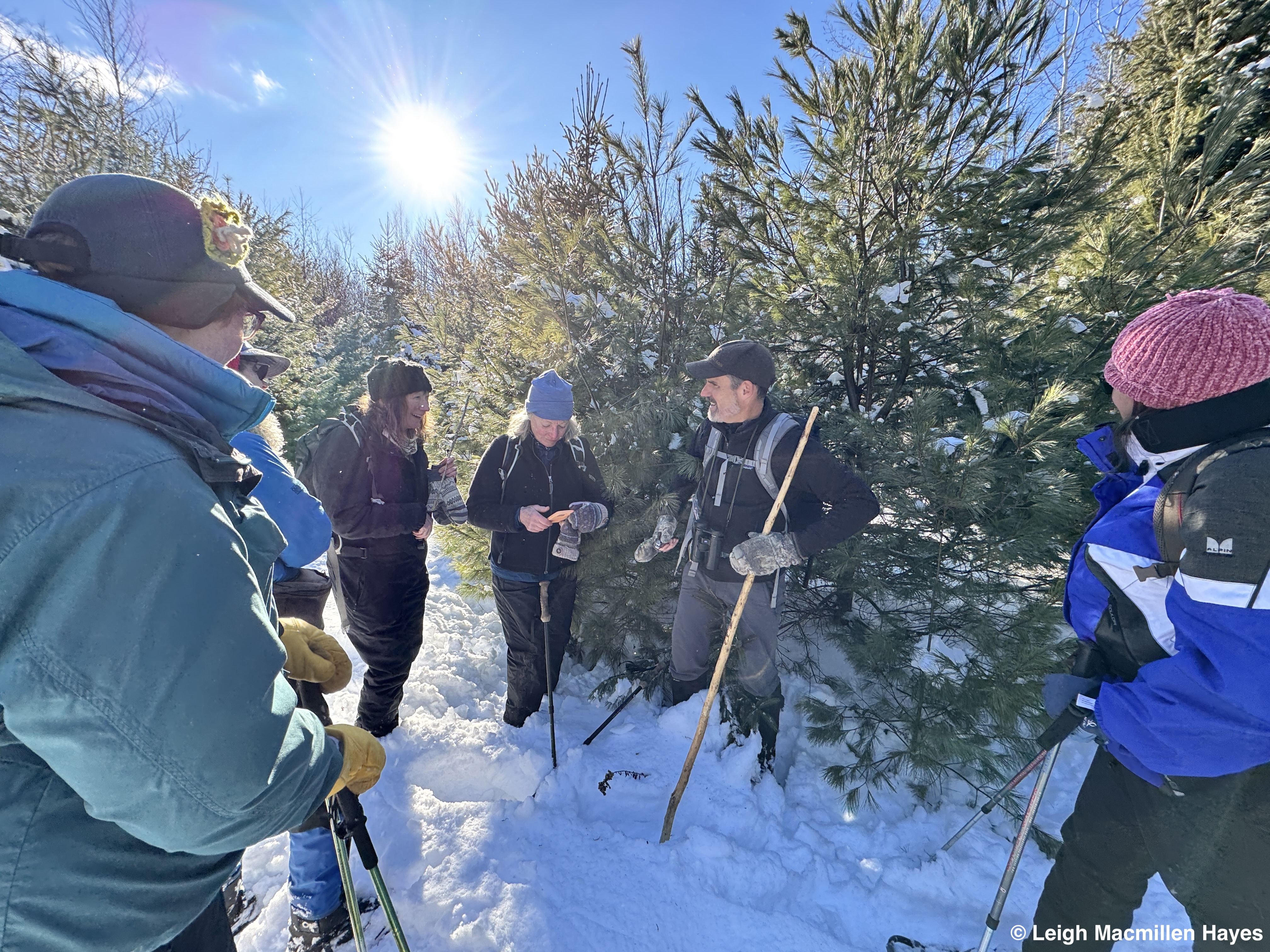
Another stop in the warm sun was by a White Pine grove, where we noted that the leader branches on some of the saplings had been attacked by weevils, and the next whorl of branches had taken over and reached for the sky.

I’ve broken the dead leader off in the past, recognized by its crosier-like appearance, and had the joy of seeing the larval weevil crawl out, but never did I think to cut the branch and look for frass. Bingo! A new trick in my pocket. And maybe yours as well.
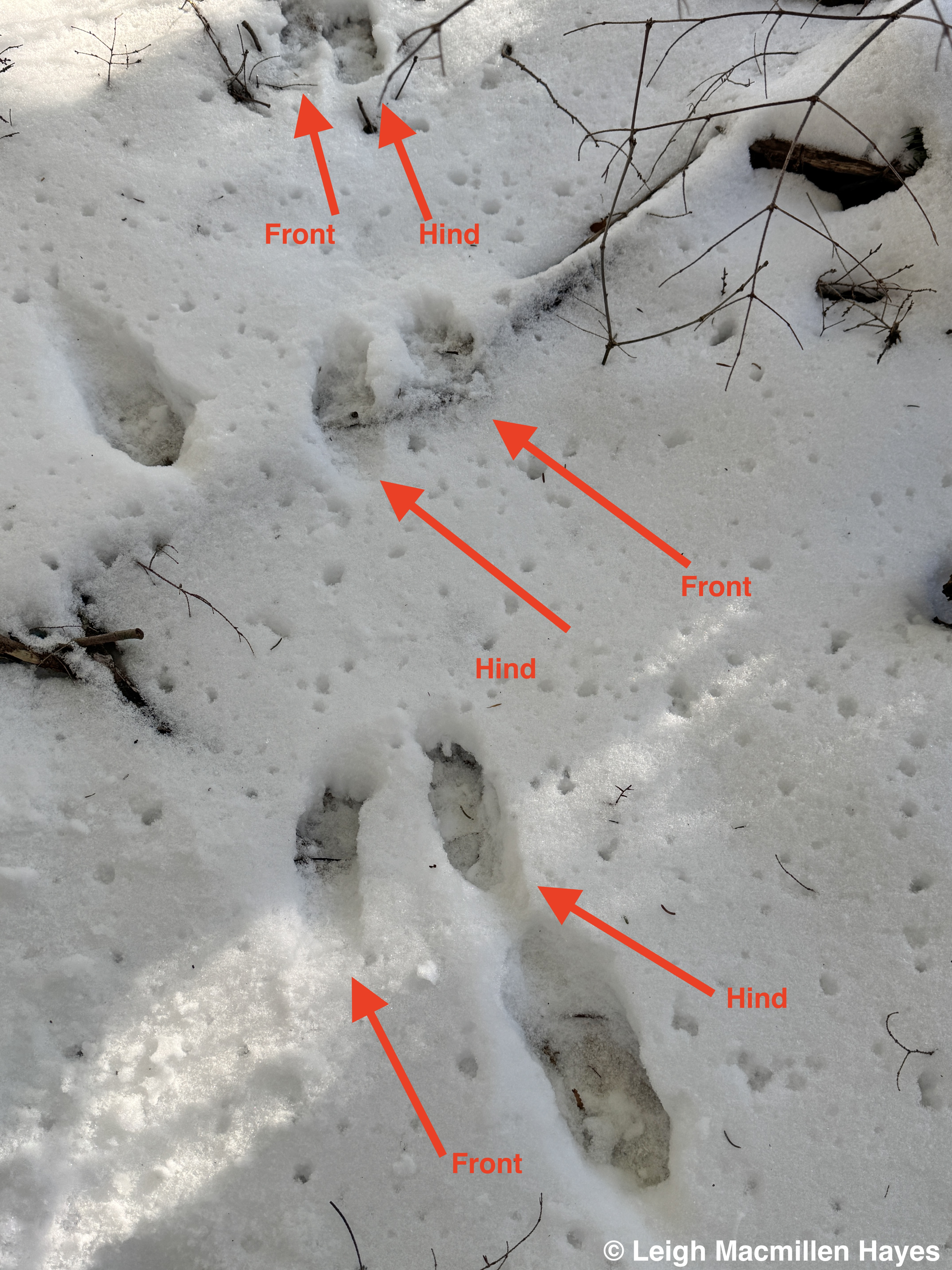
Our final finding of the day had me absolutely certain of ID and then mystified. We were again by a wet area and though the prints weren’t clear, by the placement of the two feet with one being larger than the other in the first set and the opposite in the second and looking like they were on an alternating diagonal, I was certain we’d found a Raccoon, but didn’t want to make a fast judgment.

We followed the track and I was at the end of the line, but the pattern changed and a trough occurred as the critter plowed through the snow and I was questioning Raccoon and leaning more toward Porcupine.

And then it changed again when we got under some trees where the snow wasn’t as deep and the Raccoon prints reappeared and Raccoon it was. Dan explained that in deep snow this waddler uses a more direct registration walk and that’s what we were seeing in the trough.
Thank you to Karen H, and Dorcas, for pulling this adventure together and inviting me. And thanks also to Karen, Olga, and Beth, for sharing a brain and sharing knowledge.
And thanks especially to Dan for teaching us educators innumerable lessons in the course of six plus hours.
We knew the minute we got out of the cars on the road in to Thurston Park that it was going to be an incredible day of learning. And it was, all of this being only a sampling of what we actually saw and learned. And we loved becoming students again.
 wondermyway
Looks like your speed is about the same. 😂😂😂❣️
LikeLike
I’m laughin’. You know me too well. But six plus hours of that same mode! On a blustery day. It was awesome.
LikeLike
This is AWESOME !!!!
I love your photos! And your natural enthusiasm comes through so clearly. Xoxo
>
LikeLike
Thanks T! We need to track together again.
LikeLike