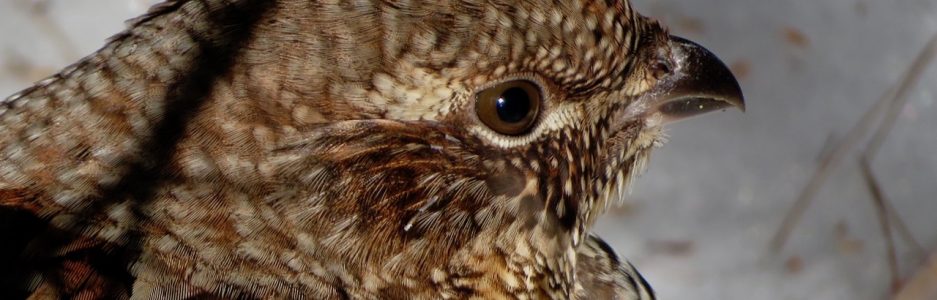
It finally stopped raining and with a wee bit of sun late this afternoon, the temperature broke 60˚ and I found myself exploring a local wetland where all kinds of interesting things happen daily. And yearly. In cycles. And sometimes I happen to be there.
One of my favorite events is the emergence of dragonflies and damselflies. It seems like we endure Black Flies for most of May, all the while looking forward to our champs, the Ondonata family, to step in or rather up out of the water and transform before our eyes and take on the world. This usually happens by Memorial Day.

And this year is no different. The dragons and damsels have been emerging for the past couple of weeks, but now is prime time. And they are just in time because the Black Flies and Mosquitoes have had a heyday with all this rainy, cold weather, and today . . . as it warmed up, so did they and I have red welts on my neck to prove that they are biting. It’s all good, I remind myself. It’s all good. They are bird food. And so are the dragonflies, who eat the Black Flies, et al, and if they become bird food, all the more energy sent the bird’s way.
Cloudy wings and clinging to its shed skin indicated that this dragonfly had just made that magical transformation from its aquatic life to terrestrial existence. And I was there to protect it. For a while anyway. Until the Black Flies sent me scurrying onto the next great find.

That next being a damselfly, also with cloudy wings indicating it had also just emerged. Though I don’t know who the first dragonfly was that I met today because it didn’t yet have enough colors and pattern to make that determination, I did learn that this damsel is called Aurora! I don’t recall ever greeting it before, but based on the the lack of shoulder stripes, black patch with wavy edges on the thorax, and yellow sides led to this ID once I consulted Damselflies of the Northeast by Ed Lam.
Now it’s one I don’t think I’ll forget. AND, I love that it is named for my ten-year-old naturalist friend, Aurora. Or she for it. Or neither, but they both share the name of an electrical phenomenon.

As I looked about, I spotted several other newly emerged dragons and damsels, all with their signature cloudy wings, but then I spied this one.
Yes, it’s wings are cloudy, but this Lancet Clubtail has an issue going on, for its wings are folded, rather like the main character in my fairy tale, The Giant’s Shower, for Falda’s wings are also folded.
That didn’t stop Sir Lancet from climbing up a fallen branch with gusto. But I did wonder about his fate.

That said, I moved on because I had some Painted Turtles I wanted to meet, figuring that they’d be basking after several days of temps in the 40˚s. Being ectotherms, they rely on external heat to regulate their body temperature. Sun is their friend.
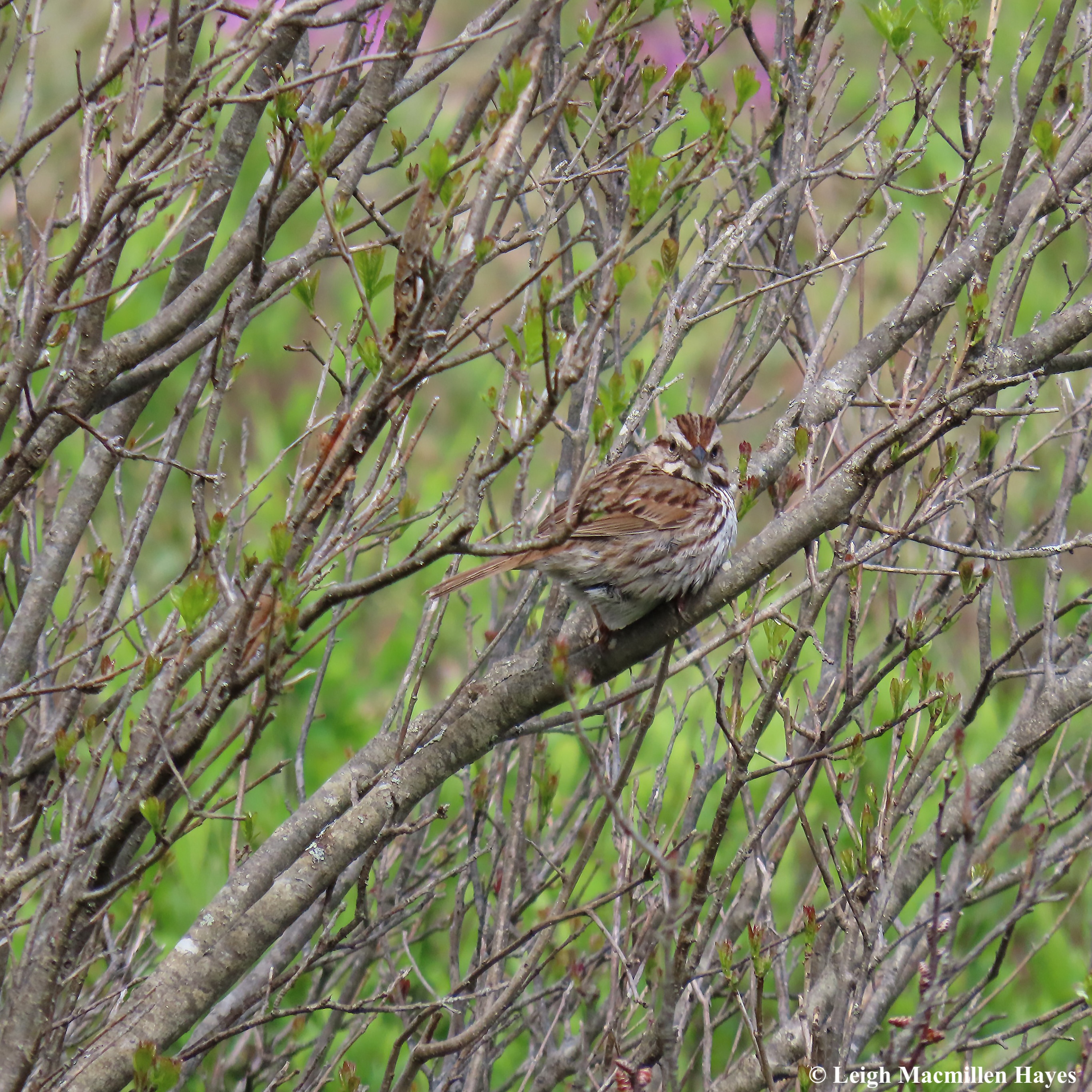
Being in a wetland, the bird song was plentiful, but though the Merlin app included a chorus of plenty including Redstarts and Towhees and Common Yellowthroat and more, the only one who posed was a Song Sparrow.

I walked about a mile away from my starting point, but really was eager to return because I knew there was more to see and learn in that spot.
Almost back, I met a Dreamy Duskywing Butterfly, a species I’ve met in this place before but not sure we’ve encountered each other anywhere else. I love the tapestry of its dusky wings.
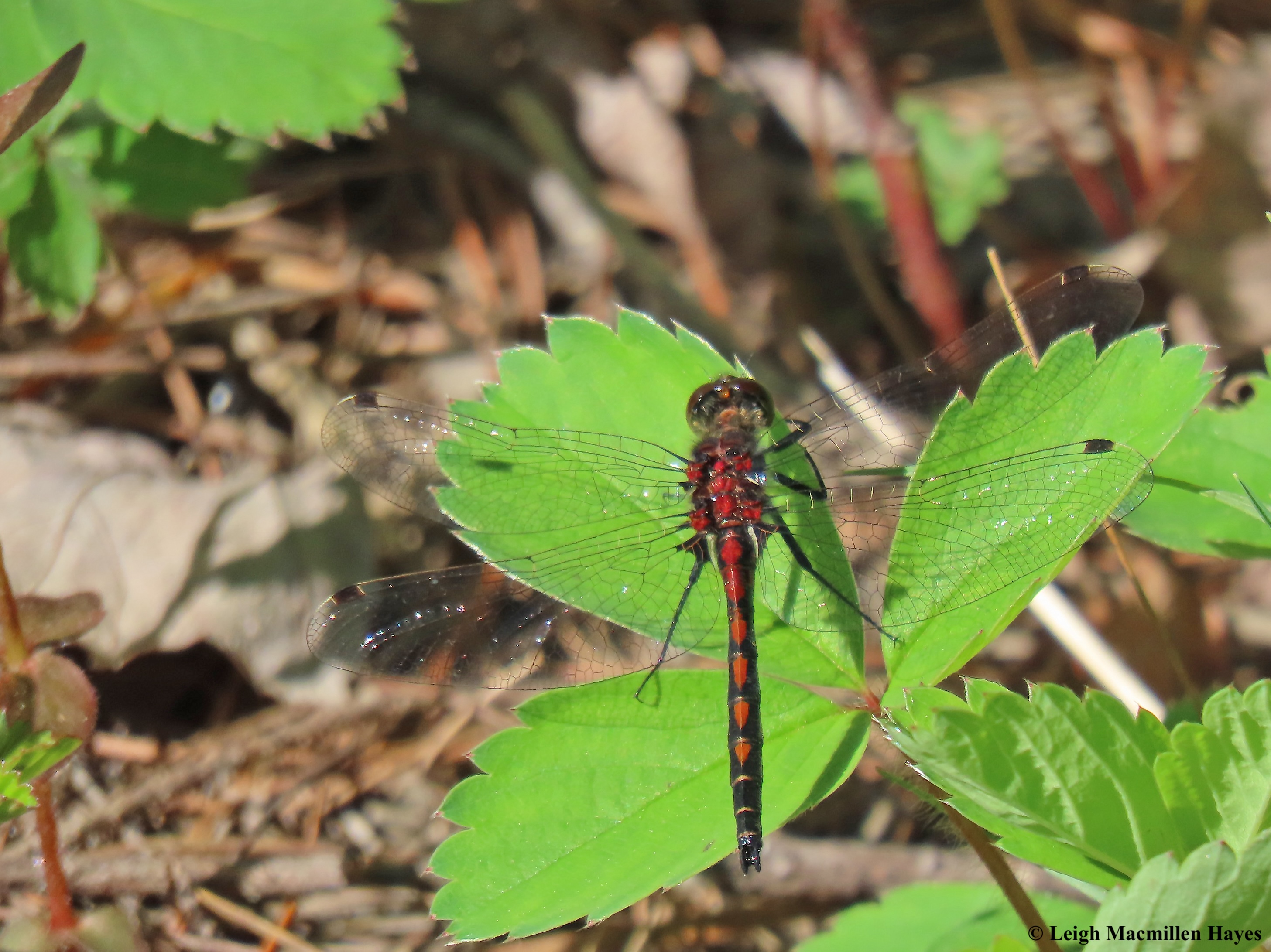
A moment later, an old friend flew in–Hudsonian Whiteface–this being a male, for the female’s markings are yellow. These are early spring skimmers, and I have to remind myself not to confuse them with Calico Pennant skimmers who have similar, yet different abdominal markings, he being red and she yellow. Also, the Calicos, being pennants, have a stained glass basal wing pattern that the Hudsonian’s don’t exhibit.

Back at base camp, or rather, my starting point, I checked on Sir Lancet. He’d crawled up the branch to a rather perfect hiding spot at the Y, at least to my eyes. And look into his eyes I did. Including the three simples eyes, singularly called ocellus, which are arranged between the two large compound eyes. Each ocellus offers a single lens with which to view the world, while the compound eyes offer multiple lenses. Amazing. I can’t even begin to imagine such sight.

But what I also noticed about my folded-wing friend was the green “blood” that seemed to be stuck within those wings. Dragons and damsels and other insects that emerge from an exuviae break through their old skin, their wings coming out first with the head, and then pulling the abdomen out slowly and pumping their insect blood first into the wings until they reach full length before drawing said blood back into the body and allowing the abdomen to extend to full length and slowly take on the hues of its adult self.
I’ve seen this in others with folded wings though, where the insect blood seems to have become blocked and is still visible in the transparent wings and maybe that’s why they are deformed? But what causes this?
I don’t have an answer, but try to remind myself that eventually this dragonfly will become units of energy for a bird or another insect and that’s its way of giving.

Meanwhile, though it was getting late and the temperature was starting to drop again, two immatures caught my attention–a Mayfly subimago or dun and another Lancet. Both had cloudy wings announcing their age.
And both were fairly safe in each other’s company, for the Mayfly has no mouthparts, not that it could eat anything as large as a dragonfly at this point, and the Lancet wasn’t quite ready to eat yet for it had some more work to do in order to become a flying predator.

Slowly Lancet’s wings became more transparent and though dinner prep was on my mind and I knew I needed to head home, I waited until it spread its wings and then without a backward turn or wave goodbye, took off. Despite that, I wished it my usual, “Fare thee well.”

And as I walked back to the truck, a young Lancet met me. I was totally surprised to find it land with wings folded over its back. Had we just met only steps away by the water? How cool would that be if it were true.
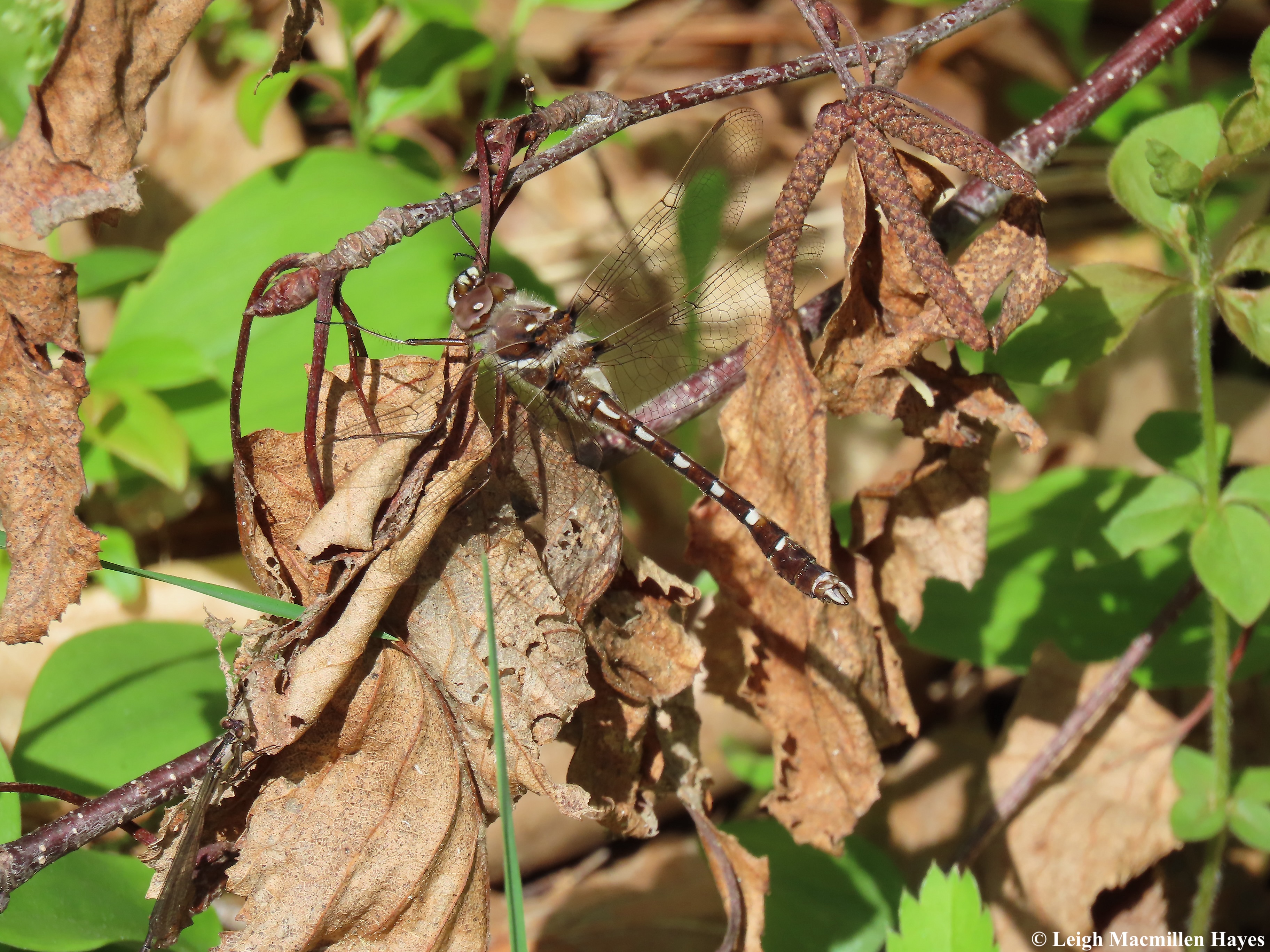
And then my all-time favorite appeared, a Stream Cruiser with its Oreo Cookie coloring. I was asked the other day what my favorite bird is and I came up with at least five different species, but the Stream Cruiser will always be my favorite dragonfly.
And dragonflies and damselflies on Memorial Day weekend–another favorite for we all know that the Black Flies will now be on the decline.
Memorial Day weekend not only means a return of the Dragons and Damsels who slay those other pesky bugs, but also a time for us to remember those who died serving our country, like my Mom’s brother, age 19, who died in World War II. Thank you Uncle B. We never met, obviously, but Mom brought you alive in my mind for you were her best friend and I know you are with me and trust you would approve my curiosity and adventures and reverence for the natural world .
 wondermyway