My life is rich on so many levels and people are a huge part of that, despite the fact that I’m a happy loner and a happy introvert at heart.
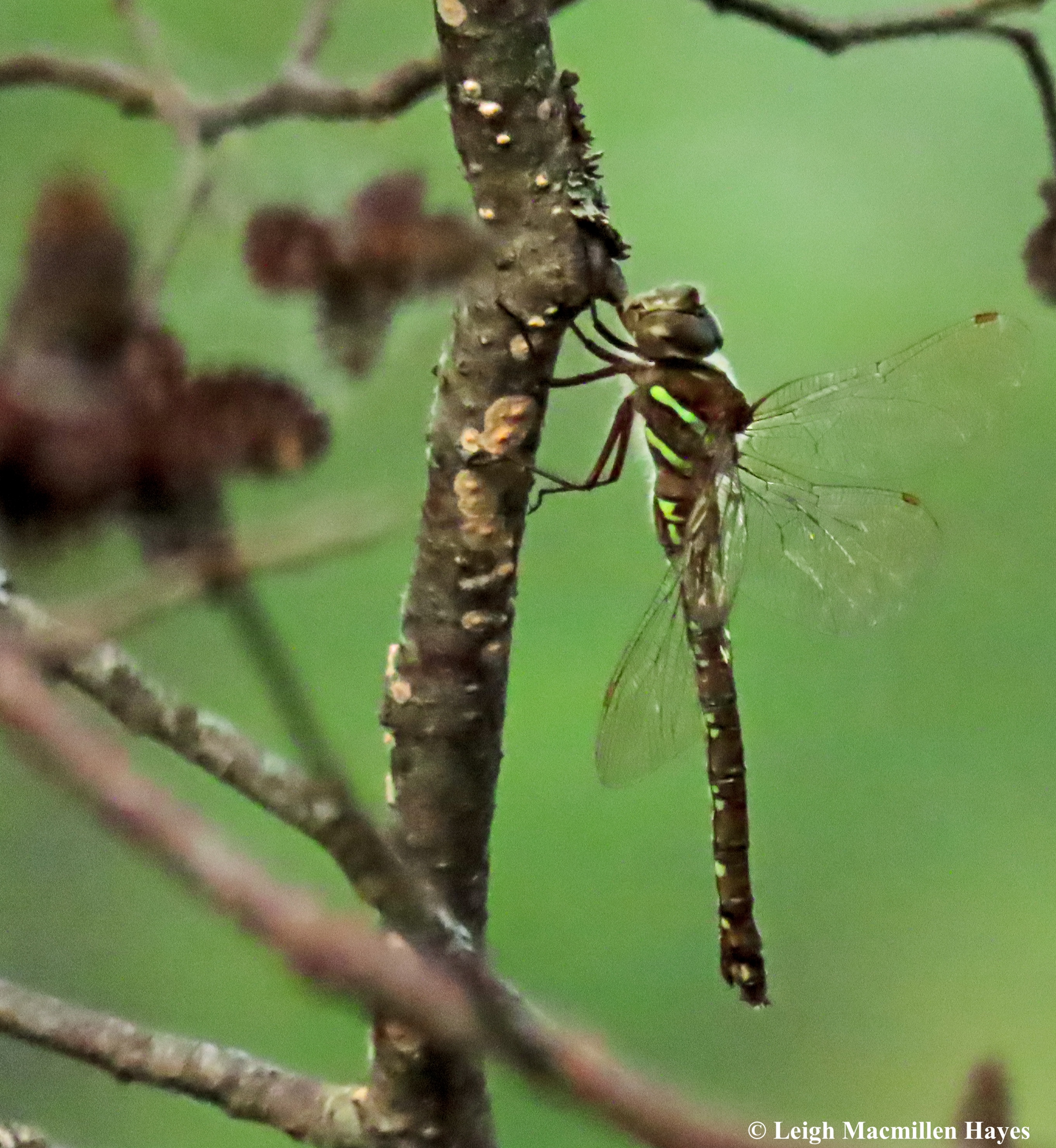
Just the other day, I wrote about the gift of a dragonfly specimen in Lessons in the Shadows.
And I actually saw a few Shadow Dragonflies on the wing this weekend, or pausing between defending territory, dining, and mating, or at least trying to do the latter.
But it’s other things that I noticed and want to share before I reveal today’s gift.
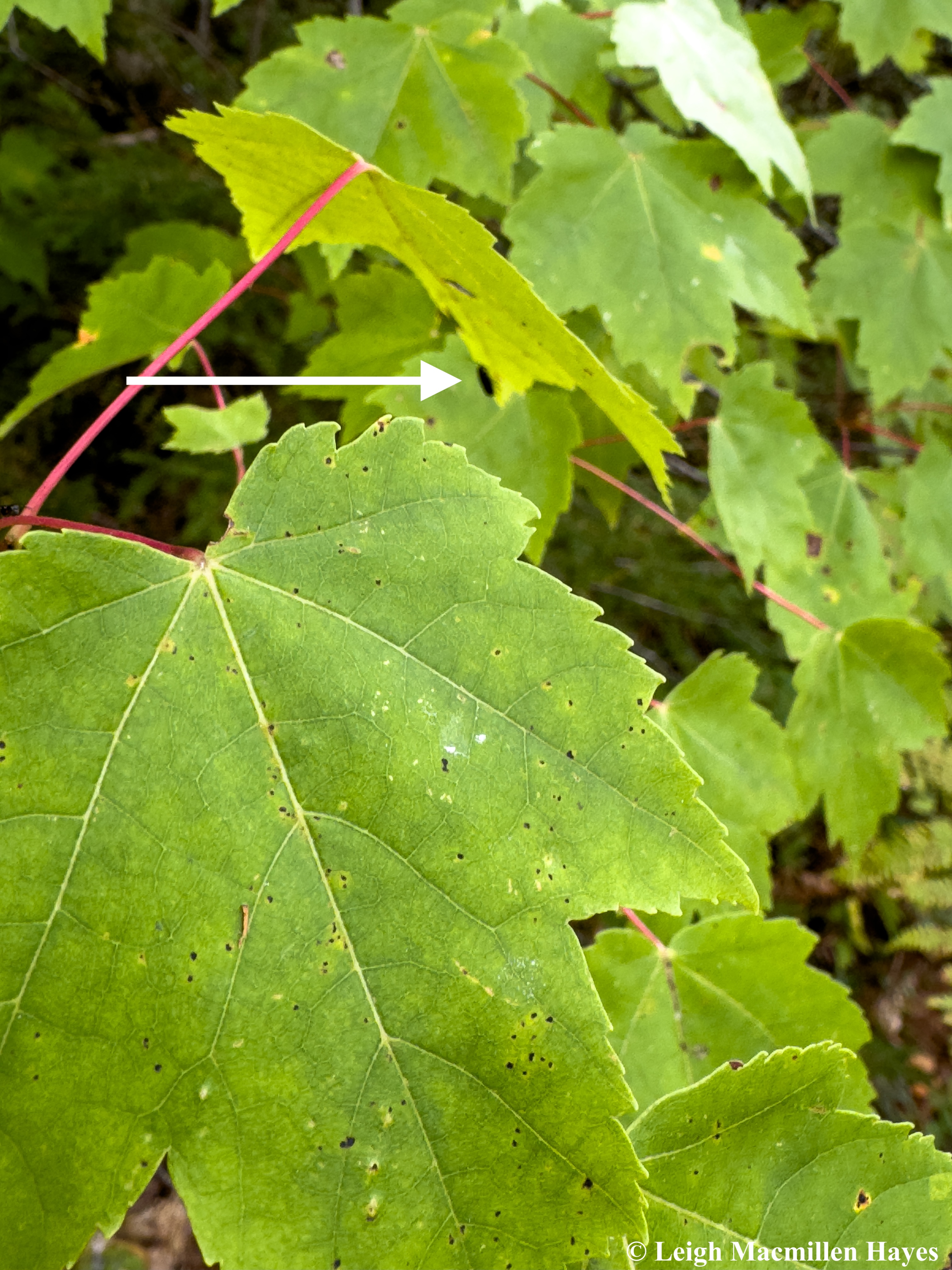
I do not know how I spotted this insect under a Red Maple leaf, but it was made known to me in the silence of a walk I took, and it too, was a gift.

The insect was a Winter Firefly, a species I love to find in the winter months, usually on or behind tree bark, the latter being bark that has pulled away from the trunk. Winter Fireflies in their adult form do not light up our evenings, but the fact that we can spot them in winter is special enough.
They also don’t disappear once summer arrives and lately it seems, I’ve been spying them regularly.
But it is what this insect was doing that turned out to be so spectacular. Remember, I spotted it on the much lighter in color underside of the leaf, and then turned the leaf over to take a closer look.

Much to my surprise, it was dining. I’ve never really thought about them dining before, but of course, they must. And do. Like my Ambush Bugs, and yes, you’ll meet a few more of them later in this post because I can’t resist taking their photos, Winter Fireflies use their mandibles to pierce into a prey species, inject it with chemicals to paralyze it, and then add enzymes to the mix to turn the other insect’s tissues into a smoothie.
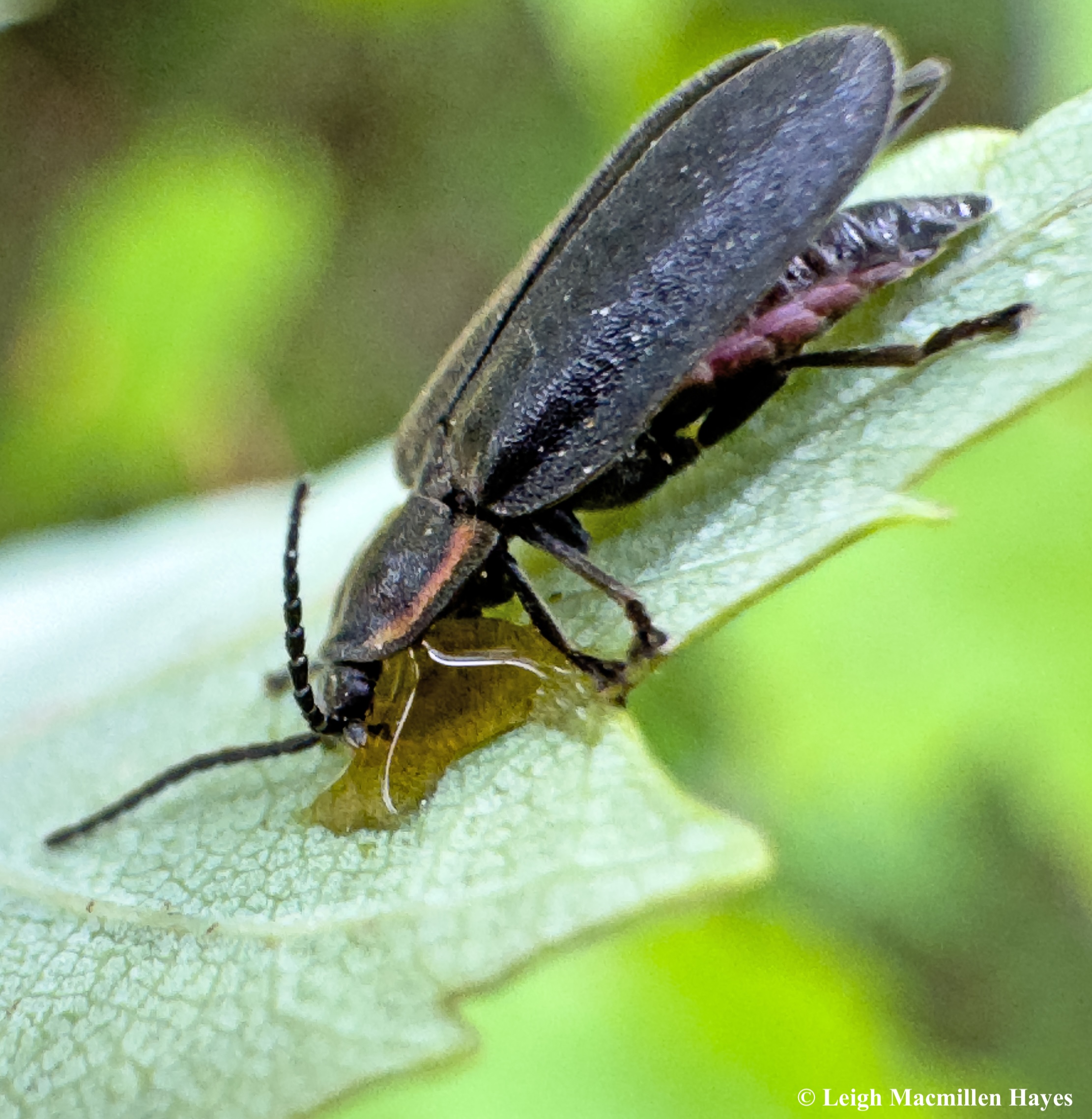
Right before my eyes, the Firefly drank its meal! Despite the fact that I was in its personal space. For moments on end.
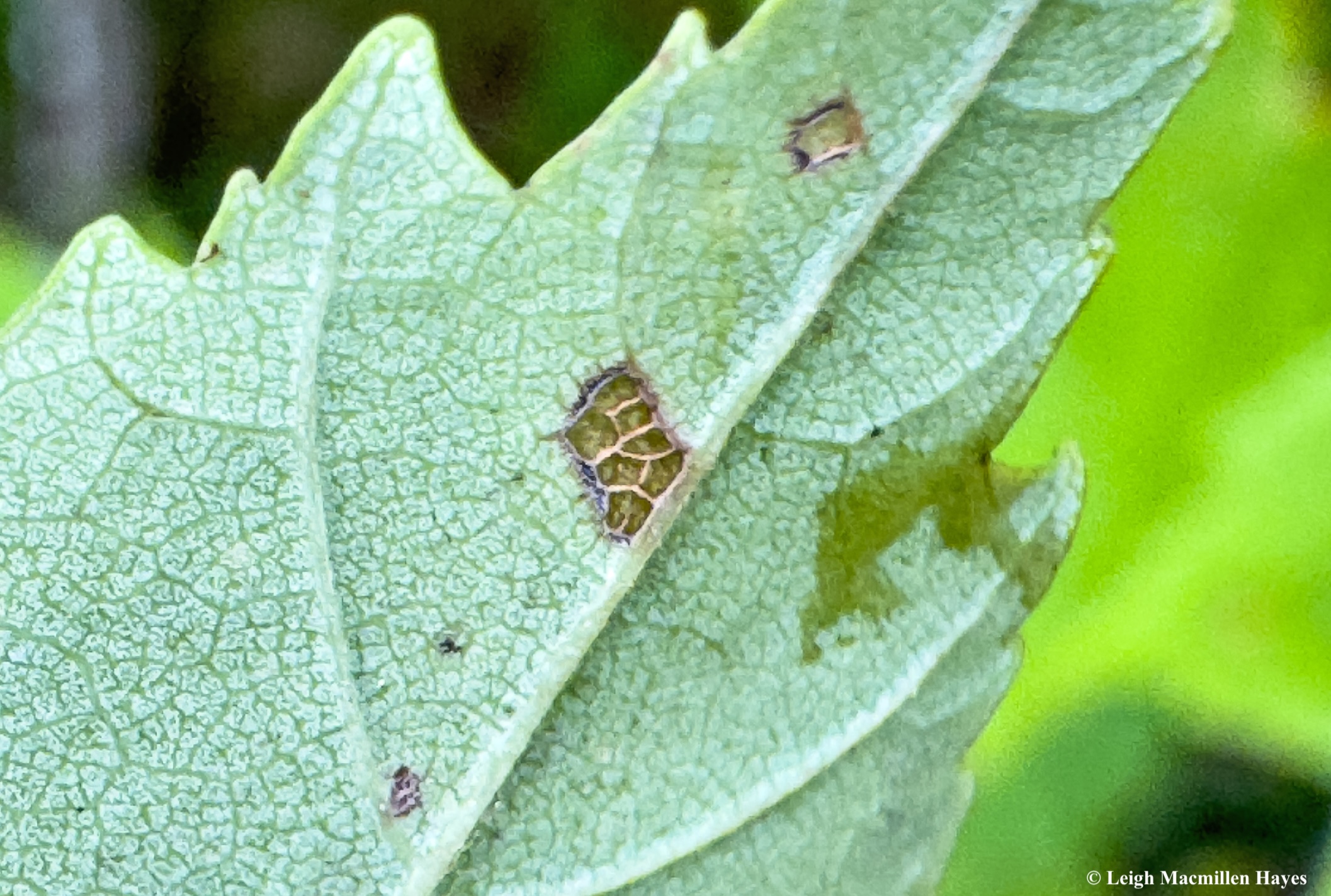
And when it had finished, there was only a remnant of the liquid form left and the Firefly moved on. But the other thing of note on this leaf is how another insect had chewed bits of the bottom layer of the leaf, leaving a skeleton of veins that provided a window to the next layer. I’m always trying to show people this by pulling leaves apart, and often meet with little success, but this leaf showed me that it is possible.
And then, because I was suddenly focusing on leaves, I began to notice a variety of structures that were not leaflike.
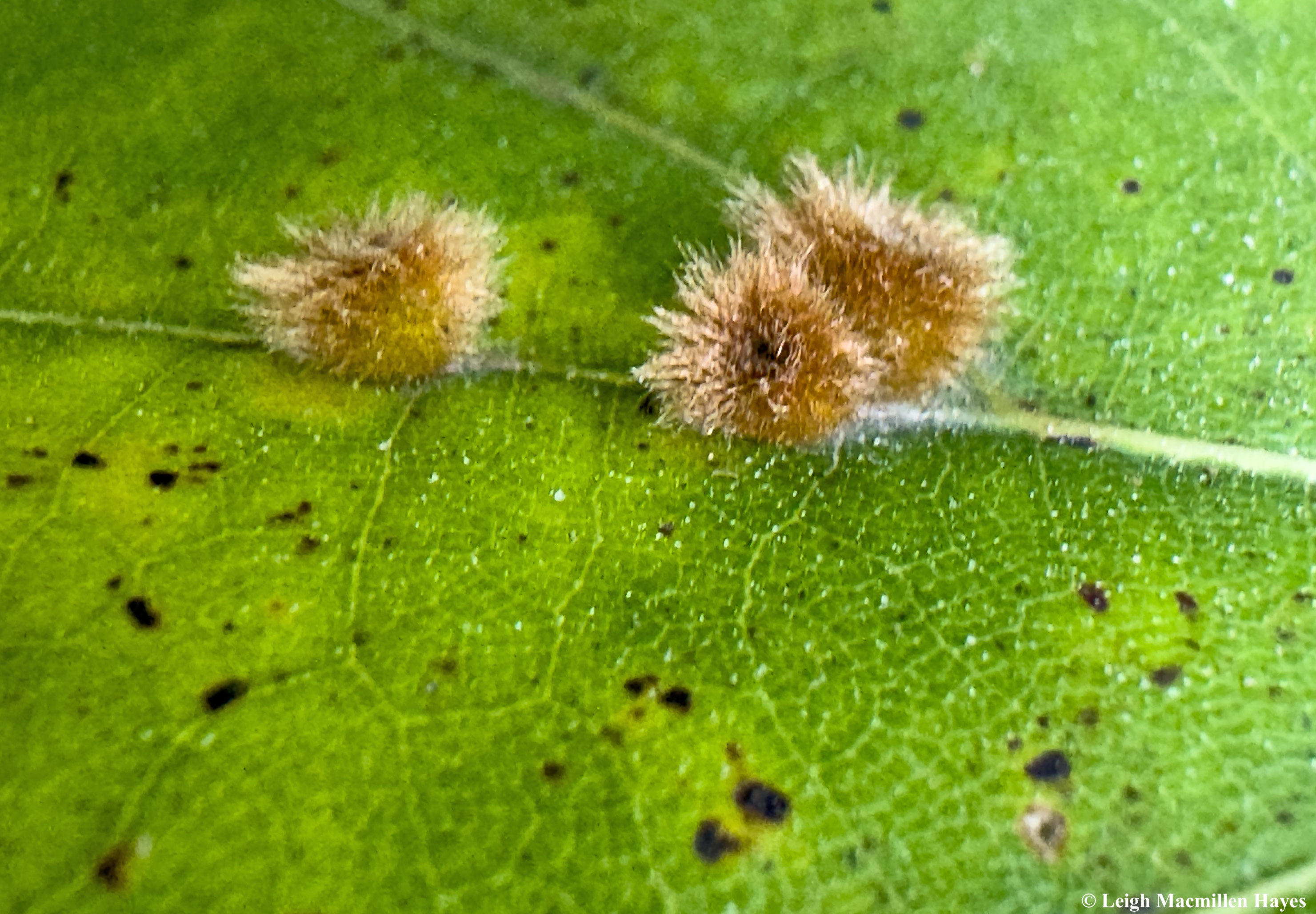
Oak Galls. In the Summer 2025 issue of Northern Woodland magazine, Michael J. Caduto wrote the following: “Oak galls are tumorlike growths caused by small wasps . . . Oak galls make up about 80% of the roughly 700 different kinds of plant galls formed by insects in the USA, and most of Canada and Mexico . . . During the spring, adults lay eggs in the tissues of leaves or twigs and at the same time inject substances that induce the surrounding plant tissue to grow in a particular manner and at an accelerated pace.”
Above are pictured some woolly oak galls that result from the growth of tiny hairs on the leaves.

Gall tissues protect the wee wasp or midge larvae that develop inside, and they also provide food. As the young grow, the galls increase in size due to something in the insects saliva that imitates the plants growth hormone. Nature is amazing.
Those photographed above are caused by Oak Leaf Gall Midges. They are cosmetic and won’t harm the tree. After all, the leaves fall off in the autumn anyway, and until then they have done their duty of feeding the tree despite being laden with galls.
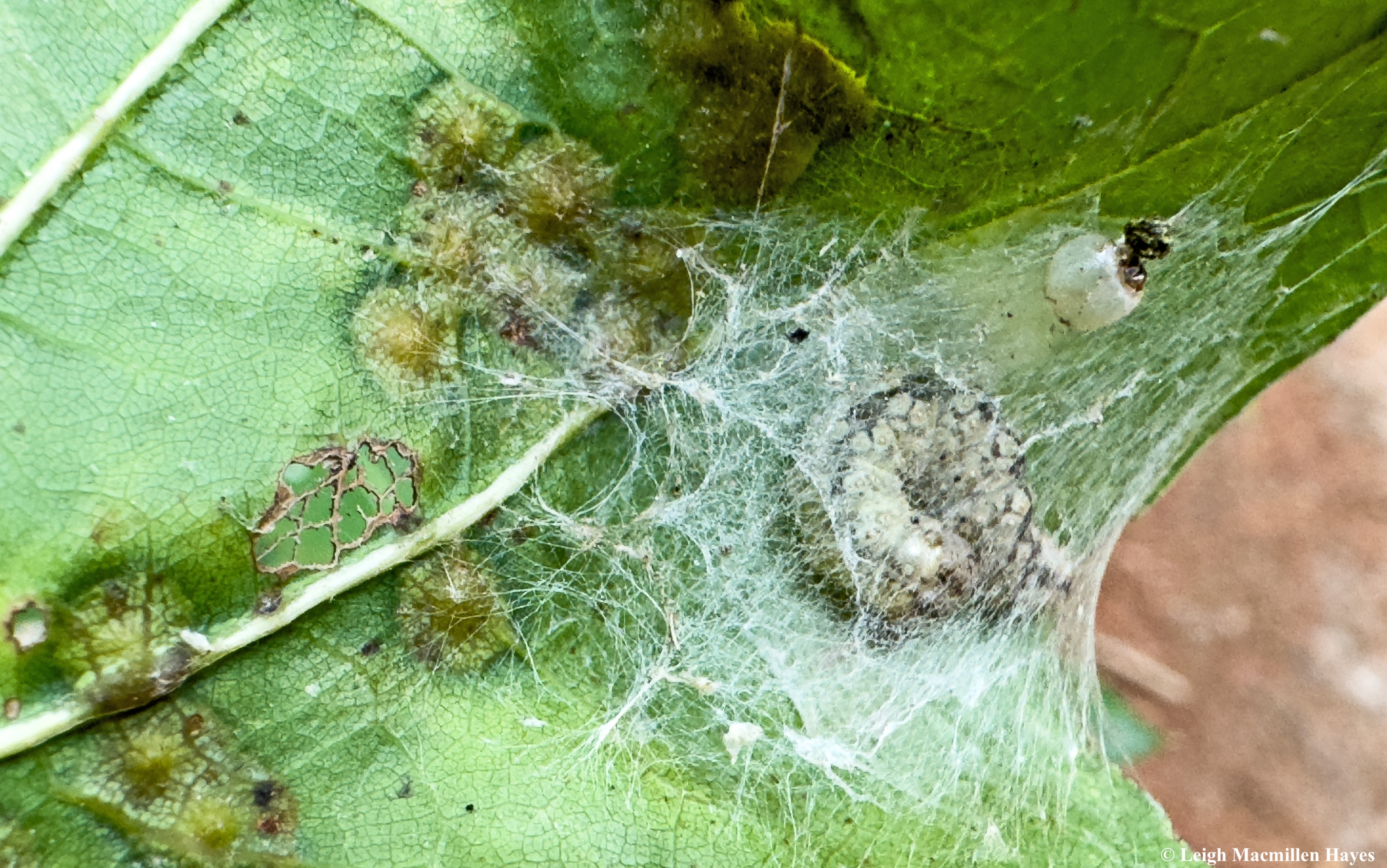
When I turned the same leaf over to look at the underside of the galls, I found a caterpillar who was ready to pupate and possibly the egg of another insect. So much going on in such a short time, given that in the north woods our leaves are only on the trees from mid-May through October or maybe a wee bit beyond for the most part.

Upon the underside of another leaf, I found Oak Leaf Seed Galls. They were quite small, and it looked like the initial gall was a dried papery structure within which were clusters of smaller galls.

And then I found one of my favorites, the Oak Apple Gall. I’ve written about this before following a visit to Trinity College in Dublin, Ireland. There, My Guy and I took the self-guided tour of the 18th century Old Library and viewed that most ancient of manuscripts–the Book of Kells, a 9th century book featuring a richly decorated copy of the four Gospels of the life of Jesus Christ. A favorite discovery: the monks used Oak Apple Galls to create ink–apparently, they crushed the galls and soaked them in rainwater, wine or beer until they softened.
What was cool about the one pictured above, was that the adult wasp had chewed its way out and I could see the fiber-like structure, those threads radiating from the center, that had supported its pupating form. Perhaps to keep other insects from parasitizing it.

And lest you think galls only occur on leaves, here are some on twigs, these being created by the Banded Bullet Gall Wasp.

And then without meaning to, but because the path I followed offered some Asters in bloom, I began to meet my old friends, the Ambush Bugs, this one being a male.

And on another, a female.

Wherever Ambush Bugs are, I look for their feeding sites, made visible by insects dangling in unsuspecting manners like this moth.
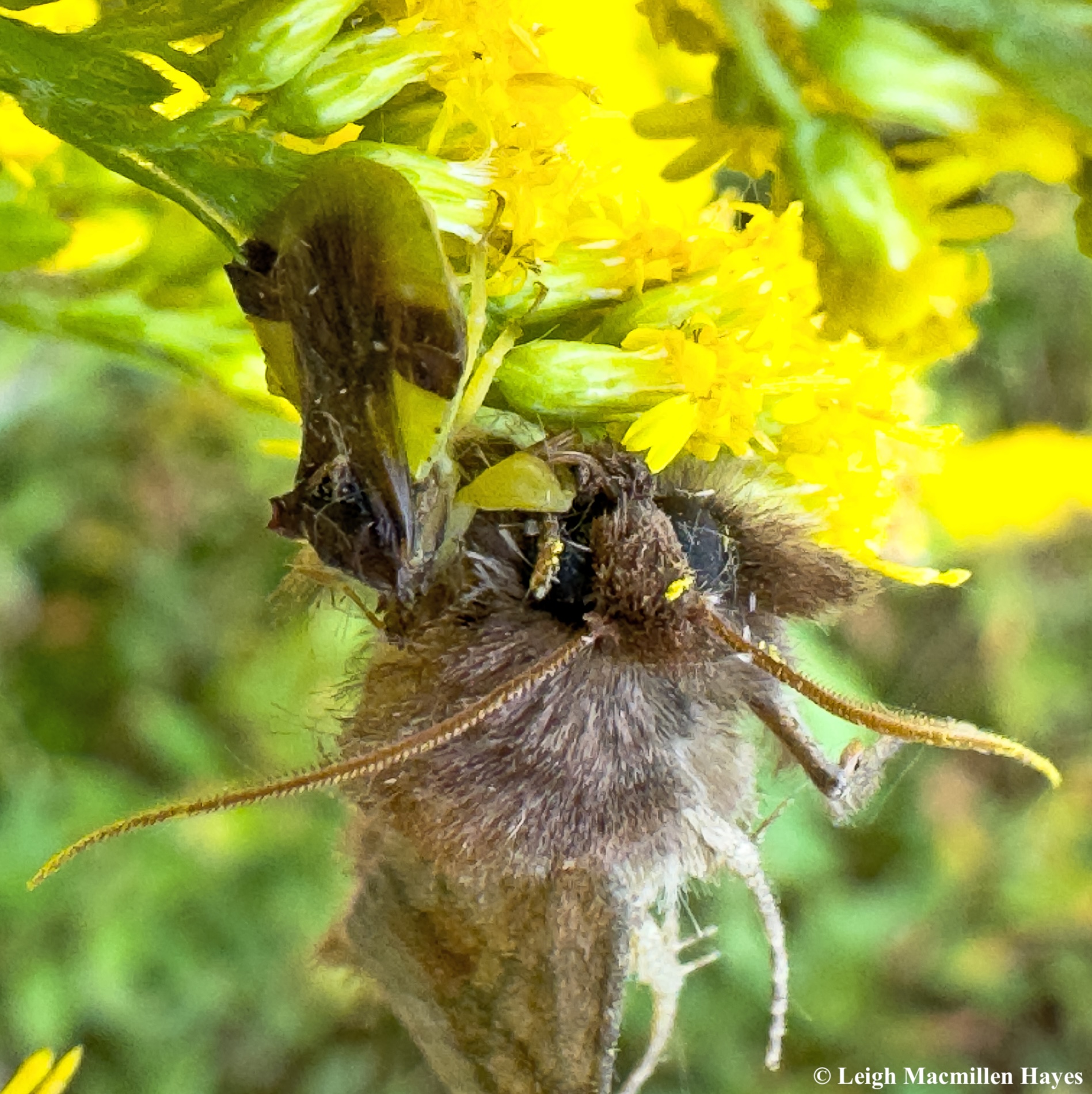
And tada, there she was having a go at a major meal.
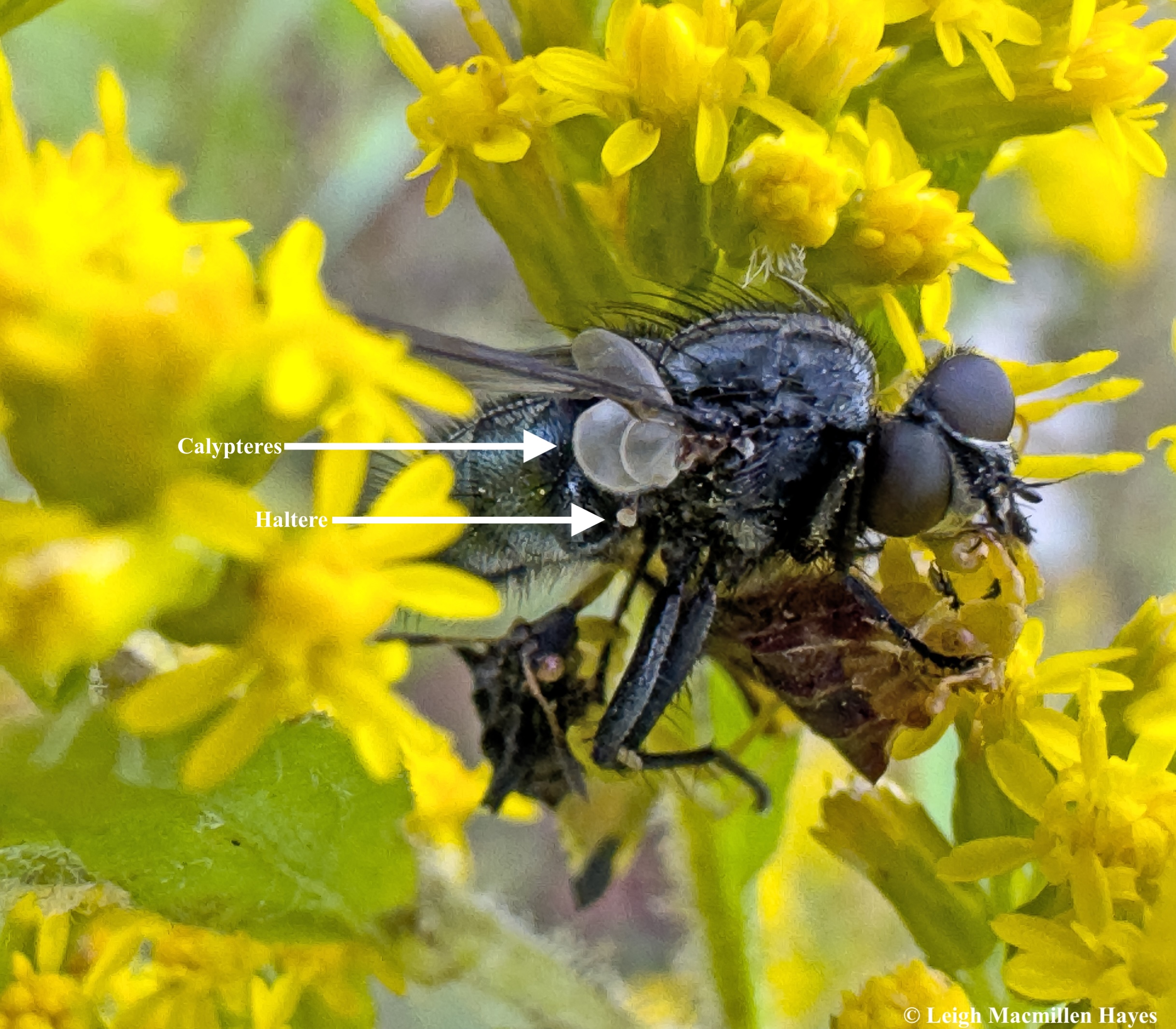
And sometimes those meals teach me other things, such as this fly that was being dined upon by both a male and female Ambush Bug. But more importantly, I captured the fleshy white structures on the fly. Those are calypteres! The calypteres are small membranous flaps or lobes that are located at the base of the wing in some species of fly. Flies often have two calypteres (commonly called the upper and lower calypteres) on either side of their bodies. And they cover the halteres, the little knobs that take the place of hind wings. You can see the little knob or haltere sticking out a tiny bit below the bottom-most calypter. Sooo cool. A new learning for me.
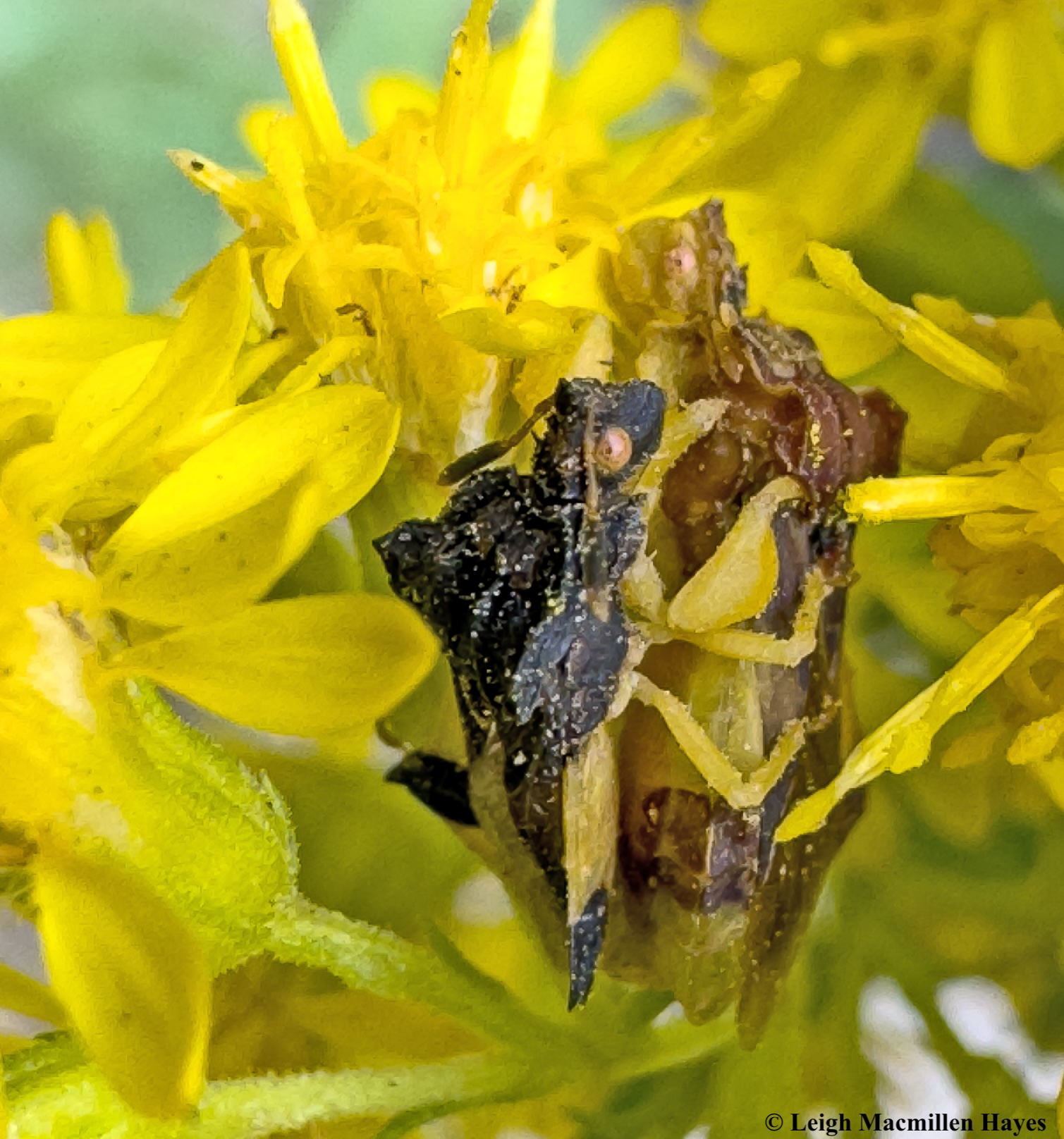
And then trying to hide within the Goldenrod blooms elsewhere, a canoodling pair.

Upon another plant that had gone to seed, a Dusky Stink Bug lurked, one of the smallest of the stink bug species.

In another spot, something else caught my eye. Yes, it’s bug related. This is the egg mass of Tent Caterpillars. There might be up to 400 eggs encircling the twig on this Cherry tree. The mass is shellacked with a substance that will protect it throughout the winter, thus the reason for its sheen.
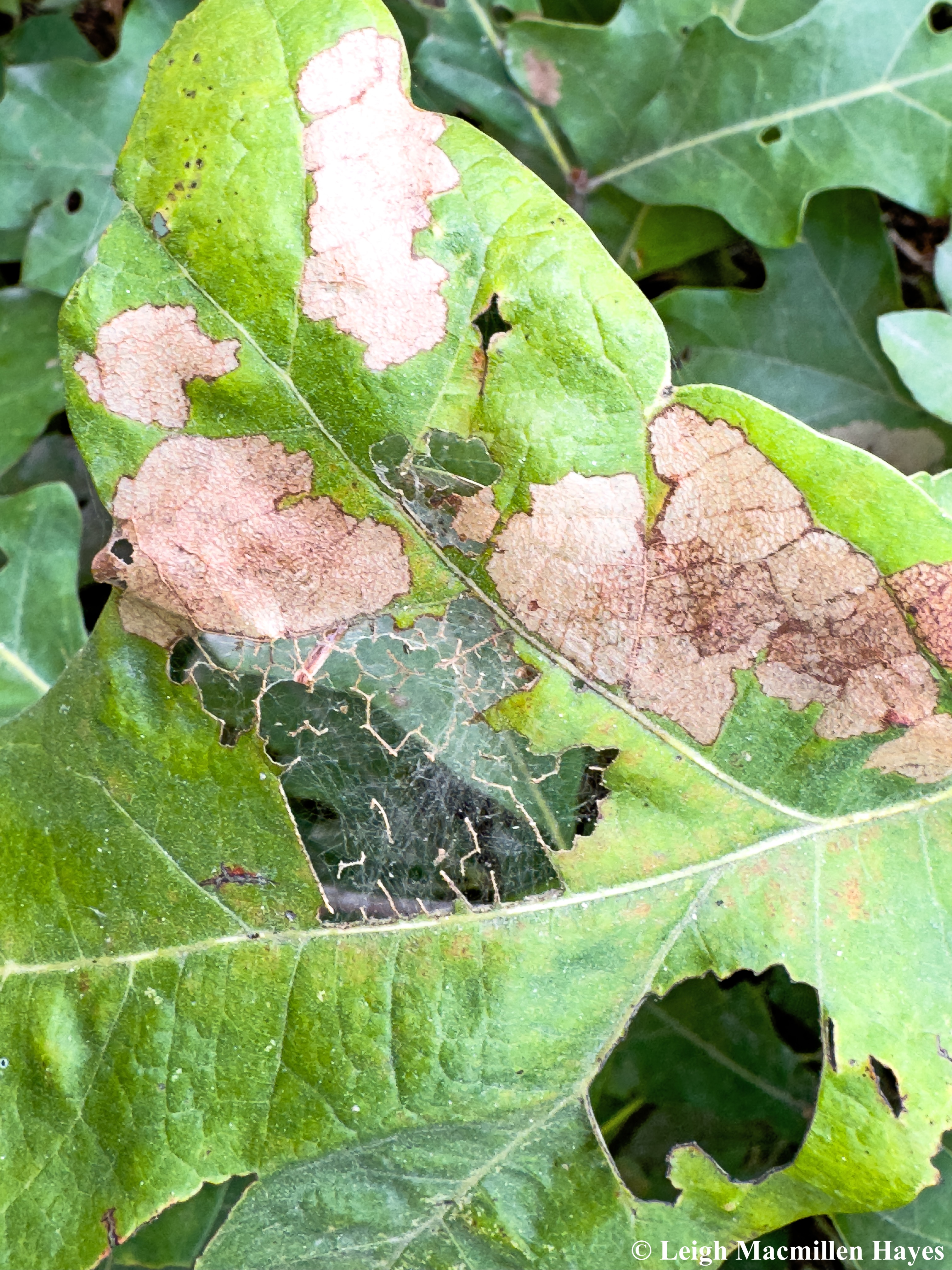
Because I’d been looking so closely at insects or insect structures, it struck me as interesting the various ways different insects dine upon a given leaf, from those who eat all of the cells and veins, to those who leave most of the veins as they skeletonize the leaf, to those who mine between the upper and lower leaf surfaces. All of this on one leaf. And still it was green and had done its food factory work for the tree.

I was almost back to my starting point when I noticed new leaf growth on some trees, which given that its September surprised me. But these days, nothing should surprise us.

Until something does. For right there on the same tree an anomaly caught my eye. Do you see what I saw? Yes, lots of munching. And yes, lots of new and older leaves. But take a look at the buds. One bud is not like the rest in the crown.

Because it wasn’t a bud. Hiding in that spot was an insect I am only familiar with in its larval aquatic form. It’s a cool one for it builds its own home depending upon its species, some using hemlock needles and maple flowers, others specks of sand, and still others plant or tree material, while some are net spinning and others free-living.

What I’d had the good fortune to spot was a mature Northern Caddisfly. As adults, they don’t have mouthparts, their only job being to mate. Adults don’t live more than a month, and I felt honored to have spotted this one. And Caddisflies are indicators of clean water. I was truly honored to spot this insect.


In the same way, I was equally honored to receive this gift of music created around words I’d written in a blog post in 2018, entitled From the Ground Up, where I’d offered the history of St. Peter’s Episcopal Church where I am a parishioner and then focused on all of the other species who had gathered on the ten-acre lot.
Thank you, Richard Michael Joseph, composer, musician, tenor, and chair caner, for taking my words and writing music to embrace them. Beyond the Edge indeed. Thank you also Richard, for your part in making my life so rich.
Step into the woods beyond the edge, and know that life carries on in the most incredible ways, we just have to be open to receiving them.
 wondermyway