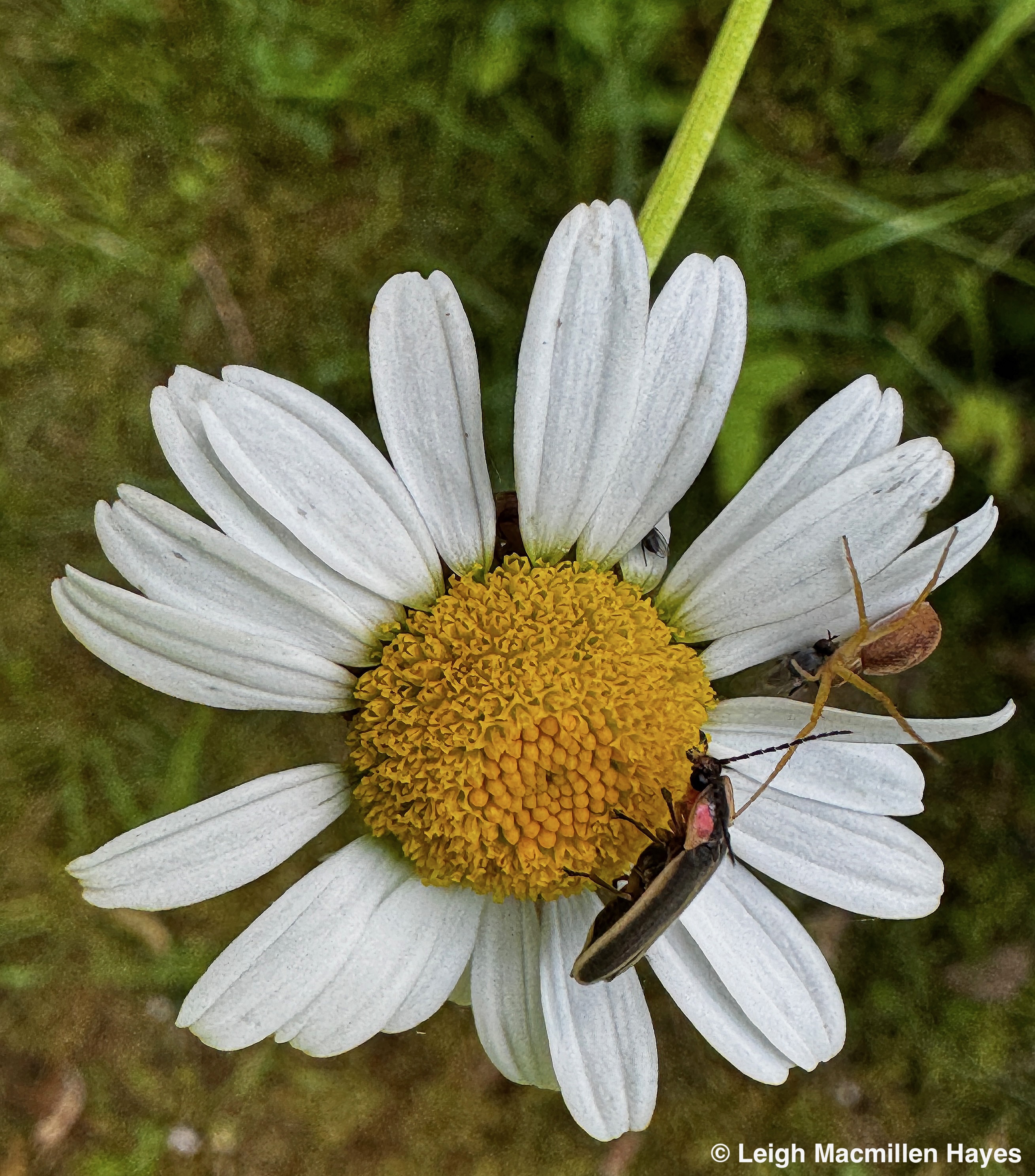
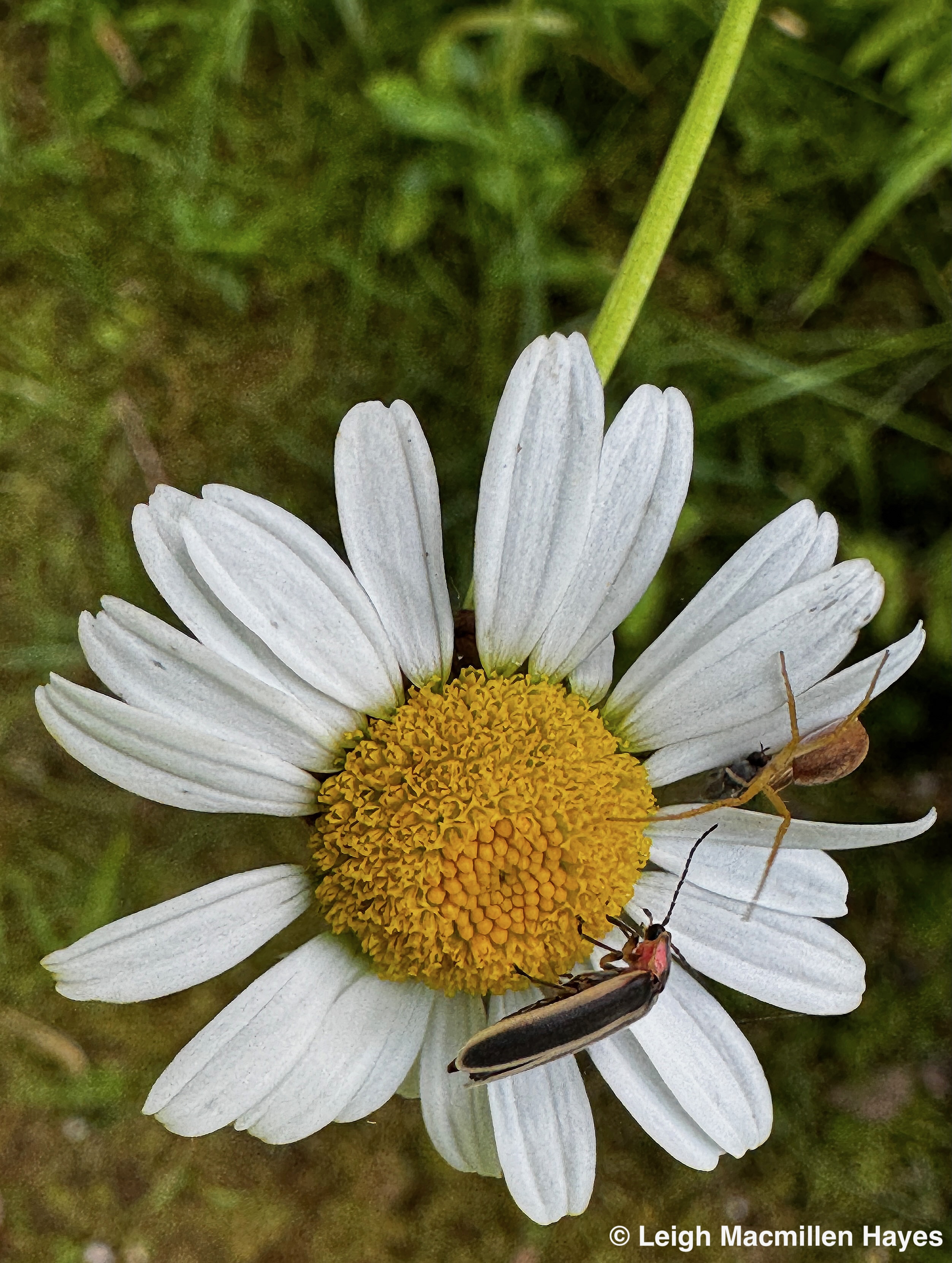
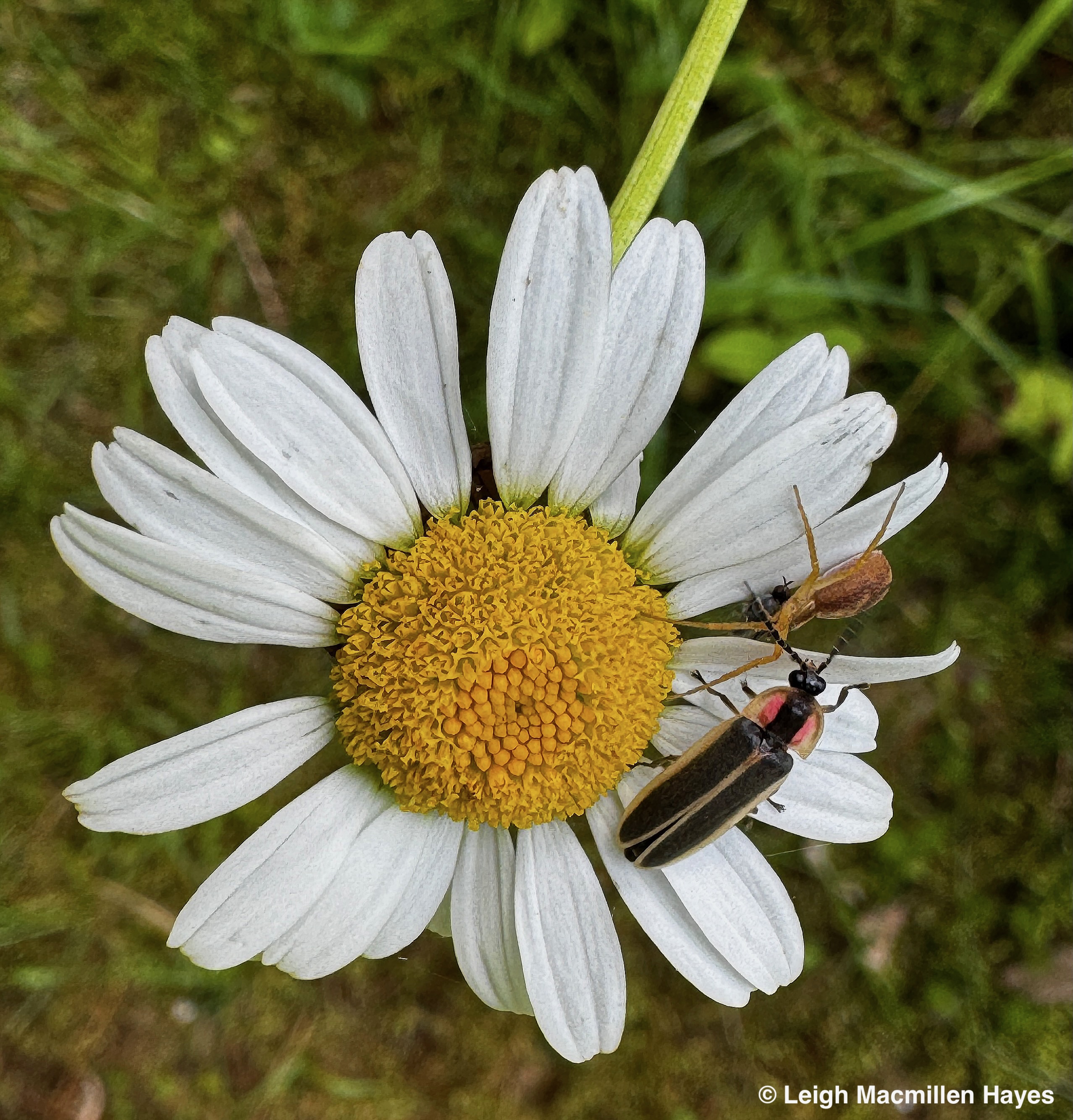
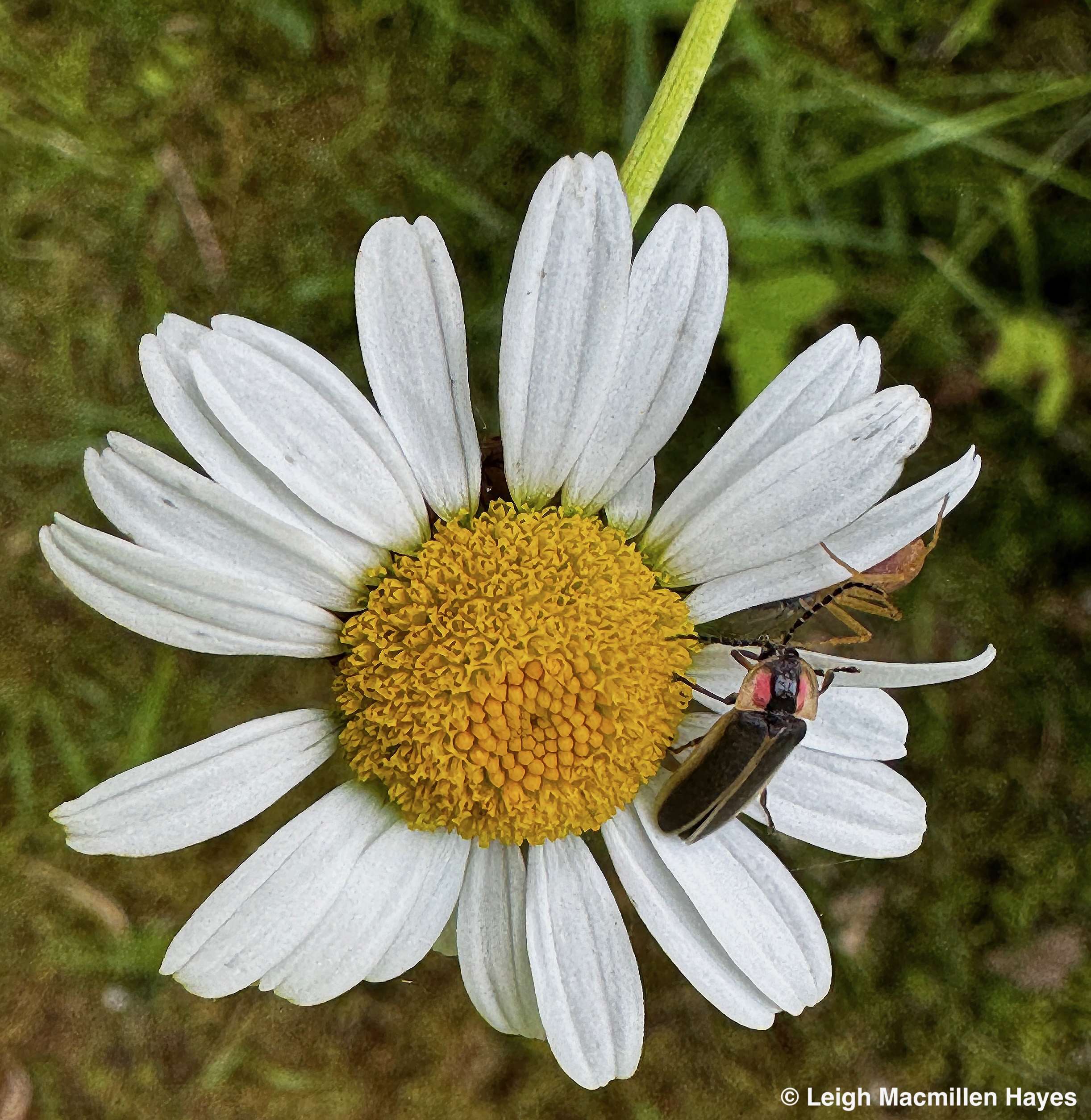
Surprise Ending

Sometimes we follow familiar trails and other times we go off the beaten path. Well, sometimes we go off the beaten path along familiar trails. And other times, we just plain go off the beaten path because we’ve never explored an area before, and even then, we don’t exactly follow the intended route and part of that might not have been our fault for perhaps maps and blazes didn’t correspond. But in the end . . .

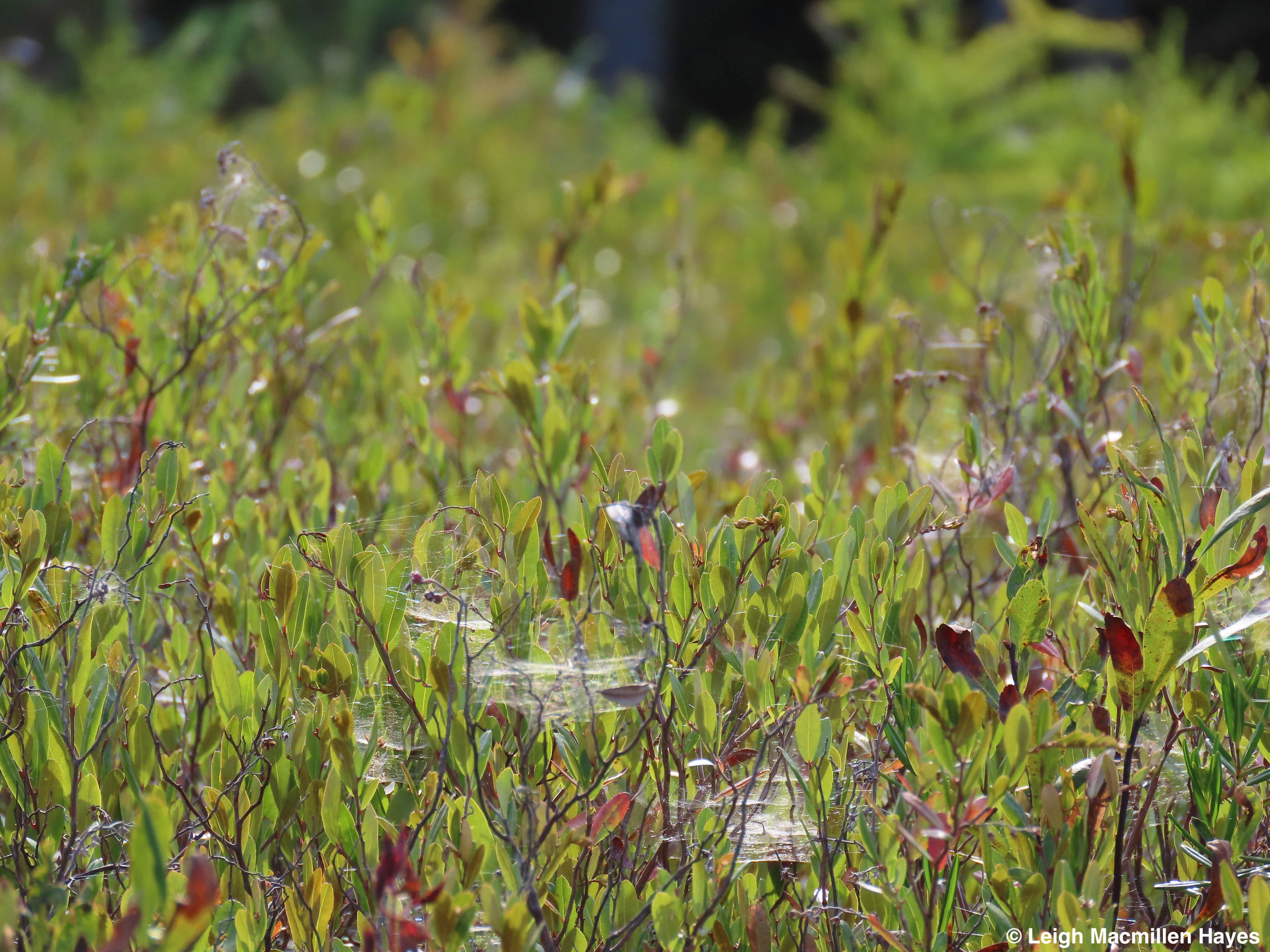
Wait. Let’s start at the beginning. We drove across the border into neighboring New Hampshire for a hike and though we’d never been to this spot before, I suspected when I spotted the fruits upon the Mapleleaf Viburnum, that we’d made the right choice. Usually it’s the colors of the leaves that tug at my heart strings, for there is no other tree, or shrub in this case, that exhibits these colors in combination: pinkish-red, purple, magenta, and burgundy.

But the dark blue fruits have disappeared on most that I’ve seen this fall and so I was thrilled to discover so many upon several of this species.

We followed the trail, and then went off trail, of course, for about 2.5 miles, but noted that the description of wetlands was rather deceiving. Oh, they were there, but not clearly visible from the trail and even when we did get to the edges, we could barely see the water for buffer vegetation was so dense. That said, I’m sure the water quality was good. That said, we were in an area with some warning signs about a mining operation years ago, and so the water quality must have been compromised and we can only hope is recovering.

As we circled our way out, we noted that we could have been anywhere in northern New England for we were familiar with all the plants and trees we met. And then My Guy, who does not like mushrooms as part of a meal, spotted a bunch of Red-belted Polypores, which we both admired for a few moments.

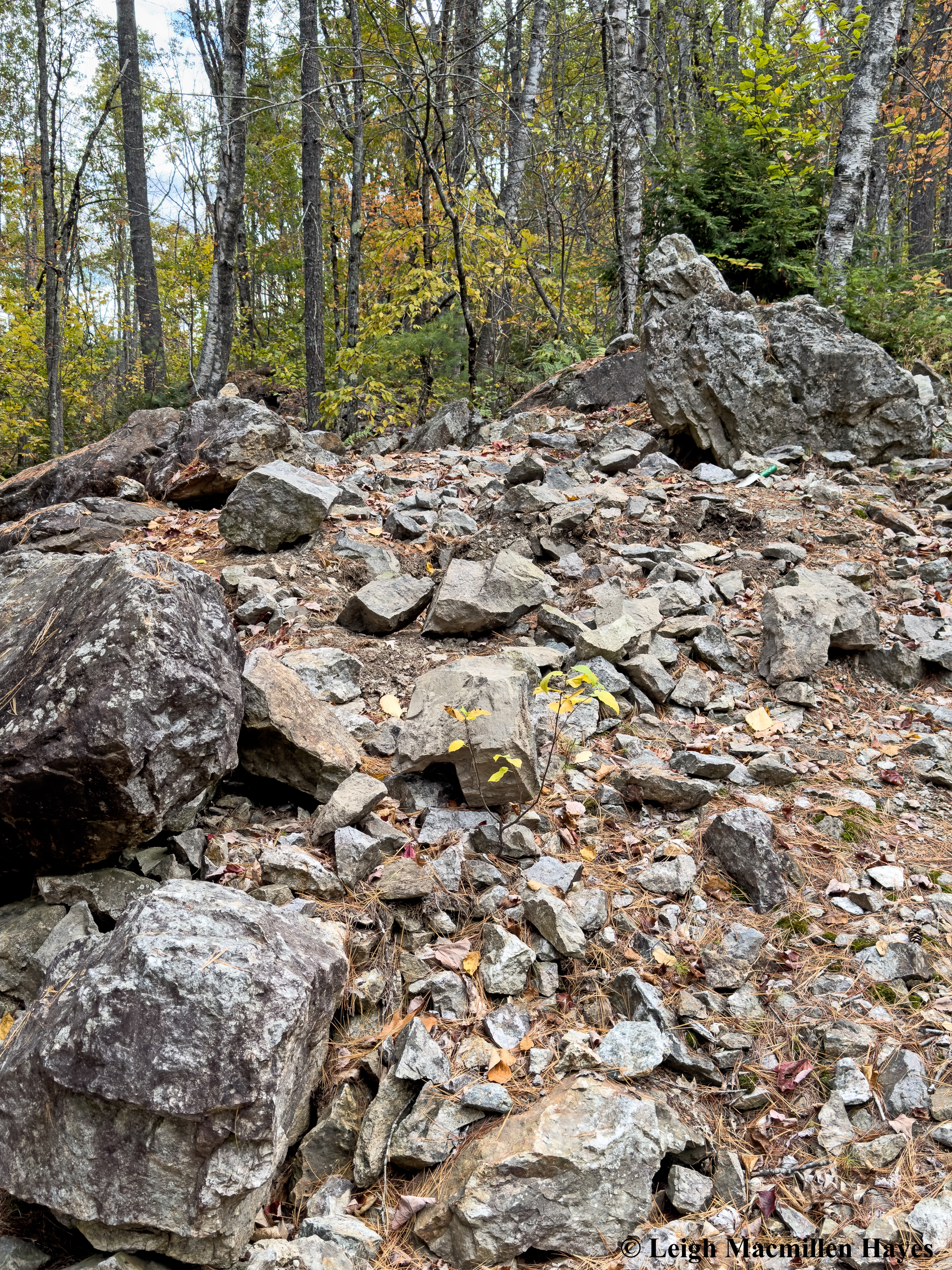
Our first leg of the journey completed, we ate lunch and then drove down the road and wandered into the woods again to locate the site of an open pit that was last mined in the early to mid 1900s.

Since then, others have tried their hand at prospecting and if you are a “Where’s Waldo” fan, I encourage you to try to locate a trowel in the photo above.

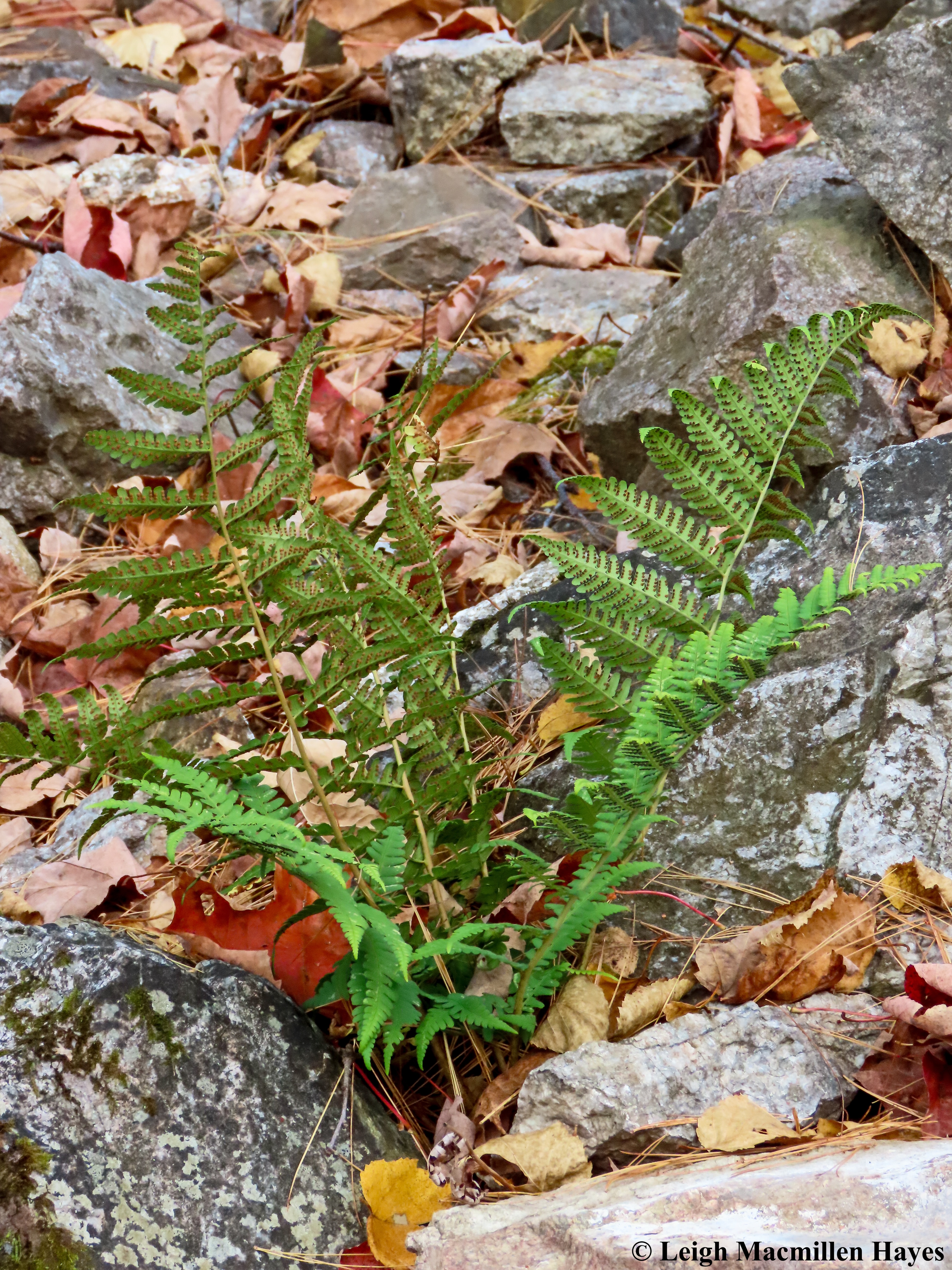
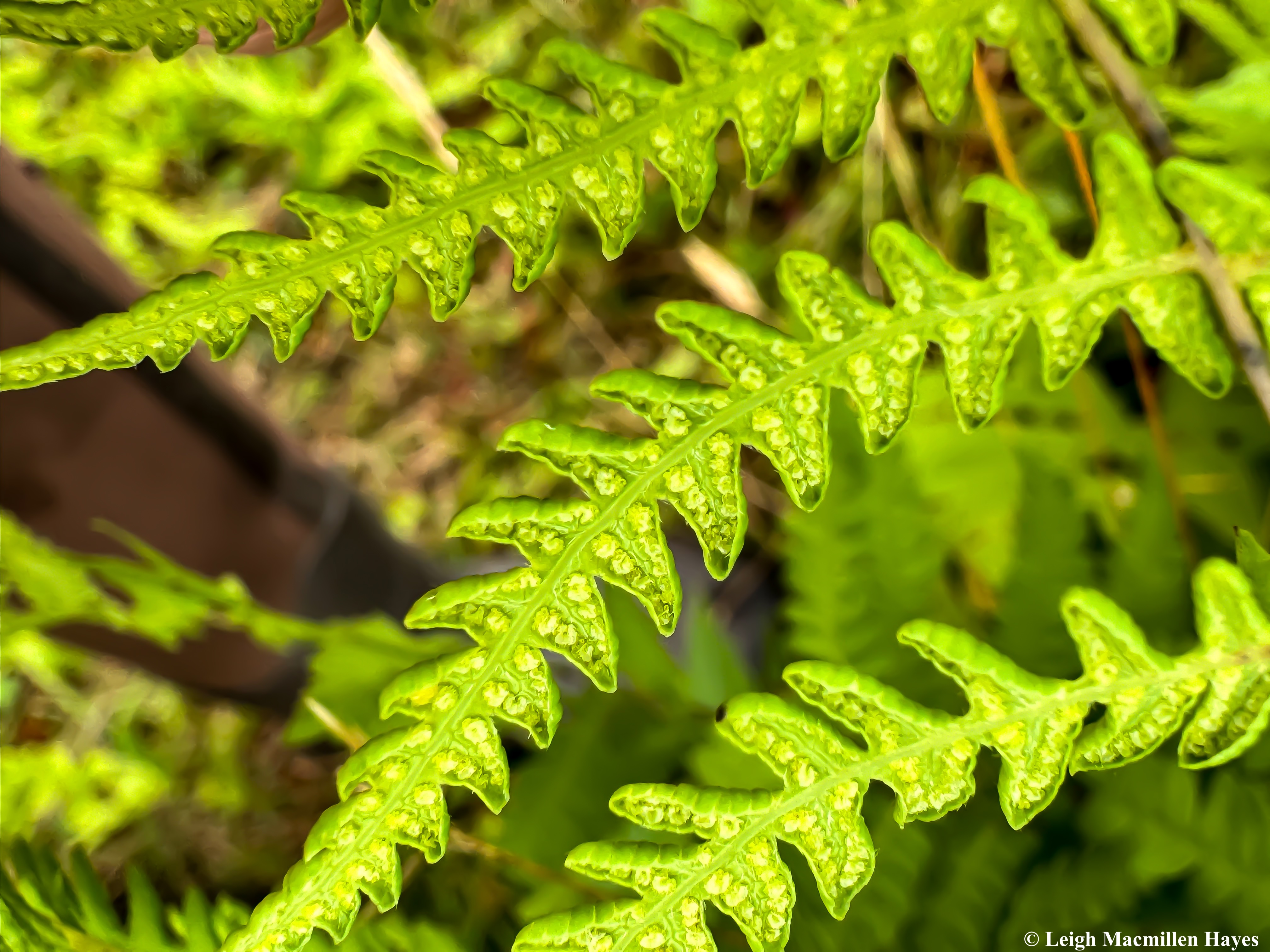
Among the waste rock dump, I was amazed to see a Marginal Wood Fern with its bluish-green leaves and loaded with sori (groups of spores) lining the edges of each leaflet. Their dark color indicates the spores had ripened, but still visible was the whitish, translucent tissue (indusium) that is kidney-shaped, and partly covered the spores.

We left that trail behind and headed off to complete one more loop. Well, we thought it was a loop. Turns out we followed two different trails that did not meet.

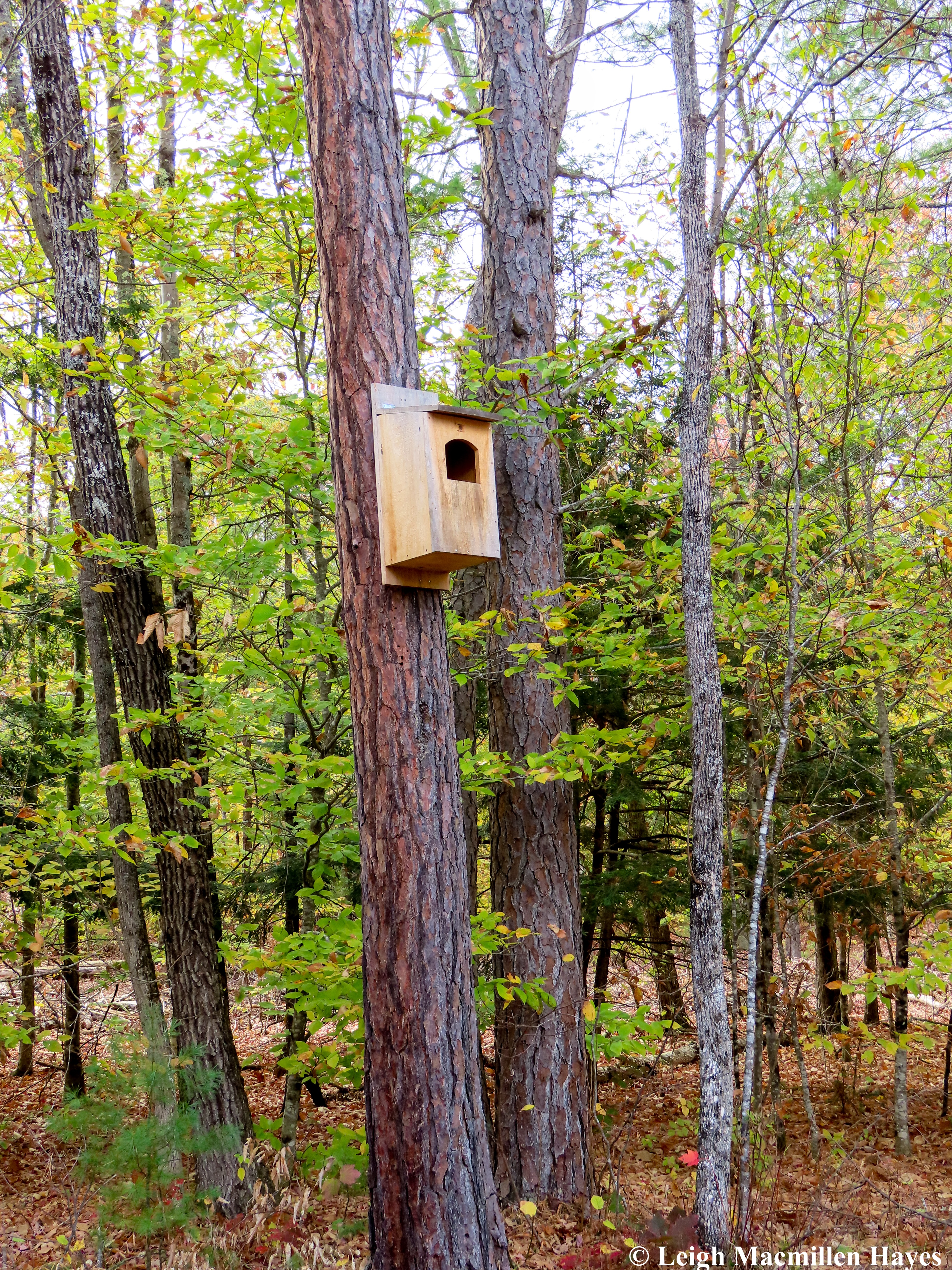
But, along the way, we discovered this huge bird box, a nesting box meant to encourage Barred Owls. I’ve since read that these should be in a mature hardwood forest near water. This one was located on a conifer at the edge of an old log landing. There was water nearby, though it took us some a while to locate it. Has the nest ever been used, we wondered. The Barred Owls in our neck of the woods seem to find tree hollows in which to set up housekeeping and the fact that I hear them most nights and occasionally spot one during the day, and have for several decades means they are quite happy living here, and don’t need a box.

But I digress and return home in that last thought and we hadn’t returned home yet for we had two more discoveries to make on our rather off-course trek, the latter one being the most significant.

As I said, we eventually located a wetland after bushwhacking once we reached a dead end on the trail. We would have explored it more, but had just realized that what we thought was a loop wasn’t and we wanted to know where another trail might lead in the time we had left before heading home.

Take note of the water level. Not too low. Curious.

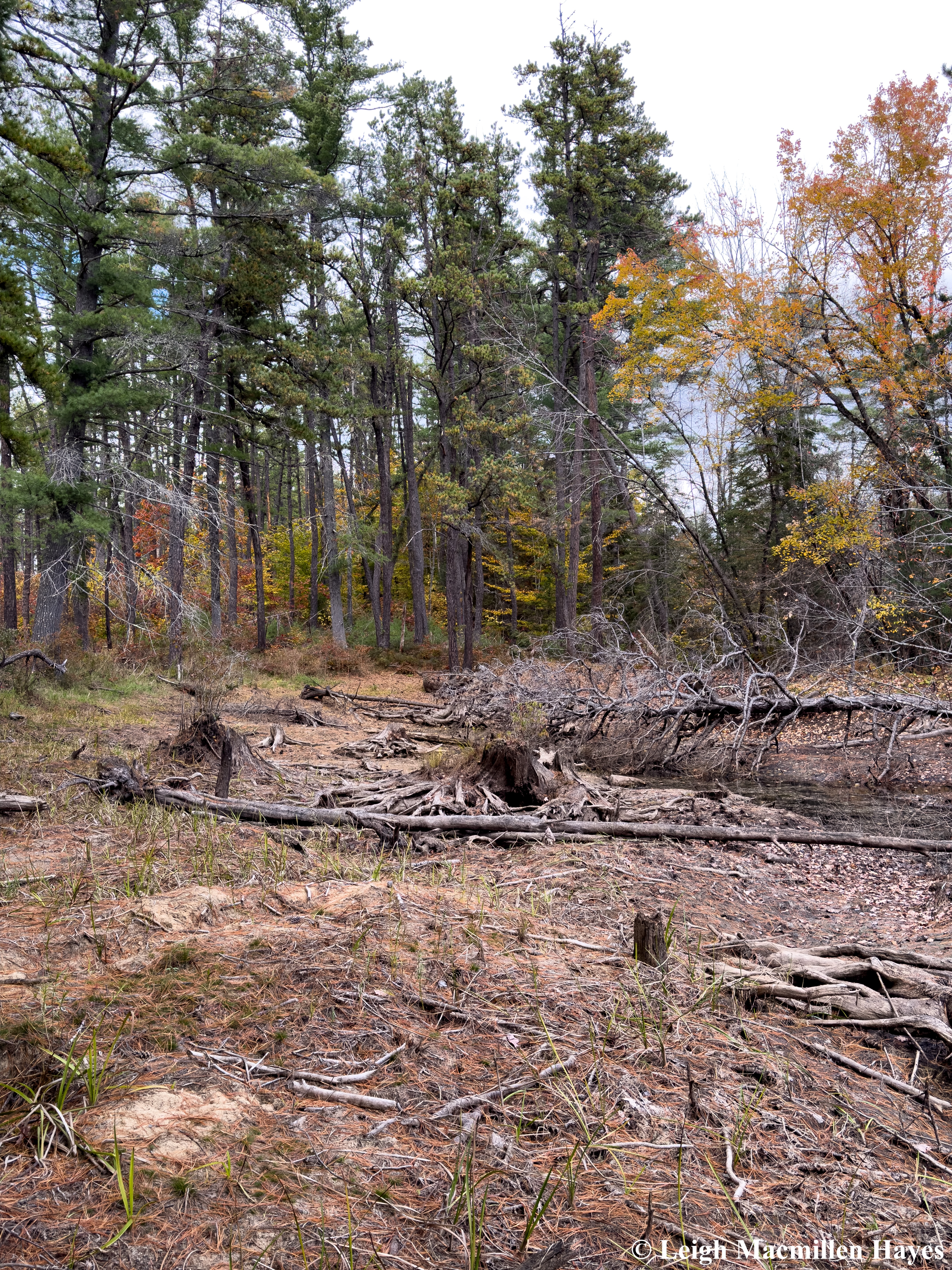
In trying the connect dots, we returned to our starting point of this third leg of the journey and then hiked in the opposite direction. Again we reached a dead end. And again, we bushwhacked from there and came to one rather dried up wetland. Why?

Perhaps there was a beaver upstream? We don’t know. But we did spend some time exploring it.

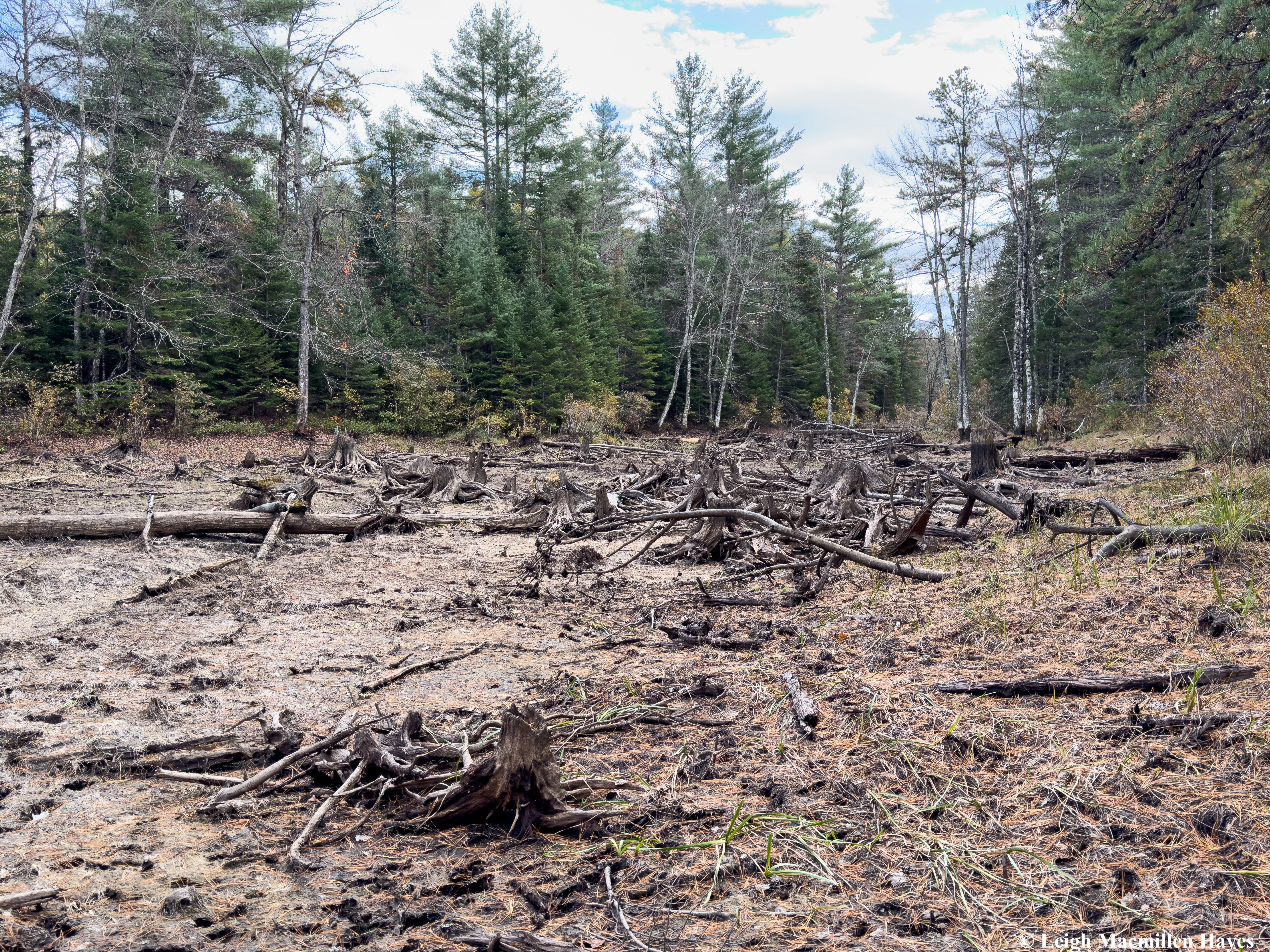
At first glance, it was so barren and my heart was saddened for the loss of life. Obviously, this used to be part of the forest as evidenced by the tree trunks. And then it was flooded. And now it isn’t. Since the drought? Since before that? Answers we don’t have.

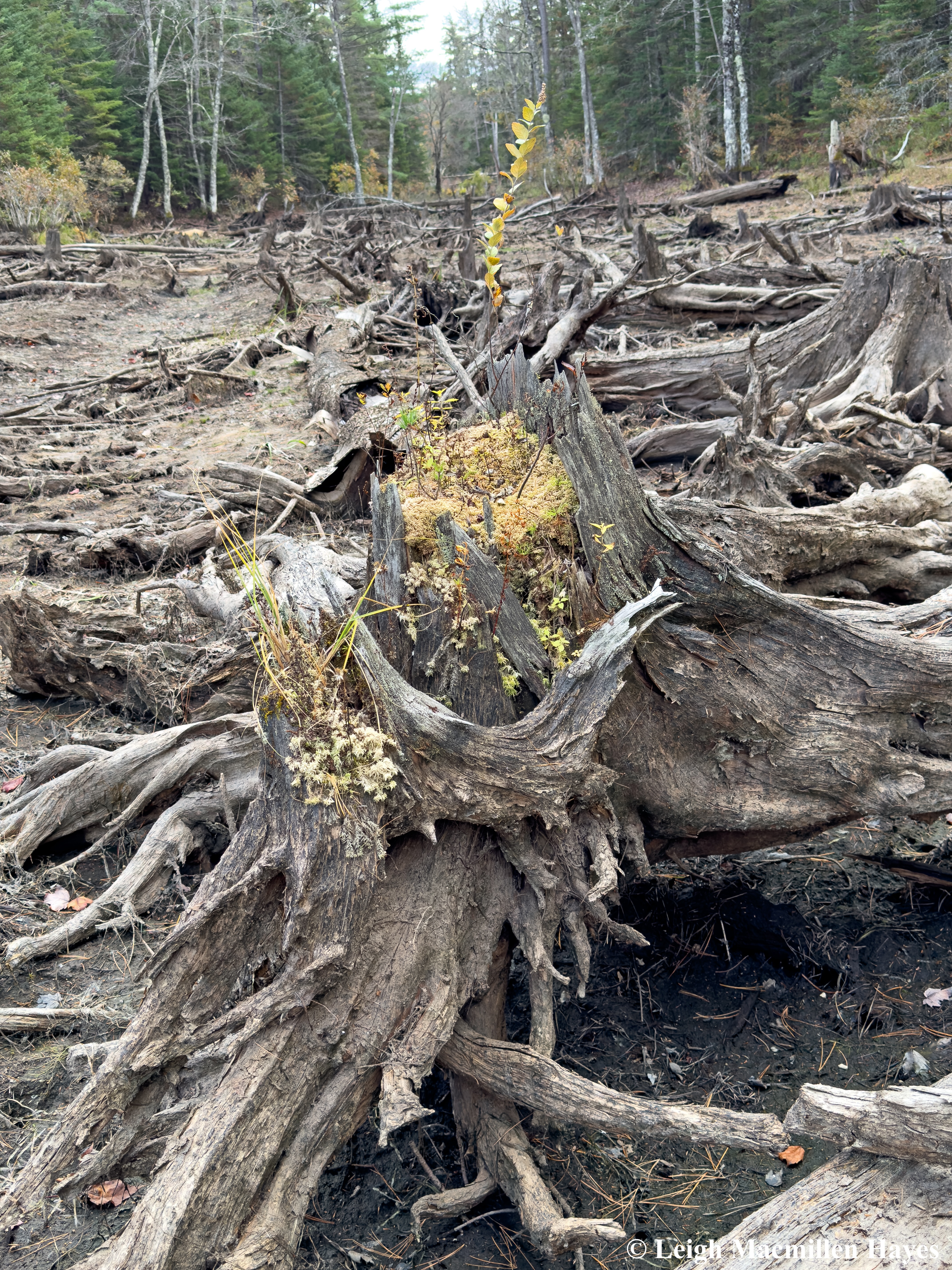
My Guy explored in one direction and I moved across the mud in another and met a stump garden.

In its own dried-up way, it was a thing of beauty with lichens and mosses and plants and grasses and trees all finding their niche in the midst of such apparent devastation.

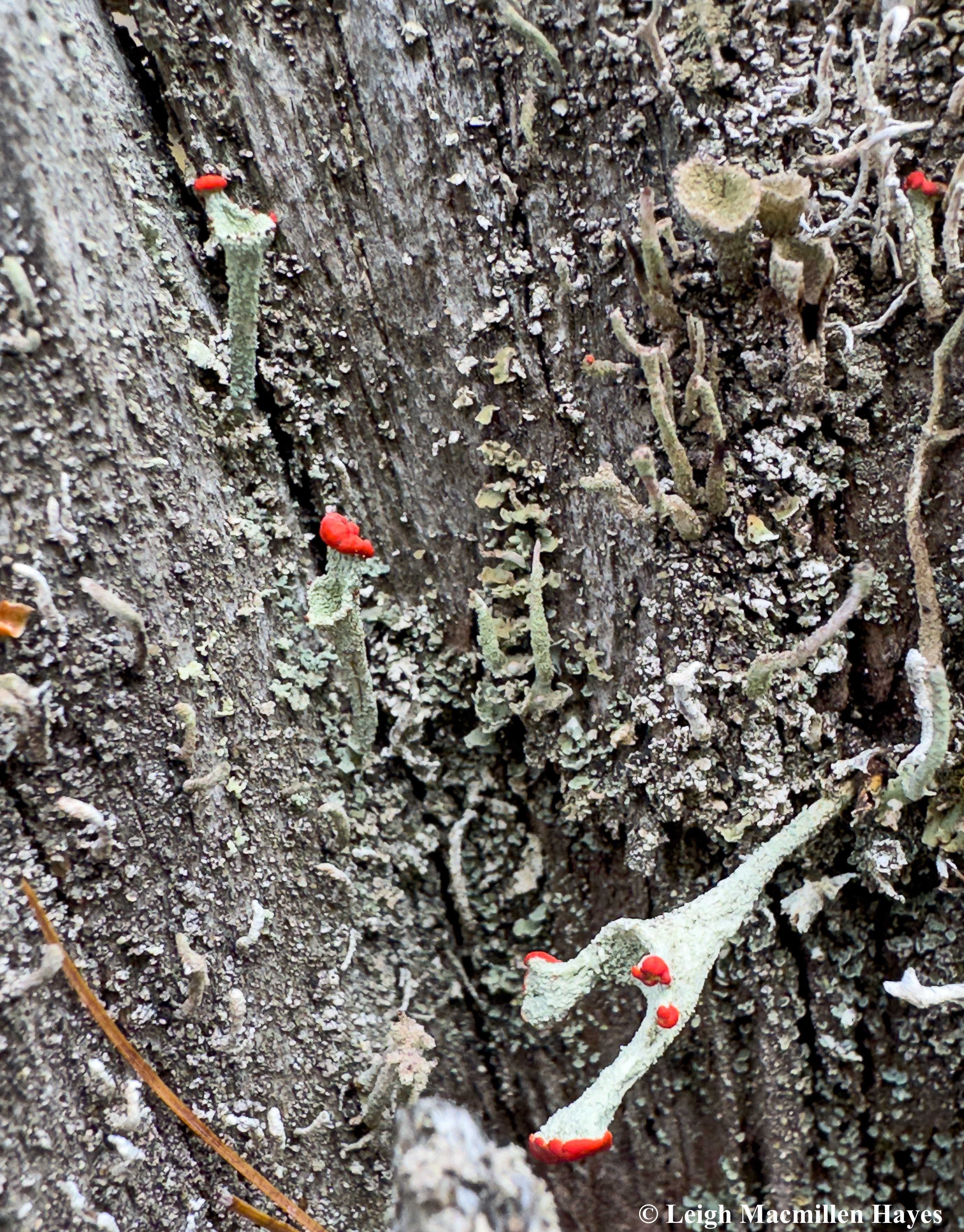
On the barkless outside, I discovered a myriad of lichens from Pixie Cups to Powderhorn (now apparently called Wands) to Red-fruited Pixie Cups.

Not to be confused with British Soldiers, which do not have cups, the Red-fruited Pixie Cups brought a smile to my face due to their goblet formation topped with those outlandish caps along the margins. The red is actually the apothecia or reproductive structures where spores develop.

Beyond the garden stump was another and even another, their roots wrapped in a forever embrace.

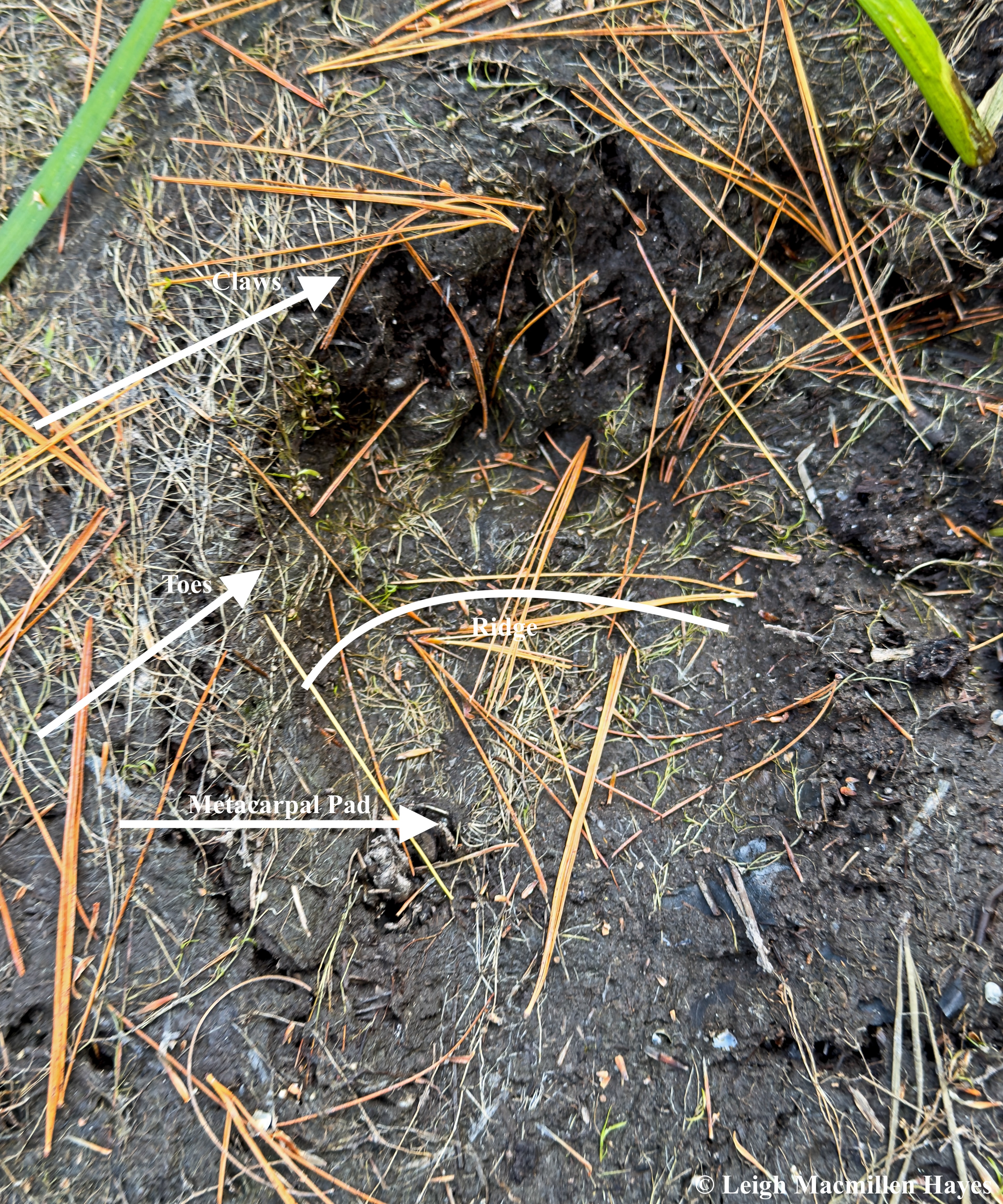
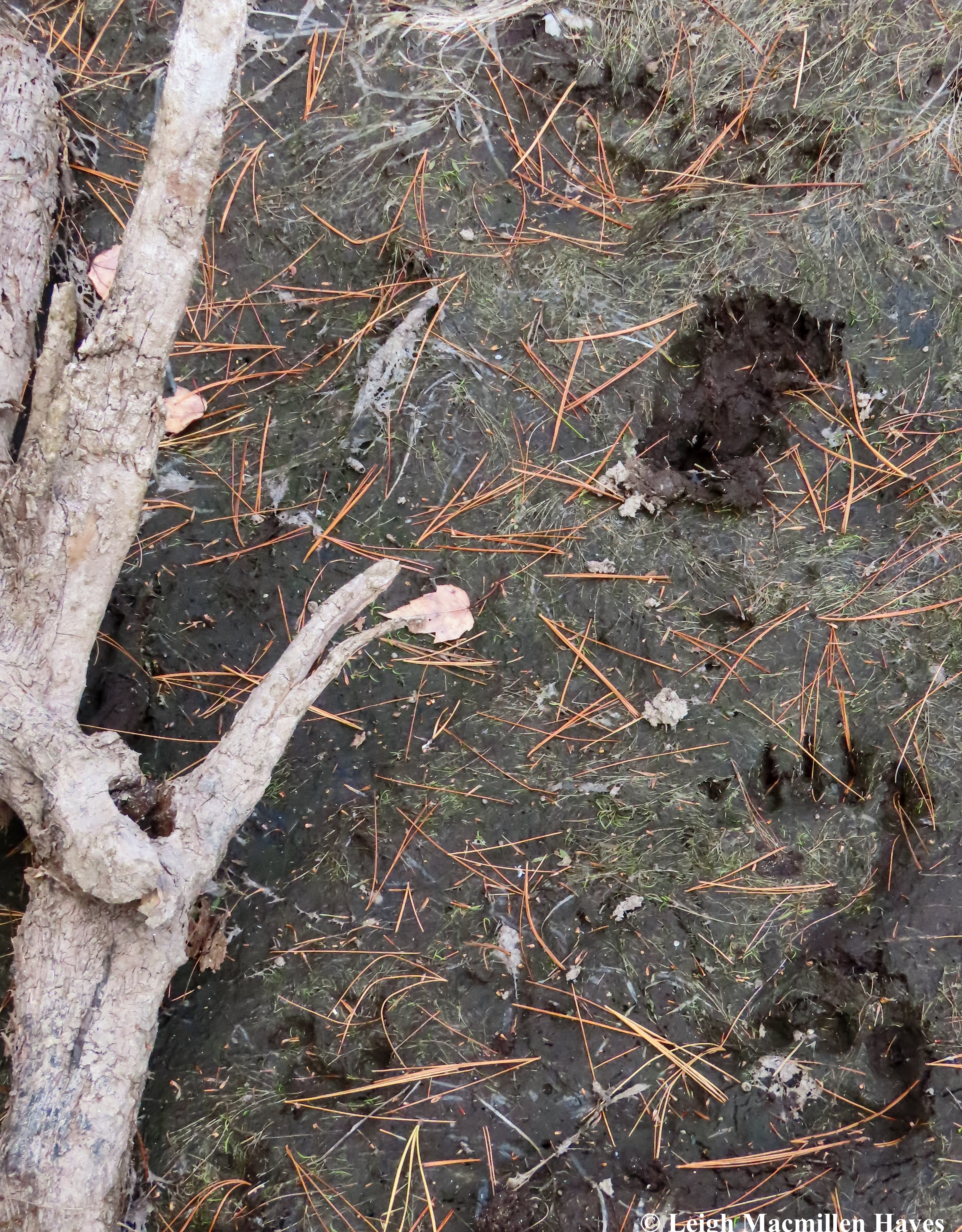
But the show stopper was what I spotted in the mud. A track. There were deer tracks galore. But . . . another mammal or two or three had also passed this way. Note the details.

I present to you, my dear readers, a bear print. Black Bear in this neck of the woods. The smaller toe is on the left, which means this is a right front foot–their big toes are on the outside of their feet rather than the inside like ours; better for climbing trees.

Do my arrows help you to see the parts of the foot?

Bears are waddlers, which means they have wide hips and their pattern tends to be a bit of a zig zag, with a hind foot landing near where a front foot had been. Oh, let the tracking season begin.

With two white lines, I’ve tried to trace two bear tracks that My Guy is studying.

Suddenly this desolate, dried-up space, wasn’t so bad after all.

This was our surprise ending. My heart be still.

A Blooming Surprise

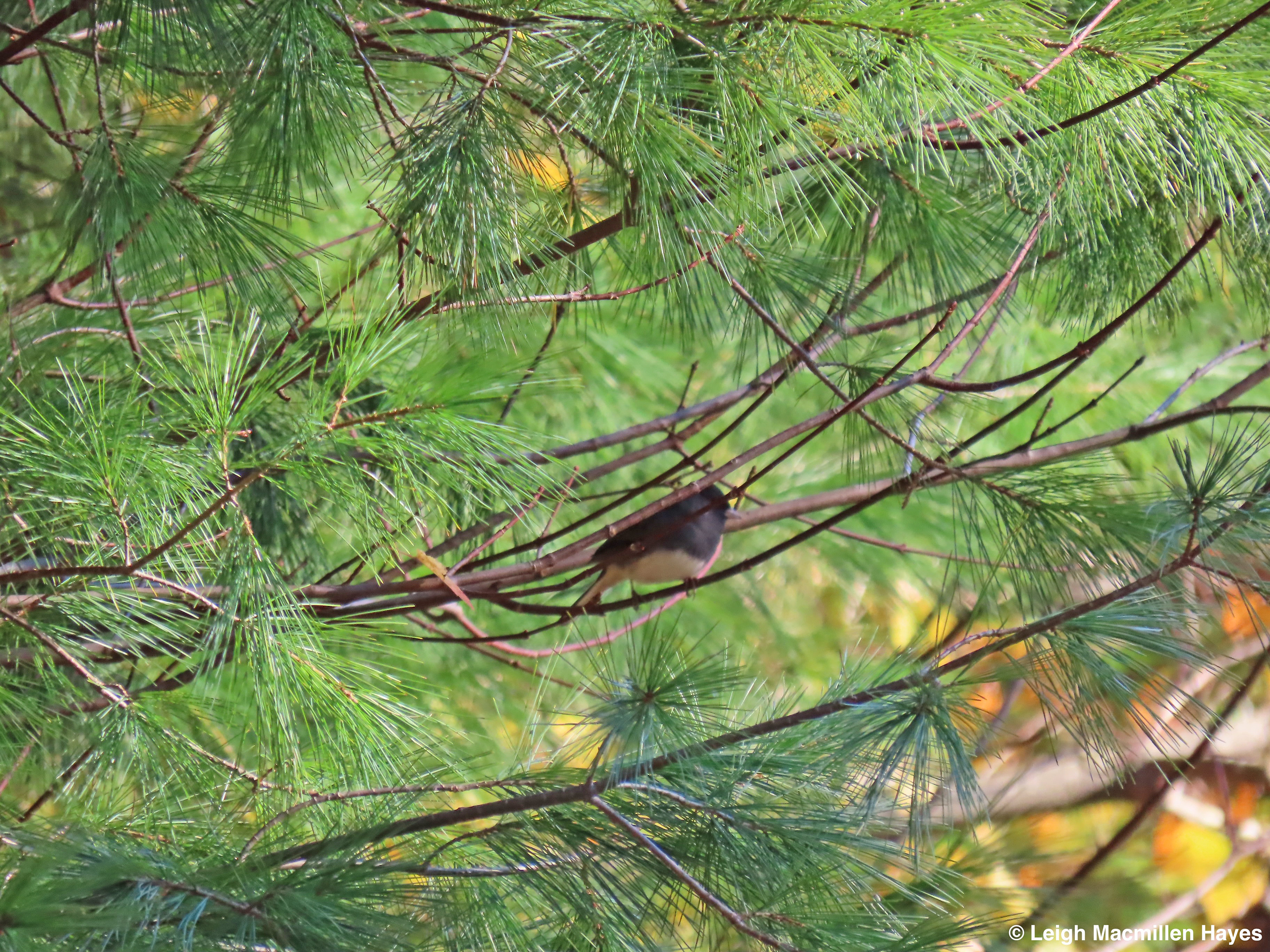
Two days ago we awoke to a temperature of 27˚ and the ground was covered with frost. And the Juncos flew into the yard. And so it seemed that autumn was turning a new page.

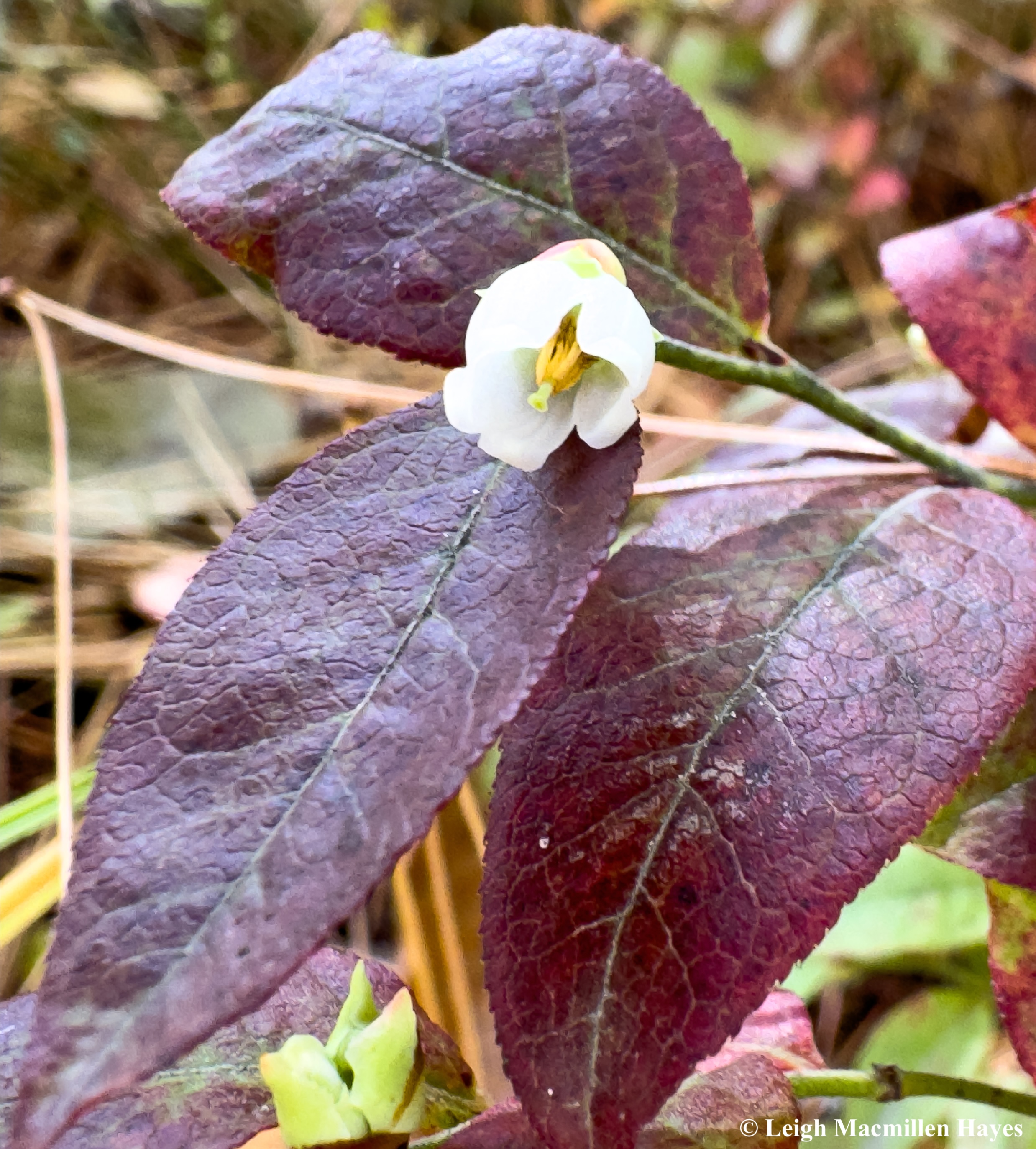
But . . . the day before the frost, as I walked along a local trail, something tiny captured my attention and as I bent down, I realized that despite the fact that the leaves of this Low-bush Blueberry had shut down their food production process and let the anthocyanin that had been stored in the leaves finally show through since chlorophyll was no longer a key factor, the plant was flowering.

There were somewhere between a dozen and two flowers in bloom on this one plant. After seeing that, I checked others, but didn’t spot any more flowers.

Of course, I did what I always do when such an event occurs, and immediately sent the photos to my nephew who lives in southwestern New Hampshire. The past few years we’ve exchanged such photos when the out-of-the-ordinary occurs and last year it seems like we found a bunch of species in bloom at the wrong time. This was the first for both of us this year, and as he commented, probably because it’s been so dry. But still, it’s also been hot and the flowers seem to get confused–more than they used to, at least in our memories. How about for you?

And so today I stopped by St. Peter’s Episcopal Church in Bridgton, Maine, because I love the land that surrounds the building and wondered what it might have to offer. I actually stopped by twice–first in the late morning, and then again in the middle of the afternoon.

Seeing Hawkweed both in bloom and preparing to send seeds forth for future blooms wasn’t a surprise at all, for this flower is prolific and hardy.

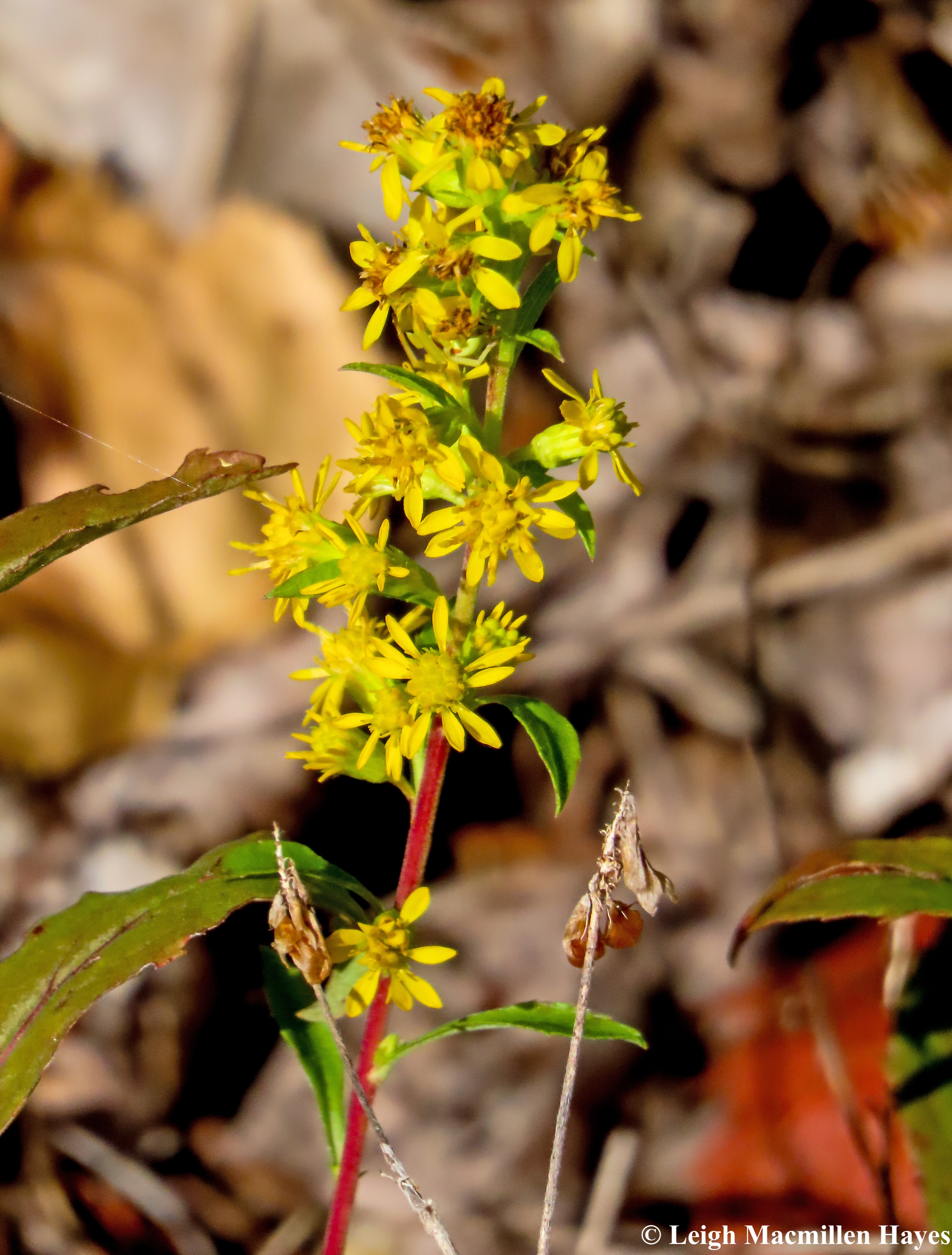
A few Goldenrods had also not yet achieved their gray-head status and instead served as beacons of light for any who were searching.

And the few Bumbleebees I saw gave thanks that there was still some food available.

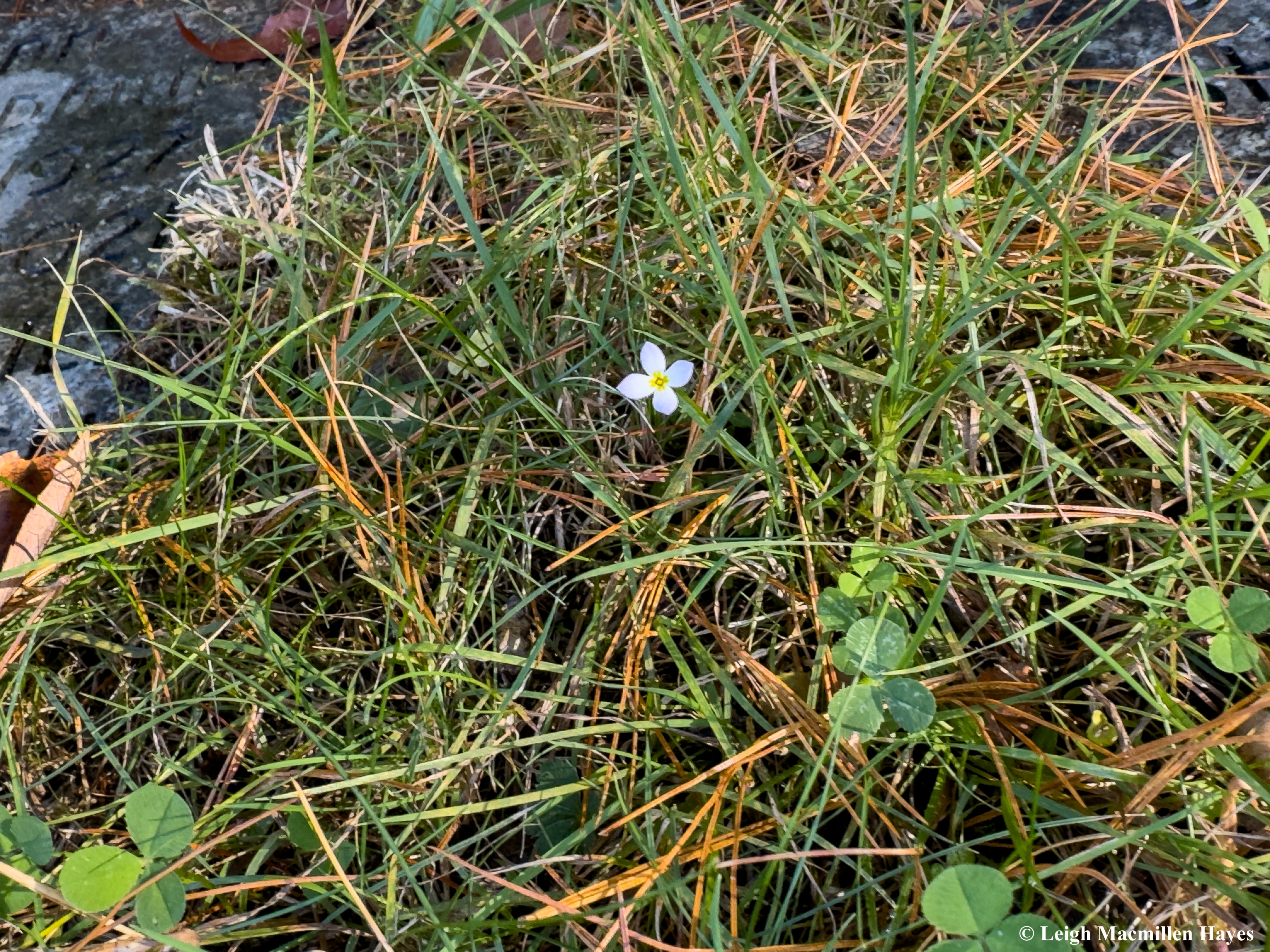
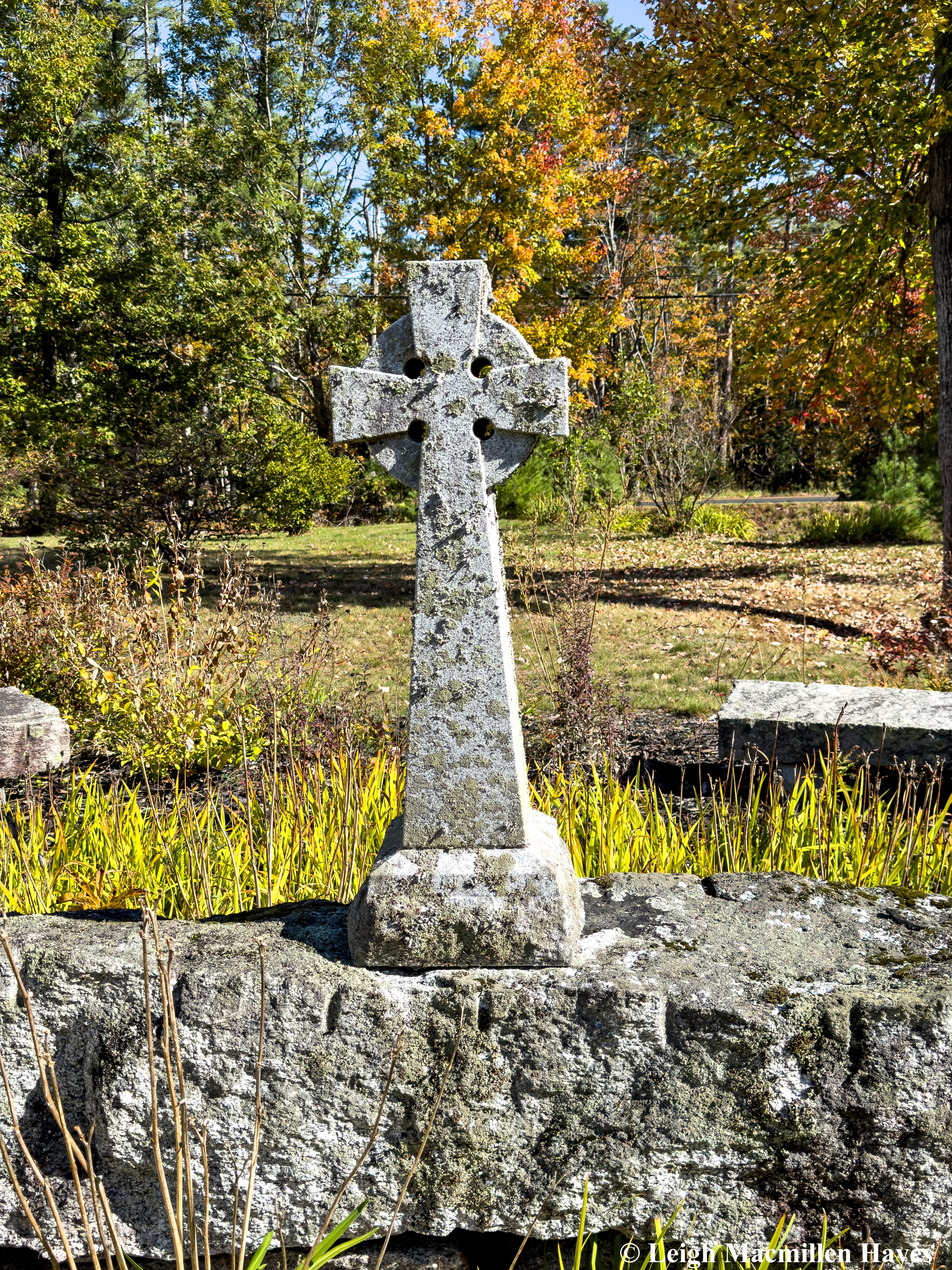
But then I spotted it . . . A single Bluet, aka Mayflower, one of our early bloomers that blossoms in May, showing off its perky little face between two grave markers in the church’s burial site.

I gave thanks for the Bluet, because it was located between two dear friends who died within months of each other, after a marriage of 71 years! To spend a few minutes wondering about the Bluet with them today was a blessing.

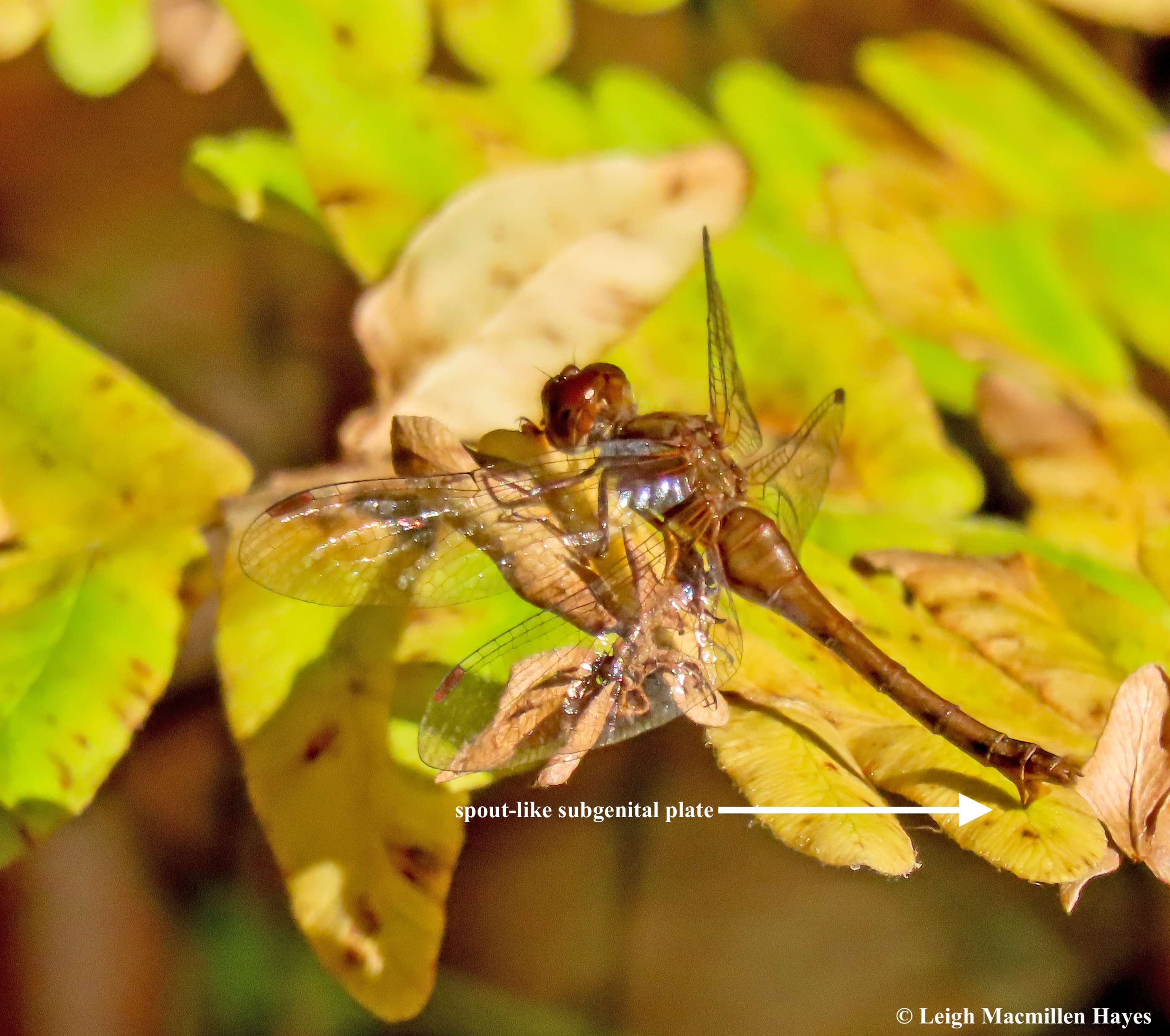
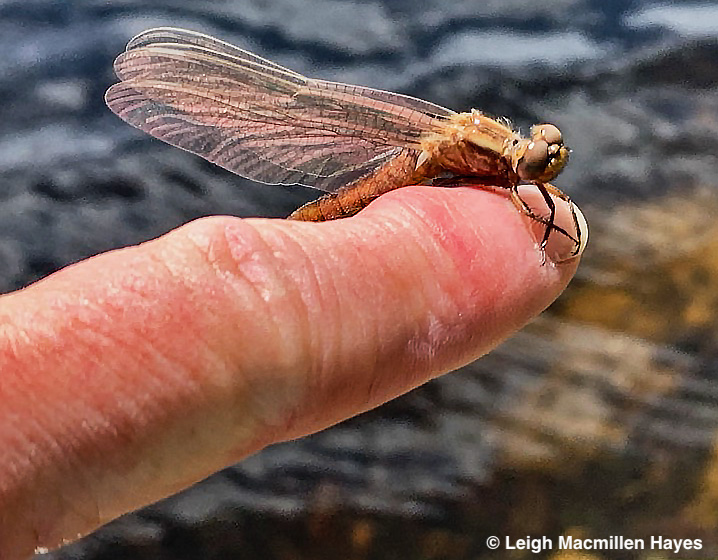
And no matter where I walked, be it the church lawn, woods, or parking lot, it seemed there were Autumn Meadowhawk Skimmer dragonflies, this being the male. If I moved, they moved a slight bit, but then landed nearby every time.

The females were also flying and landing everywhere I went. And I truly expected to find a pair canoodling, but they seemed more interested in landing near me than chasing each other for a date.

While female Autumn Meadowhawks are typically pale brown, as they mature, their abdomens may turn red like that of their male counterpart.

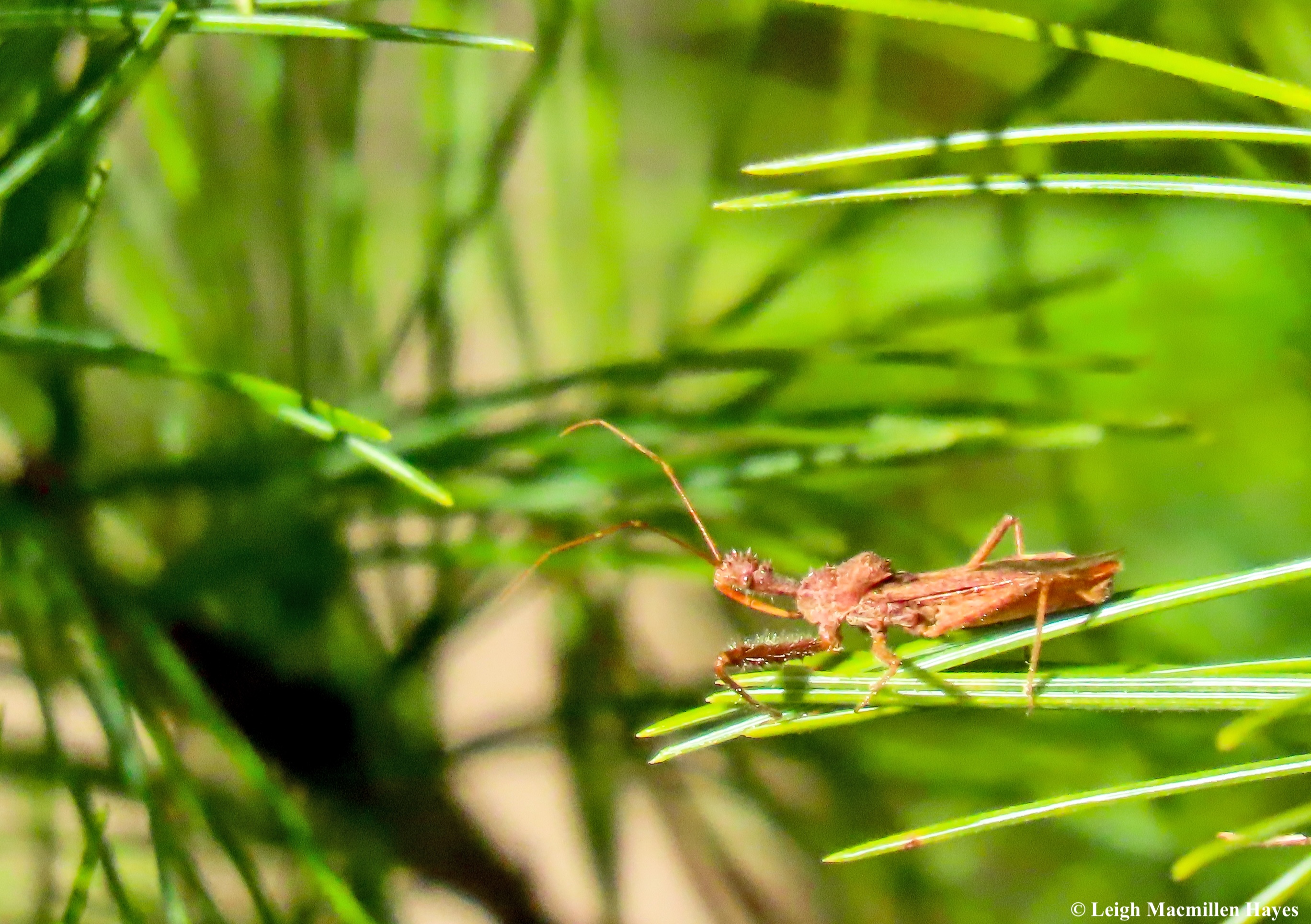
Of course, they all need to watch out for this guy. Or maybe he needs to watch out for them. The Spined Assassin Bug was on the move–the hunter or the hunted I don’t know, but it was just a fun find. And beside the church parking lot of all places. But then again, churches welcome all, especially those who are not perfect. Thank goodness!

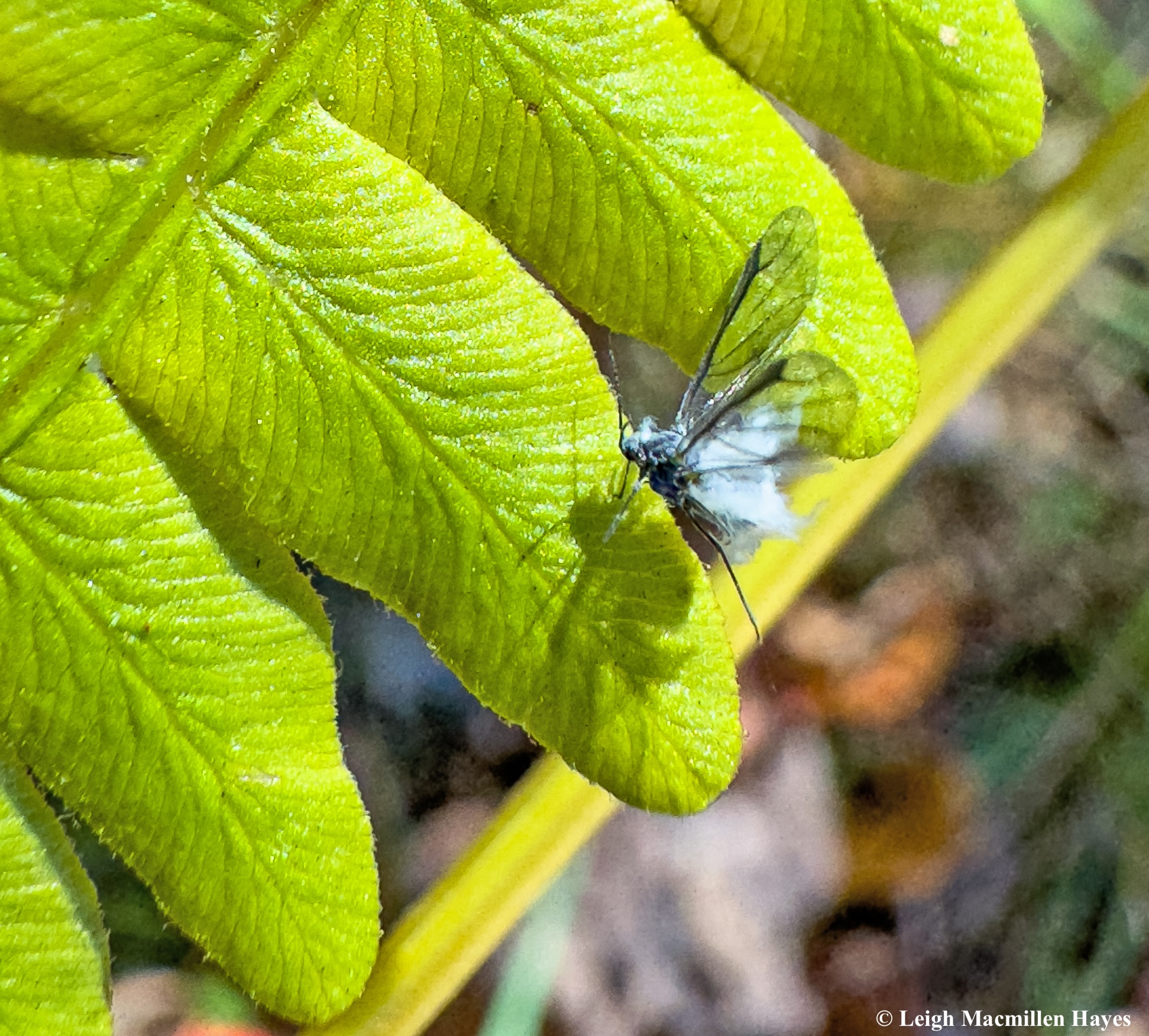
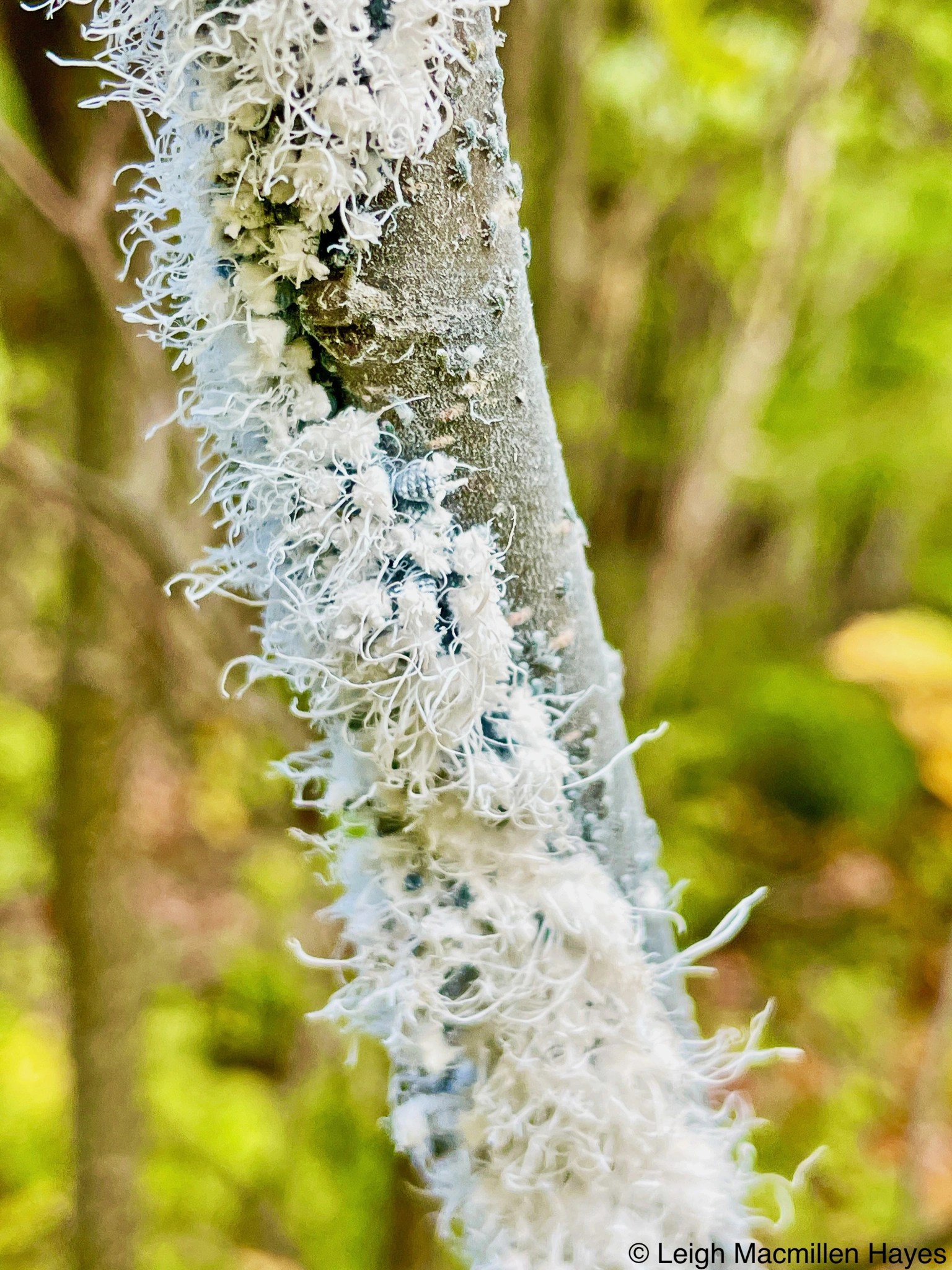
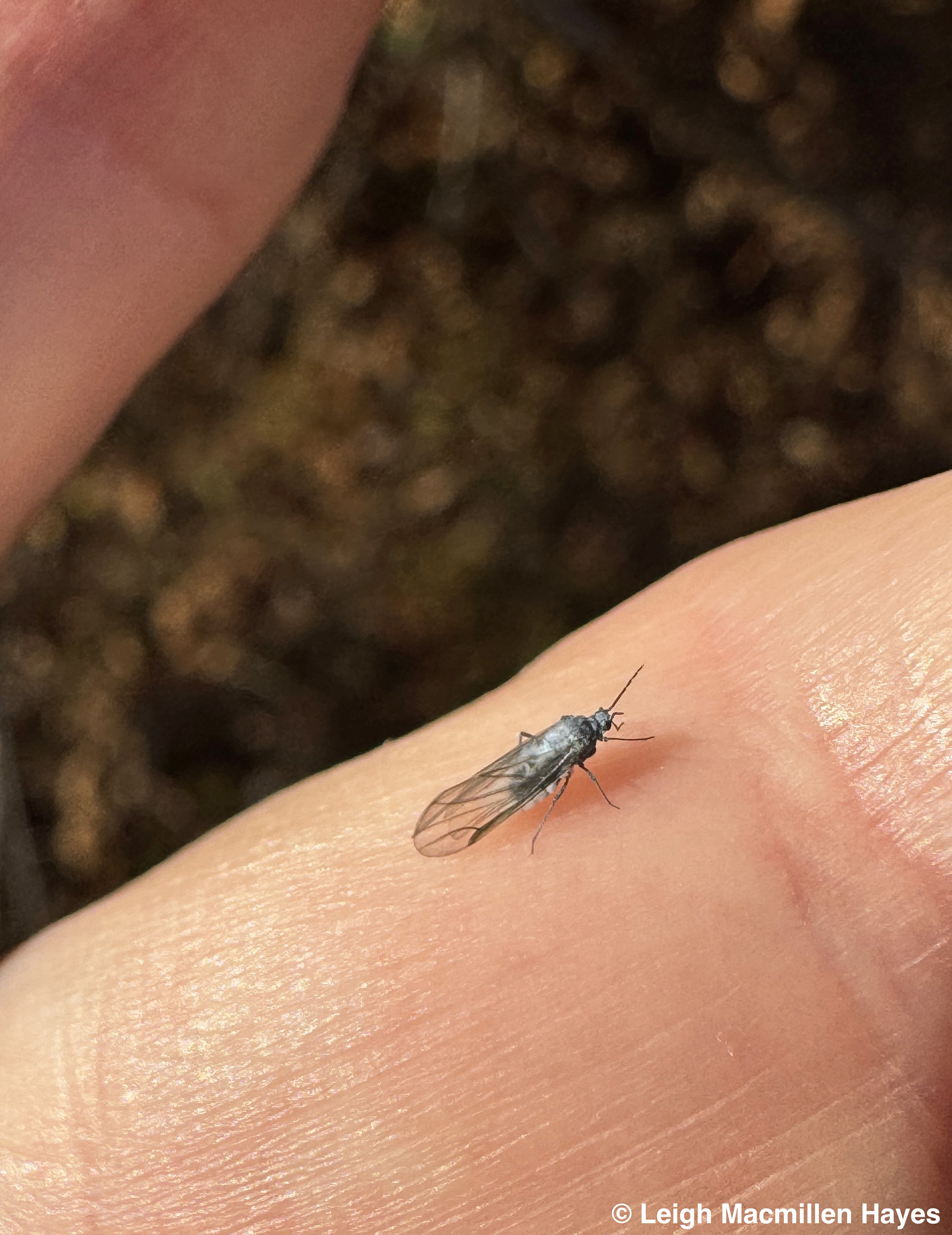
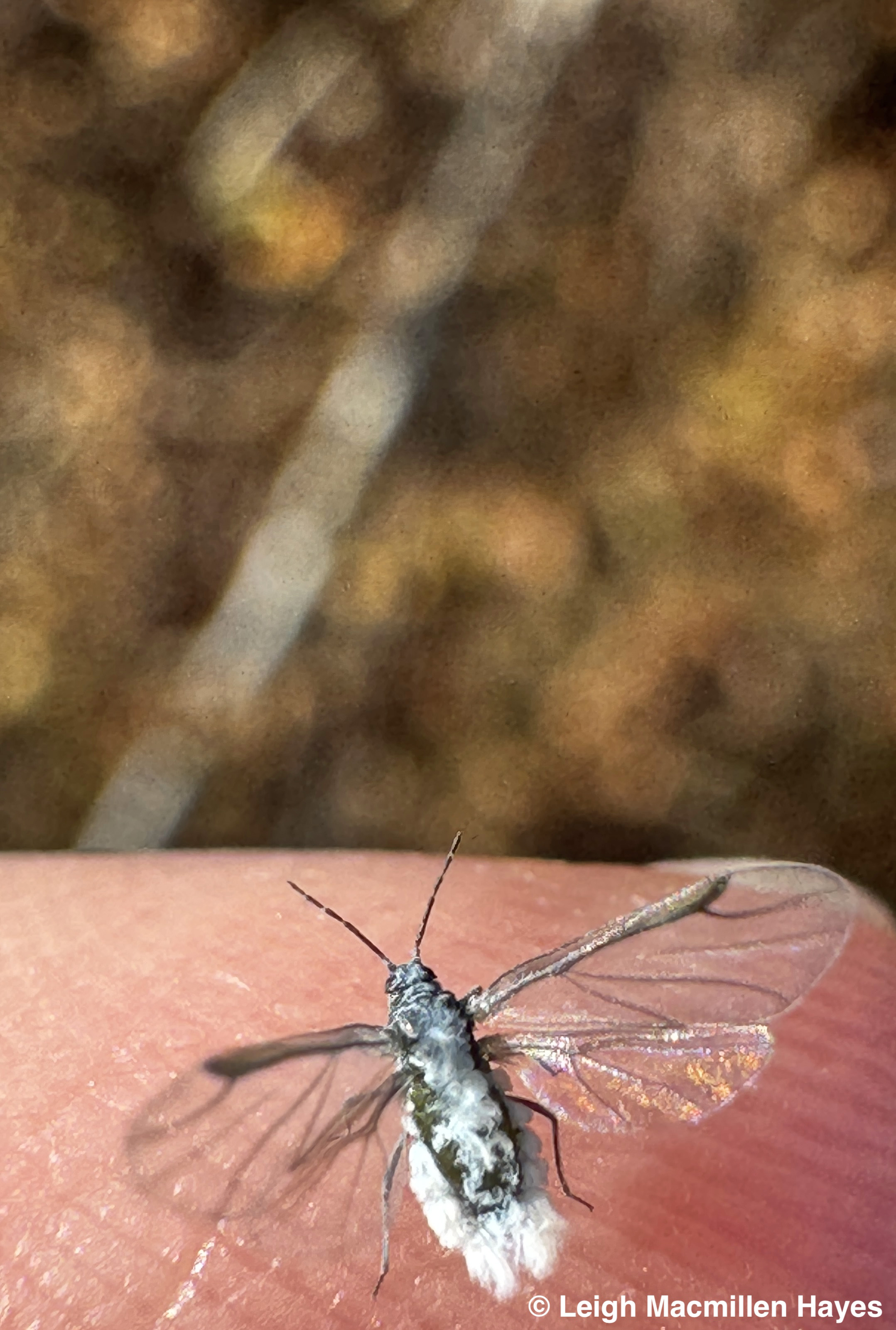
As I continued to explore, I spotted one of my favorite fall finds dancing through the air rather like a little fairy, though some think of it as a snowflake, and just yesterday someone described these insects as bits of ash. All make sense to me.

I captured this one so I could take a closer look at those iridescent wings and the waxy fluff on the abdomen.

And then I released it onto a fern frond.

I invite you to notice the hint of blue as well.

This is the teeny, tiny Asian Woolly Hackberry Aphid, one who is searching for a sap source.

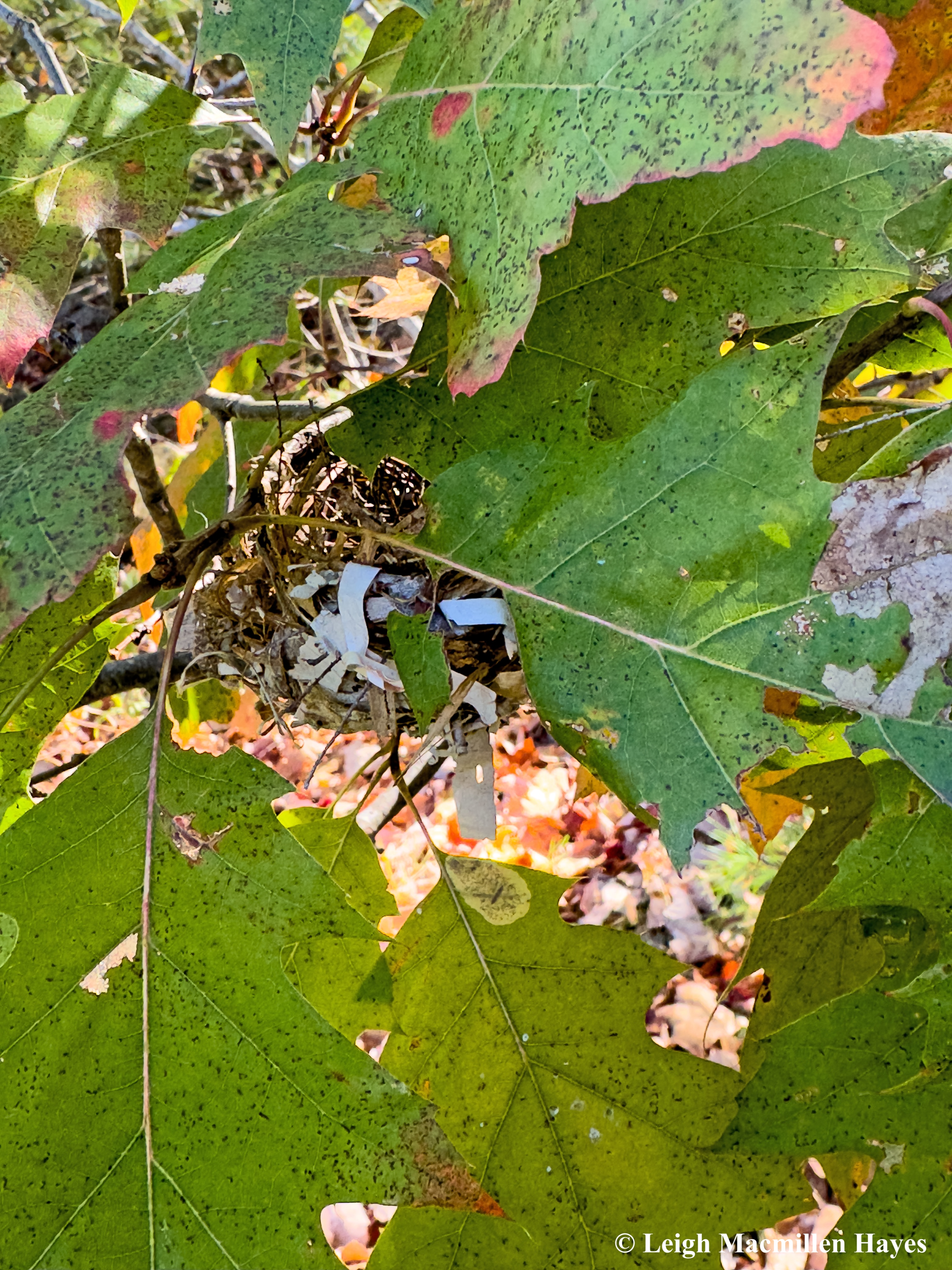
And then I came upon another surprise that I had forgotten. It was hiding below some leaves at about breast height.

A few of us first spotted this nest back in June when we accidentally approached it because we couldn’t see it hiding as it was below leaves, but Momma Red-eyed Vireo suddenly flew off. We apologized to her, took a quick photo of her eggs and promised her we would leave her be so she could raise her young in this place that we hoped provided safety. I never checked on her again.

But looking at the nest today, it appeared that she had a successful breeding season.

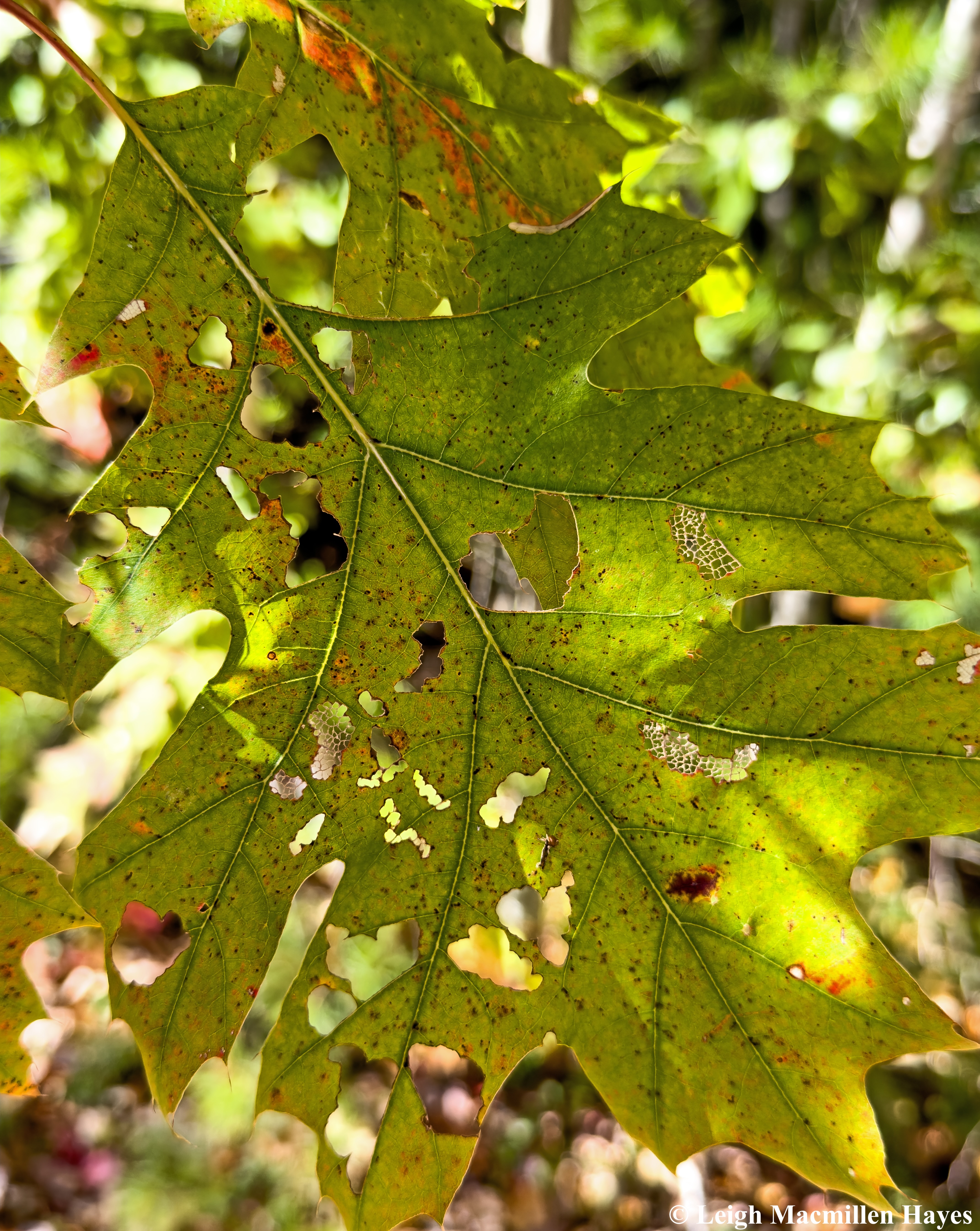
Looking at some Northern Red Oak leaves, like those that hid the nest, I was reminded of stained glass. Ours is a church that doesn’t have stained glass windows, but rather allows the outside world in. The ever-changing qualities of the natural world as seen through the windows serve as the scenes for us all to ponder each season.

And ours is a church with a group of people who wander out the door each week with others always welcome to join us as we wonder about all that surrounds us. We call ourselves Trail Snails, because slow is the manner of our movement.

And we have a mascot that was gifted to us by a couple from First Congregational in Bridgton, for they occasionally have joined our group to wander and wonder. T.S., short for Trail Snails, loves to pose along the way.

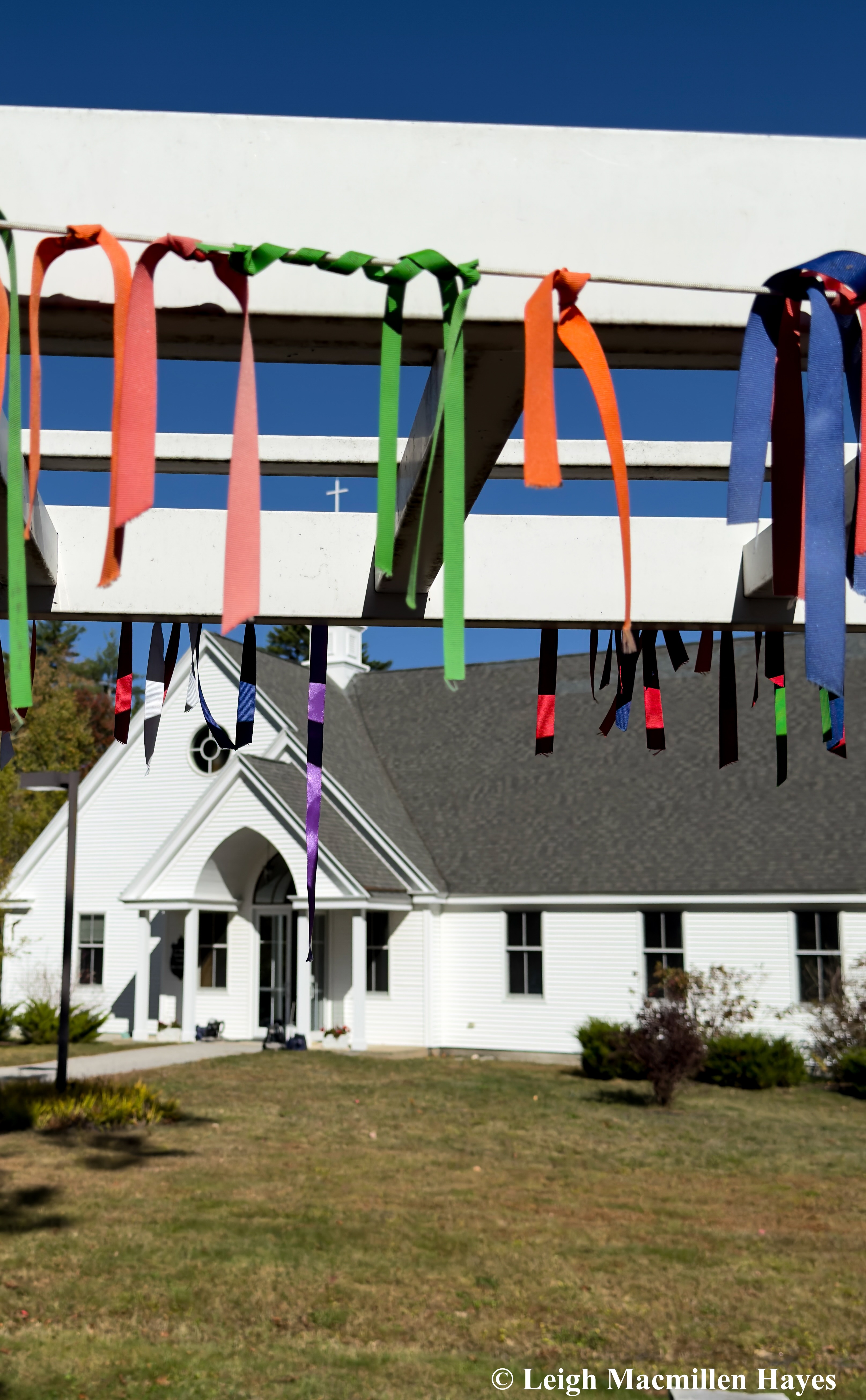
It’s also a church that knows the power of prayer and the ribbons tied onto the arbor actually represent specific prayers of parishioners and people we’ve only met for the first time.

And there’s a beautiful Memorial Garden where all the flowers have now gone to sleep, but their leaves and seedheads offer different colors and textures in this season and anyone is welcome to sit in this space.

This all brings me around to my opening thoughts, for as I rounded the corner of the church building this morning, a shocking pink color on a bush mostly gone to fruit beckoned a closer look.

I wasn’t the only one peering in, for a Spotted Cucumber Beetle was making the rounds on the anthers within one of the flowerheads.

Blueberries, and Bluets, and even a Rose–a blooming surprise was each on this the eleventh day of October. Plus all the other wonder-filled finds.

Bogging in Maine

What is a wetland? Basically, it is wet land! But more specifically, wetlands are often those transition zones between dry land and deep water.

There are four basic types of wetlands, which can be broken into even more types, but let’s stick with the four: marsh, swamp, bog, and fen.

Marshes are typically located along shores of rivers and streams, and even the coastline. Plus they can be found in the shallow water of ponds and lakes. Cattails, Arrowhead and other soft-stemmed emergent plants grow in these areas.

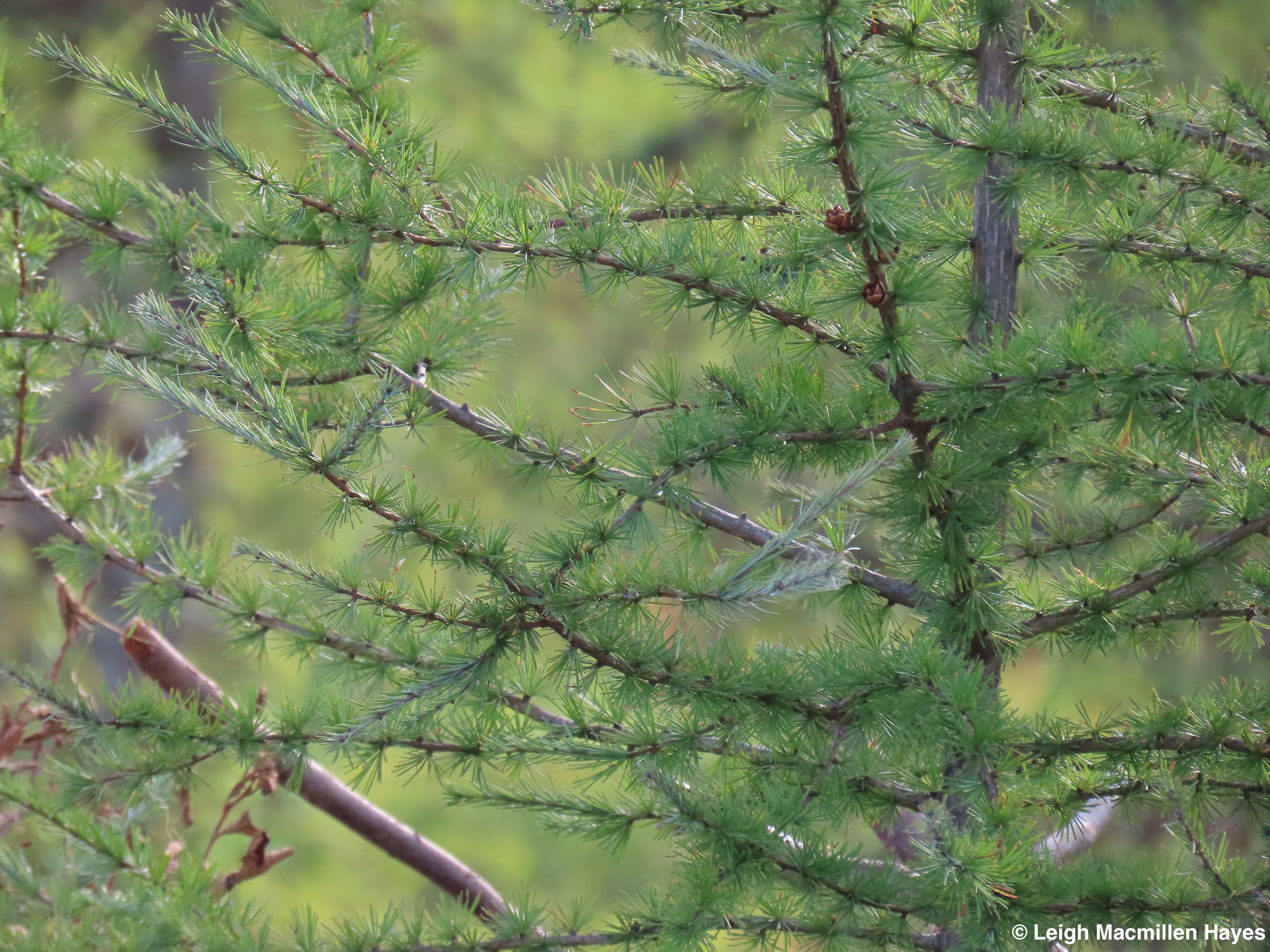
Swamps are found along rivers, streams, and lakes where mainly woody-stemmed plants such as shrubs and trees, like this Tamarack, grow.

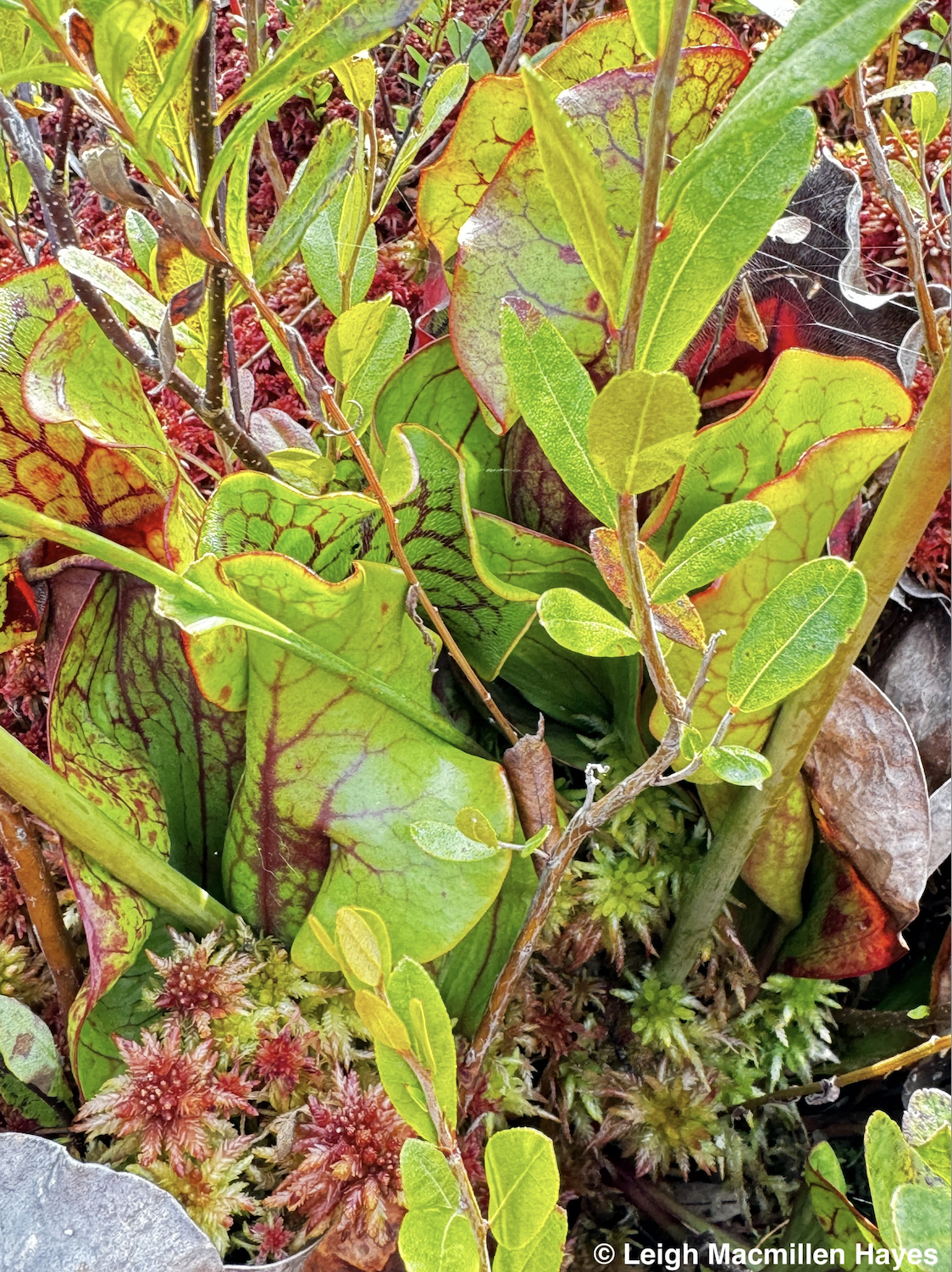
Pitcher Plants and Sphagnum Moss
Round-leaved Sundews

Bogs are found in our northern climate and often are deep depressions that have no drainage. They are covered with a surface carpet of sphagnum moss and insect-eating plants like the Pitcher Plant and Sundews.

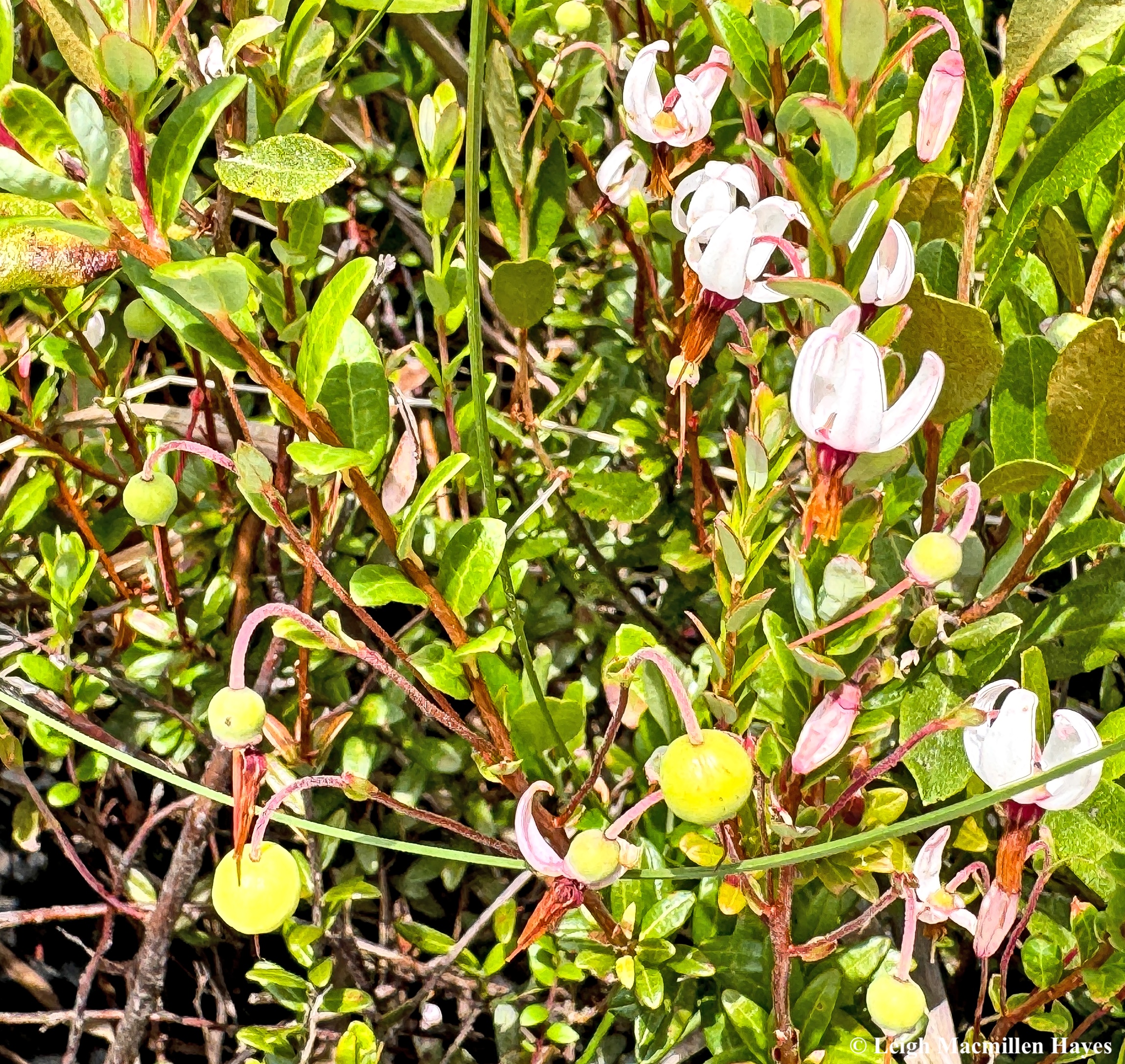
Cranberry flowers and fruits

Native Cranberries also flourish in the stagnant and acidic water of a bog.

Sphagnum Moss
Leatherleaf

Like bogs, Fens are found in northern climes, but the water is slow-moving, and does have some drainage. Layers of peat (sphagnum moss) and sedges and grasses and low shrubs like Leatherleaf may grow in these areas. The carnivorous plants like them as well.

But it’s not just the flora that makes a wetland so special. These places provide habitat for a wide range of insects and animals and birds as well. In fact, they act as nurseries, or places where any of the critters might raise young.

And as soon as the sun warms the air in the spring, friends and I scour the wetlands in hopes of discovering who is emerging on any particular day. One of my favorites to watch is dragonfly emergence (in case you are new to this blog and didn’t already know that. You can learn more here: Developing Dragonfly Eyes, but really, type “dragonfly” into the search button of this blog and a bunch of dragonfly related posts will pop up–all worth a read, I promise you.)

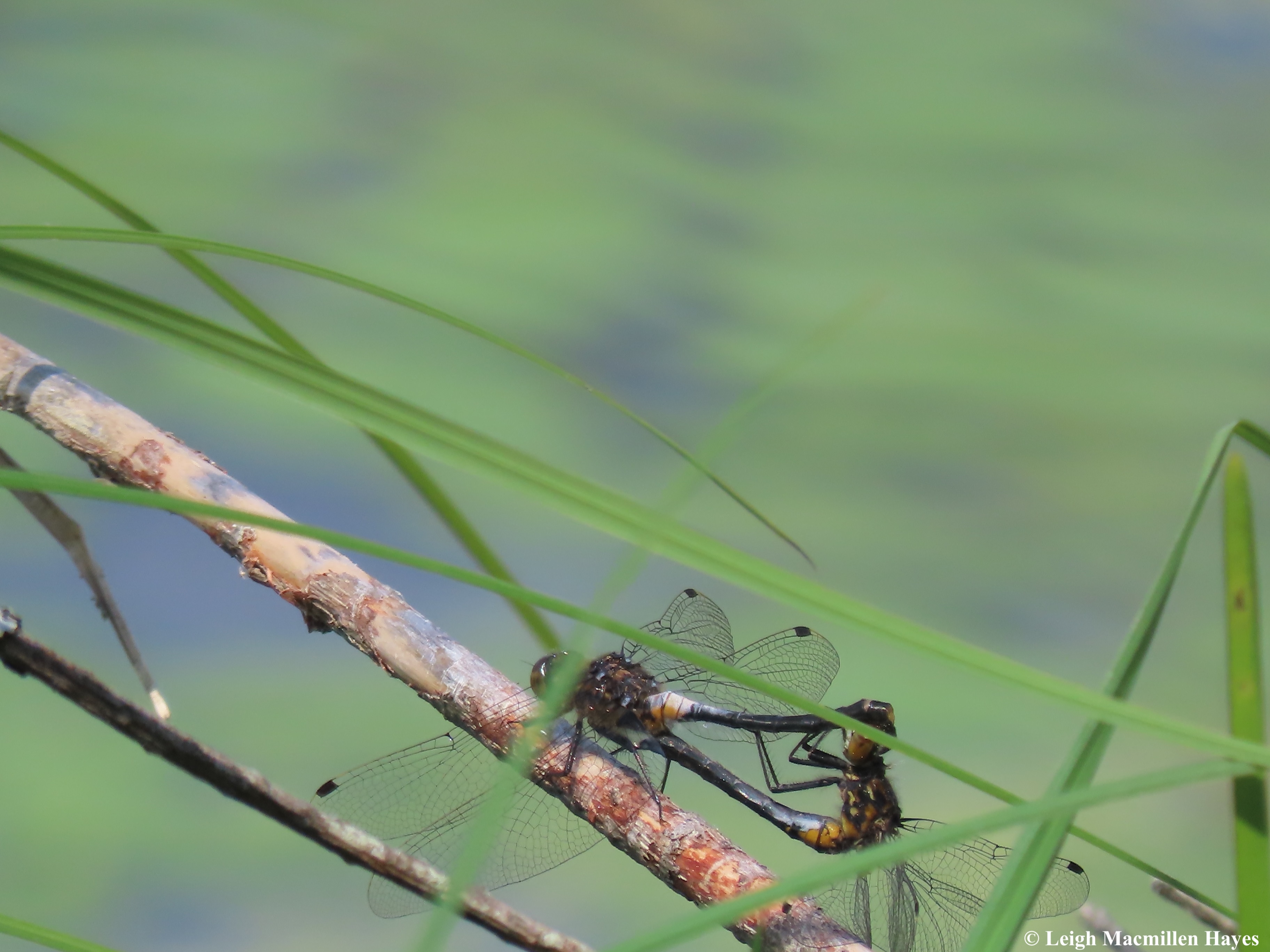
And like other insects, once emerged and a few days old, canoodling commences and dragonflies such as these Belted Whiteface Skimmers find each other and a presumably private place to mate. Private, that is, until I show up!

Eggs are laid in a variety of ways and places depending upon the species and this is a female Eastern Pondhawk taking a break upon a lily pad.

And here is a Forktail Damselfly laying eggs upon vegetation.

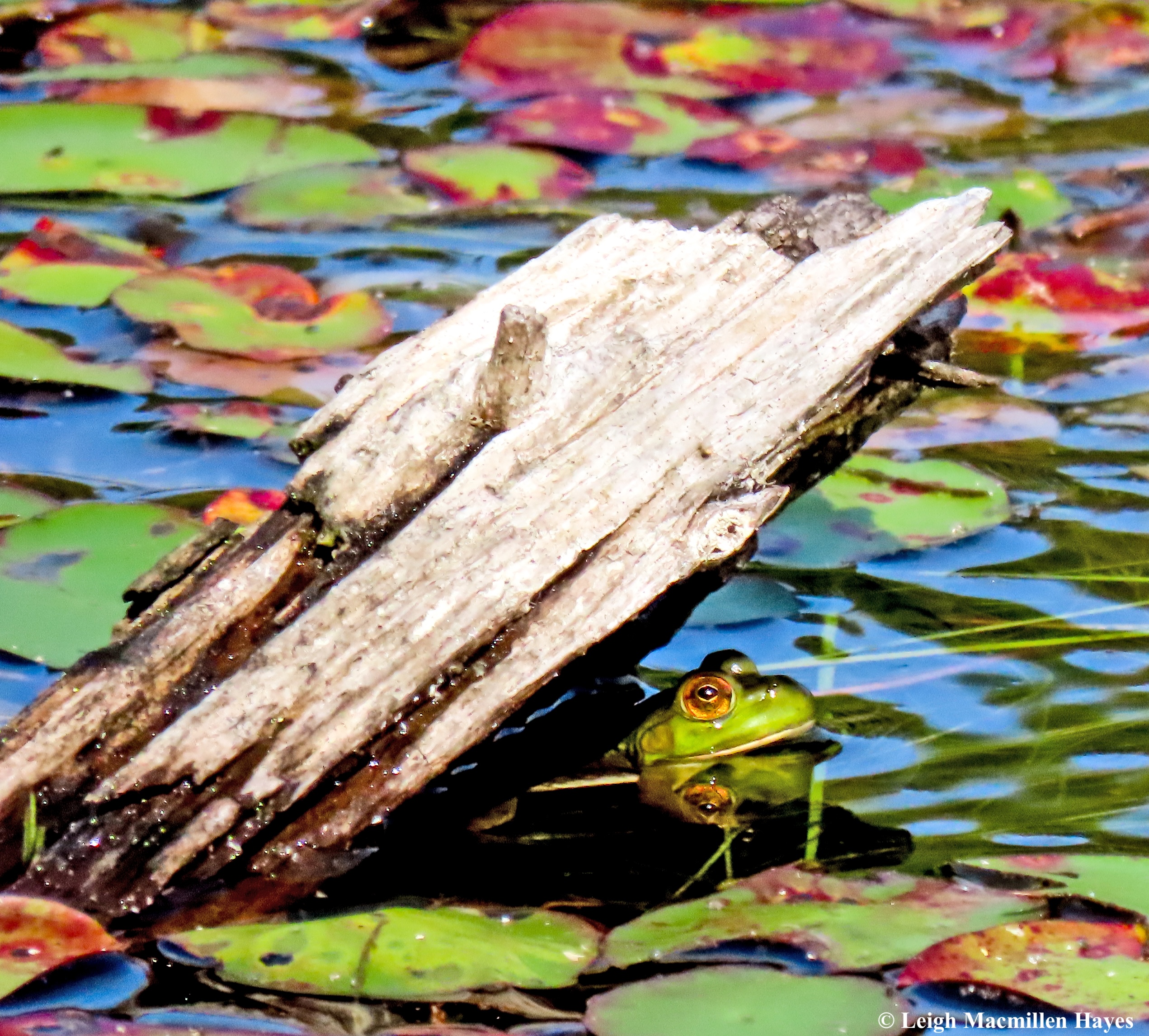
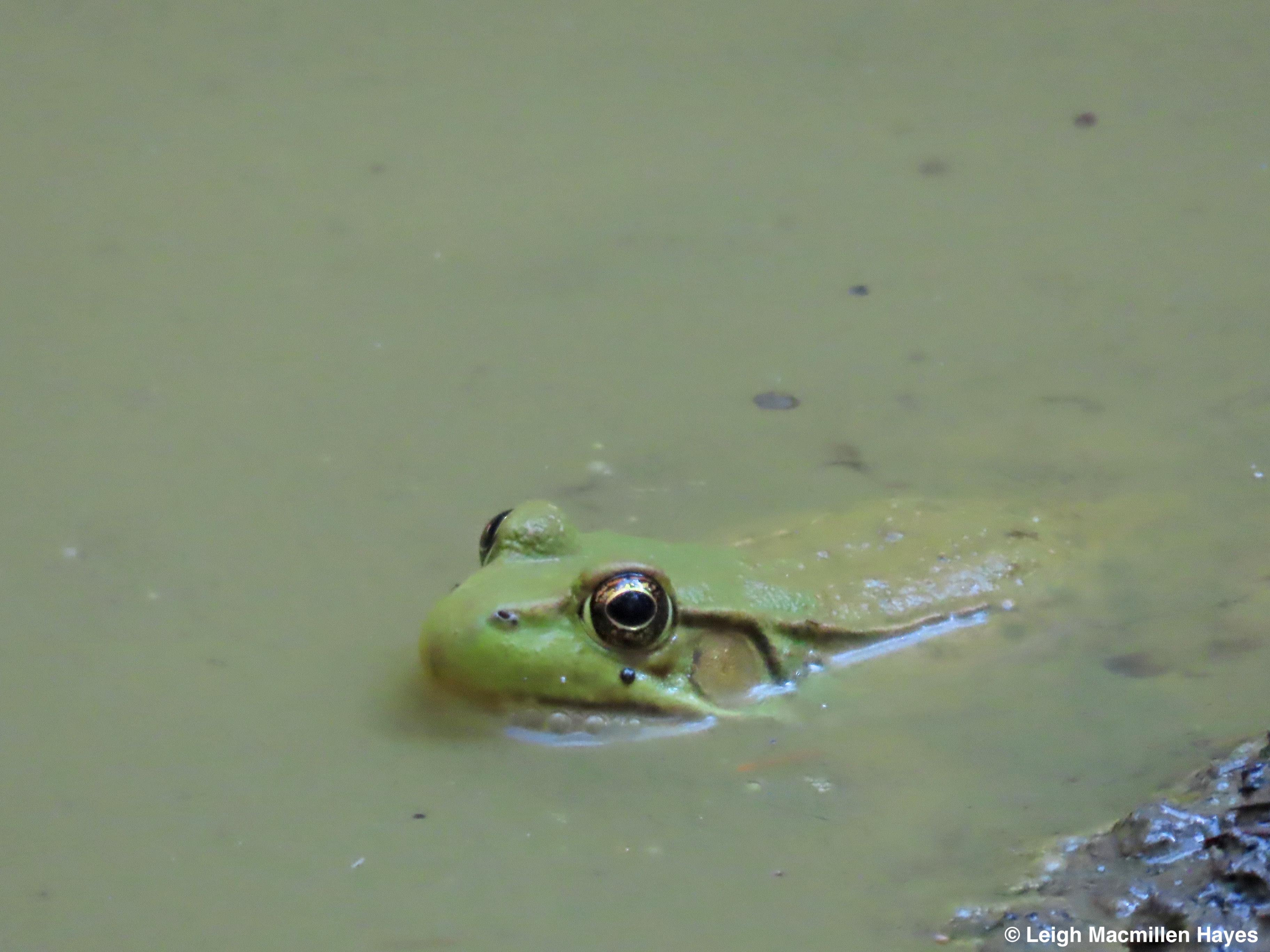
Frogs are also a highlight of a wetland, whether they are hiding in the shade on a hot summer day like this Bullfrog …

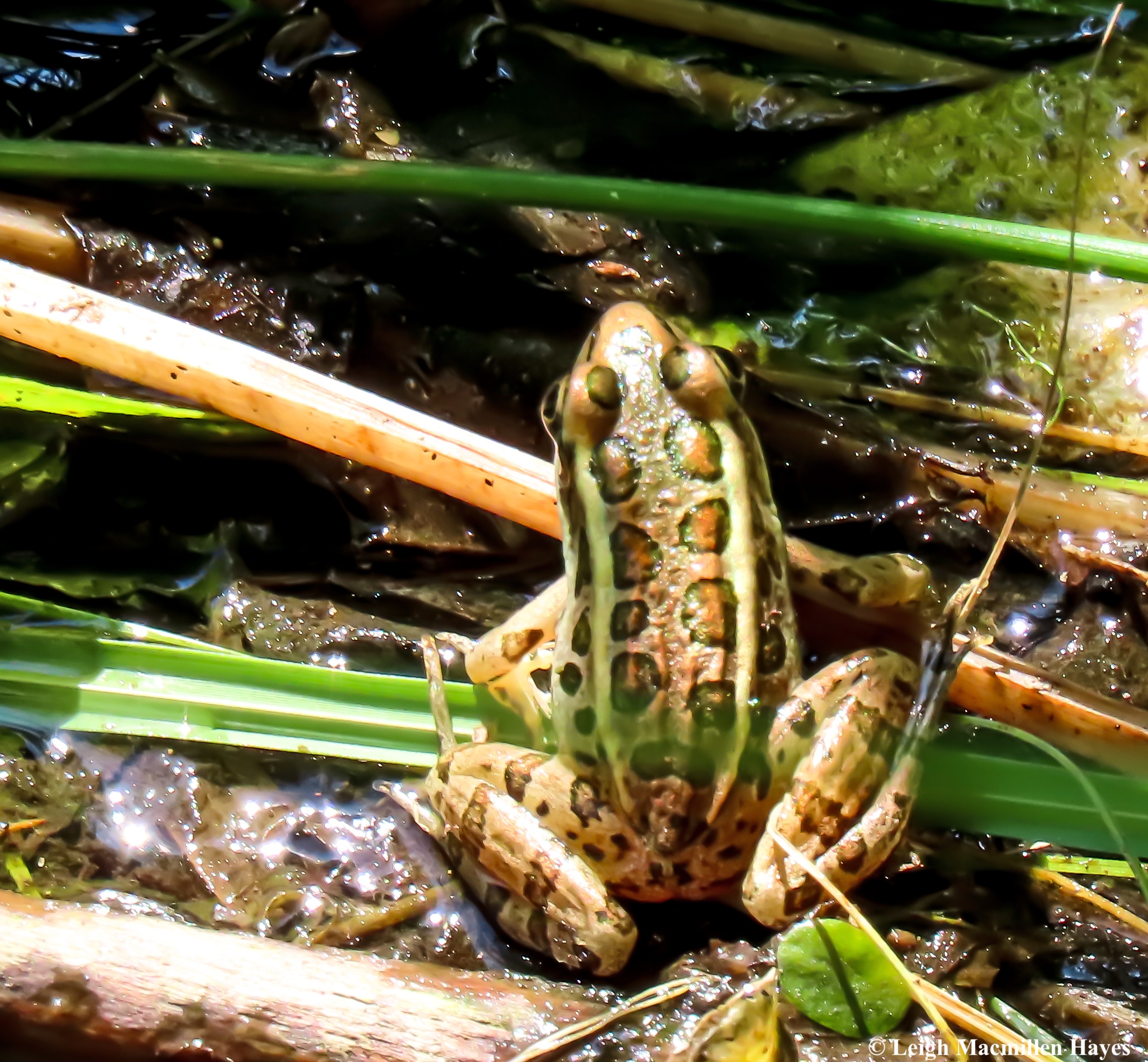
Or pausing briefly in the sun, such as this Pickerel Frog chose to do. Actually, it wasn’t so much basking as trying to remain hidden from my sight by not moving until I passed.

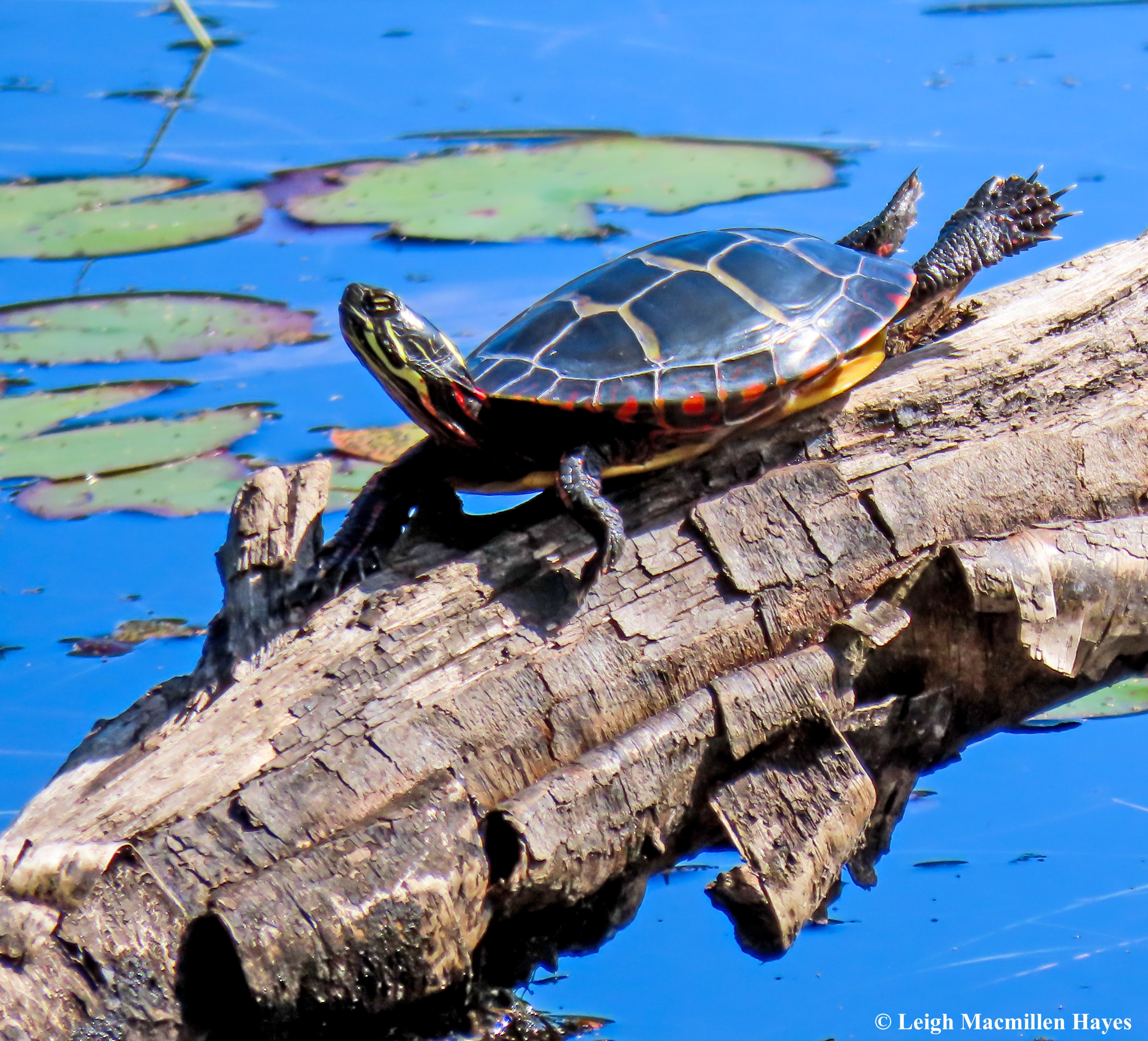
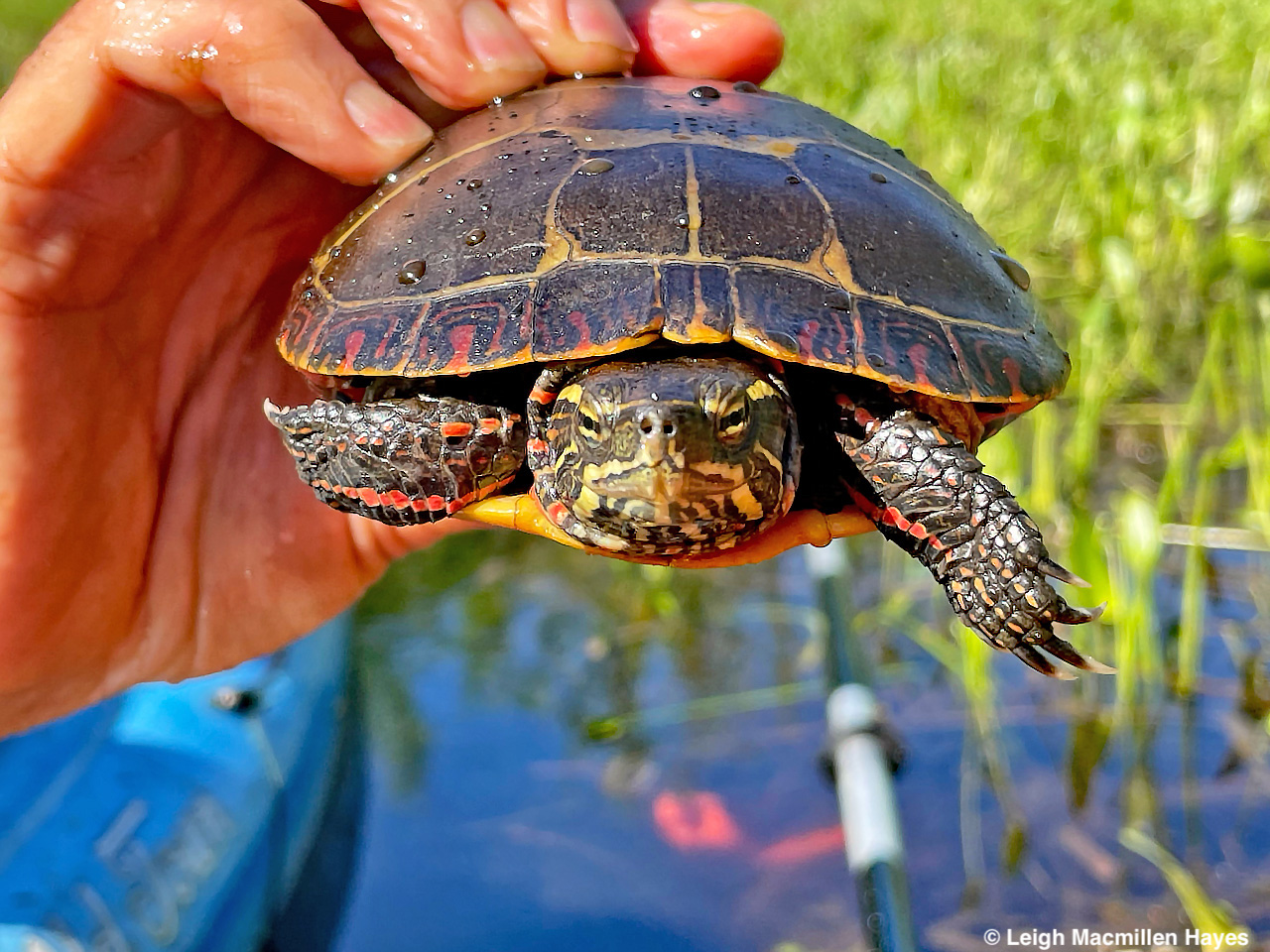
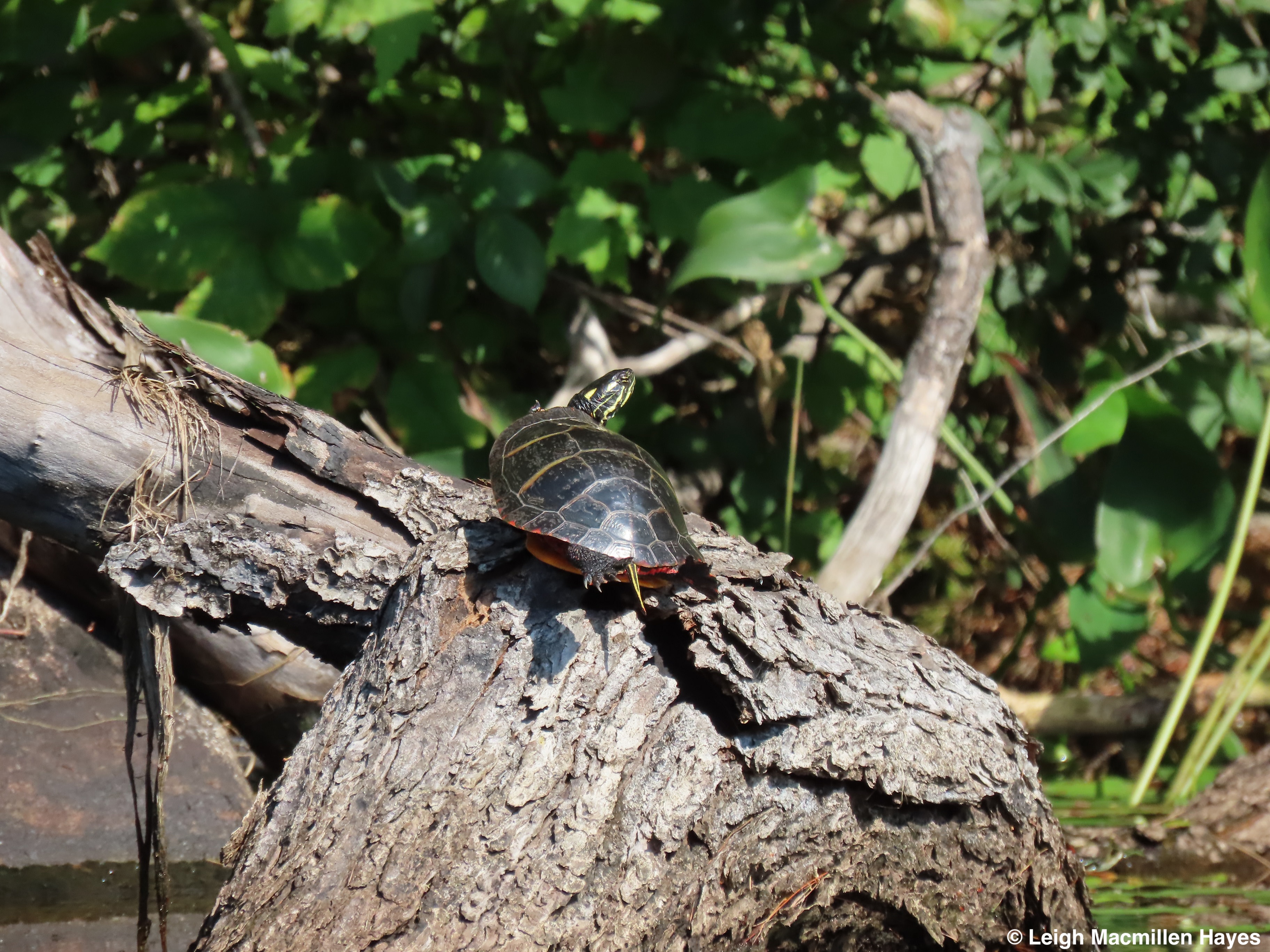
Those who do love to bask, (frogs do this as well) are the Painted Turtles, and the more surface area that is exposed to the sun’s beams, the better. Sometimes I’m surprised when I do capture a photo such as this one, for they are quick to sense my presence or hear me coming, and quickly slip into the water. But if you wait a few minutes, sometimes they’ll reemerge.

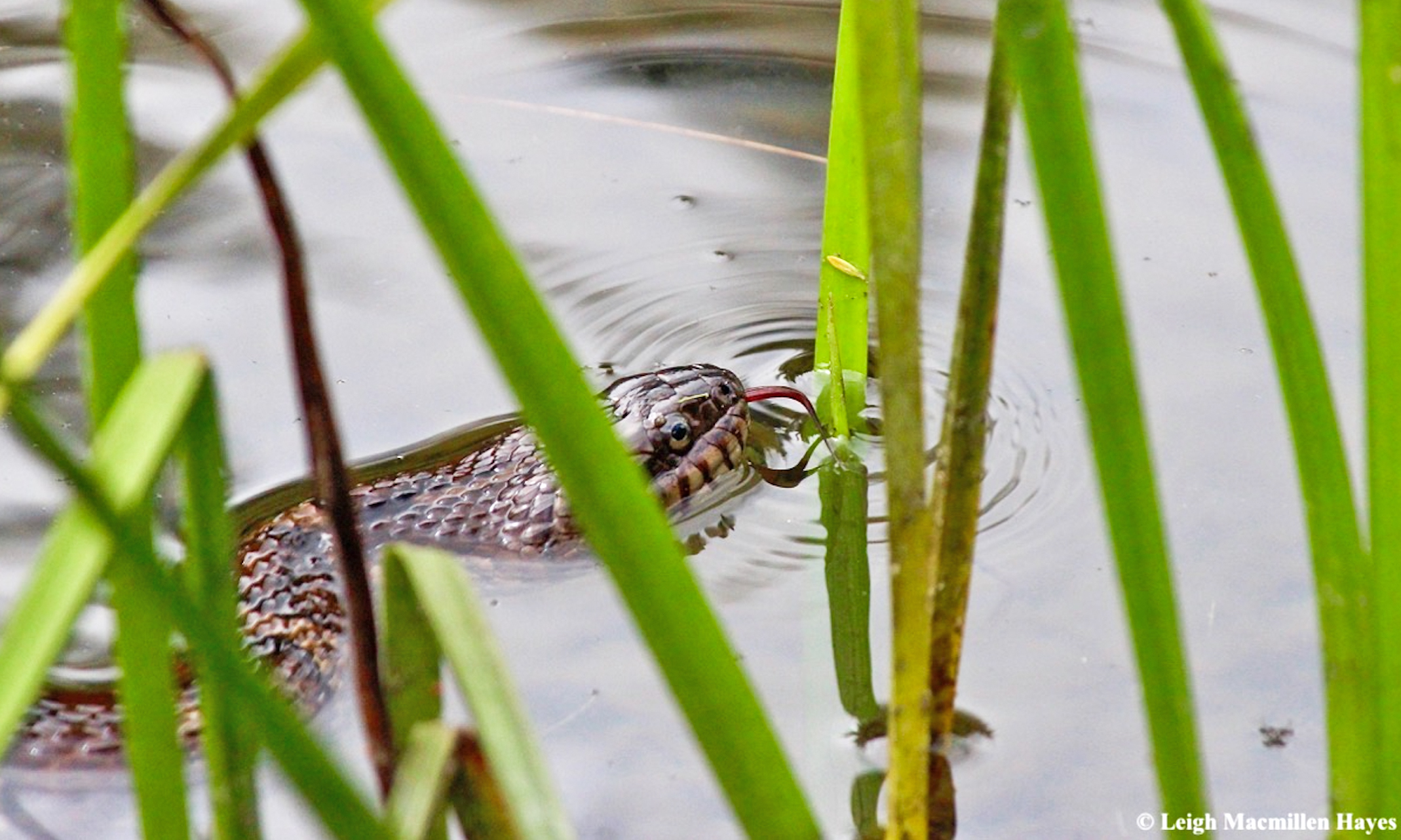
And there are Northern Watersnakes always on the prowl, using their tongues to make sense of their surroundings.

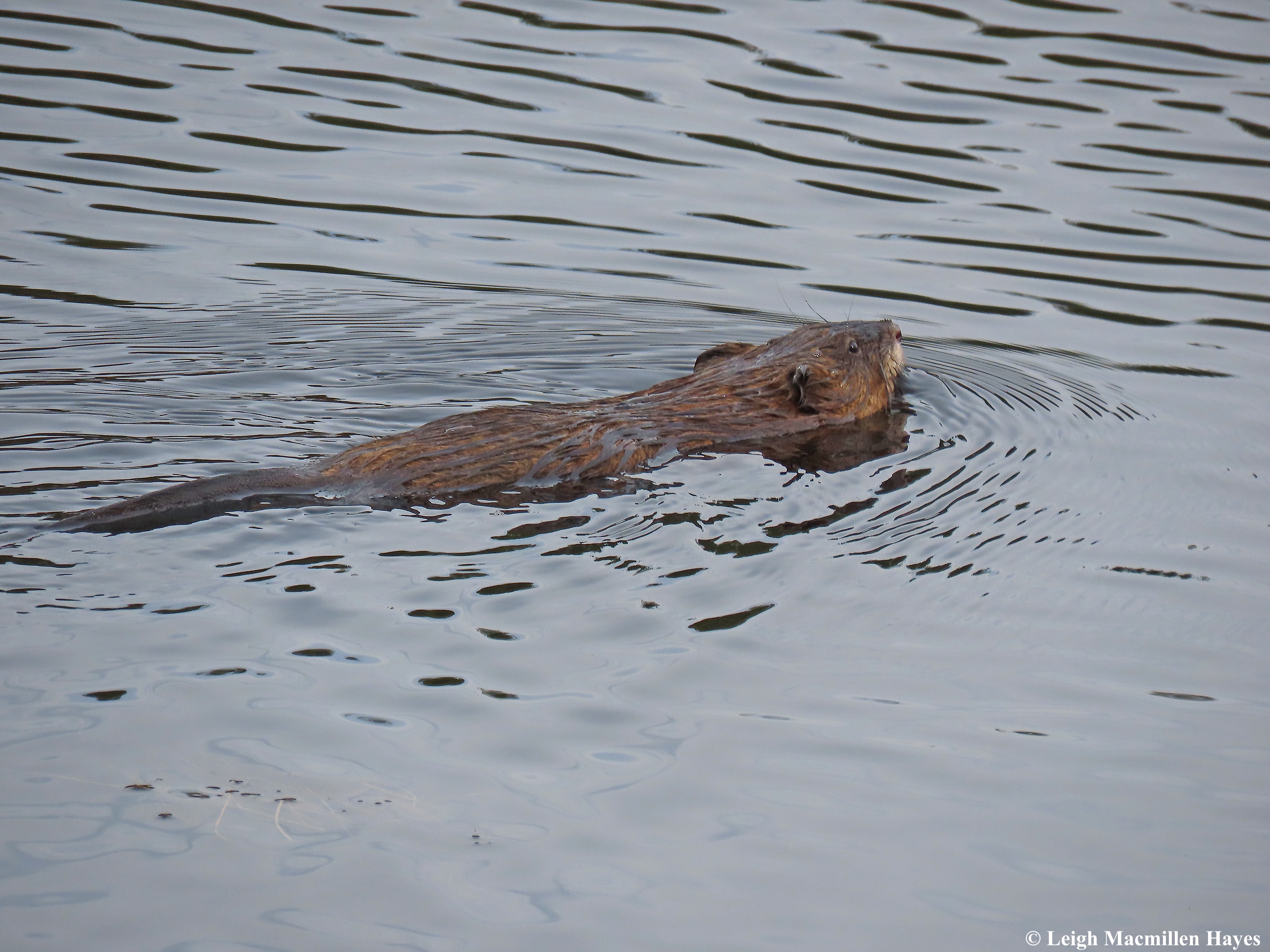
Mammals also use wetlands for forage for food and build homes and one of my favorites is the American Beaver, who knows the value of a wetland, and can create one in a short time by building a dam. Beavers build dams to created a deeper pond through which to navigate, for they are better at swimming than walking. They may alter the wetland to suit their needs for a few years, but then move on and let the dam breach and then a new type of wetland emerges and more critters move in and take advantage of what it has to offer.

That all said, it wasn’t until I spent more time with the animal pictured above that I realized it was actually a Muskrat–look at that thick, rounded tail, unlike the flat paddle of a Beaver’s.

And birds! Oh my. Mergansers . . .

And momma Wood Duck and her offspring . . .

and Papa Woodduck . . .

And Great Blue Herons always on the prowl for fish or amphibians know the value of the wetland as a food pantry.

So, this spring and summer and fall, I’ve been following My Guy and our friend, Bruce, beside and into and sometimes, thanks to Bruce’s drone, over a variety of wetlands.

Bruce is an early riser (understatement), and occasionally I’ll meet him at a predetermined location as we did this past weekend–before the sun has risen. Though the thought of staying in dreamland for another hour or so is enticing, I never regret the decision because we get to view the world before it officially wakes up.

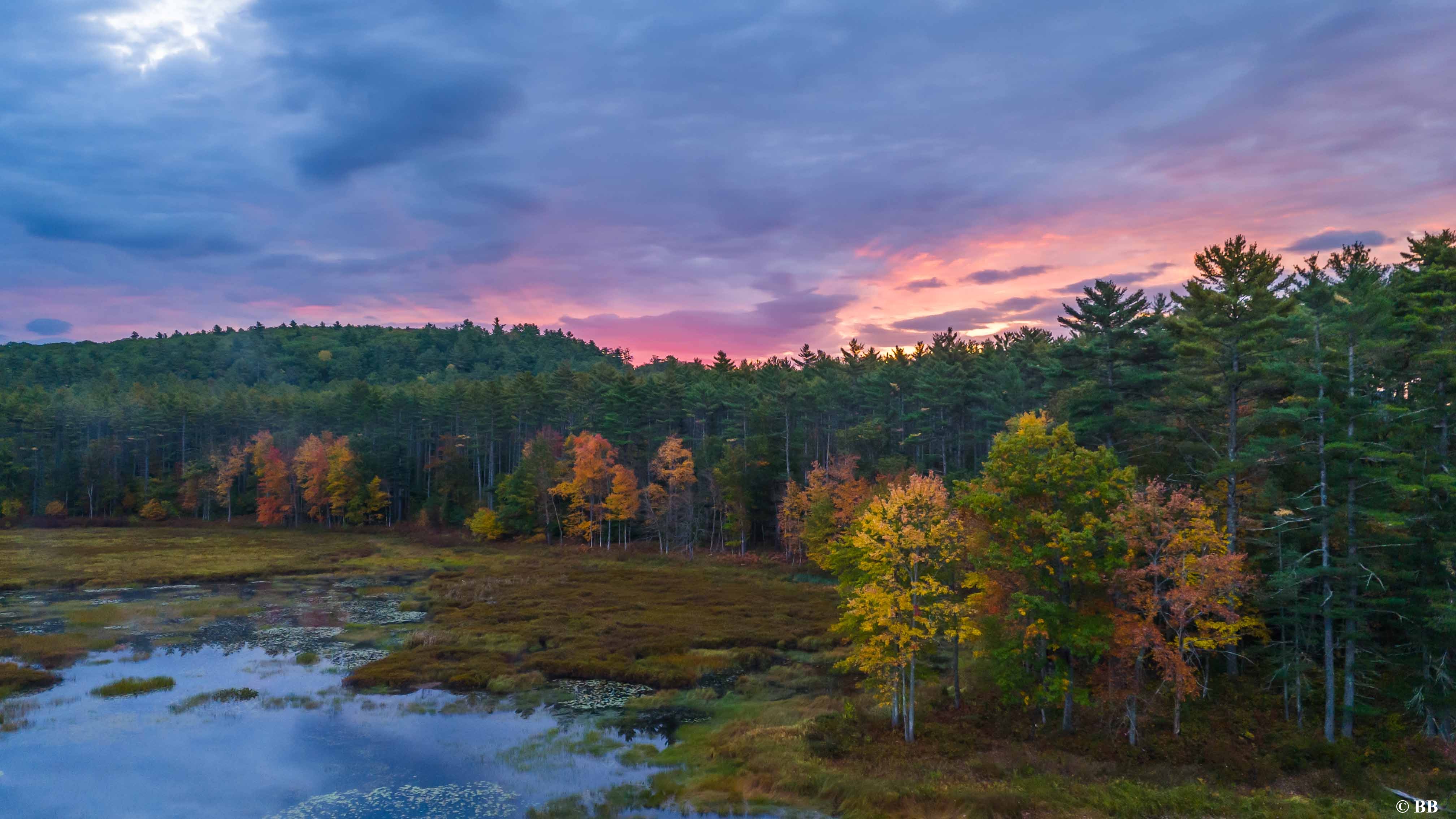
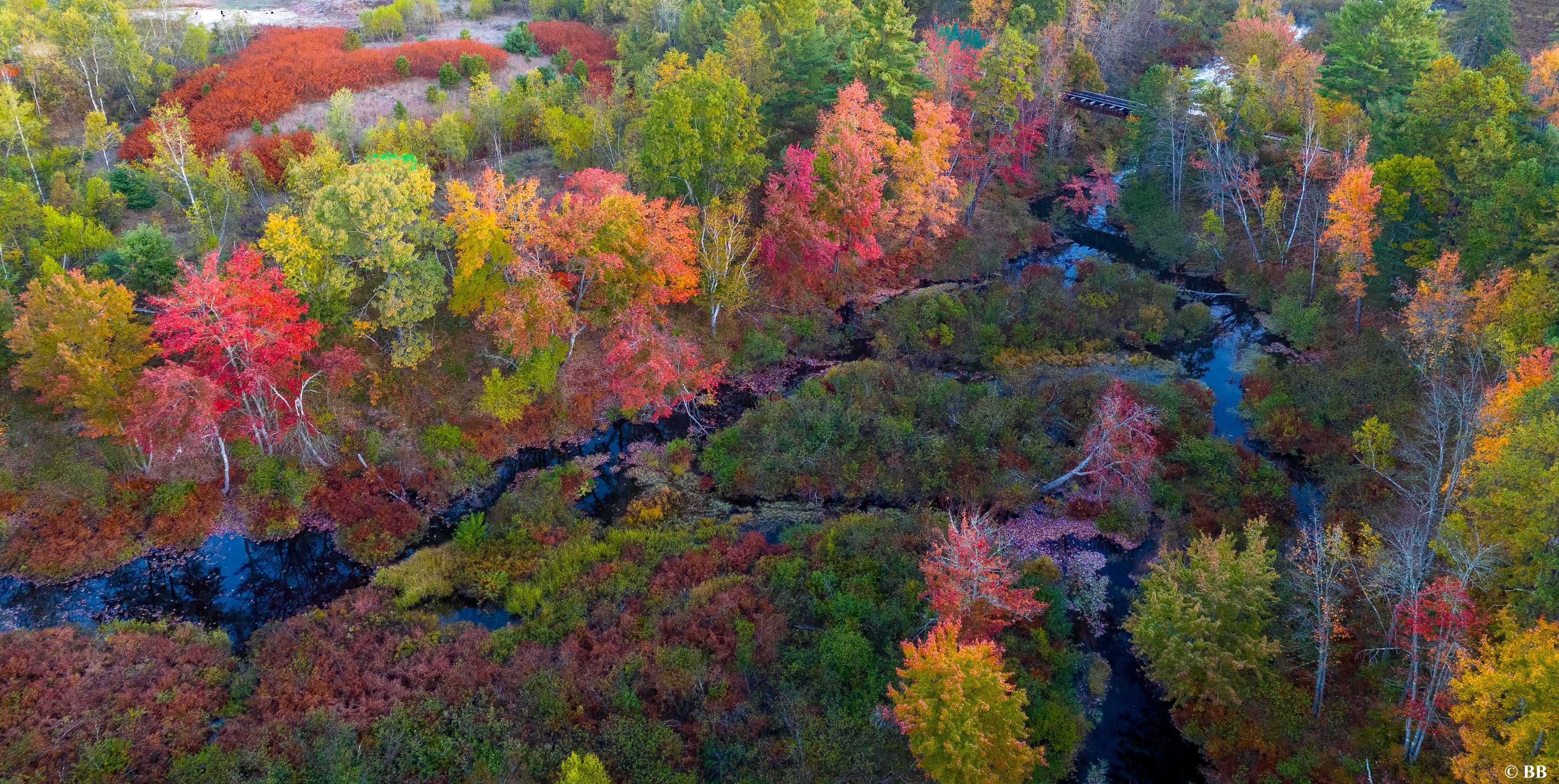
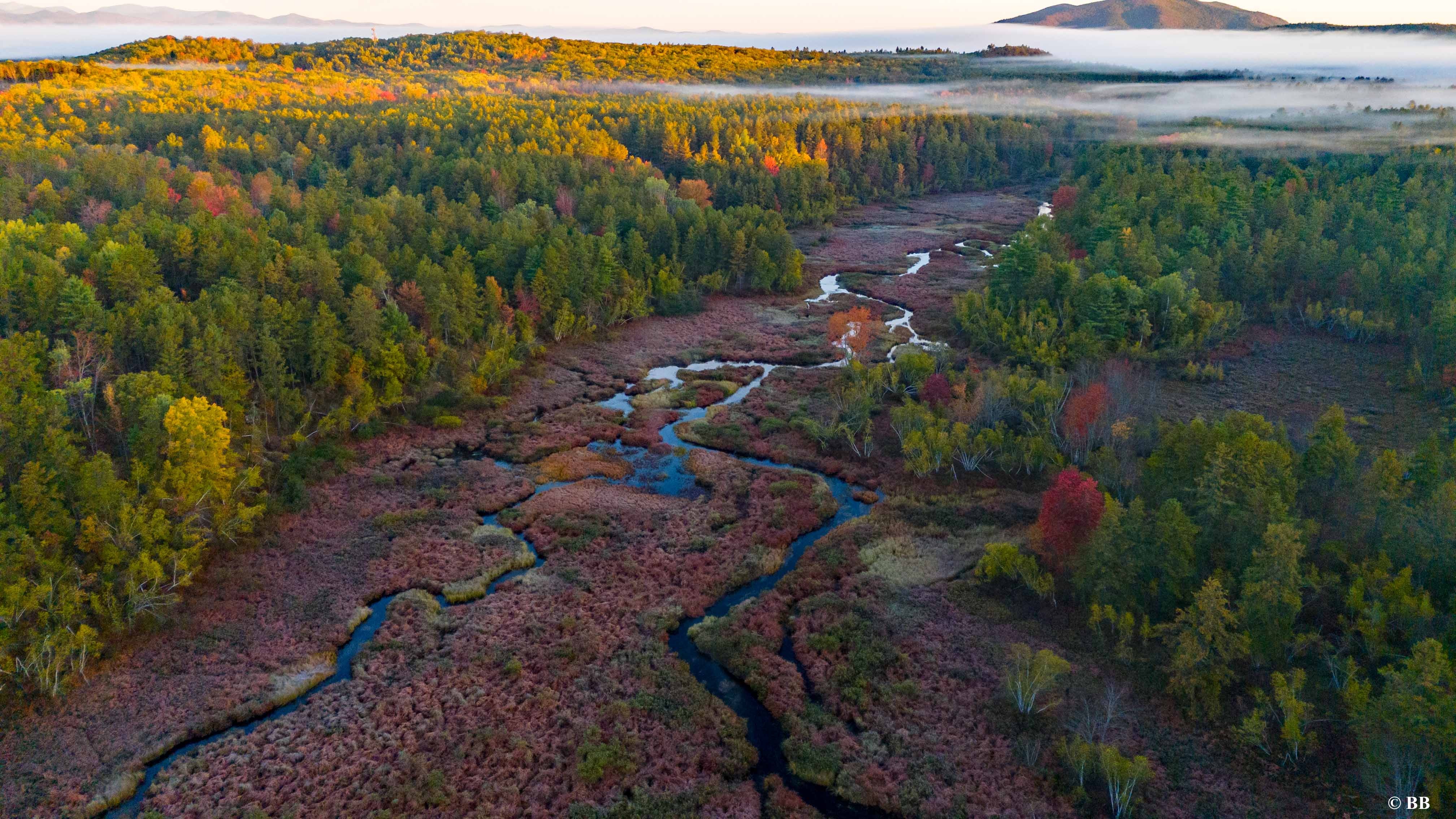
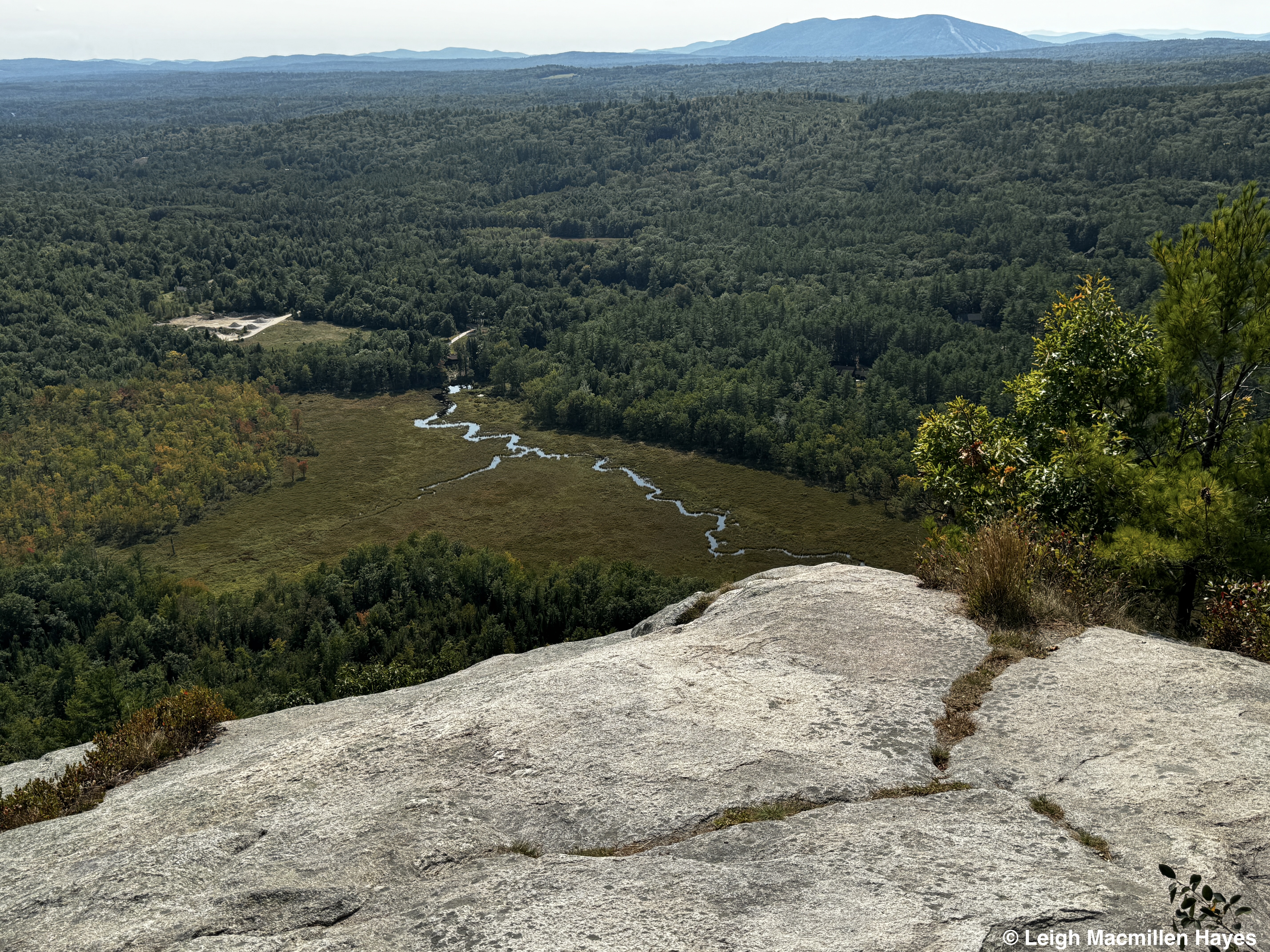
And with his drone we explore these areas we cannot easily access. This is one My Guy and I walked all the way around a few weeks ago without ever spying, though we knew it was there. But Bruce and I bushwhacked through a forest of White Pine Saplings and mature trees and reached the edge before he launched his bird and we were offered a glimpse of this most beautiful wetland with pockets of water connected by meandering rivulets.

The stream turned to forest for the trees told more of the story, as they closed in and I recalled that it wasn’t far from that spot that My Guy and I walked through a damp area where Royal Ferns grew and we found one teeny tiny mushroom fruiting on a hot summer day.

The mushroom was the little Orange Peel Fungus, and its name seemed so obvious. And the soil moist despite the severe drought.

Another day we began our exploration in the afternoon beside a small pond.

And the Droney-bird picked up on the wetland to the south.

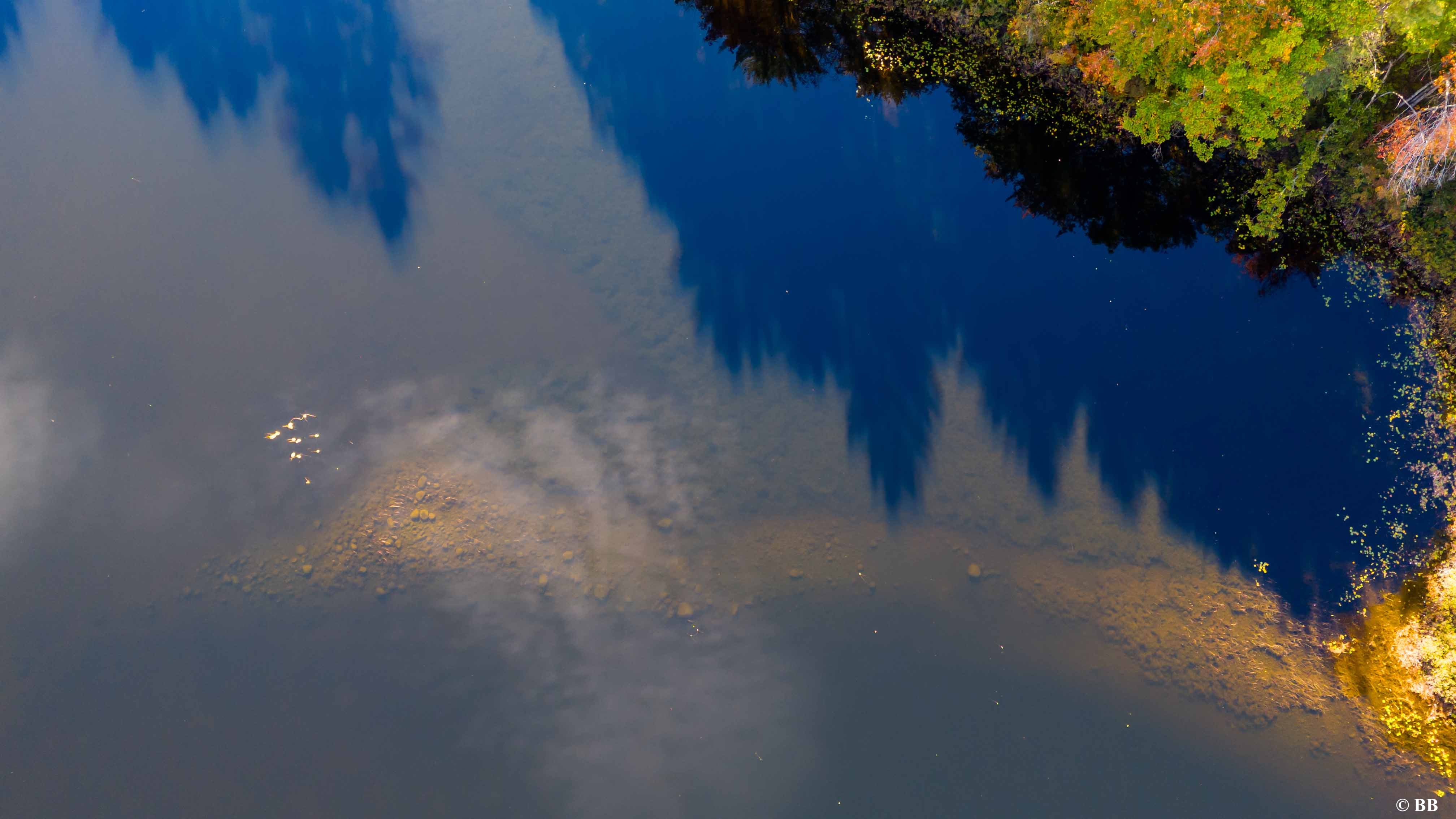
But that day what struck us as being more important was that it also took a clear picture of a sandbar in the water.

And as Bruce navigated it closer to the watery surface, we could see clear to the bottom. Mind you, it’s not a deep lake, but this is the water of Maine. Clean and clear.

And we celebrate wetlands for the critical role they play in maintaining the health of the environment.

When I think about their ability to store and filter water and act as a natural sponge, absorbing and retaining large amounts of water during the heavy rainfalls of spring, and removing pollutants before they enter streams, and rivers, and lakes, it all seems so obvious that they should do this when you have a bird’s eye view.

So here’s the curious thing about this wetland. It is located beside a local dump. And the more I think about that, the more I question those who created the dump, but give thanks for the unwavering workhorse that this wetland is in the ecosystem.

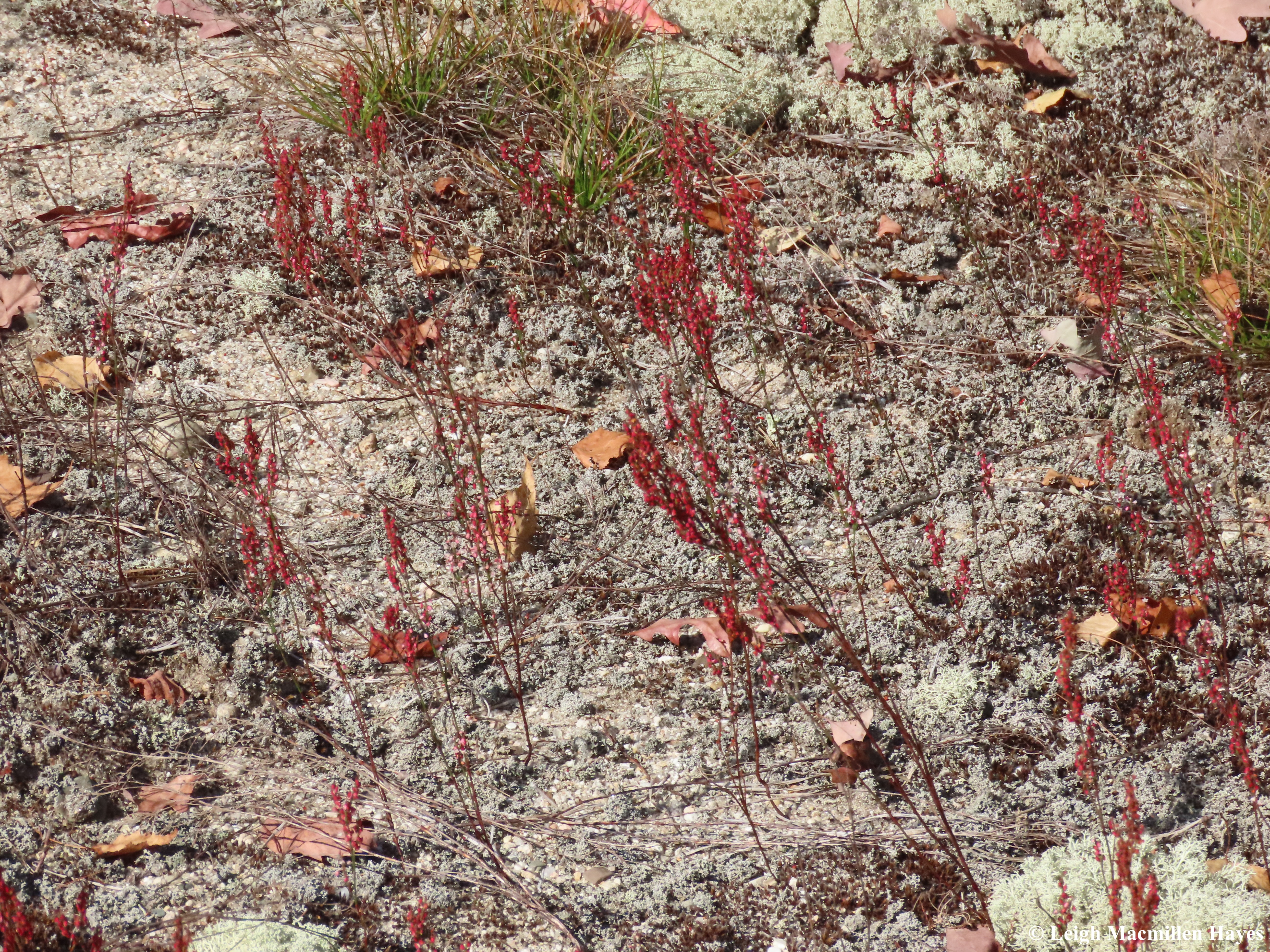
It was on the rise above this particular wetland, in a very sandy spot covered with Reindeer Lichen, that Bruce and I made a discovery. Well, he discovered it first and asked for an opinion. I’m full of those and so I met him and we took a look.

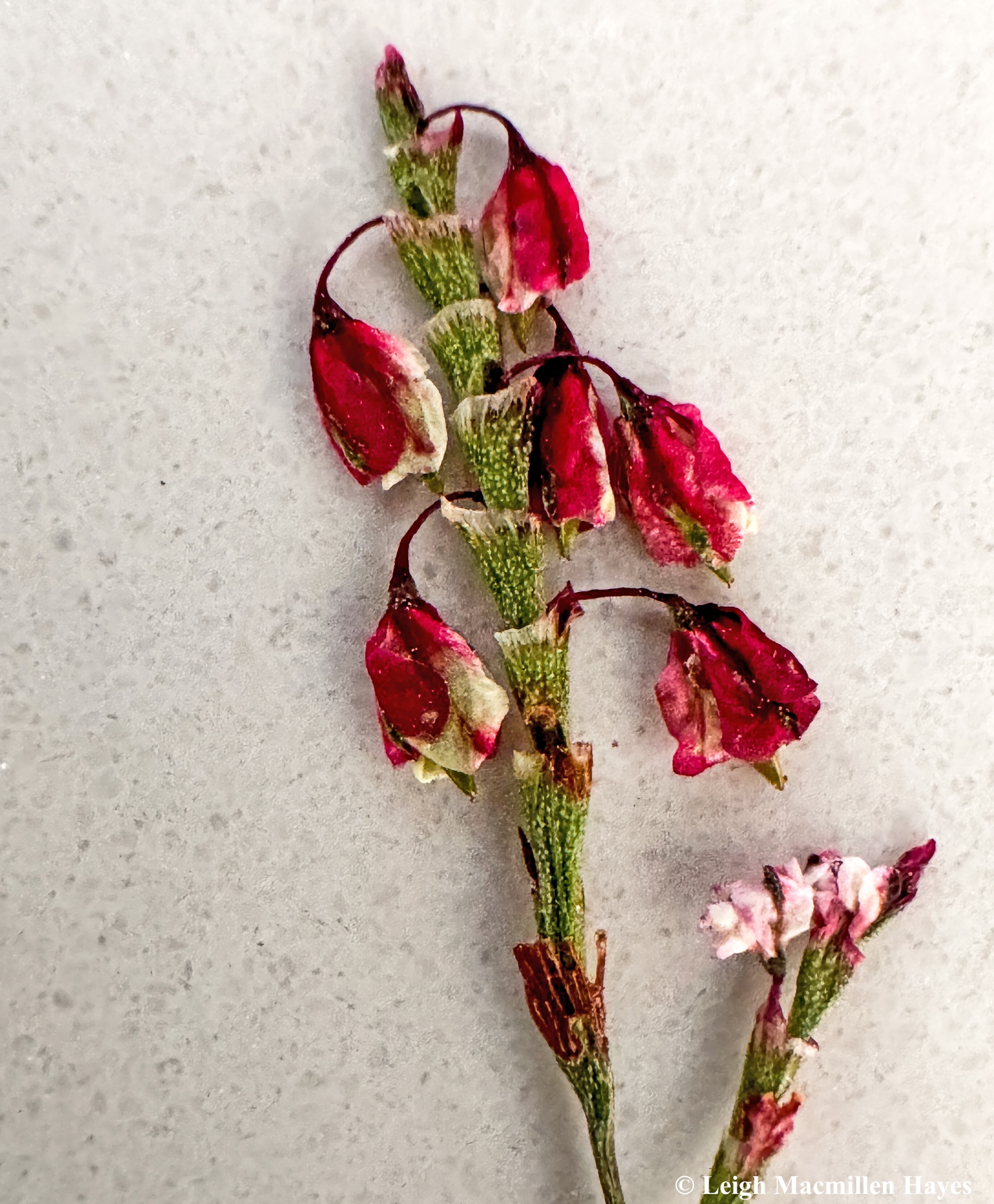
The discovery was a plant new to us both. Sand Jointweed or Polygonum articulatum. As you can see, the flowers are astonishing in their pink and white display.

It was the stems that I found equally fascinating. At the base of the flower stalks there are sheathing bracts, giving it a jointed or segmented appearance. We didn’t see any leaves, but perhaps we need to look again. I think we were just amazed to have discovered a plant neither of us recalled meeting before. Often though, that means we’ll meet it again soon.

The small snippet followed me home, and today I looked at the flowers under the microscope and I was astonished to realize that they look rather like a map of a wetland.

I don’t jump at the invite every time it arrives for an early morning mission to explore a wetland, and one day really regretted it because when My Guy and I finally got to the location, we found a note with Bruce’s observations. We scanned the area with our eyes for about an hour before deciding that we were too late.

But . . . we promised ourselves that we’d pack a picnic supper and try again.

First we spotted one Bull Moose.

And then a second, and had a difficult time deciding that we should head home.

Did you know that 25% of Maine’s land area is wetlands? That’s four times the wetland area of the other New England states combined. The natural buffers they provide sustain the deep clear water we appreciate, and take for granted.

The margins or places where the land and water come together are bridges between two worlds. As many as 90% of all living things in our waters are found in these wetlands, no matter what form they take. I guess that’s why I love exploring them so often, because there’s always something to see. And another lesson to learn.

I leave you with this, a watercolor Bruce’s wife Eileen sent me recently. It was inspired by one of our local wetlands.

Some may see wetlands as dark and shadowy areas, mosquito hatcheries, with an abundance of leeches mixed into the scene, but the rest of us know their true value and I give thanks for living in this place where it’s so easy to go Bogging in Maine. And to share it with others. Thank you MG, BB, and EJB!

Zodiac Three: A Perfect Picture

The message arrived again for a boat trip, but this time the meet-up time was 5:30am, rather than 6. So I set my alarm for 4:00 in order to have an hour of quiet time to greet the day in darkness as I read and meditated and reflected and sipped coffee.

It was still dark when I arrived at the Captain’s home and hopped into his truck, with the boat in the back.

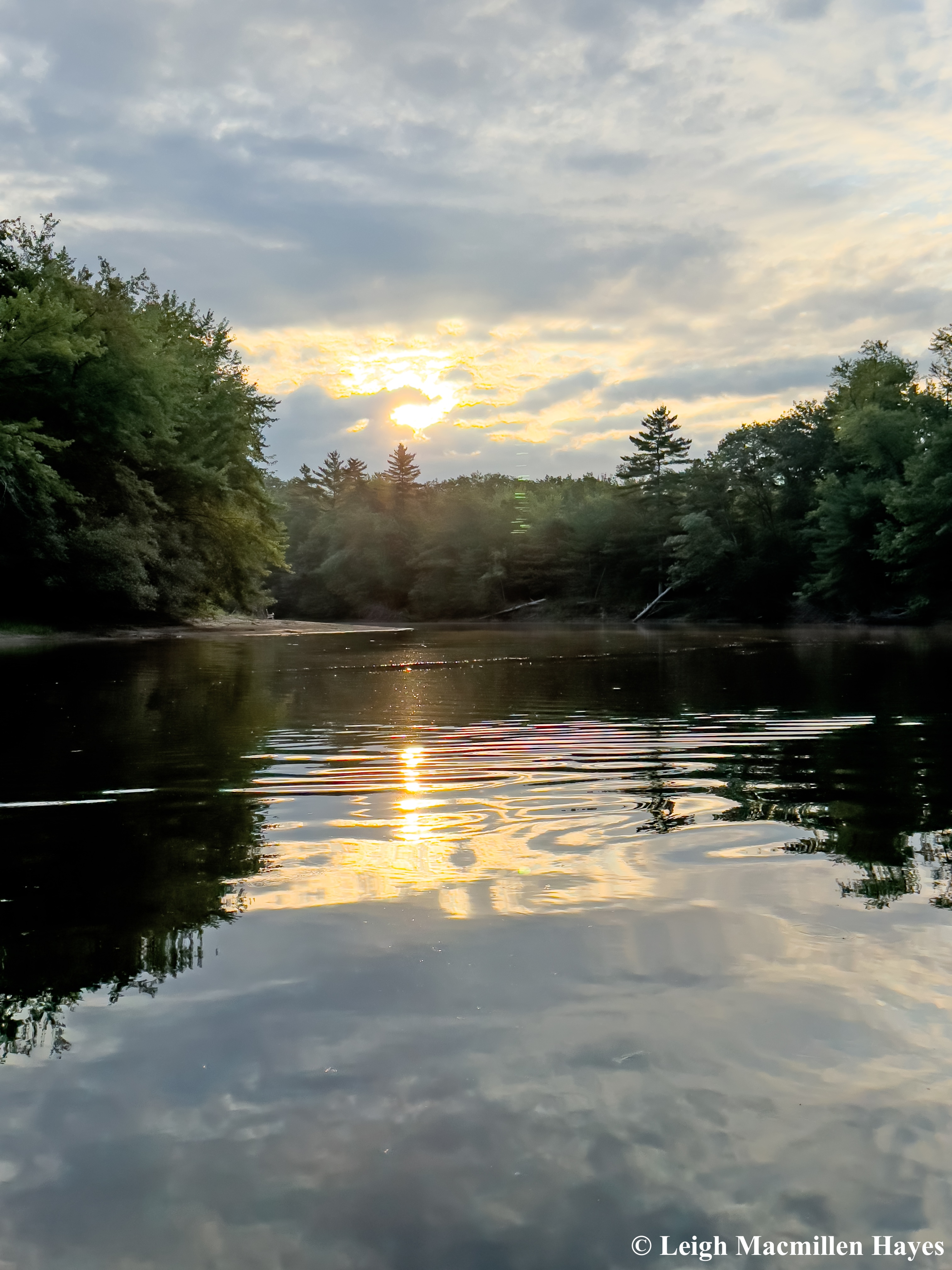
About ten minutes later we were in Hiram, Maine, at a boat launch along the Saco River. It’s been his dream for three years to make this journey and I love that I get invited along for the adventure.

I would have written about Zodiac Two, when we cruised along (with a small electric motor) the Old Course of the Saco in Brownfield Bog, but my photos were all out of focus and so since then he has given me a photography lesson and many tips.

The sun was just brightening the sky as we headed upriver, a smart plan in case the motor’s battery ran out of juice and then we could paddle and float back to the launch site.

I’ve been on the Saco a bunch of times in a variety of boats, but neither of us had ever explored this section below the Brownfield Bridge and I was struck by how calm and clean it was. The water is also quite low–thanks to the drought that we’ve been experiencing again this summer so we had to be aware of sandbars and stumps and logs and rocks. Well, actually, any time you are on the river, you have to be aware of obstacles.

As we started the journey a dragonfly landed on my leg, and she proceeded to try to lay eggs. Have you ever felt the tip of a dragonfly’s abdomen try to pierce your skin? It’s a bit of a prickle. While she was doing that, I tried to snap a photo, but neither she nor I were successful. Still, I counted her as a good omen.

Sometimes, as we gently cruised along, we each took photos of the same scene, so some of these are his used with permission, and others are mine.

The reflection of the shoreline was one that struck both our fancies. We didn’t talk about it, but it was the layers that intrigued me and reminded me of the force of the water in this mighty river that originates in Saco Lake at the top of Crawford Notch in New Hampshire and winds its ways with a million oxbows to North Conway, NH, and then into Fryeburg, Maine, and across the state before it flows into the Atlantic Ocean in Saco.

Sometimes we realized we were looking at Silver Maple floodplains and other times there were steep cliffs. Always, we knew if there was a house or camping trailer near the edge, because they seemed to be located on high ground, but all the trees were cut between their high ground and the river to provide a view, and the result was intense erosion. One person even had several tarps draped over the ground in what we figured was an attempt to stave off the erosion. We think leaving the trees and trimming branches would have been a better choice, but no one asked us.

Another sign of erosion, the visible roots of many, many trees, also created works of art and my brain is already painting this scene in the future . . . maybe.

And then there was this work of art–a Silver Maple Lollipop, its leaves already shutting down chlorophyl production perhaps as a result of the dry spell we’ve been experiencing.

Slowly the sun rose and the water captured the sky in whirls and swirls and rainbows of its own making.

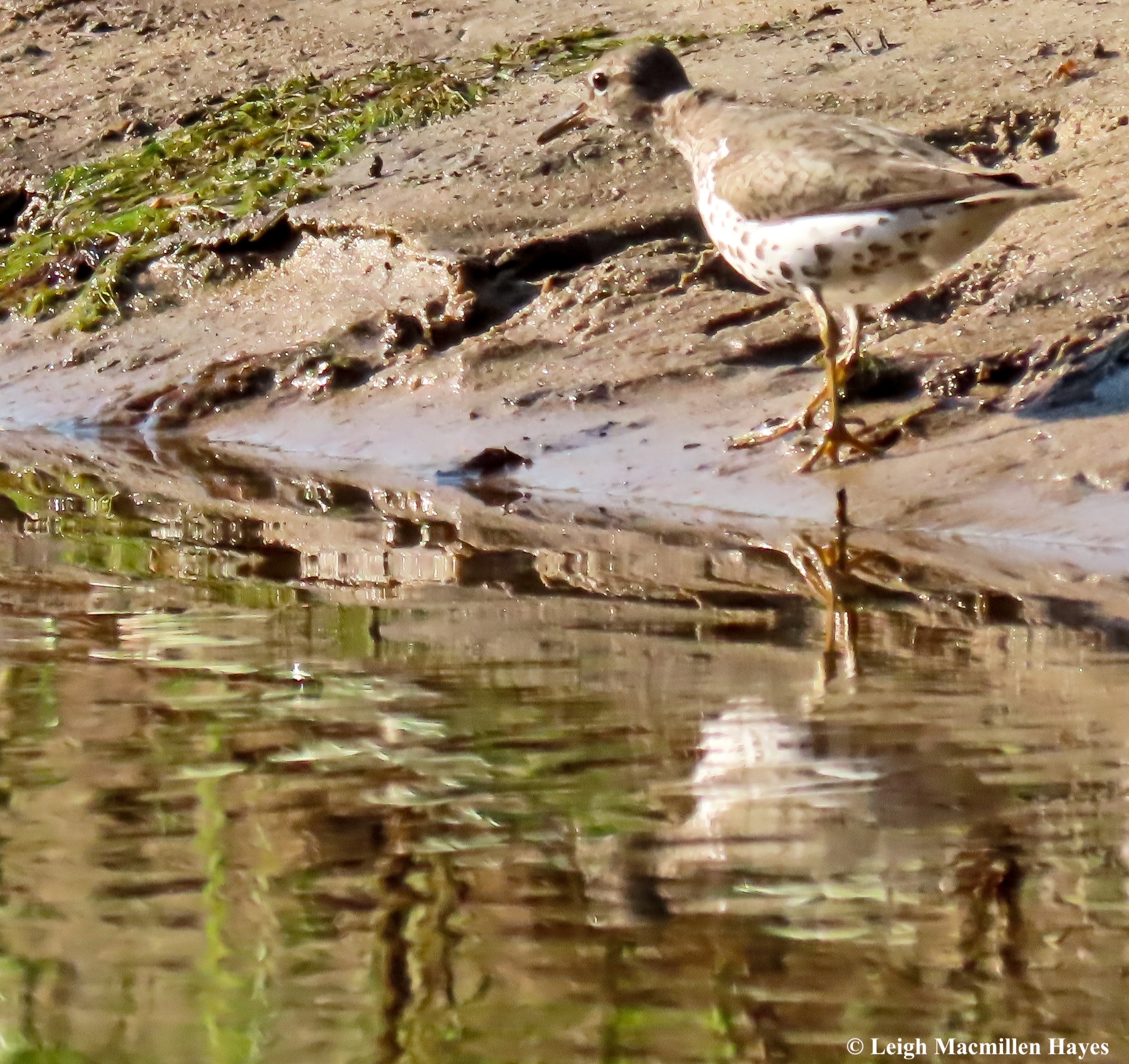
We’d both headed into this boat ride expecting to see birds, which we did, but we really expected Great Blue Herons and Bald Eagles. The drama artists. Our best sighting of the day was this Spotted Sandpiper, who walked along the river’s edge and then flew ahead and landed and did the same thing all over again. Over and over again.

Once the sun was fully up, our day turned into a bright one, and we had a nice breeze to accompany us. Plus tons of dragonflies and a few damsels, all of whom did not wish to let the paparazzi photograph them. Still, we gave thanks for we could see bugs in the air, but nothing attacked us, unlike during our Zodiac One and Two trips.

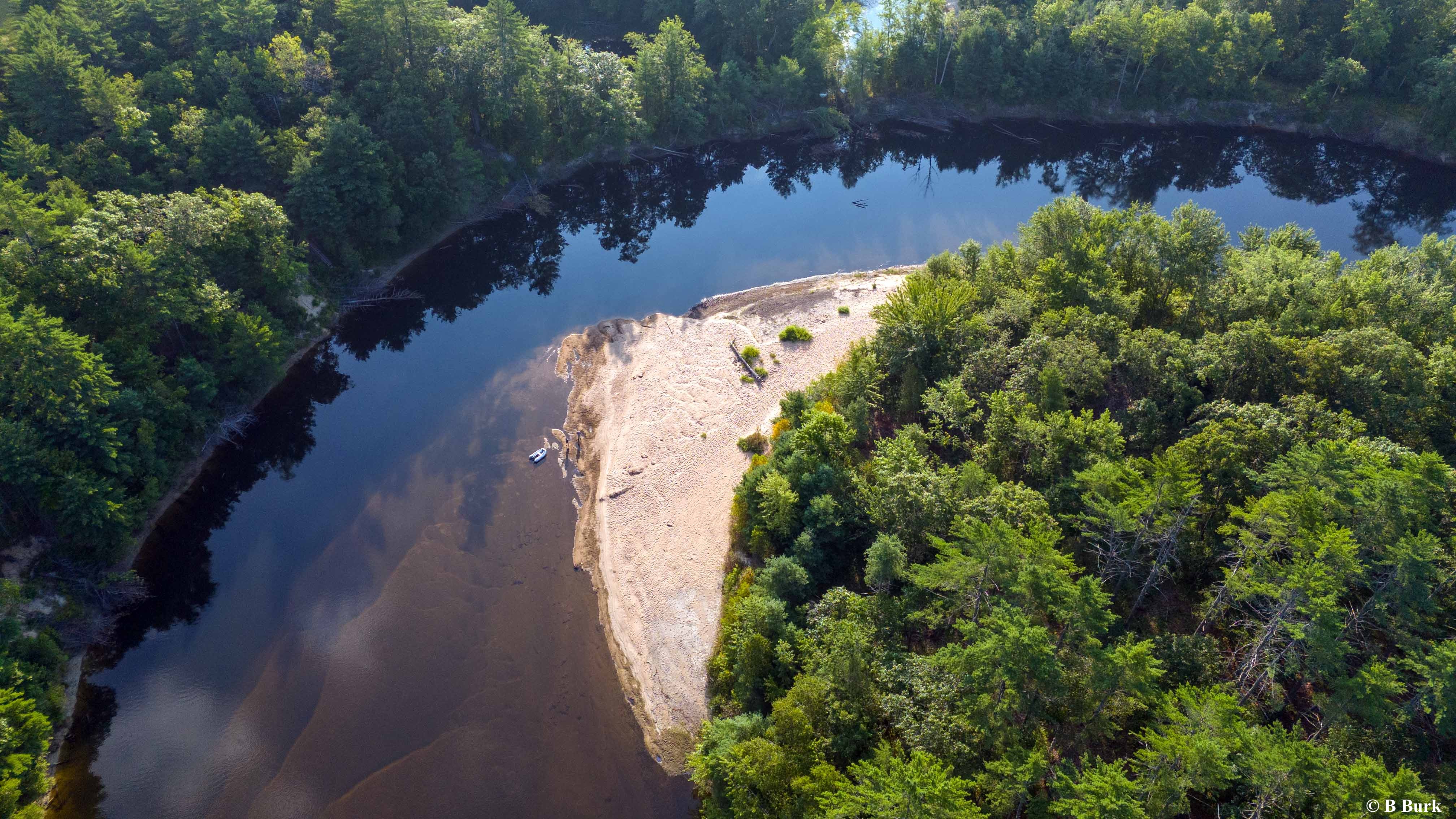
At what became our turn-around point, we got out of the boat and waded through the water to a beach, where Captain B set up his drone.

Above us, the waning moon stood out in the Bluebird Blue section of the sky.

The drone allowed us to see the lay of the land, and despite the fact that I’ve seen it recently from Mount Cutler while hiking with My Guy and a friend, I was once again reminded just how beautiful this area is and how small we are.

Do you see that beach in the river’s bend? We were standing there.

You might be able to see the Zodiac now.

And the two of us near the boat. Plus the indentations of a million duck and goose footprints. A flock of something skittered and flew off as we approached this spot, but they were too quick for us to identify.

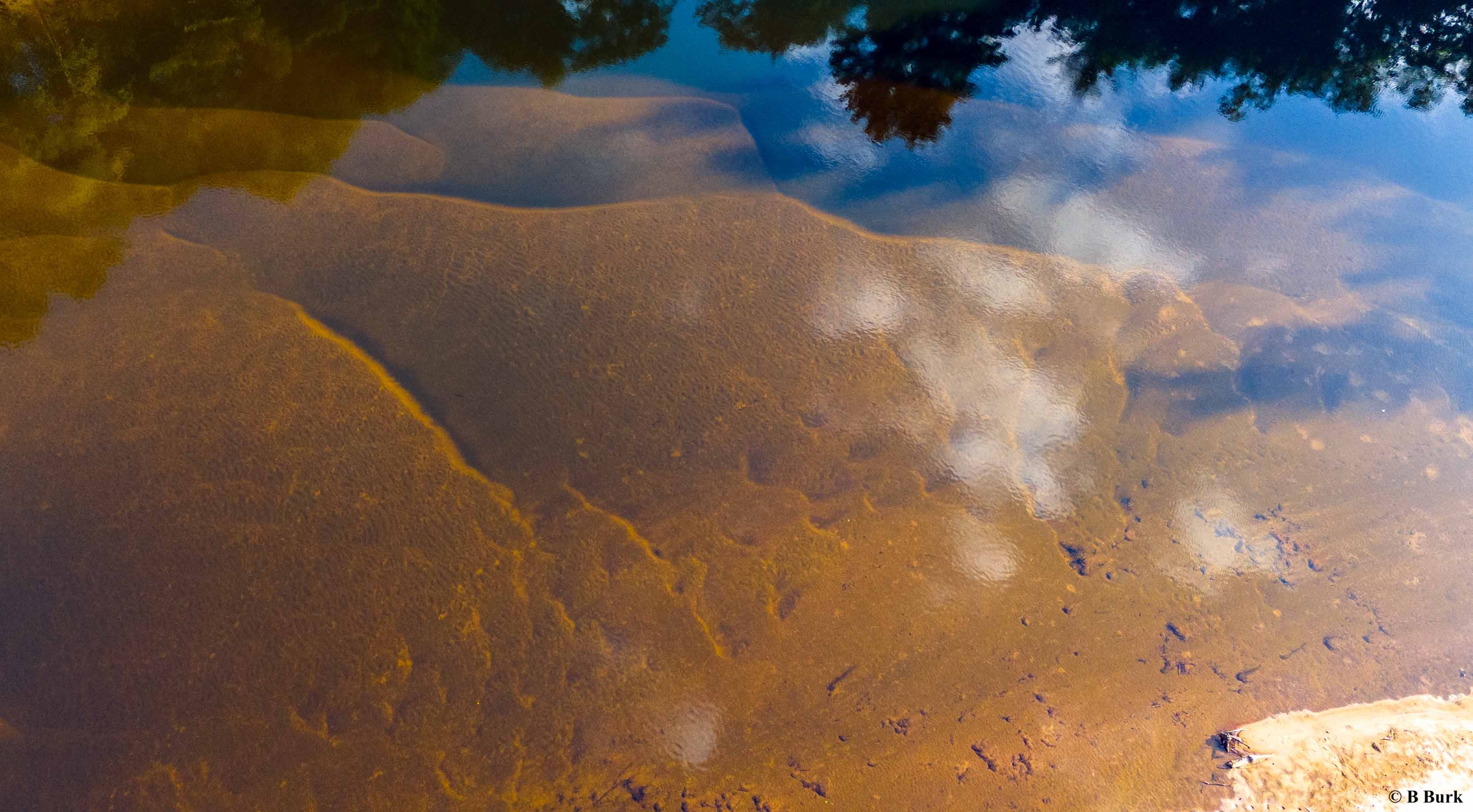
The drone also gathered this shot of the layers of silt in the water. Or maybe we weren’t really on the Saco, and had instead taken a trip to Mars? Oh, but wait, there is a reflection of trees that very much spoke to our being in Maine.

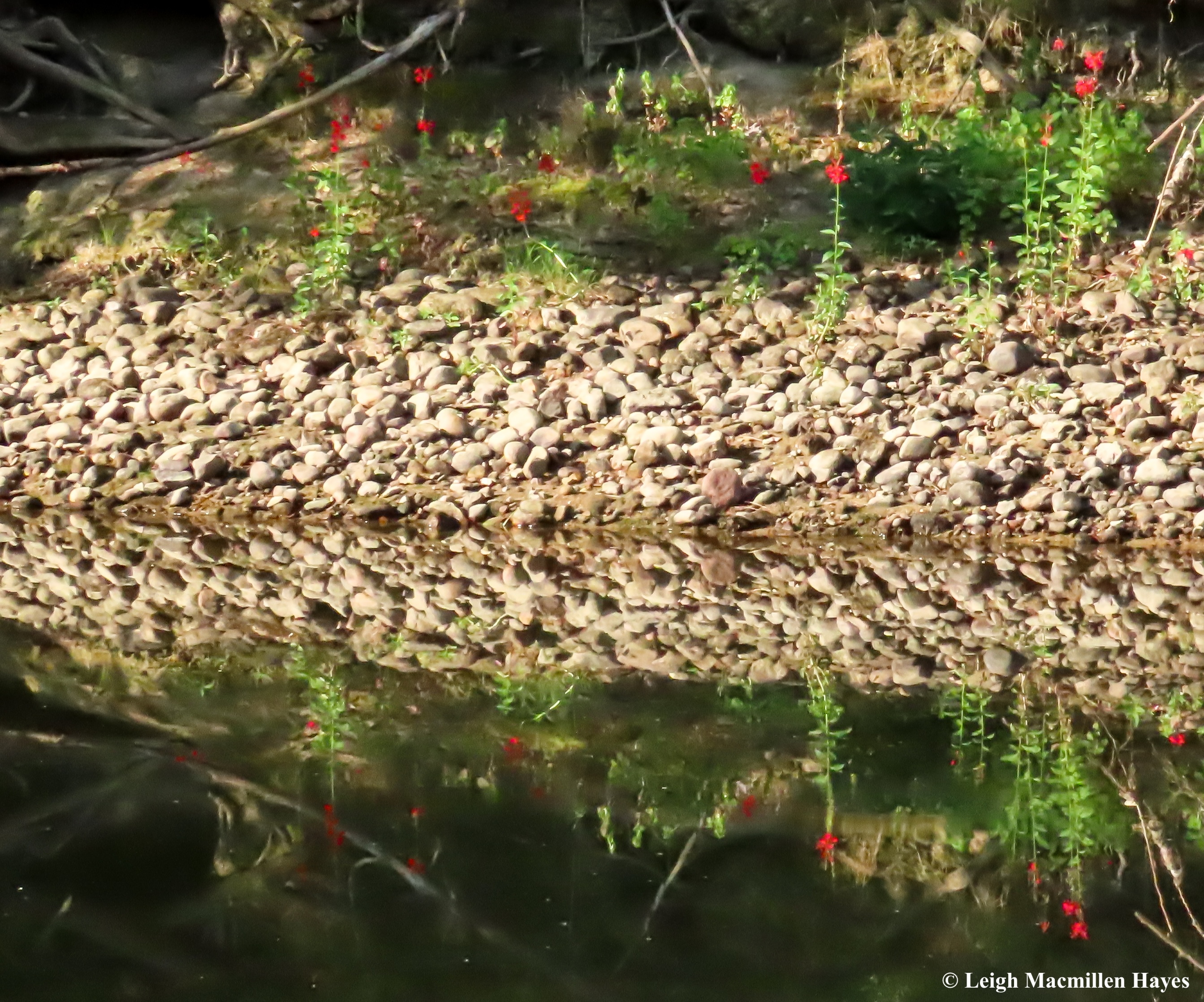
On the way back, we spotted Cardinal flowers that we somehow missed on the first leg of the journey. They decorated a few sections of the shoreline and maybe stood out more because the sun was shining so brilliantly on them.

For Captain B, it was a new flower to add to his list. For me, it was a sign that it is August and we were by water because they do like wet feet.

We also spotted one tiny Painted Turtle that didn’t seem at all bothered by our presence. I’d really wanted to see a turtle, so was thrilled with this finding. But surprised that we only saw one.

According to my GPS, our trip was four miles in each direction, but then I realized that the APP cut some corners, so maybe it was 4.5 miles one way. Plus I forgot to start it until after we’d left the beach.

The length wasn’t really important. It mattered more to have the opportunity to discover this wild and scenic and quiet section of the river (and not have to paddle!).

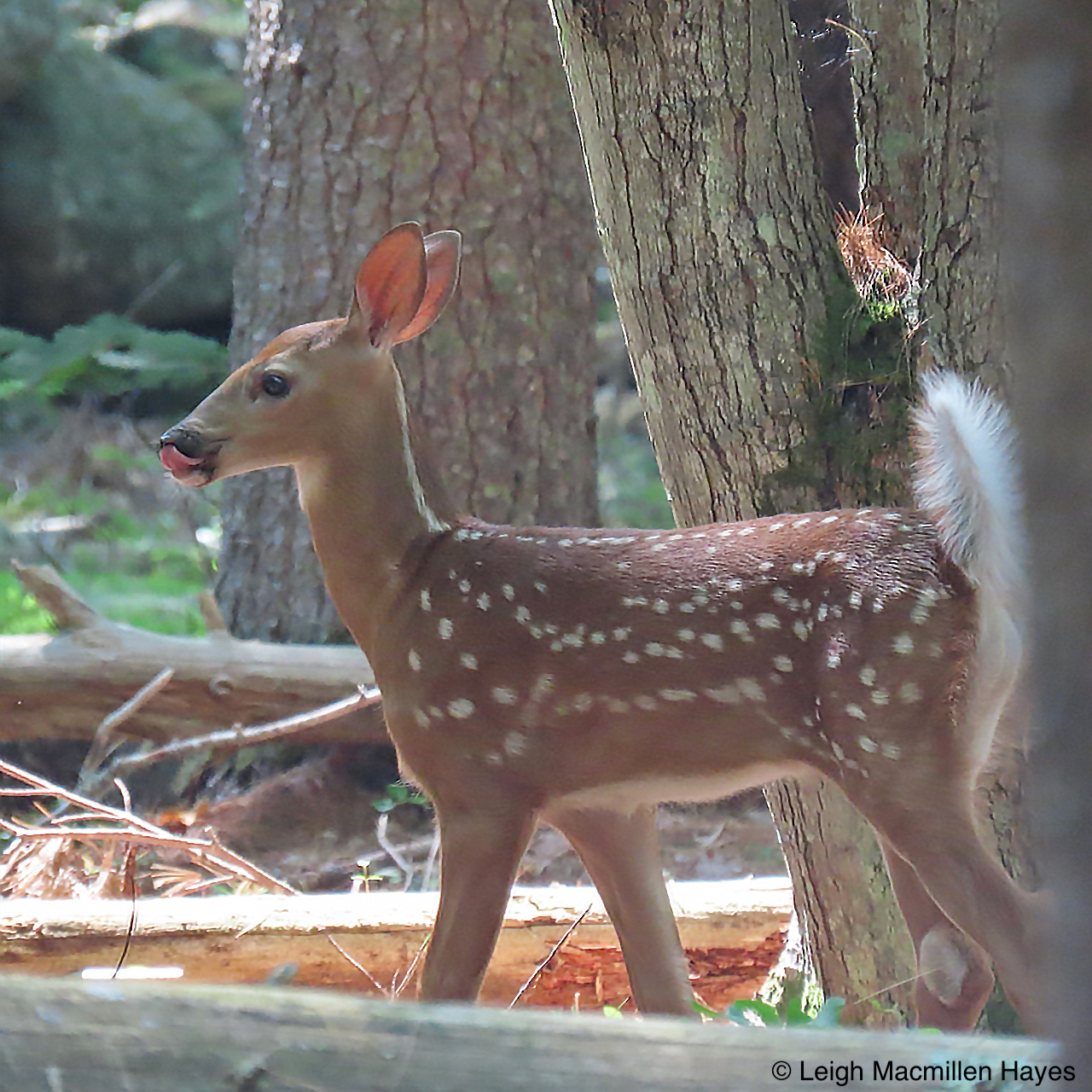
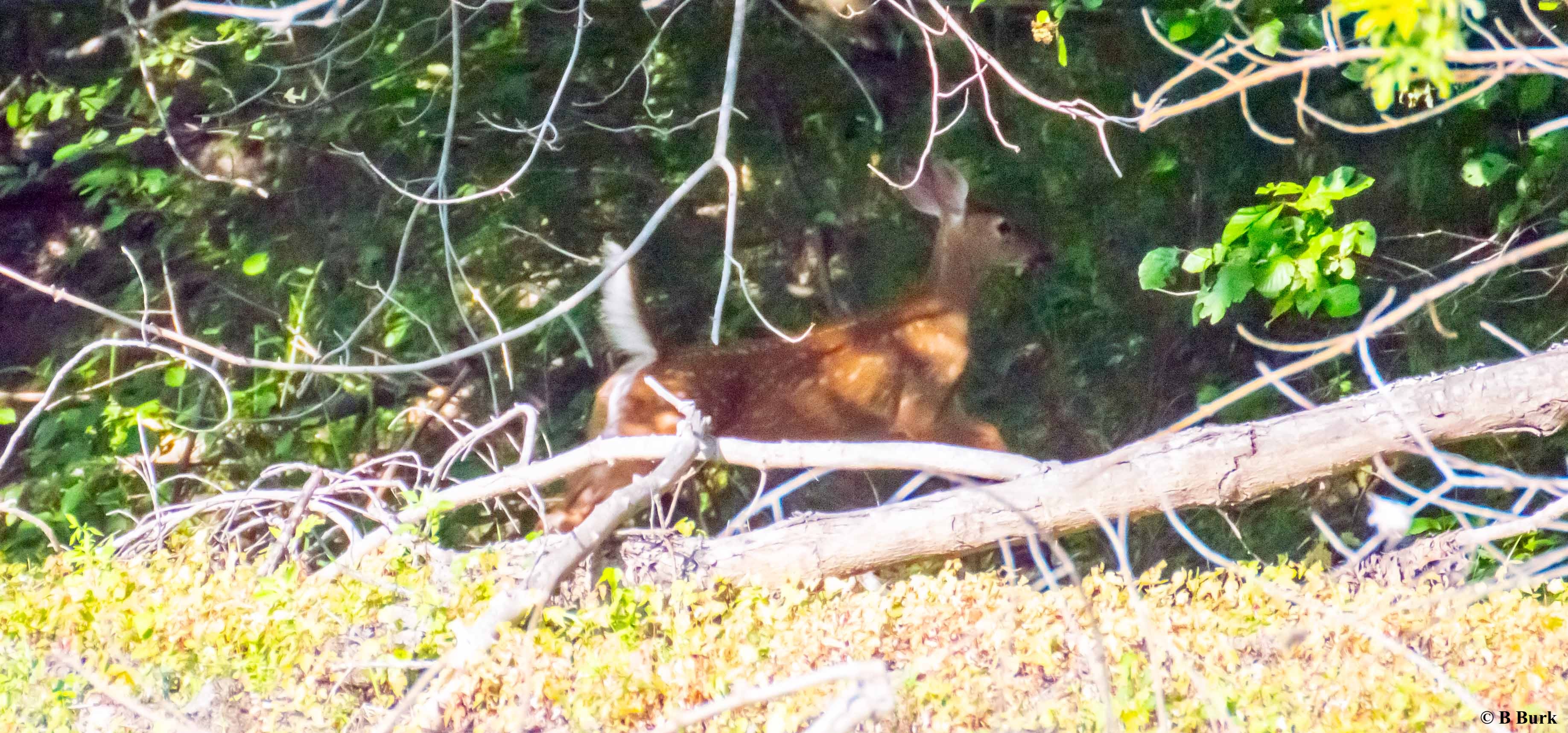
As for the perfect picture, this is one that Captain B snapped and I can’t believe he actually captured the fawn. We were both surprised, even though we’d expected to see deer, when a Doe and her spotted youngster stood by the water’s edge as they nibbled on grasses, but they saw us and quickly dashed into the woods, their white tails on high alert.

The sight of the two of them, however, is what I’ll cherish in my mind’s eye because that’s really where perfect pictures are stored.

Zodiac Three: The Perfect Picture. Thank you again and again, Captain B, for creating the opportunity. And I can’t believe you did get this last photo after all.

Student Teacher in the Field and Yard Classroom

I am so thankful that I was born with a desire to learn and somehow landed in at a most pleasant neighborhood school. Of course, the classrooms vary depending upon the season. These past two days, and actually these past few weeks, I’ve been majoring in field and yard lessons.

Oh, don’t get me wrong–that doesn’t mean field and yard work, though I did help mow the lawn today.

Let’s begin, however, with the class in the field, which is really more of a meadow given how wet it can be and some of the species who call it home attest to that, including this Marsh Fern.

At first glimpse, I thought it was a Lady Fern, but there was something different about the leaflets–they seemed to present as three-dimensional.

When I turned the blade over, I saw why. On fertile leaflets, such as these, the subleaflets curl around the kidney-shaped indusia which cover the sori, or spore cases.

There are lots of other ferns out there including Interrupted and Sensitive, but Marsh is one I don’t often see, so to have it on display in the school hallway is exciting to me.

Meadowsweet, or Spirea, is another plant that doesn’t mind wet feet, also indicating that this class leans toward being a wet meadow.

And today, I met a new-to-me insect species with a funny name.

Tumbling Ragdoll, aka Mordella marginata, is a Tumbling Flower Beetle. I love the name, and am reminded that as a child I loved my Raggedy Andy doll made by an “aunt” who wasn’t actually related to our family; my sister received Raggedy Ann. Years later, my sister also later created Andy and Ann for me, so I have a complete set, plus one from “Aunt” Betsy.

Anyway, from Tom Murray’s Insects of New England & New York, I discover that these beetles are so named because “When threatened their escape method is to jump and tumble about wildly.”

For science lab, I will attempt a mere scare in the future to see if that is true; but today approached with care so as not to disturb them.

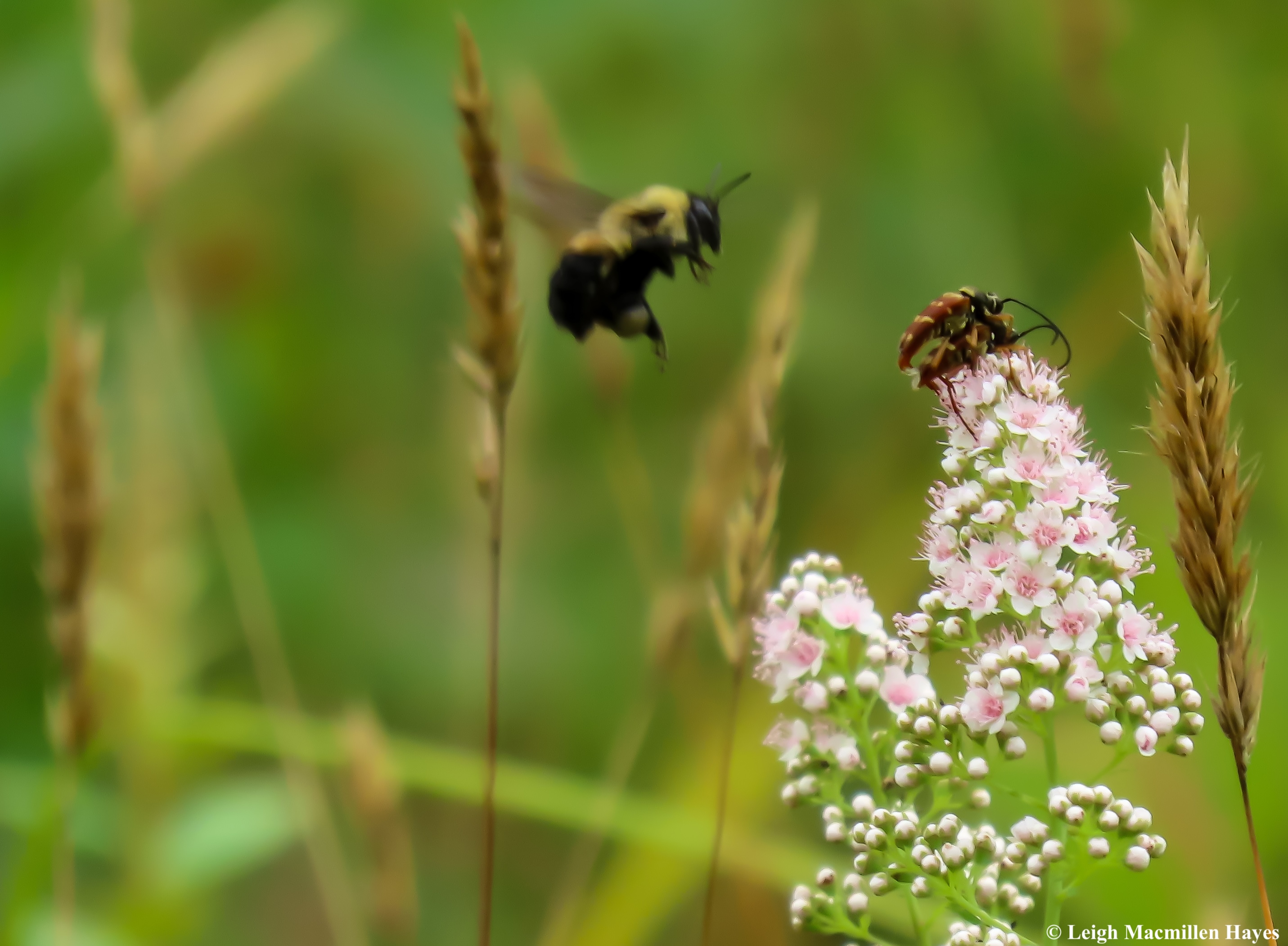
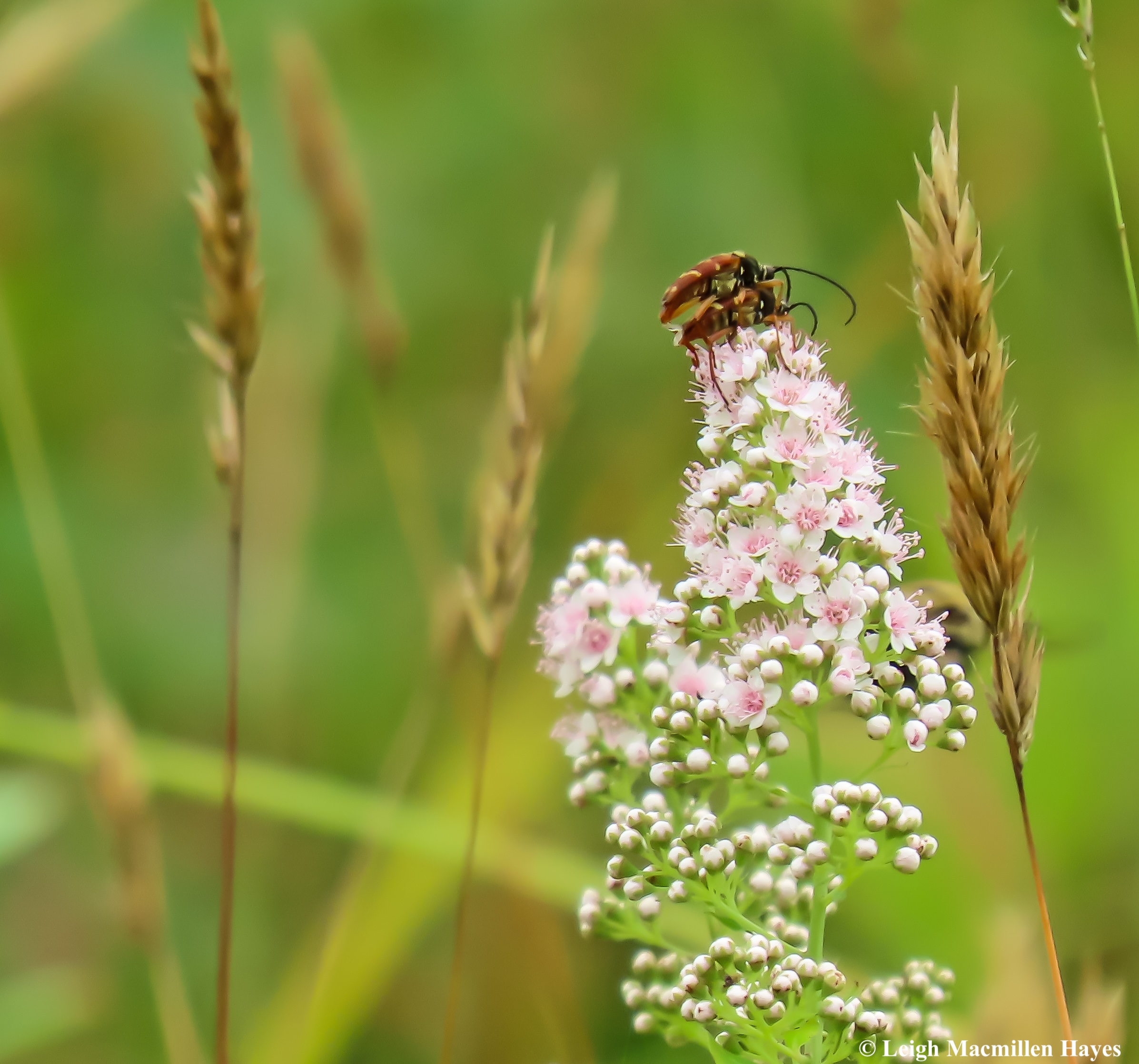
When I got up from my chair to sharpen my pencil, I spotted what my friend Amanda calls a B-52 Bomber Bumblebee. It was large and fast. But that didn’t disturb the Banded Longhorn Beetles at the top of the Meadowsweet.

They were mid-canoodle, and nothing was going to pause their intense interest in each other.

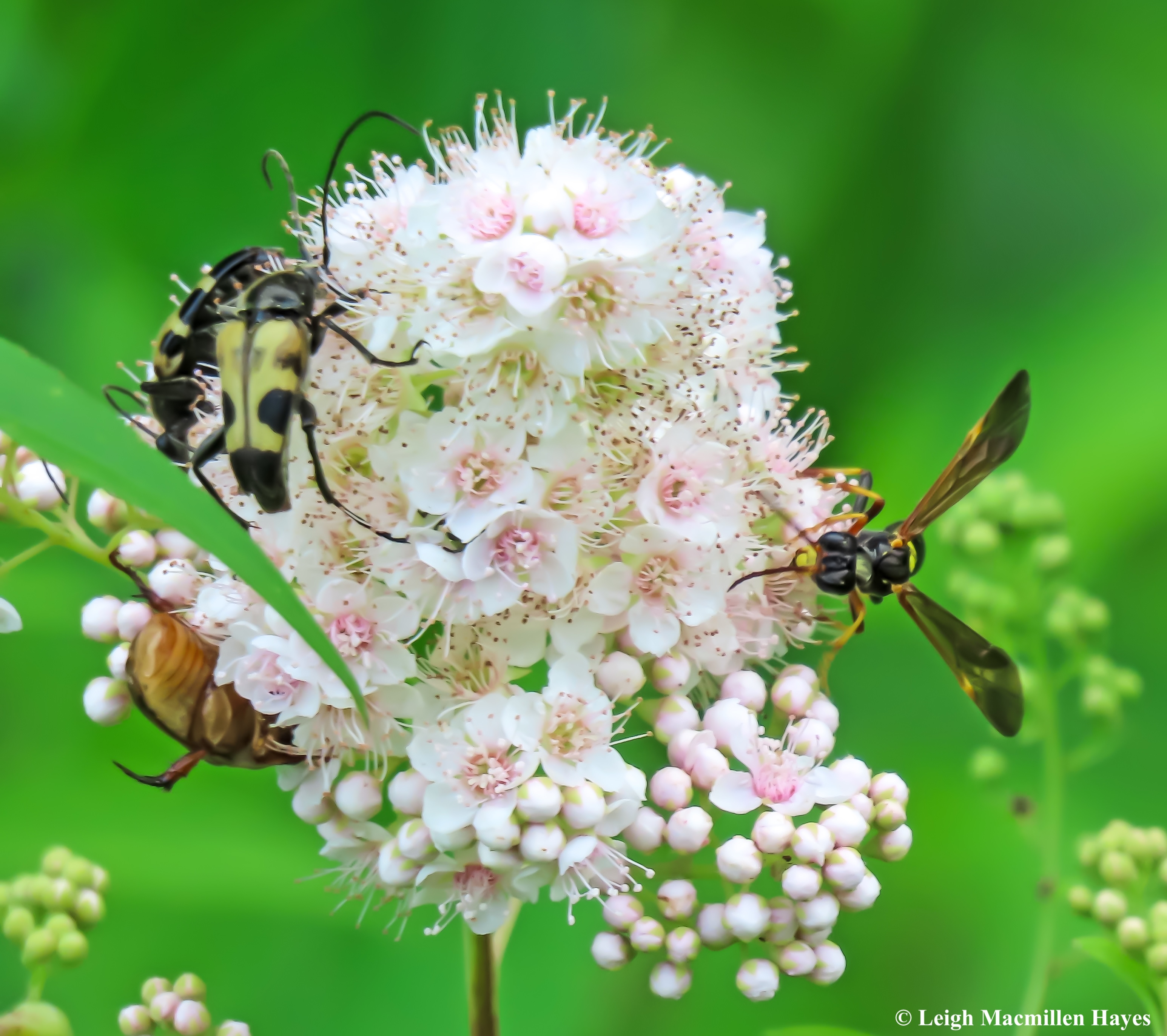
Upon another Meadowsweet, it was as if the whole community had shown up to pollinate the flowers, and miraculously, they all got along. At least while I watched. I love that the teacher had lined up this subtle lesson–about putting aside differences to work for the common good.

She reiterated it more than once.

Over by the window, there was another new-to-me species to meet. By their tiny, yet robust bodies, and long snouts that seemed to grow right out of their heads, I knew they were Weevils. If I got the answer correct on the homework, these are Rugged Flower Weevils, aka Odontocorynus salebrosus.

Ragged. Rugged. Interesting choices for today.

In the midst of it all, some old friends stopped by to visit, including a slew of male and female Calico Pennant Skimmer Dragonflies and this sole female Common Whitetail Skimmer.

I asked the teacher what is so common about this dragonfly that instead seems quite exotic with black splotches on the wings and a two-toned abdomen. I also inquired about the name Whitetail. She said she’d get back to me. Later, in the classroom next door, I saw a single male Common Whitetail, and its abdomen is much whiter (a light blue actually), so I know why that part of the name, but the female certainly wasn’t taken into account when naming occurred several hundred years ago.

And much to my surprise and delight, a male Spangled Skimmer stalked the halls, another indicator in my mind, that this is more of a meadow than a field.

Look at those white stigmas on the wings. It’s the only Skimmer I know of with such markings, thus making it easy to ID on the spot.

After recess, I crossed back over the wall to the classroom in the yard. Judolia cordifera is one of the Flower Longhorn Beetles, and those long horns were so obvious.

But that face. If I have nightmares tonight, I hope my mom will understand why. And my teacher won’t mind when I take a nap during class tomorrow.

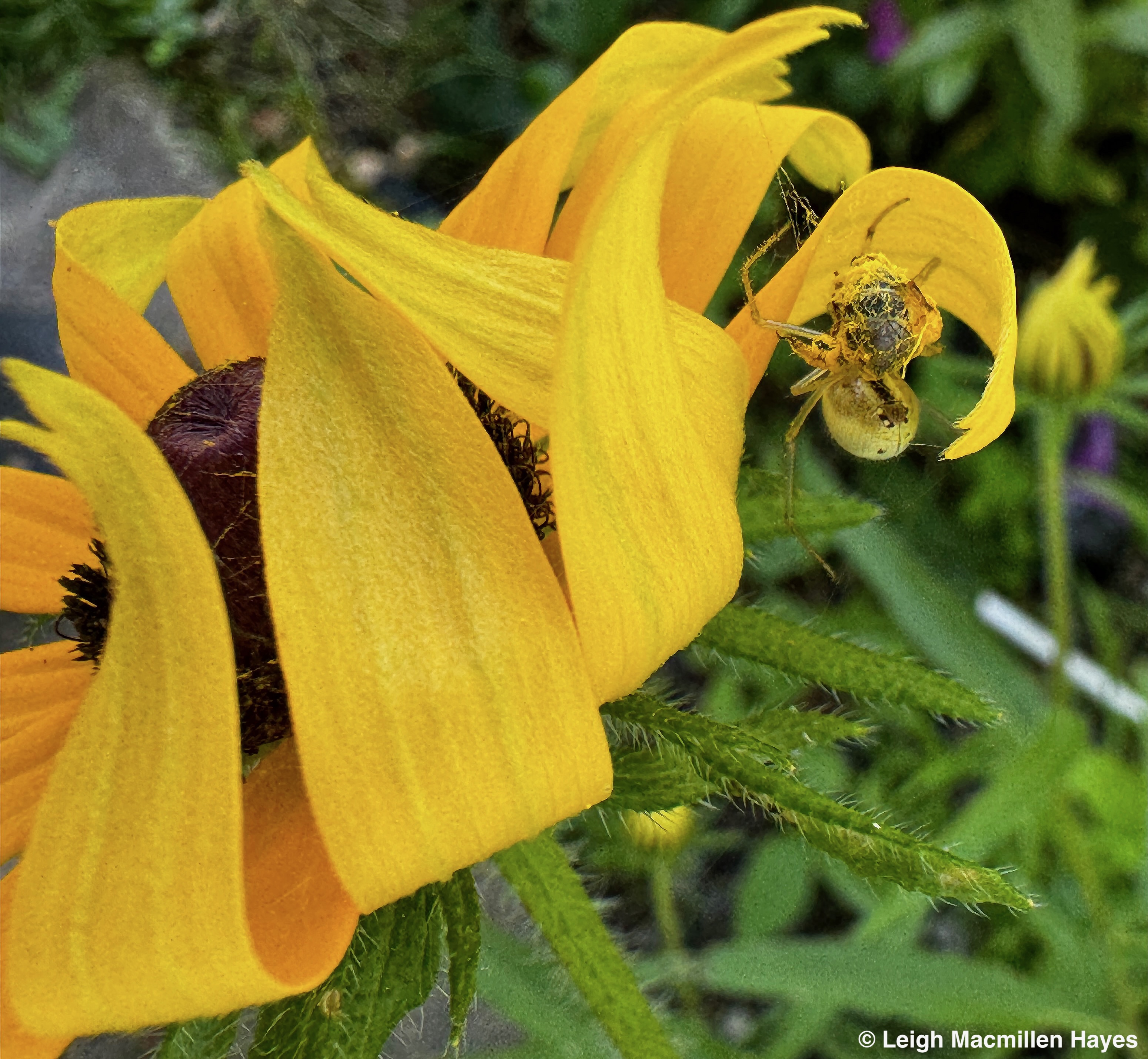
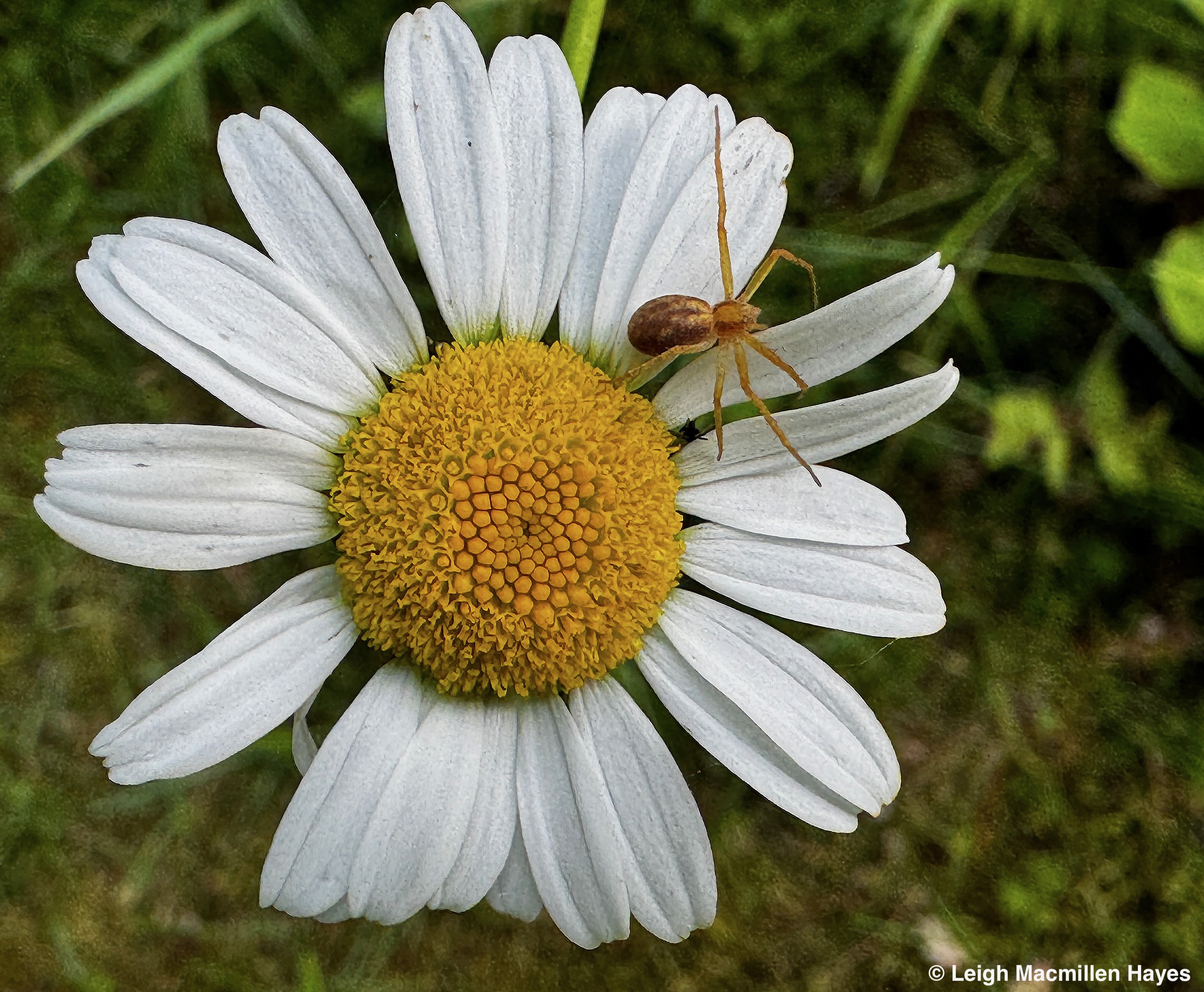
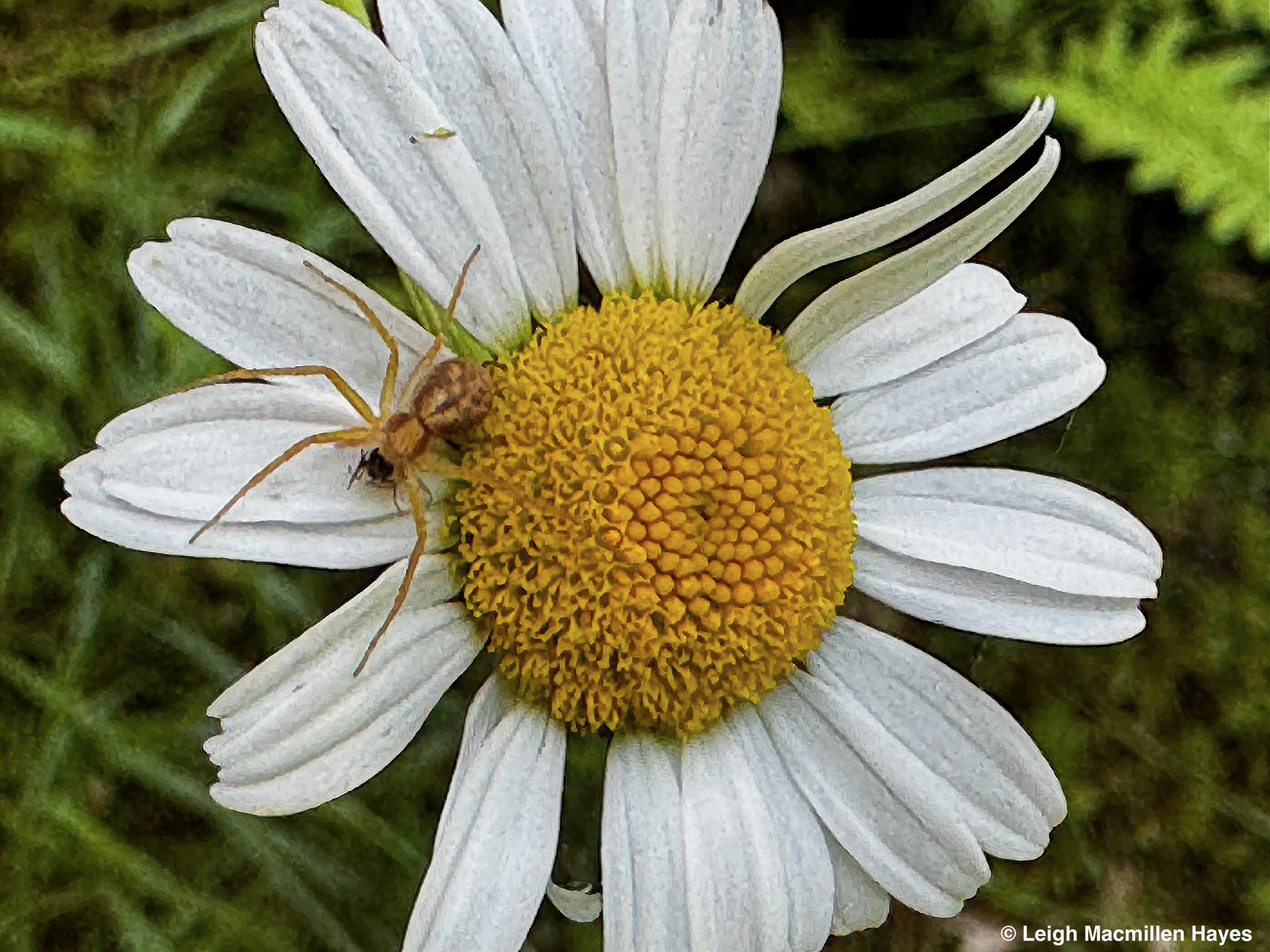
Sweat Bees were also busy pollinating, especially the composite flowers, but its the Crab Spider who presented today’s challenge as the teacher wondered if I saw it. Camouflaged as it was, its duty is to mimic the daisy petals. For the moment the Sweat Bee survived, but the spider often wins in the end.

During lunch, this Gray Catbird landed about ten feet from the table where I sat with my classmates. As a person who dabbles in art, and loved Painting 101 with Miss Jessie, the many shades of gray stood out to me. But I was reminded that a Catbird is more than just a gray bird. First, there’s the small black cap, dark tail, and the rufous-rusty patch under the tail. Sometimes its hard to see the patch, but from my spot at the cafeteria table, I had a spot-on view.

And just before class let out, our school mascot flew in. Or rather, the child of our school mascot. Being so young, it was only an arm’s length away from me, but being the mascot, it seemed not to mind my presence.

Then again, maybe it did for the immature Red-breasted Nuthatch looke around, perhaps for back-up. I know it has several siblings, but the others weren’t feeling so brave as to stand so close to me.

At the end of the day, before the last bell rang, I realized that I was the student teacher–always learning something new and finding joy in sharing those learnings.

Today’s lessons were brought to you from the Field and Yard Classrooms. Stay tuned for more lessons.

The Saga of Walker’s Rips

A friend recently mentioned a local road that I might want to walk down and determine if it was a good place to lead a walk for parishioners of St. Peter’s Episcopal Church and anyone else who joins us. As I drove in and the road changed from pavement to dirt, a rush of memories flooded my brain. And a smile embraced my heart.

About a half mile in, I parked my truck and decided I’d rather continue on foot to get to know the lay of the land better.

A flash of orange to my left and soon I was hunting for this Ichnuemon Wasp. It kept flying to the underside of fern fronds and upon reading up on it later, I learned that it was possibly an Enicospilus purgatus, a nocturnal species that likes night lights and gathers around them like moths. Maybe that’s why it was hiding from the daylight by landing on the underside of the leaflets.

Also hanging upside down was a Common Snipe Fly, aka the down-looker fly, which makes sense again given its location. They are known to prey on other insects, and I could only hope that Mosquitoes were on the menu for they were certainly all over me. Thankfully, only my face and fingers were exposed.

Within moments I arrived at the Mosquito hatchery and knew that there would be no relief, so I journeyed on because I’d come with a vision, but suddenly realized I was getting closer and closer to a memory of yore.

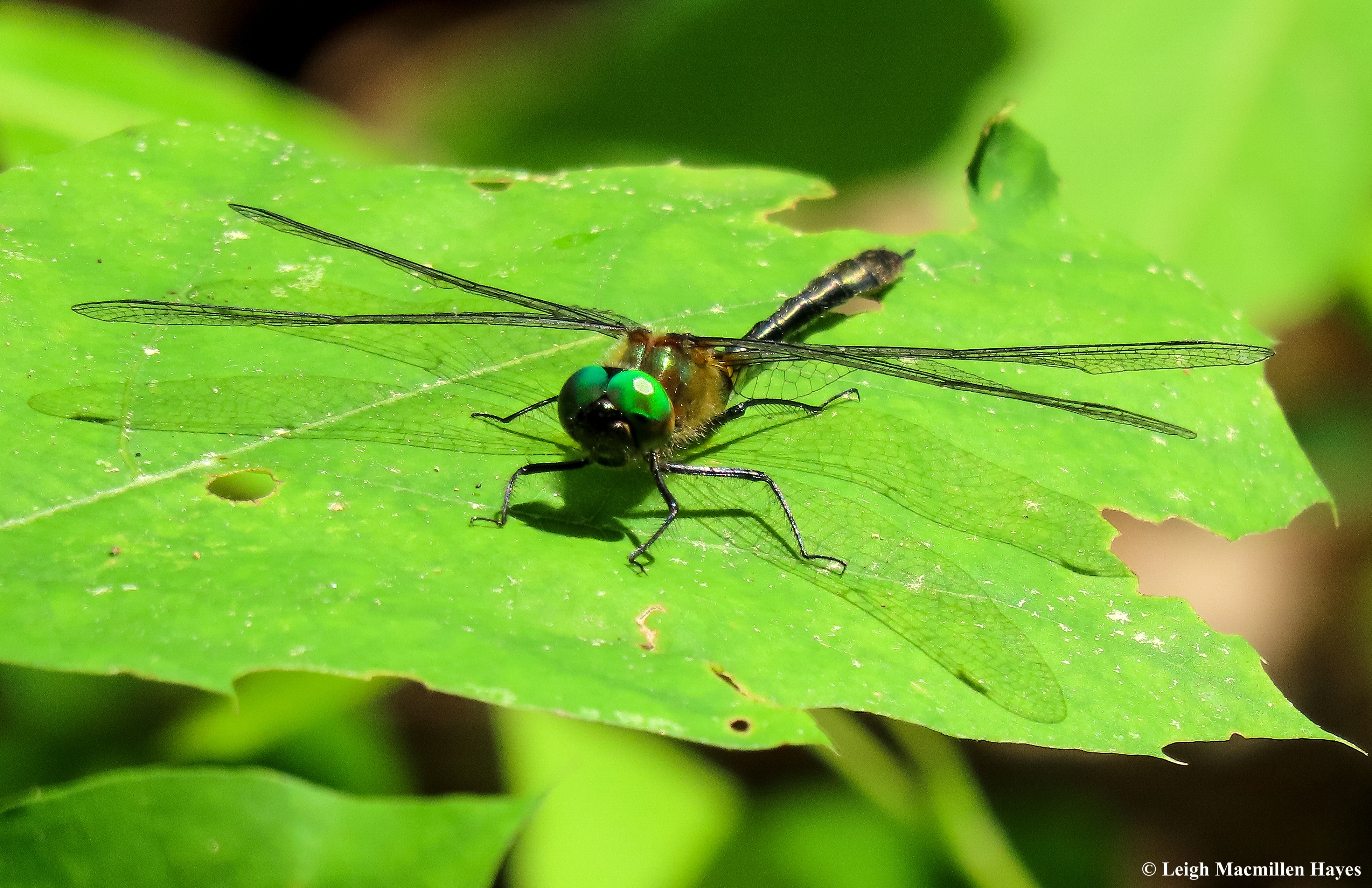
There were Racket-tailed Emeralds and other dragonflies on the move, but they hardly seemed to make a dent in the pesky population. But those great big green eyes. Oh my.

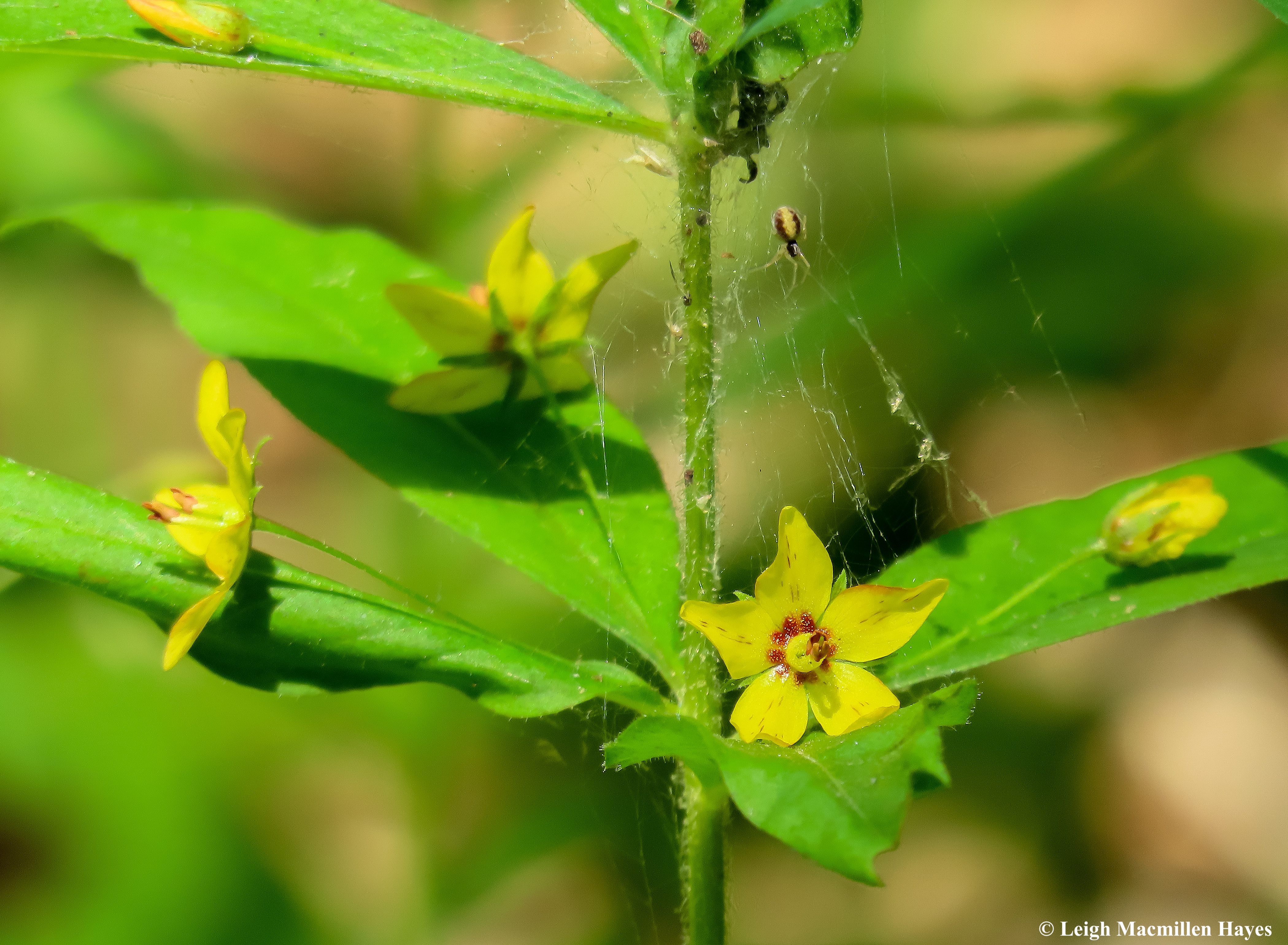
And when I went in for a close-up of a Whorled Loosestrife flower, I discovered a spider working on its web.

And gave great thanks, because certainly some Skeeters will get caught in there, and if you’ve ever looked around the natural world, you’ve realized that there are spiders and webs everywhere and the world is connected by silk.

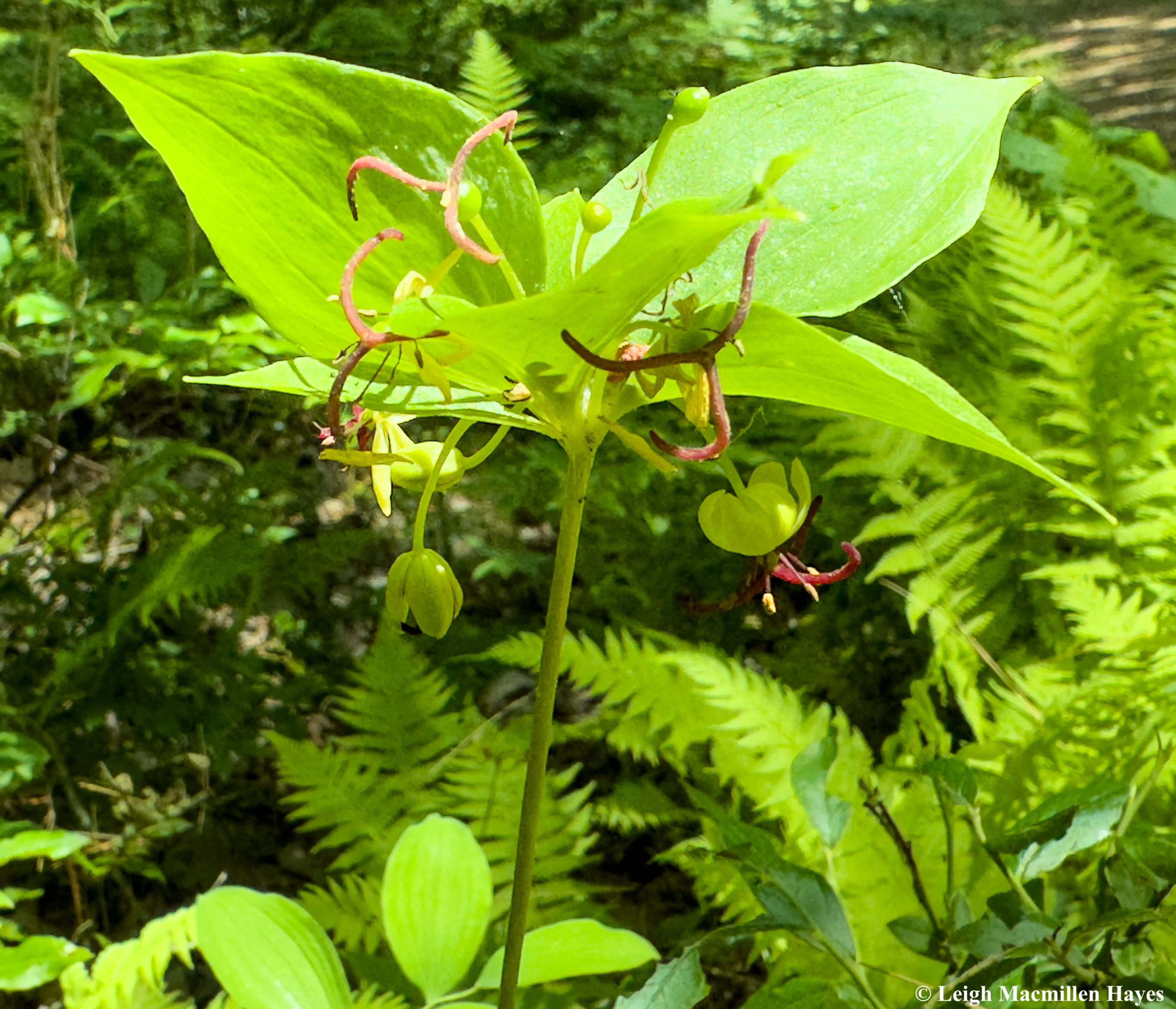
And then I spotted one of my favorite spring ephemerals, Indian Cucumber Root, and celebrated the number of blossoms with their crazy large stamens nodding below and others slowly turning upward upon having been pollinated, and becoming green fruits in the shape of tiny balls. The root is a tasty little white tuber and it’s always fun to introduce it to people, though it shouldn’t be foraged since it isn’t an abundant plant most of the time.

The biggest surprise of all was the flowers of Poke Milkweed just beginning to open in the form of five-parted crowns. They seemed befit for a queen and I was feeling like royalty as I struck gold along this route.

You see, this story really began in 1985 when I was teaching high school and junior high English in New Hampshire. My summer job that year, after working at a donut shop and consuming way too much product the previous few summers, was as director of a tween program for Laconia YMCA’s summer day camp. I still remember some of the names of the cast of characters, including Starr and Rowdy and Melissa and Jess. There were ten of them who joined me daily for activities and each week we headed off in a 13-passenger van named Mabel for an adventure, including some overnight trips.

One of our adventures was a camping trip on the Saco River. At the Y, the executive director placed a canoe in the pool and we taught the kids how to do the J-stroke. They seemed to master it. Packing lists were made, food purchased, canoes rented, plans made with Saco River Canoe and Kayak in Fryeburg, Maine, and voila, the day dawned for our big trip north. Accompanying us was a 16-year-old lifeguard named George.

One special thing I remember about our road trips was that no matter where we went each week, it was always a new place for this crew as many had never traveled far from home. That, in itself, made the experience worth it.

On this particular mid-July day we departed from the Y at 9:15am, stopped in Fryeburg for a fire permit and some last minute groceries and then I dropped the kids and George off at Swan Fall’s Dam where they loaded their gear into canoes, while I followed Fred Westerberg of Saco River C&K to the site of our first night. The plan was to leave our food and tents in the van, and spend the day paddling to it, thus giving the kids time to practice their new skills without too much extra in the boats. The site, which is no longer accessible, was near Hemlock Bridge. Fred brought me back to Swan Falls where the canoes were ready and so were the kids.

Our journey began at about 12:30pm. Suddenly, the kids didn’t know how to paddle, despite all of our practice for days on end. At least three went in circles during the first hour. But, the river was beautiful and we stopped frequently to let everyone catch up and swim.

At about 4:30, we found the stream Mabel was parked beside and let the kids swim for a bit before paddling toward the campsite because Fred had told me our destination for the night was boggy and they wouldn’t want to swim near it.

With our campsite finally set up, dinner consumed and dishes cleaned, we went for a walk and then returned to enjoy the fire before settling into the tents for the night.

In the middle of the night one of the girls yelled out, “HELP! SOMEBODY! HELP ME!

Fearing the worst, I dashed to her tent and asked, “Melissa, did you have a nightmare? “

“The zipper on my sleeping bag just got stuck,” she replied quietly.

Wednesday morning we got up early, packed our gear in the canoes and headed downstream toward the main course of the river. Across from the mouth of our stream, was a sandy beach where we made pancakes for breakfast.

I’ve since learned that the stream we had camped alongside is really the Old Course. “The ‘New Saco’ also known as Canal River, or these days, simply the Saco, was dug as a diversion in 1817 to reduce area flooding and to shorten the distance to markets in southern Maine. This 6-mile canal cut 15 miles off the length of the ‘Old Course.'” ~AMC’s Saco River Map & Guide.

At last we were off and paddlig until lunchtime. At times we felt like we were traveling through a jungle and civilization was non-existent. Following lunch, we took a long swim break and then continued on, the kids having become proficient paddlers.

So proficient that a few got ahead of George and me and didn’t heed our warning to pause when they heard the water flowing over Walker’s Rips.

Two canoes went over the Rips without any problems.

A third got stuck on the rocks. The girls panicked when water began flowing in one side of their boat and out the other. George pulled his canoe over to help. I did the same. The girl in George’s canoe got out to go to the riverbank, where other canoeists also lent a hand. She slipped on a rock and got caught between the canoe and a larger rock.

My canoe mate and I quickly portaged. Meanwhile as George and the couple helped get the two girls and their gear out of the stuck canoe, and proceeded to get the boat off the rocks, several things went overboard. Thank goodness for Hefty trash bags.

I told the kids who were on a sand bar to pick everything up from the water and I swam out to get the now freed canoe.

At last we were all on the beach below the Rips, and I began checking for injuries. I had cut my toe just before I swam for the canoe, but I didn’t have time to deal with it and so I put on my sneakers to avoid further injuries. The girl who had gotten stuck between the canoe and rock complained of bruised ribs–painful I was sure. Another had hit her back on a canoe and a bruise was starting to develop. All were shaken.

The Caretaker at the AMC campsite by Walker’s Rips had contacted Fryeburg Rescue and Fred Westerberg. And ambulance and our van Mabel arrived within minutes of each other.

I followed the ambulance to Memorial Hospital in North Conway where the girls were checked over and the doctor kindly suggested that what they needed was supper followed by an ice cream. And maybe some Tylenol.

During all of this, I’d been in touch with the Executive Director of the Y and we decided it would be best if I drove the kids back to Laconia where we’d spend the night in the Rec Room and I’d have them call their parents in the morning.

Somehow during the night, I developed a nose bleed. And then I realized that my toe was throbbing.

The next morning, the kids packed up, we ate breakfast, and then their parents arrived to pick them up and hear the tale of our adventure, which got more embellished with each retelling. The good news was that they continued to let me take their kids, but we stuck to hiking and camping for future trips.

All of that said, it brings me back to why I wanted to remember this by writing it down (mind you, I have a couple of letters I’d started to family, that helped me fill in some of the details of my memories. But . . . when I walked down that road twice this past week, I realized that this was the road we’d driven out on and I suddenly knew the route we’d taken to get to the hospital.

You see, about thirteen months later I moved to the area and though I recognized the road where we’d pulled onto Route 5, I never gave much thought to how we got there. And we’ve gone down the river a bunch of times in canoes and kayaks and even once in an inflated boat and never had a problem.

What surprised me was to realize that the camping area is no longer open, but right in front of this sign was where the ambulance awaited the girls.

And the now seemingly abandoned Caretaker’s cabin had been open and campers and canoeists were all around the area. Now it was like visiting a ghost town.

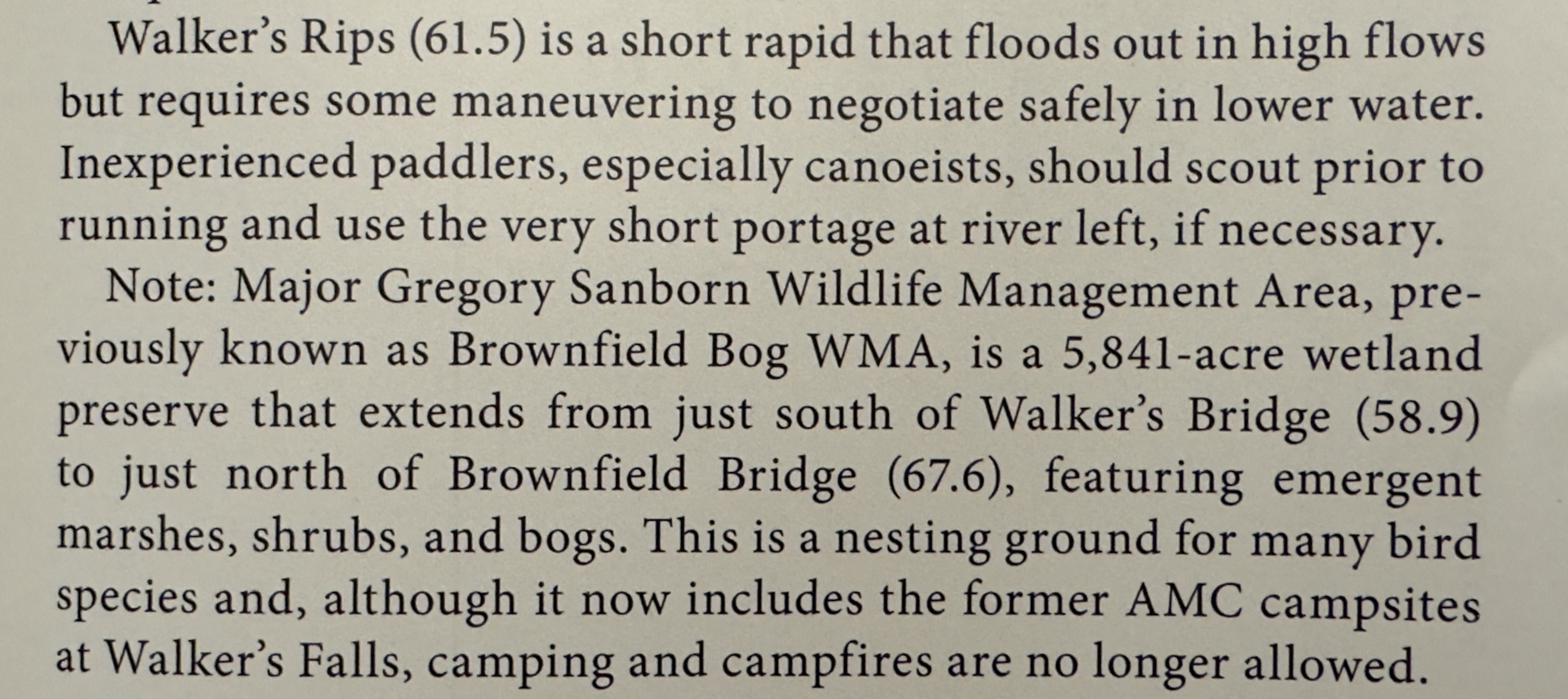
I stood on what had once been the support for a covered bridge (Thanks to my friend Moose for piecing together a brief history of the bridge built circa 1866, which carried traffic across the river to Walker’s Island. It deteriorated and collapsed) and looked down at the Rips, which were under more water than they were on the July day of our visit.

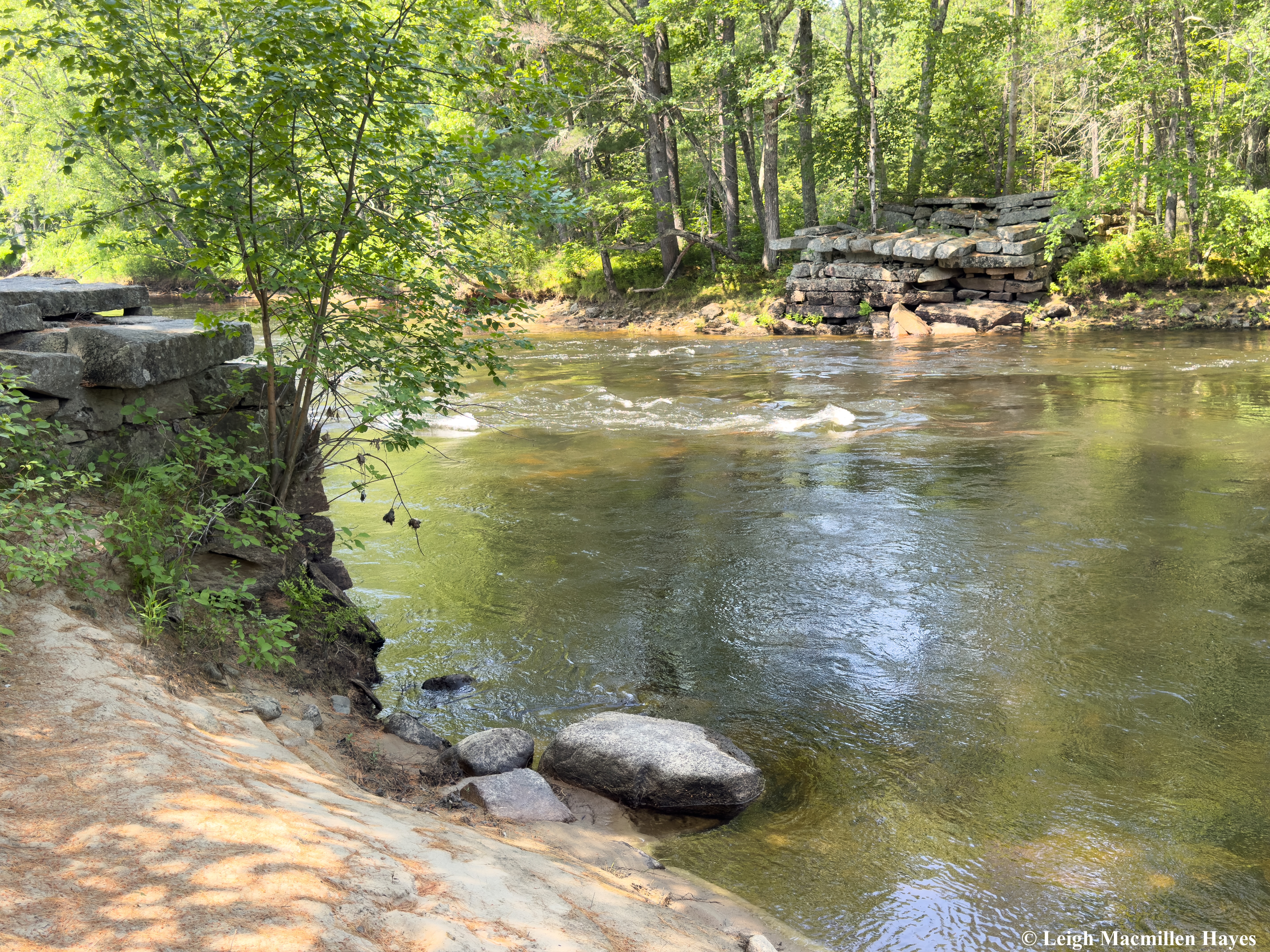
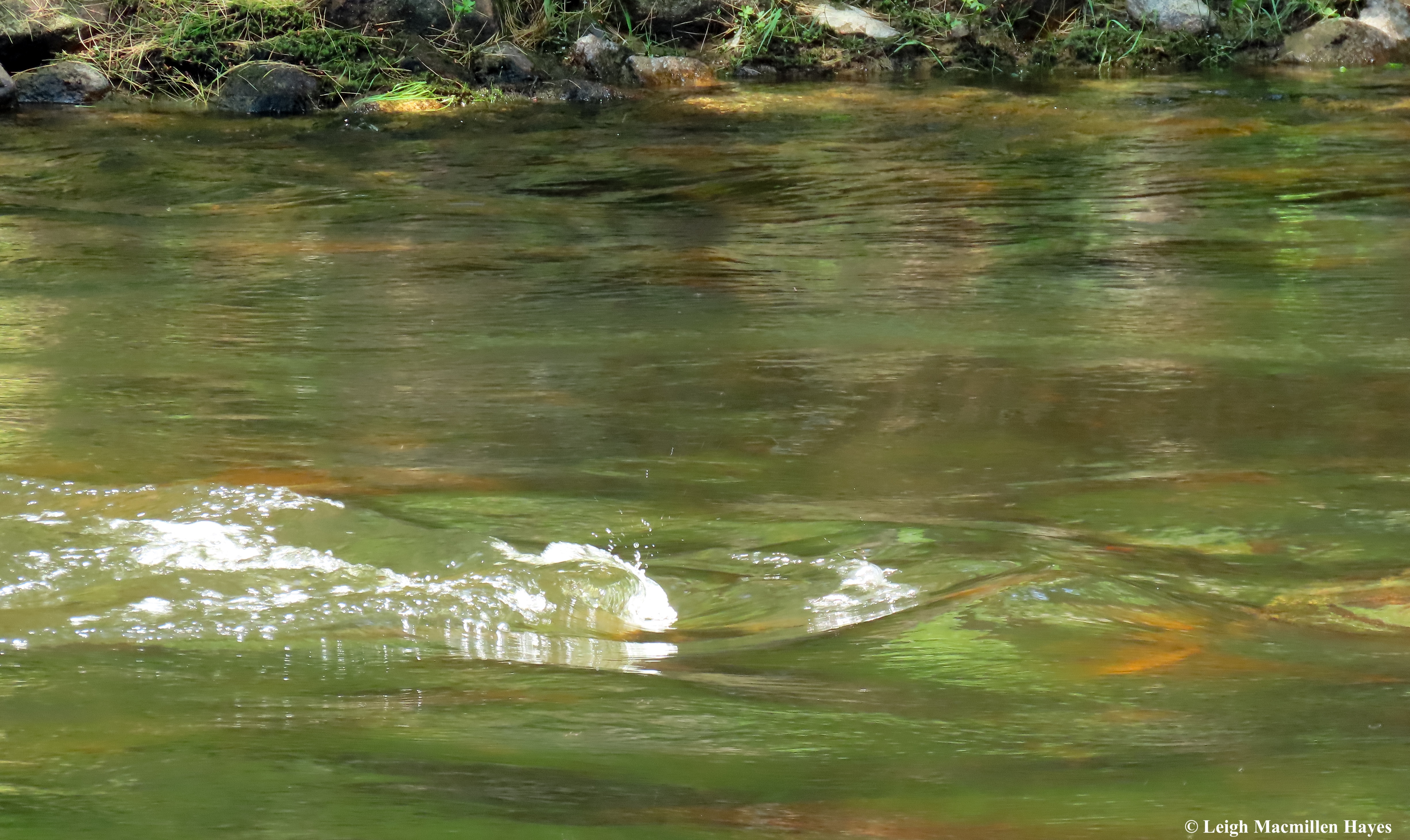
Standing above the bridge I spotted the rock where the canoe got hung up–it’s near the upper right-hand edge of the photo, where you might see a bit of ripple in the water.

For a closer look, the rock which will be forever known as The Rock.

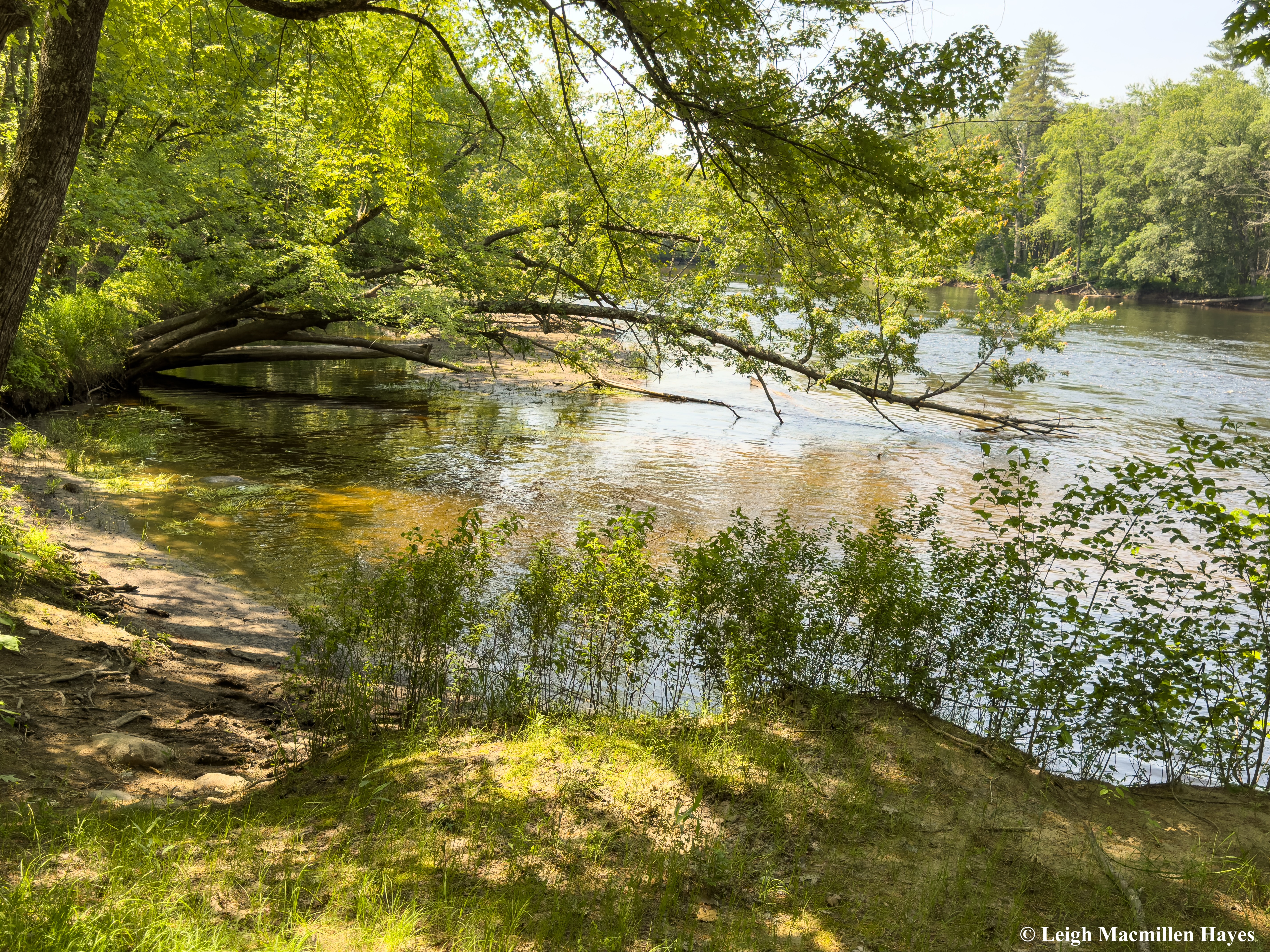
Below the Rips was the sandbar on the left, which was our gathering site as we collected all our belongings and assessed the situation. This week it was barely visible, but because the water was lower that day of our adventure, it was a more substantial beach.

I don’t know why I never thought to visit this site sooner via road, but am thankful that it was suggested and that I made the journey back in time.

I even dragged My Guy in one day because he had not been down the road either, and we then found our way to Pleasant Pond, which I think I may have visited with the kids shortly before we hit the Rips. Literally. Oh, and he’s not saluting the pond, but rather swatting Mosquitoes.

As for my throbbing toe all those years ago, after the kids went home, the Executive Director and I headed to the ER in Laconia and I received a prescription for an antibiotic and had to soak it and am here to say I survived. I do chuckle to think I was the only one with an actual injury.

The Saga of Walker’s Rips is one that has stayed with me all these years. And that summer job–one of the best I ever had. I only hope that the kids have as fond a memory of our adventures as I do. I’ll never know as we lost touch when I moved away to the Portsmouth area a month later.

Vermonting We Did Go

Okay, so “Vermonting” is not a word. But we did go. And came home richer for the experience.

It takes us forever to plan a vacation, even a mini-one. Well, actually, it only takes a few minutes once we put our minds to it, but prior to that it’s a lot of “We should go to . . .” or “We need to get away,” or any of a myriad of other comments, and we do nothing.

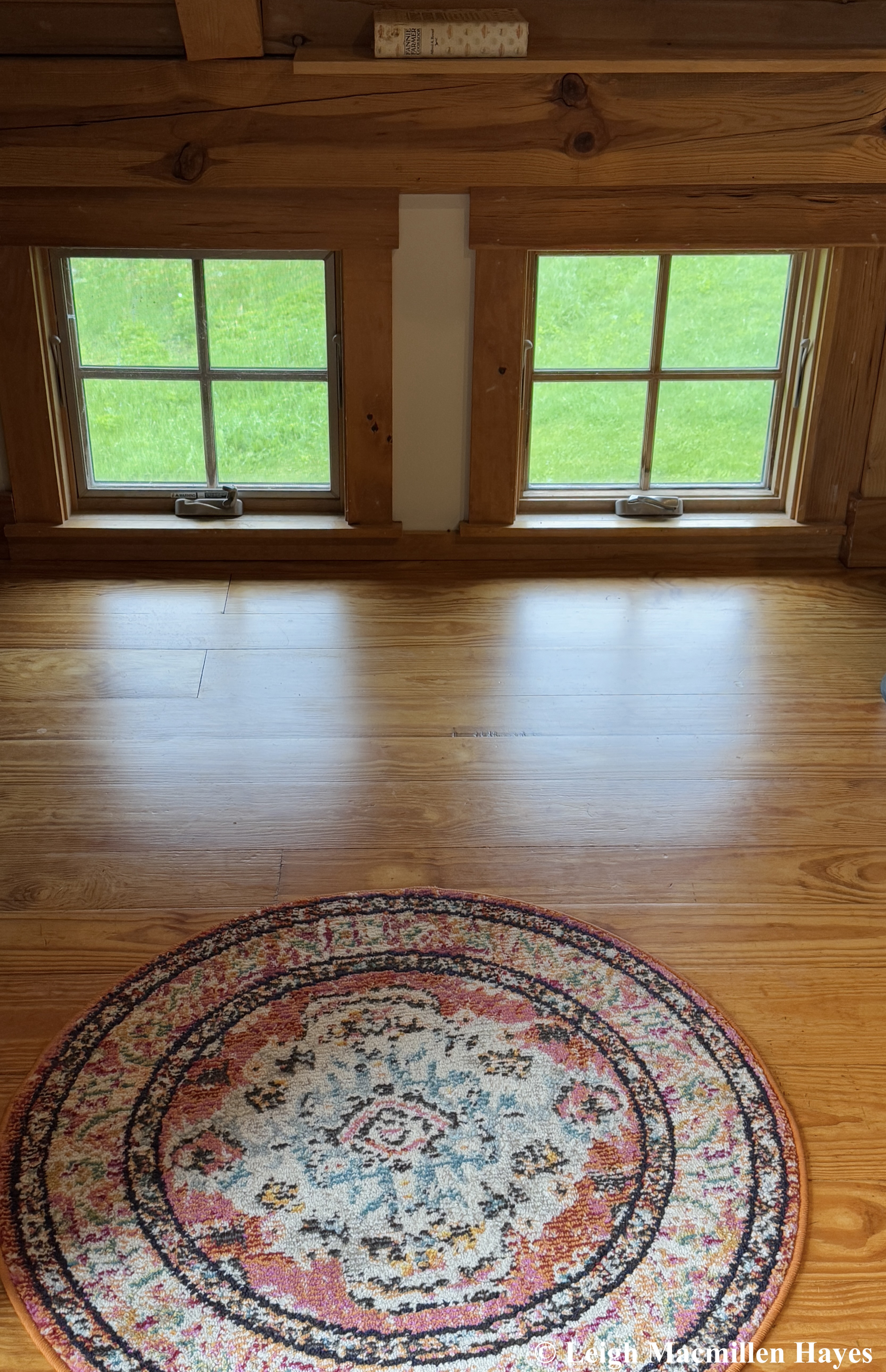
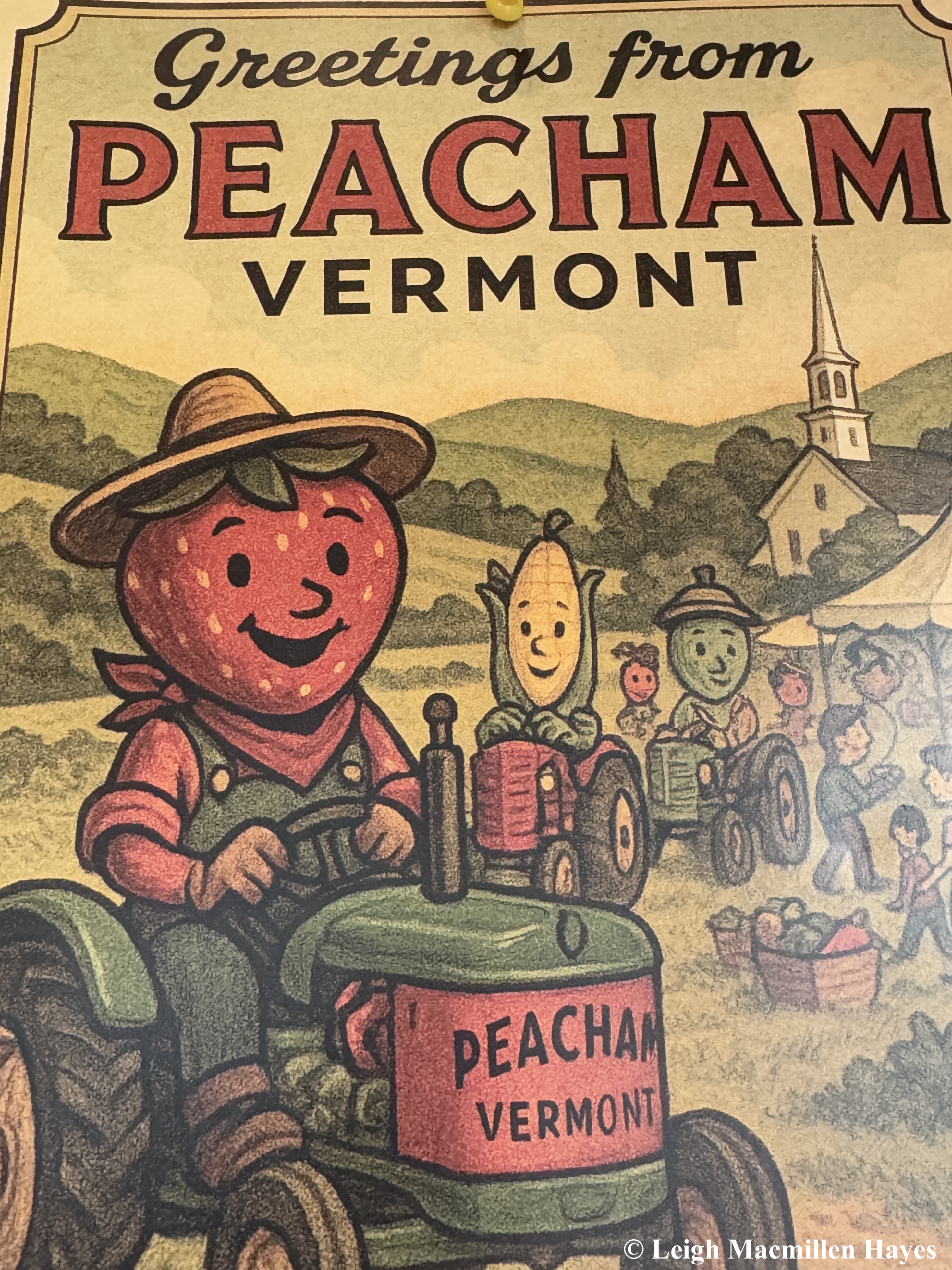
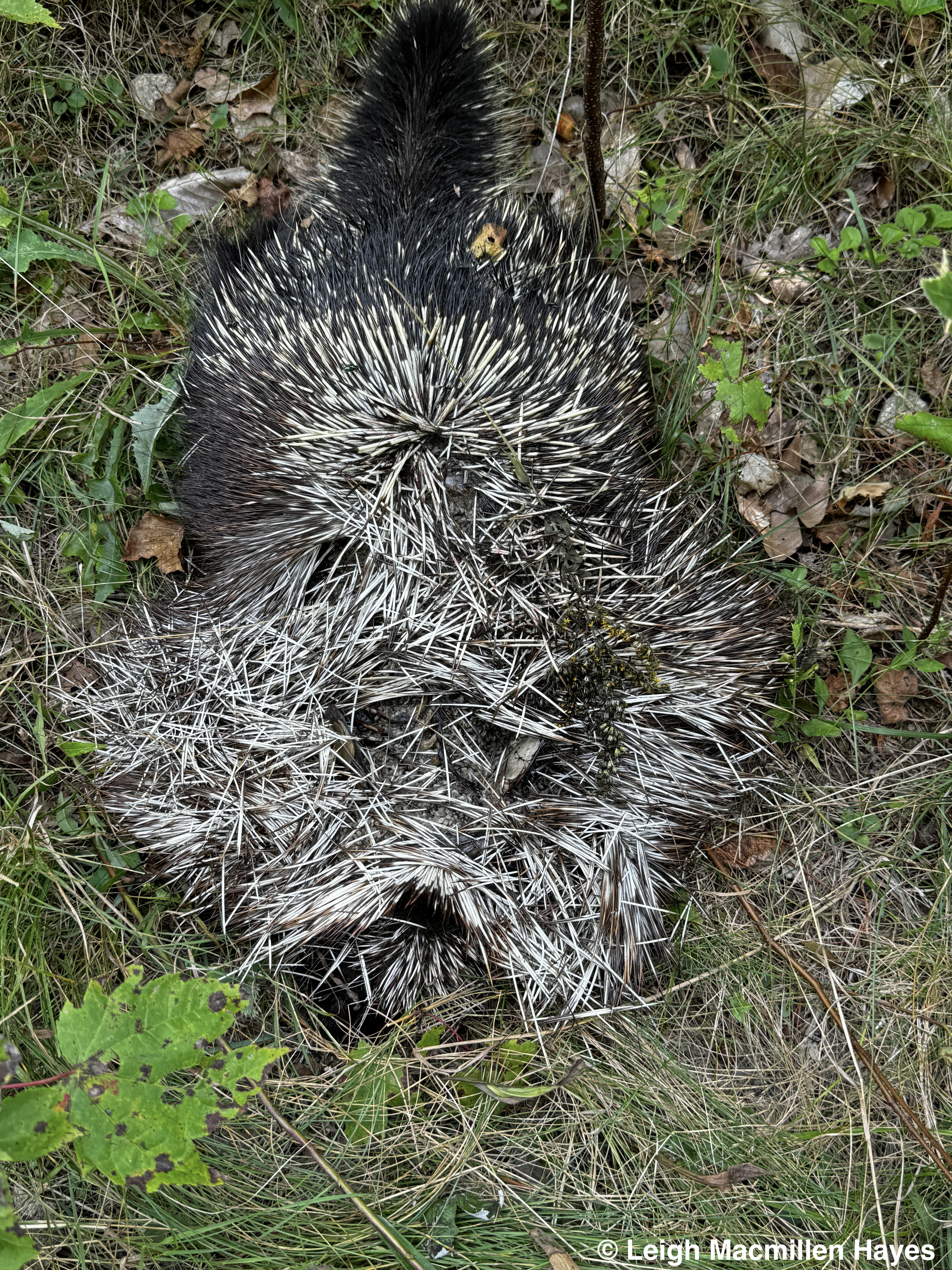
So about a week ago we cleared our calendars. We knew kinda sorta where we wanted to go, but didn’t know where we might stay, until we discovered The Barn in Peacham. We have a red barn attached to our 1870s farmhouse and long ago turned the upstairs into a movie theater/rec room for our sons, all that being a rather rough rendition of either–the movie seats were from an actual theater in our hometown, which was the best part. The seats are still all up there. And there’s a pingpong table and an air hockey table and trophies (remember the Porcupine Invasion last November?) and various other things, plus now a Yoga area for My Guy, but it’s hardly like the space we rented for the weekend as pictured above.

Cozy, roomy, tons of natural light, everything we needed, even eggs and English muffins if we came up short for our first morning.

I think one of my favorite things, and I had lots of favorites, were the little windows that lined the floor in all four rooms. And above these in the kitchen, a Fannie Farmer Cookbook on a shelf. It was touches like this that enhanced the already perfect space.

And our host and hostess, Chuck and Mercy, were equally delightful, and full of information. Thanks to them we discovered Three Ponds Sandwich Kitchen in Danville our first night and marveled in the deliciousness.

But what we were really there for was to hike. And so Saturday morning we went in search of the trailhead to Peacham Bog. If you happen to see My Guy this week, ask him how that search went. We’re still laughing.

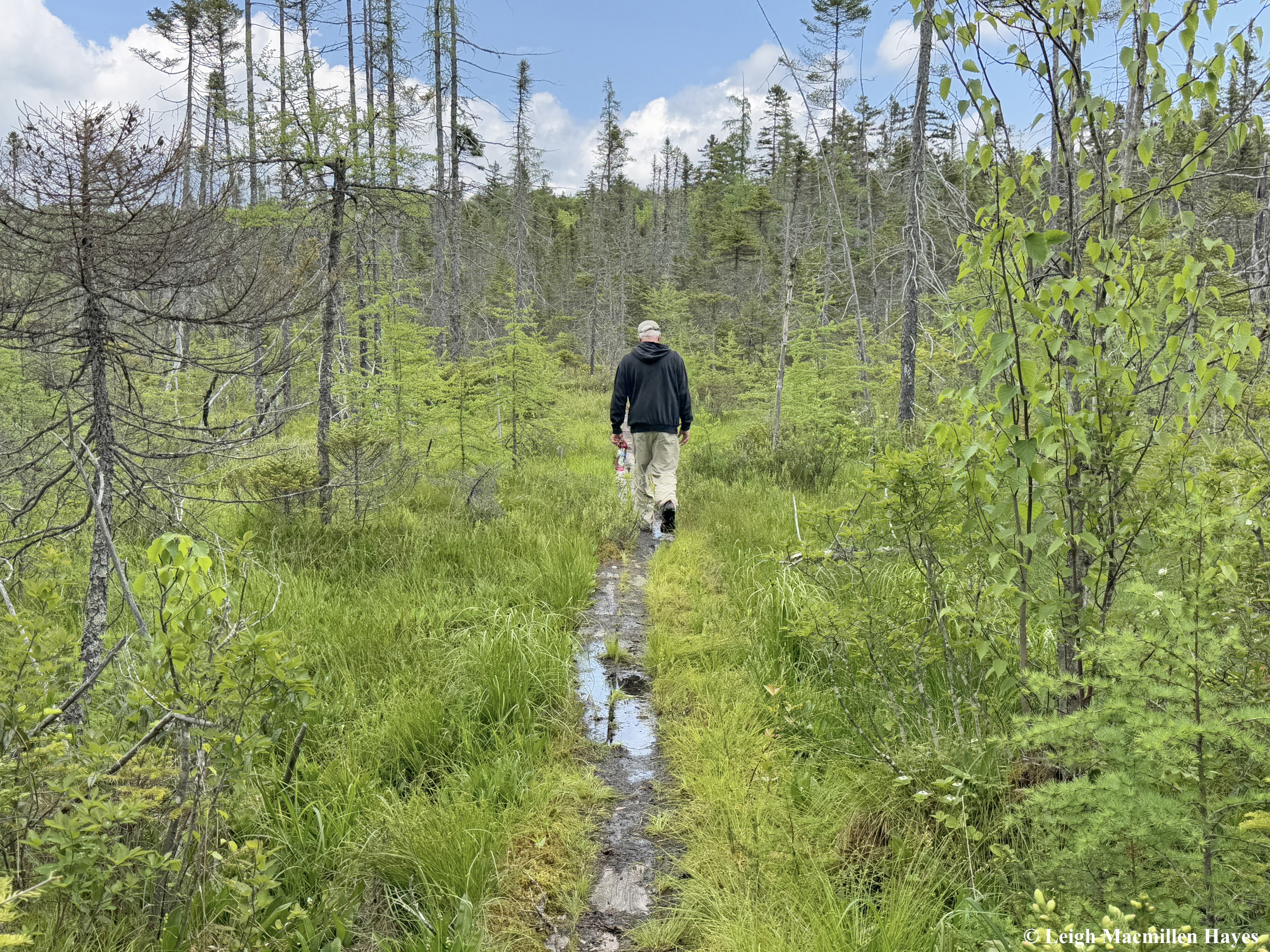
We did find the trailhead, but obviously not where we expected it to be. And at the recommendation of Brian at the Groton State Forest Nature Center, we decided to hike the two miles in to the Bog and then continue along a multi-use trail before reaching Devil’s Hill, circling back along the same route.

The natural communities along the way made us feel as at home as the barn, for we (read “I”) felt like we were walking among old friends such as the Mountain Woodsorrel. I love its peppermint ice cream presentation.

And then, in a damp spot Swamp Beacons lit the way and I was drawn back in time to my first encounter with them while tramping through the woods in Lovell with friends Parker, Joan, and Dave. RIP Parker–please know that you accompany me on and off many a trail and I know that you would be happy that I actually remember some of what you taught me.

Vowing not to count Lady’s Slippers, we didn’t. But they were there, though most waning.

At last we reached the coveted bog, where a boardwalk was long ago placed to keep hikers like us from stepping onto the fragile environment.

It was at this point that another funny story evolved, but again, you’ll have to visit My Guy at his store to get the rest of the story.

At last reaching the platform with a bench at the end of the boardwalk, we sat down to eat sandwiches and take in the scene and sounds that surrounded us.

Sphagnum mosses formed the peat base and laurels and Tamaracks and Firs and flowers and insects all expressed themselves.

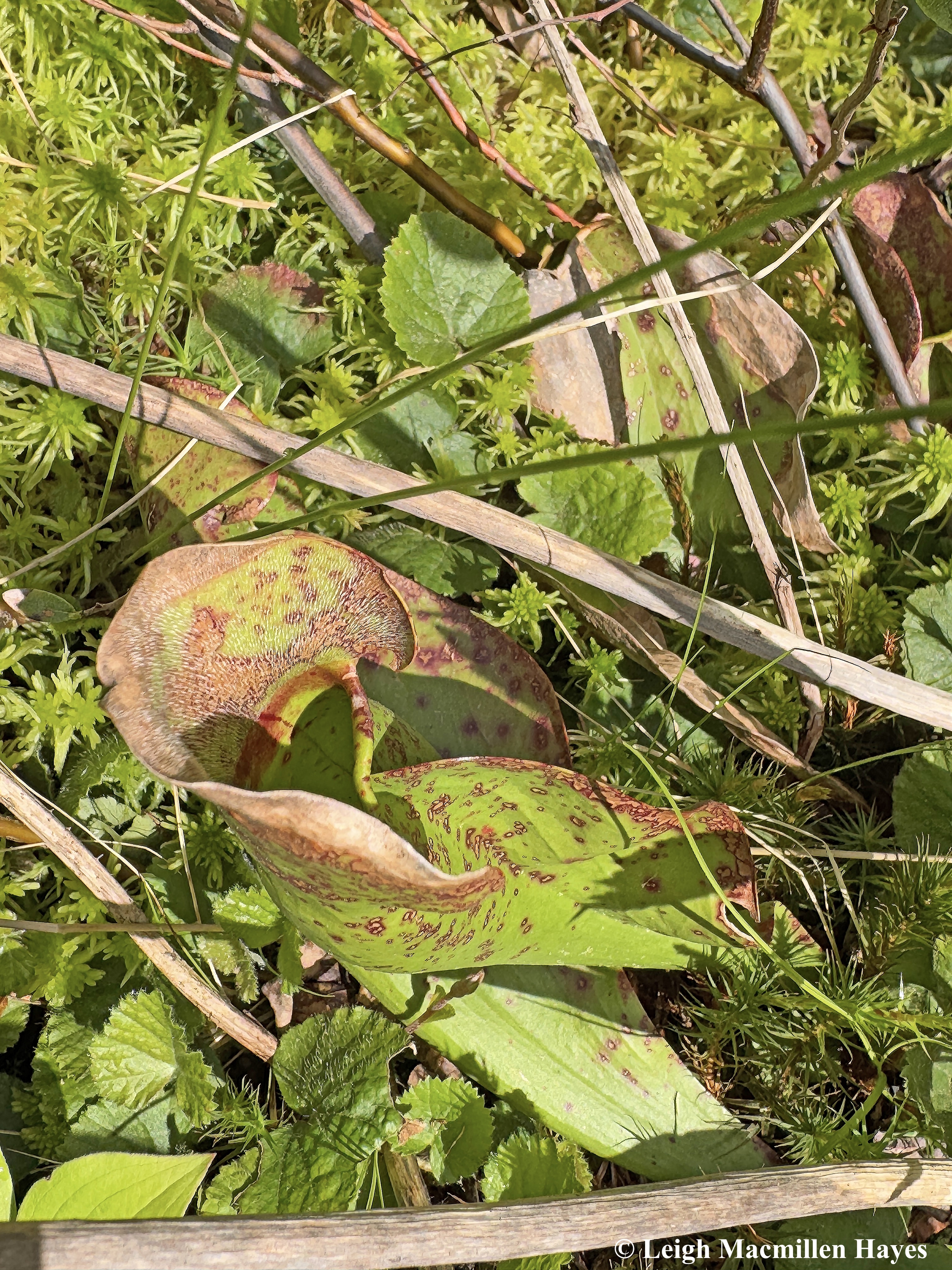
I, of course, can never see too many Pitcher Plants and be forever wowed by those downward facing hairs that entice insects in to the pitcher-shaped leaves where the end-of-life lurks.

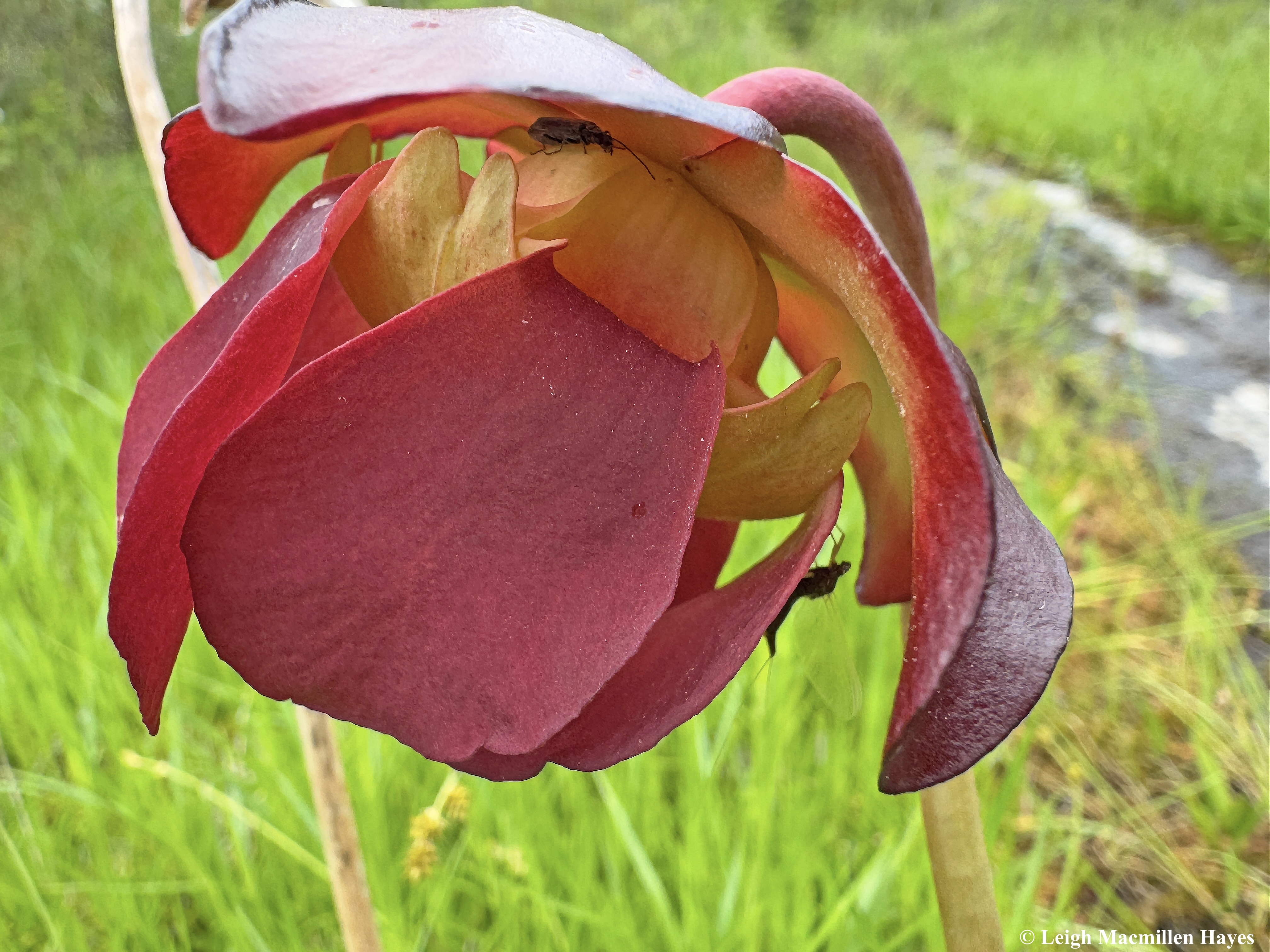
And the otherworldly flowers were in full bloom, including this one that hosted a long-horned insect and a sub-imago Mayfly (read: Dun).

I’ve been wowed by these for a long time and years ago drew this rendition as a teaching tool that now is the background for my iPhone.

There were Unadorned Bog Flies pollinating Bog Labrador Tea.

And Cotton Sedge showing off their hairy tufts.

Our next leg took us from the Bog to the Groton multi-use trail, being used mainly by horse riders and moose. We saw neither, but their tracks were evident in the mud.

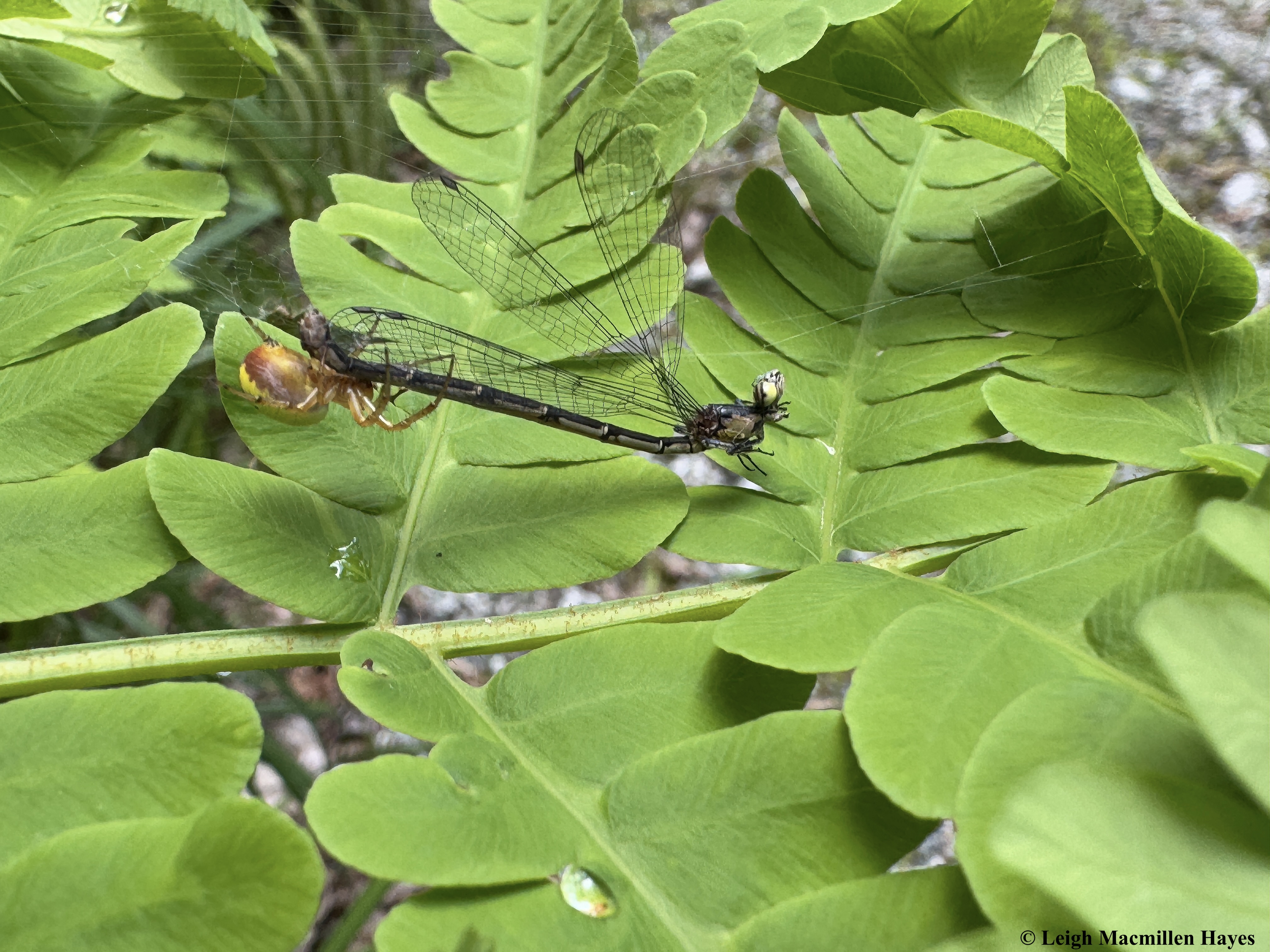
What we did spot was this Aurora Damselfly being wrapped up by an Orb Weaver Spider. I knew the damselfly immediately because of the uneven stripe on the sides of the thorax.

And had recently tried to paint a mature form of the same species.

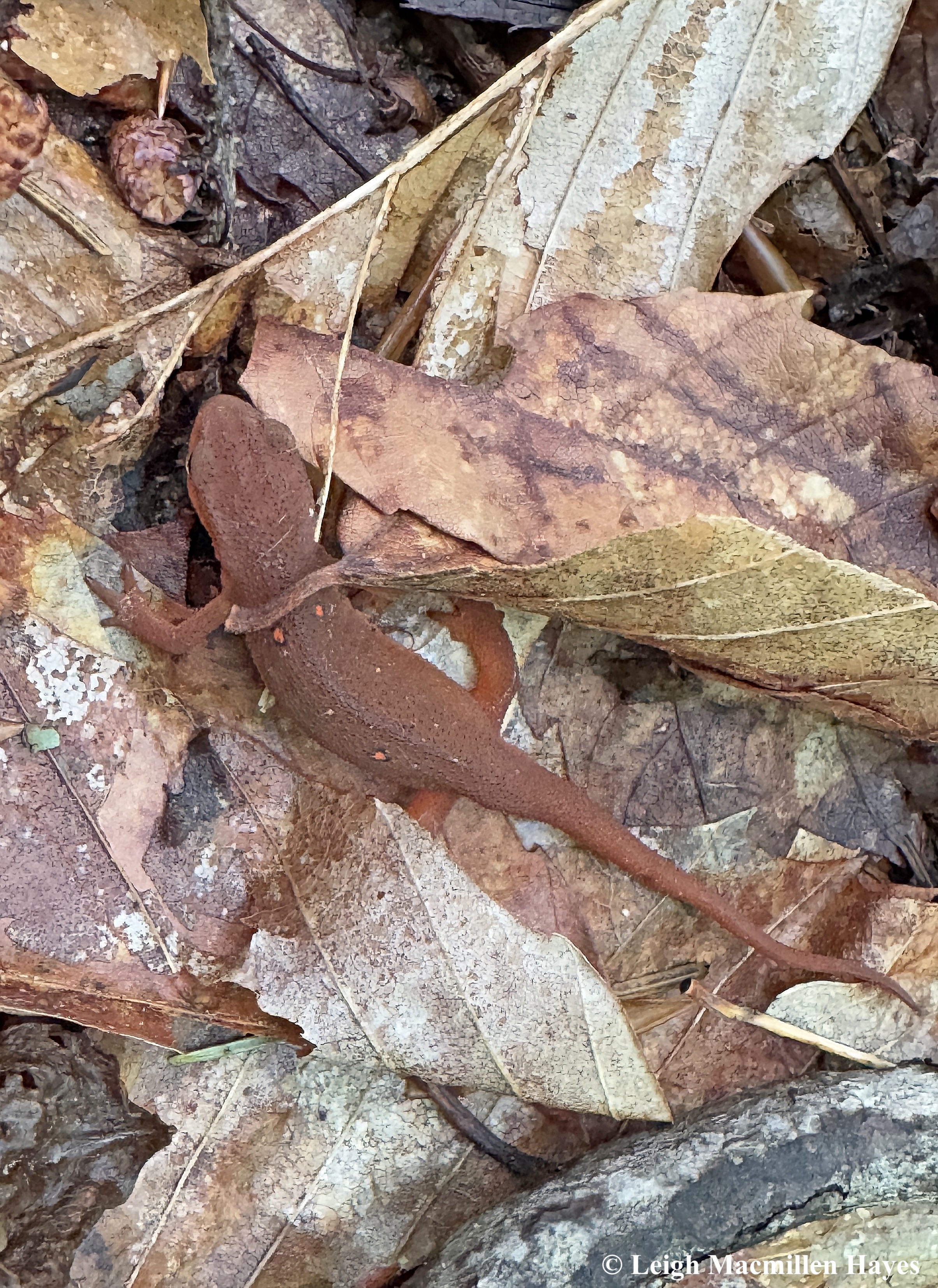
We also met a couple of Red Efts, the teenag and terrestrial stage of the Eastern Newt. The red spots act as a warning to predators because if consumed, they secrete poison toxins from their skins. As humans, we can touch them and live, but to ingest one would be harmful. So don’t try that.

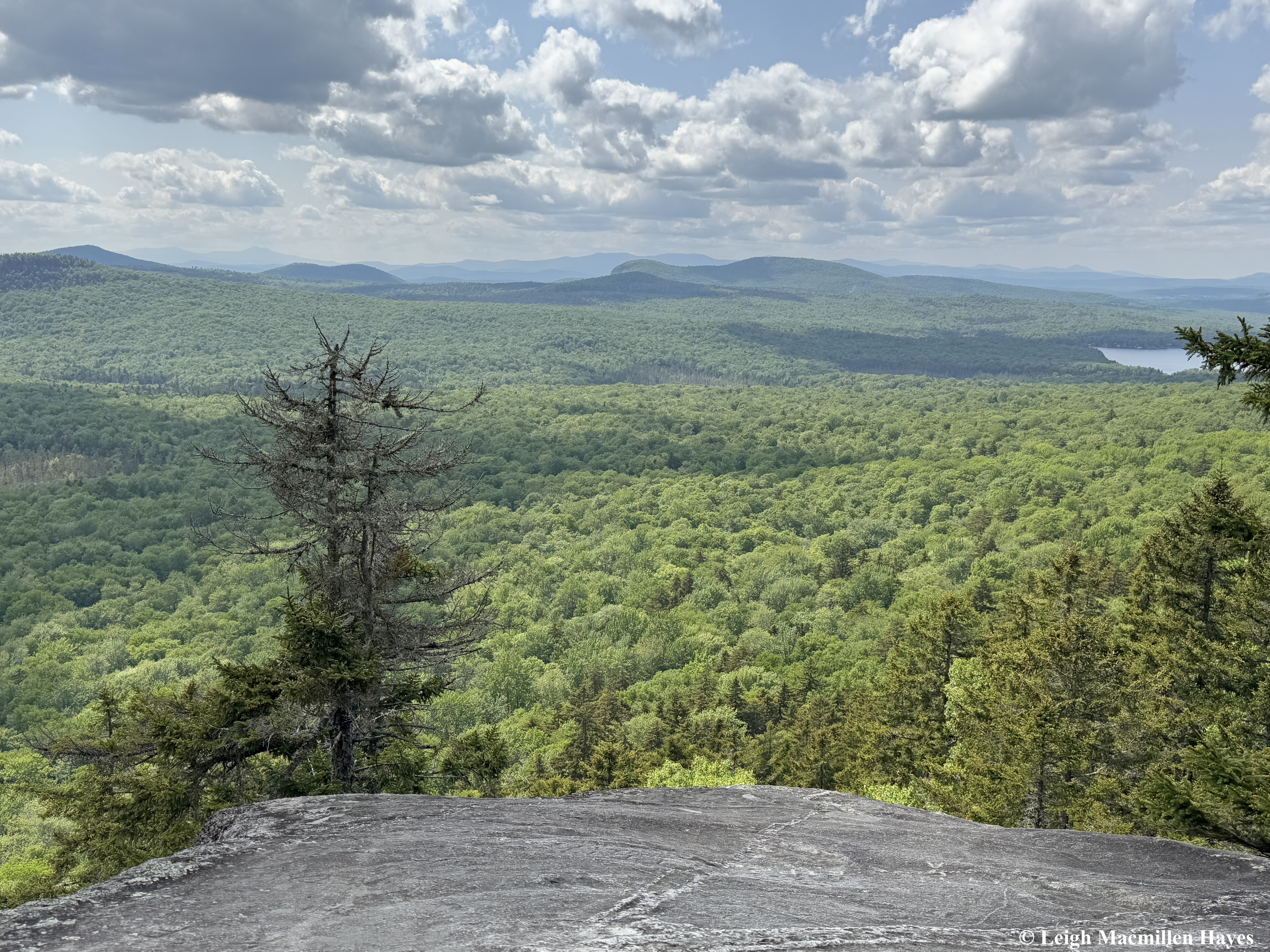
A couple of miles later we reached the trailhead for Devil’s Hill and snaked our way up the switchbacks to the summit, where this view of the rolling hills and iconic geography of Vermont stood out before us.

On the way down, a male Luna Moth presented itself, hiding as it was under a Striped Maple leaf.

I love these leaves and their twigs, especially the growth rings that stand out so predominately, and My Guy appreciates that the leaves serve as Nature’s Toilet Paper. TMI? But really, they are easy to identify and they are soft.

Returning on the multi-use trail before retracing our steps on the Peacham Bog Loop, we had to walk through tall grasses and sedges, which did not make my heart so glad because this was heavy tick territory. I had on tick gaiters and repellant. We took at least five off My Guy.

But, this pair of Craneflies did share a canoodle moment with us, so that won me over for a second.

All in all, we hiked over eleven miles that day, and were too beat to go out to dinner, so instead drove to the West Barnet Quick Stop, about 1.5 miles from our weekend home. There we ordered Chicken Cordon Bleu Paninis with Pesto, and a salad to share. And while we waited for our meal to be created, noticed Shain’s of Maine Ice Cream in the freezer, which made us chuckle. Wait a minute. We were in Ben & Jerry Country. Never fear–they had a much better presentation in another freezer.

And, while we waited, I asked the woman who was creating our salad if she lived in the area. “All my life,” she said, and added, “So far.” We chuckled, but then I asked if she knew so and so, a couple I know from church who had lived just down the road for many years (a fact I’d only learned days earlier).

Her face lit up with a smile as she recalled them and said they used to frequent her other store and that their daughter had worked for her. As tired as I was, that smile of hers was the perfect ending to a great day.

Well, it wasn’t quite over yet. For there was no TV at our weekend digs. And so I taught My Guy to play Parcheesi, and then I beat him.

The next morning we drove north to Orleans to meet my first college roommate and her husband, Bev and Bill, at the Carriage House for breakfast. Funny thing–as I drove up Route 91, there was one car in front of us and approaching it, with its Maine license plate, I spotted Lakes Environmental Association and a Loon Echo Land Trust stickers on the rear window. It had to be someone from our hometown. Sure enough, as I passed it, I recognized the mother of one of my former students. And a wondermyway follower.

Betty, if you are reading this, that was us on the highway with you on Sunday morning at 8:30 or so.

We spent two hours talking and eating and talking and talking some more over omelets and coffee and Bev and Bill suggested that we hike Mount Hor, which overlooks Willoughby Lake. I’d been to Willoughby before with Bev and two other dear friends, but never hiked in that area. And so we did. They gave us easy to follow directions and we parked and then walked almost two miles up the CCC Trail. I love that this was another project meant to keep people working when times were tough.

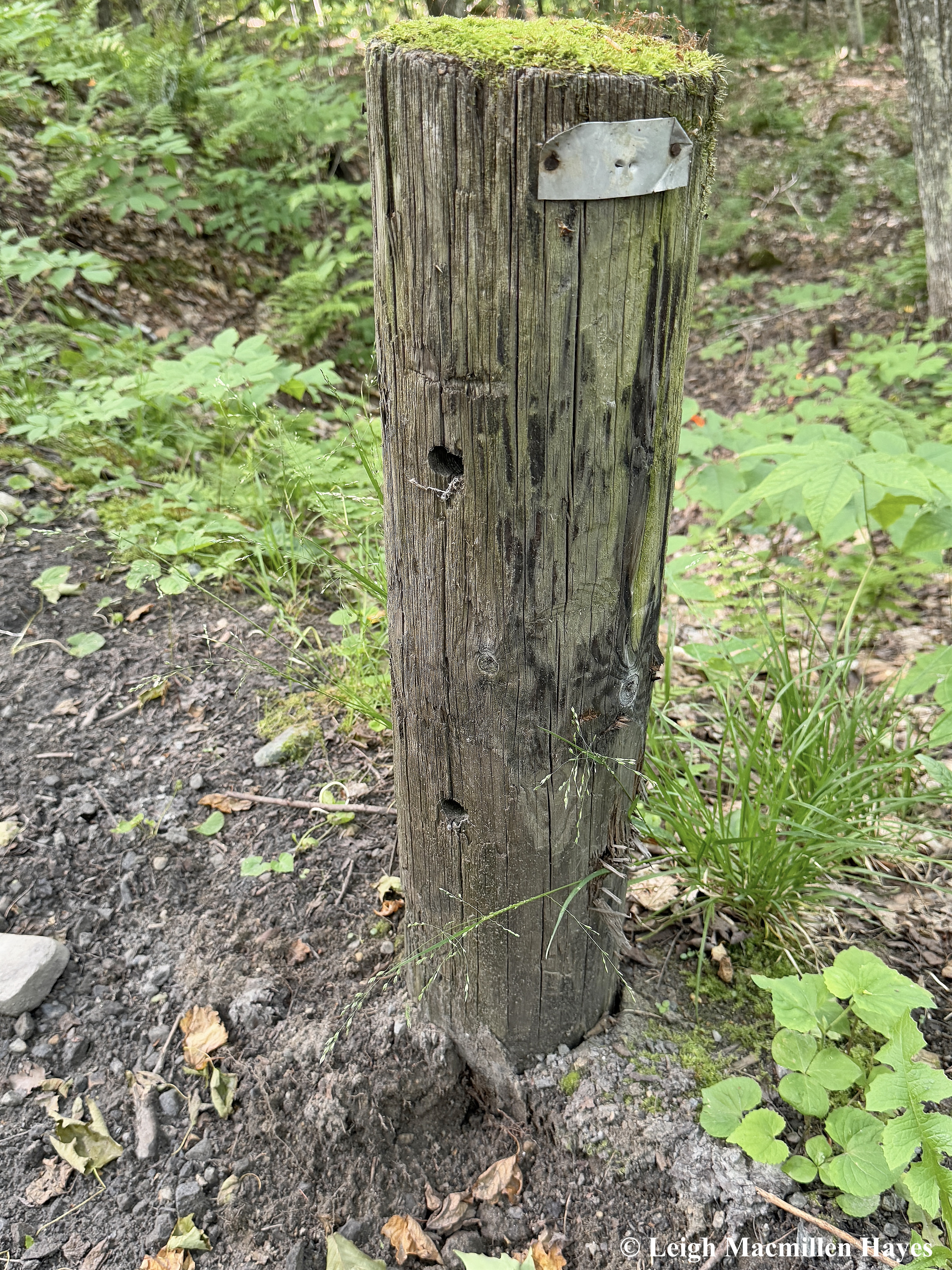
Though the hard packed surface we walked on was not the original road, we kept spotting these posts and my theory is that they were original and held cables that connected one post to another and kept vehicles from catapulting down the steep embankment.

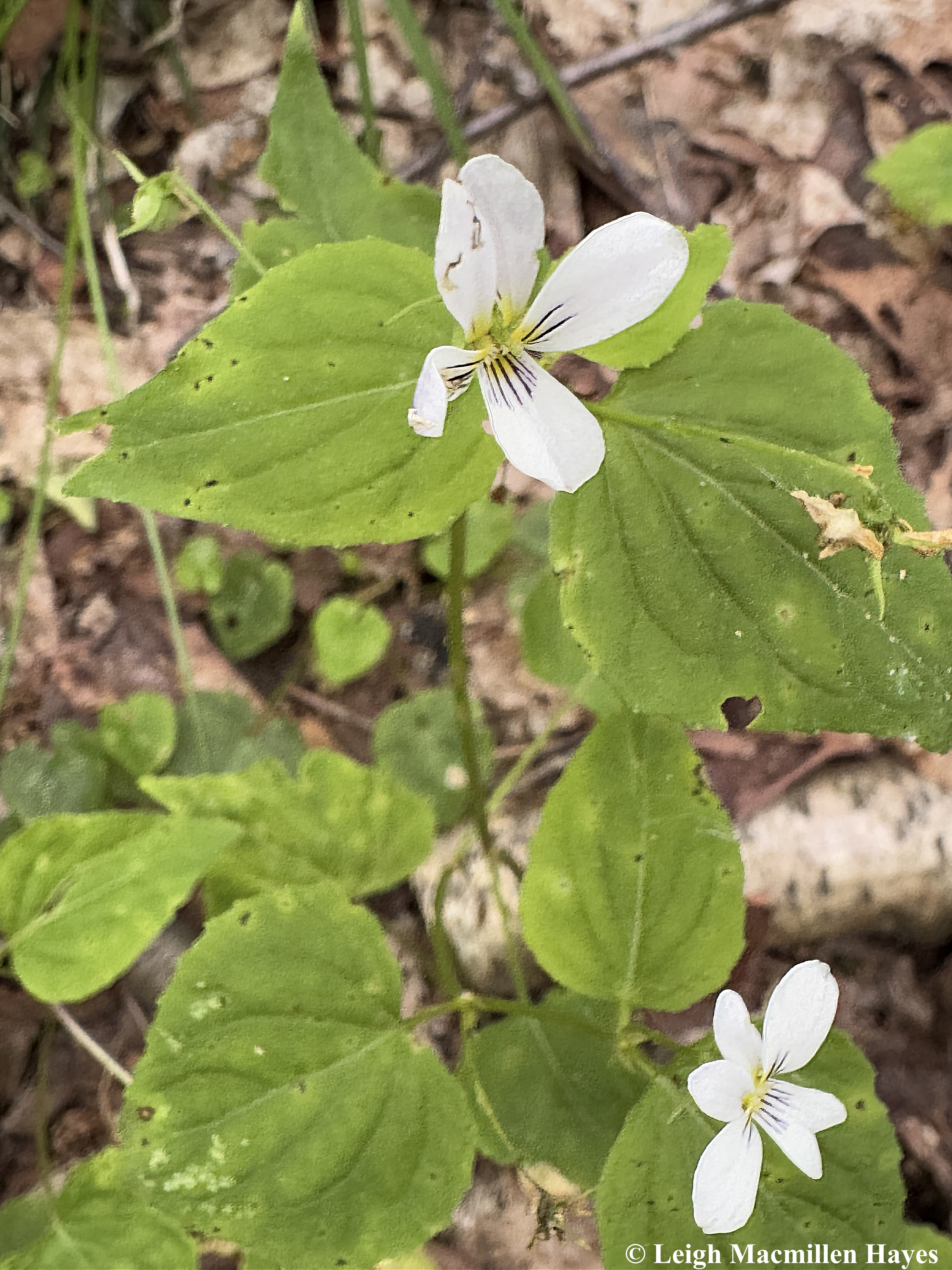
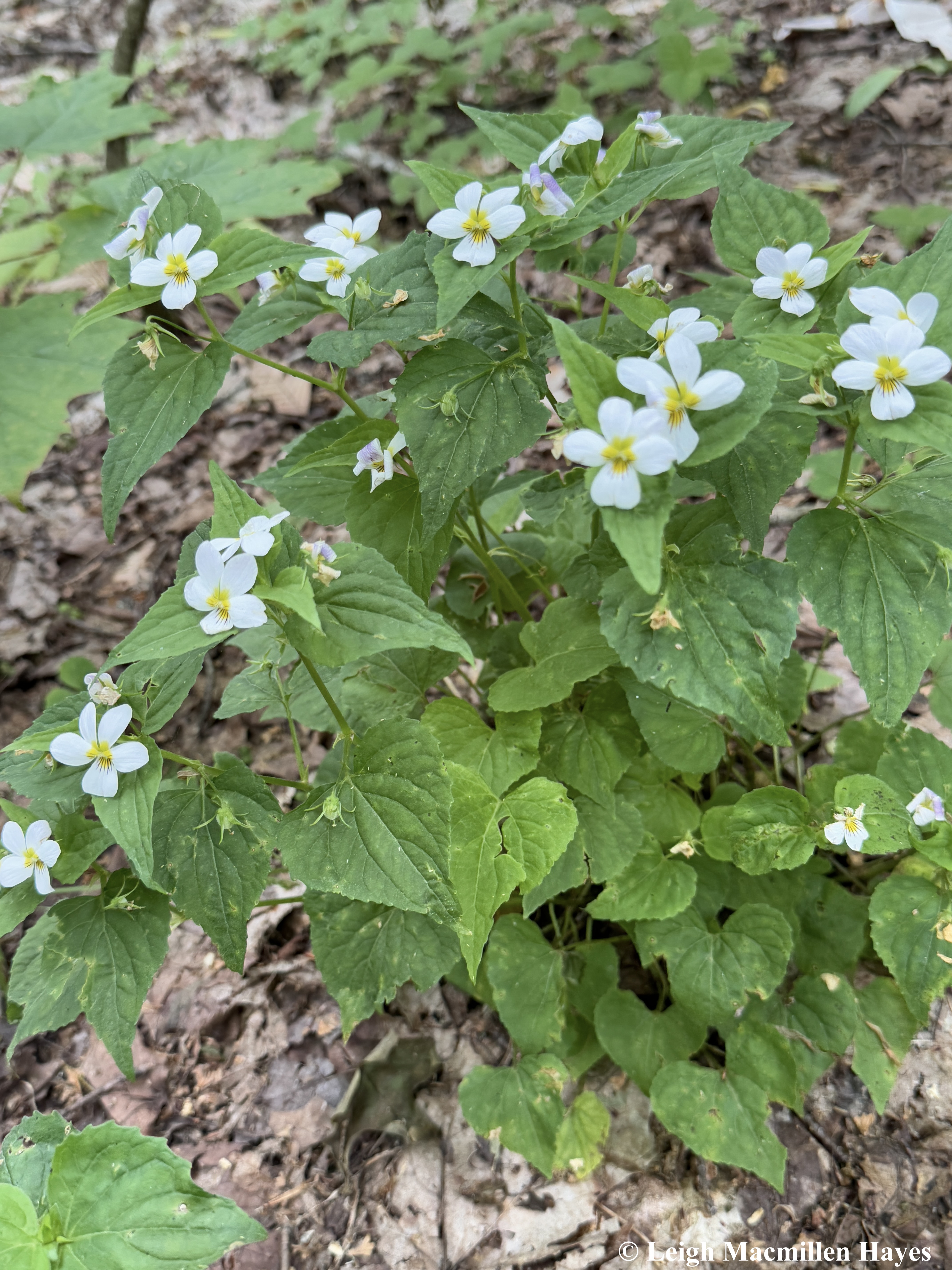
When we finally reached the actual trailhead for Mount Hor, I met a new flower. Canada Violet. It made sense since we were probably about ten miles from the Canadian border. Delicate. Pure white. A well-defined runway to the nectar. And leaves offering a different take on the violet theme.

What we soon realized was that it not only grew tall, but also in large clumps.

Oh my gosh, our next find–Maidenhair Fern. Such a unique presentation and color and, oh my gosh!

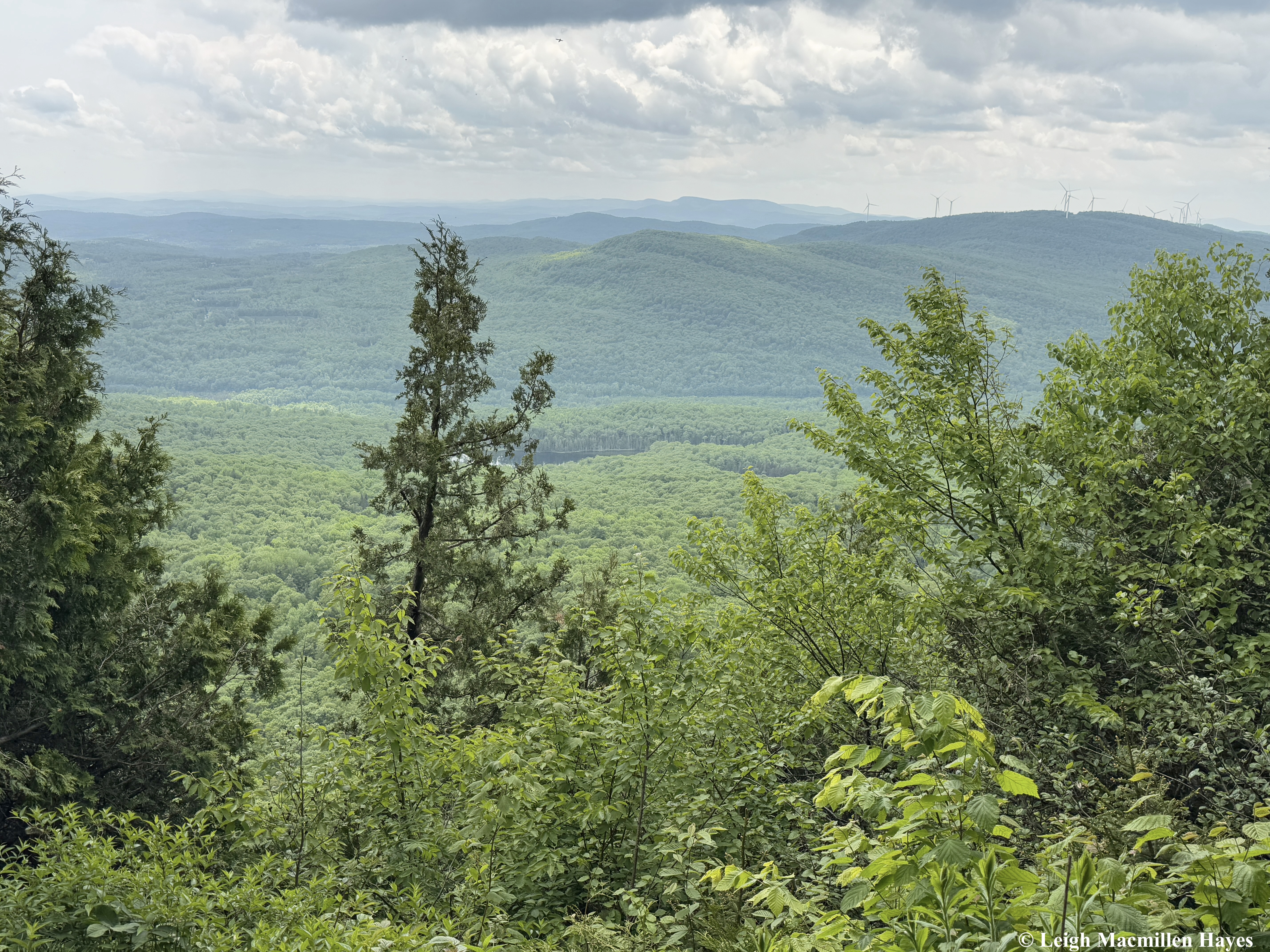
At the summit, we had three choices. First we headed to the Summit Vista, where the view included Cedar trees in the foreground and two delightful couples who were enjoying GORP and blueberries but when they heard that we had homemade Peanut Butter Chocolate Chip granola bars a la The Stow Away Baker in our backpack, they wanted to chase us down the mountain.

From there, we hiked another mile across the ridge line to the East View, overlooking Lake Willoughby.

While there, we spotted a Peregrine Falcon soaring on the thermals, but neither of us got a good shot of it. Still. Forever in our minds eye. And sometimes, those are the most memorable moments.

From the North Vista we looked across at the cliffs of Mount Pisgah and wondered how many more falcons we weren’t seeing.

Back down the CCC Road we did walk once we stepped off the mountain trail and my favorite find was a Mountain Maple, that stopped me in my steps for a few minutes as I had to remember who it was that I was meeting.

Back at Lake Willoughby North Beach, Mount Hor is on the right and Mount Pisgah on the left, creating a fjord-like presentation.

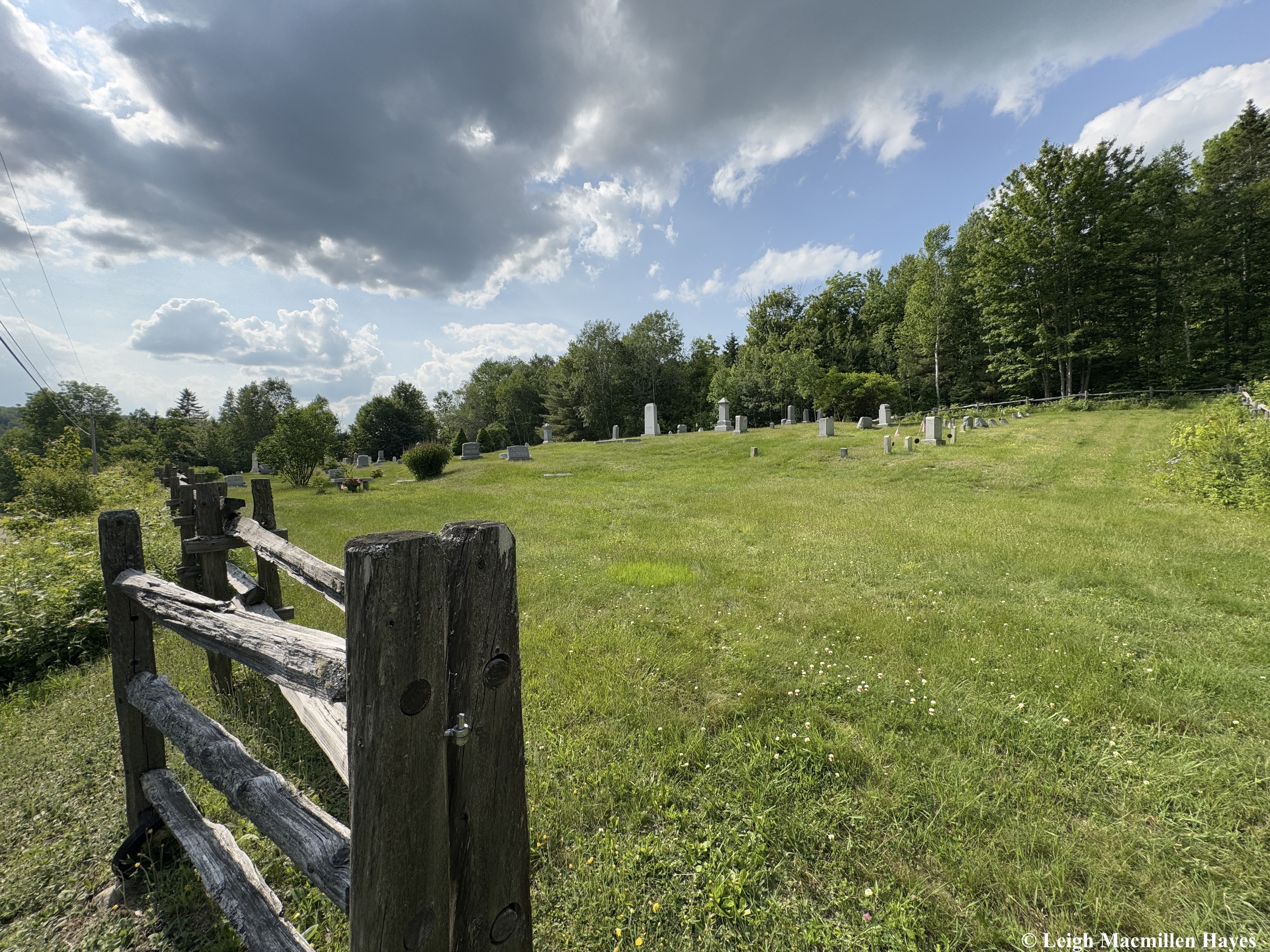
From there, we drove south to South Barton as I let my nose lead the way and found a cemetery I’ve visited in the past for some of my ancestors are buried here.

Recognizing family names is always a treasure. And actually, within the post railings of this place I noted at least three different families that have contributed to my DNA. I’m pretty sure my love of the north country, be it Northern New England or Canada, comes from these folks.

On the way back to our home base, we grabbed sandwiches to go from Three Ponds and gave thanks for their goodness.

And then this morning, after packing and cleaning and chatting briefly with Chuck, we had one more place to explore–Kettle Pond State Park within Groton State Forest.

So here’s the thing. My understanding of a kettle bog is that it’s kettle or bowl shaped. And has an outer layer of herbs, with the next layer surrounding it of taller herbs, and then a third layer of shrubs encircling the kettle, and finally, trees who like wet feet, like Red Maples, forming the final ridge around the pond.

None of this was present. Well, there were shrubs and trees, but not in layers like I’m used to seeing. And the shape of the pond was more north-to-south glacial-related than kettle-related. Hmmm?

Still, some great finds like this Spotted Salamander egg mass along with four others in a deep puddle along the trail. Can you see the embryos forming?

And a Garter Snake that had been basking on a rock in the trail until we happened along.

And Twin Flowers, each sharing a petiole, growing like a mat along a glacial erratic.

And Stair-Step Moss growing abundantly like a set of stairs here and there and even over there.

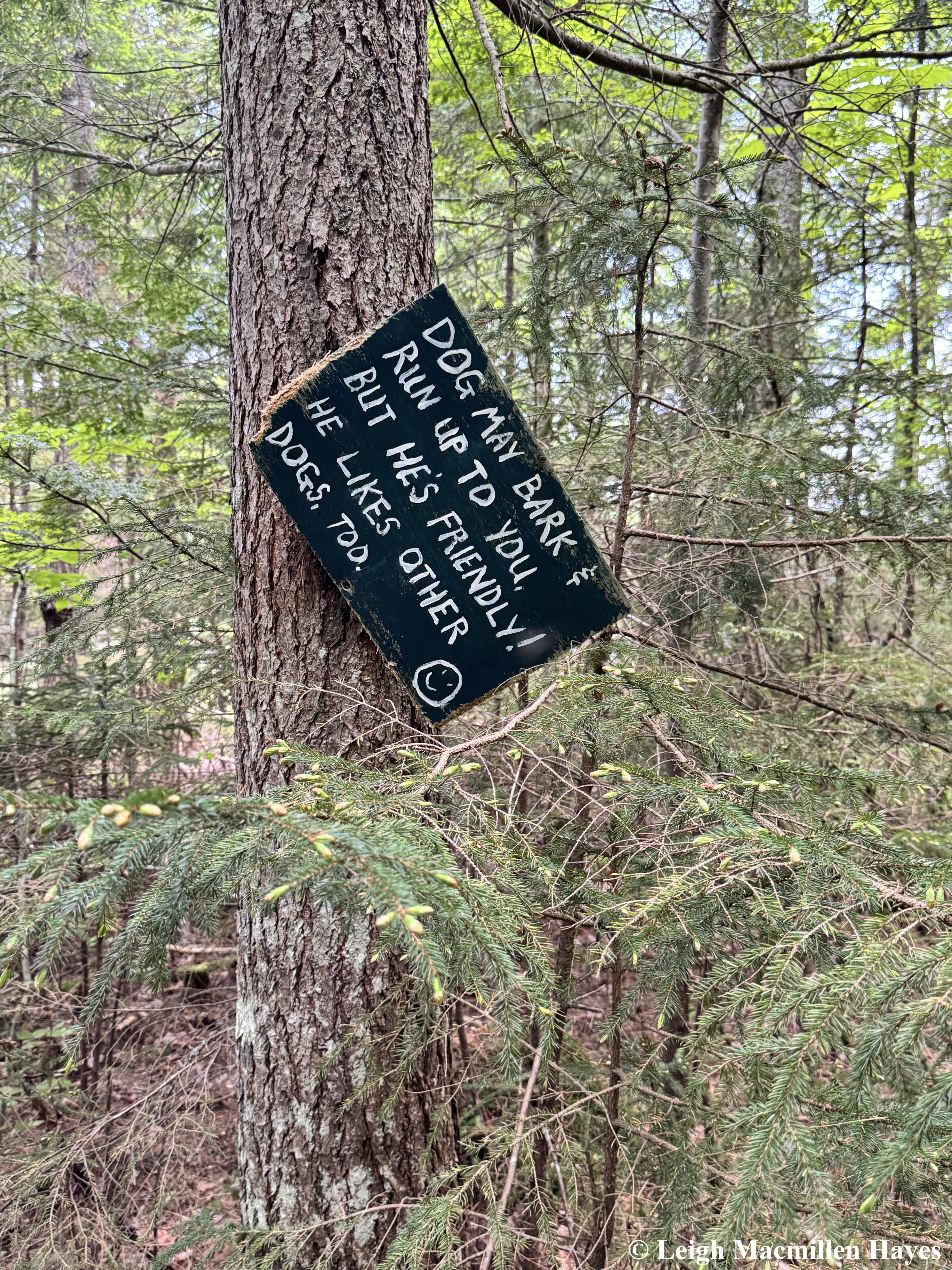
And a warning, which was more of an invitation at the only private cabin along the way, a route which offers lean-to shelters for groups to rent. I love this sign. We looked forward to meeting said dog, but sadly, no one was home.

Flat-fruited Pelt Lichen also lined the trail. So much to see. So much more to learn.

Oh, and an Eastern Newt in the water. It was like the Newt brought the trail to a full circle beginning with the Red Eft on our first hike of the weekend and ending with this adult form.

Our time Vermonting came to an end this afternoon, but oh, what a wonder-filled time we had. We hiked so many miles while meeting old and new friends, dined with dear old friends, met friends of friends who were old friends to each other and new friends to us, and just plain had fun making new memories.

Thank you Chuck and Mercy, and Bev and Bill, and Debbie and those at Three Ponds, and Brian at the Nature Center, and to all the others we met along the way for making our experience such a rich one.

Vermonting we did go. Word or no word, it was exactly what we needed.
Where The Moccasins Led Us

Rituals. We follow them. Some more than others.

For My Guy and me, there is one in particular that captures our attention beginning in mid-May.

And so I follow him . . . across Beaver dams,

beside the Atlantic Ocean,

up mountain trails,

even on the hottest day so far with Canada wildfire smoke casting a haze.

This year it was more trails than usual that were included in our ritual and along the way we spotted Wild Columbine in bloom, growing as it does among the rocks, and always pleasing our senses with its brilliant colors and artistic nodding presentation.

Fringed Polygala, and how I love the way those two words roll of my tongue, also showed off, making its common name of Gaywings so apparent. Doesn’t it look like a Bird of Paradise coming in for a landing upon its very own leaves?

Upon one of our journeys we found a few Red Trilliums still in bloom, though it seemed late in the season for them. But as My Guy teases, I did what I do and added this photo to the other trillion I have of this plant. They all need to be honored, don’t they?

Seemingly everywhere, Clintonia, aka Blue-Bead Lily bloomed, adding specks of sunshine to the path and lighting our way, even on the grayest or rainiest of days. Yes, we even hike on rainy days.

On sunnier days, the Tiger Swallowtails added their own yellow to the equation. Can you see the tiny pretarsi or insect feet of the butterfly as it held on why sucking the flower’s nectar?

This spring it seems the Tiger Swallowtails are everywhere we travel by foot or truck. What I love about this one is that it was taking a break upon the leaves and you might be able to see its proboscis or siphoning mouthpart coiled up because there was no nectar to seek in that moment.

Right now the Swallowtail butterflies are the largest we’ve seen flying, but during a hike the other day, we spotted one of the smaller ones, this being a Northern Azure feasting upon Black Chokeberry flowers at a summit.

Jack, or rather Jill-in-the-Pulpit, for she needed the extra leaves to help her in her mission of producing seeds, greeted us in various places where the soil was moist including beside the cow path in our woods, where it totally surprised me despite the fact that we’ve lived in this house and wandered about for over thirty years.

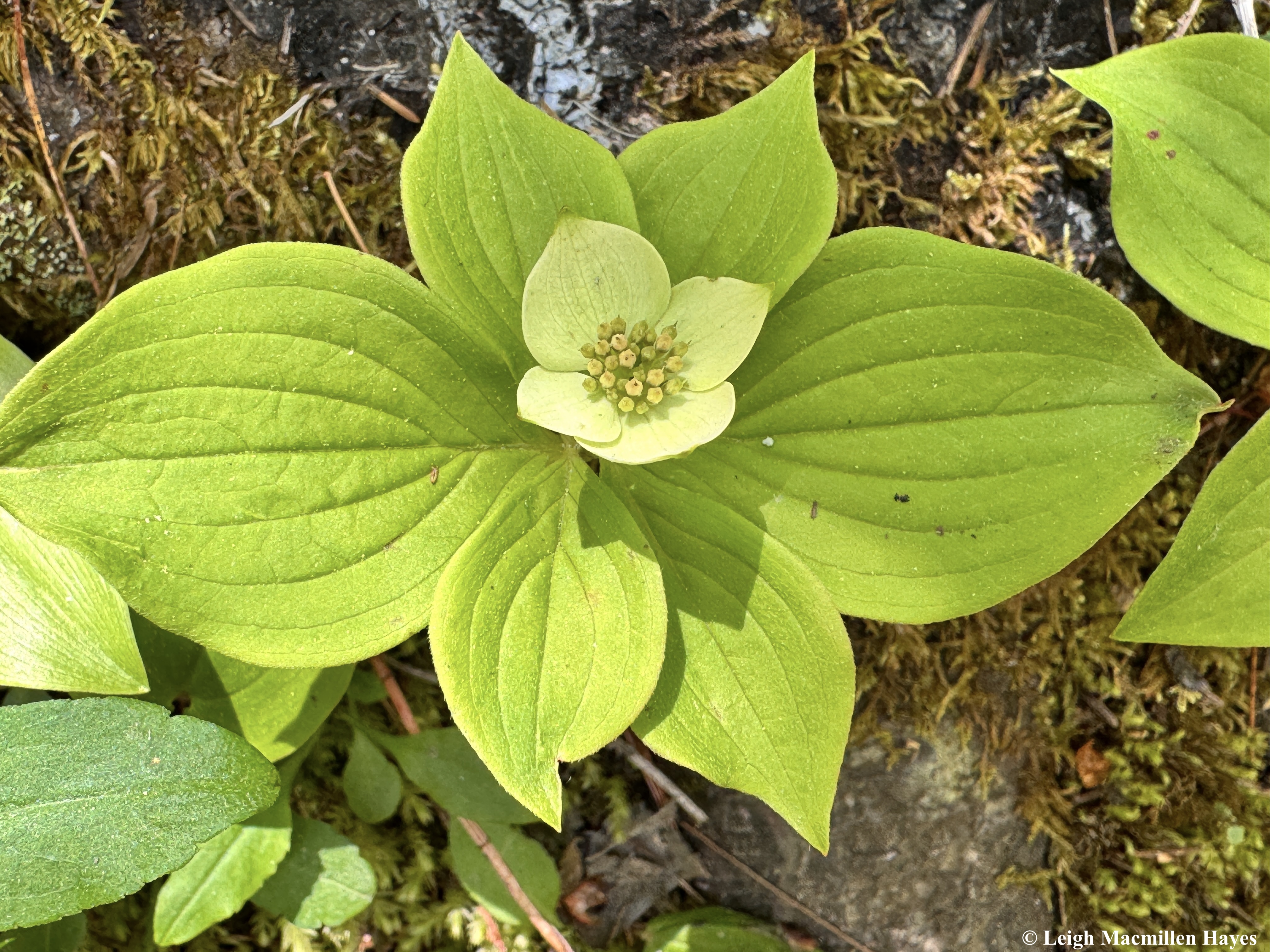
As one week turned to the next, and the flowers that were in full bloom kept changing, suddenly Bunchberry was added to the list. Again, like Jill-in-the-Pulpit, Bunchberry needs two extra leaves in order to have more energy to produce flowers followed by the berried fruits that bunch together in a cluster of bright red. You may look at the veins on those leaves and immediately know the family to which this wee plant belongs–if you guessed Dogwood, you are correct.

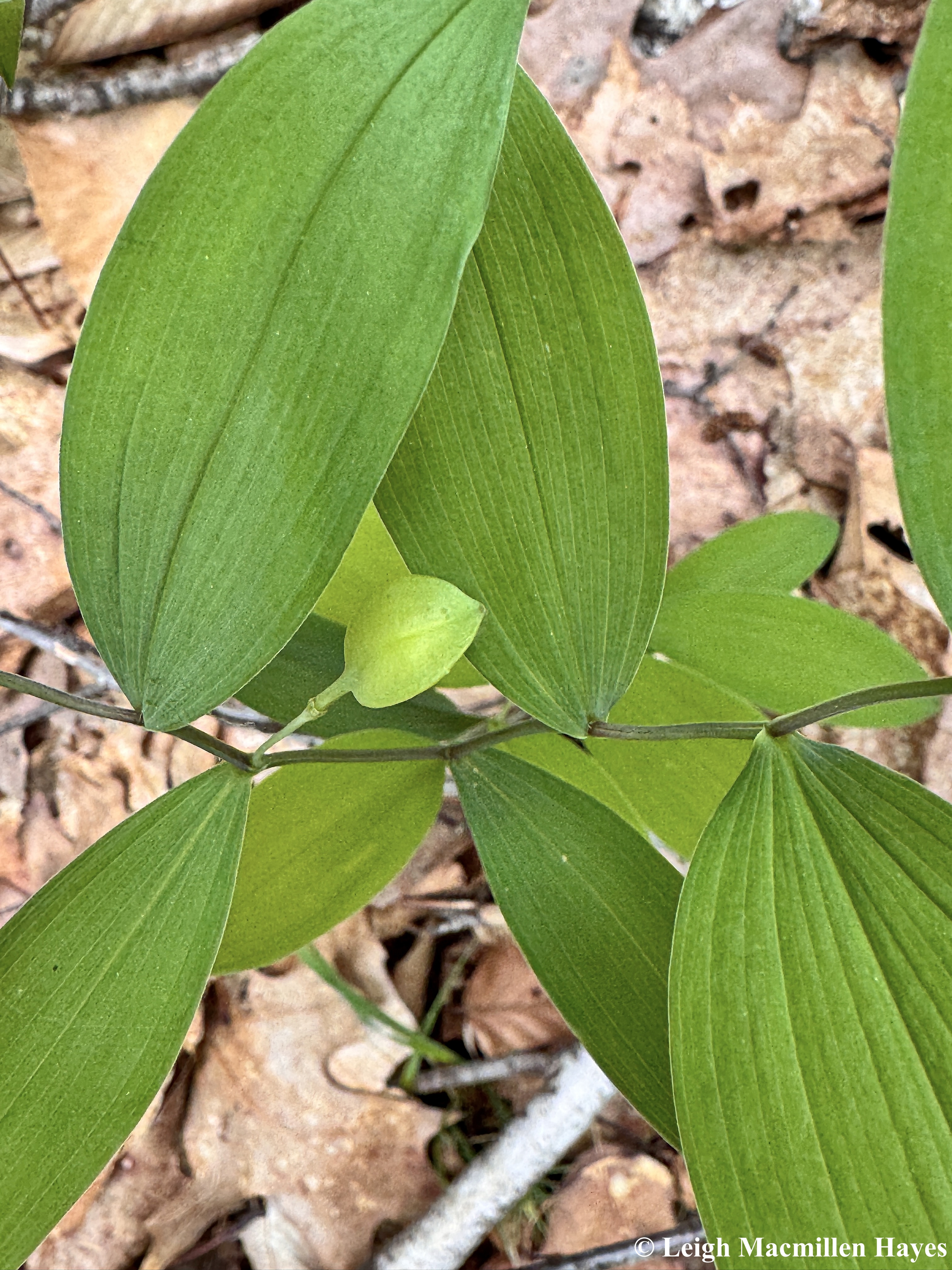
One of the earliest bloomers of spring, has already formed into a fruit, in this case three sided. Meet the Wild Oat of Sessile-leaf Bellwort. It reminds me that in a snap of the fingers, the season passes by much too quickly.

It wasn’t just flowers that marked our journeys. About the same time that we began the latest ritual, dragonflies and damselflies slowly began to emerge, for which we always give great thanks as they gobble up some of the Mosquitoes and Black Flies that so annoy us. This American Emerald had only just made the transformation from aquatic form to terrestrial hours earlier based on the sheen still visible on its drying, but not quiet dried yet, wings.

Much more mature were these two, who had formed the marital wheel in order to canoodle. I knew they were Emerald Dragonflies, but wasn’t sure which species until I searched my guides back at home: Uhler’s Sundragon, a new species for me.

And in at least one spot, some smaller female dragonflies deposited eggs as they tapped the water’s surface with their abdomens. Think of it as Naiads to come, who will live in the water for 1 – 3 years, depending upon species, before climbing out and transforming miraculously into terrestrial fliers.

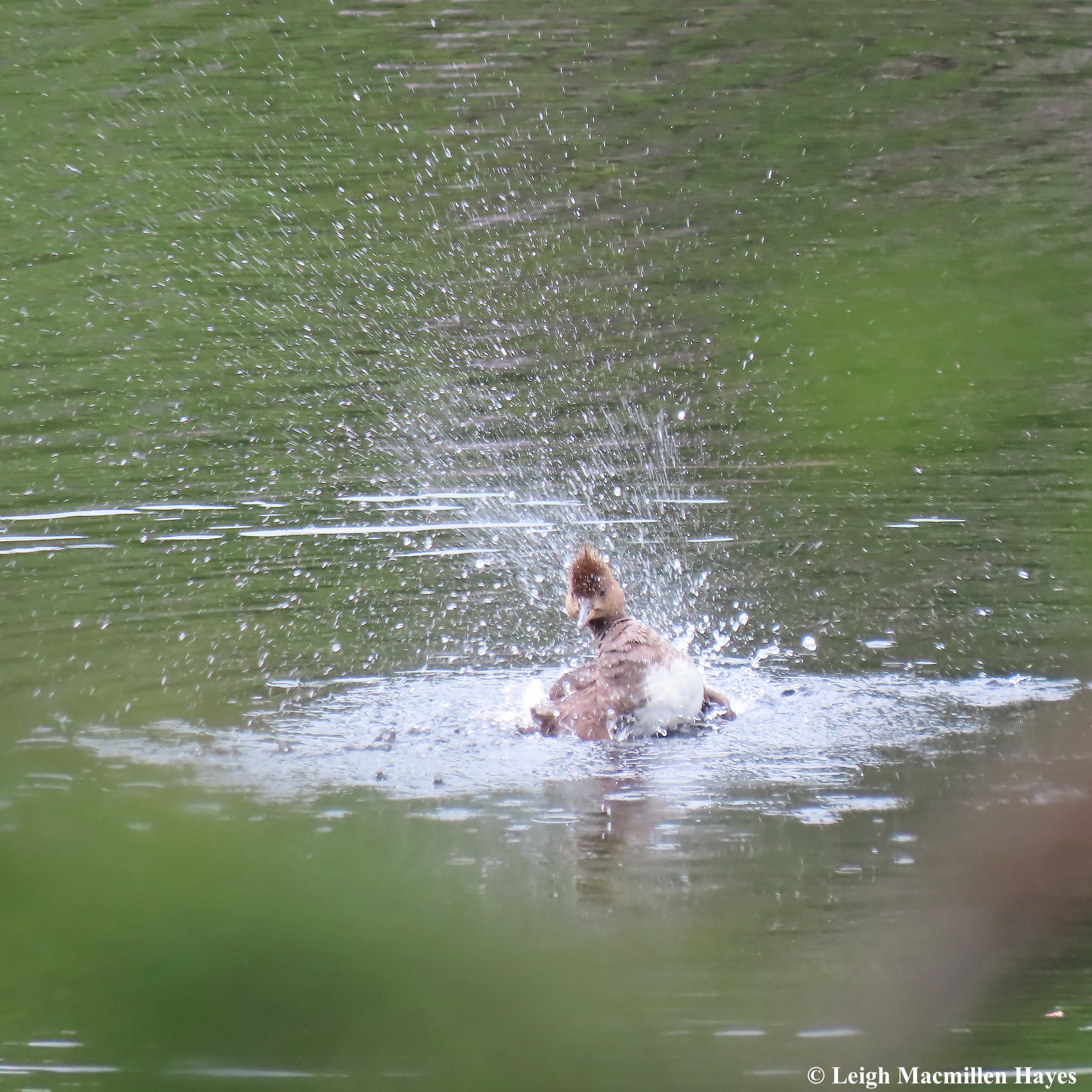
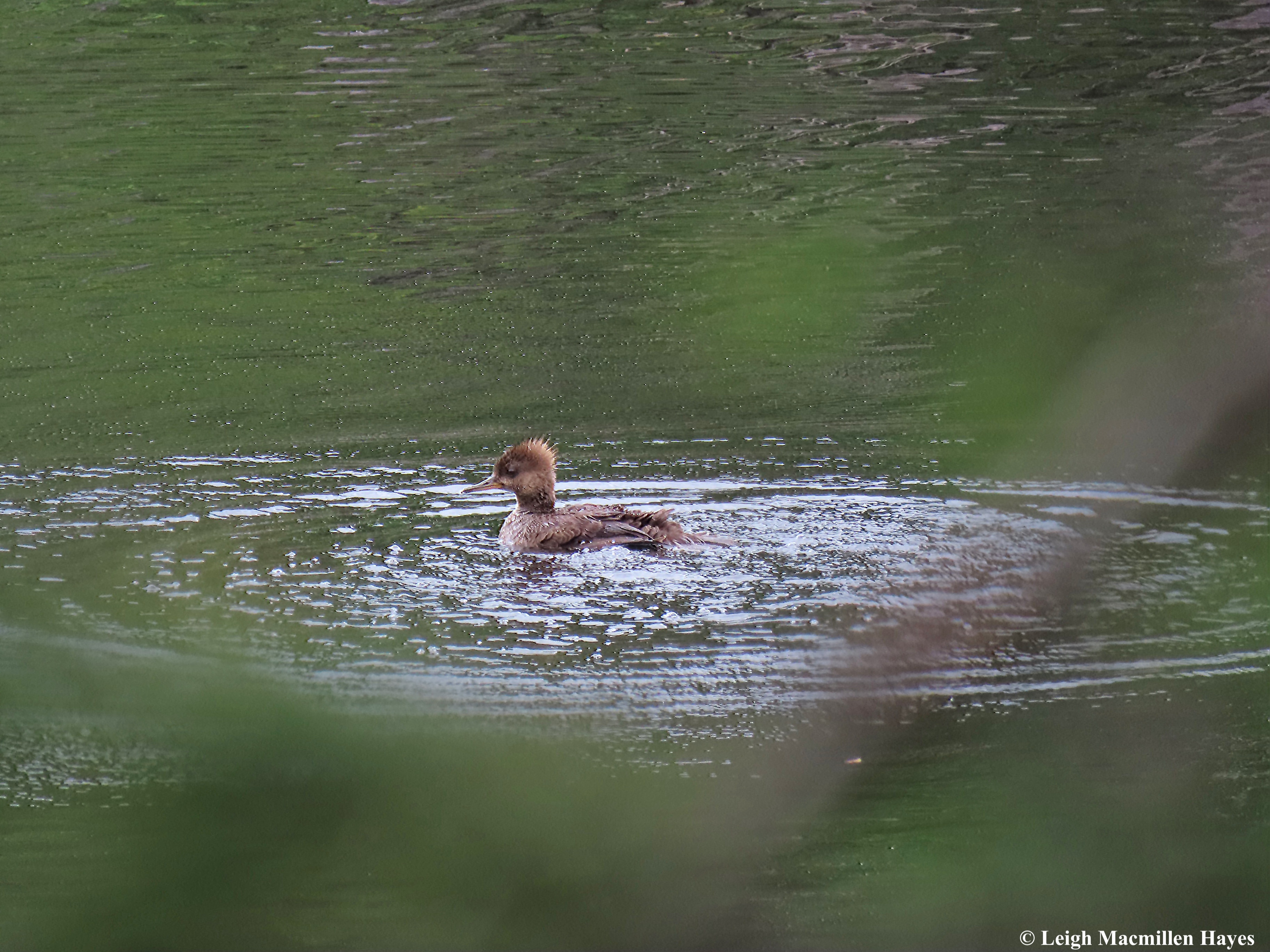
Being beside water in another place, and looking between tree branches, we spied a Common Merganser taking a bath.

We stood just far enough back, that it didn’t realize it had an audience as it splished and splashed.
And finally shook itself off, with water spraying everywhere, before it continued on its journey . . . and we did the same.

Basking Painted Turtles became a common sight as well, and this one had the cushiest place upon which to recline, all others being on fallen logs or rocks and boulders in the water.

One, however, that I assume was a female, though I didn’t want to disturb it and get any closer to check the length of its nails, I surmised had been laying eggs or was about to. Our time together was limited so I don’t have the entire story, but she was in a safe place, no matter what.

One of our most unusual sightings as we performed the ritual was spying a Bald Eagle steal a fish from the grip of an Osprey. If you look closely at the center of the photo, you might spot the thief on its get-away mission–it is flying above the picnic tables, about in the middle of the trees.

As it flew over our heads, the Eagle had the audacity to look back to see if the Osprey was hot on its tail. It was. We don’t know how this story ended either, but we assume the Osprey had to cast its fishing line again.

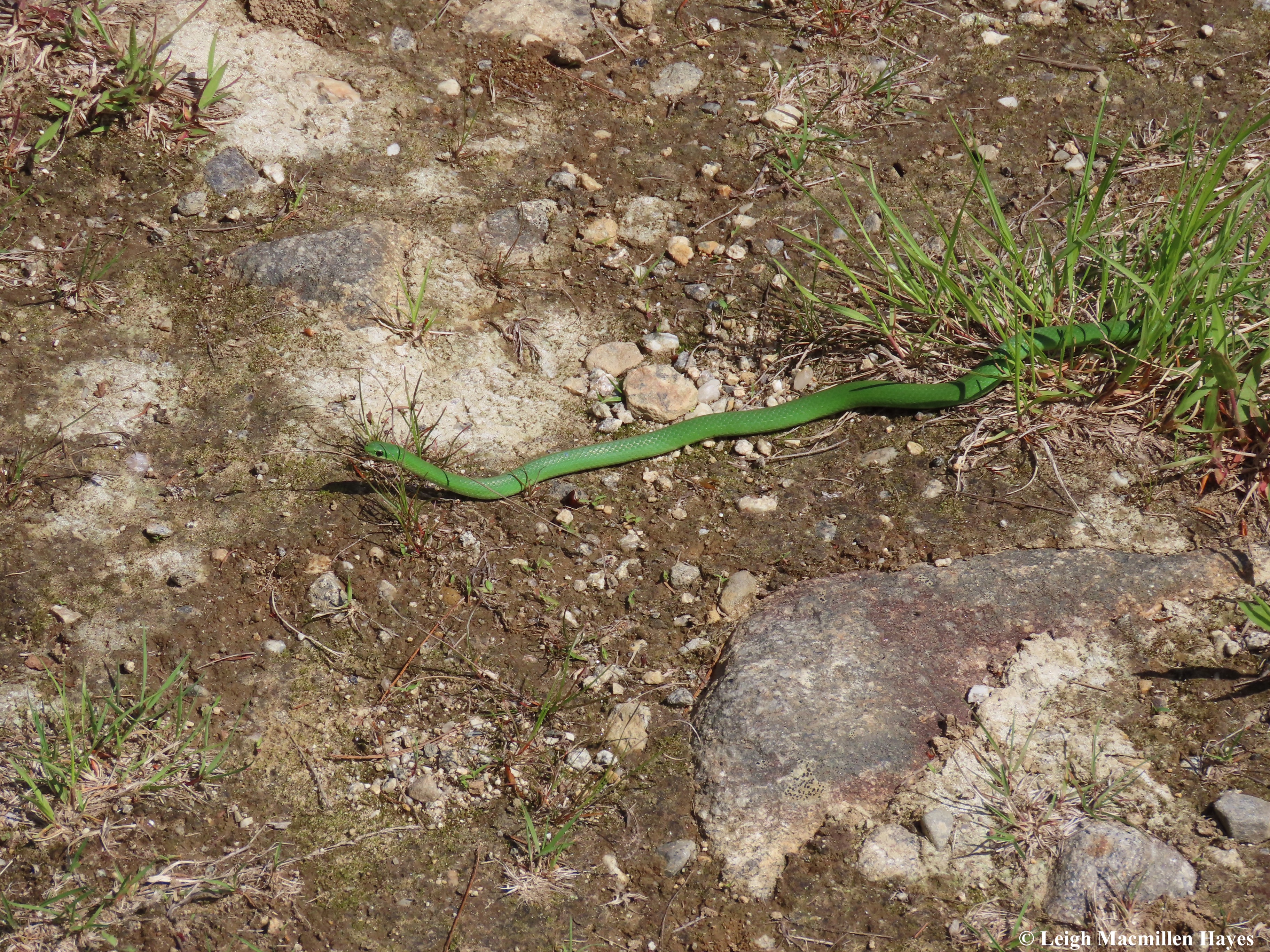
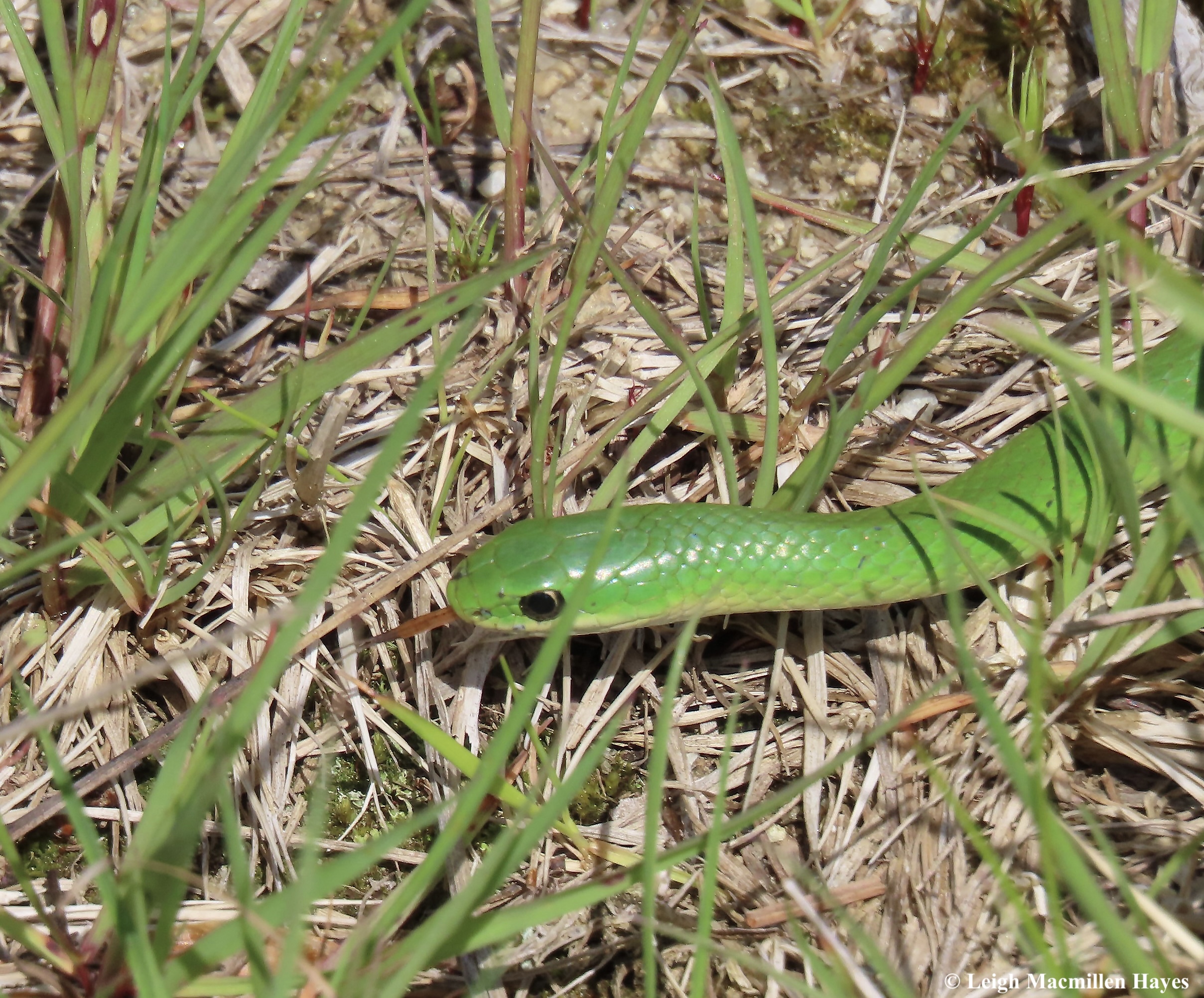
Another fun sighting occurred as we crossed under a powerline on the return trip of a seven mile hike around a river, over to a pond, up a hill behind the pond, and back down and out. Almost the color of the grass that sparsely grew along this section of the trail, a green snake slithered across just after My Guy had stepped that way.

I just love its forked tongue–sensing the trail in snake manner as it did.

The two tines at the tip of the tongue, seen here as it withdrew this sensory organ, help it to smell in stereo and thus find its way and find a meal.
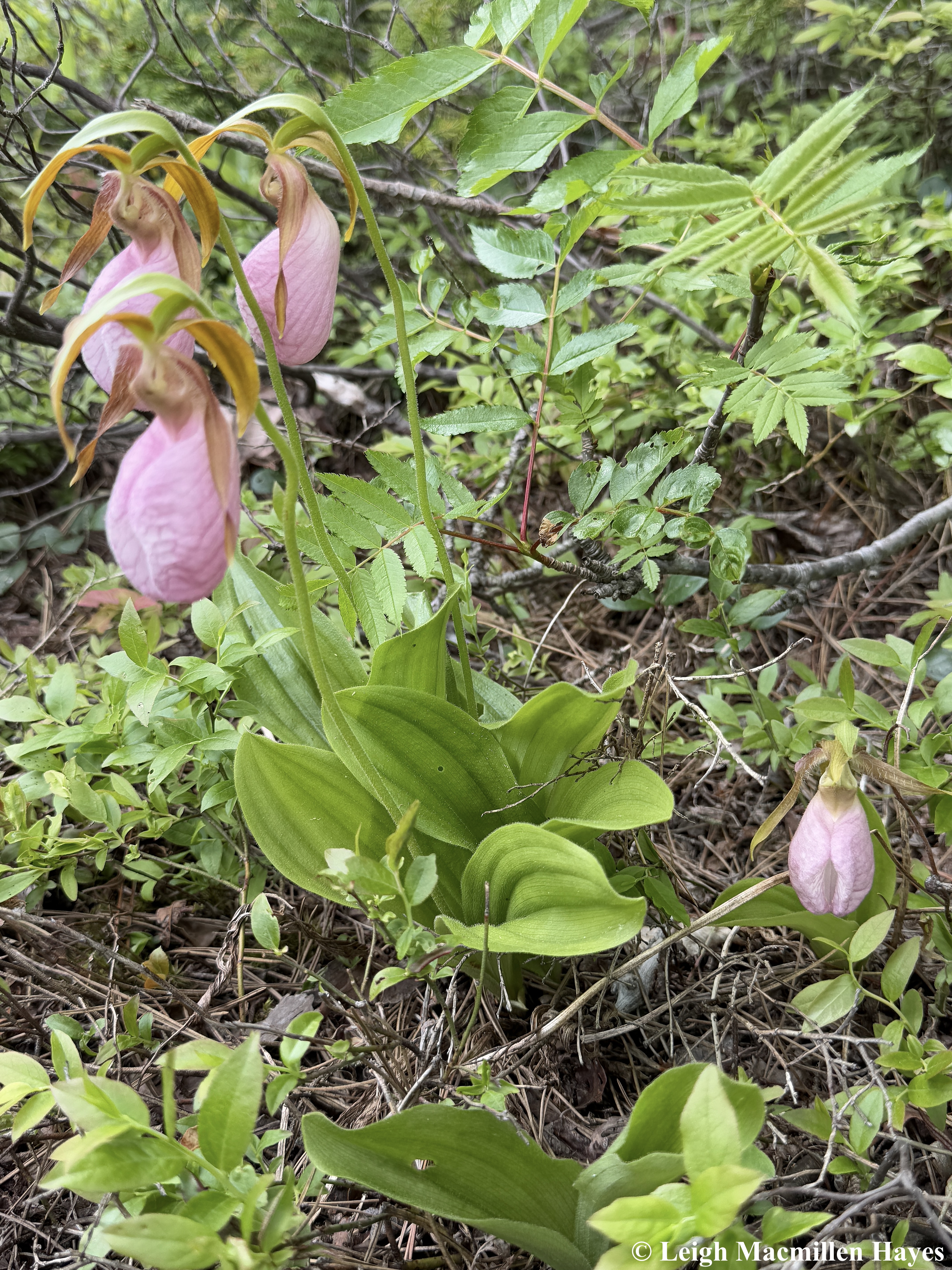
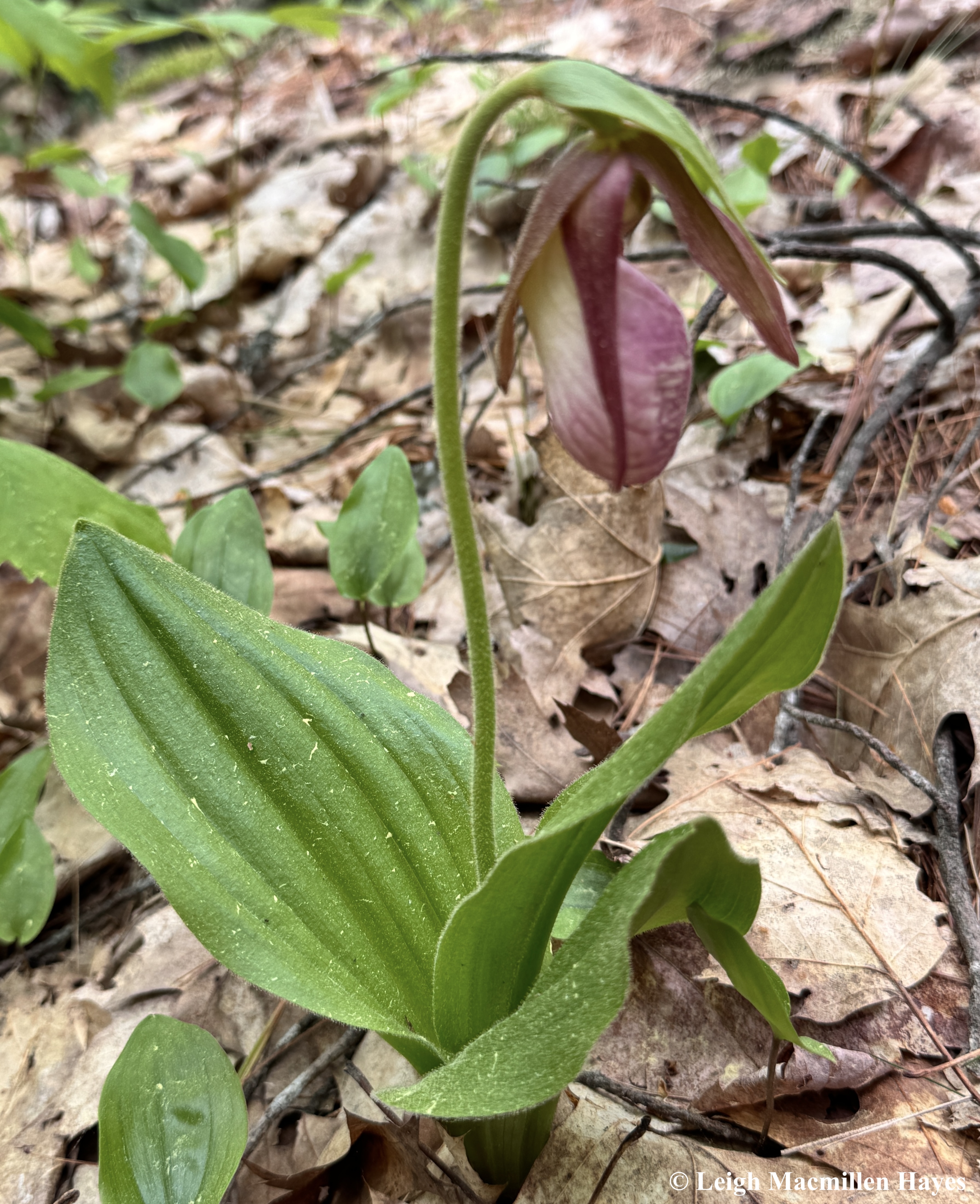
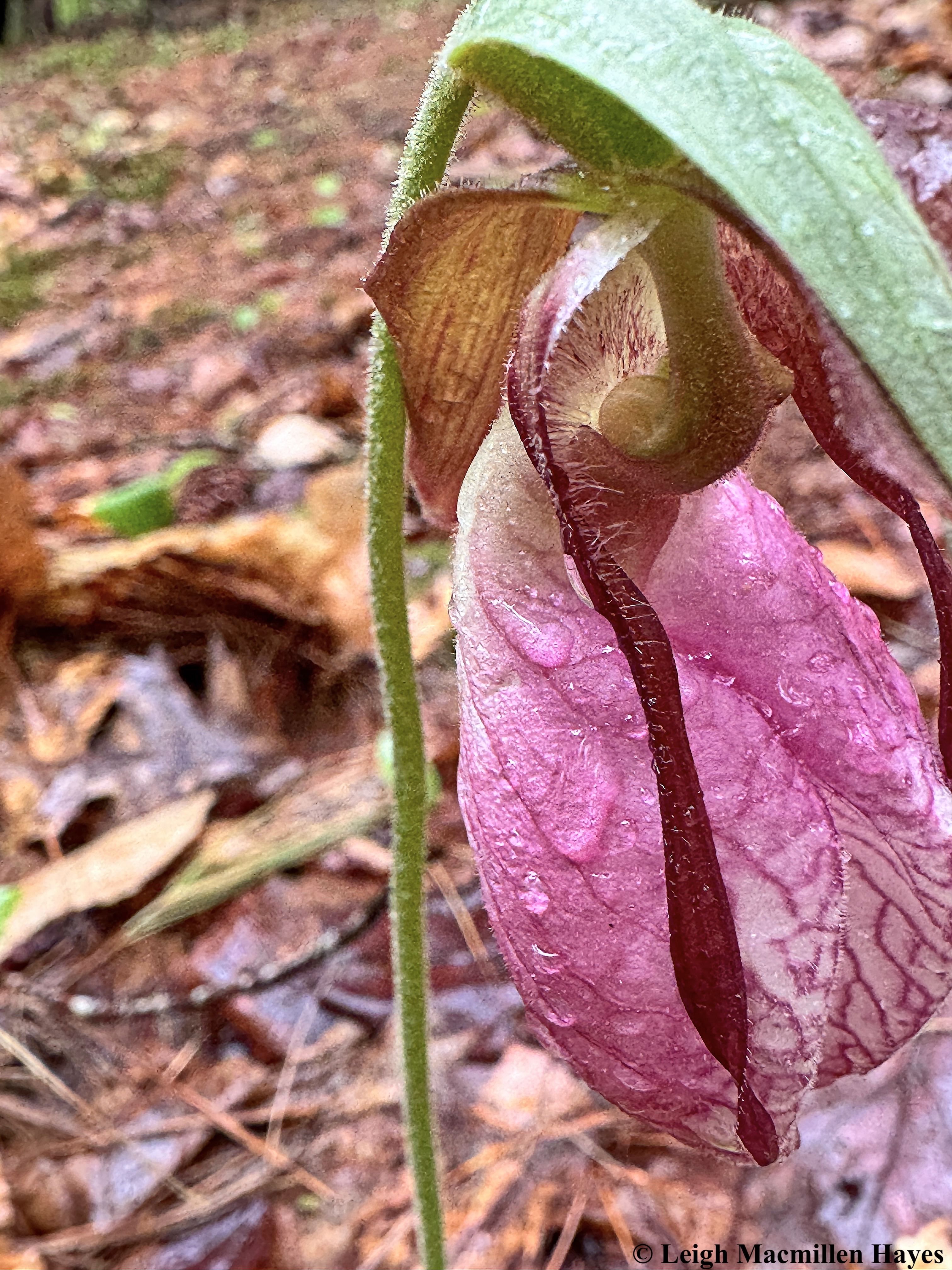
All of these things we saw because of the ritual that we perform every year at this time. It’s one that we now realize involves some greed, but still we feel compelled to do it. We count Lady’s Slippers.

I always thought that orchids were something you received on Prom night and that they grew at the florist. I had no idea that they were actually wildflowers until about thirty years ago. According to Orchids of New England and New York by Tom Nelson & Eric Lamont, Lady’s Slippers are one of 65 species and variants found in our region.

And so they deserved to be counted.

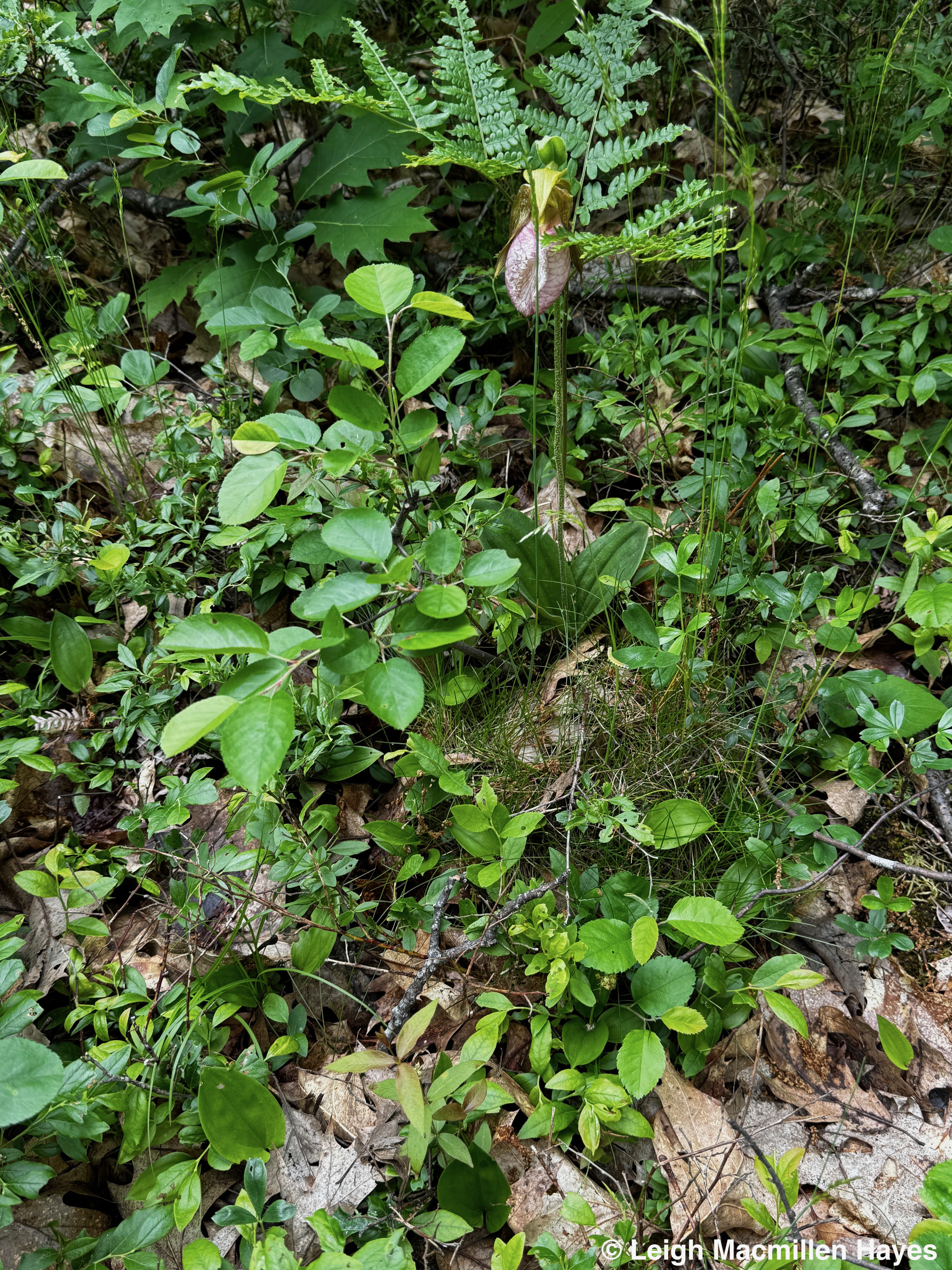
But, oh, how they hide. Do you see the one in the photograph above?

How about now?

Knowing that they can be elusive causes My Guy to slow down for a change. It’s no longer the destination that counts, but rather the number of Pink (and their white variants) flowers that we can spot.

Some are tall, and others quite small. And some are sets of leaves with no flowers yet as in the foreground. We don’t count those.
Here’s the thing about Lady’s Slippers. It takes a long time for a minuscule seed to become a plant. The seeds, developed in capsules, are beyond numerous, but each one has no food source or endosperm. So . . . it must develop a relationship with a Rhizoctonia fungus in the soil to survive. From the fungus the plant gets nutrients for germination and growth. The fungus, in turn, receives nutrients from the orchid’s roots.

BUT . . . all of this takes time. And the presence of the fungus.

Years. First, after at least three years the plant produces a pair of two basal leaves that fold like accordions and remind me of the paper fans we used to make as kids.

One author says it’s another 5 – 10 years before the plant produces a flower; another states 10 – 17. Either way, by the time you spot one, it’s been working for a long time to become a thing of beauty. (And should not be picked or transplanted.)

We found one that stymied us for it appeared to have three basal leaves. I can only wonder if there was a second plant there and something happened to its other leaf.

In one spot, we found what we call a bouquet. Sometimes we see three or four grouped together, but in this case 14 plants in bloom.

And in another spot where we expected the same, nada. What happened. My Guy was disappointed because this is his favorite and he loves to show it off to anyone who happens to be hiking that way.

We have a theory, though we don’t have scientific knowledge to back it up. But here goes. Last summer, our count was quite high. The previous spring and summer it had rained. A. Lot.

Last year, we experienced a drought. This year fewer flowers in most places that we hiked in the last few weeks. Perhaps less of the fungus?

And sometimes the flowers are spotted growing in a bit of a line, making us think perhaps there is a rotting nurse log beneath the soil. As for soil and habitat, acidic seems to be the favorite and we often find them among Low-bush Blueberries and towering over Reindeer Lichen.

And then there’s pollination: Lady’s-slipper pollination is a curious thing. Bees are lured in by the guide lines to a slit in the front petal, the slipper-like pouch, or flower’s labellum. Once inside, the bee cannot exit the way it entered because the petal structure turns inward.

The exit is at the top of the slipper, but to reach it, the bee must move through a hairy interior and rub against the flower’s stigma, depositing any pollen it may have carried in and brushing against the pollen mass called the pollenia before flying out. It strikes me as being like a house of mirrors. And all I want to do is quickly find my way out.

Some bees get frustrated with the dilemma of discovering there is no nectar and the task of finding the exit and instead chew their way out, which seems to be what happened to this flower.

It looks like the bee frantically tried to escape this one.

I tried to honor them with a painting, but our best way is by counting each and every one. I’m going to share last year’s numbers and this years. Also, this year, we counted along a bunch of other trails than just the Big Three as My Guy refers to the first three for which I have been keeping records since 2000.

Wolfe’s Neck State Park: 2024: 475; 2025: 159

Albany Mountain: 2024: 364; 2025: 411

Sanborn River and Overset Mountain: 2024: 598; 2025: 526

Grand Total of the Big Three: 2024: 1,437; 2025: 1096

Plus these trails all from this year only:

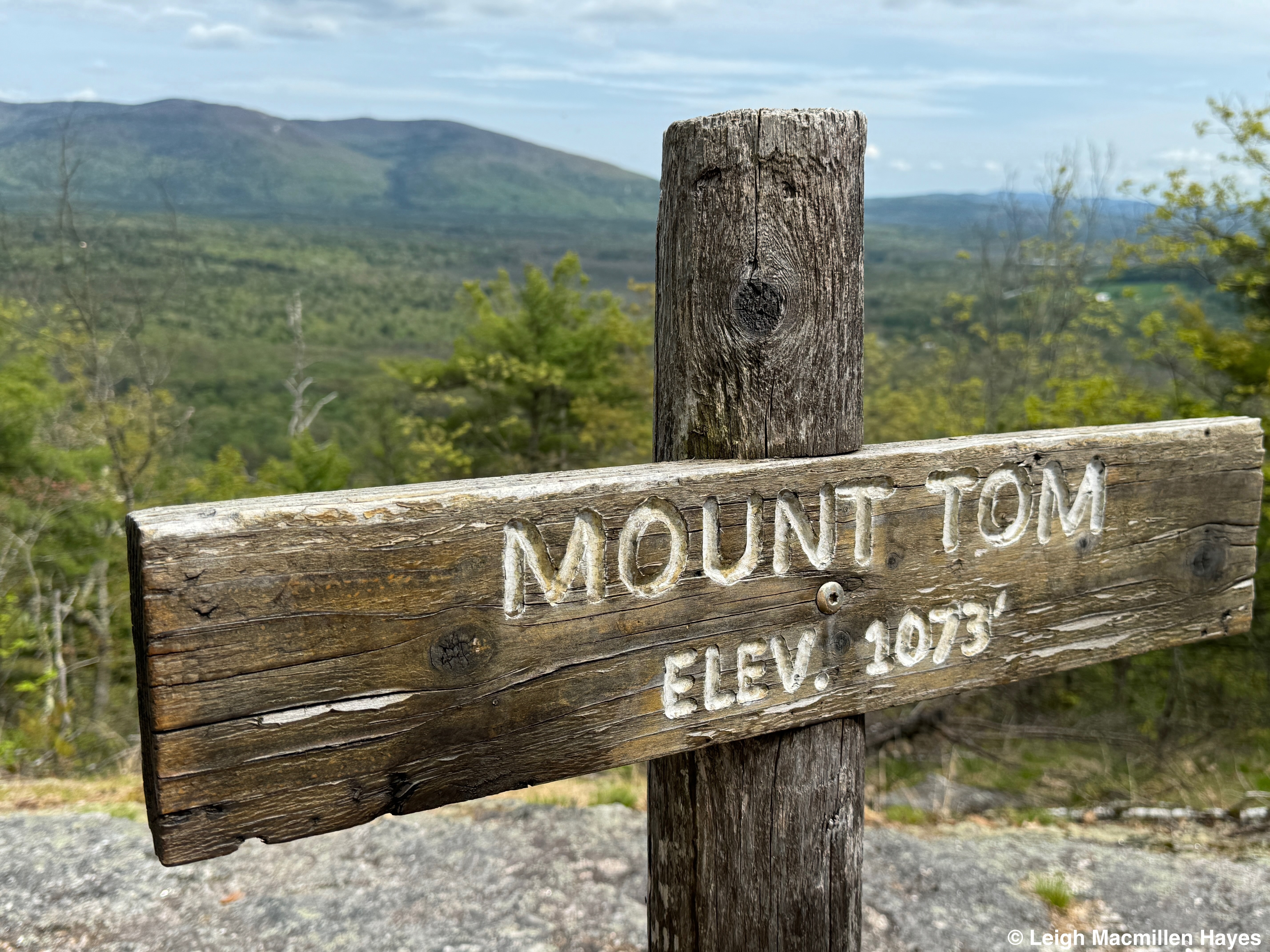
Mount Tom: 25 (but we were there on May 18, and this was the kick-off event that got us going this year; more may have bloomed since then. Actually, after spotting the first one, My Guy wasn’t sure he wanted to count this year, but let me tell you, he still has the greed!)

Mount Tire’m: 31

Proctor Pond Reserve: 41

Kezar River Forest: 63

Narrow Gauge (only 1.5 mile section): 56

Sleigh Trail at Notch View Farm: 44

Home woods: 2

Grand total of all trails: May 18 – June 6: 1,358

Even with the extra trails, the count was down.

But still . . .

Where the Moccasins (Lady’s Slippers) Led Us–up and down many a path with so many wonder-filled moments and sighting along the way. Counting Lady’s Slippers is a ritual that we love to share together and with others.

Giving Thanks to the Ovenbirds

On my way down the cowpath to retrieve our game camera, I heard among other bird songs, the “Teacha, Teacha, Teacha” of the Ovenbirds. But it wasn’t until I was headed back home a little while later that I actually spied them, which for me is a rare treat–maybe because I don’t spend enough time trying.

In the past, however, it’s always seemed like the minute I get anywhere near them, they stop singing and I can’t find them.

Today, that was different. And I did get to watch. BUT . . . there’s always a BUT in my posts, or so it seems. Anyway, but . . . then I spotted something else.

A beautiful pink Lady’s Slipper. And the leaves of four others–that I hope in future years will bloom.

With fingers frozen because it was raining and the temp was only in the 40˚s on this May day, I headed back to the house, pleased with my finds.

All the while, however, I kept wondering if there are other orchids on our land and so after lunch I donned my rain gear again and headed back into the woods.

First, I stumbled upon this fern, which grows in a vase-shaped form. There’s plenty of it along our stonewalls and at the edge of the field beyond, but while hiking with My Guy yesterday, I pointed some out and called it Interrupted and he wondered why such a name.

Because, I explained, ferns have sterile fronds for photosynthesis and fertile fronds for reproduction and in this case its fertile fronds have interruptions of spore cases in the middle of the blade upon which they grow, while most ferns carry their spores on separate stems or on the undersides of leaflets.

After the spore clusters ripen and drop away, the mid-section of the frond will be “interrupted,” leaving bare space between the leaflets, further reminding us of its name.

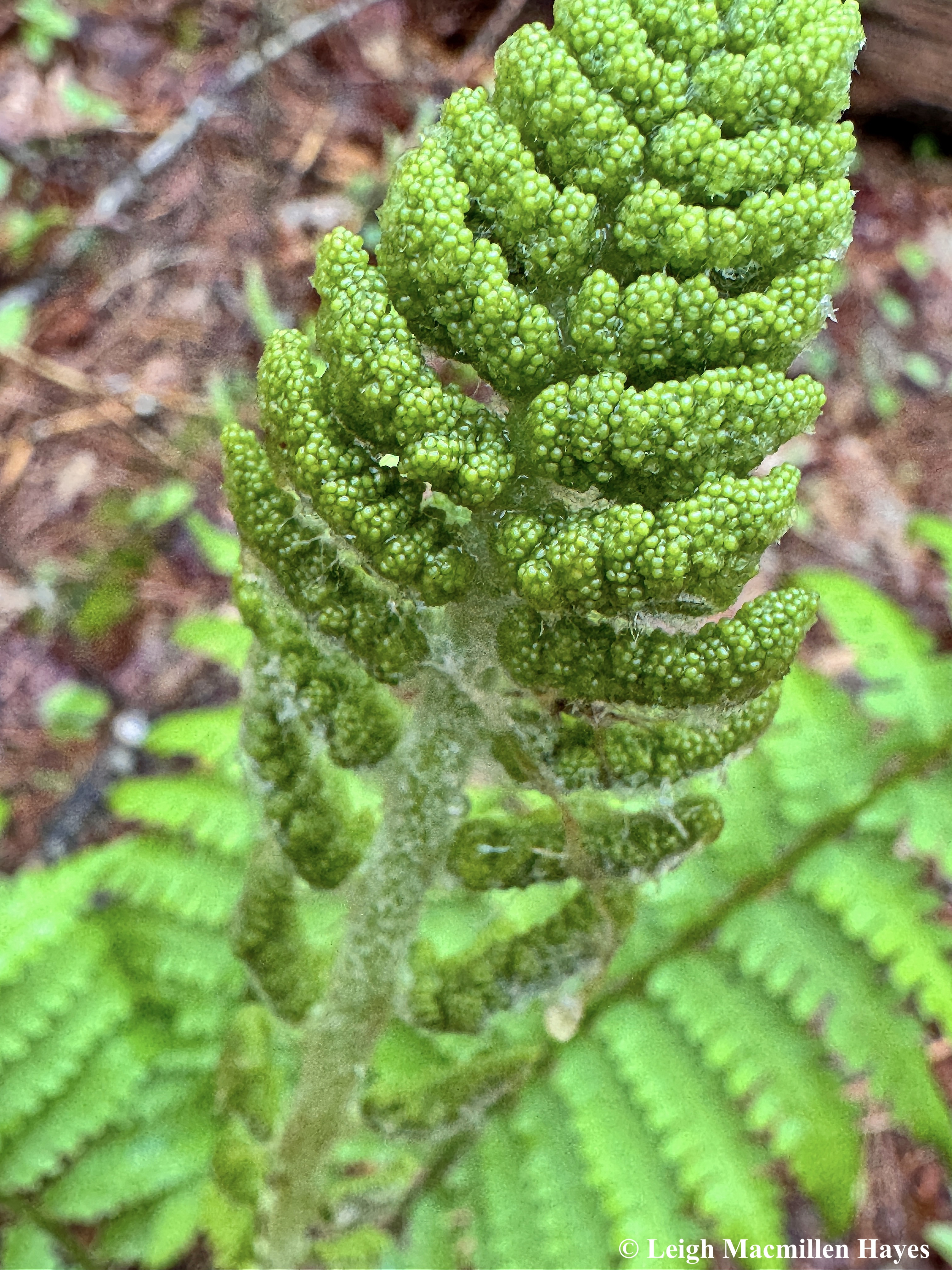
And where there is Interrupted Fern, there is often another member of its family, the Osmundas that is, this being a Cinnamon Fern. One of the differences is that the fertile frond is more like a wand that rises from the center.

There are no leaflets on these fertile fronds, and again, the sporangia are like tiny beads that will turn a warm cinnamon brown when the spores mature. And then, it really will look as if the frond is covered in cinnamon.

While the Interrupted will grow in forests and wetlands, the Cinnamon prefer wetlands, which tells you something about our land. Another that also grows here, though I forgot to photograph it, is their second cousin, the Royal Fern.

If an Interrupted Fern doesn’t have fertile fronds, it looks very much like a Cinnamon, but one of the key characteristics to tell them apart is that Cinnamons have hairy (wooly) armpits like this one above where you can see the wool on the underside where the leaflet meets the rachis or main stem. And Interrupteds don’t.

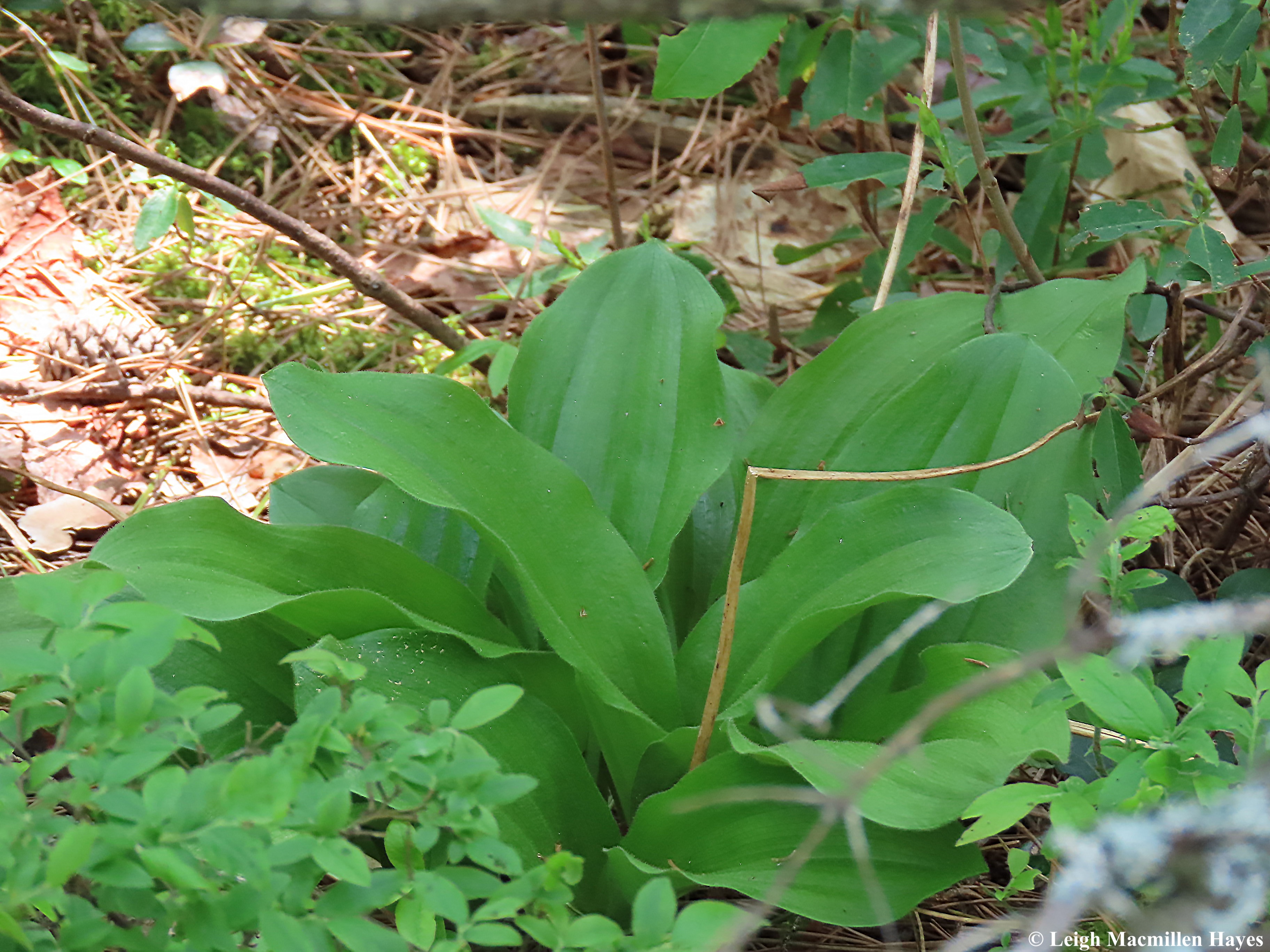
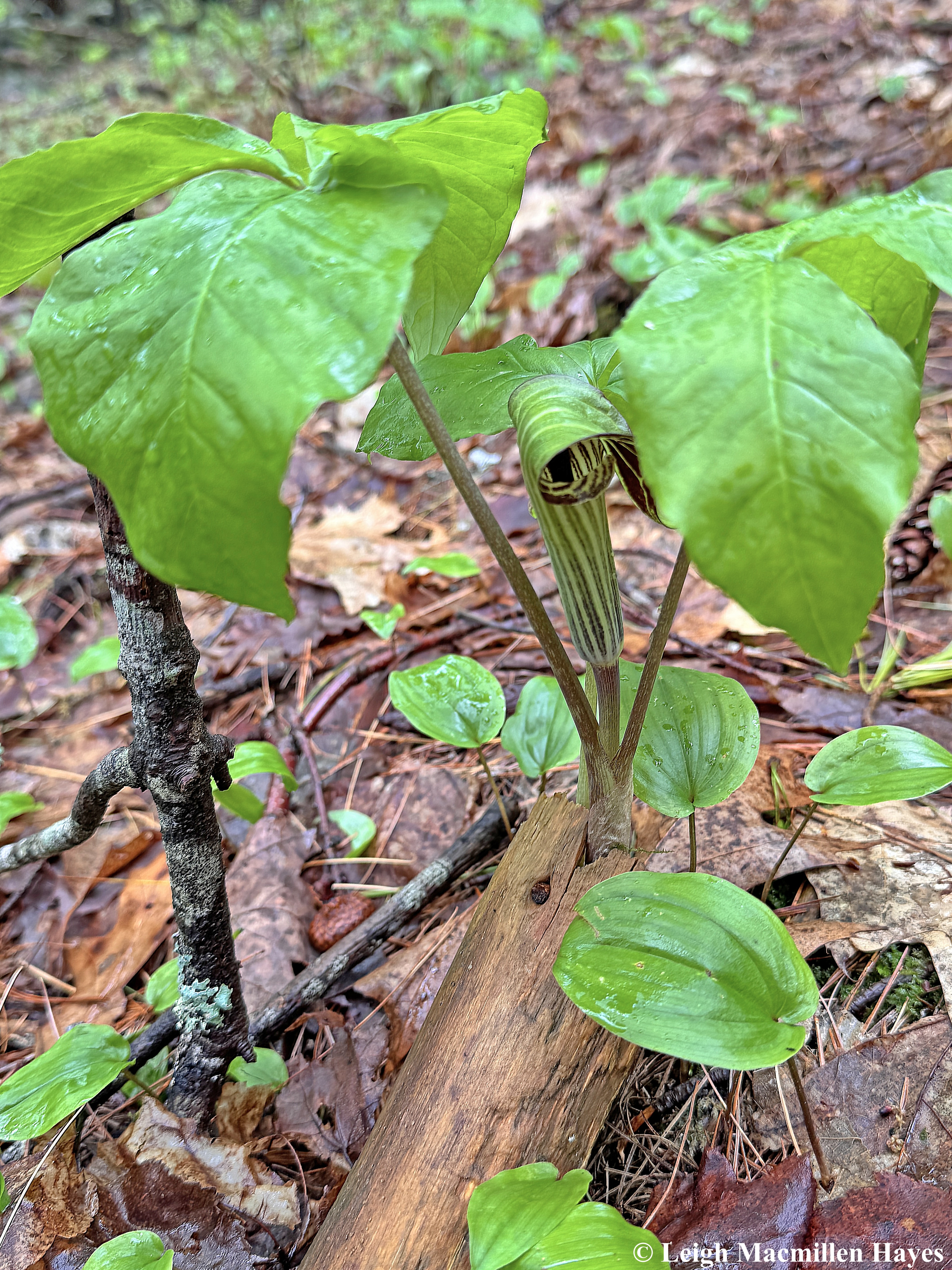
Being a bit of a wetland, I shouldn’t have been surprised by my next find, but I was. Jill-in-the-Pulpit! You may think it’s Jack, but like some other plants, including the Canada Mayflower that grows beside these, in order to flower the plant needs the additional energy stores of a second leaf (with three leaflets).

Once I spotted one, I began to notice they were everywhere in one spot on and near the cowpath, but the curious thing–the leaves had been devoured on some. By whom?

And do the leaves also contain Calcium oxalate, which this plant like some others stores in the roots and can cause blisters and other medical problems if consumed? Is that only in humans? So many questions.

That said, my quest now was to seek not only any other Lady’s Slippers, but also Jack-or-Jill in the Pulpits. All told on the latter, I did spot about twenty, but didn’t take time to differentiate how many of each gender.

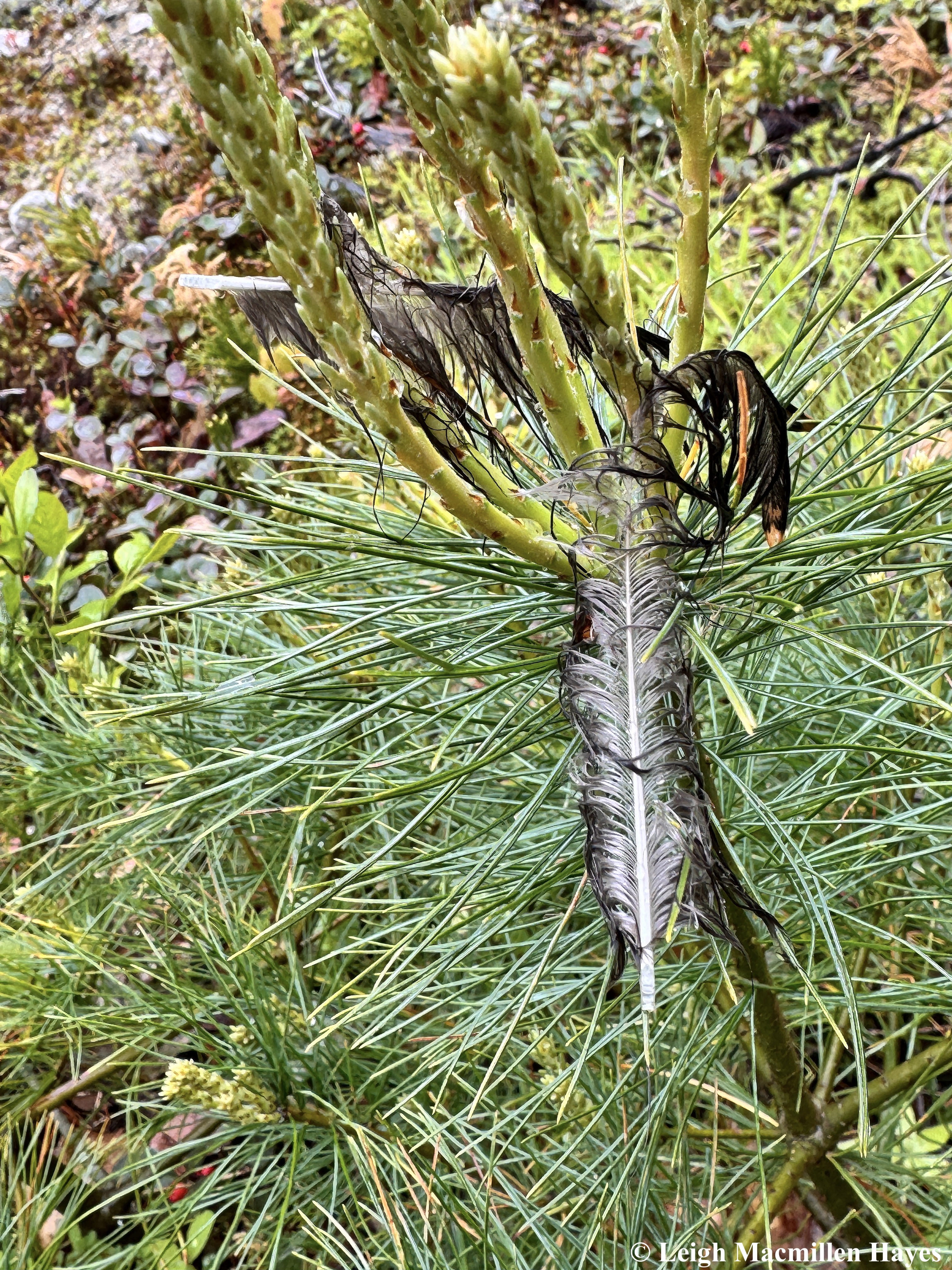
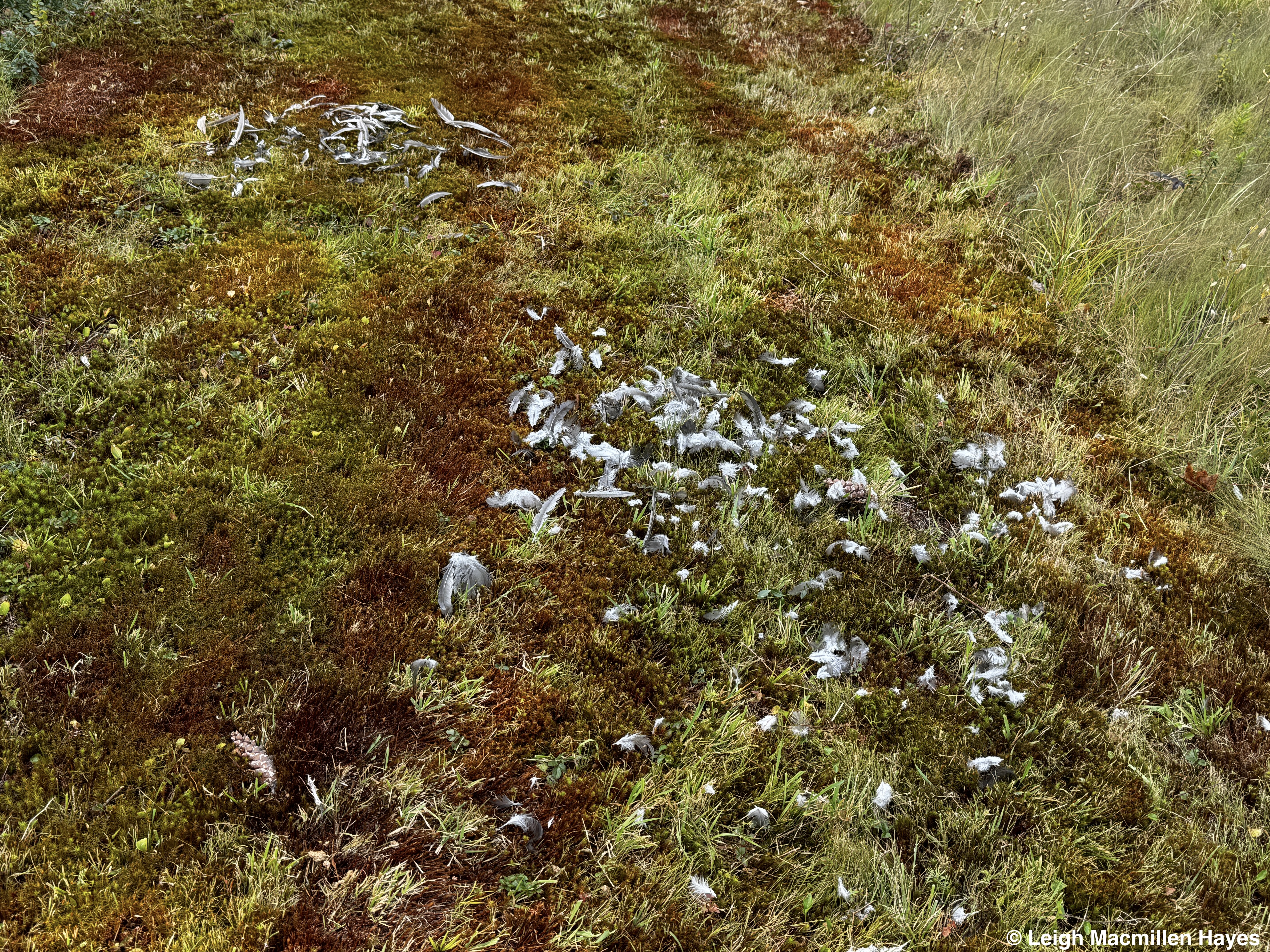
At last, I reached the powerline that crosses our property and it was there that some feathers decorating a pine sapling surprised me.

A closer look and I found a slew of feathers, all plucked. By one of our predatory birds–we do have Sharp-shinned and Broad-winged Hawks in the neighborhood. Or by another?

We also have a neighborhood Red Fox who passes through our yard and over the stonewall or up the cowpath on a regular basis. Plus Coyotes and Bobcats.

Mr. Fox needs to eat too. And in this case, he marked his territory–right at the end of the ten-second clip.

The question remains–who made a meal of the Turkey?

Again, I do not know, but as I searched for evidence or more remains, look what I found–another Lady’s Slipper hiding among some Low-bush Blueberries.

And so back to my original quest did I return.

And smack dab beside that orchid, another plant that I love, but didn’t realize we hosted–Indian Cucumber Root, with a root that is edible and delicious. And a flower or in this case, flowers, that will delight my soul in a week or less. And yes, this too, is a plant that needs an extra layer of leaves in order to produce a flower. So do we call this a female plant and all plants that only have one level or tier of leaves males?

I don’t know. But I had circled around, zigzagging actually, through the five acres of woods that we own beside our one-acre house lot, and landed back at the first Lady’s Slipper, delightfully decorated with the rain of the day.

Across the way, right where I’d first spotted him, an Ovenbird paused and called. I tried to capture both in a shot, but they are scurry-ers, if that’s a word for scurry they both did as if they were in a hurry and perhaps a wee bit confused. Maybe they were trying to distract me from finding their nest?

I didn’t look for it, but have an idea at least of its whereabouts. And I can only hope that any offspring they produce are well protected cause this is a wild place.

With fingers once again numb, I finally headed home, but first I stopped to check on these Jack-in-the-Pulpits that were the only ones I thought we had, growing as they do by a split-granite bench we made. I remember seeing Jack standing tall in the pulpit one spring as I headed out to the vernal pool, and upon my return someone had nibbled him. Whodunnit?

That said, I decided to place the game camera by all the other Jacks and Jills that I’d found earlier today and I’m curious to see if anymore get nibbled.

All of this because the Ovenbird called. It felt like Thanksgiving. Complete with a Turkey dinner. (Sorry, but I had to say that.)

And to think I thought I knew our land. There’s always something to learn. Or some things!

Happy Belated 10th Anniversary, wondermyway.com

I can’t believe I missed the date by two days. I’d been planning this for months. Well, in the back of my mind, that is. No actual thoughts were jotted down on paper. I just knew what I wanted to do and when I wanted to do it . . . until I forgot. Or rather, it slipped my mind. Momentarily.

No harm done.

As the saying goes, “There’s no time like the present,” and so my gift to you dear readers will be to give you the present of time by taking you back to the beginning of wondermyway and then making our way to the present. And all of it is because I was given the gift of being present in the moment on so many occasions. Egads. That’s a lot of presents. And presence.

Wonder My Way

My first blog post was published on February 21, 2015, and entitled Wonder My Way. It began with these paragraphs: Wonder my way as I wander through the Maine woods. So often I see things that make me stop and wonder. Sometimes I figure it out, but other times, I’m just as happy that I don’t. It’s The Sense of Wonder that Rachel Carson wrote about which keeps me going. Do we need to have all the answers? I think not.

So join me for a tramp from our woodlot to the world beyond. I know not where this trail will take us, but I can guarantee that we’ll have fun along the way. Read more . . .

Spring in Slo-Mo

Spring is so fleeting in Maine. Oh, I know, it lasts the usual three months and the beginning and ending overlap with its seasonal partners, but really . . . one must take time to pause and watch or you’ll miss the most amazing action that occurs in slow motion right outside the window–and beyond.

For those who are new to my blog, Jinny Mae, who is featured in this and many blog posts, was a dear friend whose name I turned in to an alias as she faced cancer courageously and rather privately. In the end, the cancer consumed her, but the things we enjoyed along the way were bountiful, including this spring adventure to an incredible space in our little neck of the woods. Read more . . .

Universal Love

Written on Valentine’s Day, this post was dedicated to My Guy and all who wander and wonder with me.

When I wander, hearts frequently speak to me . . . Read more . . .

Nothing To Grouse About

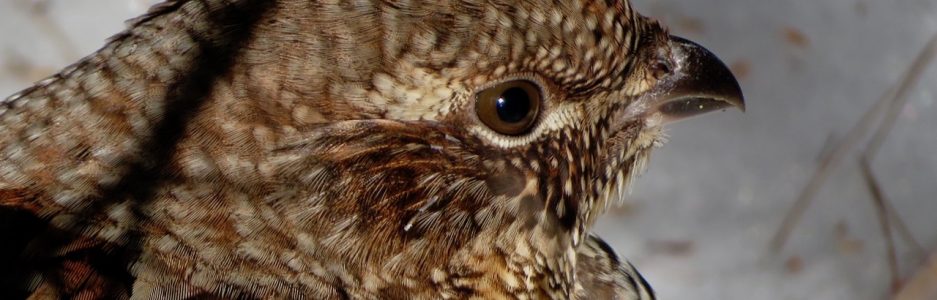
I shared a unique experience with five other naturalists, the majority of them in the six to eleven age range. For twenty minutes the six of us watched a Ruffed Grouse at it moved about, overturning leaves and foraging on buds. When we last saw it, the bird headed off in the opposite direction that we intended to journey, and so we moved on with wonder in our eyes and minds.

And then the next day I returned on a mission to study some twigs at the same property. No sooner had I stepped onto the trail when I heard the sound of leaves cracking a wee bit and what to my wondering eyes should appear but the same bird.

The curious thing: the bird followed me, staying about ten feet away as I tramped on. I stopped. Frequently. So did the bird.

And we began to chat. I talked quietly to him (I’m making a gender assumption) and he murmured back sweet nothings. Read more . . .

Amazing Race–Our Style

Okay, so My Guy and I have enjoyed The Amazing Race show over the years and felt like there were some challenges either or both of us could face, but others that neither of us would dare attempt. And so . . . I created our own version.

The thing is that until I take the time to change the order of this post on my website, you’d be best to start at the bottom and read each entry, going up one step at a time. As in, this: Scroll down to February 18 on this link and then after reading that entry, make your way up one episode at a time, until you reach the last recorded on February 2, 2019. Oh heck, read it in any order that pleases you. Just get into the spirit of the race I created cuze I certainly had fun with it. And fooled a few people along the way.

The Amazing Race–Our Style

I’m sure when we said our wedding vows back in 1990, there was something in there about only riding a snowmobile once. And I did that once two years or so ago–mostly because I knew it would please my guy. Certain memories remain from that experience: I felt like a bobblehead inside the helmet; I lacked control as I sat behind him and couldn’t see; when I did peek around, I was sure my head was going to strike a tree so narrow was the trail; and I didn’t like the speed. Oh yeah, and at a road crossing, I do believe I jumped off and walked to the other side. With all of that in mind, I’m not sure what I was thinking when I created a Valentine’s gift for him–our very own Amazing Race. Read more . . .

wondermyway turns five

Five years ago today (ten now!) I turned from taking a hundred million photos on each tramp to taking a hundred million photos and writing about them.

Typically, on the anniversary I scan the past year’s posts and choose one from each month, providing a photo to represent it, with a brief (or not so brief) comment and link to the full read.

But . . . because this is a milestone I never imagined reaching (posts: 733; views: 76,793; visitors: 44371; followers: 578), I thought I’d take the time to thank you, the readers, for wandering through the wonders with me.

Thank you! Read more . . .

Dragonfly Whisperer Whispers

We had no intention of eating lunch in this spot today, but while looking for a mountain to climb, we kept encountering full parking lots and so our backroad meander put us beside a bog at lunch time and voilà, we managed to walk all of less than two tenths of a mile. Total.

But in that short distance, our eyes feasted. First it was all the Painted Turtles basking in the sun. Read more . . .

Surveying the Wildlife of Charles Pond

For the past two weeks at Greater Lovell Land Trust we’ve had the good fortune to conduct a wildlife survey in the waters that surround the newly acquired Charles Pond Reserve in Stow, Maine. Our hats are off to Alanna Doughty of Lakes Environmental Association (LEA) for her willingness to be the lead on this project and work in collaboration with us. Alanna, you see, has conducted previous surveys for Maine Inland Wildlife & Fisheries (MDIFW) at LEA properties, and was trained by wildlife biologist Derek Yorks to set these up.

MDIFW maintains a comprehensive database on the distribution of Maine’s amphibians and reptiles, as well as terrestrial and freshwater invertebrates and the data we’ve collected will add to the bigger picture. What we discovered was just as important as what we didn’t find. Read more . . .

Hightailing It Home

Friends,
At the risk
of sounding redundant,
I bring forth
a prickly topic.

A quick glance
while surveying treetops
and suddenly
my heart sang
as I spotted
a well-armored back.

Read more . . .

Happy 9th Birthday, wondermyway!

Thank you to all who read and comment and share wondermyway.com. Some of you have followed my blog posts since the beginning, February 21, 2015. A few have joined the journey as recently as yesterday. I’m grateful for the presence of all of you in my life.

To mark this occasion, I thought I’d reflect upon those moments when my wonder gave me a glimpse of the “Thin Places” that I’ve experienced either by myself or in the company of others.

To quote my friend, Ev Lennon, “A Thin Place is a spot of beauty, loveliness, space–an example of the wideness and grandeur of Creation.”

I think of them as places that you don’t plan a trip to visit, but rather . . . stumble upon.

Read more . . .

And that brings me to this year and this anniversary, belated as it may be. I can’t believe it’s been ten years since I started this endeavor, which has served as my diary and memory, and been a place for me to share so many incredible extraordinary ordinary experiences with all of you. Thank you for being faithful readers.

As I compare the numbers to year five, I haven’t written as often in the last five years, but your support has been incredible.

wondermyway.com by the numbers:

Posts: 1,076

Visitors: 135,888

Views: 205,389 and increasing constantly.

The most popular post of this new year was Giving Thanks for the Pileated Woodpecker. So far, anyway.

The Giant’s Shower

And since I retired as Education Director for a local land trust just over a year ago, I’ve added some other fun to the mix.

I did a thing. Years ago I wrote a children’s story. Well, a bunch of them actually. And I tried to sell this particular one to publishing houses. No takers. Then, a couple of years ago I purchased a Fairy Coloring Book created by the one and only Solana, teenage daughter of the Fly Away Farm Wards in Lovell and Stow, Maine, and approached her about illustrating my fairy tale. She took on the task and did an amazing job. Then I asked copyeditor Pam Marshall to wave her magic wand over it. And I asked local graphic designer Dianne Lewis to use some fairy dust and turn it into an actual book. I always said I’d never self-publish a book. And tada: I did just that. And now it’s even better because it’s published by http://www.indieauthorbooks.com.

Read more . . .

My Art Gallery

At the end of April I began taking an art class offered by one of my peeps, a young woman who walked into the lives of many of us one day about twenty months ago; a young woman with a million talents to offer. Among those talents, she is a self-taught artist and we’ve been begging her to teach us.

At our first class, we had to draw a small box in the upper left-hand corner of the paper and place the person who has been our biggest art critic into it. That done, the critic was forever boxed–well, until she sneaks out, which she seems to do way too much.

And then we looked at some photographs in magazines and had to sketch them and determine the direction the eye would travel in the picture.

Next we looked at lines and perspective. I’d brought along my favorite colored pencils, but immediately felt my inner critic jump on me because all of my classmates were working with watercolor pencils, watercolor paint or acrylics. And the artist herself, gouache. Until I met her, I’d never even heard of gouache. Or at least never paid attention, if I had.

Read more . . .

Lake Living on Lake Region Television!

And we said goodbye to Lake Living magazine, a glossy publication I’ve worked on since 2006.

We are movie stars! Well, maybe not quite. But, many, many thanks to Evan Miller of Lake Region Television for filming and editing Laurie LaMountain, owner and publisher of Lake Living magazine, and me recently as we said, “Fare Thee Well,” to working on this publication.

Read more . . .

And in the midst of it all, I still have the good fortune to share the trail with so many others . . .

and especially with My Guy, who is forever patient as I pause to consider the wonder of the moment.

My heart-felt thanks to him and to all of you for joining me so often as I wondermyway.

Wowza–ten years! I never imagined. No time like the present to wish wondermyway.com a belated 10th anniversary.

Snow–Bugs and Flakes

Betwixt. Between. Be flowers. Be bugs. Be glad for there is so much to wonder about in the natural world. And I don’t even know the half of it. But I wouldn’t be happy if I wasn’t always learning.

It was 28˚ when I awoke this morning. Late this afternoon on this brilliant sunlight day, with temps at least 30˚ warmer, I walked out through our woodlot to the right and then looked back across the neighbor’s field toward our house, taking in the sea of seedheads and I was sure my insect hunting days had come to an end.

But much to my surprise, and really, I shouldn’t have been surprised, the chirps of crickets and grasshoppers, like this Red-legged example, filled the air. I might not have seen the grasshoppers if they hadn’t flown to a new spot occasionally, for so camouflaged are they in the current setting. Or always.

And then, much to my delight, I noticed a Saffron-winged Meadowhawk flying low and making frequent stops, allowing me to do the same. We live in a wet area, but still, I’m often surprised by some of species I meet here.

From the field, I decided to continue along the power line that crosses our property and the neighbor’s and many more beyond that and as I’d told my friend Meg from North Carolina the other day–Mount Washington, our mighty New England Rock Pile, is at the far end and it looks like we could walk right to it. Give or take a few days–or drive there in about an hour.

It’s along the path below the lines that I discovered Cotton-grass, which is a sedge, with its fluffy little heads speaking to the bogginess of this area.

Cottongrasses self-pollinate, their flowers being “perfect,” given that each contains both male (stamen) and female (carpel) parts. And the seeds are attached to parachutes waiting for a breeze (or animal) to move them to a new home.

Spotting the curly, cottony-hairs reminded me of the belly hairs of porcupines, which of course, reminded me of the Porky some friends and I spotted in another field in town yesterday. The time is coming when these critters, whom I’ve come to adore, will transition from life in the field to life in forest trees.

Last November I wrote about this particular porcupine, Bandit, whom I met in our yard, along the same route I began today’s journey. Perhaps soon, we will meet again.

Getting back to today’s story, I left the power line, and headed out an old logging trail that I tend to frequent most often in the winter. But it was sunny, and I was enjoying that warmth, and wondered what else I might spy along the way.

For starters, there were the “dried” Pearly Everlasting Flowers, which I should have gathered because they do dry so well. Instead, I just admired them.

And I had frequent encounters with more Saffron-winged Meadowhawks, flying much like White Corporal Skimmers in early spring–always landing and then moving a couple of feet ahead of me whenever I made a move.

Helping with ID of this species, are the fine black lines in the sutures of the abdomen. And the red stigma toward the tip of each wing is outlined in black. Otherwise, I might confuse it for an Autumn Meadowhawk.

I also had the pleasure of meeting a female Shadow Darner, but then I went to offer a finger for her, thinking she might want to take advantage of my body heat, and instead she tried to bite me. So, I let her be and we went our own ways.

At a former log landing, Juncos were on watch, and given how much seed is available, I know they’re mighty happy with the current conditions. It seems like they just arrived in the past week or so, but the good news is that many will overwinter here.

Oh and a few will fly to Connecticut so that my dear friend, Kate, can watch them as well.

Being an old logging road and log landing, conditions were apparently ideal this past summer, and I paused for a moment to admire forest succession, with grasses and herbs forming the floor, and more grasses and sedges growing taller, topped by Gray Birch, and a backdrop of Red Maples, and Big-tooth Aspen, and Paper Birch.

And then it was back to the now dry bed of a stream crossing where Speckled Alder shrubs are closing in on the trail, and Woolly Alder Aphids are living their best life seeking sap from the woody plants.

That Cotton Candy or even Cotton-grass look is actually a waxy material they produce from their abdomens, and when they group together like this, perhaps its meant to detract visitors. Or protect them from the weather. Had a I visited on a summer day, I’m sure I would have spotted ants trying to tickle them (it’s called farming) to take advantage of the honey dew the aphids secrete.

Speckled Alder Aphids live an interesting life style. Actually, according to Donald W. Stokes in his book, A Guide to Observing Insect Lives, “There are two life cycles in this species. In one, the aphids remain on alder trees throughout their lives. They are believed to overwinter as adults in the leaf litter at the base of an alder. In spring, they crawl up the plant and feed on its sap. There are several generations per year and adults of the last generation overwinter.

In the other life cycle, the aphids alternate between two plants. The aphids overwinter as eggs placed on maple twigs. In the spring they hatch into females, which feed on the undersides of maples leaves and reproduce. They are wingless, but in midsummer produce winged offspring, also females, which fly to alders. These females feed and reproduce on alders, and give birth to wingless young. Then in the late fall, they produce winged young, which fly back to maples and give birth to both male and female young. The males and females mate, and each fertilized female lays a single egg on a maple twig. Only the eggs overwinter.”

It’s things like this that add to my sense of wonder. Two life cycles? The adults of one life cycle overwinter while the eggs of the other are do the same? That’s amazing.

And on the fly in a bit of abundance right now for I saw a bunch today and I’ve been seeing them along many trails that I hike, are the flying aphids. If you stick your hand out and cup it, you can get one to land.

Don’t worry, they don’t bite. And they don’t even tickle, despite that waxy hair.

They’re actually kinda beautiful in their own way and as they fly they look like tiny flakes of snow, thus some refer to them as Snow Bugs.

So I have two forever-friends-since-birth and I’ve already referred to Kate earlier in this blog because she is a great lover of Juncos, along with everything else in the natural world, and so is her sister, Patty, who once told this joke when we were kids:

Q: What’s white and goes up?

A. A dumb snowflake.

One of these two is eleven months younger than me and the other is eleven months older and she and I just chatted yesterday and I’m so thankful to have them in my life all these years. Yes, B.S., I am also incredibly thankful to have you in my life.

But once again I digress. Except I had to tell that joke. Because it kinda reminds me of the aphids in flight.

Back to the power line, I decided to pull the Mighty Mount Washington in with the telephoto lens. Yes, dear readers, that is snow! Several inches of the white stuff has fallen over the last few days. And there is rime ice.

My favorite season is only a walk down the power line away.

Snow: Bugs and Flakes. It’s all wonder-filled.

Porcupine, Snakes, and Bears, Oh My!

Disclaimer: there may be some not so pleasant photos in this post. I apologize. BUT, what you will see is a fact of life.

Do I have your attention now?

Our afternoon began so innocently as we hiked along a well-traveled trail at Hawk Mountain in Waterford, Maine, where Goldenrods and Asters shown the way.

I knew I was in the right place the moment I saw a Black and Yellow Spider for I have spent the last two months enjoying their presence in our neighbors’ field and though they are beginning to decline in number as summer heads toward fall, a few are still on the hunt and packaging meals such as you see here.

Also like home, the presence of butterflies. Granted, we were only twenty minutes from home, so spotting Monarchs nectaring wasn’t a surprise. It was a delight, really.

And an American Painted Lady, her two eyespots on the hind wing as opposed to four smaller spots on the same wing of a Painted Lady, pasued on some bramble branches.

A Red Admiral also decorated the scene, even if it did appear to have a bit of attitude given its stance.

And then . . . and then I saw the body of a dead porcupine. It didn’t smell. But the Common Green Bottle Flies (in the Blow Fly family) that made their fly buzzing sounds around it indicated it had been dead for a bit. Some of you know that I love a such a wildlife mystery–and the opportunity to try to figure out what happened. BUT, the story doesn’t always piece together as neatly as I’d like.

First, there appeared to be three wounds on the animal’s back. Large openings. As if from a very hungry predator. And a brave one? Fishers are the porcupine’s main predator and they are known to attack the others face and belly, where the hair is soft as compared to the 30,000 barbed quills on its back. And a fisher and others would then visit the carcass repeatedly to dine. That hadn’t happened in this case. Instead, the animal died on its stomach. And other mammals didn’t take a repast from the offering. Did a domestic dog do the duty? If so, it must have had a head full of quills.

As for those metallic green flies, their maggots squirmed inside each large wound. By the hundreds. Maybe thousands. I wasn’t about to count. In his book, Insects of New England and New York, Tom Murray explains, “Blow flies are often associated with decaying organic matter, particularly carcasses and other sources of rotting meat and feces. In fact, they can figure prominently in forensic entomology, aiding in determining time of death.”

Murray adds, “This might sound like the dark ages, but cultures of sterile maggots of green bottle flies are sometimes used in hospitals to clean up deep wounds and infections that otherwise are difficult to treat. They only eat dead tissue, and secrete an antibiotic, preventing further infection. In nature, the normal food source is carrion.”

Maggots. A source of wonder! Who knew? Well, obviously doctors and scientists and Tom Murray!

There was one other thing to look at on the carcass, besides those three-toned quills and the soft curly hairs in the mix. The sole. Look how pebbly it is! The better for climbing trees, my friend. Think of non-slip socks with those little white treads. Porcupines don’t need to wear socks. Maybe they were the inspiration for such. Ahh, this site just got even better!

I still don’t know who the predator was but it took me back to what my neighbor and I discovered in her field yesterday. Two piles of feathers from the same bird.

The feathers appeared to have been plucked so I suspect a raptor did the deed, after all, they need to eat too. But what species died? We don’t know birds well enough to say. What was curious to us was that there was no blood. Nor any body parts. My neighbor’s dogs were onto a scent in the feathers, however, and we suspect that they had a better sense of either who the prey was or who needed a meal than we did.

Returning to today’s trail, I spotted Witch Hazel in bloom, the first of the season for me to spy. This flower always makes me happy with it’s yellow ribbons haphazardly displayed.

And then I sawa Maple Leaf Viburnum, its leaves already their magenta color and so many berries still intact.

And a Green Frog in a mucky puddle as we approached the summit.

The view is always amazing, enhanced by the brook and wetland below and our beloved Pleasant Mountain in the distance. You can even see the ski area at the right or northern end.

While we were out there I only captured a photo of one Turkey Vulture, but at least three road today’s thermals, gliding round and round.

And on the way down a small Garter Snake tried to hide from us. It was about the size of a pencil. And reminded me of another site in the field at home that I spotted this morning.

My first thought. Scat. Of course. Until I took a closer look. A spine?

And then I flipped it over and spotted scales. Probably a much larger Garter Snake. If I took a closer look at the scale pattern I could be certain of this ID. Maybe tomorrow. If I can locate it again.

From Hawk Mountain we made a mad dash to Mount Tire’m and again at the summit, a view toward Pleasant, just from a somewhat different angle.

We were in a bit of a rush, but My Guy didn’t mind that I wanted to explore the erratic boulders in the woods behind the summit. I think everyone who climbs that mountain ends up at this spot. Rock Castle? Bat Cave? Bear Den?

We decided on the latter given that we spied a bear through the trees.

And so, I did what I always do here and channeled my inner bear.

Now really, this wasn’t such a gruesome post after all, right? But wow. Porcupine with maggots, snakes, and a human bear. Oh my!

Basking in the Sights

“This won’t take us long,” My Guy said moments after we launched our kayaks onto a small pond in New Hampshire.

“Oh, I think I can make it last a while,” I replied.

I knew there were Pitcher Plants to look for and I could see by the color of the trees on the far shore that there were wetlands to explore and there was the potential for so much more in this very quiet spot.

A friend who kayaks here often had told me where to park and some of the things to look for along the way. What was most impressive from the start is that there were flower pots on the dam and by the kiosk. Well tended, at that.

And a rather large Little Free Library, where one can take a book or share a book.

I unlatched the door and it even smelled like a library. What’s not to love?!

But, we’d ventured there to paddle.

Or better yet, to dawdle. To be like the Painted Turtle and enjoy the sunshine of a perfect September day.

And then one of my favorite things happened. A dragonfly in the clubtail family landed on my knee and I coaxed it onto my hand for a better look. It was perfectly content to be there. Which made me think of a darner on another day on another pond this past week that I rescued as it flailed in the water. The moment I picked that darner up, it tried to take a nip out of my finger and was frantic, even when I set it on the edge of the boat. I wanted to give it a chance to dry its wings. It wanted only to fly. And so it did with wings still wet and back into the water it landed, slipping under a lily pad. I rescued it again and this time it didn’t bite and it did sit for another minute or two upon the boat, but not long enough for me to get a good look at its colors and patterns for identification, or to snap a photo and then suddenly it flew and I can only hope survived.

My new friend, however, allowed me to move him from my hand to the boat, the better to take a look.

This one didn’t speak its name immediately, until I looked at its spiny back legs. As a Black-shouldered Spinyleg it is commonly known, and it’s in the clubtail family, but I’m not exactly convinced that the shoulders are actually ebony in hue. To me, they seem to be chocolate brown.

Another characteristic is the thorax pattern: two long ovals on either side with a yellowish I-shaped mark in between them. 

It was the pattern on the abdomen that also helped me confirm ID, with the yellow stripes on each segment becoming triangular shaped on segments 8 and 9, while the final segment, #10, was almost completely coated with splash of yellow.

With each minute that passed I fell more and more in love as my new friend let me enter its personal space. Such big eyes–compound as they are. But then there are the ocelli, or three small black “eyes” located on top of the head–to us they look like three little bumps, but according to the field guides in my own library, they “may serve to measure light intensity.”

And all those body hairs. They work like sensors–detecting odors, temperature, humidity, and most likely wind direction.

If you have a loupe or magnifying lens, I encourage you to look at insects and plants–it’s a hairy world out there.

Let’s take a closer look at that face. It’s rather other-worldly in structure. Two dragonfly families feature eyes that don’t touch each other along any margin: Clubtails and Petaltails. I’m not sure I’ve ever met a Petaltail, so that already narrows it down for me when trying to figure out the species.

Beginning with the large compound eyes, we’ll work our way down. But first, can you imagine seeing the world through 30,000 lenses or facets? I’m happy to have moved on from progressive lenses (three lenses) that threw me off, especially when hiking or walking down stairs. 30,000?!!! A dragonfly certainly has no excuse for not seeing even the tiniest of insects on the move.

And notice how the eye is two toned, the darker being above.

Between the eyes is a plate called the occiput, which covers the upper part of the head. You might also notice, though I didn’t label them, that there are occipital horns.

Below that is the triangle of ocelli, or three tiny and simple eyes as compared to the two compound eyes. These may measure light intensity.

And then there are two antennas, perhaps for measuring wind speed. All of this and we haven’t reached the face yet.

Ah, the dragonfly face–beauty is definitely in the eye of the beholder.

Dragonfly faces consist of plates and the upper plate is the frons. In some species there are certain dark shapes or lines that help with ID. Not on this one, however.

Below the frons a crossline suture is a seam that separates the frons from the postclypeus, an upper plate that we might think of as the upper lip.

And below it, the anticlypeus, a lower plate located about where our tongue might be on a human face.

Finally, the labrum, or lower lip, and below that the mandibles, not labeled.

Such complexity for an insect that spends months to a few years as an aquatic naiad, growing through several molts, and then crawls out of the water and slowly ecloses upon vegetation, pumping insect blood into its wings and body, before flying off to control the airways and the insects who bug us. And within two months of emerging from the water, it’s life cycle comes to an end.

And to think this one simply landed on my knee and now you have all this information to digest. Don’t worry, there will be a quiz at the end.

Suddenly, the dragonfly flew off. And my focus returned to the pond. If you’ve paddled here, then you know that we hadn’t gone far as we’d only reached the third of the crooked houses.

My Guy was ready to purchase one and fix it up. I just want to paint this scene when I have time for so beautiful was it despite its lack of TLC and the reflection was equally delightful as lines were interrupted by the water’s current.

At last we reached the opposite end of the pond from which we’d begun our journey and the colorful leaves of the Swamp Maples told me we were in a different sort of wetland.

The layers. From Pickerel Weed leaves to grasses and sedges, including Cotton Sedge, to the Swamp Maples, actually being Red Maples with very wet feet which are among the first to turn as fall approaches and days shorten, to a backdrop of deciduous and conifers.

Just the colors made me happy as I followed My Guy who followed a brook as far as we could until the growth was too thick and we could hear water flowing over what was probably a beaver dam ahead. And so we turned around, but first honored Mount Kearsarge North, the pyramid mountain in the distance.

I extended the telescopic lens on my camera farther than I should have, but I wanted to see the fire tower at the summit of Kearsarge. It was incentive enough for us to decide to hike there again soon.

As we continued our clockwise journey around the perimeter of the pond, I was on a hunt–for those Pitcher Plants I’d been promised. But what caught my eye in the meantime was the late afternoon sun glowing on bowl and doily spider webs. And a beaver lodge in the background.

It always amazes me to find so many of the same type of spider webs in any one area. The spiders who wove these are rather small, but their web is incredibly complex.

They weave a sheet web system consisting of an inverted dome or “bowl,” suspended above a horizontal sheet web, or “doily,” hence its common name. And then they wait for a meal to announce itself. Should the meal fall through the bowl, the doily serves as a safety net, thus the spider makes sure to not miss a bite.

Before turning my boat to follow the shoreline again and continue my PP quest, I realized that a Tamarack grew upon the lodge. And there were several others nearby. I love these trees because they aren’t every day sights. And because they are kinda like me–beings that can’t make up their minds. Thus, they are deciduous conifers, meaning they are cone bearers who shed their needles (leaves), unlike other cone bearers in our neck of the woods who are evergreen.

I had only turned a wee bit when two structures standing above other plants caught my attention and I knew my quest had come to an end. Pitcher Plant flowers.

And below them the pitchers (leaves) for which they were named. That ruby red rim. The tree-of-life venation. And downward facing hairs. “Here little insects. Come check me out. I have a special drink I made just for you.”

At the base of the Pitcher Plant grew Sphagnum Moss and Leatherleaf, and . . . Sundews! Round-leaved Sundews–another carnivorous plant like the Pitchers. It’s a plant eats insect world out there.

As we rounded a bend nearing the end of our journey, a flock of Canada Geese honked and cackled.

And suddenly lifted off. My Guy counted 30.

At last we approached the launch site, but truth be told it took us about twenty more minutes to go the short distance because there were so many more turtles to spot. Do you see the second one in this photo?

And one climbing atop another as is their habit since turtles are ecothermic and the sun’s rays help raise their body temperature. So if your brother is on top of the log, why not climb on top of him to get even closer to the sun?

I spotted twelve in all, and love that the one on the right upon this log waved–as if to wish us farewell, for really, it was time for us to leave.

So we did, but first we gave a quiet thanks to our friend, Pam K., for recommending this delightful pond and telling me about a few of its highlights.

And I did promise a quiz, so here ’tis. Can you name at least one part of this dragonfly’s face? And can you name the species? Don’t worry if you don’t get all of the parts–that’s why I write a blog–so I can go back and remind myself.

Basking in the sights. That’s what we did much the same way the turtles basked in the sun.

Oh, and that line that the journey wouldn’t take us long–ahem. It was at least a two and a half hour tour. After all, it’s a wonder-filled world out there.

The Summer That Is

I was afraid this would be the summer that wasn’t. In the gardens, that is. Oh, and I use the word “garden” loosely, as mine are more a hodgepodge of flowers and ferns and herbs. But they are meant to be a safe haven as well, for birds and bees and even voles. And yes, woodchucks and porcupines.

Anyway, for a few weeks, as I walked about our property, it seemed there was hardly an insect visiting any of the early flowers–except maybe the Black Flies and Mosquitoes, and even they weren’t abundant this year. Gnats. Now that’s another story.

And then the other day I noticed an Ant scurrying across the Foxgloves where two Long-horned Flower Beetles were in full embrace.

Not only did I have insects to watch, but canoodlers at that. With what looked like a dozen legs in the mix. Ahem. Cuze there were, each insect sporting three pairs on the thorax.

These two had nothing to hide and so I watched until eventually they split up and went their separate ways. I only wish I knew where she laid her eggs.

On the edge of another homespun garden, I spotted a Common Candy-striped Spider with a meal sac all packed up, the meal being a bee that seemed like it was probably much larger than the spider. But the spider didn’t care. Meanwhile there was another bee seeking nectar and I worried about its future.

And then Candy-striped started toward the live bee and I worried even more.

As you get a closer look at C-s, you may question the name. I did. My research turned up the fact that this egg-shaped arachnid can have an abdomen of varying colors from white to cream to green, and maybe even red. As for the stripes, there are those with broad or v-shaped stripes, but also my friend, who sports rows of dark spots.

The second bee flew off before being snagged, but if you look closely, you’ll see that C-s’s web is a tangle of threads and it had probably pulled down the flower petals to create a good hiding spot from which to snag its dinner.

As for that meal, it needed to be wrapped again . . .

and again, in an act to immobilize the prey and store it for a later meal. Kinda like a doggy-bag, of sorts.

Back in the first garden, I found a Crab Spider hanging out on a daisy.

And then watched as it turned and pounced, yes literally pounced, on a tiny Gnat-sized fly. Rather than wrapping this tiny source of protein, the spider grabbed and bit it in ambush style.

In my own garden-visitation style, I circled and circled and moved on to another and then returned to circle some more. For several days on end.

And with each circle, there was so much more to discover, like this Firefly visiting the same daisy where the same Crab Spider waited.

I must interrupt the garden saga here to say that every night of late, we have enjoyed the Firefly Show, an event that has been missing or greatly diminished in the past, but now has ramped up almost to the point of my childhood memories. Almost.

I could say that as I watched the insect and spider played a game, but it was hardly a game at all. Notice how the spider tapped the Firefly.

A brief retreat with the spider appearing to stay still (a skilled hunting technique), while the Firefly continued to probe.

And then the Firefly advanced. I wasn’t sure I could watch what would happen next for I knew how quickly the spider could pounce. Yet, I did. Watch that is.

And I’m so glad I did, for what I observed was the spider retreating. Was the Firefly too big for the spider? Or was there another reason to avoid capturing what I thought looked like a fine and chunky meal? Whatever the reason, I was happy to see that the Firefly didn’t meet its demise.

The last I saw of these two before the Firefly flew–the spider went back into hiding and the Firefly moved to the opposite side. I knew relief in my human form, but had no idea again of the answer to why.

Meanwhile, back at C-s’s hamper, I couldn’t find C-s, but did find the remains of another meal consumed. It continued to amaze me how C-s didn’t care about the size of its prey, while the Crab Spider seemed to have a preference for smaller meals.

On day 3 or 4, I found the Crab Spider in its usual spot as a Flower Fly with a strong proboscis sipped nectar.

And on a flower about two inches away, an exquisite Spotted Thyris Moth, and a few Gnat-like flies feasted. I kept waiting for them to visit the Crab, but perhaps they sensed its presence. I’ll never know, but while I watched, they stayed on this flowerhead.

On another, a bee gathered not just the nectar that so many of the insects seemed to seek, but filled the sacs on its legs with pollen as well. Lots of pollen. It actually looked like two pollen sacs per leg to me.

In the midst of it all, other insects flittered and fluttered over the flowerheads, sometimes pausing to seek nectar like most of the others. This Fritillary Butterfly is one of many that took advantage of the gardens as well as the clover growing in the yard.

Sweet William seemed to be a favorite landing spot.

As I’ve said, I walked back and forth for all these days between gardens, which have many more flowers than I’m sharing, but it was these few that seemed to host the most visitors, including this Pearl Crescent Butterfly. Take a look at the underside of the hindwing. About halfway down, close to the edge, do you see the crescent-shaped pearl?

On another, a Bee Fly with its own incredible wing pattern. And those eyes. And hairy body. Oh my!

Late this afternoon, something big and dark flew in and it took me a moment to realize what I was witnessing.

Fritillaries canoodling atop Sweet William. As this story began, it ends. Canoodlers in action.

These two, however, got smart, and found a room where I couldn’t observe their every move, for up into a Northern Red Oak did they fly.

I was so afraid that this would be the summer that wasn’t in the pollinator gardens, but it’s turned out to be the summer that IS! And I can’t wait to discover more. So expect more. You never know what you might discover at wondermyway.com.

Plains and Barrens and Bogs, Oh My!

Places new to us and those so much more familiar rounded out the week as My Guy and I made time to explore. Our first journey found us driving over an hour and a half south and only getting fake lost as we searched for routes and a place to eat lunch. Mike’s Diner won, a hearty ham and cheese sandwich for him, and grilled cheese with tomato for me. Comfort food.

And then we headed along a few sandy trails in a land known for its Pitch Pine-Heath and Pitch Pine-Scrub Oak Barrens. It was vast. And flat. And offered so many shades of . . . green.

The Pitch Pines, with their bundles of three needles each (think: three strikes you are out–pitch, baseball, I didn’t make this mnemonic up, but use it all the time) were happily producing prickly cones, which take two years to mature.

This is a fire-dependent ecosystem, meaning the health of this place depends upon consistent fires. The Pitch Pine and other species that thrive here have developed adaptations to survive. The pine’s serotinous cones and thick armor-like bark are its adaptive features. The cone is covered in a thick resin that must be melted in order for it to open and release seeds. The Pitch Pine’s thick bark protects the tree from those fires.

And so in this place, periodic controlled fires occur in order to maintain its rarity.

Scrub Oak or Bear Oak is the other dominant tree species in the shrub layer of this space. There are lower shrubs like blueberry and huckleberry, and grasses, and ferns, all completing the picture.

The soil–sandy and acidic.

We left that place and drove a few miles to an abutting property to follow a longer trail system through a similar habitat. I think we were both quite taken by the vastness of the grassland.

As in the first, this is a place where fires are intentionally set to keep the species that have adapted to this space here, and not allow other species to take over. I think it’s rather like mowing a field. If you don’t mow for several years, as I’ve been watching on a hillside field closer to home (no, not the field that abuts our yard), White Pines have taken foot and are taking over the space. In fact, the same obviously happened in our woodlot, which was once a plowed plot, and now, 60 – 80 years later, it’s a forest of White Pine and Hemlock trees, but mainly the former.

Like the previous spot, this is a grassland and a heathland, with similar trees in the landscape. Blueberries make My Guy smile, always, and they grow abundantly here because of the soil conditions, but also because they have underground rhizomes with lateral stems that allow them to resprout after a fire.

Much to my delight, I spotted a Wood Lily in bloom, with its tiers of whorled leaves along the sturdy stem below. It is present here in Maine, especially in places like this, but even in woodlands. That said, my encounters with it are infrequent and therefore memorable. And as I type I’m picturing it at the summit of Pleasant Mountain and along the Heritage Trail on Amos Mountain in Lovell.

We enjoyed our time in those first two locations, and have so much more to learn about them, but returning to the home stage, even with rain in the forecast, was much more to our likening. And so we did.

It was here that we spotted Blue Flag Iris in bloom, with its showy runway and lack of a beard like the Irises that grow in our home gardens. I know I have a difficult time walking past without stopping to honor these flowers each time I see them. Blue Flag doesn’t mind having wet feet, which is good since it was growing in a wetland.

The sight of this next beauty will give you even more of an idea about where we’d ventured. It’s an area where Pitcher Plants grow in abundance and right now show off their parasol-like flowers.

The carnivorous Pitcher Plant obtains nitrogen and phosphorus by “eating” insects. Its oddly shaped leaves form a pitcher partly filled with rainwater and digestive enzymes. The spout is a hairy landing platform for insects attracted by its red venation and nectar glands. Imagine this: An insect crawls to the edge of the leaf, aka pitcher, slips on the downward-sloping hairs and plunges into the liquid below, where it drowns and enzymes and bacteria break it down. Any chances for escape are zapped by those stiff hairs. As it decomposes, it is digested by the liquid.

Do you see some insect body parts floating atop the water within the pitcher? And an ant trying to travel across the hairs rather than down. Unfortunately, I didn’t have a chance to watch its ultimate fate. Next time, for sure.

I want to jump back to the nodding flower of this carnivorous plant for a second. I tiptoed gingerly on the spongy carpet of sphagnum moss to take a closer look.

At two to three inches wide, it appears on the top of a thick, leafless stalk that can grow to two feet tall.

A flower consists of five sepals surrounded by three bracts, numerous anthers and an umbrella-like five-pointed style, over which five long yellow or red petals dangle. The whole inflorescence (flower) is held upside-down, so that the umbrella-like style underneath catches the pollen dropped by the anthers. Stigmas are located at the tips of the umbrella-like style.

This is also the land of native orchids, such as this Rose Pogonia, which to some resembles a snake’s head poking out of the heath or a fern with a snake’s name (Adder’s Tongue Fern). A bearded snake, if there is such a thing. The labellum or lip of the flower is bearded and some petals point outward and to the side. Despite all of that, it’s a delicate and intricate flower.

While the Rose Pogonia seemed to be waning, Tuberous Grass-Pink was putting on quite a display. The labellum or lip is not bearded, though it does have a yellow crest atop it, and petals and sepals point in all directions.

Farther along the trail, Tall Meadow Rue showed it had gotten an early start on the July 4th celebration with silent fireworks making a huge bang. (If only all fireworks could be like this. Quiet and beautiful.)

Swamp Candles were lit up as well, adding more color to the landscape.

As you can see, it was beginning to rain when we reached a display of Swamp Roses, and I loved how the droplets stood in a row on the folded edge of the uppermost petal.

And I don’t know why I should be surprised each time I meet these little gems because we’ve met so many times over the years, but it’s always as sweet as the first introduction. Please make the acquaintance of Water Forget-Me-Nots.

It was not just flora that made our trek so delightful, but also a few others who greeted us, or rather we greeted them, like the Red-backed Salamanders that I often find in a certain spot under some old Hemlock bark.

And the ever present chittering and chattering Red Squirrel.

That all brings me round to where we explored. The first trip included Kennebunk Plains and Wells Barrens Preserve. We did enjoy those, but it was our hometown tramp encircling Holt Pond that probably made us the happiest because though we know this space well, there’s always something different to see, and I’ve only shared a wee bit with you.

That said, if you go to Holt Pond Preserve, please know that from the parking lot off of Grist Mill Road to the Quaking Bog, the boardwalks are clear and highly visible. The rest of the board walk system, however is not, and we had to fight our way through vegetation and under downed trees. Once we reached the Southern Shore Trail, it was free sailing again. (Default: we maintain that section of the trail system).

And the bridge over this creek washed out last spring, but right now there is a stepping stone or two to help you leap across.

Yes, those swirls in the water are from raindrops and not insects (in fact, the bugs weren’t too bad), for by the time we got close to Chaplin’s Mill Road, the rain was falling steadily. But, we were prepared. And once again, we didn’t melt.

Plains, Barrens, and Bogs, Oh My! Just another reason to love Maine.

Cloudy Mondate

Between the two of us, My Guy and I have lived within an hour or so of today’s destination for a grand total of 103 years. Yikes. That makes us old. Of course, we aren’t. But for some reason we never visited this spot before. Maybe because it’s a tourist hotspot, and we’re hardly tourists. In fact today, we were dressed in our usual garb because our plan was to hike. And we did. But . . . we also did that touristy thing for a wee bit. Cuze when in Rome . . . yada, yada, yada.

And so first we paused by the Pebble, a glacial erratic.

I suppose when you compare it to the Boulder located about a half hour north of the Pebble, which we visited on February 14, 2022, it is rather pebble-like.

But what we really wanted to see was the Falls of Song, a waterfall that drops forty feet and is so named for the changing sound of the water that constantly flows.

According to an interpretive sign by the falls, “An 1885 Boston newspaper description of the scenic beauty and amenities stated of the Falls of Song that ‘their location in the depths of the primeval forest, their exquisite setting under the overhanging cliffs, the silvery clearness of the water and their magical musical effects, seemingly changing their song at every hour of the day, unite to place these falls among the most interesting and wonderful in the United States.'”

Another set of falls to draw our fancy was the Bridal Falls, so named because in the right conditions they appear to be lacy like a bridal veil. I felt like the conditions were indeed right today.

We followed the brook for over a half mile and the views kept changing and sounds kept enhancing our experience. If it had been warmer, we might have wanted to take a dip, but for today, just watching and listening as the water tumbled and plummeted and twisted and turned and glided and flowed was enough.

Back on the road as we drove up the mountain, we stopped again for a view from lunch bench and I found my place, which was my place in the early 1980s. Lake Winnipesaukee and Gunstock Mountain formed the backdrop and brought back memories of teaching and hiking and skiing and swimming and being. The best part is that this is the area where I learned to be. Be me.

To be native, like the Northern Bush Honeysuckle, for I began to realize all those years ago that this is the area where I belonged.

But today brought us to the home of others who also belonged in this place, beginning with Thomas and Olive Plant, the original owners of this mountaintop mansion. I could only hope to live here. But they did. For a while at least.

It’s a sixteen room home with halls and halls and an organ, and dumb waiter, and guest rooms like this one, and more halls, and sitting rooms, and great hall, and dining rooms, and servants quarters, and sunroom, and oh so much more. But this, the Brown Room, was my favorite, for recently carpet had been removed and the most incredible floor discovered, and it reminded me of our home, which had been similarly carpeted, and we discovered beautiful southern pine that has since brightened our days.

The sunburst pattern of the Brown Room floor–incredible.

But even more than the inside, we really enjoyed the outdoor living areas, this off the main hall, with a view of the lake and mountains beyond, Gunstock being straight across.

And an angel letting water form her wings.

We’re thinking we’ll take the month of August and welcome guests here. Haha. As if we ever welcome guests, the introverts we truly are. But really, the focus should be on the Arts and Crafts architecture and way the building fits into the setting.

And the gardens. Exquisite.

Olive Plant, original owner of the property in 1914, would have approved of today’s gardens which are tended by a group of volunteers. In this space that surrounded the mansion she had a 100-foot glass greenhouse.

I don’t know if this was part of her greenhouse selection, but among the wall that formed part of nursery grows Ivy-leaved Toadflax, a plant I don’t recall ever meeting in the past.

Clouds there were upon occasion today, but the yard boundary offered glimpses of brightness.

And along the trail where other specimens including this Bristly Locust, a legume.

We’d hiked along the brook, spent time exploring the mansion and grounds, and the headed off to hike another trail with only so much time on our hands. At the intersection of trailheads, we had the good fortune of meeting two women with local knowledge who showed us where we were and where we wanted to go . . . that being heading up Mount Roberts. We knew we didn’t have time to summit for My Guy had to get home for a meeting (at which he later received a well-deserved Lifetime Achievement Award), but we made a plan for a turn-around time.

The trail was blazed with orange markers and we might have believed that a Black Bear had marked the way, for so chewed and scratched were the signs, but I suspect it was a Red Squirrel who had a good chomp or two or ten.

That said, a female American Toad, her tympana (ear membrane) about the size of her eye, and overall size of her body providing a clue to her sex, but also doing her best to blend in to her surroundings as she paused upon a stone on the trail.

We’d hiked over a mile when I suddenly spied this from the trail. Ruh roh. That meant we had to start looking and counting, a task that slowed us down a bit.

We had set a turnaround time, knowing that we wouldn’t be able to hike the entire 2.5 miles to the summit because My Guy needed to get home for a meeting, and so at 3:15pm, with 1.7 miles behind us, we stopped our upward ascent, but before descending, I spotted a green golf ball on a Northern Red Oak leaf.

Each time I spot one, I’m in awe for it’s such a cool structure. Though it looks like a fruit, it’s caused by a chemical reaction the leaf has when a wingless adult female wasp, Amphibolips confluent, lays an egg into a newly-forming leaf. As the egg hatches and larvae grows, that chemistry causes the leaf to mutate and grow with it.

The wasp is commonly known as an Oak Apple Gall Wasp, and thus this is an Oak Apple Gall.

We chuckled on the way down, for we did pay more attention to the flora, and couldn’t believe that we’d passed by this Lady’s Slipper display located inches from the trail. But that’s what happens when you are moving on My Guy-speed, and watching every spot where you place your feet. Our total count on the way down: 52, but I’ve a feeling we missed many more.

And hiding under some trees near the trailhead: Ragged Robin, a treat because I’ve only encountered it a few times. I love its frayed, yet delicate display.

Because our descent was much faster than the ascent (and still we counted Lady’s Slippers, but that’s why I think we missed some), I stole a few minutes beside Shannon Pond where a small field of Lupine bloomed.

And a female Mallard swam toward the shore. She and a few jumping fish were the only wildlife spotted today.

That was okay, for we had a splendid Mondate wandering under the clouds, which seemed truly appropriate since we were at the Lucknow Mansion property now known as Castle in the Clouds in Moultonborough, New Hampshire. Why did we wait so long to visit? Maybe because it’s practically in our backyard.

The May Flower Whisperer

In rain or shine, as May gives way toward June, My Guy and I set off to hike a few local trails.

It’s not whether we have a view . . .

or not . . .

or if we have to stand beside lunch rock rather than sit (well, he sat, I didn’t) . . .

or even the challenges the trail chooses to offer, like crossing a well-mudded beaver dam that is rather tricky . . .

and spying the well-mudded lodge where the local residents were probably relaxing after a long night’s work,

but rather, the sights at our feet that drew our attention, such as the Black Chokeberries pink anthers and delicate petals enhanced by raindrops.

Scrambled-egg Slime Mold (aka Dog-vomit Slime Mold) showed off its intricate structure that looked more like a bunch of worms swarming together upon a decaying log.

Because we were always looking down, an American Toad, so certain it was invisible for so camouflaged was it, wasn’t. Invisible that is.

Plentiful were the Blue Bead Lilies, with their anthers hanging long awaiting pollination before rising in fruit forms that will soon look like . . . blue beads.

In several spots along one of the trails, White Baneberry, aka Doll’s Eye, so named because its fruit form resembles such, showed of its firework display and the insects were attracted.

And a carpet of Bunchberries, those with six leaves rather than four, asked that their floral displays be acknowledged.

Not to be overlooked, Wild Geranium’s runway lines upon each petal functioned as the nectar guides they were intended and the pollinators rejoiced.

I, too, rejoiced, for on the first rainy day, May 27, 2024, the trail we hiked, which is known by locals for its mosquito population, wasn’t at all buggy; but on our May 30, 2024, hike, our faces were constantly buzzed, though nary a bite, making me think they were all males. We kept an eye out for dragonflies and finally made their acquaintance, including with this Common Whitetail Skimmer, that hardly looked common.

The real reason, however, for our hikes this week was greed. Yes. Greed. You may know My Guy suffers from Blueberry Greed in the summer, but spring brings out another type and he takes on the mission to locate and count Lady’s-slippers. And he always wants more.

It may sound like an easy task because some are proud to stand straight and tall and can be seen easily from the trail.

But some, like the American Toad, like to hide. We, however, are persistent in our survey.

We found pinks of many hues, and their white variants.

And no spring feels right without a visit to My Guy’s favorite bouquet.

Lady’s-slipper pollination is a curious thing. Bees are lured in by the guide lines to a slit in the front petal, the slipper-like pouch, or flower’s labellum. Once inside, the bee cannot exit the way it entered because the petal structure turns inward.

The exit is at the top of the slipper, but to reach it, the bee must move through a hairy interior and rub against the flower’s stigma, depositing any pollen it may have carried in and brushing against the pollen mass called the pollenia before flying out.

Some bees get frustrated with the dilemma of discovering there is no nectar and the task of finding the exit and instead chew their way out, which seems to be what happened to this flower.

One flower in all that we found, did present as if it had been pollinated, for rather than the downward pose, the slipper was almost parallel to the ground and beginning to deflate.

Twice we came upon last year’s capsule, which is a rare treat for so few are actually pollinated because the bees learn not to bother. Fortunately, one woody capsule contains thousands upon thousands of seeds, which are released when the woody structure splits its seams.

Near the end of yesterday’s hike, the sun finally brightened the sky and forest, and we weren’t the only ones to enjoy it for a gartersnake basked beside the trail and helped us spot another flower to add to our count.

And on Monday’s hike we had another special sighting: an Ovenbird’s nest that I spotted because I saw the parent fly up through vegetation beside the trail as we approached.

We covered a lot of miles, hiked slower than My Guy’s normal pace, and kept reminding ourselves of the numbers so we didn’t lose track, but rain and mosquitoes didn’t hold us back.

Lady’s-slippers have a symbiotic relationship with fungi. A fungus helps break the seed and allows it to obtain nutrients and energy from organic matter in the soil, while the plant, once established, gives nutrients back through its roots. It takes anywhere from 3 – 7 years for the seed to develop underground and then may take another ten years of presenting as two pleated leaves, before a flower is produced. That means that by the time it first flowers, the plant might be 17 years old. So please, please, please, enjoy them the way we do. In their natural state.

Our count (which include last week’s visit to Wolfe’s Neck Woods State Park):

Wolfe's Neck
2022: 411
2023: 324
2024: 475

Albany Mountain
2020: 150
2021: 47
2022: 266
2023: 274
2024: 364

Overset Mountain and Sanborn River Trail:
2022: 286
2023: 351
2024: 598!!!!!!!!!! (You know who wanted to make it to 600, but came up just shy)

Grand Total this year: 1,437.

I'm not sure we are done and I know everyone is seeing them everywhere, which is a glorious thing. Now I'm wondering if all of last year's rain showers meant more fungi for My Guy's May Flowers.

Eyes on the World About Us

Sometimes we hike with a purpose, My Guy and I. And on those days, he actually slows his pace down.

And opens his eyes wide, much like the Red Squirrel–ever on the alert.

Was it the Fringed Polygala, aka Gay Wings he sought? No, but I certainly did. Those petal-like wings are actually sepals. Two of the petals are fused into a tubular structure, thus giving this plant a “bird-of-paradise” form. The fringe at the end of a third petal or keel below invites all to enter.

Don’t they look like birds in flight? Being a spring ephemeral, these delicate blooms will only last a few more weeks and then I’ll confuse their leaves with those of Wintergreen, but My Guy was rather oblivious to all of this.

Was it the Dandelions he sought? No, he scuffs at those. But the Flower Fly and I–we were two of a kind for this incredible display. Notice how each ray is notched at the tip like teeth. Those five “teeth” represent a tube-shaped floret. Fully open, the bloom is a composite of numerous florets.

Was it the Wolf’s Milk Slime he sought? No, I’m not sure he even spotted them for though we were moving at a slower than normal pace, one of us was even slower than the other. I couldn’t help it. I cannot resist this slime mold.

It was apropos that I should spot it on this trail and by the end you’ll understand why.

And so I did what I always have to do when I spot Wolf’s Milk. Picked up a stick. And poked one of the fruiting bodies. I could actually feel my peeps’ presence in the moment because they would have been doing the same, and maybe even taking a video as the salmony-pink paste inside oozed out.

As the mold matures, the paste actually turns into the spores and when we poke it later in the season, a puff of gray exits the ball. No, they are not puffballs, but they are the next best thing.

Was it the Painted Trillium he sought? No, but for once he did actually count them. I’ll let you know the total at the end.

Was it the number of blowdowns, he sought? No, but those were incredibly abundant, many occurring over the course of the past eight months. And actually, they were a hinderance to what he did seek.

Was it the Pink Lady’s Slippers he sought? BINGO! I do not know why, but My Guy loves to count them and especially to find displays like this. And I love that he loves this.

White Lady’s Slippers are a variation of Pink, and so they were included in the count.

We honored the very last one before we headed back to the truck–this being #475.

Yes, 475 Lady’s Slippers.

At this same locale in 2023: 324.

And in 2022: 411.

The thing we did notice this year, we were a week earlier than usual, and many of the flowers hadn’t completely opened. Note to ourselves: don’t be so impatient next year because we really love seeing them in full color.

And we do know we missed some because of the blow-downs, but hey, we still did well.

Number of Painted Trillium: 2. My Guy usually refuses to count them, but we didn’t spot one until we were almost done, so he figured he could. And then the second one appeared.

I couldn’t help but smile.

Where were we? By this photo some of you may now know our location. In front of us was Googins Island, as viewed from the rocky coast at Wolfe’s Neck Woods State Park in Freeport, Maine.

Now do you understand why I said the Wolf’s Milk Slime Mold was located in the right place?

And Googins Island has long been home to this Osprey nest, where the expectant parents had their eyes on the world about them. Just as we had.

A Day of Firsts

This has never happened before. Then again, there’s a first for everything.

My Guy and I have been hiking together for the last 38 years, and in all that time, never, ever have we been greeted by neighborhood chickens, with one rooster even sending us off to the tune of his cock-a-doodle-do.

The past is always present and just after the send off, we paused by the homestead foundation, possibly that of A.H. Evans, which is located within feet of the trail’s head. And it appears that if this did belong to A.H., he was the head of a large family for it’s a huge foundation.

The barn foundation was also impressive and we could sense the work that went into such a creation.

And based on the configuration of rocks and boulders between the house, outbuildings and barn, all were once attached.

Again, assuming all of this belonged to A.H., I did discover a 1916 document that suggested he grew rutabagas: “A. H. Evans, Fryeburg, raised 90 bushels rutabagas in 1-8 of an acre.”

At some point in time, the land also must have served as a saw mill close to what is now a small stream, but may have been more of a brook in the past, there’s a pile of saw dust that hikers must climb. This is not uncommon in Maine woods. And it’s forever soft underfoot, however many years later.

We spotted a few Painted Trilliums, and lots of Sessile-leafed Bellwort, and other flowers waiting to come, and a Chipmunk peeking out from a rocky ledge, and mosses, and lichens, and so much more, (oh, and a few Black Flies, but again, not bad in the scheme of things), but this was the first American Toad of the year for us. Toads can remain absolutely still, a smart adaptation as they blend into the scenery.

It’s about two miles to the summit, which isn’t all that high, but it’s the perfect quick hike (okay, remember who I was hiking with) for an afternoon. And at said summit, we stood for a few moments as we gazed upon the ridgeline of our hometown mountain–Pleasant by name.

And at the summit, a Red Maple showed off its gifts to the future in the form of an abundance of samaras. Well, I see them as gifts. Given that we have an abundance of Sugar Maple seedlings growing in our yard doesn’t exactly thrill MG.

As we started to walk back along the trail, I spotted something we’d both missed on the way up. Wild Columbine. In flower. The. Most. Spectacular. Flower. That structure. Those colors.

And because we took a different path down, Striped Maple showed off its own set of flowers, limeade green in hue. I chuckled later when I commented on how the Beech leaves gave the trail such a summery look, and MG mentioned that he had even spotted toilet paper. It took me a second, during which I searched for a roll of white, before I realized he was referring to Nature’s Toilet Paper, for so large are the leaves of Striped Maples, and soft, and not poisonous, so you know they are safe to use. Not that we often encounter Poison Ivy in the woods, but it could happen.

Back at the trailhead, the chickens weren’t there to congratulate us for a safe return, but we encountered probably the best finds of the day–several immature Chalk-fronted Skimmer Dragonflies. Let this next season begin.

Indeed, this was a day of firsts.

Savoring Spring

My paths were multiple this weekend as if I was on a quest.

On a bridge over a brook,

down a road through the forest,

beside a bog,

along a boardwalk,

and even following this guy down low and up high.

Together today, we circled another brook (if one can actually circle a brook, but we did),

enjoyed this view from lunch roots,

and dessert on the rocks where we could peek down on said roots.

Though I may have been alone for much of the weekend, I never really was for the bird song, including the conk-er-ies from this male Red-winged Blackbird, accompanied me where ever I hiked.

There were Eastern Chipmunks adding to the chorus as they chortled at me and I chortled back, though I did wonder if life hasn’t always been so easy for this one given the marks on its body and a very short tail.

I watched Painted Turtles bask, despite cooler temperatures, though the air was probably warmer than that of the water.

And I was chastised by this Red Squirrel, but really I had done nothing wrong–except to enter his territory without an invitation.

In the depths of the water today, tadpoles. HUGE tadpoles of the Bullfrog sort, which take two years to mature. I spotted tiny hind legs growing beside where the abdomen meets the tail. There were also lots of smaller tadpoles, too big to be Wood Frogs or Pickerel, but I suspected either one-year old Bullfrogs, or perhaps they were Green. Or both.

A few flying insects also brightened the days (and I have to say I’m not referring to Black Flies, which I hardly spotted–and actually caused me concern, for where have the little biters gone?), including this Anglewing butterfly. I can’t name it to species, for it is either a Comma or Question Mark, but never in the time I watched did it pose so that the underwings were visible. Okay, so My Guy and I spotted it today and when I explained to him the difference between the two, the C having a small white comma on its underwing and the QM, a small comma and a dot looking rather like the punctuation mark, he decided it must be an Exclamation Mark instead.

And in the same area, an American Lady added her color to the scene.

Leatherleaf’s bell shaped flowers reminded me of clothing hanging from an outdoor line.

And I’m really beginning to believe there are a trillion Painted Trillium, though I didn’t actually count. There’s something to admire about those olive green leaves and perhaps it’s that we don’t often see that color in nature.

I even spotted a few that chose a different paint palette. I could explain away the color of the leaves by thinking that perhaps they were showing off their anthocyanin, which gives fall leaves their red color and is seen in the spring as well, perhaps serving as a sunscreen for the plant. But the color of the petals was equally amazing, though who knows, maybe it’s common and I was just paying attention to it for the first time. That does happen. A lot.

And then there was the amazing blue hue of Forget-Me-Nots. I surely won’t. Forget you that is.

And Wood Anemone, its compound leaves notched, and flowers deeply veined, looking so tender and fragile.

Not looking tender, and hardly fragile, but still beautiful, was the carnivorous Pitcher Plant, of which I paused beside several. I’ve known this particular one for at least twenty years so when I encounter it, I always feel like I’m meeting an old friend. Because I am.

Hiding beneath its lime green leaves, American-Fly Honeysuckle’s delicate flowers did dangle in their manner of two. The shrub always surprises me, though it is a native, but I don’t get to greet it often enough.

All of these flowers bloom so early because they take advantage of sunlight before leaves emerge. That’s all changing now and in another week it will surely look more like summer around here. What I love about some leaves, especially American Beech, is that they are so hairy to start, and look like they’d make great fringed skirts for fairies. The other thing I became aware of this weekend, was the raindropy sound of their bud scales hitting the ground.

I love winter, but this season to follow is flying by, and already the Trailing Arbutus has reached its waning hour.

But there is hope in the form of others, like this Indian Cucumber Root, creating a second tier and a bud, and in a few weeks I’ll be seeking out its otherworldly flowers.

I’m savoring spring–before it moves on. I hope you are on the same quest.