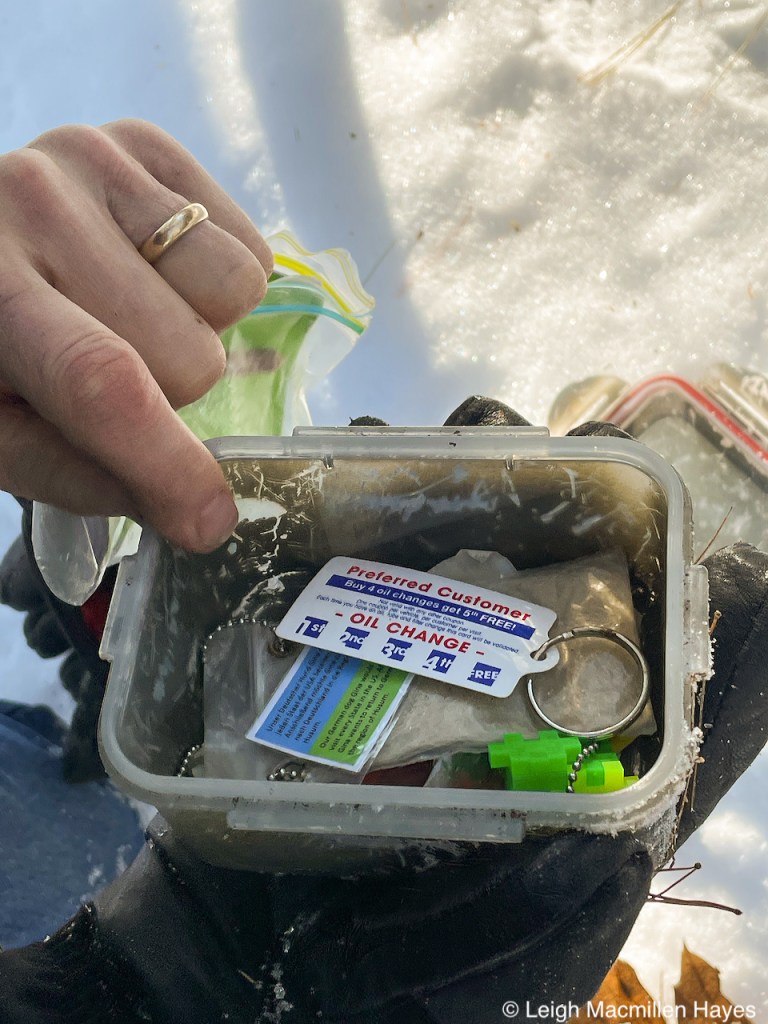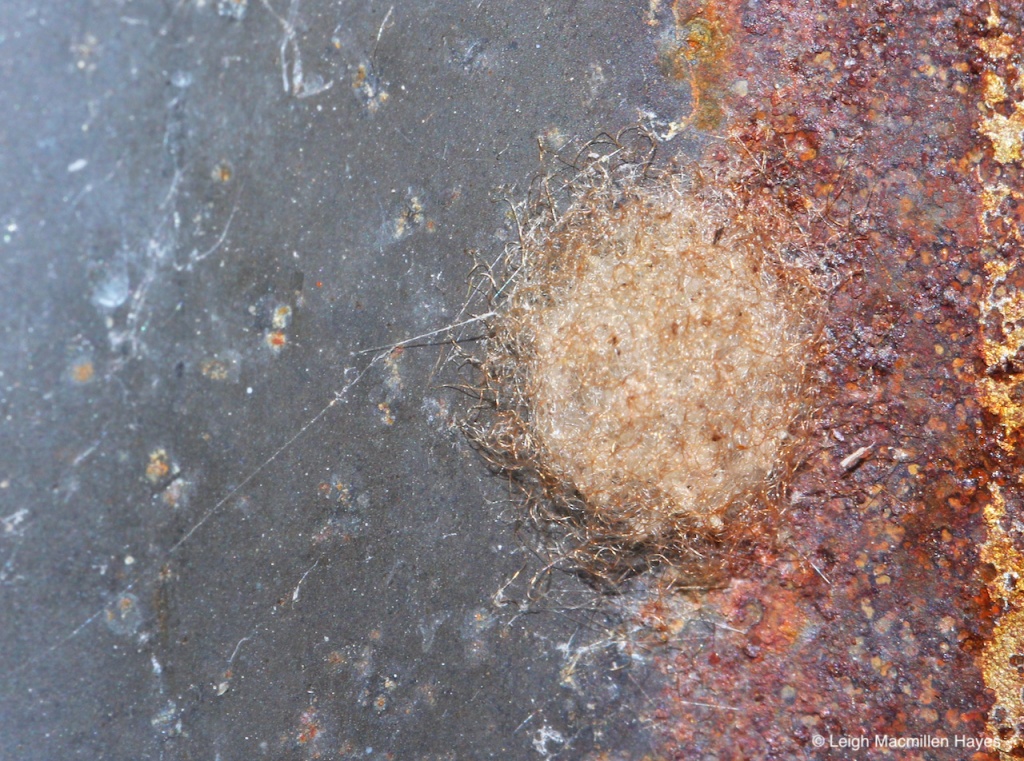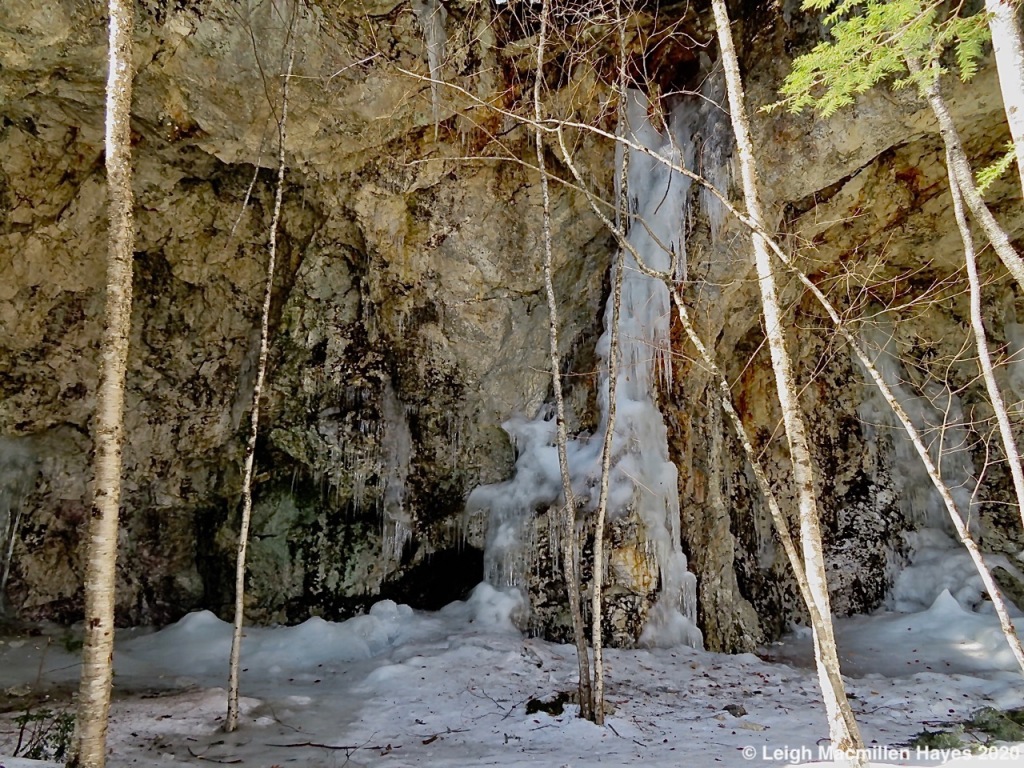
Meeting Each Other Halfway

The text message arrived November 5: “Any chance you are free Friday and Saturday, November 14 & 15? If you aren’t already booked, thinking we could meet up and hike perhaps.”

The decision was made, a room booked, bags packed, and then there was just the driving left to be done.

And voila, at 10:30am on Friday I pulled into the parking lot and saw her sitting in her car. It had been eight years since we were last together for an adventure and much had happened since then, but as is often the case, it felt like yesterday.
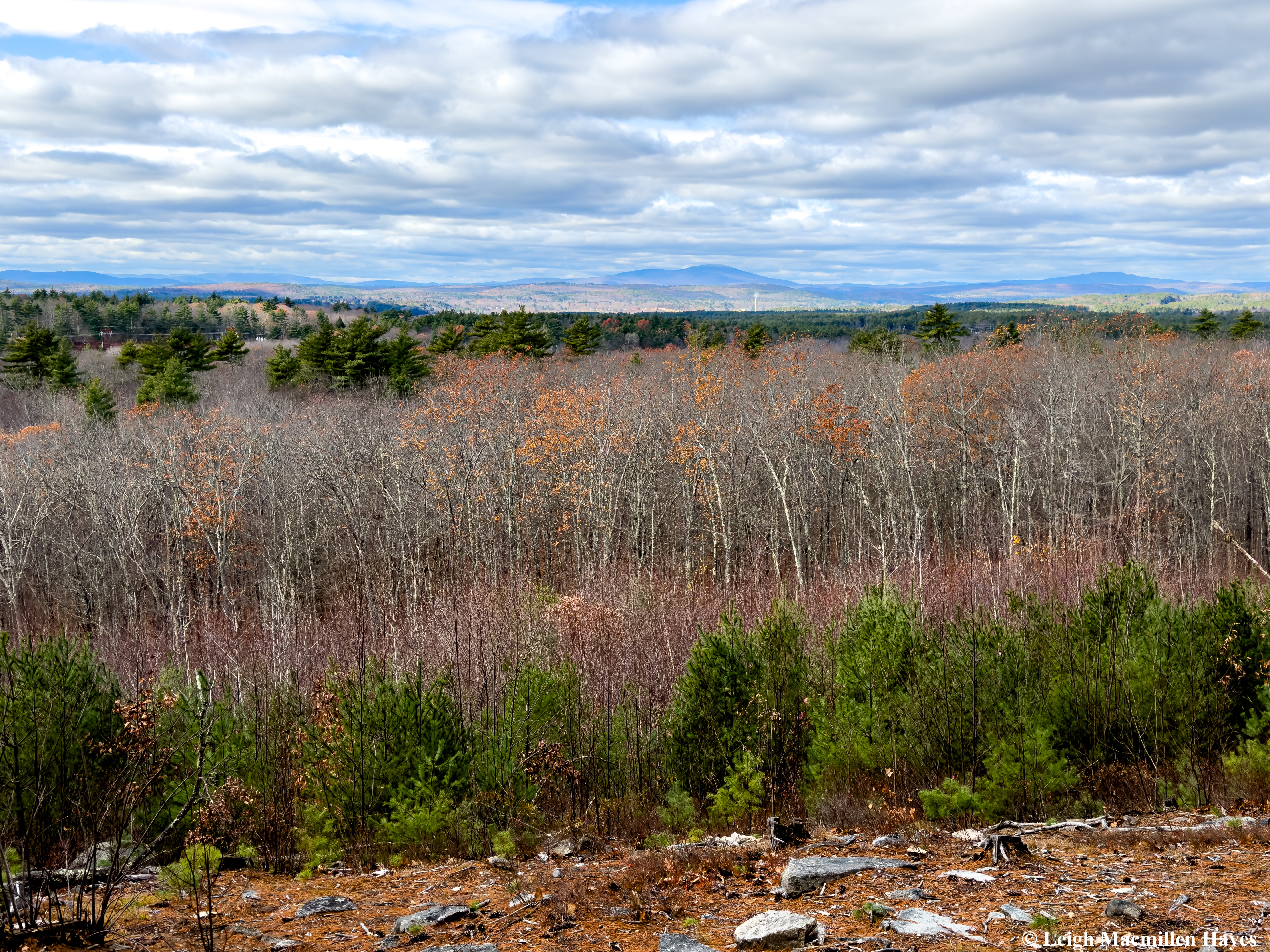
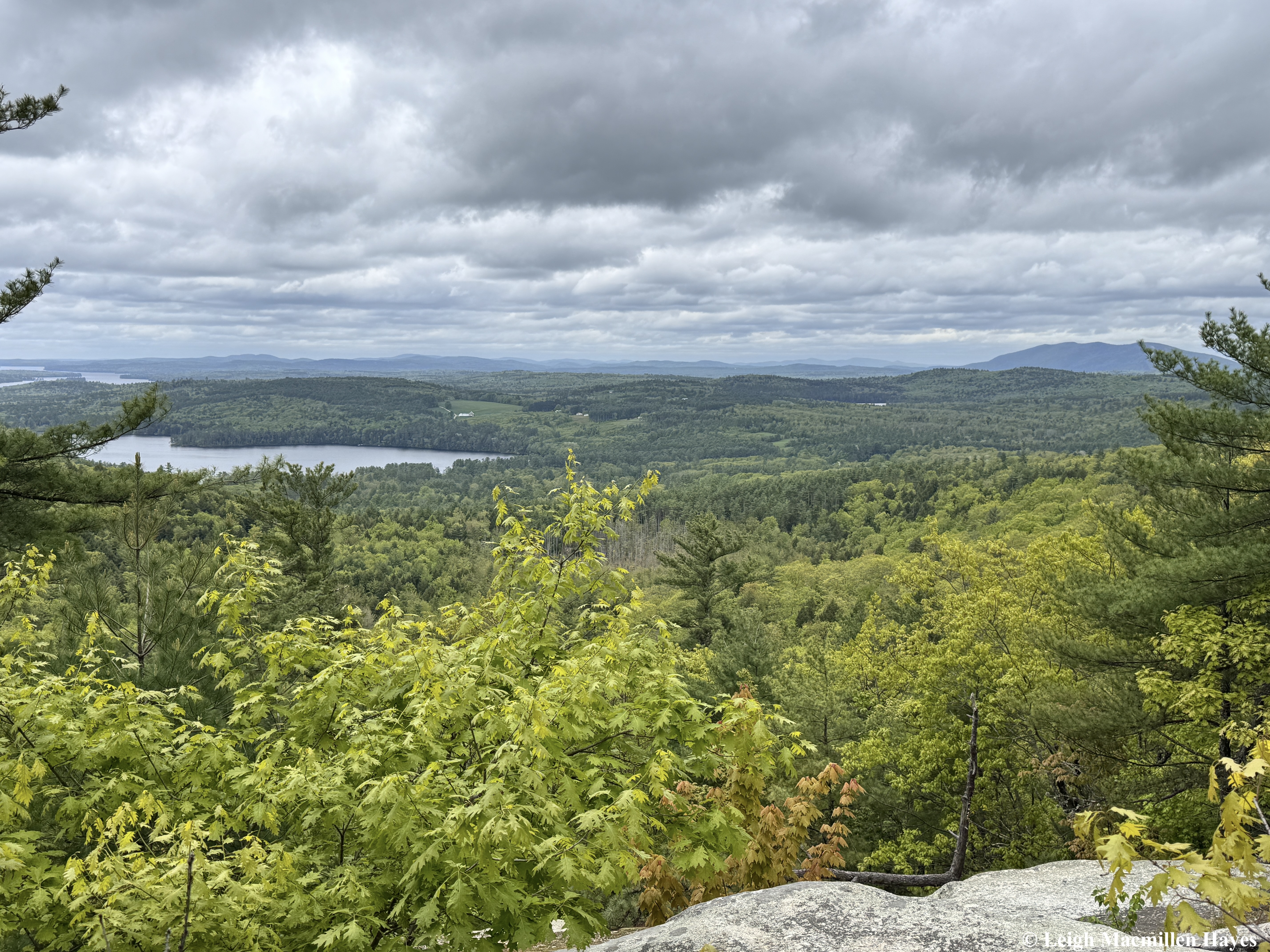
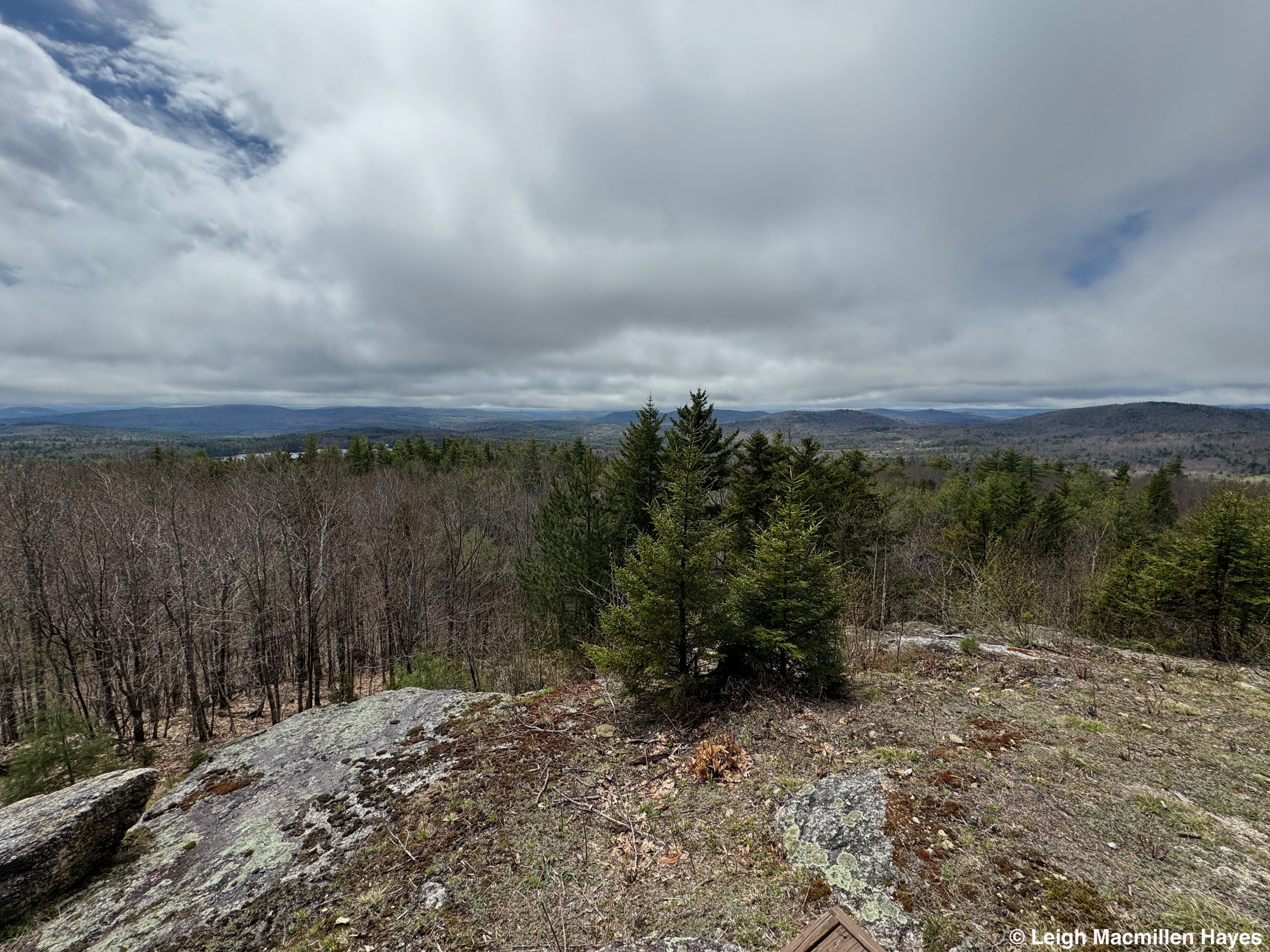
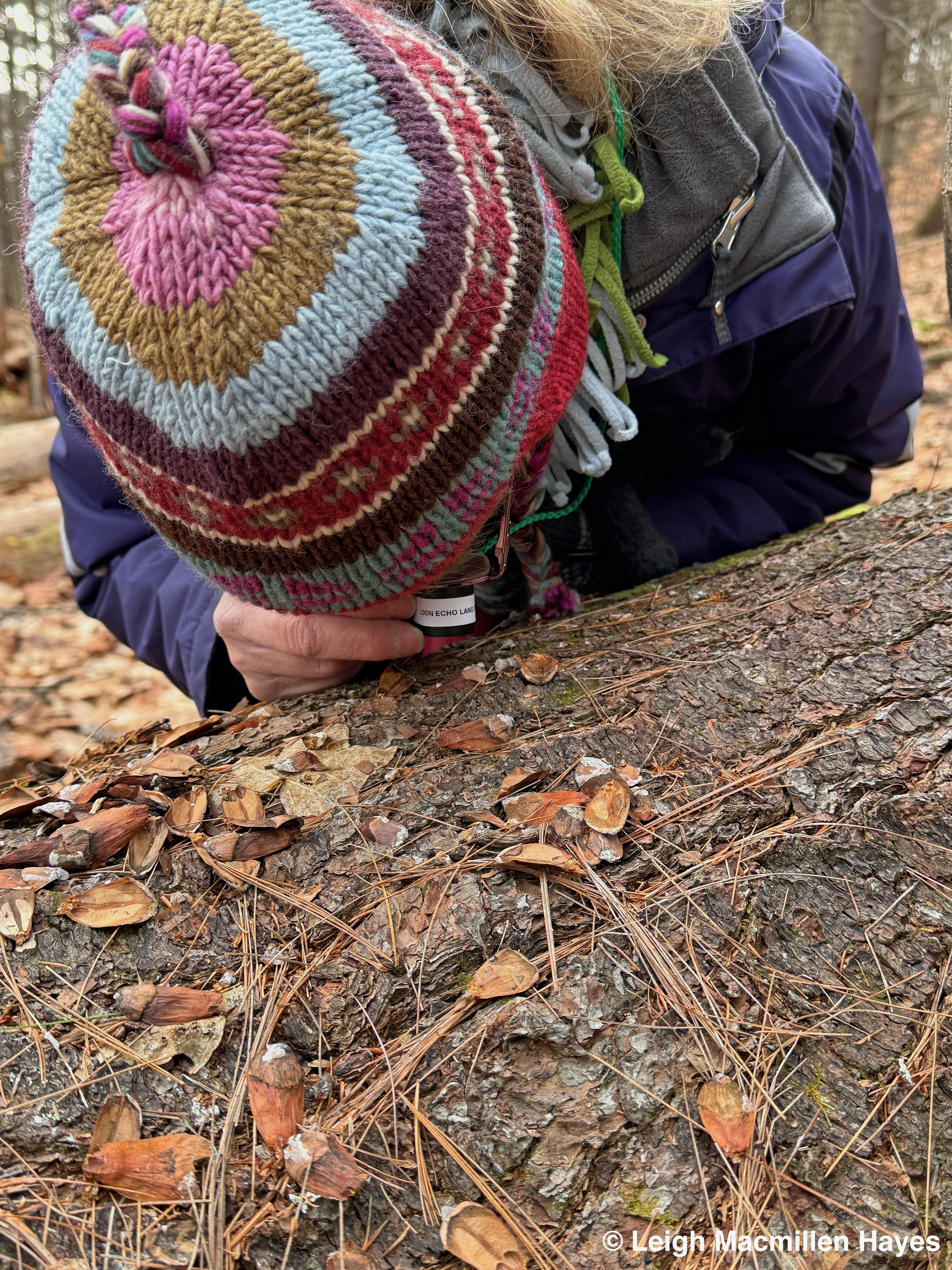
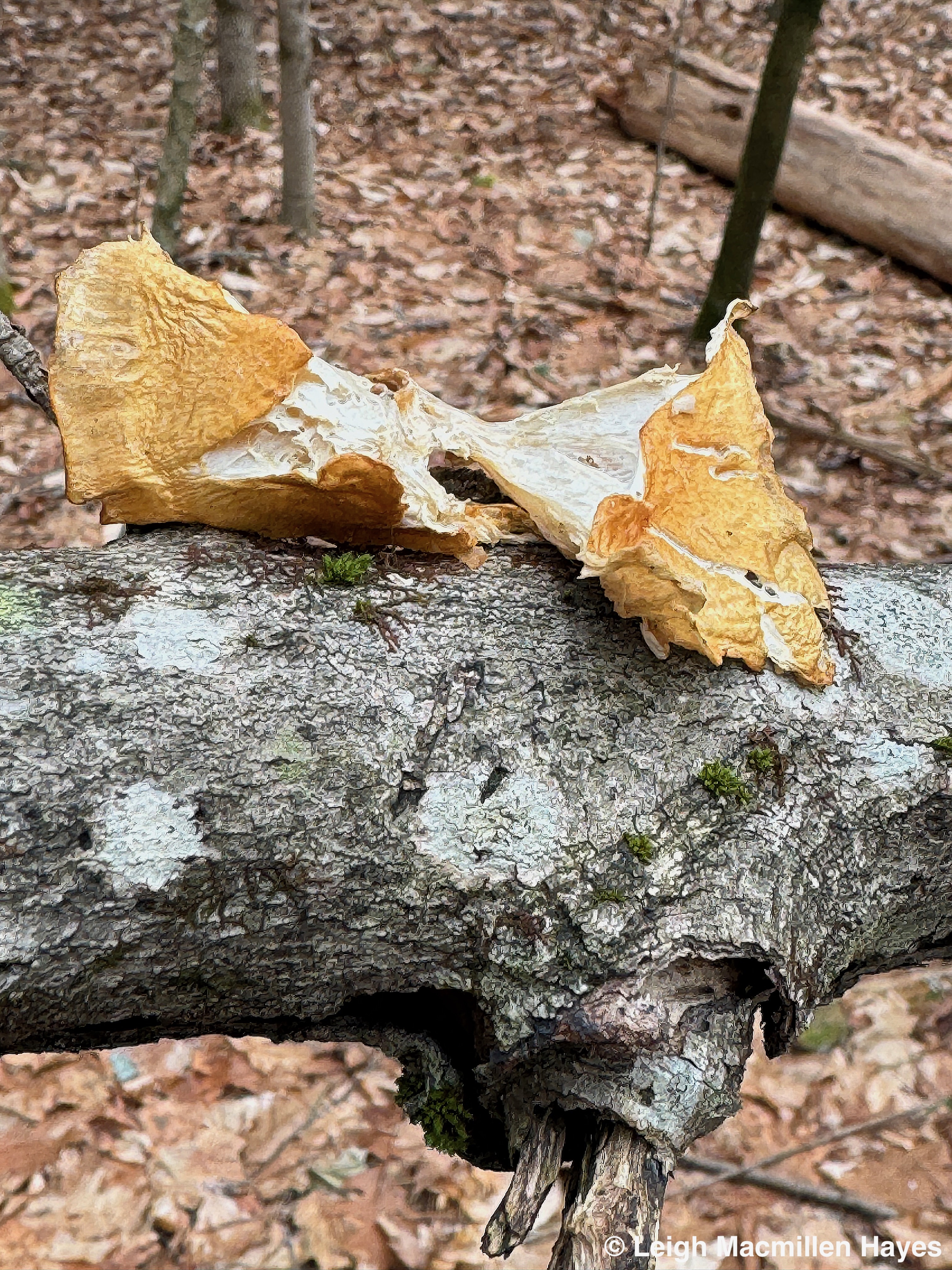
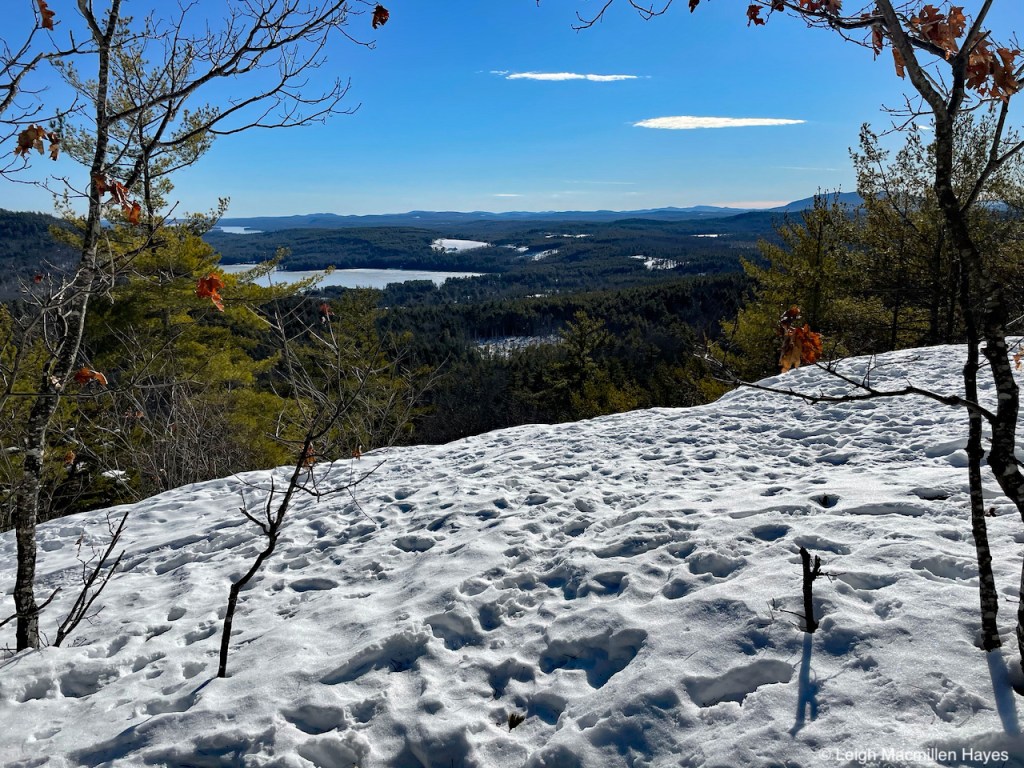
And so we headed off on the Oak Hill Tower Trail, with a plan to stay to the right, or was it the left, as we are direction-challenged, but really, we did know where we wanted to go and the vista spots that we wanted to experience, such as this one where we could see Mount Sunapee and Mount Kearsarge (not Kearsarge North that I’m more familiar with) in the distance. That said, I did record our journey on my GPS.
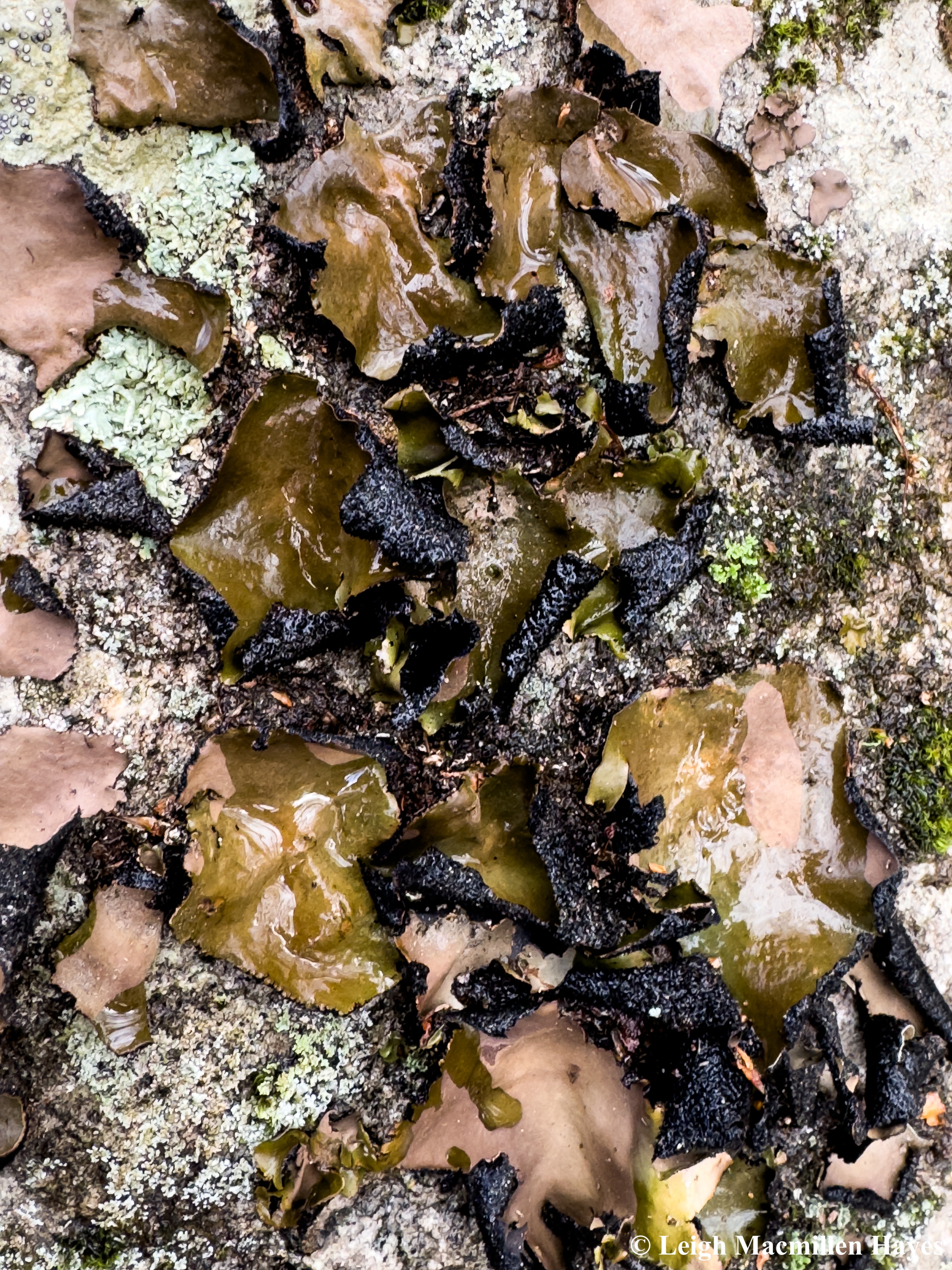
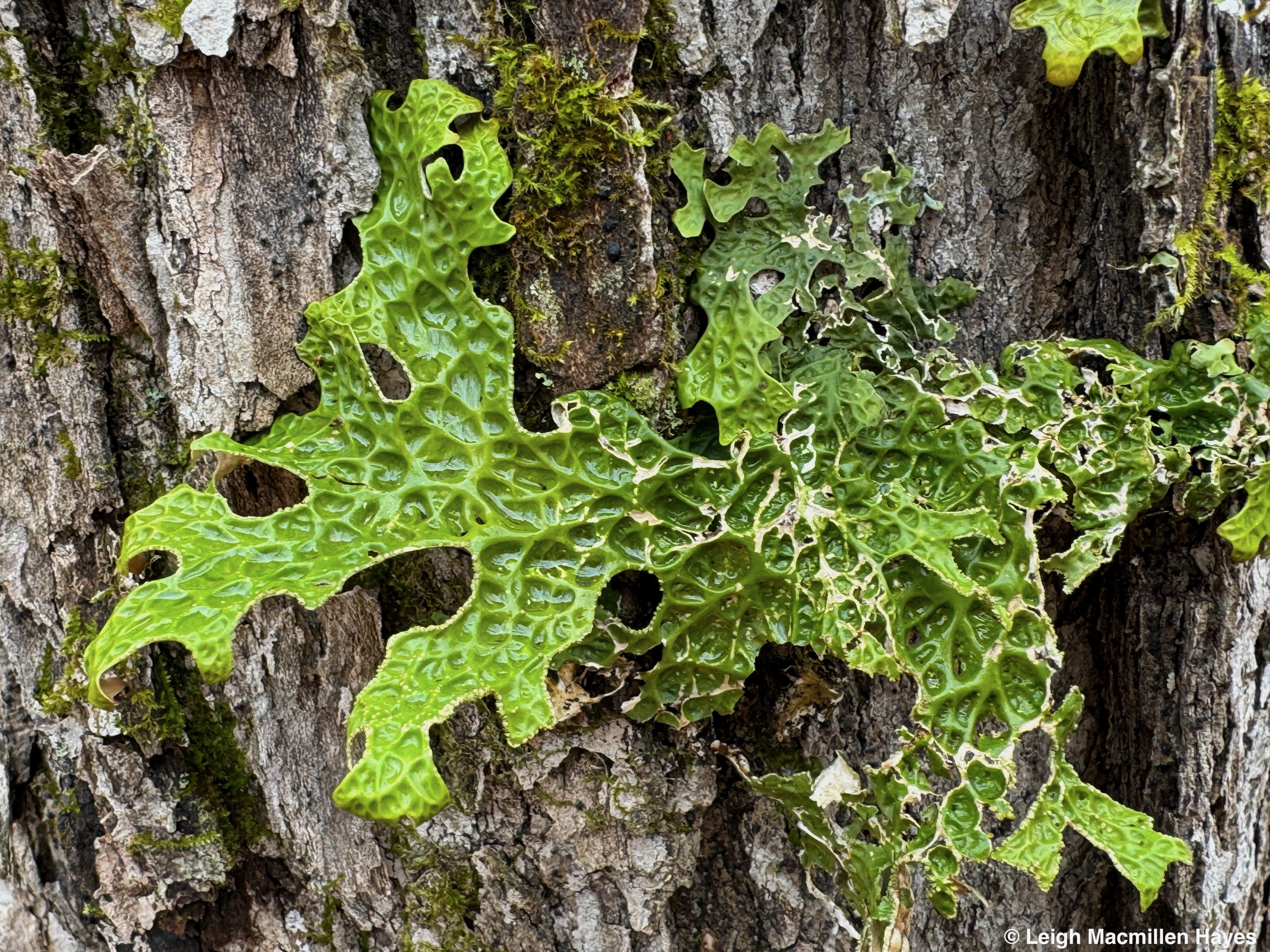
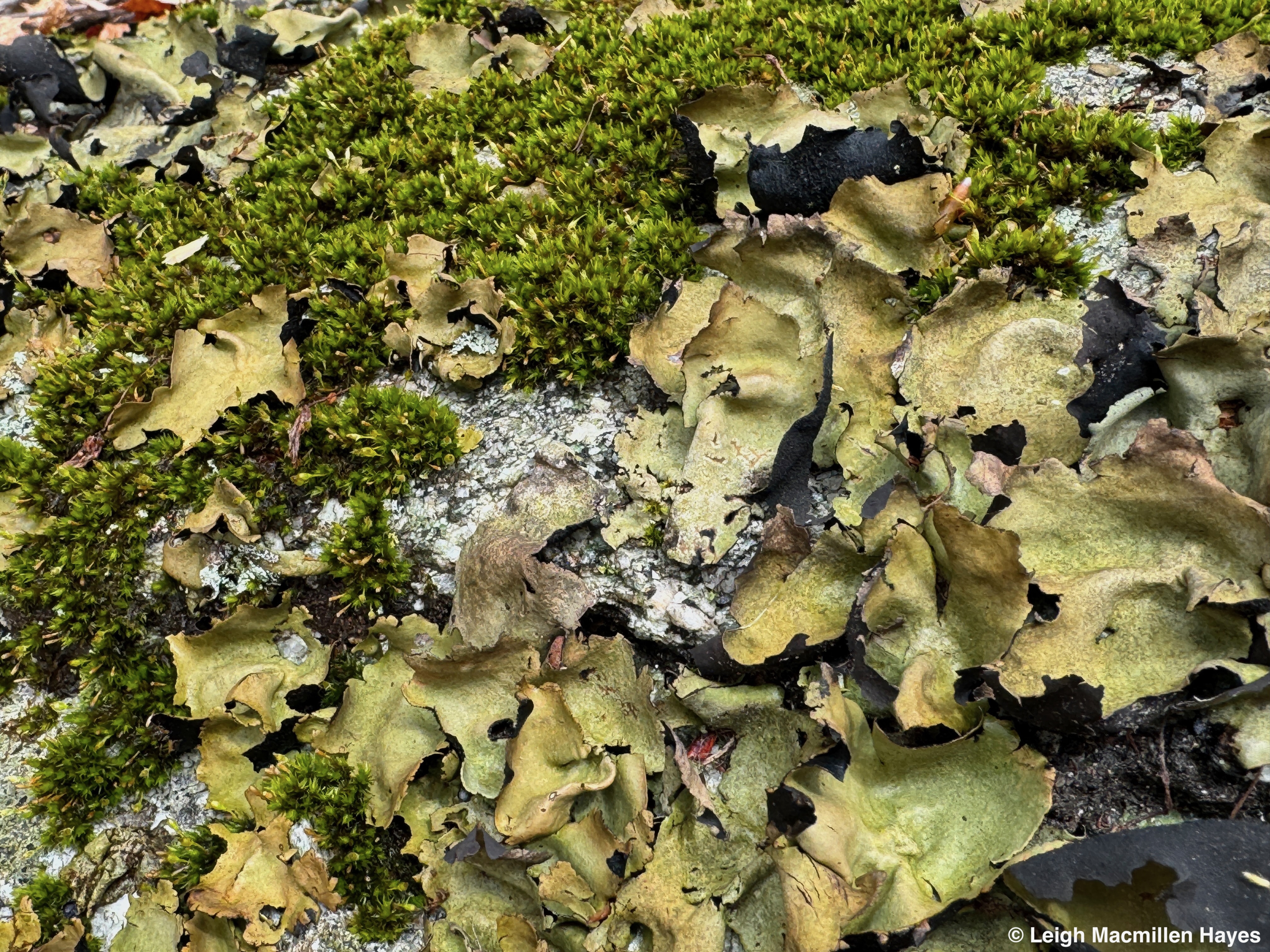
Because we were catching up as well as reminiscing about our junior and senior high school years, we let our tween or teen selves kick into action every once in a while, including by pouring water upon some dried and brown Rock Tripe. We watched with awe as the algal component of this umbilicate lichen immediately kicked into action and the “leafy” parts turned green and became more pliable.

And there were a few Winter Fireflies to admire, especially the pink parentheses that form brackets behind its head. I explained that though the eggs, larvae, and pupae glow, the adult form doesn’t light up the same as the Lightning Bugs we enjoy in the summer months.
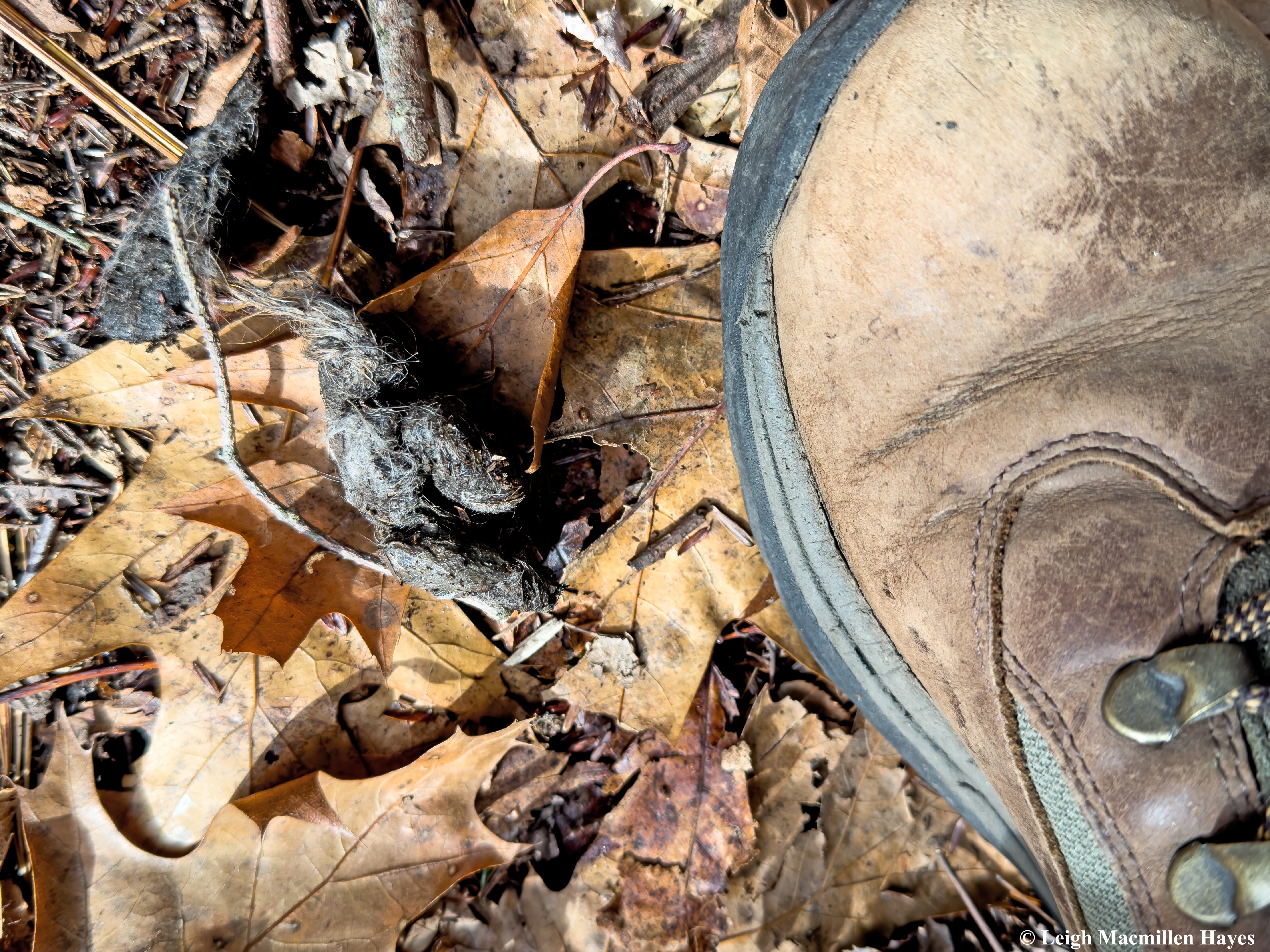
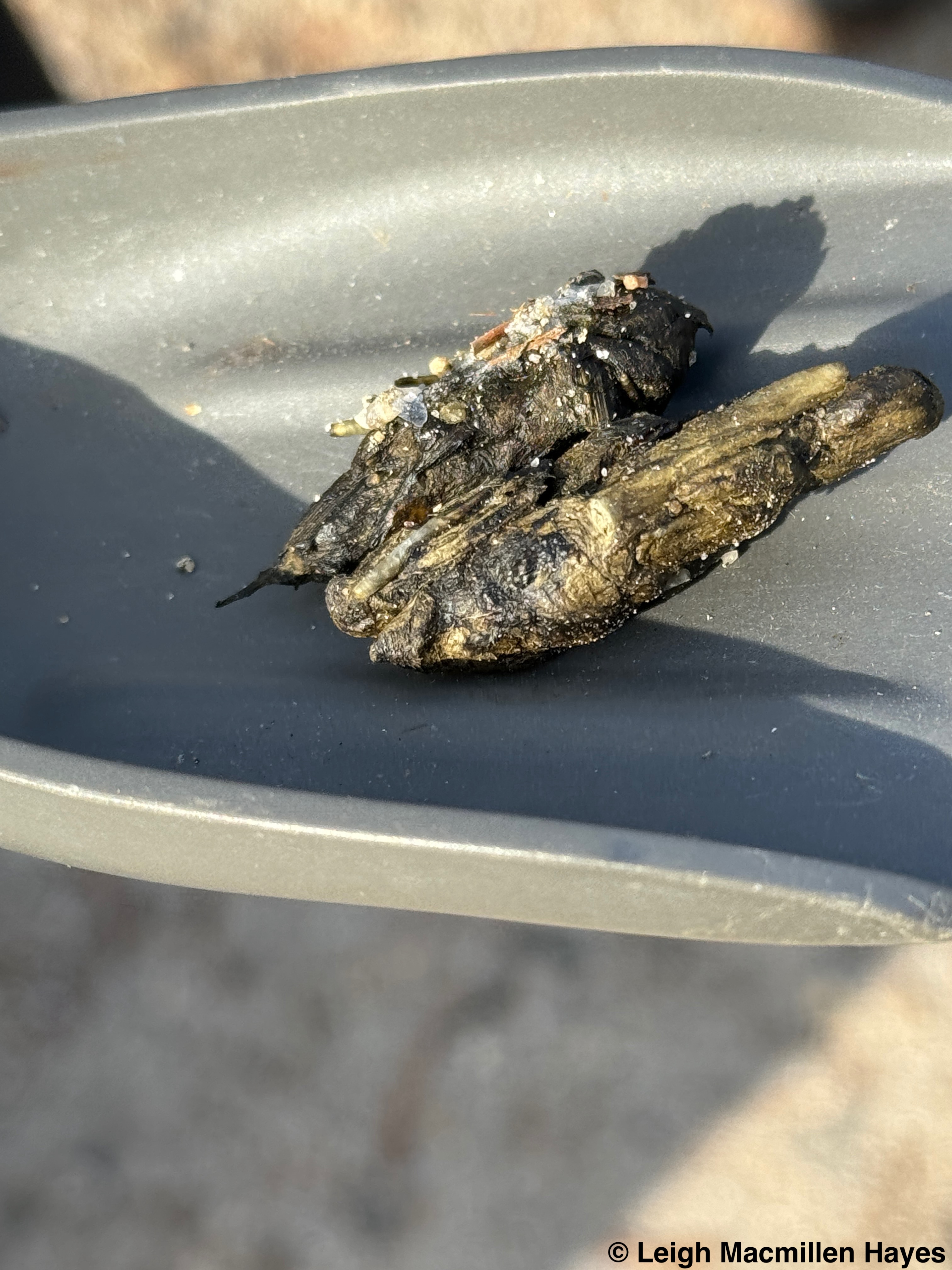
Our next great find was a fun one for me. I’m not sure she was quite as impressed, but she did want to know where all the fur may have come from in this Red Fox scat. We weren’t in Snowshoe Hare territory, but we were certainly in squirrel and vole habitat and so it could have been a combination that helped to form this twisted specimen with its blunt form on one end and tail on the other.
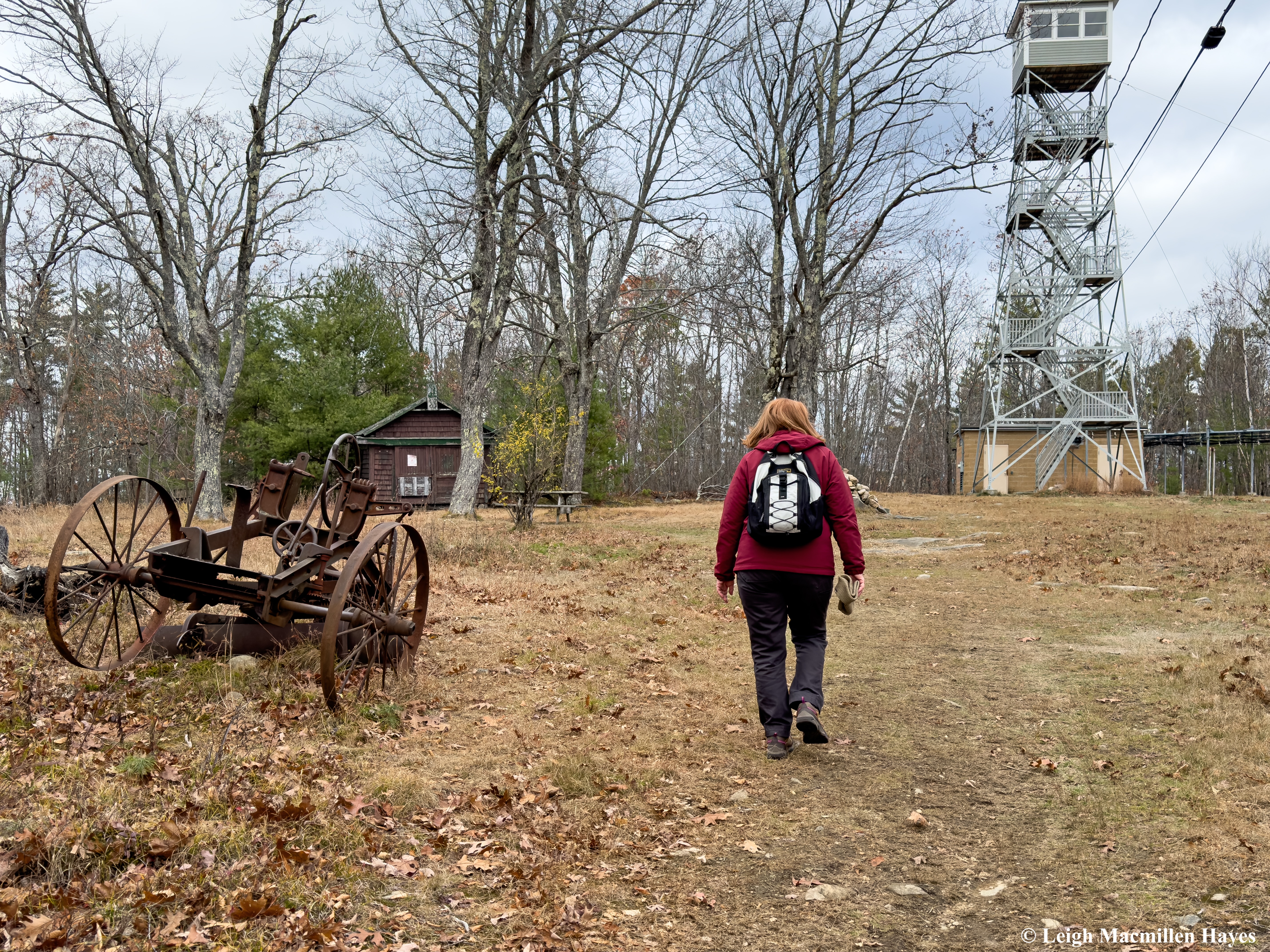
About an hour and a half after we began our journey, we reached the old fire tower for which the trail was named and noted also the house where the fire rangers would have bunked when it was necessary to step out of the cab at the top of the tower (think thunderstorm).

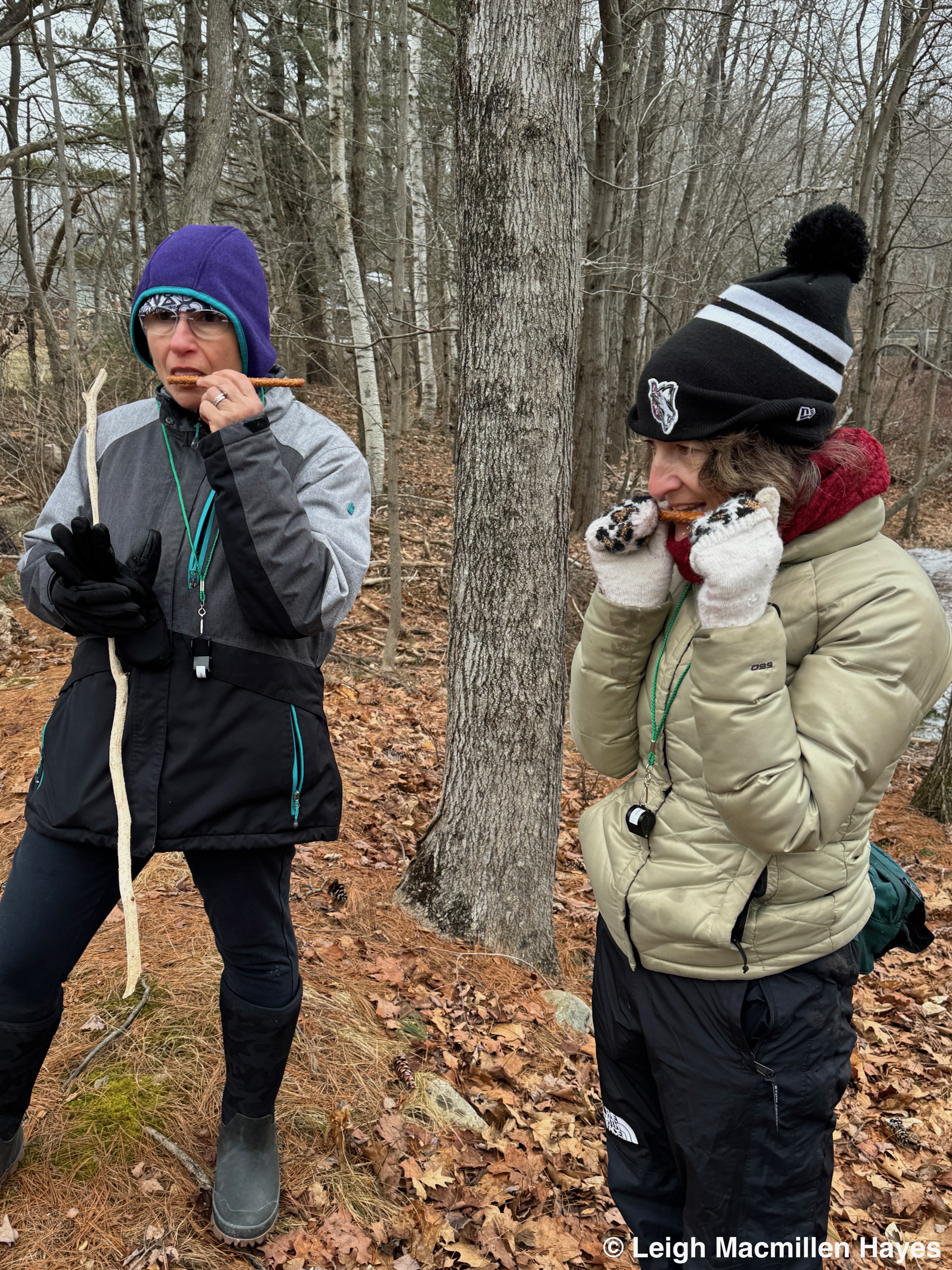
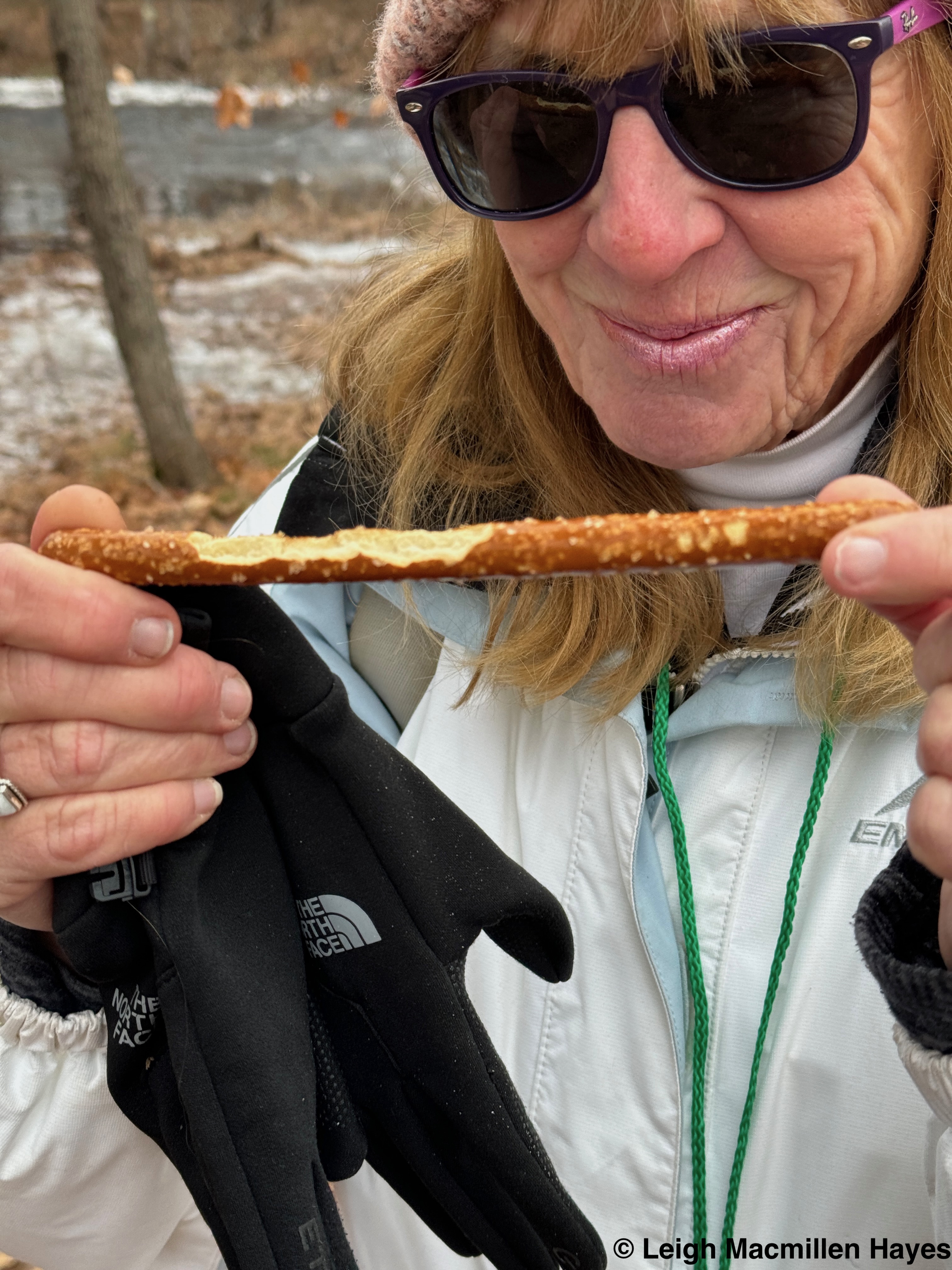
There was also a picnic table and since we had each brought a PB & J sandwich, this became our lunch stop.

Back on the trail, we spotted some puffballs, and again the need to play struck our fancy.

And so she found a stick and poked each one and we laughed as puffs of smoke, aka spores, wafted out of the little balls.

The next day found us upon a different trail that had been part of a working farm from the 1700s until about a year ago and known as Dimond Hill. Barbed wire that once kept animals in or out had become part of a stump, which often happens when a tree sprouts beside a boundary and over time grows around the obstacle so that they seemingly become one.

So much so, that a former limb had separated from the tree, but still the wire “glued” them together.
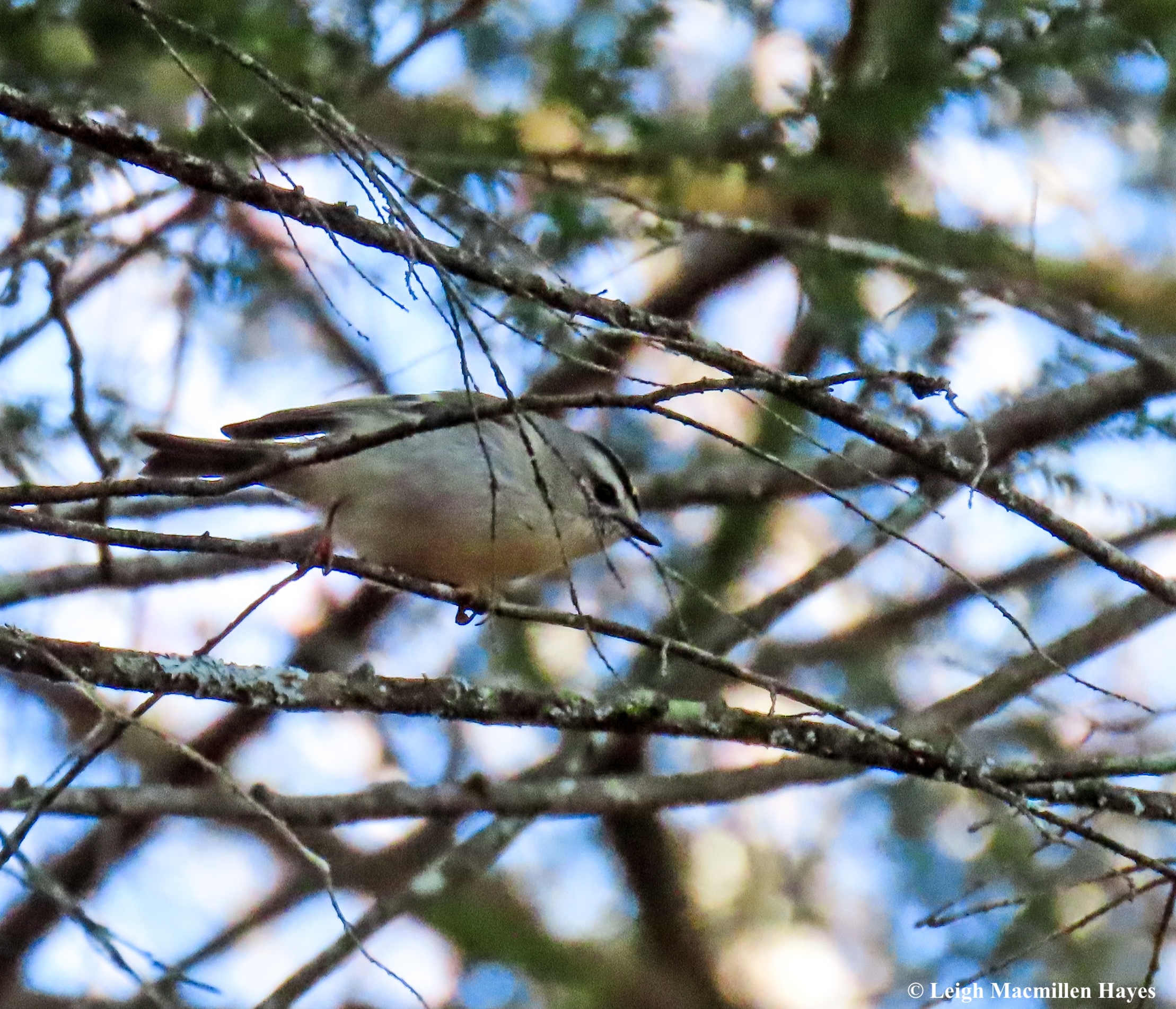
In one section, some wee birds flitted from tree to tree and though it was difficult to get a clear photograph, I was thrilled to be in the presence of Golden-Crowned Kinglets, even if only for a few minutes.

We talked a lot about tree bark along the trails, and nature in general, and all kinds of other topics as well, but every once in a while a tree stopped us in our tracks, such as this one. In my opinion, it offered a great example of the Bull’s Eye Target Fungus that affects Red Maple bark, but doesn’t kill the tree. I explained to my friend that it offers a quick way to identify this species of tree.

And in our midst, as we hiked we occasionally spotted Bruce Spanworm Moths flying about. What I forgot to mention on Saturday was that the males fly, but the females are wingless and we should have looked about because we may have found one. But knowing my friend, now that she knows this, she will be on the lookout. So will I.

We completed a circuit of trails on one side of the main road and then crossed to the field where vegetables and animals had once been raised. It struck us as odd that instead there was a door in the middle of the trail. A locked door at that.
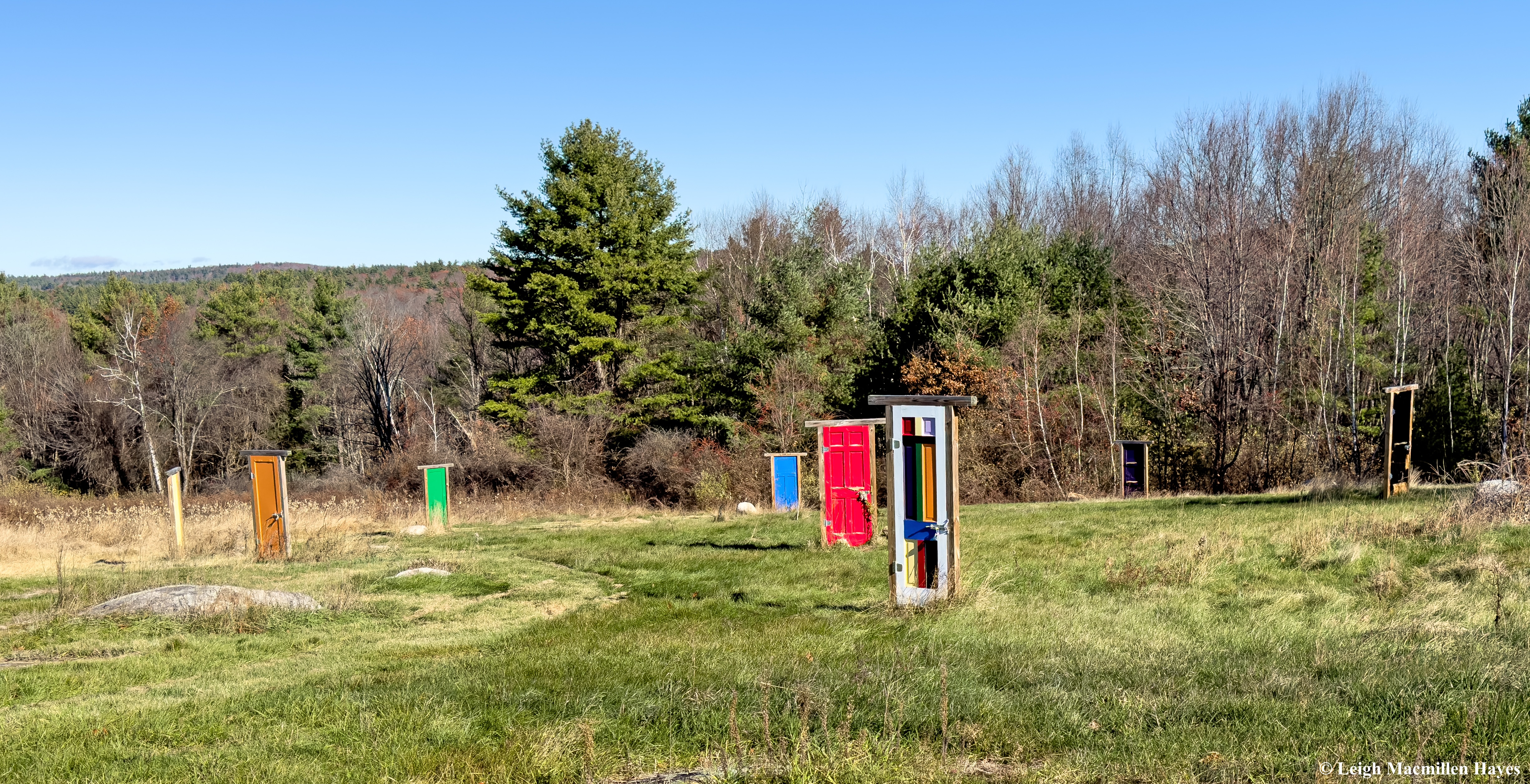
And then in the field below, we found one multi-colored door through which if one could unlock and pass, would lead to a circle of eight more brightly painted doors. You’ve heard of Stonehenge? We decided this was Doorhenge. Or perhaps Doorhinge.

The purpose for this installation? We don’t know, but we did wonder if the doors were strategically placed to represent compass points.

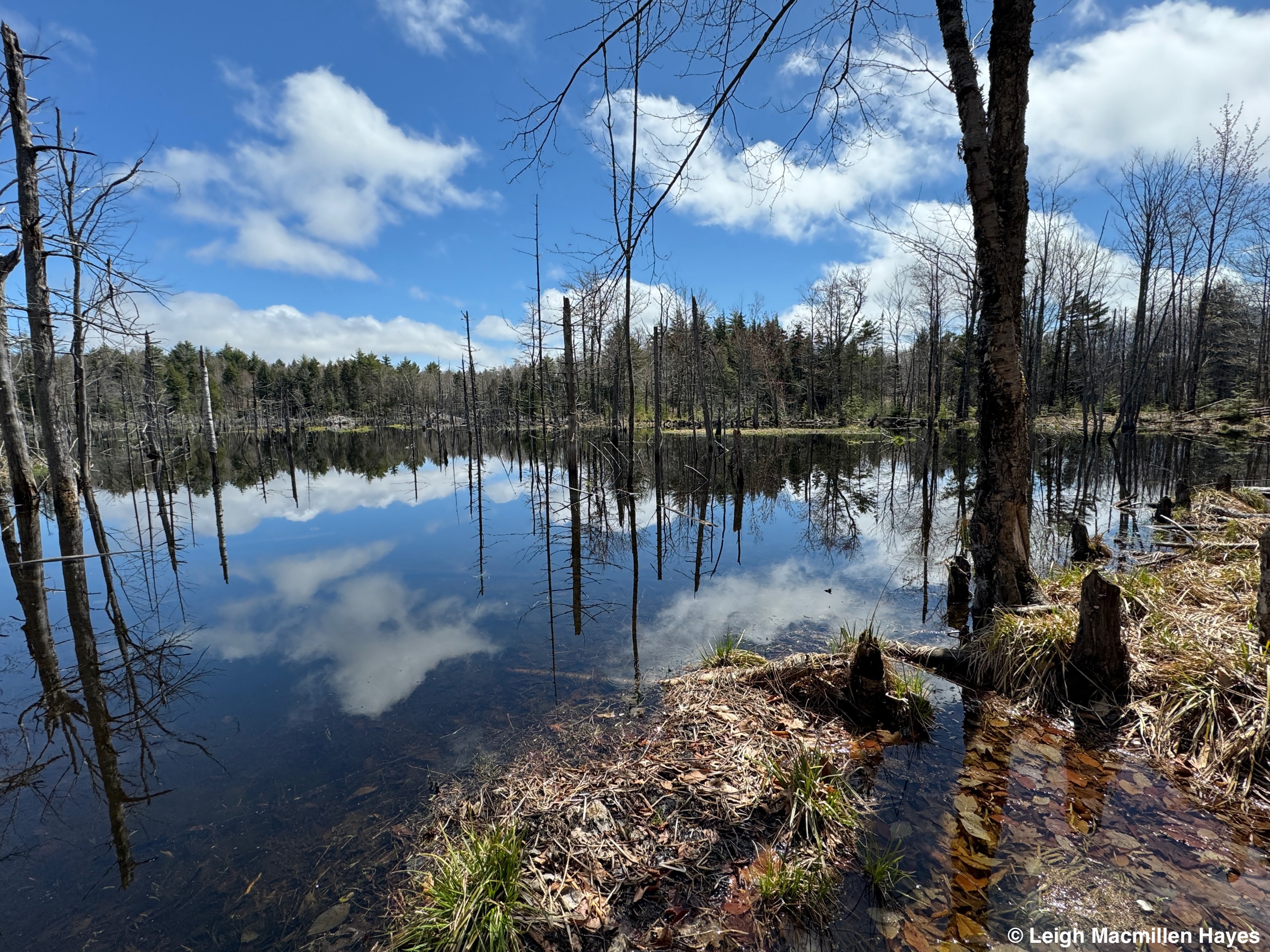
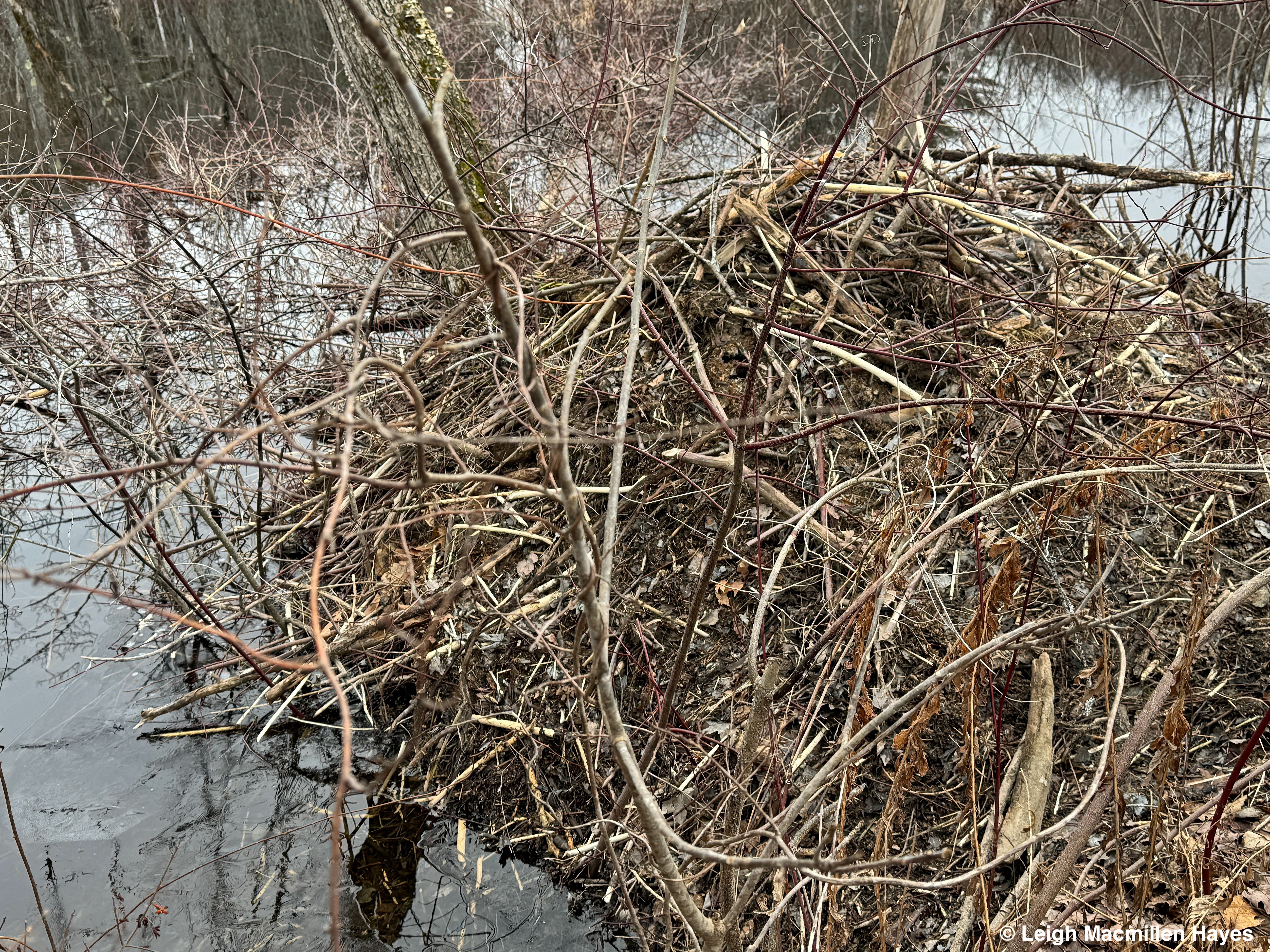
We knew we didn’t have time to hike the entire trail, but were thrilled to reach water, which I think must have been Ash Brook. What we did note was that it was an active Beaver territory.
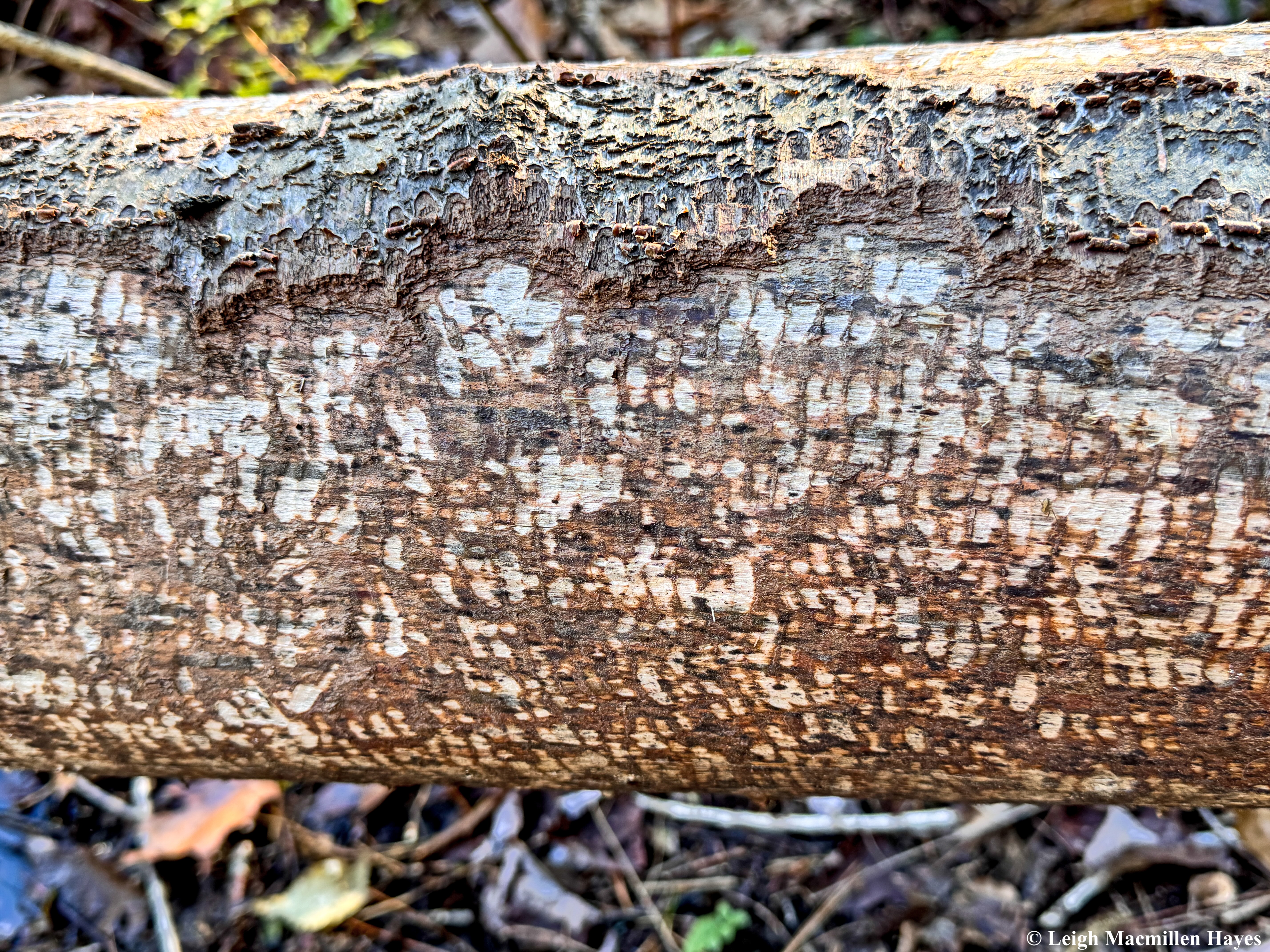
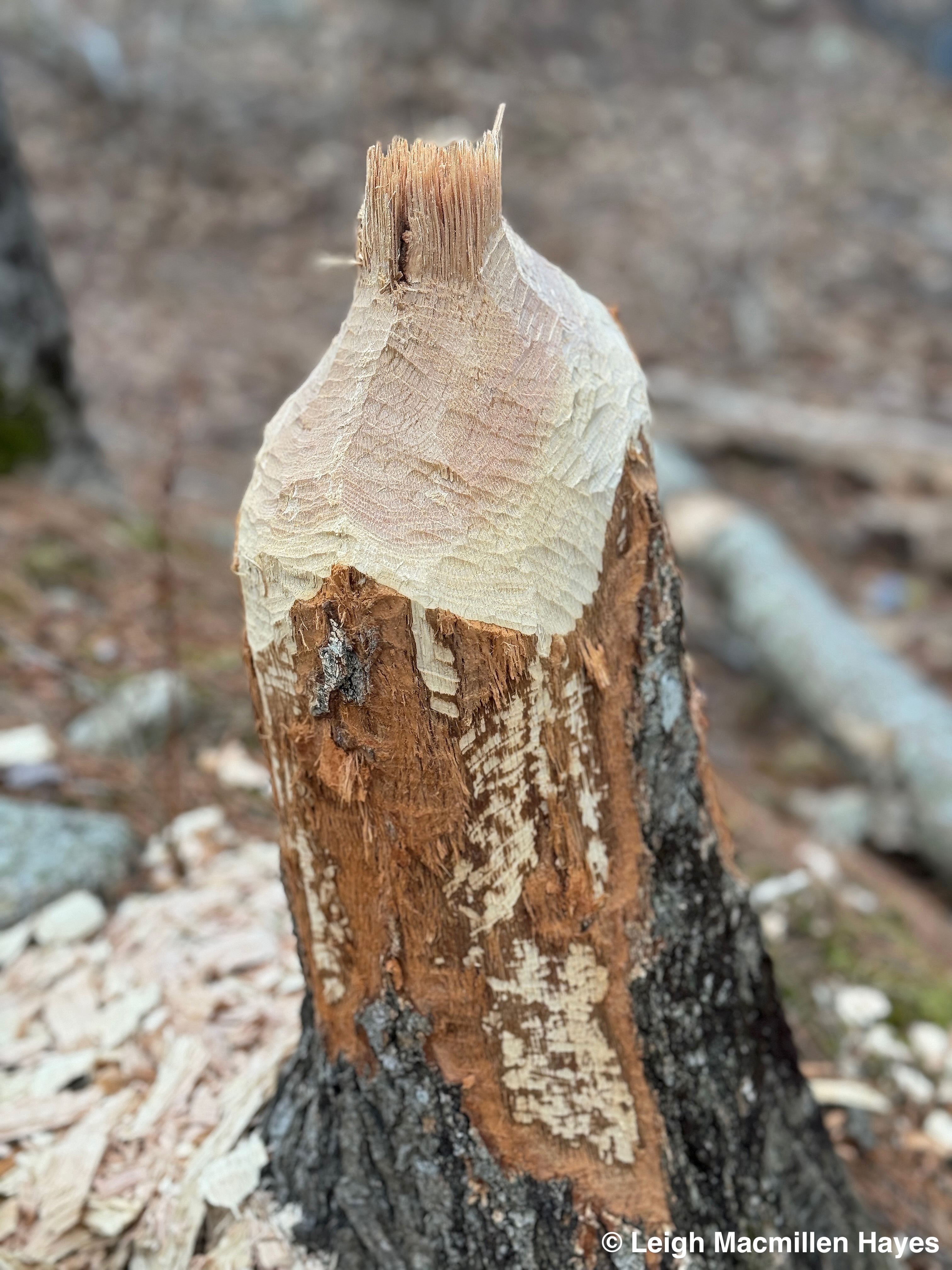
And the work of the Beaver’s teeth as upper incisors met lower to consume the cambium layer where sugars and water and nutrients were exchanged through phloem and xylem, was well documented. Barely any bark was left untouched.

Not far from our turn-around point we reached more water and though we couldn’t find the actual Beaver Lodge, we did note that a skim of ice had formed. And the ice-covered water reflected the Bluebird day we were enjoying.
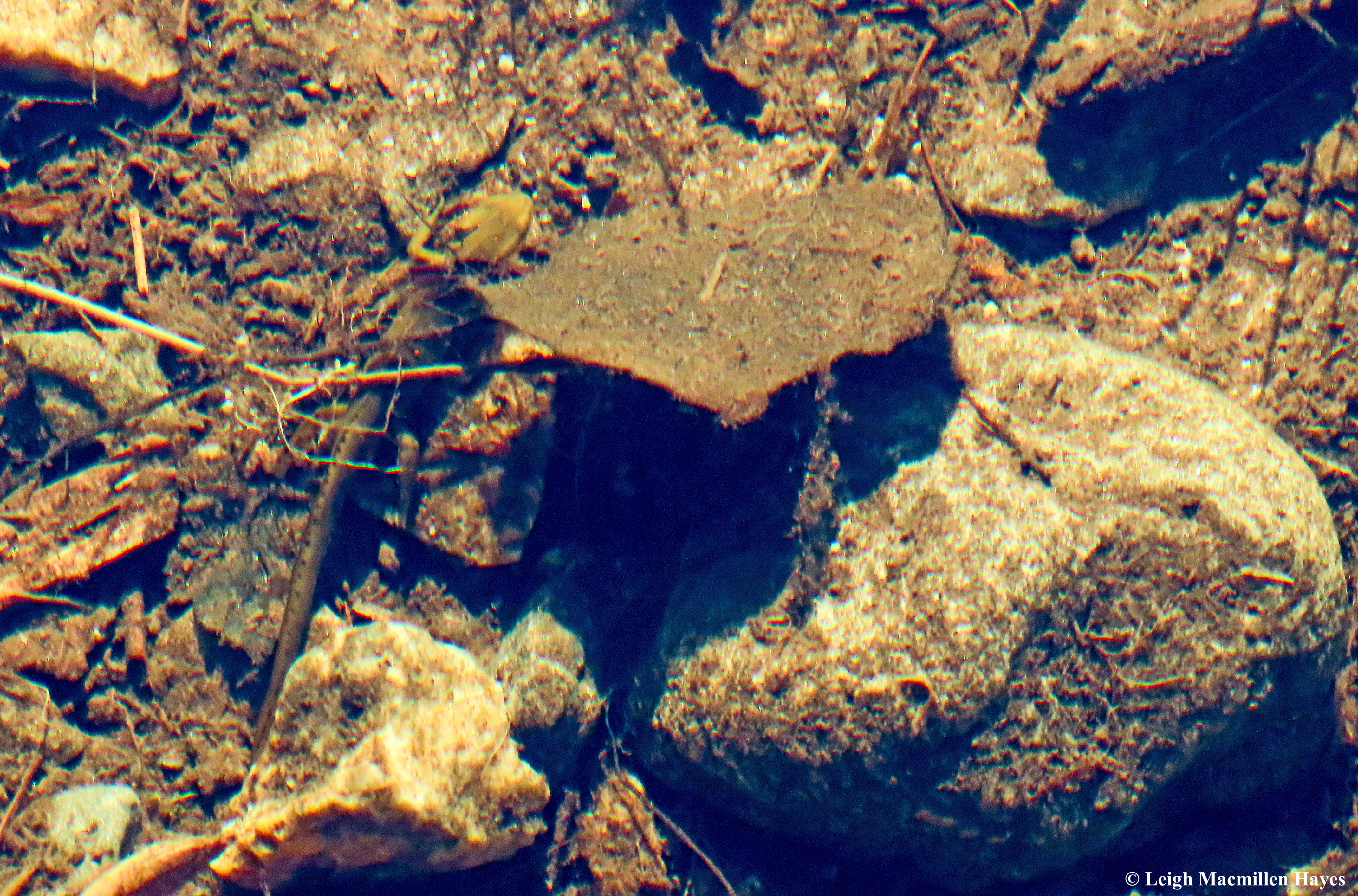
Her eagle eyes also picked up on an Eastern Newt in the water below. Can you see it in this Where’s Waldo image?
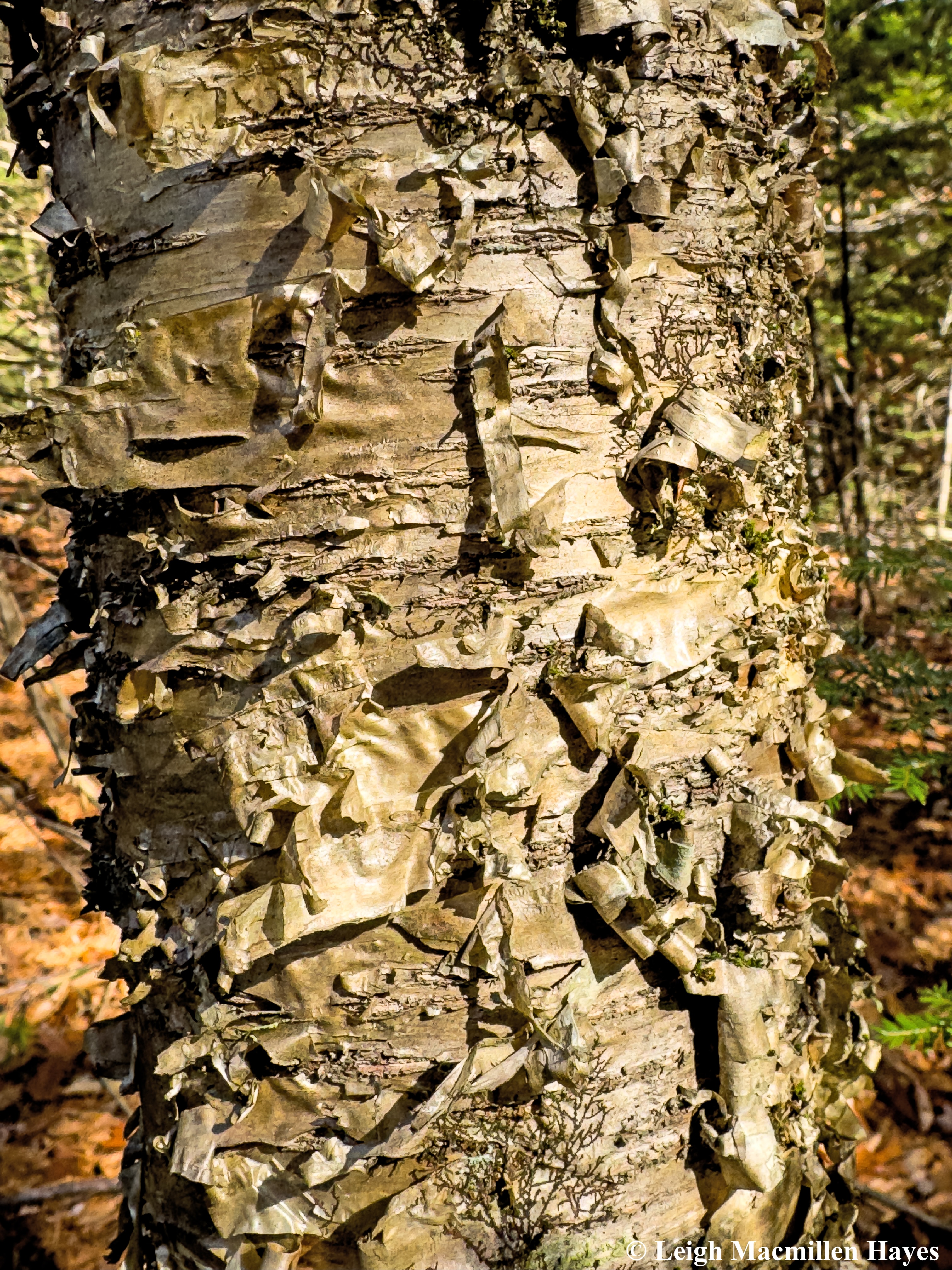
Upon our trek to our turn-around point, for this was an out-and-back trail, we discussed Paper (white) Birch and Gray Birch and my friend mentioned that she didn’t remember ever meeting Yellow Birch.

And then, as often happens, on the return trip we started to spot its curly presentation over . . .
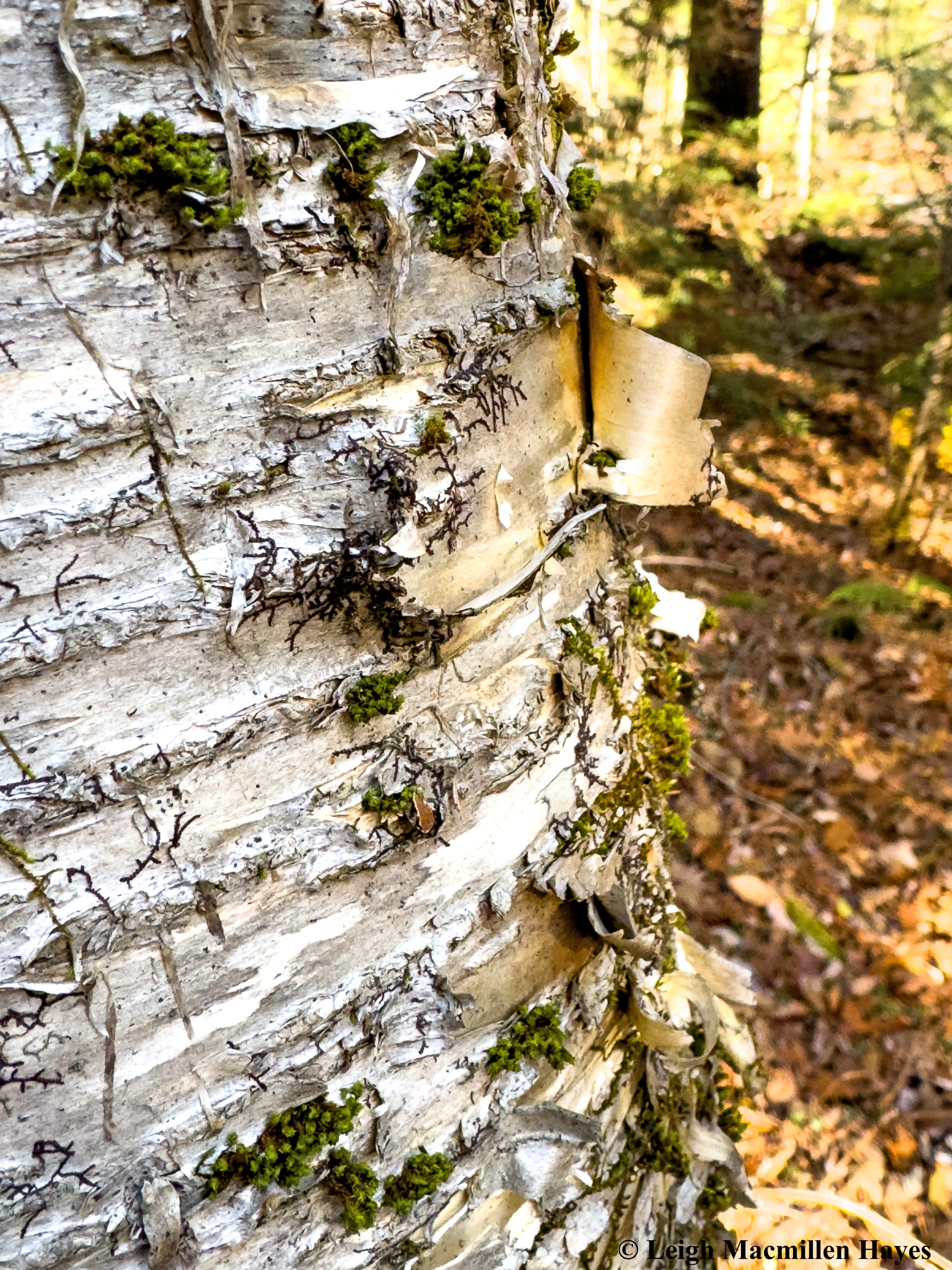
and over again and I explained that as the tree matures it takes on a more silver gray appearance, but my friend liked that she could still see the gold in the curls.

That said, sometimes the Paper Birch trees also had a golden underbark and so I reminded her that she had to also consider how the trees peeled, Yellow being in ribbons while Paper peels in, well, sheets of paper sometimes. Had there been twigs that we could reach, I would have done the touch and sniff tests, but that will have to wait for another adventure.

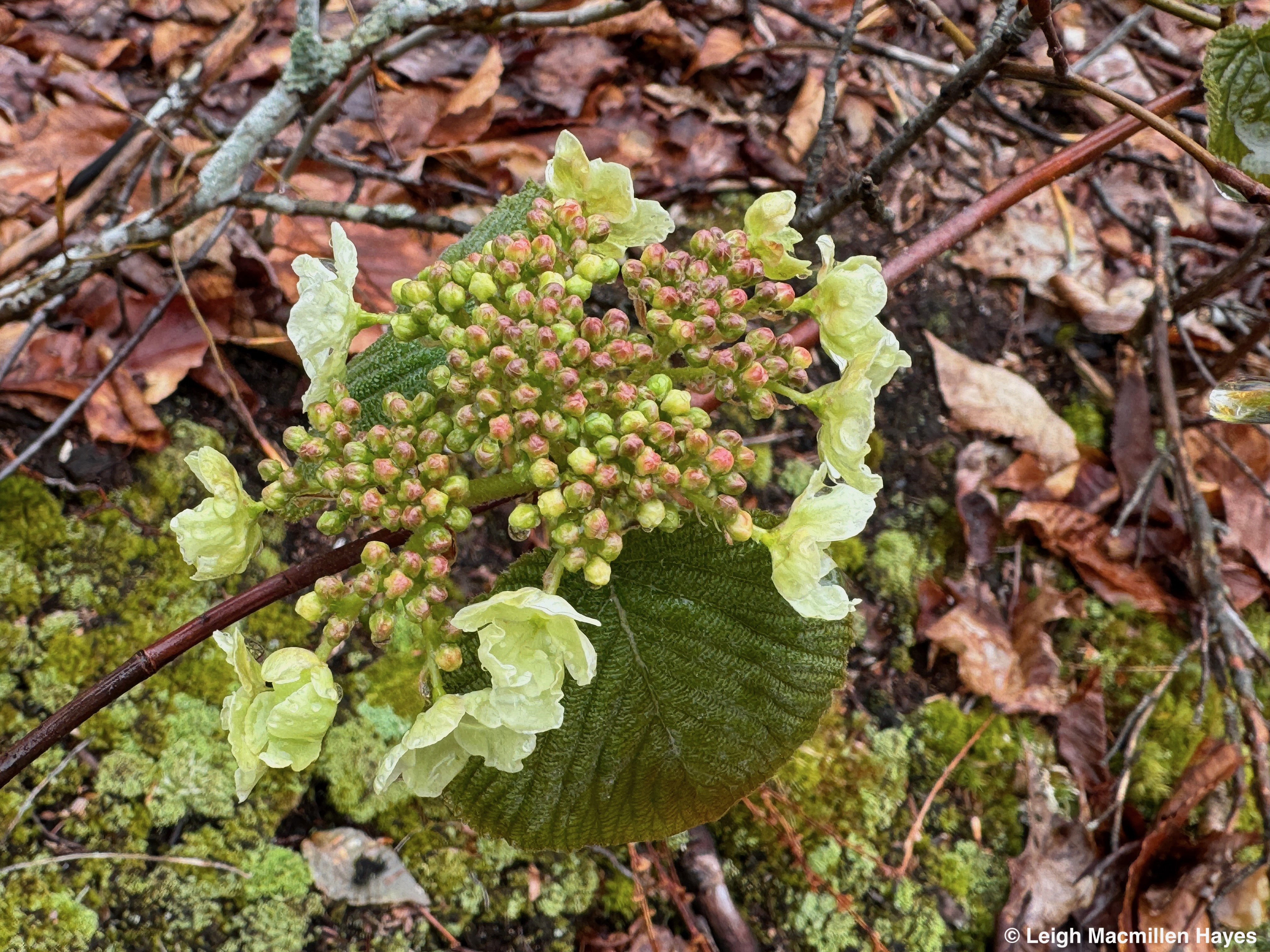
We even had the surprise opportunity to greet a Maple-leaf Viburnum, a species I’d shared photos of with her earlier in the fall.

We’d given ourselves a turn-around time so that at the end we’d have a chance to sit and eat left-overs from the dinner we’d enjoyed at The Common Man the night before and soak up the warmth of the sun and try to wrap up our conversation that had gone on for almost 24 hours. Well, except for when we were sleeping, of course.

In the end, we gave great thanks for making the time to meet each other at the Halfway Point. Well, the almost Halfway Point if truth be told for I’d only traveled two hours from Maine to reach Concord, New Hampshire, while Carissa had driven three hours north from Connecticut.

I’m so grateful for this friendship that has spanned decades and that we can renew it along the trail despite the distance that separates our everyday lives.

Thank you, Cris!

Bogging in Maine

What is a wetland? Basically, it is wet land! But more specifically, wetlands are often those transition zones between dry land and deep water.

There are four basic types of wetlands, which can be broken into even more types, but let’s stick with the four: marsh, swamp, bog, and fen.

Marshes are typically located along shores of rivers and streams, and even the coastline. Plus they can be found in the shallow water of ponds and lakes. Cattails, Arrowhead and other soft-stemmed emergent plants grow in these areas.

Swamps are found along rivers, streams, and lakes where mainly woody-stemmed plants such as shrubs and trees, like this Tamarack, grow.

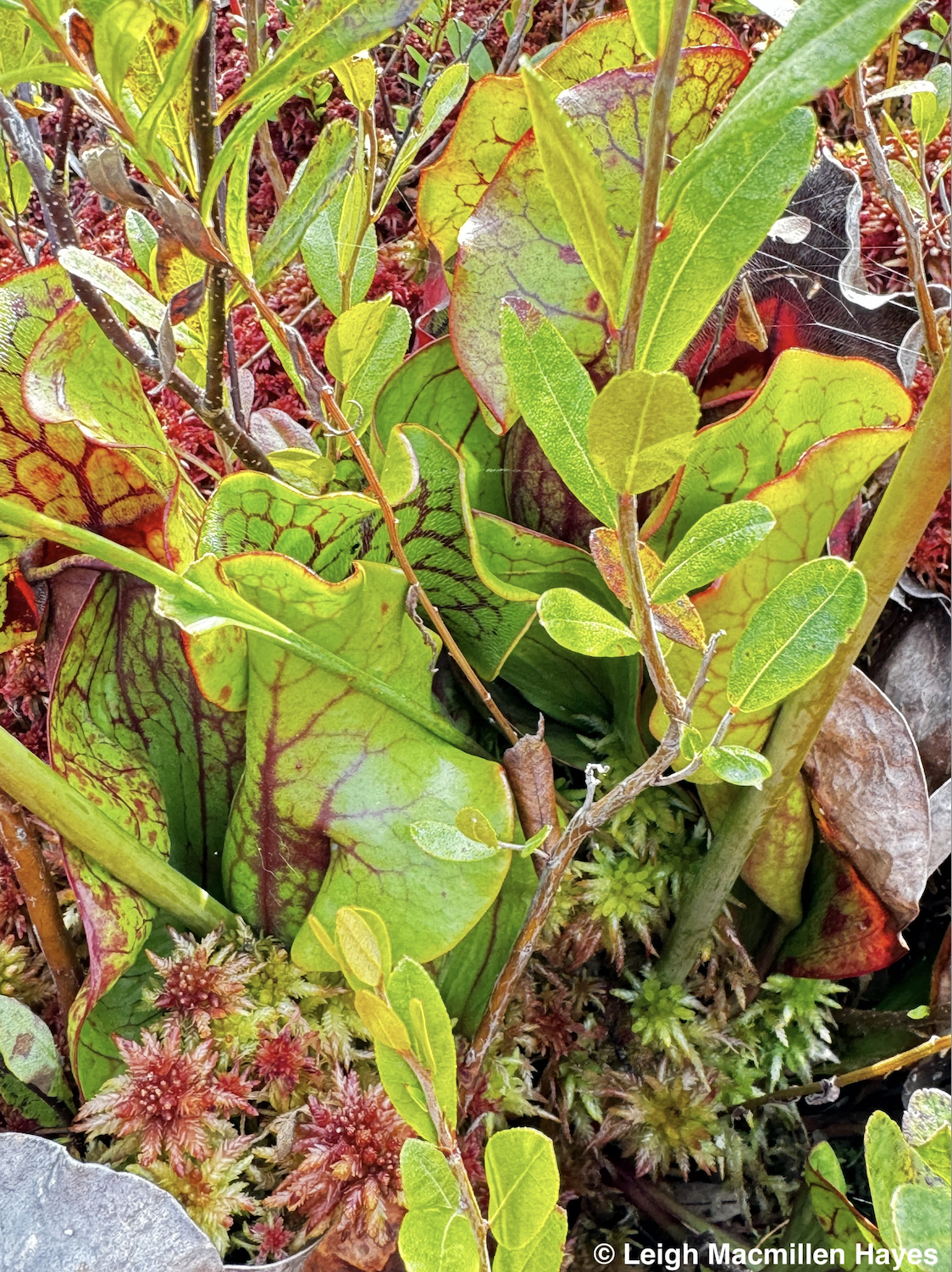
Pitcher Plants and Sphagnum Moss
Round-leaved Sundews

Bogs are found in our northern climate and often are deep depressions that have no drainage. They are covered with a surface carpet of sphagnum moss and insect-eating plants like the Pitcher Plant and Sundews.

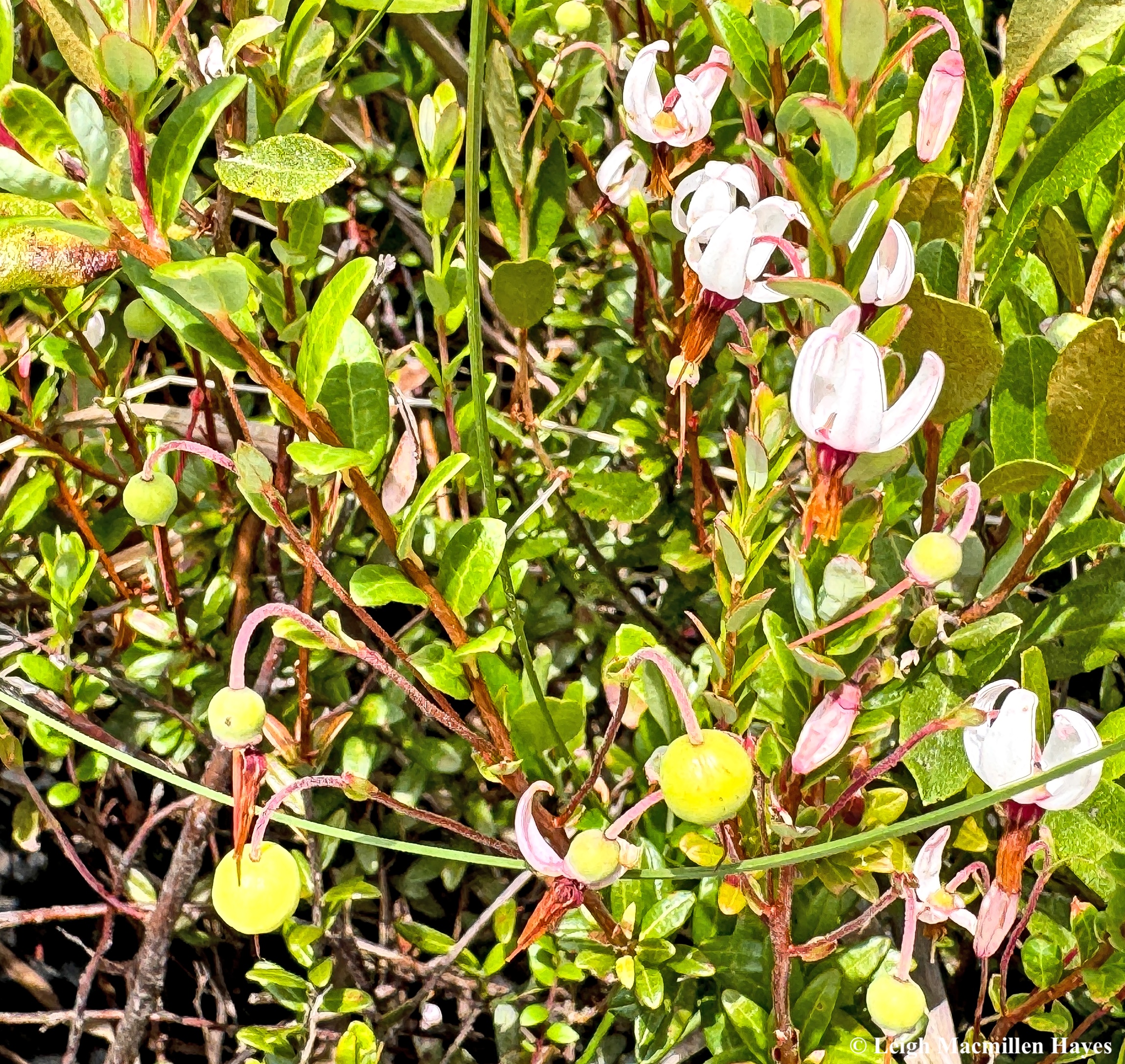
Cranberry flowers and fruits

Native Cranberries also flourish in the stagnant and acidic water of a bog.

Sphagnum Moss
Leatherleaf

Like bogs, Fens are found in northern climes, but the water is slow-moving, and does have some drainage. Layers of peat (sphagnum moss) and sedges and grasses and low shrubs like Leatherleaf may grow in these areas. The carnivorous plants like them as well.

But it’s not just the flora that makes a wetland so special. These places provide habitat for a wide range of insects and animals and birds as well. In fact, they act as nurseries, or places where any of the critters might raise young.

And as soon as the sun warms the air in the spring, friends and I scour the wetlands in hopes of discovering who is emerging on any particular day. One of my favorites to watch is dragonfly emergence (in case you are new to this blog and didn’t already know that. You can learn more here: Developing Dragonfly Eyes, but really, type “dragonfly” into the search button of this blog and a bunch of dragonfly related posts will pop up–all worth a read, I promise you.)

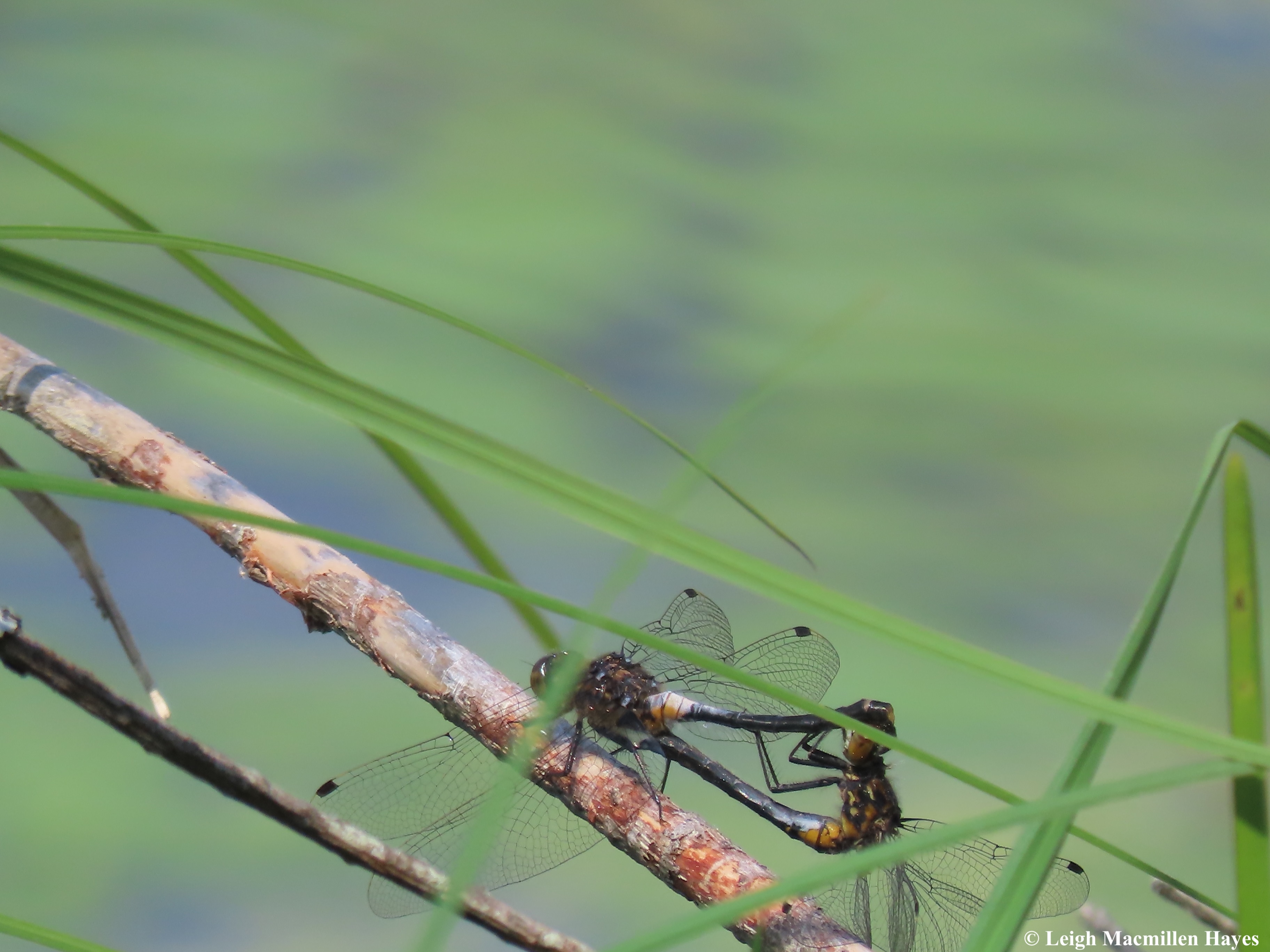
And like other insects, once emerged and a few days old, canoodling commences and dragonflies such as these Belted Whiteface Skimmers find each other and a presumably private place to mate. Private, that is, until I show up!

Eggs are laid in a variety of ways and places depending upon the species and this is a female Eastern Pondhawk taking a break upon a lily pad.

And here is a Forktail Damselfly laying eggs upon vegetation.

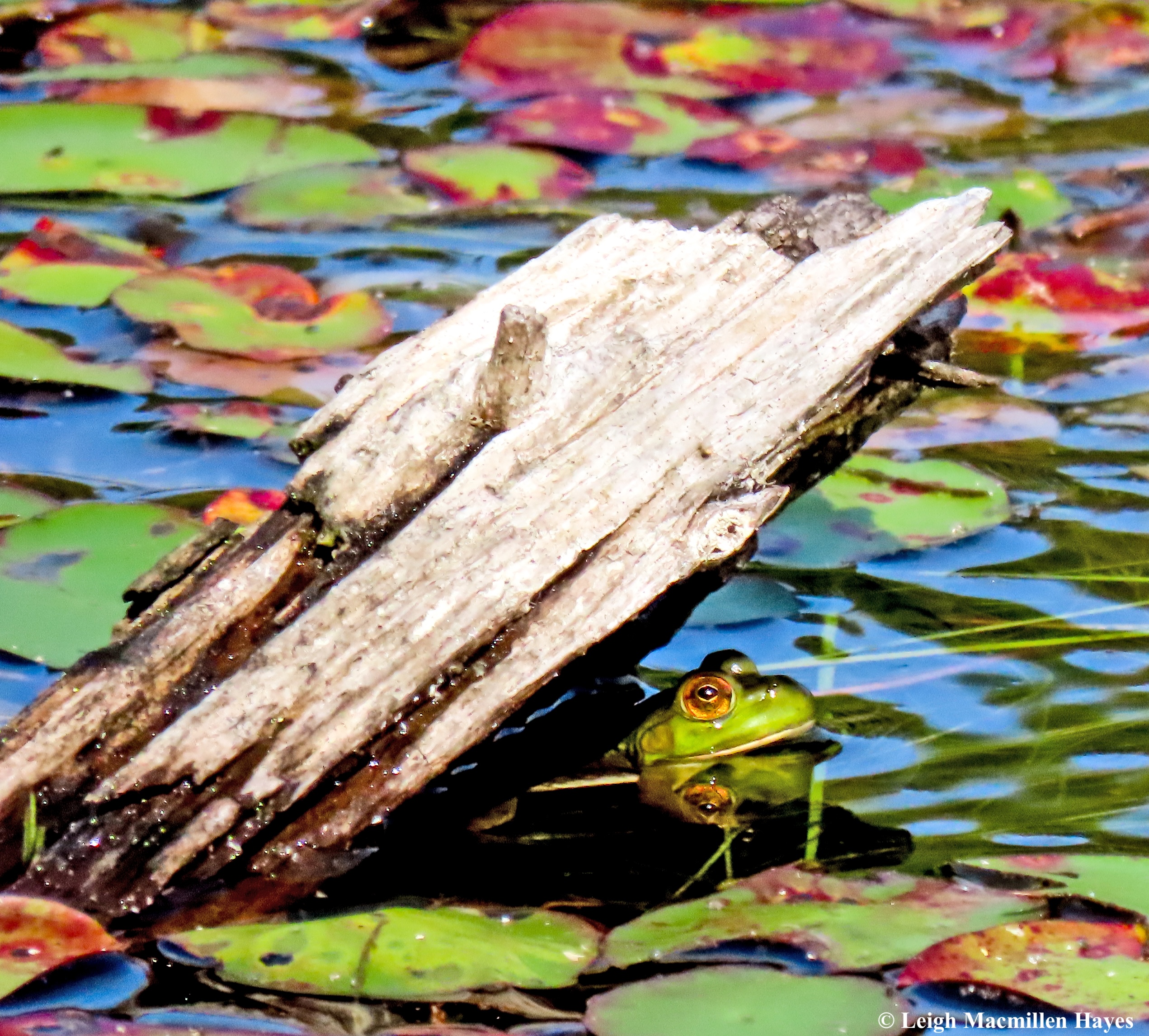
Frogs are also a highlight of a wetland, whether they are hiding in the shade on a hot summer day like this Bullfrog …

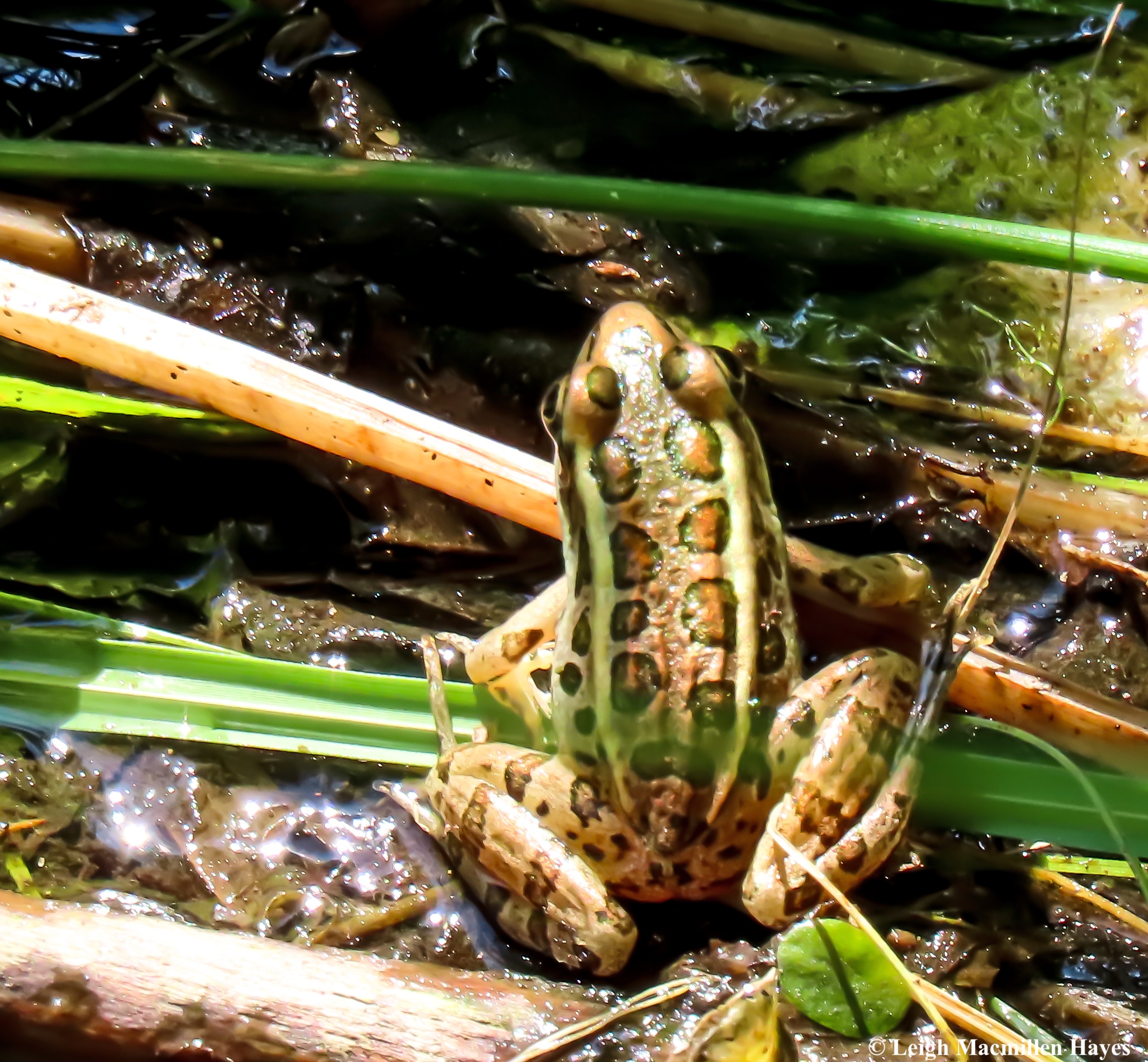
Or pausing briefly in the sun, such as this Pickerel Frog chose to do. Actually, it wasn’t so much basking as trying to remain hidden from my sight by not moving until I passed.

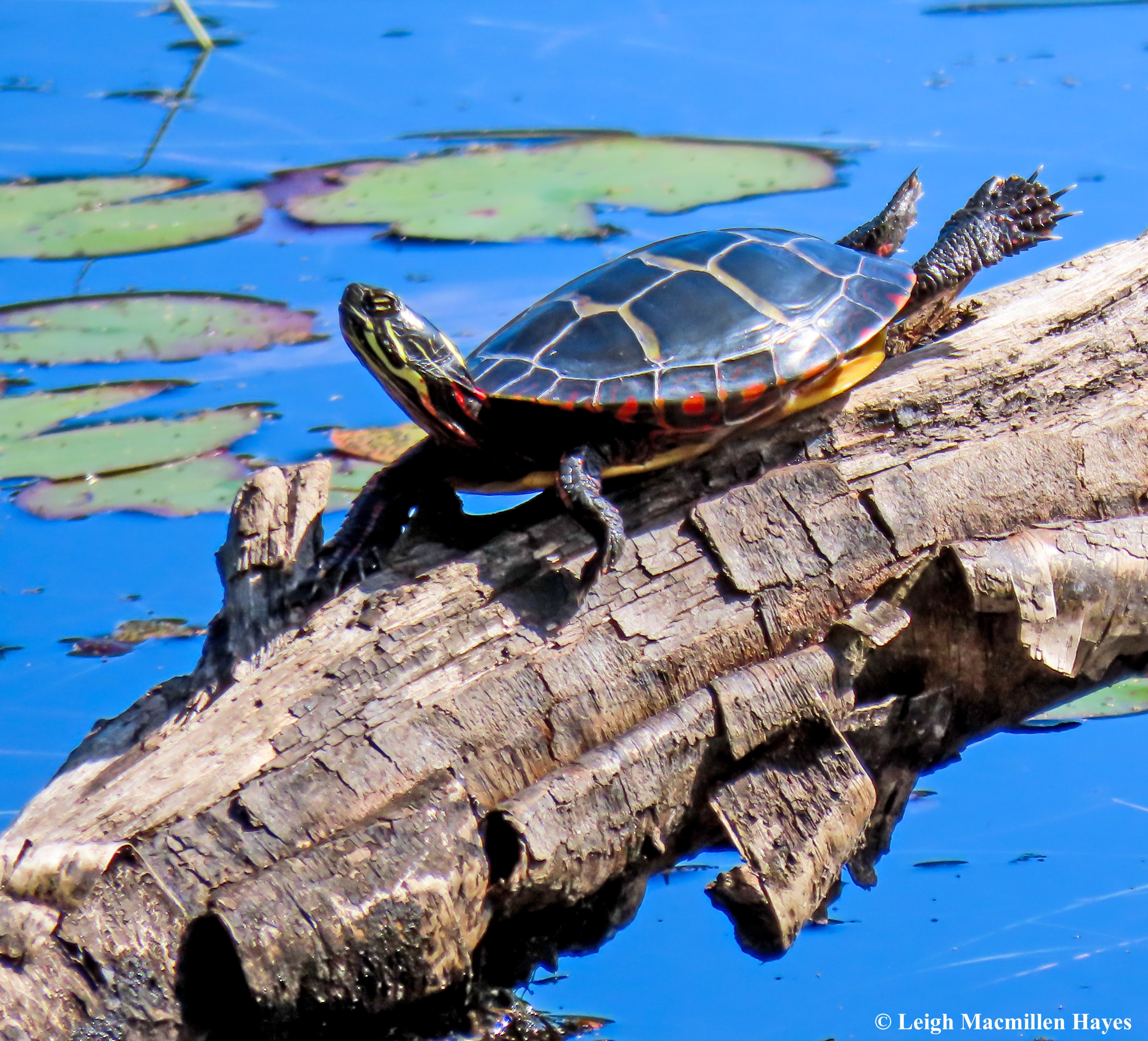
Those who do love to bask, (frogs do this as well) are the Painted Turtles, and the more surface area that is exposed to the sun’s beams, the better. Sometimes I’m surprised when I do capture a photo such as this one, for they are quick to sense my presence or hear me coming, and quickly slip into the water. But if you wait a few minutes, sometimes they’ll reemerge.

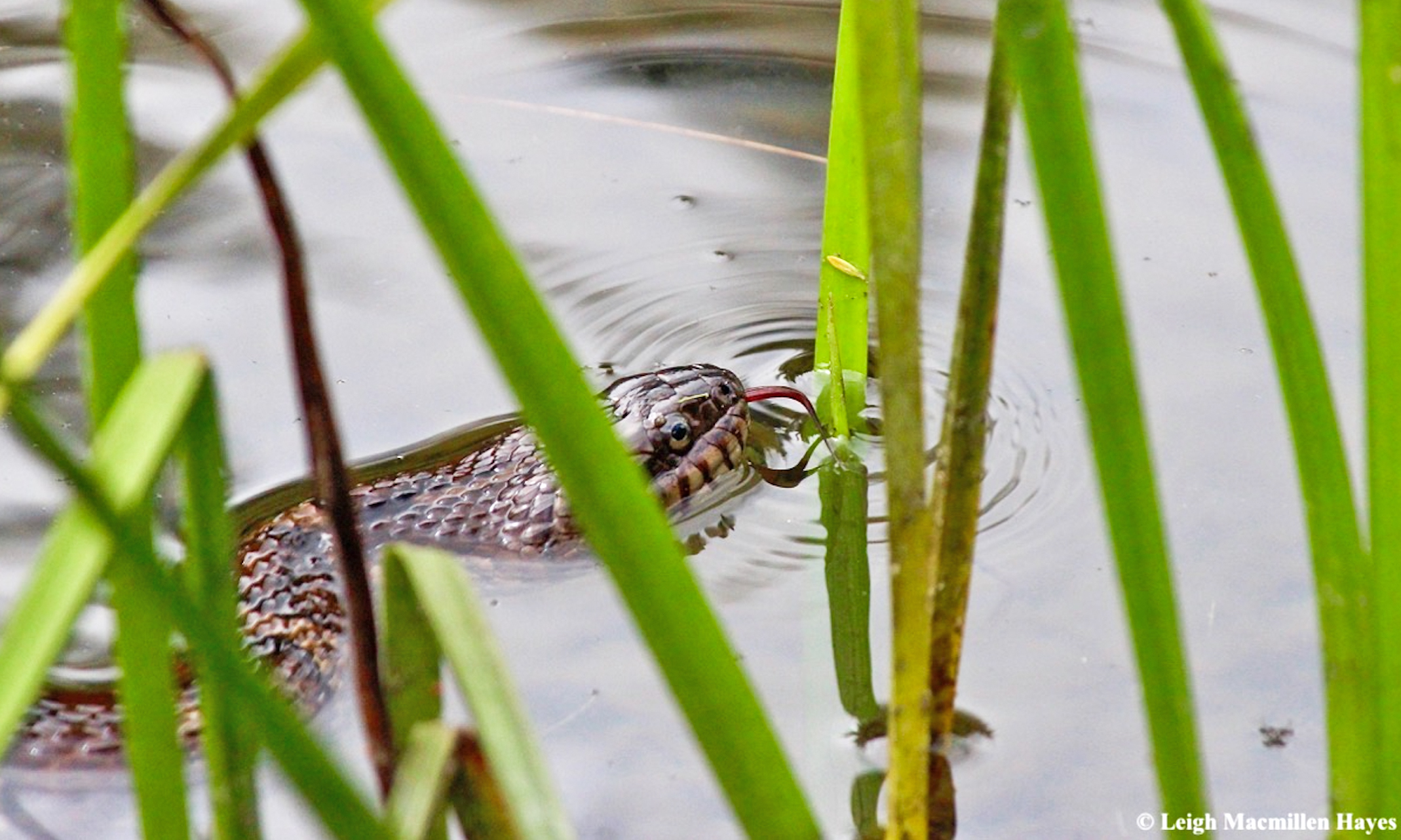
And there are Northern Watersnakes always on the prowl, using their tongues to make sense of their surroundings.

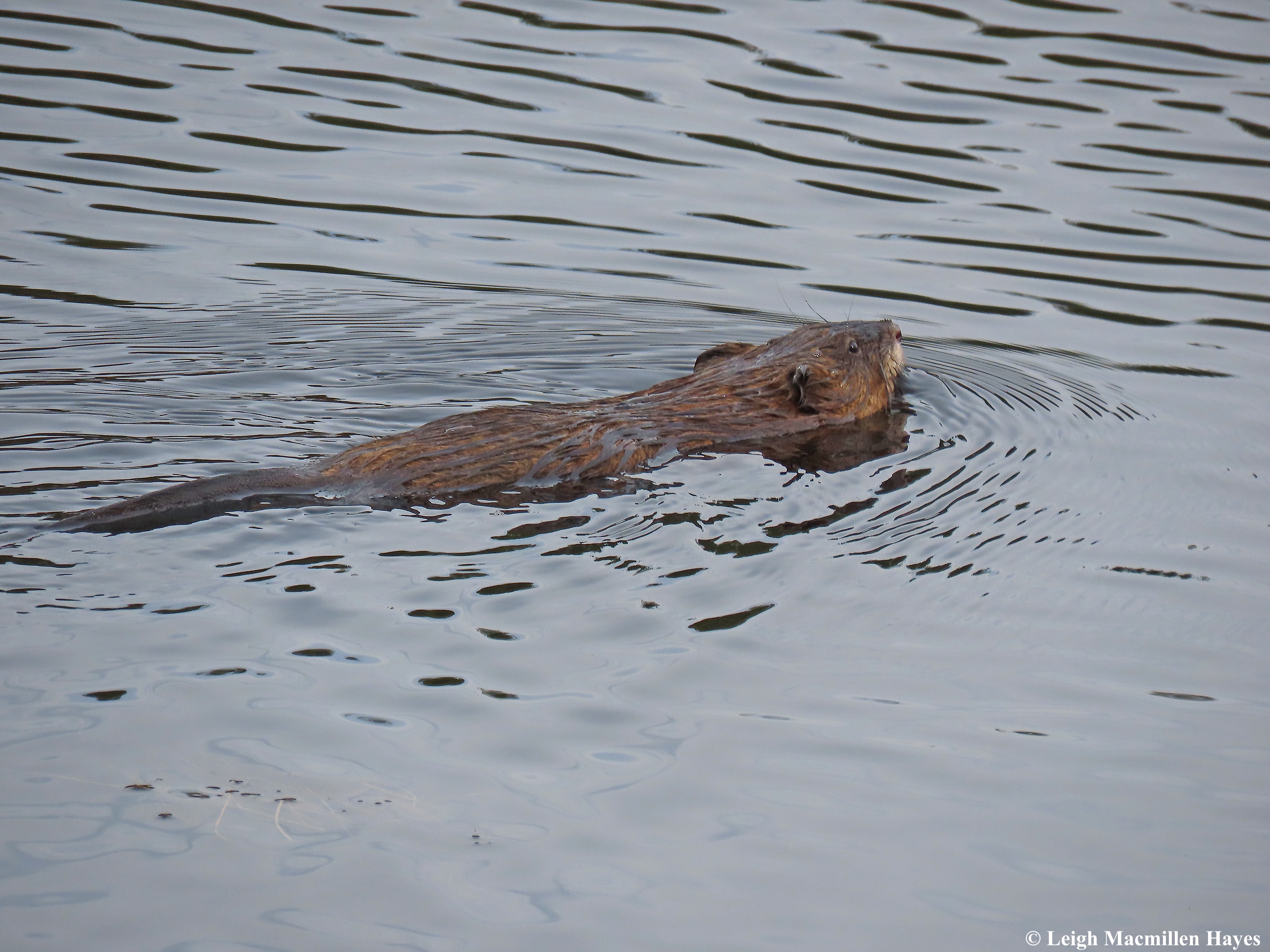
Mammals also use wetlands for forage for food and build homes and one of my favorites is the American Beaver, who knows the value of a wetland, and can create one in a short time by building a dam. Beavers build dams to created a deeper pond through which to navigate, for they are better at swimming than walking. They may alter the wetland to suit their needs for a few years, but then move on and let the dam breach and then a new type of wetland emerges and more critters move in and take advantage of what it has to offer.

That all said, it wasn’t until I spent more time with the animal pictured above that I realized it was actually a Muskrat–look at that thick, rounded tail, unlike the flat paddle of a Beaver’s.

And birds! Oh my. Mergansers . . .

And momma Wood Duck and her offspring . . .

and Papa Woodduck . . .

And Great Blue Herons always on the prowl for fish or amphibians know the value of the wetland as a food pantry.

So, this spring and summer and fall, I’ve been following My Guy and our friend, Bruce, beside and into and sometimes, thanks to Bruce’s drone, over a variety of wetlands.

Bruce is an early riser (understatement), and occasionally I’ll meet him at a predetermined location as we did this past weekend–before the sun has risen. Though the thought of staying in dreamland for another hour or so is enticing, I never regret the decision because we get to view the world before it officially wakes up.

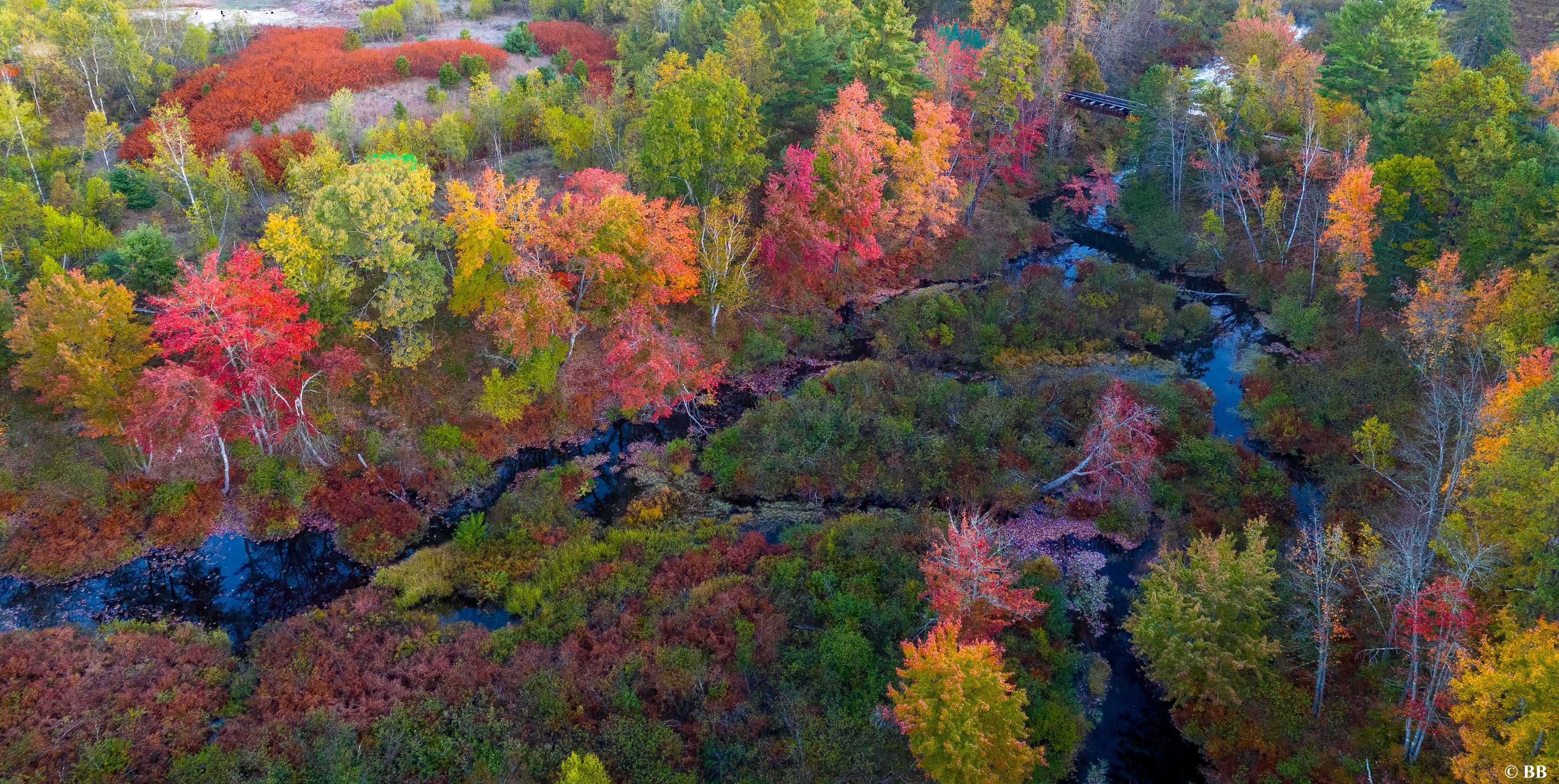
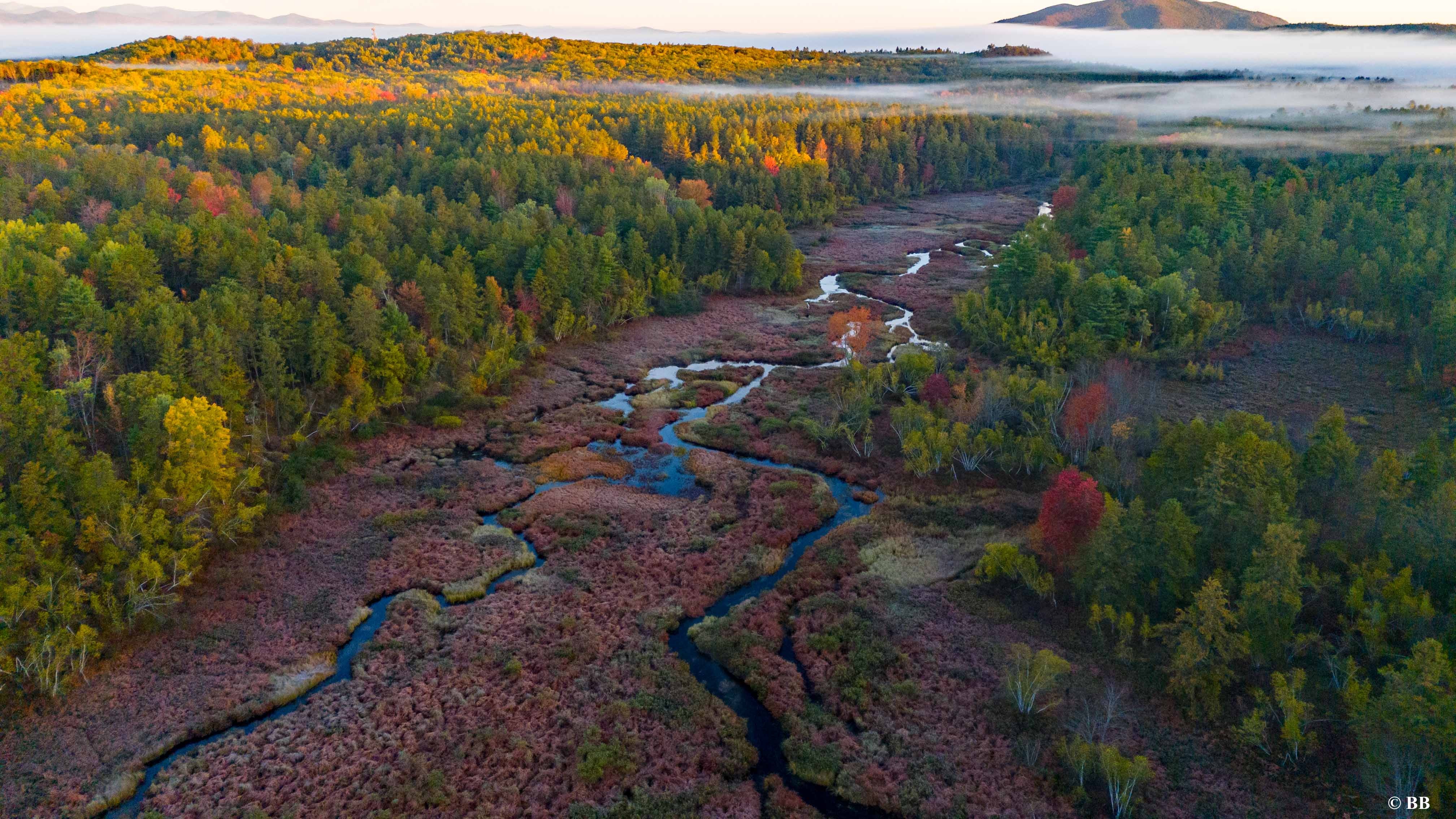
And with his drone we explore these areas we cannot easily access. This is one My Guy and I walked all the way around a few weeks ago without ever spying, though we knew it was there. But Bruce and I bushwhacked through a forest of White Pine Saplings and mature trees and reached the edge before he launched his bird and we were offered a glimpse of this most beautiful wetland with pockets of water connected by meandering rivulets.

The stream turned to forest for the trees told more of the story, as they closed in and I recalled that it wasn’t far from that spot that My Guy and I walked through a damp area where Royal Ferns grew and we found one teeny tiny mushroom fruiting on a hot summer day.

The mushroom was the little Orange Peel Fungus, and its name seemed so obvious. And the soil moist despite the severe drought.

Another day we began our exploration in the afternoon beside a small pond.

And the Droney-bird picked up on the wetland to the south.

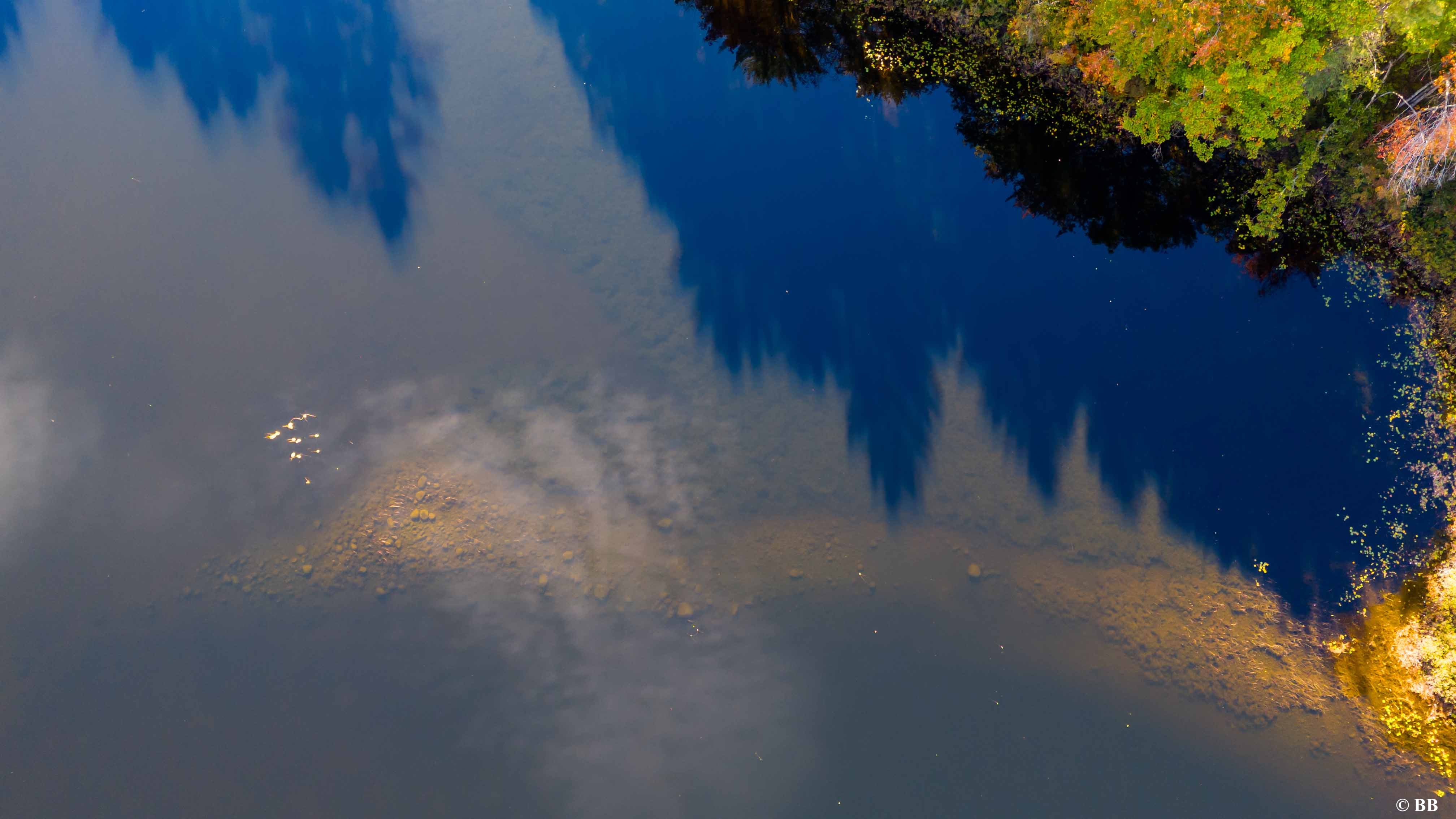
But that day what struck us as being more important was that it also took a clear picture of a sandbar in the water.

And as Bruce navigated it closer to the watery surface, we could see clear to the bottom. Mind you, it’s not a deep lake, but this is the water of Maine. Clean and clear.

And we celebrate wetlands for the critical role they play in maintaining the health of the environment.

When I think about their ability to store and filter water and act as a natural sponge, absorbing and retaining large amounts of water during the heavy rainfalls of spring, and removing pollutants before they enter streams, and rivers, and lakes, it all seems so obvious that they should do this when you have a bird’s eye view.

So here’s the curious thing about this wetland. It is located beside a local dump. And the more I think about that, the more I question those who created the dump, but give thanks for the unwavering workhorse that this wetland is in the ecosystem.

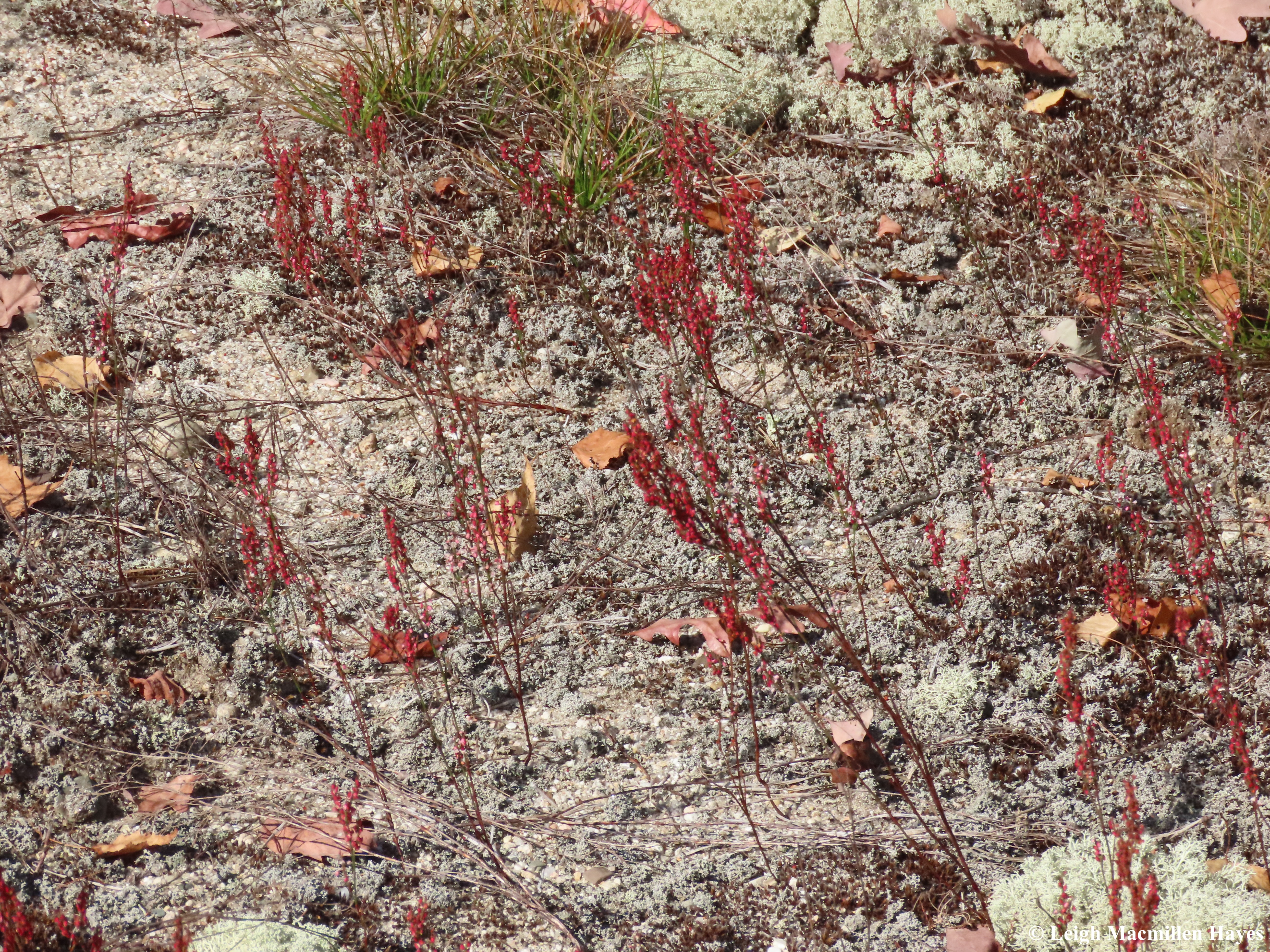
It was on the rise above this particular wetland, in a very sandy spot covered with Reindeer Lichen, that Bruce and I made a discovery. Well, he discovered it first and asked for an opinion. I’m full of those and so I met him and we took a look.

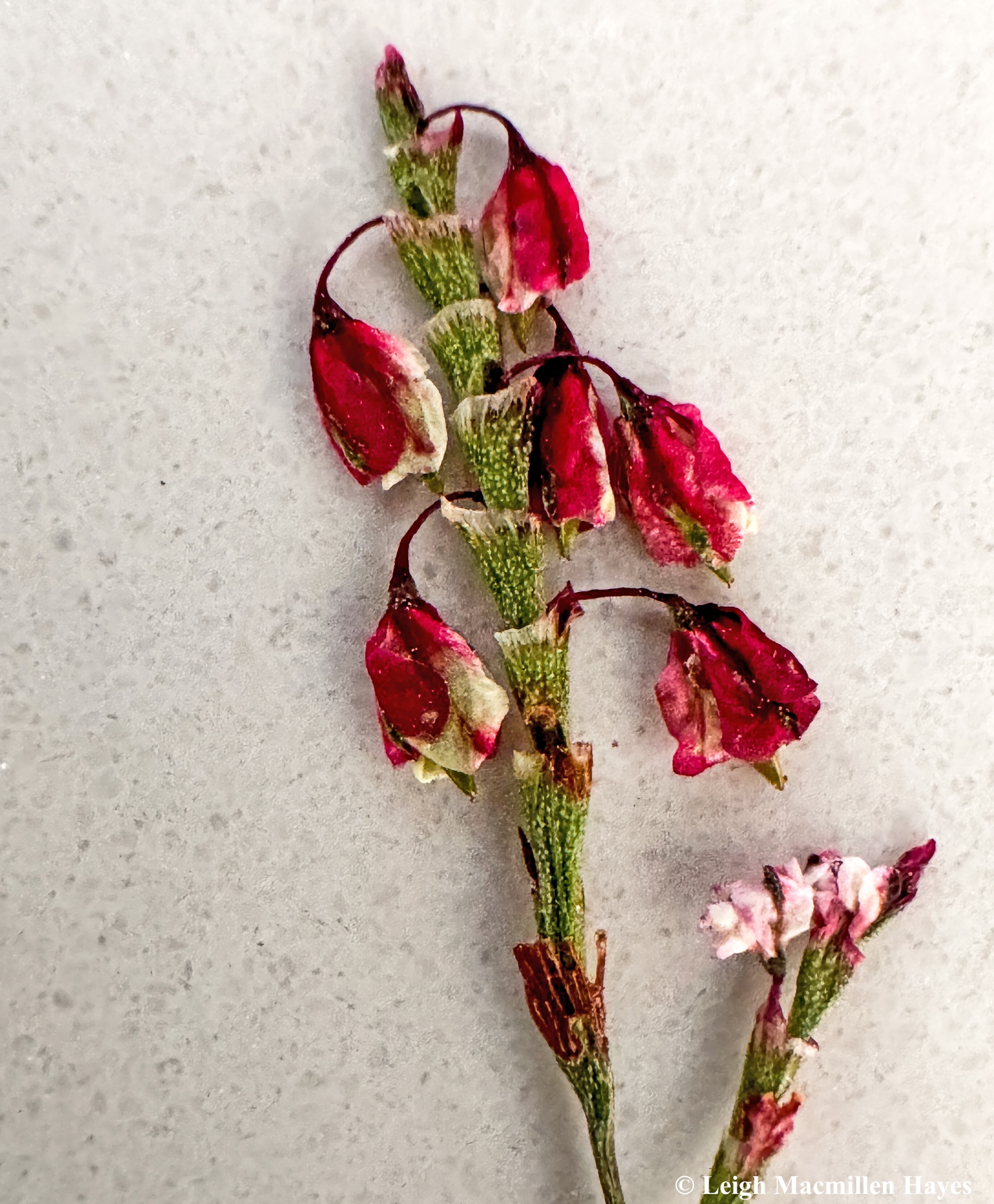
The discovery was a plant new to us both. Sand Jointweed or Polygonum articulatum. As you can see, the flowers are astonishing in their pink and white display.

It was the stems that I found equally fascinating. At the base of the flower stalks there are sheathing bracts, giving it a jointed or segmented appearance. We didn’t see any leaves, but perhaps we need to look again. I think we were just amazed to have discovered a plant neither of us recalled meeting before. Often though, that means we’ll meet it again soon.

The small snippet followed me home, and today I looked at the flowers under the microscope and I was astonished to realize that they look rather like a map of a wetland.

I don’t jump at the invite every time it arrives for an early morning mission to explore a wetland, and one day really regretted it because when My Guy and I finally got to the location, we found a note with Bruce’s observations. We scanned the area with our eyes for about an hour before deciding that we were too late.

But . . . we promised ourselves that we’d pack a picnic supper and try again.

First we spotted one Bull Moose.

And then a second, and had a difficult time deciding that we should head home.

Did you know that 25% of Maine’s land area is wetlands? That’s four times the wetland area of the other New England states combined. The natural buffers they provide sustain the deep clear water we appreciate, and take for granted.

The margins or places where the land and water come together are bridges between two worlds. As many as 90% of all living things in our waters are found in these wetlands, no matter what form they take. I guess that’s why I love exploring them so often, because there’s always something to see. And another lesson to learn.

I leave you with this, a watercolor Bruce’s wife Eileen sent me recently. It was inspired by one of our local wetlands.

Some may see wetlands as dark and shadowy areas, mosquito hatcheries, with an abundance of leeches mixed into the scene, but the rest of us know their true value and I give thanks for living in this place where it’s so easy to go Bogging in Maine. And to share it with others. Thank you MG, BB, and EJB!

On the Cusp of Autumn

It occurs every year, autumn that is. But this year it hasn’t even started and already feels different. In the past week, My Guy and I have followed many a trail or waterway, both on foot and by sea, oops, I mean kayak on local lakes and ponds, and every offering has been unique.

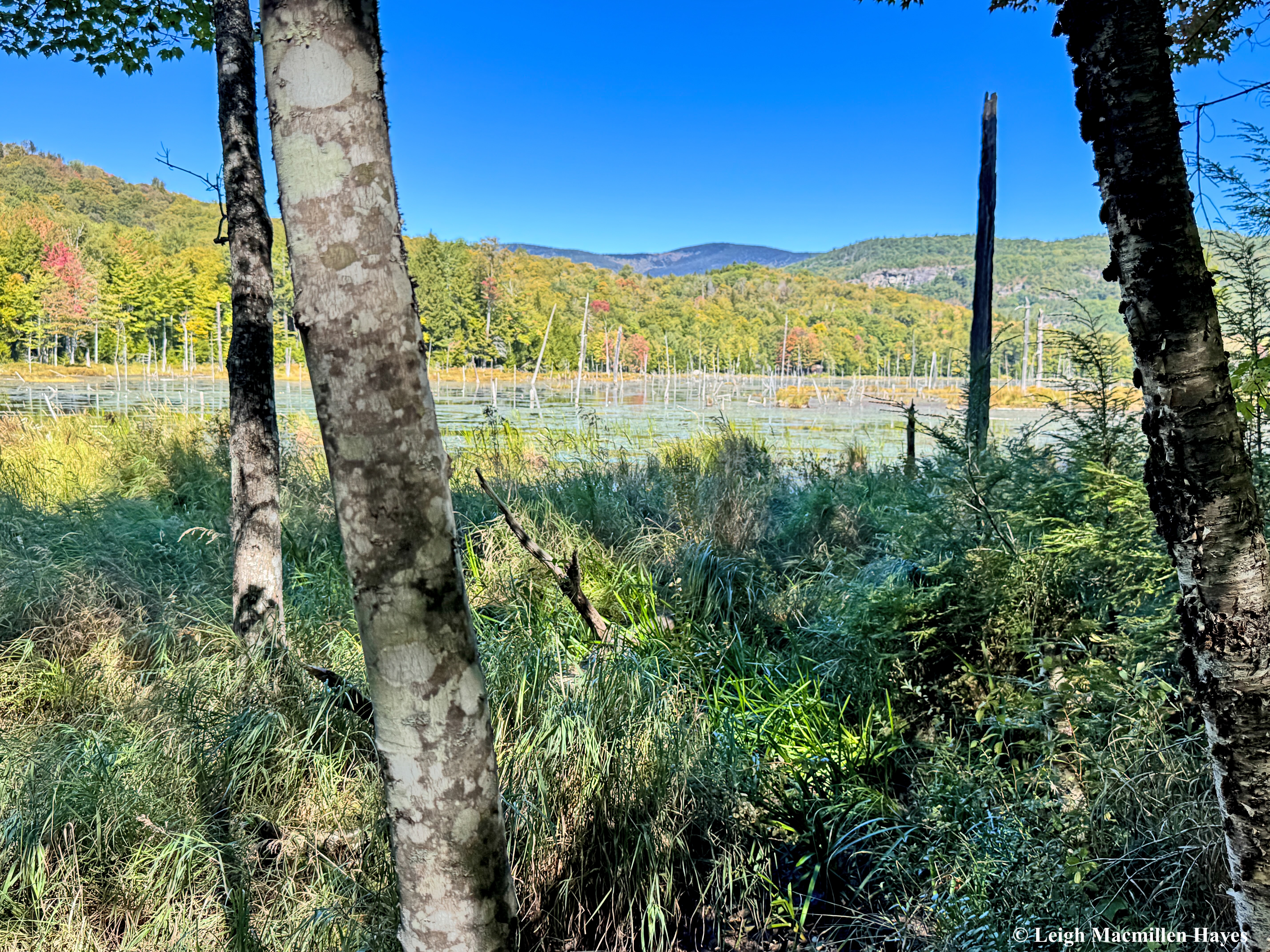
Some, such as this, being Brownfield Bog as we locals know it, or Major Gregory Sanborn Wildlife Management Area as the State of Maine knows it, took us by complete surprise. The last time we’d wandered this way together was in the spring, when despite wearing Muck Boots, we could not travel some parts of the trail because the water was so high. That was in the Time-We-Actually-Experienced-Rain. That time has long since passed and now western Maine is in a severe drought and don’t the Lilypads know it. What about all the mammals and birds and insects that depend on this water? It was an eerily quiet walk in a place that is usually alive with action.

Where the Old Course of the Saco River crosses through the bog, there was some water. But still, not enough. And we know of other areas of the Old Course, such as in Fryeburg Harbor, where there is no water.

As for the Saco, it too, was incredibly low and sandbars were more the norm.

Other adventures found us paddling our favorite pond.

And bushwhacking around another bog.

What kept making itself known to us–the fact that the trees are turning much too soon, and many leaves aren’t even turning, but rather drying up and falling.

That meant that some paths or bushwhacks found us crunching the dried leaves with each step we took. We could hardly sneak up on a Moose or a Bear, or even a Squirrel.

Despite such dry conditions, we did find the varied colors of Wild Raisins or Witherod drupes dangling in clusters below their leaves.

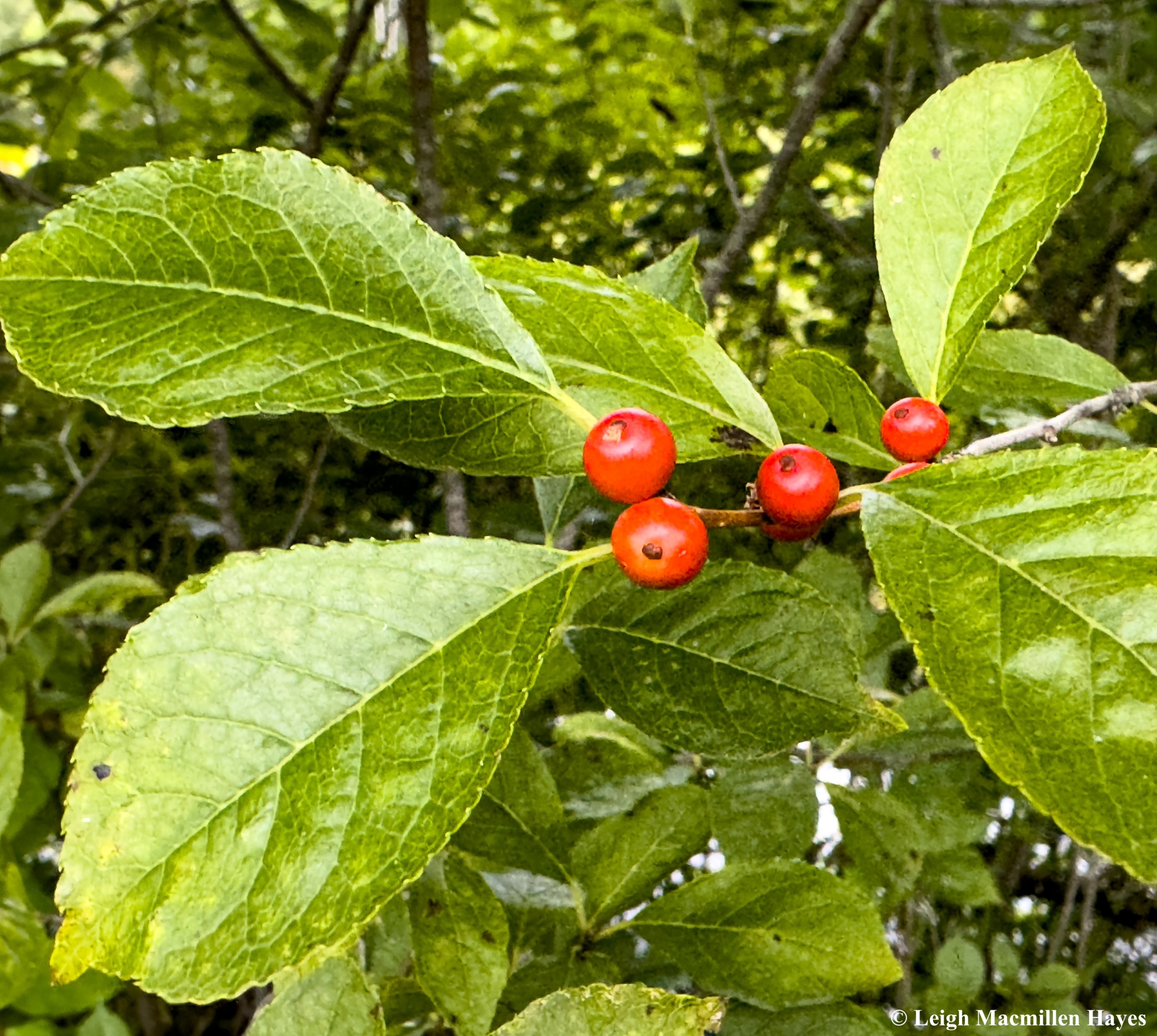
And Winterberries showing off their enticing red hues–ready to attract birds and maybe become part of our holiday decorations. Only a few branches for us, mind you. We leave the rest to the critters because we know their importance in the food chain.

Late summer flowers were also in bloom, including the brilliant color of the Cardinal Flower.

And in a contrast to the red, there were Ladies’ Tresses, a wild orchid, one of the few with a fragrance if you can bend low enough to smell it.

I think one of the greatest wonders is how many variations there are on a theme, in this case flowers for take a look at the Pilewort or American Burnweed, this one growing upon a Beaver Lodge.

What you are looking at is the flower heads: They are about a ¼ across and petal-less. The inner bracts, with their purplish tips form a ½-inch tube exposing just the yellowish to creamy white stamens at the top. And the seeds are teeny tiny, as you can see, with tufts of white hairs to carry them like parachutes upon a breeze.

Along one trail, we spotted another teeny tiny display that surprised us due to the fact that we haven’t seen many mushrooms this summer. But the Orange Peel Fungus apparently had enough moisture, at least to produce these two forms.

Critters were also a part of our sightings and several times we encountered young Northern Water Snakes, not more than two pencils in length.

In another spot where we expected to see Water Snakes, we instead met a Garter. Mind you, none of these wanted to spend any amount of time with us.

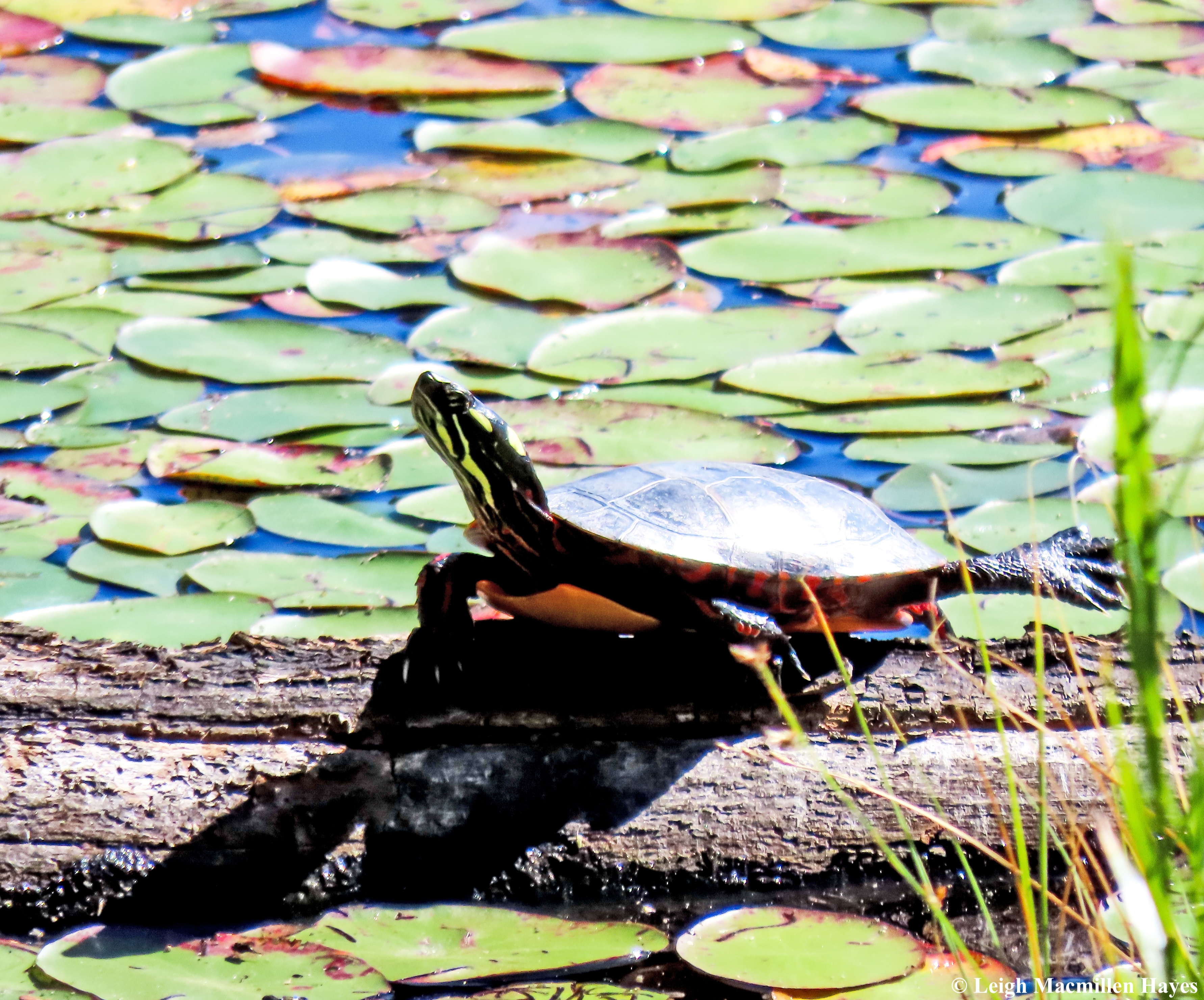
And despite the cooler morning temps that we’ve been experiencing, including lows in the mid-30˚s the past few days, or more likely, because of those temps, the Painted Turtles were still basking, soaking up the sun’s warmth. I love how they stick out their legs to absorb more warmth. It truly looks like a Yoga position, and I know this personally because along one of the trails we traveled in the past week, My Guy showed me several poses he’s learned recently. He also showed me those he struggles to perform.

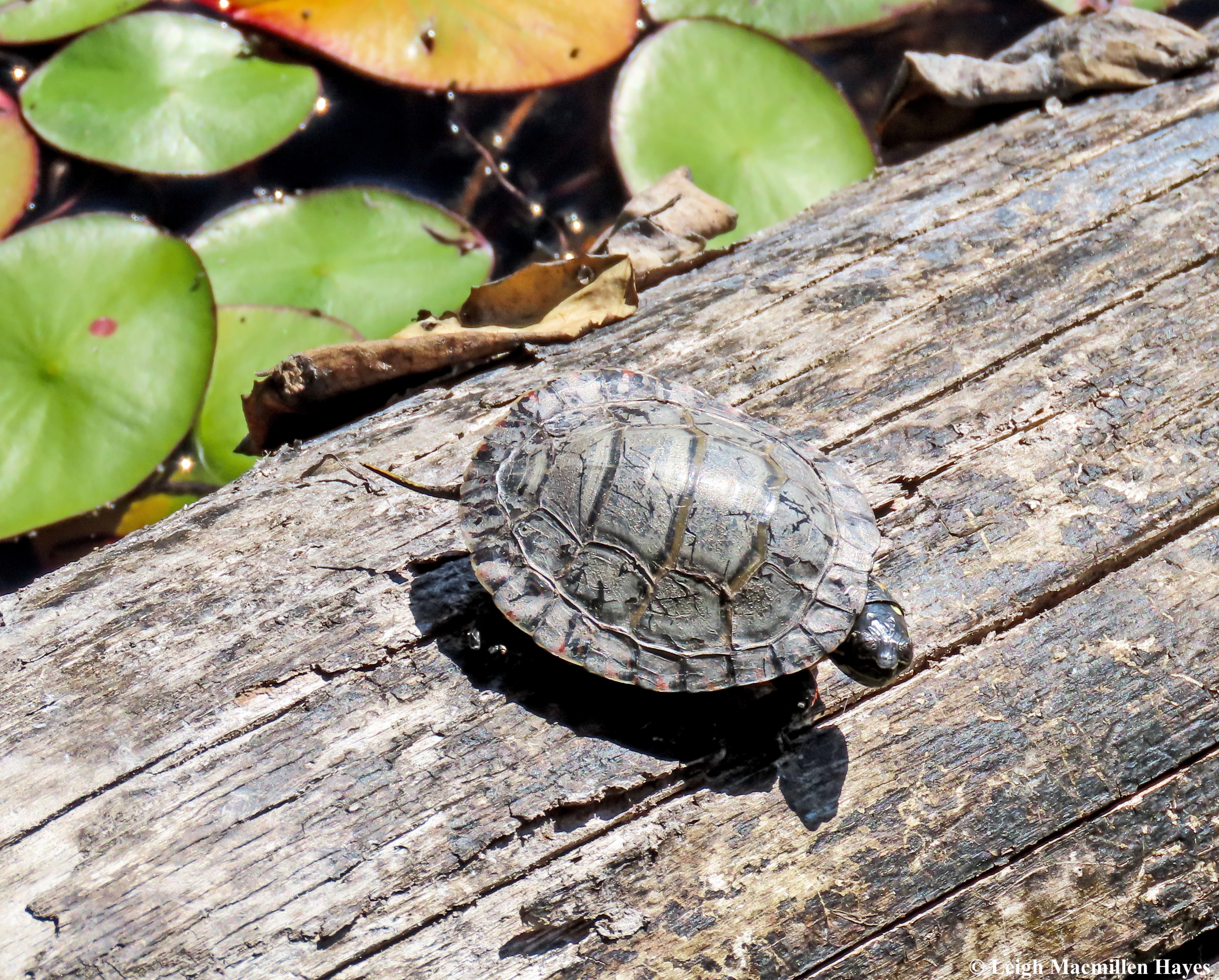
Not all turtles were of the same size, and this was a tiny one, who stayed on this log for at least two hours as we spotted it before we embarked on a bushwhack and it was still there when we returned, though it had changed its position. And gave me a wary look.

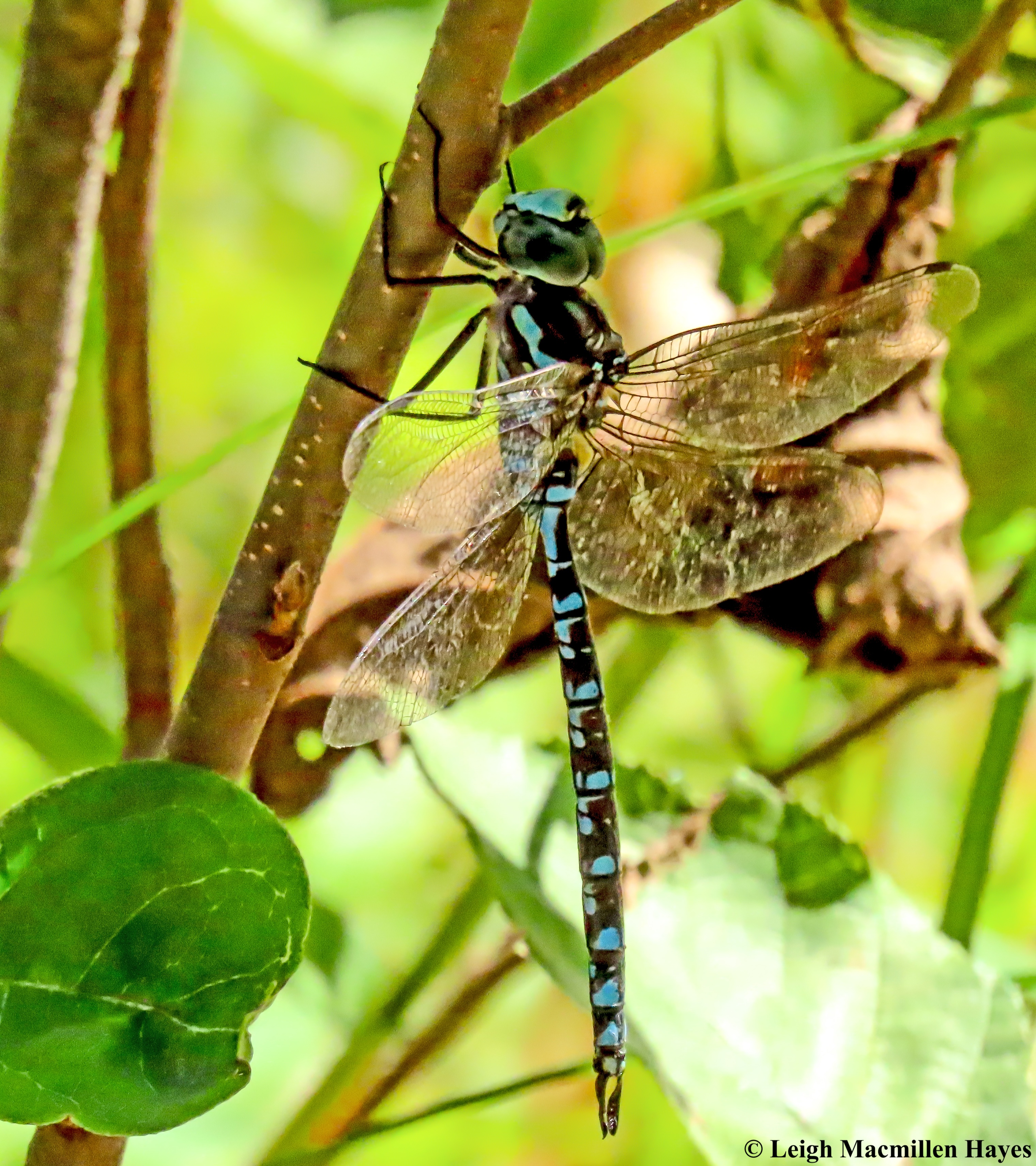
My Dragonfly fetish was also fulfilled for the Darners and Skimmers continue to fly and occasionally pause. Well, the Skimmers often pause, but the Darners are usually on the wing–patrolling territory while looking for a meal, and even more so, a mate. That’s why it’s always a moment of joy for me when one stops and my admiration kicks up a few notches. In fact, it’s the notch in the side thoratic markings that help with ID–in this case a Canada Darner. I’ve discovered this summer that they are numerous ’round these parts.

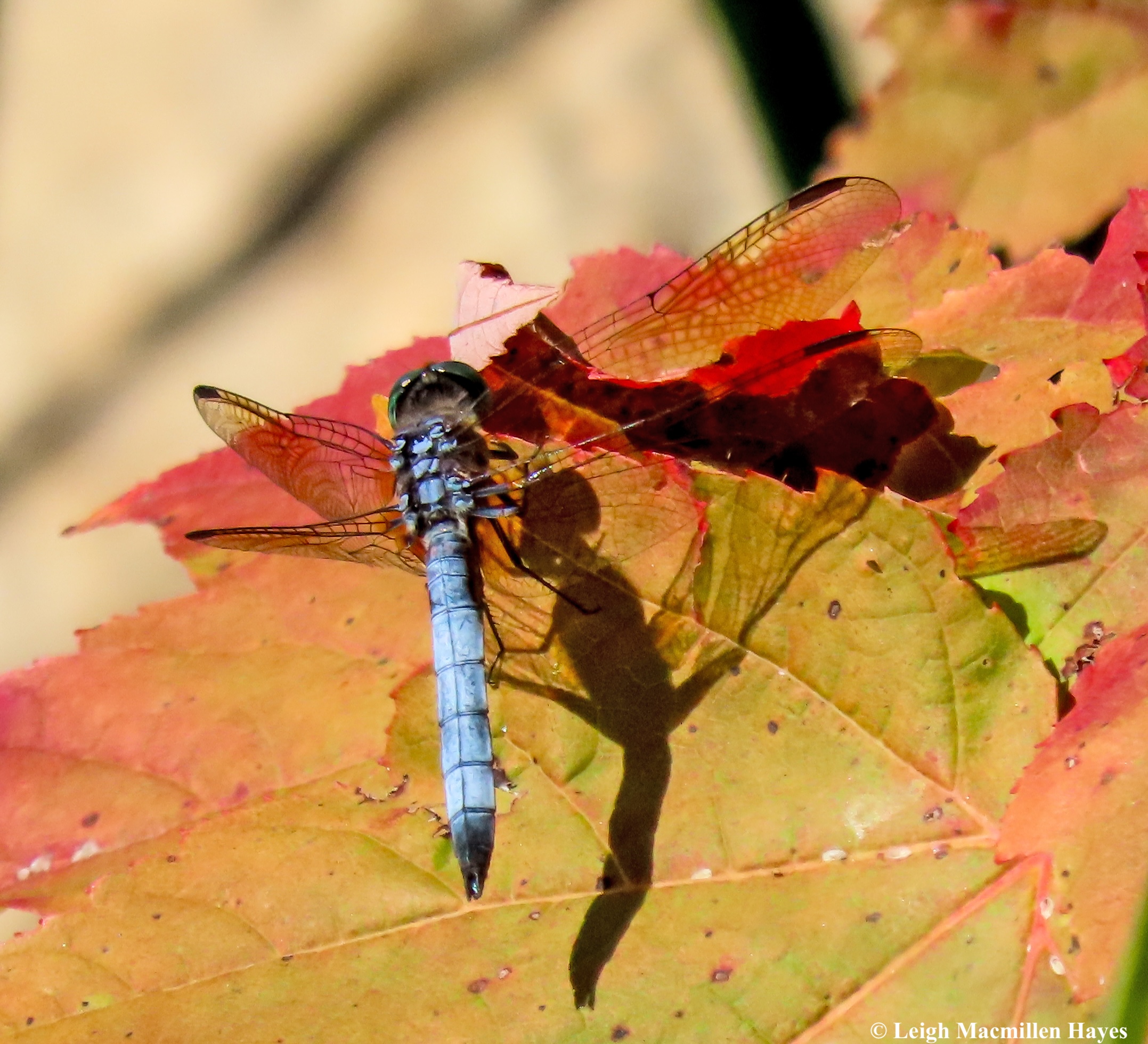
While the Darners are on the largish size in the dragonfly world, most of the Skimmers that are still flying are much smaller. The Blue Dasher, as this is, is probably considered medium in size.

What a display, no matter how big, with the blues and blacks and greens contrasting with the Red Maple leaf’s hues.

And then there’s the dragonfly’s shadow. It’s almost like it was a different creature.

My surprise was full of delight when I realized as I floated beside a Beaver Lodge, that I was watching female Amberwings deposit eggs into the water as they tapped their abdomens upon it. I rarely spot Amberwings, and yet they were so common in this spot.

And overlooking all the action, perhaps not only to defend its territory, but also to eat anything that got in the way, a Slaty Blue Skimmer, twice the size at least of the Amberwings and Blue Dasher.

Birds, too, were part of the scenery wherever we were. This Eastern Phoebe spent moments on end looking about, from one side to the other, and then in a flash, flew to some vegetation below, grabbed an invisible-to-me insect, and flew off.

Much to the surprise of both of us, despite the loud crackling of leaves and branches upon which we walked in one place, we didn’t scare all the Wood Ducks off, and enjoyed spending a few minutes with this Momma and Teenager. Usually, this species flies off before we spot them on the water.

Even the male hung out and when I suggested to My Guy that he look at it through the monocular, he was certain he really didn’t need to because he could see it without any aid. And then he did. And “Oh wow!” was the reaction. And I knew he’d finally seen a male Wood Duck–for the first time. And that moment will remain with me forever.

One of our other favorite moments occurred on our favorite pond, where we first spotted a Bald Eagle on a rock that the low water had exposed. And then it flew. As birds do.

And we followed it with our eyes, and watched it land above us in a White PIne.

And thus, we spent a good twenty minutes with it, admiring from our kayaks below.

The Bald Eagle was sighted not to far from our favorite Beaver City–where we know of at least five lodges located within a football field-sized area. And this one above had been abandoned for the last few years.

But fresh mud and fresh wood told us that someone was home. Probably more than one someones. We love the possibilities. The mudding is an important act–preparing for winter by coating the outside and closing up any holes or airways that might let cold air penetrate. Of course, the “smoke hole” at the top will remain, much like a chimney in our homes.

Just a Beaver channel and a hundred yards away, another of the five lodges also showed signs of winter preparation. It’s a busy neighborhood.

No matter where or how we traversed, one of the things that stood out to us is that despite the autumnal equinox being September 22 at 2:19pm. fall is already here thanks to the summer’s drought.

It’s usually mid-October when we begin to celebrate the color change–that time when Chlorophyll, the green pigment we associate with summer, and necessary for photosynthesis, slows and then stops manufacturing food, and the leaves go on strike.

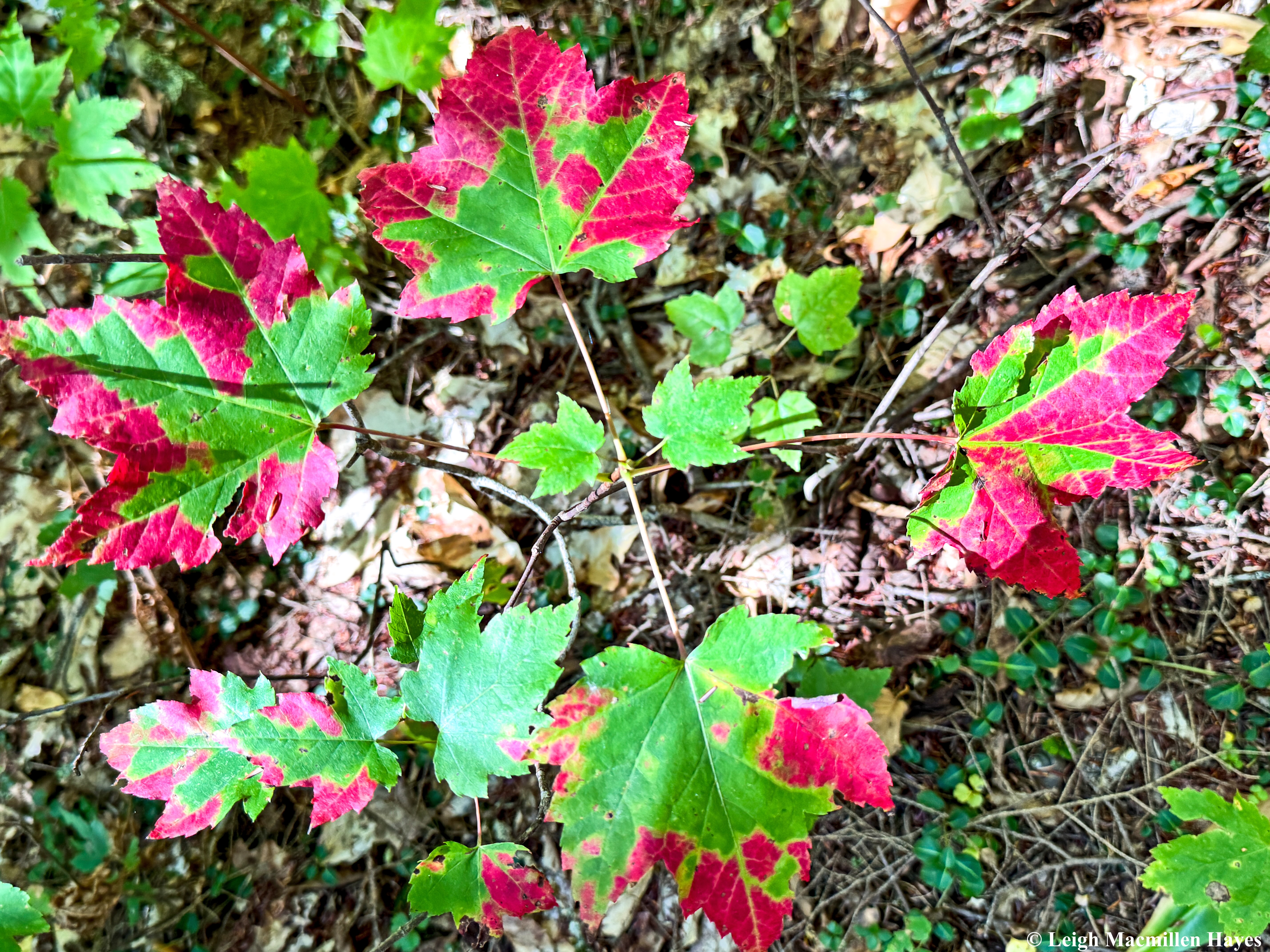
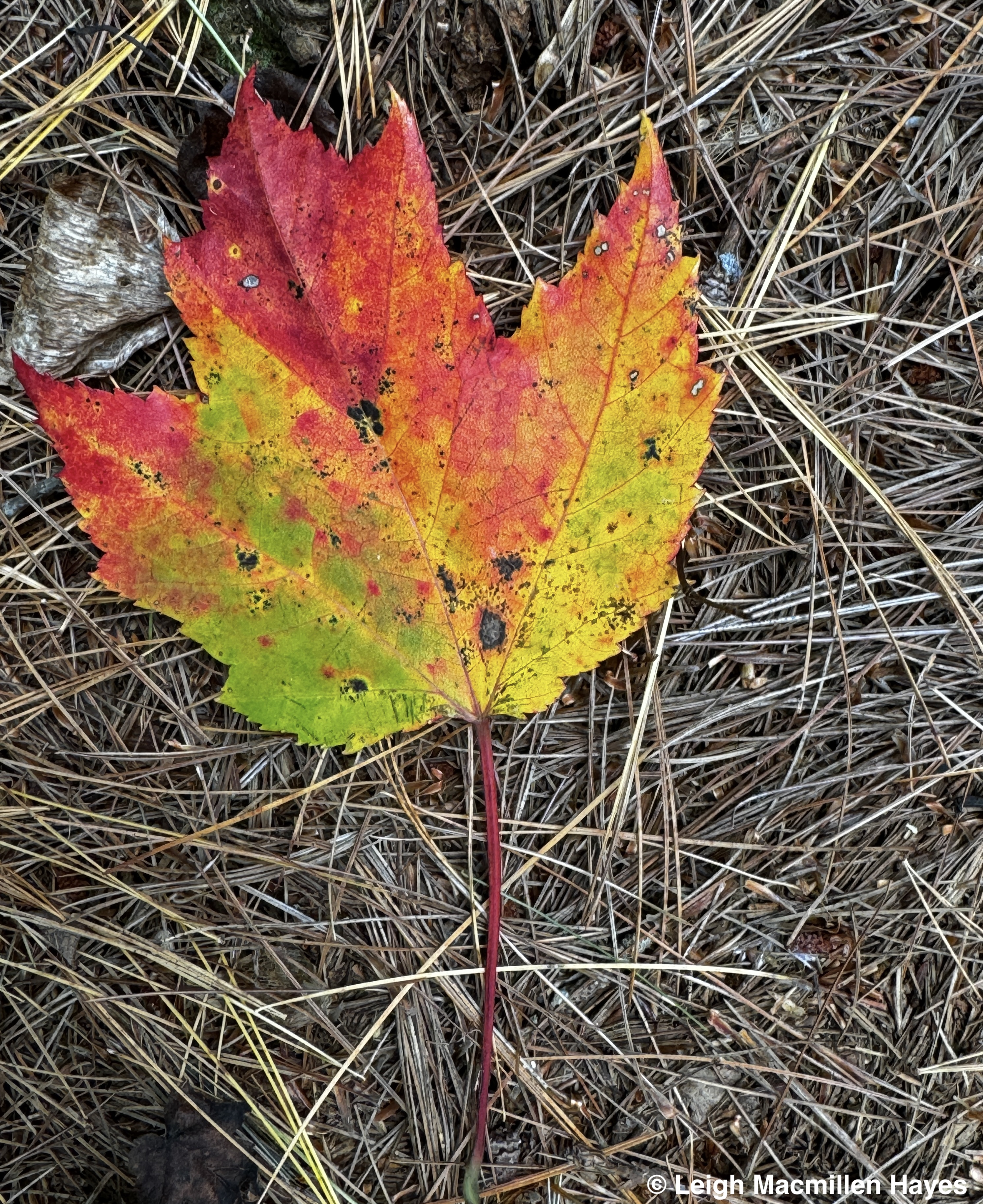
Veins that carried fluids via the xylem and phloem close off, trapping sugars, and promoting the production of anthocyanin, the red color we associate with Red Maples like these.

Tonight, as I finish writing, we are on the Cusp of Autumn, which is about seventeen hours away. But this year, I think it’s already here and if you have planned a fall foliage tour for mid-October I hope you won’t be too disappointed. I suspect we’ll not have many leaves left on the trees by that point.

But . . . maybe I’m wrong. There’s always that possibility.

No matter what–Happy Autumnal Equinox!

Vermonting We Did Go

Okay, so “Vermonting” is not a word. But we did go. And came home richer for the experience.

It takes us forever to plan a vacation, even a mini-one. Well, actually, it only takes a few minutes once we put our minds to it, but prior to that it’s a lot of “We should go to . . .” or “We need to get away,” or any of a myriad of other comments, and we do nothing.

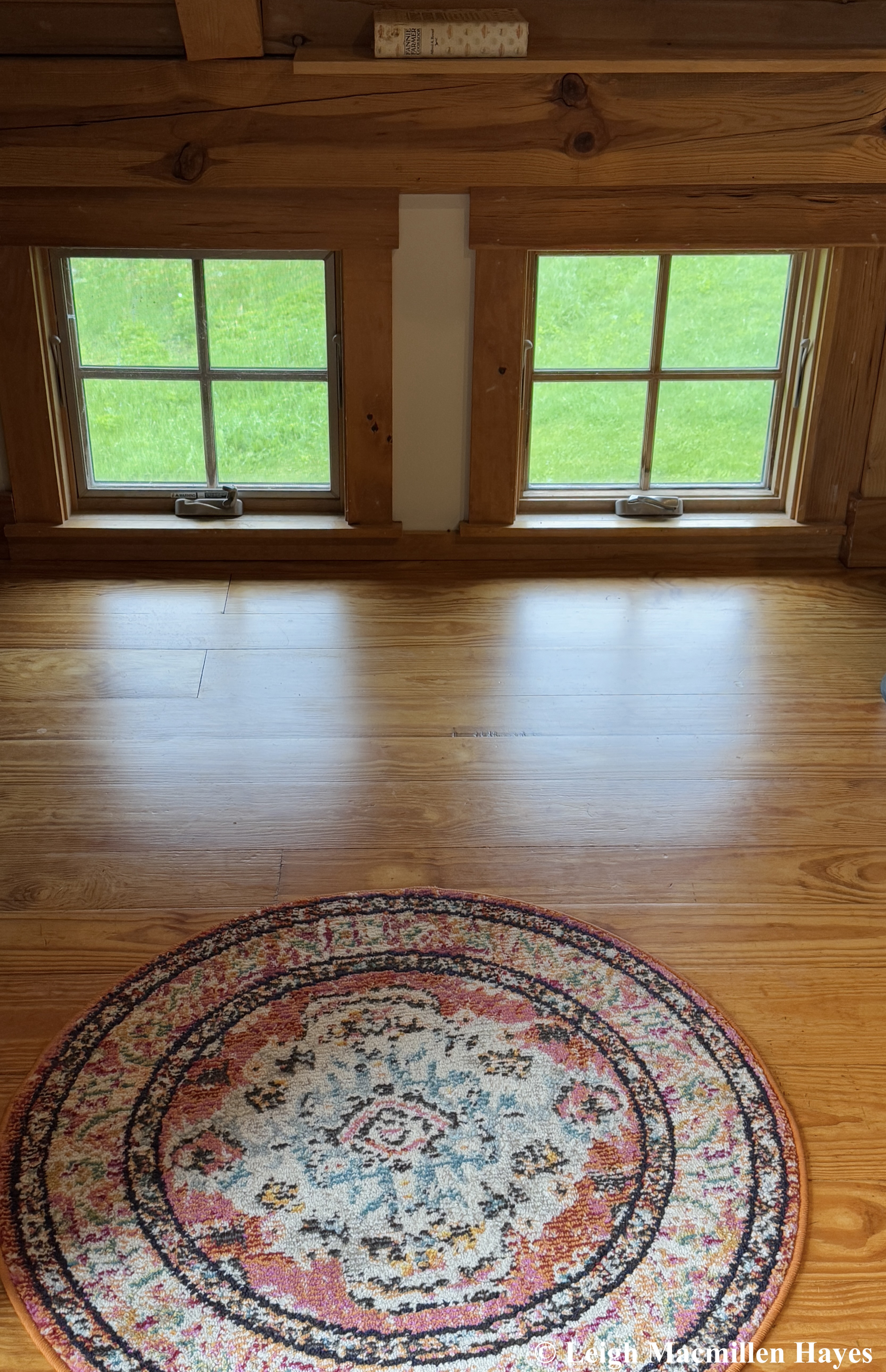
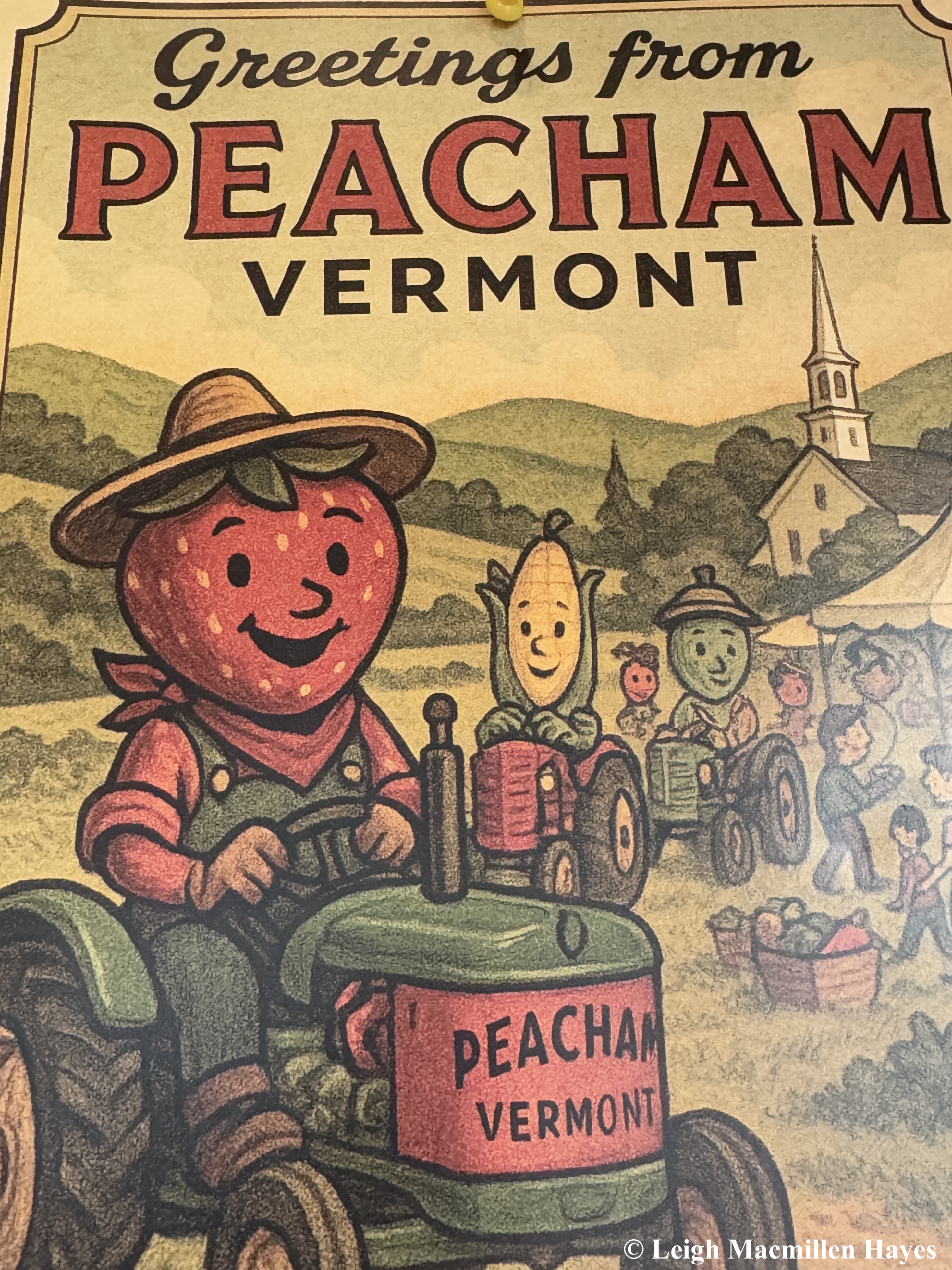
So about a week ago we cleared our calendars. We knew kinda sorta where we wanted to go, but didn’t know where we might stay, until we discovered The Barn in Peacham. We have a red barn attached to our 1870s farmhouse and long ago turned the upstairs into a movie theater/rec room for our sons, all that being a rather rough rendition of either–the movie seats were from an actual theater in our hometown, which was the best part. The seats are still all up there. And there’s a pingpong table and an air hockey table and trophies (remember the Porcupine Invasion last November?) and various other things, plus now a Yoga area for My Guy, but it’s hardly like the space we rented for the weekend as pictured above.

Cozy, roomy, tons of natural light, everything we needed, even eggs and English muffins if we came up short for our first morning.

I think one of my favorite things, and I had lots of favorites, were the little windows that lined the floor in all four rooms. And above these in the kitchen, a Fannie Farmer Cookbook on a shelf. It was touches like this that enhanced the already perfect space.

And our host and hostess, Chuck and Mercy, were equally delightful, and full of information. Thanks to them we discovered Three Ponds Sandwich Kitchen in Danville our first night and marveled in the deliciousness.

But what we were really there for was to hike. And so Saturday morning we went in search of the trailhead to Peacham Bog. If you happen to see My Guy this week, ask him how that search went. We’re still laughing.

We did find the trailhead, but obviously not where we expected it to be. And at the recommendation of Brian at the Groton State Forest Nature Center, we decided to hike the two miles in to the Bog and then continue along a multi-use trail before reaching Devil’s Hill, circling back along the same route.

The natural communities along the way made us feel as at home as the barn, for we (read “I”) felt like we were walking among old friends such as the Mountain Woodsorrel. I love its peppermint ice cream presentation.

And then, in a damp spot Swamp Beacons lit the way and I was drawn back in time to my first encounter with them while tramping through the woods in Lovell with friends Parker, Joan, and Dave. RIP Parker–please know that you accompany me on and off many a trail and I know that you would be happy that I actually remember some of what you taught me.

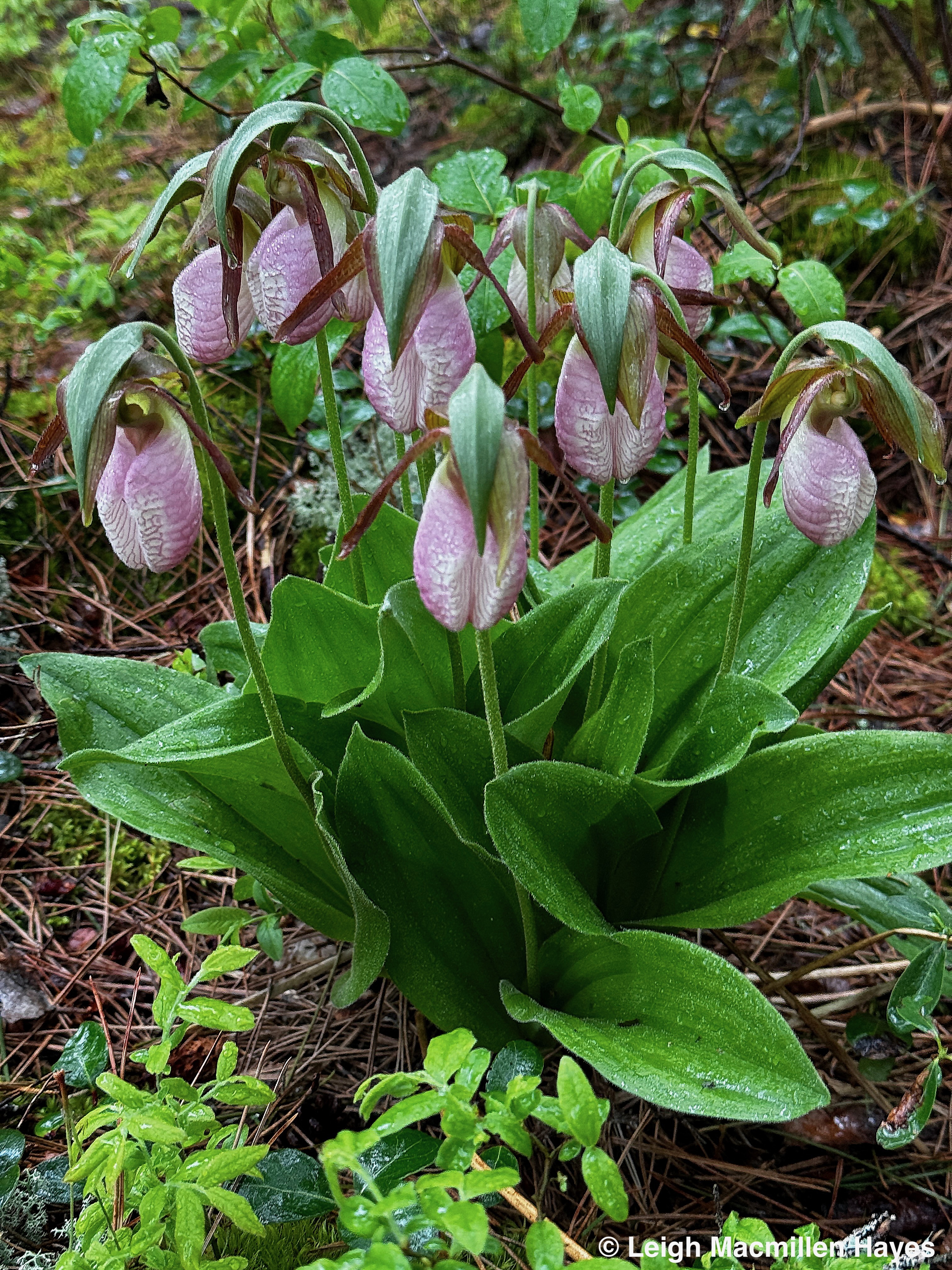
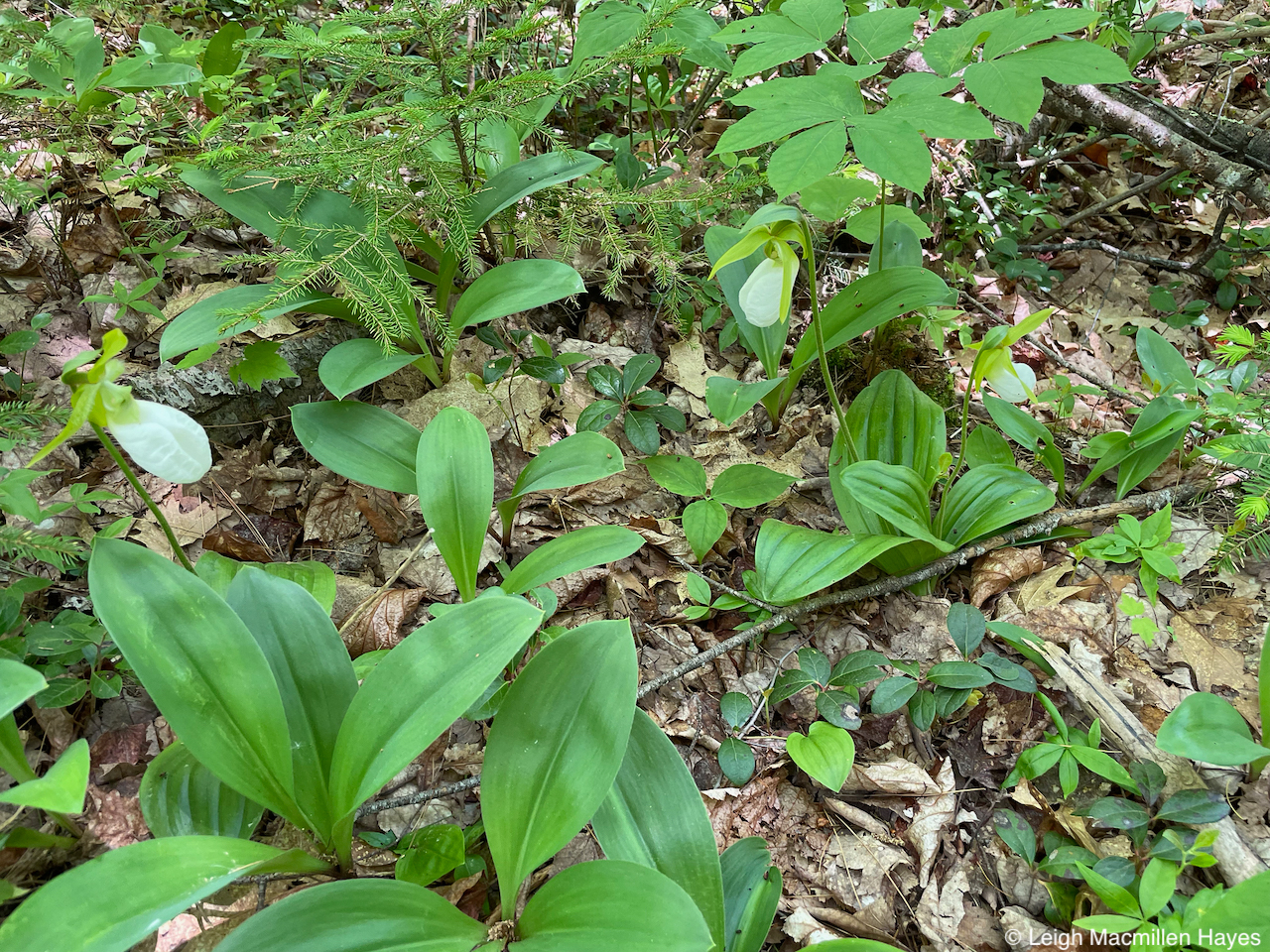
Vowing not to count Lady’s Slippers, we didn’t. But they were there, though most waning.

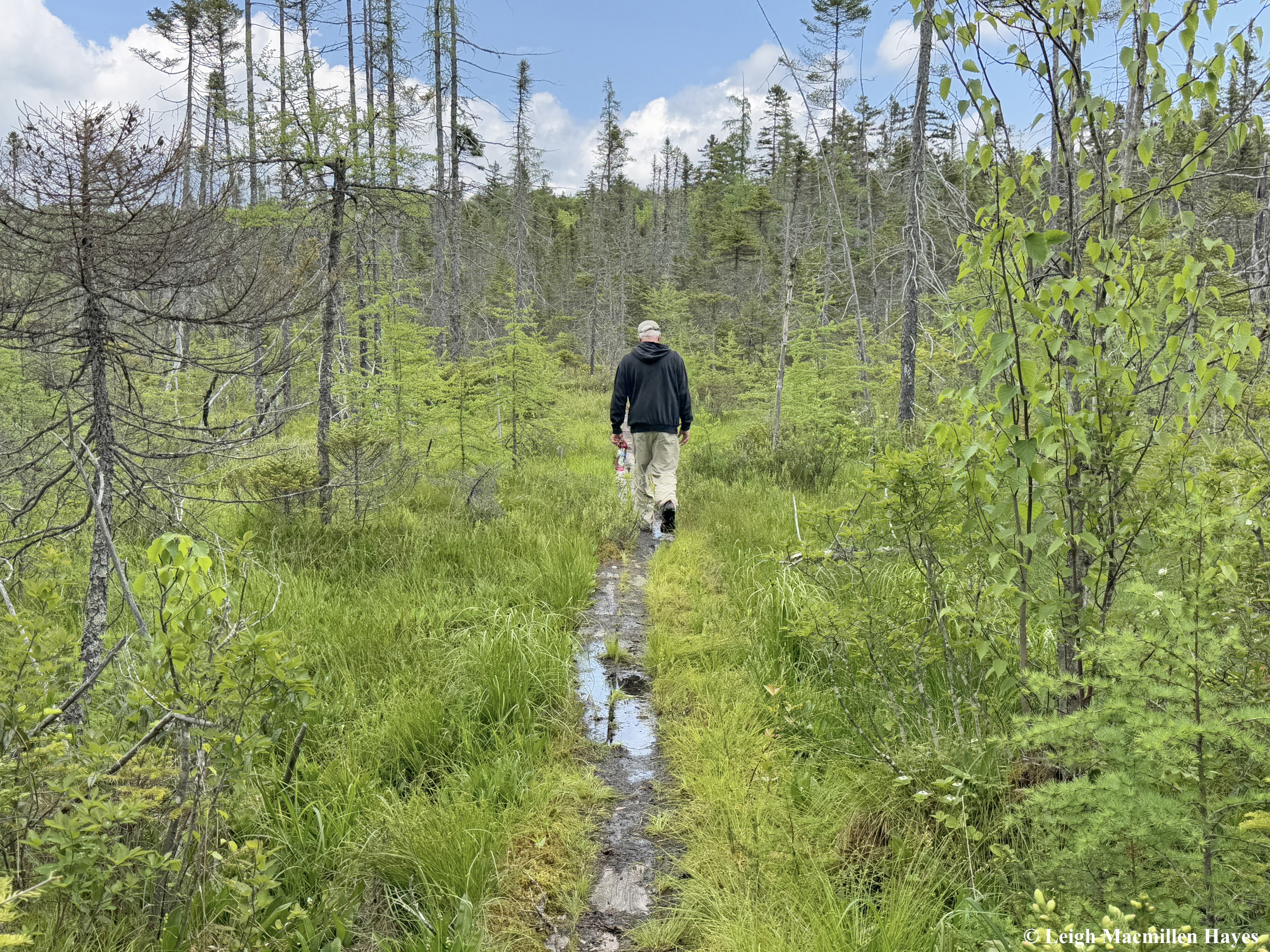
At last we reached the coveted bog, where a boardwalk was long ago placed to keep hikers like us from stepping onto the fragile environment.

It was at this point that another funny story evolved, but again, you’ll have to visit My Guy at his store to get the rest of the story.

At last reaching the platform with a bench at the end of the boardwalk, we sat down to eat sandwiches and take in the scene and sounds that surrounded us.

Sphagnum mosses formed the peat base and laurels and Tamaracks and Firs and flowers and insects all expressed themselves.

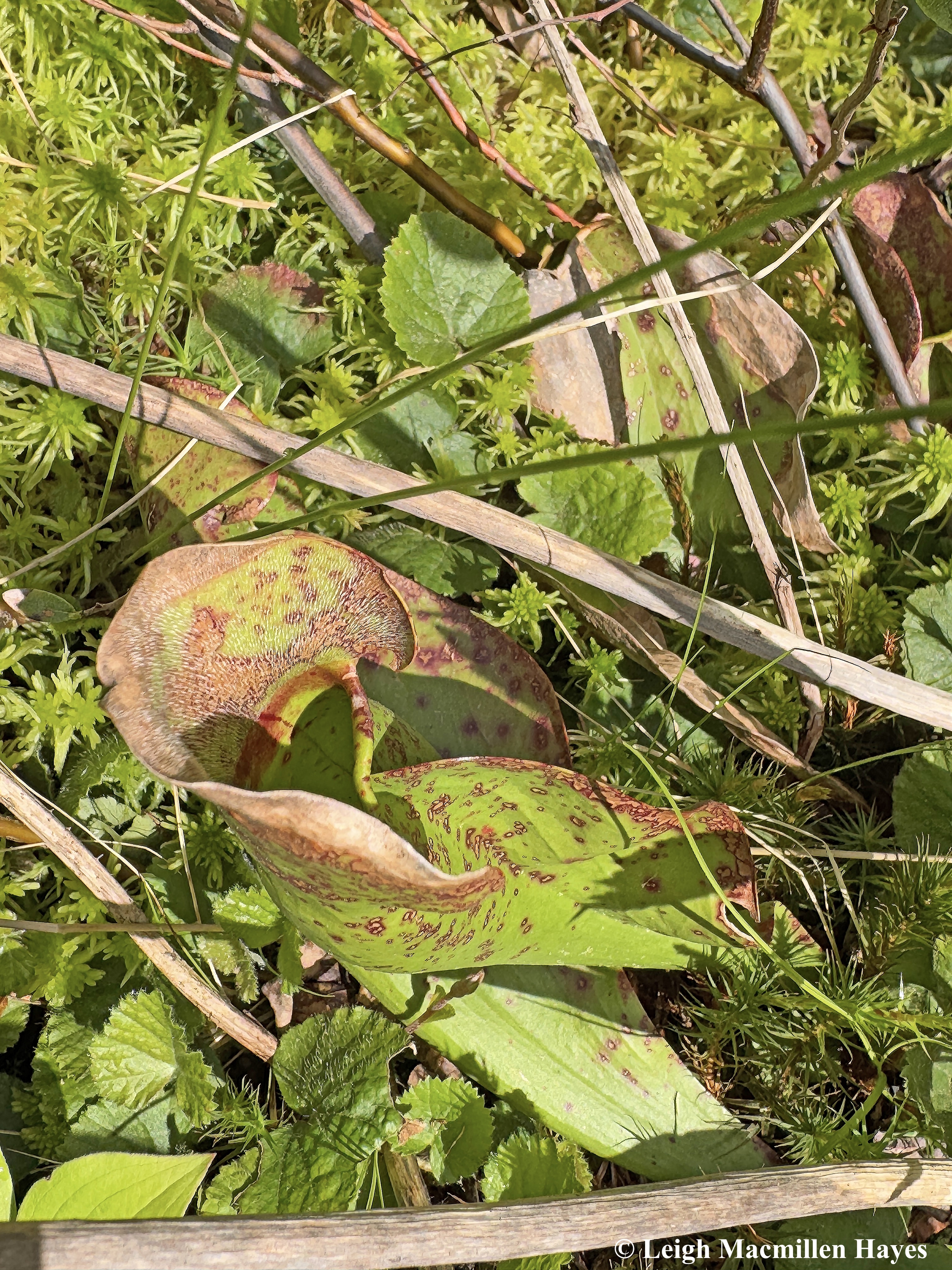
I, of course, can never see too many Pitcher Plants and be forever wowed by those downward facing hairs that entice insects in to the pitcher-shaped leaves where the end-of-life lurks.

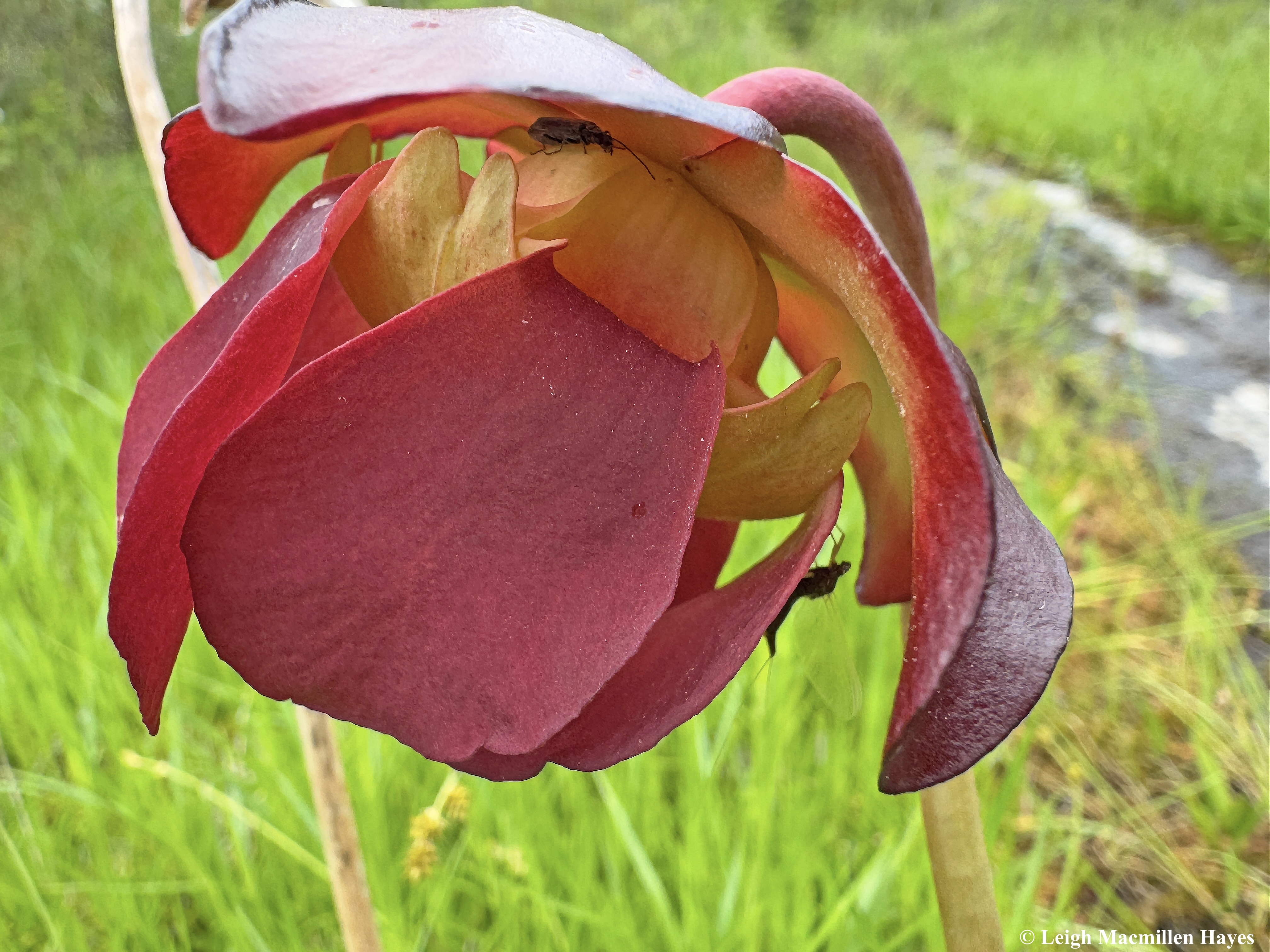
And the otherworldly flowers were in full bloom, including this one that hosted a long-horned insect and a sub-imago Mayfly (read: Dun).

I’ve been wowed by these for a long time and years ago drew this rendition as a teaching tool that now is the background for my iPhone.

There were Unadorned Bog Flies pollinating Bog Labrador Tea.

And Cotton Sedge showing off their hairy tufts.

Our next leg took us from the Bog to the Groton multi-use trail, being used mainly by horse riders and moose. We saw neither, but their tracks were evident in the mud.

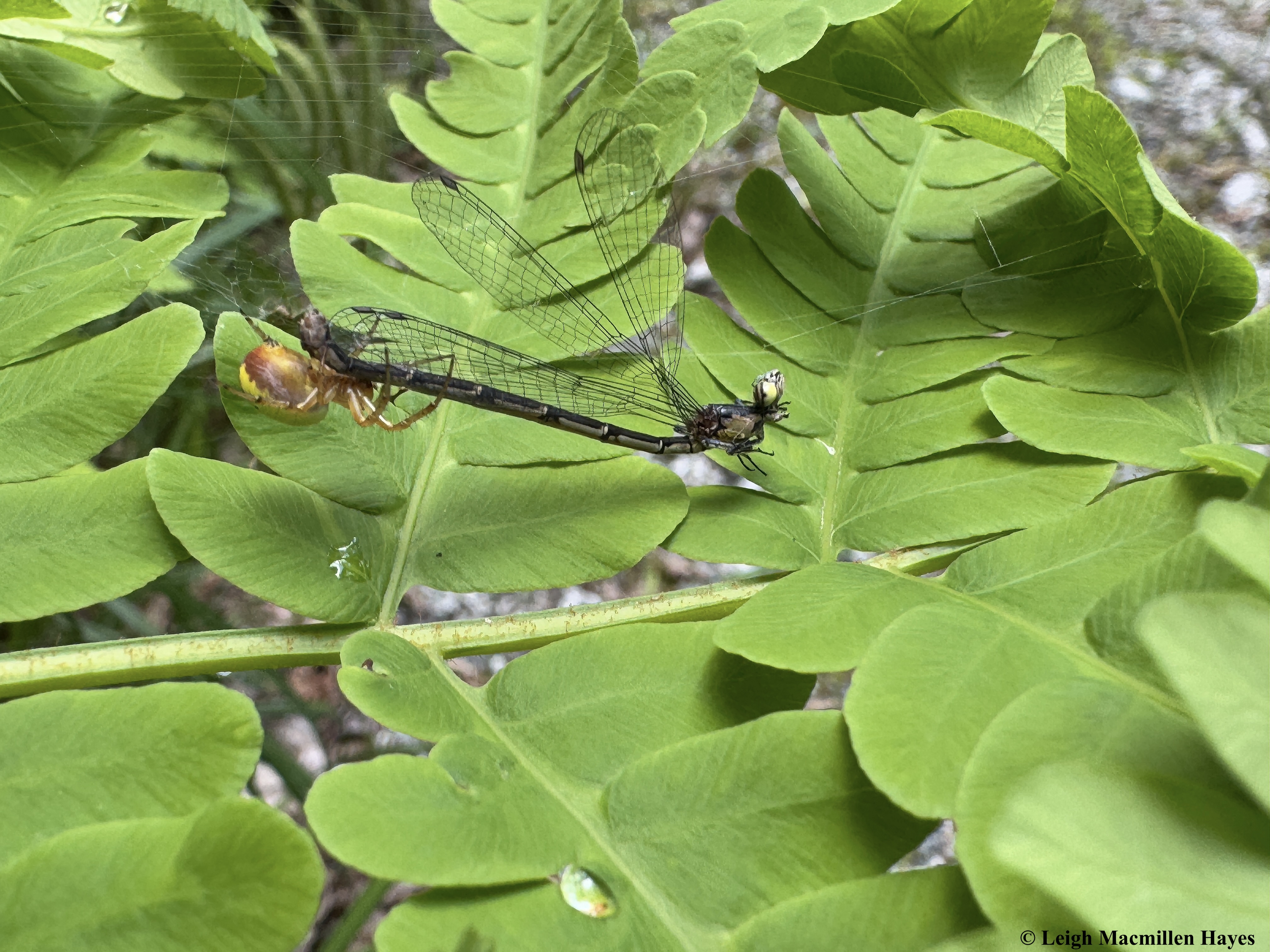
What we did spot was this Aurora Damselfly being wrapped up by an Orb Weaver Spider. I knew the damselfly immediately because of the uneven stripe on the sides of the thorax.

And had recently tried to paint a mature form of the same species.

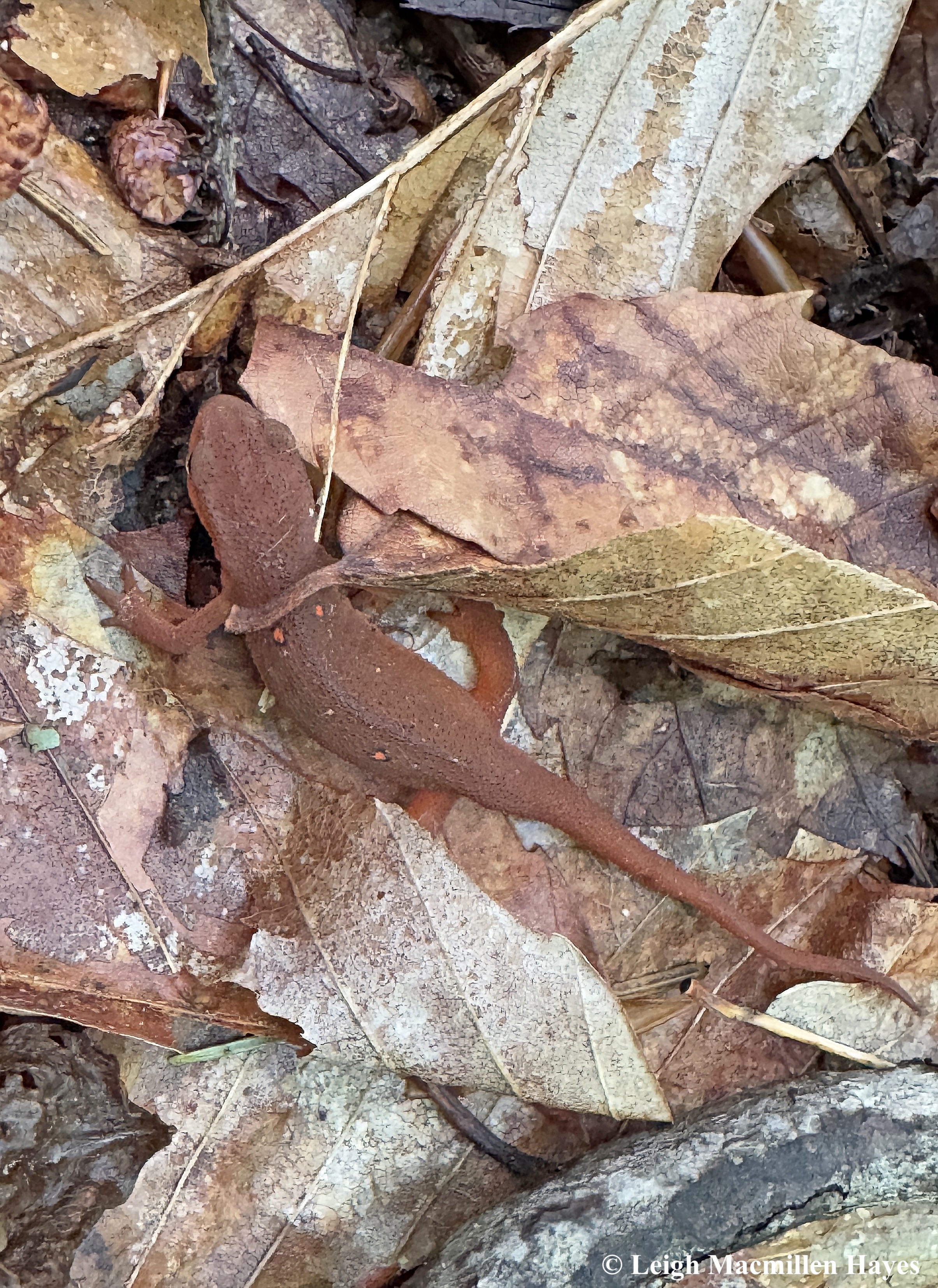
We also met a couple of Red Efts, the teenag and terrestrial stage of the Eastern Newt. The red spots act as a warning to predators because if consumed, they secrete poison toxins from their skins. As humans, we can touch them and live, but to ingest one would be harmful. So don’t try that.

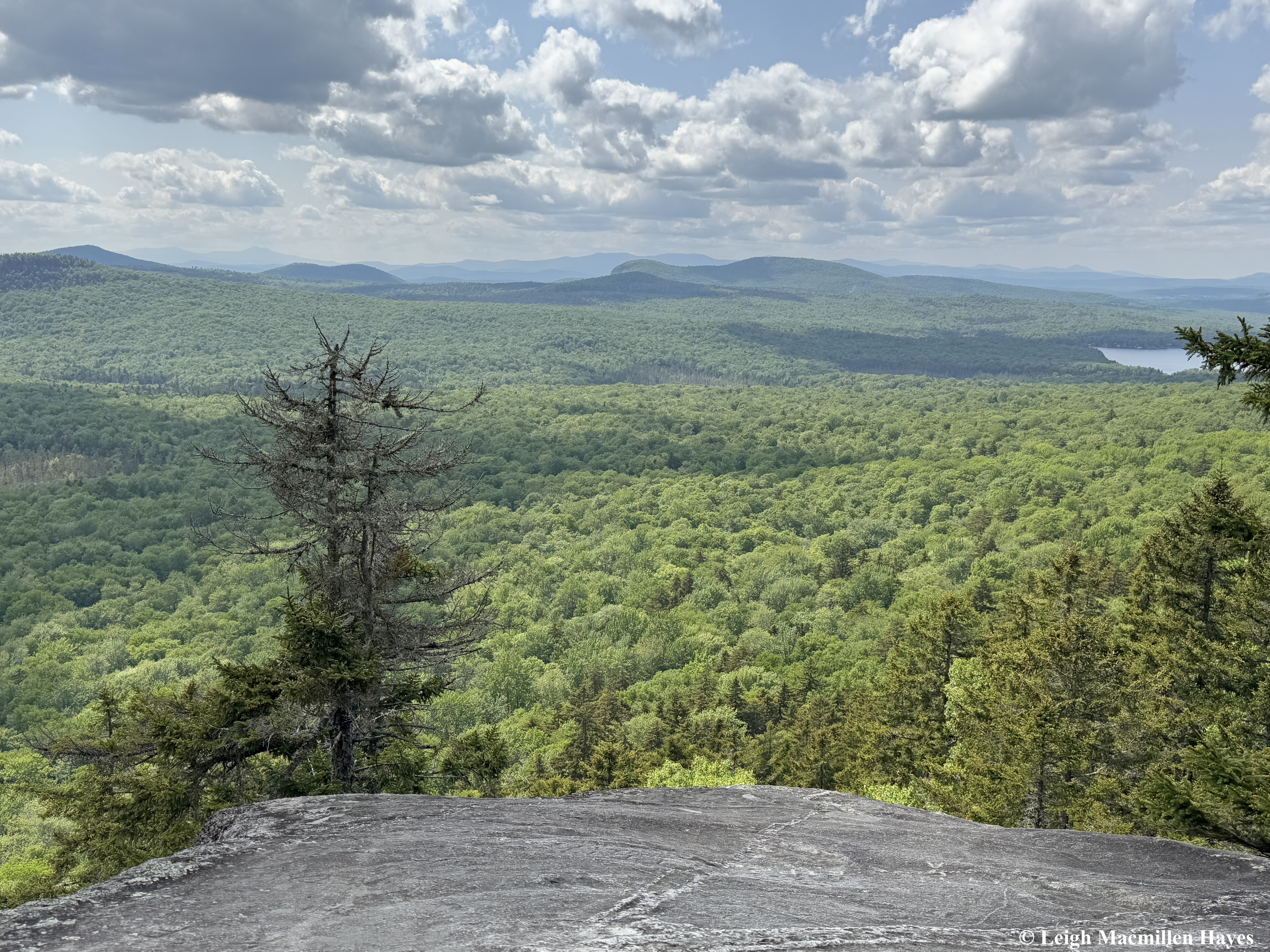
A couple of miles later we reached the trailhead for Devil’s Hill and snaked our way up the switchbacks to the summit, where this view of the rolling hills and iconic geography of Vermont stood out before us.

On the way down, a male Luna Moth presented itself, hiding as it was under a Striped Maple leaf.

I love these leaves and their twigs, especially the growth rings that stand out so predominately, and My Guy appreciates that the leaves serve as Nature’s Toilet Paper. TMI? But really, they are easy to identify and they are soft.

Returning on the multi-use trail before retracing our steps on the Peacham Bog Loop, we had to walk through tall grasses and sedges, which did not make my heart so glad because this was heavy tick territory. I had on tick gaiters and repellant. We took at least five off My Guy.

But, this pair of Craneflies did share a canoodle moment with us, so that won me over for a second.

All in all, we hiked over eleven miles that day, and were too beat to go out to dinner, so instead drove to the West Barnet Quick Stop, about 1.5 miles from our weekend home. There we ordered Chicken Cordon Bleu Paninis with Pesto, and a salad to share. And while we waited for our meal to be created, noticed Shain’s of Maine Ice Cream in the freezer, which made us chuckle. Wait a minute. We were in Ben & Jerry Country. Never fear–they had a much better presentation in another freezer.

And, while we waited, I asked the woman who was creating our salad if she lived in the area. “All my life,” she said, and added, “So far.” We chuckled, but then I asked if she knew so and so, a couple I know from church who had lived just down the road for many years (a fact I’d only learned days earlier).

Her face lit up with a smile as she recalled them and said they used to frequent her other store and that their daughter had worked for her. As tired as I was, that smile of hers was the perfect ending to a great day.

Well, it wasn’t quite over yet. For there was no TV at our weekend digs. And so I taught My Guy to play Parcheesi, and then I beat him.

The next morning we drove north to Orleans to meet my first college roommate and her husband, Bev and Bill, at the Carriage House for breakfast. Funny thing–as I drove up Route 91, there was one car in front of us and approaching it, with its Maine license plate, I spotted Lakes Environmental Association and a Loon Echo Land Trust stickers on the rear window. It had to be someone from our hometown. Sure enough, as I passed it, I recognized the mother of one of my former students. And a wondermyway follower.

Betty, if you are reading this, that was us on the highway with you on Sunday morning at 8:30 or so.

We spent two hours talking and eating and talking and talking some more over omelets and coffee and Bev and Bill suggested that we hike Mount Hor, which overlooks Willoughby Lake. I’d been to Willoughby before with Bev and two other dear friends, but never hiked in that area. And so we did. They gave us easy to follow directions and we parked and then walked almost two miles up the CCC Trail. I love that this was another project meant to keep people working when times were tough.

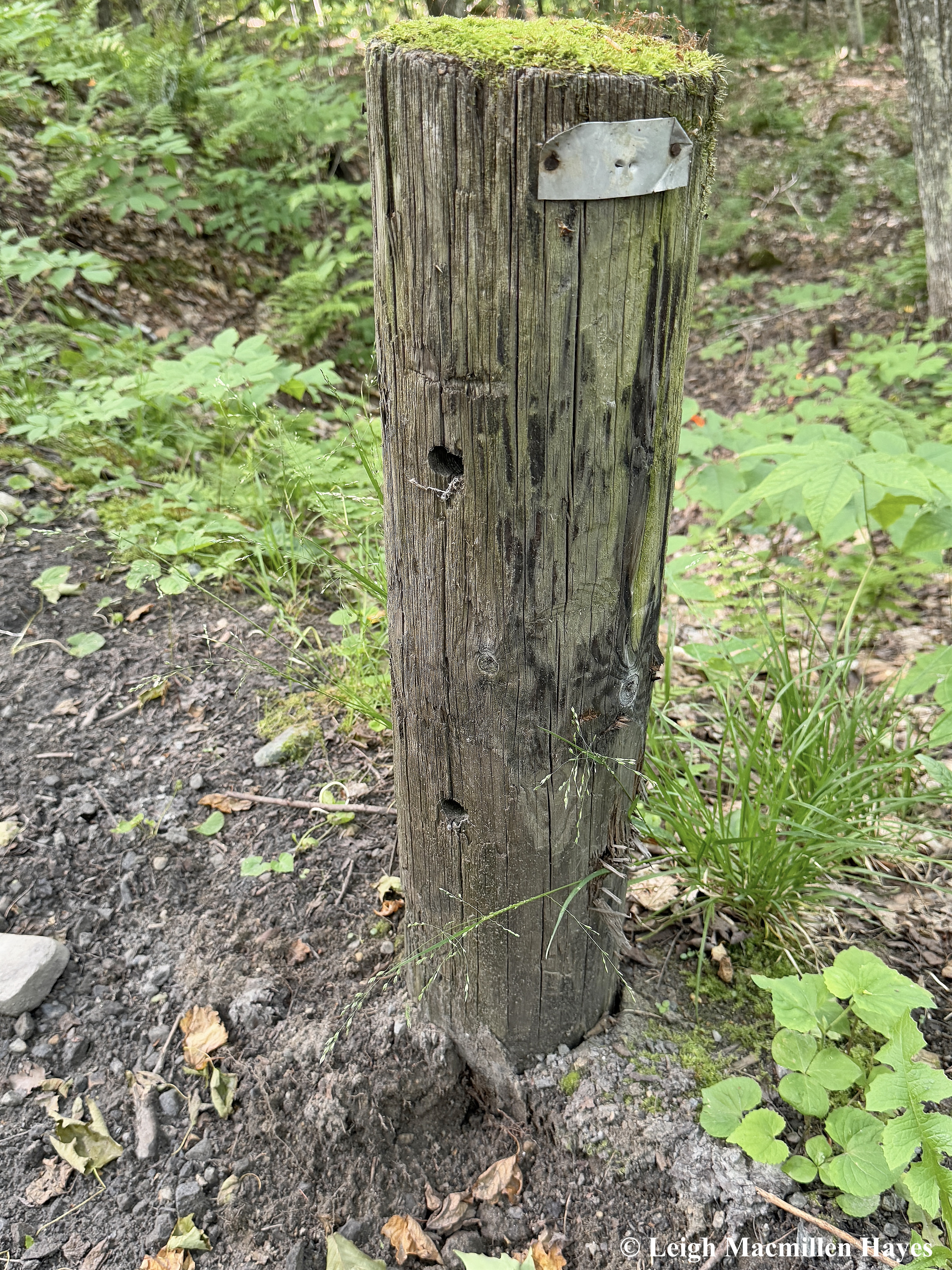
Though the hard packed surface we walked on was not the original road, we kept spotting these posts and my theory is that they were original and held cables that connected one post to another and kept vehicles from catapulting down the steep embankment.

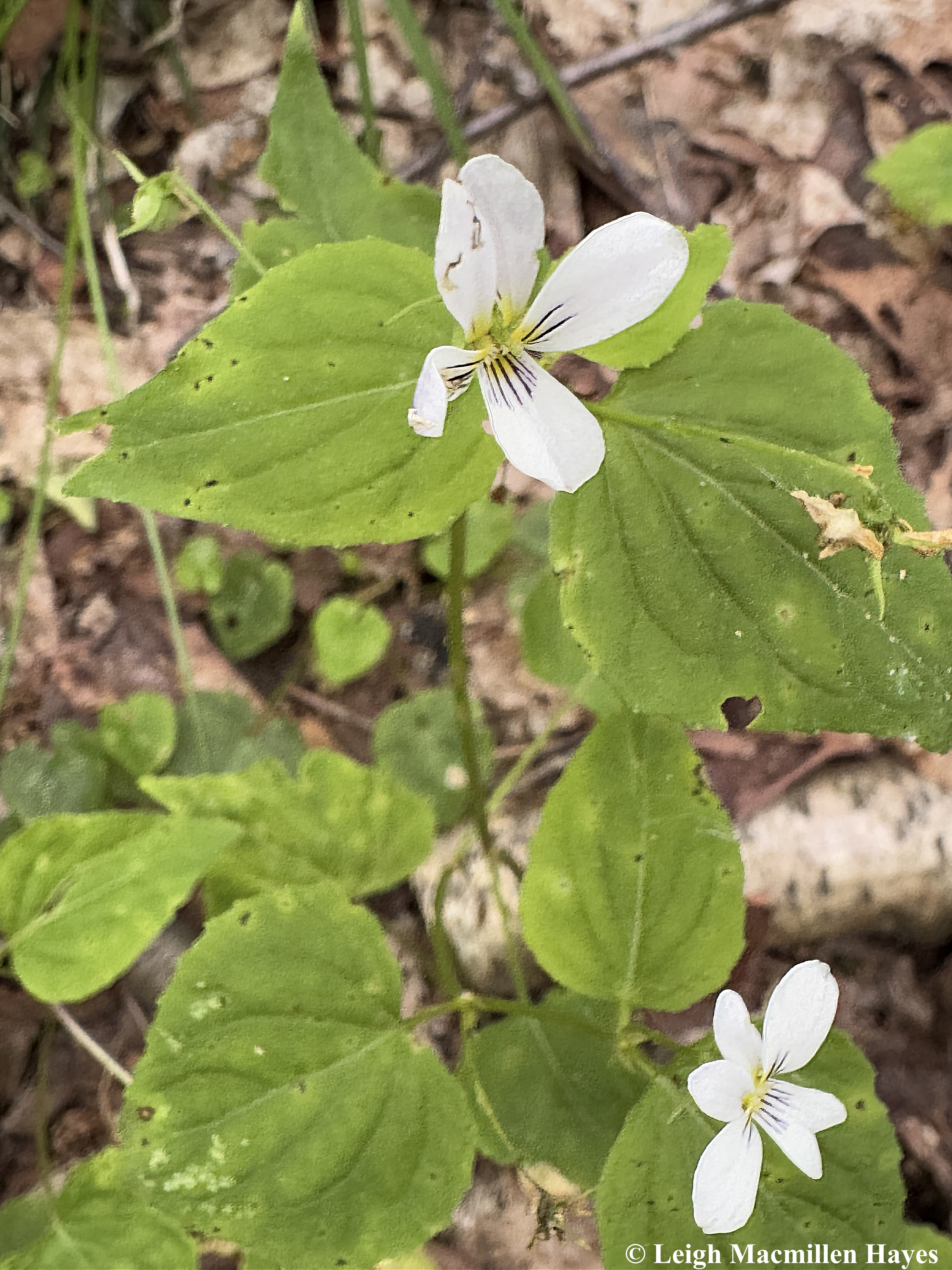
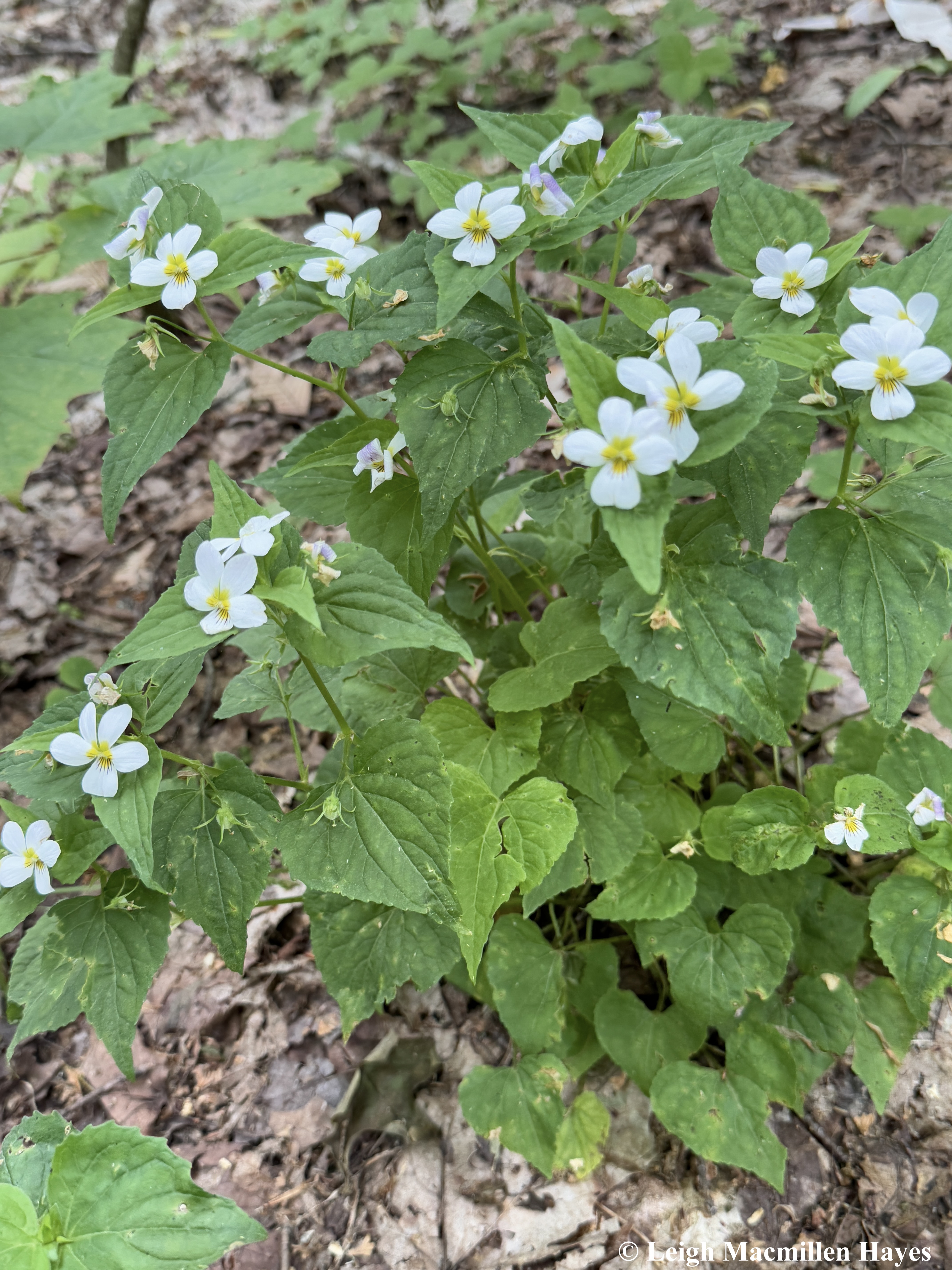
When we finally reached the actual trailhead for Mount Hor, I met a new flower. Canada Violet. It made sense since we were probably about ten miles from the Canadian border. Delicate. Pure white. A well-defined runway to the nectar. And leaves offering a different take on the violet theme.

What we soon realized was that it not only grew tall, but also in large clumps.

Oh my gosh, our next find–Maidenhair Fern. Such a unique presentation and color and, oh my gosh!

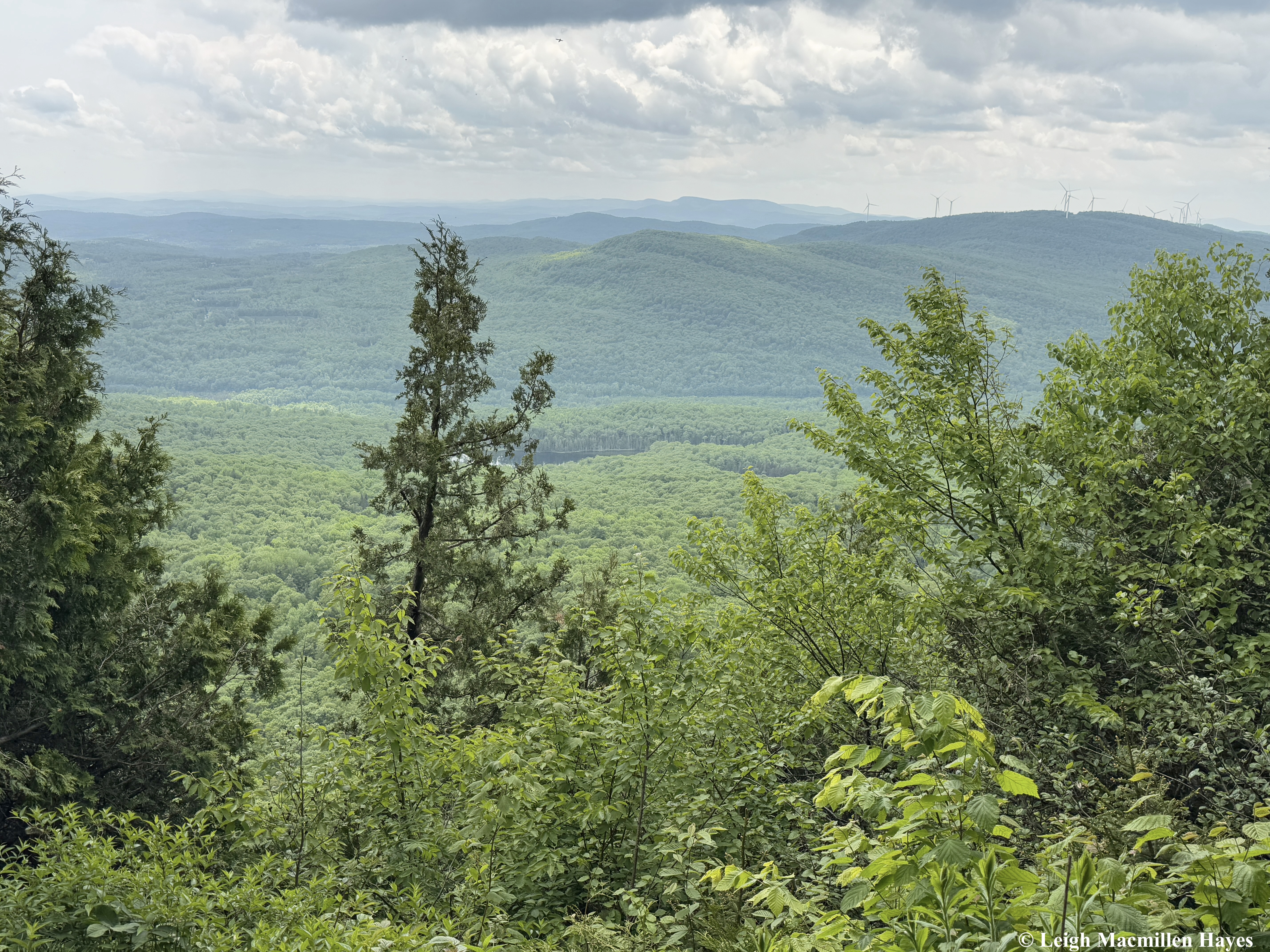
At the summit, we had three choices. First we headed to the Summit Vista, where the view included Cedar trees in the foreground and two delightful couples who were enjoying GORP and blueberries but when they heard that we had homemade Peanut Butter Chocolate Chip granola bars a la The Stow Away Baker in our backpack, they wanted to chase us down the mountain.

From there, we hiked another mile across the ridge line to the East View, overlooking Lake Willoughby.

While there, we spotted a Peregrine Falcon soaring on the thermals, but neither of us got a good shot of it. Still. Forever in our minds eye. And sometimes, those are the most memorable moments.

From the North Vista we looked across at the cliffs of Mount Pisgah and wondered how many more falcons we weren’t seeing.

Back down the CCC Road we did walk once we stepped off the mountain trail and my favorite find was a Mountain Maple, that stopped me in my steps for a few minutes as I had to remember who it was that I was meeting.

Back at Lake Willoughby North Beach, Mount Hor is on the right and Mount Pisgah on the left, creating a fjord-like presentation.

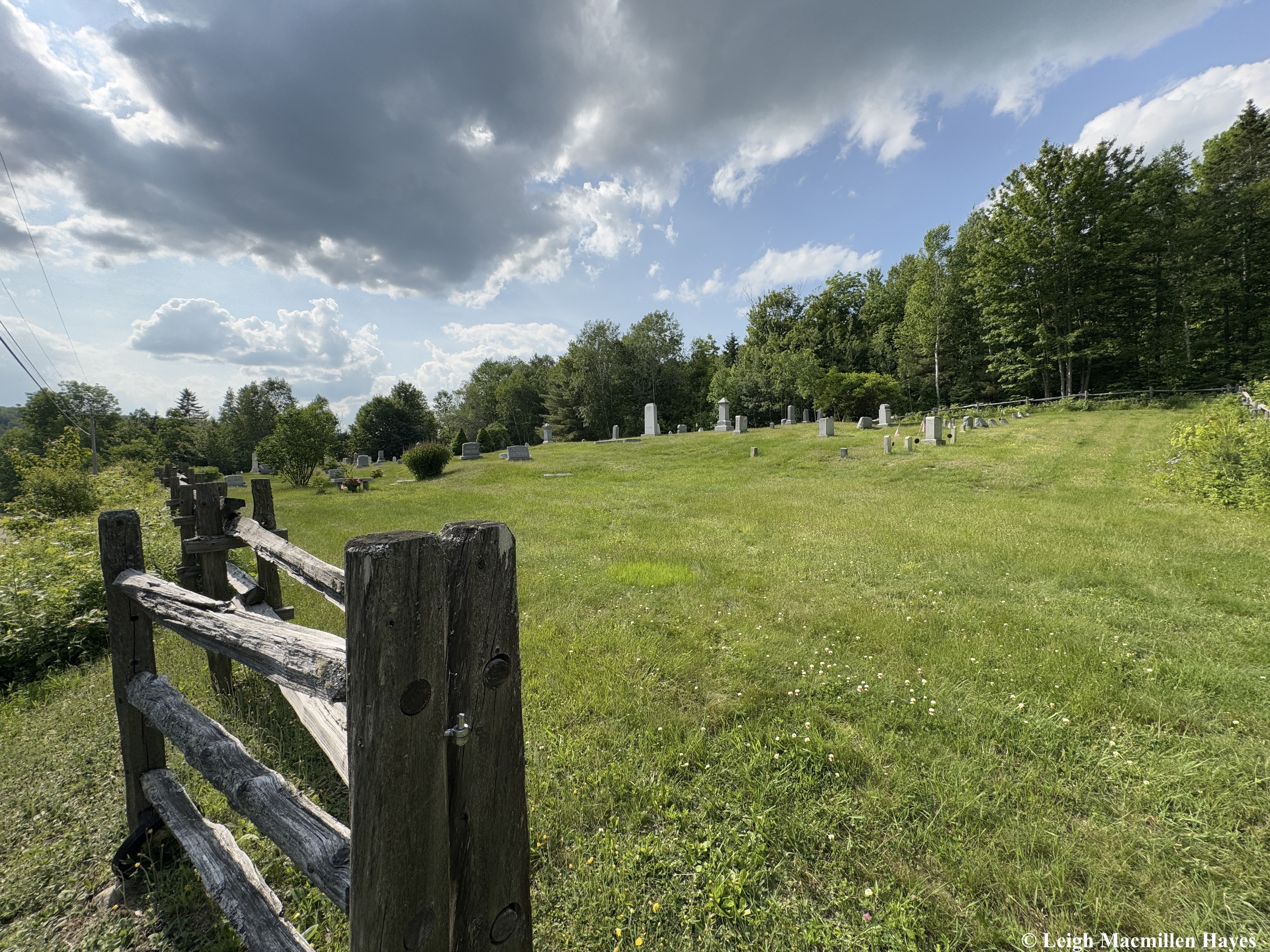
From there, we drove south to South Barton as I let my nose lead the way and found a cemetery I’ve visited in the past for some of my ancestors are buried here.

Recognizing family names is always a treasure. And actually, within the post railings of this place I noted at least three different families that have contributed to my DNA. I’m pretty sure my love of the north country, be it Northern New England or Canada, comes from these folks.

On the way back to our home base, we grabbed sandwiches to go from Three Ponds and gave thanks for their goodness.

And then this morning, after packing and cleaning and chatting briefly with Chuck, we had one more place to explore–Kettle Pond State Park within Groton State Forest.

So here’s the thing. My understanding of a kettle bog is that it’s kettle or bowl shaped. And has an outer layer of herbs, with the next layer surrounding it of taller herbs, and then a third layer of shrubs encircling the kettle, and finally, trees who like wet feet, like Red Maples, forming the final ridge around the pond.

None of this was present. Well, there were shrubs and trees, but not in layers like I’m used to seeing. And the shape of the pond was more north-to-south glacial-related than kettle-related. Hmmm?

Still, some great finds like this Spotted Salamander egg mass along with four others in a deep puddle along the trail. Can you see the embryos forming?

And a Garter Snake that had been basking on a rock in the trail until we happened along.

And Twin Flowers, each sharing a petiole, growing like a mat along a glacial erratic.

And Stair-Step Moss growing abundantly like a set of stairs here and there and even over there.

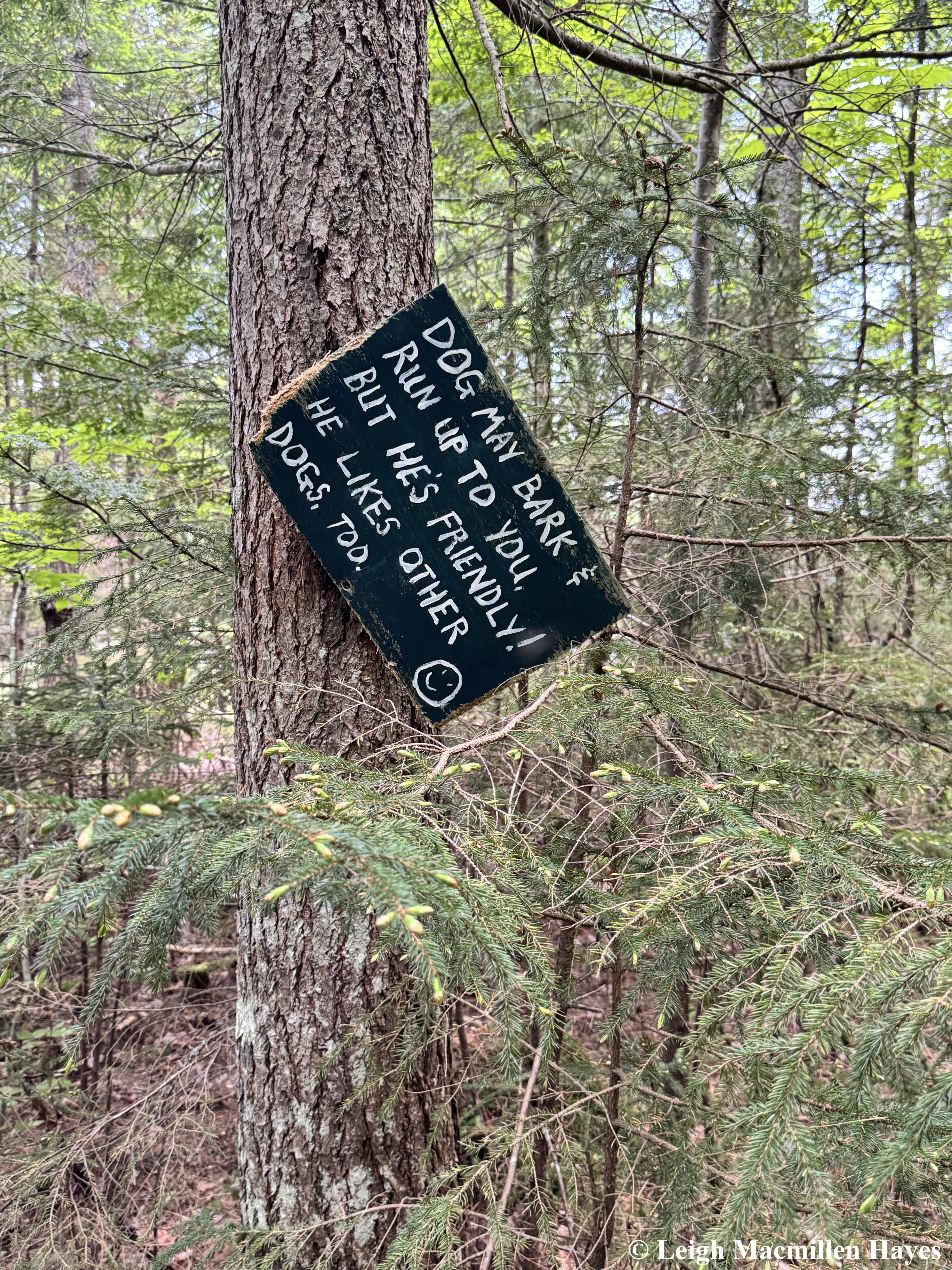
And a warning, which was more of an invitation at the only private cabin along the way, a route which offers lean-to shelters for groups to rent. I love this sign. We looked forward to meeting said dog, but sadly, no one was home.

Flat-fruited Pelt Lichen also lined the trail. So much to see. So much more to learn.

Oh, and an Eastern Newt in the water. It was like the Newt brought the trail to a full circle beginning with the Red Eft on our first hike of the weekend and ending with this adult form.

Our time Vermonting came to an end this afternoon, but oh, what a wonder-filled time we had. We hiked so many miles while meeting old and new friends, dined with dear old friends, met friends of friends who were old friends to each other and new friends to us, and just plain had fun making new memories.

Thank you Chuck and Mercy, and Bev and Bill, and Debbie and those at Three Ponds, and Brian at the Nature Center, and to all the others we met along the way for making our experience such a rich one.

Vermonting we did go. Word or no word, it was exactly what we needed.

Where The Moccasins Led Us

Rituals. We follow them. Some more than others.

For My Guy and me, there is one in particular that captures our attention beginning in mid-May.

And so I follow him . . . across Beaver dams,

beside the Atlantic Ocean,

up mountain trails,

even on the hottest day so far with Canada wildfire smoke casting a haze.

This year it was more trails than usual that were included in our ritual and along the way we spotted Wild Columbine in bloom, growing as it does among the rocks, and always pleasing our senses with its brilliant colors and artistic nodding presentation.

Fringed Polygala, and how I love the way those two words roll of my tongue, also showed off, making its common name of Gaywings so apparent. Doesn’t it look like a Bird of Paradise coming in for a landing upon its very own leaves?

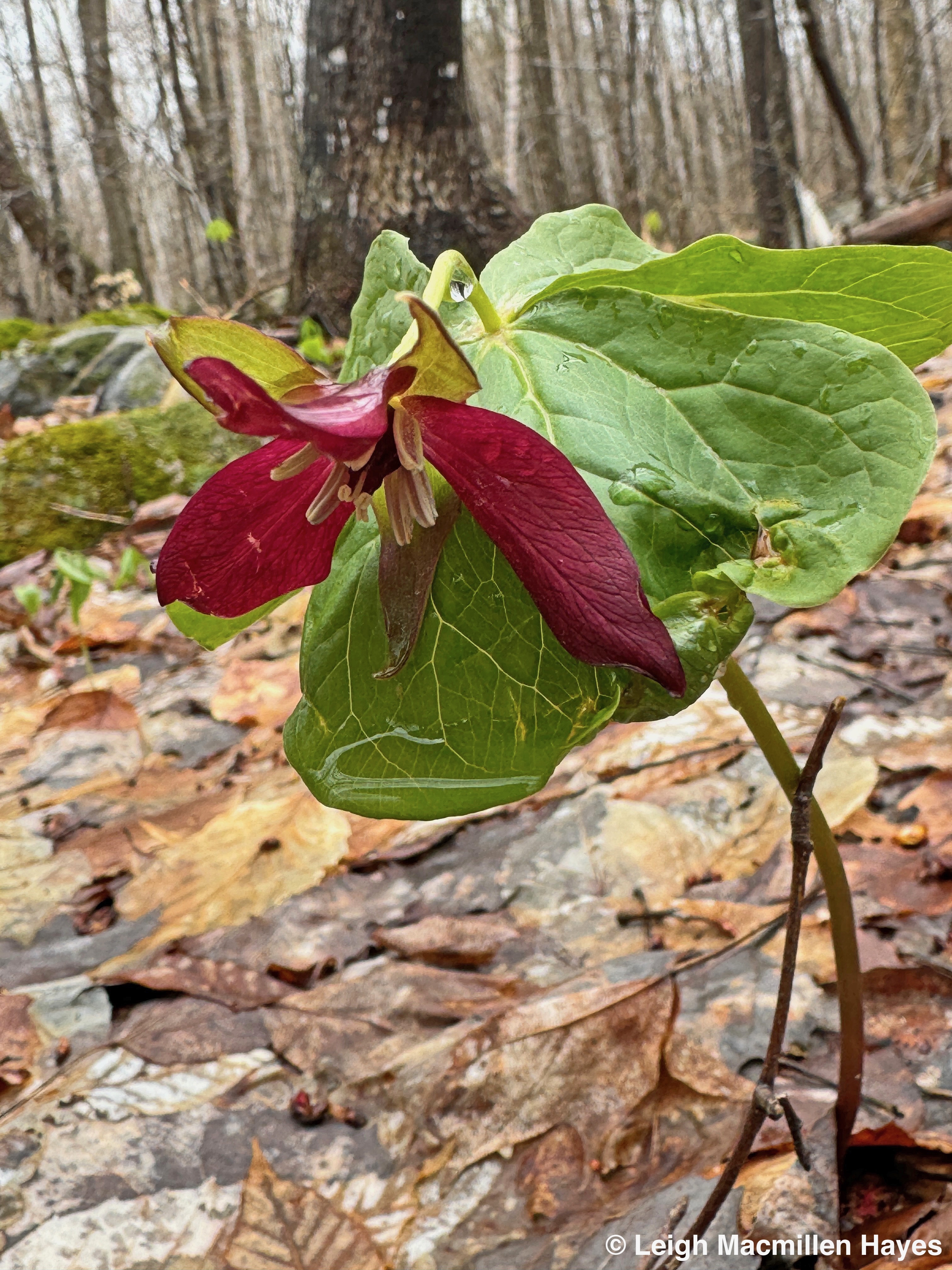
Upon one of our journeys we found a few Red Trilliums still in bloom, though it seemed late in the season for them. But as My Guy teases, I did what I do and added this photo to the other trillion I have of this plant. They all need to be honored, don’t they?

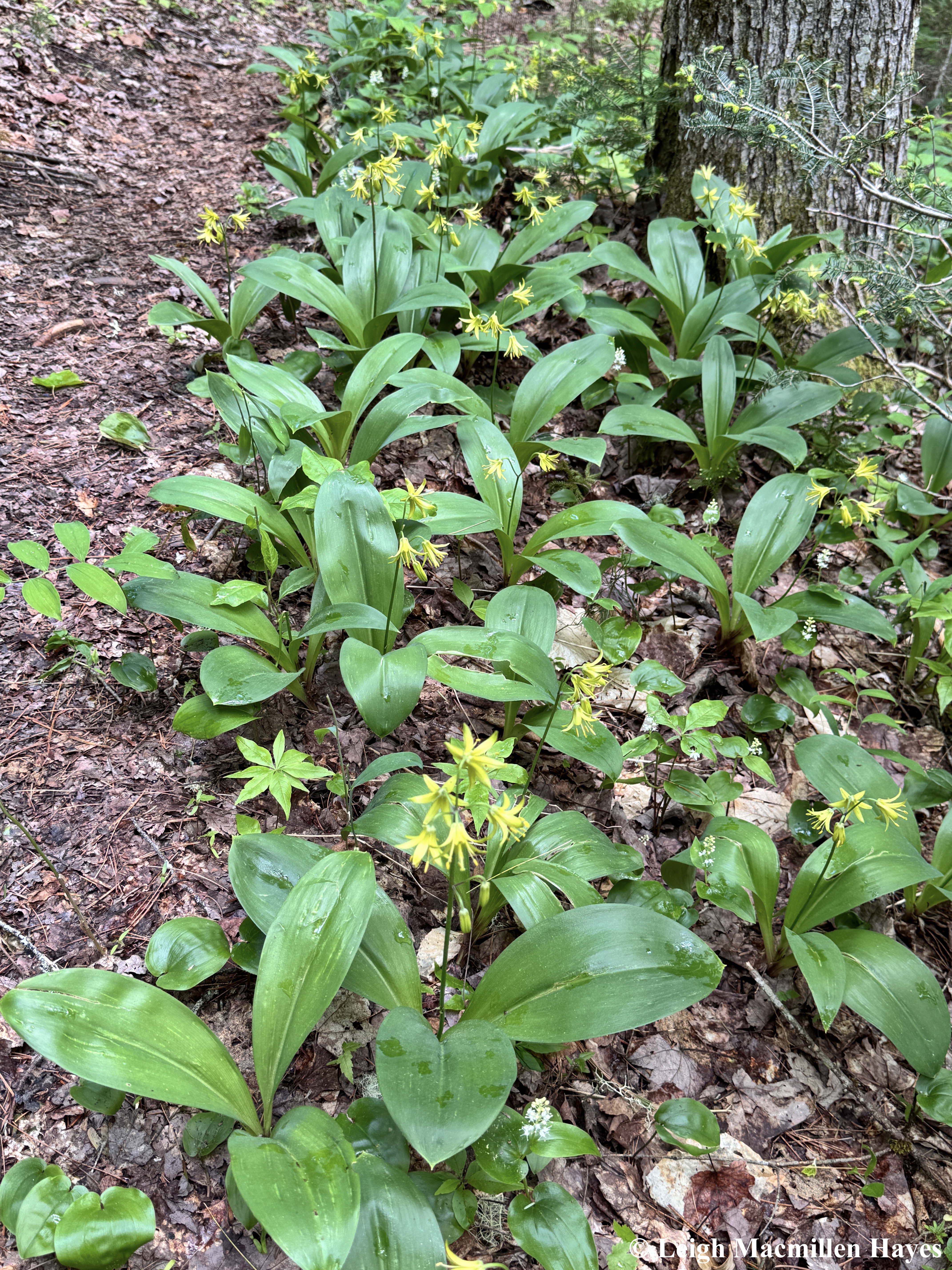
Seemingly everywhere, Clintonia, aka Blue-Bead Lily bloomed, adding specks of sunshine to the path and lighting our way, even on the grayest or rainiest of days. Yes, we even hike on rainy days.

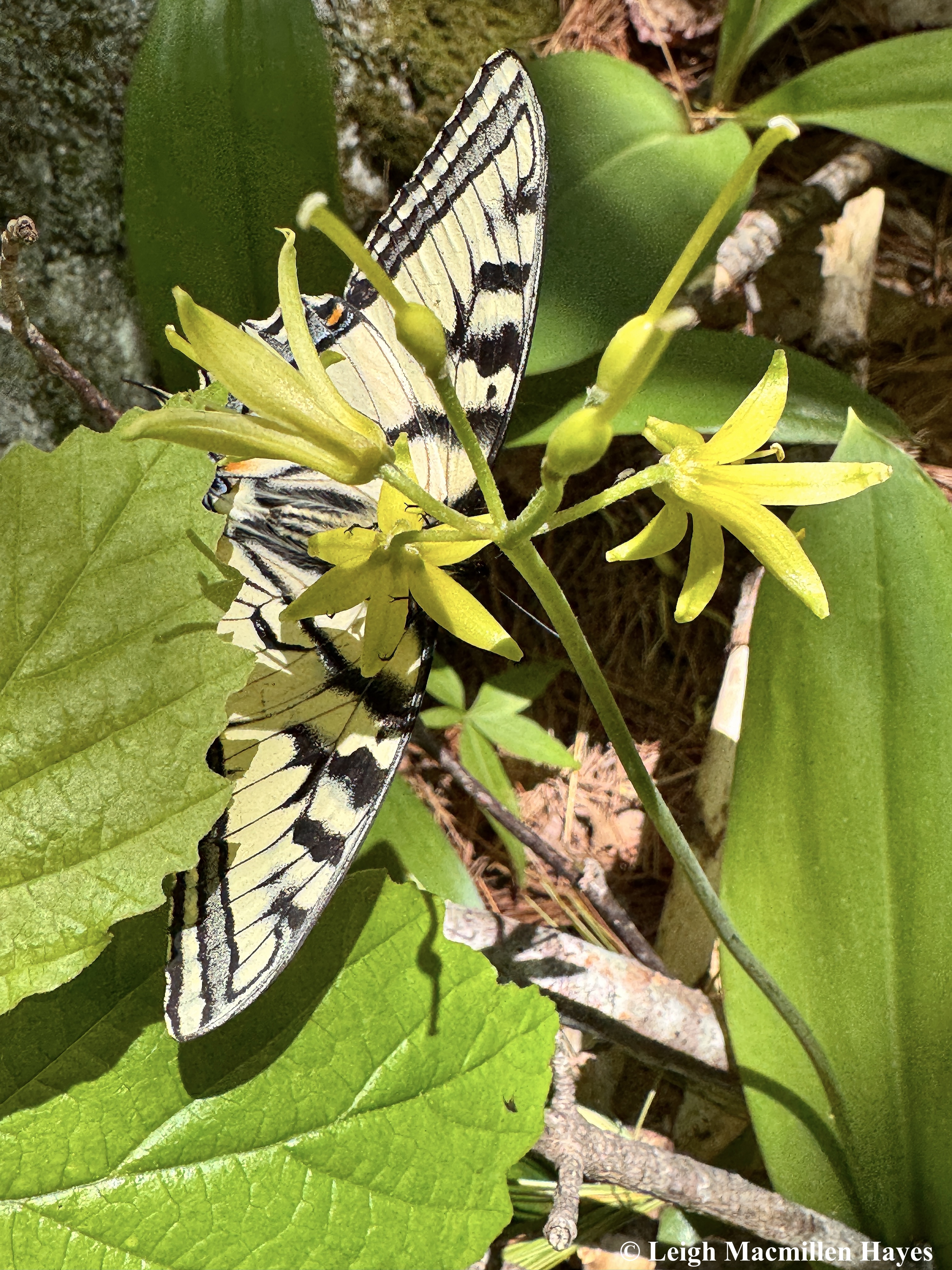
On sunnier days, the Tiger Swallowtails added their own yellow to the equation. Can you see the tiny pretarsi or insect feet of the butterfly as it held on why sucking the flower’s nectar?

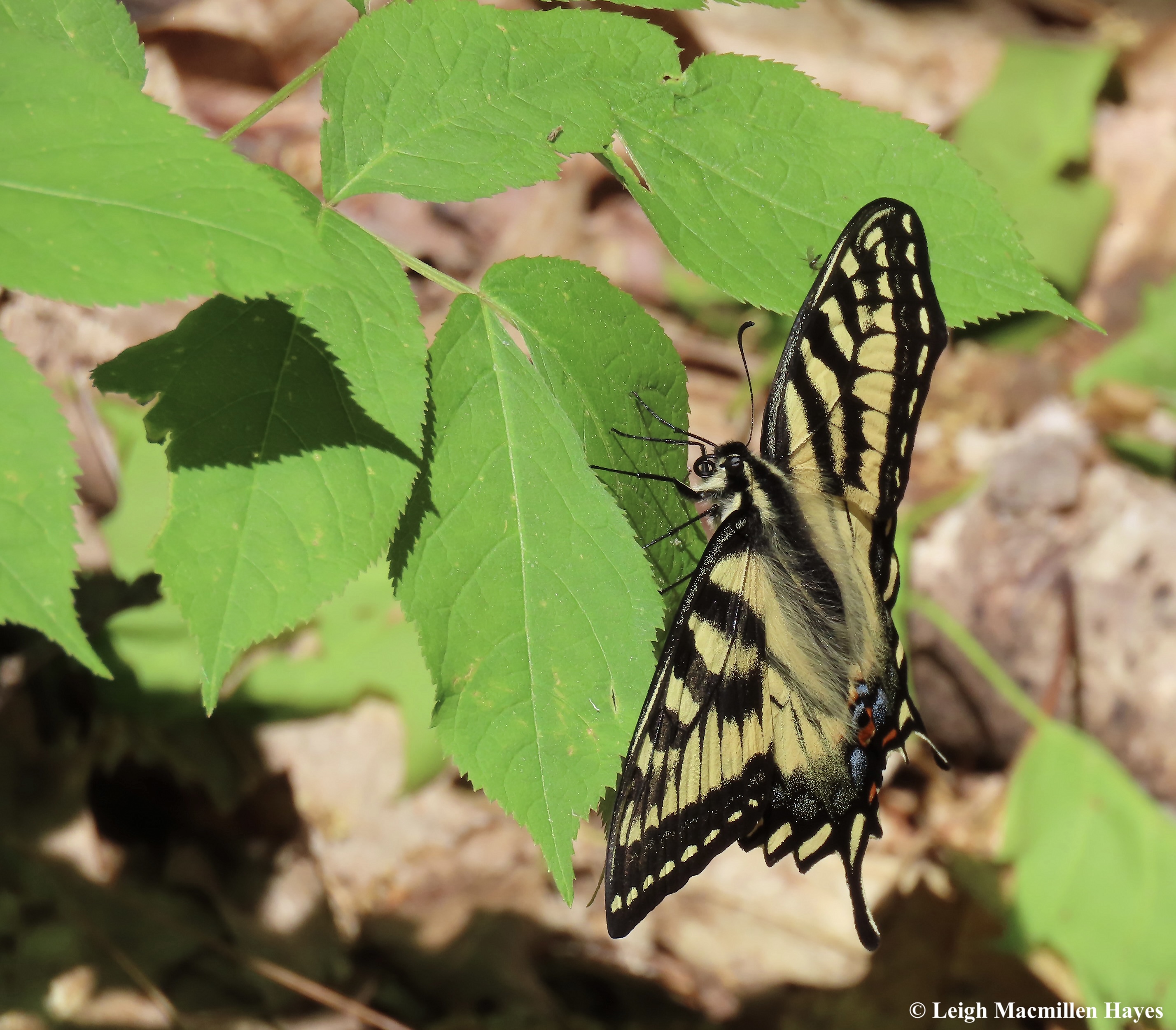
This spring it seems the Tiger Swallowtails are everywhere we travel by foot or truck. What I love about this one is that it was taking a break upon the leaves and you might be able to see its proboscis or siphoning mouthpart coiled up because there was no nectar to seek in that moment.

Right now the Swallowtail butterflies are the largest we’ve seen flying, but during a hike the other day, we spotted one of the smaller ones, this being a Northern Azure feasting upon Black Chokeberry flowers at a summit.

Jack, or rather Jill-in-the-Pulpit, for she needed the extra leaves to help her in her mission of producing seeds, greeted us in various places where the soil was moist including beside the cow path in our woods, where it totally surprised me despite the fact that we’ve lived in this house and wandered about for over thirty years.

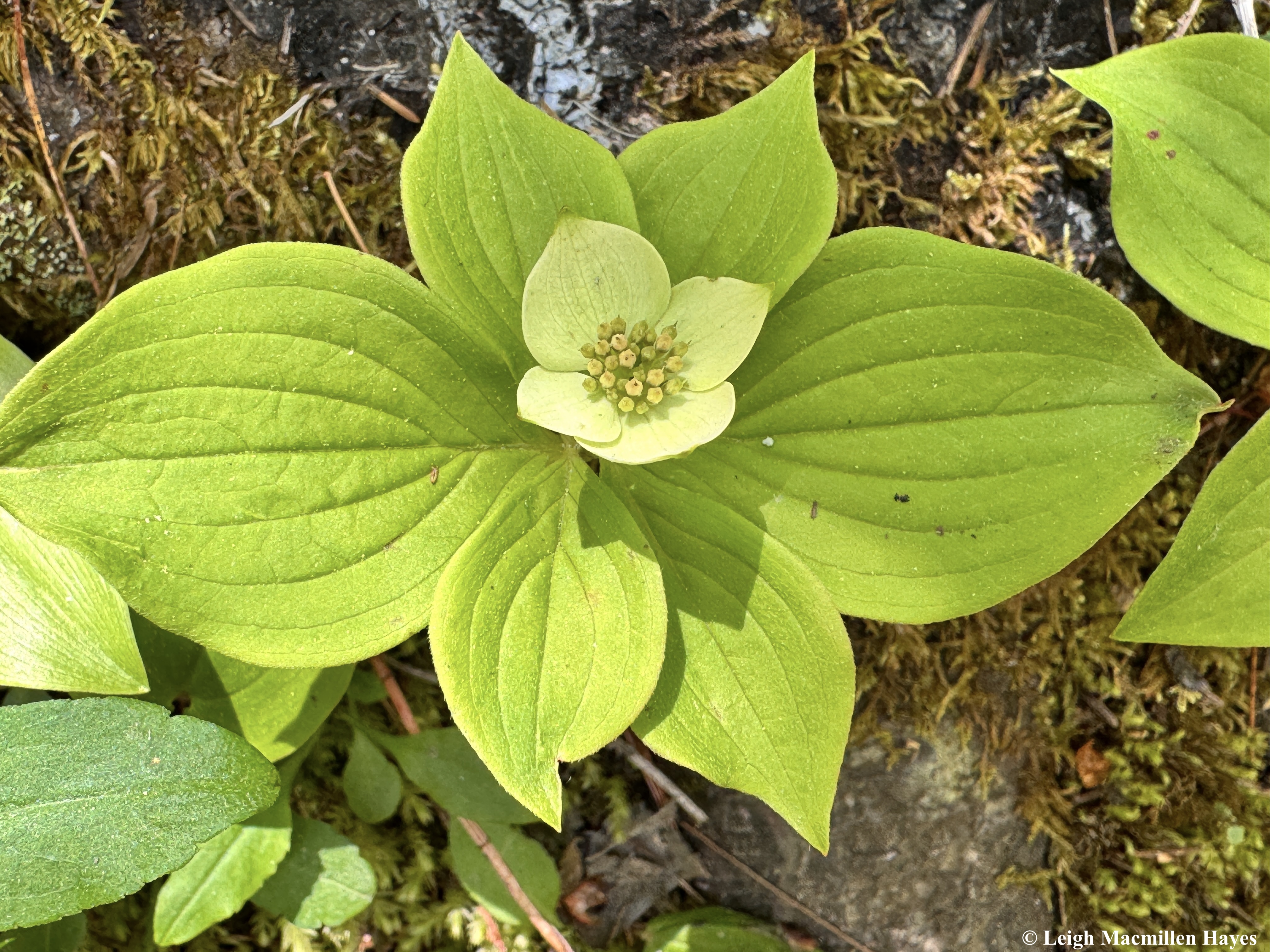
As one week turned to the next, and the flowers that were in full bloom kept changing, suddenly Bunchberry was added to the list. Again, like Jill-in-the-Pulpit, Bunchberry needs two extra leaves in order to have more energy to produce flowers followed by the berried fruits that bunch together in a cluster of bright red. You may look at the veins on those leaves and immediately know the family to which this wee plant belongs–if you guessed Dogwood, you are correct.

One of the earliest bloomers of spring, has already formed into a fruit, in this case three sided. Meet the Wild Oat of Sessile-leaf Bellwort. It reminds me that in a snap of the fingers, the season passes by much too quickly.

It wasn’t just flowers that marked our journeys. About the same time that we began the latest ritual, dragonflies and damselflies slowly began to emerge, for which we always give great thanks as they gobble up some of the Mosquitoes and Black Flies that so annoy us. This American Emerald had only just made the transformation from aquatic form to terrestrial hours earlier based on the sheen still visible on its drying, but not quiet dried yet, wings.

Much more mature were these two, who had formed the marital wheel in order to canoodle. I knew they were Emerald Dragonflies, but wasn’t sure which species until I searched my guides back at home: Uhler’s Sundragon, a new species for me.

And in at least one spot, some smaller female dragonflies deposited eggs as they tapped the water’s surface with their abdomens. Think of it as Naiads to come, who will live in the water for 1 – 3 years, depending upon species, before climbing out and transforming miraculously into terrestrial fliers.

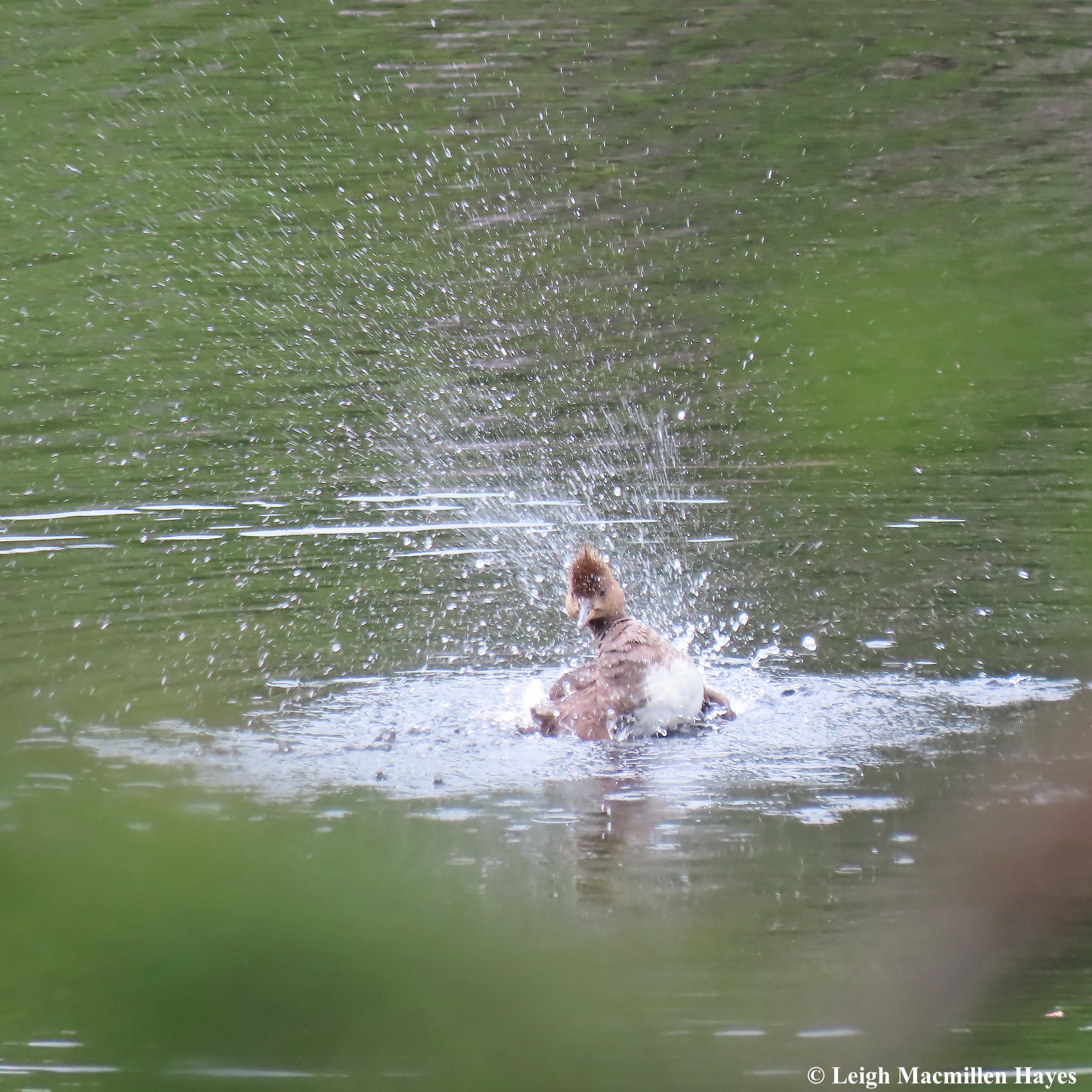
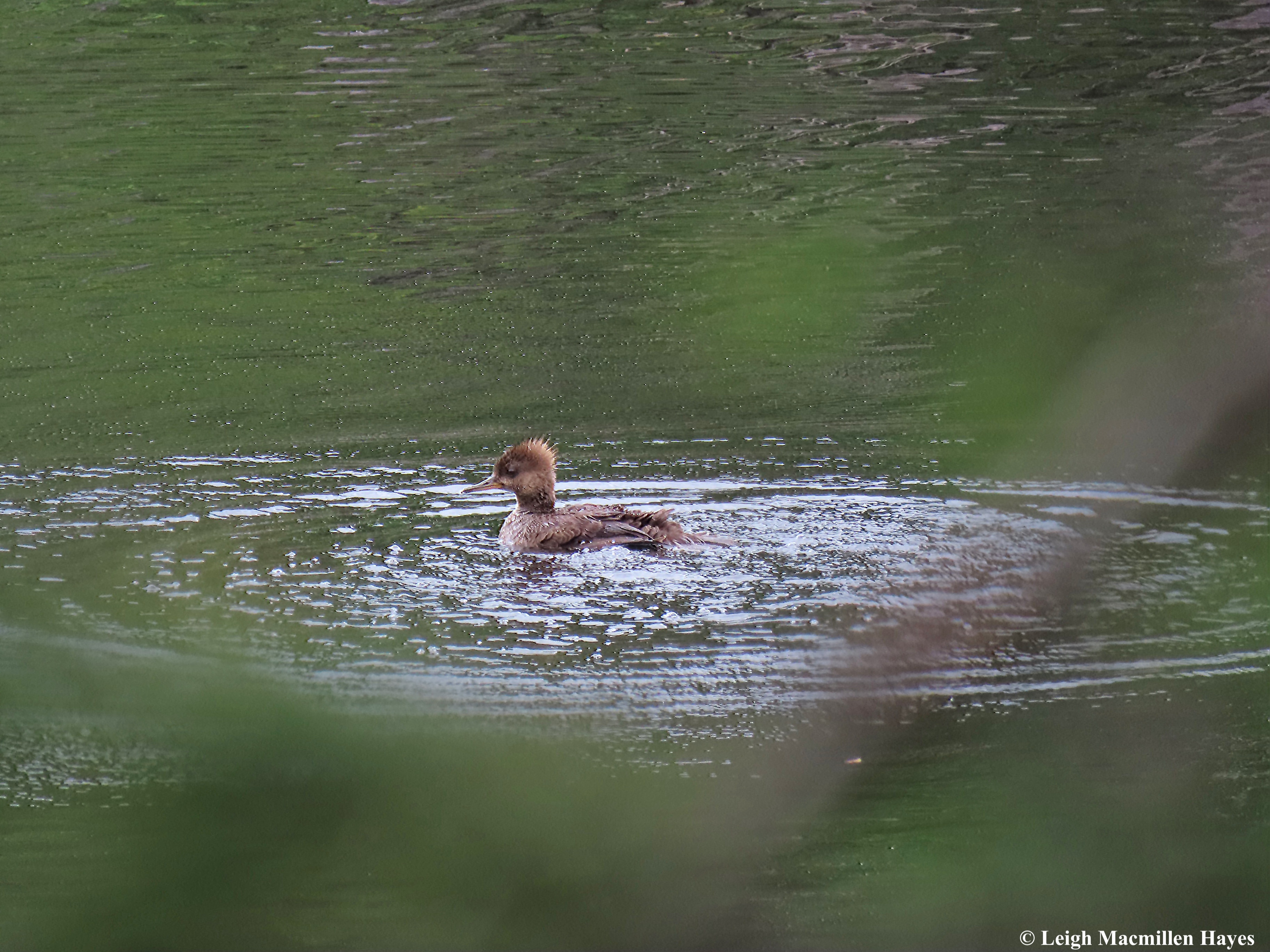
Being beside water in another place, and looking between tree branches, we spied a Common Merganser taking a bath.

We stood just far enough back, that it didn’t realize it had an audience as it splished and splashed.

And finally shook itself off, with water spraying everywhere, before it continued on its journey . . . and we did the same.

Basking Painted Turtles became a common sight as well, and this one had the cushiest place upon which to recline, all others being on fallen logs or rocks and boulders in the water.

One, however, that I assume was a female, though I didn’t want to disturb it and get any closer to check the length of its nails, I surmised had been laying eggs or was about to. Our time together was limited so I don’t have the entire story, but she was in a safe place, no matter what.

One of our most unusual sightings as we performed the ritual was spying a Bald Eagle steal a fish from the grip of an Osprey. If you look closely at the center of the photo, you might spot the thief on its get-away mission–it is flying above the picnic tables, about in the middle of the trees.

As it flew over our heads, the Eagle had the audacity to look back to see if the Osprey was hot on its tail. It was. We don’t know how this story ended either, but we assume the Osprey had to cast its fishing line again.

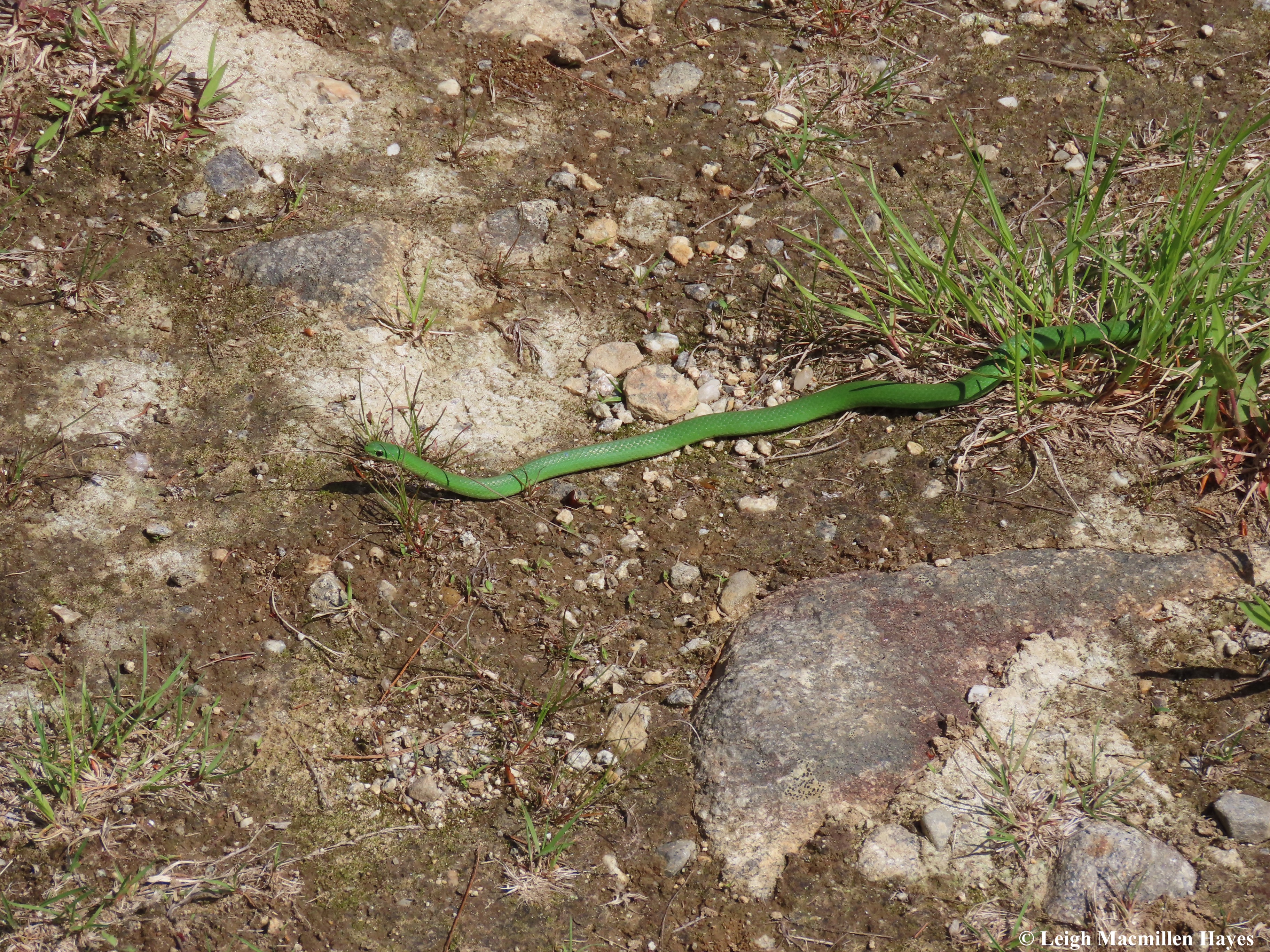
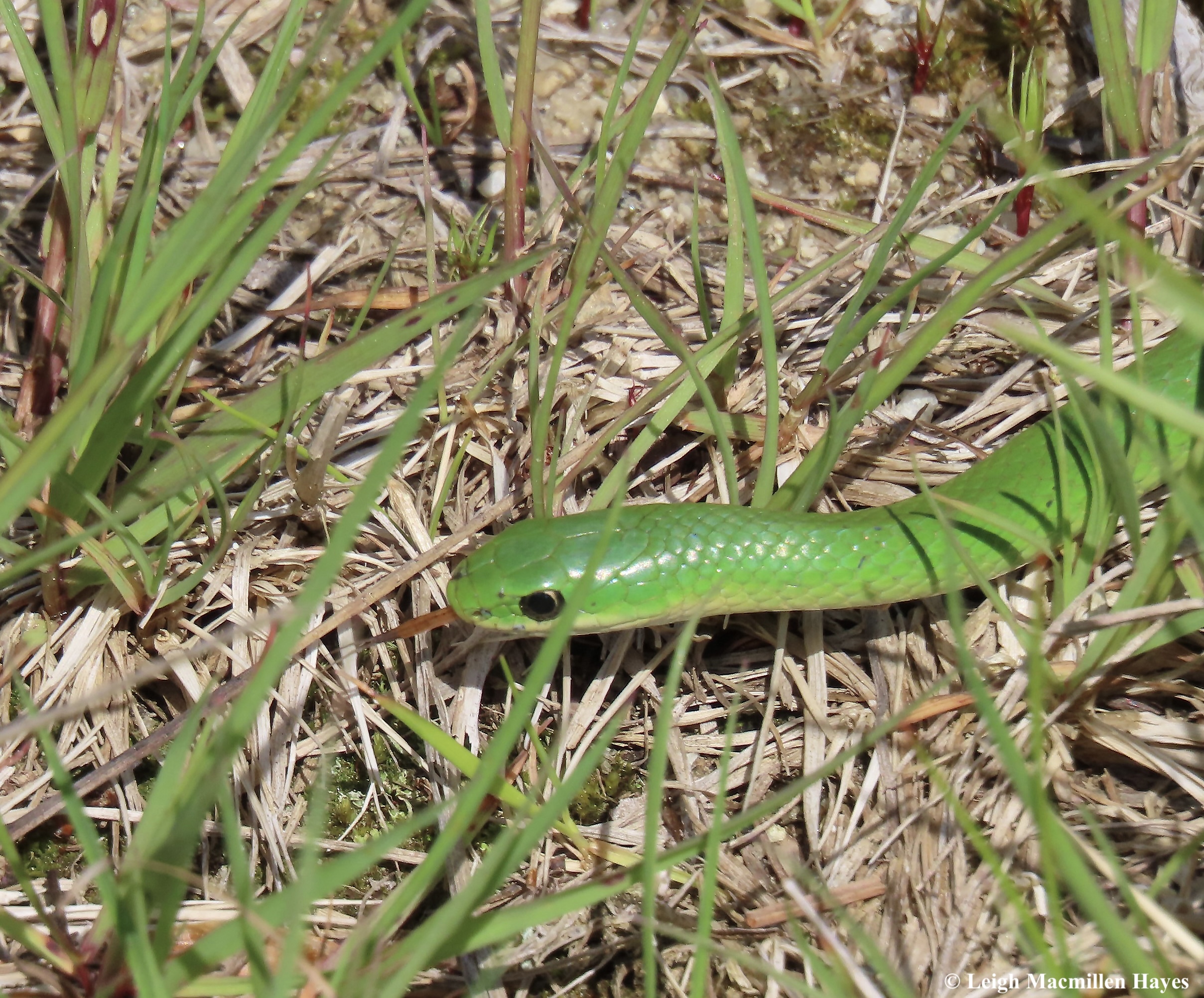
Another fun sighting occurred as we crossed under a powerline on the return trip of a seven mile hike around a river, over to a pond, up a hill behind the pond, and back down and out. Almost the color of the grass that sparsely grew along this section of the trail, a green snake slithered across just after My Guy had stepped that way.

I just love its forked tongue–sensing the trail in snake manner as it did.

The two tines at the tip of the tongue, seen here as it withdrew this sensory organ, help it to smell in stereo and thus find its way and find a meal.

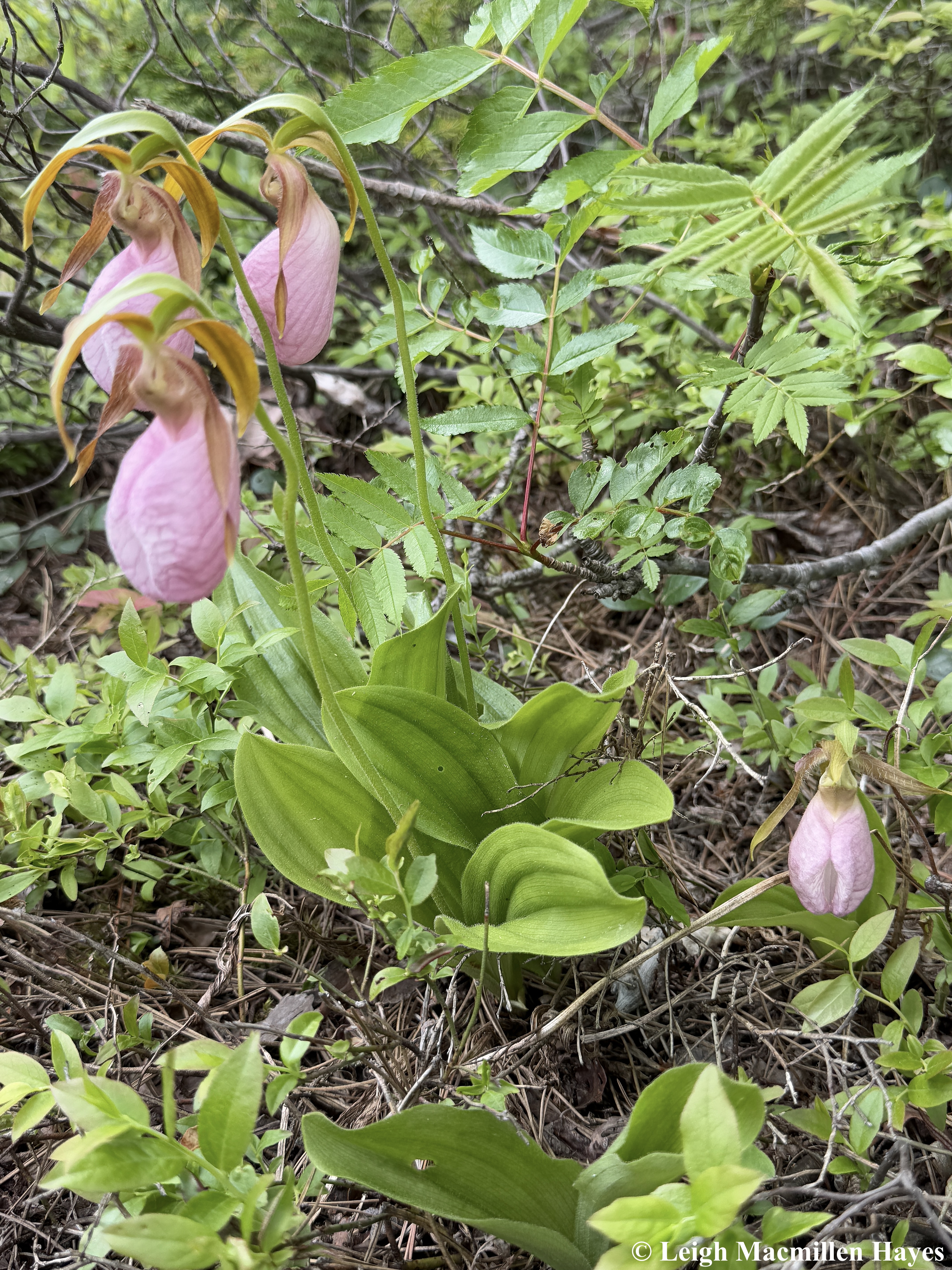
All of these things we saw because of the ritual that we perform every year at this time. It’s one that we now realize involves some greed, but still we feel compelled to do it. We count Lady’s Slippers.

I always thought that orchids were something you received on Prom night and that they grew at the florist. I had no idea that they were actually wildflowers until about thirty years ago. According to Orchids of New England and New York by Tom Nelson & Eric Lamont, Lady’s Slippers are one of 65 species and variants found in our region.

And so they deserved to be counted.

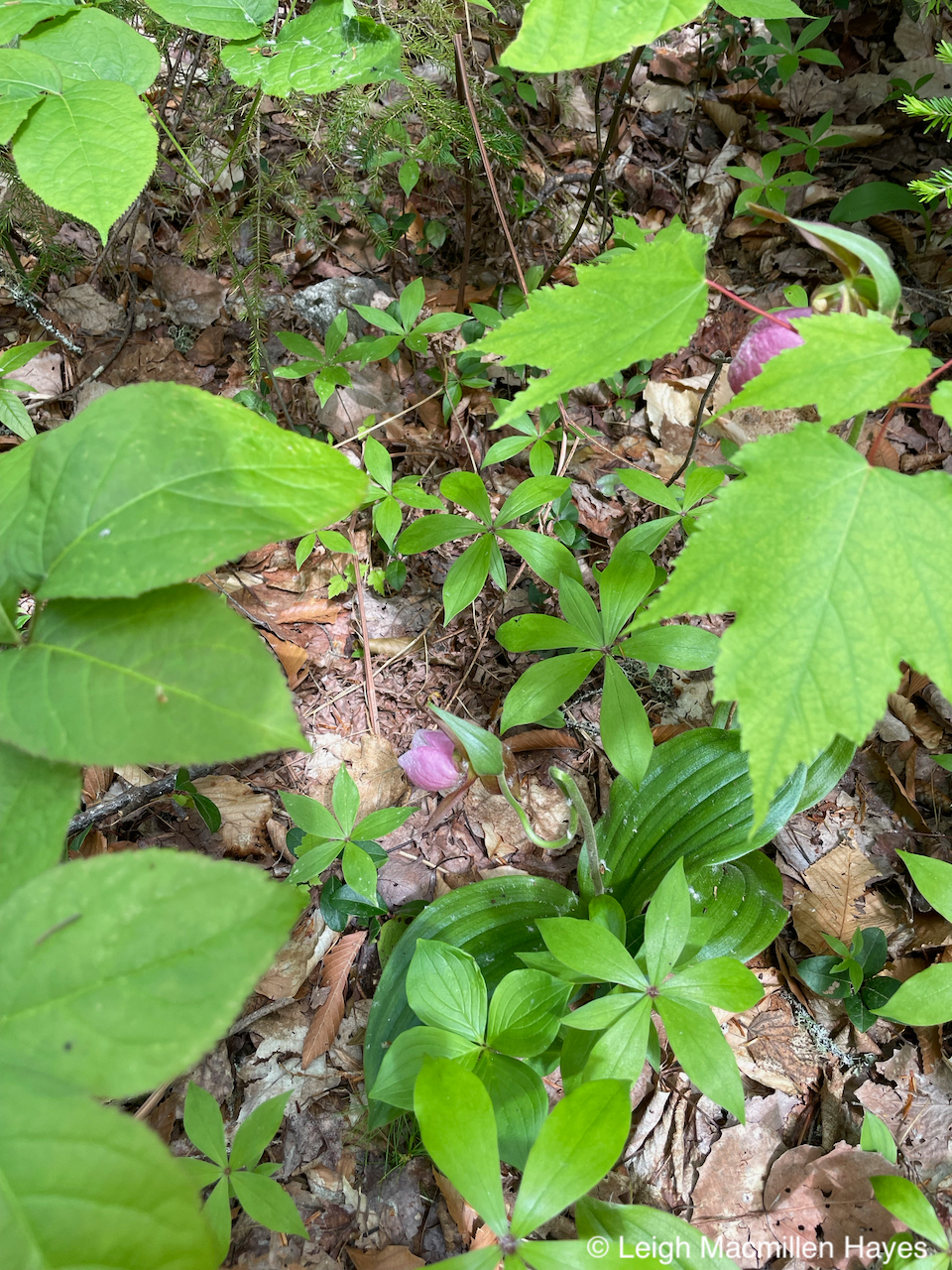
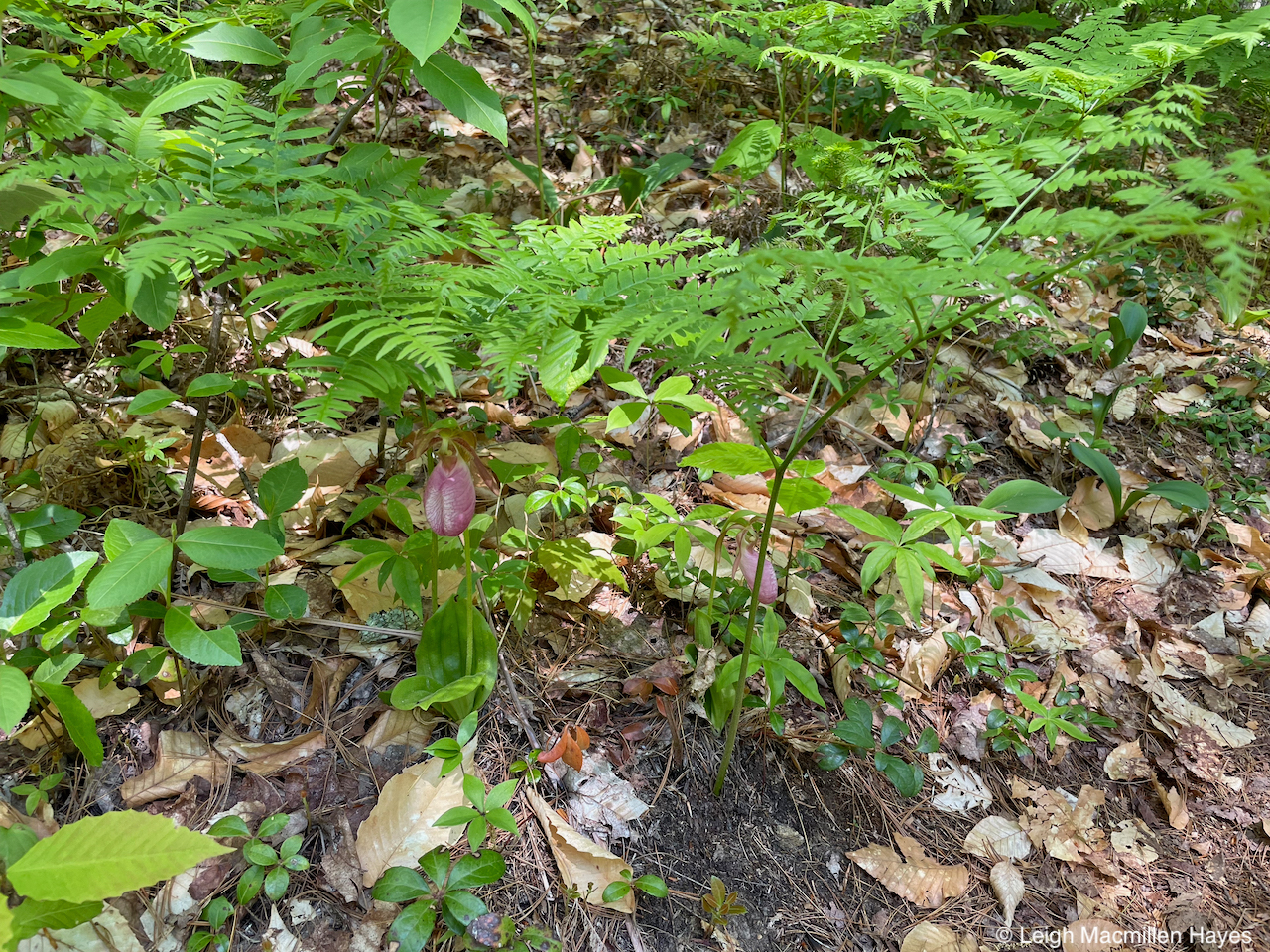
But, oh, how they hide. Do you see the one in the photograph above?

How about now?

Knowing that they can be elusive causes My Guy to slow down for a change. It’s no longer the destination that counts, but rather the number of Pink (and their white variants) flowers that we can spot.

Some are tall, and others quite small. And some are sets of leaves with no flowers yet as in the foreground. We don’t count those.

Here’s the thing about Lady’s Slippers. It takes a long time for a minuscule seed to become a plant. The seeds, developed in capsules, are beyond numerous, but each one has no food source or endosperm. So . . . it must develop a relationship with a Rhizoctonia fungus in the soil to survive. From the fungus the plant gets nutrients for germination and growth. The fungus, in turn, receives nutrients from the orchid’s roots.

BUT . . . all of this takes time. And the presence of the fungus.

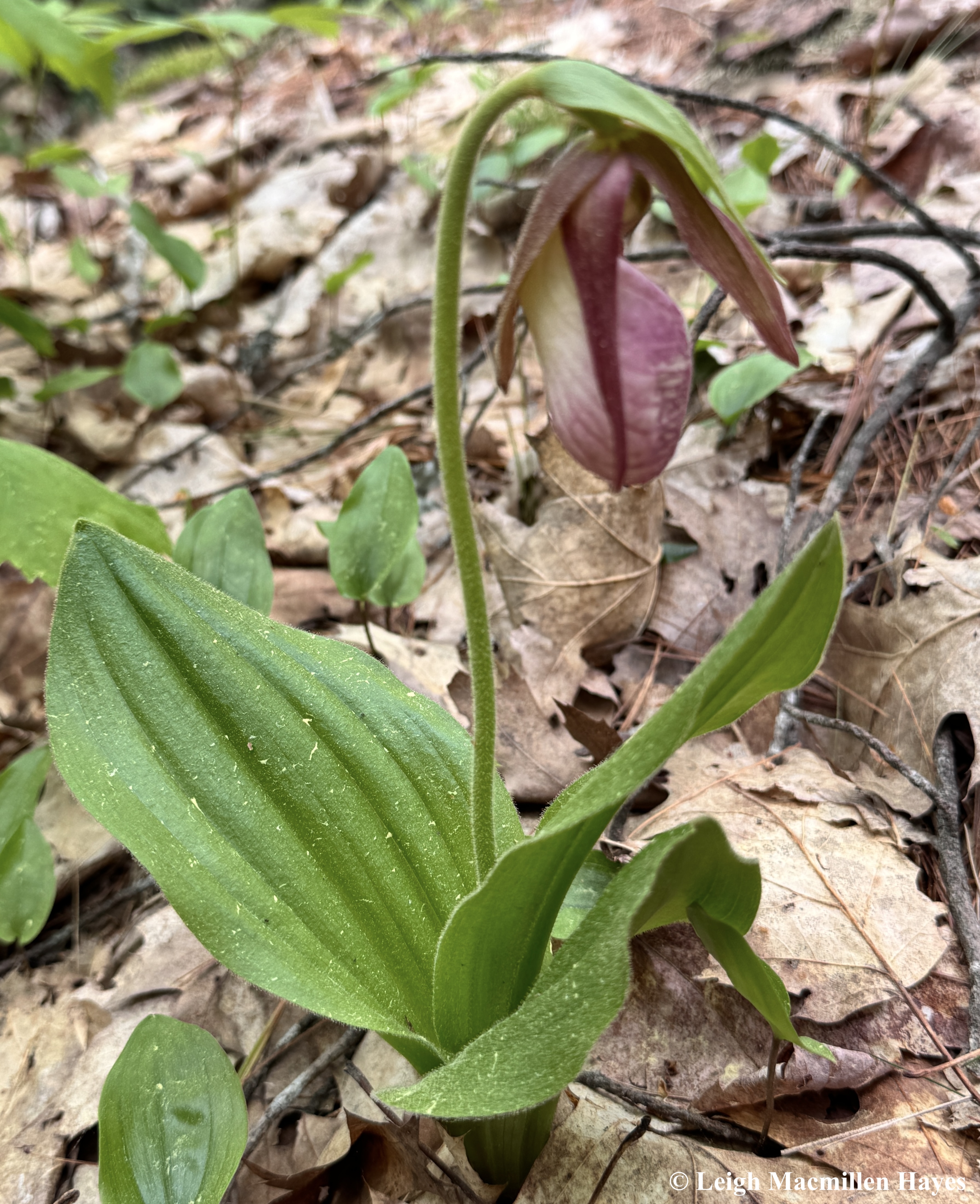
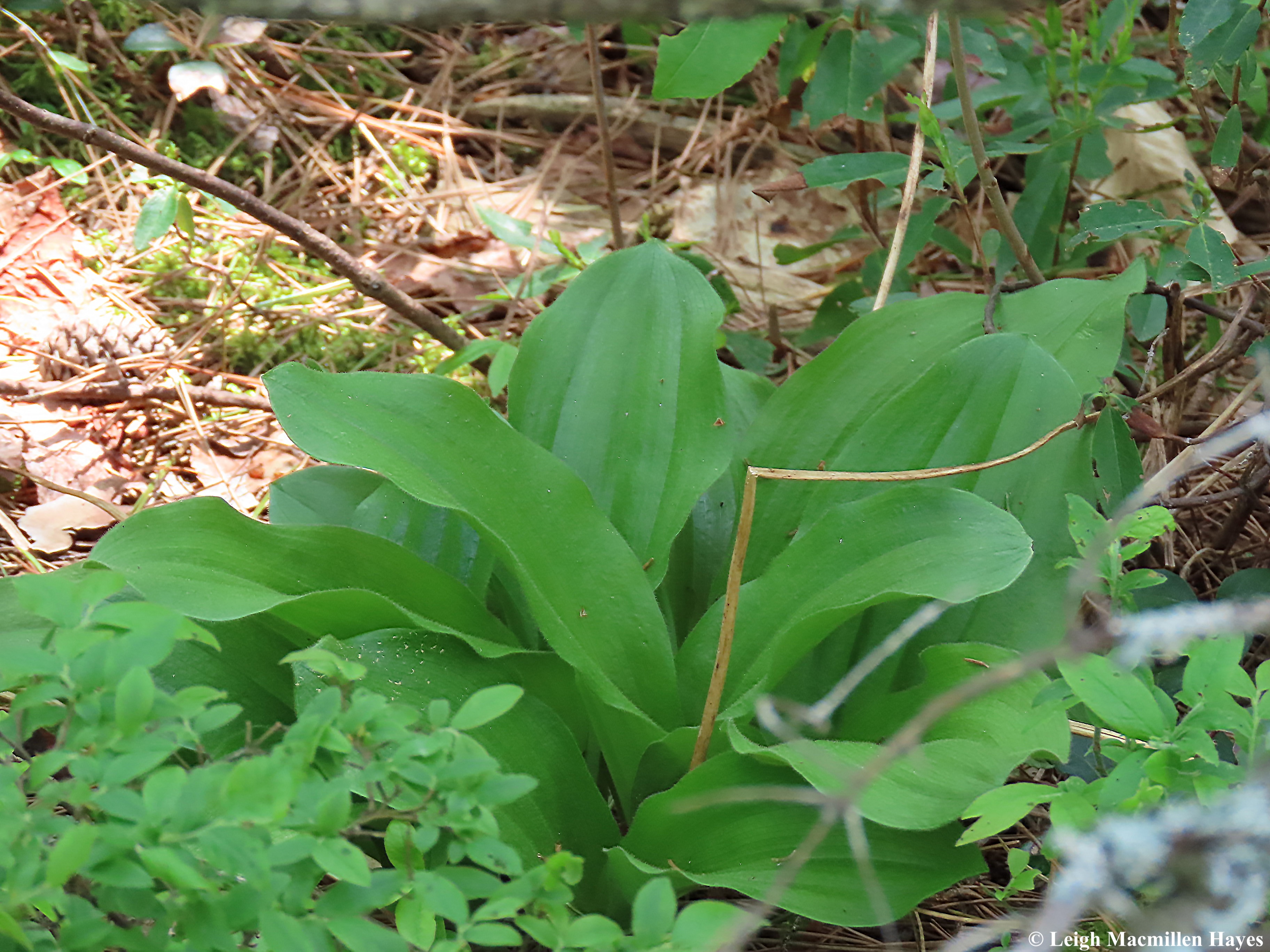
Years. First, after at least three years the plant produces a pair of two basal leaves that fold like accordions and remind me of the paper fans we used to make as kids.

One author says it’s another 5 – 10 years before the plant produces a flower; another states 10 – 17. Either way, by the time you spot one, it’s been working for a long time to become a thing of beauty. (And should not be picked or transplanted.)

We found one that stymied us for it appeared to have three basal leaves. I can only wonder if there was a second plant there and something happened to its other leaf.

In one spot, we found what we call a bouquet. Sometimes we see three or four grouped together, but in this case 14 plants in bloom.

And in another spot where we expected the same, nada. What happened. My Guy was disappointed because this is his favorite and he loves to show it off to anyone who happens to be hiking that way.

We have a theory, though we don’t have scientific knowledge to back it up. But here goes. Last summer, our count was quite high. The previous spring and summer it had rained. A. Lot.

Last year, we experienced a drought. This year fewer flowers in most places that we hiked in the last few weeks. Perhaps less of the fungus?

And sometimes the flowers are spotted growing in a bit of a line, making us think perhaps there is a rotting nurse log beneath the soil. As for soil and habitat, acidic seems to be the favorite and we often find them among Low-bush Blueberries and towering over Reindeer Lichen.

And then there’s pollination: Lady’s-slipper pollination is a curious thing. Bees are lured in by the guide lines to a slit in the front petal, the slipper-like pouch, or flower’s labellum. Once inside, the bee cannot exit the way it entered because the petal structure turns inward.

The exit is at the top of the slipper, but to reach it, the bee must move through a hairy interior and rub against the flower’s stigma, depositing any pollen it may have carried in and brushing against the pollen mass called the pollenia before flying out. It strikes me as being like a house of mirrors. And all I want to do is quickly find my way out.

Some bees get frustrated with the dilemma of discovering there is no nectar and the task of finding the exit and instead chew their way out, which seems to be what happened to this flower.

It looks like the bee frantically tried to escape this one.

I tried to honor them with a painting, but our best way is by counting each and every one. I’m going to share last year’s numbers and this years. Also, this year, we counted along a bunch of other trails than just the Big Three as My Guy refers to the first three for which I have been keeping records since 2000.

Wolfe’s Neck State Park: 2024: 475; 2025: 159

Albany Mountain: 2024: 364; 2025: 411

Sanborn River and Overset Mountain: 2024: 598; 2025: 526

Grand Total of the Big Three: 2024: 1,437; 2025: 1096

Plus these trails all from this year only:

Mount Tom: 25 (but we were there on May 18, and this was the kick-off event that got us going this year; more may have bloomed since then. Actually, after spotting the first one, My Guy wasn’t sure he wanted to count this year, but let me tell you, he still has the greed!)

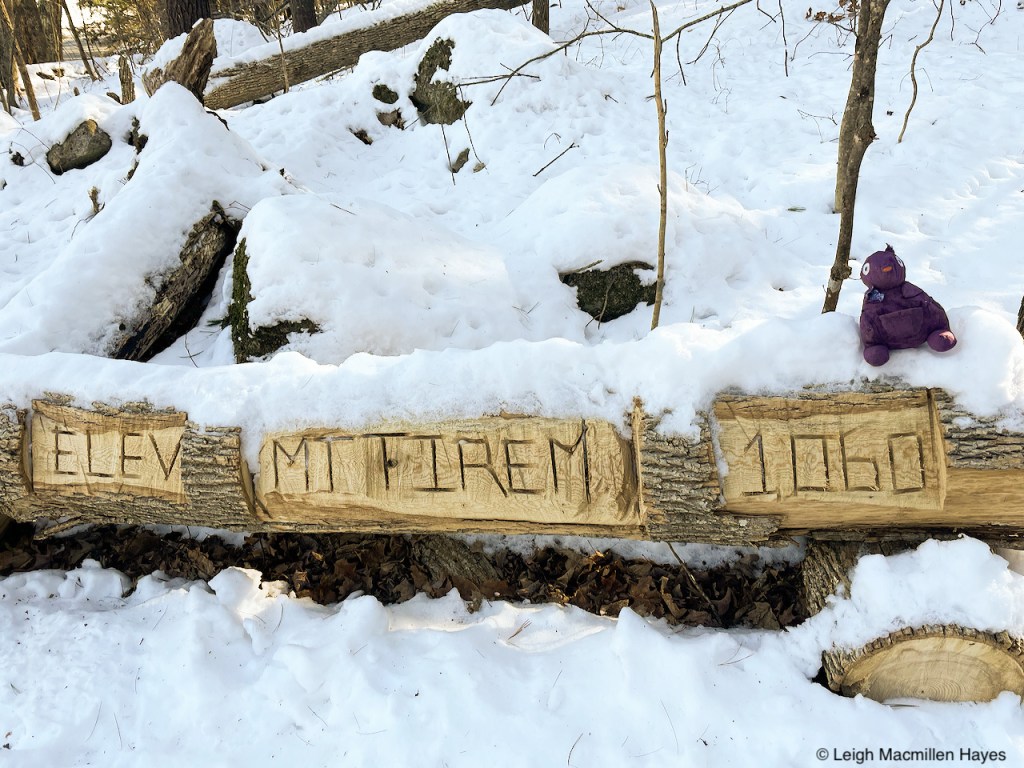
Mount Tire’m: 31

Proctor Pond Reserve: 41

Kezar River Forest: 63

Narrow Gauge (only 1.5 mile section): 56

Sleigh Trail at Notch View Farm: 44

Home woods: 2

Grand total of all trails: May 18 – June 6: 1,358

Even with the extra trails, the count was down.

But still . . .

Where the Moccasins (Lady’s Slippers) Led Us–up and down many a path with so many wonder-filled moments and sighting along the way. Counting Lady’s Slippers is a ritual that we love to share together and with others.

Trackers Become Students Again

The car in front of us pulled just off the road and then we saw a hand reach out the window and beckon us to drive forward. And so we did. And rolled down the passenger side window. We thought something was wrong.

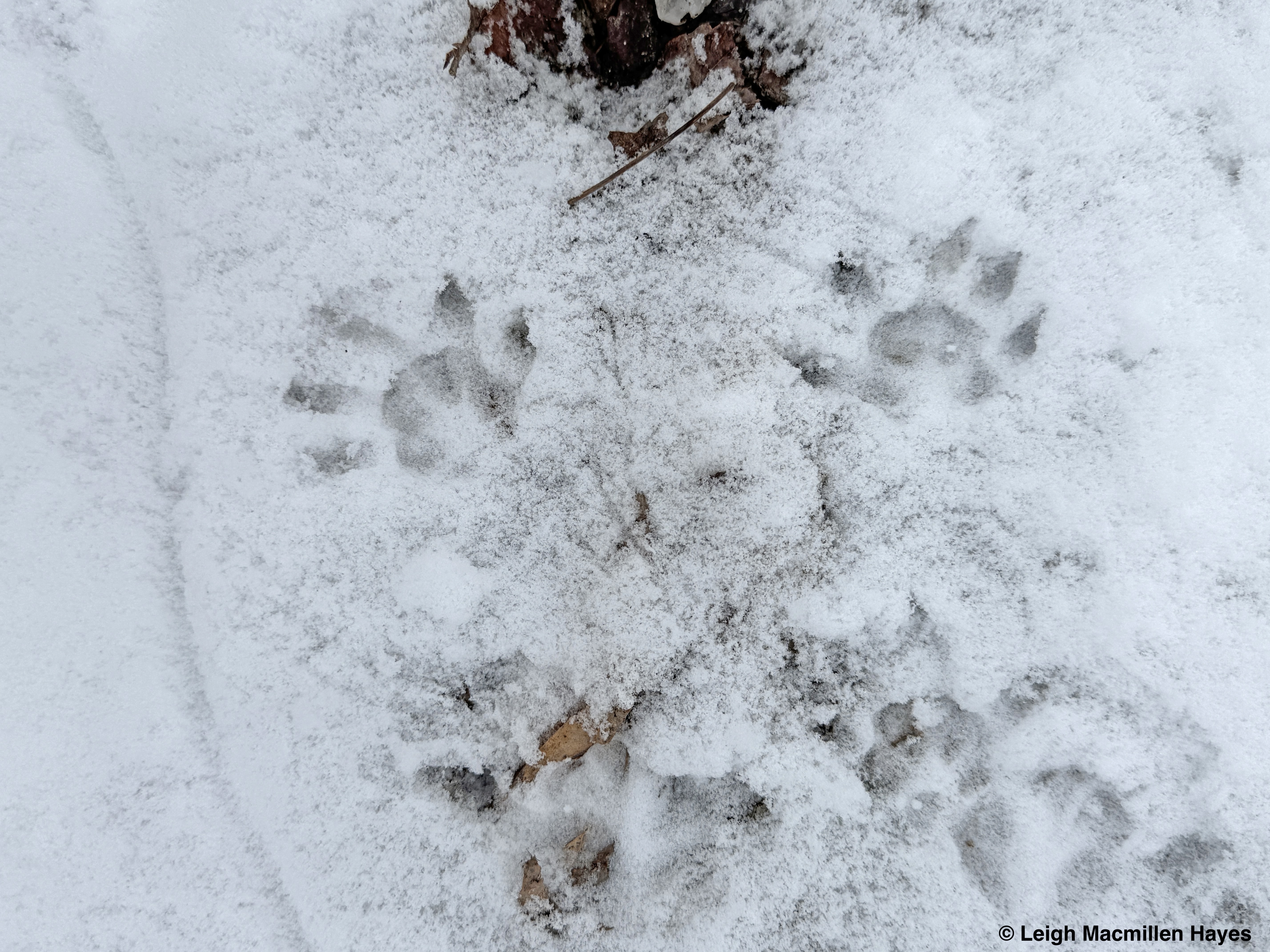
Instead, we learned everything was incredibly right. For on the road between the two vehicles was a mammal track. Our driver pulled over to the side of the road and seven of us quickly emerged from the two cars.

In the dusting of snow that had fallen before we met in China, Maine, on Tuesday morning, the prints were almost perfect. Not quite because they’d been created a wee bit before the storm ended and/or wind had filled them in a tad. Close enough to perfect though that we could easily read them.

And we knew we were in the right place with the right guide, because who else would stop in the road to begin our tracking lesson? We were six Maine Master Naturalists and our guide: Professional Tracker and Naturalist Dan Gardoqui of Lead with Nature.

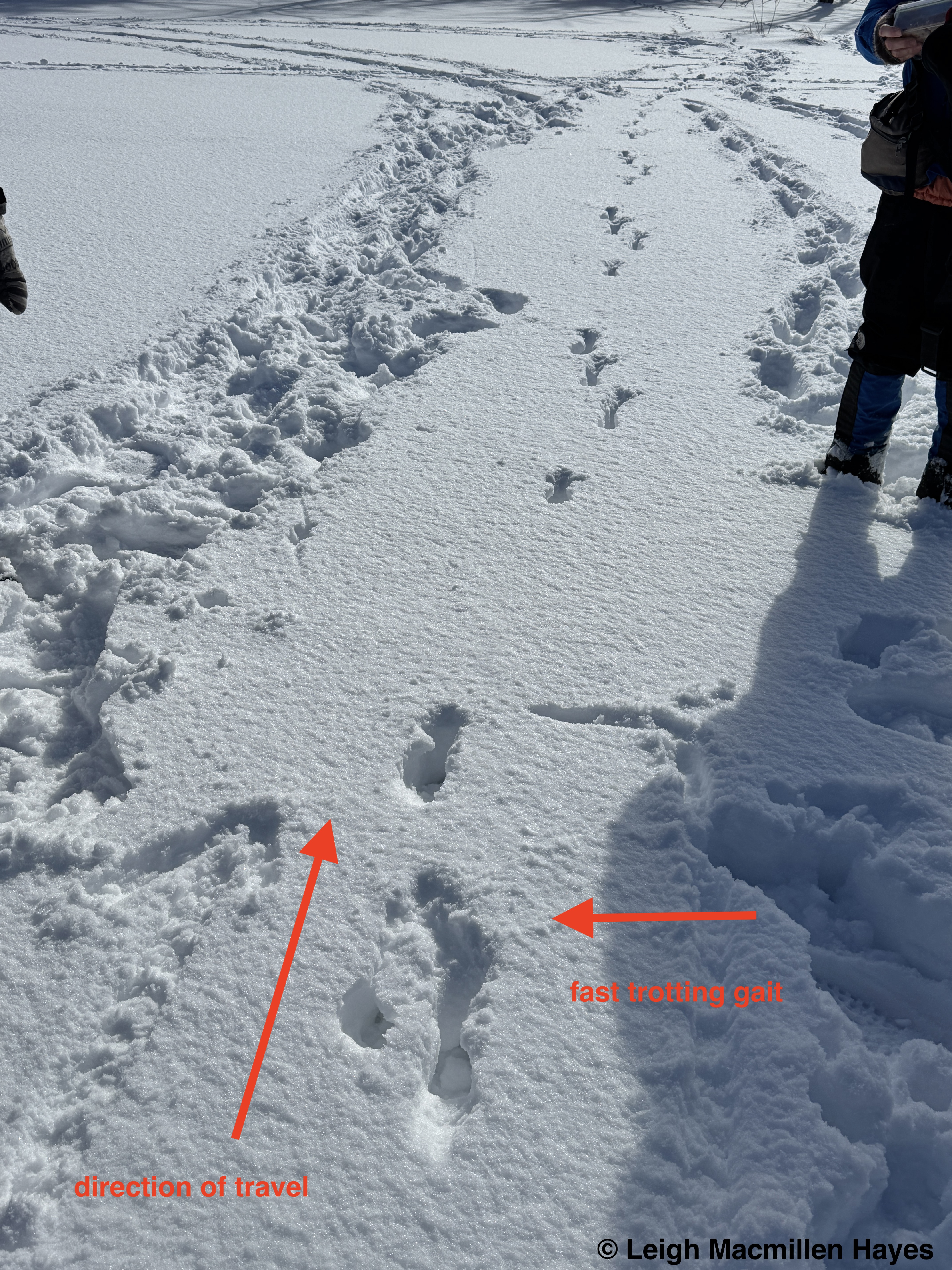
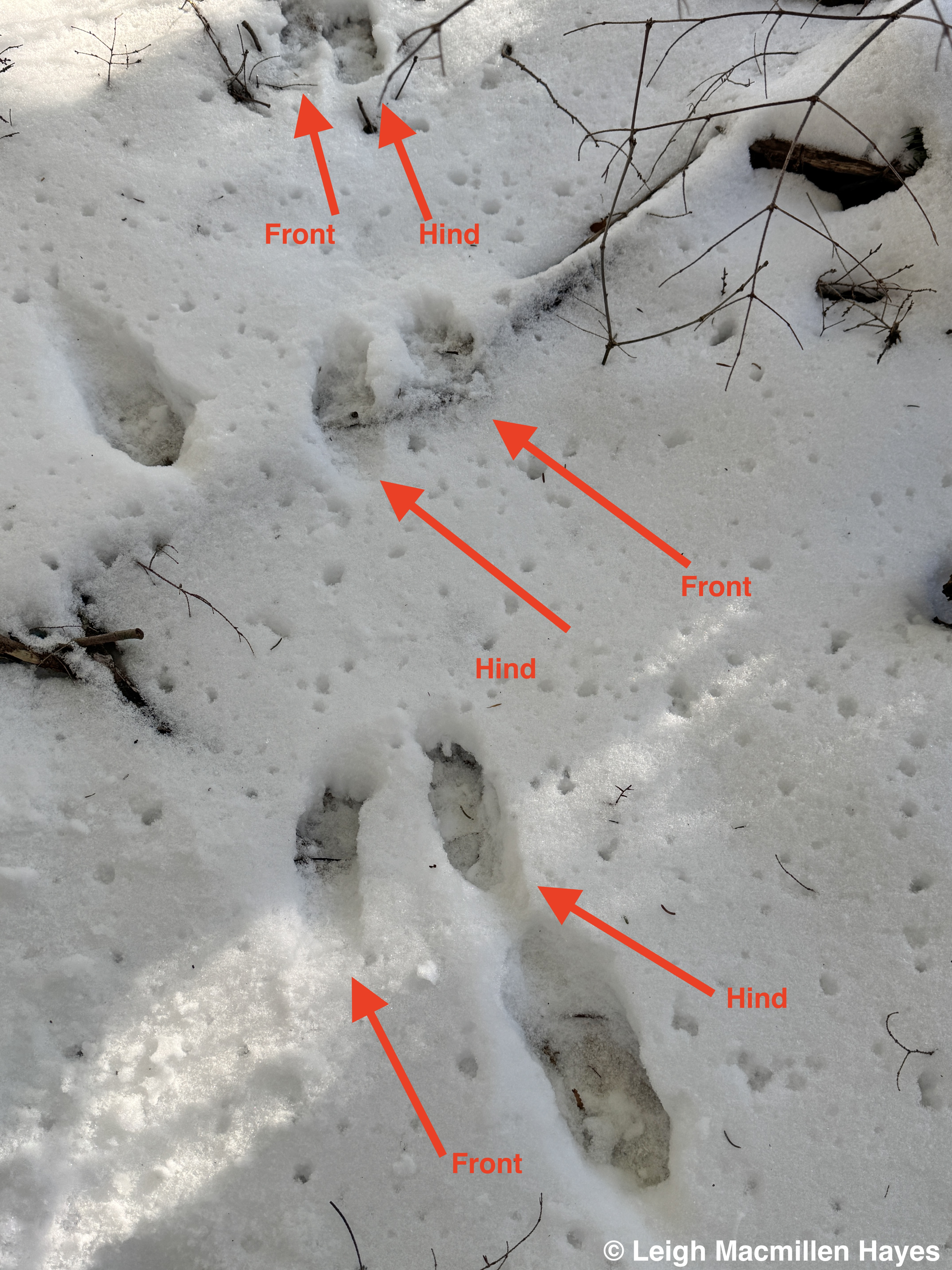
We could easily look at the tracks and prints from the three perspectives of flying (what was the setting?), standing (how was the animal moving?), getting down to look for details, and I think we all quickly surmised the creator was in the cat family, but . . . the lines in the snow indicate our brand new learning. If we started paying more attention to the trail width, we could determine whether the animal or in this case, more than one animal, was walking or trotting. It’s one of those things I think my brain processes without giving it much thought most of the time, unless I’m actually backtracking and pulling more of the story together, but the two gaits side by side and Dan’s lines outlining the differences, gave it a whole new perspective.

Back into the cars we piled and continued down the road.

About ten feet.

And then we pulled over again.

Another set of tracks, much more unique than the first set. With a tail mark between them.

The opposable thumb helped us ID these as belonging to a Virginia Opossum. Just look at those toes and nails. It’s been a few years since I’ve spotted Opossum tracks in our woods, and they are always so fun to locate.

The thing was, there were multiple Possum tracks, and we soon learned when the neighbor came out to see what we were doing (a bunch of weirdos crouching over snow in the middle of the road should cause concern?) that they were well feed. One lived under a shed or something by his house, but the others came nightly because he feeds them.

My big take away: I knew that the deeper grooved line was created by the prehensile tail as it dragged behind the Opossum, (which would be a tail-slap in deep snow, and not quite as prominent), but I’ve never noticed the lighter drag lines on either side of the tail. Dan explained that those are nail drags.

At last we reached our intended destination of Thurston Park, a 400-acre forest on the edge of town.

Almost immediately, well, after noting the routes and patterns of mice and voles, everyone’s favorite meals, we came upon the track of a predator who placed a hind foot exactly where a front foot had been before moving forward. Again, we looked at the setting, pattern, and other hints like the X between the toe pads and metacarpal pad, plus the gait, and without following it out too much to search for other clues, surmised that despite the not-so-clear prints, we had found the track of a Red Fox.

And then he showed us another cool thing that I need to remember to employ–imagine and actually draw the legs and then the body of the animal and you have a sense of size. Most of the time. It helps to add the head and tail like he did.

A bit later, we stepped out into a wetland and headed to a spot where Dan had seen Otter activity last Friday on a pre-hike, before the storms of the last few days. Most of that action was obliterated or almost undecipherable, but we spotted something else in the middle of the ice that we really wanted to examine.

Not a pretty site, but a kill site never is. That being said, Dan did not see any of this on Friday, and by the fact that there was a game camera overlooking the scene, and there were bones from several animals, and one carcass looked a bit folded up, we surmised it had been placed here either to attract predators for the sake of hunting them, or to watch what predators came in to feast. It was the thought of the latter that appealed to most of us. So we looked around for signs of dinner guests and found mostly Raven tracks.

Farther out on the snow-covered ice, we discovered that deer had crossed multiple times. One of those crossings provided another interpretive lesson. We could tell the direction of travel by the way the cloven hooves faced, and would see the changes in the gait, but what Dan helped us to understand better was the fast trotting gait and then the slow down (almost like it put the brakes on) to a walking gait. And then a change of pace again. We had to wonder what may have spooked the White-tailed Deer, causing it to speed up and then slow down.

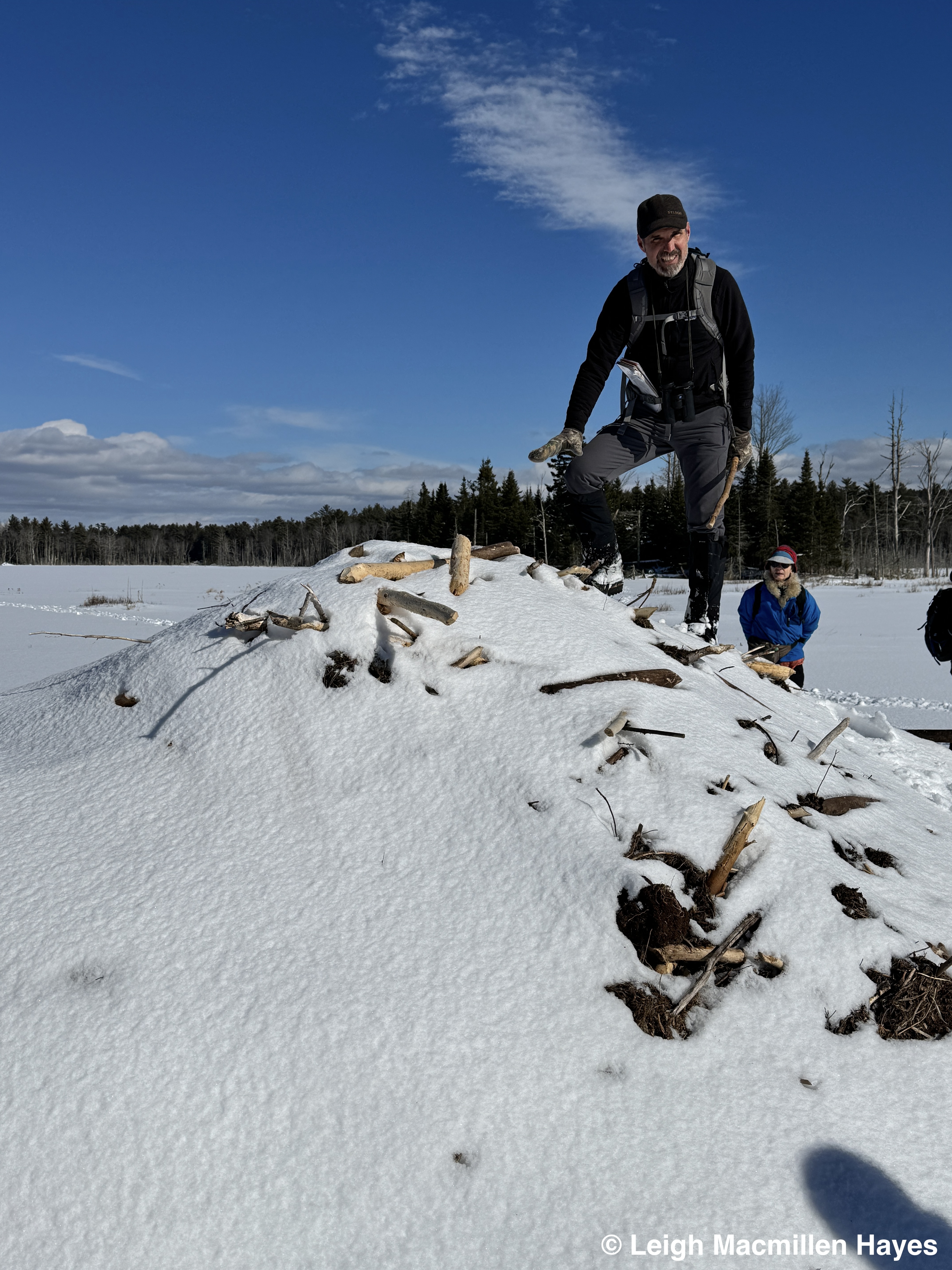
Our next stop, after exploring an island for a bit, was to check out one of several beaver lodges. The sticks were rather on the fresh side and it had been mudded this past fall.

Were the beavers home and wondering who the heck was knocking on the roof?

Possibly, but given that it was another brisk day in Maine, I expected to see hoar frost at the steam hole and am not convinced there was any. I could be mistaken.

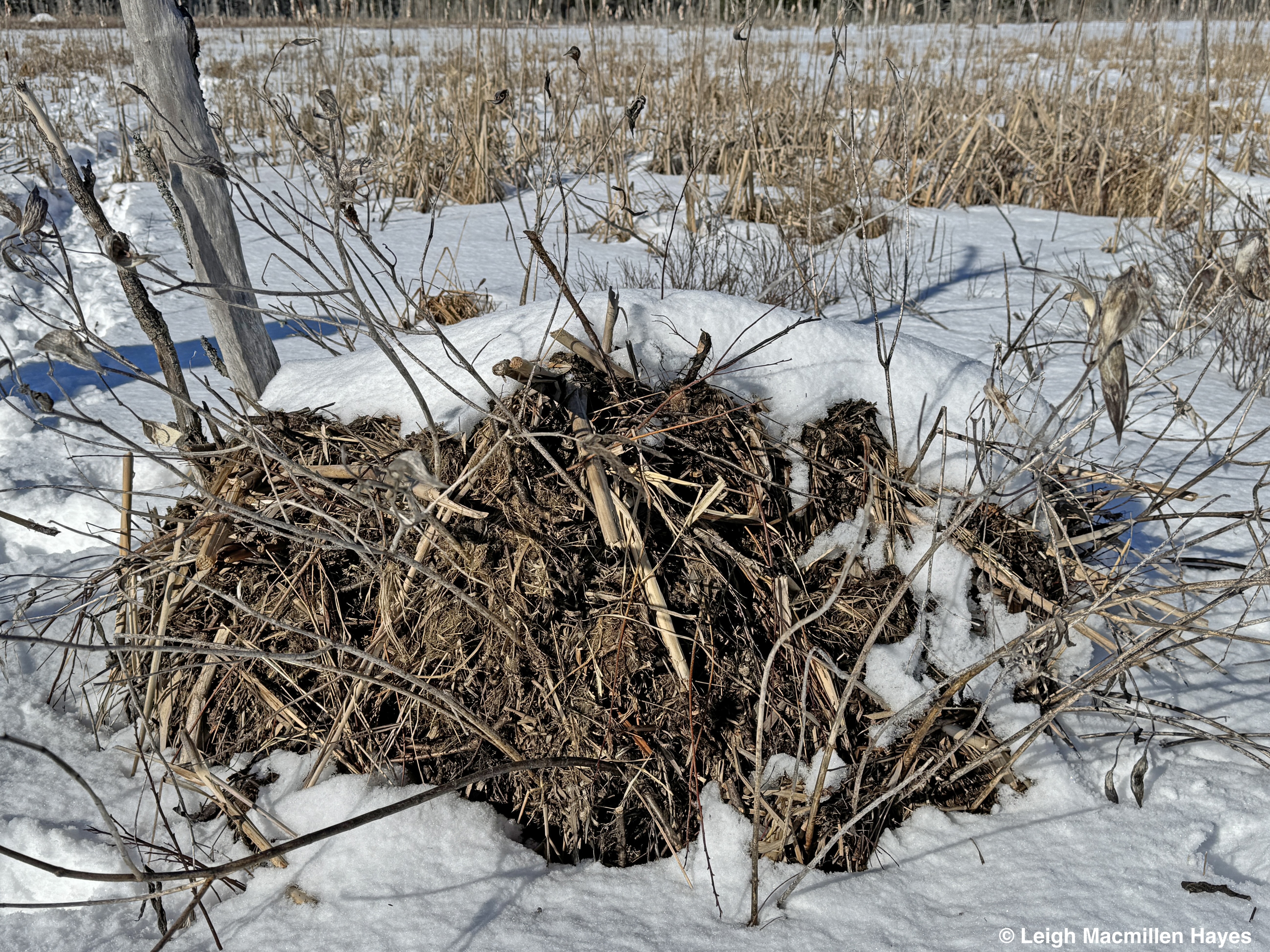
The next find as we headed off the ice and back toward the woods was a lodge of another critter. I may have seen one of these twenty plus years ago at Brownfield Bog, but have failed to identify any since then so was grateful for this lesson.

Meet the home of a Muskrat. Anyone home? Again, we couldn’t be sure. But it was the ability to look at the structure and gain a better understanding of its construction that I so appreciated. Rather than a home of sticks like the Beaver lodge, these are made of vegetation, including the cattails that were abundant in the wetland.

We took a look at the 45˚ cut of the cattail stalk, given a Muskrat is a rodent.

Back on land, we found a sunny spot protected by trees and took a lunch break out of the wind, during which we learned more about Dan’s career as a naturalist and shared with him about our Master Naturalist training and volunteering.

And then we continued, noting abundant snowshoe hare tracks. What we wanted to see were signs of them eating, which we finally found upon some Beaked Hazelnut branches. Again, it was the 45˚ angle cut.

While looking at that, something else caught our attention: Glue Crust Fungus (Hymenochaete corrugata), which migrates from tree to tree and glues twigs and branches together. What we couldn’t see happening is that the fungus was feeding off the decaying wood beneath its dark crust.

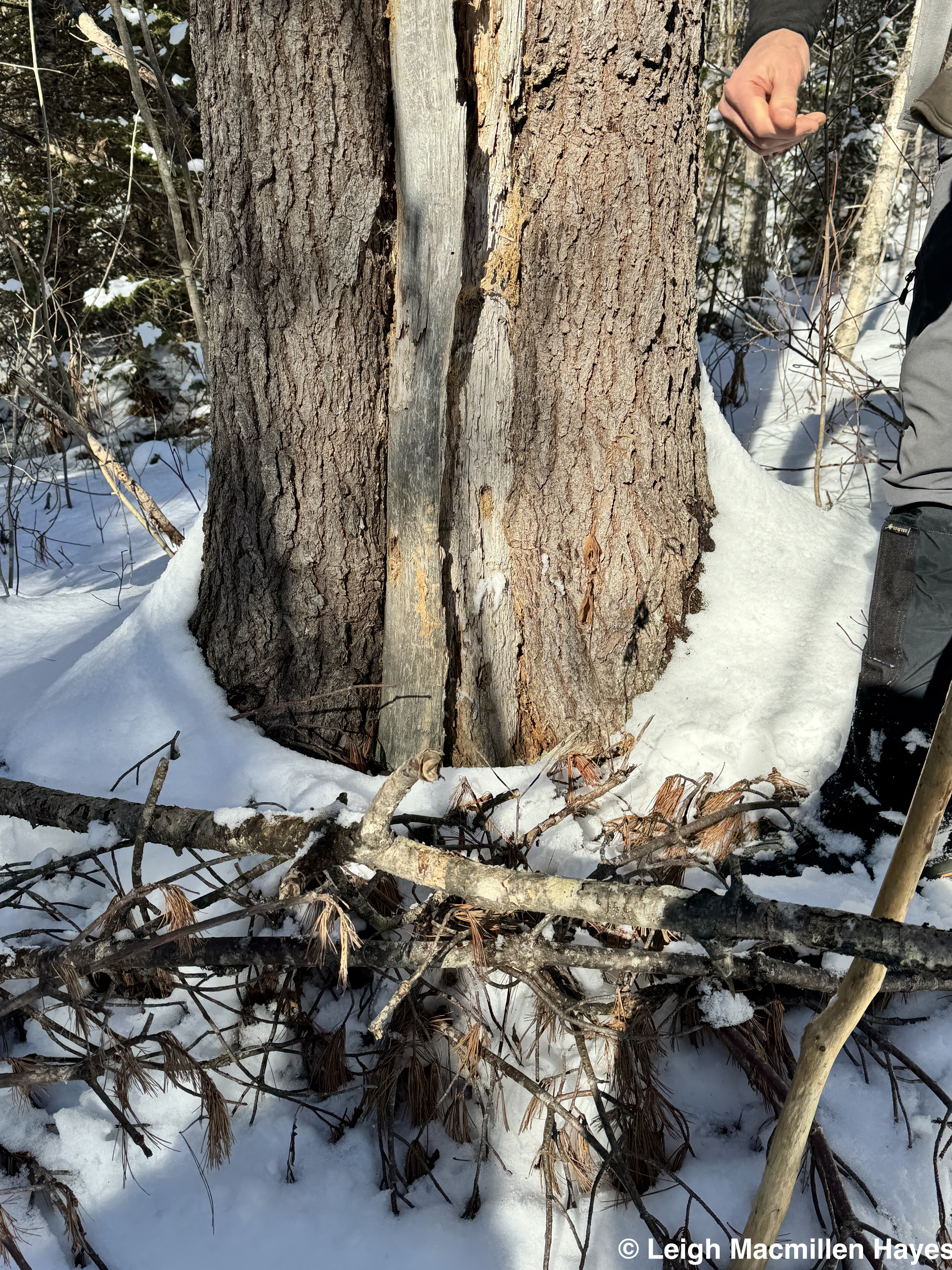
Another stop and another sign I need to start looking for at home and beyond: do you see the yellowey-orange coloration on the the tree scar?

It turns out this is the work of a Gray Squirrel. It’s called Squirrel Striping and is a scent post. Similar to how a Black Bear bites trees or telephone poles by cocking its head to the side, and rubbing against it, so does the Gray Squirrel, perhaps announcing its territory or making a statement about its health or availability. After biting, the critter rubs its check and/or deposits saliva on the area to leave a scent. And it may return to the same spot year after year to mark it.

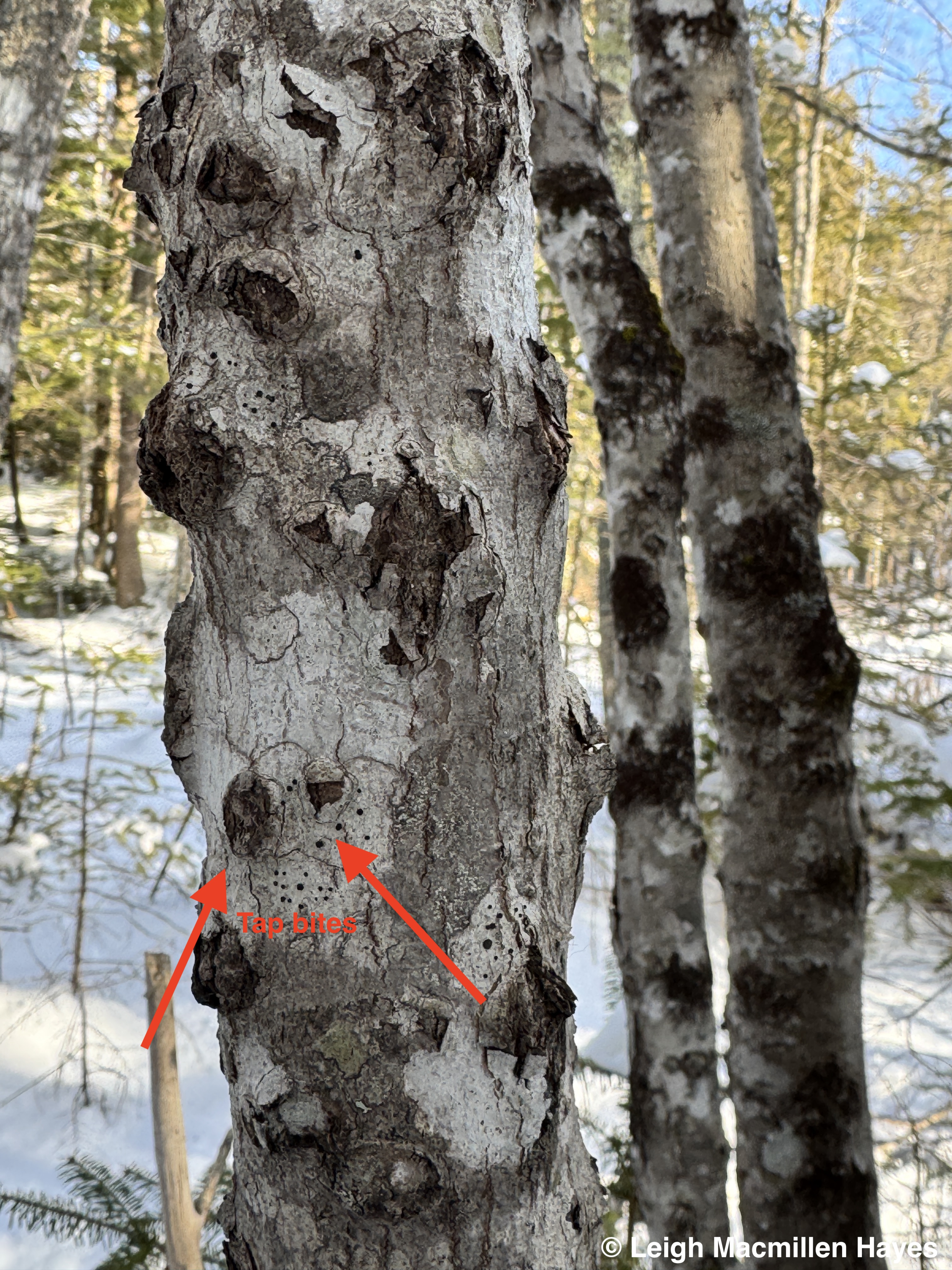
Not to be outdone, we found the tap bites of a Red Squirrel upon a Red Maple. Okay, so I never would have guessed that that was what we were looking at on the bark. Instead, I would have talked about the tree being diseased. And I would have been wrong.

These marks are old and show how the tree healed the wound. And now I must pay attention and look for fresh evidence, but what happened is the same dot and dash (Thank you to Susan Morse for teaching me that description during a two day workshop about twelve years ago) behavior as the Gray Squirrel and Black Bear. The squirrel anchored its upper incisors, creating the dot, and the dash is the cut made by the lower incisors as they were drawn toward the upper ones. Again, head cocked to the side.

After tapping a tree, apparently they don’t lick the flowing sap immediately, but rather wait until the sugar has crystalized. It’s kinda like hard candy.

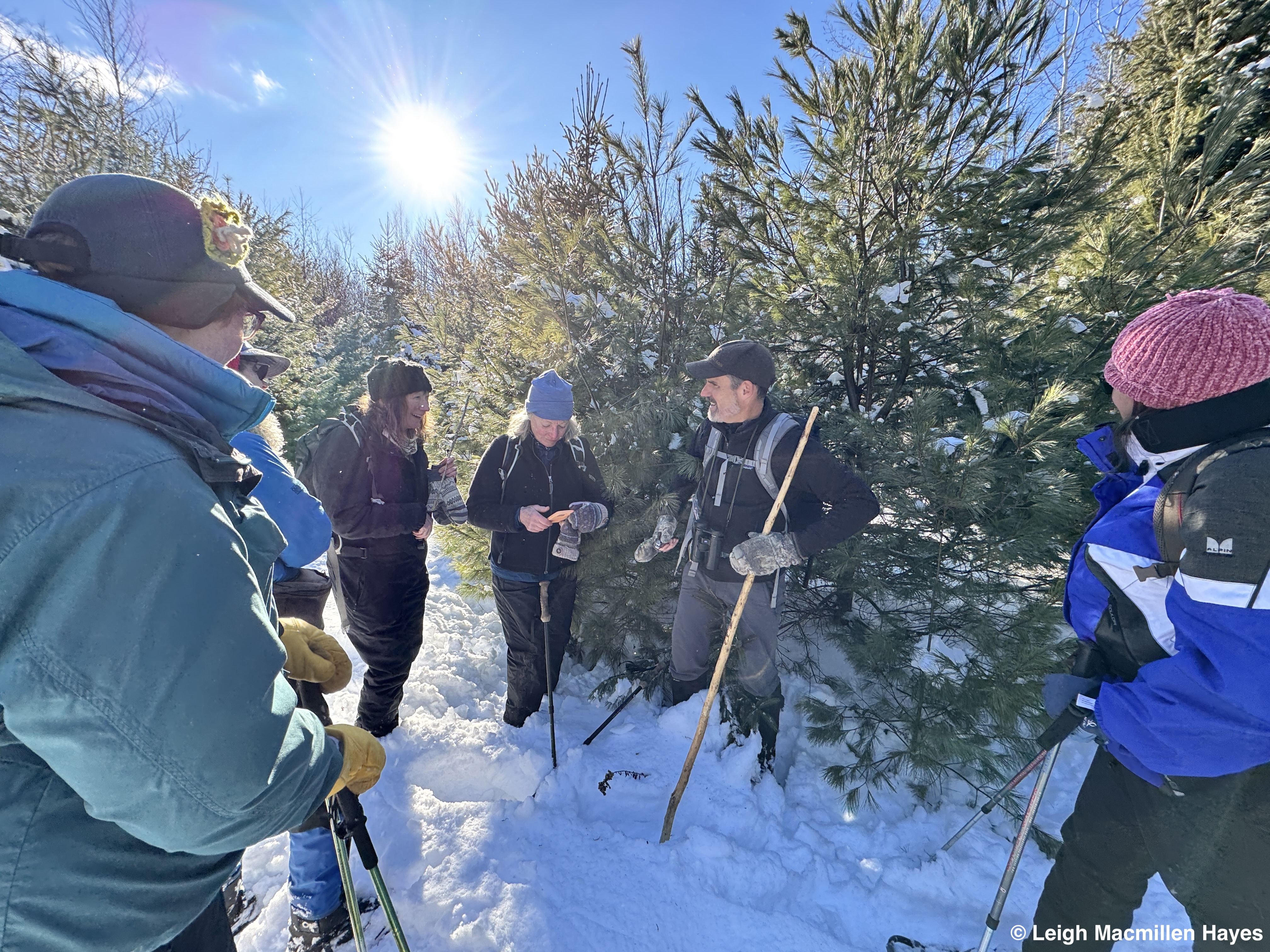
Another stop in the warm sun was by a White Pine grove, where we noted that the leader branches on some of the saplings had been attacked by weevils, and the next whorl of branches had taken over and reached for the sky.

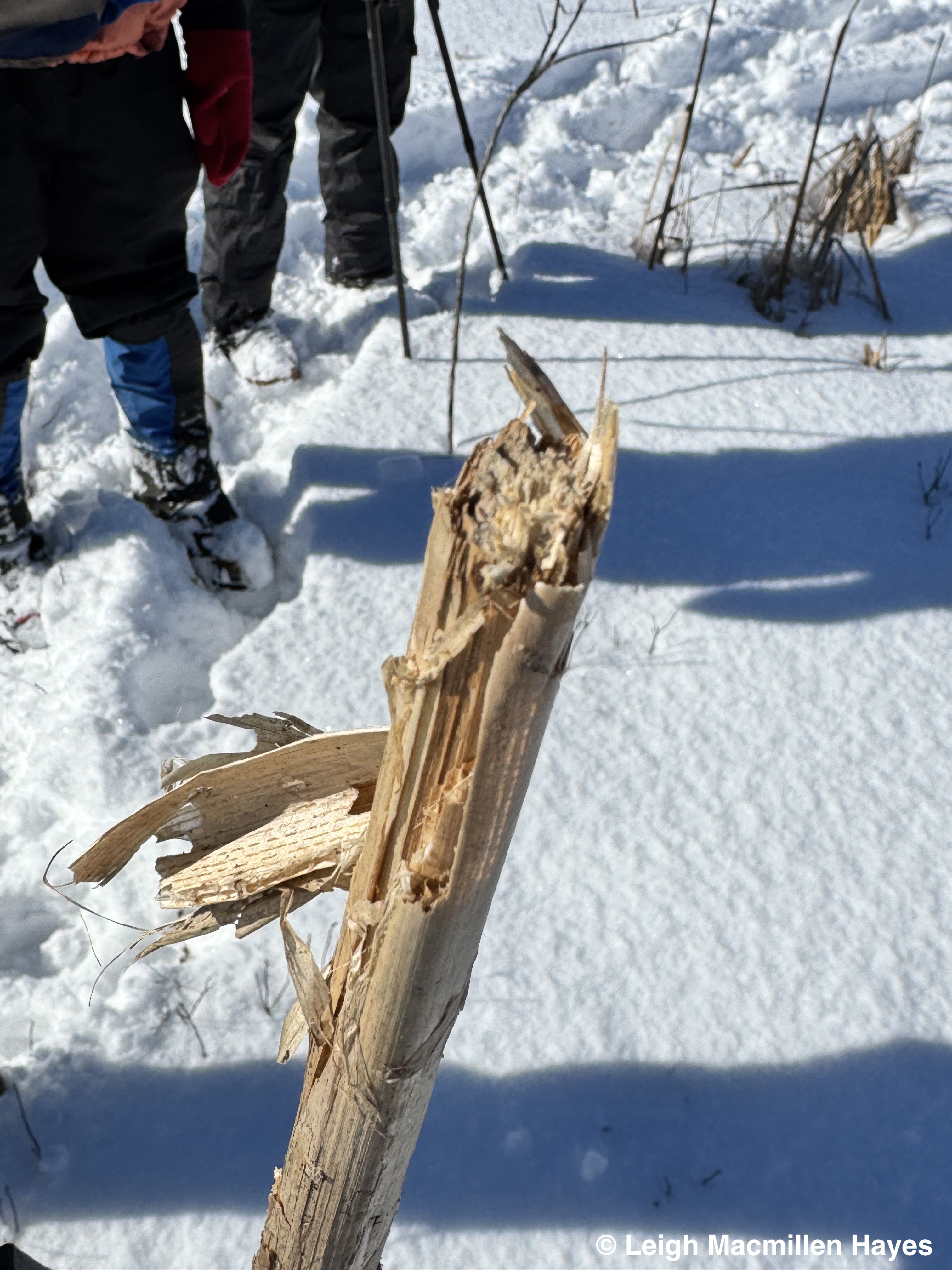
I’ve broken the dead leader off in the past, recognized by its crosier-like appearance, and had the joy of seeing the larval weevil crawl out, but never did I think to cut the branch and look for frass. Bingo! A new trick in my pocket. And maybe yours as well.

Our final finding of the day had me absolutely certain of ID and then mystified. We were again by a wet area and though the prints weren’t clear, by the placement of the two feet with one being larger than the other in the first set and the opposite in the second and looking like they were on an alternating diagonal, I was certain we’d found a Raccoon, but didn’t want to make a fast judgment.

We followed the track and I was at the end of the line, but the pattern changed and a trough occurred as the critter plowed through the snow and I was questioning Raccoon and leaning more toward Porcupine.

And then it changed again when we got under some trees where the snow wasn’t as deep and the Raccoon prints reappeared and Raccoon it was. Dan explained that in deep snow this waddler uses a more direct registration walk and that’s what we were seeing in the trough.

Thank you to Karen H, and Dorcas, for pulling this adventure together and inviting me. And thanks also to Karen, Olga, and Beth, for sharing a brain and sharing knowledge.

And thanks especially to Dan for teaching us educators innumerable lessons in the course of six plus hours.

We knew the minute we got out of the cars on the road in to Thurston Park that it was going to be an incredible day of learning. And it was, all of this being only a sampling of what we actually saw and learned. And we loved becoming students again.

My Bright Idea: Filled with Awe and Wonder

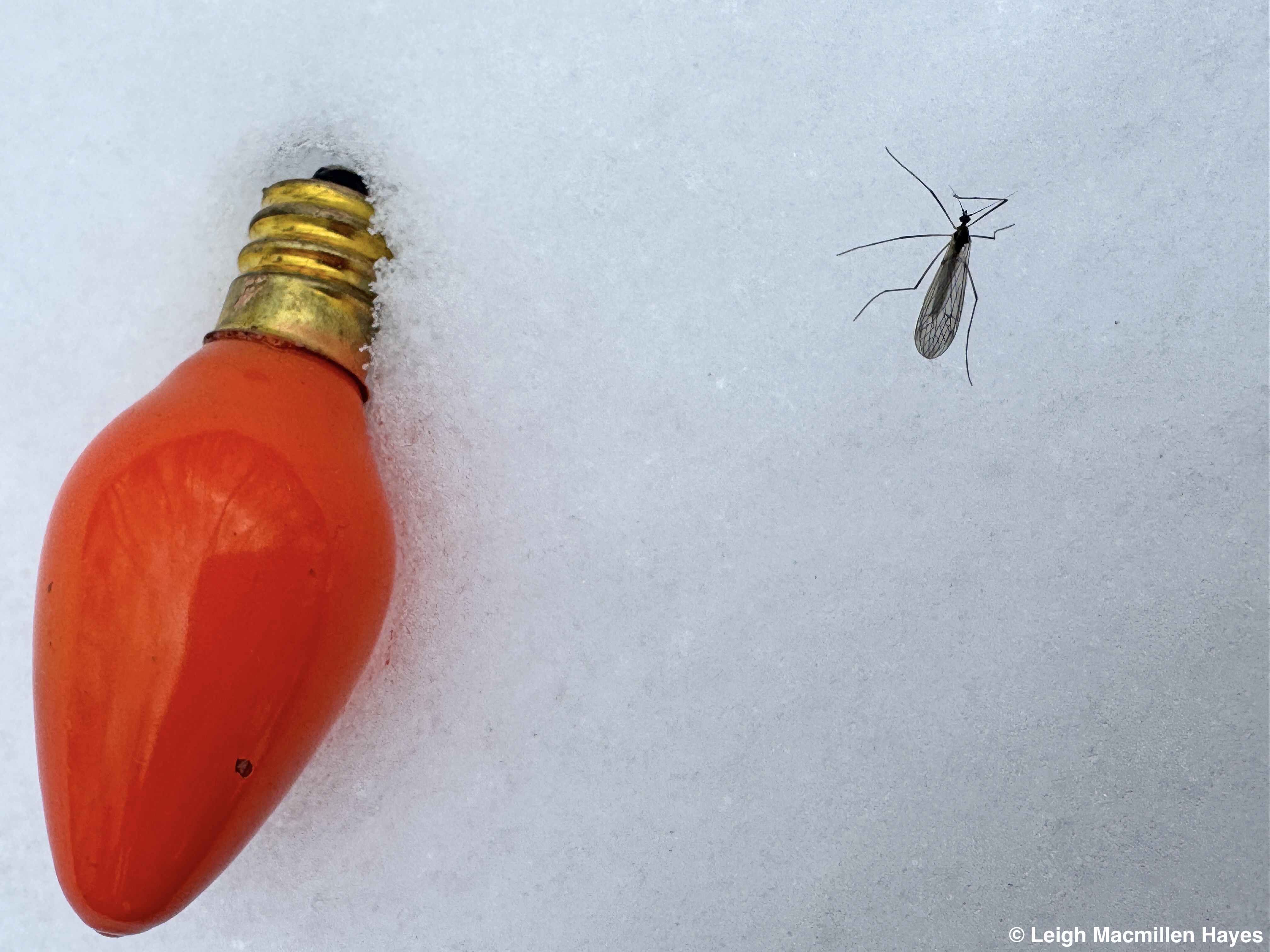
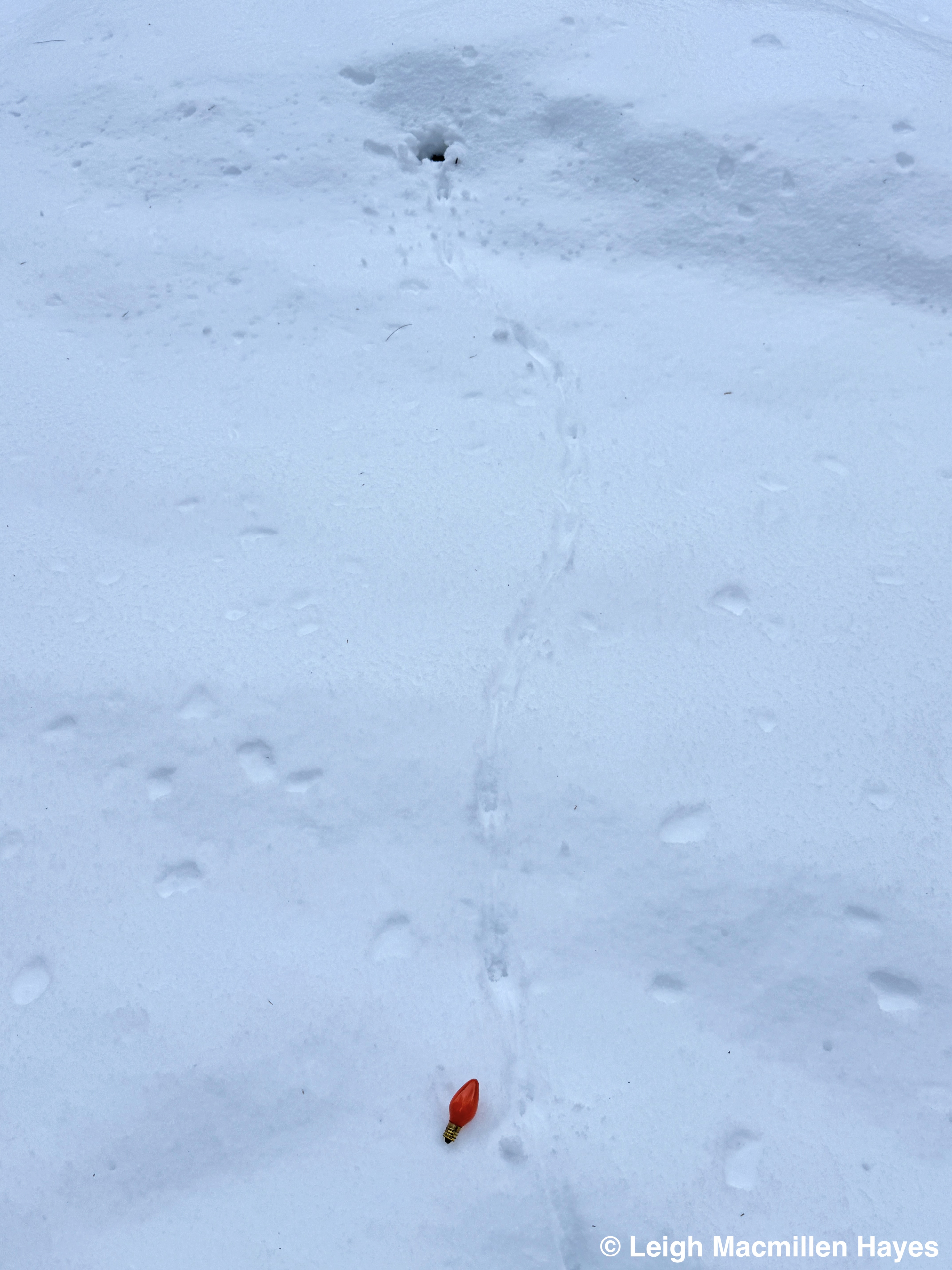
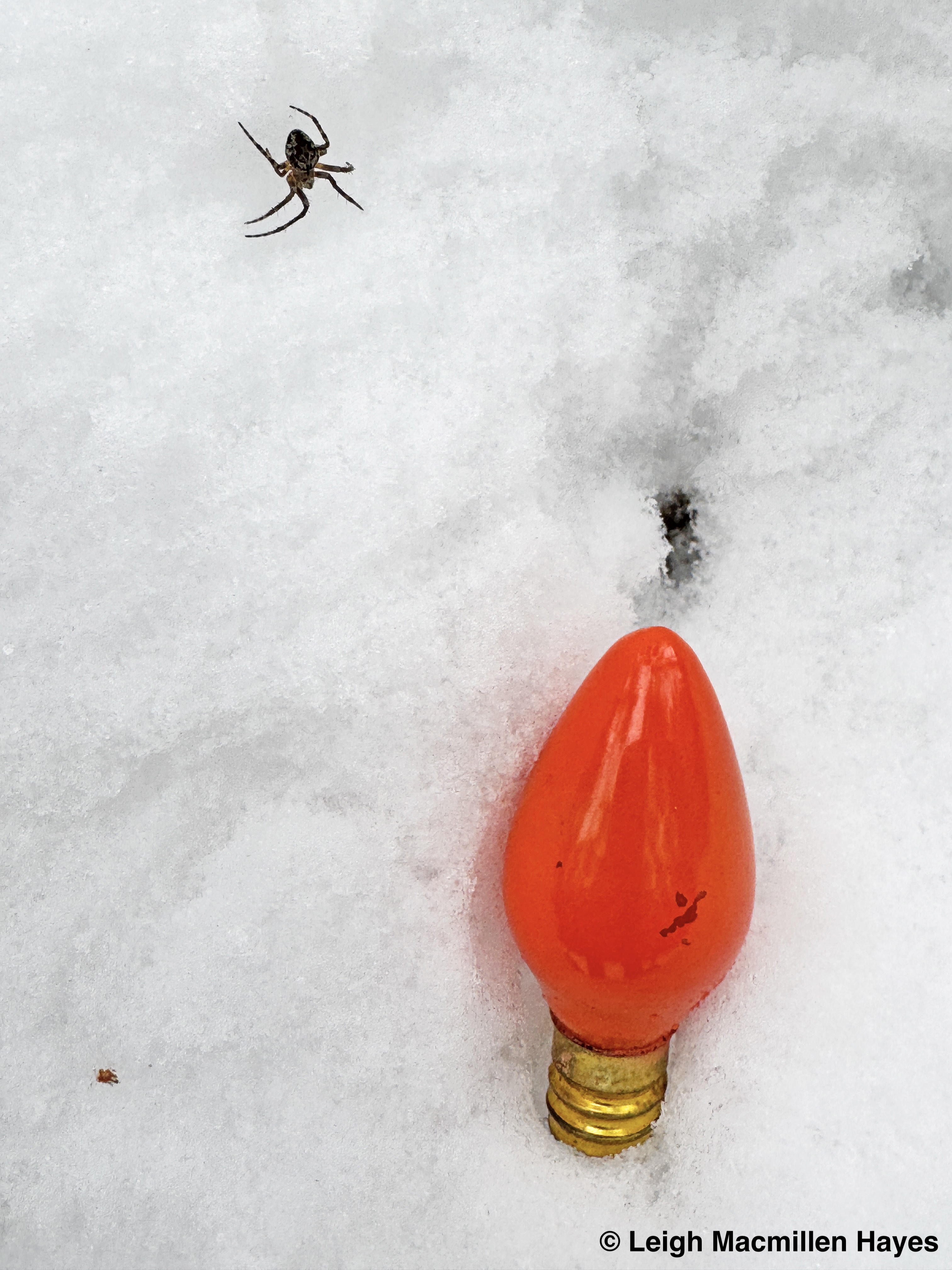
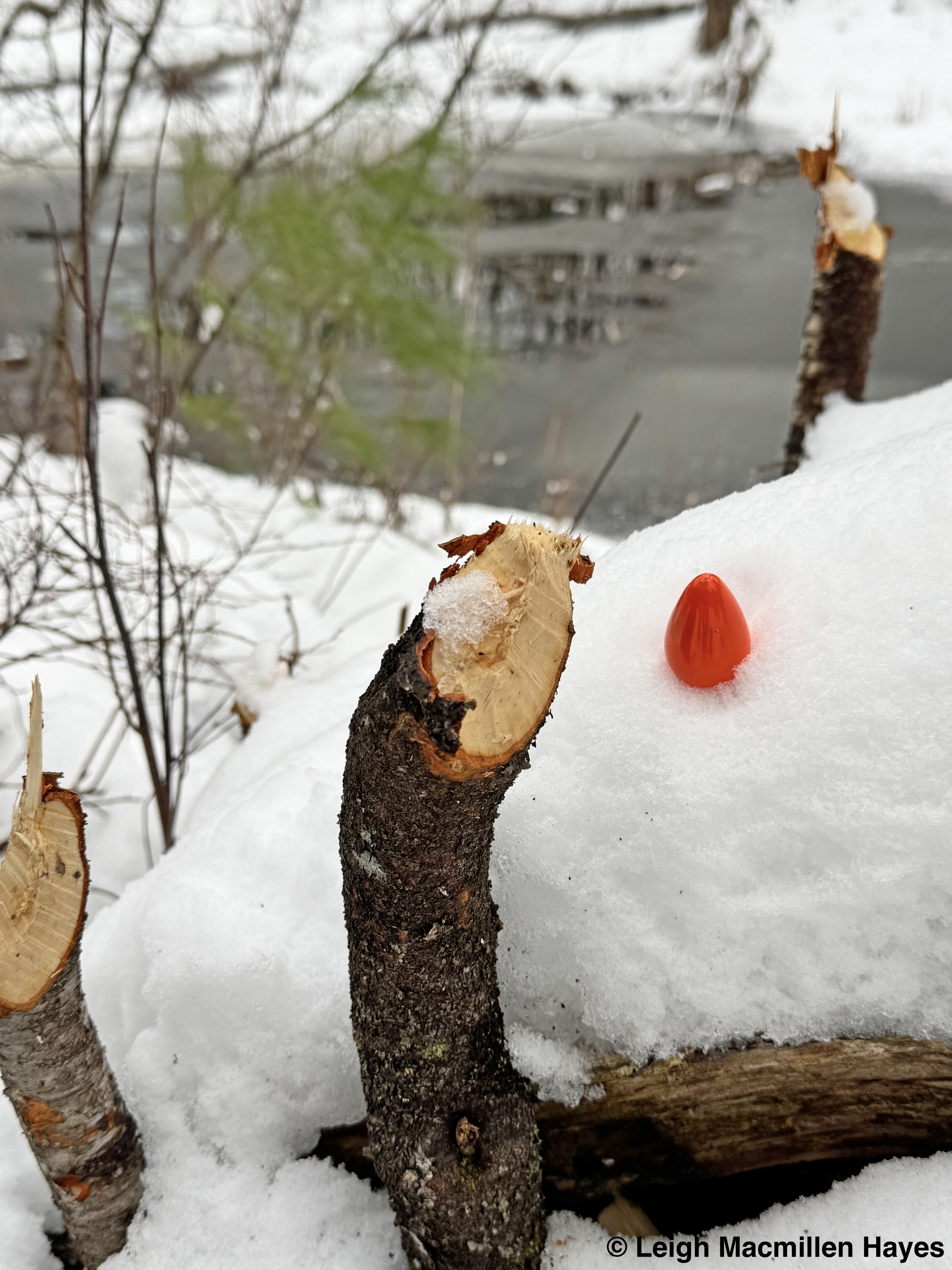
Just as I stepped out the backdoor this afternoon, I realized I really should have something in my pocket to use as a reference because the snow conditions were perfect. And so I grabbed the nearest object, which happened to be an old orange Christmas bulb that no longer brightens a tree, but serves as a reminder of past holidays in my parents’ home. Not exactly a tracker’s go-to instrument, but it does measure two inches in length.

I suppose I shouldn’t have been surprised to spot Snow Fleas, aka, Springtails atop the snow, but I was. They always strike me as more of a February event, but really, they are always on the leaf litter below the snow, we just don’t take the time to look. And today’s temperature felt a bit like February leaning into March, a rather pleasant reprise from the frigid temps of the past week. And so these insects made their way up through the snowpack to do their thing: dine on fungi and decaying matter that I couldn’t see.

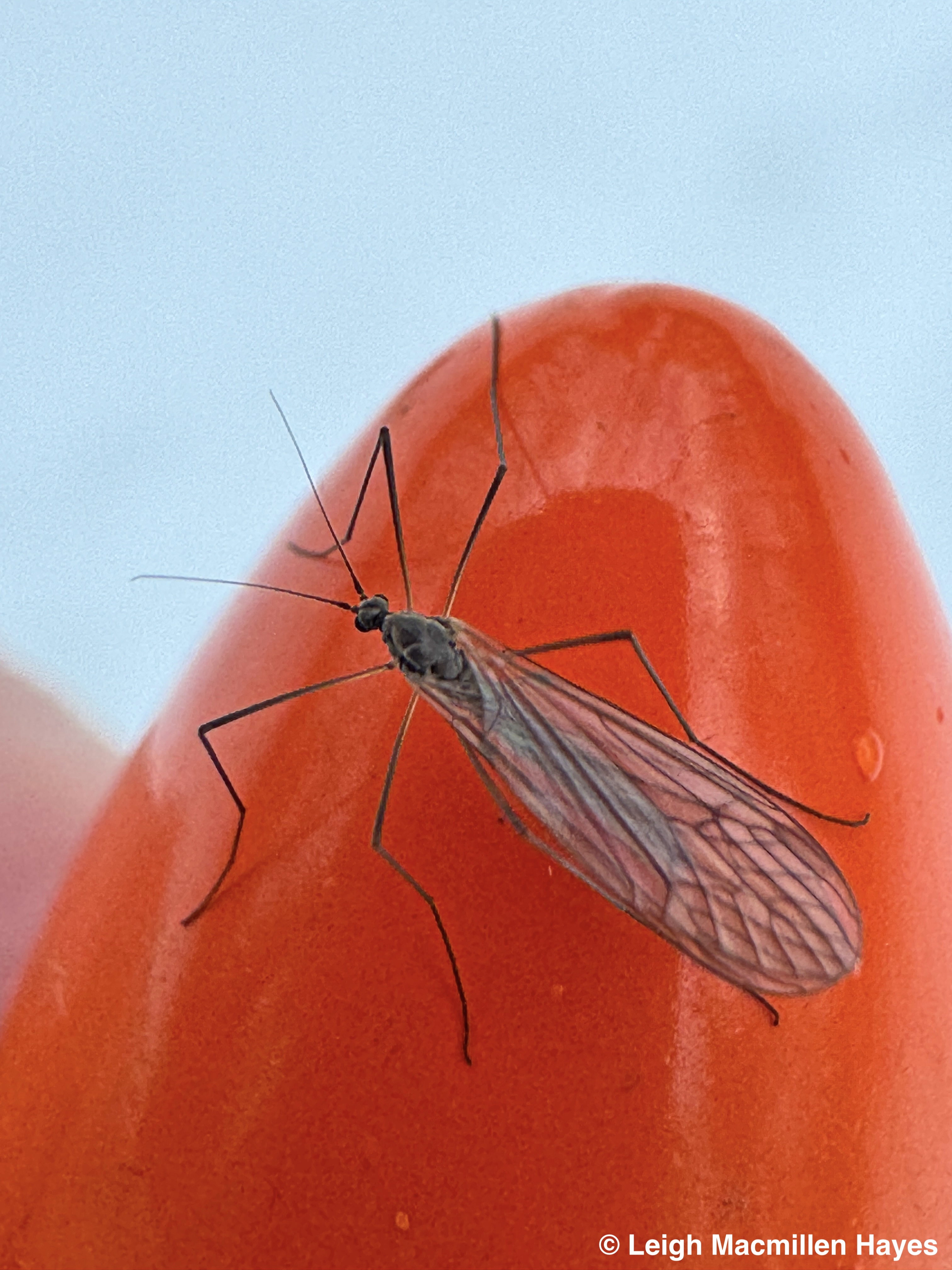
Also flying about and landing, Winter Craneflies, which are smaller than their summer cousins, but still have the long legs and transparent wings. They were everywhere–both flying and walking on snow.

And even the bulb! That was a bit of an experiment because I wondered if the Crane Fly would climb up once I placed the bulb in its face–much like when I can entice a dragonfly to do the same. Voila!

It wasn’t just insects to exclaim over and a few feet later I discovered the impressions of feet of another traveler. The prints left behind on one side of me indicated a hopper/leaper of the mini-kind. And it entered the snow as indicated by the hole at some vegetation that I knew grew below.

What really gladdened my heart was seeing that on the other side of my feet, its gait changed and I knew my identification was spot-on: a Vole who can change from a hopper/leaper to a perfect walker, where one foot packs the snow down and the next foot lands in the exact same spot creating a trail that looks a straight line with a zigzag twist.

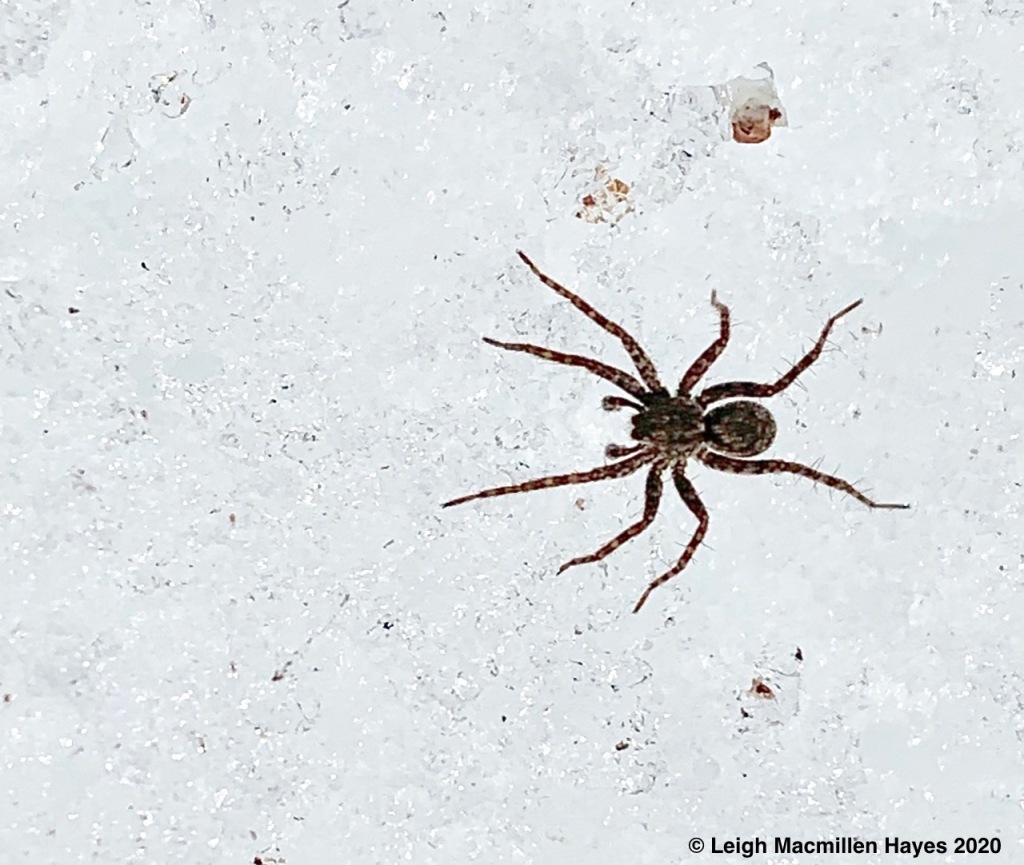
Next up to shine the light bulb on–a spider! Walking on snow also. Many spiders are winter walkers and weavers and I was thrilled to spot this little one.

It had a pretty snazzy pattern and I believe it to be an orbweaver.

Then I began to play with the bulb, and spotted a tree with a hole that invited a fitting. I was admiring the tree’s bucketload of Ulota crispa, or Crispy Tree Moss, when something else caught my eye.

Below where I’d placed the bulb was the leftover molt of a tussock moth caterpillar. My, what spiny hairs you have. You make the spider’s hairs seem almost not worth mentioning. So I didn’t.

For a few minutes, trees continued to hold my attention, including this one, grafted into an H. Sometimes I think the H trees were created for me.

And not the be outdone, the Northern Red Oak showed up a brilliant display of its inner “red,” which seemed a perfect match for my bulb.

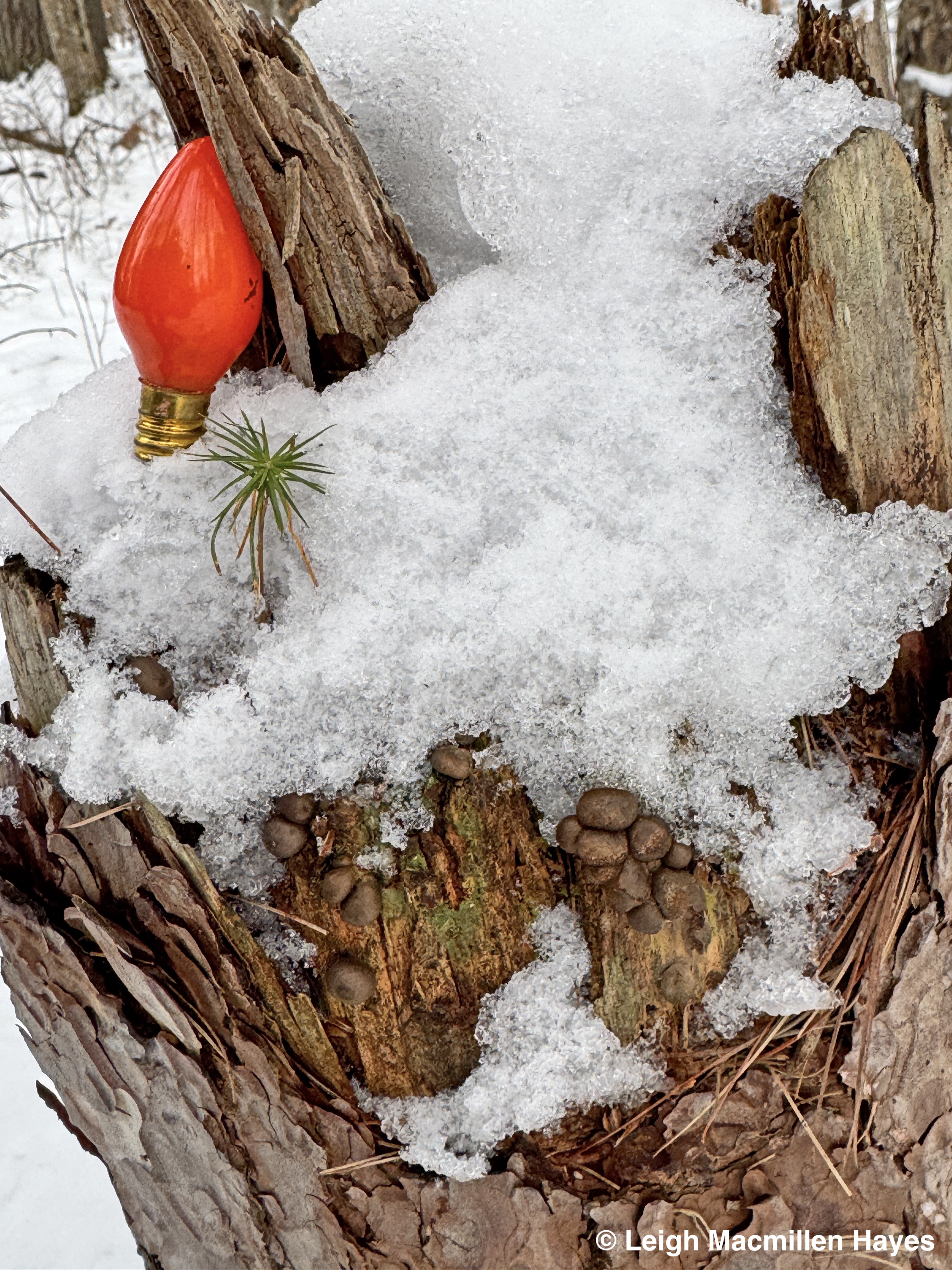
Upon a Red Pine tree stump, the bulb stopped again, this time to shine a light on a tiny pine sapling that resembled a palm tree. Whether the sapling is a Red Pine or White, I failed to figure out because my attention was consumed by something else.

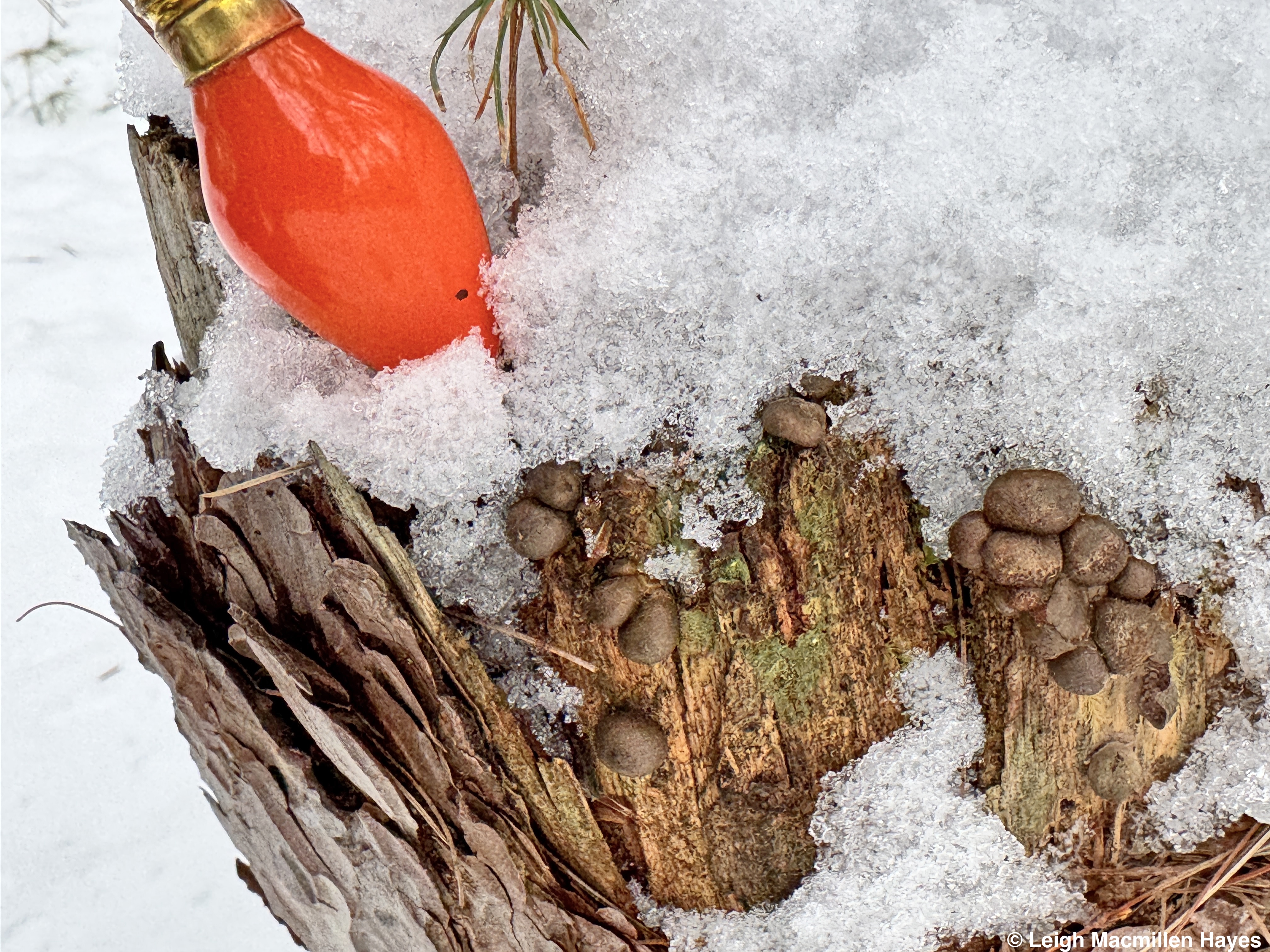
The bulb changed its position to point downward, highlighting the Wolf’s Milk Fungi that grew below the sapling.

And my playful spirit did what it often does when spotting this species. I found a small stick and poked the little puff balls, which released its spores in a smoke-like manner. I can’t show you the action, but you can see the results of the dried salmony-brown spores atop some of the now-deflated brown balls.

Over the past week and half, about a foot of snow has fallen here in our neighborhood and last night’s addition, plus today’s slightly warmer temps made for some great tracks as I’d already witnessed with the Vole. Gray Squirrels also left their marks–the two smaller feet in the back being their front feet. That always feels like a bit of a stretch until you watch a squirrel move across the landscape.

There was another tree, or should I say pair of trees, that I paused by for a bit because I think of them as a landmark ’round these parts. I love introducing others to these two–the Yellow Birch growing as it does atop a White Pine. I can just imagine the stilts the birch will stand upon when the pine finally finishes rotting away.

As I admired the trees, I noticed something else. My squirrel friend had hopped up, but I can only imagine it didn’t manage a good landing, for there was only one foot impression left behind. In my mind’s eye, I could see him tumbling down–had another squirrel tried to attack from behind?

In the past year, I’ve gotten back into sketching and have been learning to paint, and now see the world through different eyes and know that I’ve walked past this barbed wire many times before, but never noticed it. Today, it looked like an artistic insect in acrobatic motion and love how the bulb found its way into the display.

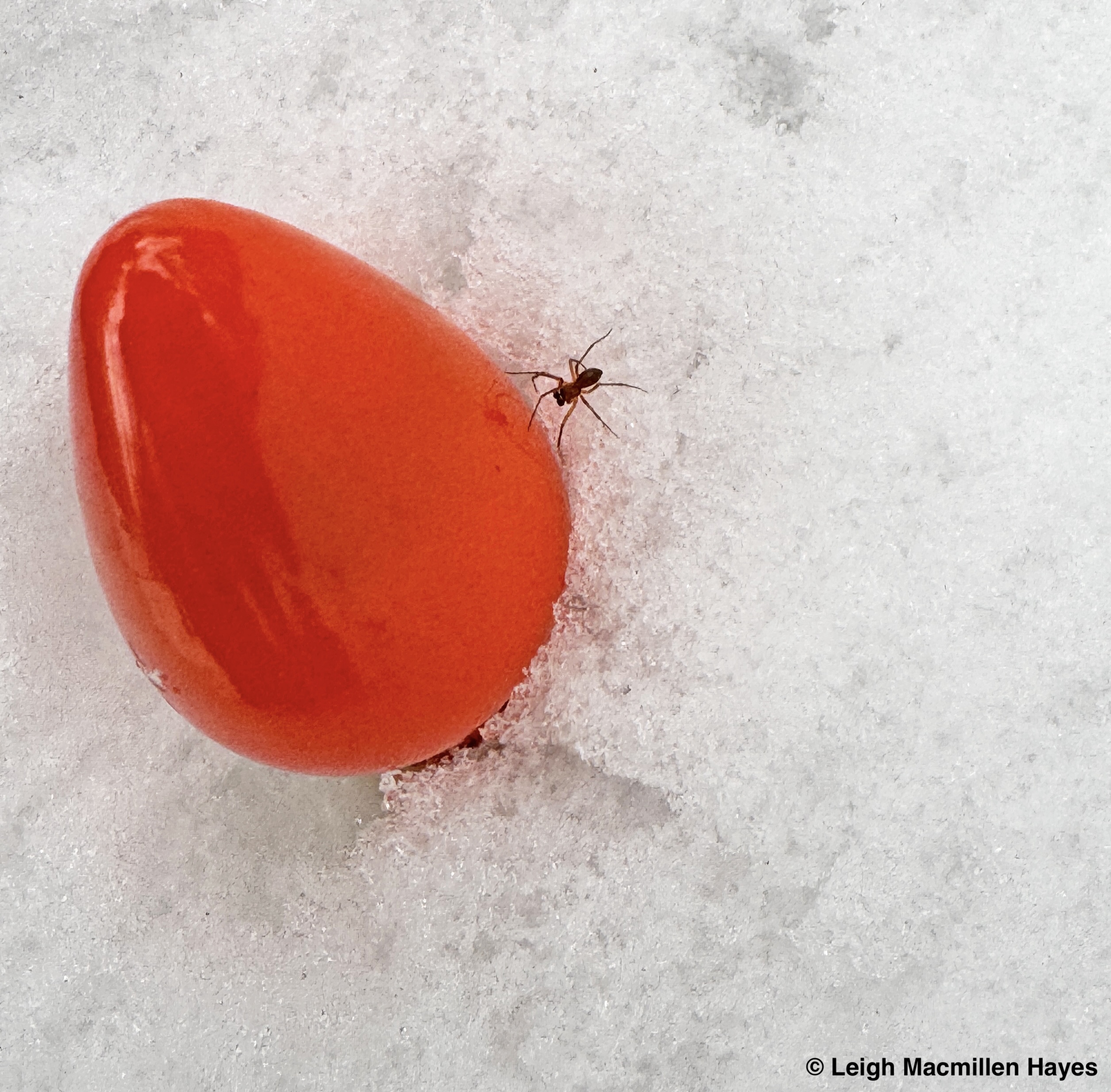
As I finally headed toward home because darkness was settling in, another spider crossed my path and so I set the bulb before it.

And the spider quickly walked away. Perhaps orange isn’t its color.

To say I went without expectations today would be wrong. For I truly thought I’d see the creator of these works of art since they were made this past week. I did not.

Instead, I came away with revelations and rejoiced in letting my playful spirit run free as I was filled with awe and wonder.

As for the light bulb–it was a bright idea! A brilliant one, really.

Celebrating the Work of the Leaves

In response to shorter days
and sunshine's declining density,
leaves begin the age old process
leading to their demise.
Like so many others, 
I make time to honor
the tapestry they weave
before they fall.
Chlorophyll, the green pigment
we associate with summer,
and necessary for photosynthesis,
slows and then stops manufacturing food,
and the leaves go on strike.
Veins that carried fluids
via the xylem and phloem close off,
trapping sugars, and promoting the production
of anthocyanin, the red color
we associate with Red Maples and Silver.
Though in the same family, 
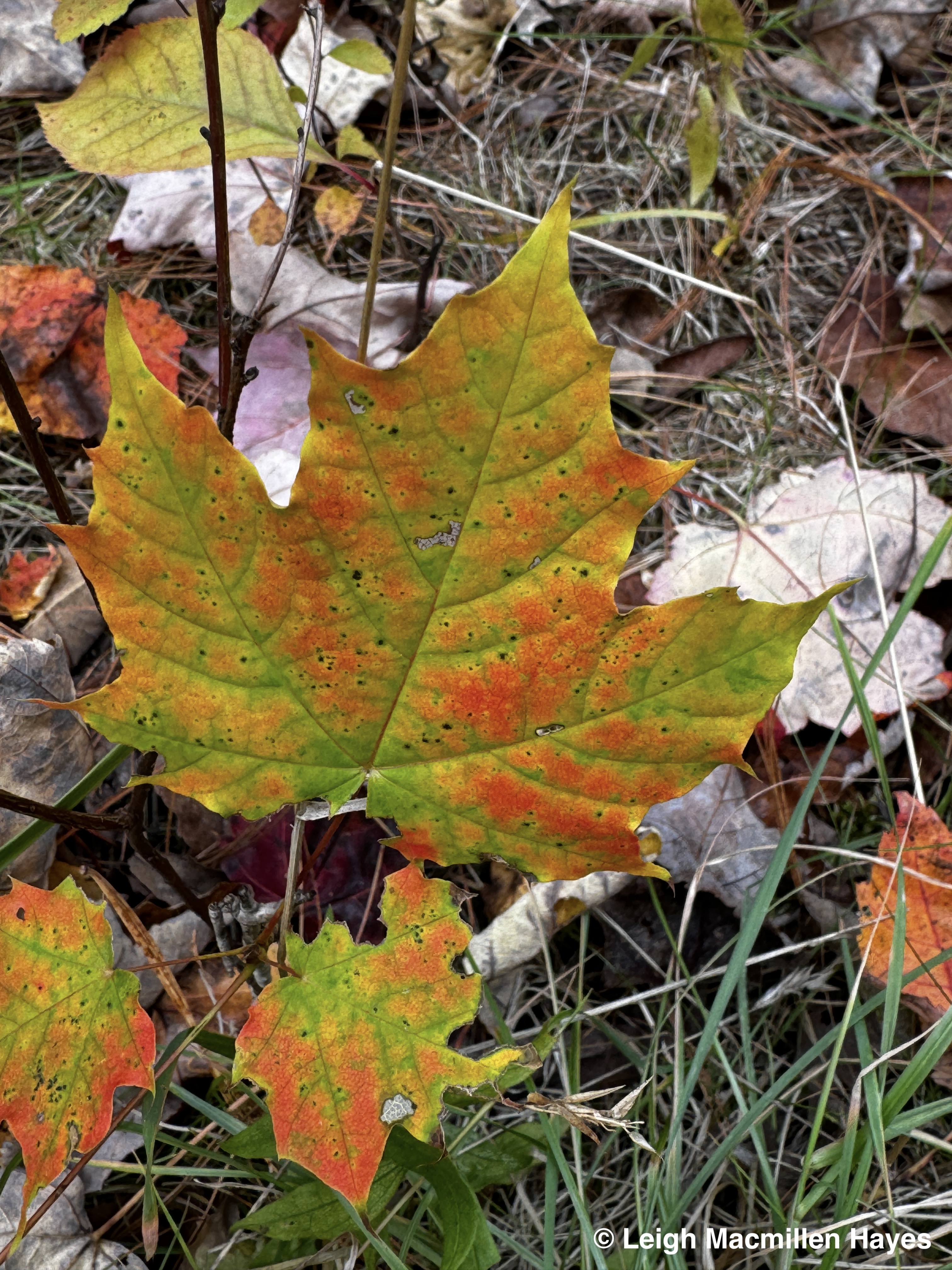
Sugar Maple displays
the yellows and oranges
of the ever present Carotenoids,
which had previously been masked
by Chlorophyll.
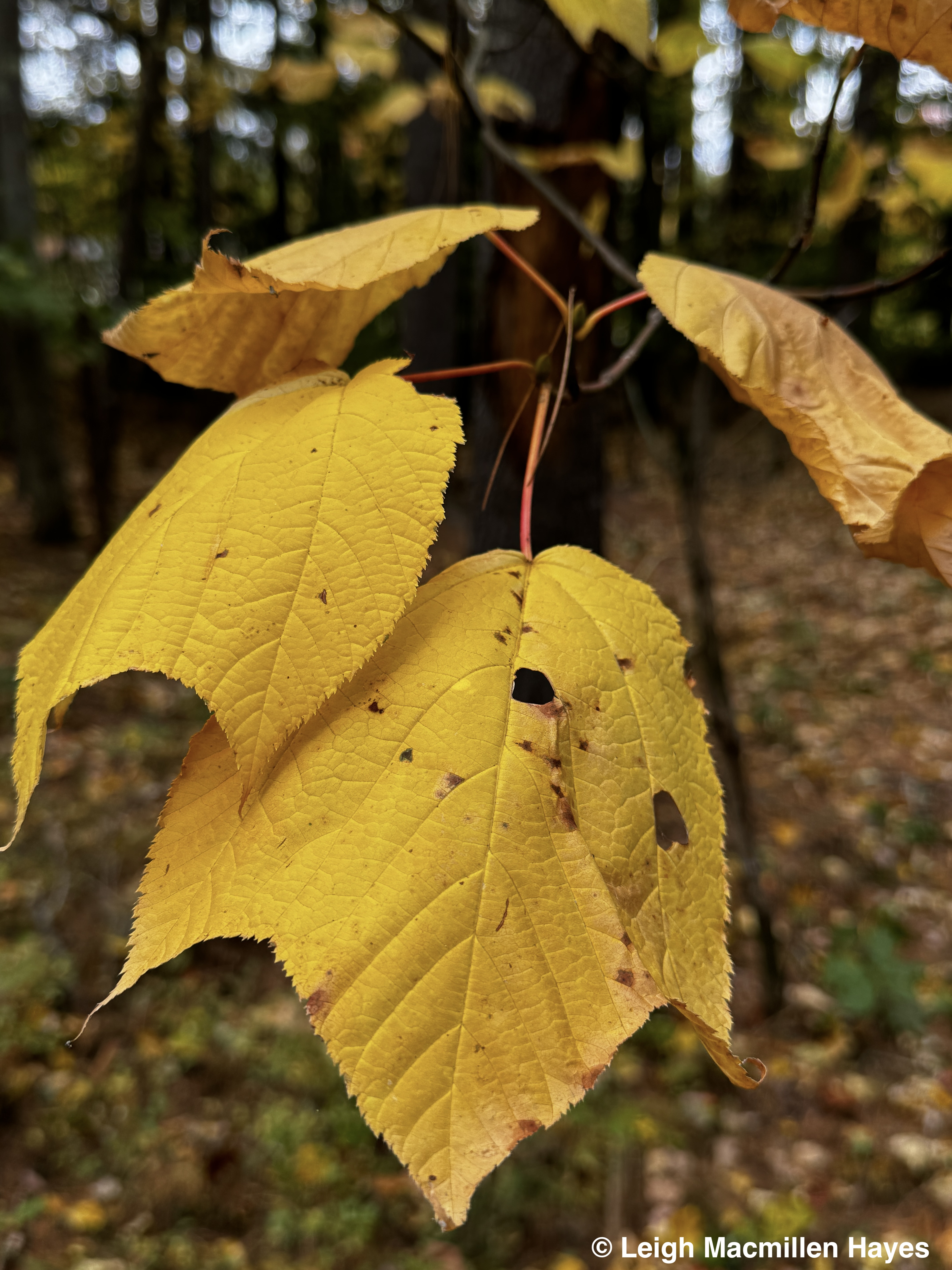
Stripped Maple knows
only one hue,
making it easy
to spot its large display of brownish yellow.
One of my favorites
is the reddish-pinky-purples
of Maple-leaf Viburnum,
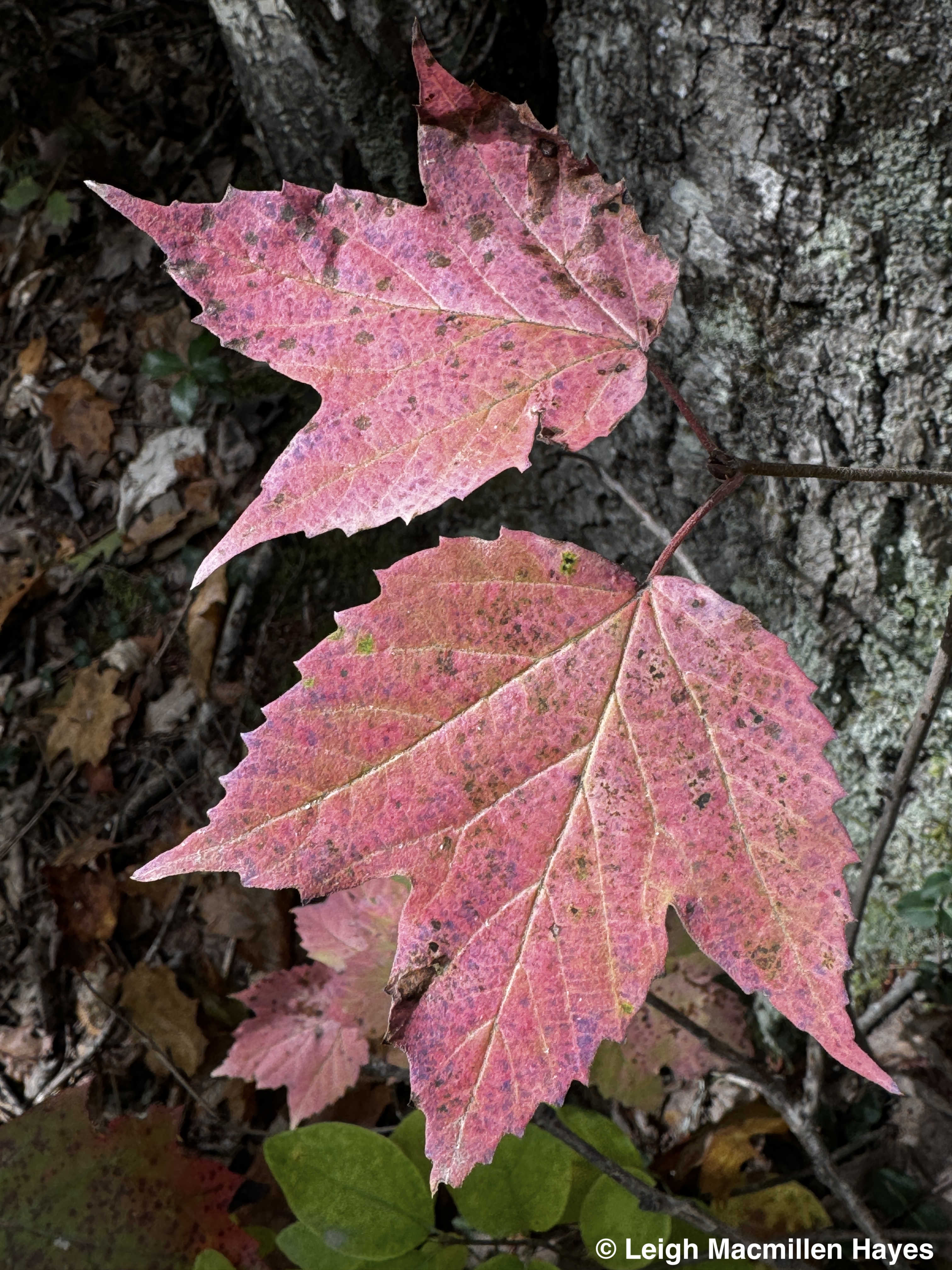
a shrub with maple-shaped leaves.
Ash follows suit,
though its leaves
are the quickest to drop
and disappear into the forest floor.
Big-tooth Aspens turn a golden yellow,
but other colors
have a tendency to seep in
and create a striking picture.
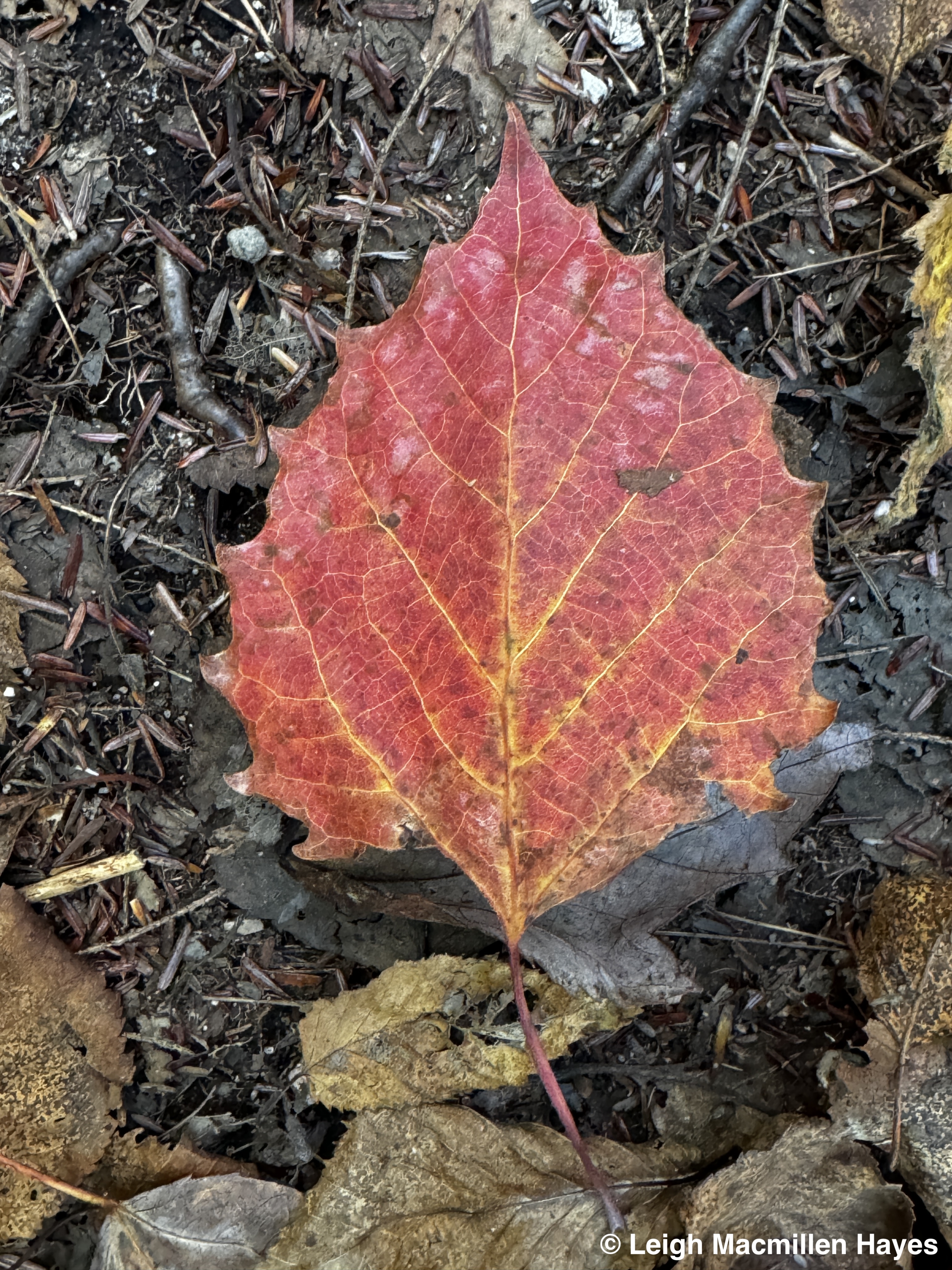
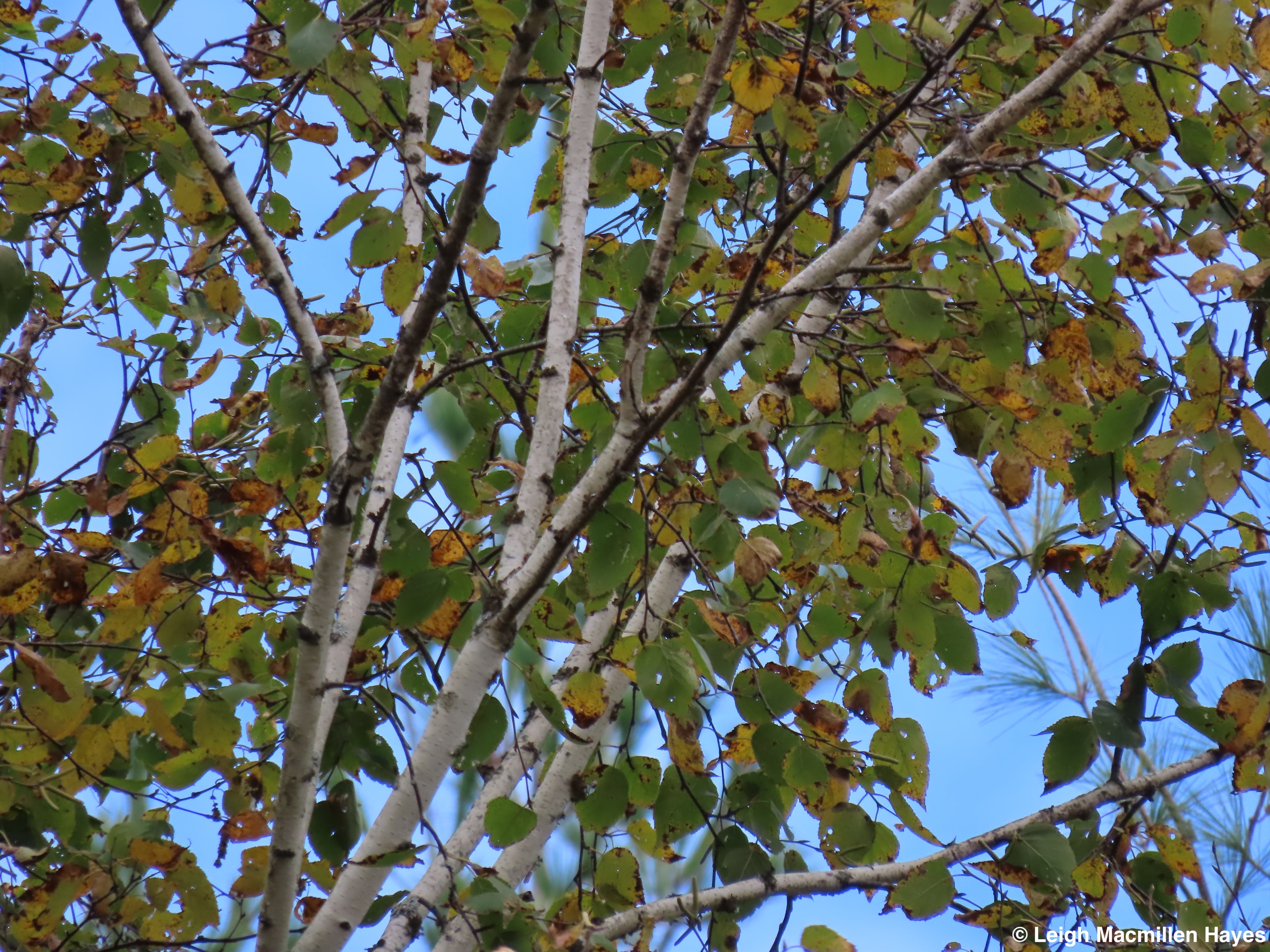
American Beech, 
Paper and Gray Birch
show off a yellow
to golden bronze presentation.
And a little late to the show, 
Northern Red Oaks
put their colors on display
after other species
have already dropped their leaves.
Not really a part of the foliage, 
but still important because it is present,
is the splotchy display caused by Anthracnose fungi,
a result of too much rain stressing trees
and not allowing them to properly respire.
Once connecting tissues 
between leaf petioles and their twigs
form a seal,
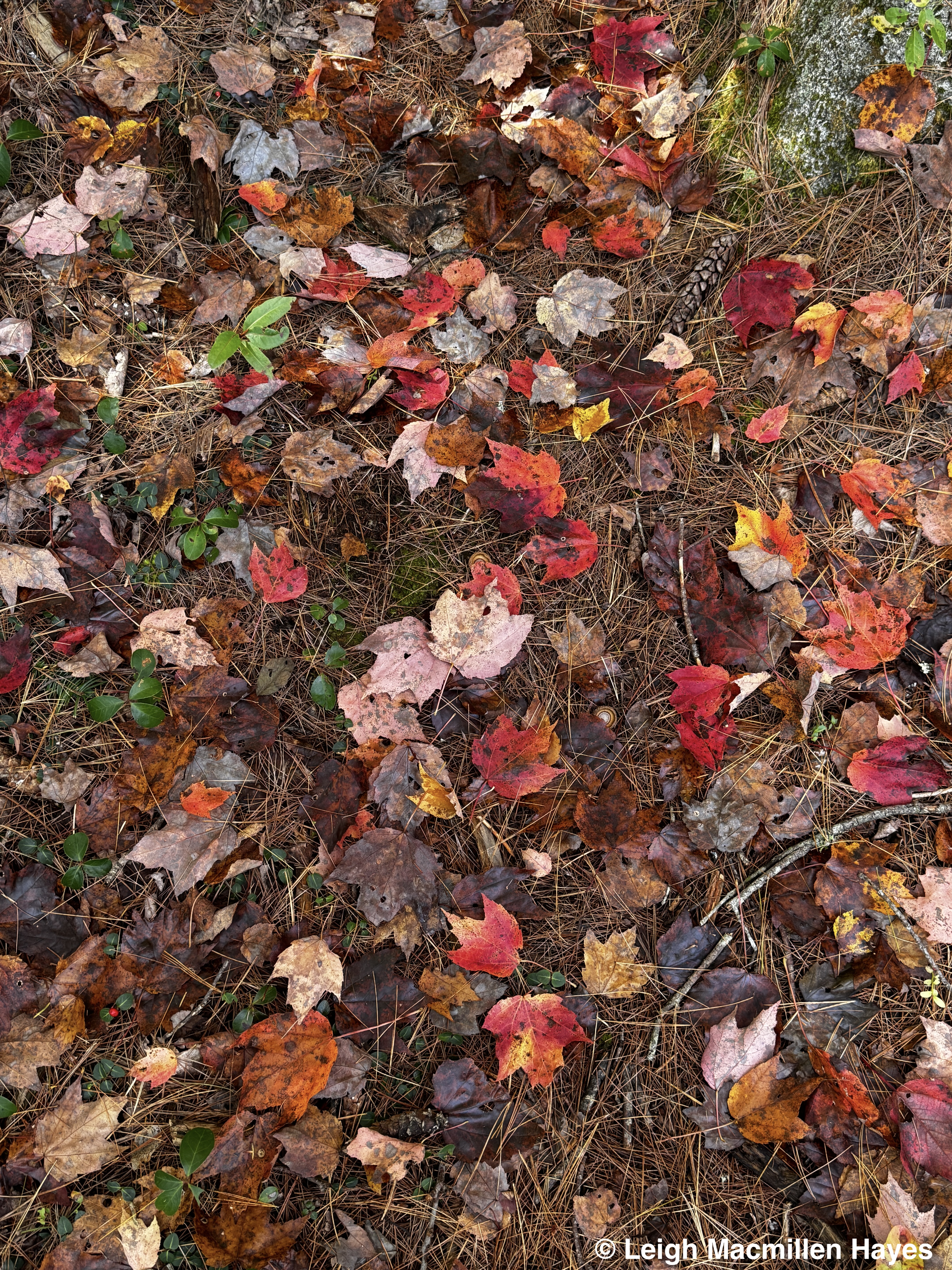
the forest floor is colored with gems
that will eventually turn various shades of brown
as they decompose and restock the soil with nutrients,
plus provide food for numerous organisms. And shelter.
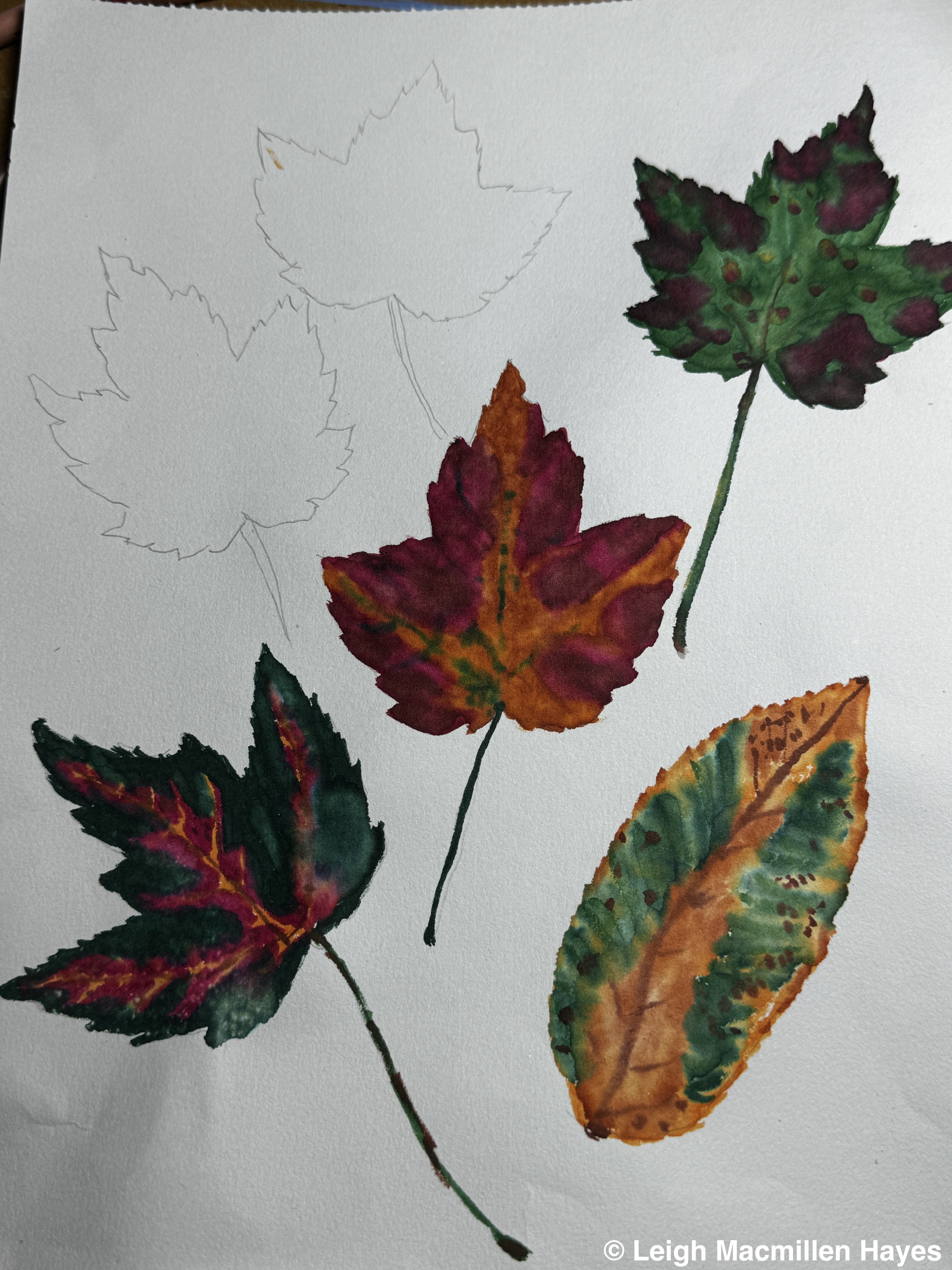
In a Senior College (Lifelong Learning) class
this past week,
I attempted to use watercolor pens
to capture the colors.
And then at home, 
I tried to do the same,
only this time using watercolor pencils
to show off the vibrant variety of hues.
In doing so, 
I was forced to slow down
and notice how the color changes
often followed the veins
in this biochemical process.
Fall foliage is fleeting,
and I give thanks
that every year
we can celebrate the work of the leaves.

The May Flower Whisperer

In rain or shine, as May gives way toward June, My Guy and I set off to hike a few local trails.

It’s not whether we have a view . . .

or not . . .

or if we have to stand beside lunch rock rather than sit (well, he sat, I didn’t) . . .

or even the challenges the trail chooses to offer, like crossing a well-mudded beaver dam that is rather tricky . . .

and spying the well-mudded lodge where the local residents were probably relaxing after a long night’s work,

but rather, the sights at our feet that drew our attention, such as the Black Chokeberries pink anthers and delicate petals enhanced by raindrops.

Scrambled-egg Slime Mold (aka Dog-vomit Slime Mold) showed off its intricate structure that looked more like a bunch of worms swarming together upon a decaying log.

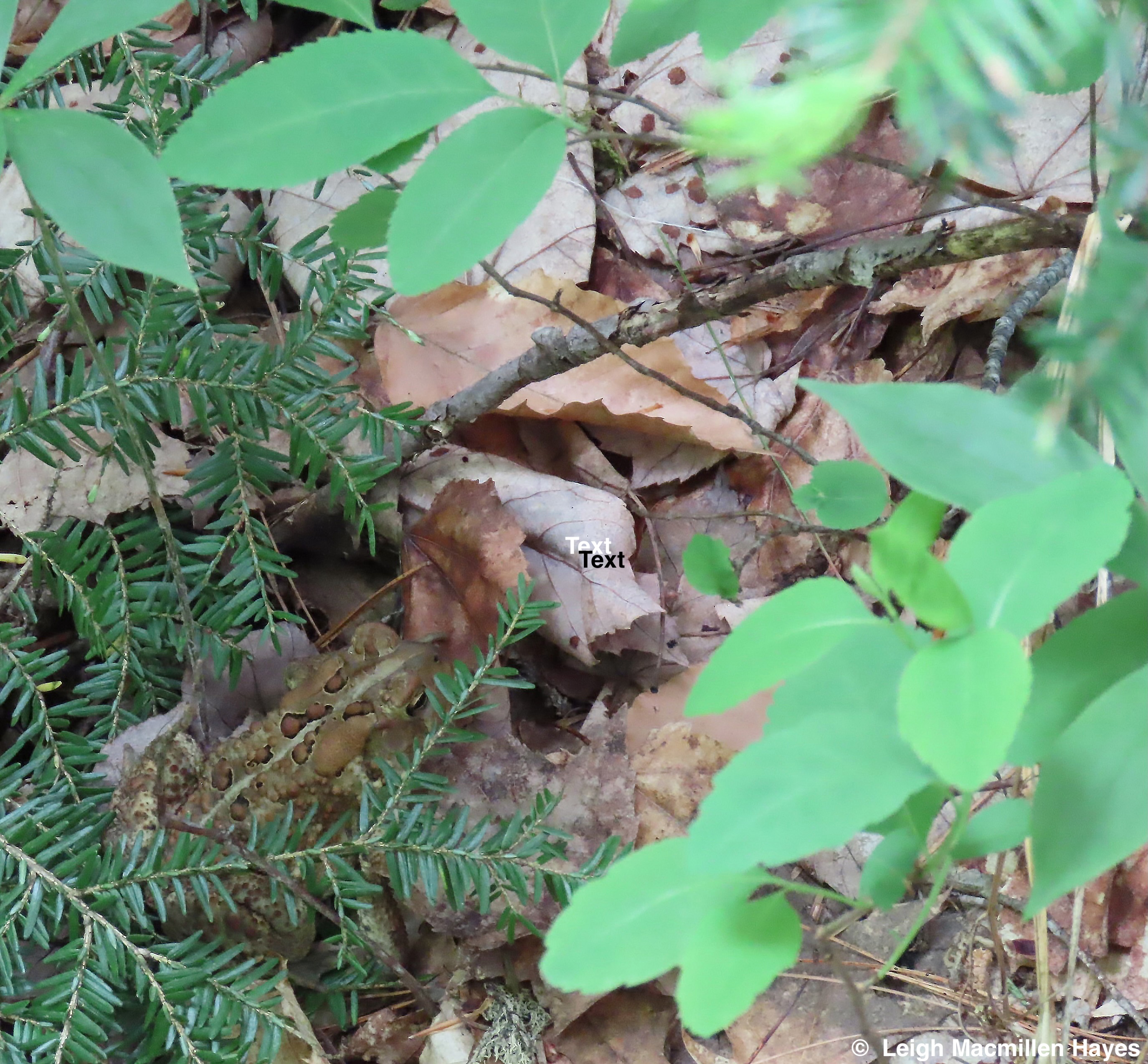
Because we were always looking down, an American Toad, so certain it was invisible for so camouflaged was it, wasn’t. Invisible that is.

Plentiful were the Blue Bead Lilies, with their anthers hanging long awaiting pollination before rising in fruit forms that will soon look like . . . blue beads.

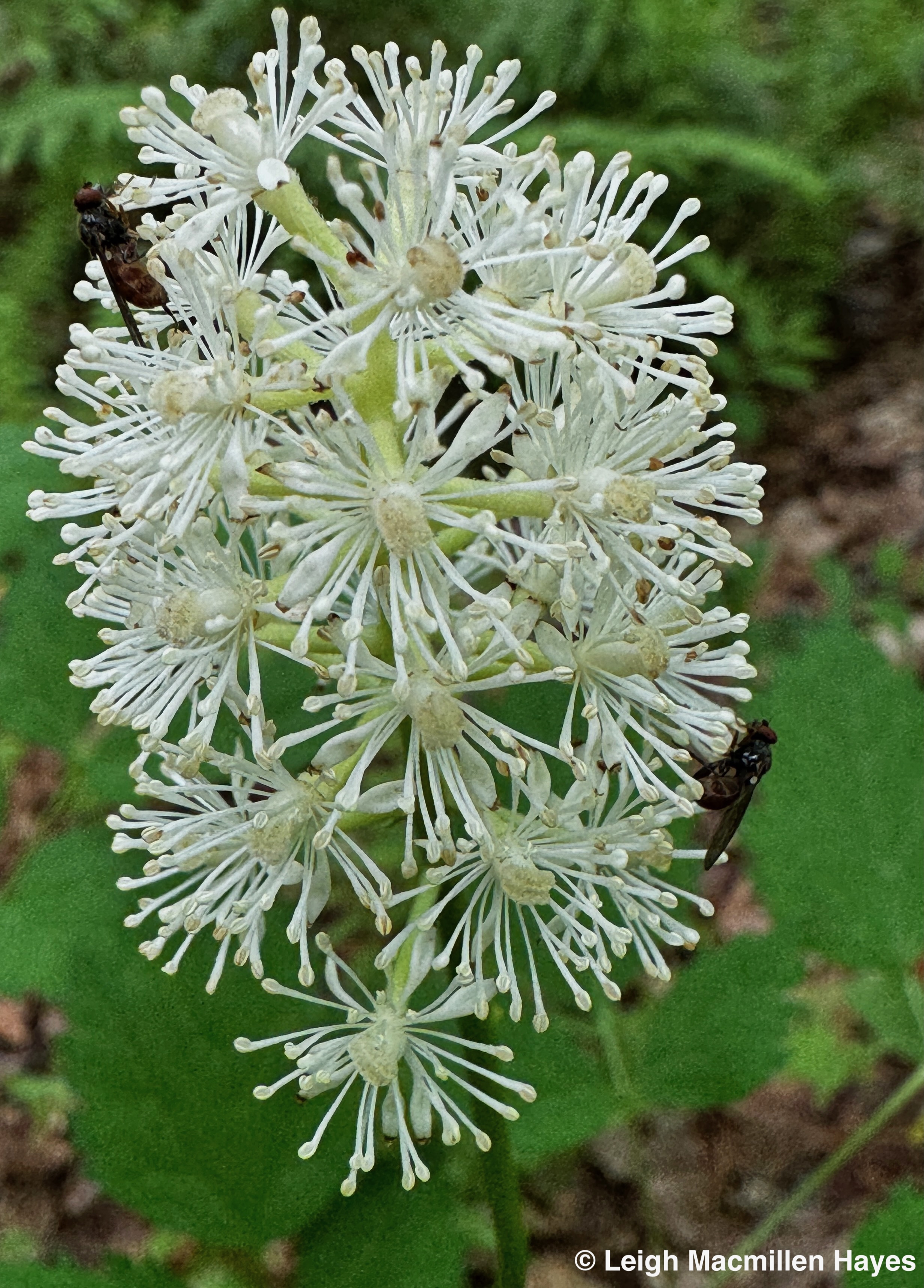
In several spots along one of the trails, White Baneberry, aka Doll’s Eye, so named because its fruit form resembles such, showed of its firework display and the insects were attracted.

And a carpet of Bunchberries, those with six leaves rather than four, asked that their floral displays be acknowledged.

Not to be overlooked, Wild Geranium’s runway lines upon each petal functioned as the nectar guides they were intended and the pollinators rejoiced.

I, too, rejoiced, for on the first rainy day, May 27, 2024, the trail we hiked, which is known by locals for its mosquito population, wasn’t at all buggy; but on our May 30, 2024, hike, our faces were constantly buzzed, though nary a bite, making me think they were all males. We kept an eye out for dragonflies and finally made their acquaintance, including with this Common Whitetail Skimmer, that hardly looked common.

The real reason, however, for our hikes this week was greed. Yes. Greed. You may know My Guy suffers from Blueberry Greed in the summer, but spring brings out another type and he takes on the mission to locate and count Lady’s-slippers. And he always wants more.

It may sound like an easy task because some are proud to stand straight and tall and can be seen easily from the trail.

But some, like the American Toad, like to hide. We, however, are persistent in our survey.

We found pinks of many hues, and their white variants.

And no spring feels right without a visit to My Guy’s favorite bouquet.

Lady’s-slipper pollination is a curious thing. Bees are lured in by the guide lines to a slit in the front petal, the slipper-like pouch, or flower’s labellum. Once inside, the bee cannot exit the way it entered because the petal structure turns inward.

The exit is at the top of the slipper, but to reach it, the bee must move through a hairy interior and rub against the flower’s stigma, depositing any pollen it may have carried in and brushing against the pollen mass called the pollenia before flying out.

Some bees get frustrated with the dilemma of discovering there is no nectar and the task of finding the exit and instead chew their way out, which seems to be what happened to this flower.

One flower in all that we found, did present as if it had been pollinated, for rather than the downward pose, the slipper was almost parallel to the ground and beginning to deflate.

Twice we came upon last year’s capsule, which is a rare treat for so few are actually pollinated because the bees learn not to bother. Fortunately, one woody capsule contains thousands upon thousands of seeds, which are released when the woody structure splits its seams.

Near the end of yesterday’s hike, the sun finally brightened the sky and forest, and we weren’t the only ones to enjoy it for a gartersnake basked beside the trail and helped us spot another flower to add to our count.

And on Monday’s hike we had another special sighting: an Ovenbird’s nest that I spotted because I saw the parent fly up through vegetation beside the trail as we approached.

We covered a lot of miles, hiked slower than My Guy’s normal pace, and kept reminding ourselves of the numbers so we didn’t lose track, but rain and mosquitoes didn’t hold us back.

Lady’s-slippers have a symbiotic relationship with fungi. A fungus helps break the seed and allows it to obtain nutrients and energy from organic matter in the soil, while the plant, once established, gives nutrients back through its roots. It takes anywhere from 3 – 7 years for the seed to develop underground and then may take another ten years of presenting as two pleated leaves, before a flower is produced. That means that by the time it first flowers, the plant might be 17 years old. So please, please, please, enjoy them the way we do. In their natural state.

Our count (which include last week’s visit to Wolfe’s Neck Woods State Park):

Wolfe's Neck
2022: 411
2023: 324
2024: 475

Albany Mountain
2020: 150
2021: 47
2022: 266
2023: 274
2024: 364

Overset Mountain and Sanborn River Trail:
2022: 286
2023: 351
2024: 598!!!!!!!!!! (You know who wanted to make it to 600, but came up just shy)

Grand Total this year: 1,437.

I'm not sure we are done and I know everyone is seeing them everywhere, which is a glorious thing. Now I'm wondering if all of last year's rain showers meant more fungi for My Guy's May Flowers.

Somewhere Under The Rainbow

Somehow we thought the rain wouldn’t fall upon our hike today, until it did. And so we sat in the truck for about 15-20 minutes, waiting for the drops to slow down, which they did.

The rain, however, enhanced everything. And as the sun came out, the water and warmth combined to create a Black Fly Festival, one which will last for several more weeks.

But, April/May showers do bring May flowers, and I sooo love the pastel colors that Hobblebush produces, its non-fertile showy flowers on the edge meant to entice insects to visit about a hundred tiny fertile flowers preparing to bloom in the center.

In wet seeps, Round-leaf Yellow Violets did show off their cheery faces, with violet-veined runways showing the way to the nectary, much like lights at an airfield that aid landings.

And fortunately My Guy didn’t question the fact that I was taking more photos of Red Trillium, for I’ve hardly reached the trillion I intend to take. Really though, in a few weeks our attention will turn toward his beloved Lady’s Slippers, and there are comparatively fewer trilliums than slippers in the forests through which we wander.

Because of the rain, Lungwort, a foliose lichen consisting of a fungus and a green algal partner living together in a symbiotic relationship with a cyanobacterium, showed off its greenliness since the alga had kicked into action to provide food for the fungal structure. It’s sensitive to air pollution and habitat loss, so spotting it is always a treat and reminds us of why we love living here in western Maine.

Below the summit, we paused to share lunch with the Black Flies and take in the view of the mountains, though many were obscured by the cloud cover.

On our descent, there were more hues of green to add to the art palette in the form of the larger Rock Tripe, an umbilicate foliose lichen, and Rock Tuft Moss scattered in its midst.

At a beaver pond, we noted several beaver lodges that looked abandoned and a long dam, but it was the reflection of the sky and clouds that also garnered our attention. The day had transformed as was visible both above and below.

Back at home, I wandered out to the vernal pool to check on the activity. A few days ago I realized that tadpoles were beginning to emerge from egg masses, and today’s warmer weather brought even more into the picture, which in this case included both what I could see under water, as well as the reflection of trees and sky upon the water.

It was when I stopped looking into the depths, however, and focused upon the scene before me, that I realized I was seeing something I’ve never noticed before.

As I had approached the pool, I saw that it had a coating of Birch and Maple pollen and thought with a smile of a fourth grader spotting such last year and looking confused as he asked me if it was ice. No Daniel, it’s not ice. But his initial reaction made sense.

What I noticed today was that the pollen added a rainbow to the water’s surface as the sun got lower in the sky. Yellow by the far shore, orange, red, purple, blue, and green.

So, what caused this rainbow to appear? I’m a huge fan of taking a stick to a Balsam Fir blister to gather some resin and then tossing it into a puddle or still water to watch the natural resins or essential oils appear. Was that happening here?

Maybe this was from decaying vegetation and the sun being at the right angle?

Maybe it had something to do with the pollen as well as the sun’s angle?

I don’t know, but certainly it was fun that this day which began with rain, and showed off a variety of vibrant colors during our five-mile hike, should end somewhere under the rainbow.

Of Stumps and Snags on this St. Patrick’s Day

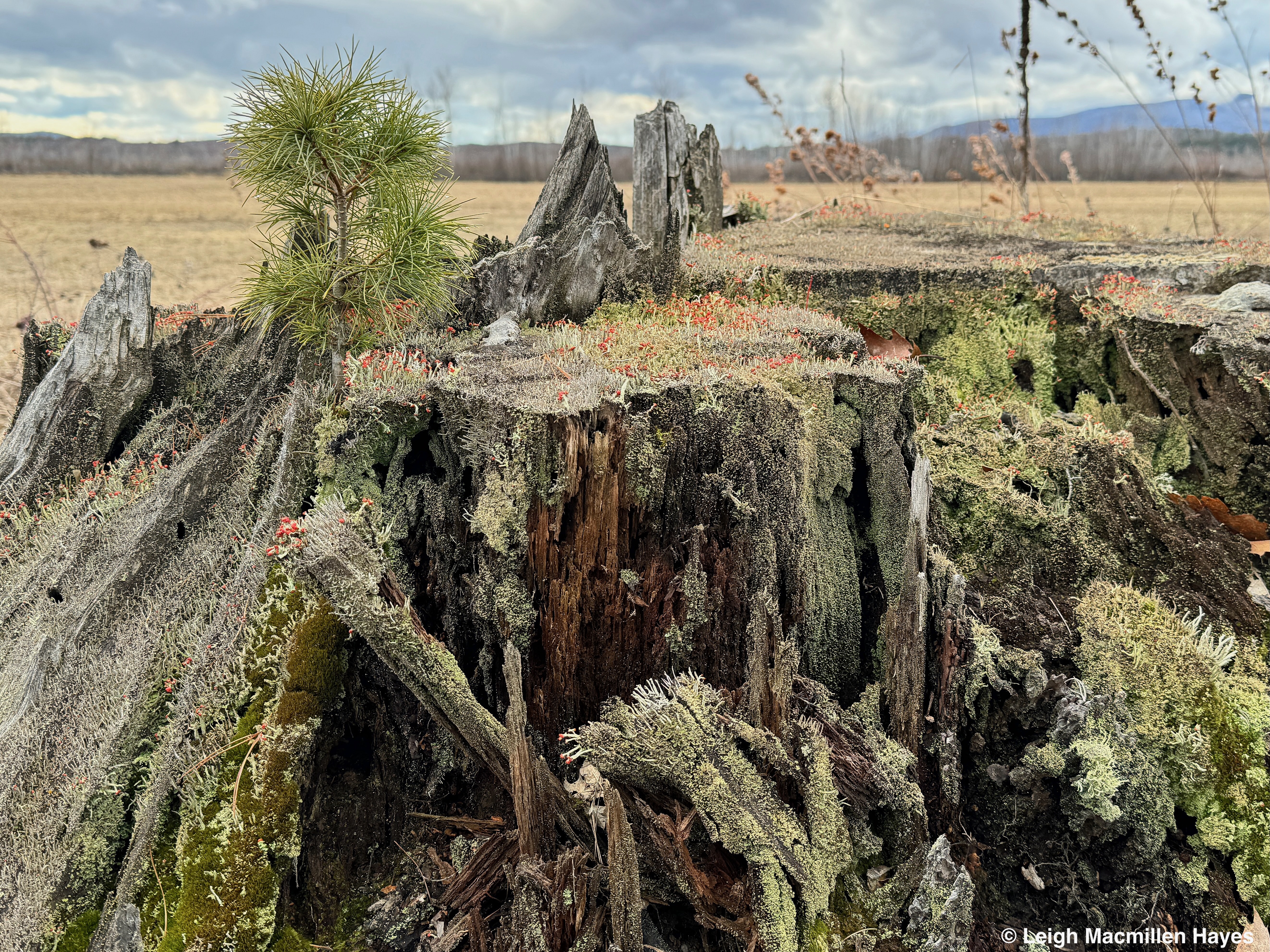
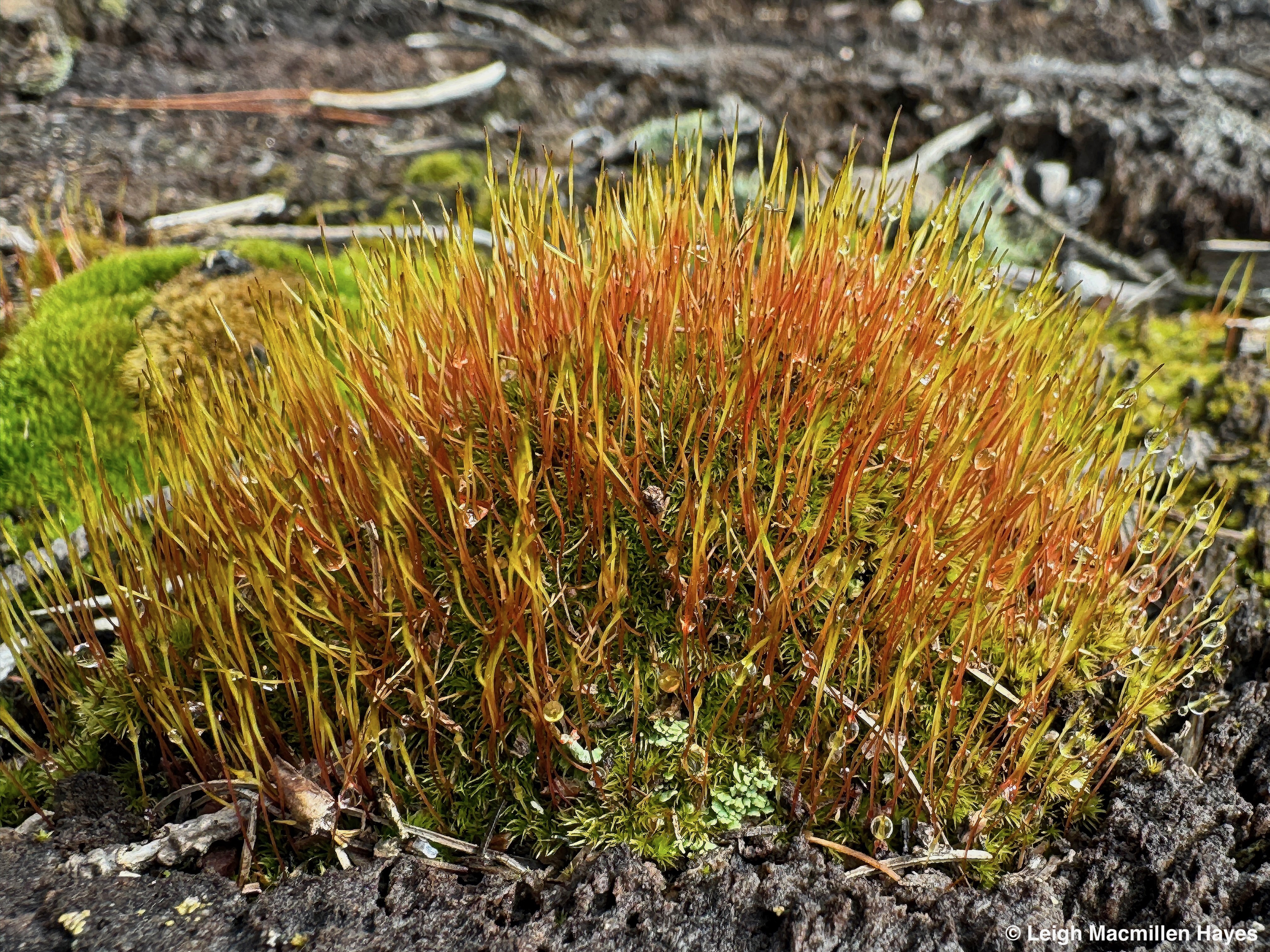
Stump: the base of a tree that has been chopped down or fallen, but is still connected to its roots.

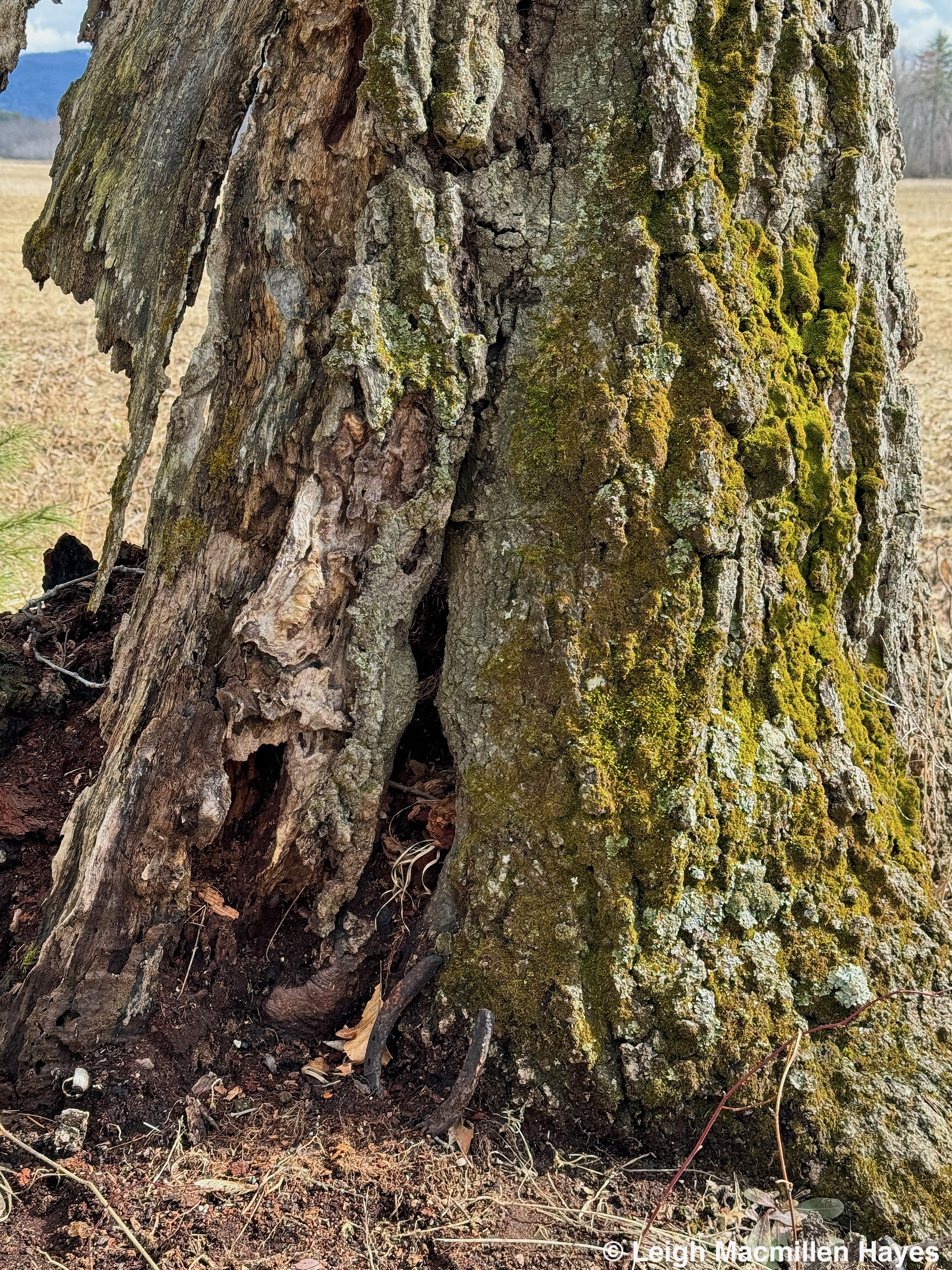
Snag: a standing dead or dying tree; or part of a tree that is dying.

To visit a stump presumed dead
is to find life that comes in many forms.
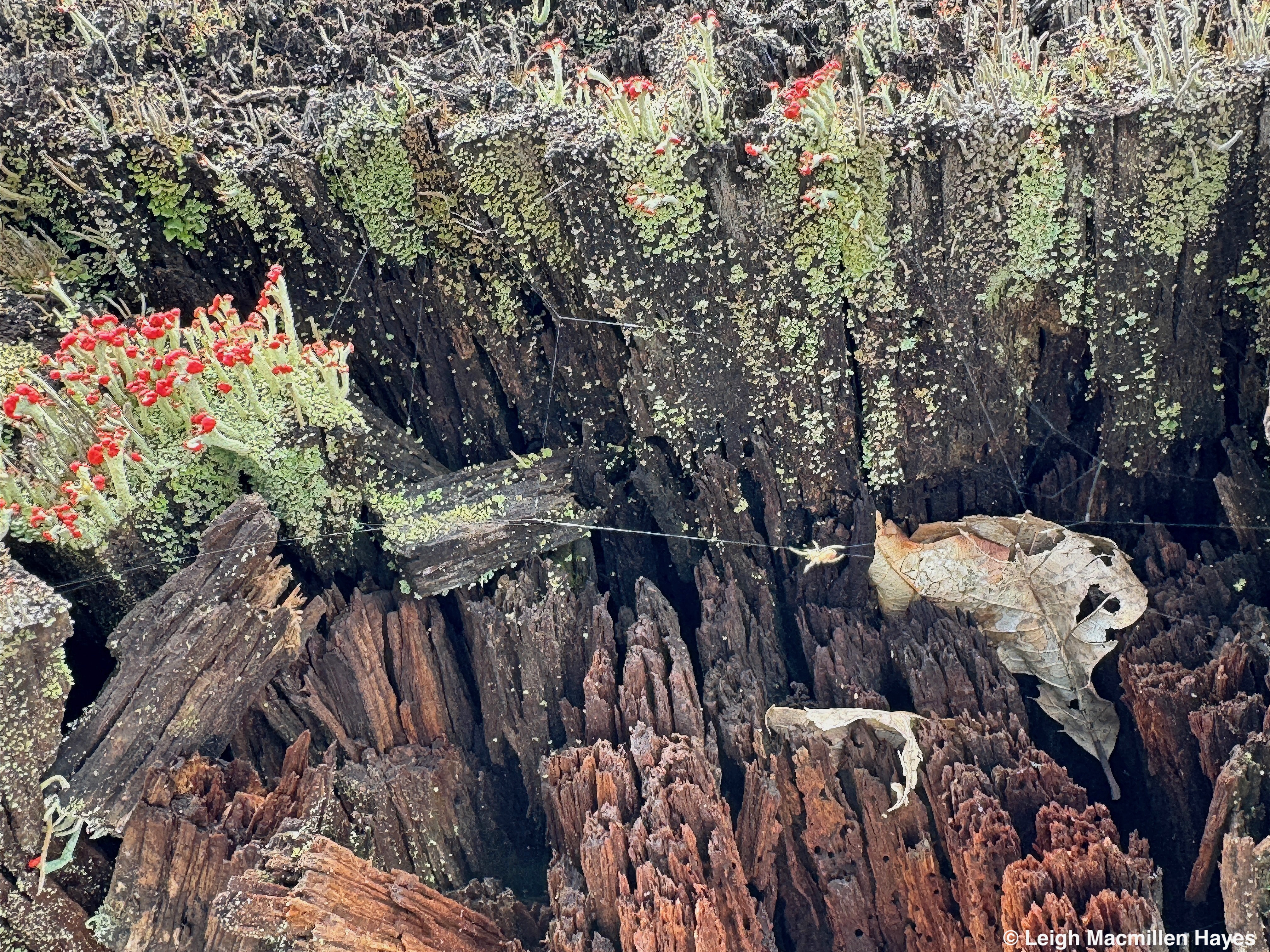
Mosses and lichens colonize in a manner all their own,
and saplings find a new spot upon which to grow.
British soldiers crowd the scene,
their red caps marching toward the future
with fruiting spores planning to form
more of the same.
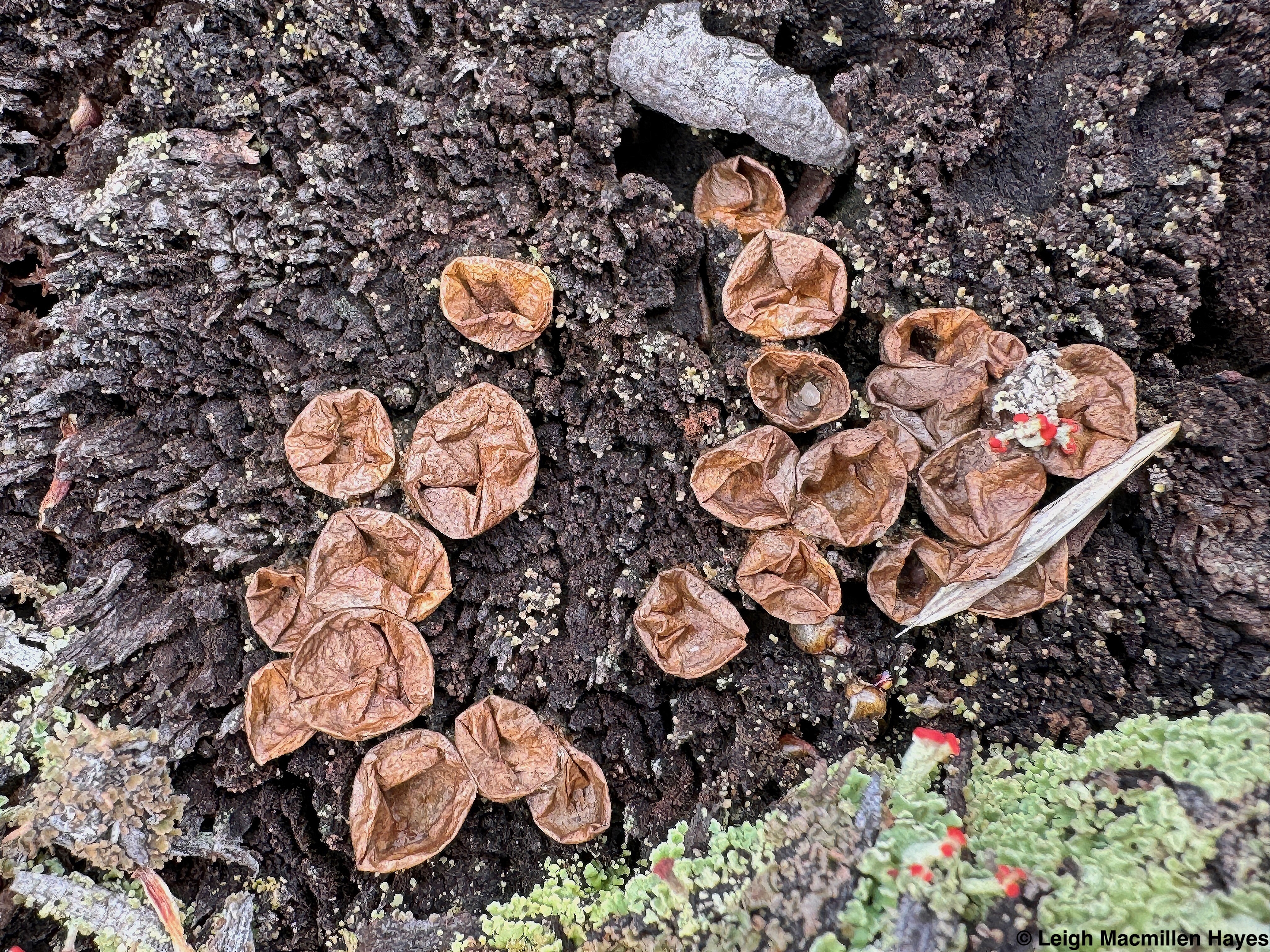
In their midst
others who are deflated,
the papery remains of puffball fungi
having already spread their wealth.
And a tiny White Pine
who chose this spot
upon which to germinate
at least seven years ago.
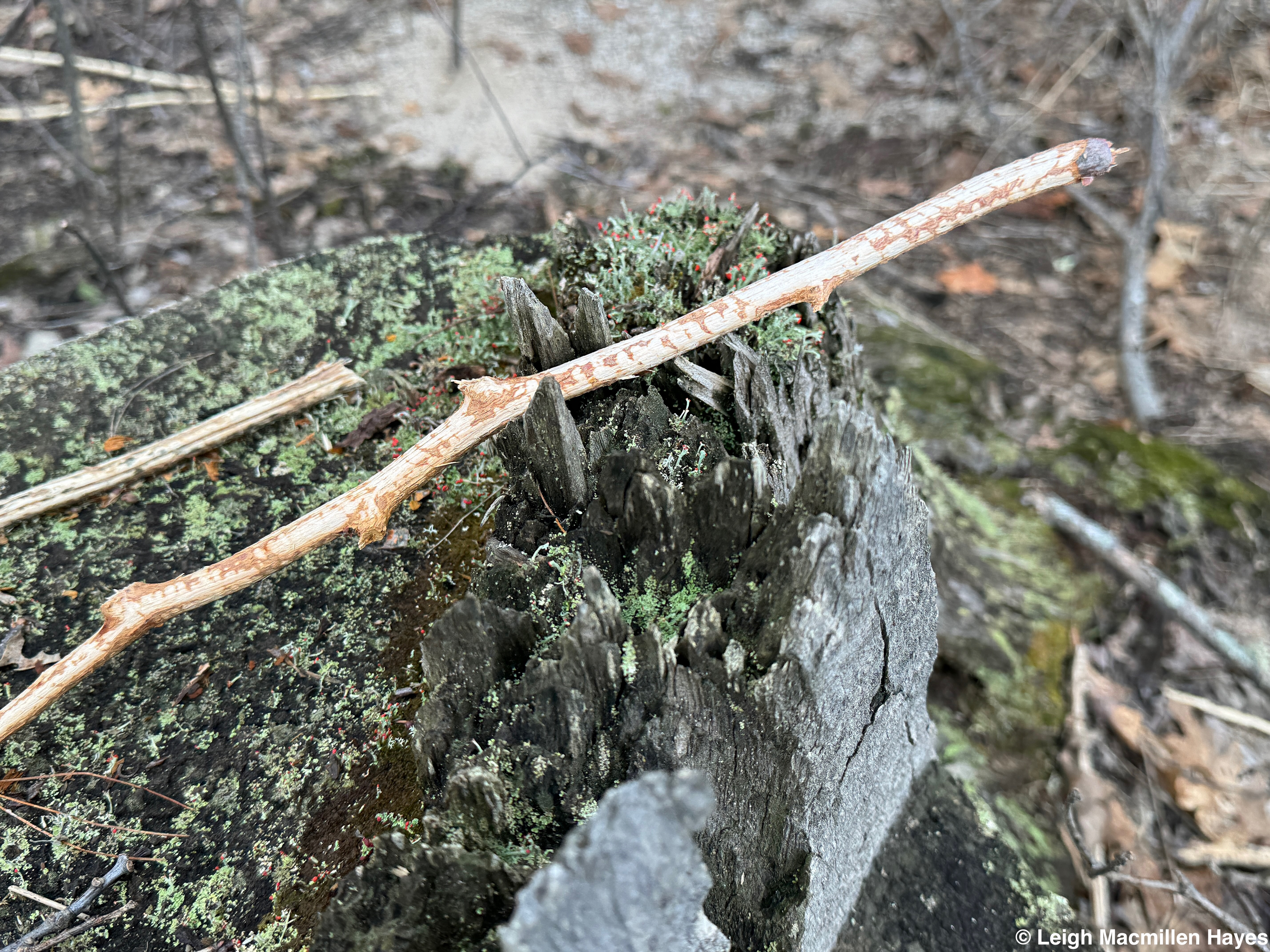
Stopping beside another stump,
it is not the residents who call this home
that attracts my attention,
but rather the sign of another who had paused here.
Beaver nip sticks, a source of winter food, 
were on display,
the trees from which they came
now skinny stumps in the background.
And growing on this stump,
scaly-surfaced trumpets
blaring Irish tunes
for all to lichen.
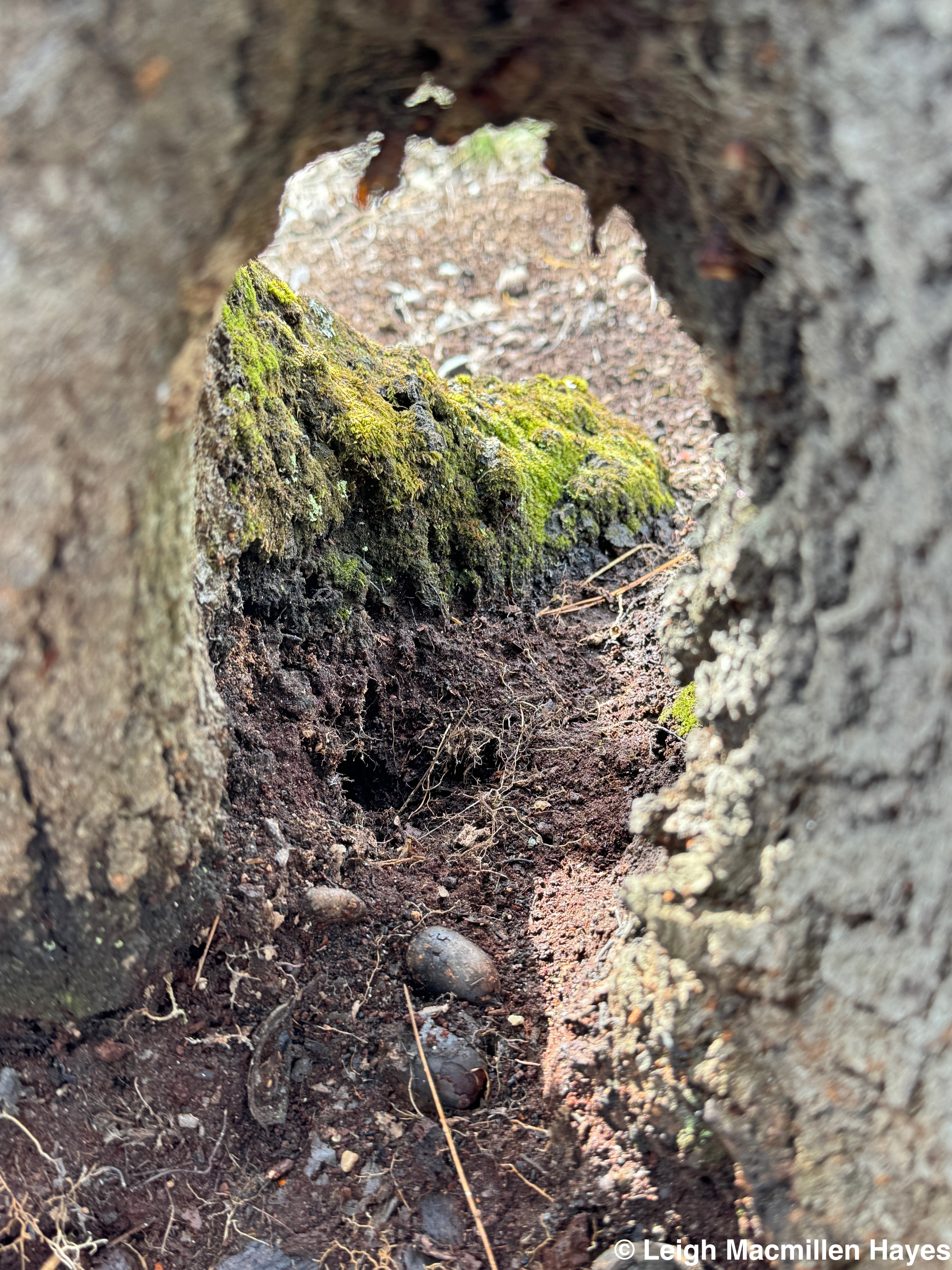
The next stump in my survey
had rotted from the inside out
and humus formed within
its castle-like chambers.
It even had an arched doorway
for leprechauns to enter
or pass into the next world
and the stump itself was leading the way.
There was another, 
which though the wood had already decomposed,
offered a substrate for a few
to set up housekeeping.
I was struck by the contrast
of a small clump of British Soldiers
on this one, whilst its neighbor
supported an entire army.
And only one small clump 
of Four-tooth Moss,
decorated with raindrops
in a salute to our March weather.
It's when one takes 
the time to look,
that the tiniest residents
make an appearance.
And so I watched this tiny spider
works its magic
of building guide lines
and creating a snare in hopes of a grand capture.
Not all stumps in this river-side location
were the result of man's intervention,
for old beaver works
highlighted tree spirits in the curvature of the lines.
Switching my attention to snags
brought the vision
of more artwork
upon the skeleton of a tree trunk.
And a display of the (w)holiness of this place,
for such were the portals
carved by beeltes in the past
that had breached the bark.
Finally, I stood by one mighty snag
that is a marvel of this natural world,
so much of it decomposed
yet replenishing the soil.
Looking skyward from within,
one can see branches
and marcescent leaves above
speaking to the xylem and phloem still in operation.
What bark is left,
serves as armor for this old oak,
and as scaffolding
upon which mosses and lichens can grasp.
It's what I spy inside,
however, that takes my breath away.
Oddly enough, it is named
for the breathing structure of another.
And when I compare it to 
the nose of my oldest son's furbaby,
I can see the resemblance, sorta.
Dog Nose Fungus.

As for stumps and snags, I must give thanks
for they are hardly useless in the landscape,
but rather hosts of many a forest life,
and I'm sure St. Patrick would approve.

Wednesday Wanders

Today’s wander begins at the end because it can in my book of life. And by the end, I think you’ll understand why I made that choice. But don’t scroll ahead cuze then you’ll ruin the surprise.

Our deer friends are feeding on bird seed and corn right now about ten feet from the back door. Meanwhile, the fairies are flittering about behind this doe. Do you see their twinkling wands at work?

Actually, all the lights are kitchen reflections on the door window.

This, of course, has nothing to do with the rest of the day, but I do love our deer friends and like to honor them when I can.

Now on to the nitty gritty of the rest of the story. My friend Dawn and I are Maine Master Naturalists as you may know. And because of that, we must volunteer time to teach others about the natural world. An unpaid job that is hardly a hardship because it’s so much fun.

Right now, we are in the midst of offering a program every other week for Loon Echo Land Trust in Bridgton. And the winter focus is tracking. Not easy to do without snow or mud. Wait a second. The animals are always on the move, and without the snow, we must look for signs. And so we did.

The first, a special offering left on top of a rock that Dawn actually noticed this past weekend when her son and daughter-in-law were visiting, and which she complety embarrassed him by taking photographs of it.

Out came my scat shovel today and everyone took a look. By its form, size, and location, we determined Red Fox.

Our real mission today, however, was to explore the territory of a Red Squirrel. No, this is not my friend Red, but another who has established a territory in a different space that’s also been blessed with an abundant amount of pine cones this year.

We wanted the partipants to take a close look at the scales where the seeds the squirrel sought had been stored. They got right into it.

After locating caches and middens created by said squirrel, we taught the ladies how to use a loupe, aka hand lens, by holding it close to their noses and bringing the object closer until they could focus on it.

To say it opened up a whole new world is possibly an understatement.

Discovering the tiny seeds the squirrel consumes would have been enough, but there was more. In one section of this squirrel’s habitat we found numerous mushrooms upon branches, placed there by the rodent to dry. Talk about being in a food pantry.

And then . . . and then . . . we spotted hoar frost between a couple of stacked logs . . . and surmised that our little friend was living in the space below. How cool is that? Wicked, in these parts of the woods.

What we learned is that this particular squirrel’s territory is located between two downed trees and a wetland, about the size of half a football field.

At the edge of the wetland, it was time to turn our attention from the squirrel to another rodent.

Yes, a Beaver. Once our eyes cued in, just like spotting the squirrel’s mushrooms, beaverworks made themselves known.

And so we encouraged partipants to channel their inner Beaver and try to chop down carrot trees.

Like any Beaver, they were eager to shout, “TIMBER.”

And rejoiced when their tree stumps matched the Beaver’s sculptures.

Finally, we took them along a path that led to more Beaver works, where we noted how its the cambium layer that this rodent seeks for its nutritional value. The rest is left behind, rather like a squirrel’s midden.

And so the inner Beaver channeling continued, this time with pretzel sticks and they were challenged to only remove the outer layer.

The competition was stiff, and a couple of Beavers broke their sticks so we’re not sure they’ll survive the winter.

But at least one was super successful.

While only one Beaver fells a tree, the family may help to break that downed tree into smaller pieces and there are at least three sections like this indicating that they’ve worked on it–maybe one at each spot. We don’t know for sure, but that’s the picture we like to imagine.

Below where we stood, we spotted the dam and talked about construction.

And then located the lodge. Another cool thing–more hoar frost at the top where a vent hole exists and is not covered with the mud that insulates the rest of the structure.

By evidence of the frost, we suspected the family was gathered within, probably consisting of mom and dad, at least two two-year-olds who will move on in the spring, and maybe a few youngsters.

As we walked beside a trail on our way to check out another lodge we determined wasn’t active, one among us discovered a kill site. So here’s the thing. When we first met in the parking lot, that same participant pointed to a Bald Eagle that flew just above the trees.

Could the eagle be the predator of what had been a duck? We suspected so.

The blood was fresh.

Nearby a Mallard had been quaking and we thought it was laughing at us and our enthusiasm and inquisitiveness. But perhaps it was lamenting the loss of a mate. Or at least trying to locate the mate that had become a meal–providing energy for another to carry on.

Yes, it’s sad. But this is nature. This is how it works.

After two delightful hours of discovery and learning, we said goodbye to everyone, dropped in at Loon Echo Land Trust’s office, and then went on a reconnaissance mission at another local spot, trying to determine if we should use it for a class we’ll teach for Lake Region Lifelong Learning, another volunteer venture.

And it was there, that just after we’d talked about being in hare territory and knowing that the lack of snow meant that a hare would stand out amongst the leaves, that . . . Dawn spotted a Snowshoe Hare.

We were so excited about how the morning had unfolded and spying the hare was a grand reward.

Can you track mammals without any snow. YES!

Wednesday Wanders, oh my! So much to learn. So much to share.

Searching for a Tiger Mondate

We didn’t know what to expect when we headed off on a trail today. Or even what to wear on our feet–besides winter boots that is. And so we donned snowshoes initially in hopes that should we locate a Tiger, we’d be able to move easily across the snow rather than posthole and get slowed down.

Ah, but there were things that did slow us down. If you are a long-time follower of wondermyway.com, then you know I can’t resist a Pileated Woodpecker tree . . . among other subjects that repeatedly slow me down. This one was fun because it was obvious that the bird stood on the snow to excavate at least the bottom hole. In my mind’s eye, I could see it using its tail feathers as the third leg in a tripod while its beak pounded away at the tree, excavating a hole. Did it find any food?

Indeed it did and several healthy looking cylindrical scats full of the indigestible parts of the Carpenter Ants it sought were waiting to be discovered like little piles of treasure.

Was the Tiger hiding among the wood chips? No, unfortunately not.

The next great sight was the cocoon of a Promethea silkworm moth. When the caterpillar or larval form of the moth was ready to pupate at the end of last summer, it strengthened the stem, or petiole, of a leaf with silk, and then attached the silk to a nearby branch as you can see, assuring that the leaf would remain attached to the tree rather than fall off. It then spun the cocoon inside the curled leaf.

This species overwinters as pupae in a state known as diapause. During pupation, the larval structure breaks down into a soupy form and then restructures so that by the end of the process (in late May/early June) adult structures, including wings appear before its time to emerge and fly.

Was the Tiger hiding behind the cocoon? No, unfortunately not.

And then there was the Hickory Tussock Moth Caterpillar–climbing a tree to look for food on a winter day? Hardly. At a certain point in its growth, it lightly locked its legs into mat of silk it had produced on the branch. It then released enzymes that dissolved the inner layer of its cuticle, and a day or so later, much like a dragonfly or cicada emerging from exuviae, the caterpillar’s cuticle split above the thorax and the caterpillar literally crawled out of its skin. This is an old cuticle left behind.

Was the Tiger hiding amid the HTM’s cuticle? No, unfortunately not.

As we hiked along the snowshoe trail, we had to work our way around, over, and under downed trees, but this one encouraged me to pause for it’s one I don’t encounter on an everyday basis, much like its cousin with bristles on its leaf lobes. The cousin in Northern Red Oak, but the leaves we met today belonged to White Oaks. Oh, there were red oaks along the way, and I don’t mean to downplay them, but I’m forever in awe of the marcescent (leaves that wither but remain attached to the stem) of White Oaks. Those veins. That color. And the shape. Always curled in winter as if an open palm.

Was the Tiger masked by the downed tree? No, unfortunately not.

At an erratic the size of a small house, I had to take a closer look and convinced my guy to pause. He did and circled the boulder in search of the Tiger.

Did he find the critter? No, unfortunately not.

It was next to a Speckled Alder that our attention, well, my attention turned. What initially stopped me in my tracks was the woolliness of Woolly Alder Aphids. Those fuzzy aphids feed on the sap of the shrub and produce white wax, or “wool,” filaments from their abdominal glands.

They drink volumes of sap in order to get enough nitrogen, which they then exude as honeydew. In the summer, I find ants farming them to sip the honeydew.

But that’s not all that is interested in the sweet liquid. A Black Sooty Mold loves the honeydew as well.

The funny thing is that I was just discussing this yesterday with Land Steward Leah of Dartmouth Natural Resources Trust in Dartmouth, Massachusetts. The Black Sooty Mold is actually a Poop Eater! What? Yup. A poop-eating fungus. The natural world is more otherworldly than one can even imagine.

The Sooty Mold’s name comes from the dark threadlike growth (mycelium) of the fungi resembling a layer of soot or rather, a bit like elongated coffee grounds, and within my hands, its brittle structure quickly splintered into tiny specks.

Was the Tiger hiding among the Sooty Mold? No, unfortunately not.

Eventually, we returned from whence we’d come because one of the snowshoe trails is an out-and-back, found a rock upon which to sit for lunch, and the same served as a storage hide-away for our snowshoes while we donned micro-spikes, for the rest of the journey would be along a snowmobile trail. The thing about snowmobile trails in our area–they were closed a few days ago, just at the start of Spring Vacation, oops I mean Winter Vaca, but such have been the temps of late and the trails are not safe–especially where they cross waterways or boggy areas.

That said, I stepped off the trail and located this tree–a wonder unto itself. For those who know the species, it’s a Hophornbeam gone astray. Typically, these trees of sorta shaggy, yet tight bark, if one can be such, grow straight and strong, but obviously there was an interruption in the growth of this tree, though eventually it found its way skyward as is its normal behavior.

Was a Tiger hiding among the trees? No, unfortunately not.

I discovered the disfigured Hophornbeam because I’d gone closer to the water to spy on a couple of Beaver lodges. And I’m happy to report that based on the mud and fresh branches, they appeared to be active.

Was there an active Tiger in the area as well? No, unfortunately not.

Shortly after reaching Snowmobile Trail ITS 89, we noted the double-wide stonewall, a hint of days gone by when the property was probably plowed for agricultural reasons. We also noted that it’s been a while since that practice occurred for so old did the Eastern White Pine that grew atop the wall appear.

Was it large enough to hide a Tiger? No, unfortunately not.

So the next spot brought a smile to my face, for often, when I’m leading a hike my mouth gets ahead of my brain and I know I mean birch when I say beech, or visa versa, but here they were representing as one in the same for over time they had rubbed against each other for so long that they rubbed together.

Here’s a new word for me: Inosculation–when the friction between two trees causes the outer bark of each to scrape off at the point of contact. The trees respond by producing callus tissue that grows outward, thereby increasing the pressure between the two. This pressure, along with the adhesive nature of sap or pitch that exudes from their wounds, reduces the amount of movement at the point of contact. But the question remains: Does the cambia layer from the two trees come in contact and the vascular tissues become connected, allowing for the exchange of nutrients and water? Maybe if they are trees of the same species, but these were two different species and I suspect they are actually false grafts, which means the two trees have not formed a union of conductive tissues. Going forward, when I say Birch and mean Beech, or Beech and mean Birch–I shall remember these trees.

As for the Tiger, did he know them as well? No, unfortunately not.

As the sun began to shine, we found ourselves pausing beside Cold Rain Pond, where Sheep Laurel showed off its plans for the future. I want winter to continue, and apparently it might, for such is the forecast for later in the week when temperatures are supposed to dip to more seasonal numbers and snow is in the forecast, but note those buds.

Did they obscure the Tiger? No, unfortunately not.

As we backtracked our journey and followed the snowmobile trail out several hours later, I found the evidence we sought. A footprint. Certainly that of a Tiger. A very big Tiger for our area.

Your mission, should you choose to accept it, is to locate the Tiger. We knew it was there somewhere, but just like our Bobcats, it chose to remain elusive and hid among the shadows. Do you see it?

After all, we had traveled over 7 miles of Loon Echo Land Trust trails at their Tiger Hill Community Forest.

There must be Tigers in the midst, indeed. For why else would it be named such?

Disclaimer: the Tiger print is actually a bleached out Bobcat print–made larger as the temperatures rise.

Being Present: The Observer

Walking in silence
along a trail so familiar
my eyes were drawn
to bubbles at my feet.
Tiny bubbles, tinier bubbles, tiniest bubbles
formed random patterns
as they gave new life
to dying grasses.
Nearby, salmon-colored disks
sprouted upon
the mint-green crustose form
of candy lichen's granular base.
Meanwhile, crimson caps of British Soldiers
shouted for recognition
as they showed off
their branching structures. 
Upon a rotting tree
and backlit by the sun
glowed the irregularly lobed fruits
of Orange Jelly Spot. 
In another sunny spot, a Little Copper sought nectar
from a goldenrod still in bloom
while a Spotted Cucumber Beetle
photobombed the shot. 
I have to admit that I struggled with ID: 
Ruby, Cherry-faced, and Saffron-winged
since this dragonfly showed characteristics 
of each in the meadowhawk clan. 
Being present on this October afternoon
reminded me of another day
when I paced before a couple of shrubs
and watched the insect action.
I am honored and humbled to announce that that blog post was recently published
in The Observer,  a publication produced by the Maine Natural History Observatory. 
My friend and fellow master naturalist, Cheryl Ring, also has an article in this issue. 

The most humbling thing for me was an email I received from a reader who is also an avid naturalist. She commented that my ID of a butterfly at the end of the article, which I called Painted Lady, is actually American Lady. I now realize I need a new field guide because mine refers to it as American Painted Lady and I inadvertently dropped "American," while hers dropped "Painted" in the name. It's another lesson in why I need to wrap my brain around scientific names since common can cause confusion. I do appreciate that she took the time to read the article and write to me. 

That said, the best lesson of any day is to take time to be present and observe in nature. Even if it's only for a few minutes. 

Lake Living Celebrates 25 Years in Print

I wish I could say I’ve been along for the entire journey, but still, I’ve been working with Laurie LaMountain to produce Lake Living since 2006, so I’ve been here for sixteen of the magazine’s 25-year journey.

In her editorial note of the summer 2022 issue, Laurie comments about our brainstorming sessions, where with our shared brain we bounce off of each other and do come up with what we both think are great ideas and once we get going the thoughts flow like raindrops pouring out of the water spout. What she doesn’t mention is that we also solve all the problems of the world, or at least our small portion of it. And we don’t always agree, but still we listen to each other and maybe months later recognize that our guts were right or the other one knew best. There’s an article in this issue that ruffles my feathers a wee bit, but . . . as I said, we don’t always agree and that’s fine. I’m sure you as readers don’t always agree with us either.

I think the thing about working on the magazine all these years is that I’ve had the honor of meeting so many interesting people who live right here. We rarely travel far for an interview. And yet if you look at the archived magazines, you’ll see that we’ve covered a multitude of topics.

And the special thing for me about working with Laurie is that she gives me huge, read that as HUGE, leeway to pursue a topic at any angle that I see fit. She also knows what topics I prefer to write about and usually those come my way, but sometimes I have to do what is best for the magazine and leave my personal opinions in my truck. It’s rare, but it has happened over the years.

Enough of my jabbering. On with the magazine!

In the line-up: “Growing Up” about downtown Bridgton by Laurie; “Scribner’s Mill & Homestead” about a living history museum in Harrison by me; “Docks that Stay Sturdy” by Great Northern Docks owner Sam Merriam in Naples; “A Fascination for Fungi” about a local artist’s interpretation by Laurie; “Summer Living,” which is a modified calendar of local events by me; “Summer Bookshelf” by the owners and staff of Bridgton Books; “Click-free Shopping” about Main Street stores that somehow survived the chaos of the last few years and chose to meet customers’ needs without too many online sales by me; and “Salted” about cooking with salt by Laurie.

Here’s a link to the entire issue should you care to read it online: Lake Living Summer 2022

You may have noticed that we didn’t produce a winter or spring issue. Sadly, that was due to the pandemic and local economy. Lake Living is free and supported by the advertisers. For the last three years, we’ve been unable to get enough winter advertisers, so we combined fall and winter articles into one. And then this year when things became even worse, we couldn’t get enough to support a spring issue that we’d pulled together. Unfortunately, because of that, some of those articles are now in a folder and I don’t know if they’ll ever get published. And even when it seemed we could pull off a summer issue, again there weren’t quite enough advertisers to support the usual 40 pages and this one is only 32. That coupled with the fact that the cost of paper went up 40% this spring, added to the downsized summer issue and again, not all the articles we’d written made it in to the final copy and some had to be edited drastically in order to fit the page count.

But . . . the magazine is out there. On a shelf if you live locally, or in the link I included above. I hope you’ll take time to read it. And then take time to support the advertisers and let them know where you saw their ads because unless you tell them, they don’t know the effect of their dollars.

Happy 25th Birthday, Lake Living! And hats off to Laurie and editorial designer Dianne Lewis, and all those who have contributed over the years.

Getting Close to a Black Bear Mondate

Our day began with a remembrance of our fathers and uncles and cousins and friends and all who have served and continue to serve our country. Growing up, my hometown celebrated Memorial Day with a parade and I remember riding or marching or watching–depending upon the year. And after there was a picnic topped off with Strawberry Shortbread. But in my adopted hometown, July 4th is the date that receives all the attention.

And so, that’s a long introduction as to why My Guy and I headed off to Overset Mountain for today’s hike. We were on a mission.

Said mission was not to count all of the Indian Cucumber Root plants we could find in flower, though My Guy did point to this one at the start of our journey because just a week ago I introduced him to their double-decker structure necessary for extra sugar creation and therefore flower followed by fruiting form.

Nor was said mission to marvel at the water as it flowed over the rocks in Sanborn River.

Instead, it was a bit of a treasure hunt that motivated us as we sought the ones who liked to hide along the trail. Um, kinda like My Guy is hiding in this photo. Can you spot him?

Success at last. The first success that is–a Pink Lady’s Slipper in full bloom. #1. Henceforth, had you been with us, you would have heard us stating the number of each Lady’s Slipper we spied and honored.

At first, there weren’t many but we did what we like to do when faced with a challenge such as locating bear claw trees–we scanned both sides of the trail in hopes of being the one to announce the next number.

Oh how they hid!

To spy one often required a sharp eye. The question was thus: what determined where a Lady’s Slipper would grow? I knew it was a certain fungus, but the US Forest Service clarifies it more than I can: “In order to survive and reproduce, pink lady’s slipper interacts with a fungus in the soil from the Rhizoctonia genus. Generally, orchid seeds do not have food supplies inside them like most other kinds of seeds. Pink lady’s slipper seeds require threads of the fungus to break open the seed and attach them to it. The fungus will pass on food and nutrients to the pink lady’s slipper seed. When the lady’s slipper plant is older and producing most of its own nutrients, the fungus will extract nutrients from the orchid roots. This mutually beneficial relationship between the orchid and the fungus is known as ‘symbiosis’ and is typical of almost all orchid species.”

Turns out, we weren’t the only ones on the hunt. This Garter Snake crossed the trail and then paused, certain that it was so well camouflaged by the leaves and the twig it passed under that we couldn’t possibly spy it. But we did.

Sometimes, it was the white version of the pink that we spotted. As I mentioned, Lady’s Sippers orchids in the genus Cypripedium in the Orchidaceae family. The genus name Cypripedium is derived from the Greek words “Cypris,” an early reference in Greek myth to Aphrodite, and “pedilon” for sandal, so named for the fused petals that form the pouch and their resemblance.

There were other white flowers to also admire, such as the Canada Mayflower or Wild Lily of the Valley that decorated a boulder.

Ah, but we reminded ourselves that Lady’s Slippers were our focus. Though most stood upon straight stems, there was the occasional one such as this that had a mind of its own. What had this flower endured to create such a curvature?

At last we reached Overset Pond with the mountain of the same name beyond. This became our lunch spot and while there we watched a Common Loon and a Snapper Turtle swim underwater, for so clear it is.

It was after that, however, that our Lady’s Slipper numbers began to increase. We were at 47 when we reached the pond. But then, it felt like we were constantly taking turns announcing a number and pointing to make sure the other saw the same flowers.

When one is noticing, one notices. And so My Guy pointed out this Tiger Swallowtail taking a break, its proboscis rolled as it should be when not seeking nectar.

The next flower we spotted chose a different orientation, as if it had done something wrong and needed to show its backside to the trail. But really, perhaps it was honoring the tree beside which it grew.

We soon reached one of My Guy’s favorite spots where he counted 50 in bloom in a ten-foot-square area. And that’s just what we could see from the trail.

We found some who stood tall.

And others barely overextending the height of Bunchberry.

At the summit of Overset Mountain, we paused for a dessert break before making our way down.

On the descent there were still others to admire, though for a wee bit it felt like we’d entered the desert, but once closer to the pond, the natural community changed and apparently the fungus did as well for such were our finds.

The last of the day appeared to be the richest in color, though I’m not sure we had an overall favorite for each offered a different hue of the same theme from pale white to this rich pink.

We were on our way back to the truck, when things got even more exciting–if that can be so given all the Lady’s Slippers we’d spotted. Say hello to an immature male Common Whitetail Skimmer Dragonfly. By the time he matures, his tail will turn whitish blue, but those wings will remain the same. Oh my.

And then for the final oh my . . .

Oh My Guy! This was the closet I’ve been to my favorite Black Bear (UMaine grad–though known as UMO grad back in his day) on any hike . . . ever. And for this I give thanks to the Lady’s Slippers for slowing him down to my speed. All together we counted 286 flowering Lady’s Slippers today and know that we missed some and beyond the trail there are probably a million more.

Looking Up

With recent encouragement I changed my focus and gazed skyward.

Rewarded immediately, the porous and slightly concave underside of Otzi, the Ice Man’s Tinderconk fungi, revealed a pattern repeated over and over again.

In another place where the forest is intended as a demonstration project, the dancers of the woods let their boughs reach down as if they were ladies dressed in gowns rather than Norway Spruce standing in a foreign community.

The upward gaze, however, was soon drawn down to the cone with scales numerous, thin and irregularly toothed, attracted my eye and that of a squirrel who left a large midden at the tree’s base.

And then that gaze focused outward where Common Mergansers whispered amongst themselves in a language only they understood.

In their midst, a Common Goldeneye swam and once again I wondered about that descriptive term “common.” Exactly what is common about that golden eye and all the other features of this duck?

Moments later I gazed skyward again from under a princess pine clubmoss that ends each leaflike structure with a Y as in “Why”? Certainly. Perhaps because.

Distracted once again–I spotted a spring stonefly with its rolled wings providing a stain-glassed venation.

The next upward gaze turned a tree stump into a nurse nourishing an entire deciduous forest as if it could.

Downward, I focused on a black-capped chickadee puffed up on a cold spring morning . . .

and a Mourning Cloak butterfly who had overwintered as an adult under the bark of a nearby tree.

So as a friend reminds me, I’ve entered a new season, one where I squat over vernal pools and beside streams and search for life within for hours on end.

For now, the ice is only just melting and life within the pool taking time to emerge, such as this predacious diving beetle larva.

At last I stand up straight and turn for a reason I don’t recall. But . . . there it is. A bird I’d seen swoop over the pool and stand at its edge as I approached. Of course, then it took off, not giving me an opportunity to identify it . . .

Until the barred owl did just that. Flew back in and posed above. And I realized that as I looked up at it, it looked around . . .

and then down at me. My gaze might be upward, but the owl also searched outward and downward.

As it should. This well-focused visionary knows that one must look in every direction for there’s always something to wonder about. Especially as we celebrate Easter 2021.

And my guy and I give thanks for receiving our second Pfizer shot this weekend. In the midst of joining the owl’s vision, we’re all looking upward.

Happy 6th Birthday, wondermyway

It’s hard to believe that six years ago I gave birth to wondermyway as a means to record the natural world and all I met along the way.

There’s no need in reminding everyone that since last February it has been quite a year, but I have to say that I’m especially grateful to live where I do, in a place where I CAN wander and wonder on a regular basis.

As I look back through posts of these expeditions, I realize how often nature presents itself in such a way that moments of awe make everything else going on in the world seem so foreign. If only everyone could whisper to a dragonfly upon his or her hand; watch a cicada emerge from its larval form; and even appreciate a snake or two or three.

Join me for a look back at some of my favorite natural encounters of the past year. If you want to remember a particular adventure, click the titled link below each photo.

Transitioning With My Neighbors:

From sun to rain to sleet and even snow, it’s been a weekend of weather events. And like so many across the globe, I’m spending lots of time outdoors, in the midst of warm rays and raw mists.

I’m fortunate in that I live in a spot where the great beyond is just that–great . . . and beyond most people’s reach. By the same token, it’s the most crowded place on Earth right now.

We’re all in transition, my neighbors and me. What the future holds, we know not. The best we can do is hope we come out on the other side–changed by the experience, of course.

Under the Bubbles

Wander outdoors if you can and let the anomalies pull you into their realm. I promise, your eyes and your mind will be opened to so many wonders that you’ll resist the urge to move along for so enamored will you be by your finds. Slow down and look and be wowed.

In the end, may it not be an end. May it be a beginning. May you live under the bubbles and give thanks that your bubble is attached to so many others as you share a brain.

Dragonfly Whisperer Whispers

We had no intention of eating lunch in this spot today, but while looking for a mountain to climb, we kept encountering full parking lots and so our backroad meander put us beside a bog at lunch time and voilà, we managed to walk all of less than two tenths of a mile. Total.

But in that short distance, our eyes feasted. First it was all the Painted Turtles basking in the sun. And birds. And dragonflies.

I just had to find out. Would he or wouldn’t he? He would and did. Yes, I quietly placed my finger on the leaf and he climbed aboard, then struck a rather relaxed pose. The Dragonfly Whisperer whispers once more.

Marvels of the Meadow

“My lupine meadow is in full glory!” a friend wrote in an e-mail. And she encouraged visitations. So . . . I went. Actually, we went, for I invited another friend to join me.

Fortunately, I guess, though unfortunately on some levels, we pulled ourselves away by mid-afternoon. But our bug eyes were wide open. In the end, we offered up thanks to our hosts, Linda and Heinrich, for inviting us to enjoy the full glory of their lupines and all the marvels of the meadow.

Celebrating Cemetery Cicadas

Beings who once walked the Earth
support new life as summer's serenade
begins to take shape 
upon stones that memorialize the past...

On this summer day, hollow cast(ket)s left behind
provide a memory of vulnerable forms.
From soft pastel bodies to wide-faced creatures with bulging eyes,
I get to celebrate cemetery cicadas. 

Frog Alley

I’m pretty sure I said to the friend whom I met on the dirt road that I never see frogs there except for the painted boulder that has faded with age and I no longer even think to honor with a photograph.

But still, she reminded me, “I’m sure we’ll see something interesting.”

No way.

After walking one stretch of the road and only pausing a few times in the hot sun, we hopped back into our vehicles and made our way to a much more shaded location. As we stepped toward the river, in flew a Kingfisher. And we knew we were in for a treat or two or three.

Crowning Glory

The theme of the week didn’t dawn on me immediately, but a few days into it and I knew how blessed I am.

It was a week for me to realize how important all the young people in my life are from our sons whom I can chat with on the phone to those who have chosen to make this area of western Maine their home and to get to know their place in it. And then to go beyond and share it in a way that benefits the wider community.

Thank you, Hadley, for the opportunity to celebrate your birthday. And thank you Rhyan, Parker, Dan, Jon, Mary, Brent, and Alanna: it’s my utmost pleasure to share the trail with you whenever we can. And to know that the future is in your capable hands.

We are all blessed. Today we crowed Hadley, and in so doing, gloried so many others.

Making Sense of Scents

Last week, while walking along a trail I later intended to share with some local kids, a subtle movement caught my attention.

About two thirds of the way along the trail, exactly where I’d spied it two hours prior, the Garter Snake still posed. And the kids got to examine it. And wonder. And exclaim. They went in for a close-up look, thus the snake stuck out its tongue repeatedly in an attempt to get a better sense of who or what might be in its midst.

Snakes have poor eyesight and their hearing ability is limited. Thus they use their nostrils and tongues to pick up scents of prey or predator. By flicking the tongue, they collect odors that the forked prongs relay to two holes in the roof of their mouths, aka Jacobson’s organ. With information transferred from the organ to the brain, they can interpret scents.

For the kids and me, it was this sense: Best. Moment. Of. The. Afternoon.

For the snake: it decided we weren’t worth getting excited about as it made sense of our scents.

All In A Day’s Walk

My mission was two-fold. Hike up a small mountain and capture a one minute video to post on a work website next week, and retrieve a game camera so we can download the photos and then place in a different location.

First there was the porcupine den, then a beaver tree, and along the way a fungi.

My final sighting of the day, that still has me smiling, occurred in the middle of the adventure, but I wanted to save it for last. Do you see what I saw?

Who cooks for me? I wish this Barred Owl would, for I must now prepare dinner. But that’s okay because I’ll take him with into the kitchen in spirit and give thanks that I had the opportunity to spend a few minutes with him . . . all in a day’s work.

My Heart Pines

Fourteen months ago I wrote Ode to Pinus Strobus, showing my respect for the mighty pines that inhabit our woods. Curiously, it was a rainy day then. And today dawned the same, though even more curiously, today we turned the calendar to December 1, yet the temperature rose to 57˚, like a summer day as we approach winter in western Maine. Because of the temp, the day offered some incredible wonders.

For those who love to wander and wonder, I hope you’ll be still and have an experience similar to what this tree offered me today.

My heart pines . . . naturally.

Sharp Observation

I was early–a rare occasion as usually I’m the one who arrives at least ten minutes after the agreed upon time. It wasn’t always that way, but has become a bad habit. That said, it was a creature of habit that I went in search of because I had some time to spare.

He was up there enjoying the cambium layer of the bark as witnessed by the goldeny color of the branch by his feet. All those downed twigs–apparently they were in his way so he nipped them off and dropped them to the ground in order to get to the nutrients he sought for his winter diet.

Check out his eye. We were both sharp observers as we eyed each other from a distance.

Ghost of the North Woods

For almost thirty years I’ve roamed this particular wood and for the most part you’ve eluded me.

After finding so many signs year after year, today . . . today I spied an uprooted tree at the very spot I thought might be a good place to stop and spend a few hours in silence. As I made plans to do such in the near future, the tree moved.

And transformed into you!

When at last you and your youngster departed, despite your sizes, it was as if you walked through the forest in silence. My every move comes with a sound like a bull in a china shop, but you . . . Alces alces, you weigh over one thousand pounds, stand six feet at your shoulder, and move through the forest like a ghost. For that reason and because you let me spend some time with you today, February 11 will henceforth mark the day that I celebrate the Ghost of the North Woods.

Thank you to all who have joined me for any or all of these journeys. With each learning or sighting, I get excited and can’t wait to share it with you. I’m not only grateful to be able to wander and wonder, but I’m also thankful for all of you who take the time to read these posts.

Tire’m Out Mondate

Recently someone whispered in my guy’s ear (from a moose-length away and fully masked, of course) an alternate trailhead to a small mountain we’d hoped to climb last week but avoided because there were too many vehicles. “Take a left, and then drive a mile or two down the road, and I don’t know if there is a plowed parking area,” is the way the message was relayed to me.

And so we did.

And much to our delight there was not only a small parking area that had been cleared, but also blazes painted on the trees and footsteps showing the way. We felt like we’d found the pot of gold, especially since there were a few cars at the other trailhead as we passed by.

The cool thing about the trail we followed today is that it reminded us of the walled path on our property; not wide enough to be a road, but two stonewalls indicating a previous use of the land. Maybe for cows. Maybe each farmer marking a boundary. Doesn’t matter; it made for a delightful beginning.

In a short time, we reached another wall that ran perpendicular to the two we’d walked between, though this one was intentionally made of flatter field stones. While it called to mind stonewalls in Connecticut more than Maine, given the ledge mountain upon which we hiked today, it made perfect sense that construction should be such. And gave me reason to consider a return on another day when there is no snow on the ground so I can further explore it.

For today, our focus was first on reaching the summit via this new-to-us trail that was like a walk in the park. After passing through the field stone wall, below which mixed hardwoods grew, we entered a hemlock grove and knew the summit wasn’t far off.

It was by the summit that we took a turn in order to visit the castle, a place our sons in their youth used to love to explore. We took them with us in spirit today as we played while they were in their respective cities and hard at work.

Long ago, the rocks were deposited upon this mountain top as the glaciers receded and over time weathering split them creating spaces for playmates like us to wave to each other from opposite sides.

And peek through . . .

before crawling out.

We finally moved on to the summit outlook, where our view embraced Keoka Lake to the east . . .

Bear Pond in front of lunch rock . . .

and our beloved Pleasant Mountain to the west with the ski trails at Shawnee Peak showing off their white paths.

Following lunch, we decided to hike down a different trail with hopes of eventually reaching the road and then climbing back up the main trail we’d passed by earlier. Sounds crazy, I know, but that’s the way we are: crazy.

We thought we knew what we were doing as we followed a skidder trail down. After a bit, while my guy went ahead, I paused by a downed tree in search of what I might find.

The best find I made in a limited amount of scanning was a sweet, yet dried, capped mushroom.

My guy’s discovery: we’d reached an apple orchard and no trespassing signs and so much to his dismay we turned 180˚ and started back up, in hopes of finding another skidder trail to follow in a different direction.

Success greeted us eventually, though like the turkeys, we did a bit of postholing on the next route we traveled. Or perhaps we were the turkeys.

At last we reached the road as we crossed someone’s land, walked about fifty to one hundred feet down and then found the main trailhead to climb up once again.

And so up we went, though by now my guy had followed my example and donned his micro-spikes as the conditions warranted.

At the end of the day, he was tickled because he’d discovered not one . . .

but two geocaches.

When he opened the first, though the contents were in baggies, they were wet and frozen, but the second was in prime condition and we saw that our friend David Percival had signed the log this past summer.

I was happy to spend a couple of minutes searching for winter bug sites, and found the egg sac of a spider . . .

and pupating form of a bagworm moth caught in someone’s web, both discovered upon a shed as we trespassed on property that wasn’t posted.

A double red-belted mushroom also caught at least my eye.

Our best find of the day, however, was one we’ve seen before, but always brings a smile to our faces as it gives new meaning to bear tree.

It was back to the summit outlook for a Lindt candy before following the trail back to the cowpath.

Up and down, up and down with a little bit of a third up and down along way, turkey-style. No wonder they call it Mount Tire’m. To that end, my guy took a power nap on the way home. Good thing I was driving.

Special thanks to Bob Spencer for being the whisperer of trailhead information.

One Drip At A Time

This two-destination day found a friend and me pausing for birds (frequently) before driving north. I should mention that she was enjoying watching the Sandhill Cranes in a cornfield before I arrived and scared them off. Such is my nature.

But our real plan was to climb to the Millard Chandler Feldspar Mine (aka North Star Mine) in Evans Notch.

Millard Chandler was a descendent of one of the founding families of Chatham, New Hampshire, where the mine is located. Originally, mica was mined from the pegmatites but prior to World War II, Whitehall Company, Inc, focused on feldspar.

Today, its man-carved chambers were enhanced by icy sculptures.

A view toward the top revealed that life on the rock somehow continued despite the cavern below.

And from there, the water flowed and froze and formed . . .

stalactites of sorts. Icicle sorts.

Fluid in nature, it was ever changing and we could hear the action of the water within providing a sustenance to its structure.

As we stood there, we honored how every little seepage created a massive outpouring.

And marveled at the displays that began as simple lines and developed into enormous works of art.

After admiring the possibilities within, we looked outward toward Blueberry and Speckled Mountains before descending.

It was upon the return to Route 113 that we spied examples of Black Knot Fungus that gave rise to a discussion about our last adventure to the area a month ago when we’d discovered an aphid poop-eating fungus. How did they differ? We’d have to return to the original discovery to figure that out and so to Notch View Farm we journeyed next.

After circling the Loop Trail and noting tons of apple-filled coyote scat plus coyote, bobcat, red fox, and turkey tracks, we followed the Moose Loop aptly named for the moose that journeyed that way frequently, but also featured coyote and fox tracks. At Moose Bog, we again met the aphid poop-eating fungus and so the comparison began. Black Knot encircles the twig, while the Poop-eating fungus doesn’t. And Black Knot features a beady construction, while the Poop-Eaters are much lacier in looks, rather like the wooly aphids who offer their poop for consumption. The Black is much firmer, and Poop-Eater much more crumbly when touched. Either is interesting and . . . both offer opportunities to wonder.

Despite all the tracks and scat we found along the trails, I was a bit amazed that we saw few insects. And then, moments later, not an insect, but an orbweaver spider crossed our path–quickly at first . . . until it posed.

After it scurried again, we watched as it tried to hide in the snow–and played peek-a-boo with us.

At last we approached the sugarbush, where Sugar Maples were tapped and sap flowed . . .

Droplets formed . . .

And perched . . .

then fell. Mind you, a close-up it may seem, but we kept our social distance as is the new norm.

And spent time watching Norwegian Fjord Kristoff blankety, blank, blank paw for food under the snow.

At last we headed south, but had each barely driven down the road a few hundred yards when a couple of birds called our attention. Turns out they were White-winged Crossbills and thanks to local birder Joe Scott’s response when I asked if they are uncommon in our area, “Some years we get them, some we don’t, depending on food sources up north in the boreal forest and food sources down here. This is about as far south as they come.” Joe added that while other birds are arriving, our sighting was a good one because these crossbills are leaving.

Many thanks to friend Pam Marshall for joining me today for a journey to the mine and farm where one drip at a time bookmarked our day. And for providing perspective.