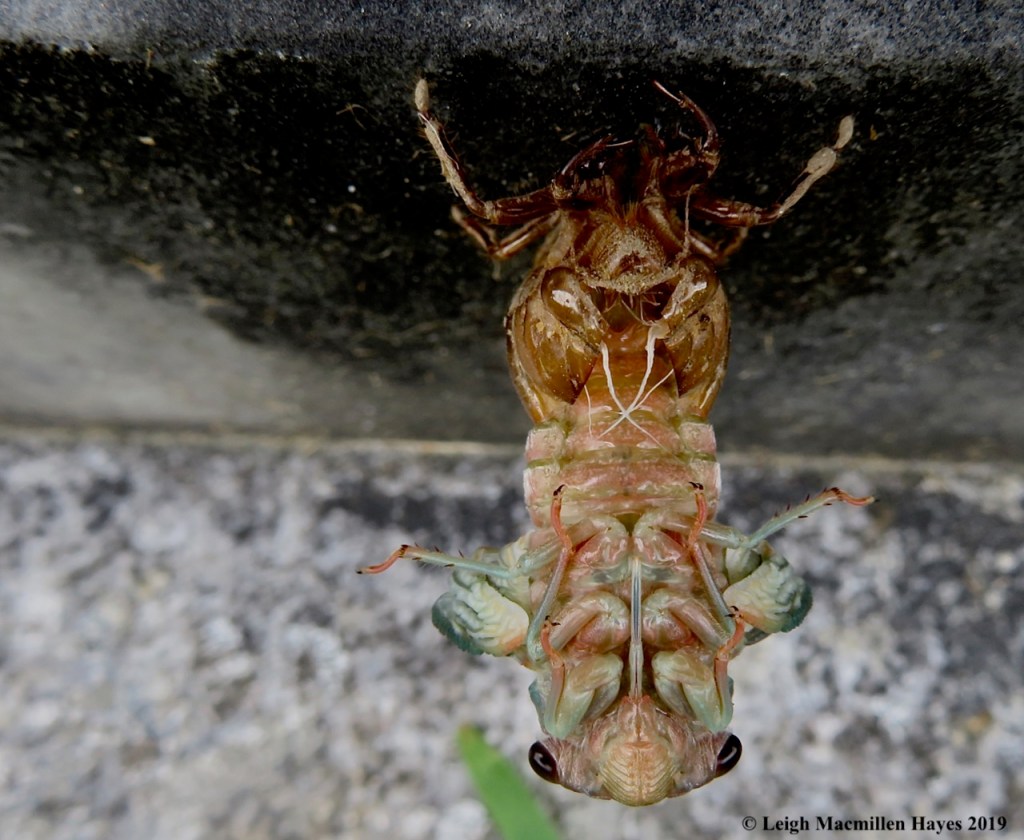
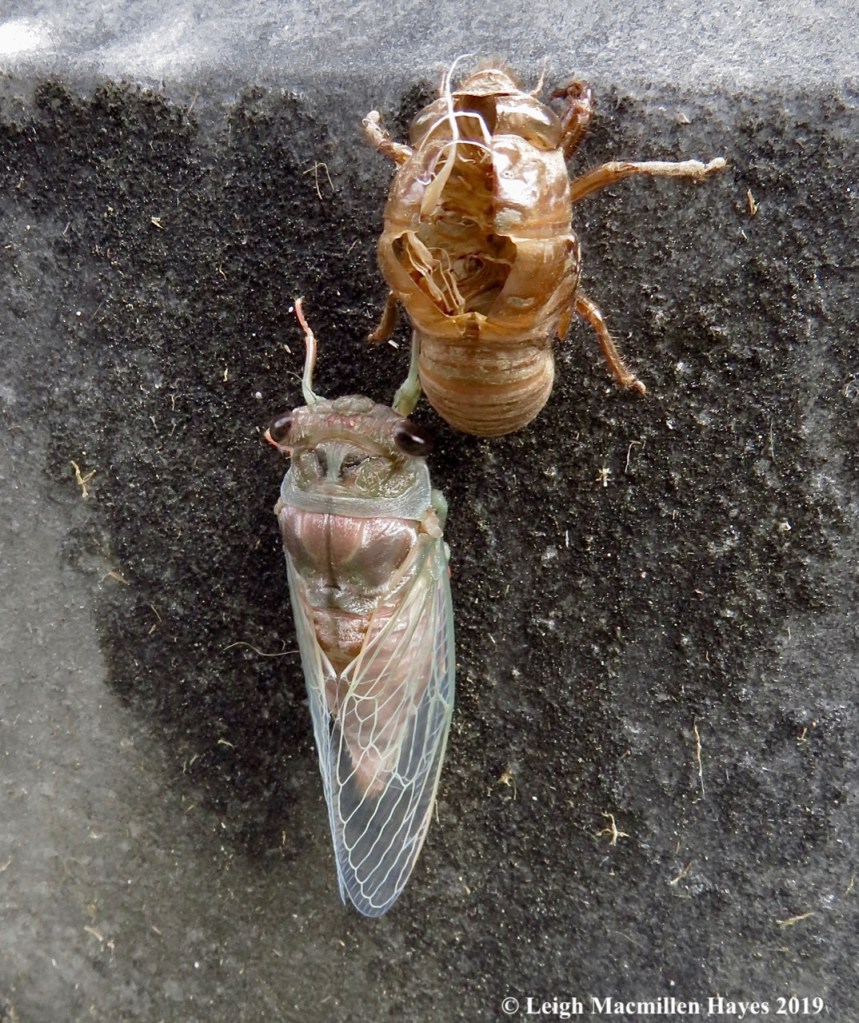
Today was the day that in your nymph stage, you chose to emerge from your underground burrow where the sap of plant roots had sustained you for several years.
While I walked about and noticed other forms of life taking place within the fenced land,
such as Robberflies canoodling in their tail-to-tail fashion,
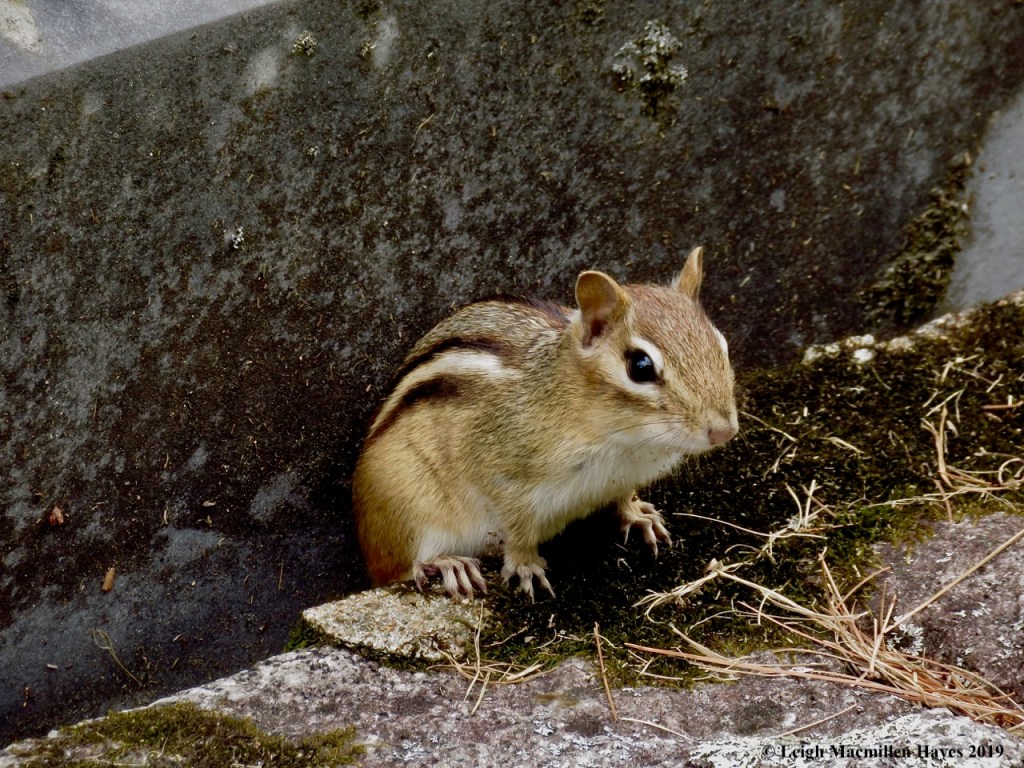
and a Chipmunk who made me think the dead were walking until I saw it checking on me,
I also spotted the larval skins left behind by many of your kin
who had chosen
a nearby tree trunk
and surrounding ground
for such a transformation.
Their thickened legs spoke of the digging your species endures while in that subterranean habitat.
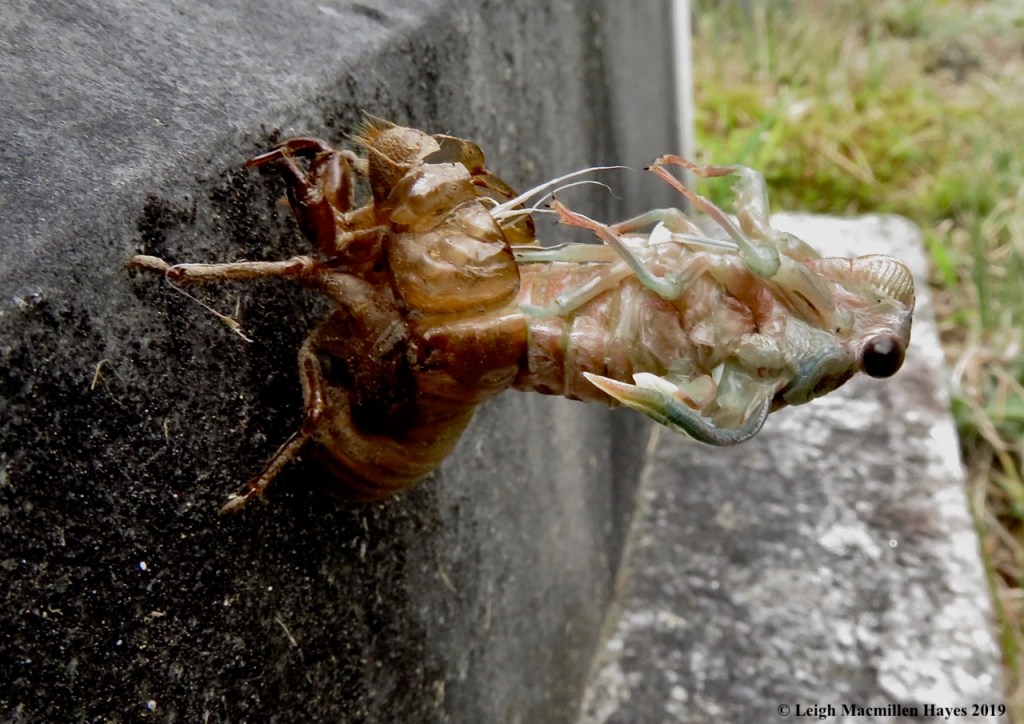
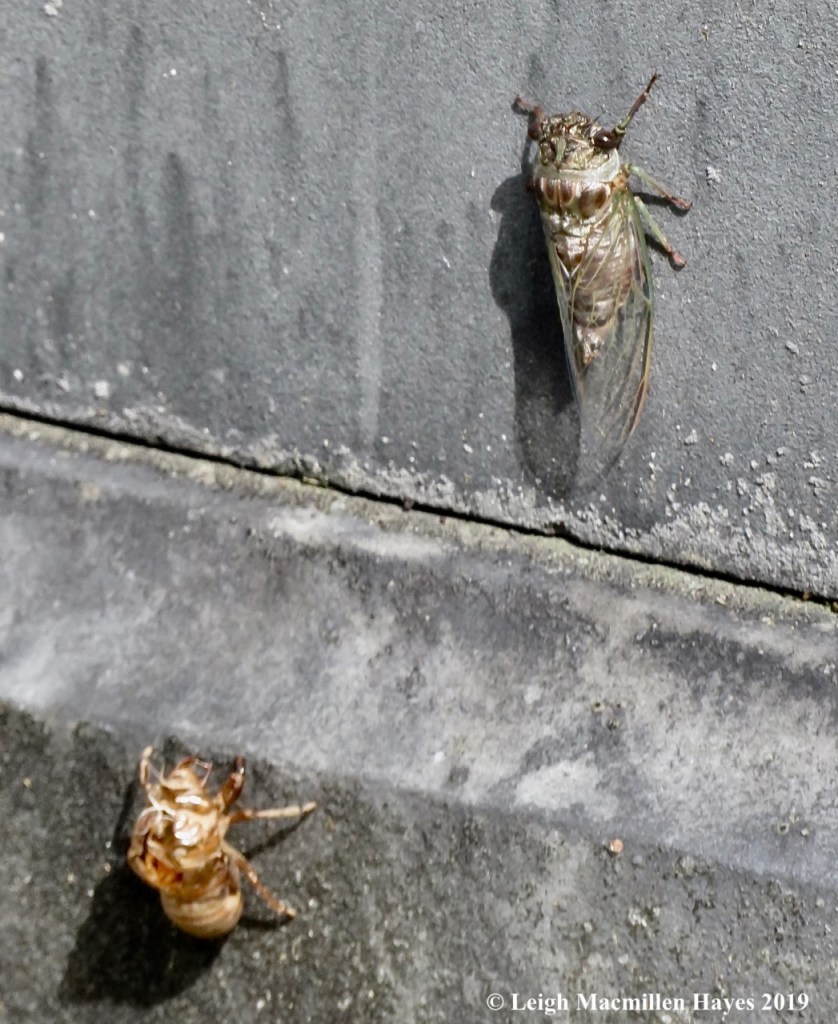
You, however, preferred your stone for metamorphosis.
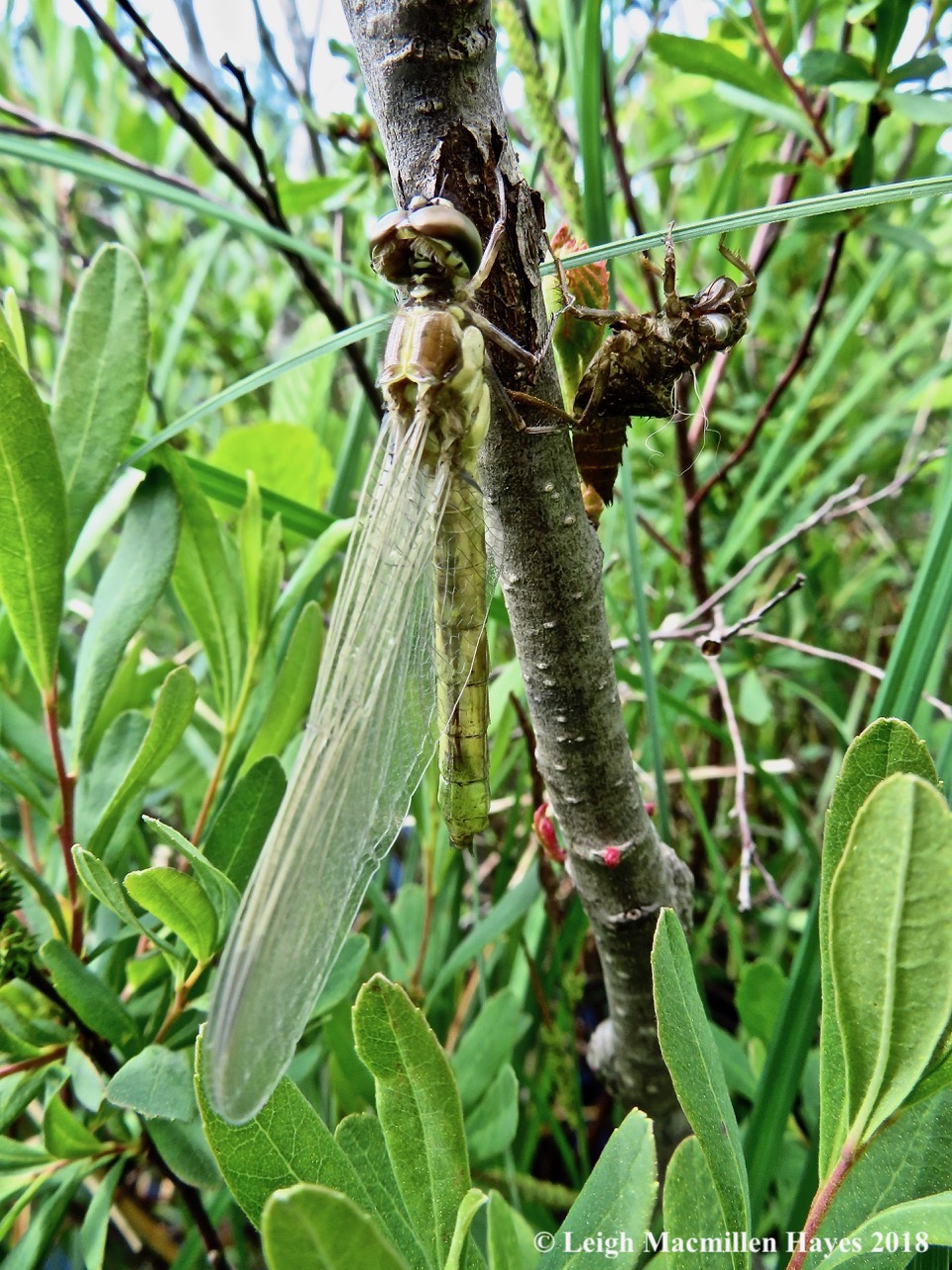
Ever so slowly through a split along your back,
your body, pale-colored at first, extended outward.
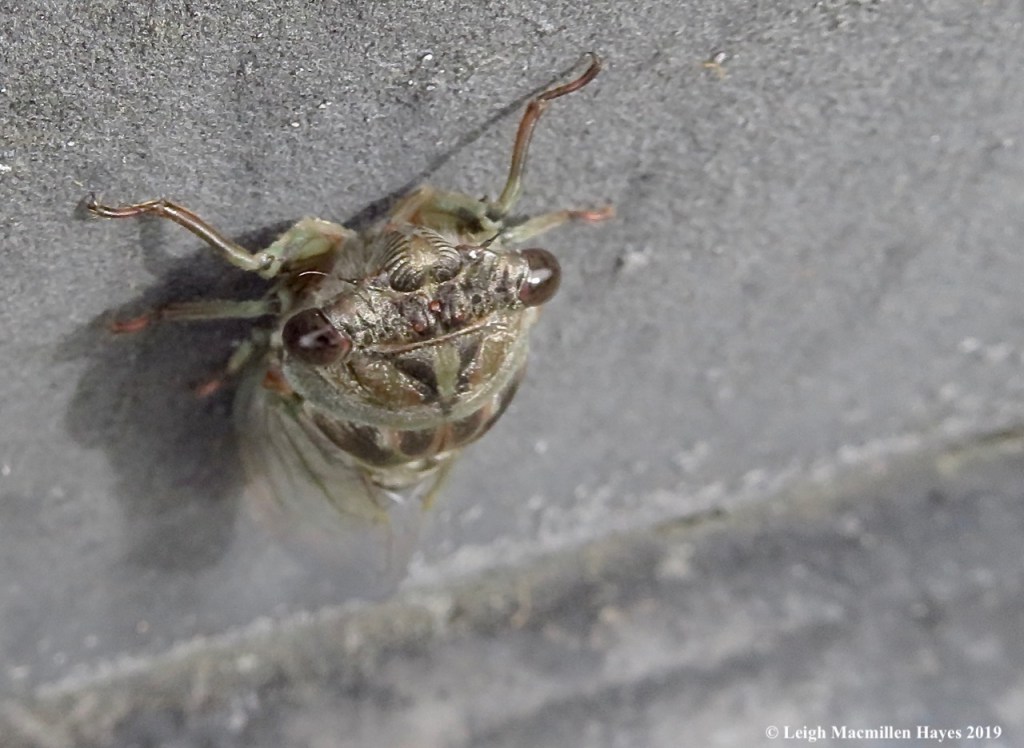
Large and chunky with bulbous, yet beady eyes,
and long, thick-veined and translucent wings,
you looked like something out of a sci-fi movie.
Hues of salmon. pale green. and aquamarine.
At first your coloration reminded me of a pastel painting,
but over time it became apparent that your palette changed with maturity
and eventually looked more like a camouflaged adult who will spend time in the nearby tree.
Left behind was an empty shell of your former self.
Our time together came to an end after periodic checks over the course of three hours. I suspect by now you’ve flown to a tree in search of a mate. The resulting eggs will be laid on a branch, and your story will come to an end once again, Mr. Charles. But never fear, for the next generation will carry on the circle of life as the larvae hatch and fall to the ground, where they’ll burrow into the earth beneath or somewhere very near your resting place before resurfacing as young nymphs ready as you were to burst forth from their exoskeletons three years from now.
Thank you for allowing me to watch on this day as you shared the secrets of a Cicada’s life while I wandered among the dead
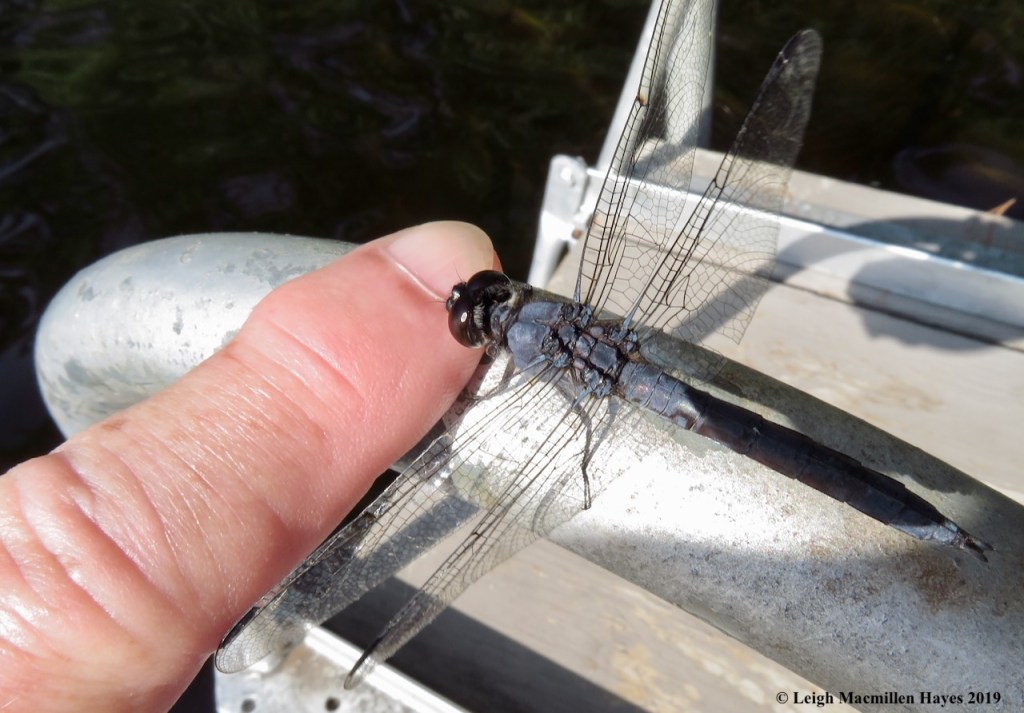
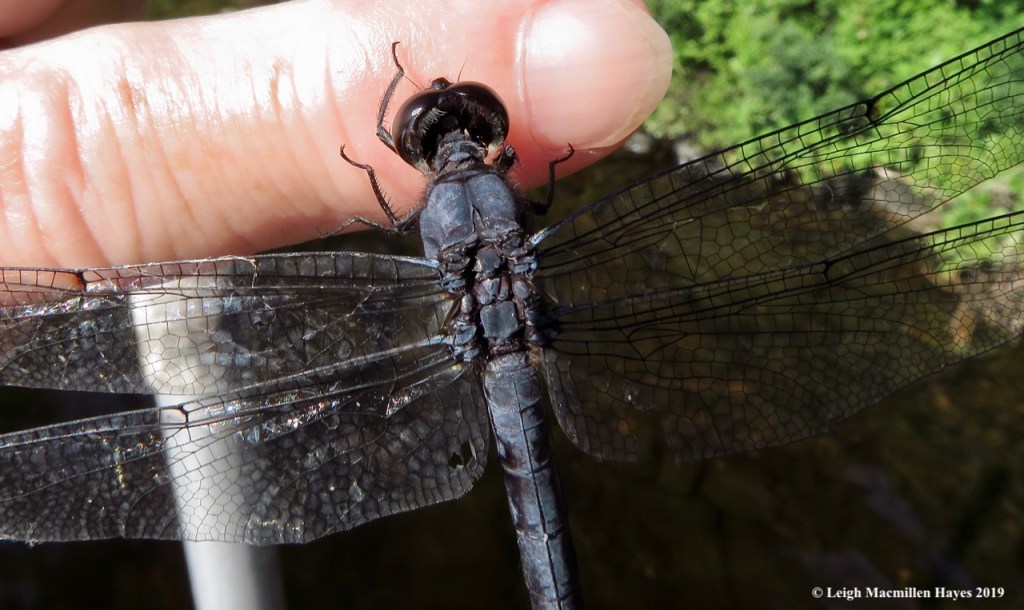
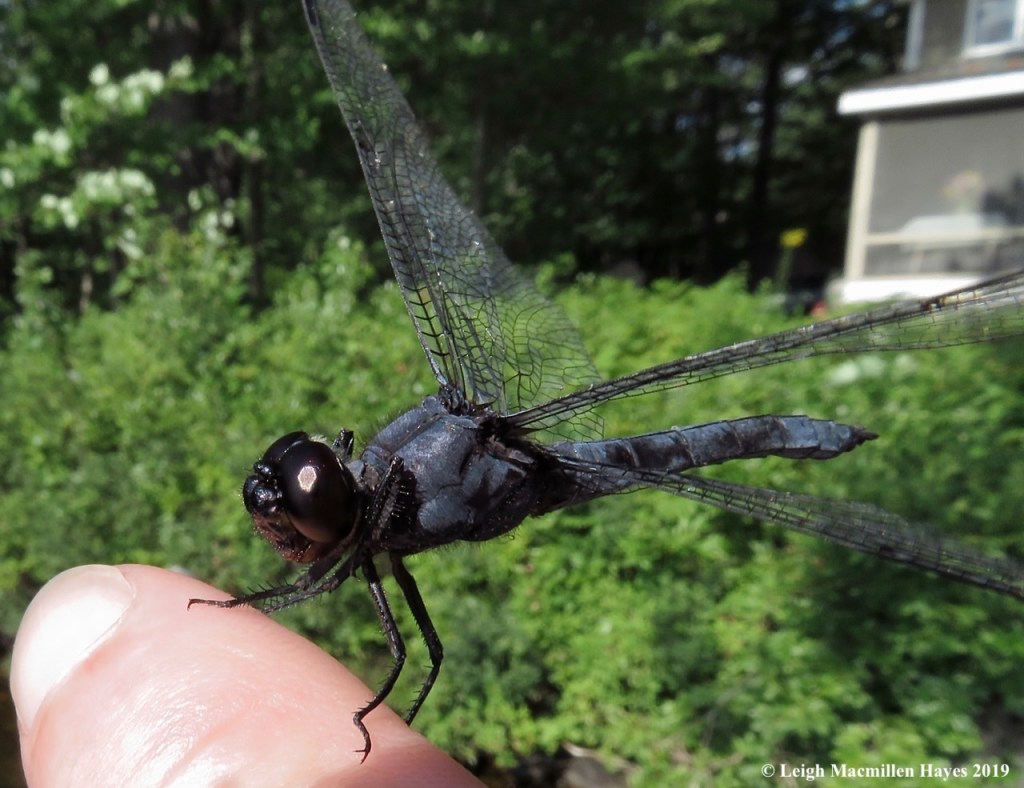
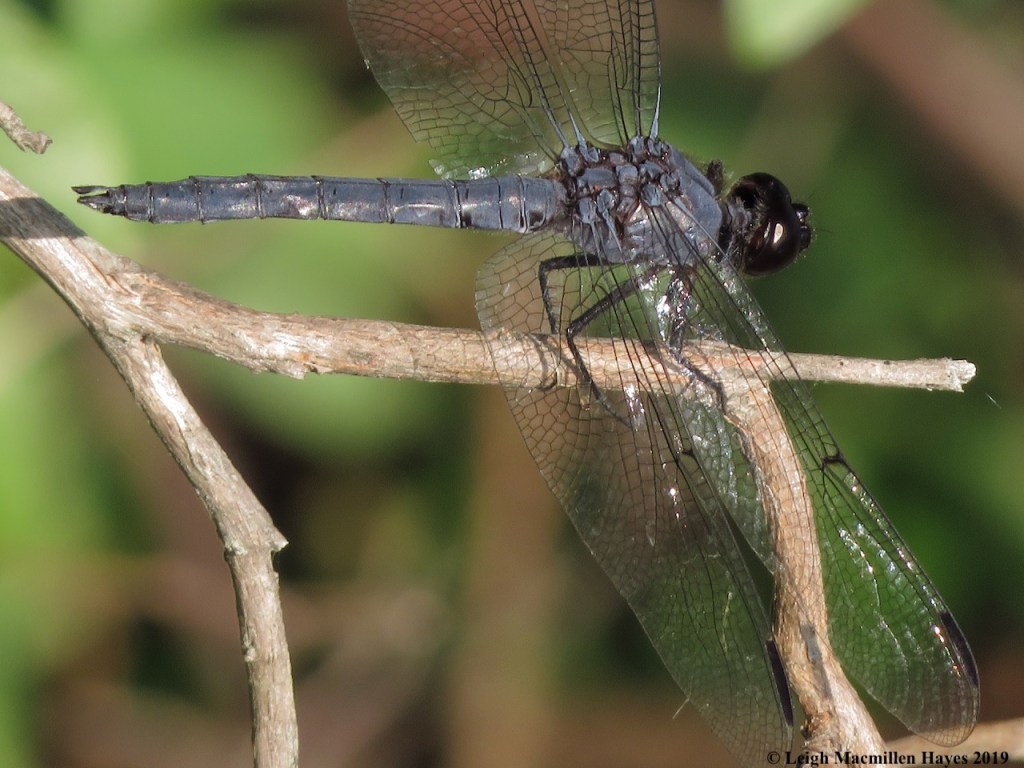
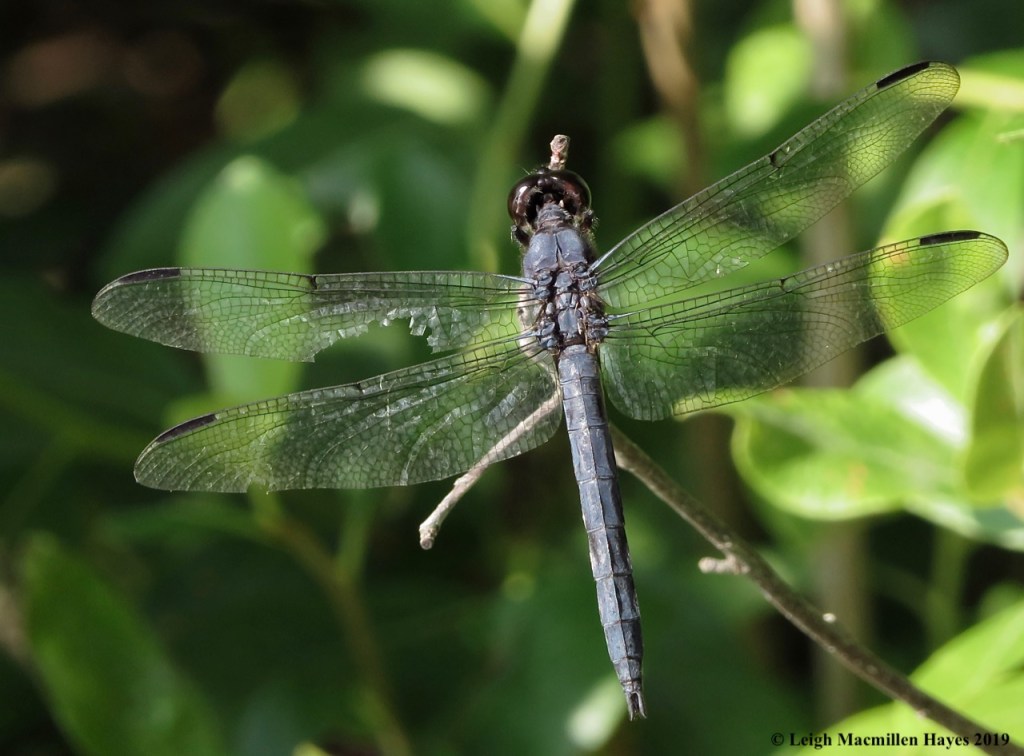
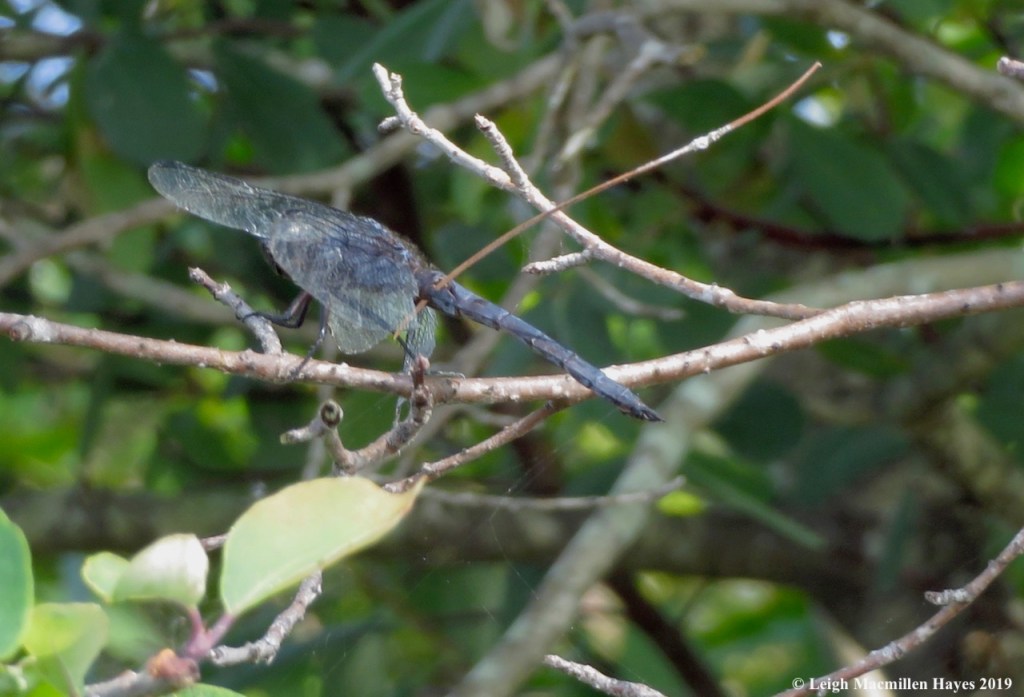
Maybe it was because I intended to read “Emergence,” a poem I wrote in honor of dragonflies at a local poetry reading, or maybe it was just because, but for the first time this summer, a Slaty Blue Skimmer landed on my shirt as I stood waiting for others to arrive at a trailhead on Tuesday. I placed my pointer finger in front of the insect and it slowly climbed aboard.
That’s not so unusual, but what struck me was that I was able to walk to my truck and grab my camera, use my left hand to take a photo as he remained on my right hand, and show him off to my friends–for at least fifteen minutes.
Of course, then I was hooked and so after returning to camp and taking a dip, I felt a familiar tickling on my toes as I sat on a lounge chair. The minute I moved, my friend moved, but only as far as the dock ladder. And so, I ran inside, grabbed my camera, and sure enough . . . he was either still there or had returned from a brief flight during my absence. Dragonflies do that–return over an over again to favorite perches in their territories.
I figured I might as well try again, but this time smartened up and used my left pointer, the easier to manage the camera with my right hand.
Ever so gently, he climbed onto it. Notice how you can see him using all three pairs of legs, well on one side anyway? They offered me a lesson.
For you see, I became aware that once he was settled on me or a leaf or twig, he pulled first one and then the other front leg up, rather like the draw-back position in karate, where you make a fist and pull your arm into your body. (I only know this because years ago our youngest took karate lessons until he was just shy of a black belt.)
What Slaty Blue (SBD) taught me was that he could stand on two pairs of legs and pull the front pair up, only using it when necessary to climb upon something or capture a meal.
My dragonfly and I . . . we spent a lot of time together. Even if he needed to fly off and twirl about in the air with a rival, or catch a delectable snack, he kept returning to my finger.
And if not my finger, then the top of a dock post. Those eyes–so brown. That face–so black.
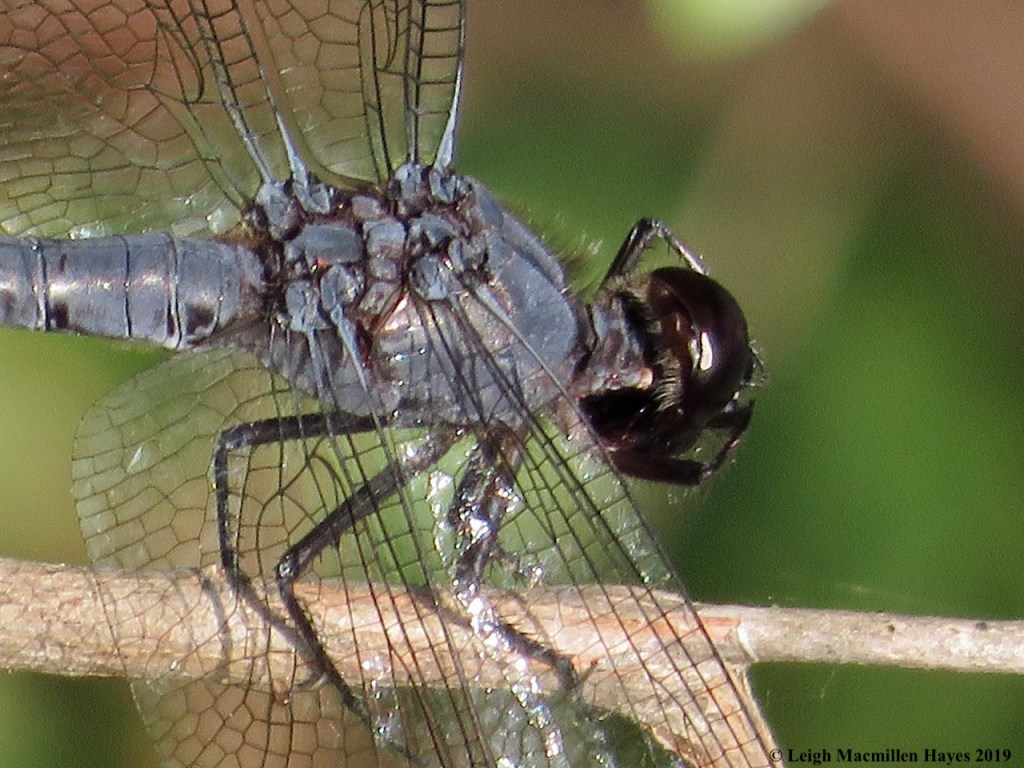
And then there were the wings. Translucent and delicate with thin black veins. By spending so much time with SBD, I also noticed that a bit of the slaty blue coloration radiated from his body outward, as if that was his basal wing patch.
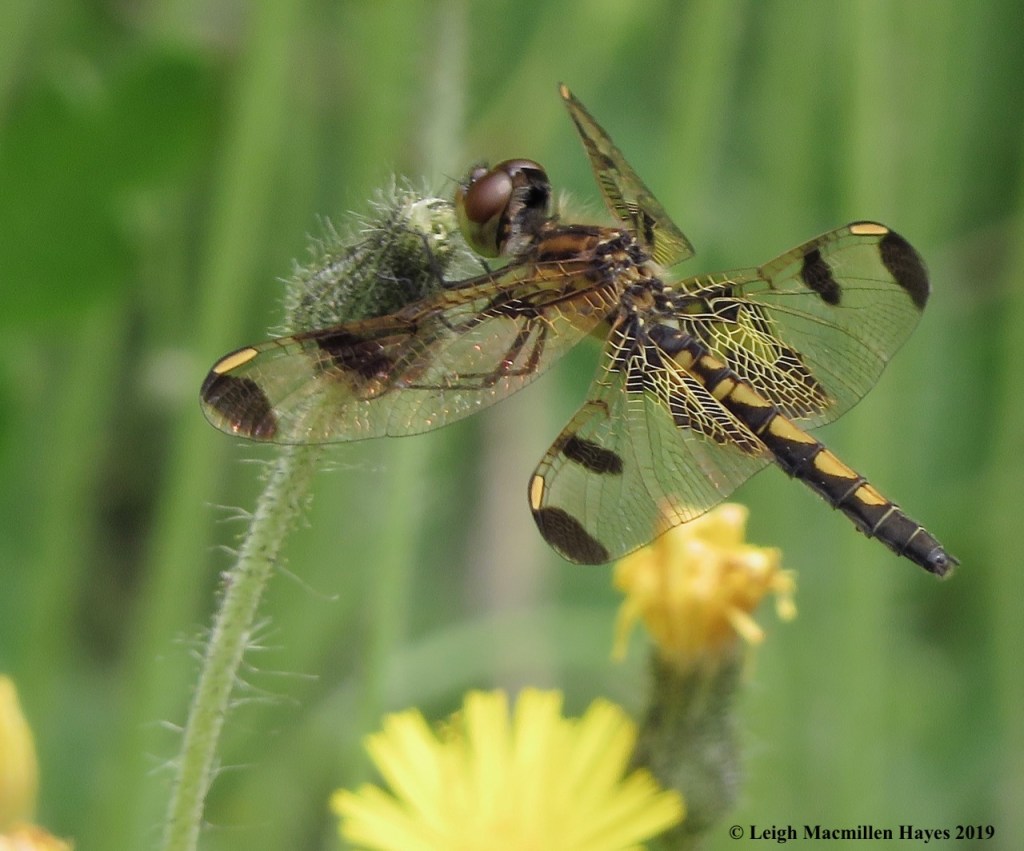
If you look at a Calico Pennant dragonfly, you’ll really understand the basal wing patch, that section of stained glass on the wing closest to its body.
I loved noticing that bit of coloration, but it’s the mechanics of it all that always astonishes me. How can an insect with such a chunky body fly with such thin wings?
The other thing about the wings is that they helped me with identification. Oh, not to say that this was a Slaty Blue for his coloring gave that away. But which SBD was I holding? My friend had a tatter on both hind wings. The one on the left was about a vein cell wide and the one on the right looked like a small chunk had been taken out of it. What happened? Prey or a run in with a plant or twig? I’ll never know, but I will know by those injuries that he was the one that liked to land on me.
Another, who was actually a rival, and perhaps a sibling, or at least a cousin, had a tattered forewing that looked a wee bit worse.
And then there was one I spied while kayaking yesterday and he had a pine needle stuck through his abdomen. What? But there it was and each time he moved, I could easily locate him.
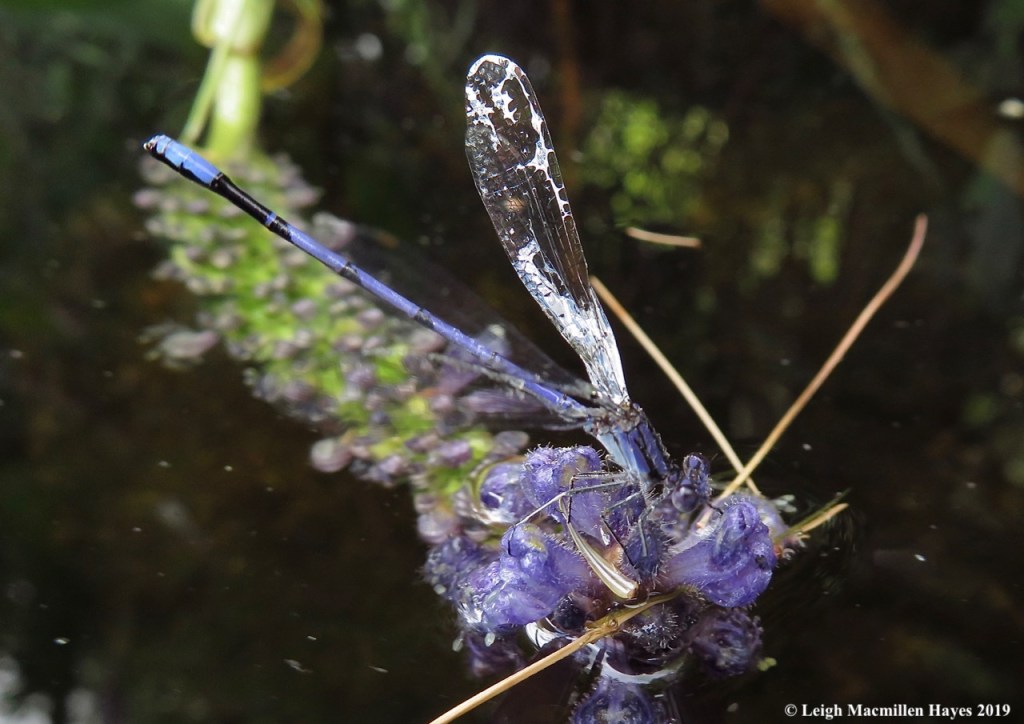
On the same kayak adventure, an SBD landed upon a Pickerel Weed and as I watched . . .
he arched his back in a pose that reminded me of two things: 1. a move I’d learned yesterday morning during a Yoga in the Woods walk offered by Deb Nelson of the Greater Lovell Land Trust, and 2. His mating position. Was he in practice?
Would he find a she? She is so different. Her wings astound me the most.
My experience has been that there are more hes than shes so the guys better make their moves.
If you haven’t already figured it out, I’m in love with all dragonflies, but the male SBD is one of my favorites because his eyes remind me of my guy’s. And today, August 4, we are celebrating our 29th anniversary. So this post is in honor of my guy (even though he never reads these because he feels like he’s already lived them). May our journey together continued to be wonder-filled.
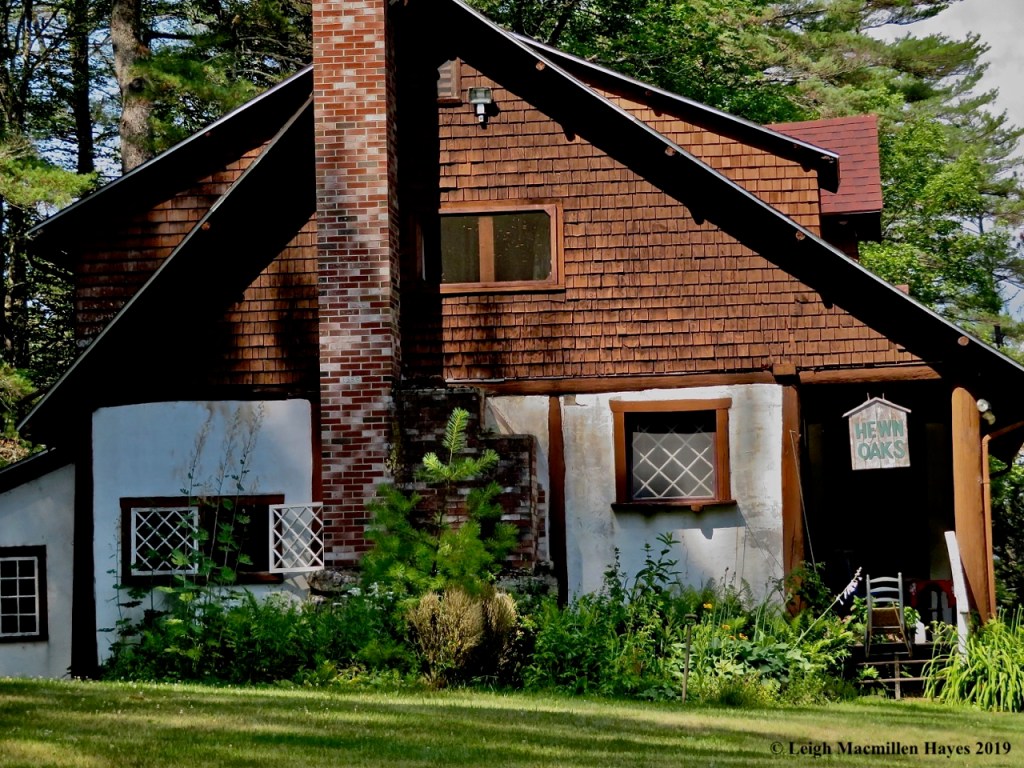
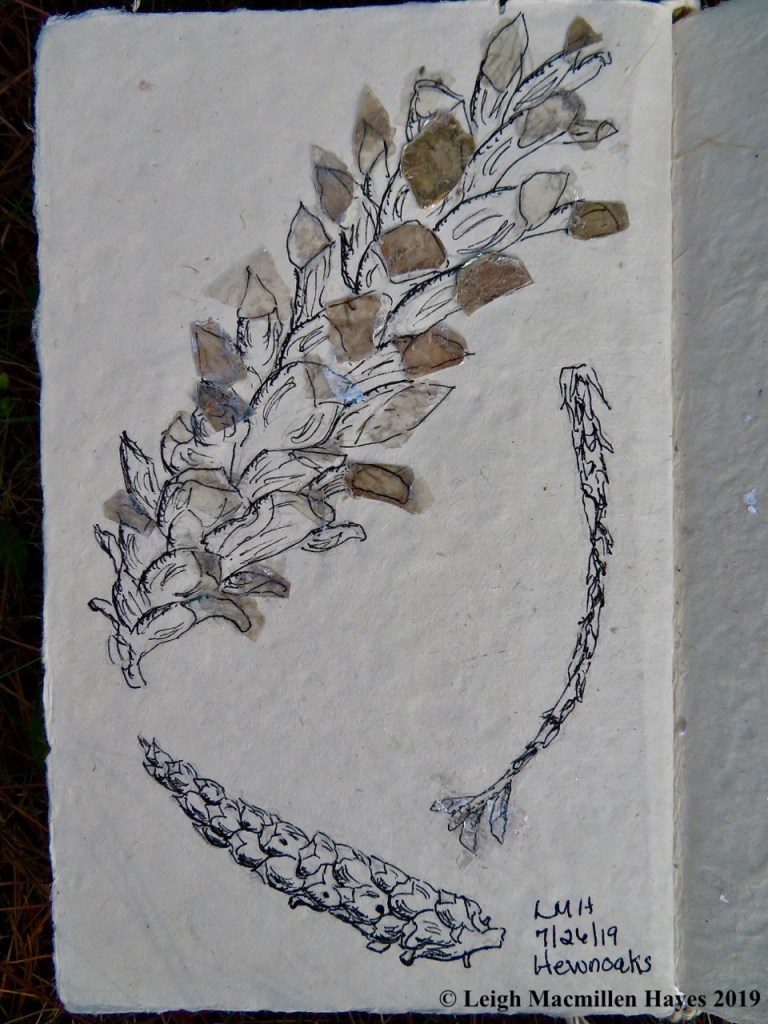
The day began with a sketching workshop at Hewnoaks Artist Colony that was led by visual artist Pamela Moulton as part of the Greater Lovell Land Trust’s Wellness Series.
I sketched the circle of life for a Mica Cone ;-)
And then the fun continued as I tramped along the Leach Link Trail in Evans Notch with Pam Katz and Bob Katz.
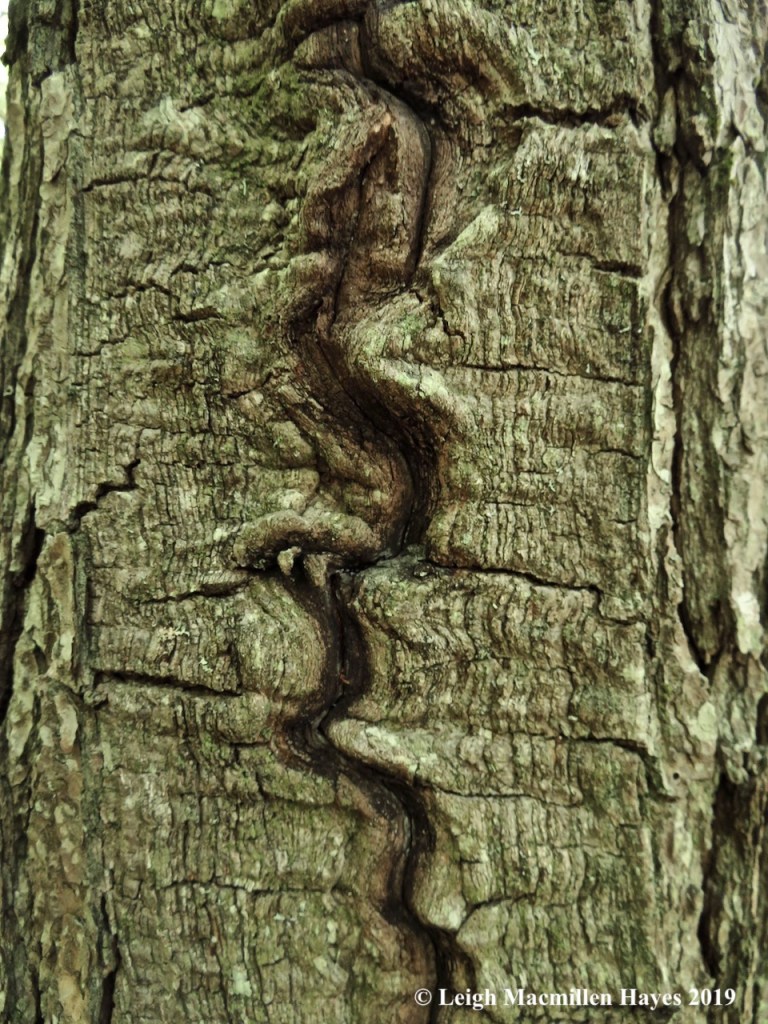
A mountain. Train tracks. Topographical map. Zippers. Stitching sample.
Radiating out. In. Chunks. Lines. Shades. Puzzling.
Zigzag. The end?
Hardly the end for lines continue. Into. Infinity. Over. Under. Indents. Outdents. Is that a word?
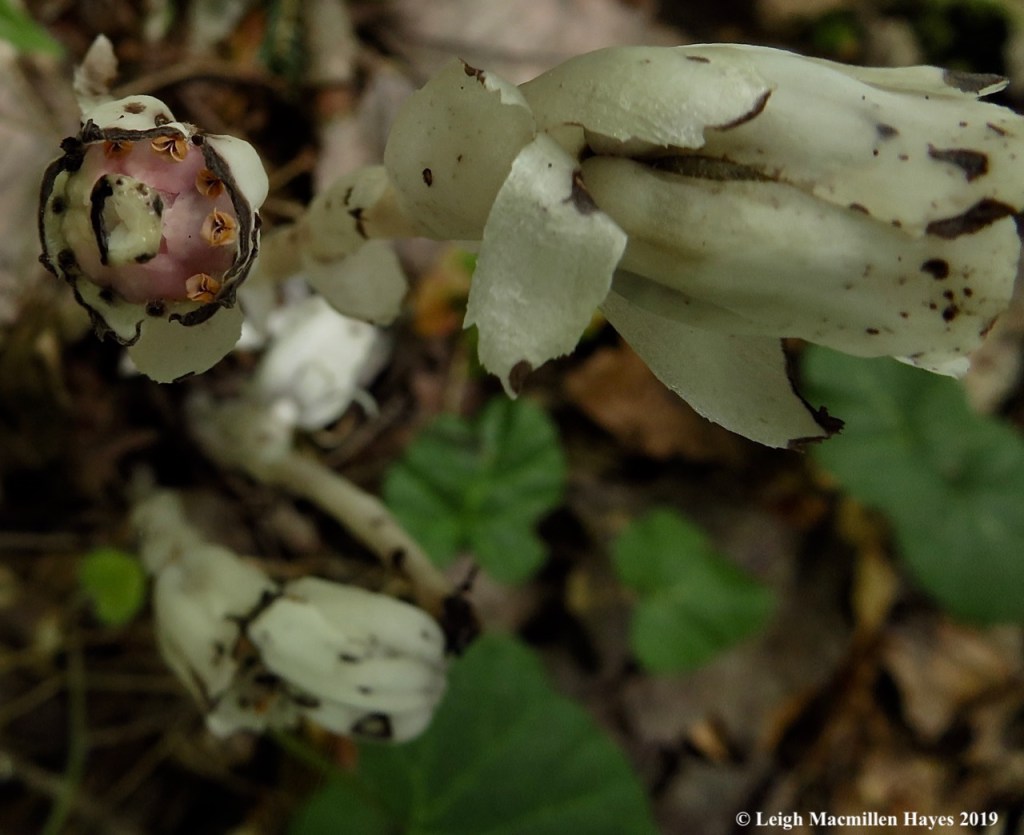
Waiting for a pollinator. Already pollinated. Color. Lack of color. The past. The future. Was. To be.
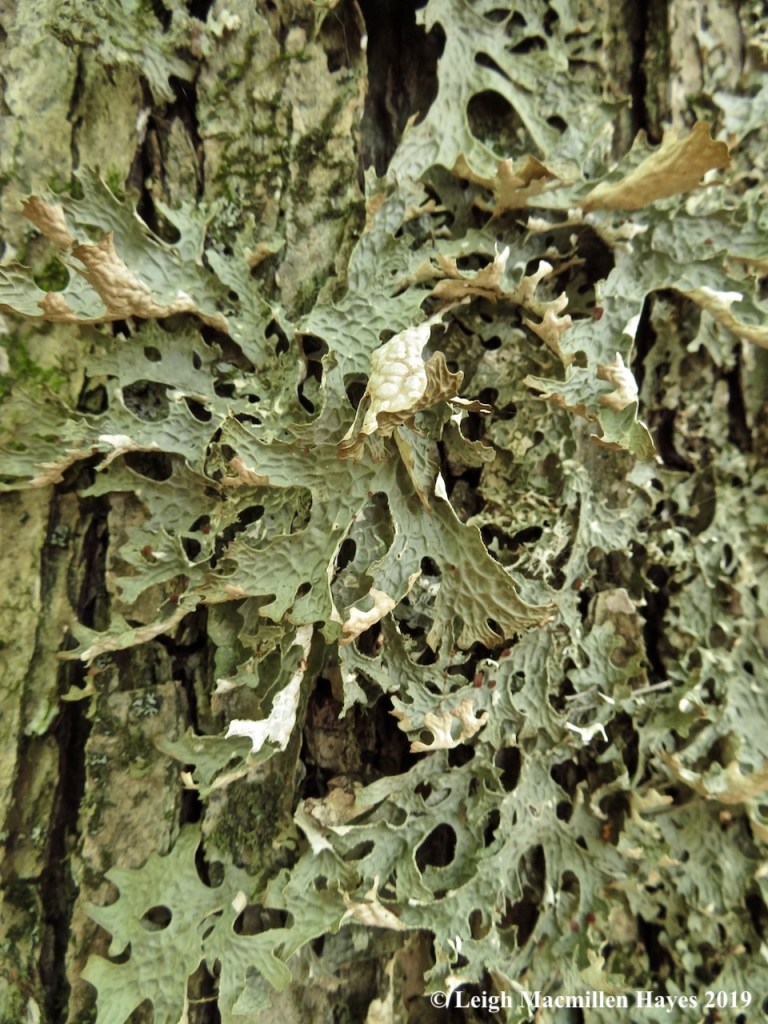
Pearly Eye. Circles. Lines. Stained Glass. Overlap. Shades of brown. Shades of gray. Bull’s eye. Target.
Some days I head out the door with eyes as big as those of a fly and then I try to stand in one place and watch what might pass by.
Unfortunately, I’m not always as patient as a robberfly and soon find myself pacing in search of the next great sight.
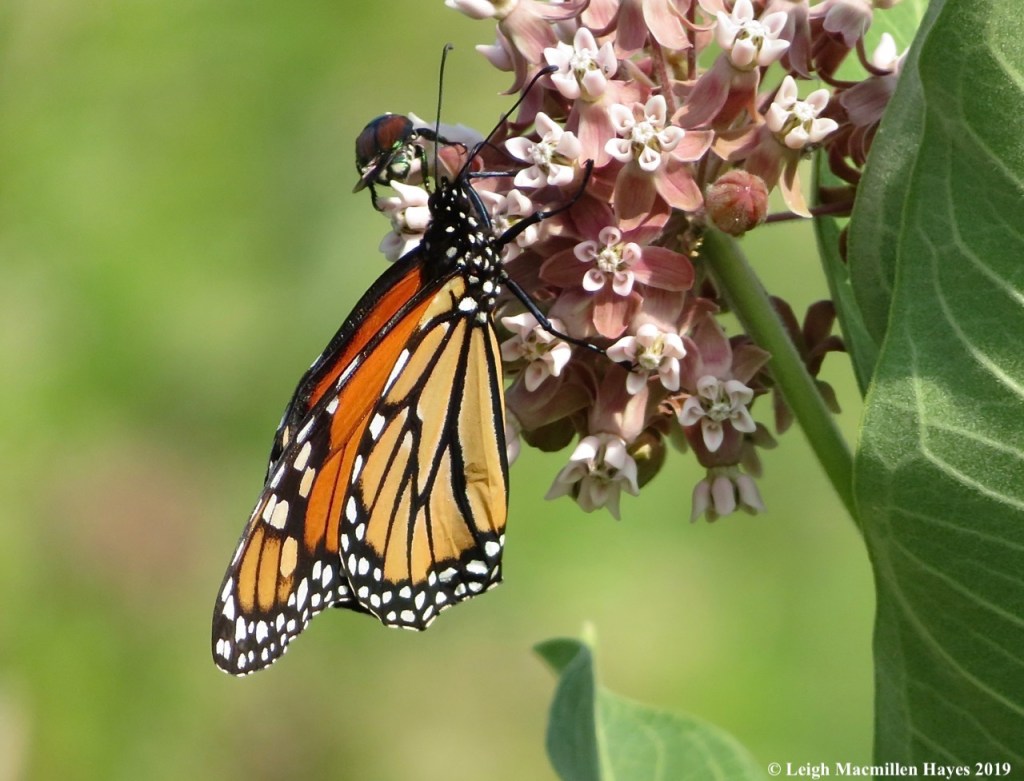
Even when it turns out to be a Japanese Beetle munching on a leaf, I’m not totally disappointed. After all, it does have such an incredible sense of color and fashion.
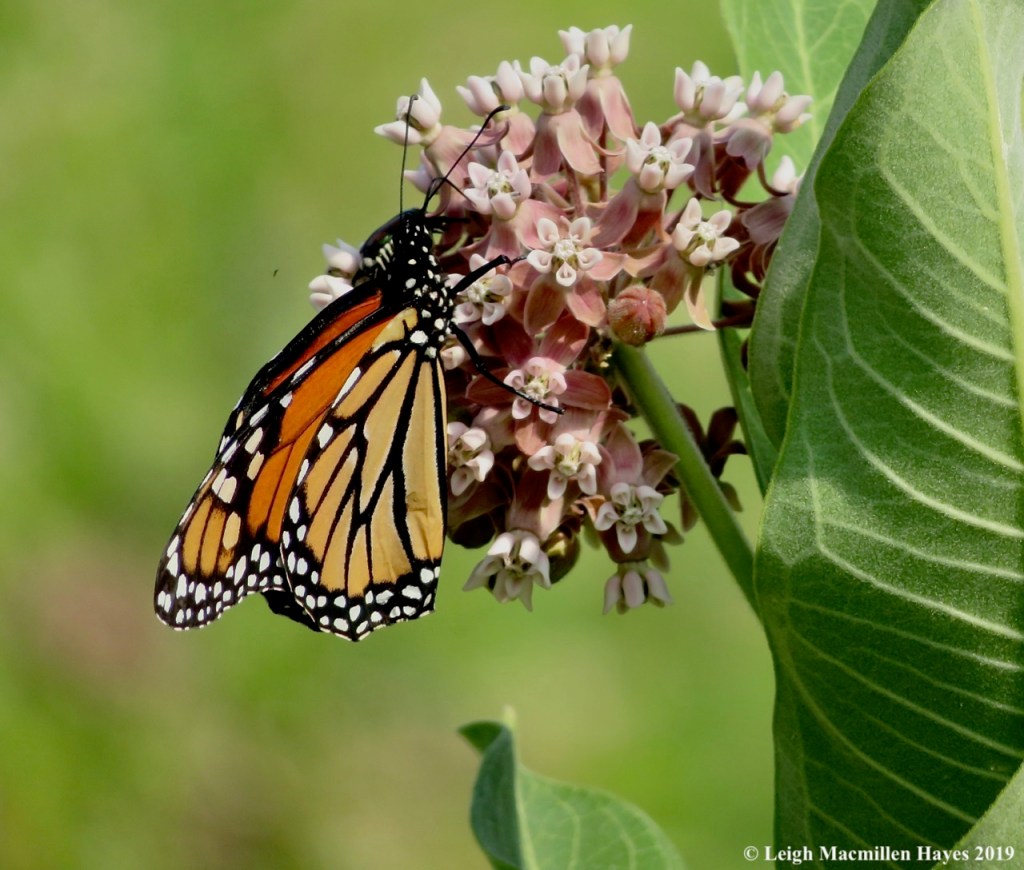
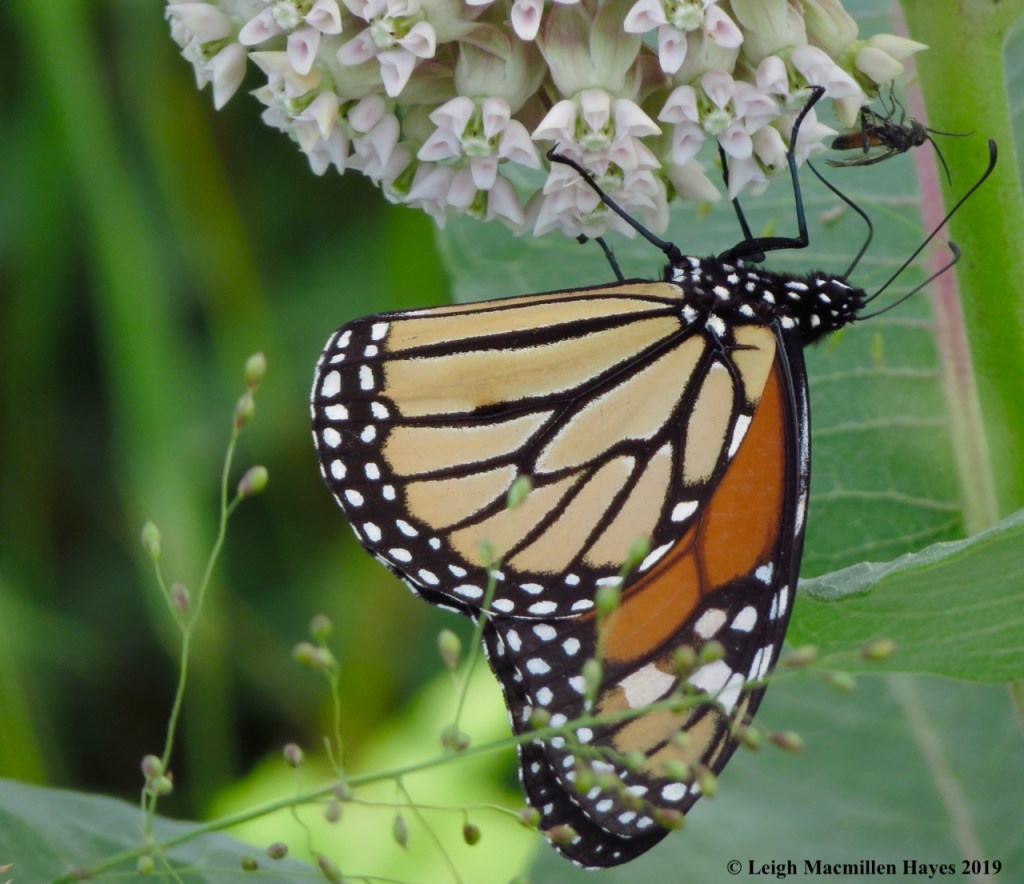
But what I really hoped to see I suddenly became aware of as first one, then two, three, four and even more Monarchs fluttered in their butterfly way, seeming to glide for a bit and then make an almost apparent decision to land before a change of mind until at last . . . upon the Milkweed it did pause.
Curious thing. So did another Japanese Beetle. That led me to wonder: how will these two get along and negotiate the territory?
The Monarch poked its straw-like proboscis into the heavenly-scented flowers as it sought sweetness while the beetle continued to move toward it.
But the beetle was on a mission of its own and the two seemed to co-exist side by side.
In fact, they were practically oblivious of each other. Unlike when a Common Yellowthroat tried to land and the Monarch chased it away.
Finally the butterfly crossed over to another flower on the tall stem and left the beetle behind.
I moved on as well, in search of others to focus on like the female Ruby Meadowhawk Dragonfly. How can it be that it’s already Meadowhawk season, the late bloomers in my book of dragonflies?
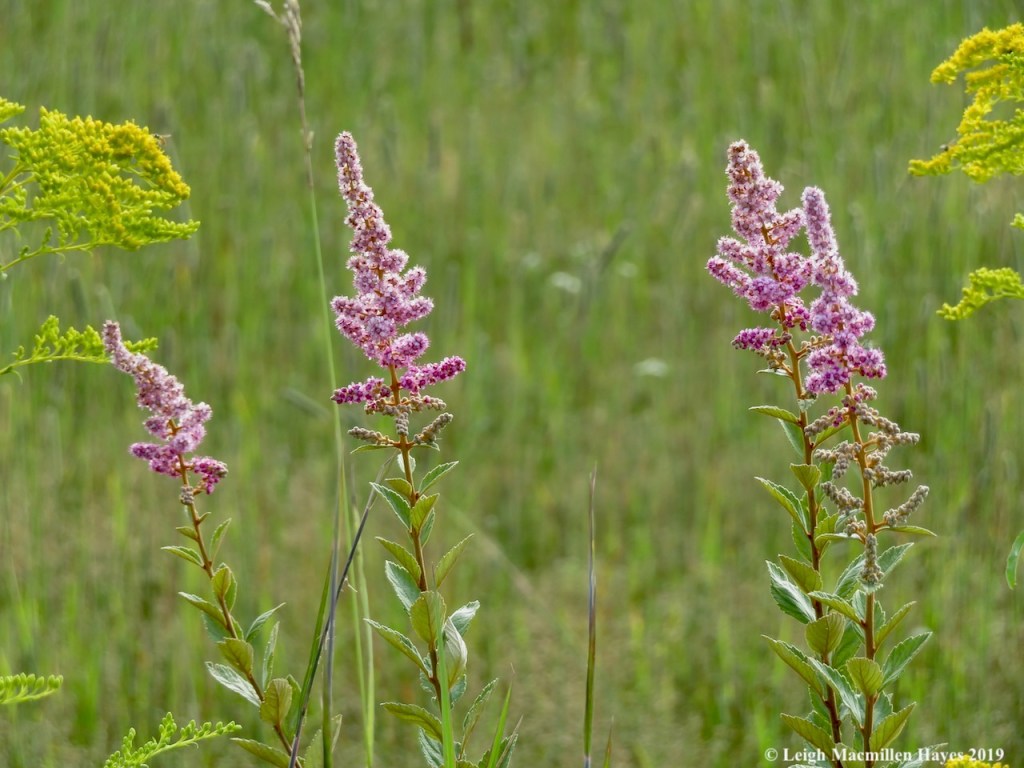
And yet, the colors of summer today included not only the pinks of Steeplebush, but also the yellows of goldenrods beginning to blossom.
Mixed into those colors and because of their movement and then moments of pausing, the Monarchs kept tugging at the strings of my heart and pulling me back into the moment.
And in that real time moment, I had the pleasure of spying couples in their canoodling fashion, though they tended to be much more elusive than some insects. If I didn’t know better, I’d have thought the female was dead as the male flew along with her dangling below until he landed on a stem of choice. From what I’ve read, their mating can take up to sixteen hours. Oh my.
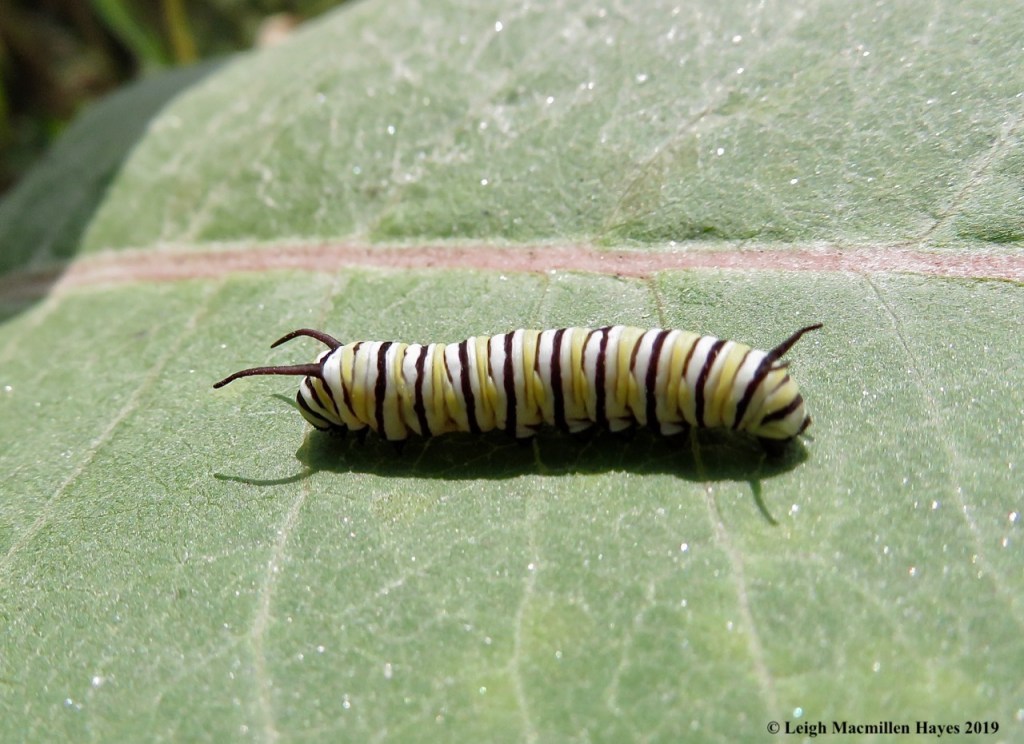
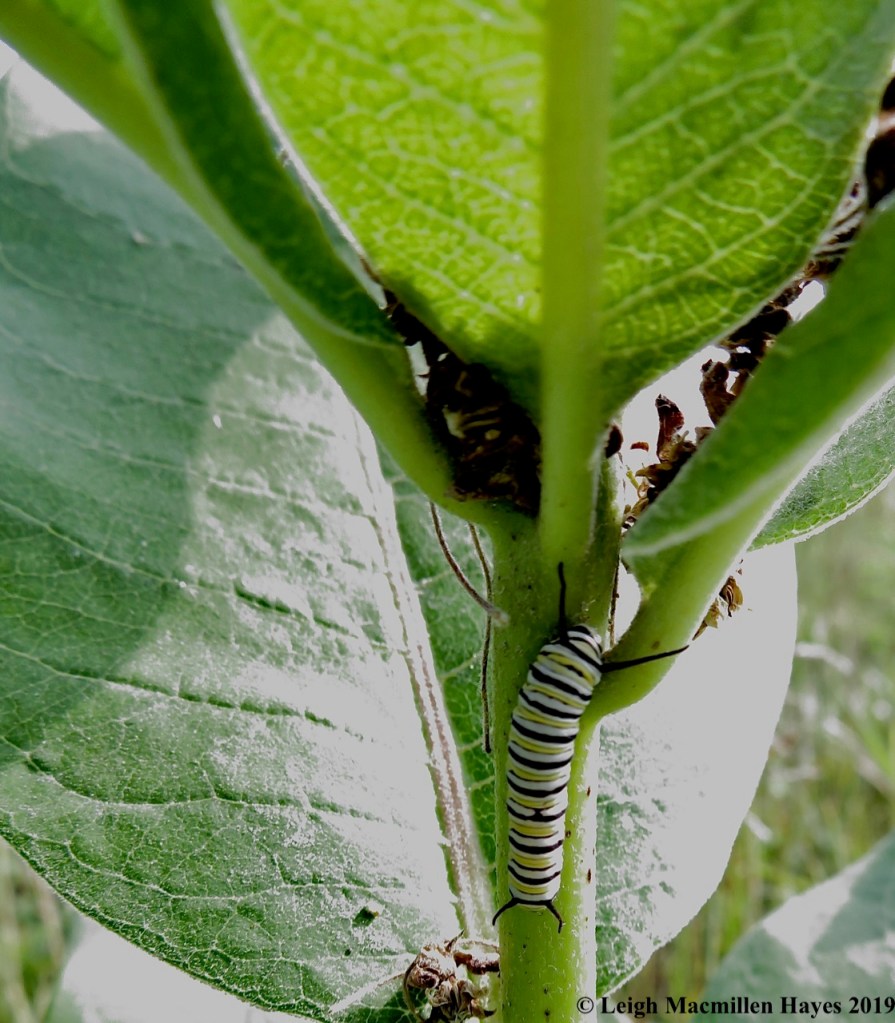
As it turned out, I soon discovered that at least one mating had resulted in at least one caterpillar. I suspect there will be more soon, but this one will have a head start on munching its way through the Milkweed kingdom.
All the while that I stalked the Monarchs, a Common Yellowthroat did its own stalking, constantly announcing its location with chirps. And then I realized it had a caterpillar in its mouth as it moved among the stems of the Spreading Dogbane. Oh dear. Fortunately it wasn’t a Monarch caterpillar, but will it be only a matter of time?
A few more steps and I noticed a Katydid on a Milkweed leaf. Oh yikes. So many visitors who like to munch.
For the moment all bets are placed on only one Monarch caterpillar to continue the life cycle.
Blame it on the Monarchs for calling me back to the same spot I’ve been stalking for a few weeks and giving me the opportunity to notice them mating and the results of such actions and other insects as well.
July 31, 7:00 pm, Monarchs at Risk with Don Bennett
Recent censuses show the smallest Monarch butterfly populations in Mexico and the west coast hibernacula in recorded history. Why is this happening? Is there anything we can do? Are drastic declines in the Monarch populations a sign of something more insidious? Come listen to Naturalist Don Bennett, PhD, and discover why this is such an important message for all of us.
Location: Charlotte Hobbs Memorial Library, Route 5, Lovell
August 1, 9:30 am – noon: Monarchs in the field: Monarch butterflies need milkweed plants to survive — as caterpillars they only eat milkweed and Monarch moms lay their eggs on the milkweed plant. We’ll take a walk along a dirt road that abuts a farm field and river, where milkweed grows in abundance and search for Monarchs and other butterflies.
Location: Meet behind the Charlotte Hobbs Memorial Library to carpool.
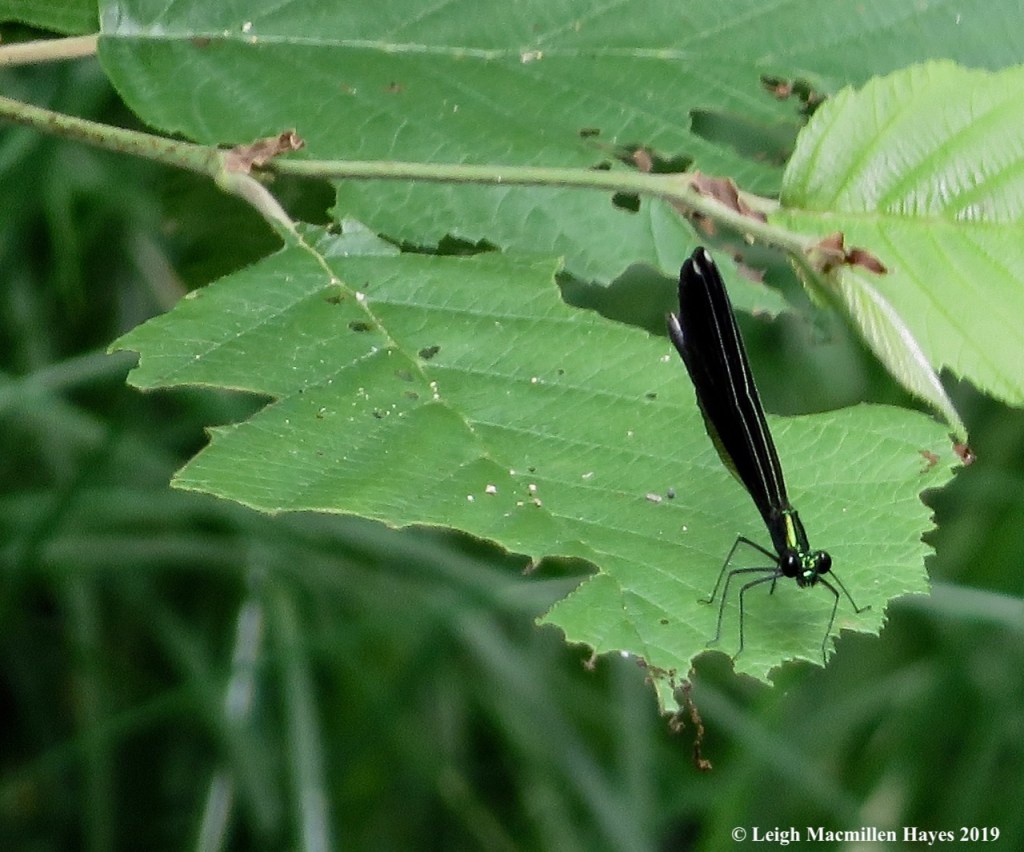
 Oh dragonfly, oh dragonfly
 In your infancy, you laboriously
 climbed upon a slender stem.
 Ever
 so
 slowly
 seams split.
Soft and squishy, you spilled forth into this sunlit world.
Perched upon your former self, wispy strings recalled aquatic breaths.
 Moments slipped
 into an hour.
 Your body of velvet pulsed as blood pumped into cloudy wings.
 Standing guard watching you, I noted preparations for first flight.
Eyes bulging
 you chose
 a spot
 of viewpoint vantage.
Colors changing,
 you gained
 the markings
  of generations past.
 Wings drying
 you offered
 a reflection
 of stained glass.
 Beyond understanding
 you flew
 a dance
 of darting restlessness.

 Odonata, Odonata,
 You have known
 both worlds.
 First playing
 beneath the surface.
 Then in a manner
 so brave,
 climbing skyward
 to ride summer’s breeze
 on gossamer wings.
 Forever in awe
 of your transformation
 from aquatic nymph
 to winged adult,
 I can only imagine
 the wonder of
  emergence.
Working in tandem, we paddled against the wind and despite its force gave thanks for the relief from the heat offered. Our intention was to explore the islands of Moose Pond, a place where the two of us can get lost in time.
It was movement above that caught our attention as we watched a large bird fly into a tree. And so we paddled even harder in hopes of getting a better look. About midway up a White Pine, an immature Bald Eagle sat upon a branch . . . and panted, feeling the heat like we did. Since birds can’t sweat, this was its way of dissipating the sweltering weather.
We watched the bird until it finally flew off and headed south.
Then we continued our journey north.
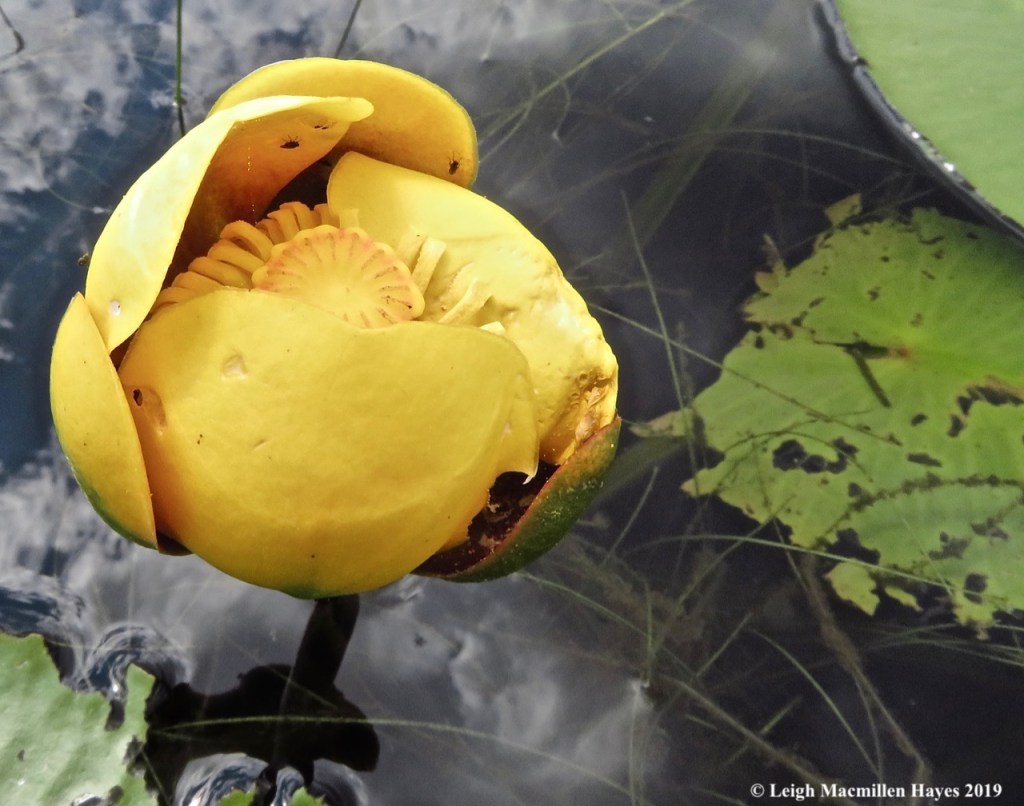
My guy jumped ship to wander an island or two and I stayed aboard to see what I might find, like the Spatterdock petals hiding within the petal-like sepals.
There were Buttonbush flowers with their funky orb shapes and spiky protrusions.
And I was delighted to see a Rose Pogonia, its fringed beard hiding among the grasses and reeds.
The damselflies wrote love notes on almost every stem, but this gathering I found most comical–as the guys each attempted to be her suitor. In the end the top Bluet gracefully acquiesced.
And then there was the Variable Darner Damsel to wonder about as she posed upon a Pickerel Weed of matching color. Were her wings so shiny because she’d just emerged? And though its difficult to see the left-hand wing, they appeared to be spread–perhaps another indication of her recent adventure from aquatic nymph to sky dancer.
Our discoveries were many, but I’ve shared just a few from this afternoon as my guy and I . . . we spied like an eagle.
There’s a place here in western Maine that I frequent on hot summer days. Oh heck, there are many places I frequent, but this one is extra special and it doesn’t involve a hike. In fact, from my perspective, there’s only a short distance of a road that consumes hour after hour of my time. But always, it’s time well spent.
The road is dirt and crosses through a hay field that has yet to be cut. Smack dab in the center stands a beautiful Elm and though I’m not sure the Bluebirds nest there, I do know that they at least rest upon its mighty branches for I watched them fly down and disappear into the wildflowers and grasses below and then zoom back up into the tree a few minutes later, their wings of iridescent blue mesmerizing me during flight.
As the Bluebirds flew back and forth to the tree, so I walked back and forth below it. And back and forth again. And again. I have no idea how many times I turned or how often I muttered, “One more time and then I’ll leave.”
But . . . because I stayed I had the good fortune to spend some time admiring a Twelve-spotted Skimmer Dragonfly. In true character, it paused for long periods of time, flew off for a moment or two, and then returned to the same perch. And I gave thanks.
The only other dragonfly I saw was also a skimmer, but about half the size of the Twelve-spotted. At about one inch in length, the female White-faced Meadowhawk also paused for long breaks. And I was equally grateful.
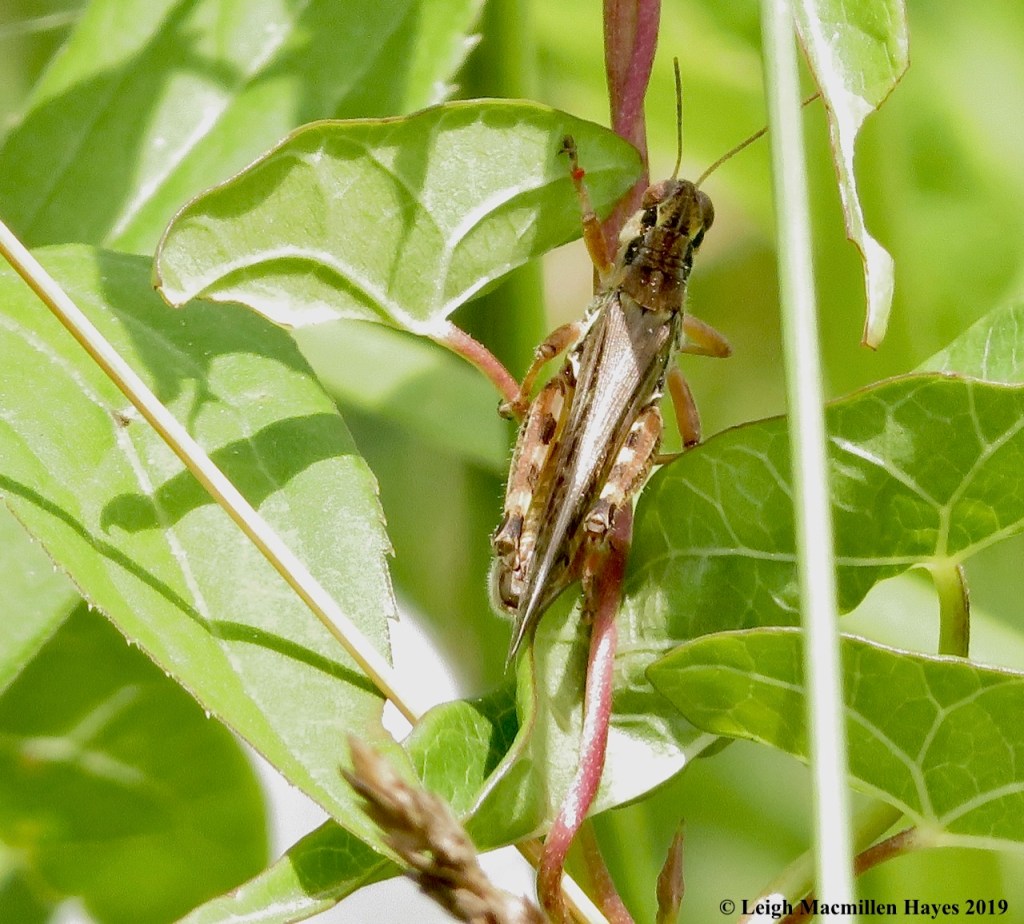
With each step, grasshoppers did what they do–scattered from the dirt road to nearby stems. By the dozens. Providing constant motion and sound.
But then . . . I found two who chose a different activity to entertain themselves and ensure that there will be future generations of grasshoppers in the field.
Aren’t they amazing? And I don’t mean in their canoodling, but rather their design.
My pacing included frequent stops to check out the visitors upon the flowers as well. The Steeplebush appeared to offer a feast to any who chose to stop by.
Because the grass was so high beyond the flowers at the edge of the road, I didn’t realize at first that I wasn’t alone. Twice I was startled because I’d startled another. Both times it was a deer that I didn’t see until they ran off. Do you see the white flag of the tail as one bounded toward the woods?
There was more movement in the grasses and among the flowers. It was accompanied by sound. Looking for stalks moving at odds with the slight breeze, I finally spied the creator of the “Cheap” that resounded almost constantly. A Common Yellowthroat Warbler hopped from one plant to another, possibly seeking a meal to share with youngsters relaxing in a distant tree.
Curiously, a different sound could be heard from the other side of the road, where a male and female frequently took flight before settling down for a bit.
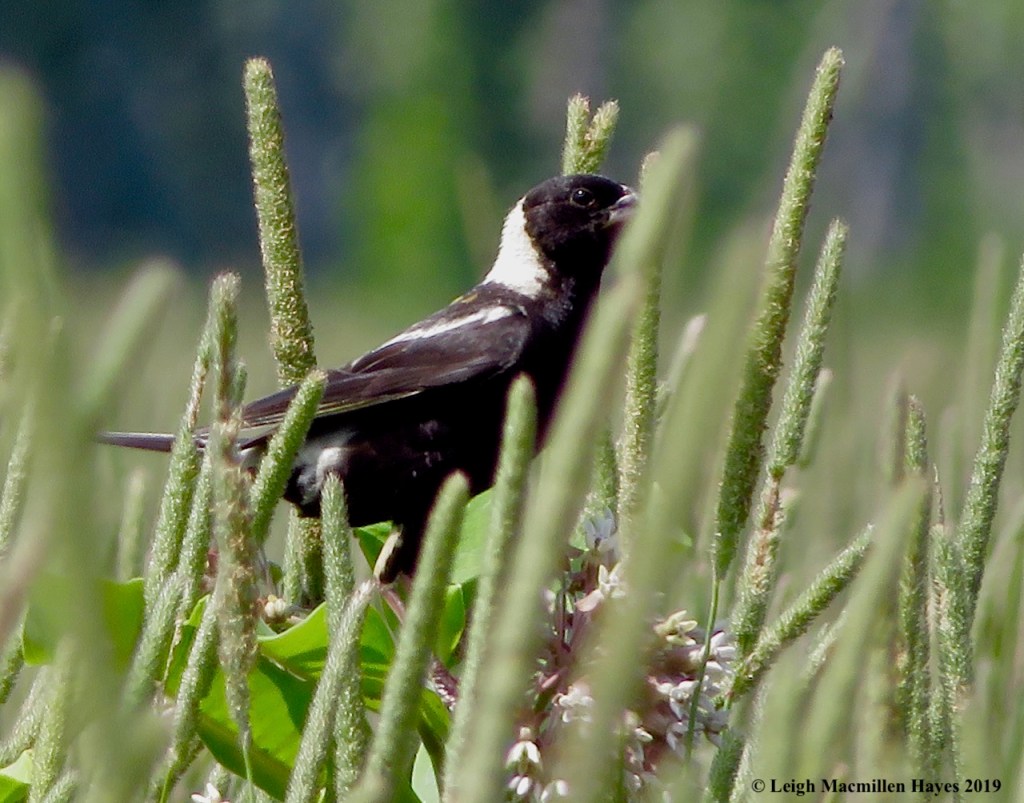
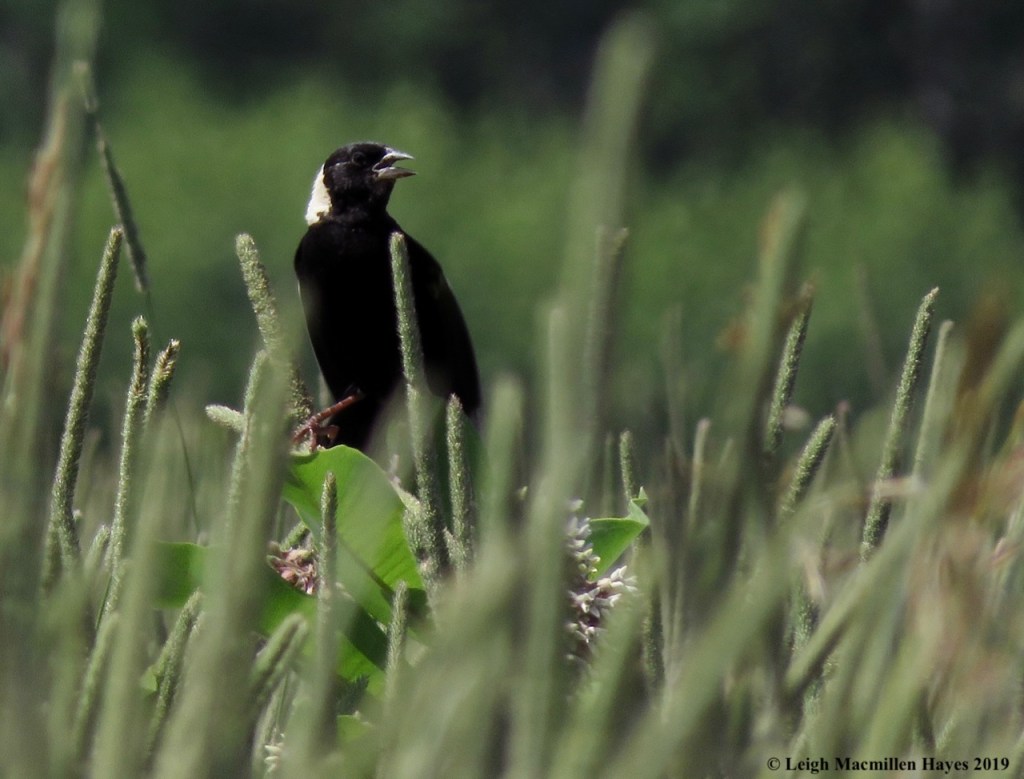
The Bobolink’s song hit notes both low and high, offering a serenade that bubbled forth in a rather bouncy and most pleasant warble.
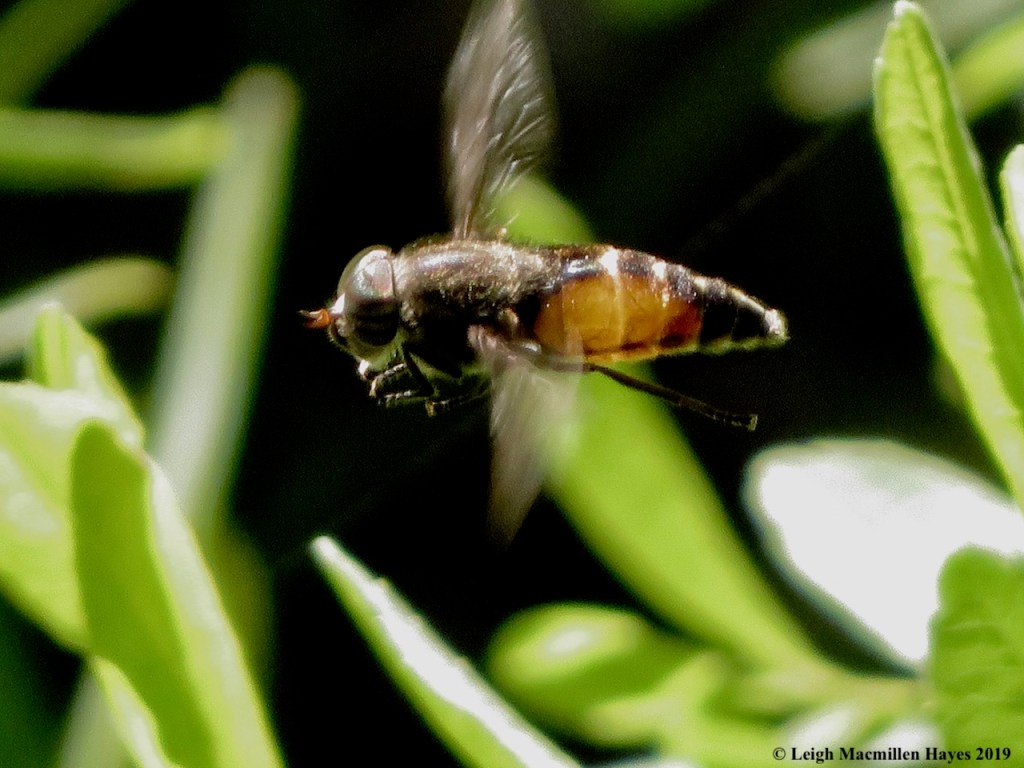
Every which way I looked, something different presented itself. Some I knew, but others I met for perhaps the first time, such as this large bee fly. I’ve since learned that they are also commonly known as humbleflies, and I found that curious given that with the banded abdomen and patterned wings and overall large size, it hardly seemed humble.
What I’d really gone to check on, however, were the Milkweed plants and their visitors. I wasn’t disappointed for there were both big and little Milkweed beetles.
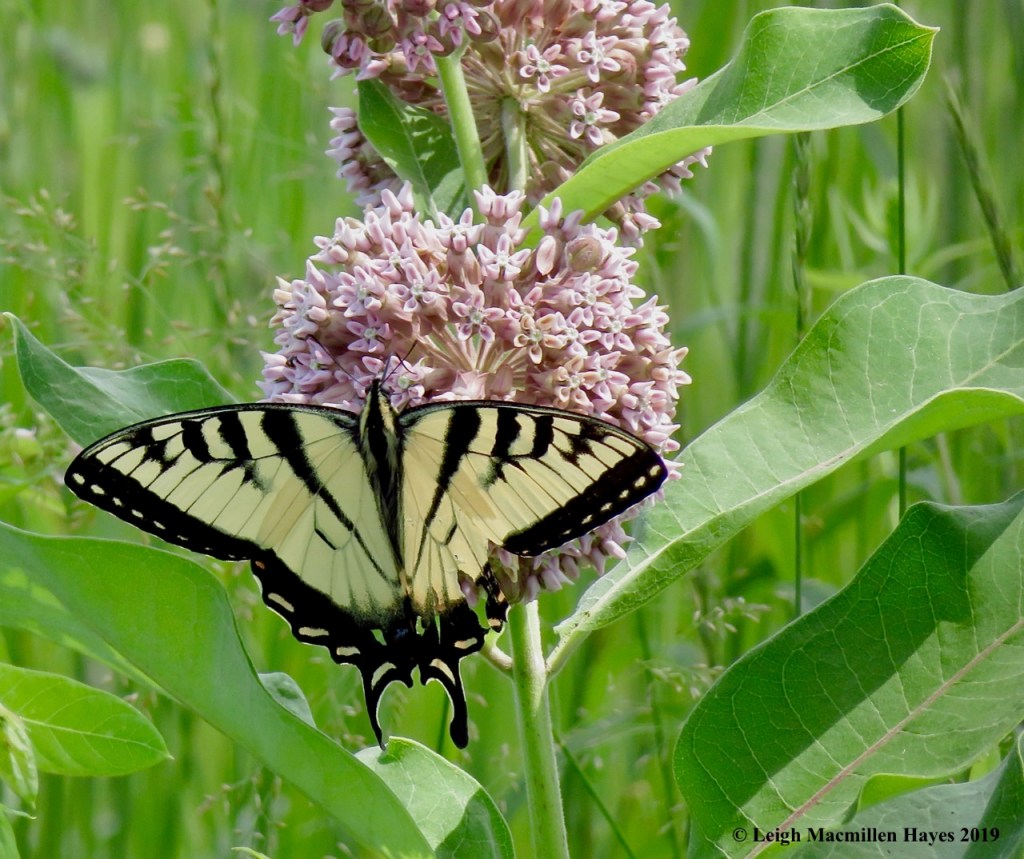
And Tiger Swallowtails seeking nourishment. This one needed all the nourishment it could get to continue its flight and avoid the birds and other predators. Do you see its tattered wing?
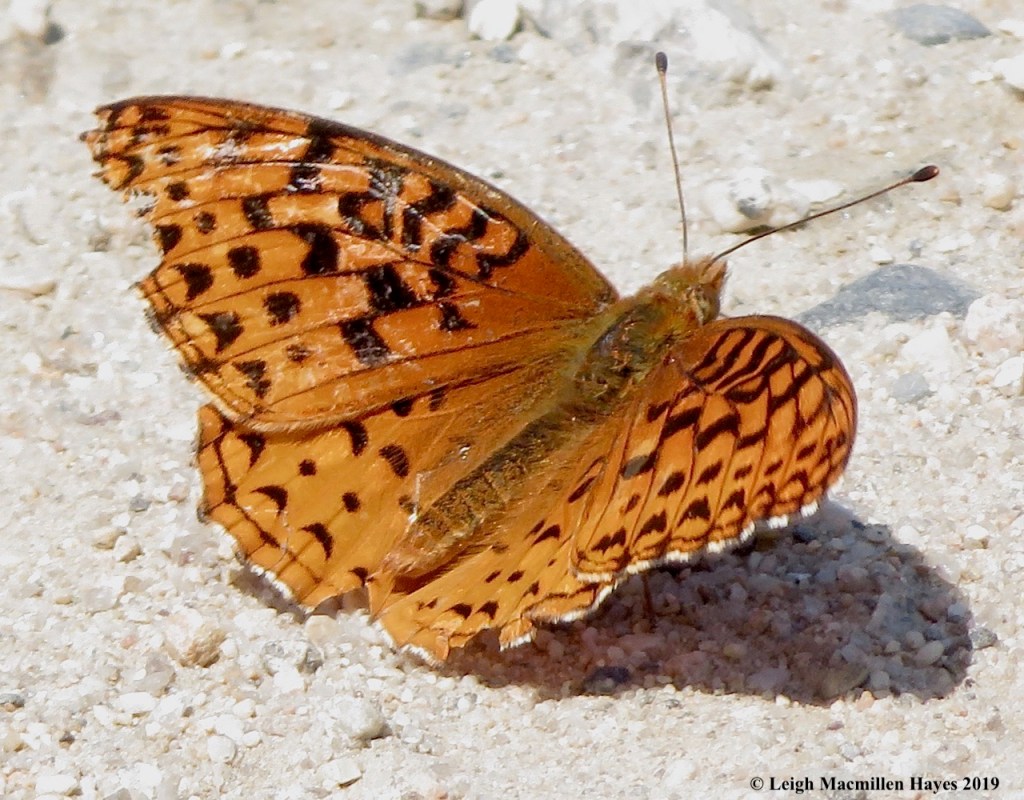
Some, like the Fritillary, chose the road for nutrition and did what butterflies often do.
It puddled. To puddle means to extend your mouthparts and probe the dusty road in search of nutrients. There is no actual puddle involved, but there may be raindrops or in this case, morning dew that help the butterflies extract minerals to share with their gals.
What I’d really gone to see, however, were the Monarchs. And I wasn’t disappointed for a few fluttered about and occasionally landed, much to my delight.
At last, my “One more time and then I’ll leave” utterance became reality and I drove off. And then . . . there was one more sight to behold. I stopped the truck and watched as a fawn bounded in its awkward fawn manner.
Because of the Monarchs . . . I experienced a wonder-filled morning.
It’s a difficult sound to describe, rather primordial in nature. Maybe it’s a duck’s quack? Or a dog’s bark? Or some combination of the two. And yet, all is quiet and then the noise erupts suddenly from one nest as a parent flies in, a meal in the oven about to be regurgitated.
It’s a scene that plays out at individual nests for a while before all become quiet again as if lunch has ended and the kids should take time for a nap. But until such time, the neighbors in the high rise next door watch enviously as their playmates are fed.
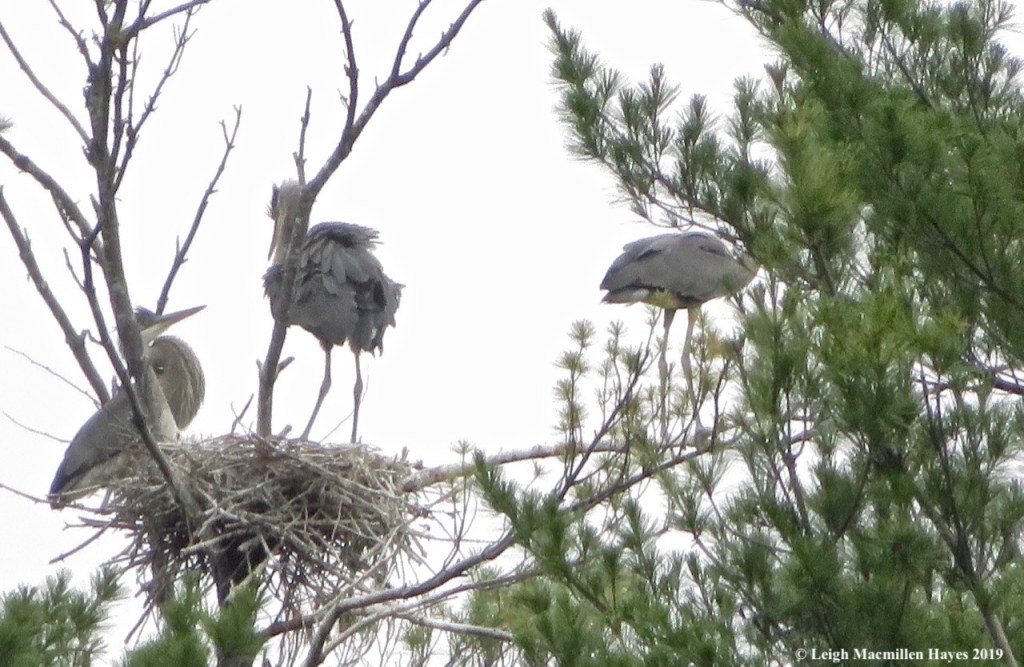
Just down the block one of the tweens, for suddenly after about a month of life they are such, flexes his wings as he stands out on a branch. It’s a tradition as old as time–tweens and teens going out on a limb to show their capability to survive in the world. The question remains, however: when will he reach the right age to get a license?
As the tween to the right finishes flexing, the one in the center lets a shiver pass through his body. Is it a pre-flex motion? His other sibling watches and wonders what it’s all about. Perhaps he’s trying to prove something?
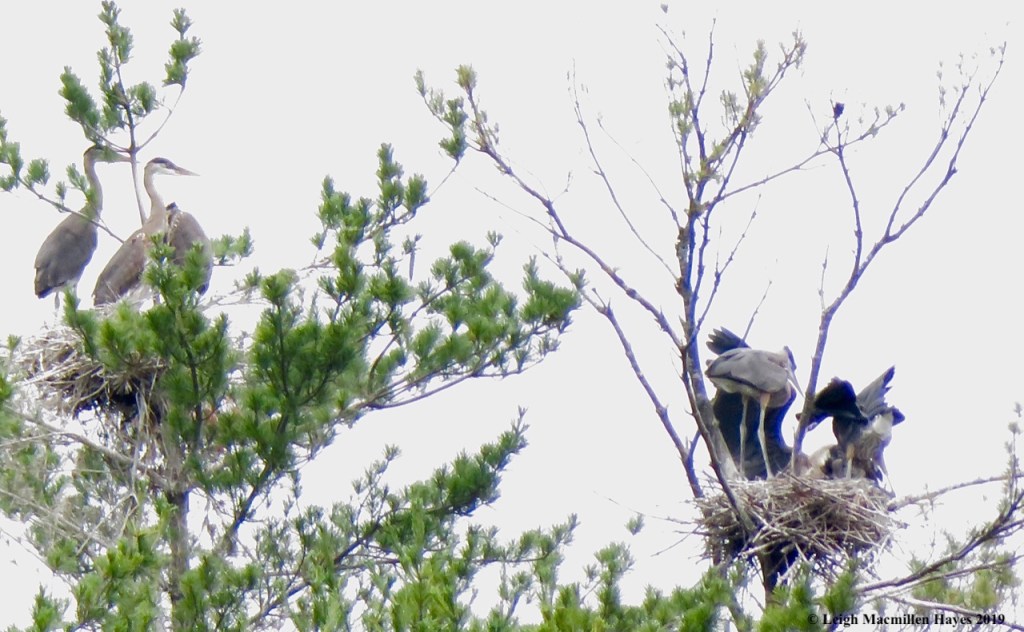
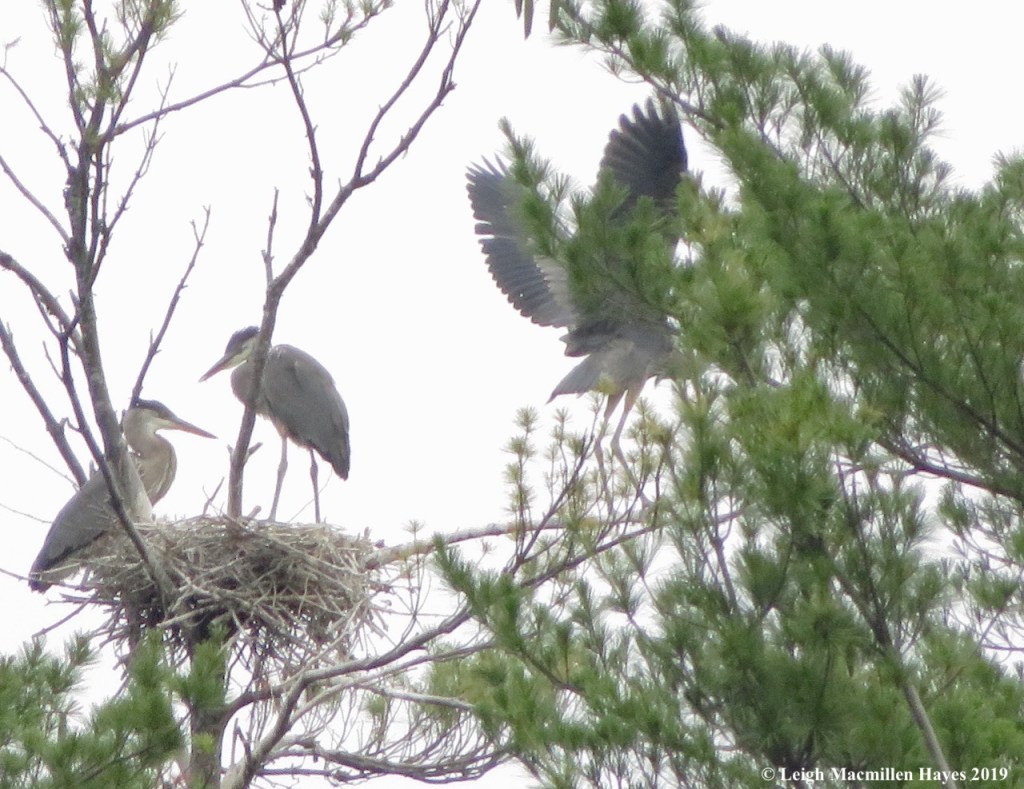
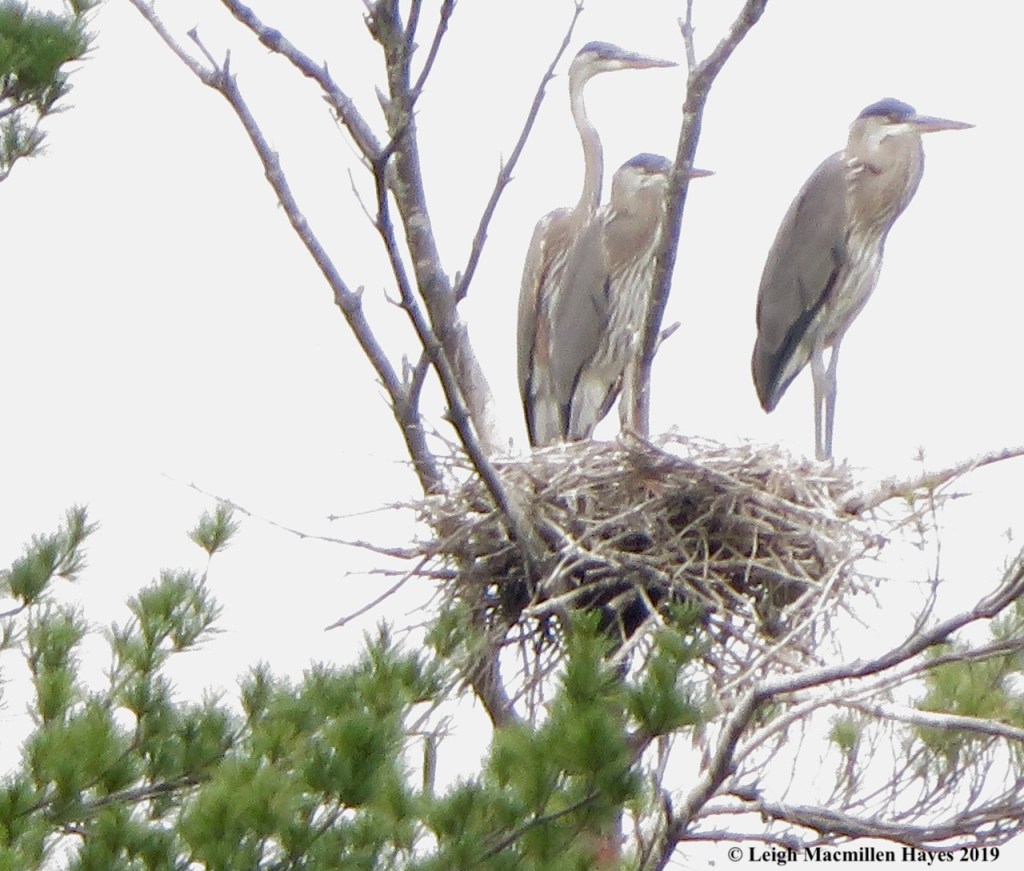
Meanwhile, because I stood beside a river with a friend so I could count Great Blue Heron nests, active nests, young, young in nests, fledglings, and adults, we also began to notice other life that surrounded us like a Kingbird who posed for moments on end.
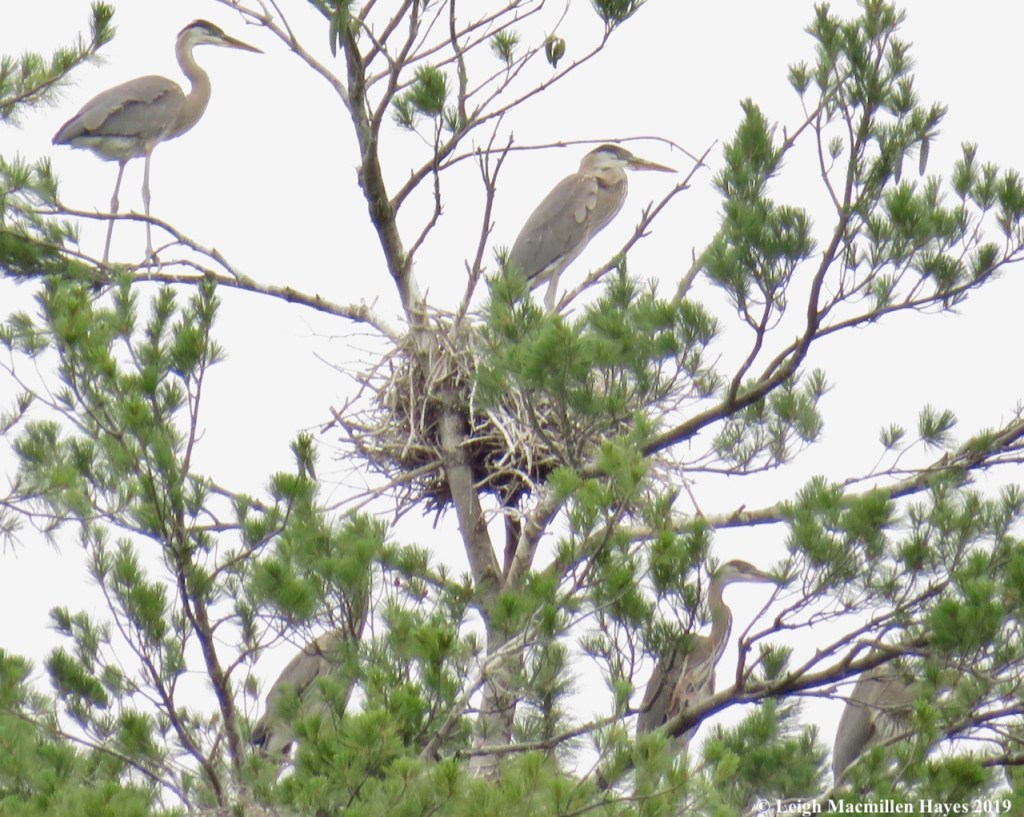
Constantly, however, my eye was drawn to the tiptop of the White Pines, where I began to realize there were more and more birds than my first count because many were feeling their oats and testing their individuality.
Other birds added to the rhythm as we listened for and shared with each other the location of the song makers in our midst.
And then, and then . . . a male Belted Kingfisher pause smack dab in front of us, his tuft of head feathers earning him the “Wicked Cool Dad” award in the neighborhood.
He looked right at us and made dorky dad comments that left us exclaiming with delight.
Meanwhile, back at the rookery, some of the tweens continued to wait in the most patient manner. They muttered hardly a word. We did have to wonder how such big birds could fit in those nest of twigs. The nests were large in bird terms, but the birds were even larger. At last it was time for us to depart, and we left the young in their quiet mode.
My journey continued on the other side of the river. It was there that I spotted Robber Flies in that age-old act of mating.
And a moth I believe to be known as a Virginian Tiger Moth or Woolybear Moth clinging.
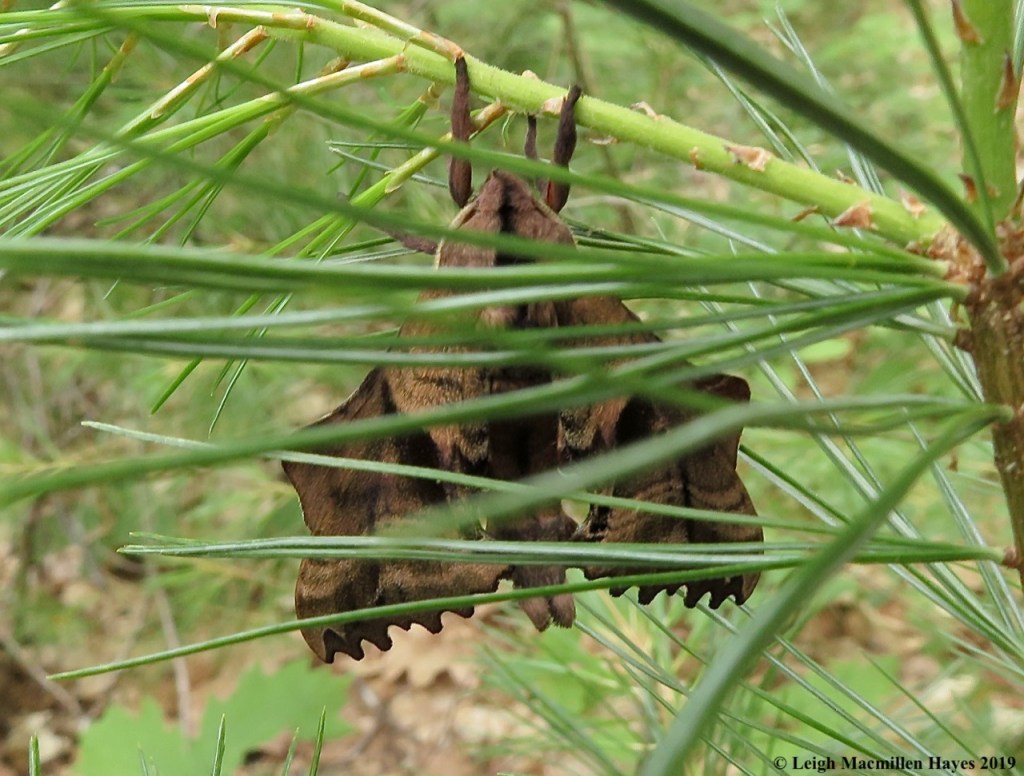
But perhaps my favorite of all, that I found because we chose today to check on the rookery, was the Sphinx moth holding onto a pine sapling. At first I thought it was a dead leaf caught on the twig.
We pounded the sidewalk this weekend in a style not quite ours, but visiting the Big Apple always finds us realizing that the world around us is larger than our little speck on the map in western Maine. And yet, we found similarities everywhere we turned.
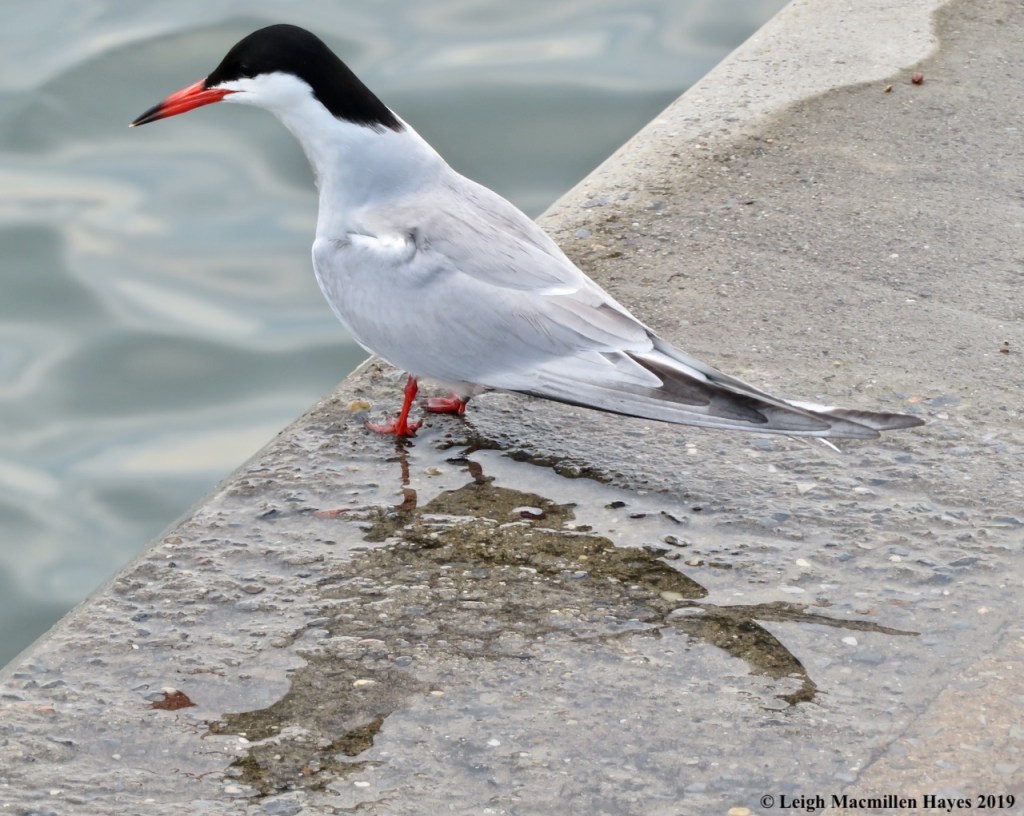
Birds of various shapes, colors, and sizes like the Common Tern with its bright two-toned bill, offered watery reflections as they stood in front of us and pondered life in the East River.
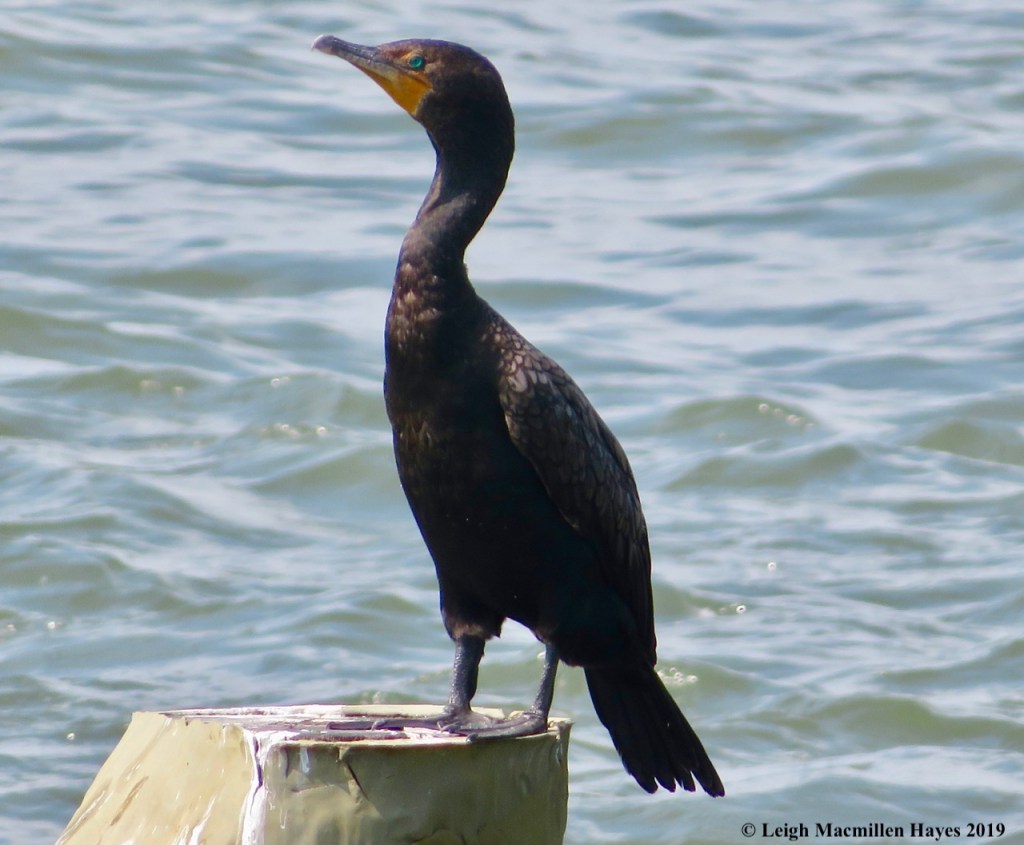
On a much larger scale was the raven of the sea, the Cormorant, with its eyes so blue and bill so long and hooked.
There were a variety of gulls as well, plus sparrows, and of course, the exotic pigeons, all enjoying life along this place where the Statue of Liberty welcomed us from her distant, yet ever distinguished pose upon Liberty Island.
We spent some time in the morning and again in the afternoon beside the river and it dawned upon me as we gazed at the surrounding architecture, here positioned behind the Brooklyn Bridge, that the form of each structure was rather organic in style. Just as all ferns might be viewed as “just ferns,” so might buildings be viewed as “just buildings.” But then one day, you wake up and begin to notice the idiosyncrasies and suddenly you recognize the sensitive fern in its once-cut form with its separate fertile frond and the lady fern with her hairy legs and comma-like “eyebrow” sporangia on the back of her pinnules and voilà, you realize that each one has its own characteristics worth noting. Somehow, the buildings began to feel the same to me–their different forms and colors and sizes took on new meaning and though I don’t yet understand them all, I can at least appreciate their artistry.
The other thing I began to realize is that from our stance in Brooklyn, as we looked across the Manhattan Bridge, the community on the other side had suddenly changed or so it seemed based on the size and style of the buildings, much like natural communities change based on location–whether its a riverbank, forest, pond, cliff, or bog, etc. Fortunately, we were accompanied by our youngest son who lives in Brooklyn and works in Manhattan, and he could point out that the view below the Brooklyn Bridge was of the Financial District of Manhattan, while the view on the other side of the Manhattan Bridge was toward Chinatown.
Even the bridges themselves were meant to be celebrated for their lines, whether straight, curved, or angular–all working together to create monuments out of stone and steel.
Against the sky, their geometric shapes drew our eyes up and down and up and down again as we glanced upon the individual spans.
A few steps beyond the bridge, in DUMBO, we spied more geometry enhanced by color and while some might see crystals in rocks, I kept thinking of insects and their “mechanical” structures of antennae and legs and thoraxes and abdomens and wings.
Our walking tour included The Fence, the largest public photo exhibition in North America that moves from one city to another and will be on display in the Brooklyn Bridge Park through September.
The photographs are displayed in categories. In the Farm-to-Camera category, it tickled me to see that photographer Adrien Bloom had included Garlic Scapes from a farm in Maine.
Beside each set of photographs within a category, an explanation was provided. In this case, we read the following: “Farm-to-Camera honors the pure and simple beauty of the bounty that comes from our farms. Billions of years in the evolutionary making, each item we pick up at the farmers market, or directly from the farm, is a perfect piece of art and deserves to be treated as such.”
One last gaze across the East River provided a sight that looked more poster-like than real. And yet it was . . . real. And in its realness, it appeared that some buildings in the canopy had crowded out the saplings and shrubs and definitely those in the herb layer.
According to our son, the reality of the unfinished building in the center is that the structure is off by two inches between the top and bottom and it has been left as is for months now. Perhaps it will be the tree that can’t survive in this forest because of the crowded conditions.
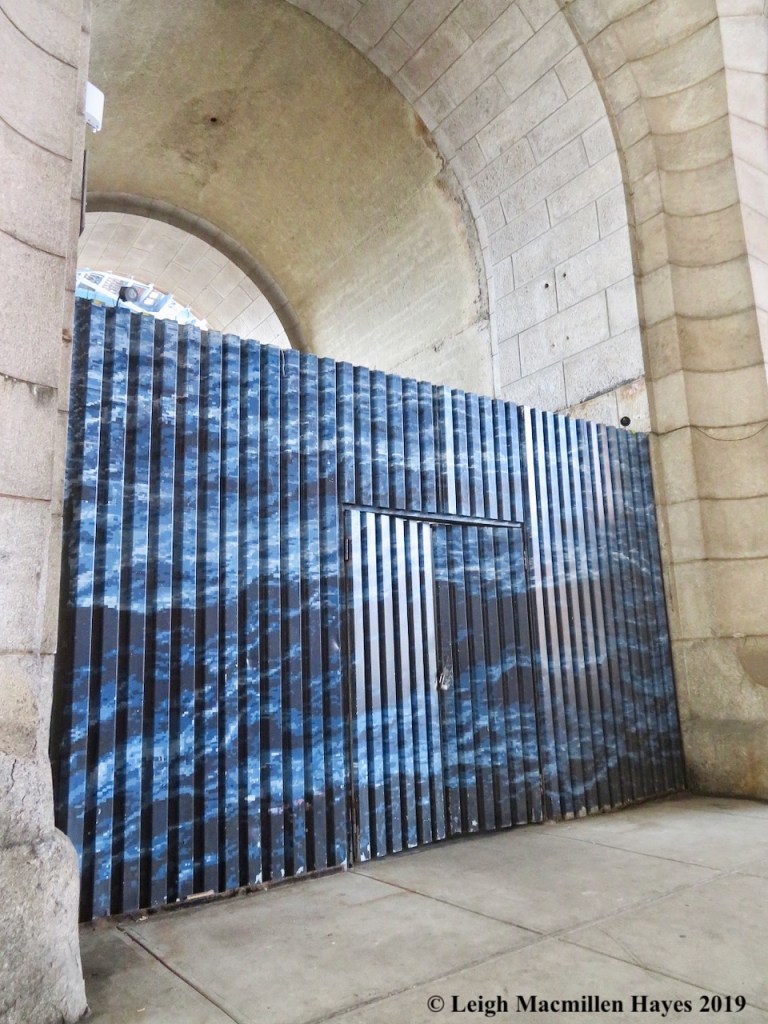
Before we left the DUMBO area, he showed us a different view of the river, actually this one a representation as it blocked off a location where “Gotham” is set. He was able to point out changes they make during the filming season as he knows it from a work perspective in his job at a film editing house.
Our first day ended with the three of us enjoying a delicious dinner at French Louie under a break in the sky–a heart meant for us.
The next morning called for a trip to Manhattan and a walk in Central Park where the ornate architecture was framed by a break in the trees.
It was near there that we paid our respects to Friedrich Wilhelm Heinrich Alexander von Humboldt, aka Alexander von Humboldt, the famous geographer, explorer and naturalist. His publications, which were prolific, had a mission to encourage scientific inquiry as well as a wonderment of nature. And to him we gave thanks.
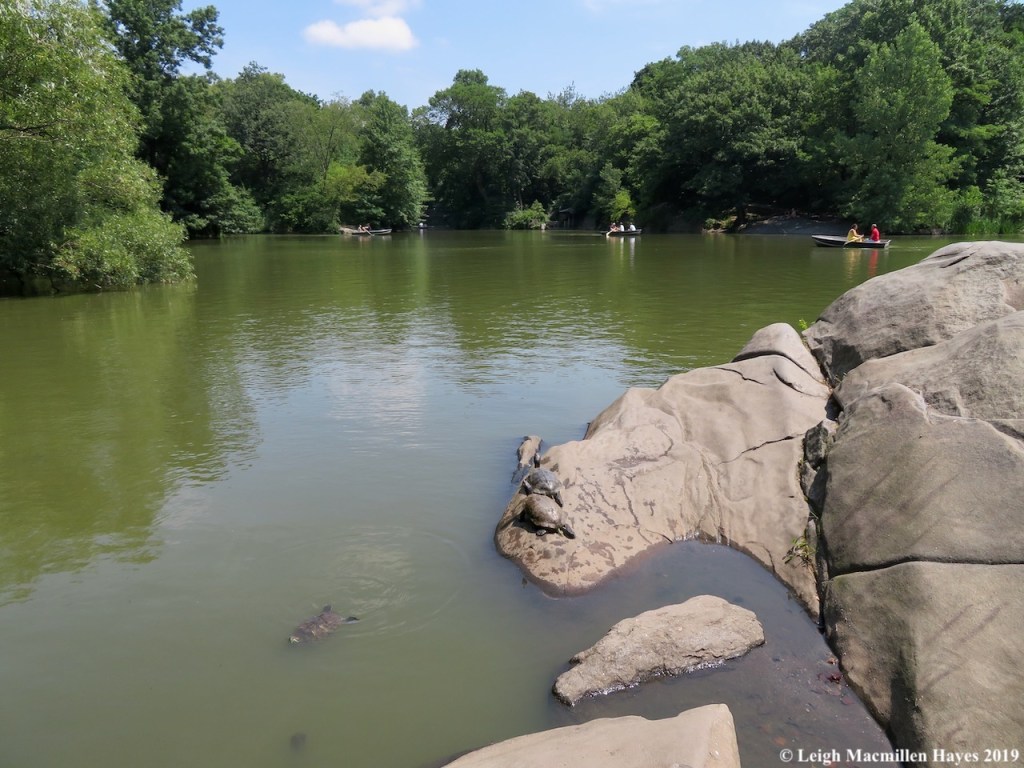
Within the park we stood by The Lake for a bit, watching lovers in boats . . .
approaching each other in the water,
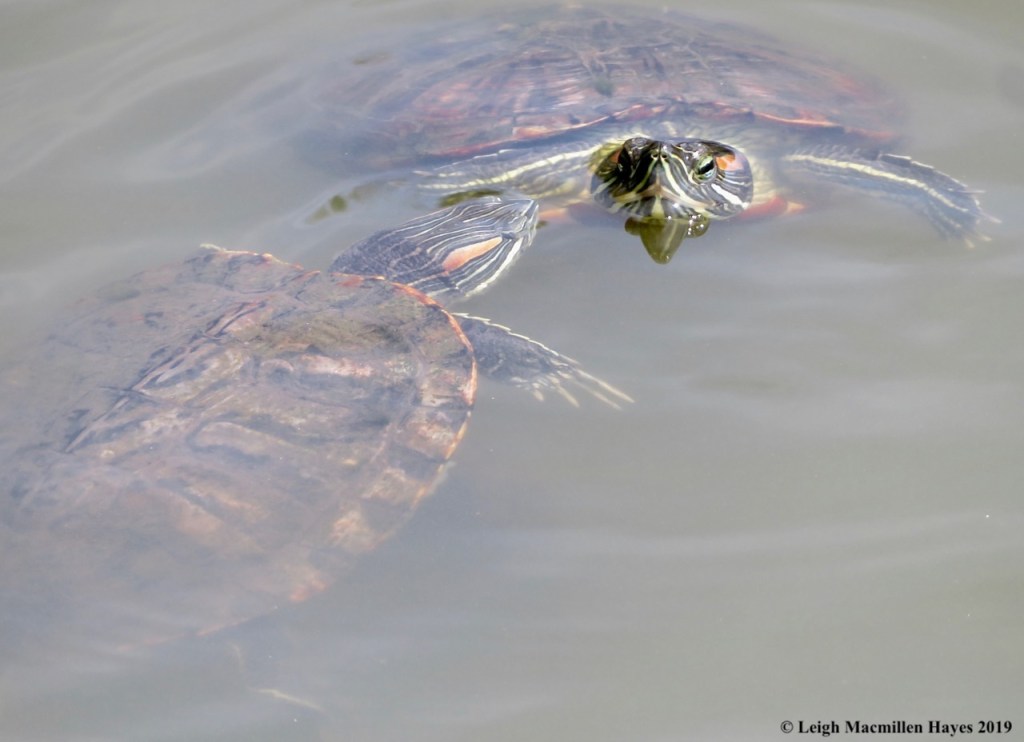
and basking in the sun. Interestingly enough, if you scroll up to the first shot of The Lake, you may notice that the rock upon which the Red-eared Slider Turtles sunned themselves actually looked like a turtle.
It was there that we also spotted dragonflies new to my knowledge–the Eastern Amberwing. I think I may have called it the Topaz Wing had I been the first to ID it, but perhaps that’s because I’m partial to the stone that represents my birth date.
Inside the Museum of Natural History we wandered and wondered for hours and hours. I’m not a city girl, but I sure did wish from time to time that I lived closer for I would purchase a pass each year and spend time in various sections–visiting repeatedly to gain a better understanding.
Oh yeah, these are the two variations of a snowshoe, aka varying hare.
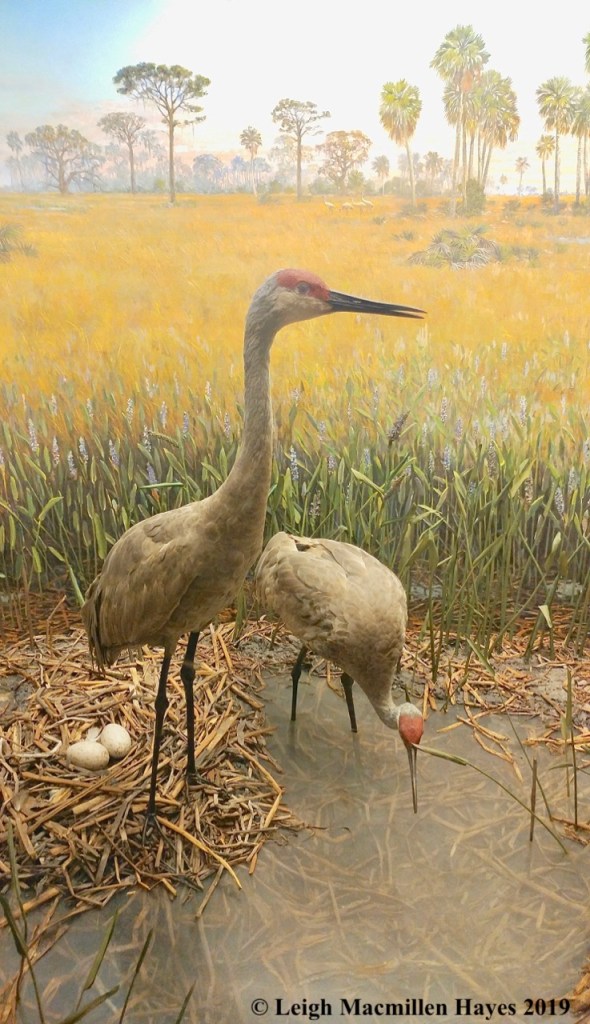
And did I mention that we spotted Sandhill Cranes and their nest. It looks like three little ones should hatch any day now. That is . . . if it’s possible to emerge from their plastic forms enclosed behind the glass wall.
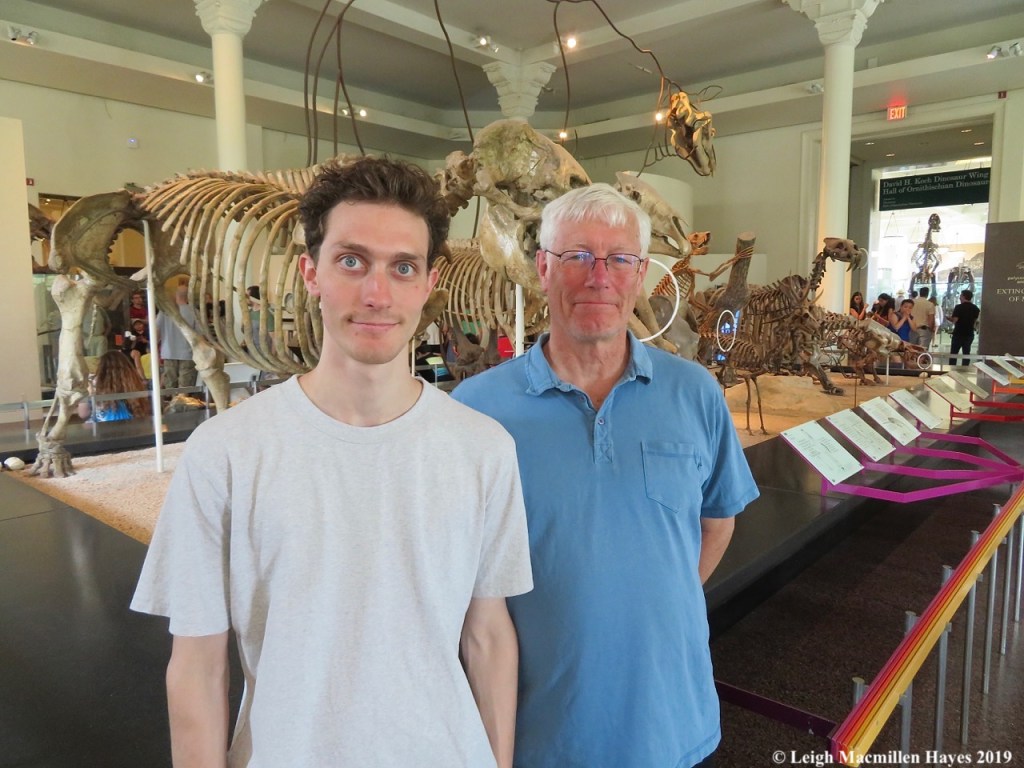
Though I enjoyed the river and park and museum, and especially breaking bread together, the best part of the weekend was spending time with my guy and our youngest son, both of whom actually posed for me beside skeletons of extinct mammals.
We were there to wish this young man a happy 25th birthday. We are so proud of him and the work he is doing and person he has become.
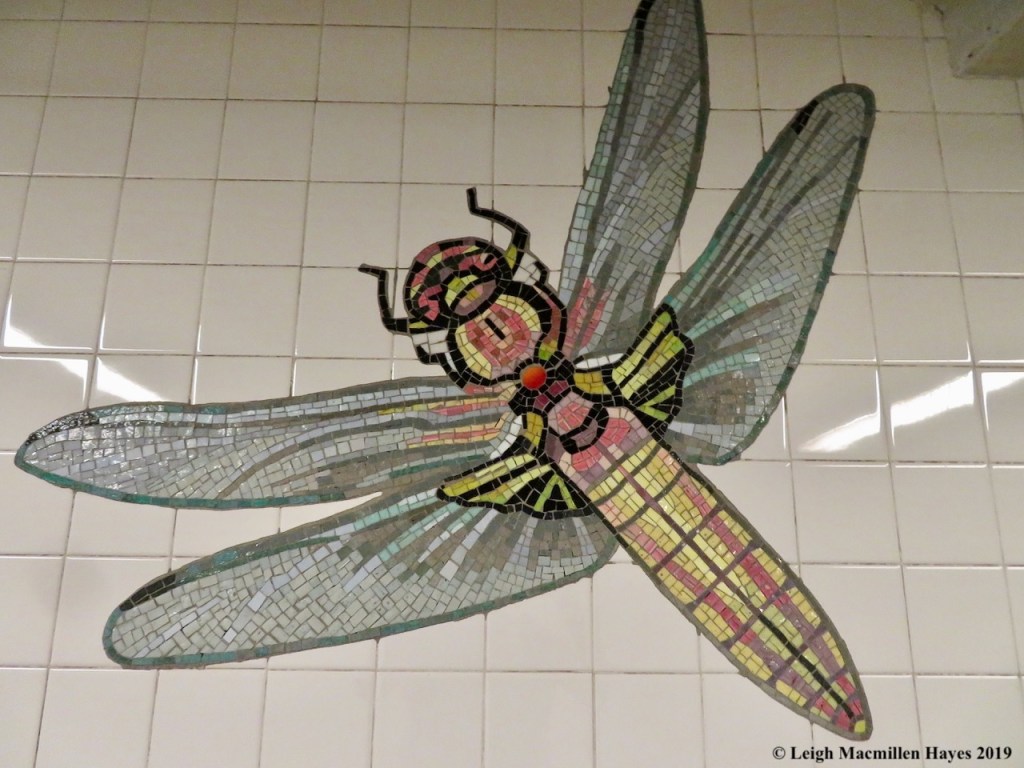
He loves New York for all its city ways and quirky offerings. We love that we can visit from time to time and get to know his place a wee bit better–right down to the artwork on the walls of the subway. The more often we go, the more we begin to realize that in the midst of all its city-ness, moments of wonder can be found.
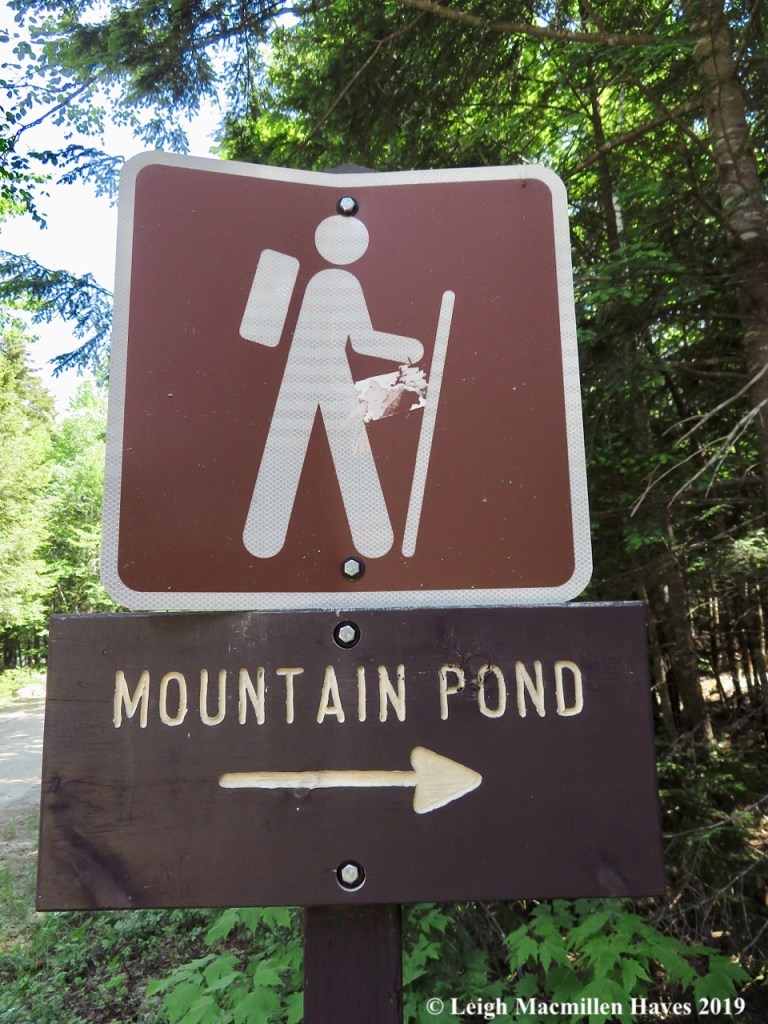
Friends Pam and Bob Katz, whom I haven’t known forever but feel like it’s been at least a lifetime, invited me to join them to circle Mountain Pond outside Jackson, New Hampshire today. The trailhead is located off Town Hall Road that follows Slippery Brook.
At the sign we turned in to the parking area and began our journey on foot.
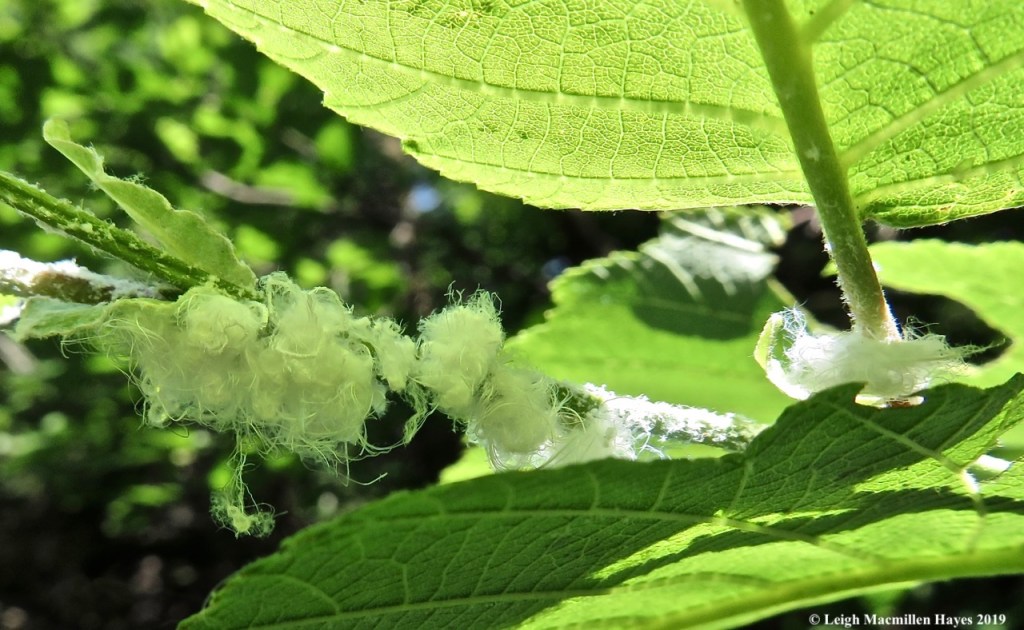
Only a few steps in, we were stopped in our tracks by the wooly growths upon the Speckled Alders. The soft, fluffy fibers could have been cotton plants. But then they moved. In a creepy sort of way.
As we looked more closely we began to see that some were winged in form, a sight new to our eyes and understanding. Meet the Wooly Alder Aphids.
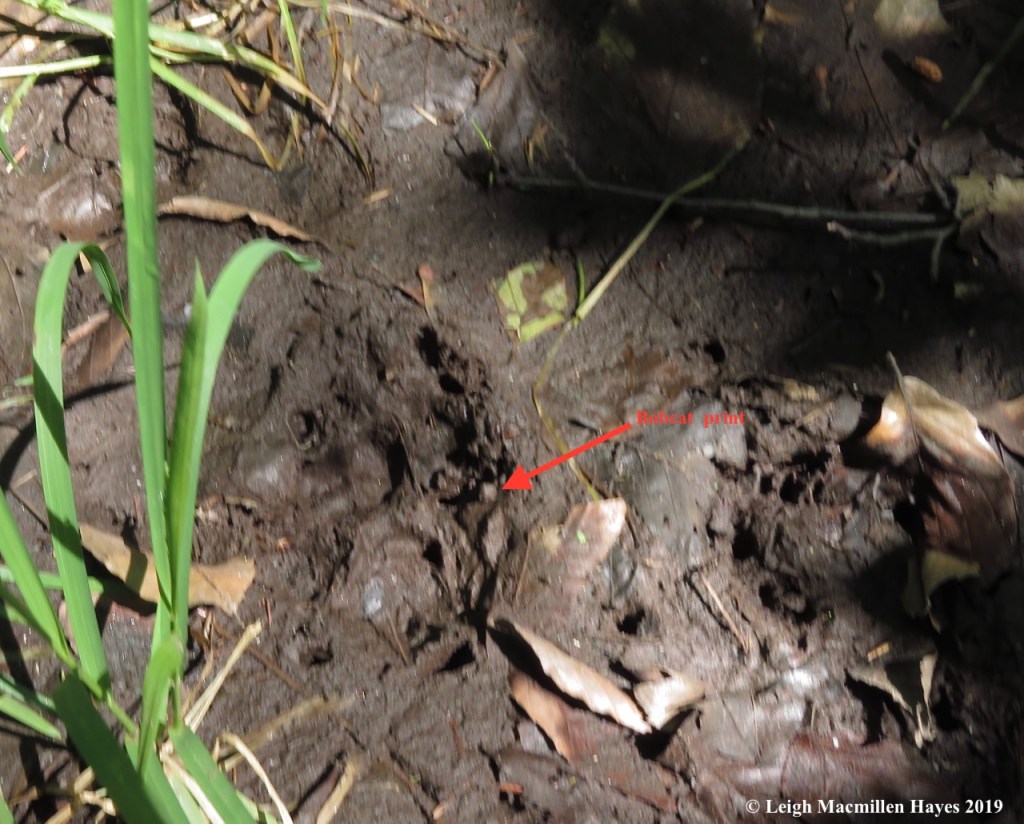
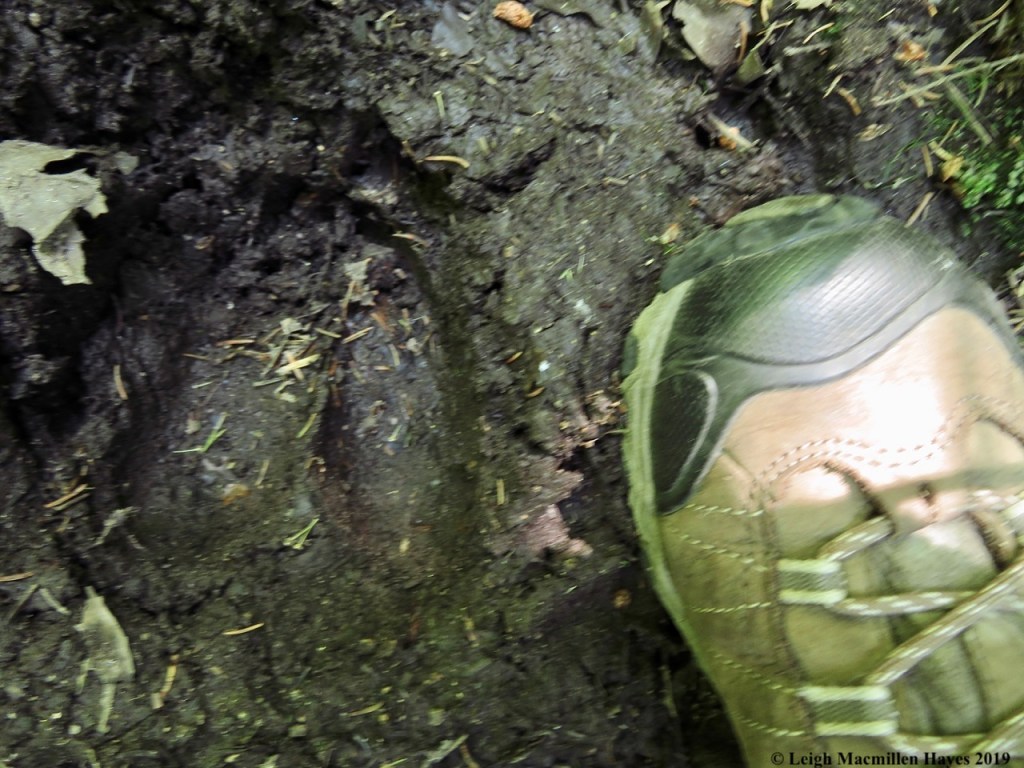
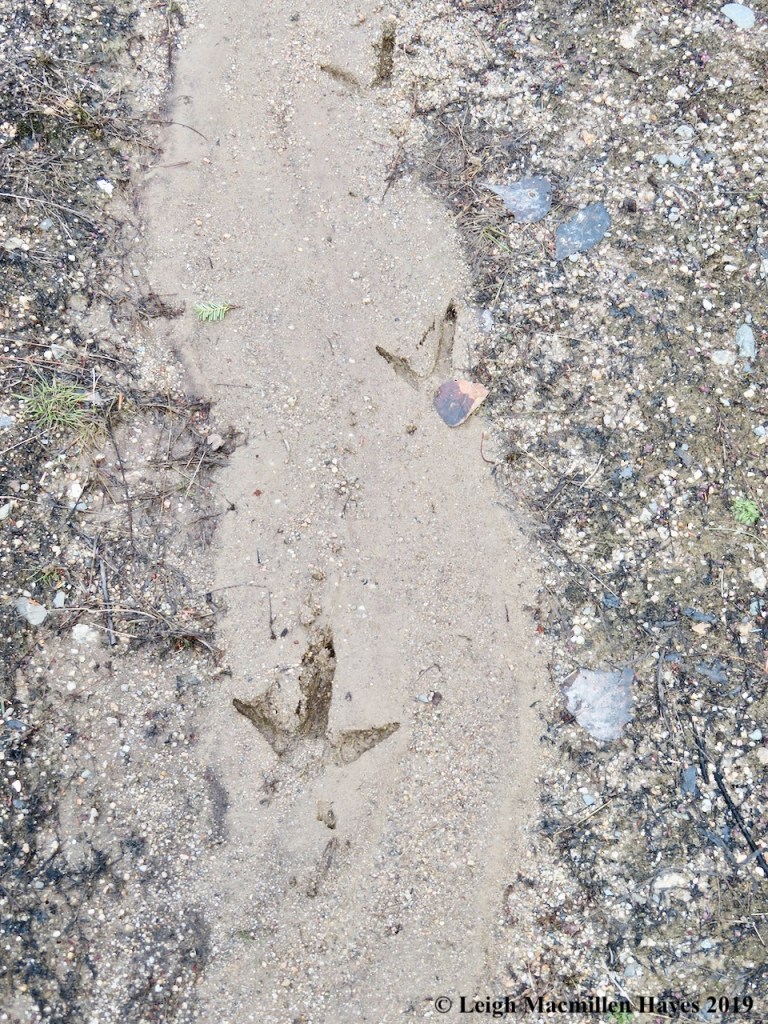
Much more to our liking were the tracks we found in mud, including Bobcat and . . .
a small Moose. The Bobcat had crossed perpendicular to the trail as one might expect for its preferred corridor is about forty feet wide and doesn’t necessarily follow a man-made path. The Moose wasn’t so particular and we followed its prints for a while before it disappeared into the wildness of this place.
While we loved seeing the mammal tracks, it was the insects and flowers that really pulled us in, including a Flower Longhorned Beetle.
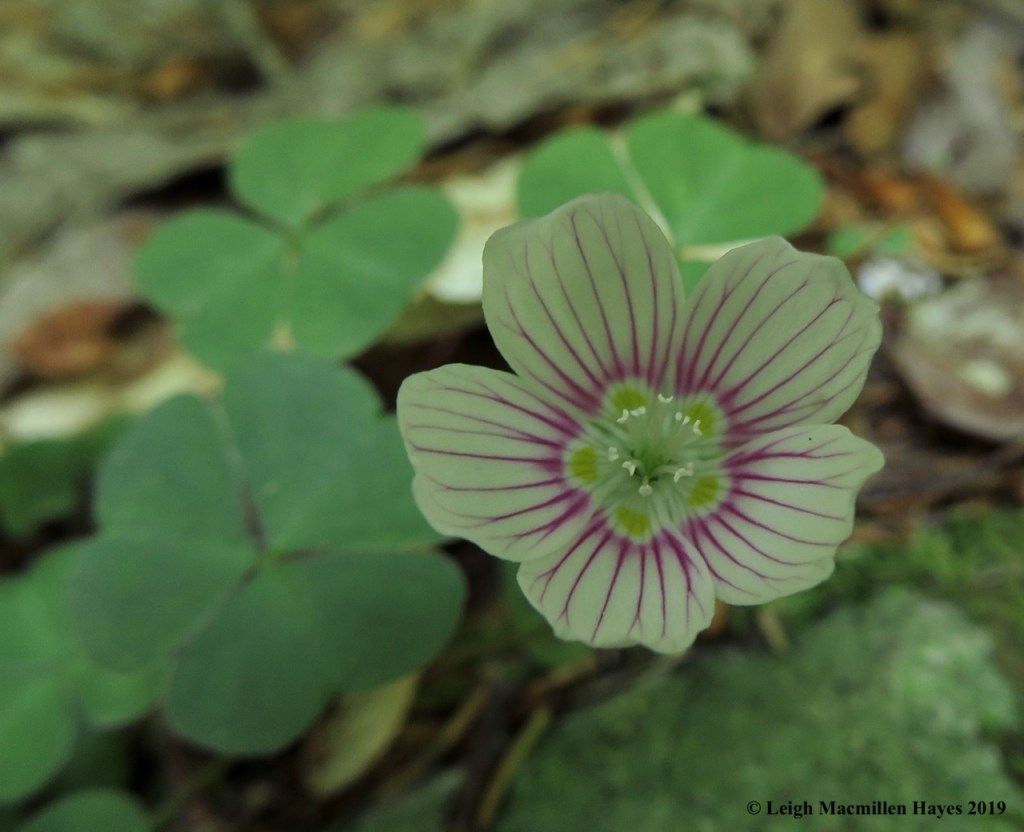
And the ever delightful and dainty Wood Sorrel that makes me think of the Candy Strippers who worked as hospital aides in the books of my youth.
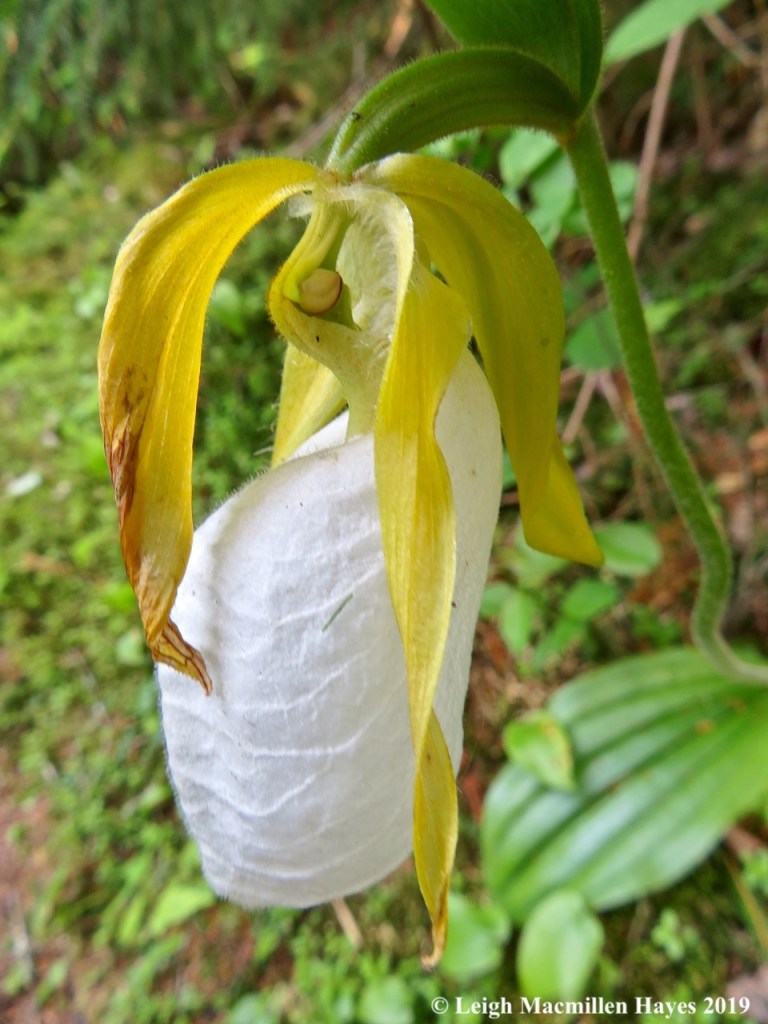
If the Candy Strippers needed slippers, they’d come to the right shop for there were moccasins available nearby in the form of white Lady’s Slippers surprising us since they still looked a wee bit fresh.
At last we began to catch glimpses of the pond for which the trail had been named. But really, a Loon sounding a distress call pulled us toward the water’s edge. We only saw one in an aggressive mode, it’s body extended across the surface as it moved forward, but still heard the wild call of the other and assumed they were protecting a nest.
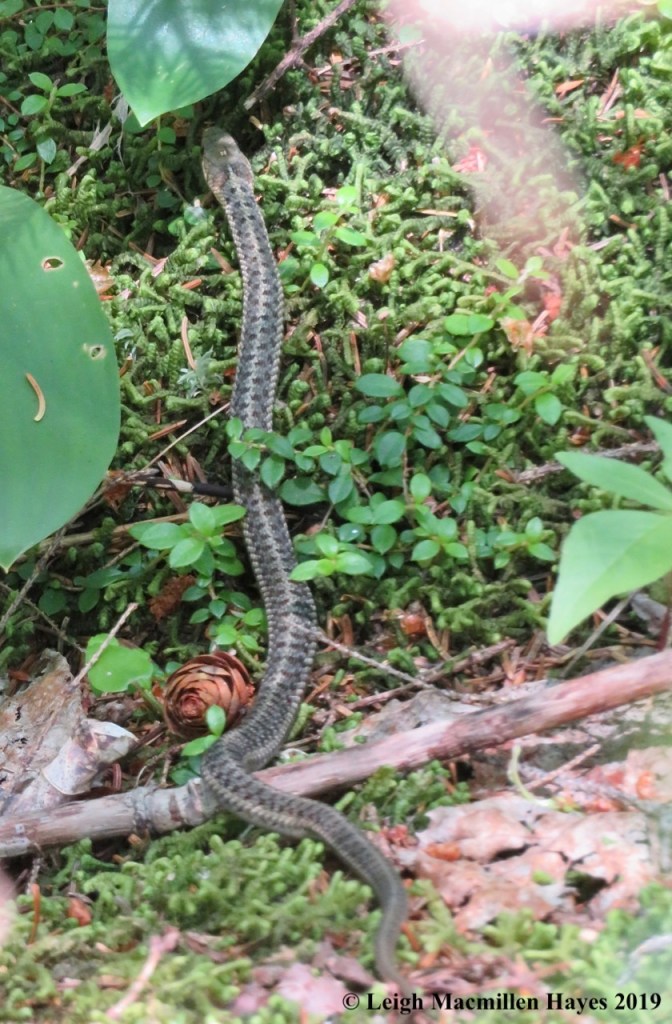
Our wildlife sightings continued as we continued and took turns spotting the wonders of the path, including a Garter Snake slithering away from us.
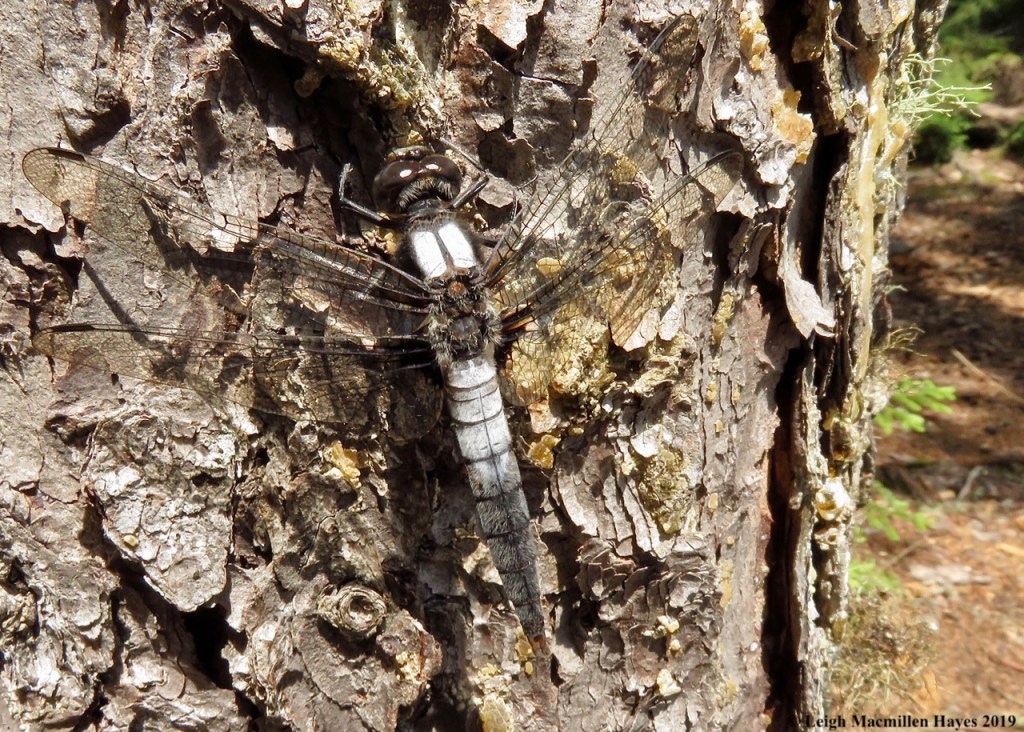
Once we were close to the water, our dragonfly sightings increased significantly, as did the bug detail and insect bites decreased giving us reason to celebrate these winged warriors, such as the Chalk-fronted Corporals that made a point of being our guides as they often paused in front of us and then flew a few feet ahead at our slightest movement.
The fact that I can occasionally sneak up on one and capture a close-up photo is always amazing.
Our next source of wonder, a lodge built by beavers beside the bank. It was one that didn’t appear to be currently in use, but had been mudded last fall.
Eventually we found a second lodge with a huge hole on the back side of it. The hole wasn’t necessarily a vent, but it did provide us a glimpse into the inner workings of the pond-side inn. This one hadn’t been mudded and so we suspected it had been abandoned, maybe due to the presence of parasites. Perhaps in the near future it will again host guests.
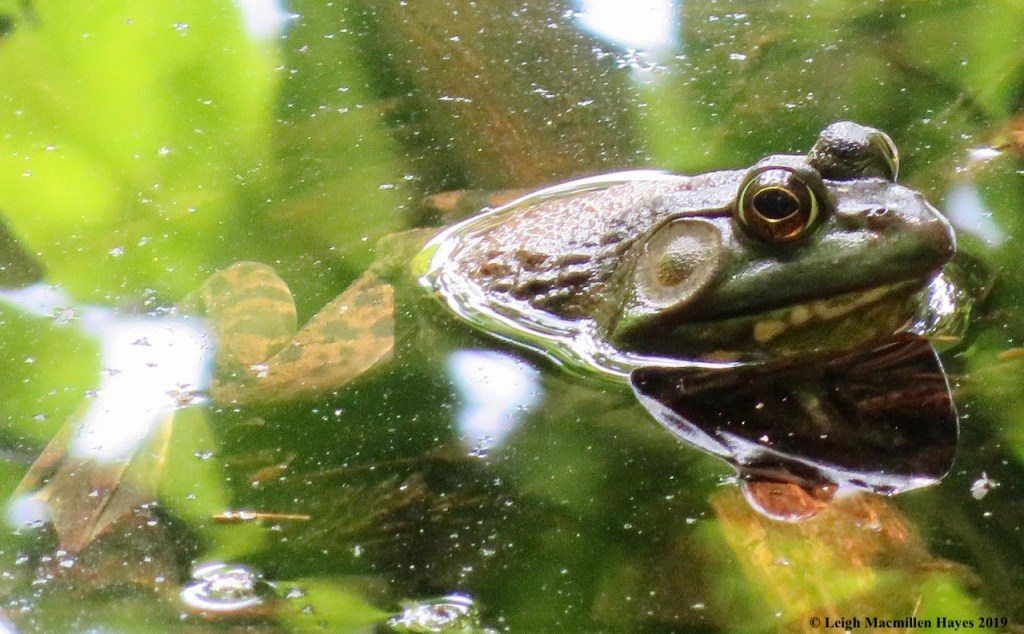
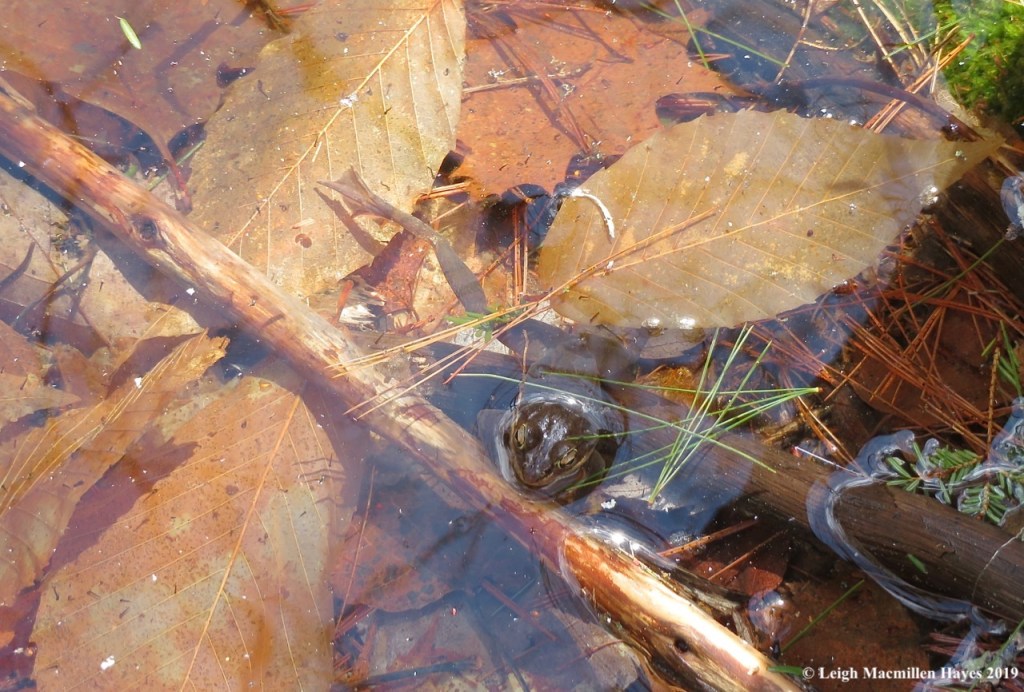
It was near the lodge that we began to spy Bullfrogs, their Ga-dunk voices every once in a while rising in a chorus.
Notice the tympanic membrane or eardrum located behind the eye–it was bigger than his viewfinder, thus indicating his gender.
Not too far away a few ladies-in-waiting hung out on a log.
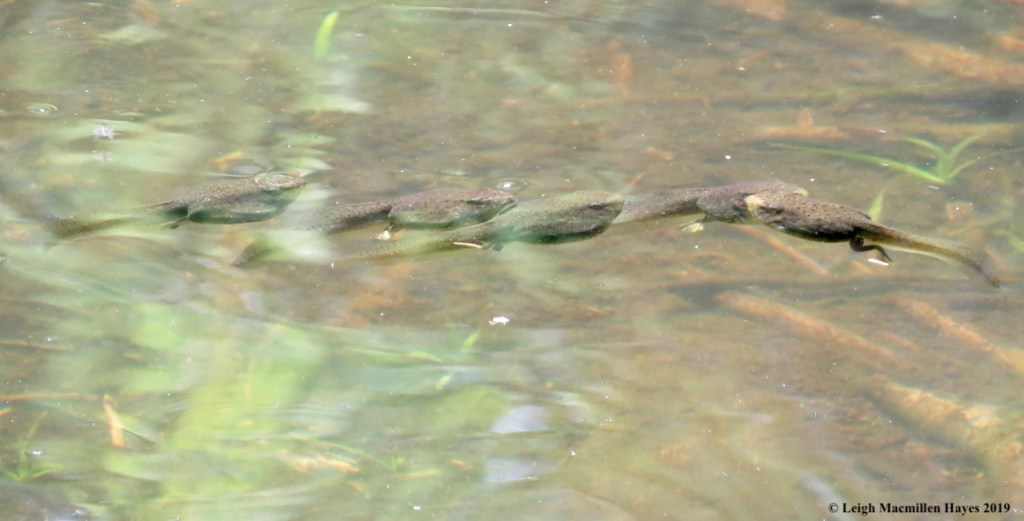
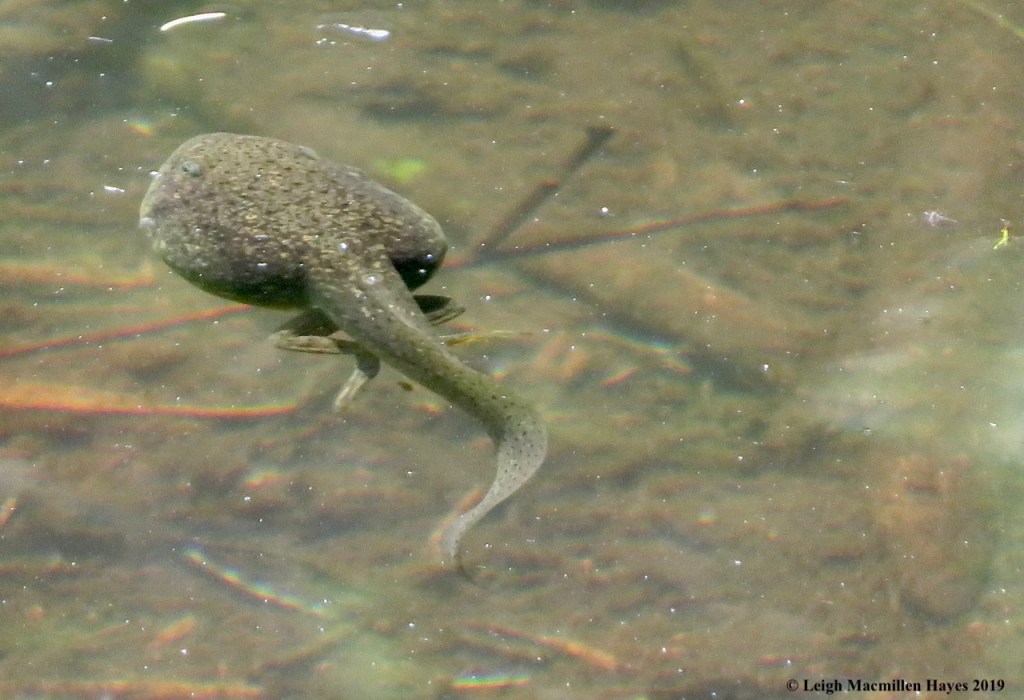
And in the water, two year old tadpoles, their bodies extra chunky, swam.
And morphed. Can you see the hind legs that had formed?
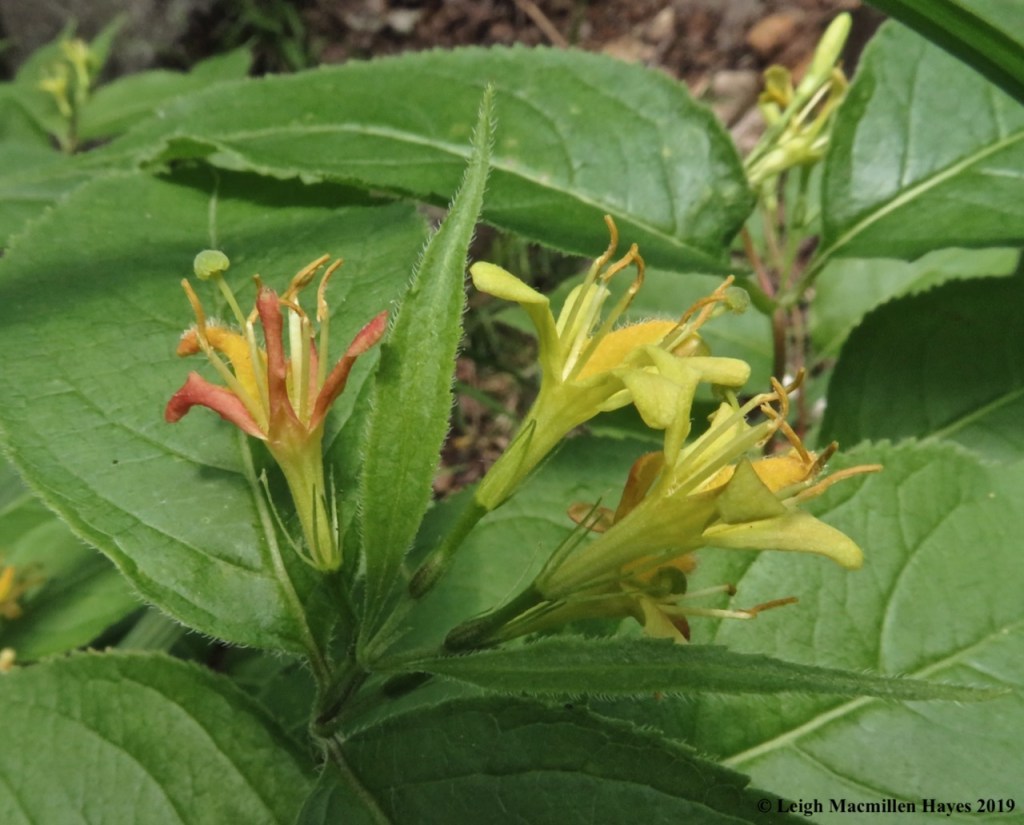
At last we pulled away from the water and continued on our way, when the Fly Honeysuckle gave us pause with its flowers of orange and yellow.
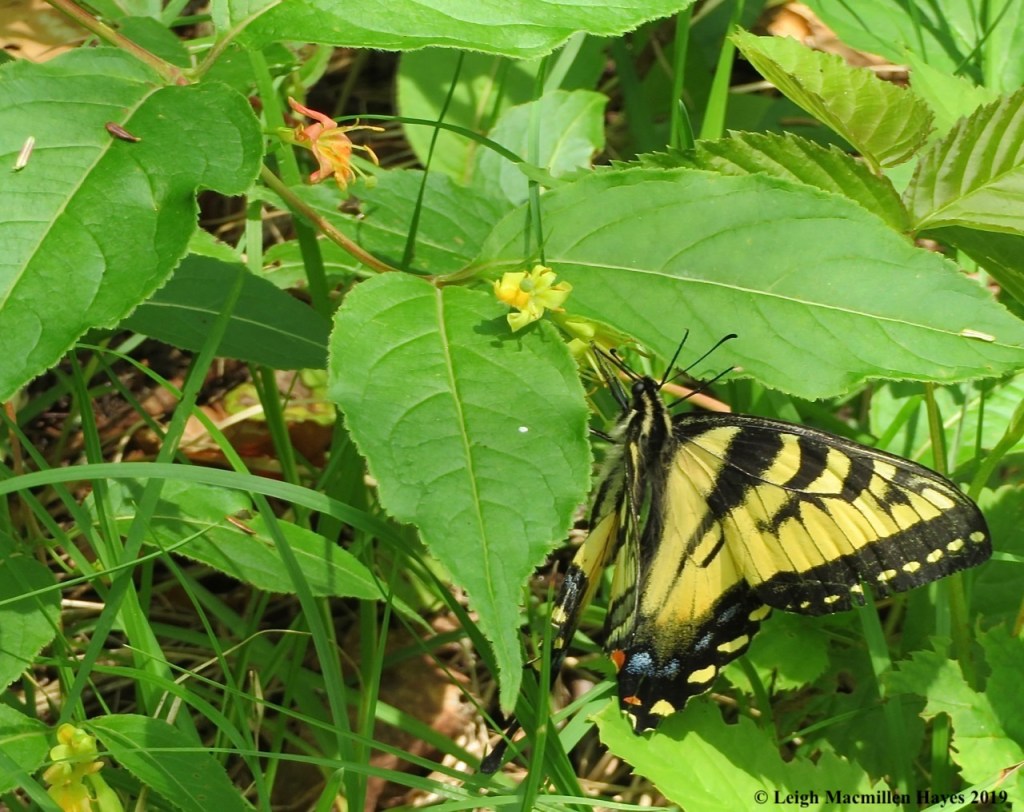
We weren’t the only ones in awe of it, for we spent some time watching this Canada Tiger Swallowtail flutter in a rather drunken way from one blossom to the next.
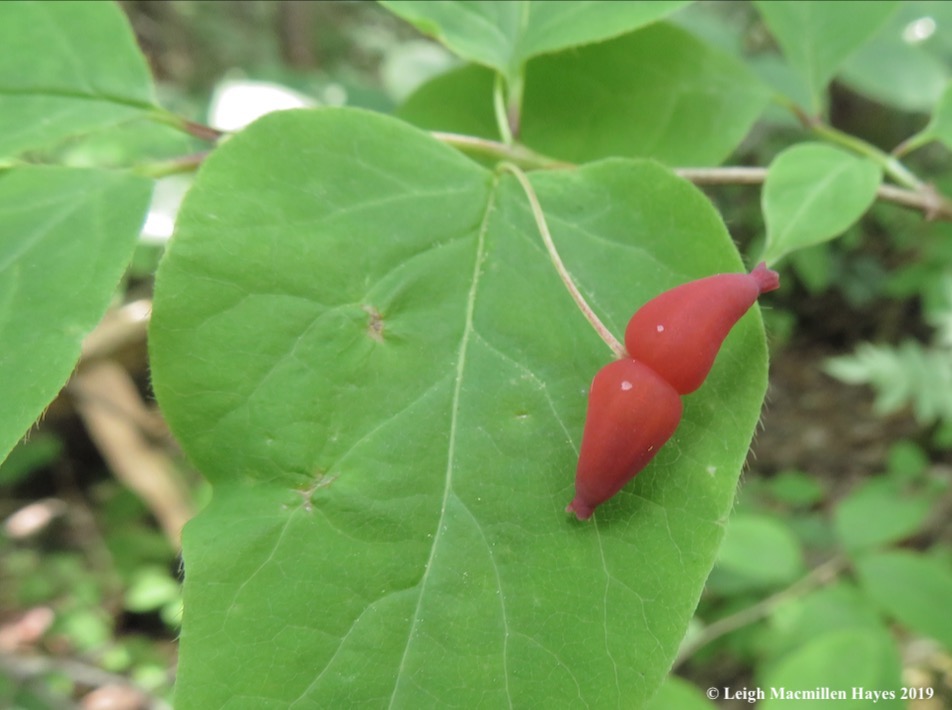
Because the flowers had been pollinated, some had already turned to their shiny red fruit form.
The butterflies were numerous and all the way around the pond we saw White Admirals either in flight or on the ground puddling, the latter a way of seeking nutrients from the damp soil.
An Atlantis Fritillary also graced us with its presence.
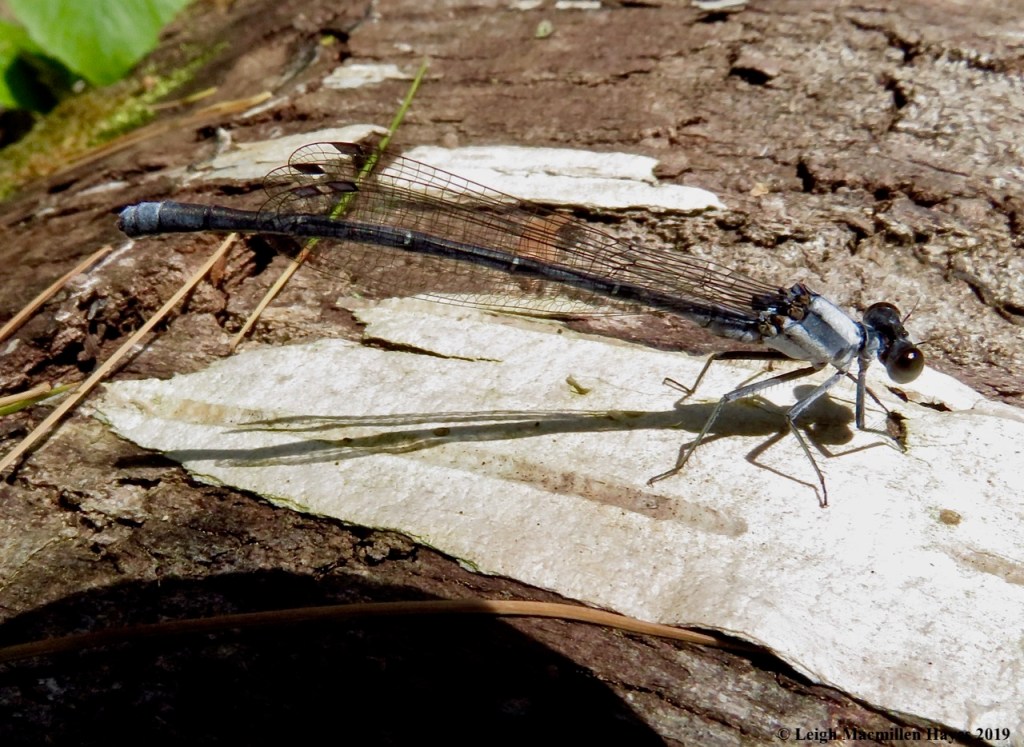
Another flyer insisted upon being noticed and I handed Pam a field guide to determine its name. A second or two later she announced it was a Powdered Dancer Damselfly, based on the coloration of its eyes, thorax, and abdomen.
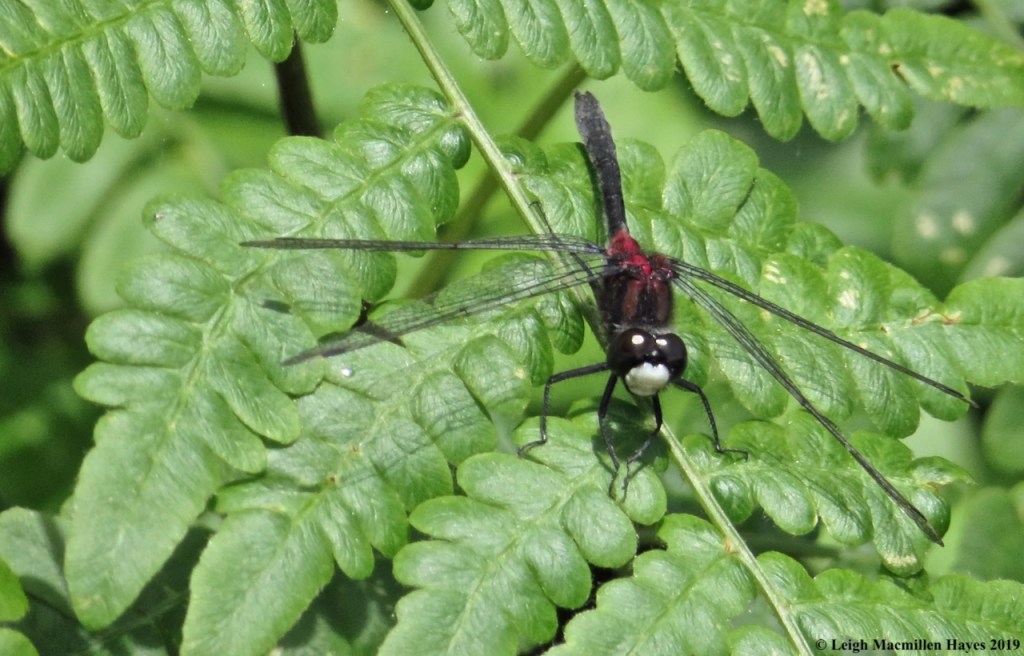
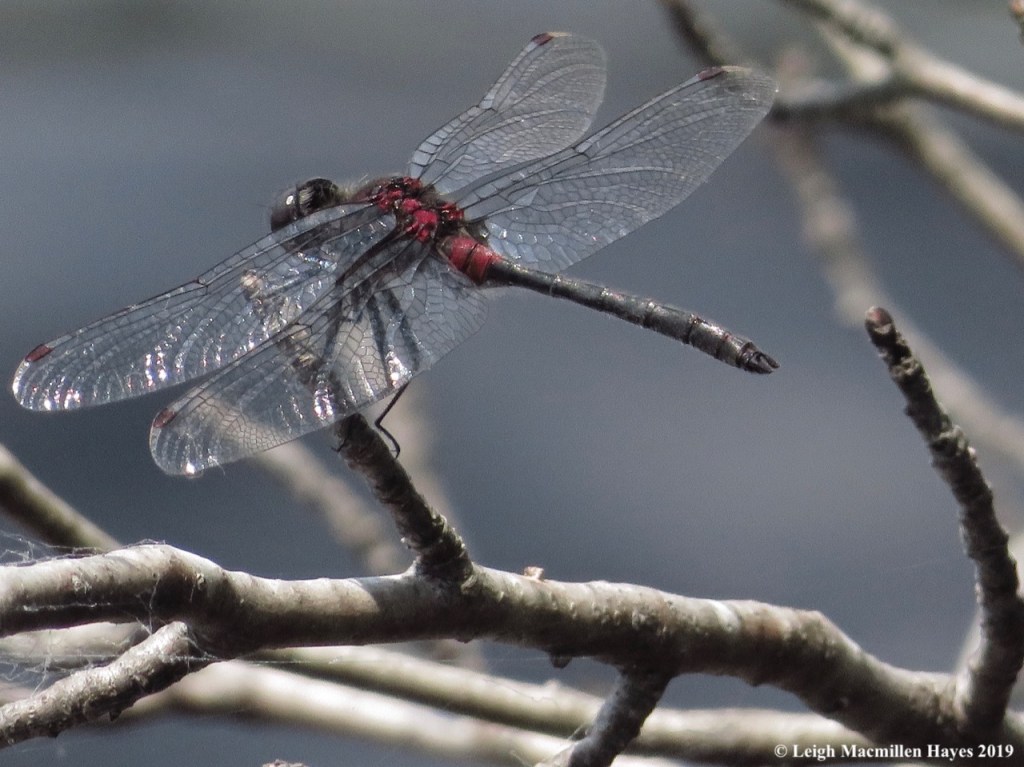
My favorite flyer of the day, however, was the Crimson-ringed Whiteface Dragonfly with its thorax so red and abdomen a combination of green-black.
Even when we paused to gaze upon the lake and mountains in the distance, the Crimsons flew.
And landed–showing off their white faces for which they were named.
One couple even chose Pam’s arm and bracelet upon which to land and canoodle, appearing oblivious to our gawking eyes and awe-filled conversation.
I travelled around Mountain Pond today with “old” friends Pam and Bob and recognized others I’ve met numerous times before like the Bobcat, Moose, Garter Snake, and Wood Sorrel, but new relationships were also formed and I hope I’ll soon move from being a Crimson-ringed Whiteface’s acquaintance to a life-time friend.
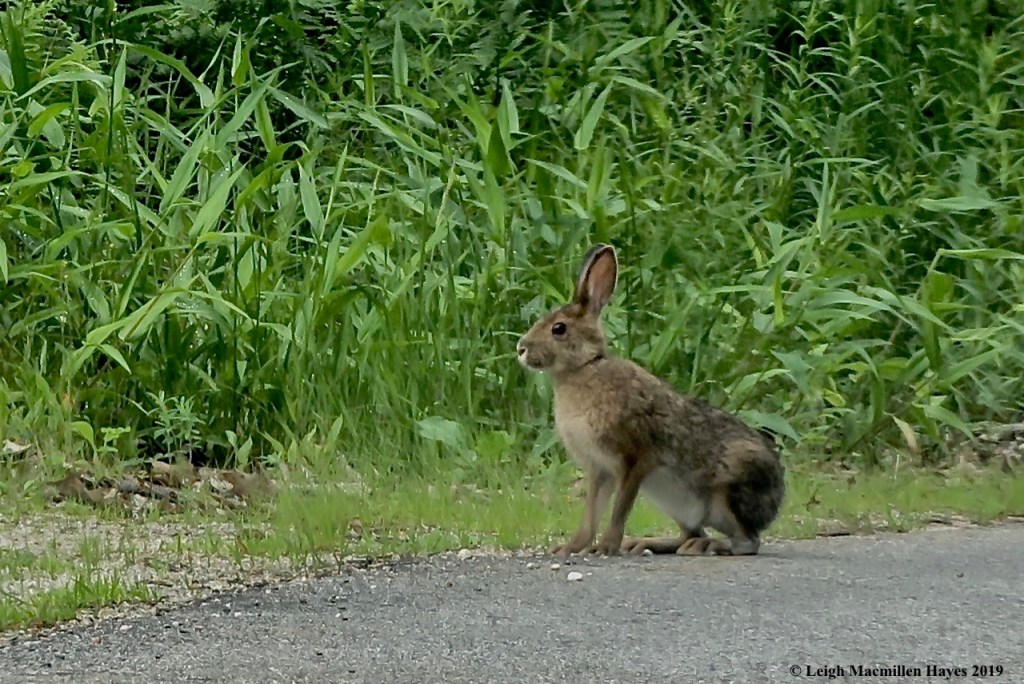
I should have known it would be this kind of a day when I spotted a Snowshoe Hare on the road. It’s a rare spot for me, though all winter long I see their tracks and scat. Only occasionally do I get to glimpse one and even then, it’s just that . . . a glimpse.
But today was different. As I drove to a Greater Lovell Land Trust property, movement on the pavement slowed me down. To. A. Stop. Not wanting to scare it, I took a photo from behind the windshield and then watched as it hopped on the road for a couple of minutes and then off into the grass.
My destination was just around the corner where the Sundews grow. Carnivorous Round-leaved Sundews. Check out the glistening droplets at the ends of the hair-like tendrils that extend from each round leaf. The droplets are actually quite sticky. Just like a spider sensing a bug on its web, the tendrils detect the presence of prey and then curl inward, thus trapping the victim.
The whole leaf will eventually wrap around an insect and in the process of digesting it, the plant will absorb the bug’s nutrients. Can you see the action in process of the lower leaf on the left?
Sundews tend to grow in areas that lack sufficient nutrients, so this is the plant’s way of supplementing its diet. And if that isn’t enough–it’s just plain beautiful.
When I first ventured onto this wildlife refuge with others for a morning of trail clearing, the sky was overcast and mosquitoes plentiful. But . . . the sun eventually burned through the clouds and with that, some of my favorite over-sized, prehistoric looking insects did fly. Thankfully, they also paused so I could admire their structures, colors, and habits. This member of the Odonata family loves to skim across the land at low level and pause on rocks or leaves. Sometimes I feel like I’m walking with them for such is their behavior to lift off from one rock as I approach and settle on the next just a few feet ahead. That is, until I approach that one and then they move on to the next. Over and over again. Of course, all the time they’re hunting for a meal.
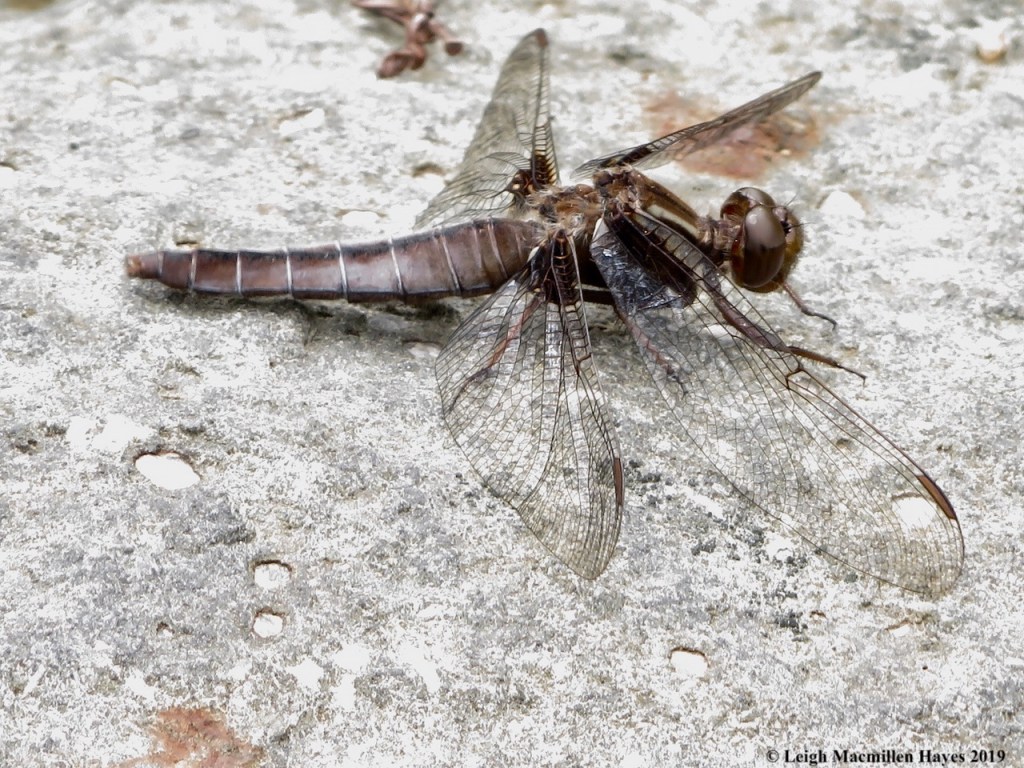
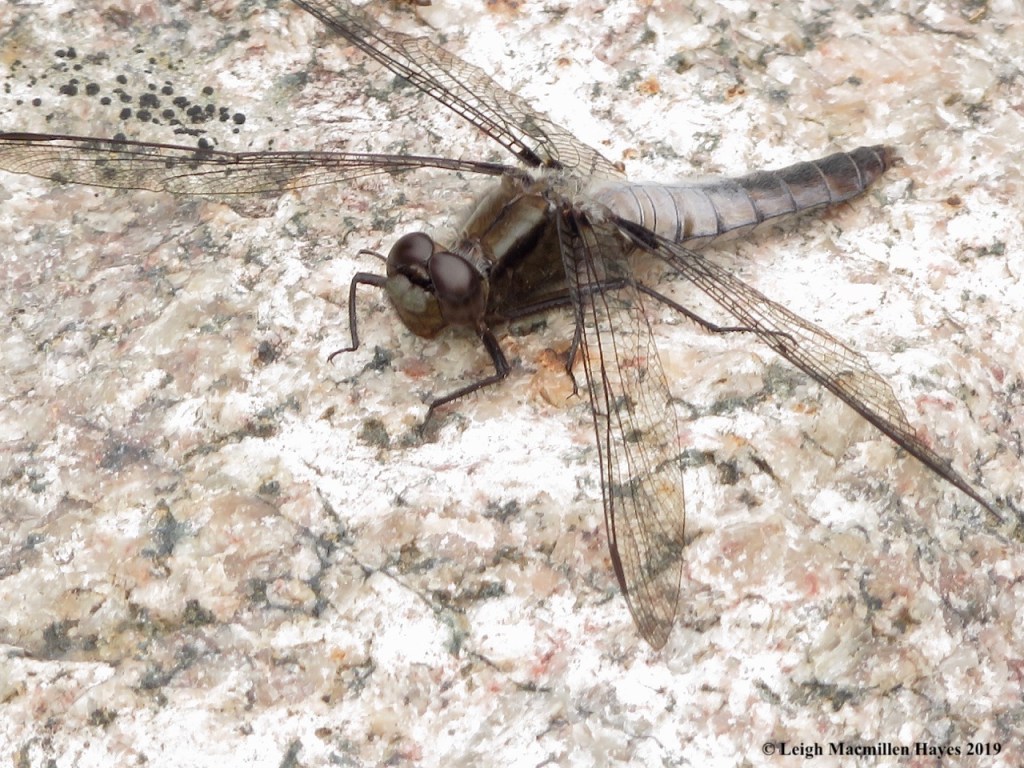
The two photographs above are of the same species and same gender. Both are females of the Chalk-fronted Corporal sort. But notice the cloudier abdomen of the second. There’s just a bit of the grayness in the first photo. So here’s a word to stick under your hat and remember: Pruinescence–meaning a “frosted or dusty looking coating on top of a surface.” The female’s abdomen turns chalky gray with pruinosity. In my under-educated brain, I’d say the second is older than the first for her pruinose markings are more obvious.
I was standing in the middle of a former log landing when I began to notice the insects. It’s an area where forest succession is slowly occurring and may need to be addressed. But for now, the wildflowers include Yellow Hawkweeds. And because their resting position is different from the Corporals, upon the flowers perched Calico Pennants. The first I saw was a male, so identified by the red markings on its abdomen.
In many male/female contrasts, be it dragonflies, damselflies, or even birds, the female is in no way as attractive as the male. But for the Calicos, both are worth celebrating. Check out those wings–their basal patches like stained glass windows.
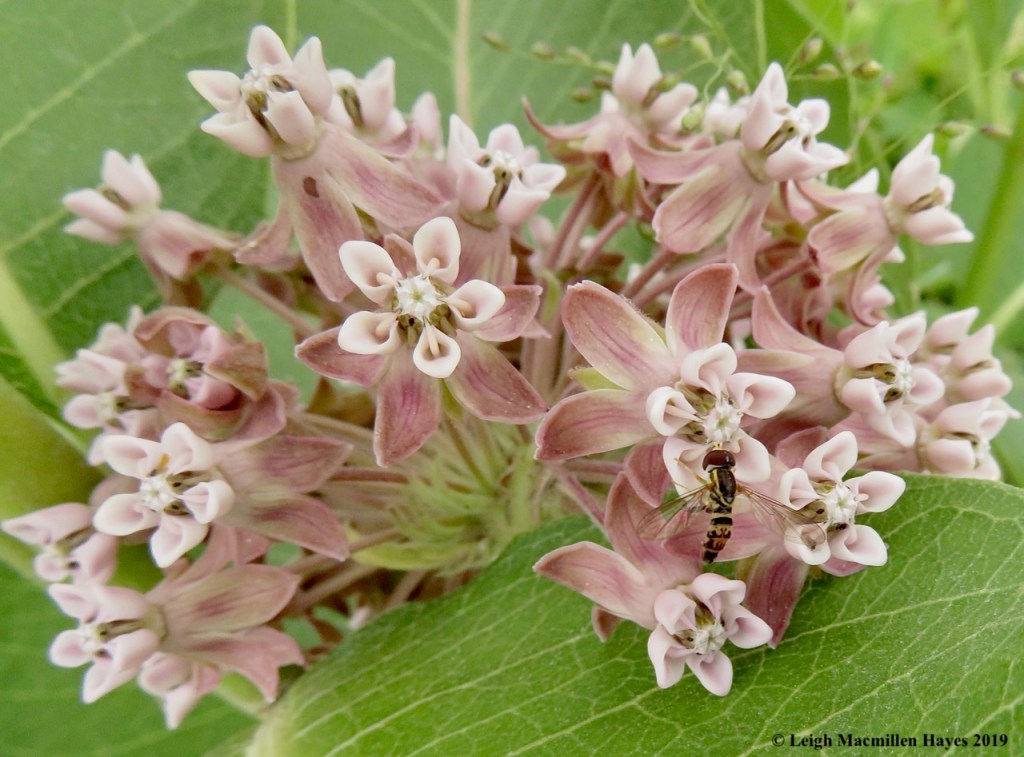
It wasn’t just dragonflies that visited the field, for as I said it’s a land once stripped of vegetation that now plays hosts to flowers and shrubs and saplings all competing for space. And Syrphid flies also competed, their focus not on other insects, but rather pollen and nectar.
Equally stained-glass like are the wings. And notice the hair on its body. The natural world is incredibly hairy. Looks rather like a bee, doesn’t it? I was fooled, but my entomologist friend Anthony corrected me–thankfully.
Notice the lack of pollen baskets on those big funky hind legs, lack of antenna with “elbows,” and the shape of the eyes. Similar to a bumblebee, yes, but with subtle differences.
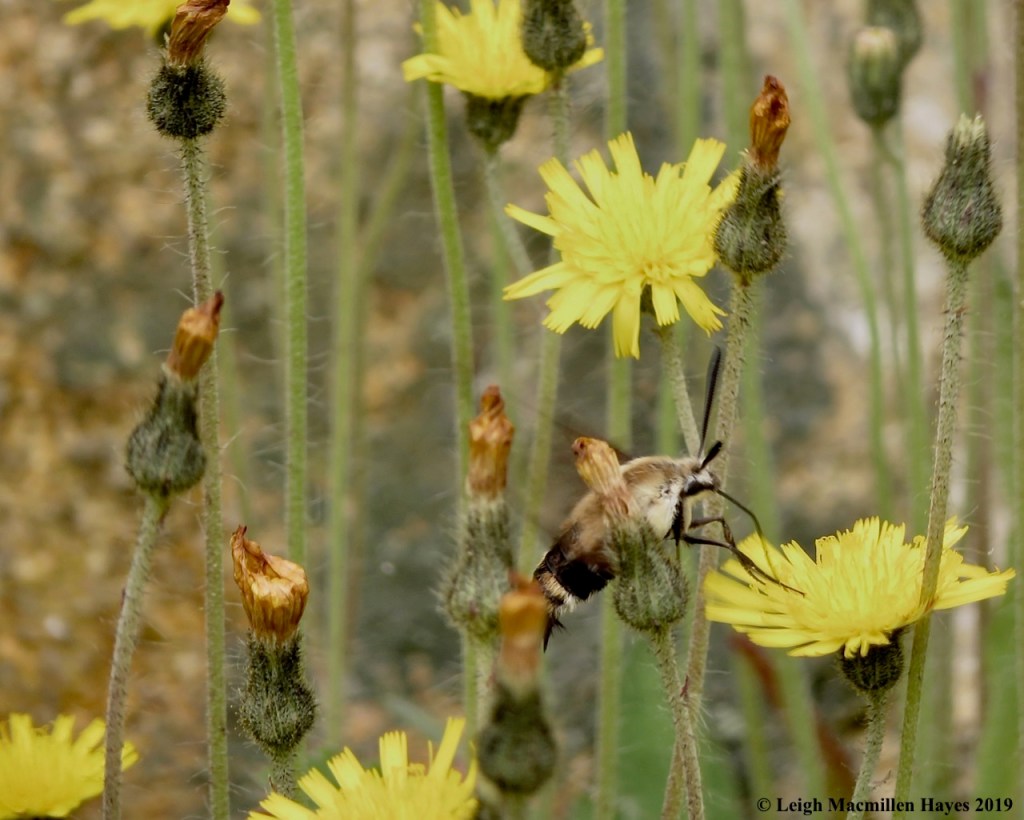
Other visitors who sampled the goods in a much faster manner included Hummingbird Clearwing Moths. The wings of this one pumped so quickly that it appeared wingless. If you look closely, you may see the comb-like structure of its antennae, which helps to differentiate moths from butterflies with their club-like antennae.
I had been feeling rather blessed for all I’d seen to this point and then an old friend made itself known. This dragonfly is one that I know I’ll eventually photograph on my hand or leg this summer and it honors me with those landings for I feel like a Dragonfly Whisperer in those moments. Today we were merely getting reacquainted. And instead of landing on me, it let me photograph its face. Take a look and wonder.
And then look at the abdomen of the same dragonfly: a Lancet Clubtail. By its bluish gray eyes that remind me of my own, and narrow yellow daggers on each segment of its abdomen, I hope you’ll recognize it going forward should you have the opportunity to meet.
Butterflies were also among the visitors of the field, including a Tiger Swallowtail with a tale to tell of how it lost a part of its tail.
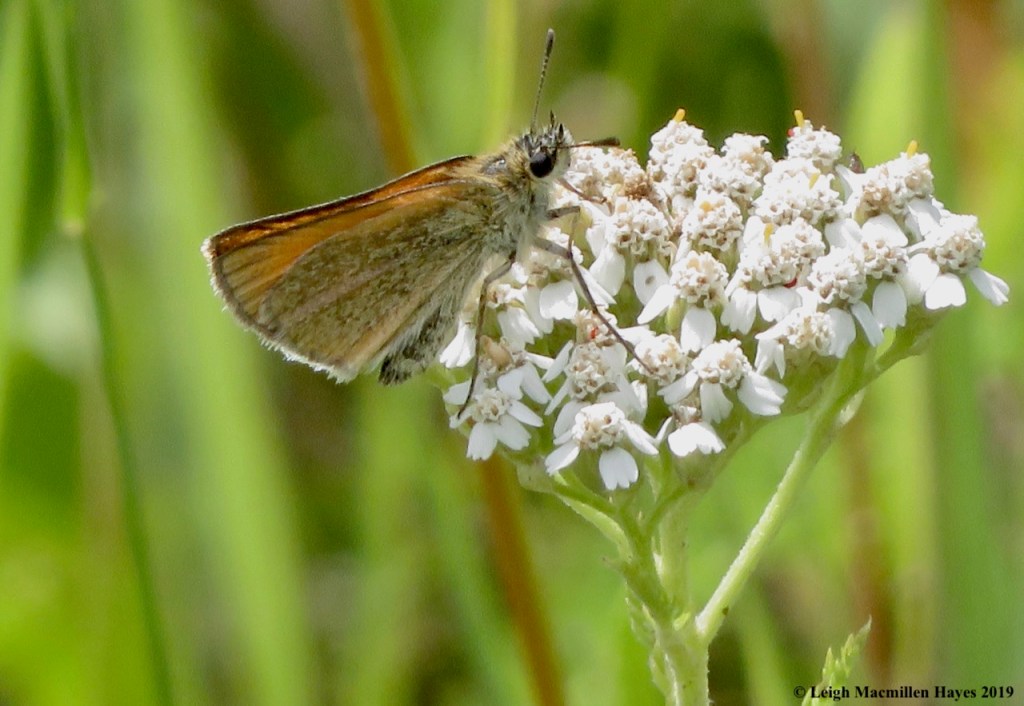
And then I spotted a skipper or two moving just a wee bit slower than the Hummingbird Clearwing Moth. My what big eyes you have.
As I slowly made my way back up the trail, it was the Kennedy’s Emerald, named for Dr. Clarence Kennedy, a renowned Ohio State University professor and odonatologist that asked to be noticed. I knew we’d met before when I realized it had two downward-arched yellow spots on the first two segments of its otherwise dark abdomen. The yellow coloration indicated it was a female.
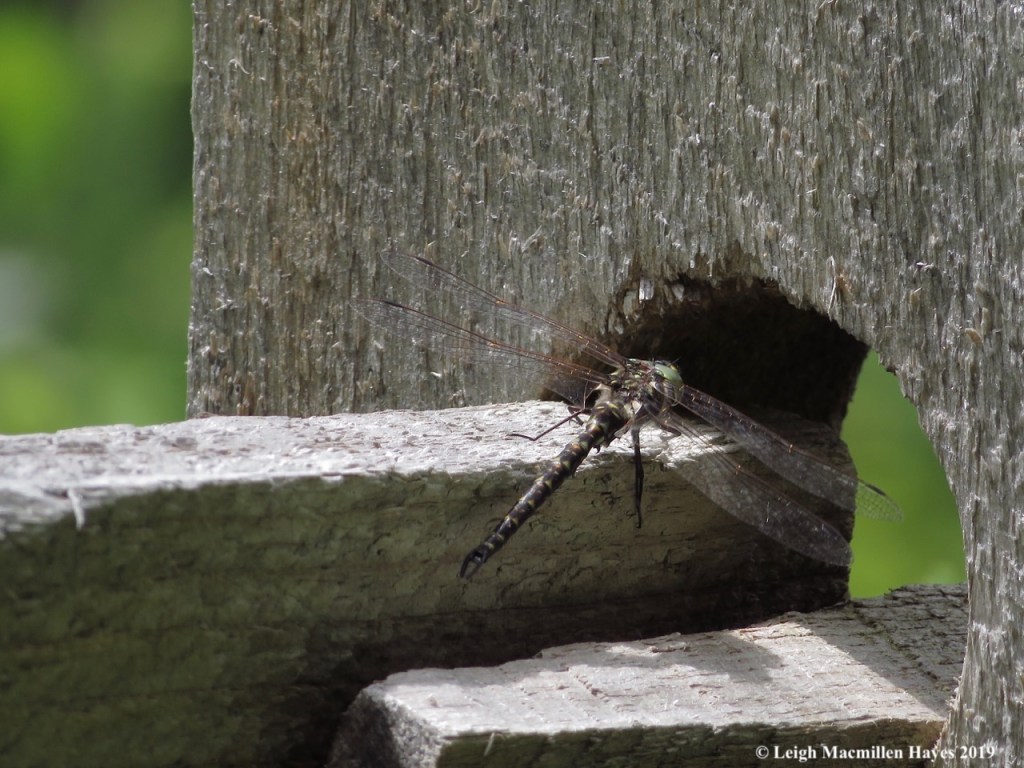
Then I watched a most curious thing as I stood by a fence that stands beside a short portion of the trail. Do you see the dragonfly crawling along the fence?
It seemed to be on a mission that I couldn’t understand.
Perhaps it had its sight on an insect I couldn’t spy.
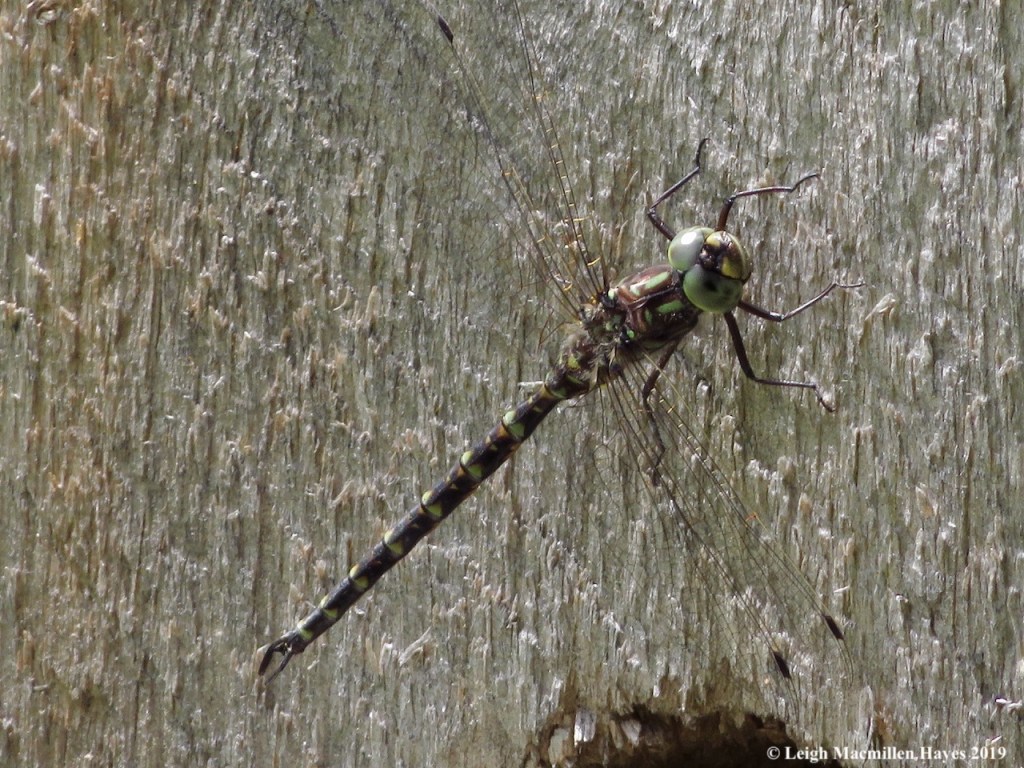
For a few minutes it posed and gave me time to at least decide it was a darner, though I keep changing my mind about which one. But notice its markings. The venation of its wings was rather fine compared to so many, yet the markings on its abdomen were well defined. Oh, and do you see the paddle-like claspers–used to hold the female’s head during mating? And then it flew off.
My heart was filled by all that I’d been seeing. And then . . . in flew another that seemed to top the rest. A Twelve-spotted Skimmer. Count each one on all four wings–twelve dark spots. Crazy beautiful. And to think that I always used to think dragonflies were dragonflies and they were wonderful because they consume mosquitoes and make our woodland hikes so much more bearable. But like ferns that I always thought were all the same, they are not. Slowly I’m learning them by their names and give thanks for every moment I get to spend in their presence.
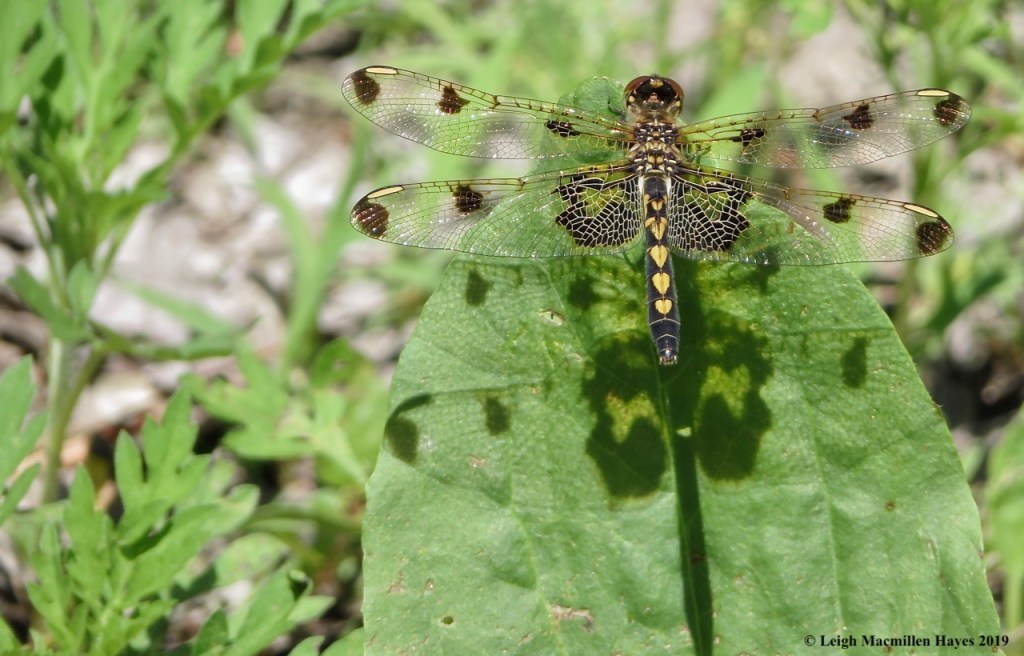
What’s not to wonder about and love–notice the yellow hearts on the female Calico Pennants abdomen. And her reflection on the leaf below.
I knew that hare brought me good tidings. And will be forever grateful.
I never intended to like insects. They weren’t really my thing. At all. And if I encountered one in the house, I’d either ask someone to smoosh it or do the dirty work myself, though sometimes that meant my hands clenched together until I got up the nerve.
But one day I began to look. I’m not even sure when that day was, but for quite a while now, it has become a daily habit.
What I am about to share with you are some finds from this past week. Some were new acquaintances while others were old friends I was meeting all over again.
For starters, I discovered this tiny, cylindrical structure on an oak leaf. Notice how it was right beside the main vein. I had to wonder, was the top rim also a vein, for so thick it appeared.
It’s my understanding that after creating the third role of the leaf, a single egg is laid. What triggers the insect to lay the egg then? Why not on the second role? And how many roles are there before the nest is completed?
What is this? A Leaf Roller Weevil nest, which is called a nidus.
In another place I spotted the first of what I suspect I’ll see repeatedly as spring gives way to summer. The wasp who built this global structure also used an oak leaf.
I’d love to see one of these being created and I am humbled not only by the perfectly round orb, but also the interior. This one happened to be split open so I could peek inside. The wasp used the leaf tissue to surround a single larva located at the center. Fibers radiating from that central larval capsule supported the exterior. How could it be that an insect could create such?
What is this? An Oak Apple Wasp Gall.
Standing with others beside water as we listened for and spotted birds, I noticed the largest insect remaining in one place for minutes on end as if suspended midair.
It’s rather scary looking, but that’s all an act for this impersonator likes to look like a wasp or bee in order to avoid becoming prey (think Batesian mimicry where something looks dangerous but is actually good).
In reality, despite its “fierce” presentation, it’s actually harmless. And beneficial. While it consumes nectar, honeydew and pollen, but doesn’t actually collect the latter like a bee, in the process of visiting a flower may get some pollen on its body and transfer the goods from that plant to the next.
But that controlled flying? You can see by the photo that the wings were moving, but with the naked eye it appeared motionless.
What is this? A Hover Fly.
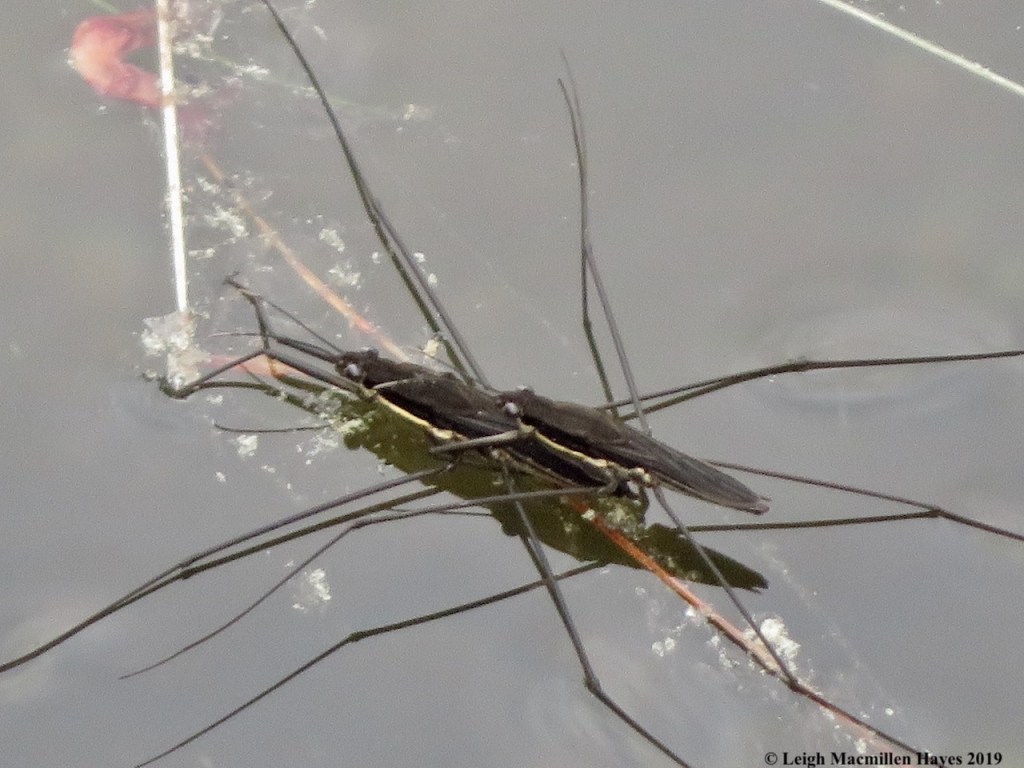
I was standing about ten feet above a pond when I spied and first thought that these two insects were one. In fact, I was sure I was looking at the largest example of this species. And then I saw all the legs and realized something more was going on.
Indeed, a lot more was going on. She was on the bottom and as you can see, he had a tight clasp. Theirs is a mating habit that’s quite unique and if she doesn’t give in, it can go on for a couple of days. And might mean doom for her.
You see, she has a genital shield to guard against him if she doesn’t think he’s the man she wants. But, he has a counter behavior–he taps the water in a pattern that might lure predators such as fish. And since she’s beneath and closest to the fish’s mouth, it behooves her to submit quickly to his endearment.
What are these? Water Striders.
This next one was discovered when some young naturalists I was hanging out with lifted a rock upon a rock beside a brook. Burrowed in to the humus was a segmented insect.
In its larval form it would have had protective filaments, as well as gills to help it absorb dissolved oxygen. And a set of mean-looking mandibles. Ten to twelve times it would have molted before leaving the water and finding this moist environment under the rock upon a rock where it dug a cell within which it spent up to fourteen days before pupating. Under the same rock was the exoskeleton it had shed. In this next stage of life, it develops wings, legs, antennae and mouth parts. We covered it back up and I suspect that by now or very soon it will dig its way out of the cell and emerge as a winged adult.
What is it? A Dobsonfly Pupa.
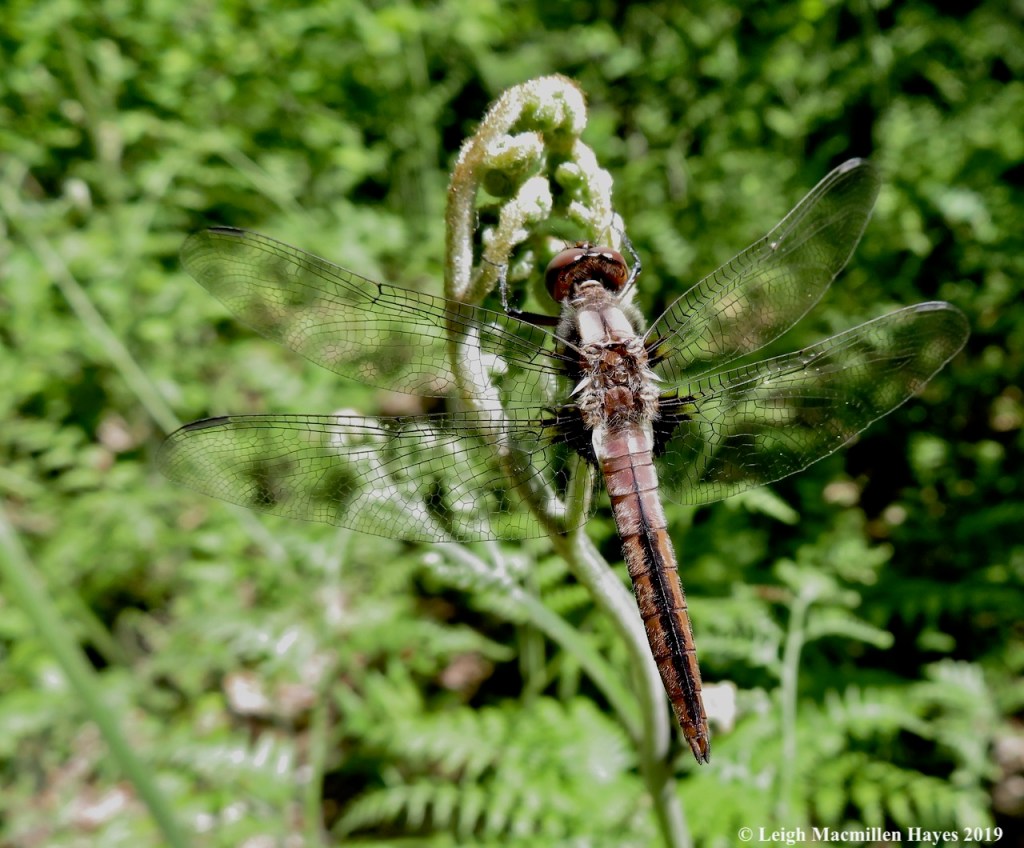
One of my favorite finds was beside a river–and though I didn’t get to see it emerge from its exoskeleton, I did watch it pump some blood into its body and grow bigger and longer over the course of an hour or more.
Its cloudy wings needed time to dry out and lengthen, as did its abdomen. And eventually, its colors would help in a determination of its specific name, though I wasn’t there that long.
Just across a small inlet, another had also emerged and while it had almost reached maturity, it was still waiting for its wings to dry. Notice how in the previous photo, the wings are held upright over its back, but as demonstrated here, when they dry they extend outward. That’s actually a great way to differentiate these from their Odonata cousins who wear their wings straight over their abdomens.
Meet the cousin–the damselflies.
And now back to the others, who also begin life as aquatic insects that molt a bunch of times before becoming adults. When the time is right, they climb up vegetation and undergo an incredible metamorphosis as you saw above. Left behind as skeletons of their earlier life are the delicate structures that remain on the vegetation for quite a long time.
I’m always amazed when I discover one atop another, and as far as I know it’s all just a matter of this being a good spot to go through the change of life.
What are these? Cruiser Dragonfly Exuvia above a Darner.
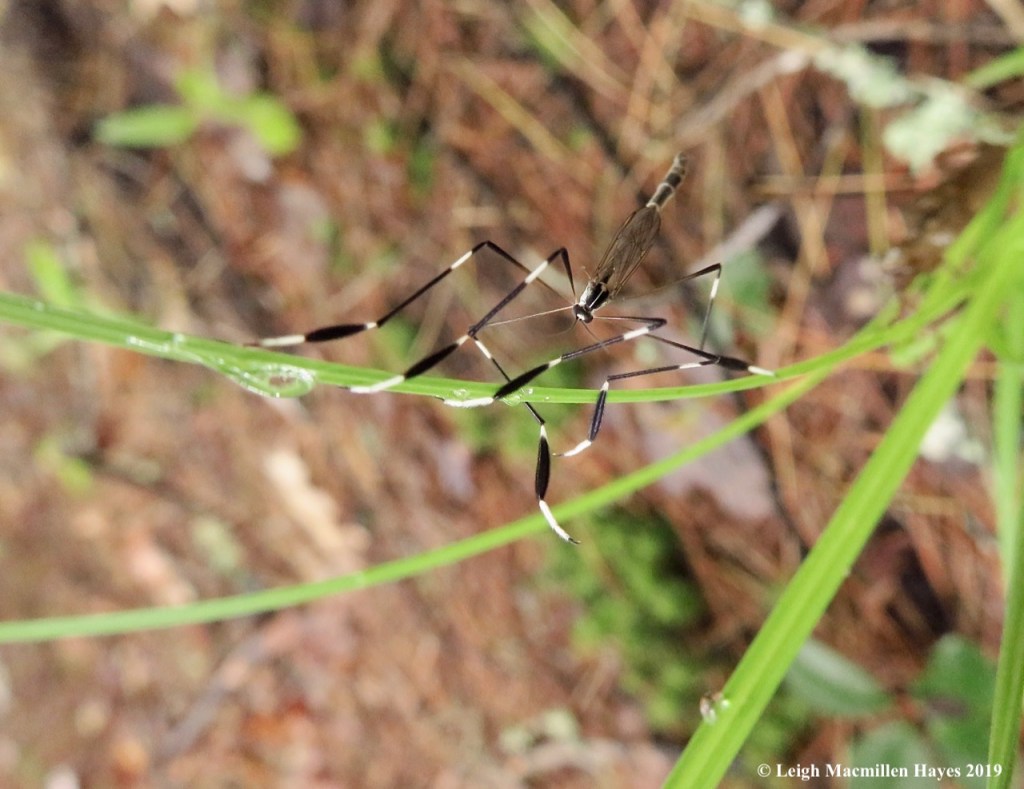
Also recently emerged as indicated by the still cloudy wings (and fact that I saw the exoskeleton a few inches away) was another that wasn’t a damsel or a dragon. Instead, it has the longest and thinnest legs that look like they can hardly support the abdomen, but they do. In flight, people often mistake them for Mosquitoes, but if such, they’d have to be considered giant Mosquitoes.
As it turns out, however, they are not, nor do they bite. In fact, in their adult stage, which only lasts for ten to fifteen days, they do not eat. Anything. Their sole purpose at this stage of life is to mate.
What is this? A Crane Fly.
I have saved my favorite for last. Oh, I think they are all fascinating, but this one . . . oh my. Notice that needle-thin abdomen and the zebra-like appearance of those long, skinny legs. I think they have at least three joints which give each leg a zigzaggy appearance.
The legs become important as it flies through the air–or rather drifts. Or maybe swims would be a better verb to describe its movement. You see, each leg is hollow. And each foot (a teeny, tiny tarsomere) is filled with air. Crazy? Yes. As it lifts off, it spreads its legs, but barely moves its wings, and disappears into the vegetation beside the brook in a ghostly fashion.
I’m really not sure how I spotted it, but I’d never seen one before and then this past week twice it made its presence known and I felt honored for the meeting.
What is this? A Phantom Crane Fly. (And if you hear me say Phantom Midge while we’re walking together–feel free to correct me. It’s like birch and beech, and so many others–my mouth jumps before my brain kicks into gear.)
Insect Awe. Who knew I would ever experience such. I can only hope our paths cross again soon.
As I drove down the dirt road into Brownfield Bog today, I began to notice ruts on the side where previous vehicles had gotten stuck in the mud. And then I came to a puddle the looked rather deep and to its right were several rocks that I didn’t feel like scraping the truck against to avoid the water. That’s when I decided I’d be much better off backing up and parking at the beginning of the road. Besides, I knew if I walked I’d have more chance to see what the road and bog had to offer. But . . . back up on that curvy narrow road–for a quarter mile or more? Yup. Thankfully, no one drove in or out and somehow I managed to get myself out of that predicament.
I knew I’d made the right choice when I was greeted by an immature Chalk-fronted Corporal. First it was one, then two, and then so many more. And the mosquitoes and black flies? Oh, they were there, but not in abundance.
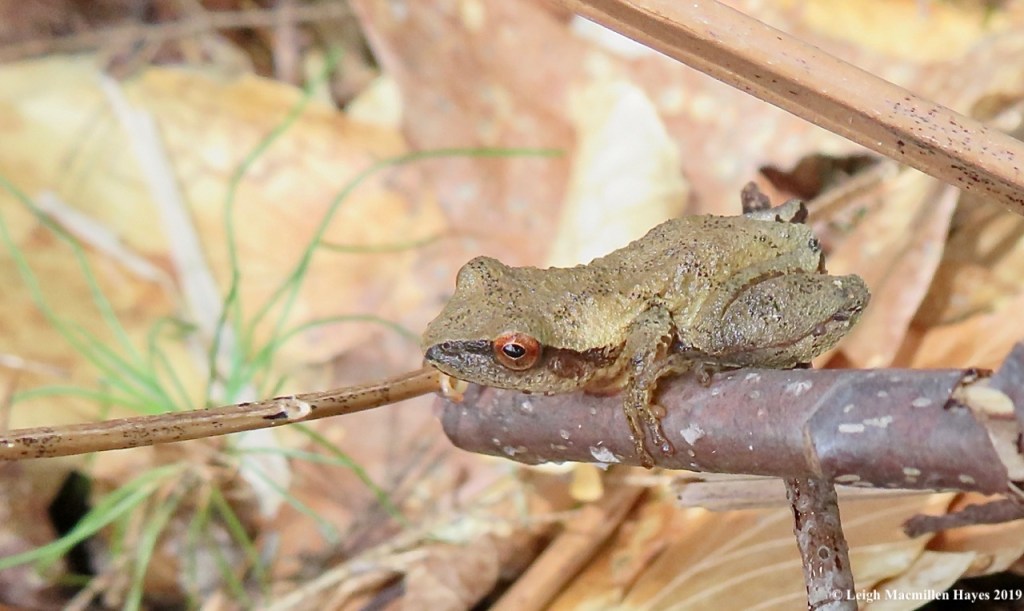
Also helping patrol the roadway was a Spring Peeper, the X on its back giving reference to its scientific name: Pseudacris crucifer–the latter meaning cross-bearer. Notice his size–about as big as a maple samara.
A more mature female Chalk-fronted Corporal perched upon an emerging Bracken Fern was my next point of focus. She’s larger and darker than her young counterparts, her corporal stripes on the thorax marked in gray.
And then there was a June Beetle, also maple samara in length with its thorax and abdomen robust.
My own eyes kept getting larger and larger for every step I took I felt like there was someone new to meet. Practicing ID was helped a bit as I’ve begun to recognize certain traits of the different species. Of course, each year I need a refresher course. By the green eyes, I knew this one was in the Emerald family, and with its green and brown thorax, black abdomen with a narrow pale ring between segments 2 and 3, and the fact that the abdomen is narrow to start and finish with a widening in between, I decided it was an American Emerald.
Reaching the bog at last, I was glad I’d worn my Muck boots, for the water flowed across the cobbled road and in several places it was at least five inches deep.
Within one puddle floated a dragonfly exuvia, its structure no longer necessary. I will forever be in awe about how these insects begin life in an aquatic nymph form, climb up vegetation or rocks or trees and emerge as winged insects.
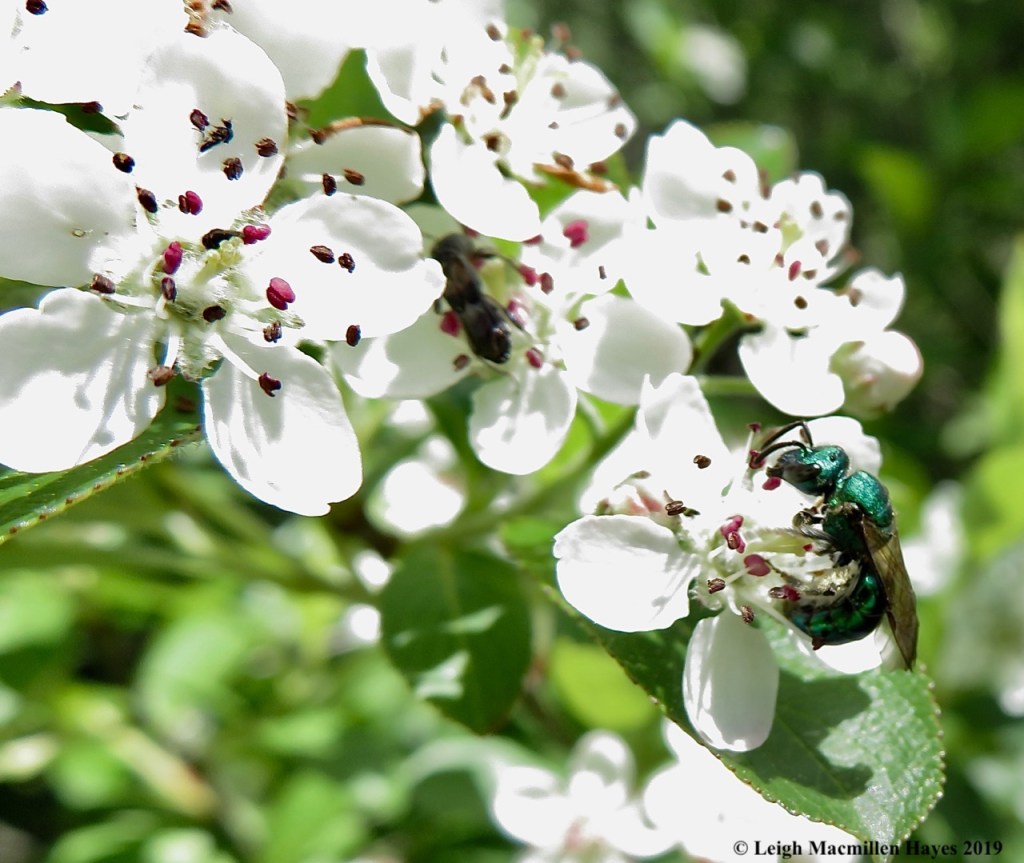
As I continued to admire them, there were others to note as well, like the metallic green Orchid Sweat Bee pollinating the Black Chokeberry flowers.
The next flyer to greet me had a white face that you can’t quite see. By the yellow markings on her abdomen, I think I’ve identified her correctly as a Frosted Whiteface.
Birds were also abundant by their song and calls, though actually seeing them was more difficult since the trees have leafed out. But . . . a Yellow-bellied Sapsucker did pause and pose.
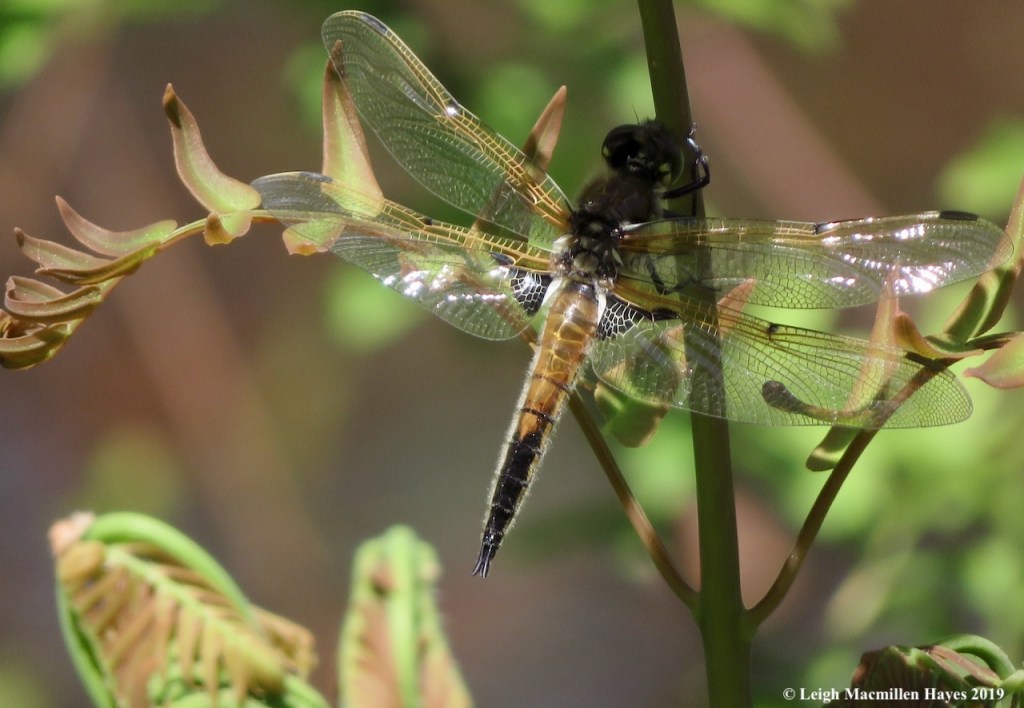
Again, shadows blocked the face of this species, but the wings and abdomen were far more worthy of attention as it clung to a Royal Fern. In fact, with so much gold, I felt like I was greeting a noble one. The Four-spotted Skimmer is actually quite small, yet stocky. The four spots refer to the black nodus and stigma (Huh? nodus: located midway between the leading edge of each wing where there is a shallow notch; stigma: located toward the wingtips). But notice also that the amber bar at the base of its wings and black basal patch on the hind wings–giving it an almost stained glass look.
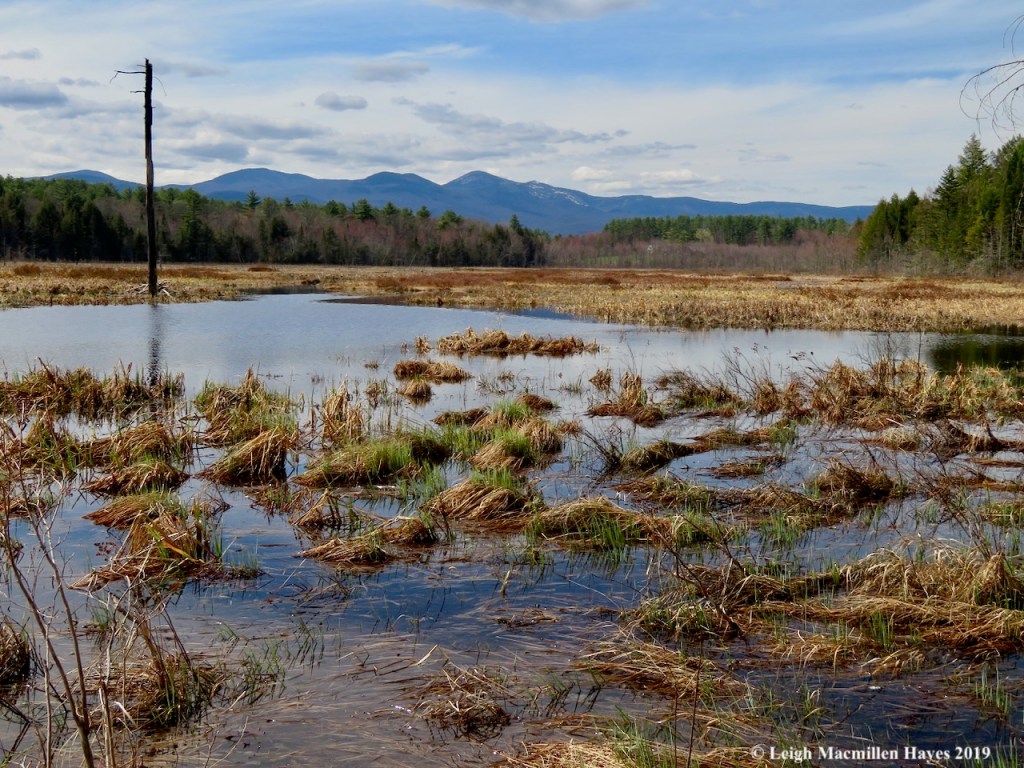
By now, you must be wondering if I was really at the bog for I’ve hardly shown any pictures of it. Yes, I was. And alone was I. When I first arrived by the water’s edge, I noted two vehicles that had braved the road and as I stood looking out at the old course of the Saco River, I heard a couple of voices which confirmed my suspicion that they’d gone kayaking. But other than that, I had the place to myself. Well, sorta.
Me and all the friends I was getting reacquainted with as I walked along. The name for this one will seem quite obvious: White-faced Meadowhawk, its eyes green and brown.
Nearby a pair of Eastern Kingbirds, perched, then flew, enjoying such a veritable feast of insects spread out before them.
I worried for my other winged friends, including the female Bluet damselfly.
And the Common Baskettail. How long will they survive?
I also wondered about reproduction for I saw so many, many female Chalk-fronted Corporals, but not a male in sight. Until, at last, before I left the bog, I spied one.
And for a long time we studied each other. Have you ever realized how hairy dragonflies are?
The Brownfield Bog (Major Gregory Sanborn Wildlife Management Area) can put the brain on nature overload as all senses are called into action. But today, because with every step I took at least fifty dragonflies flew, they drew my focus and I gave thanks to them for reteaching me about their idiosyncrasies, as well as eating the smaller insects so I came away with only a few love bites behind my ears.
Walking with dragons. As life should be. In western Maine.
When Pam asked at the end of our slow tour today what my favorite finds were, I named at least five.
First, there was the Painted Turtle that I spotted on Kezar Lake Road as I drove toward the Greater Lovell Land Trust’s Long Meadow Brook Reserve. After I pulled over and approached him, he did what turtles do and retreated into his shell. Though he wasn’t feeling it, I was in celebration mode, for he represented my first turtle of the season. And I helped him cross the road.
I felt safe calling him a he for males have long fingernails. Can you see him peeking out at me in a not too pleased manner? Can’t say I blame him, but our time together was brief and soon he wandered his way while I wandered mine.
And then, another reason for celebration–Coltsfoot in bloom. I know it’s invasive, but its sunny face and scaly purplish stem that predate its leaves offer a first hint of the season’s promises of colors to come.
Coltsfoot is known by some as Filius ante patrem (the son before the father), because the bright yellow star-like flowers appear and wither before its broad, green leaves are produced.
The next sight to be considered: a small spider that, like the painted turtle, continuously eluded our focus by quickly moving to the opposite side of the beech twig. Can you spy it?
And then there were those tree buds bursting forth with life ready to unfold from within. We were offered a few early glimpses of the future and rejoiced at each sample.
At last we reached Long Meadow Brook, for which the reserve is named. And stood and looked and listened and waited and absorbed. Oh, Pam absorbed some water in her boots thanks to a leak. But she didn’t let that stop her and we each enjoyed the opportunity to let this place soak through our pores for moments that turned into a string of minutes and suddenly an hour had passed.
At long last, we pulled away and began a bushwhack through the woods beside the brook.
In so doing, we found more to celebrate, like a red squirrel refectory upon a rock and we suspected a large hole below the tree trunk and boulder had served as the larder.
Continuing on, we saw mats of black upon moss by another tree and almost wrote it off as perhaps a fungi we hadn’t met before.
But. It. Moved. As we watched, we realized the constant motion was created by springtails writhing en masse. To say it wasn’t creepy would be lying. Likewise we were fascinated and leaned in closer to watch the swarm upon the moss.
Resting nearby, perhaps having just gorged on some of those tiny little morsels, was another reason for celebration–a spring peeper. We spotted two, but heard a hundred million more, each adding its song to the symphony that arose from the wetland. And suddenly, an interval of silence would interrupt the music, and then one male would peep, and the rest would join in again until they arrived at the next rest symbol upon their sheet music.
Others added their own notes to the orchestra, including a couple of White-throated Sparrows that trilled in our midst.
Near the end of our journey, we reached a point where we could see that there was still some snow on the the Bald Face Mountains in Evans Notch, but we spotted a dragonfly and honored Trailing Arbutus flowers and rejoiced. Though our celebration didn’t have a Mexican theme, we still had at least cinco reasons to give thanks from the Painted Turtle to Coltsfoot to Bud Bursts to Squirrel Larders to Creepy Collembola to Spring Peepers to White-throated Sparrows. Really, it was more a Siete de Mayo on this Cinco de Mayo–Maine-style.
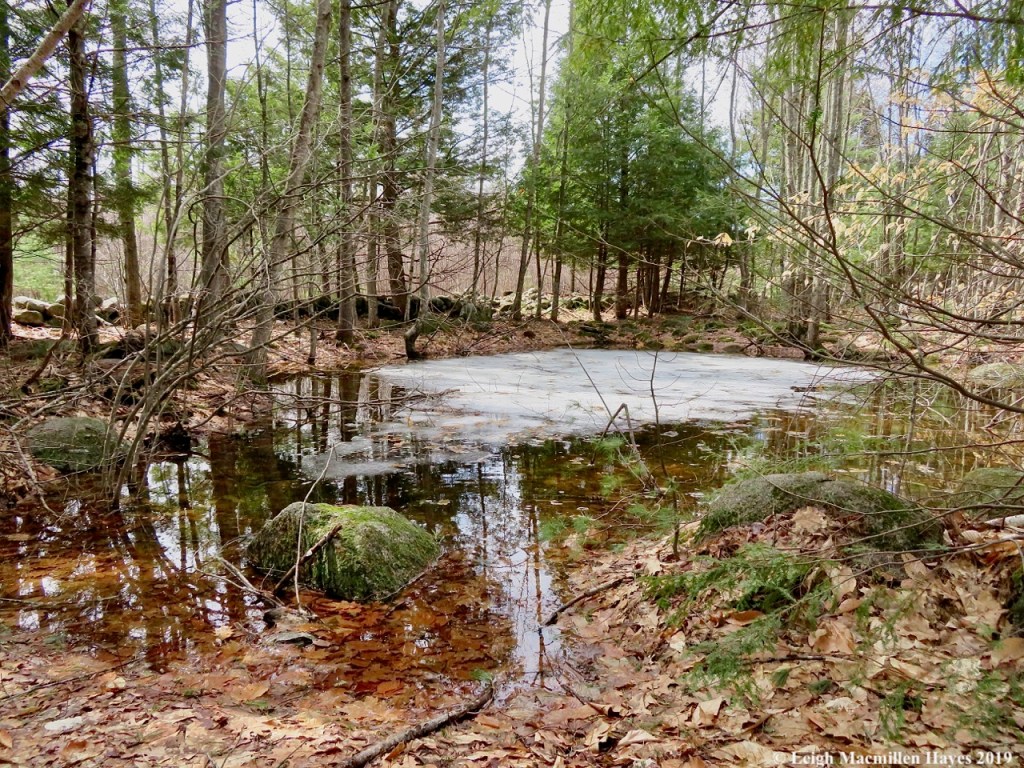
This year found me once again staying in my home territory to honor you and so while my guy did some yard chores, I chose to visit a few of your vernal pools.
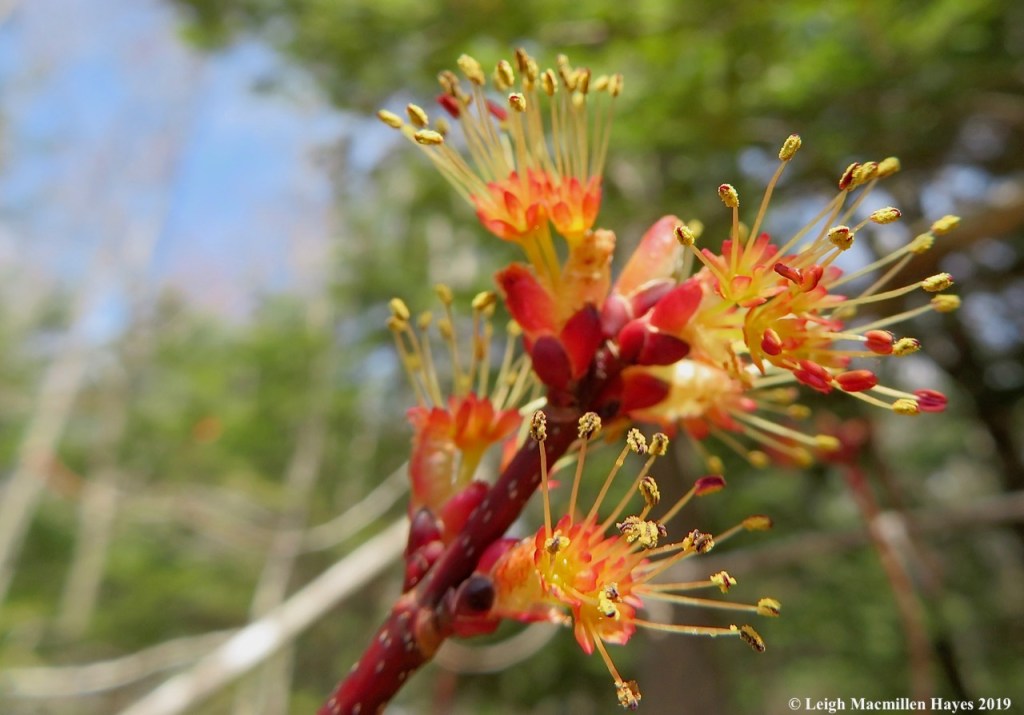
Along the way, I stopped to smell the roses! Opps, I mean admire the flowers of the Red Maples, their pistils and stamen all aglow.
As I approached the first and nearest pool, I new love was in the air for I heard the deep wrucks of the Wood Frogs. That is, until I got to within about ten feet, and then the only sounds were small splashes that barely created ripples as the frogs sought cover under the leafy pool lining.
But, as you’ve taught me in the past, I stood as still as possible and waited patiently. It was then that my eyes began to focus on the pool’s tenants. And I realized that the usual population of larval mosquitoes, aka “wrigglers” already somersaulting their way through the water. That may be bad news for me, but it’s certainly good news for the birds and dragonflies of the neighborhood. While I try to practice mind over matter when I’m stung by a mosquito, I have to remember that your plan to offer “Meals on the Fly” sustains so many others.
And then, and then I spied something disturbing. Actually it was two somethings. Frog legs of two frogs. And even a head. Dinner? For whom? Typically, I rejoice at a kill site for I realize that one species feeds another, but this one disturbed me. Perhaps, dear Earth, it was because I think of this pool as mine even though it’s located on a neighbor’s land, and I want to protect it and all that live within, as well as all who venture to it for nourishment. Eventually, I realized that perhaps someone had been nourished by the frogs, but why didn’t they consume the entire beings? Could it be one of their own species who went into attack mode? I don’t have the answer–but once again you’ve given me more to question. And so in the end I realized I should be grateful for having the opportunity to wonder.
The good news–right behind the two dead frogs was a recently deposited egg mass. Its form made me think Spring Peepers, but I’ll need to watch them develop.
Death. Life. The cycle plays out as if a best seller in this dramatic genre.
I circled the pool looking for any other unusual sights or clues, but found none. Eventually I stood on my favorite rock and appreciated that you finally rewarded me, dear Earth. A Wood Frog appeared by my feet and we both remained as still as possible–that is until my feet began to fall asleep and I needed to move on.
As you know, dear Earth, I located several more pools, their wruck choruses giving them away. And within one, it was obvious by the egg masses that the lover frogs had found their mates.
Walking back toward home, I got a bit nosey, as you know, and turned over some bark that had fallen from dead trees. To my delight: millipedes, earth worms, bark beetles, slugs, and . . .
At least five Red-backed Salamanders. That reminded me, dear Earth, that though I wasn’t able to join Lakes Environmental Association for Big Night on Saturday, that rainy night when the temperature ranges about 40˚ and the amphibians decide to return to their vernal pools to mate and folks try to help them cross our roadways to do so, I trust that you made sure the Red-backed Sallies and worms made their presence known in the grass behind the Masonic Hall. Did you?
As for my walk today, I followed our trails and then an old logging road, where the deer and moose and coyotes and foxes and turkeys also roam.
And because part of my journey took me along the snowmobile trail, I picked up some empties and realized that not all turkeys are created equal.
But you don’t judge, do you dear Earth. Nor do you pretend that the world is perfect.
That being said, the sight of my first butterfly of the season, the pastel colored Clouded Sulphur, was rather perfect in my book.
Thanks for once again taking the time to teach me a few lessons . . . lessons from the Earth on this, your day, Earth Day 2019.
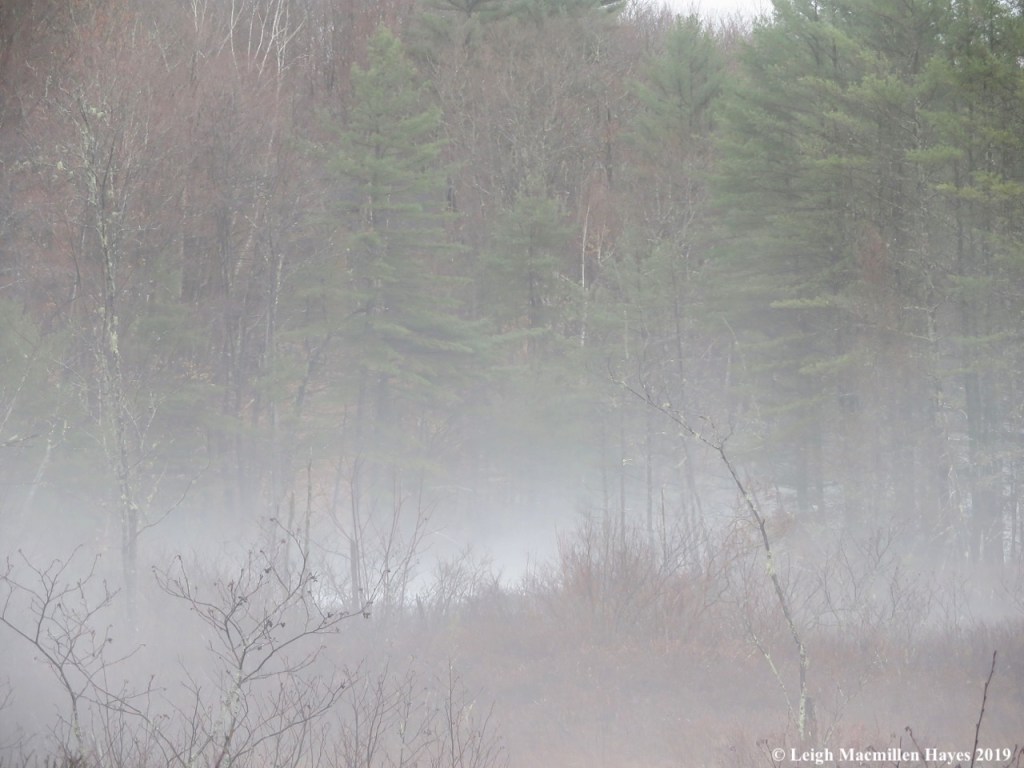
Like a thin veil, this morning’s fog attempted to hide Miss Spring.
But instead, it revealed her nuances and enhanced her being as the birds sang and amphibians added their voices to the chorus.
As I listened, I peeked through the thinnest of openings to see what the world wanted to reveal.
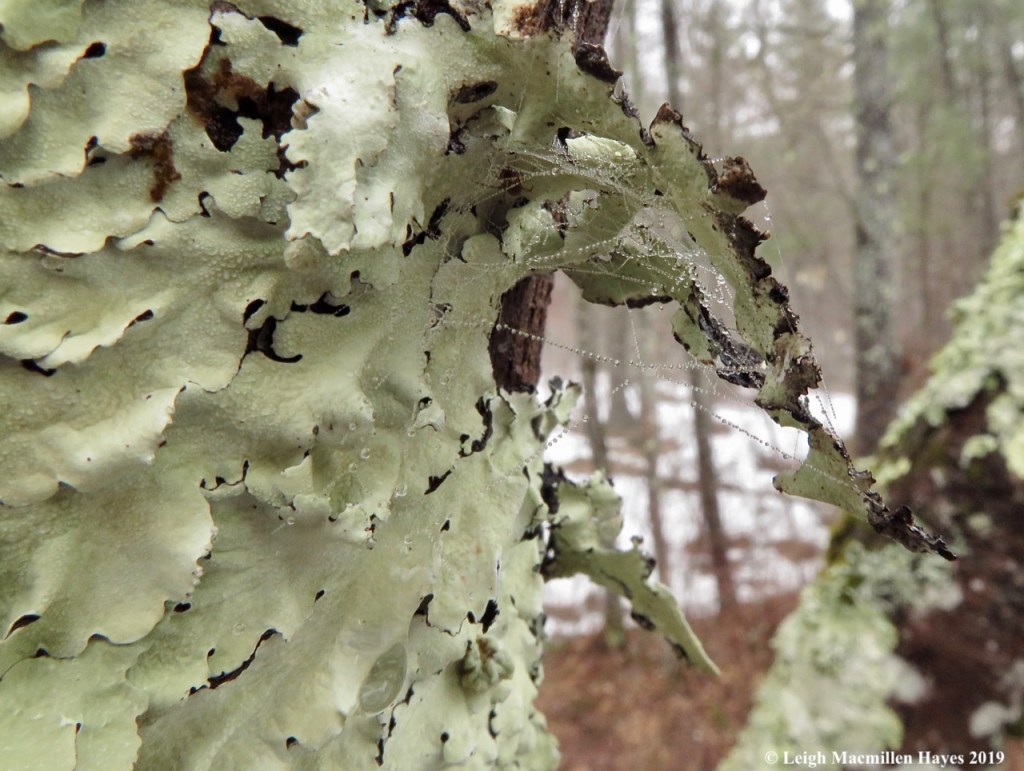
Weaving all of life together were the silken lines of spider webs.
Beads of water enhancing their forms.
And the creator turned out to be the most minute of beings.
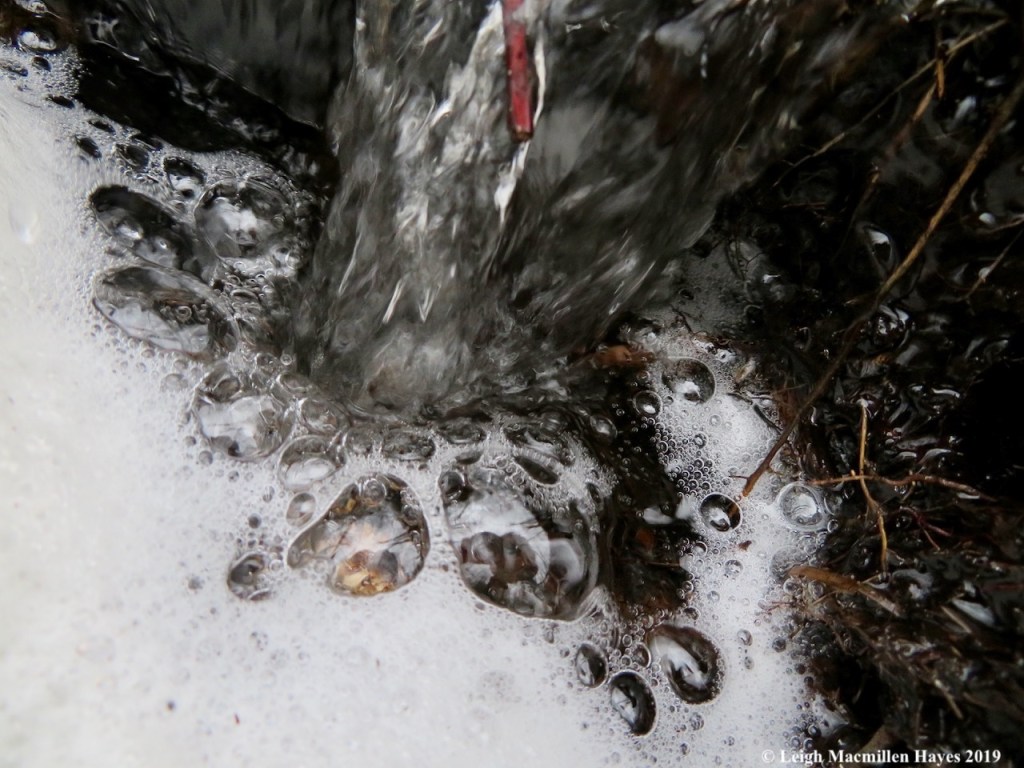
Flowing forth the remains of melting snow, the stream spoke of nourishment.
Its action creating frothy suds that cleansed.
And within its bubbles the world above was reflected.
The surrounding landscape was mirrored in the drips of raindrops.
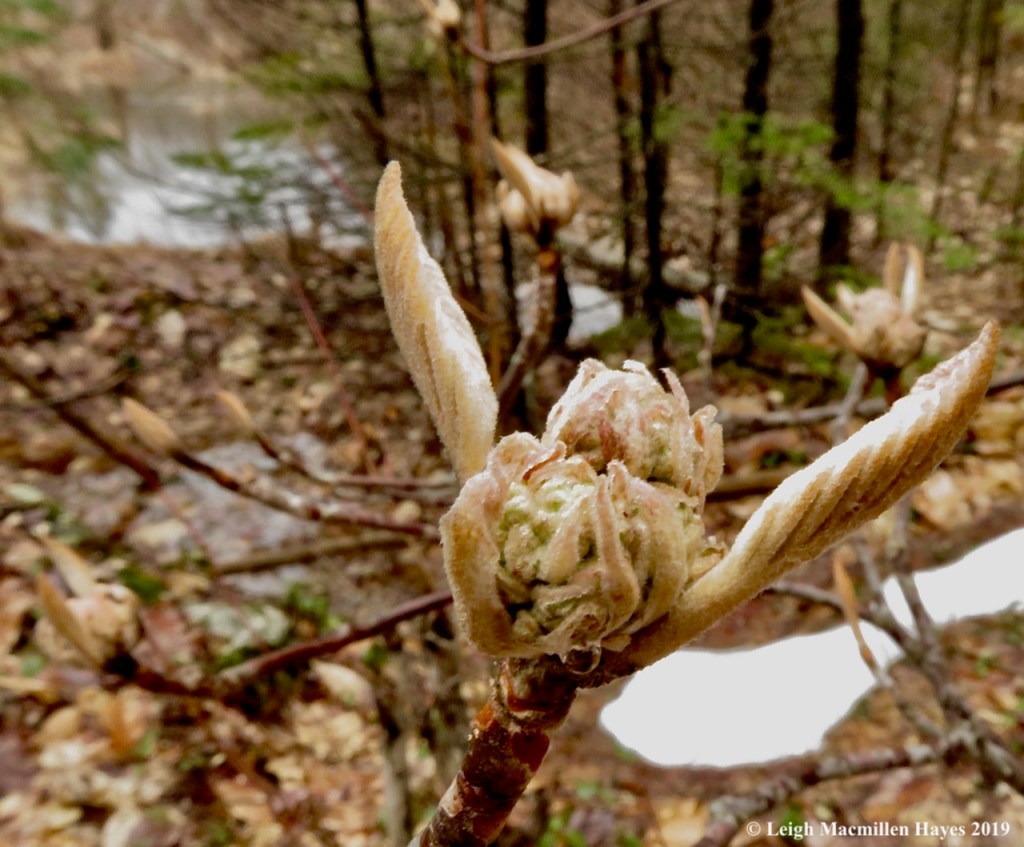
Everywhere, there were treasures indicating what is to come . . . in the form of Hobblebush buds growing more global;
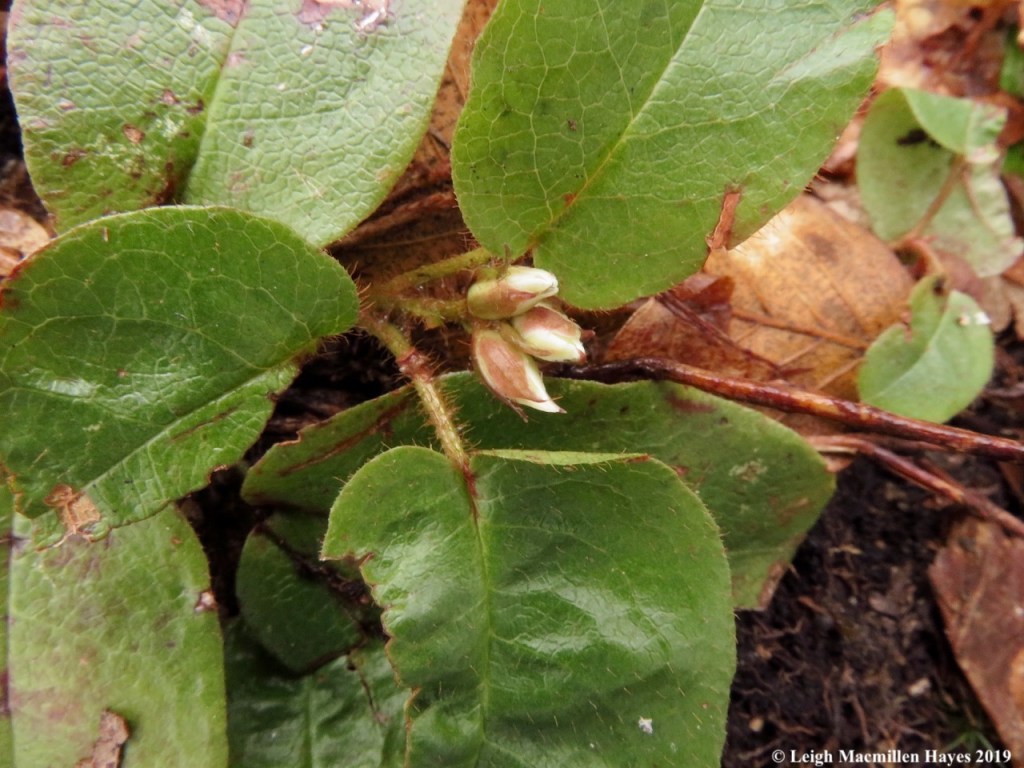
Trailing Arbutus showing a glimmer of new life;
And Beaked Hazelnut presenting its most subtle, yet exquisite floral presentation.
As I continued to look about, something different caught my eye.
A moth recently emerged from its cocoon* spoke to another form of new life.
What I learned today is that one needs to watch.
Wait.
And be ready.
Though she has been shrouded, her veil is slipping away. I was grateful to discover that Miss Spring surrounds us when we make the time to look–even on dark and dreary days.
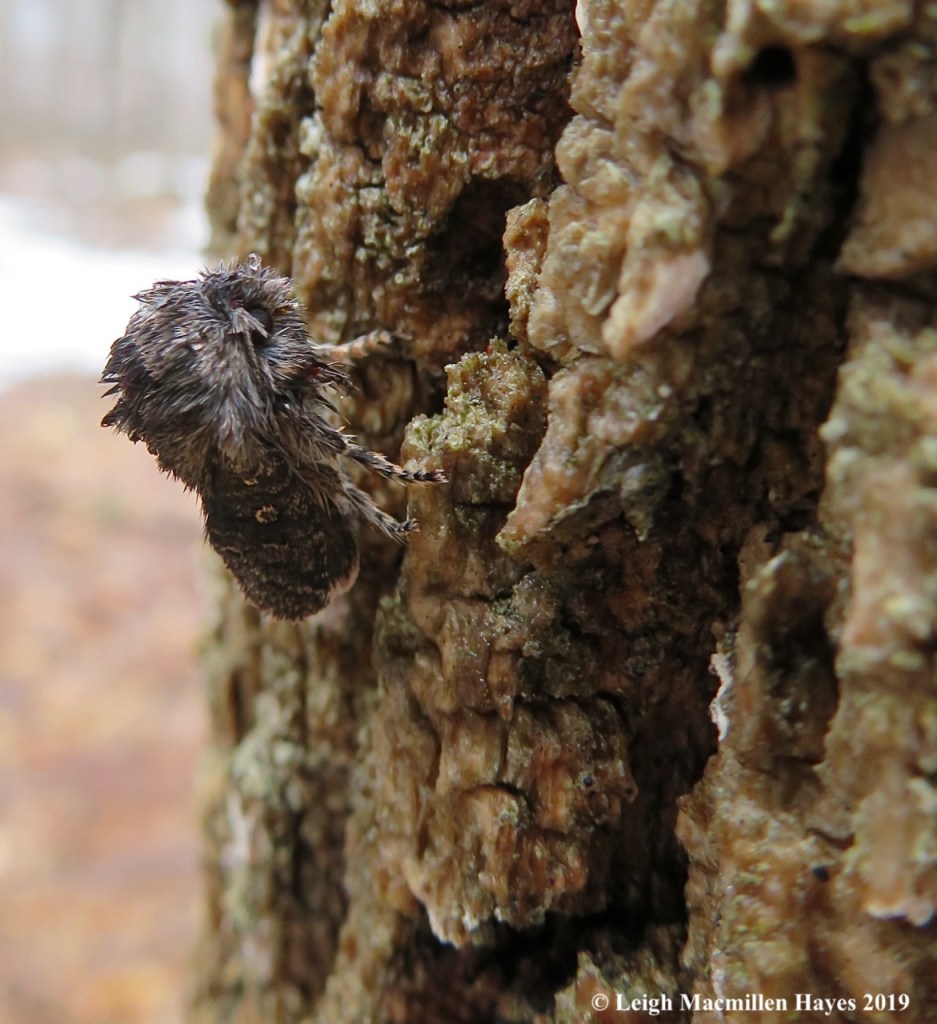
*The moth–I knew it was such, but didn’t know what kind. Upon arriving home, I did some research and the best I could come up with was the worst–Operophtera brumata, or the invasive Winter moth. But . . . I wasn’t 100% convinced of my ID so I reached out to fellow Master Naturalist Anthony Underwood. This was his response: “Don’t panic yet, Leigh. I’ve seen this before. It’s a newly eclosed moth, yes, eclosed. Probably a Sphinx moth. I wasn’t familiar with the term until I encountered one for myself a while ago. Your vocabulary is likely more extensive than mine but just in case I’ll clarify by explaining that it means that it has emerged from its winter cocoon and is looking for a place to pump its blood into those wings and expand them for first flight. Good find!
It was actually still winter when I joined Lakes Environmental Association’s Education Director Alanna Doughty and LEA member Betty for a “Welcome Spring” snowshoe hike at Holt Pond Preserve this afternoon–but really, for western Maine, it was a delightful spring day.
Our hearts smiled as our journey began beside a clump of pussy willow shrubs, so named for their resemblance to tiny cats’ paws. Actually, the white nubs are flowers pre-bloom. Their soft, silvery coating of hairs provides insulation thus protecting these early bloomers from cold temperatures.
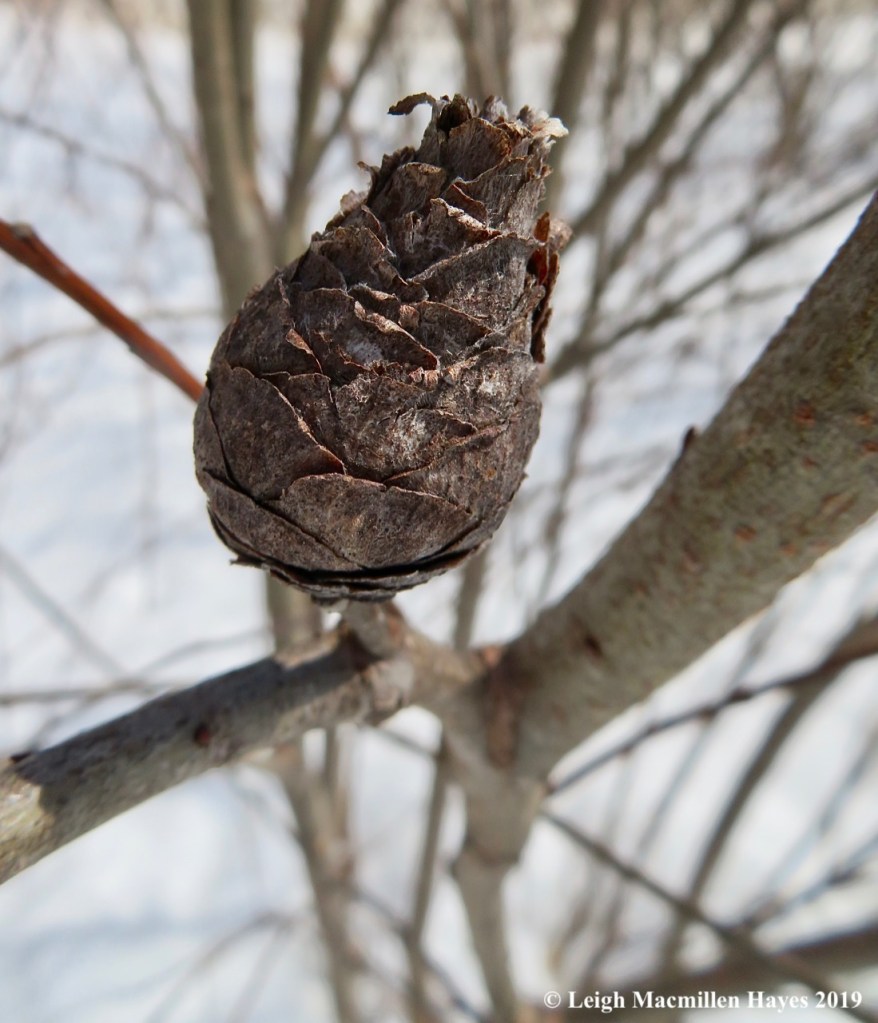
That being said, they aren’t protected from everything and if you look, you may see pineapples growing on some. Those pinecone-like structures were created with leaves by a reaction to a chemical released by the larva that allows a gall gnat midge to overwinter on the willows. It’s a crazy world and everything seems to have its place.
Hanging out with the pussy willows were speckled alders, some with protrusions extending from last year’s cones. It was almost like they had tried to flower. In reality, they were alder tongue galls–resulting from a fungus rather than an insect infecting the female catkins. Apparently, the tongue-like growths are green to begin, but transform to orange, red and finally brown. I’ve yet to see it in its early form but time will tell.
We passed a spider walking across the snow and then came upon another member of the lilliputian world–a winter stonefly on the move. How they and the spiders survive the cold and snow is dependent upon special compounds including glycerol, proteins, and sugars that act like antifreeze. By its presence, we knew we were approaching a fast-moving stream.
More evidence of the stream’s presence became immediately apparent when we moved from the field to woods and immediately spied a sign of beaver works.
Stepping down beside the Muddy River, we began to see beaver tree after beaver tree. Each a most recent work.
Alanna stood upon an old dam, but though it was obvious they’d crossed over it by the well traveled trail of tracks, repair work was not yet part of the scheme for the water flowed forth.
We stood there for a few minutes and tried to understand what they had in mind, when one in our group spied the beaver chews in the water–their snack of choice.
We wondered if they were active downstream or up, and decided to follow the trail north.
A few minutes later, we came upon another trail well-traveled and knew that they’d been working in the vicinity.
In the brook, covered with spring ice, which features a different texture than the frozen structures of winter, was a small tree.
And then our eyes followed the beavers’ tracks back and we saw from whence it had been sawn.
And dragged through the snow. In our minds’ eyes we appreciated their efforts.
Still, we didn’t know what the beavers were up to, so we moved on in hopes of learning more about their activities. All the while, there were other things to notice, like the orange brain fungus growing on the inside of a stump. We weren’t the only ones to appreciate it for snowfleas, aka spring tails, also searched the surface.
Since we were beside the river, it might have made sense that we checked out the beaver works via canoe, but . . . the snow is slowly melting and it will be a while before we need to bring our own paddles, personal flotation devices and duct tape (just in case the canoe springs a leak).
From the boat launch we followed the secret trail and made our way out to the red maple swamp.
In a sunny spot we spied a swab of earth–a taste of what is to come. And the ever delightful wintergreen offering the first shade of spring green with a dash of spring pink.
Slowly we made our way back out to the Muddy River, where we stood and looked across at two beaver lodges on the other side. We didn’t dare cross, but from where we stood, it appeared that the lodges may be active given that we could see the vents at the top. It also appeared that they’d been visited, though we weren’t sure if the tracks were created by predators. Was this where the beavers who had been so active downstream were living? Or were these the homes of their parents? Were the new beaver works those of the two year olds who had recently been sent out into the world to make their own way? Our brains wondered and wondered?
We weren’t sure, but with questions in our mind, we moved on toward Holt Pond.
There were other things to see as we walked across the wetland, including the woody structures of maleberry capsules and their bright red buds.
Rhodora, that delightful pink beauty showed us that she’s waiting in wings.
As we made our way back, more wood chips on the ground indicated that a carver of another type had been at work–of the bird type rather than rodent.
To identify it, we looked not only at the shape of the chiseled structure, but also the scat we found among the chips.
Because it was filled with the body parts of carpenter ants and we knew its creator’s name–pileated woodpecker.
And then we found an insect of another type. Why was a hickory tussock caterpillar frozen to a twig? Was it shed skin from last fall? How did the structure last throughout the winter? We left with questions, but gave thanks for the opportunity Alanna provided to share the afternoon wandering and exploring and thinking and looking forward–to spring.
In the midst of our wandering, we did discover a fairy house and suspect that tonight some wild dance moves are on display under the Super Equinox Worm Moon.
“Every spring is the only spring, a perpetual astonishment.”
British Author Edith Mary Pargeter, also known by her nom de plume, Ellis Peters (1913-1995)
My comings and goings are often a tramp through the woods, where I pause frequently to contemplate the world through which I wander. These provide me with glimpses at a small portion of the wonders of the universe. Please join me for a few minutes as I share the mysteries of the hills that have been revealed to me this past year.
The ice delighted our sense of sight, understanding, and artistic form. Like the water from which it was created, it flowed in much variety.
And then . . . as we looked, a motion captured our attention. We were blessed with the opportunity to spend a few moments with a mink as it bounded down the hill before realizing it had an audience.
Next a splash startled us. What caused it? There was no snow high up on the trees that might have fallen. At last we saw the creators. There were actually three–swimming about slowly. Suddenly splashing again, they disappeared into the depths below. And the chambers within. We were in awe and felt honored to have shared a few minutes with members of the beaver family.
Sometimes our stops were to contemplate our next steps–especially when it came to the water that covered the cobblestones. Spying a bird nest, we wondered about its creator. There were some acorn pieces inside, so we thought it had hosted more than one inhabitant. Because we were near water, though most of it still frozen, and the temp was high, we weren’t surprised to find a set of baby handprints created recently by a raccoon.
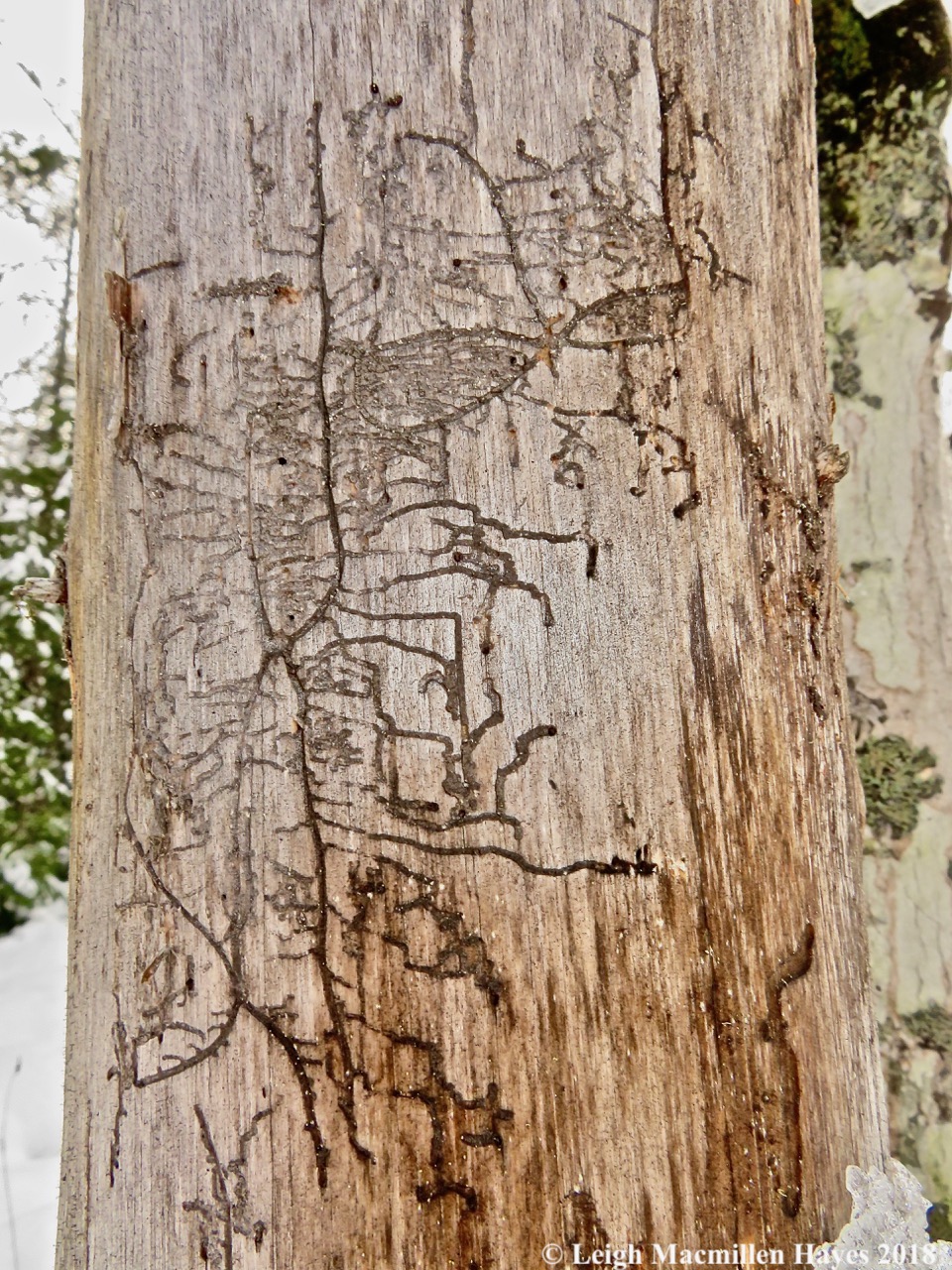
As I stood there looking for a million wild mammals, my eyes focused on the works of something much smaller. Insect egg tunnels on a dead snag read like a story book page. The overall design could have been a map leading to hidden treasures.
Within each soft snowflake I felt millions of wings brush against my face–reminding me of those I know who are at the moment downtrodden and have hurdles to conquer. Some tiny, others immense, all were angelic in nature. As the flakes gathered together, they enhanced the reflection of harmony with illumination. They brought Heaven down to Earth . . . and reminded me that even in the darkest hours I hope my friends remember that grace surrounds them.
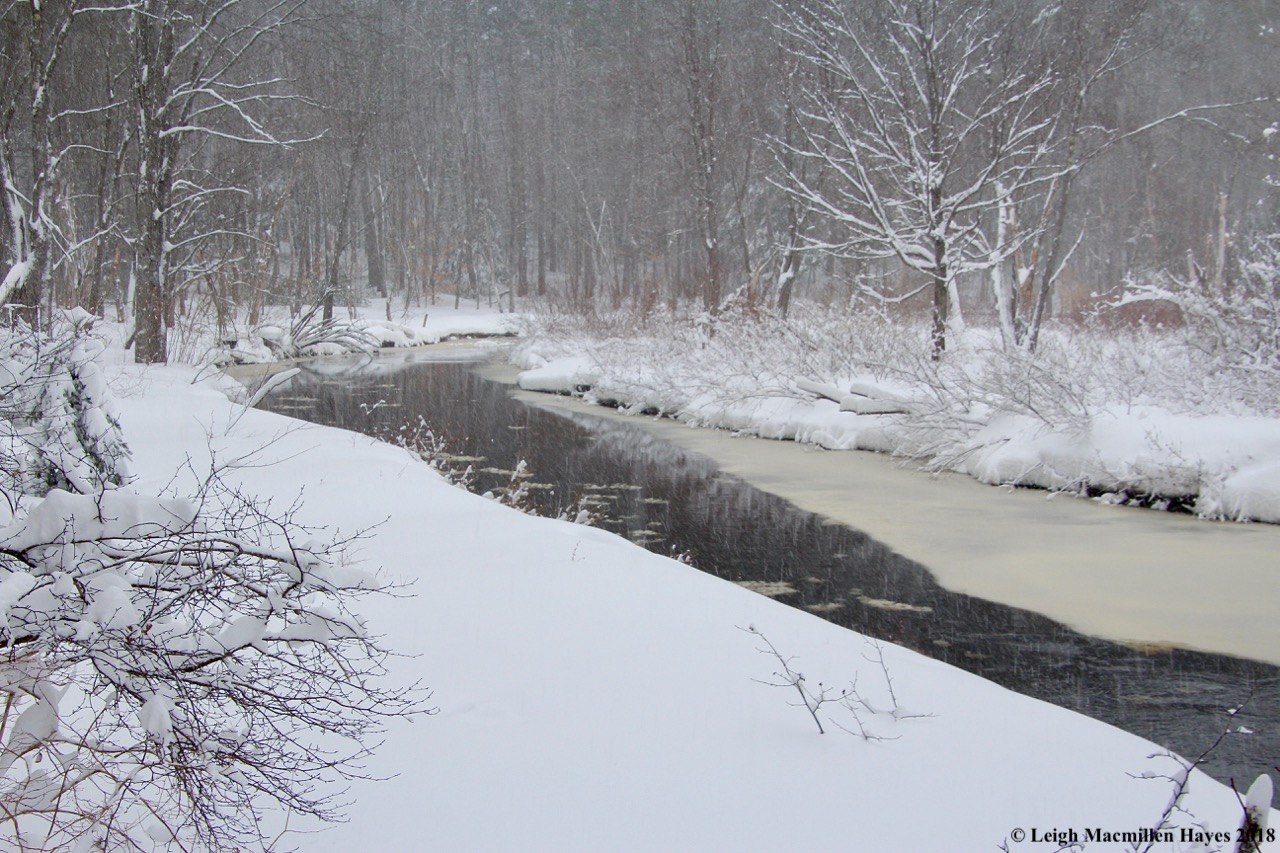
Life, it seems, is always in transition. So it feels, when one season overlaps another.
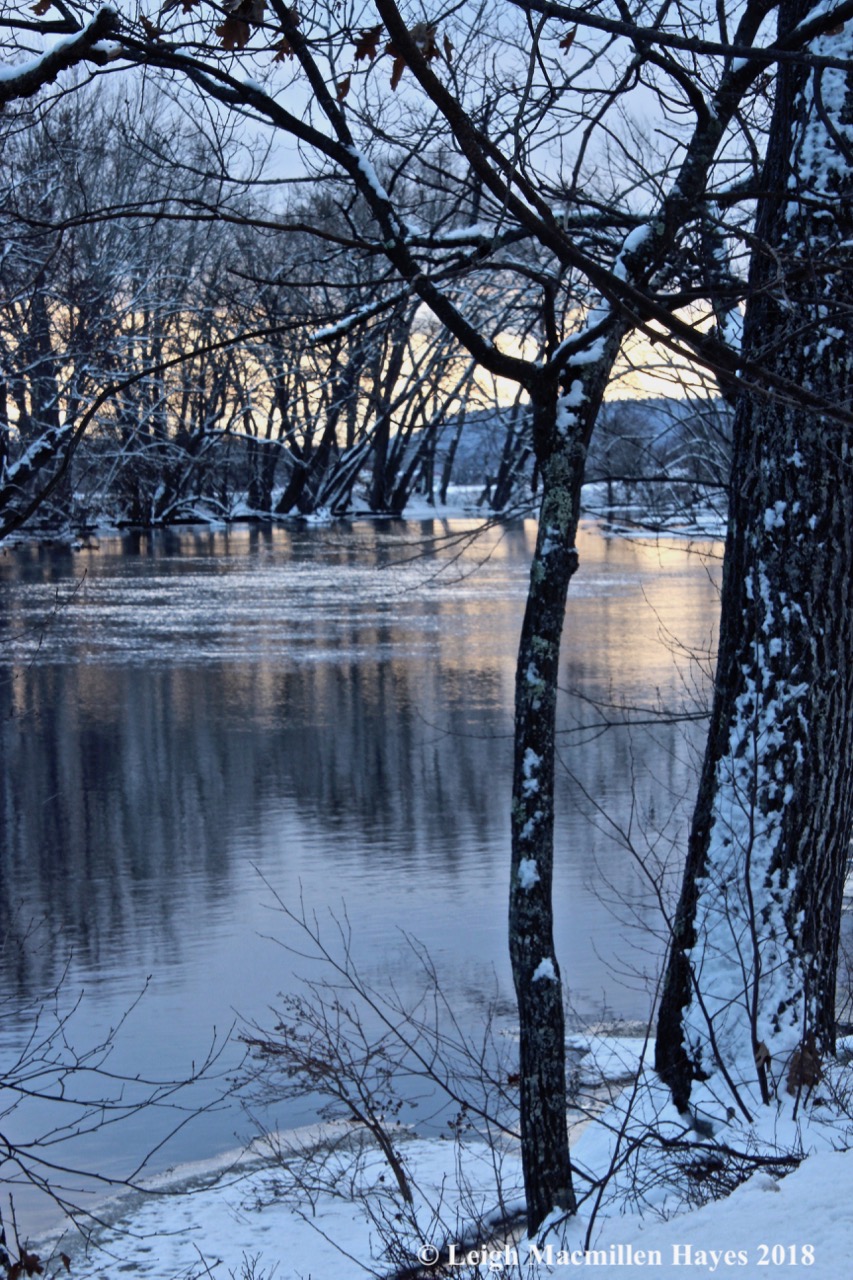
The scene is never the same, nor is the light. What may have appeared monochromatic was hardly that. When the sun began to set, the water harbored reflective moments as it transformed the views from crisp representations into impressionistic paintings.
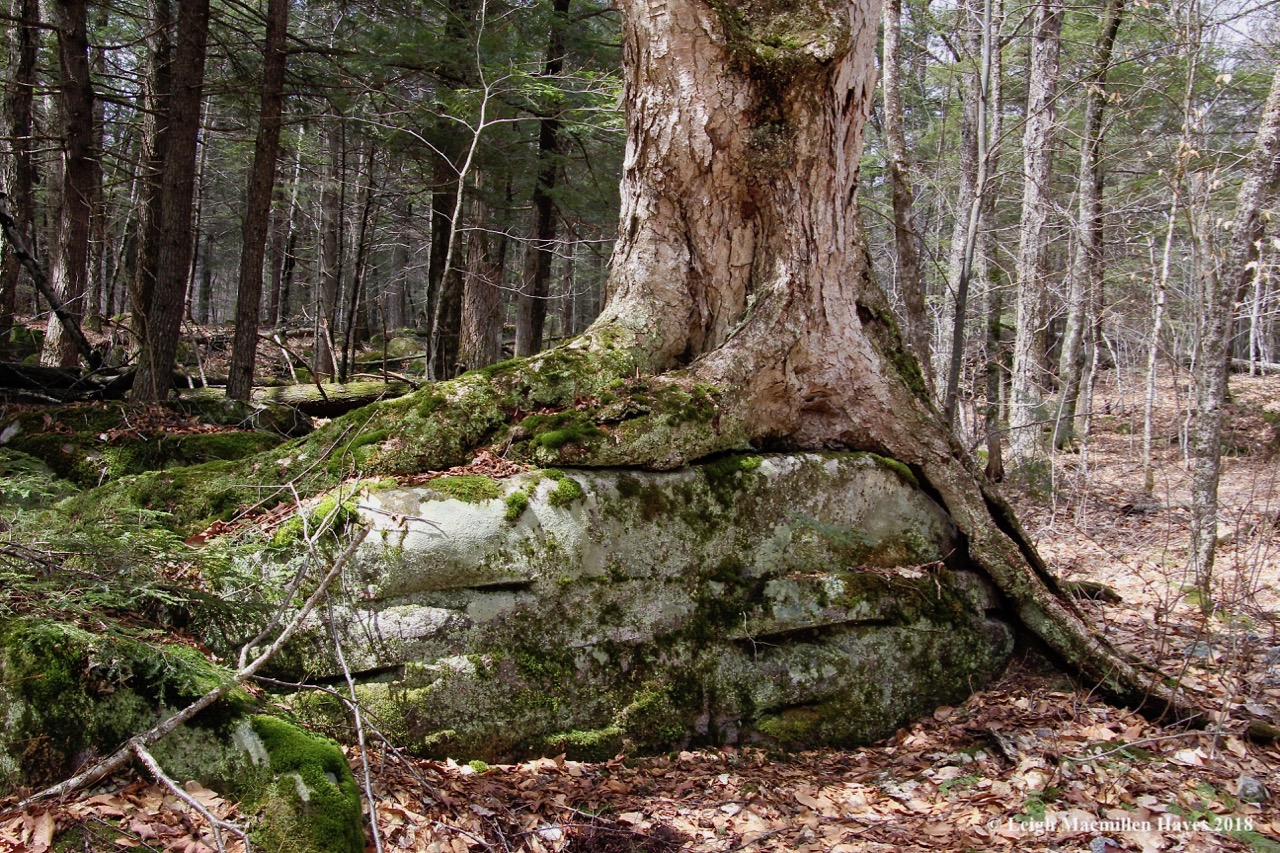
Right away, the trail’s tree spirit whispered a welcome. And another of my favorite trees begged to be noticed again. It’s an ancient yellow birch that has graced the granite for more than a century. The tree itself, wasn’t in good health, but the roots atop the rock splayed out in support of a life to be continued.
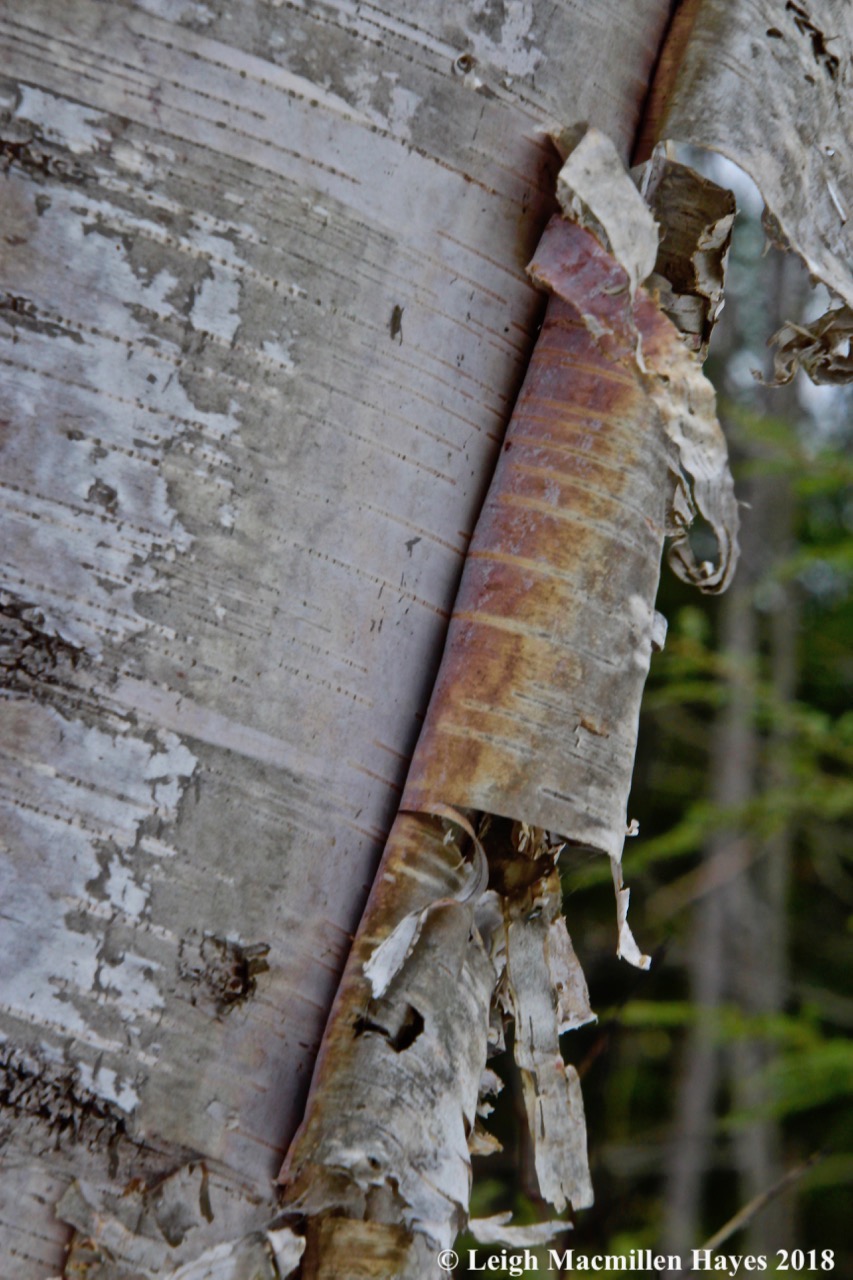
Beside it stood one that some know as white; I prefer to call it paper. The curled-back birch bark offered hues of a different color reminiscent of a sunrise in the midst of a graying day.
And not to go unnoticed, bark from another birch had fallen to the ground. It too, offered subtle pink hues, but it was the stitchery created by the tree’s pores that drew my eye. They reminded me of a million zippers waiting to reveal hidden secrets.
Near the stonewall along the cowpath stood tall an old pine that perhaps served as the mother and grandmother of all the pines in my forest. Today, bedecked in piles of flakes, her arms reached out as if to embrace all of her offspring.
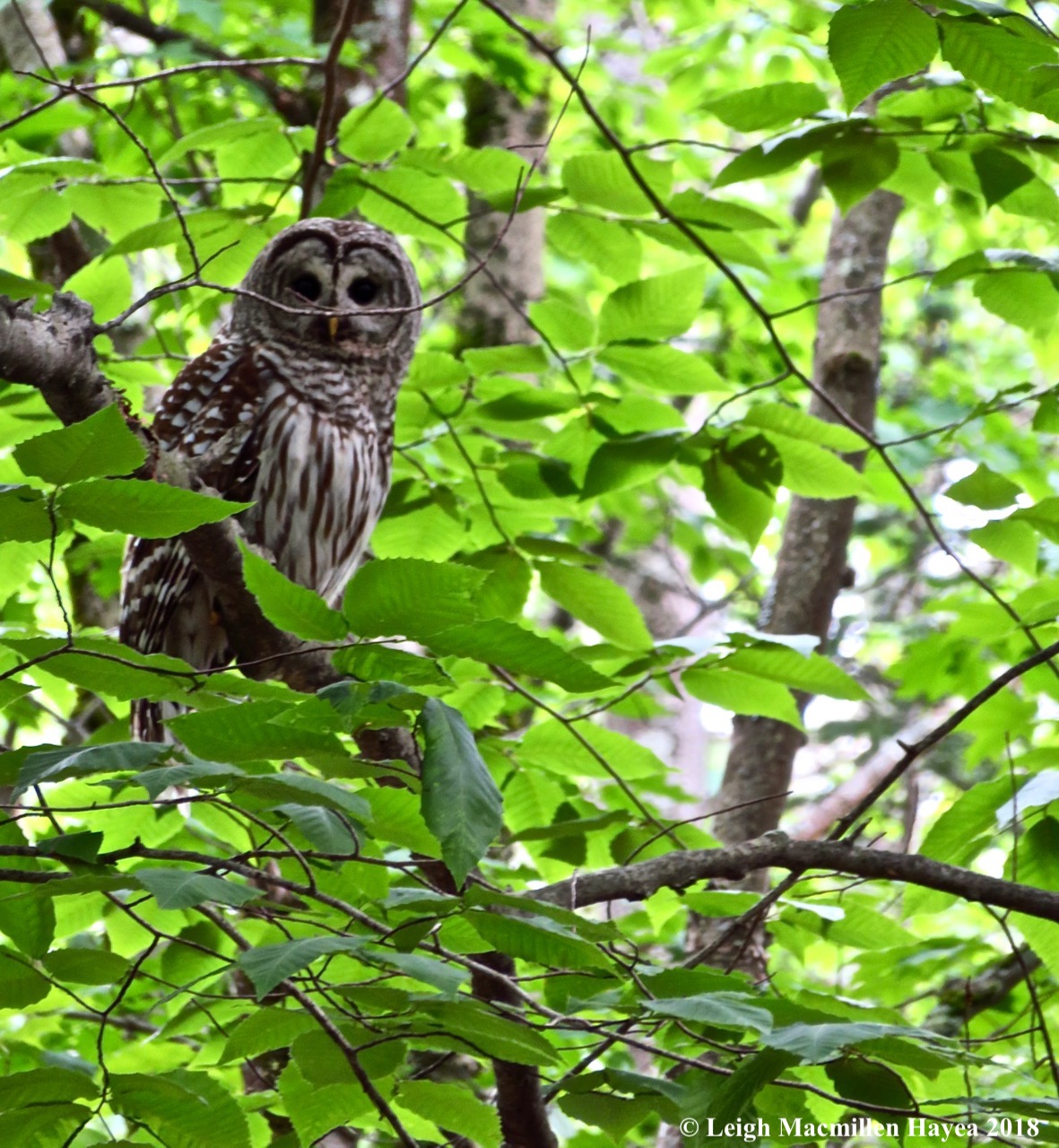
I had only walked a wee distance when I heard a Barred Owl call, “Who cooks for you? Who cooks for you all?” It was noon, after all, so it seemed totally appropriate. Suddenly, I heard a response somewhere ahead. For about five minutes they echoed each other. And then the world was silenced.
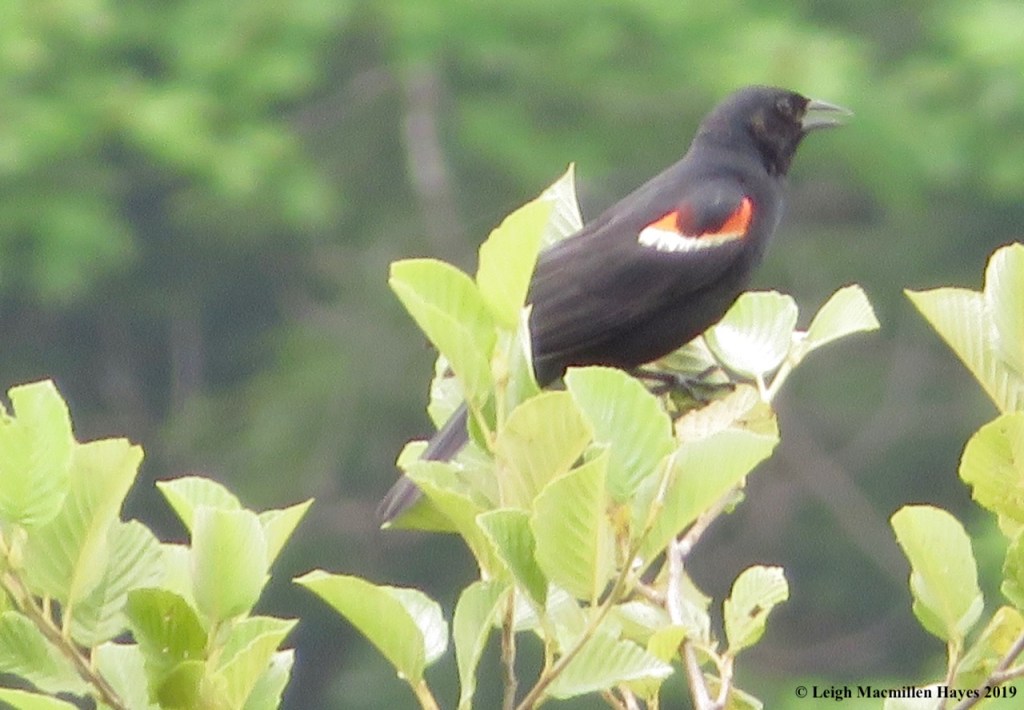
At last we reached the boardwalk, where we embraced stillness and listened to the green frogs strum their banjo voices and red-winged blackbirds sing their conk-la-ree songs. Our gaze became more focused when we realized we stood in the midst of a newly emerged dragonfly. We felt a sense of caretakers for suddenly it was our honorable duty to watch and protect this vulnerable being from becoming prey. With wonder, we observed it slowly change position and suddenly spread its wings. For at least an hour we stood sentry and noted the slightest movements while we delighted in how the breeze occasionally fluttered through the dragonfly’s wings. And then, in a flash, it flew off and we were proud parents who had sent our offspring into the world.
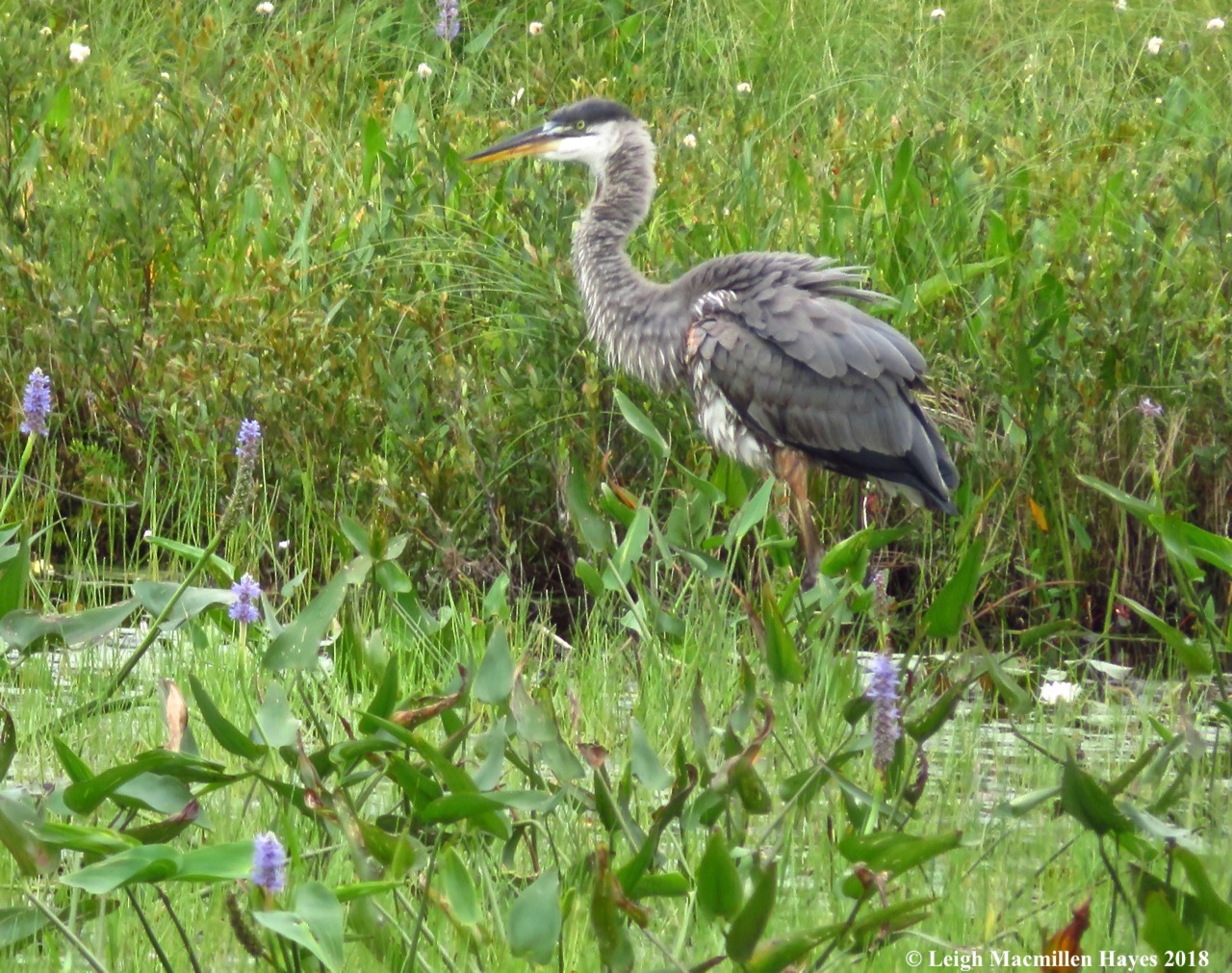
I have no idea how much time had passed, but suddenly we all stirred a bit and then someone who was noticing redirected our attention. We were encouraged to focus on another who was also paying attention. And narrowing in . . . on lunch. When the young bird flapped its wings, we were all sure the meal was meant “to go.” But thankfully, the bird stayed. And played with its food. Ever so slowly, the fish was maneuvered into its mouth. And gulped. Down the throat it slid, a slight bump in the long neck. And then the feathers were ruffled–rather like a chill passing through its body. Wing motion followed. But still, the Great Blue Heron stayed. And stalked some more.
A blanket of fog enveloped the view. It didn’t matter, for my focus zeroed in on what was before me rather than being swept up into the beyond. I began to look around and felt an aura. It was as if I stood in another place and time. The fog. The green. The gray. The world disappeared. And the scene before me opened. One yellow lichen inched across the granite face. Beside it, another stood out like tiles in a mosaic work of art. Meanwhile, the fog danced across the ridgeline, twirling and whirling in a ghostly quiet manner, its transparent gowns touching the ground ever so tenderly before lifting into the next move.
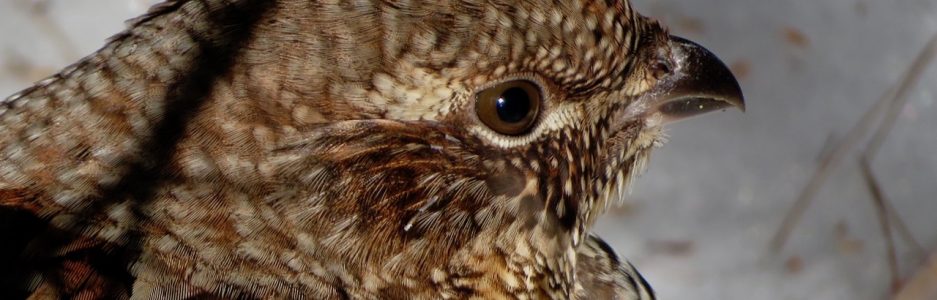
We watched him forage for seeds and wondered about his behavior. Typically, such birds are loners, except for mating season. But this one greeted visitors to its territory with somewhat regular frequency. When we moved, he did likewise–usually a few feet to either side of us. And when we stopped, the Ruffed Grouse did the same, seeming to share our curiosity.
One doesn’t necessarily step into the woods and expect transcendent events to occur, but then again by learning to live in the moment one never knows what to expect.
These are my thin places, where I see the light more on this side of than the other. May the answers slowly reveal themselves by day and by night, while the questions and awe never end.
Thanks to all of you who continue to wonder and wander with me whether literally or figuratively. I truly appreciate our time spent together.
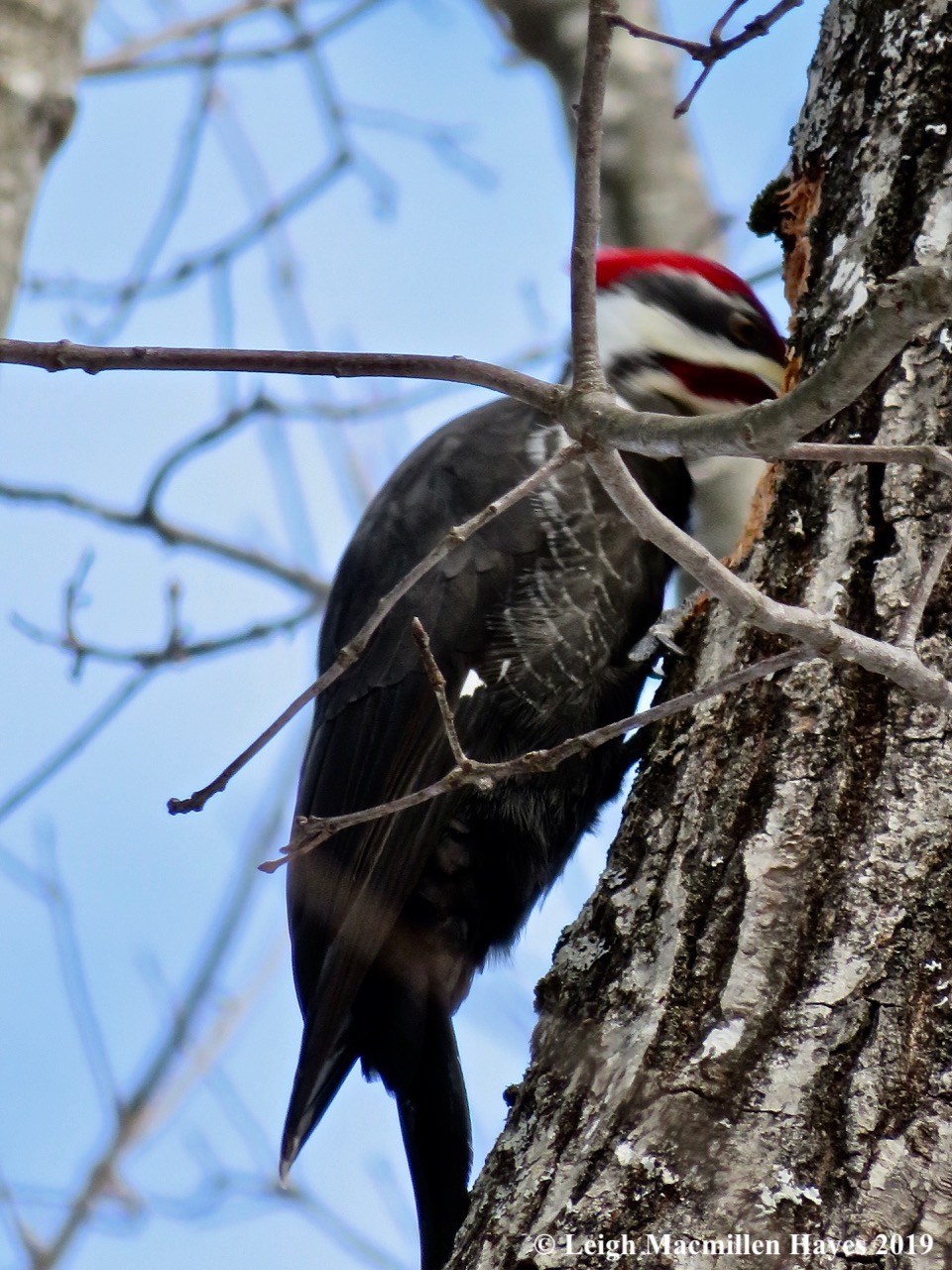
I heard it before I saw it as I reached the summit of the Greater Lovell Land Trust’s Flat Hill this afternoon. The rhythmic tapping sounded as if a structure was being built and so I looked upward expecting to see a treehouse under construction. Scanning all the trees in the mixed forest, I saw only their crowns.
And then I smartened up and looked at the snow. Bingo! Fresh debris atop this week’s layers of snow from two storms and I had a better idea of the construction worker’s location.
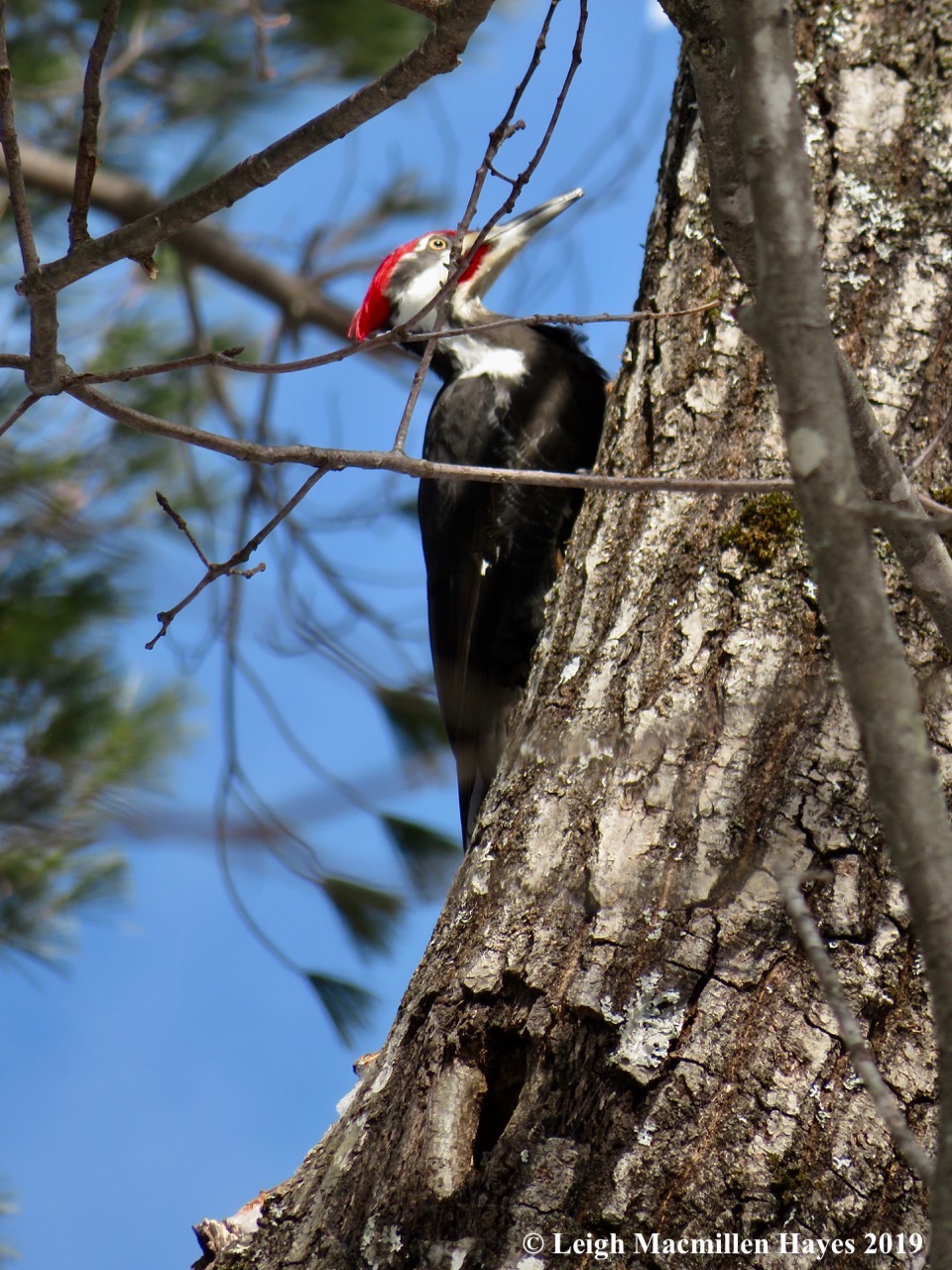
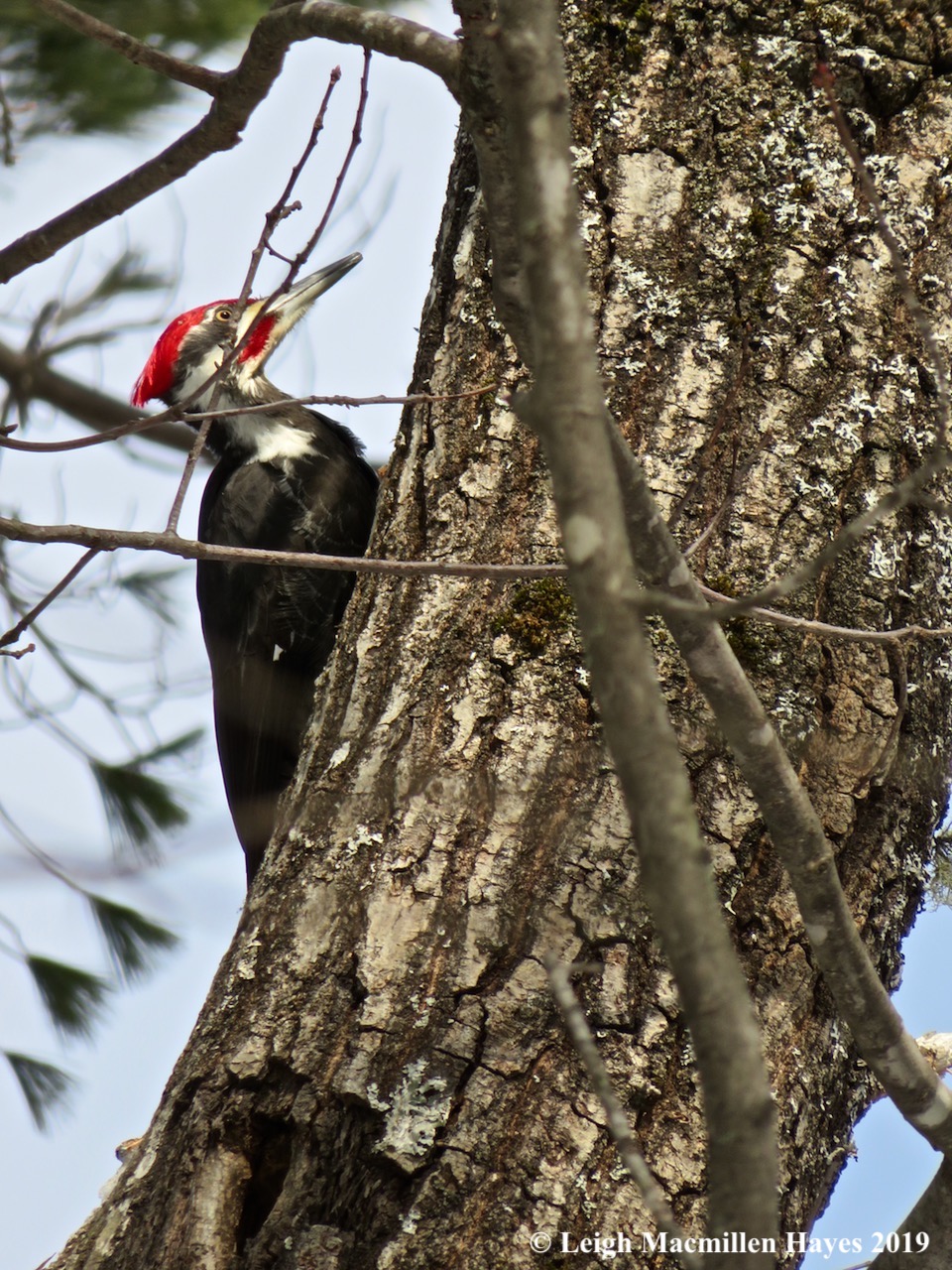
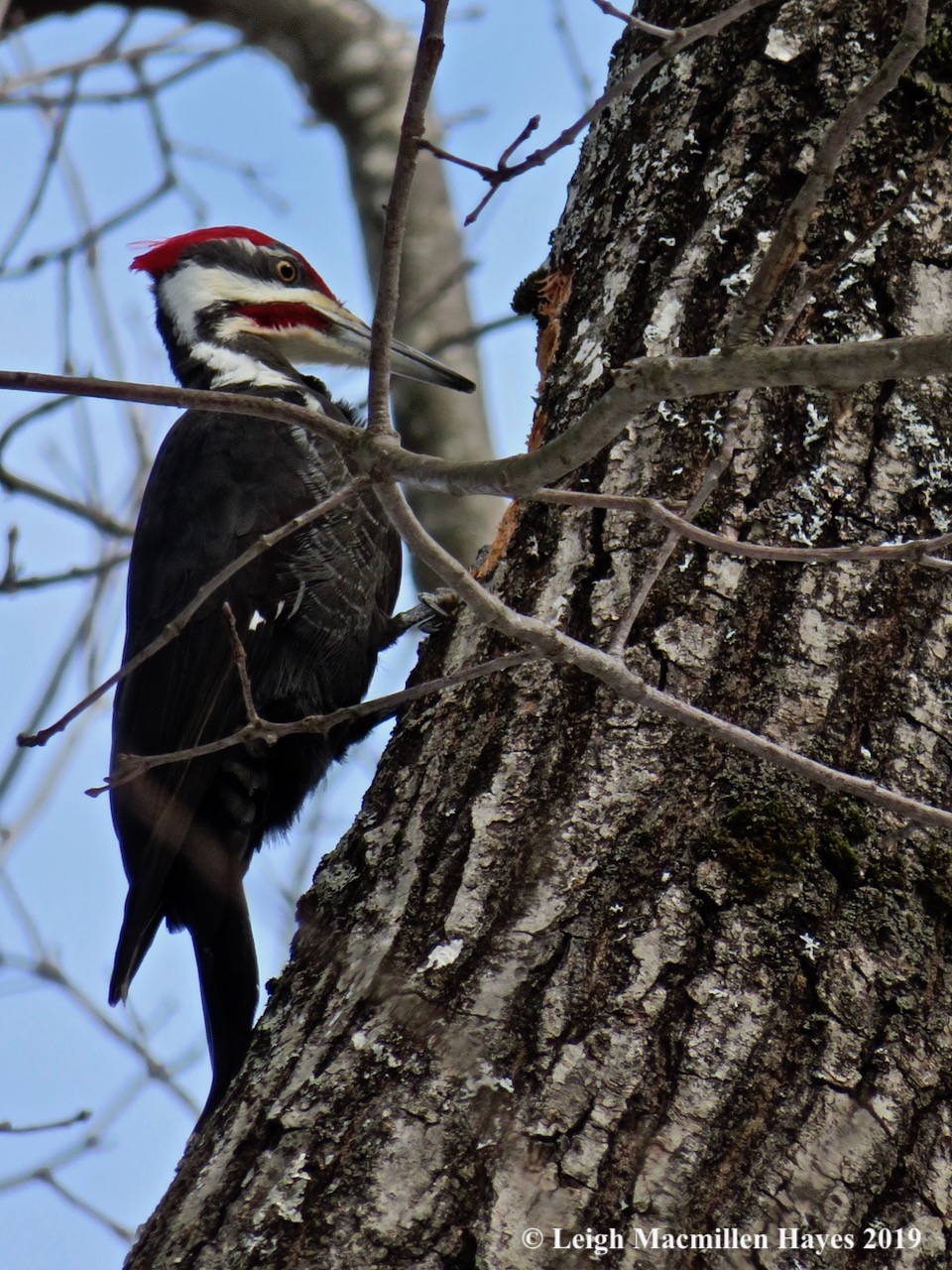
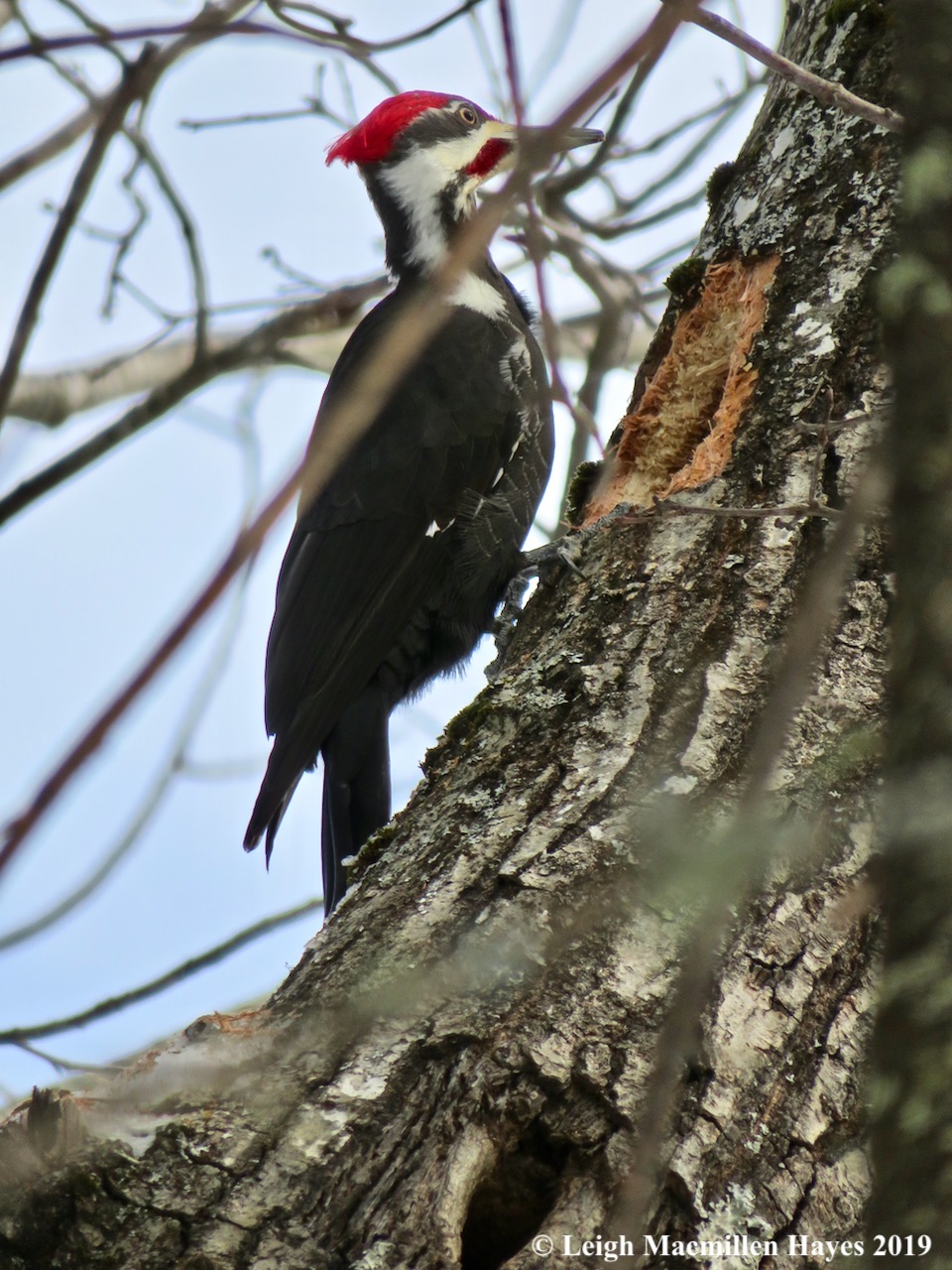
Sure enough, high up in a deteriorating yet live red oak stood the one with a crown all his own–brilliant red as it was in the afternoon sun. By the red mustache on its cheeks, I knew the pileated woodpecker was a he. Call him either PILL-ee-ated or PIE-lee-ated; the word means “crested.”
Sometimes, when these birds are intent on their work, I find I’m able to quietly move in a wee bit closer. Mind you, he was up quite high (at least 25 feet above me) and there were other trees between us. I hoped if he was aware of me that he knew I meant no harm. I just wanted to observe.
And so I did for a good while. Check out that chisel-like bill.
In a seemingly effortless manner, he pounded away. Did you know that a pileated can peck up to 12,000 times a day? Not all on the same tree, of course.
Thank goodness for extra-dense neck muscles and a compressible skull bone. Between hammering, this guy paused periodically. To admire his work? To check on the food supply? Or just to take a break?
Can you see one of his four-toed talons grip the edge of the excavation site?
One cool thing about woodpeckers is how they use their tail feathers for support–as if the third leg on a three-legged stool.
As I watched, I noted that Woody Woodpecker, a name I give all pileateds because their rattling call reminds me of the television cartoon I grew up with, kept digging a bit deeper.
And deeper still.
Then he’d take a break and turn his head away from the tree and I finally realized that the tree was at such an angle that to remove debris he needed to drop it below.
Eventually, he flew off and so I checked on the woodchips in hopes of finding scat filled with insect body parts. There was none. For all of his work gouging the oak, he didn’t seem to have found any carpenter ants or wood-boring beetles. Maybe that’s why he moved on. And so I did as well.
About halfway down the trail, I came upon a sight that might have delighted the woodpecker. I know I was thrilled.
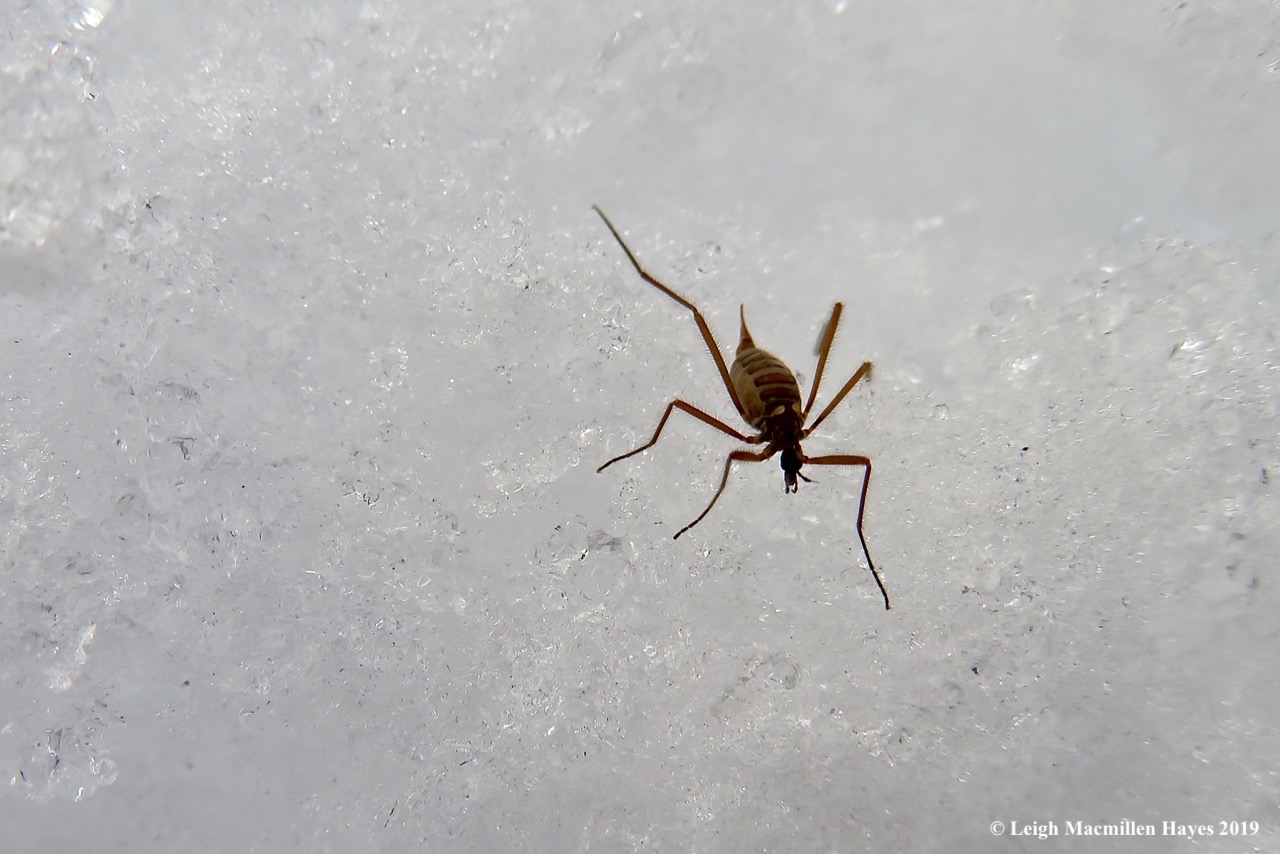
Within a few feet I spotted a second one. They were snow scorpionflies. Much like the fact that Flat Hill isn’t actually flat, nor can the snow scorpionflies fly!
On his website “Bug of the Week,” entomologist Dr. Michael J. Raupp explains, “They belong to a small order of insects known as Mecoptera. The “scorpion” moniker derives from the fact that males in this group have unusually large and upward curving genitalia that resemble the stinger of a scorpion. The “fly” part of the name comes from the fact many species of Mecoptera have wings and can, well, fly.”
To fly and not to fly. Predator and prey. Despite their extreme differences, both finds today certainly struck me as being prehistoric creatures of western Maine.





































































































































 wondermyway