Walking Among Mysteries

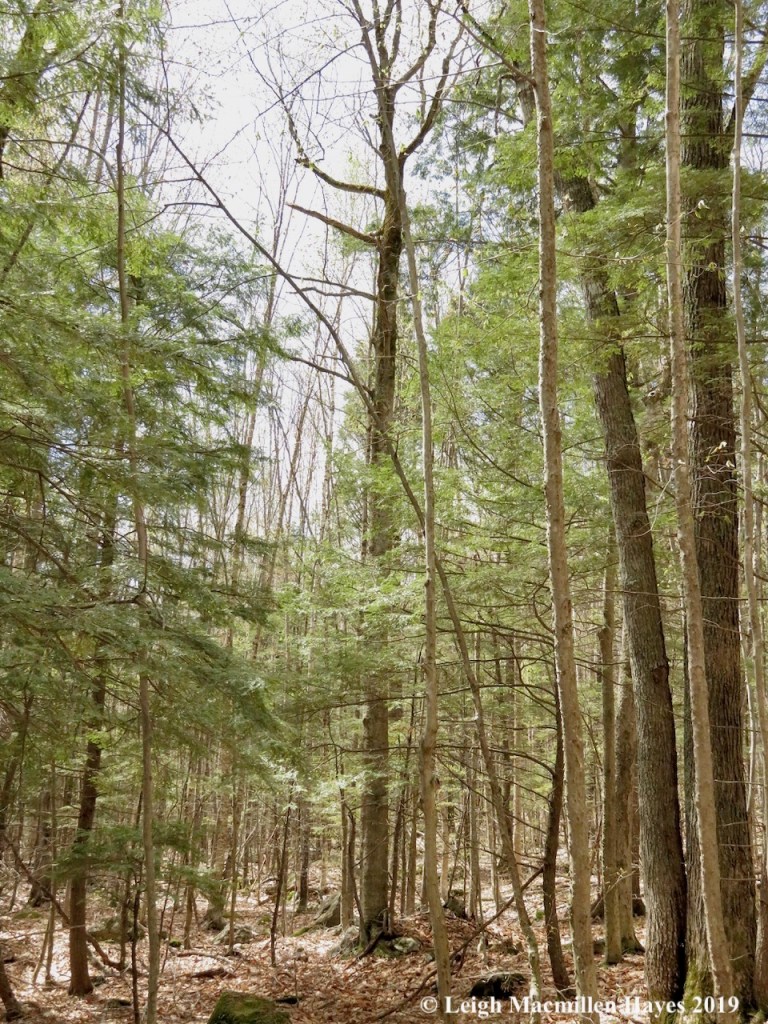
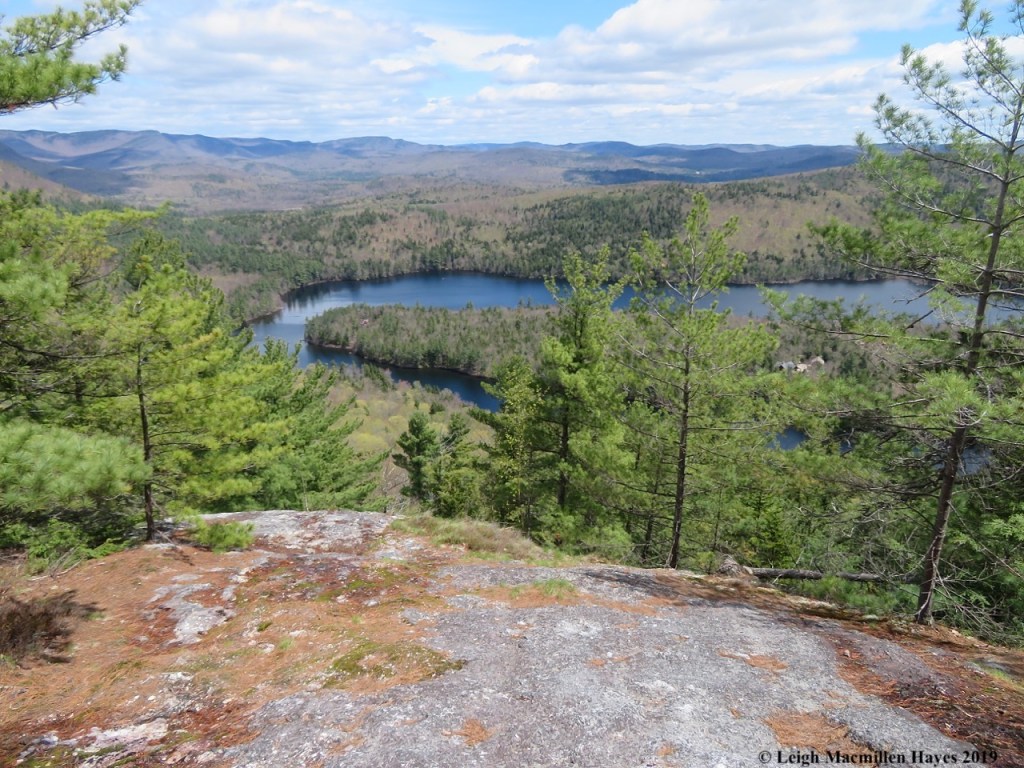
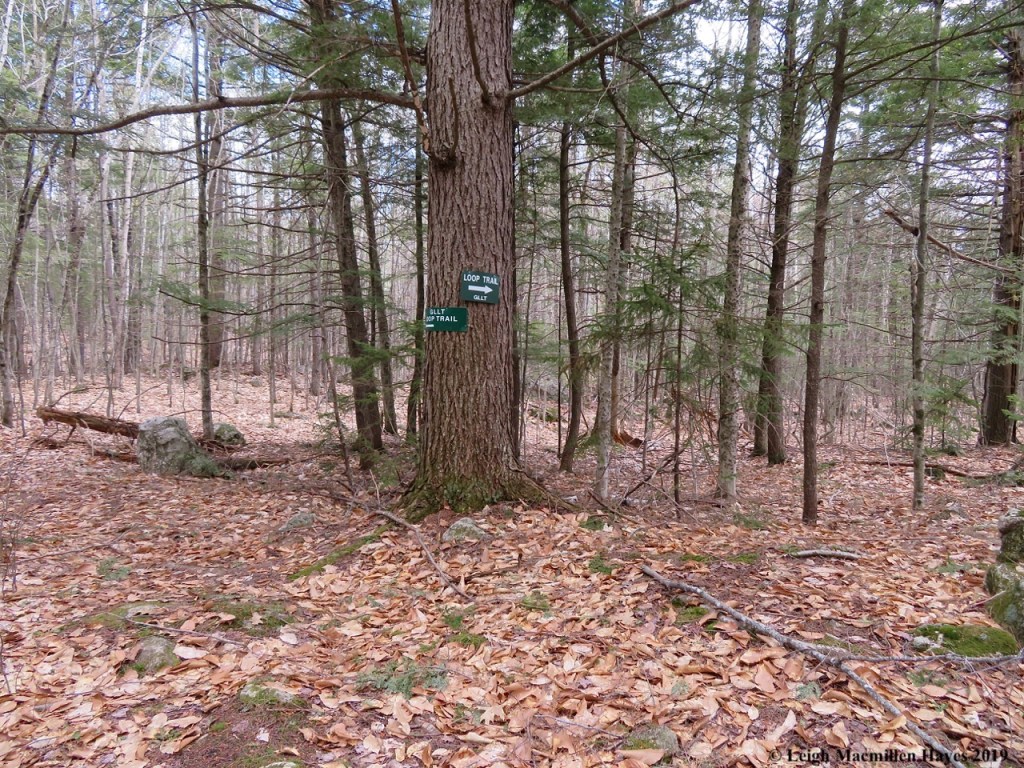
We knew not what to expect when we met this morning. My intention was to visit a structure of unknown use, then follow a trail for a bit before going off trail and mapping some stone walls. Curiosity would be the name of the game and friends Pam and Bob were ready for the adventure when I pulled into the trailhead parking lot.

We traveled rather quickly to our first destination, pausing briefly to admire only a few distractions along the way–if you can believe that.

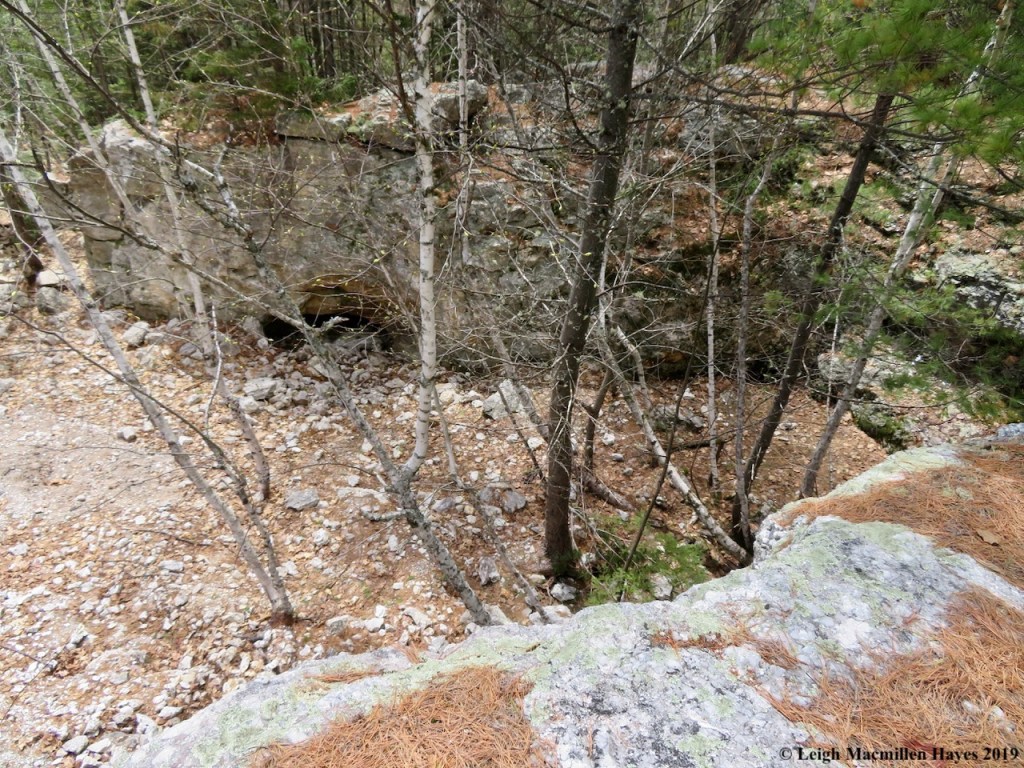
It’s a stone structure on the back side of Amos Mountain. Three years ago we visited this site with Dr. Rob Sanford, a University of Southern Maine professor and author of Reading Rural Landscapes. At that time we came away with so many questions about this structure located on a mountainside so far from any foundations. Today, we still had the same questions and then some.

Who built it? What was it used for? Was there a hearth? Did it have a roof? Was it ever fully enclosed? Was there originally a front wall? Could it be that it extended into the earth behind it? Was it colonial? Pre-colonial?

Why only one piece of split granite when it sits below an old quarry?
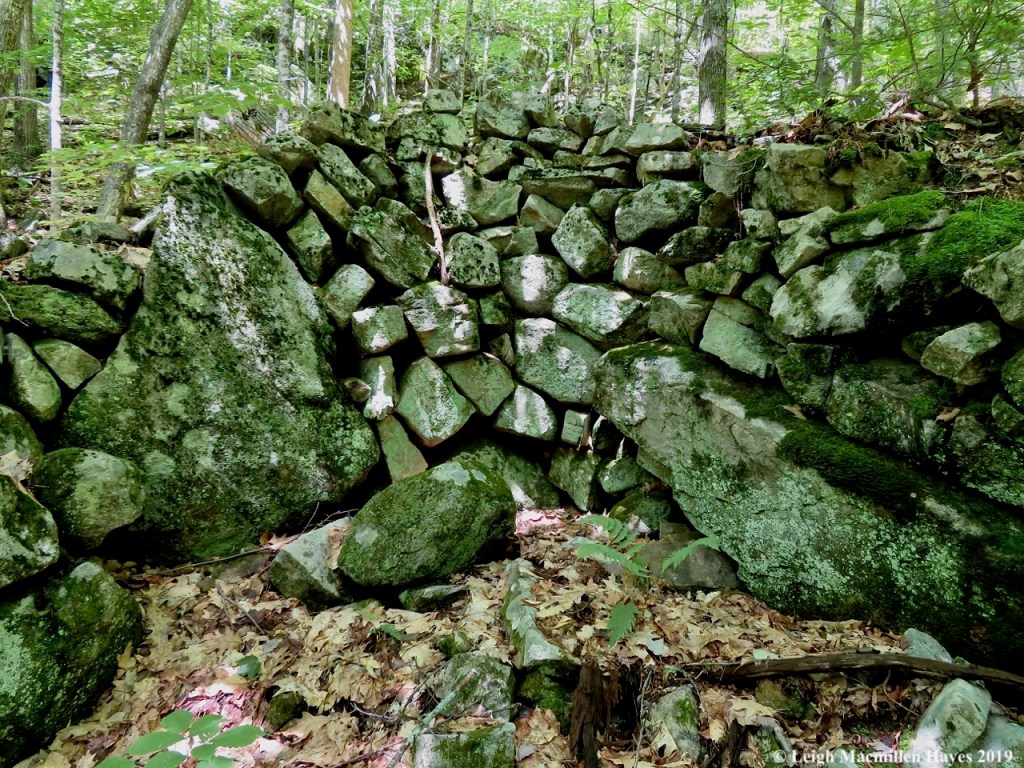
And then there’s the left-hand side: Large boulders used in situ and smaller rocks fit together. One part of the “room” curved. For what purpose?
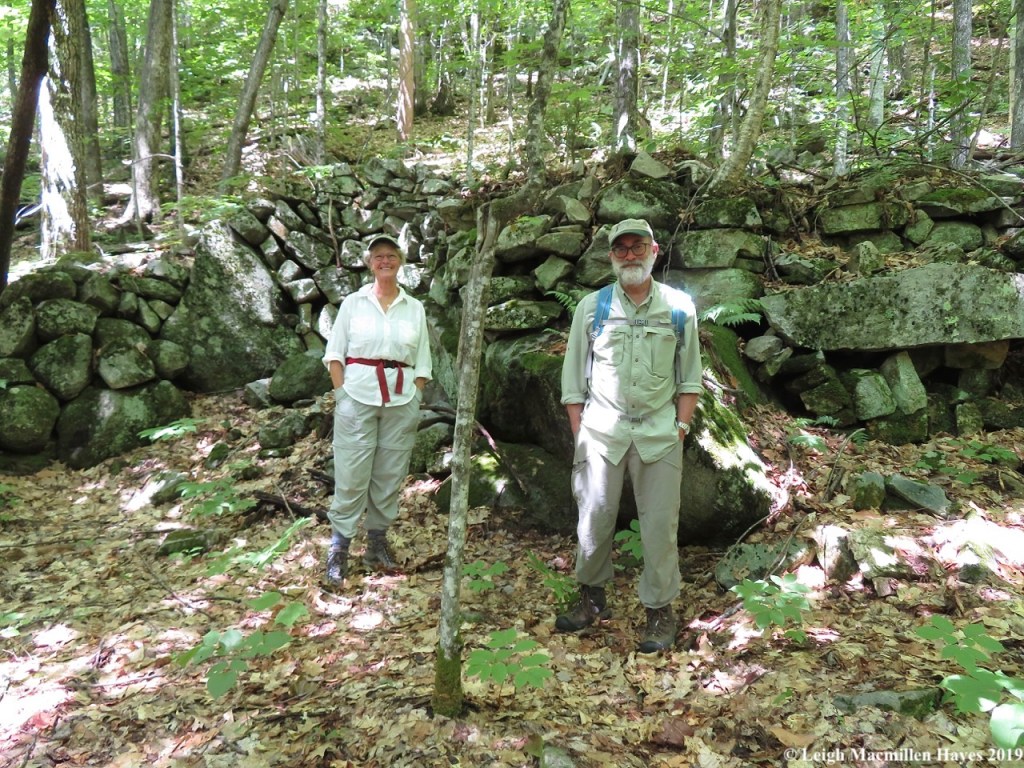
Pam and Bob stood in the center to provide some perspective.
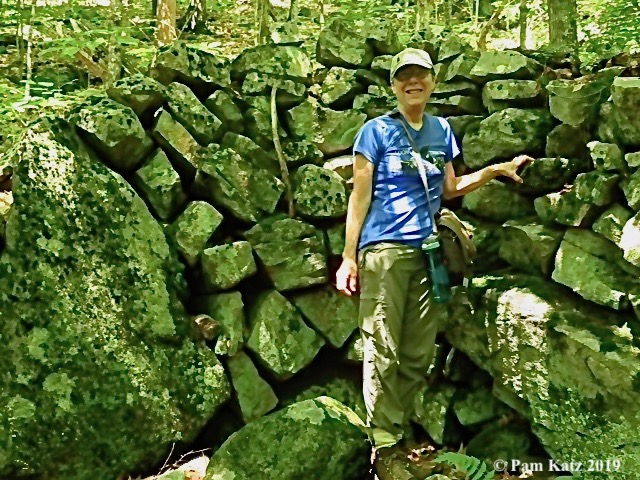
And then I climbed upon fallen rocks to show height.

We walked away still speculating on the possibilities, knowing that we weren’t too far from a stone foundation that belonged to George Washington and Mary Ann McCallister beginning in the mid-1850s and believed the structure to be upon their “Lot.”
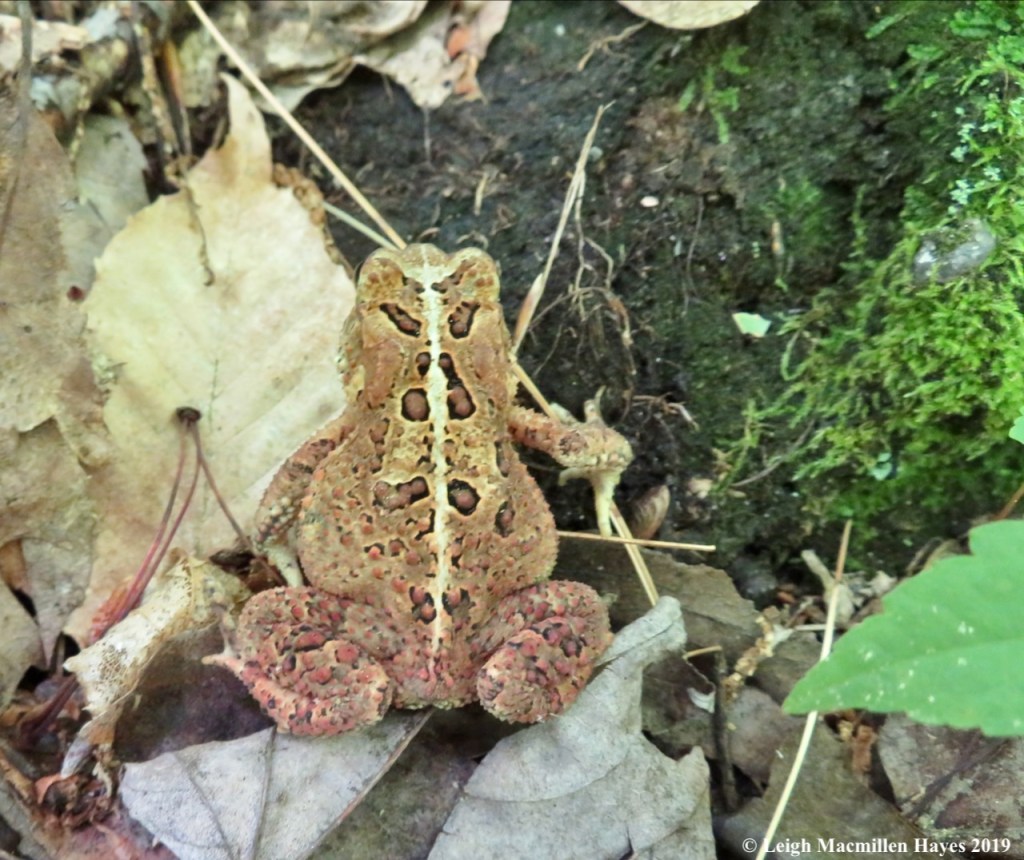
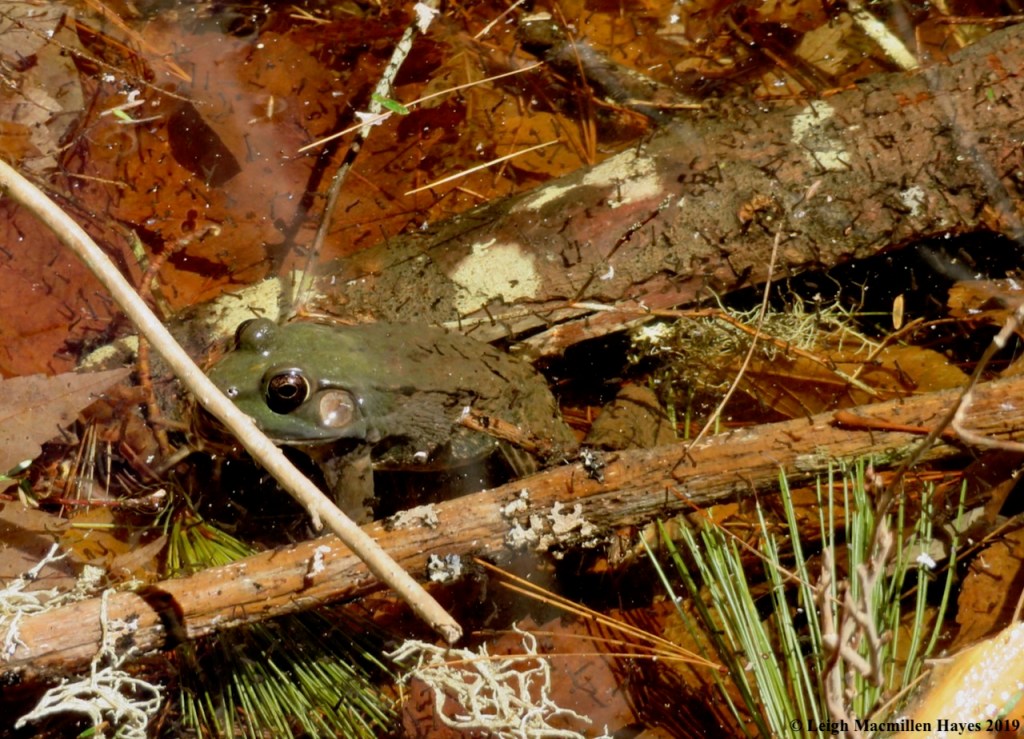
As we continued along the trail, we spied several toads and a couple of frogs. Their movement gave them away initially, but then they stayed still, and their camouflage colorations sometimes made us look twice to locate the creator of ferns in motion.
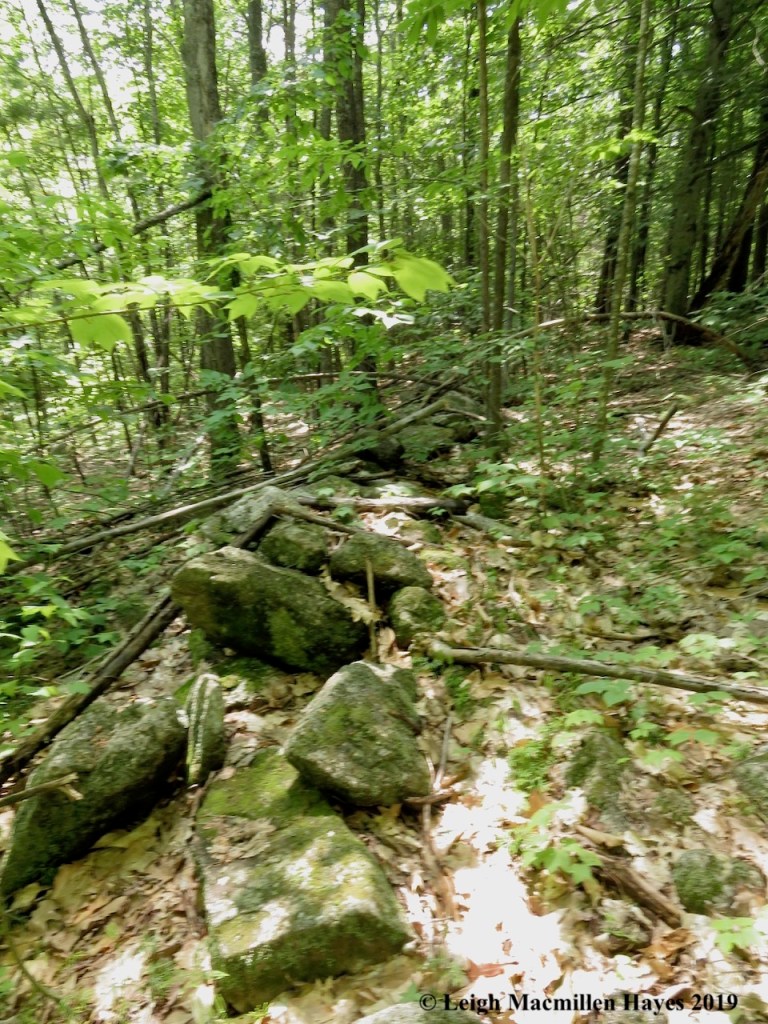
At last we crossed over a stonewall that we assumed was a boundary between the McAllister property and that of Amos Andrews. It was the walls that we wanted to follow as there are many and our hope was to mark them on GPS and gain a better understanding of what seems like a rather random lay out.

The walls stand stalwart, though some sections more ragged than others. Fallen trees, roots, frost, weather, critters and humans have added to their demise, yet they are still beautiful, with mosses and lichens offering striking contrasts to the granite. Specks of shiny mica, feldspar and quartz add to the display.

The fact that they are still here is a sign of their endurance . . . and their perseverance. And the perseverance of those who built them.
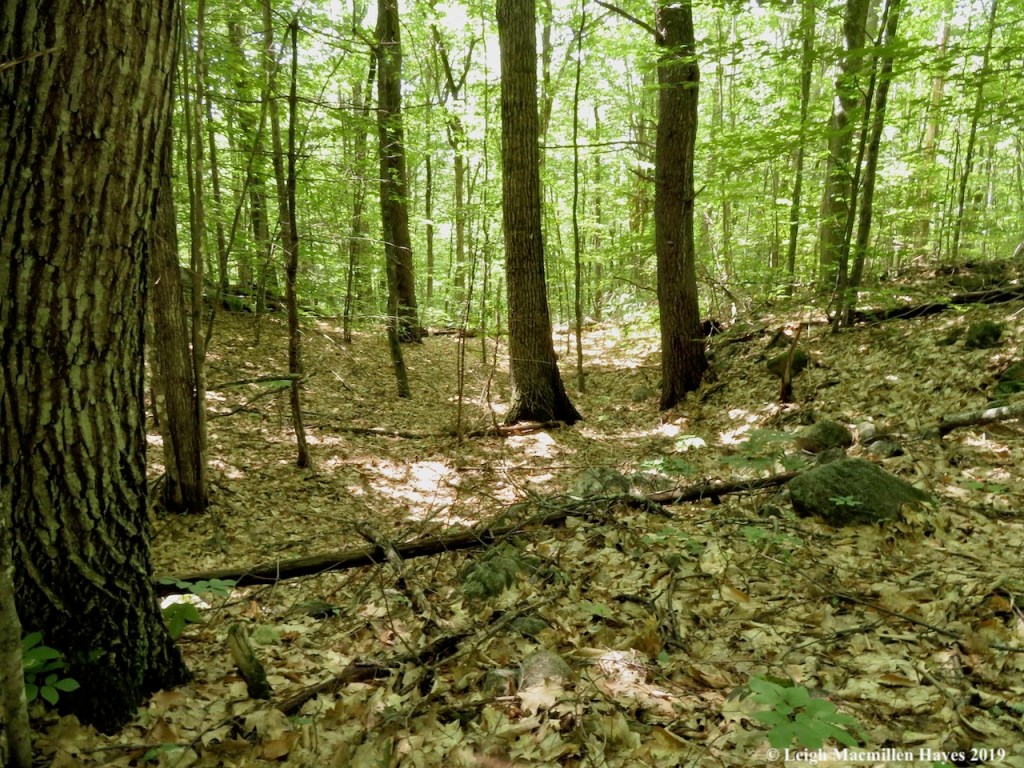
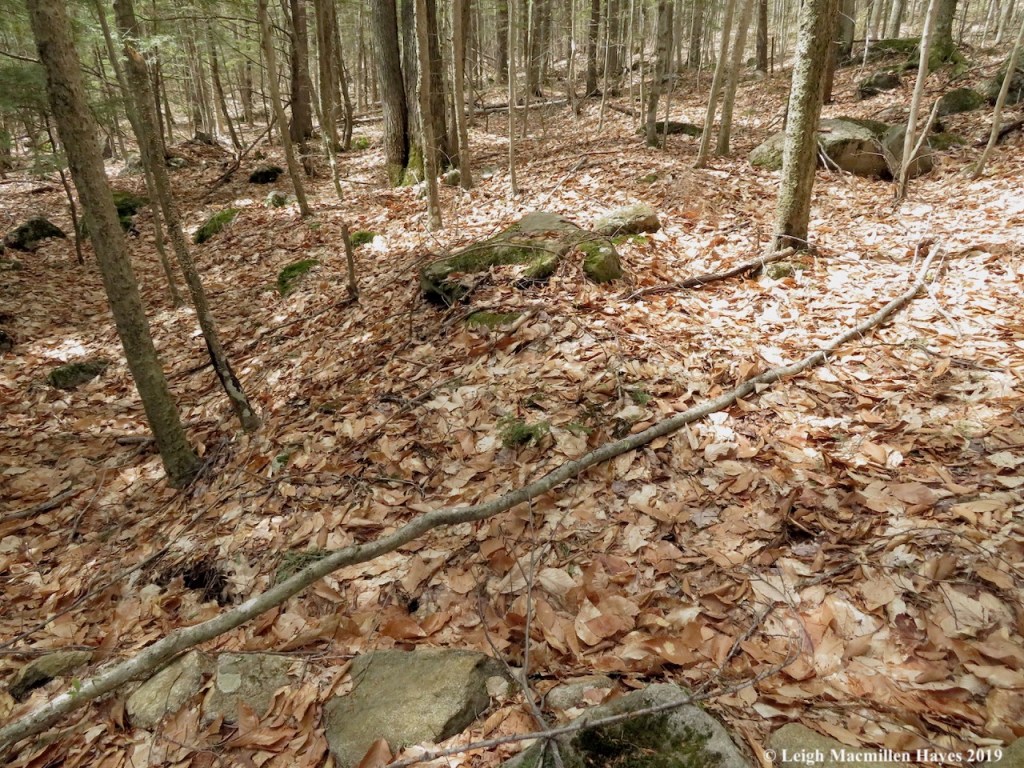
But the fashion of these particular walls has stymied us for years. As we stood and looked down the mountain from near the Amos Andrews foundation, we realized that the land was terraced in a rather narrow area. And so we began to follow one wall (perspective isn’t so great in this photo) across, walk down the retaining wall on the right edge and at the next wall follow it across to the left. We did this over and over again and now I wish I’d counted our crossings, but there were at least eight.
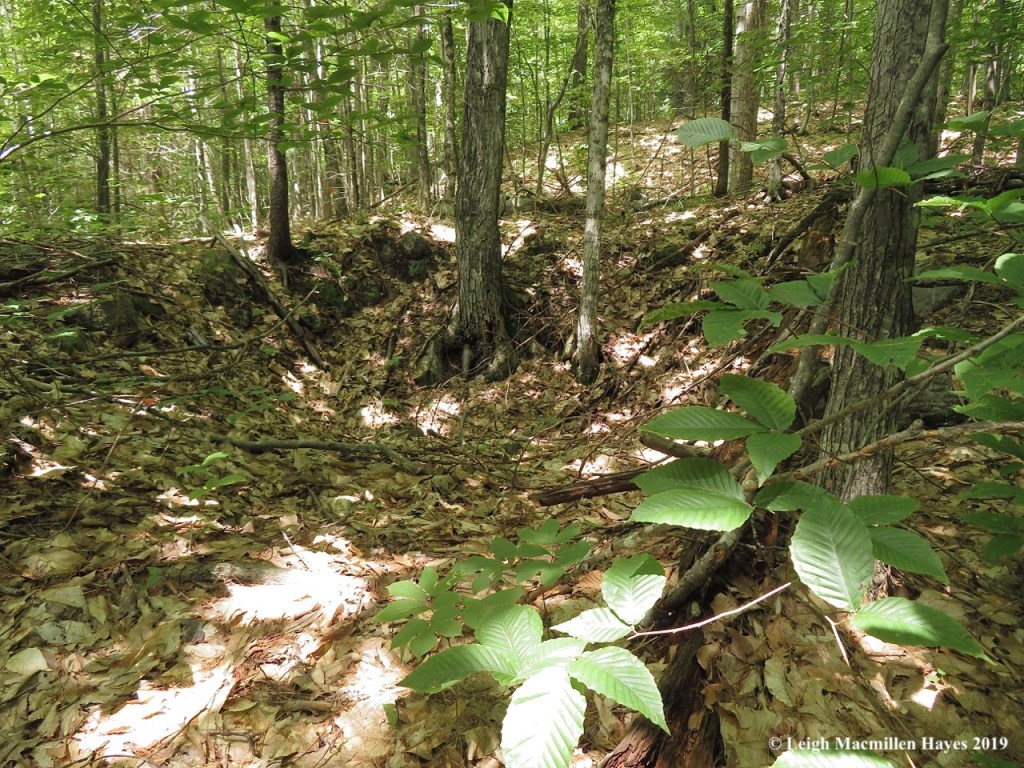
Mind you, all were located below the small root cellar that served as Amos Andrews’ home on and off again beginning in 1843.
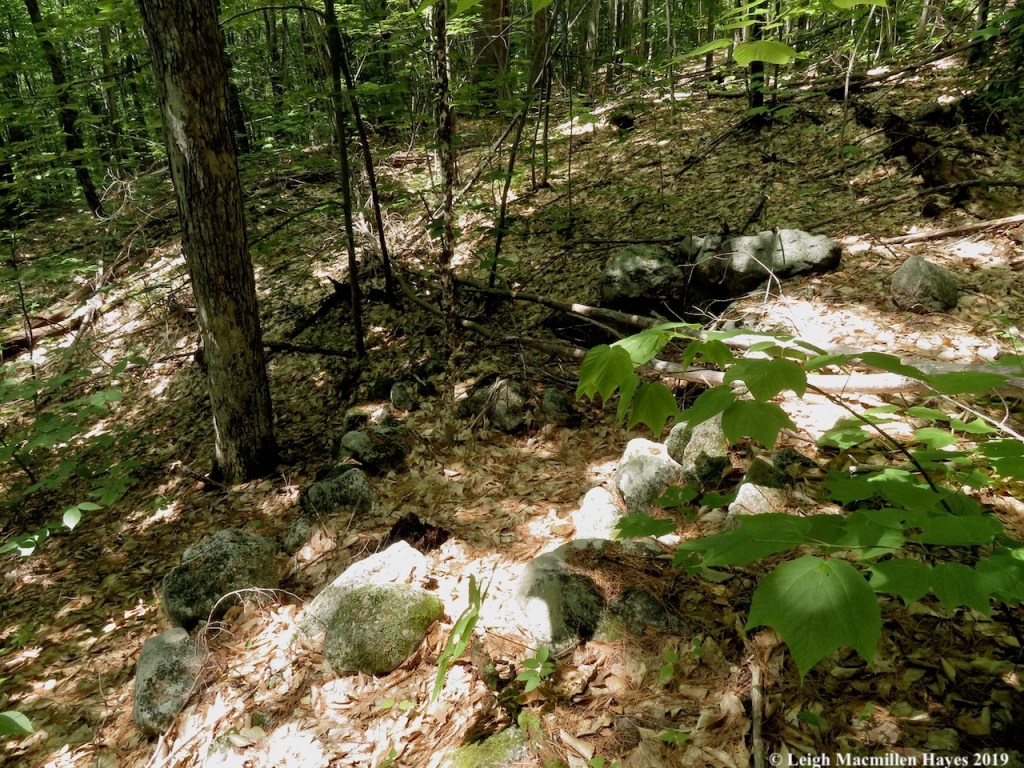
And below one of the terraced walls just beyond his cellar hole, there was a stoned off rectangle by the edge. Did it once serve as a foundation for a shed?

Had Amos or someone prior to him tried to carve out a slice of land, build a house, and clear the terraced area for a garden?

It seems the land of western Maine had been forested prior to the 1700s and there was plenty of timber to build. A generation or two later, when so much timber had been harvested to create fields for tillage and pasture, the landscape changed drastically, exposing the ground to the freezing forces of nature. Plowing also helped bring stones to the surface. The later generation of farmers soon had their number one crop to deal with–stone potatoes as they called them. These needed to be removed or they’d bend and break the blade of the oxen-drawn plowing rake. Summer meant time to pick the stones and make piles that would be moved by sled to the wall in winter months. Had the land been burned even before those settlers arrived? That would have created the same scenario, with smaller rocks finding their way to the surface during the spring thaw.

As it was, we found one pile after another of baseball and basketball size stones dotting the landscape. Stone removal became a family affair for many. Like a spelling or quilting bee, sometimes stone bees were held to remove the granite from the ground. Working radially, piles were made as an area was cleared. Stone boats pulled by oxen transported the piles of stones to their final resting place where they were woven into a wall.

Occasionally, however, we discovered smaller stones upon boulders. Were they grave markers? Or perhaps spiritual markers?

There were double-wide stone walls with big stones on the outside and little stones between, indicating that the land around had been used for planting. But why hadn’t all the piles been added to the center of these walls? That’s what had us thinking this was perhaps Pre-colonial in nature.
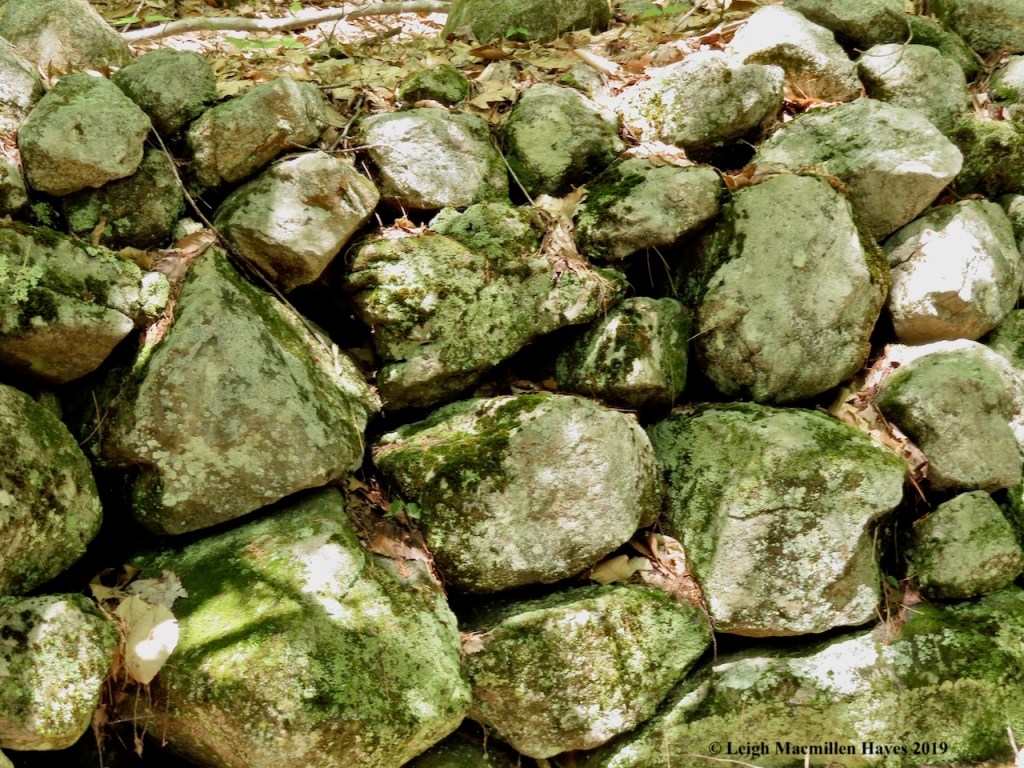
Pasture walls also stood tall, their structure of a single stature. I may be making this up because I’ve had an affinity with turtles since I was a young child and own quite a collection even to this day, but I see a turtle configured in this wall. Planned or coincidence?

My turtle’s head is the large blocky rock in the midst of the other stones, but I may actually be seeing one turtle upon another. Do you see the marginal scutes arching over the head? Am I seeing things that are not there? Overthinking as my guy would suggest?

I didn’t have to overthink when I spotted this woody specimen–last year’s Pine Sap with its many flowered stalk turned to capsules still standing tall.

And a foot or so away, its cousin, Indian Pipe also showing off the woody capsules of last year’s flowers, though singular on each stalk.

As we continued to follow the walls, other things made themselves known. I do have to admit that we paused and pondered several examples of this plant because of its three-leaved presentation. Leaves of three, leave them be–especially if two leaves are opposite each other and have short petioles and the leader is attached between them by a longer petiole. But, when we finally found one in flower we were almost certain we weren’t looking at Poison Ivy. I suggested Tick-Trefoil and low and behold, I was correct. For once.
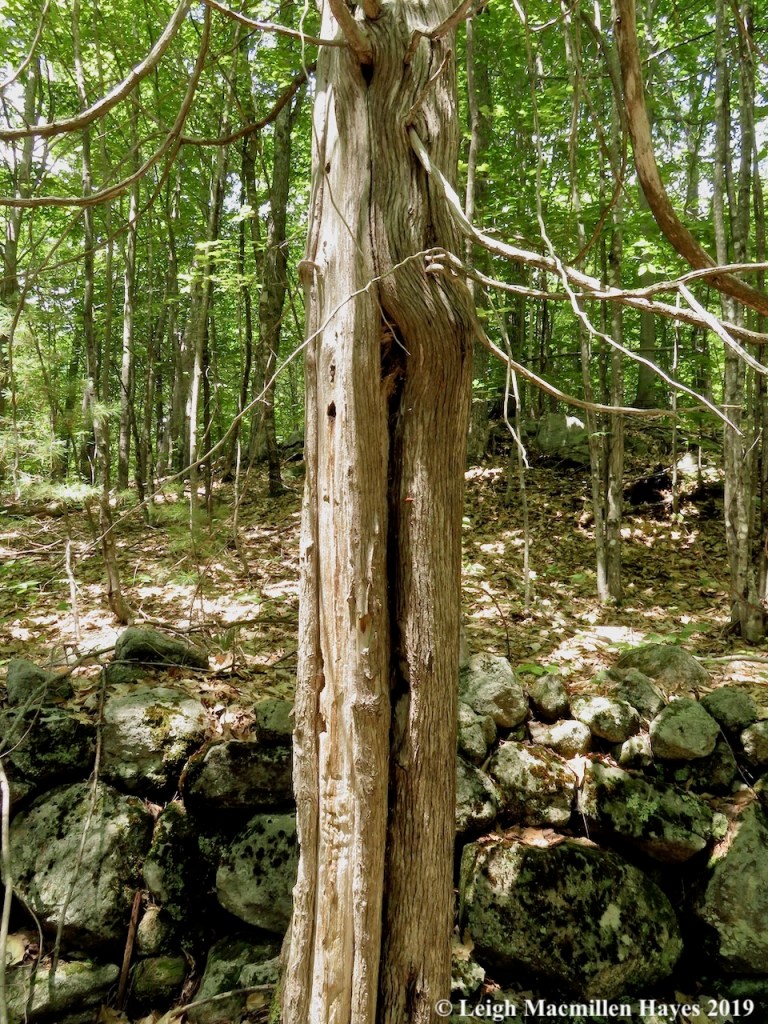
Our journey wandering the walls soon found us back on what may have been a cow or sheep path and it was there that we noted a cedar tree. Looking at it straight on, one might expect it to be dead. But a gaze skyward indicated otherwise. Still, the question remained–why here?
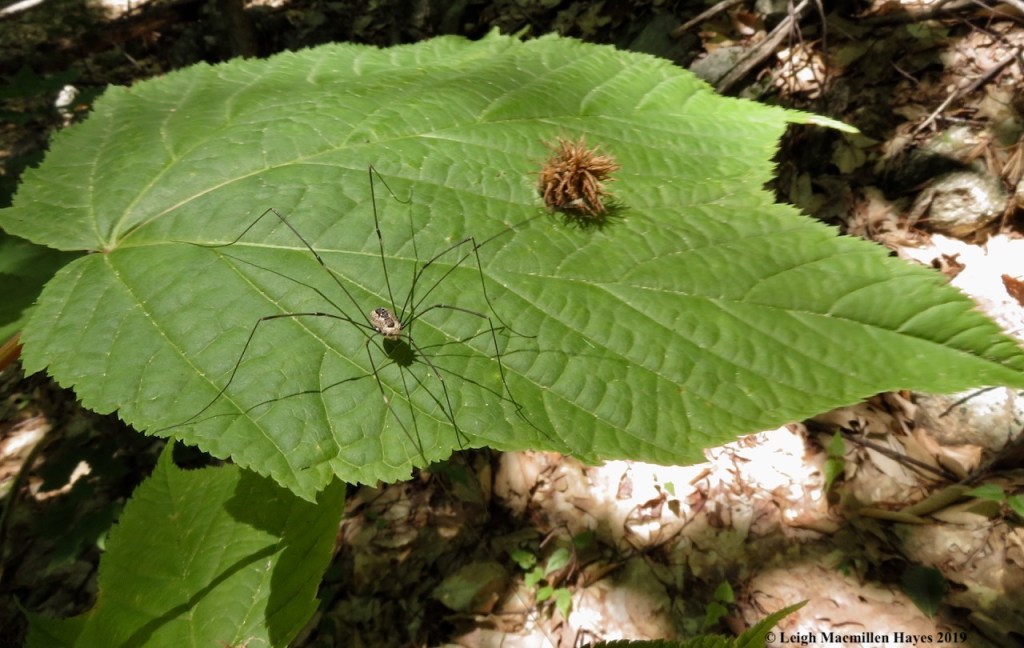
A Harvestman Spider may have thought the same as it reached out to a Beech Nut. After all, the two were located upon a Striped Maple leaf.

Onward we walked, making a choice of which way to travel each time we encountered an intersection of walls. This one had a zigzag look to it and we thought about the reputation Amos Andrews had with a preference for alcohol. But . . . did Amos build all or any of these walls?

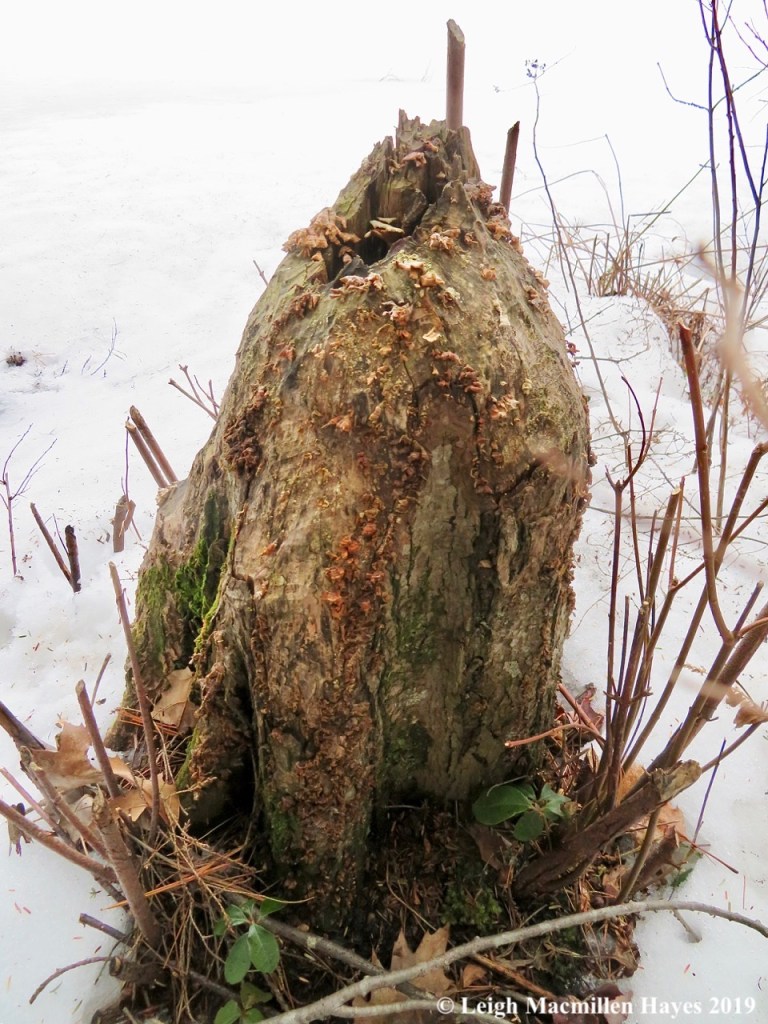
We continued to ponder that question even as we came upon a stump that practically shouted its name all these years after being cut, for the property we were on had eventually been owned by Diamond Match, a timber company. Do you see the mossy star shape atop the stump? And the sapling growing out of it? The star is actually a whorl–of White Pine branches for such is their form of growth. And the sapling–a White Pine.
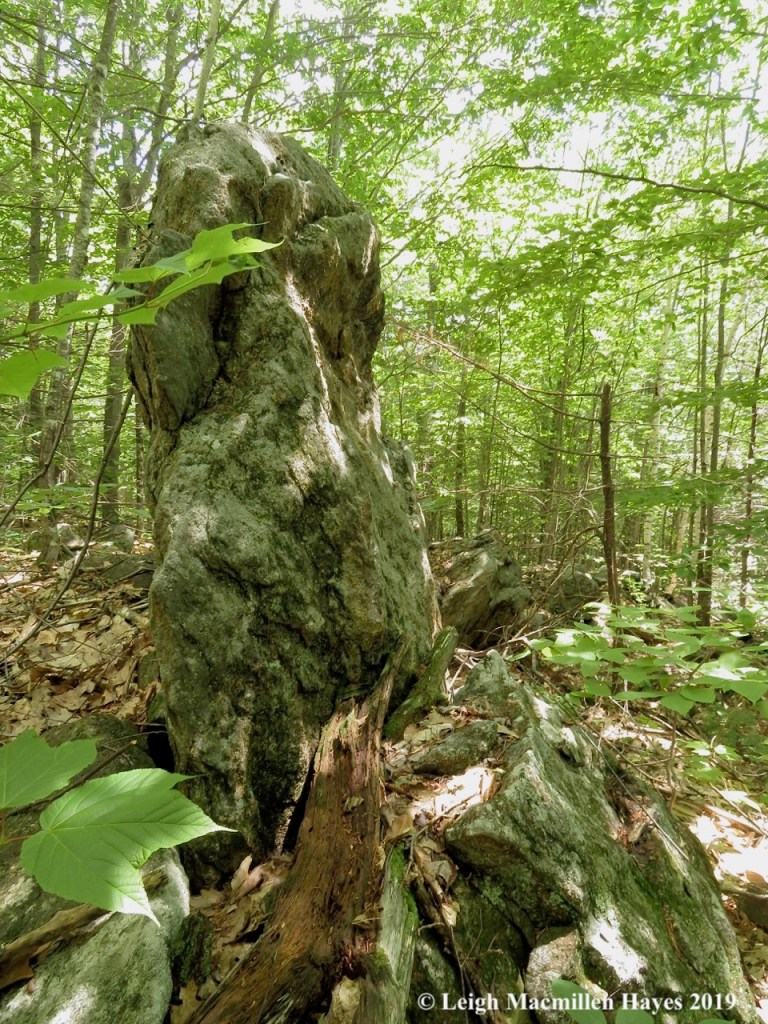
And then . . . and then . . . something the three of us hadn’t encountered before. A large, rather narrow boulder standing upright.

Behind it, smaller rocks supported its stance.

The stone marked the start of another stone wall. And across from it a second wall, as if a road or path ran between the two and Bob stood in their midst adding coordinates to his GPS.

We chuckled to think that the stone was the beginning of Amos’ driveway and he’d had Andrews written upon it. According to local lore, he had a bit of a curmudgeon reputation, so we couldn’t imagine him wanting people to stop by. The road downhill eventually petered out so we didn’t figure out its purpose. Yet.
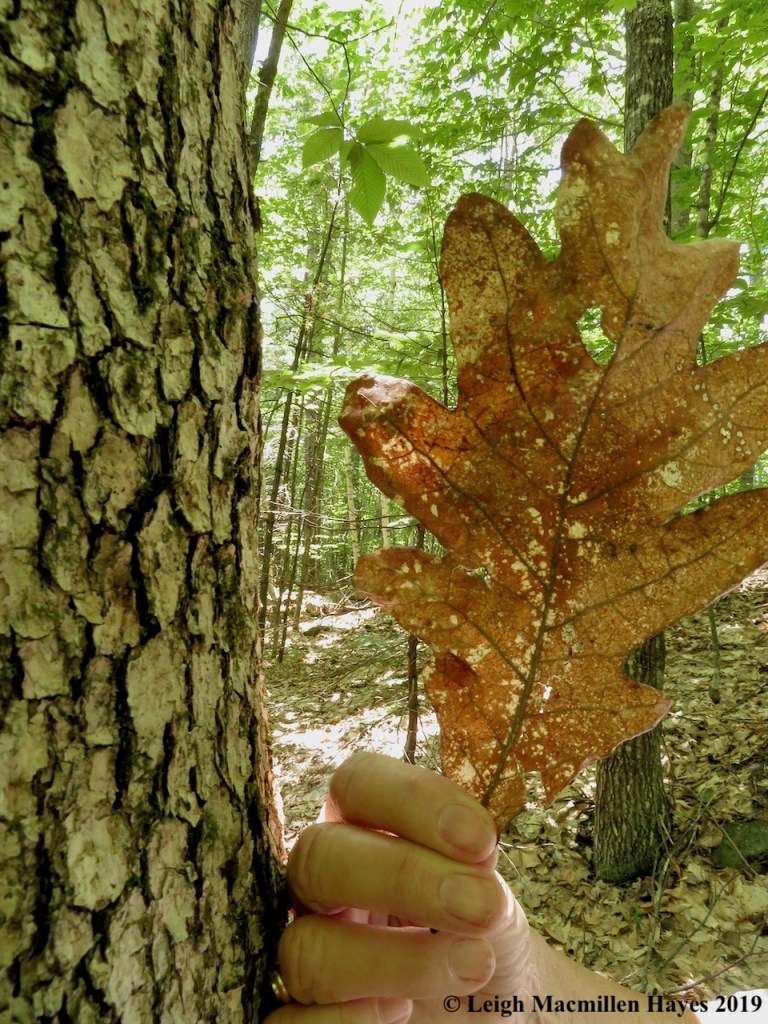
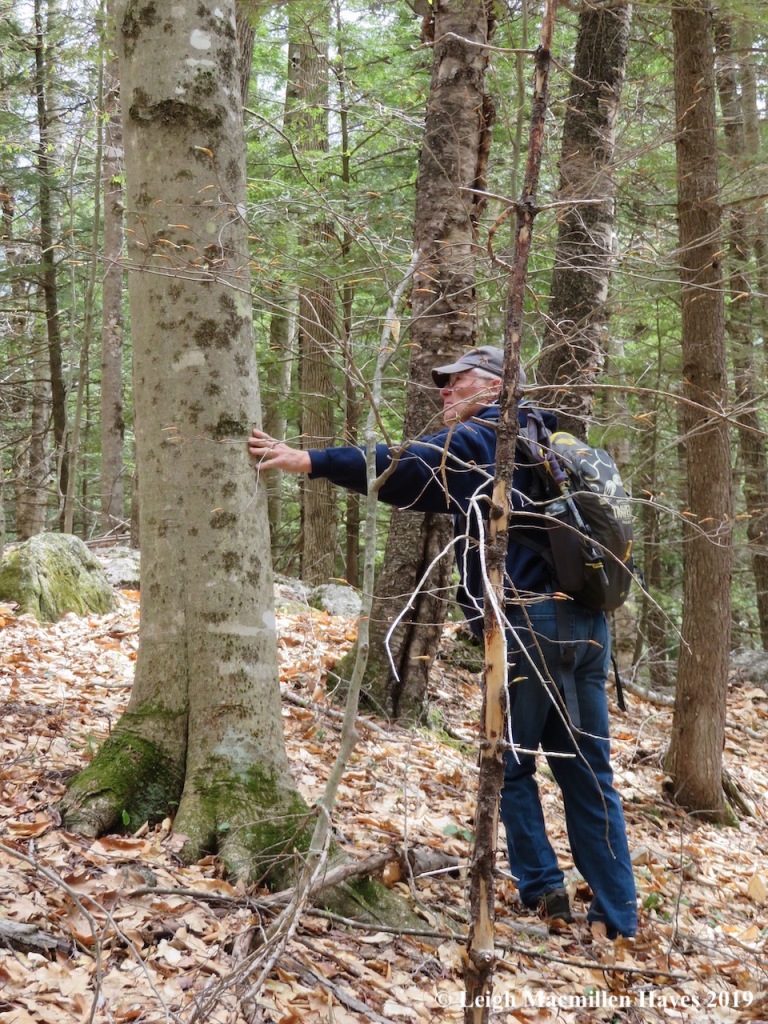
In the neighborhood we also found trees that excited us–for until ten months ago we didn’t think that any White Oaks existed in Lovell. But today we found one after another, much like the piles of stones. With the nickname “stave oak,” it made sense that they should be here since its wood was integral in making barrels and we know that such for products like rum were once built upon this property.

Trees of varying ages grow quite close to Amos Andrews’ homestead.

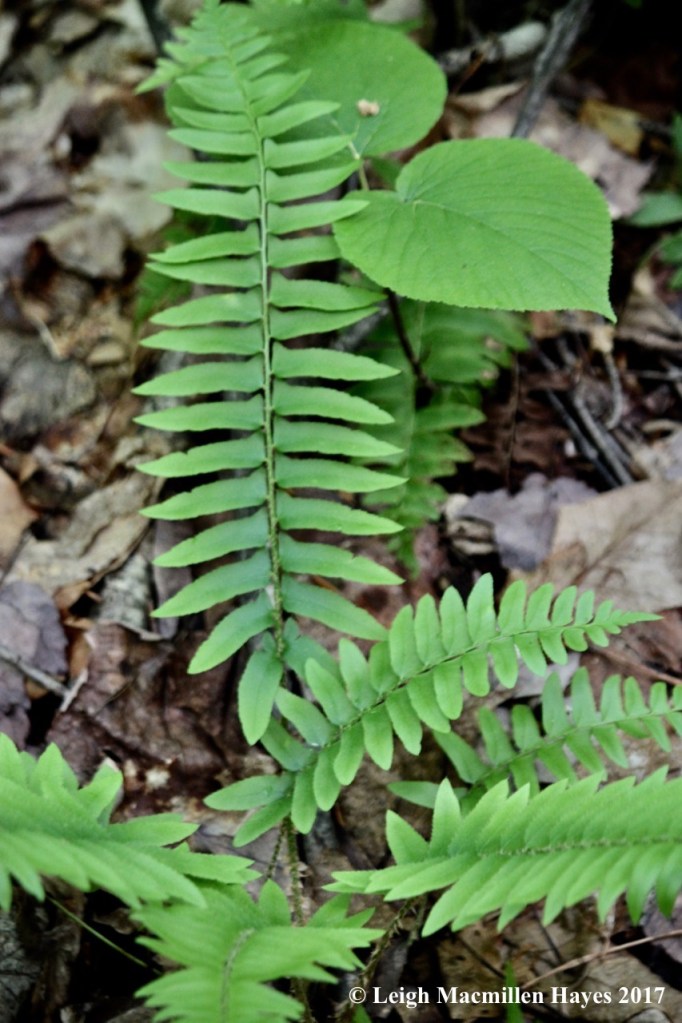
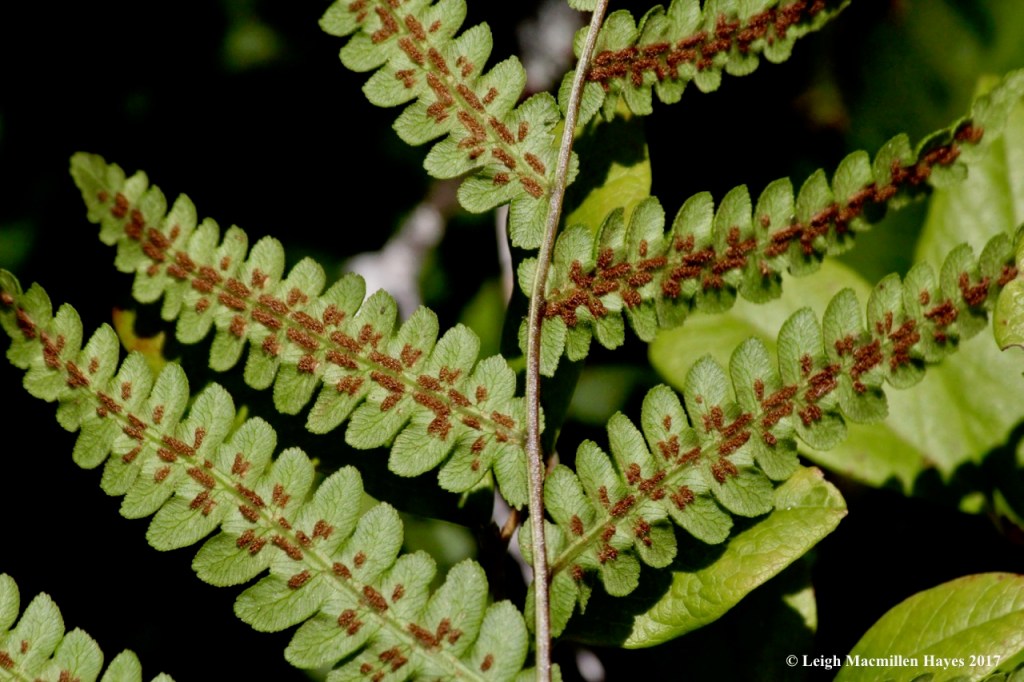
Also growing in the area was Marginal Wood Fern, its stipe or stalk below the blade covered with brown scales and fronds blue-green in color, which is often a give-away clue that it’s a wood fern.

We know how it got its name–for the round sori located on the margins of the underside of the pinnules or leaflets. Based on their grayish-blue color, they hadn’t yet matured. But why are some sori such as these covered with that smooth kidney-shaped indusium? What aren’t all sori on all ferns so covered?

So many questions. So many mysteries.

As curious as we are about the answers, I think we’ll be a wee bit disappointed if we are ever able to tell the complete story of the stone structure and the upright stone and all the walls between.

Walking among mysteries keeps us on our toes–forever asking questions and seeking answers.
Rookery and Beyond

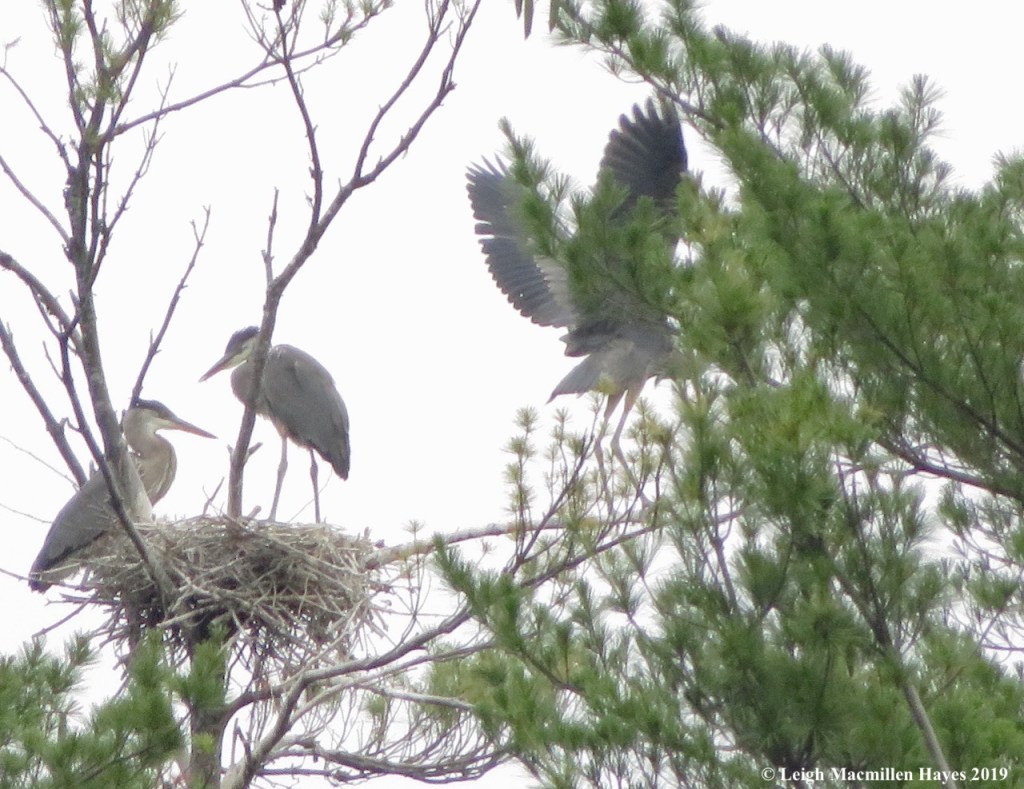
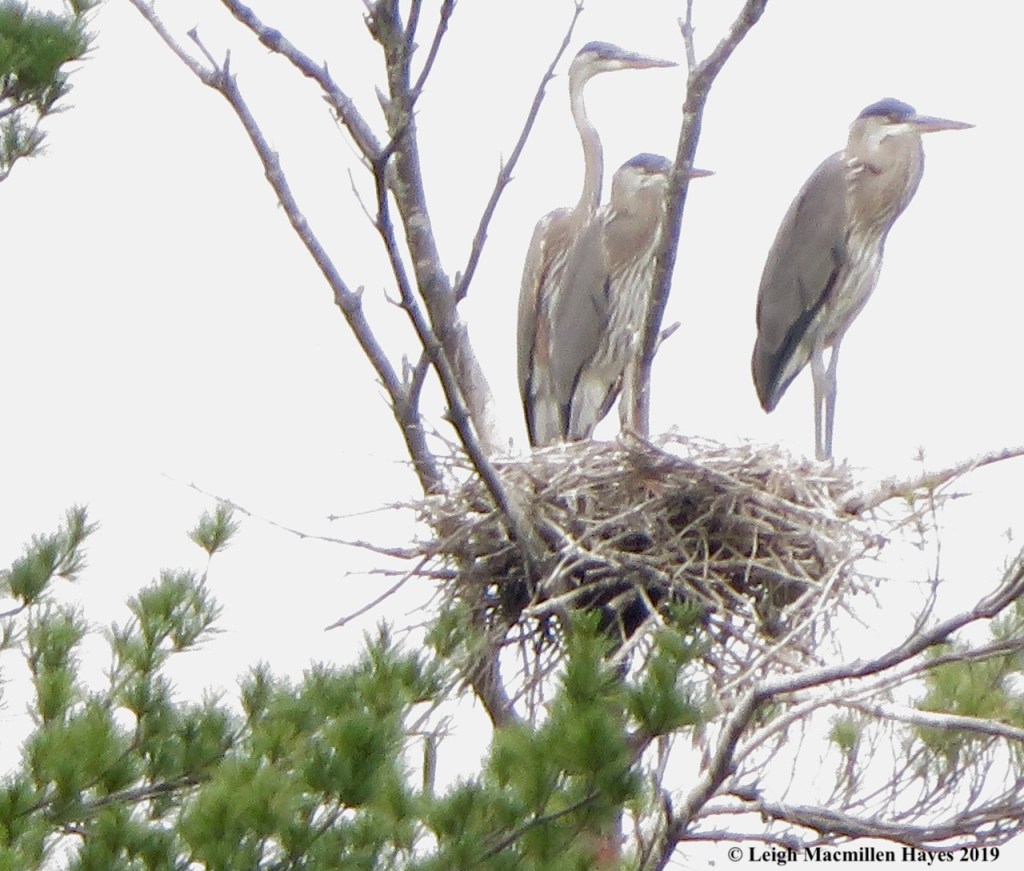
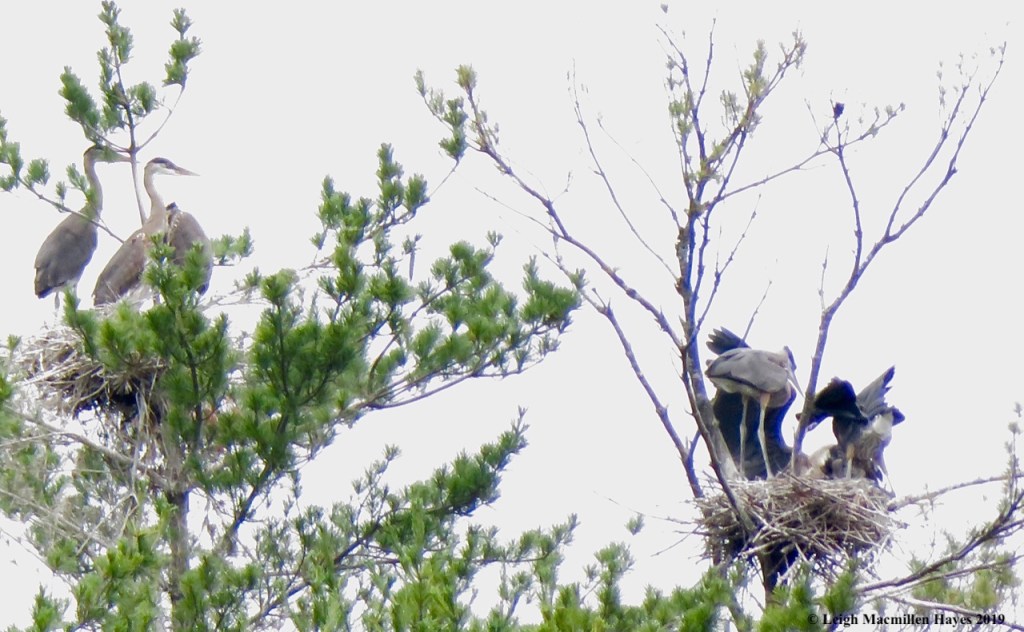
It’s a difficult sound to describe, rather primordial in nature. Maybe it’s a duck’s quack? Or a dog’s bark? Or some combination of the two. And yet, all is quiet and then the noise erupts suddenly from one nest as a parent flies in, a meal in the oven about to be regurgitated.

It’s a scene that plays out at individual nests for a while before all become quiet again as if lunch has ended and the kids should take time for a nap. But until such time, the neighbors in the high rise next door watch enviously as their playmates are fed.

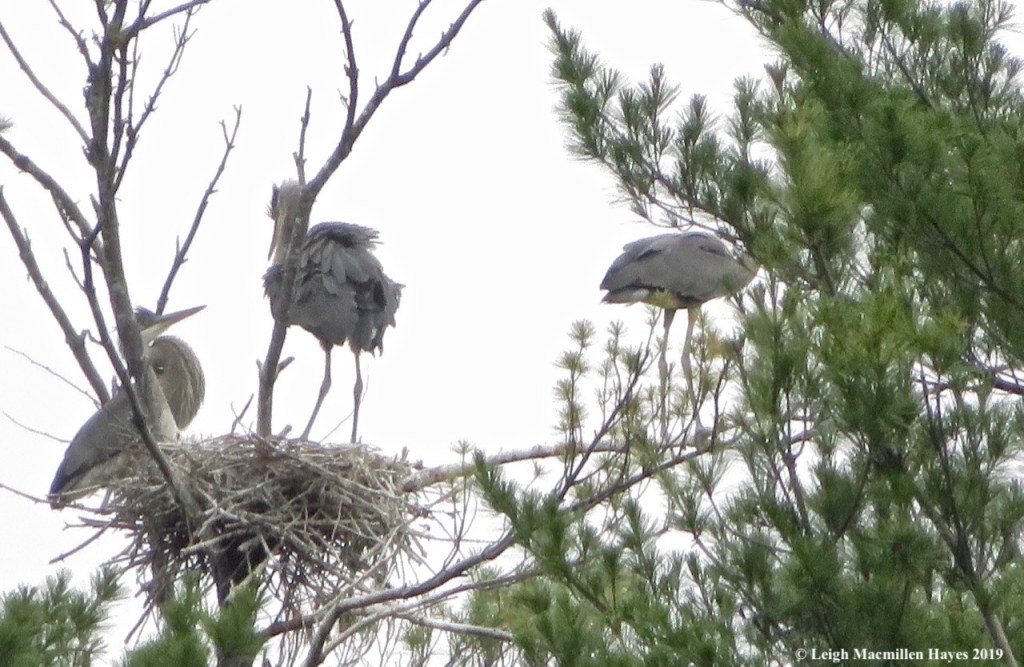
Just down the block one of the tweens, for suddenly after about a month of life they are such, flexes his wings as he stands out on a branch. It’s a tradition as old as time–tweens and teens going out on a limb to show their capability to survive in the world. The question remains, however: when will he reach the right age to get a license?

As the tween to the right finishes flexing, the one in the center lets a shiver pass through his body. Is it a pre-flex motion? His other sibling watches and wonders what it’s all about. Perhaps he’s trying to prove something?

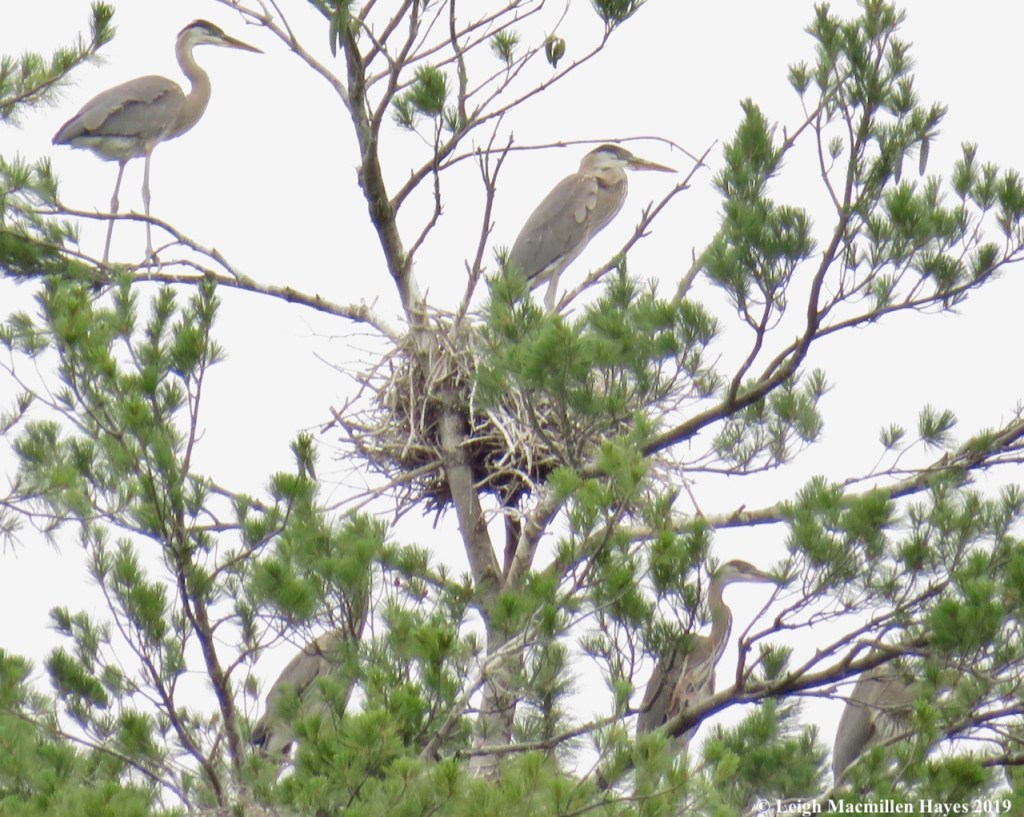
Meanwhile, because I stood beside a river with a friend so I could count Great Blue Heron nests, active nests, young, young in nests, fledglings, and adults, we also began to notice other life that surrounded us like a Kingbird who posed for moments on end.

Constantly, however, my eye was drawn to the tiptop of the White Pines, where I began to realize there were more and more birds than my first count because many were feeling their oats and testing their individuality.

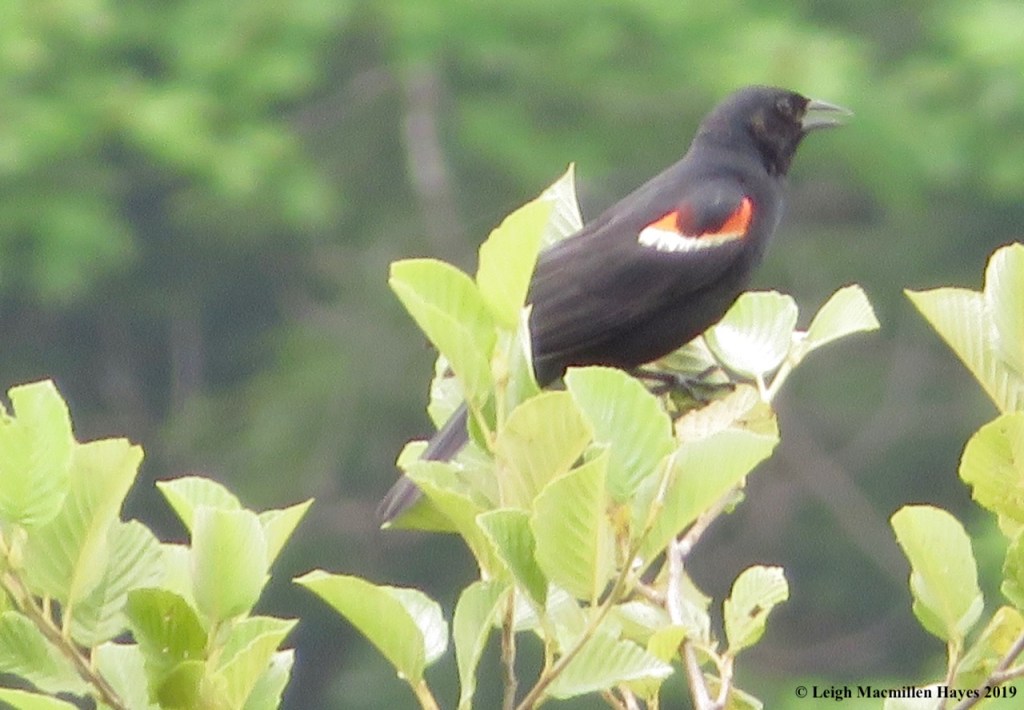
Other birds added to the rhythm as we listened for and shared with each other the location of the song makers in our midst.

And then, and then . . . a male Belted Kingfisher pause smack dab in front of us, his tuft of head feathers earning him the “Wicked Cool Dad” award in the neighborhood.

He looked right at us and made dorky dad comments that left us exclaiming with delight.

Meanwhile, back at the rookery, some of the tweens continued to wait in the most patient manner. They muttered hardly a word. We did have to wonder how such big birds could fit in those nest of twigs. The nests were large in bird terms, but the birds were even larger. At last it was time for us to depart, and we left the young in their quiet mode.

My journey continued on the other side of the river. It was there that I spotted Robber Flies in that age-old act of mating.

And a moth I believe to be known as a Virginian Tiger Moth or Woolybear Moth clinging.

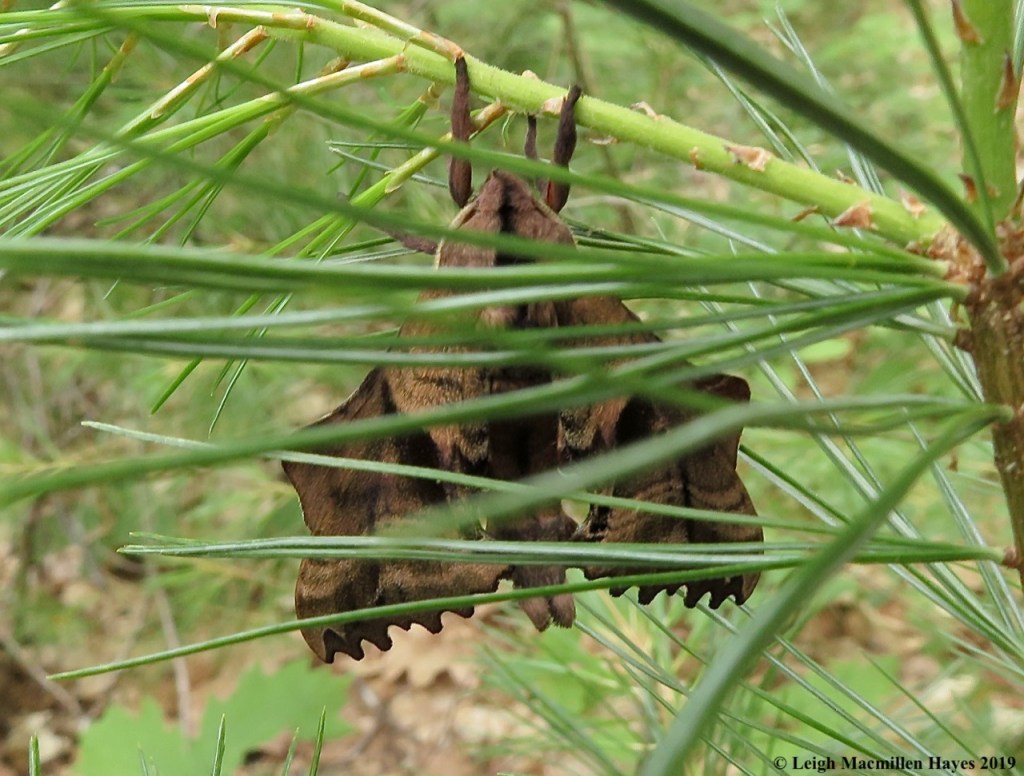
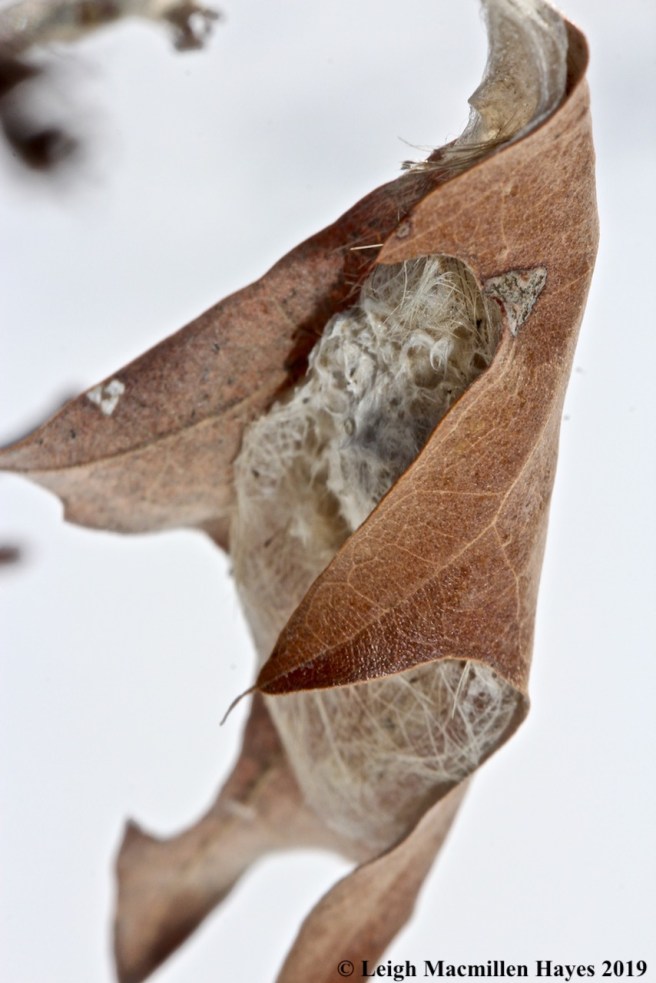
But perhaps my favorite of all, that I found because we chose today to check on the rookery, was the Sphinx moth holding onto a pine sapling. At first I thought it was a dead leaf caught on the twig.

Behold the wonder of the rookery and beyond.

Bear to Bear Possibilities: Puzzle Mountain

We got a later than normally late start to our hike today and didn’t arrive at the trailhead for Puzzle Mountain until 11:45 am. It’s a trail we’ve hiked only once before, but knew the chance to see trees with bear claw marks would be numerous.

The Mahoosuc Land Trust and Maine Appalachian Trail Club maintain the trails. Our starting/ending point were at the trailhead on Route 26 in Newry. The plan, should we wish to complete it, was to hike up the Grafton Loop Trail to the summit, then veer to the right and follow the Woodsum Spur Trail in a clockwise manner back to the GLT.

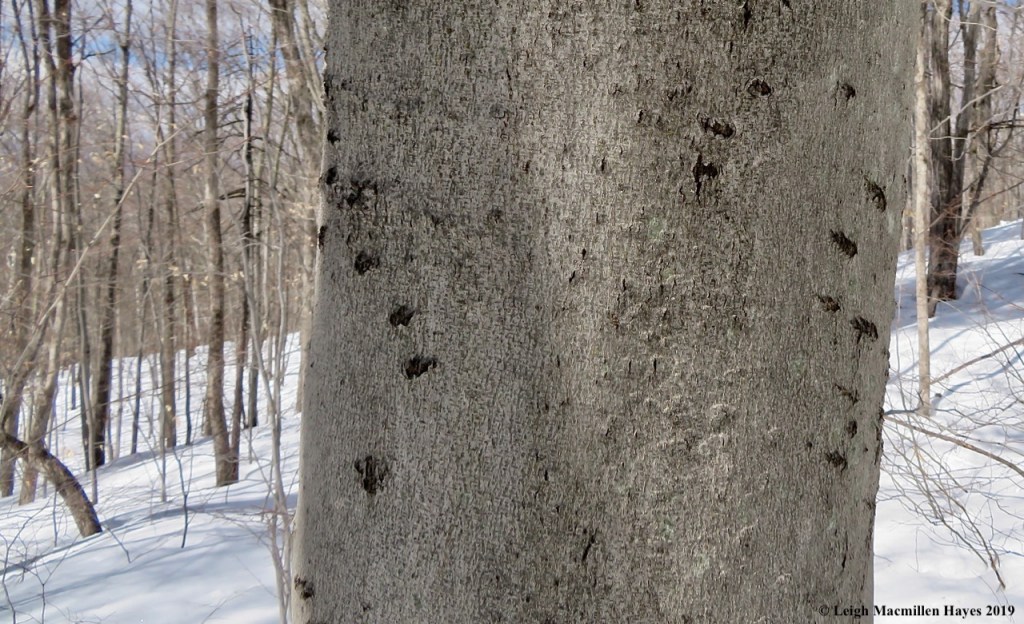
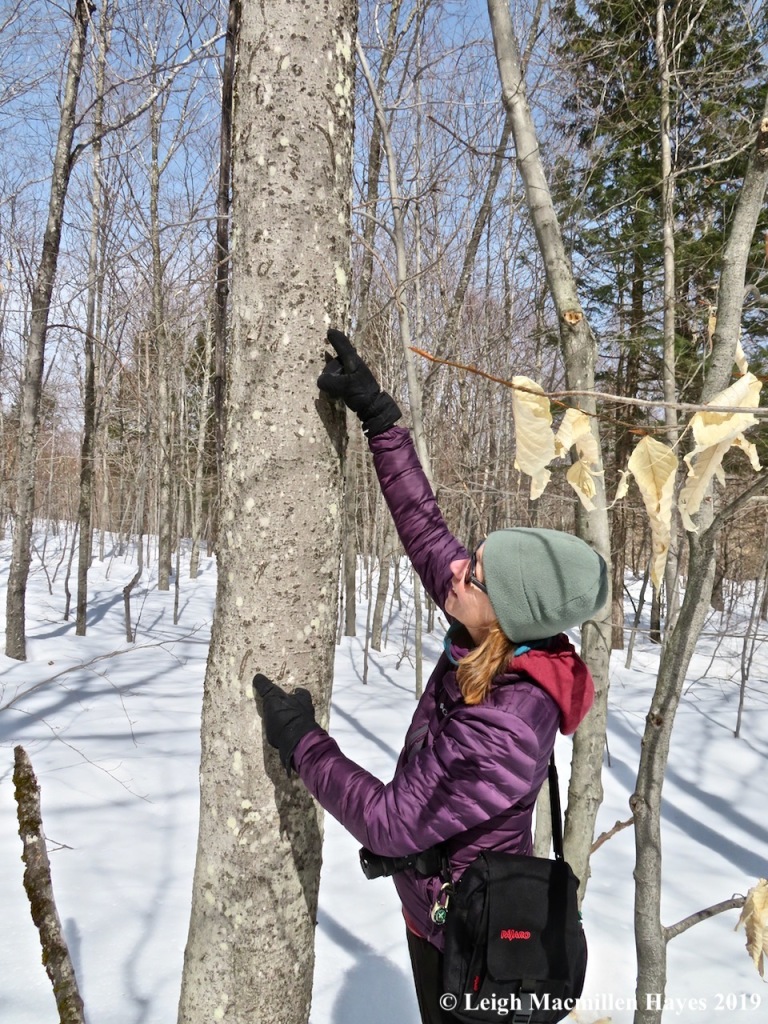
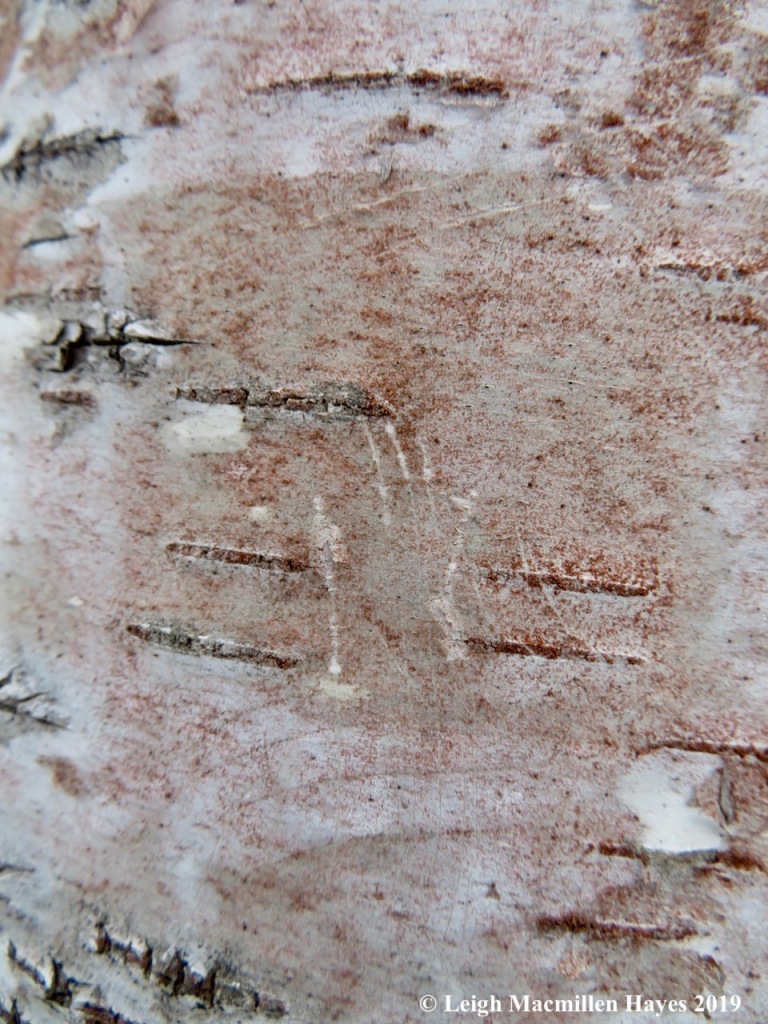
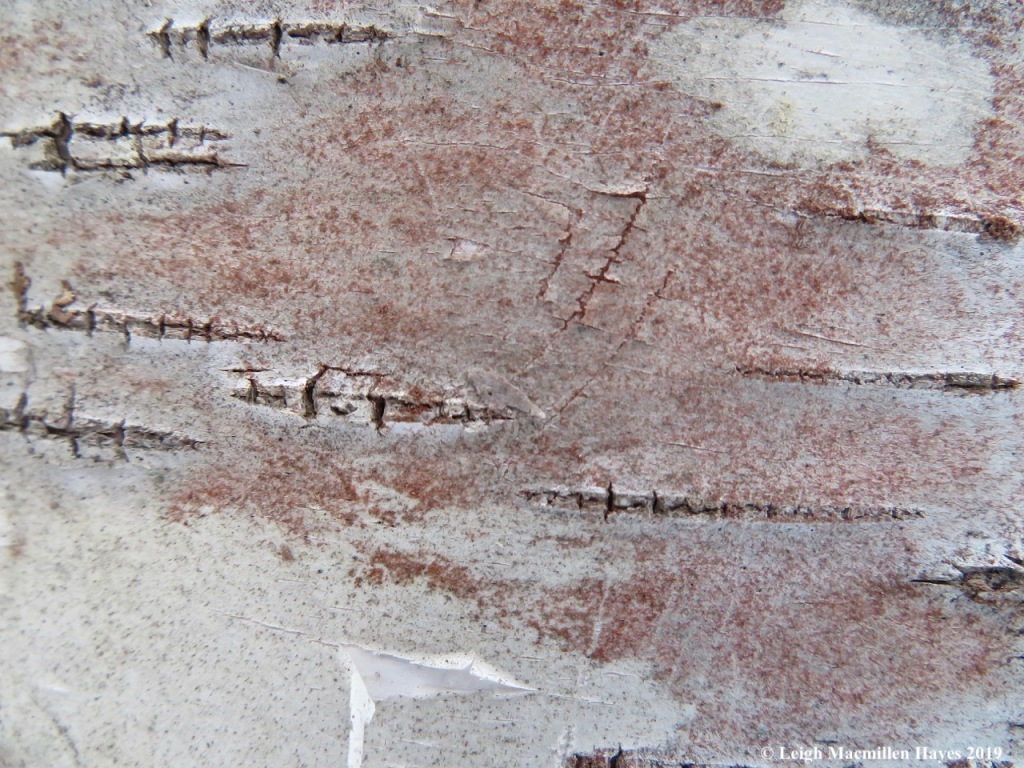
Our other plan to locate bear claw trees . . . was soon fulfilled. The first we spotted about twenty feet off trail, but once our eyes became accustomed to the pattern, we realized they were everywhere.

And some trees had been visited repeatedly.

A few had hosted other guests such as Pileated Woodpeckers.
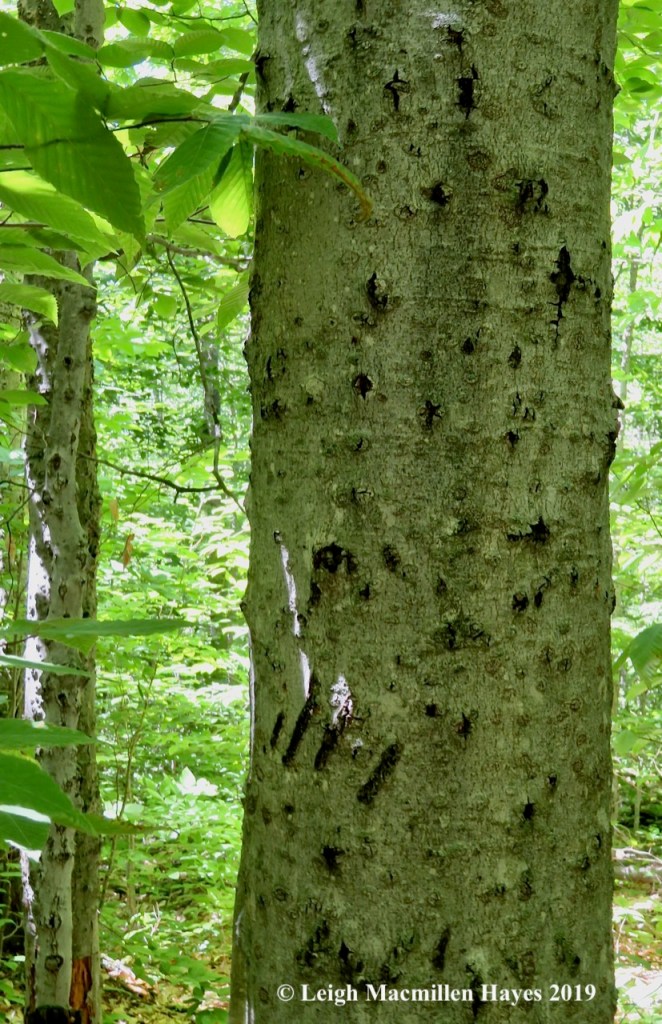
For about two miles, we traveled under the summer green leaves of a hardwood cathedral. And within such we noticed numerous bear claw tree both beside the trail and beyond.

Occasionally, we noted others worth mentioning such as spring ephemerals like False Solomon’s Seal that showed us the season on the slopes is a bit delayed as compared to our lower elevations.

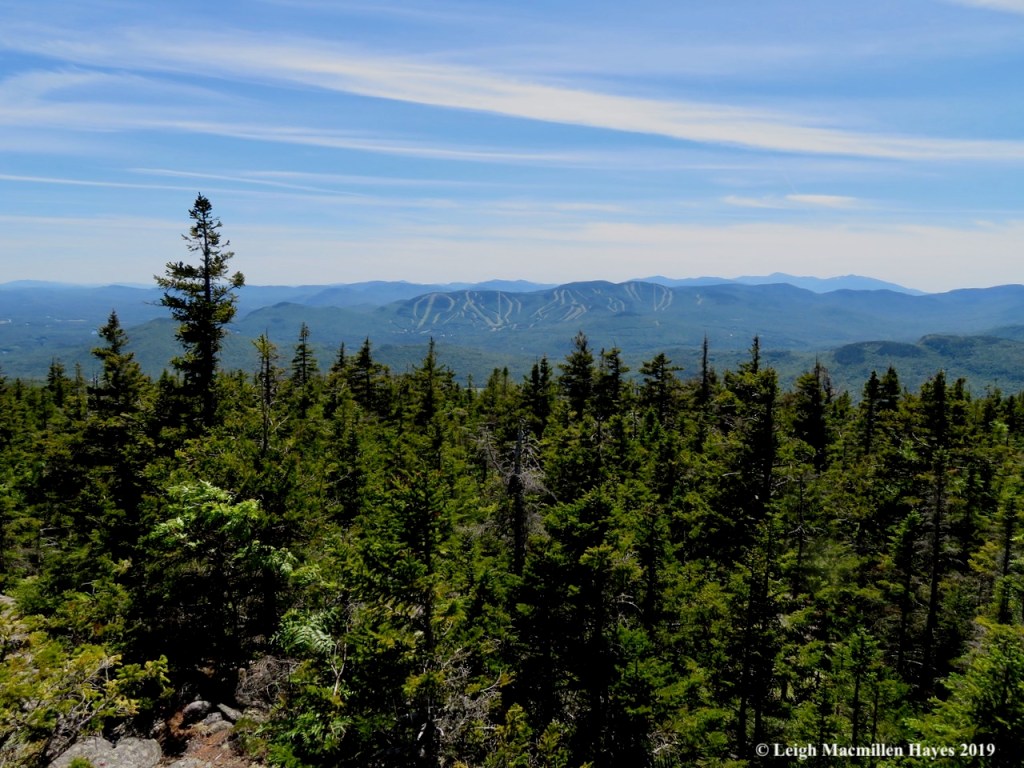
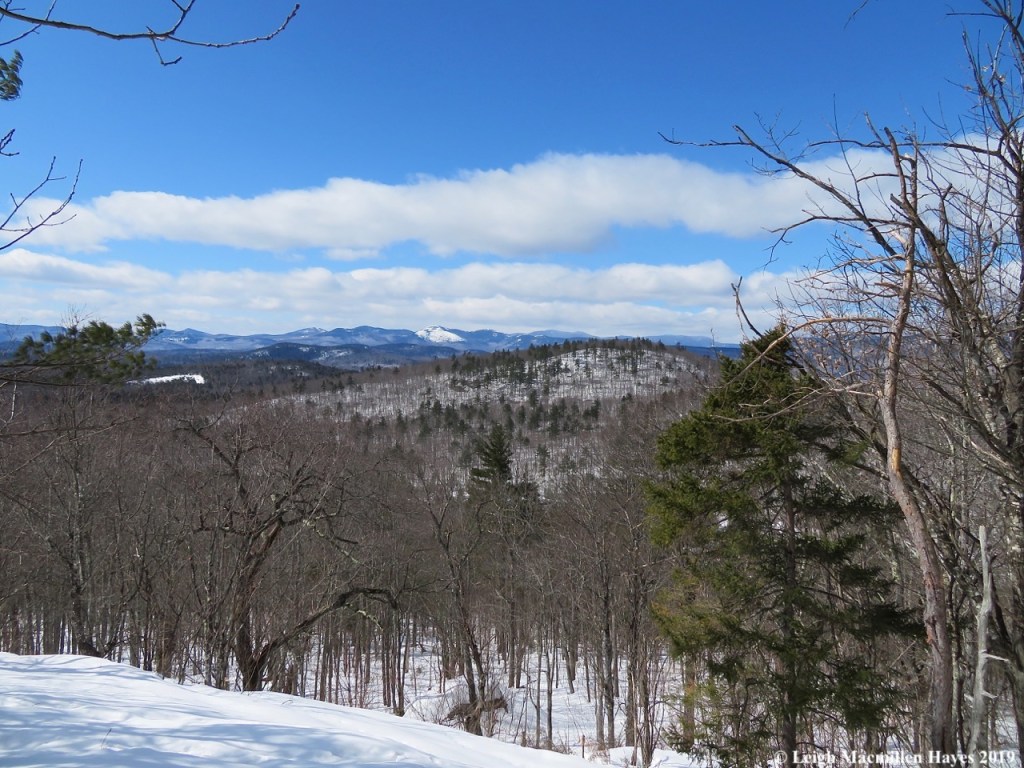
At last we reached a false summit where the views to the west enhanced the mountains and their natural communities, so defined by shades of green: darker defining conifers and lighter the deciduous trees.

Sunday River Ski Area was also part of the display.

It was at this ledge that we met two young men. They started up a trail behind us and then made their way back and asked us to take a photo. When we asked where they were from, the older of the two said he lived in a small town outside of New Haven, Connecticut. Being a Nutmegger by birth, (and in fact having been born in New Haven), my ears perked up.

“Where in Connecticut?” I asked.

“A small town called Wallingford,” he said.

“I grew up in North Branford (about 15 minutes or so from Wallingford),” I replied. “And have friends in Wallingford.”

Turns out he’s a teacher at Choate-Rosemary Hall, a private school. And his hiking partner was his nephew from New Jersey. They were on their first day of a multi-day backpack expedition.

I took photos for both and then we sent them on the right path, which was behind their first choice. We paused before following them as we didn’t want to be on their tail, but heard the older of the two exclaim, “Wow, that was fortuitous. If we hadn’t gone back for a photo, we wouldn’t have known where the trail was.” We didn’t have any treats to give them as trail angels do, but perhaps our gift of direction was just as important.

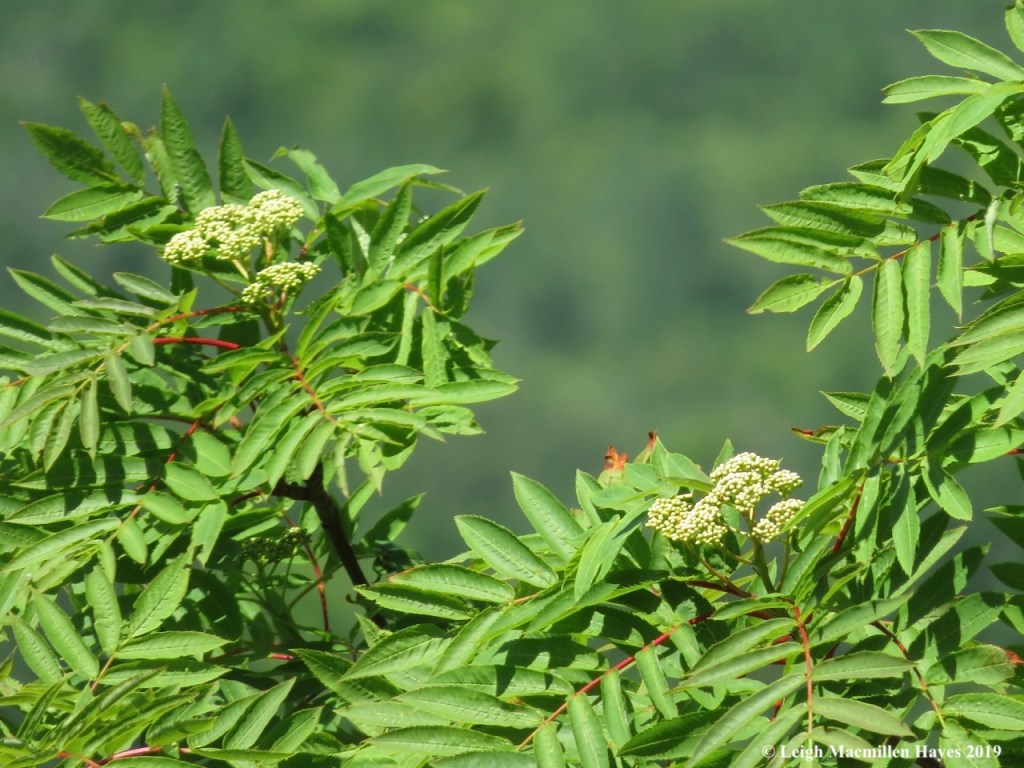
While we waited, I honed in on the newly formed flowers of Mountain Ash. I love these trees for the red stems of their leaves and fruits to come.

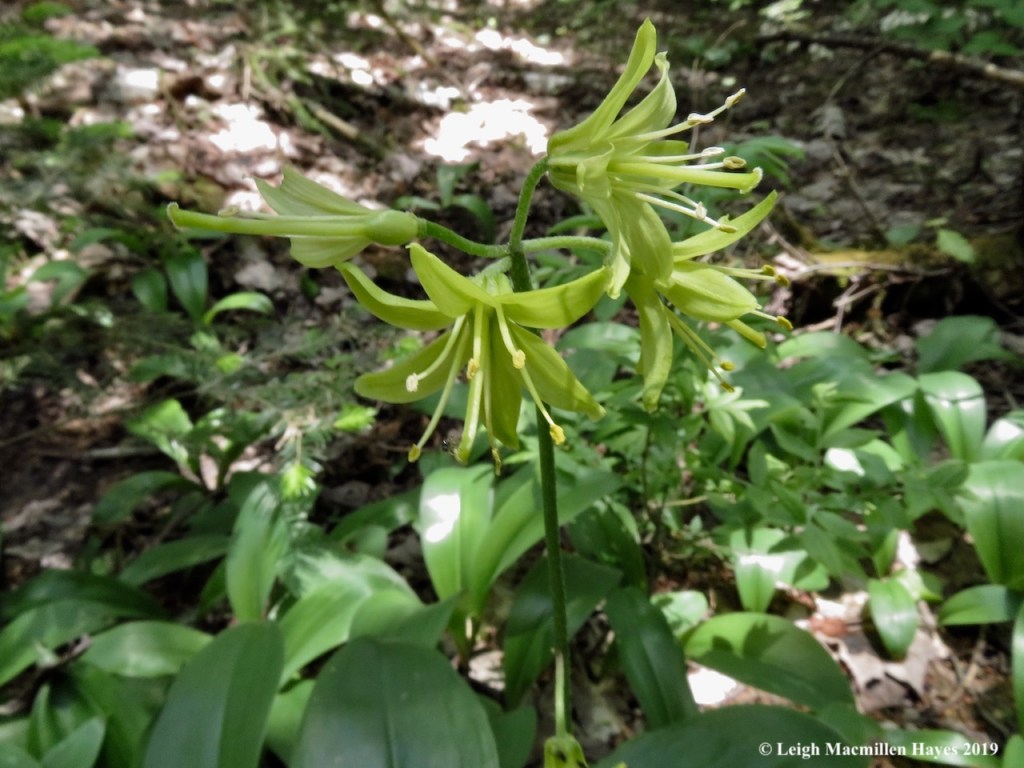
At last we began the push to the summit, but I had to pause much to my guy’s dismay for the black flies swarmed us constantly. I discovered, however, one reason to celebrate them–besides the fact that they feed birds and members of the Odonata family. I do believe they pollinate Clintonia for we found them on the anthers of those in flower.

Not long after the false summit that the two guys we’d met thought was the top, we reached the junction with the Woodsum Spur Trail. Our plan was to continue to climb and then locate the other end of the spur to follow down from the top. It would take longer, we knew, but be a wee bit gentler in presentation. A wee bit.

As we continued up, another ledge presented a view of Sunday River and so my guy took a photo and sent a text message to our youngest son, who works in Manhattan, and lives in Brooklyn with two buddies he meet while skiing at Sunday River when they were all in high school.

Onward and upward, the conifer cones added a bit of color to the view.

And then we reached a cairn just below the summit. Mind you, the Black Flies were so incredibly thick that we could barely talk without devouring a few. In fact, we gave thanks for eating our lunch much lower on the trail, but even then we’d devoured PB&J with a side of BF.

The view, however, was one to be envied and as long as the wind blew, we could enjoy it in all its panoramic glory.

Again we spied Sunday River. But what always makes me wonder is the tallest tree in the forest. What makes it stand out?

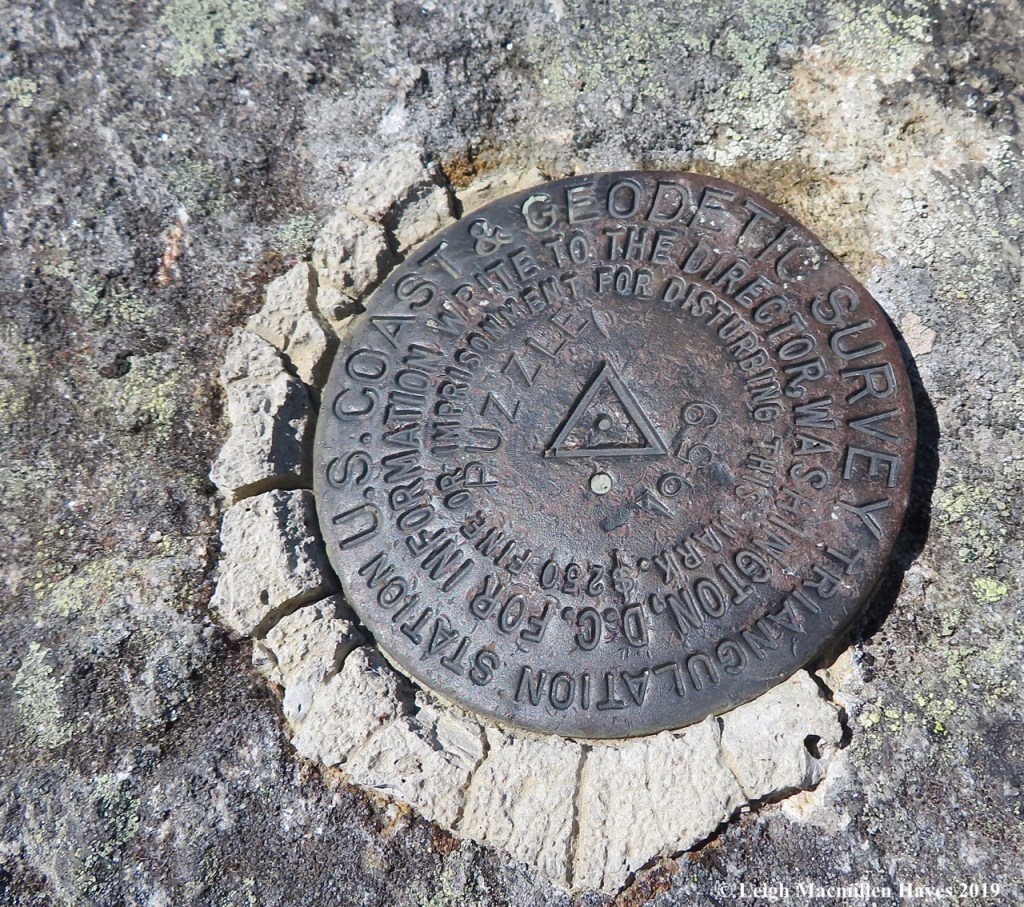
Still, we weren’t quite at the tippy top and had a few more feet of granite to conquer.

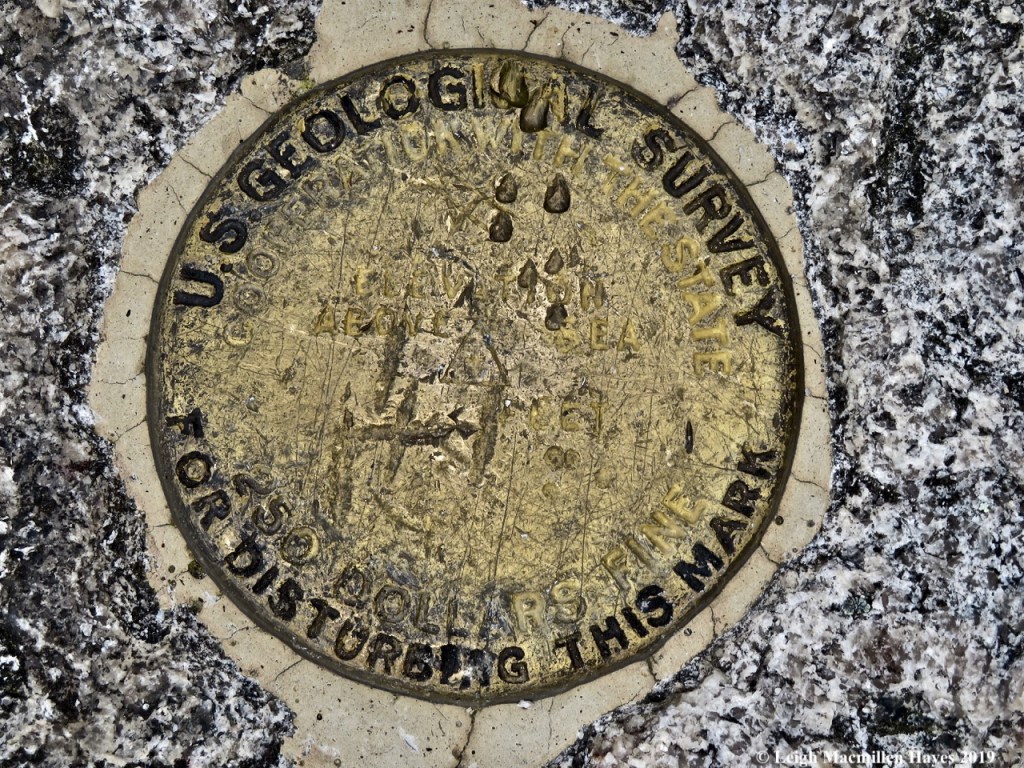
There we found the second of two survey markers. Why two? That was puzzling.

Equally puzzling as had happened to us before, where did the trail go?

From past experience we knew that the descent wasn’t all that well marked, but we found it much more quickly today than in the past. And we made sure to point it out to our fellow hikers from CT, whom we’d somehow passed on our final ascent. Our hope for them is that they made it to the shelter on the GLT where they planned to spend the night and that they were well prepared for the bugs. As we left them at the summit, they looked a bit like deer in headlights.
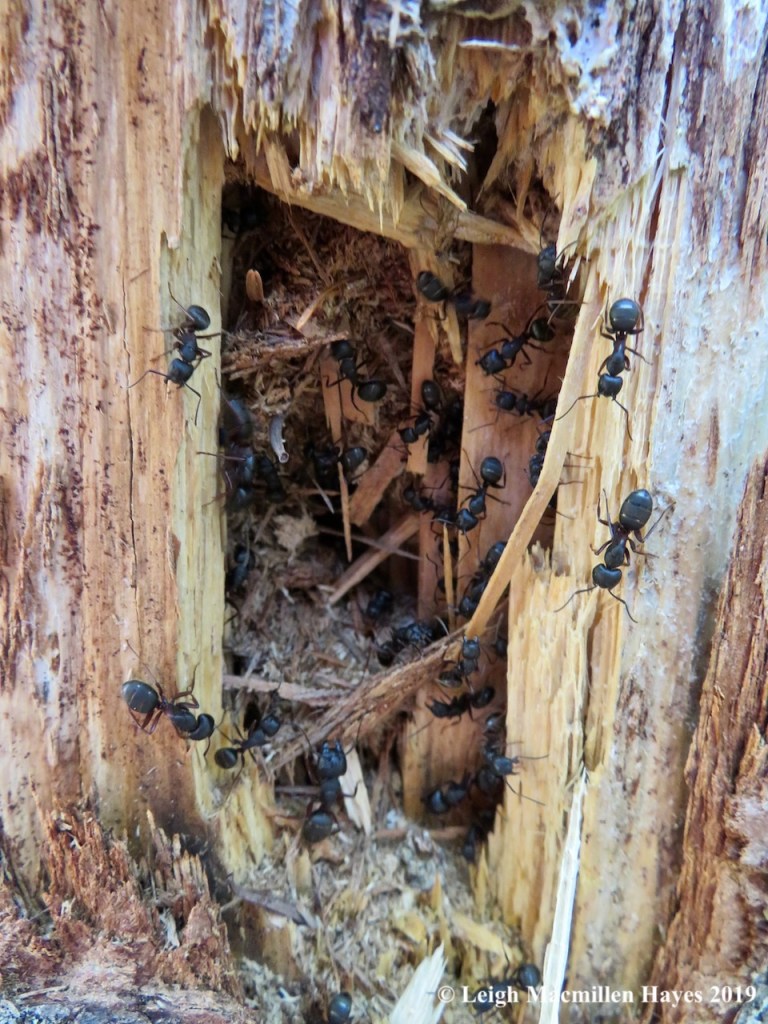
The descent via the Woodsum Spur is as varied as the ascent, but not always as easy to follow. There were downed trees, overgrown sections, lots of mud, and times when we had to search for the trail, much unlike the carpenter ants who knew exactly where they were going on a tree snag.

We passed through one section that reminded my guy of the Munchkins in the The Wizard of Oz, his favorite movie. Just after that we entered an enchanted forest where the giant in my fairy tale, The Giant’s Shower, could have lived happily every after with Falda the fairy.

It was ledges to woods and back to ledges as we descended. But the mileage was questionable for the signs we encountered that indicated distance didn’t necessarily agree.

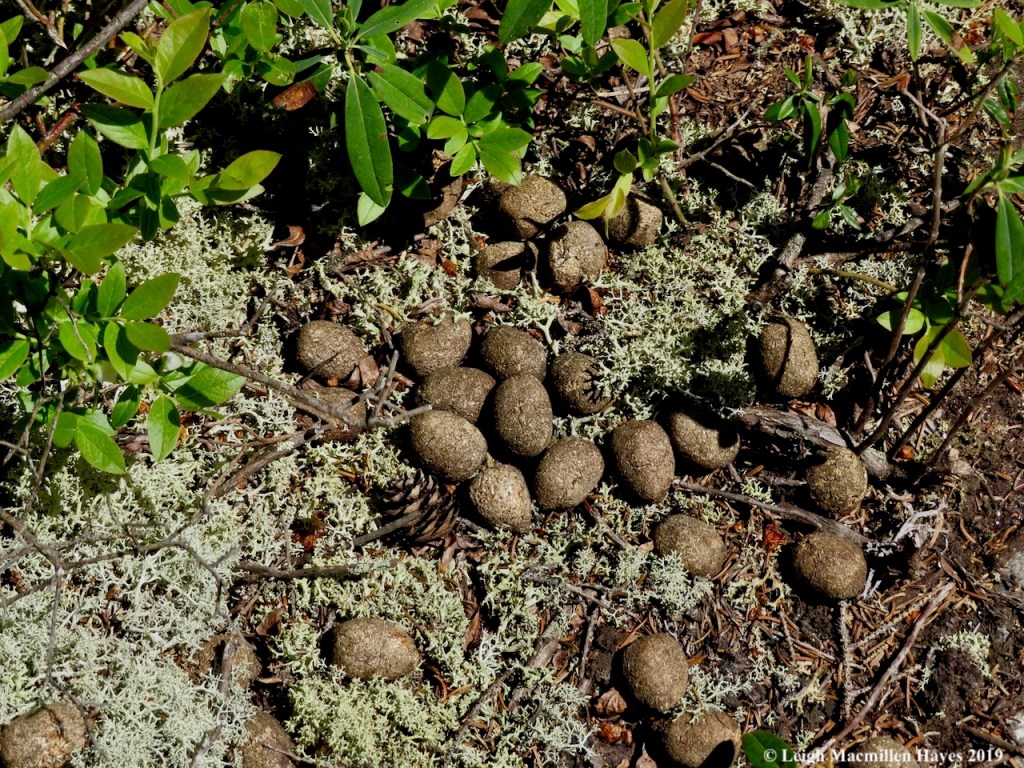
What did agree with the Woodsum Trail was a moose or two or three. For much of the trail we spotted scat indicating they’d traveled this way all winter.

It was natural signs like that which we most appreciated, but . . . once we finished the spur trail and rejoined the GLT, we spotted a boulder filled with messages we’d missed upon our ascent. You might be put out that some left messages in the moss, but as Ralph Pope, author of Mosses, Liverworts and Hornworts, told us on a Greater Lovell Land Trust walk in 2017, this sort of activity won’t hurt the bryophytes.

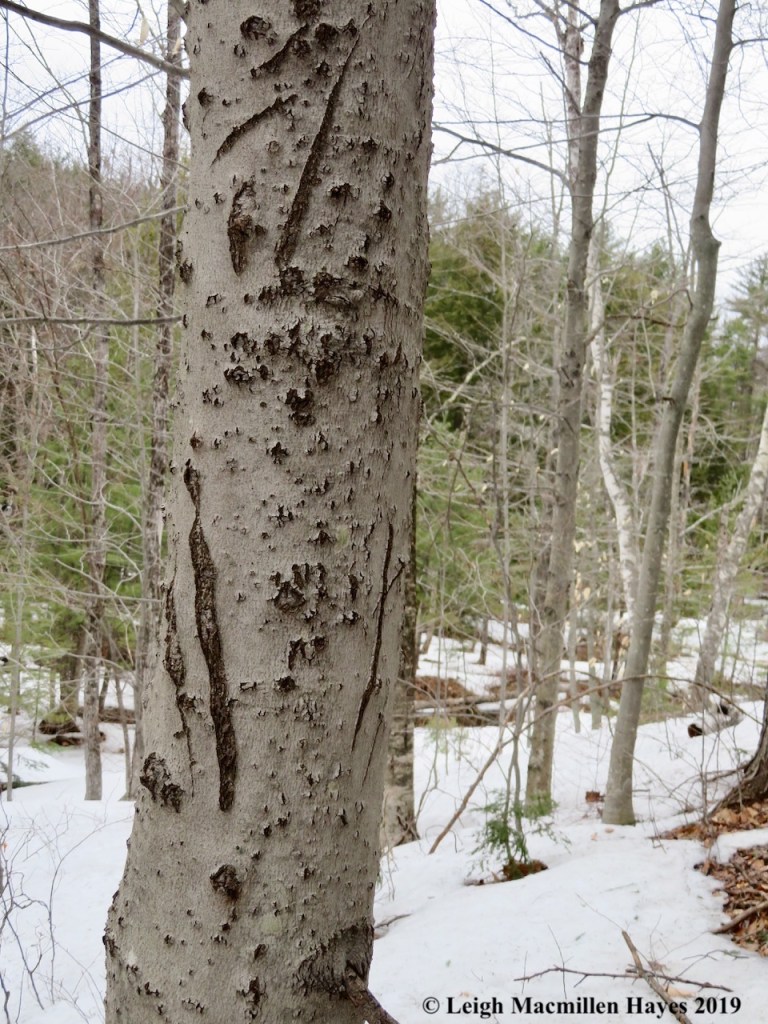
When humans leave their initials upon beech trees, however, it does affect them. And I suppose the bear claw marks do as well, but still we are thrilled each time we spy the latter.

Our plan had been to stop for a beer on the way home and make this a Bear to Beer Possibility. But we were pooped for we hiked almost nine miles on a hot summer day and knew if we stopped we might not be able to drive home.

As it happened, driving south on Routes 5/35 and just before the intersection with Vernon Street, a Black Bear ran across the road. For us, it will be another in our shared minds’ eye as I couldn’t take a photo.

Thus today’s hike was a Bear to Bear rather than Bear to Beer Possibility.

Lake Living magazine: Summer 2019

I’m always excited to share the latest issue of Lake Living magazine with you. Here ’tis: https://issuu.com/lakelivingmaine/docs/ll.summer.19.web

As Laurie comments in her editor’s note, a theme emerged while we brainstormed article ideas. You’ll have to read this from cover to cover to get the full effect.

My first contribution: “The Maine Event” about four local wedding or retreat venues–each one with a unique twist. Even if you aren’t planning a grand event, it’s still fun to peek into the places and meet the people who make the magic magical.

A second contribution: “Summer Living,” which is a listing of what’s happening in the lakes region of Maine this summer. There are several shout-outs throughout this section, including one for our local land trusts and LEA as we collaborate to bring history alive through a series of walks along our trails.

And my final contribution: “You Get What You Give.” This is probably my favorite for this issue because, well, I won’t tell you why. You have to read it. And figure out. Let’s just say I was completely moved by the experience.

Laurie has written about a new venture for a young couple in “A Passion for Play,” cuze Becca and Scott, plus their son Parker, do love to do that. Especially on our lakes and ponds, as well as mountains.

She also wrote about a local farmer who does more than that–something about music and feet in “Geof’s Farm Pedals.” Another gotta read.

And her final piece is about Cannabased Wellness, aka “The Back Room at Nectar.”

Then there are the book reviews a la Justin, Pam, Sue, and Perri of Bridgton Books.

Plus all the colorful ads. If you do live locally, please let the advertisers know that you saw their ad in Lake Living. It helps with ad sales, which are key because the magazine is free to you.

Finally, I just LOVE the cover–thanks to Mary Jewett’s fine photography. It makes me grin every time I look at it.

Lake Living magazine: Summer 2019 is upon us now. ;-)

Bear to Beer: Rumford Whitecap on Memorial Day

It had been a couple of years since we’d hiked Rumford Whitecap together. As we drove north we recalled summer, fall and winter adventures on the loop trail, but never spring. And so today, we rectified that.

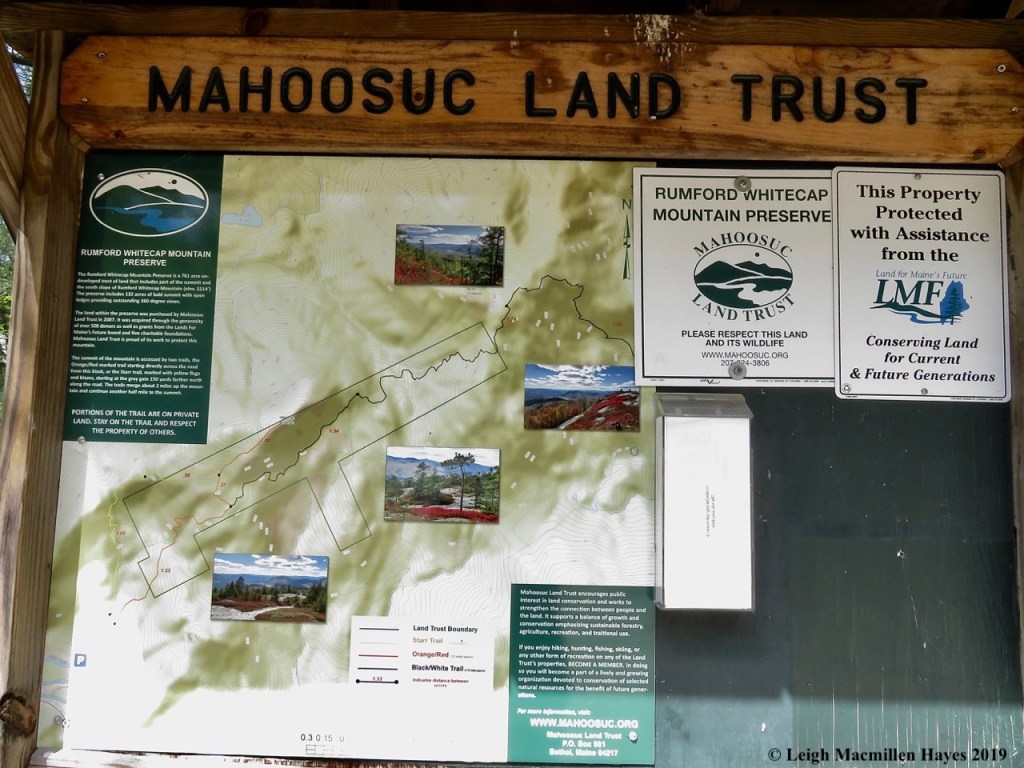
The 761-acre Rumford Whitecap Mountain Preserve was purchased by the Mahoosuc Land Trust in 2007. Our preferred route is to hike up the Orange/Red Trail and descend via the Starr Trail denoted by yellow blazes.

As we ascended, we chatted about our relatives and friends who had and do serve in the Armed Forces, including grandparents, dads, uncles, my brother-in-law, cousins, friends, and classmates.

Memorial Day was always special in our home growing up as my hometown celebrated with a parade that sometimes featured my siblings, neighbors, and me. Before it became a Monday holiday, it was celebrated the day before my mom’s birthday, so we always noted that the parade was held in her honor. And furthermore, her younger brother died in WWII, so it was a celebration of his service and life. I noted today that I only have known him all these years through photographs of a handsome young man, and stories of his youthful adventures.

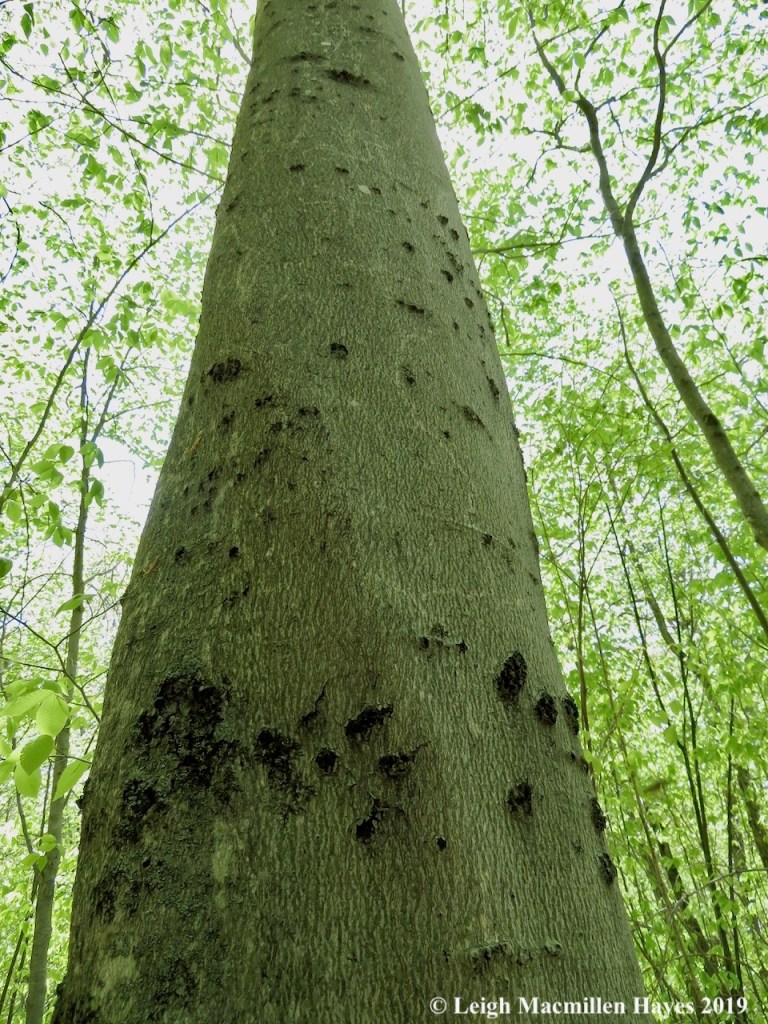
Because we were chatting and spending much of our time looking at the ground to avoid tripping on rocks or roots, the trail passed quickly under our feet. Suddenly, I realized we were in an area of mature American Beech trees and so I started to search the bark on our never ending quest of bear claw marks. Two seconds later and bingo–I spotted one tree with a couple and then together we found another with many scars made by the bear’s long, sharp claws.

Some were older than others, and it appeared that during the mast beechnut year we had two and three years ago, this tree had been climbed several times.

We felt instant satisfaction for our efforts and continued to look as we followed the trail to the summit. But . . . we never found another.

That was okay as there was much more to see including the fluttering petals of Serviceberry or Eastern Shadbush, a shrub that loves the understory. According to Dr. Michael L. Cline’s Shrubs of the Northern New England Forest, the names Serviceberry and Shadbush “refers to early flowering corresponding to the time that those departed in winter could be interred and when anadromous shad returned to major rivers in spring.”

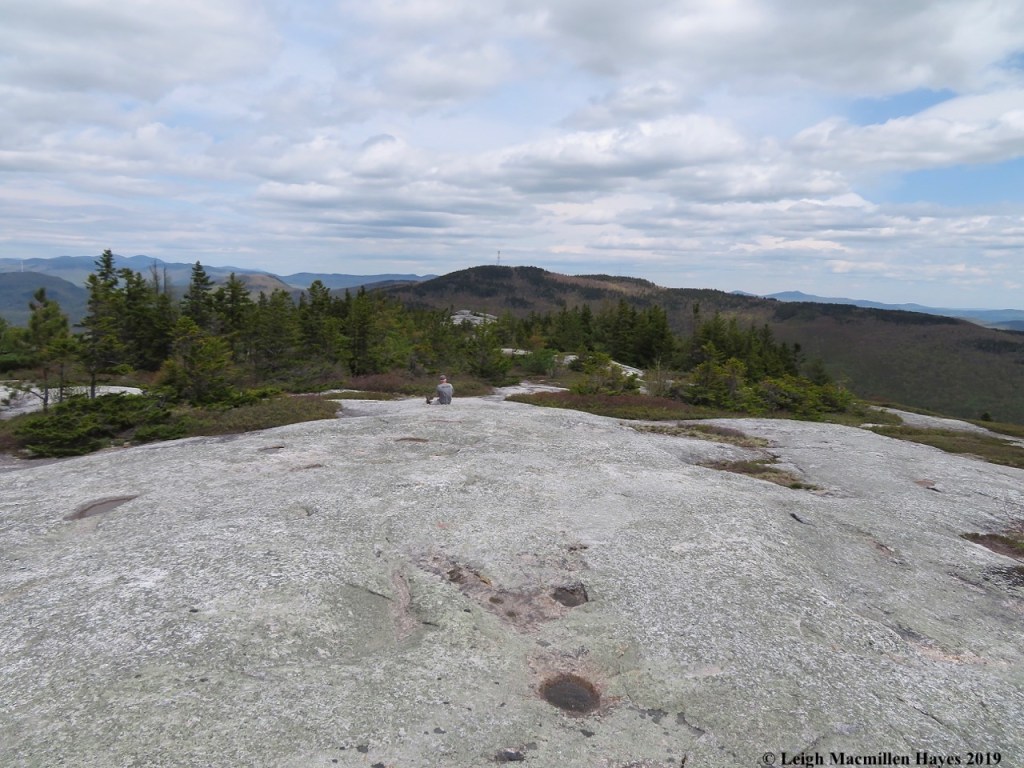
The natural community changes several times on this mountain, like many, and eventually it thins into a bald with islands of lichens, Black Crowberry, Alpine Bilberry, Lowbush Blueberry, Leatherleaf, Sheep Laurel, and . . . Red Pines. The summit is host to one of the largest Red Pine communities in the state–some dwarfed by the wind that flows across the granite daily.

Others standing tall in their military stature.

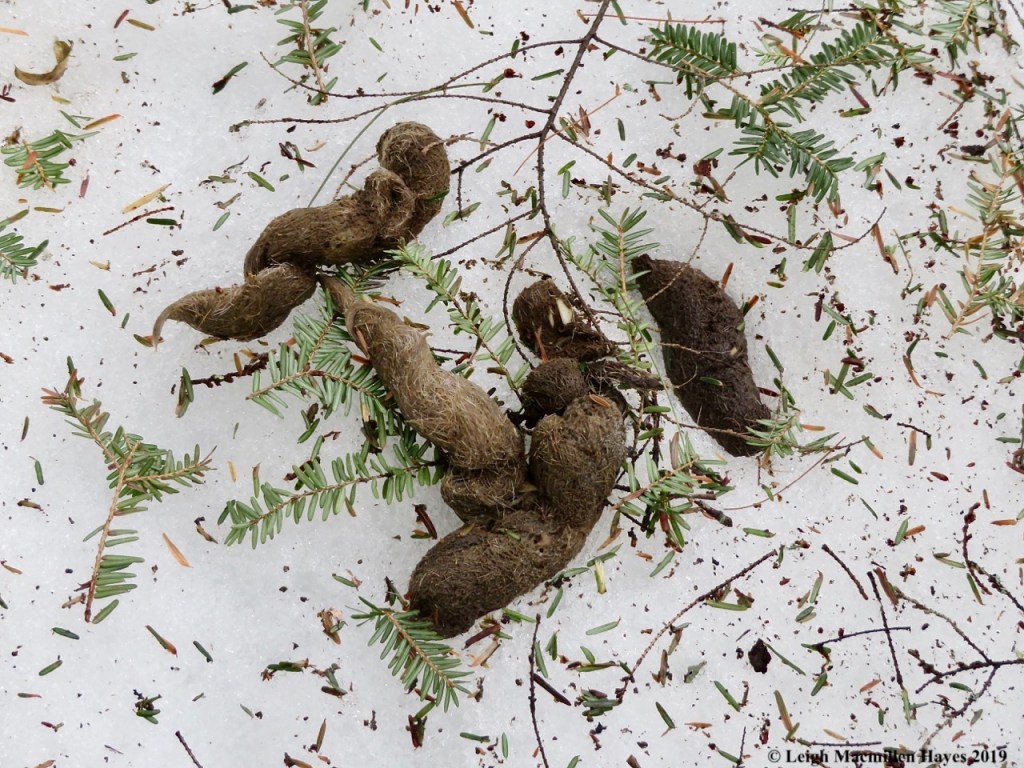
The wind was welcome as we continued up the granite pegmatite, and then a deposit appeared before our eyes and we knew we were indeed in the right place for this Mondate–Black Bear scat. By its color and texture, it was obvious that Ursus americanus had dined on the organ meat of a hairy critter. Too much information, I’m sure, but consider the wildness of it all.

Given all the blueberry blossoms, we suspect Ursus will return. Be ye forewarned.

At the summit, it’s always fun to find a survey monument-–the bronze disks used by surveyors since 1879 for mapping purposes.

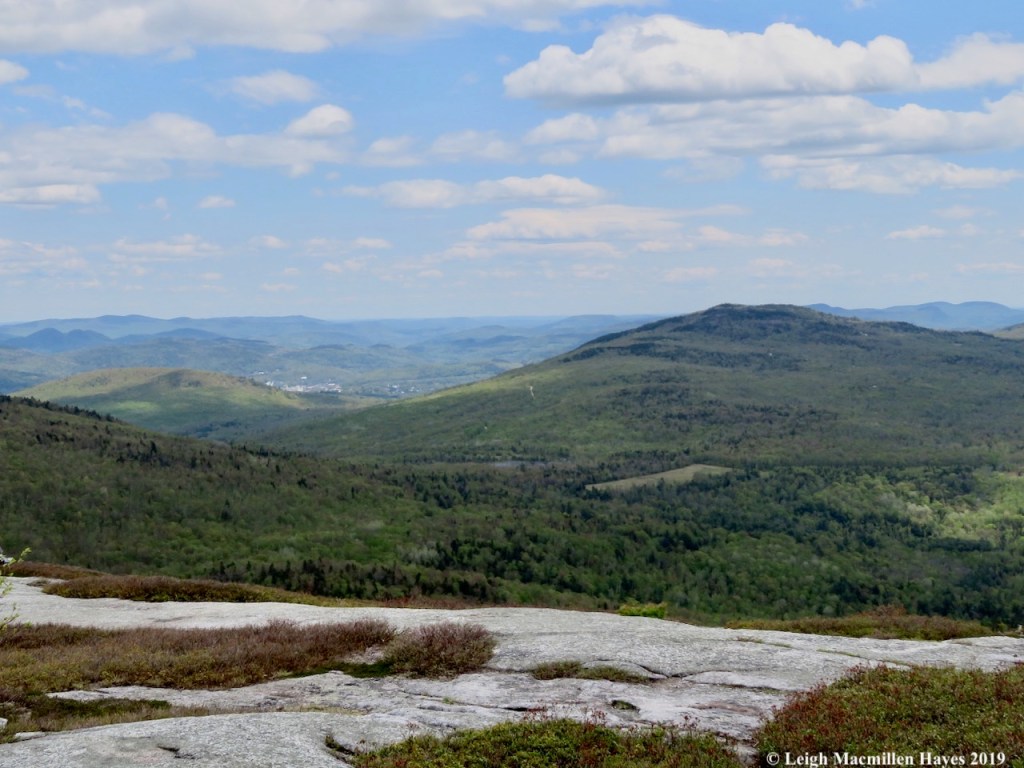
From there (lunch rock–why does PB&J always taste so good when one hikes?) we took in the view toward Black Mountain in the near beyond,

Rumford in the valley below,

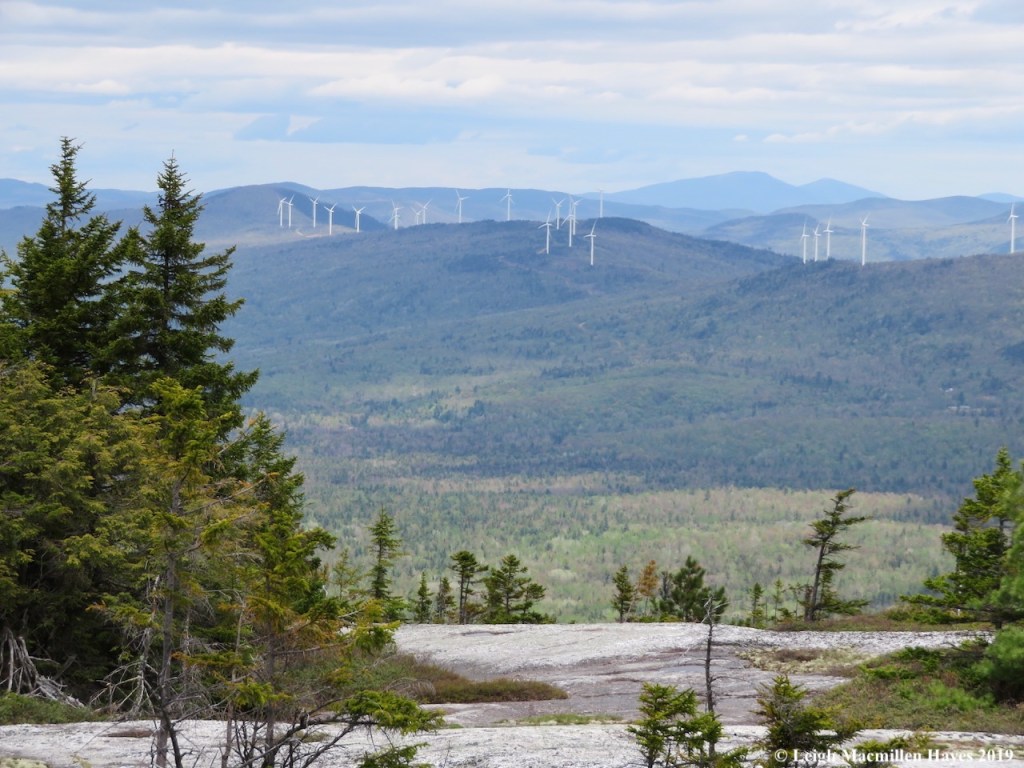
and several ridges covered with wind turbines. I’m of two minds on this topic–the old wishy-washy self that I am. In Canada, wind turbines are located across the landscape and even as we hiked the Cape Mabou trails on Cape Breton Island a few years ago, we stood below one and listened to its airplane engine-like sound, but we didn’t hear it until we were quite close. I actually think they are quite beautiful as they turn–ballet of a sort.

At last it was time to get out of the chilly wind and begin our descent. If you look closely, you might spot Sunday River with a wee bit of snow still on the ski trails. But . . . you have to look closely (Faith–I’m talking to you!)

It was on the way down the bald peak that I noticed the pompoms of several Tamarack (Larch) trees–because we don’t meet on an every day basis, they always bring a smile to my face.

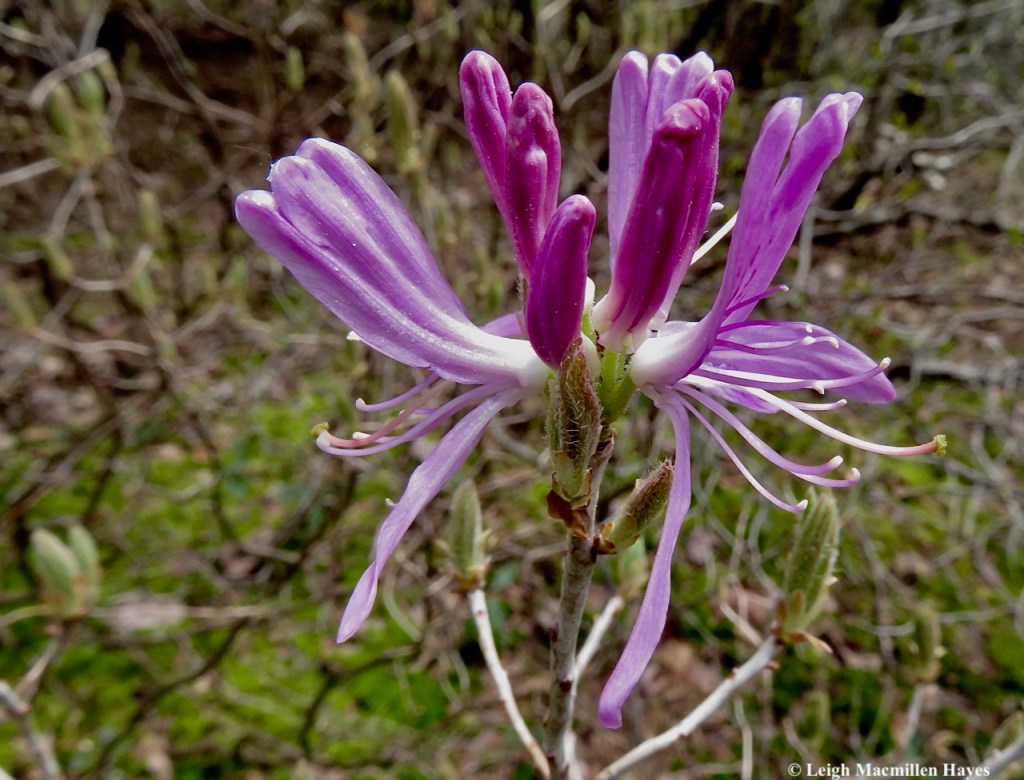
We slipped from the Orange/Red trail to the Starr and found Rhodora beginning to bloom–its magenta buds bursting with pride prior to its leaves.

Pollination was happening everywhere we turned, including by Hover Flies becoming familiar with Pin Cherries.

The trail down was sometimes wooded and other times granite. As I was about to step up onto one slab, a mottled design captured my attention. It would have been easy to overlook for so well did it blend in–even seeming to mimic green lichen. But . . . it was a moth that hugged the stone face.

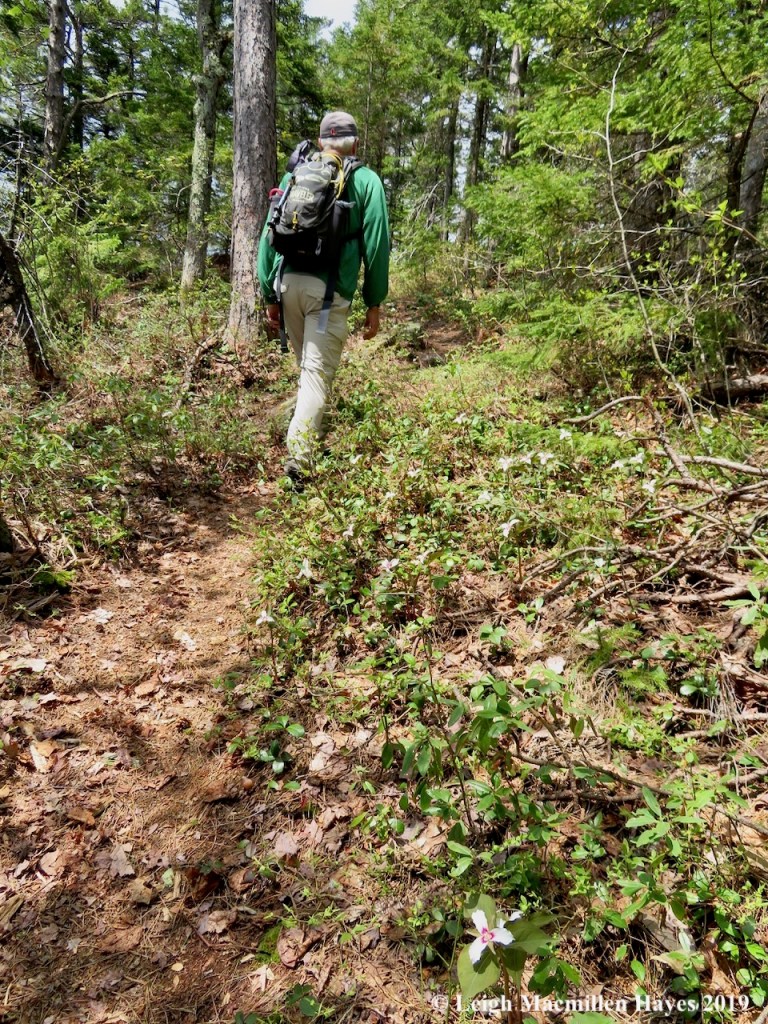
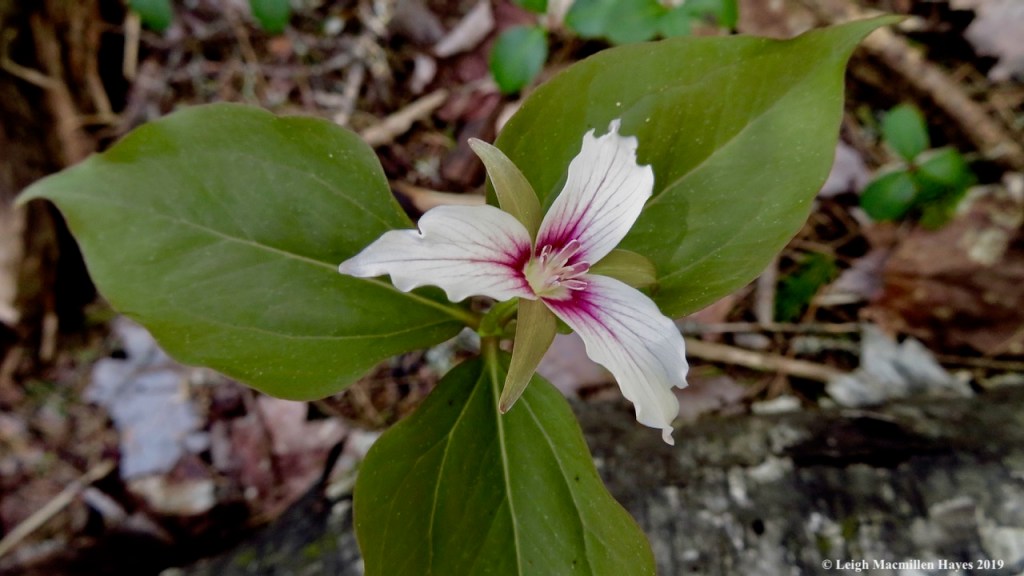
Soon after I made a curious observation. Colonies of Painted Trillium greeted us several times, but always at a higher elevation. I know they grow low, for I’ve encountered them many times, but it had to be a soil consideration that I don’t yet understand that caused such behavior.

Those that we saw had not yet been pollinated for their petals were not translucent . . . a give-away trait.

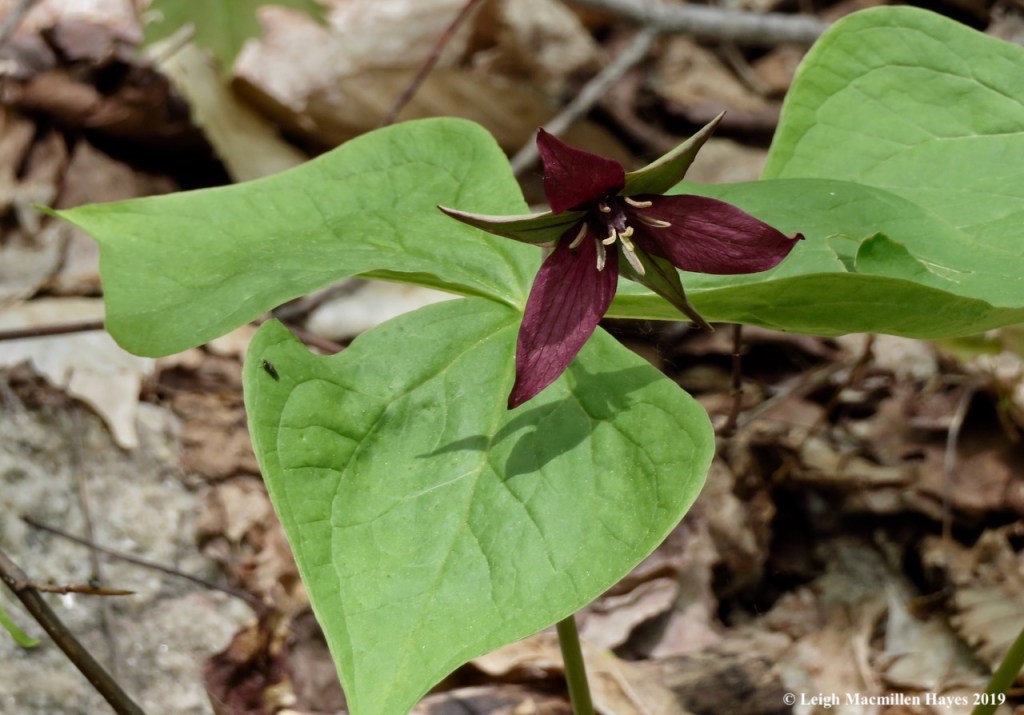
Further down the trail, we began to meet patches of Stinking Ben, aka Red Trillium.

There were also selections of White Quartz to admire.

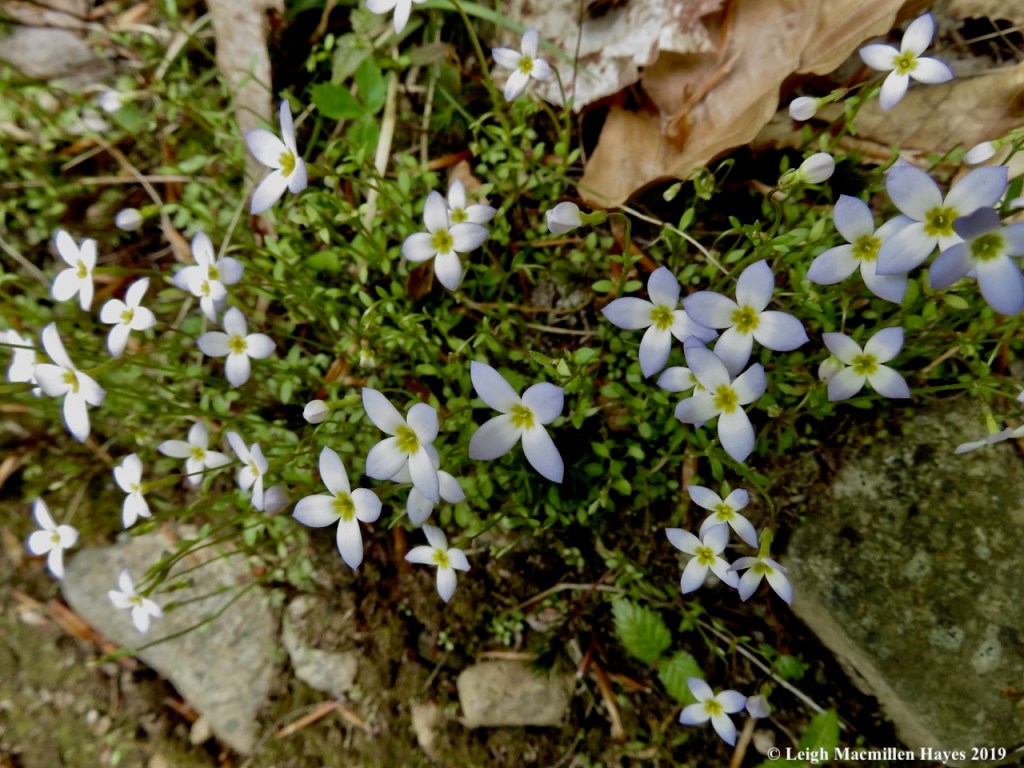
And tiny Bluets that edged the lower pathway. Red, White, and Blue.

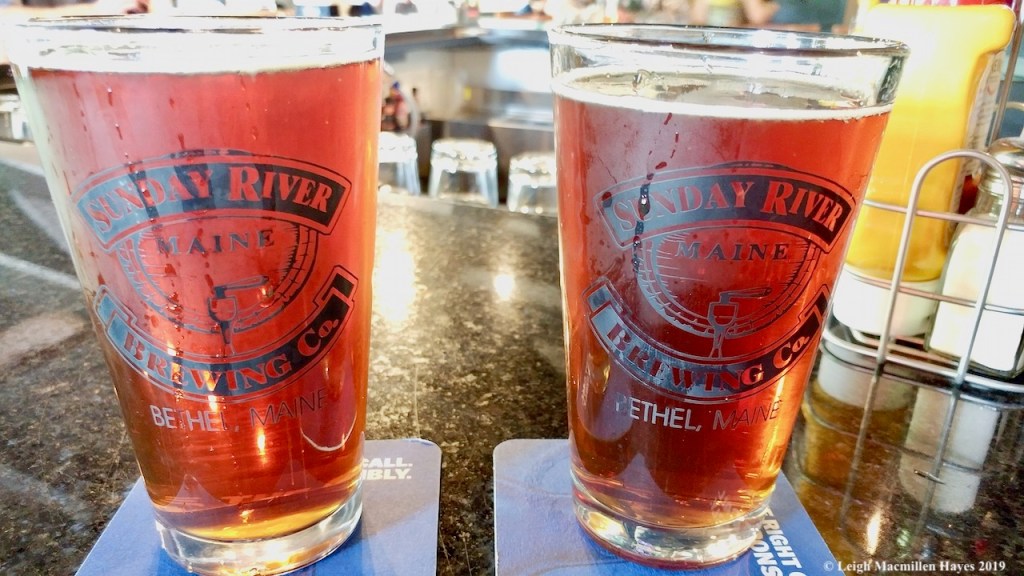
Being a Bear to Beer, we honored the hike and the day with a few sips at Sunday River Brewing Company in Bethel before heading home.

But really, the sight that best represented the day was the Red Admiral–red, white, and blue all in one. And an admiral to boot.

Thank you to all who have sacrificed your lives for our country. I did spend much of the day thinking about the peace and freedom that my guy and I enjoy. And the fact that we were surrounded by a variety of colors other than those of the American flag, which made me think of how the American Flag represents so many no matter their color or creed. And wondering why we can’t all agree to get along. We don’t have to like each other, but why can’t we agree to disagree and leave it at that?

Bear to Beer possibilities: Rumford Whitecap on Memorial Day.

Peace be with you.

Book of May: Identifying Ferns the Easy Way

I love it when people recommend books to me and even more when I discover the the recommendation is spot on. Thus was the case when at the Maine Master Naturalist Board Retreat last month, Beth Longcope suggested Identifying Ferns the Easy Way by Lynn Levine. She’s also the creator of Mammal Tracks and Scat, a life-size tracking guide that I don’t use as often as David Brown’s Trackards. And she has authored several other books.

Book of May

But it’s this newly-released little guide that will find its way into my pack on a regular basis this spring and summer. Within the 74 pages of the 4.5 x 6.5-inch book are simplified explanations with illustrations.

Levine begins with general information about how to use the guide, general tips, and how to observe ferns. Under general tips, I especially appreciated the second: “Ferns that usually grow in clusters will sometimes grow alone.” The key “read-between-the-lines” takeaway is that if we just go by what most books say or people tell us, we’ll become totally confused when we meet an oddball choosing to strike out on its own. Not all ferns have read the books. And that goes for any and all species. It’s best to familiarize ourselves with the various species so that when one does behave in a different manner, we recognize it for what it is.

I also appreciate tip #4, but you’ll have to purchase the book to understand why. ;-)

Being thorough with her topic in such a short space, she includes information about the ancient history of ferns bringing them from past to present structures. Their unique reproductive system is also discussed with the life cycle illustrated by Briony Morrow-Cribbs.

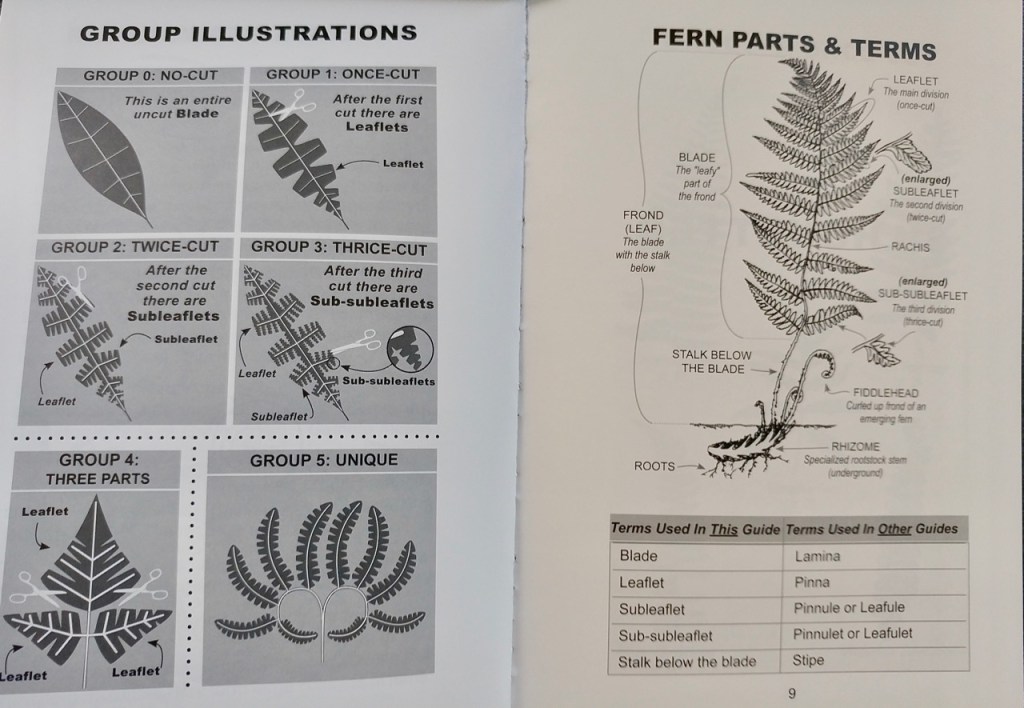
And then, the nitty gritty part of the book. First, she shows how ferns are grouped as once-cut, twice-cut, thrice-cut (I’ve always loved that word: thrice), three parts, and unique. Another sketch, as you can see, illustrates the parts of the blade and defines the terms. I appreciate that at the bottom of page 9, Levine compares the terms she uses with those used by others, aka Leaflet/Pinna.

For those who are visual learners like me, on pages 11-17 are silhouettes for each group of ferns based on their cut type. That becomes valuable information for once you recognize the type of cut, you can simply go to the group pages devoted to it. For instance, Group 1 covers once-cut ferns on pages 18-27. All are denoted by a staggered black tab on the edge of the page, therefore making each group a quick find.

Group One begins with Christmas Fern. For each fern within a category, the reader will find a two-page description with illustrations. The description includes the Common Name, Scientific Name, Where it Grows, Tips for Identification, species it Can be Confused With, and Interesting Notes.

From these, I noted some different ways to consider the fern and picked up some new ID tips to share with others. I did find it funny that what I long ago learned was either Santa in his sleigh or the toe of a Christmas stocking, Levine refers to as an ear on the leaflet/pinna.
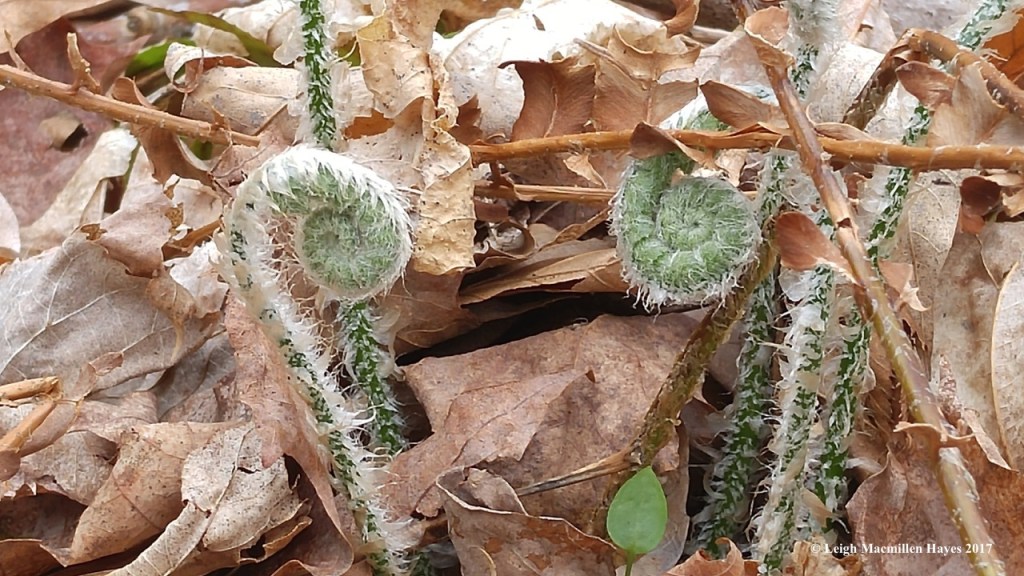
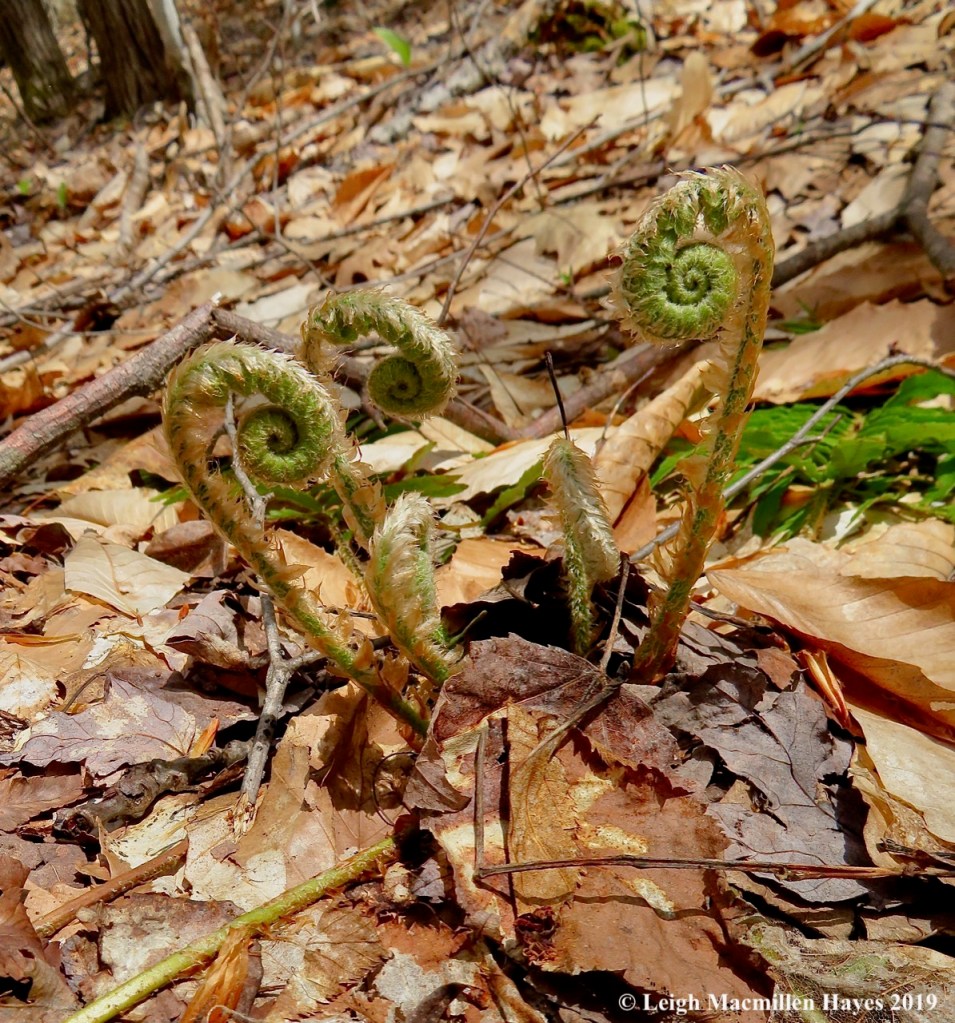
Right now, Christmas Fern fiddleheads have sprung forth in the center of the evergreen blades and they are mighty scaly.

Fiddlehead is the term used to describe the crozier shape (like a Bishop’s crozier) of an emerging frond. And not all fiddleheads are created edible. In fact, I know of only one that is. This is not the one. But do note those mighty hairy scales.

Another Group 1 species, Maidenhair Spleenwort. In her tips for ID, I love this line: “Leaflet pairs are opposite each other (like a bow tie).” This isn’t a species I typically encounter in western Maine. In fact, this photo was taken in the Glendalough monastic settlement founded by St. Kevin in the sixth century–in the Wicklow Mountains of Ireland.

Under “Interesting Notes” for Rock Polypody, Levine clears up the meaning of the name for me, for though I knew that poly means “many” and pod refers to “foot,” I didn’t understand why the fern should be named thus. “Rock Polypody has many ‘feet’ connecting one fern to the next by their roots.” Now I can’t wait to revisit them.

I chuckled when I read under her tips that Sensitive Ferns grow in large colonies. Indeed.

They are so named because with the slightest bit of cold they turn brown. Levine says it’s sensitive to the first frost, but I’ve noticed it turns brown in mid-August if not sooner, when the nights have that wonderful chill, but we haven’t yet had a frost.

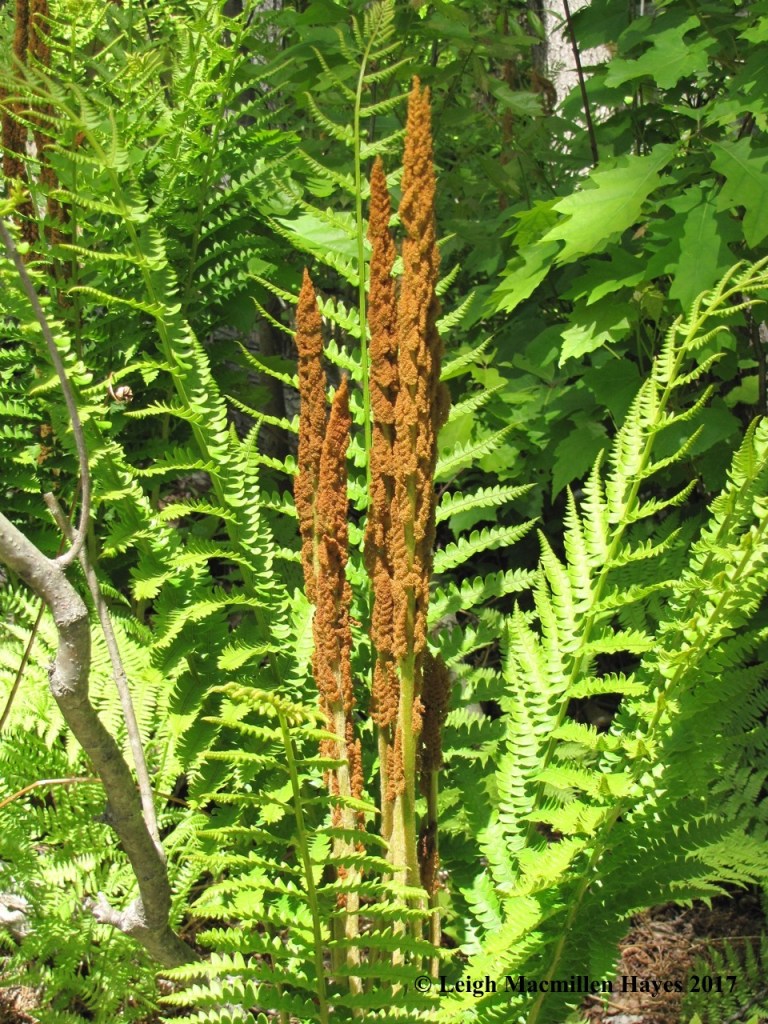
Group 2A are those ferns that are twice-cut and form a vase-like cluster. The first in the group, Cinnamon Fern, like all others, is slowly unfurling and if you head outdoors you might see the splendid display.

Soon, the cinnamon-colored fertile stalks will be visible in the center of the plant formation. But, once they have done their duty and dried up for the season, you really have to look to locate the fertile frond. And Cinnamon Fern can be easily mistaken for Interrupted Fern.

But as Levine reminds us, the give-away is on the back of the leaflet/pinna. By the center rachis, that main part of the frond to which all leaflet/pinna are attached, do you see the wooly tufts? In this neck of the woods, those only occur on the backside of Cinnamon Ferns.

Its cousin, Interrupted is best identified also by its fertile fronds, with the interruptions occurring in the middle of the blade. Levine sees them as butterflies when they first emerge and face upward. You’ll hear that pass through my lips going forth.

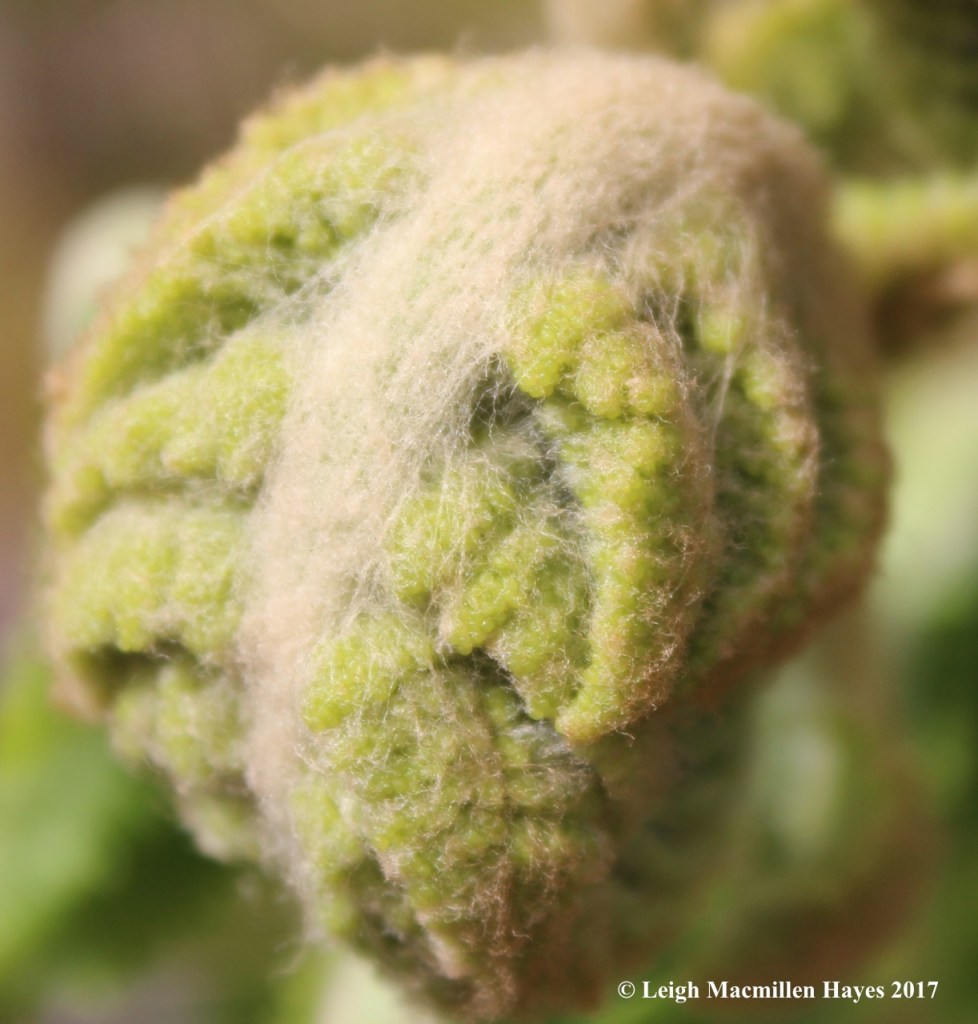
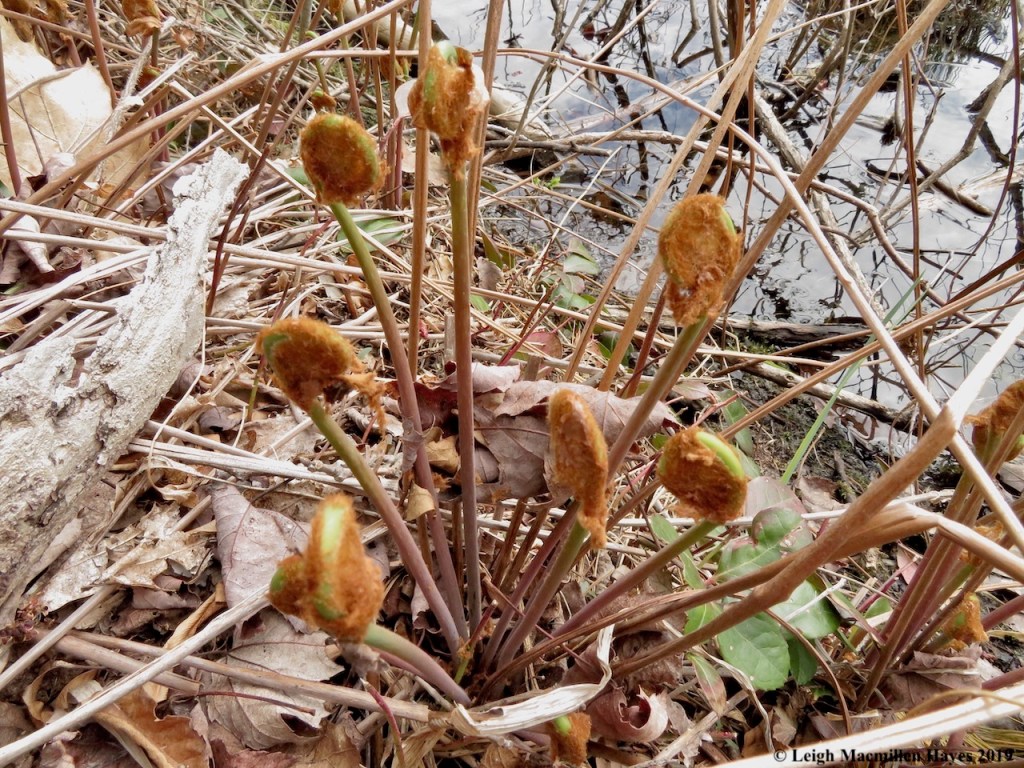
Here’s the thing with Cinnamon and Interrupted Ferns in their fiddlehead form. They are both covered in a veil of hair. But at least you know it’s one or the other and once they unfurl, the determination becomes easier.

Levine’s tips for IDing Marginal Wood Fern included a note about the subleaflet/pinnule’s wavy appearance making us think it might be thrice-cut. She makes the point, however, that it belongs in Group 2 because they “are not cut deep enough.”

Do note the spores dotting the margin of the backside.

At last, she comes to Ostrich Fern. This is the one edible fiddlehead that I know of in our area. Notice how bright green it is? And the lack of scales? There’s another clue that you may or may not see in this photo, but it’s also important for ID if you plan to dine for the stalk is deeply grooved. Deeply. Always double-check.

The vase-like form of Group 2A is especially evident in this display of Ostrich Fern, but there is an intruder. Can you name it?

Like Levine states, the “fertile frond may remain standing during the winter.” I took this photo last spring.

Group 2A ends with one of my favorites: Royal Fern. She describes it as having an “airy appearance.” I like that. And again, she uses that bow tie description.

It’s the location of the spore cases that give this fern its name. Curiously, though she says the cluster appears at the tip, she doesn’t mention that they are like a crown on top of a head.

I did find it interesting to note in her “Interesting Notes” that “Roots are a source of fiber (osmundine) that is sometimes used as a growing medium for orchids.”

Group 2B are those ferns that are twice-cut but do not grow in vase-like clusters. Such is the case for the Beech Fern, so named according to Levine because it is common where Beech trees grow. Another thing to pay attention to going forward.

All together, there are seven ferns described in this group.

Group 3 are those that are thrice-cut. Did I mention that I’ve always loved that word: thrice. Say it thrice times. Thrice. Thrice. Thrice.
Lady Ferns are part of this group and their scaliness can be referred to as hairy legs. They also have spore cases on the underside of the leaflet/pinna that remind us of eyebrows.

What I liked about Levine’s description is the following: “Fronds grow in asymmetrical clusters, but it sometimes grows in small groups of just 2 or 3 fronds.”

Group 3 includes five different ferns.

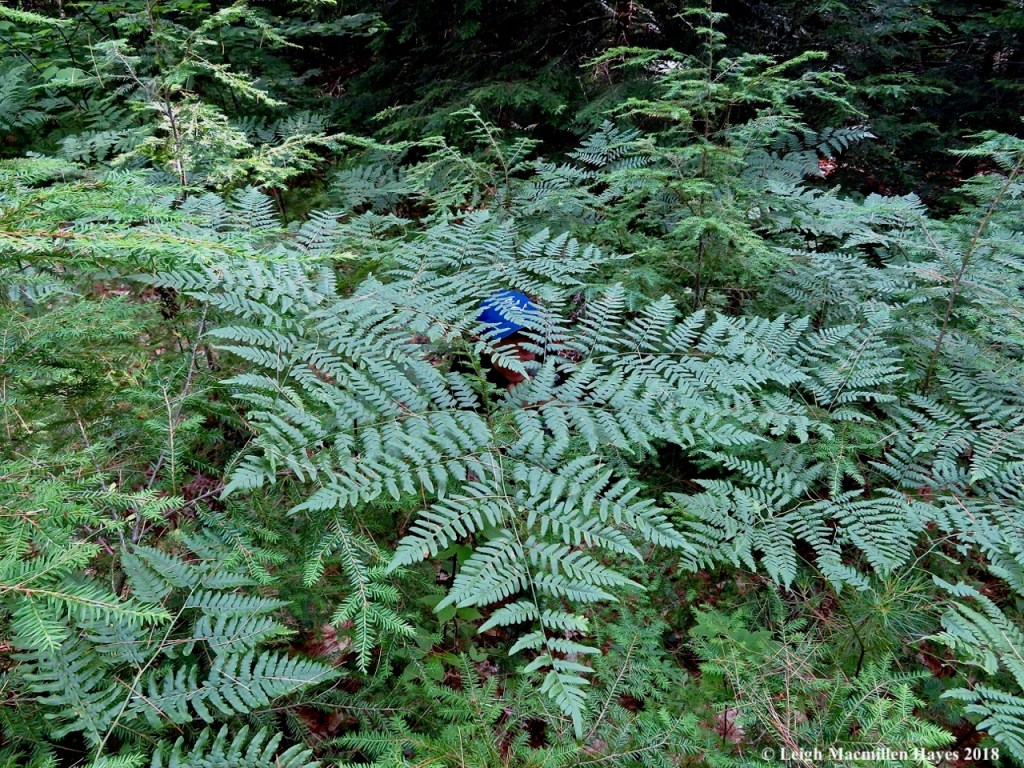
Group 4 consists of those ferns with a blade divided into three parts. The tallest among them is Bracken Fern. If you look closely, you may see a young friend of mine hiding under one.

With this species Levine issues a word of caution about the consumption of Bracken Fern fiddleheads: Don’t eat them. Buy her book and on page 62 you can read why.

While the Bracken Fern grows 3 – 5 feet, most of the other members of Group 4 are rather diminutive in stature, such as the grape ferns. I do love that she notes how the sterile blades range from being finely cut to less finely cut. The illustration on page 65 helps clarify that. You’ll have to buy the book. ;-)

A species not included because it’s not all that common in the Northeast, at least in the woods, or rather associated wetlands I frequent, is the Virginia Chain Fern. It looks very similar to Cinnamon Fern, but . . . while Cinnamon has a separate fertile frond that forms in the spring and then withers, Chain Fern’s sporangia are oblong and on the underside. I’ve seen this at Lake Environmental Association’s Highland Research Forest and Holt Pond Preserve. That being said, you do have to get wet feet.

So, I hope I’ve convinced you to buy this book. It includes the twelve most common ferns of Maine: Christmas, Polypody, Sensitive, Cinnamon, Interrupted, Marginal, Royal, Beech, Hayscented, Lady, Evergreen, and Brachen, plus a variety of others, most of which we do stumble upon either often or less frequently depending upon habitat.

My favorite local bookstore, Bridgton Books, was not able to get a copy of the Book of May: Identifying Ferns the Easy Way, so I ordered via Amazon on Tuesday and it arrived today.

Identifying Ferns the Easy Way by Lynn Levine, illustrated by Briony Morrow-Cribbs, Heartwood Press, 2019.

Holt Ponderings Mondate

If you are me, and be thankful you aren’t, then playing with words is part of your persona. And making them up when you can’t find one that fits the application is fine in your mind as well.

Our Mondate began not at the parking lot most are familiar with for Lakes Environmental Association’s Holt Pond Preserve, but rather in a spot that has our name on it at the end of the rather short Knapp Road. You see, it was time for our annual spring clean up of the Southern Shore Trail, which my guy and I have been maintaining for more years than either of us can remember.

It was immediately apparent that numerous trees and branches had blown down since last fall and so we began to work.

But, it was a Mondate, and thankfully, with work came play. Just below our starting point we checked on a particular boardwalk I made famous last year when I fell hard against the edge of the wet, wooden slats and broke my wrist.

Water flowed across the wood again today and we both knew instantly that it would not be part of our circumnavigation plan. But, by pausing beside it, we did have time to admire a Water Strider as it used the surface tension to walk, or rather skate.

And then we carried on, soon realizing not all blowdowns were created equal and we hadn’t brought a chainsaw so some will either need to wait for another day or another person to complete the job.

What we could do was take down smaller trees that crossed the path, and pick up twigs and branches that decorated it. Oh, and between, take time to admire the beech leaves bedecked in fringe, much like the fancy hem of a skirt.

And there were the ever so scaly Christmas Fern fiddleheads to note.

Along with the smooth stipe of the Royal Ferns.

As we always do, whenever the trail provided an opportunity to look out at the pond, we took it. If you are familiar with the place, then you’ll know that the Quaking Bog is across the way where the taller trees stand out toward the left on the opposite shore.

And if you are super familiar with it, you’ll know that this stand of pines and hemlocks was once the log landing. (Bridie McGreavy, if you are reading this–it’s a whole different landing than when you first introduced us to it as we trudged through the snow and out to Fosterville Road from this point.)

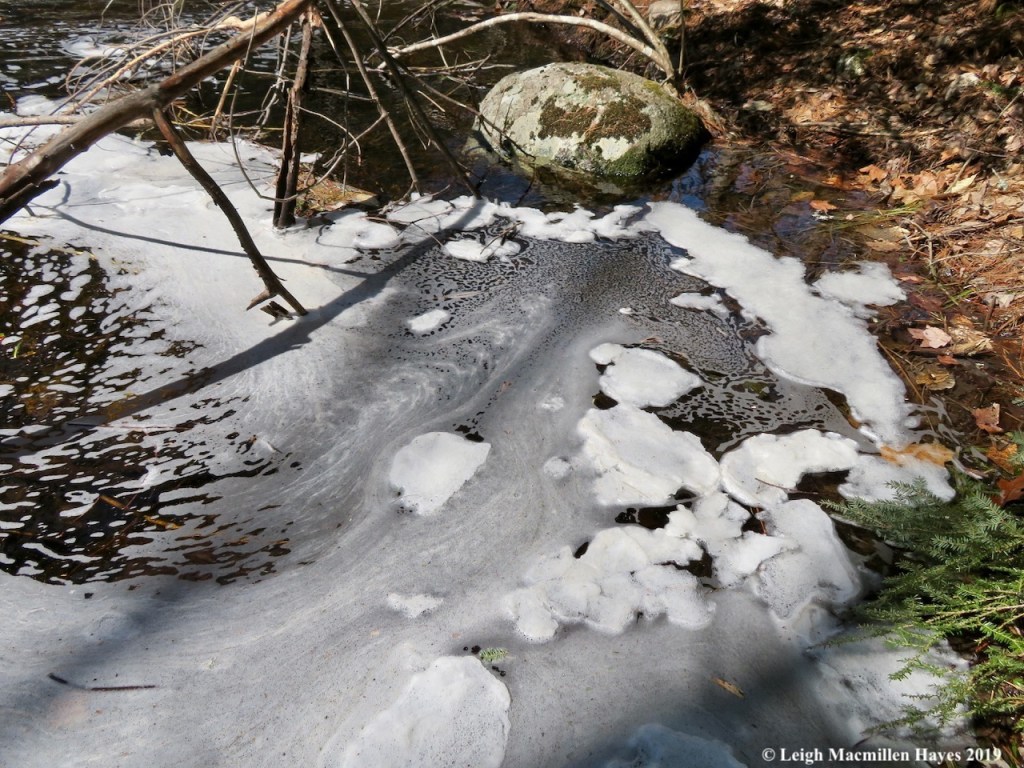
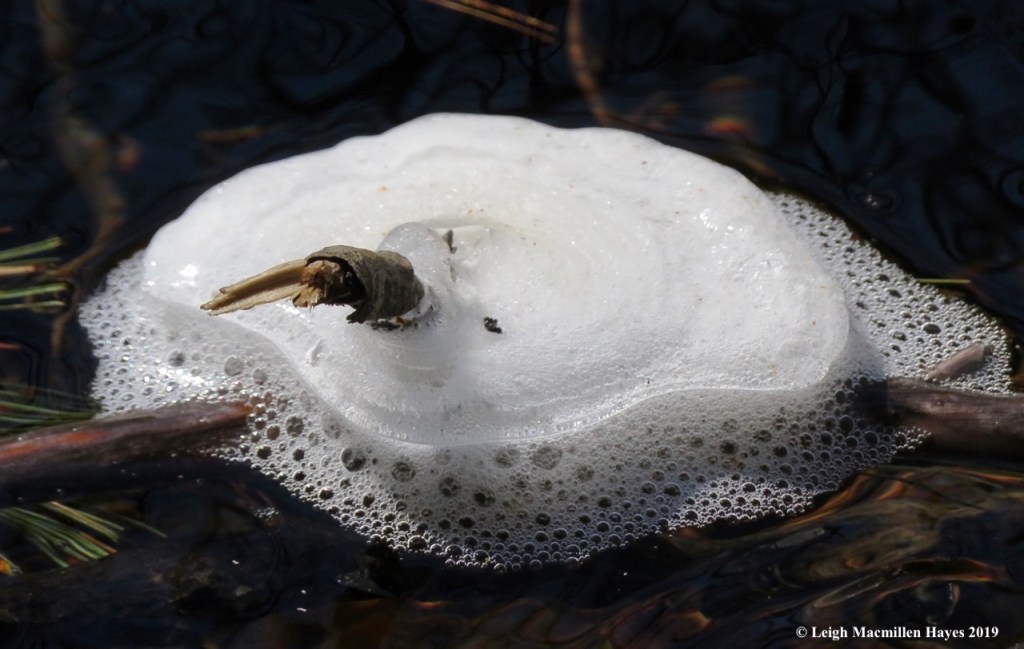
Just beyond the landing we crossed a small stream via an old beaver dam, and fancied the formation of suds on the water’s surface.

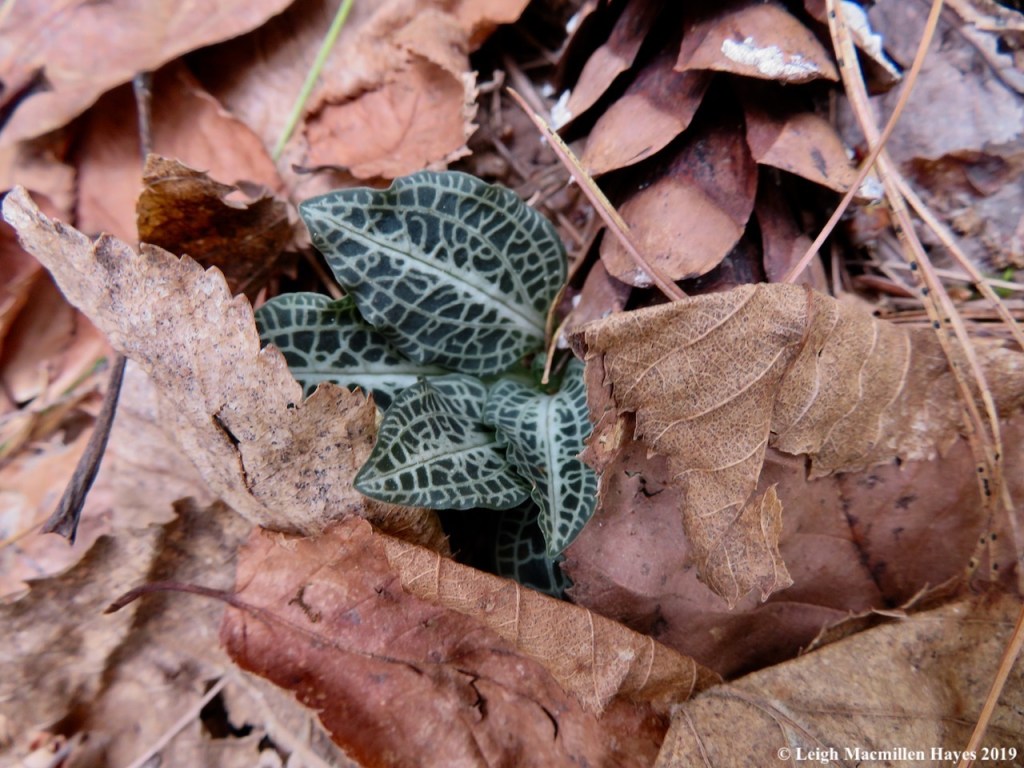
Delightful surprises greeted us along the way, including the evergreen leaves of Downy Rattlesnake Plantain. I love the leaves of this woodland plant and find that the easiest way for me to remember its common name is by the snakeskin pattern, but also the fact that it doesn’t look downy–especially when you compare it to those beech leaves that are bursting forth from their buds. So . . . the rattlesnake plantain that doesn’t look downy is.

After reaching the section of trail that follows a snowmobile route briefly, we again snuck down to the pond. And spied . . . a beaver lodge that is either new or we were looking at all over again for the first time. We also noted the subtle colors of the spring palette reflected by the water.

Our journey took us out to Chaplains Mill Road, and then across the “Emerald Field” and back down to the Muddy River, which empties out of Holt Pond. Recently, I was on a Beaver Caper with LEA’s Alanna Doughty. With the snow and ice melted completely, there was more evidence that the beavers were continuing to do some work and I think she and I may need to try again to figure out which lodge is truly active.

As it was, a tree that appeared in photo #20 of the Beaver Caper, had since been cut down. We were going to move it off trail, but decided it was worth encouraging others to pause.

And so we left it be and hope it gives you something to gnaw about.

Again and again, we picked up sticks and moved trees. And celebrated small wonders like the blossoms of Goldthread.

Trailing Arbutus, aka Mayflower, was also in abundant bloom with blossoms of white, pink, and white-pink. I do have to wonder what determines their color.

As we walked beside the Muddy River, slowly making our way back to Holt Pond, I got my guy, who can be a bit of a bull in a china shop, to slow down any time we heard a bird. The Veery posed longer than most.

And so we stood silently and gave thanks for the opportunity.

At last, it was into the Red Maple Swamp that we marched, continuing our work habit, though not quite as frequently.

While my guy got ahead, I rejoiced at the sight of Leatherleaf in bloom; its blossoms lined up on the underside like bloomers on a clothesline.

Giant Bumblebees also enjoyed the bell-shaped flowers from below.

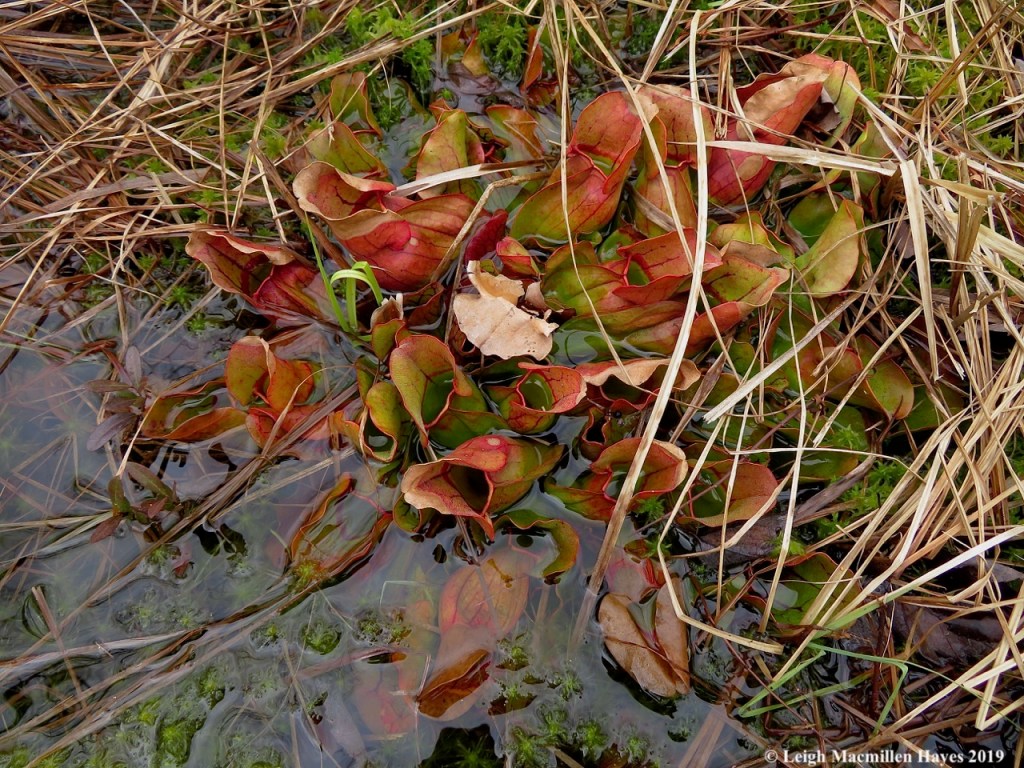
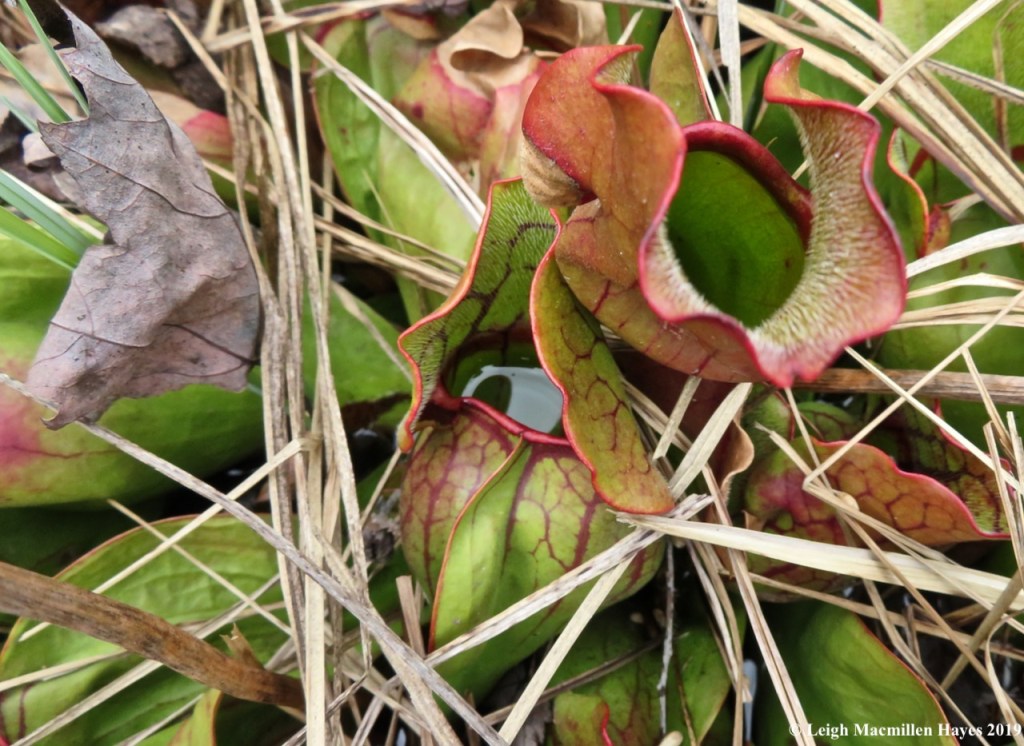
And I can never walk past without paying reverence to the Pitcher Plants that grow abundantly in this place.

One should always bow down and take note of the hairy veins on each pitcher, for those not only attract the insects that meet their demise within, but also trap them. Such is the way of this carnivorous plant.

We stepped out onto the boardwalk to the Quaking Bog, but not much was in bloom. Oh, and yes, we did get out feet wet because with each step the wooden structure sank a bit, but unlike the one I’m waiting to cross, the bog boardwalk dries out between visitors so it isn’t slippery. At least I didn’t think so. My guy was surprised as he followed me out.

Soon our journey took us along the Holt Pond Trail where the False Hellebore showed off its broad leaves. The curious thing, I’ve never seen any of these plants present their floral structure, but I shall continue to watch.

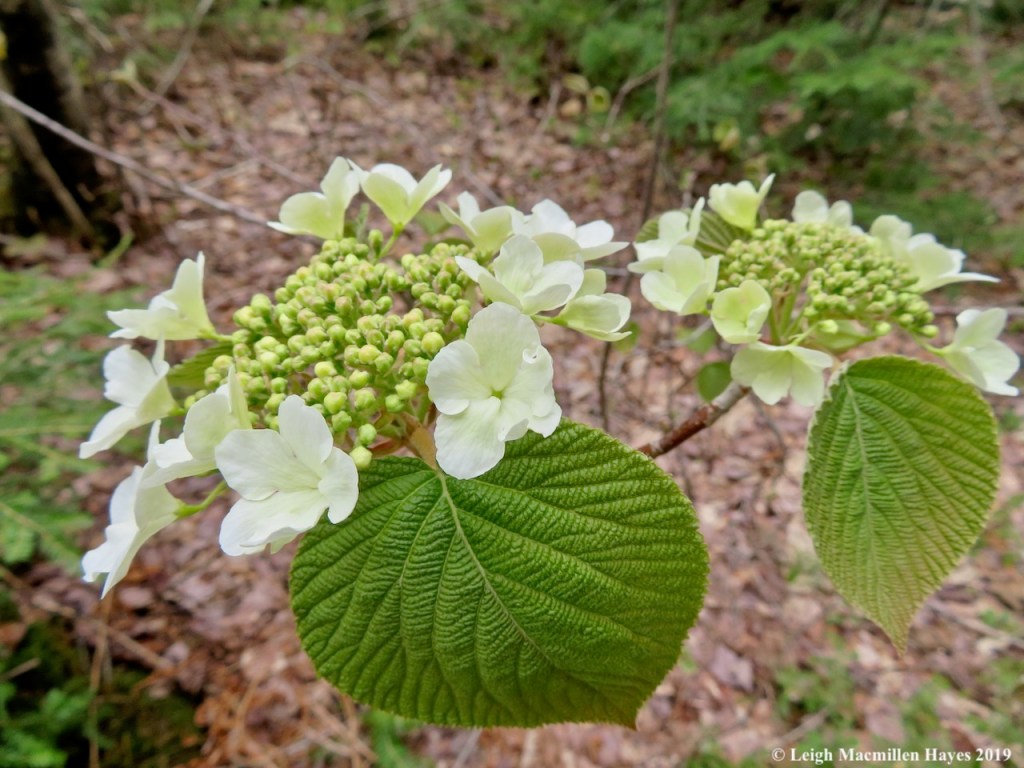
One plant that is beginning to flower is the Hobblebush, with its showy sterile displays on the outer edge. It seems like only yesterday I was admiring their naked winter buds. And now . . . this.

Before exiting out to Grist Mill Road to walk back to where we’d parked, we passed through one last Hemlock Grove. And there, sitting atop a large tree stump . . . a hen incubating her eggs. She murmured not a word. Nor did we. But again, in our minds we were most grateful for the opportunity to see her at such a challenging and dangerous time.

Quietly, we moved on and a few minutes later our Mondate came to end. I think the most amazing thing is that no matter how often we go there, there are always a few familiar friends to meet, but often something we’ve not seen before. Today, it was the turkey that fit the latter. Holt Ponderings indeed.

P.S.Why doesn’t my computer like those two words: Ponderings and Mondate? I surely know what they mean.

One more P.S. Mary Jewett and Ursula Duve will lead a bird and flower walk at Holt Pond on Friday, May 17. I wish I could join them for the two will spot incredible sights. If you’d like to, please contact Mary. FMI: mary@mainelakes.org.

Bear to Beer: Bishop Cardinal to Lord Hill

Our destination sounded rather regal; as if we’d be paying our respects to Bishop Cardinal and Lord Hill. And indeed we did.

We also paid our respects to telephone poles. Well, actually only certain ones. They had to have a certain look–as if a Black Bear had backed into the pole and turned its head around at an angle and bit the wood with its upper and lower canine teeth thus leaving nearly horizontal marks that look like a dot and dash. In the process, the aluminum numbers had to be a bit mangled in order to receive our attention. This particular pole was right by the trailhead and so after examining it, we headed up the blue trail at the Greater Lovell Land Trust’s Bishop Cardinal Reserve on Horseshoe Pond Road in Lovell.

Along the way, we examined every American Beech we saw, but actually passed by a spot where we know there are several with the marks we sought. If you go, look for the blue dot on the white arrow and hike in at a diagonal from there.

Our hope today was to find other bear claw trees we’d missed previously and so we kept going off trail in search. Turning onto the red trail, we continued to check. Sometimes it’s the shape of the tree’s crown that makes us wonder.

We have learned that we can’t dismiss any bark without walking all the way around and bingo–we had a new-to-us bear claw tree.

I don’t know why it is, but those marks make our hearts sing. Perhaps it’s the knowledge of the wildness of it all and the fact that we share this place with such intelligent beings.

Whatever it is, we decided that rather than creating waypoints for each tree we found, we’d try to remember the location by using other landmarks such as a certain waterbar that was intended to divert snowmelt and rain from washing out the trail. When you reach that certain waterbar on the red trail, turn left and walk in about twenty yards. If you don’t find our tree, perhaps you’ll discover another.

Continuing up the trail, we did note a few other favorites off to the right.

Sometimes, in my mind’s eye, I could just see the movement of the climber.

With one such tree, the marks were lower than most and I wondered if it was a younger bear. Of course, we have no idea how long ago those marks were left behind. Mary Holland suggests a way to age them that we haven’t tried yet. And we didn’t look for fresh marks. Really, we need to be better sleuths going forward.

In case you are wondering, occasionally we noted other points of interest, such as the burst of beech buds, their spring green leaves all hairy and soft, which is actually quite a contrast to the papery feel they eventually acquire.

Here and there, the cheerful display of Round-leaved Violets brightened the path.

And drone flies, with their bigger than life eyes, posed. Any black flies? Yes, a few, but not biting . . . yet.

We were almost to the old shack site, if you know where I mean, when our journey off trail revealed another fine specimen. Again, the claw marks were on the backside since we approached from the trail. Always, always, always circle about and you might be surprised.

Eventually, we reached the intersection with the trail to Lord Hill and continued our surveillance as we continued our hike.

Once we turned right onto the Conant Trail, we did find one tree with marks long ago made . . . by some bears with either an extreme understanding of relationships, or more likely, a few who weren’t all that intelligent after all.

At last, the trail opened onto the ledges overlooking Horseshoe Pond and it was there that we sat down on the warm granite as a nippy breeze flowed across. Enjoying the view of Horseshoe Pond below and the mountains beyond, we ate lunch.

We also toasted a few others with a Honey of a Beer brewed by Lee of another spelling! Dubbel Trouble was double delicious. Thank you, Lee Fraitag. ;-) Our toast was also doubled for we gave thanks to Paula and Tom Hughes, who live just below on the pond. Tomorrow we’ll enjoy a Mother’s Day Brunch at the Old Saco Inn courtesy of the Hugheses. ;-)

Clink. Clink.

After enjoying lunch rock we journeyed up to the Lord Hill Mine.

According to mindat.org, Lord Hill Mine was “a former rare mineral specimen quarry. Briefly worked in episodes in the mid-20th century for feldspar. Originally a mineral collector’s site in the late 1870s. Opened by Nathan Perry and Edgar D. Andrews in the early 1880s. Originally called Harndon Hill, but the named changed in a complex change of names about 1917. Operated solely by Nathan Perry by 1882. Operated for massive topaz for educational mineral collections in the 1970’s by Col. Joseph Pollack of Harrison, Maine. The locality is the type locality for hamlinite, now regarded as a synonym for goyazite. Granite pegmatite. Oxford pegmatite field. Local rocks include Carboniferous alkali feldspar granite (muscovite accessory mineral).

We spotted several people busy digging for their fortunes and decided to let them. They either were so tuned in to their work that they didn’t hear us or they chose not to. No matter. After a quick look about, we quietly followed the mine trail down–our own focus still on the trees.

And at the point where the National Forest abuts the Greater Lovell Land Trust’s property, we turned back onto the land trust’s loop trail. We’d come up from the left, so turned right to continue our descent.

And yes, we found one more bear tree. Somewhere along the way, I lost track of the number of new finds. But, we trusted that for all we found, there were so many more we must have missed. And then some.

Back on Horseshoe Pond Road, we turned left and checked all the telephone poles along the edge, examining each for bear hair because we’ve seen it stuck on them before. Today, no hair.

So why do the bears pay attention to telephone poles? Think of it as a combo backscratcher and messageboard. Pretend I’m a young male, ready and available. Wanna go out for a date tonight? Give me a call.

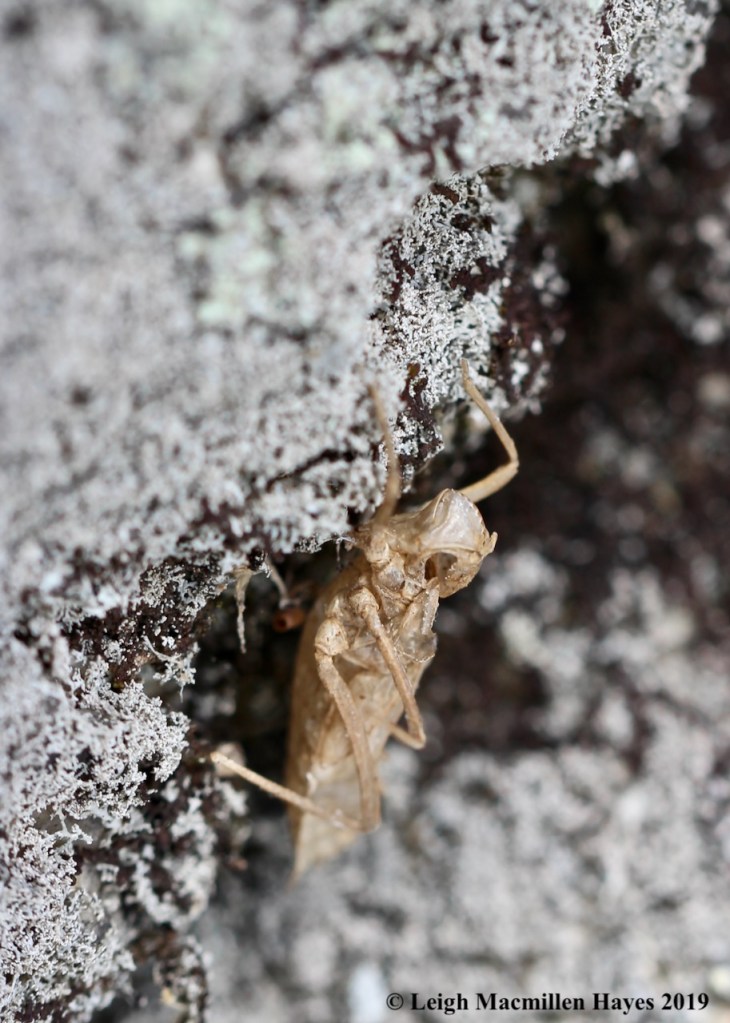
Despite the lack of hair, because we were looking, we found a Mayfly. That in itself, was another reason to celebrate.

Bishop Cardinal and Lord Hill. We thank you both. Black Bears, we thank you. Lee, we thank you. Paula and Tom, we thank you. (Happy Mother’s Day, Paula) All are regal indeed.

Bear to beer possibilities: Bishops Cardinal Reserve and Lord Hill Mine.

Significant Fairies

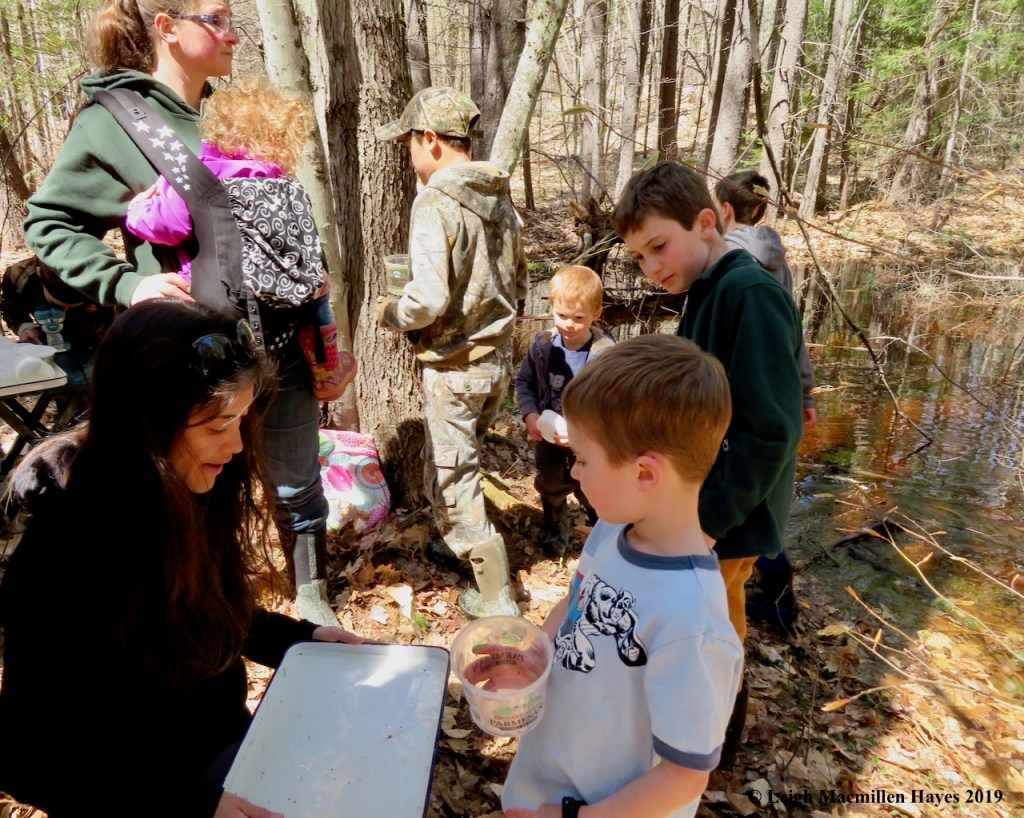
We’d made promises in the recent past that fell flat. With that in mind, when the Greater Lovell Land Trust’s Nature Explorers, a homeschool group led by Docent Juli, gathered this morning, she was smart and stuck to the life cycles of potential sightings like frogs rather than possibilities.

The group that gathered was large–24 in all with a mix of moms and their children.

Of course, being kids, they were immediately attracted to the water below the mill site at Heald Pond. But after letting them explore for a few minutes, a light whistle pulled them all together again.

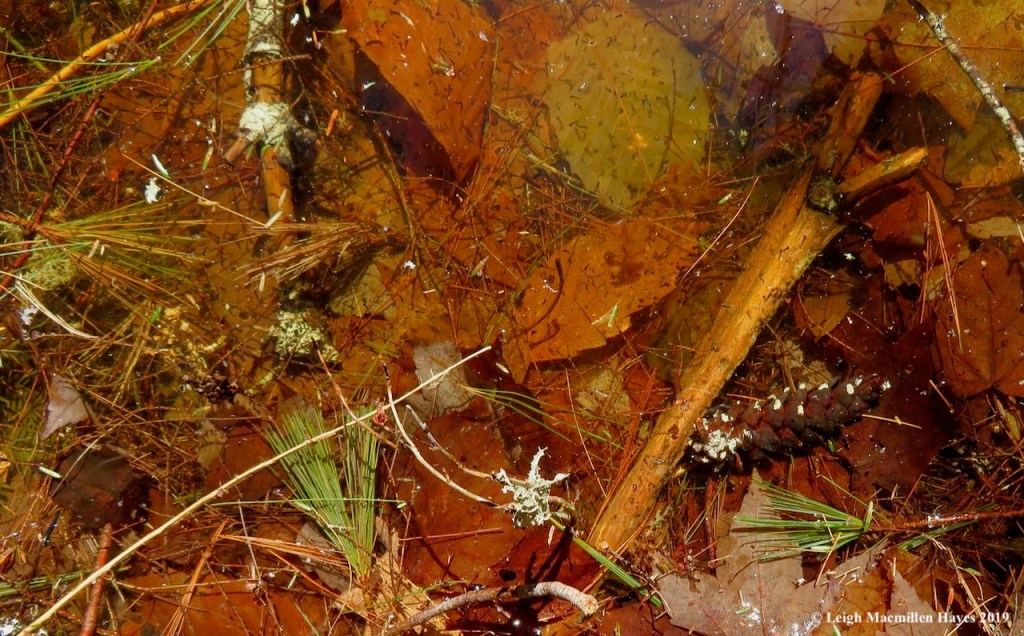
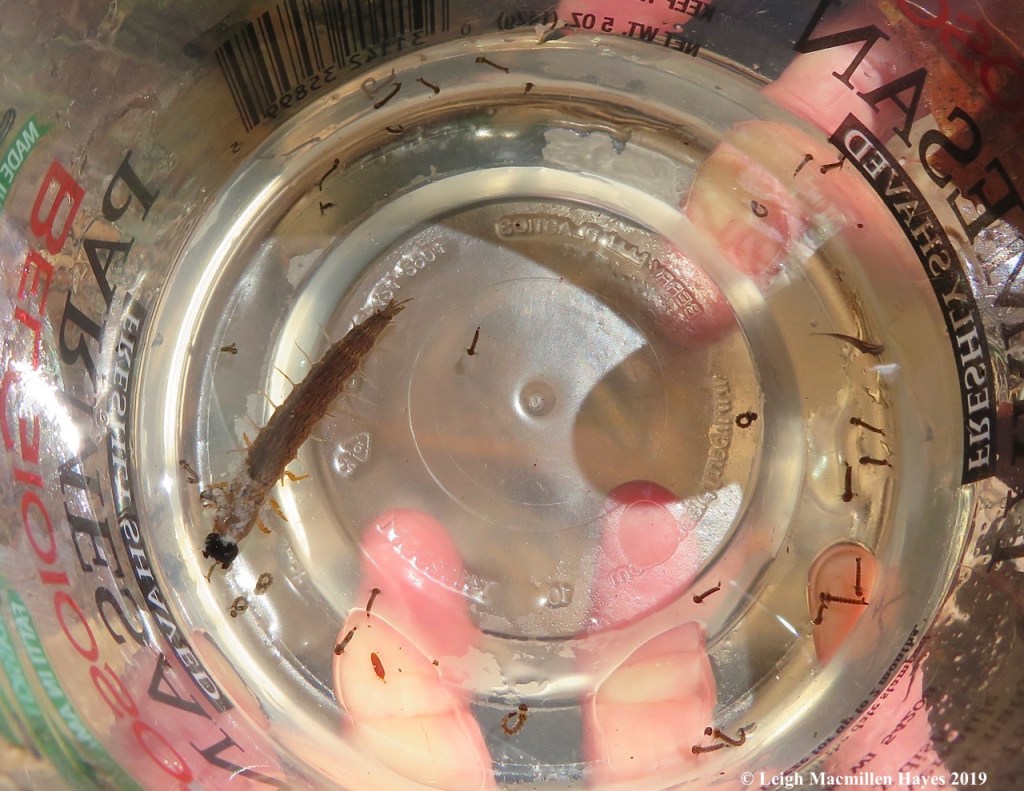
At the nearby vernal pool, everyone quickly learned what larval mosquitoes looked like as they watched them somersault through the water column. A few complaints were expressed about future bites, but that was redirected to the fact that mosquitoes feed birds and dragonflies, and in their larval form, other aquatic insects.

Pond dipping became the morning habit and at first, it was only the mosquito larvae that made it into the containers.

But, that led to a quick lesson on the biting insects’ life cycle–one of many teachable moments that snuck into the morning fun.

Oh yes, those larval mosquitoes also feed amphibians and thanks to Juli’s son Aidan for finding a large Green Frog. Notice the ear disc, aka tympanum, that is located behind its eye. Given its size as being bigger than the eye, this was a male. And notice the dorsal lateral ridge or fold that extends from behind the eye down the side of its back (there’s one on either side)–that’s a clue that this is a Green Frog and not a Bull Frog, for the latter’s ridge circles around the tympanum.

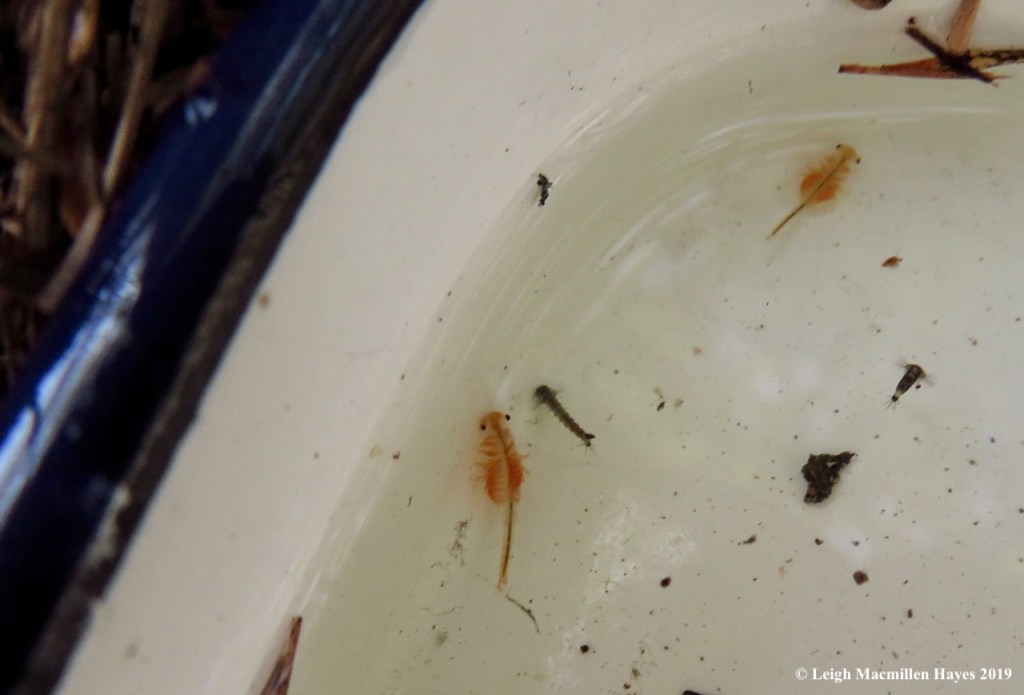
As the morning went on, it turned out that today was Aidan’s day to shine for he was also the first to find a Fairy Shrimp.

A what? Yes, a Fairy Shrimp. Do you see that delicate orangish body in the middle of the tray? It’s a mini crustacean that lives only in vernal pools.

The kids all got caught up in the thrill of such a find and within minutes became pros at recognizing them.

And so the dipping continued.

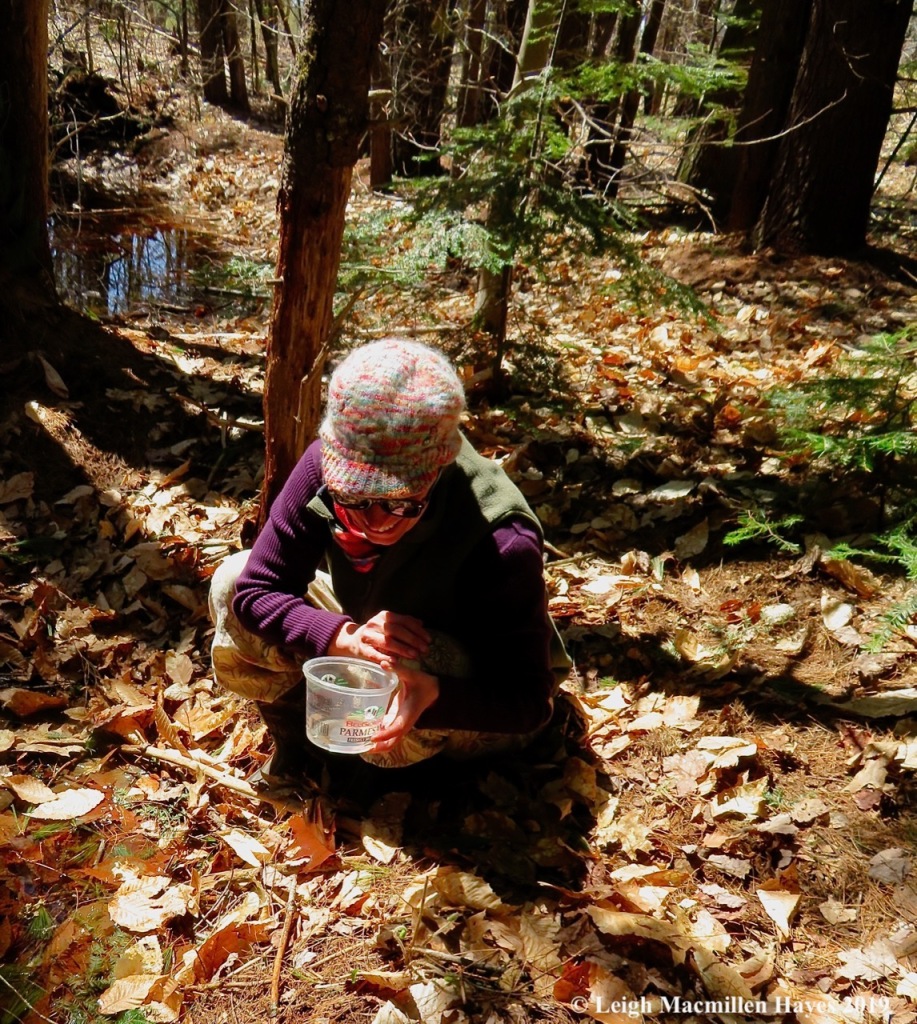
Moms also got caught up in the dipping experience.

And they also found cool stuff, like Kim’s Fishfly. We kept expecting it to eat the mosquito larvae, but it seemed that they preferred to nudge it in a way we didn’t understand.

While Kim focused on her new friend, the kids were also making new friends, testing their balance, getting rather wet and muddy, and having a blast as they sought more Fairy Shrimp.

Their pan began to fill up with one, two, three, four, five and even a few more.

And then other species were discovered, including aquatic beetles and a Phantom Midge.

We’d come in hopes of at least finding Wood Frog and Spotted Salamander egg masses, which the kids quickly recognized. By the time we were ready to leave a few hours later, some of the boys had discovered the best way to spot the masses was from the crow’s nest.

But in the end, our most significant find was the Fairy Shrimp. You see, on a public walk a couple of weeks ago, when we’d promised folks such a sighting, we came up short. But today . . . they made their presence known. And with the find of just one Fairy Shrimp, the vernal pool became a significant one as recognized by the State of Maine.

A hearty thanks to Juli for leading and the moms and their kids for attending. It was such a joy to watch everyone interacting and engaging. I only wish I could have been a Fishfly on the wall at suppertime as they shared their finds of the day with other family members.

Cinco de Mayo Maine-style

When Pam asked at the end of our slow tour today what my favorite finds were, I named at least five.

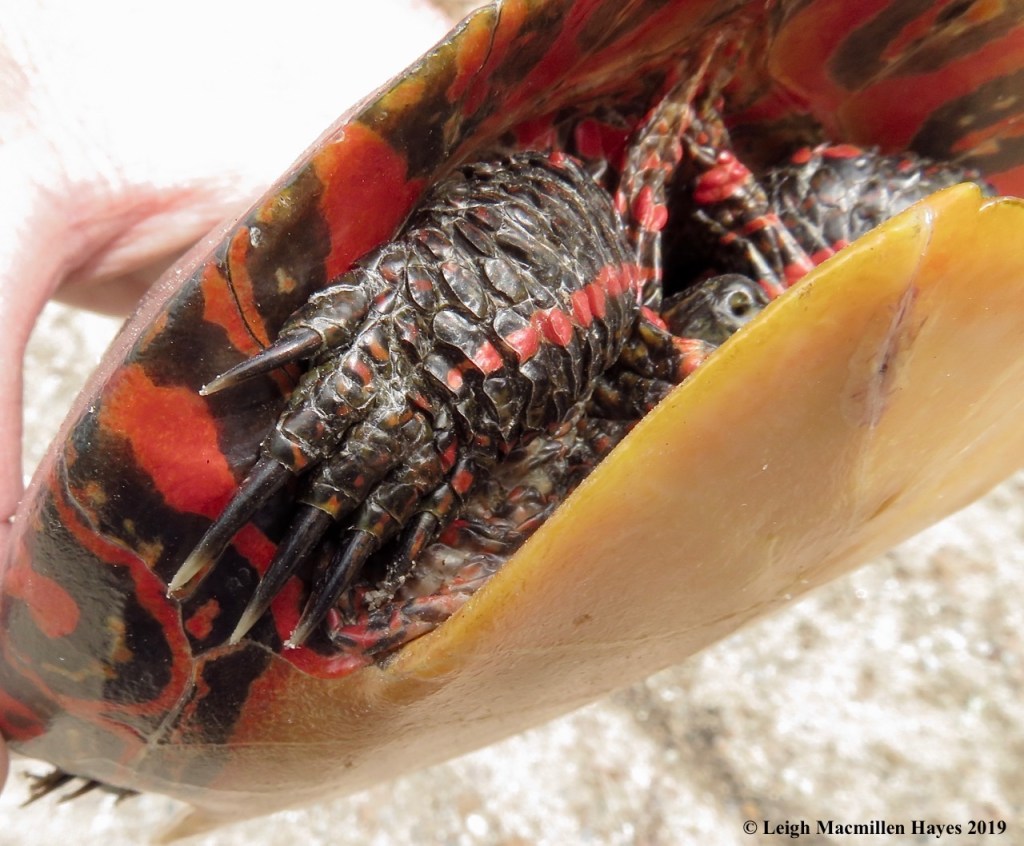
First, there was the Painted Turtle that I spotted on Kezar Lake Road as I drove toward the Greater Lovell Land Trust’s Long Meadow Brook Reserve. After I pulled over and approached him, he did what turtles do and retreated into his shell. Though he wasn’t feeling it, I was in celebration mode, for he represented my first turtle of the season. And I helped him cross the road.

I felt safe calling him a he for males have long fingernails. Can you see him peeking out at me in a not too pleased manner? Can’t say I blame him, but our time together was brief and soon he wandered his way while I wandered mine.

And then, another reason for celebration–Coltsfoot in bloom. I know it’s invasive, but its sunny face and scaly purplish stem that predate its leaves offer a first hint of the season’s promises of colors to come.

Coltsfoot is known by some as Filius ante patrem (the son before the father), because the bright yellow star-like flowers appear and wither before its broad, green leaves are produced.

The next sight to be considered: a small spider that, like the painted turtle, continuously eluded our focus by quickly moving to the opposite side of the beech twig. Can you spy it?

And then there were those tree buds bursting forth with life ready to unfold from within. We were offered a few early glimpses of the future and rejoiced at each sample.

At last we reached Long Meadow Brook, for which the reserve is named. And stood and looked and listened and waited and absorbed. Oh, Pam absorbed some water in her boots thanks to a leak. But she didn’t let that stop her and we each enjoyed the opportunity to let this place soak through our pores for moments that turned into a string of minutes and suddenly an hour had passed.

At long last, we pulled away and began a bushwhack through the woods beside the brook.

In so doing, we found more to celebrate, like a red squirrel refectory upon a rock and we suspected a large hole below the tree trunk and boulder had served as the larder.

Continuing on, we saw mats of black upon moss by another tree and almost wrote it off as perhaps a fungi we hadn’t met before.

But. It. Moved. As we watched, we realized the constant motion was created by springtails writhing en masse. To say it wasn’t creepy would be lying. Likewise we were fascinated and leaned in closer to watch the swarm upon the moss.

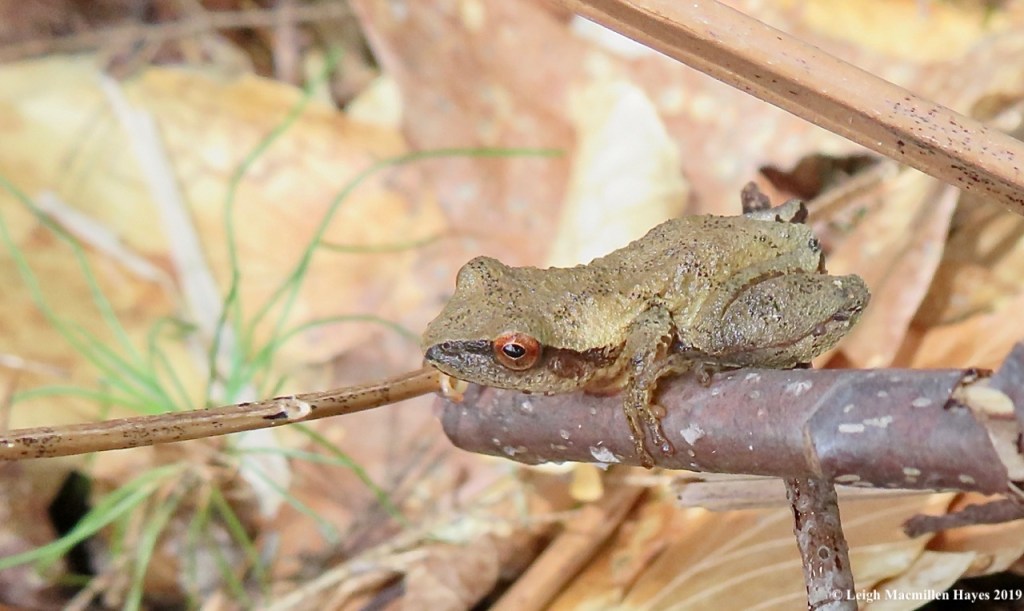
Resting nearby, perhaps having just gorged on some of those tiny little morsels, was another reason for celebration–a spring peeper. We spotted two, but heard a hundred million more, each adding its song to the symphony that arose from the wetland. And suddenly, an interval of silence would interrupt the music, and then one male would peep, and the rest would join in again until they arrived at the next rest symbol upon their sheet music.

Others added their own notes to the orchestra, including a couple of White-throated Sparrows that trilled in our midst.

Near the end of our journey, we reached a point where we could see that there was still some snow on the the Bald Face Mountains in Evans Notch, but we spotted a dragonfly and honored Trailing Arbutus flowers and rejoiced. Though our celebration didn’t have a Mexican theme, we still had at least cinco reasons to give thanks from the Painted Turtle to Coltsfoot to Bud Bursts to Squirrel Larders to Creepy Collembola to Spring Peepers to White-throated Sparrows. Really, it was more a Siete de Mayo on this Cinco de Mayo–Maine-style.

This Wild Place

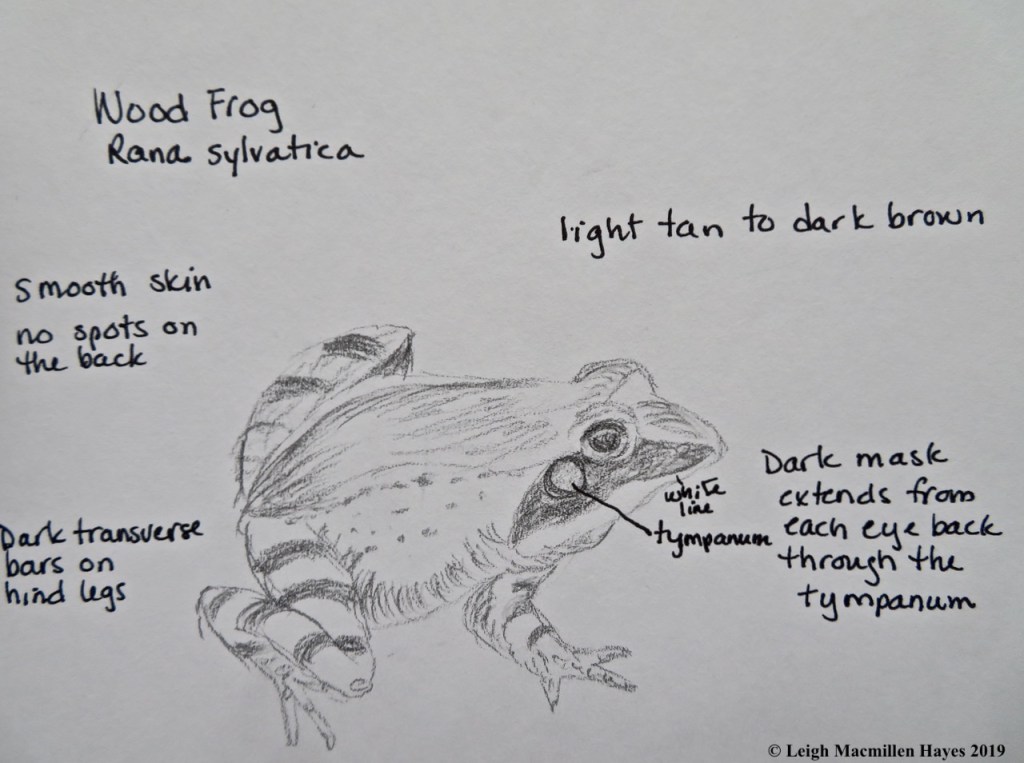
There’s no music quite like the Wood Frog’s defiant chorus, sung when the ice is barely off the vernal pool and the ground still covered with patches of snow. Singing together, they sound like dozens of quaking ducks. Wood Frogs are often the first Maine frogs to break winter’s quiet, beating Spring Peepers by a few days or even a week.

Their vocal prowess extends to silence. Once we approach a vernal pool and they sense danger (perhaps through vibrations), they cut off their song altogether, as though timed by some unseen conductor. The purpose of all this calling is finding a mate, of course. Male Wood Frogs, once they’ve called in some unwitting females, can be tenacious in the extreme–even if their suitor happens to be the wrong species.

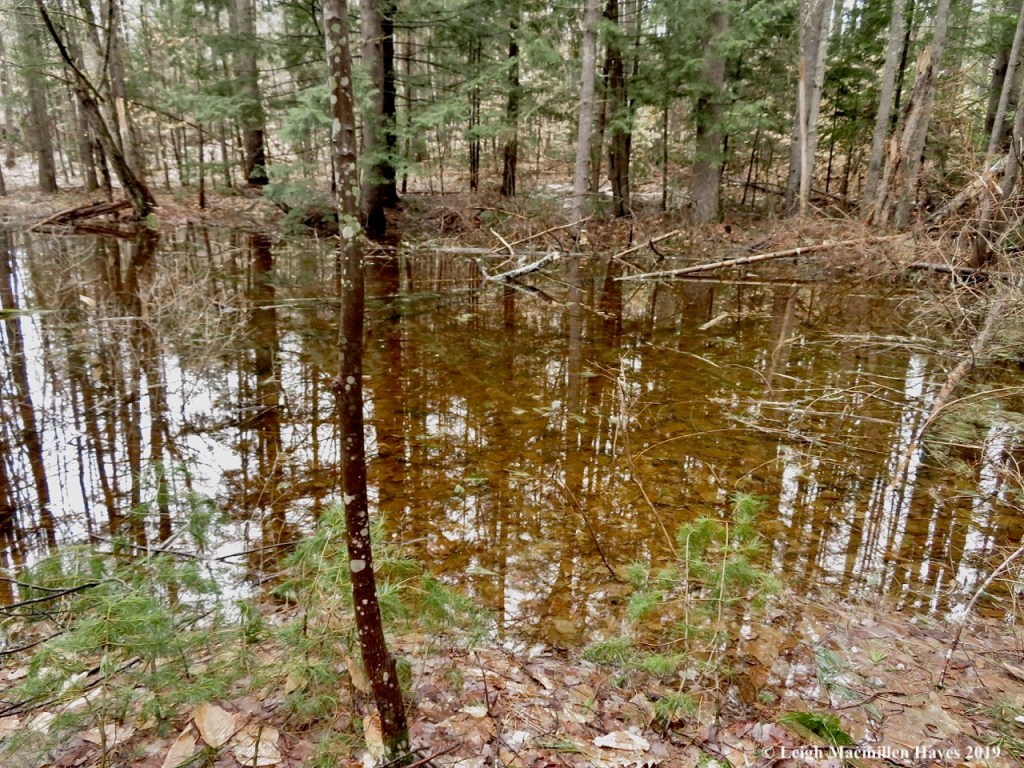
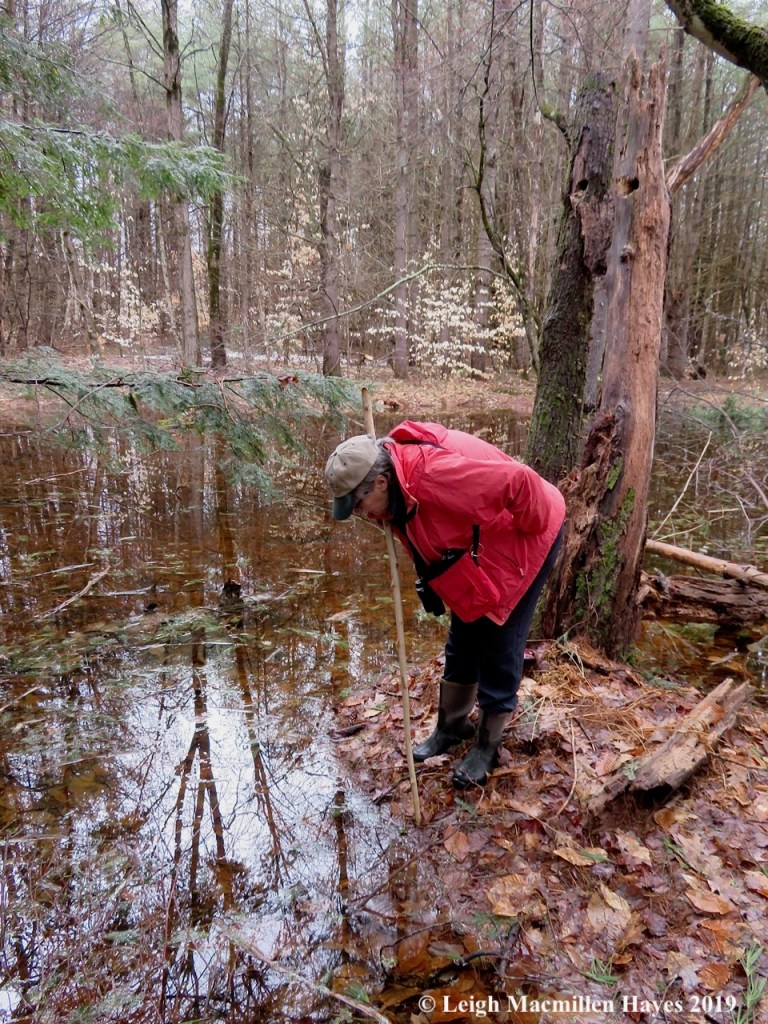
This morning, as Greater Lovell Land Trust Docent Linda Wurm and I approached a pool on the Heald and Bradley Ponds Reserve, the symphony was eerily still.

And so we began to circle around, our eyes scanning the watery surface for clumps of eggs. Our hope was to either see a male hug a female in an iron-lock grasp, forming the mating embrace called amplexus, or evidence of their date.

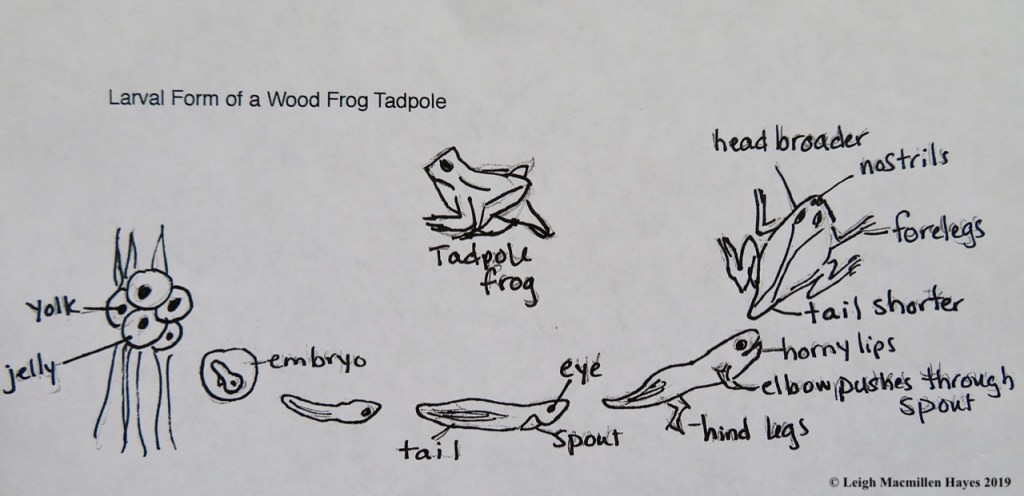
And we were rewarded. At least one female had laid eggs fertilized by a male. As is their habit, the female attached the mass to a twig and the tiny black embryo of each egg was surrounded by a perfectly round, clear envelope about one-third inch in diameter. These gelatinous blobs can consist of up to 1,500 individual eggs. Egg-mazing indeed.

The embryos will hatch into small brownish-black tadpoles in a week or two, or longer given how chilly the water was today. As they grow, their rounded tail fins will become translucent–almost mottled with gold and blackish flecks.

Wood Frog tadpoles grow at varying rates depending on water temperature, tadpole density, and available food resources, but tend to develop within about two months to become adults. Unfortunately for them, but in the web of life good for others, tadpoles often succumb to cannibalism, especially to their larger relatives. They are also eaten by predacious diving beetles, salamanders, turtles, and birds.

We only found one, maybe two egg masses, but this pool isn’t known for many. What it is known for is its Fairy Shrimp population and I’m sorry to report that we found not a one. But, we did spy a few handsome hemlock varnish shelf fungi.

And by them some red squirrel middens that made us happy for we saw few of these all winter.

Right behind the fungi and midden, something else in the water caught our attention and Linda focused with a keen eye.

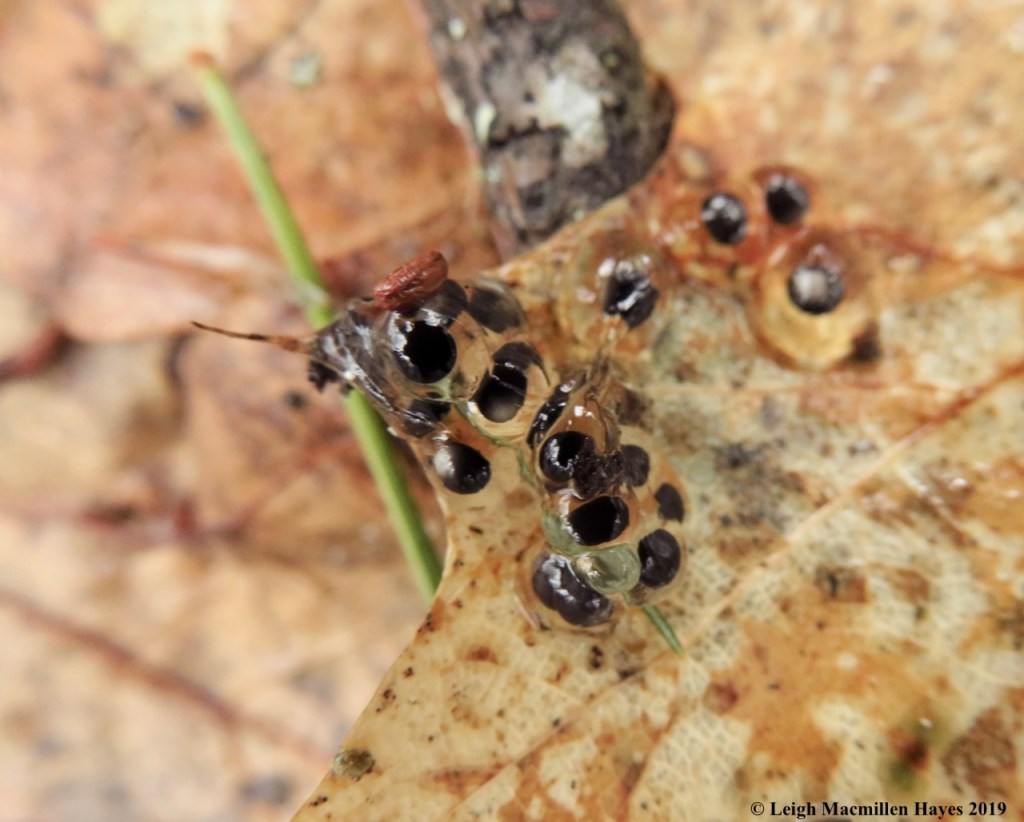
My photo wasn’t the clearest, but upon some leaves and twigs we spotted spermatophores left behind by male Spotted Salamanders. They remind me of cauliflower, their structures consisting of pedestals topped with sperm. Though we couldn’t see any milky masses of salamander eggs, we hope that on future visits we will.

Spotting a Spotted Salamander is a rare treat. With their bright yellow spots on a sleek, shiny black back, they are even more nocturnal and elusive than the Wood Frogs. They are actually mole salamanders and spend most of their time burrowed underground.

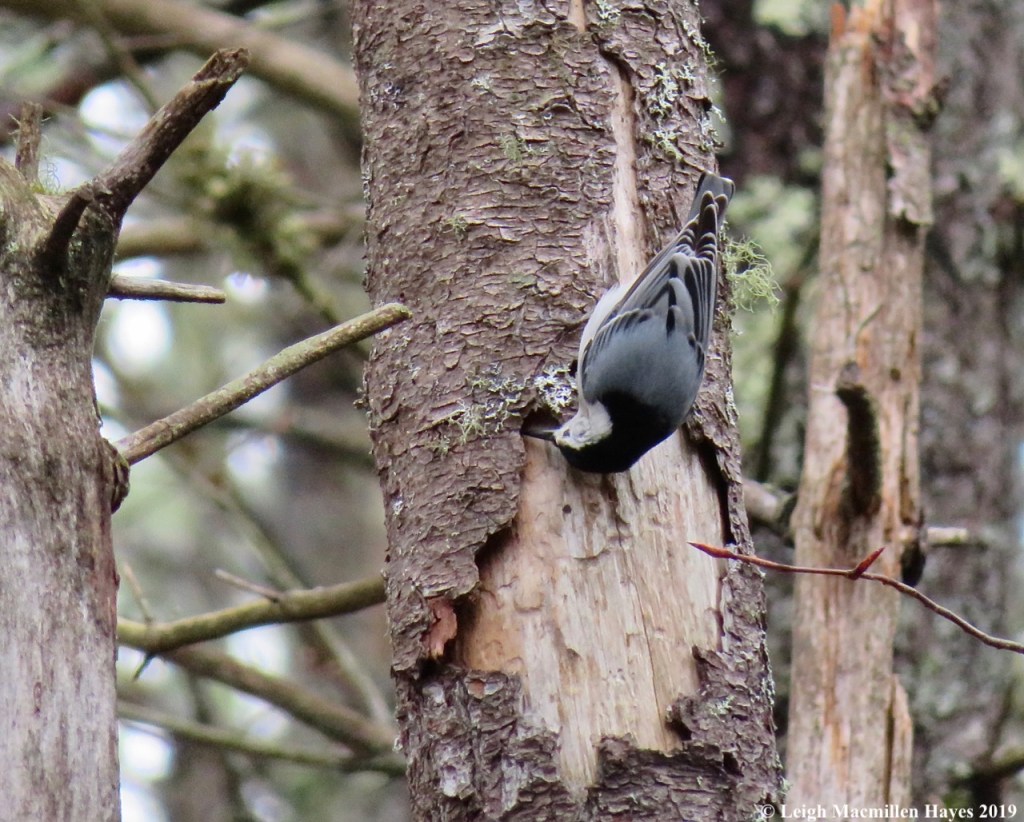
As we circled back around the pool, a White-breasted Nuthatch mimicked our searching eyes and probed under some bark, its long narrow beak seeking beetles.

Every few seconds it took a break and surveyed the world that included us.

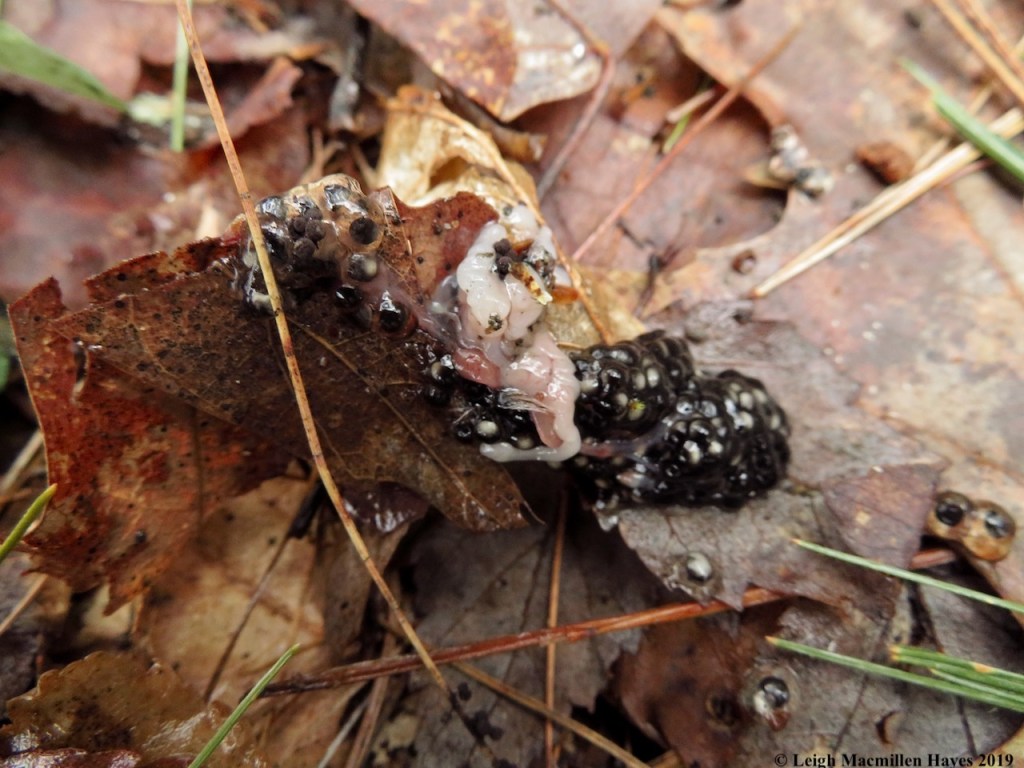
We, too, surveyed the world, and suddenly at our feet we discovered eggs we’d not seen previously. What were they doing about a foot out of the water?

And to whom did they belong? At first I considered Pickerel Frog, but on closer examination I thought they might be Wood Frog.

And then Linda shifted one clump a wee bit with a stick and we found what may have been the entrails. Life happens in vernal pools and this one was no different. Had a predator stopped by? Perhaps a raccoon or skunk or chipmunk or raccoon? But, why didn’t it eat the eggs? Again, so many questions.

With the field microscope, we looked at the eggs again and were almost one hundred percent certain that they were Wood Frog.* We did place some of them back in the water, but wondered if they were viable.

For all the eggs that are laid, it’s hard to believe that only 10% will survive. But the truth is that most die before transforming into adults and leaving their pools. The reasons are varied: the ponds dry up; or they are hunted down by predators: or they die of diseases.

After a few hours, we pull ourselves away, grateful for the time to explore this wild place–full of life . . . and death.

*I’ve reached out to Dr. Rick Van de Poll about the eggs out of water–if, by chance, he responds, I’ll update this post so stay tuned.

And now from Rick:

Hi Leigh!

Fascinating find! Having just seen a few predated egg masses today I can definitively say they are spotted salamander eggs. The blackish coloration is likely imparted by the stomach acids of a raccoon, who apparently gorged and threw them back up, along with a few frog parts. Again, while its not too common to see this kind of things around vernal pools, it does make for for a pretty good ‘who-dunnit’!

Rick

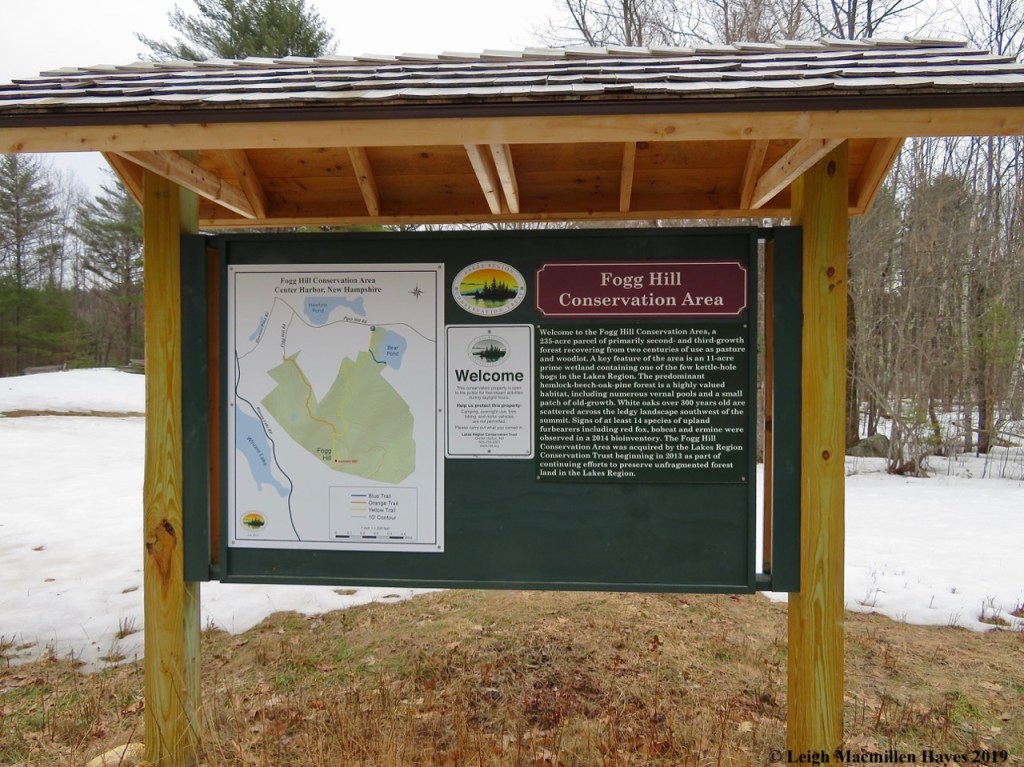
Bear to Beer: Fogg Hill, Center Harbor, NH

Today’s adventure meant a bit of a drive to Center Harbor, New Hampshire, but it was a journey down memory lane for me as I recalled my time spent teaching and living in the Lakes Region of NH. My guy endured the stories, many of which I’m sure he’s heard before, so I suspect he was grateful when we finally arrived at our destination.

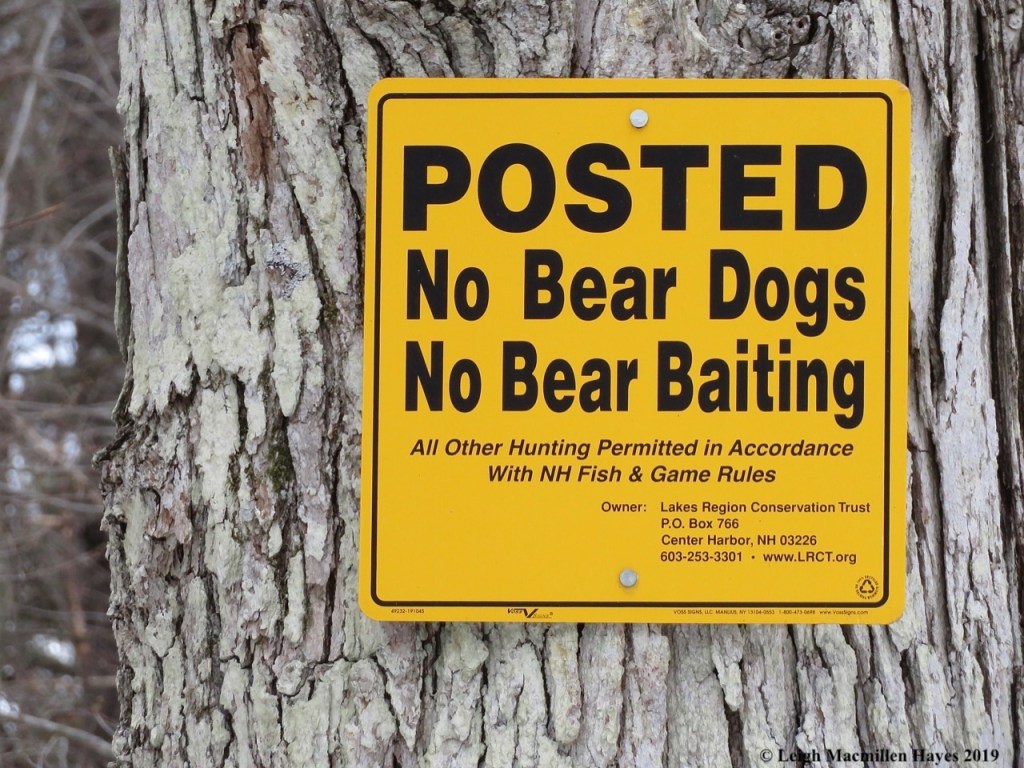
We’d never been to the Fogg Hill Conservation Area before, but prior to Christmas when I was creating the Bear to Beer Possibilities gift, I found Bear Pond on the property and thought it had potential. Besides, we love to explore new areas . . . then there’s always that challenge of looking for a bear sign.

The sign was easy to find for it’s nailed to a tree at the trail head, but it wasn’t quite what we had in mind. It did, however, give us hope. Perhaps we would find a tree with signature bear claw marks left behind.

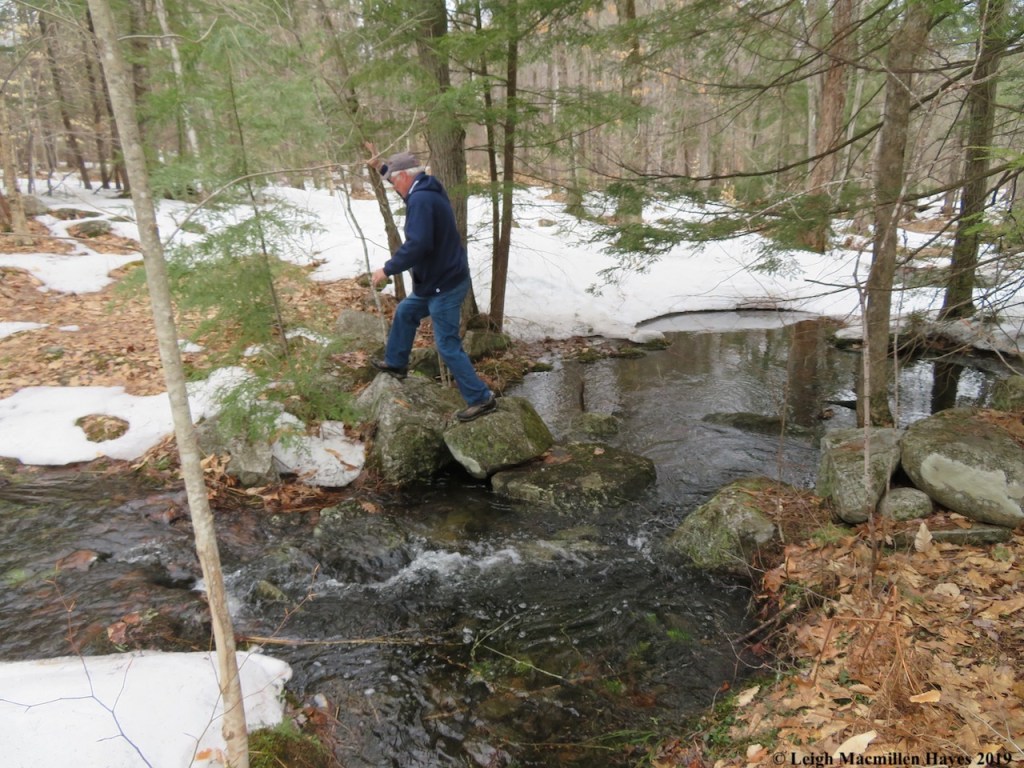
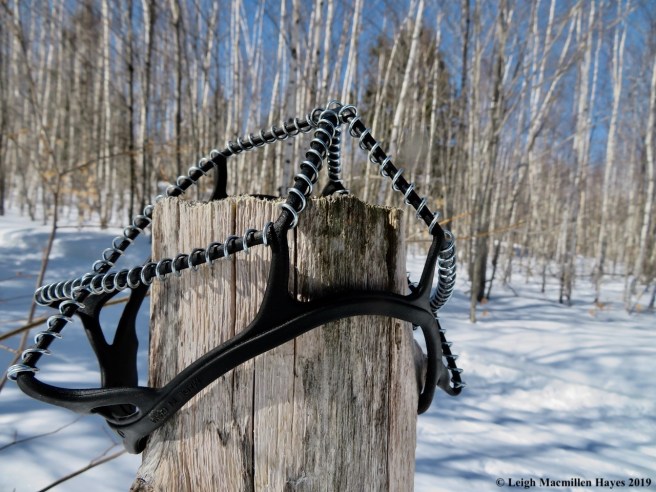
Our choice of footwear was questionable from the get go as we passed between two canoes onto the trail blazed with yellow. We chose hiking boots and for me, spikes. He tossed his spikes into the pocket of his sweatshirt. Rather than keep you in suspense, I’ll jump ahead and tell you it was the right choice. We walked on bare ground, ice, and snow sometimes a foot deep, but it was constantly changing. And he never did wear his spikes. I, on the other hand, was glad to don them.

Sometimes our path also included stream crossings.

Not long into our journey, we followed the blue blazes to Bear Pond. Our hopes of finding what we were looking for there were soon dashed. But . . .

we saw beaver works of past years that now supported a variety of other growth.

A lodge stood tall in the wetland, but by its grayed sticks we knew it hadn’t been used recently. Maybe rather than Bear Pond it should have been named Beaver Pond, but then again, maybe not.

Back on the yellow trail, we continued on, but paused again beside another beaver pond. You’ll have to squint to see the lodge, but it’s there, beside a boulder that mimics its shape. As we stood there, my brain fast-forwarded to summer and I could imagine not only the vegetation in full bloom, but also the insects and especially the dragonflies providing a display.

Back to reality–I did spy a Mallard on the far side of the pond.

Onward and upward we climbed, our eyes scanning the trees for any bear sign. Sometimes the bark of the Beech was all blocky as a result of beech scale disease.

Others were as smooth as could be and we both thought, “If I were a bear in the woods, this would be my tree.” But none had claimed it.

We were almost fooled when we looked up at one of the old trees–until we realized we were looking at sapwells created by Yellow-bellied Sapsuckers. And I realized I hadn’t associated them with American Beech previously. A lesson learned from the bark I thought I knew so well.

Mind you, we weren’t always looking up because we did have to choose the next spot to place each foot much of the time and we were often surprised when what appeared to be firm wasn’t. But because we were looking down so much, we saw several scats left behind by the locals including Coyote and Bobcat. The above is Coyote scat–filled with hair and chunks of bone.

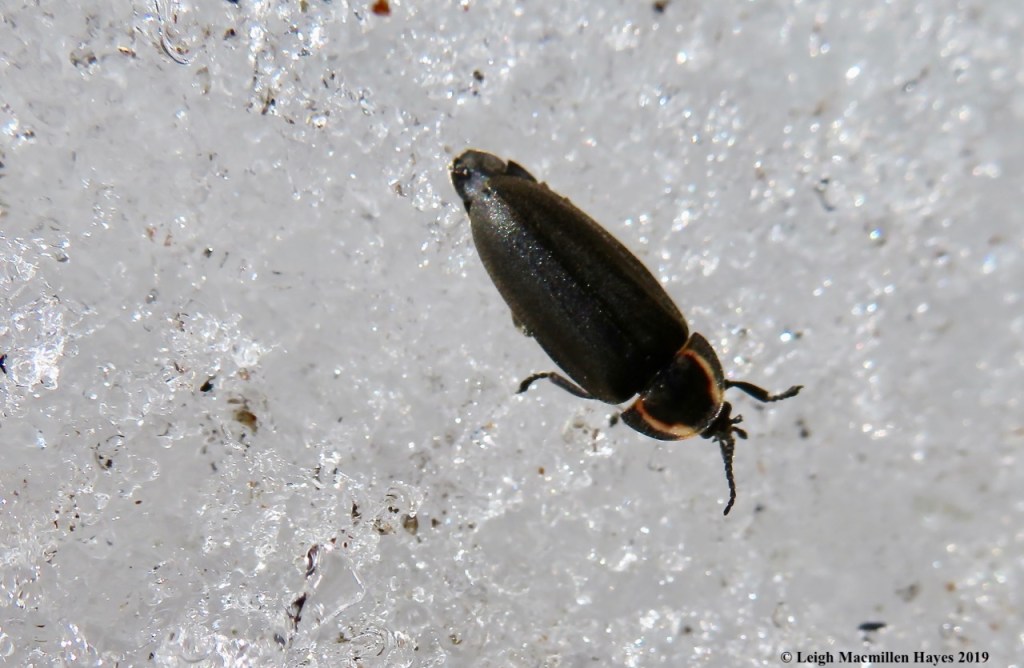
We also spotted another Winter Firefly–this one cross a boulder in the trail.

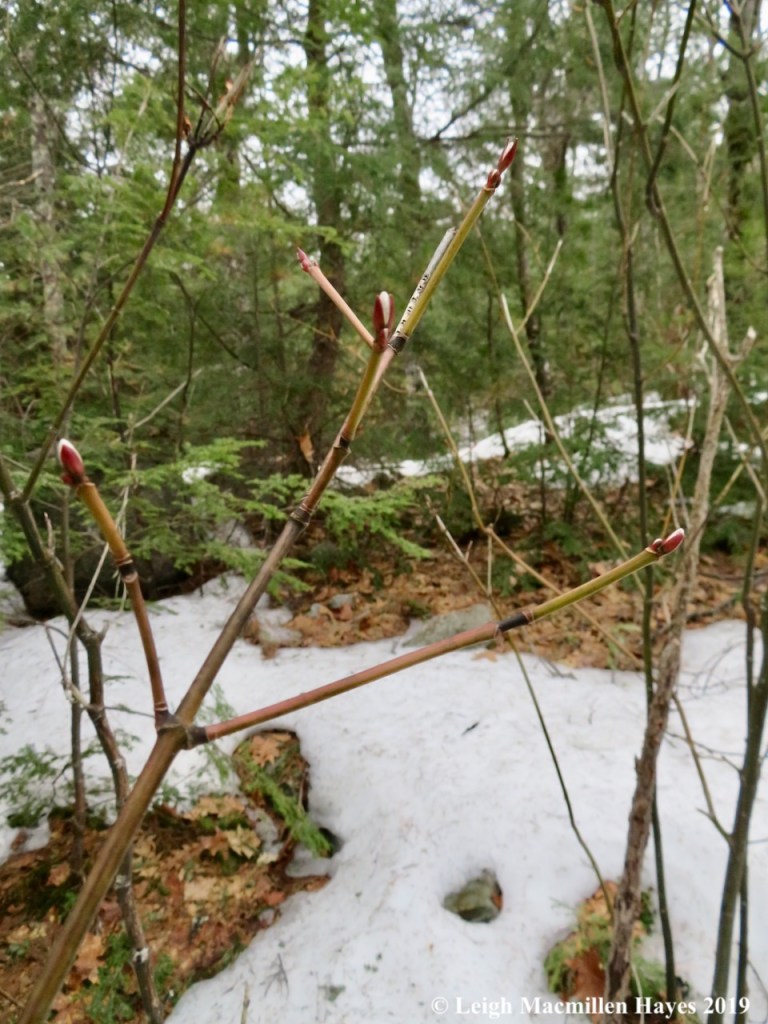
And a treat to top them all–Striped Maple breaking bud! Suddenly spring feels rushed and I want to slow it all down and savor every sweet moment. ;-)

Just beyond the Striped Maple, we chuckled when we found the first cairn. Maybe its structure was a homage to the summit ahead.

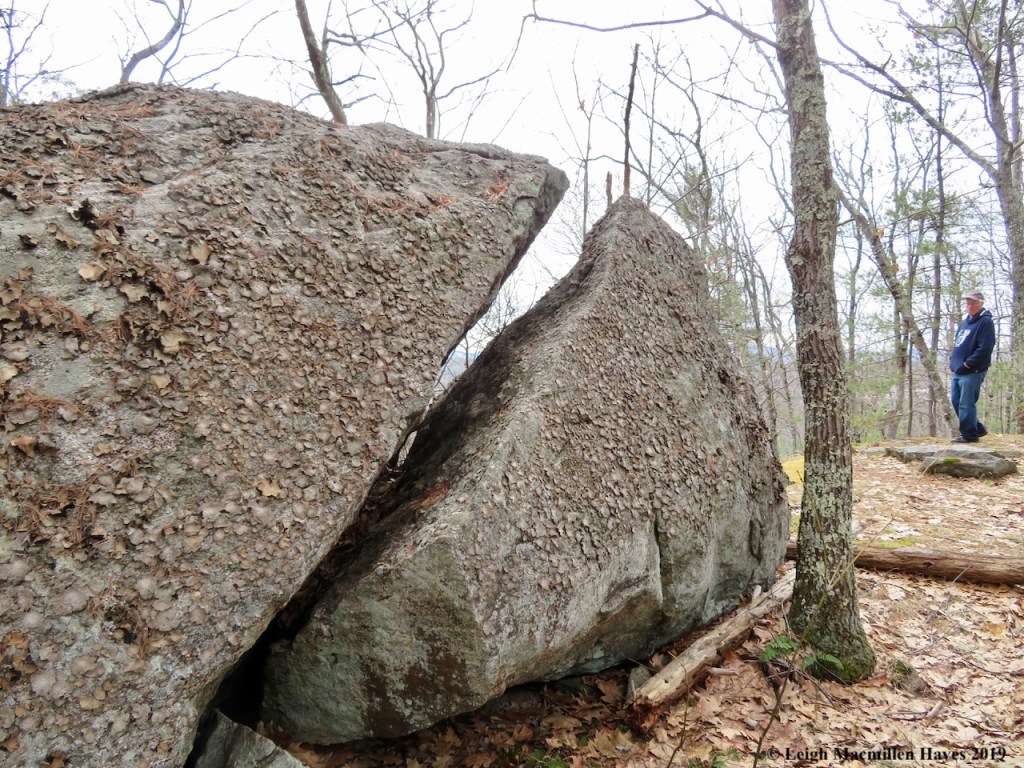
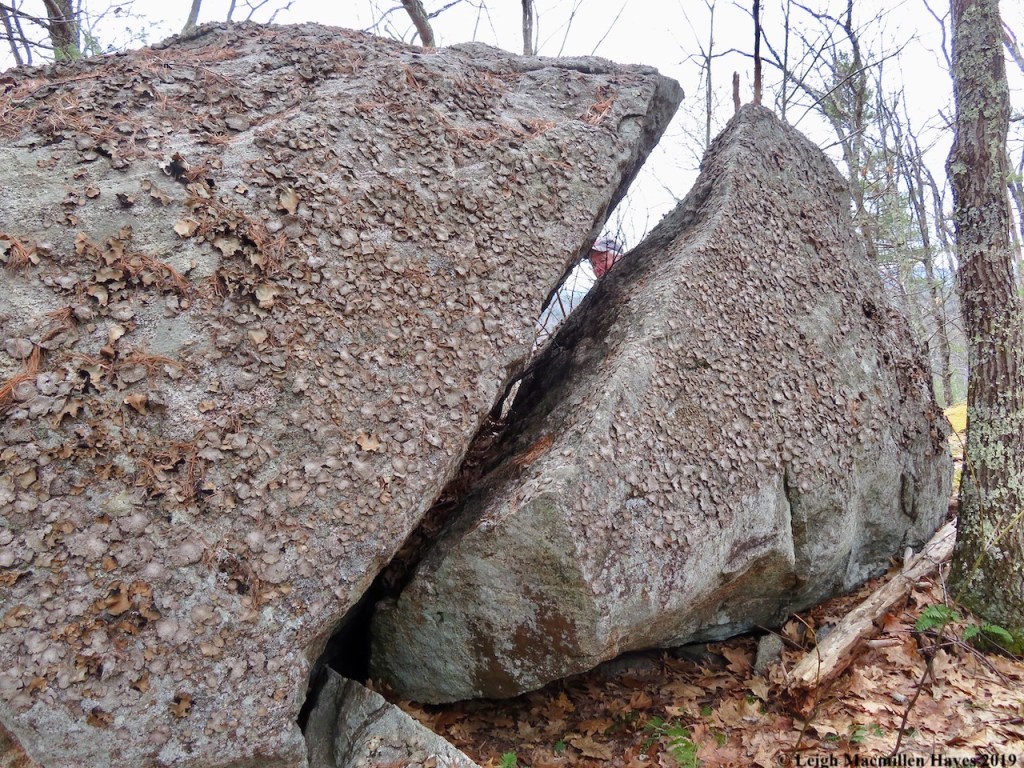
At the summit a split glacial erratic was as interesting as the view, covered as it was with two umbilicate lichens, Rock Tripe and Toadstool.

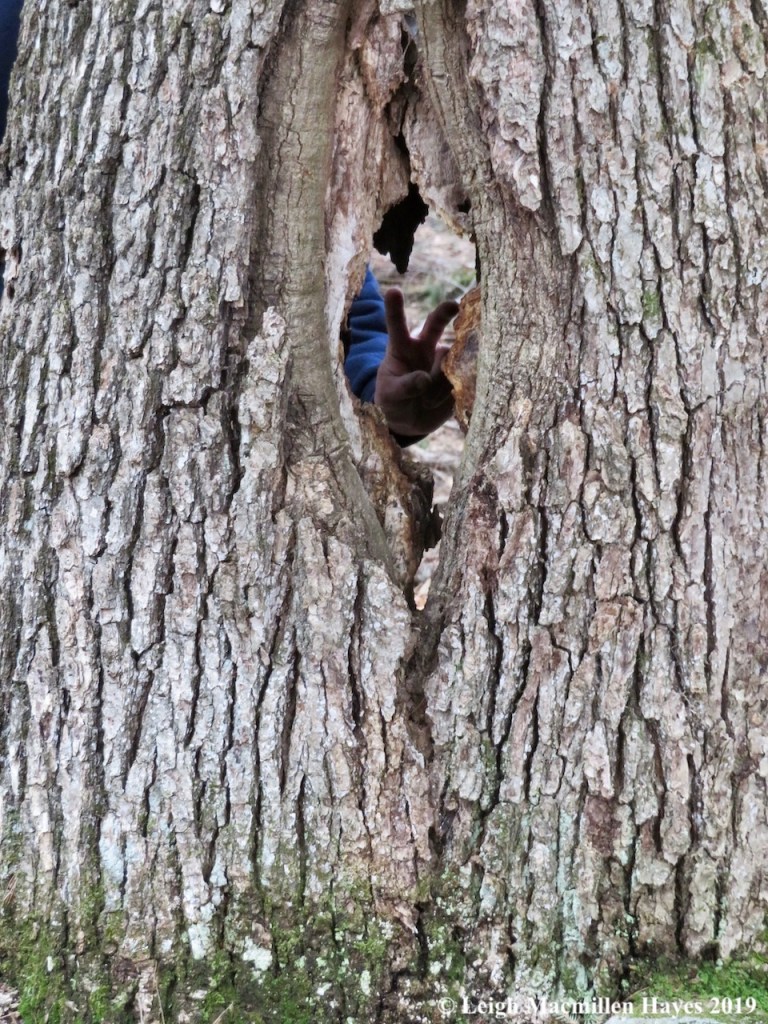
I asked my guy to stand beside it for perspective, but he chose instead to go behind and peek at me through the division.

And on the way down, he found the perfect frame for his peace sign.

As for bear sign, we found one tree with some potential, but wondered if instead it was scratch marks created by near branches.

At last we left the conservation area a wee bit disappointed but promised ourselves we’ll return. Perhaps we didn’t find more than the bear sign at the very start due to the fact that we really spent a lot of time looking at our feet. And never went far off trail.

We also want to check out the orange trail to the Kettle Bog, which we passed by today. A few years ago, Dr. Rick Van de Poll completed an ecological survey of the area and discovered rare plants on the land. Having spent a couple of days working with Rick at a Lakes Environmental Association site in Bridgton, Maine, I can’t wait to figure out what he discovered on the Fogg Hill property.

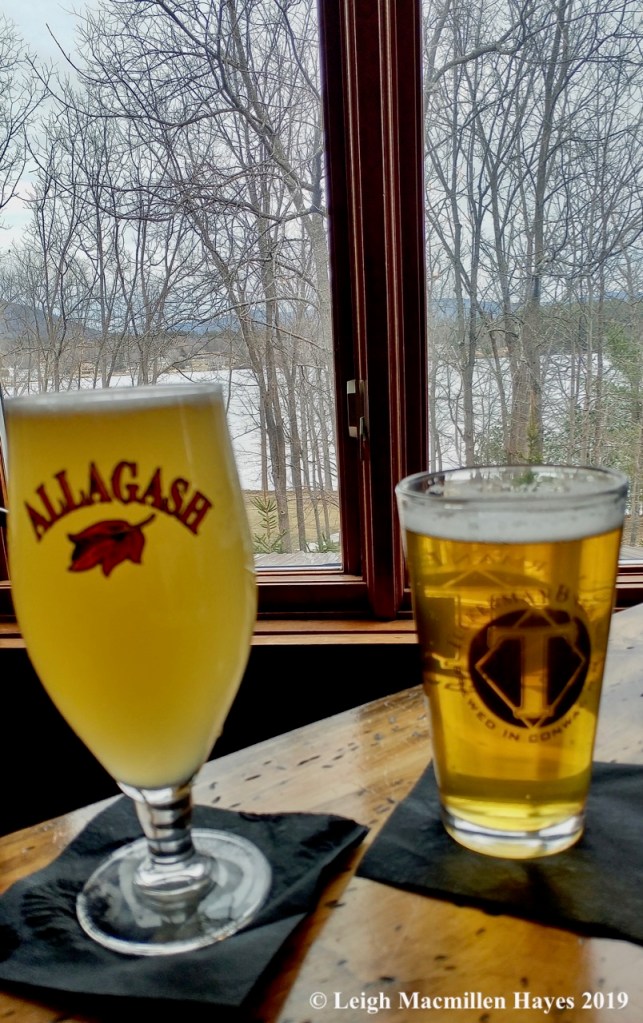
Today’s adventure was topped off with a late lunch at Canoe overlooking Lake Winnipesaukee in Center Harbor. For me an Allagash White and a burger. For my guy: Jack’s Abby Lager and a reuben.

Bear to beer possibilities: Fogg Hill, Center Harbor, NH.

My Eagle Eyes

From my first sighting this morning I had a feeling that today’s views were going to be amazing. I just didn’t know at the time how amazing.

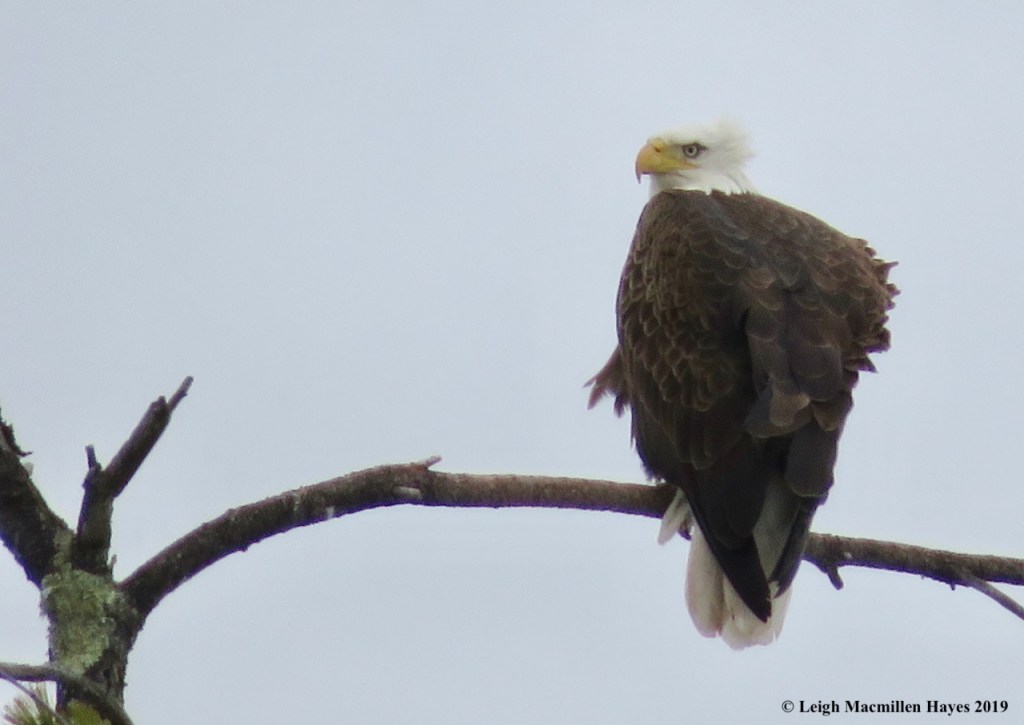
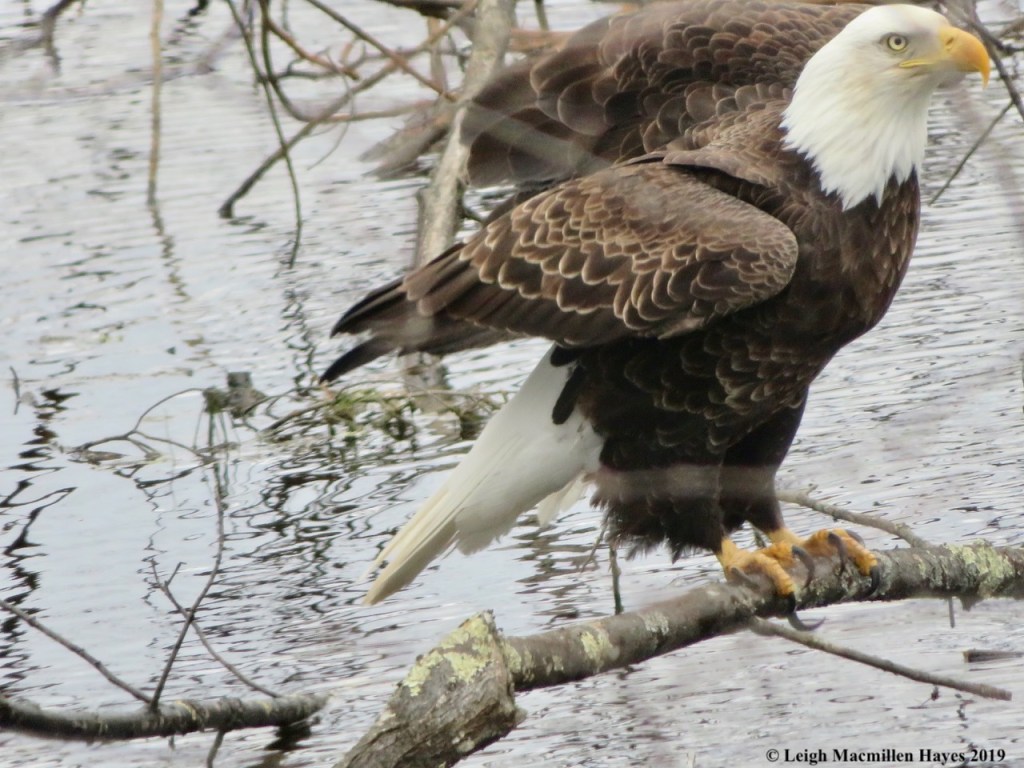
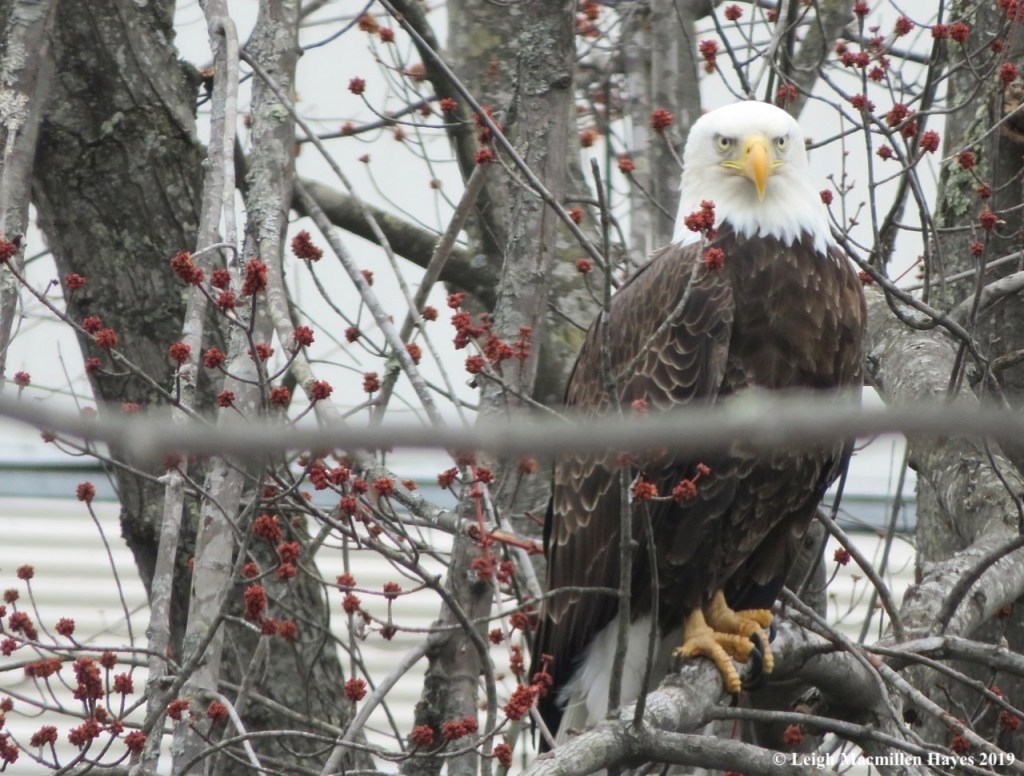
It all began when this Bald Eagle gave me a backward glance as I drove west. He posed as usual on his favorite hangout and I knew that he was patiently awaiting his turn to dine on some recent roadkill. In the meantime, the crows had a feast.

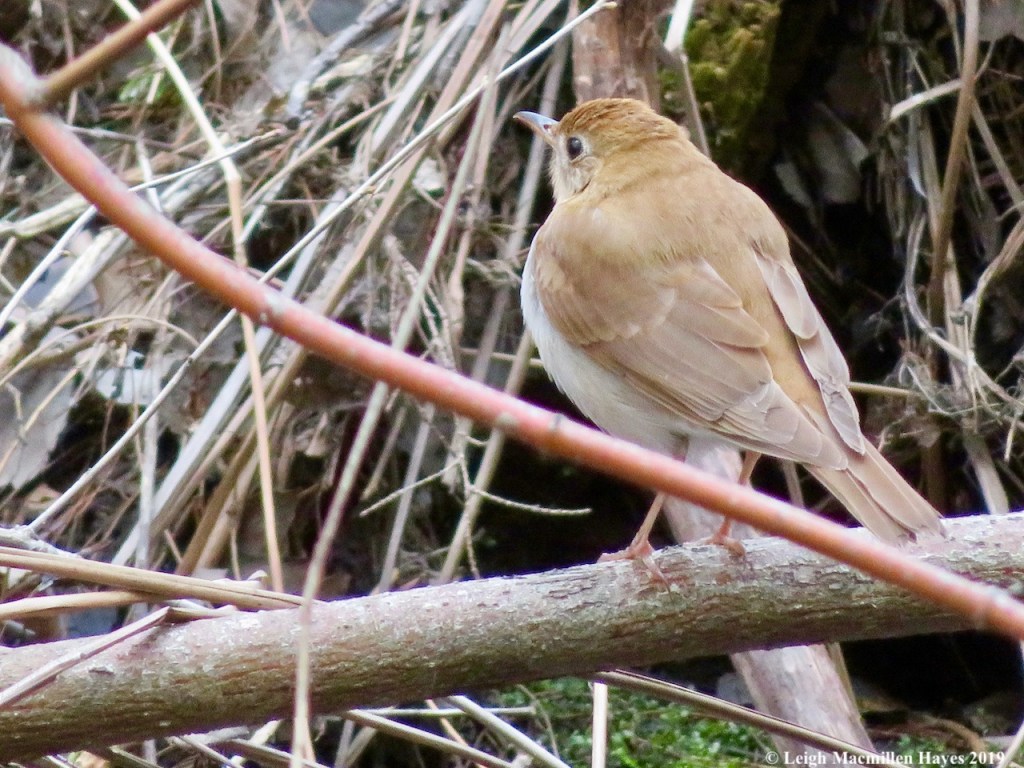
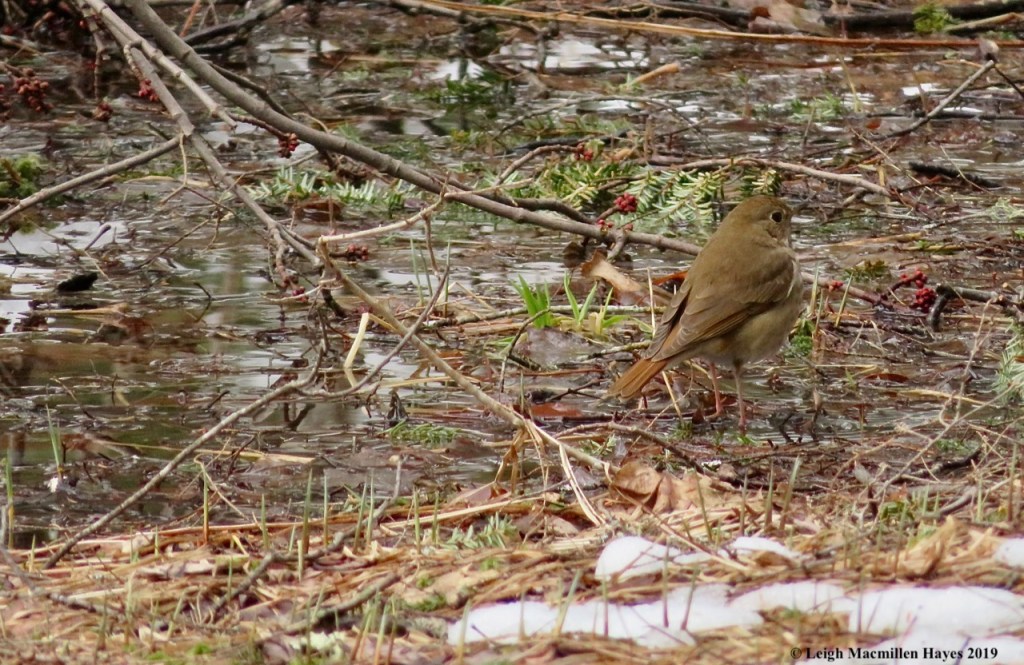
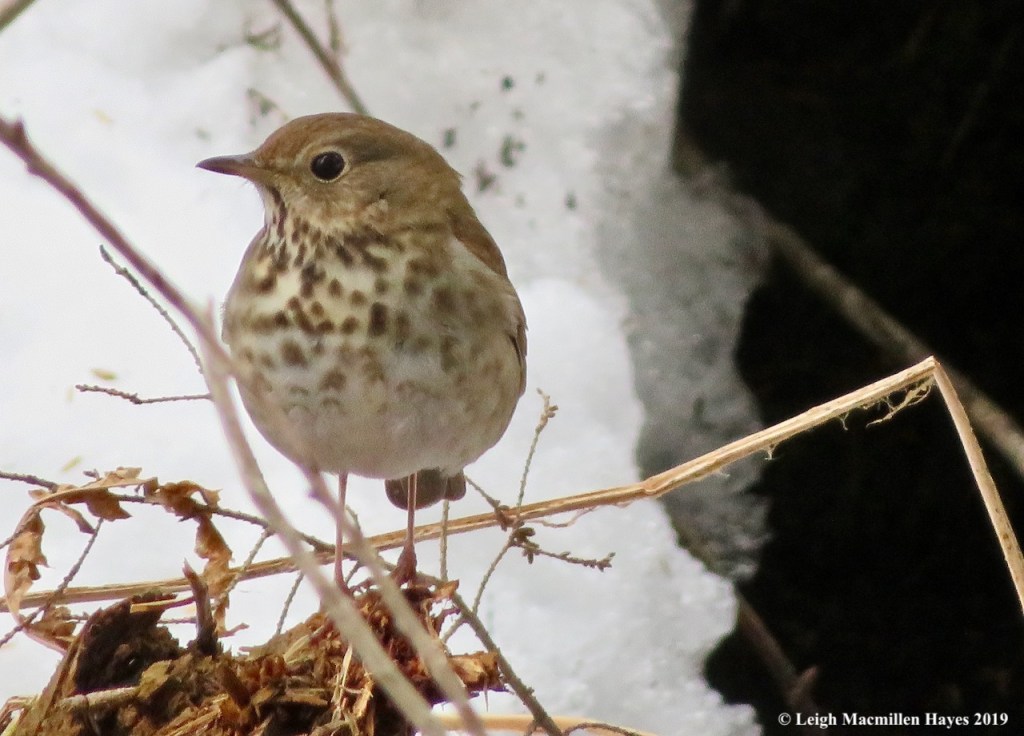
What I didn’t expect was to see a second Hermit Thrush this week, but so it was as I snowshoed through a land trust property with a couple of other people. I have them to thank for they spied the bird first.

And then we stood silent and watched. And dreamed of its enchanting song to come.

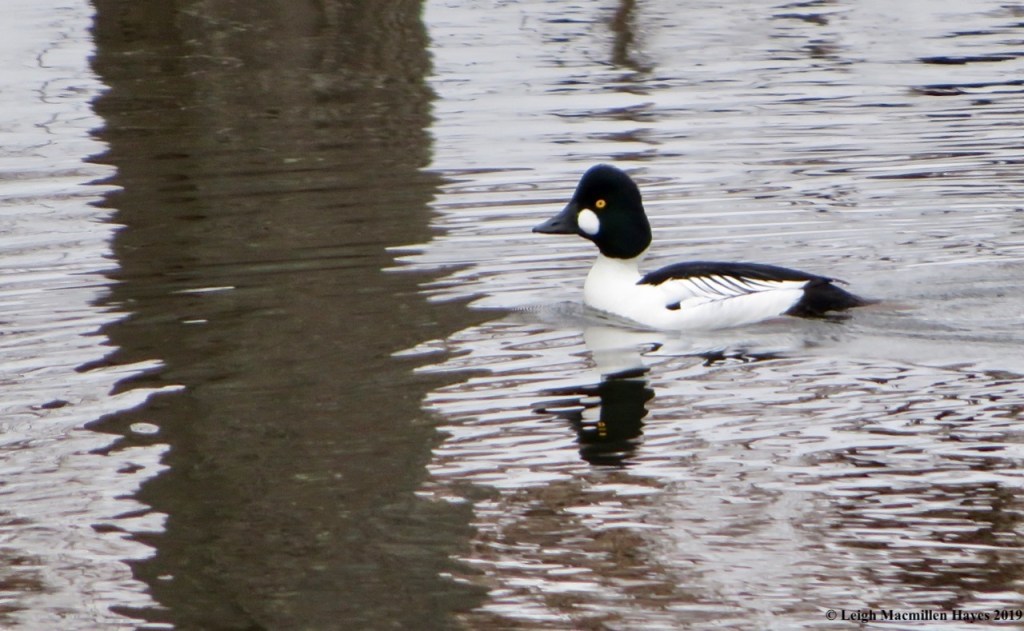
Finding my way beside water a few hours later, it was a pair of Common Goldeneye ducks, his eyes even reflected below, that made me pause next.

Despite a couple of branches slightly obstructing my view, her eye of gold stood out vividly as well. What exactly is it that’s common about them? Their presence I suppose, but still I’m thrilled each time we meet.

Nearby, I almost missed Donald and Daffy, but he hollered for attention, while she stood by on one leg.

Why do birds stand on one leg? And how do they do it? The why I think I can answer–to keep the other leg warm. Unlike some avian species, ducks don’t have hairy sweatpants and so by tucking one leg up under a wing, they can retain some heat. That was important for today while the temperature was in the 40˚s, with a breeze, it was overcast and felt rather raw.

As for my second question, how do they do it? Stand still on one leg without toppling over, that is. I don’t know, but do wonder if it has to do with the feet located toward the center of the body so its weight can be evenly distributed–maybe it turns the one foot a wee bit to insure stability. And perhaps the splayed foot also helps assist what for me would be an awkward position.

Perhaps. And perhaps she looked at me as if to say I was daffy.

And he smiled in agreement.

The next great sight was not a bird, nor was it caged in. And it wasn’t an original find for me because some friends met me at a location where they’d spied it yesterday. But in yesterday’s warm sun, the Red Fox let her four kits frolic about. We watched for a while today, but apparently she’d told the kits to stay in. Her choice for a den sight was remarkable and we learned she’d chosen the same fair spot last year.

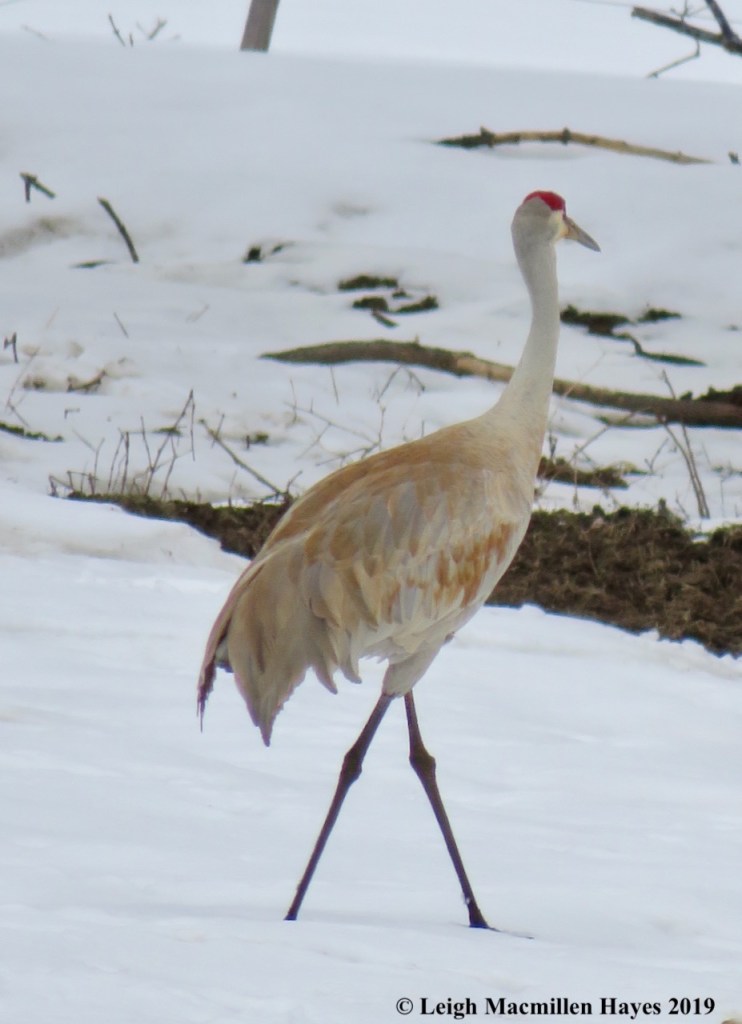
At last I began my journey homeward, but first I had to stop by a spot I’ve been frequenting often of late, for it’s where the Sandhill Cranes have been dining. At the moment there are only two, but by last fall they numbered at least eighteen. Will the same come true this year? Only time will tell.

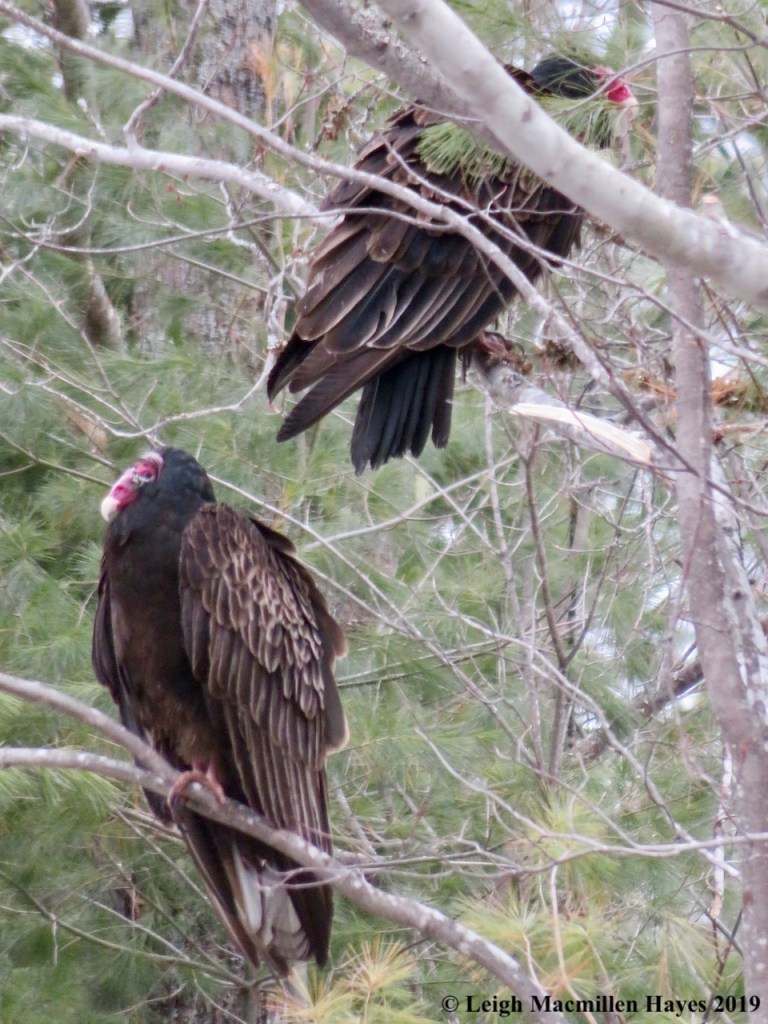
And then, another bird called out and when I realized what it was all I could think of is “Here Comes the Judge” for so its feathers and stance reminded me of a robed magistrate.

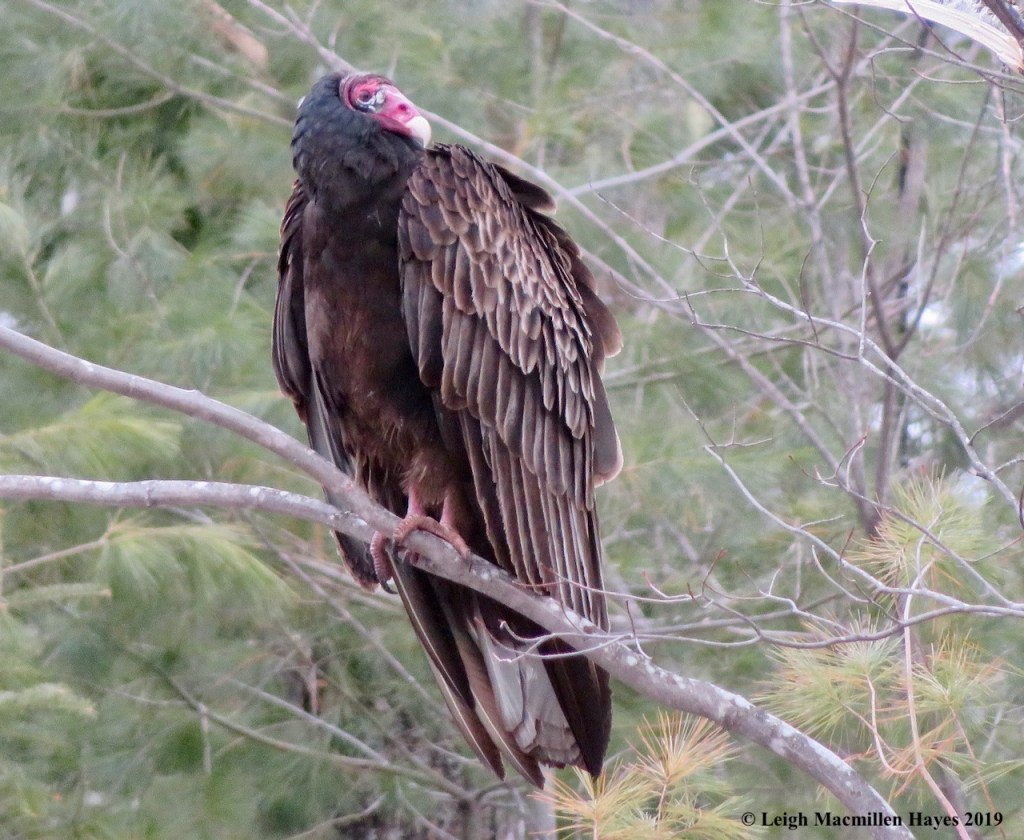
This scavenging creature has no feathers on its head in order to keep bits of carrion (dead meat) from adhering to the skin as they would to feathers.

Yes, these were Turkey Vultures. Where there was one, I soon realized there were two. Actually, on a tree behind these two were two more. I wonder if I missed any.

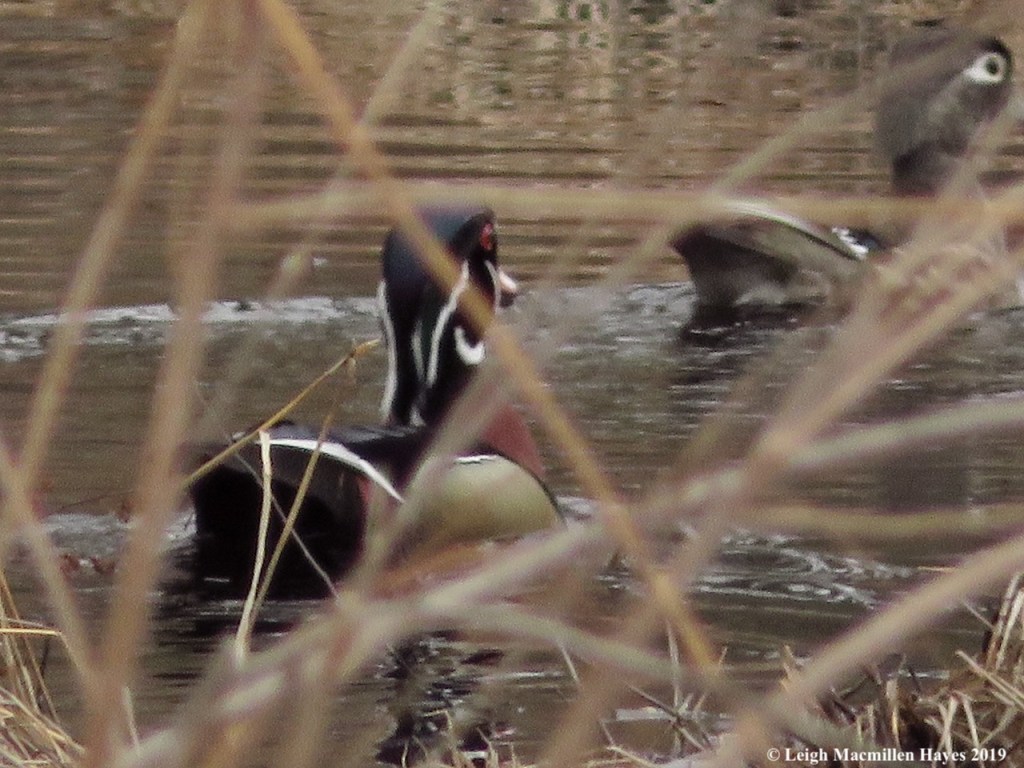
If I had eyes as big and bright as the Wood Ducks that swam quickly through a brook nearby, I’m sure I wouldn’t miss anything, including food in the water below as well as those above who might think of me as food.

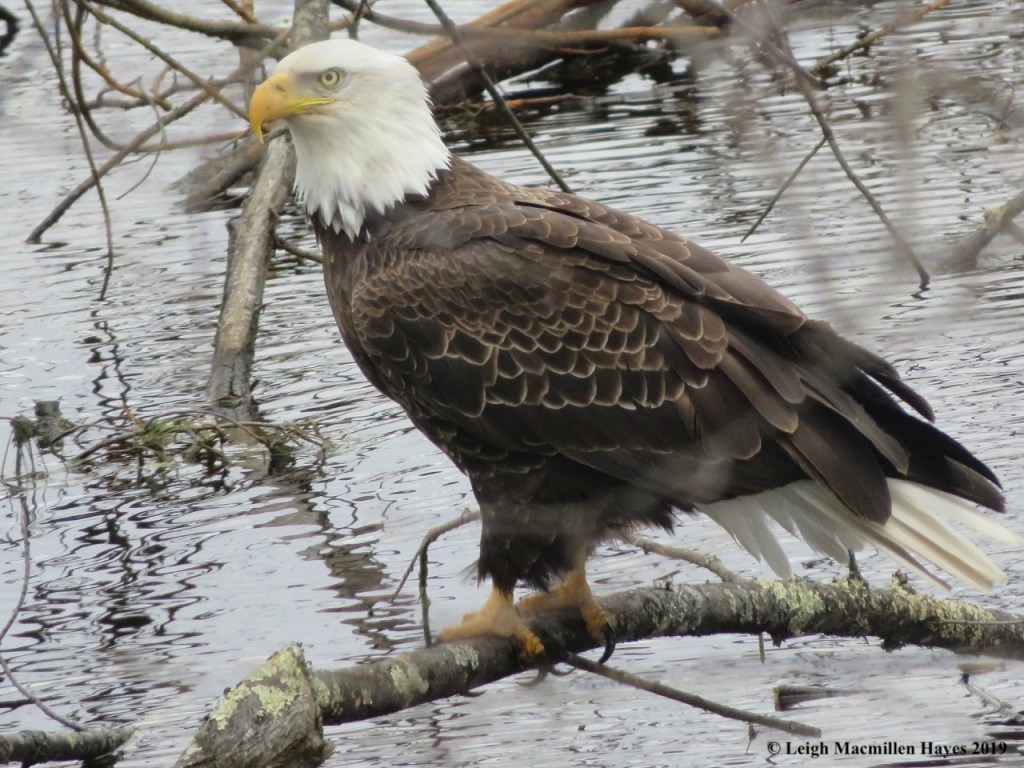
Like this guy! As with so many of my finds today, I’m not sure how I happened upon him, but I did. I guess it was that I tried to look for the anomaly in nature. What shape or color stands out from the surroundings?

As I watched, the Bald Eagle changed its orientation. And then it flew and I was sure that that would be the end of our time spent together.

But it landed on a branch above and continued to look about. I swear it even looked at me and I gave thanks for the opportunity to begin and end the day with such a noble bird in two different locations.

I knew I’d been honored to share a few moments with friends as well as notice those things that deviated from the norm. My eagle eyes certainly felt keen today.

Looking for Spring

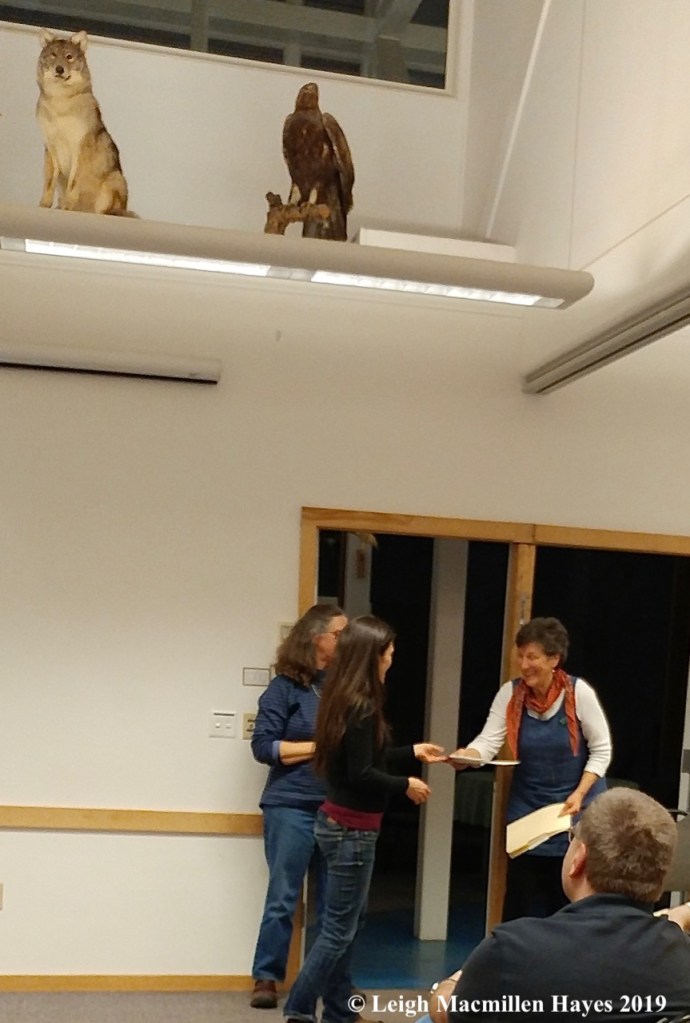
Last night one of the Greater Lovell Land Trust‘s volunteer docents earned her certification from the Maine Master Naturalist Program. The MMNP’s goal is to develop a statewide network of volunteers who will teach natural history throughout Maine. With hands-on training, the course provides over 100 hours of classroom and outdoor experience, focusing on geology, identification of flora and fauna, wetland and upland ecology, ecological principles and teaching methods. By the time students complete the program, which includes a final capstone project, they have developed the skills to lead a walk, present a talk and provide outreach. In the year following certification, each graduate agrees to volunteer 40 hours and thereafter must continue to volunteer to remain an active Maine Master Naturalist.

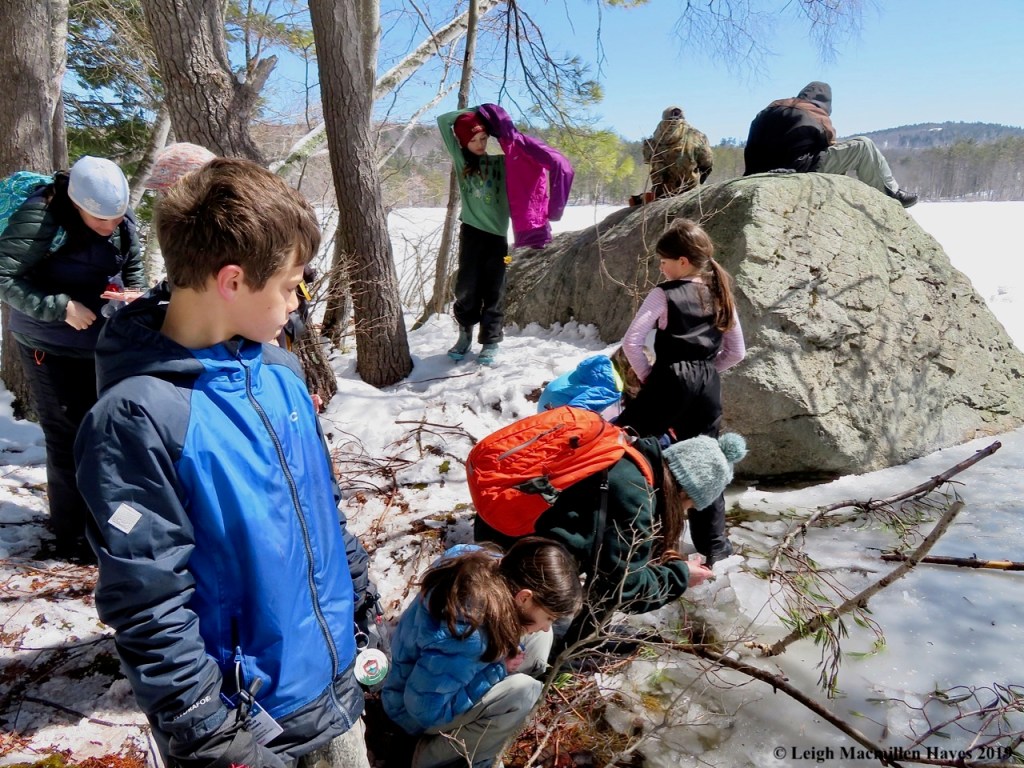
And so it was that Juli joined four of us in the GLLT’s docent group by becoming a certified naturalist last evening. And today, she was out doing what she does best–leading homeschooled families along a GLLT trail. You see, for her capstone project Juli created a group called Nature Explorers. On the second Tuesday of each month (and today’s was the third trip she’d led for this group), other homeschooled families join hers for a walk with a focus along a GLLT trail. Today’s focus: Signs of Spring.

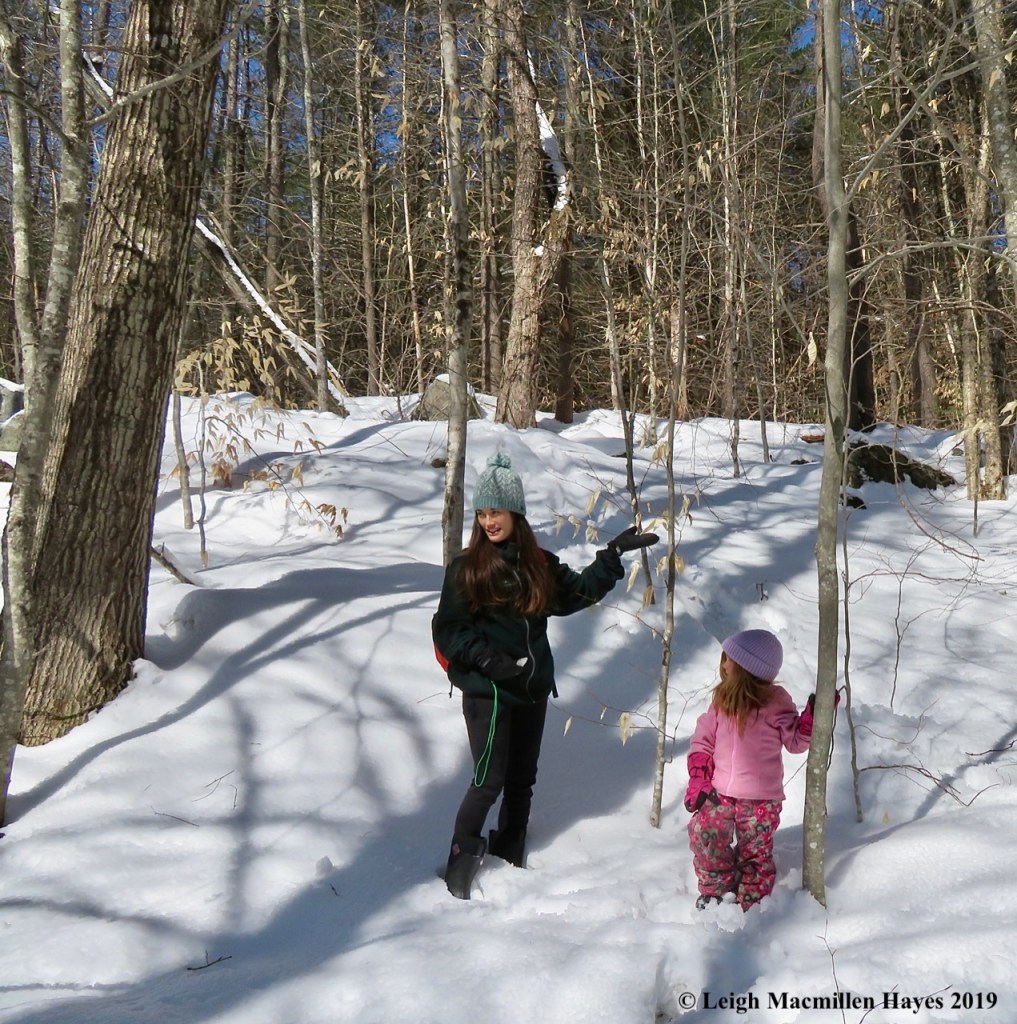
Given the fact that the snow is still at least knee deep, we knew it wasn’t going to be easy. But the day dawned bright, if a bit chilly to start, and so two of Juli’s kids waited for others by hanging out with the trees. Or rather . . . in the trees.

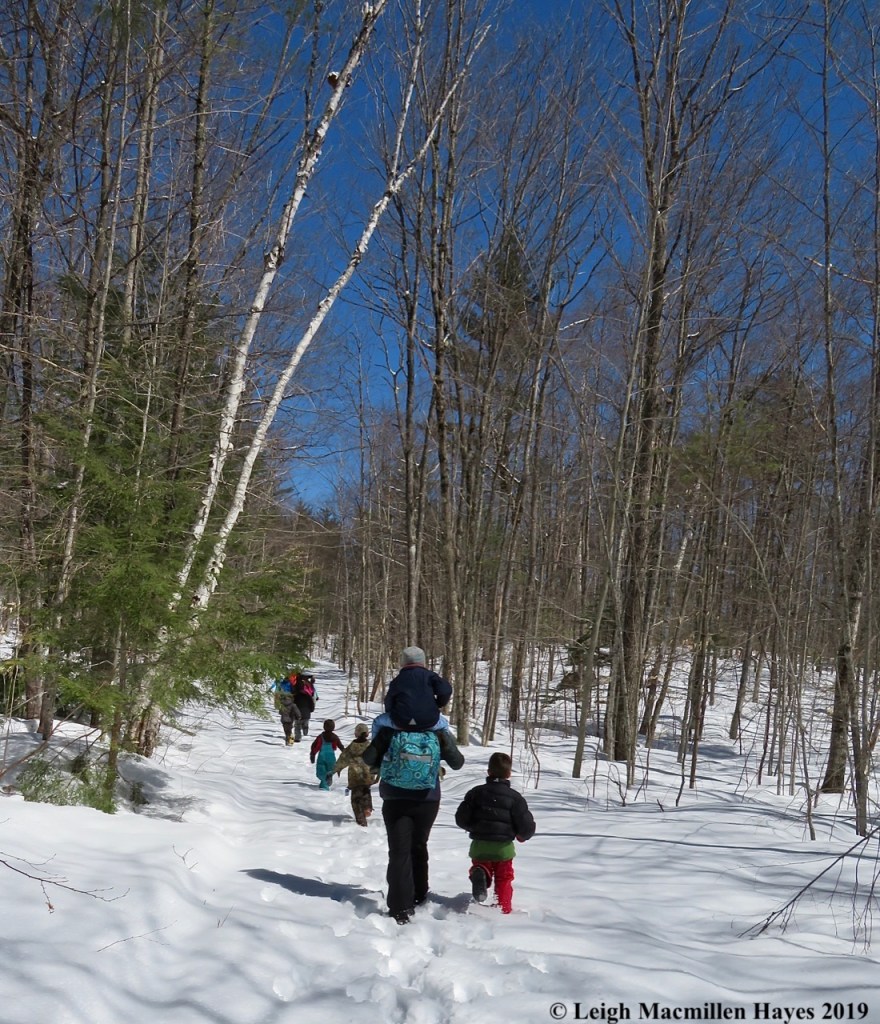
Once all had gathered, she led us down Slab City Road to the trailhead for the Heald and Bradley Ponds Reserve.

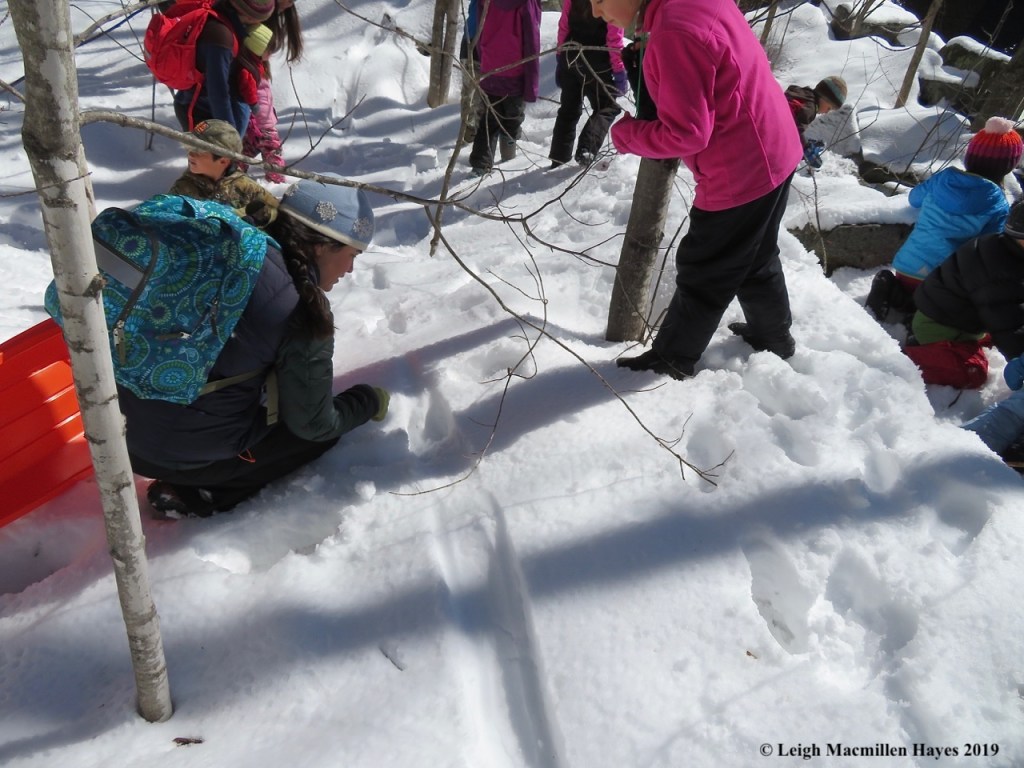
It was there that while we began our search for the season that often begins with a stubborn start in western Maine , we spied something that brought smiles to our faces and awe to our experience. Otter slides. On both sides of Mill Brook. Look carefully and you may also notice the slides–they look like troughs in the snow.

We tromped through (leaving our snowshoes behind, which we sometimes regretted) to take a closer look, noticing where the mammal had bounded and then slid down the embankment.

And then we moved on . . . to observe and learn, including fifty cent words like marcescent, which means withering but remaining attached to the stem. Juli pointed out the dried up leaves on the beech trees.

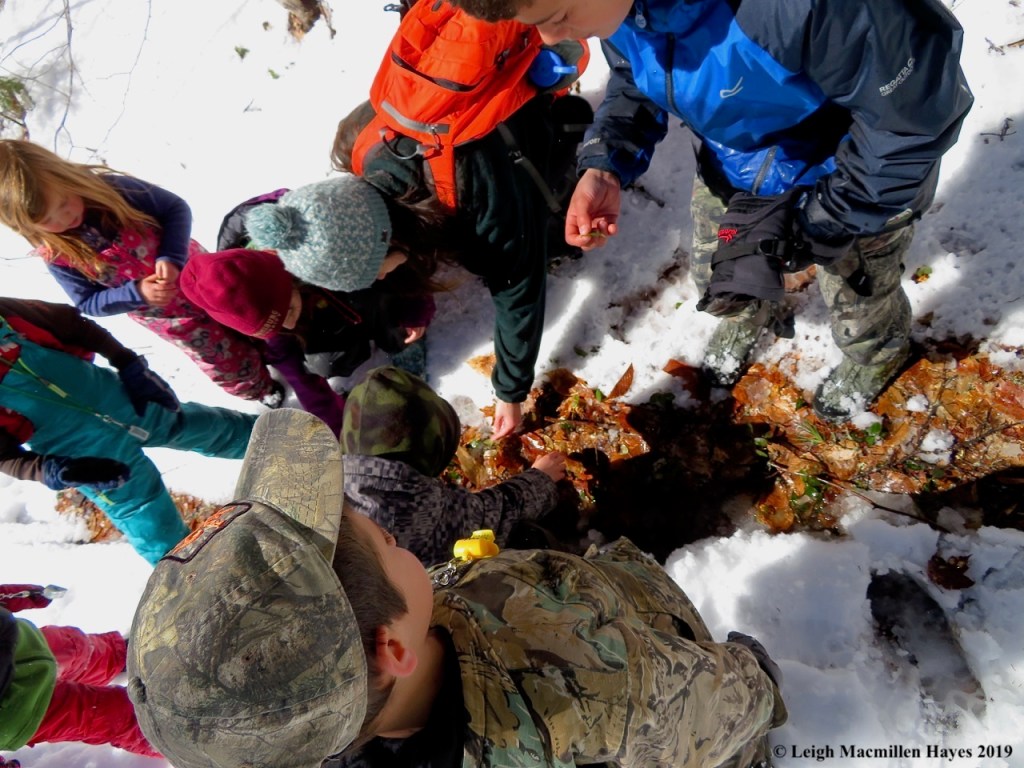
And the kids joined her to take a closer look–at the leaves, but also the buds, which had started to swell. Ah, sign one!

It was a Witch-Hazel which next grabbed the group’s attention. She explained that while the small, gray woody structures looked like flowers, they were really capsules that go dormant throughout the winter. Those will develop over the next growing season and then in autumn forcibly expel two shiny black seeds about 10 to 20 feet.

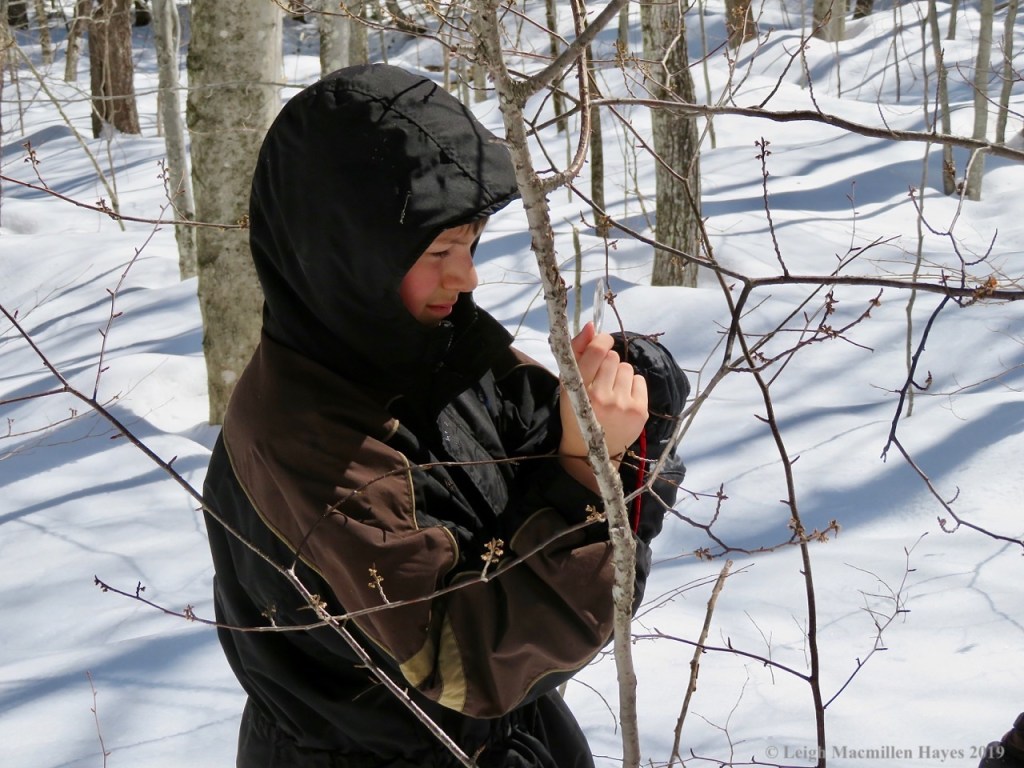
One of the boys noticed that the buds were hairy and so others came in to examine the structures.

From there, it was another beech tree to check out, but this time the discussion moved toward the alternate orientation of its branches and leaves.

And then, because they suffer from the best of syndromes we refer to as Nature Distraction Disorder, the group stopped at a Red Pine to admire its bark.

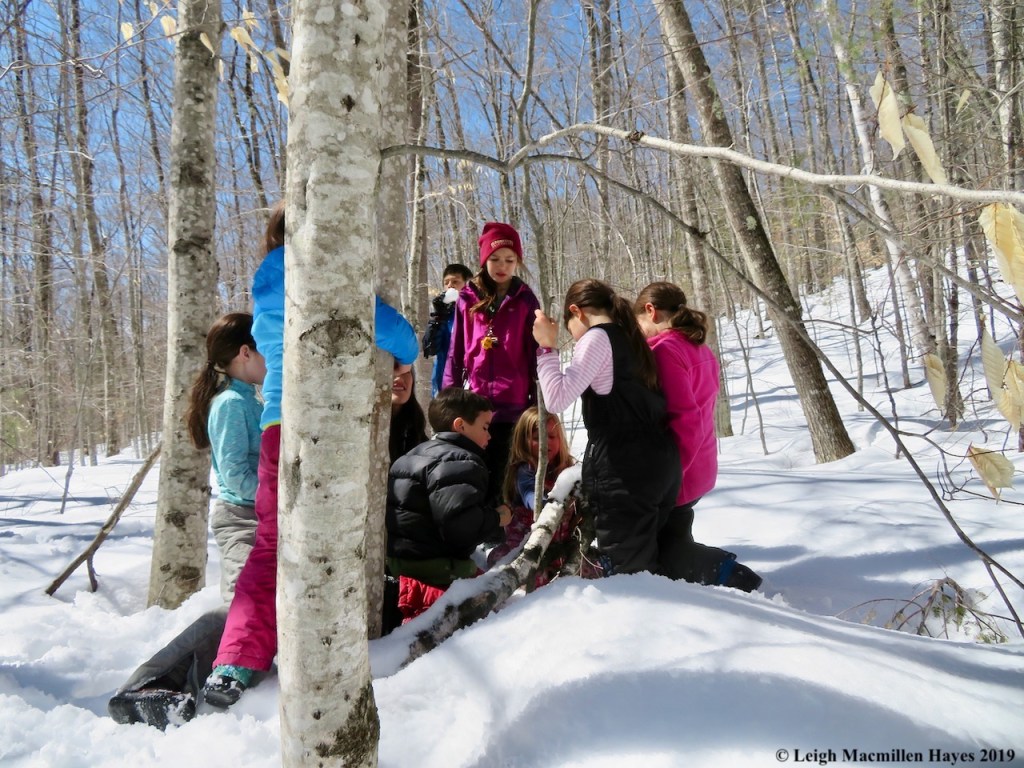
With hand lenses, they focused on the various colors of the thin, puzzle-like scales. Some had fallen to the ground as is the habit of the flakey bark, but Juli reminded everyone that it’s best not to pull it off for bark protects the tree much like winter coats protect us.

It was a fungi that next attracted the group.

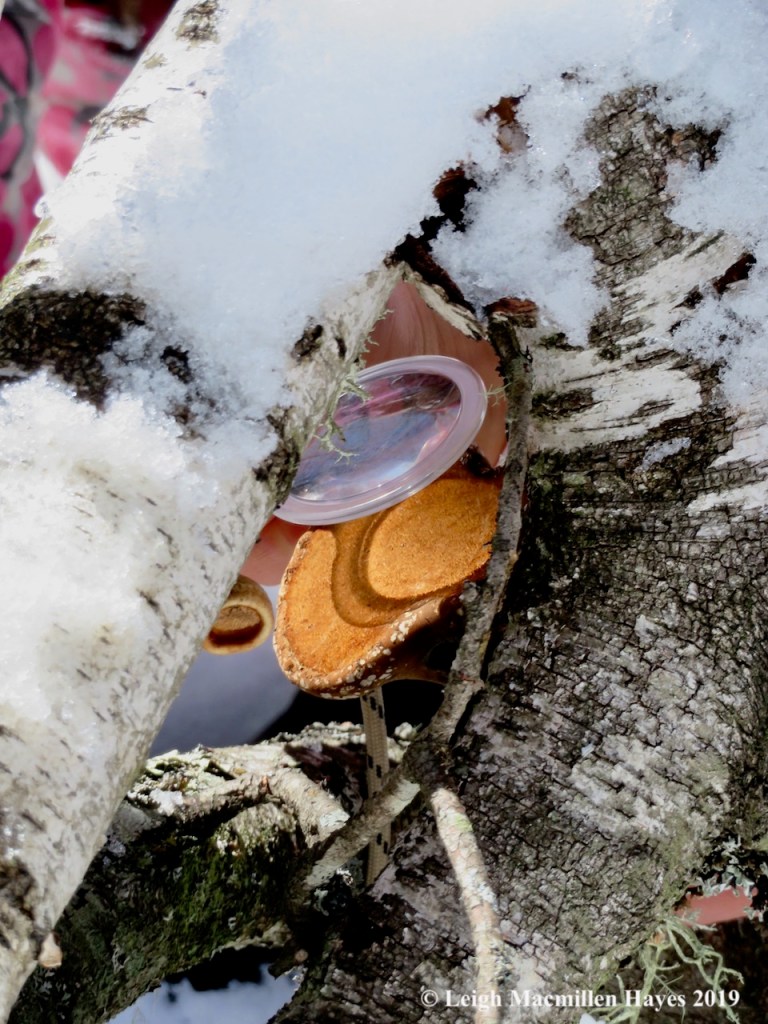
And so they pulled out the lenses again to look at the spore surface of several Birch Polypores growing on downed trees. The brownish underside was actually another sign of the season for they would have released their spores in late summer or autumn.

A wee bit further and a wet spot was noted where we could see some brown leaves reflecting the names of trees in the canopy above, but also, drum role please . . .

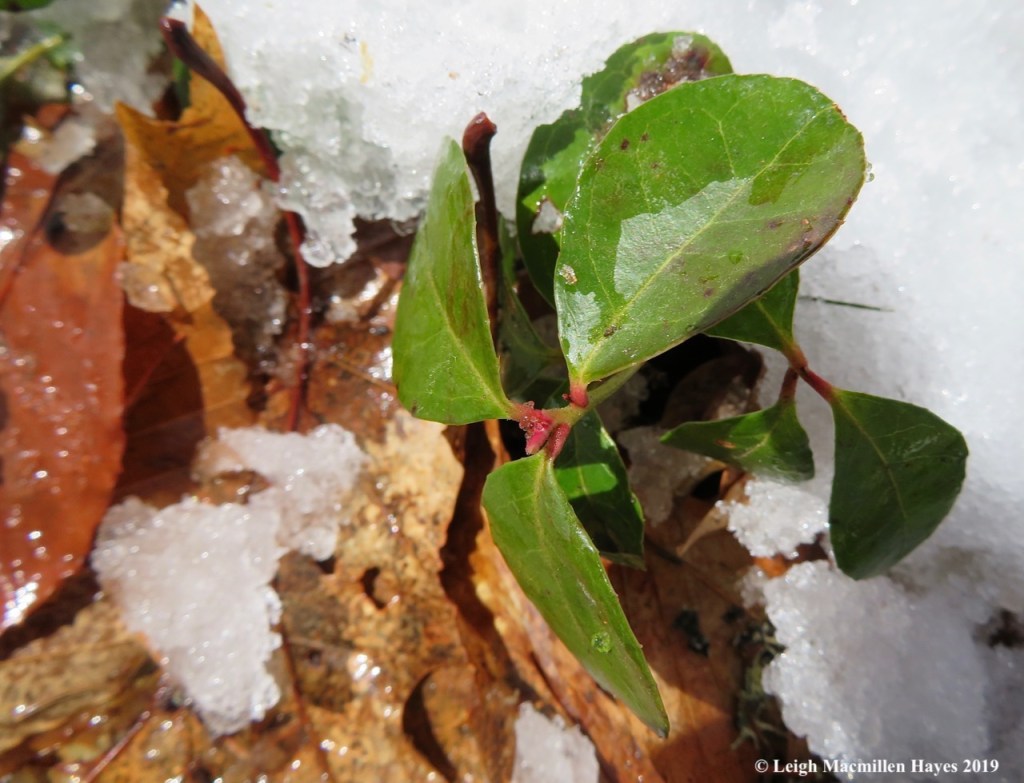
some greenery with buds beginning to form–in the shape of Wintergreen. One of the girls did point out that though it was a sign of the season, it did have the word “winter” in its name.

Another one of the girls looked up at an old Pileated Woodpecker excavation site, and noted the spider web within that had been created last summer by a funnel-web spider, so named because of the funnel-shaped web. Though no one was home today, the spider typically waits in the funnel for prey to fall onto its horizontal web. Then it rushes out, grabs its victim, and takes it back to the silken burrow to consume and hide in wait.

Since our signs were few and far between, and Juli really wanted to get to Otter Rock to show some fun finds, she challenged the kids to run with her.

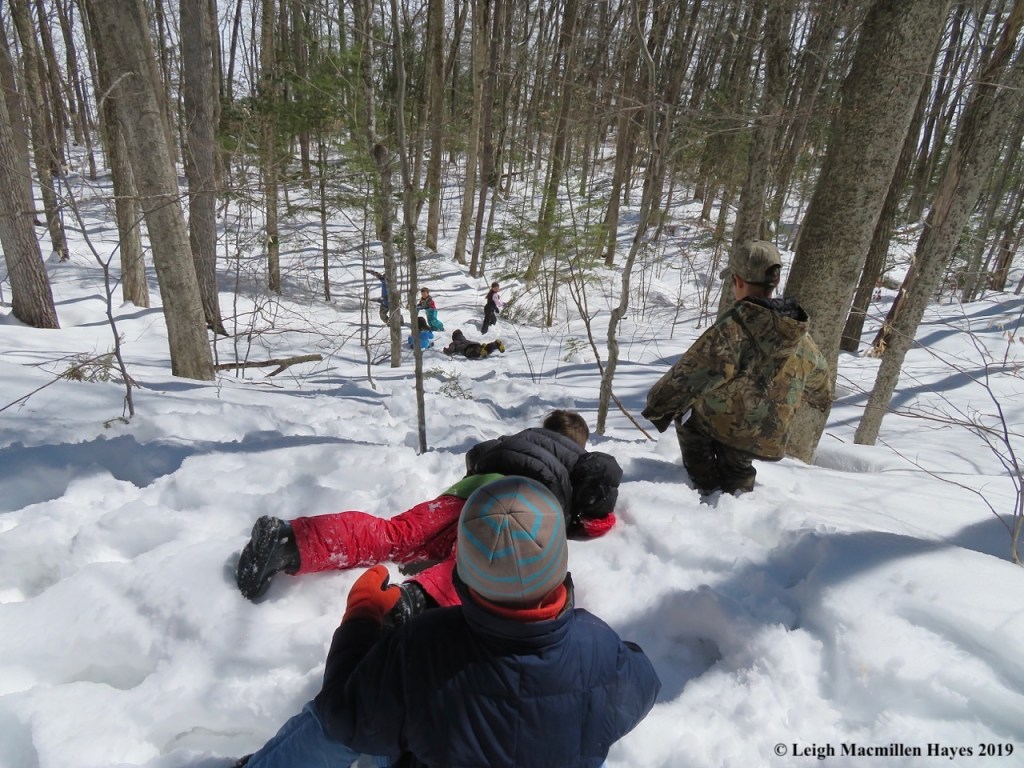
They did. And then they slid.

And looked.

And spotted.

And wondered.

And wondered some more.

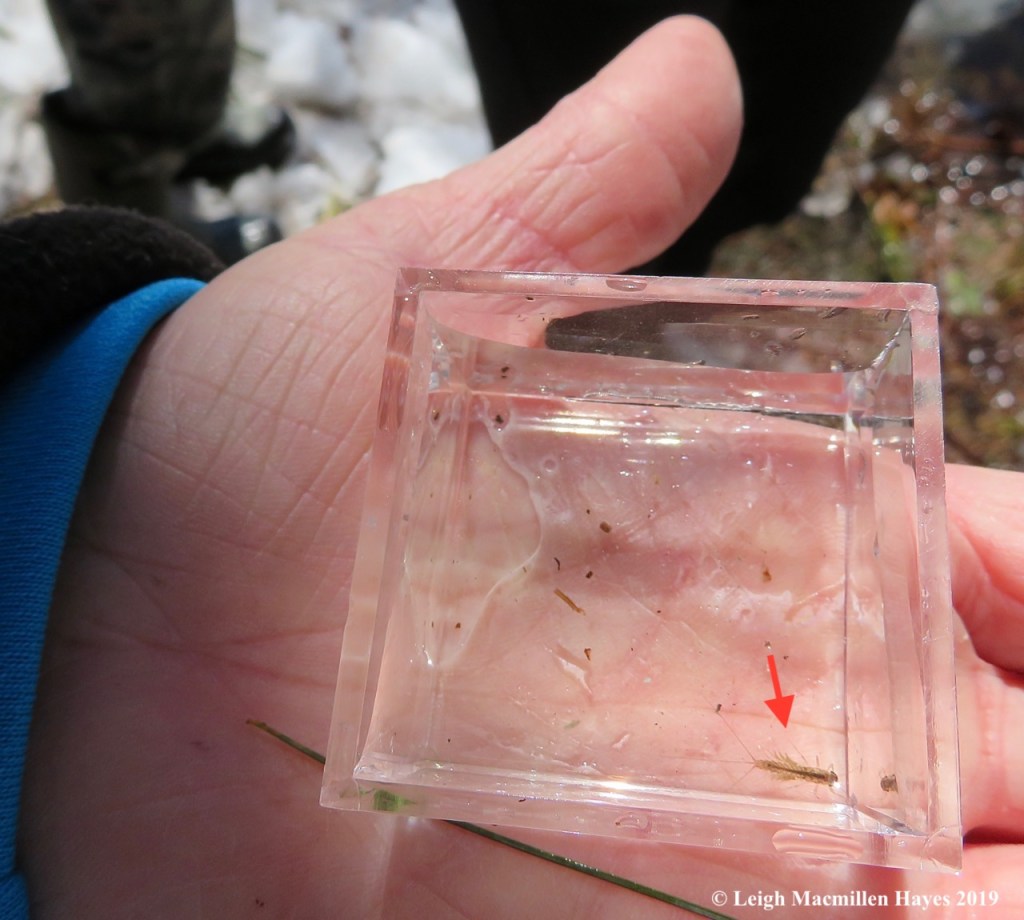
We’d reached our destination of Otter Rock and though we didn’t have any dipping containers, we made do with lucite bug boxes.

At the edge of Heald Pond, the kids found movement in the water . . .

in the form of Mayfly Larvae, with fan-like gills along the abdomen and three filaments at the tip.

Spring indeed! With that discover, we left with a spring in our steps, already looking forward to next month’s vernal pool exploration.

P.S. Thanks Juli for this wonder-filled offering, and congratulations on your achievement. You are now a member of the nexus of naturalists.

Beaver Caper

Our interest was piqued a couple of weeks ago and we promised each other we’d return to learn more–thus today was the day that Alanna Doughty, education director of Lakes Environmental Association, and I ventured to the Muddy River at Holt Pond Preserve.

Crossing the Emerald Field at the corner of Grist Mill and Chaplins Mill Roads, we found our way to the trail, passed into the woods and immediately noticed some fresh works created by Castor canadensis.

Please take note of the small portion of a sapling trunk in the bottom of this photo, for I promise that you’ll see it again. And again. And . . .

But in the meantime, we slipped, slid, and postholed our way to the brook, and noted where water flowed over an old dam so it was obvious this wasn’t the spot to which the beavers had dragged their sawn logs.

Also notice the “Posted” signs on the trees. Can beavers read? It did seem that they stayed away from the far shore. Maybe they can read ;-)

We looked upstream, but decided to turn around and follow the river down, ever curious about what we might find.

First, however, we did pause to admire the ice sculptures where the water rushed and gurgled and bubbled over the old dam. Soon, these will be a thing of the past and we’ll miss their varied forms frozen in time only momentarily.

And then, as we started to walk south, the foamy water drew our attention.

Where Alanna saw frozen froth of rootbeer floats . . .

I saw mini ice discs in their final form.

And one that created a tree skirt with a lacy slip below.

Just beyond we spied the largest of all the sculptures and gave thanks for its existence. In our minds’ eyes we could see the upper part of the sculpture taking shape when the snow was deeper beside the brook. And the lowest part a more recent attempt of the chiseling artist.

The artwork was enhanced by the chips splayed about as if creating a textured pedestal for the display.

Just beyond that spot, we looked further south and scanned the shoreline, not noting any further work of the sculptor. The water didn’t seem particularly backed up so we figured there wasn’t a dam below. What did it all mean? We knew from our previous visit that there was more work north of our location, but had so hoped to find something new to the south.

The only thing visible, a few old beaver stumps such as this one. Given that, we did a 180˚ turn and made our way north.

First, however, we had to walk through the water and gave thanks for our boots, before passing “the” tree one more time.

Alanna, being much younger and far more agile than me, was kind enough to lead and wait, lead and wait. And because she was ahead, she went shopping when I wasn’t looking. I don’t remember what we were talking about when it suddenly occurred to me that she held a piece of the sapling trunk we’d spied earlier. This is a woman who loves to laugh and so she did when I commented on the specimen tucked under her arm.

Notice how snug she held it as she walked with intention across one of the stream bridges.

We walked for another bit before we found more beaver works, including a cache of debarked twigs–beaver chews. They seemed so fresh, and some were actually green, that we got to thinking. Winter food stash? We know that in the fall they gather saplings and branches, anchor them in the mud and when the ice covers the river, they slip out of the underwater tunnel in their lodge and chew off a stick from the stockpile to bring into the feeding compartment for a meal, thus keeping themselves safe from winter predators. But . . . these weren’t near a lodge and seemed like the result of a fresh logging operation and so we wondered, did they have a new lodge in mind? Are they planning to build a new dam?

We also had to wonder about their debarkation–so smooth were the sticks.

As we continued on, our nature distraction disorder kicked in periodically, as it should, and we rejoiced in the sight of buds on Trailing Arbutus, aka Mayflower.

But still, it was more beaver works that kept calling our names and we tried to pay homage to all of them.

The last fresh one we saw was on a beech and we knew by the height that the cuts had been made when the snow was deeper. So . . . were the beavers still around?

Oh, wait. While we wondered, Alanna also had deer scat to collect.

And just beyond that–weasel scat found its way into her bag.

And then a winter firefly crossed our path as seems to happen frequently of late.

Onward we continued for we wanted to check on a couple of lodges we knew existed. Do you notice that the art work remained tucked safely under her arm?

For a little bit our trail took us away from the Muddy River, but when we returned to it, we focused on old beaver works–a fallen tree and a girdled hemlock. That got us thinking about the fact that they do girdle trees–often, in our experience, it’s hemlocks that they seem to debark in a band that encircles the tree, thus killing it. These they don’t drop to use for building or feeding. So why go to all that effort? We’ve heard different theories, including that once the tree dies, a species more to their liking will grow? True? Maybe.

We continued to look for more recent works, but found none. Until . . . we spotted some brown snow.

Leaves and river muck had been pulled up and distributed over the snowy surface beside the water. We stepped closer and saw footprints that were indecipherable, but knew by the pile of gunk that we’d discovered the makings of a beaver scent mound. Had the two-year-olds left the lodge and set out to claim their own territory? We suspected such.

Atop it all, we noted where a scent mark had been left behind. Of course, we both had to get down on all fours and sniff. I thought it smelled a bit like wintergreen, perhaps an indication of a meal consumed. Most often it smells more vanilla in nature. We found the starts of another scent mound a bit further along that emitted a muskier scent and we thought of the beaver marking its territory with castoreum.

Oh, and then there was some more scat to collect for Alanna spied the round nuggets or malt balls of a snowshoe hare.

At last we reached the board walk that leads back out to the Muddy River, some of it under water and again we gave thanks for our boots–hers Boggs and mine Mucks. Both perfect for our adventure.

From the board walk we could see the twin lodges on the river, but neither had any fresh logs atop and so we still didn’t know from whence the beavers came. It appeared they hadn’t used the old lodges, but we never found any new ones. Or a dam. But the scent mounds were super fresh. And so, we concluded that we’ll have to revisit the area either early in the morning or later in the day in hopes of spying the industrious builders in action.

In the meantime, we left with new findings, new questions, and for Alanna, some new scat and new beaver works–the one tucked under her arm a reminder of our Beaver Caper.

Cranberry Memories

It’s amazing how a simple act such as taking cranberries out of the freezer and transforming them into a relish can take one back in time, but so it did today.

My family knows best that I’m not a foodie, and cook only because we can’t survive on popcorn alone (drats), but one of my favorite flavors brings a burst of tartness to any meal. And as I concocted the simple cranberry orange relish we so enjoy, moments spent picking them kept popping up.

On several occasions last fall, I bushwhacked toward the fen, stopping first to explore the kettle holes that dot the landscape.

And though I love tracking all winter, it’s those unexpected moments in other seasons when I recognize the critters with whom I share the Earth that make my heart quicken.

Especially when I realize that one of my favorites has also passed this way, stomping through the water . . .

and then onto the drier land. Yes, Ursus americanus had been on the hunt as well.

He wasn’t the only one fishing for a meal, though of a much smaller spidery-style scale.

And then there were my winged friends, the meadowhawks.

I remember the mating frenzy occurring as that most ancient of rituals was performed both on the leaf and in the air.

Other winged friends, showing off a tad of teal, dabbled nearby.

Eventually, I tore myself away from the kettle holes and tramped through winterberry shrubs filled with fruits and cinnamon ferns ablaze in their fall fashion.

After all, my destination was the cranberry fen.

And last year was a mighty fine year for those little balls of wonder that hid below their green leaves. I filled my satchel to overflowing before taking my leave, knowing that in the coming months I’d share the foraged fruits with family and friends and remember time well spent.

Not only did the abundant fruit make it so special, but on my way out I stumbled upon another kettle hole and much to my delight spotted two Sandhill Cranes, part of a flock that returns to this area of western Maine on a yearly basis.

While the cranes foraged on the ground, a Great Blue Heron watched them approach.

And then in flew a Bald Eagle who eventually settled in a pine tree beside a crow.

With that, the cranes flew off and a few minutes later so did the heron. And then I left, trying to find my way out, but I’d gotten a bit twisted and turned and ended up cutting through someone’s yard to get back to the road. Because I was a wee bit confused, I couldn’t find my truck right away, and in the process of looking I dropped a few cranberries. It was all worth it! And still is as we’ll enjoy that relish in our chicken salad sandwiches tonight.

Ah, cranberries. And bears. And spiders. And dragonflies. And birds. Ah, cranberry memories.

Bear to Beer: St. Patrick’s Day

We drove to O’Lovell in western Maine late this morning with the plan to search for bear trees in an area where I’ve seen them in the past.

All along the main road to the Greater Lovell Land Trust property, Irish flags decorated random telephone poles and even a tree. The latter was our favorite for the person who hoisted it had to climb up the steep snowbank in order to show off the colors of the Emerald Isle.

Braving a thousand bumps, or so it felt as we negotiated potholes, frost heaves, and culvert depressions, we at last arrived at the end of a dirt (read: muddy) road and prepared for a hike up the oxymoron called Flat Hill.

While yesterday’s trek meant slogging through the wet snow, today’s brisker temperature allowed us to stay on top of the wintery surface, though we were thankful for our snowshoes.

Upward we climbed until we reached the coppiced red oaks and knew to turn right, walk off trail and begin our search among the beeches in the forest. You see, I knew there were trees to be found for I’ve seen them before, and I knew the turning point tree, but . . . the last time I looked, I couldn’t locate the trees with the bear claw marks. That, however, is a challenge my guy heartily accepts and so we split up and each set off to check all the trees in the forest. Well . . . almost all.

As is to be expected, my guy covered much more territory at a faster rate than I did and I wasn’t surprised to hear the distant call, “I got one!”

Indeed, he did. And a beauty was it. Can’t you just see the bear shimmying its way up and down the tree–several times over.

In my brain, a bear hug was the real deal from one of the original tree huggers. And I gave thanks for being accused of doing the same.

All the way to the top we could envision the quest for those tiny beech nuts that offered nutrition. Hmmm . . . isn’t it curious to note that the core of nutrition is “nut”? Or is it curious?

From the big tree, we moved up the mountain until we reached its sort of flat top where the view to the west is always a treat. And then we began to look about, for usually there is porcupine sign in the immediate vicinity to enjoy–that is . . . until I offered a porcupine prowl there two weeks ago and all we found were fisher tracks.

Today, however, was different and we found some fresh evidence that the porcupine is still in the area. We knew it by the teeth impressions left behind.

Further evidence was seen in some diagonally clipped twigs, scat, and even a strand of hair! Yes, porcupines have hairy bodies–including their quills. But on their bellies and faces they have a silkier variety–do you see it?

While I looked about the summit for more evidence, my guy stalked about below. Can you see him in the middle of the photo?

Eventually I wandered down to join him, pausing halfway to note some porky tracks leading upward . . . and downward, of course.

Below the ledges we hunted for his den, but found only tracks moving along the edges.

Though we never found the critter that we assume could easily look like a miniature bear if one were to remove all its quills, we enjoyed exploring the territory that is part of his home.

The delightful part of paying attention is the noticing. There were the organ pipes attached to the ledges, their music enhanced by drips onto rock tripe, ferns and mosses.

And an icicle of amber that stood at least two feet long.

Eventually we made our way back up and then down, again bushwhacking to look for more bear trees. We found a couple, but it was the works of others that also garnered our attention, such as this one that decided to split, but then came back together as if it was making up for time spent apart.

We found another tree with a burl that could easily have been mistaken for bear cubs spending time in a nurse tree. Typically, however, mama bear would choose a white pine for it would provide cover for her young ones as she went off to search for food for her brood.

Embedded in the snow was a squirrel drey and we mentally noted its location so we can go back another day after its no longer frozen in place and try to dissect it in hopes of better understanding such a structure.

And we spied a stonefly exoskeleton–an offering of total delight for despite its minute size, its discovery was right up there with the bear hug.

At last we left O’Lovell, with its Irish flags flying in the breeze, and found our way to O’Harrison, where we joined our friends, the O’Wisers for a beer and dinner.

The evening was topped off with Irish music performed by our favorite local acoustic folk band, Bold Riley.

From bear to beer, everyone was Irish today as we celebrated St. Patrick’s Day. Well, almost everyone–I did wear some orange and donned my Macmillen plaid flannel shirt. O’Macmillen! O’Hayes! O’Bear!

Framed by the Trees

Our journey took us off the beaten path today as we climbed over a snowbank at the end of Farrington Pond Road and onto the Greater Lovell Land Trust’s John A. Segur Wildlife Refuge East. We began at a piece of the parcel neither Pam Marshall or I had ever explored before, which added to the fun. At first, we followed the tracks of a giant, and eventually decided they might have belonged to another human being. Might have. Always wonder.

And then we were stopped in our tracks as we looked up and recognized a Great Blue Heron–or so it seemed in the dead snag that towered over the edge of Farrington Pond. Except for one tiny area of water, the pond is still very much ice covered so it will be a while before this ancestor of the Greats sees her relatives return.

Standing beside the bird-like structure was another that helped us find beauty and life in death.

We peered in, and down, and up, and all around. With each glance, our understandings increased. So did our questions.

There were holes that became windows looking out to the forest beyond.

But those same windows helped us realize they were framed by the results of their injuries. You see, it appeared that a pileated woodpecker had dined on the many insects who had mined the inner workings of the tree. After being so wounded by the birds, the tree attempted to heal its scars as evidenced by the thick growth ring structure that surrounded each hole. Or at least, that’s what we think happened.

To back up our story, we looked from the outside in and saw the same.

We also noted the corky bark with its diamond shapes formed where one chunk met another.

And much to our surprise, we found one compound leaf still dangling. No, this is not a marcescent tree, one of those known to hold its withering leaves to the end of time (or beginning of the next leaf year). But instead, this old sage is one of the first to drop its leaves. So why did one outlast the race? Perhaps to provide a lesson about leaves and leaflets, the latter being the components of the compound structure.

Adding to the identification, we realized we were treated to several saplings growing at the base of the one dying above. By its bud shape and opposite orientation we named it Ash. By its notched leaf scars and lack of hairs, we named it White. White Ash.

Because we were looking, Pam also found a sign of life within. We suspected a caterpillar had taken advantage of the sheltered location, but didn’t know which one.

About simultaneously, our research once we arrived at our respective homes, suggested a hickory tussock moth. Can you see the black setae within the hair?

Pam took the research one step further and sent this: “I read that the female lays eggs on top of the cocoon and then makes a kind of foam that hardens over them so they can survive the winter. How cool is that?” Wicked Cool, Indeed!

We probably spent close to an hour with that tree, getting to know it from every possible angle.

And then it was time to stop looking through the window and to instead step into the great beyond.

We did just that, and found another set of mammal tracks to follow. Tracking conditions were hardly ideal and we followed the set for a long way, never quite deciding if it was a fisher or a bobcat, or one animal traveling one way and another the opposite but within the same path.

Eventually, we gave up on the shifty mammal and made our way into the upland portion of the property where I knew a bear claw tree stood. Pam’s task was to locate it and so she set off, checking all the beech trees in the forest.

Bingo! Her bear paw tree eyes were formed.

It was a beauty of a specimen that reminded us of all the wonders of this place.

From that tree, we continued off-trail, zigzagging from tree to tree, but never found another. That doesn’t mean we visited every tree in the refuge and so we’ll just have to return and look some more.

We did, however, find some scratch marks on a paper birch.

They were too close together to have been created by even a young bear, but we did consider squirrel. Wiping off the rosy-white chalk that coated the bark, we did find actual scrapes below. Now we’ll have to remember to check that tree again in a year or so and see what we might see.

What we finally saw before making our best bee-line out (don’t worry, our Nature Distraction Disorder still slowed us down) was the view of Sucker Brook and the mountains beyond.

At last we pulled ourselves away, but gave great thanks for that ash tree that framed our day and our focus and for all that we saw within it and beyond.

Book of the March: Entering the Mind of the Tracker

A few weeks ago I’d contacted my friend Parker Veitch of White Mountain Mushrooms, LLC, to make sure he was willing to co-lead a couple of fungi walks this summer and in his response he included this paragraph: “I have a book for you. Should I leave it at the office? The first 20 or so pages are a little slow, but I think you will really like it.”  

Like it? I LOVE it. And I haven’t even finished reading it. So you must be curious by now. As I was when I saw it sitting on the table at the Greater Lovell Land Trust office. You see, I was sure the book would be about fungi because Parker is always trying to help me learn about the principal decomposers of the world. Ah, but one should never assume.

May I present to you the Book of March: Entering the Mind of the Tracker by Tamarack Song.

This book is like no other tracking book that I’ve read. As I wrote back to Parker, “Thank you so much for sharing the book with me. I’m in the midst of reading Eager by Ben Goldfarb, The Invention of Nature by Andrea Wulf, which is about Alexander von Humboldt, and a book of essays by E.B. White (thanks Judy and Bob for gifting me that gem), but right now I’m most captivated by the teaching of Tamarack Song and I am going to have to ask Bridgton Books to order a copy for me. I want to be him and have the understandings and slow down and ask the questions he asks. And teach others to do the same.

At first I couldn’t put the book down. But now I’ve changed my tune a bit because I want to savor it. Typically, when I read a book such as this I underline key phrases, write notes in the margin and turn page corners up. But, because I’m only borrowing this copy I’m not doing that. (Did I have you nervous for a minute there, Parker?) And that’s making me soak it all in and savor each chapter more fully than I might.

You see, Tamarack, according to the back cover blurb, “has spent his life studying the world’s aboriginal peoples, apprenticing to Elders, and learning traditional hunter-gatherer survival skills. He has spent years alone in the woods as well as living with a pack of Wolves. In 1987, he founded the Teaching Drum Outdoor School in the wilderness of northern Wisconsin, where he runs the yearlong Wilderness Guide Program.”

In each of the sixteen chapters, Tamarack plays the role of guide, but not by telling. Rather, he takes the reader along on an exploration with one of his students, and encourages all of us to question what we see. In other words, to never assume, which is what I did when Parker first mentioned the book and what I often do when I’m tracking.

Instead, he wants us to notice and think about why the animal might be behaving in a particular manner, even if we know what it is by its tracks and its sign. What’s the rest of the story?

In fact, why did Opossum suddenly appear toward the tail end of the snowstorm on Sunday night?

And why is he in western Maine? How has he survived this winter with its frigid temps (mind you, it’s finally starting to warm up a tad). Where has he been since I last saw his prints in the snow a few months ago? What brought him to our yard again? Does he live under the barn with the rest of the neighborhood?

And what about last night’s visitor, Raccoon. Where has he been all winter? What brought him out? I have to say I wasn’t surprised to see him as once the temps do begin to rise the slightest bit, he appears. I also know that the bird seed attracted him, though he surprised me by not stealing the suet.

Tamarack encourages us to become the animal, especially if we don’t see it, but do see the signs it left behind. Had there been snow on the deck, I imagine I would have recognized the raccoons prints, but I would have wondered about other lines that probably would have appeared. Having the chance to watch Raccoon as I did, I now know that those lines would have been his nose and tongue as he tried to vacuum the seeds.

But then there was Raccoon’s coloration. Why the mask? Why the striped tail? I have so much to think about and learn.

And then late today, I headed out the door through which I’d taken those photos the previous two nights, and noted the Hemlock tree that Porcupine had denuded this winter. It used to be one of my favorites in the yard. But today it occurred to me that though we pay taxes on this property and try to “maintain” it, it really isn’t ours. It never has been. It belongs to the animals and the trees, and yes, even the fungi. Maybe especially the fungi.

One thing I have noticed is that all of Porcupine’s activity has aided Deer who also stops by daily.

As I continued over the stone wall, noting the six or seven other Hemlocks Porcupine has visited, a shape high up in one tree caught my attention.

I moved under Hemlock for a better look. Well, not all the way under, for I sometimes know better than to stand below such an exhibit.

As I looked with the aid of a telephoto lens, I noticed that Porcupine had apparently dined briefly and then fell asleep. Hmmm. I know some people who do that.

But the sight of Porcupine got me thinking–was this friend who lived under the barn a he and not a she after all?

And how did he/she sleep as the breeze swayed that not so thick Hemlock bough upon which Porcupine was balanced?

I did gain a better appreciation for the various types of hair that cover Porcupine’s body.

But still, so many questions, some that haven’t even formed in my mind yet.

I give thanks to Tamarack and his stories within Entering the Mind of the Tracker for that. Now I must practice the art of slowing down and paying more attention.

And I give special thanks to Parker for the offering of this book. In many ways, he emulates Tamarack Song, for both are hunter-gatherers and Parker understands the ecological systems in a way I will never know. At less than half my age, he has already slowed down and learned to pay attention.

To be attuned to the hidden nature–that is my wish. To that end, I shall purchase a copy of this book. And hope you will consider it as well.

Book of March: Entering the Mind of the Tracker: Native Practices for Developing Intuitive Consciousness and Discovering Hidden Nature.

Entering the Mind of the Tracker: Native Practices for Developing Intuitive Consciousness and Discovering Hidden Nature, by Tamarack Song, Bear & Company, a division of Inner Traditions International, 2013.

Seeking Change

I wasn’t going to pre-hike Loon Echo Land Trust’s Bald Pate Mountain Preserve in South Bridgton today to prep for a climb there tomorrow because I figured there wasn’t really much to see except the snow. But, at the last minute, it felt like the right thing to do.

And, of course, it was. As I headed up the Bob Chase Trail, so named for the man who was the driving force behind the land trust, and its public face for fifteen years, I noted those who’d passed through the woods at some point within the last couple of days, including snowshoe hare, foxes and coyotes. Oh, and domestic dogs a many.

There were the views to admire as well, including this one from three quarters of the way up, where Mount Washington sits in the saddle of Pleasant Mountain.

The fun thing about a telephoto lens is that one can bring those distant peaks into view. Doesn’t the cellphone tower roadway up Pleasant Mountain make it look like you could walk directly onto Mount Washington? And can you see the weather station at the top of Mt Wash?

It doesn’t take long to reach the summit of Bald Pate where the view encompasses Hancock Pond in Denmark (Maine) and I was beginning to wonder what I might share as signs of spring, since despite the frigid temps and snow depth, we are on the cusp. Drive down any western Maine road and you can bear witness to that. The frost heaves and potholes have made themselves known for the past several weeks.

But, then I looked up–at the leaning Pitch Pine beside the Eastern White Pine.

And there was my answer! Pitch Pine cones take two years to mature and upon the tip of each scale is a pointed and curved prickle.

They open gradually but depend upon fire for their seeds cannot be released until they are heated to an extremely high temperature.

That being said, this is the only native pine that will resprout when damaged.

While the cones of the Eastern White Pine where almost nowhere to be seen, on a Pitch Pine they may remain for 10 – 12 years.

The needles are bundled in packets of three–making it easy to remember its name: Pitch–three strikes you’re out!

Another easy way to identify Pitch Pine is to look for needles growing right out of the bark–both on the trunk and branches.

I always think of it as our bonsai tree for though it can stand straight and tall, on mountain tops it takes on a contorted structure. The “pitch” in its name refers to its high resin content, thus making it rot resistant.

Though not located at the summit, I hope I remember to share my favorite evergreen found on this property. Meet Jack Pine. It doesn’t typically grow in our area, but there are two along the trail and either they were planted or they came in on a skidder during a previous logging operation and planted themselves.

As I’ll surely share tomorrow, I love mnemonics and that’s what helps me remember the names of the various evergreens. You see, Jack Pine has bundles of two short needles: think Jack and Jill.

Its cones also take two years to mature and tend to be slender and curved.

I was thinking that with the three varieties of White, Pitch, and Jack, there must be a fourth and bingo–just as I returned to the parking lot I found it: a young Red Pine with its needles of two. (I used to think it had three for R-E-D, just as White has five for W-H-I-T-E or M-A-I-N-E for it’s our state tree, but I used to think incorrectly!)

It wasn’t just the pines, however, that drew my attention. The tree buds are swelling and suddenly quite noticeable. Each bud, like this beech, which may contain miniature leaves or flowers, is covered with scales, which in themselves are actually modified leaves.

By May those scales will curl back and eventually fall off as the leaf and or flowers emerge, but today I found a couple that decided to get a head start. It’s the same every year–there are always a few in the crowd who want to be first. Do they survive? One of these days I’ll mark one and check back on it.

I did see several beech buds that had curly topped heads, a site I’d not seen before. This will certainly be a point of discussion tomorrow as we try to solve the mystery.

And there was an oak that also wanted a head start. Perhaps it’s because they’re located on a mountain and closer to the sun?

Some of my favorite finds included the striped maple buds and their subtle spring colors.

And then I found red maple twigs on the ground. That, too, will become a subject of further research on our walk. I suspect I know why they were on the ground, but we’ll see what conclusions the participants draw.

And then, and then, because I was looking, I found a couple of other surprises. This one is the cocoon of a Polyphemus Moth. Check out how it wrapped itself in the leaf. And can you see the silky outer layer of the cocoon located within?

And another–a Promethea Moth. Its cocoon was attached to the branch by a strong peduncle or stem and it had incorporated the curled red oak leaf. Talk about camouflage–at first I thought it was just a marcescent leaf that had withered but not fallen yet.

Our tour will include other flyers as we’ll take a closer look at the tracks and wing marks in the snow and try to figure out what the story was behind them.

And speaking of stories–many a trail features such a sign left behind accidentally by a hiker who lost a bit of traction when the Yaktrax fell off. Any takers? This one has been on the stump for a while so I think it’s fair game if you need one.

Jon Evans of Loon Echo and I plan to take the group to the summit and then find our way to the Foster Pond Outlook, where the stone cairn that’s usually three or four feet tall is barely a memory right now.

About two hours after we start, we’ll lead the group out, and if the sun is shining much as it did today, the trees’ shadows will bridge the gap between winter and spring and help those who are seeking change bring it into focus.

I feel honored that Jon invited me to help him lead this one for it’s in conjunction with the Lake Region campaign called Bring Change 2 Mind. The group focuses on encouraging conversation and ending the stigma surrounding mental illnesses and substance use disorders. Our aim tomorrow will be to discuss and reflect on how time spent outdoors can encourage positive mental health and well-being.

It may be too late to sign up, but here are the details just in case: Hike for Mental Health.

Even if you can’t join us, I hope you’ll head outdoors and find the change you seek.