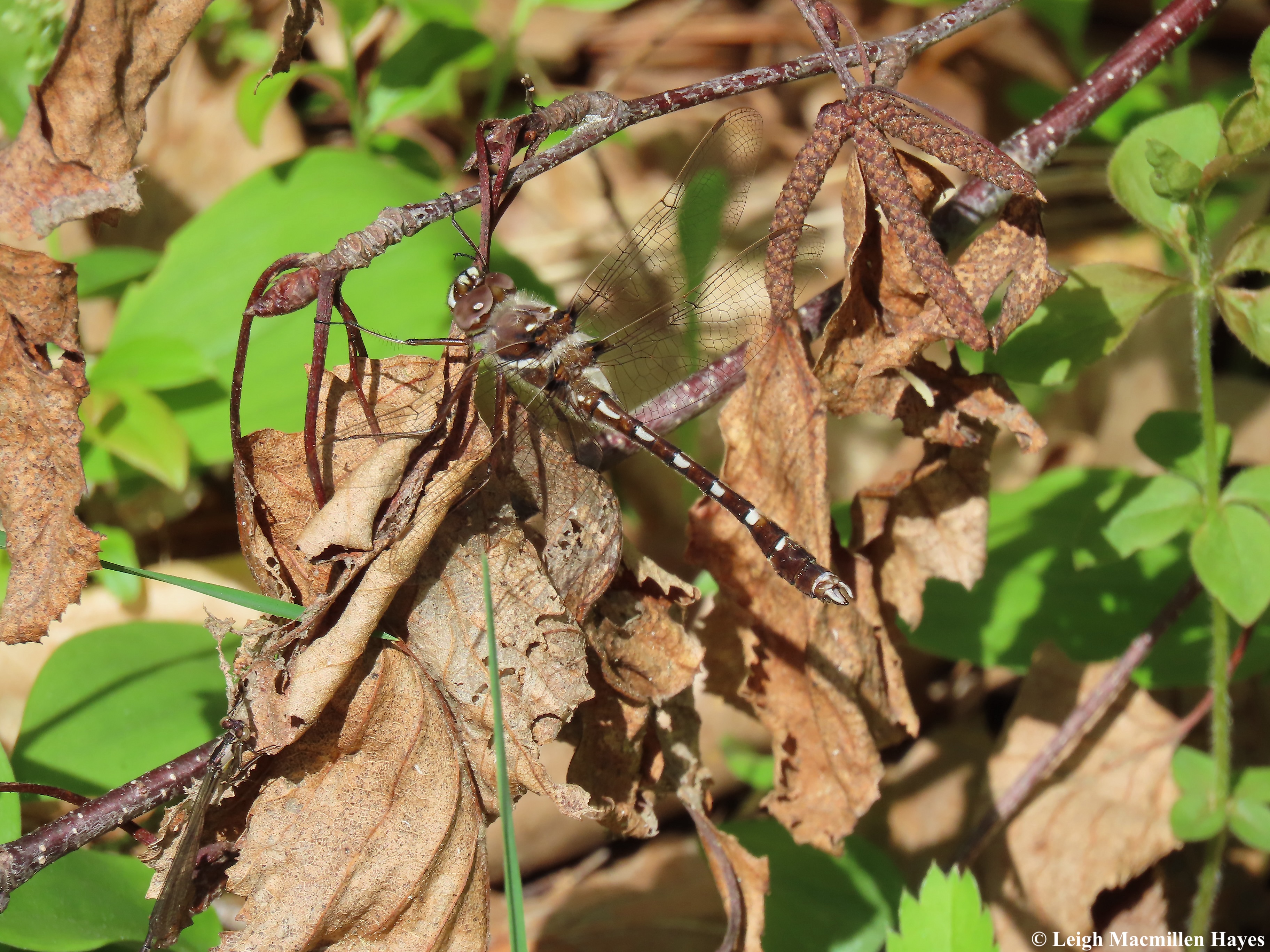
Vermonting We Did Go

Okay, so “Vermonting” is not a word. But we did go. And came home richer for the experience.

It takes us forever to plan a vacation, even a mini-one. Well, actually, it only takes a few minutes once we put our minds to it, but prior to that it’s a lot of “We should go to . . .” or “We need to get away,” or any of a myriad of other comments, and we do nothing.

So about a week ago we cleared our calendars. We knew kinda sorta where we wanted to go, but didn’t know where we might stay, until we discovered The Barn in Peacham. We have a red barn attached to our 1870s farmhouse and long ago turned the upstairs into a movie theater/rec room for our sons, all that being a rather rough rendition of either–the movie seats were from an actual theater in our hometown, which was the best part. The seats are still all up there. And there’s a pingpong table and an air hockey table and trophies (remember the Porcupine Invasion last November?) and various other things, plus now a Yoga area for My Guy, but it’s hardly like the space we rented for the weekend as pictured above.

Cozy, roomy, tons of natural light, everything we needed, even eggs and English muffins if we came up short for our first morning.
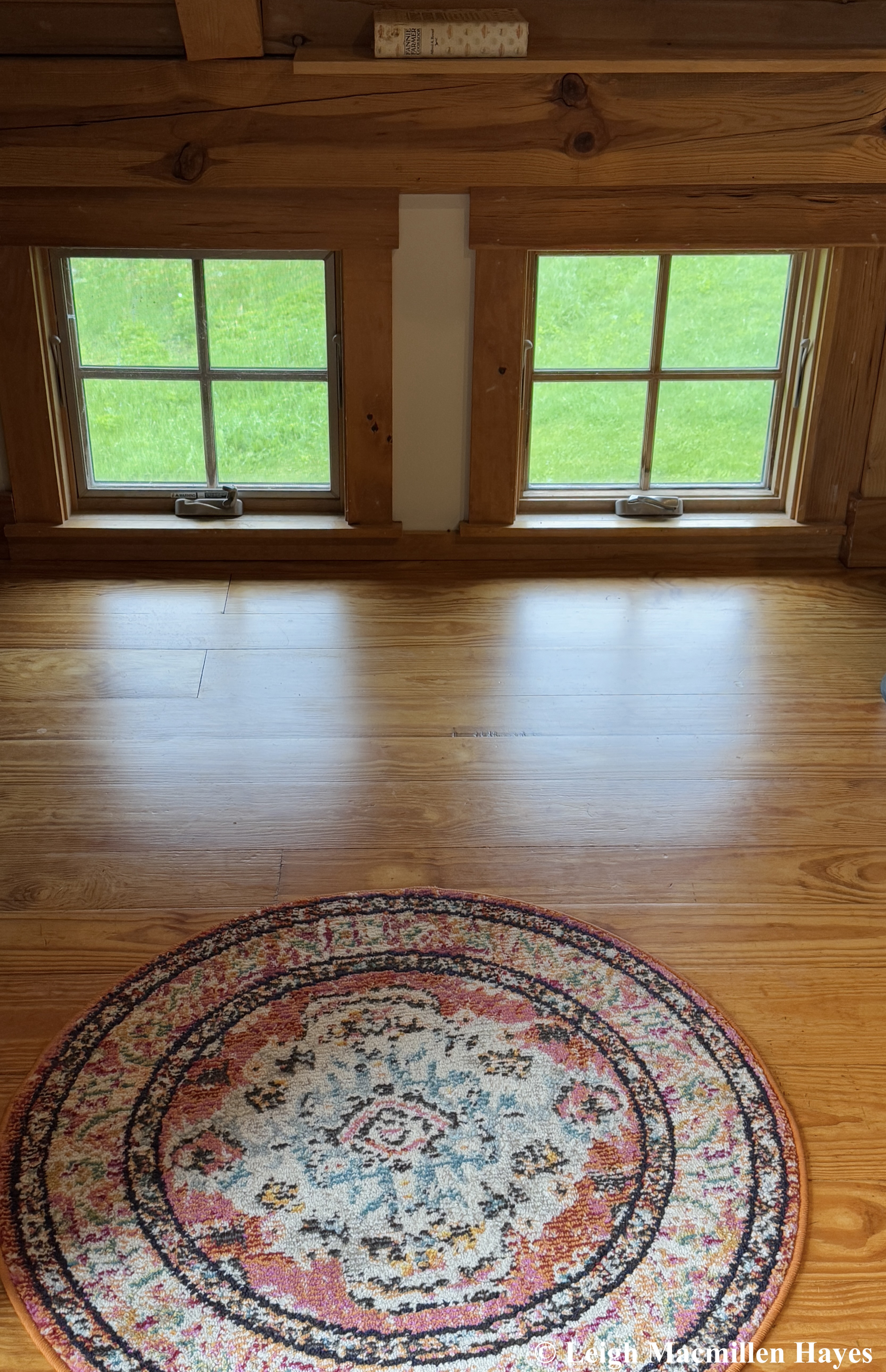
I think one of my favorite things, and I had lots of favorites, were the little windows that lined the floor in all four rooms. And above these in the kitchen, a Fannie Farmer Cookbook on a shelf. It was touches like this that enhanced the already perfect space.

And our host and hostess, Chuck and Mercy, were equally delightful, and full of information. Thanks to them we discovered Three Ponds Sandwich Kitchen in Danville our first night and marveled in the deliciousness.

But what we were really there for was to hike. And so Saturday morning we went in search of the trailhead to Peacham Bog. If you happen to see My Guy this week, ask him how that search went. We’re still laughing.

We did find the trailhead, but obviously not where we expected it to be. And at the recommendation of Brian at the Groton State Forest Nature Center, we decided to hike the two miles in to the Bog and then continue along a multi-use trail before reaching Devil’s Hill, circling back along the same route.

The natural communities along the way made us feel as at home as the barn, for we (read “I”) felt like we were walking among old friends such as the Mountain Woodsorrel. I love its peppermint ice cream presentation.

And then, in a damp spot Swamp Beacons lit the way and I was drawn back in time to my first encounter with them while tramping through the woods in Lovell with friends Parker, Joan, and Dave. RIP Parker–please know that you accompany me on and off many a trail and I know that you would be happy that I actually remember some of what you taught me.
Vowing not to count Lady’s Slippers, we didn’t. But they were there, though most waning.

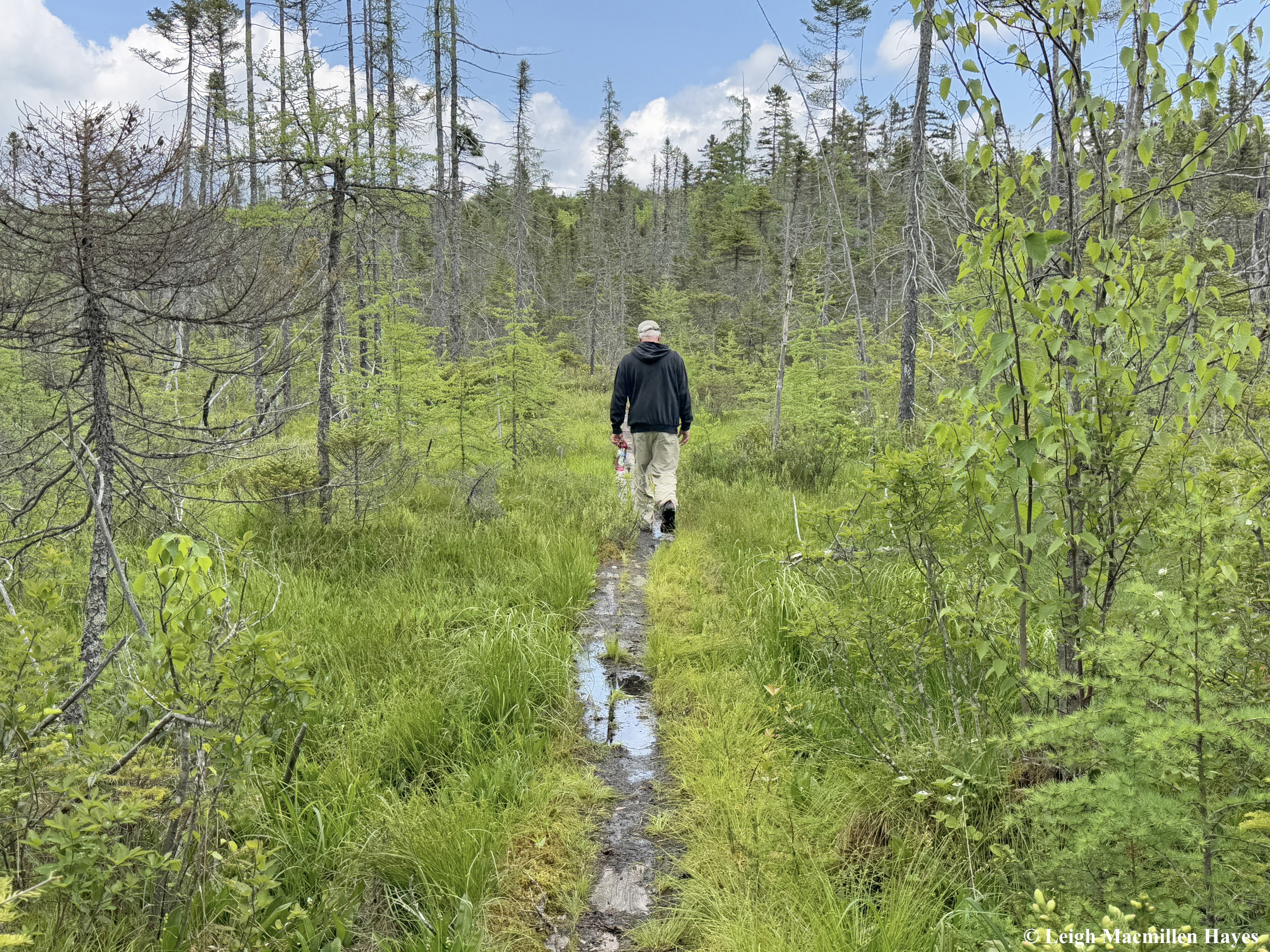
At last we reached the coveted bog, where a boardwalk was long ago placed to keep hikers like us from stepping onto the fragile environment.

It was at this point that another funny story evolved, but again, you’ll have to visit My Guy at his store to get the rest of the story.

At last reaching the platform with a bench at the end of the boardwalk, we sat down to eat sandwiches and take in the scene and sounds that surrounded us.

Sphagnum mosses formed the peat base and laurels and Tamaracks and Firs and flowers and insects all expressed themselves.
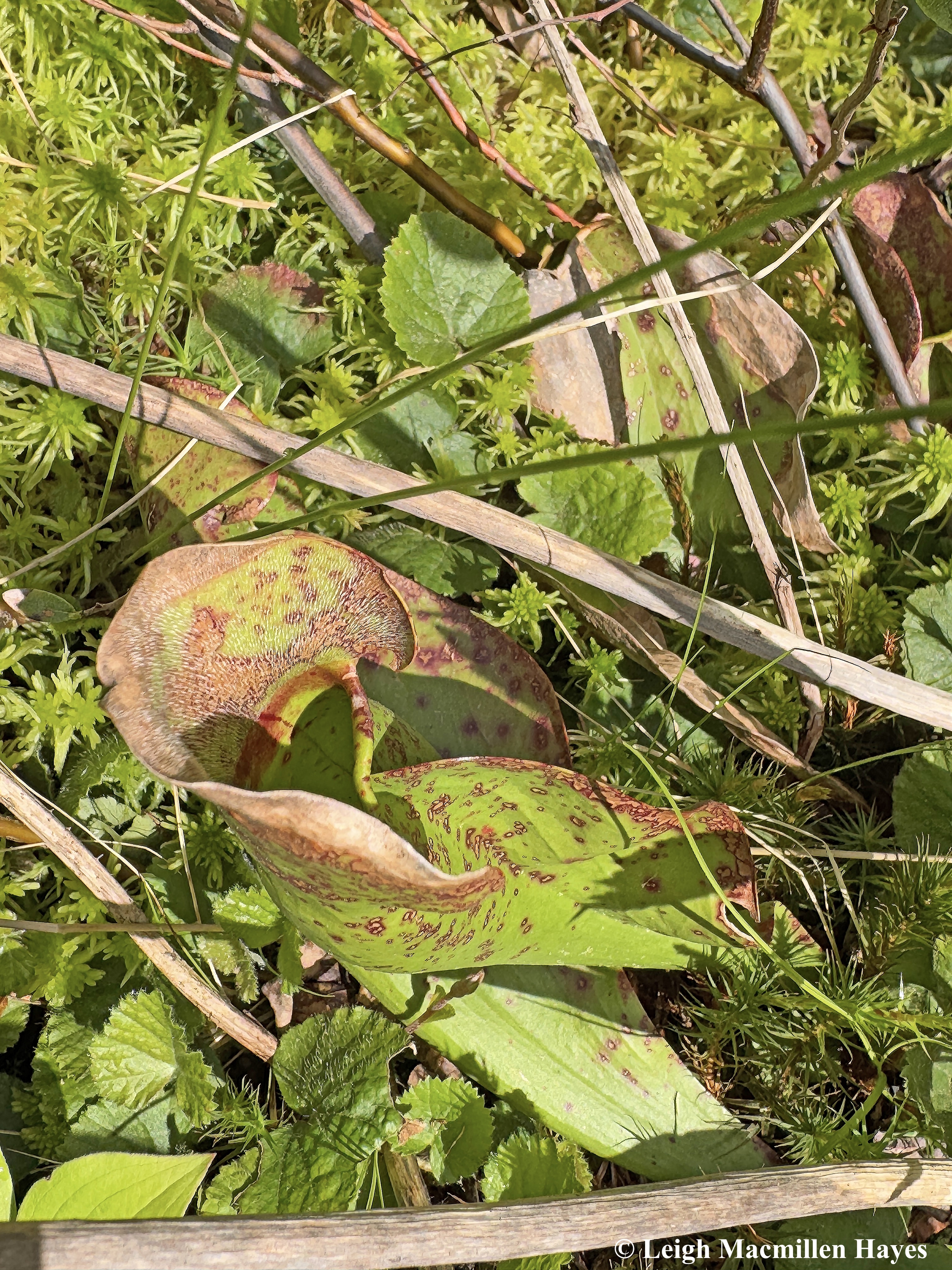
I, of course, can never see too many Pitcher Plants and be forever wowed by those downward facing hairs that entice insects in to the pitcher-shaped leaves where the end-of-life lurks.
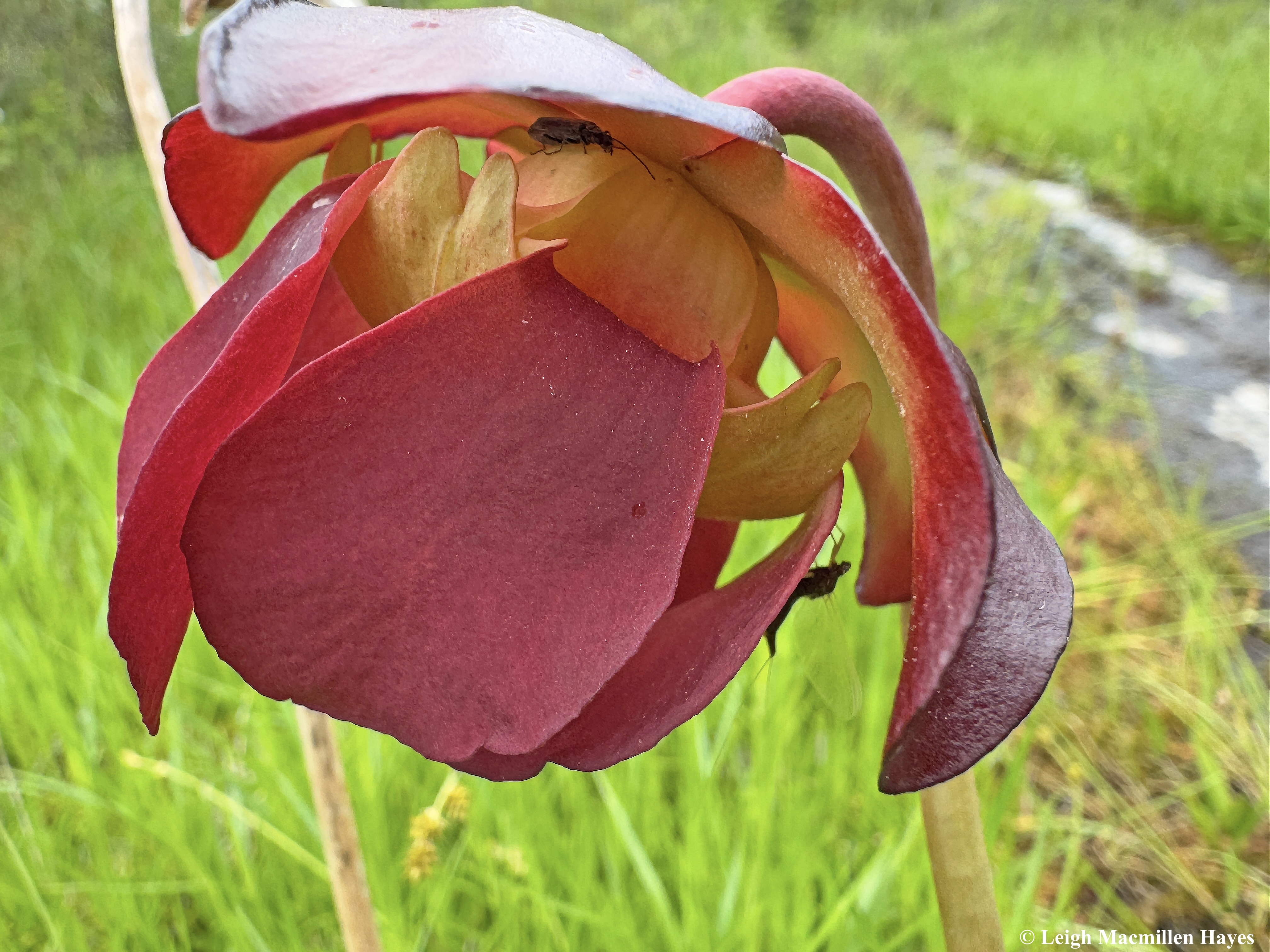
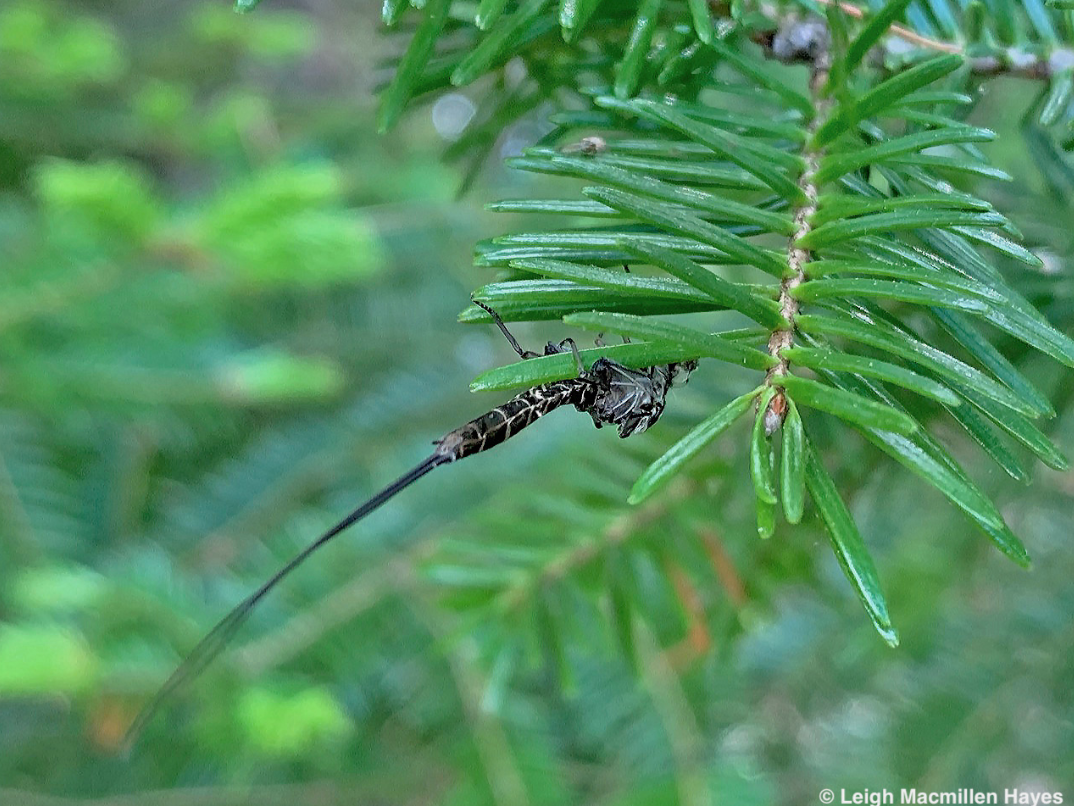
And the otherworldly flowers were in full bloom, including this one that hosted a long-horned insect and a sub-imago Mayfly (read: Dun).

I’ve been wowed by these for a long time and years ago drew this rendition as a teaching tool that now is the background for my iPhone.

There were Unadorned Bog Flies pollinating Bog Labrador Tea.

And Cotton Sedge showing off their hairy tufts.
Our next leg took us from the Bog to the Groton multi-use trail, being used mainly by horse riders and moose. We saw neither, but their tracks were evident in the mud.

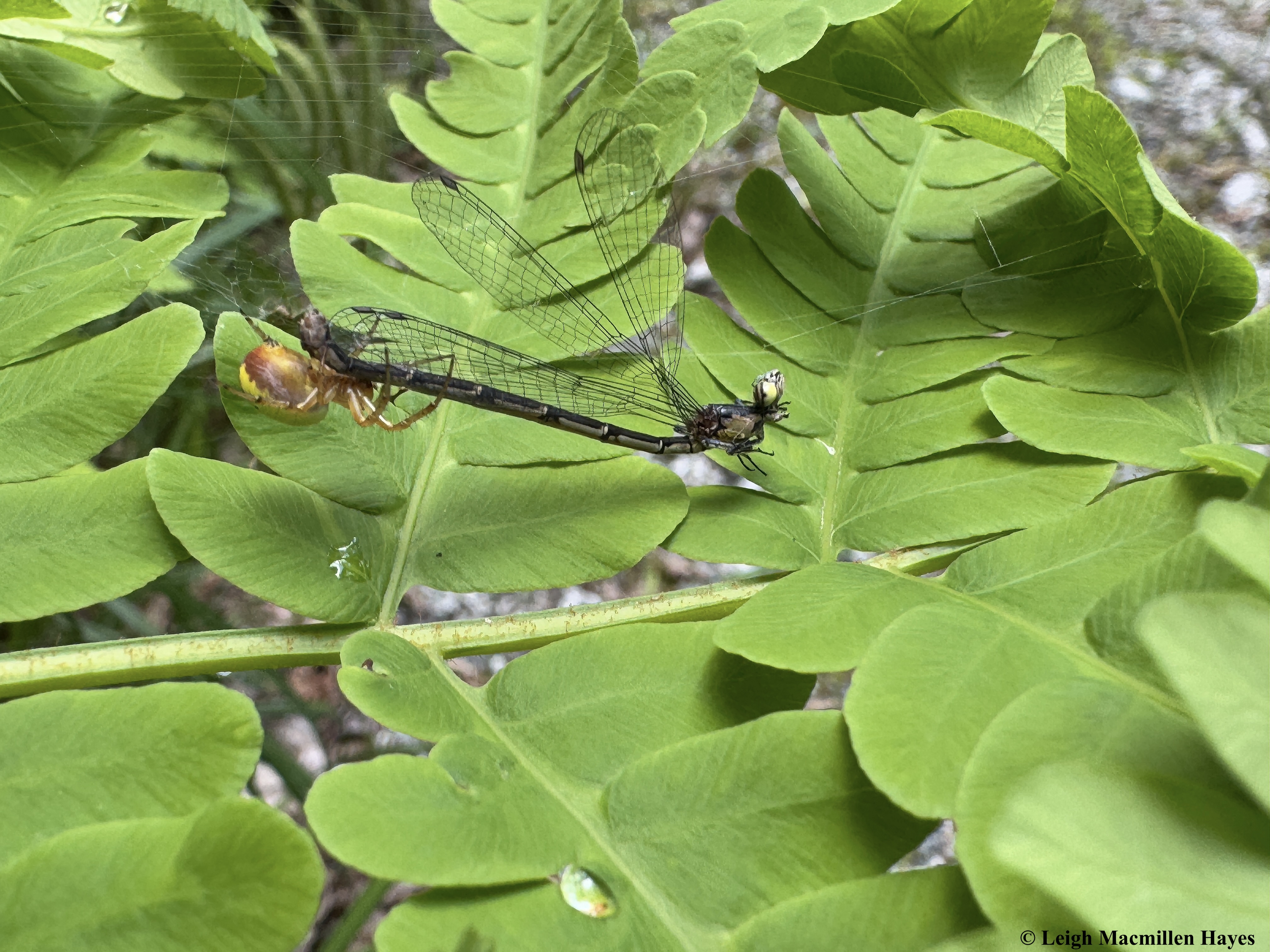
What we did spot was this Aurora Damselfly being wrapped up by an Orb Weaver Spider. I knew the damselfly immediately because of the uneven stripe on the sides of the thorax.

And had recently tried to paint a mature form of the same species.
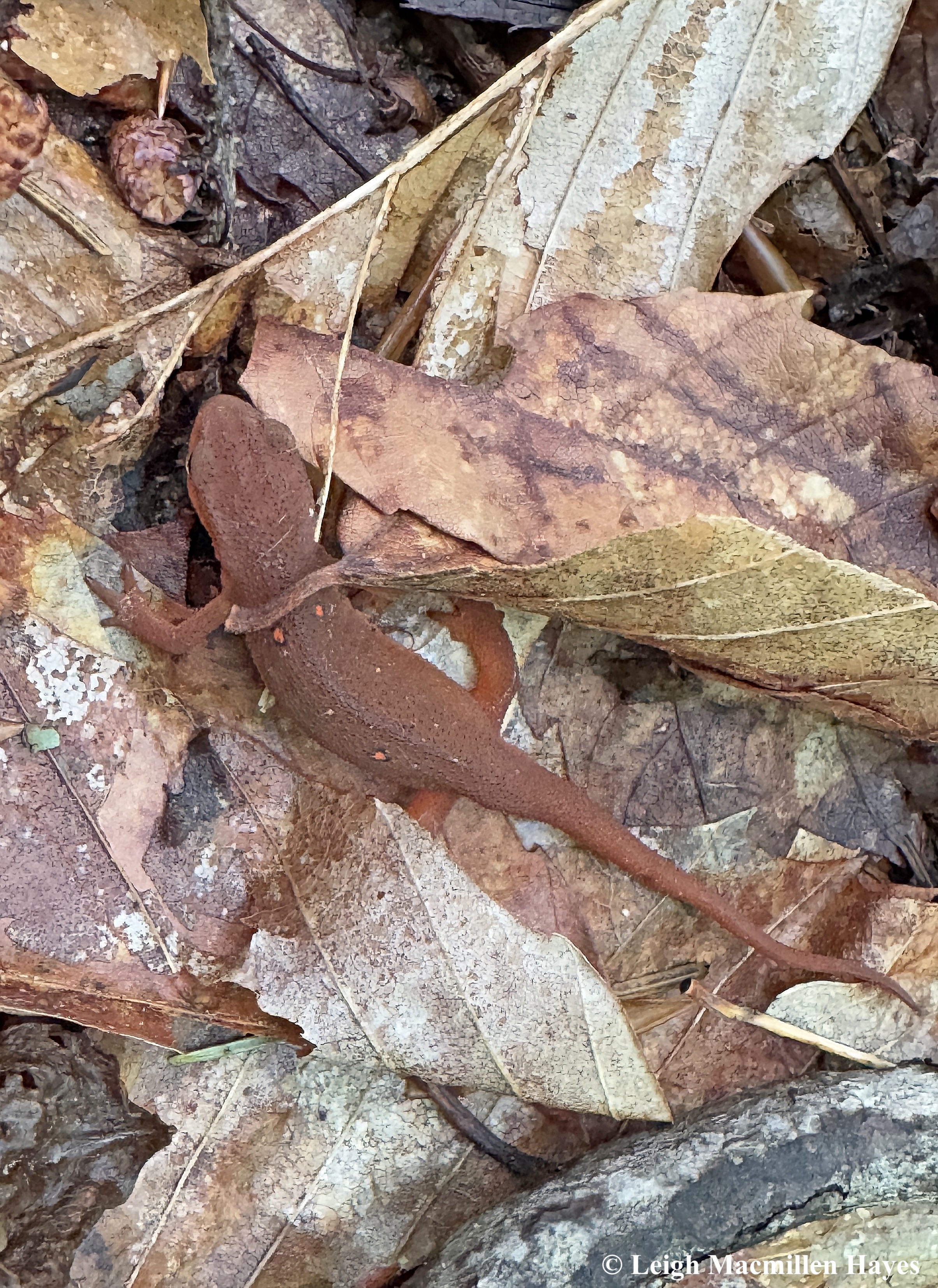
We also met a couple of Red Efts, the teenag and terrestrial stage of the Eastern Newt. The red spots act as a warning to predators because if consumed, they secrete poison toxins from their skins. As humans, we can touch them and live, but to ingest one would be harmful. So don’t try that.
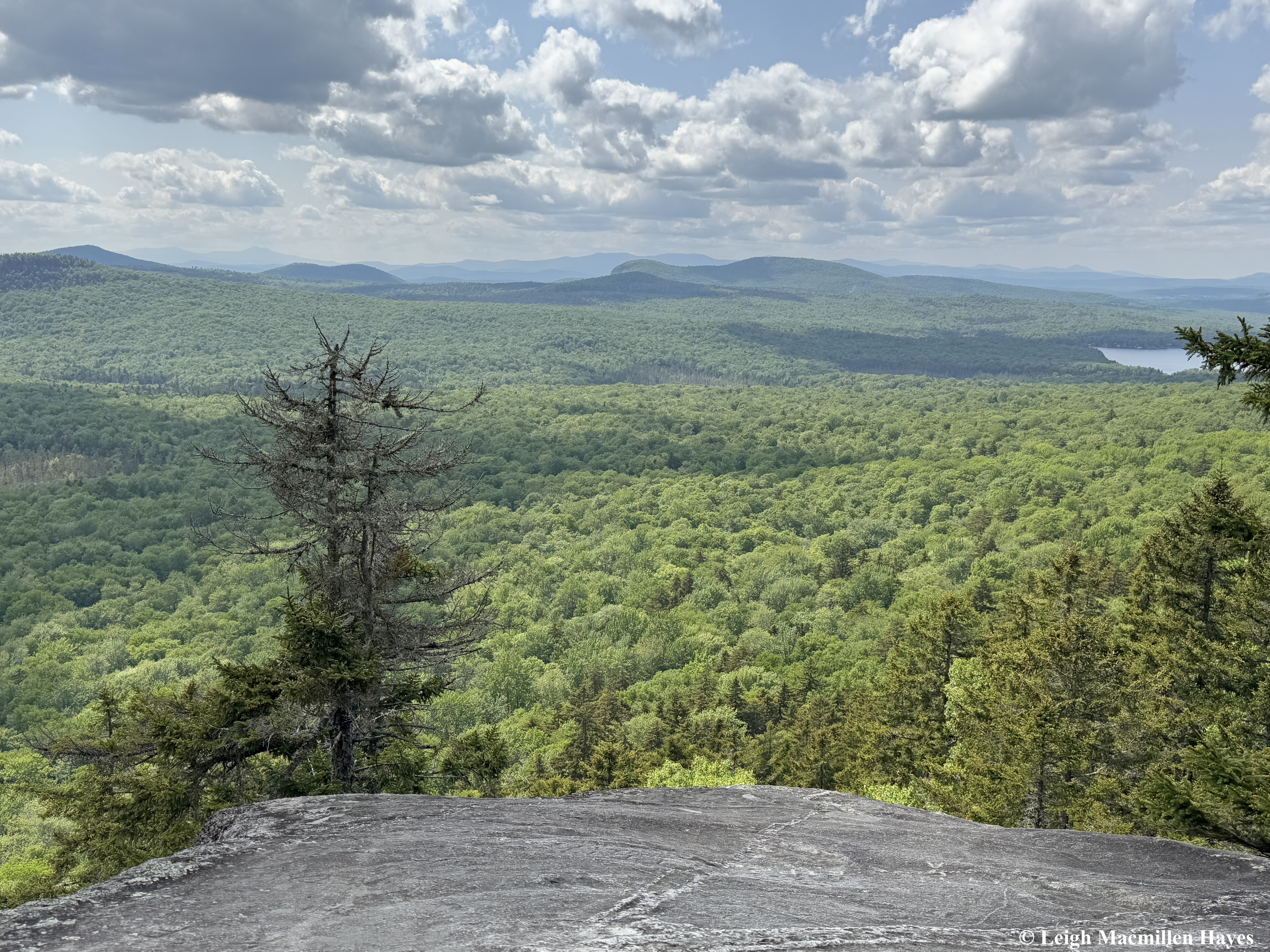
A couple of miles later we reached the trailhead for Devil’s Hill and snaked our way up the switchbacks to the summit, where this view of the rolling hills and iconic geography of Vermont stood out before us.

On the way down, a male Luna Moth presented itself, hiding as it was under a Striped Maple leaf.

I love these leaves and their twigs, especially the growth rings that stand out so predominately, and My Guy appreciates that the leaves serve as Nature’s Toilet Paper. TMI? But really, they are easy to identify and they are soft.

Returning on the multi-use trail before retracing our steps on the Peacham Bog Loop, we had to walk through tall grasses and sedges, which did not make my heart so glad because this was heavy tick territory. I had on tick gaiters and repellant. We took at least five off My Guy.

But, this pair of Craneflies did share a canoodle moment with us, so that won me over for a second.

All in all, we hiked over eleven miles that day, and were too beat to go out to dinner, so instead drove to the West Barnet Quick Stop, about 1.5 miles from our weekend home. There we ordered Chicken Cordon Bleu Paninis with Pesto, and a salad to share. And while we waited for our meal to be created, noticed Shain’s of Maine Ice Cream in the freezer, which made us chuckle. Wait a minute. We were in Ben & Jerry Country. Never fear–they had a much better presentation in another freezer.

And, while we waited, I asked the woman who was creating our salad if she lived in the area. “All my life,” she said, and added, “So far.” We chuckled, but then I asked if she knew so and so, a couple I know from church who had lived just down the road for many years (a fact I’d only learned days earlier).

Her face lit up with a smile as she recalled them and said they used to frequent her other store and that their daughter had worked for her. As tired as I was, that smile of hers was the perfect ending to a great day.

Well, it wasn’t quite over yet. For there was no TV at our weekend digs. And so I taught My Guy to play Parcheesi, and then I beat him.

The next morning we drove north to Orleans to meet my first college roommate and her husband, Bev and Bill, at the Carriage House for breakfast. Funny thing–as I drove up Route 91, there was one car in front of us and approaching it, with its Maine license plate, I spotted Lakes Environmental Association and a Loon Echo Land Trust stickers on the rear window. It had to be someone from our hometown. Sure enough, as I passed it, I recognized the mother of one of my former students. And a wondermyway follower.

Betty, if you are reading this, that was us on the highway with you on Sunday morning at 8:30 or so.

We spent two hours talking and eating and talking and talking some more over omelets and coffee and Bev and Bill suggested that we hike Mount Hor, which overlooks Willoughby Lake. I’d been to Willoughby before with Bev and two other dear friends, but never hiked in that area. And so we did. They gave us easy to follow directions and we parked and then walked almost two miles up the CCC Trail. I love that this was another project meant to keep people working when times were tough.
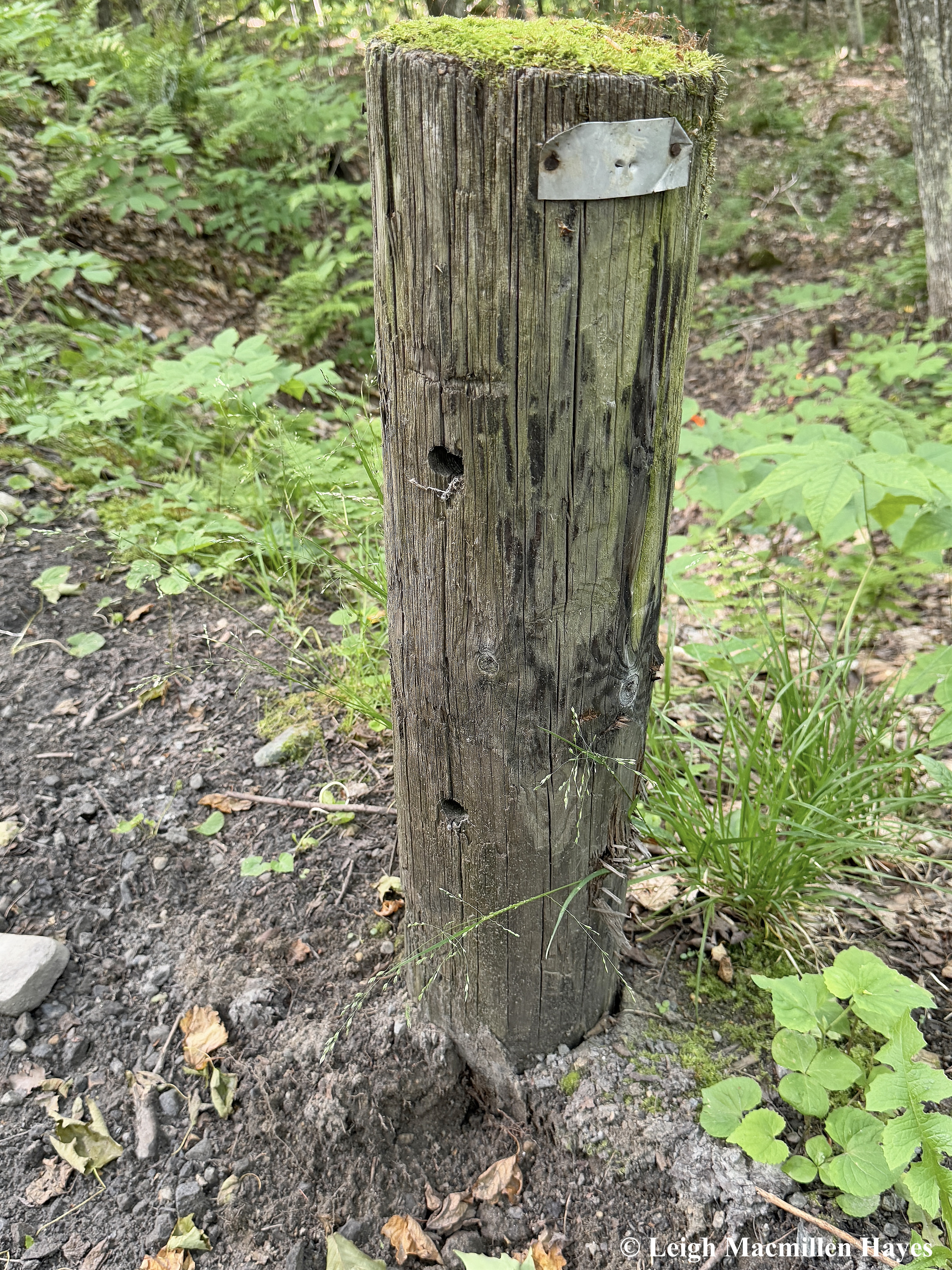
Though the hard packed surface we walked on was not the original road, we kept spotting these posts and my theory is that they were original and held cables that connected one post to another and kept vehicles from catapulting down the steep embankment.
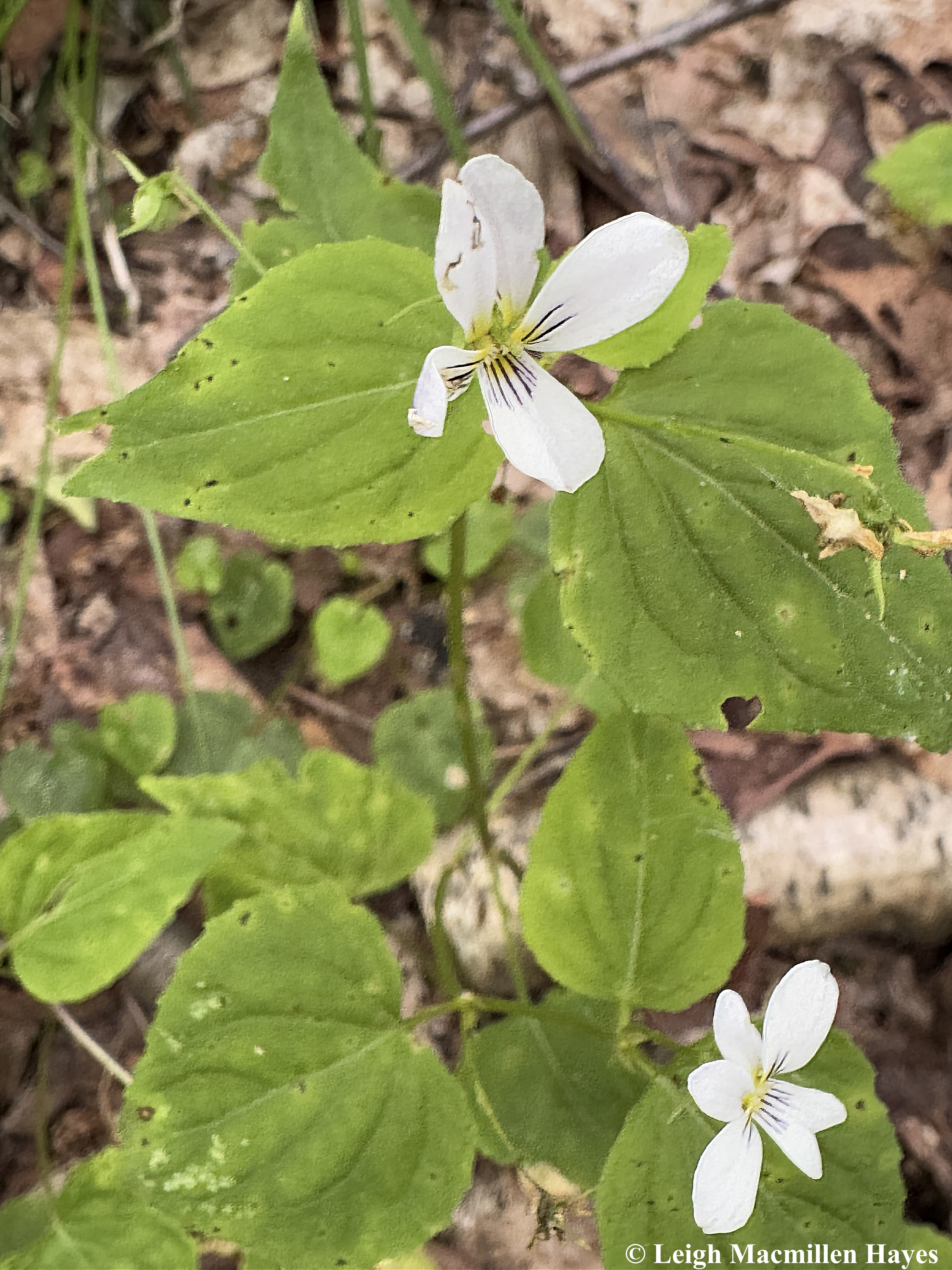
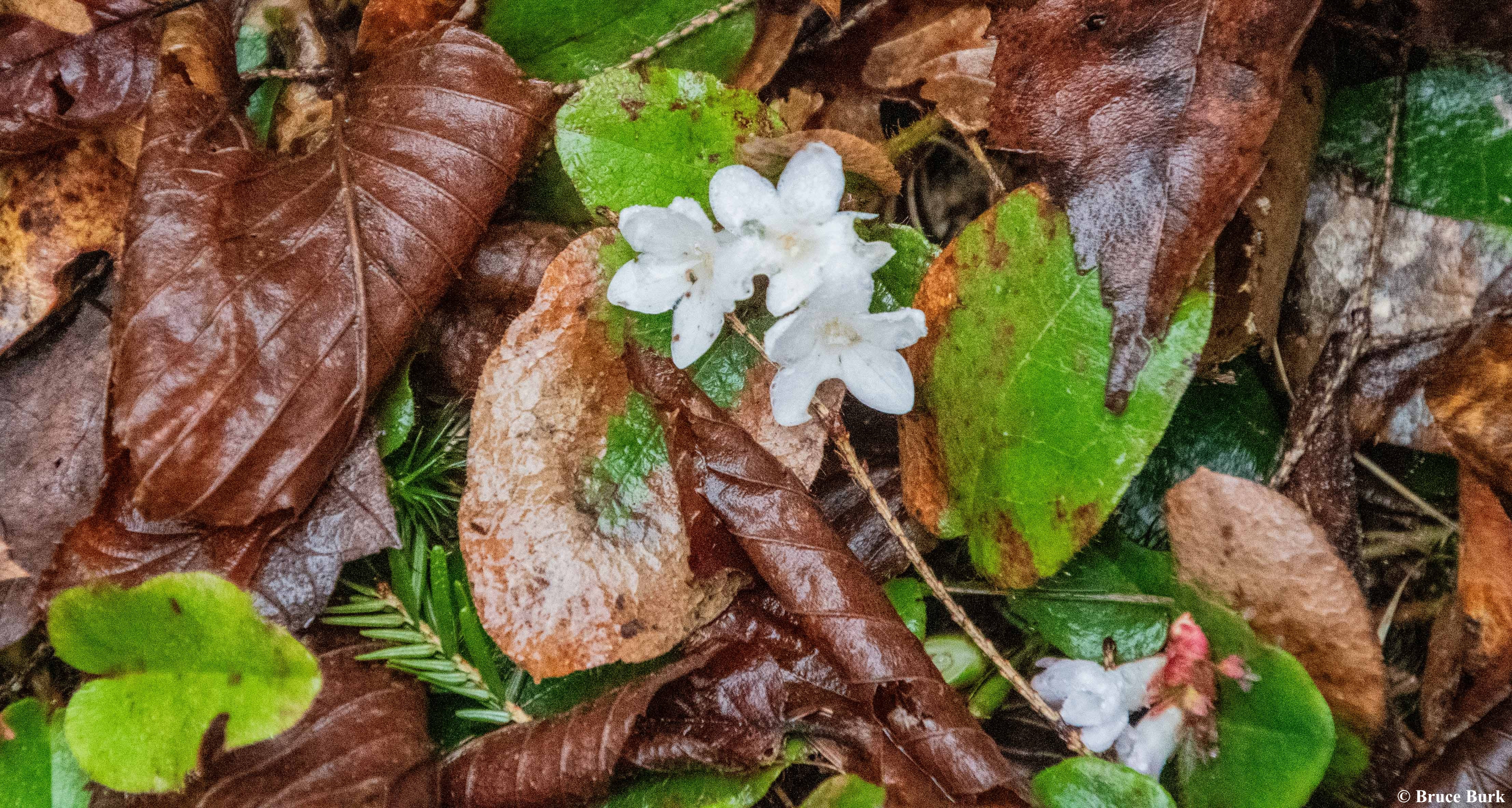
When we finally reached the actual trailhead for Mount Hor, I met a new flower. Canada Violet. It made sense since we were probably about ten miles from the Canadian border. Delicate. Pure white. A well-defined runway to the nectar. And leaves offering a different take on the violet theme.
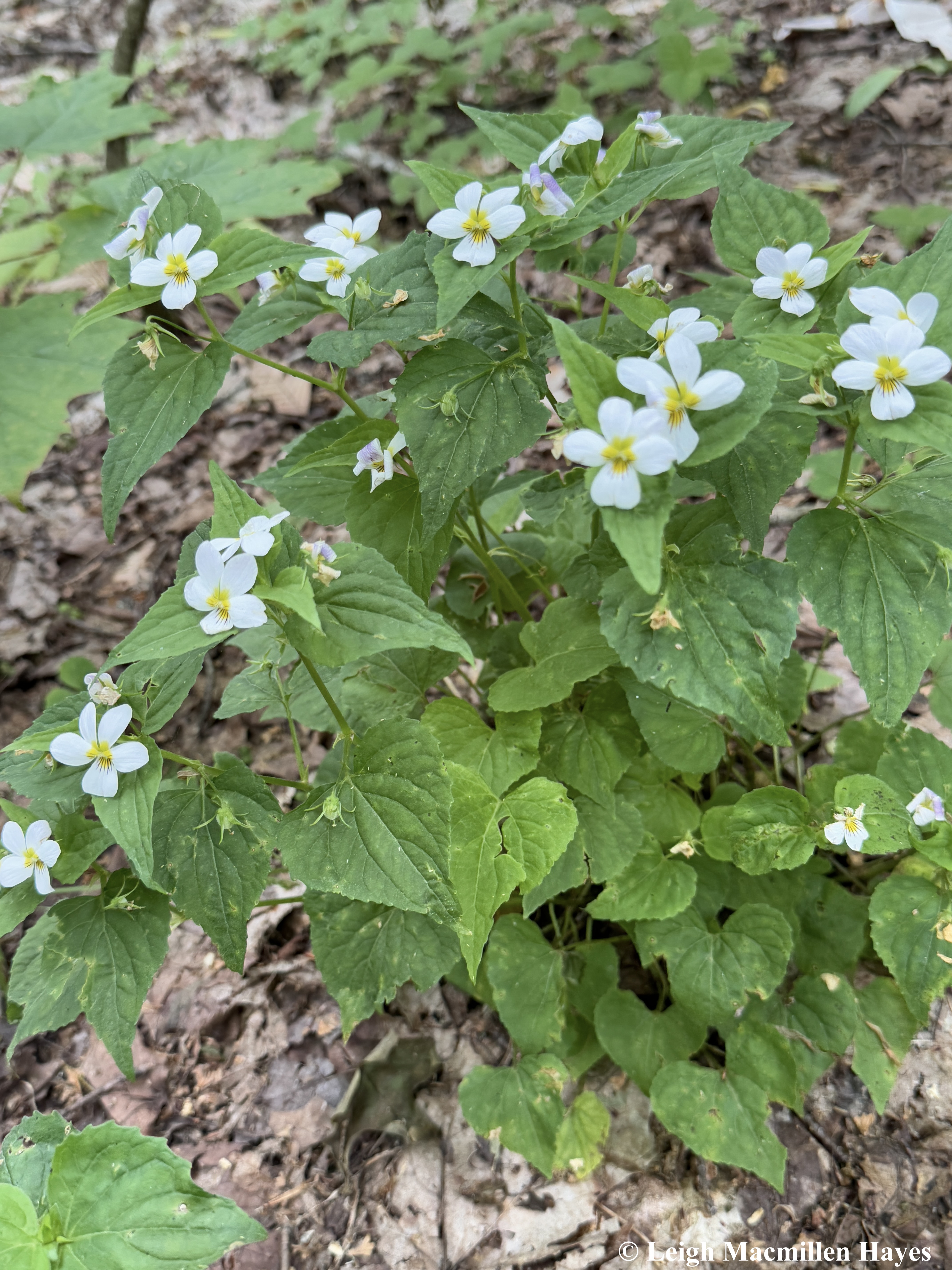
What we soon realized was that it not only grew tall, but also in large clumps.

Oh my gosh, our next find–Maidenhair Fern. Such a unique presentation and color and, oh my gosh!
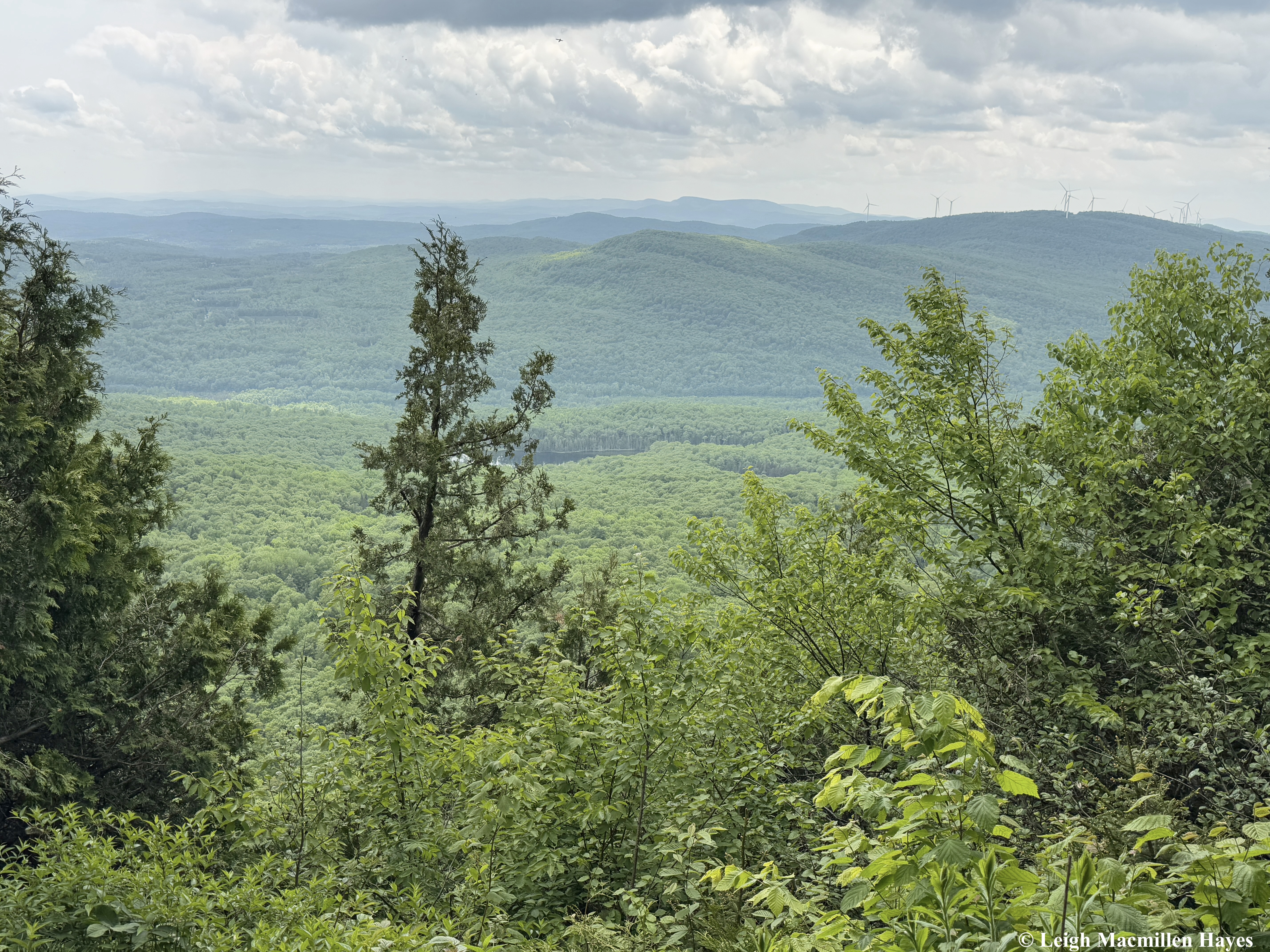
At the summit, we had three choices. First we headed to the Summit Vista, where the view included Cedar trees in the foreground and two delightful couples who were enjoying GORP and blueberries but when they heard that we had homemade Peanut Butter Chocolate Chip granola bars a la The Stow Away Baker in our backpack, they wanted to chase us down the mountain.

From there, we hiked another mile across the ridge line to the East View, overlooking Lake Willoughby.

While there, we spotted a Peregrine Falcon soaring on the thermals, but neither of us got a good shot of it. Still. Forever in our minds eye. And sometimes, those are the most memorable moments.

From the North Vista we looked across at the cliffs of Mount Pisgah and wondered how many more falcons we weren’t seeing.

Back down the CCC Road we did walk once we stepped off the mountain trail and my favorite find was a Mountain Maple, that stopped me in my steps for a few minutes as I had to remember who it was that I was meeting.

Back at Lake Willoughby North Beach, Mount Hor is on the right and Mount Pisgah on the left, creating a fjord-like presentation.
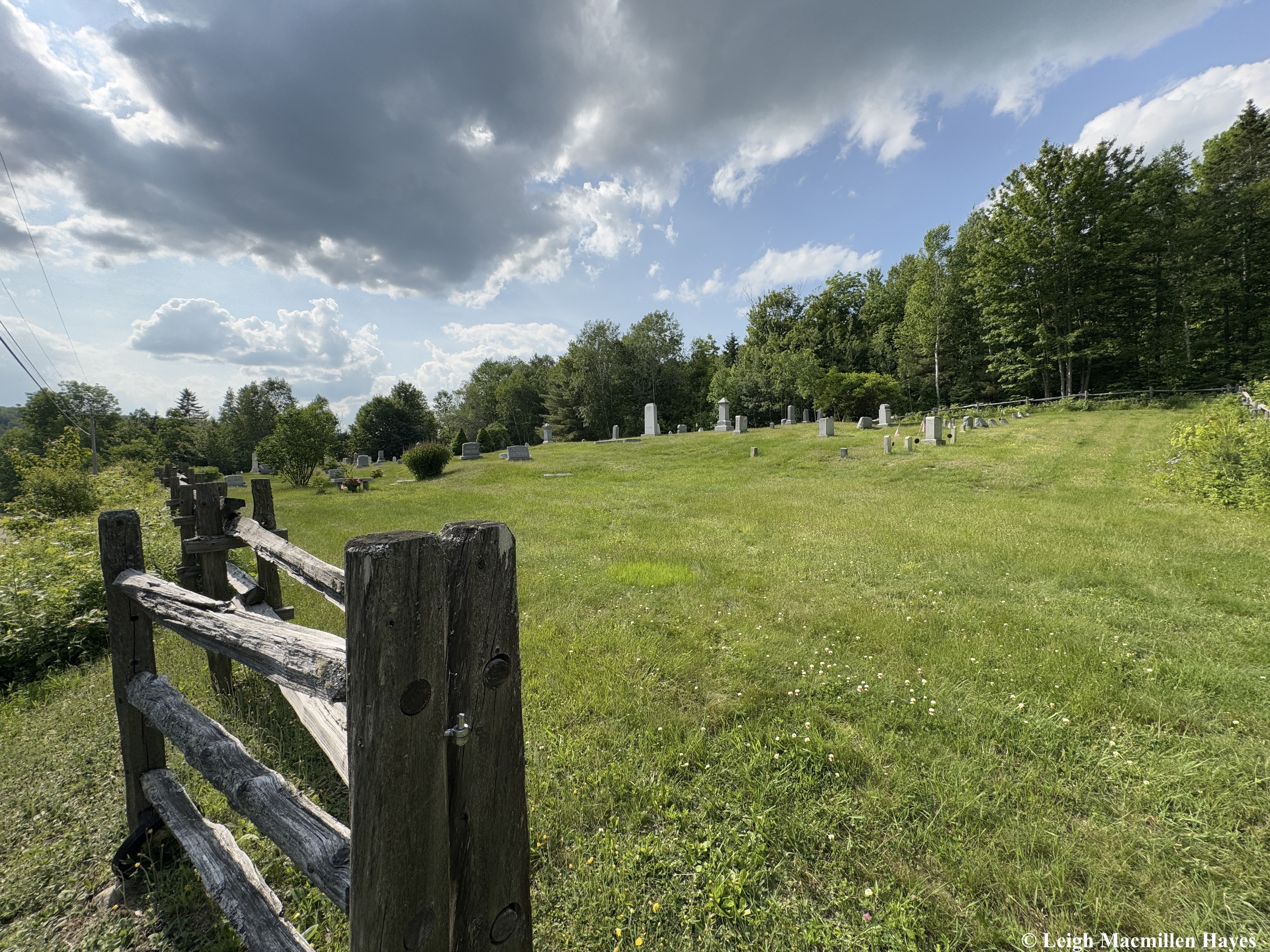
From there, we drove south to South Barton as I let my nose lead the way and found a cemetery I’ve visited in the past for some of my ancestors are buried here.

Recognizing family names is always a treasure. And actually, within the post railings of this place I noted at least three different families that have contributed to my DNA. I’m pretty sure my love of the north country, be it Northern New England or Canada, comes from these folks.

On the way back to our home base, we grabbed sandwiches to go from Three Ponds and gave thanks for their goodness.

And then this morning, after packing and cleaning and chatting briefly with Chuck, we had one more place to explore–Kettle Pond State Park within Groton State Forest.

So here’s the thing. My understanding of a kettle bog is that it’s kettle or bowl shaped. And has an outer layer of herbs, with the next layer surrounding it of taller herbs, and then a third layer of shrubs encircling the kettle, and finally, trees who like wet feet, like Red Maples, forming the final ridge around the pond.

None of this was present. Well, there were shrubs and trees, but not in layers like I’m used to seeing. And the shape of the pond was more north-to-south glacial-related than kettle-related. Hmmm?

Still, some great finds like this Spotted Salamander egg mass along with four others in a deep puddle along the trail. Can you see the embryos forming?

And a Garter Snake that had been basking on a rock in the trail until we happened along.

And Twin Flowers, each sharing a petiole, growing like a mat along a glacial erratic.
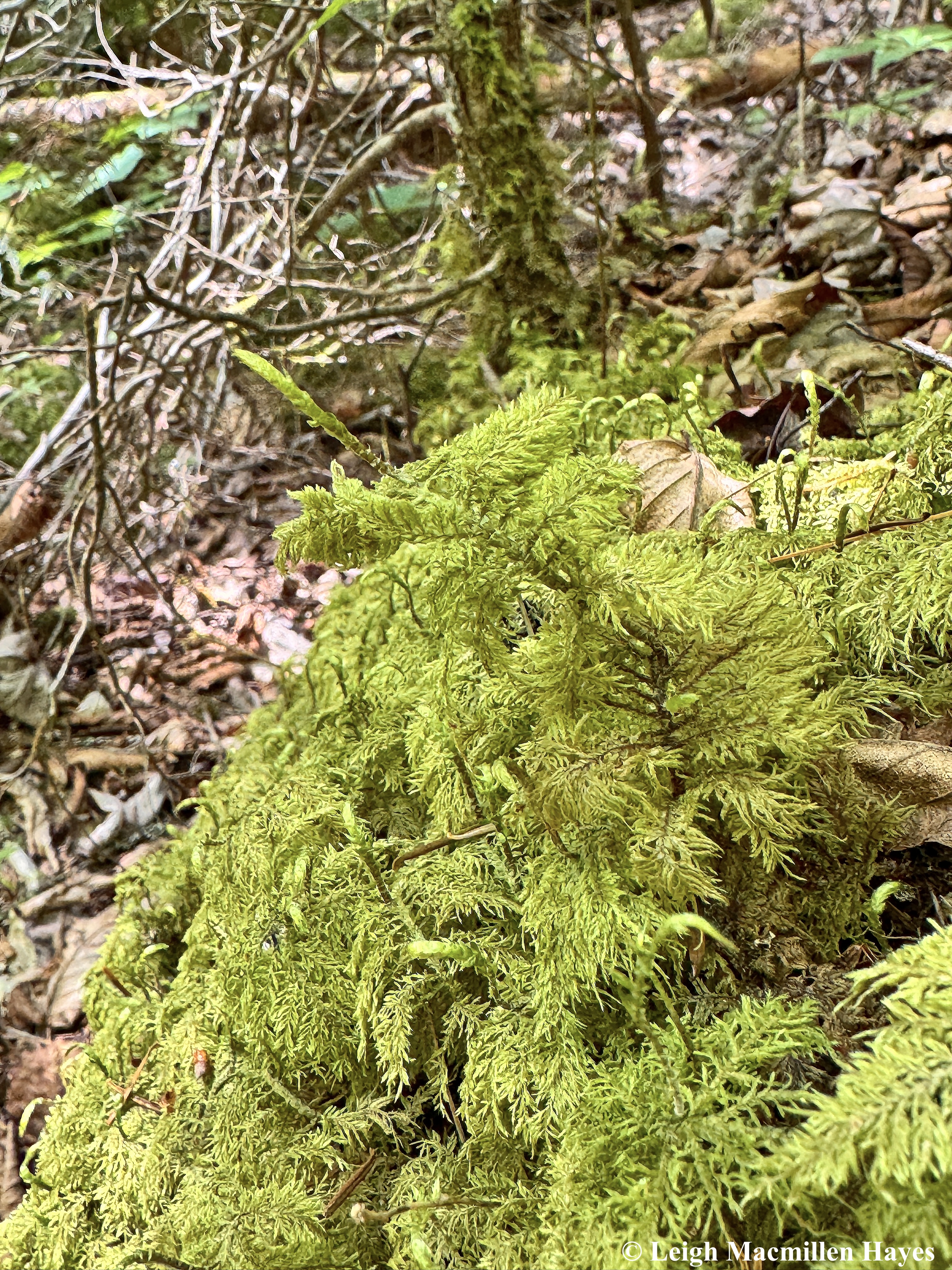
And Stair-Step Moss growing abundantly like a set of stairs here and there and even over there.
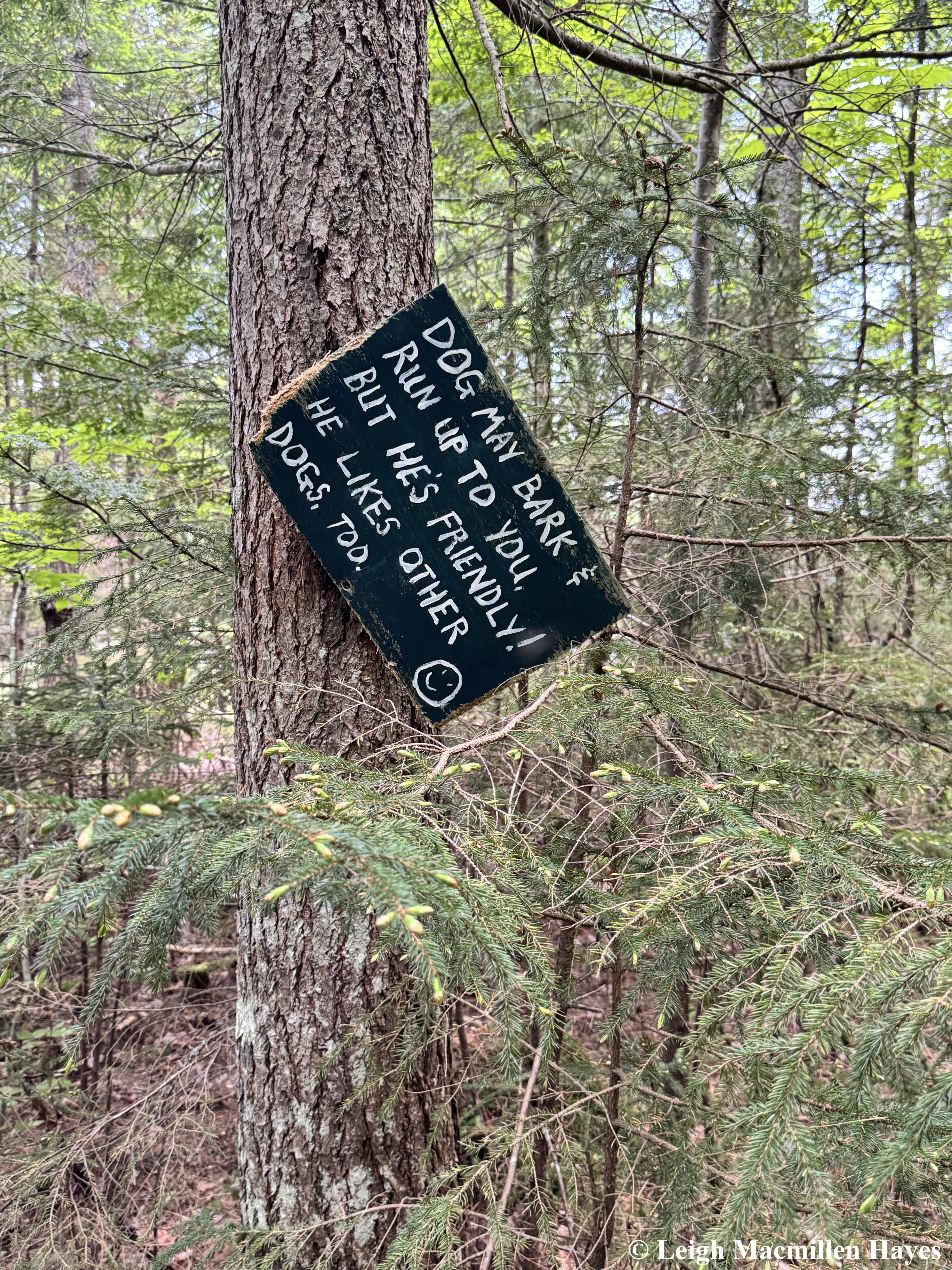
And a warning, which was more of an invitation at the only private cabin along the way, a route which offers lean-to shelters for groups to rent. I love this sign. We looked forward to meeting said dog, but sadly, no one was home.

Flat-fruited Pelt Lichen also lined the trail. So much to see. So much more to learn.

Oh, and an Eastern Newt in the water. It was like the Newt brought the trail to a full circle beginning with the Red Eft on our first hike of the weekend and ending with this adult form.
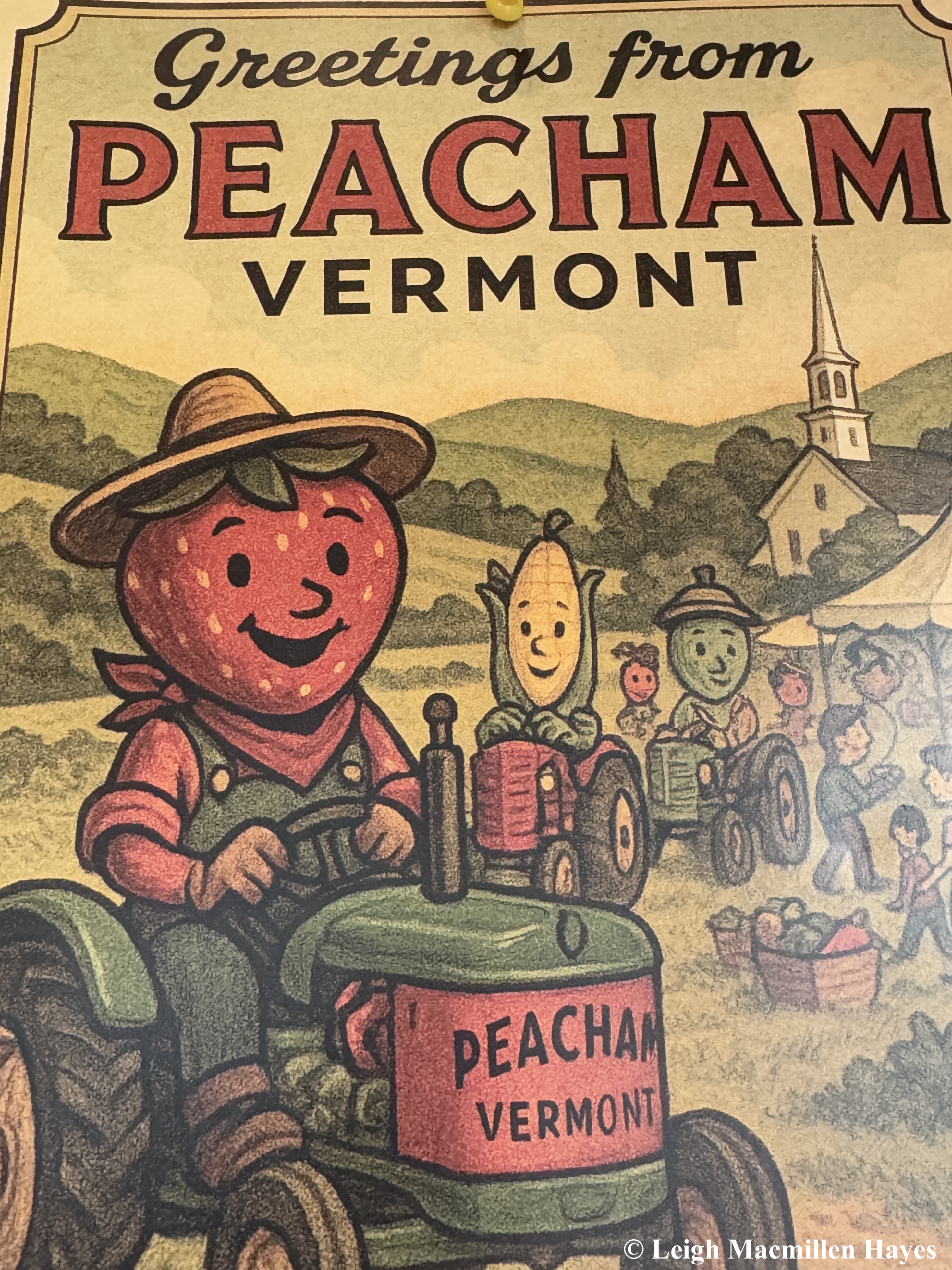
Our time Vermonting came to an end this afternoon, but oh, what a wonder-filled time we had. We hiked so many miles while meeting old and new friends, dined with dear old friends, met friends of friends who were old friends to each other and new friends to us, and just plain had fun making new memories.

Thank you Chuck and Mercy, and Bev and Bill, and Debbie and those at Three Ponds, and Brian at the Nature Center, and to all the others we met along the way for making our experience such a rich one.

Vermonting we did go. Word or no word, it was exactly what we needed.

Memorial Day Dragons and Damsels

It finally stopped raining and with a wee bit of sun late this afternoon, the temperature broke 60˚ and I found myself exploring a local wetland where all kinds of interesting things happen daily. And yearly. In cycles. And sometimes I happen to be there.

One of my favorite events is the emergence of dragonflies and damselflies. It seems like we endure Black Flies for most of May, all the while looking forward to our champs, the Ondonata family, to step in or rather up out of the water and transform before our eyes and take on the world. This usually happens by Memorial Day.

And this year is no different. The dragons and damsels have been emerging for the past couple of weeks, but now is prime time. And they are just in time because the Black Flies and Mosquitoes have had a heyday with all this rainy, cold weather, and today . . . as it warmed up, so did they and I have red welts on my neck to prove that they are biting. It’s all good, I remind myself. It’s all good. They are bird food. And so are the dragonflies, who eat the Black Flies, et al, and if they become bird food, all the more energy sent the bird’s way.

Cloudy wings and clinging to its shed skin indicated that this dragonfly had just made that magical transformation from its aquatic life to terrestrial existence. And I was there to protect it. For a while anyway. Until the Black Flies sent me scurrying onto the next great find.

That next being a damselfly, also with cloudy wings indicating it had also just emerged. Though I don’t know who the first dragonfly was that I met today because it didn’t yet have enough colors and pattern to make that determination, I did learn that this damsel is called Aurora! I don’t recall ever greeting it before, but based on the the lack of shoulder stripes, black patch with wavy edges on the thorax, and yellow sides led to this ID once I consulted Damselflies of the Northeast by Ed Lam.

Now it’s one I don’t think I’ll forget. AND, I love that it is named for my ten-year-old naturalist friend, Aurora. Or she for it. Or neither, but they both share the name of an electrical phenomenon.

As I looked about, I spotted several other newly emerged dragons and damsels, all with their signature cloudy wings, but then I spied this one.

Yes, it’s wings are cloudy, but this Lancet Clubtail has an issue going on, for its wings are folded, rather like the main character in my fairy tale, The Giant’s Shower, for Falda’s wings are also folded.

That didn’t stop Sir Lancet from climbing up a fallen branch with gusto. But I did wonder about his fate.

That said, I moved on because I had some Painted Turtles I wanted to meet, figuring that they’d be basking after several days of temps in the 40˚s. Being ectotherms, they rely on external heat to regulate their body temperature. Sun is their friend.

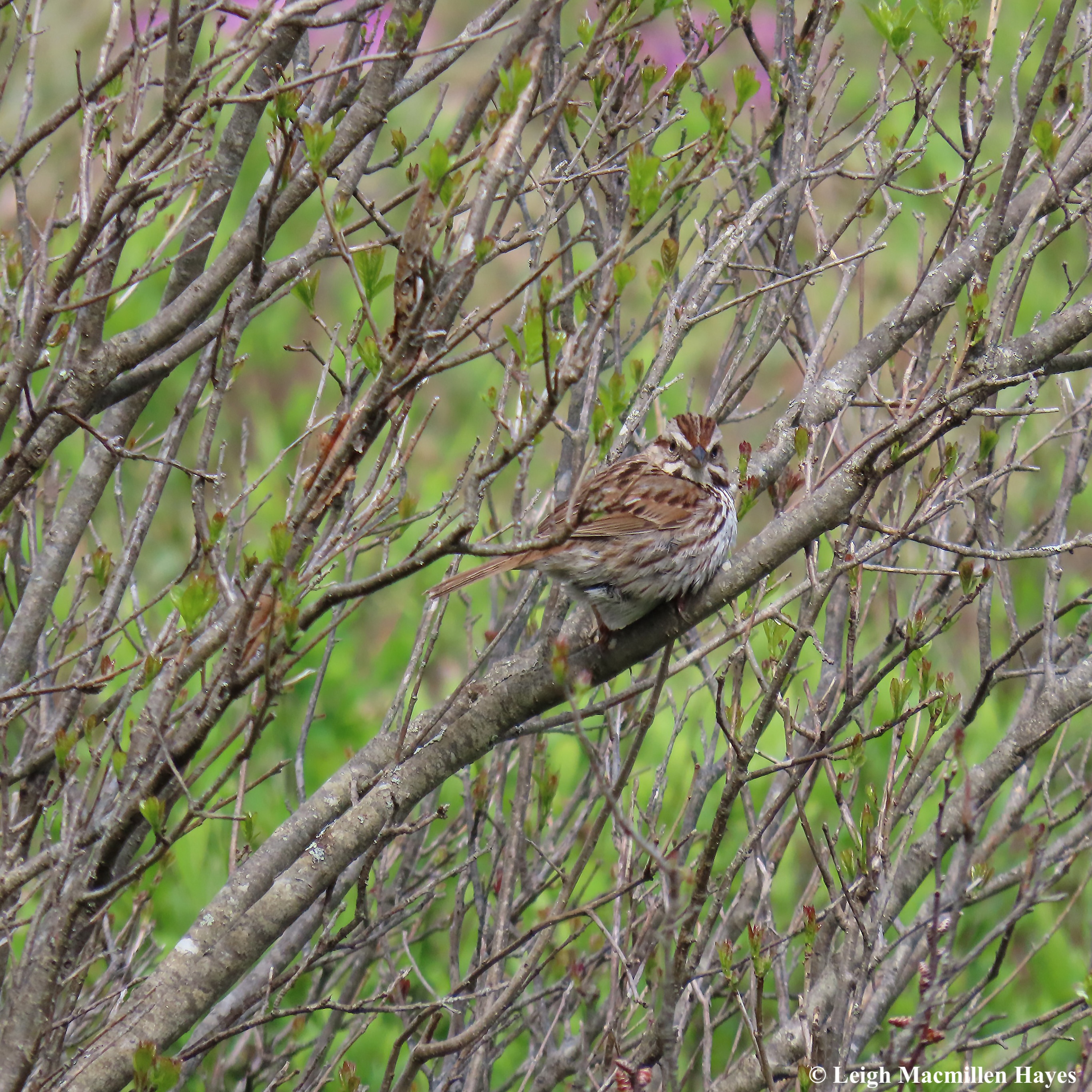
Being in a wetland, the bird song was plentiful, but though the Merlin app included a chorus of plenty including Redstarts and Towhees and Common Yellowthroat and more, the only one who posed was a Song Sparrow.

I walked about a mile away from my starting point, but really was eager to return because I knew there was more to see and learn in that spot.

Almost back, I met a Dreamy Duskywing Butterfly, a species I’ve met in this place before but not sure we’ve encountered each other anywhere else. I love the tapestry of its dusky wings.

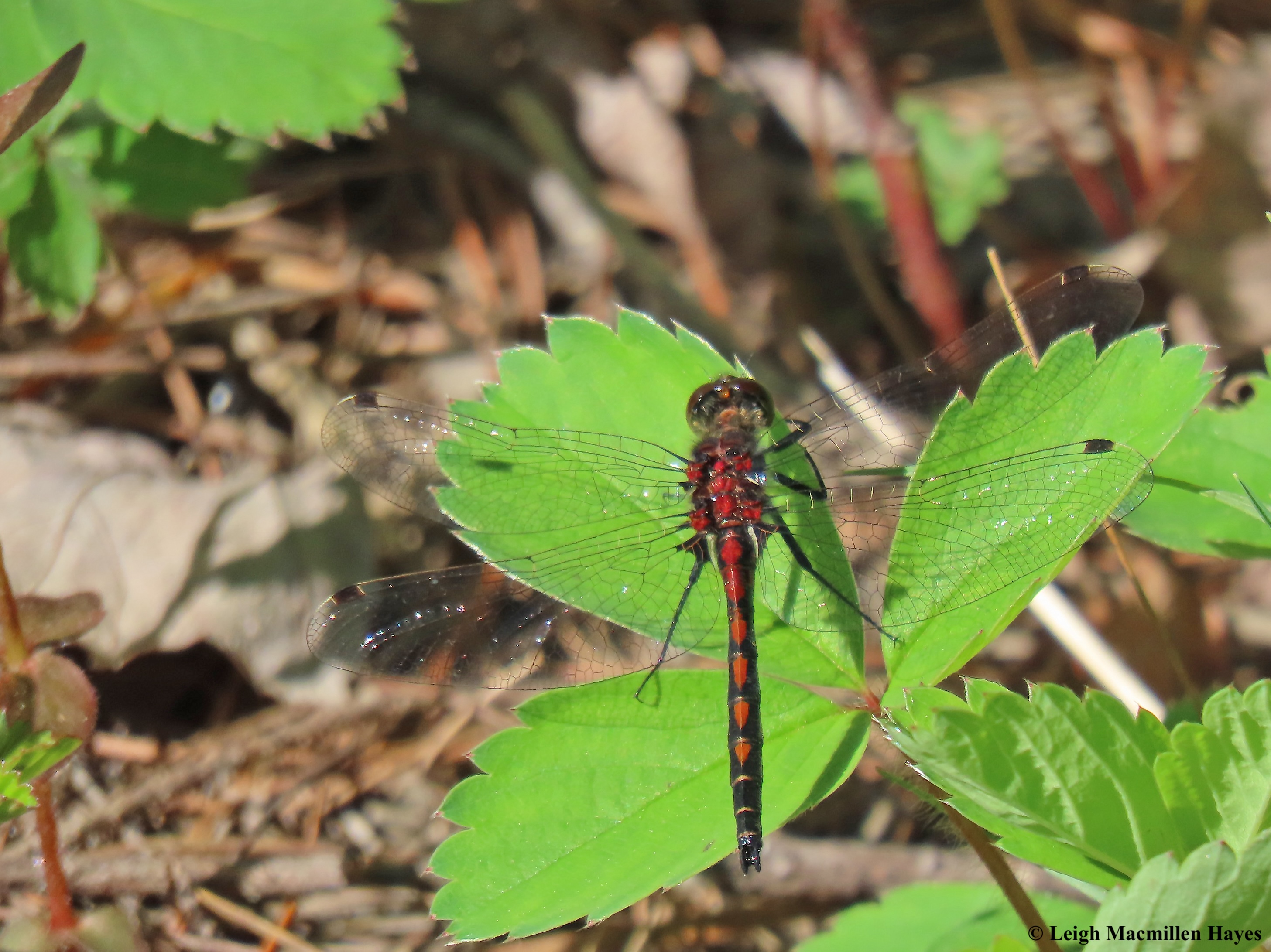
A moment later, an old friend flew in–Hudsonian Whiteface–this being a male, for the female’s markings are yellow. These are early spring skimmers, and I have to remind myself not to confuse them with Calico Pennant skimmers who have similar, yet different abdominal markings, he being red and she yellow. Also, the Calicos, being pennants, have a stained glass basal wing pattern that the Hudsonian’s don’t exhibit.

Back at base camp, or rather, my starting point, I checked on Sir Lancet. He’d crawled up the branch to a rather perfect hiding spot at the Y, at least to my eyes. And look into his eyes I did. Including the three simples eyes, singularly called ocellus, which are arranged between the two large compound eyes. Each ocellus offers a single lens with which to view the world, while the compound eyes offer multiple lenses. Amazing. I can’t even begin to imagine such sight.

But what I also noticed about my folded-wing friend was the green “blood” that seemed to be stuck within those wings. Dragons and damsels and other insects that emerge from an exuviae break through their old skin, their wings coming out first with the head, and then pulling the abdomen out slowly and pumping their insect blood first into the wings until they reach full length before drawing said blood back into the body and allowing the abdomen to extend to full length and slowly take on the hues of its adult self.

I’ve seen this in others with folded wings though, where the insect blood seems to have become blocked and is still visible in the transparent wings and maybe that’s why they are deformed? But what causes this?

I don’t have an answer, but try to remind myself that eventually this dragonfly will become units of energy for a bird or another insect and that’s its way of giving.

Meanwhile, though it was getting late and the temperature was starting to drop again, two immatures caught my attention–a Mayfly subimago or dun and another Lancet. Both had cloudy wings announcing their age.

And both were fairly safe in each other’s company, for the Mayfly has no mouthparts, not that it could eat anything as large as a dragonfly at this point, and the Lancet wasn’t quite ready to eat yet for it had some more work to do in order to become a flying predator.

Slowly Lancet’s wings became more transparent and though dinner prep was on my mind and I knew I needed to head home, I waited until it spread its wings and then without a backward turn or wave goodbye, took off. Despite that, I wished it my usual, “Fare thee well.”

And as I walked back to the truck, a young Lancet met me. I was totally surprised to find it land with wings folded over its back. Had we just met only steps away by the water? How cool would that be if it were true.

And then my all-time favorite appeared, a Stream Cruiser with its Oreo Cookie coloring. I was asked the other day what my favorite bird is and I came up with at least five different species, but the Stream Cruiser will always be my favorite dragonfly.

And dragonflies and damselflies on Memorial Day weekend–another favorite for we all know that the Black Flies will now be on the decline.

Memorial Day weekend not only means a return of the Dragons and Damsels who slay those other pesky bugs, but also a time for us to remember those who died serving our country, like my Mom’s brother, age 19, who died in World War II. Thank you Uncle B. We never met, obviously, but Mom brought you alive in my mind for you were her best friend and I know you are with me and trust you would approve my curiosity and adventures and reverence for the natural world .

Senior College: Forever Students

We honestly weren’t sure anyone would sign up. Or show up.

Vernal Pools and Macroinverebrates
Leigh Macmillen Hayes and Dawn Wood
Friday, April, 25, May 2, 9, and 16th, 9:30 – 11:30 am
April 25: The Hidden Life of Vernal Pools
Discover the wonders of vernal pools—seasonal wetlands vital to forest ecosystems. Learn how wood frogs, salamanders, and fairy shrimp rely on them for breeding and why protecting these fragile habitats matters. Join us indoors at St. Peter’s Episcopal Church for this engaging workshop.
May 2: A Day at the Vernal Pool
Meet at Loon Echo Land Trust’s Raymond Community Forest, Conesca Road, Raymond. Walk ¼ mile to the vernal pool, where we’ll provide tools to explore its temporary residents and their unique ecosystem.
May 9: Meet the Macros
Ever wonder who lives in local streams? Join us to discover the tiny creatures that call them home! Dive into the world of macro-invertebrates—those fascinating “big bugs” without backbones—and learn how macros tell us about the health of the environment. This hands-on workshop will take place indoors at St. Peter’s Episcopal Church. 
May 16: Macro-invertebrates Up Close
Explore the role of macro-invertebrates in stream health and the ecosystem. Join us for hands-on dipping and rock turning to assess water quality at Northwest River and Douglass Brook, Tiger Hill Community Forest, Sebago.
Maine Master Naturalists Leigh Macmillen Hayes and  Dawn Wood of Bridgton will lead these experiential classes. Both have a sense of wonder about the natural world and spend hours exploring only a few feet from a trailhead.

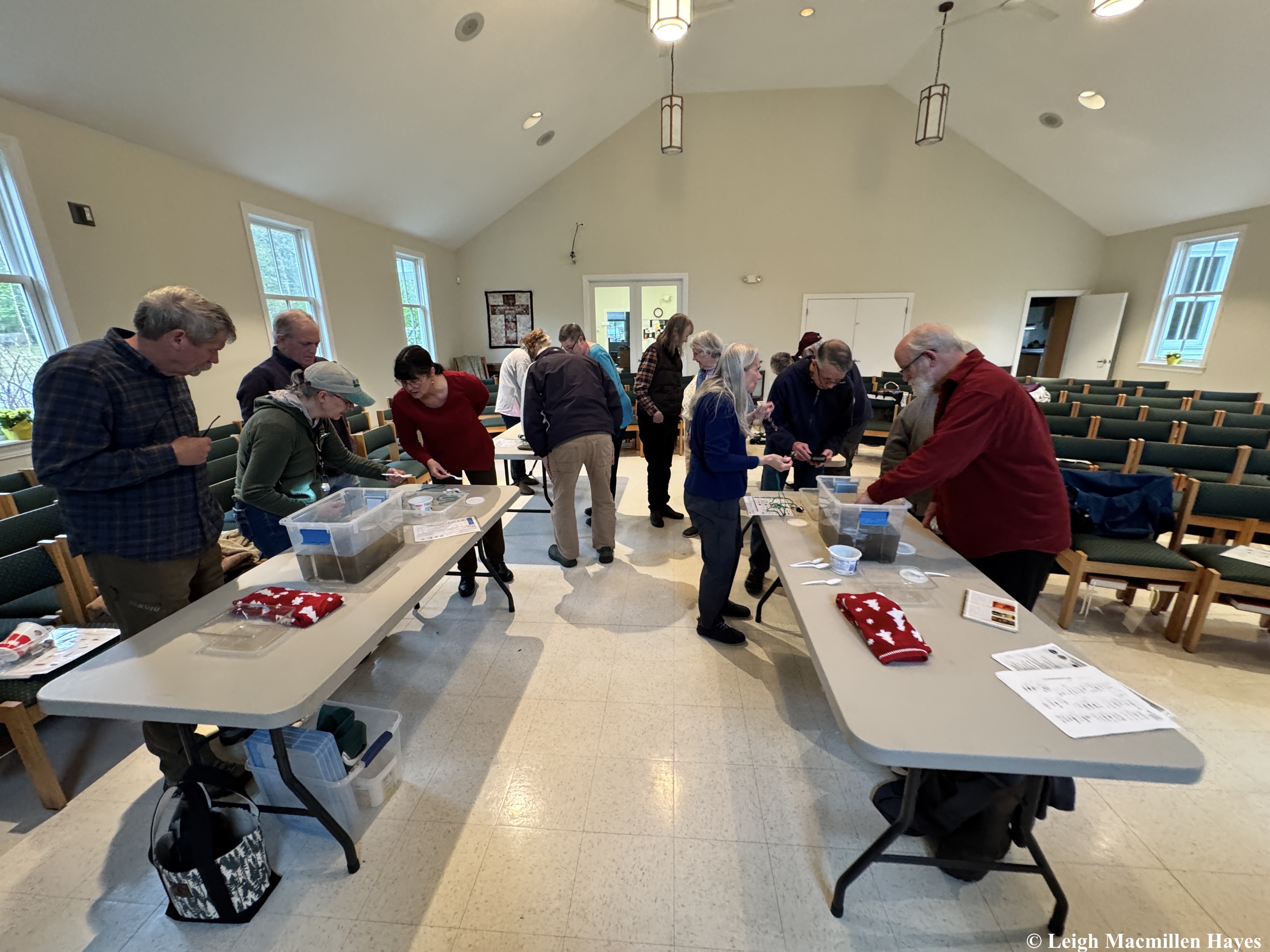
And then they did. Almost 30 of them. The first class, as you can see, was an indoor introduction to vernal pools where we shared our photographs, ID books, and models, and told stories about our experiences in these ephemeral habitats. Their questions were numerous and they shared stories as well, making it an even richer experience.

And then we ended with a musical treat since we knew that there was at least one conductor in the audience. As you click on the arrow to listen to the Springtime Chorus, remember that Wood Frog calls sound like “Wruck, wruck.” Spring Peepers: “Peep, peep, peep.” Green Frogs: “Ga-dunk, ga-dunk.” And Bullfrogs: “Jug-a-rum, jug-a-rum.”

Thank you, Jan, for leading this, and thank you to everyone for participating so willingly.

The following Friday we awoke to rain and again we were sure no one would show up. BUT . . . that did not stop them and we slowly snaked through the forest on our way to the vernal pool.

Of course, we all suffer from that most wonderful of syndromes: Nature Distraction Disorder (NDD), and the summer grape that grows along the Grapes Expectations Trail at Raymond Community Forest was the first thing to draw our attention.

Trailing Arbutus with its sweet little flowers also caused us to pause.

At last we reached the pool and because the sky was overcast and some raindrops and mist fell, we couldn’t see into the pool very well, especially to admire the egg masses deposited by Wood Frogs and Spotted Salamanders. But . . . we could dip.

And within a few minutes the prize of the day was discovered and everyone came to take a peek at what Dawn had found.

Soon one Fairy Shrimp (just enough to make the pool significant by Maine standards) was followed by multiple more. This particular one happens to be a female with a full brood sac at the top of her abdomen.

I’ve said this before, but it’s worth mentioning again and again:

40 Wood Frog egg masses make a pool significant; OR 20 Spotted Salamander egg masses; OR 10 Blue Spotted or Jefferson Salamander egg masses; OR a single, yes one, Fairy Shrimp.

Fairy Shrimp are cool because in order for eggs to be viable, the pool must dry out. And they can survive being dry for multiple years. And in any given year, not all eggs will hatch, thus saving some in the bank for another year or ten.

Our other finds that day include Phantom Midges–with inner workings visible through the translucent body.

And Predaceous Diving Beetle larva, plus . . .

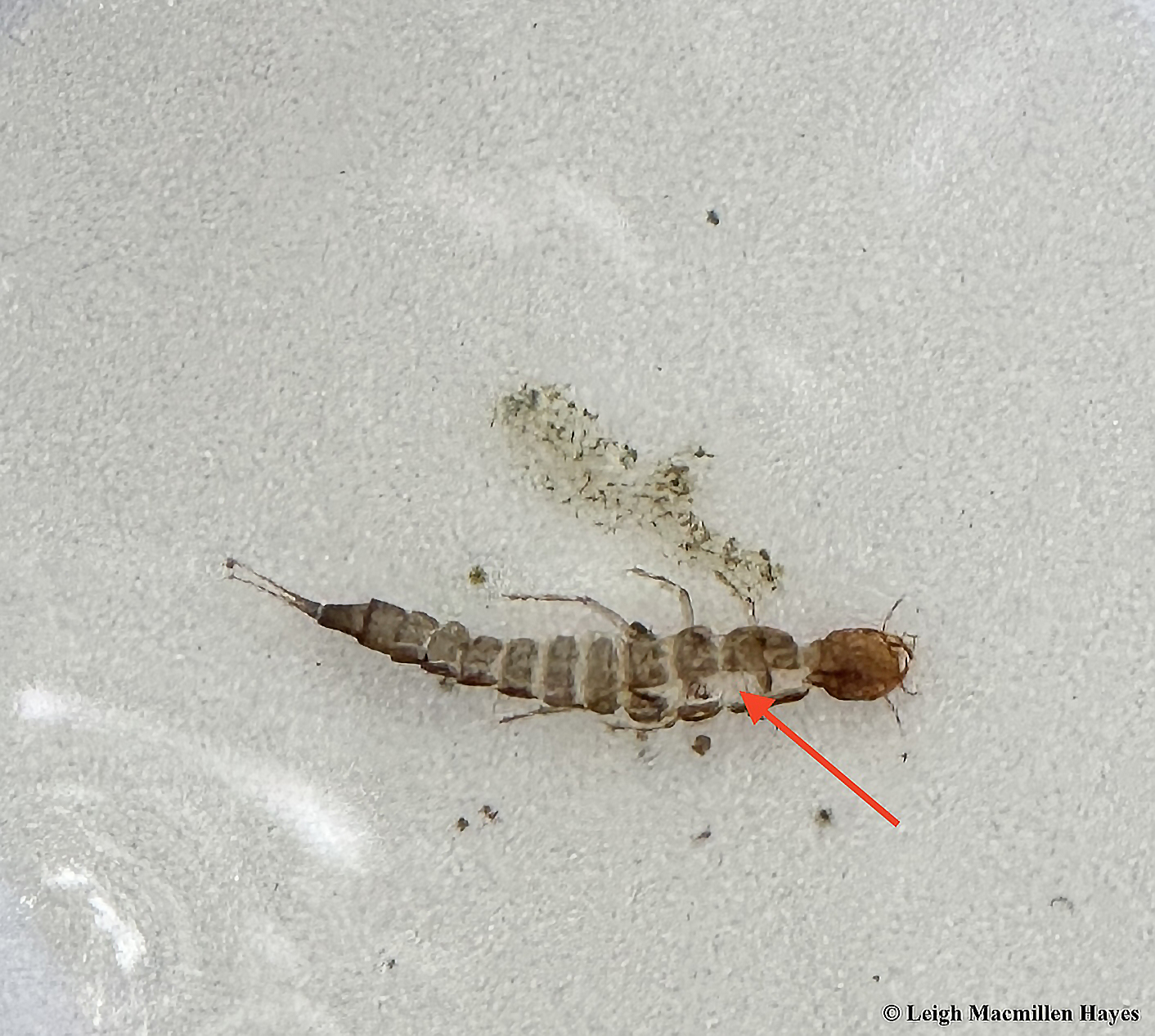
the shed skin of a PDB, with a split where the wings of the adult emerged first and then the rest of the body squeezed out through that slit that the arrow indicates.

This is the adult, with an air bubble on its back end; and if you look closely, you may see a few Mosquito Wrigglers twisting and turning in the photo as well.

We always remind everyone that all larval forms must go back into the pool or stream or whatever waterbody, because in the whole scheme of things, everything is important.

I laugh when I look at this photo because as a youngster, my brother always noted that my mouth was always open in pictures–apparently he thought I talked too much.

But obviously, on this Friday I was waxing poetic about something.

Before we left the pool that day, the students had a surprise for us. The previous week I had pulled out a party noisemaker and reminded those who had attended our winter class on insects that it served as a great tool to illustrate how a butterfly or moth proboscis (mouth part) curls up in flight, but upon a flower, they extend it to reach the nectar. Turn the noisemaker over, however, and suddenly you have a frog tongue–as they snap it out to capture an insect.

And tada, unbeknownst to us, everyone was suddenly a frog. Heck, if we were going to make them perform in the frog chorus, then they might as well be frogs. It was awesome. And yes, they did perform in the chorus once again, after which we left the pool and headed home.

Week three found us back at the church, where we began with a slide show about Benthic Macro-invertebrates.

Benthic: Living at the bottom of a body of water (stream, river, pond)

Macro: Large enough to be seen with the naked eye

Invertebrate: Animal without a backbone

Macro-invertebrate: Large, water dwelling animal able to be seen with the naked eye.

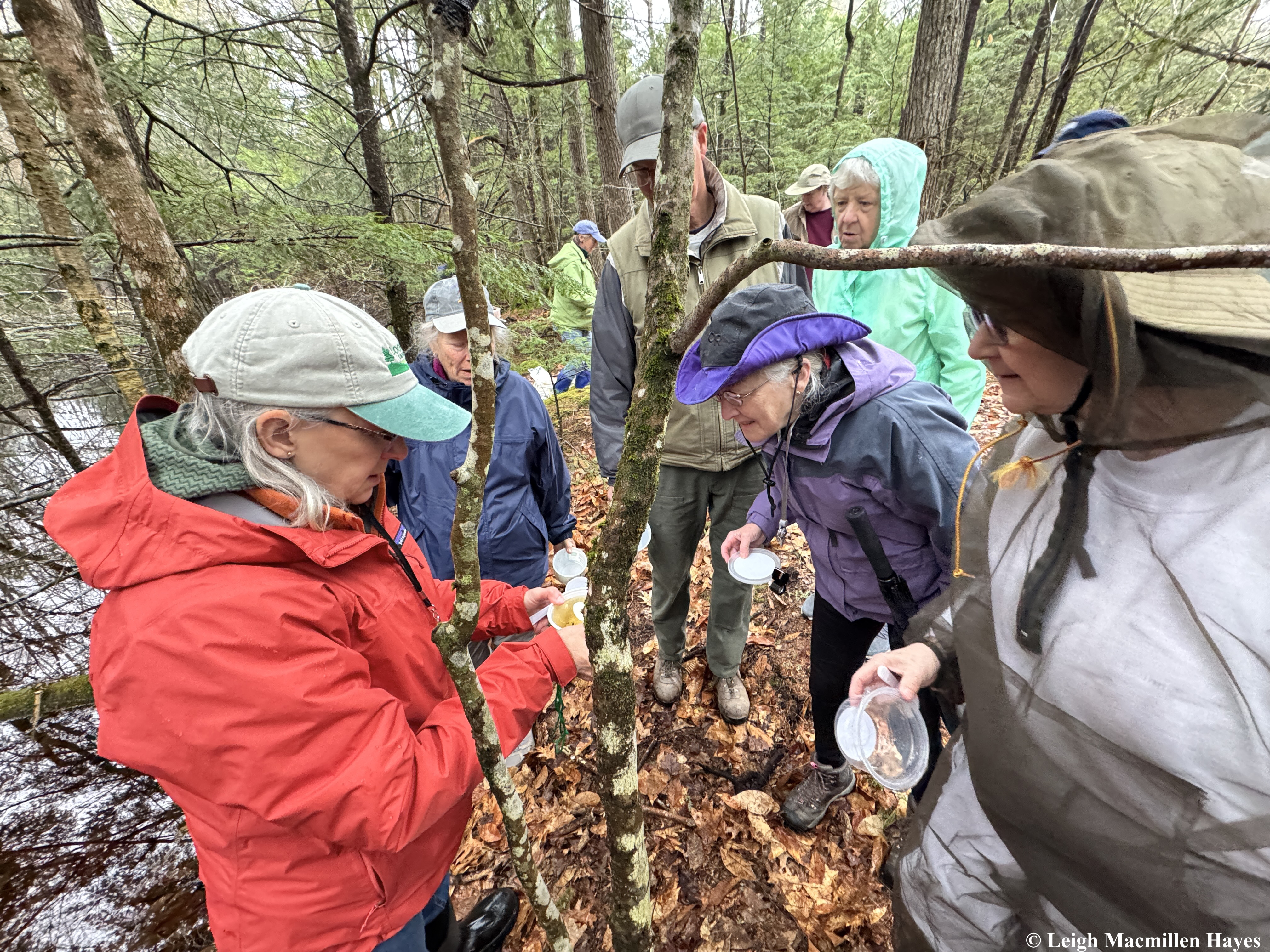
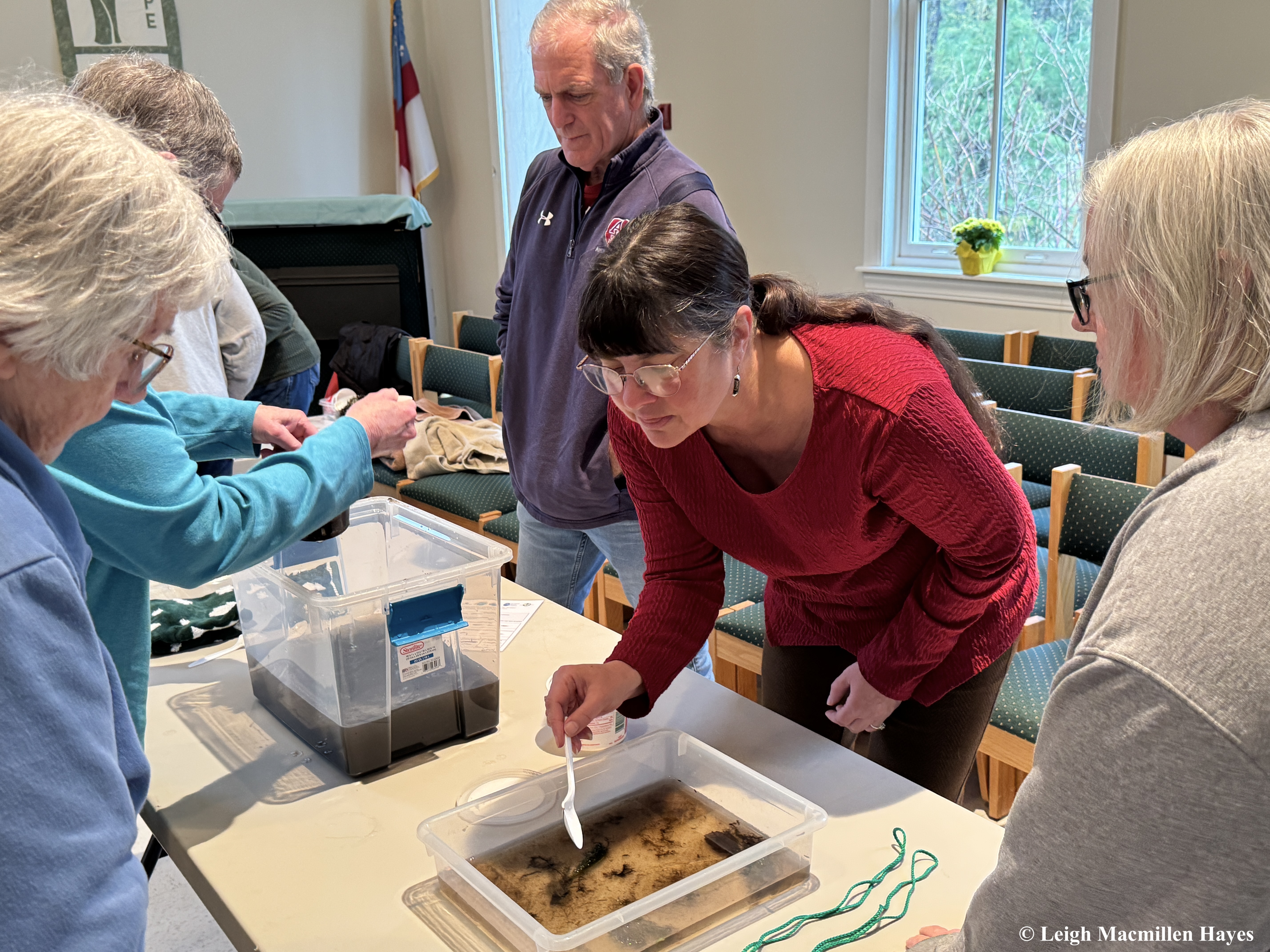
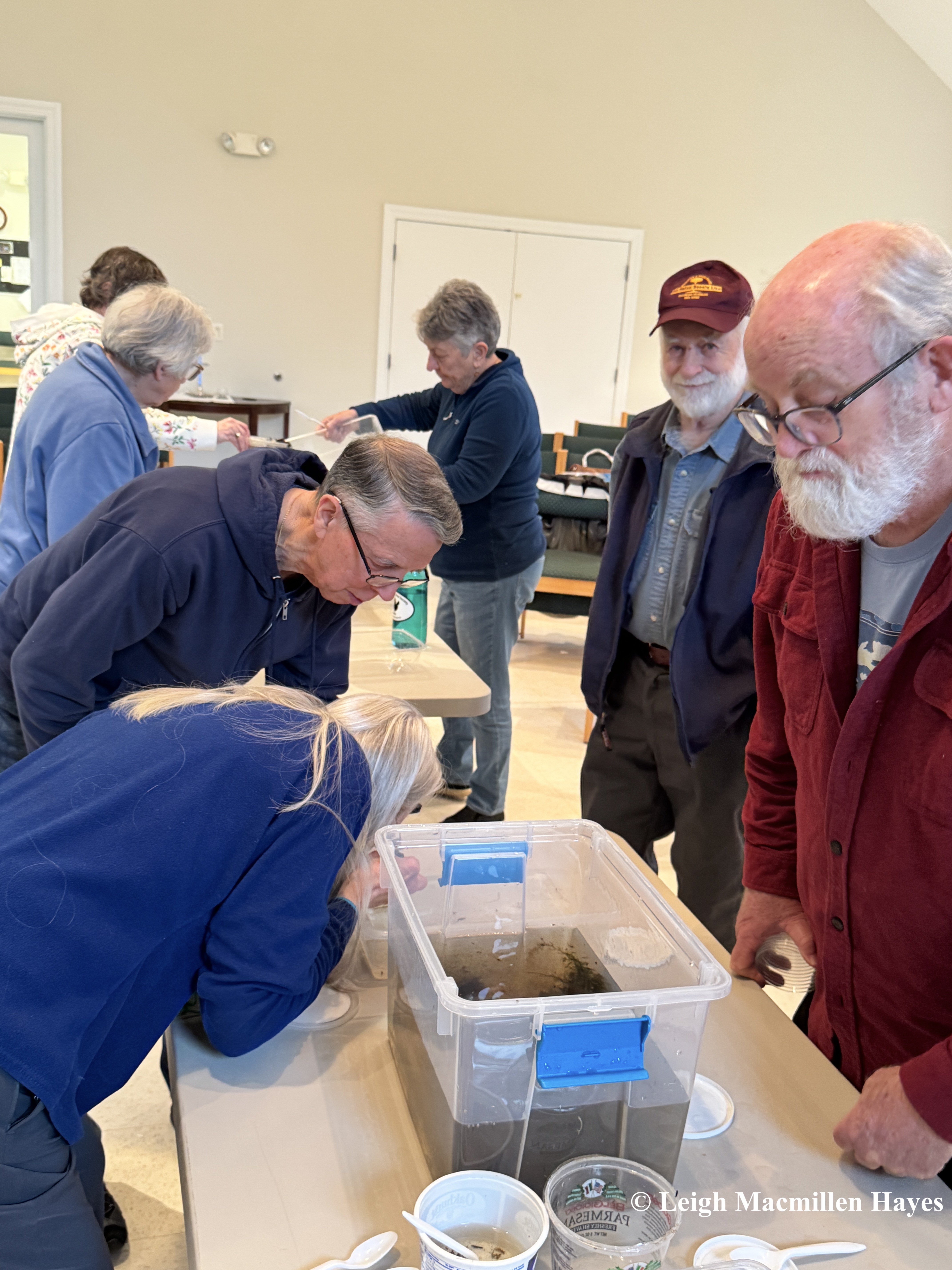
Prior to the class, Dawn and I spent an hour or so trudging to and fro a local wetland to retrieve containers of water so that after the initial presentation, the students could take a look–up close and personal, in the comfort of a building. (Never fear: all critters were safely released in the same spot where we captured them with our D-nets)

They started starring into the water and began to notice movement. And then, using spoons and small containers and lids, all recycled, they were able to glimpse the wonders of the water.

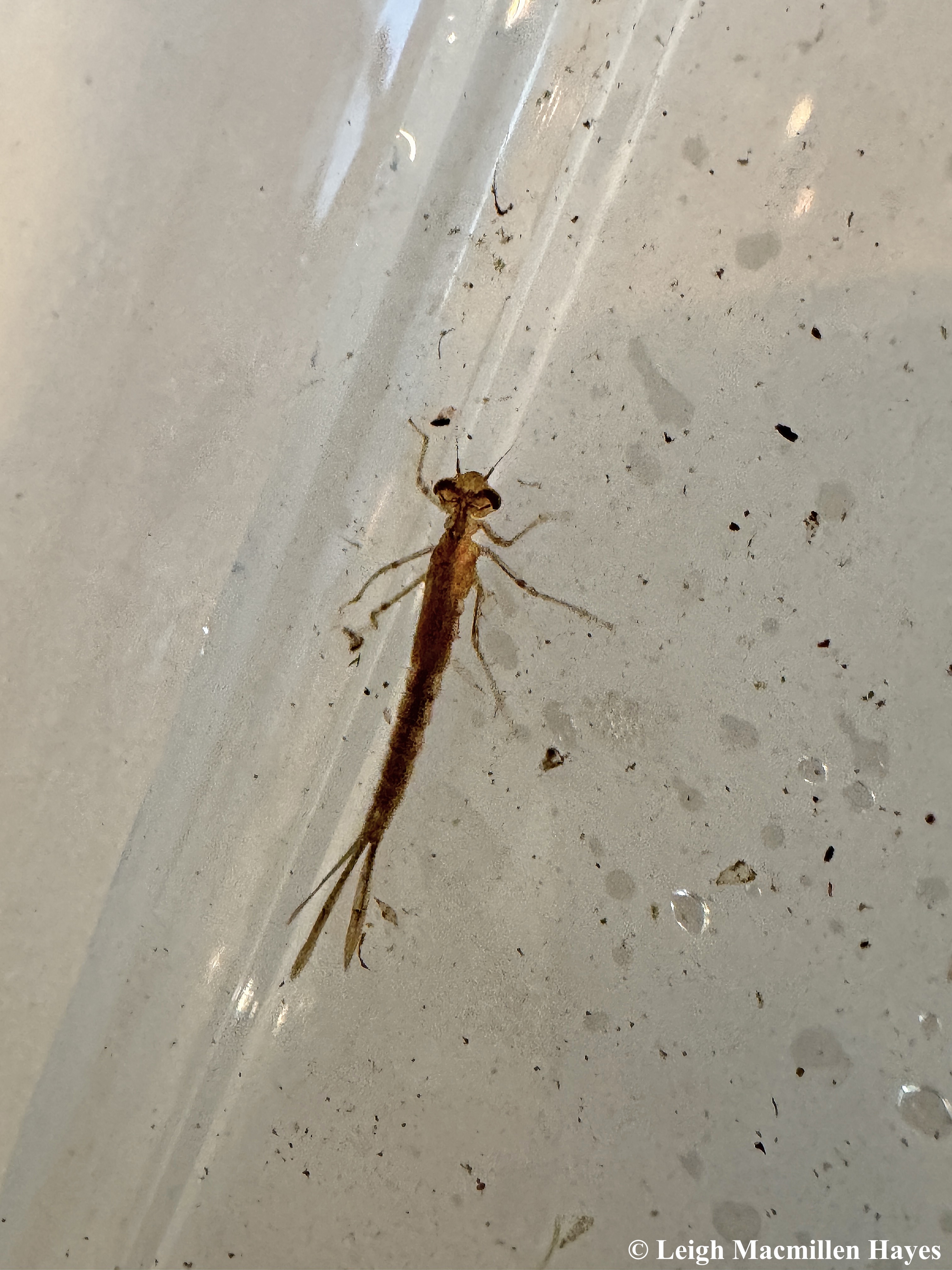
One of the favorite finds was the larval form of a damselfly, with three paddle-shaped tails that serve as gills.

The critters love to hide under the leaves and muck that we’d pulled up so sometimes it took a few moments to wait for the water to settle before spotting something moving.

But they did. And with the use of loupes on lanyards that we borrowed from Loon Echo Land Trust, they found Mayflies and Damselflies and Dragonflies and Backswimmers and more.

Finally, today dawned. The forecast kept changing all week, so we were pleasantly surprised by the sun. That said, you know those Mosquito larvae we always encourage everyone to save? Well, they are hatching. But, just as for the rain, everyone was prepared.

Oh, and yes, another moment of NDD hit us only a hundred feet from the parking lot. We love mud.

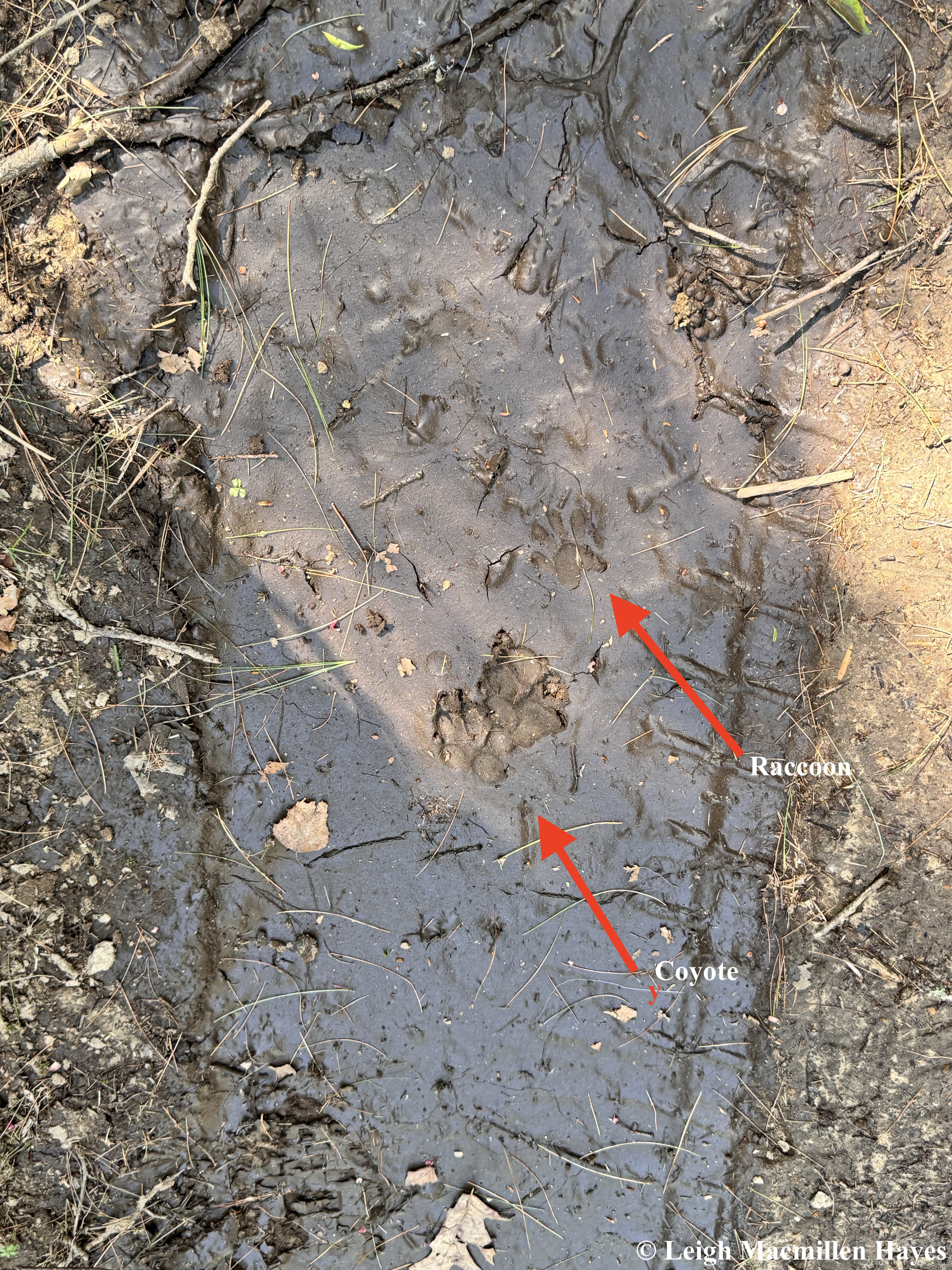
Especially when it tells us who passed this way during the night. In this case, it was two critters: a Coyote and a Raccoon. If we can’t have snow, mud is great. In many ways, it’s even better than snow for the prints are much crisper and easier to read. (Don’t tell the snow I said that. Ever. If you do, I’ll deny it.)

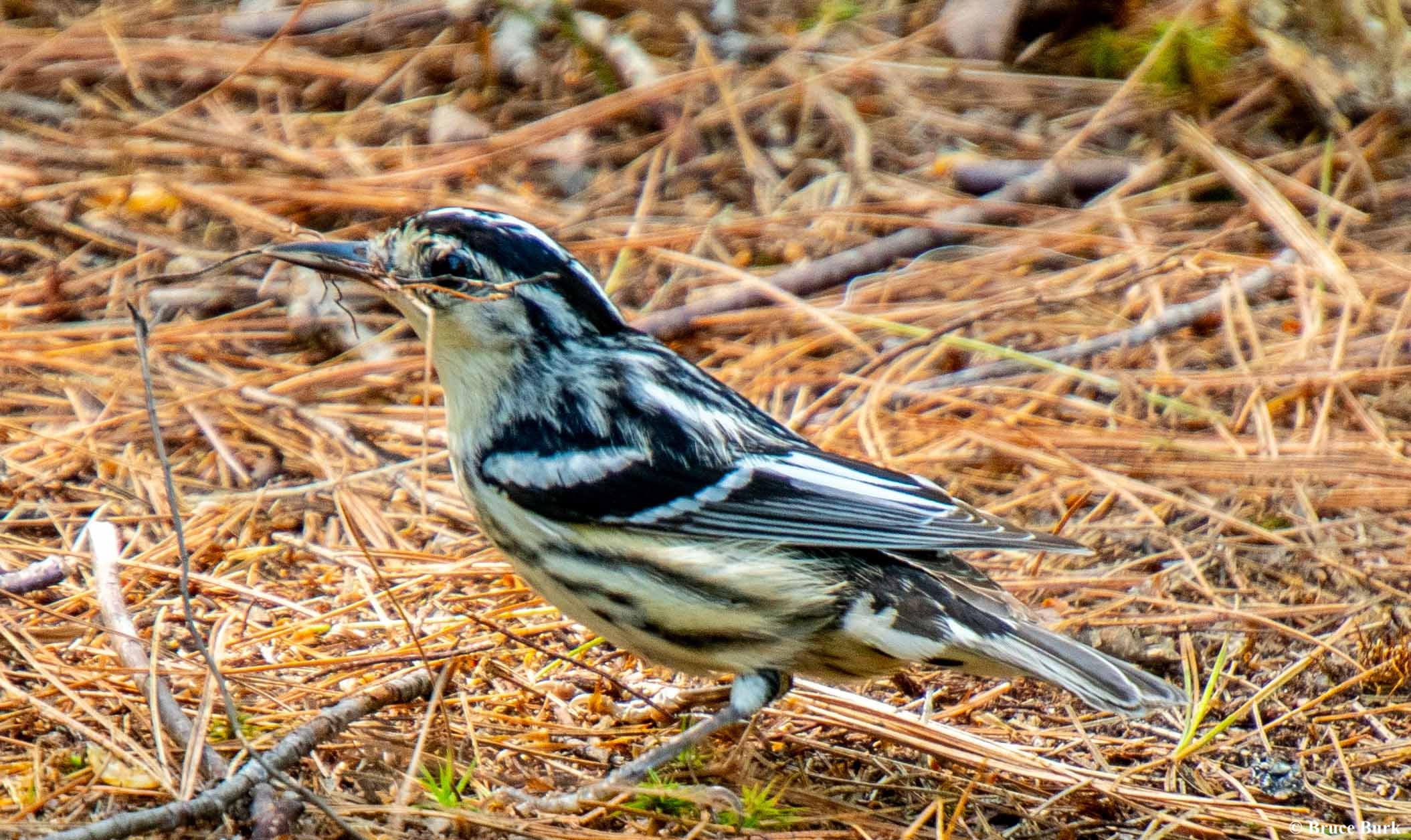
But . . . we had a mission and a time frame. The Black and White Warbler didn’t care. Apparently, we had entered its territory and despite our presence, it went right on collecting nesting material.

When nature surprises us with these moments, I always feel we’ve been blessed to be witnesses.

Finally, it was time to dip the D-nets into the river.

We’d placed a few tables near it so everyone could take a look without risking going into the water. Plus, the trail to the water is narrow and once we realized the bird was building a nest there, it made it even more important that we not spend too much time.

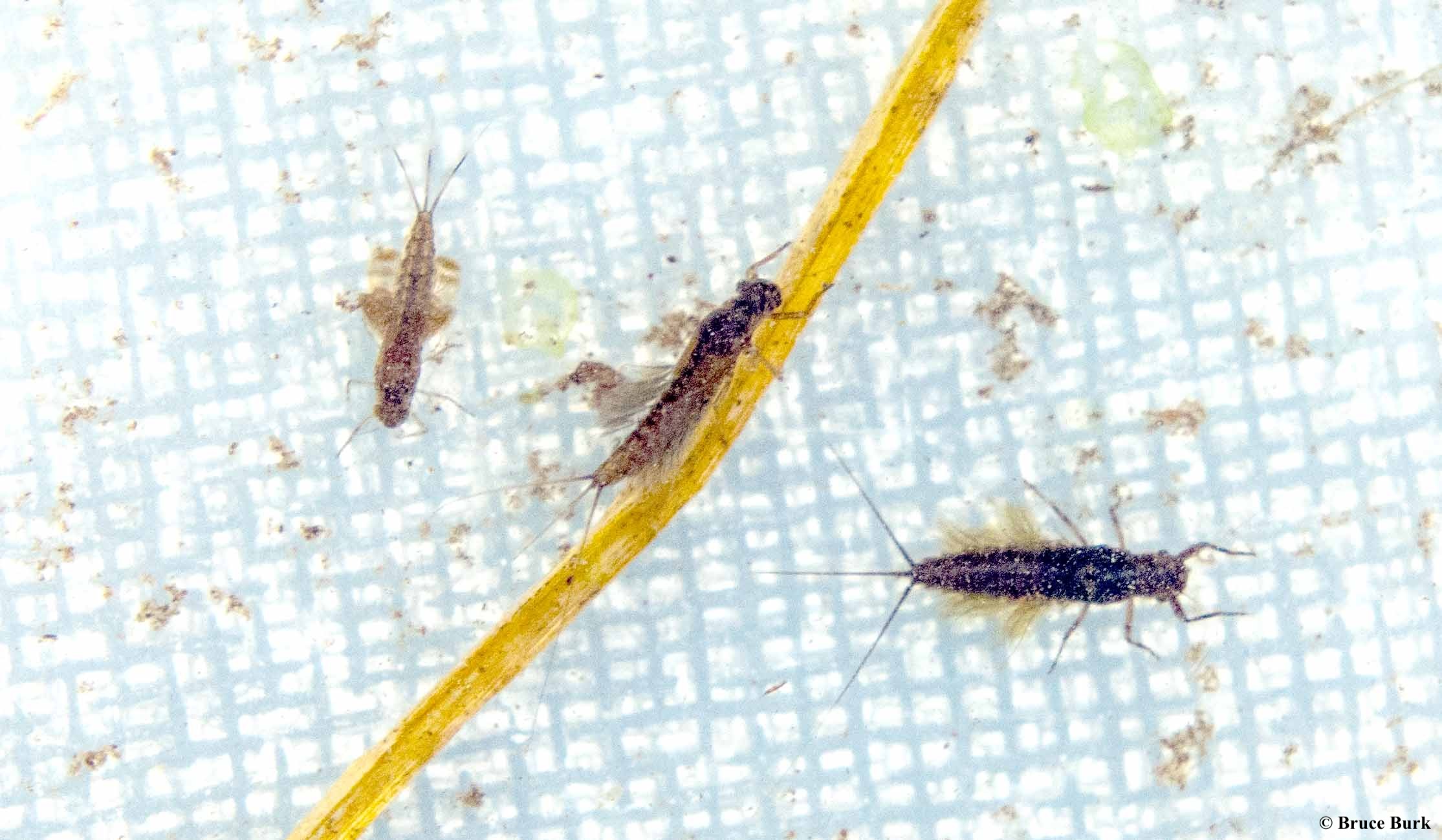
The most prolific finds of the day: Mayfly larvae.

There are so many types of Mayflies as everyone soon realized. What I love about them: their feathery gills on the sides of their abdomens, and the three long tails that most feature, which they even had as adults, probably helping with balance for one thing.

Again, it was an enthusiastic crew and any time something interesting was discovered, all wanted a chance to see.

We had a damselfly that at first I thought was a Water Scorpion because the three shorter tails were held together so that they looked almost like the tubes at the end of the abdomen, but then I took a better look and realized that they weren’t elongated and in every other way, it had damselfly written all over its head and body.

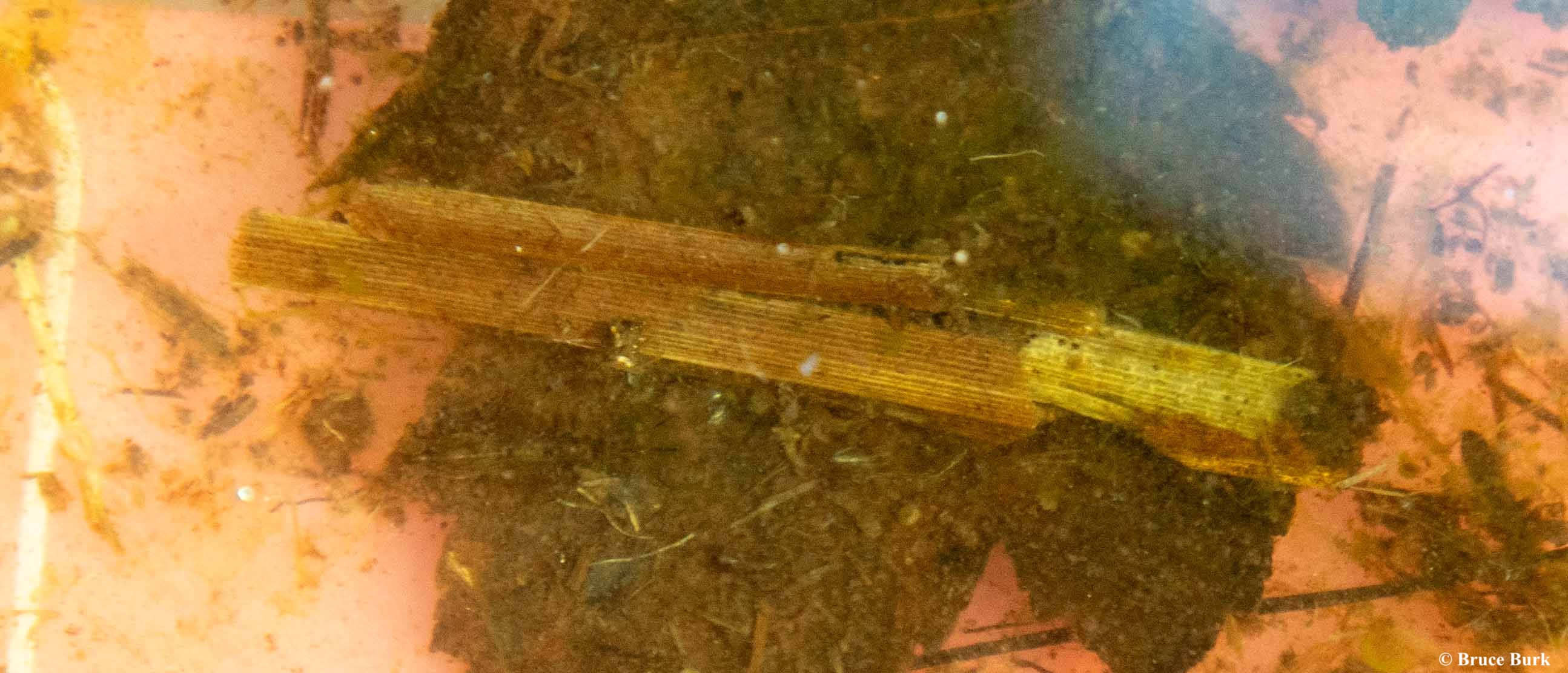
Caddisfly larvae also entertained us and we found a Northern Case Maker, plus . . .

what might have been a Giant Case Maker, who built its home from the broken off tube of vegetation.

Everyone was fascinated, but we had one more stop to make so eventually we had to pack up shop in this location and move down the road to another trail.

Another NDD moment happened as we walked beside a vernal pool where we could not only spot Spotted Salamander egg masses, but also these of the Wood Frog variety, and tons of tadpoles feeding on the green algae. It actually created a full circle from our first classes about vernal pools.

A Pickerel Frog also caught our attention and delight. Bruce caught an amazing photo of the underside of its rear thighs–with the yellowish coloration. Both Pickerel Frogs and Northern Leopard Frogs have spots, but one of the defining differences is the yellow, or sometimes orange color that you see here.

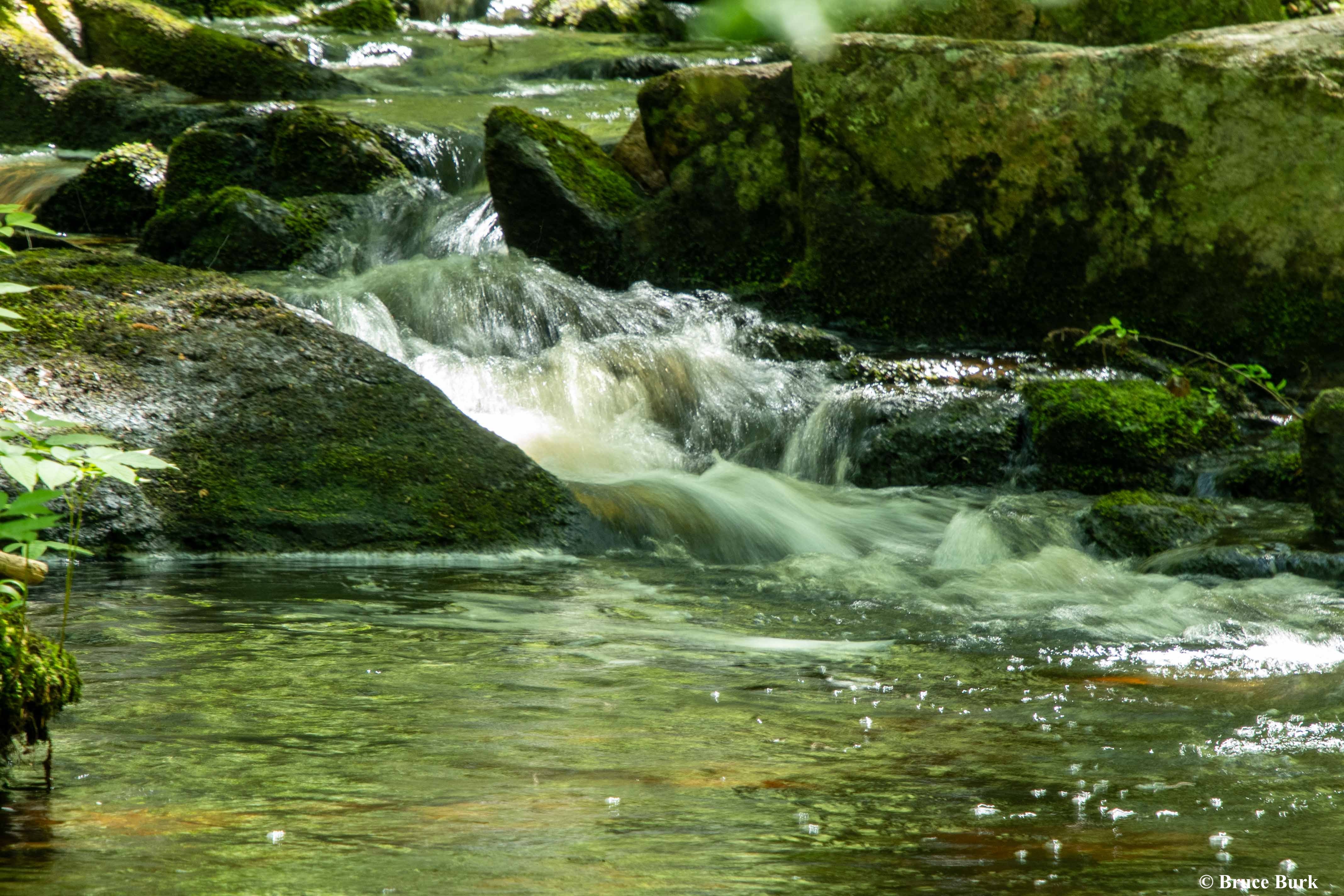
Our final destination was Douglass Brook, where the water flowed faster than it did in the section of the river where we had dipped only a half hour earlier.

Our reason for this location was because it has lots of rocks and we wanted everyone to see how some critters use them as places to cling.

So once again, we took an up close and personal look.

And scooped up anything we could find.

Including Black Fly larva which like fast-flowing water. I think folks were not quite as keen on saving every little critter given how many Mosquitoes swarmed us, but still they did.

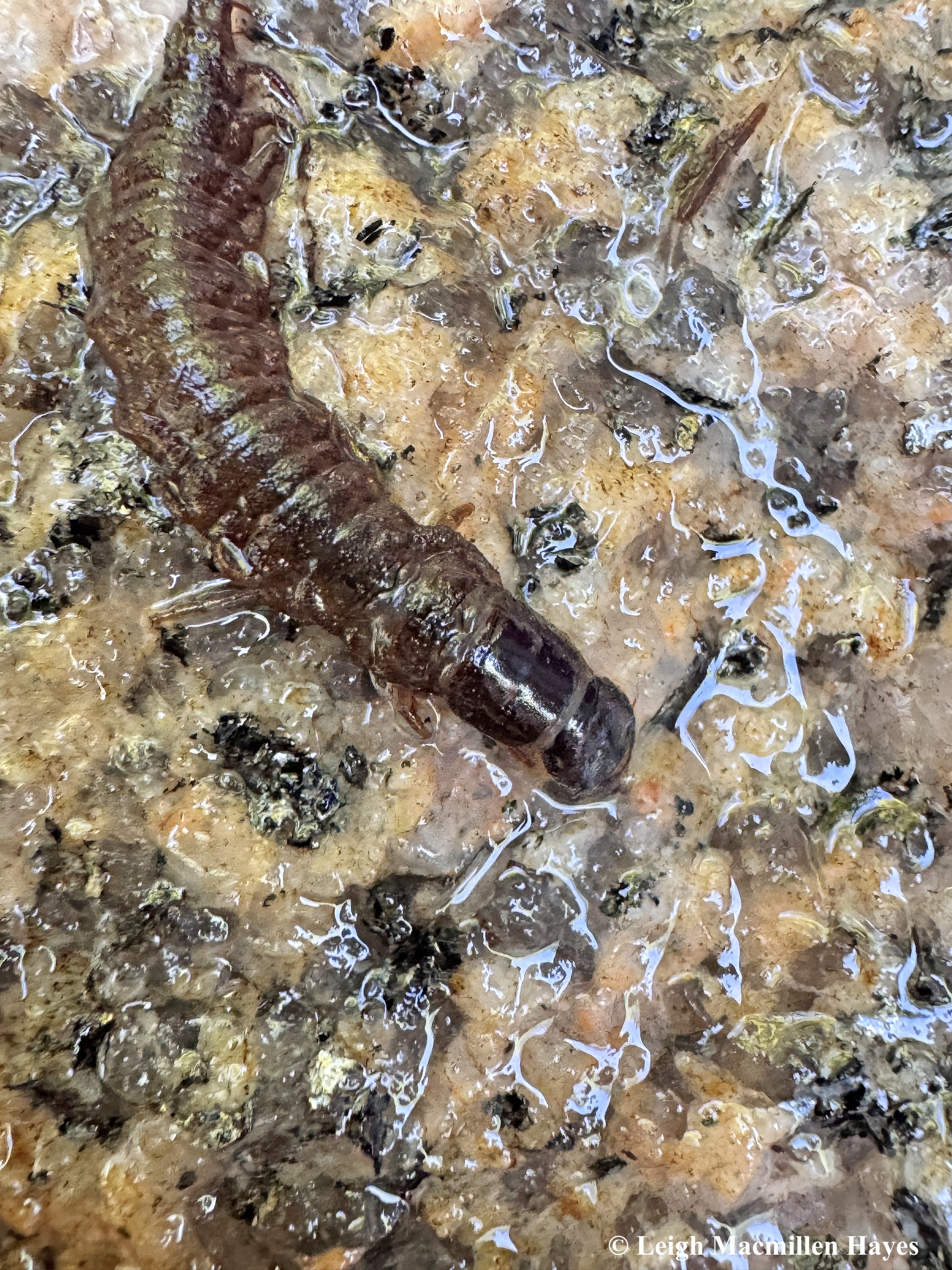
We also found a Dobsonfly Larva, aka Hellgrammite, who prefer the fast flowing water and hold onto rocks with strong claws on their legs, or so I read in A Guide to Common Freshwater Invertebrates of North America, and that’s exactly what this one did.

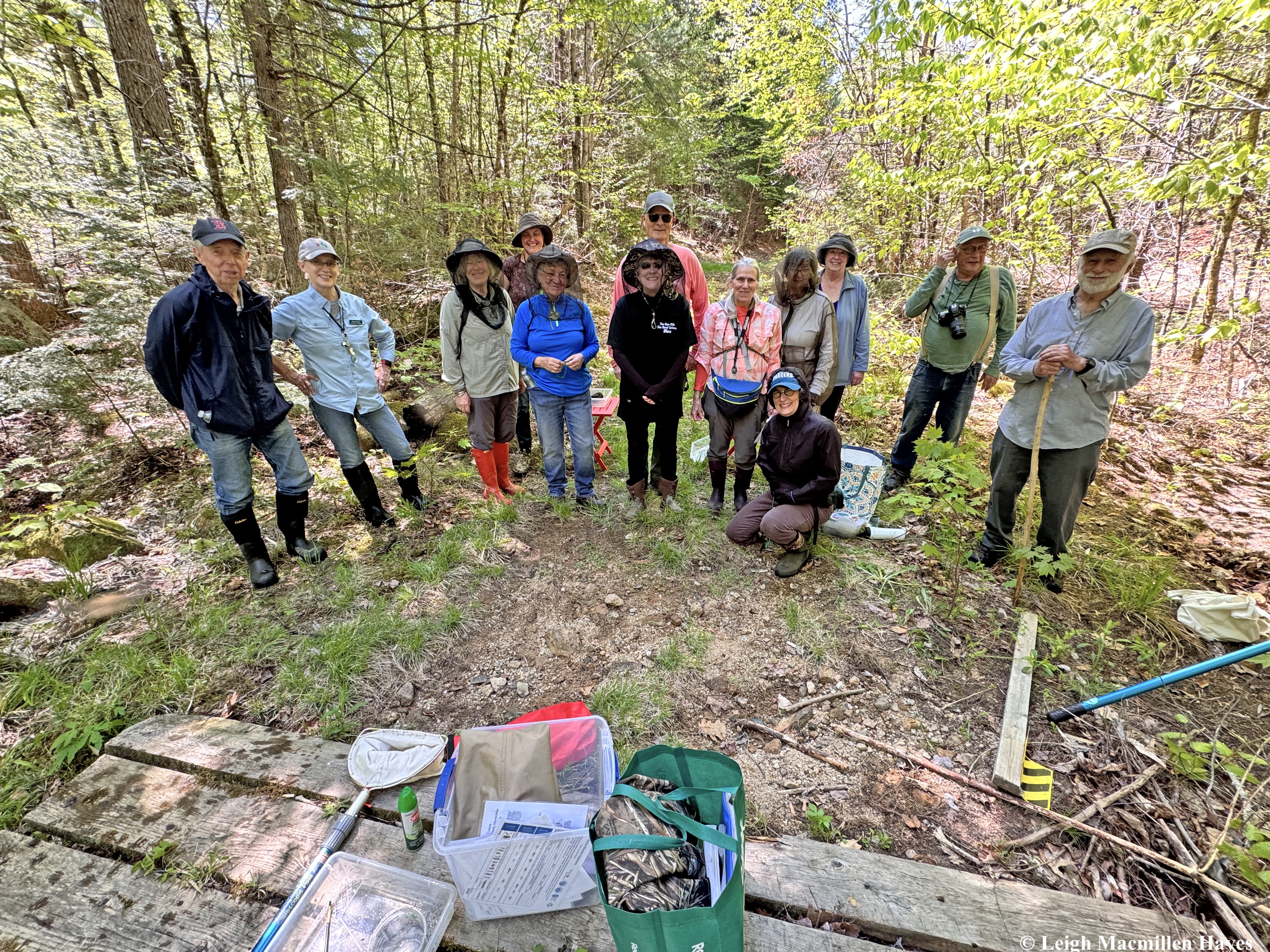
Two hours passed quickly and finally it was time for the four-week class to come to an end. And we were all smiles.

Senior College is an awesome opportunity for us mature beings to learn. The curriculum is diverse; there are no prerequisites, term papers, exams, or grades.

Hats off to the all-volunteer board. And to the students. We can’t believe how many of you joined us each week. And thank you all for helping us carry equipment today.

Many thanks also to Dawn for co-leading with me. And to Bruce for taking so many photos so that I could use them to share all of these incredible learnings with you.

Mr. Cretella, my high school Spanish and Latin teacher, popped into my head just now. In my yearbook, Mr. C. wrote, “Never lose your desire to learn.” Those words have reverberated with me over the years. I don’t remember what anyone else wrote, but his sentiment struck a cord. Pretty amazing, given that when I took Latin I my senior year, I was forever substituting Spanish words if I didn’t know the answer on a quiz or test.

Wherever he is now, I’m grateful that Mr. C. encouraged my desire to learn. And love that so many are the same.

Senior College: Forever Students indeed!

Breaking Up . . .

They say it’s hard to do and usually I feel the same, but this year has been different, and suddenly the time has come. Letting go though, that’s the part that causes me the most struggle.

Then again, six days ago I knew the end was near.

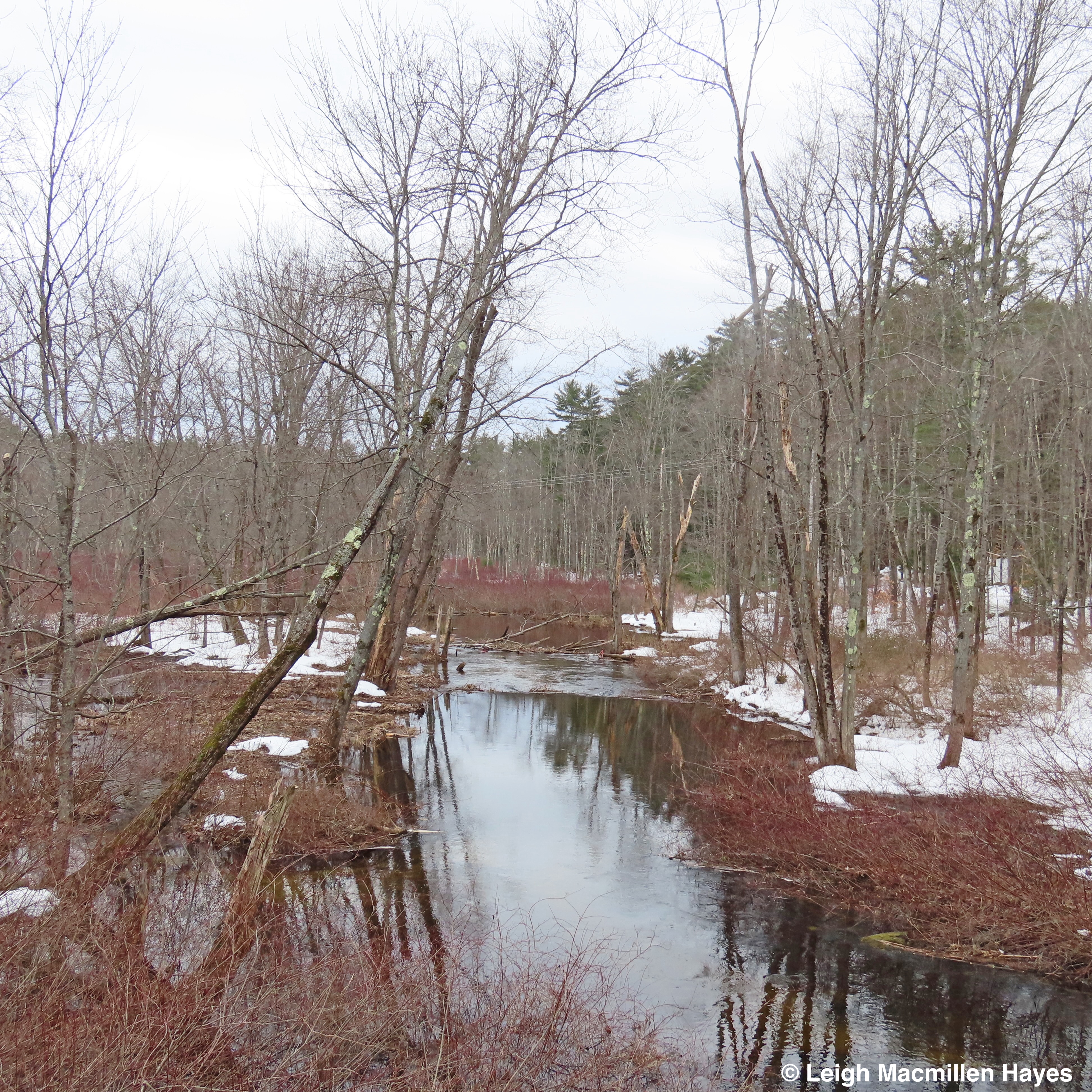
And today, the denouement became clearly obvious.

How things can change in only a matter of time i’ll never understand.

My heart grieved for all that has been lost.

But warmed by what I found instead.

And when I stooped over to peer into the shallow depths, I knew I was going to be okay.

The end had come, but new beginnings awaited.

Goodbye Winter. I’m breaking up with you, though honestly, I think you broke up with me this year. You’ll always hold a place in my heart, but this year you didn’t seem to kindle the usual flame.

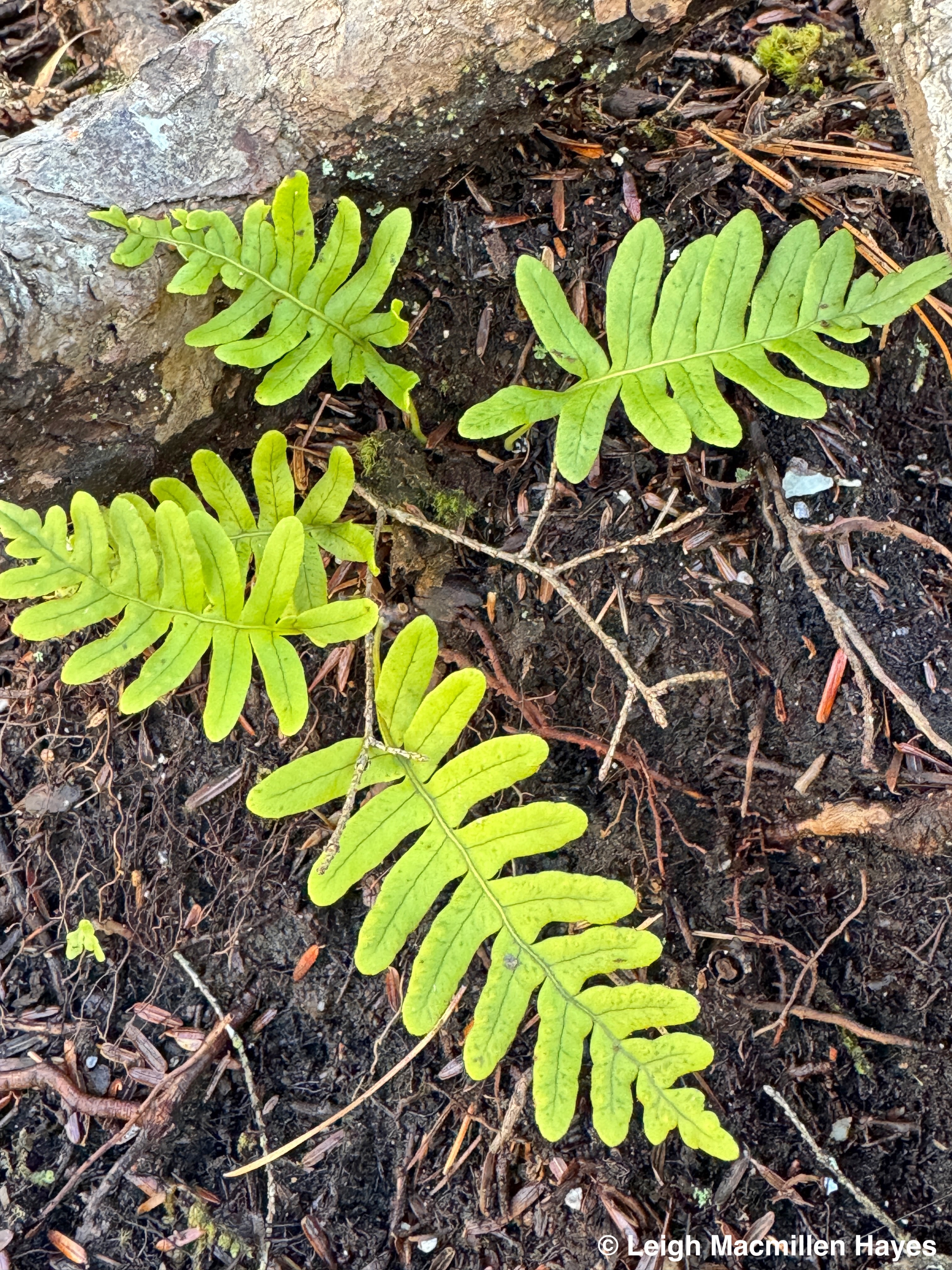
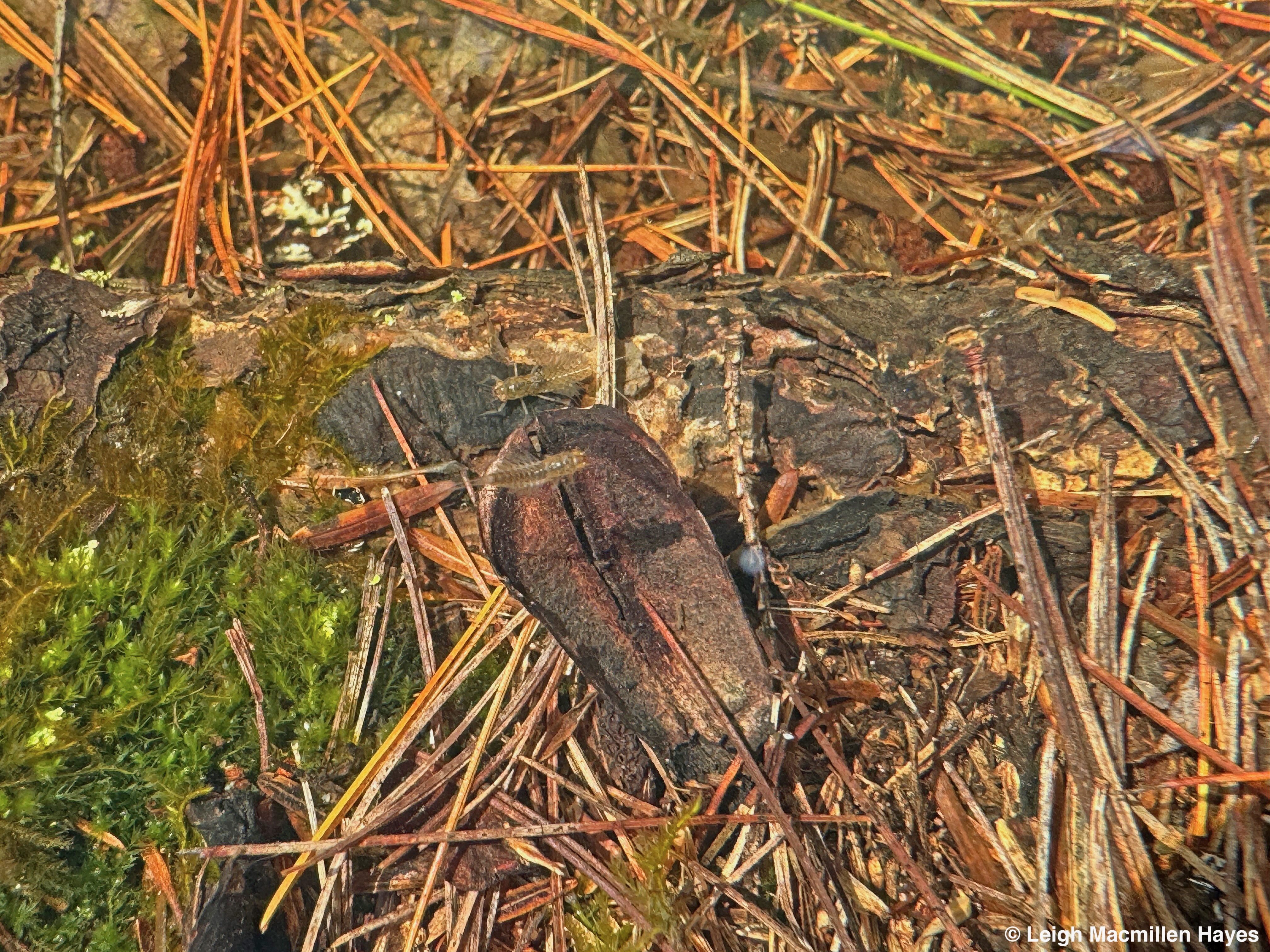
Hello spring! Thanks for reaching out in the form of Common Polypody Ferns, Mayfly Larvae by the hundreds, and even the Woolly Bear caterpillar. By the bits of debris on her bristly hairs, it was obvious that she’d just emerged from under the leaf litter where she’d overwintered and was frantically crawling along the road in search of a place to form a cocoon and metamorph into the Isabella Tiger Moth she’ll soon become.

I’ll always love you, winter. But right now, I’m already smitten with spring.

The Mayfly Challenge on April Fool’s Day

It’s April Fools Day and the weather tried to trick us into thinking it is still winter by adding at least two inches of snow to our world that is for the most part . . . still covered by at least a foot of snow. In some places it is even deeper. In others, bare ground and leaf litter are visible. And evergreen plants like Goldthread and Wintergreen and Partridgeberry show off their shades of green.

But this isn’t about snow or flowers. Instead, I want to take you into the water. YES. It’s time to stop tracking on a regular basis and begin squatting beside open water and peering in, which a friend and I did just this week when we were checking on beaver activity.

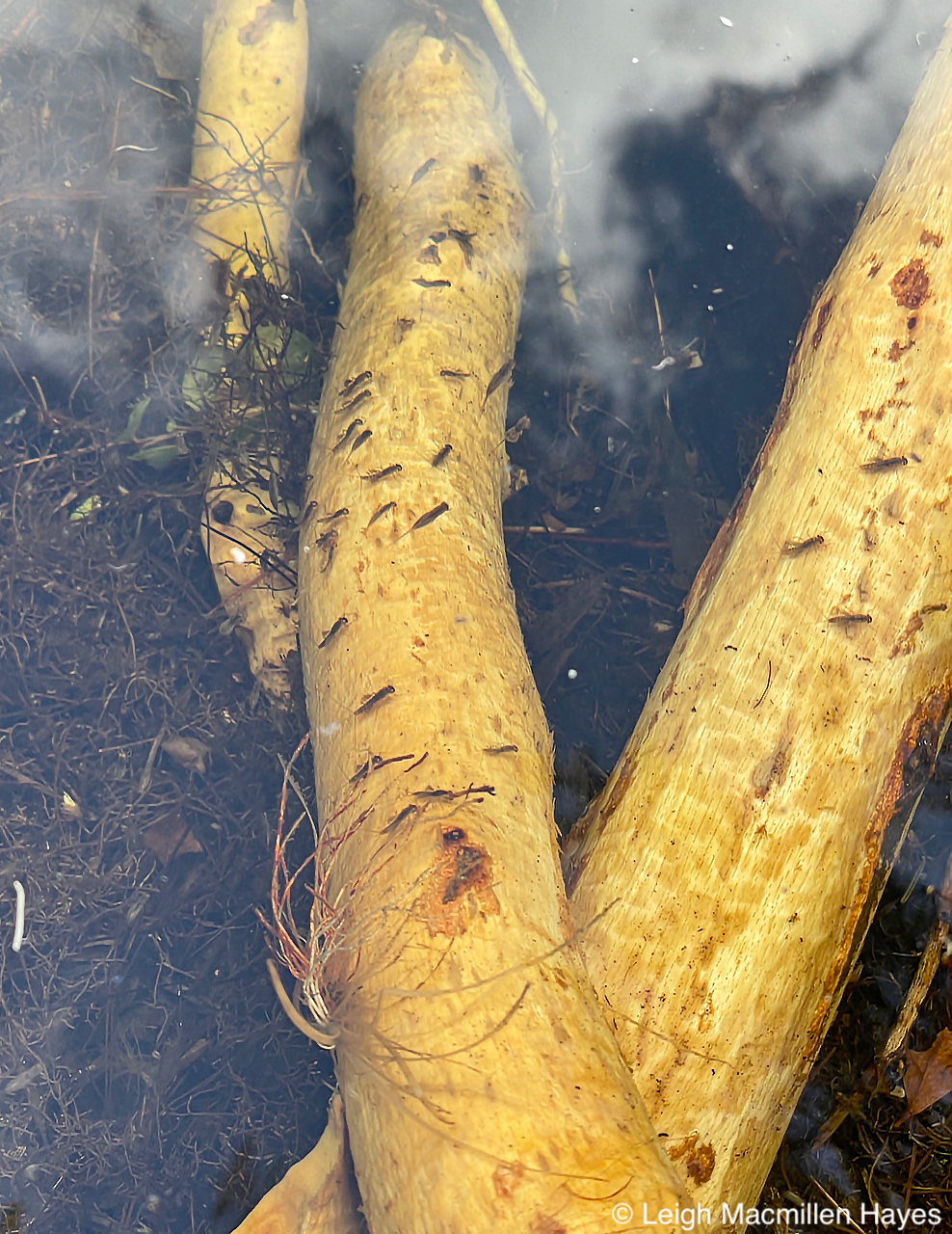
We didn’t spy any beavers, though there was lots of activity including these logs underwater, which told us the family was still in residence. But . . . take a look at the logs. Yes, you can see the chew marks left by the beavers as they dined on the cambium layer. There’s so much more though.

Each of those dark spots on the logs . . . Mayfly larva! A fly fisherperson’s delight. Ours as well. We know from experience because this past year we’ve dipped D-nets into streams in all seasons, that the larval forms of aquatic insects are alive and well whether there is a foot of ice or no ice. But where the ice has started to melt (and that’s not everywhere yet, though this week is supposed to warm up), life that has been there all along is emerging before our eyes.

Did you know that there are 614 species of Mayflies in New England? Eggs are laid in the water, where the larval form or nymph develops. #1.Shows the egg that had been deposited on the bottom maturing into a nymph. #2 is the nymph growing  in stages called instars until it matures. By #3, the mature nymph or emerger swims to the surface. Some species shed their skin and becomes a dun or subimago on the water’s surface. First It floats until its wings are dry enough for flight. This is a unique stage in the insect world as only Mayflies are fully winged before the adult stage. Others climb upon vegetation or an upright object to everge. For #4, you can see that the dun flies into bushes or trees along the water’s edge, where it sheds its skin and, #5, becomes an adult known as a spinner or imago. #6. The spinner flies off to join the mating swarm. #7. After mating, the female spinner dips her eggs on the water’s surface, and they fall to the bottom where it takes anywhere from ten days to months to hatch. Finally, #8 depicts the end for both male and female spinners fall to the water’s surface and die after mating. Keep in mind, this is a general description of a Mayfly’s life cycle. 

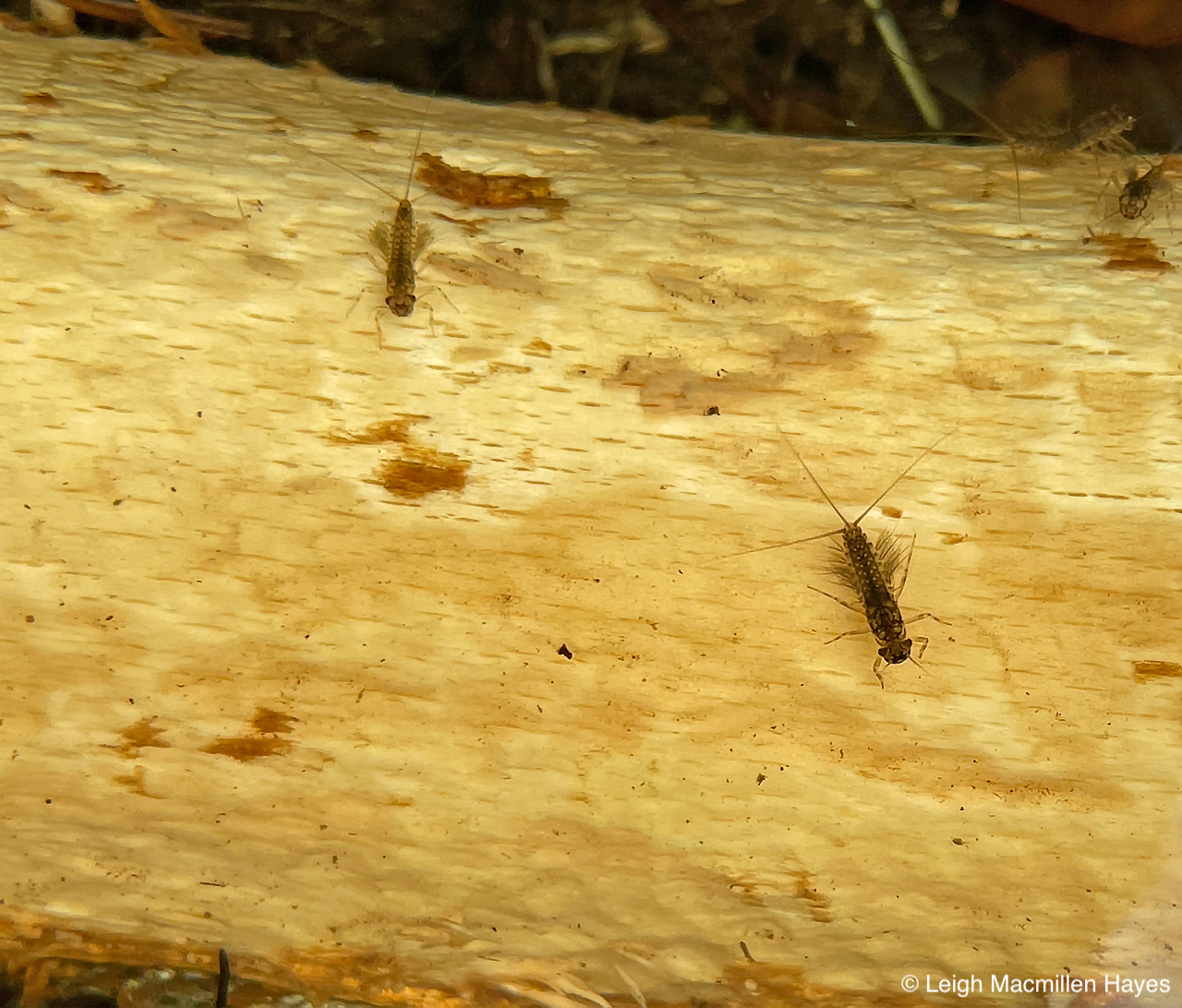
If you look with a keen eye you can see some of what I found one day–at least ten Mayfly nymphs on a leaf. I’ve used black arrows to point to some of them. 

Here’s your challenge. Quiz #1: I’ve done the squatting for you. See if you can locate at least one Mayfly nymph in this photo.

Not all nymphs are equal–in size that is. Remember, there are 614 species. Again, if you look closely, you’ll see that this one large nymph is surrounded by two smaller ones. Notice the tails. Mayflies have elongated bodies with 2 – 3 very long, tail-like appendages called cerci at the end of their abdomens.

Here’s another reference for size as the large beetle is a Predacious Diving Beetle and there are three small Mayfly nymphs in the picture.

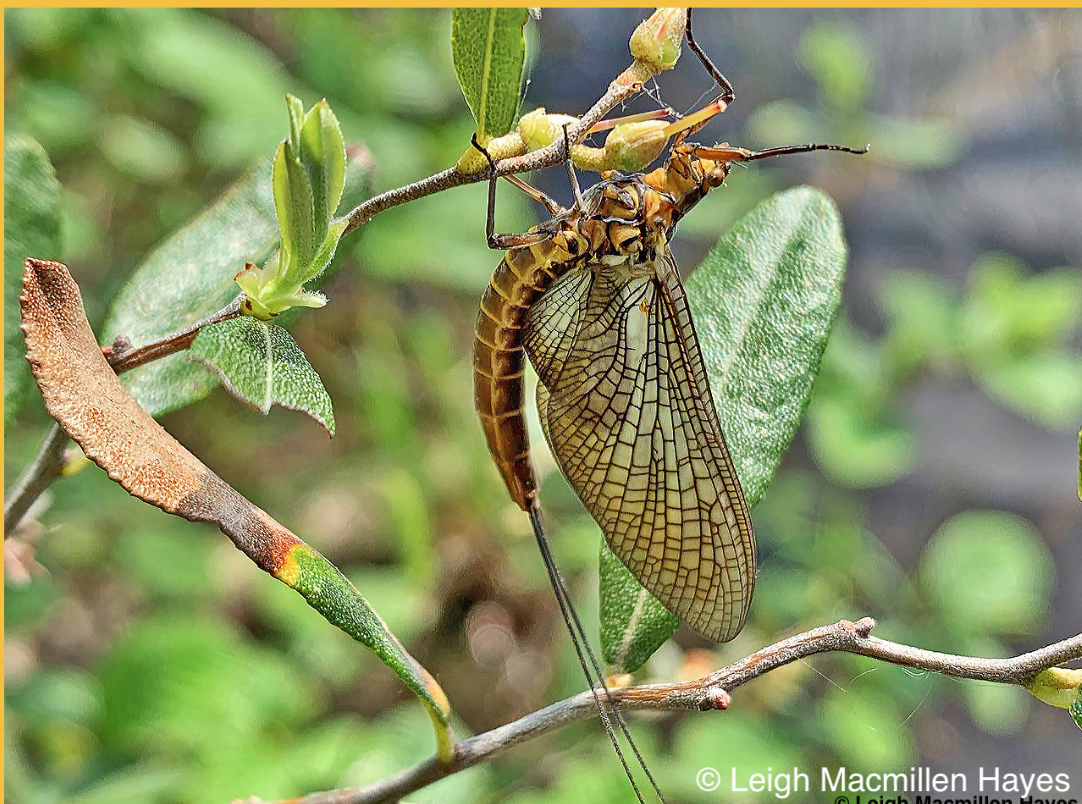
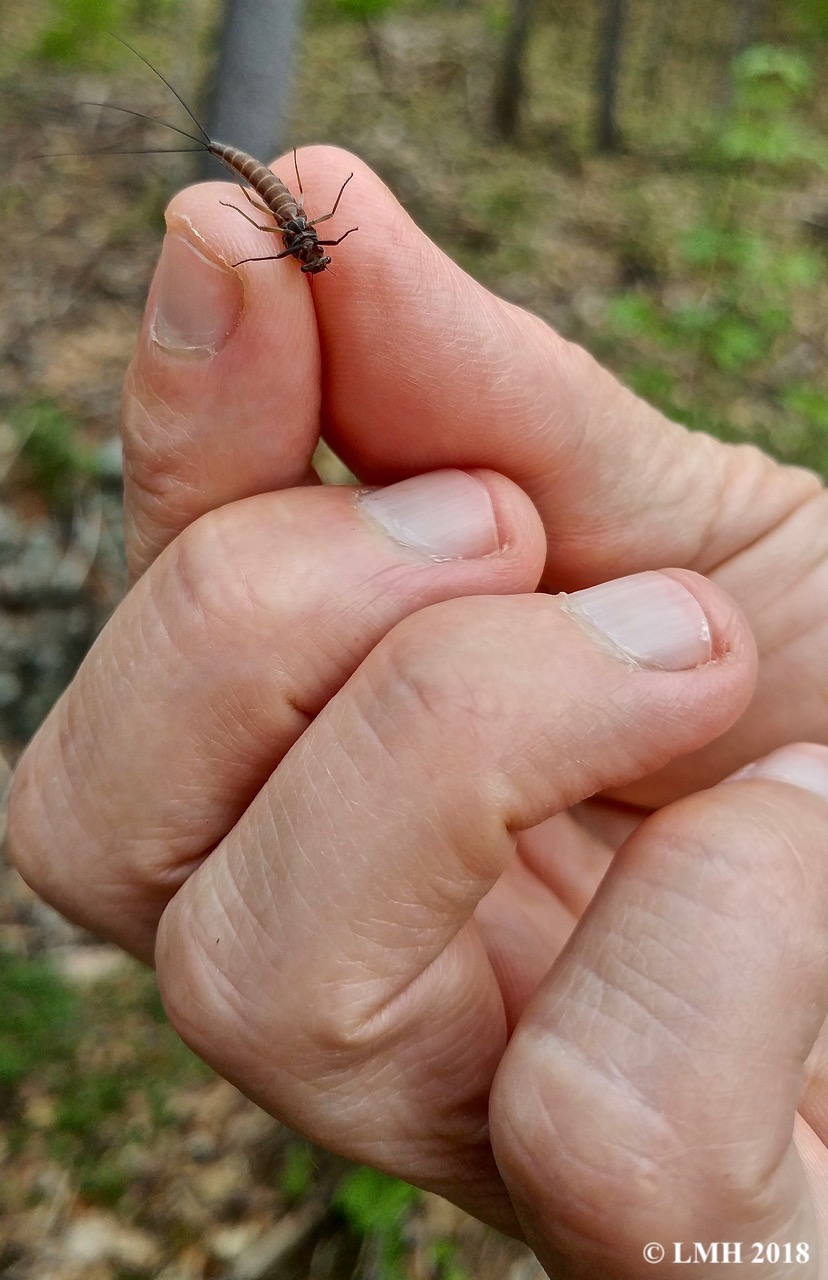
This is a dun or subimago who had just flown from the water. Well, I should correct that as I had picked it up from the water’s surface and let it dry its wings while resting on my finger. And then I helped it to a nearby shrub. Look at those wings.So many people don’t like Mayflies, but I find their structures and life cycle to be amazing. Take note of how “cloudy” the wings are. That’s how I know this is a dun. 

Mayflies, of course, don’t just land on bushes and trees, but some species may choose stems or rocks upon which to transform. Others meet obstacles along the way, including my pants. But again, notice those wings–another dun or subimago. And notice how the hind wing is so much shorter and rounder than the forewing.

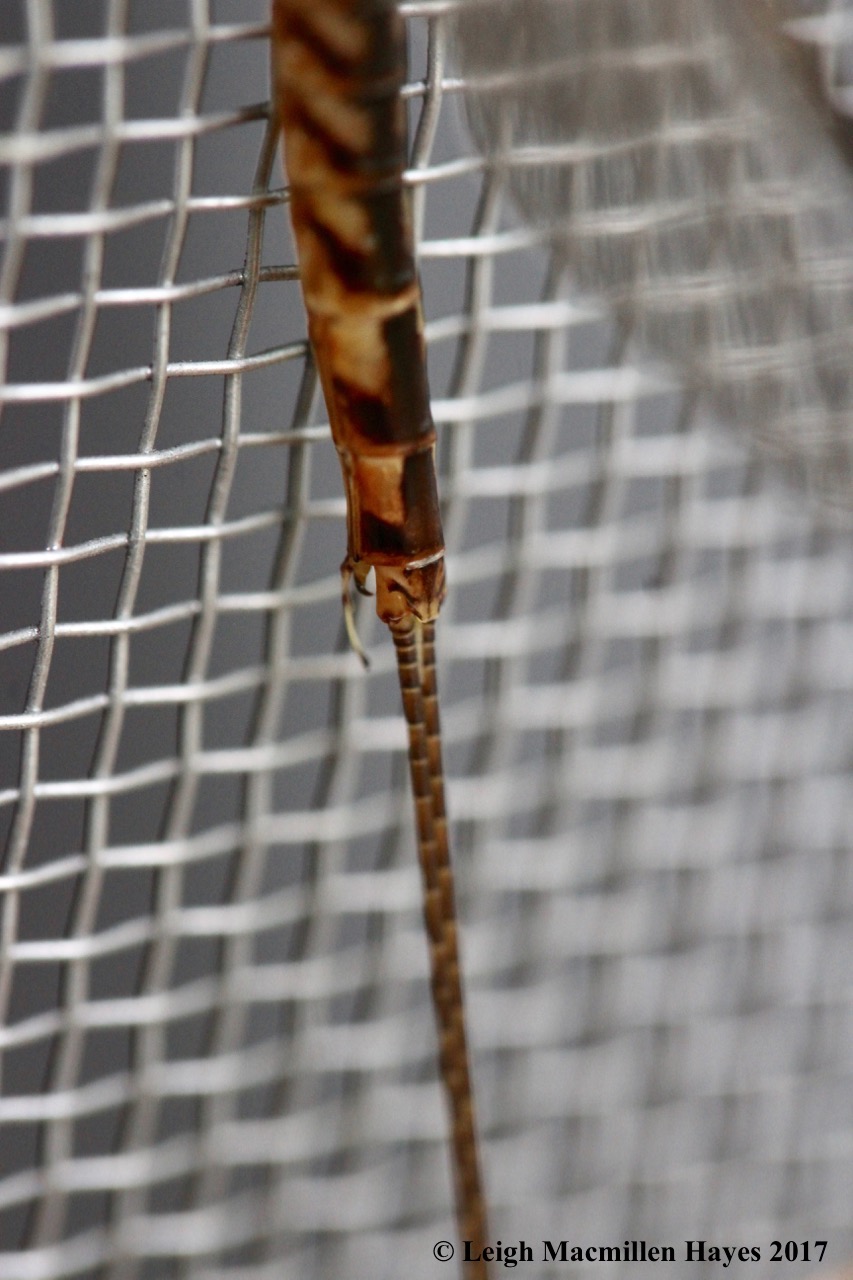
A little bit about Mayfly anatomy. Like all insects they have a head, thorax, and abdomen, whether as a nymph, subimago, or adult (imago). The head typically is for seeing and feeding, though while Mayflies feed in their nymphal form, any mouthparts in the adults are reduced or non-functional. The thorax is the section of the body that supports three pairs of legs and two sets of wings–a forewing and a hindwing and therefore it’s located in the center of the body. In the larval or nymph form, the abdomen features gills, which are absent in the older two molts. And you can see the tails attached to the end of the abdomen. Notice, too, the gender ID. So the abdomen bears the reproductive structure and in some insects it also carries the digestive tract. 

So, Quiz #2: Male or female?

Sometimes the safe place isn’t a shrub or some other natural setting for a final molt, but rather the screened porch at our camp. Often, early in the morning, as I sit in a rocking chair to sip coffee, I’ll notice a visitor on the outside of the screen. And not just in May. These were in August.

Mayflies often molt at night by breaking out through the top of the thorax. In the process, the Mayfly pulls a fresh set of wings from inside the subimago wing cuticle. How cool is that? 

Here’s a look at the discarded exuvia or shed skin and you can see the adult to the left.

Here is a clearer view of the adult or imago, which, you remember, will only live long enough to join the mating swarm, mate, and then die.

Notice how clear the wings have become.

And those conspicuous eyes. They are like a mini-set of dumbbells. But no mouth because with such a short life-cycle, there is no need to feed.

This is a shed skin I found on the surface of a swampy section of a river.

And right next to it, the dun or subimago crawling away as its wings dried.

Quiz #3: What stage is this? And is it male or female?

Quiz #4: And what stage is this?

Not all Mayflies die on the water as there are other hazards one might encounter such as this very sticky spider web.

That’s all I have to say about Mayflies for today, but going forth, expect more of these tiny critters to appear in this space. Along with others like dragonflies and cicadas and robberflies and . . . I can’t wait. Oh yeah, and it’s almost vernal pool season too.

Thanks for taking the Mayfly Challenge on this April Fools Day.