Welcoming Winter With Bare Feet

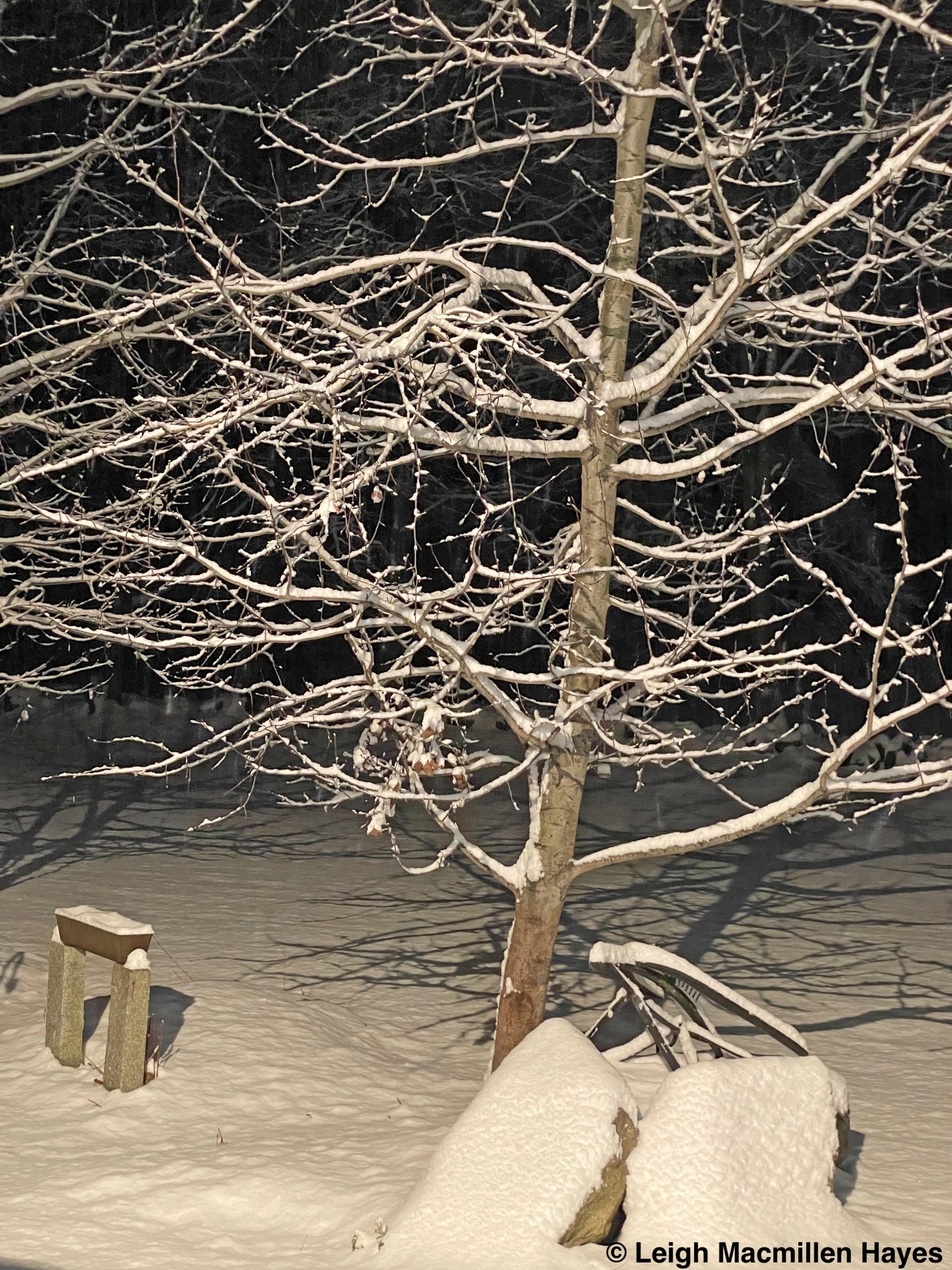
We marked the Winter Solstice yesterday, but truly . . . winter arrived early this year. And those who have followed me for years know that this is my favorite season. The cold air. The fresh air. The creaking trees. Even the early darkness. It all makes me feel alive.

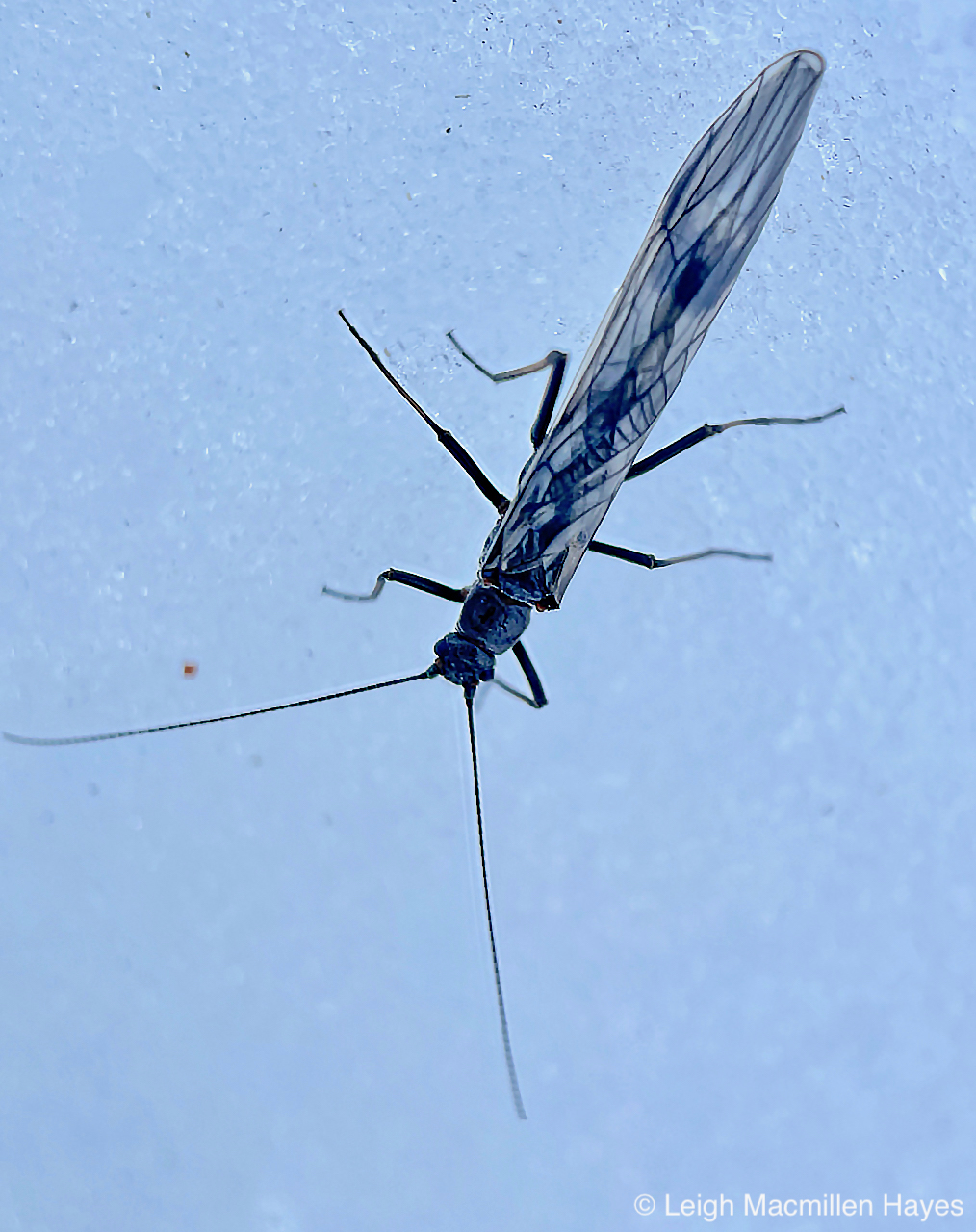
And most of all, tracking. Well, add insects to that, though tracking them isn’t a skill I’ve acquired . . . yet. And probably never will. But finding them on the snow and feeling reverence for their ability to survive (most do) despite days like today when the temp is in the teens but feels like single digits, what a wonder!
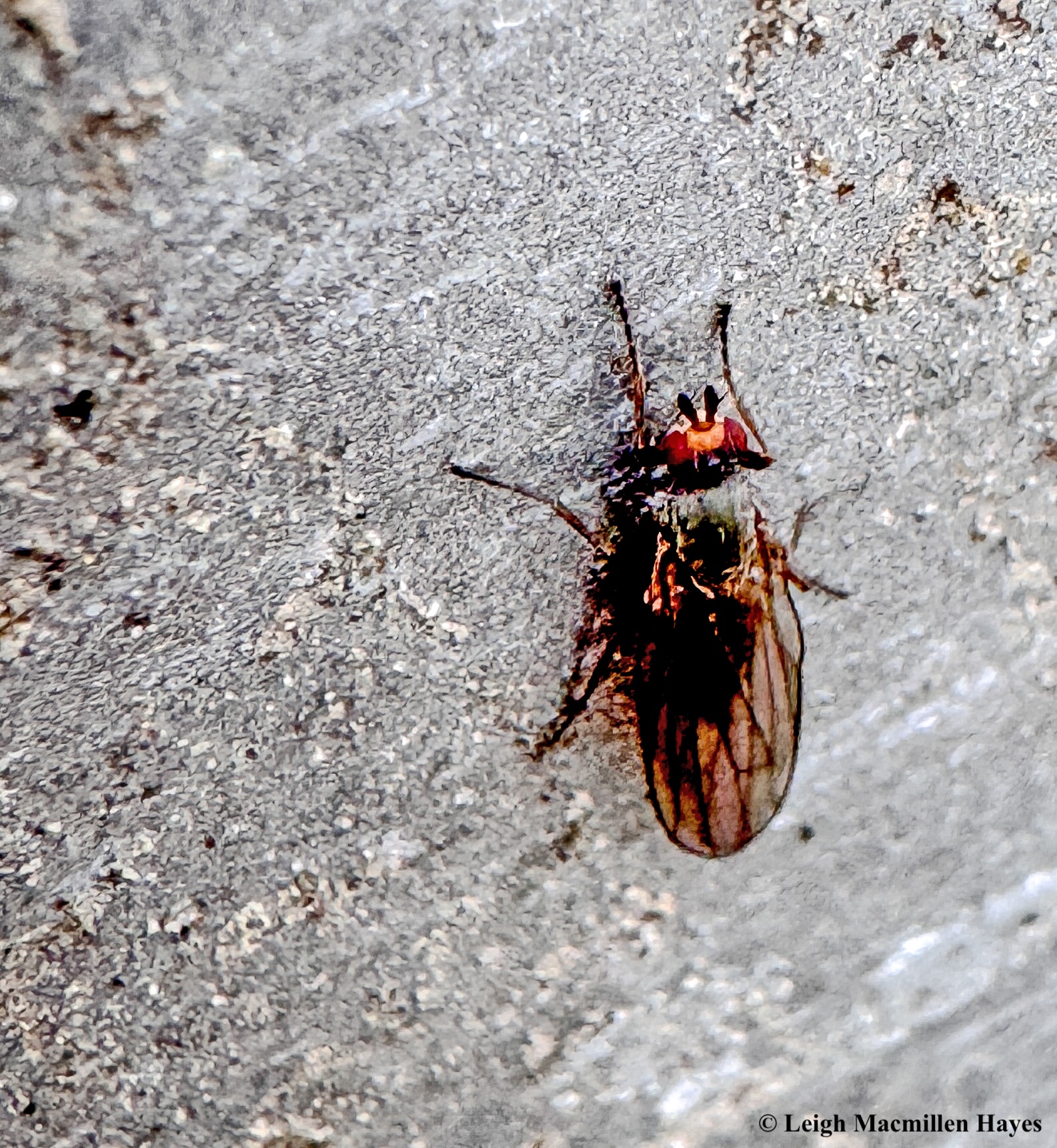
Some even surprise me by appearing on the door of my dirty truck. This is a Winter Fly and I’m in awe of its orangey-ish face with those big red button eyes.

Mind you, this fly is teeny, tiny. And still . . . it was out and about.

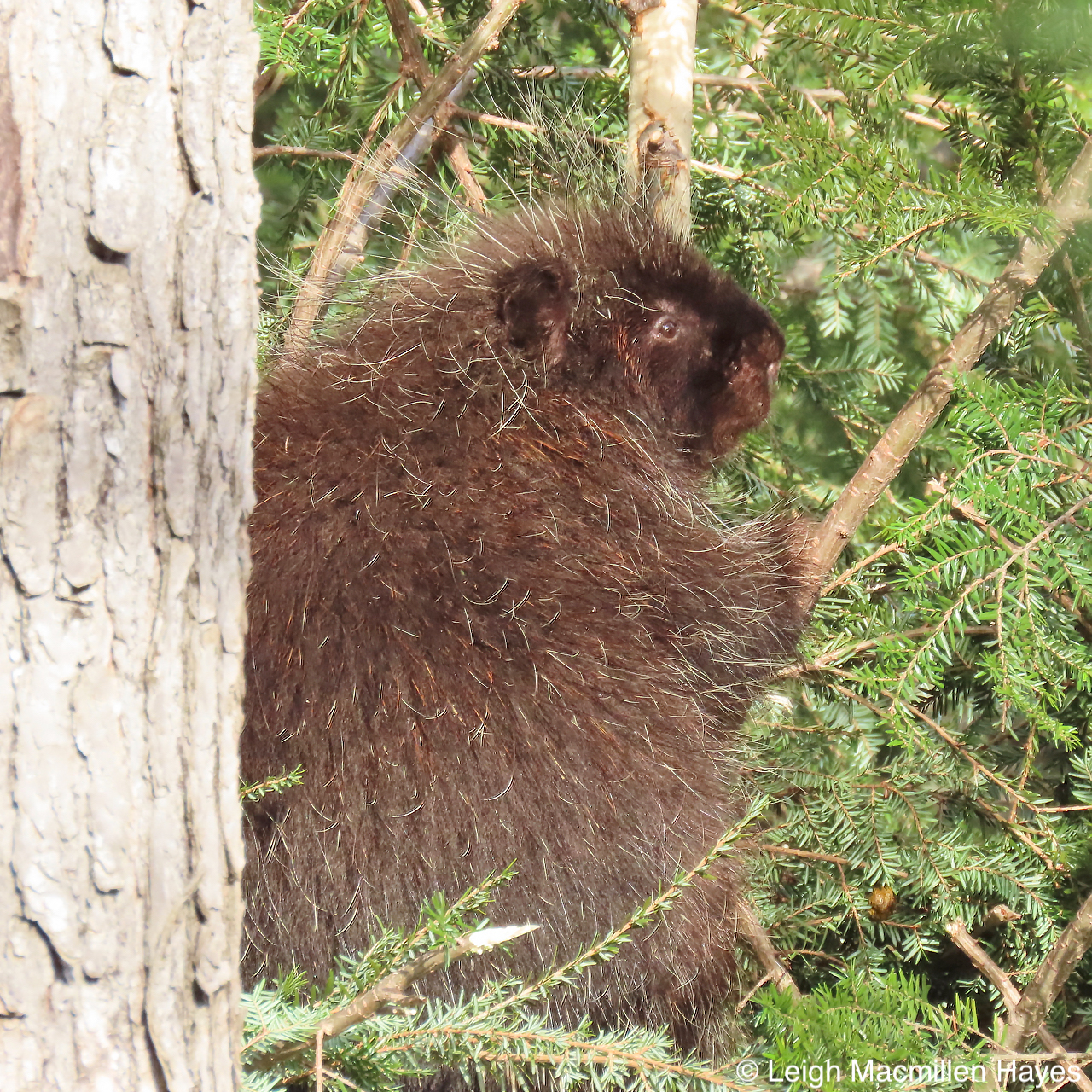
Porcupines have also been out and about and by their sashay fashion of moving through the snow, it’s easy to know where they are present.

And leave presents, they do! Dribbles of pee can often be found along the route they travel.
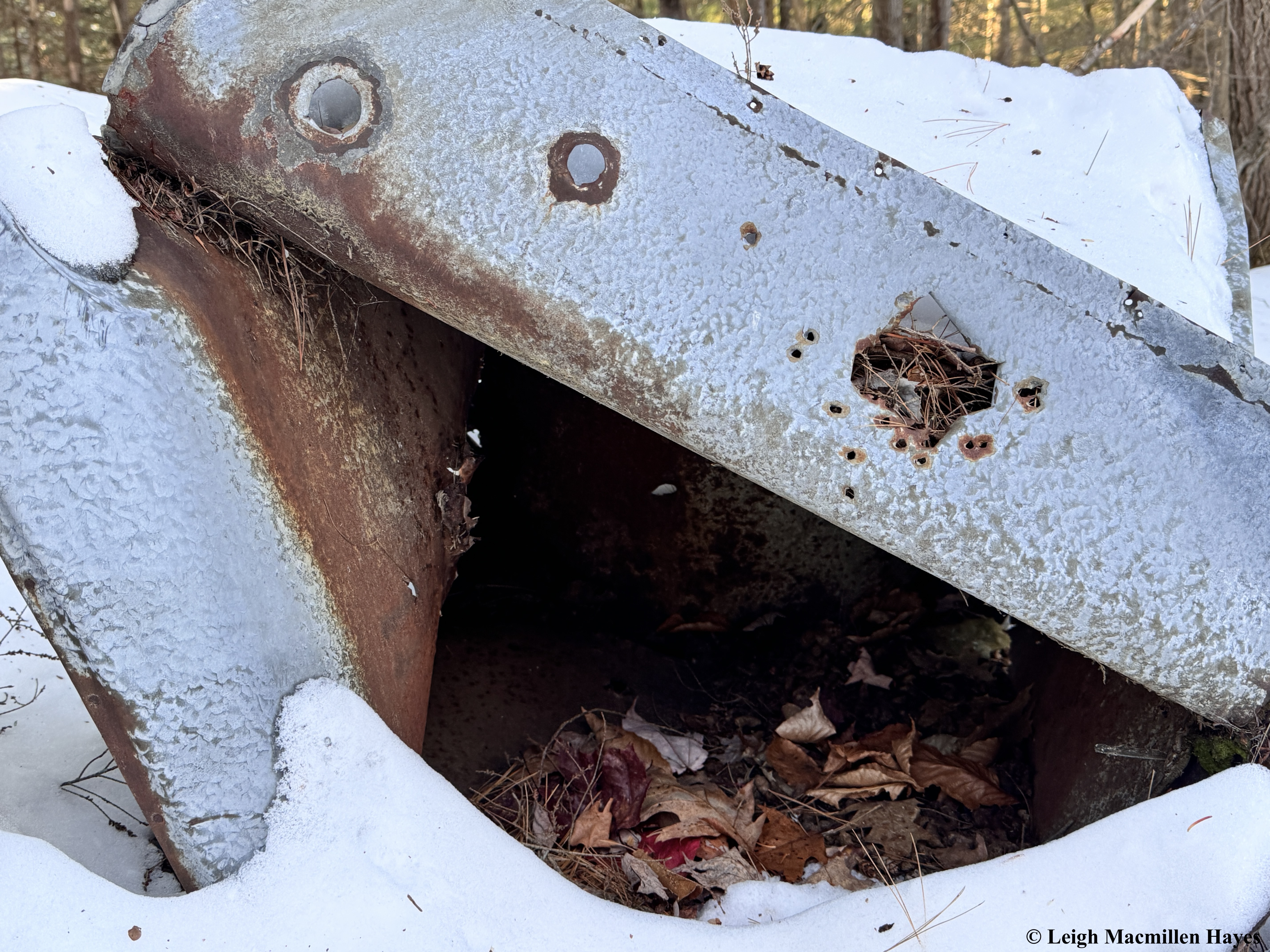
Dens can easily be discovered . . . sometimes. And other times . . . it might just be an old den, such did this old stove serve.
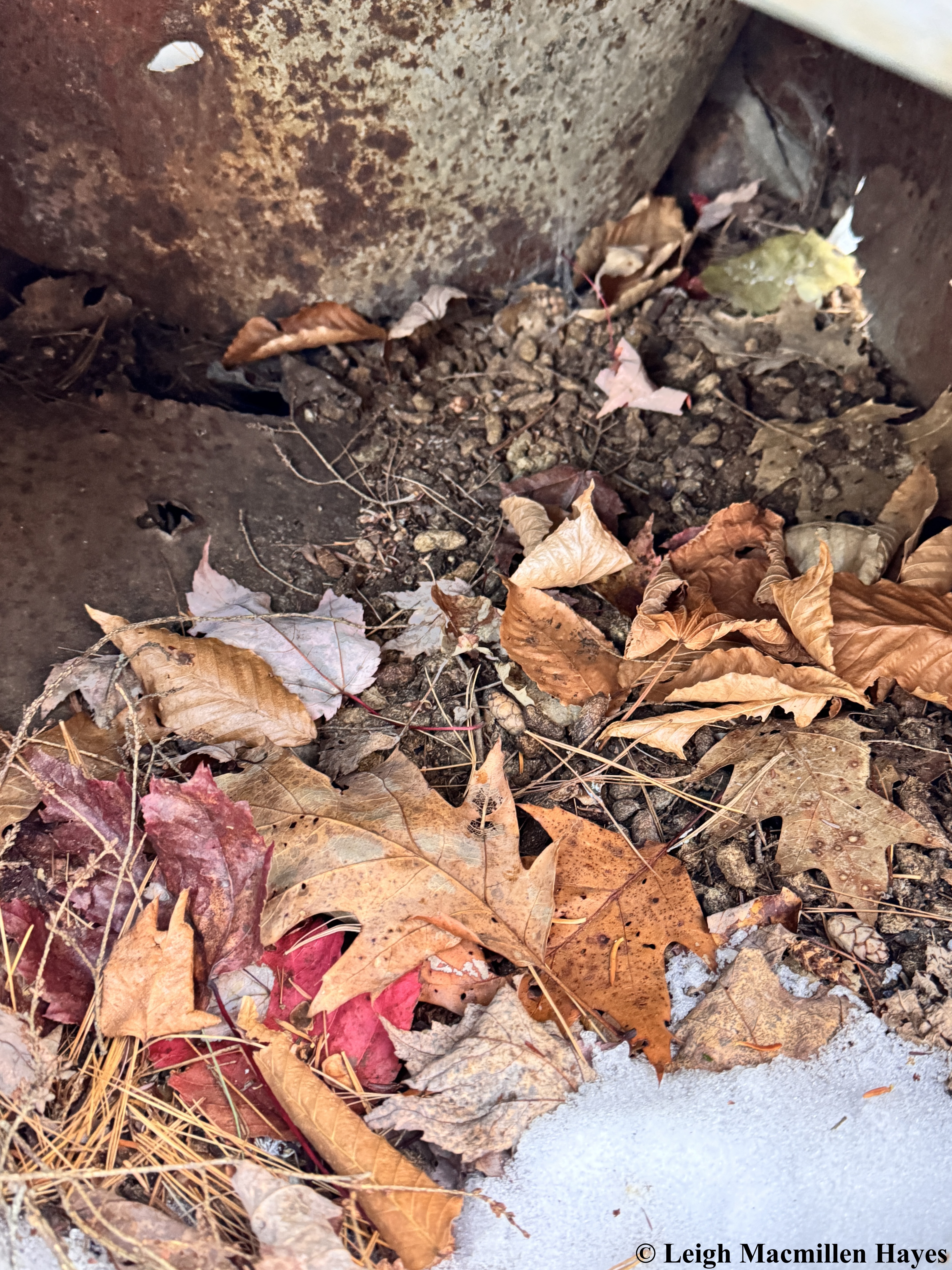
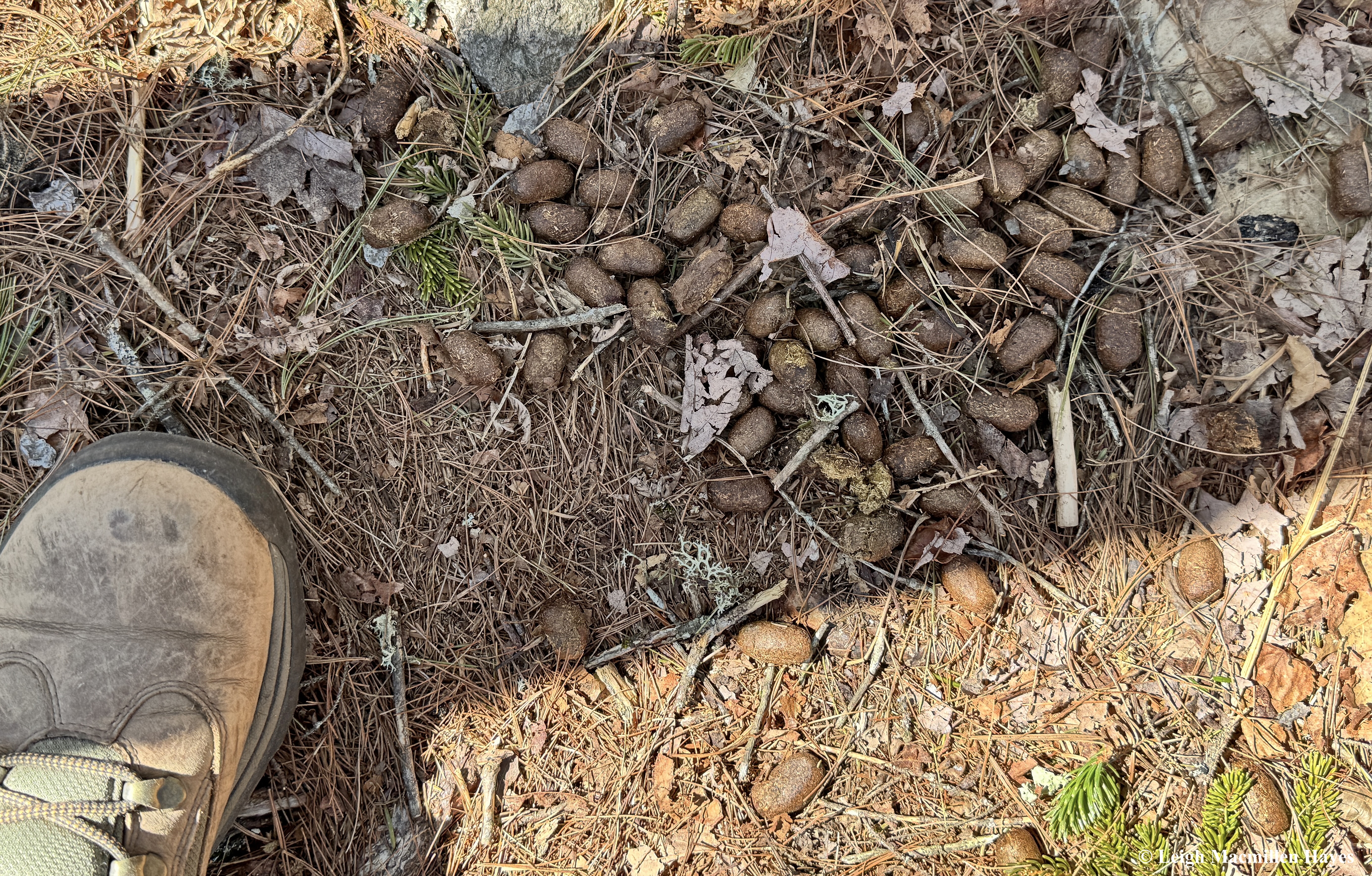
A peek into it and you might find a mix of both Hemlock cones that look like Porky scat, and the real deal, especially toward the back.
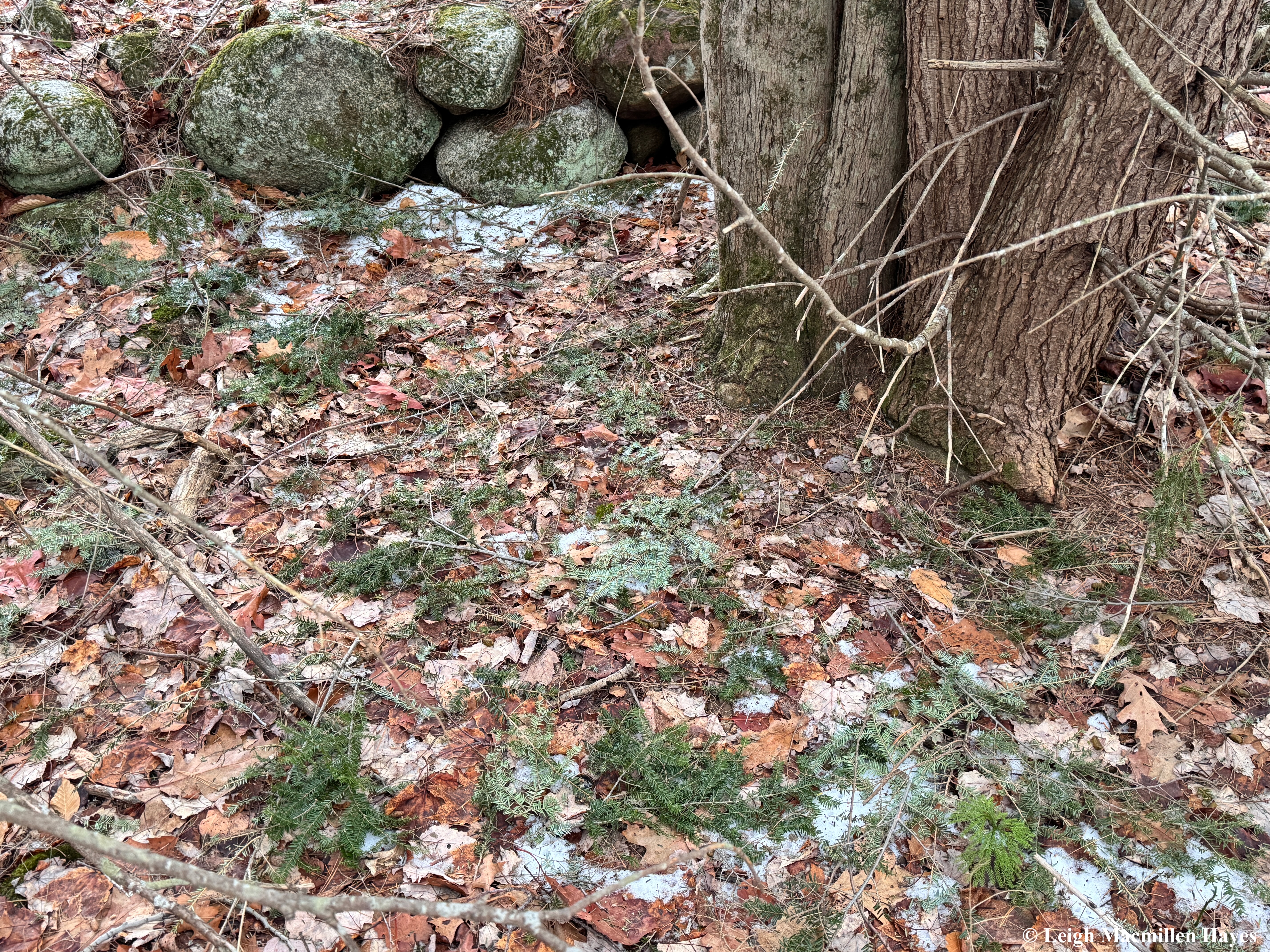
Large twigs scattered upon the ground below a Hemlock tree is another indicator of one of my favorite critter’s dining room.
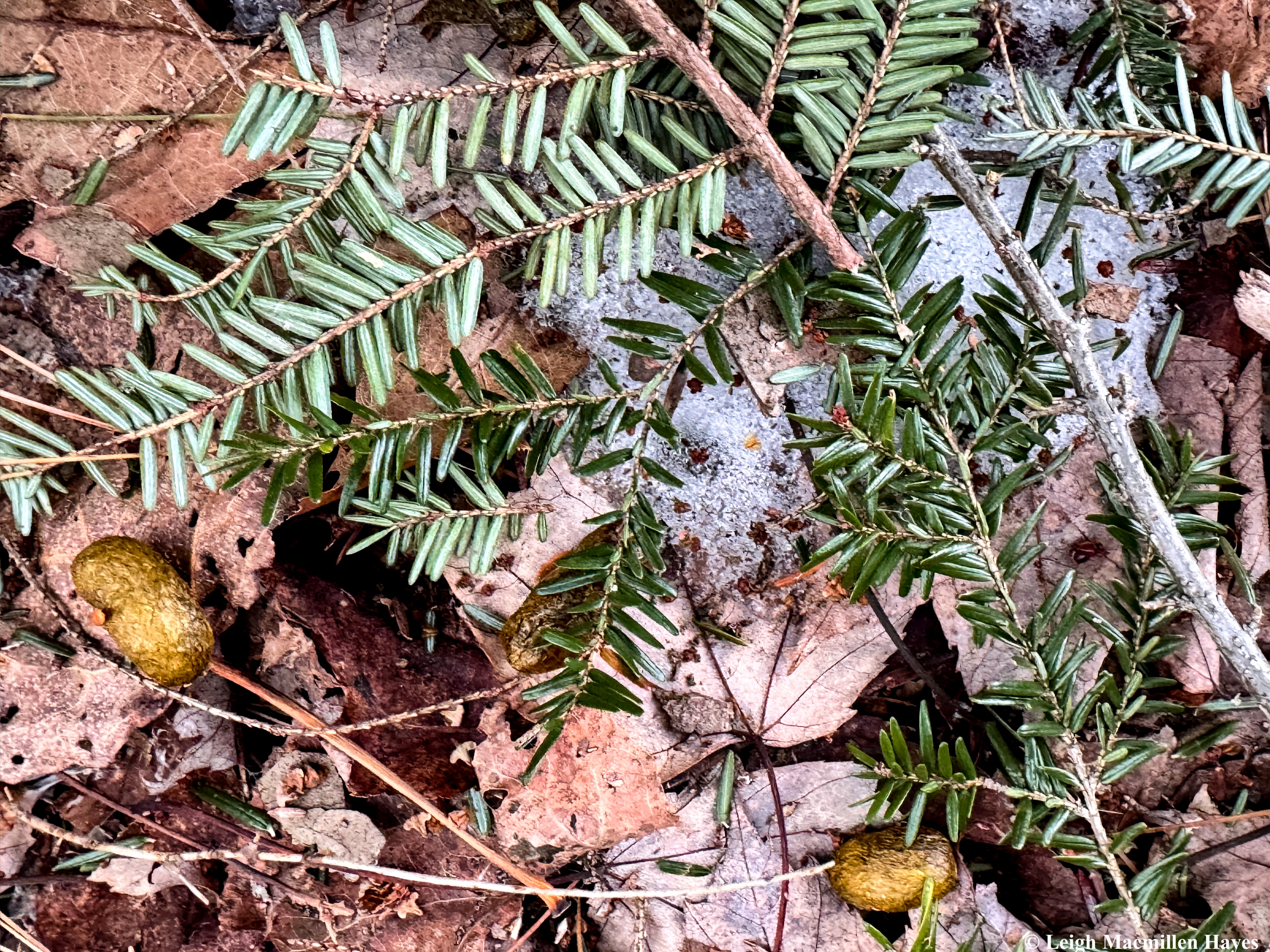
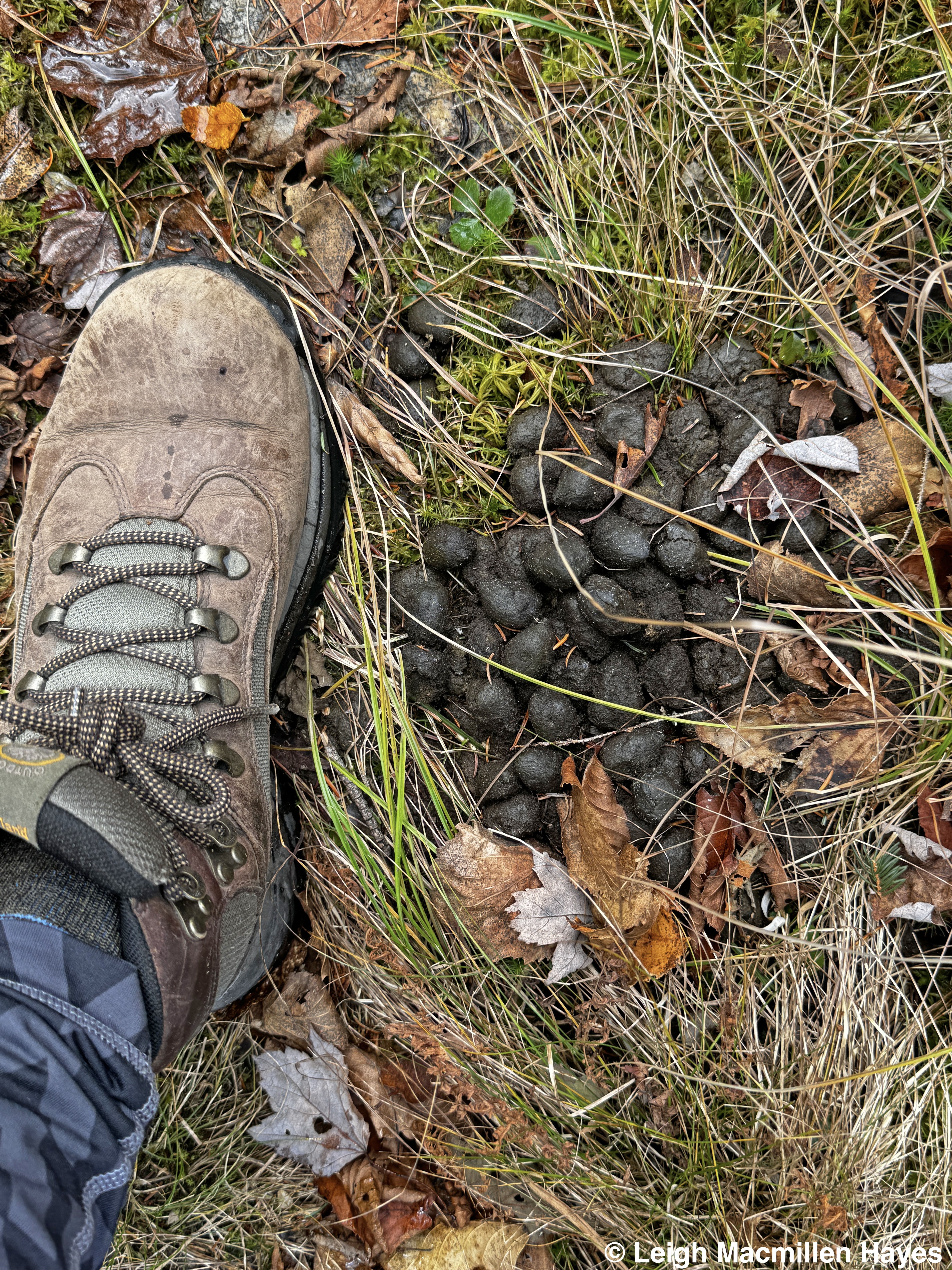
Among the twigs with their 90˚ cuts, fresh scat stating that Porky had visited the kitchen pantry and made a meal the night before.

And at a nearby tree, I’m occasionally lucky enough to spot a chain-linked necklace, again the owner of this gem being my friend Porky, who had some fiber in his diet that held the scat pieces together.
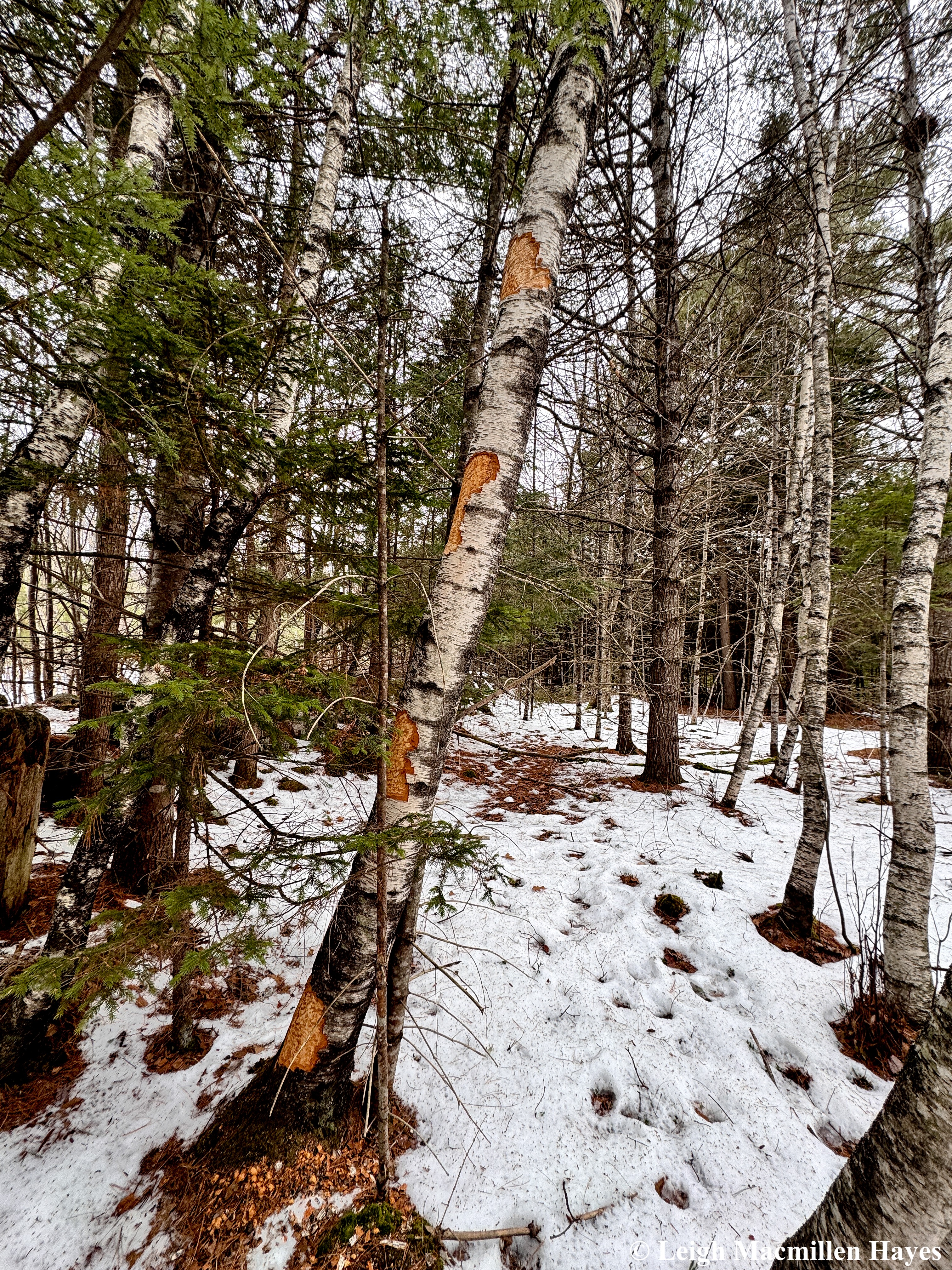
Just when one might think that that all is enough, there’s more to be discovered, for this particular Porcupine created a few signs to indicate that this is his living room and he’s very much at home in this area.
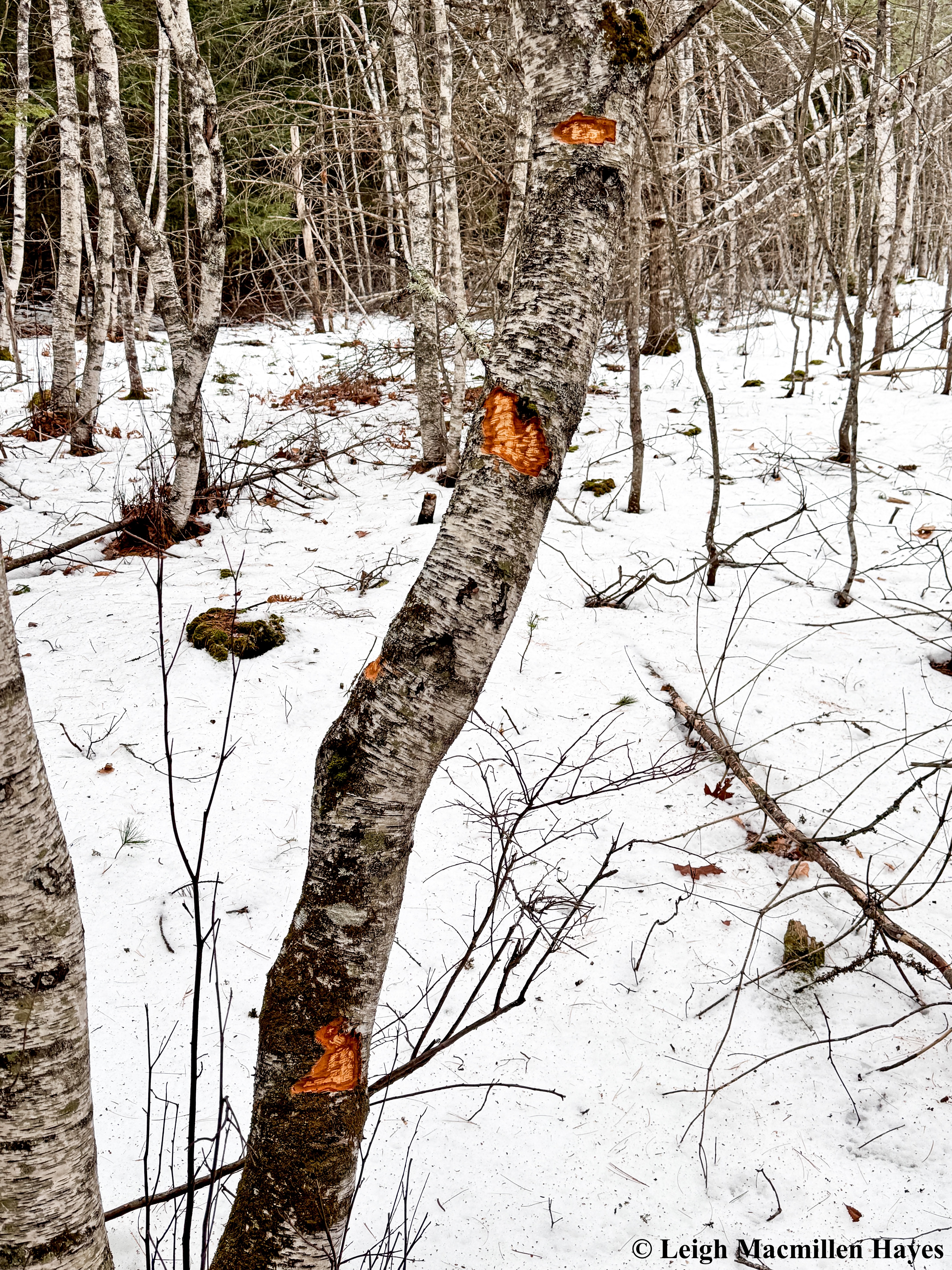
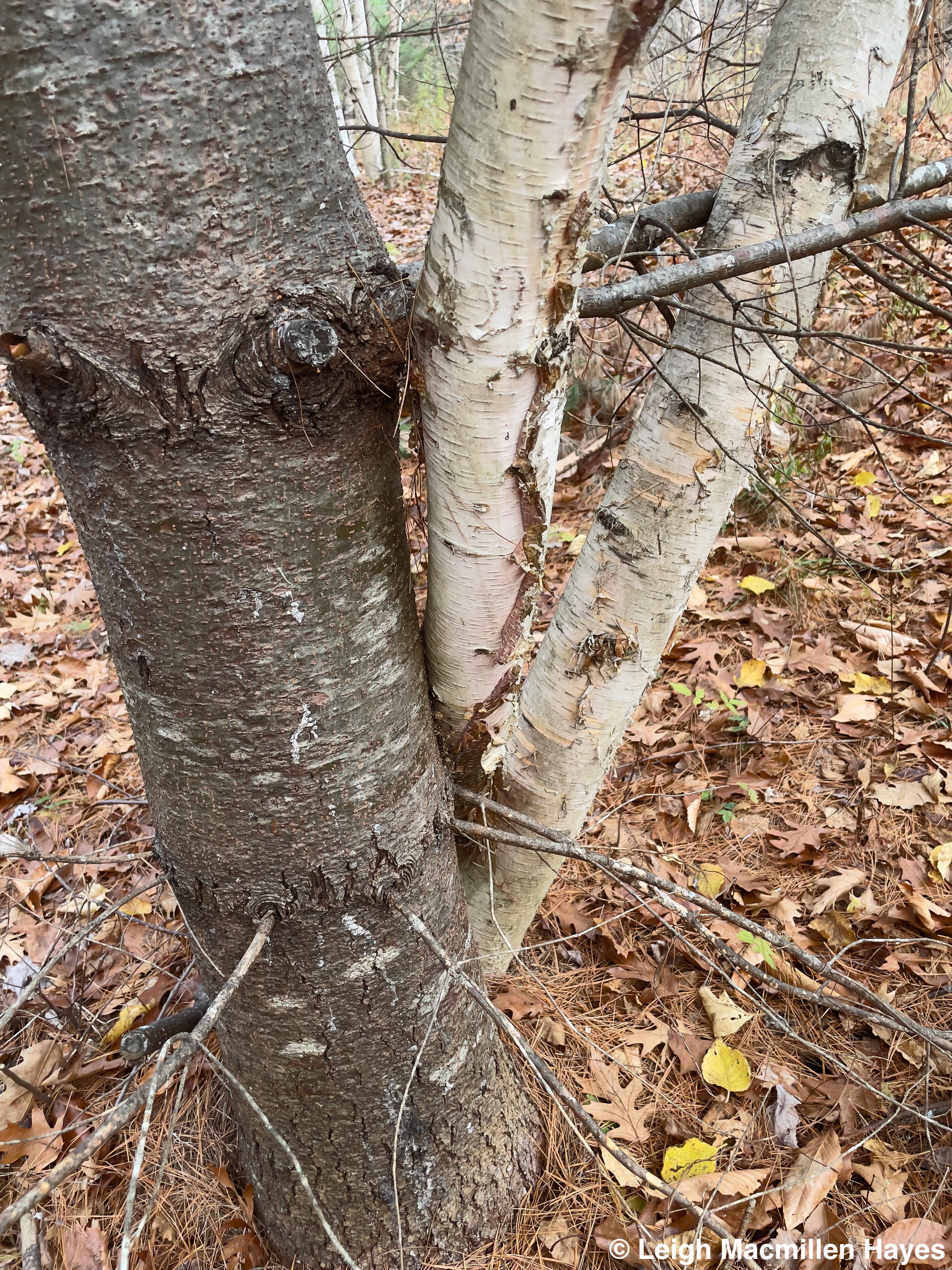
In fact, he chose to decorate several Gray Birch trees.

To create his works of art, he turned his head this way and that while pulling his upper and lower incisors toward each other over and over again in order to break through the bark and get to the tasty inner cambium layer.
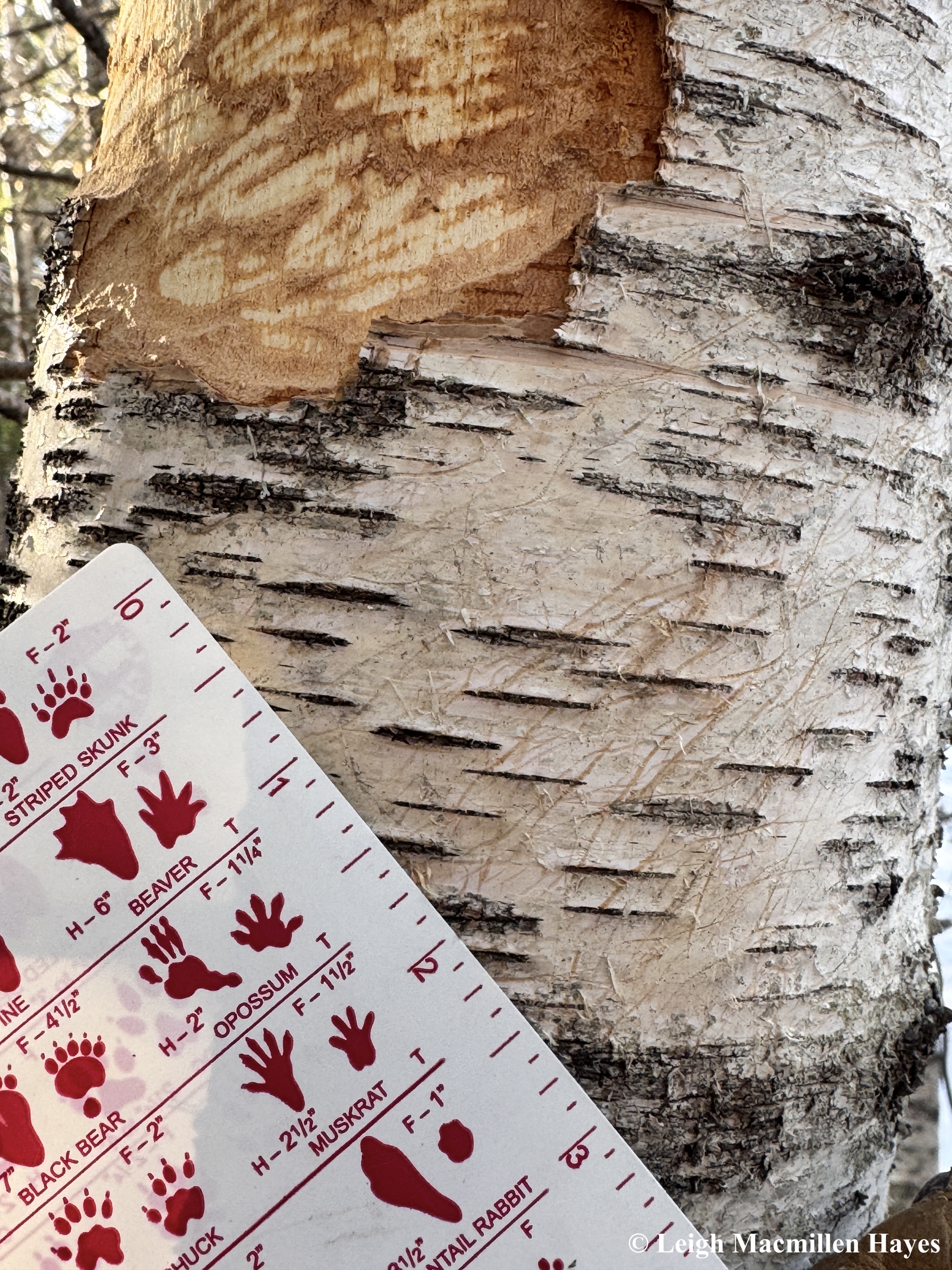
And in the process, he created a Porcupine Claw Tree! Do you see all those scratch marks left behind as he chewed? On each foot, five toes with sharp nails that aid in climbing, run across the top of the pad, and he had a lot of work to do to create the sign above, and so you can almost pick out five lines for each time he turned his foot to stabilize his body.
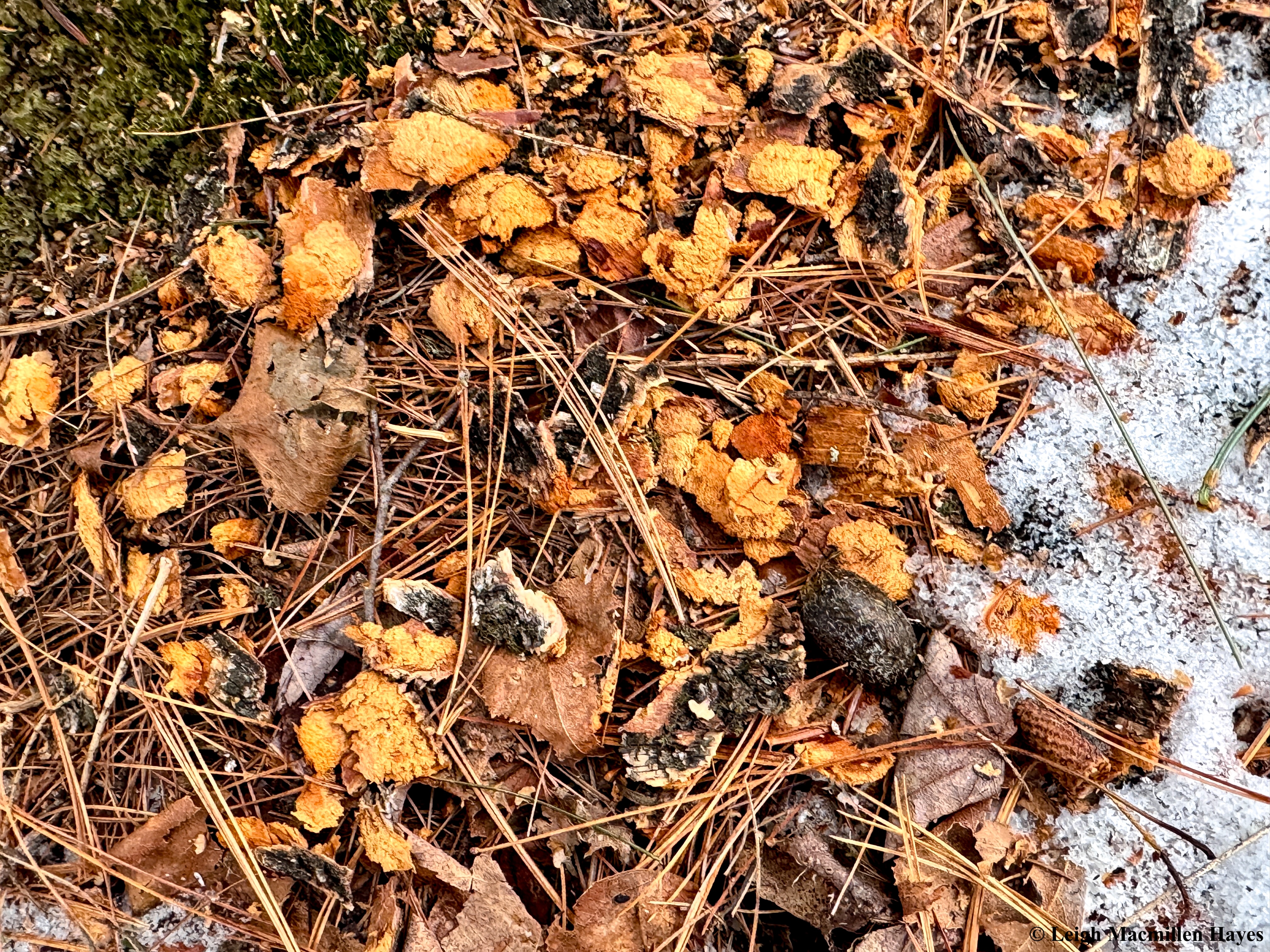
At the base of the tree, the thicker chunks of bark that he didn’t eat. And at least one pellet of scat.

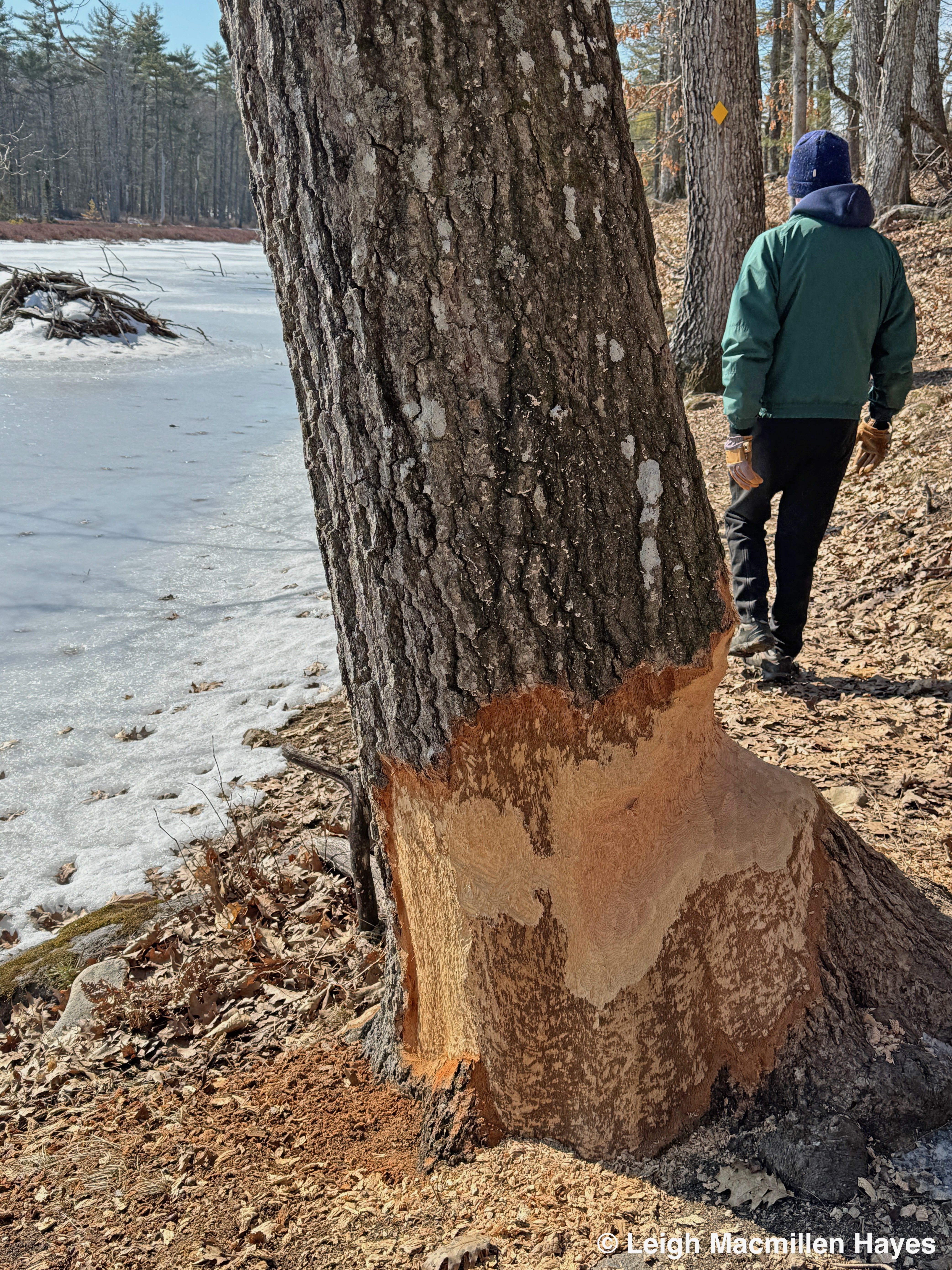
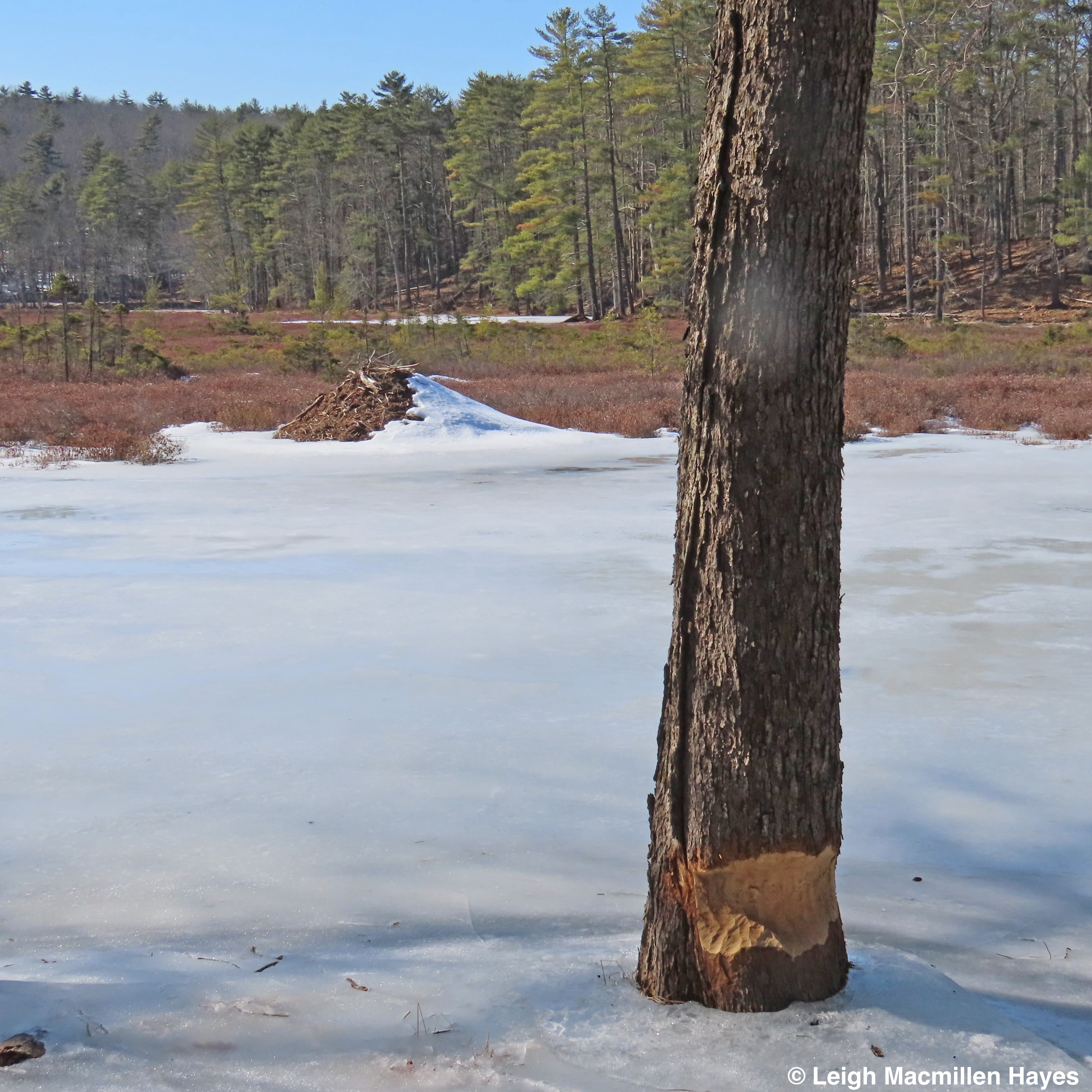
I remember the first time I discovered bark below a Porcupine tree and I was totally confused because I always associated that behavior strictly with Beavers.
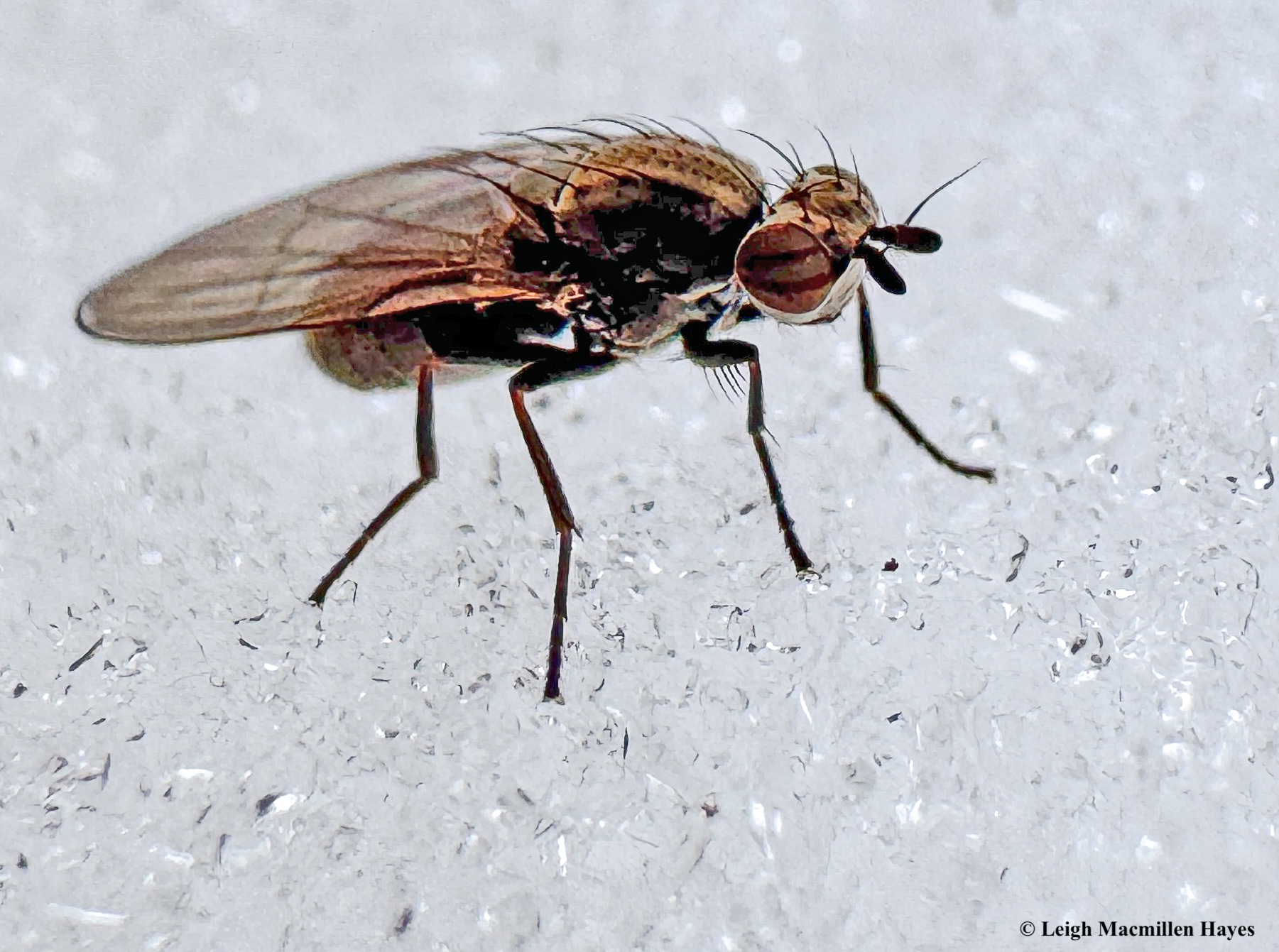
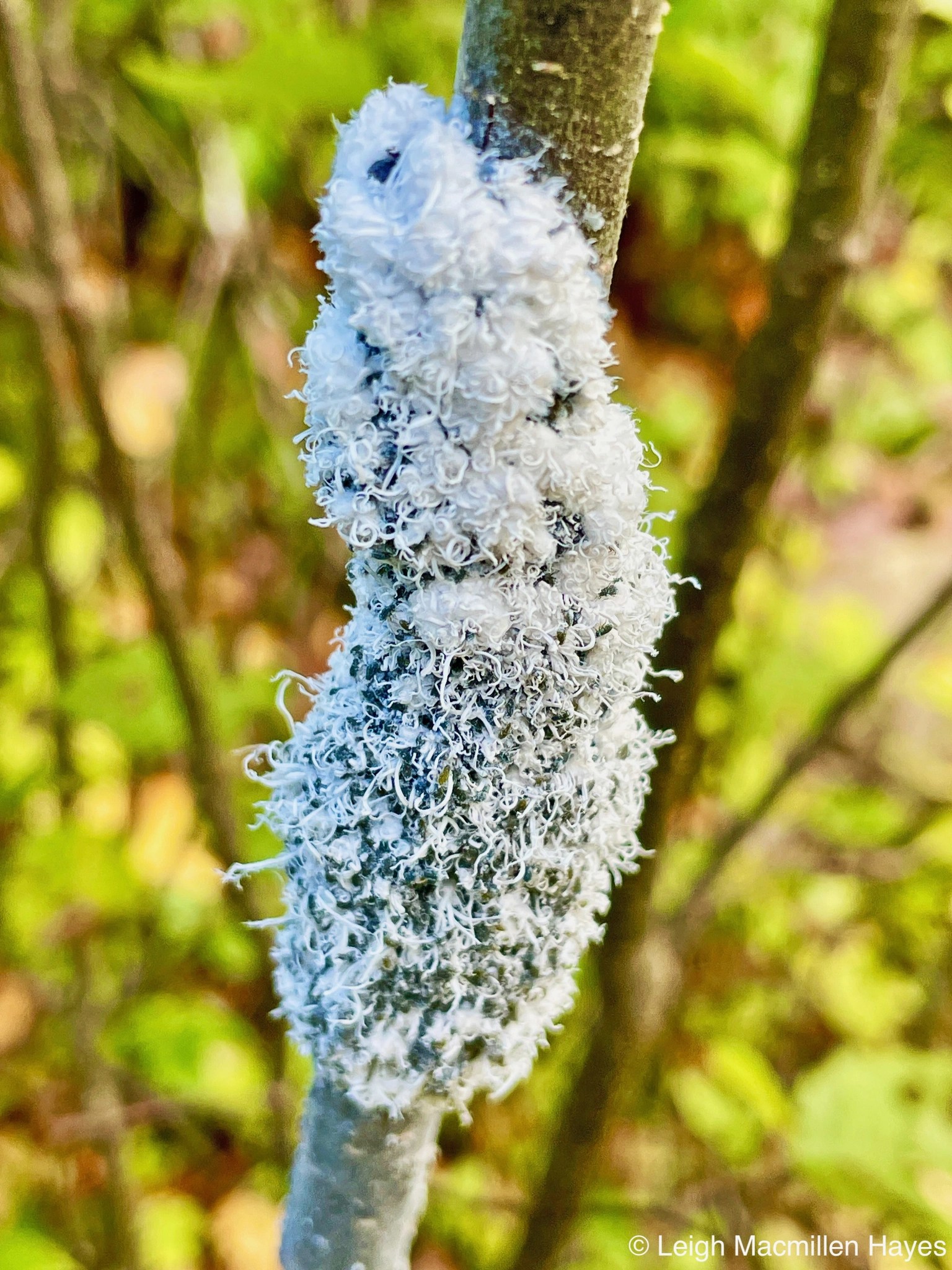
Where there are Porcupines, there also may be Cluster Flies. Who knew that they have antifreeze components that allow them to walk on snow and ice like some other insects?

This winter I’m adding to my insect and spider sightings like never before, and it’s such an amazing lesson each time I make a new discovery.

And then . . . and then . . . cuze there always has to be an “and then,” what I believe to be a Bobcat’s cache site. One day I saw a bit of disturbance in the middle of the trail, and blood. Lots of blood. But indecipherable prints.

Two days later and the area had been revisited and more disturbance.
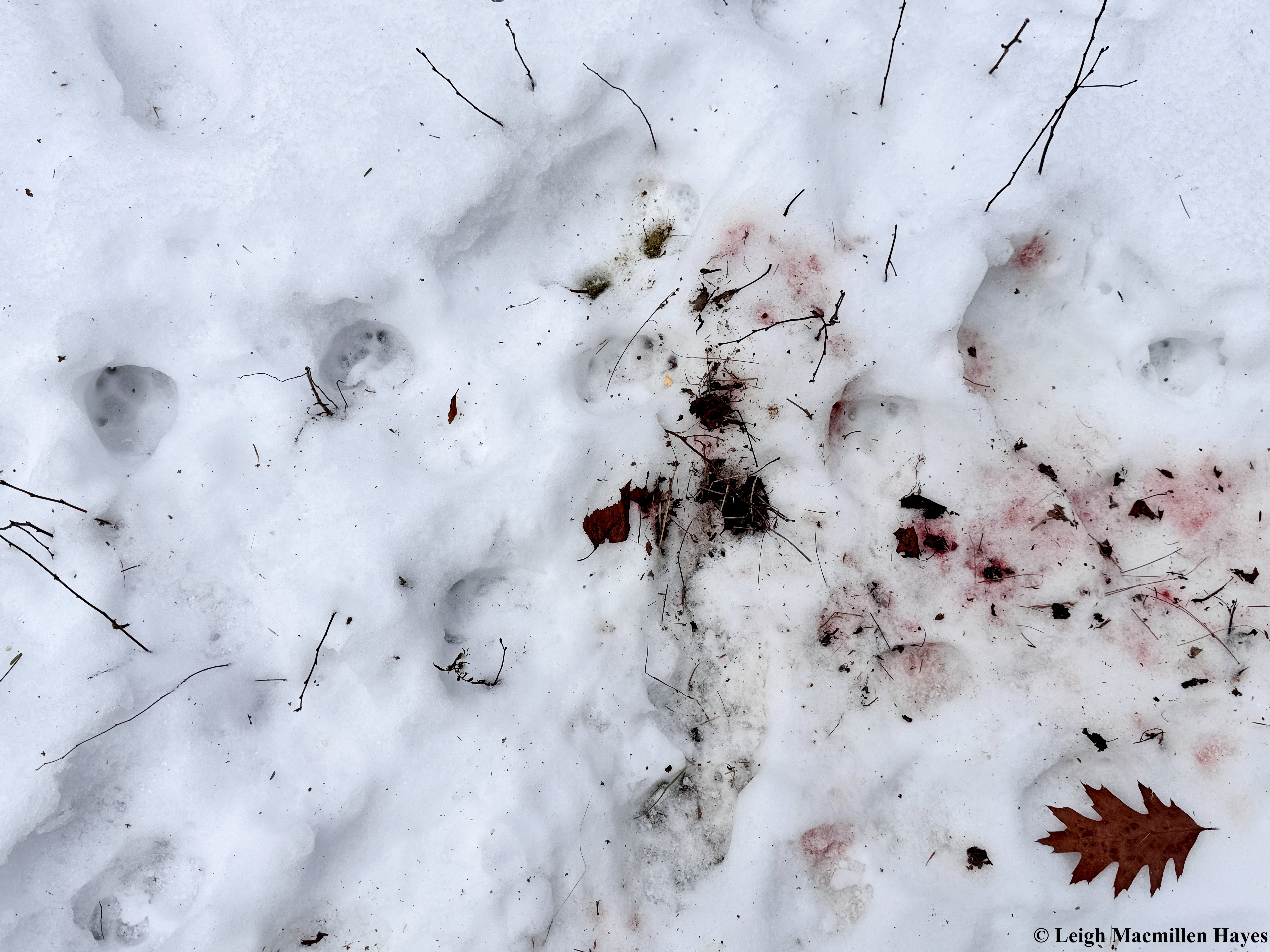
And a Bobcat’s prints surrounding the main evidence.

That classic round shape with four toes showing. But, for the discerning eye, there is one toe on the far left that is over another toe–telling me that this print actually represents two feet! First the front foot packed the snow and then the hind foot on the same side stepped into almost that very spot.

And after that a Winter Firefly entered the scene. Notice his bare feet, but again, he’s made for winter and not made to light up the way his summer cousins do and this past summer we had the pleasure of spotting many Fireflies each night.

But I love the Winter Firefly for the orangey-pink parentheses that mark the pronotum or head shield. And the fact that they can move across the snow, though they prefer to be just under the bark on a winter day.
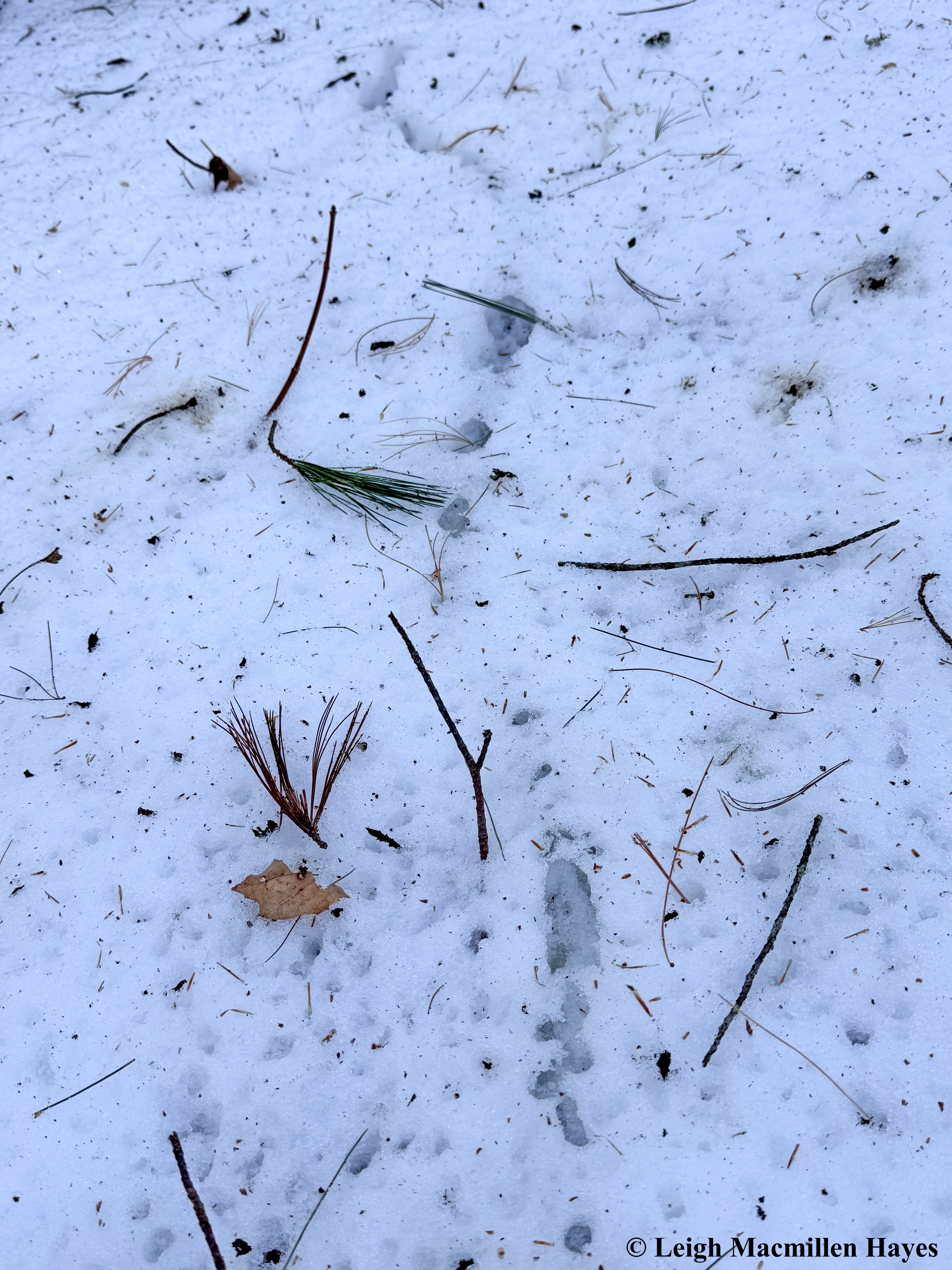
It’s the sign of still another that has been drawing my attention frequently because . . . that sign can be seen in almost any habitat and quite often. The “another” in this case is a Meadow Vole. If you’ve ever spotted one moving across leaf matter or plowing through the snow, you know they are like little gray torpedoes, quick and trying to go undetected.

Being one of a predator’s favorite food sources, Voles are shy of airspace, and thus tend to travel below the snow surface whenever possible. And while they are hoppers/leapers most of the time, occasionally they become perfect walkers and this track shows the essence of that in the lower zigzaggy portion of the tunnel. At least that’s my interpretation. Like the Bobcat (and canines), a Vole can pack the snow with the front foot and then the hind foot lands in the same spot. He may walk like this for a few steps and then revert back to hopping/leaping but in a super fast fashion.
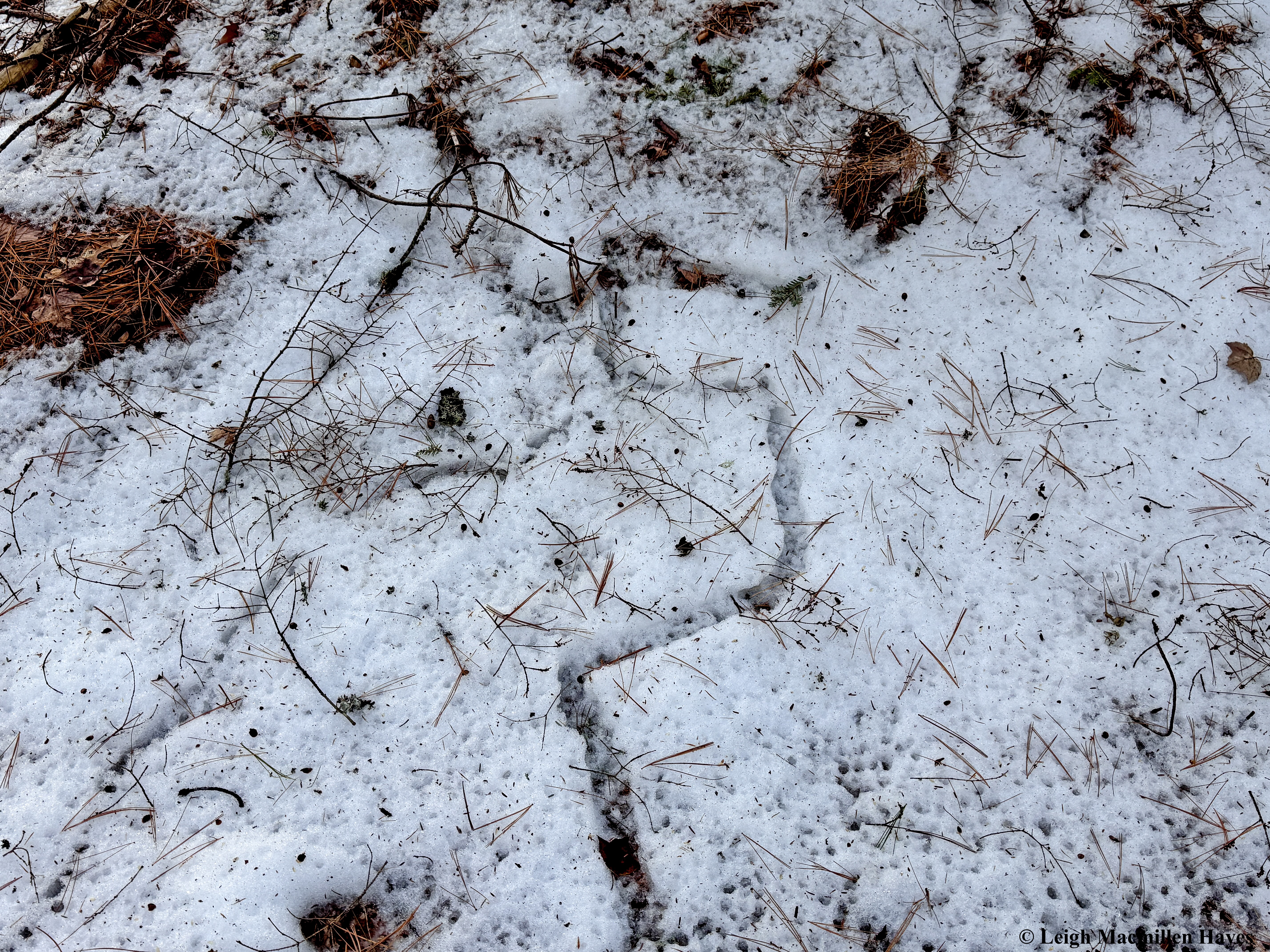
As the snow melts, the tunnels become more and more apparent and I get the sense of this little guy moving here, there, and everywhere, probably on a seed quest.
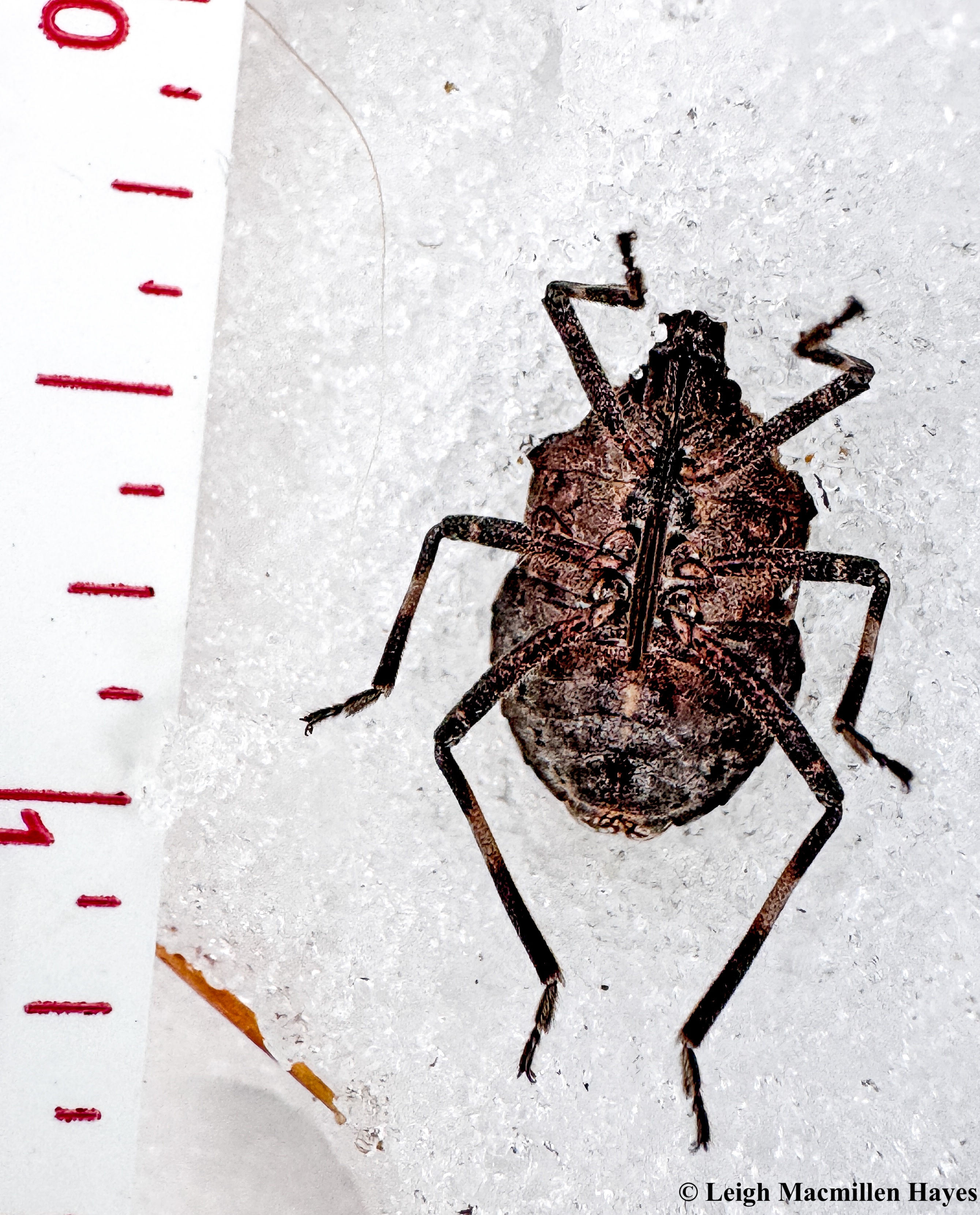
Occasionally, the winter weather takes its toll, and such was this case for this Shield Bug that went belly-up. They much prefer to find their way into our homes for the winter, and so far the temps we’ve been experiencing of late, except during last week’s rain storm, have been quite frigid, and this guy made the wrong choice.
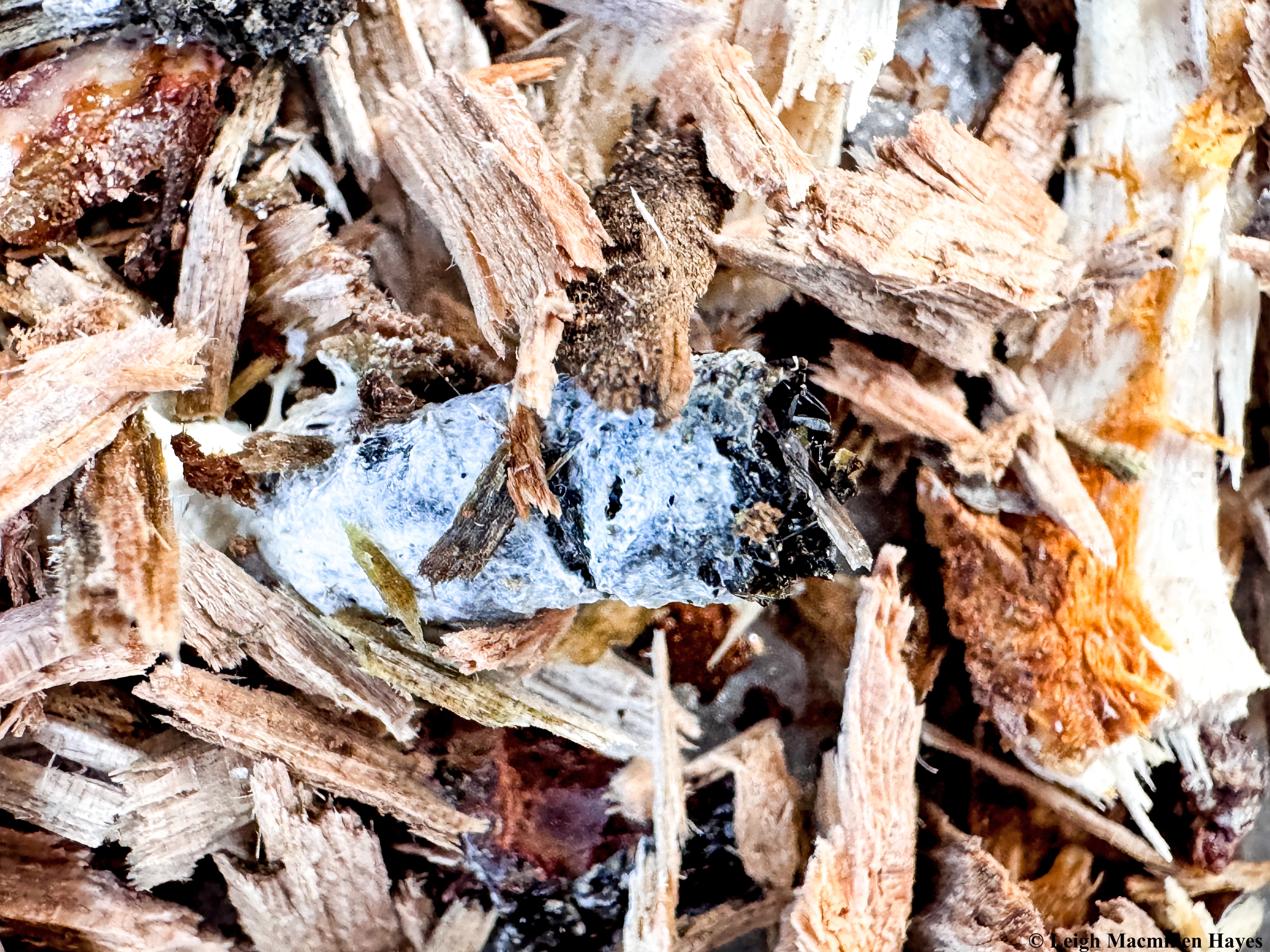
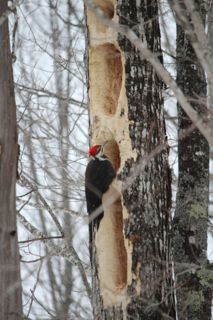
Winter isn’t just about insects and tracking, well, wait, yes it is for here is the result of another type of insect that had been consumed and the undigestible parts excreted–in the form of Pileated Woodpecker Scat filled with Carpenter Ant body parts.

Oh, and then there are spiders, but though I’ve seen plenty of them alive and moving with grace across the snow, occasionally they freeze to death despite their antifreeze and what happened here is that the spider lost a front limb and I have to wonder if the frost entered its body through the stub that was left behind. I have no proof, but it’s always good to wonder.

And how do I know this is a male? Do you see the “boxing gloves” on the pedipalps? There’s a vocabulary word worth looking up. :-)
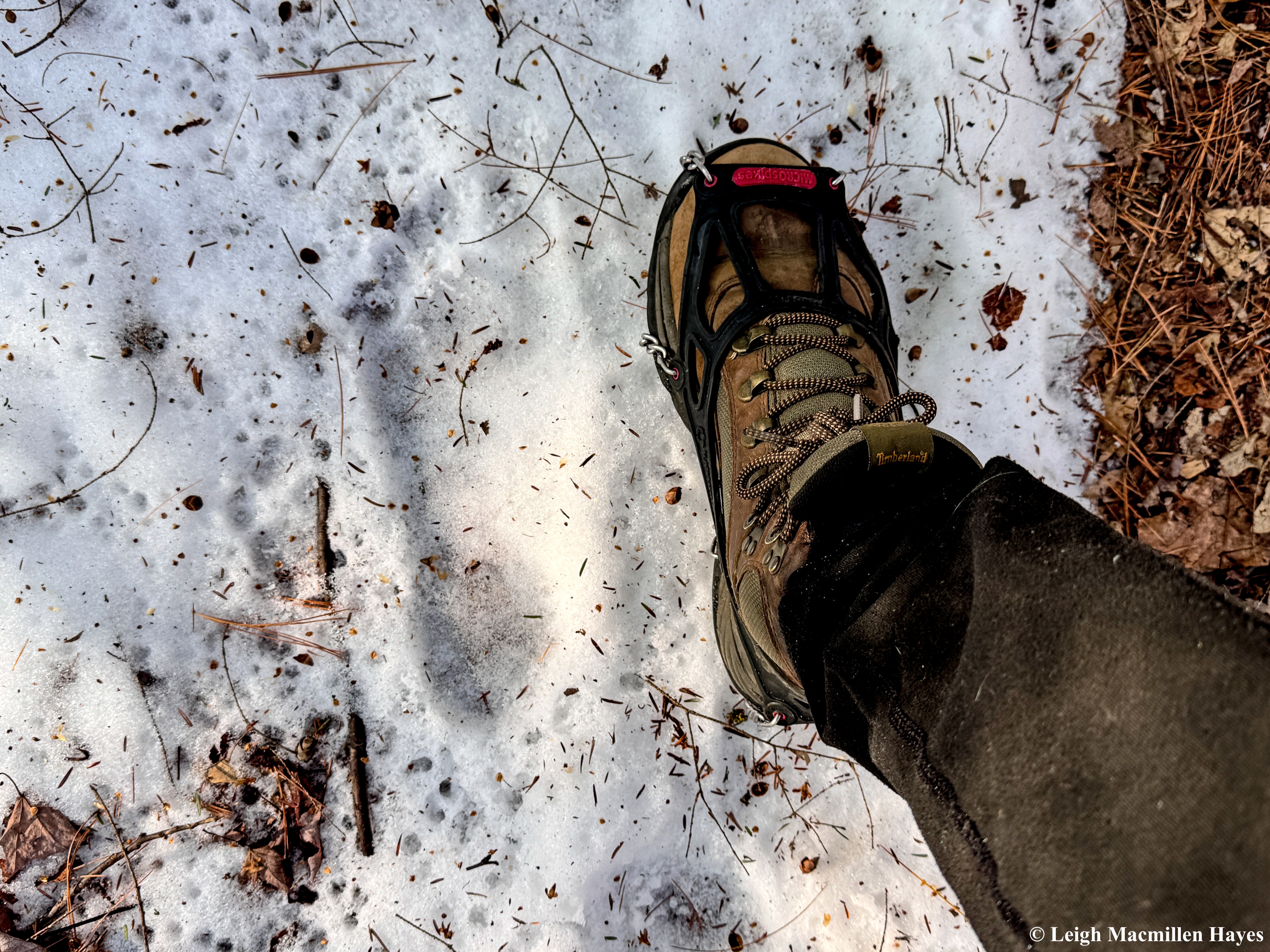
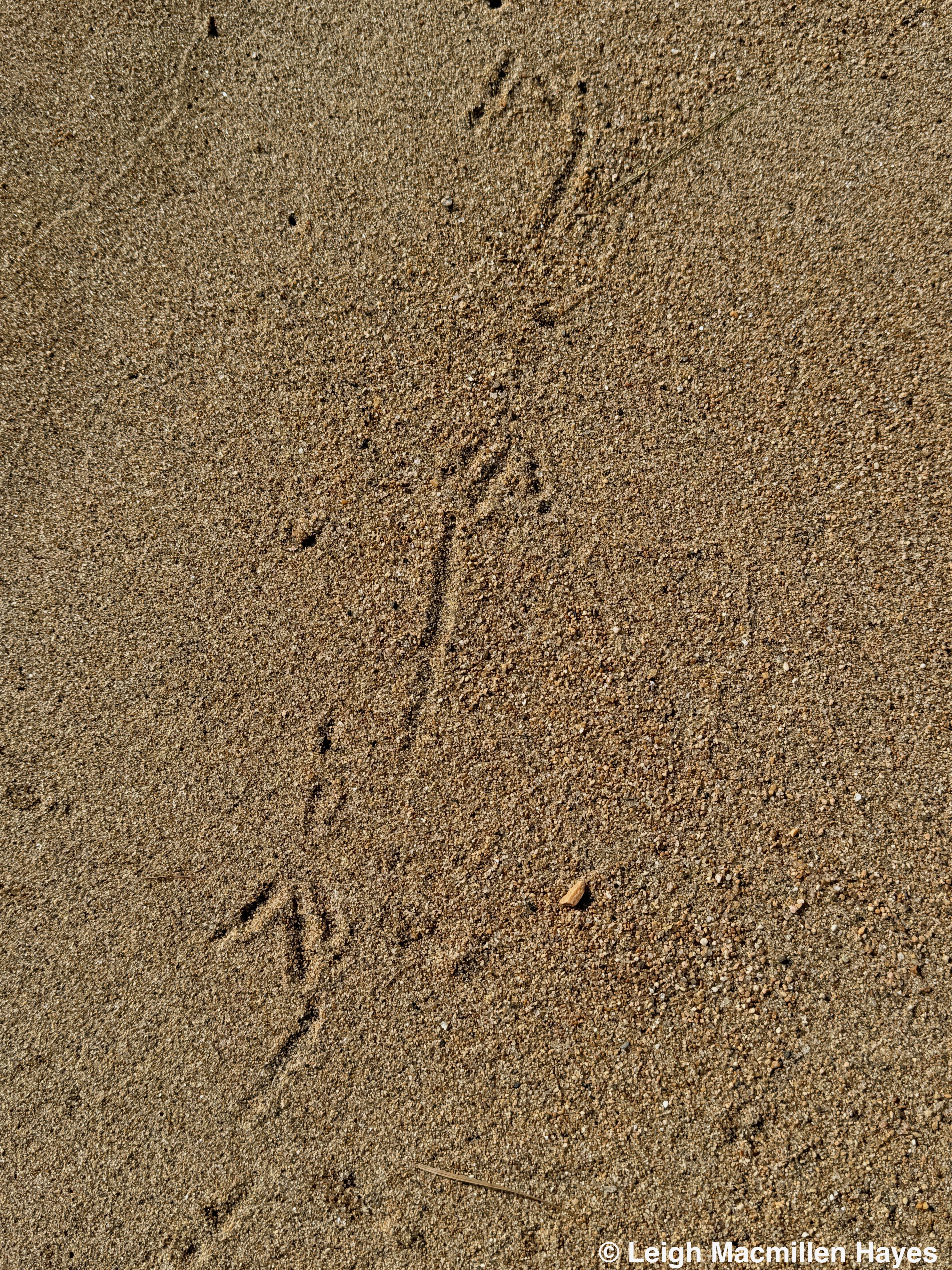
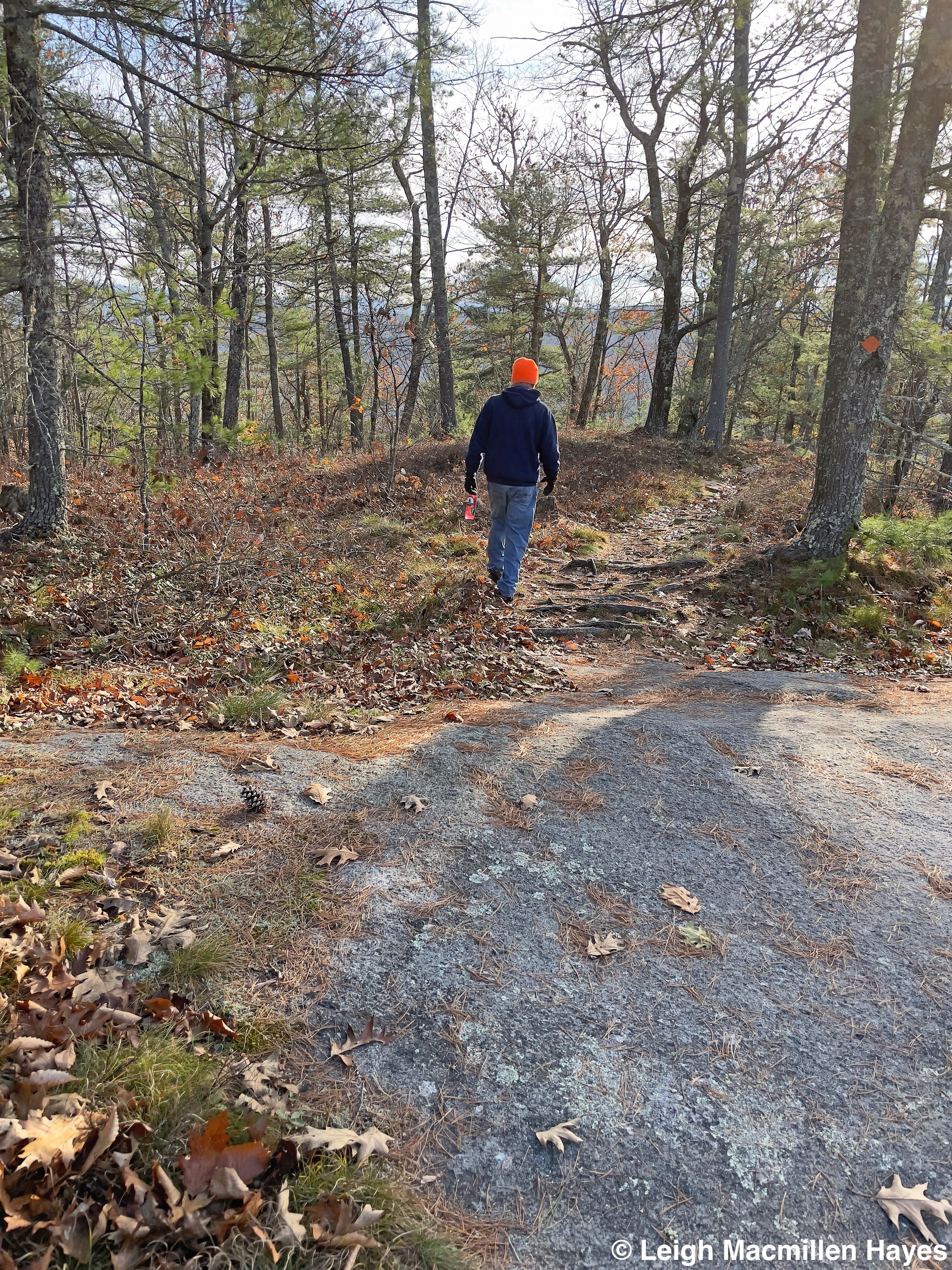
But wait. The temperature was in the teens, with a wind chill in the single digits and I spotted the print of . . . a human being. A bare footprint. It was a few days old, given that there was some tree debris on top of it.
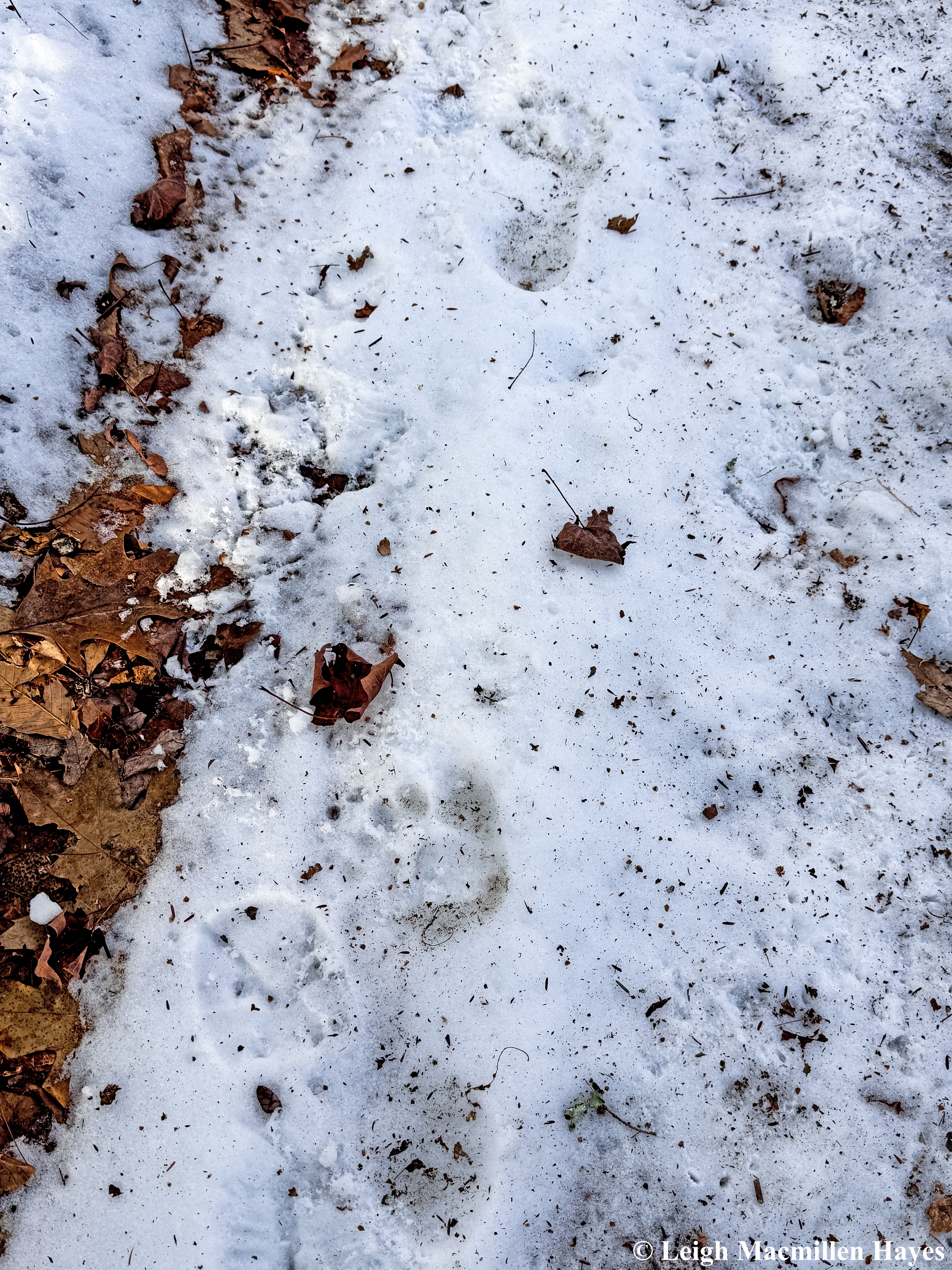
Of the almost six miles that My Guy and I hiked on a loop trail today, we followed these tracks the entire way.

It brought to mind this poem:

Footprints in the Sand

One night I dreamed I was walking along the beach with the Lord.
Many scenes from my life flashed across the sky.
In each scene I noticed footprints in the sand.
Sometimes there were two sets of footprints,
other times there were one set of footprints.

This bothered me because I noticed
that during the low periods of my life,
when I was suffering from
anguish, sorrow or defeat,
I could see only one set of footprints.

So I said to the Lord,
“You promised me Lord,
that if I followed you,
you would walk with me always.
But I have noticed that during
the most trying periods of my life
there have only been one
set of footprints in the sand.
Why, when I needed you most,
you have not been there for me?”

The Lord replied,
“The times when you have
seen only one set of footprints,
is when I carried you.”

~Mary Stevenson

Can you imagine welcoming winter by walking barefoot in the snow?

I’m pretty sure I was carried today! And not by My Guy! Though he was beside me the entire way.
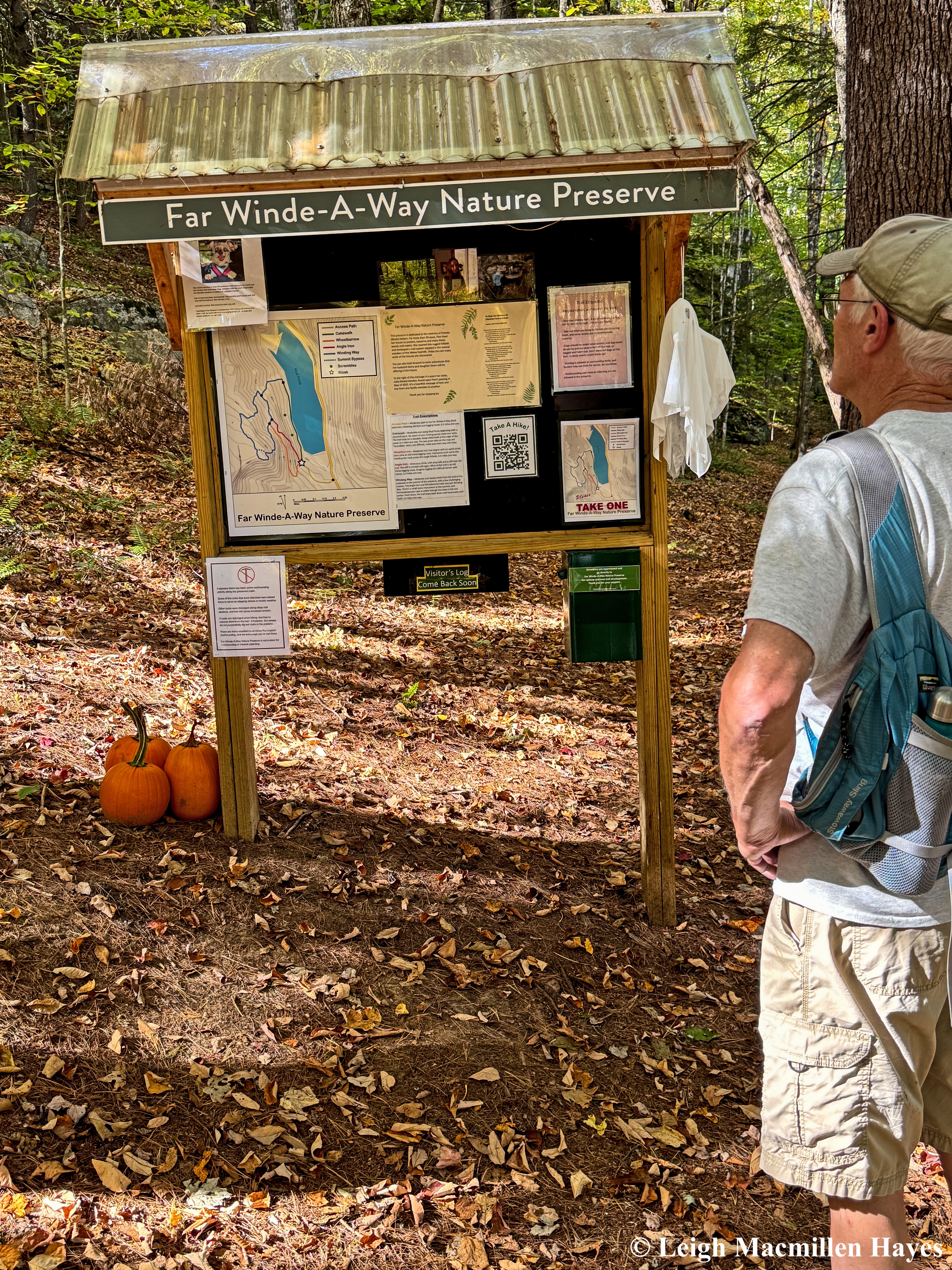
Far Winde-a-Way Mondate

It’s been a while since I’ve written about a Mondate, and believe me, we’ve had numerous. And other dates during the week as well, but today found us exploring a new-to-us property that’s just too special not to share. And I think the owners would appreciate it. I know that we appreciate that M suggested this to us. She was spot-on correct that we’d like it.

We’d been by a trail sign on the road a bunch of times to hike other trails in Greenwood, but until M mentioned it, we hadn’t really paid much attention. Until today. The kiosk is about .2 in from the road and I loved that there were pumpkins and a ghost to decorate it. And all the information hikers need to enjoy the area. Though My Guy goes without, I highly recommend trekking poles should you go forth on the well-marked trails. They are steep in places. And rocky in others. But that all adds to the fun.

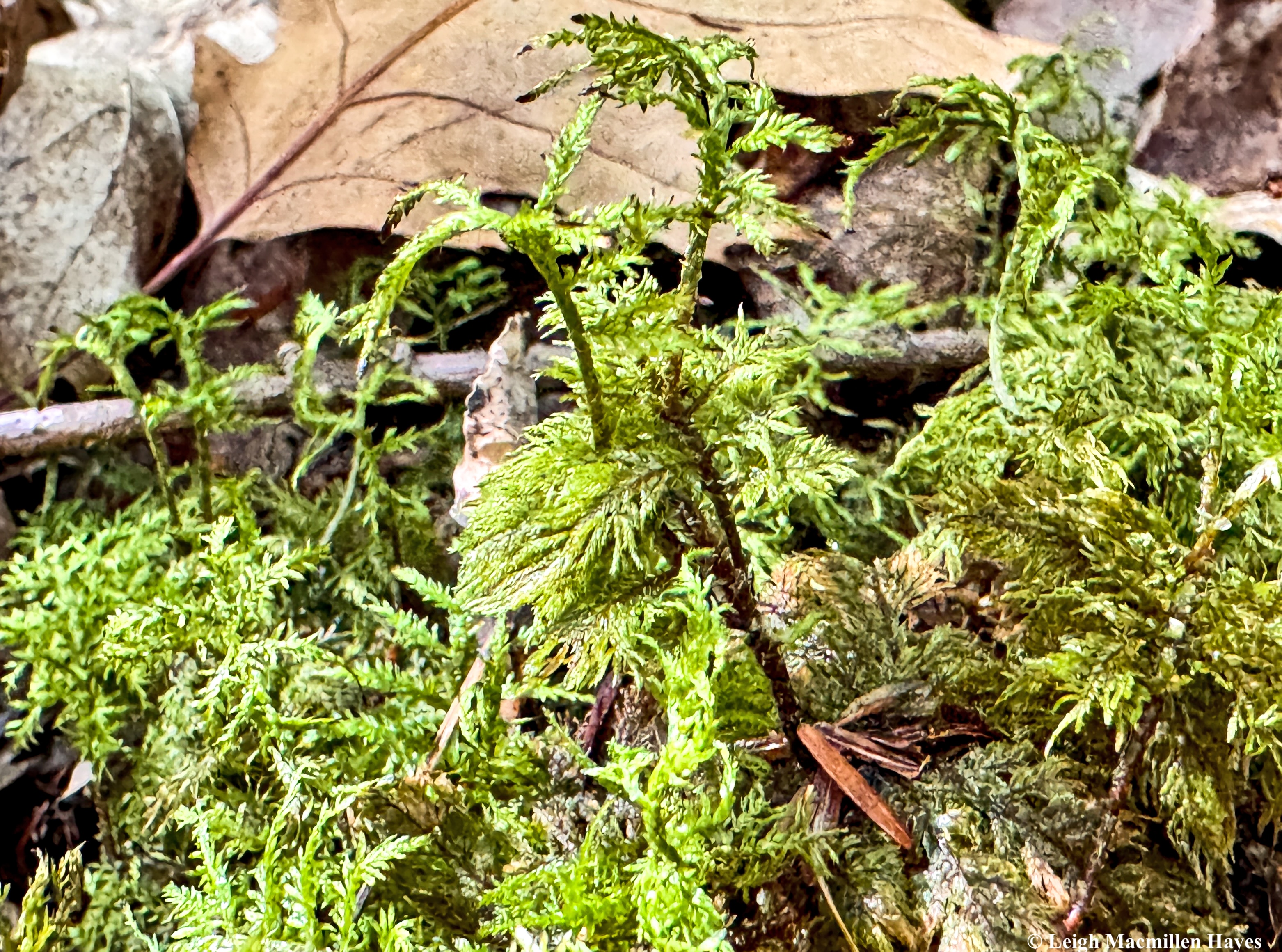
For me, the fun was enhanced by spotting examples of this pleurocarpous moss. It took me a while to learn that pleuro refers to side and carpous means fruit, thus they have a side fruit. They are low, tangled mats with branches that rise from the main stem.

This particular moss is the Stair-step Moss or Hylocomium splendens. It prefers deep shade and damp conditions. Due to the dry conditions we’ve been experiencing, this year’s growth of a new step rising from last year’s stem probably didn’t occur until recently.

There were other mosses, giving the trail a fairy-land look at times, but also abundant were the Christmas Ferns, which decorated long stretches of our route.

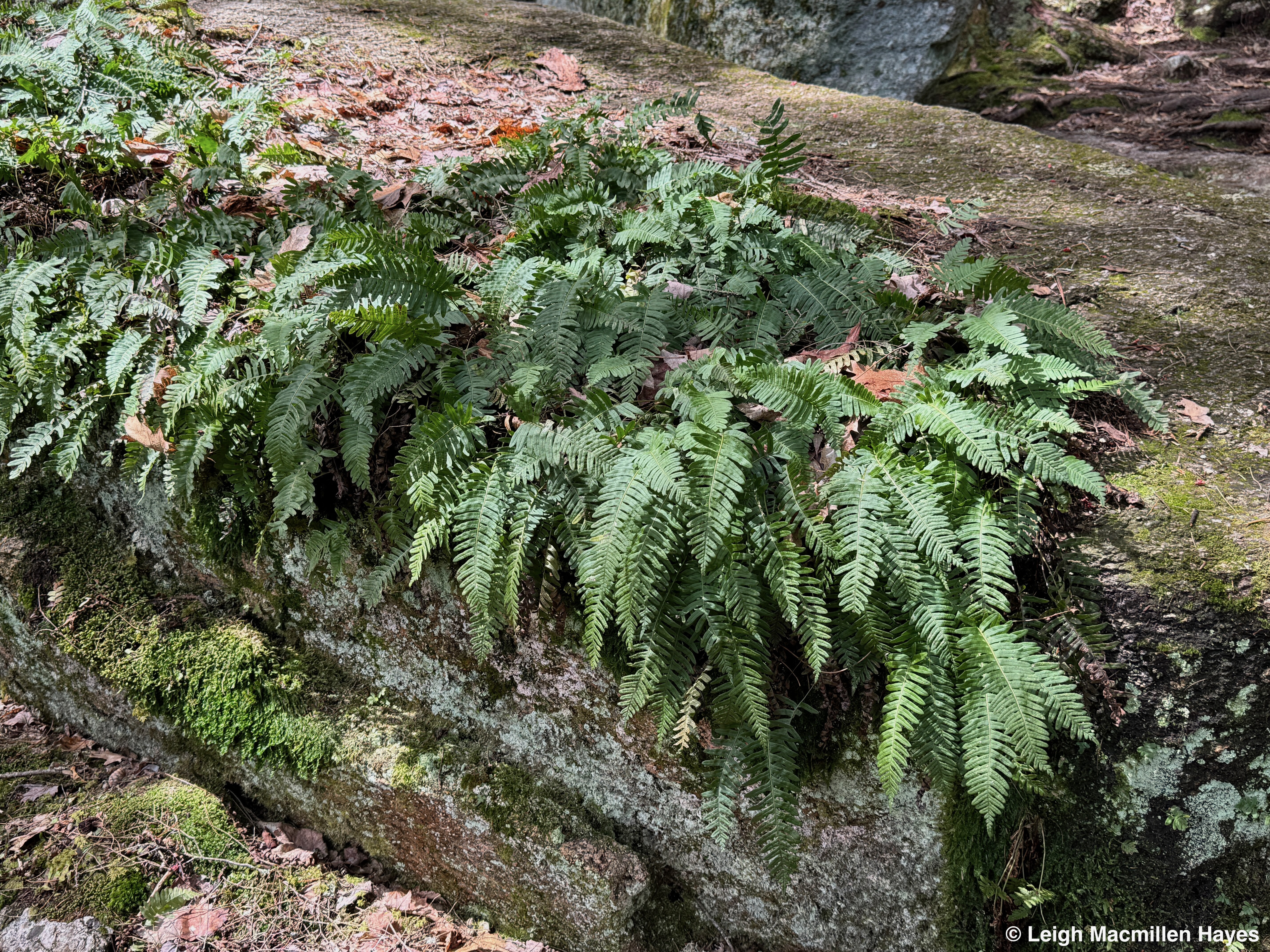
And not to be left out were the Common Polypody that always give boulders a bad-hair day look.

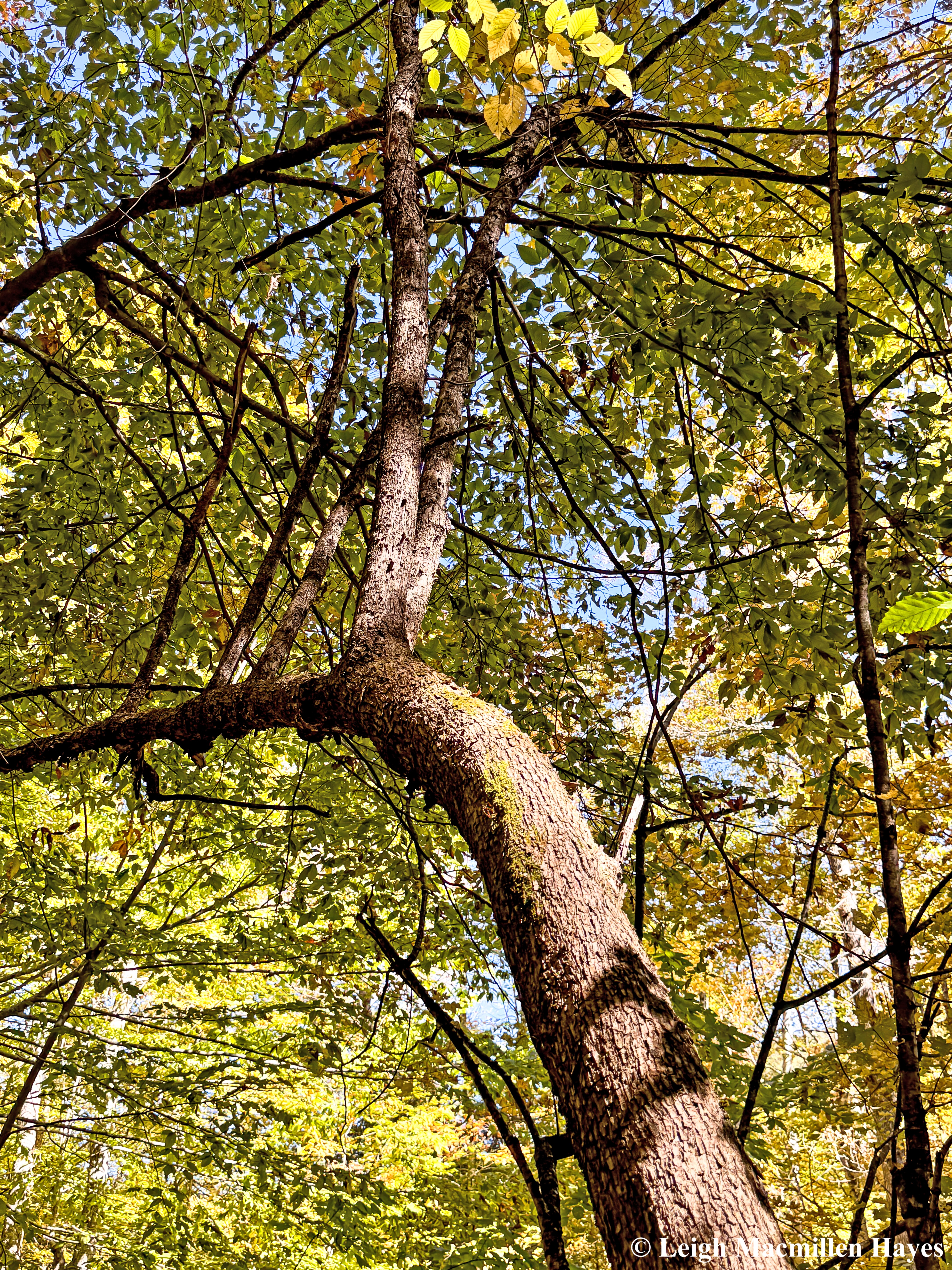
Those items would have been enough, but we realized from the start that we were in Hop-Hornbeam territory, and several surprised us. Typically, this is a tree that stands straight and tall, but a few must have been hit by other trees during storms perhaps, and their trunks had turned. Despite that, other branches took over and reached for the sun.

The other day some of us were looking at a sample of this tree and I asked them what they noticed about the bark. Their responses: shaggy and vertical lines. Spot on. Sometimes the bark is a bit tighter to the tree than this one we saw today, but it’s a great example of how this bark behaves. If you rub your hand on it, some pieces will flake off.

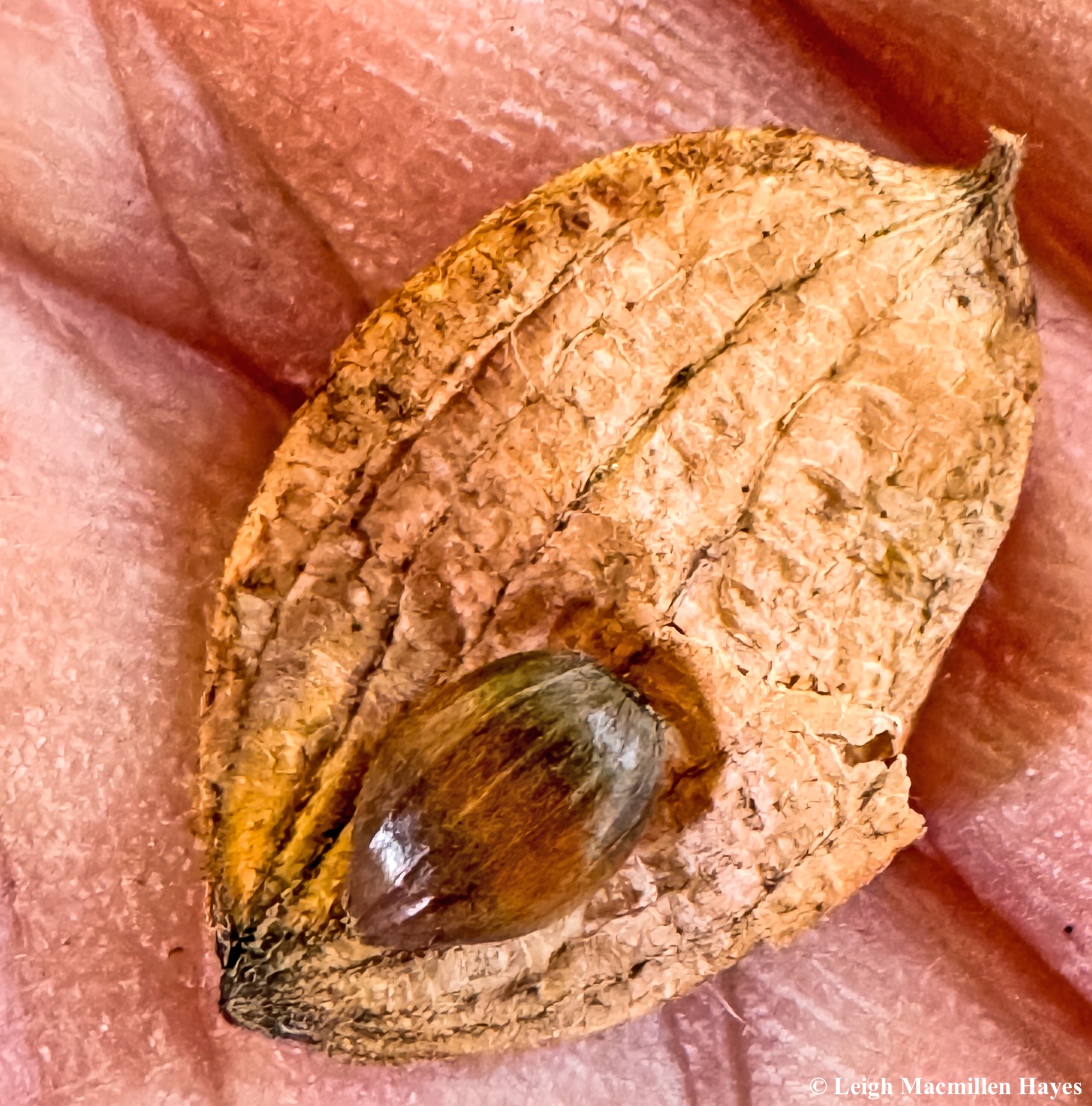
What I really wanted to see since we were in the presence of so many Hop-Hornbeams, were the hops for which it was named and BINGO! They were scattered along the trail, so I picked one up and slit the inflated paper-thin casing open and pulled out a seed. Such a small nutlet compared to the bouyant sac it was borne in.

The leaves are double-toothed and just as these emerged in the spring, male and female flowers would have developed. Being a member of the Birch family, the flowers are in the form of catkins, the male being longer and reddish-brown, while the female would have been shorter and green. Pollen is dispersed by the wind.

During the summer, the fertilized females form into cone-like structures, or strobiles, and their shape gives them their name for they look like hops.

I challenged My Guy to find some of these, which he’d never seen before. Knowing he likes a challenge, like counting Lady’s Slippers and looking for Bear Claw trees, I knew he’d pull through, and he did. But, he also developed Warbler Neck, for so high up in the tree does one need to look in order to spy the hops.

And so to counteract that, I suggested he look down. Success again. This guy is good!

At lunch log, we had a chance to enjoy the view and realized we were looking at Noyes Mountain, which we had hiked about a month ago.

With the camera, I could pull in the rocks on Noyes where we ate lunch before descending into an old mine below.

After circling around the summit of Far Winde-a-Way, where the views may be better in the winter, but we didn’t mind because that’s where we found some of the hops, we began our descent and noted a few artifacts, which got My Guy talking about the fact that metal cans for motor oil were replaced by plastic in the 1980s. He is Mr. Hardware, after all.

And I found a stone that had split naturally in quarters.

Well, maybe they weren’t exact quarters, but still it was worth a wonder to notice.

Another tree that we noticed as we descended was an American Basswood. The bark is similar to Northern Red Oak, but without the red in the furrows between the ridges, and the ridges are flat, almost brushed. Again, I rubbed my hand along the almost smooth surface.

I kick myself now, because I didn’t think to look for their fruits, but I did spot leaves on the forest floor. They are typically quite large, and have an assymetrical base, so if you fold a leaf in half, one base will be shorter than the other. The only other trees in our woods with this feature are the American Elm and Witch Hazel.

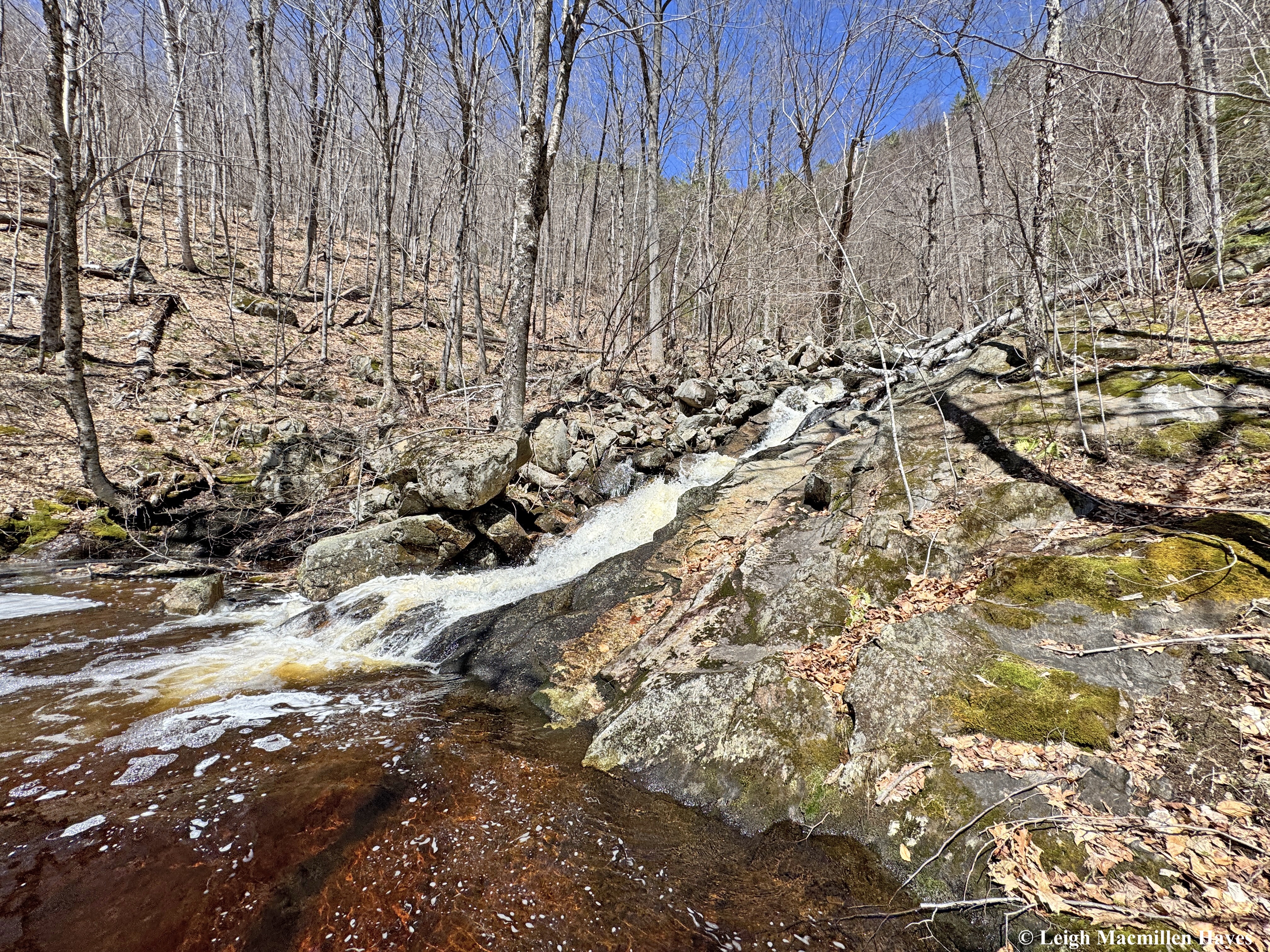
Next we reached a brook, where I’m sure the water cascaded over the moss-covered rocks in the spring when we experienced about fourteen rainy weekends, but today it was almost all dry, except for a few pools.

Creating a spider-web appearance on the pool’s surface were about a dozen Water Striders, so speedy in their dance routines.

And hiding at the edge, perhaps in hopes of capturing a Water Strider for a meal, was a Green Frog, with its dorsal lateral folds beginning behind its eyes and continuing down the edges of its back.

At the Cakewalk, for so a trail closer to Mud Pond is named, we met Mouth Rock. We’re pretty sure this wide-mouthed boulder ate all the cake because we never found any.

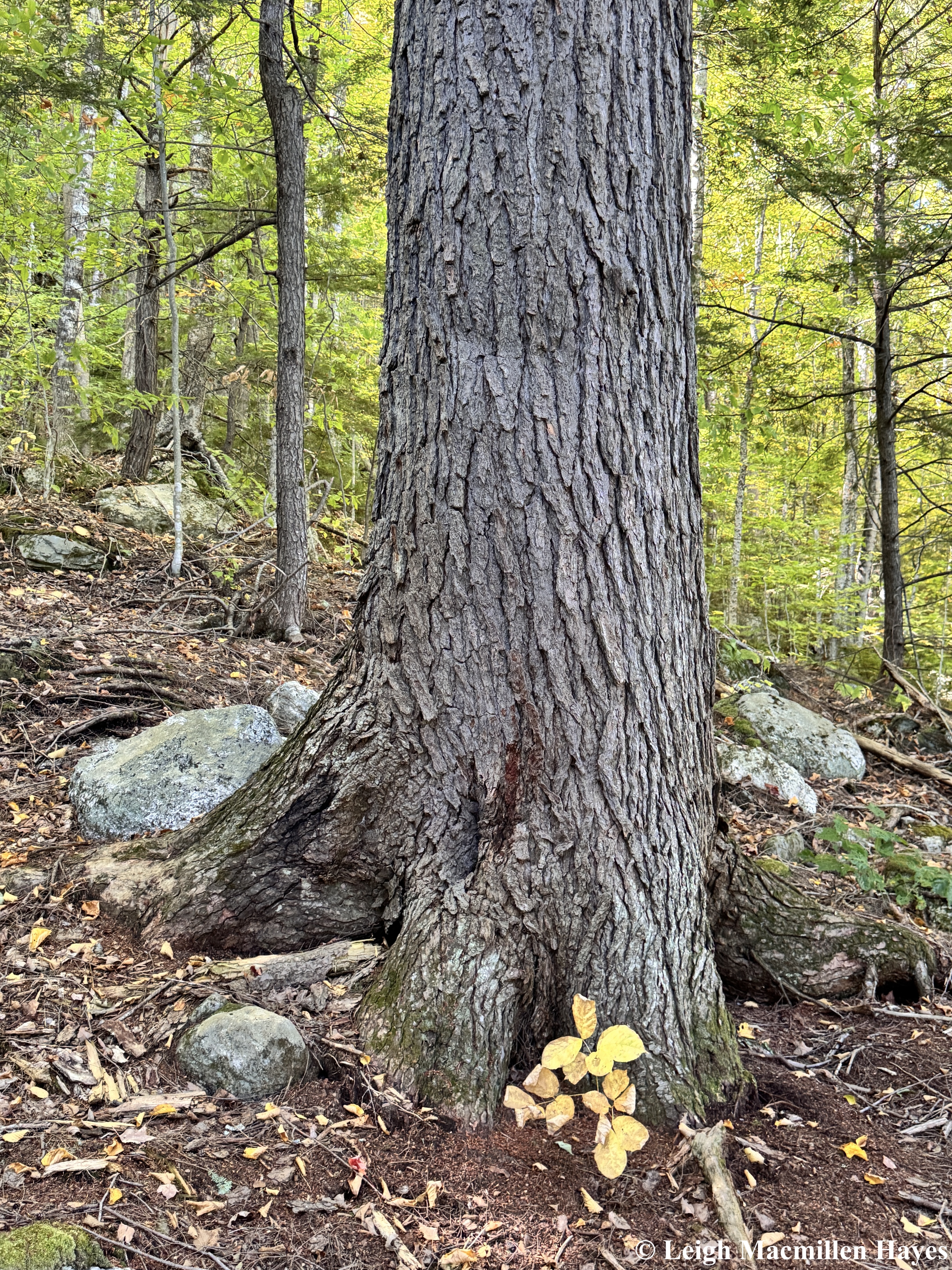
But our finds did include a champion! Co-champion actually–for the largest Eastern Hemlock in Oxford County according to Far Winde-A-Way Nature Preserve‘s website.

And I quote: The tree is: 10 feet in circumference, 90 feet tall, with a crown spread of 60 feet.

We also found this great specimen. Rock or tree? Tree or Rock? Rock and tree! Tree and rock!

Where does one end and the other begin for they looked like twins. Maybe that’s what happens when you spend so much time together. Kinda like some people looking like their dogs (we had a neighbor when I was growing up who always had beagles and he really did look like a beagle himself. Of course, we never told him that.)

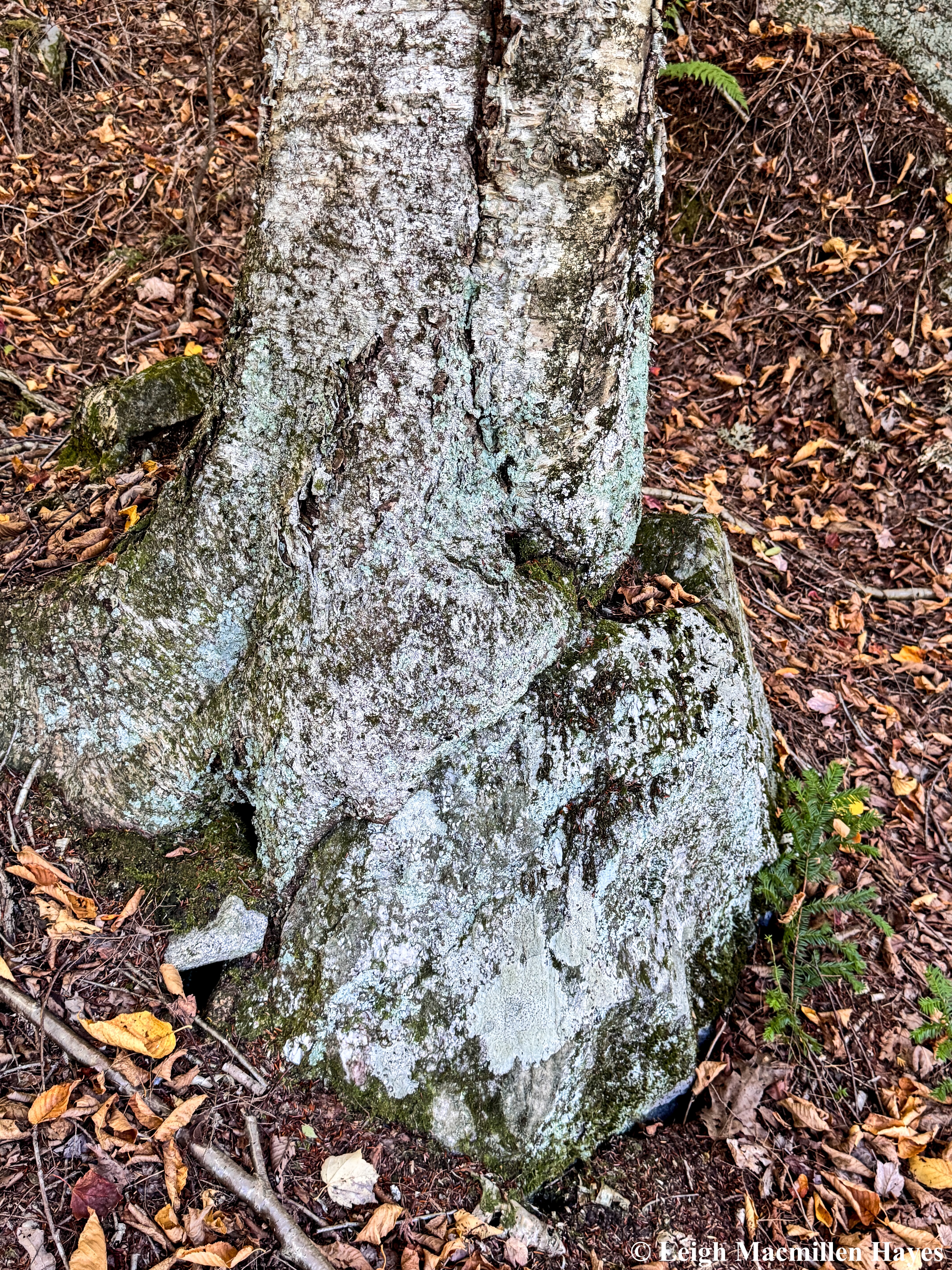
Anyway, this is a Yellow Birch that got its start in the moist soil that probably formed on the moss atop the rock and then sent its roots downward and trunk upward, but really, the two could have been one.

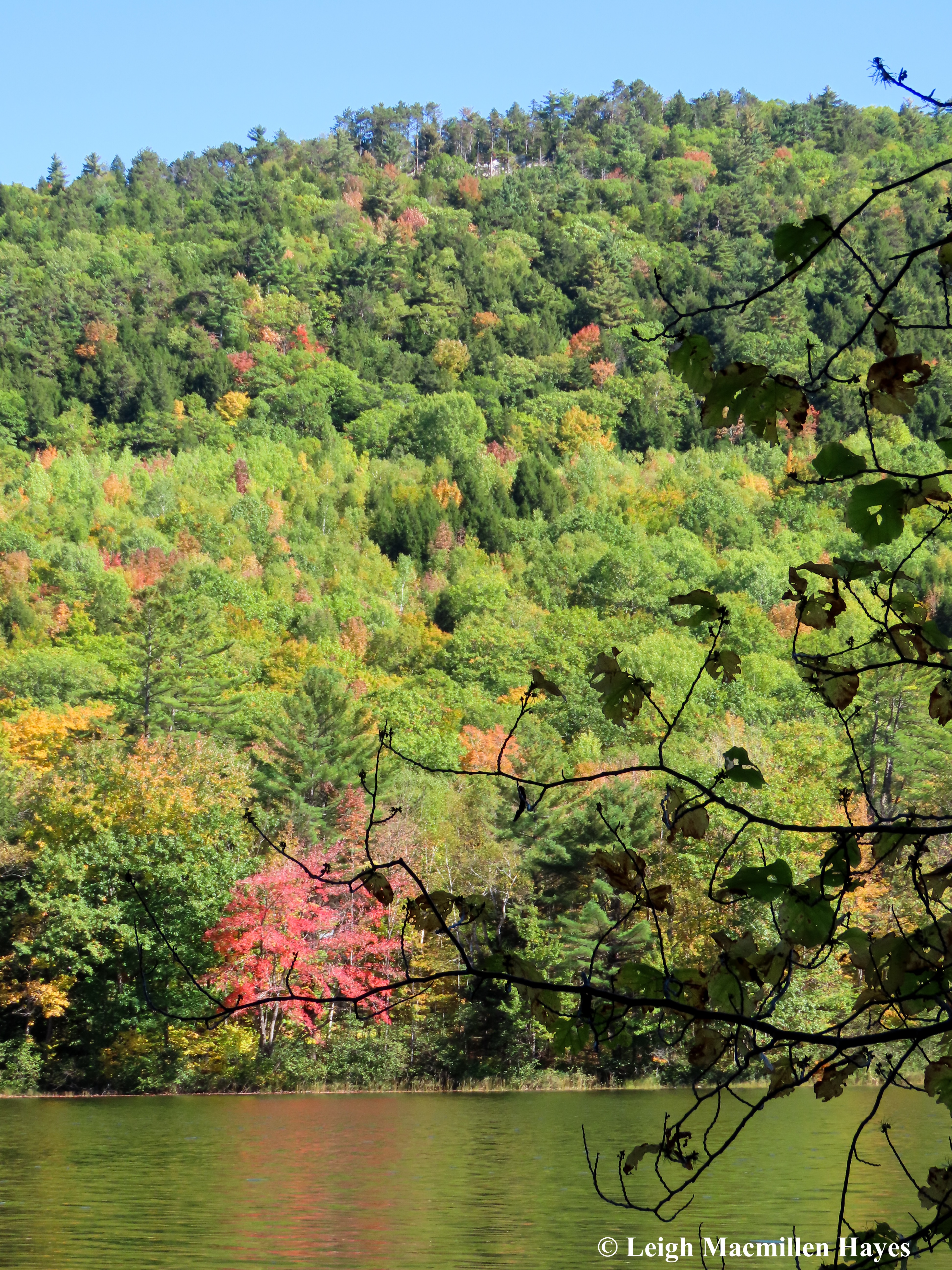
One of our last views before heading back up to the kiosk, was of Noyes Mountain again, only this time it included Mud Pond. And our early fall foliage season. Foliage reflections are among my favorite.

I’ll close this Far Winde-a-Way Mondate by giving thanks not only for My Guy and his love of new adventures, but also for the family that made these hiking trails available so that all of us could enjoy them: The husband and daughter of the late Pam Nelson. “This preserve is dedicated to the memory of Pamela (Roots) Nelson. For more than 30 years, Pam lived her dream to protect, conserve and enjoy these woods and waters. She roamed this rugged hillside and developed a trail system steeped in the natural wonders of the Maine foothills. Today you can enjoy some of the beauty she discovered.”

Pam passed away in 2022, but her family carries on her tradition, and this poem at the kiosk was written by her sister.

Thank you to M for suggesting Far Winde to us, and to the Nelsons for sharing it with all of us.

My Guy, The Giant Butterfly Whisperer

It’s Monday. And that typically means a Mondate for My Guy and me. Especially if he’s worked all weekend. And a Mondate most often means a hike. So, that being that, we headed off to conquer two trails today. Neither was overly long, and one was rather easy, while the other was moderately difficult. But both offered sightings that have us still smiling.

I’ll start with the second hike of the day because this is my blog and I can do that sort of thing. We were in Shelburne, New Hampshire, and so on our way back to Maine, we stopped at the Shelburne Forest, a trail we tried to hike a year or two ago, only the Mosquitoes or Black Flies or both were so thick, that after about a quarter mile we turned around and raced out–treating ourselves to ice cream sundaes in Bethel, Maine, instead.

Today was different. Blue Sky. Slight Breeze. 75˚.

We soon began to notice a theme along the River Trail. First we encountered several Fox scats, indicating this spot may have marked a territory. It seemed like it was important enough to return and leave a sign again, and again, and again.

A wee bit farther and more Fox scat.

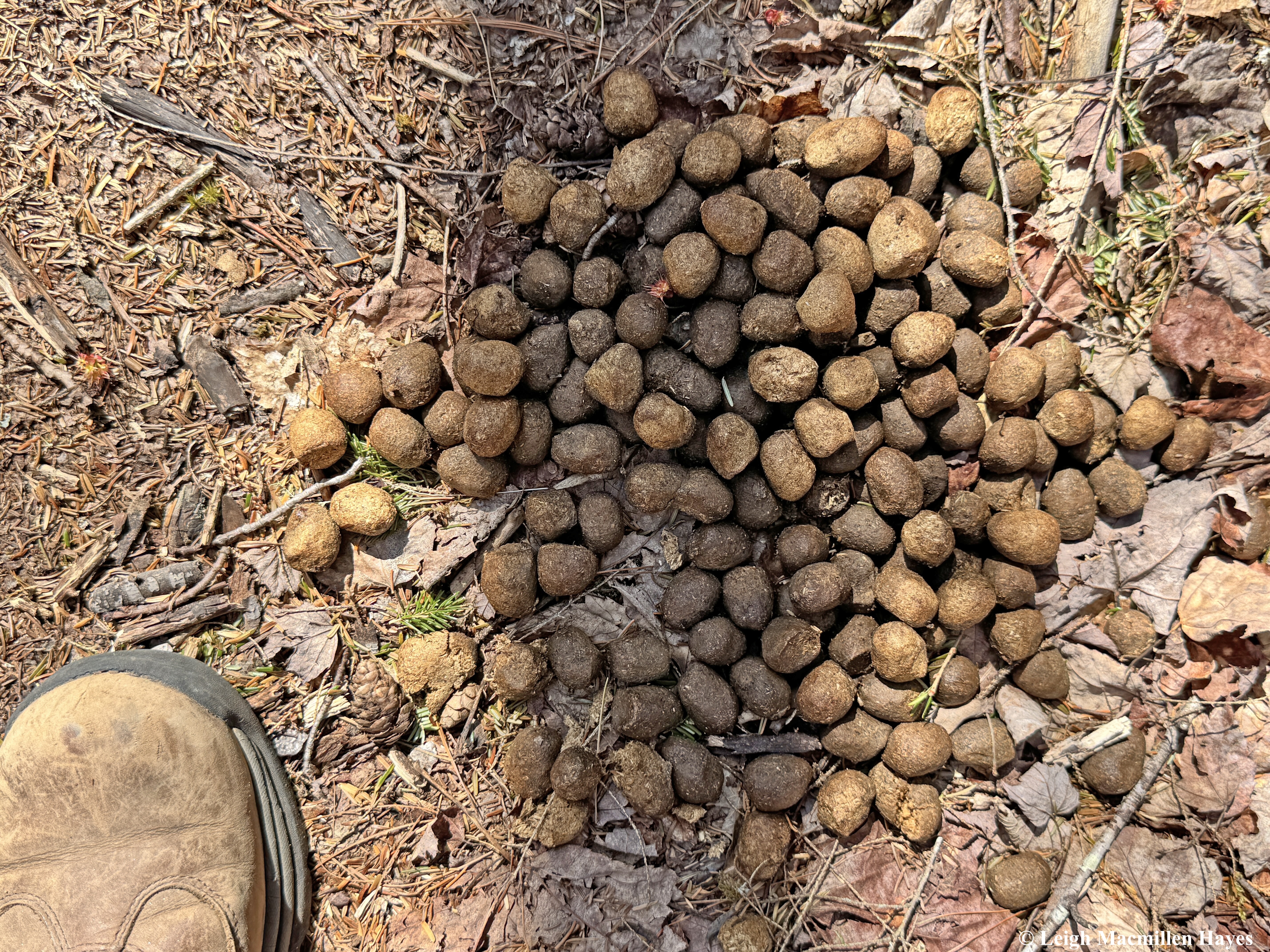
And several displays of Moose scat, this one being from this past winter, while another had more debris on it and was starting to break down, indicating a previous winter.

We also noted Beaver works in the form of a dam, plus some cut trees on the trail beside a steep embankment to the river. And deer prints and scat. And coyote scat.

I mentioned that I’d like to come back in the winter to see who spends time here.

My Guy’s response, “Anyone else might think you were talking about people, but I know you are not.”

He gets me!

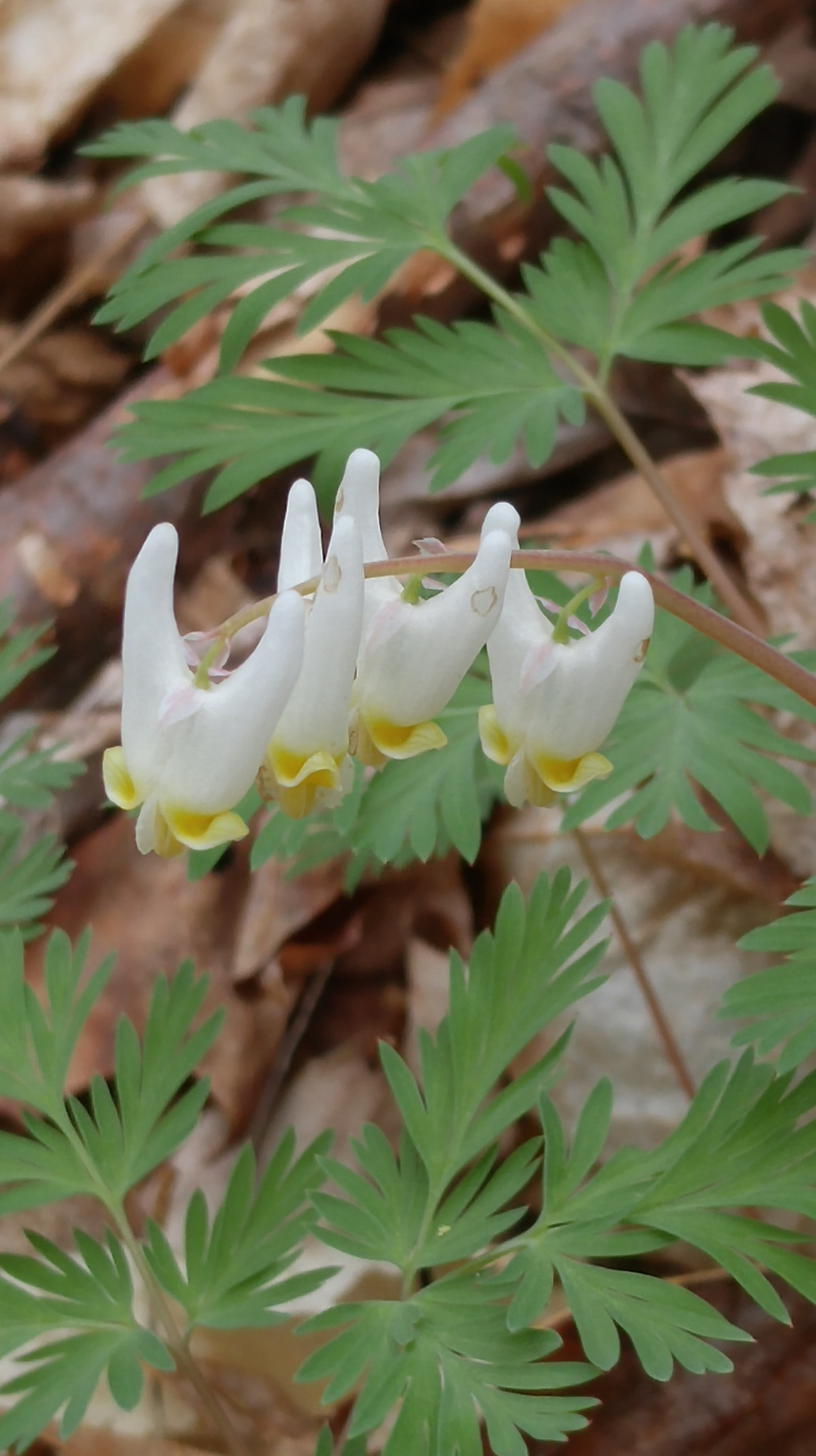
I had two other favorite sightings along this “Scat” trail. The first being the leaves of Trout Lilies. NUMEROUS leaves of Trout Lilies. So now I know I need to return soon to see the flowers, rather than just wait until winter.

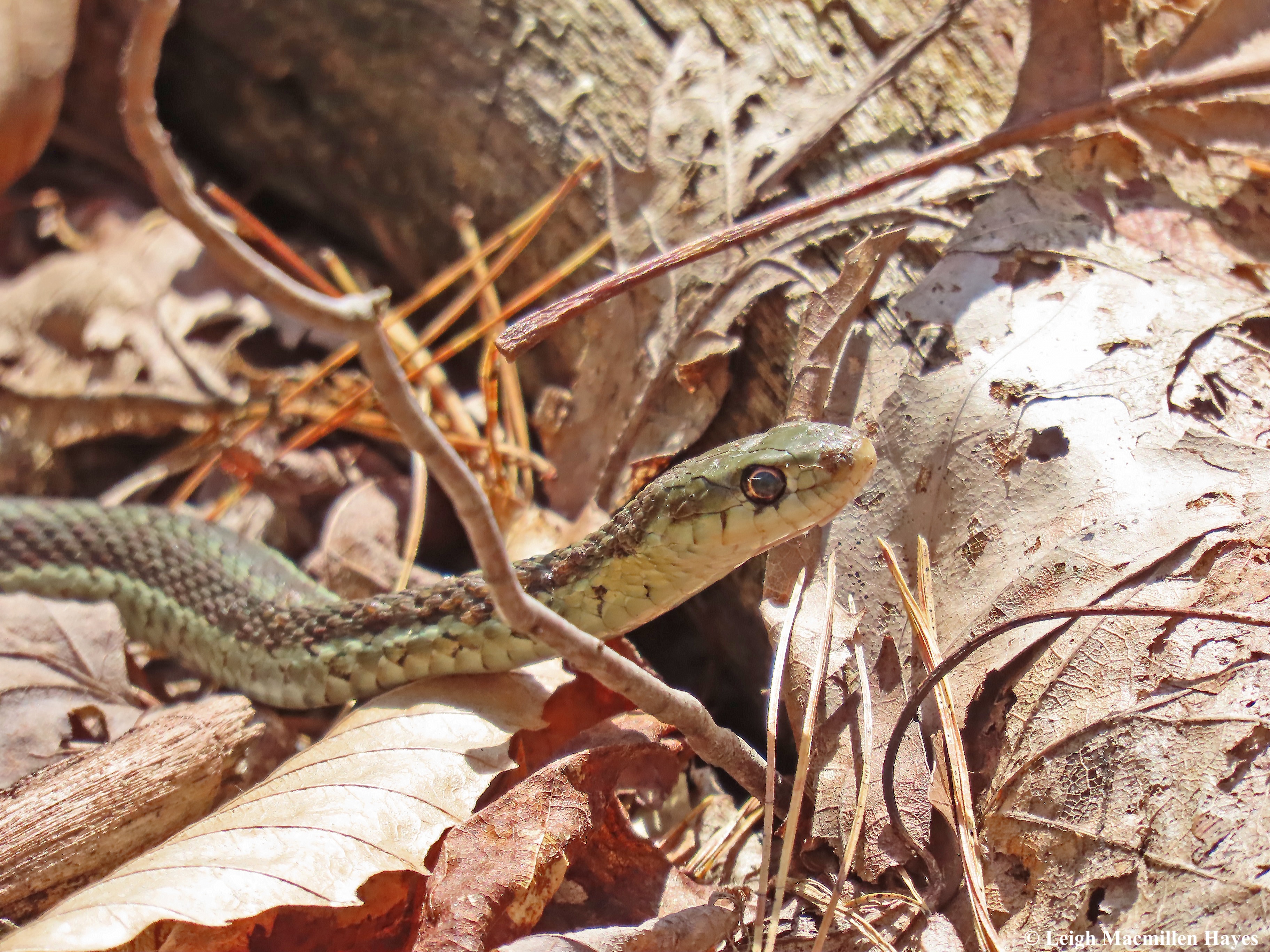
And a Garter Snake that surprised My Guy because it was in the middle of the Forest Trail as we completed a loop, but quickly slithered away.

I kept hoping it would stick its tongue out to get a sense of its surroundings, but for some reason it didn’t honor us with such.

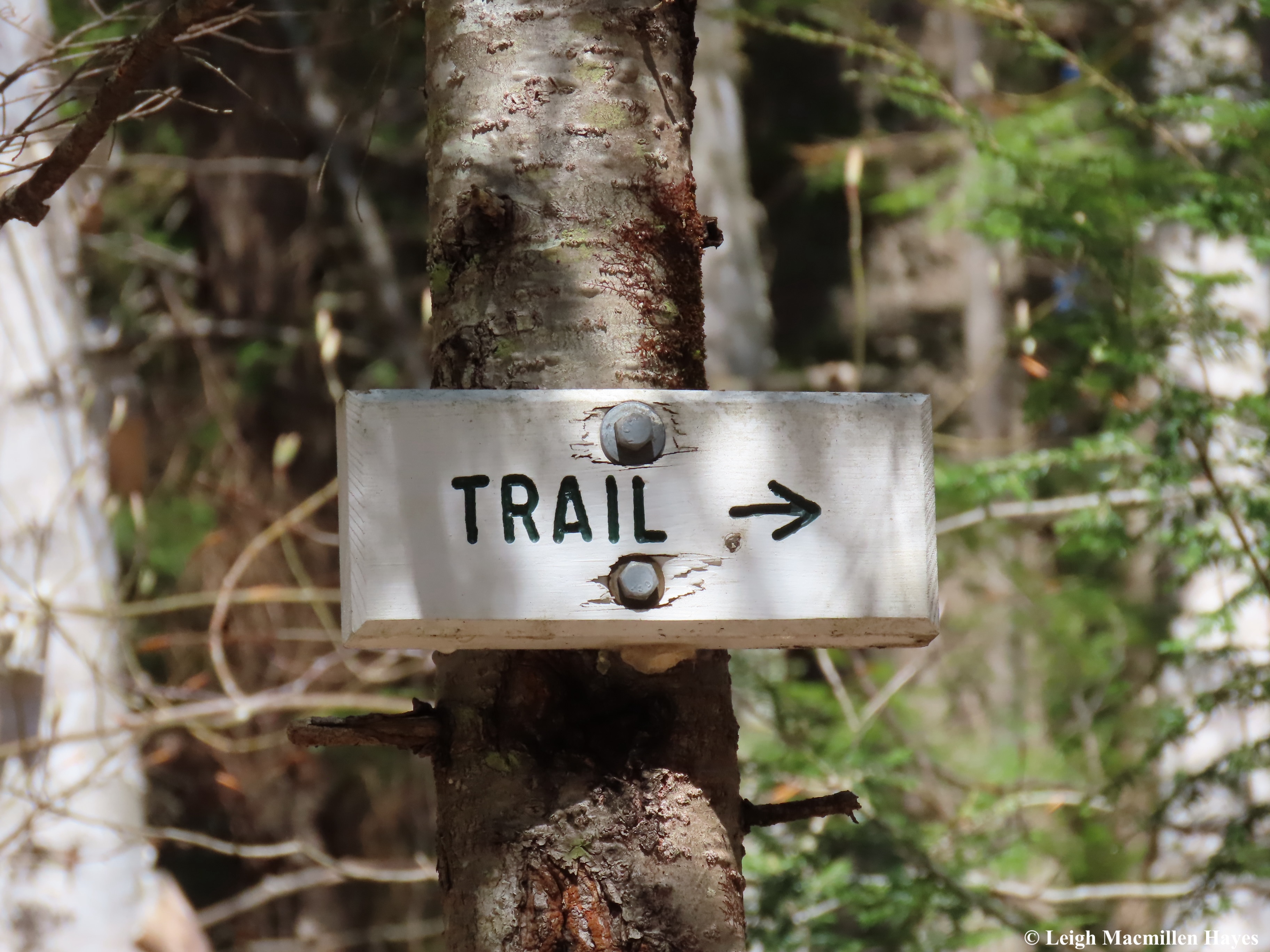
Now it’s time to turn back the clock and head off on the Peabody Brook Trail, which was our late morning hiking spot, the first hike of the dat. We were grateful for signs like this when the trail crossed a logging road.

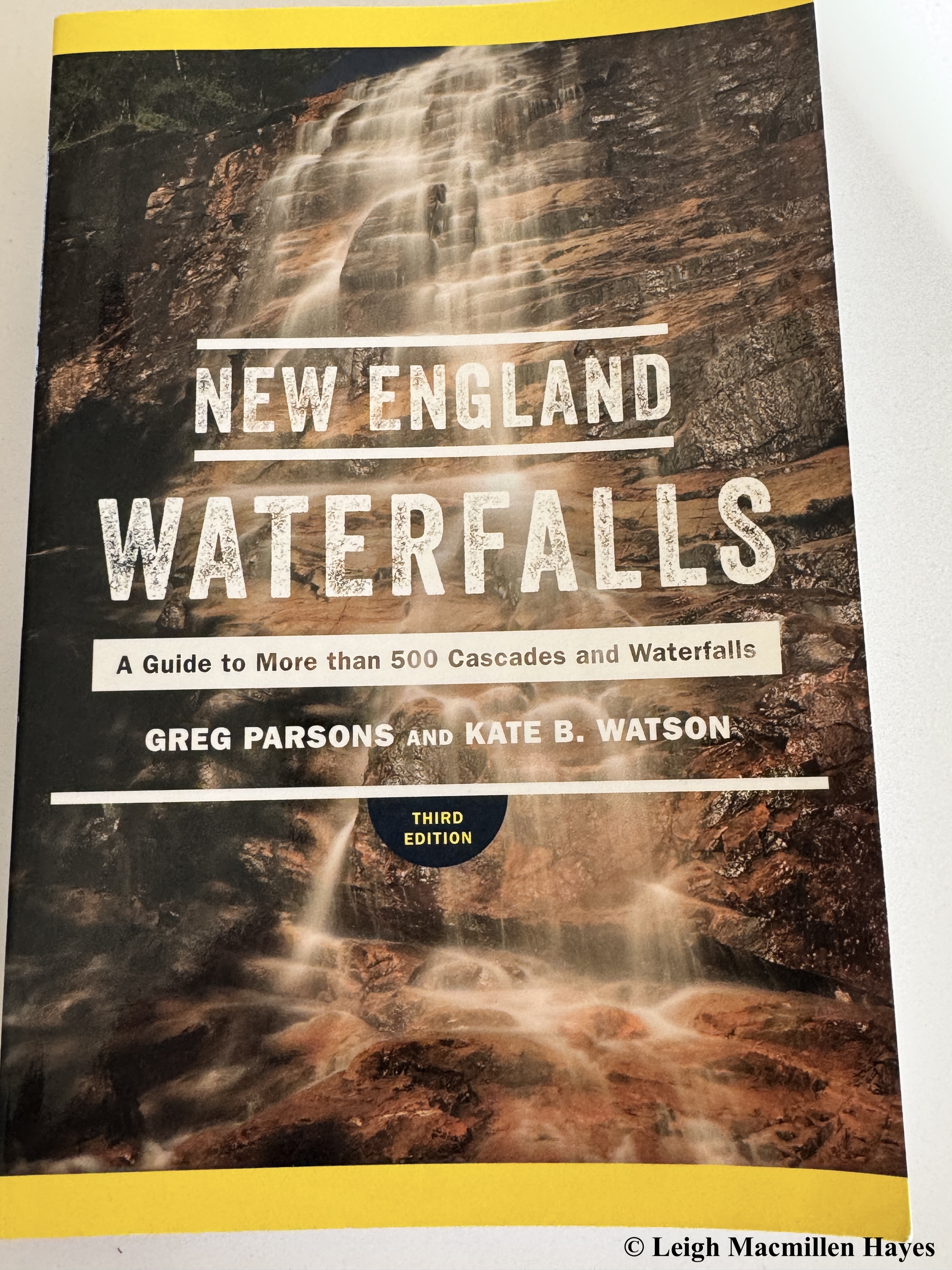
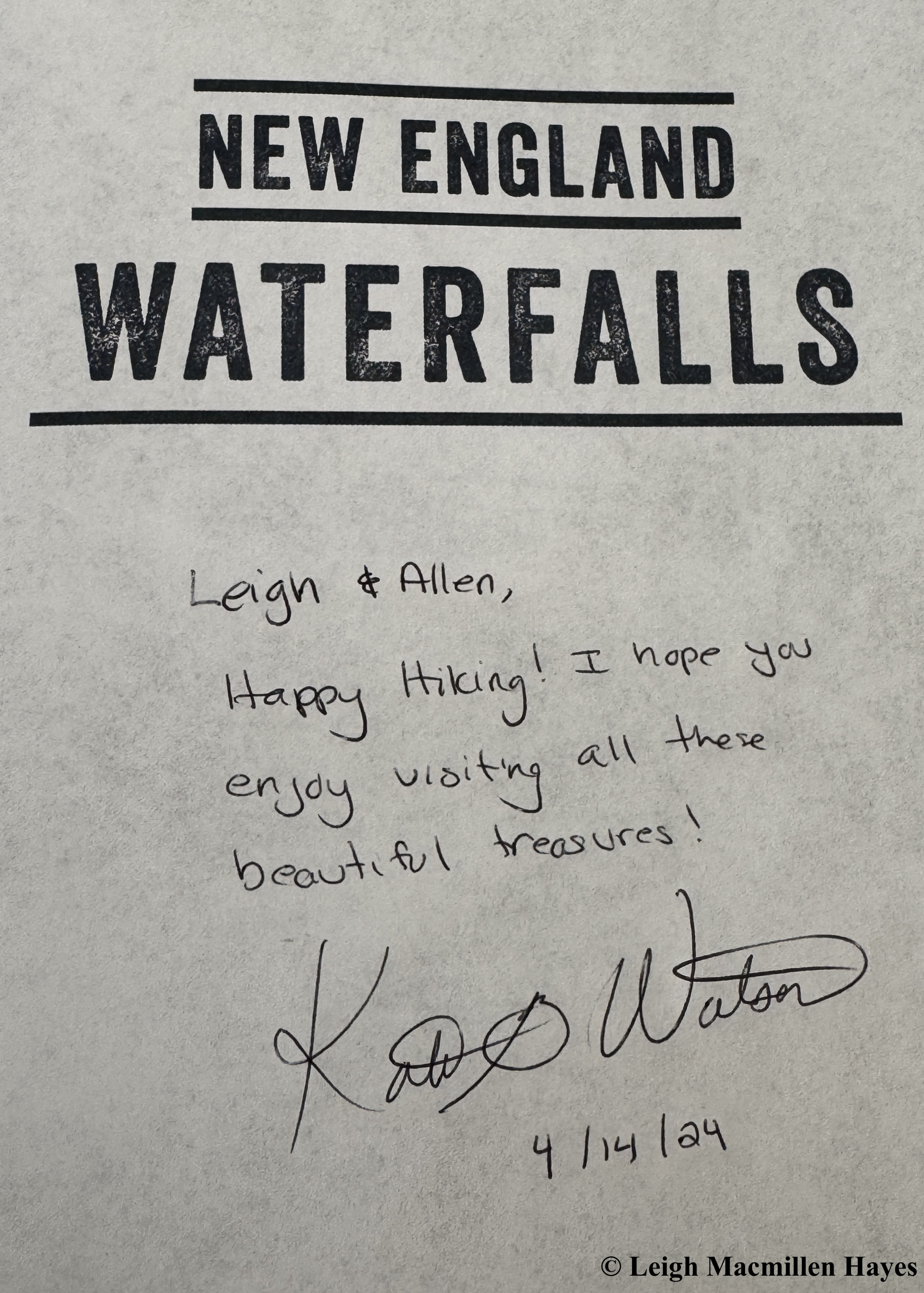
We chose this trail because we’d read about it in New England Waterfalls, by Greg Parsons and Kate B. Watson. I know Kate from church and love that these two visited waterfalls throughout New England to include in their comprehensive guide. We’ve visited some, but have so many more to do.

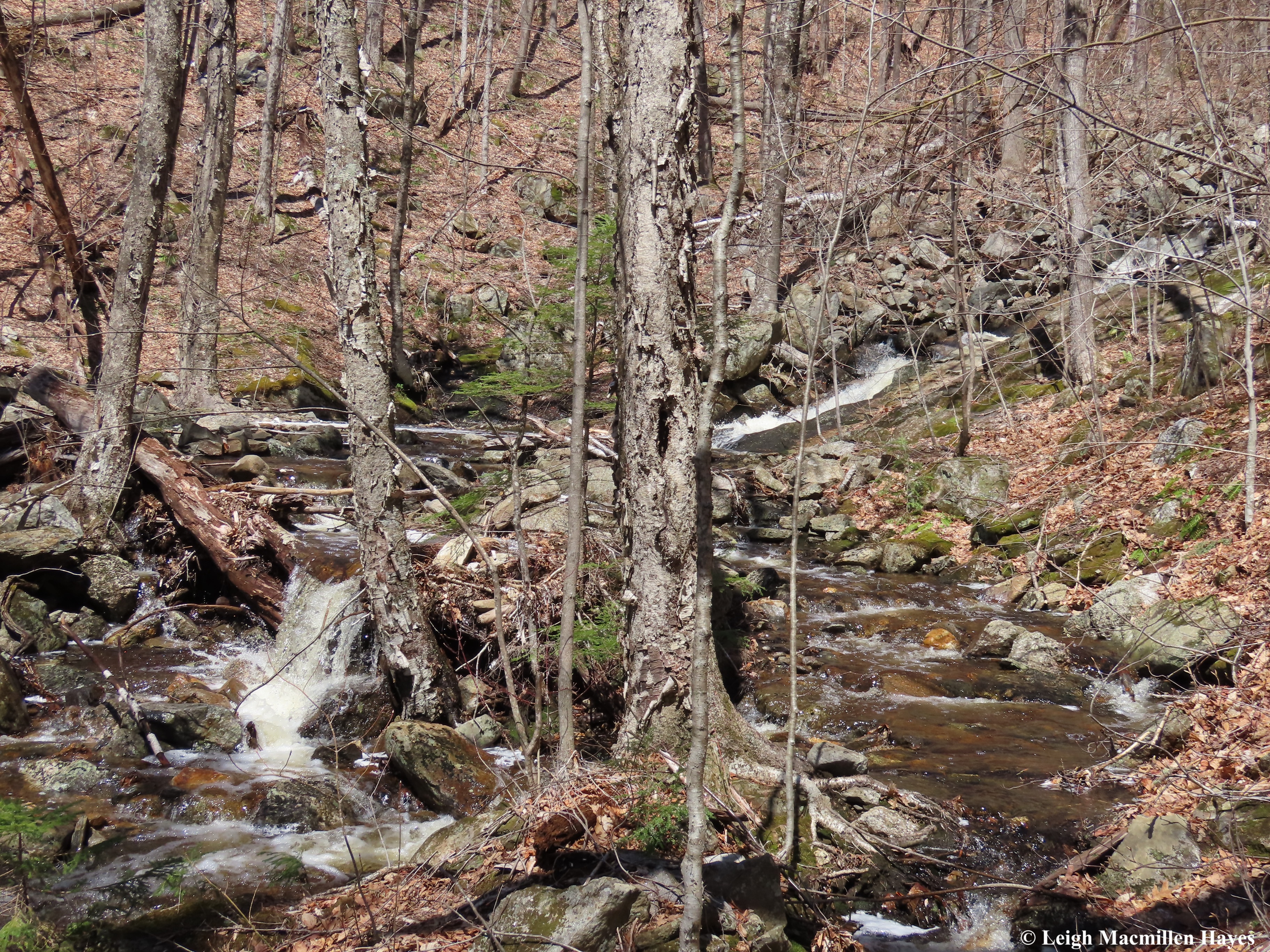
At the beginning, the Peabody Brook flows through a ravine and due to a rainy weekend, it cascaded over, around, and under the boulders, and was an ever-present companion for much of the trail.

Other companions included several Anglewing Butterfies, that I couldn’t identify until I saw their underwings, as the markings indicate either a Comma or a Question Mark.

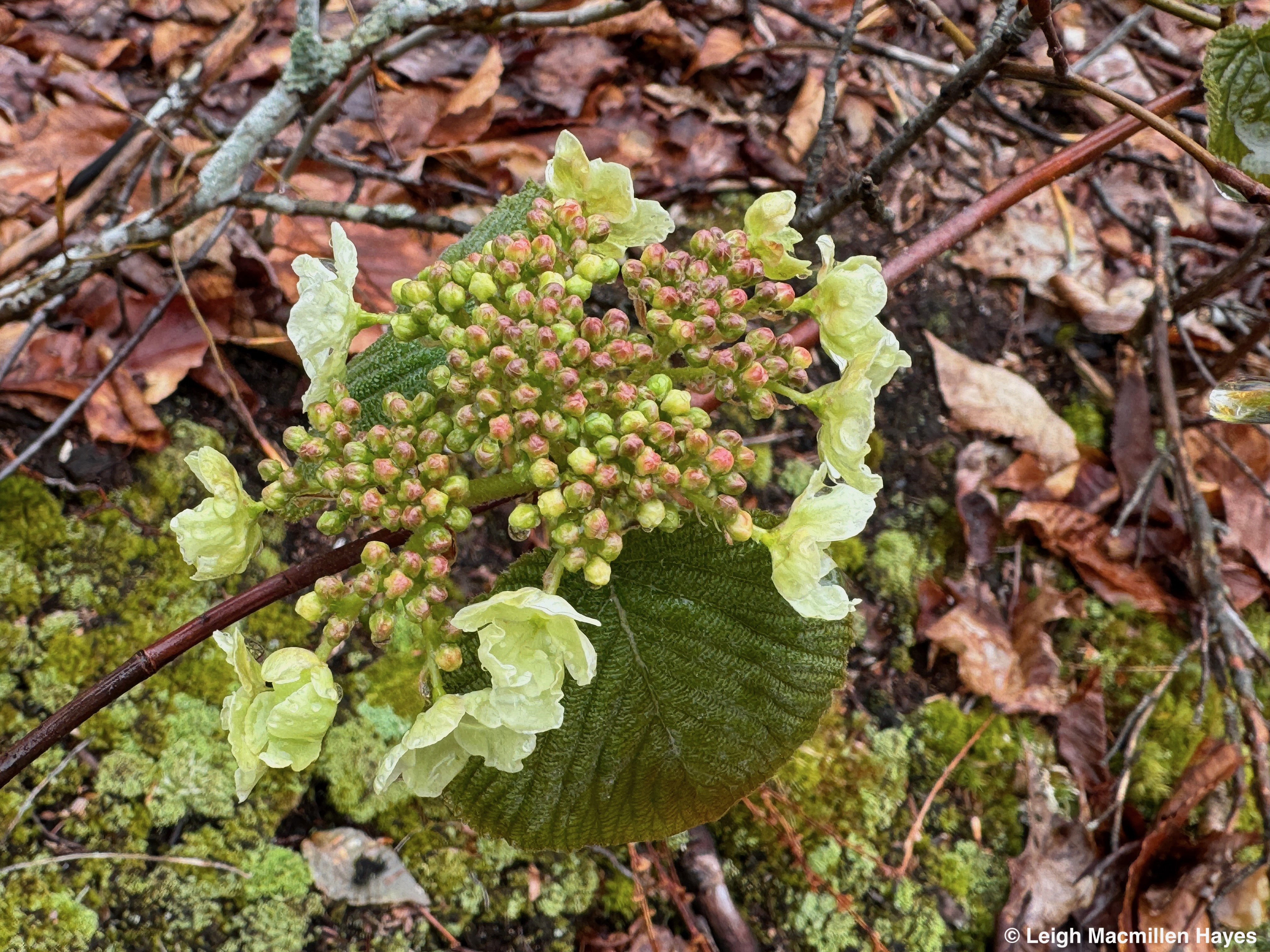
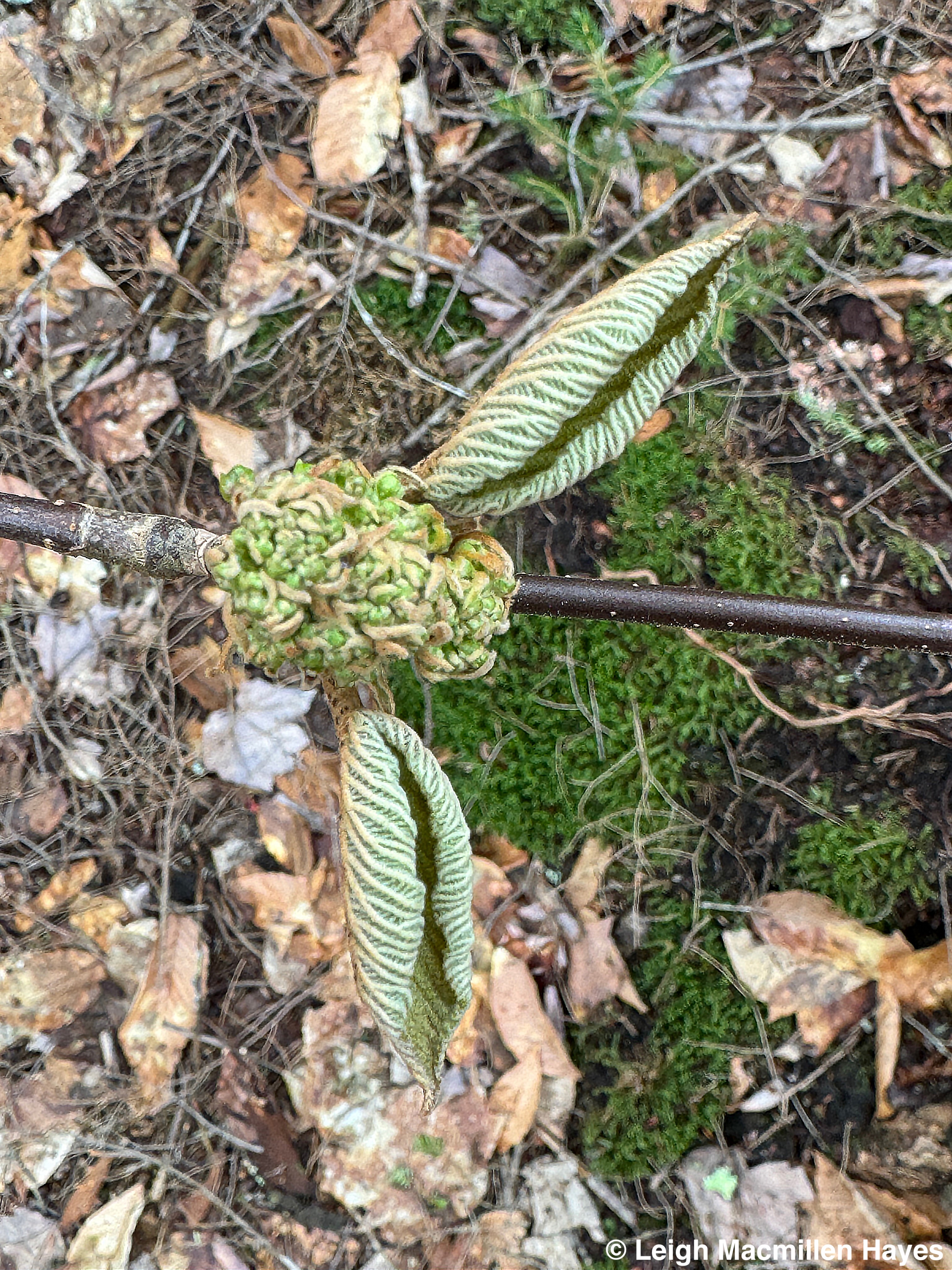
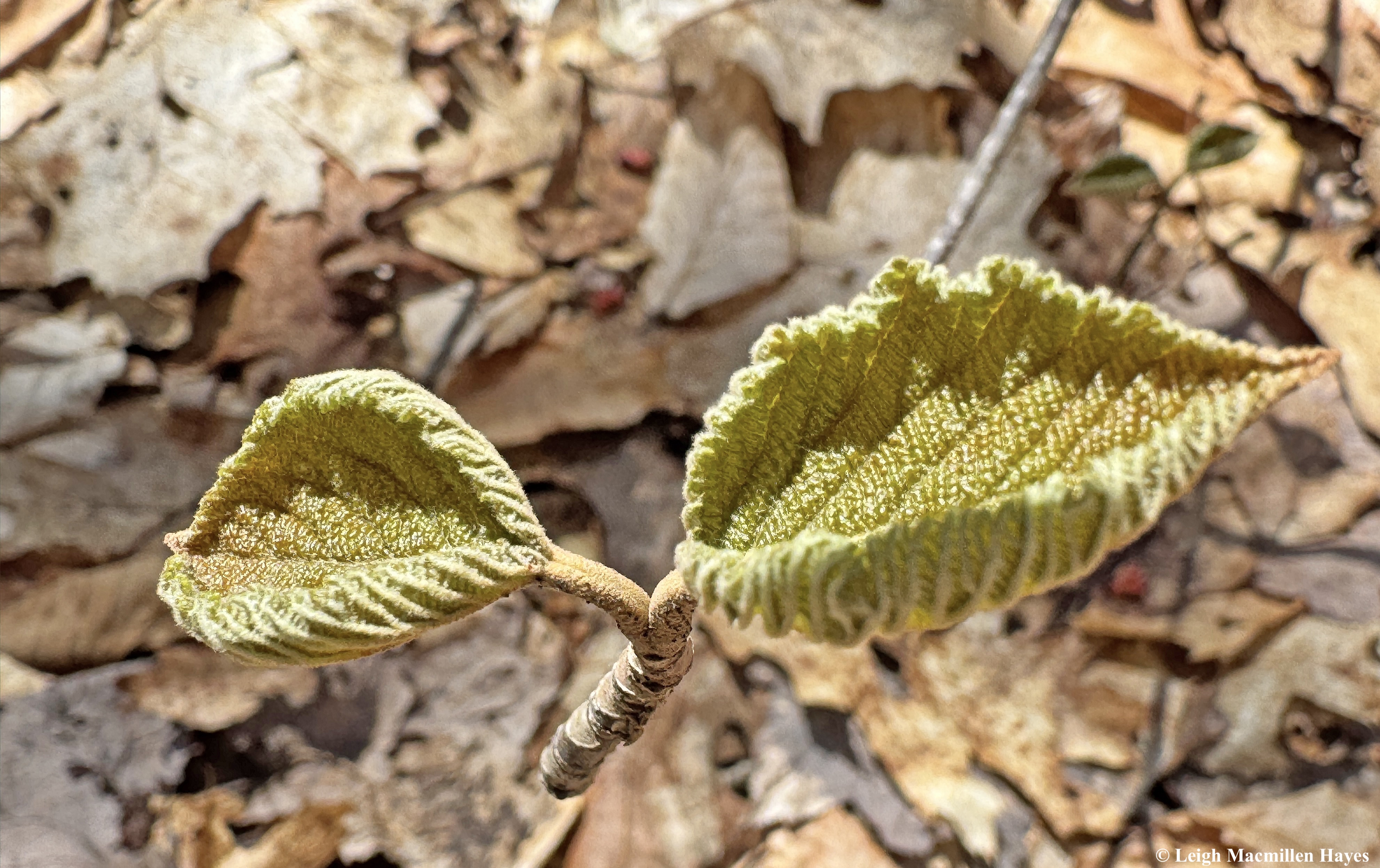
And there were Hobblebush leaves, with their corrugated presentation, beginning to unfurl.

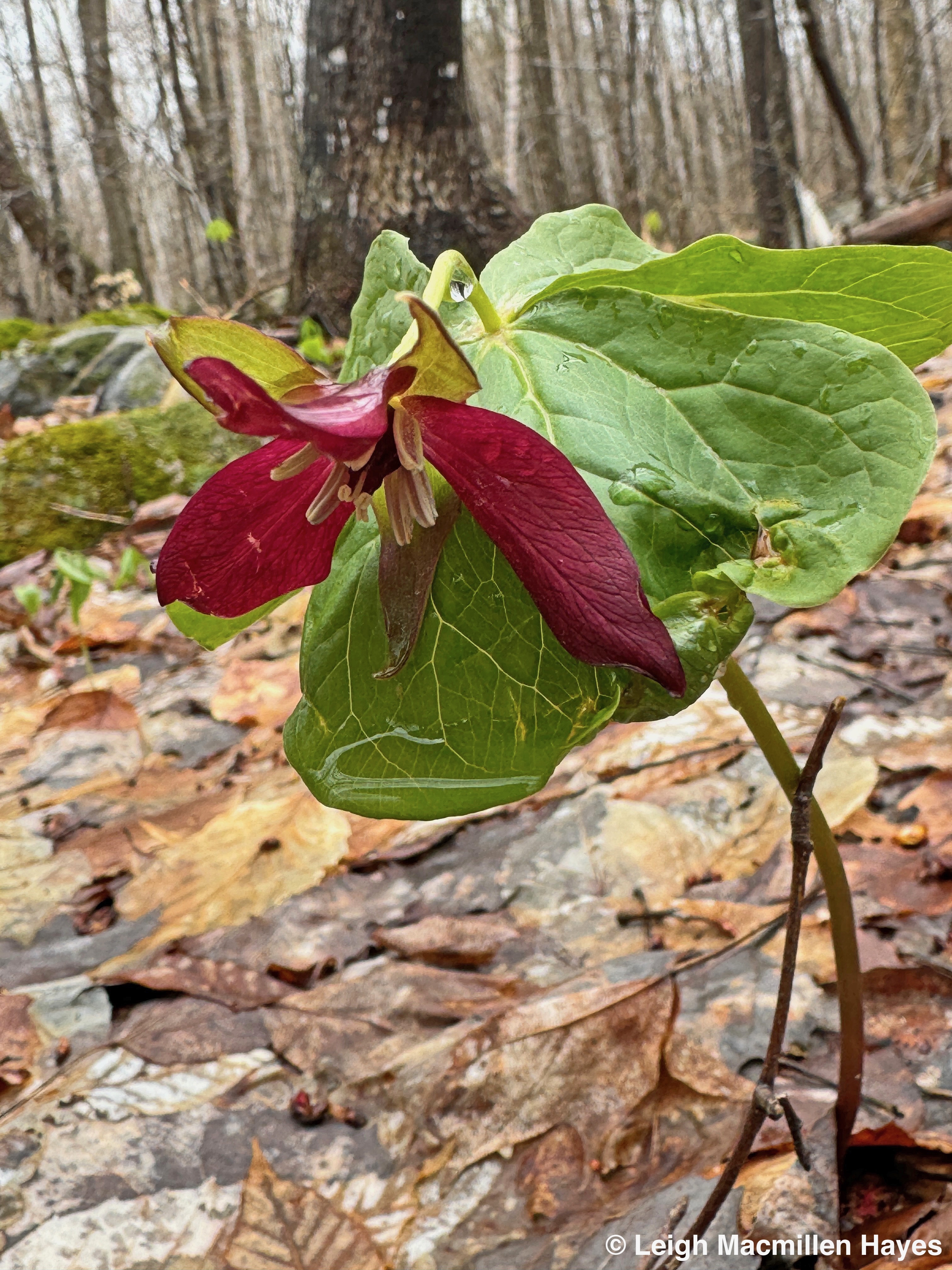
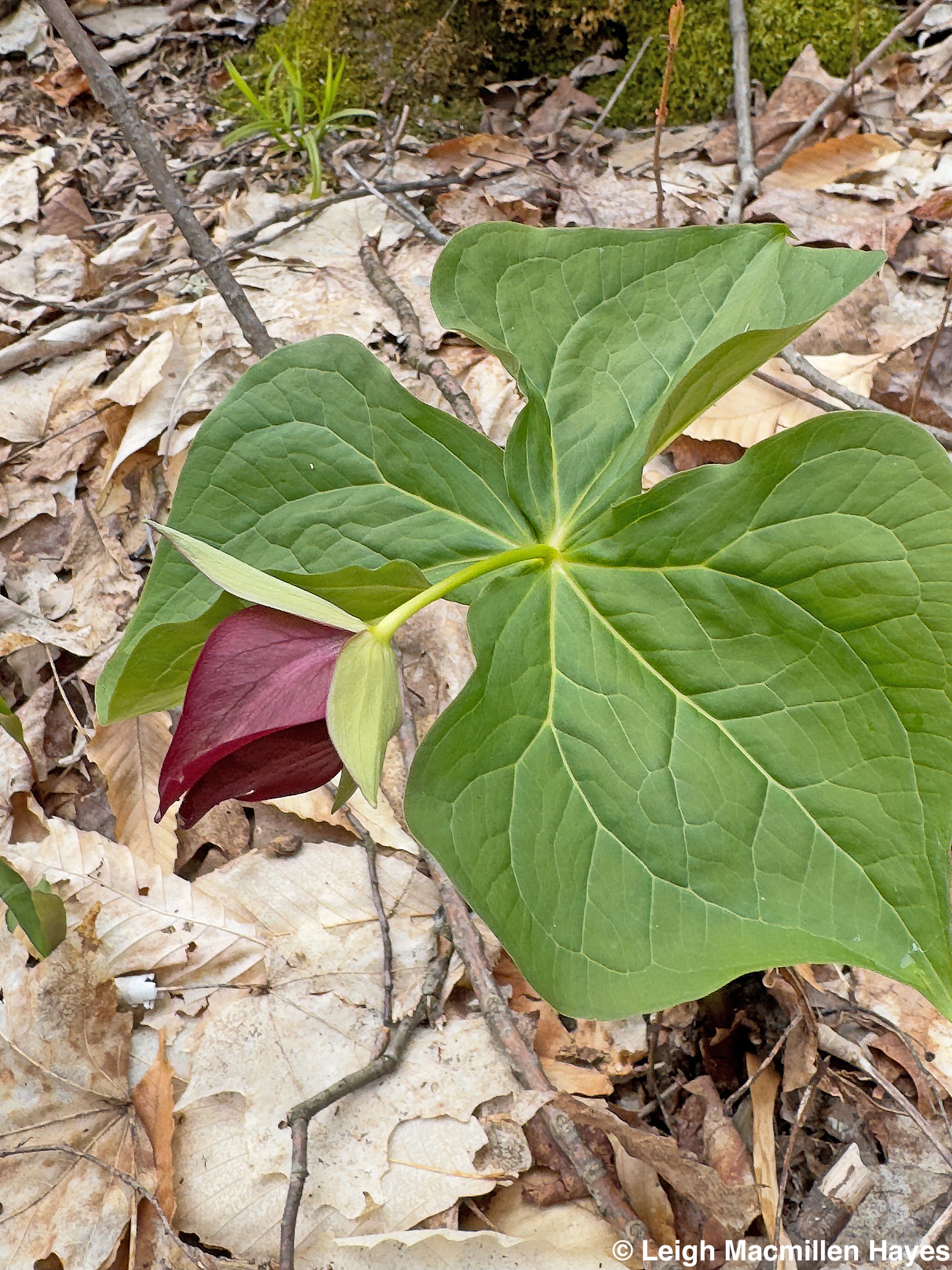
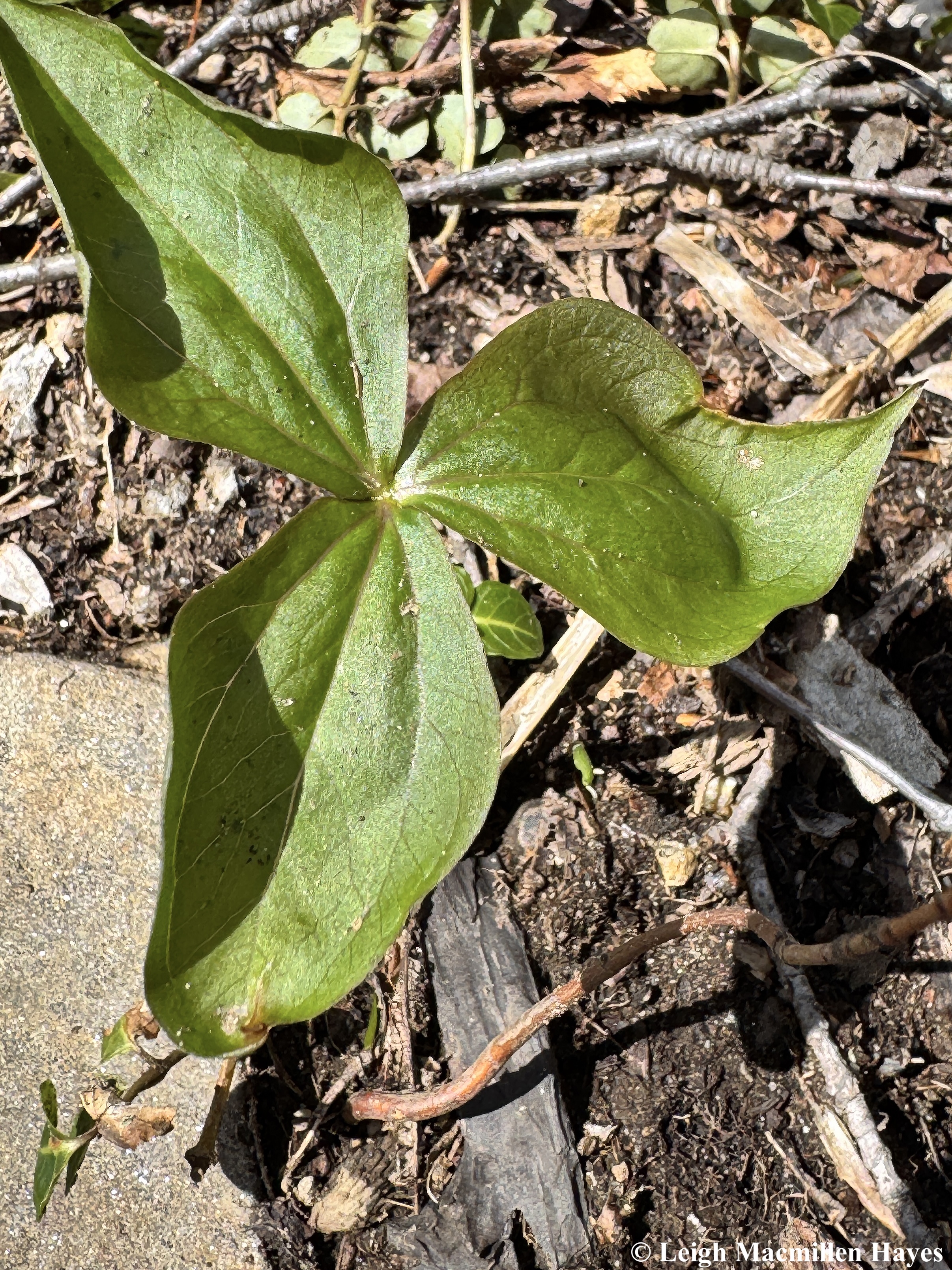
Plus a few Painted Trillium plants showing off their leaves of three, though no flowers yet, and causing My Guy to comment, “You’ll probably take a trillion Trillium photos again this year.” Did I say he knows me well?

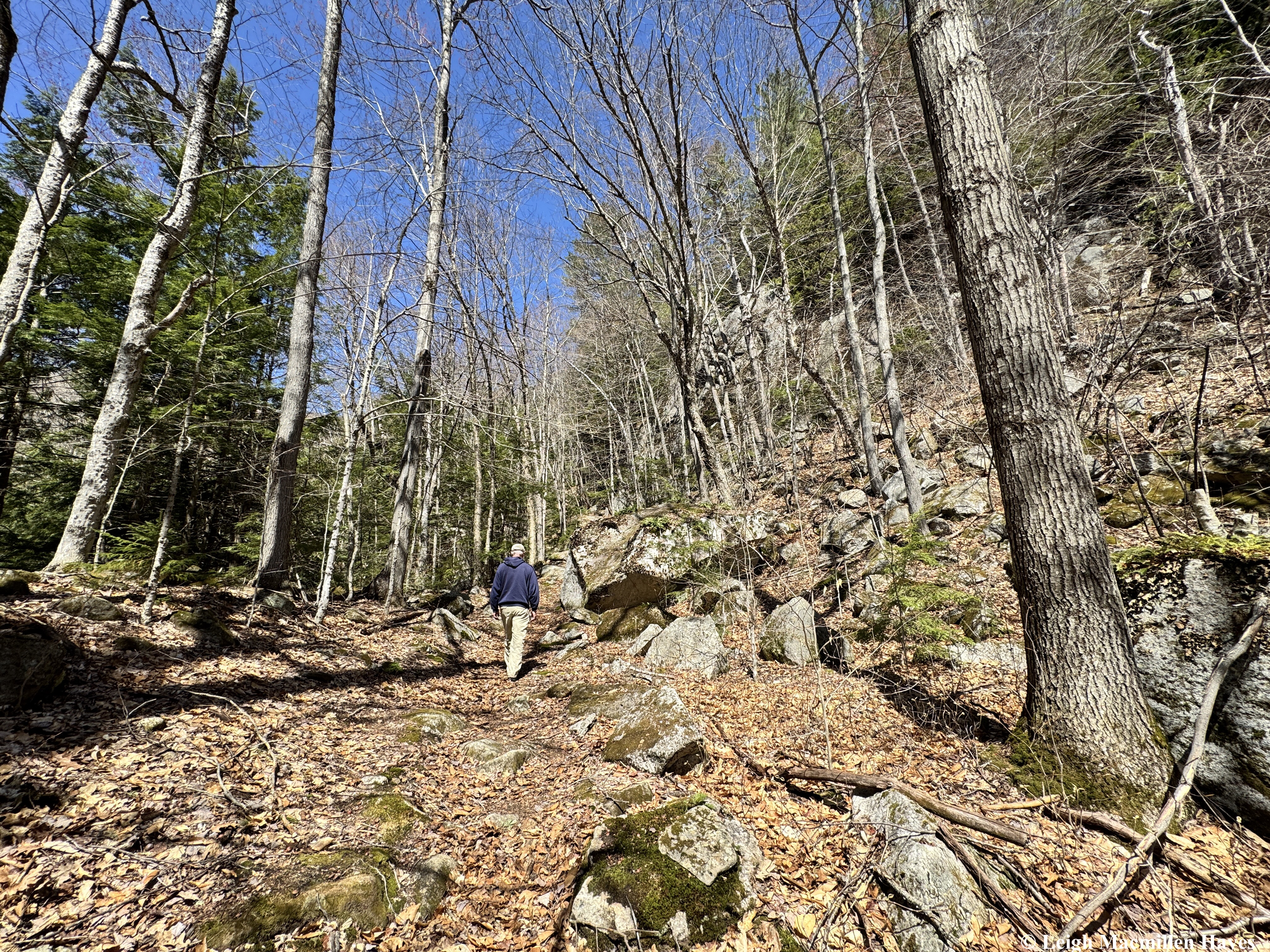
Upward we climbed into the great blue beyond, for so it seemed on this gorgeous day.

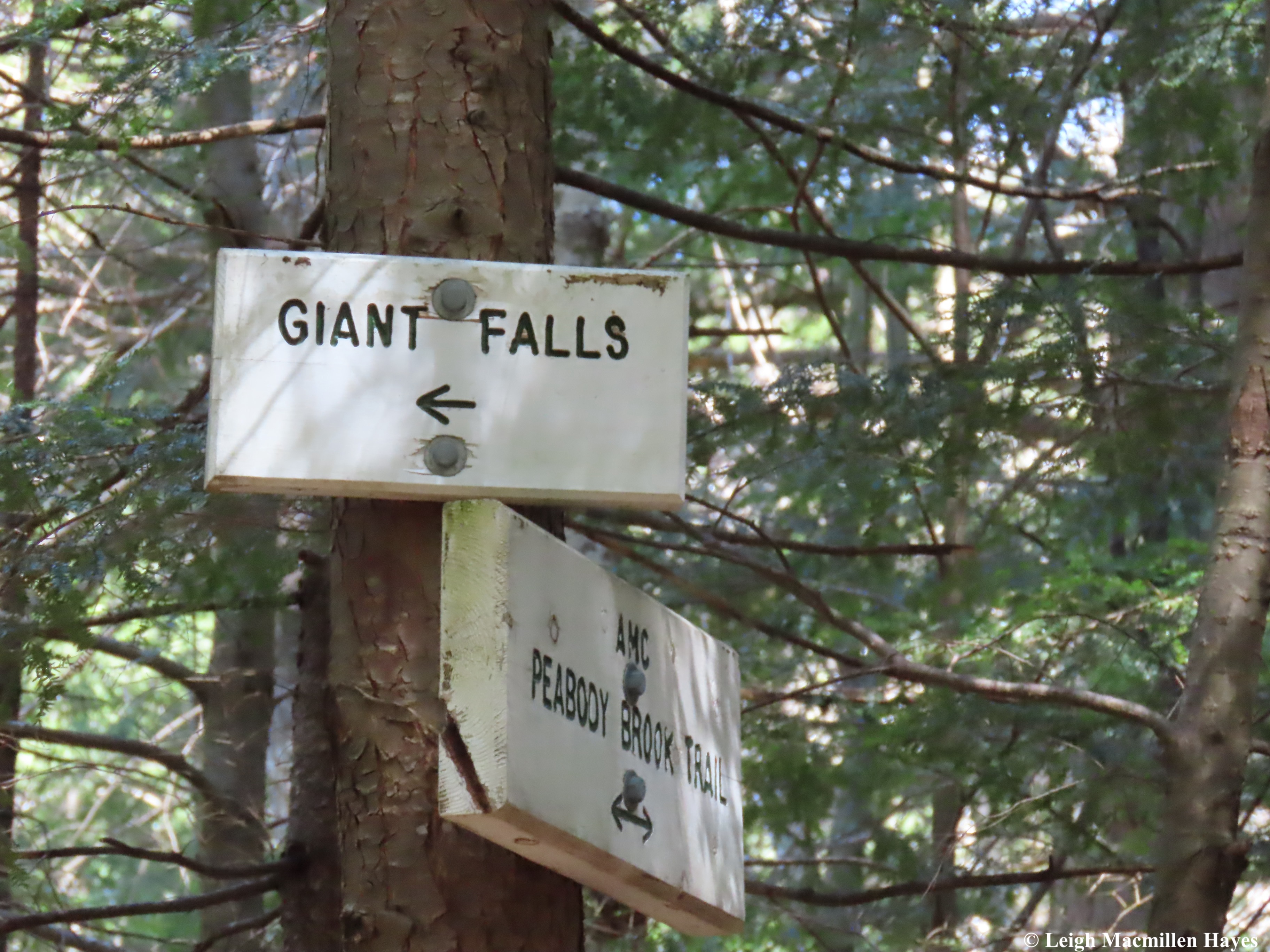
And then we reached a junction, and I, for one, was excited about what might be ahead.

Would we meet Devlin, the giant in my fairy tale, The Giant’s Shower? After all, he lives only a giant step away at Arethusa Falls.

I also thought we might see a few fairies, including Devlin’s favorite, Falda, for such was the neighborhood, with lots of mossy areas among the Hemlocks.

And then My Guy got excited when he spotted something? A giant? Maybe, but in the form of Giant Falls, and if you allow your eye to move a wee bit to the right of his pointer finger, you’ll see the white water through the trees.

Where we’d left the brook for a bit as we climbed up, the spur trail led us back down and suddenly there was fall after fall after fall beside us.

We considered eating lunch beside a large pool. But then reconsidered, but not before I noted some features of the brook that I’ve been sharing with a homeschool family this year. A POOL.

And EDDIES. And FLOWS.

And FOAM. And that very foam was being picked up by the breeze and “snowing.” Oh how my ten-year-old friend would love that.

Do you see the little white dots above the water and rocks?

We decided to hike farther up the steep trail to reach lunch rock so we could enjoy the power of the falls fanning over the boulders.

Take a moment to listen to this incredible force of nature.

After taking in the scene around us, it was time for lunch. And that’s when the magic began to happen.

A fairy flew in. I kid you not.

That’s just a butterfly, you might think. “Just”? No, no, no. I’m sure it was a fairy disguised as a butterfly, because the fairies don’t want us to know that they are present.

And . . . it landed on My Guy’s right leg.

As we both watched quietly, it walked down his pants to his hiking shoe.

And then it began to puddle. PUDDLE. ON. HIS. SHOE. LACE.

Puddling is a butterfly act intended to seek minerals and other nutrients from things such as scat, carrion, puddles, etc., but a shoe lace? And on My Guy’s shoe lace? What, indeed, could the lure be?

We’ll never know. But what we do know is that the Anglewing Butterfly was an Eastern Comma, based on the white comma shape on its underwing.

Spectacular.

The butterfly spent at least five minutes with My Guy: who seemed to appreciate that he had suddenly turned into a Whisperer. I don’t know that he’s ever held that status before.

When we finally departed, we had to hike back out along the same trail upon which we’d journeyed in, and . . . cross a bridge that bowed in the middle. Certainly the sign that a giant frequented it.

My Guy: The Giant Falls Butterfly Whisperer.

Worth a wonder.

P.S. No, there will not be a sequel to The Giant’s Shower. Self-publishing is expensive and I still have a bunch of books left from the second printing because I’m terrible at promoting it. It’s easy to do here on the blog, but not in real life.

Easter 2025: An Interwoven Weekend Celebration

Hindsight being what it is in offering 20:20 vision, maybe I shouldn’t be surprised at how this weekend played out, but going forth without expectation always offers the best of the best.

The weekend began on Good Friday, when after completing some errands, I wandered along a local trail for far longer than I intended, and in fact, had to pull myself away to get home in time to attend a Taize service at church.

Walking alone gave me time to reflect on the past and be present in the moment.

And that’s when I spotted my first Painted Turtle of the season, who offered a reflection all its own.

I still have some of the man-made Turtles I collected as a kid, but love when the real deal presents itself. And by traveling alone, I wasn’t making much noise, and so the Turtle didn’t suddenly plop into the water and disappear.

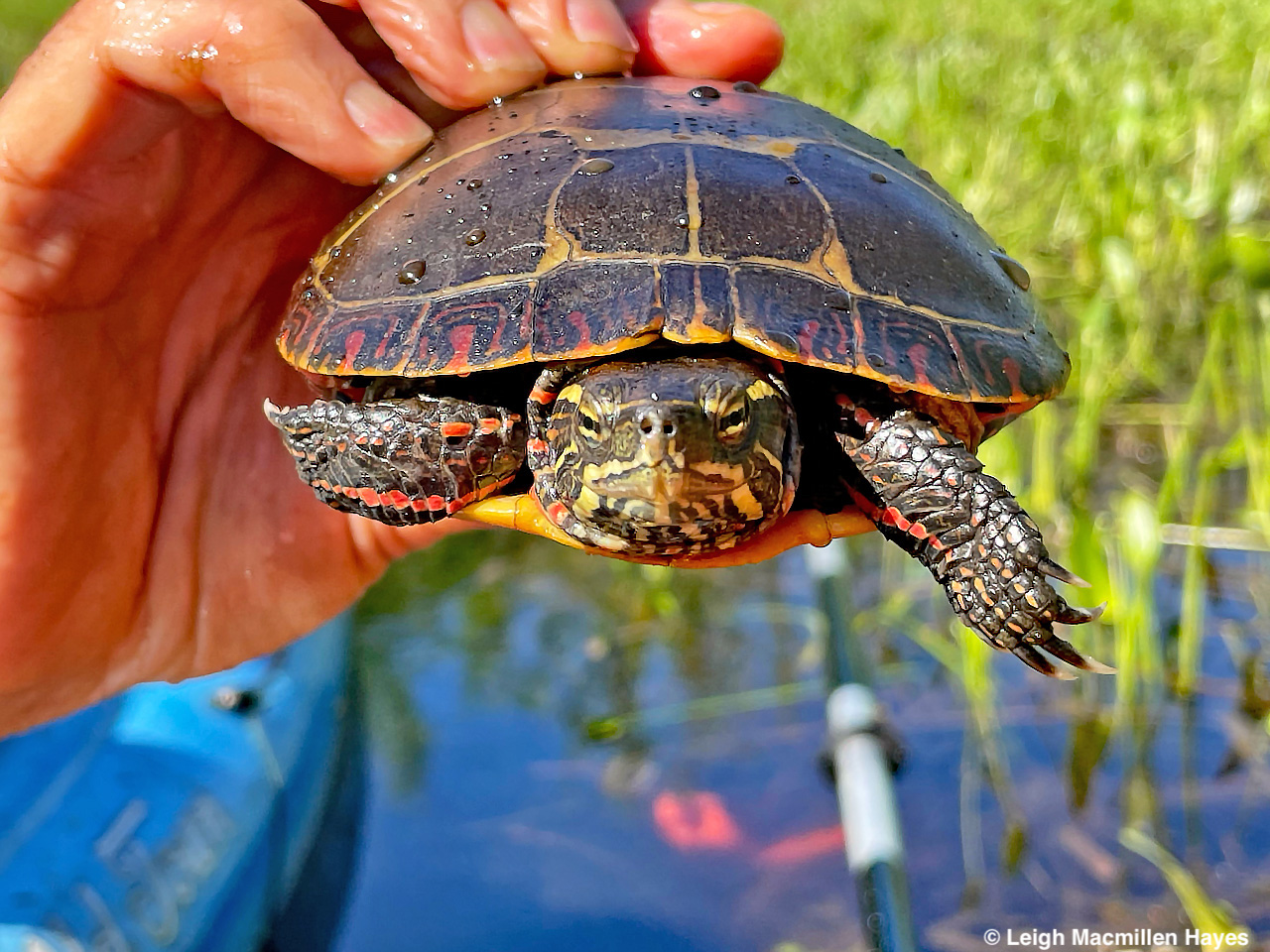
Along the same trail I nearly stepped upon another Painted Turtle, who immediately pulled its head into the shell, as only this species can do. It was in a spot where cobblestones cover a culvert, and I decided I should help it cross to the other side.

But first, I insisted that it pause for a selfie. Based on the length of its nails, being on the shorter side, and flat bottom shell (plastron) as opposed to the concave bottom of a male, I decided this was a female.

And a beautiful female at that–in color and pattern and texture. Amazing.

It took her a few seconds to decide the world was still a safe place, but once she started to move, it was a quick journey to the water before she swam out of my life, and I wished her well while giving thanks for our short time together.

Once I cued in on there being turtles in this place, I quickly realized they were everywhere. I counted eight on one semi-submerged log. And in this photo there are two.

Can you locate the second one?

And then I had another surprise, and this was the main reason I probably overstayed my welcome.

At first I thought it was a beaver, until I looked at its thick rounded tail and knew I was in the presence of a Muskrat.

Usually Muskrats disappear in my presence, but I think again, because I was willing to stand still and be as quiet as possible, this one did not dart off.

It did, however, dine in places where I came to appreciate its camouflage coloration.

Other times it was in the open so I could better watch as it munched on vegetation, holding the plant matter with both small front “hands.”

As I finally walked back to my truck, I stopped one last time, to admire the buds of Trailing Arbutus, on the cusp of blooming.

And then on Holy Saturday, My Guy and I returned to the same trail system because when I’d first arrived on Friday I ran into a former colleague who mentioned an adjacent trail and I wanted to explore it.

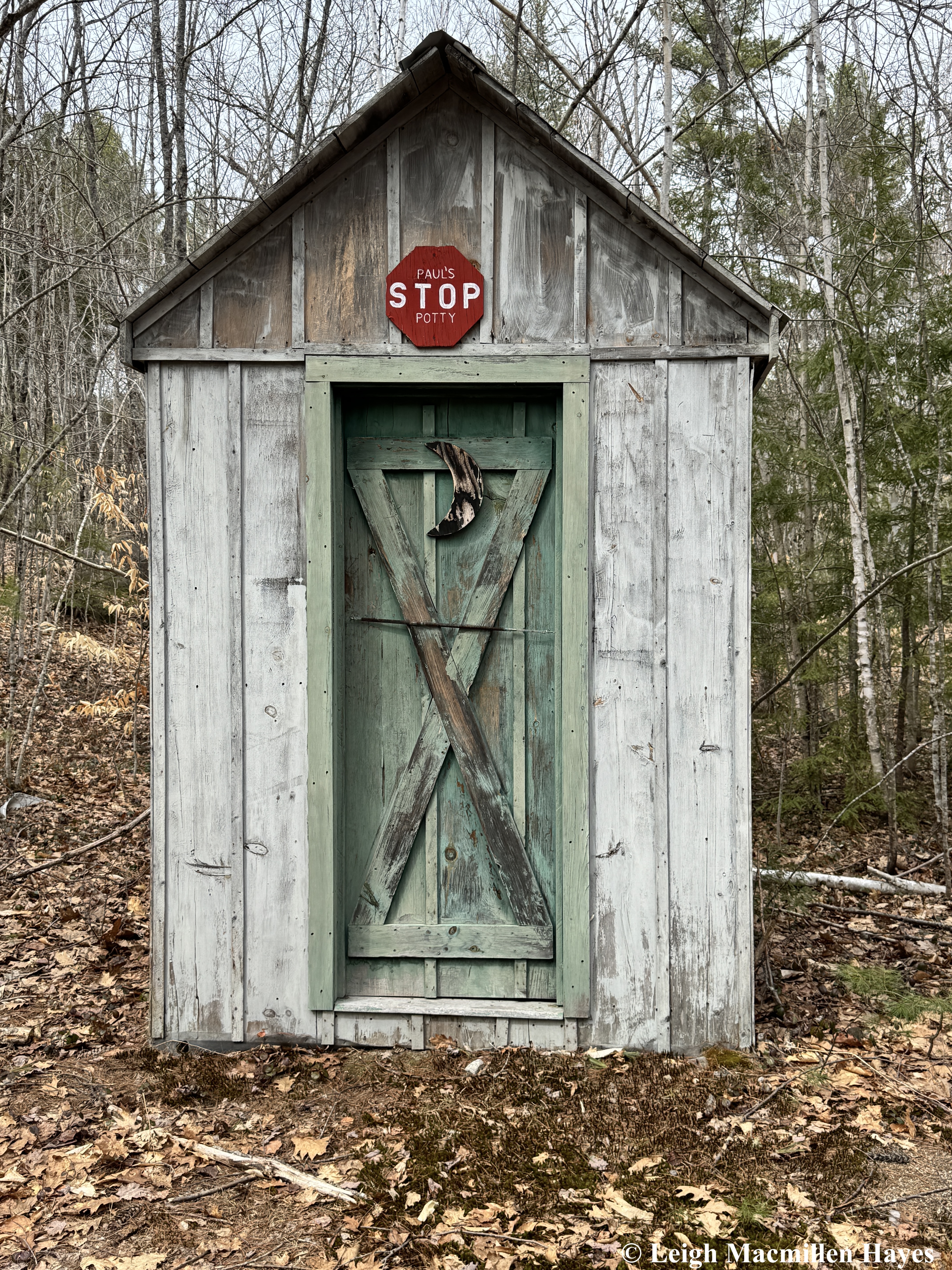
It’s actually part of the snowmobile system, and if you know where this privy is located, then you know where we were. Together we covered a lot of ground (as in 9 miles) and got a better understanding of the area and local ponds and wetlands near the privy.

But even better than that– (remember yesterday’s buds ready to burst?) another first for the season that again seemed apropos for the weekend: the first blossoms of Trailing Arbutus. So sweet and tender and fragrant.

Maybe instead of being known commonly as a Mayflower, this year it should be an Easter Flower.

On Easter, we had a late start for adventure and actually, we chose Plan B for our hiking destination because of the time–since we’d attended church in the morning and then dined at a local restaurant with three generations of our family, minus our two sons, their gals, and a nephew and his gal.

At the summit we did what we always do and waved to some friends who have a summer place on the pond before our eyes. And expressed our sorrow that they won’t be heading north this year. We can only hope that future plans include a return trip.

The wind was wild and brisk, but we took time to also admire the beauty of another pond and Sebago Lake in the distance and shouted, “Happy Easter, Alleluia!”

Eventually, we had to backtrack along another trail upon which we’d started our hike, and though we love loops, I also like it when we follow the same trail back because sometimes you see different things you missed.

Such was the case.

It had been a few years since we’d followed this trail named for a local brook, but it wasn’t until the return trip that I spotted this Scouring Rush. Again, it’s a case of structure and form and color and design and texture. The stem reminds me of an accordion and the top a cone. Or even Cancer Root. Just wow!

And then today found us exploring yesterday’s intended Plan A, where we circled a river for about 2 miles, enjoying the sounds as the water flowed and splashed and sounded so life giving–as it should because it is.

Our chosen spot for today’s lunch was upon steps after we crossed the river to head to a connector trail.

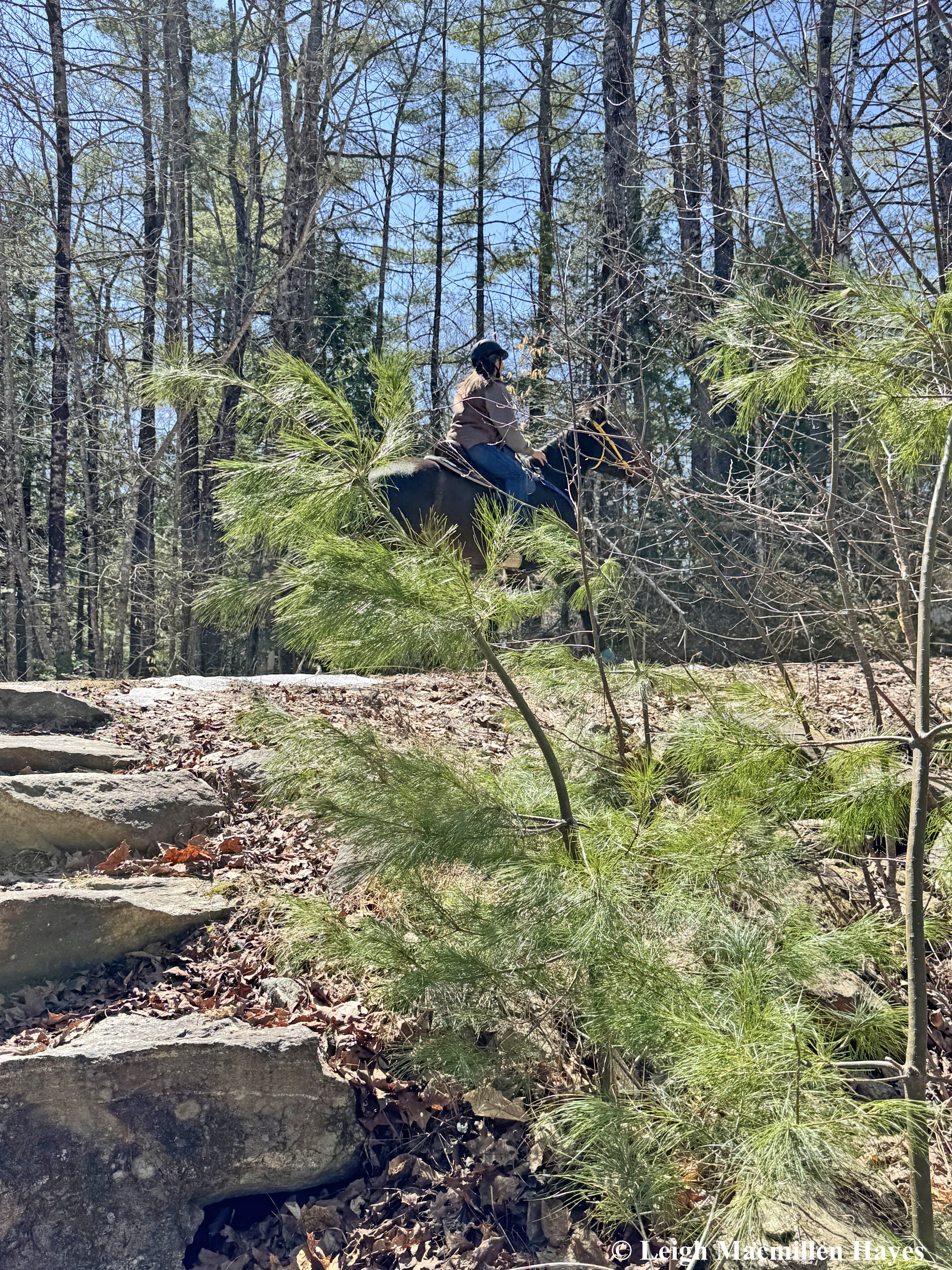
And it was there that we had a most pleasant surprise: a woman rode past on horseback. I only wish I’d been quicker to snap the photo.

Our other surprise in this spot was the knowledge that this past winter a Ruffed Grouse had roosted overnight right here based on the pile of scat it left behind–which is its habit.

My Guy sat upon the rock above and I cautioned him about setting down his water bottle or sandwich.

And in a super sunny spot nearby, the first False Hellebore leaves of the season, at least for me, showed off their bright green and pleated presentation.

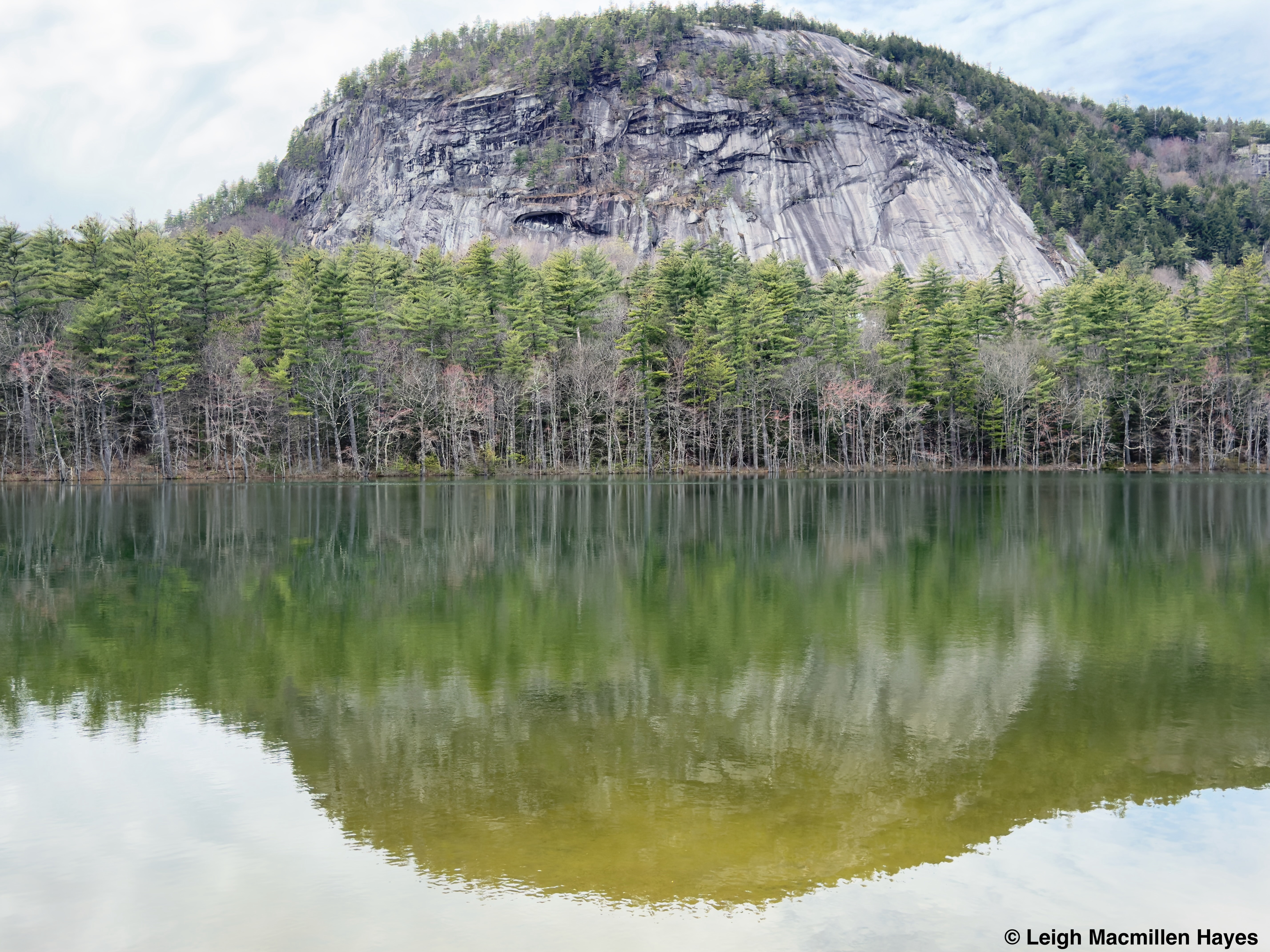
After crossing the connector trail we reached a pond with the mountain of our destination serving as the backdrop. I love it that often, even if there is a breeze, and slight it was today, this pond offers the most glorious reflection.

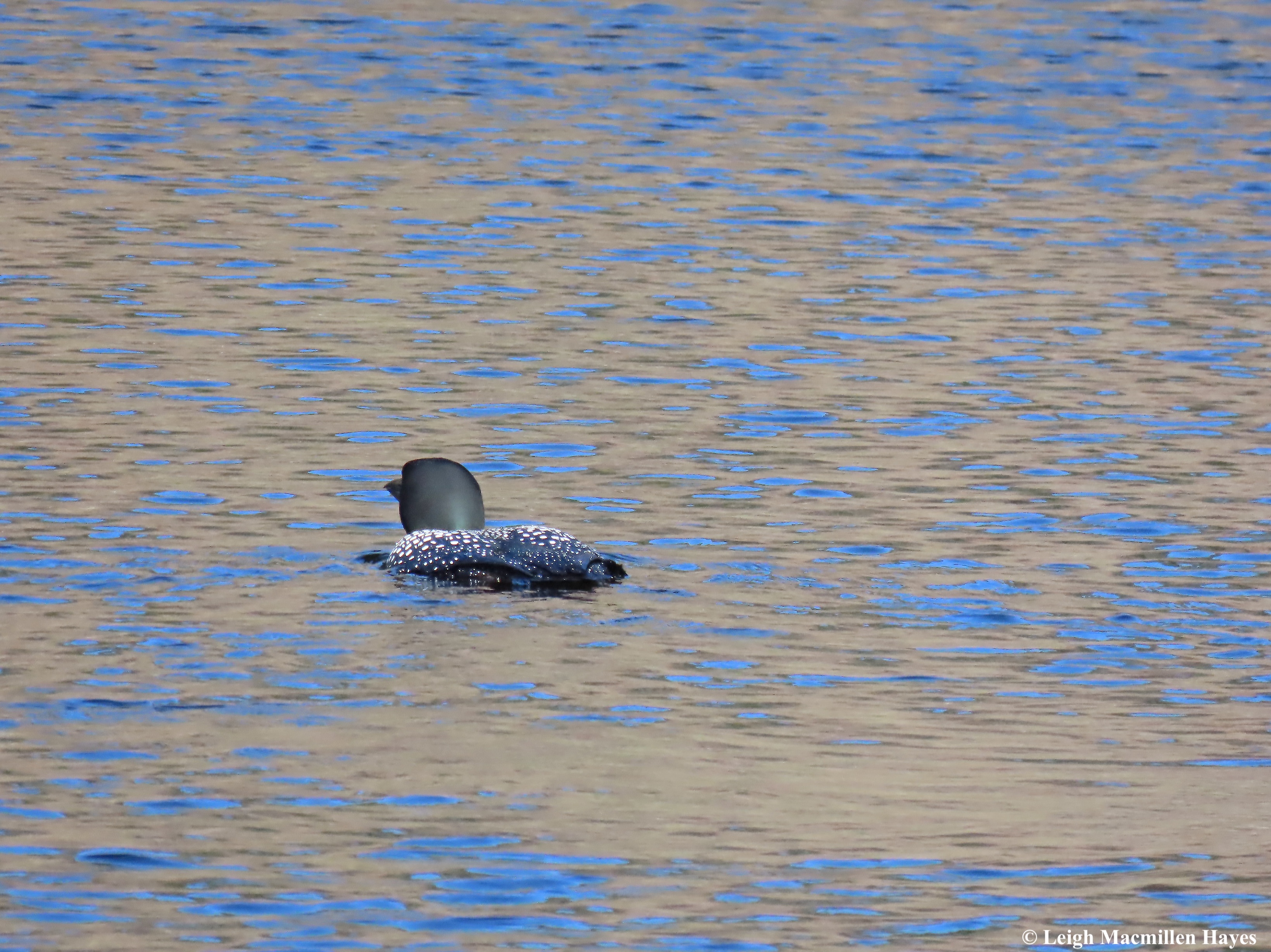
While we paused, we spotted two people fishing, but also another who had the same finned meal in mind, a Common Loon. We didn’t see another, and if memory serves me right, it’s rare that we’ve seen a pair on this pond.

I can only hope memory doesn’t serve me right this time.

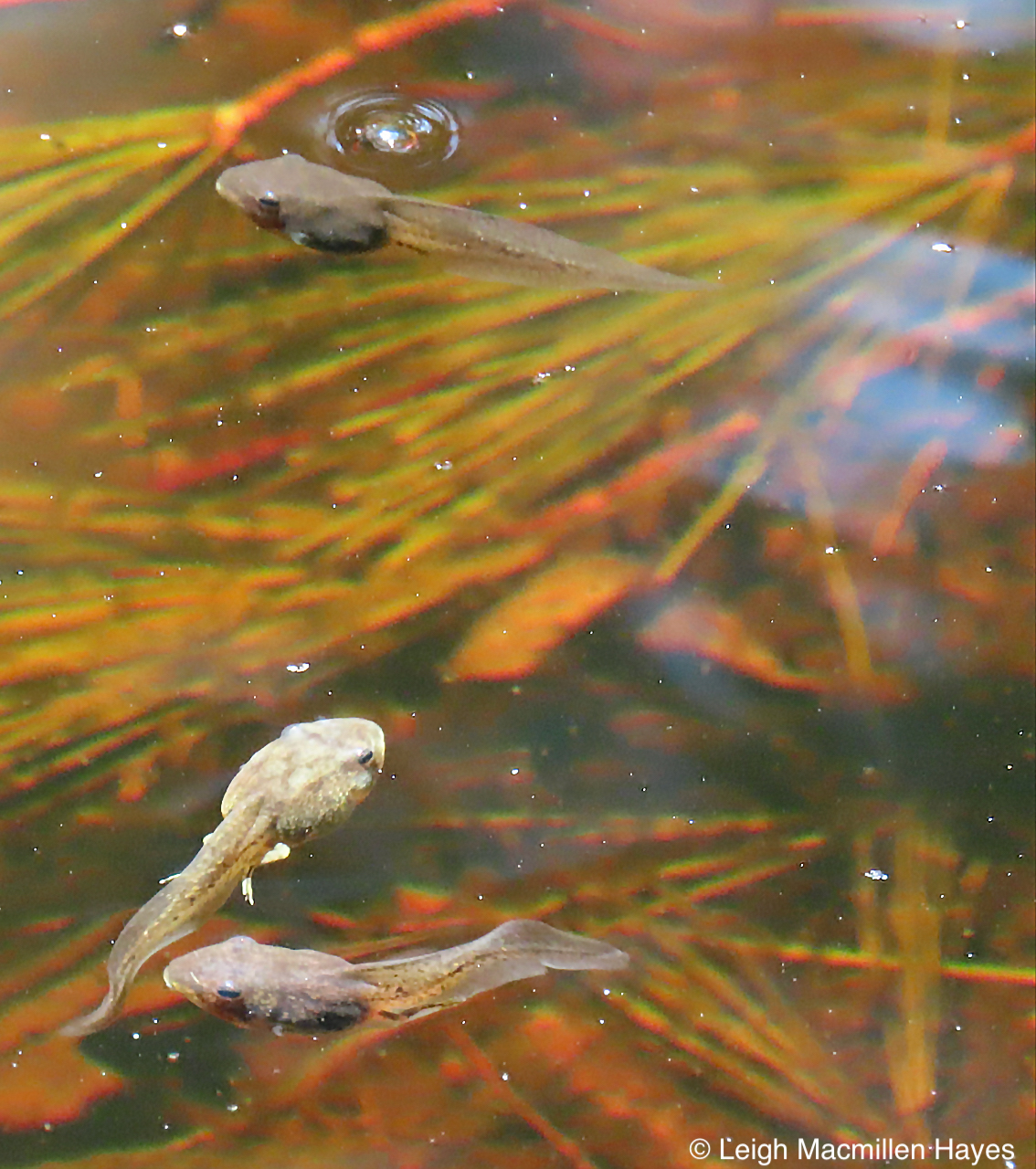
Within the shallow depths there were also huge Bullfrog tadpoles and teeny tiny minnows. And probably so much more, but I didn’t look any closer.

Another fun find reminded us that we will return to these trails in another month for the Lady’s Slippers that call to My Guy will make their usual request for a count.

Finding the capsule is so rare considering that there are hundreds of Lady’s Slippers that bloom just along the trail, yet we only spotted two of these structures, which would have contained thousands of dust-like seeds that dispersed through the split sides.

Similar in shape to the capsule, but of a completely different origin, we found two piles of Moose scat–deposited possibly two winters ago based on its formation and the dried leaves and other debris that had landed upon it.

As we continued along the trail beside the pond before climbing up, we knew to look to the ledges for a rare sighting. It’s up there, but you may not see it until I share the next photo with you.

Do you see the cross? How apropos for Easter Monday.

The question remains for us: How did it get there? Or is it a natural formation? We know that we would not have the heart to climb down to that spot and install it, but perhaps others did.

Actually, we don’t want to know how it got there. It’s enough for us that it is. And persists.

And even more important today, the fact that we didn’t get here on Easter, but instead hiked this way on Easter Monday, the day Pope Francis died, one who cared about those marginalized and the Earth. All of Creation matters.

Our time at the summit of the mountain was brief because we needed to get home for My Guy had another event. But it’s never lost on us that the shape of the main basin of the pond is a heart.

Back at the truck, we celebrated the weekend with a treat from Fly Away Farm.

And gave thanks for how all that we saw and heard and experienced this weekend seemed to be interwoven into a beautiful Easter tapestry.

Happy Easter 2025!

Happy Belated 10th Anniversary, wondermyway.com

I can’t believe I missed the date by two days. I’d been planning this for months. Well, in the back of my mind, that is. No actual thoughts were jotted down on paper. I just knew what I wanted to do and when I wanted to do it . . . until I forgot. Or rather, it slipped my mind. Momentarily.

No harm done.

As the saying goes, “There’s no time like the present,” and so my gift to you dear readers will be to give you the present of time by taking you back to the beginning of wondermyway and then making our way to the present. And all of it is because I was given the gift of being present in the moment on so many occasions. Egads. That’s a lot of presents. And presence.

Wonder My Way

My first blog post was published on February 21, 2015, and entitled Wonder My Way. It began with these paragraphs: Wonder my way as I wander through the Maine woods. So often I see things that make me stop and wonder. Sometimes I figure it out, but other times, I’m just as happy that I don’t. It’s The Sense of Wonder that Rachel Carson wrote about which keeps me going. Do we need to have all the answers? I think not.

So join me for a tramp from our woodlot to the world beyond. I know not where this trail will take us, but I can guarantee that we’ll have fun along the way. Read more . . .
Spring in Slo-Mo

Spring is so fleeting in Maine. Oh, I know, it lasts the usual three months and the beginning and ending overlap with its seasonal partners, but really . . . one must take time to pause and watch or you’ll miss the most amazing action that occurs in slow motion right outside the window–and beyond.

For those who are new to my blog, Jinny Mae, who is featured in this and many blog posts, was a dear friend whose name I turned in to an alias as she faced cancer courageously and rather privately. In the end, the cancer consumed her, but the things we enjoyed along the way were bountiful, including this spring adventure to an incredible space in our little neck of the woods. Read more . . .

Universal Love

Written on Valentine’s Day, this post was dedicated to My Guy and all who wander and wonder with me.

When I wander, hearts frequently speak to me . . . Read more . . .

Nothing To Grouse About

I shared a unique experience with five other naturalists, the majority of them in the six to eleven age range. For twenty minutes the six of us watched a Ruffed Grouse at it moved about, overturning leaves and foraging on buds. When we last saw it, the bird headed off in the opposite direction that we intended to journey, and so we moved on with wonder in our eyes and minds.

And then the next day I returned on a mission to study some twigs at the same property. No sooner had I stepped onto the trail when I heard the sound of leaves cracking a wee bit and what to my wondering eyes should appear but the same bird.

The curious thing: the bird followed me, staying about ten feet away as I tramped on. I stopped. Frequently. So did the bird.

And we began to chat. I talked quietly to him (I’m making a gender assumption) and he murmured back sweet nothings. Read more . . .

Amazing Race–Our Style

Okay, so My Guy and I have enjoyed The Amazing Race show over the years and felt like there were some challenges either or both of us could face, but others that neither of us would dare attempt. And so . . . I created our own version.

The thing is that until I take the time to change the order of this post on my website, you’d be best to start at the bottom and read each entry, going up one step at a time. As in, this: Scroll down to February 18 on this link and then after reading that entry, make your way up one episode at a time, until you reach the last recorded on February 2, 2019. Oh heck, read it in any order that pleases you. Just get into the spirit of the race I created cuze I certainly had fun with it. And fooled a few people along the way.
The Amazing Race–Our Style

I’m sure when we said our wedding vows back in 1990, there was something in there about only riding a snowmobile once. And I did that once two years or so ago–mostly because I knew it would please my guy. Certain memories remain from that experience: I felt like a bobblehead inside the helmet; I lacked control as I sat behind him and couldn’t see; when I did peek around, I was sure my head was going to strike a tree so narrow was the trail; and I didn’t like the speed. Oh yeah, and at a road crossing, I do believe I jumped off and walked to the other side. With all of that in mind, I’m not sure what I was thinking when I created a Valentine’s gift for him–our very own Amazing Race. Read more . . .

wondermyway turns five

Five years ago today (ten now!) I turned from taking a hundred million photos on each tramp to taking a hundred million photos and writing about them.

Typically, on the anniversary I scan the past year’s posts and choose one from each month, providing a photo to represent it, with a brief (or not so brief) comment and link to the full read.

But . . . because this is a milestone I never imagined reaching (posts: 733; views: 76,793; visitors: 44371; followers: 578), I thought I’d take the time to thank you, the readers, for wandering through the wonders with me.

Thank you! Read more . . .

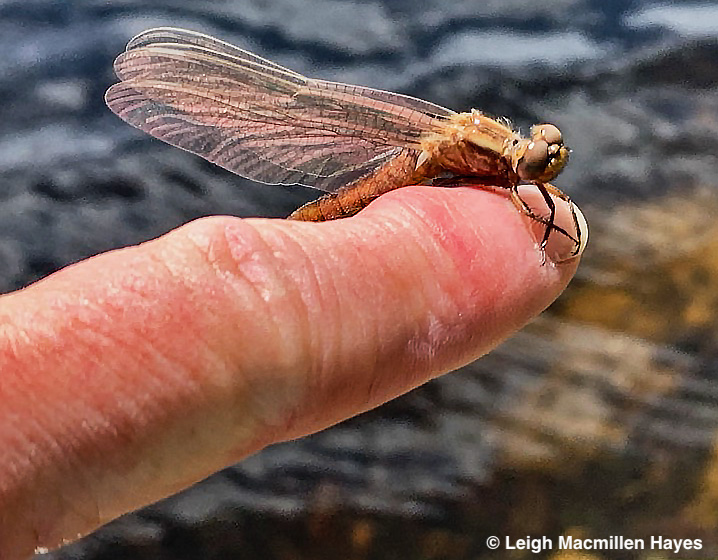
Dragonfly Whisperer Whispers

We had no intention of eating lunch in this spot today, but while looking for a mountain to climb, we kept encountering full parking lots and so our backroad meander put us beside a bog at lunch time and voilà, we managed to walk all of less than two tenths of a mile. Total.

But in that short distance, our eyes feasted. First it was all the Painted Turtles basking in the sun. Read more . . .

Surveying the Wildlife of Charles Pond

For the past two weeks at Greater Lovell Land Trust we’ve had the good fortune to conduct a wildlife survey in the waters that surround the newly acquired Charles Pond Reserve in Stow, Maine. Our hats are off to Alanna Doughty of Lakes Environmental Association (LEA) for her willingness to be the lead on this project and work in collaboration with us. Alanna, you see, has conducted previous surveys for Maine Inland Wildlife & Fisheries (MDIFW) at LEA properties, and was trained by wildlife biologist Derek Yorks to set these up.

MDIFW maintains a comprehensive database on the distribution of Maine’s amphibians and reptiles, as well as terrestrial and freshwater invertebrates and the data we’ve collected will add to the bigger picture. What we discovered was just as important as what we didn’t find. Read more . . .

Hightailing It Home

Friends,
At the risk
of sounding redundant,
I bring forth
a prickly topic.

A quick glance
while surveying treetops
and suddenly
my heart sang
as I spotted
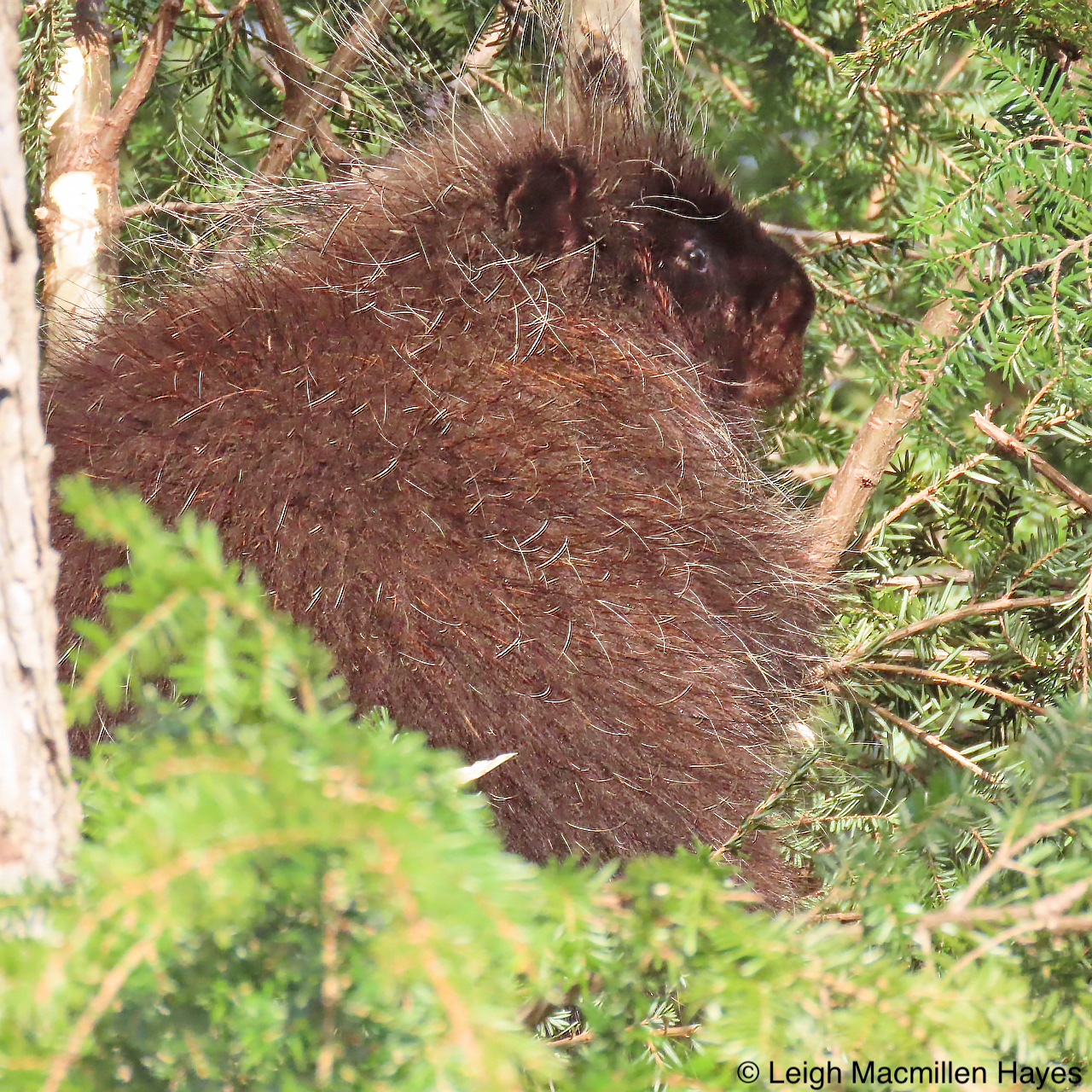
a well-armored back.

Read more . . .

Happy 9th Birthday, wondermyway!

Thank you to all who read and comment and share wondermyway.com. Some of you have followed my blog posts since the beginning, February 21, 2015. A few have joined the journey as recently as yesterday. I’m grateful for the presence of all of you in my life.

To mark this occasion, I thought I’d reflect upon those moments when my wonder gave me a glimpse of the “Thin Places” that I’ve experienced either by myself or in the company of others.

To quote my friend, Ev Lennon, “A Thin Place is a spot of beauty, loveliness, space–an example of the wideness and grandeur of Creation.”

I think of them as places that you don’t plan a trip to visit, but rather . . . stumble upon.

Read more . . .

And that brings me to this year and this anniversary, belated as it may be. I can’t believe it’s been ten years since I started this endeavor, which has served as my diary and memory, and been a place for me to share so many incredible extraordinary ordinary experiences with all of you. Thank you for being faithful readers.

As I compare the numbers to year five, I haven’t written as often in the last five years, but your support has been incredible.

wondermyway.com by the numbers:

Posts: 1,076

Visitors: 135,888

Views: 205,389 and increasing constantly.

The most popular post of this new year was Giving Thanks for the Pileated Woodpecker. So far, anyway.

The Giant’s Shower

And since I retired as Education Director for a local land trust just over a year ago, I’ve added some other fun to the mix.

I did a thing. Years ago I wrote a children’s story. Well, a bunch of them actually. And I tried to sell this particular one to publishing houses. No takers. Then, a couple of years ago I purchased a Fairy Coloring Book created by the one and only Solana, teenage daughter of the Fly Away Farm Wards in Lovell and Stow, Maine, and approached her about illustrating my fairy tale. She took on the task and did an amazing job. Then I asked copyeditor Pam Marshall to wave her magic wand over it. And I asked local graphic designer Dianne Lewis to use some fairy dust and turn it into an actual book. I always said I’d never self-publish a book. And tada: I did just that. And now it’s even better because it’s published by http://www.indieauthorbooks.com.

Read more . . .

My Art Gallery

At the end of April I began taking an art class offered by one of my peeps, a young woman who walked into the lives of many of us one day about twenty months ago; a young woman with a million talents to offer. Among those talents, she is a self-taught artist and we’ve been begging her to teach us.

At our first class, we had to draw a small box in the upper left-hand corner of the paper and place the person who has been our biggest art critic into it. That done, the critic was forever boxed–well, until she sneaks out, which she seems to do way too much.

And then we looked at some photographs in magazines and had to sketch them and determine the direction the eye would travel in the picture.

Next we looked at lines and perspective. I’d brought along my favorite colored pencils, but immediately felt my inner critic jump on me because all of my classmates were working with watercolor pencils, watercolor paint or acrylics. And the artist herself, gouache. Until I met her, I’d never even heard of gouache. Or at least never paid attention, if I had.

Read more . . .

Lake Living on Lake Region Television!

And we said goodbye to Lake Living magazine, a glossy publication I’ve worked on since 2006.

We are movie stars! Well, maybe not quite. But, many, many thanks to Evan Miller of Lake Region Television for filming and editing Laurie LaMountain, owner and publisher of Lake Living magazine, and me recently as we said, “Fare Thee Well,” to working on this publication.

Read more . . .

And in the midst of it all, I still have the good fortune to share the trail with so many others . . .

and especially with My Guy, who is forever patient as I pause to consider the wonder of the moment.

My heart-felt thanks to him and to all of you for joining me so often as I wondermyway.

Wowza–ten years! I never imagined. No time like the present to wish wondermyway.com a belated 10th anniversary.
Bald Pate Mondate

Driveway and pathways cleared of snow? ✔️

Bird feeders filled? ✔️

Sandwiches packed? ✔️

Microspikes in truck? ✔️

And we were on our way over the hills and through the woods.
It’s actually a short journey to this trailhead, but by the time we arrived, it was already 11am and others had been there before us, thus making the trails easy to follow in the fluffy snow.

And even My Guy appreciated the beauty that surrounded us.

About an hour later, we reached lunch log and the view through the trees included Peabody Pond in Sebago.

It wasn’t long after that when we climbed up to the beginning of the open ledges at the summit and looked back toward Pismire Mountain in Raymond in the distance and a bonsai Pitch Pine in the forefront.

There are a few landscape photos one must take when on this mountain, Peabody Pond being one of them. Thanks to the volunteers and staff of Loon Echo Land Trust who cut down some trees to open up the scene.

Another must-take is Hancock Pond to the west, and we always wave to our friends Faith and Ben, even though we know they aren’t in residence at this time of year. But we trust that they wave back anyway, from their winter home.

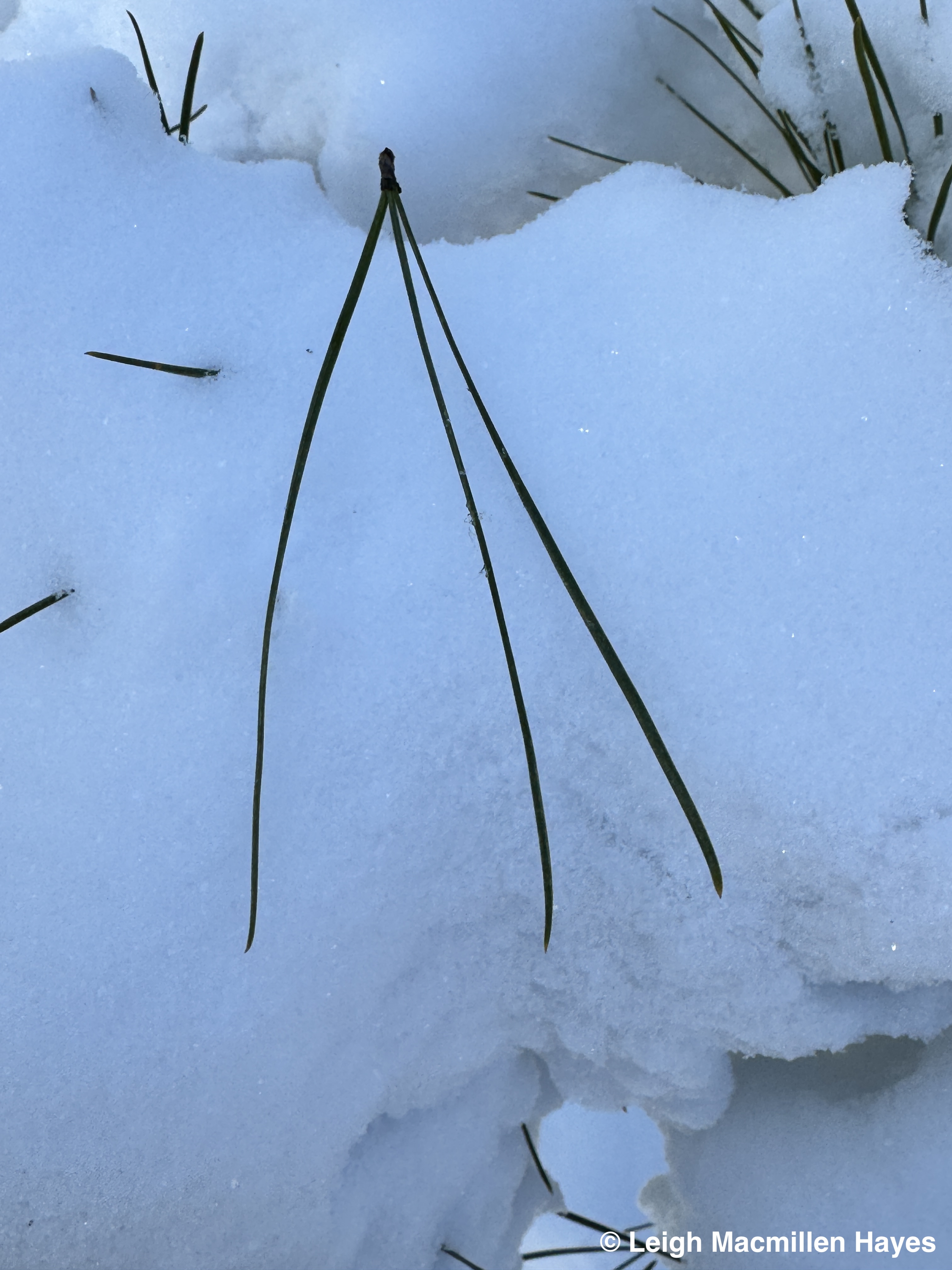
Before we left the summit, I took a couple of seconds to admire the Pitch Pine needles because I wanted to honor some of the evergreens that grow here.

While White Pine has bundles of five needles, spelling M-A-I-N-E for our state tree, or W-H-I-T-E for it’s common name, I used to think that trees with three needles were Red Pines. They are not. Rather, these are the needles of the Pitch Pine: three strikes, you’re out!

Red Pines also grow on the summit and in other places along the trails, along with the ubiquitous Whites.

Red Pines, however, have bundles of two rather long and stiff needles that snap in half easily, rather than being short and flexible like those on White Pines.

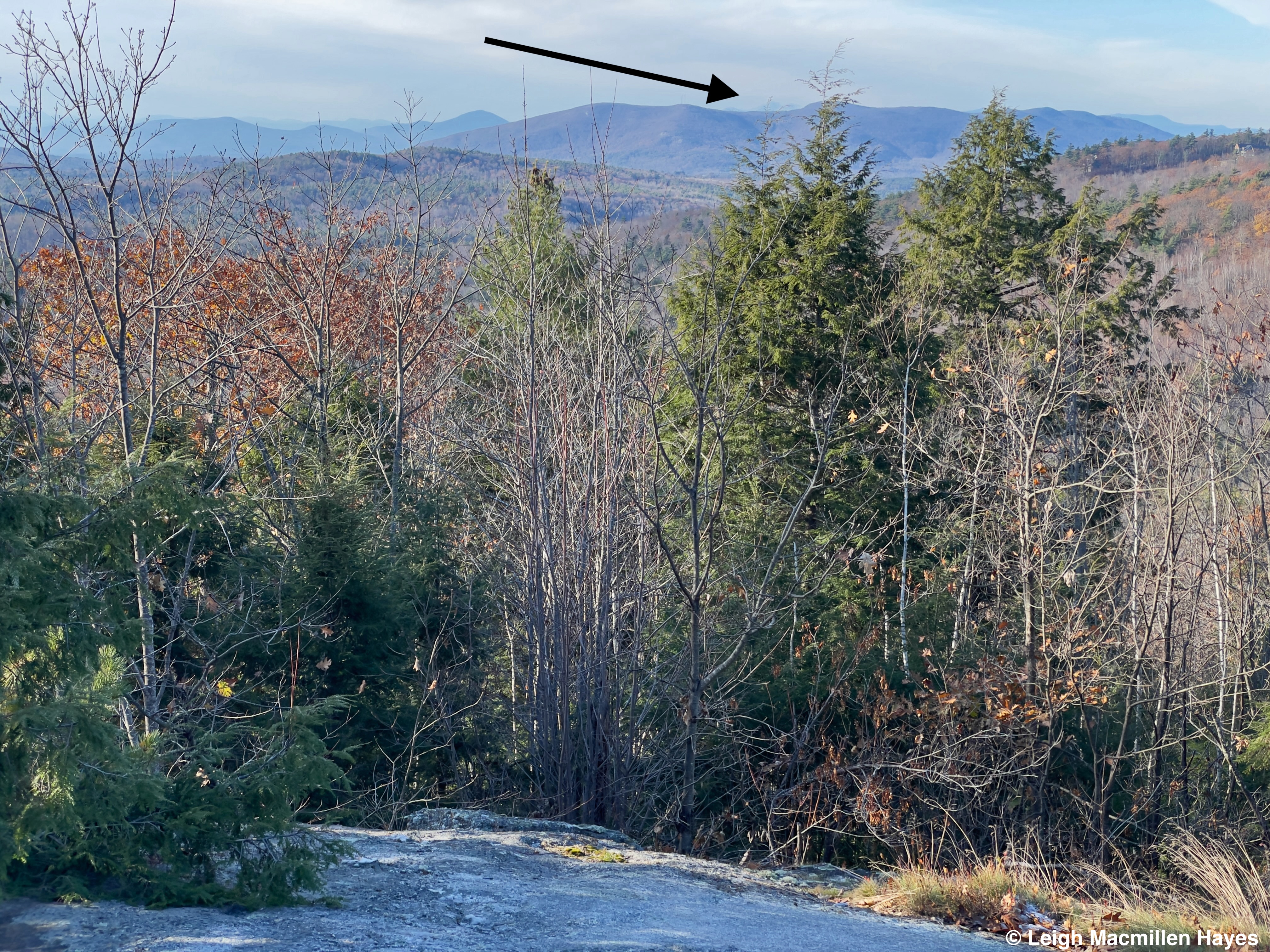
Our journey continued to a false summit, where another view shot needed to be taken. Often, from this spot, Mount Washington is visible in the saddle of Pleasant Mountain’s ridgeline, but the red arrow is pointing to clouds that obscured the mighty one on this beautiful, crisp day.

My Guy asked me which way to go, and I told him to keep turning right at intersections. That is, until we reached the Trail End sign. He didn’t obey the sign, nor did he turn right here. Instead, we did a U-turn and headed toward the parking lot.

Along the way, however, I wanted to honor one more evergreen because I know several grow here, but don’t often get to see them at other places where we hike. These are the needles of Jack Pine; in short bundles of 2: Jack and Jill.

And right next to them I met another evergreen I can’t recall ever spotting before. Maybe I have, but today it was like meeting it for the first time: a Northern Cedar. What a fun find. And the topic for a future public hike formed in my mind: Meet the Evergreens.

About three hours later we arrived back at the kiosk, noting ours was the only truck in the parking lot. We’d met only one other person and his friendly dog, but by the prints left by other humans and dogs, we knew the trails had been well traveled today.

The orangy-red indicates our trails of choice. We’re rather predictable on this mountain, most often traveling this route.

At the end of the hike, I returned the hiking pole I’d borrowed, grateful to Loon Echo Land Trust and its kind volunteer who had created these, since when I went to grab my pole from the back seat, I realized I’d pulled it out the other day. Silly woman.

Hiking pole in truck? Not a ✔️

As soon as we arrived home, I put it back in so that next time I’m ready and someone else can use the poles at the kiosk.

Thank you once again to Loon Echo, not only for the pole, but for preserving this beautiful property in perpetuity and maintaining the trails and always thinking not only about the landscape and its importance, but all who travel here as well.

It was a perfect day for a Bald Pate Mondate.

November 11, 2024 Mondate

It’s Veterans Day 2024 and My Guy and I chose a trail less traveled in the National Forest, giving thanks to our families, friends, and strangers who have served our country. It’s because of them that we can hike along trails and old logging roads, and even bushwhack; two of the many freedoms they’ve given us are the freedom to move about our country and the freedom to not live in fear (well, most of the time).

And so today found us crossing the state line and beginning our journey beside Langdon Brook in Chatham, New Hampshire. Like everywhere we look these days, the water level was low–a result of the current drought.

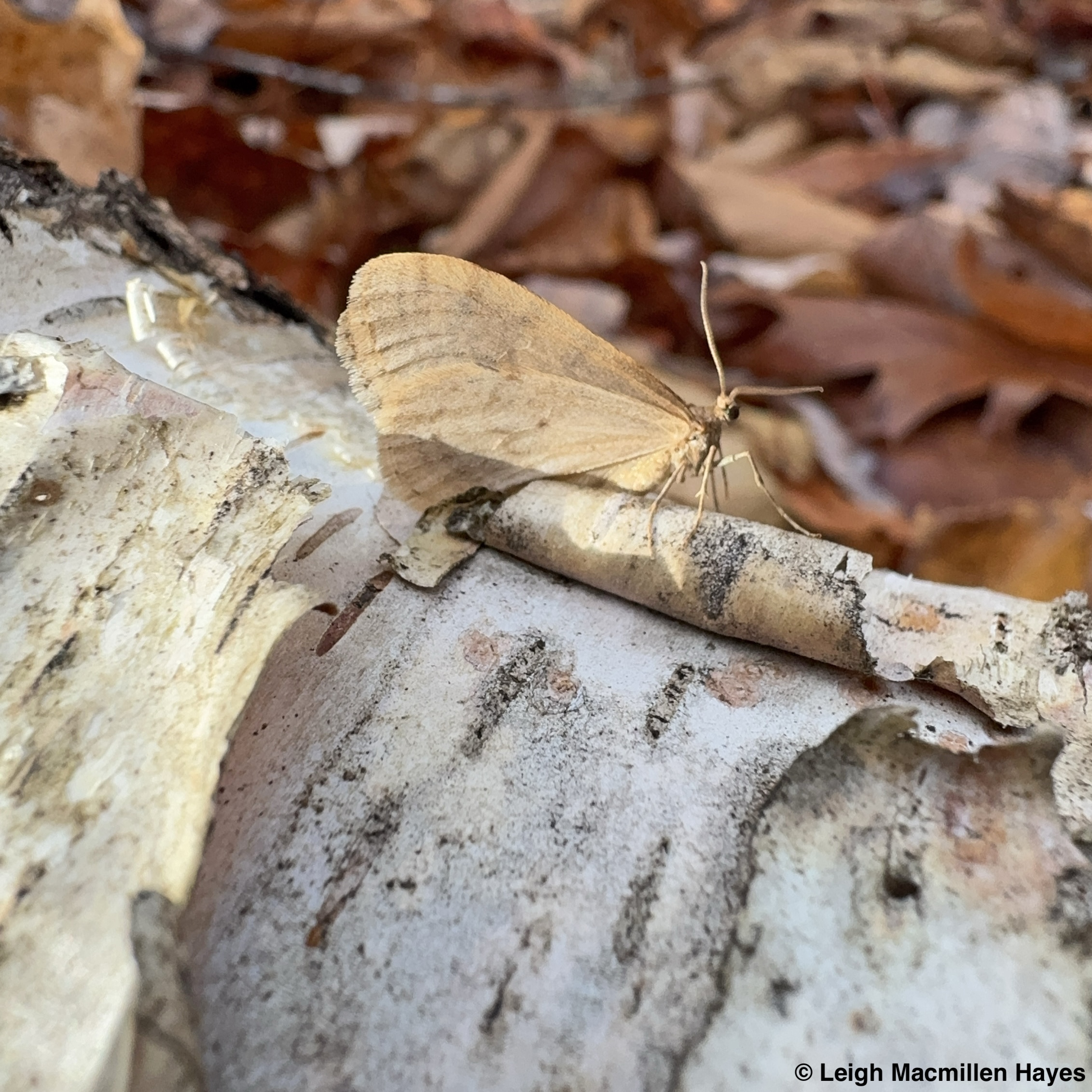
What isn’t low is the number of Geometer Moths, and I believe this to be The Bruce Spanworm, aka Winter Moth, that is currently on the move, emerging from the duff in October and November. I didn’t look for females, who are flightless, but saw plenty of males on the wing.

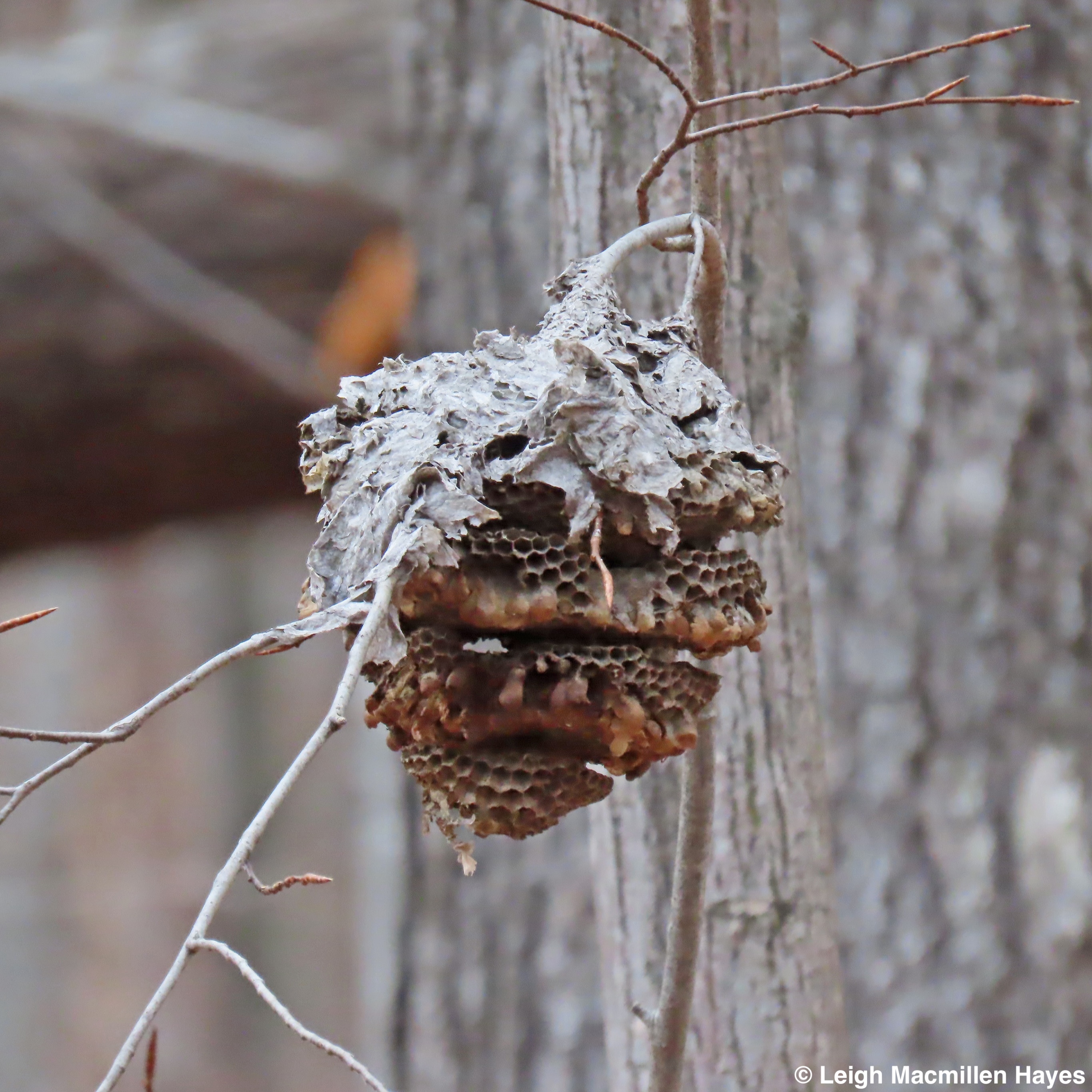
Our trek found us following steep old logging roads for a good portion and as we looked for Bear Claw Trees, I spotted this, a hornet nest.

One Bald-faced queen started building this nest in the spring by chewing wood and mixing it with saliva to create a paper-like material. I love that you can see the multiple layers of horizontal combs, under what’s left of the papery outer envelope.

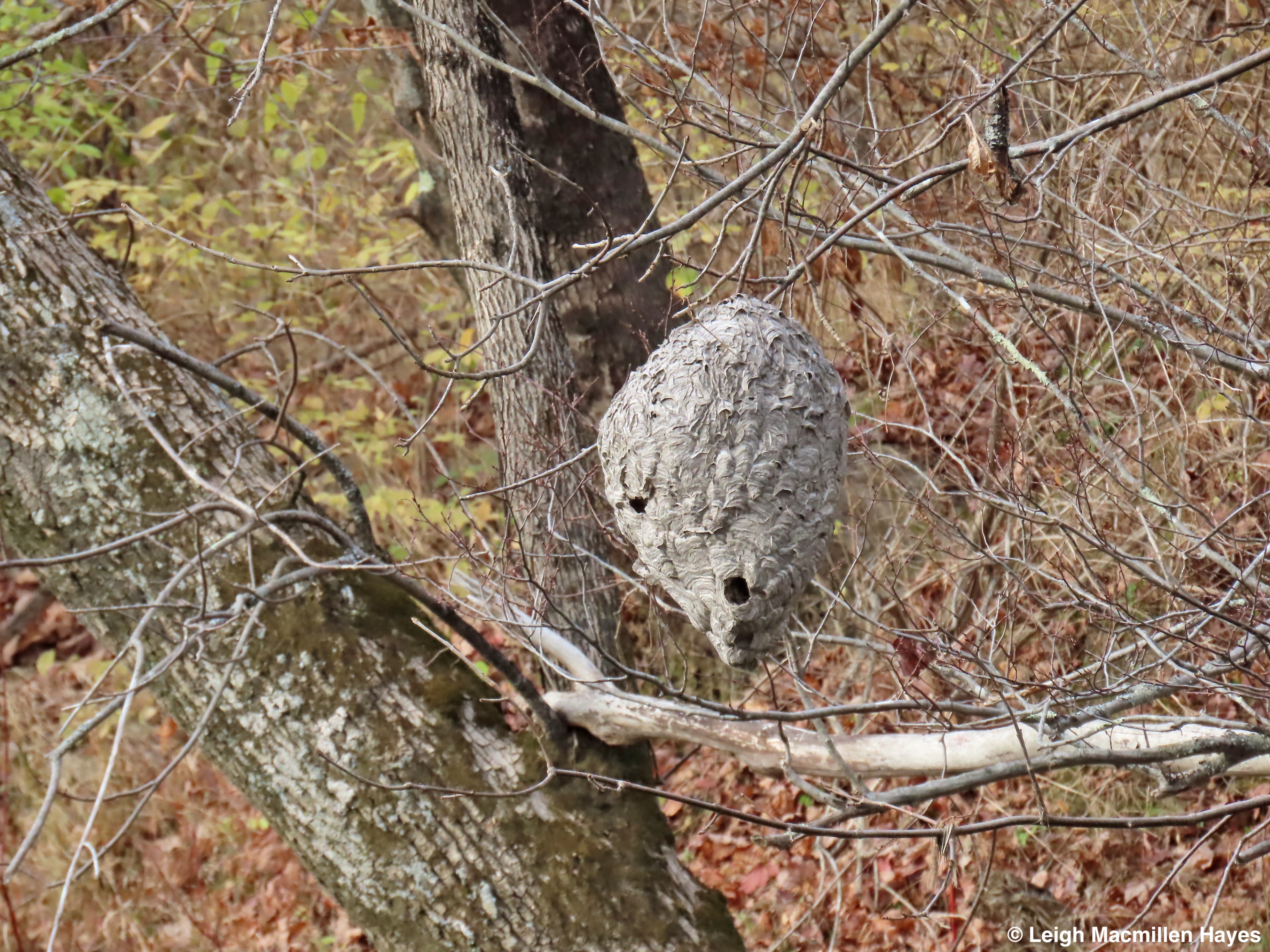
Just last week on a hike closer to the Atlantic Ocean we saw another football-shaped structure, that one being much more intact than today’s example.

Take a second to admire those layers of paper.

What to our ever wondering eyes did eventually appear, the first of several Bear Claw Trees, but I promise to not share all of them with you.

What I will share is this one, a first for us. We often see “elbow” trees in the woods, but never before have we spotted a “collar-bone” tree, so dubbed by My Guy. I think it’s a great description of the morphed shape of this Red Maple, probably caused by logging equipment rubbing against it years ago.

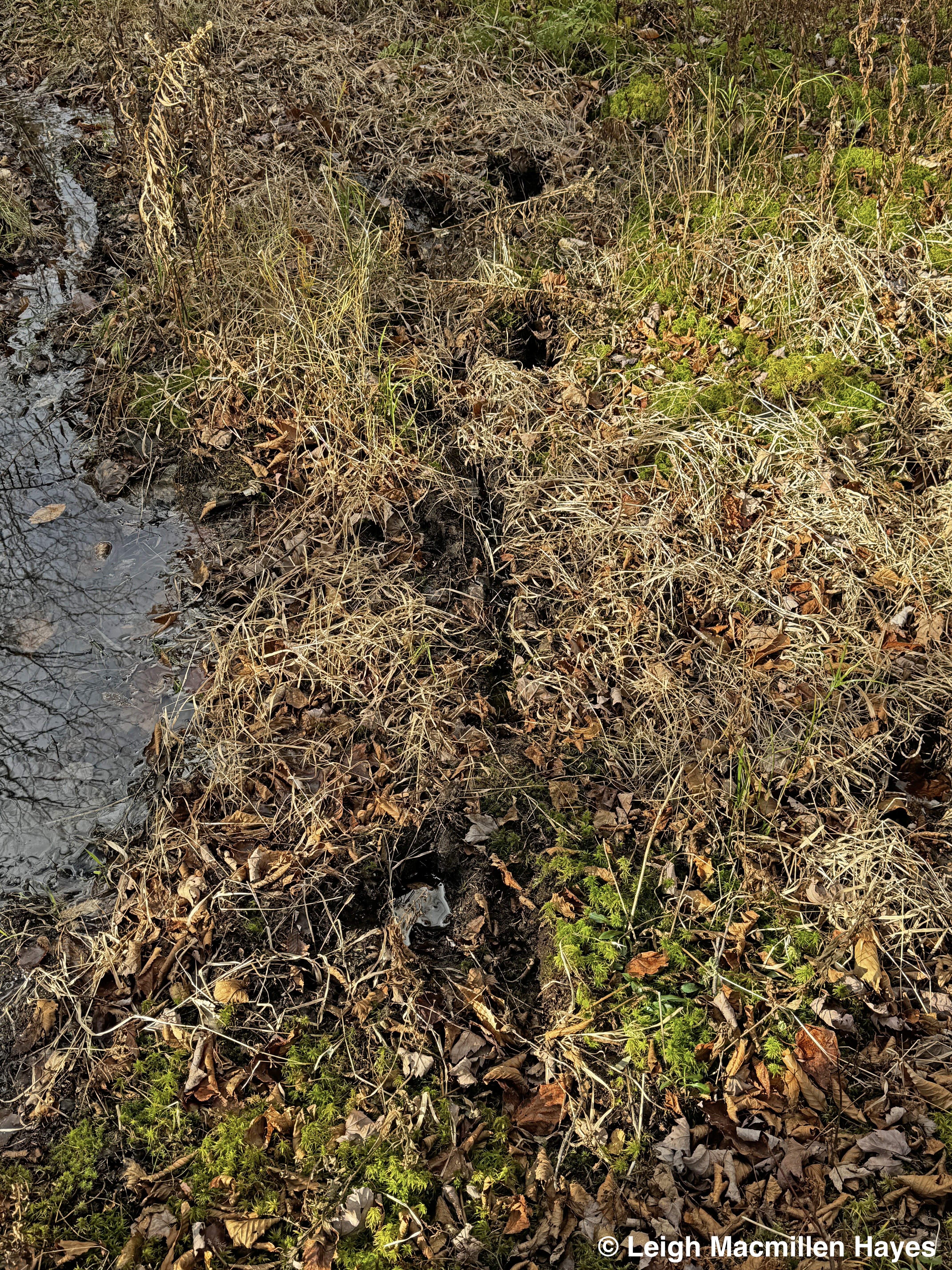
And because we were in a place where one would expect to see wildlife, or at least the signs of such, we found Moose tracks.

Where there are tracks, there is bound to be scat, though the tracks were much fresher than this pile. We actually expected to find both because we’ve traveled this way several times before and know it can be a highway.

As much as we both wanted to see the real deal today, I was glad we didn’t spot a Moose since it’s rutting season. That said, there were plenty of mature trees to hide behind had one approached us.

A few miles up and down, and a short trail new to us that was so much easier than the usual bushwhack approach we’ve taken in the past, and we arrived at our destination: Mountain Pond. With the Doubleheads in the background.

Doesn’t it have the cold November look?

It was breezy, but really, not as cold as it should have been and we both wore sweatshirts and anorak windbreakers and were quite comfortable.

Once we reached the pond, we decide to follow the loop trail that encircles it, and stopped at the lean-to for lunch–just far enough from the open water to be out of the wind.

And then it was time to continue on, dealing with rocks and roots most of the way. A bit technical in the footing department especially at the outlet brook, but not difficult.

Soon after crossing the brook, we entered fairy land. Even MG recognized it for what it was.

We didn’t see anyone at home, but trusted they were sleeping as is their habit during the day. Even the boulder condominium looked like it housed a few.

It’s places like this that inspired my children’s book, The Giant’s Shower.

If you are interested in a copy, or two, or three, please contact me by leaving a message in the comments of this blog because I’m not sure the thegiantsshower email mentioned at the end of that blog post is currently working.

But I digress.

On the far side of the pond, we spied the Baldfaces, which gave us a better sense of our place in the world at that moment.

After completing the loop, we found the short trail back to the logging roads and practically ran down hill, despite the signs indicating we should do otherwise.

Not far from the start of our journey, I spotted a classic representation of Red Fox scat. The tapered end and twist are what give it away. And its size.

I actually expected to find a range of scat samples along the way, but that was not the case. And the only critters we saw were two Red Squirrels who dashed for cover as we approached.

But we did have an unusual sighting . . .

On the way back, about 100 feet below where I’d parked the truck, I spotted something else–Goldenrod in bloom on November 11th.

For the last few years, my nephew and I have been sharing photos of plants blooming when they should not be and he’ll receive this one in a text message soon.

The other amazing thing about this bloom . . . the Bumblebee seeking nourishment upon it. At first I thought the bee was either sleeping or dead, but it moved.

It does need to watch out, however, because just below it an Ambush Bug was busy dealing with another Bruce Spanworm moth–one down, a million more Winter Moths to go.

But again, I couldn’t believe that the Ambush Bug was still active either. We had a hard frost a few days ago. How did all of this happen?

November 11, 2024, a day to remember all those who served our country and a day for My Guy and I to take advantage of our freedoms and make some discoveries worth wondering about on this Veterans Day Mondate.

Taking Stock . . . Naturally

As locals know, My Guy owns a hardware store and I often say I am married to the store. It’s true because it is a constant in our lives and follows us on walks and hikes even on his days off. And though our oldest son has taken over the reins in the past two years, My Guy still cannot completely let go.

I’ve come to realize, however, that that is okay because it means I can tend my own shop. Of course, while he owns the land and the building, I need to rent space, but it’s well worth the priceless price.

Step through the open-air doorway, and you’ll find right now I’ve got proboscis-style straws on display. They are especially beneficial when sipping from Red Clover, a member of the legume family.

And for safe storage, the Peck’s Skipper likes to show how to curl the straw up when not in use.

If you are an introvert, like me and the Common Ringlet Butterfly, you might prefer to flit from flower to flower, but then hide in the vegetation after spending so much time demonstrating for the public how to use your straw.

Common Wood-Nymphs are equally inclined to hide, but still available on the shelf for you to choose, and you can decide if this stored straw appeals to you, or not.

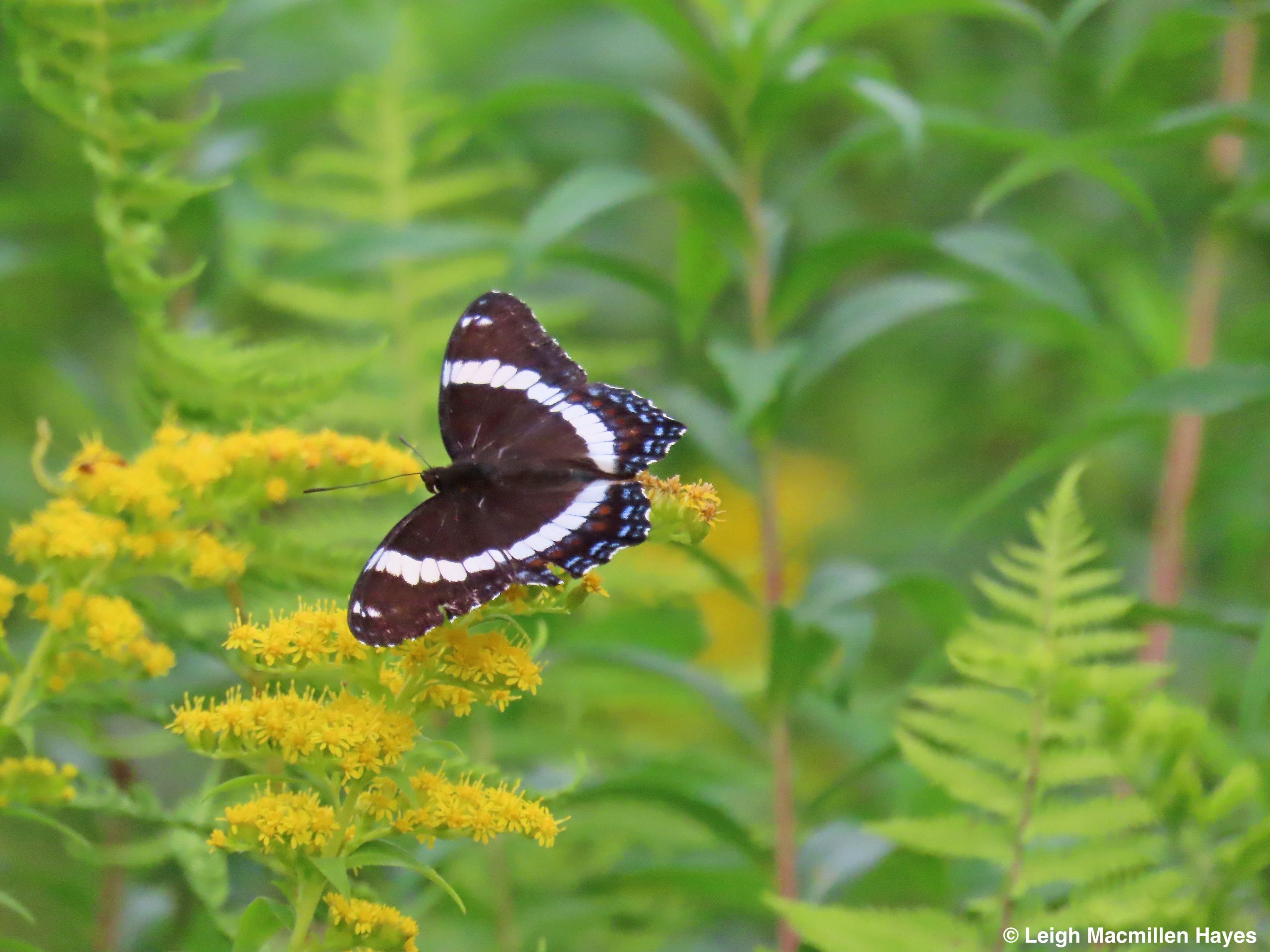
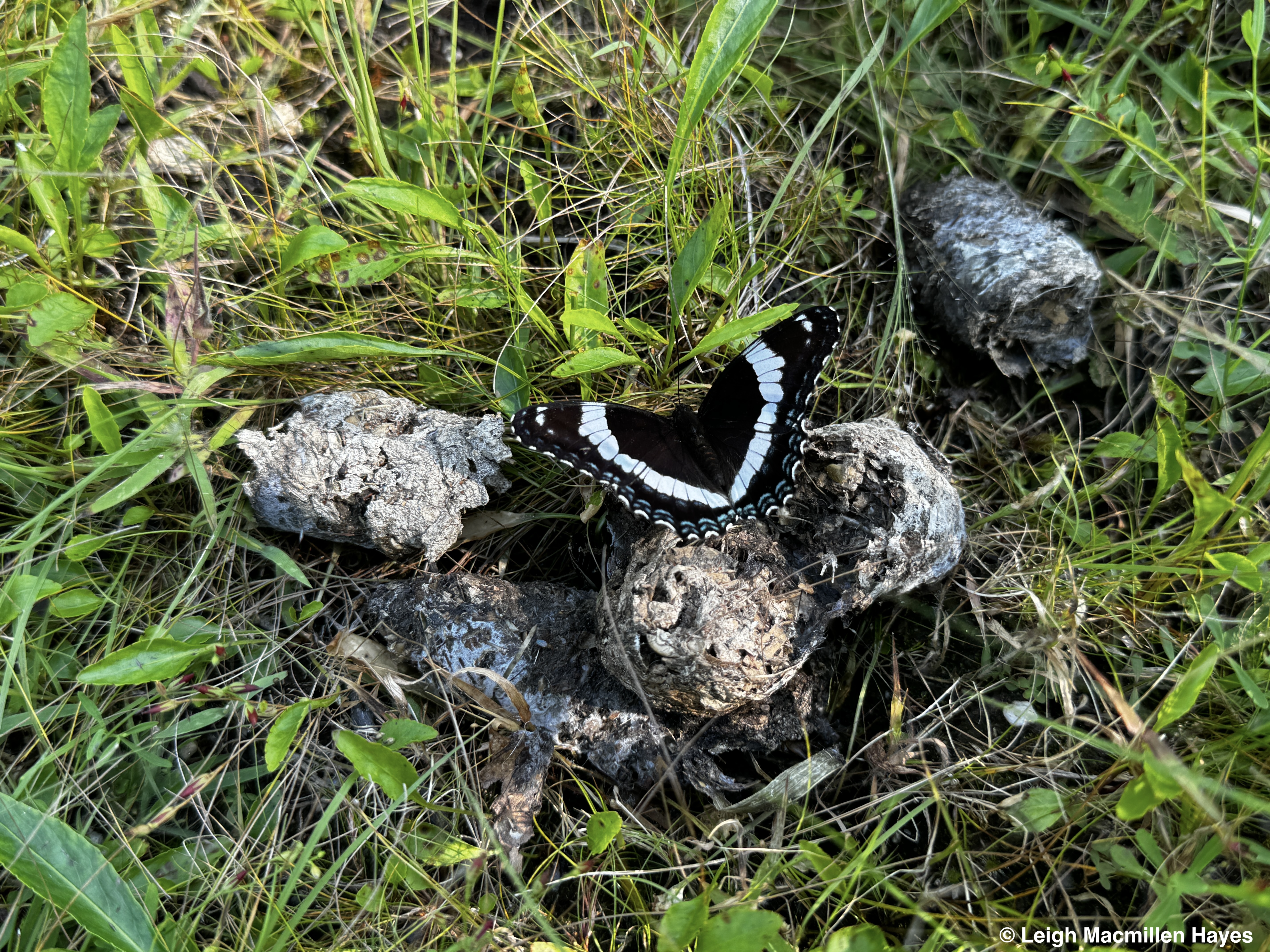
White Admirals are especially plentiful right now, and want you to know that whether hanging upside down,

or right side up, their straws always work, so it might be a good one to think about purchasing.

Especially if you like to get some of your nutrients from scat. We can throw in some scat for you, if you’d like–at no extra charge!

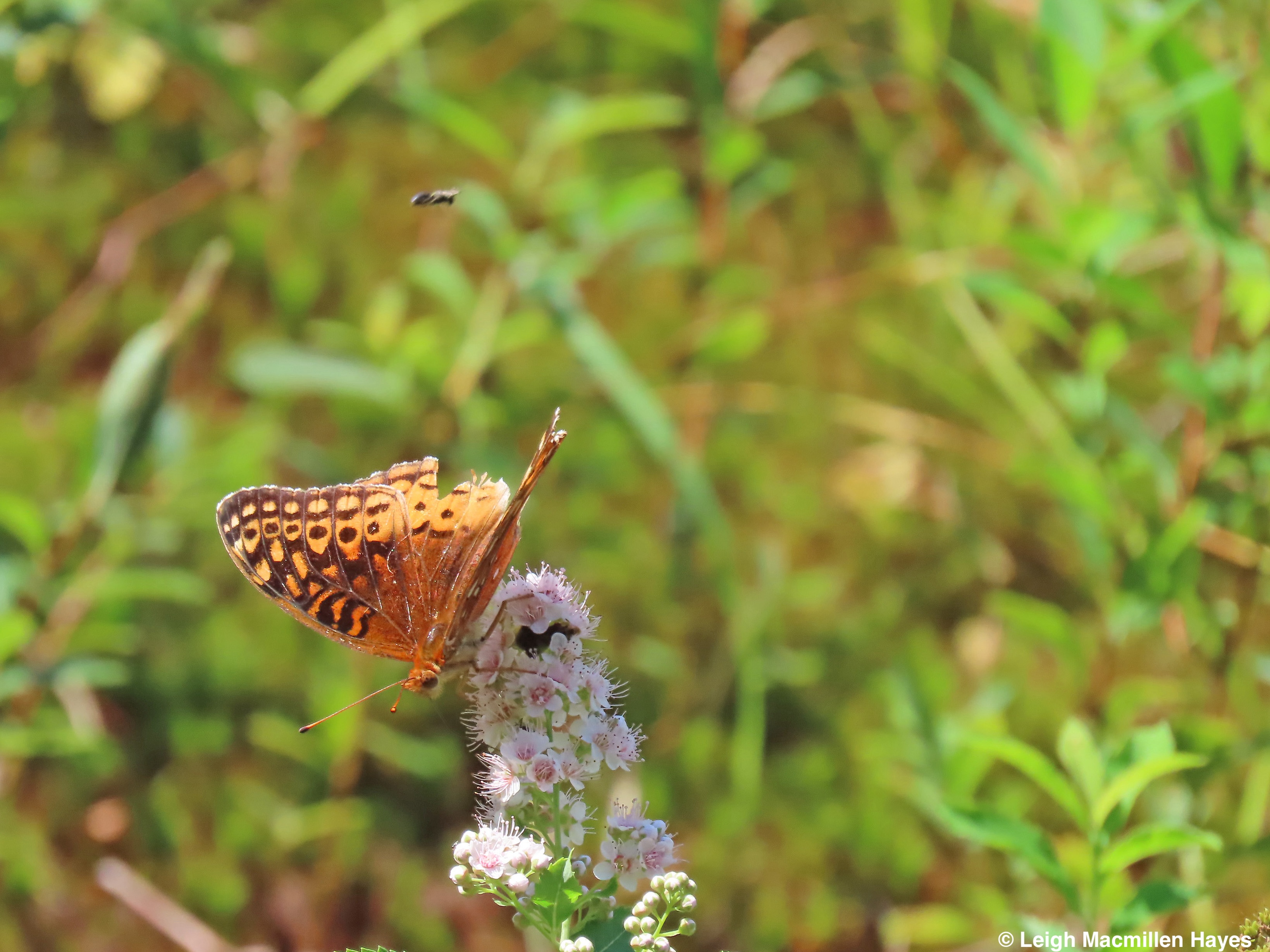
Sometimes it’s the packaging that makes all the difference, so we’ve got several orange choices for you to consider, this being the Fritillary style. Make me an offer I can’t resist, and this straw is yours due to the fact that it has been used previously, as evidenced by the tattered wing.

If you prefer something a bit bigger and brighter, there’s the Viceroy, with that dark band crossing its wings.

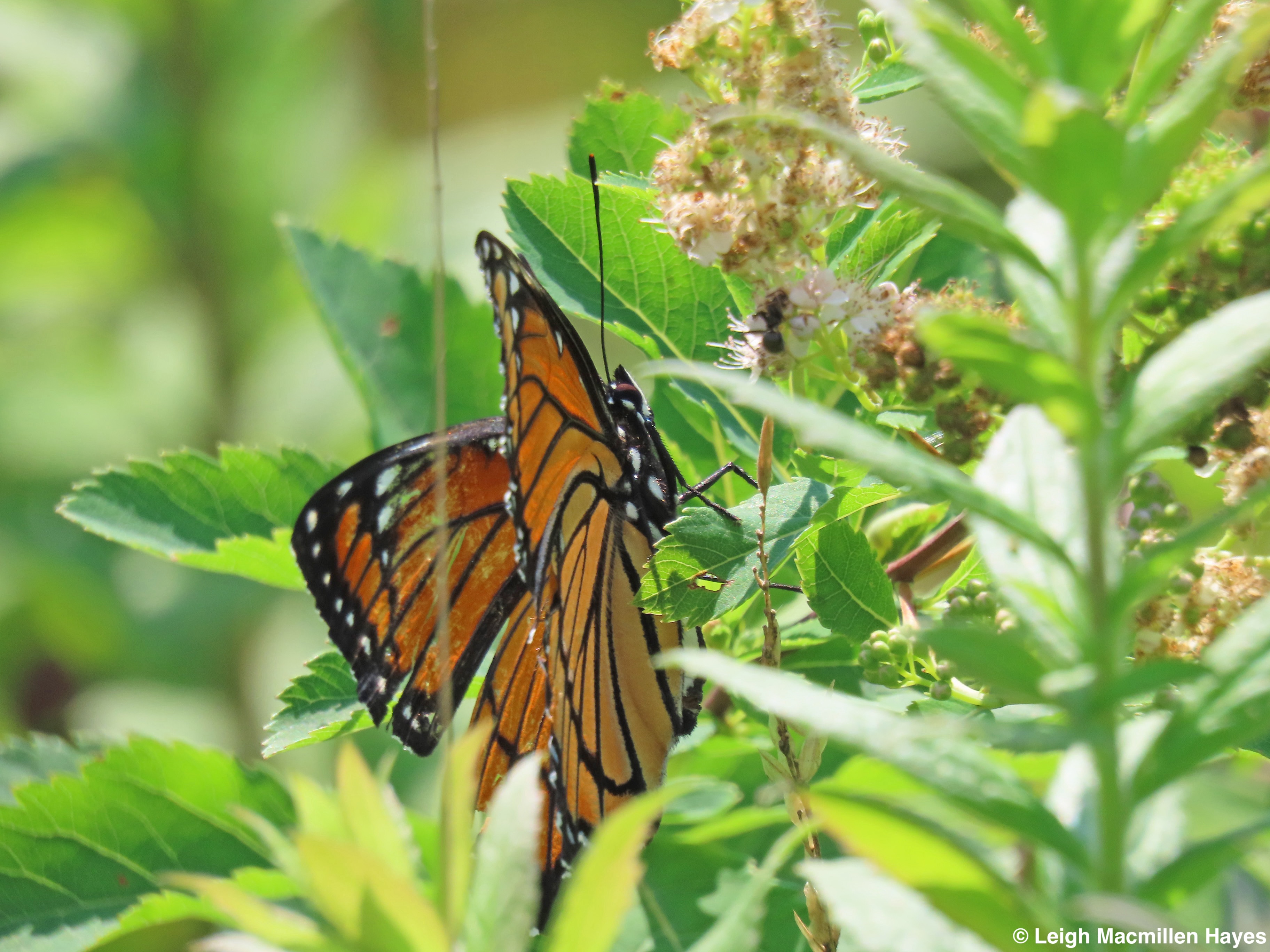
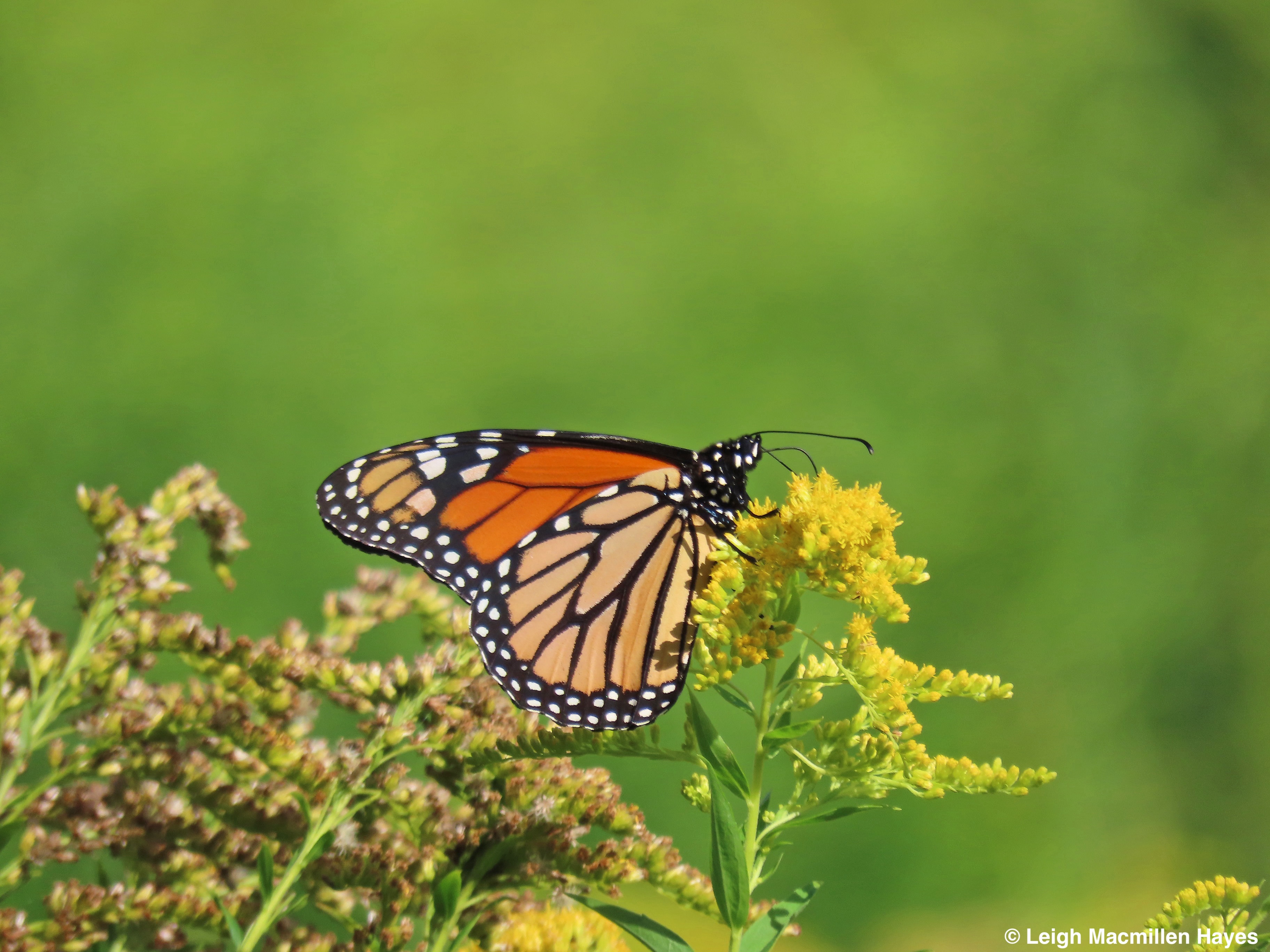
Or the biggest of all, the Monarch, who lacks the black band that is part of the Viceroy packaging.

For the tykes in your life, we also have Pearl Crescents and Northern Crescents in stock. The former is slightly smaller than the latter for the youngest in your gang.

Those are all great, but I have two that I much prefer, the first being this Clouded Sulpher that comes in pastel colors only, which contrast with the darker-colored straw.

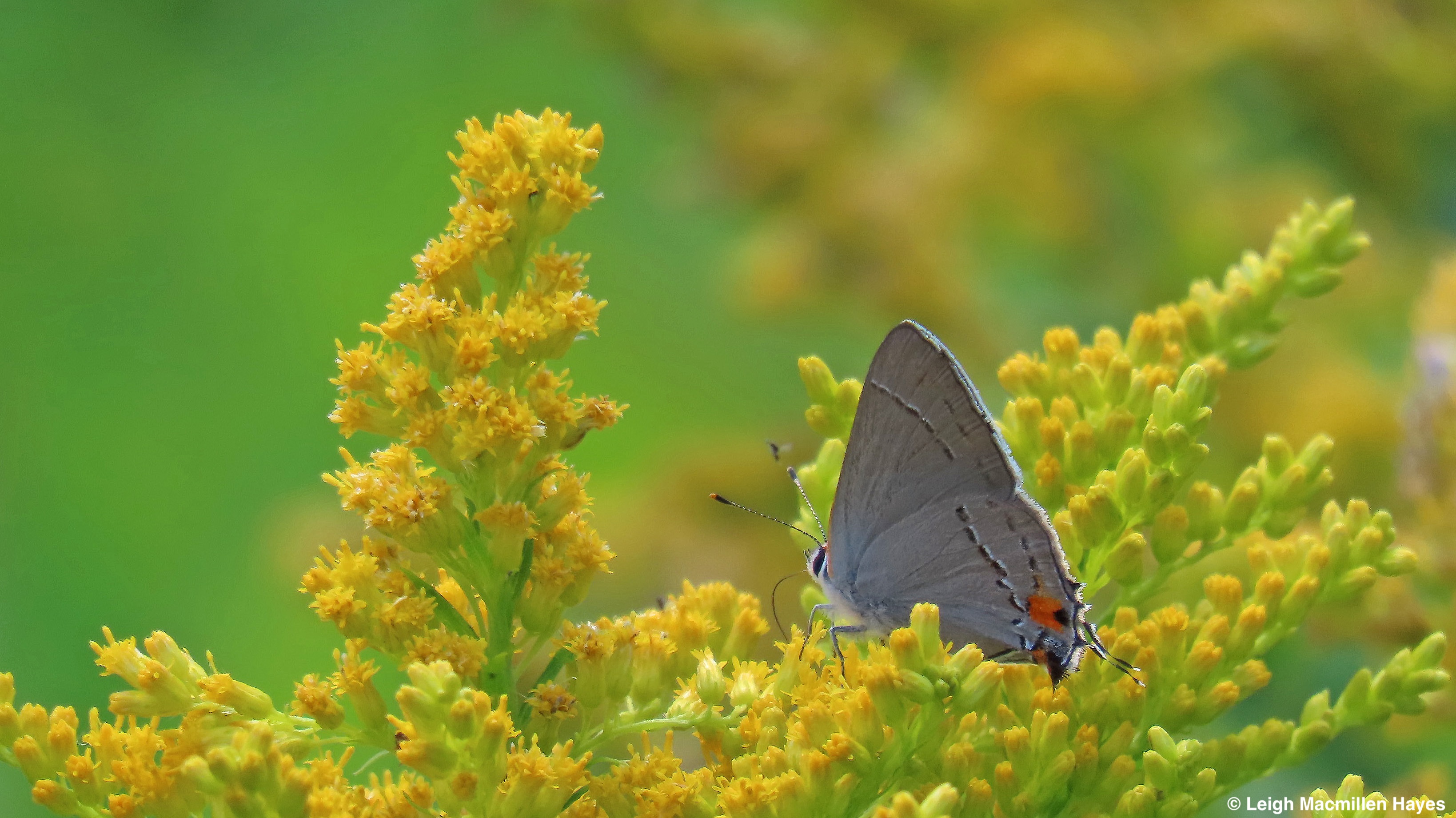
And the creme de la creme has to be the White M Hairstreak, a rare species that I was able to special source a few weeks ago, and every once in a blue moon (such as this August is), I can find another to offer you. That is the case right now, but hurry because I don’t know how long this butterfly will remain on the shelf.

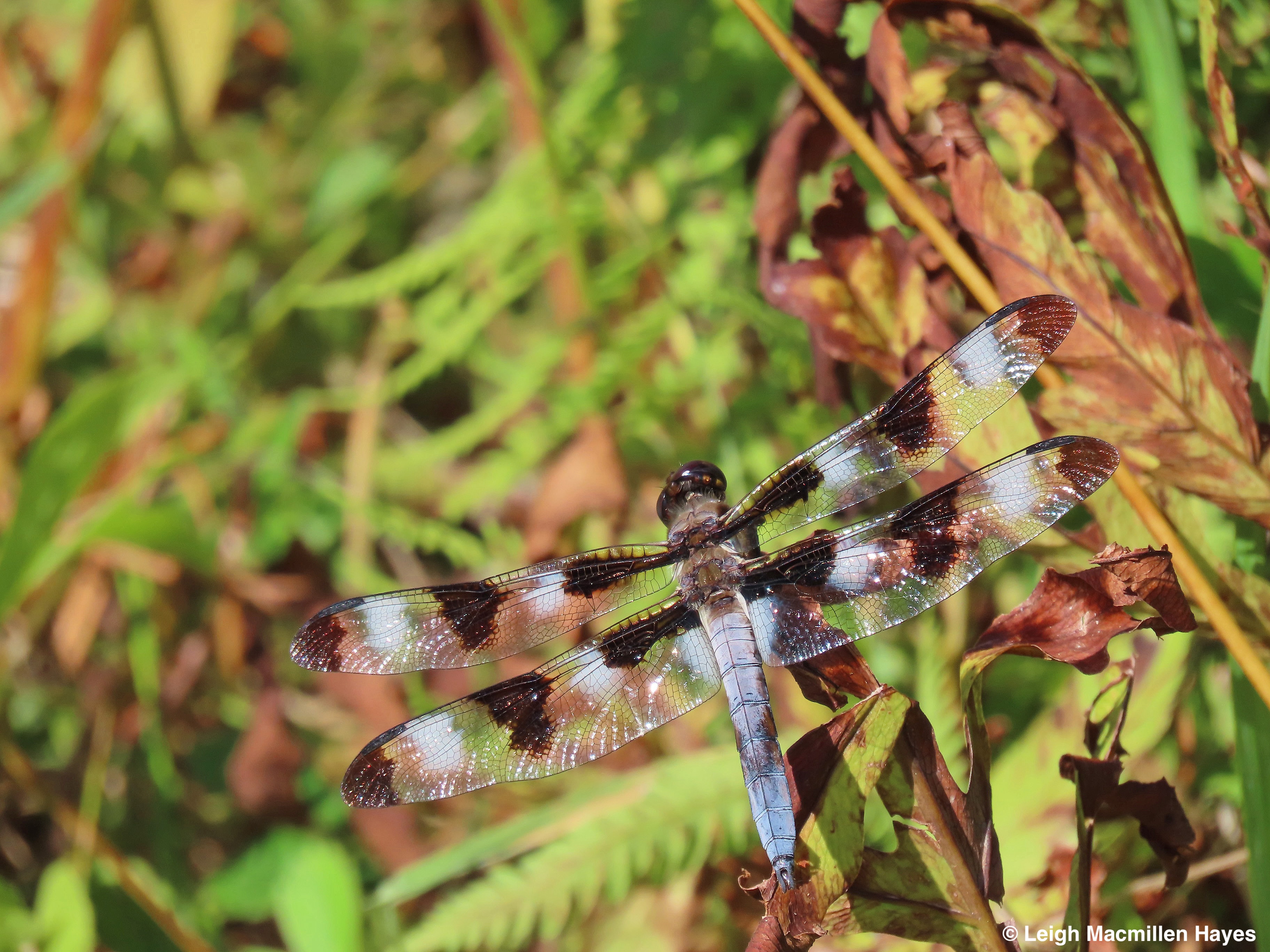
Over in the natural pesticide control aisle, I’ve a few options for you to consider, such as this handsome male Twelve-spotted Skimmer. Unfortunately, I just discovered these are on backorder, so you’ll probably need to wait until June if this is the style you prefer.

The same is true of the Eastern Pondhawk–in fact, I was totally surprised that I was able to snag this species, but suspect it has something to do with the store’s location between two ponds, and so close to a wetland and swamp.

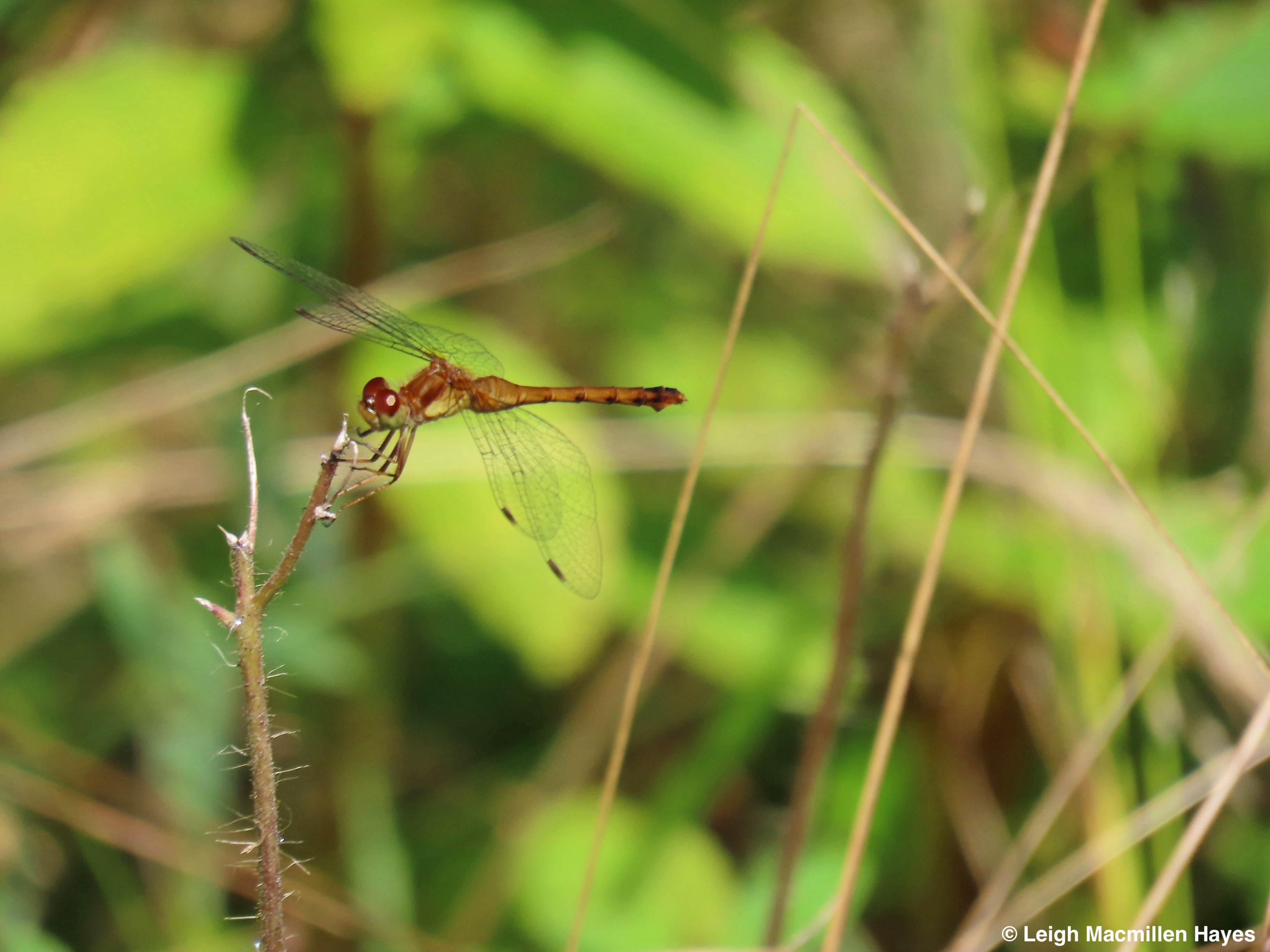
Right now, the most abundant pesticides I can offer are in the form of Meadowhawk dragonflies like this Autumn Meadowhawk, a small skimmer with tan colored legs.

If you prefer something larger . . .

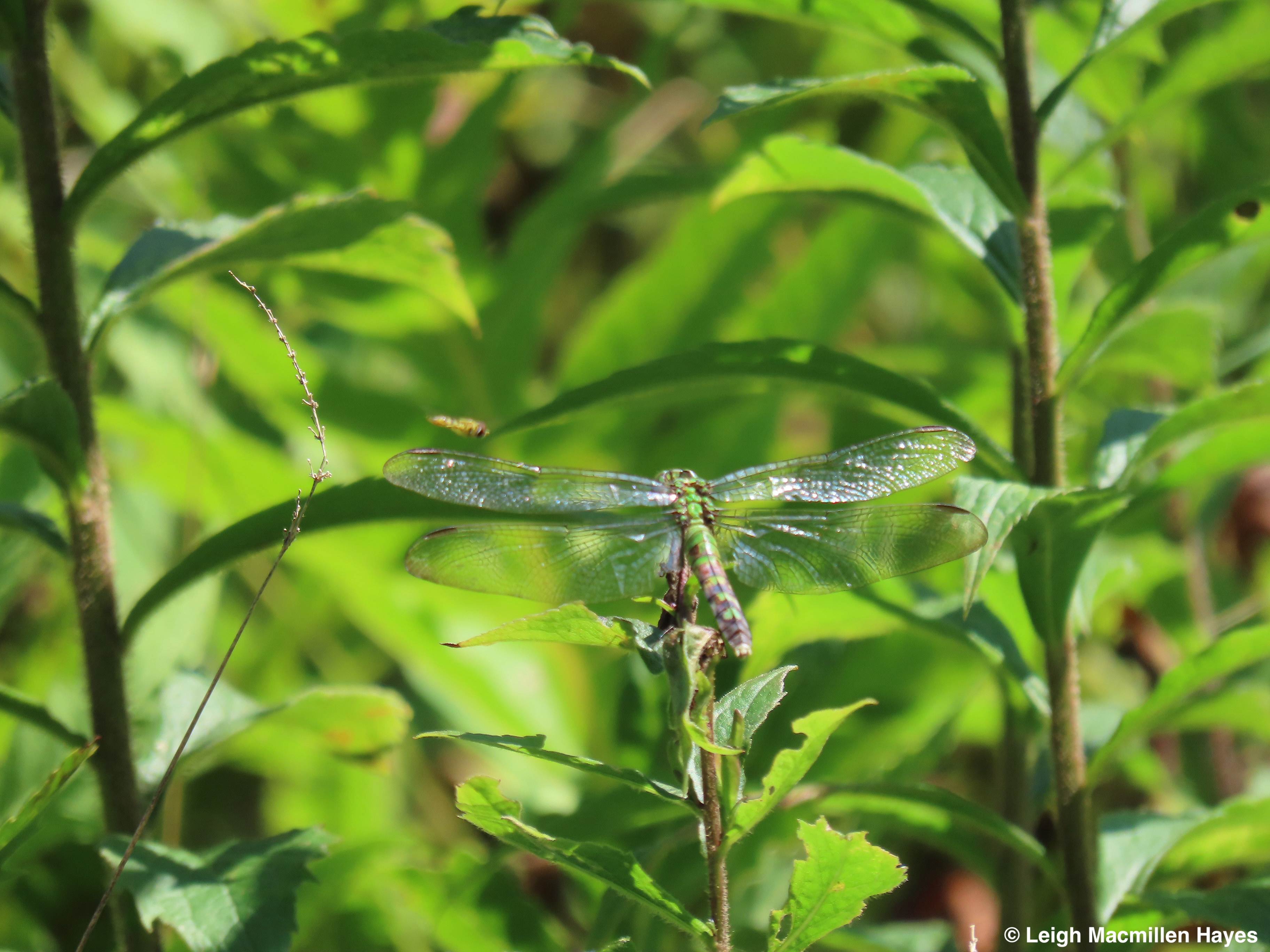
you might like the darners that keep flying off the shelf. That said, there are plenty more where this guy came from, so if you can’t find one in the shop, give me a shout, and I’ll check the backroom.

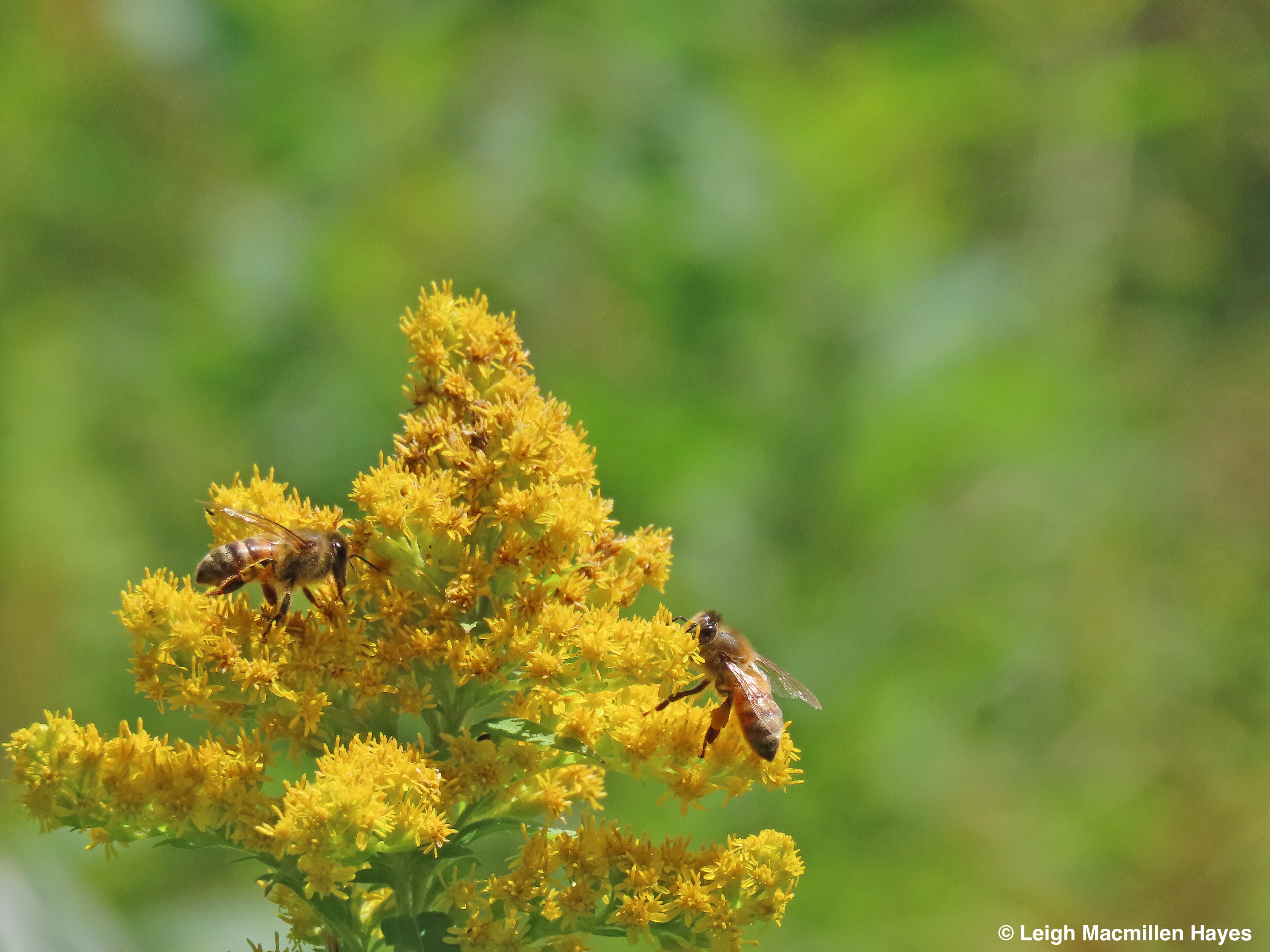
Summer is not over yet, despite what everyone has been saying lately, and so if it’s pollinators you are looking for, I’m afraid I overstocked. Well, there’s nothing to be afraid of, actually. Being overstocked on these is a great thing. And you can mix and match if you’d like, perhaps choosing these European Paper Wasps,

a few Honey Bees,

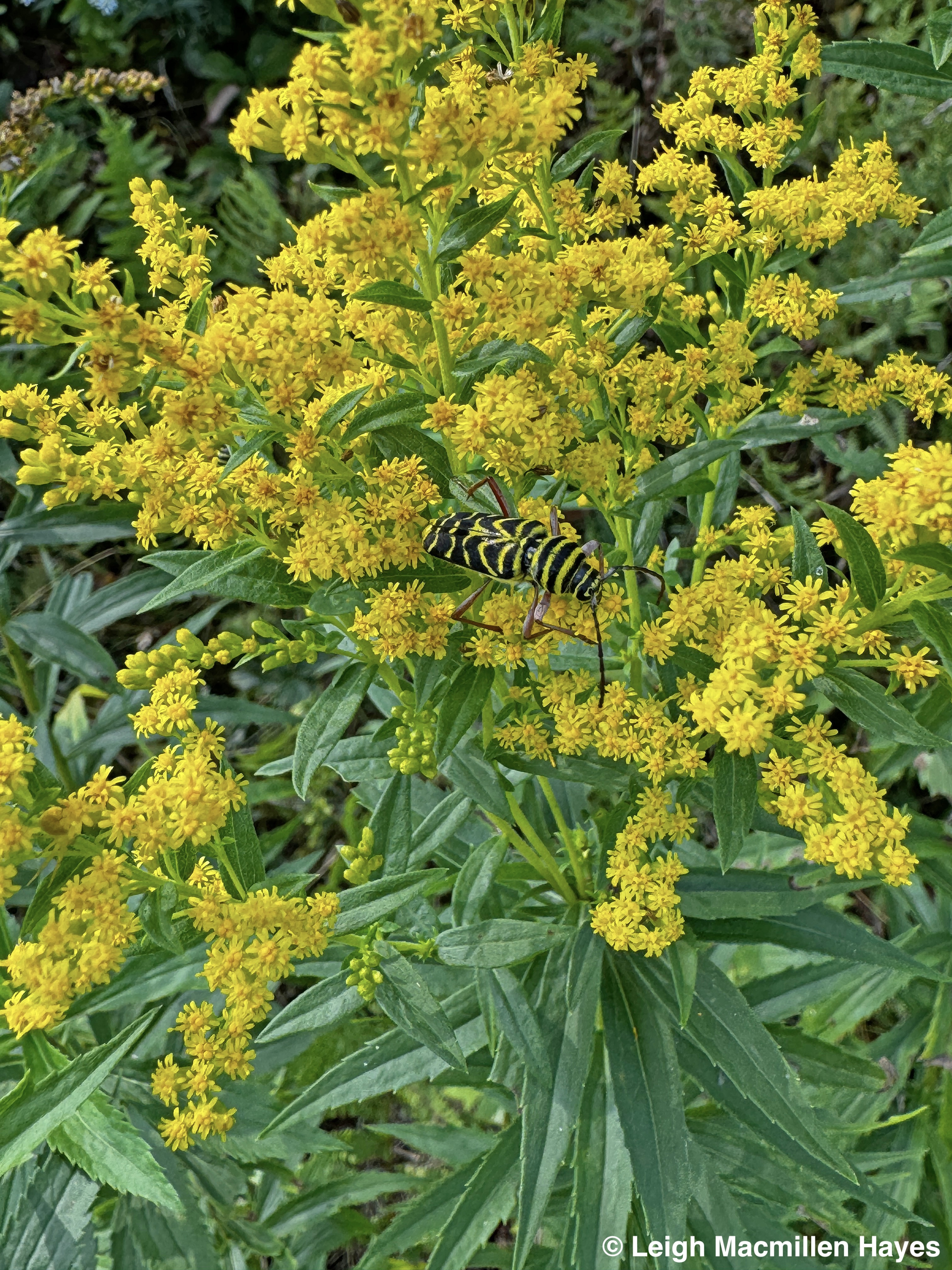
and some Locust Borers, all lovers of Goldenrod as you can see. I’ve also got Great Black Wasps, with their iridescent blue wings, and Paper Wasps, and Bumblebees, and . . . and . . . and so many to fill your reusable bag.

In the Fly By Day aisle, there are a few special selections, the first being this Lacewing that could be featured in a “Where’s Waldo” picture, so well camouflaged it is.

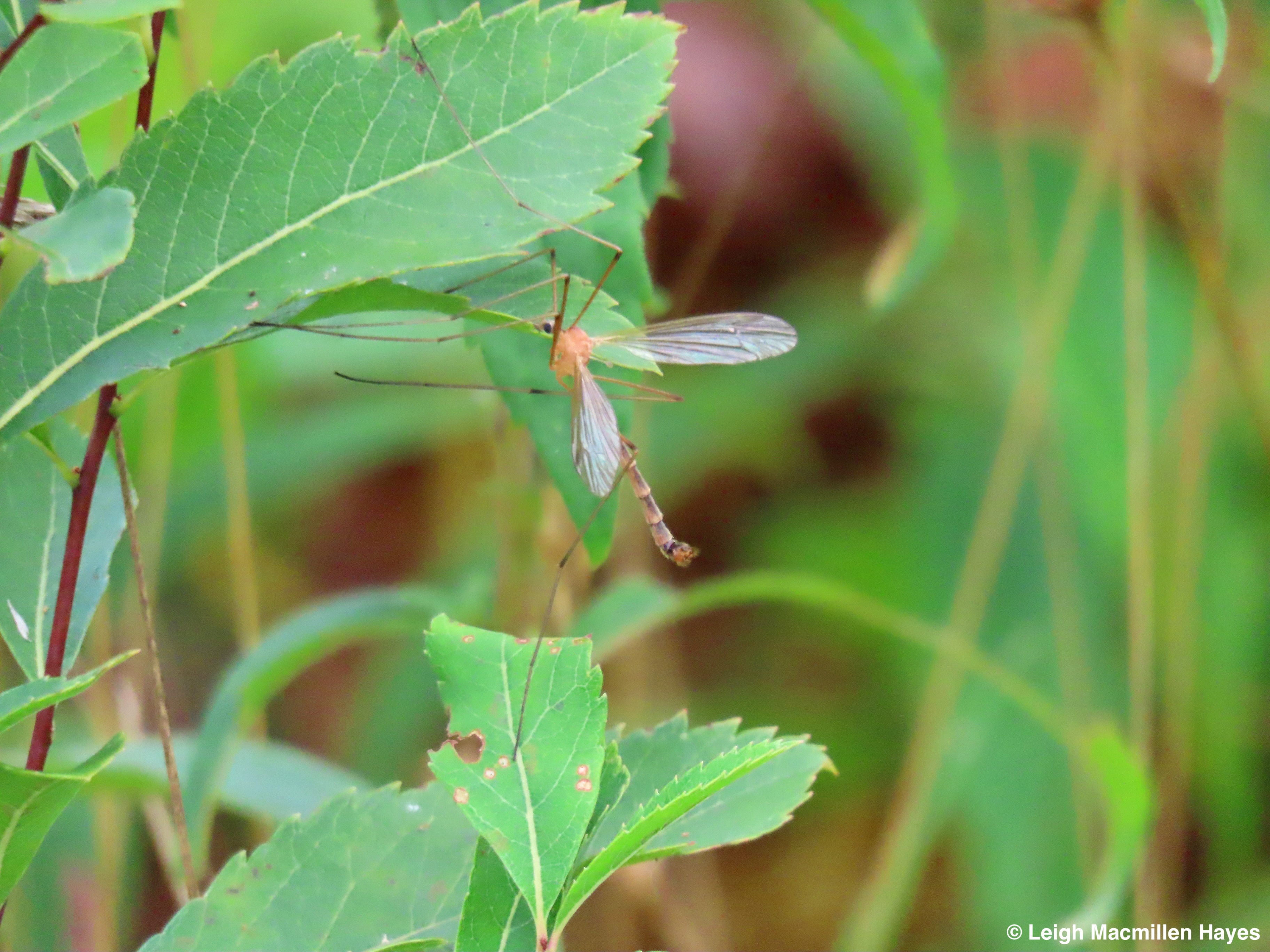
And a Crane Fly that you can scare people with and pretend it’s a giant mosquito. The thing is . . . they don’t bite. In fact, during their short lifespans, they don’t typically eat. So . . . little maintenance if you decide to put this one in your cart.

I’d be lax if I didn’t mention the employees such as this teenaged Ambush Bug who is very good at hanging out on Goldenrod plants near Black and Yellow Garden Spider webs, without getting tangled in all the drama.

But, being teenagers, sometimes two decide to tango in the breakroom under the Goldenrod, and these two canoodlers just had to have a bite to eat while they were so engaged. I’m sure the Sweat Bee never saw this coming.

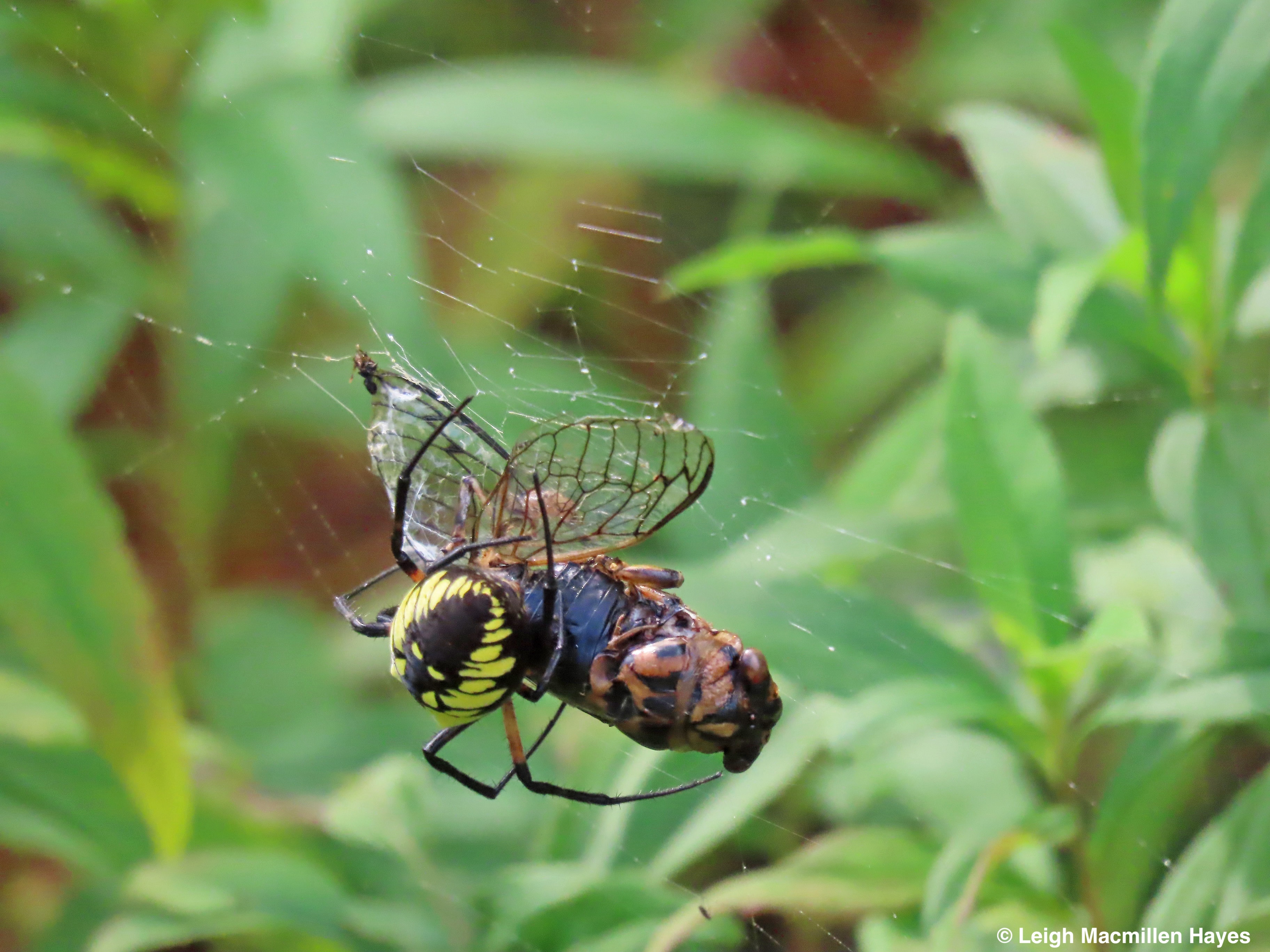
If you do decide to stop by the shop, the Black and Yellow Spiders are the chefs and they’re happy to provide you with a Dog-Day Cicada meal all wrapped up and ready to eat on the road. They have other items on the menu as well.

That said, this coming weekend, I do believe that the hardware store will have some items on the grill. So stop by and sample whatever delectable they prepare.

Food is actually a part of all our lives (haha, as it should be) and our youngest son is fortunate to work at a company in Manhattan that has a personal chef who prepares breakfast and lunch each day, mostly with locally-sourced food such as what is available at my store.

If you do come to the my shop, know that you’ll probably have to wait in line behind the Eastern Phoebes, who perch at roof-height and swoop in and out . . . often helping themselves and then zooming to the self-serve checkout line.

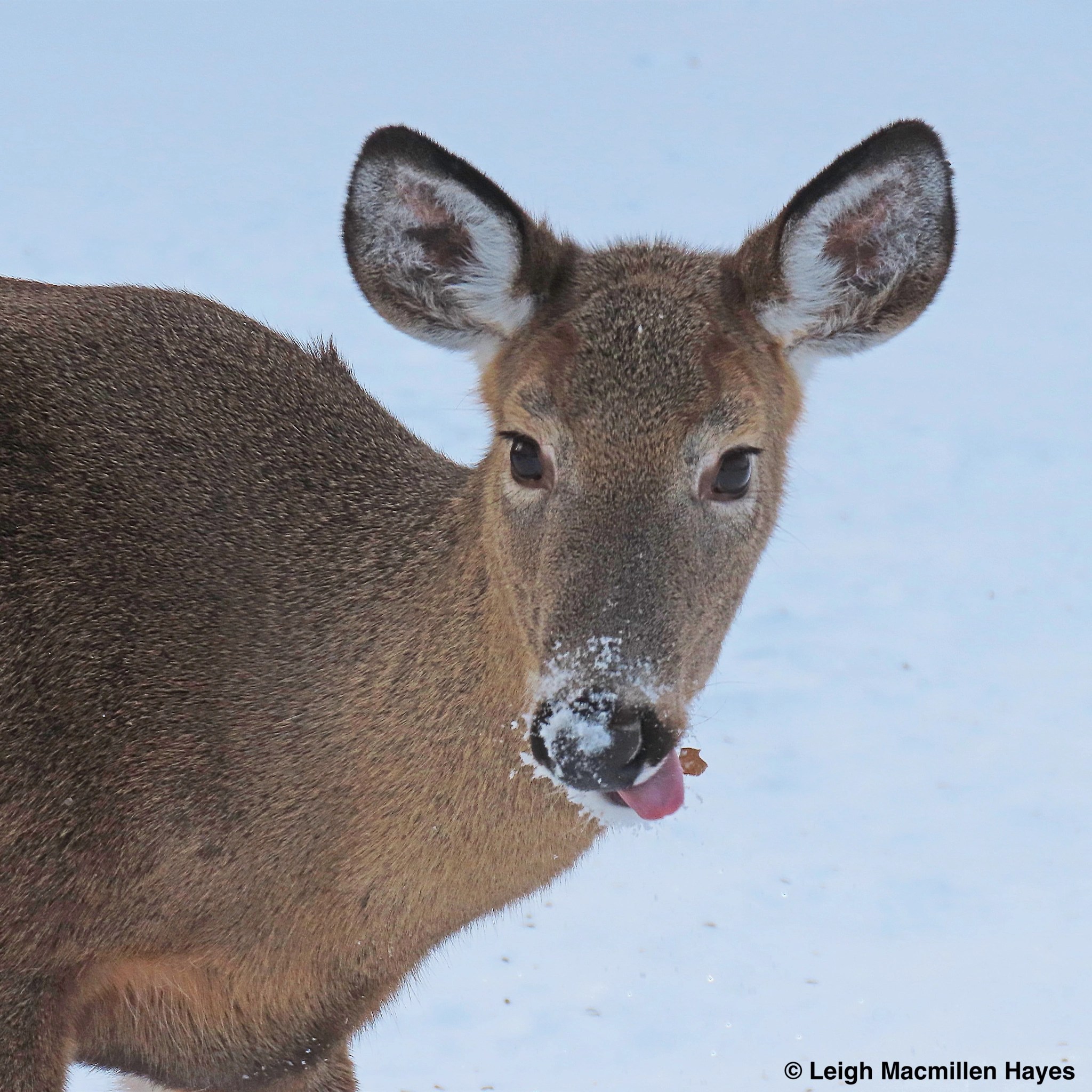
The guard doe keeps an eye on everyone passing through the door, so I don’t have to worry.

Occasionally, all four of us take a break from our respective jobs and come together to share a locally-sourced meal of our own–a la Fly Away Farm. Oh, and the kid (young man!) in glasses is holding his Lacy Blue pup who is sure that everyone who visits the hardware store comes just to greet and pet her.

As My Guy and I went for a long walk today, and hiked a mountain yesterday, we tried not to talk shop, but it occurred to me that while my eyes glaze over when he starts telling tales about hardware happenings, so do his when I point out the wonders of the natural world.

And so, I try not to tell him how to run his business (“try not to” being the operative phrase), and he lets me operate my own shop in my own way–even if it is all in my imagination.

I suppose you could say that while I’m married to a hardware store, he’s married to a . . . I’ll let you finish the line.

In the end, we both take stock . . . naturally.

Cloudy Mondate

Between the two of us, My Guy and I have lived within an hour or so of today’s destination for a grand total of 103 years. Yikes. That makes us old. Of course, we aren’t. But for some reason we never visited this spot before. Maybe because it’s a tourist hotspot, and we’re hardly tourists. In fact today, we were dressed in our usual garb because our plan was to hike. And we did. But . . . we also did that touristy thing for a wee bit. Cuze when in Rome . . . yada, yada, yada.

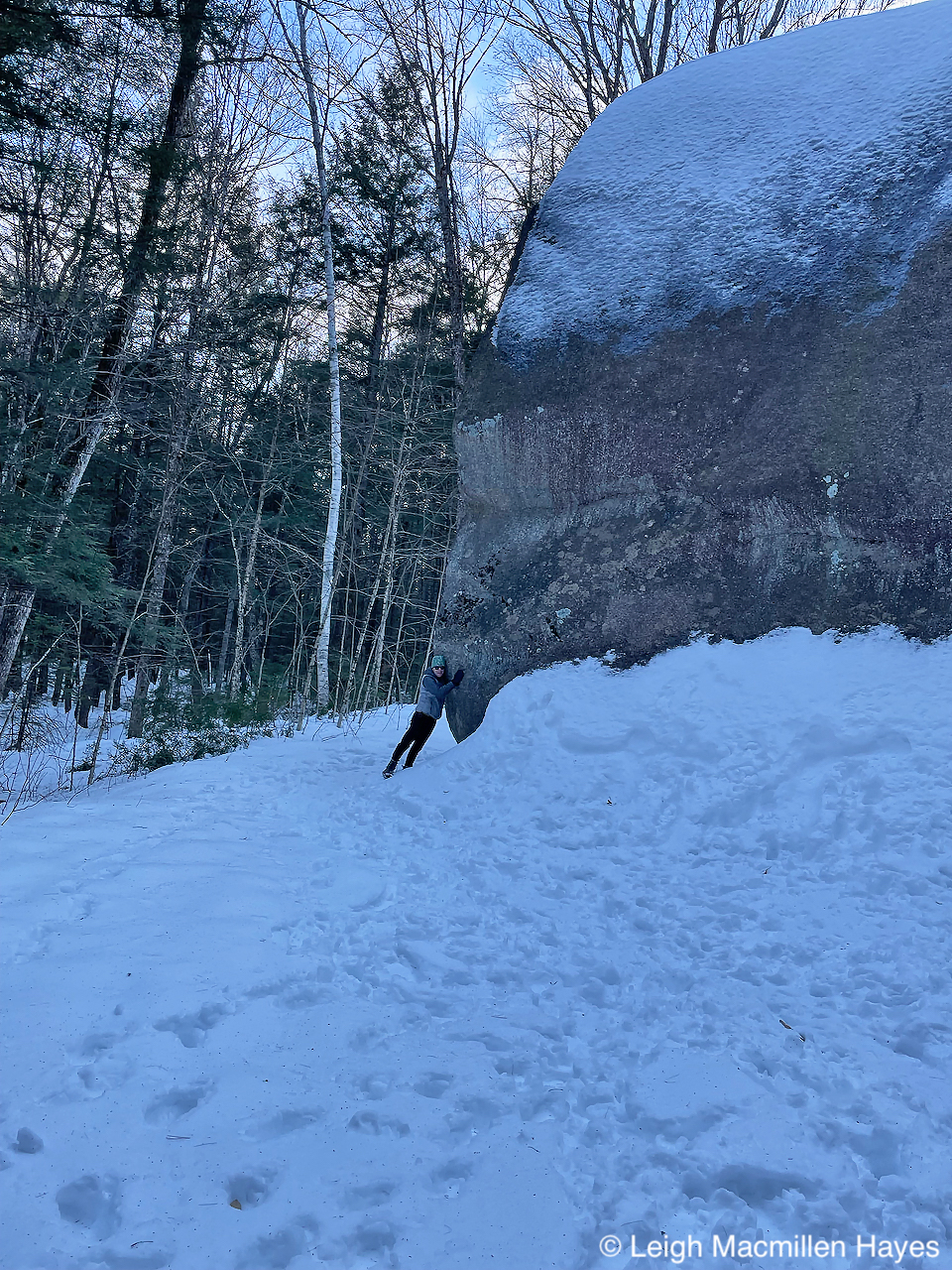
And so first we paused by the Pebble, a glacial erratic.

I suppose when you compare it to the Boulder located about a half hour north of the Pebble, which we visited on February 14, 2022, it is rather pebble-like.

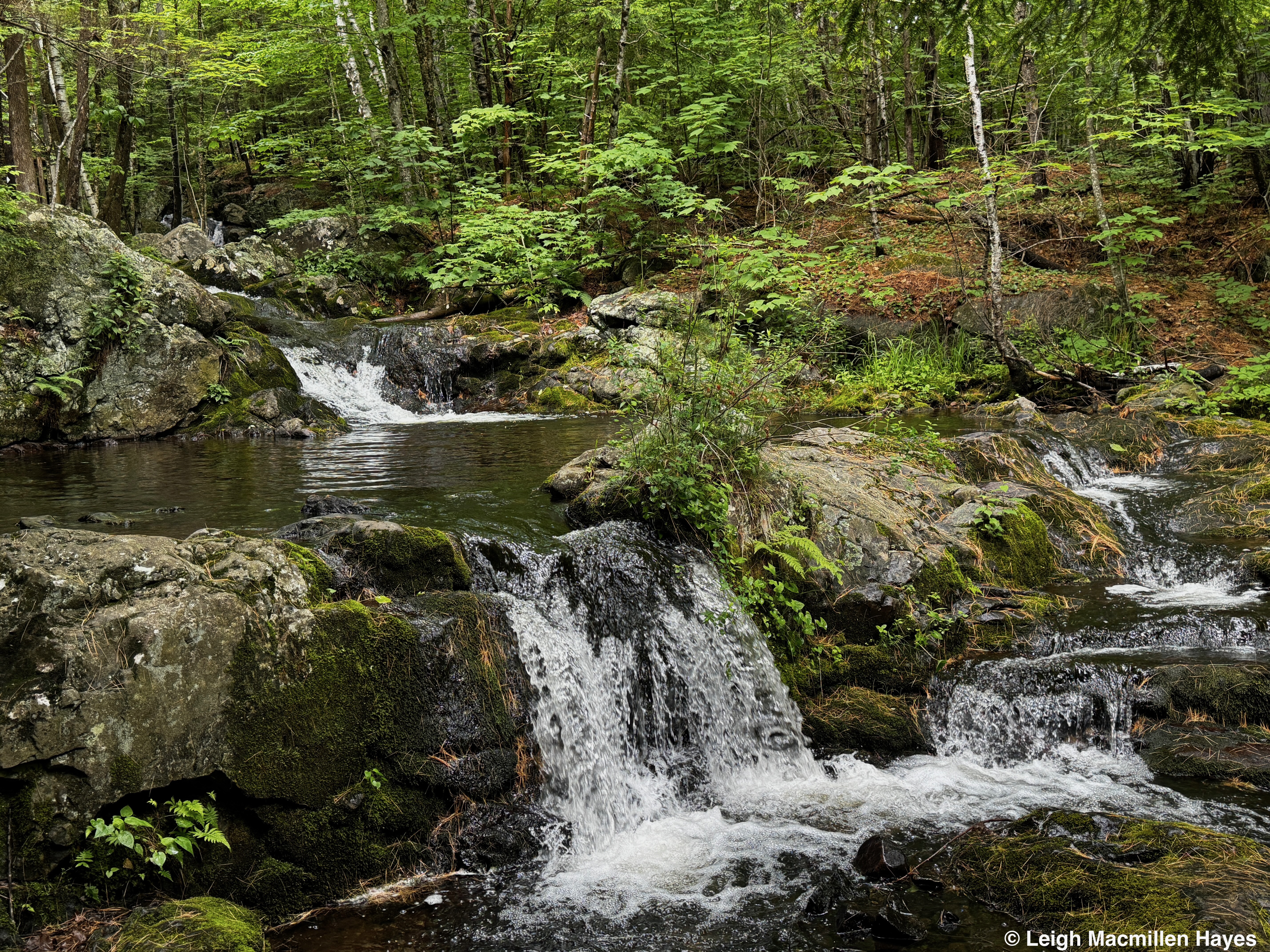
But what we really wanted to see was the Falls of Song, a waterfall that drops forty feet and is so named for the changing sound of the water that constantly flows.

According to an interpretive sign by the falls, “An 1885 Boston newspaper description of the scenic beauty and amenities stated of the Falls of Song that ‘their location in the depths of the primeval forest, their exquisite setting under the overhanging cliffs, the silvery clearness of the water and their magical musical effects, seemingly changing their song at every hour of the day, unite to place these falls among the most interesting and wonderful in the United States.'”

Another set of falls to draw our fancy was the Bridal Falls, so named because in the right conditions they appear to be lacy like a bridal veil. I felt like the conditions were indeed right today.

We followed the brook for over a half mile and the views kept changing and sounds kept enhancing our experience. If it had been warmer, we might have wanted to take a dip, but for today, just watching and listening as the water tumbled and plummeted and twisted and turned and glided and flowed was enough.

Back on the road as we drove up the mountain, we stopped again for a view from lunch bench and I found my place, which was my place in the early 1980s. Lake Winnipesaukee and Gunstock Mountain formed the backdrop and brought back memories of teaching and hiking and skiing and swimming and being. The best part is that this is the area where I learned to be. Be me.

To be native, like the Northern Bush Honeysuckle, for I began to realize all those years ago that this is the area where I belonged.

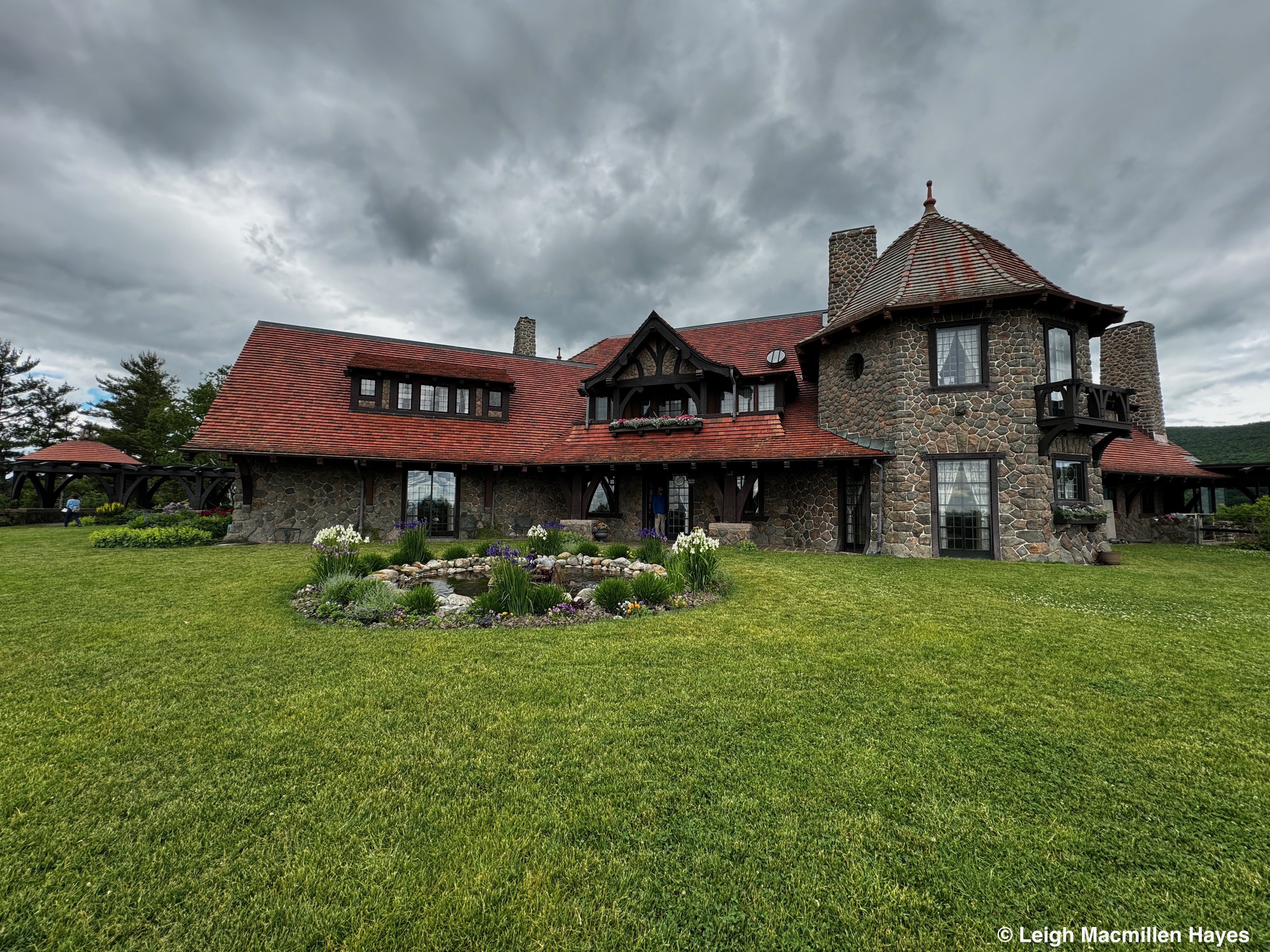
But today brought us to the home of others who also belonged in this place, beginning with Thomas and Olive Plant, the original owners of this mountaintop mansion. I could only hope to live here. But they did. For a while at least.

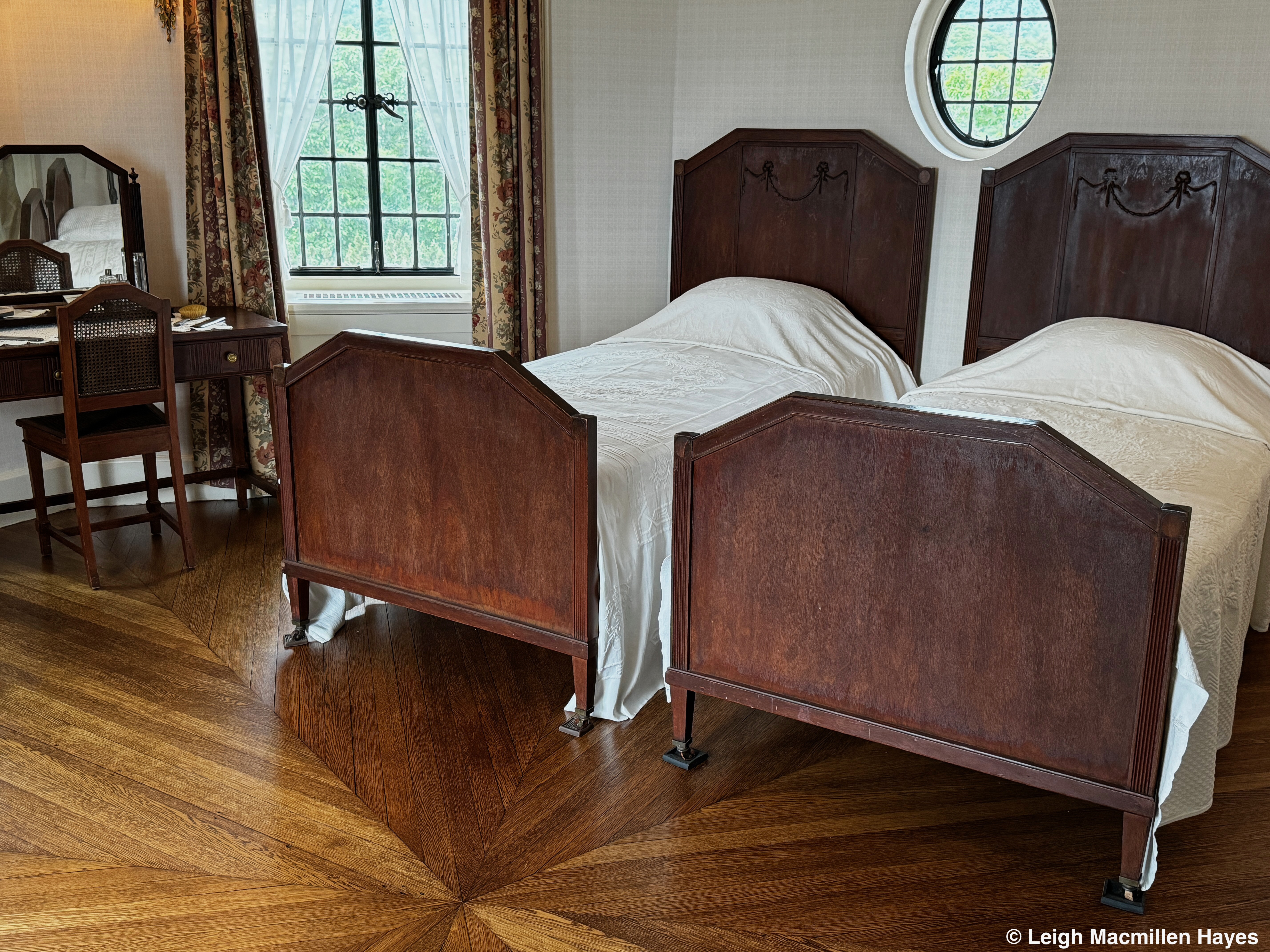
It’s a sixteen room home with halls and halls and an organ, and dumb waiter, and guest rooms like this one, and more halls, and sitting rooms, and great hall, and dining rooms, and servants quarters, and sunroom, and oh so much more. But this, the Brown Room, was my favorite, for recently carpet had been removed and the most incredible floor discovered, and it reminded me of our home, which had been similarly carpeted, and we discovered beautiful southern pine that has since brightened our days.

The sunburst pattern of the Brown Room floor–incredible.

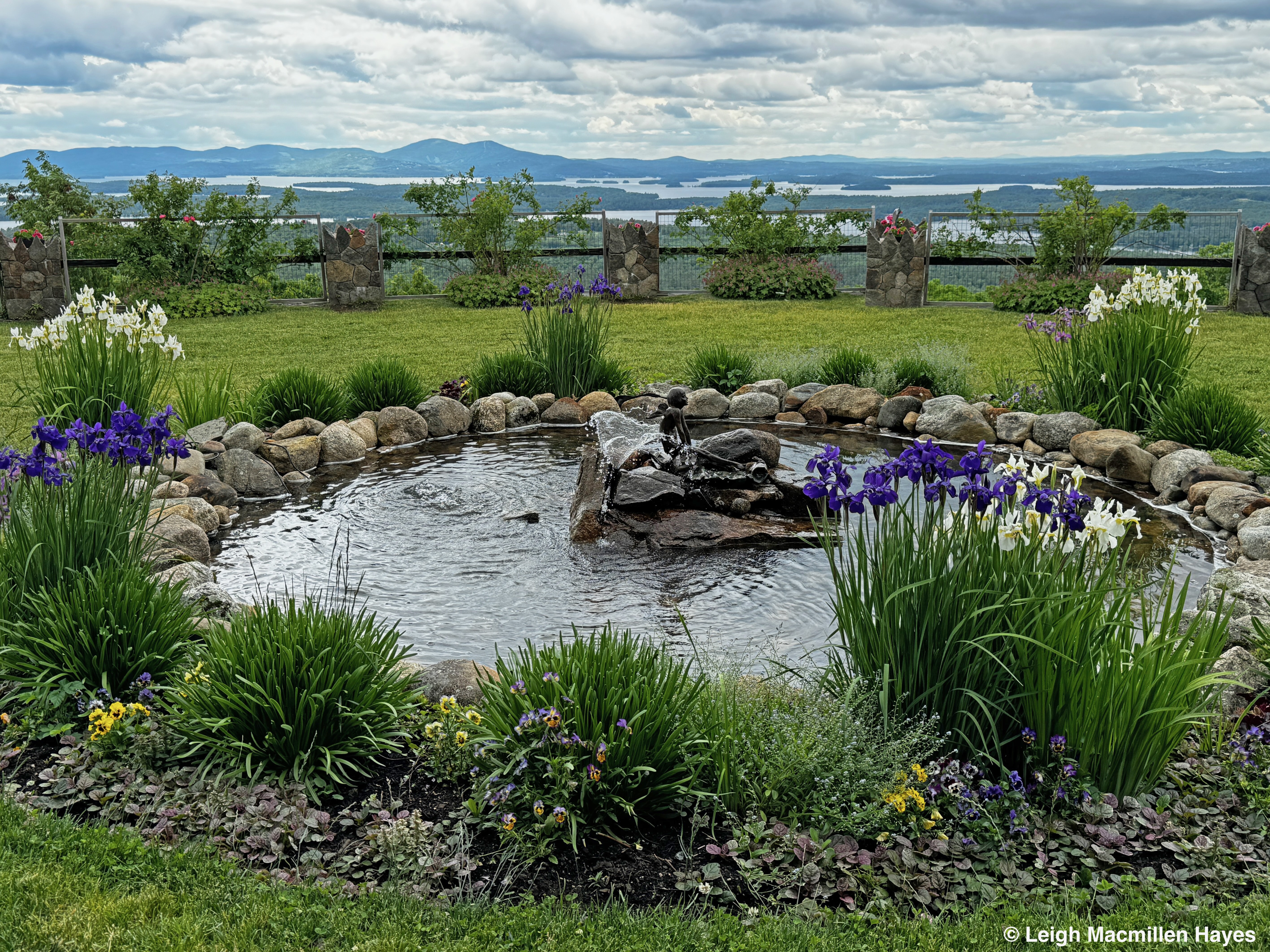
But even more than the inside, we really enjoyed the outdoor living areas, this off the main hall, with a view of the lake and mountains beyond, Gunstock being straight across.

And an angel letting water form her wings.

We’re thinking we’ll take the month of August and welcome guests here. Haha. As if we ever welcome guests, the introverts we truly are. But really, the focus should be on the Arts and Crafts architecture and way the building fits into the setting.

And the gardens. Exquisite.

Olive Plant, original owner of the property in 1914, would have approved of today’s gardens which are tended by a group of volunteers. In this space that surrounded the mansion she had a 100-foot glass greenhouse.

I don’t know if this was part of her greenhouse selection, but among the wall that formed part of nursery grows Ivy-leaved Toadflax, a plant I don’t recall ever meeting in the past.

Clouds there were upon occasion today, but the yard boundary offered glimpses of brightness.

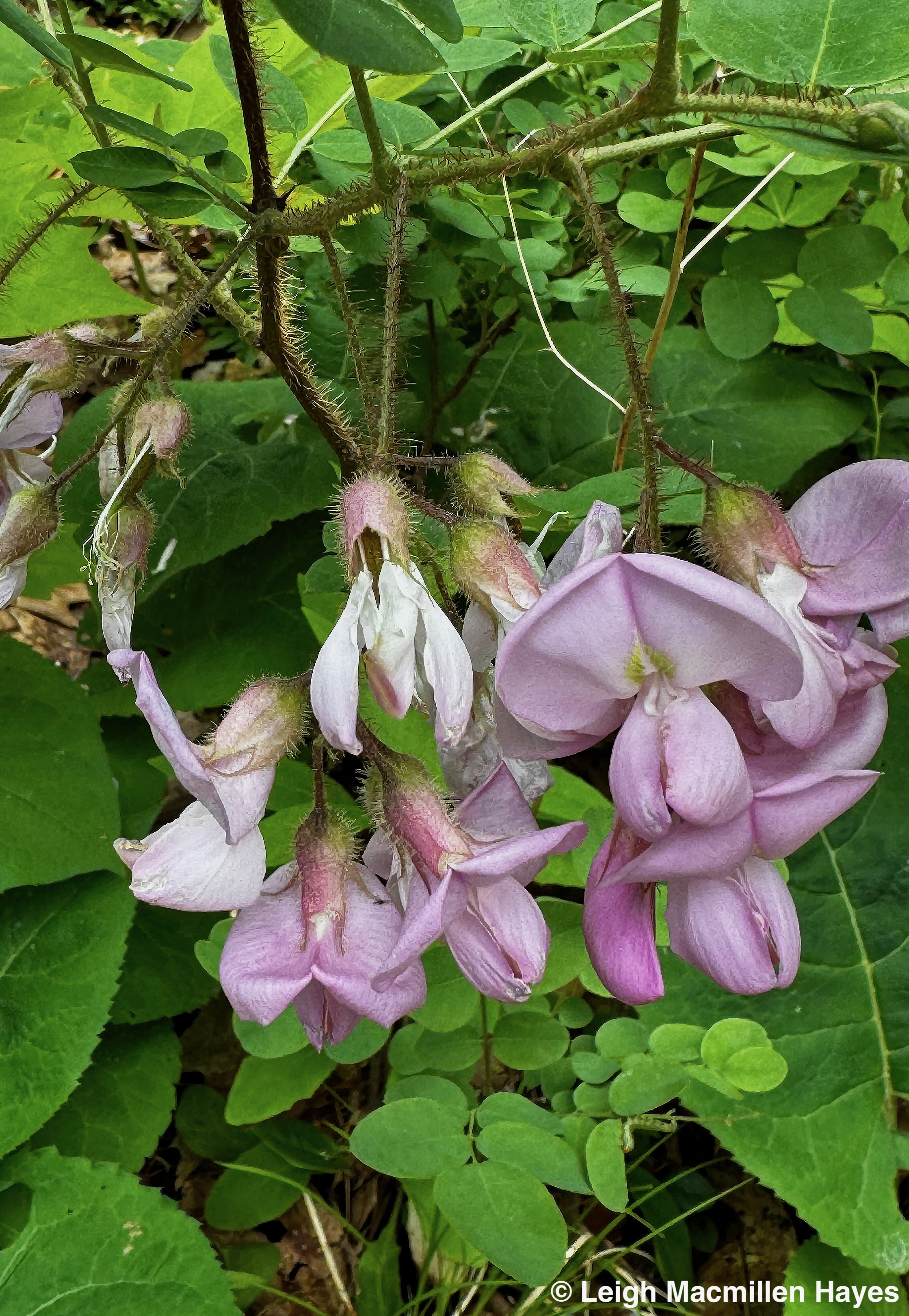
And along the trail where other specimens including this Bristly Locust, a legume.

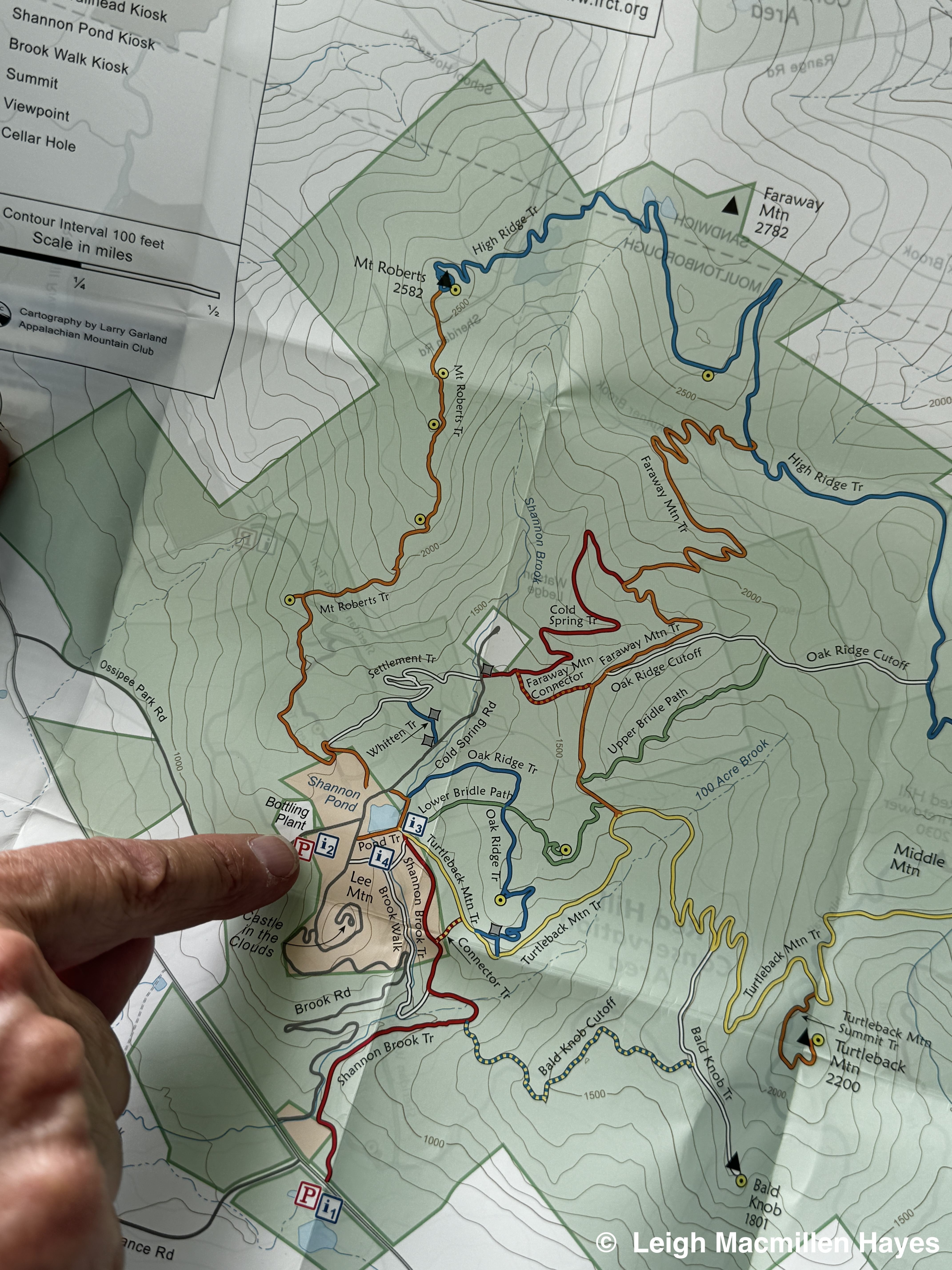
We’d hiked along the brook, spent time exploring the mansion and grounds, and the headed off to hike another trail with only so much time on our hands. At the intersection of trailheads, we had the good fortune of meeting two women with local knowledge who showed us where we were and where we wanted to go . . . that being heading up Mount Roberts. We knew we didn’t have time to summit for My Guy had to get home for a meeting (at which he later received a well-deserved Lifetime Achievement Award), but we made a plan for a turn-around time.

The trail was blazed with orange markers and we might have believed that a Black Bear had marked the way, for so chewed and scratched were the signs, but I suspect it was a Red Squirrel who had a good chomp or two or ten.

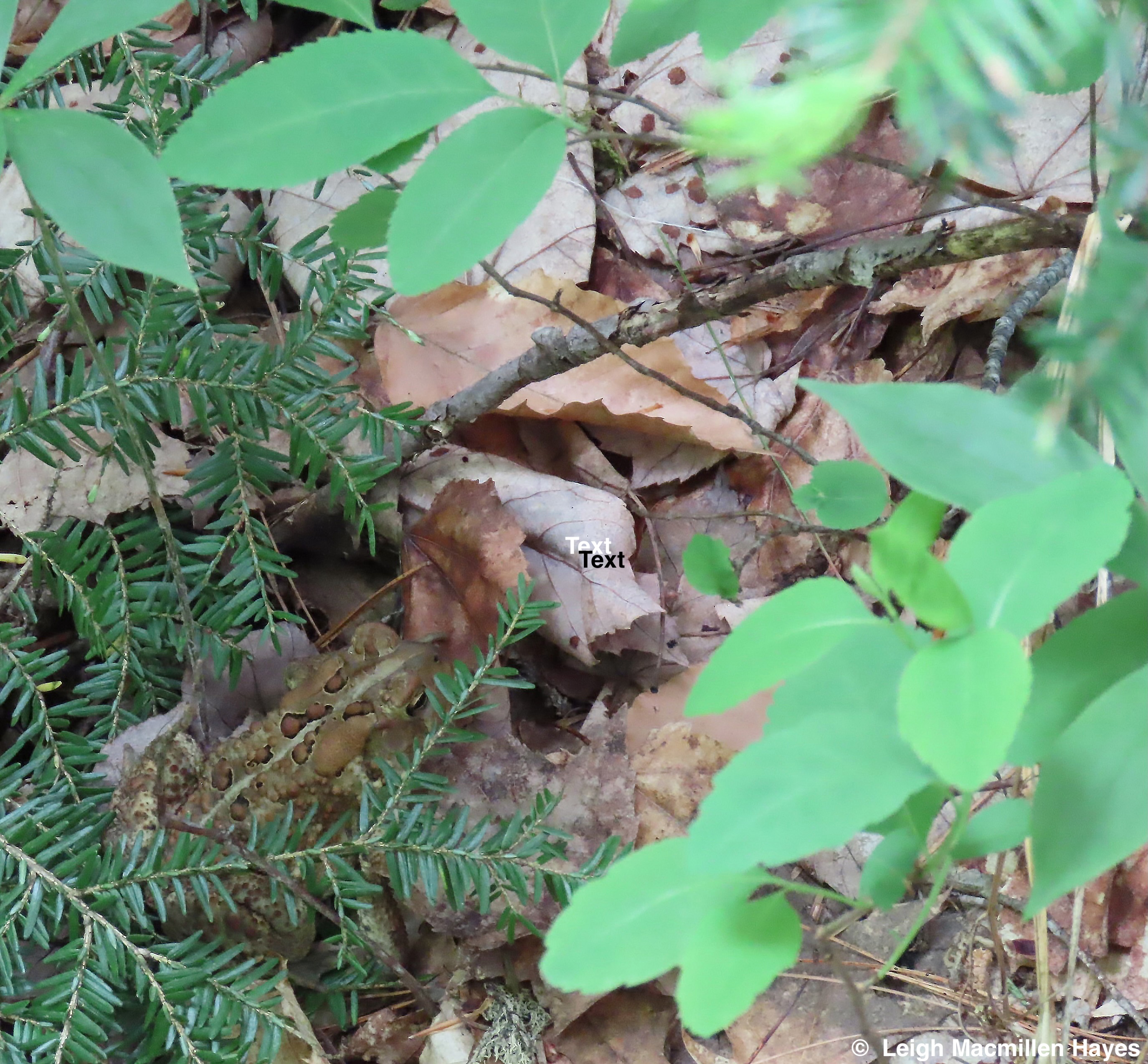
That said, a female American Toad, her tympana (ear membrane) about the size of her eye, and overall size of her body providing a clue to her sex, but also doing her best to blend in to her surroundings as she paused upon a stone on the trail.

We’d hiked over a mile when I suddenly spied this from the trail. Ruh roh. That meant we had to start looking and counting, a task that slowed us down a bit.

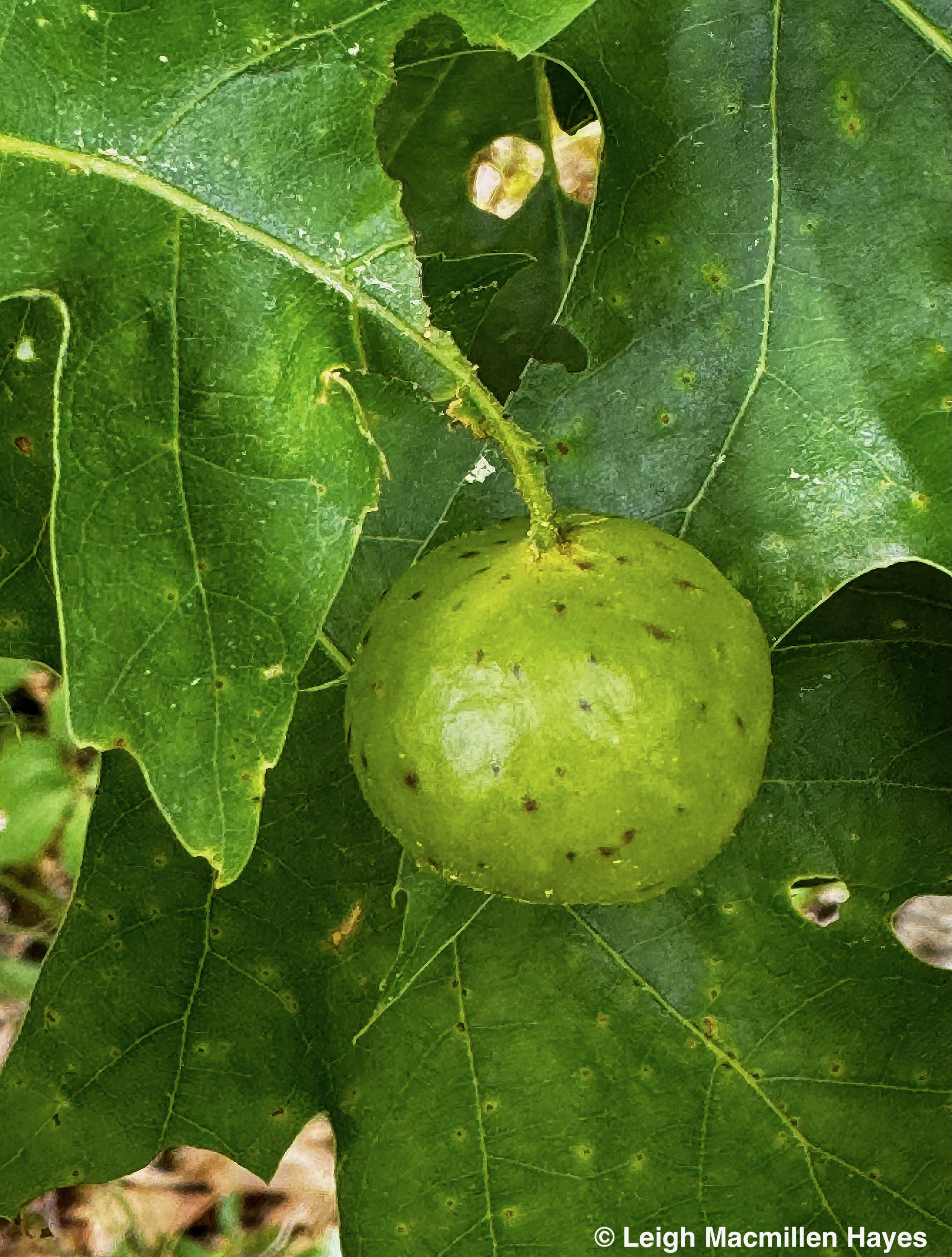
We had set a turnaround time, knowing that we wouldn’t be able to hike the entire 2.5 miles to the summit because My Guy needed to get home for a meeting, and so at 3:15pm, with 1.7 miles behind us, we stopped our upward ascent, but before descending, I spotted a green golf ball on a Northern Red Oak leaf.

Each time I spot one, I’m in awe for it’s such a cool structure. Though it looks like a fruit, it’s caused by a chemical reaction the leaf has when a wingless adult female wasp, Amphibolips confluent, lays an egg into a newly-forming leaf. As the egg hatches and larvae grows, that chemistry causes the leaf to mutate and grow with it.

The wasp is commonly known as an Oak Apple Gall Wasp, and thus this is an Oak Apple Gall.

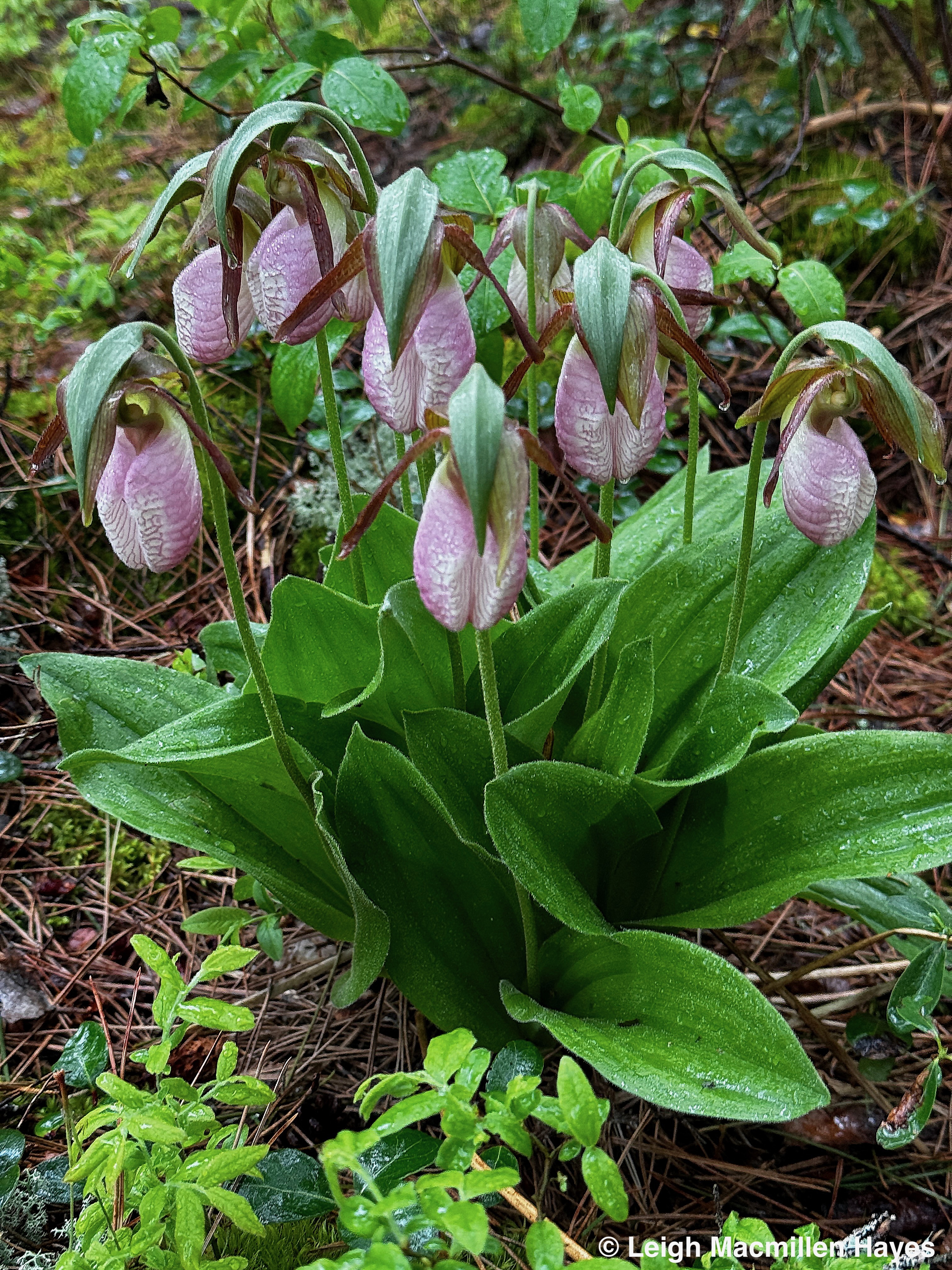
We chuckled on the way down, for we did pay more attention to the flora, and couldn’t believe that we’d passed by this Lady’s Slipper display located inches from the trail. But that’s what happens when you are moving on My Guy-speed, and watching every spot where you place your feet. Our total count on the way down: 52, but I’ve a feeling we missed many more.

And hiding under some trees near the trailhead: Ragged Robin, a treat because I’ve only encountered it a few times. I love its frayed, yet delicate display.

Because our descent was much faster than the ascent (and still we counted Lady’s Slippers, but that’s why I think we missed some), I stole a few minutes beside Shannon Pond where a small field of Lupine bloomed.

And a female Mallard swam toward the shore. She and a few jumping fish were the only wildlife spotted today.

That was okay, for we had a splendid Mondate wandering under the clouds, which seemed truly appropriate since we were at the Lucknow Mansion property now known as Castle in the Clouds in Moultonborough, New Hampshire. Why did we wait so long to visit? Maybe because it’s practically in our backyard.

The May Flower Whisperer

In rain or shine, as May gives way toward June, My Guy and I set off to hike a few local trails.

It’s not whether we have a view . . .

or not . . .

or if we have to stand beside lunch rock rather than sit (well, he sat, I didn’t) . . .

or even the challenges the trail chooses to offer, like crossing a well-mudded beaver dam that is rather tricky . . .

and spying the well-mudded lodge where the local residents were probably relaxing after a long night’s work,

but rather, the sights at our feet that drew our attention, such as the Black Chokeberries pink anthers and delicate petals enhanced by raindrops.

Scrambled-egg Slime Mold (aka Dog-vomit Slime Mold) showed off its intricate structure that looked more like a bunch of worms swarming together upon a decaying log.

Because we were always looking down, an American Toad, so certain it was invisible for so camouflaged was it, wasn’t. Invisible that is.

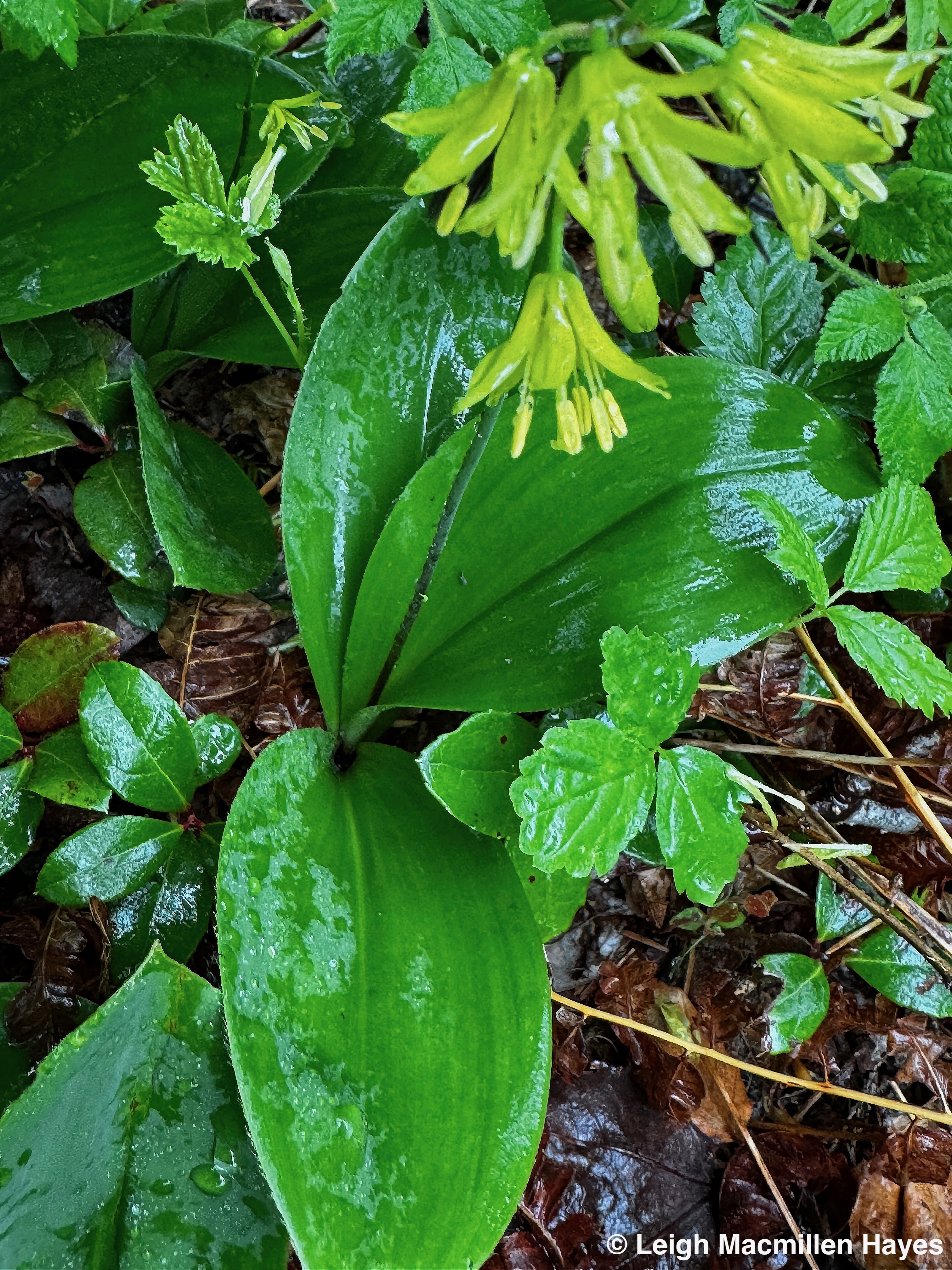
Plentiful were the Blue Bead Lilies, with their anthers hanging long awaiting pollination before rising in fruit forms that will soon look like . . . blue beads.

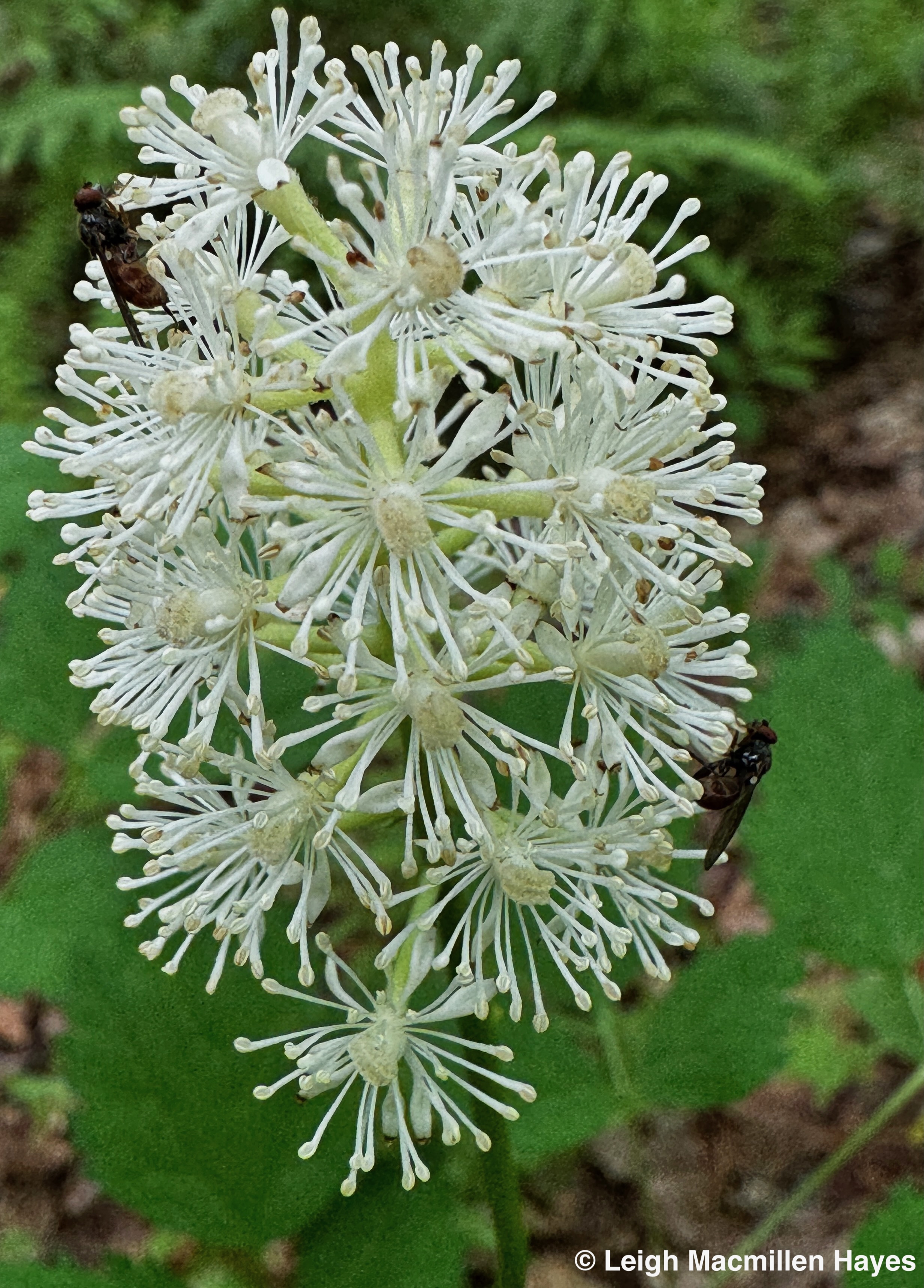
In several spots along one of the trails, White Baneberry, aka Doll’s Eye, so named because its fruit form resembles such, showed of its firework display and the insects were attracted.

And a carpet of Bunchberries, those with six leaves rather than four, asked that their floral displays be acknowledged.

Not to be overlooked, Wild Geranium’s runway lines upon each petal functioned as the nectar guides they were intended and the pollinators rejoiced.

I, too, rejoiced, for on the first rainy day, May 27, 2024, the trail we hiked, which is known by locals for its mosquito population, wasn’t at all buggy; but on our May 30, 2024, hike, our faces were constantly buzzed, though nary a bite, making me think they were all males. We kept an eye out for dragonflies and finally made their acquaintance, including with this Common Whitetail Skimmer, that hardly looked common.

The real reason, however, for our hikes this week was greed. Yes. Greed. You may know My Guy suffers from Blueberry Greed in the summer, but spring brings out another type and he takes on the mission to locate and count Lady’s-slippers. And he always wants more.

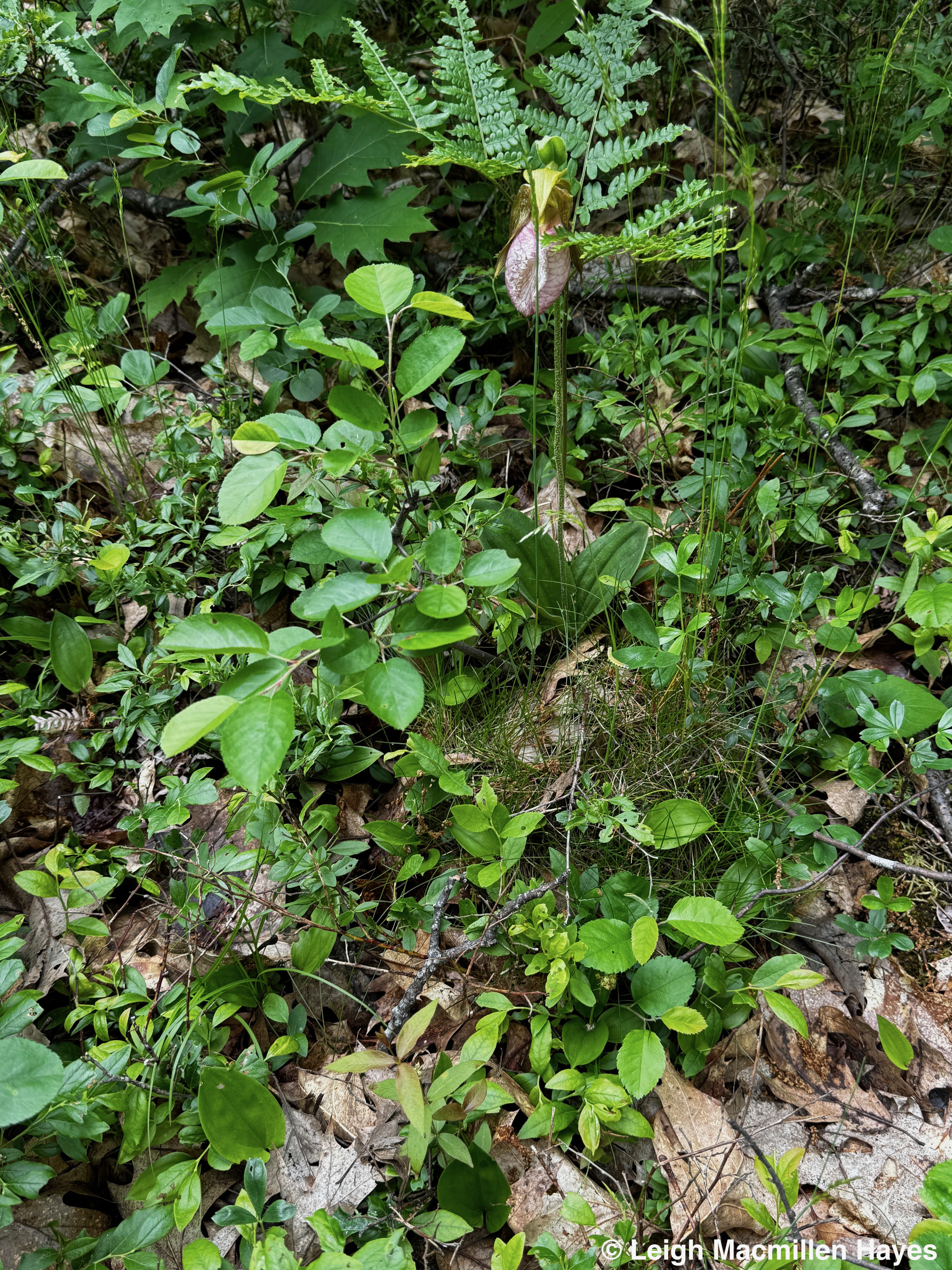
It may sound like an easy task because some are proud to stand straight and tall and can be seen easily from the trail.

But some, like the American Toad, like to hide. We, however, are persistent in our survey.

We found pinks of many hues, and their white variants.

And no spring feels right without a visit to My Guy’s favorite bouquet.

Lady’s-slipper pollination is a curious thing. Bees are lured in by the guide lines to a slit in the front petal, the slipper-like pouch, or flower’s labellum. Once inside, the bee cannot exit the way it entered because the petal structure turns inward.

The exit is at the top of the slipper, but to reach it, the bee must move through a hairy interior and rub against the flower’s stigma, depositing any pollen it may have carried in and brushing against the pollen mass called the pollenia before flying out.

Some bees get frustrated with the dilemma of discovering there is no nectar and the task of finding the exit and instead chew their way out, which seems to be what happened to this flower.

One flower in all that we found, did present as if it had been pollinated, for rather than the downward pose, the slipper was almost parallel to the ground and beginning to deflate.

Twice we came upon last year’s capsule, which is a rare treat for so few are actually pollinated because the bees learn not to bother. Fortunately, one woody capsule contains thousands upon thousands of seeds, which are released when the woody structure splits its seams.

Near the end of yesterday’s hike, the sun finally brightened the sky and forest, and we weren’t the only ones to enjoy it for a gartersnake basked beside the trail and helped us spot another flower to add to our count.

And on Monday’s hike we had another special sighting: an Ovenbird’s nest that I spotted because I saw the parent fly up through vegetation beside the trail as we approached.

We covered a lot of miles, hiked slower than My Guy’s normal pace, and kept reminding ourselves of the numbers so we didn’t lose track, but rain and mosquitoes didn’t hold us back.

Lady’s-slippers have a symbiotic relationship with fungi. A fungus helps break the seed and allows it to obtain nutrients and energy from organic matter in the soil, while the plant, once established, gives nutrients back through its roots. It takes anywhere from 3 – 7 years for the seed to develop underground and then may take another ten years of presenting as two pleated leaves, before a flower is produced. That means that by the time it first flowers, the plant might be 17 years old. So please, please, please, enjoy them the way we do. In their natural state.

Our count (which include last week’s visit to Wolfe’s Neck Woods State Park):

Wolfe's Neck
2022: 411
2023: 324
2024: 475

Albany Mountain
2020: 150
2021: 47
2022: 266
2023: 274
2024: 364

Overset Mountain and Sanborn River Trail:
2022: 286
2023: 351
2024: 598!!!!!!!!!! (You know who wanted to make it to 600, but came up just shy)

Grand Total this year: 1,437.

I'm not sure we are done and I know everyone is seeing them everywhere, which is a glorious thing. Now I'm wondering if all of last year's rain showers meant more fungi for My Guy's May Flowers.

Lions, and Otters, and Moose Mondate!

We drove across the border and south today in search of wildlife. And we were not disappointed as our sightings were numerous.

But first, lunch. That in itself was a treat–mine being an Avocado and Roasted Veggie Panini. You are looking at the second half, which was supposed to follow me home. But . . . the avocado would have turned brown. And so I gobbled it all down. Sometimes, you just have to do the right thing.

We may not have been the only ones eyeing lunch, though what this Bobcat was looking at, we could not determine.

It was less than ten feet away from this second Bobcat and it appeared that they had their eye on the same little tidbit. Perhaps a mouse or chipmunk was on their menu.

With a lick of the chops, it appeared that the nearby Mountain Lion had indeed enjoyed a morsel of delight. So, the fact that we saw a Mountain Lion is rather curious because they were officially extirpated in New Hampshire. But . . . sometimes one makes it way into the state and perhaps this was one of those.

I love how its front paw rests so naturally on its back leg. And my, how big those paws are. Notice also that the claws are tucked in. Members of the cat family only use their claws to capture prey (or if conditions are muddy or in some other way slippery, then the claws are extracted to help with stability).

In the midst of our adventure, we stepped into a garden filled with flowers and flowering shrubs and trees, a haven for pollinators this early in the season.

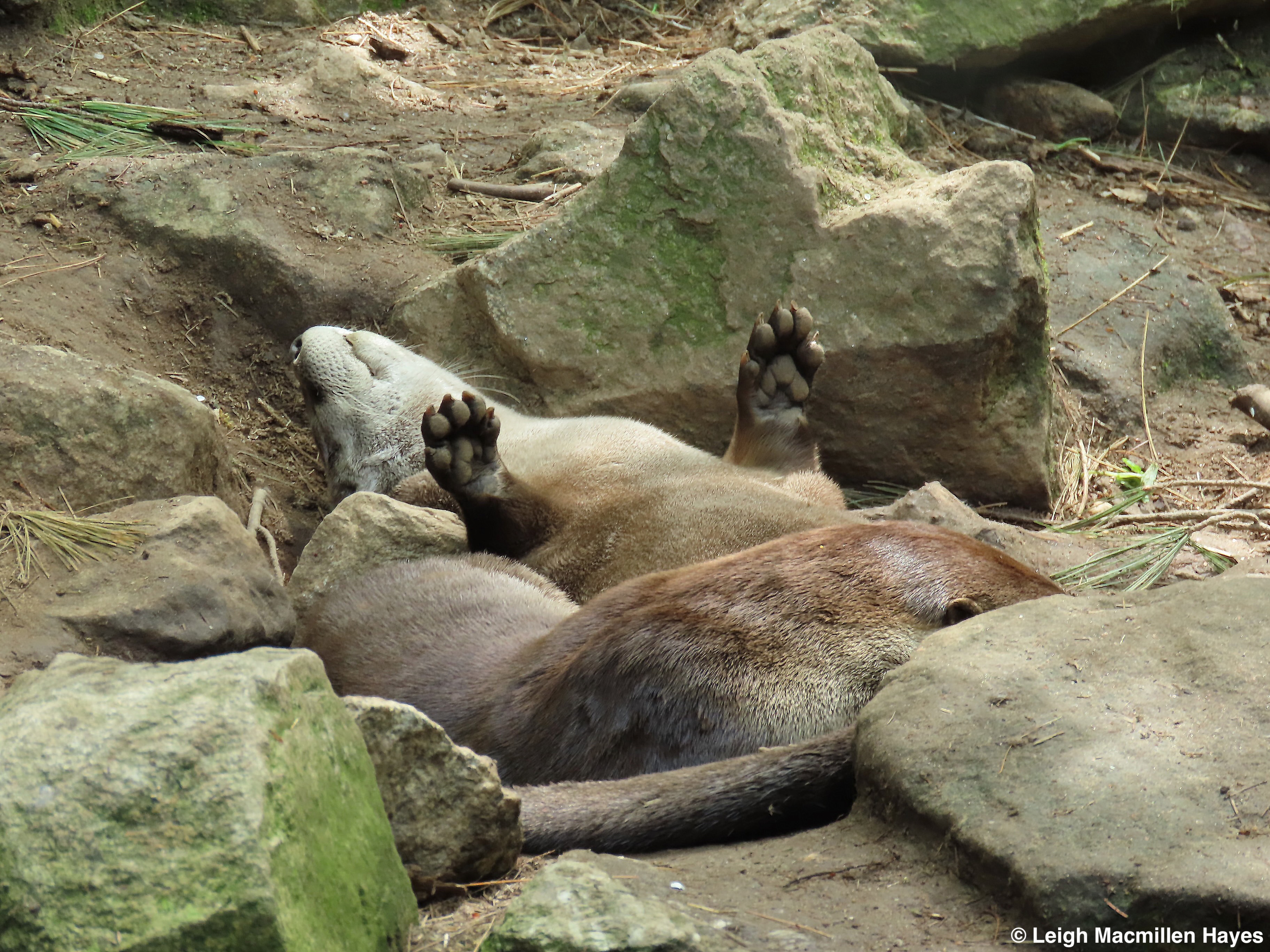
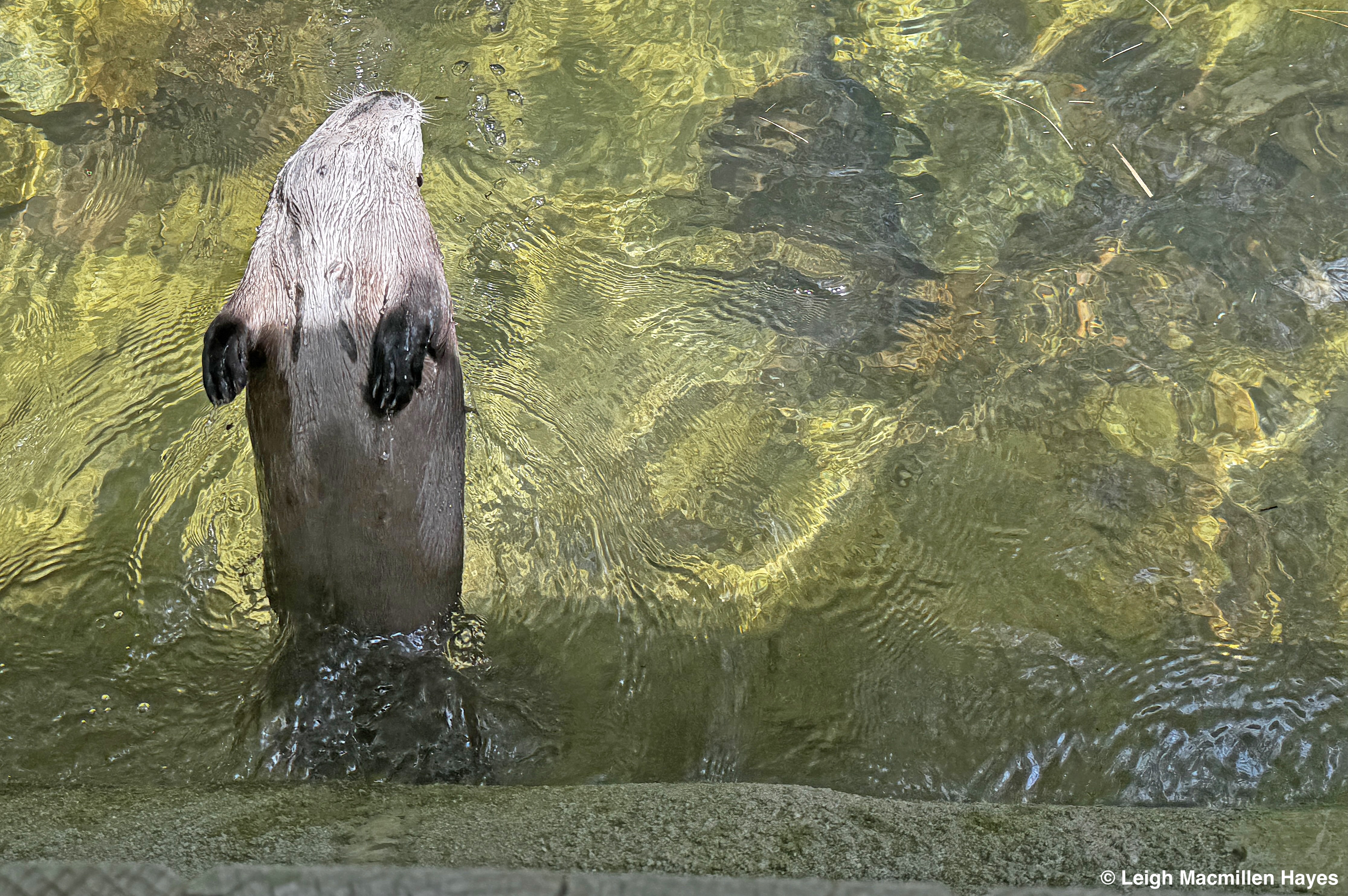
And then it was on to search for River Otters, who had obviously decided to take a post lunch nap. And rejoice in the opportunity. Or so it seemed with those front feet raised.

Take a look at the bottom of those paws–with their five tear-drop shaped toes identifying them as members of the weasel family.

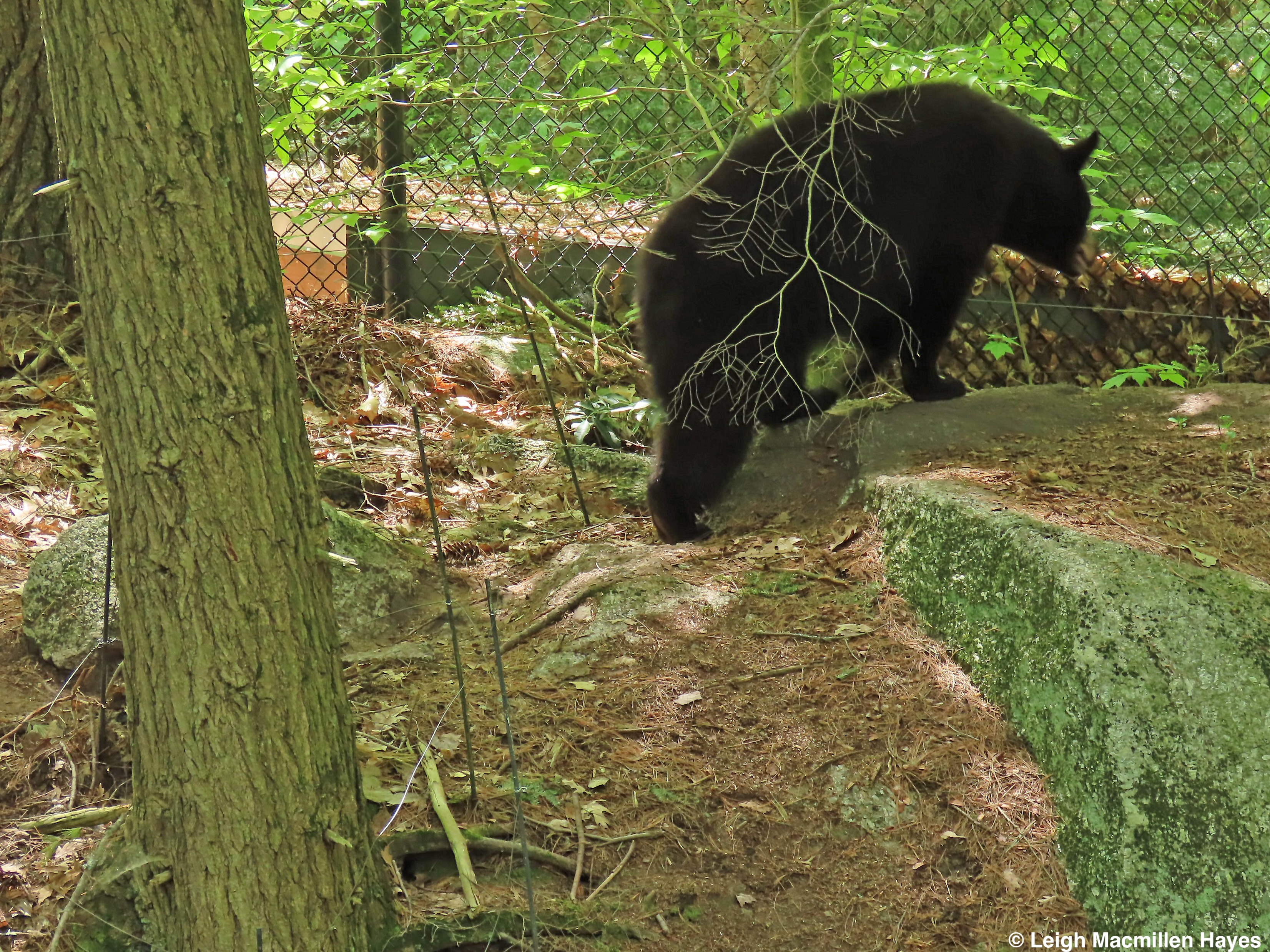
Our next sighting mystified us a bit. As two who are always looking for signs of Black Bears, we were thrilled to see this one. Every once in a while we are granted such views, but the troubling thing today was how the bear paced. Back and forth and back again. It was obviously anxious about something despite its ability to roam in a large area.

Birds were also part of our view, this being a Black-crowned Night Heron, or more simply Night Heron. Look at that eye–its color allows it to hunt at dawn, dusk, and even during the night.

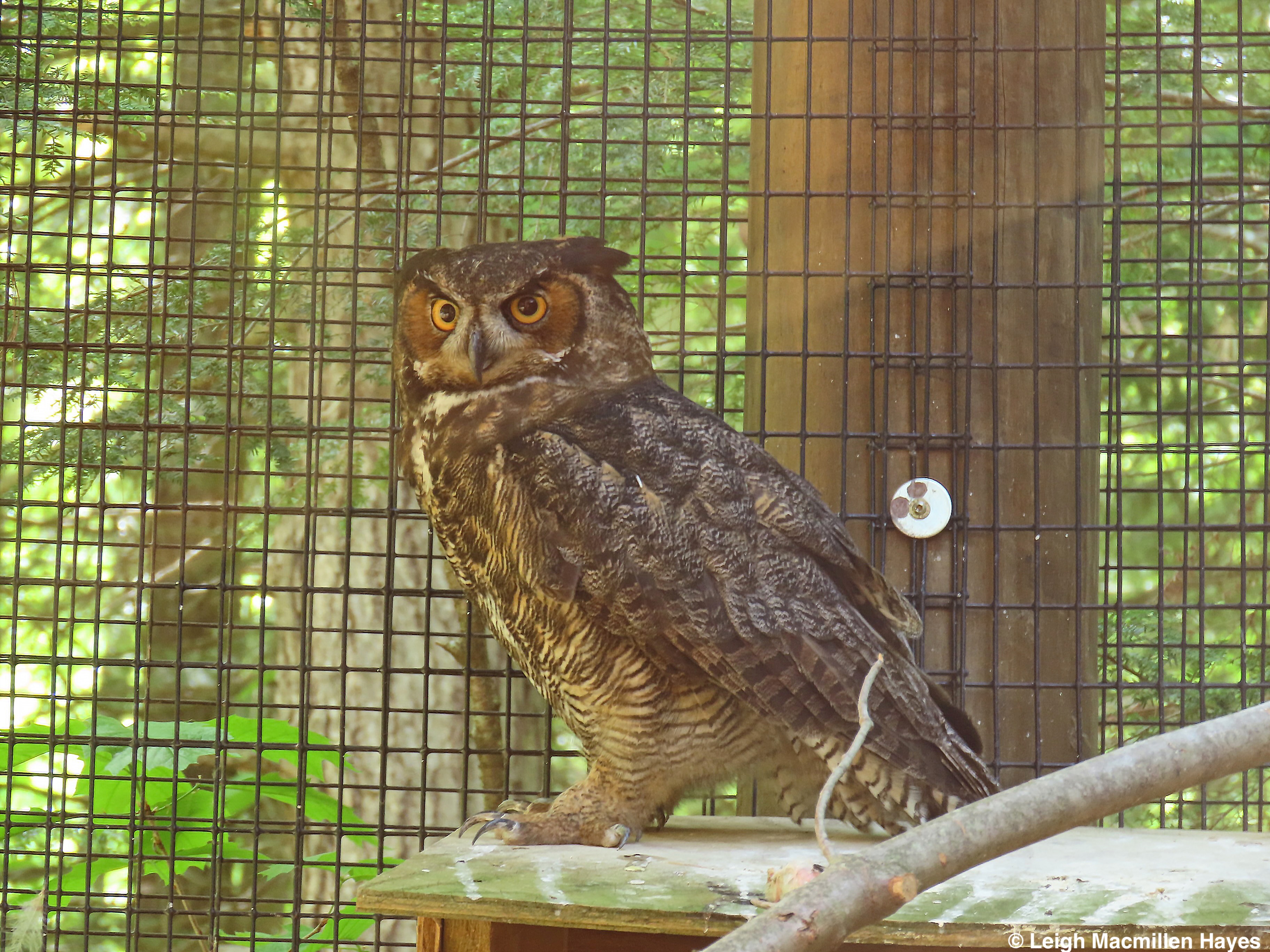
The same is true for the eyes of the Great Horned Owl.

Okay, so by now you’ve turned into a great tracker and hunter and realized that there is fencing behind these animals. Yes, we had travelled to Squam Lakes Natural Science Center in Holderness, New Hampshire, about an hour and a half from home. All photos were taken through glass. Glass that was smeared with finger and nose prints.

The animals are only there because they were orphaned or injured or for some reason couldn’t survive in the wild. And they live in habitats that equal their preferred home territory.

The Red-tailed Hawk offered a shrug, maybe because it thought it should be out in the open. But, it had an important job to do here: to educate all of us. To be an ambassador.

How often do we get to eye all of these species up close. Their behavior might not be entirely natural given their confinement or injury, but I think it’s amazing that we can visit with them and that so many tots were there with their moms today, and there were a couple of school groups visiting as well. These kids get to meet these critters, and maybe will develop an appreciation of them, and who knows where that might lead.

Today was the beginning of a heat wave, and the Bald Eagle reacted by panting, its way of cooling down.

Our plan was to walk through the exhibits, and then hike some of the trails, including climbing to the summit of Mt. Fayal.

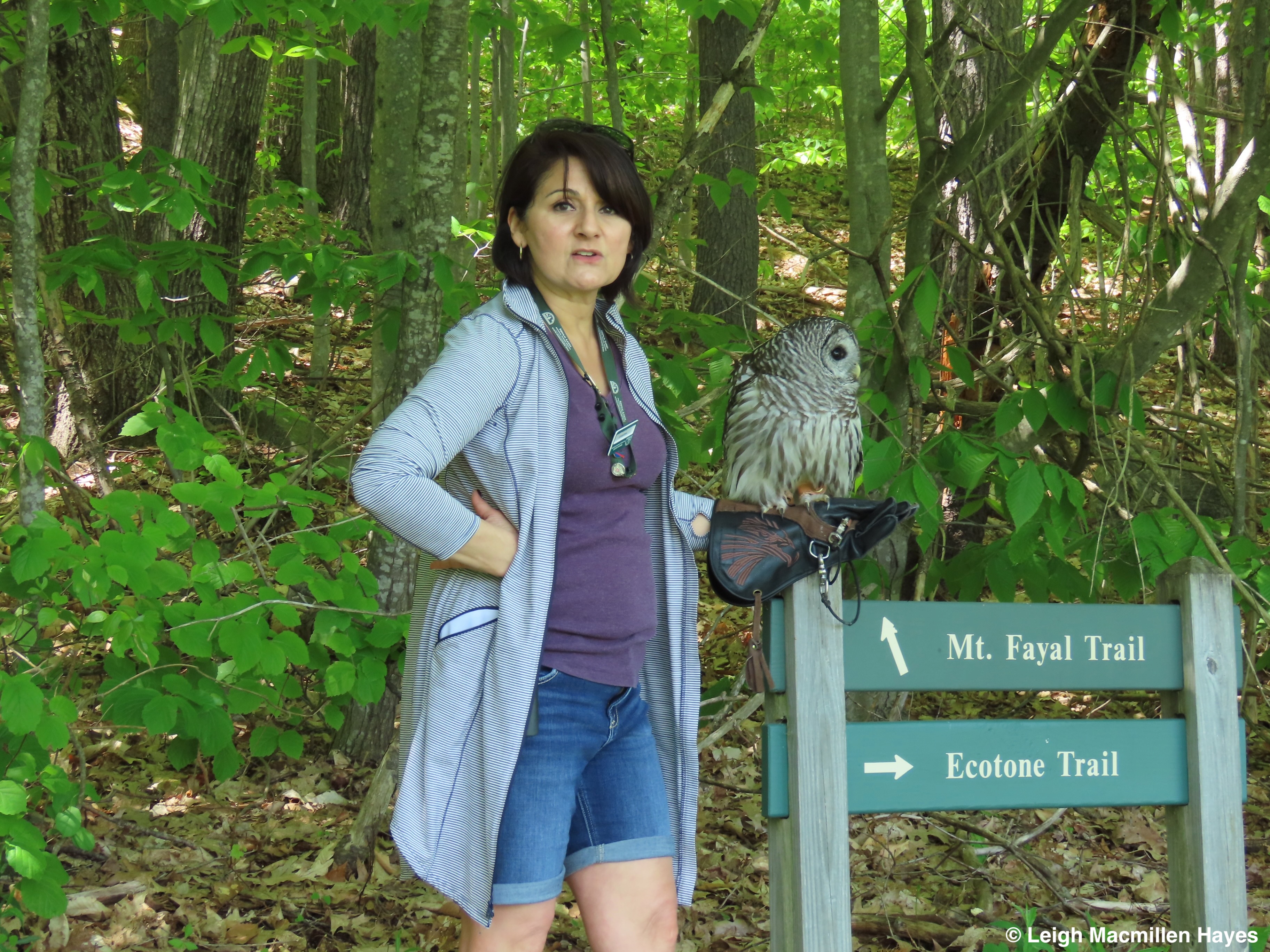
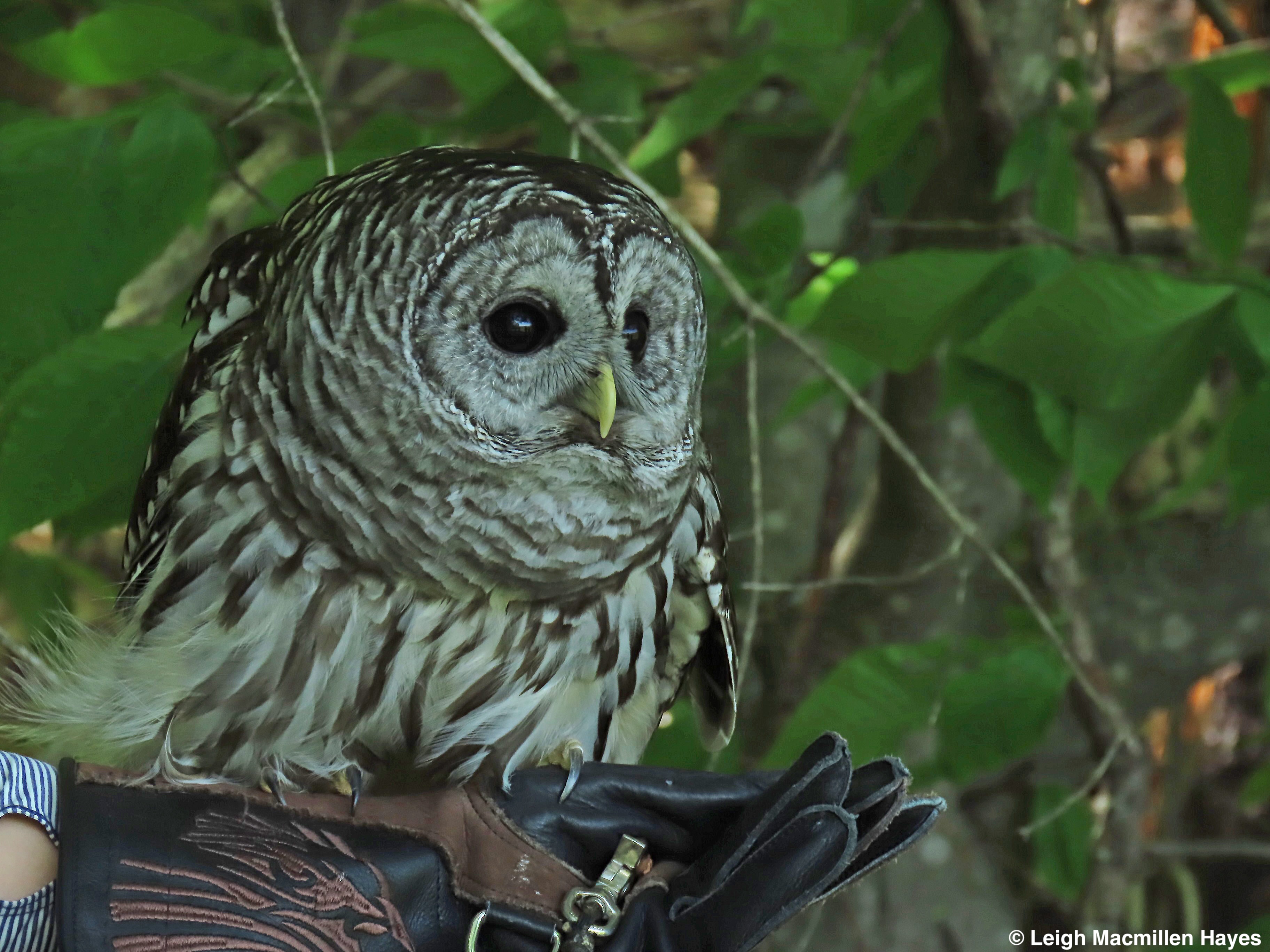
Along the way, we had a special treat, for we got to meet Barred 13, who was out for a walk as well, and panting.

The “name,” Barred 13 refers to the fact that this was a Barred Owl that came to the Center in 2013. As a policy, they do not name the critters who reside there so folks like us won’t think that wild animals should become pets.

Barred 13 was very curious about something in the vicinity. We learned that she once heard a Black Bear before her handler turned and saw it. And that she’s at the Center due to a broken wing.

The Barred Owl’s hearing is so acute that it can pinpoint the location of its prey. There’s a cool exhibit to help us humans better understand how well they hear, but I’ll leave that for you to discover upon a visit.

At the summit of Mount Fayal, My Guy found a bench upon which to sit for a bit and enjoy the view of Squam Lake.

What he missed, I discovered behind the bench.

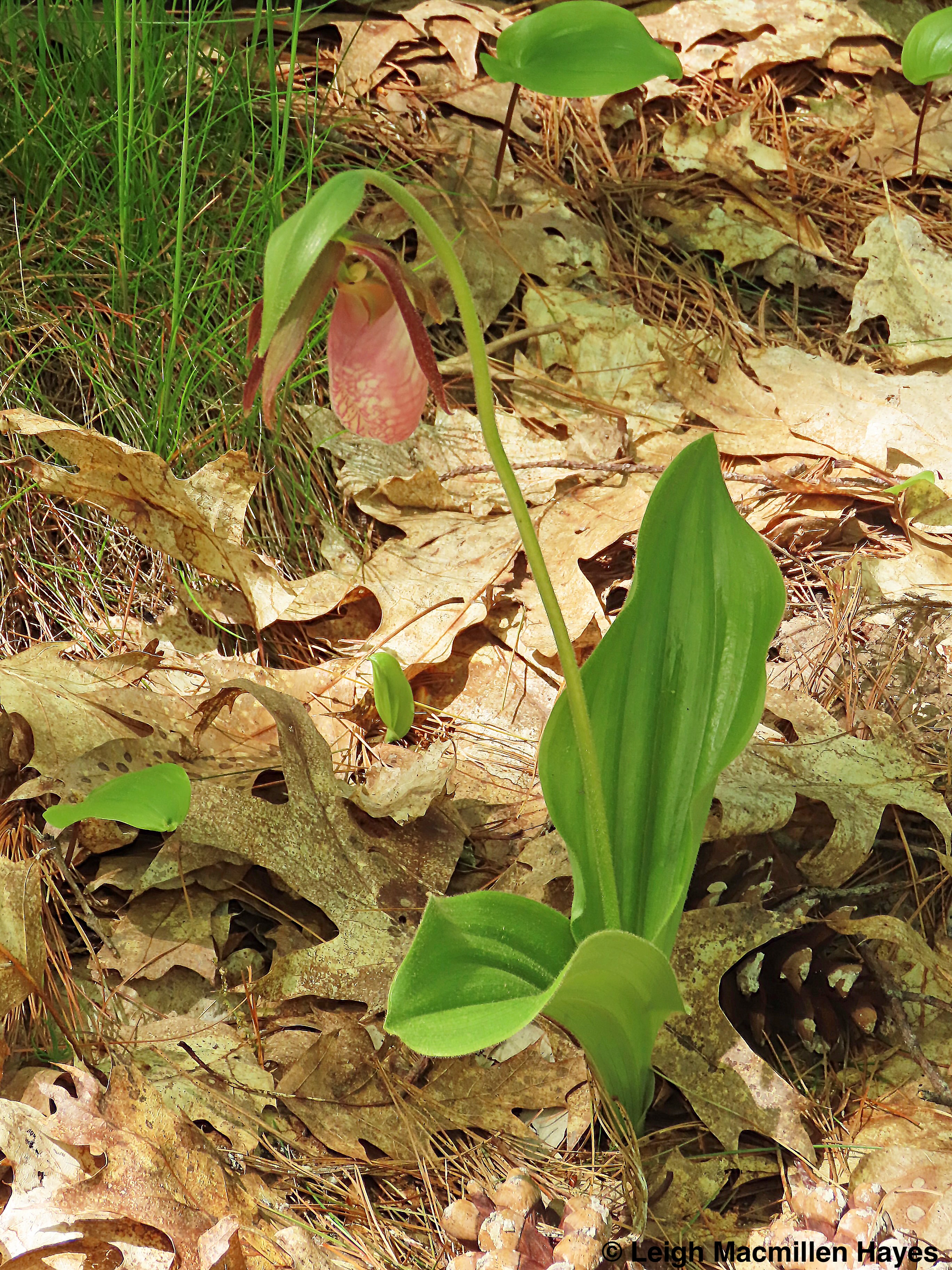
A Pink Lady’s Slipper. The first for us for this year.

His comment: “Only one?!”

We are rather Lady Slipper’s Snobs. Truth be told.

Back on the animal exhibit trail, we stopped by to visit the Otters again. Thank goodness. The most amazing thing–we were the only ones there. The Otter exhibit is usually packed.

We quickly realized that the time to visit the Center is in the mid to late afternoon, after the kids have packed up and gone home. Or if you go earlier, do like we did and head off for a hike before returning to the exhibits.

The two Otters entertained as they constantly climbed up toward us and then did backflips into the water.

Up . . .

Bend over . . .

And swim.

And flip over and swim some more.

Lions, and Otters, and Moose–but wait. This moose was in the same pose when we left as it was in when we arrived. Allegedly we saw a moose. Well, we have a photo to prove it. But, unlike all the other critters, it wasn’t alive. Still.

Squam Lakes Natural Science Center–we highly recommend a visit, no matter how many years you have under your hat.

And lunch from Squam Lake Marketplace. The flour-free Chocolate Chip and Peanut cookies–a great way to end a meal, even if you wait three hours for the ending because your belly was filled by your sandwich.

A Mondate worth noting.

Savoring Spring

My paths were multiple this weekend as if I was on a quest.

On a bridge over a brook,

down a road through the forest,

beside a bog,

along a boardwalk,

and even following this guy down low and up high.

Together today, we circled another brook (if one can actually circle a brook, but we did),

enjoyed this view from lunch roots,

and dessert on the rocks where we could peek down on said roots.

Though I may have been alone for much of the weekend, I never really was for the bird song, including the conk-er-ies from this male Red-winged Blackbird, accompanied me where ever I hiked.

There were Eastern Chipmunks adding to the chorus as they chortled at me and I chortled back, though I did wonder if life hasn’t always been so easy for this one given the marks on its body and a very short tail.

I watched Painted Turtles bask, despite cooler temperatures, though the air was probably warmer than that of the water.

And I was chastised by this Red Squirrel, but really I had done nothing wrong–except to enter his territory without an invitation.

In the depths of the water today, tadpoles. HUGE tadpoles of the Bullfrog sort, which take two years to mature. I spotted tiny hind legs growing beside where the abdomen meets the tail. There were also lots of smaller tadpoles, too big to be Wood Frogs or Pickerel, but I suspected either one-year old Bullfrogs, or perhaps they were Green. Or both.

A few flying insects also brightened the days (and I have to say I’m not referring to Black Flies, which I hardly spotted–and actually caused me concern, for where have the little biters gone?), including this Anglewing butterfly. I can’t name it to species, for it is either a Comma or Question Mark, but never in the time I watched did it pose so that the underwings were visible. Okay, so My Guy and I spotted it today and when I explained to him the difference between the two, the C having a small white comma on its underwing and the QM, a small comma and a dot looking rather like the punctuation mark, he decided it must be an Exclamation Mark instead.

And in the same area, an American Lady added her color to the scene.

Leatherleaf’s bell shaped flowers reminded me of clothing hanging from an outdoor line.

And I’m really beginning to believe there are a trillion Painted Trillium, though I didn’t actually count. There’s something to admire about those olive green leaves and perhaps it’s that we don’t often see that color in nature.

I even spotted a few that chose a different paint palette. I could explain away the color of the leaves by thinking that perhaps they were showing off their anthocyanin, which gives fall leaves their red color and is seen in the spring as well, perhaps serving as a sunscreen for the plant. But the color of the petals was equally amazing, though who knows, maybe it’s common and I was just paying attention to it for the first time. That does happen. A lot.

And then there was the amazing blue hue of Forget-Me-Nots. I surely won’t. Forget you that is.

And Wood Anemone, its compound leaves notched, and flowers deeply veined, looking so tender and fragile.

Not looking tender, and hardly fragile, but still beautiful, was the carnivorous Pitcher Plant, of which I paused beside several. I’ve known this particular one for at least twenty years so when I encounter it, I always feel like I’m meeting an old friend. Because I am.

Hiding beneath its lime green leaves, American-Fly Honeysuckle’s delicate flowers did dangle in their manner of two. The shrub always surprises me, though it is a native, but I don’t get to greet it often enough.

All of these flowers bloom so early because they take advantage of sunlight before leaves emerge. That’s all changing now and in another week it will surely look more like summer around here. What I love about some leaves, especially American Beech, is that they are so hairy to start, and look like they’d make great fringed skirts for fairies. The other thing I became aware of this weekend, was the raindropy sound of their bud scales hitting the ground.

I love winter, but this season to follow is flying by, and already the Trailing Arbutus has reached its waning hour.

But there is hope in the form of others, like this Indian Cucumber Root, creating a second tier and a bud, and in a few weeks I’ll be seeking out its otherworldly flowers.

I’m savoring spring–before it moves on. I hope you are on the same quest.

Somewhere Under The Rainbow

Somehow we thought the rain wouldn’t fall upon our hike today, until it did. And so we sat in the truck for about 15-20 minutes, waiting for the drops to slow down, which they did.

The rain, however, enhanced everything. And as the sun came out, the water and warmth combined to create a Black Fly Festival, one which will last for several more weeks.

But, April/May showers do bring May flowers, and I sooo love the pastel colors that Hobblebush produces, its non-fertile showy flowers on the edge meant to entice insects to visit about a hundred tiny fertile flowers preparing to bloom in the center.

In wet seeps, Round-leaf Yellow Violets did show off their cheery faces, with violet-veined runways showing the way to the nectary, much like lights at an airfield that aid landings.

And fortunately My Guy didn’t question the fact that I was taking more photos of Red Trillium, for I’ve hardly reached the trillion I intend to take. Really though, in a few weeks our attention will turn toward his beloved Lady’s Slippers, and there are comparatively fewer trilliums than slippers in the forests through which we wander.

Because of the rain, Lungwort, a foliose lichen consisting of a fungus and a green algal partner living together in a symbiotic relationship with a cyanobacterium, showed off its greenliness since the alga had kicked into action to provide food for the fungal structure. It’s sensitive to air pollution and habitat loss, so spotting it is always a treat and reminds us of why we love living here in western Maine.

Below the summit, we paused to share lunch with the Black Flies and take in the view of the mountains, though many were obscured by the cloud cover.

On our descent, there were more hues of green to add to the art palette in the form of the larger Rock Tripe, an umbilicate foliose lichen, and Rock Tuft Moss scattered in its midst.

At a beaver pond, we noted several beaver lodges that looked abandoned and a long dam, but it was the reflection of the sky and clouds that also garnered our attention. The day had transformed as was visible both above and below.

Back at home, I wandered out to the vernal pool to check on the activity. A few days ago I realized that tadpoles were beginning to emerge from egg masses, and today’s warmer weather brought even more into the picture, which in this case included both what I could see under water, as well as the reflection of trees and sky upon the water.

It was when I stopped looking into the depths, however, and focused upon the scene before me, that I realized I was seeing something I’ve never noticed before.

As I had approached the pool, I saw that it had a coating of Birch and Maple pollen and thought with a smile of a fourth grader spotting such last year and looking confused as he asked me if it was ice. No Daniel, it’s not ice. But his initial reaction made sense.

What I noticed today was that the pollen added a rainbow to the water’s surface as the sun got lower in the sky. Yellow by the far shore, orange, red, purple, blue, and green.

So, what caused this rainbow to appear? I’m a huge fan of taking a stick to a Balsam Fir blister to gather some resin and then tossing it into a puddle or still water to watch the natural resins or essential oils appear. Was that happening here?

Maybe this was from decaying vegetation and the sun being at the right angle?

Maybe it had something to do with the pollen as well as the sun’s angle?

I don’t know, but certainly it was fun that this day which began with rain, and showed off a variety of vibrant colors during our five-mile hike, should end somewhere under the rainbow.

A Smile of a Mondate

In case you are missing snow, I thought I’d bring you some today. But only because about a month ago, the day after Palm Sunday and a major snowstorm here in the north country, My Guy and I went to Diana’s Baths in Bartlett, New Hampshire, to hike.

It was the first of two storms in a matter of less than two weeks that dropped almost two feet of snow each and transformed Lucy Brook into a winter wonderland. Here’s a bit of history from northconwaynh.com: In the 1860s, after building a house and barn on the banks of the brook, George Lucy built a water wheel powered sawmill. In the 1890s, George built a 12-room boarding house for tourists to visit the site. In the 1930s Chester Lucy built a concrete dam with a water feed and turbine system to replace the water wheel used to power the sawmill. Both the rooming house and sawmill were eventually sold to the US Government and have become part of the National Forest land. Due to the deterioration, the buildings were eventually removed from the site in the 1960s. Remnants of the site can still be seen today including the old cellar holes and parts of the dam system, feed tube and turbine gears used to power the sawmill.

Today, it looked much more summer-like in appearance, but still so much water flows due to snow melt in the surrounding mountains, and it’s BRRRRR.

As we ventured forth, I spotted many a boulder experiencing the bad hair day of Common Polypody Fern and every once in a while try to teach My Guy a wee bit about a species. I tell him that someday he can co-lead a nature walk with me. He, of course, guffaws. But ask him what poly and pody mean and he may remember many and feet, for the fern fronds grow from creeping rhizomes.

Last year’s sori (group of spores) were still visible on the underside of some leaves. The sori located in rows on each side of the mid-vein, are circular, orangish brown and not covered by tissue (indusium).

Because we were in a damp environment beside the brook, False Hellebore leaves, with their pleated presentation, brightened the morning. And held raindrops signifying yesterday’s weather.

We also encountered numerous Hobblebush shrubs, some even featuring flowers preparing to open into what will be a fantastic display on another day. On this day, it was enough to see their accordion leaves beginning to unfurl, and those flowers presenting like a bunch of worms crawling over each other as if to say, “Me first. Me first.”

We crossed tributaries several times though we didn’t actually cross Lucy Brook as originally intended for the water was still too high for us to manage safely. But . . . we bushwhacked for a bit before sitting upon some tree roots to take a lunch break.

It was while My Guy sat there, that I poked around and discovered this–Wall Scalewort, a leafy liverwort. Liverworts differ from mosses in that the leaves are typically arranged in rows of two with a possible third row below, while moss leaves whorl around the stem. And most mosses have mid-ribs, which liverworts lack.

That said, the Wall Scalewort closely resembles Shingle Moss, which I spotted along this same tributary in March.

But a closer look today made me realize that I could see the leaf arrangement was succubous where the bottom edge was visible, as opposed to incubous. Succubous arrangement is like roof shingles that don’t let the rain in, while incubous leaves are arranged so the top edge is visible and do let the rain in. Thank you Sue Alix Williams in Mosses & Common Liverworts of the Northeast for that explanation.

Eventually we reached a turn-around point and came up with Plan B for the rest of today’s hike as we made our way out. While I was able to cross with my high leather hiking boots, My Guy chose to take his boots and socks off and watch his feet turn red from the chill. Thankfully, his better half, ahem, that would be me, had packed a towel because we suspected this could be the case.

Now you might find this as odd, but since our discovery of the new privies last month, we’ve been quite taken with the artwork completed by Kennett High School art students in 2023.

Unbeknownst to us at the time, the paintings were a perfect segue from one trail to another.

And so we drove down the road to Echo Lake State Park and tried to convince the warden that even though we live in Maine, our hometown is just over the border and we should be able to hike the trails for free as New Hampshire Seniors don’t have to pay. He kindly informed us that the park isn’t officially open yet, as so it was free, but if we return in a couple of weeks, it will cost us $4 each. Not bad in the scheme of things.

Before us stood White Horse Ledge, one of the trails we had considered if we’d been able to cross Lucy Brook from our earlier destination. We were green with envy as we looked across at it.

But about half way around the lake, we found a different trail to the summit and decided to follow it. That said, we found several trails to the summit and the first we chose led us astray as it eventually petered out.

Despite that, we were thrilled. Okay, maybe it was me rather than we. Semantics.

And so today I celebrated my first meeting of 2024 with Sessile-leaf Bellwort, aka Wild Oat. And where there was one, there were a million, the subtle yellow bell dangling quietly below.

And then . . . and then, I spotted a Stinking Benjamin, or Red Trillium almost in flower.

And a few steps away . . . full flower mode. Trillium is a reference to the fact that the floral parts of the plant occur in threes: three leaves, three petals, three sepals.

Going forth, I’m sure I’ll honor a trillion trilliums, but these were the first and therefore the most special.

As we made our way back to a better trail, the leaves of Trout Lily caught my attention and then much to my delight I found two in flower. The leaves are maroon-mottled and the nodding flower features petals and sepals bent backwards to expose six brown stamens. This one is such a treat for me because I only meet it when I least expect to do so.

Once on the actual trail upon which we had to scramble to climb toward the ledgy summit, I spotted another that only grows in such habitats.

Take a look at the black arrow in the photo.  That is one hairy stalk rising from a rosette of basal leaves.

This native perennial wildflower, Virginia Saxifrage, grows out of cracks in rock, and has been known as a rock breaker even though it doesn’t actually break rocks, but rather, likes to grow in those fractures. It’s such a sweet little flower that is easy to overlook.

From the ledges above, we had a great view of Echo Lake, and the mountains beyond, with Cranmore’s Ski Area showing the last of the melting snow.

That brings me back to the snow of a month ago. I took it upon myself to figure out a way to make people smile.

And today, we did the same, though not with snow like this. But rather, with our actual smiles and friendly hellos as we greeted each hiker we met. Even if they weren’t smiling or making eye contact with us at first, we got them all to return the greeting and had some nice chats with a few.

I told My Guy that it kinda reminded me of our New York adventure last weekend, when I made it a point to try to make eye contact with each person we passed on the sidewalk or trail and to always leave them with a smile. A few actually looked at me and turned on a smile, which seemed to surprise them.

This was indeed a smile of a Mondate . . . on so many levels.

Until we meet again . . . New York

I remember when we’d take our young sons to cities and I’d hold a tighter than tight grip on their hands, or maybe it was their wrists, as we walked along sidewalks thronging with people. I can’t hold their hands in quite the same way anymore, and in fact, in their presence in a city (the older in Boston and the younger in Brooklyn), since that’s where they’ve both chosen to make their homes at the moment, their confidence and poise and graciousness make me feel comfortable. And they have become incredible tour guides.

And so it was that this past Friday, My Guy and I flew to LaGuardia Airport and began another New York City journey.

We were met at the airport by P, who drove us to the Prospect Heights neighborhood of Brooklyn, where his girlfriend, M, was waiting and had ordered pizza because one of my wishes for the weekend was for a NY-style pie. Well, really, I wanted New Haven style, given my roots, but NY is the next best thing.

The apartment belongs to M’s mother, D, who graciously offered it to us as a home base for our weekend adventure. The view of the Manhattan skyline garnered our attention each morning and night, and we knew the Knicks had won their game Saturday because the Empire State Building showed off their team colors.

For as long as P has lived in Brooklyn, we’ve heard of Prospect Park, which encompasses over 500 acres in the midst of the city and offers habitat and respite for critters of all shapes and forms, including humans.

We had signed up for a two-hour tour with the well-informed Corinne as our guide. Designed in 1865, she explained that the park is considered Frederick Law Olmsted’s and Calvert Vaux’s masterpiece, Olmsted pictured on the left and Vaux on the right. Here, unlike in Central Park, they took advantage of the natural elements, though I was disappointed to learn that they’d filled in kettle holes created by glaciers.

We entered via the Endale Arch, which was built in the 1860s and restored within the last ten years. It was during the restoration when paint and wood panels that had been added because of rain damage were removed, that pine and walnut paneling was discovered.

It’s almost like passing through the welcoming doorway of a church.

I could have spent hours meeting trees in the park, but this was not the time, and so I reveled in the few we did get to know, such as this Camperdown Elm, whose branches grow more or less parallel to the ground giving it a gnarly bonsai appearance. The tree, grown from the Earl of Camperdown’s Scottish estate, was planted here in 1872, but neglected years later until in 1967 Marianne Moore wrote this poem to save it:

I think, in connection with this weeping elm,

of ‘Kindred Spirits’ at the edge of a rockledge

overlooking a stream:

Thanatopsis-invoking tree-loving Bryant

conversing with Thomas Cole

in Asher Durand’s painting of them

under the filigree of an elm overhead.

No doubt they had seen other trees—lindens,

maples and sycamores, oaks and the Paris

street-tree, the horse-chestnut; but imagine

their rapture, had they come on the Camperdown elm’s

massiveness and ‘the intricate pattern of its branches,’

arching high, curving low, in its mist of fine twigs.

The Bartlett tree-cavity specialist saw it

and thrust his arm the whole length of the hollowness

of its torso and there were six small cavities also.

Props are needed and tree-food. It is still leafing;

still there. Mortal though. We must save it. It is

our crowning curio.

Though she passed about fifty years ago, the tree, thanks to Miss Moore, lives on.

Another that struck my fancy was the Osage Orange, though apparently I should be thankful we didn’t visit in the autumn when its softball-sized fruits fall. Then it might not be my fancy that is struck, but rather my head.

Though we only had a moment to glance at tiled ceilings, they were the masterpiece of Spanish engineer Rafael Guastavino. I can only wonder if a sunflower or some other composite flower was the inspiration for this one.

Much to our delight, as we followed the path, a Black Squirrel scampered along the ground and then up a tree. The Black Squirrel is a color phase of the Eastern Gray Squirrel (Sciurus carolinensis), also known as a melanistic variant due to a recessive gene that causes abnormal pigmentation. Do you see it peeking at us?

While our bird sightings were many, especially of Robins and Sparrows, we spotted one male Cardinal, one Mallard, and this one Cormorant swimming in murky water.

The species of the most abundance, however, was the Red-eared Slider Turtle. Though outlawed for sale today, Red-eared Sliders are the most common turtles kept as pets. They live long lives and need ever increasing habitat and food, thus many have been abandoned–their owners slipping them into the waters of the park unceremoniously in a practice that is illegal.

Thanks again to the generosity of our hostess, we also visited Brooklyn Botanical Gardens where Cherry Blossoms and an array of colors wowed us and thousands of others.

It was fun to glimpse over the shoulders of two artists and notice how their work reflected the scene.

Though these tulips each had a name, I would have called this spot the ice cream stand for the flavors seemed to abound.

Beside water, Horsetails or Equisetums did grow.

As did the almost ready to unfurl crosiers of Cinnamon Ferns. I love their woolly coats.

It was here that I had a brief encounter with another tree new to me, a Horned Maple. Acer diabolicum leaves are five lobed and coarsely toothed. The common name comes from paired horn-like projections from the seeds, but we were too early to spy these. We did get to see it in flower, though I think I’m the only one who noticed.

And I kept wondering where all the pollinators were, though we didn’t get too close to the Cherry Blossoms, but the Honeysuckles lived up to their names and were abuzz with activity.

If I had to name a favorite, it would probably be the Hybrid Magnolia based on its color and form. Simply a masterpiece.

We spent an hour enjoying a masterpiece of another sort, worshiping with others at St. John’s Park Slope, an Episcopal Church with a heavenly choir and an organ that filled the rafters with music both old and new.

And then we took a trip into Manhattan via P’s new truck. Haha. Yes. That is a Tesla truck. Just not my idea of a truck. And no, we did not travel in it, but rather M’s car.

P showed us the large office he works in where ads and films, but mostly ads these days, are produced and edited. And clients are wined and dined in situ. There’s even a staff chef.

And now, when he says he’s working from the office, we can imagine him in this space.

It’s located two doors away from the birthplace of Teddy Roosevelt.

Not being shoppers, we only stepped into a Yeti store, where of course, My Guy announced that he has the products on his shelves back in Maine. And he peered into a closed hardware store, cuze no trip of ours is ever complete without visiting one or two. But then again, no trip of ours is ever complete without stepping along a wooded pathway and noticing the flora and fauna.

But the main purpose of our trip was to visit. Family. And friends. And meet this little powerhouse who knew how to command the crowd.

My Guy was in instant love. And she was so chill.

We loved spending time with one of M’s brothers, her sister and niece, plus M and P. of course. We did meet up with M’s other brother, but somehow I neglected to take a photo. Sorry R.

Over the course of the weekend, world problems were solved and sporting events analyzed by these two.

And one of the highlights was our opportunity to attend their softball game, which they won because we were there, the good luck charms that we are.

He scored a home run, another run, and I can’t remember his other stats, though I’m sure My Guy and P have it in their brains.

M also walloped the ball and got on base each time.

And scored as well. We were mighty impressed because we saw the results of a slide she made into a base last week and how she could run this weekend was beyond our understanding.

At last Monday dawned and P stopped by the apartment to pick up laundry and say goodbye.

Until we meet again, thank you M & P, and D, and all the gang, including P’s colleagues who played in the game or came to cheer on the softball team.

We had a fabulous weekend thanks to all of your planning, and I just finished a bagel that followed us home. Family. Food. Oh, I didn’t even mention Frankies Spuntino and the delish eggplant marinara. And fun.

We love New York. Especially through the eyes of P & M. And then we love returning to Maine.

Eyeing the Ladies

We were in the area. It’s spring. (Until Wednesday that is, when winter is scheduled to return, and here’s the latest from the National Weather Service out of Gray, Maine:

…WINTER STORM WATCH IN EFFECT FROM WEDNESDAY AFTERNOON THROUGH
LATE THURSDAY NIGHT…

  • WHAT…Heavy snow possible. Total snow accumulations greater than
    18 inches possible. Winds could gust as high as 55 mph.
  • WHERE…Portions of south central, southwest, and western Maine.

And so we headed to Wolfe’s Neck State Park this afternoon cuze we kinda have a love affair with this place in Freeport, Maine.

It’s a place where the forest meets the sea, or at least Casco Bay, and so it brings our two loves together and always gives us a chance to refill the innermost recesses of our lungs with salt air, while still enjoying the woodland trails.

What immediately became clear, however, was the extent of damage the coast has endured this past year due to intense storms. Erosion was evident in so many places. Sadly.

The landscape was also ransacked by the force of the wind. Trees were uprooted–some falling south, others, east, a few west, and even north. We could almost feel the harsher than normal gusts even though we weren’t present for any of these episodes.

And the trails are scattered with pine twigs and needles, which though they soften each footstep, really just bring the destruction closer to our eyes and minds.

There were some, however, or perhaps many, who took advantage of the uprooted trees as great places to think they were hiding from us–the great predators that we are.

Those who work for the park have had a lot of work “cut” out for them and they’ve cleared tree after tree from blocking the trail and our kudos to them.

In almost five miles of hiking trails, we only found a few obstacles, this one being the most difficult to conquer. And really, it wasn’t that difficult, but more inconvenient. And we know that they’ll take care of it soon. They probably just need to give their chainsaws and muscles a brief break. Really. I cannot explain the amount of devastation. It happens every year, but I don’t think we’ve ever seen it to this extent.

But there were other things to notice, such as this Red Squirrel midden that must have been an incredible cache back in the fall, and I wished I’d seen it then.

And the sweet buds of Trailing Arbutus waiting to make their 2024 debut.

But our best sight of the day: Lady’s Slippers in bloom. Oh my. Everything is early this year, but we definitely didn’t expect to find these friends so soon.

Eyeing the ladies is something My Guy loves to do.

Oh, we found a few seed capsules along the way.

And we did see these flowers . . . on the kiosk.

But the photo I took of a Lady’s Slipper dates back to last spring. I hope I gotcha for a moment.

Happy April Fools Day 2024!

Oopsy of a Mondate

Knowing it was going to be warmer today, we decided to venture to a local park where the snow pack would be less. That doesn’t sound right coming from this snow queen, but we didn’t feel like postholing or having snow stuck to the bottoms of our snowshoes.

This is a place where we know beavers are active. And I, of course, went with expectations. And convinced My Guy that we should begin and end at the bog.

And bingo–a beaver-chewed tree that had probably been munched upon this past fall based on the color of the sapwood greeted us immediately.

But do you see the lodge in the background?

Here’s a closer look. Fully iced in and no mud on the exterior. This one had been active for several years, but today we learned that that is no longer the case.

Still, as we moved past it, there was another tree (on the left) that had been equally munched upon this past fall, while the color of the wood on the tree to the right indicated activity from a previous year.

There was even a dam, but I was beginning to lose hope. And to kick myself for coming with expectations. When will I ever learn?

Because we were in a park, there were structures and behind one close to the path, we found an Eastern Phoebe nest upon a platform placed there for the very bird to set up housekeeping each spring.

The cool thing was that the Phoebe wasn’t the only structure dweller, for directly below her nest a Funnel Weaver Spider had constructed an intricate home. I love all the guylines meant to keep the web intact, in fact it worked so well, that the winds of the fall and winter didn’t seem to have touched it. Well done, spider!

As we continued on, I thought about the gems this place offers, including this beautiful old Yellow Birch standing on stilts. As I noted in Becoming Tree Wise, the seeds of Yellow Birch, like Eastern Hemlock, struggle to germinate on the forest floor, but give them a moss-covered rock, or tree stump, or nurse log, and bingo, a tree grows on it. As it continues to grow, the roots seek the ground below and if it is upon a stump or log that eventually rots away, you have a tree in the forest that appears to stand on stilted legs. Tada!

Our trail was sometimes bare and other times snowy or icy, so we did don microspikes, which turned out to be the perfect choice most of the time.

At the summit of what is known as Lookout Trail, the view is of the forest beyond, but we did look down at the picnic table and discovered mushrooms growing on the wood. The cap was like a tapestry of oranges and yellows and rosy browns.

It was the underside, however, that aided ID: Gloeophyllum sepiarium (Rusty-gilled Polypore or Conifer Mazegill).

Occasionally there were brooks to cross and icicles to admire and sounds of percolating water flowing beneath the ice to encourage stopping for a few minutes to take it all in.

Heading downhill, in a boulder field below a granite ledge we discovered the territory of one very busy Red Squirrel. Middens covered numerous rocks.

And I could only imagine what the original cache had looked like. Since it takes two years for pinecones to mature, next year this squirrel may not be so fortunate, but living in the here and now, life is good.

At last we reached the lake for which the park is named and for the second year in a row, it did not freeze this winter. Being the second largest lake in Maine, it covers 45 square miles and at its deepest hole is over 300 feet in depth.

We backtracked a birds trail along the water’s edge and found our way to the perfect lunch spot.

The view from lunch rock found us dining with few words shared as we took in the vastness of this space while small waves broke along the shoreline and we realized we could have been at the coast.

Back on the trail, we hiked a couple more miles before returning to the bog’s opposite shoreline. Surely, the beaver would not let me down.

And there is was. The lodge that is. With mud on it. That meant a family could have overwintered in this one.

Wouldn’t you feel warm and cozy inside that building?

And there was evidence that another tree had been dined upon in the fall. But . . . no signs of smaller trees being cut for a food supply. Are they still home? I do not know, but maybe another visit in a month or so will reveal the truth.

There was, however, lots of sign that humans had been cutting trees: to clear trails so people like us could enjoy them.

And we did as we journeyed the West Side of Sebago Lake State Park.

So you must be wondering why this was an Oopsy of a Mondate. No, I didn’t fall. Nor did My Guy.

In fact, we had a wonderful time exploring and loved every minute of our adventure.

But . . . there was some logging going on and it wasn’t until we got home and I looked at the Sebago Lake State Park website that I discovered this message: February 25, 2024 | Campground infrastructure improvements begin tomorrow, Monday 2/26/2024. While heavy trucking activities occur, State Camping Rd. in Naples will be closed to foot-traffic for public safety. However, the Day Use Area, found at 11 Park Access Rd. in Casco will remain open to visitors. Thank you for your patience and understanding while these improvements occur.

Oopsy. Don’t follow our footsteps, but rather go to the Day Use Area instead.

Happy 9th Birthday, wondermyway!

Thank you to all who read and comment and share wondermyway.com. Some of you have followed my blog posts since the beginning, February 21, 2015. A few have joined the journey as recently as yesterday. I’m grateful for the presence of all of you in my life.

To mark this occasion, I thought I’d reflect upon those moments when my wonder gave me a glimpse of the “Thin Places” that I’ve experienced either by myself or in the company of others.

To quote my friend, Ev Lennon, “A Thin Place is a spot of beauty, loveliness, space–an example of the wideness and grandeur of Creation.”

I think of them as places that you don’t plan a trip to visit, but rather . . . stumble upon.

I had
the track of
a bobcat to thank,
for it showed me the way
to a special friend.
It was without expectation 
that we met
and spent at least
an hour together.
And then I realized
though its sight is not great,
it was aware of my presence
and I hightailed it home,
but I will always
celebrate time spent
with the Prickly Porcupine.
Something quite small
scurrying across the snow
captured my attention
and suddenly
there was a second
and a third
and then hundreds
of Winter Stoneflies.
All headed west from the brook
toward mature tree trunks
to beat their drum-like structures
against the bark
and announce their intentions to canoodle.
Though I could not hear
their percussion instruments,
I am grateful
to learn
with those who
march to the beat of a different drummer.
Standing beside quiet water,
I was honored
on more than one occasion
to have my boot and pant legs
considered the right substrate
upon which to transform
from aquatic predator
to teneral land prey
before becoming
a terrestrial flying predator.
It takes hours
for the dragonfly to emerge
and I can't think of a better way
to spend a spring day
than to stand witness
as the mystery unfolds
and I begin to
develop my dragonfly eyes
once again.
It took me a second 
to realize that I was
staring into the eyes
of a moose,
and another second
to silently alert My Guy
while grabbing my camera.
She tip-toed off
as we relished our time
spent in her presence
and at the end of the day
had this Final Count
on a Moosed-up Mondate:
Painted Trillium 59
Red Trillium 3
Cow Moose 1
One was certainly enough!
Some of the best hours
I spend outdoors
include scanning
Great Blue Heron rookeries
to count adults and chicks
and get lost in the
sights and sounds
of rich and diverse wetlands.
Fluffy little balls
pop up occasionally
in the nests and the
let their presence be known
as they squawk
feverishly for food.
And in the mix of it all
Nature Distraction
causes a diversion of attention
when one swimming by
is first mistaken for a Beaver
but reveals its tail
and morphs into a Muskrat.
I give thanks to the Herons for these moments.
What began as a "Wruck, Wruck" love affair
continued
for longer than usual
and due to
a rainy spring and summer
I was treated to a surprise
in the form of developing frog legs.
In the midst of my visits
one day I heard
the insistent peeps
of Yellow-bellied Sapsucker chicks
demanding a meal on wings,
which their parents
repeatedly provided.
Walking home 
from the pool
another day,
I was honored
to spend about ten minutes
with a fawn,
each of us curious
about the other
until it occurred to me
that its mother
was probably nearby
waiting for me to move on,
so reluctantly I did,
but first gave thanks
that something is always happening
right outside my backdoor.
While admiring shrubs
that love wet feet,
I counted over
one hundred branches
coated with white fluffy,
yet waxy ribbons.
Theirs is a communal yet complex life
as the Woolly Alder Aphids
suck sap from Speckled Alders.
Communal in that
so many clump together
in a great mass.
Complex because
one generation reproduces asexually
and the next sexually,
thus adding diversity
to the gene pool.
Along with the discovery
of coyote scat,
and Beech Aphid Poop Eater,
a fungus that consumes
the frass of the Aphids,
it was an omnivore, herbivore, insectivore kind of day.
Awakening early, 
a certain glow
in the sky
pulled me from bed
and I raced downstairs
to open the door
and receive the quiet
that snowflakes create.
The snow eventually
turned to rain,
which equally mesmerized me
as I watched
droplets elongate
and quickly free fall,
landing on bark below
in such a manner
that caused them
to mix with sap salts and acids.
The result was
White Pines foaming
in the form of
Pine Soap
with its hexagonal shapes:
worth a natural engineering wonder
and I gave thanks for being present.
Occasionally, 
it's the action
outside the backdoor window
that keeps me standing sill
for hours on end,
as a variety of birds fly
in and out
of the feeding station,
such as these Purple Finches,
the males exhibiting
bad hair days.
Bird seed is not 
just for birds
as the squirrels prove daily.
And White-tailed Deer
often make that
statement at night.
But this day was different
and they came
in the morning
using their tongues
to vacuum the seeds all up.
At the end of the day,
my favorite visitors
were the Bluebirds
for it was such a treat
to see them.
But it was the mammals
who made me realize
not every bird has feathers.
These are samples 
of the Thin Places
I've stumbled upon
this past year.

They are a
cause for celebration,
participation,
and possibility.
My mind slows down
and time seems infinite
as I become enveloped
in the mystery.

I give thanks
that each moment
is a gift
and I have witnessed
miracles unfolding
that did not
seek my attention,
but certainly captured it.

And I thank you again
for being
one of the many
to wander and wonder my way.
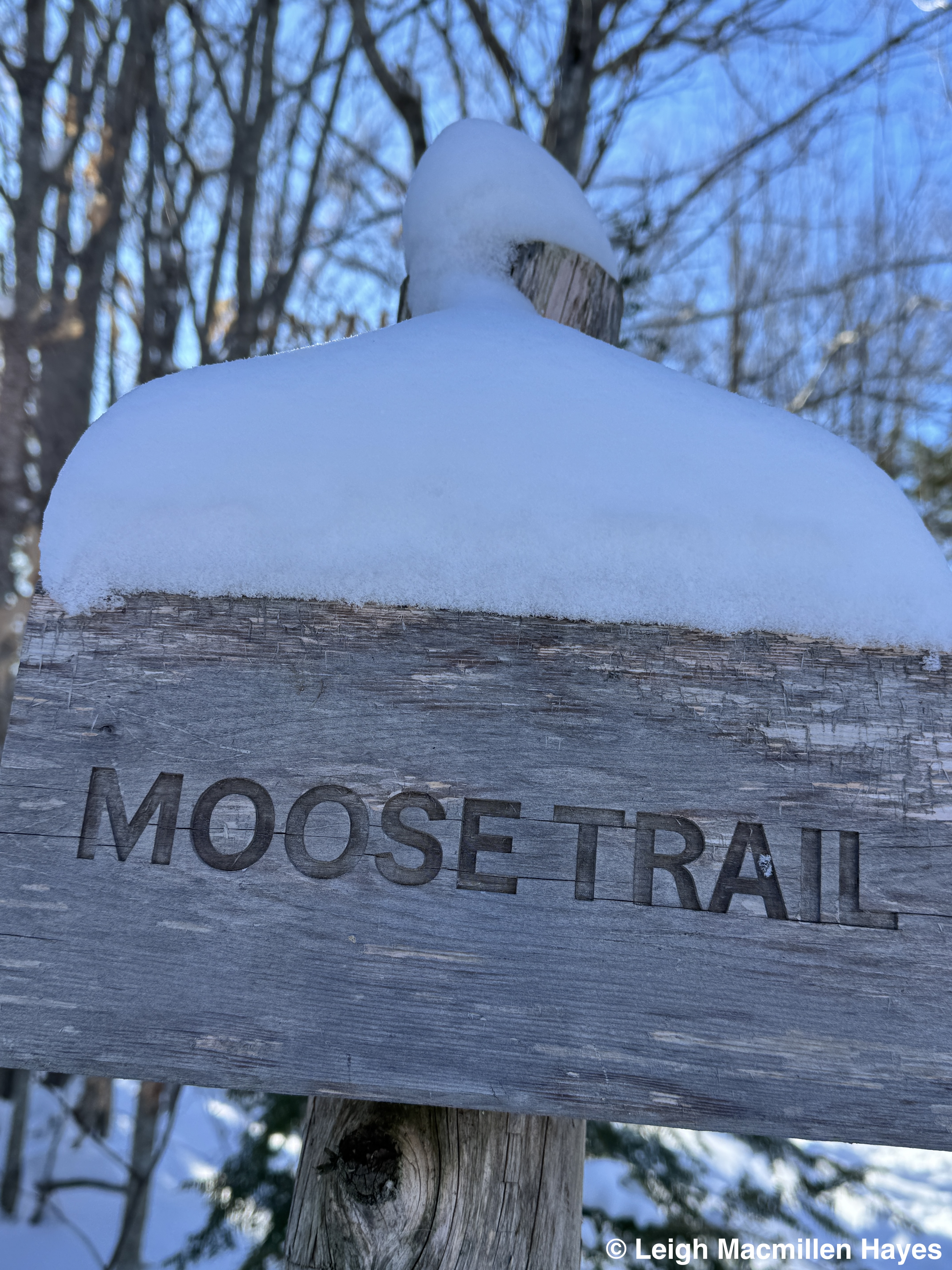
Slippery Slope Mondate

My Guy and I took in an old fav from a different perspective today. That’s because I always thought that the Micah Trail at Loon Echo Land Trust’s Bald Pate Mountain Preserve was for Camp Micah only. This morning I learned that anyone can begin the ascent via this sweet trail and so we made it our mission to do so this afternoon.
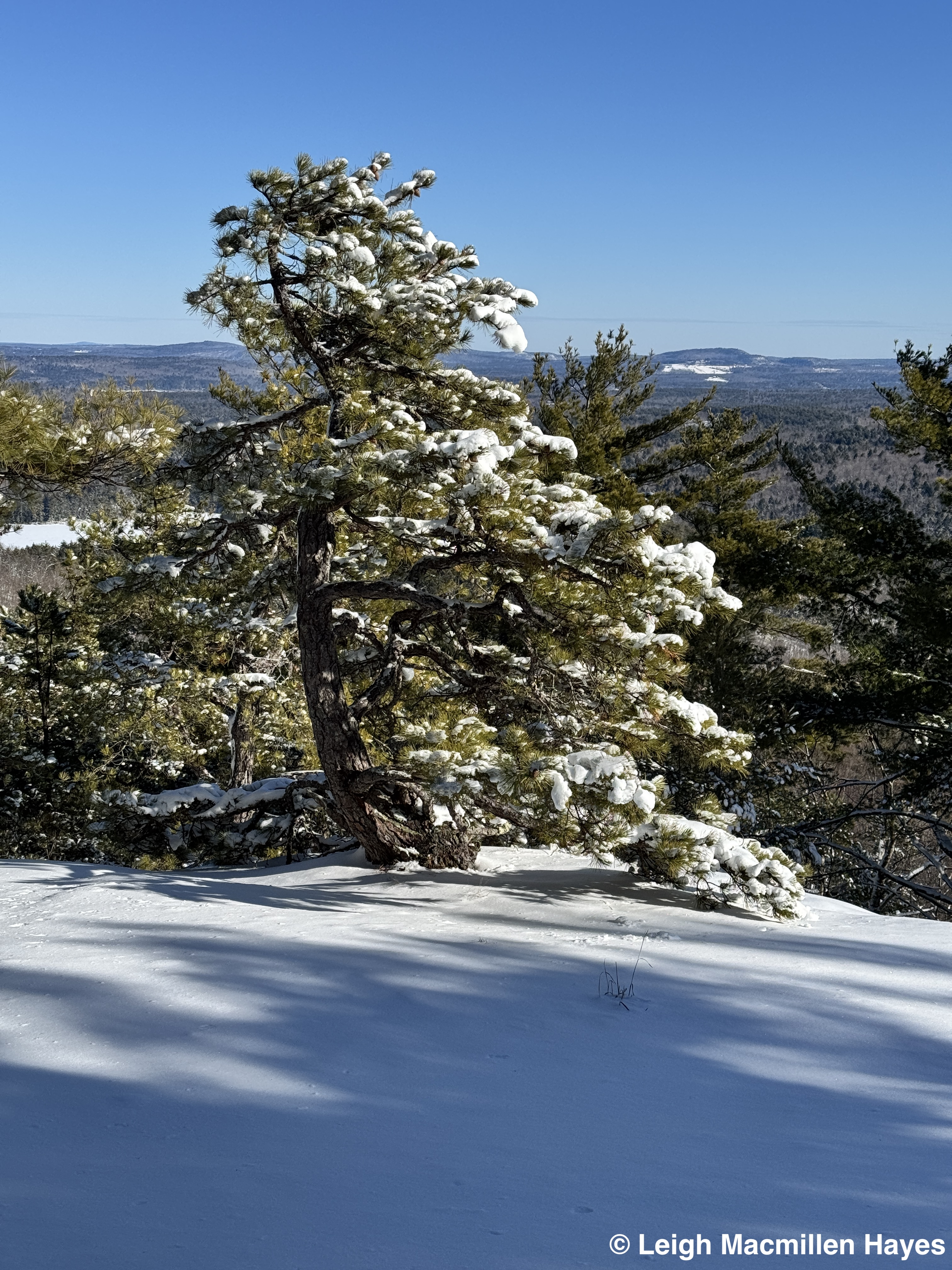
There is room for about four vehicles to park at the trailhead on the left-hand side of Moose Pond Cove Road off Route 107 in South Bridgton, Maine. Maps are available at the kiosk located a few steps in from the parking area.

Afew more steps and we met new bog bridging, always a welcome sight and so we crossed and then continued on up the trail, pausing frequently to search for bear claw trees among the American Beeches.

No such luck in the bear claw department, but we were serenaded by a flock of Chickadees singing their rather wispy fall songs, if they are songs indeed.

And a Hairy Woodpecker or two did what woodpeckers do . . . it pecked. This is a male as you can see by the hint of red at the back of its head. And he’s all puffed up, in reference to the brisk temperature of the day. Trapping air between his feathers helps him to warm up. Wearing several layers helps us do the same.

Once we reached the South Face Loop Trail, it was a quick ascent to the summit. Just before the summit, we paused to honor the bonsai tree–which is really a Pitch Pine. The summit of the pate is home to a Pitch Pine Forest. Though these trees can stand straight and tall, on mountain tops they take on a contorted structure.

The “pitch” in its name refers to its high resin content, thus making it rot resistant.

The needles are bundled in packets of three–making it easy to remember its name: Pitch–three strikes you’re out!

Another easy way to identify Pitch Pine is to look for needles growing right out of the bark–both on the trunk and branches.

Pitch Pine cones take two years to mature and upon the tip of each scale is a pointed and curved prickle.

They open gradually but depend upon fire for their seeds cannot be released until they are heated to an extremely high temperature.

That being said, this is the only native pine that will re-sprout when damaged.

I was told this morning that there had been some view openings and we were thrilled to discover a couple of them, includng this one overlook Peabody Pond with Sebago Lake in the distance.

And no visit to the summit is complete without paying homage to our friends Faith and Ben by taking a photo of their beloved Hancock Pond.

You may note the difference in the sky view from one pond to the next–snow showers are in the forecast for tonight so as we looked to the west, we could see the front moving in. No accumulation is expected, but any day now it will be most welcomed by us.

Though most of our foliage has dropped to the ground, another view at the summit included the scarlet colored blueberry leaves turning any day into a cheery one.

A quick loop we made next around the Bob Chase Trail, noting that we could almost see Mount Washington located in the saddle of our other beloved: Pleasant Mountain. On a clear day, this view is spectacular.

At last it was time for us to return to the South Face Trail and continue to follow the loop down. This section of trail we don’t often use so we did have to backtrack once and locate the orange blazes again.

You might think that upon our descent it would be the ice needles that gave us a difficult time. The six-sided slender ice constructions form in moist soil and can take on a variety of presentations from straight to arching curves. And yet, they grow perpendicular to the ground’s surface.

But, they were no bother and only crunched under our feet if we stepped on such in the trail.

The leaves, however, offered a different story. We had to make sure we weren’t fooled by the fact that many American Beech leaves still have some greens and bronze hues.

And others, though dried up, will wither on the trees until spring as they are marcescent (mar-CESS-ent). Some trees, such as the beech, especially those that are younger, choose to hang on to their leaves until spring.

Most deciduous trees drop their leaves in autumn, when cells between the twig and the leaf’s petiole create an abscission layer, thus causing the leaf to fall off. Not so in the case of marcescence, and I know that many will rattle and initially startle me all winter long. But, they also provide another hue in the winter landscape.

Northern Red Oaks also do the same, though in my observations, many are loosing their leaves with November winds, but some will remain throughout the winter.

Today, three seemed to play Tic-Tac-Toe on the trail before me.

So, young beech may retain their leaves, but look toward the sky and you’ll notice bare branches and look at your feet and you’ll see where they have all landed. A word of warning if you are hiking in New England right now–these leaves make for a very slippery slope, especially upon your descent. Hike with caution. Even My Guy has learned to do this.

As our hike came to a close, I noticed two trees close to the trailhead that I’d missed on the way in. An Eastern White Pine and a Paper Birch. Do you see what I see?

They had found a way to grow in the same space and actually fused together. Wind must have caused frequent branch movement. It probably took many years for the surfaces to gradually abrade, with the cambium of the trees touching and forming an adhesion, necessary for a graft union, and the trees fused.

It always strikes me when trees do this, especially those of different species. My Guy and I had been on a slippery slope on this Mondate, but the world seems to be on an even slipperier slope these days.

Maybe we all need to be like the trees and figure out a way to live together without so much conflict.

Dissing Fall Foliage?

It rained. And rained again. And rained some more. All spring. Seemingly all summer. And then we had a wee bit of a break as summer turned to fall. But . . . as important as rain is to trees, they didn’t necessarily appreciate so much of it. At least, that’s been the case for some species, in particular Sugar Maples.

Typically, the leaves on this Sugar Maple in our front yard don an orangey-yellow hue and add a glow to our front rooms in mid-October. Not this year. I took this photo on October 1, and as you can see, many of the leaves had dried up and fallen off prematurely.

The reason. The rain. Well, not the rain but related to the rain. Between all that water saturating the roots, high humidity, and warmer than normal temperatures, fungal spores attacked the leaves, causing them to turn brown and dry up since their photosynthesis had been slowed and they no longer had the energy to carry on into foliage season.

Probably adding to this particular tree’s stress was the fact that it had produced prolific fruits. It did look rather odd to see so many samaras dangling and nary a leaf. But, the silver lining, the fruits speak to future generations and next year’s buds are present and ready to overwinter for emergence in the spring.

That said, the front yard doesn’t look all that pretty with a pile of dried up leaves, but the chipmunk hole tells me that some local residents are thrilled–they’ve had leaves available for longer than is the norm to fill their nursery/bedding chambers and now that the seeds are finally dropping, they have an abundance of food as well.

With that in mind, my mind has formed a negative take on this year’s foliage. Oh, it’s been pretty in little pockets, but nothing to rave about and I was getting frustrated with Peak Foliage Reports telling leaf peepers how beautiful it is.

And so I wondered as we headed across a boardwalk to Long Mountain this afternoon, what we might encounter for color on our climb.

During much of the hike, Mill Brook babbled insistently . . .

flowed intensely . . .

and even roared immensely.

So much water, mimicking spring run-off, was the result of several more inches of rain that fell this past weekend.

Accompanied by the sound of the rushing water, and perhaps calmed by it as well, I began to notice the colors that surrounded us.

And when I looked down, there were jewels to be admired, like this Red Maple. Notice the V I added to the gap between the leaf’s pointed lobes? Red Maples offer a V-shape in the gap because they are VERY abundant in the Maine woods.

Fortunately, the Sugar Maples in this forest faired better than the ones on our road, which made me happy. So . . . how to tell the difference between the Red and the Sugar. The U-shaped gap can be thought of as a scoop. Get it? A scoop of sugar?!

Maple-leaf Viburnum, a shrub in the understory, had its own hues to offer. Usually I see these leaves in their mulberry shade, but either we were too late today, or this one decided to be much more pastel in hue. It doesn’t really matter because it was still beautiful, had fruits left for wildlife, and bright red buds preparing for the future.

It is a bit early for Northern Red Oaks, but some in the understory had given up their need to continue to produce energy and change is in the air, or at least along the veins.

A Quaking Aspen with its flat petiole (stem), was the greenest of the species we encountered today.

I think one of my favorites was the Quaking’s cousin, a Big-tooth Aspen, which also features a flat petiole. Oh, and what big teeth along the leaf’s margin.

I was reminded as I looked at this leaf that yesterday we learned of a man who when in kindergarten many decades ago, was allowed to use only one color of crayon. I suppose the same teacher also told him to stay within the lines.

As the Big-tooth Aspen can attest, nature is a much better teacher in that and so many other regards.

Okay, so I called the Big-tooth my favorite, but then I spotted an Elm. It didn’t feel quite like an American Elm to me lacking as it was that gritty sandpaper feeling, but being with My Guy, I didn’t have time to look around for more leaves or locate the tree. One day I will. The other choice is a Slippery Elm, but this isn’t actually their habitat. But then again, another lesson or two from nature–she doesn’t always read the books and there are no absolutes.

The cool thing, besides the tie-dyed coloration of this leaf’s edge, is the asymmetrical base, one side dipping longer down the petiole than the other.

And then there was the Indian Cucumber Root. I think what caught my eye as much as the red on the leaves and the fruits waiting for a critter to dine, was the negative space between the upper tier of leaves, creating a five-pointed star. Maybe they always look like that and I’ve just never noticed before.

Today’s hike began to give me a change of heart about the foliage. Whether at our feet . . .

or flying above us . . .

or forming a tapestry before us . . .

it was beautiful in its own way . . .

and I’m grateful that this turned into a Not Dissing Fall Foliage Mondate.