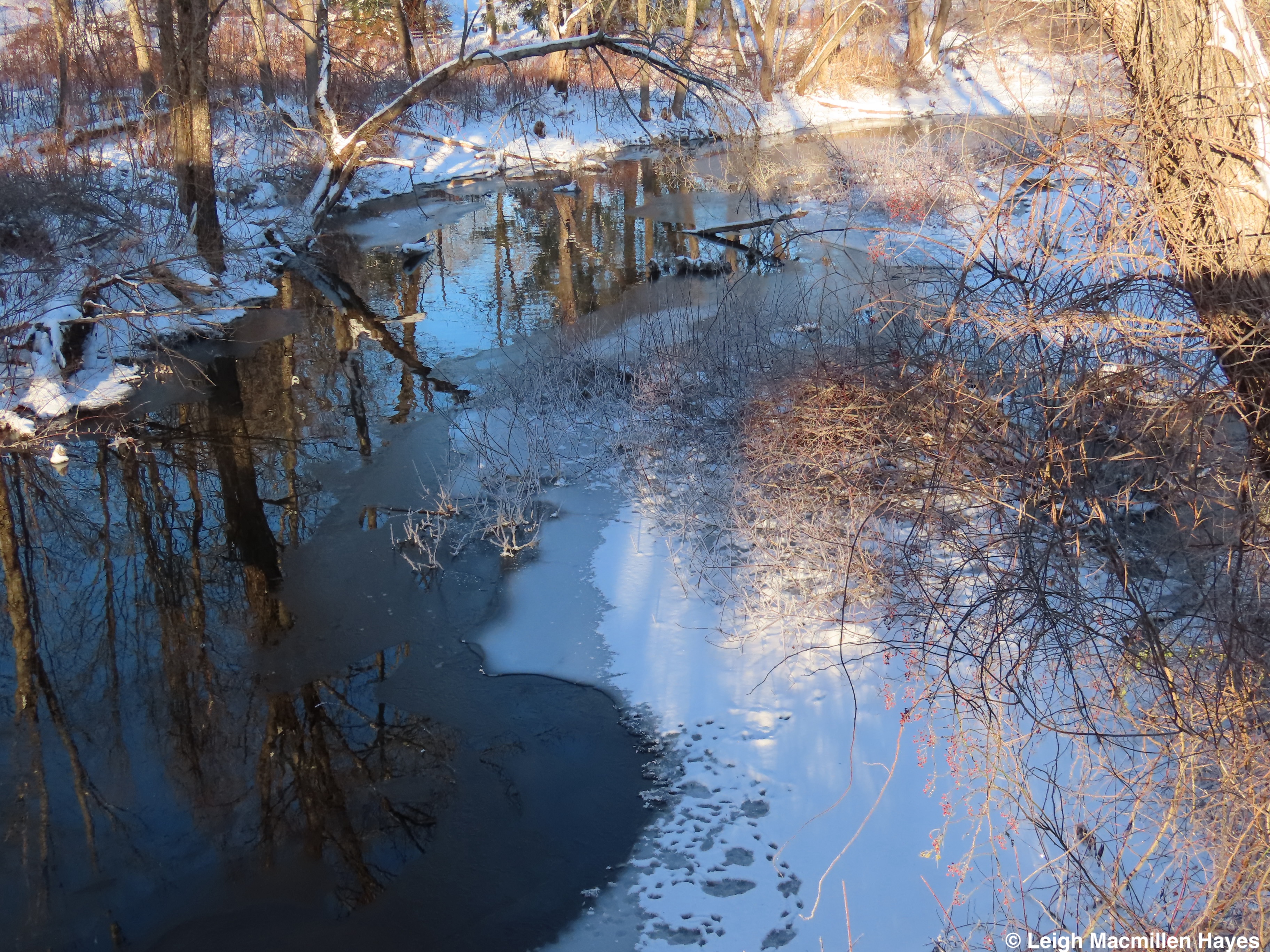
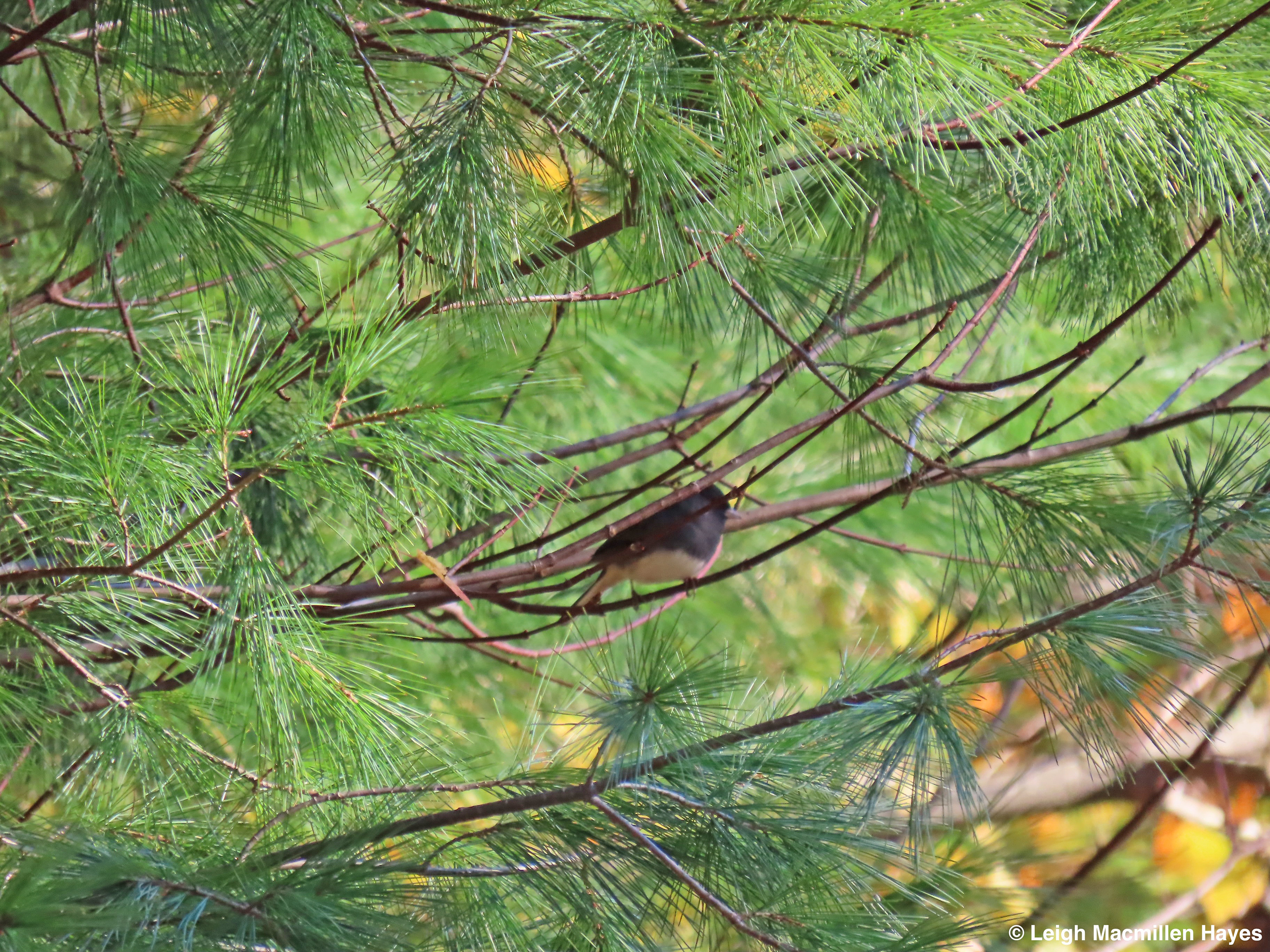
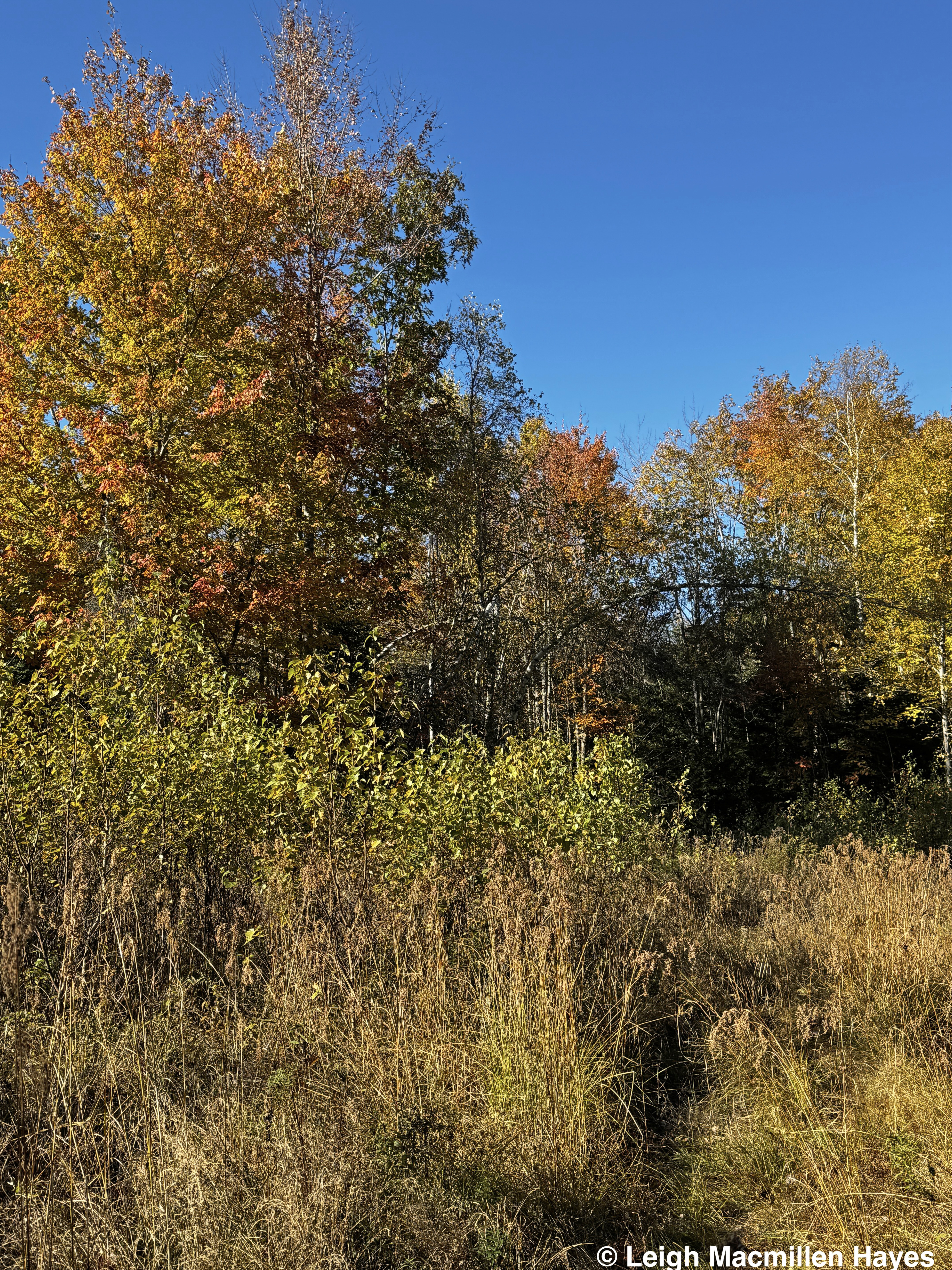
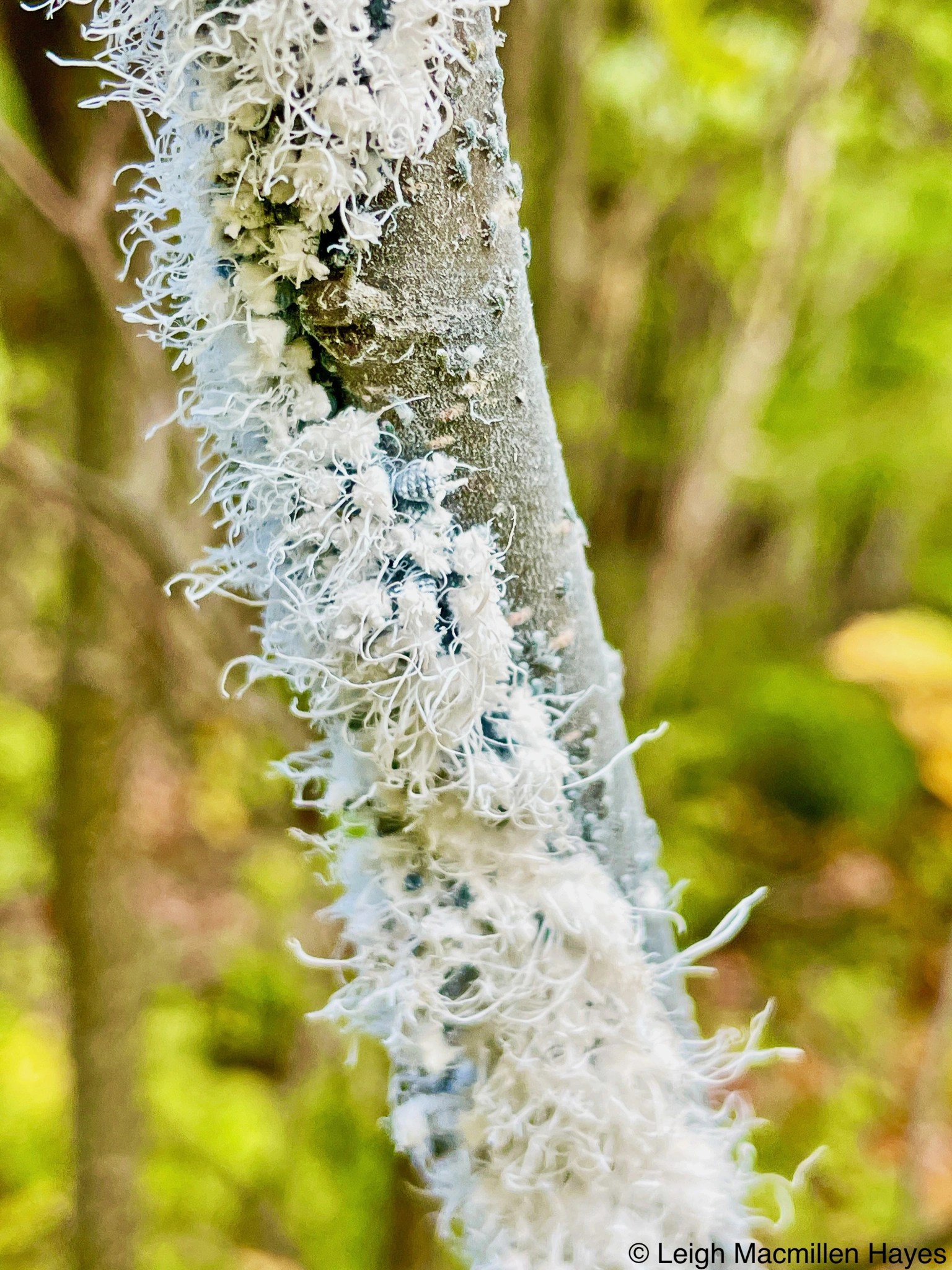
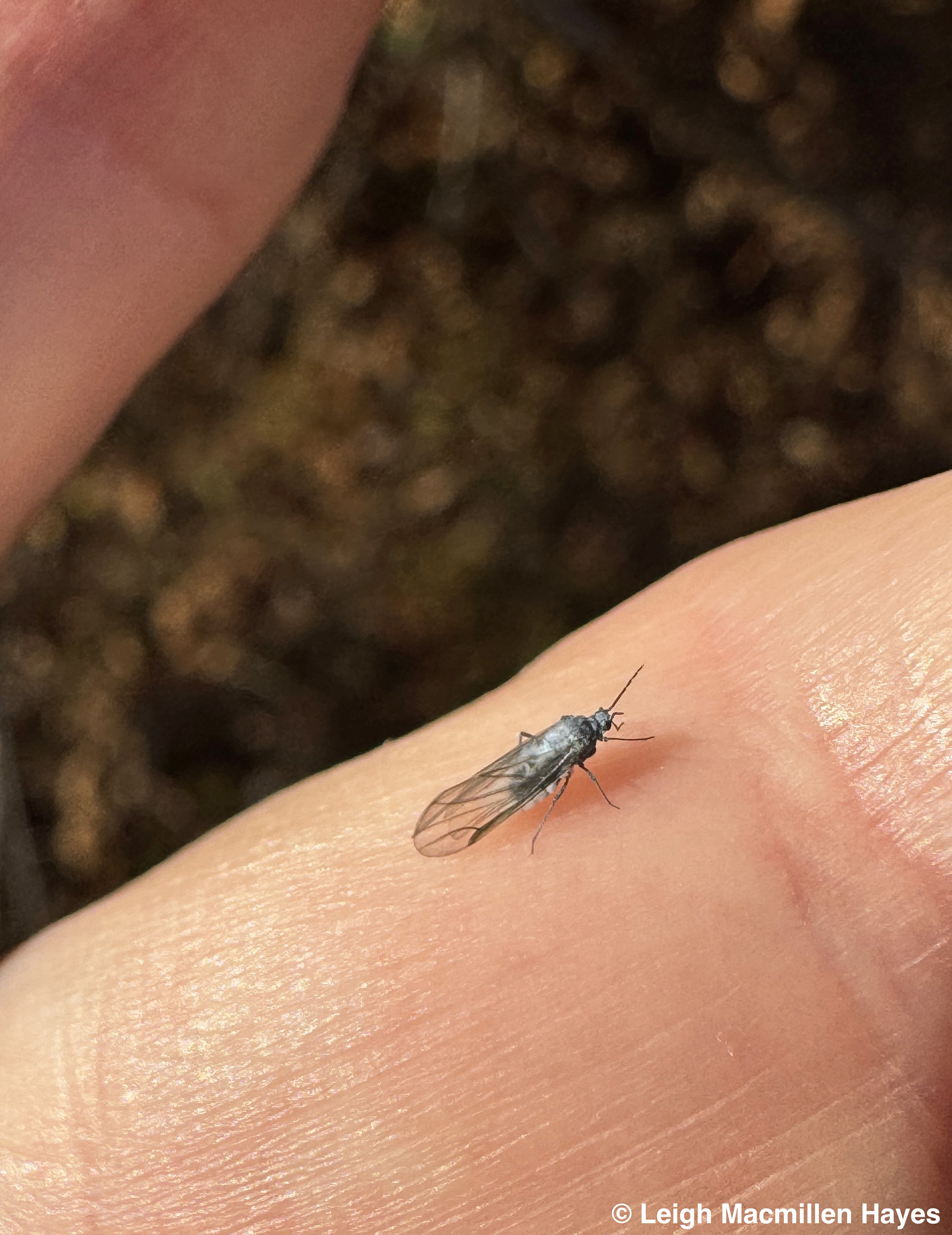
Bluebird Days are the best days

It’s been delightfully frigid this past week. My kind of temps because it makes me feel so alive when I’m out in the woods. And as My Guy and I were saying when we hiked this afternoon, it’s all about dressing right. So we did.

Just after turning onto the side road of our intended destination, we watched a Vole scamper across and then dart this way and that while I stopped the truck. Did either of us take a photo? No. But those moments are always for the mind’s eye.

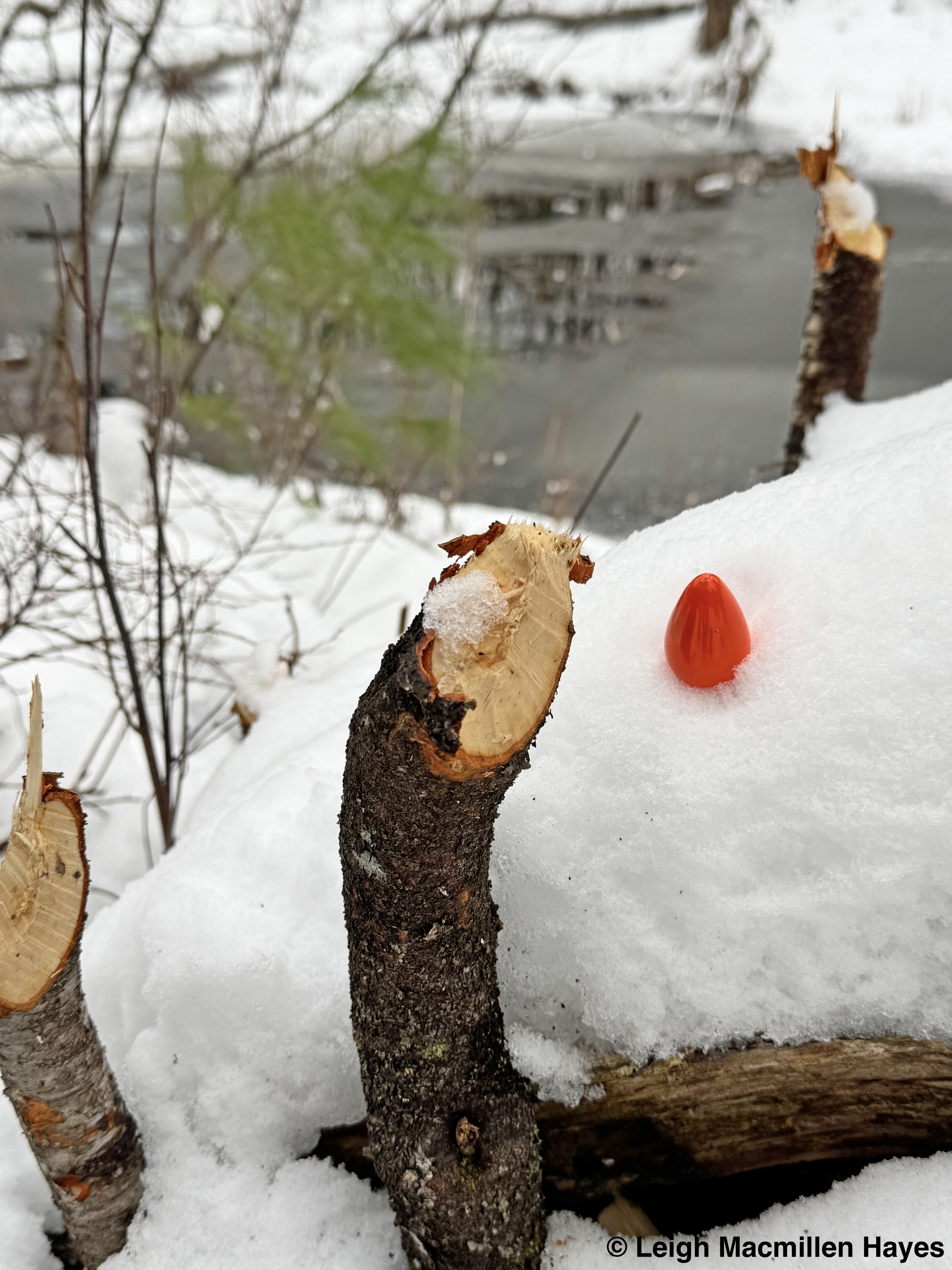
And then, after parking, I spotted this sweet little snowman on the other side of the snowbank and thought, “What a job well done, given the cold temps of the week.” You see, it’s not really snowman-building-kinda snow, but someone was successful.
Our journey included walking a mile in to the trailhead, though we noticed a few people had actually driven in; something you can’t usually do at this time of year . . . if there is more snow. Alas. That we don’t have.

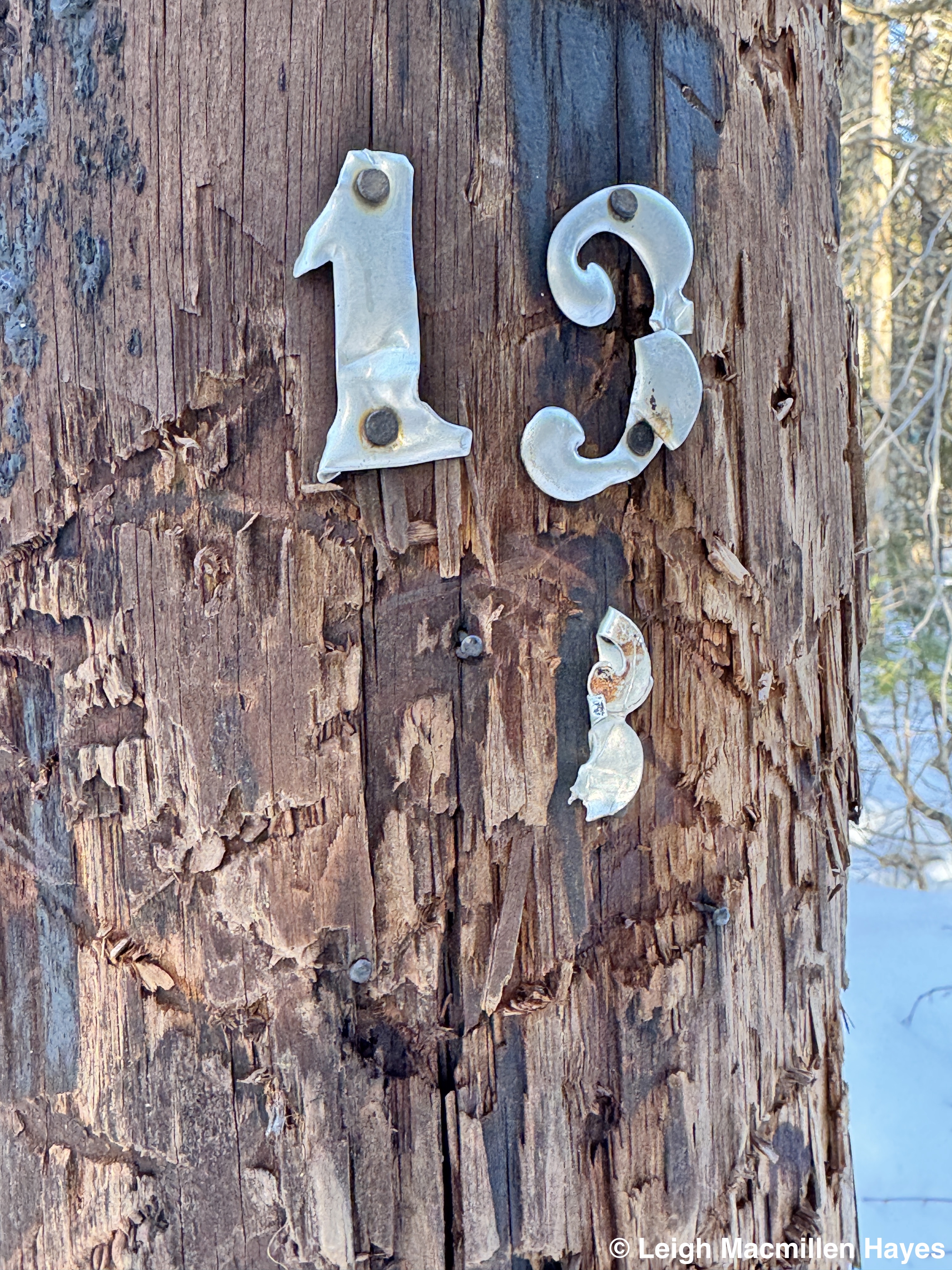
But . . . I love to walk in because . . . there are telephone poles. And being adjacent to the National Forest, it’s a rather wild place. And these poles tell a story of just how wild.

In fact, on this one the shiny numbers have been attacked and I can just imagine the activity that took place here.

In my mind’s eye, the Black Bear scratched the pole and then rubbed its back as it turned its head and bit at it. Why? That’s a question for which I’ve heard several different answers over the years, from something different in the woods, to it likes the creosote, to it feels the vibration coming down from the electrical wires above. I’m not sure of the answer, but I do know that I like to use my back scratcher once in a while and I can imagine the Bear does as well. His is just MUCH bigger than mine.

I always tease My Guy that this is his favorite game, to which he guffaws. But I can’t resist taking a look. I mean, look at pole 17. The metal is fairly intact, but can’t you just see the upper incisors chomping down and dragging back toward the lower, while the head is turned to the side?
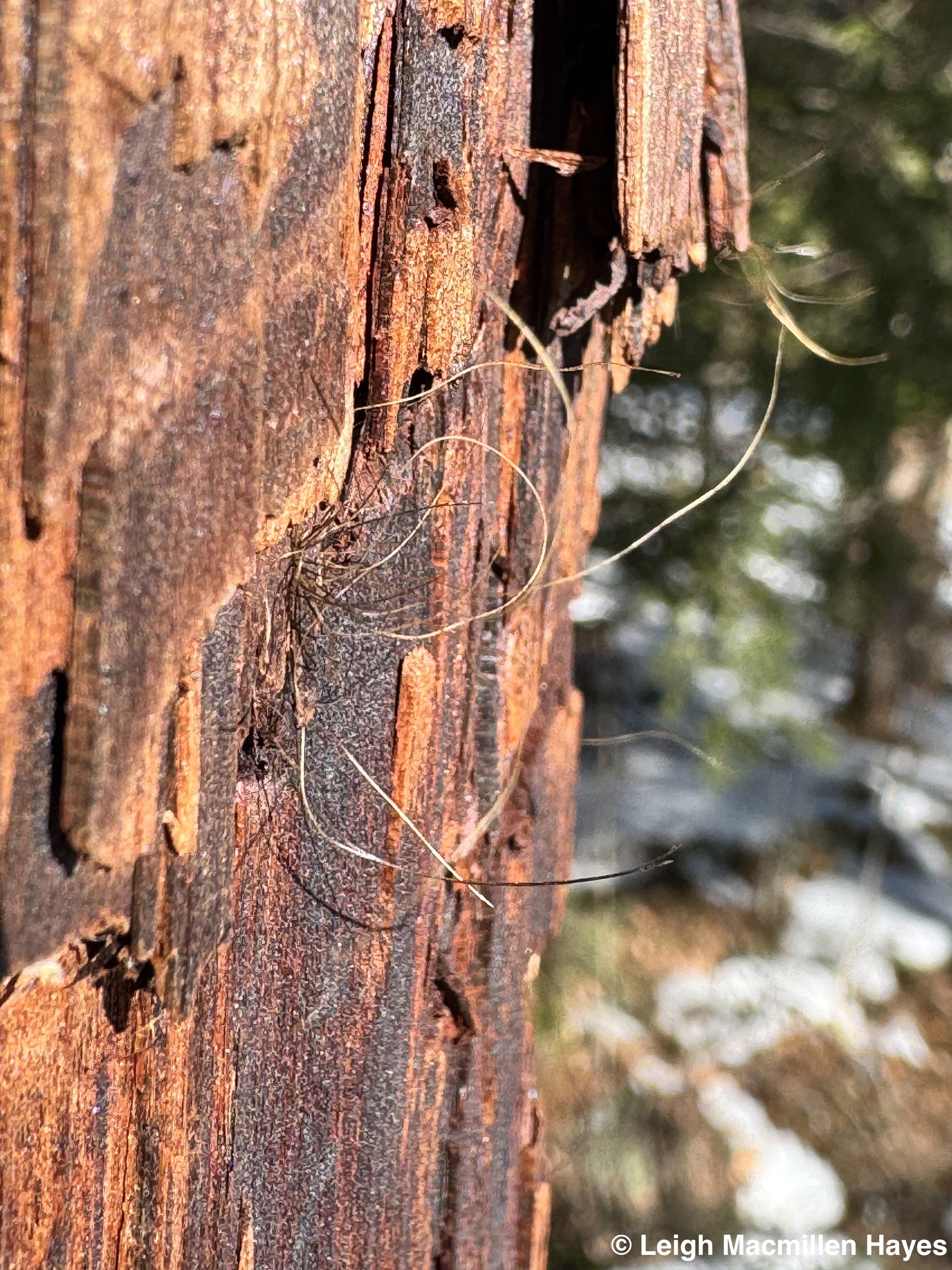
And don’t you just covet those hairs? My Guy asked why some are so light in color–that’s because this action may have occurred in the spring. It could be territorial, and maybe that’s the only answer we need. Anyway, over the summer, the color bleached out.

This pole had been attacked so many times over the years, that the numbers are now completely gone. In the past, I’ve noted that the number 5 somehow seemed to draw the Bear’s attention, and today I don’t recall seeing Pole #5 or #15. Maybe this was one of them. Because I was with you-know-who, I didn’t take too much time to pay attention to what number this pole should have been.

I was just happy to be out there looking at them.

Once we reached the trailhead, well, actually, even before we reached it, we noticed Red Fox prints and tracks. By the gazillion.

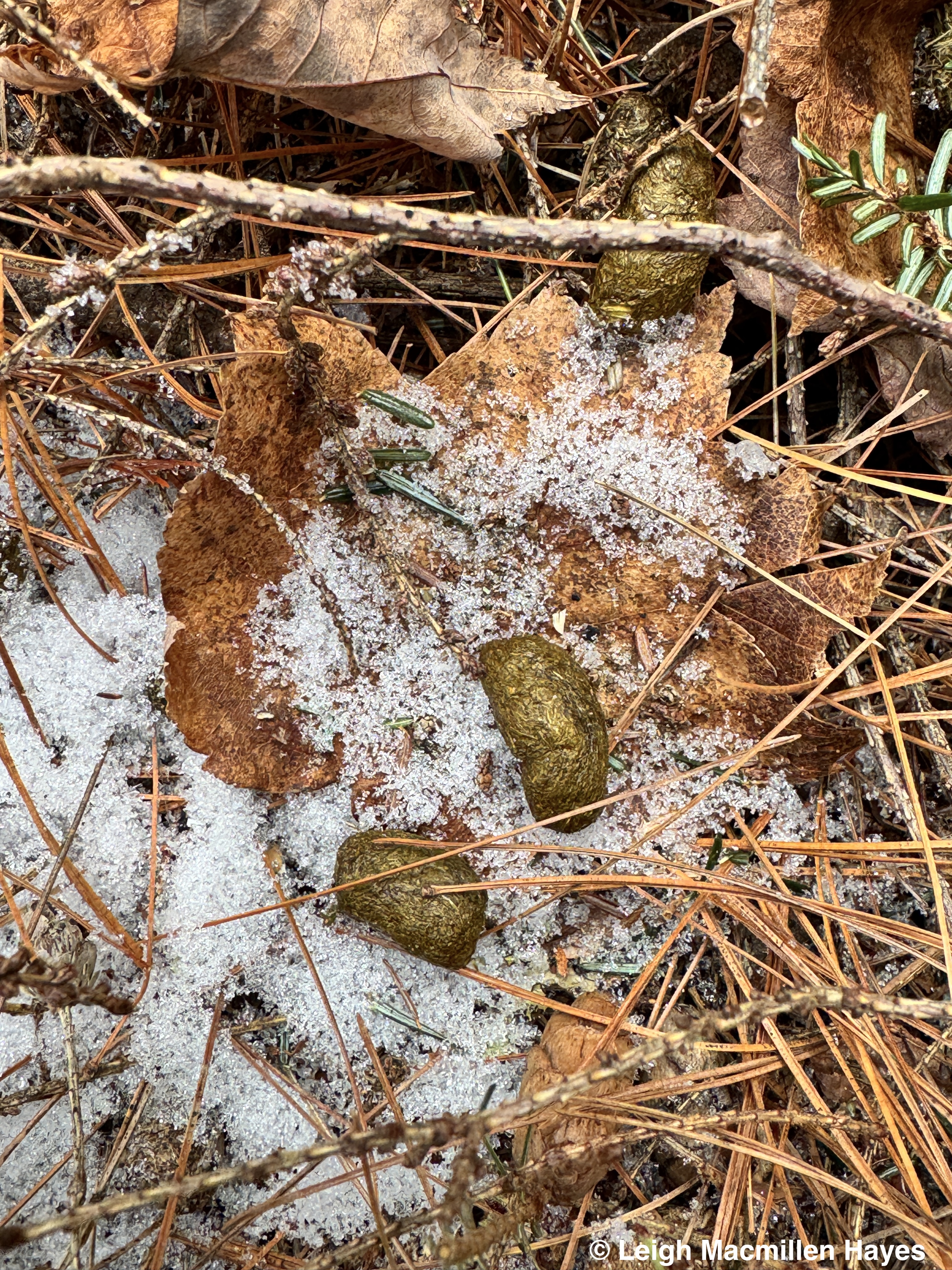
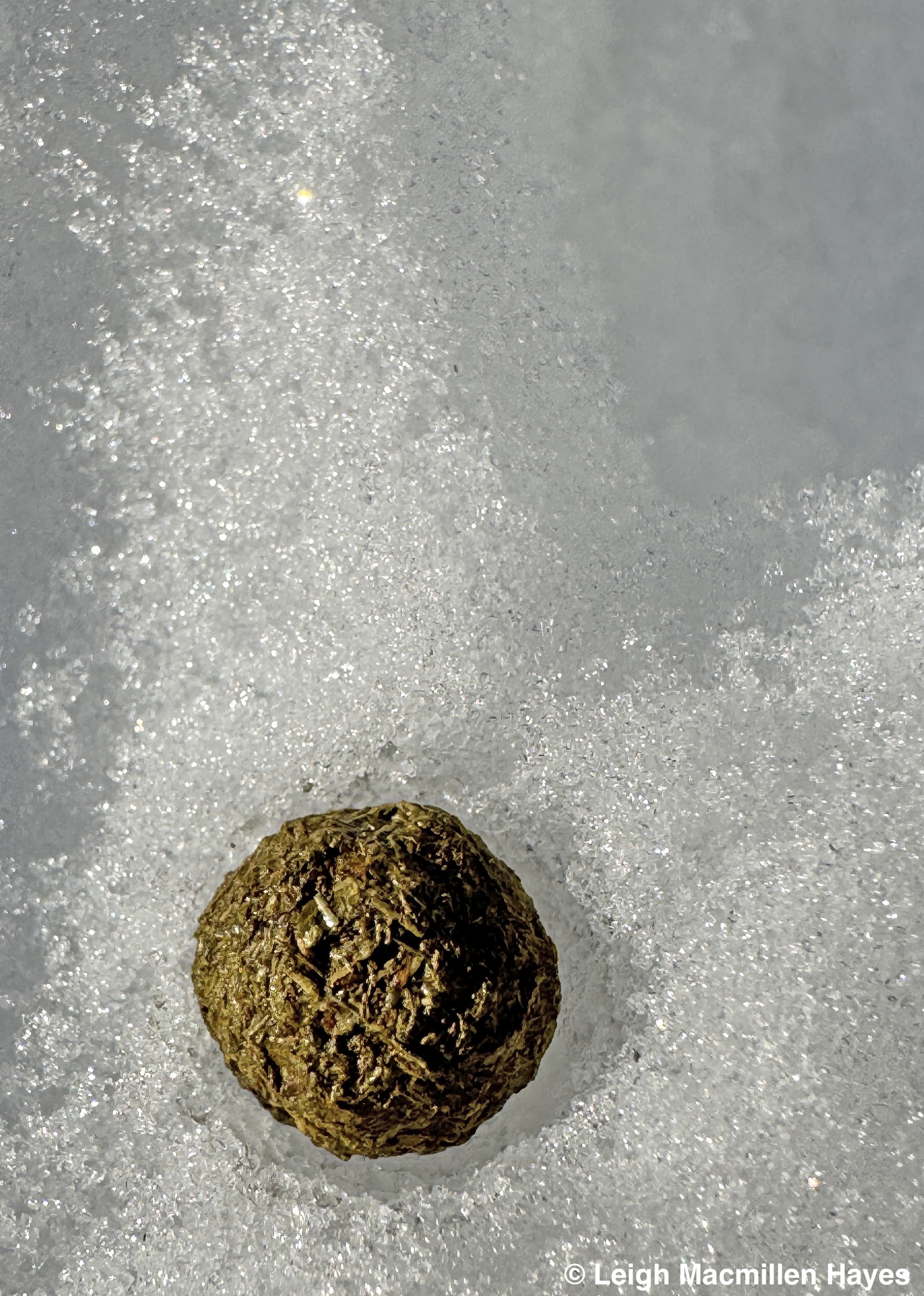
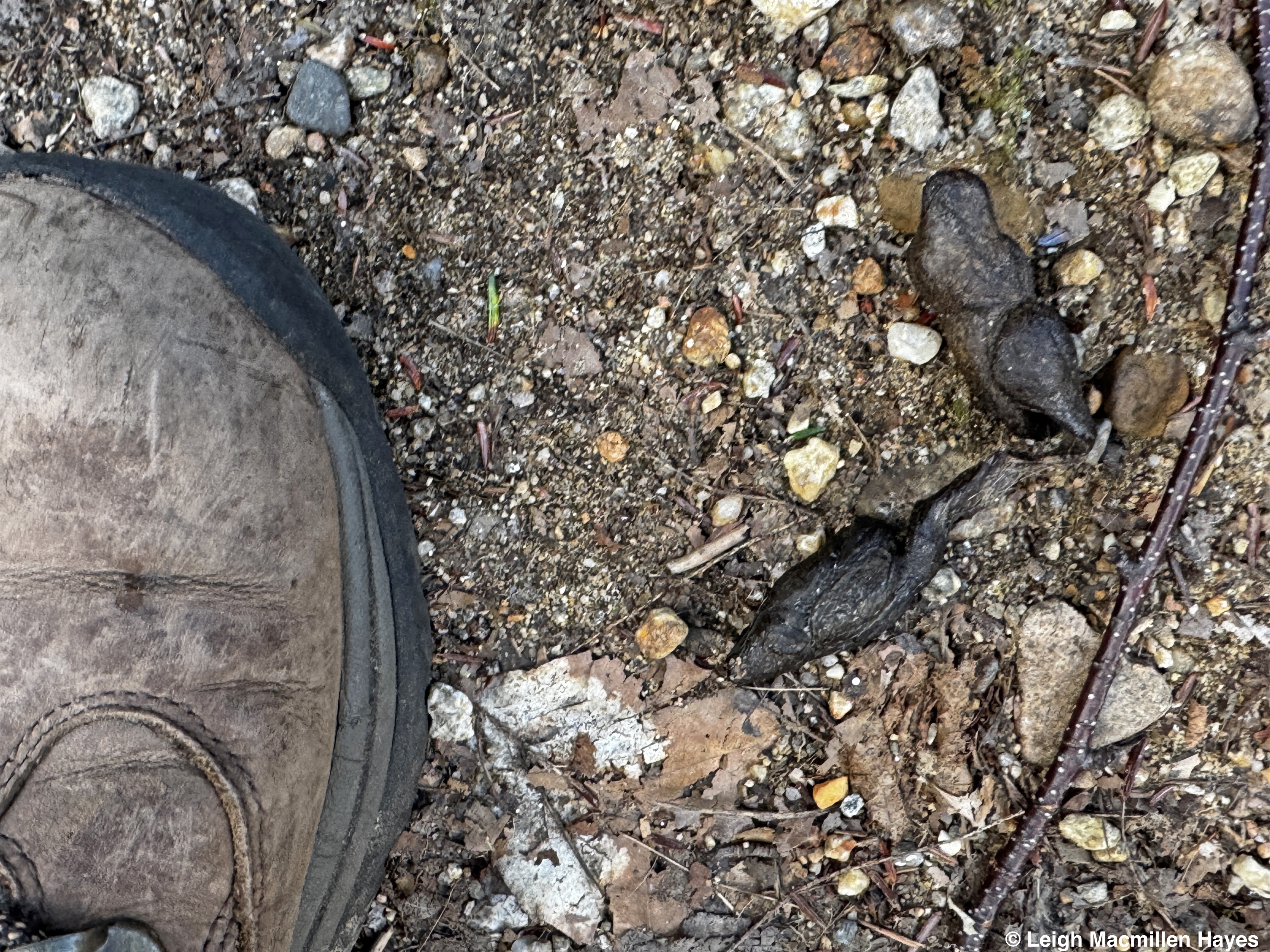
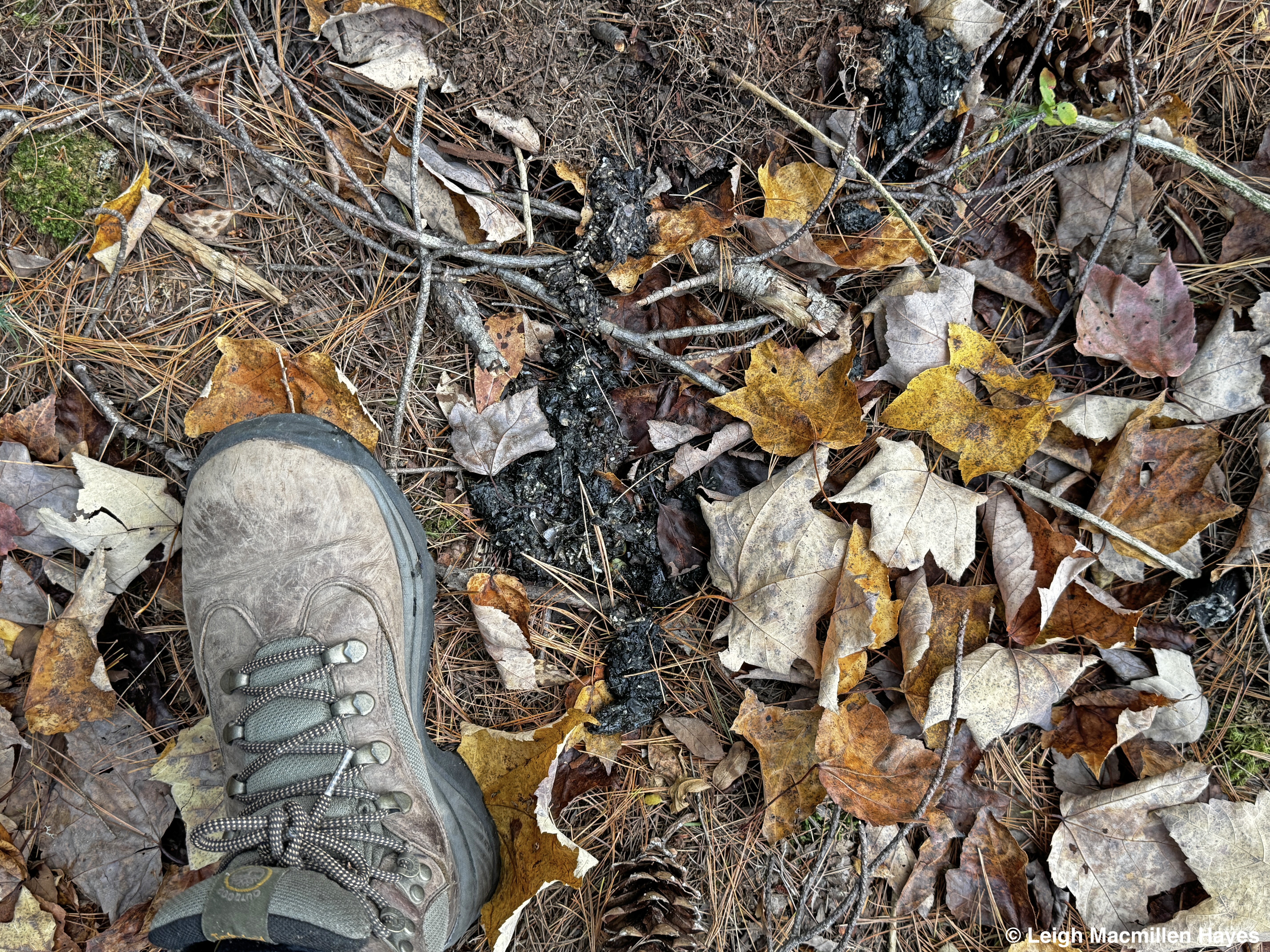
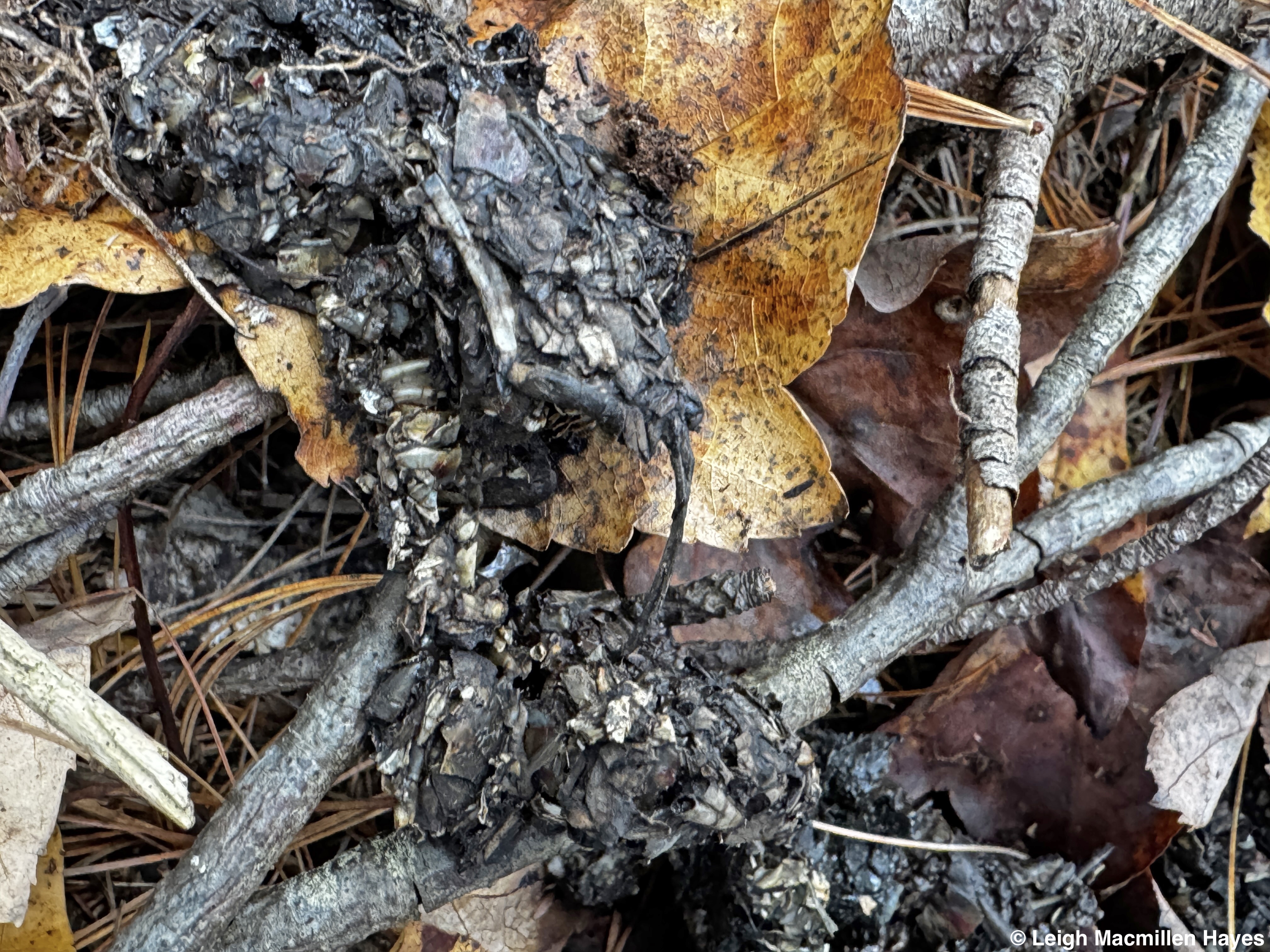
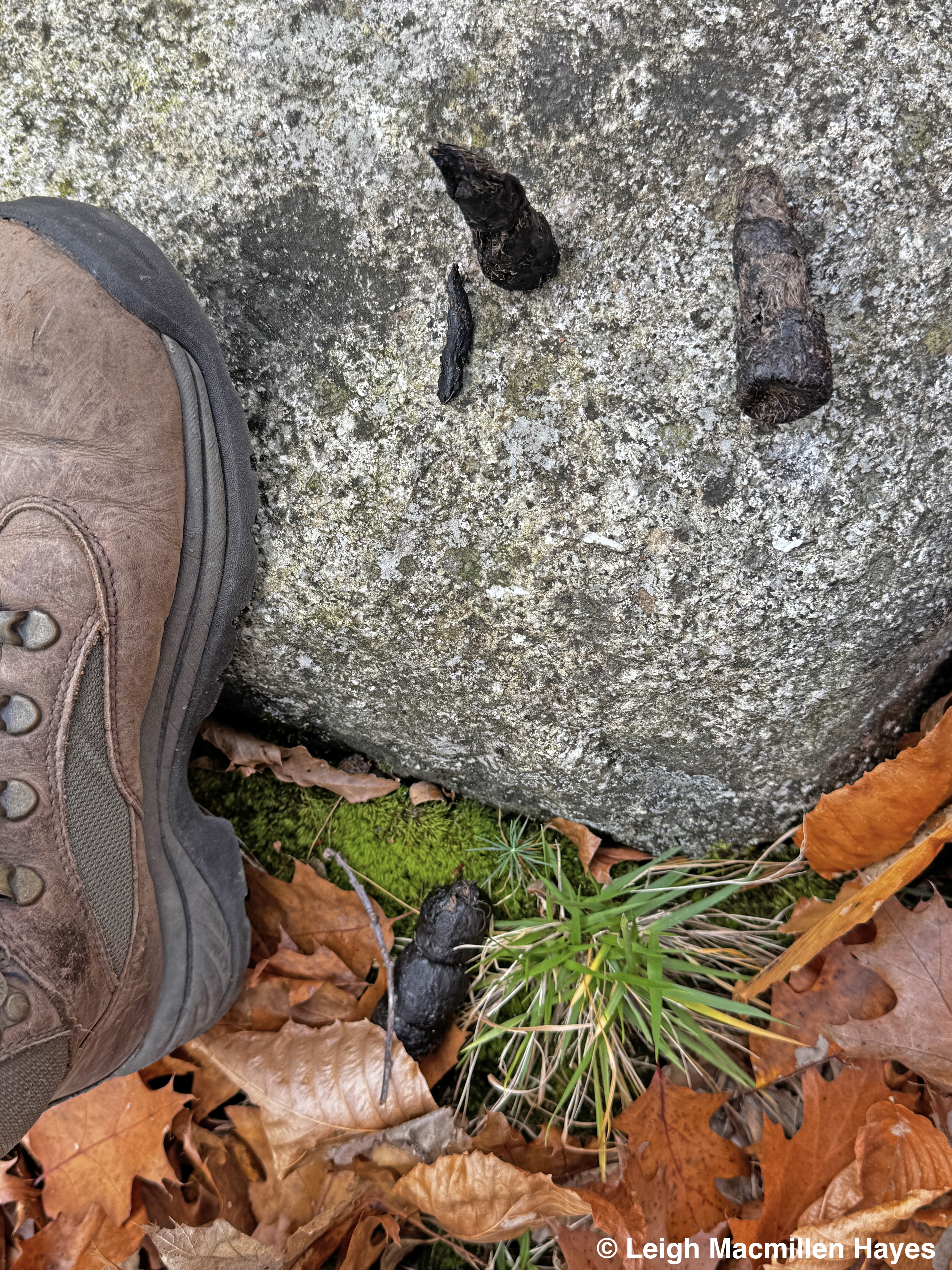
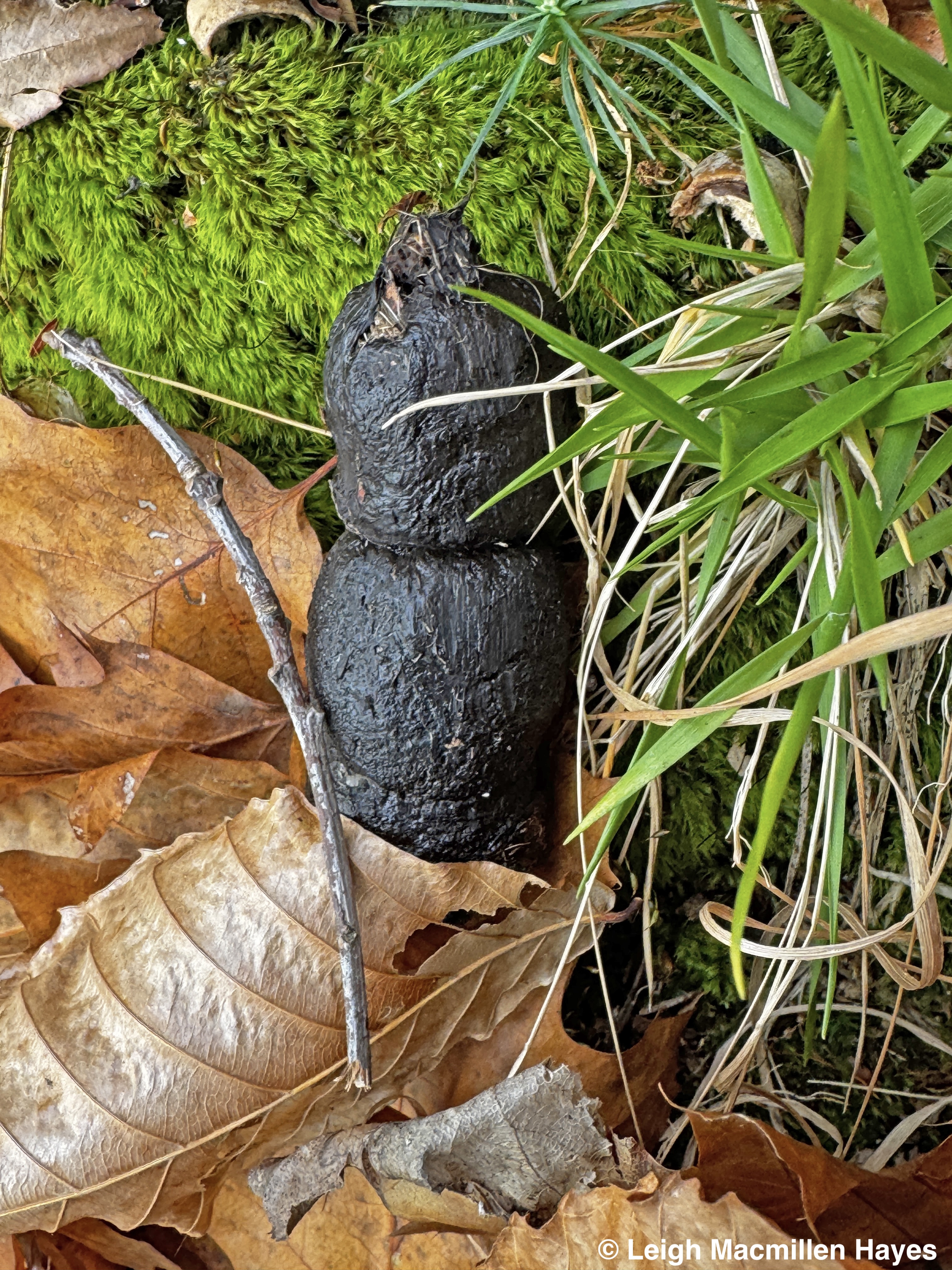
And then, in the middle of a field that is part of the trail, a perfect Red Fox scat filled with fruit. You can thank me for not making this a more upclose and personal photo.
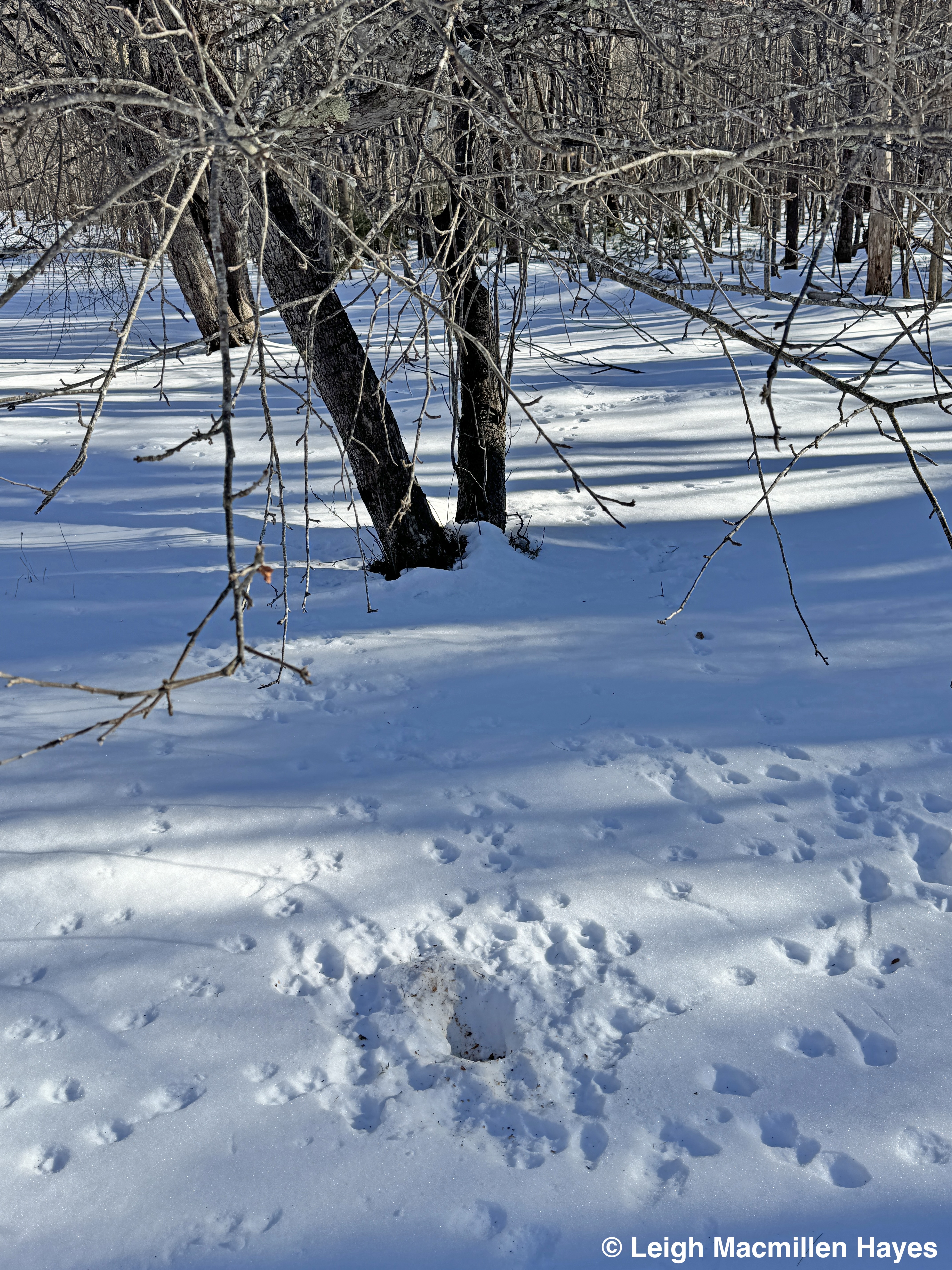
There was a reason for the fruit . . . because the trail next passed through an old orchard. And there, the tracks increased significantly.

Apples were on the Fox’s menu and those that had been buried under the snow were excavated.
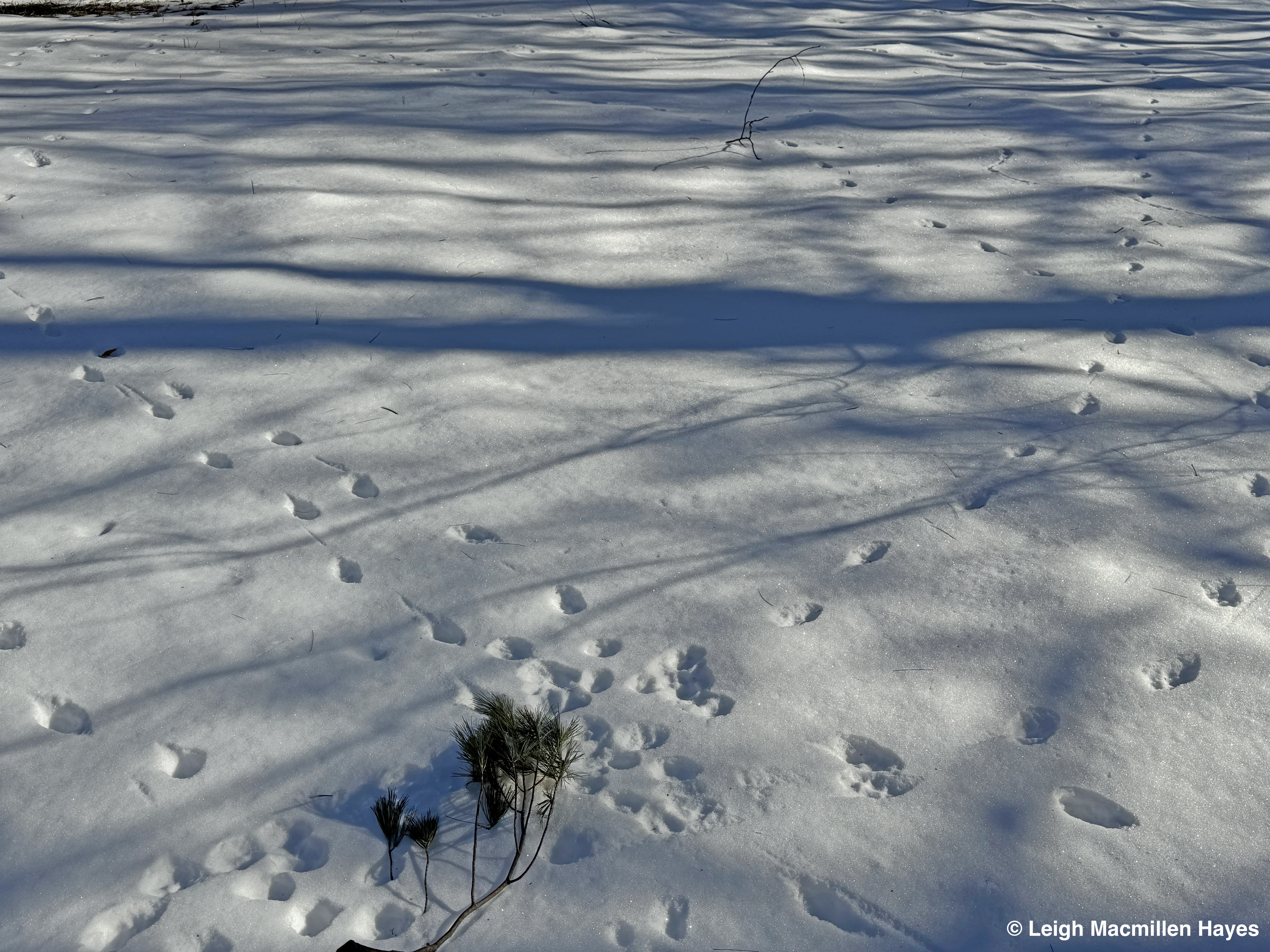
And because it is that time of year, I noticed something else going on in the midst of all the tracks.

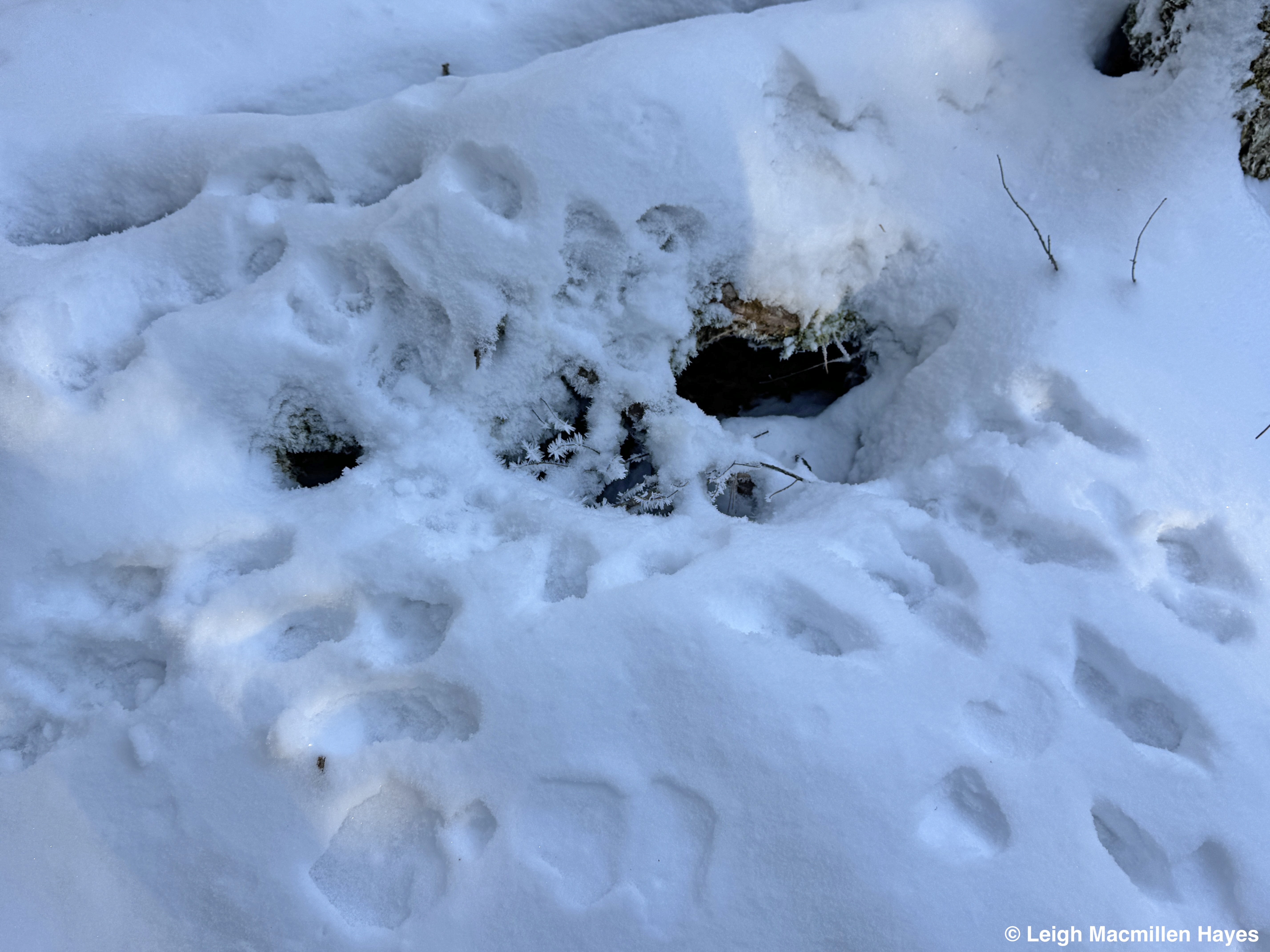
Do you see the downed White Pine branch?
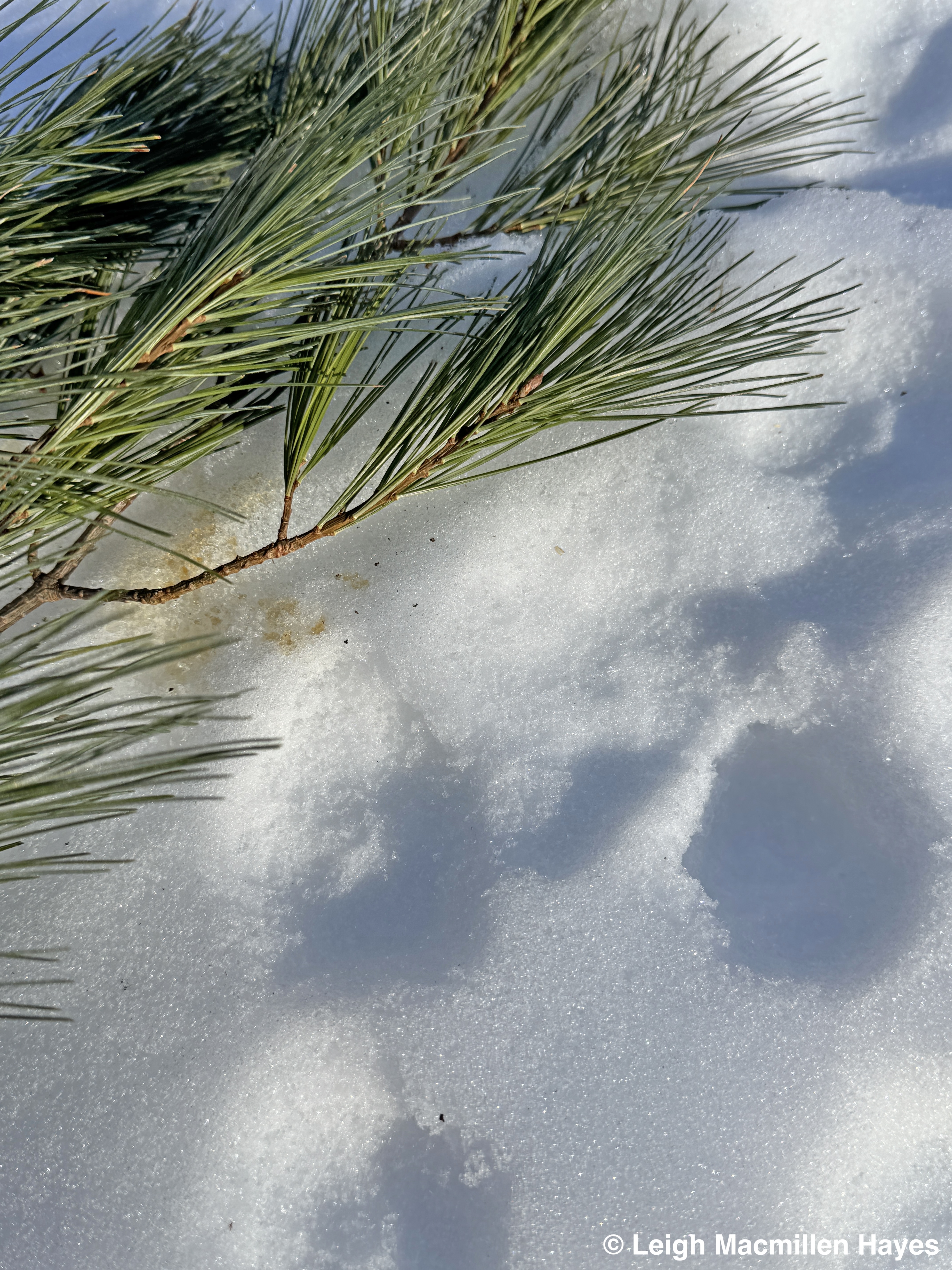
Take a closer look and you’ll see urine. Fox pee. Male Fox pee.

Just yesterday I was hiking with a friend through her acreage and we found the same. Numerous Fox tracks and spots where the Fox had peed on saplings and anything else that poked out of the ground and snow. And so I invited her to get down on her knees and sniff it, just like a vixen would do.

Skunky!

She stood up smiling and it’s a smell she’ll never forget.

The Fox guys are leaving their messages everywhere to let the ladies know they are available for a date or two or three.

Speaking of yesterday, as we continued to hike, we spotted lots of Deer runs, well worn pathways through the woods. And then a spot where they seemed to browse a bit on downed Hemlock twigs.

But why were the twigs on top of the snow? I lifted one up and noted the 45˚ cut of it. The same on the next. And the next. And then we spotted the curved form of . . . Porcupine scat. Plus some pee.

We looked around and couldn’t find Porcupine tracks anywhere leading to or from the tree.

And so I looked up because that’s what I do whenever I’m under a supposed Porky tree. And low and behold, he was walking out on a branch high above us. We quickly moved away from the trunk and enjoyed the view from below, before continuing our tour.

But I digressed and so I looked skyward today and noticed ice dangling from the cliffs above–prickly in nature, much like yesterday’s Porcupine, but beautiful all the same.

And down low, we noted a good crossing point in case we needed it because last year we arrived at this brook from the opposite direction and discovered the bridge had been washed to the opposite shore during a storm and we had to find our way across with snowshoes on our boots. We wanted to be prepared today.

Much to our dismay and surprise, the bridge hadn’t been repaired, but fortunately the brook was iced over in this section and we decided to run across in hopes of making it safely to the other side.

Success.
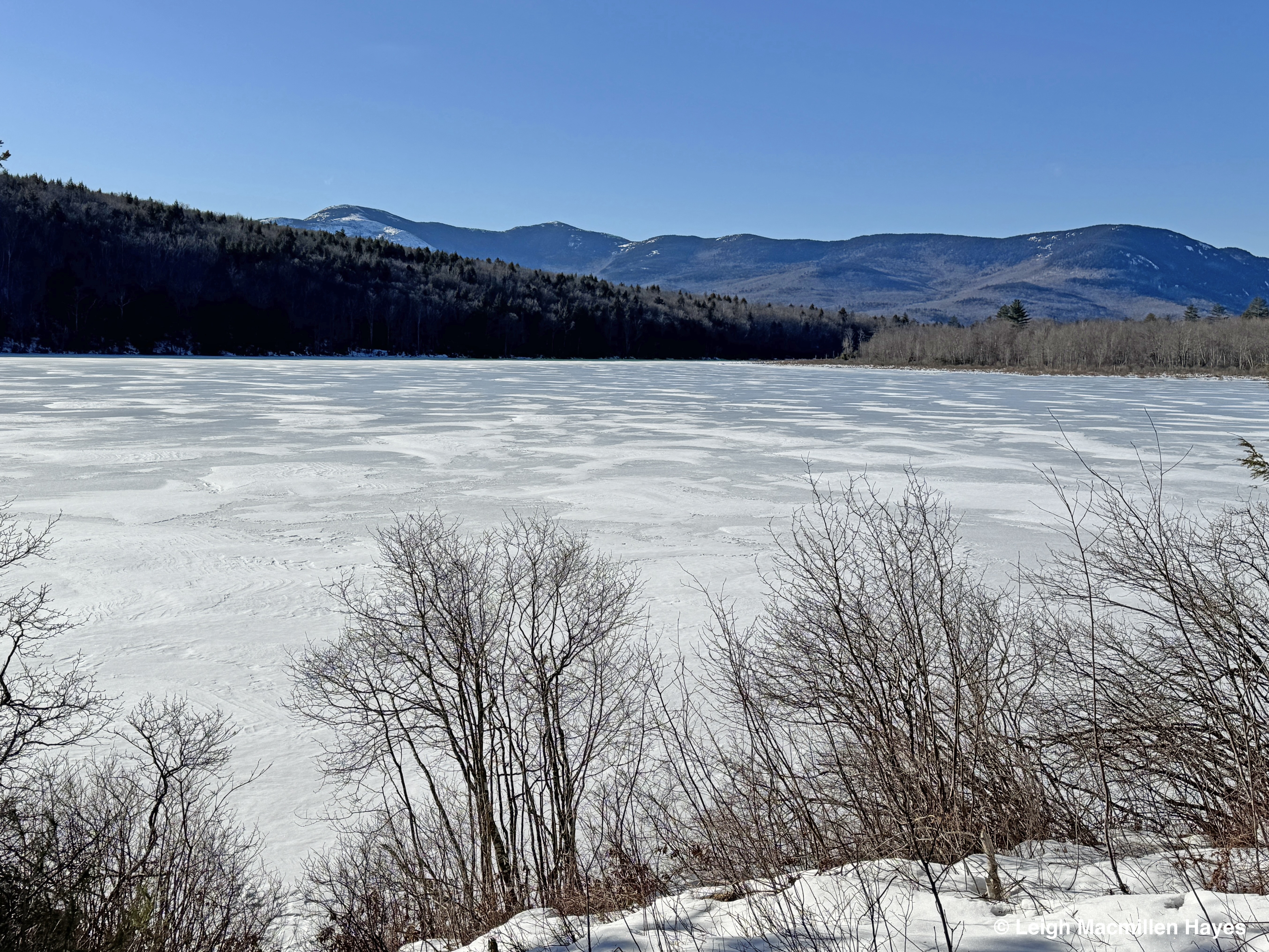
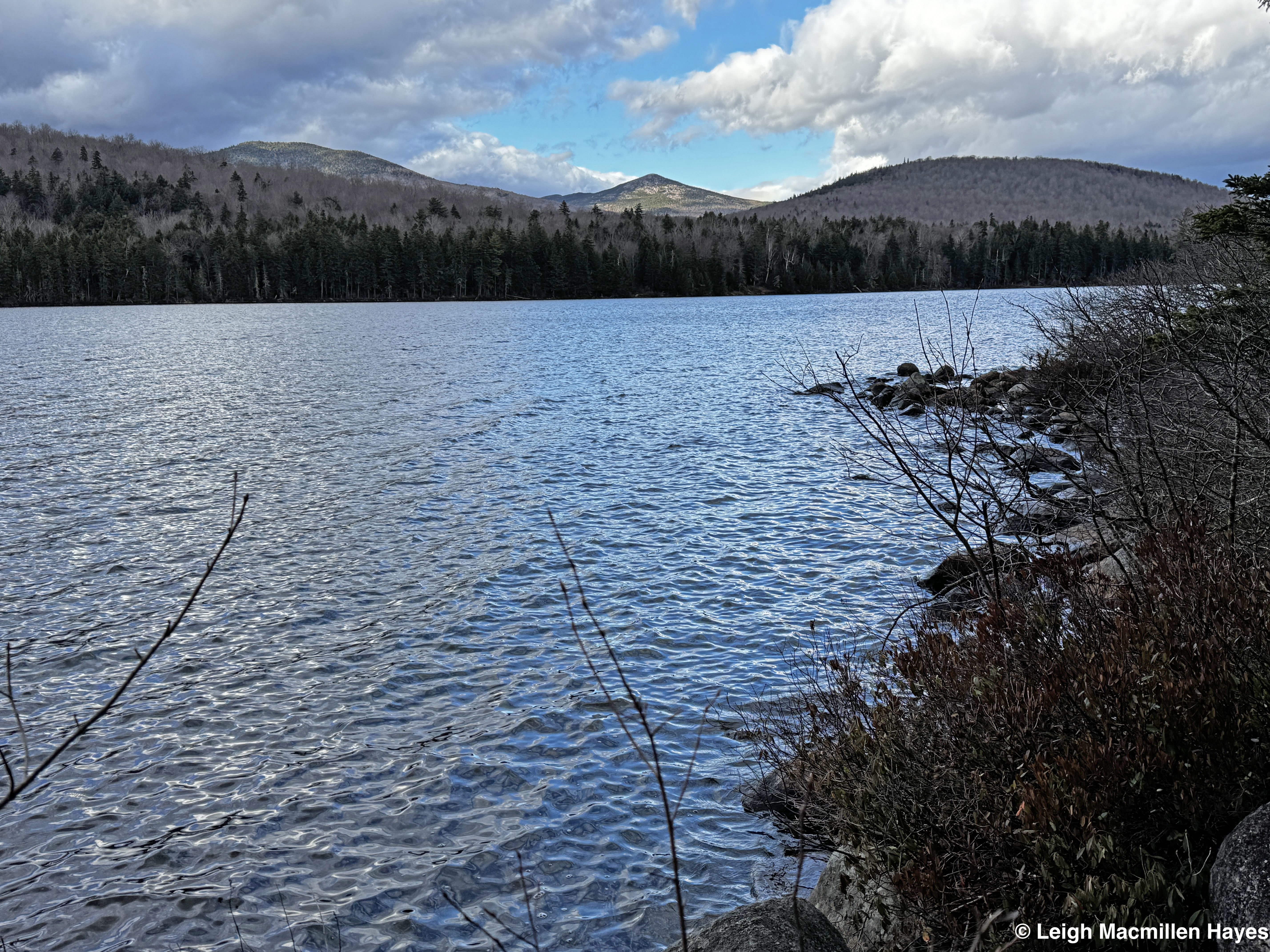
A bit farther on and we reached the lookout point for the pond we were circling, with the mountains of Evans Notch forming the backdrop. It looked like a perfect skating rink.
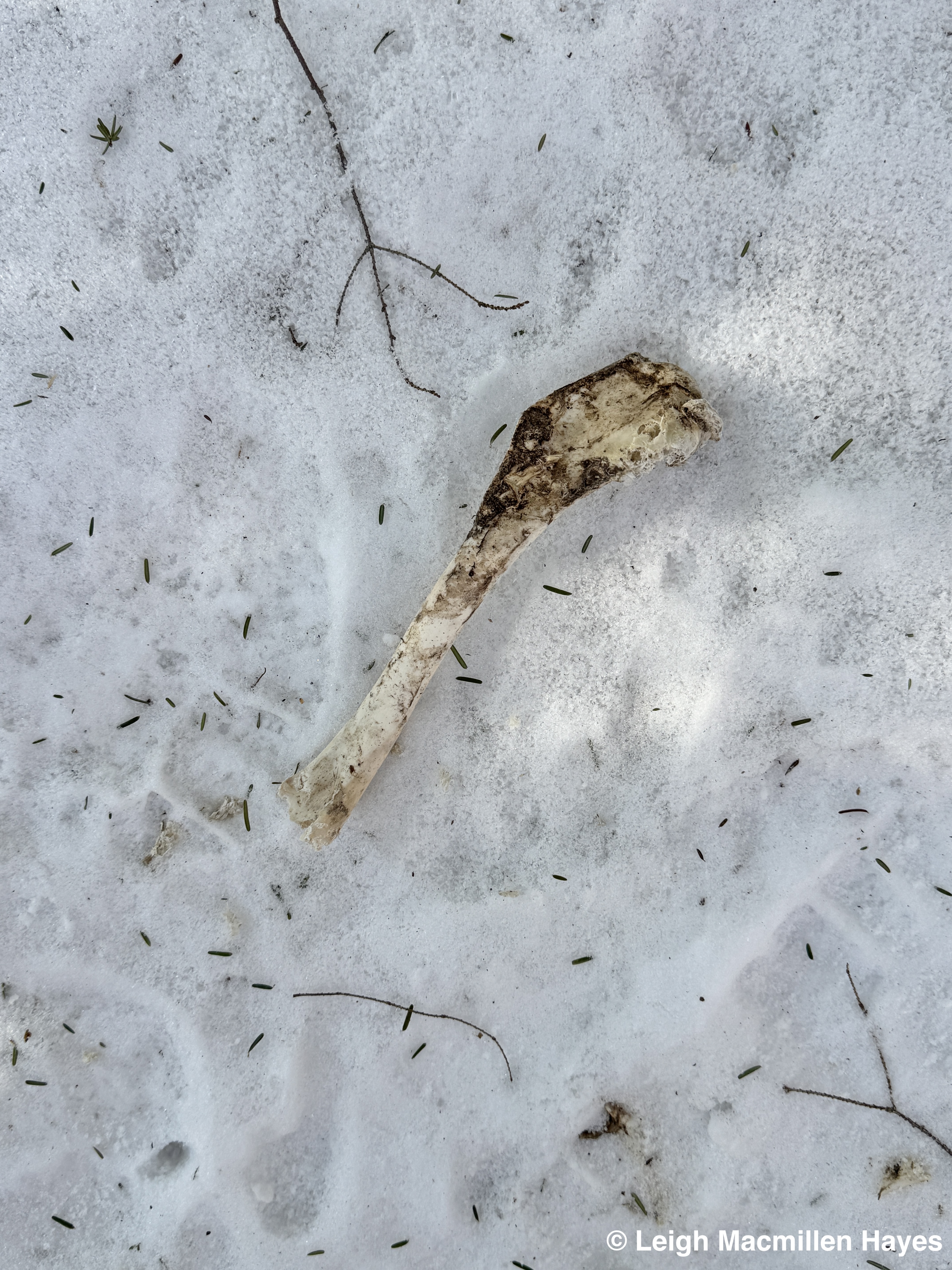
Fox tracks and Coyote tracks continued to mark the way for us and at one spot we saw a few deer bones. I really wanted to look for more evidence of what happened, but time wasn’t on our side.
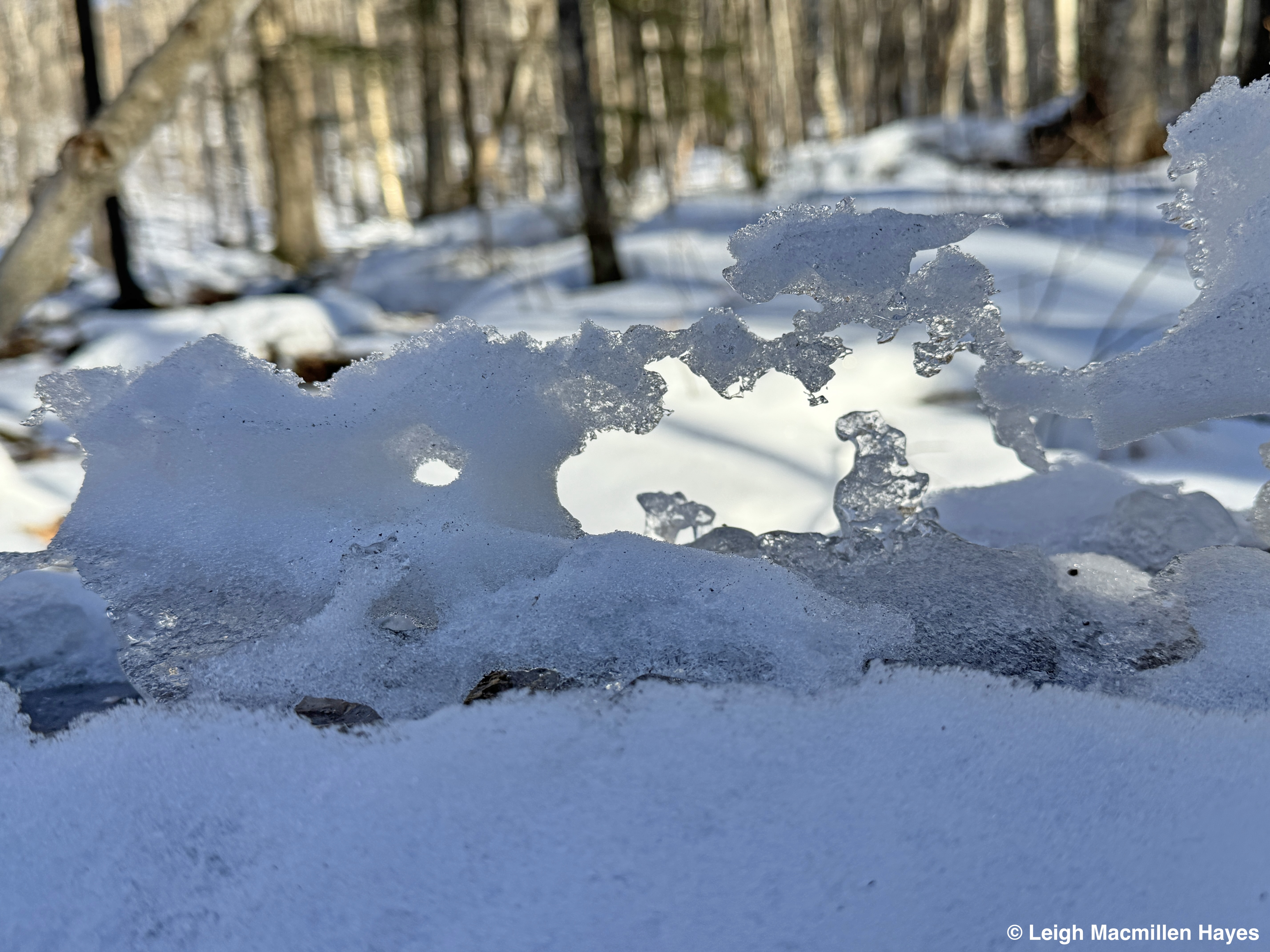
Instead, I paused only briefly to admire how the snow and ice danced across a fallen log.

Admired an old friend who watches all who pass this way.
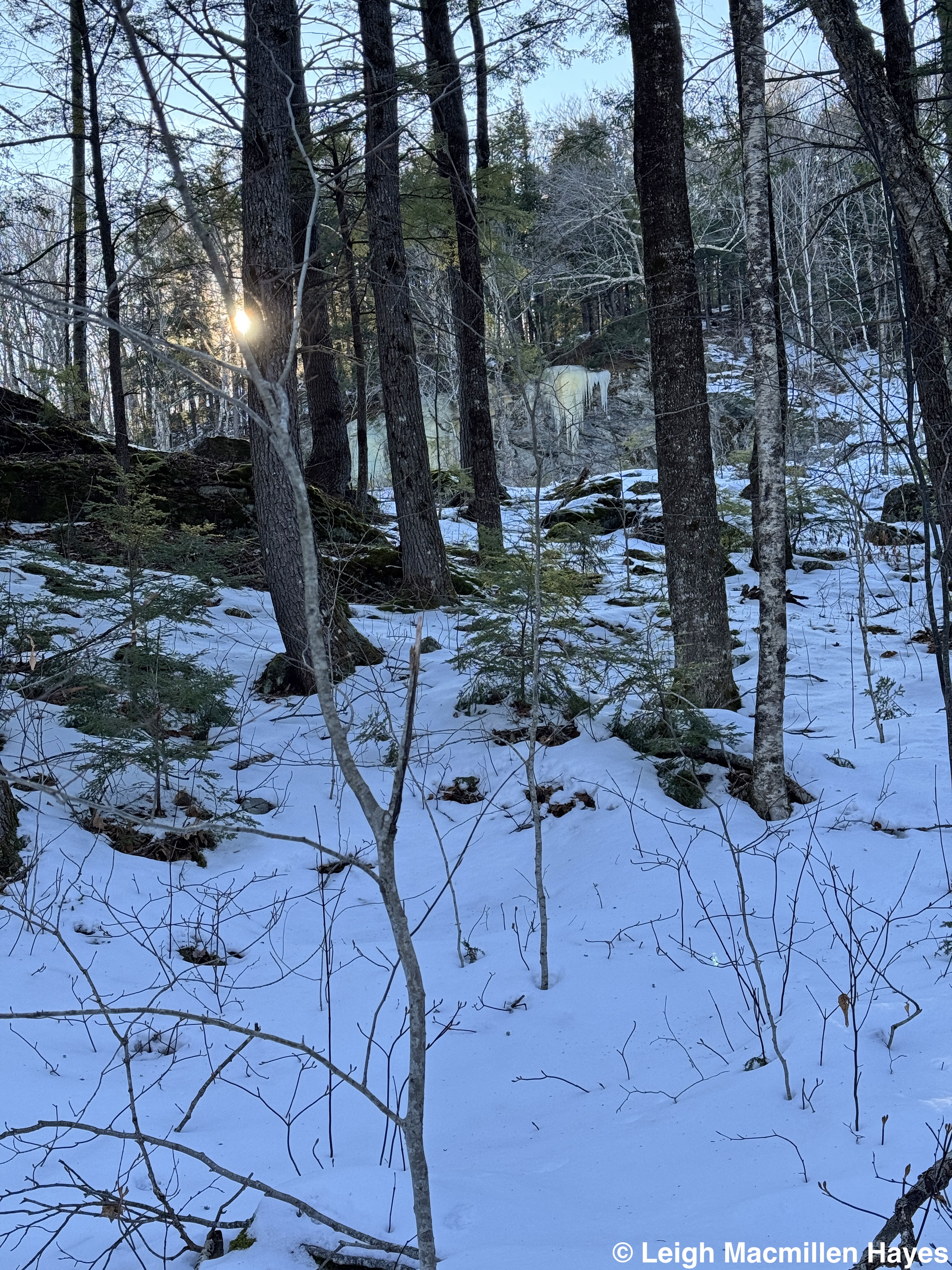
And noticed more colorful ice dripping off a ledge as the sun dipped lower in the sky.

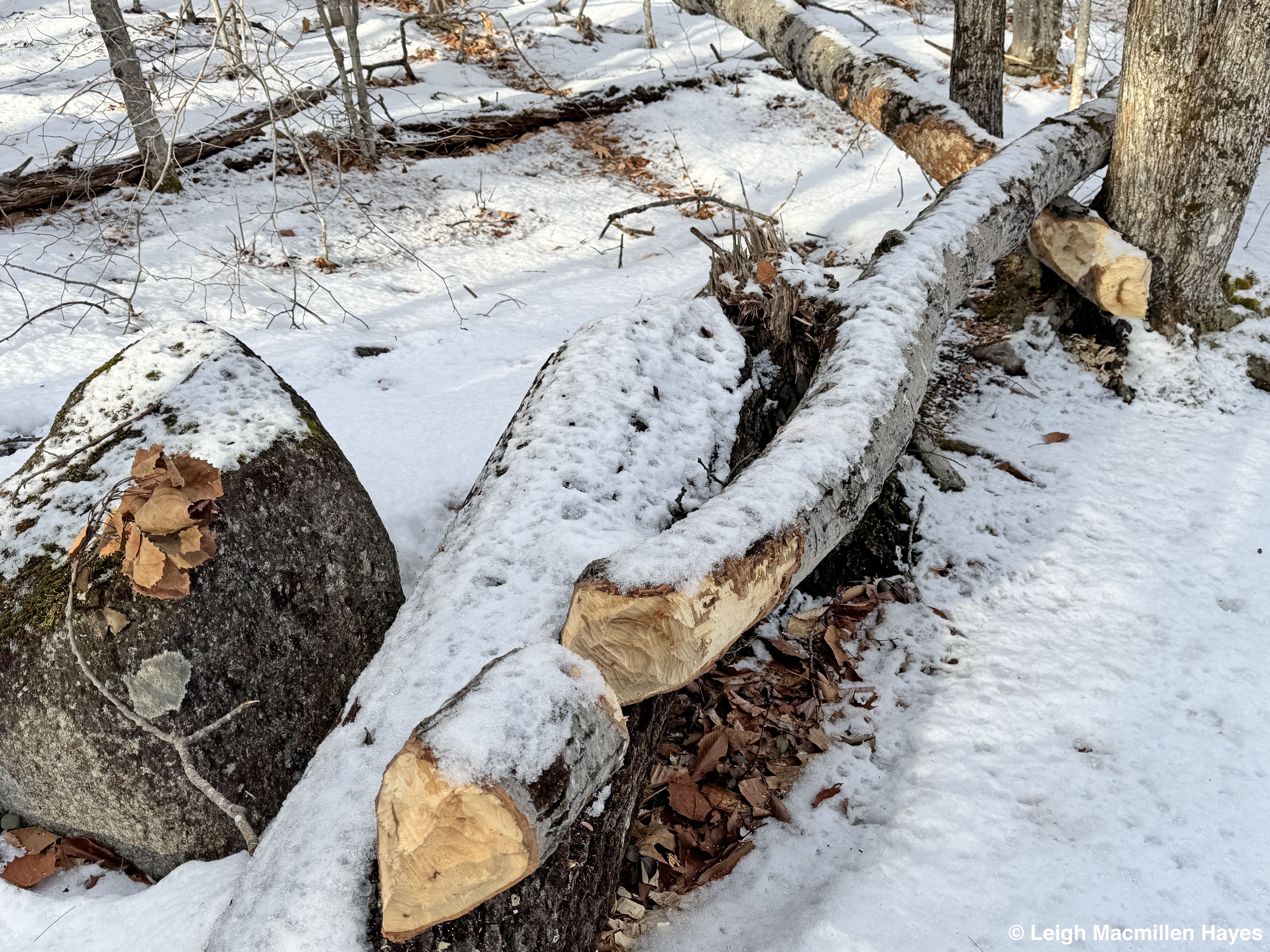
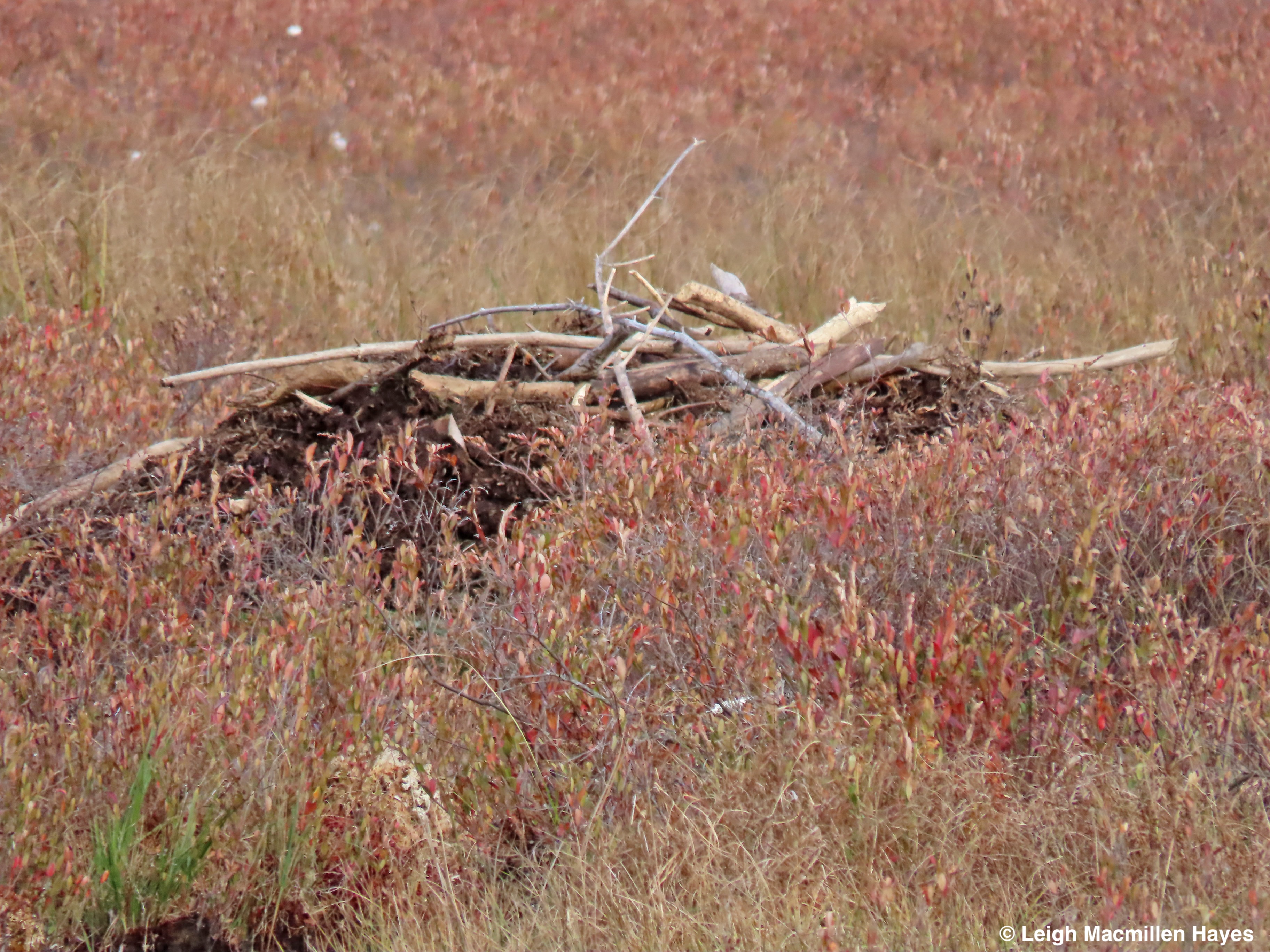
And then, much to my surprise, some Beaver works right beside the trail.
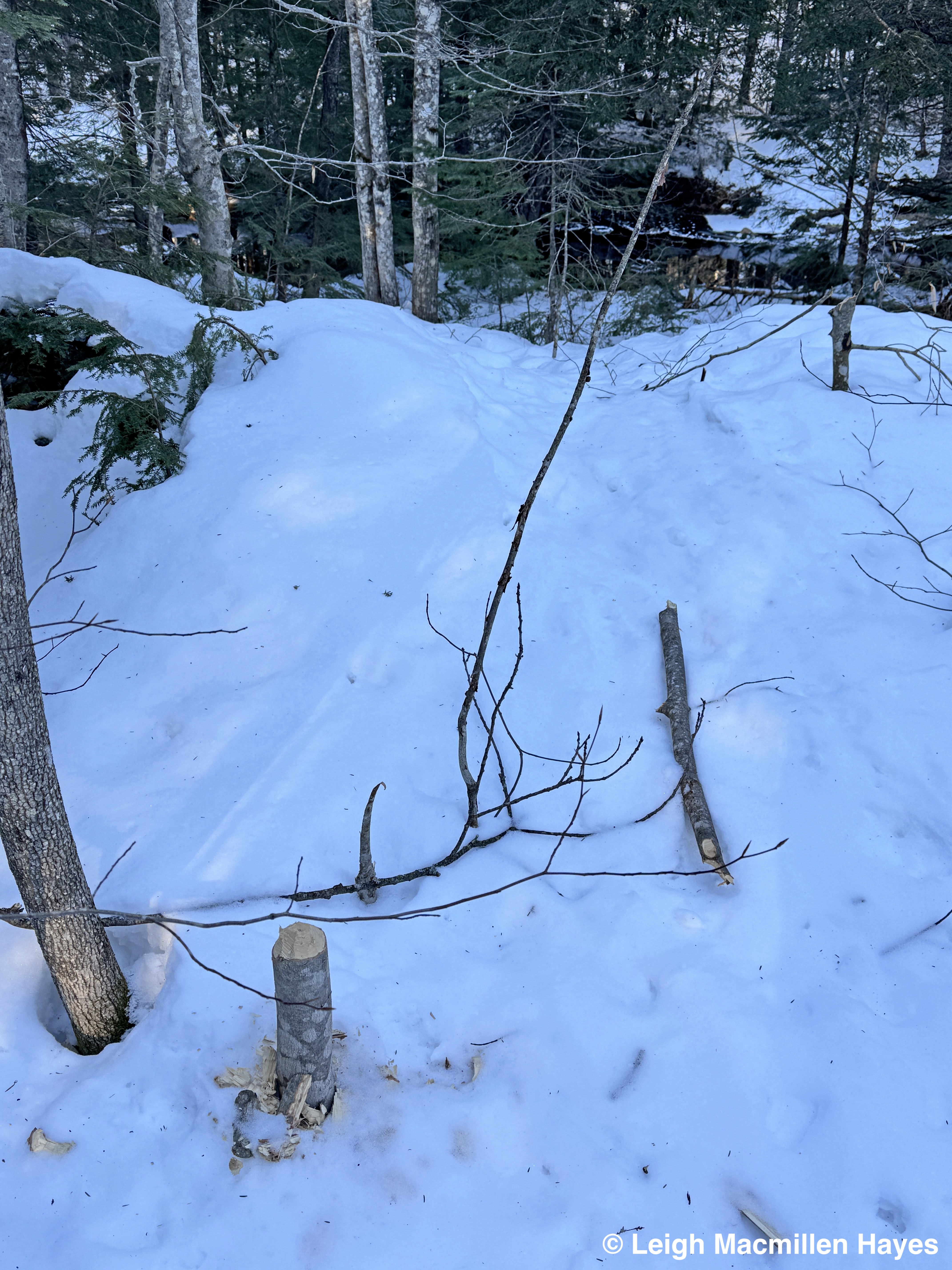
There were more and they were rather fresh and there was a trail to the water and so I asked My Guy if he’d mind if I checked out the activity for a moment.

He did what he always graciously does when I ask such, and found a rock to sit upon and patiently wait.

At the water’s edge, I found more signs of the Beaver’s activity, including gnaws on a much larger trunk, and a pile of chew sticks. Did the Beaver sit here to dine? Perhaps. The water was open, so he didn’t have to eat under the ice.

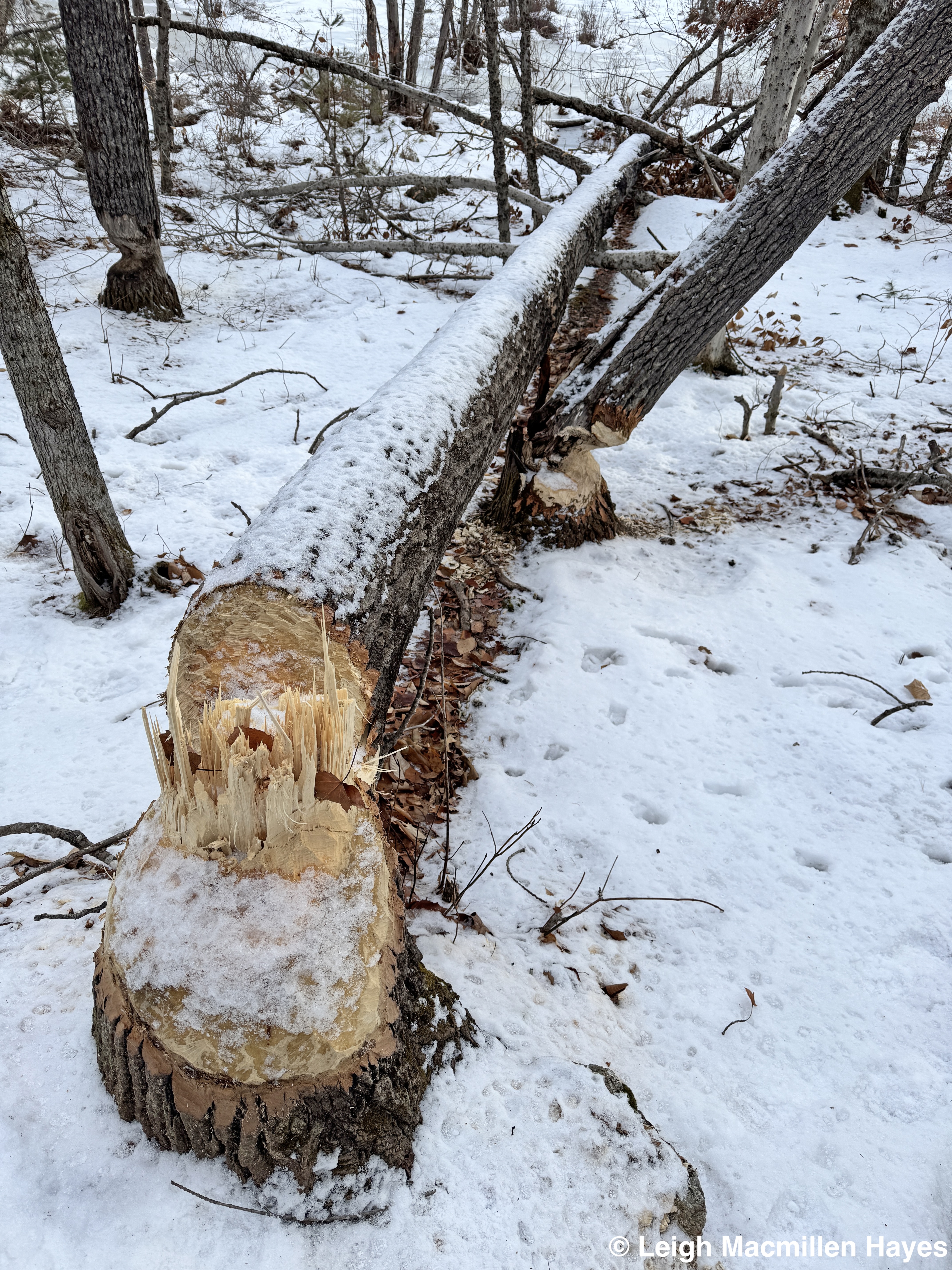
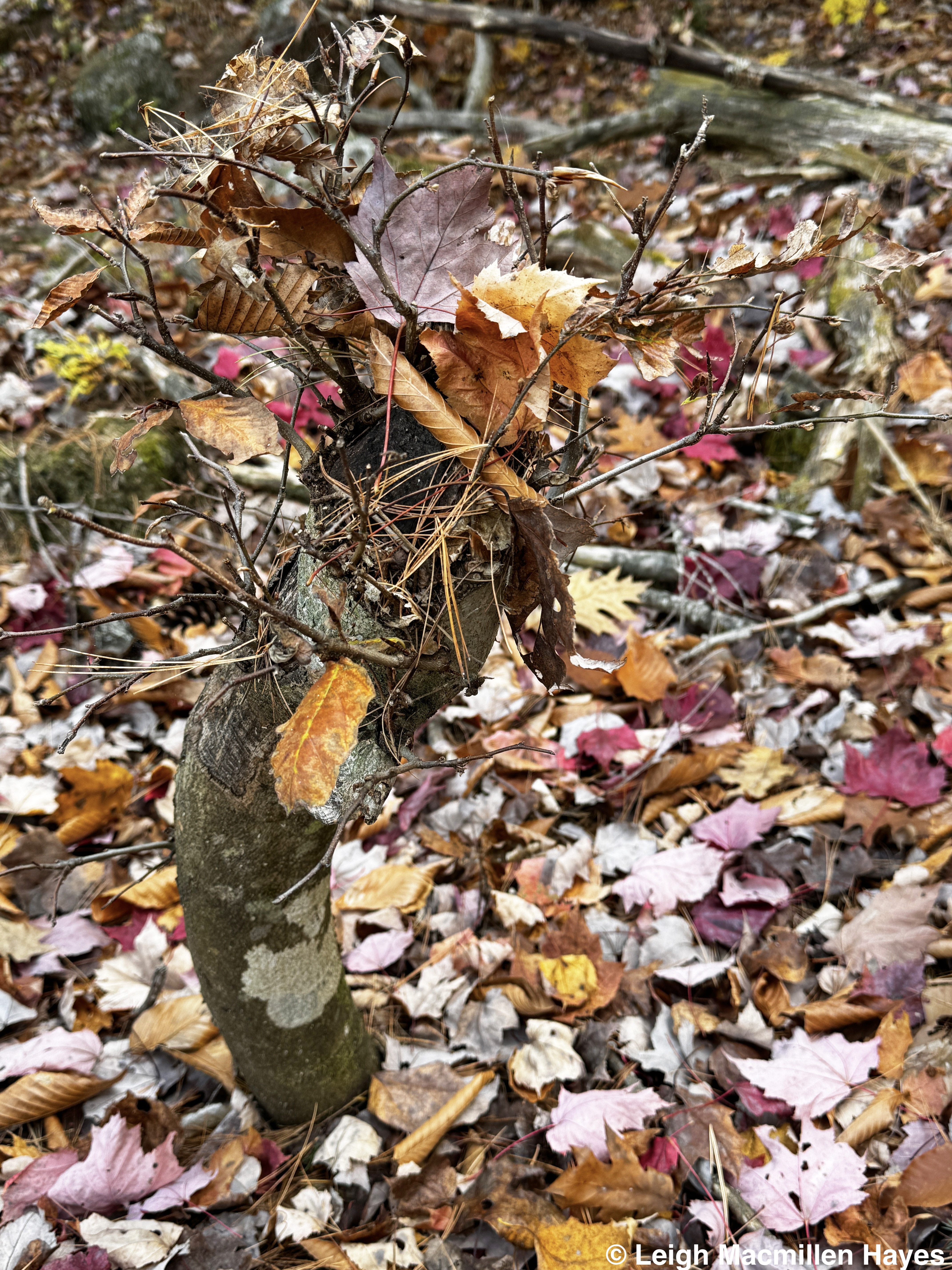
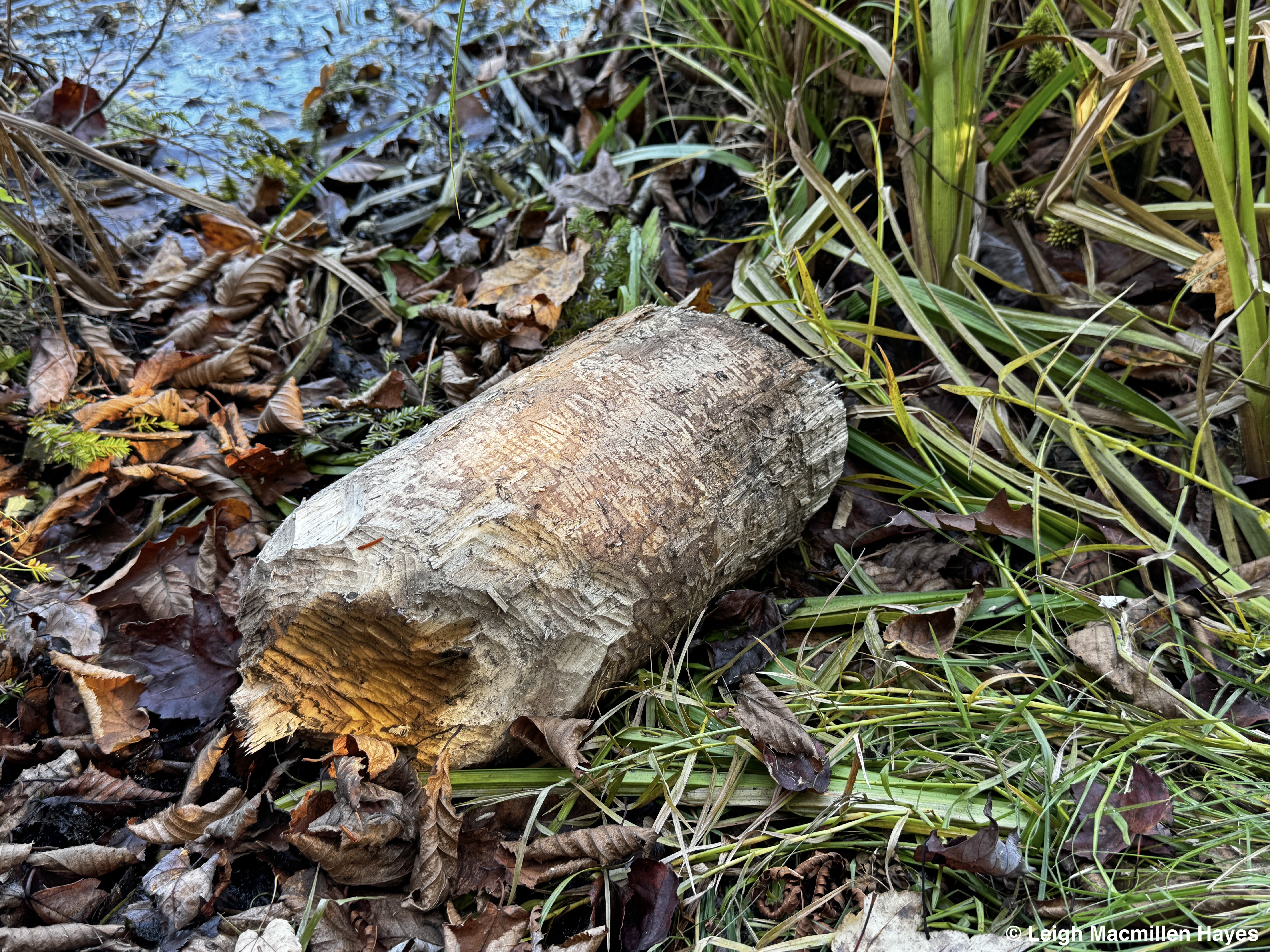
On the way back up the hill to meet My Guy on the edge of the trail, I smiled at the sight of another Beaver tree, that showed how the Beaver, like the Bear, turns its head to scrape the bark and get at the cambium layer.

Funny thing about this one, possibly a previous generation of this Beaver’s family had visited the same tree, as evidence by its graying top that had been cut at least a few years ago and had started to stump sprout.

We had one more bridge crossing to make before heading back to the telephone-poled road, this time with ice and open water to view.

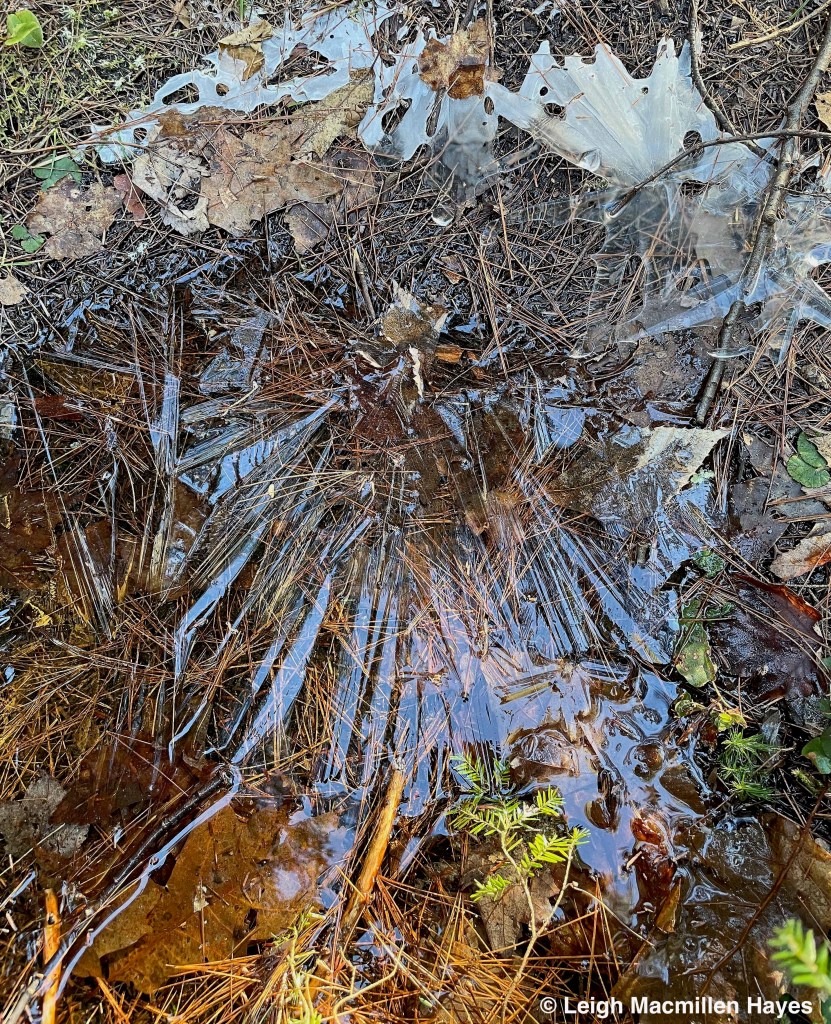
And clumps of stars fashioned upon the ice that reflected the sky.

To say it was a Bluebird day is trite. But truly it was with the sky matching the bird’s plumage.

And on the way out, while I looked at another telephone pole, My Guy saw a Coyote run across the road. A minute later and I spotted a second one headed north as well.

Dancing Vole. Fox dates. Beaver works. Icy art. Coyotes hunting. The first and last were alleged since we don’t have photographs to prove our sightings, but My Guy assured me that since the two of us saw them, they actually happened.

Bluebird days are indeed the best days.
Bald Pate Mondate

Driveway and pathways cleared of snow? ✔️

Bird feeders filled? ✔️

Sandwiches packed? ✔️

Microspikes in truck? ✔️

And we were on our way over the hills and through the woods.

It’s actually a short journey to this trailhead, but by the time we arrived, it was already 11am and others had been there before us, thus making the trails easy to follow in the fluffy snow.

And even My Guy appreciated the beauty that surrounded us.

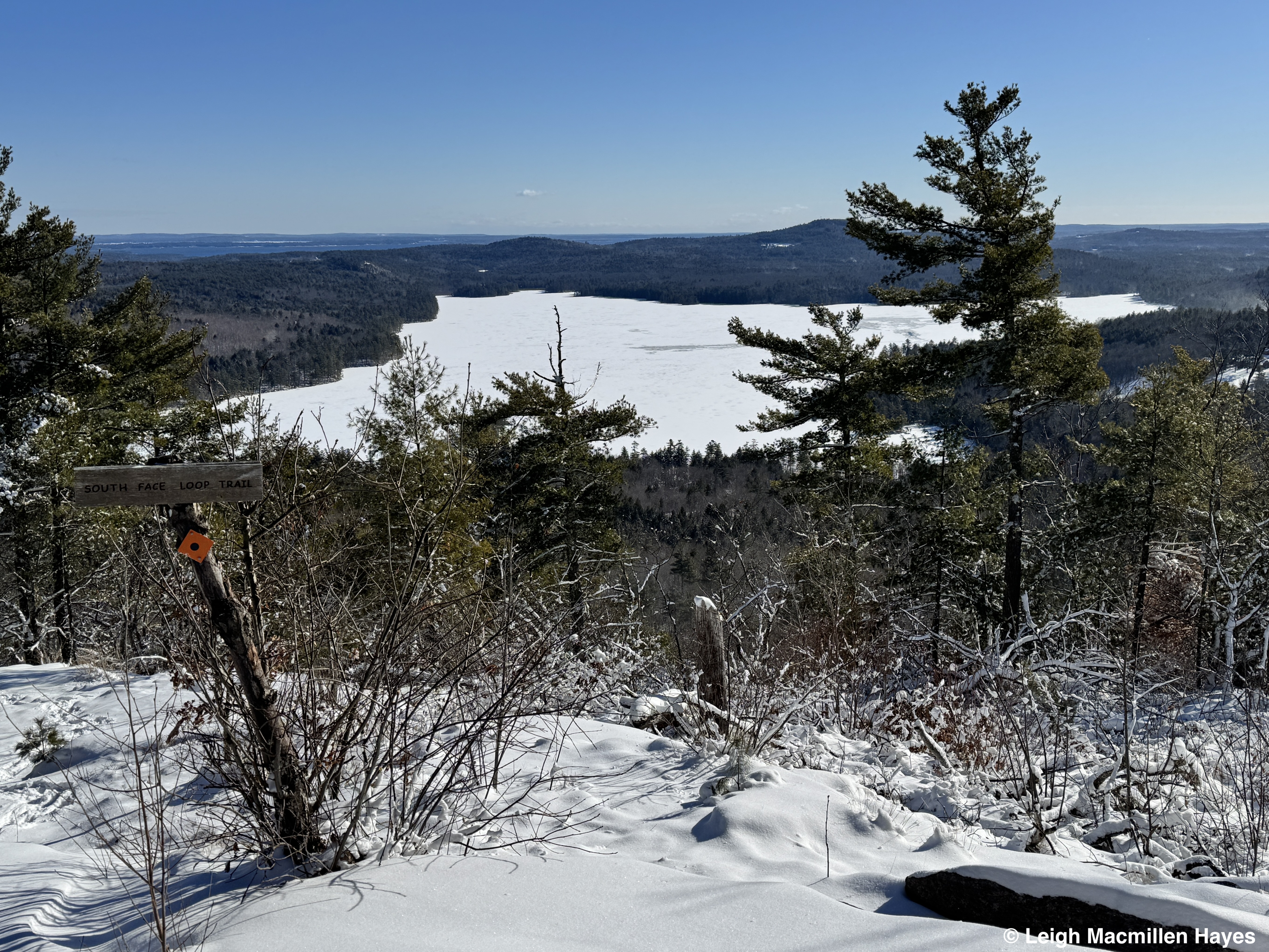
About an hour later, we reached lunch log and the view through the trees included Peabody Pond in Sebago.

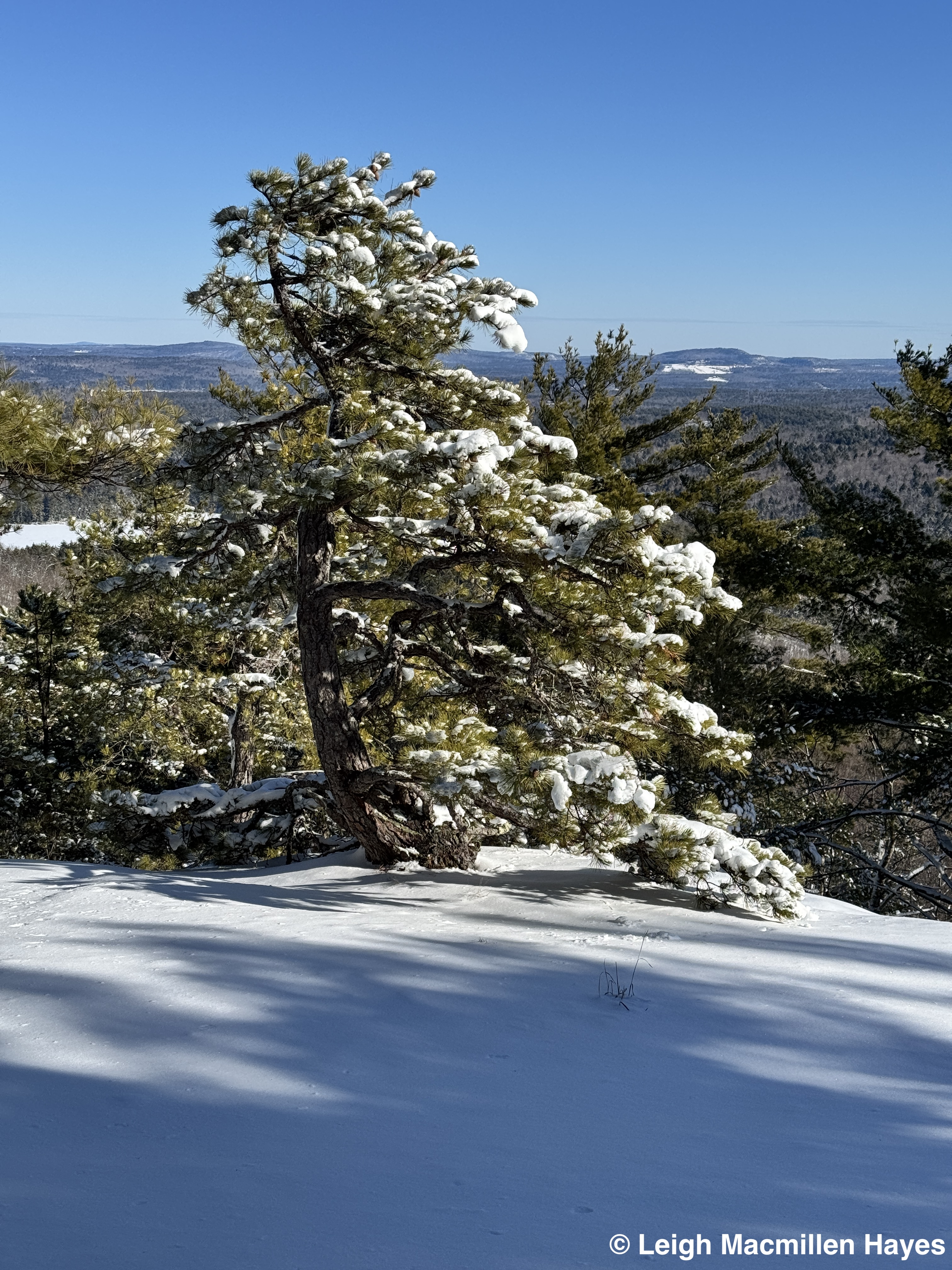
It wasn’t long after that when we climbed up to the beginning of the open ledges at the summit and looked back toward Pismire Mountain in Raymond in the distance and a bonsai Pitch Pine in the forefront.

There are a few landscape photos one must take when on this mountain, Peabody Pond being one of them. Thanks to the volunteers and staff of Loon Echo Land Trust who cut down some trees to open up the scene.

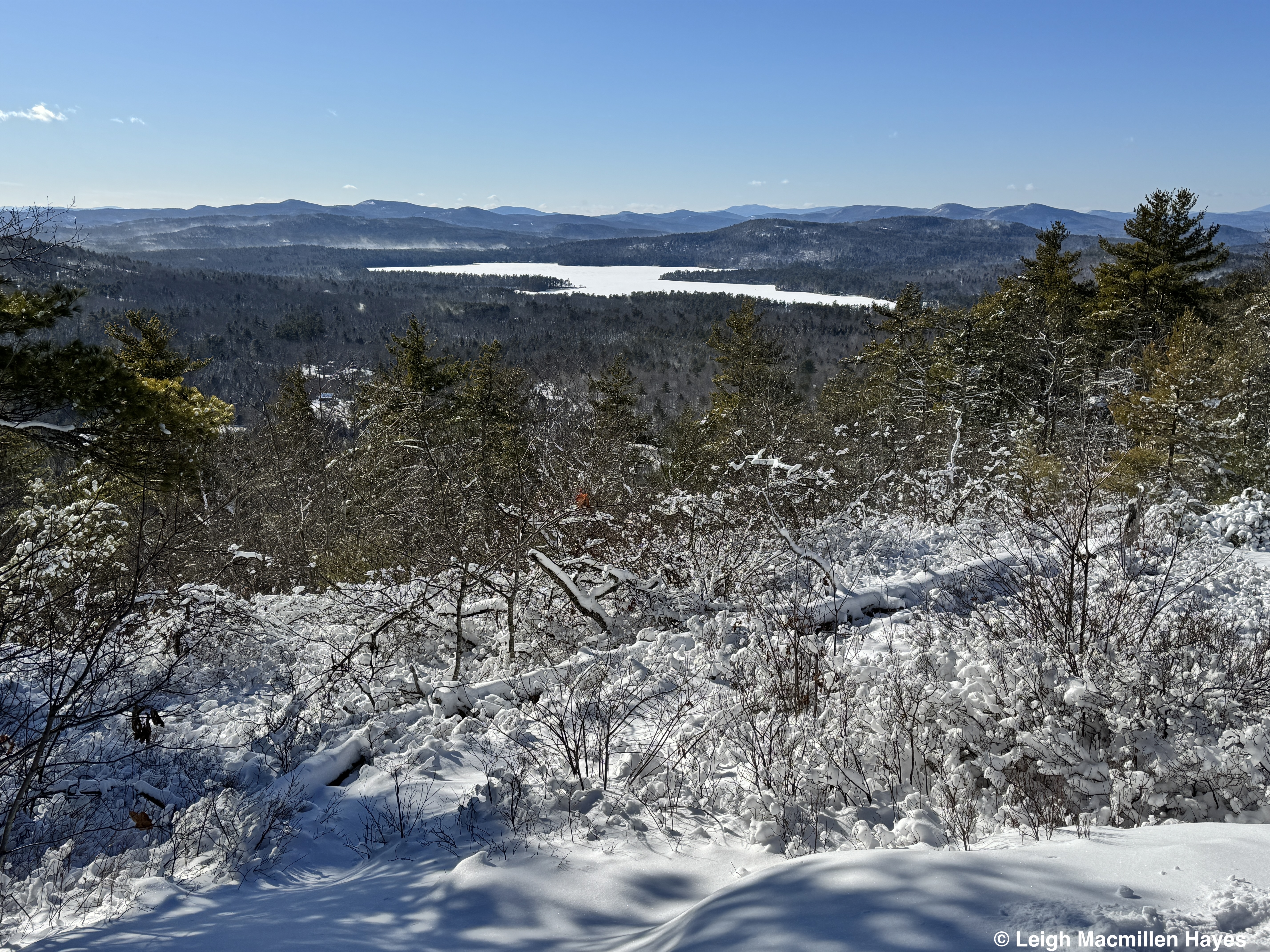
Another must-take is Hancock Pond to the west, and we always wave to our friends Faith and Ben, even though we know they aren’t in residence at this time of year. But we trust that they wave back anyway, from their winter home.

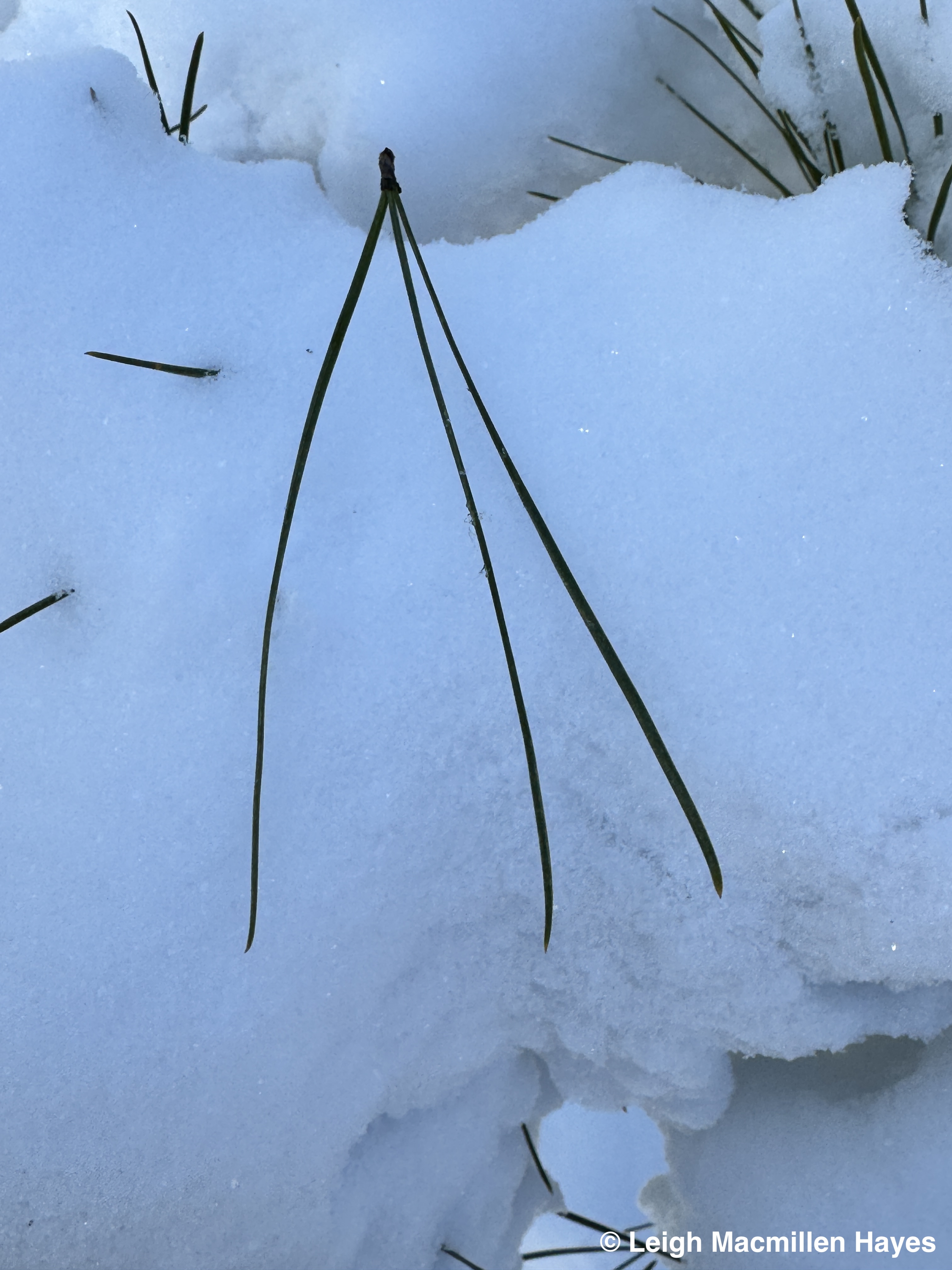
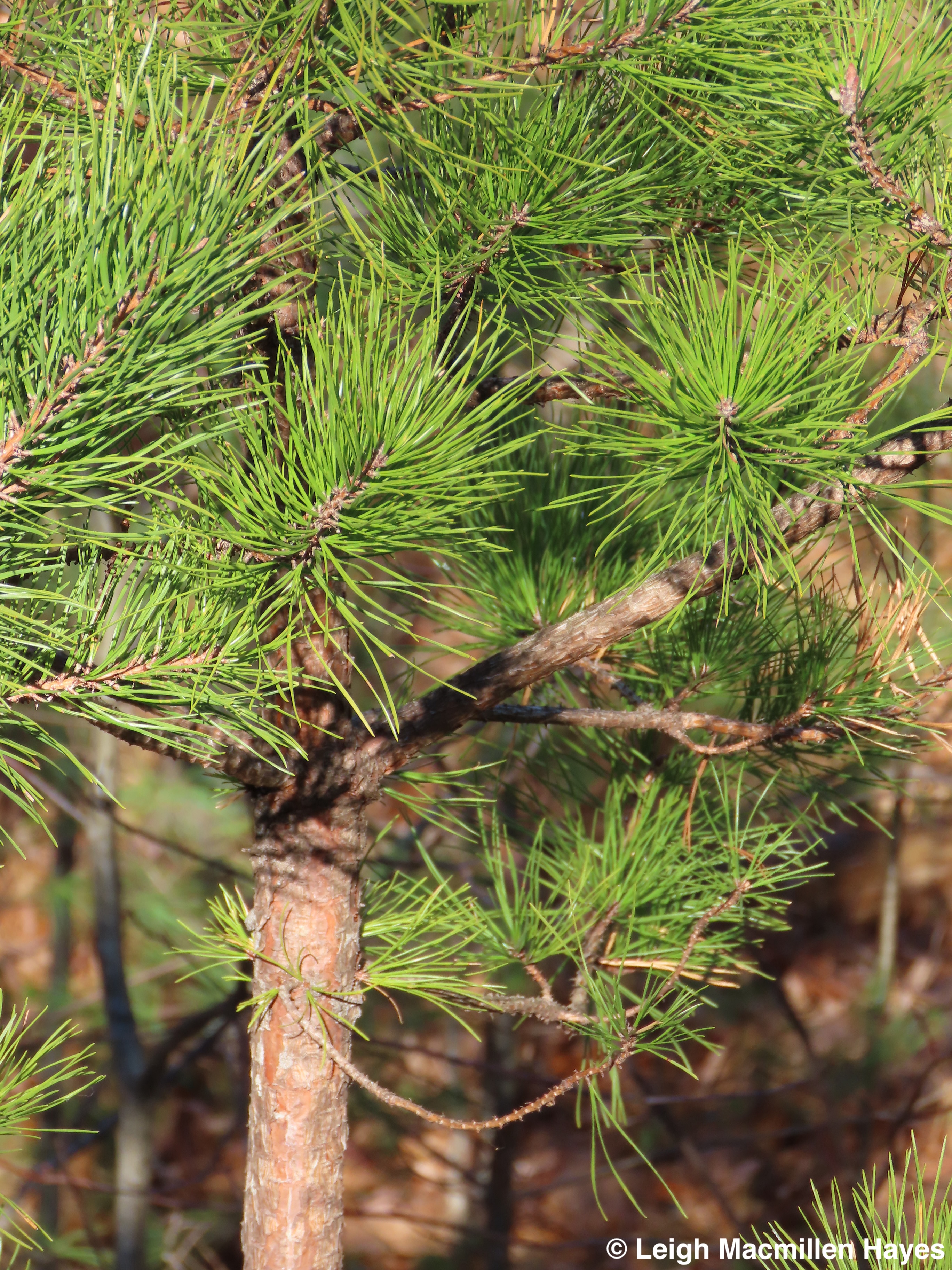
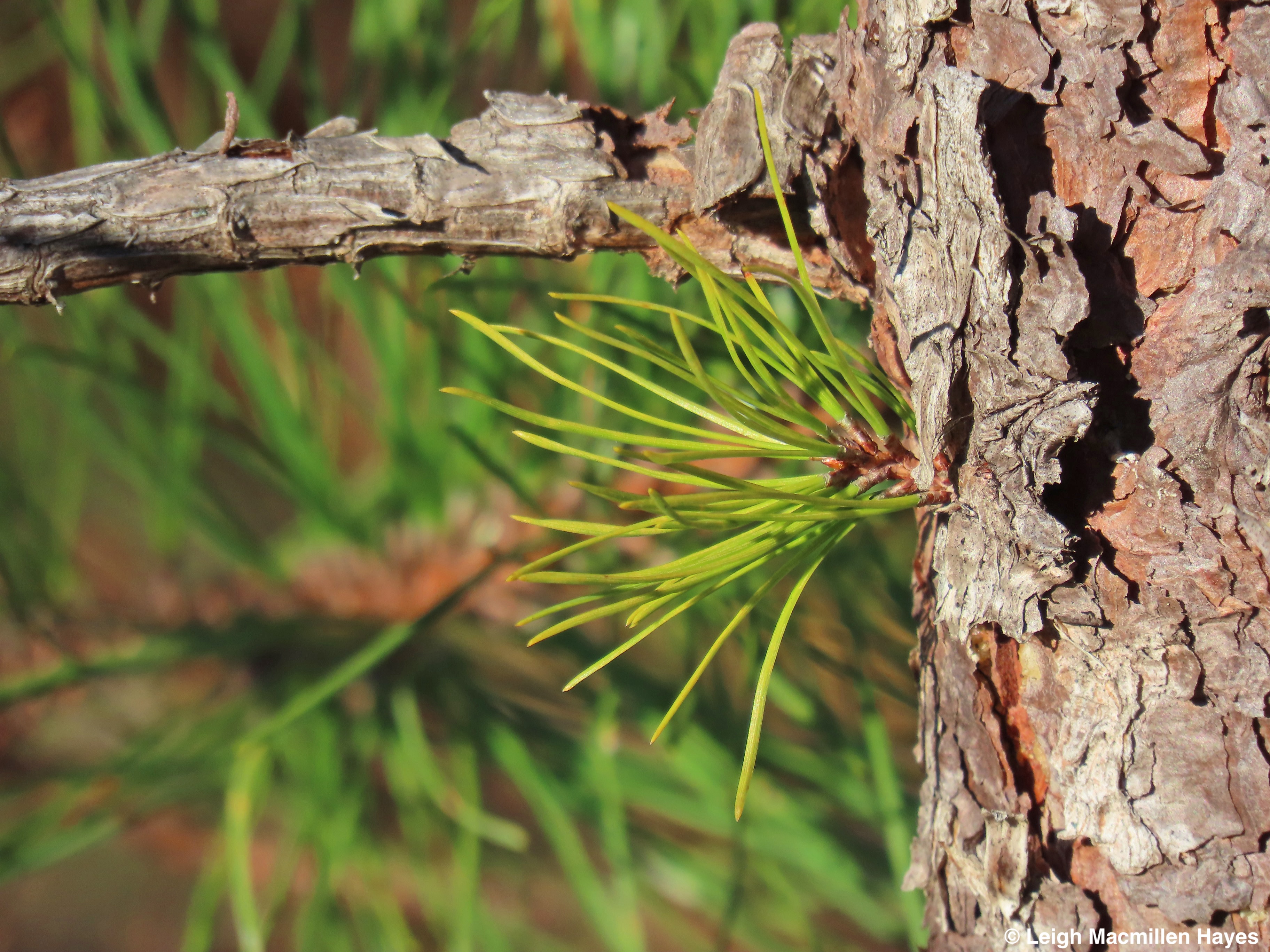
Before we left the summit, I took a couple of seconds to admire the Pitch Pine needles because I wanted to honor some of the evergreens that grow here.

While White Pine has bundles of five needles, spelling M-A-I-N-E for our state tree, or W-H-I-T-E for it’s common name, I used to think that trees with three needles were Red Pines. They are not. Rather, these are the needles of the Pitch Pine: three strikes, you’re out!

Red Pines also grow on the summit and in other places along the trails, along with the ubiquitous Whites.

Red Pines, however, have bundles of two rather long and stiff needles that snap in half easily, rather than being short and flexible like those on White Pines.

Our journey continued to a false summit, where another view shot needed to be taken. Often, from this spot, Mount Washington is visible in the saddle of Pleasant Mountain’s ridgeline, but the red arrow is pointing to clouds that obscured the mighty one on this beautiful, crisp day.

My Guy asked me which way to go, and I told him to keep turning right at intersections. That is, until we reached the Trail End sign. He didn’t obey the sign, nor did he turn right here. Instead, we did a U-turn and headed toward the parking lot.

Along the way, however, I wanted to honor one more evergreen because I know several grow here, but don’t often get to see them at other places where we hike. These are the needles of Jack Pine; in short bundles of 2: Jack and Jill.

And right next to them I met another evergreen I can’t recall ever spotting before. Maybe I have, but today it was like meeting it for the first time: a Northern Cedar. What a fun find. And the topic for a future public hike formed in my mind: Meet the Evergreens.

About three hours later we arrived back at the kiosk, noting ours was the only truck in the parking lot. We’d met only one other person and his friendly dog, but by the prints left by other humans and dogs, we knew the trails had been well traveled today.

The orangy-red indicates our trails of choice. We’re rather predictable on this mountain, most often traveling this route.

At the end of the hike, I returned the hiking pole I’d borrowed, grateful to Loon Echo Land Trust and its kind volunteer who had created these, since when I went to grab my pole from the back seat, I realized I’d pulled it out the other day. Silly woman.

Hiking pole in truck? Not a ✔️

As soon as we arrived home, I put it back in so that next time I’m ready and someone else can use the poles at the kiosk.

Thank you once again to Loon Echo, not only for the pole, but for preserving this beautiful property in perpetuity and maintaining the trails and always thinking not only about the landscape and its importance, but all who travel here as well.

It was a perfect day for a Bald Pate Mondate.

Mammal Tracking: It’s All About Paying Attention

I’ve been lamenting the lack of snow. That is, until I head out the door, don microspikes over my winter boots, and slow my brain down. And then . . . the winter world pulls me in.

It’s amazing what stories there are to interpret, whether in a dusting or a few inches of snow. But first, I need to think about the overall picture and consider where I am.

What state am I in? Maine

What season is it? Winter (my favorite)

What type of forest? Ah, that’s always changing and this week saw a range, for sure. Sometimes it’s coniferous.

Other days, deciduous.

But also a mixed forest.

Or beside a frozen wetland.

Or even a wetland with some open water.

When I do encounter tracks, I have to think–how is the mammal moving through the landscape? In more or less a straight line with a bit of a zigzag to it?

And if so, is it just one mammal, or more than one?

I need to look at the overall pattern, which might mean backtracking a bit (don’t want to put pressure on the mammal, especially if the tracks are fresh).

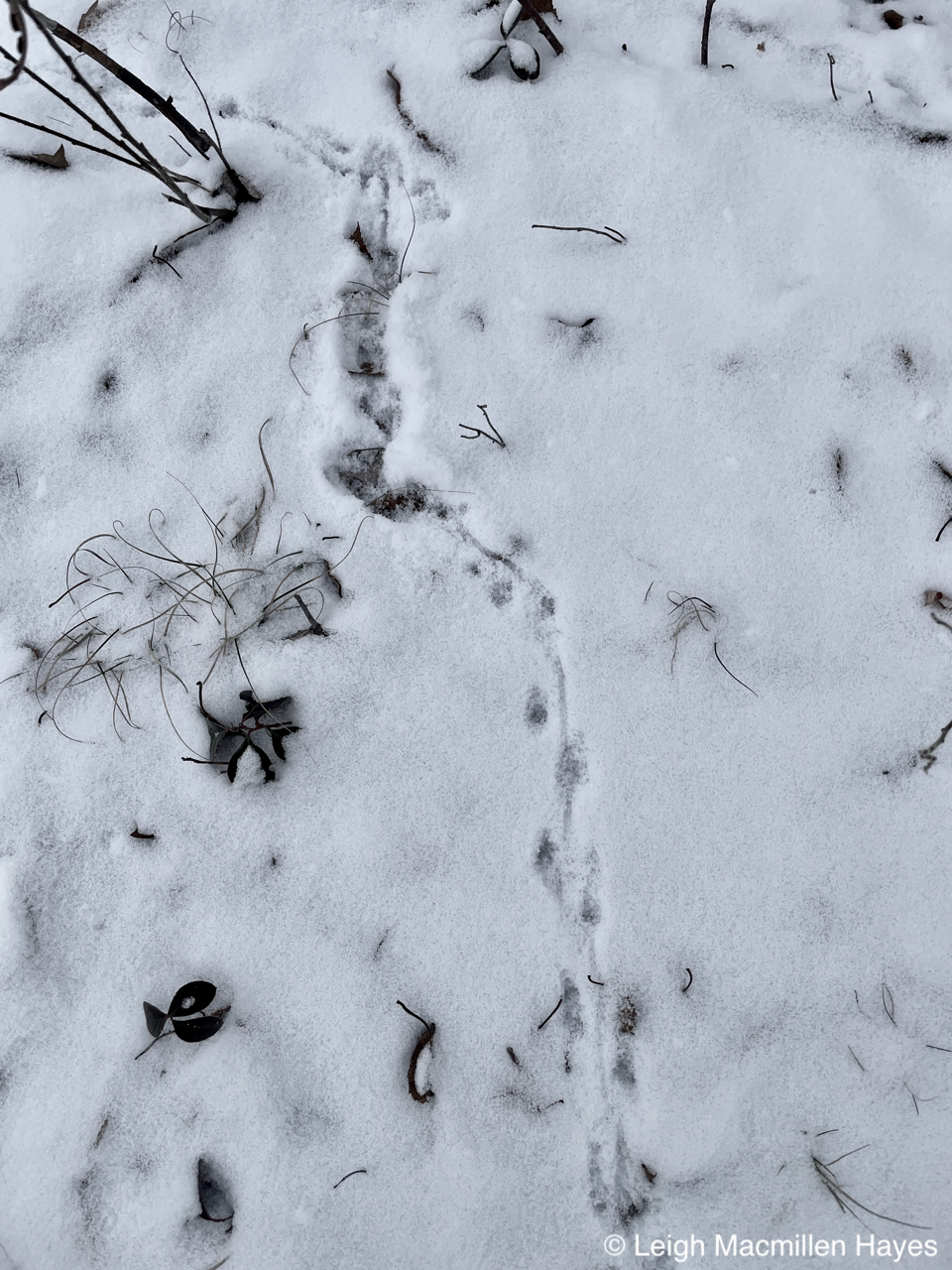
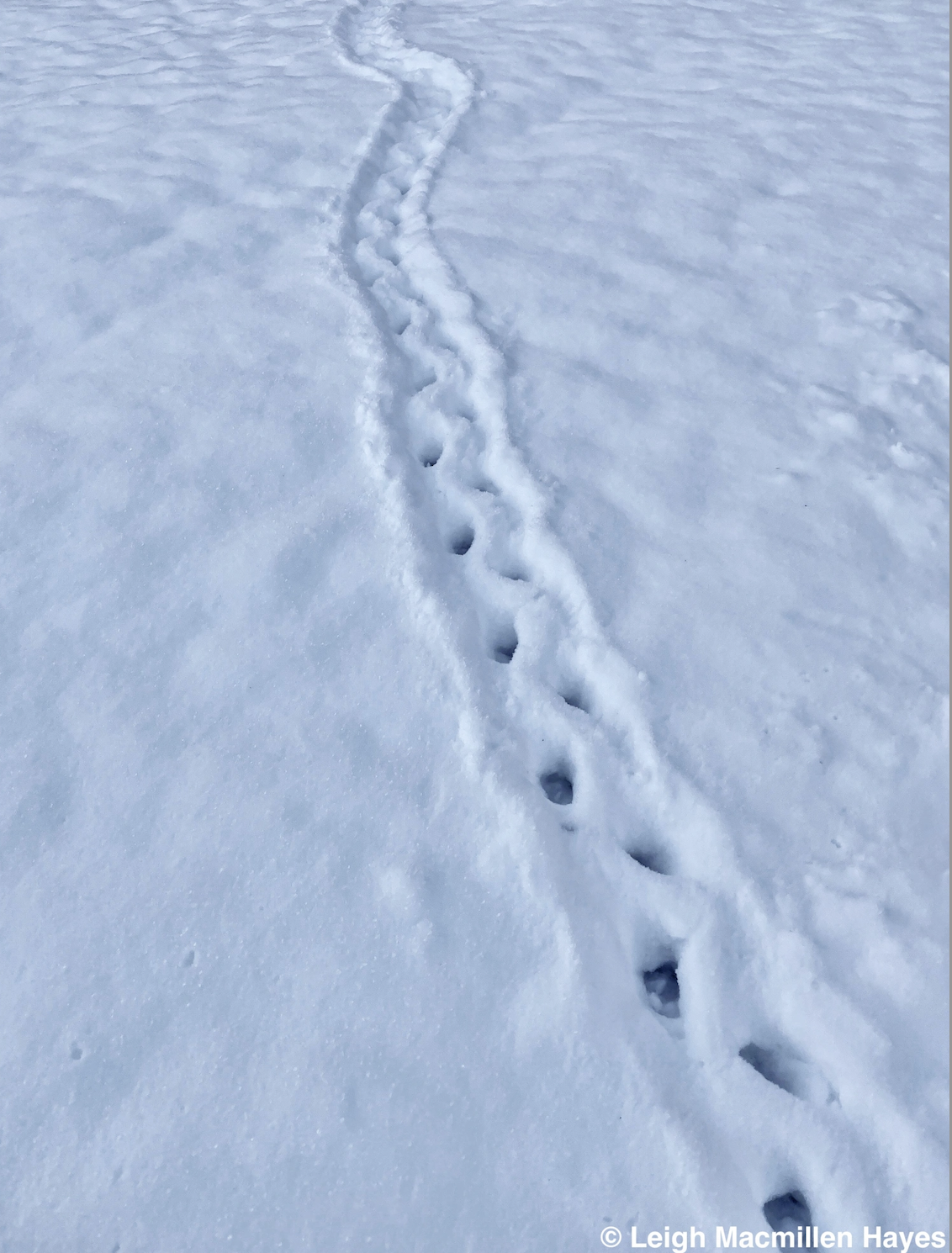
The thing is that the tracks in the three above photos were made by three different critters, all of whom often move in the same pattern–straight line with a bit of a zigzag as I already said. The left front foot lands and packs the snow, and as the animal moves forward, the left hind foot lands where that front foot was, and visa versa on the other side. So what is actually a set of two prints, one directly or almost directly on top of the other, looks like one print from our point of view. The front foot pre-packs the snow and the hind foot lands in the same spot to make it easier for the mammal to move more efficiently, especially since he doesn’t have a warm fire and dog food awaiting him after a walk in the woods.

“Who created them?” you ask, because of course, I can hear you wondering. The first with my foot beside the prints: Red Fox; second: Eastern Coyote; third: Bobcat.

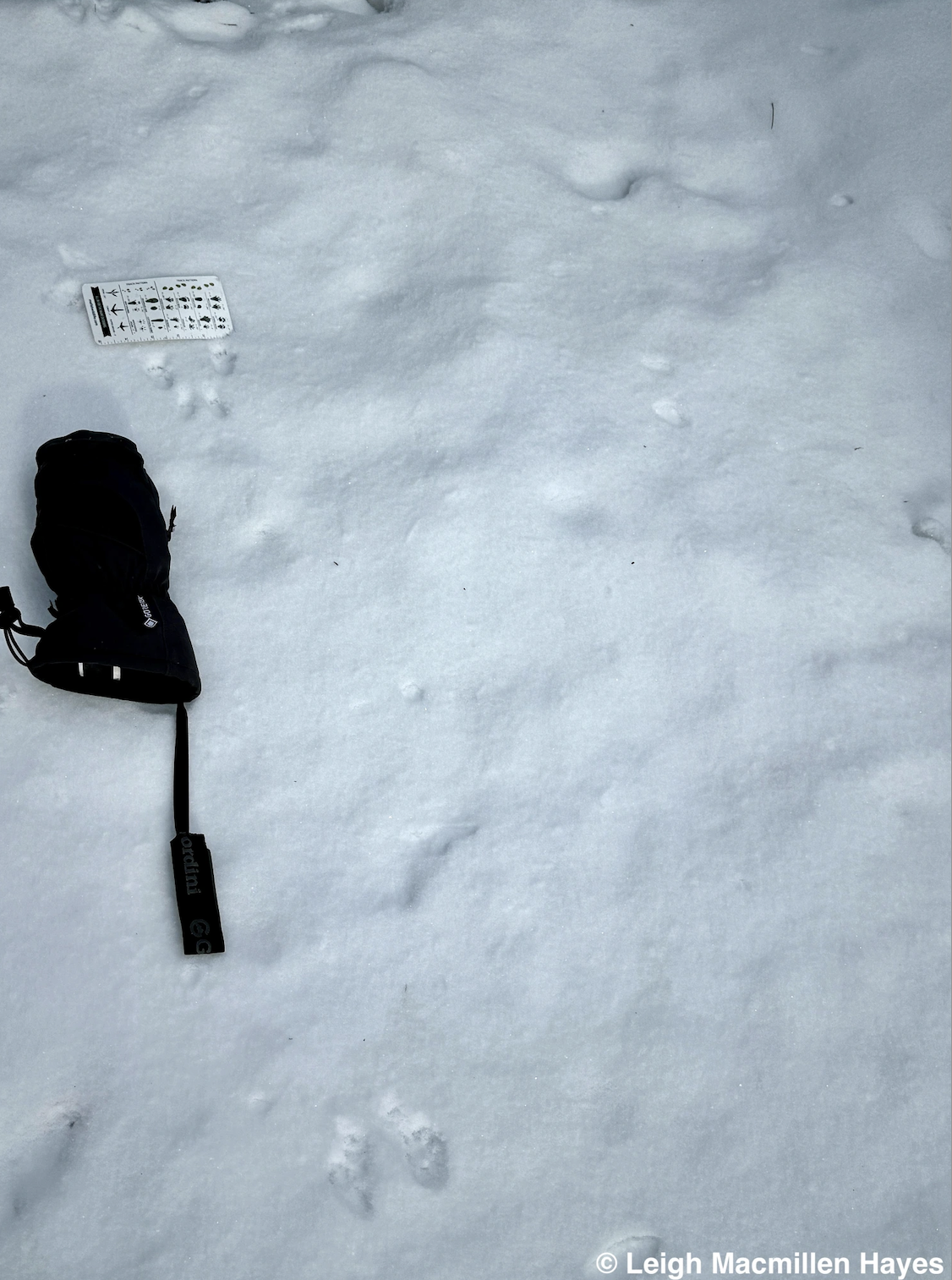
Briefly, I want to share other forms of movement that we might spot in the woods. These are groups of four prints left behind by a leaper/hopper. Several critters move this way and the best way my brain can tell them apart is by the straddle or trail width–measuring from the outside of one of the larger prints to the outside of the other.

Just to clarify, what you are looking at in one group of four, two smaller prints are the front prints, which land first. The hind feet swing a bit forward just before the front feet lift off and so the hind feet appear to be in front of the front feet.

“What?” Yup. Thus, this mammal is moving toward the top left of the photo, because the hind feet always appear in front of the front feet. Have I lost you yet?

Together, they look sorta like a set of two exclamation points. In deeper snow, they can also look like double diamonds, or even Batman’s mask.

My game camera recently caught a Gray Squirrel in this motion, and if you look closely, you can see the back feet swinging around in front of the front feet.

What is the trail width or straddle for a Gray Squirrel? 4+ inches

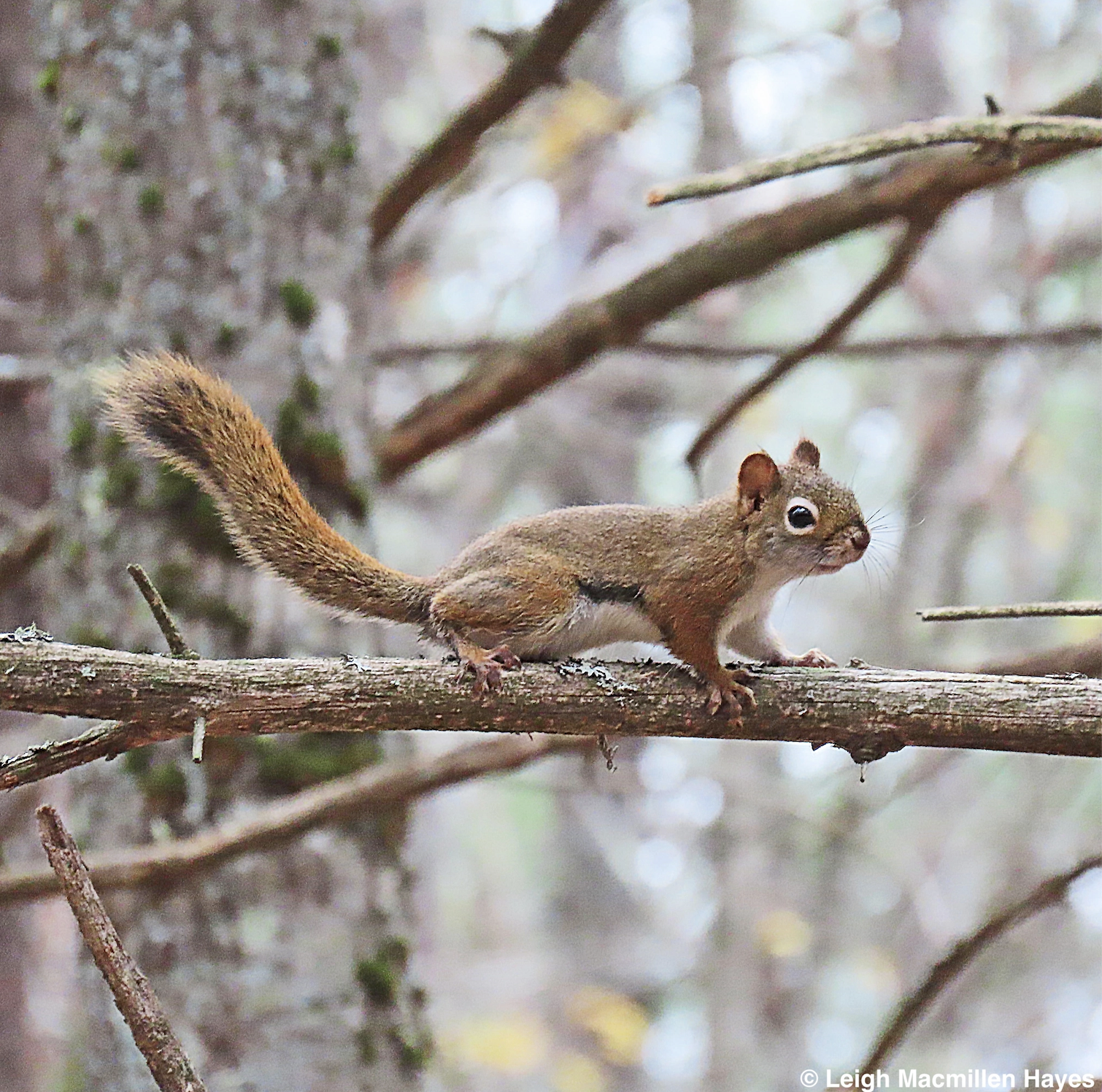
Red Squirrel? 3+ inches

Chipmunk (who does come out occasionally in the winter)? 2+ inches.

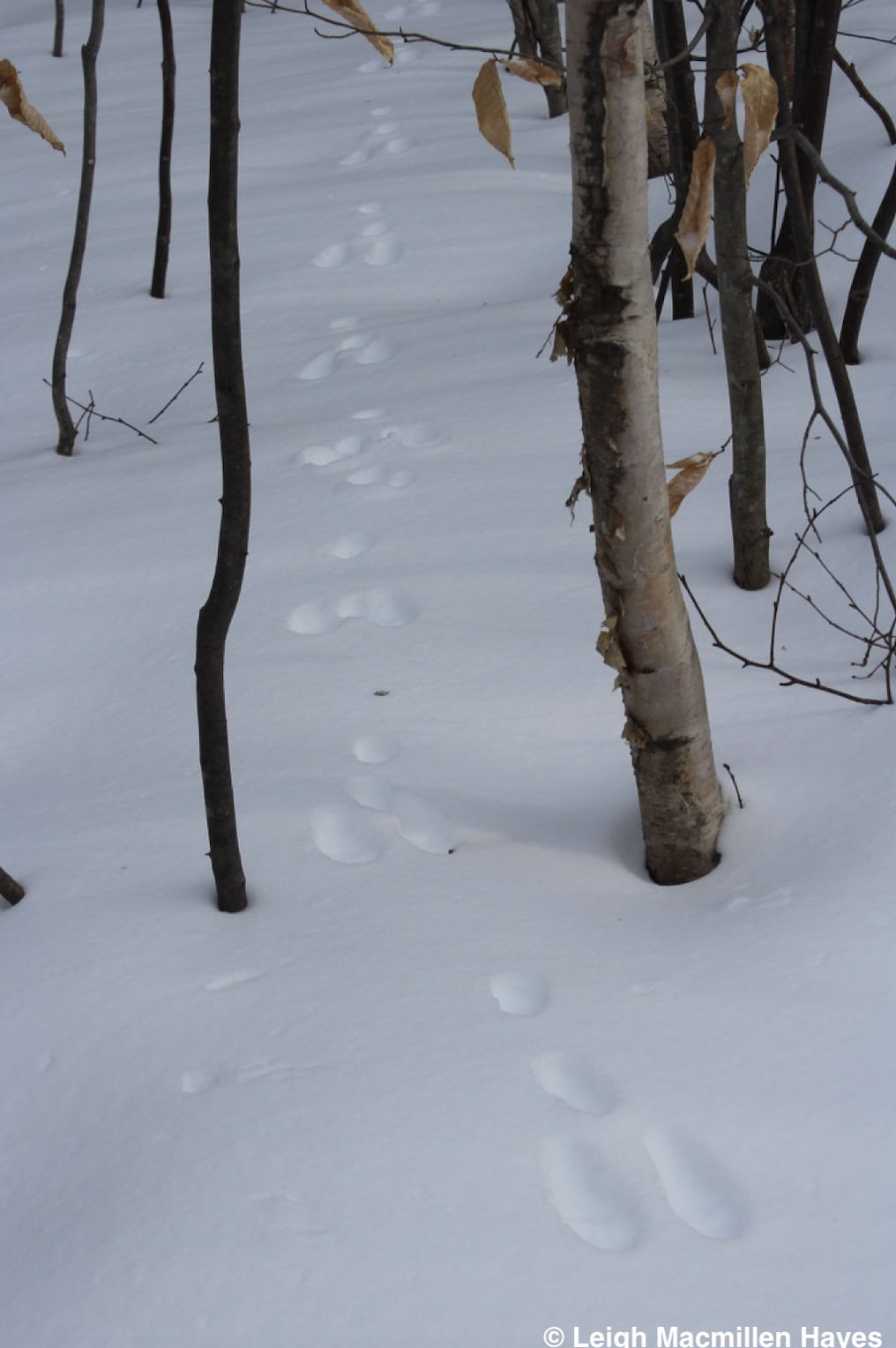
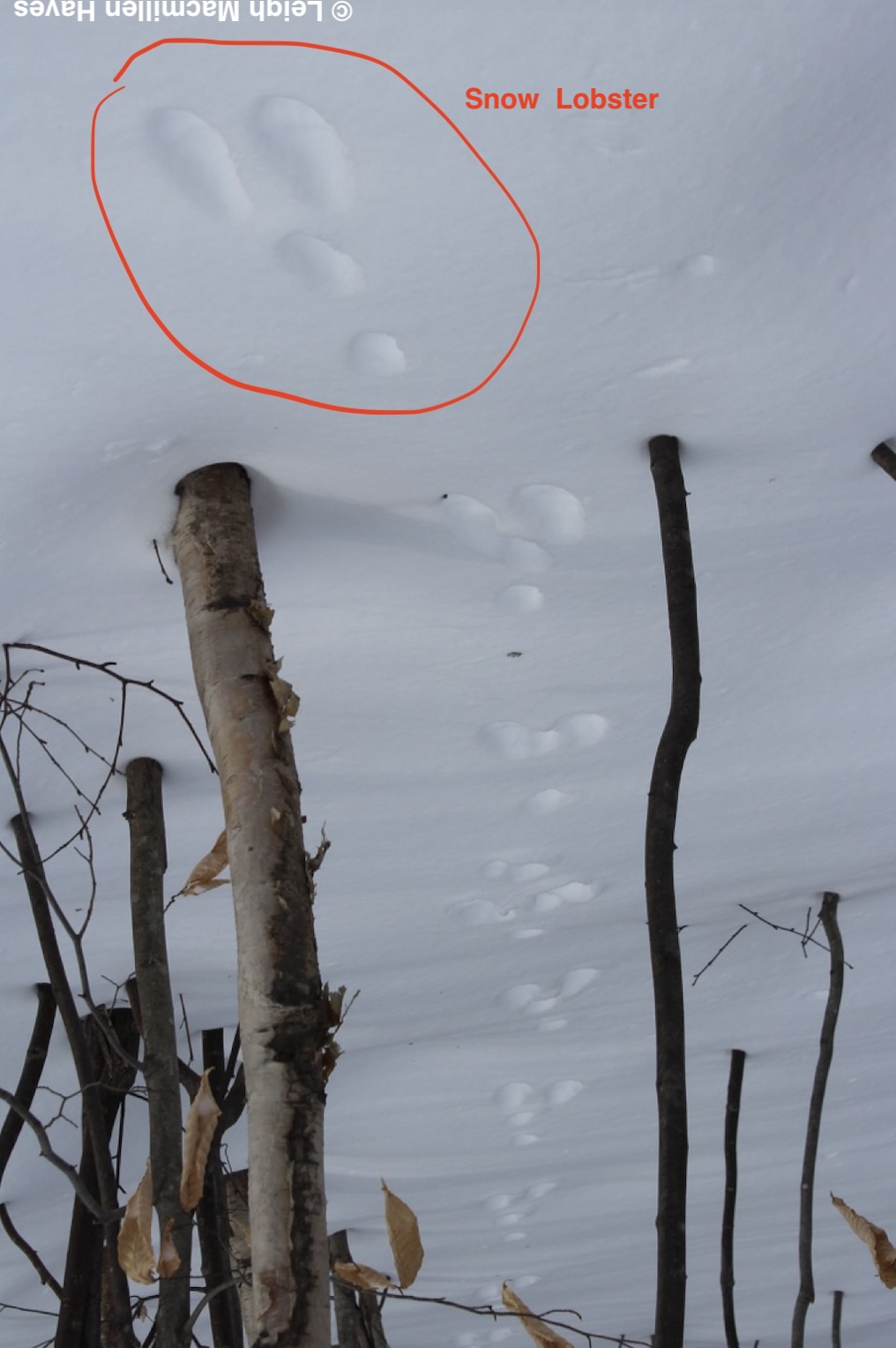
Another leaper/hopper also leaves a set of four prints, but usually (not always) the two front feet are not parallel like the squirrels. This mammal is hopping toward the lower right hand corner, with the hind feet being out in front to indicate direction.

If you take that photograph and flip it 180˚ so that the world appears upside down, cuze sometimes it just does, you may see what I see that helps me with a quick ID: a snow lobster: the two hind feet out in front, being the claws and the two staggered front feet behind forming the tail.

“And the creator of the snow lobster?” you ask.

Snowshoe Hare.

Just when you think you are getting it, a wee critter enters the scene because, well, it’s everyone’s favorite food (for those who are predators that is), and I have a hunch you’ll spot these tracks rather often.

First, the wee one moves in the direct registration (zigzaggy straight line) gait of the coyote, foxes, and bobcat.

But then it changes things up and may even start tunneling as it leaps forward. And in deeper snow, you’ll see a hole beside vegetation and know that it ducked under to try to avoid becoming a meal.

These are the tracks of a Meadow Vole.

There is a group of mammals who are bounders, so much so that their bodies move almost like accordions, and as the hind feet push off, the front feet land on a diagonal, and the hind feet follow suit and land where the front feet had been, while the front feet are airborne once again.

Do you see the diagonal pattern of the impressions. For the most part, they move on the same diagonal for a while, and then might change it up.

It’s the weasel family that leaves this pattern, and these are from a Mink. Long-tailed weasels and Ermines leave even smaller prints.

Fisher prints are larger and they sometimes change their gait a bit, but always you can find evidence of the diagonal in the middle of pattern; and Otters LOVE to slide.

Finally, in this discussion of patterns, there are the waddlers, those critters with wide bodies (Think Beaver, Porcupine, Raccoon, Black Bear). Their forward motion varies, but this is one of my favorites: the sashay of the pigeon-toed Porcupine.

Another waddler, or wide-hipped critter is the Raccoon. It’s feet look a bit like baby hand prints. But a key (pun intended) characteristic is the switch of the diagonal when looking at how this critter moves through the woods.

Now that you’ve thought about the surroundings and looked at the mammal’s gait, it’s time to consider the size and shape of the print, count toes that are visible, look for nails, examine the overall track and prints from different angles, and take measurements.

We often talk about the X ridge between the toe pads and metacarpal pad of the canines. But sometimes people have a difficult time seeing it, so I find outlining it may help.

Think about this cast of a Coyote print: In your mind’s eye, flip it over so that the oval shape is actually at ground level, and the prints, that were in the mud were below the oval. If you look closely, you’ll realize you are looking at two impressions. The smaller one on top, would have been at the bottom of the impression as one foot landed. And then the second foot landed almost directly on top of it.

“Wowza,” you exclaim.

And notice the toe nails–how they are rather close together and not splayed like your fur baby’s nails when you go out to play in the snow. Conserving heat. Brilliant.

Here’s a look at what you might see when you spot an actual Coyote print.

Another with the X that I didn’t outline, but I hope you can see, is the impression of a Red Fox print. I made this one with an actual Fox foot courtesy of the Maine Master Naturalist Program (and Dorcas Miller). What I love is that you can see the chevron that appears in the metacarpal pad of the fox’s foot .

Sometimes I can see the chevron, sometimes I can’t. It’s all about snow conditions. Some days are perfect for tracking and others are a challenge. But I’ve said a hundred times, when I’m alone, I’m 100% correct in my ID.

To differentiate the walkers/trotters, there’s one more letter to consider, this one being closer to the beginning of the alphabet: C. And it indicates a Bobcat. C is for Cat. Another thing to think about when looking at the zigzaggy straightline, are the toes symmetrical or is there a lead toe?

Symmetrical: Coyote and Foxes. They are also more oval shaped; or kinda like an ice cream cone with one small scoop on top.

Lead toe: Bobcat. Round shape, about the size of a fifty cent piece, while your cat is a quarter.

I’ve been seeing lots of Bobcat prints and tracks this winter. And Snowshoe Hare. Hmmm.

Okay, so enough for the lecture. I want to show you what else I’ve seen in the past week, cuze part of the fun is interpreting the stories.

Last weekend, in the midst of a snowstorm, I taught a tracking lesson for this year’s Maine Master Naturalist class. One of the activities, that also served as an icebreaker for the students, was that within their mentee groups, they were assigned a critter and they had 15 minutes to figure out how to portray that critter so that their classmates could ID it.

This group created a Beaver Lodge and had beavers swim in with sticks from their winter feeding lodge, and one added mud to further insulate the lodge.

I won’t share them all, but this group represented a Red Fox, except that the tail (scarf) got caught. The Xs created by humans were intended to be the X in each print.

And then on Sunday, while hiking in to a wetland a mile plus behind our home, My Guy and I spotted Snowshoe Hare tracks aplenty, but something else caught my attention.

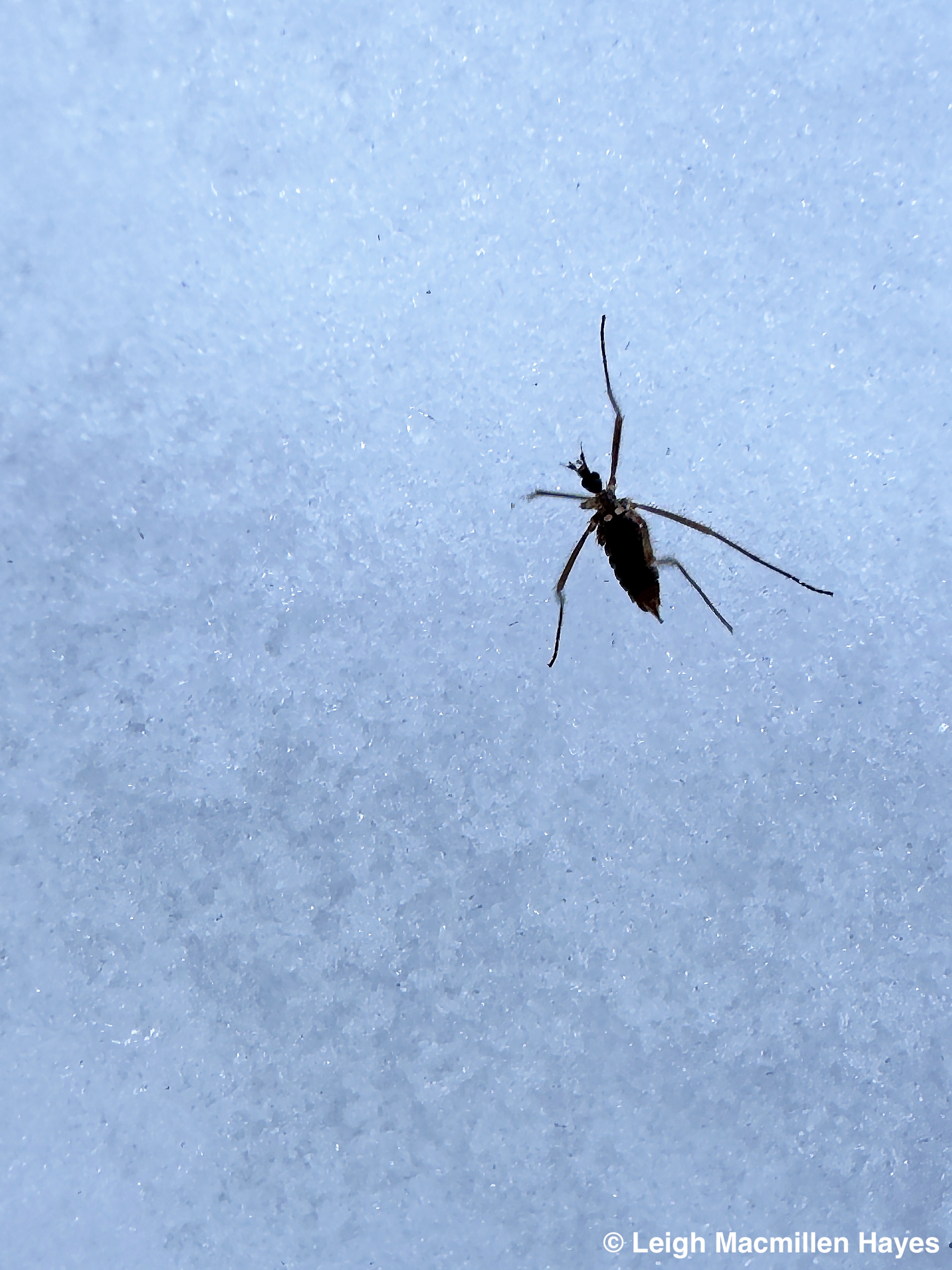
I thought it was a spider in the Hare print because I’ve seen so many on the snow in this area this winter.

That is until I took a closer look and realized it had five legs rather than eight. Oops, I wonder what happened to the sixth leg.

Despite the lack of that other leg, it moved across the snow as best it could. This being a Snow Fly. As for that missing leg, Snow Flies self-amputate so that ice doesn’t enter body. It’s a fighting chance to survive the frigid winter.

Oh, and it’s not always about tracking, especially when a bit of bird calls and color drew our eyes skyward, where we watched and listened to a flock of American Robins, and . . .

Cedar Waxwings on a chilly winter day.

On Monday, My Guy and I made a quick journey around the trails at Viles Arboretum in Augusta, and I actually never took a photo. Yikes. I bet you didn’t think that was possible.

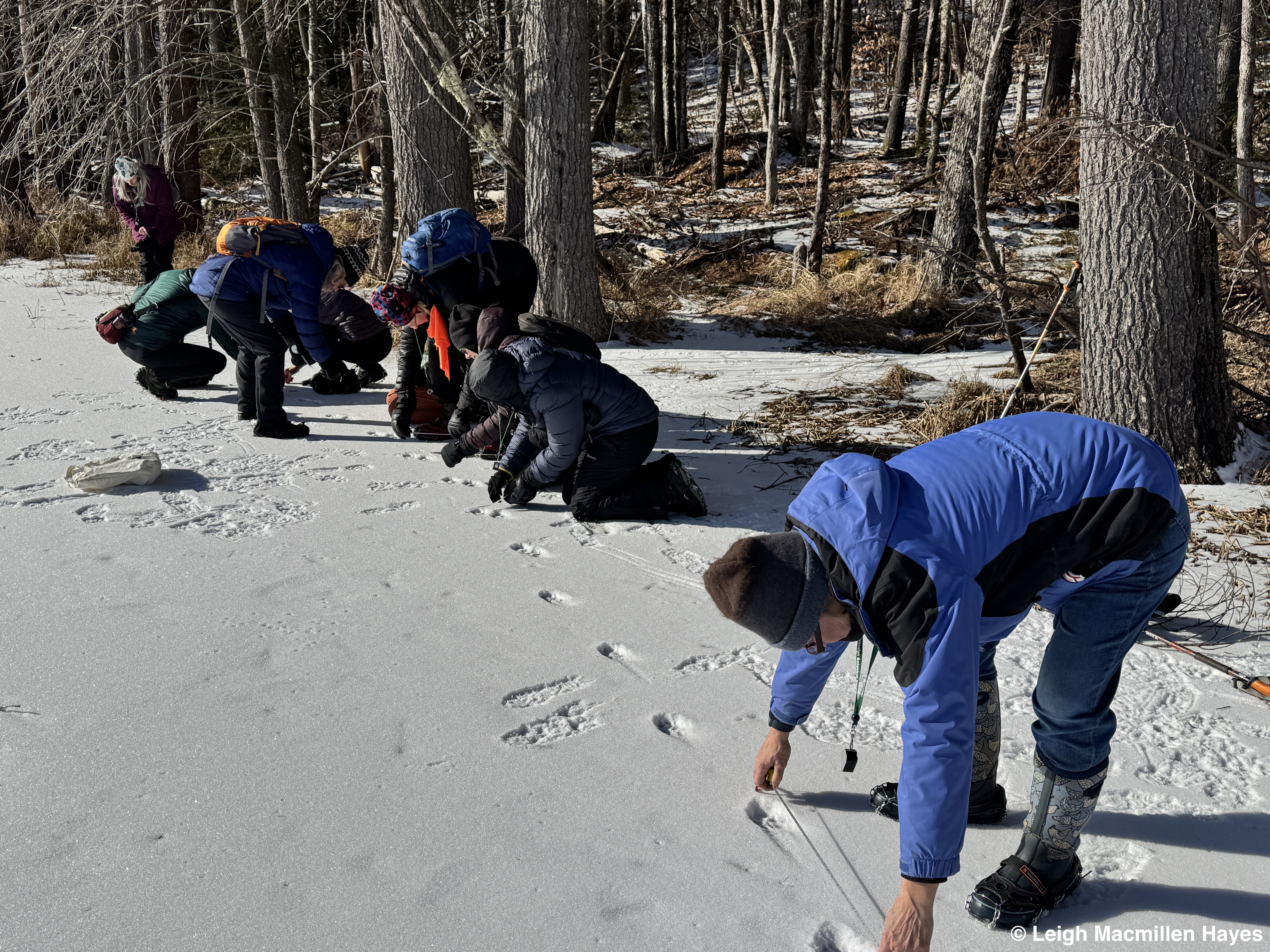
On Wednesday, fellow Master Naturalist Dawn and I spent time at Loon Echo Land Trust’s Tiger Hill Community Forest in Sebago with a group of people curious to learn about tracking and came away jazzed by their level of interest and involvement as they took measurements and noticed details.

On Thursday, My Guy and I climbed the Southwest Ridge Trail on Pleasant Mountain in Denmark, where there wasn’t much snow given the trail’s orientation to the sun, but we did spot quite a few deer prints and runs. I love how deer follow the same trail, making it easier to get from a sleeping area to a feeding area within their “yards.” For years. We’ve lived in our house for over 30 years and I can tell you where the deer runs are located. Always have been. I pray they always will be.

Despite the lack of snow, the views were grand. And he was pleased that nature didn’t slow me down too often.

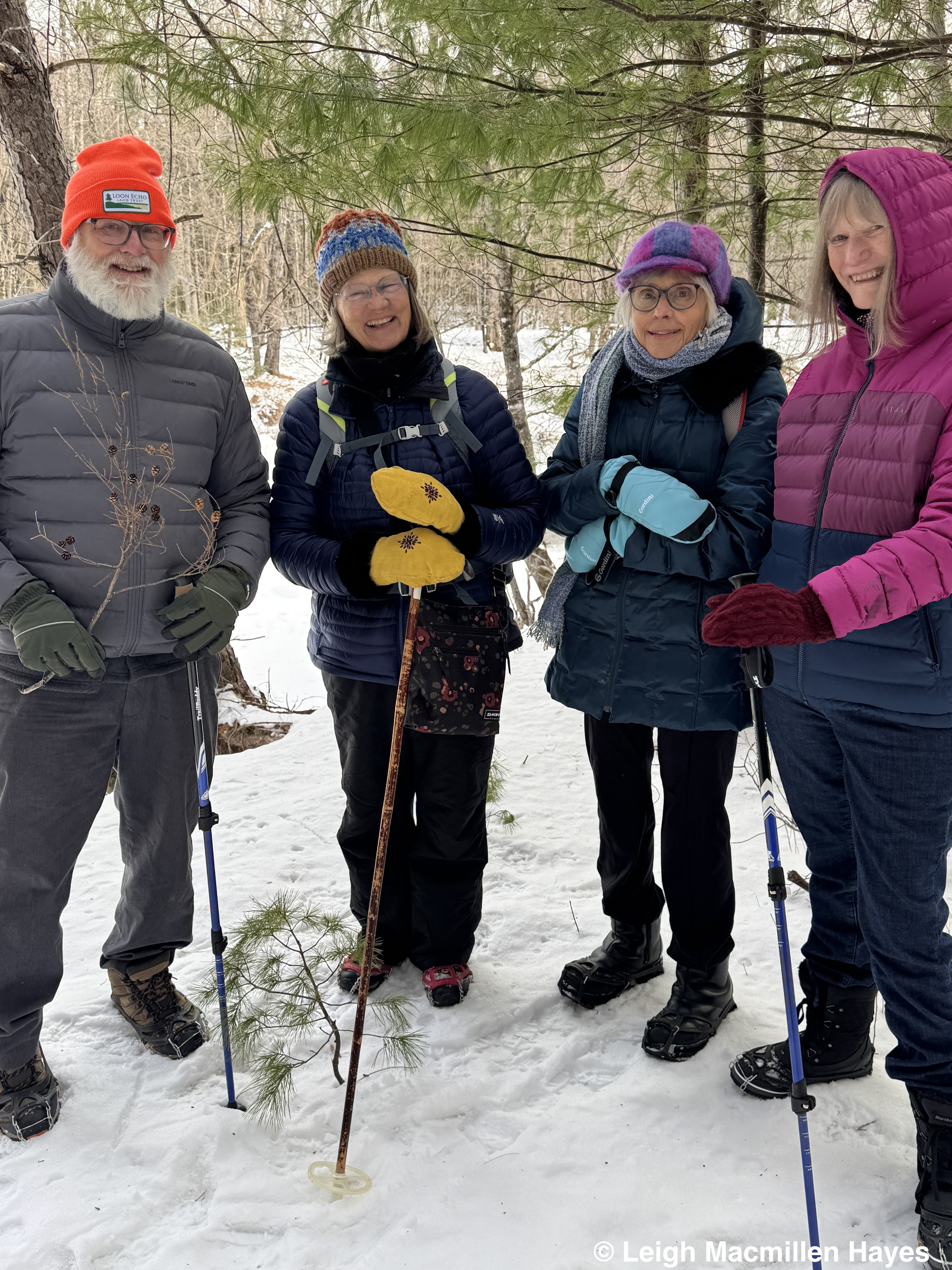
On Friday, I spent a few hours with these four and two more as we explored at Loon Echo’s Crooked River Forest in Harrison.

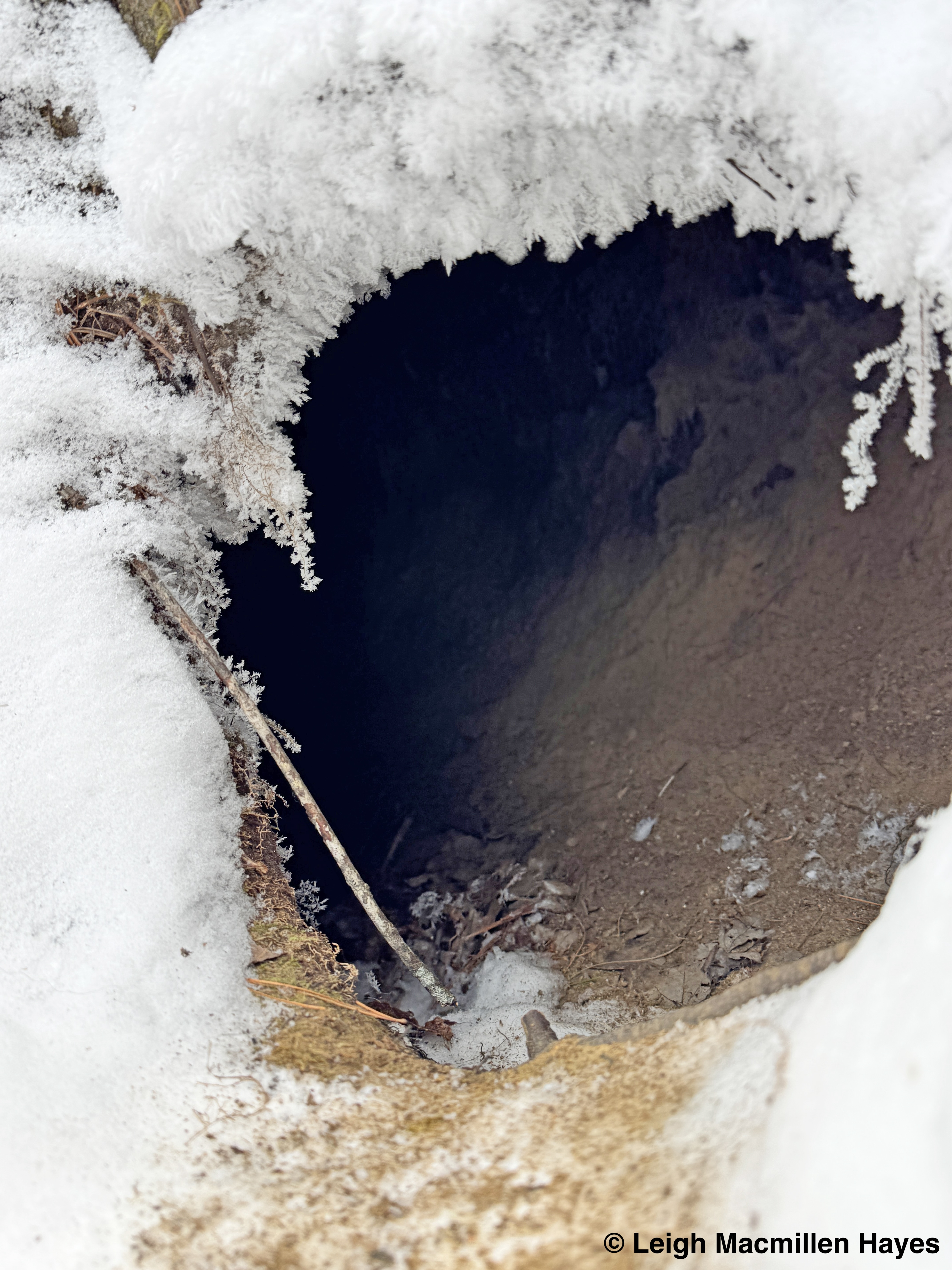
One of our cool discoveries was a Porcupine path that led to a den, in the same location we found it last year. I was happy to know that there was no need to move.

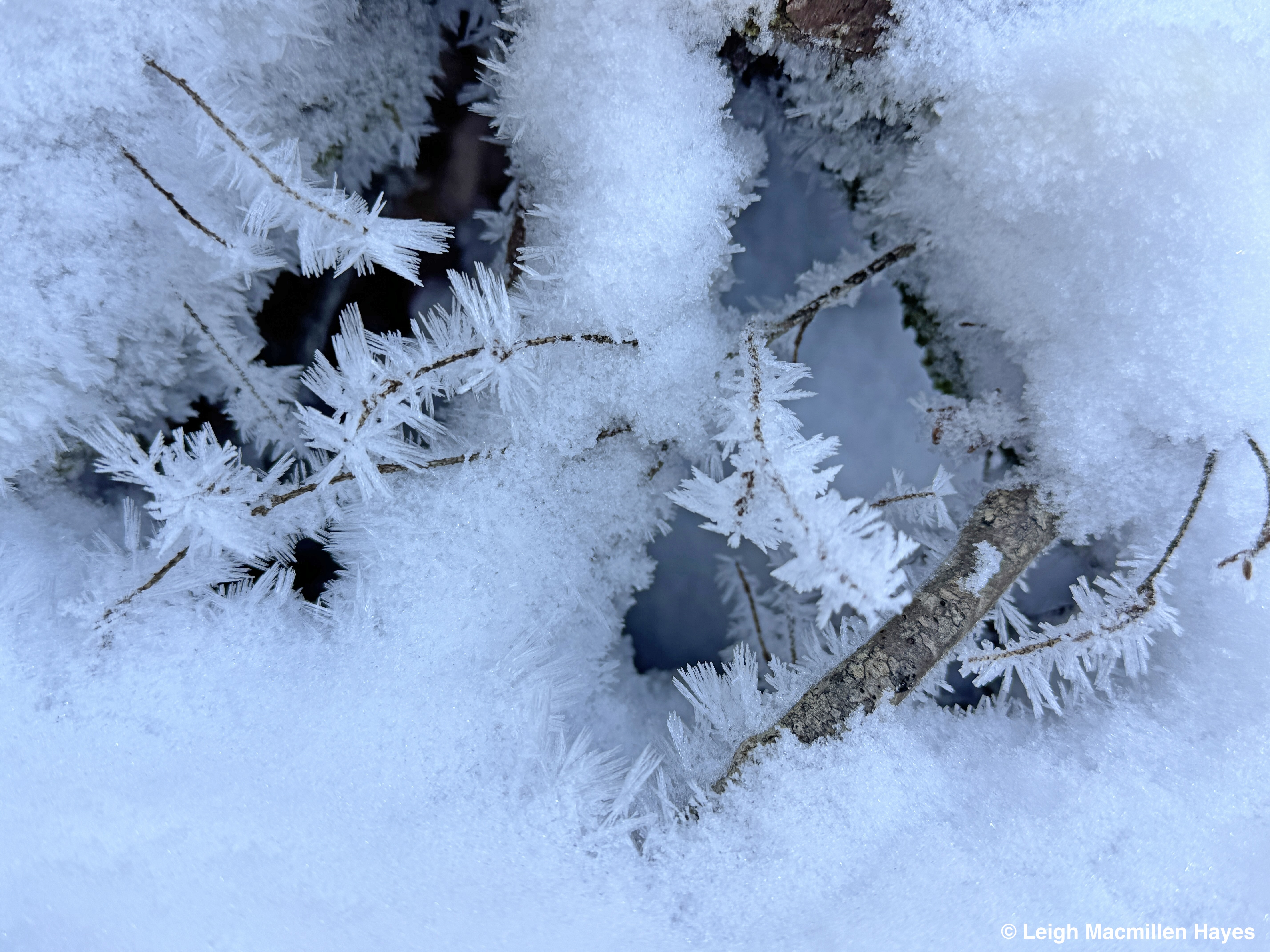
And based on the hoar frost around the entry way, we surmised there was at least one Porcupine inside.

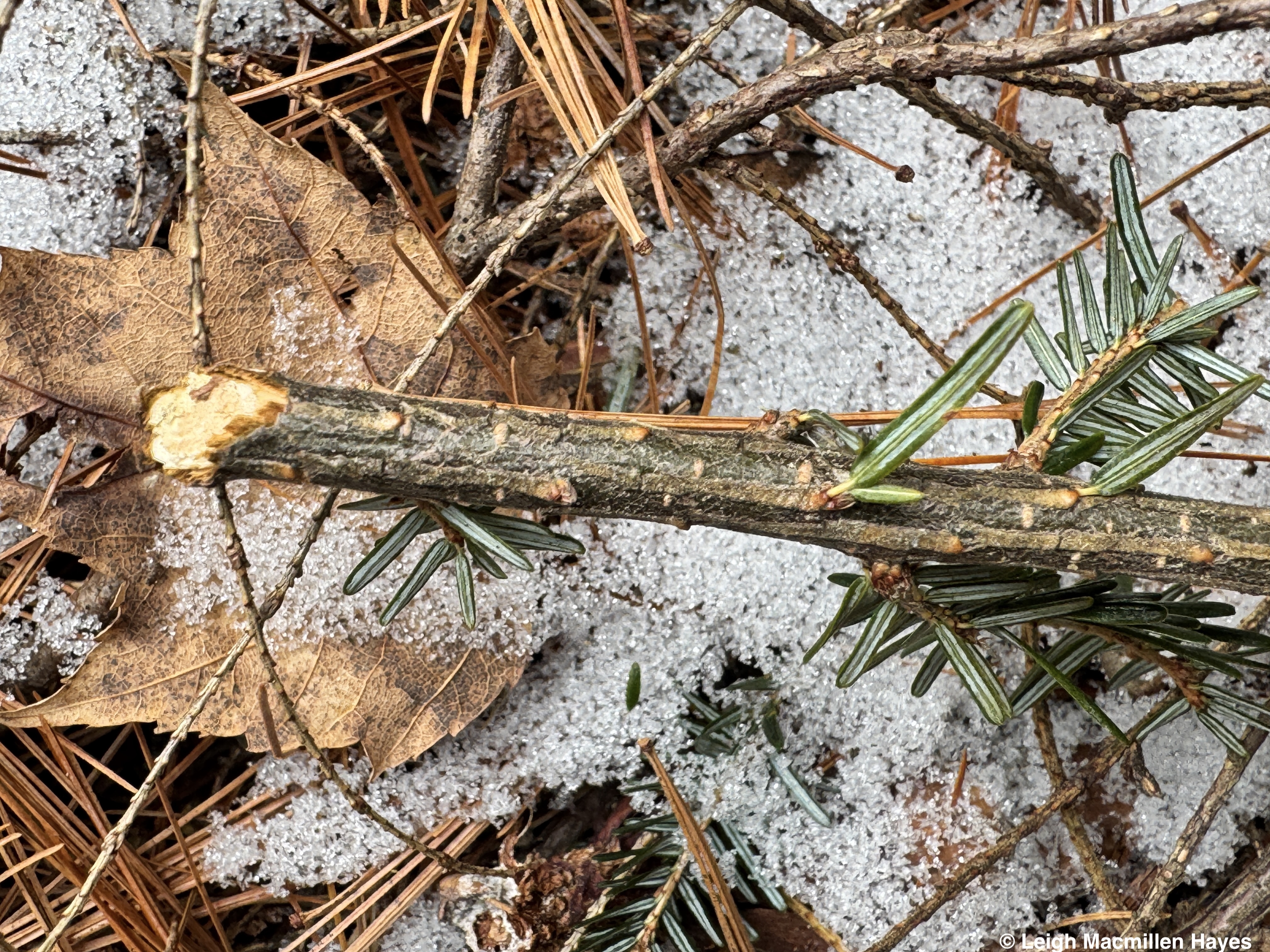
We left it or them alone and followed the well worn track in the opposite direction to the feeding tree, an Eastern Hemlock, where there were plenty of downed branches cut at the typical rodent’s 45˚ angle.

And we found the curved scat that had dropped from the animal as it fed while sitting on a branch up in the tree. Happiness is!

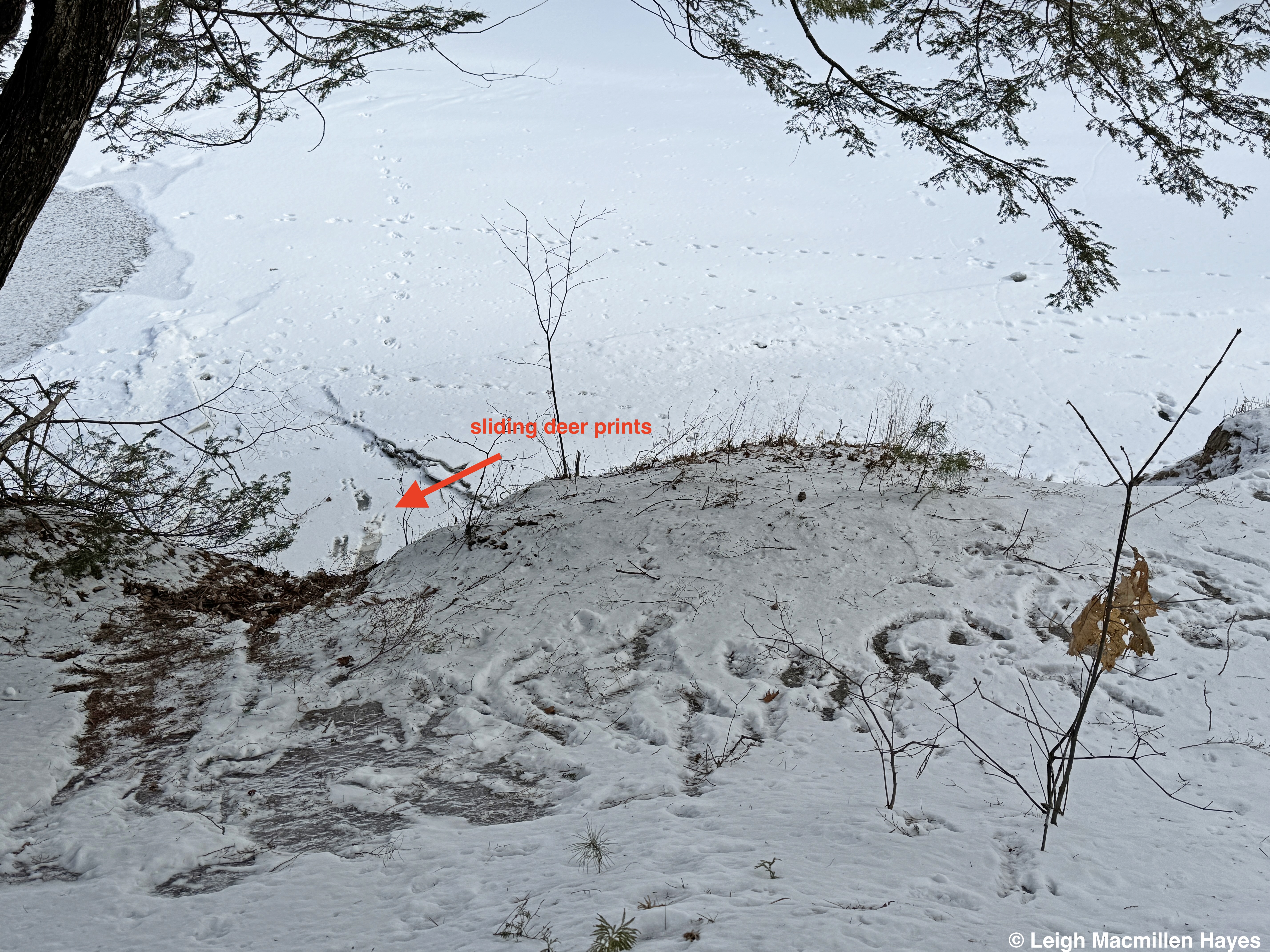
And then we made a discovery that didn’t make sense at first, but I think we interpreted correctly based on the evidence provided. At least this is our story: Deer tracks led to the steep river embankment, which in this spot was two-tiered before it reached the water. From our spot at the top of the embankment, we spotted deer tracks leading down to the next level and saw this crazy writing in the snow. And then it occurred to us. There were no human prints or any other prints in the area down there. Only the deer prints leading to it. And on the ice-covered river below, more deer prints. What we surmised is that the deer leaped down to the next level because we could see a couple of prints on the embankment leading to it. And then slid. This way and that. And as it tried to steady itself, it fell on its side, and did a full body slide all the way down the ice and over the leaves and directly down the second embankment to the river below, where it continued to slide once it got upright, and wobbled a bit (wouldn’t you?) before it crossed to the other side.

Regrettably, I didn’t take any more photos, but we discovered that at least one more deer had done the same to the left of where we stood, and it ended up sliding down in the same spot as this one pictured, all the way to the river.

Knowing that deer have traditional runs or paths, I can’t help but wonder if this is one of them, and usually the trip down to the water isn’t quite so perilous. You can bet I’ll check again.

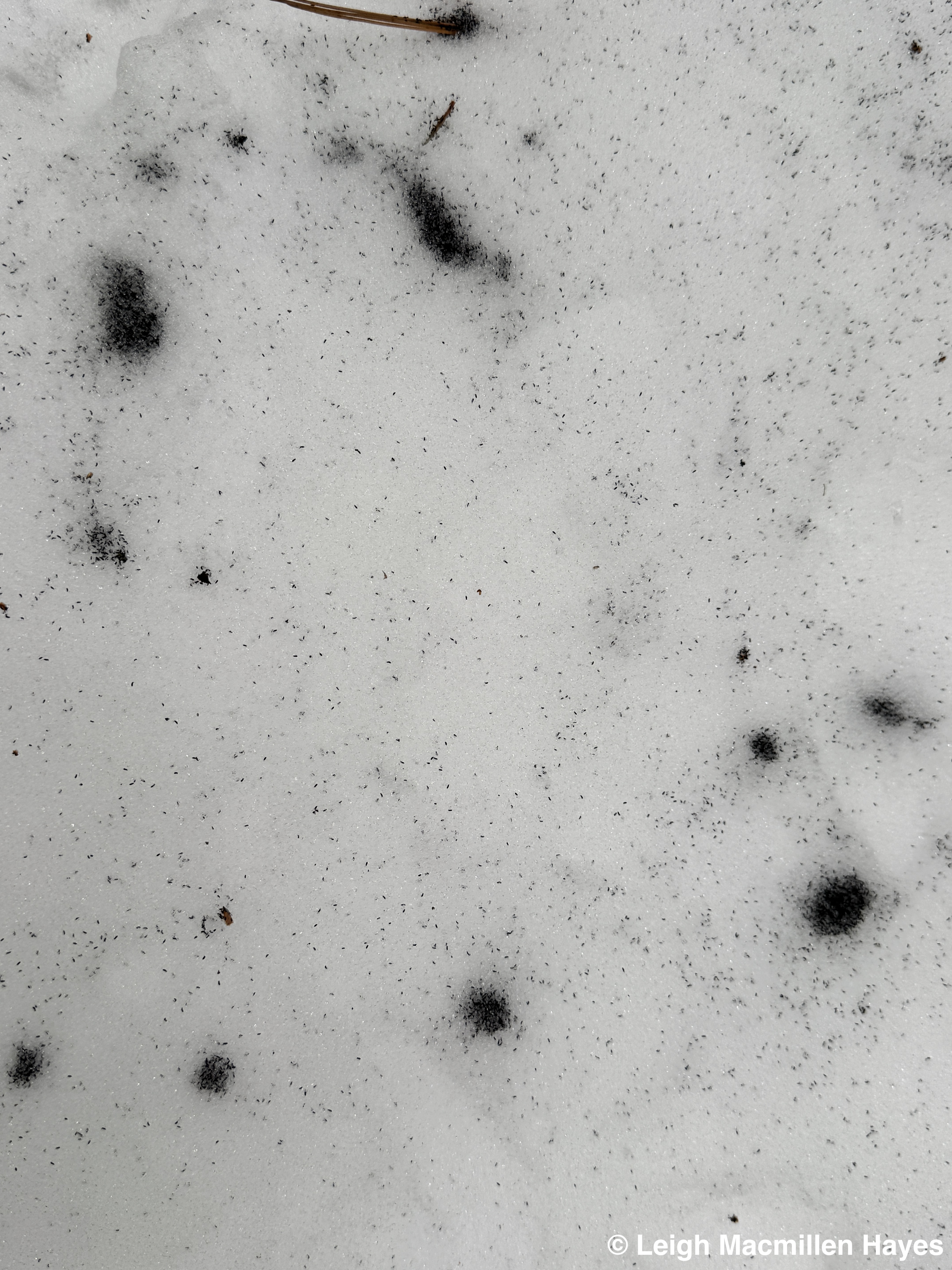
And finally today dawned, and after some errands, I headed into the woods to reset our game camera. That’s when I began to spot blotches of black on the snow. Huh?

Not blood from an animal. What could it be?

Some were rather big. But a closer look soon gave me the answer as it looked like pepper grains were on the move.

After a frigid few days and before what could possibly be a real snowstorm tomorrow night and the next polar vortex to follow, Springtails (Snow Fleas that aren’t really fleas and don’t bite) were doing their thing–springing from the furcula, an appendage under their abdomens, as they fed (though I could only imagine the feeding part because I couldn’t see that action) on decaying plant matter.

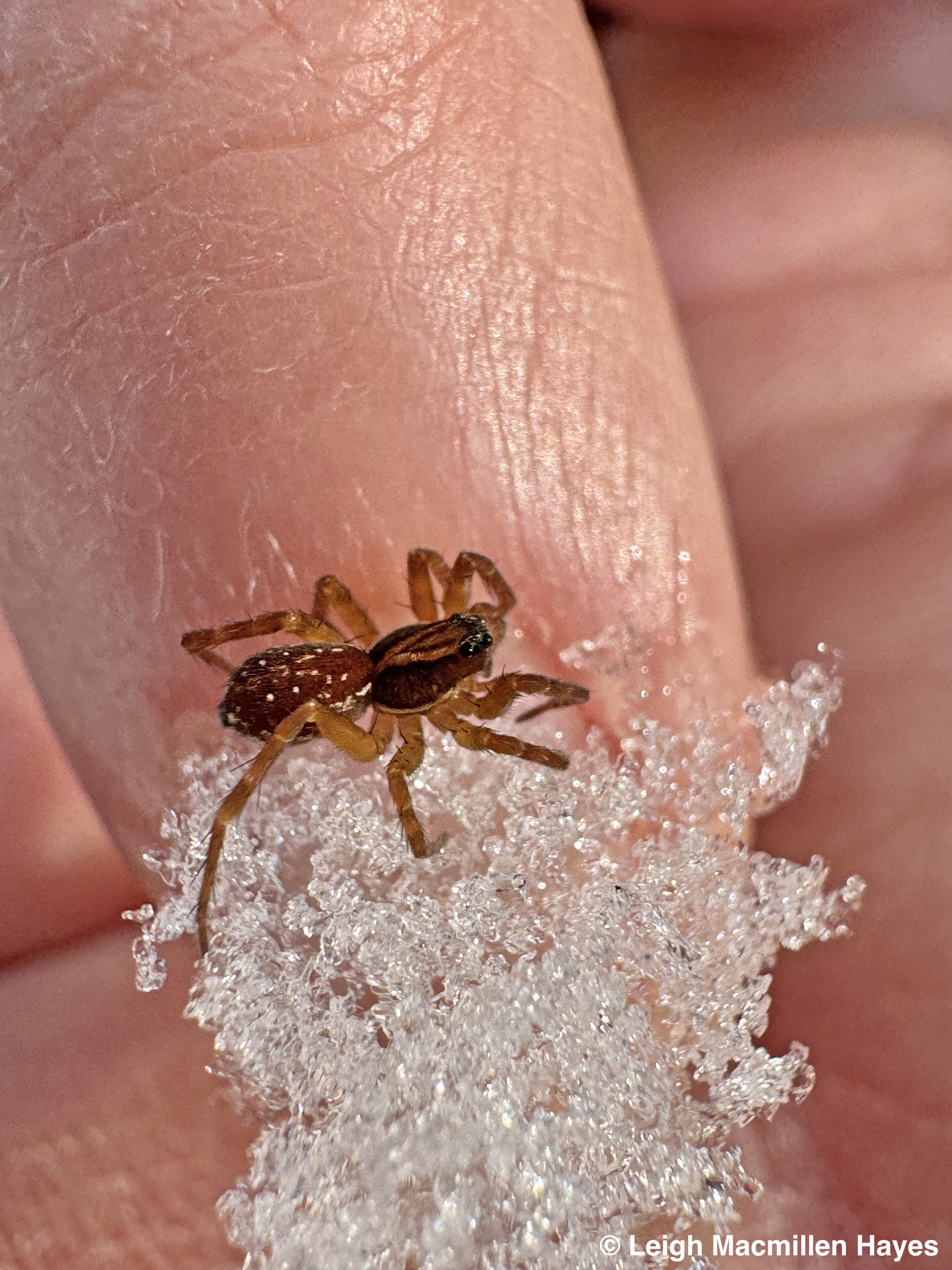
What I really wanted to see, I suddenly spied–a predator in their midst! The spiders that I often find on the snow, feed on Springtails. Tada!

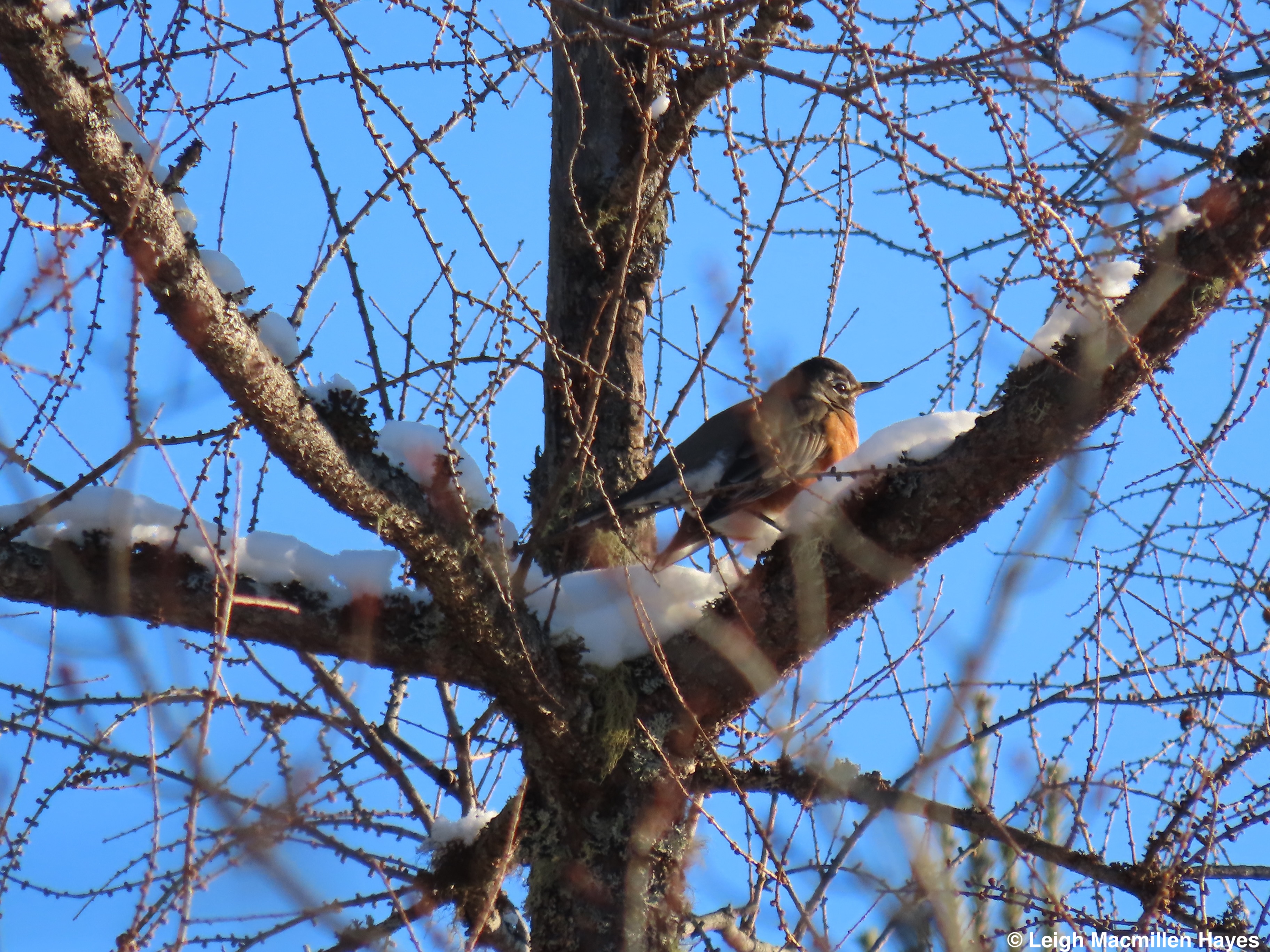
Dear Readers, this has been a long post, and even the Robin would agree. But I wanted to share all of these amazing things with you with hopes that you’ll head outside and look around and see what you might see. The stories are yours to interpret. It’s really so much fun. Thank you for sticking with me.

I received the best compliment this morning when a current Maine Master Naturalist student sent me some track photos to check on ID: “Thanks for your assistance- after your presentation I’m finding tracks in places I normally frequent yet I wasn’t paying attention!” ~J.K.

Thanks for paying attention. Happy Tracking!

“Hightailing it Home” published in The Maine Natural History Observer

As some of you know, I not only have a soft spot in my heart for Dragonflies and Cicadas and Beavers and Otters, but also my prickliest friends, Porcupines. And recently I’ve been looking for our neighborhood rodents, which my neighbor sees when she lets her dogs out at night, but they’ve alluded me.

I do keep finding some evidence of their whereabouts, at least where they’ve ventured at night, but have yet to locate a den this winter or even spot a Porcupine waddling through the woods or sleeping on a branch.

That may be our fault. We’re in the process of saving our barn and have closed up any entrances Porky has used for the last 30+ years and probably longer than that, and tore down an attached shed and we’re having it rebuilt, so except for that one night he spent in the barn loft due to our stupidity of not shutting a trap door, I’m afraid we’ve evicted him. But there is more than one Porcupine in this neighborhood and today I wandered several miles into the woods beyond our land, and came up short-handed.

That said, I did spot three deer as I headed out along our cowpath. Do you see them?

We spent at least five minutes together before I decided it was cold and I need to get my mittens back on and keep moving.

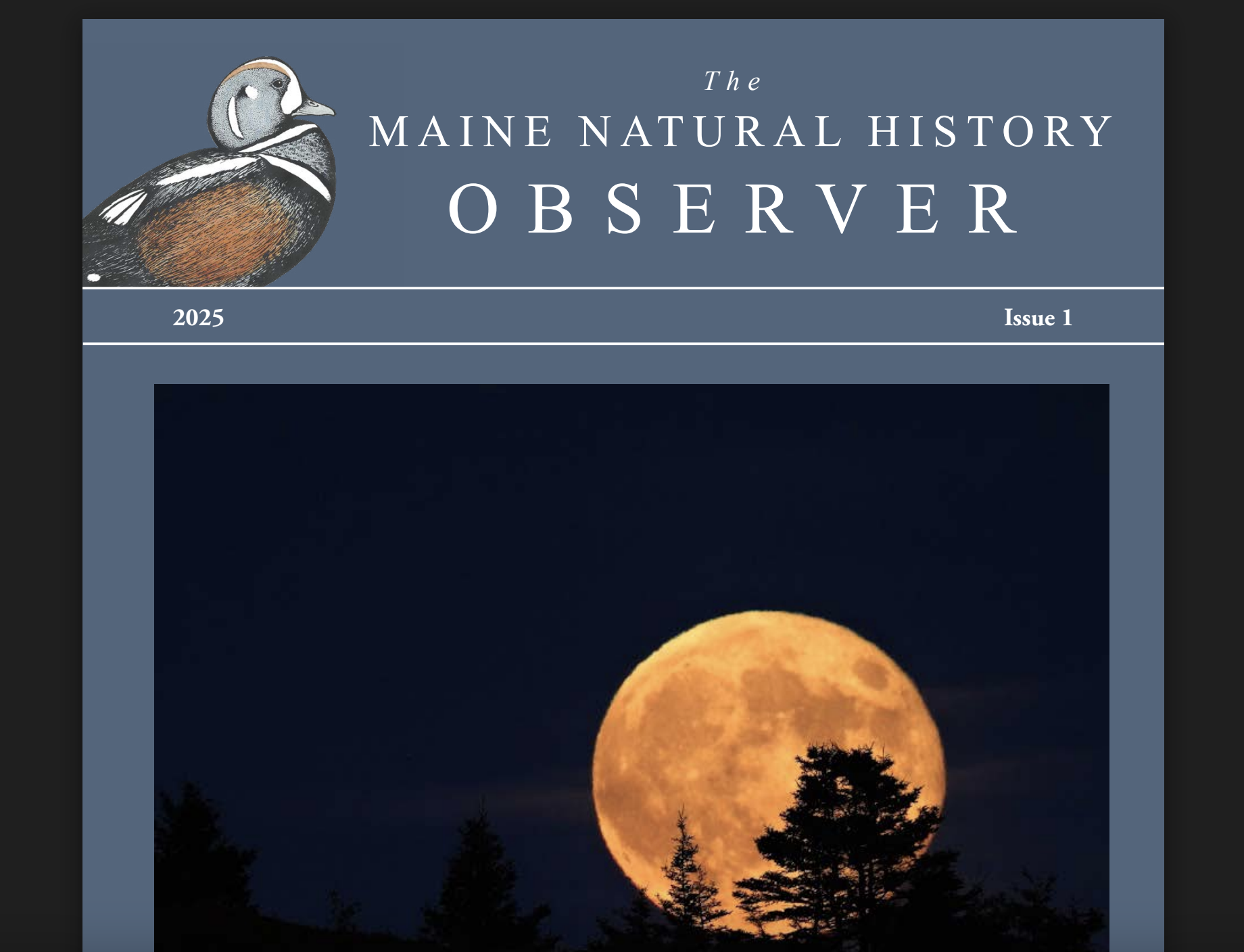
Switching gears, I submitted an article about Porcupines to the Maine Natural History Observer for their first issue of 2025 and was tickled once again to have it accepted.

According to their website: Maine Natural History Observatory’s mission is to improve the understanding of natural resources in Maine by compiling historic information and implementing inventory and monitoring efforts of Maine’s natural history.

The Observatory specializes in collecting, interpreting, and maintaining datasets crucial for understanding changes in Maine’s plant and wildlife populations. We are committed to filling data gaps for Maine’s least understood species and creating a legacy of data for use in nature conservation, land use policy decisions, and expanding scientific knowledge.

Specifically, our mission is to:

  • Compile and publish summaries of Maine’s natural history
  • Coordinate local and regional inventory and monitoring efforts of Maine’s flora, fauna, and habitats
  • Facilitate cooperation and exchange of information among organizations, agencies, and individuals conducting natural history research in Maine or caring for natural history collections
  • Engage in other activities related to the advancement of scientific knowledge and education of the public regarding the flora, fauna, and habitats of Maine.

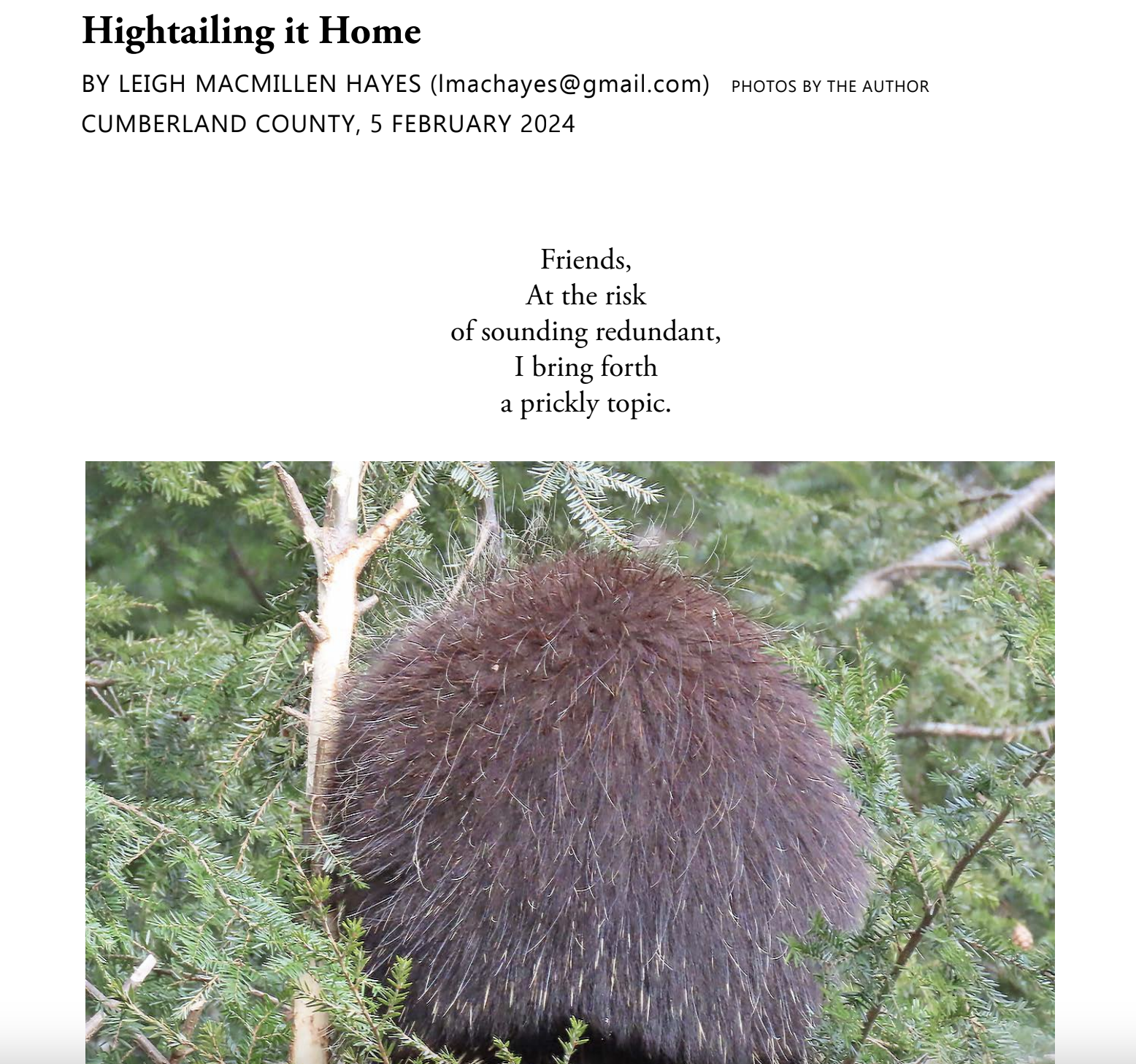
“Hightailing it Home” is about an adventure I had with a Porcupine in February 2024, and again, it was deep in the woods behind our home.

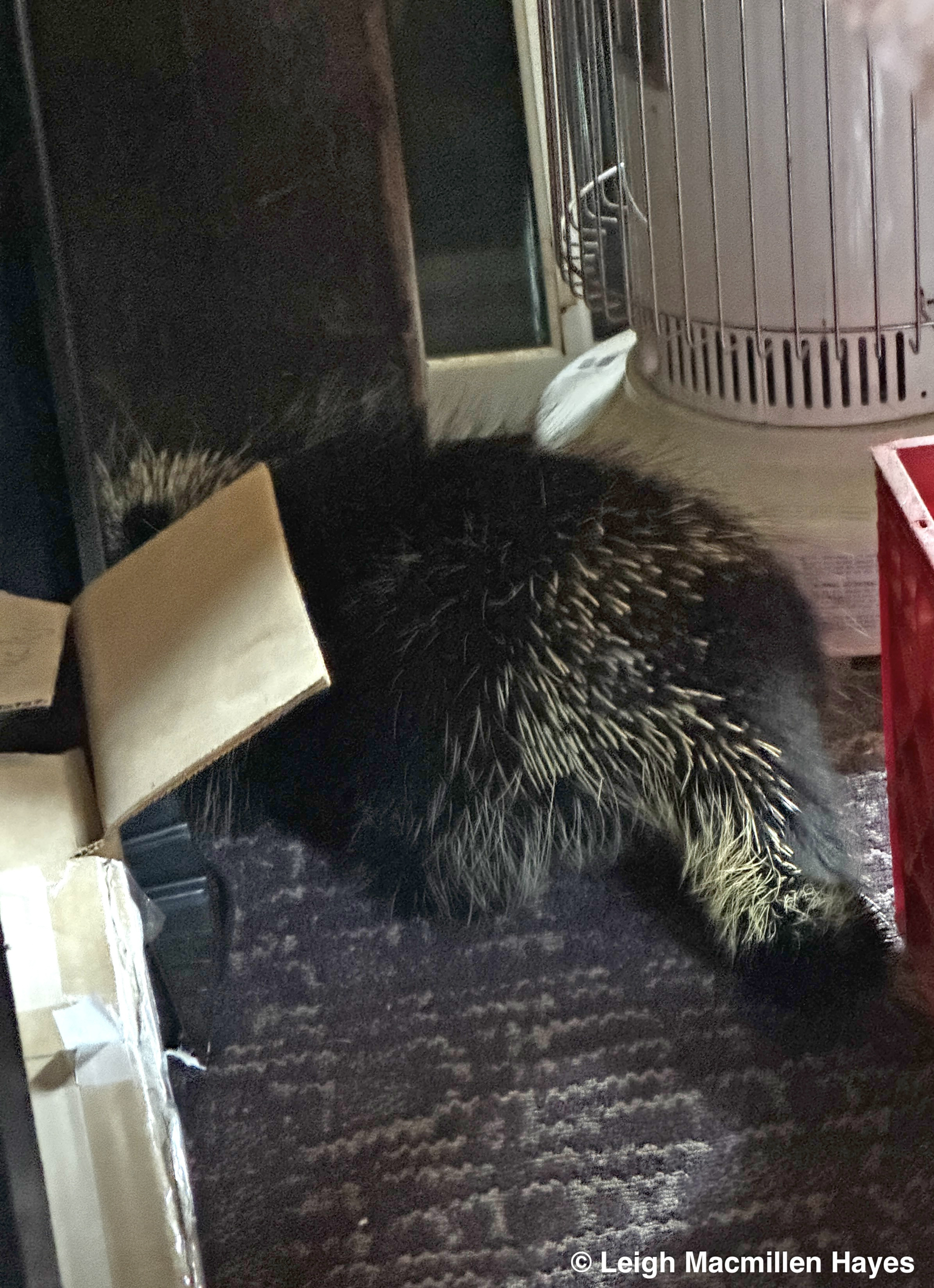
This is the back view that I first encountered that day, before the Porcupine realized I was being a nosy neighbor.

And I’ve included this portion of a page just cuze I love my Porky friends. Look at all those quills! Over 30,000 of them. And yet, his face is so soft, as is his belly.

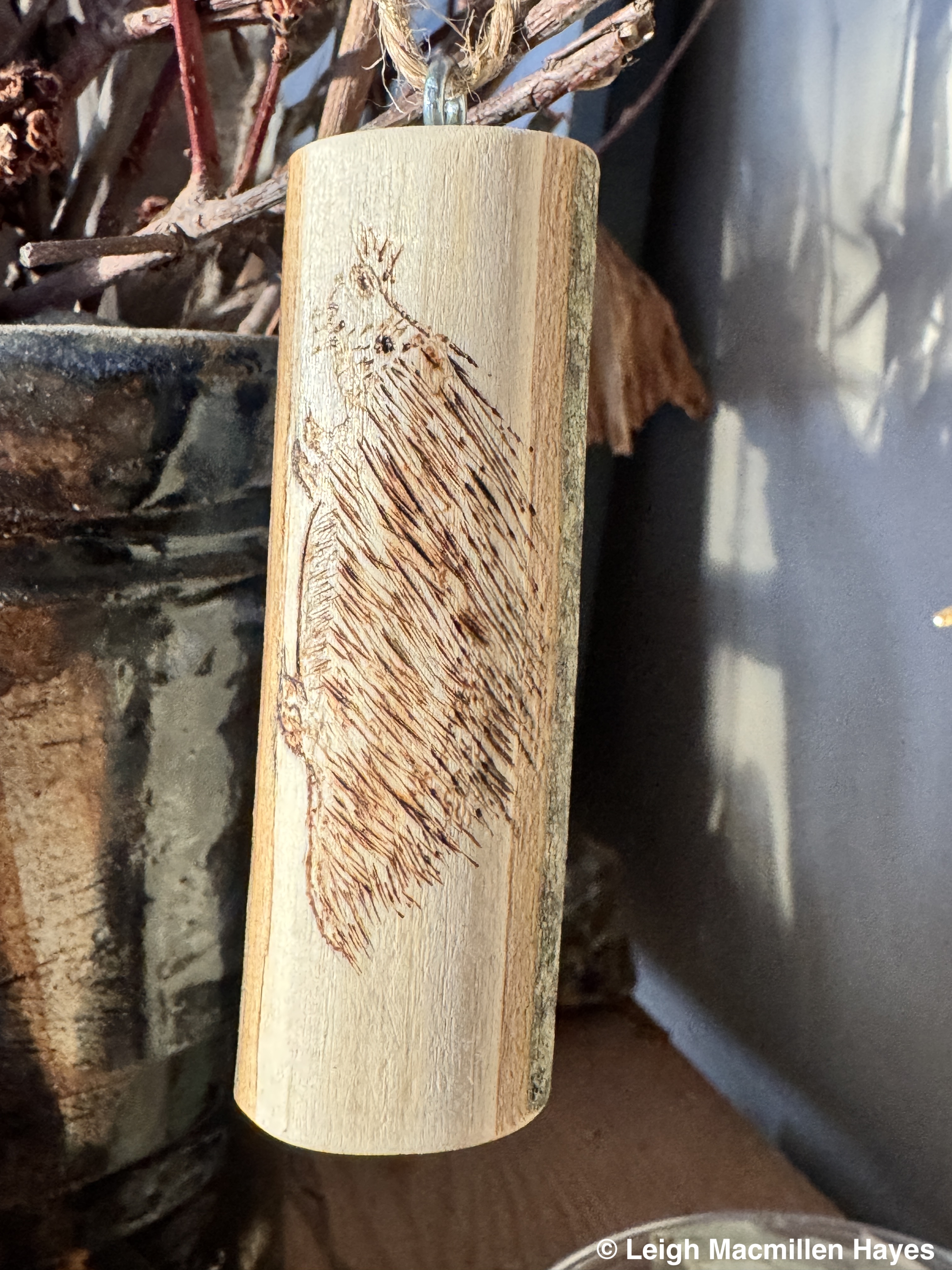
Apparently I’ve made that love known, for my ten-year old friend and fellow naturalist and artist created a tree cookie ornament for my birthday.

And my Cousin Bob did the same for Christmas. Both ornaments did hang from our tree, but now they are on display in my study.

Okay, back to the MNHObserver 2025, Issue 1, here’s a link: Maine Natural History Observer.

You’ll find “Hightailing it Home” on page 36.

There are some really interesting articles, including one about Maine weather in February 1958!! Perfect for an evening read on another frigid night.

Thank you, Maine Natural History Observer, and especially to Celeste Mittelhauser, Outreach Coordinator.

Here’s to future adventures with Porky and so many forms of fauna and flora who continue to teach me. I sure hope I get to hightail it home following a sighting in the near future.

The Beaver’s Tale

Much to our delight,
just after parking the truck
at a local trailhead,
the caretaker crossed the road
to bid us hello.
After sharing with us
his plans for an upcoming adventure,
we wished him Bon Voyage,
and started down the trail,
giving thanks that friends
had pre-packed it
with their snowshoes
last week
so we only had
to wear micro-spikes.
(Thank you, Sue and Lee)
At last reaching one of two ponds,
around which we planned to tour,
we chuckled at the juxtaposition
of summer and winter,
in the forms of
canoes, snow, and ice.
A few more steps,
and we weren't sure
which season witnessed
what must have been an immense crash
as part of this old hemlock
slammed onto the ground.
Meanwhile, 
the upper most section
of the fallen tree
was caught by friends
who are still doing their best
to hug it
and keep it
from careening
to the forest floor.
And farther still, 
a bunch of
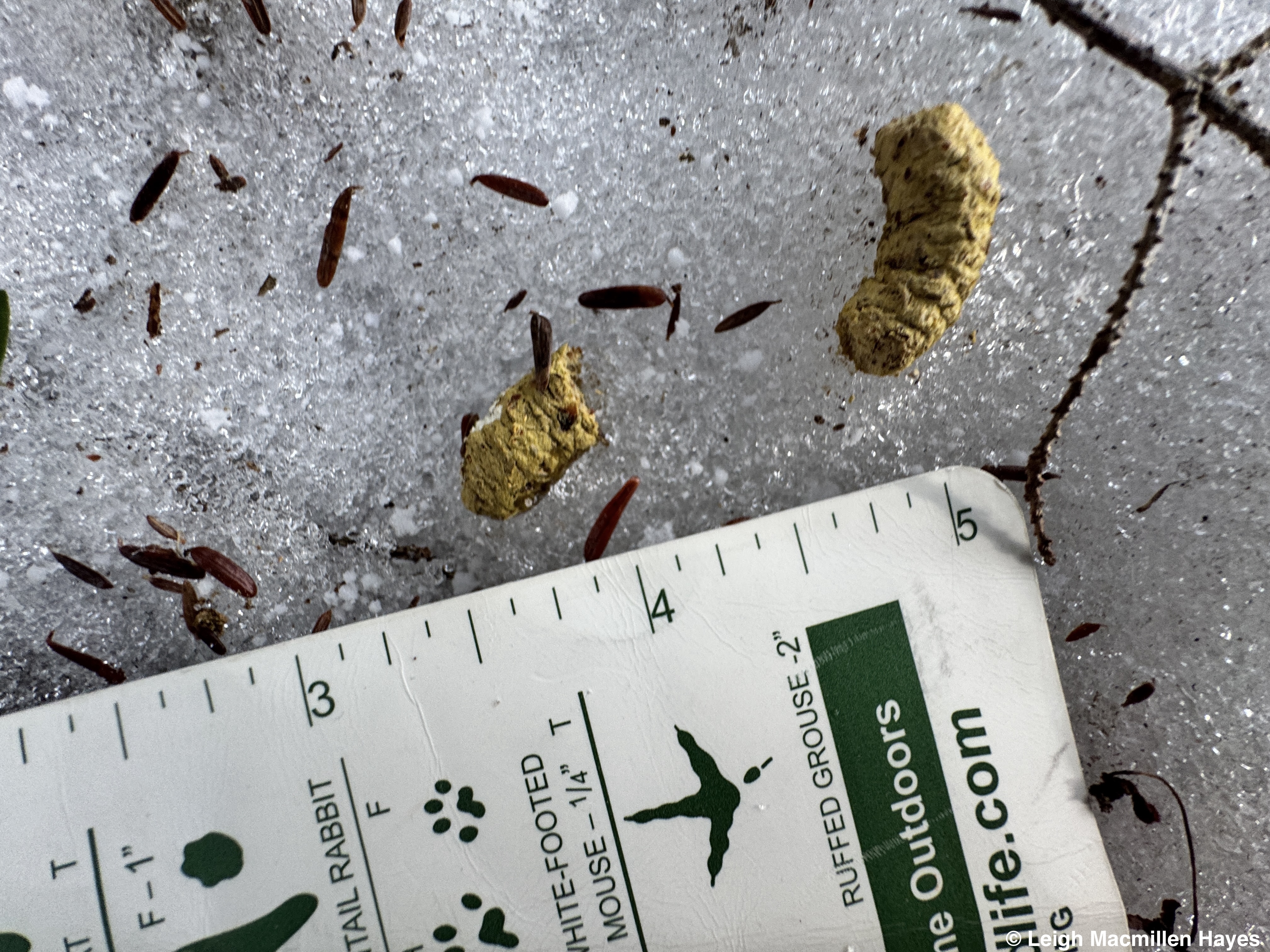
mustard colored droppings,
aka scat,
bespoke the past presence
of a Ruffed Grouse
who must have dined well.
By the shape of the prints 
in front of him on the trail,
My Guy immediately new the maker,
for one was a wee hand,
and the other a bit longer,
and both were
offered on opposite diagonals,
as is this waddler's presentation,
it being a Raccoon.
When we reached the lifesaver,
we knew we were at the halfway point,
and had to decide
to continue to the next pond,
or only circle this one
because our time was limited.
We chose the latter,
saving the other for another day.
The trail next passed
beside a wetland,
and in the middle
I spotted the Big House, Little House, Back House, Barn,
of a Beaver family,
with fresh wood
indicating someone was probably
in residence.
Continuing on, 
it soon became apparent,
that a logging operation,
had taken place,
but the workers
were of the non-human sort,
for such were the toothmarks
of said Beavers.
We found 
example after example
of trees sawed
with their chisel-like teeth,
and some even crossed the trail
we followed
for our route
was of no concern to them.
Upon reaching 
the other side
of the wetland,
I looked at the lodge again,
and found it curious
that there was no open water,
given that up until today's frigid temps,
we had a bit of a melt,
and surely the Beavers
would have been
on the move.
And then mere minutes and steps later,
because there are no leaves on the trees,
I spied across the way,
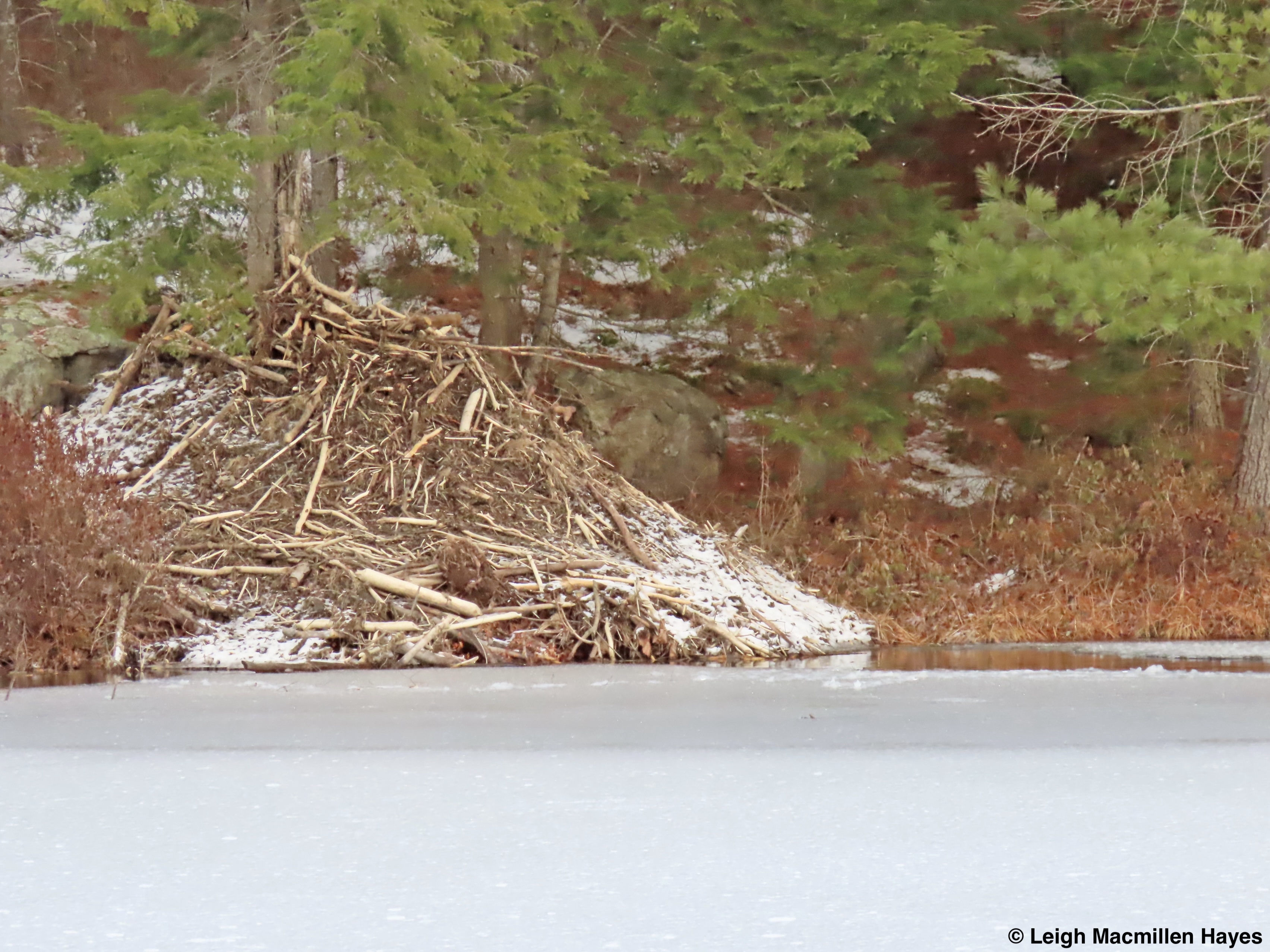
a huge new lodge
that we somehow missed
as we hiked above it
a half hour earlier.
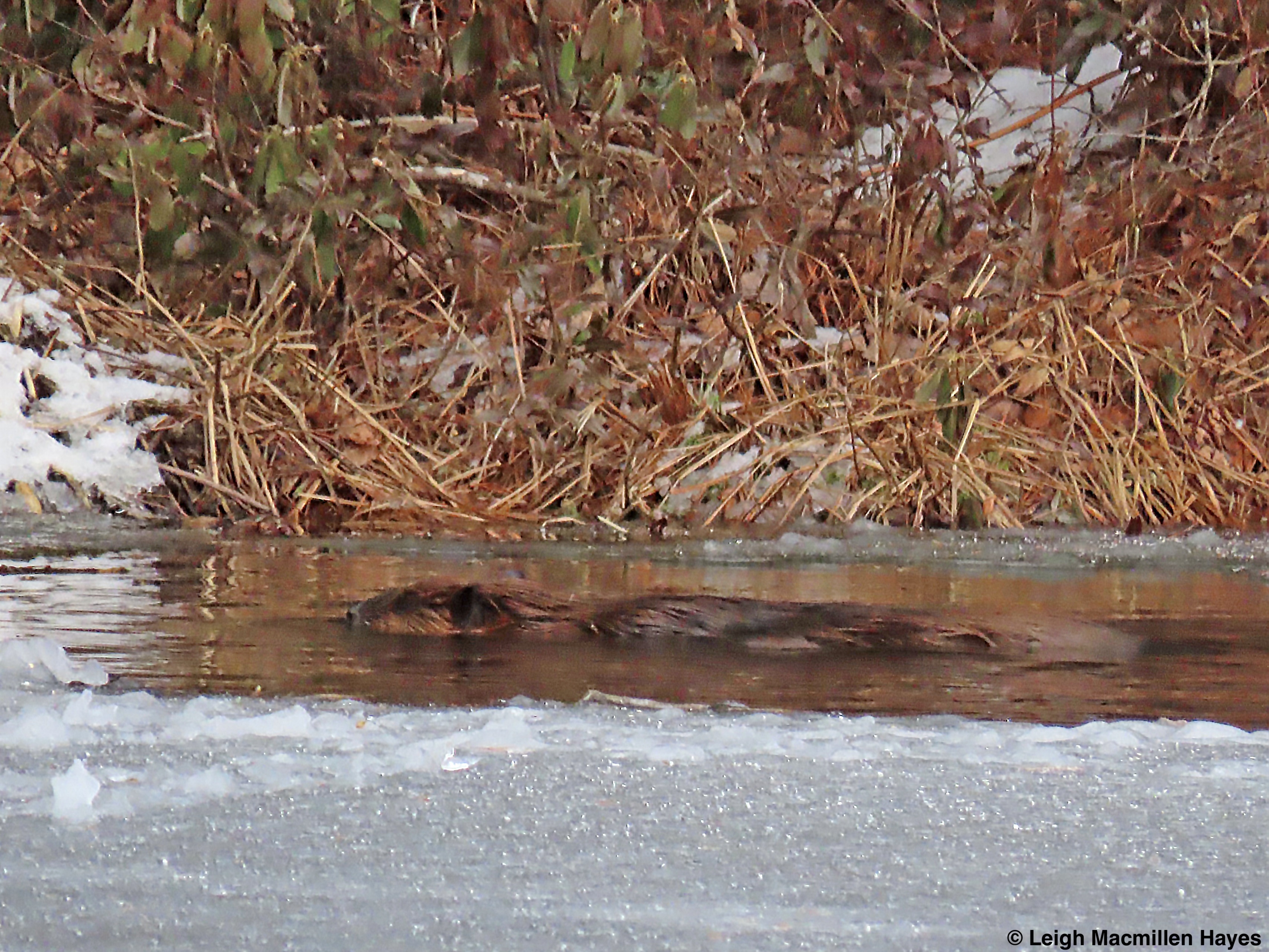
As I zoomed in with the camera,
what should I see,
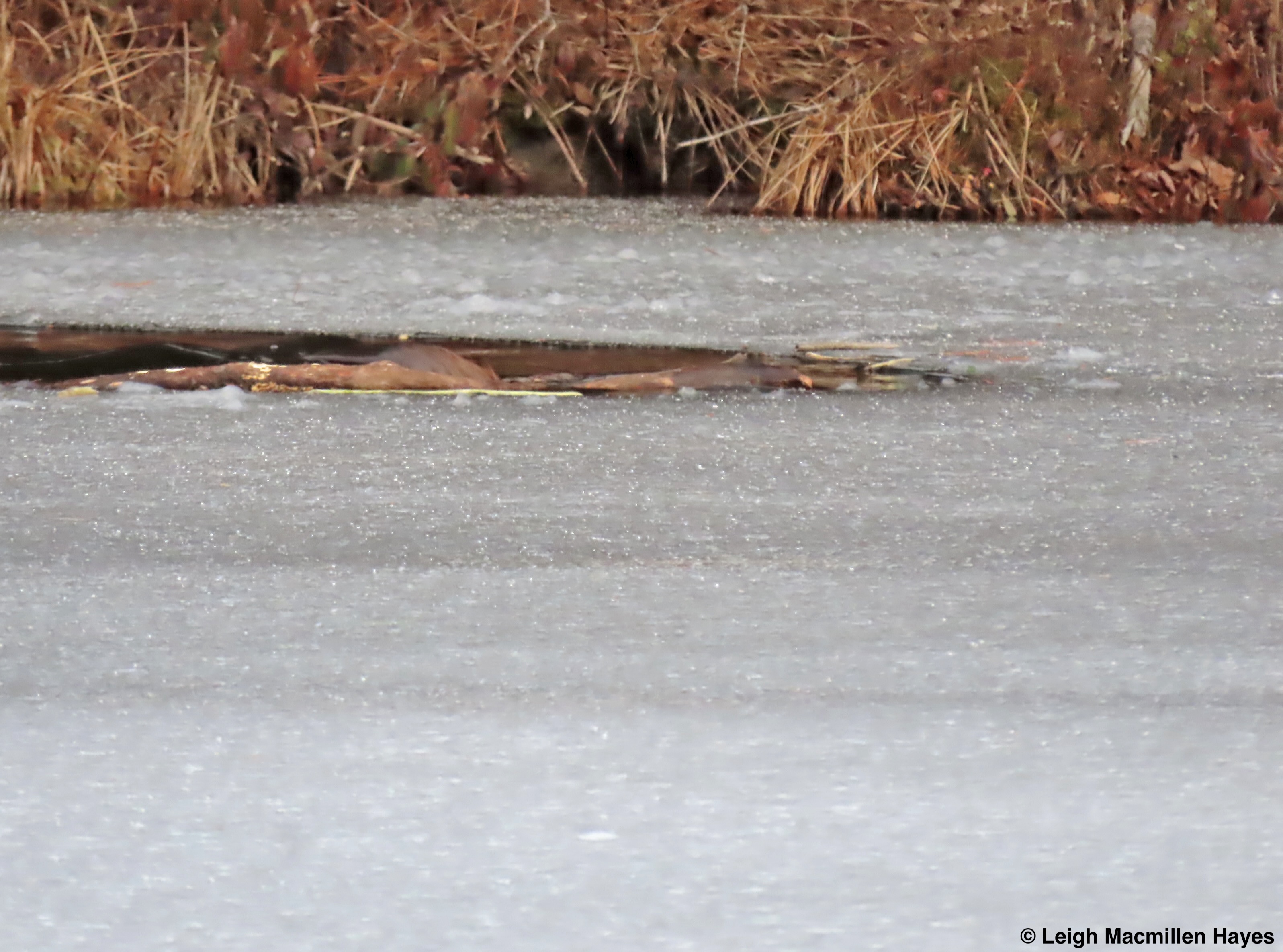
but a Beaver swimming
in open water,
and my heart was still,
and I wanted to stay
in that spot forever.
For about ten minutes,
that Beaver and I shared the space,
mind you from a distance.
My Guy was just up the trail,
and did not see what
I was focused on.
And this was not the time
to shout,
"Hey look, there's a Beaver!"
because no sooner said,
then there would not
be a Beaver anymore.
Chew sticks were visible
on either side of the pool
he had created
and I suspected he was grabbing a few
from an underground "raft"
of sticks previously stored,
or cached as we say,
and bringing them in
for the rest of the family to dine.
I think my assumption
may have been correct,
for when he reached
the far end of the pool,
he slipped quietly underwater,
rump first rising in the air,
and then whole body disappearing.
It's a funny thing
to realize
that when a Beaver
isn't aware of my presence,
it doesn't need
to slam its tail
and surprise me
or warn its family
that I am there.
Rather, it barely
leaves a ripple
upon the water's surface.
About five minutes later, 
the Beaver appeared again,
and then disappeared under water
beside the lodge
and I again assumed
I was correct
that chew sticks
were on the menu
this night
as they are every night.
With that 
I took my leave
from my lookout spot,
and followed My Guy
toward the conclusion
of our journey,
giving thanks all the way,
for the Beaver
who went about its daily duties
and let me be a witness.
As the sun 
began to set
on this day,
January 2, 2025,
I realized that it
shall be forever more
the day I celebrate
this Beaver's Tale.
Thank you to the owners of the land,
Mary and Larry,
and to their caretaker Bruce,
for conserving this place
so all may live
as nature intended.

Another Amazing Lesson From A Squirrel

Maybe I’m a slow learner. Maybe I just need the same lessons over and over again.

Whatever it is, I’m grateful for all who teach me, non-human to human, because there is always something to learn.

This week it was my friend Red who led the class. If you were down the hall in this outdoor school, you may have heard him, for he tends to be quite loud, and a bit critical, when he’s not dining upon a pinecone that is.

His plan, as it often is, was to strip the cone of its protective scales and seek the tiny seeds tucked in by the core or cob of the cone. Each scale contains two winged (think samara that help the seeds flutter toward the earth when its warm enough for the scales to open on their own) seeds and to me it seems like a lot of work for a little gain.

But if you’ve ever watched a Red Squirrel at work, you’ve noticed they are quick and can zip through one cone in mere minutes. Of course, it helps that they don’t worry about the “trash” and just let the scales and discarded seed coverings or pods, and even half consumed cones and cobs pile up in a garbage pile known as a midden. Spotting one of these is a sure sign you’ve entered Red’s classroom. And if you pause and look around, surely you’ll find many more middens. After all, Red Squirrels are voracious consumers. But again, given the size of the seeds, they need to be.

So here’s lesson #1: Leave the scraps. Oh wait, not on our indoor dining tables, but in the woods. And not our food in the woods, unless you are composting. But downed trees and snags and leaves and all that will replenish the earth, just as my squirrel’s garbage will do.

I should clarify that Red shares the school with many others who have their own classrooms and I’m sure when I finish my latest assignments I’ll have more to learn from the porcupines and deer and hare and coyotes and foxes and bobcats and yada, yada, yada who live under the mixed forest canopy.

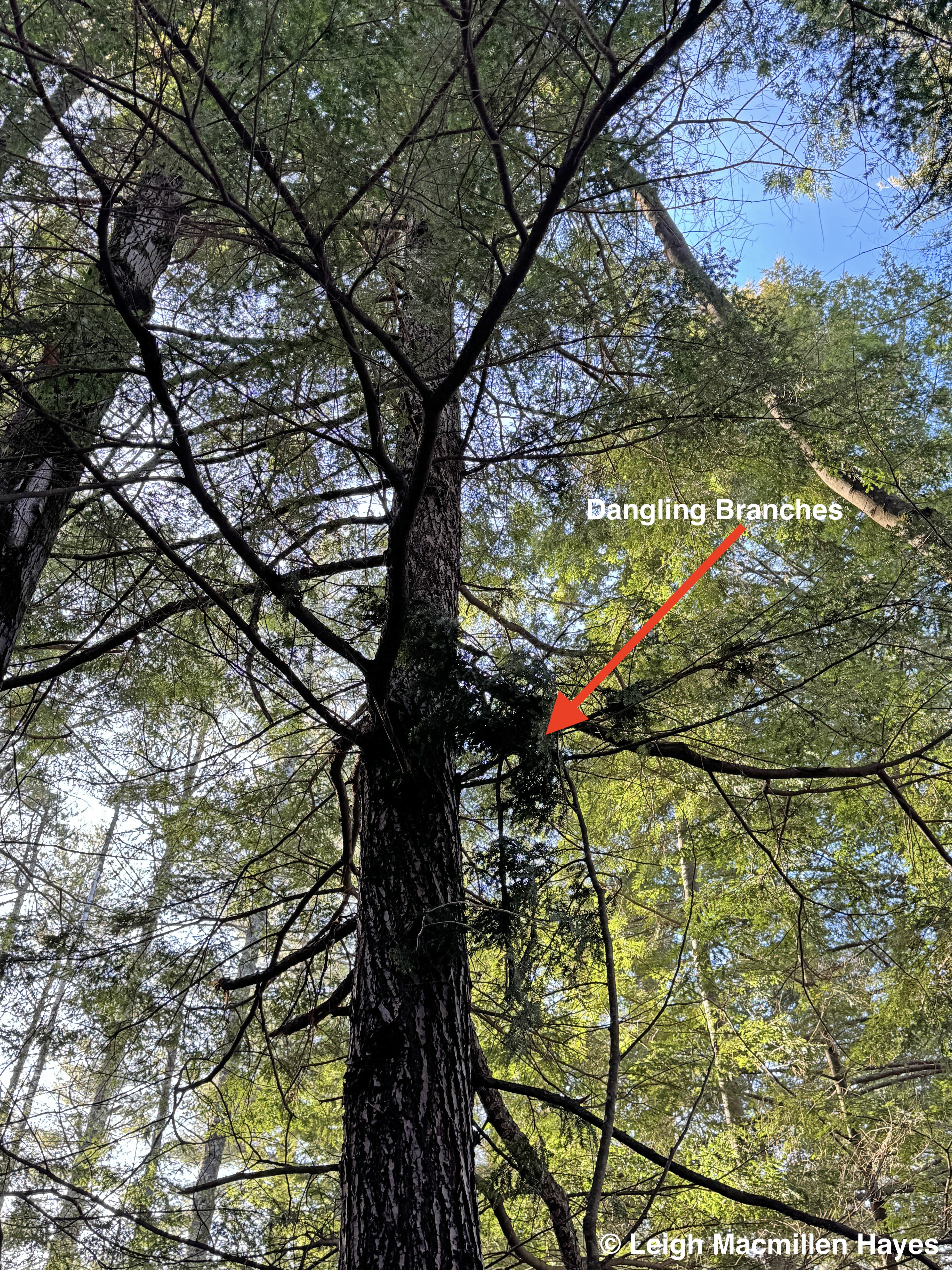
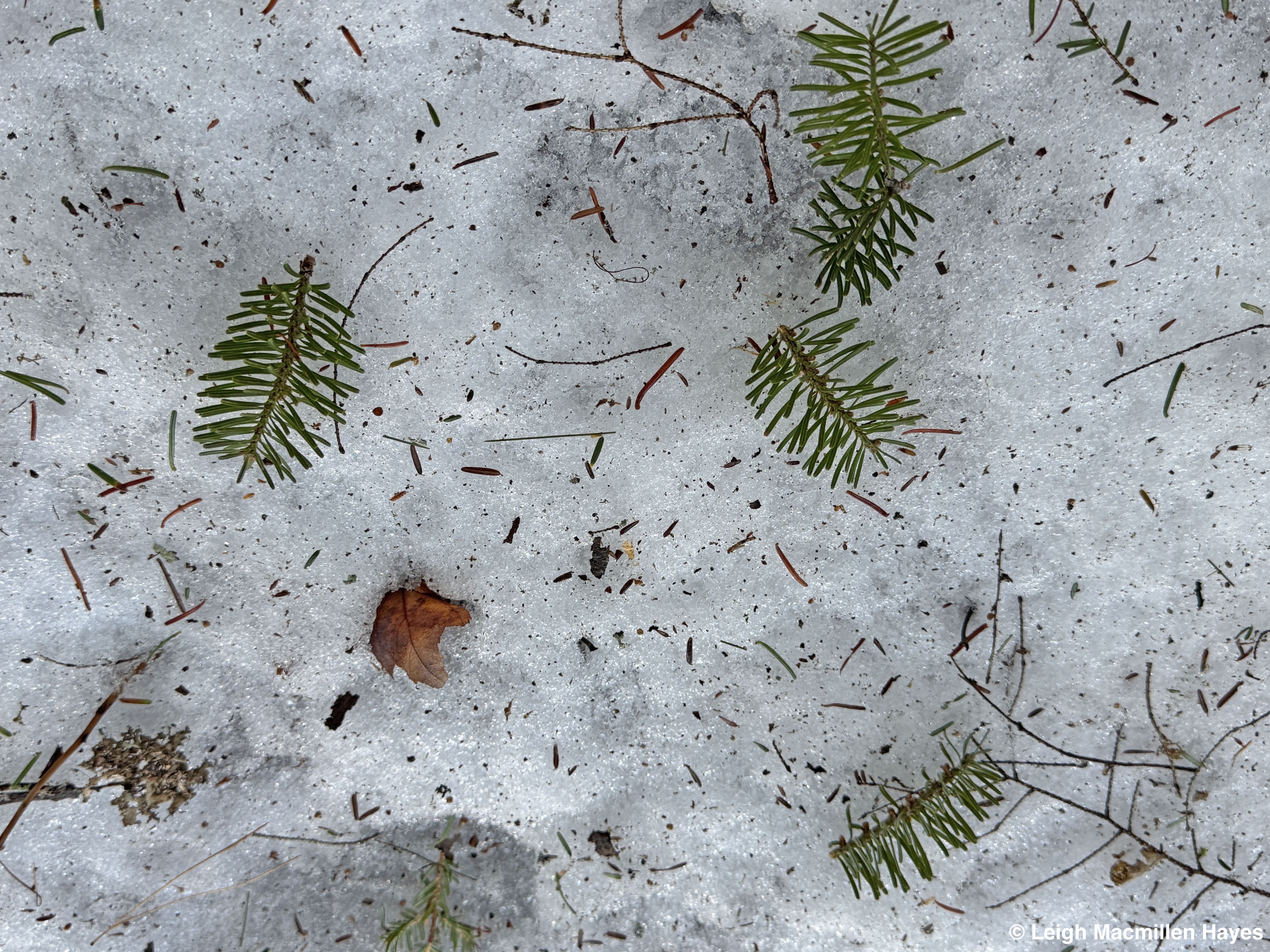
The sight of so many Eastern Hemlock twigs on the forest floor told me I’d stepped into Porky’s room so I looked for evidence, wondering if he was at his desk or not.

Lesson #2: Slow down and observe.

The answer was no, but he’d left his calling card on a dangling twig and so I know where I might find him should a prickly question enter my mind.

Because I was told by Red to slow down and observe, I noticed another spot where he’d visited and this time his midden was of a different sort in the form of snipped twigs. Much smaller snips than Porky drops, which is a good way to tell the two critter’s food source apart.

Just as Porky’s twigs had been cut with the rodent diagonal, so were Red’s.

I noted that he hadn’t eaten the buds at the tip of the twig, but once I flipped one over I discovered numerous buds or seed pods had been dined upon.

Lesson #3: Check twigs more often. And remember, this year was not a mast year for Eastern White Pines, so Red has to supplement with hemlock buds and cones. (And also remember, cones on hemlocks are not called pinecones because they don’t grow on pine trees. Conifer refers to cone-bearing, so both pines and hemlocks are coniferous trees.)

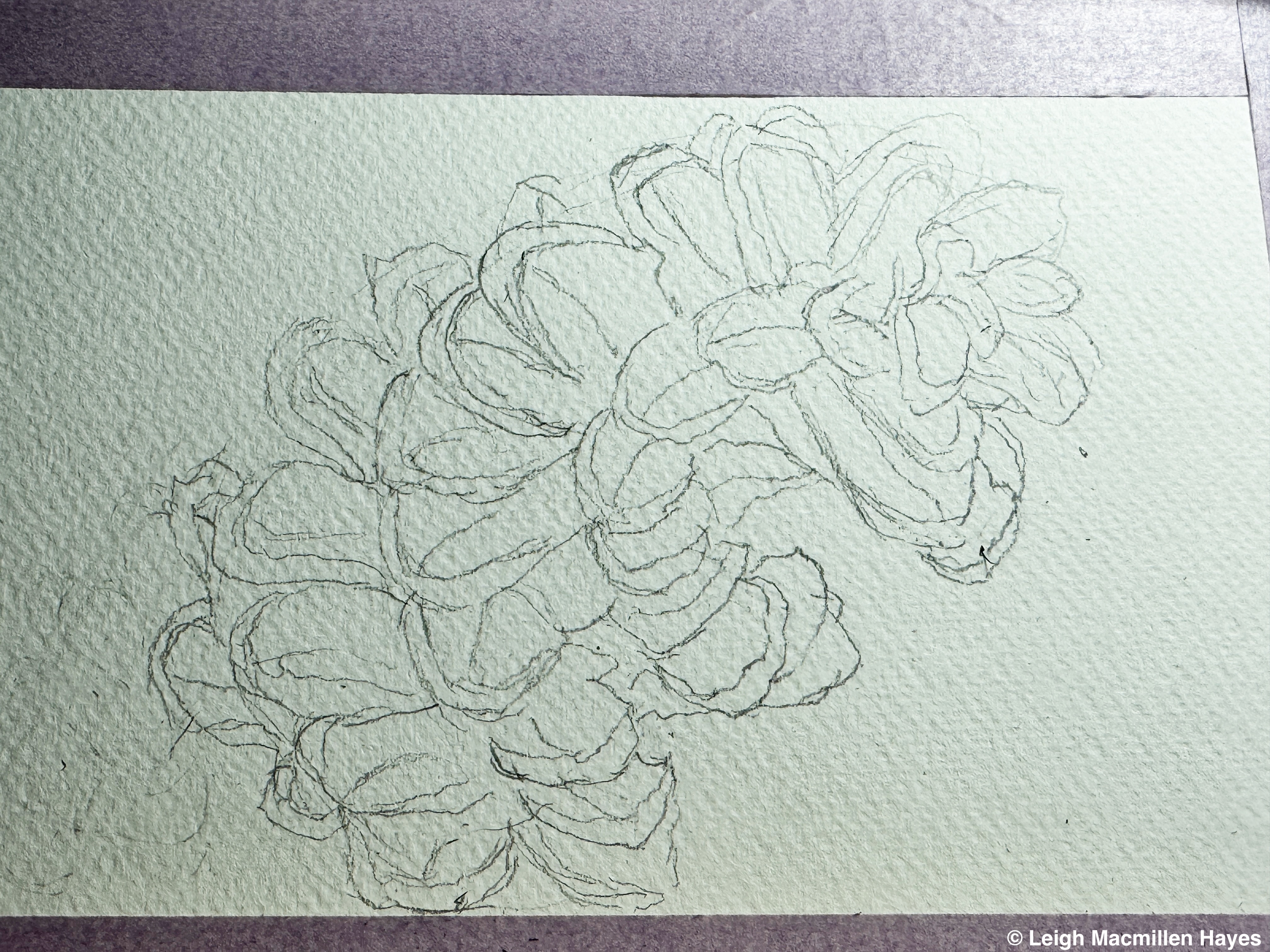
Back inside I decide to sketch a pinecone. It was a sketch I’d started months ago, but abandoned because it seemed to difficult to draw.

But then, thanks to Red, a realization came to mind.

Lesson #4: Pinecones have overlapping bracts or scales that protect those seeds developing inside of them. They close in the dark and open in light, especially on sunny days and it is then that the seeds become airborne on their samaras. And the bracts or scales grow in spirals around the core or what I think of as a cob. I knew that, but had forgotten it until I decided to sketch.

And so I drew some guidelines to aid me as I tried to recreate the cone’s spiral staircase.

It was fun to watch it grow and realize each cone actually fans out in a Fibonacci spiral sequence. It’s an amazing wonder of nature.

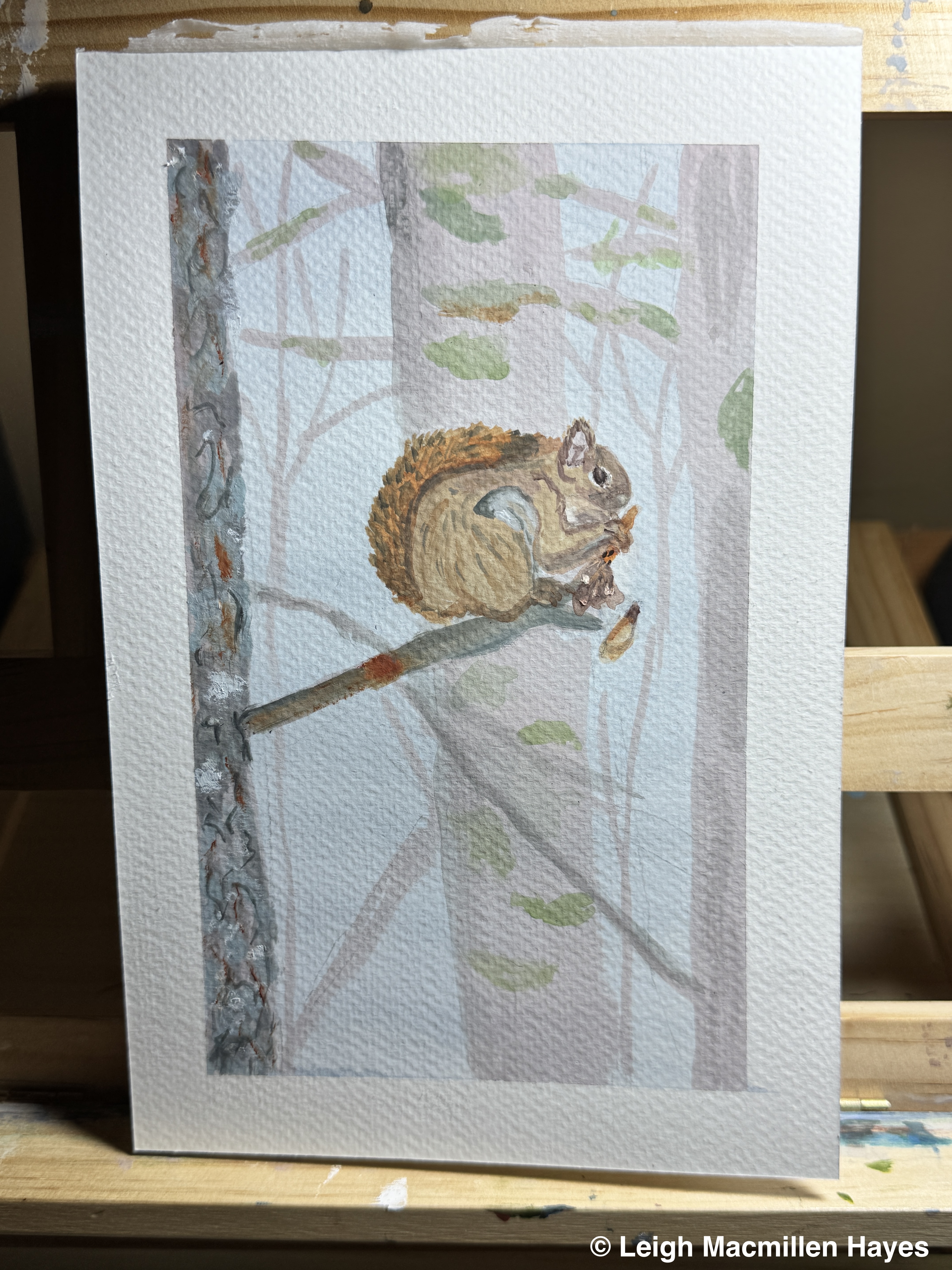
Feeling my drawing was complete, I began to add color in the form of gouache paint, scale by scale.

And slowly, the painting began to represent a cone . . . at least in my mind’s eye.

A dash more color and voila–my amateur attempt at painting a pinecone. I have to admit, I was rather tickled because I really didn’t think I could pull this one off. But I have my art teacher, the talented Jessie Lozanski, to thank for giving me the confidence to try.

And I have Red, my other teacher, to thank for the lessons because it was in watching him turn the cob ever so effortlessly that I was reminded about the cone’s spiral.

And so I tried to honor him as well. I may be a teacher, but I’ll always be a student.

Lesson #5: As we head into this new year, I hope you’ll join me in slowing down and noticing and honoring. Especially outdoors. Or even out your window.

I’m forever grateful to Red and all the other teachers who come in many forms, not just as mammals, for the amazing lessons I’ve learned and can’t wait for the next class.

CBC: Everything Counts

December 27, 2024. 8:15am. 5˚. Blue sky. No wind.

The perfect day to count birds for Maine Audubon’s Annual Christmas Bird Count.

Focus area: Sweden Circle, Maine.

Super focus area: Pondicherry Park and Highland Research Forest, both located in Bridgton, Maine.

Partner in counting: Dawn Wood.

The Christmas lights on Bob Dunning Memorial Bridge in Pondicherry Park rather said it all for so coated were they with ice crystals when we arrived this brisk morning. Fortunately, though, we knew it was going to be as cold as it was and had dressed appropriately.

And really, there is nothing more beautiful than the world beside water on such a morning for everything was coated like the candle and the world was transformed into a glistening display.

Just a few days prior, when I’d walked in the park, I had noted that Stevens Brook was almost completely frozen and feared we wouldn’t even see ducks on today’s count. But . . . wind a couple of days ago had done its own deed and opened things up.

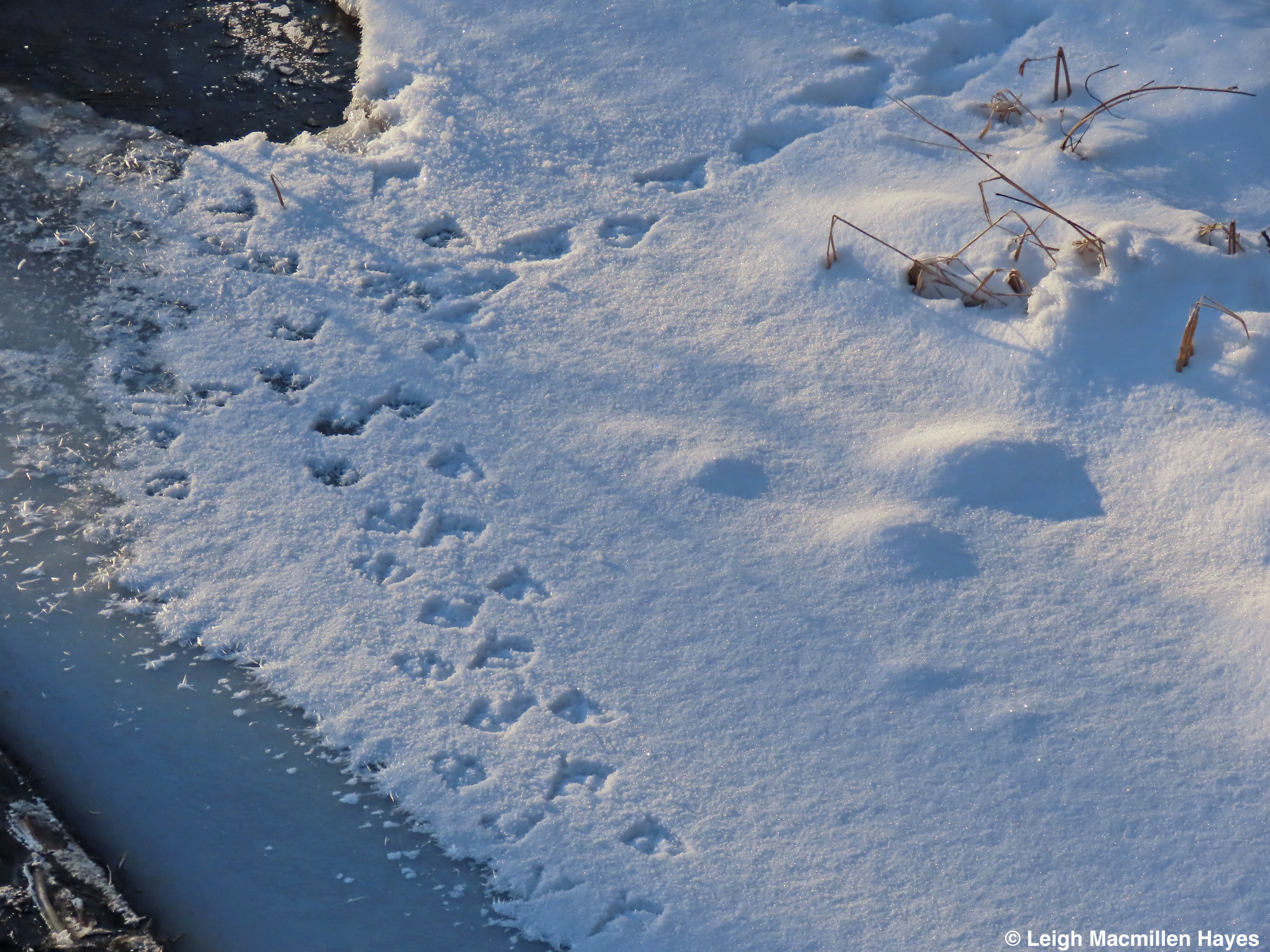
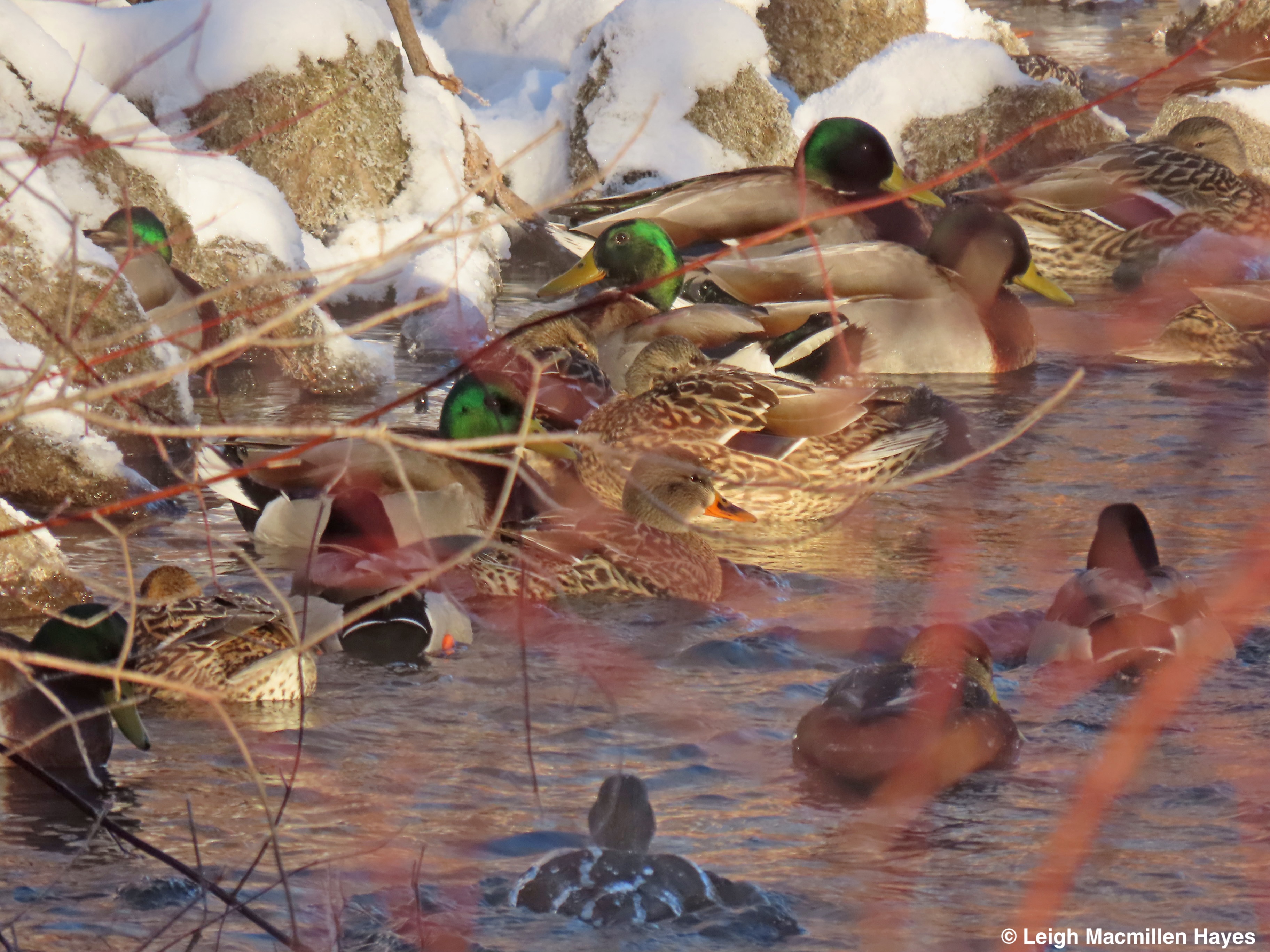
And much to our delight, we spotted duck tracks along the edge at about the same time that we heard a few Mallards quack in their Mallardy way that sounds much like a laugh.

And then we spotted more ducks and had to walk around a building to get a closer look. And count. And count again. And eventually decided on 100 as a number to represent the ducks as best we could for there were so many and they were in constant motion and some flew in in the midst of our efforts.

Half of birding is listening and it was the “Peter, Peter,” call that told us to look for the Tufted Titmouse.

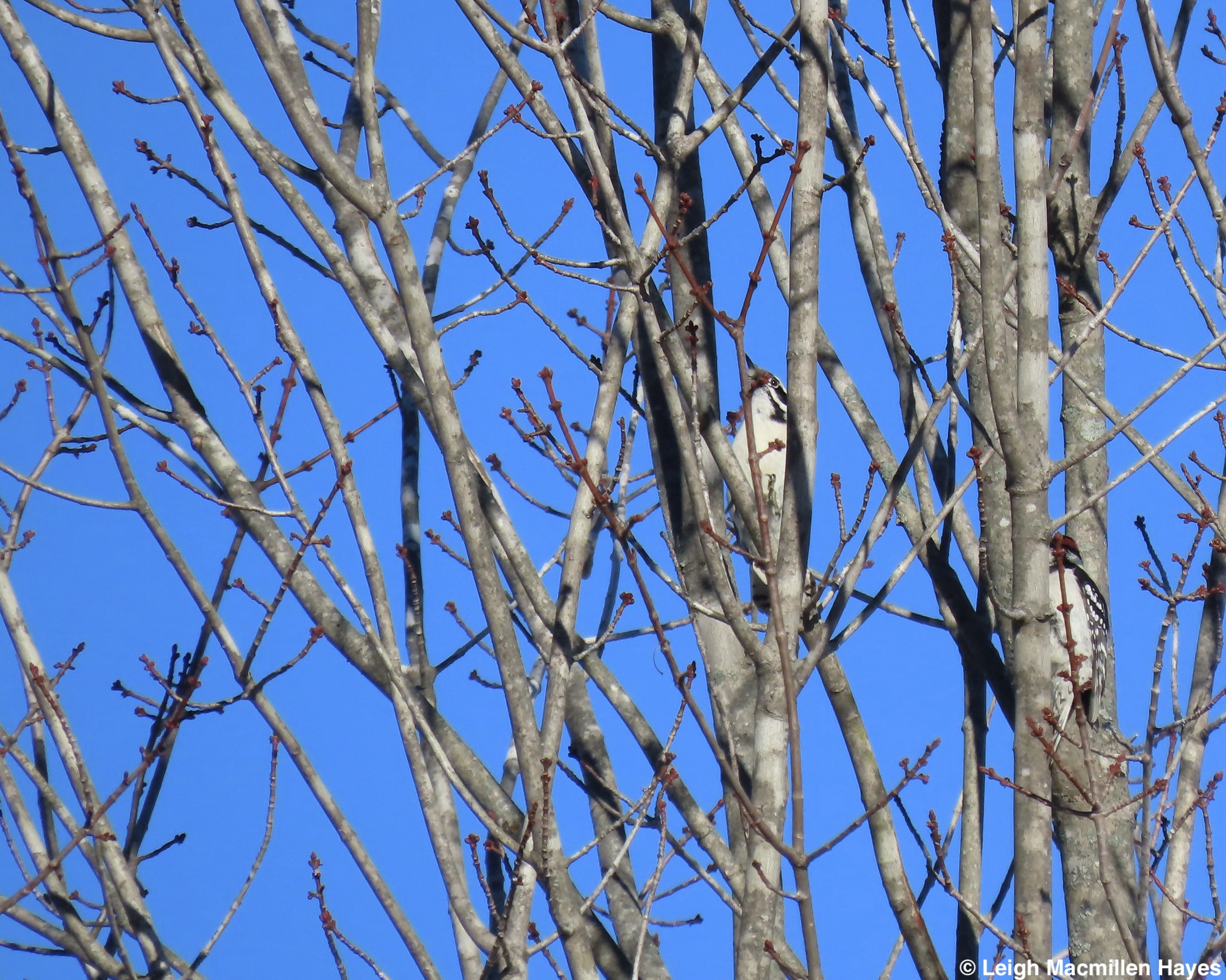
We also spotted two Hairy Wookpeckers playing a game, or so it seemed, as one would fly to a branch, the other would follow, and then the first would move again and on it went with them trying to mimic the branches between their flying sprints.

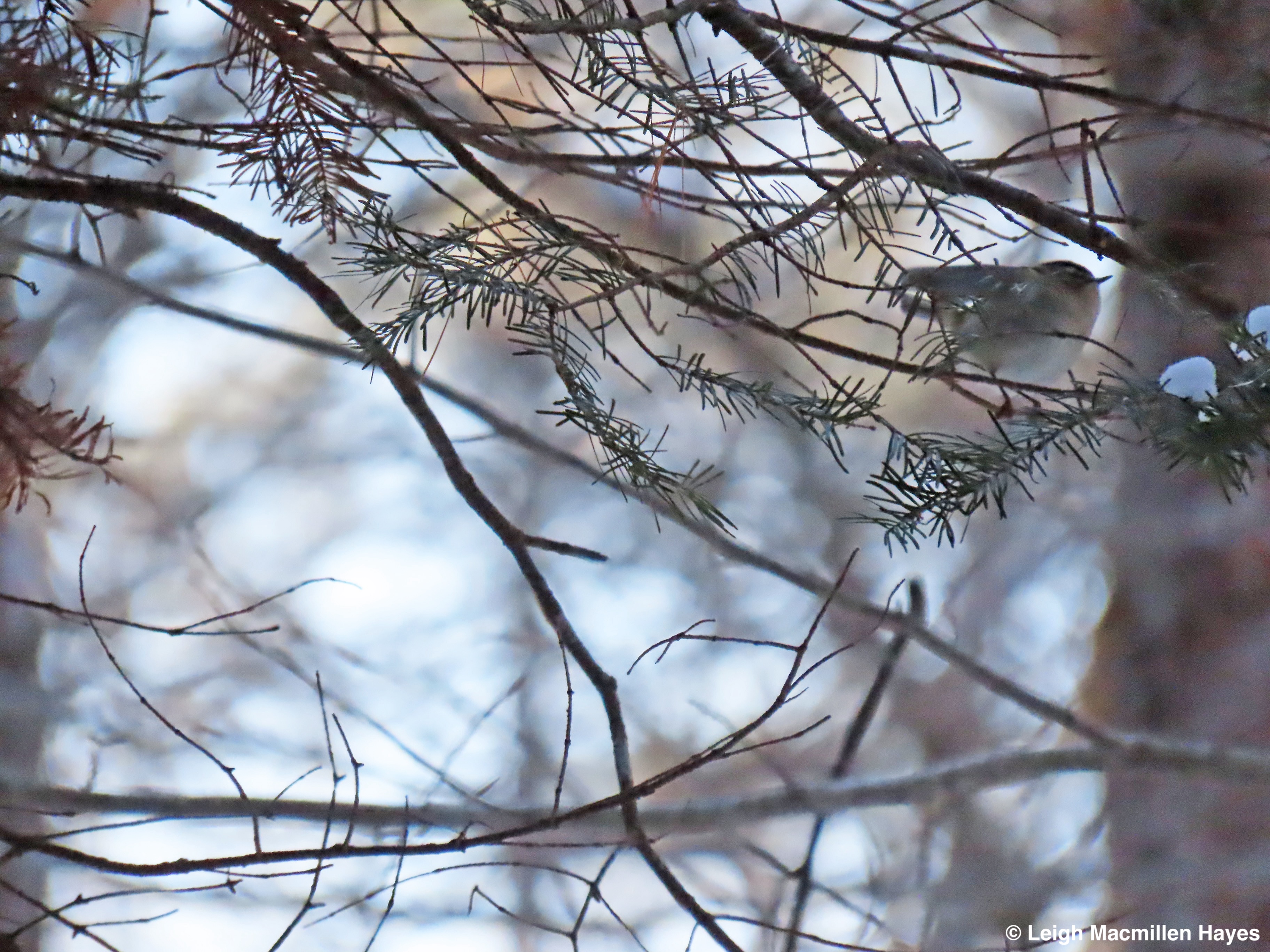
And talk about moving, we saw five Golden-crowned Kinglets, who performed their own acrobatic moves for us, which made them difficult to photograph for they were never still. That’s the thing about photographing birds–“And then it flew,” we’ve often been heard to say once we spot one.

As we moved along the trails, another site garnered our attention: wing prints. Dawn measured the wing span–36 inches. A bit too short for a Barred Owl, but it was still our best guess. And there was plenty of food available either atop the snow or just below in the form of mice and voles. We’ll never know who actually left these impressions or if a meal was part of the deal, but that’s okay because sometimes mysteries can’t be solved and that’s what keeps us going.

We did wonder if we could add such a sighting to our bird count, but since we couldn’t name the species, thought better of it.

In another area, we noted no birds, but plenty of fox tracks and even faintly sniffed the skunky scent of Red Fox. It seemed very curious about some holes so we went in for a closer look.

The best we saw–ice needles indicating one of two things: a critter surviving and breathing in the holes; or moisture below rising and freezing. We decided to stick to the first story and knew that we were one hundred percent correct because when no one else is around, we can think what we wish.

Another set of prints tricked us for a few minutes. Our first thought when we spotted the sashay look of the track was a Porcupine. Especially since we had just been talking about one that resides somewhere in my woods. But the prints within the track didn’t strike me as porky. And then we realized it wasn’t really a trough, but rather had a ridge in the middle. And it was skinnier than a porky trough would be.

What else could it be? And had we seen this sort of track before? And then it hit us: A Ruffed Grouse! Another bird sighting without the sight of the bird. Again, it didn’t count, but it was a great lesson as we ease into this year’s tracking season.

Before we left the park, we were in an area where I often see and hear lots of bird activity and today there was absolutely none. And then a Bald Eagle flew out of a tree. I wasn’t quick enough to focus the camera, but we both will hold that shot in our minds’ eyes.

After completing our survey of Pondicherry Park, we drove north to Highland Research Forest, and not far into the property began to spot Snowshoe Hare tracks. These are the snow lobsters of the North Woods for so do the set of four feet look when arranged perfectly, which doesn’t happen with each hop. But, if you look at the set of four prints in the bottom-most impression, you’ll see the two smaller front feet that landed on an angle thus forming the lobster’s tail, with the hind feet swinging around and landing in front of them to form the claws.

And where there are Snowshoe Hare tracks, there is scat.

Malt Ball-sized scat full of plant fiber, as it should be.

And when one is looking and listening intently, one sees all kinds of things. Yesterday, while hiking along a trail near our home with My Guy, we began to count Long-jawed Orb Weaver Spiders walking on the snow, proving not all spiders are dormant in the winter. That made sense for yesterday afternoon as the temperature was above freezing, but today’s temp was colder and though it eventually reached 32˚ by the time we finished, it was still in the 20˚s when we began to spot this behavior.

I assume the spiders are able to lower their bodies’ freezing point by producing a cryoprotectant, a glycerol anti-freeze compound that prevents them from freezing. An amazing adaptation.

Going in for a closer look, check out those hairy legs! And the long pedipalps used in reproduction; they are also tactile and function like insect antennae.

It’s funny how once you notice one thing, your attention is attracted to another, and such was the case that as we hunted for spiders, we spotted a caterpillar, that didn’t seem to be alive and can only trust that it was blown off a twig.

Like the park, Highland Research Forest is located beside a wetland and a lake, with lots of waterways in between. And like the park, the frost offered artwork, each crystal unique.

Since we were there to scan the wetland for birds but came up empty handed, we were forced to observe the newest beaver lodge in town. We didn’t walk out to it, because of course, tracking was not our official business of the day, but we suspect based on the mud and resent log additions, that it continues to be inhabited.

We really were birding. Honest. It’s just that this property usually has less activity of the avian sort than the other and today was no different. And then we realized that a year ago we said we’d start here in the morning and may be be honored with more sightings, but in the planning stages forgot, so have promised ourselves that next year we will begin our birding adventure at Highland Research Forest and then go to Pondicherry.

But tracks. Oh my. We saw tracks. Which brought up another discussion. Two years ago Dawn assisted me in leading a Senior College tracking expedition on this property. I chose it because I knew it to offer many tracks of a variety of mammal flavors. And that year, we walked a loop trail and finally found signs when we were about two tenths of a mile from the starting point: a Deer rub on a tree; and one or two sets of Snowshoe Hare tracks.

Today, however, while bird activity was almost non-existent, the mammal activity was overwhelming. Including these Fisher prints. (Note to the wise: Fishers are in the weasel family and not the cat family, so they are Fishers and not Fisher Cats.)

And on a high spot near the trail in the midst of the Fisher track: another sign post. Fisher urine. Apparently he was marking his territory with a mere dribble here and another dribble there.

Reaching Carsley Brook, we paused on a bridge, again in hopes of hearing a few peeps. There was an occasional Black-capped Chickadee and a White-breasted Nuthatch, but few others making their presence known.

That said, there were other presents to honor, again two other members of the weasel family: an Ermine and a Mink. The giveaways, track width and foot orientation on a diagonal.

Moving away from the brook, we again found bird sign in the form of . . . Turkey prints. But again, though birdy they were, they couldn’t count toward the bird count.

Pausing as we did frequently to make sure we didn’t miss anything in the bird department, we spotted others flying from twigs. Well, maybe not flying yet. But certainly dangling. As is their habit in the winter. The first was the cocoon of a Promethea Moth, which will fly in the future.

And a few feet farther along the trail, that of a Polyphemus Moth.

Both are attached to the twigs with an incredible reinforcement of silk, and reminded me of how my friend Marita recently reinforced the “idiot strings” on my mittens so they can dangle from my wrists when I take them off to jot down notes or take a photograph.

We also found another spider to admire.

And a kazillion mouse tracks showing their keen interest in risky night-time missions.

Just before we finished, and while we were searching the trees for a Woodpecker, an anomaly caught my attention and I realized I was starring at a Barred Owl. Unfortunately, it flew off before I had a chance to focus the camera on it, but like the Bald Eagle earlier in the day, it was a thrill.

Oh, and did I mention the Great Horned Owl that we spotted this morning as it kept watch in the exact spot we saw the Eagle? It’s amazing the Bald Eagle didn’t take it out, but this bird seems to lay claim to the area for it sits in the same spot day after day.

At the end of our Christmas Bird Count today, these were our findings:

Distance covered: 5.8 miles

Time of travel by foot: 6 hours

Mallards: 100

Downy Woodpeckers: 5

Hairy Woodpeckers: 3

Pileated Woodpecker: 1

Blue Jay: 5

American Crow: 10

Black-capped Chickadee: 17

Tufted Titmouse: 3

Red-breasted Nuthatch: 1

White-breasted Nuthatch: 9

Golden-crowned Kinglet: 5

Dark-eyed Junco: 2

Bald Eagle: 1

Barred Owl: 1

Long-jawed Orb Weaver Spiders (12/27/24): 14; (12/26/24 with My Guy): 94

Caterpillar: 1

Moth Cocoons: 2

Tracks: a zillion including Ruffed Grouse and Turkey.

Surely the bird tracks count for something as everything counts.

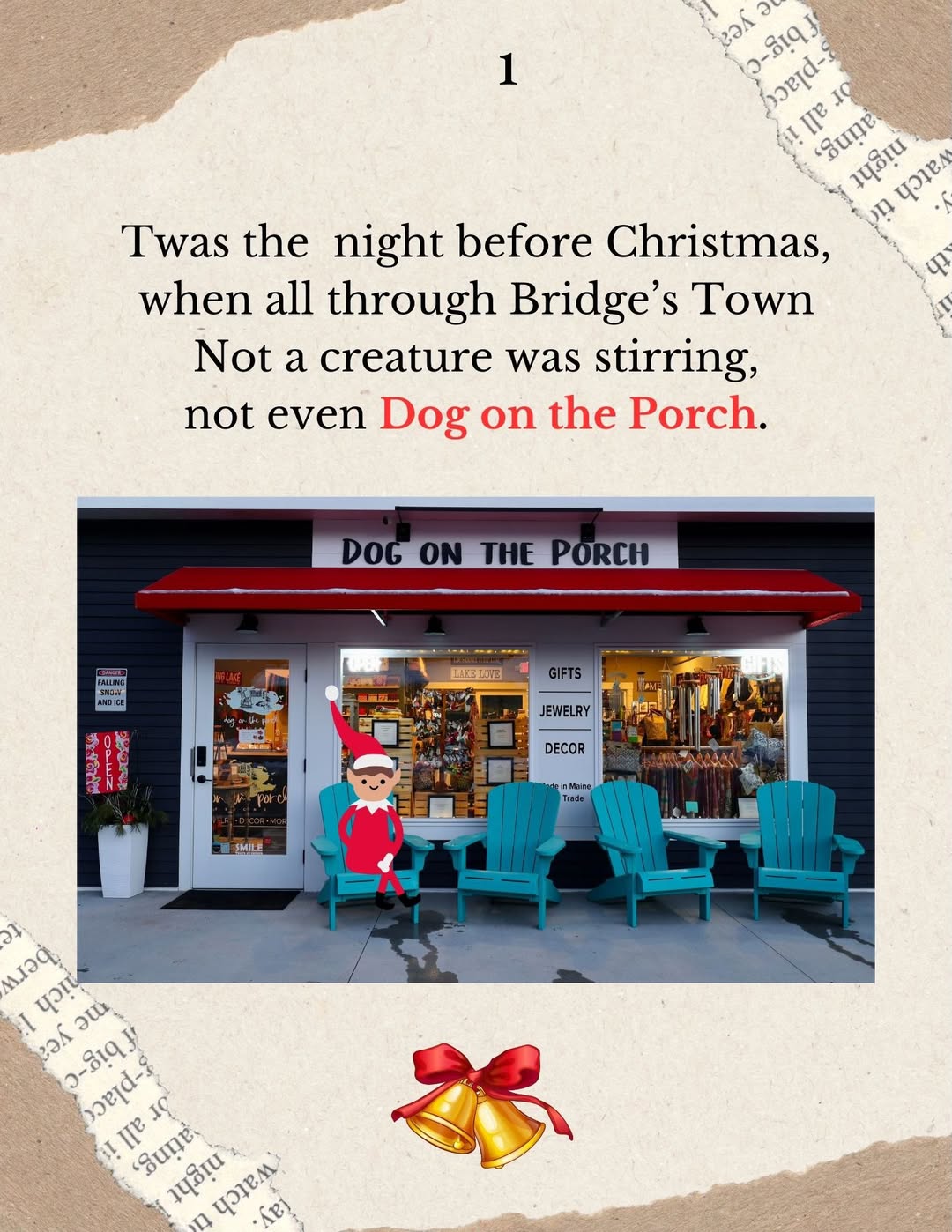
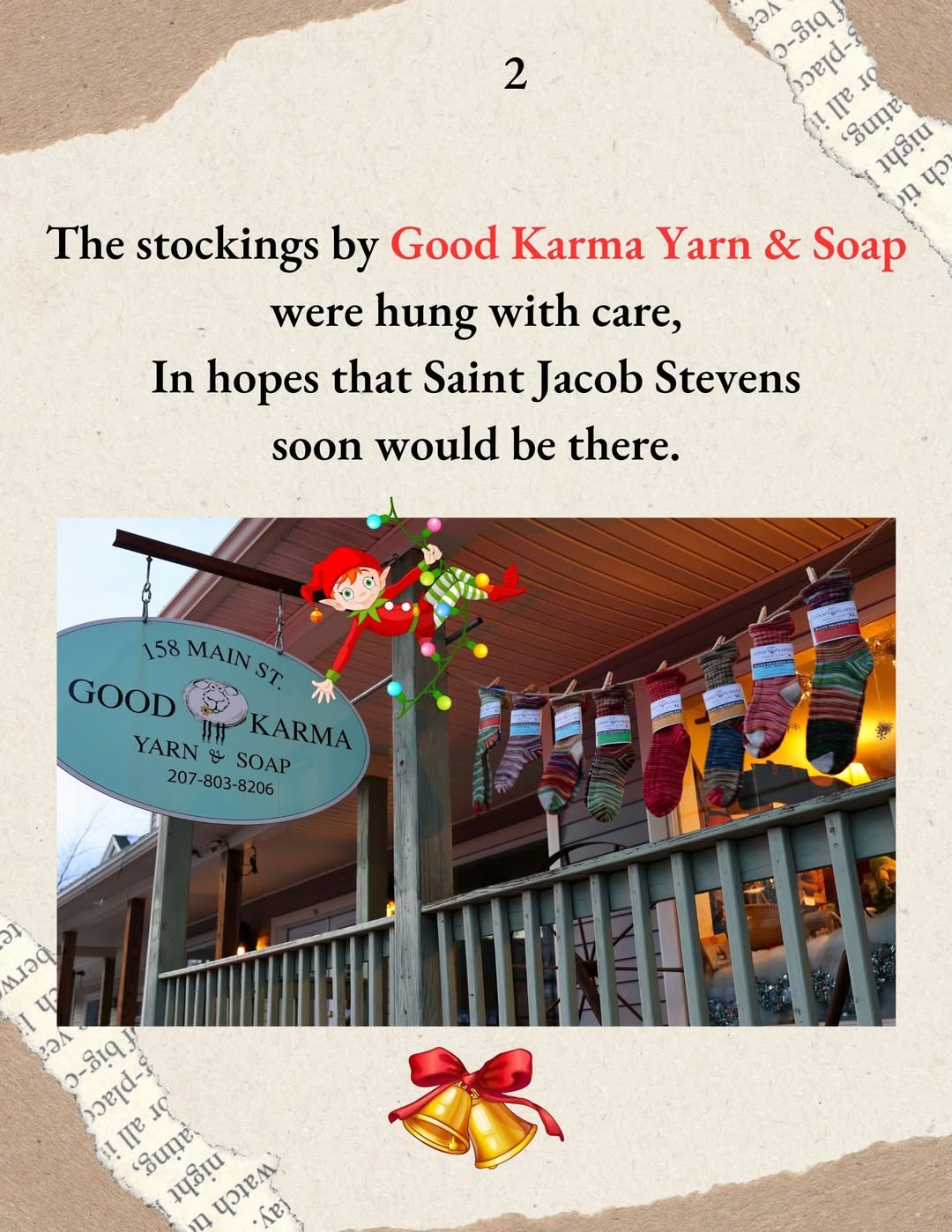
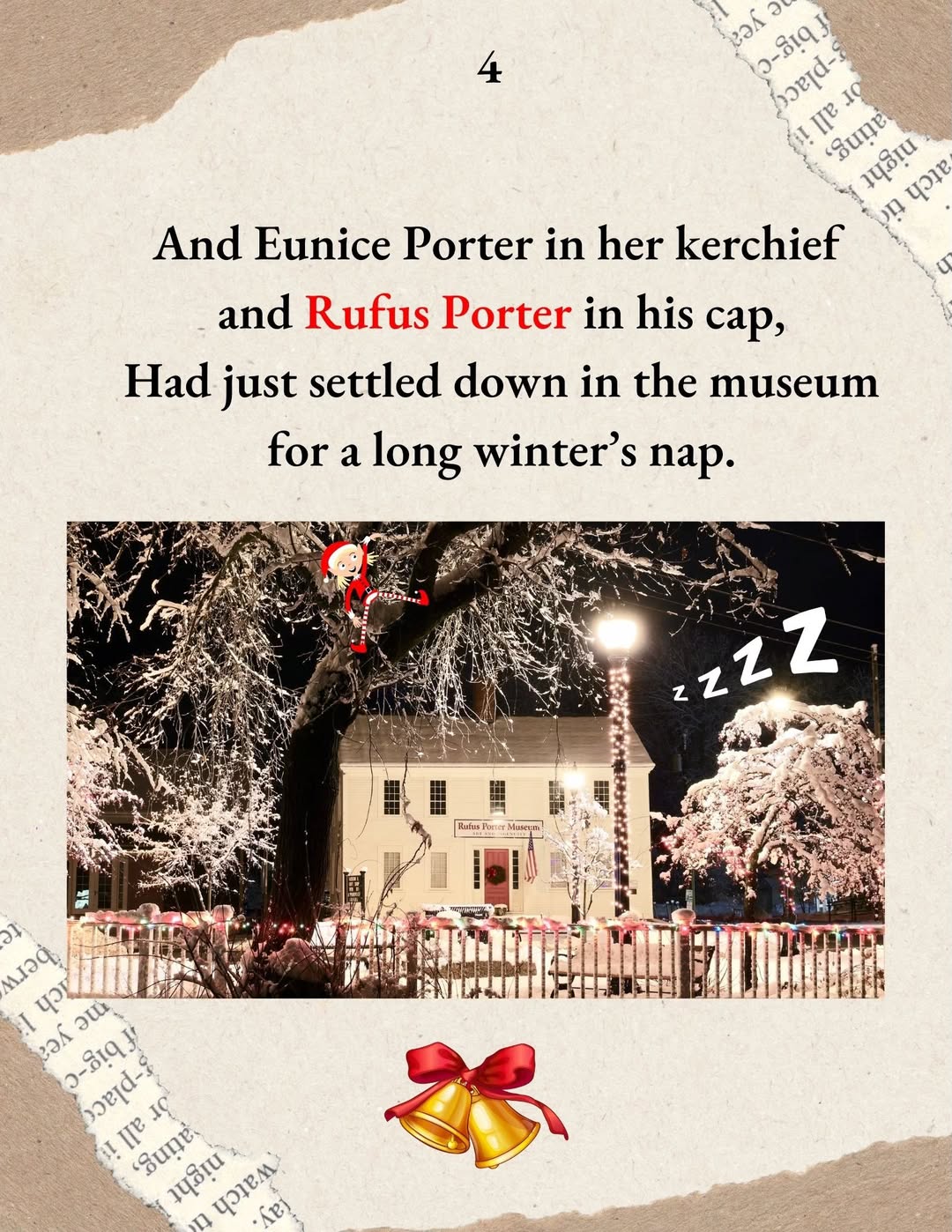
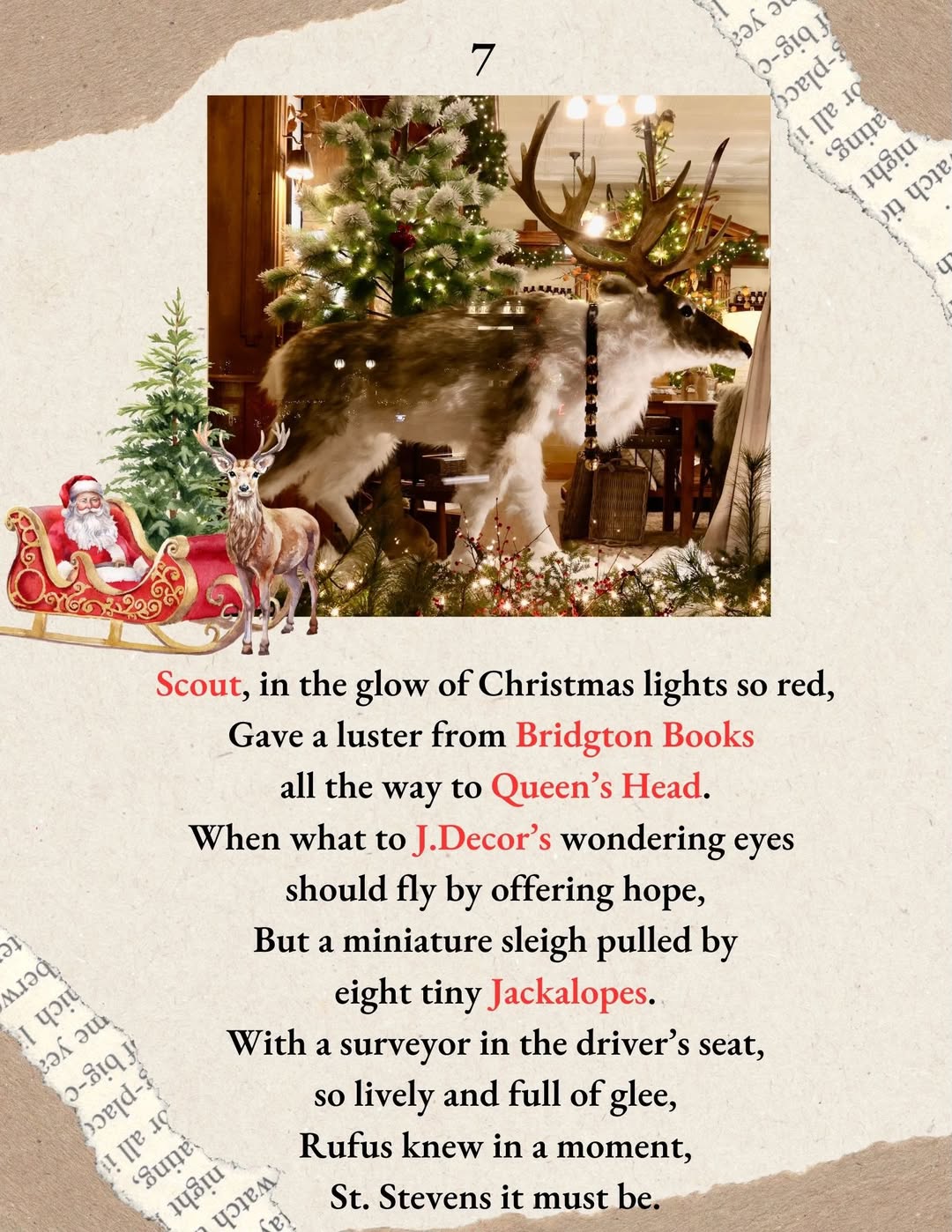
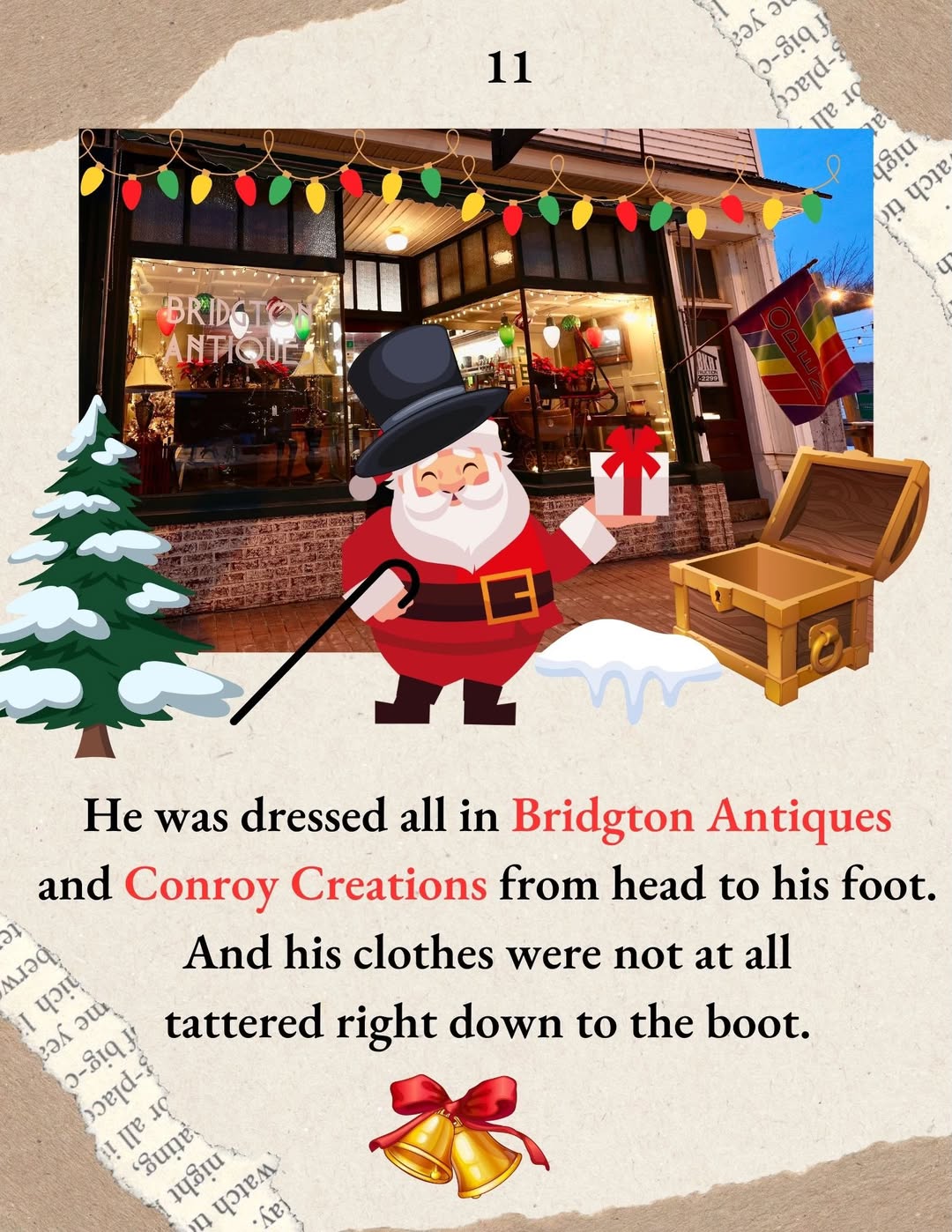
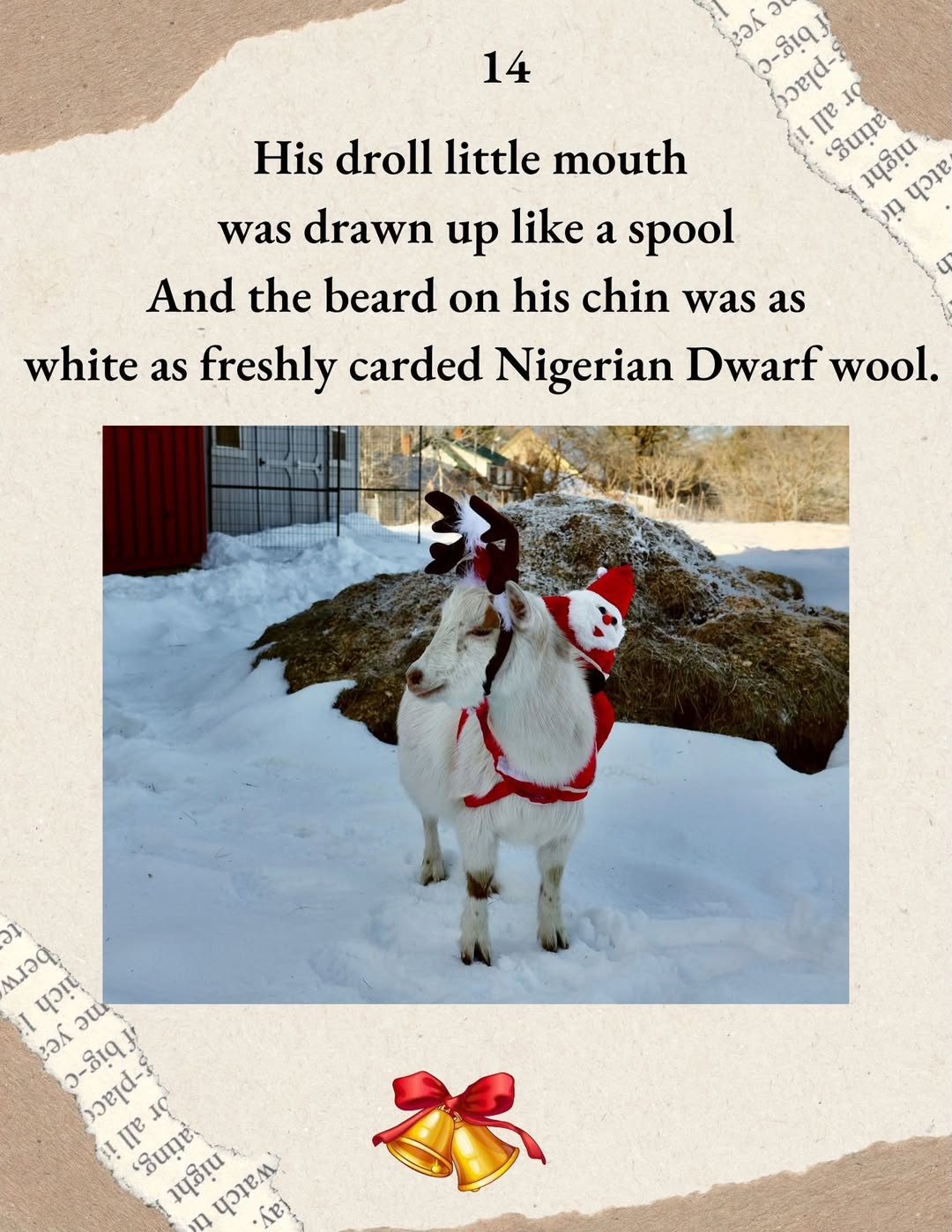
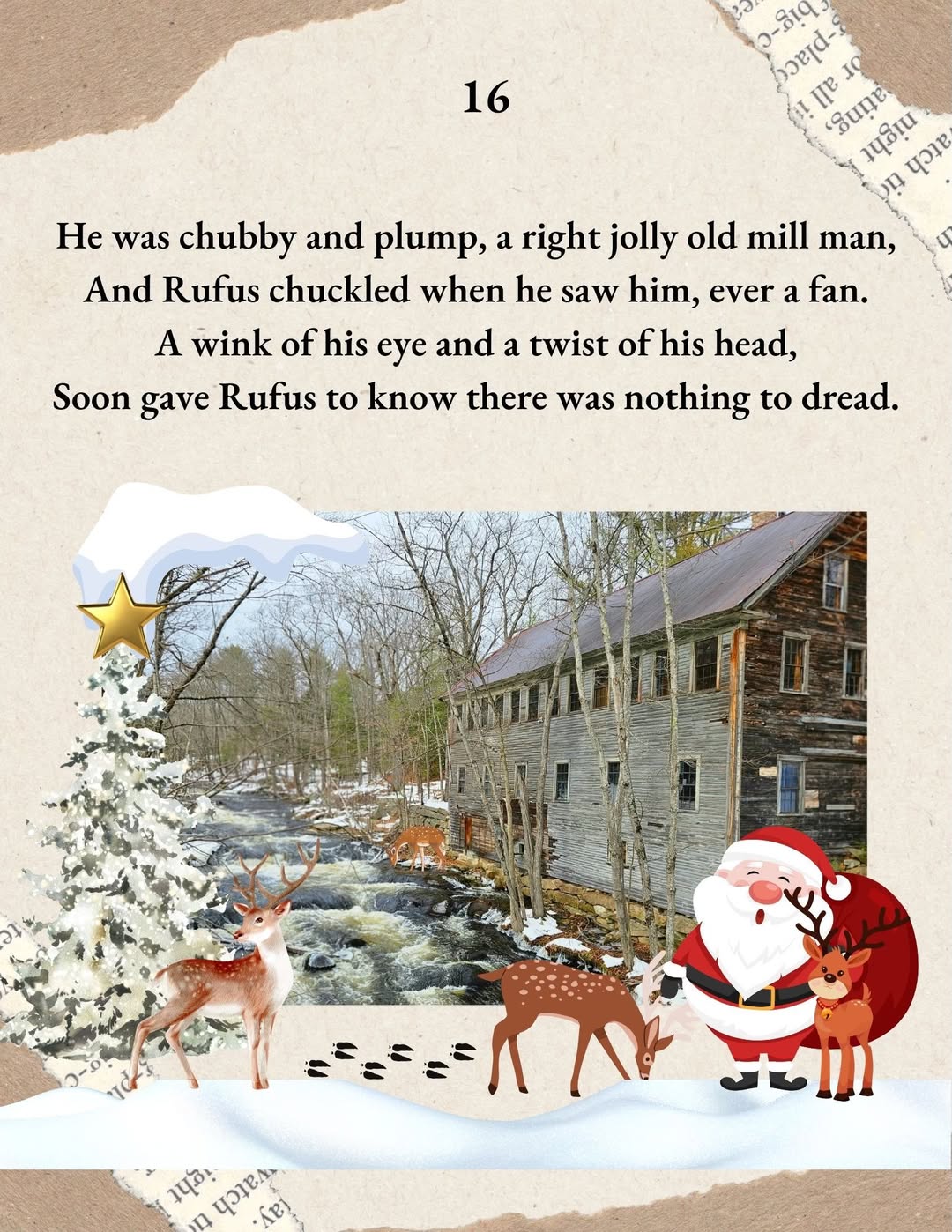
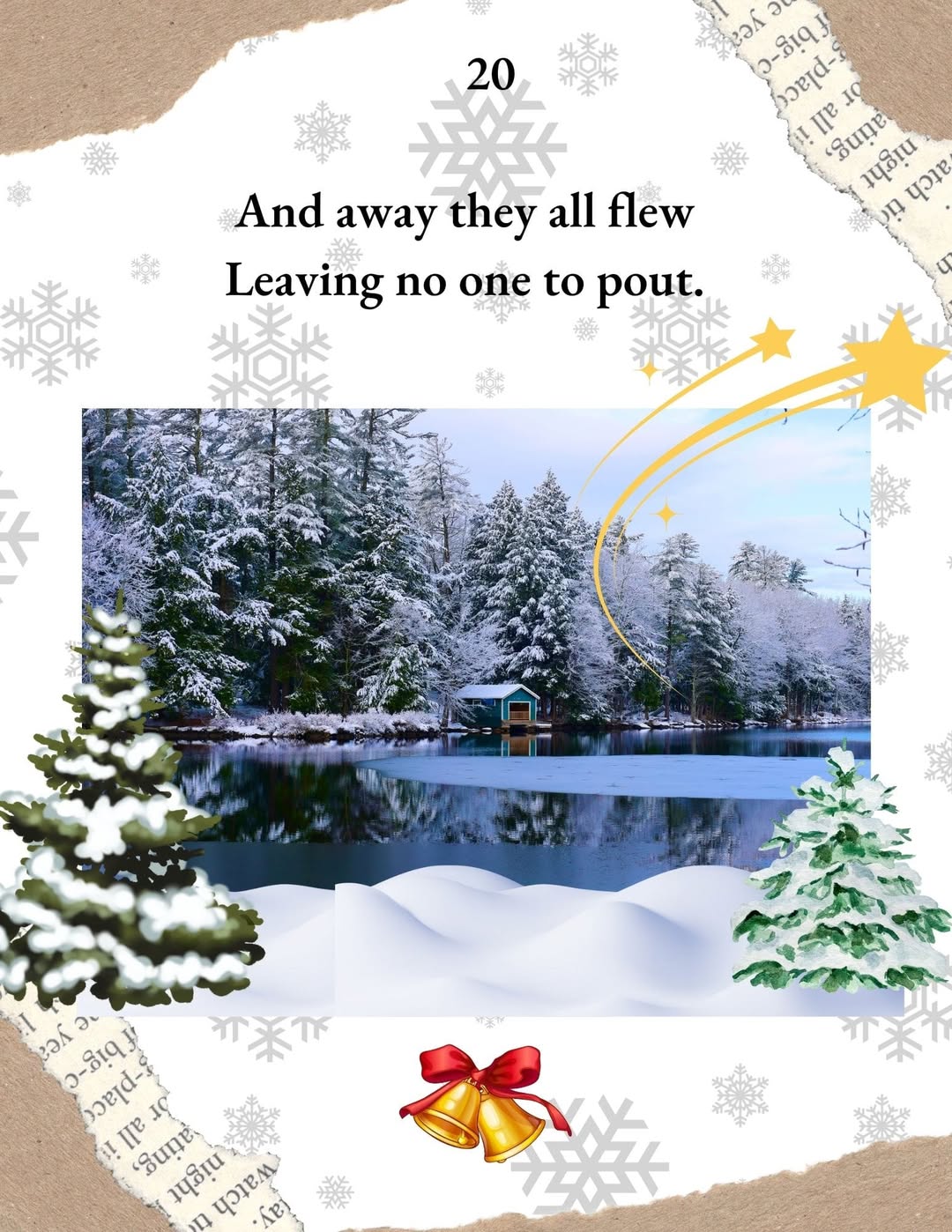
Twas The Night Before with a local twist

Pam Ward and I hope you have enjoyed reading our rendition of “Twas The Night Before Christmas” as much as we enjoyed revising and illustrating it so it encompassed at least a wee bit of our community and the spirit that ties us together.

Pam is a photographer and co-owner with her husband, Justin, of Bridgton Books. Please be sure to step into this wonder-filled independent book store when you are in town. Oh, and you might purchase a copy of The Giant’s Shower, a fairy tale, while you are there.

Wait. Watch. Wonder. Learn.

As I waited for the sun to rise on this final day of autumn 2024, before the dawning of the winter solstice, I watched the sky. It seemed late. Of course it seemed late. Tomorrow will be the shortest day of the year.

Ever so gradually, the sky brightened. First, there was barely a hint of light shining through the trees as if taking its time was a way to remind me to slow down.

And then I began to see it. Not the orangey-yellow I expected, but rather a blue gray that slipped out from behind the silhouettes of the tree trunks, who stand as watchers, observers, of every dawn every day.

Ever so slowly, a hint of pinkish purple rose in the East and the blue gray was transformed.

I, too, wished to be transformed. By this first light. By this new day.

And then it occurred to me that I do rejoice at each daybreak and look forward to its offerings.

Today, however, was a wee bit different as it was the day to enter a place I’ve barely visited since the spring and I felt drawn to part the hemlock boughs and venture forth into my own secret garden, that isn’t a garden at all, at least not if you expect it to be a place where flowers and vegetables are tended. Ah, but it is a garden from so many others. And its those others that I hoped to meet.

In her book entitled Church of the Wild: How Nature Invites Us Into The Sacred, author Victoria Loorz writes, “You wander slowly and intentionally. It is your full presence along the path that matters. It is an act of reverence, a saunter. John Muir hated the word hike. He urged people to saunter. ‘Away back in the Middle Ages,’ he told his friend once, ‘people used to go on pilgrimages to the Holy Land, and when people in the villages through which they passed asked where they were going, they would reply, ‘A la sainte terre,’ ‘To the Holy Land.’ And so they became known as sainte-terre-ers or saunterers. Now these mountains are our Holy Land, and we ought to saunter through them reverently, not ‘hike’ through them.”

And so I sauntered, not letting the stone walls or barbed wire stop me from crossing over manmade boundaries.

All the while, I wondered, “Who will I interact with today?” and “Will I be able to shut down my inner ramblings and really wait, watch, and listen?”

My heart quickened despite my efforts to slow my breathing, when I spotted not only the heart-shaped prints of White-tailed Deer who really own these woods, but also one who pursues them, the Bobcat.

Would I spot any evidence that though they travelled in opposite directions a day or so apart, their paths eventually crossed? That remained to be seen.

What I did know was that unless I sat for a time, I would not spot any critters because the snow conditions were such that I stood firmly on top–like walking on water–frozen water, and made a loud crunching sound with the fall of each footstep.

Those who know me well, know that I am a cradle Episcopalian. Among other things, I love the liturgy. But what I’m discovering I love the most is the shared fellowship with a diverse group of people.

And in the same way, I love the woods out my door and how each and every other-than-human being IS diverse, and how they aid and abet their neighbors, sometimes offering a helping tree limb or shared nutrients, and other times feeding upon others because they, too, need energy.

And in the forest, there is life and death, and a dead snag can be just as beautiful as a live tree. And in its death, offer space for others to live.

During today’s saunter, I bushwhacked sometimes and followed old logging trails in other moments. During all of my visit, I often encountered places that needed consideration for navigation, but in the pause as I gave thought to my way forward, I noticed reflections that reminded me of my desire to do the same. Take time to reflect.

I made sure to look up and down and felt a need to celebrate discoveries, such as this perfectly round Snowshoe Hare scat. Last year there weren’t many hares in this part of the woods, so I can only hope that this year will be different.

Evidence of deer activity was everywhere, from well tramped routes that generations have followed for eternity to freshly rustled up Northern Red Oak leaves indicating a search for acorns to dine upon.

What made me chuckle, however, was the realization that it wasn’t just the deer who were taking advantage of an abundant acorn crop. A squirrel had cached one here and another there–that should serve as a meal for a later day.

After searching for a friend I doubted I’d meet, and I didn’t (Porky is saving our meeting for another day), I stepped out to an old logging road and instead met another I couldn’t recall from previous saunters. Perhaps it was because I was approaching it from a different direction than my norm.

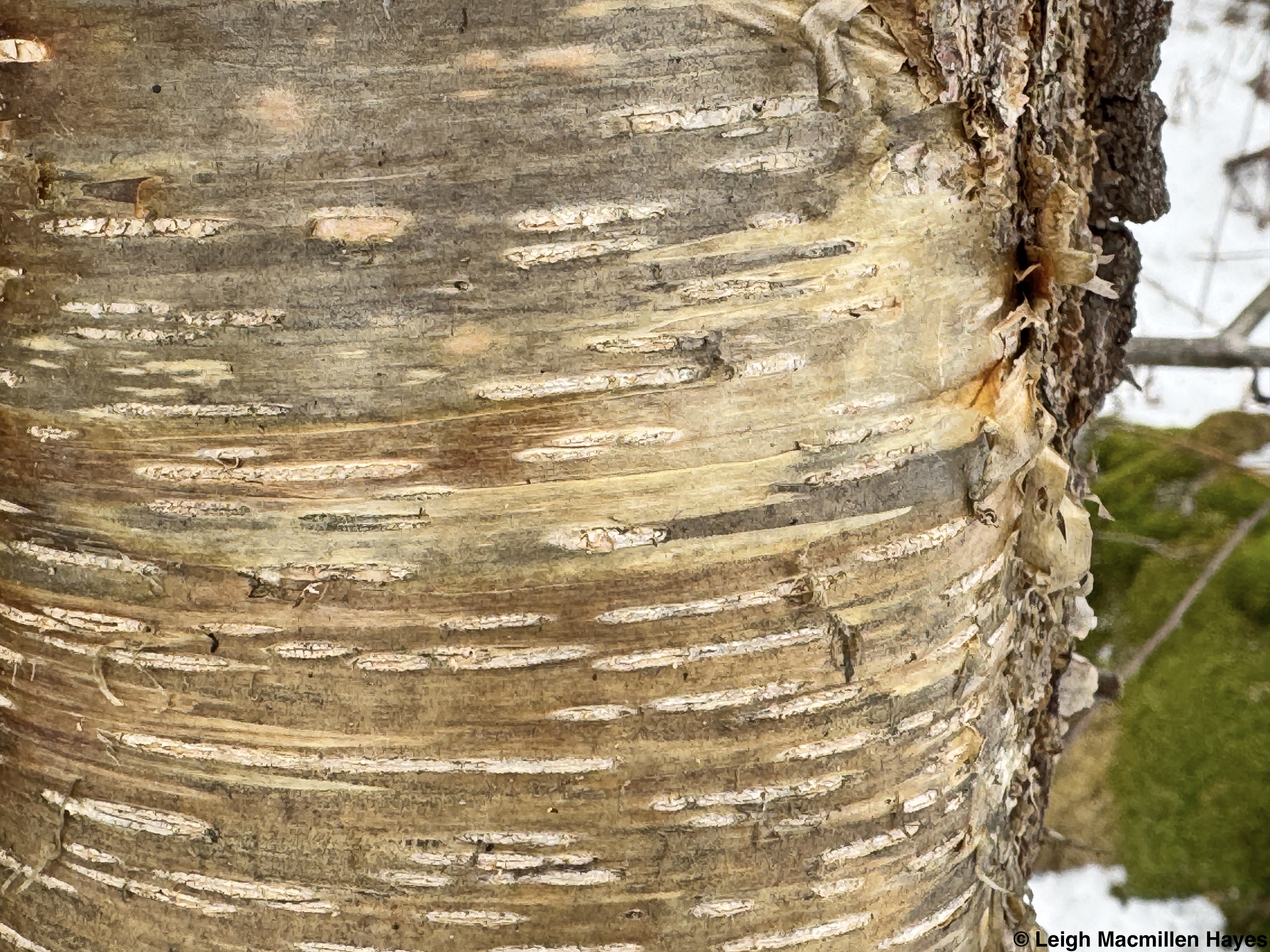
This Yellow Birch has apparently graced this spot on a boulder for many years. And though it looks as if it served as a turning tree during a logging operation about ten years ago, it still stands tall.

In fact, by the amount of catkins at the tips of its branches, it appeared the birch was full of life and love and ready to make more birches in the future.

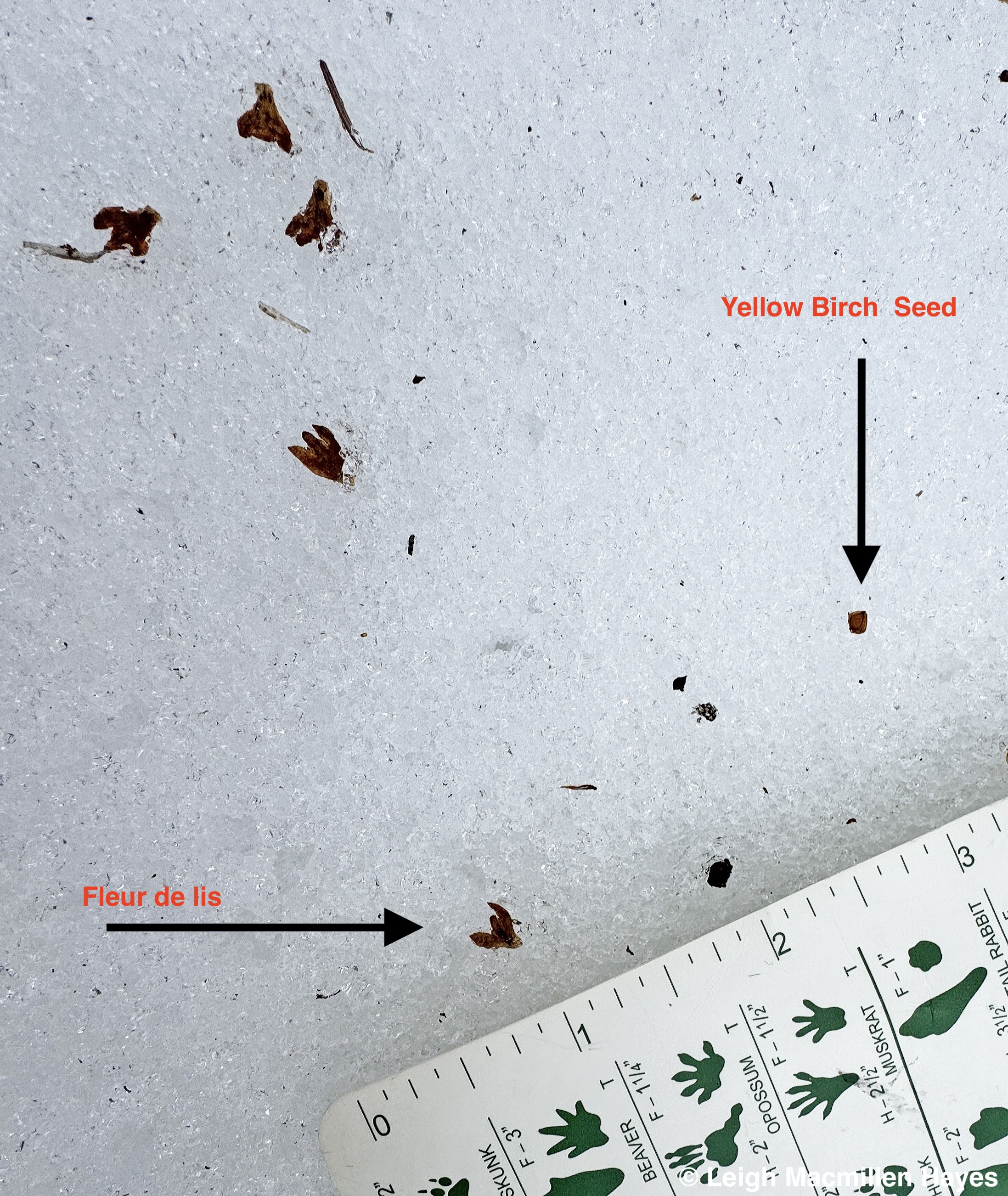
At its feet, fleur de lis scales that protected its tiny seeds had fallen from last year’s pollinated catkins and will eventually break down and add to nutrients to the forest floor.

What I am always wowed by, and today was no different, is the shape of a birch seed–which reminded me of a tiny insect with antennae. A future is stored in that wee structure and maybe this one seed will some day germinate on the boulder below it. Unless a bird eats it first. But then again, maybe it will germinate somewhere else when it comes out in the bird’s scat.

The bark of the birch made me think of landscape paintings I’ve seen from deserts far from this place in western Maine. And I realized I don’t have to go far to travel to other places.

Even as I left the Mother Birch behind, I turned back to see if I could remember it from so many other visits, because certainly it didn’t just appear today. Or did it?

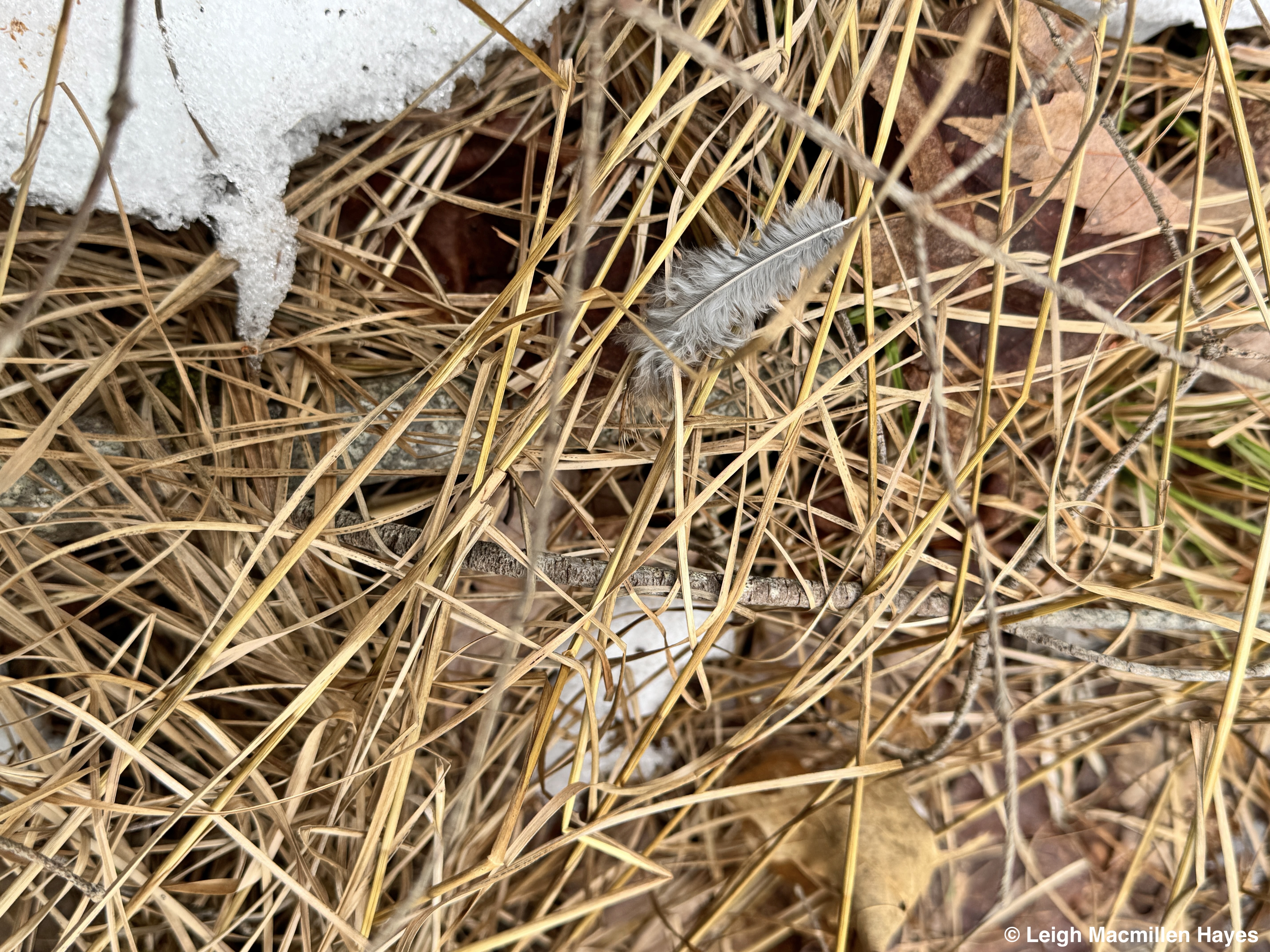
Turning around again, I nearly tripped over a few fallen twigs, but it was what stood out among the dying vegetation covering the twigs that drew my attention. A random feather?

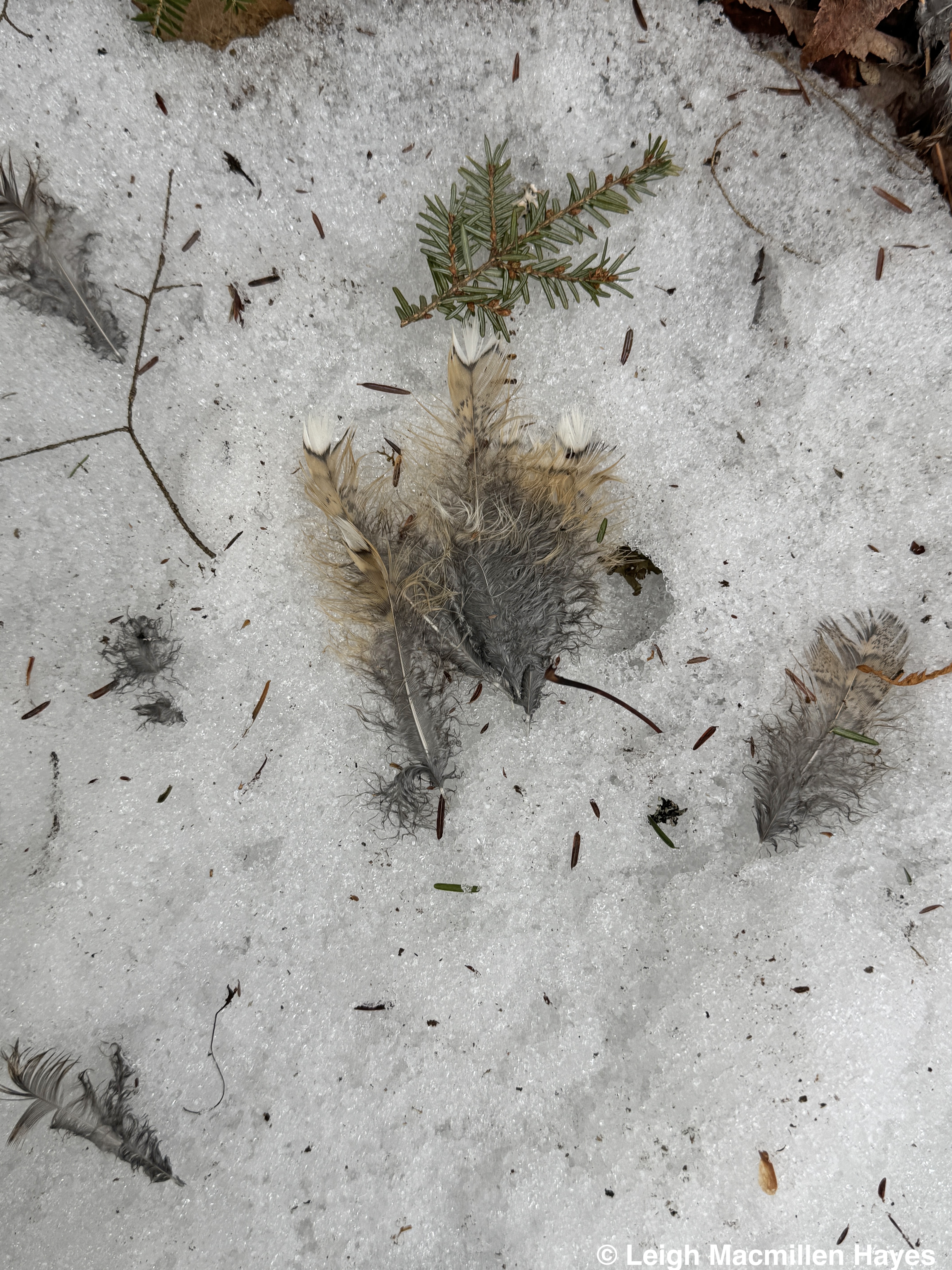
Not at all. I’d stumbled, rather than sauntered, upon a site where a bird had given up its last breath so that another critter could live.

The bird happened to be a Ruffed Grouse, and I had to remind myself not to be sad about the loss because of the joule or energy units procured by another. In its death, sunshine and birch seeds and whatever else the bird had eaten provided sustenance in the form of a gift.

Of course, spotting the Ruffed Grouse’s track did give me pause for I suspected it to be the bird’s last impression.

Moving on toward a former log landing, I smiled again at the sight of another who took a risk of crossing the large forest opening, but knew enough to tunnel under the snow frequently. Was it frequently enough? Voles are everyone’s favorite food. Well, maybe not mine. But I’ve possibly eaten meat from some critter that dined on a vole and so maybe some of its joule had been passed on to me as well.

Frequently on my journey, as often happens in these woods, I encountered the one who greeted me at the start. Well, its footprints greeted me at least. But I always give thanks for such sightings for though Bobcats are solitary and elusive, knowing they are here and that we walk in the same woods and perhaps see and smell the same things makes me happy.

And then it occurred to me. I need to be more like the Bobcat and improve my waiting and watching and listening skills. I’m always in too much of a rush to see what might be next on the agenda. So much for sauntering.

As this last day of autumn 2024 gives way in the wee hours of December 21 to winter, and the sun once again rises in the East, I need to remember to be more like the saunterers. To be alert to offerings. To wait. To watch. To wonder. To learn.

Each day is a new awakening with teachings. Thank God for that.

My Bright Idea: Filled with Awe and Wonder

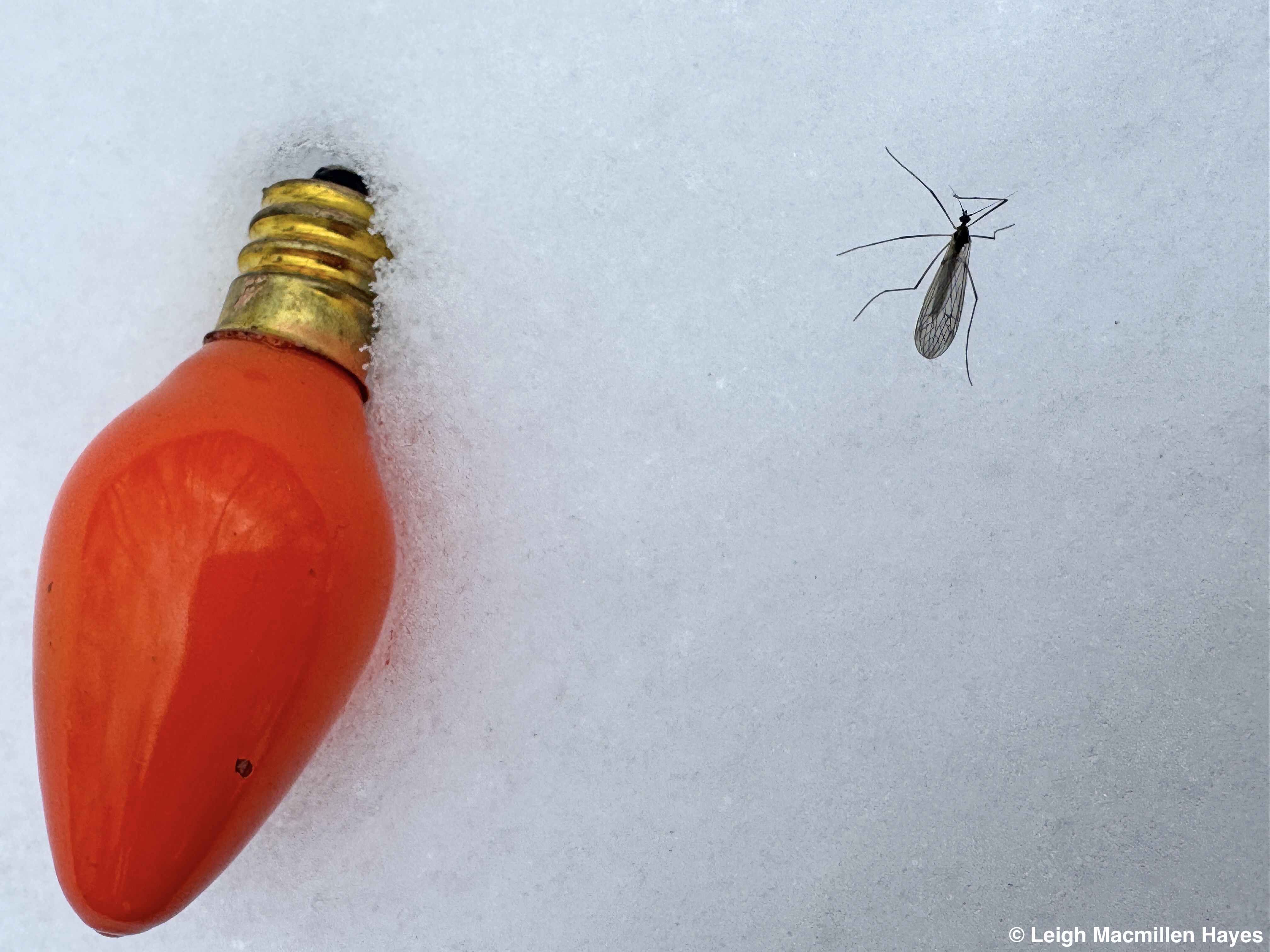
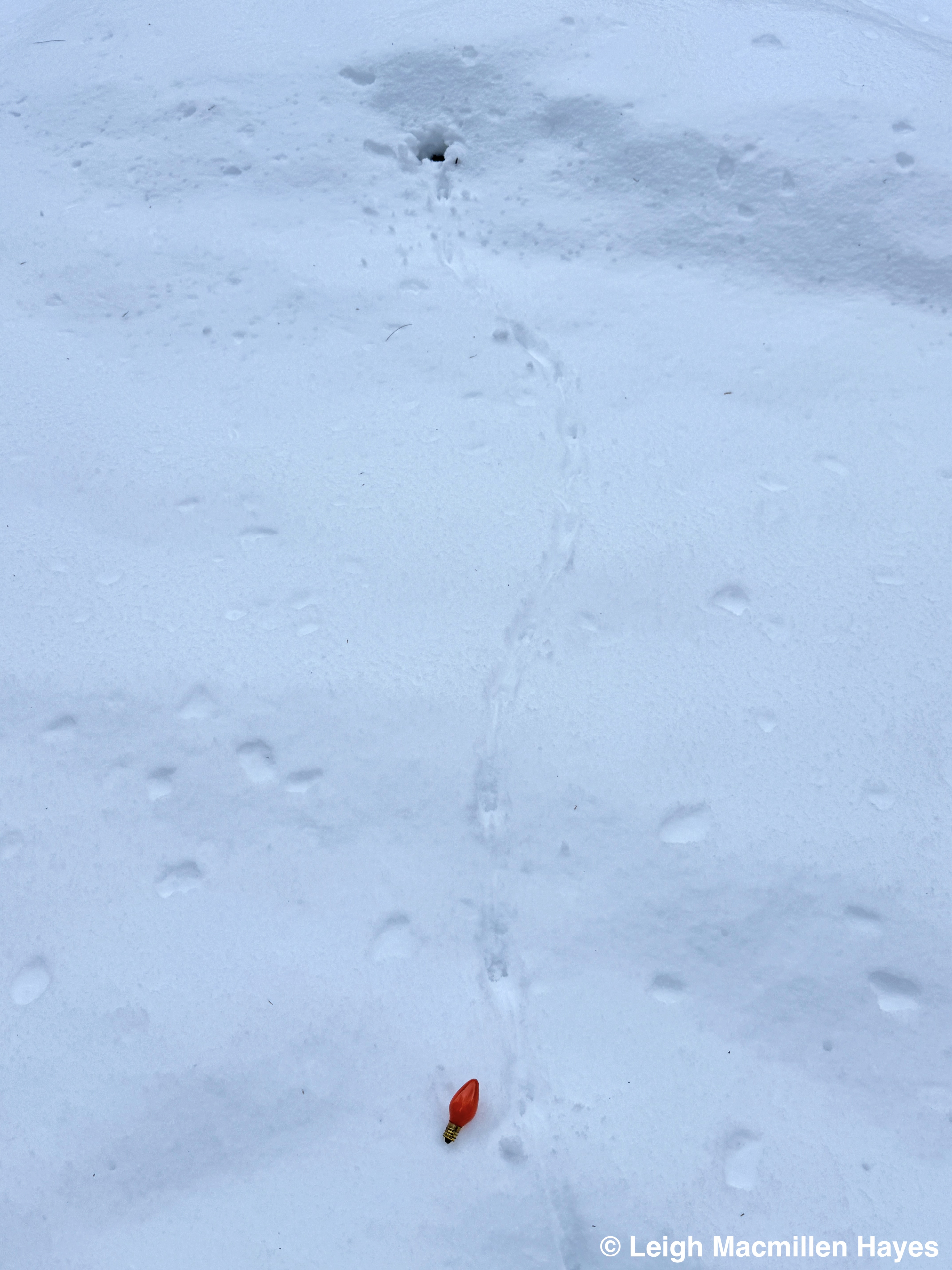
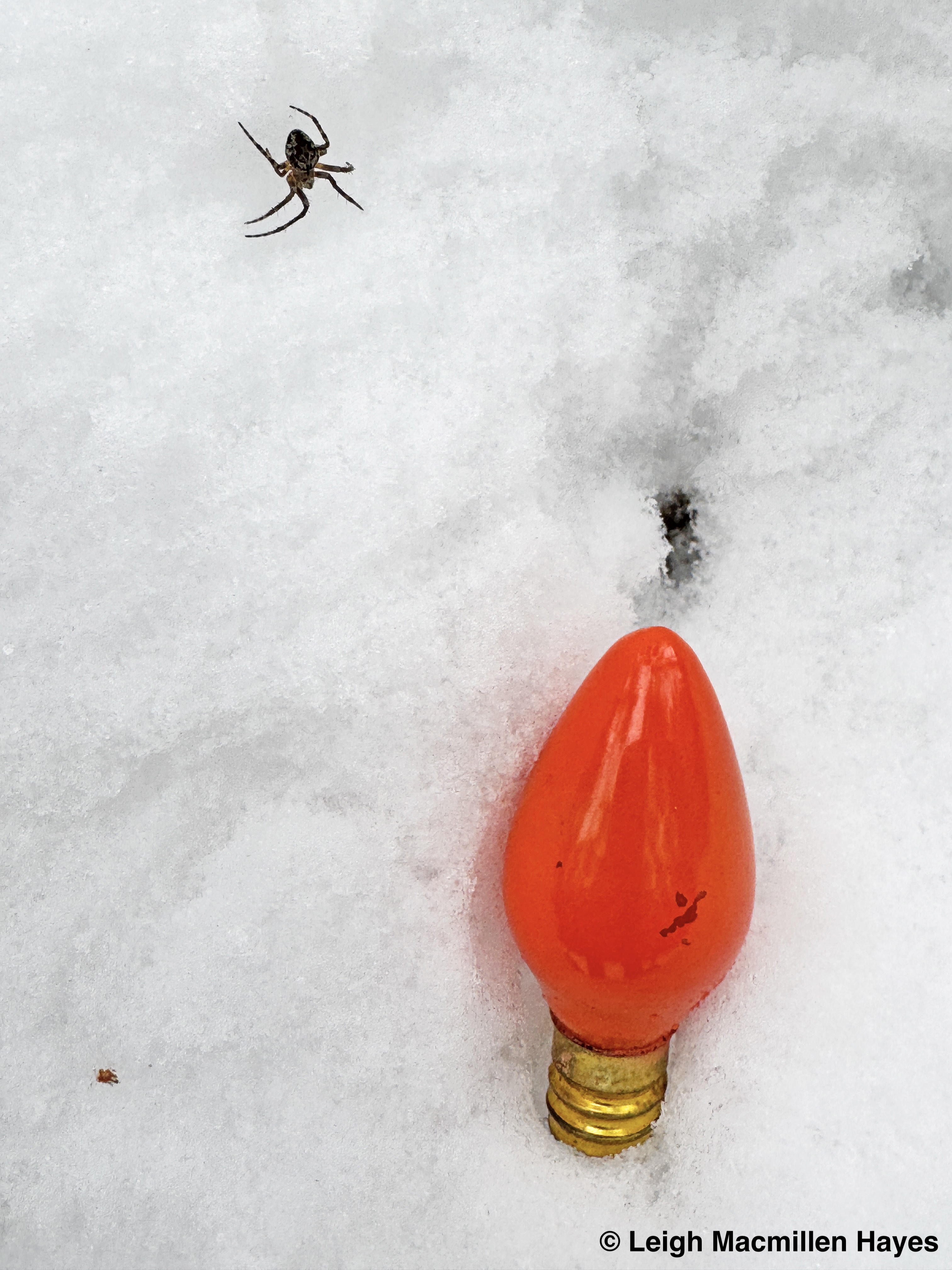
Just as I stepped out the backdoor this afternoon, I realized I really should have something in my pocket to use as a reference because the snow conditions were perfect. And so I grabbed the nearest object, which happened to be an old orange Christmas bulb that no longer brightens a tree, but serves as a reminder of past holidays in my parents’ home. Not exactly a tracker’s go-to instrument, but it does measure two inches in length.

I suppose I shouldn’t have been surprised to spot Snow Fleas, aka, Springtails atop the snow, but I was. They always strike me as more of a February event, but really, they are always on the leaf litter below the snow, we just don’t take the time to look. And today’s temperature felt a bit like February leaning into March, a rather pleasant reprise from the frigid temps of the past week. And so these insects made their way up through the snowpack to do their thing: dine on fungi and decaying matter that I couldn’t see.

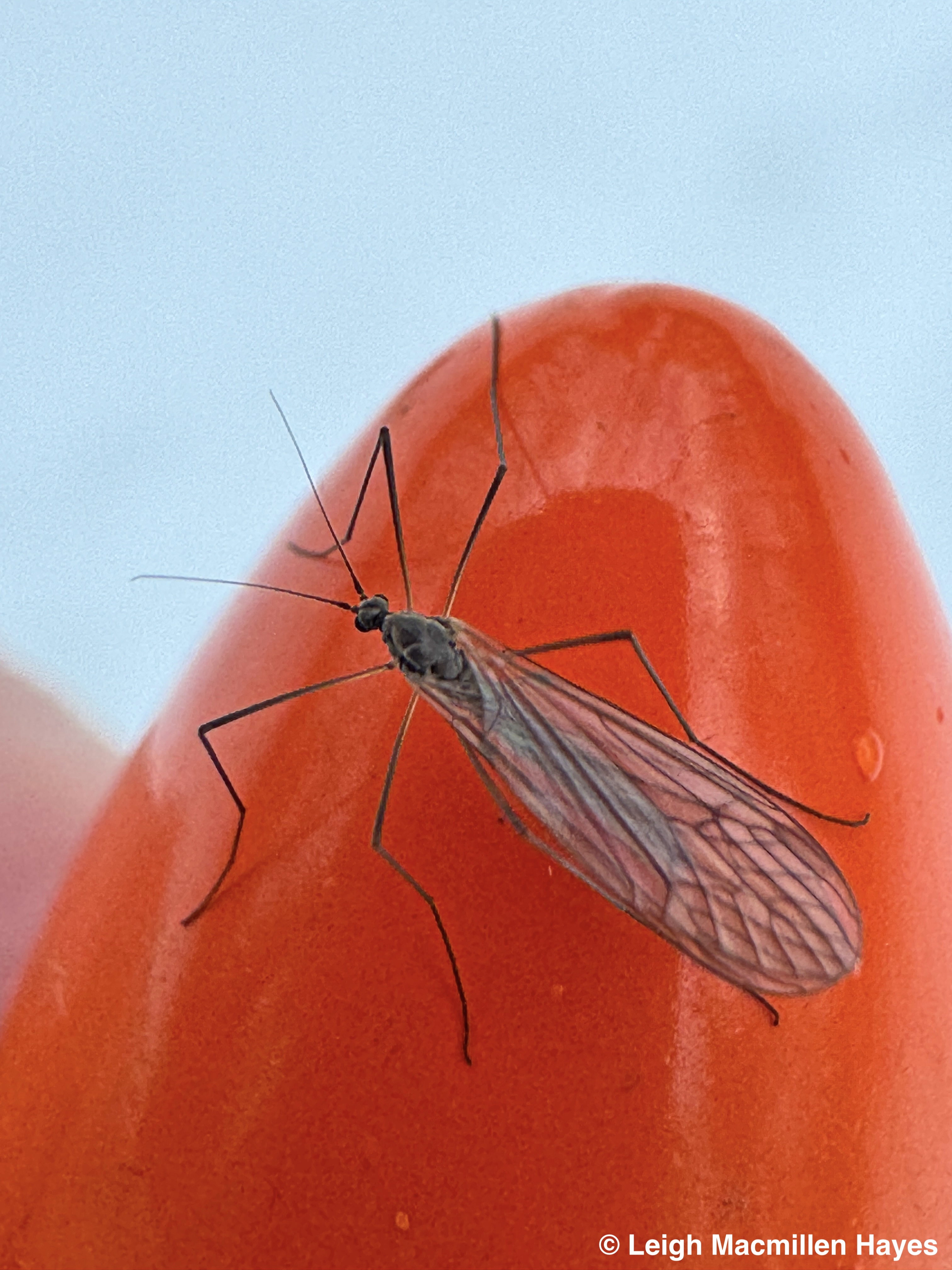
Also flying about and landing, Winter Craneflies, which are smaller than their summer cousins, but still have the long legs and transparent wings. They were everywhere–both flying and walking on snow.

And even the bulb! That was a bit of an experiment because I wondered if the Crane Fly would climb up once I placed the bulb in its face–much like when I can entice a dragonfly to do the same. Voila!

It wasn’t just insects to exclaim over and a few feet later I discovered the impressions of feet of another traveler. The prints left behind on one side of me indicated a hopper/leaper of the mini-kind. And it entered the snow as indicated by the hole at some vegetation that I knew grew below.

What really gladdened my heart was seeing that on the other side of my feet, its gait changed and I knew my identification was spot-on: a Vole who can change from a hopper/leaper to a perfect walker, where one foot packs the snow down and the next foot lands in the exact same spot creating a trail that looks a straight line with a zigzag twist.

Next up to shine the light bulb on–a spider! Walking on snow also. Many spiders are winter walkers and weavers and I was thrilled to spot this little one.

It had a pretty snazzy pattern and I believe it to be an orbweaver.

Then I began to play with the bulb, and spotted a tree with a hole that invited a fitting. I was admiring the tree’s bucketload of Ulota crispa, or Crispy Tree Moss, when something else caught my eye.

Below where I’d placed the bulb was the leftover molt of a tussock moth caterpillar. My, what spiny hairs you have. You make the spider’s hairs seem almost not worth mentioning. So I didn’t.

For a few minutes, trees continued to hold my attention, including this one, grafted into an H. Sometimes I think the H trees were created for me.

And not the be outdone, the Northern Red Oak showed up a brilliant display of its inner “red,” which seemed a perfect match for my bulb.

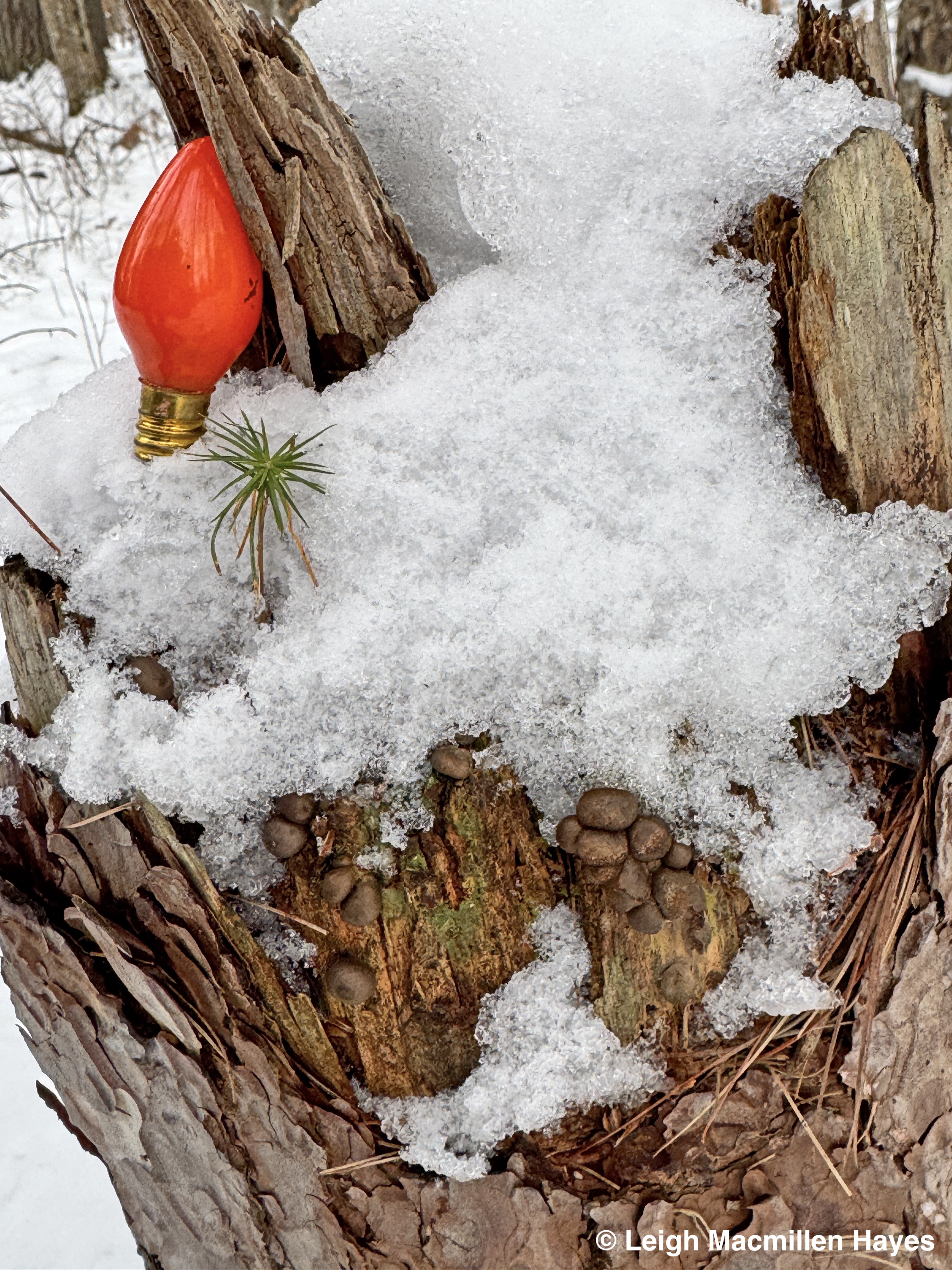
Upon a Red Pine tree stump, the bulb stopped again, this time to shine a light on a tiny pine sapling that resembled a palm tree. Whether the sapling is a Red Pine or White, I failed to figure out because my attention was consumed by something else.

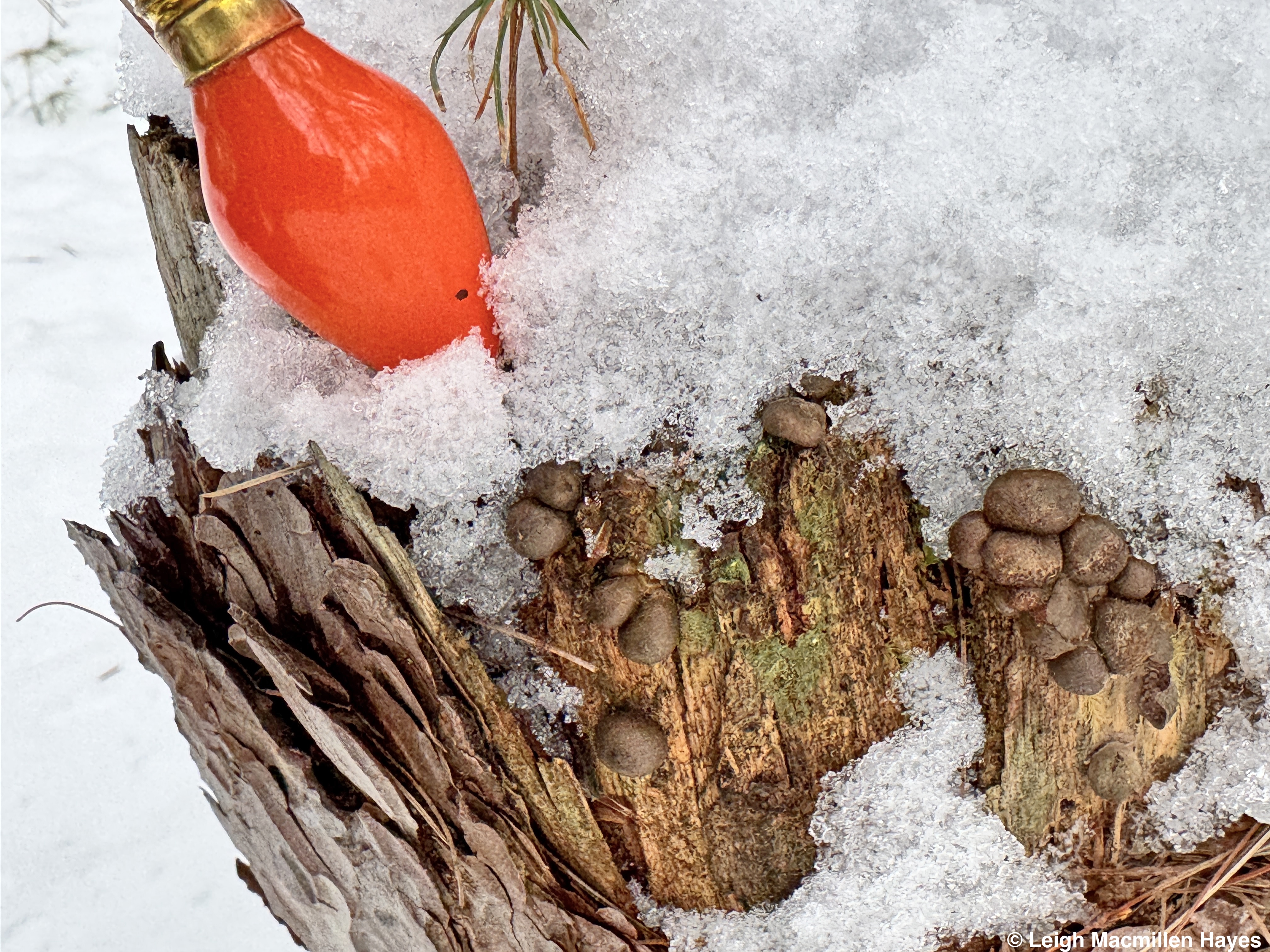
The bulb changed its position to point downward, highlighting the Wolf’s Milk Fungi that grew below the sapling.

And my playful spirit did what it often does when spotting this species. I found a small stick and poked the little puff balls, which released its spores in a smoke-like manner. I can’t show you the action, but you can see the results of the dried salmony-brown spores atop some of the now-deflated brown balls.

Over the past week and half, about a foot of snow has fallen here in our neighborhood and last night’s addition, plus today’s slightly warmer temps made for some great tracks as I’d already witnessed with the Vole. Gray Squirrels also left their marks–the two smaller feet in the back being their front feet. That always feels like a bit of a stretch until you watch a squirrel move across the landscape.

There was another tree, or should I say pair of trees, that I paused by for a bit because I think of them as a landmark ’round these parts. I love introducing others to these two–the Yellow Birch growing as it does atop a White Pine. I can just imagine the stilts the birch will stand upon when the pine finally finishes rotting away.

As I admired the trees, I noticed something else. My squirrel friend had hopped up, but I can only imagine it didn’t manage a good landing, for there was only one foot impression left behind. In my mind’s eye, I could see him tumbling down–had another squirrel tried to attack from behind?

In the past year, I’ve gotten back into sketching and have been learning to paint, and now see the world through different eyes and know that I’ve walked past this barbed wire many times before, but never noticed it. Today, it looked like an artistic insect in acrobatic motion and love how the bulb found its way into the display.

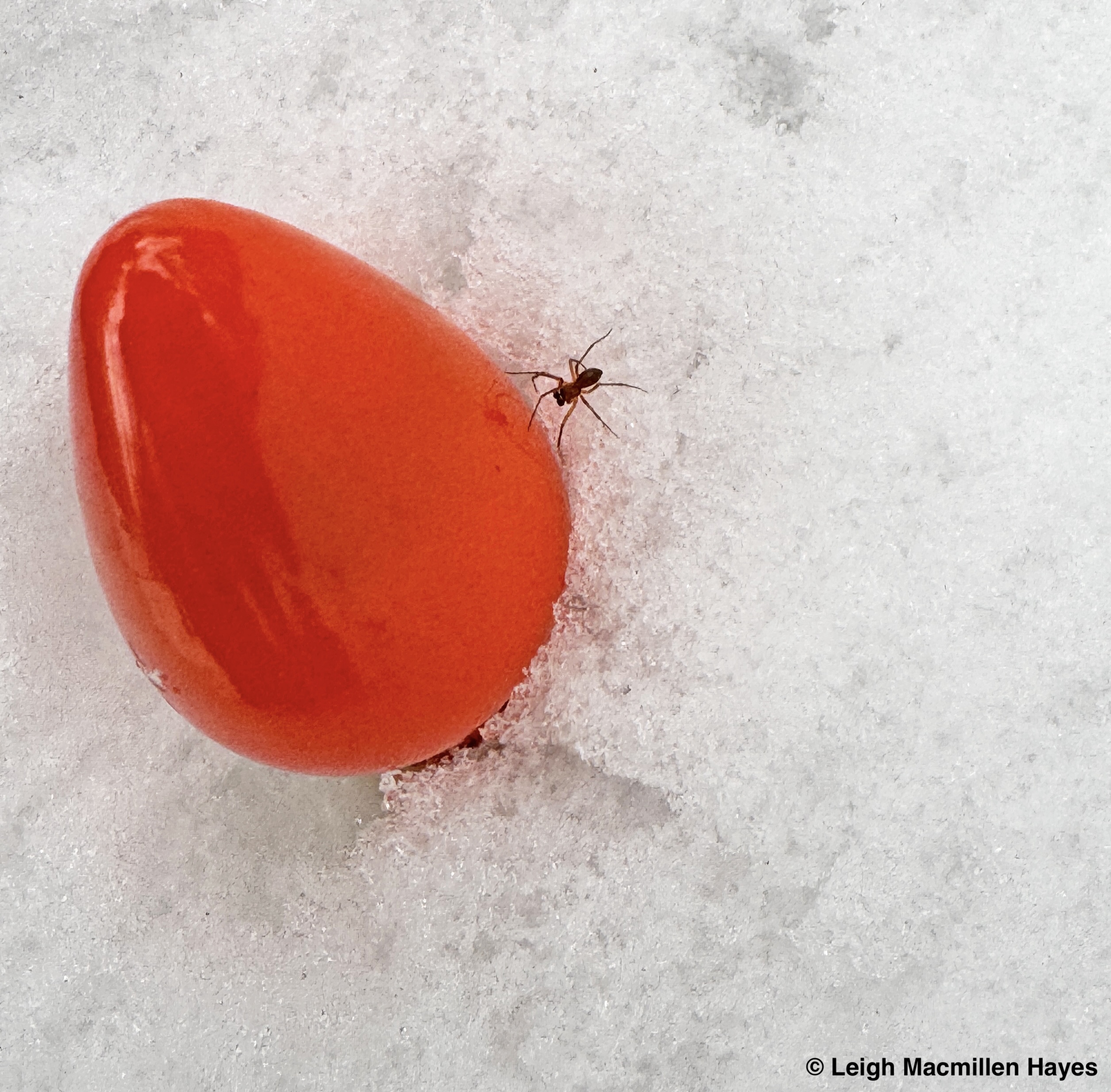
As I finally headed toward home because darkness was settling in, another spider crossed my path and so I set the bulb before it.

And the spider quickly walked away. Perhaps orange isn’t its color.

To say I went without expectations today would be wrong. For I truly thought I’d see the creator of these works of art since they were made this past week. I did not.

Instead, I came away with revelations and rejoiced in letting my playful spirit run free as I was filled with awe and wonder.

As for the light bulb–it was a bright idea! A brilliant one, really.

The Secret Giver of Gifts 2024

Being St. Nicholas Day, the day to honor the 4th century bishop from Myra who is the patron saint of children and sailors, I was reminded of a time when our youngest asked, “Mom, are you Santa?”

If you feel like you’ve read this before, rest assured. You have. But I love this story and so here it is again.

He’d held onto the belief for far longer than any of his classmates. And for that reason, I too, couldn’t let go. And so that day as we drove along I reminded him that though the shopping mall Santas were not real, we’d had several encounters that made believers out of all of us.

The first occurred over thirty years ago when I taught English in Franklin, New Hampshire. Across the hall from my classroom was a special education class. And fourteen-year-old Mikey, a student in that class, LOVED Santa.

Each year the bread deliveryman dressed in the famous red costume when he made his final delivery before Christmas break. To Mikey’s delight, he always stopped by his classroom. That particular year, a raging snowstorm developed. The bread man called the cafeteria to say that he would not be able to make the delivery. School was going to be dismissed after lunch, but we were all disappointed for Mikey’s sake.

And then  . . . as the lunch period drew to a close, Santa walked through the door and directly toward Mikey, who hooted with joy as he embraced the jolly old elf. As swiftly as he entered, Santa left. I have no doubt that that was Santa.

And about nineteen years ago, as the boys sat at the kitchen counter eating breakfast on Christmas Eve morning, we spotted a man walking on the power lines across the field from our house. We all wondered who it was, but quickly dismissed the thought as he disappeared from our view, until . . . a few minutes later he reappeared. The second time, he stopped and looked in our direction. I grabbed the binoculars we kept on the counter for wildlife viewings. The man was short and plump. He wore a bright red jacket, had white hair and a short, white beard. The boys each took a turn with the binoculars. The man stood and stared in our direction for a couple of minutes, and then he continued walking in the direction from which he’d originally come. We never saw him again. I have no doubt that that was Santa.

Another incident occurred about seventeen years ago, when on Christmas Eve, our phone rang. The unrecognizable elderly male voice asked for our oldest son. When I inquired who was calling, he replied, “Santa.” He spoke briefly with both boys and mentioned things that they had done during the year. I chatted with him again before saying goodbye. We were all wide-eyed with amazement. I have no doubt that that was Santa.

Once I reminded our youngest of those stories, he dropped the subject for the time being. I knew he’d ask again and I also knew that none of us wanted to give up the magic of anticipation for those special moments we know as Christmas morning, when the world is suddenly transformed.

I also knew it was time he heard another story–that of Saint Nicholas, the Secret Giver of Gifts. It goes something like this . . .

The nobleman looked to Heaven and cried, “Alas. Yesterday I was rich. Overnight I have lost my fortune. Now my three daughters cannot be married for I have no dowry to give. Nor can I support them.”

For during the Fourth Century, custom required the father of the bride to provide the groom with a dowry of money, land or any valuable possession. With no dowry to offer, the nobleman broke off his daughters’ engagements.

“Do not worry, Father. We will find a way,” comforted his oldest daughter.

Then it happened. The next day, the eldest daughter discovered a bag of gold on the windowsill. She peered outside to see who had left the bag, but the street was vacant.

Looking toward Heaven, her father gave thanks. The gold served as her dowry and the eldest daughter married.

A day later, another bag of gold mysteriously appeared on the sill. The second daughter married.

Several days later, the father stepped around the corner of his house and spied a neighbor standing by an open window. In shocked silence, he watched the other man toss a familiar bag into the house. It landed in a stocking that the third daughter had hung by the chimney to dry.

The neighbor turned from the window and jumped when he saw the father.

“Thank you. I cannot thank you enough. I had no idea that the gold was from you,” said the father.

“Please, let this be our secret,” begged the neighbor. “Do not tell anyone where the bags came from.”

The generous neighbor was said to be Bishop Nicholas, a young churchman of Myra in the Asia Minor, or what we call Turkey. Surrounded by wealth in his youth, Bishop Nicholas had matured into a faithful servant of God. He had dedicated his life to helping the poor and spreading Christianity. News of his good deeds circulated in spite of his attempt to be secretive. People named the bishop, “The Secret Giver of Gifts.”

s-stockings

Following Bishop Nicholas’ death, he was made a saint because of his holiness, generosity and acts of kindness. Over the centuries, stockings were hung by chimneys on the Eve of December 6, the date he is known to have died, in hopes that they would be filled by “The Secret Giver of Gifts.”

According to legend, Saint Nicholas traveled between Heaven and Earth in a wagon pulled by a white steed on the Eve of December 6. On their doorsteps, children placed gifts of hay and carrots for the steed. Saint Nicholas, in return, left candy and cookies for all the good boys and girls.

In Holland, Saint Nicholas, called Sinterklaas by the Dutch, was so popular for his actions, that the people adopted him as their patron saint or spiritual guardian.

Years later, in 1613, Dutch people sailed to the New World where they settled New Amsterdam, or today’s New York City. They brought the celebration of their beloved patron with them to America.

To the ears of English colonists living in America, Sinterklaas must have sounded like Santa Claus. Over time, he delivered more than the traditional cookies and candy for stockings. All presents placed under a tree were believed to be brought by him.

Santa Claus’ busy schedule required he travel the world in a short amount of time. Consequently, as recorded in Clement Moore’s poem, “The Night Before Christmas,” a sleigh and eight tiny reindeer replaced the wagon and steed.

Since Saint Nicholas was known for his devout Christianity, the celebration of his death was eventually combined with the anniversary of Christ’s birth. December 24th or Christmas Eve, began to represent the Saint’s visit to Earth.

Traditionally, gifts are exchanged to honor the Christ Child as the three Wise Men had honored Him in Bethlehem with frankincense, gold and myrrh.

One thing, however, has not changed. The gifts delivered by Saint Nicholas or Santa Claus, or whomever your tradition dictates, have always and will continue to symbolize the love people bear for one another.

Though they are now adults, my continued hope for my sons is that they will realize the magic of Christmas comes from the heart and that we all have a wee bit of Santa in us. Yes, Patrick, Santa is real.

May you continue to embrace the mystery and discover wonder wherever you look. And may you find joy in being the Secret Giver of Gifts.

Breaking Bread and Acorns

Up, up, and away, we were this past long weekend, My Guy and I, and New York City was our landing spot. It’s good to get out of our own space occasionally and enter the greater world where we don’t know the place as well.

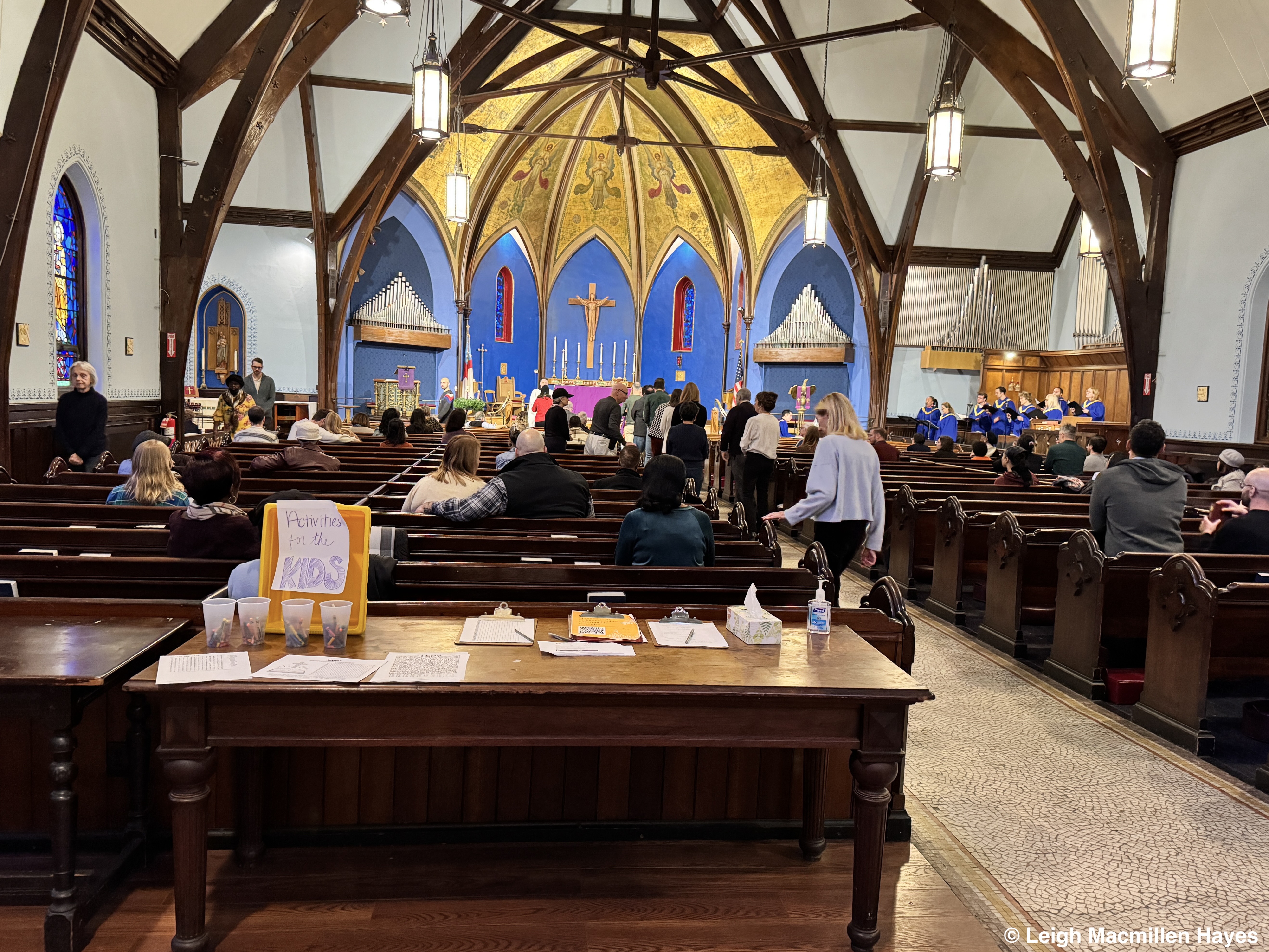
But, in doing so, we also like to return to spaces we do know a wee bit–there’s comfort in walking into a cathedral such as this where pathways lead wanderers away from city sounds and vistas and into the natural world.

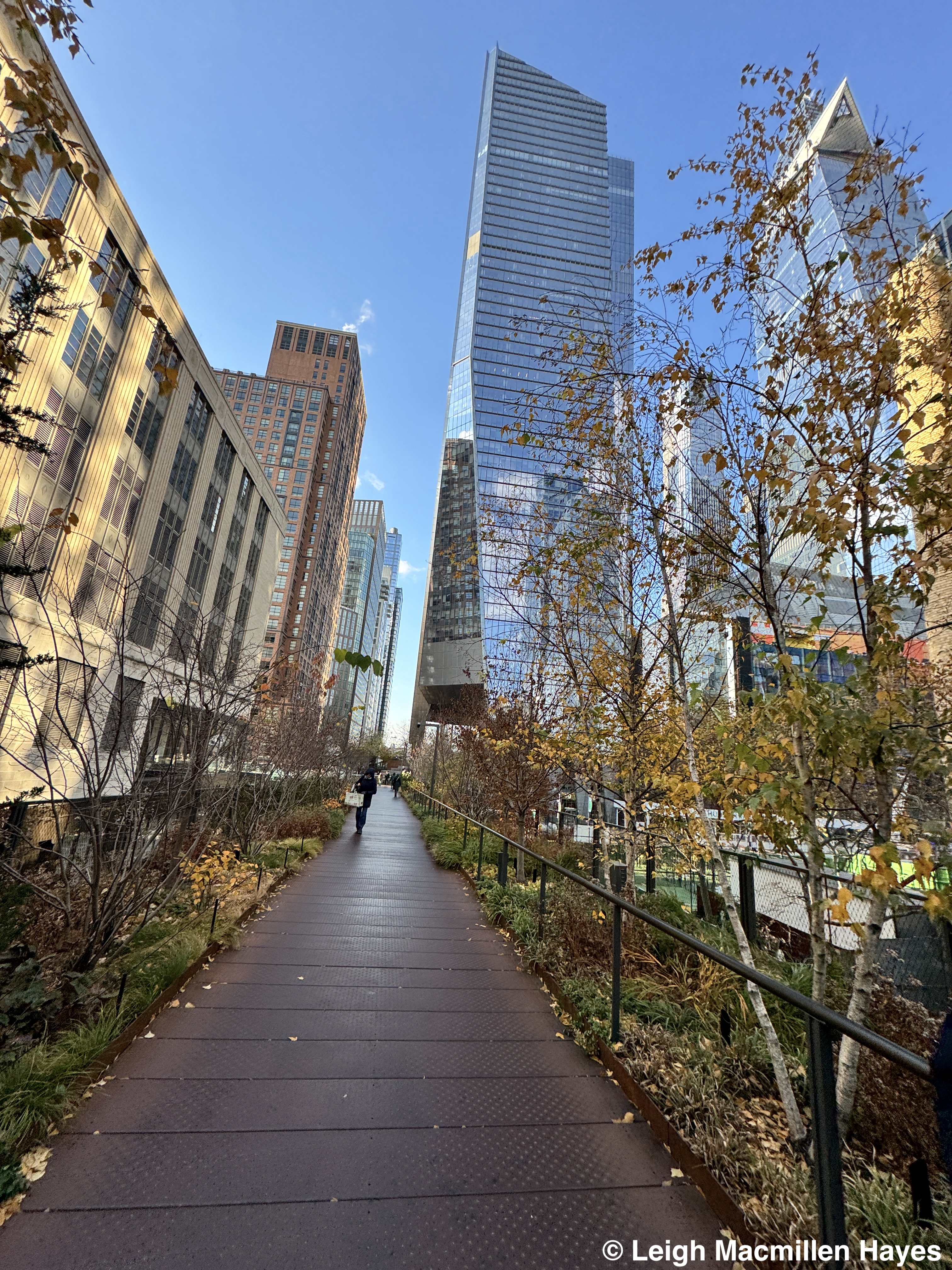
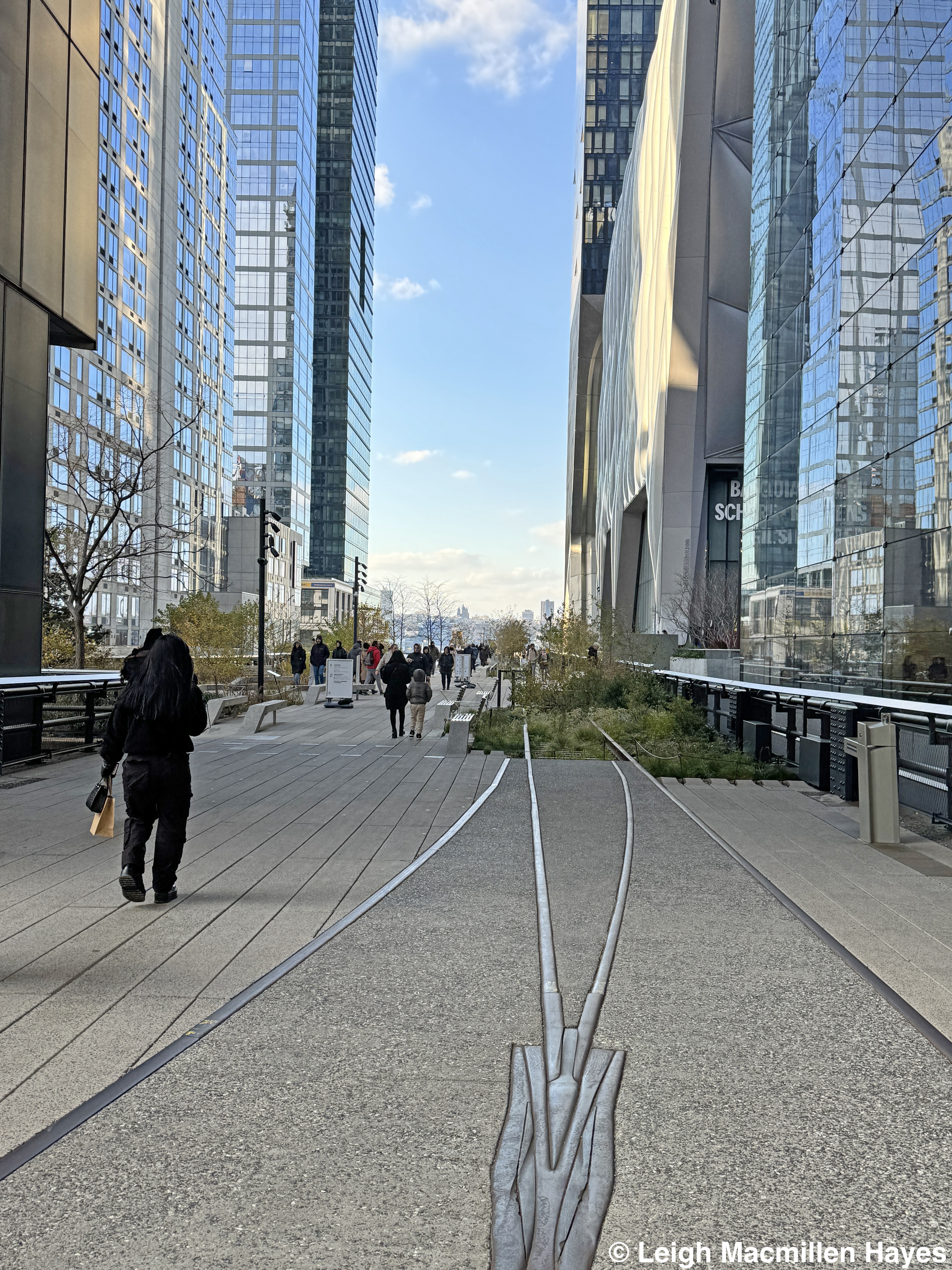
And we discovered new pathways where the sights and sounds of the city co-mingled with nature, albeit upon a raised bed that replaced a now defunct highline rail system.

No matter where we went, there were moments for reflection . . .

of the season passing.

In a way, it was like reliving fall foliage all over again and made me yearn to follow it down the East coast, though that was only a passing yearn for this “four-season worshiper.”

Gardens still proclaimed autumnal colors from the flowering heads of hearty plants growing beside Hudson River, where the north wind did blow.

And a few plants, more protected by buildings on either side of the path, showed off their sunshiny faces, though the petals appeared to make a ragged effort. Still . . . they blossomed.

We had the great fortune to join our hostess for a Victorian Christmas Tour. In reflection, it was not at all what we expected. Somehow, our minds’ eyes had conjured up a vision of entering stately Victorian homes and admiring their Christmas decorations.

This was not that tour at all. This was even better for the tour guide, Rick, was a storyteller who transformed us back in time to help us understand our Christmas traditions long rooted in the past, including Washington Irving’s influence as he told tales of New York’s founding and a Dutch ship wreck and Saint Nicholas riding over the city in a wagon and encouraging the Dutch to settle the land.

As we walked through three neighborhoods with Rick, we learned that O’Henry coined The Gift of the Magi in Pete’s Tavern.

And more about the poor and boisterous Irish who raised havoc on porches such as this at #4 Grammercy Park West belonging to NY Mayor James Harper (founder of Harper and Brothers which we now know as Harper Collins).

While the house next door is a replica of #4, the gaslit lampposts in front of Mayor Harper’s residence were meant to warn the partymakers to not disturb his rest. Or were they actually to help him find his way home? Perhaps both.

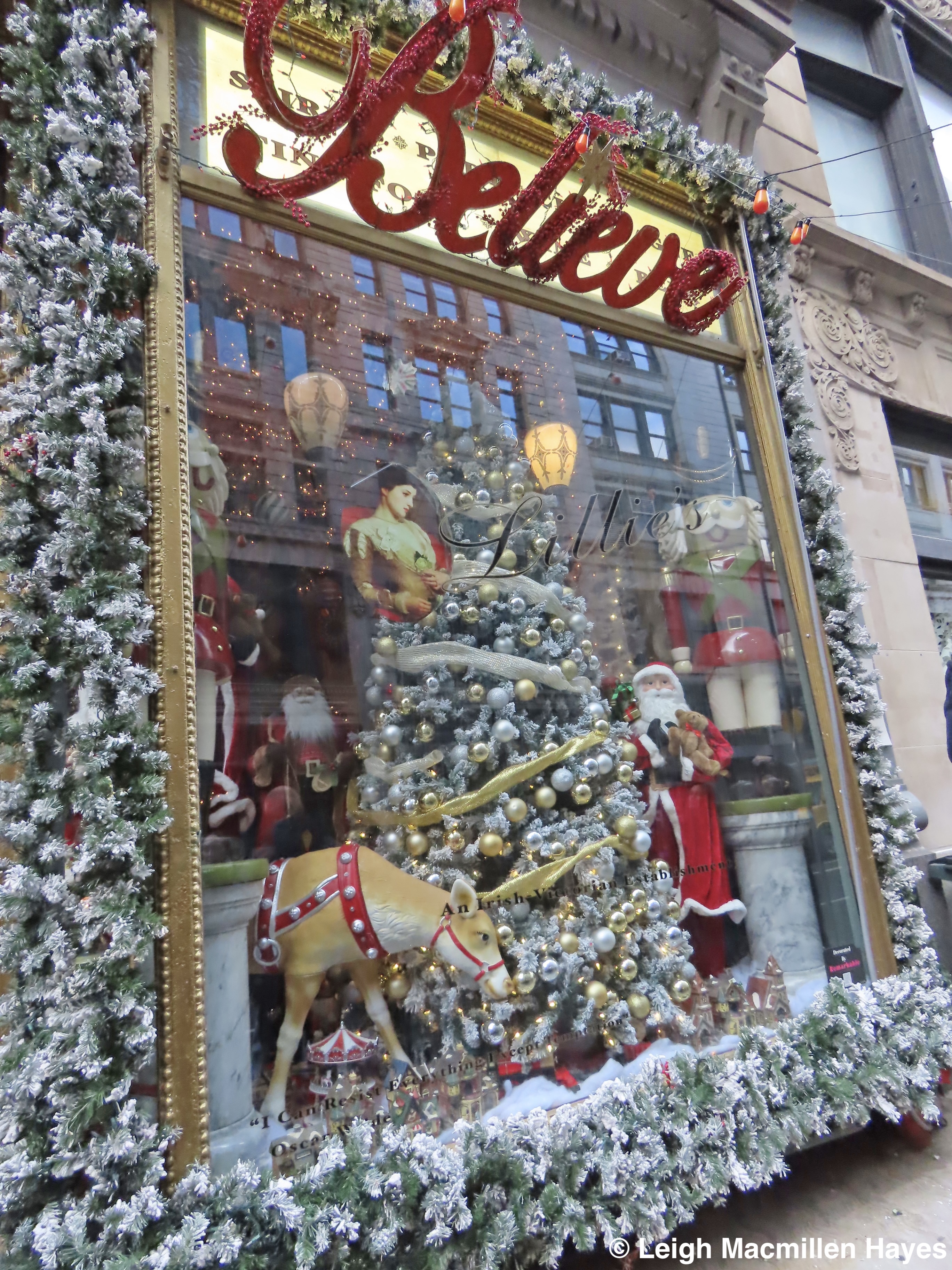
One of our stops was outside Lillie’s Victorian Restaurant where Rick shared the story of stockings being filled and the ball ornaments serving as representations of the gold that might have gone into them. And I was immediately transformed into my own story of the Christmas traditions as I’ve recorded in The Secret Giver of Gifts.

For a second, I stepped inside, and would have loved more time to experience this space named for Lillie Langtry, a British actress and late 19th Century Socialite, but we needed to move on.

And so we did, our family, some of our hostess’s family, and their friends, finishing up on a street that was once part of the Moore Estate in Chelsea and Rick recited “Twas the Night Before Christmas,” breaking it down to give us the history behind each stanza and we all gave great thanks for his insights and knowledge.

I hope I haven’t ruined this tour for you and that you will think about signing up for there was so much more. Just be prepared. It lasted about three hours.

Christmas decorations abound throughout the city, including this display at Pier 57. I loved how the fiber and ornaments were so subtly represented and suspect there’s a story behind this artistic installation that I’ve yet to learn.

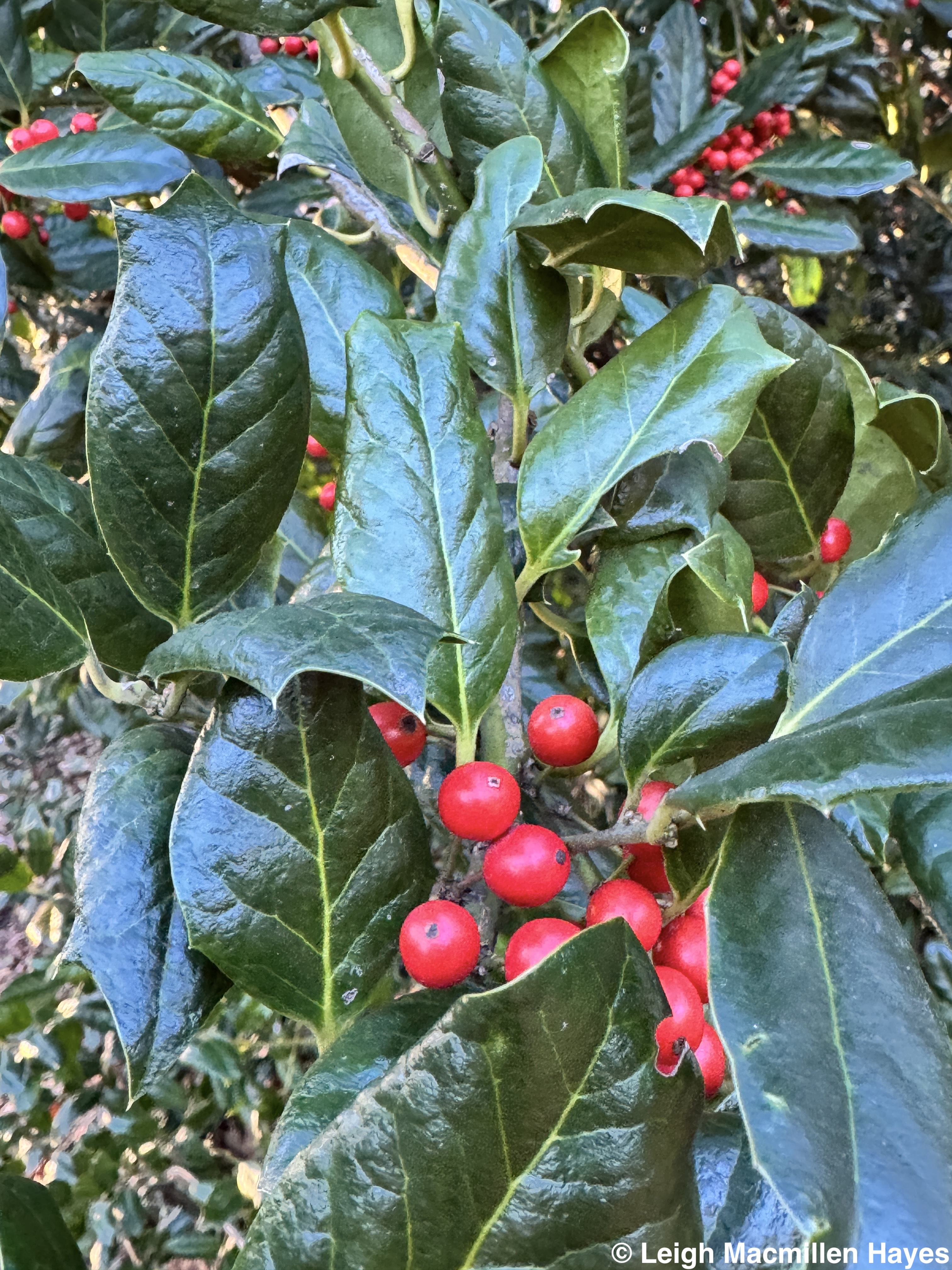
Nature also showed off its Christmas decor in the form of holly, Ilex cornuta or Chinese Holly, an introduced species. Um, I think we are all an introduced species.

And we spotted Christmas Ferns. Well, I spotted them and tried to explain to My Guy and our youngest that the leaflets are shaped like a Christmas stocking or even Santa in his sleigh, but they weren’t seeing that. I’m not sure they were really looking either.

But I was, and near the Christmas Ferns grew Maidenhair Ferns, like a star radiating off the wiry stem.

We also had the good fortune to meet another movie star, this one at the Museum of Moving Images. It would not have been my first choice of museums, but when your host works for an editing house, you embrace the choice and once we got going, it turned out to be a real treat as we could see behind the scenes of some old favorites including The Muppets.

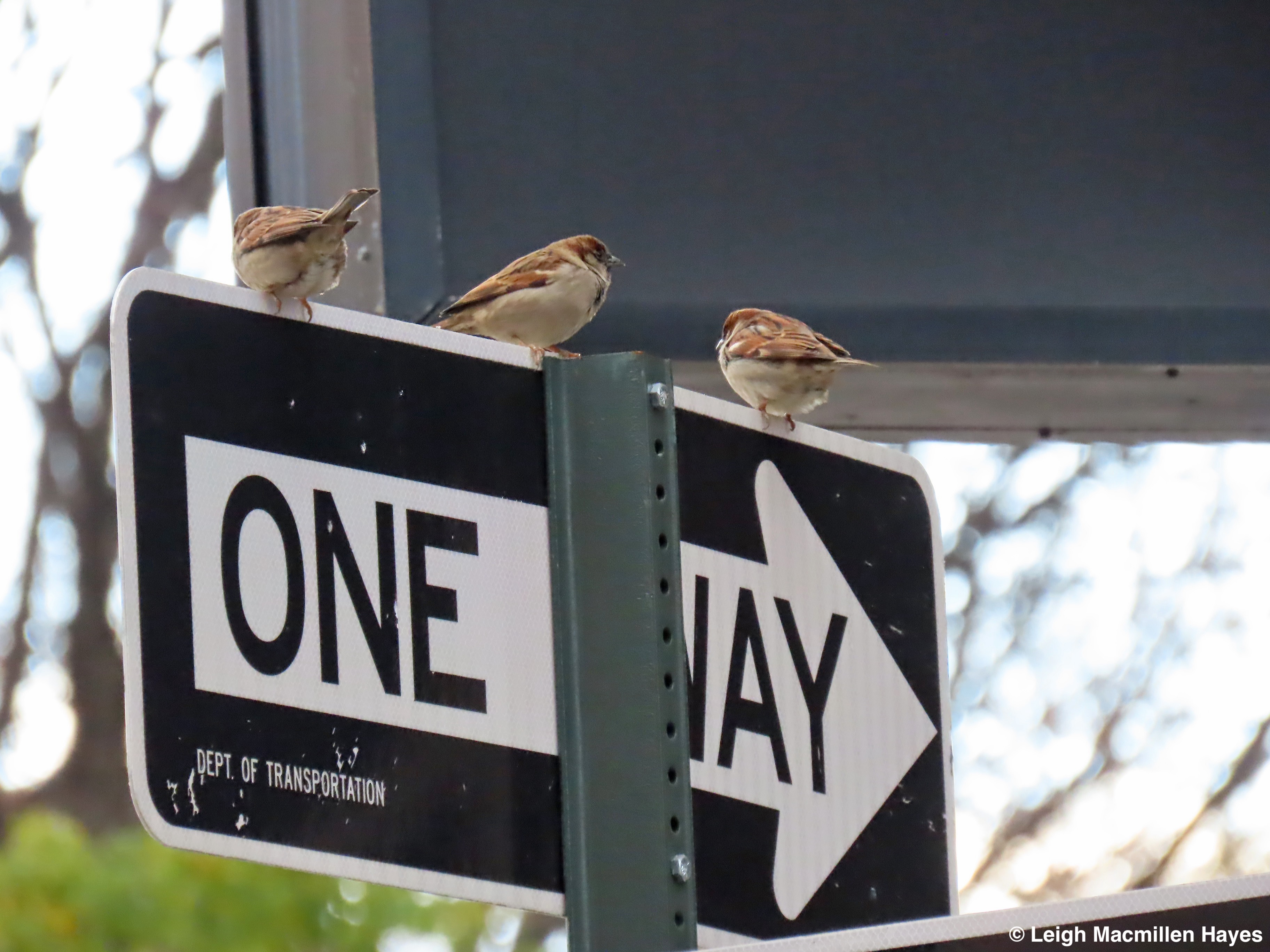
Being in the city, sometimes we were like the House Sparrows, which didn’t know which way to go, despite what the sign indicated.

Other times it was easy to choose the right path.

And in doing so, we got to meet a small one who is probably low on most New Yorkers’ list of preferences, but which I was thrilled to see honored with a statue.

My Guy dubbed this Pigeon Square. Do you see why?

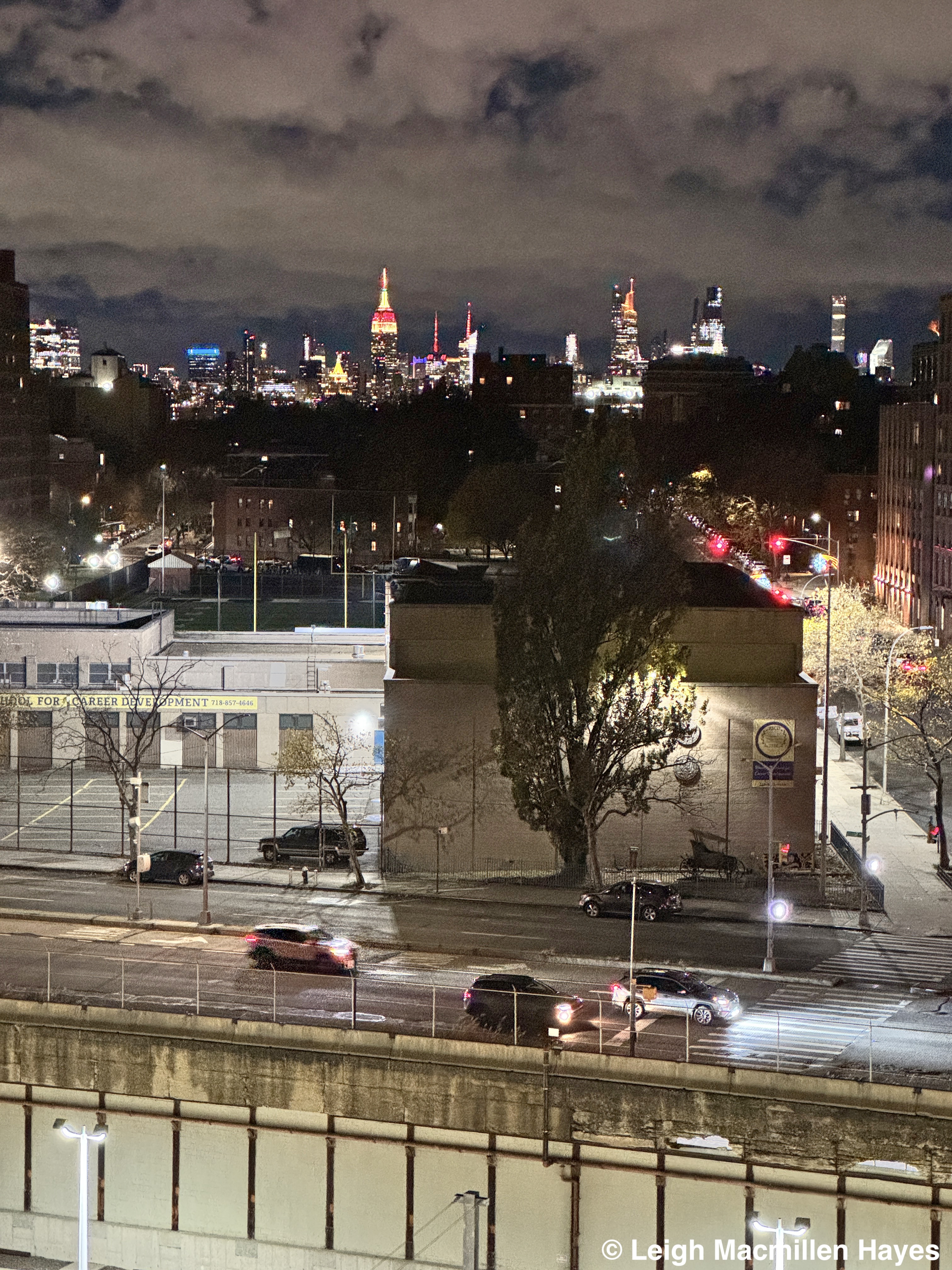
Thanks to our hostess, or I should say hostesses, we were guests in a small Prescott Park apartment with a view of the Empire State Building, which was lit first to honor Thanksgiving.

And then two nights later for Small Business Saturday, which we appreciated since we own a small business. Well, as I always say, My Guy owns it. I’m just married to it.

The iconic tower soon became our Mount Washington or Pleasant Mountain, for no matter where we were, if we spotted it, we had a sense of our place in this great city.

And I’m here to report that the lights on the Empire State Building eventually go off for the night. The same was true for many of the other skyline buildings.

Before I bring this post to an end, I want to share with you a few of our fellow travelers as we posed beside the Hudson.

These two–our NYC host and one of the hostesses, for whom we are most grateful. He being our youngest.

Our oldest and his gal who made the trip south as well and were able to stay for a couple of days.

And our main hostess posing with us. We give her great thanks for sharing her home and her apartment with us so that we might spend so much time with our family. And treating us to an incredible meal, as well as the Victorian Christmas tour.

We went down to break bread with this crowd on Thanksgiving. And there was lots of bread to break! And good humor shared.

I also loved that I was able to break bread at St. John’s Episcopal Church in the Park Slope section of Brooklyn on the first Sunday of Advent.

And before saying goodbye we broke bread one more time with this young man. We don’t know how he does it, living and working in NYC, oh, and driving. YIKES! But he does it all and he does it well.

Along the way of this five day journey, we discovered we weren’t the only ones breaking bread, though in this case the squirrel’s form of sustenance was acorns, which were plentiful.

Breaking Bread and Acorns in New York City. Not our every day cup of tea, but one which we relish when the opportunity arises.

Time Travel: Trail Until Rail

Picture this: It’s 1888. You’re in a train car on what was once the Portland and Ogdensburg Railway (P&0), but is now leased by Maine Central (MEC) and renamed the Mountain Division Trail. You are making the journey from the White Mountains of New Hampshire to Portland, Maine, with a brief stop in Fryeburg, Maine.

Off the train you hop, and suddenly you find yourself wandering down the Mountain Division Trail in the year 2024. Only, it’s not the rail bed that you walk upon, but rather a paved path beside the tracks.

And you give thanks, because this is the season of doing such, though really we should do so every day, for the Mountain Division Alliance, formed in 1994, out of concern that the rail right of way would be lost. MEC had sold the line to Guilford Transportation in 1981, about twenty plus years after the demise of passenger service. About seven years later, freight service also ended.

In 1994, The Mountain Division Alliance, under the direction of Alix Hopkins, Director of Portland Trails, “brought people together from over 20 groups. Out of this group came the vision for a rail with trail connecting the nine communities [Portland, Westbrook, Windham, Gorham, Standish/Steep Falls, Baldwin, Hiram, Brownfield, and Fryeburg] along the rail corridor from Portland to Fryeburg.”

The Alliance was started to “convince the State of Maine to purchase the rail bed right-of-way. The vision that a bicycle and pedestrian trail could be built along the rail line connecting Fryeburg to Portland came about at this time [1994],” wrote Dave Kinsman, former president of the Mountain Division Alliance in an article published by The Brownfield Newsletter.

So back to going for a wander down the trail. I did such this afternoon, and it’s a path I love to follow at any time of year, because it offers such diversity so I hope you’ll not hop right back on the train just yet, but instead wander with me.

Some may see it as the land of dried up weeds and some trees, but oh my. There’s so much to see.

For starters, Black Locust trees, with their two-toned braided bark.

Dangling from the locust twigs are the “pea” pods that contain “bean-shaped” seeds ready to add another generation to the landscape.

And then there are the oaks, this being the blocky bark of White Oak, which is always a treat for because I have to travel to locate it.

I’ve said it before and I’m sure I’ll say it again, but I LOVE White Oak leaves in their autumn/winter presentation. While they look like mittens with a thousand thumbs, it’s the salmony color and way that they dry on the twig as if they were caught in an awkward dance move that really captures me. Maybe because I can relate to those awkward movements, having never had a sense of rhythm.

Behold also, the White Oak’s cousin, Northern Red Oak, with its raised ridges offering ski slopes for those who dare, accentuated by the red in the furrows.

It’s like a perfect classroom along the Mountain Division Trail because the bristly lobed leaves of the Red Oak are so shiny in their shade of mahogany.

And not to be left out in this lesson: Bear Oak (aka Scrub Oak), growing in a more shrubby manner than the other two. It’s the leaves of this species that remind me who I’m meeting–notice how the second set of lobes from the stem are larger than any of the others.

In the mix of deciduous or broad-leafed trees are plenty of conifers, including those we encounter often in this neck of the woods from White Pines to Eastern Hemlocks, and Spruce and Balsam Fir. But . . . there are a couple of standouts along the Mountain Division Trail such as this one with three needles in each bundle.

It’s those bundles of three, and the fact that occasionally a clump of needles grows directly out of the bark rather than on a twig that provide the clues for this species: Pitch Pine, three strikes and you are out. Get it? Baseball–pitch–three needles/bundle. I wish I could take credit for coming up with that mnemonic.

I promised more than one interesting conifer and tada. Only thing is, all the other conifers retain their leaves (needles) throughout the winter, thus giving them the name of Evergreens because they are forever green, even when they are shedding some needles.

This pyramid-shaped tree is the only deciduous conifer in Maine: the Tamarack (Larch and Hackmatack being its other common names).

Tamarack’s needles turn a golden yellow in autumn, and eventually all fall off. But, it’s a cone-bearing tree, thus it’s a conifer.

Picking up speed now, along the rail grows Great Fox-tail Grass, and its name seems a great descriptor.

Then there’s the Sweet Fern, which isn’t actually a fern for it has a woody stem, but what I love most about it in fall and winter is the way its leaves curl, each doing its own thing.

In a wetland, for the habitats vary along the way, Winterberry is now showing off its brilliant red berries. And the Robins are thrilled as are many other birds seeking fruit at this time of year.

Mullein, tall as it stands, has already spread many of its seeds as evidenced by the open pods.

And the same is true for the even taller Evening Primrose.

It’s the fruiting structures of both of these plants that make them beautiful standouts as winter weeds.

Aster seeds are slowly taking their own leave, one hairy parachute at a time.

But here’s the thing. Not all Asters have gone to seed and I was surprised to find several Calico Asters still flowering. Given that the past few days have been quite brisk, this didn’t make sense.

But the same was true for Yarrow.

And I saw a bunch of Blue-stemmed Goldenrods still blooming. While the Asters and Goldenrods flower late in the season, perhaps I shouldn’t have been surprised, except that this past weekend’s wild rain and wind, and temps that felt more like November than we’ve experienced lately, made me question what I was seeing.

I was thrilled as I approached the airport end of the trail to find a few Dog-day Cicada exoskeletons still clinging to the underside of the fence railings. My, what large lobster-like claws you have, the better to dig yourself out of the ground when you are ready to emerge from your root-sap-sucking days to form wings, and fly away, and find a mate.

Because my imaginary train had let me off at Porter Road in Fryeburg, about halfway between the two ends of this four-mile route, I wandered and wondered for about two miles toward the airport end, located just beyond the mileage sign.

Portland: 47 miles away.

But it’s not all rail trail . . . yet.

As I looked across Rte 5, I imagined what will happen next. “A twelve-member Mountain Division Rail Use Advisory Council was created in June 2021 to study and review the 31 miles of state-owned, inactive rail line in order to make recommendations for its future use. Frequent meetings occurred . . . at which the civil engineering consulting firm, HNTB, ‘presented feasibility studies for future rail, rail with trail, and interim trail/bikeway use options and economic benefits. It was determined that restoring rail use would cost $60,000,000. For rail with trail, the cost would be $148,300,000. Removing the rails and building a trail until rail, which would keep the rail bed intact so the trail could return to rail if needed, wold cost $19,800,000. The final vote was 11 – 1 in favor of Trail Until Rail . . . After thirty years of work and thanks to the efforts of so many people, on July 6, 2023, Maine Governor Janet Mills signed LD404 into law, authorizing MaineDOT [Department of Transportation] to remove the railroad tracks and construct a 31-mile, multi-use trail until rail on the Mountain Division Rail Line between Fryeburg and Standish . . . Trail Until Rail means that this will be an interim trail because it can be pulled up and the tracks restored to rail should the return of train operations be economically viable. As stated on the alliance’s website: ‘Most major rail corridors are federally protected in perpetuity (that’s forever!). If the tracks ever need to go back in for train service, they will.'” ~ from my article Trail Until Rail: Mountain Division Trail Expansion in published Lake Living, Fall 2024, vol. 17, no. 2.

I turned around by Route 5 and followed the rail with trail back to my truck. Though I’m a hiker, wanderer in the woods by nature, the Mountain Division trail always amazes me with all that it has to offer and today was no different.

If all goes as intended, this 31-mile rail until trail project will be broken into six segments and within two years work will get underway to connect the airport end to this spot by the intersection on Route 160 in Brownfield.

Thanks for taking the time to travel with me today.

Thanks also to Terry Egan, vice president of the Mountain Division Alliance, and Andrew Walton, secretary of the organization, for walking a section of the trail with me several months ago and sharing their stories and visions of this asset to our area.

The Inside Out Porcupine

This story begins at about 5:10am on November 5th. I awoke to a noise that immediately became plural–and the ruckus sounded like it was taking place in the barn that is attached to our old farmhouse. For about fifteen minutes things shifted and banged and dropped, and then all was silent. My Guy slept through it all.

At lunch time, however, he did as I asked, and climbed to the hay loft to find out what had happened. And that’s when he discovered that I really did hear things dropping, for the myriad trophies our sons “earned” years ago for soccer, and peewee football, and golf, and baseball, and basketball, and hockey, and Pinewood Derbies, and who knows what else, were astray.

I’m going to digress for a minute or two, but really, it was the more creative trophies they received that I like the best like these from Boy Scout Cake Bakes.

And this one for being the king of Nordic Ski Team ski waxing.

Now back to the barn: As My Guy poked around, and there’s a lot of stuff up there right now because we’ve torn up the floor boards on the first level in anticipation of saving the structure and making it safe to park a vehicle in there again, he made a discovery and quickly sent me a photo because I wasn’t home.

A porcupine was snoozing under the Air Hockey table!

We set a trap that I hoped the critter would evade. And it did. My Guy also made quite a lot of noise the next day and saw Porky move from under the table to below a chair. And then he couldn’t find it.

Checking on the situation again a day or so later, we discovered Porky had indeed done some work–beginning with chewing the window and sill.

And he left signs of his adventures, including muddyish footprints on the wall below the window.

And quills scattered about, some even sticking into the rug originally placed because this had been a Rec Room back in the day when our sons were young. Right now it’s a Wreck Room!

Was there scat? Yes, but not nearly as much as expected, and I could track his movements.

Today, I was out there looking for more evidence. So . . . I have a rather extensive collection of tree cookies and twigs and even some branches–all for teaching purposes, including this particular piece of a sapling I’d carried down a mountain because it was in the way on a trail, but deserved to be saved for it features a moose scrape.

But even better than that, this afternoon I noted some wood chips and scat below it and realized Porky had taken some samples.

I love how I can get a sense of the size of his teeth with the work that he did.

And I’m surprised but happy to announce that he didn’t touch any of the other samples stored up there.

I decided to follow his trail and found a few scat specimens on the stairs, and others along beams that are right now uncovered given the first floor changes planned for later this week.

The question I haven’t answered yet and I suspect its because leaves have blown in and covered any evidence: which entrance did he use?

This is one he’s used for the past several winters. Okay, truth be told, we’ve owned this property for over 30 years and have housed a porcupine (and raccoons and woodchucks and opossums and anyone else) for all of those years. They used to have a different entrance, but we made some changes four years ago that forced them to find a new way into their abode.

If you look at the bottom of the beam, you can see where Porky has worked in the past to enlarge this hole over the split granite.

And just last year, he started another between the barn and an attached shed.

With all those years of co-existing, I was sure we’d find far more damage when we removed the floor boards. But . . . we did not. What we did find: Eight, yes eight, suet feeders that had disappeared over the years and I always suspected the raccoons had taken them under the barn because I couldn’t locate them in the yard, field, or woods.

All I can think is that Porky was sated when he entered and didn’t need to gnaw on the wood.

The funny thing about the latest Porky adventure, is that it could have been prevented if we’d thought to close the trap door at the top of the stairs. It took us a day or two to realize this and I feared that Porky would stay up there forever, given that he had plenty of wood to eat and a rather snug place to sleep with the only predators being us.

That said, the trap door does get closed now. And there is no new evidence of a visitation by my favorite rodent. And we didn’t trap him afterall. And he’s still in the woods somewhere. And I can’t wait to meet him–just outside, not in.

And when I do, I’ll be curious to see if it’s my old friend Bandit, for he and I met behind the barn last November and I’ve since honored him with a painting.

Here’s hoping the Inside Out Porcupine stays outside going forward. I’ll be looking for him.

November 11, 2024 Mondate

It’s Veterans Day 2024 and My Guy and I chose a trail less traveled in the National Forest, giving thanks to our families, friends, and strangers who have served our country. It’s because of them that we can hike along trails and old logging roads, and even bushwhack; two of the many freedoms they’ve given us are the freedom to move about our country and the freedom to not live in fear (well, most of the time).

And so today found us crossing the state line and beginning our journey beside Langdon Brook in Chatham, New Hampshire. Like everywhere we look these days, the water level was low–a result of the current drought.

What isn’t low is the number of Geometer Moths, and I believe this to be The Bruce Spanworm, aka Winter Moth, that is currently on the move, emerging from the duff in October and November. I didn’t look for females, who are flightless, but saw plenty of males on the wing.

Our trek found us following steep old logging roads for a good portion and as we looked for Bear Claw Trees, I spotted this, a hornet nest.

One Bald-faced queen started building this nest in the spring by chewing wood and mixing it with saliva to create a paper-like material. I love that you can see the multiple layers of horizontal combs, under what’s left of the papery outer envelope.

Just last week on a hike closer to the Atlantic Ocean we saw another football-shaped structure, that one being much more intact than today’s example.

Take a second to admire those layers of paper.

What to our ever wondering eyes did eventually appear, the first of several Bear Claw Trees, but I promise to not share all of them with you.

What I will share is this one, a first for us. We often see “elbow” trees in the woods, but never before have we spotted a “collar-bone” tree, so dubbed by My Guy. I think it’s a great description of the morphed shape of this Red Maple, probably caused by logging equipment rubbing against it years ago.

And because we were in a place where one would expect to see wildlife, or at least the signs of such, we found Moose tracks.

Where there are tracks, there is bound to be scat, though the tracks were much fresher than this pile. We actually expected to find both because we’ve traveled this way several times before and know it can be a highway.

As much as we both wanted to see the real deal today, I was glad we didn’t spot a Moose since it’s rutting season. That said, there were plenty of mature trees to hide behind had one approached us.

A few miles up and down, and a short trail new to us that was so much easier than the usual bushwhack approach we’ve taken in the past, and we arrived at our destination: Mountain Pond. With the Doubleheads in the background.

Doesn’t it have the cold November look?

It was breezy, but really, not as cold as it should have been and we both wore sweatshirts and anorak windbreakers and were quite comfortable.

Once we reached the pond, we decide to follow the loop trail that encircles it, and stopped at the lean-to for lunch–just far enough from the open water to be out of the wind.

And then it was time to continue on, dealing with rocks and roots most of the way. A bit technical in the footing department especially at the outlet brook, but not difficult.

Soon after crossing the brook, we entered fairy land. Even MG recognized it for what it was.

We didn’t see anyone at home, but trusted they were sleeping as is their habit during the day. Even the boulder condominium looked like it housed a few.

It’s places like this that inspired my children’s book, The Giant’s Shower.

If you are interested in a copy, or two, or three, please contact me by leaving a message in the comments of this blog because I’m not sure the thegiantsshower email mentioned at the end of that blog post is currently working.

But I digress.

On the far side of the pond, we spied the Baldfaces, which gave us a better sense of our place in the world at that moment.

After completing the loop, we found the short trail back to the logging roads and practically ran down hill, despite the signs indicating we should do otherwise.

Not far from the start of our journey, I spotted a classic representation of Red Fox scat. The tapered end and twist are what give it away. And its size.

I actually expected to find a range of scat samples along the way, but that was not the case. And the only critters we saw were two Red Squirrels who dashed for cover as we approached.

But we did have an unusual sighting . . .

On the way back, about 100 feet below where I’d parked the truck, I spotted something else–Goldenrod in bloom on November 11th.

For the last few years, my nephew and I have been sharing photos of plants blooming when they should not be and he’ll receive this one in a text message soon.

The other amazing thing about this bloom . . . the Bumblebee seeking nourishment upon it. At first I thought the bee was either sleeping or dead, but it moved.

It does need to watch out, however, because just below it an Ambush Bug was busy dealing with another Bruce Spanworm moth–one down, a million more Winter Moths to go.

But again, I couldn’t believe that the Ambush Bug was still active either. We had a hard frost a few days ago. How did all of this happen?

November 11, 2024, a day to remember all those who served our country and a day for My Guy and I to take advantage of our freedoms and make some discoveries worth wondering about on this Veterans Day Mondate.

A Squirrel’s Garden

A lot has happened this week on many different fronts, both personal and public, both positive and not so, some comical (like the porcupine that awoke me one morning because it had managed to climb to the second floor of the barn and toppled our sons’ many “earned” trophies) and others more serious, with some in between thrown into the mix, cuze life happens.

To that end, some of my best moments were spent looking and wondering. In the woods. Of course. In our woods, in particular.

I headed out onto the old cowpath in search of a dear friend, not certain if I’d meet him or at least spot signs of his passing. And it wasn’t a deer I was looking for–although, in a way it was because I haven’t seen a single one in several months and any scat along this trail is from last winter and spring and at that time it was so prevalent that with every step I took, it was there.

No, it was this little guy that I sought. This photo is from last winter when he and I spent hours eyeing each other.

Though his territory could have been several acres and there’s plenty of land out there to inhabit, he, like me, preferred the cowpath, and especially the stone walls since they served as perfect spots to cache his immense supply of pine cones, and as dining room tables, the better to see any approaching predators.

What he sought were the tiny winged seeds, tucked into each protective scale by the twos. If you’ve ever had the joy of watching him munch, you’ll know it’s fast paced as he deftly pulls the seeds out and discards the scales, getting right down to the “cob” of the cone.

The result is a pile of half consumed scales and a few uneaten seeds and cones not quite yet opened and some scat and its all known as a midden (by us humans anyway) or the trash barrel.

Actually, any high place will do and if it has nooks and crannies to serve as storage shelves all the better. Last year was a mast year for the White Pines in our woods. It takes two years for a pine cone of this species to reach maturity.

This year, there are only remnants of Red’s garbage pails and even they are almost hidden by twigs and leaves and needles.

But, while I was exploring his old neighborhood, I discovered something else in this pile that he had used for refrigeration and dining purposes.

Do you see what I spotted? Babies! No, not squirrel babies. But rather: Miniature White Pines.

Once I saw those, I checked every stack that we’d cut years ago and found the same story written upon them. The seeds Red had left uneaten found conditions were right on the rotten logs. Will they survive? Maybe a few, but there are plenty more tiny saplings on the forest floor.

The thing is that I found no evidence of Red and not once did he squawk at me, so I suspect either he moved on to a better food source or became a meal for another, passing all of that energy and sunshine he’d consumed on to the next.

This year, it’s the Northern Red Oaks that have produced a mast crop–of acorns. Actually, they did so last year, and the year before as well. For those of us who frequent Red Oak woods, it’s like walking on ball bearings–and can be a wee bit treacherous as they roll under our boots.

Red Oak acorns are filled with tannins and so, unlike their White brethren which are gobbled up almost immediately by rodents and birds and deer among their consumers, it seems a little of this one is nibbled, and then a little of that one initially. Eventually, the tannins leach out, especially if the acorn has been buried for future consumption, and then the entire nut within may be eaten.

As I looked for Red this past week, I found instead his cousins, the Gray Squirrels in action. Where Red Squirrels are very territorial, Grays tend to have overlapping habitats, and there are at least three on our six acre plot of land.

Burying acorns is their way of caching and it’s possible that what I observed was this squirrel leaving a scent mark with its nose so that come snowfall (and I have faith that it will fall–and can only hope abundantly), it can relocate the food supply. What this squirrel misses, another will find. And those that no one finds might turn into oak trees that will feed future generations, just as the pine saplings may someday do.

It’s for these critters and so many more that we ask that no motorized vehicles pass along the cow path, no matter how tempting it may be. (Thank you, Marguerite, for creating this sign for me.)

And if you are in there, you might happen along the rather rough labyrinth I created, a place that like the squirrels, I return to often.

It’s at the start of the labyrinth that brings a smile to my face each time, for Red had visited and his calling card is still there.

Thank you, Red, for planting your Squirrel Garden. And for capturing my mind and heart and soul this week.

Presents in the Moment

I went on a reconnaissance mission today in preparation for co-leading a Loon Echo Land Trust hike in about another month–once hunting season draws to end. This particular property, like several others that they own, probably sees more people hunting and riding snowmobiles than hiking or tracking. The latter two fall into my realm and today found me doing a bit of both.

But first, I was stunned by the beauty of the ribbony flowers of Witch Hazel. I don’t know why these always surprise me, but maybe it’s the delicate petals that add bits of sunshine at this time of year when everything is else is dying back.

Their wavy-edged leaves also add color as October quickly gives way to November.

A bit farther along the first trail I followed, I found something else to stop me in my steps. Little packages of bird scat inside a hole excavated by a Pileated Woodpecker. If you follow wondermyway.com, then you know that I LOVE to find the woodpecker’s scat, but this was much smaller and I had visions of several smaller birds huddled inside on a cold autumn night.

At the end of the trail I reached a brook that flows into a river. Today, it was a mere trickle. In fact, I took this photo from the high water mark and don’t think I’ve ever seen it this low. Well, not since I began exploring this property in 2020. But then again, since then, we’ve had some heavy rain years and this year has been a bit drier.

I knew once I spotted the trickle that the nearby Beaver dam would not be working to stop the flow.

But . . . in walking over to take a look at it, I spotted something else worth noting . . .

At first my brain interpreted this disturbed site as a bird’s dust bath. Until . . .

I spotted River Otter scat. A latrine, in fact. That’s when I knew (or think, anyway–okay, assume!) that the disturbed sight was a spot where the otter rolled around, or maybe two or three did as they most often travel as a family unit.

How did I know it was otter scat? Look at those fish scales in it. And it wasn’t all that old based on the leaves under and on top of it.

Feeling like I was in the right place at the right time, I doubled back on the trail because it ends at the brook, and then turned onto another to see what else I might find. Along this one, a second brook had a better flow and had me envisioning the land trust group dipping for macro-invertebrates in this spot we haven’t explored yet.

I also found another shrub that thrills me as much as the Witch Hazel. Also a shrub, I can’t pass by a Maple-leaf Viburnum in the fall without admiring its color. Mulberry? Heather? Sky-purple-pink? However you describe it, this I know–no other leaves feature these hues.

If you do spot one, take a moment and touch the leaf. I love the touchy-feely walks that are not about feelings, but rather about actually feeling something (as long as it isn’t poison ivy!).

As luck would have it, I was following an old logging road by this point, which these days serves as a snowmobile trail. Despite its uses, rocks and boulders mark sections of it. And atop one, oh my! Do you see what I saw?

A LARGE Bobcat scat and a tiny weasel scat. Could life get any better than that? I think not. Well, unless I saw the actual critters and as I write this a local friend just texted me that she and her family saw a pair of eyes reflecting in their headlights as they pulled up to their house: “I thought it was our cat from a distance. I got out to investigate. It was a bobcat! And it wasn’t afraid. I couldn’t believe it! It was so close. I could see the face. I ran inside to get a flashlight. It just watched us as we watched it.” ~Amanda.

If she was someone else, she’d jump on social media and inform the world that the big bad wolf is in the neighborhood because that seems to happen any time someone spots a Bobcat or Fisher. But, she appreciates the gift of the sighting and I’m so thankful for that.

Back to my Bobcat, or rather Bobcat scat–it was classic! Segmented, tarry, and no bones. Ahhhh! What dreams are made of–at least my dreams.

It was also quite hairy. Squirrel? Snowshoe hare? Weasel? Pop goes the weasel? Into the Bobcat’s mouth? I’ll never know. But I love that one marked the rock in the middle of the trail and the other followed suit. And I also love how that one piece stands upright like a tower. I don’t think I’ve ever spotted such a presentation before.

No, don’t worry, we don’t have yet. But I took this photo of a Bobcat print, also classic in presentation, along the same trail last February. Same critter? Offspring? Sibling? Any of the above.

At last I reached what would become my turn-around point, again on an out-and-back trail. And once again, I slipped off the trail and made my way toward an expansive wetland that is actually part of the small brook I’d crossed.

Old Beaver works, such as this American Beech with a bad-hair day from stump sprouting, were evident everywhere.

Other Beaver sculptures created a few years ago as indicated by the dark color of heartwood where the rodent had gnawed and cut the tree down, probably to use as building material, now sport fungi in decomposition mode.

In the wetland, I spotted two Beaver lodges, both featuring some mud for winter insulation. There were two other larger lodges with no mud, so I suspect these are the residences of choice for this year.

I also spotted a Beaver channel, but could find no new work on the land.

That surprised me given that there was new wood on top.

I could have walked farther along the wetland and may have spotted some freshly hewn trees, but when I spotted several Wood Ducks on the far side, I decided to stand still for a bit because they are easily spooked.

And my grand hope was that if I was quiet, I might get treated to a Beaver sighting. Or two.

For a half hour I waited. Nada. And so I climbed back up to the trail and walked out.

But, I was present in the moment today and received so many gifts, which may or may not be there when I bring others to explore. That’s okay, because together we’ll make other discoveries.

Thanks for stopping by, once again, dear readers. I leave you with this painting as a parting gift for being so faithful in following me as I wander and wonder.

Where The Beaver Led Me

Where there is water there may be Beavers. And so I explored two locations on several occasions this weekend in a quest to spend some time with one of the most incredible mammals of our region.

One such spot is beside a wetland associated with a brook. It’s a place rich with color and texture, and ahh, those fall scents of earth and water and fallen leaves and Balsam Fir all settled together in the late afternoon after the morning sun has baked them.

The other was beside another brook that served as the outlet for a small pond, and again the colors and textures and scents filled my senses, enhanced by a slight breeze that made for a most delightful exploration on October days with temperatures in the 70˚s.

I don’t want temps to remain in the 70˚s always, but these days are gifts meant to be cherished and remembered by our skin and our soles.

I discovered along the way that I wasn’t the only one basking in the sunlight, for Painted Turtles also took advantage of the warm rays to regulate their body temperature. It also provides an opportunity to hang out with friends as they congregate along logs and rocks.

Easter Painted Turtles, beautifully adorned as they are, feature intricate red coloring along the sides of their shells and bodies, plus a orangy-yellow belly, and lines of red and orange and yellow green on their necks and legs.

But beyond all of this, I’m reminded that they play a vital role in maintaining the health of their ecosystems as they consume a diverse diet from aquatic plants, to algae, insects and small invertebrates, thus cycling nutrients throughout the habitat–an environmentally healthy habitat.

I gave thanks to the Beavers for reminding me of that fact.

Back to the Beavers, my journey continued when I spied new Hemlock branches atop a lodge.

And then I began to find pathway after pathway across land to water where the family, since there are usually two or three generations of Beavers who live in a lodge and work the area together, had dragged downed trees and branches overnight and carried them between their teeth out to their residence.

Their works were many and sculptures magnificent as they chiseled away and when I spotted this tree, I had visions of one standing on its hind feet and using its tail to form a tripod, the better to steady its body, as it turned its head to the side and began to work. With head cocked, it created the consistent angle of the half inch groove as the upper and lower incisors come together.

To reach such heights, I could only assume it was a mature Beaver. That, or one stood upon the back of another. Ah, but that’s the stuff of fairy tales. (I do like fairy tales–just saying).

As I looked around the base of a tree for more evidence, I discovered this. What could it possibly be? Scat?

No. Pellets? Yes. Several of them. Filled with bones. And maybe hair. And/or feathers.

The creator? My brain automatically went to Barred Owl and I’ve seen and heard the owl in these woods on many occasions.

But . . . these natural treasures could also have been produced by a resident eagle or hawk or so many other birds. Based on the number of pellets under this one tree, its a certain signpost of a productive area for whatever bird chose to prey from above.

Moving farther along as I bushwhacked, I knew I was getting closer and closer to the animal of my dreams when I spotted trees being turned into logs.

A beaver’s dental formula is this: 2 incisors on top, 2 incisors on bottom, 0 canines on top, 0 canines on bottom, 2 premolars on top, 2 premolars on bottom (that look like molars), 6 molars on top and 6 molars on bottom, for a total of 20 teeth. Recently, I was able to sketch the upper part of the skull of an older family member, who’d lost some of its molars.

These large, semi-aquatic rodents are gnawers. To that end, their incisors are highly specialized for chewing through really, really tough things and they grow continually throughout the critter’s life.

And like all rodents, the front surface of their incisors is coated in enamel reinforced with iron (hence the orange color), which makes it resistant to wear and tear from gnawing.

When the chisel-like teeth chew and fell trees, the much softer white dentine layer (the section behind the enamel) is ground down quicker than the enamel, thus creating a sharp chisel surface.

As strict herbivores, a Beaver’s diet varies with changes in the season. During spring and summer, they are drawn to waterlilies, algae, grasses, sedges, herbs, ferns, shrub leaves and shoots. By late summer, however, tree cutting begins as they gradually change their dietary habits from herbaceous to woody materials. Twigs, roots, bark and especially inner bark become the source of nutrition. Aspen, birch, alder, and willow are favored species, but beavers will cut almost anything including conifers.

Occasionally, I saw individual logs on land or upon a muddy spot in the water. Again, the consistency of the gnawing was to be admired.

And where there are Beavers, there may also be Porcupines. At least, there was a couple of years ago when I spent some winter days tracking one to this cozy little den. Remnants of scat are all that remain and spiders have instead made a home in the hollow of this tree.

And then I spotted the most amazing feat of all. A widow maker dangling from a tree (that is if you are about eight inches tall), its bottom gnawed off and more gnawing about a foot and a half off the ground.

My search was interrupted again when a Spotted Spreadwing Damselfly entered the scene in a sunny spot. So named Spreadwing because unlike other damselflies that fold their wings over their backs when at rest, the Spreadwings, um, spread their wings. On the of left hand side it looked like this insect had four wings rather than two, but such was the sun’s angle in that spot and thus the shadows upon the leaves.

Identification was based on the lower side of the abdomen, where it is difficult to see, but there are two spots below the thorax stripes as compared to the Great Spreadwing with has two yellow stripes with brown between them, and no spots.

Autumn Meadowhawks were also on the fly and I kept seeing males with no ladies about.

A couple of hours later, one flew in, but though they danced in the air together as he chased her, they never did canoodle, in my presence anyway. And the last I saw of them, they headed to separate branches of a pine tree, perhaps to spend the night in rooms of their own.

The Beavers weren’t canoodling either, but they were certainly active given the rolls of mud and grasses and sedges and probably reeds I kept finding along the water’s edge.

And then I discovered the much sought after (at least by me) Beaver print. It’s a rare occasion to see a print, but sometimes I do in the snow. Their tails and the trees they haul swish away such evidence of their travels.

As I stood beside a Beaver path and downed trees just above where I spotted the print, another flying insect entered the scene. And I had the joy of watching her as she deposited individual eggs in vegetation.

With her ovipositor located under her abdomen, the female Swamp Darner punctures a hole in mud, and logs, and aquatic vegetation in which to lay her progeny. The cool thing is that her eggs can survive a year without water, incase the level is low as it is right now. I suspect by spring these will be quite wet.

I never did find the Beaver(s) of my dreams, but spied another platform that may have been a lodge in the making. I hope they are still living there as the evidence leans in that direction.

At the end of the day, however, my heart was full with all my findings in both locations and I gave great thanks to the Beavers who led the way and all the discoveries I made as I searched for them.

Snow–Bugs and Flakes

Betwixt. Between. Be flowers. Be bugs. Be glad for there is so much to wonder about in the natural world. And I don’t even know the half of it. But I wouldn’t be happy if I wasn’t always learning.

It was 28˚ when I awoke this morning. Late this afternoon on this brilliant sunlight day, with temps at least 30˚ warmer, I walked out through our woodlot to the right and then looked back across the neighbor’s field toward our house, taking in the sea of seedheads and I was sure my insect hunting days had come to an end.

But much to my surprise, and really, I shouldn’t have been surprised, the chirps of crickets and grasshoppers, like this Red-legged example, filled the air. I might not have seen the grasshoppers if they hadn’t flown to a new spot occasionally, for so camouflaged are they in the current setting. Or always.

And then, much to my delight, I noticed a Saffron-winged Meadowhawk flying low and making frequent stops, allowing me to do the same. We live in a wet area, but still, I’m often surprised by some of species I meet here.

From the field, I decided to continue along the power line that crosses our property and the neighbor’s and many more beyond that and as I’d told my friend Meg from North Carolina the other day–Mount Washington, our mighty New England Rock Pile, is at the far end and it looks like we could walk right to it. Give or take a few days–or drive there in about an hour.

It’s along the path below the lines that I discovered Cotton-grass, which is a sedge, with its fluffy little heads speaking to the bogginess of this area.

Cottongrasses self-pollinate, their flowers being “perfect,” given that each contains both male (stamen) and female (carpel) parts. And the seeds are attached to parachutes waiting for a breeze (or animal) to move them to a new home.

Spotting the curly, cottony-hairs reminded me of the belly hairs of porcupines, which of course, reminded me of the Porky some friends and I spotted in another field in town yesterday. The time is coming when these critters, whom I’ve come to adore, will transition from life in the field to life in forest trees.

Last November I wrote about this particular porcupine, Bandit, whom I met in our yard, along the same route I began today’s journey. Perhaps soon, we will meet again.

Getting back to today’s story, I left the power line, and headed out an old logging trail that I tend to frequent most often in the winter. But it was sunny, and I was enjoying that warmth, and wondered what else I might spy along the way.

For starters, there were the “dried” Pearly Everlasting Flowers, which I should have gathered because they do dry so well. Instead, I just admired them.

And I had frequent encounters with more Saffron-winged Meadowhawks, flying much like White Corporal Skimmers in early spring–always landing and then moving a couple of feet ahead of me whenever I made a move.

Helping with ID of this species, are the fine black lines in the sutures of the abdomen. And the red stigma toward the tip of each wing is outlined in black. Otherwise, I might confuse it for an Autumn Meadowhawk.

I also had the pleasure of meeting a female Shadow Darner, but then I went to offer a finger for her, thinking she might want to take advantage of my body heat, and instead she tried to bite me. So, I let her be and we went our own ways.

At a former log landing, Juncos were on watch, and given how much seed is available, I know they’re mighty happy with the current conditions. It seems like they just arrived in the past week or so, but the good news is that many will overwinter here.

Oh and a few will fly to Connecticut so that my dear friend, Kate, can watch them as well.

Being an old logging road and log landing, conditions were apparently ideal this past summer, and I paused for a moment to admire forest succession, with grasses and herbs forming the floor, and more grasses and sedges growing taller, topped by Gray Birch, and a backdrop of Red Maples, and Big-tooth Aspen, and Paper Birch.

And then it was back to the now dry bed of a stream crossing where Speckled Alder shrubs are closing in on the trail, and Woolly Alder Aphids are living their best life seeking sap from the woody plants.

That Cotton Candy or even Cotton-grass look is actually a waxy material they produce from their abdomens, and when they group together like this, perhaps its meant to detract visitors. Or protect them from the weather. Had a I visited on a summer day, I’m sure I would have spotted ants trying to tickle them (it’s called farming) to take advantage of the honey dew the aphids secrete.

Speckled Alder Aphids live an interesting life style. Actually, according to Donald W. Stokes in his book, A Guide to Observing Insect Lives, “There are two life cycles in this species. In one, the aphids remain on alder trees throughout their lives. They are believed to overwinter as adults in the leaf litter at the base of an alder. In spring, they crawl up the plant and feed on its sap. There are several generations per year and adults of the last generation overwinter.

In the other life cycle, the aphids alternate between two plants. The aphids overwinter as eggs placed on maple twigs. In the spring they hatch into females, which feed on the undersides of maples leaves and reproduce. They are wingless, but in midsummer produce winged offspring, also females, which fly to alders. These females feed and reproduce on alders, and give birth to wingless young. Then in the late fall, they produce winged young, which fly back to maples and give birth to both male and female young. The males and females mate, and each fertilized female lays a single egg on a maple twig. Only the eggs overwinter.”

It’s things like this that add to my sense of wonder. Two life cycles? The adults of one life cycle overwinter while the eggs of the other are do the same? That’s amazing.

And on the fly in a bit of abundance right now for I saw a bunch today and I’ve been seeing them along many trails that I hike, are the flying aphids. If you stick your hand out and cup it, you can get one to land.

Don’t worry, they don’t bite. And they don’t even tickle, despite that waxy hair.

They’re actually kinda beautiful in their own way and as they fly they look like tiny flakes of snow, thus some refer to them as Snow Bugs.

So I have two forever-friends-since-birth and I’ve already referred to Kate earlier in this blog because she is a great lover of Juncos, along with everything else in the natural world, and so is her sister, Patty, who once told this joke when we were kids:

Q: What’s white and goes up?

A. A dumb snowflake.

One of these two is eleven months younger than me and the other is eleven months older and she and I just chatted yesterday and I’m so thankful to have them in my life all these years. Yes, B.S., I am also incredibly thankful to have you in my life.

But once again I digress. Except I had to tell that joke. Because it kinda reminds me of the aphids in flight.

Back to the power line, I decided to pull the Mighty Mount Washington in with the telephoto lens. Yes, dear readers, that is snow! Several inches of the white stuff has fallen over the last few days. And there is rime ice.

My favorite season is only a walk down the power line away.

Snow: Bugs and Flakes. It’s all wonder-filled.
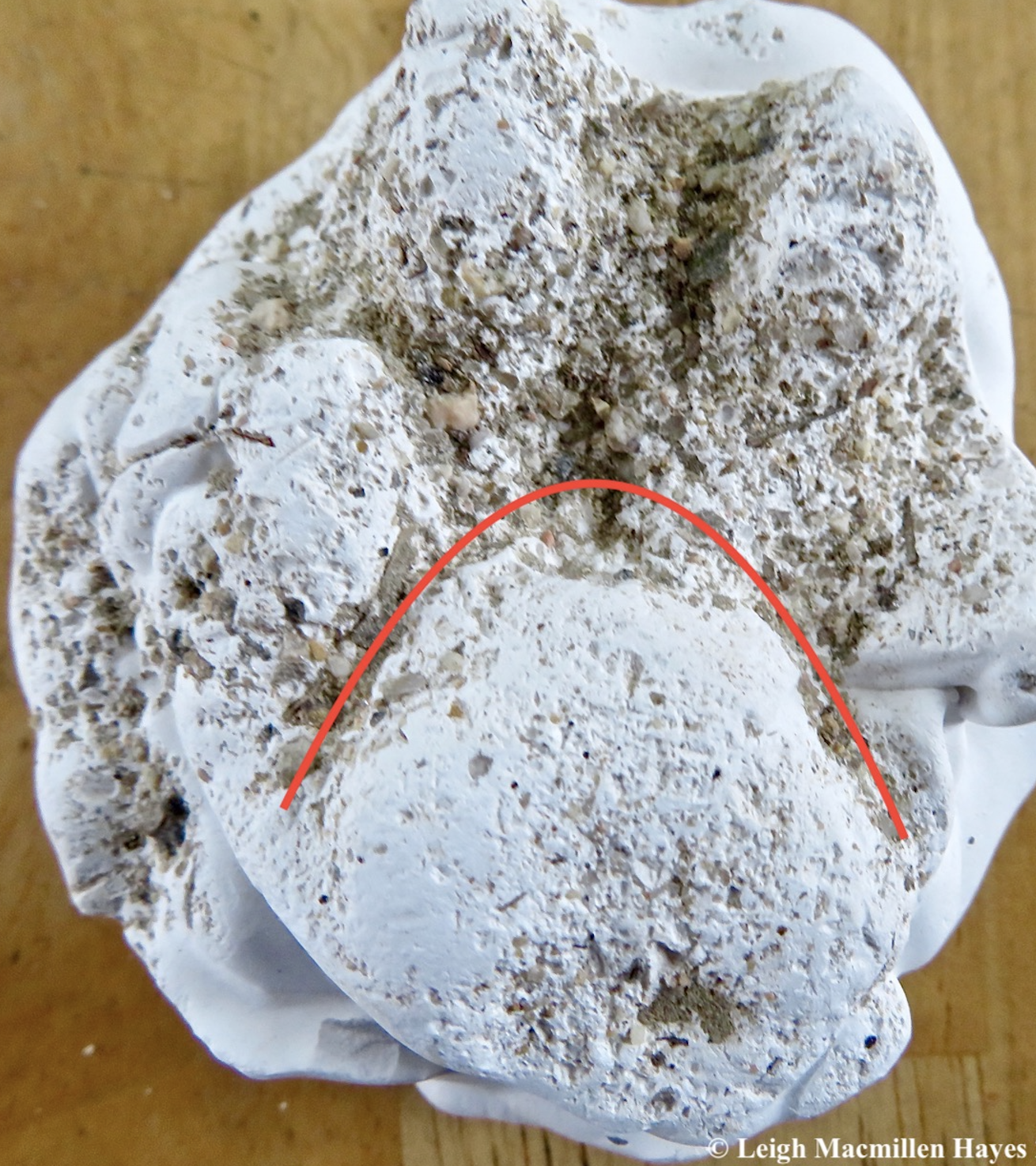
Celebrating the Work of the Leaves

In response to shorter days
and sunshine's declining density,
leaves begin the age old process
leading to their demise.
Like so many others, 
I make time to honor
the tapestry they weave
before they fall.
Chlorophyll, the green pigment
we associate with summer,
and necessary for photosynthesis,
slows and then stops manufacturing food,
and the leaves go on strike.
Veins that carried fluids
via the xylem and phloem close off,
trapping sugars, and promoting the production
of anthocyanin, the red color
we associate with Red Maples and Silver.
Though in the same family, 
Sugar Maple displays
the yellows and oranges
of the ever present Carotenoids,
which had previously been masked
by Chlorophyll.
Stripped Maple knows
only one hue,
making it easy
to spot its large display of brownish yellow.
One of my favorites
is the reddish-pinky-purples
of Maple-leaf Viburnum,
a shrub with maple-shaped leaves.
Ash follows suit,
though its leaves
are the quickest to drop
and disappear into the forest floor.
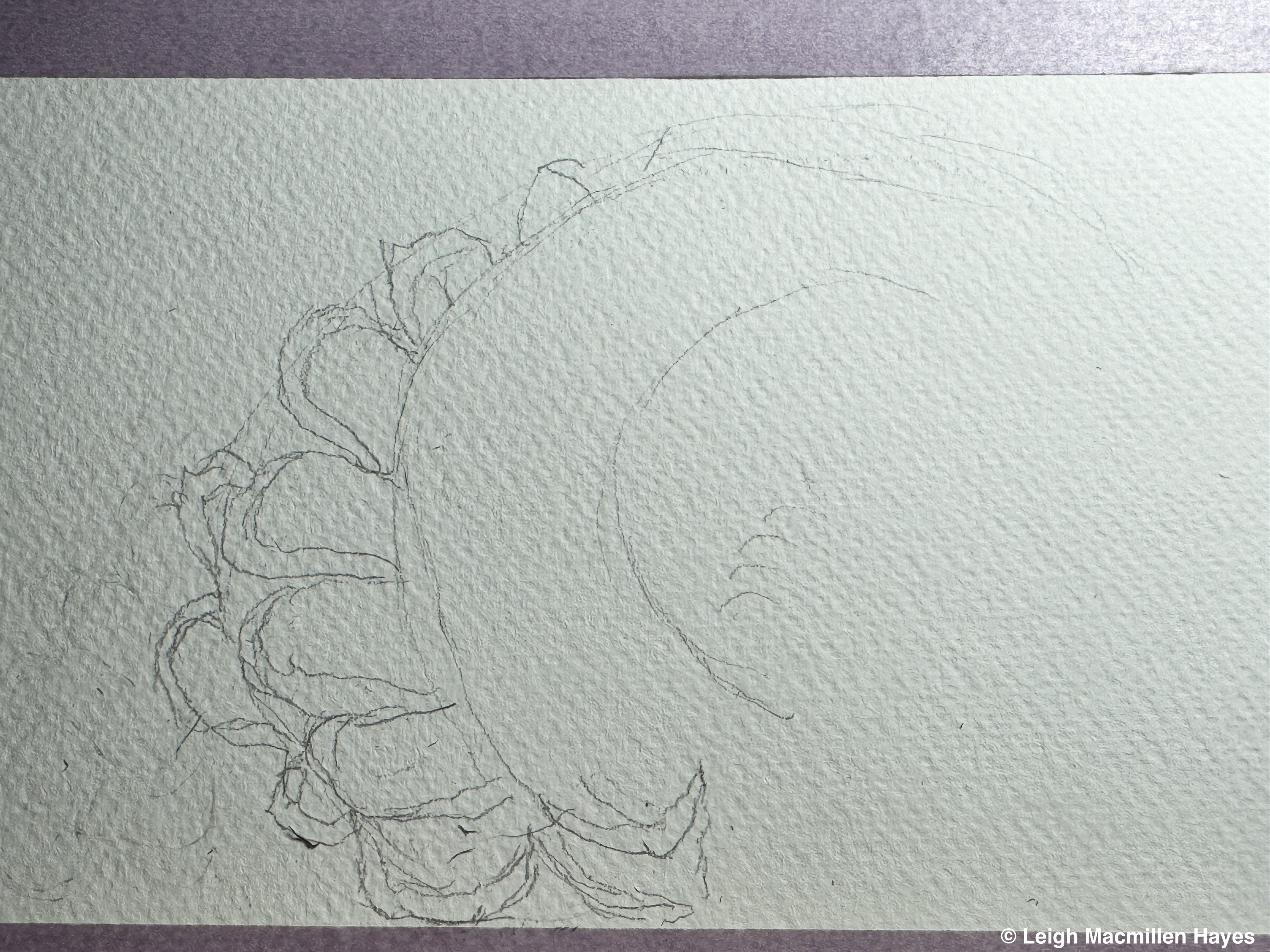
Big-tooth Aspens turn a golden yellow,
but other colors
have a tendency to seep in
and create a striking picture.
American Beech, 
Paper and Gray Birch
show off a yellow
to golden bronze presentation.
And a little late to the show, 
Northern Red Oaks
put their colors on display
after other species
have already dropped their leaves.
Not really a part of the foliage, 
but still important because it is present,
is the splotchy display caused by Anthracnose fungi,
a result of too much rain stressing trees
and not allowing them to properly respire.
Once connecting tissues 
between leaf petioles and their twigs
form a seal,
the forest floor is colored with gems
that will eventually turn various shades of brown
as they decompose and restock the soil with nutrients,
plus provide food for numerous organisms. And shelter.
In a Senior College (Lifelong Learning) class
this past week,
I attempted to use watercolor pens
to capture the colors.
And then at home, 
I tried to do the same,
only this time using watercolor pencils
to show off the vibrant variety of hues.
In doing so, 
I was forced to slow down
and notice how the color changes
often followed the veins
in this biochemical process.
Fall foliage is fleeting,
and I give thanks
that every year
we can celebrate the work of the leaves.