The Long Farewell

Saying goodbye is so hard to do, yet at some point we all must. These last few days I’ve been trying to wrap my brain around how best to do that and not feel melancholy.

But then again, maybe the future isn’t all that far off. Wait a minute. Blueberries in flower? Yes! Sadly so. Over the past week or so friends, relatives, and I have noticed various species flowering due to warmer than normal autumn temperatures. These of the low-bush variety are along the path that my neighbor mowed through the field where I’ve spent many a glorious hour observing.

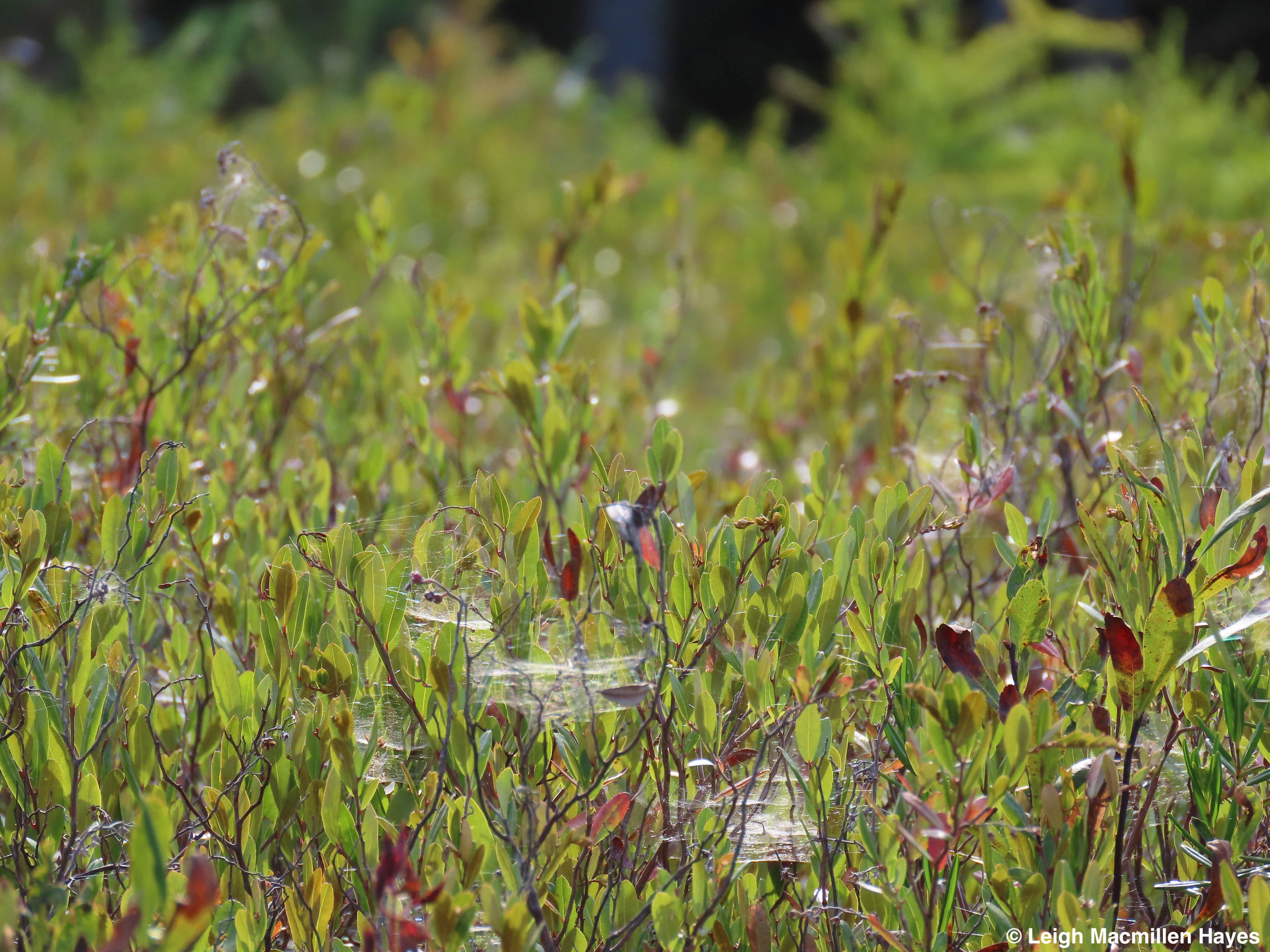
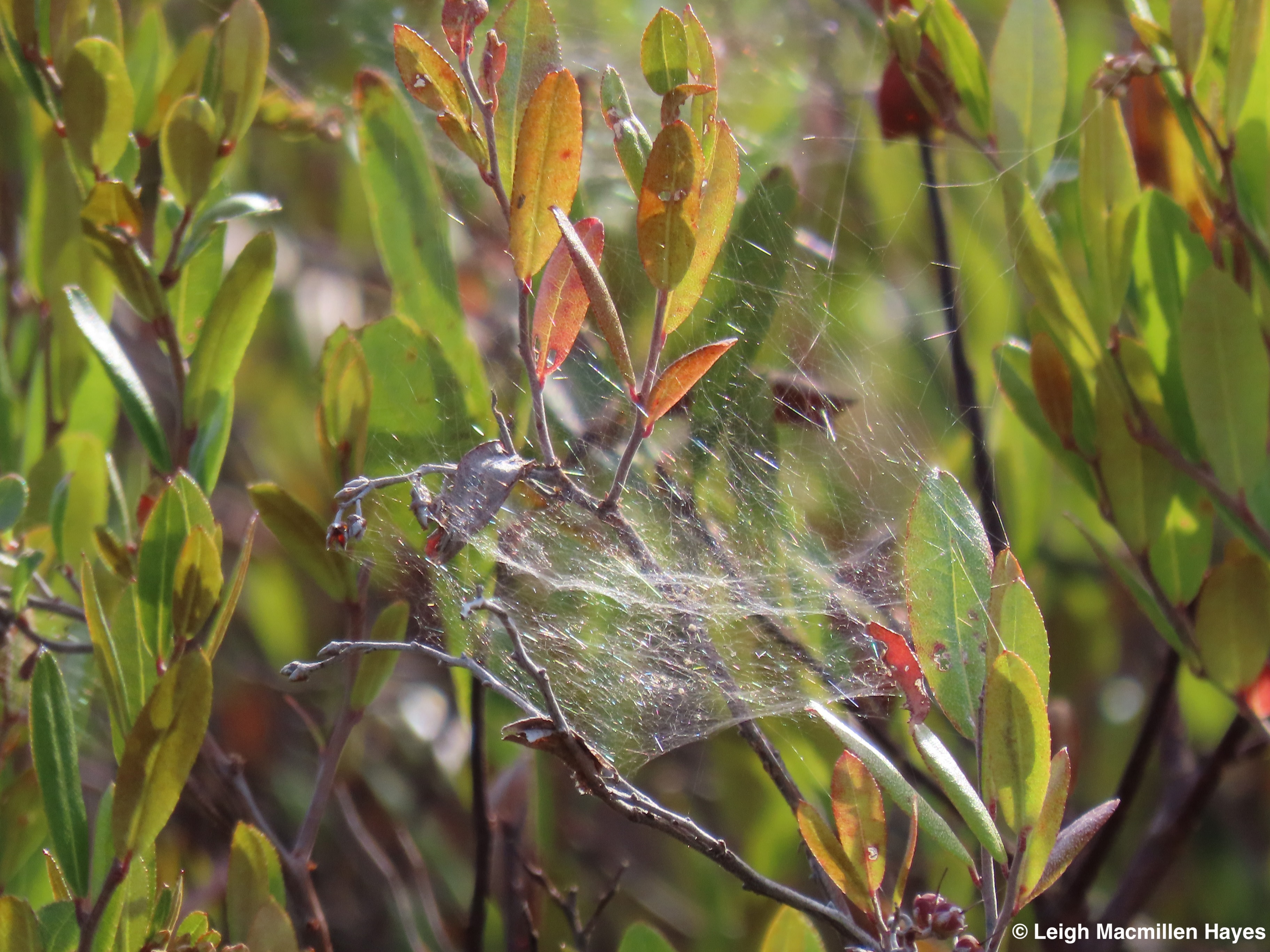
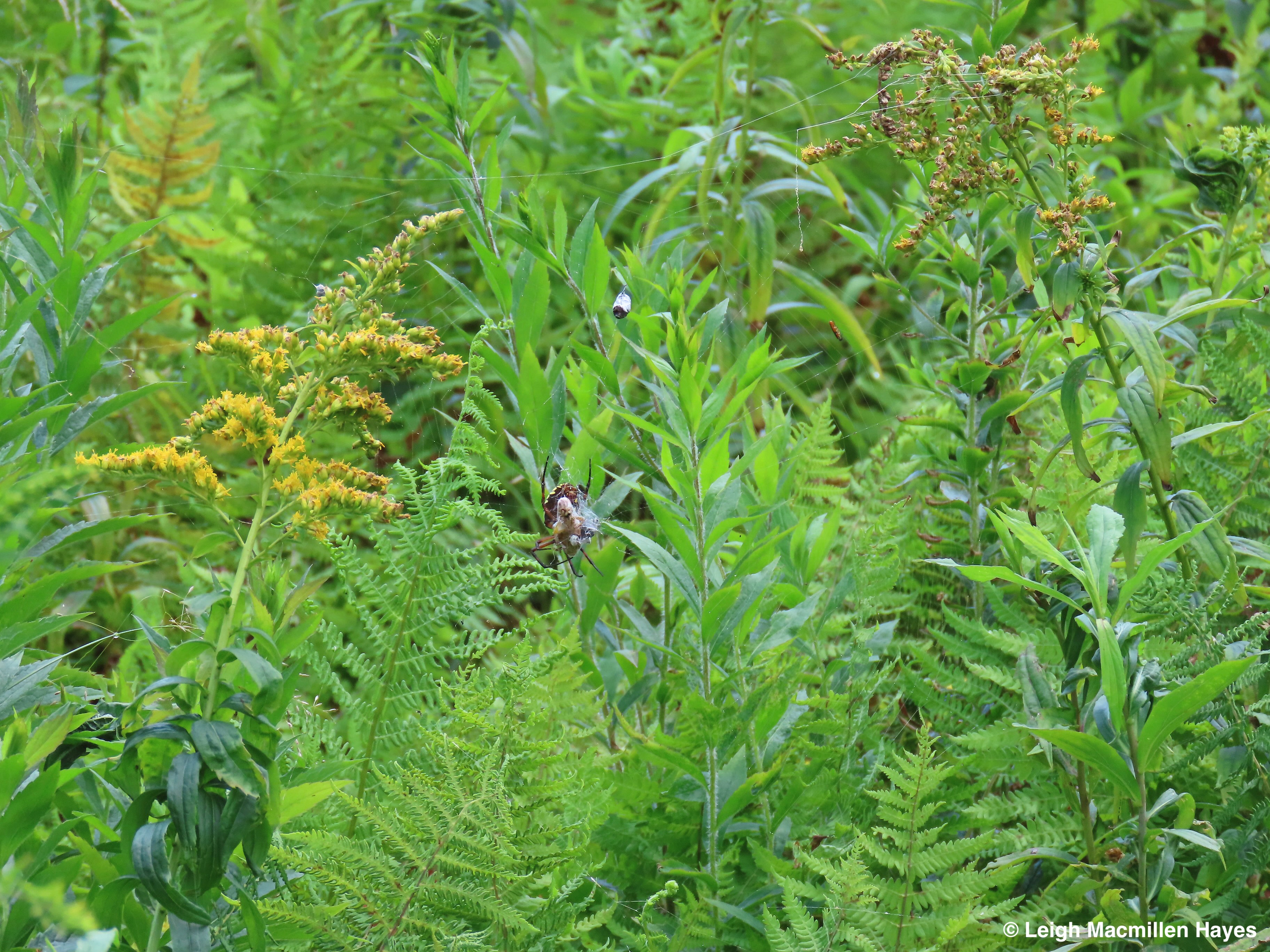
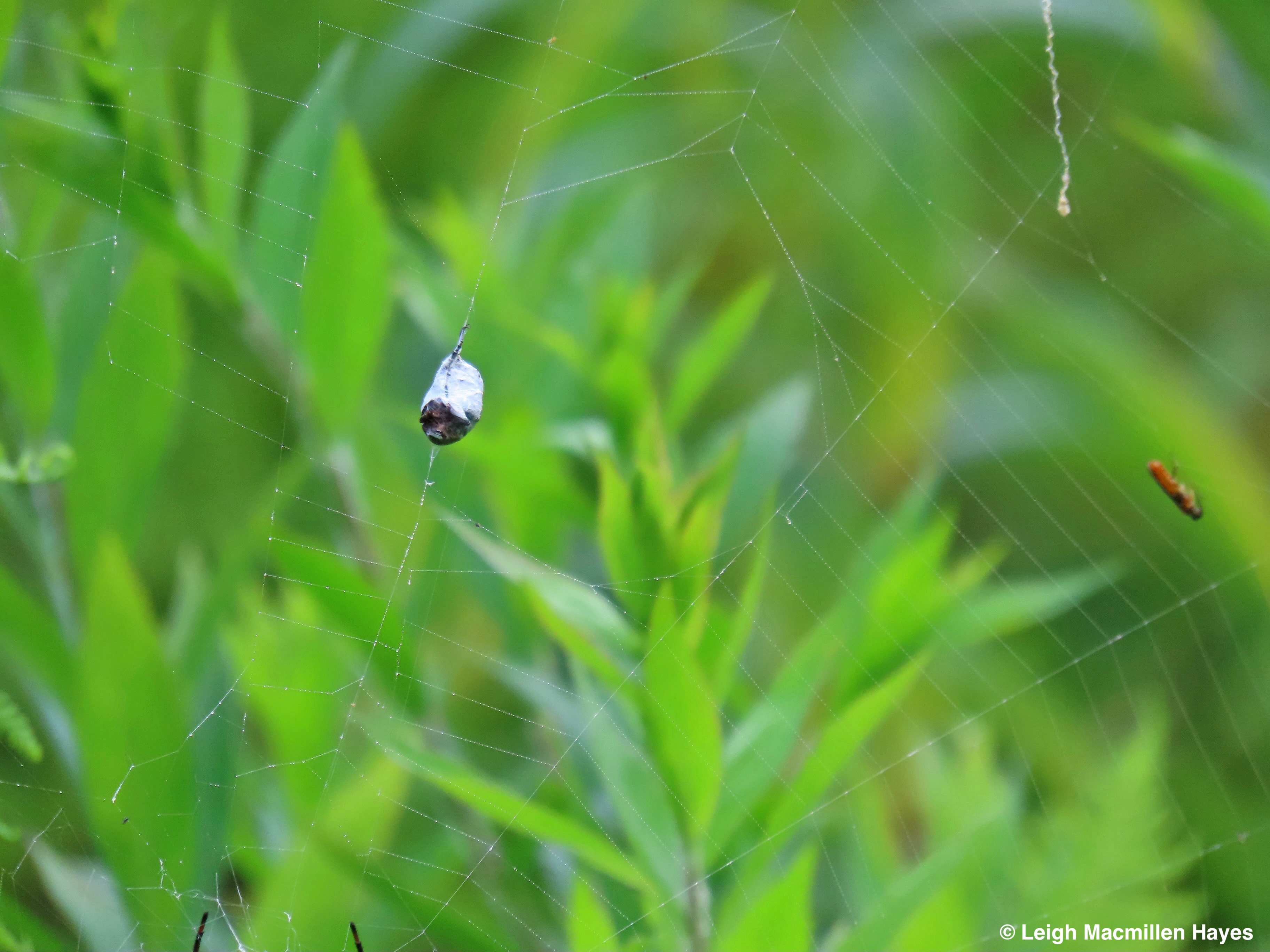
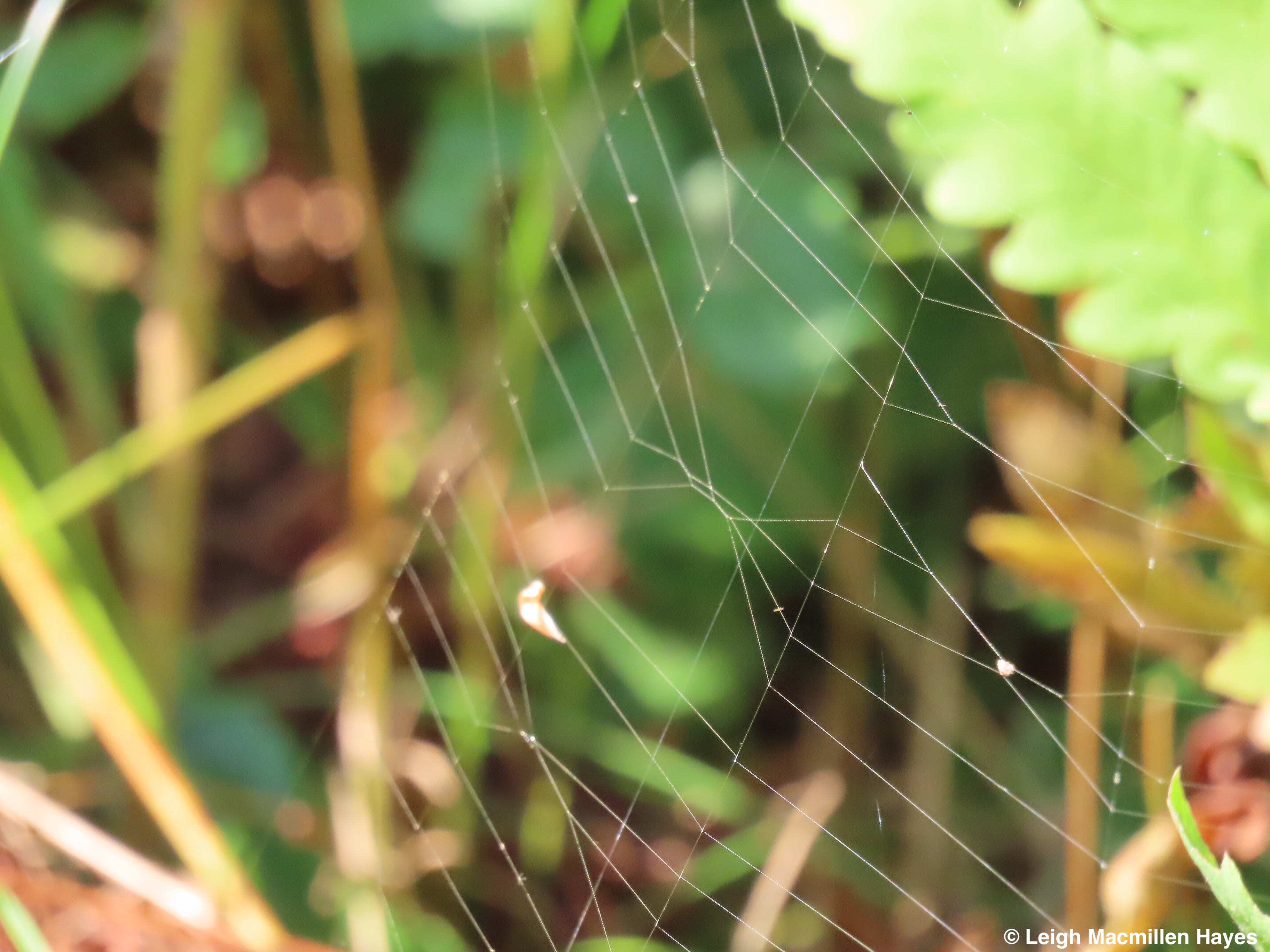
It’s in the same field where I delight in spotting bowl and doily spider webs and this one, a funnel web with the funnel weaver sitting inside waiting for a meal to arrive.

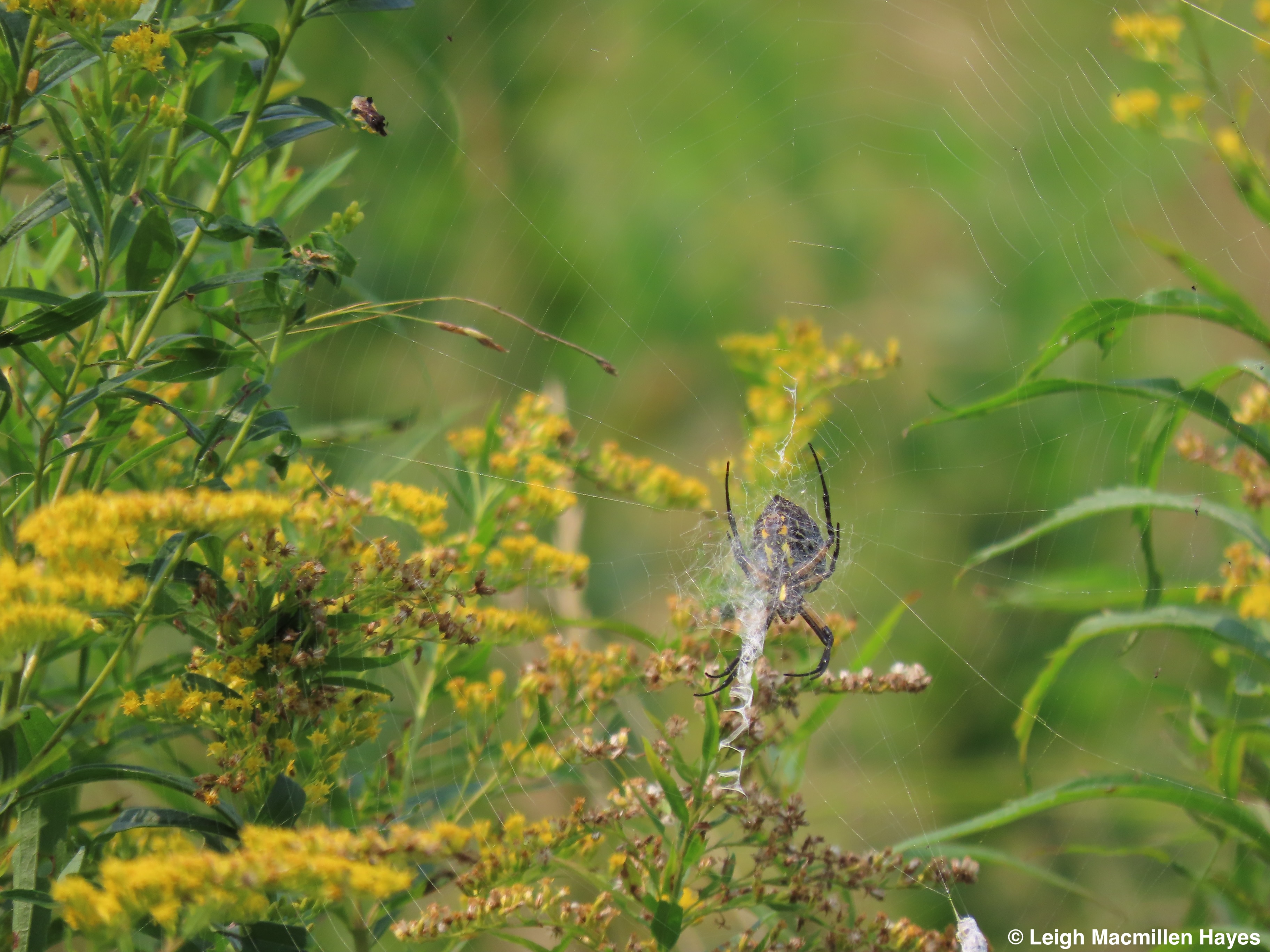
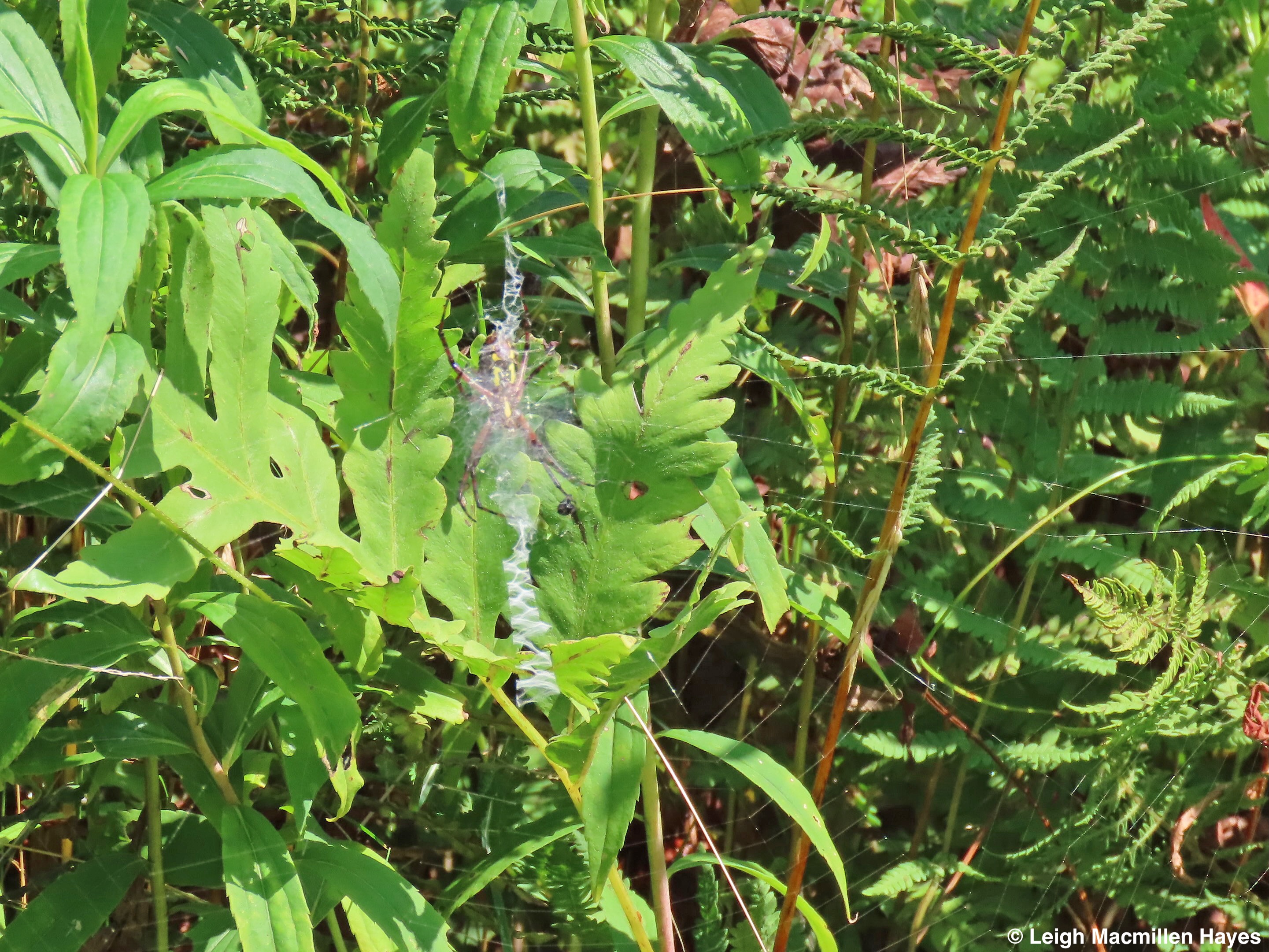
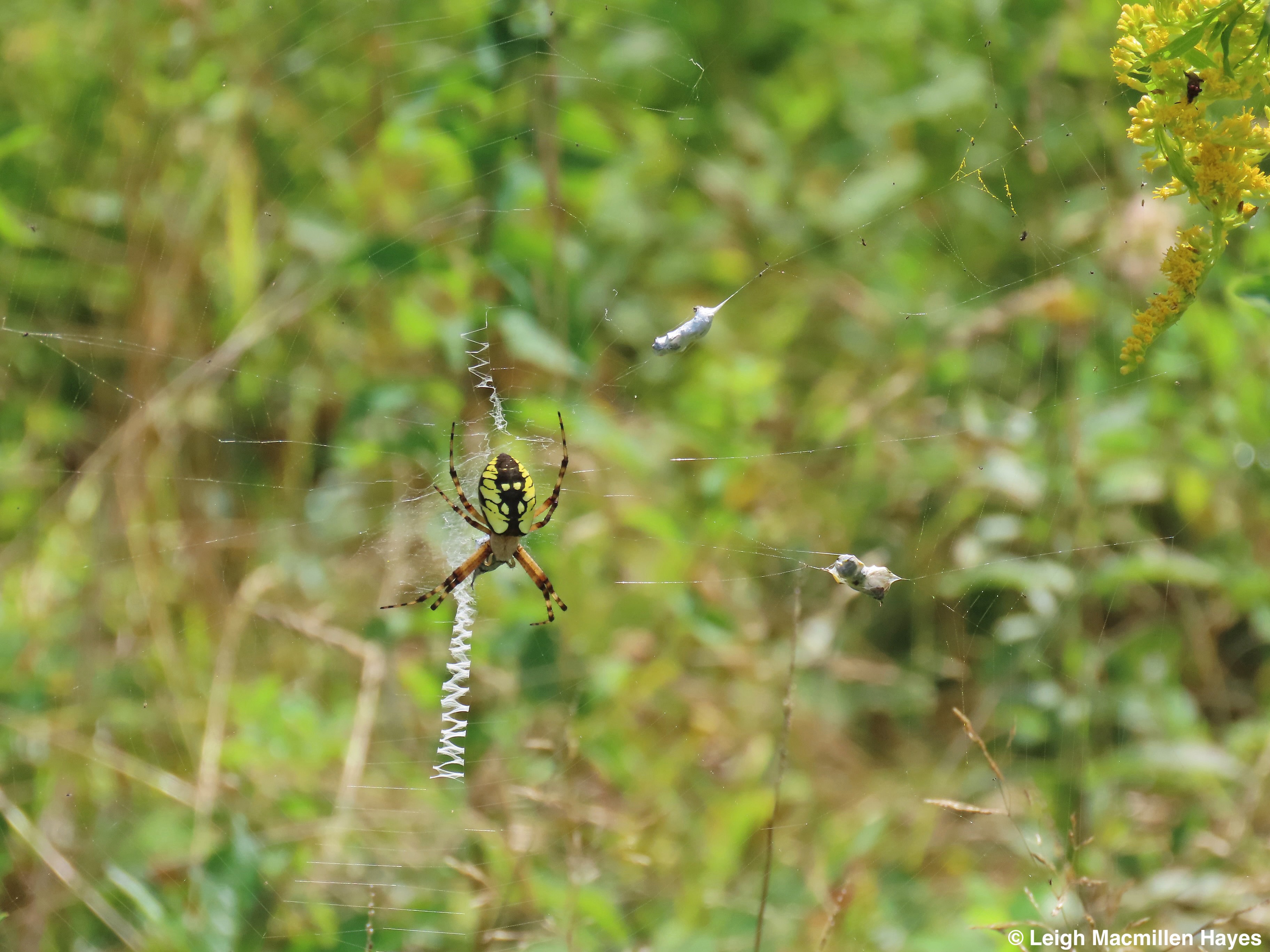
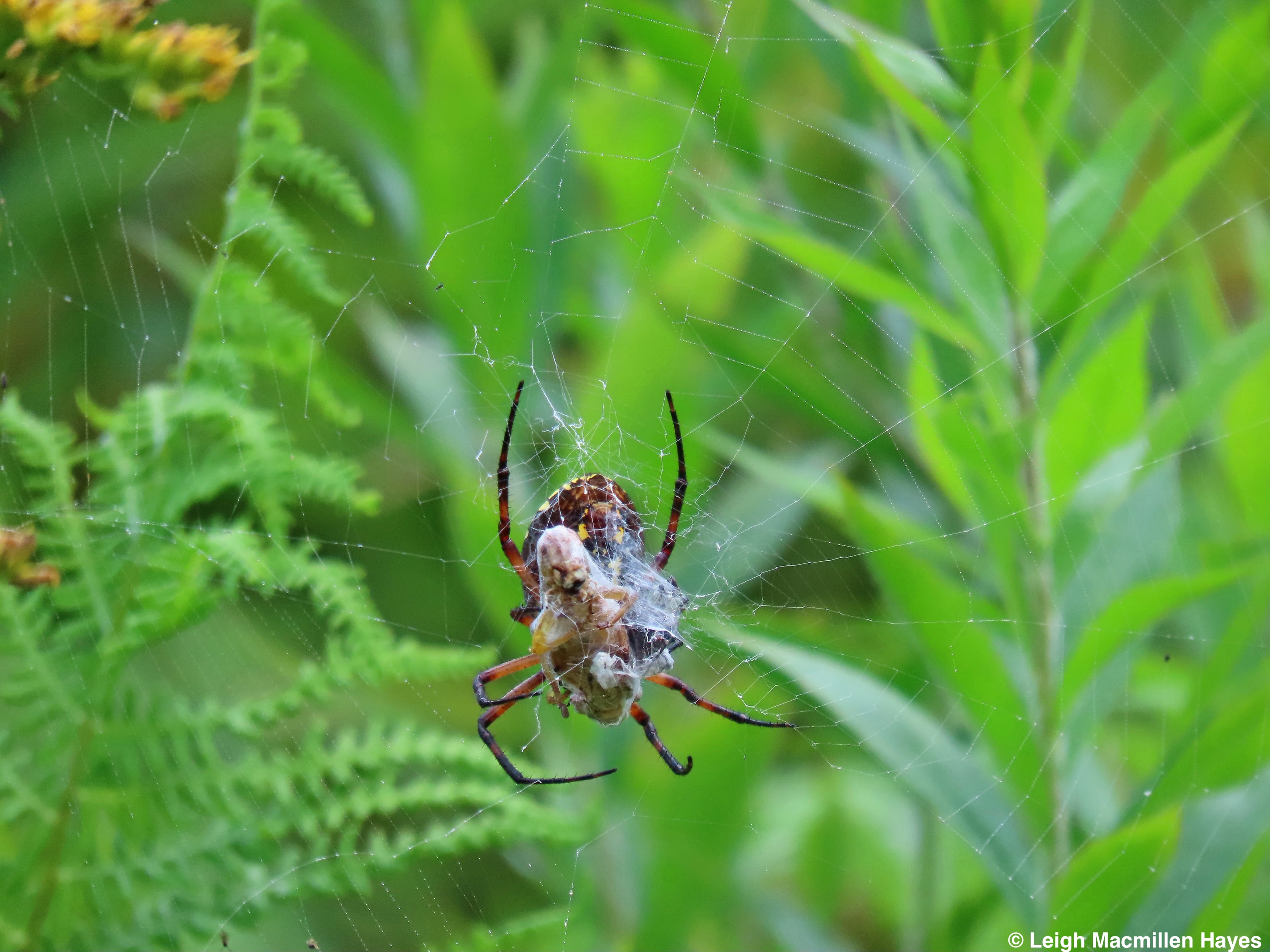
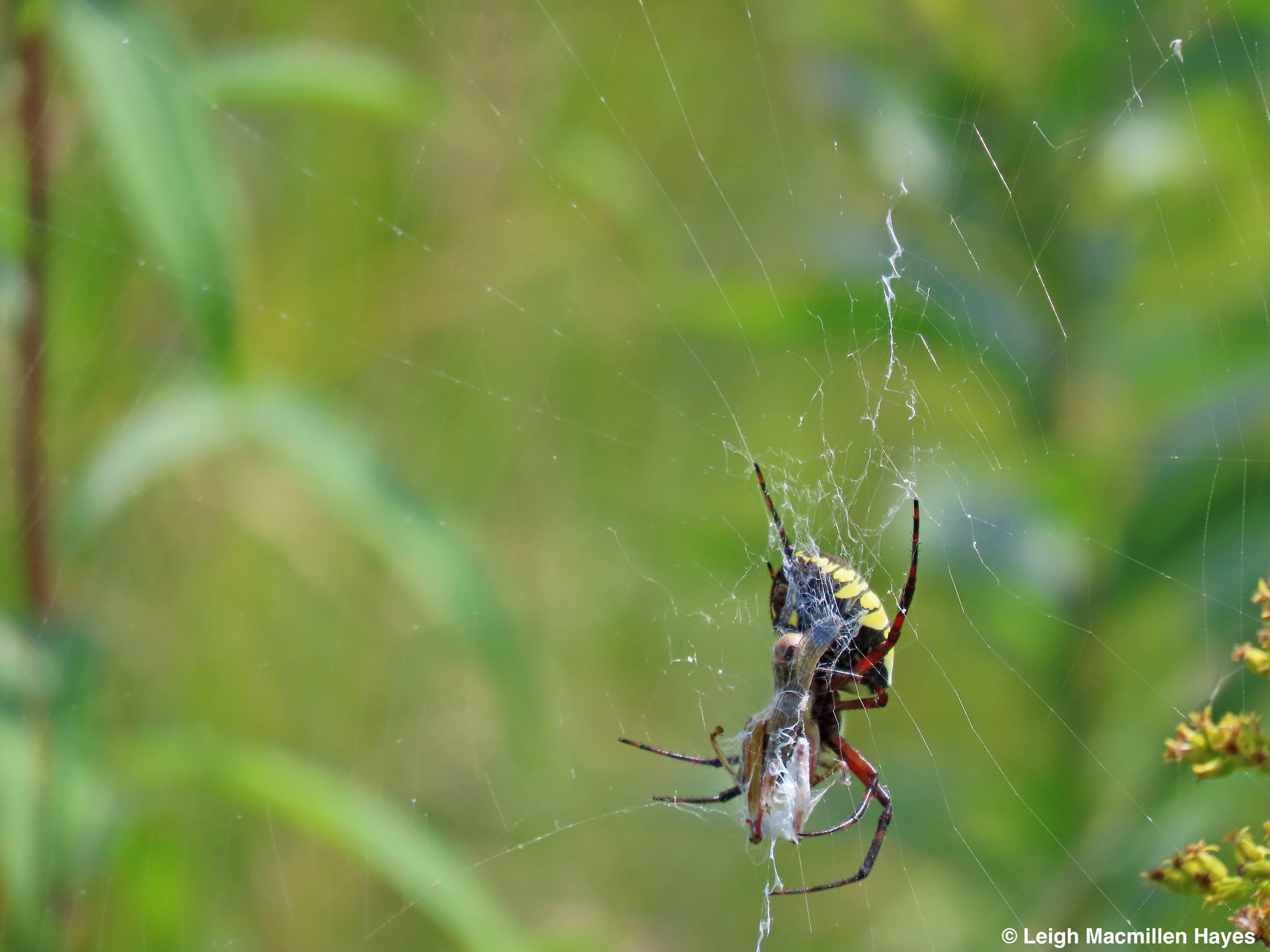
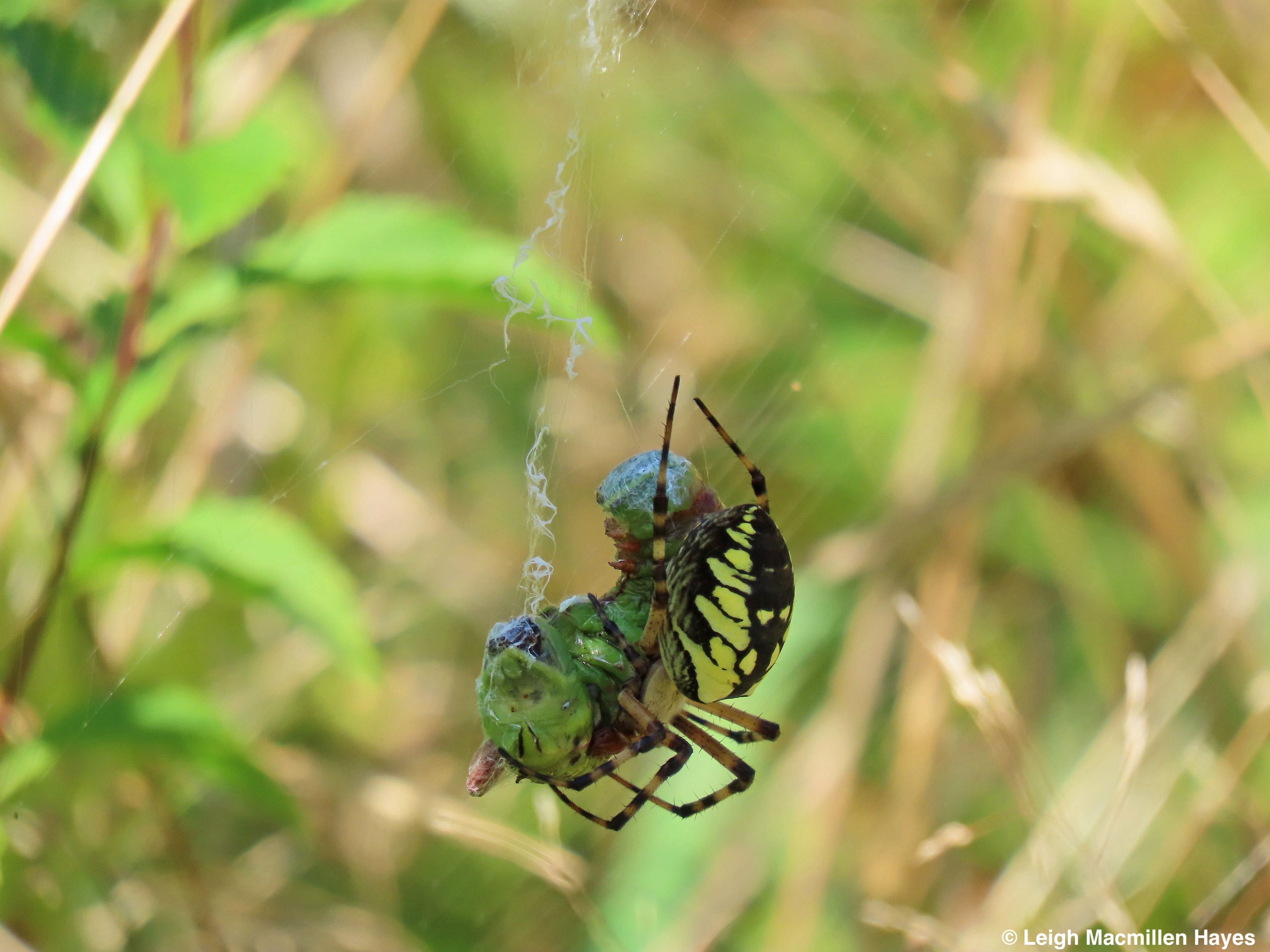
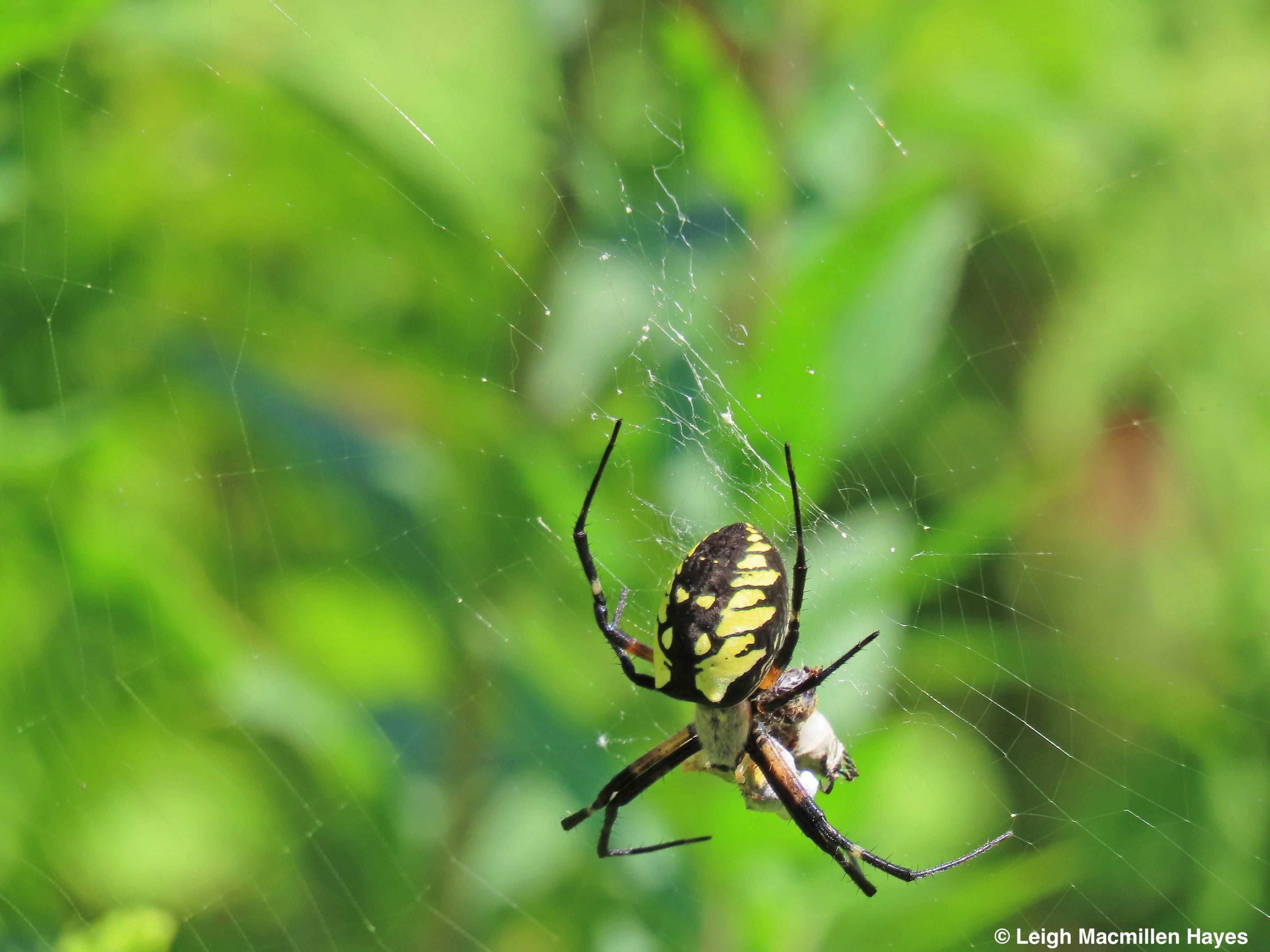
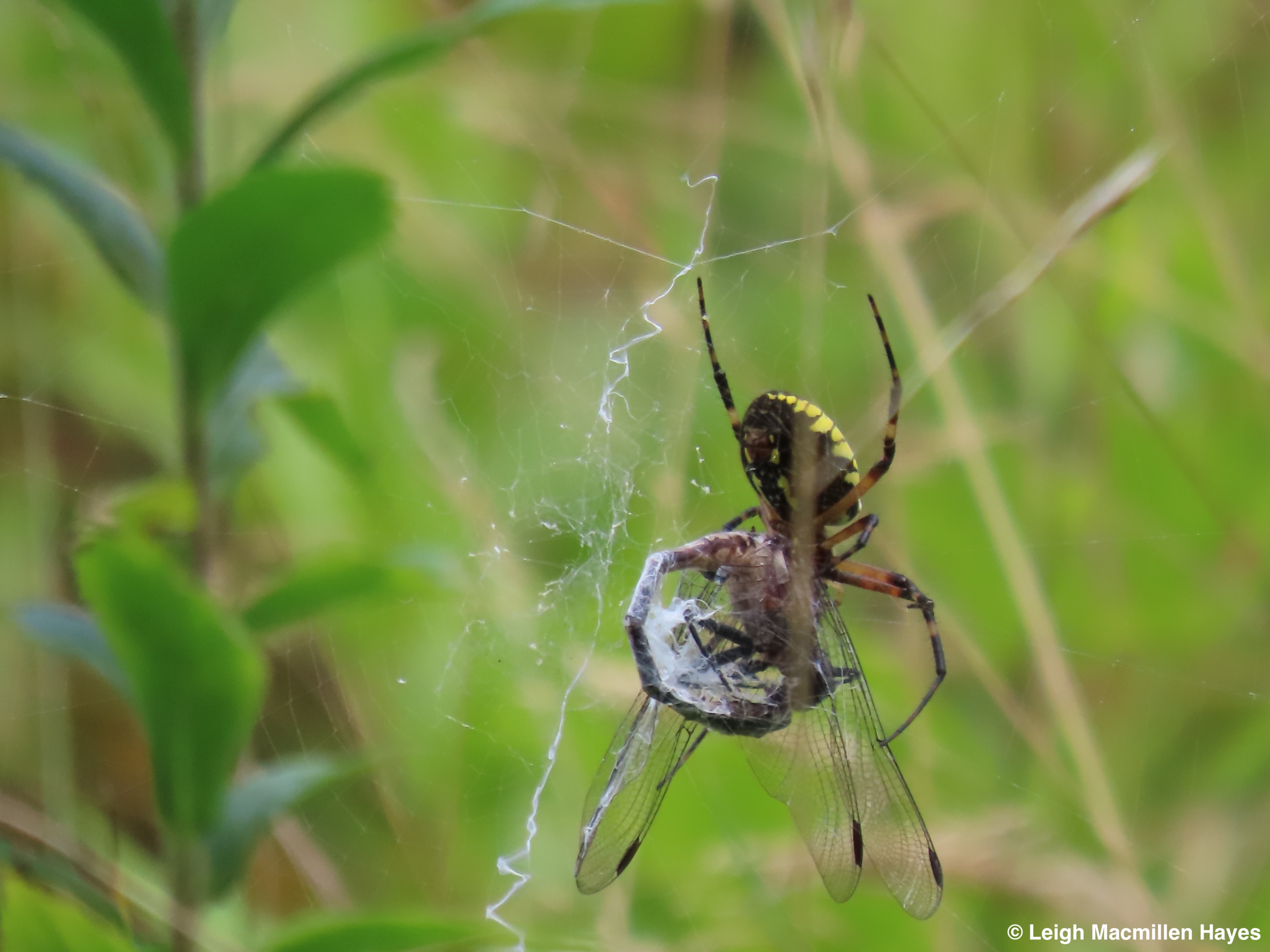
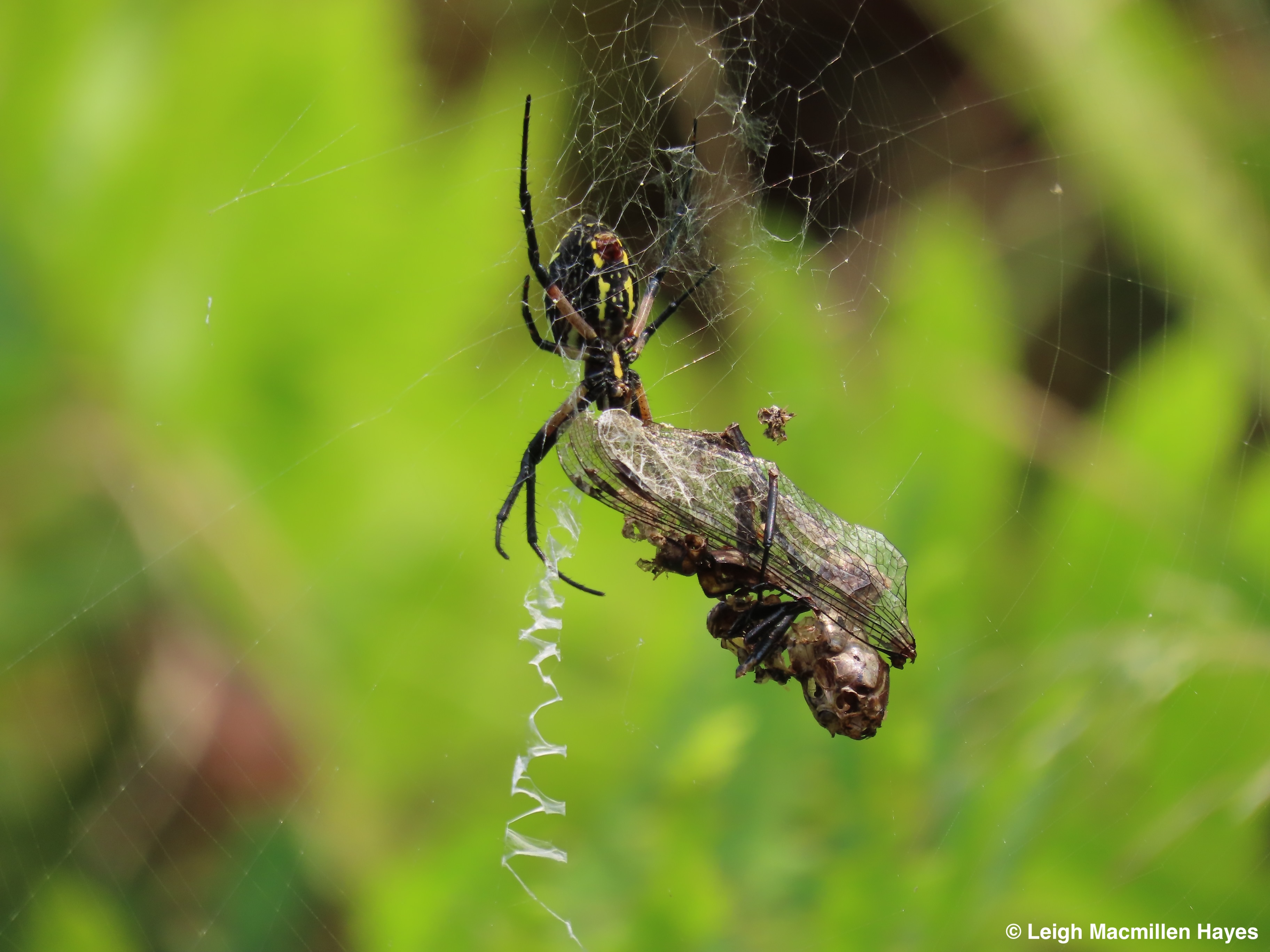
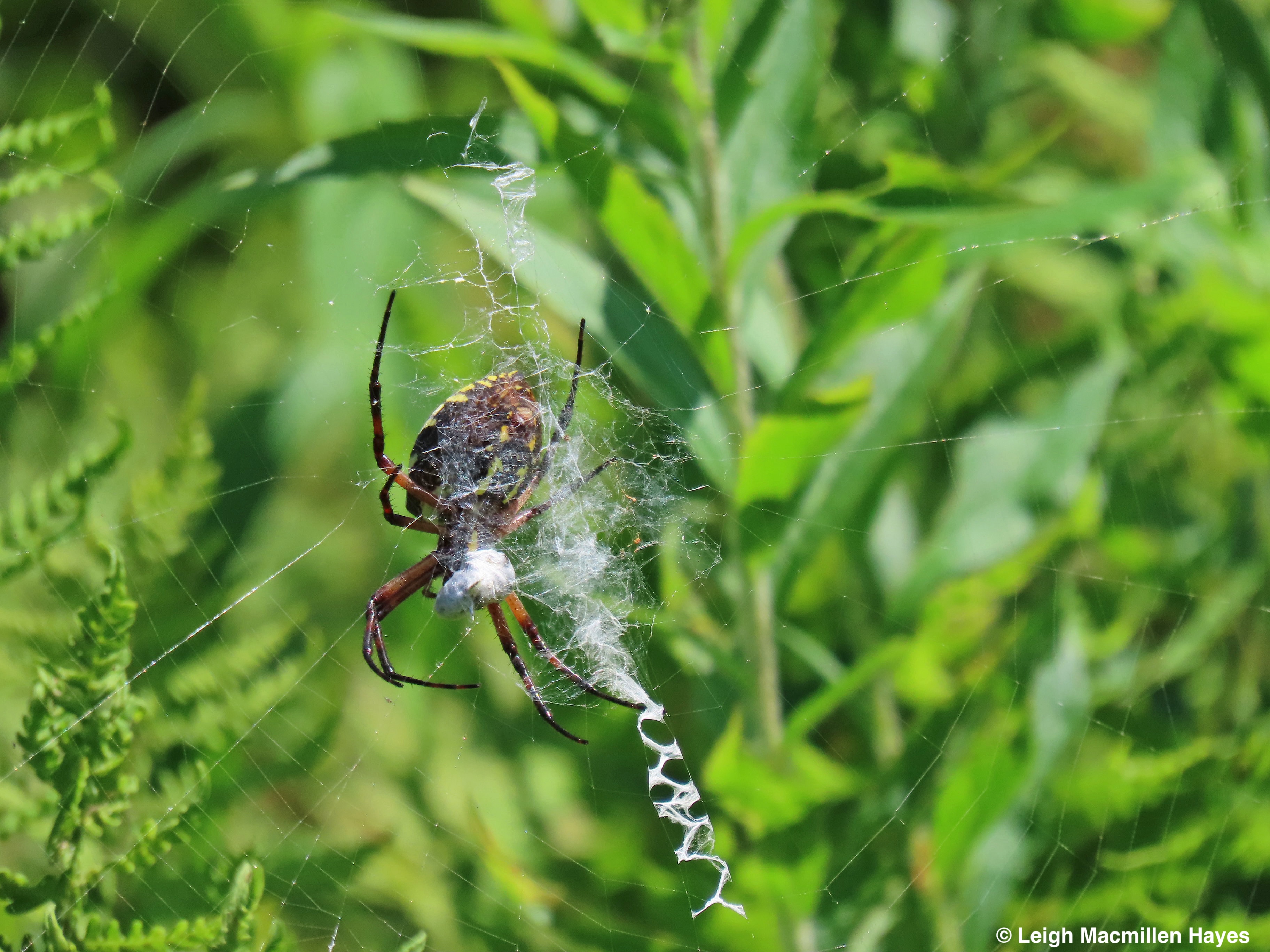
Orb weavers have also been mighty abundant this year and at first I assumed this was Ye Olde Black and Yellow Garden Spider that I love to watch at work–usually wrapping its prey as this one was doing.

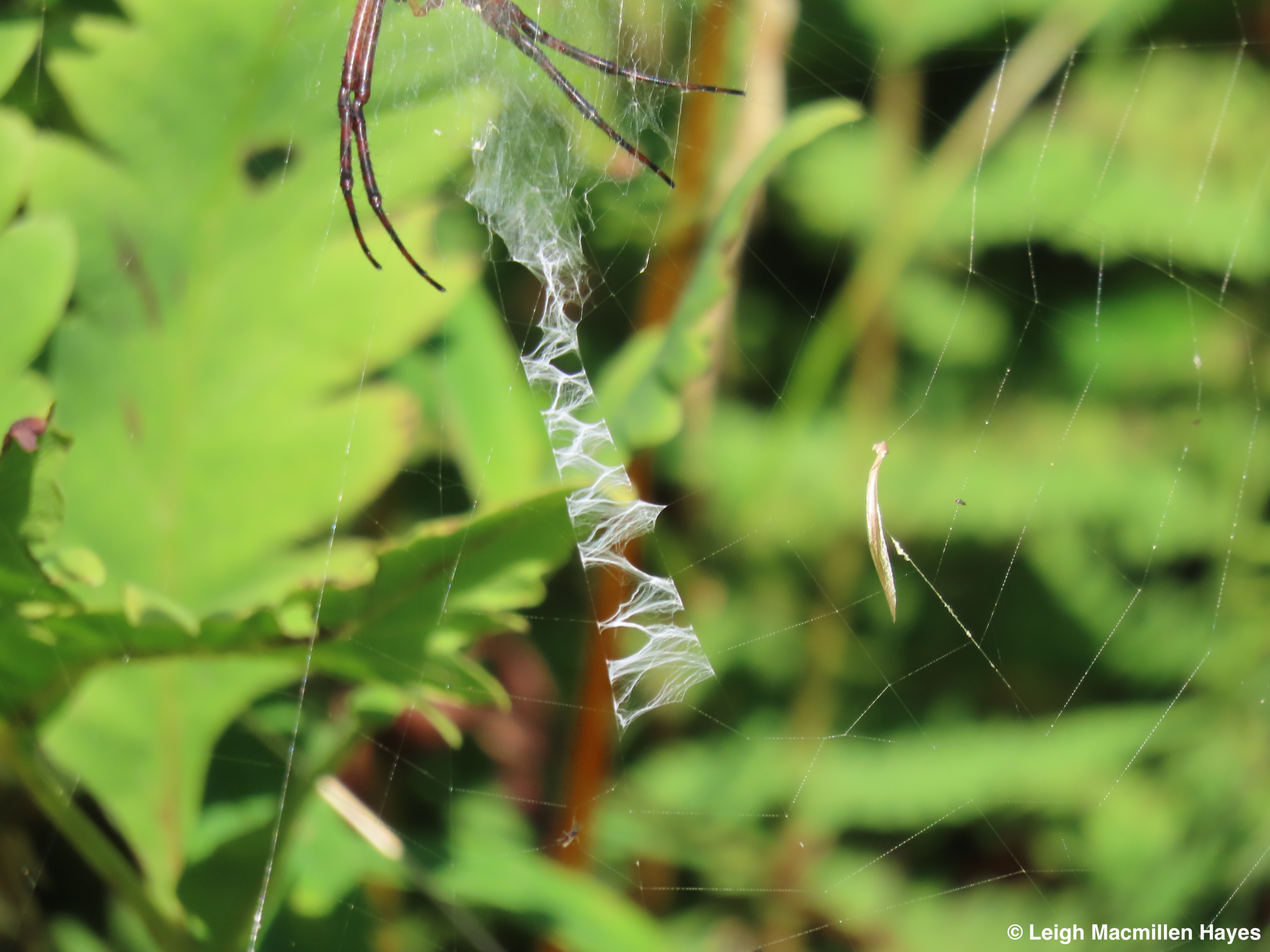
Before I say more, take a look at the silk coming out of its spinnerets. I like this explanation by Naturalist R.J. Adams about spider silk: “Within each spider’s abdomen are a variety of silk glands which can vary in number depending on the species. Some of the oldest lineages, including relatives of California’s tarantulas and trapdoor spiders, have only a single type of silk gland, while some orb weavers can have up to eight different kinds. Each gland produces a protein-rich liquid which connects to numerous minute spigots at the tip of the spider’s spinnerets. When silk is needed, tiny valves behind each spigot control its release, and as the fluid is compressed through the spigot’s openings, tension orients the molecules into a solid, thread-like structure.”

Liquid. Spigots. Thread. What an amazing invention!
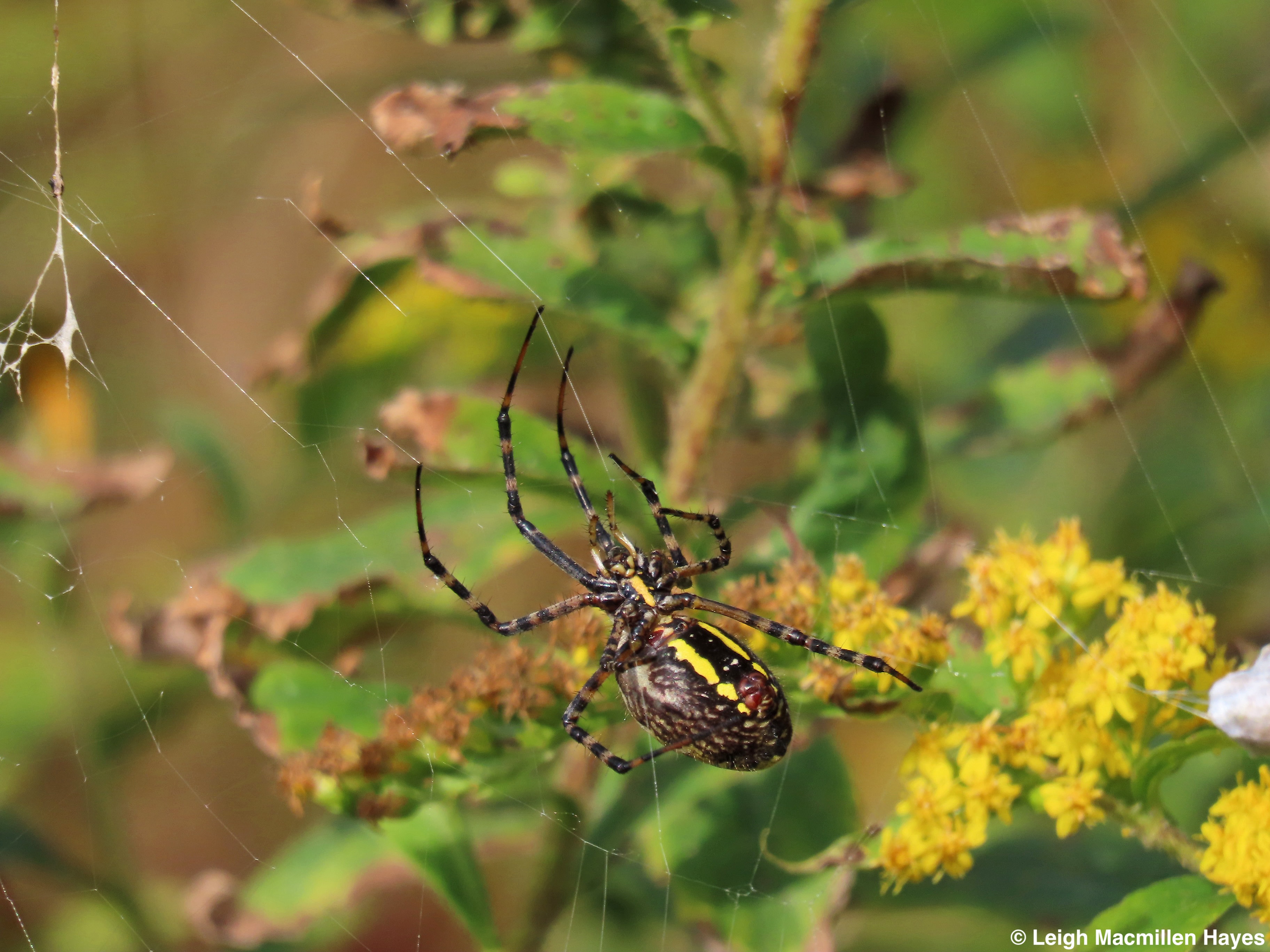
As I watched the spider move away from its packaged meal, walking so confidently on those guide lines, I realized its coloration was a wee bit different than that of the Black and Yellow Garden Spider.
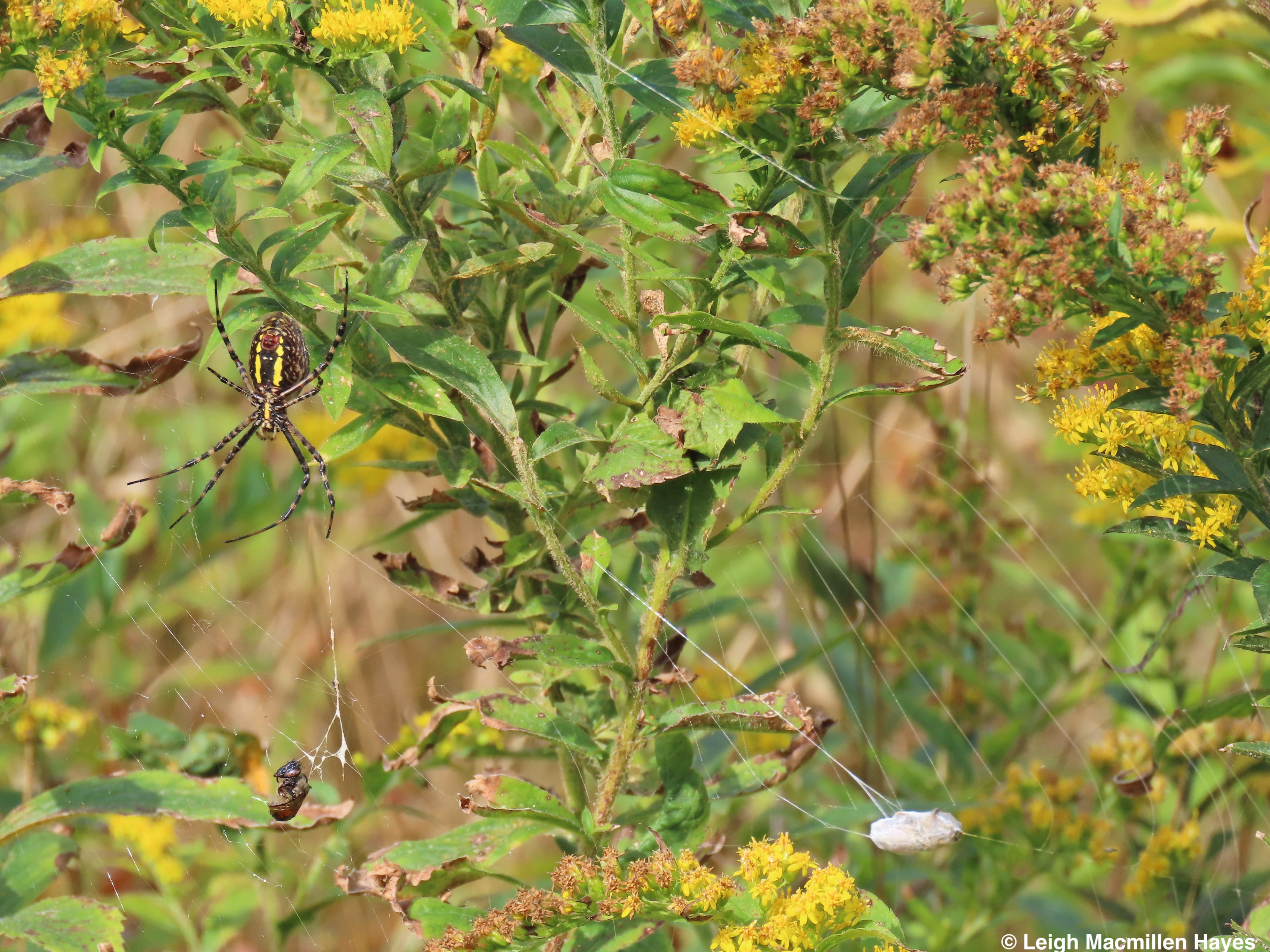
Not only was the design/coloration different, but also the fact that there was no Zig-zaggy stabilimentum, an ultraviolet runway of multiple threads which perhaps provides stability or attracts prey or tells others to stay away, a trademark of the Black and Yellow.

That’s because this was a Banded Orb Weaver with a different pattern. And now I can’t wait to look for these again next year.
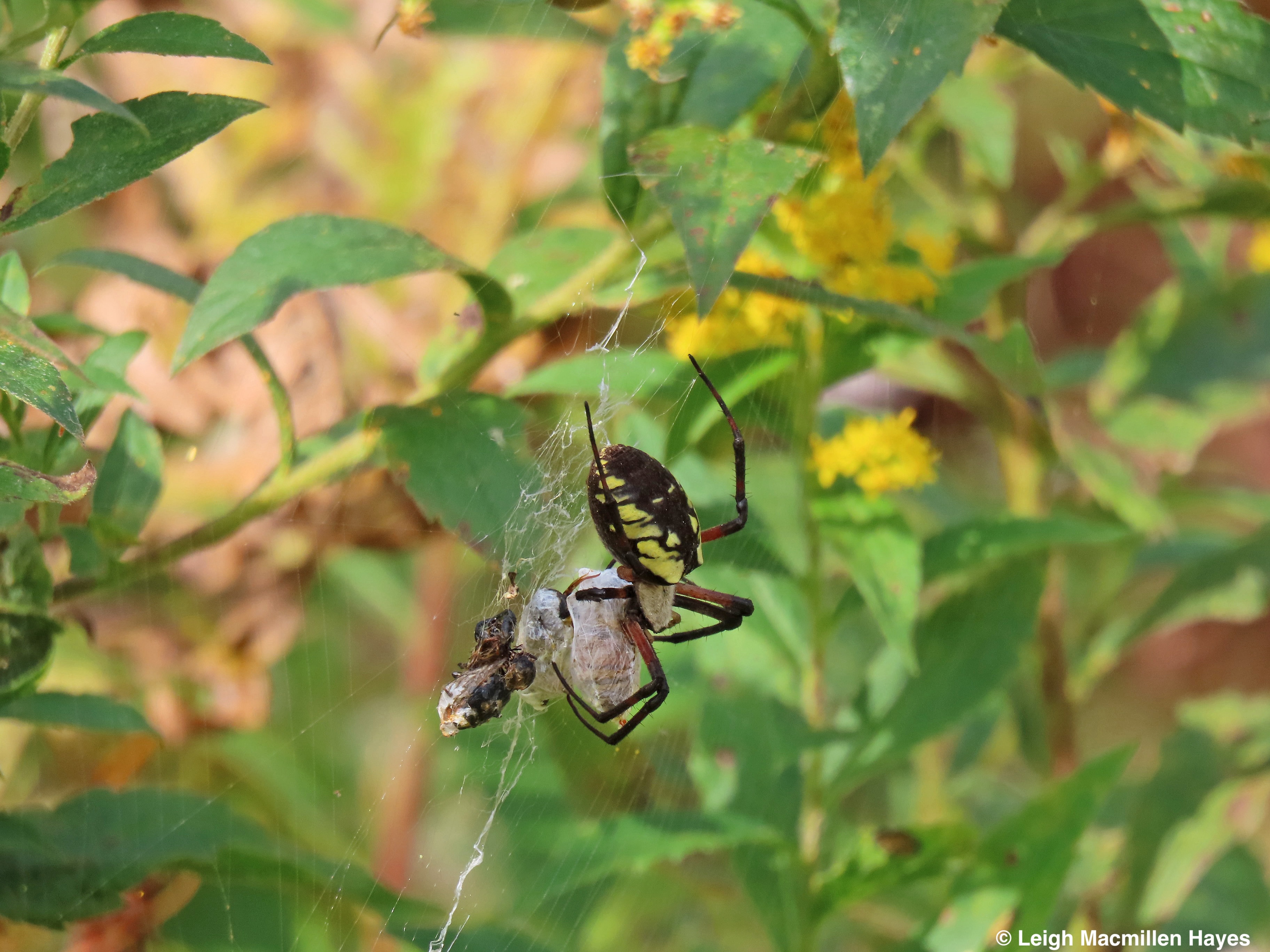
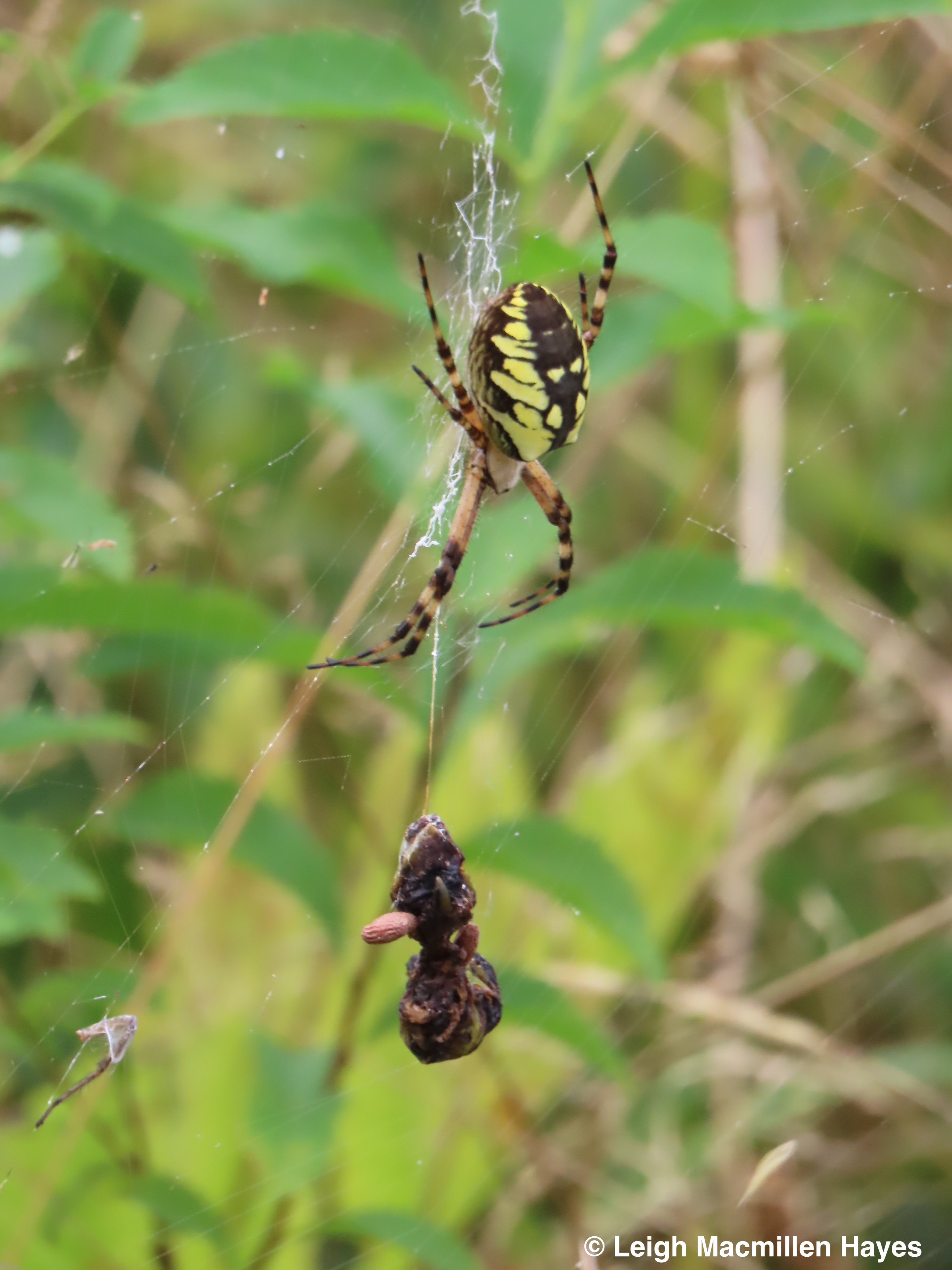
Until a couple of days ago, I was still seeing Black and Yellows, but not as frequently as I had all summer long. It seemed like this gal had stocked her pantry, perhaps knowing her days were coming to an end.
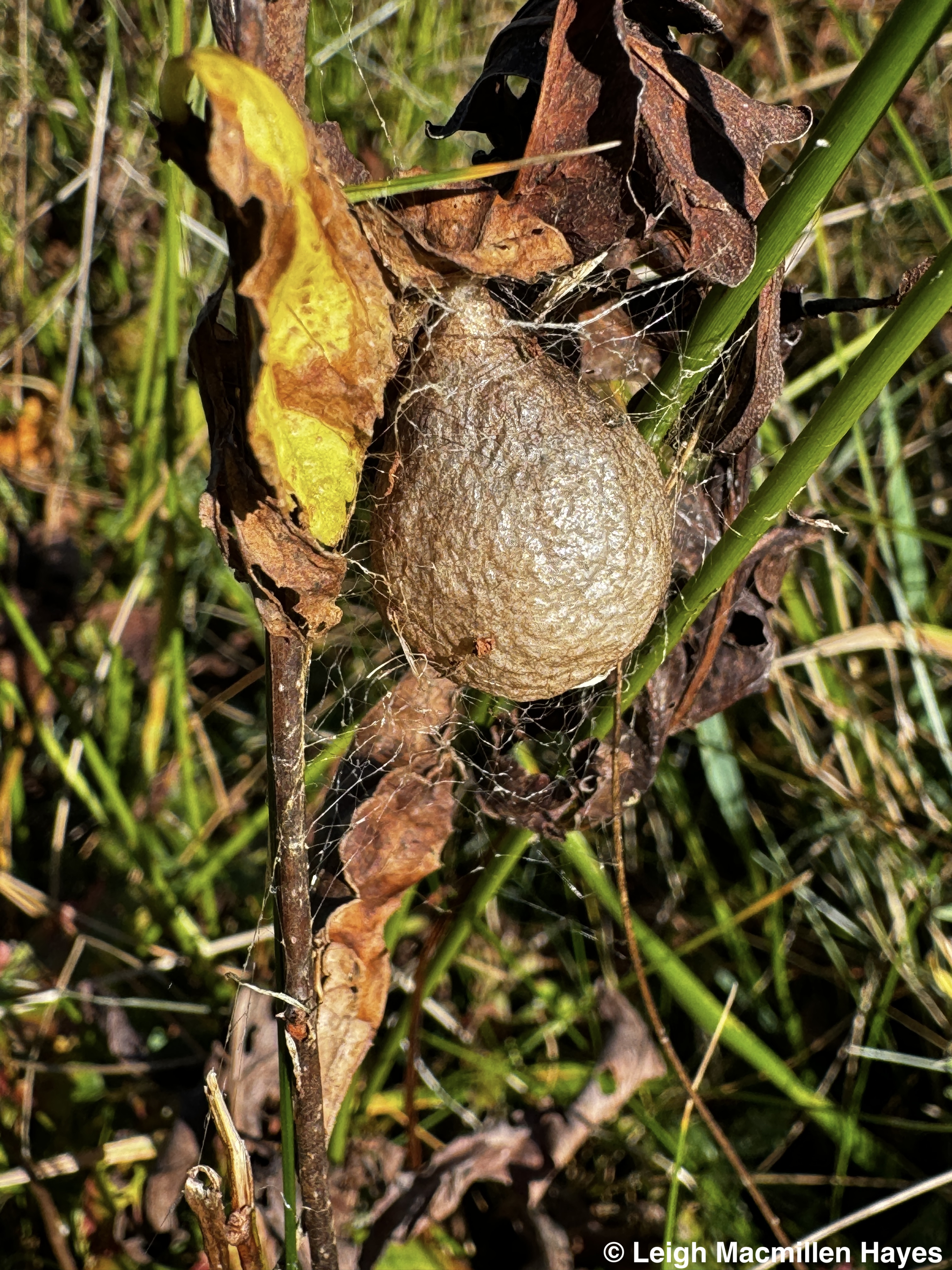
The good news is this sac, soft on the inside and parchment-like on the outside, was created by a Black and Yellow, and within her eggs will survive the winter months. Where there is one sac, I suspect there are dozens more.

Do you see them? The egg sacs I mean? No, I don’t either. Camouflage is the name of the game as the goldenrods and asters go to seed.
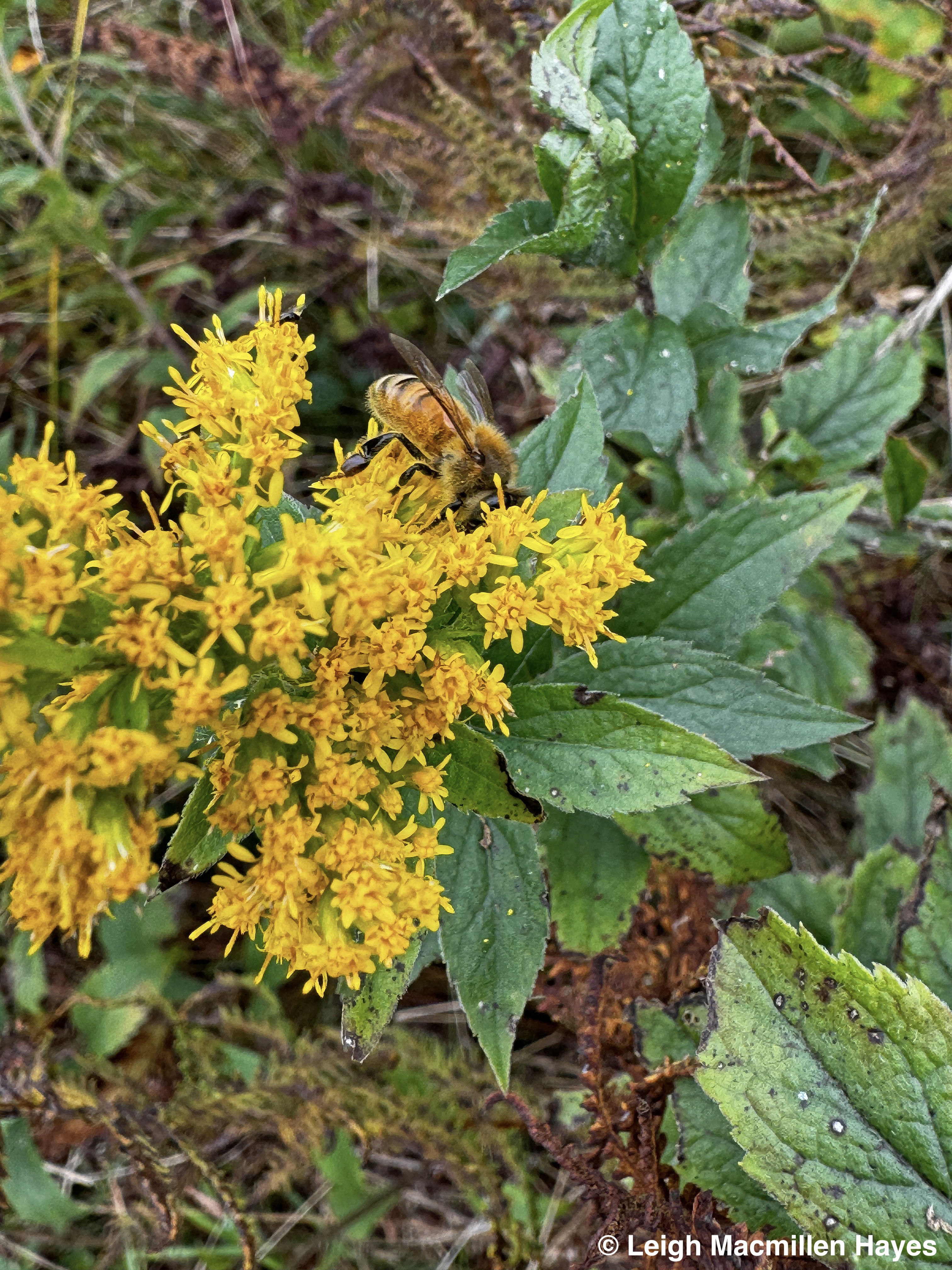
Despite or because most of the flowers have gone to seed, those that still thrive are the subject of heavy pollination activity. Frenzied in fact. From Honey Bees to . . .
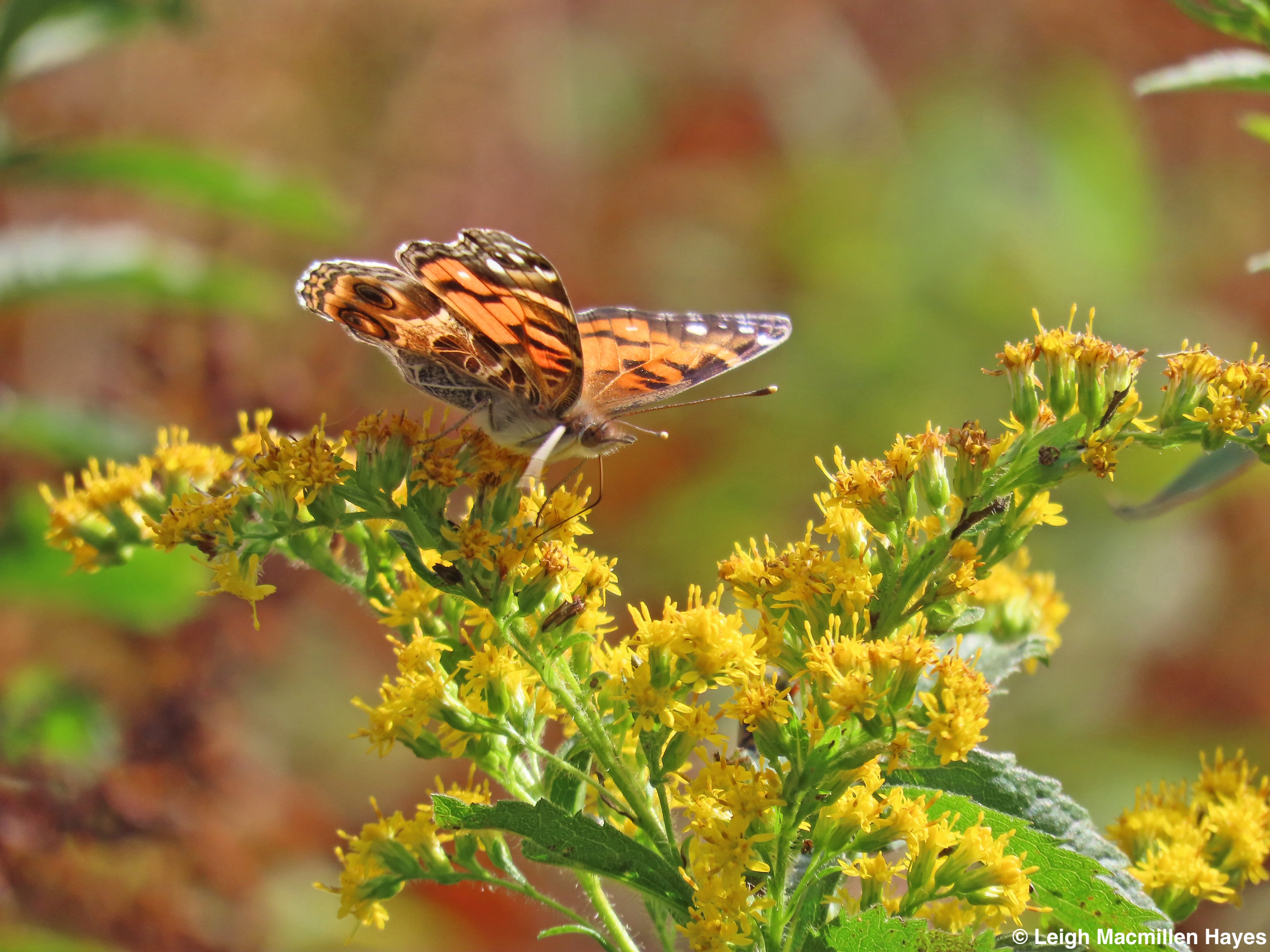
an American Lady, to . . .

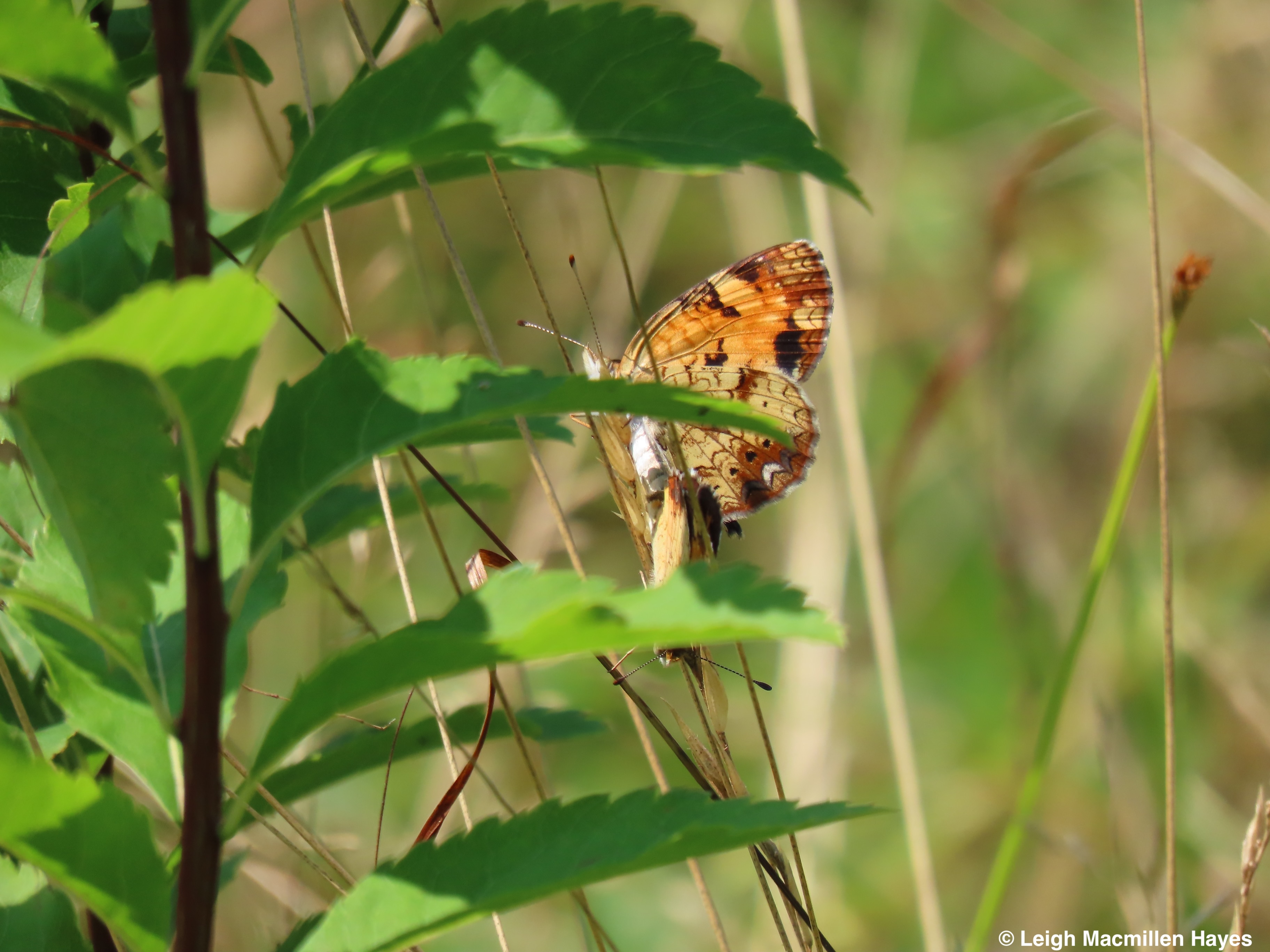
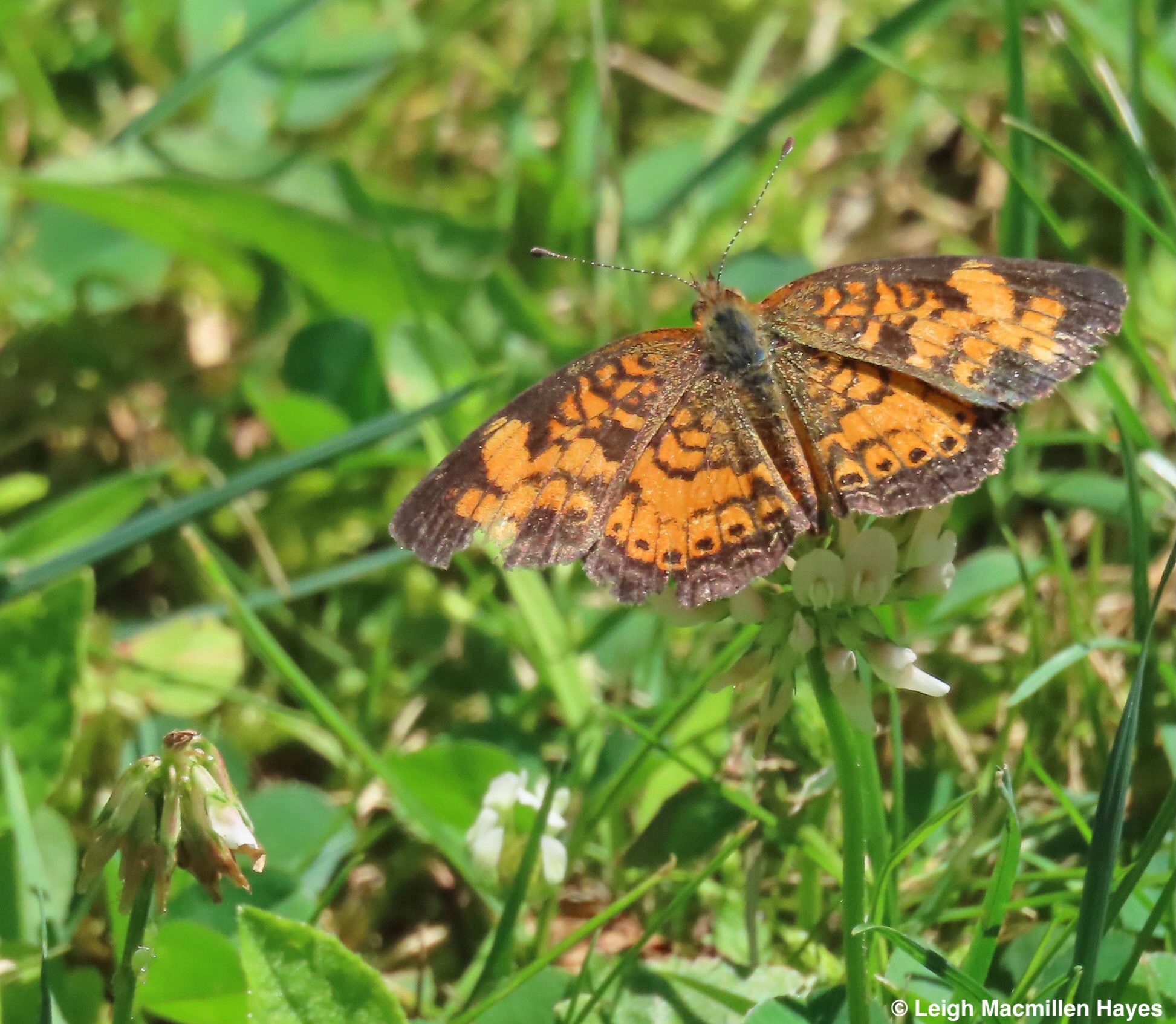
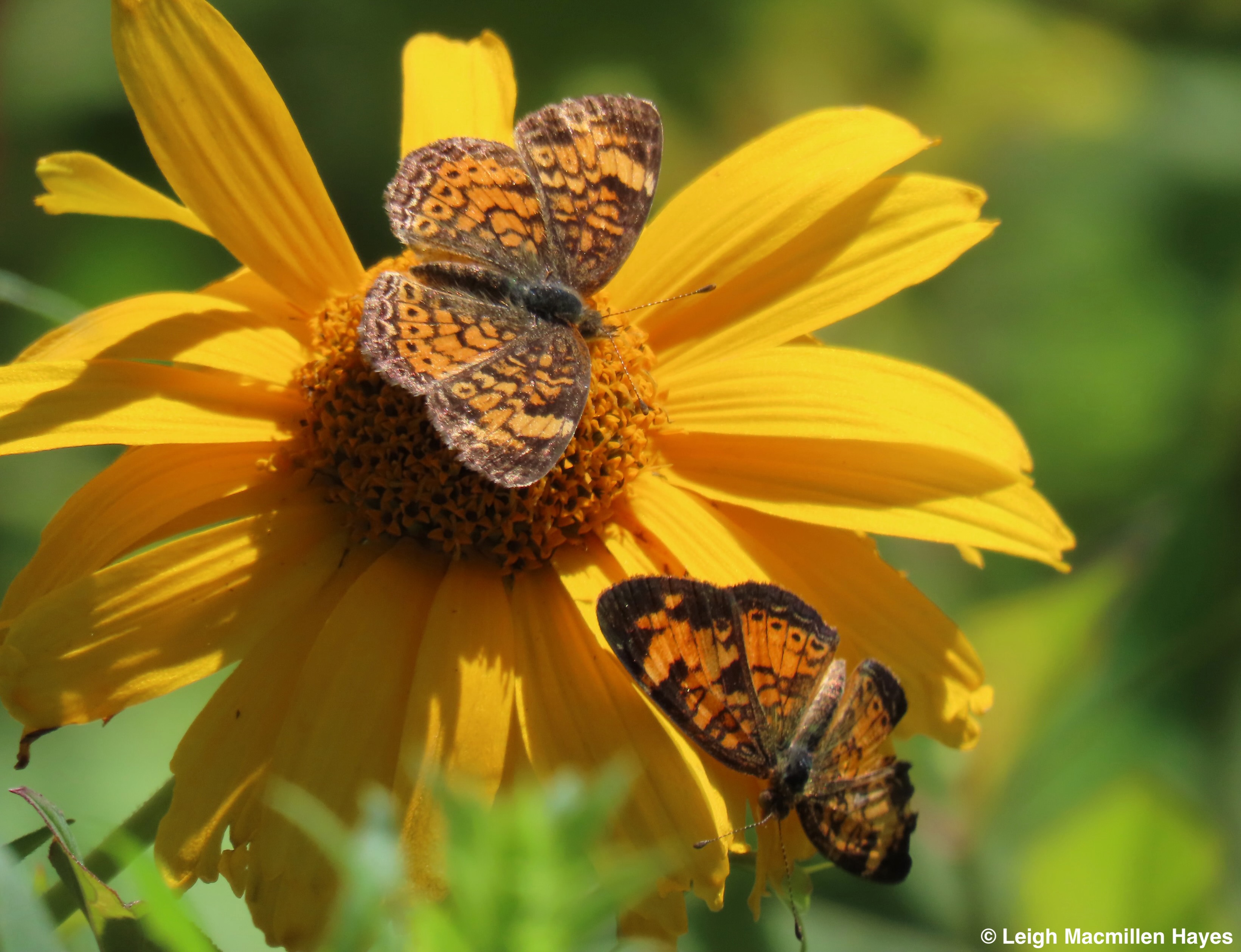
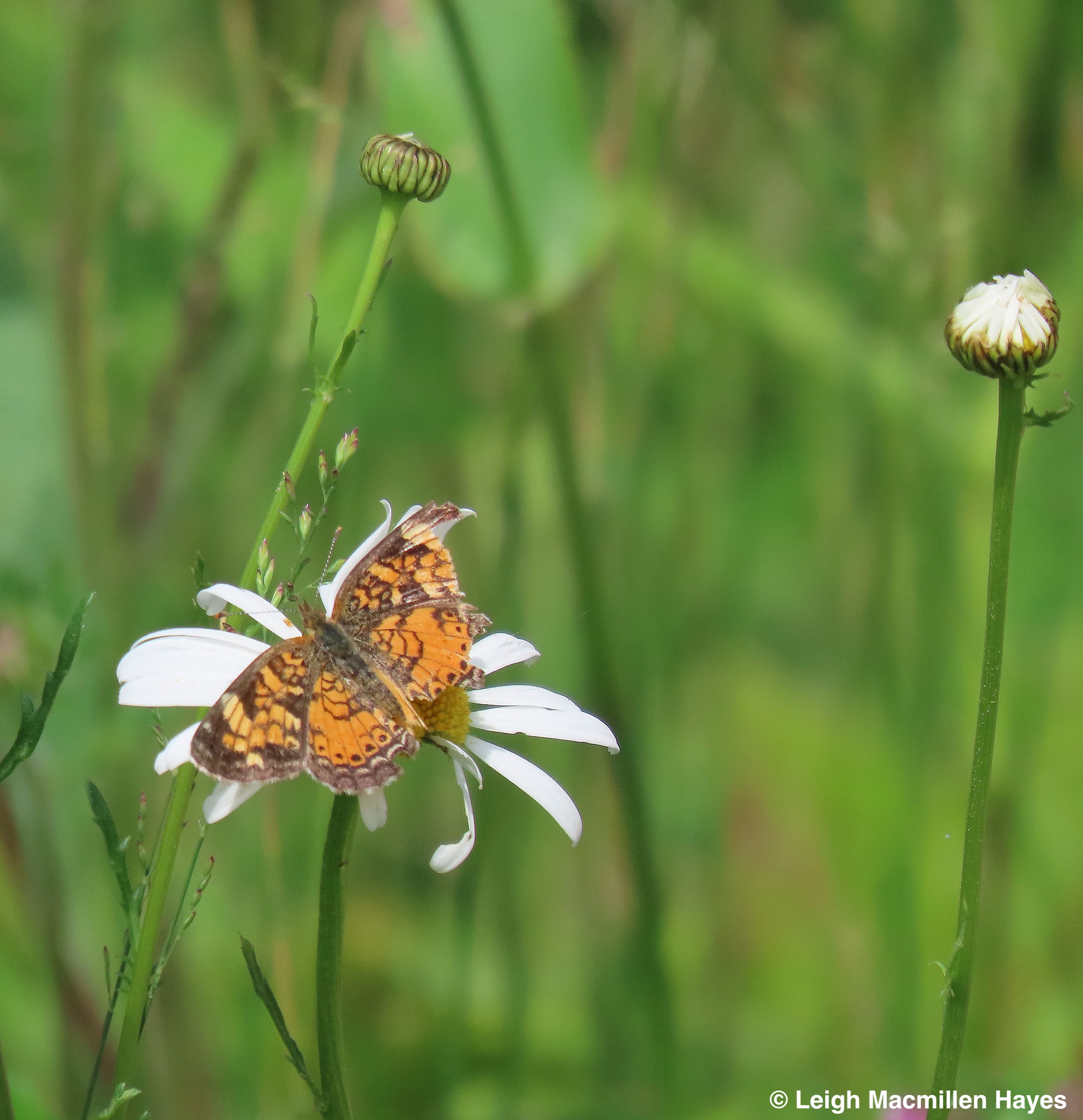
Female Pearl Crescents (gender ID based on orange color of antennal clubs versus dark colors for males) and their counterparts who all greet me each day, to . . .
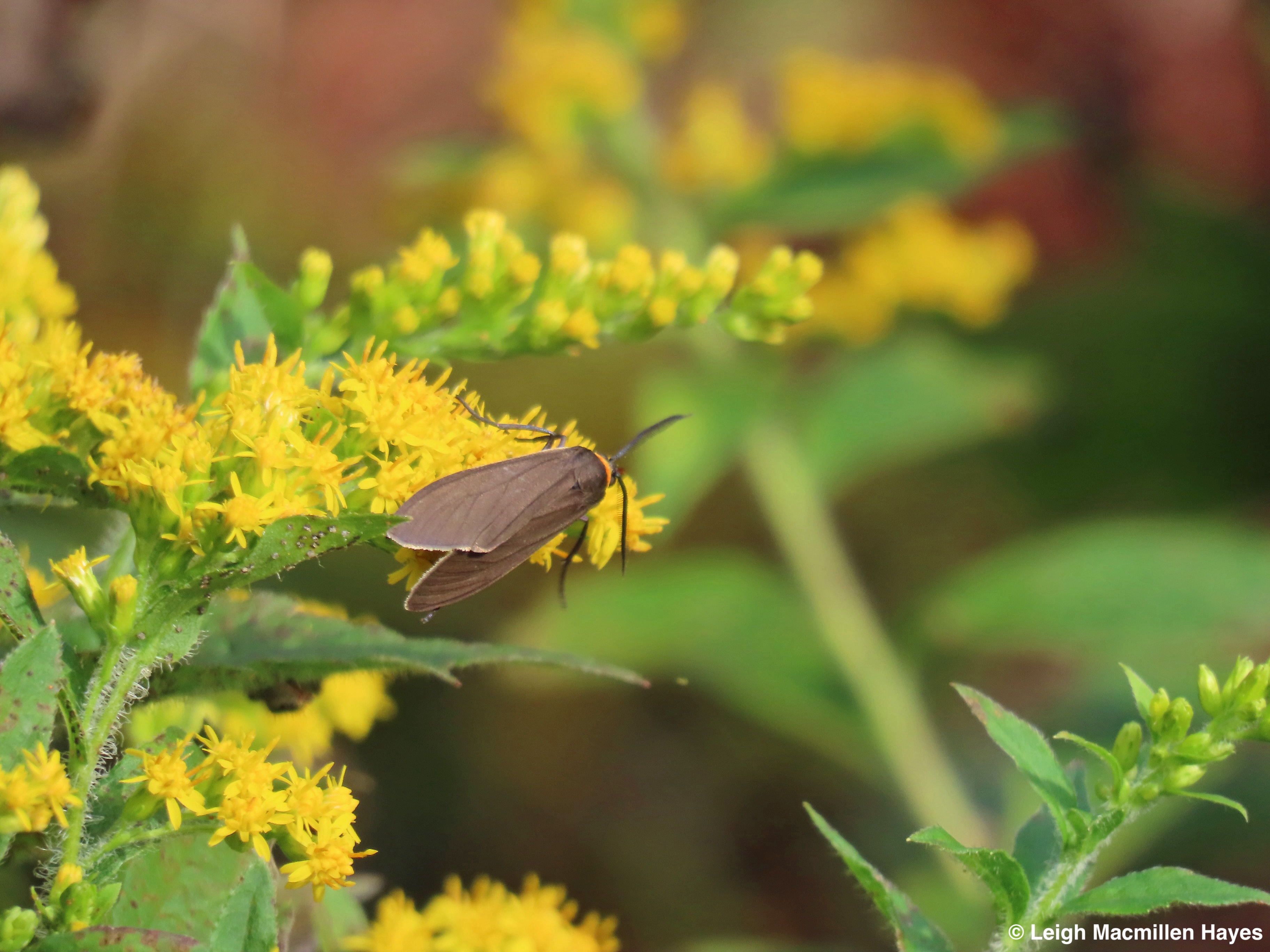
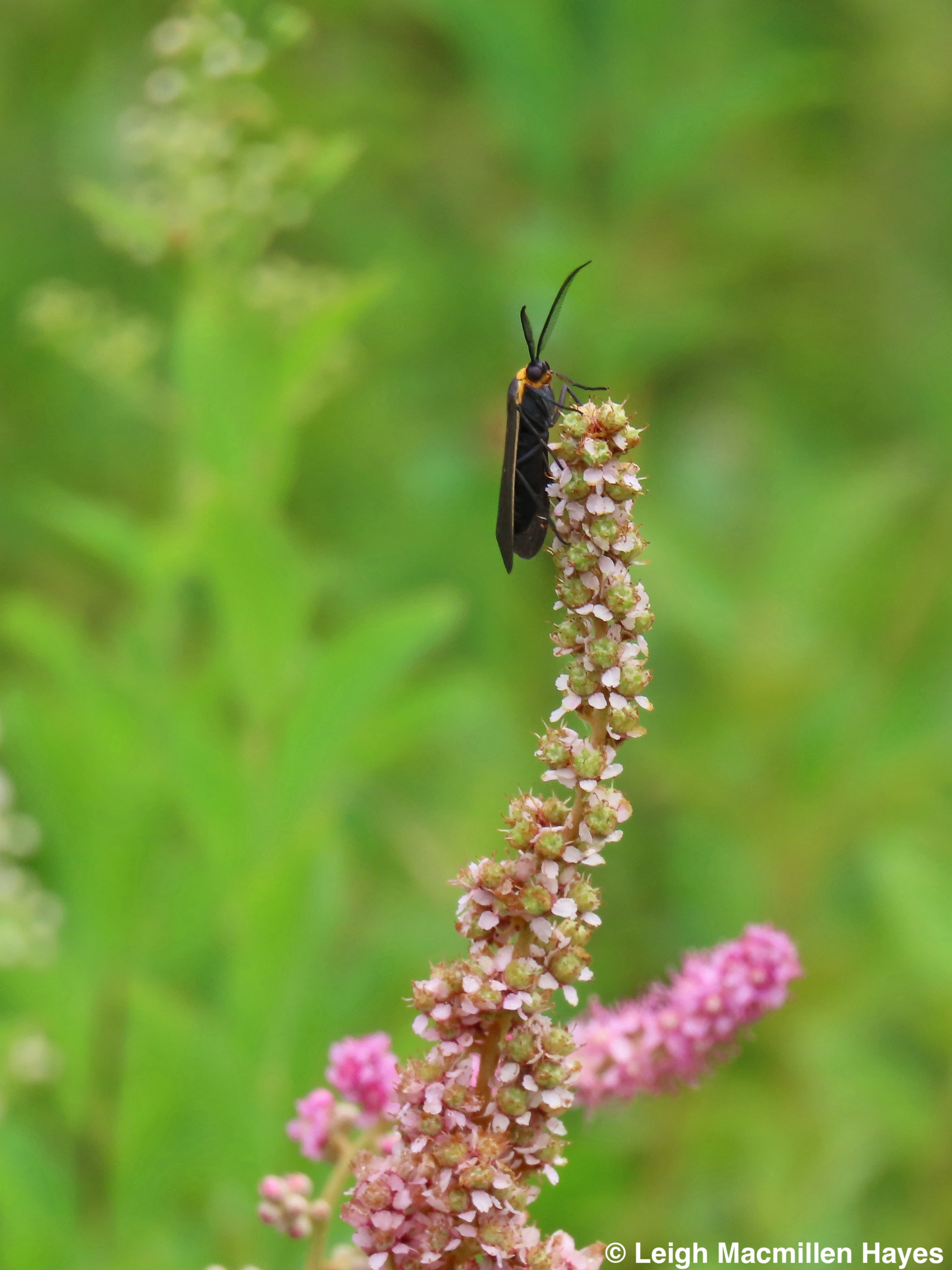
Yellow-collared Scape Moths, to . . .

Locust Borers, to . . .

long-bodied Sweetfern Underwing Moths, to . . .

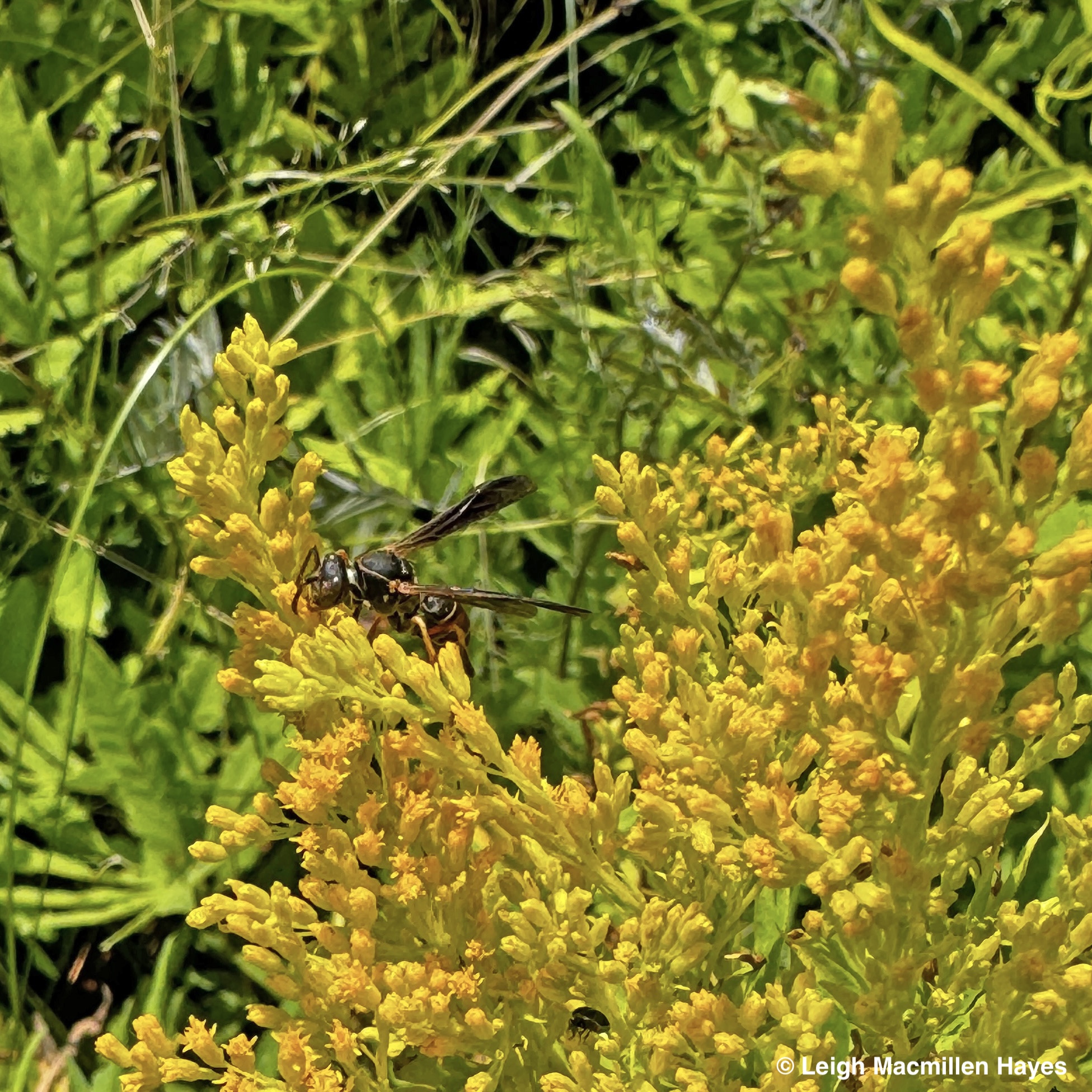
Paper Wasps, to . . .

Bumblebees, this one special because it showed me that its proboscis is orangey-reddish, to . . .

Flower Flies with big eyes.

The plants literally tremble with all the activity so it’s easy to figure out where the insects are located.

The best part of greeting so many is that occasionally a tiny new visitor enters the scene and I have to watch for a few minutes to get a good read on who it might be as it flits and flutters and finally lands.

It wasn’t the diminutive size that made my heart skip a few beats, but rather the color when the Eastern Tailed-Blue Butterfly opened its wings–a mixture of blue and pink that made me think of skyblue-pink we often see at sunset.

And then another sighting stopped me in my boots. It’s camo is incredible and it could simply be another goldenrod leaf.
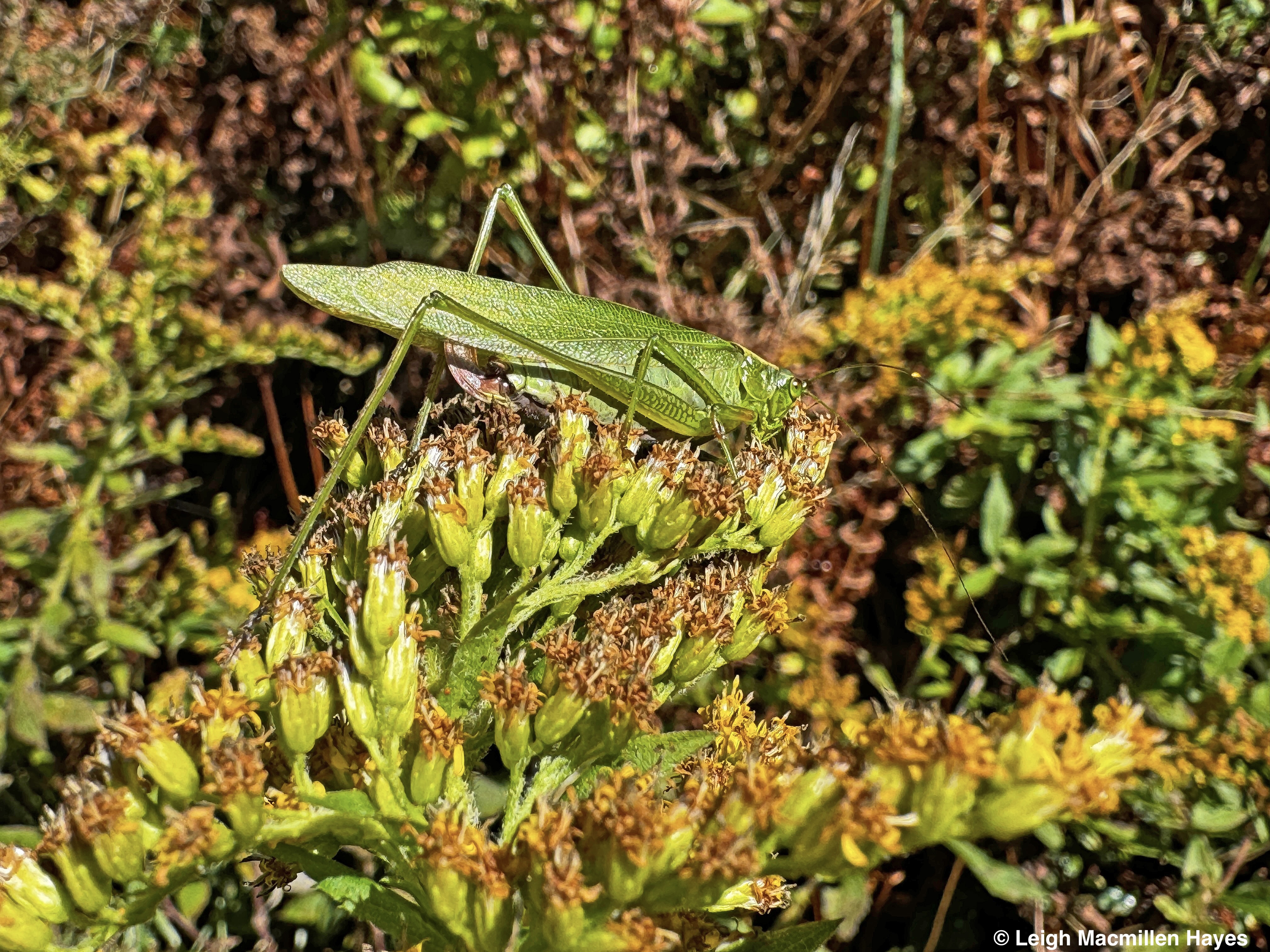
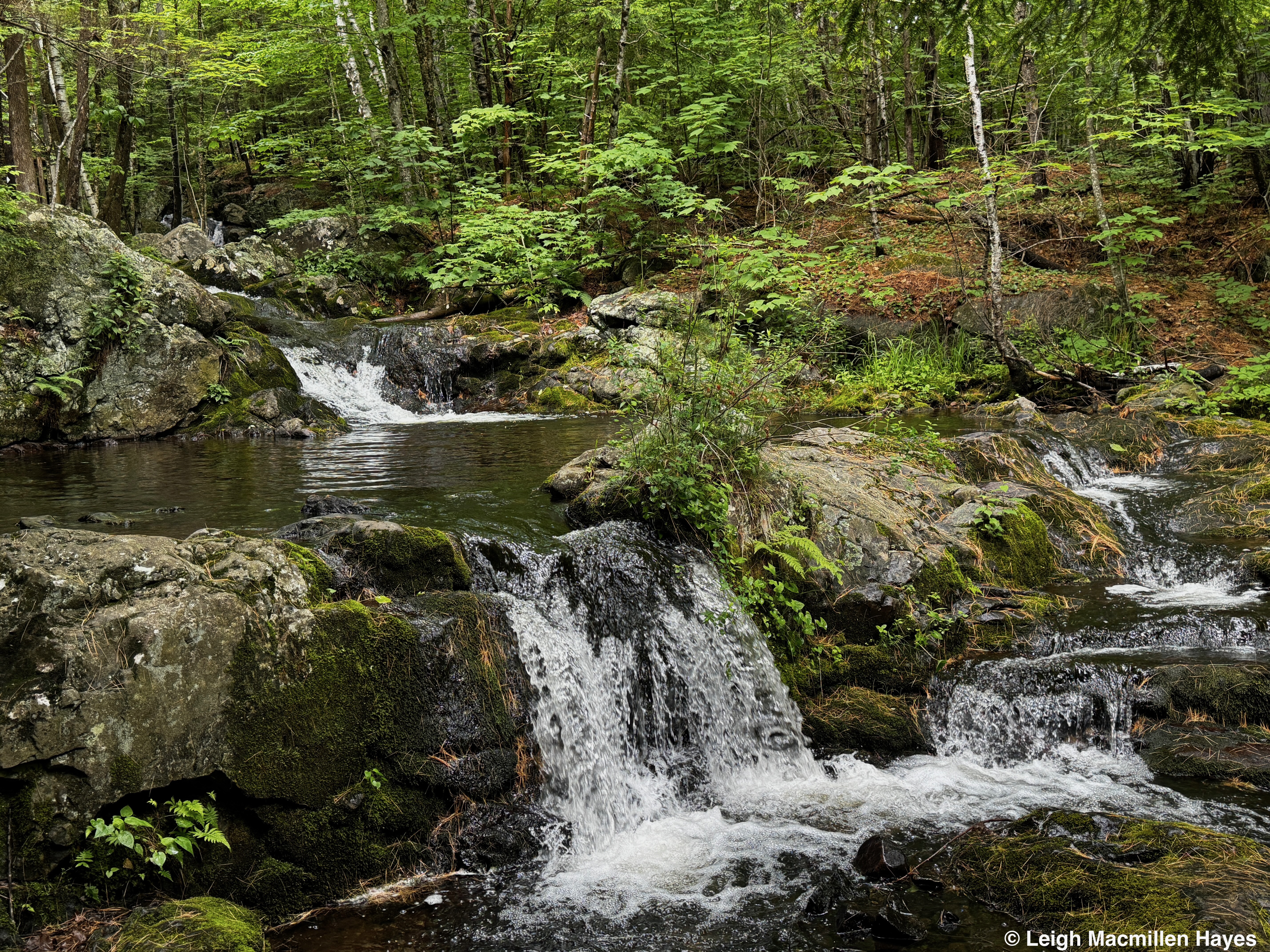
But rather, it is a Katydid, only the second I’ve spotted this year. Katydids always make me happy because they remind me of my forever-since-birth friend and at about the same time that I spotted this insect she just happened to comment on a photo I’d taken during a hike this past week–of a mountain stream–because it reminded her of our “fishing” adventures as children, sticks being our poles and leaves our fish. Katydid. Of course she did.

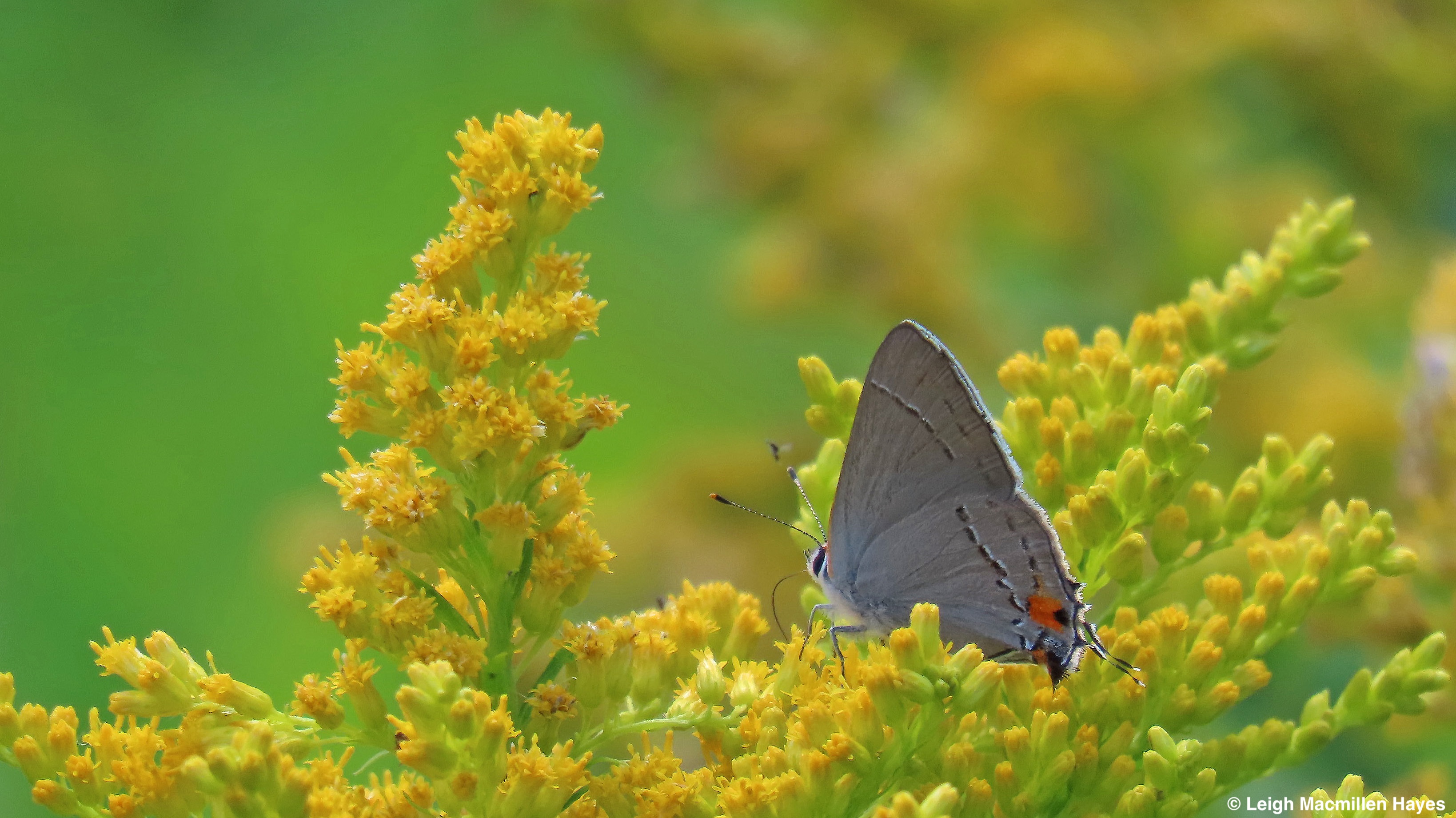
But of all my finds, my heart was the stillest for this magnificent creature, also a gossamer-winged butterfly. I noted it first on August 3, 2024, and again on August 26. But to see one on October 4, 2024 . . .

Incredible. And RARE! I contacted Dr. Ron Butler once again as he’s one of the co-authors of Butterflies of Maine and the Canadian Maritime Provinces.

Different Bat Time, but same Bat Place for this sighting.

Ron’s reply, “Lucky you. I’ve only seen them in more southern states. I’ll add this to the database.”

Lucky me indeed. According to the book, White M Hairstreaks have only been spotted in our region four times (prior to the three I’ve now noted) and they were seen from late July to late August. So, um, that can now be updated to early October.

BUT . . . what does that mean? Ron has only seen them in more southern states. Blueberries are flowering in October. My nephew shared a photo with me this past week of a Lilac blooming in New Hampshire.

Climate change.

All that said, saying goodbye to all that the field has offered this summer and early fall is not easy. I’m going to miss the spiders and butterflies I had the honor of greeting each day. Oh, I know there’s so much more to come as the days grow shorter and temperatures drop and my favorite season arrives. I live where I do because of the change of seasons.

Still, it’s a long farewell as we transition from one season to the next and for that I’m grateful.
When Is A Moss Not a Moss?

Sometimes I need to slow my brain down to figure things out. And other times . . . I need to slow my brain down to figure things out.

That’s exactly what I’ve been trying to do lately. Figure things out. Green things. Evergreen things. That means they add color to the forest floor year round.

Pour a glass of water or a cup of tea and join me as I take a closer look.

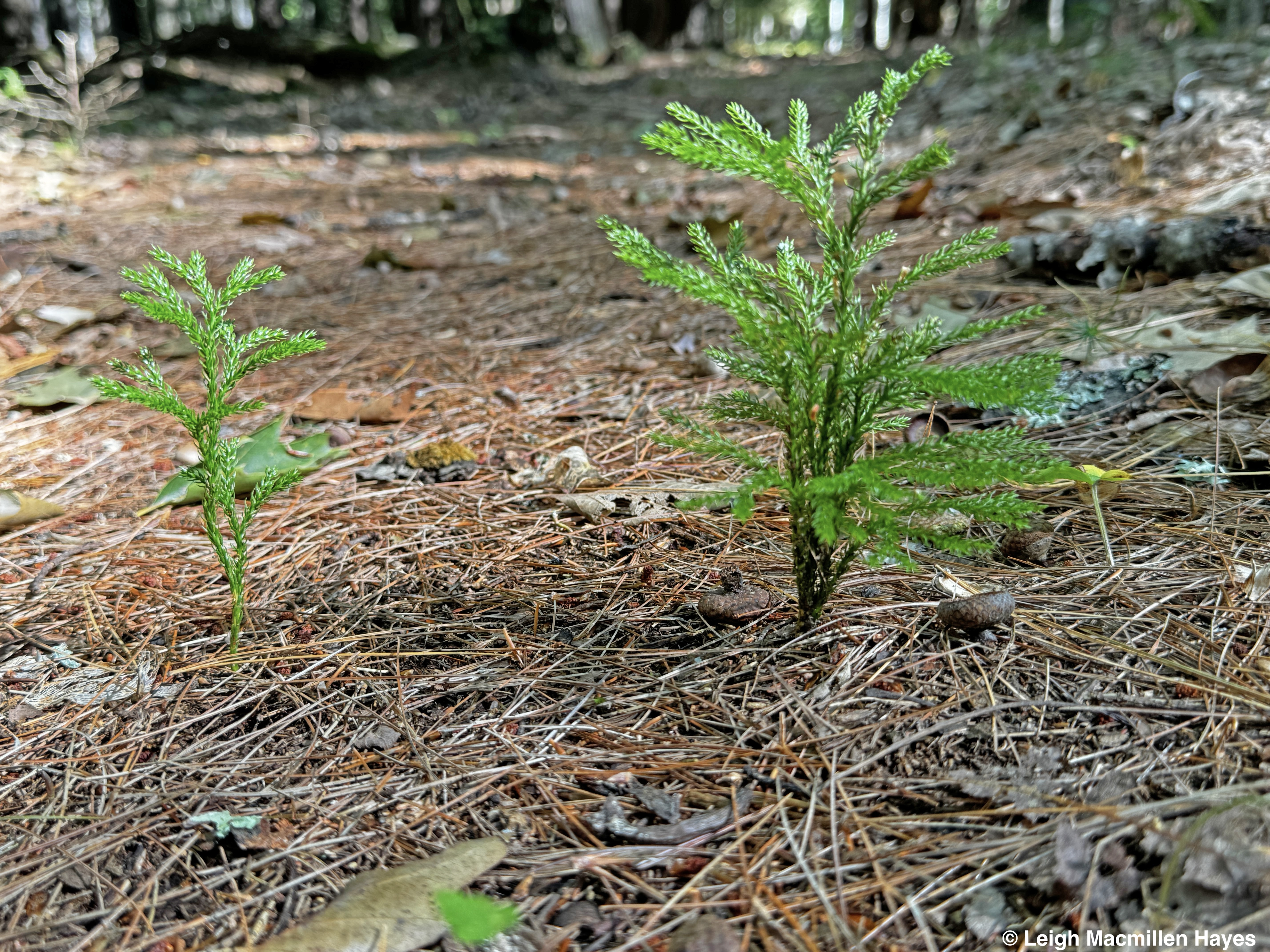
At first glance, these green growths appear to be miniature trees. But what I wanted to know was this: is the smaller “tree” on the left directly related to the larger “tree” on the right?

There was only one way to find out and though you aren’t looking at the same two in this photo, the question was recently answered when I began to dig into the ground and a friend lifted up the root system. If you look closely at this photo, the two species we were studying looked less similar than the two in the previous picture.

But indeed they were connected . . . with underground horizontal stems called rhizomes.

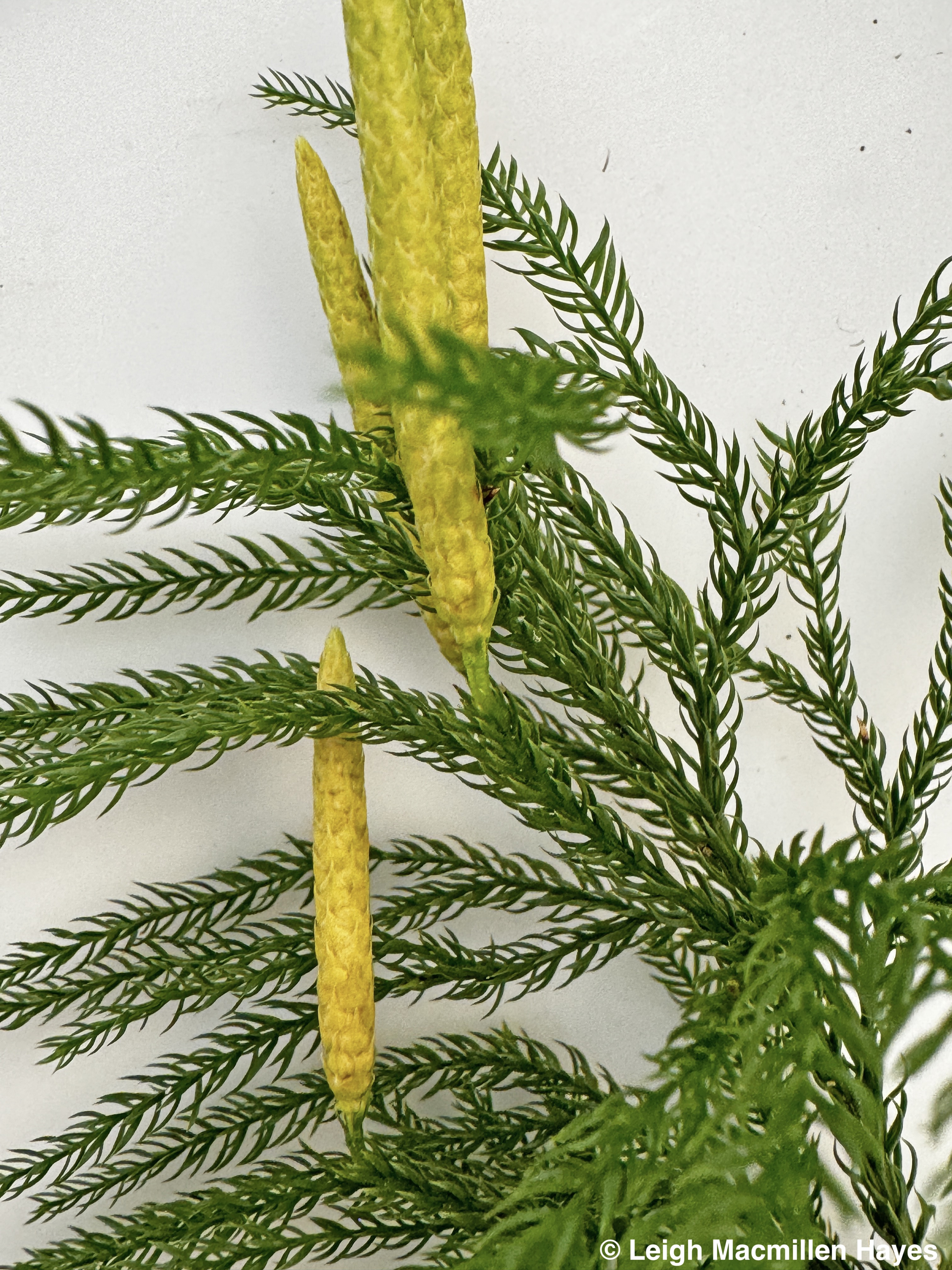
Meet Dendrolycopodium obsucurum, aka Flat-Branched Clubmoss or Princess Pine. Some of you know this well as your parents used to create Christmas decorations with it. I caution you–don’t be like your parents. Well, in this case anyway.

Clubmosses are vascular plants like our trees and flowers (but not mosses), thus they conduct water and food through their xylem and phloem. Their reproductive strategy is primitive. See that yellow “candle” or club? That is the strobilus (strobili, plural form) with structures called sporangia (sporangium). Some clubmosses have this structure and others have sporangia formed on the plant’s leaves. More on sporangia later, which means you’ll have to continue reading.

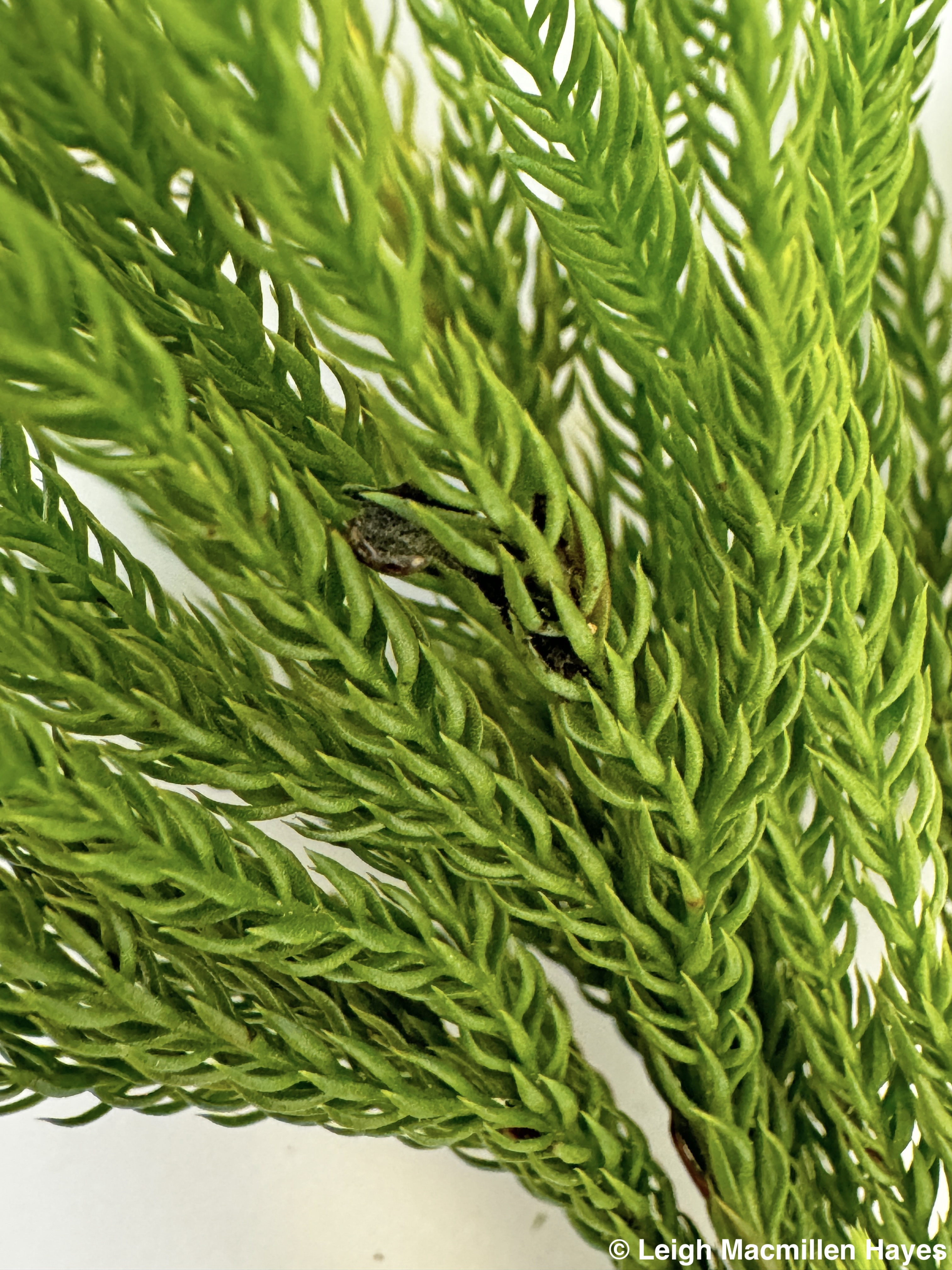
As I get to know these green things better, I’m trying to figure out their idiosyncrasies. And just when I think I know, I get zapped. But . . . the species above is closely related or a variant of the first species I shared. And sometimes they look super similar. The Flat-topped has smaller leaves on the lower part of its branches, but without a loupe, I can’t always spot that. And even with a loupe, my mind gets boggled. Am I seeing what I think I’m seeing. One thing that has helped me is that species, Dendrolycopodium hickeyi, or Hickey’s Tree Clubmoss, prefers drier soil. But really, they could be twins. And truth be known, they do hybridize.

Right now, I’m thinking that Hickey’s leaves, as shown above, are consistently the same length and thicker in presentation as the branches are more rounded than those of the Flat-branched.

On our land, it grows abundantly along Central Maine Power’s Right-Of-Way and like Flat-branched has underground rhizomes. In fact, this afternoon I had a vision of a bedspread from my youth that I turned into roads and drove little rubber cars and trucks along when I played “Town.” I could easily have driven my little cars from one “tree” to the next and followed the rhizomes as if they were invisible roads.

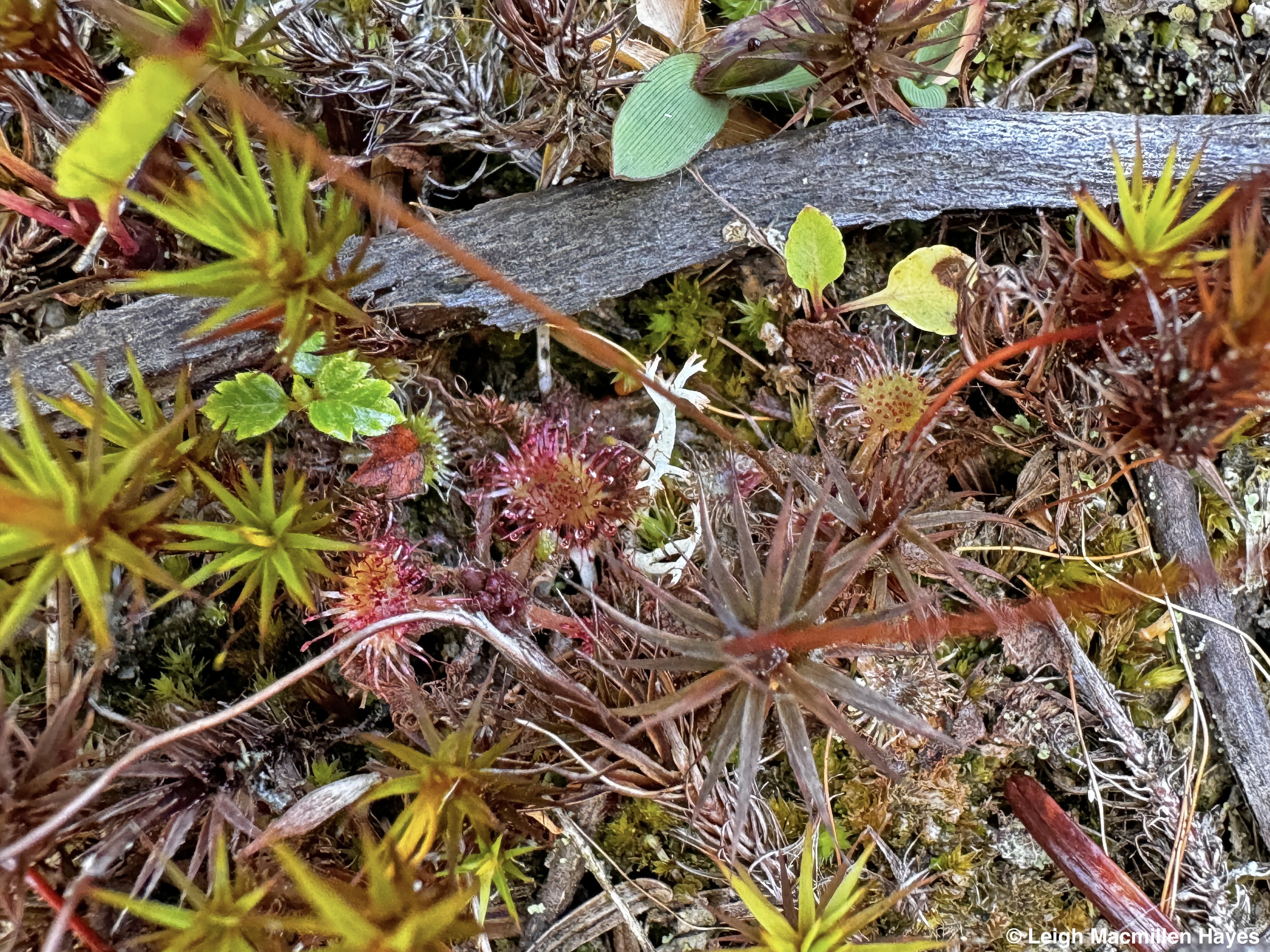
Cool sights reveal themselves when I do slow down like this and I thought that CMP had killed the Sundews that grow under the powerlines when they sprayed herbicides along the route several years ago. I’d given up on being the guardian of such special plants, and was delighted to discover their dried up flowering structures today and locate the wee carnivorous leaves below. Yahoo! High five for Sundews!

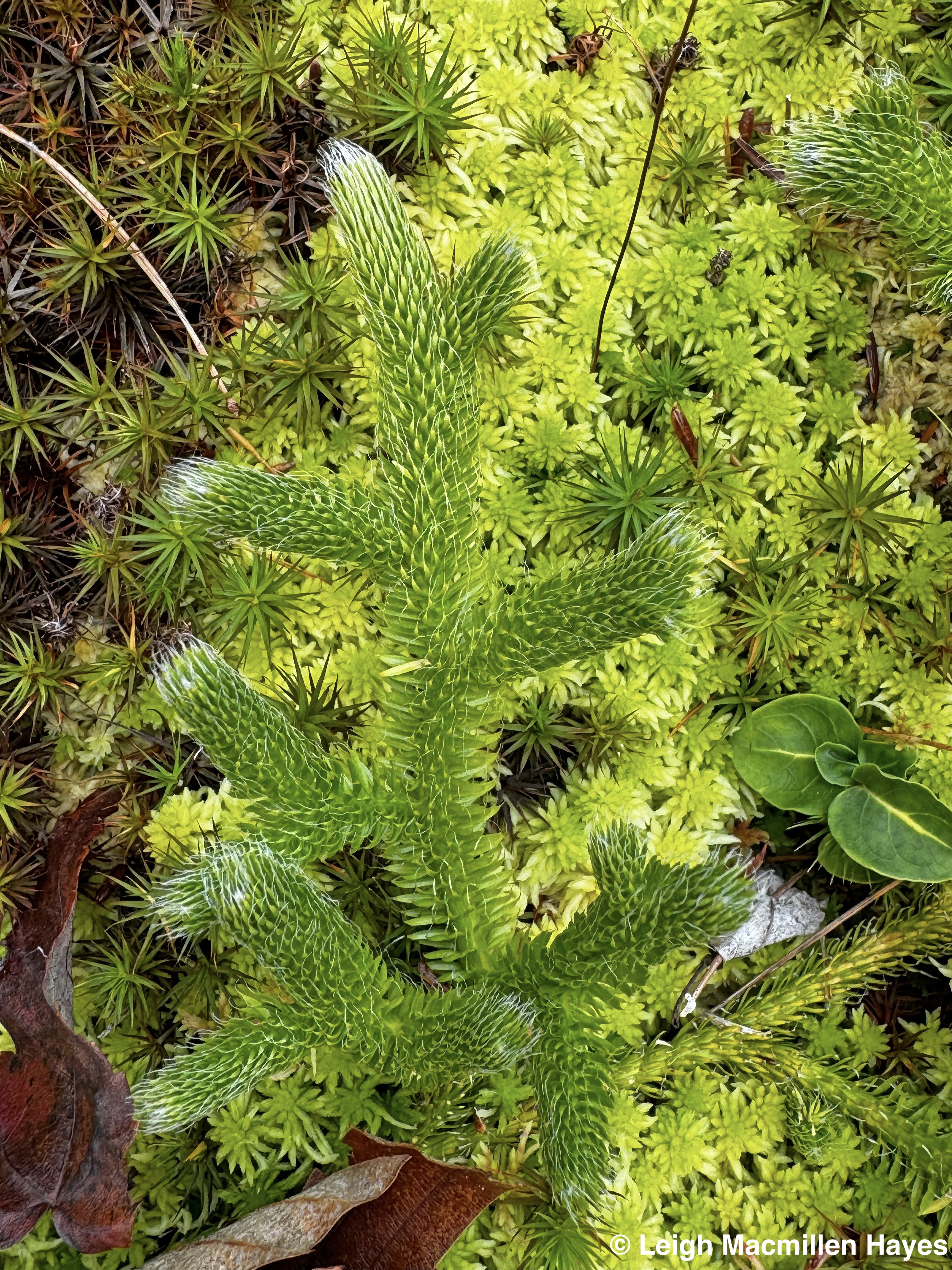
Where Flat-branched and Hickey’s have underground rhizomes, this particular member of the club features horizontal stems that are above ground runners.

And while the previous two were tree-like in structure, this one reminded me of a cactus.

Furthermore, I got all excited because I thought I’d discovered a species considered threatened in Maine. I talked myself into it being Huperzia selago or Fir-Moss. It looked so much like the black and white sketch in my field guide.

Until I realized the Fir-Moss has a sporangia-bearing region in the upper stem. And my species has strobili located at the tips of long slender stalks. And there is no mention of those transparent hairs in the description of the Fir-Moss (after all, it’s not Fur-Moss), but Running Ground-Pine or Staghorn Clubmoss does have this feature. Thus, this is Lycopodium clavatum.

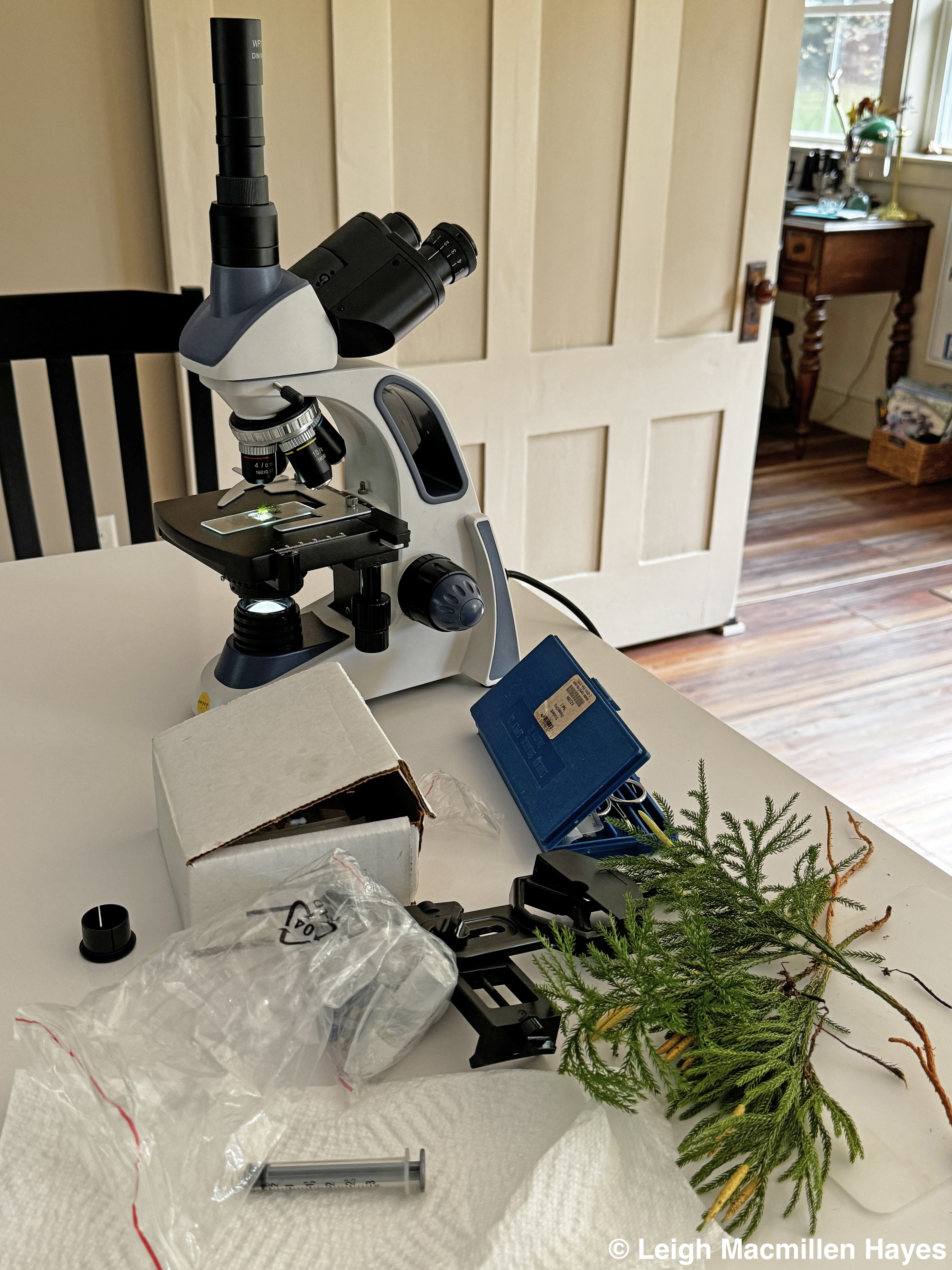
Back at home, it was time to set up the mini-lab and take a closer look. I try not to collect too much; in Ferns & Allies of the North Woods, Joe Walewski suggests we “consider the 1-in-10 rule: collect no more than one for every ten you see.”

The microscope has opened a fascinating world to me–as if it weren’t already fascinating enough. And see the pattern of cell structures–an art form all its own.

And then there was the strobili that covered the sporangia. That word sounds like dessert and this look at the structure made me think it could be some decadent butterscotch offering.

I cut a cross-section and was surprised to see the hollow center.

All those minute spores. Actually, I accidentally nudged a few as I walked in the woods this weekend, and had the honor of watching the “dust cloud” of spores being released.

One family member that doesn’t live in our woods, but is located close by is this, Diphosiastrum digitatum or Fan Creeping-Cedar, so named for its resemblance to cedars.

This specimen had followed me home a few weeks ago, and when I pulled it out of my now warped field guide, for so damp were the pieces that I stuck in there, it had dried into a flattened form of its former self.

I stuck a piece under the microscope and again was floored by the thickness and cell structure.

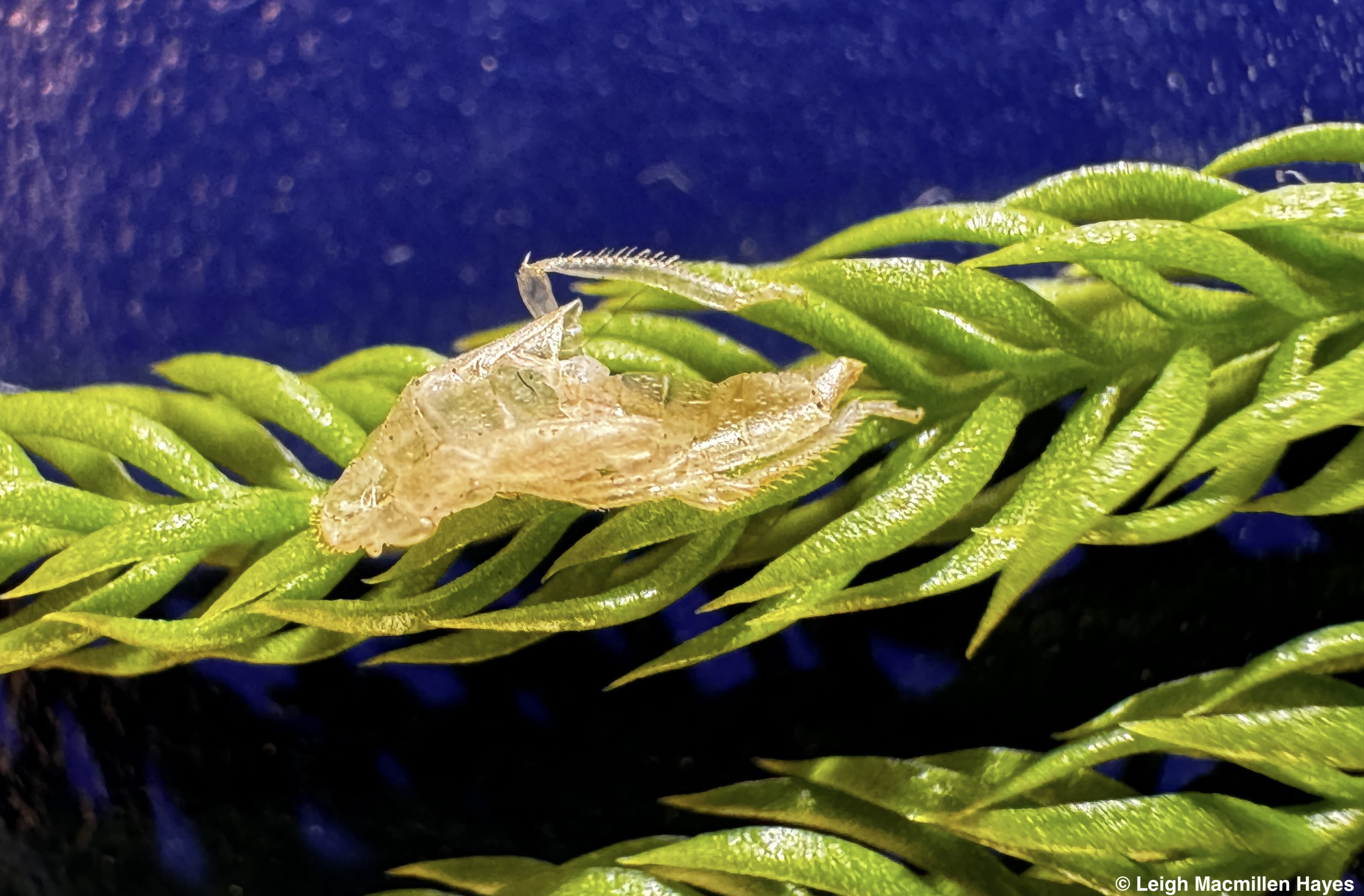
And then I had a surprise. A hitchhiker! Do you see the long legs?

Here’s another look. I don’t know who this was, but I do know that it was minute in size and it appeared to be a shed skin after the insect had molted.

Suddenly I was eager to find more. And so I checked out a piece of the Flat-branched . . . and wasn’t disappointed.

Here it is again. The second critter that is. Or was. And now I can’t wait until next spring and summer to find out what tiny creatures use these structures as places to molt. And maybe feed. The mouth structure, if that’s what it is on this one, appears to be almost fan-like and kind of reminds me of that on a slug.

The home lab grew into an art room as the hours passed.

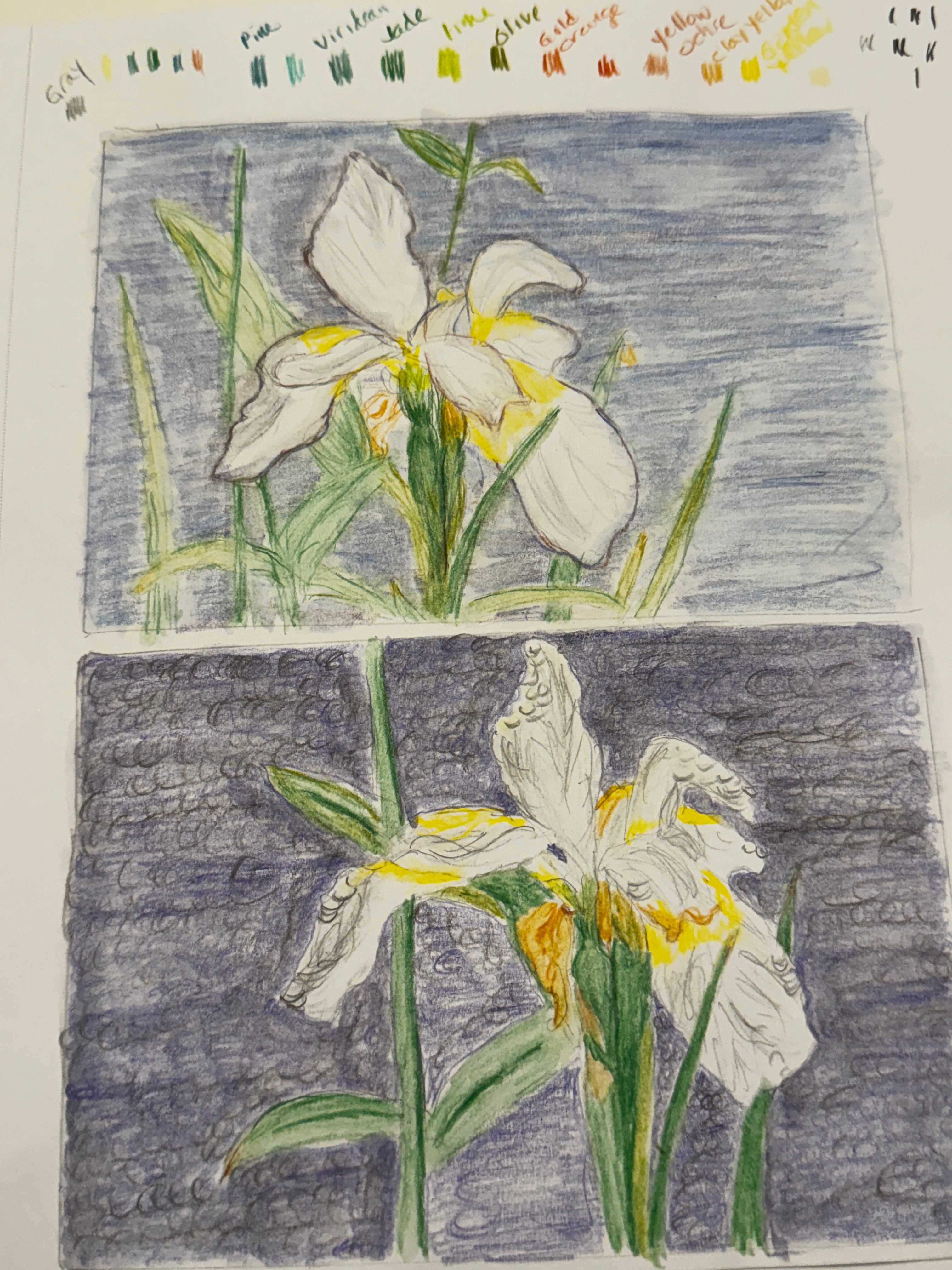
Recently my sister gifted me a sketch book and it begged to be opened. After running my fingers over the cover first, of course.

I have the perfect bookmark to mark the pages, created for me this past year by one of our first playmates.

Getting to know a species better through close observation and by sketching is one of my favorite pastimes. And I’m so glad I slowed my brain down, especially when it came to hickeyi on the left and obscurum on the right. The differences seem so obvious with these two examples, but step out the door and I suspect you may be thrown off course as well.

When is a moss not a moss? When it’s a Clubmoss, which is actually an ally or relative of ferns. And horsetails. All are non-flowering vascular plants.

Before you depart, dear reader, please remember that these are ancient plants that take a long time to germinate as most need a symbiotic fungi to provide nutrition to the gametophyte stage (think gamete, eggs, and sperm). They may lie dormant underground for up to seven years and then take up to fifteen years to develop reproductive structures. In the great coal swamps of the Carboniferous period, they reached heights of possibly 100 feet, something I have a difficult time comprehending when I look at their small forms in our woods. Their growth is slow and they deserve our respect.

And now I can’t wait to meet some others and get to know them as well. I spotted One-Cone Ground-Pine or Lycopodium lagopus on a hike the other day and kick myself for not taking its photograph. All in their own time. I’ve made a start and hope you will do the same.

My Artistic Path

In a way, this is A Lost Art Found continued. It’s the rest of the story, at least to this date.

Once I got hooked on painting, I couldn’t stop. What I’ve discovered is that it’s a lot like writing. You choose a topic, which for me so far has been from a photograph I’ve taken as I’m afraid to purchase an easel and try plein air; complete an outline or at least jot down notes to get an idea of where you are going with the topic in the form of a values sketch; choose how to frame the story whether upon watercolor paper or canvas, and the media being watercolors, acrylics, or gouache; begin a first draft of sketching a wee bit on the mat of choice and apply a light colored wash; paint the basic shapes to get the story on paper which may be more representational than factual; and then tweak, tweak, tweak, which sometimes takes me eighteen drafts to get to a publishable product, and even then, I know more changes can be made.

But here’s the thing. I’m brand new to this art form. And thanks to Jessie, my teacher/mentor, I’ve learned a lot and still have more to learn. Then what’s the thing? The thing is that in every painting I’ve completed so far, there’s plenty I can critique, but at least one thing that I like and so that’s what I want to focus on. The rest I can learn . . . down the road.

After our spring session of classes ended, I decided to keep going on my own.

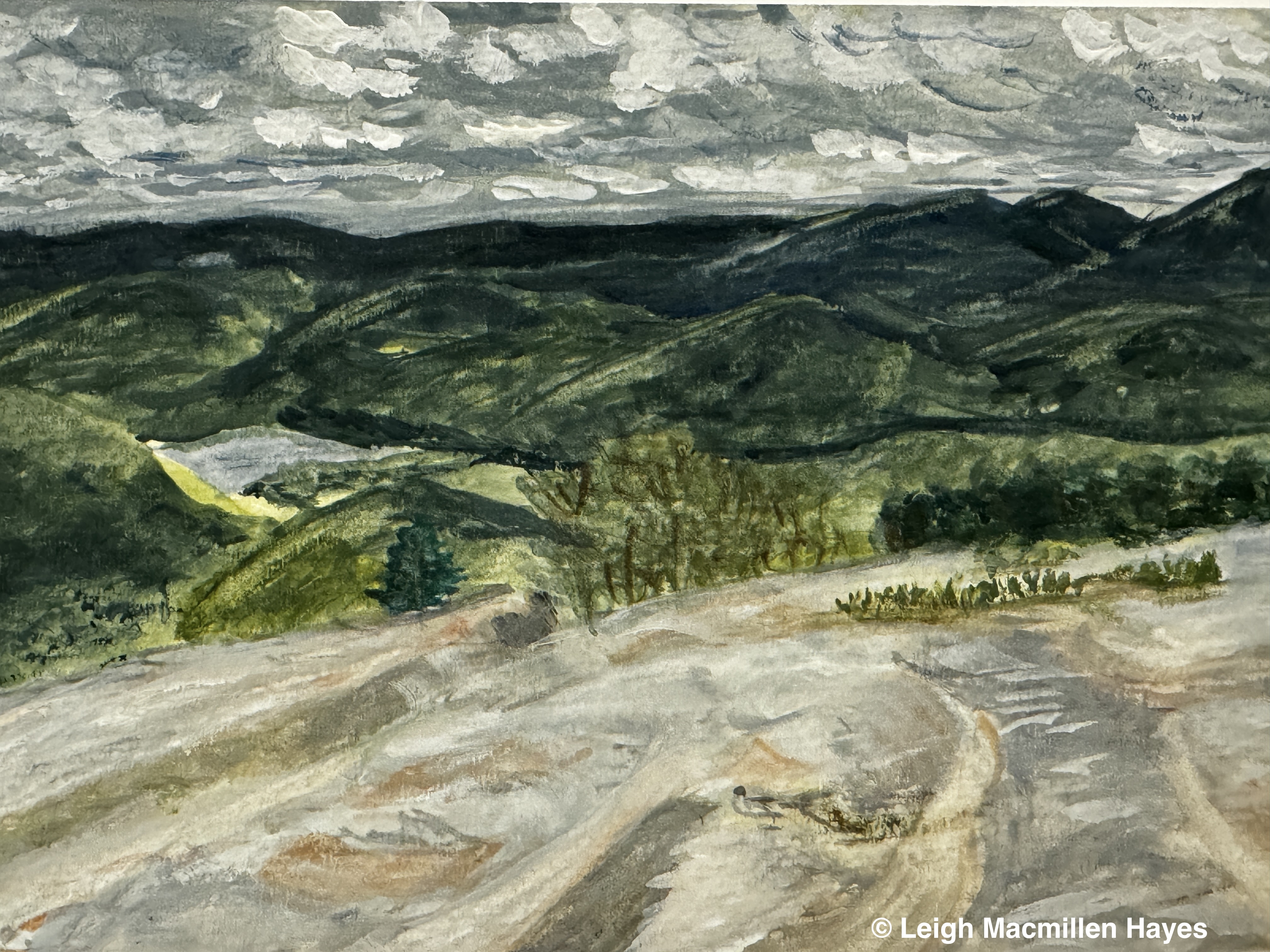
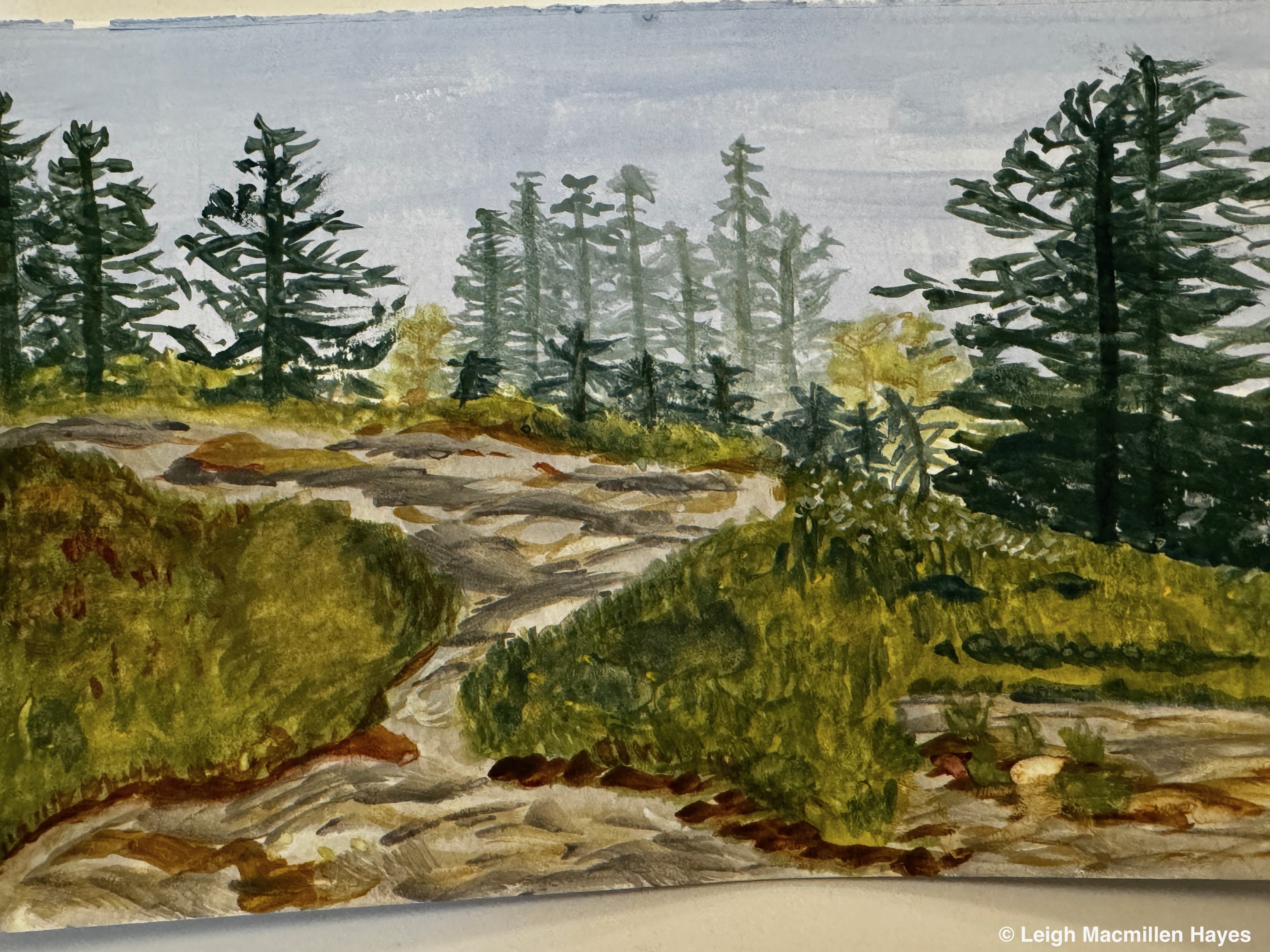
The view from the summit of Blueberry Mountain, Evans Notch, New Hampshire, looking toward Shell Pond below and the mountains beyond. My fav: the shape of the pond.

Frenchmen’s Hole in Newry, Maine. My fav: the color of the water, darker in the depths and lighter as if flowed over rocks to the next fall.

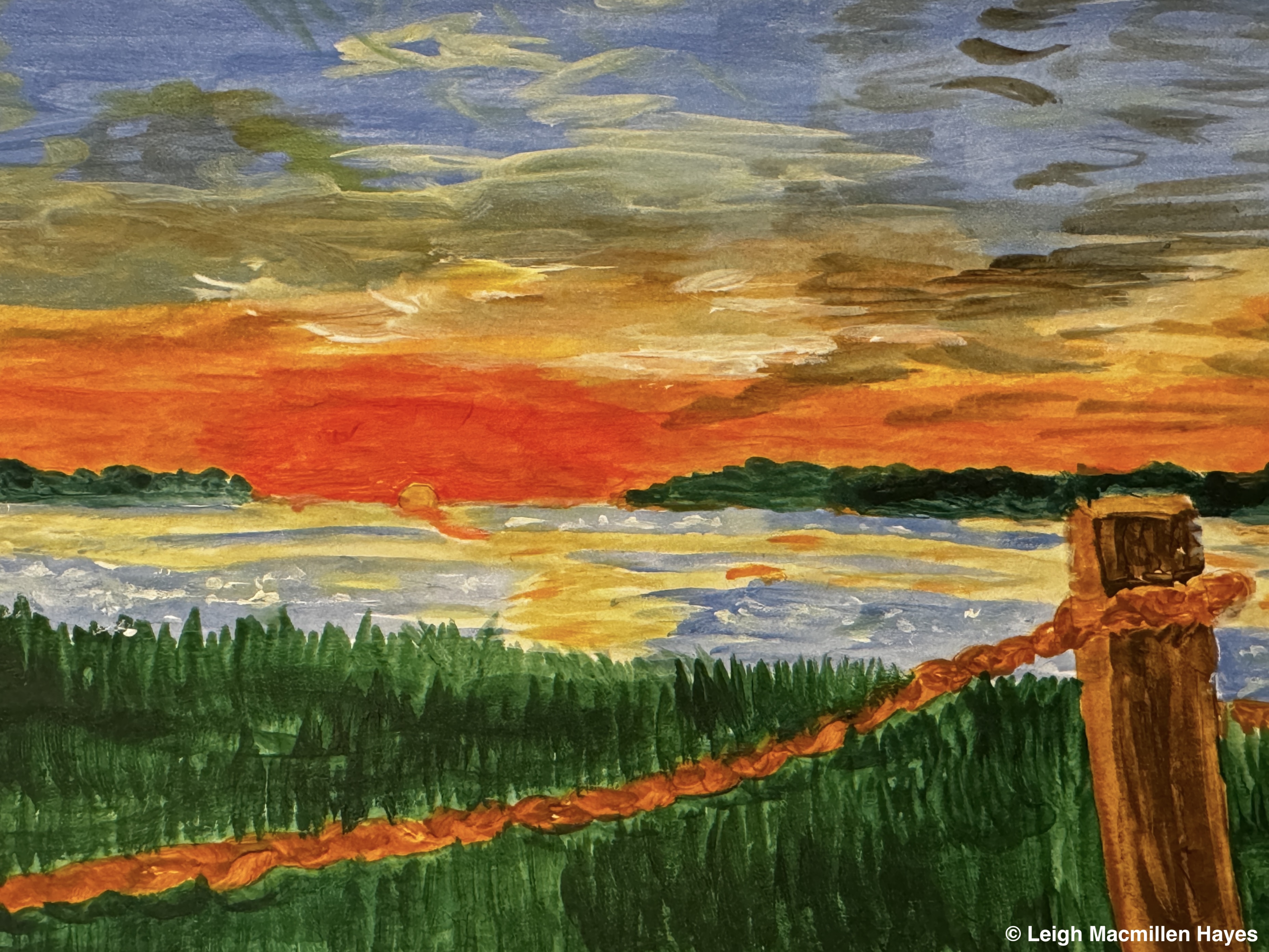
Sunrise, Lubec, Maine. My fav: the rope in the foreground. And the sky.

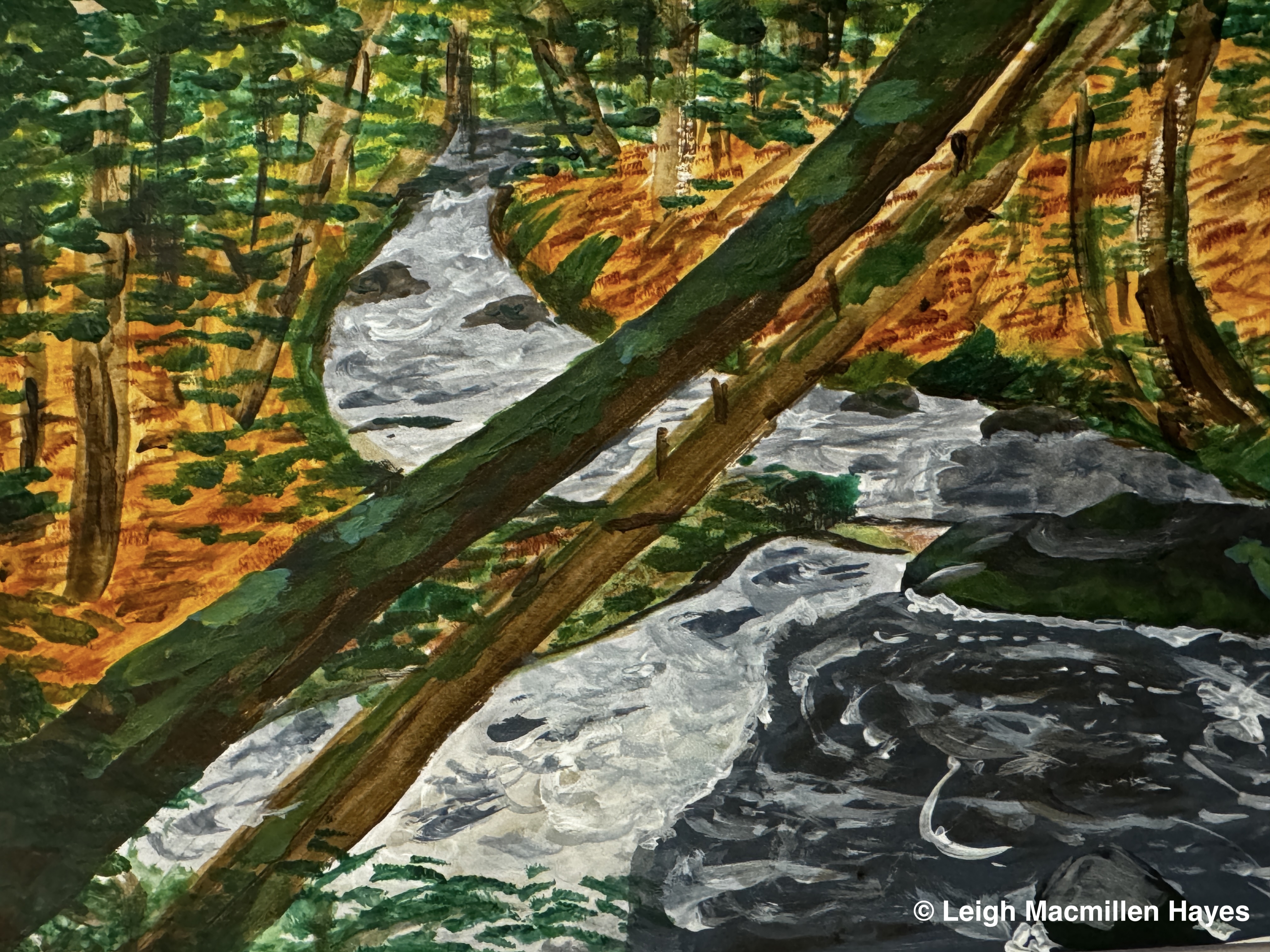
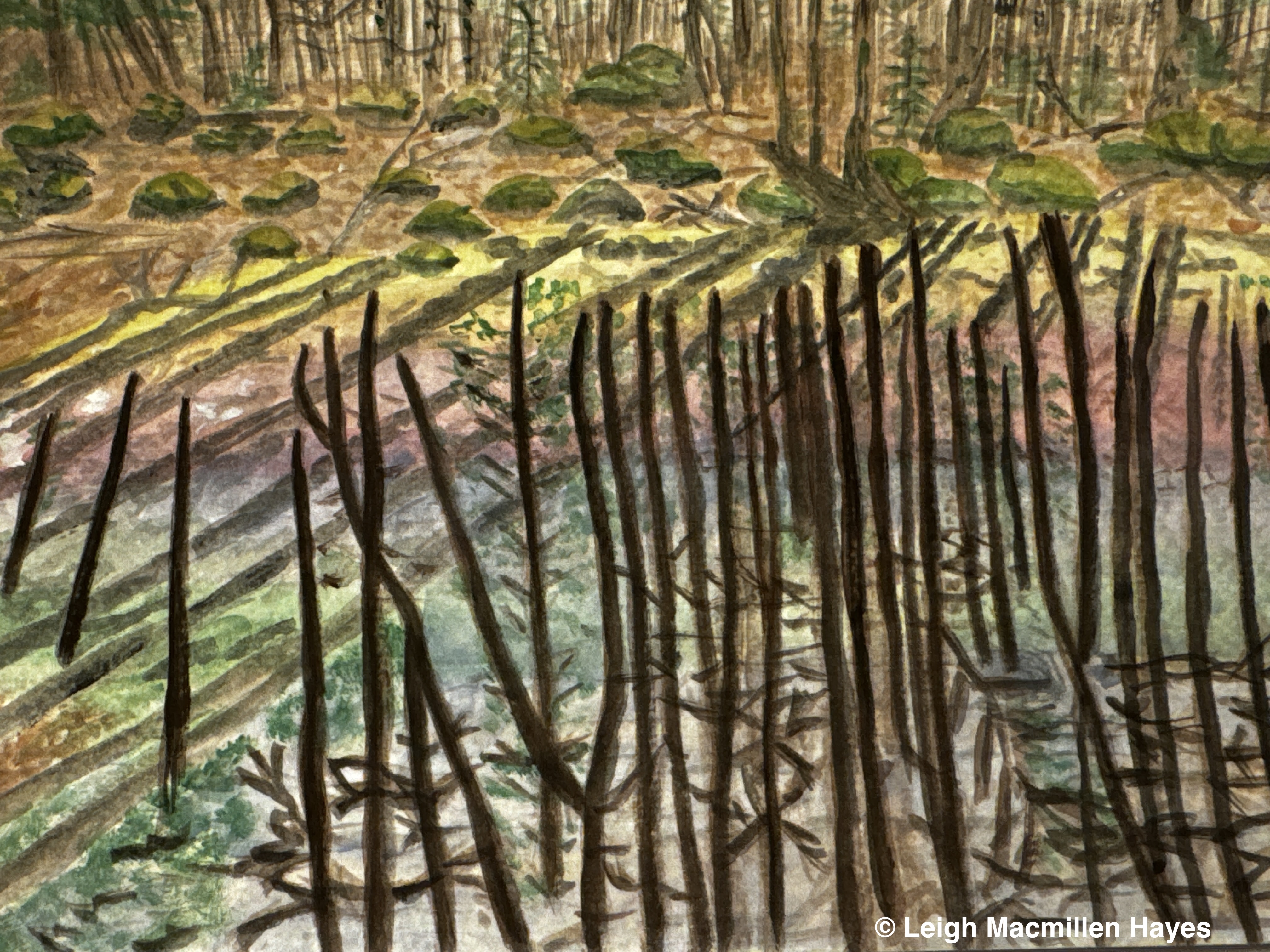
Carsley Brook, Lake Environmental Association’s Highland Research Forest, Bridgton, Maine. My fav: the trees leaning across the brook.

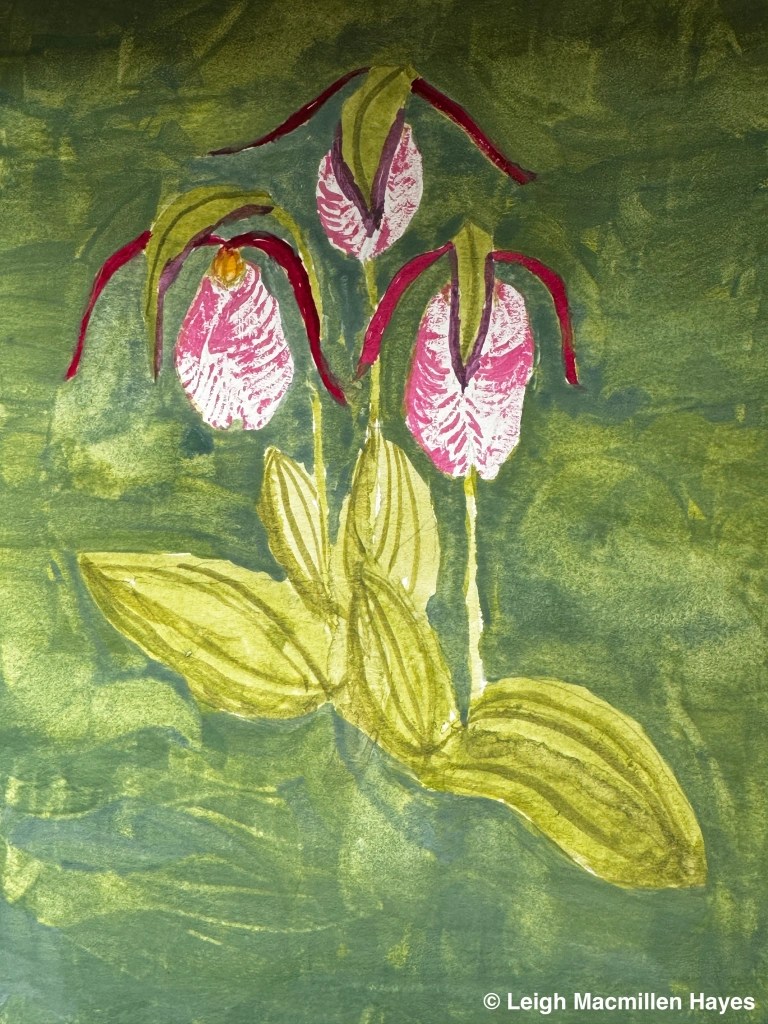
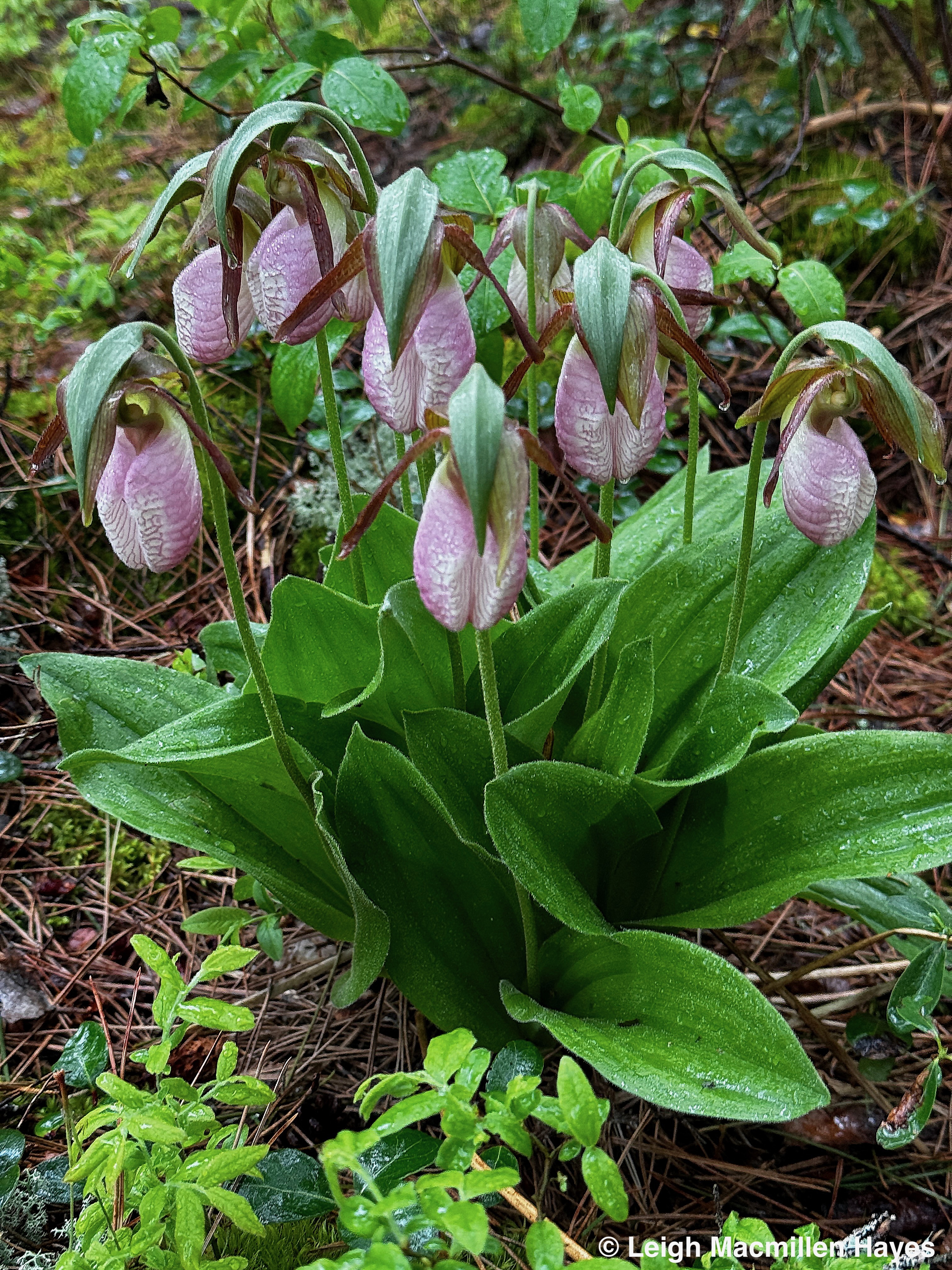
Lady’s Slippers from any of our counts as a gift for My Guy, who I’ve learned only likes to count them when they are in bloom. Since that season, he can’t be bothered to note the leaves or occasional seed pods and is praying it snows soon so I won’t continue to point them out. My fav: the shape of the flowers.

The fire tower at the summit of Pleasant Mountain. My fav: a sense of perspective with the mountains.

All of these were watercolor paintings. And then . . .

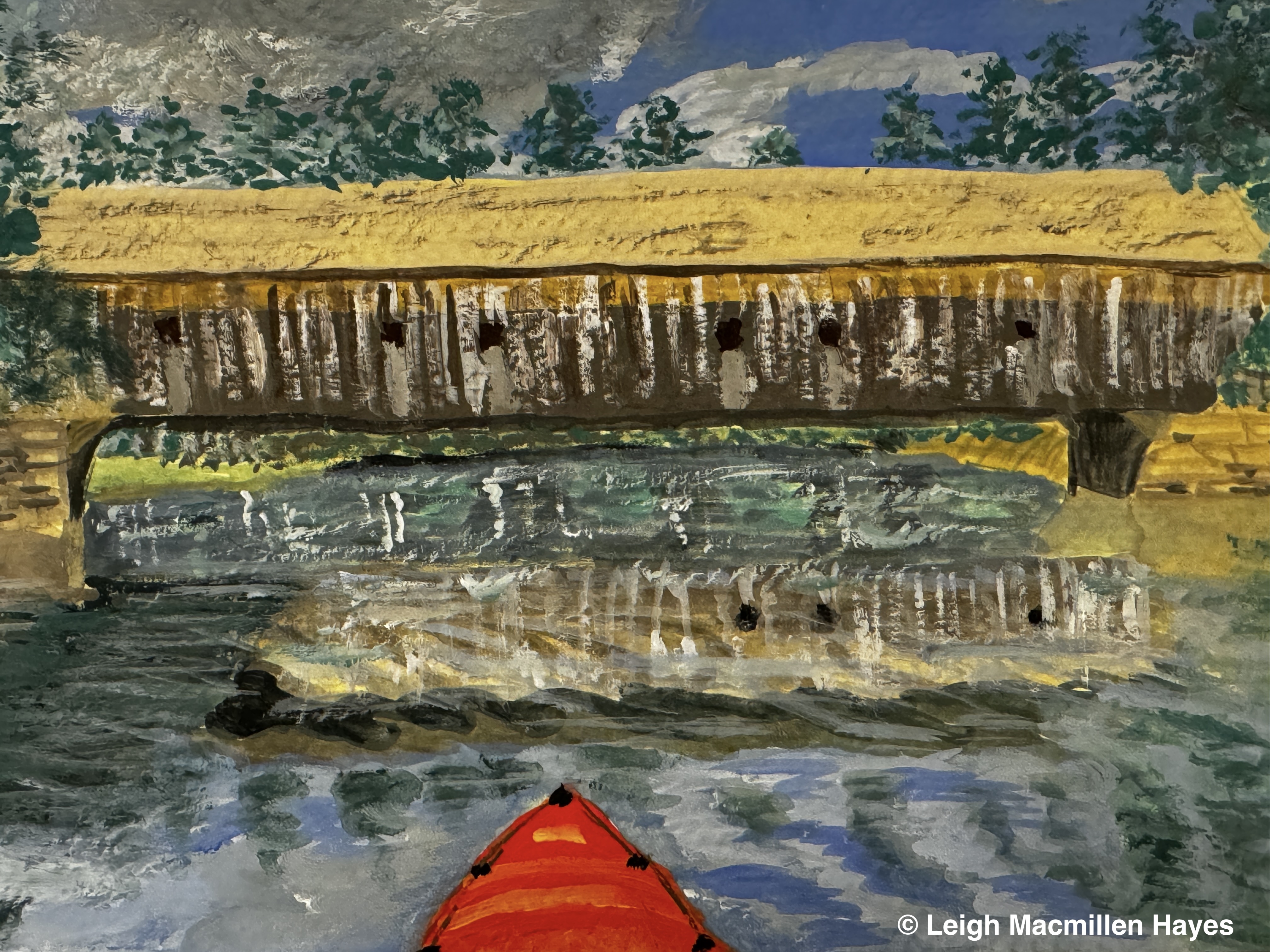
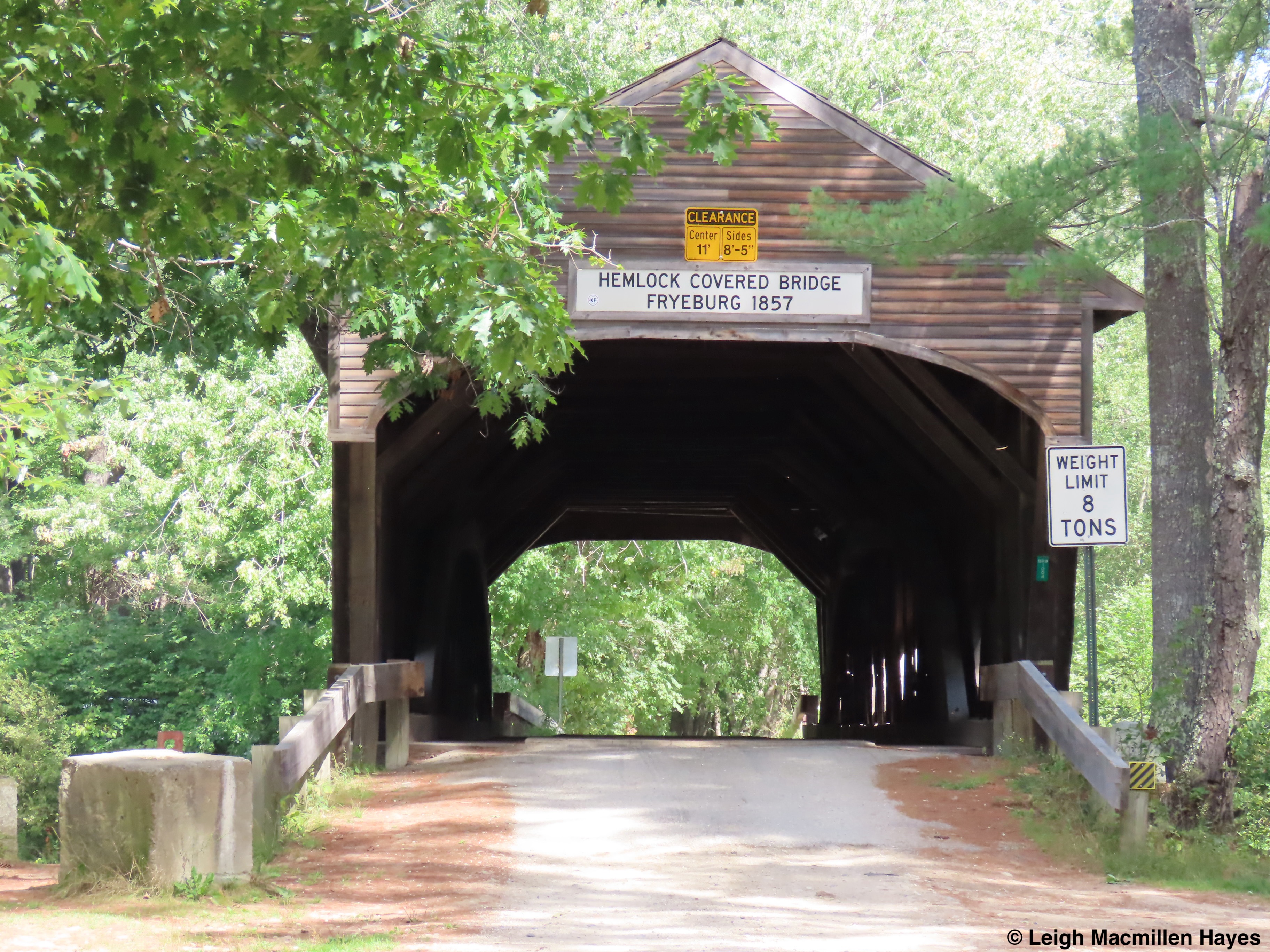
I purchased some gouache and painted Hemlock Covered Bridge. My fav: the bridge and the reflection, but also the lesson that this was a bit like completing a paint by number as I broke it up into different sections.

Fall reflection cropped from a river scene. My fav: All of it. It was like painting a jigsaw puzzle. And i loved creating the wavy lines.

Winter along Heald Pond Road, Lovell, Maine. The interesting thing is that this barn was taken down a few weeks after I painted this scene. My fav: the barn boards and the snow. And my learning–painting the lower background before adding the foreground trees.

Our barn at Christmas. My fav: The reflection in the window.

Interior of Hemlock Covered Bridge in Fryeburg, Maine. My fav: sense of perspective.

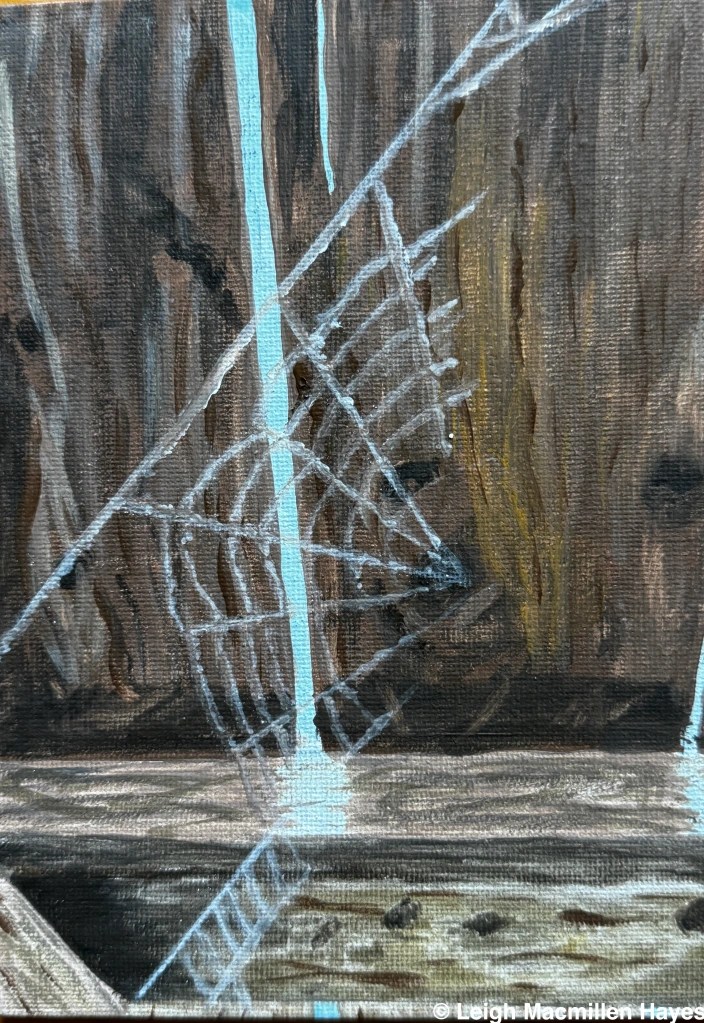
Sunlit part of spider web inside Hemlock Covered Bridge on mat canvas. My fav: texture of the boards and light between boards.

Bob Dunning Memorial Bridge, Pondicherry Park, Bridgton, Maine. My fav: the different beams that provide support as each represents a different species of native wood.

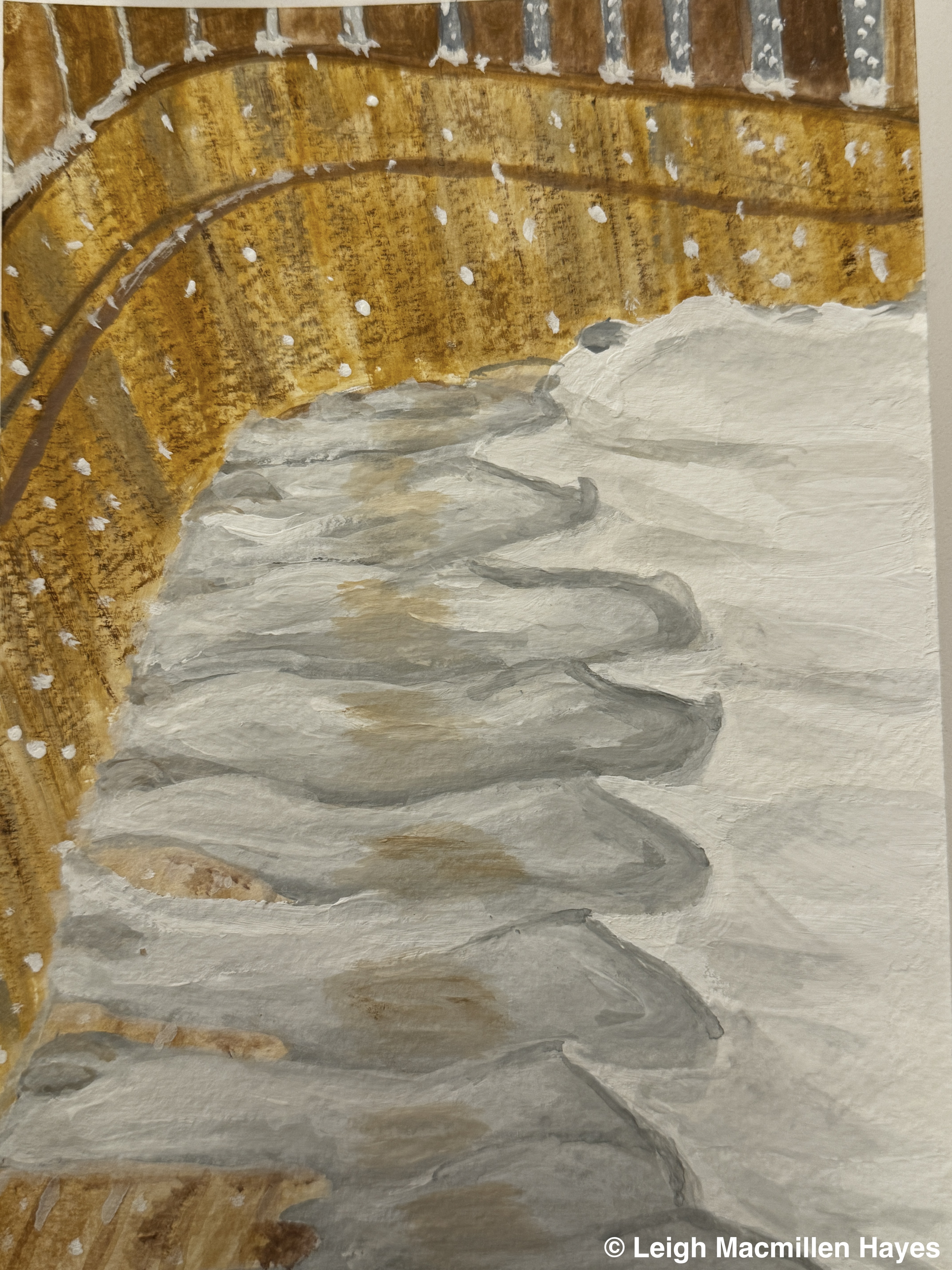
Approaching Bob Dunning Memorial Bridge on a snowy day when no one else had yet entered Pondicherry Park in Bridgton, Maine. My fav: the bend in the bridge.

Beaver at Albany Mountain trail, Bethel, Maine. My fav: the beaver’s face.

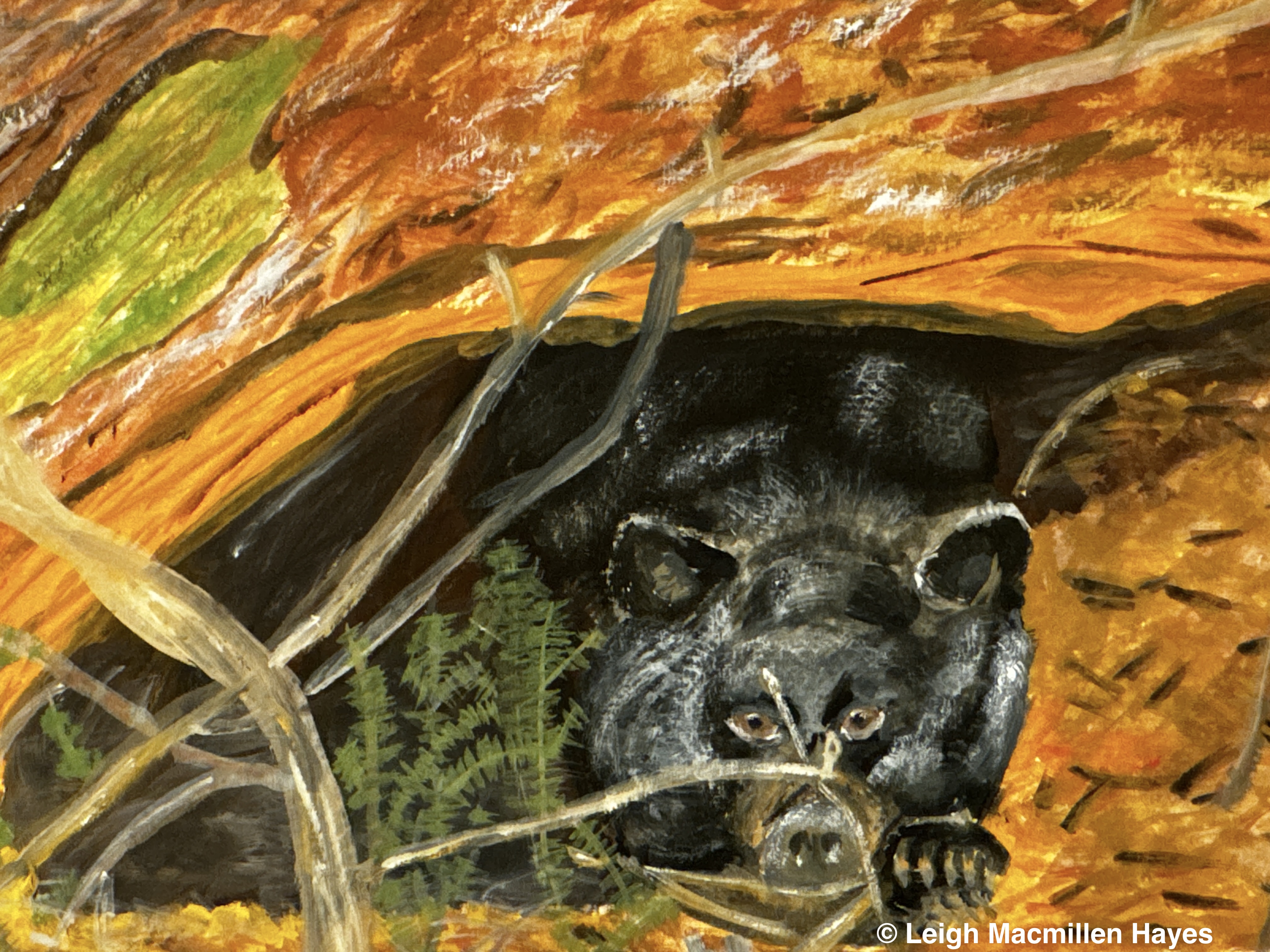
Denning Black Bear. Location a well-kept secret. My fav: the eyes.

Painted Turtle, Moose Pond, Maine. On mat canvas. My fav: colors of the water.

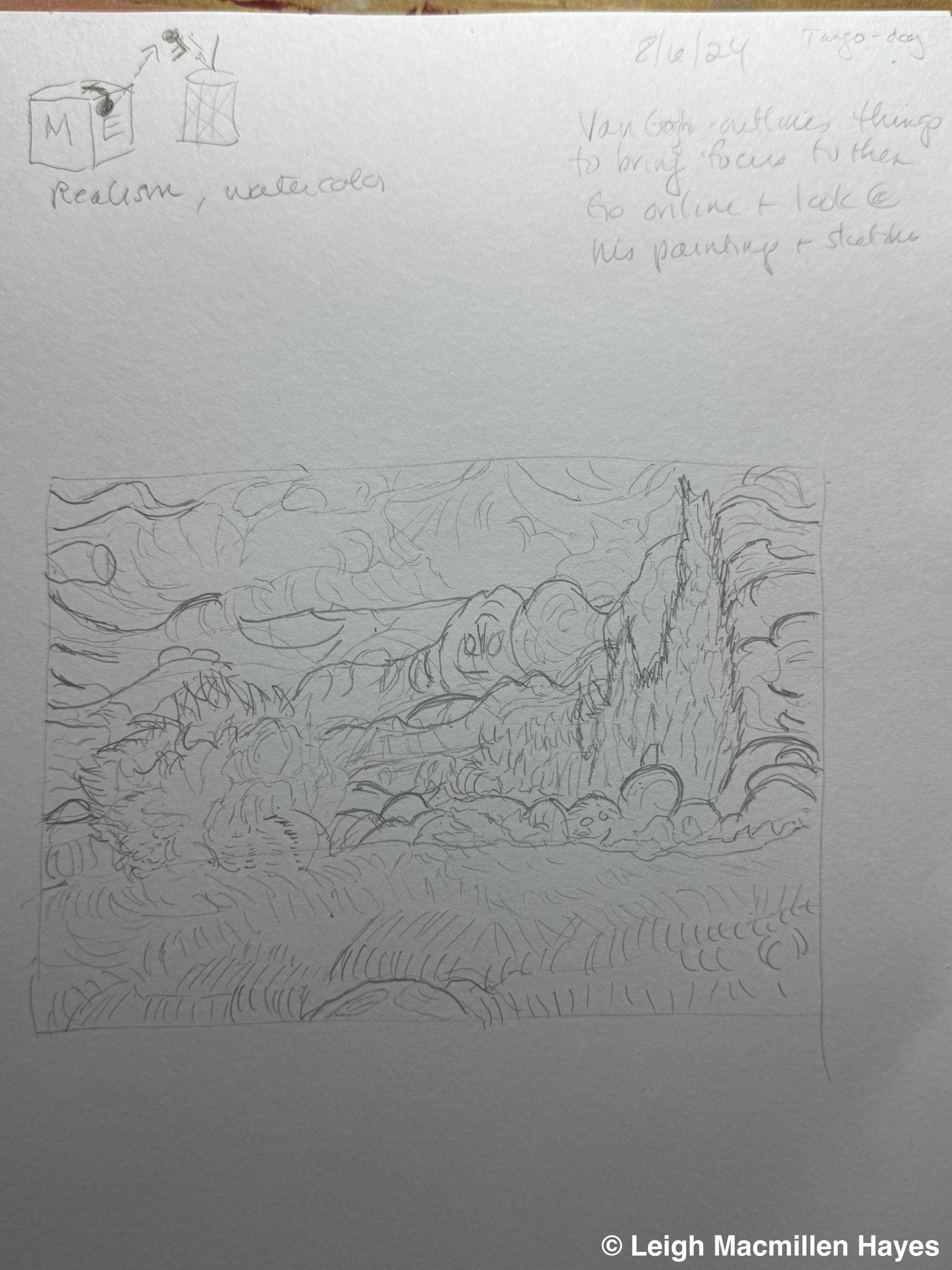
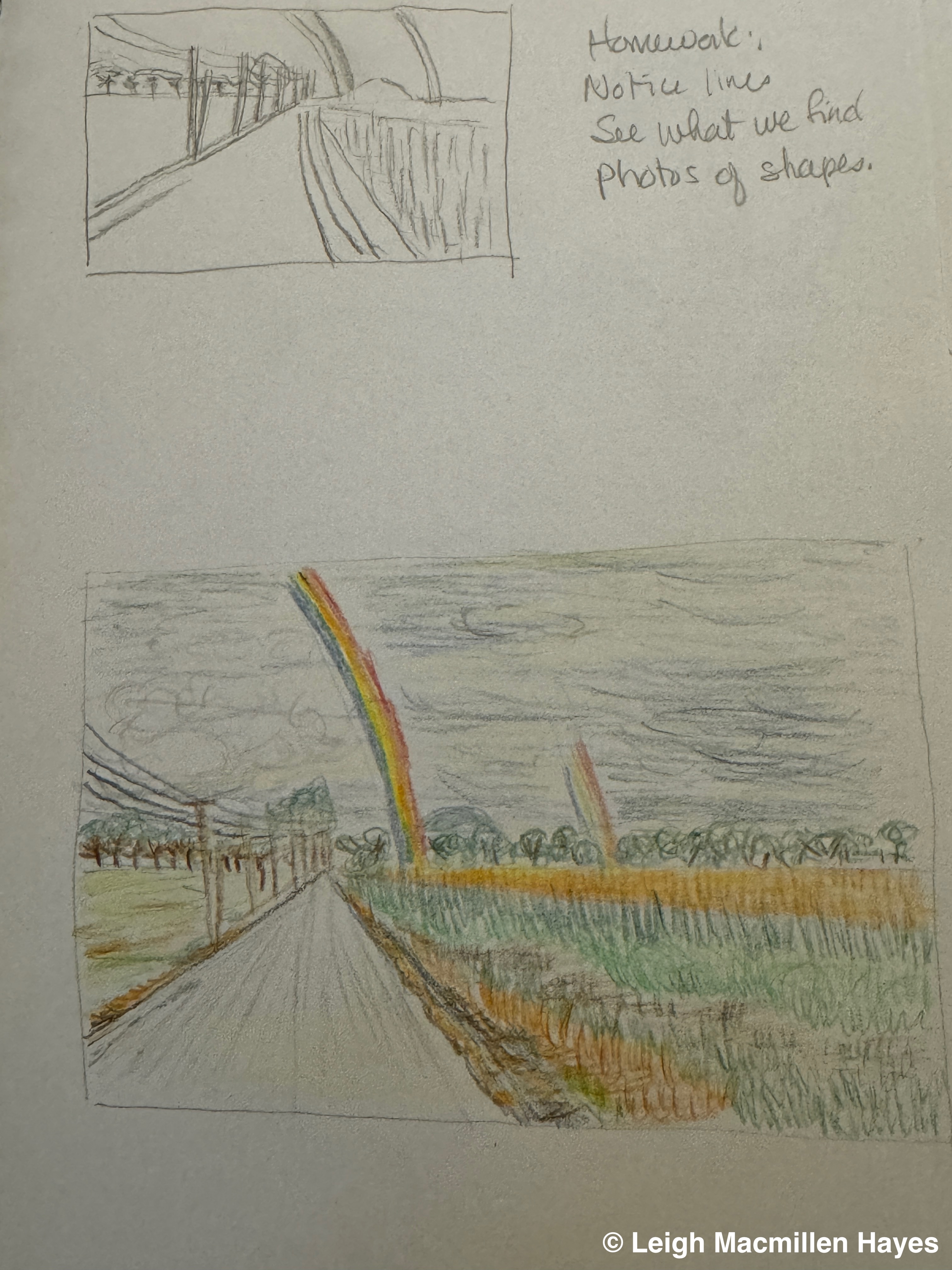
In August, Jessie offered a second class and we had to stuff our art critics in a box in the upper corner of the paper and leave them locked inside and then jot down what we wanted to work on for this session. She also had us take a look at Van Gogh’s style of outlining and bringing focus together.

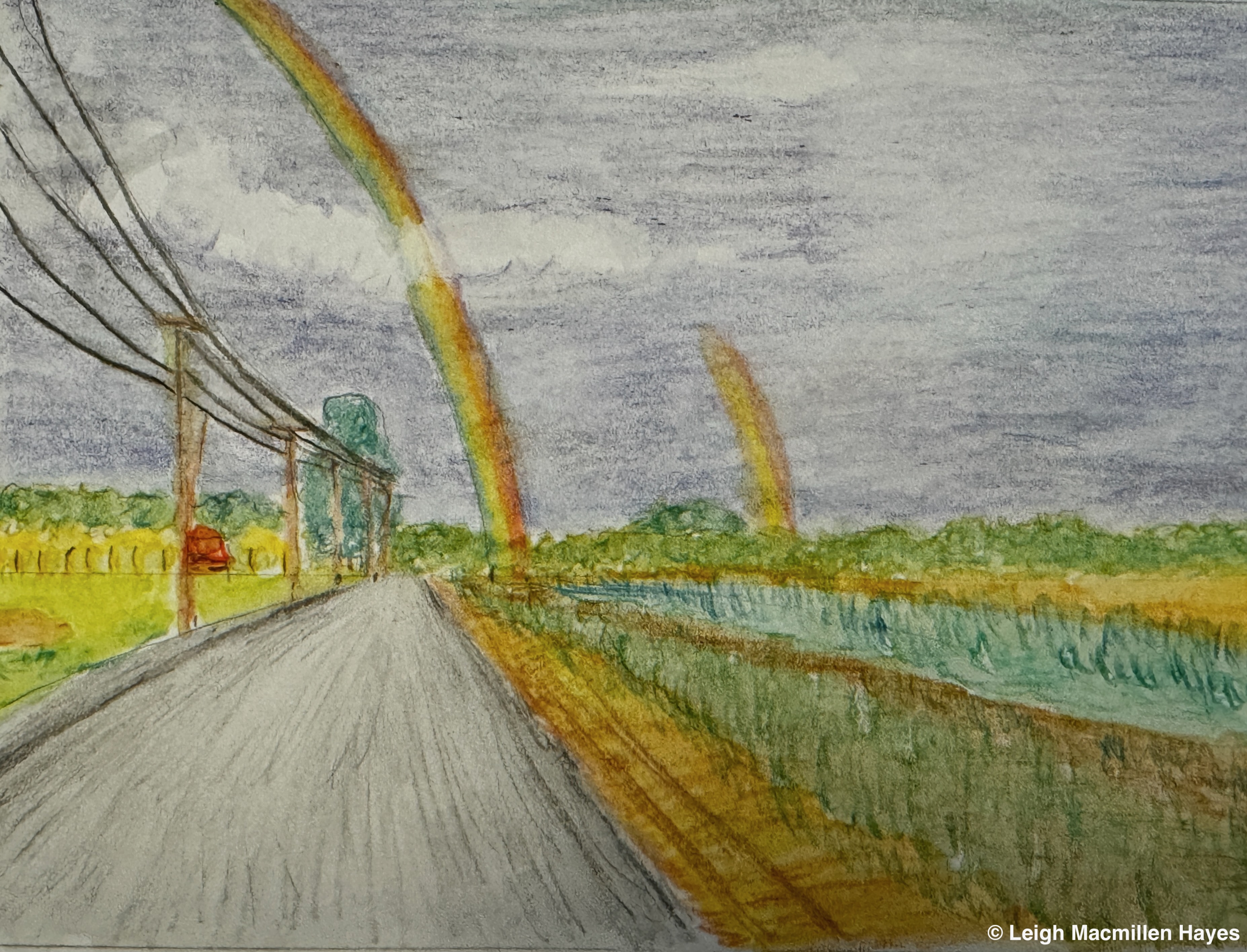
And then, from a photo of our own, we tried to emulate the famous artist. This was a rough draft that I never finished. My fav: I love the colors and simplicity of it.

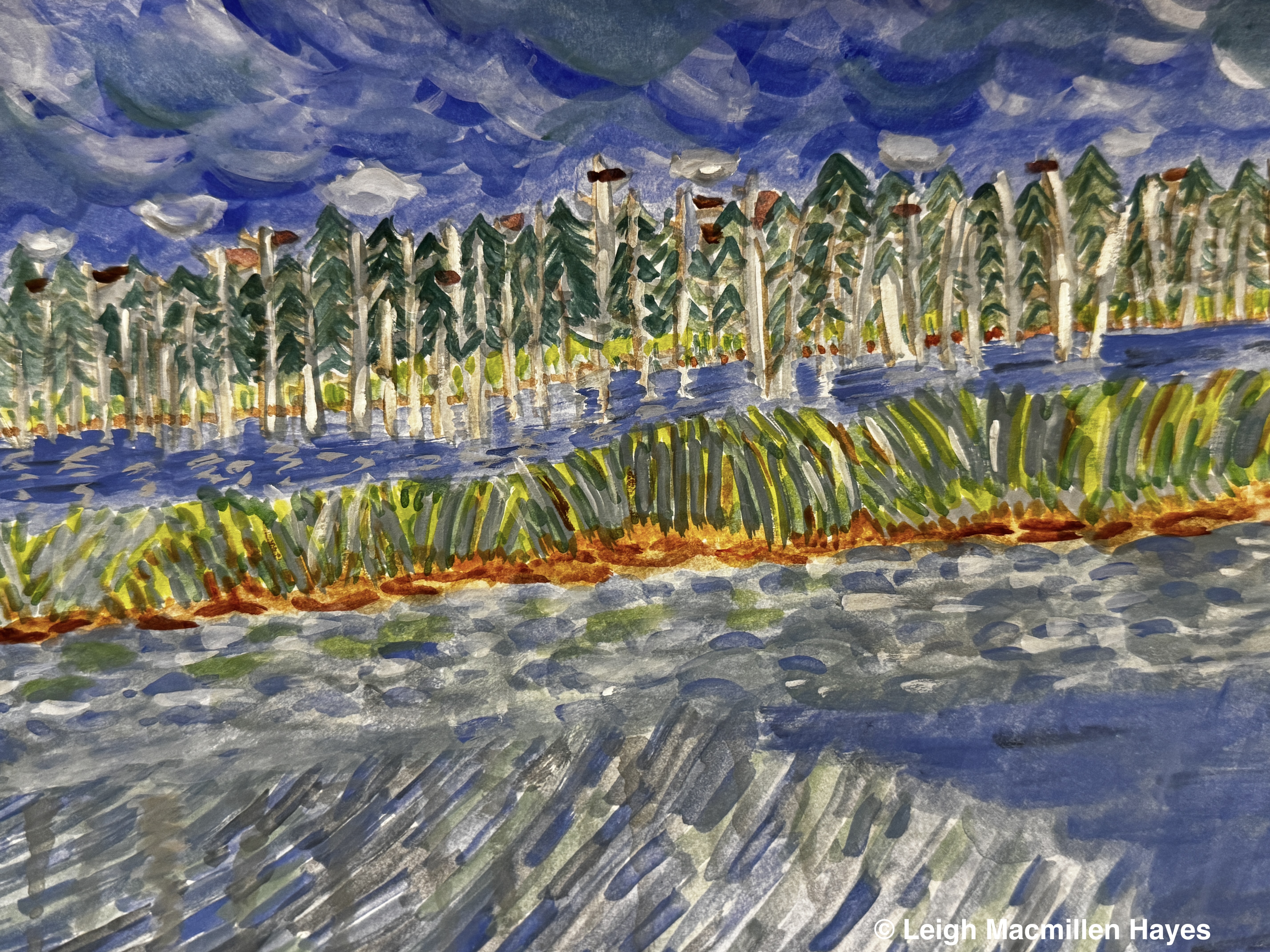
A second attempt at emulating Van Gogh. My fav: the trees in the background.

Third try. The sky was different. My fav: getting better at perspective.

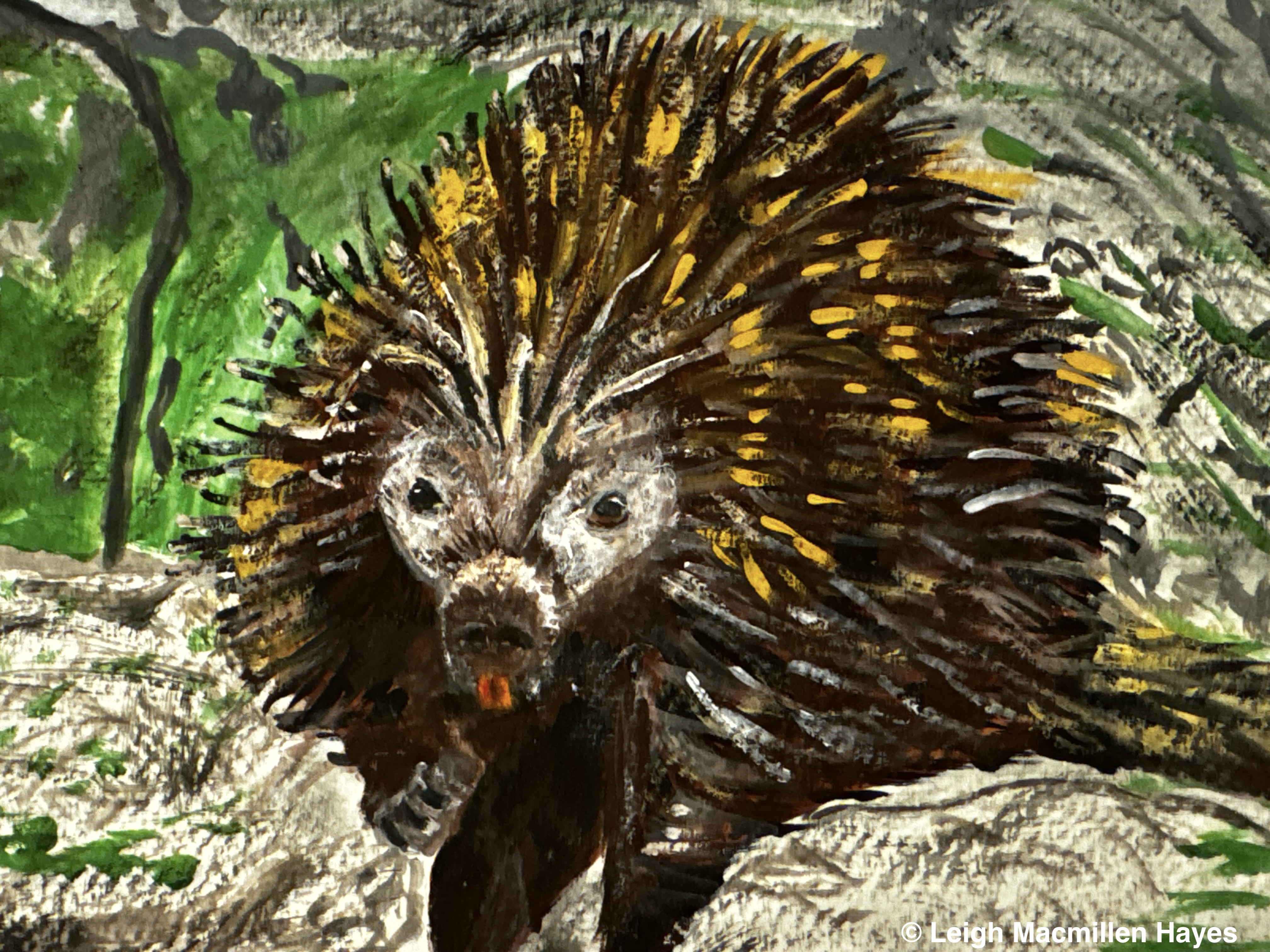
In between classes I continued to paint. One of my absolute favs: Bandit! The porcupine I met in the yard last year. My fav: His face.

A Moose My Guy and I met in the beaver pond on Albany Mountain Trail, Bethel, Maine. My fav: His face.

What’s left of the Hayes Homestead, My Guy’s great-grandparents’ farm in Nova Scotia. My fav: shingles.

An amazing moment when I visited the vernal pool out back as the sun lowered and discovered that in the stillness of the water, a rainbow was created by the pollen, and while the tree shadows draped across the pond, they also were visible in their usual vertical presentation on the water. My fav: colors of the sunlight on the pollen.

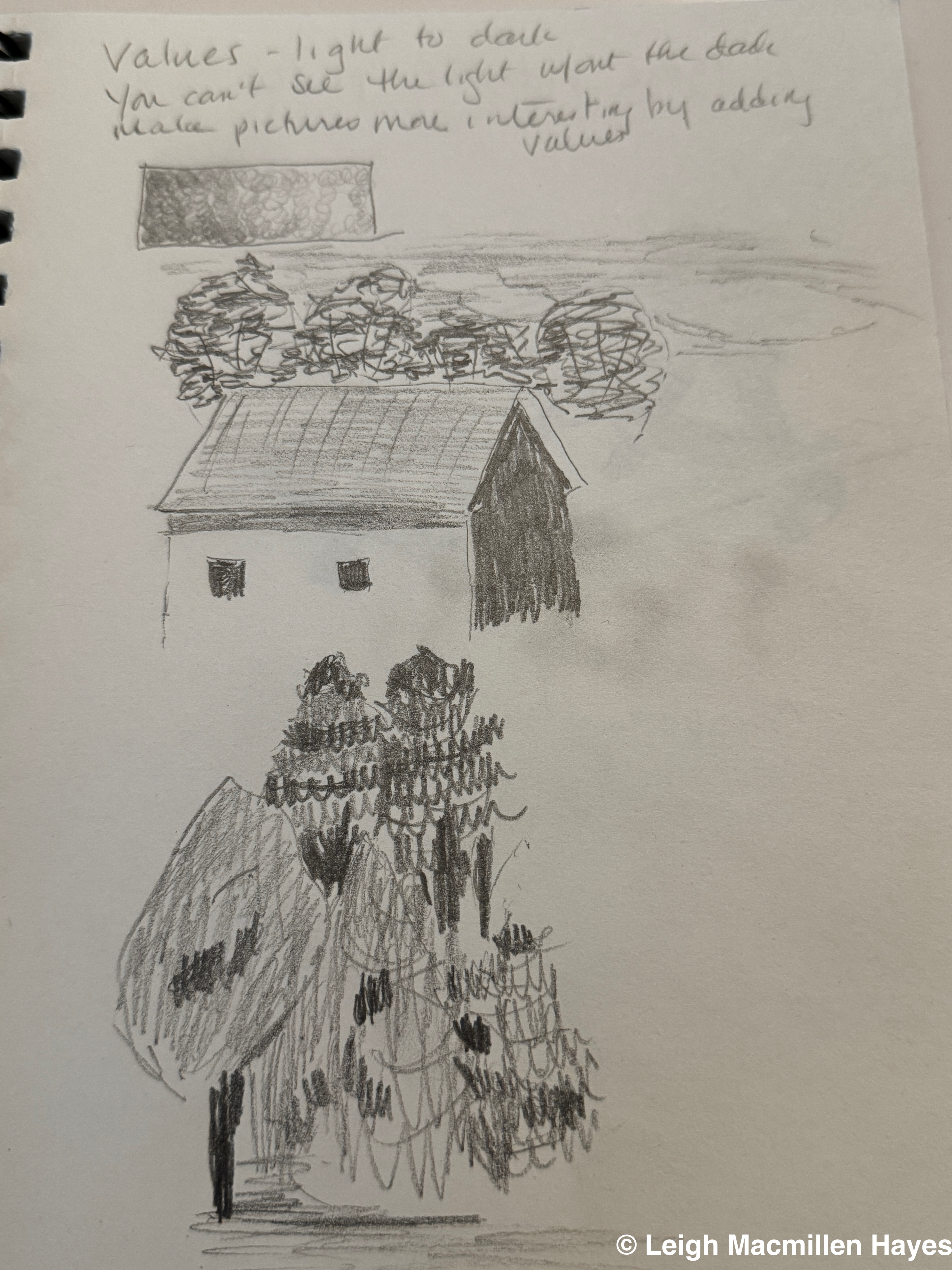
Back to class and learning more about values. I have to admit that I don’t always heed this advice and do a values sketch before painting.

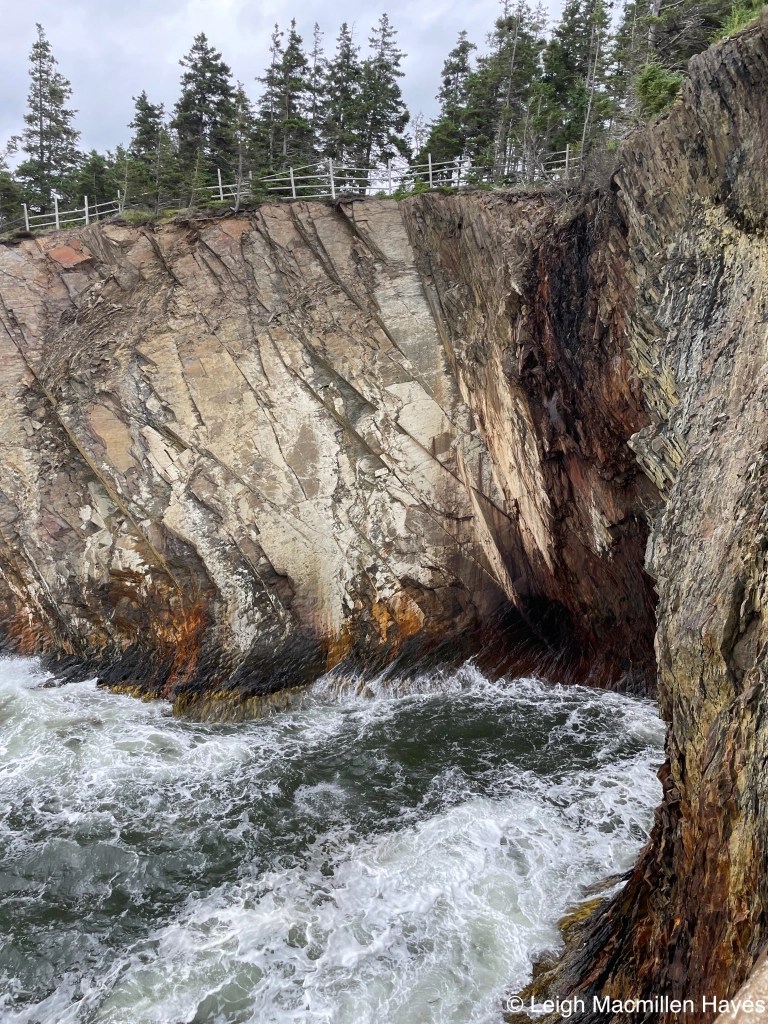
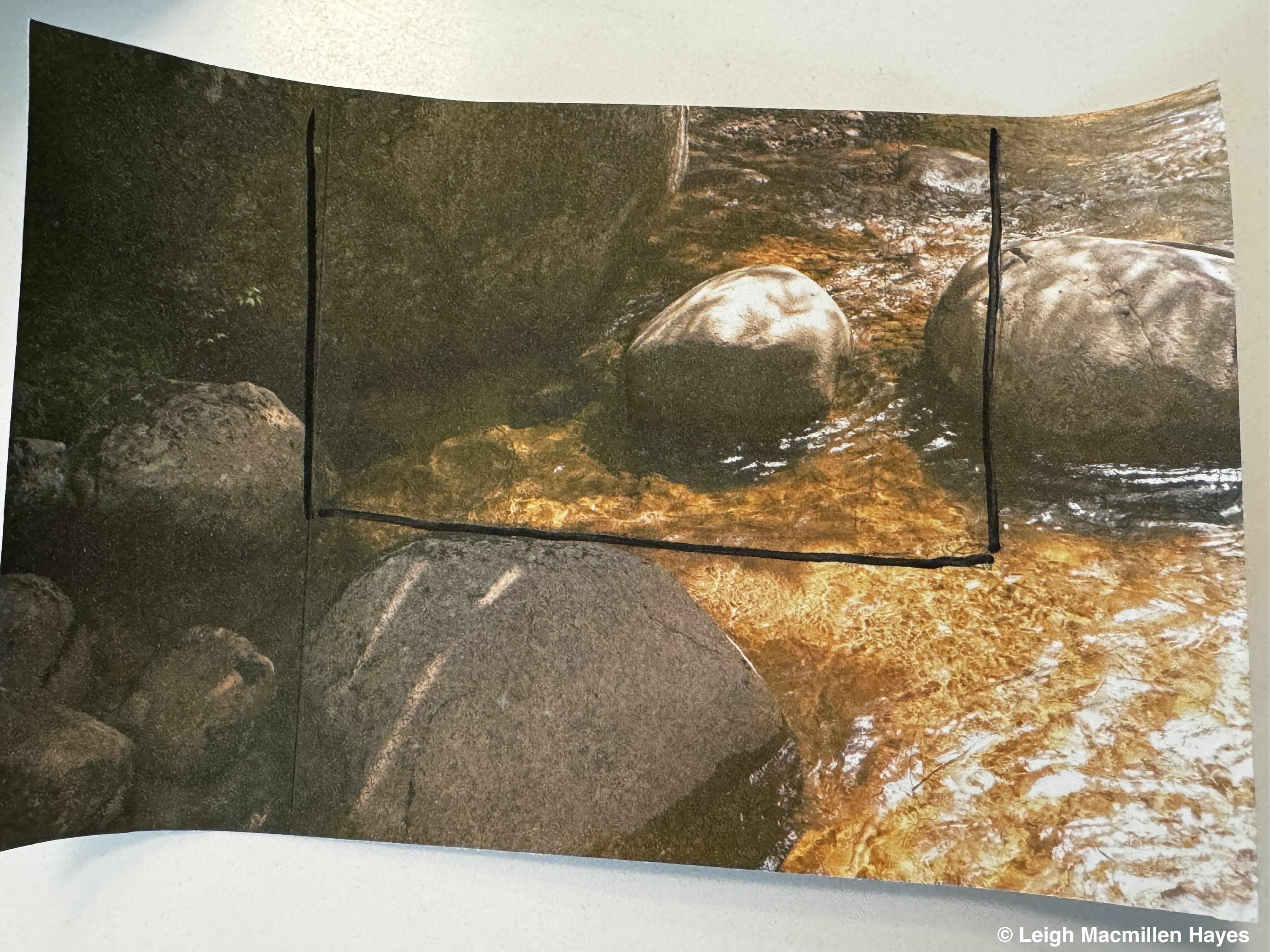
Photo of Ovens Cave, Nova Scotia.

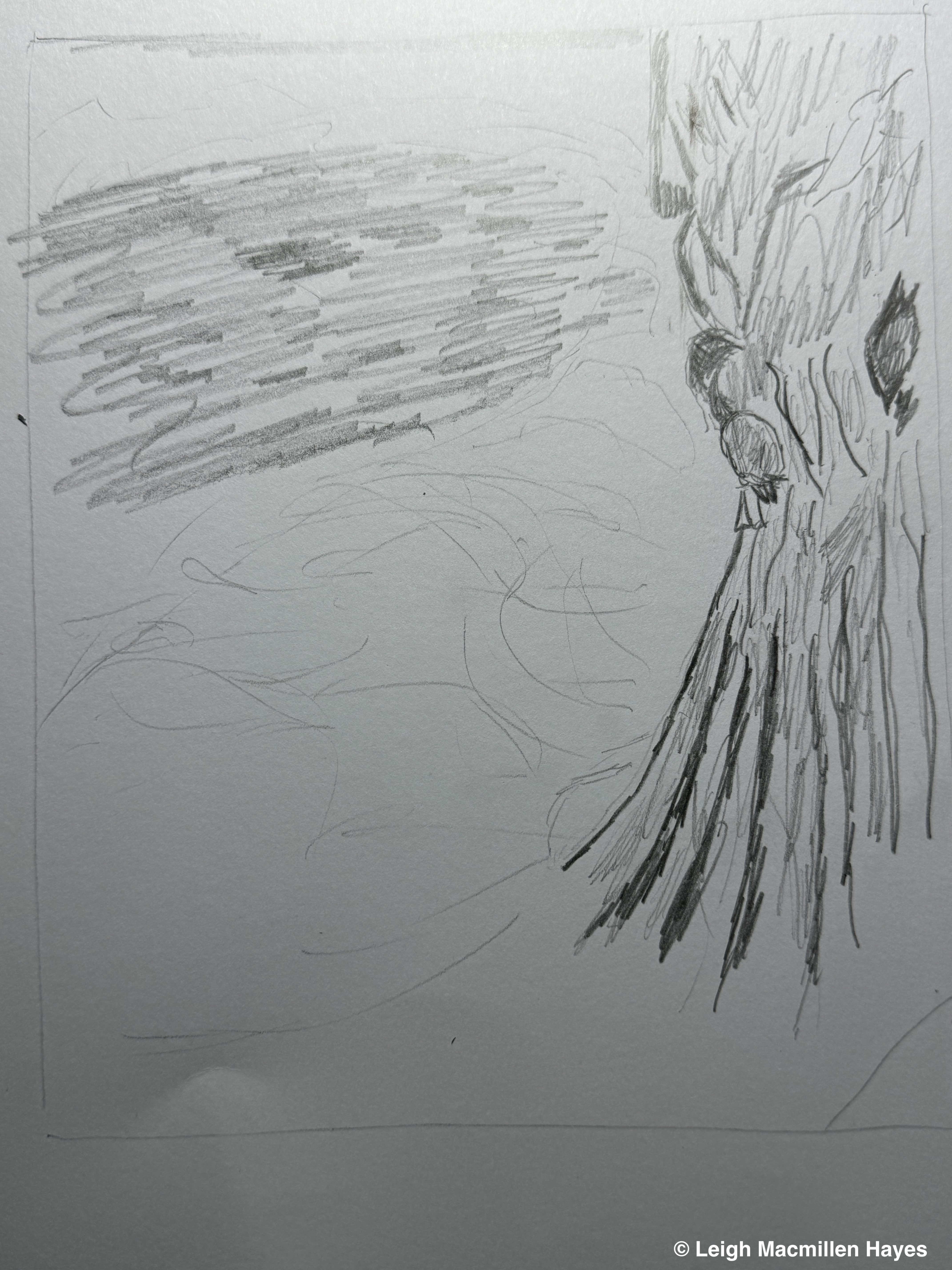
Cropping the photo in sketches.

One final sketch before painting.

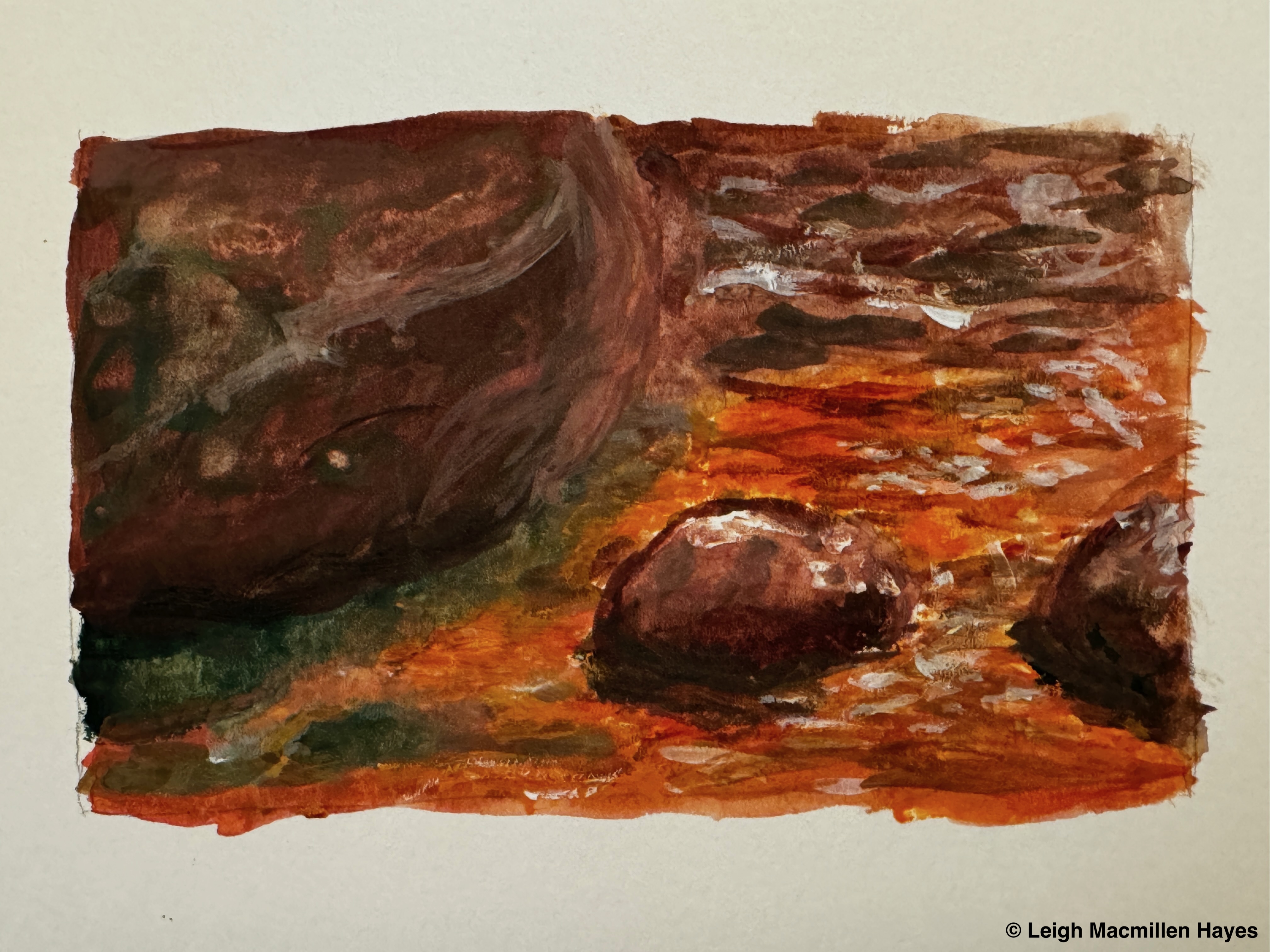
First attempt in gouache. My fav: colors of the rocks.

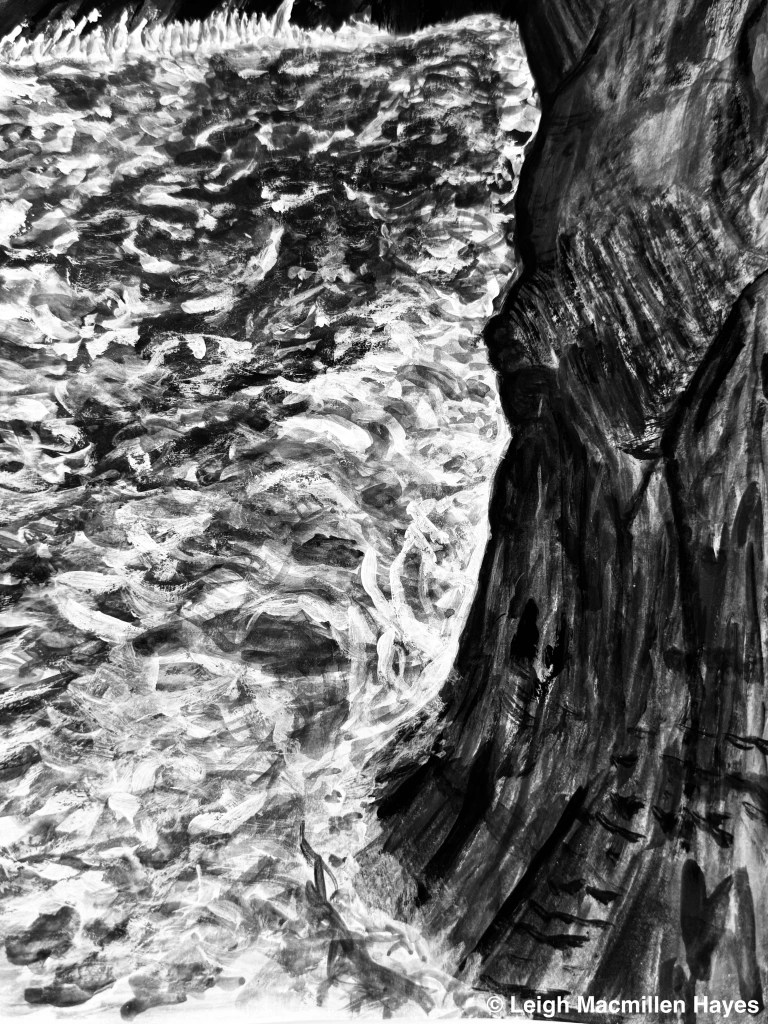
Jessie taught us a neat trick to check values by using a filter on our phones.

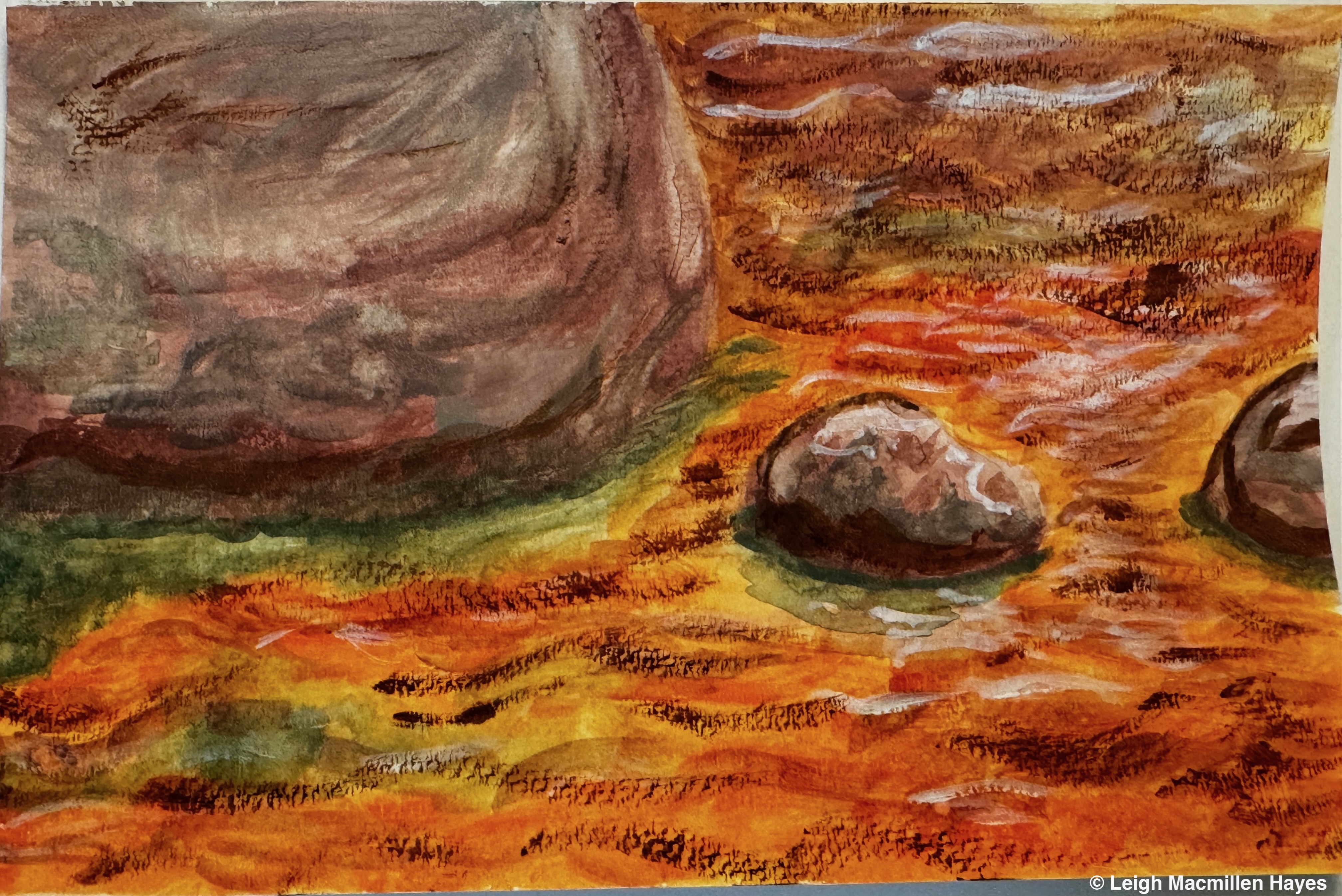
Trying to be more abstract with the same scene. My fav: the color of the water.

Values photo of the same.

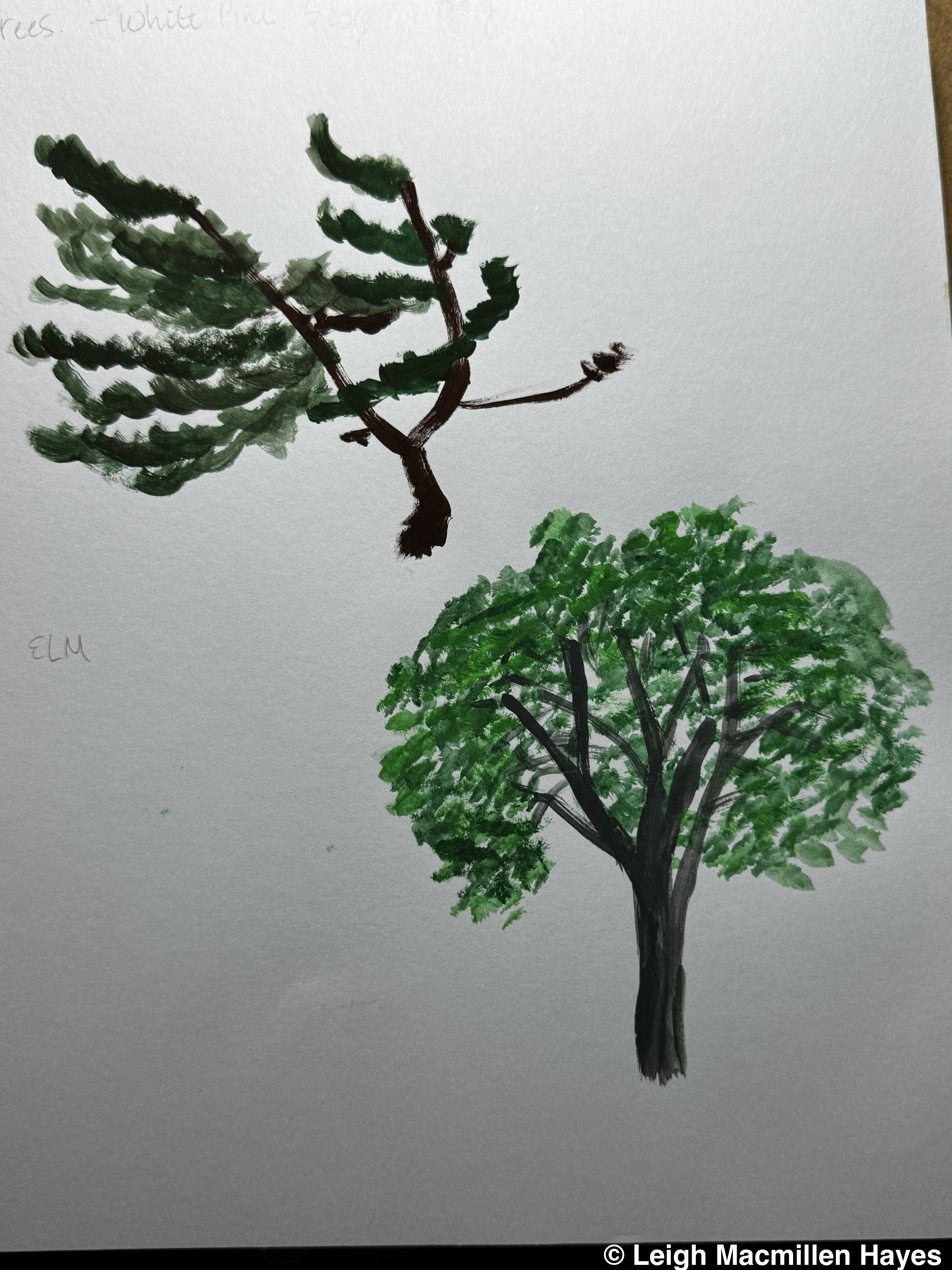
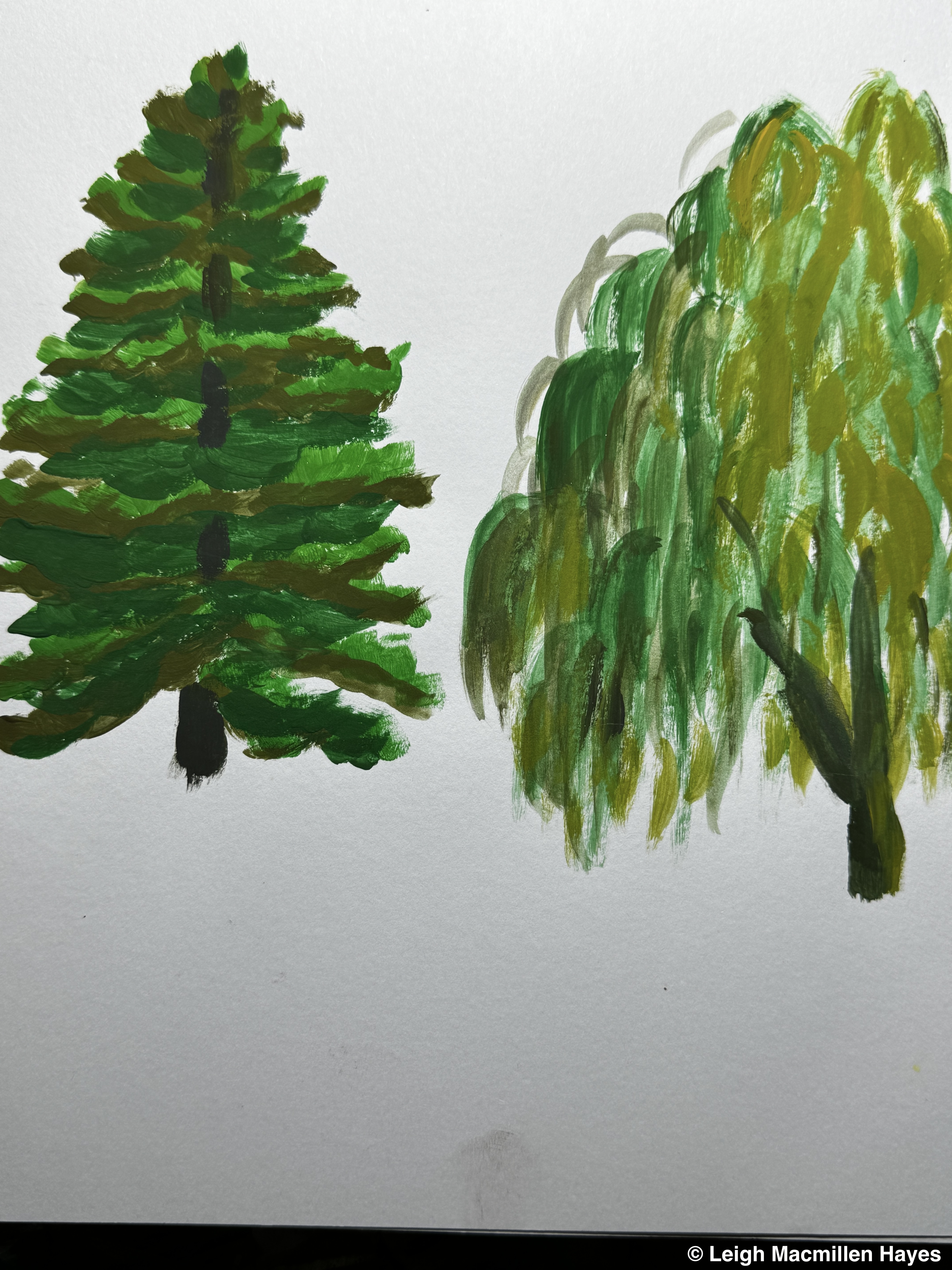
The third time we met we talked about basic shapes and had to quickly paint trees. It was supposed to be six trees, but our class only got through four. I guess we weren’t so quick after all. My fav: the willow. But also thinking about different shapes. And how to fill them in quickly.

Hairy Coo My Guy and I met in Scotland. My fav: the ear tag!

Values sketch of photo she offered in class, and getting the basic shapes on paper.

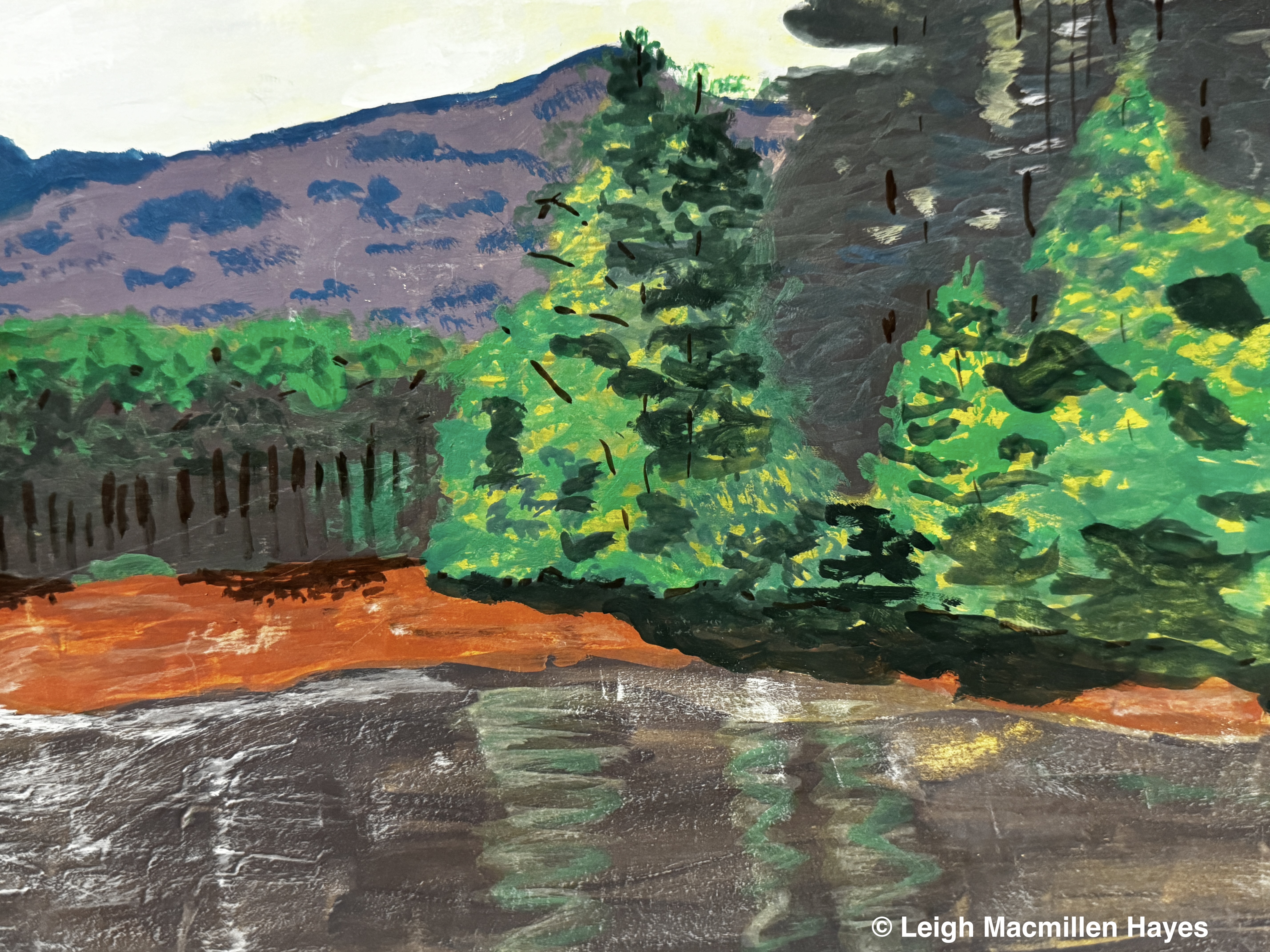
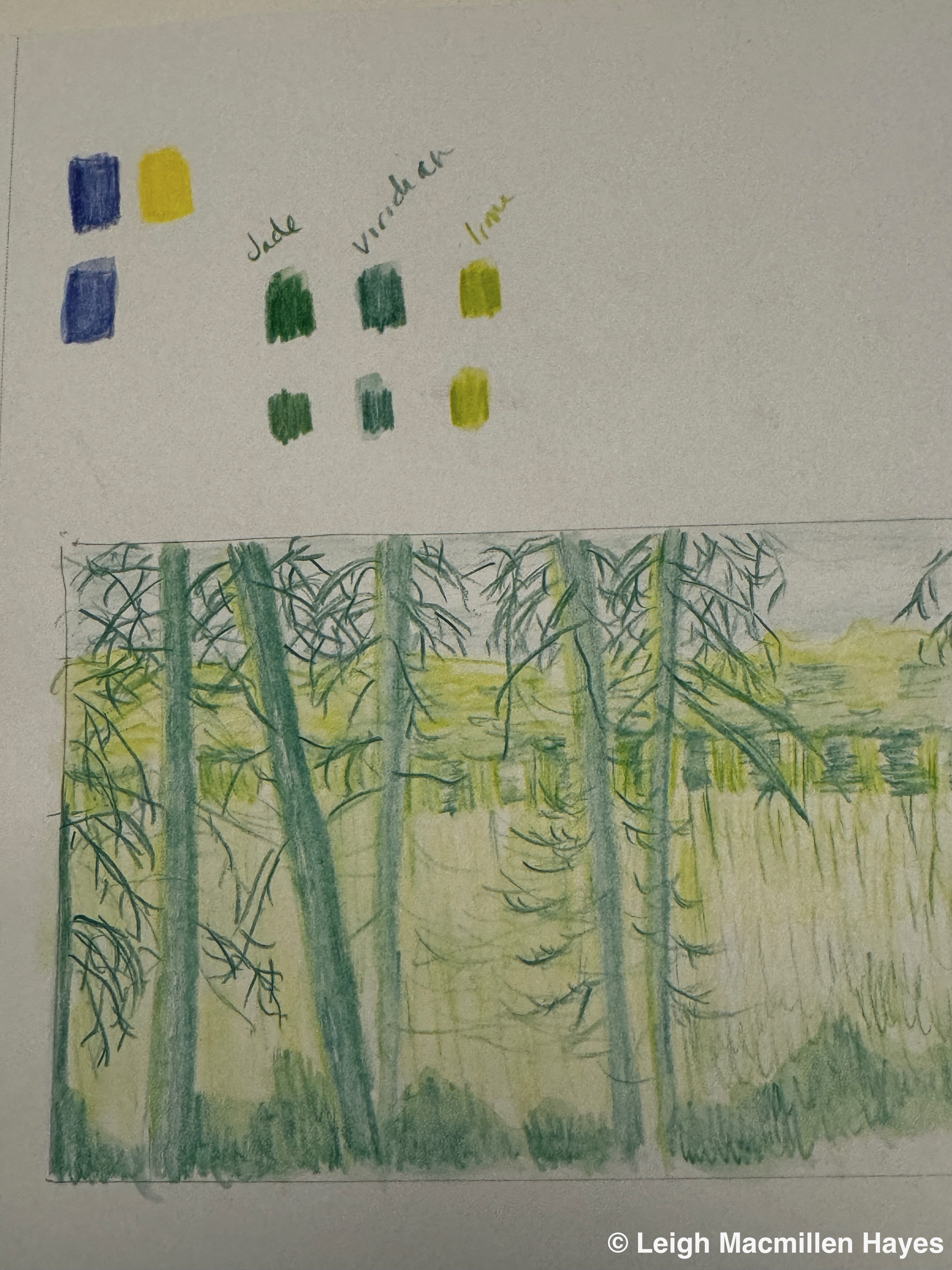
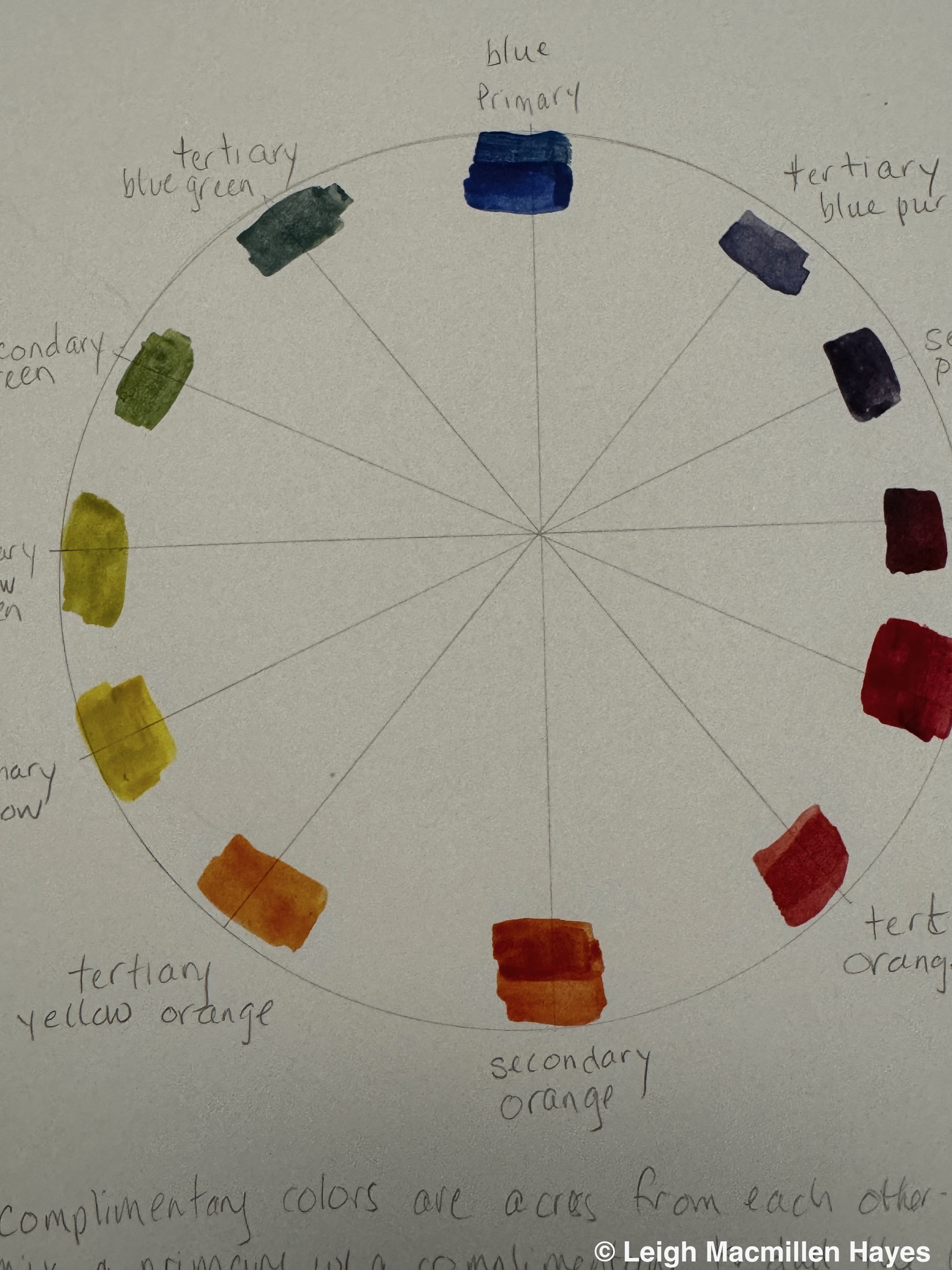
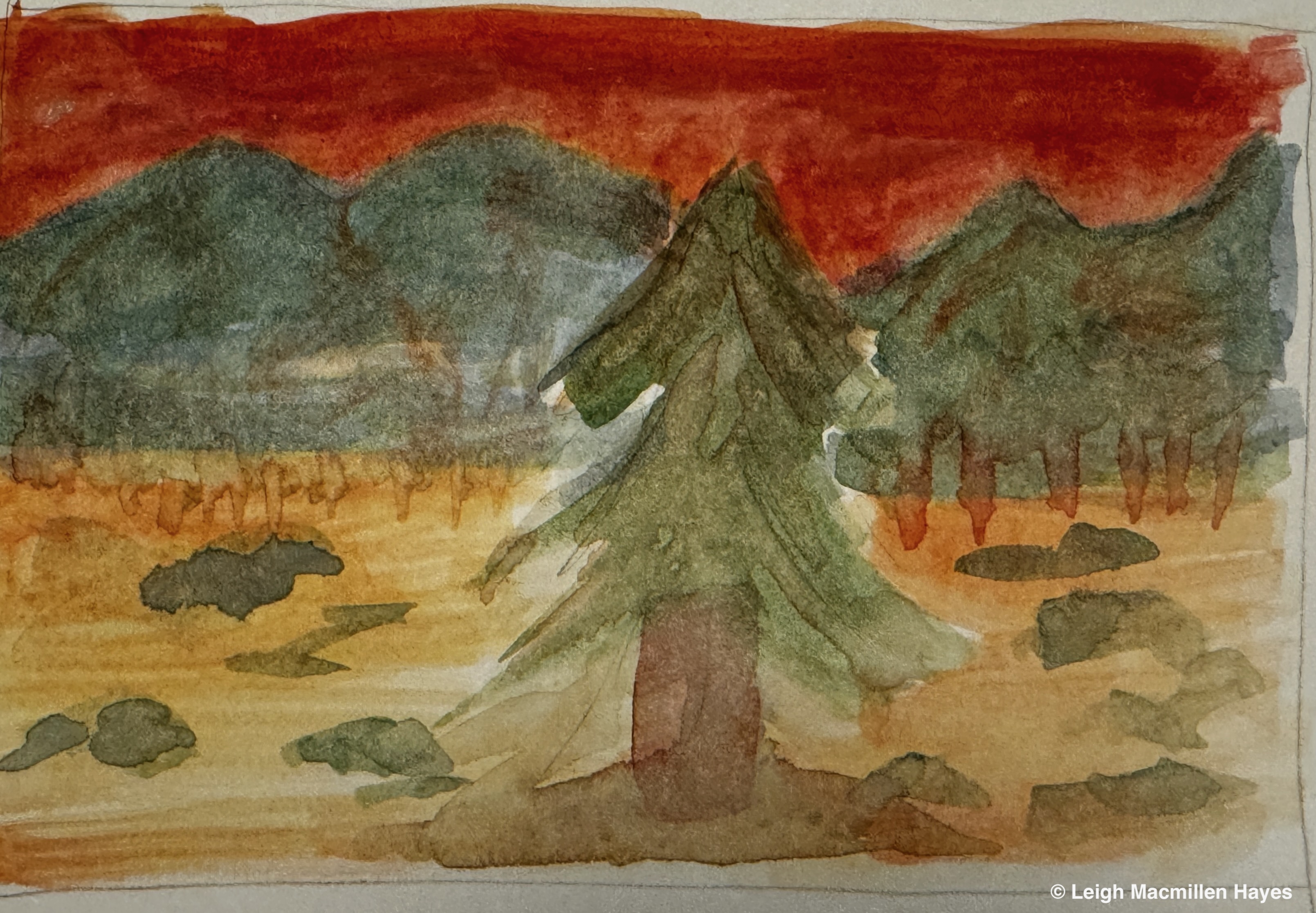
And then we could only use certain colors to paint the scene, filling in the shapes first before adding detail. This was mind opening for me. My fav: making blobs look like trees.

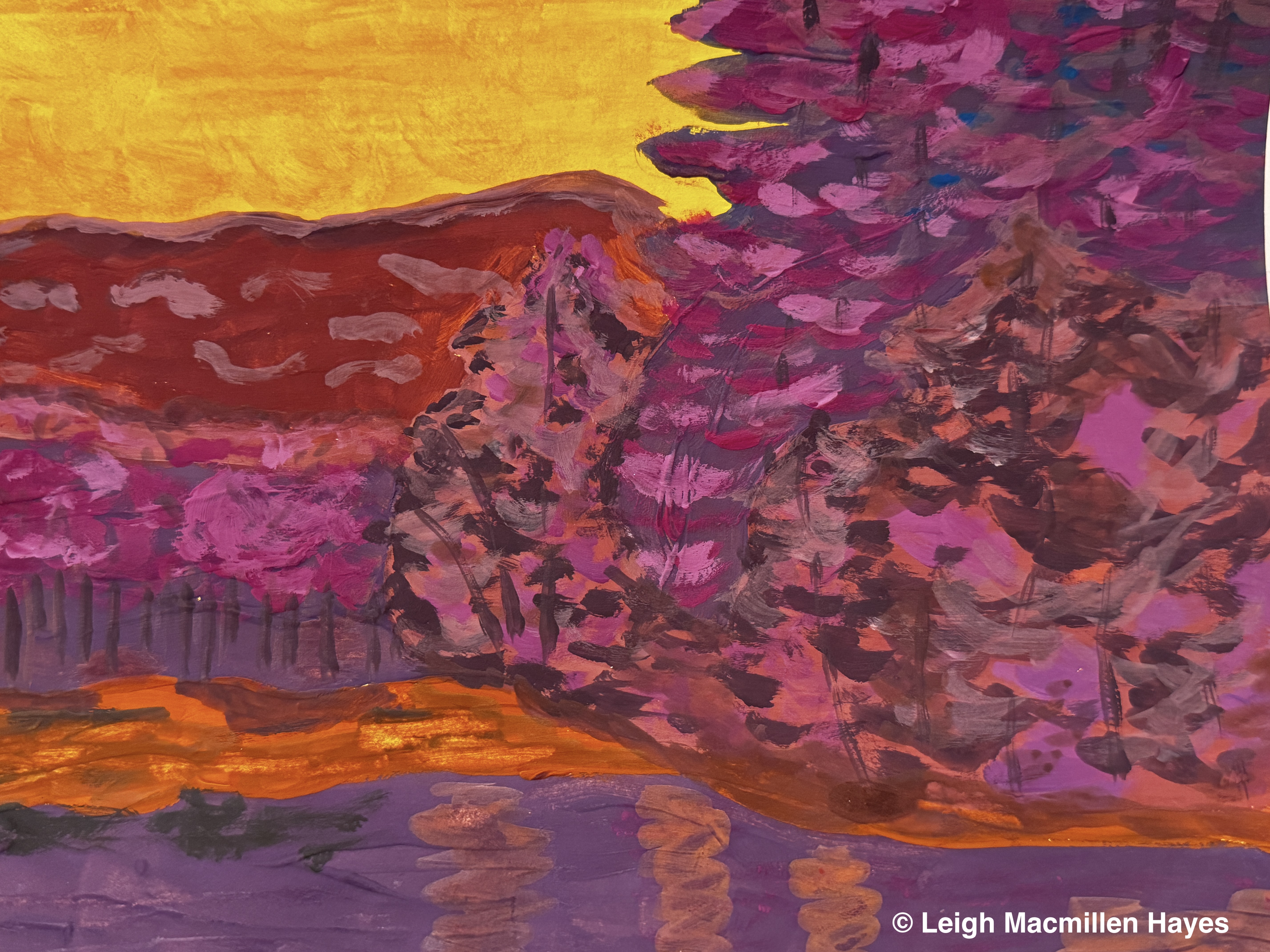
The same scene using different complementary colors on the wheel. I struggled with the values in this one. My fav: the trees still look like trees.

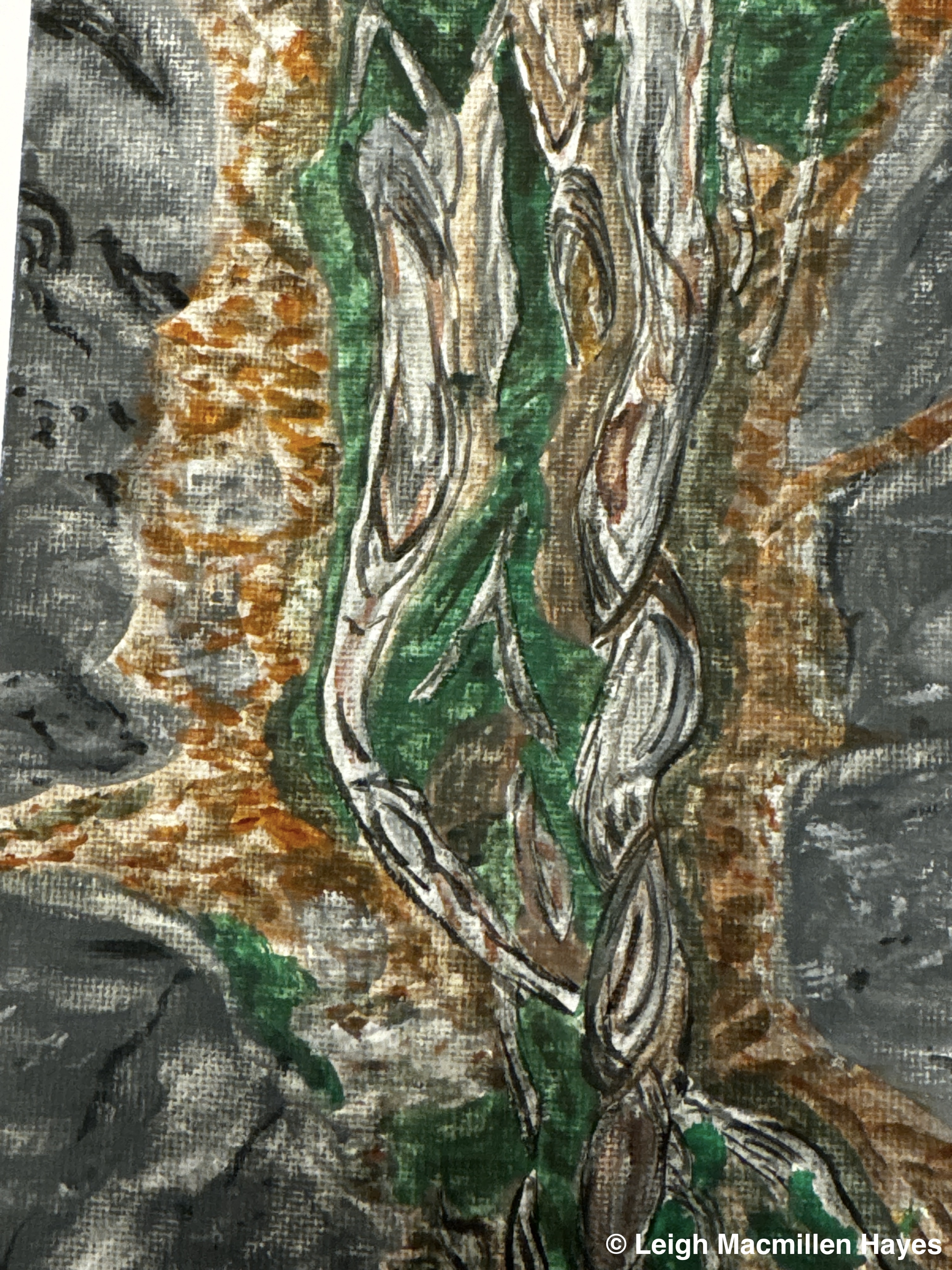
This one has been the most difficult for my family to understand. An intersection of granite ledges and tree roots on Bald Pate Mountain, Bridgton, Maine, on a canvas mat. My fav: the tree roots.

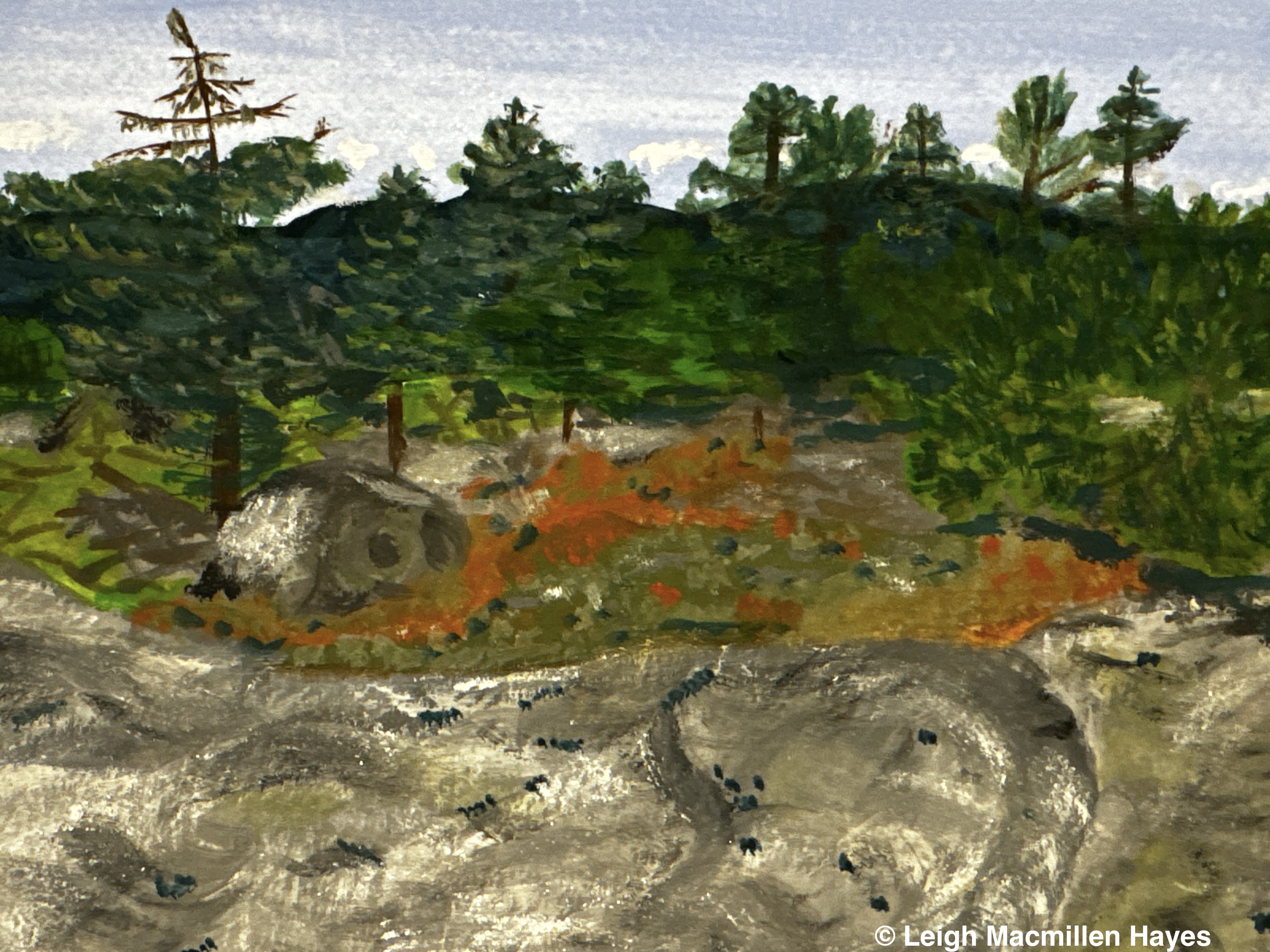
Ledges on descent of Rumford Whitecap Mountain, Rumford, Maine. My fav: the trees with the mountain backdrop.

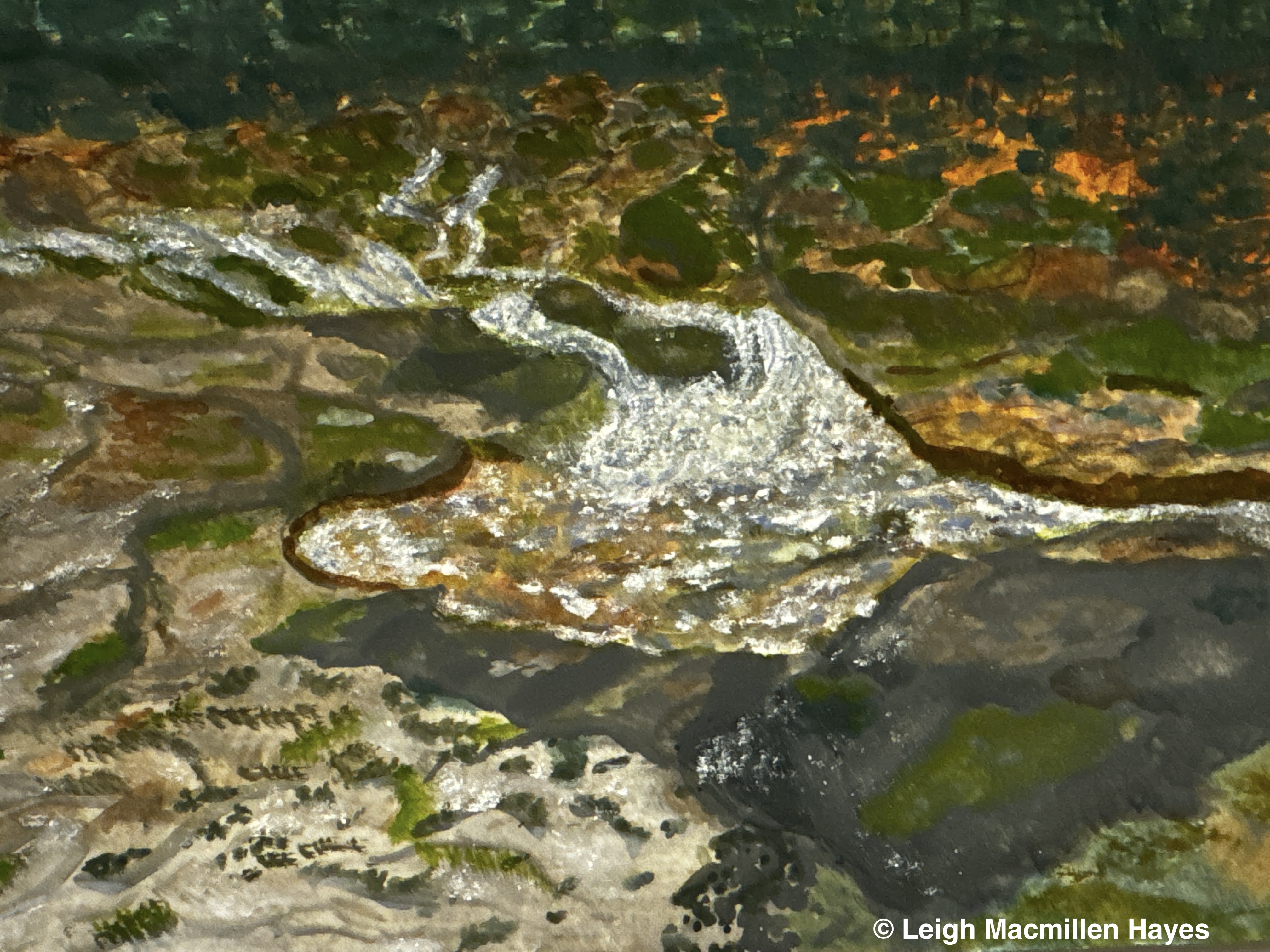
Bickford Slides, Blueberry Mountain, Evans Notch, Maine. And the discovery that I had accidentally purchased a small tube of shimmery white watercolor paint. My fav: water flowing over the mossy rocks.

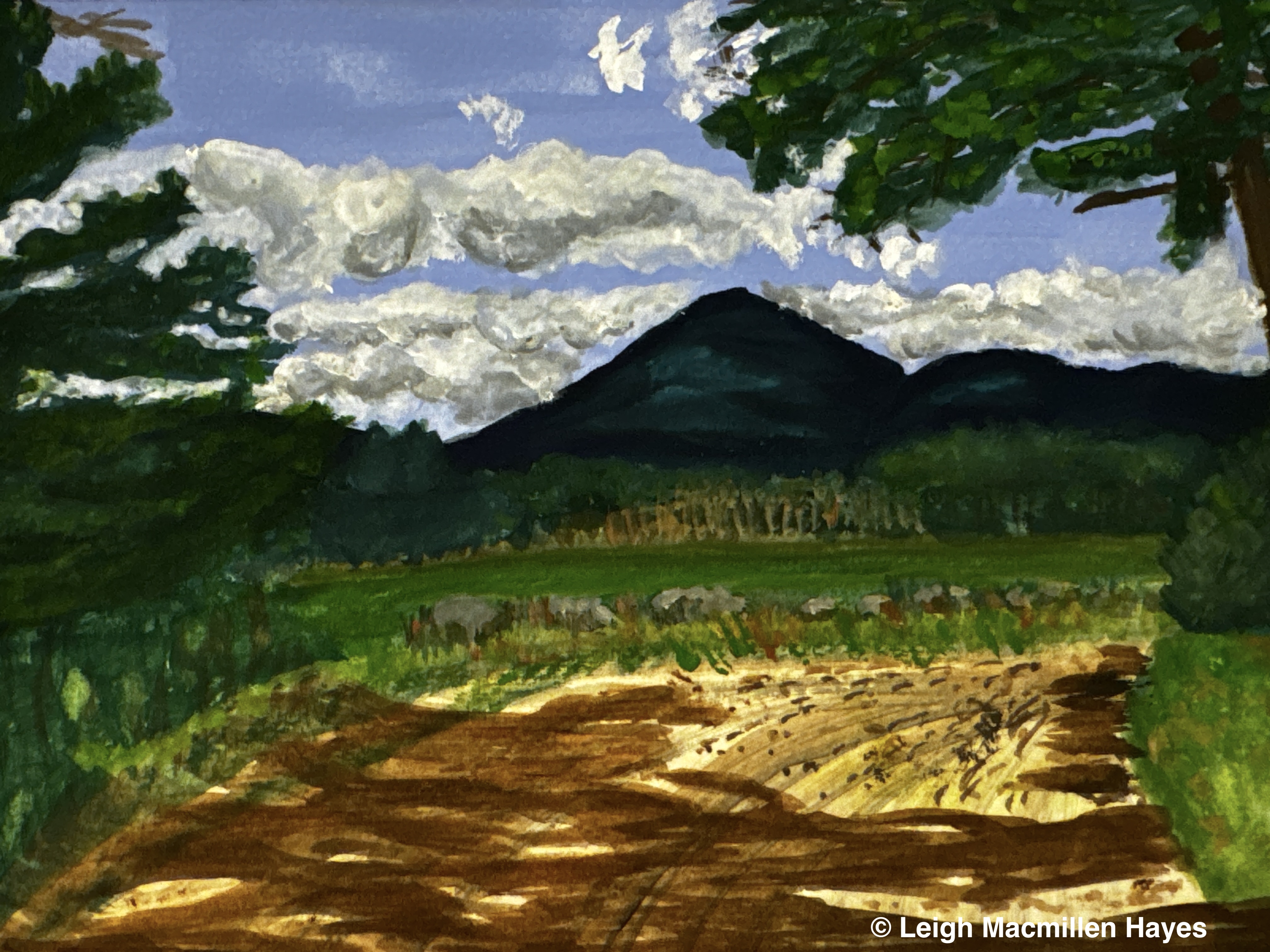
Shadows across Hemlock Bridge Road, Fryeburg, Maine. My fav: those very shadows. And the rocks that line the road.

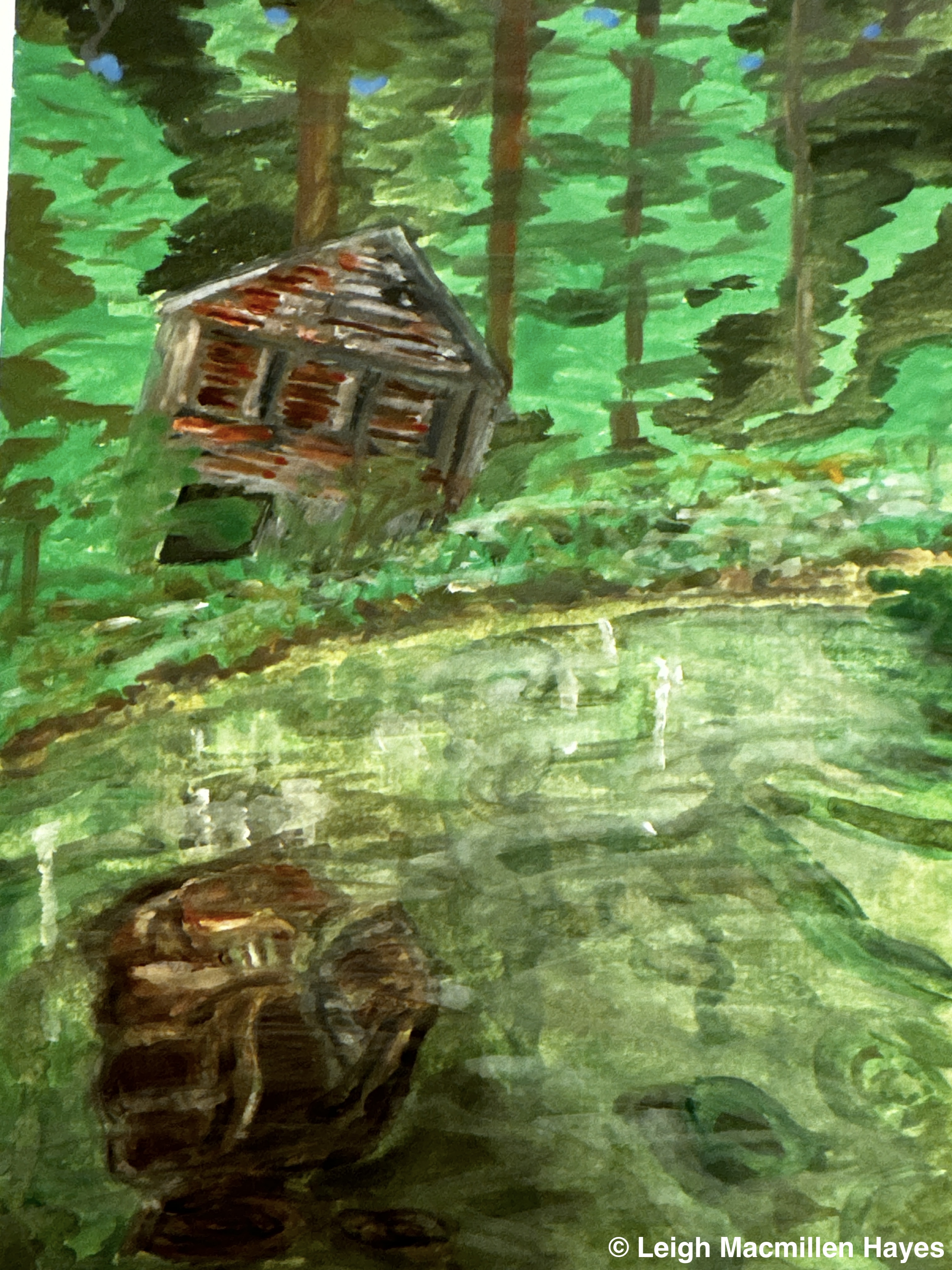
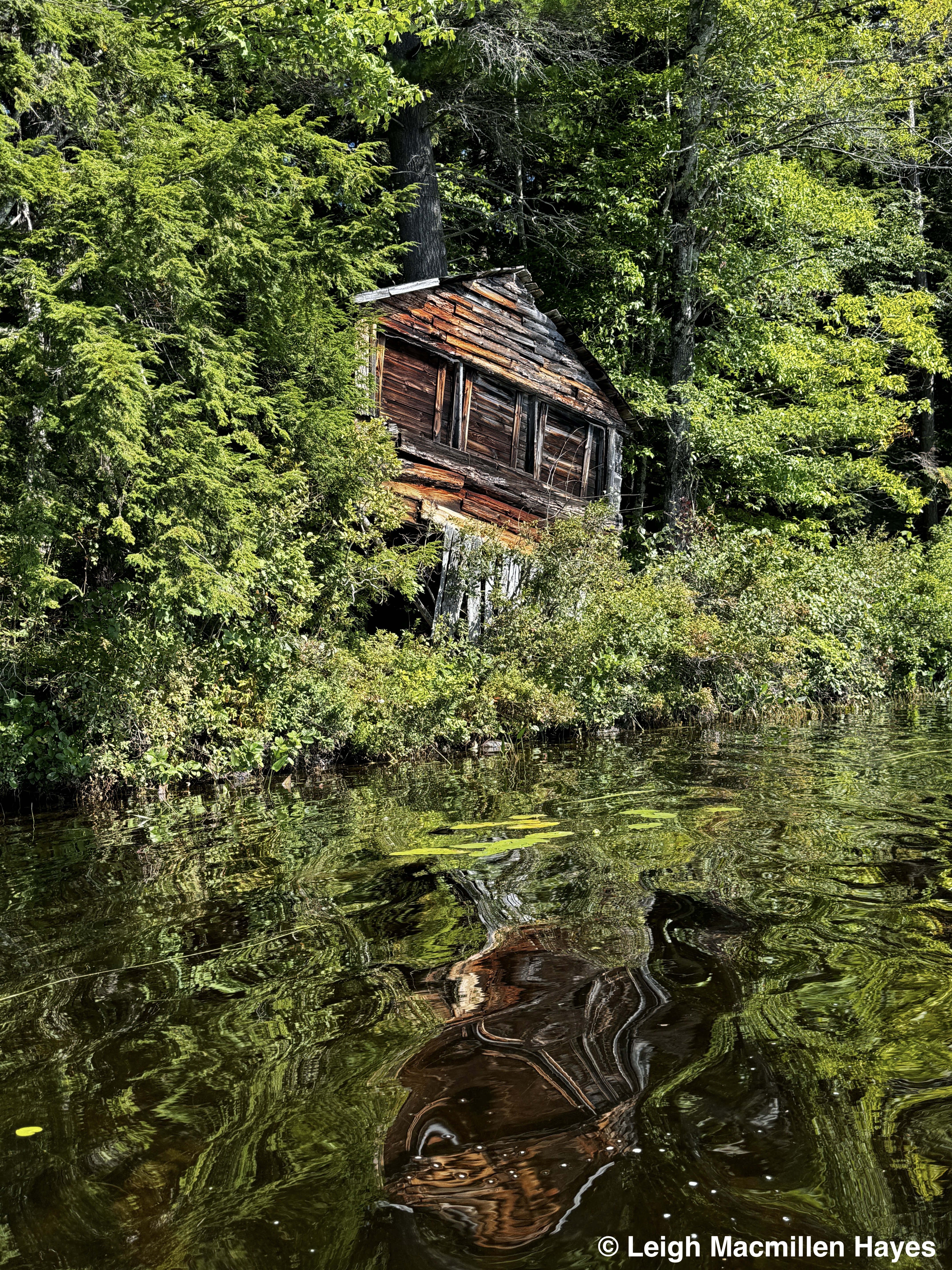
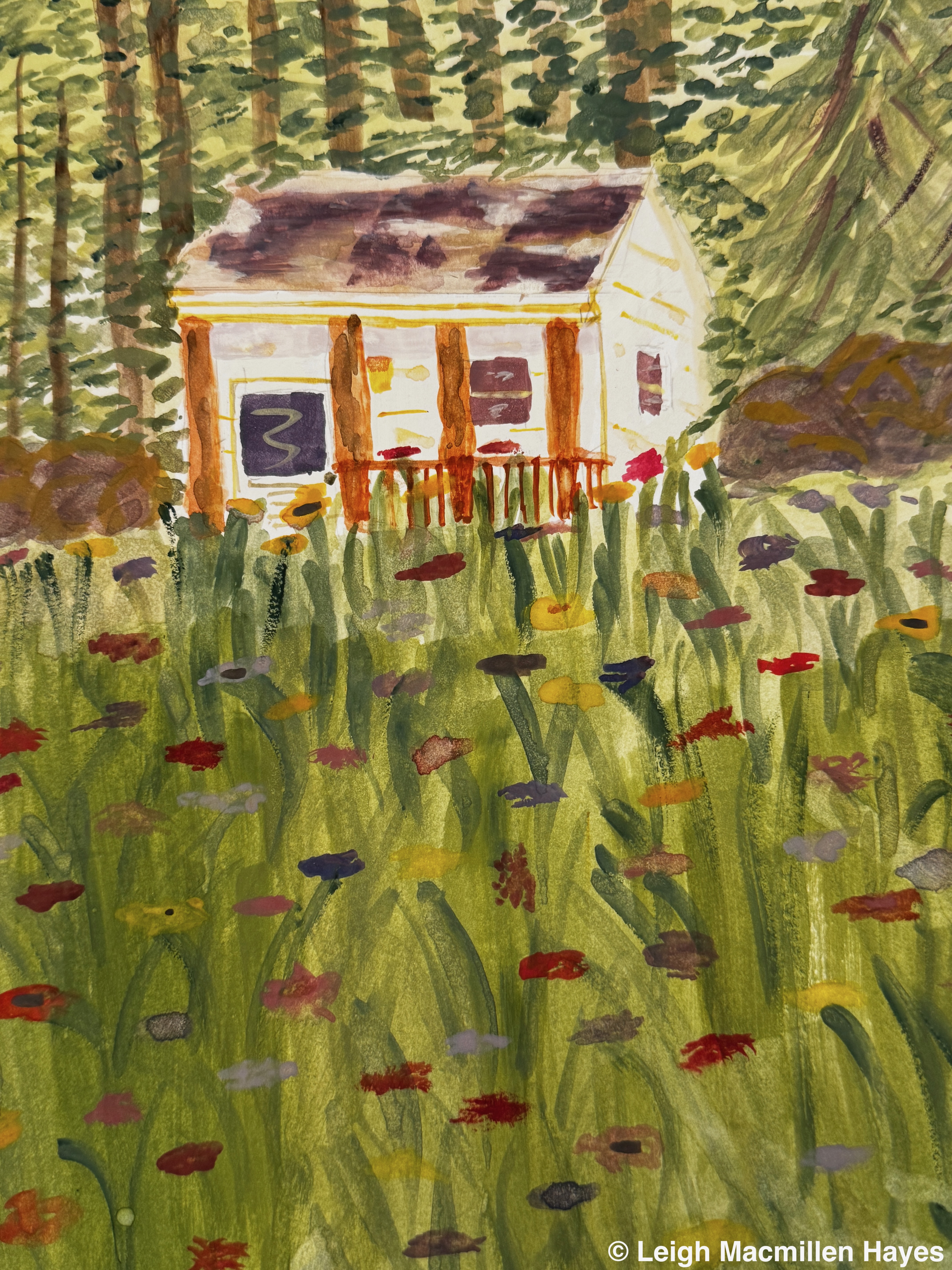
Back to gouache to capture the reflection of a falling down cabin on a small pond in New Hampshire. My fav: the trees and hints of the blue sky.

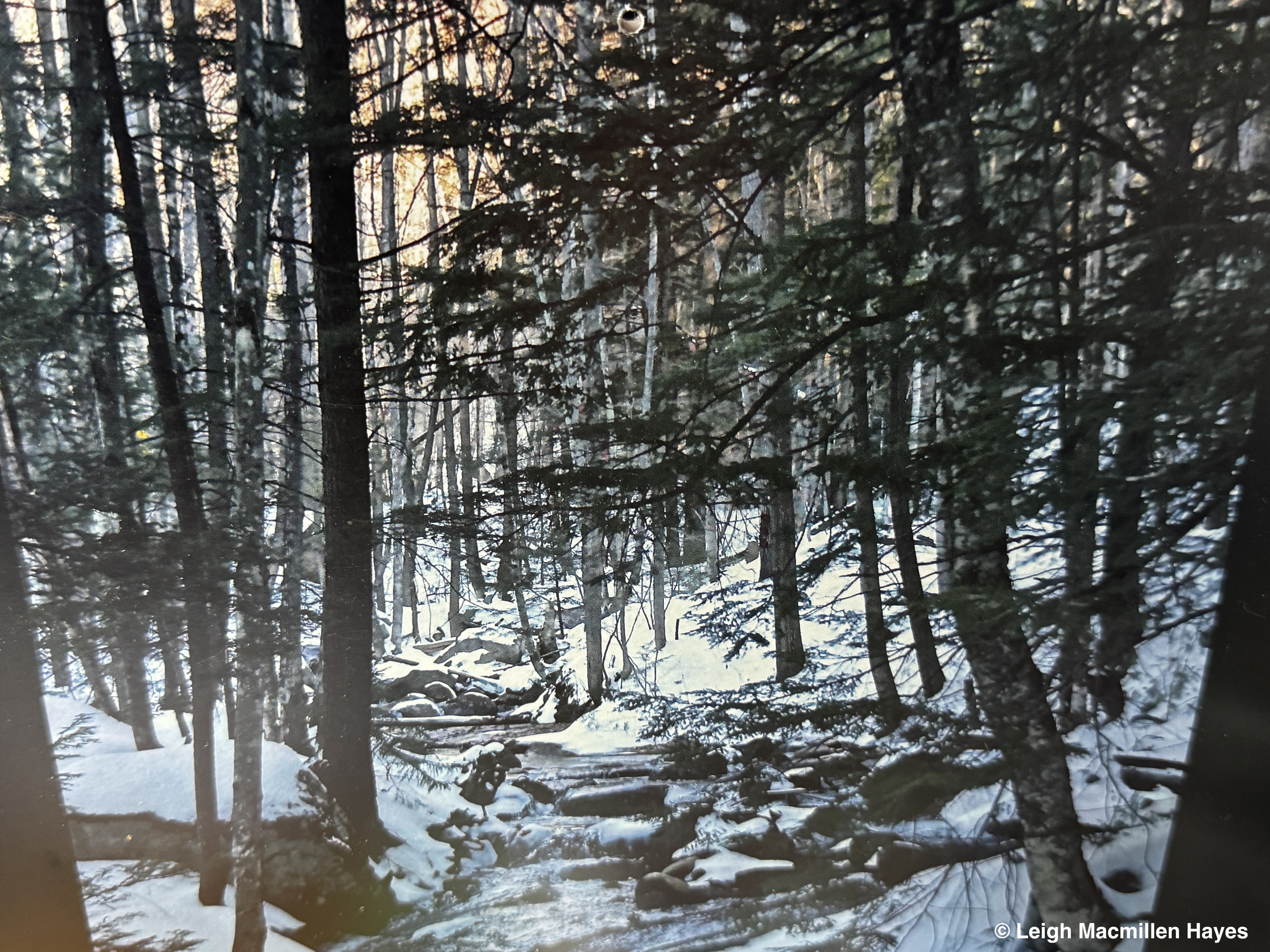
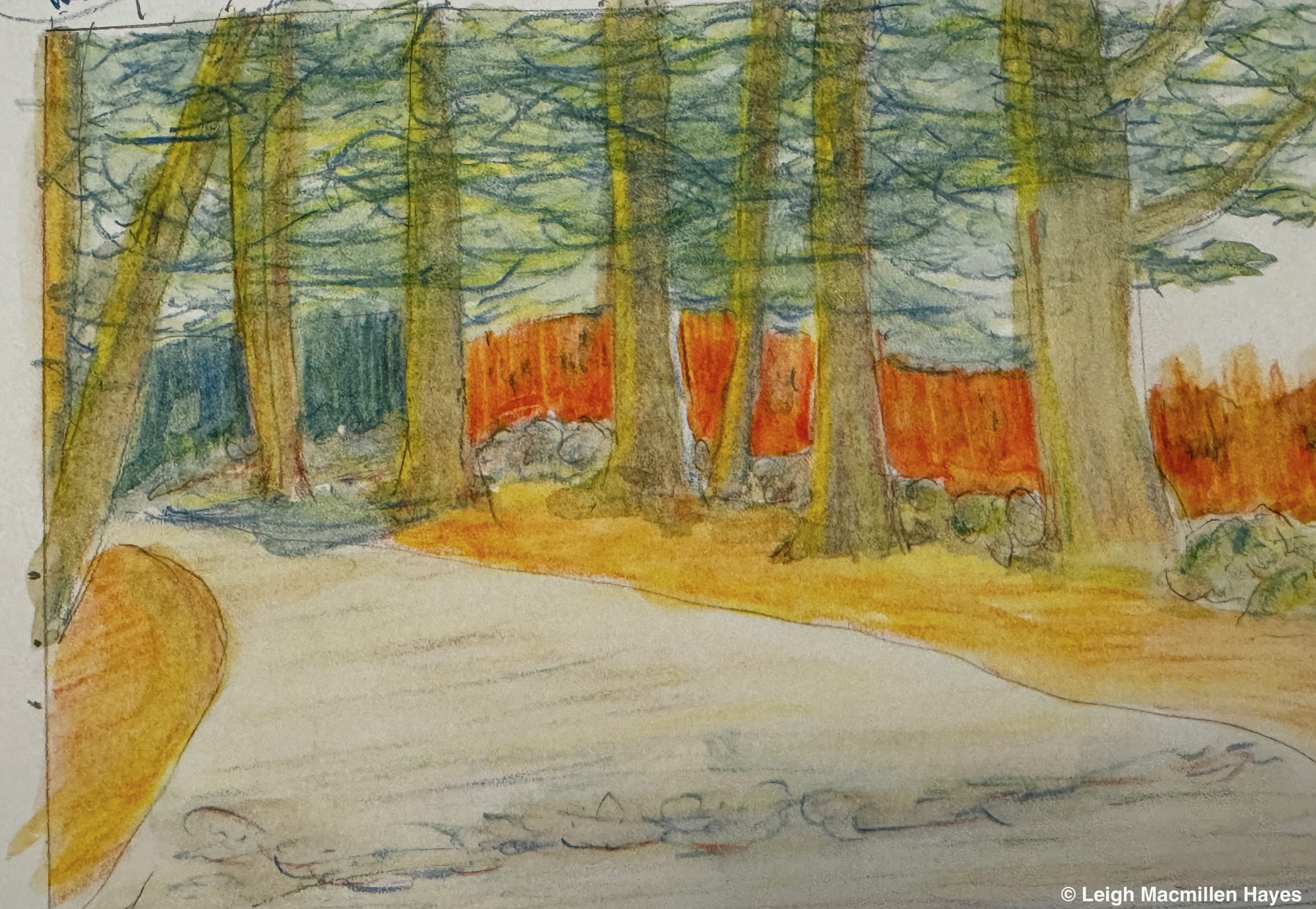
The final assignment took us two classes. This is the scene I chose to paint. Sucker Brook at Greater Lovell Land Trust’s Wilson Wing Moose Pond Bog Reserve, Lovell, Maine.

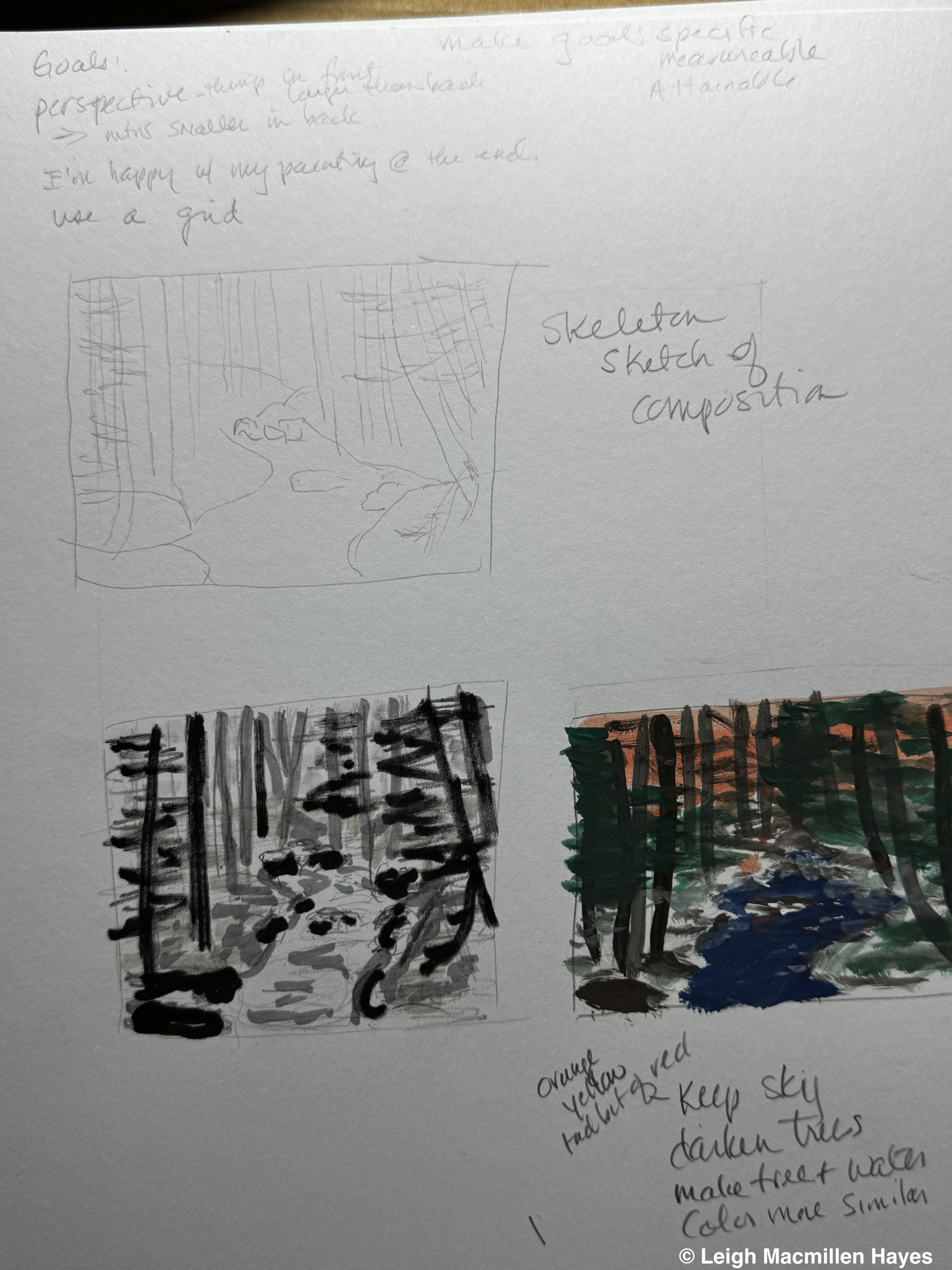
Planning with sketches, markers, and paint and figuring out what might work best. And simplifying the scene.

Jessie gave me a piece of Hot Press Finish paper upon which to work, and I have to admit that it was a joy to paint on this. I started with the sky color as the wash and then worked on the snow next, then the water, and finally the trees. My fav: sunlight reflected on the snow in the background.

After I shared that painting with a friend, she commented, “Can’t you do something other than snow until there is snow?” So, I painted a fall scene at the summit of Bald Pate. The mountain tops are not quite this color yet, but will be in a couple of weeks. My fav: contrast of colors.

My last painting to date on a larger canvas sheet was a Pileated Woodpecker that frequents our woods. I discovered, like the Hot Press paper, I really like the canvas except that it takes a while for the paint to dry. My fav: the bird’s head and the pine tree bark on the right.

That’s all I have to offer at the moment. And if you stuck with me this far, I’m impressed. Thank you!

I keep thinking about this creative journey and can’t wait to see where it takes me next. If you are interested, you can follow my artistic path by clicking on wmw art gallery every once in a while.

My Love Affair . . .

I have no expectations
and only so much time
to take a walk
along a nearby trail.
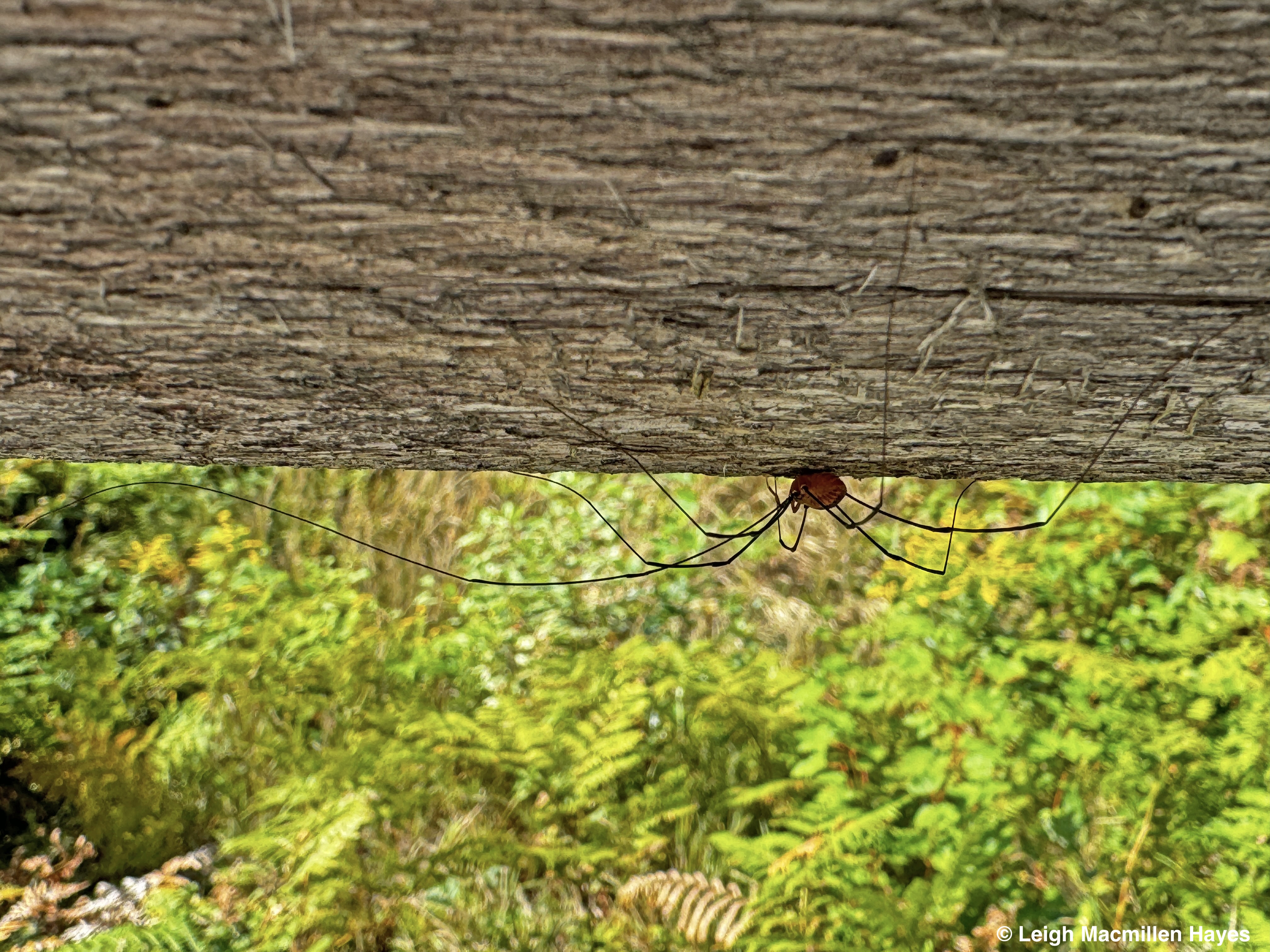
Hiding below a wooden rail,
An arachnid known as a Brown Harvestman rests.
Though spider-like, it's not,
for its body is single segmented.
Curious to see
what else the posts may offer
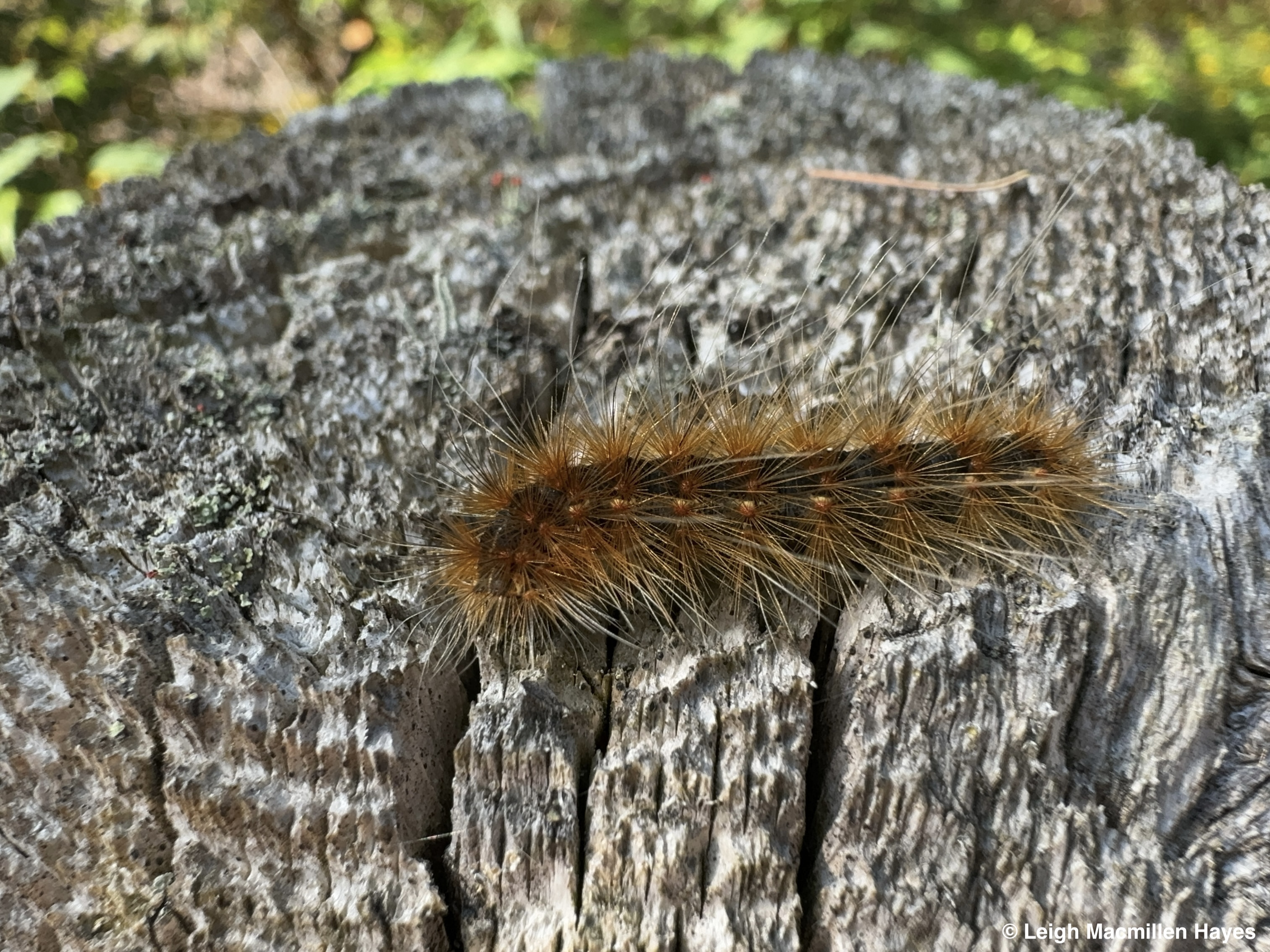
I meet a slow-moving Yellow Bear caterpillar,
It's rusty-brown hairs warning me not to touch.
A few feet away,
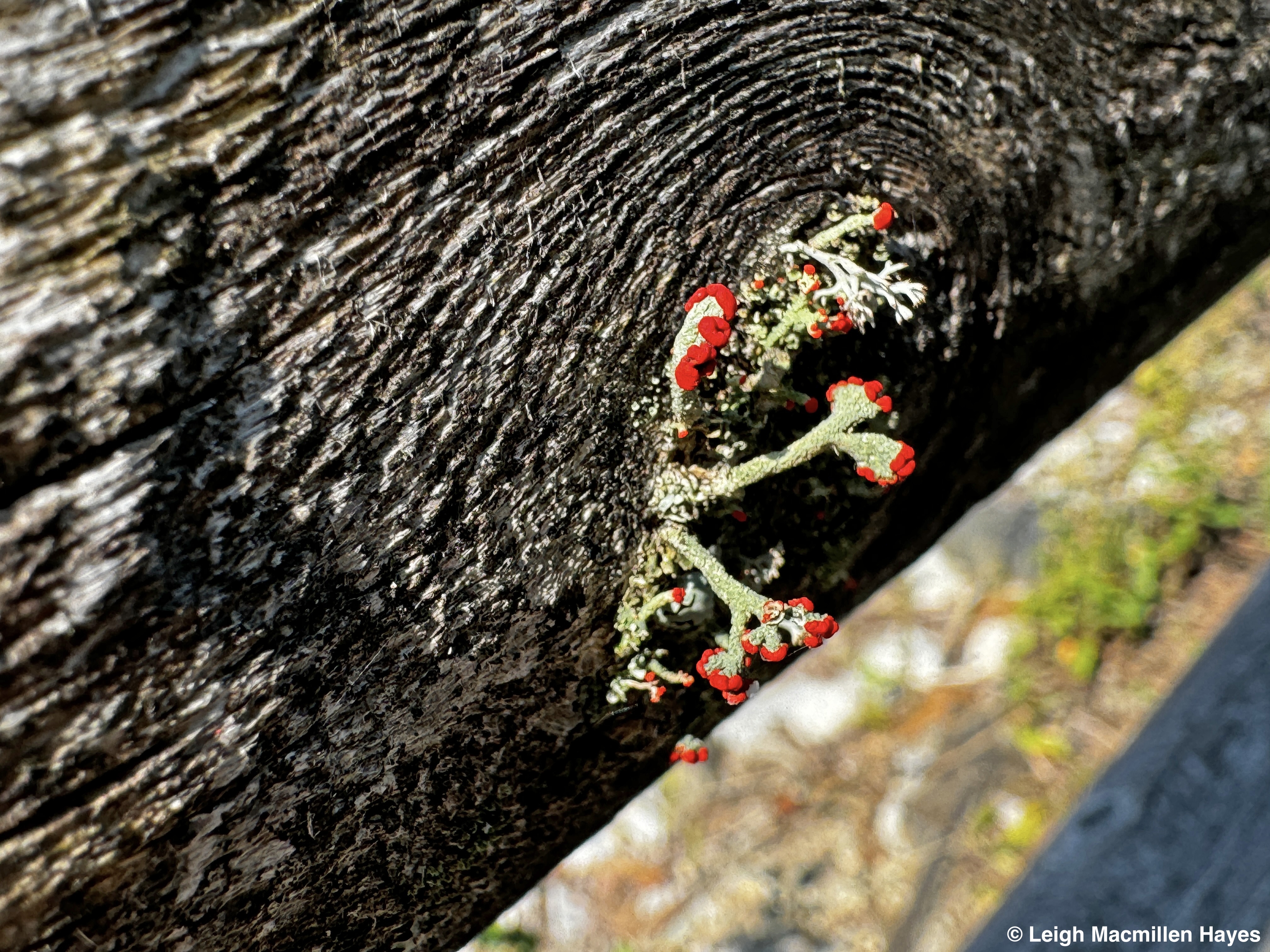
Whimsical with its brilliant red caps,
known as the apothecia or fruiting bodies,
a British Soldier lichen protrudes with a pop of color.
As I continue, one Harvestman 
becomes two, or three, resting below,
and the long legs of these Daddies
is all I can see.
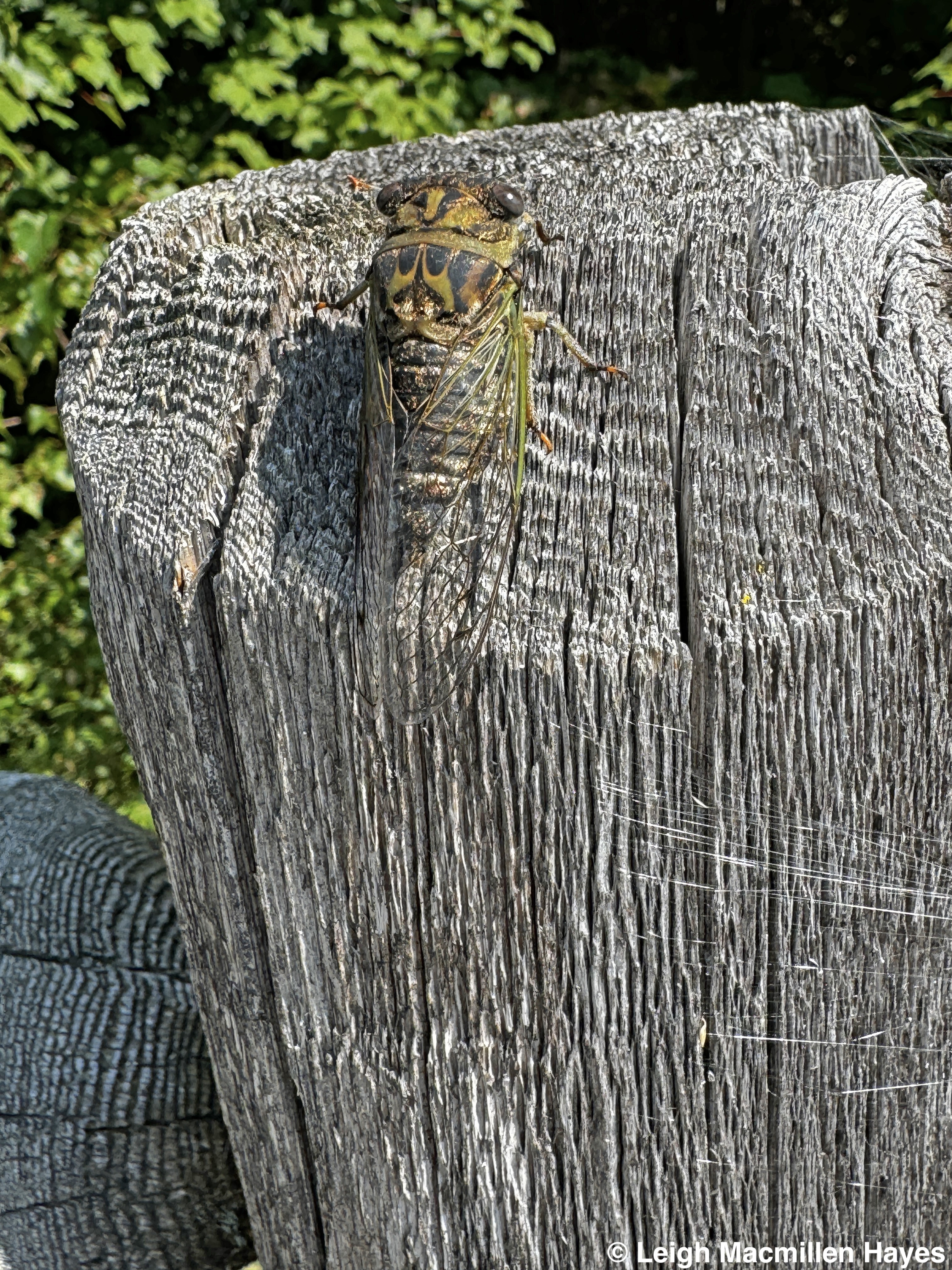
And then by complete surprise,
Hunchbacked in its former nymphal form,
with legs so stout and lobster-like claws,
I find a shed exuvia and my heart skips a beat.
Like the Harvestmen, 
where there is one, there's another,
and I can only imagine
their watermelon tourmaline bodies slowly emerging.
It's when I spot a crawling creature
colored with vivid camouflage
and golden-veined wings,
I realize I've missed one of my favorite views of metamorphosis.
But still I am there to watch 
as the adult form reaches out,
one muscular foot at at time,
as it walks first sideways and then skyward.
I know from experience
its tented wings will soon spread,
but worry it will meet the web beside it,
and rejoice when it instead finally flies into the forest.
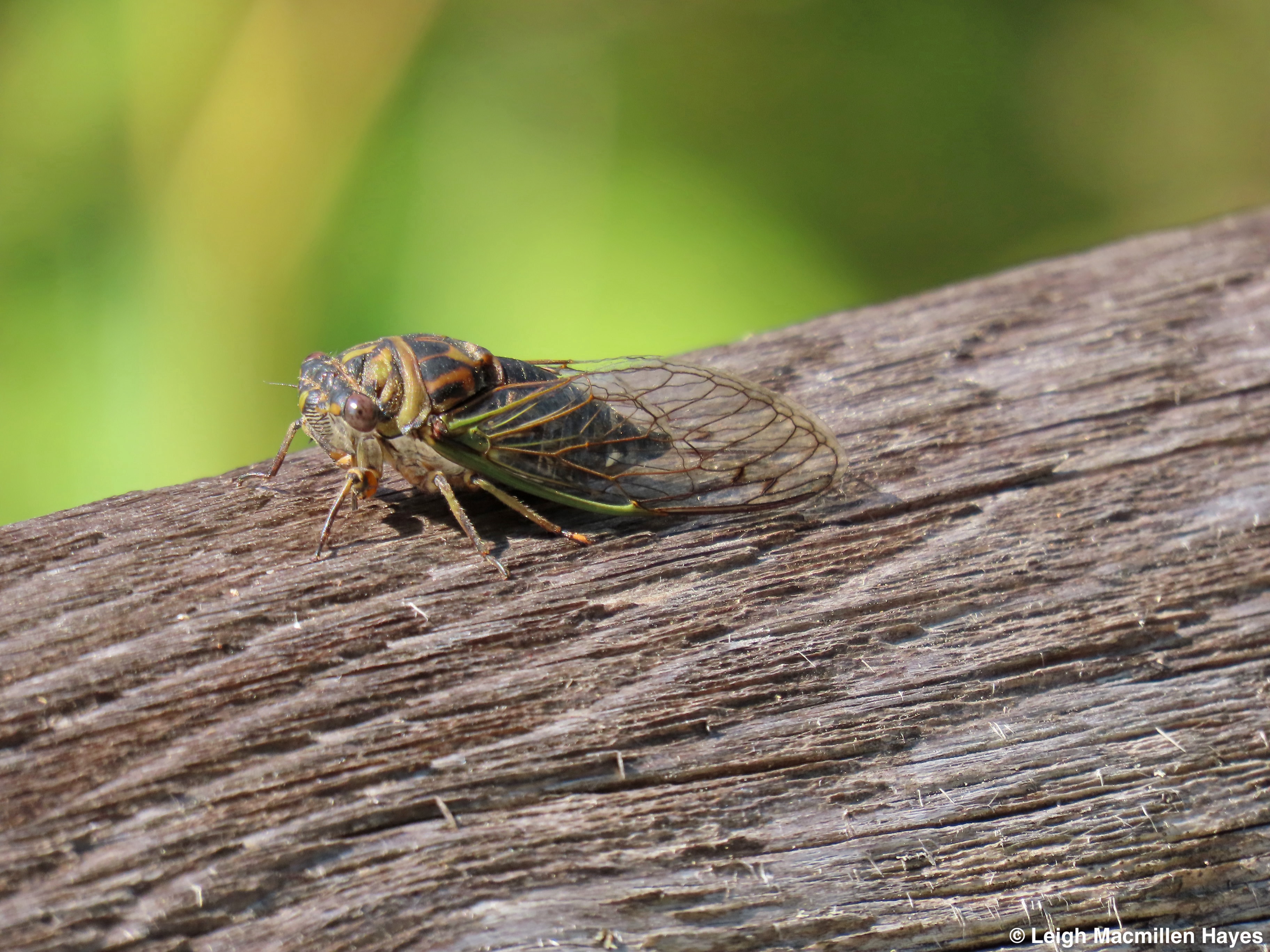
On this late summer day I find another,
and can only hope these Dog-day Cicadas
have time to sing their raspy love songs
that will continue the circle of life as they know it.
A few more steps and I must backtrack,
for something large garners my attention,
its mottled pattern resembling the post
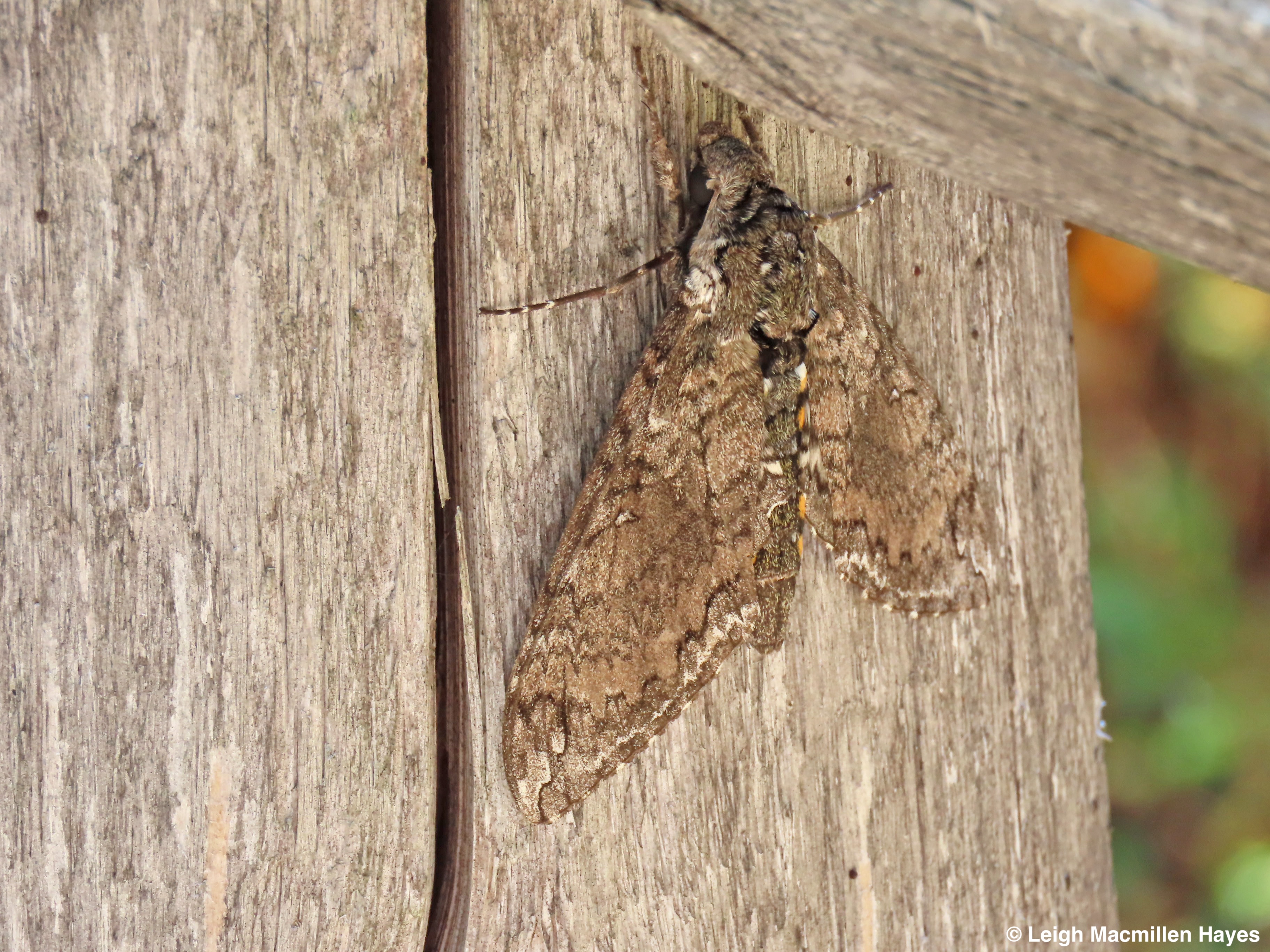
upon which this Carolina Sphinx moth rests.
A rustle and wing beats cause me to turn my gaze upward,
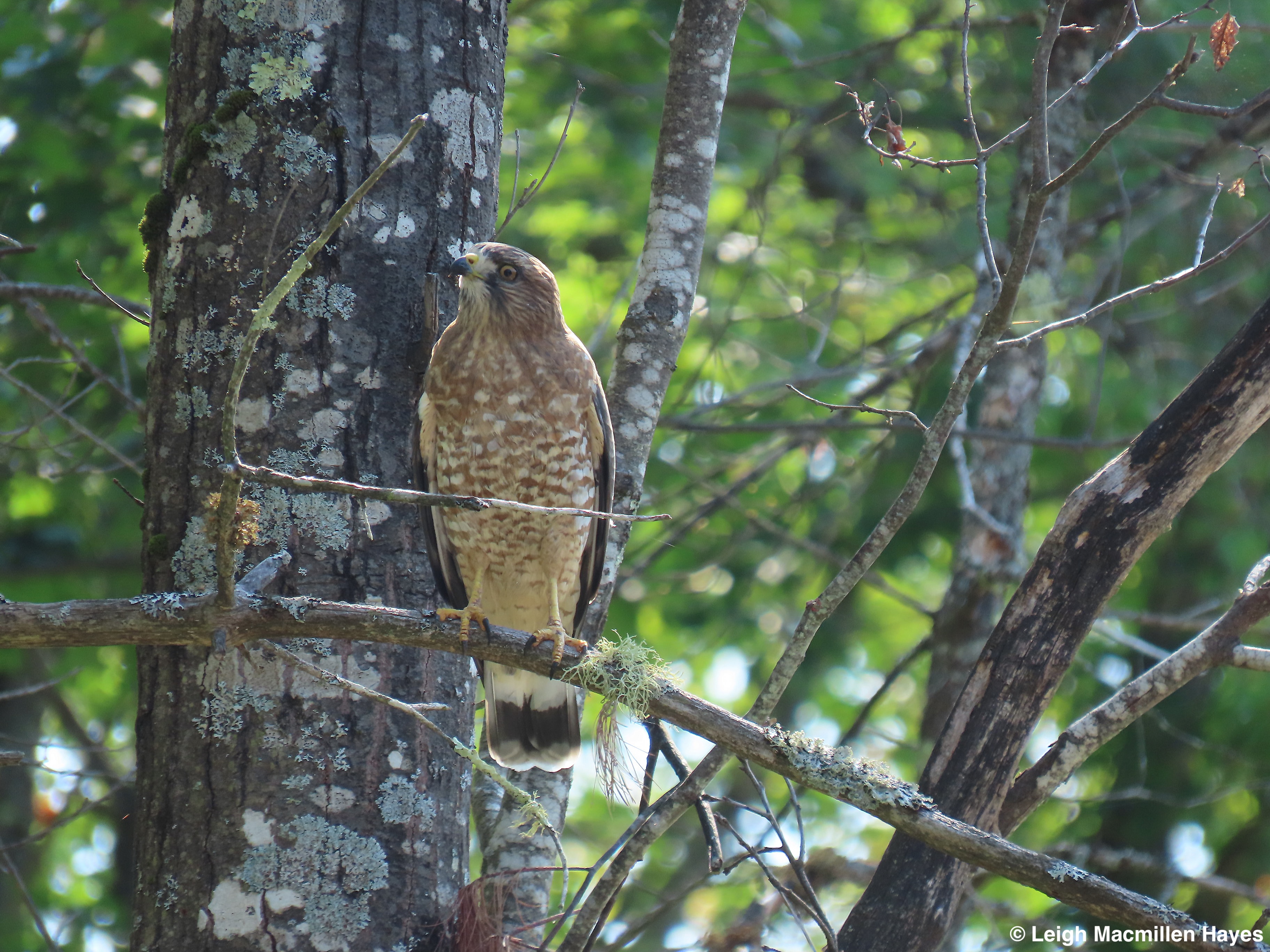
and I spot a Broad-winged Hawk landing,
and surveying the territory
for a consumable meal.
Intently, it looks down,
and all around with ten times the focus of my sight,
those predator eyes fixed as they are,
it must turn its head to see.
As I move the telescopic lens
I begin to wonder if it thinks its a creature
and I must admit that I duck
when it flies off . . . first toward me before swerving.
All of these sights I spy
in the course of forty-five minutes
and maybe three quarters of a mile
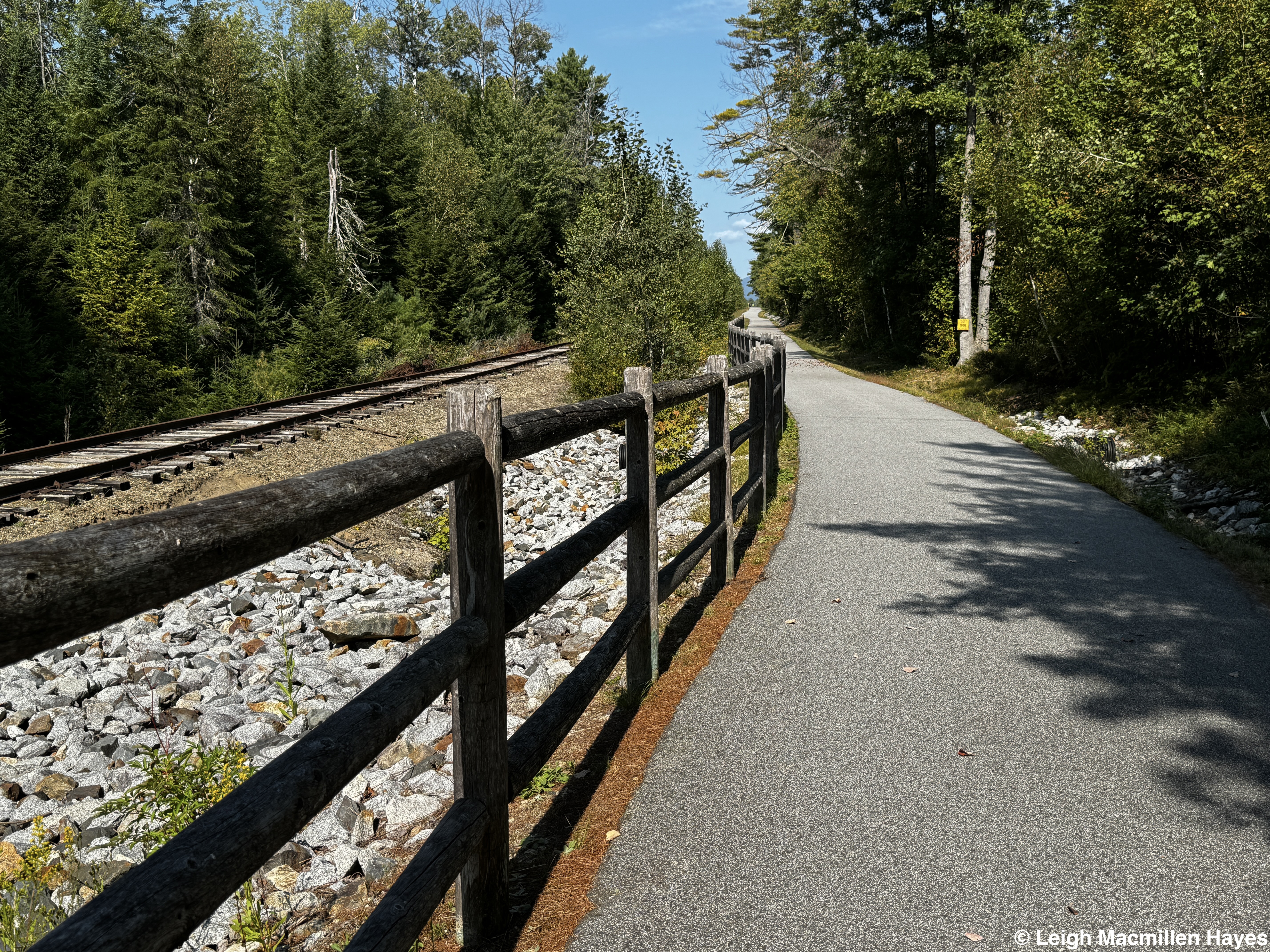
along the Mountain Division Trail.

On this day,
I develop a love affair
with the fence posts and all who gather there.
Can you imagine if I'd gone any farther?

Porcupine, Snakes, and Bears, Oh My!

Disclaimer: there may be some not so pleasant photos in this post. I apologize. BUT, what you will see is a fact of life.

Do I have your attention now?

Our afternoon began so innocently as we hiked along a well-traveled trail at Hawk Mountain in Waterford, Maine, where Goldenrods and Asters shown the way.

I knew I was in the right place the moment I saw a Black and Yellow Spider for I have spent the last two months enjoying their presence in our neighbors’ field and though they are beginning to decline in number as summer heads toward fall, a few are still on the hunt and packaging meals such as you see here.

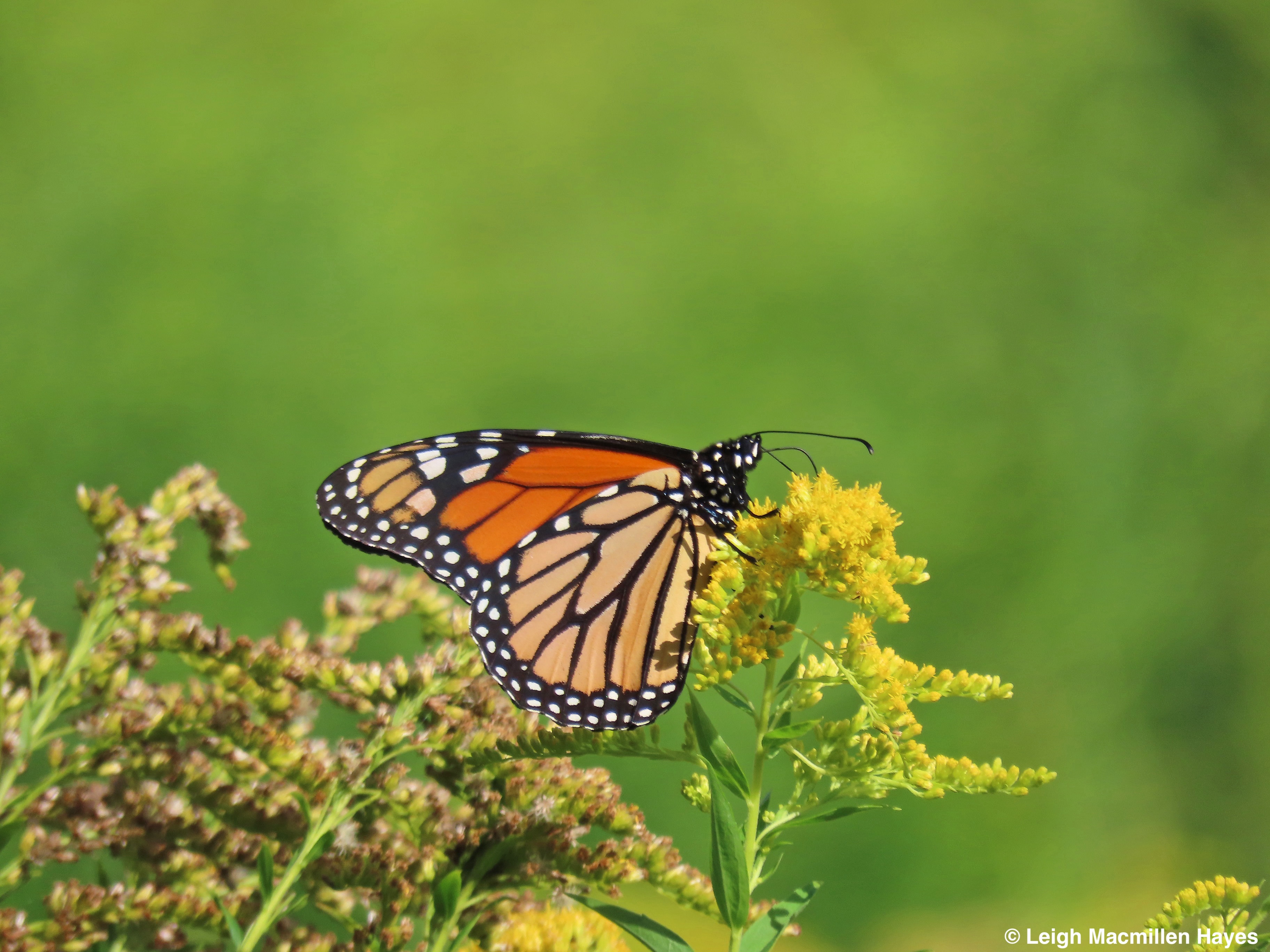
Also like home, the presence of butterflies. Granted, we were only twenty minutes from home, so spotting Monarchs nectaring wasn’t a surprise. It was a delight, really.

And an American Painted Lady, her two eyespots on the hind wing as opposed to four smaller spots on the same wing of a Painted Lady, pasued on some bramble branches.

A Red Admiral also decorated the scene, even if it did appear to have a bit of attitude given its stance.

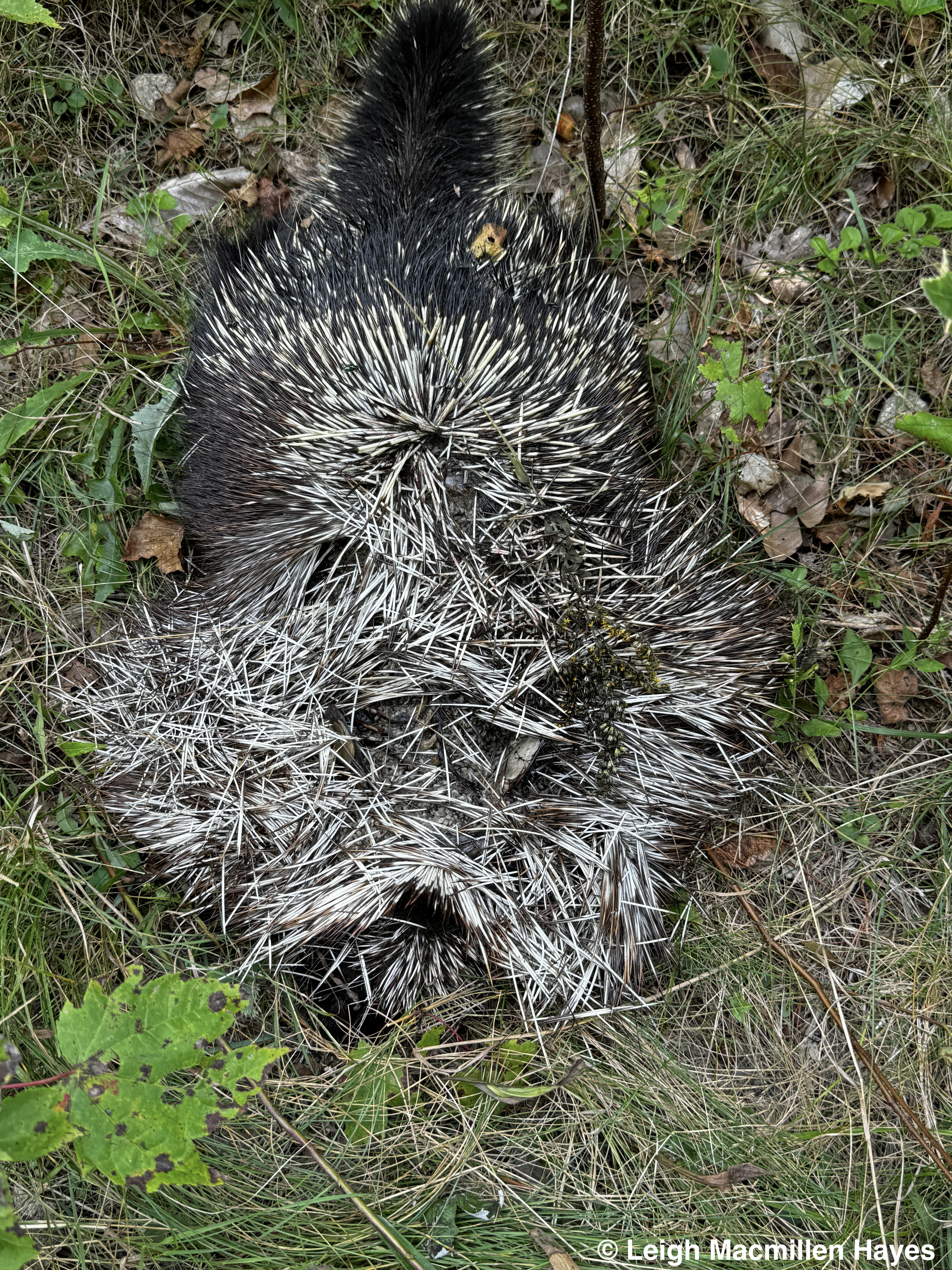
And then . . . and then I saw the body of a dead porcupine. It didn’t smell. But the Common Green Bottle Flies (in the Blow Fly family) that made their fly buzzing sounds around it indicated it had been dead for a bit. Some of you know that I love a such a wildlife mystery–and the opportunity to try to figure out what happened. BUT, the story doesn’t always piece together as neatly as I’d like.

First, there appeared to be three wounds on the animal’s back. Large openings. As if from a very hungry predator. And a brave one? Fishers are the porcupine’s main predator and they are known to attack the others face and belly, where the hair is soft as compared to the 30,000 barbed quills on its back. And a fisher and others would then visit the carcass repeatedly to dine. That hadn’t happened in this case. Instead, the animal died on its stomach. And other mammals didn’t take a repast from the offering. Did a domestic dog do the duty? If so, it must have had a head full of quills.

As for those metallic green flies, their maggots squirmed inside each large wound. By the hundreds. Maybe thousands. I wasn’t about to count. In his book, Insects of New England and New York, Tom Murray explains, “Blow flies are often associated with decaying organic matter, particularly carcasses and other sources of rotting meat and feces. In fact, they can figure prominently in forensic entomology, aiding in determining time of death.”

Murray adds, “This might sound like the dark ages, but cultures of sterile maggots of green bottle flies are sometimes used in hospitals to clean up deep wounds and infections that otherwise are difficult to treat. They only eat dead tissue, and secrete an antibiotic, preventing further infection. In nature, the normal food source is carrion.”

Maggots. A source of wonder! Who knew? Well, obviously doctors and scientists and Tom Murray!

There was one other thing to look at on the carcass, besides those three-toned quills and the soft curly hairs in the mix. The sole. Look how pebbly it is! The better for climbing trees, my friend. Think of non-slip socks with those little white treads. Porcupines don’t need to wear socks. Maybe they were the inspiration for such. Ahh, this site just got even better!

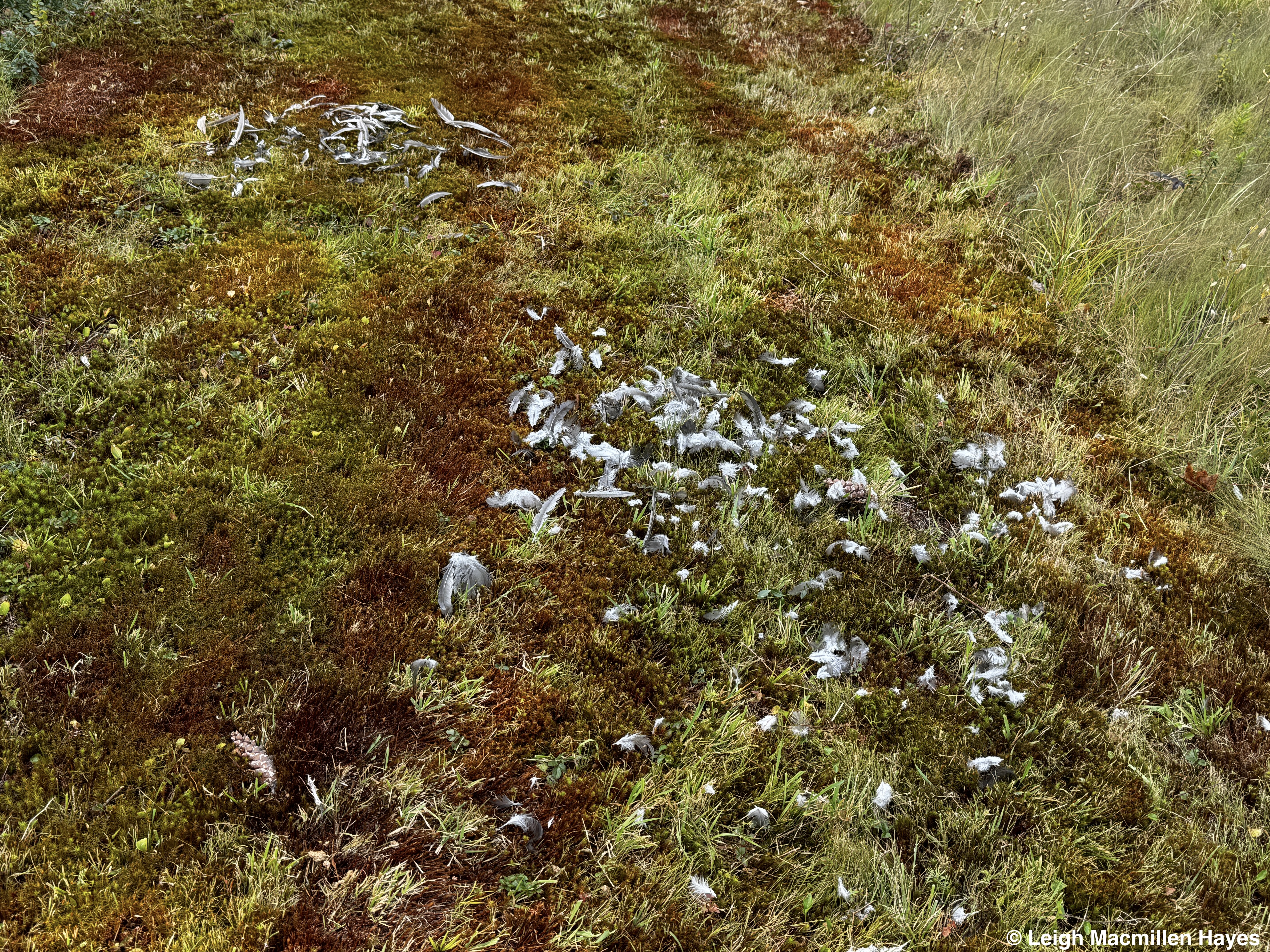
I still don’t know who the predator was but it took me back to what my neighbor and I discovered in her field yesterday. Two piles of feathers from the same bird.

The feathers appeared to have been plucked so I suspect a raptor did the deed, after all, they need to eat too. But what species died? We don’t know birds well enough to say. What was curious to us was that there was no blood. Nor any body parts. My neighbor’s dogs were onto a scent in the feathers, however, and we suspect that they had a better sense of either who the prey was or who needed a meal than we did.

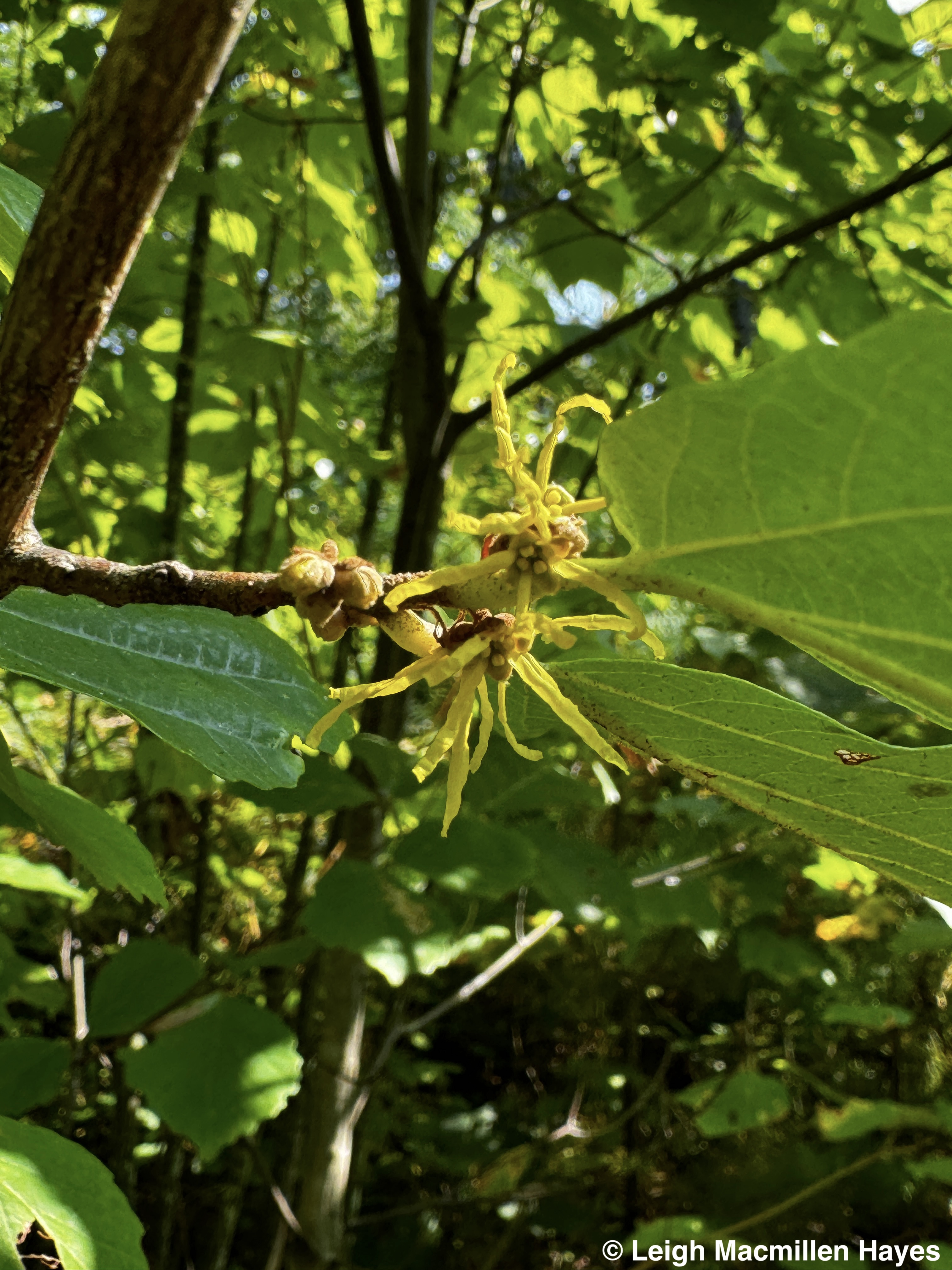
Returning to today’s trail, I spotted Witch Hazel in bloom, the first of the season for me to spy. This flower always makes me happy with it’s yellow ribbons haphazardly displayed.

And then I sawa Maple Leaf Viburnum, its leaves already their magenta color and so many berries still intact.

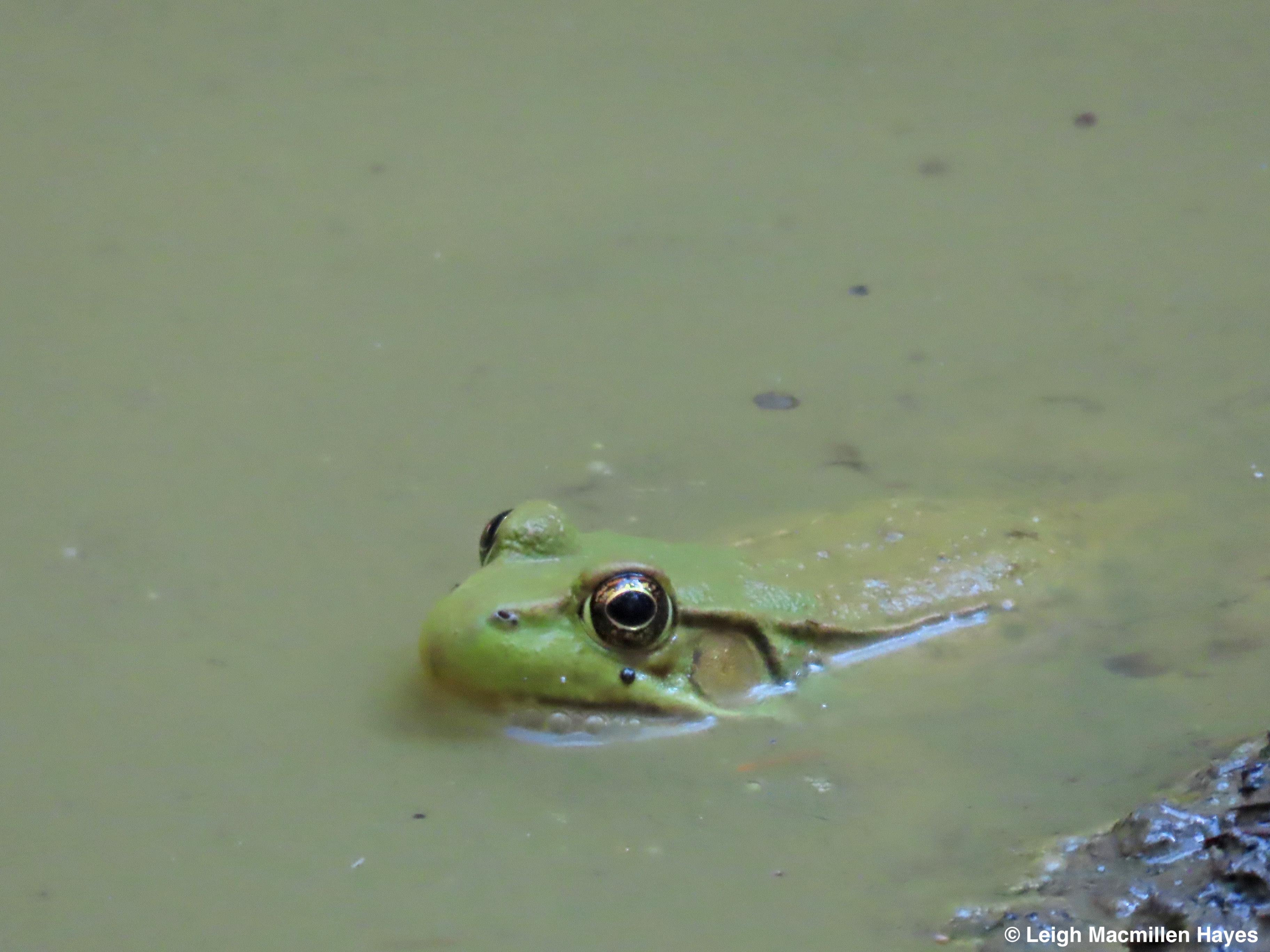
And a Green Frog in a mucky puddle as we approached the summit.

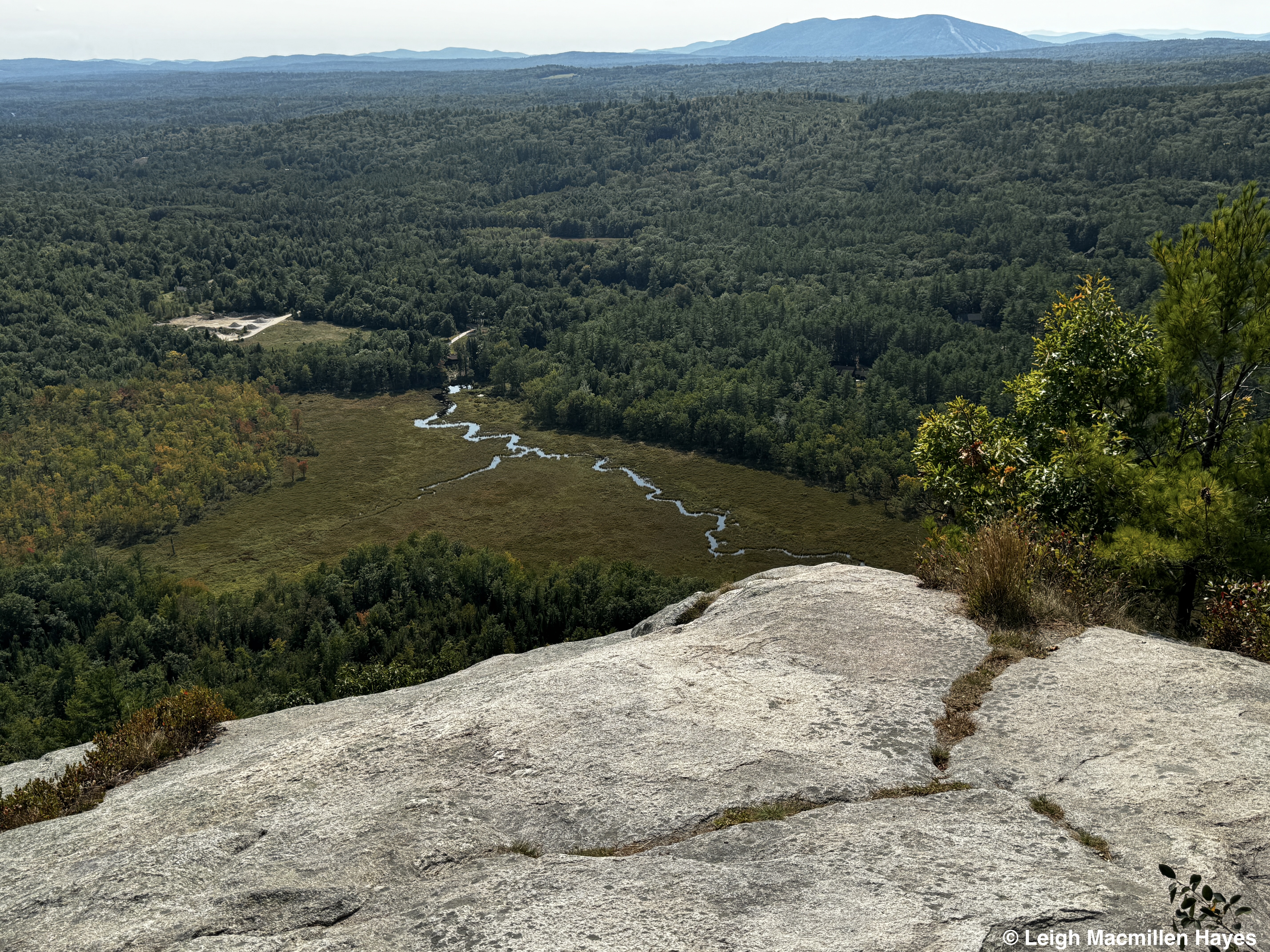
The view is always amazing, enhanced by the brook and wetland below and our beloved Pleasant Mountain in the distance. You can even see the ski area at the right or northern end.

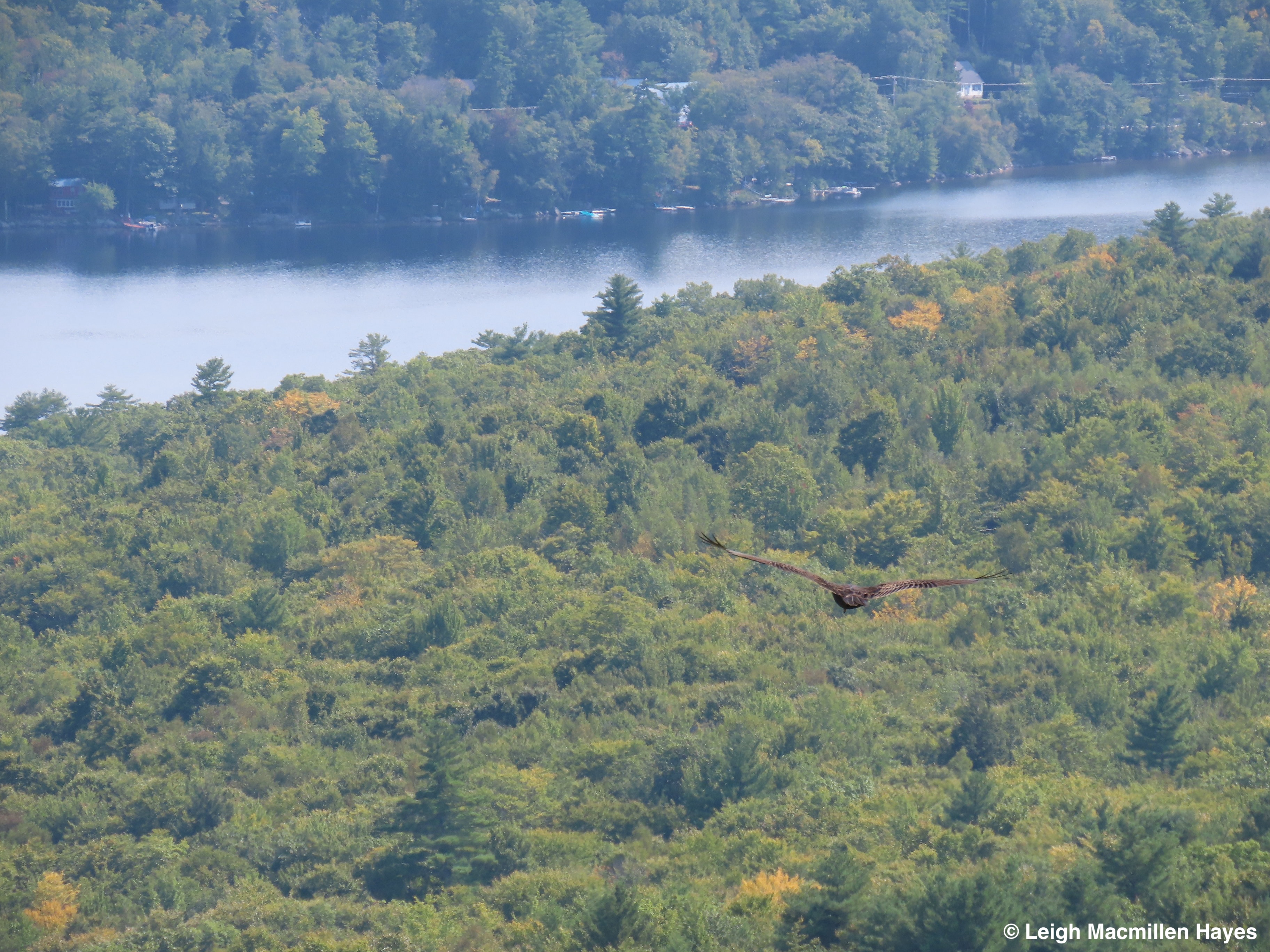
While we were out there I only captured a photo of one Turkey Vulture, but at least three road today’s thermals, gliding round and round.

And on the way down a small Garter Snake tried to hide from us. It was about the size of a pencil. And reminded me of another site in the field at home that I spotted this morning.

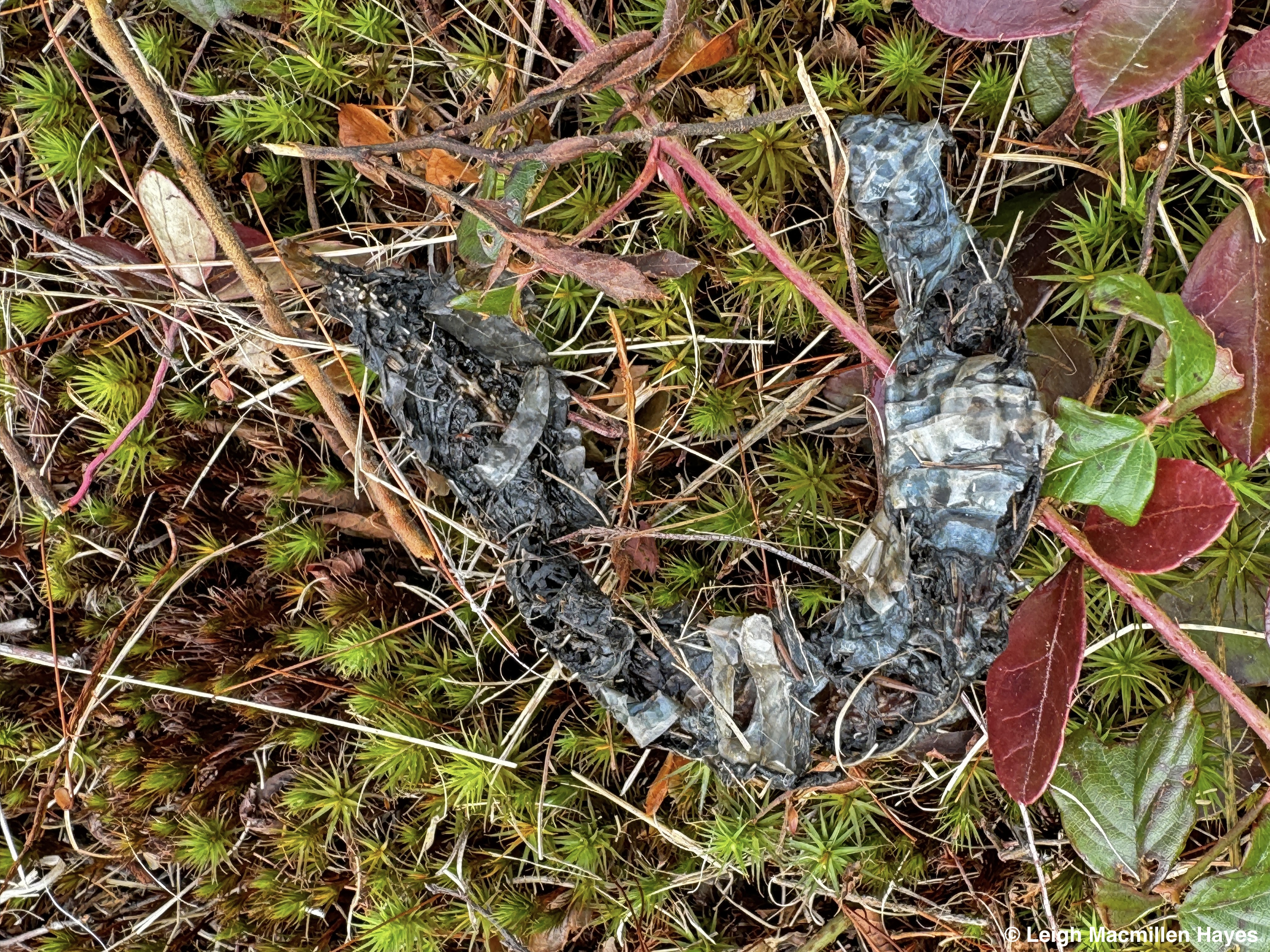
My first thought. Scat. Of course. Until I took a closer look. A spine?

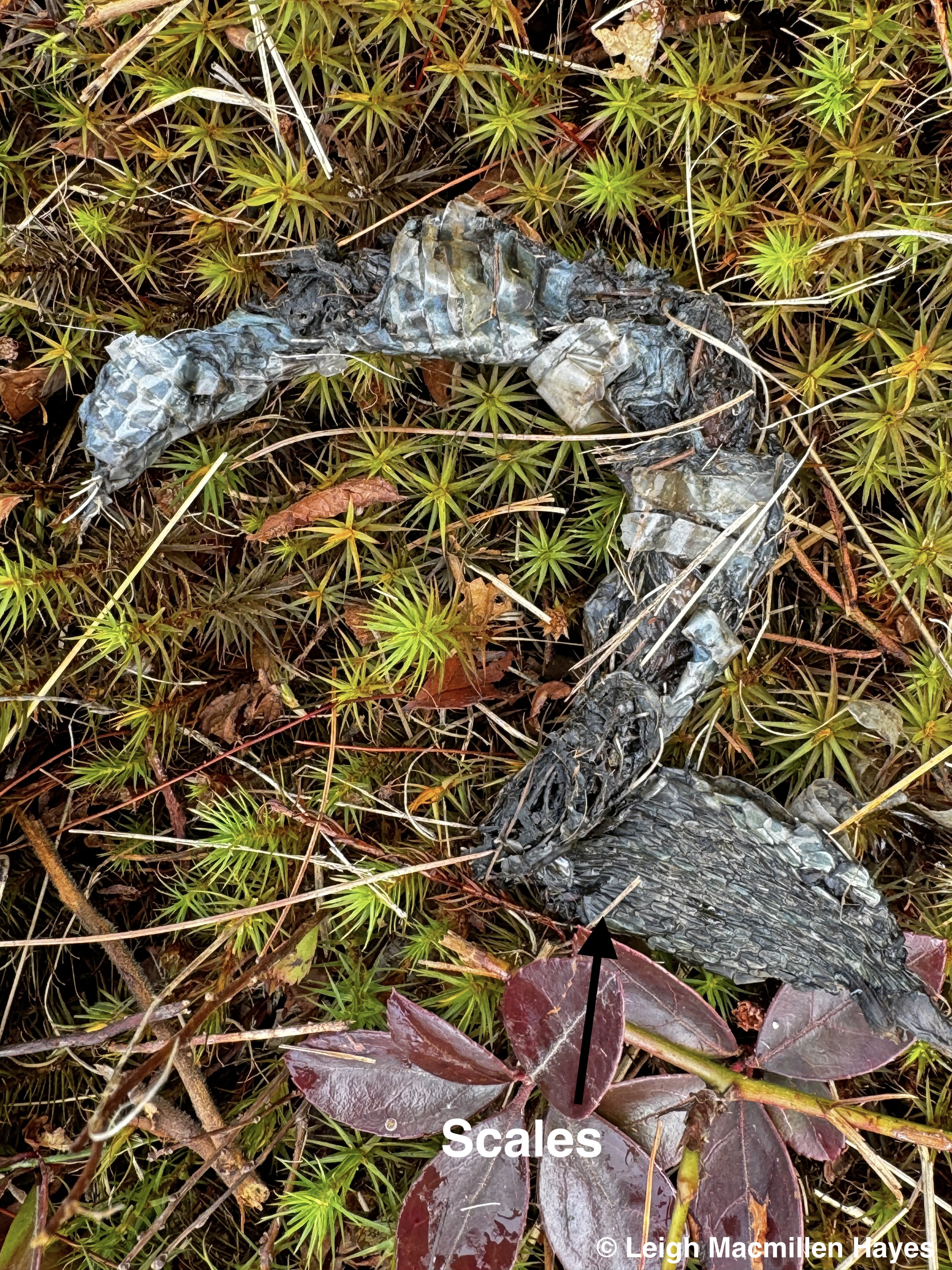
And then I flipped it over and spotted scales. Probably a much larger Garter Snake. If I took a closer look at the scale pattern I could be certain of this ID. Maybe tomorrow. If I can locate it again.

From Hawk Mountain we made a mad dash to Mount Tire’m and again at the summit, a view toward Pleasant, just from a somewhat different angle.

We were in a bit of a rush, but My Guy didn’t mind that I wanted to explore the erratic boulders in the woods behind the summit. I think everyone who climbs that mountain ends up at this spot. Rock Castle? Bat Cave? Bear Den?

We decided on the latter given that we spied a bear through the trees.

And so, I did what I always do here and channeled my inner bear.

Now really, this wasn’t such a gruesome post after all, right? But wow. Porcupine with maggots, snakes, and a human bear. Oh my!

Basking in the Sights

“This won’t take us long,” My Guy said moments after we launched our kayaks onto a small pond in New Hampshire.

“Oh, I think I can make it last a while,” I replied.

I knew there were Pitcher Plants to look for and I could see by the color of the trees on the far shore that there were wetlands to explore and there was the potential for so much more in this very quiet spot.

A friend who kayaks here often had told me where to park and some of the things to look for along the way. What was most impressive from the start is that there were flower pots on the dam and by the kiosk. Well tended, at that.

And a rather large Little Free Library, where one can take a book or share a book.

I unlatched the door and it even smelled like a library. What’s not to love?!

But, we’d ventured there to paddle.

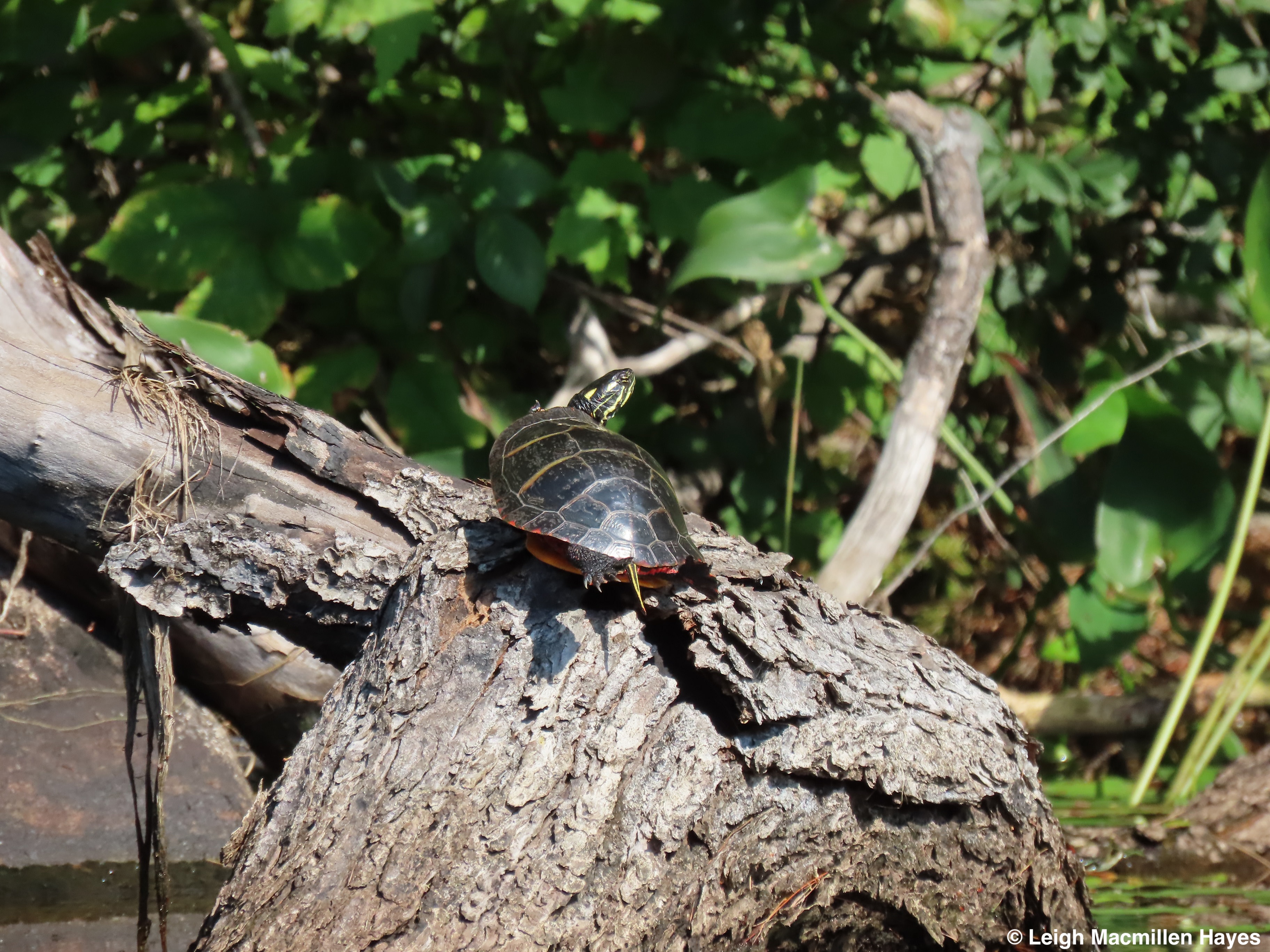
Or better yet, to dawdle. To be like the Painted Turtle and enjoy the sunshine of a perfect September day.

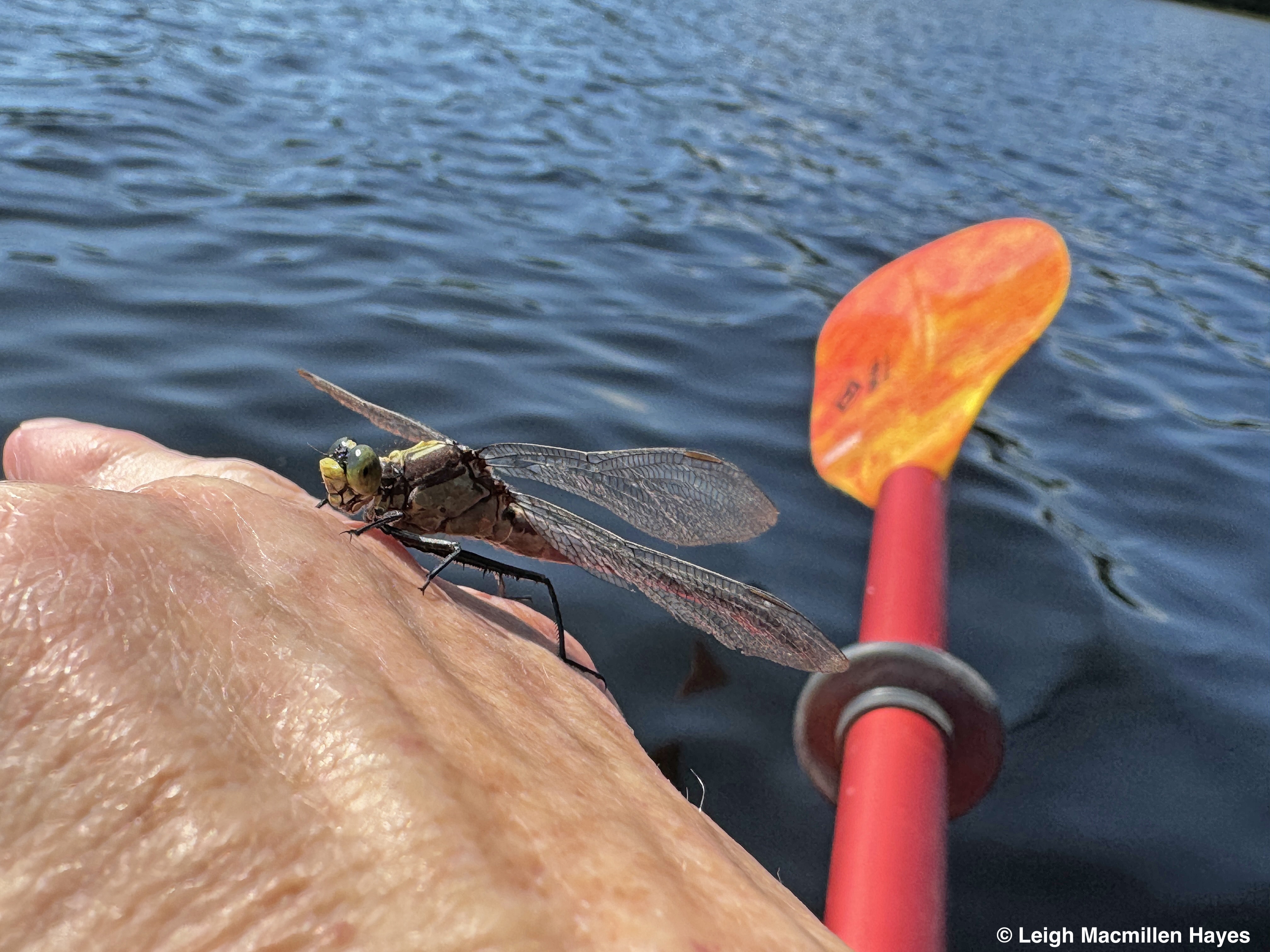
And then one of my favorite things happened. A dragonfly in the clubtail family landed on my knee and I coaxed it onto my hand for a better look. It was perfectly content to be there. Which made me think of a darner on another day on another pond this past week that I rescued as it flailed in the water. The moment I picked that darner up, it tried to take a nip out of my finger and was frantic, even when I set it on the edge of the boat. I wanted to give it a chance to dry its wings. It wanted only to fly. And so it did with wings still wet and back into the water it landed, slipping under a lily pad. I rescued it again and this time it didn’t bite and it did sit for another minute or two upon the boat, but not long enough for me to get a good look at its colors and patterns for identification, or to snap a photo and then suddenly it flew and I can only hope survived.

My new friend, however, allowed me to move him from my hand to the boat, the better to take a look.

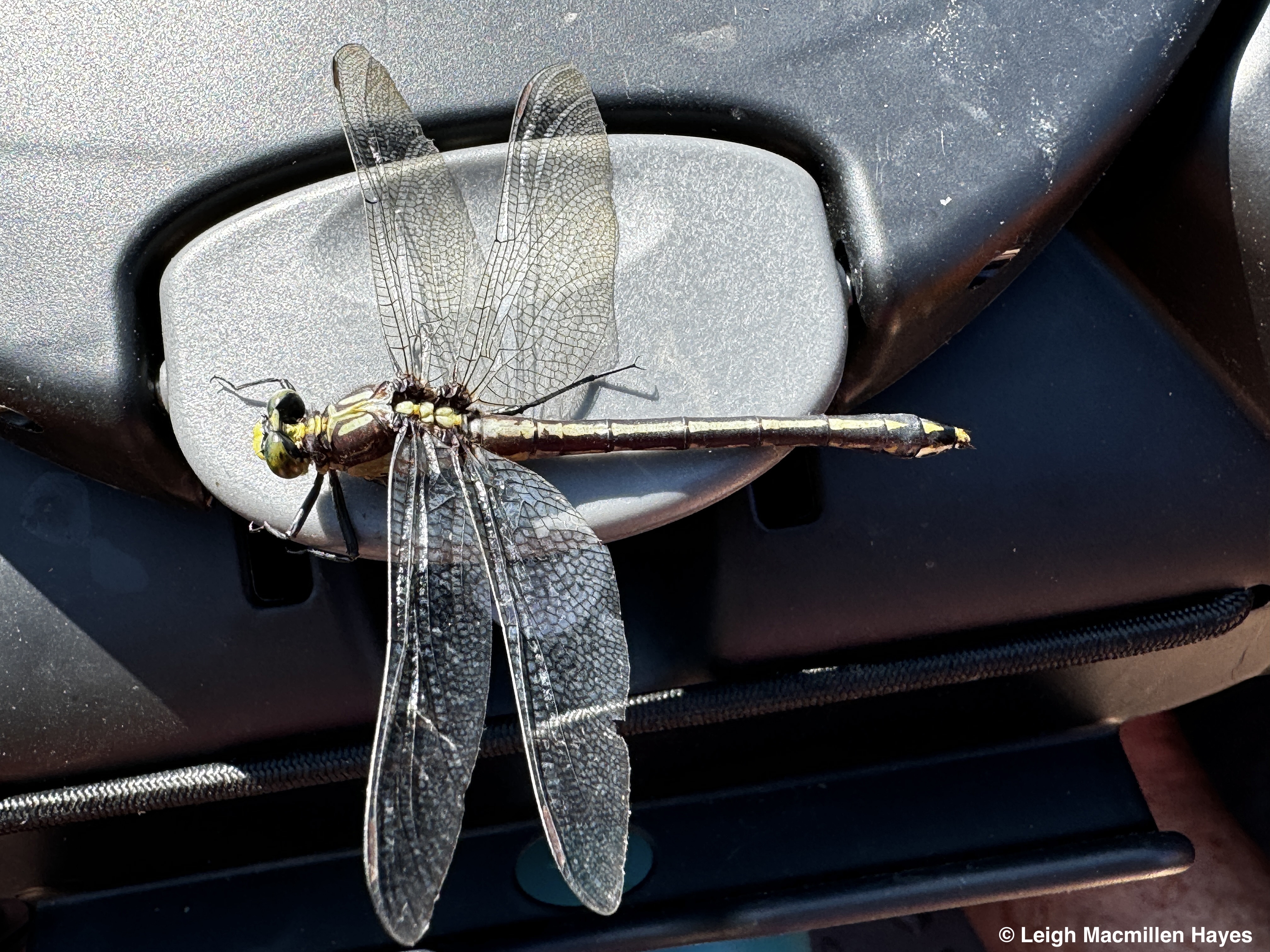
This one didn’t speak its name immediately, until I looked at its spiny back legs. As a Black-shouldered Spinyleg it is commonly known, and it’s in the clubtail family, but I’m not exactly convinced that the shoulders are actually ebony in hue. To me, they seem to be chocolate brown.

Another characteristic is the thorax pattern: two long ovals on either side with a yellowish I-shaped mark in between them. 

It was the pattern on the abdomen that also helped me confirm ID, with the yellow stripes on each segment becoming triangular shaped on segments 8 and 9, while the final segment, #10, was almost completely coated with splash of yellow.

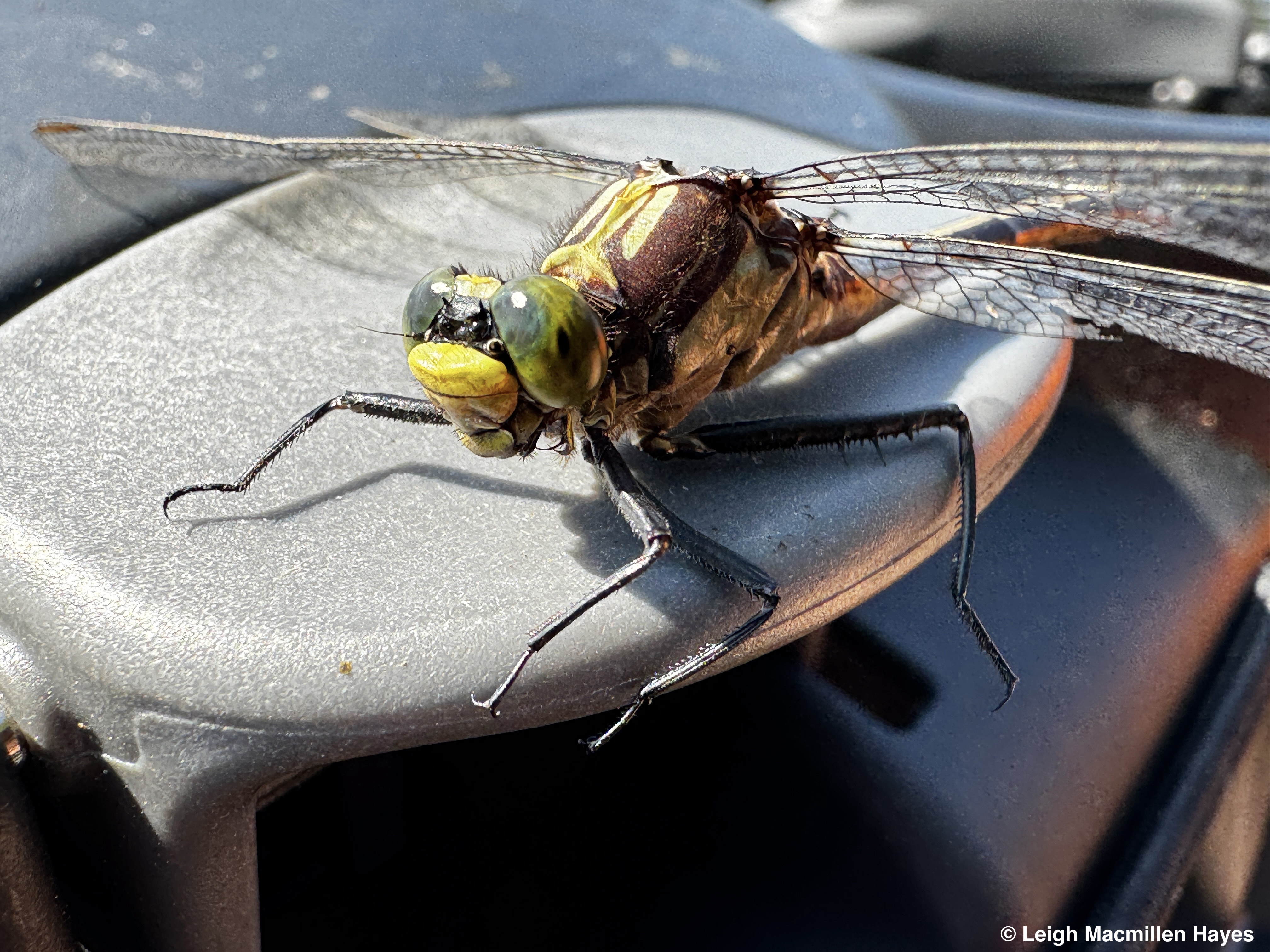
With each minute that passed I fell more and more in love as my new friend let me enter its personal space. Such big eyes–compound as they are. But then there are the ocelli, or three small black “eyes” located on top of the head–to us they look like three little bumps, but according to the field guides in my own library, they “may serve to measure light intensity.”

And all those body hairs. They work like sensors–detecting odors, temperature, humidity, and most likely wind direction.

If you have a loupe or magnifying lens, I encourage you to look at insects and plants–it’s a hairy world out there.

Let’s take a closer look at that face. It’s rather other-worldly in structure. Two dragonfly families feature eyes that don’t touch each other along any margin: Clubtails and Petaltails. I’m not sure I’ve ever met a Petaltail, so that already narrows it down for me when trying to figure out the species.

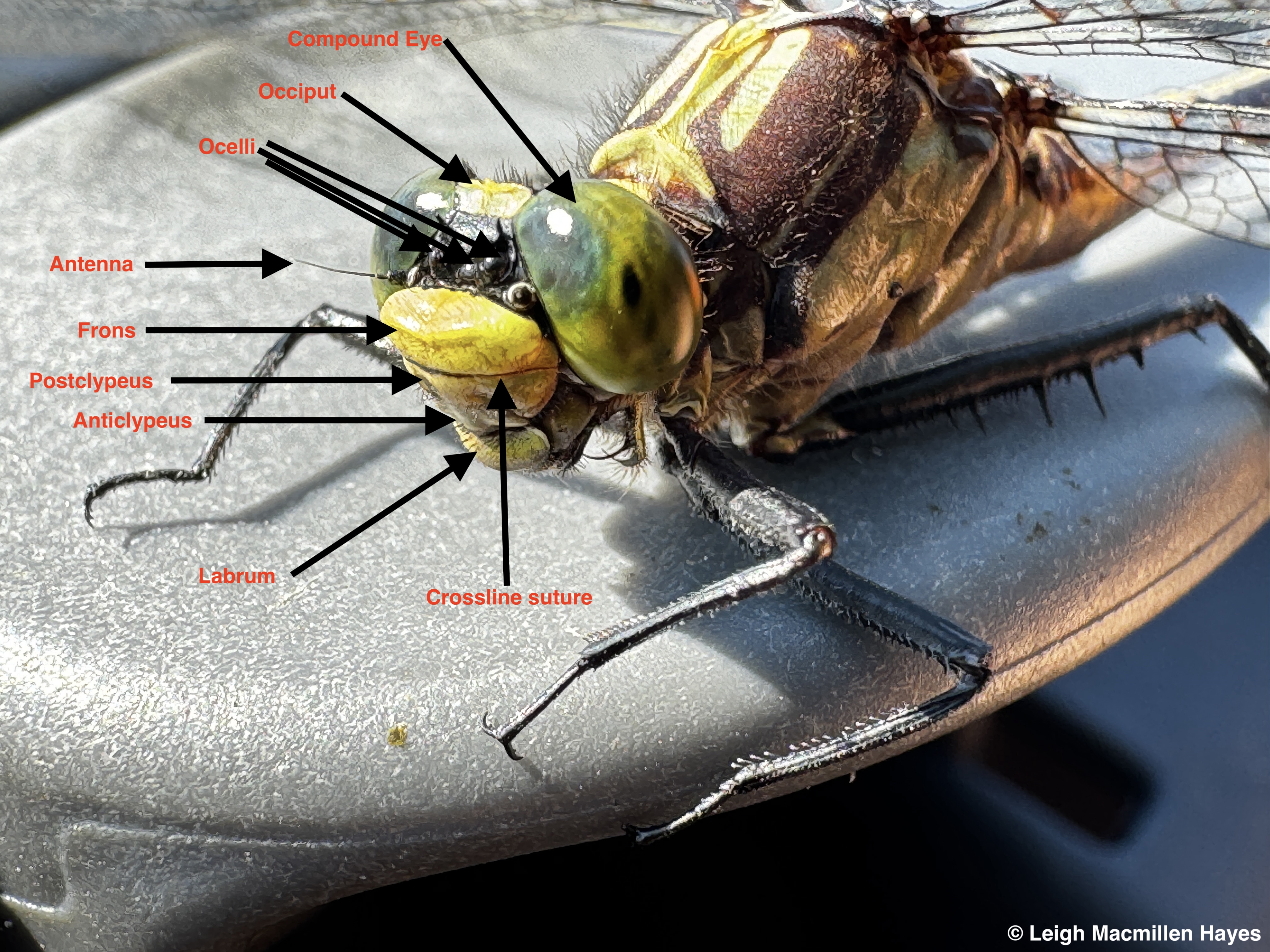
Beginning with the large compound eyes, we’ll work our way down. But first, can you imagine seeing the world through 30,000 lenses or facets? I’m happy to have moved on from progressive lenses (three lenses) that threw me off, especially when hiking or walking down stairs. 30,000?!!! A dragonfly certainly has no excuse for not seeing even the tiniest of insects on the move.

And notice how the eye is two toned, the darker being above.

Between the eyes is a plate called the occiput, which covers the upper part of the head. You might also notice, though I didn’t label them, that there are occipital horns.

Below that is the triangle of ocelli, or three tiny and simple eyes as compared to the two compound eyes. These may measure light intensity.

And then there are two antennas, perhaps for measuring wind speed. All of this and we haven’t reached the face yet.

Ah, the dragonfly face–beauty is definitely in the eye of the beholder.

Dragonfly faces consist of plates and the upper plate is the frons. In some species there are certain dark shapes or lines that help with ID. Not on this one, however.

Below the frons a crossline suture is a seam that separates the frons from the postclypeus, an upper plate that we might think of as the upper lip.

And below it, the anticlypeus, a lower plate located about where our tongue might be on a human face.

Finally, the labrum, or lower lip, and below that the mandibles, not labeled.

Such complexity for an insect that spends months to a few years as an aquatic naiad, growing through several molts, and then crawls out of the water and slowly ecloses upon vegetation, pumping insect blood into its wings and body, before flying off to control the airways and the insects who bug us. And within two months of emerging from the water, it’s life cycle comes to an end.

And to think this one simply landed on my knee and now you have all this information to digest. Don’t worry, there will be a quiz at the end.

Suddenly, the dragonfly flew off. And my focus returned to the pond. If you’ve paddled here, then you know that we hadn’t gone far as we’d only reached the third of the crooked houses.

My Guy was ready to purchase one and fix it up. I just want to paint this scene when I have time for so beautiful was it despite its lack of TLC and the reflection was equally delightful as lines were interrupted by the water’s current.

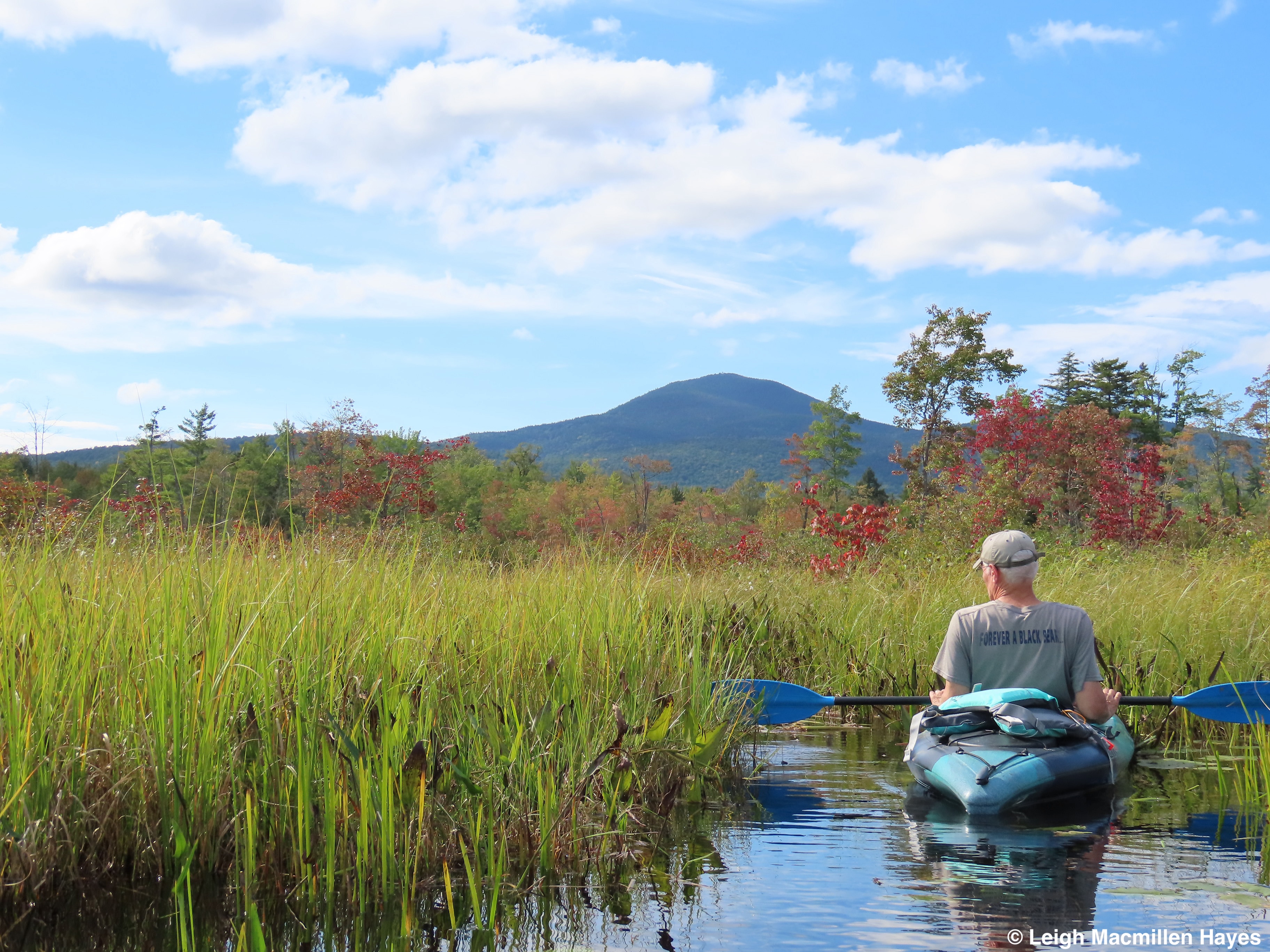
At last we reached the opposite end of the pond from which we’d begun our journey and the colorful leaves of the Swamp Maples told me we were in a different sort of wetland.

The layers. From Pickerel Weed leaves to grasses and sedges, including Cotton Sedge, to the Swamp Maples, actually being Red Maples with very wet feet which are among the first to turn as fall approaches and days shorten, to a backdrop of deciduous and conifers.

Just the colors made me happy as I followed My Guy who followed a brook as far as we could until the growth was too thick and we could hear water flowing over what was probably a beaver dam ahead. And so we turned around, but first honored Mount Kearsarge North, the pyramid mountain in the distance.

I extended the telescopic lens on my camera farther than I should have, but I wanted to see the fire tower at the summit of Kearsarge. It was incentive enough for us to decide to hike there again soon.

As we continued our clockwise journey around the perimeter of the pond, I was on a hunt–for those Pitcher Plants I’d been promised. But what caught my eye in the meantime was the late afternoon sun glowing on bowl and doily spider webs. And a beaver lodge in the background.

It always amazes me to find so many of the same type of spider webs in any one area. The spiders who wove these are rather small, but their web is incredibly complex.

They weave a sheet web system consisting of an inverted dome or “bowl,” suspended above a horizontal sheet web, or “doily,” hence its common name. And then they wait for a meal to announce itself. Should the meal fall through the bowl, the doily serves as a safety net, thus the spider makes sure to not miss a bite.

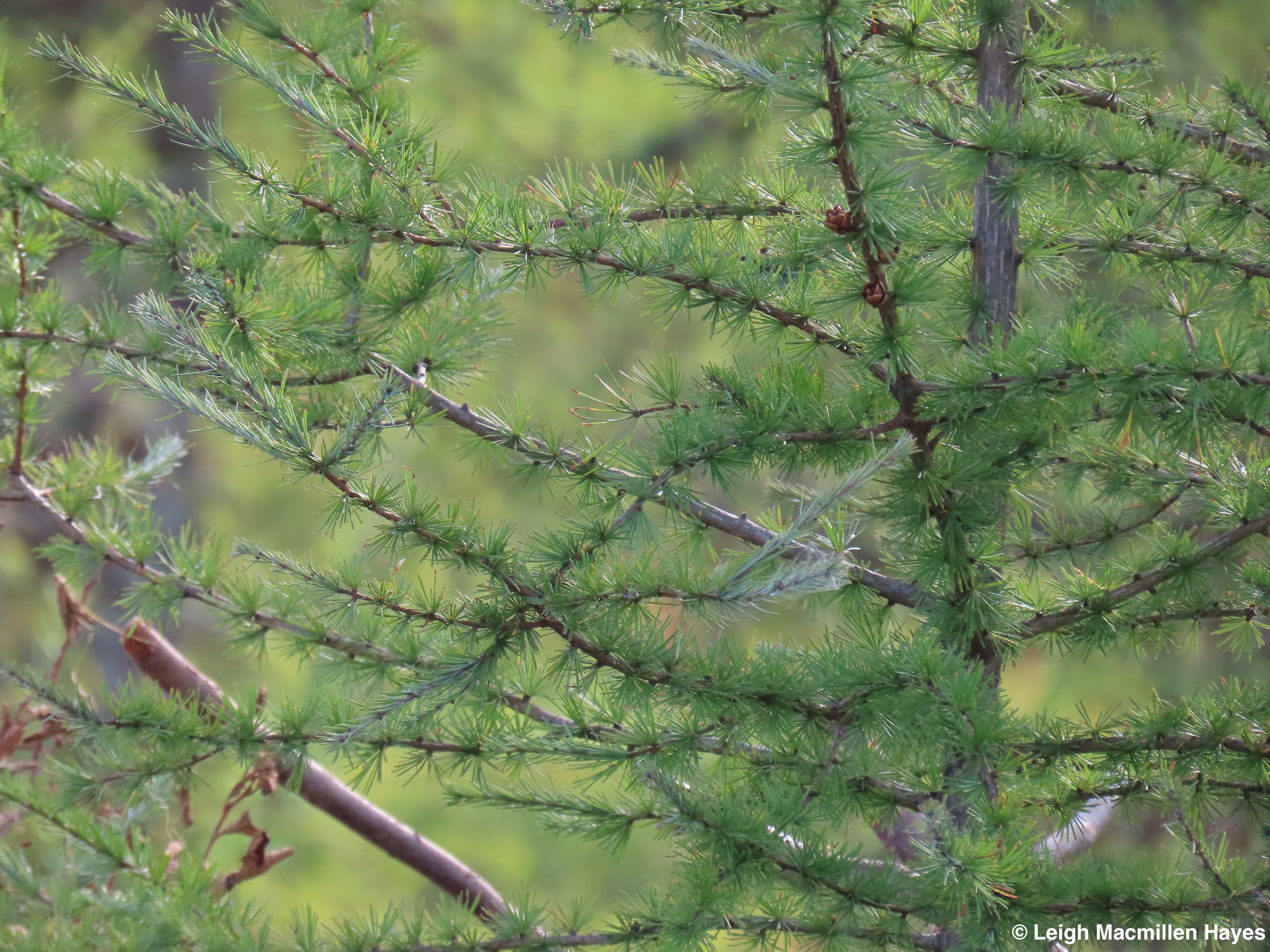
Before turning my boat to follow the shoreline again and continue my PP quest, I realized that a Tamarack grew upon the lodge. And there were several others nearby. I love these trees because they aren’t every day sights. And because they are kinda like me–beings that can’t make up their minds. Thus, they are deciduous conifers, meaning they are cone bearers who shed their needles (leaves), unlike other cone bearers in our neck of the woods who are evergreen.

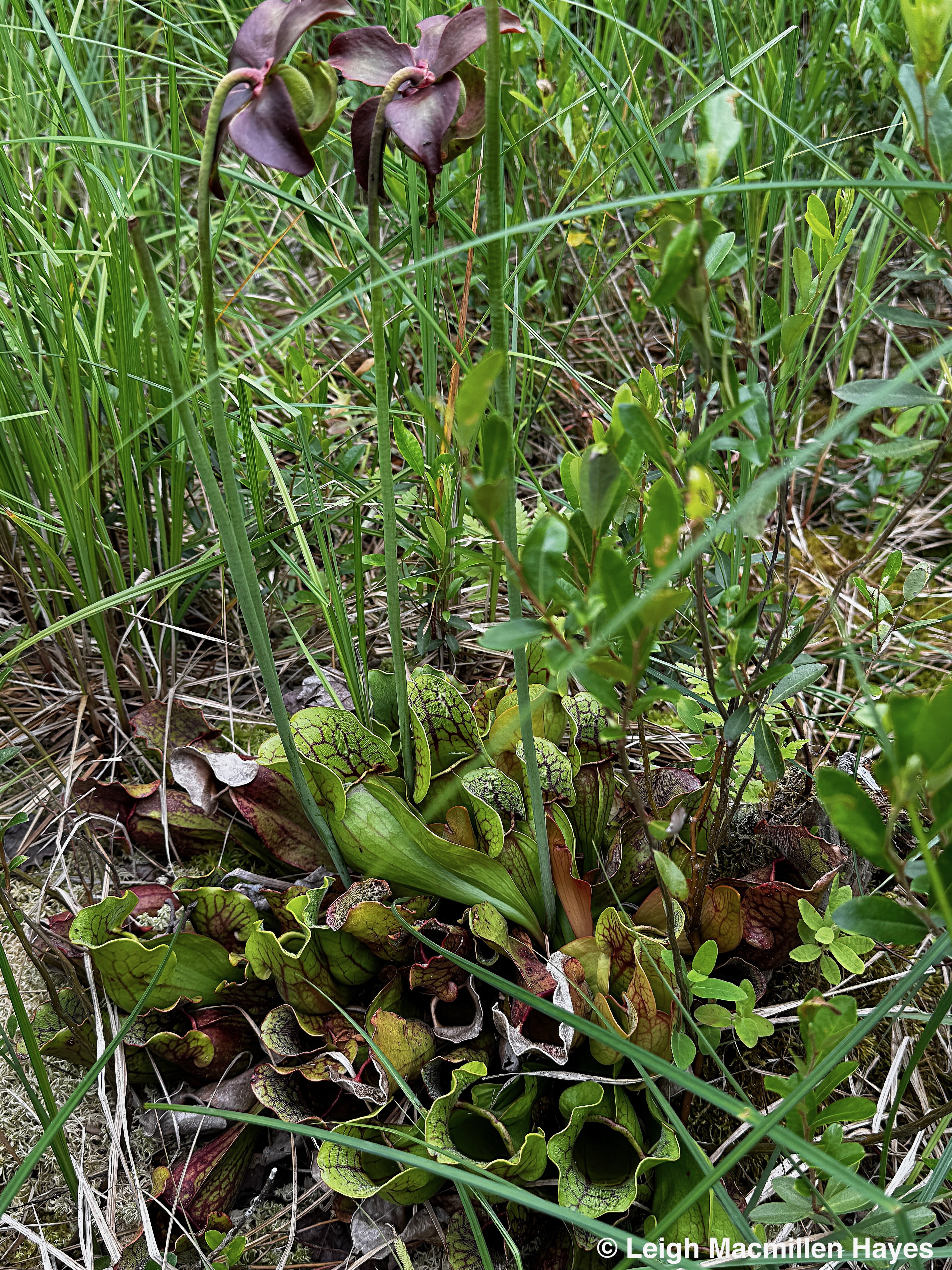
I had only turned a wee bit when two structures standing above other plants caught my attention and I knew my quest had come to an end. Pitcher Plant flowers.

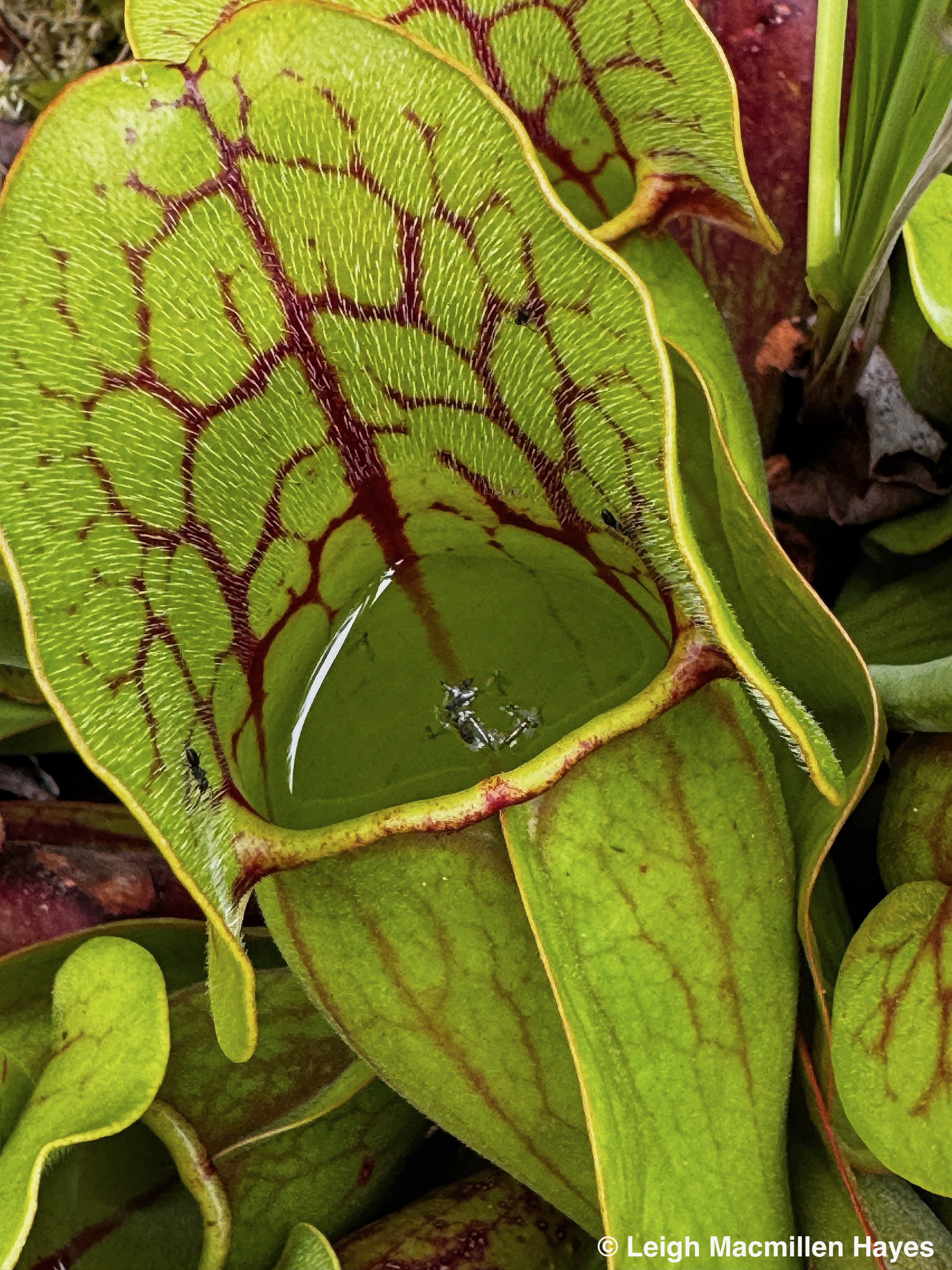
And below them the pitchers (leaves) for which they were named. That ruby red rim. The tree-of-life venation. And downward facing hairs. “Here little insects. Come check me out. I have a special drink I made just for you.”

At the base of the Pitcher Plant grew Sphagnum Moss and Leatherleaf, and . . . Sundews! Round-leaved Sundews–another carnivorous plant like the Pitchers. It’s a plant eats insect world out there.

As we rounded a bend nearing the end of our journey, a flock of Canada Geese honked and cackled.

And suddenly lifted off. My Guy counted 30.

At last we approached the launch site, but truth be told it took us about twenty more minutes to go the short distance because there were so many more turtles to spot. Do you see the second one in this photo?

And one climbing atop another as is their habit since turtles are ecothermic and the sun’s rays help raise their body temperature. So if your brother is on top of the log, why not climb on top of him to get even closer to the sun?

I spotted twelve in all, and love that the one on the right upon this log waved–as if to wish us farewell, for really, it was time for us to leave.

So we did, but first we gave a quiet thanks to our friend, Pam K., for recommending this delightful pond and telling me about a few of its highlights.

And I did promise a quiz, so here ’tis. Can you name at least one part of this dragonfly’s face? And can you name the species? Don’t worry if you don’t get all of the parts–that’s why I write a blog–so I can go back and remind myself.

Basking in the sights. That’s what we did much the same way the turtles basked in the sun.

Oh, and that line that the journey wouldn’t take us long–ahem. It was at least a two and a half hour tour. After all, it’s a wonder-filled world out there.

Heron Accomplishments

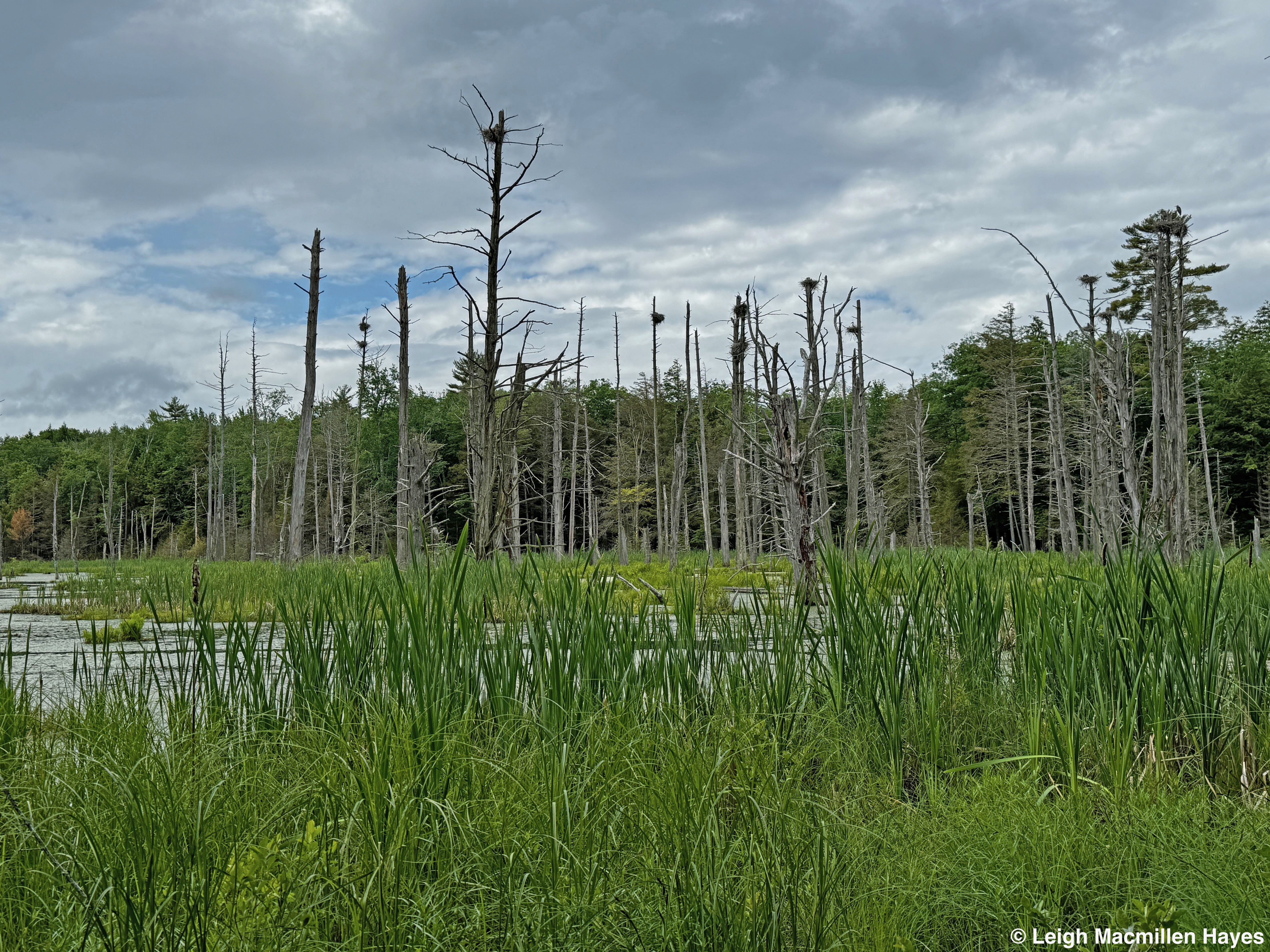
For the last fifteen years I’ve had the honor of stepping into a wetland or two early in the morning on a regular basis for at least six weeks to check on the activity of heron rookeries. It’s a community science program called HERON that the State of Maine runs: “HERON” is short for the Heron Observation Network, a network of volunteers across Maine who monitor nesting areas, or colonies, of wading birds such as the Great Blue Heron. HERON is managed by the Maine Dept. of Inland Fisheries and Wildlife.”

Herons are colonial nesting birds, meaning they nest in groups. Their nesting community is known as a rookery.

If I could get away with it, I’d spend all day in this place where the wild things go about their daily duties as co-observers and I stay on the edge in hopes of not disturbing them.

I think what amazes me most is that they build their stick nests high up in trees and I always expect the wolf in The Three Little Pigs to huff and puff and blow their homes down. Or at least the wind to do such.

The most difficult day of the count may be the first. May be. First, the number of nests must be counted. Then the number of active nests, those with birds in them. Next, it’s the number of adults and then young, if visible. If the adults are incubating, for how long?

And that’s where it gets tricky. If eggs aren’t visible because one cannot get close to the nests, since they are anywhere from about 50 to 200 feet from land, and high up in dead snags, this is a challenge. Spotting adults on the nest, however, indicates there possibly are eggs within.

Nest building and rebuilding is a constant, and a clue that there’s hope for a new generation. Adding sticks with one’s mouth sounds difficult to us, but it is the way of life for a bird.

Spotting little bundles of fuzz brings smiles to observers’ faces–as if we have given birth or are at least the grandparents of these bouncing babies.

Two weeks later and they already have Great Blue Heron markings and crazy hairdos and the counting gets a wee bit easier. Of course, the youngsters hop up and down and so nests have to be reviewed several times to make sure the number is at least close to accurate. It’s not unusual for a nest to support three, four, or five youngsters.

If you’ve never been near a heron rookery in those early days, you haven’t experienced the pterodactyl fly ins as adults arrive with food or the intense and loud and constant squawking of the youngsters demanding to be fed.

Once the adult has landed, the birds still must beg, sometimes for ten or more minutes and I can’t help but wonder if the squawking encourages adult regurgitation.

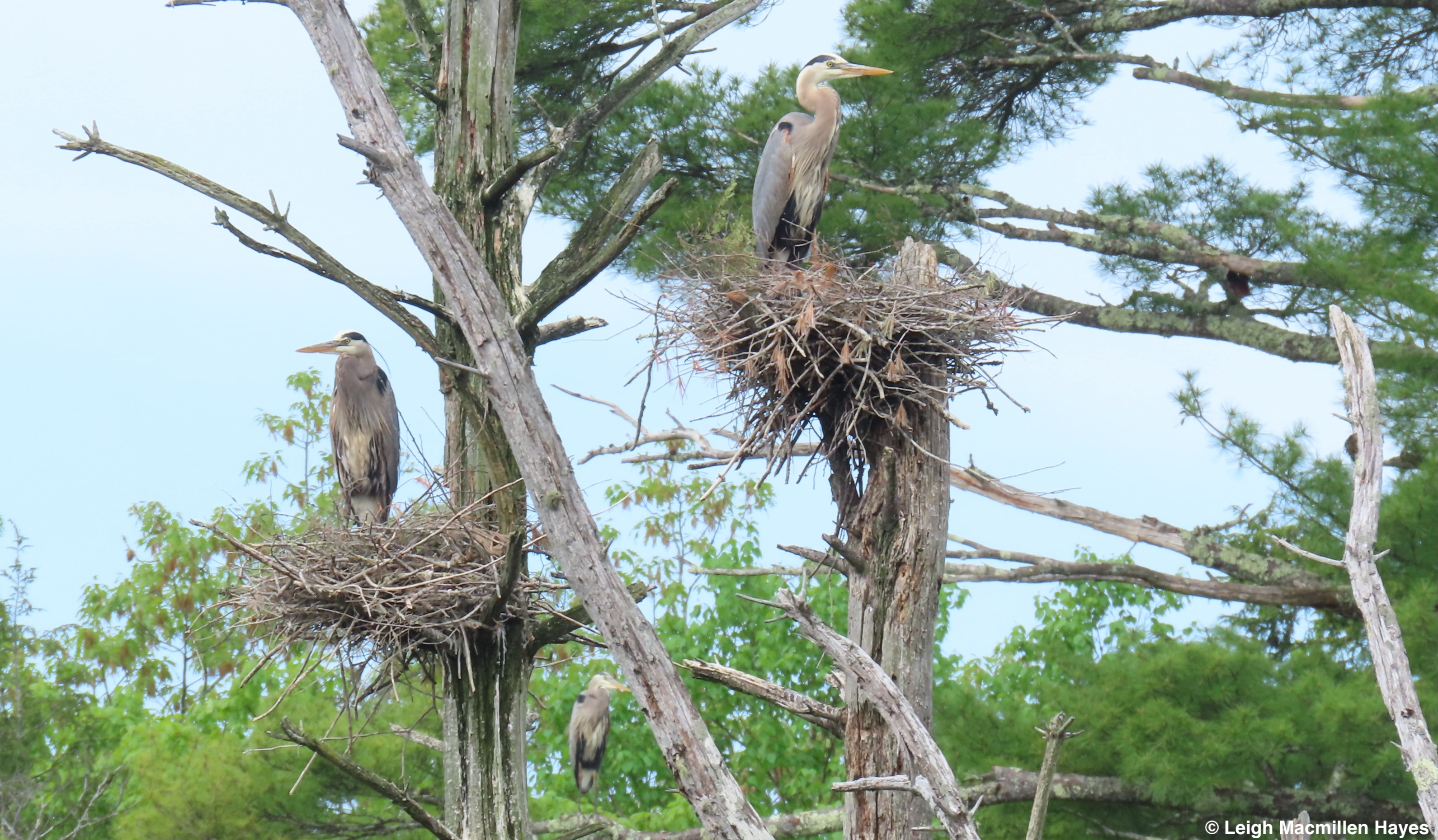
If you look closely at this photo, you’ll notice the two on the left are in one nest waiting ever so patiently for an adult to return with a meal, while the nest in the back to the right hosts two beggars waiting for the food to slide up the adult’s throat and down into their mouths.

Those awkward tween years only last a few weeks in a bird’s life, for so rapidly must they grow given the short season of our northern clime. Hairdos are a good indication to separate adult from young.

Remember when I said that the first day was the most difficult day to count. Well, that is debatable, for as the weeks go on and the youngsters grow, it becomes difficult sometimes to distinguish parent from child. If the plume on the head is spotted, then it’s an adult, but sometimes the lighting or angle isn’t right.

That said, the count is completed about six weeks after the first visit for the birds begin to fledge and the nests won’t be used again . . . until next spring.

There are so many joys about spending time in the wetland, but a few include dew upon spider webs,

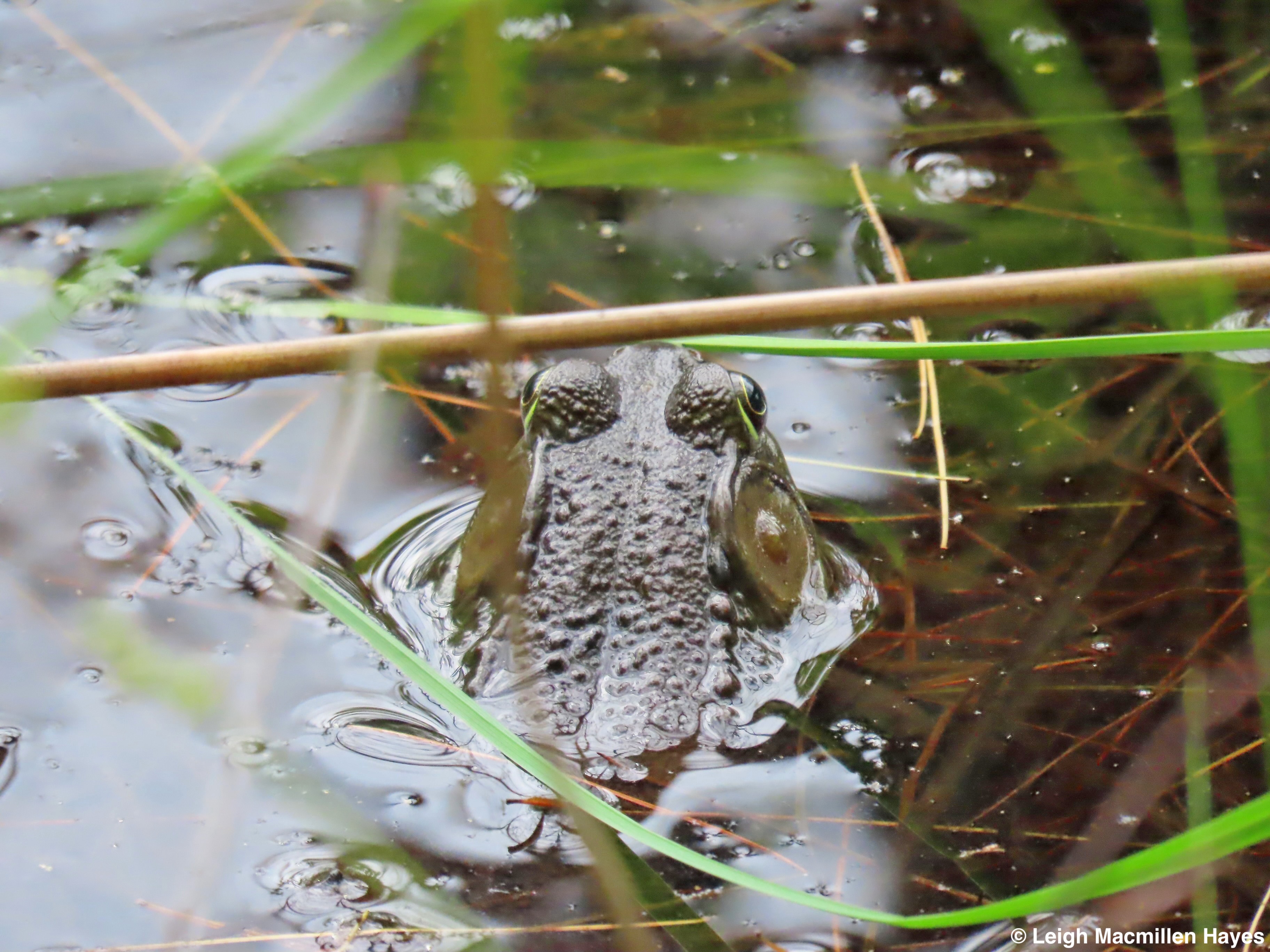
Frogs who ga-dunk, ga-dunk at our feet,

a young Robin calling for its parents,

and the spotting of four Wood Ducks on a snag.

Fast forward two months and this afternoon found me walking the roadway on either side of Hemlock Bridge, my eyes darting here and there taking in flora and fauna with each step.

I love the Paddeford construction of this bridge. Or maybe it’s just that I love that we live so close to a covered bridge. And recently, because I’m taking a painting course, I tried my hand at showing off some of its beauty.

Spider webs did not go unnoticed by me. I didn’t spot the creator, but trust that an orb weaver was hiding somewhere nearby.

As I walked along the old course of the Saco River, I spotted a few Painted Turtles basking in the sun, but also noted all the debris clinging to branches, a sign of the high water we had this past spring.

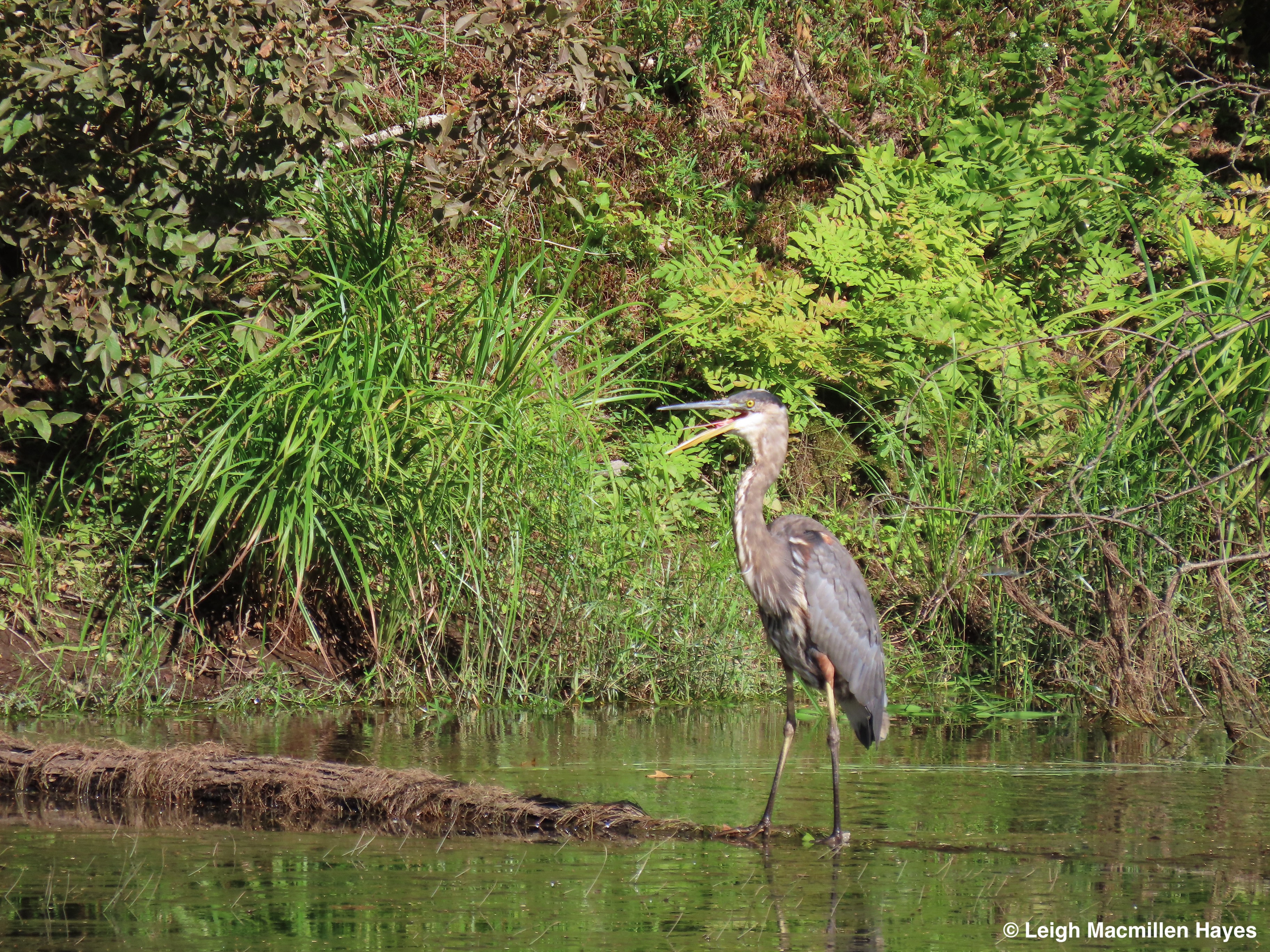
And then something else caught my eye. One of my teenagers was on a fishing expedition. And panting to cool down.

I got excited when it seemed he’d spotted a meal.

Apparently that didn’t pan out and he turned his attention in the other direction. As I watched, he tiptoed ever so gently for such a big bird, and I was certain he was on to something.

But then he stood there and panted some more.

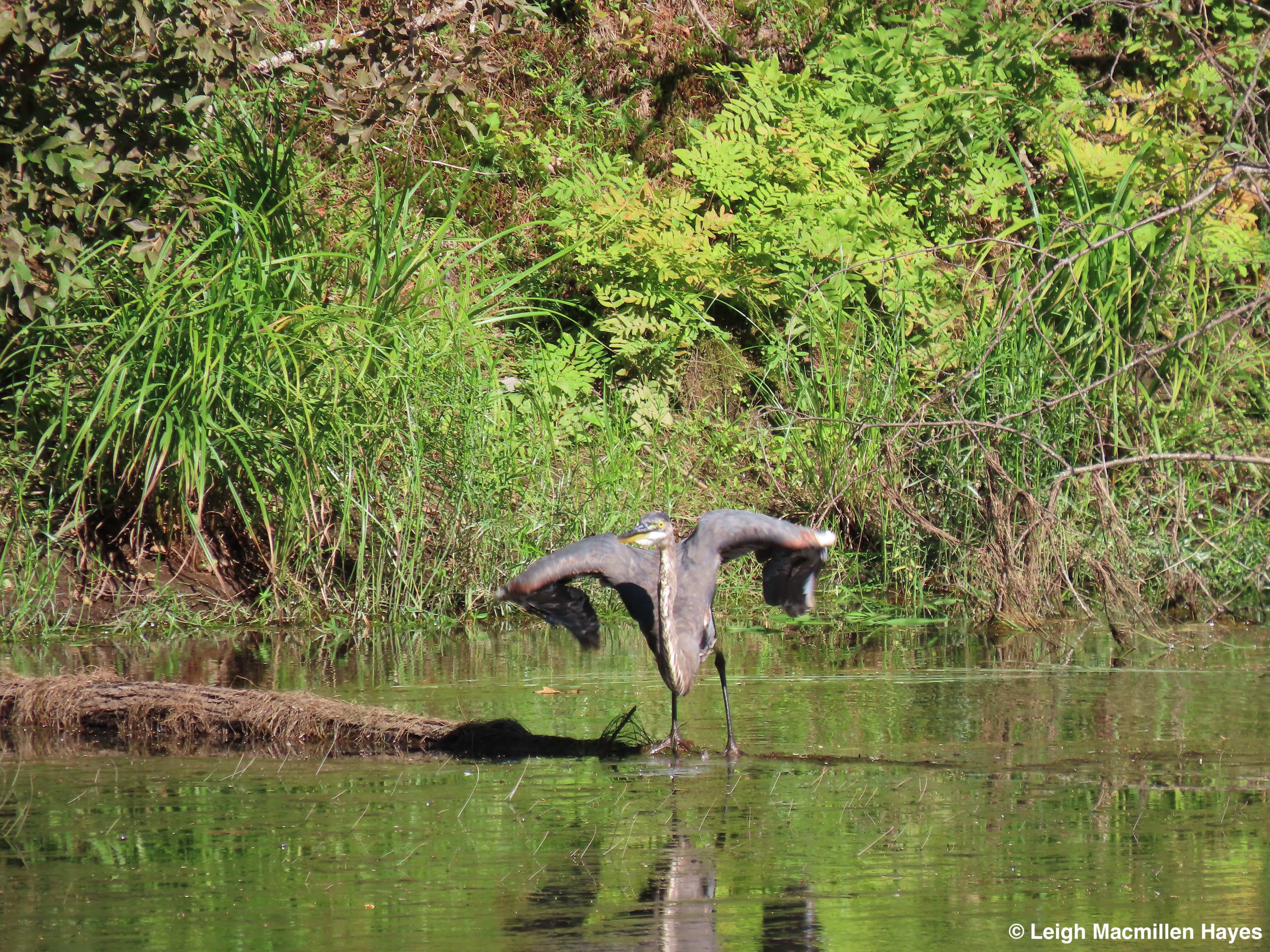
Until there was a bit of a tussle and I realized he and a snake had a brief encounter. Both survived. And left each other alone.

And then the bird flew and I was bummed. I wanted to witness a meal being taken. But I have to have faith that it found success somewhere else upon the river. Just as I trust that the sun will rise tomorrow, and the day after that. This bird will not go hungry.

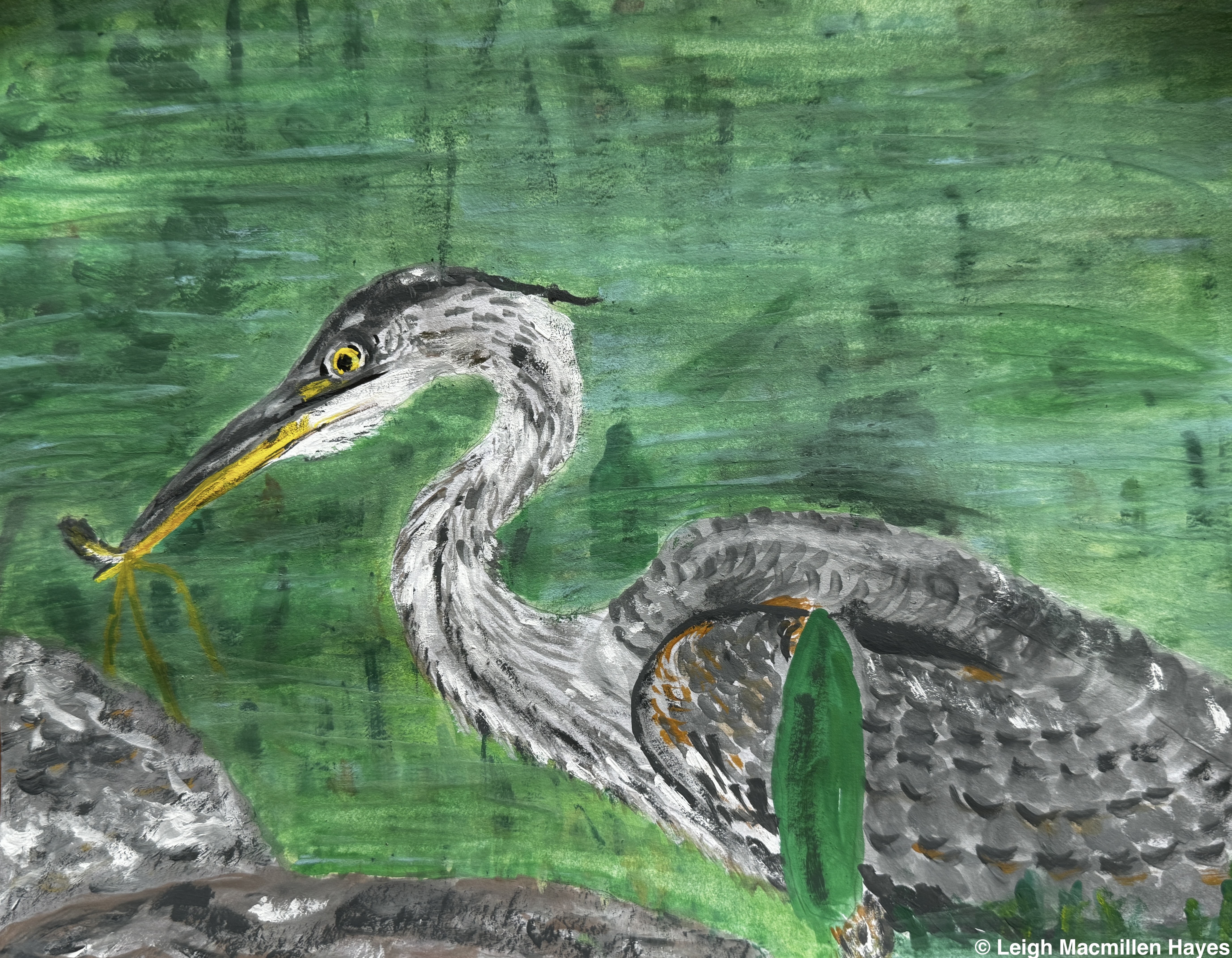
Instead, upon arriving home I pulled out a painting I completed a couple of weeks ago of a Great Blue Heron I watched snatch a fish last summer.

Just as the young heron’s accomplishments may take time, so do mine as a painter. But it sure is fun trying.

As for the count:

One rookery featured 19 active nests at the start, but only three toward the end, and I have to wonder if a predator found many a meal high up in those trees.

The other rookery featured 53 nests, with all but a few being active and lots of youngsters produced.

That, in itself, is a great heron accomplishment.

Taking Stock . . . Naturally

As locals know, My Guy owns a hardware store and I often say I am married to the store. It’s true because it is a constant in our lives and follows us on walks and hikes even on his days off. And though our oldest son has taken over the reins in the past two years, My Guy still cannot completely let go.

I’ve come to realize, however, that that is okay because it means I can tend my own shop. Of course, while he owns the land and the building, I need to rent space, but it’s well worth the priceless price.

Step through the open-air doorway, and you’ll find right now I’ve got proboscis-style straws on display. They are especially beneficial when sipping from Red Clover, a member of the legume family.

And for safe storage, the Peck’s Skipper likes to show how to curl the straw up when not in use.

If you are an introvert, like me and the Common Ringlet Butterfly, you might prefer to flit from flower to flower, but then hide in the vegetation after spending so much time demonstrating for the public how to use your straw.

Common Wood-Nymphs are equally inclined to hide, but still available on the shelf for you to choose, and you can decide if this stored straw appeals to you, or not.

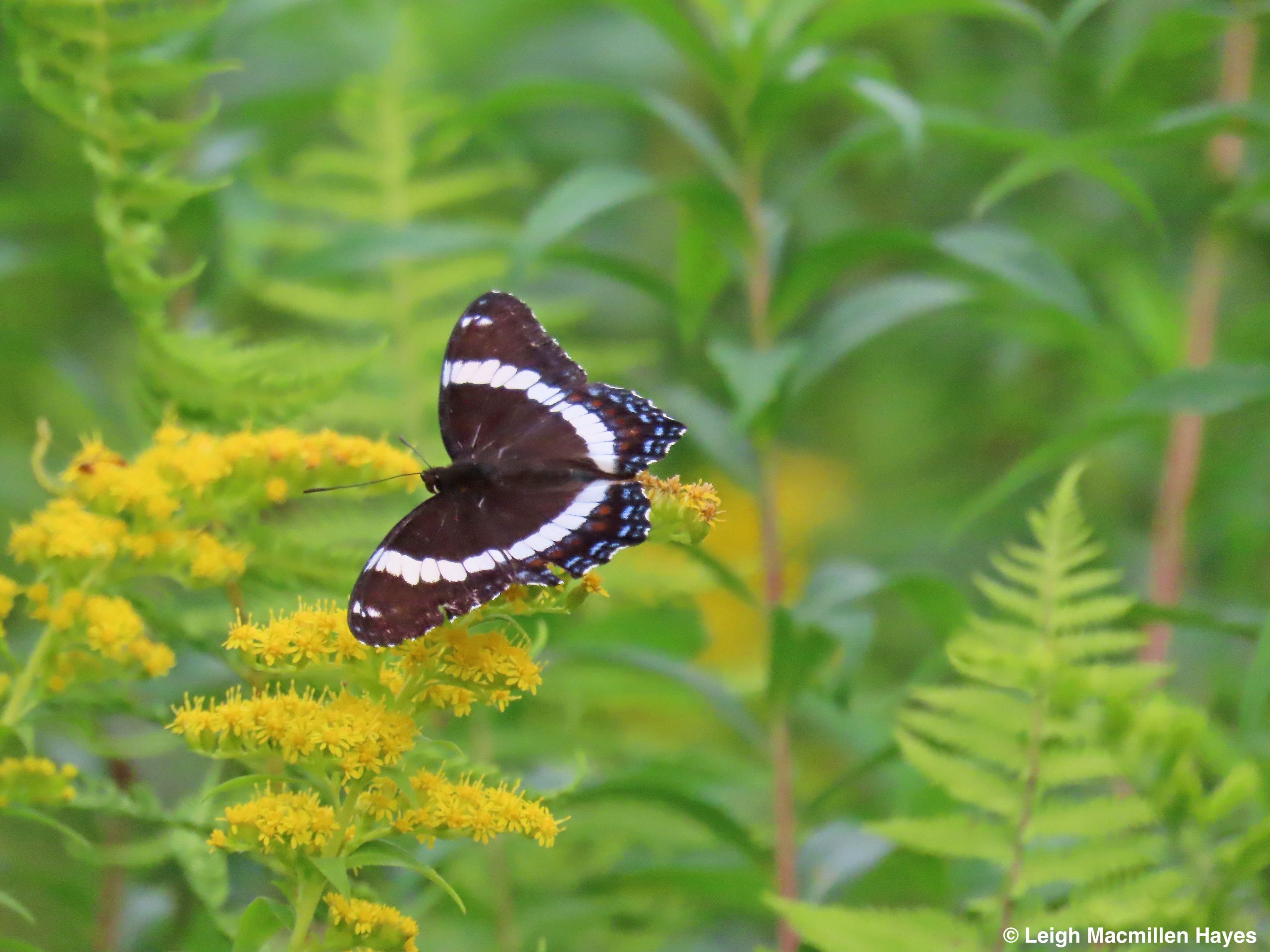
White Admirals are especially plentiful right now, and want you to know that whether hanging upside down,

or right side up, their straws always work, so it might be a good one to think about purchasing.

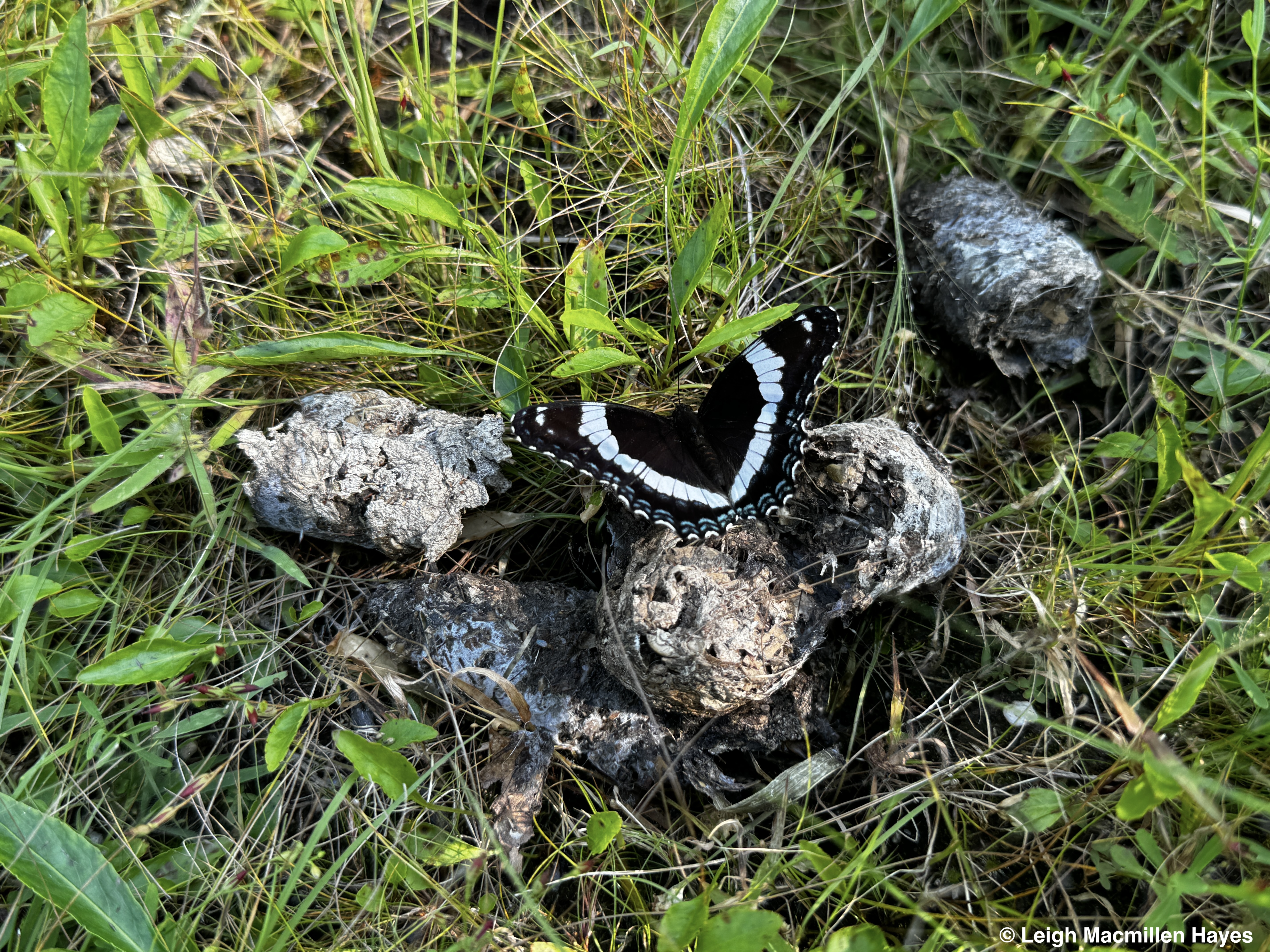
Especially if you like to get some of your nutrients from scat. We can throw in some scat for you, if you’d like–at no extra charge!

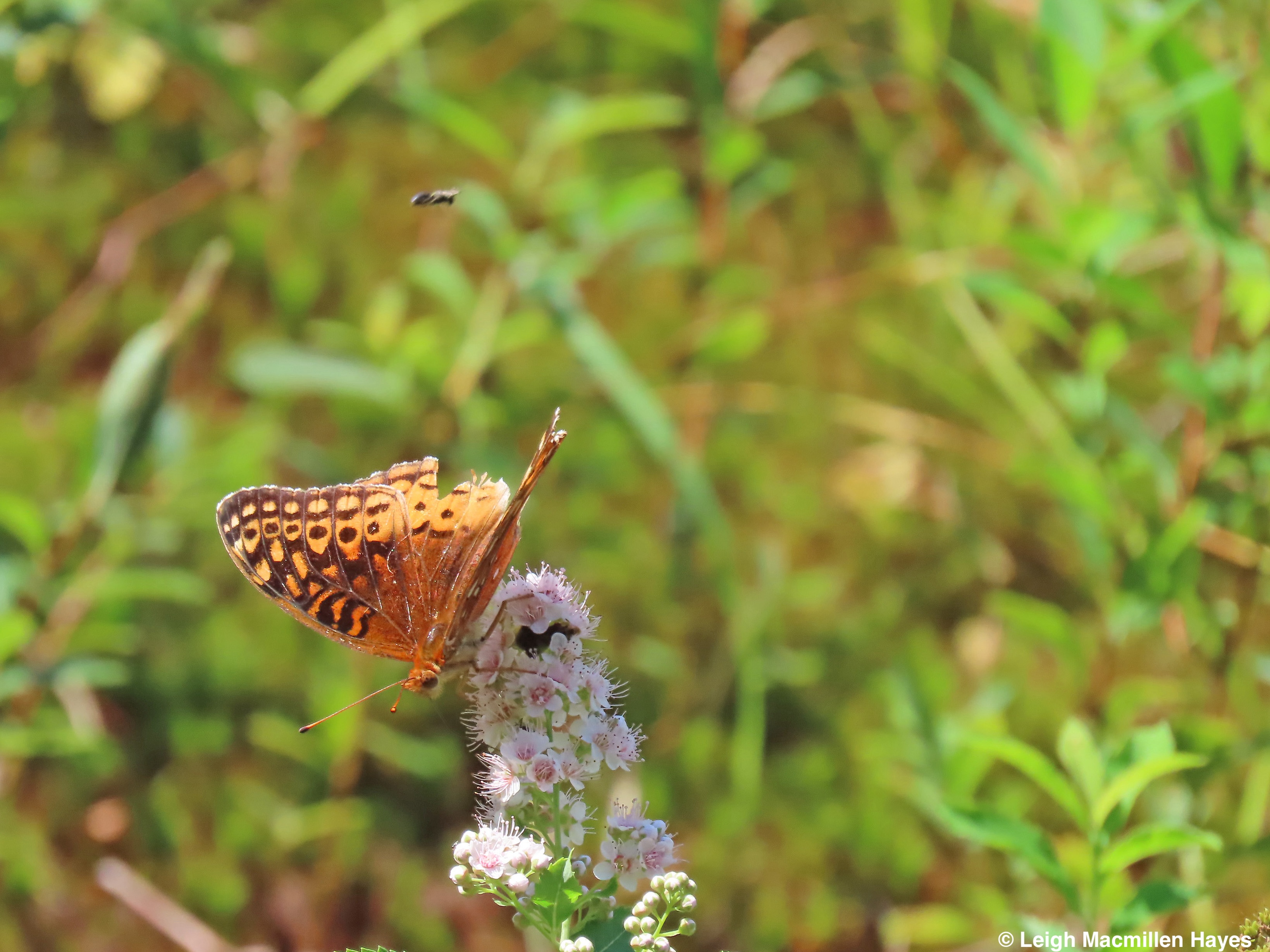
Sometimes it’s the packaging that makes all the difference, so we’ve got several orange choices for you to consider, this being the Fritillary style. Make me an offer I can’t resist, and this straw is yours due to the fact that it has been used previously, as evidenced by the tattered wing.

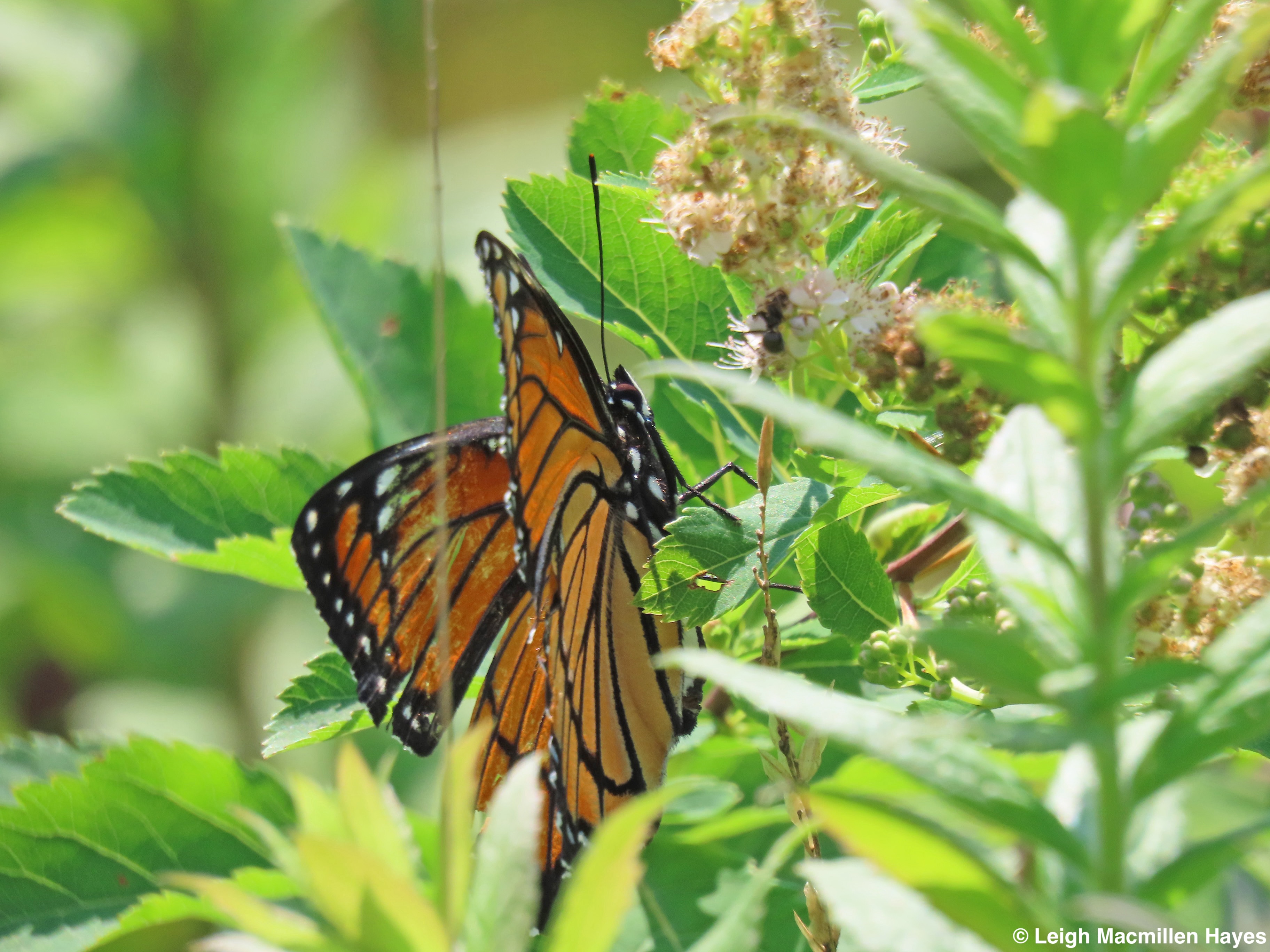
If you prefer something a bit bigger and brighter, there’s the Viceroy, with that dark band crossing its wings.

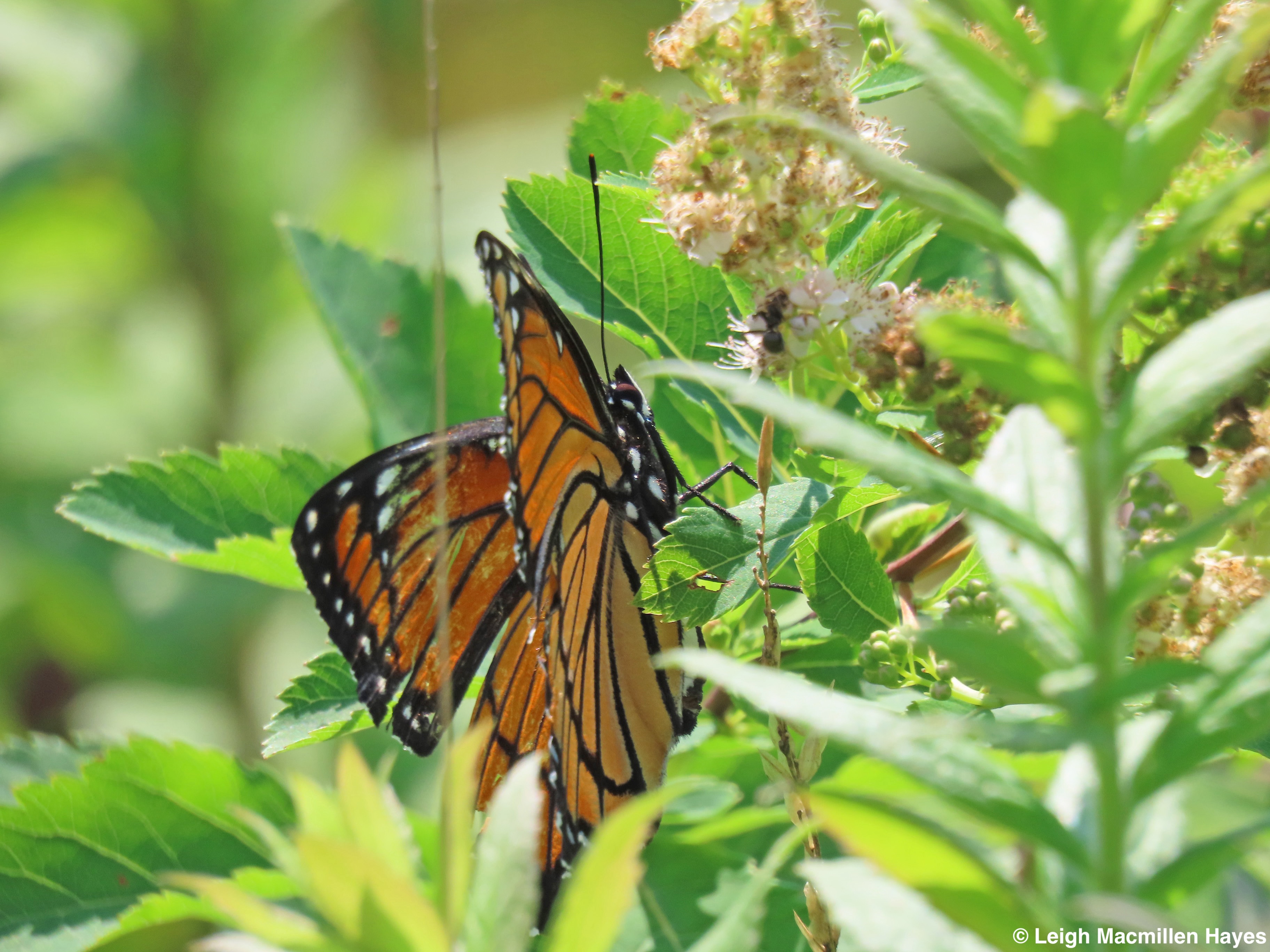
Or the biggest of all, the Monarch, who lacks the black band that is part of the Viceroy packaging.

For the tykes in your life, we also have Pearl Crescents and Northern Crescents in stock. The former is slightly smaller than the latter for the youngest in your gang.

Those are all great, but I have two that I much prefer, the first being this Clouded Sulpher that comes in pastel colors only, which contrast with the darker-colored straw.

And the creme de la creme has to be the White M Hairstreak, a rare species that I was able to special source a few weeks ago, and every once in a blue moon (such as this August is), I can find another to offer you. That is the case right now, but hurry because I don’t know how long this butterfly will remain on the shelf.

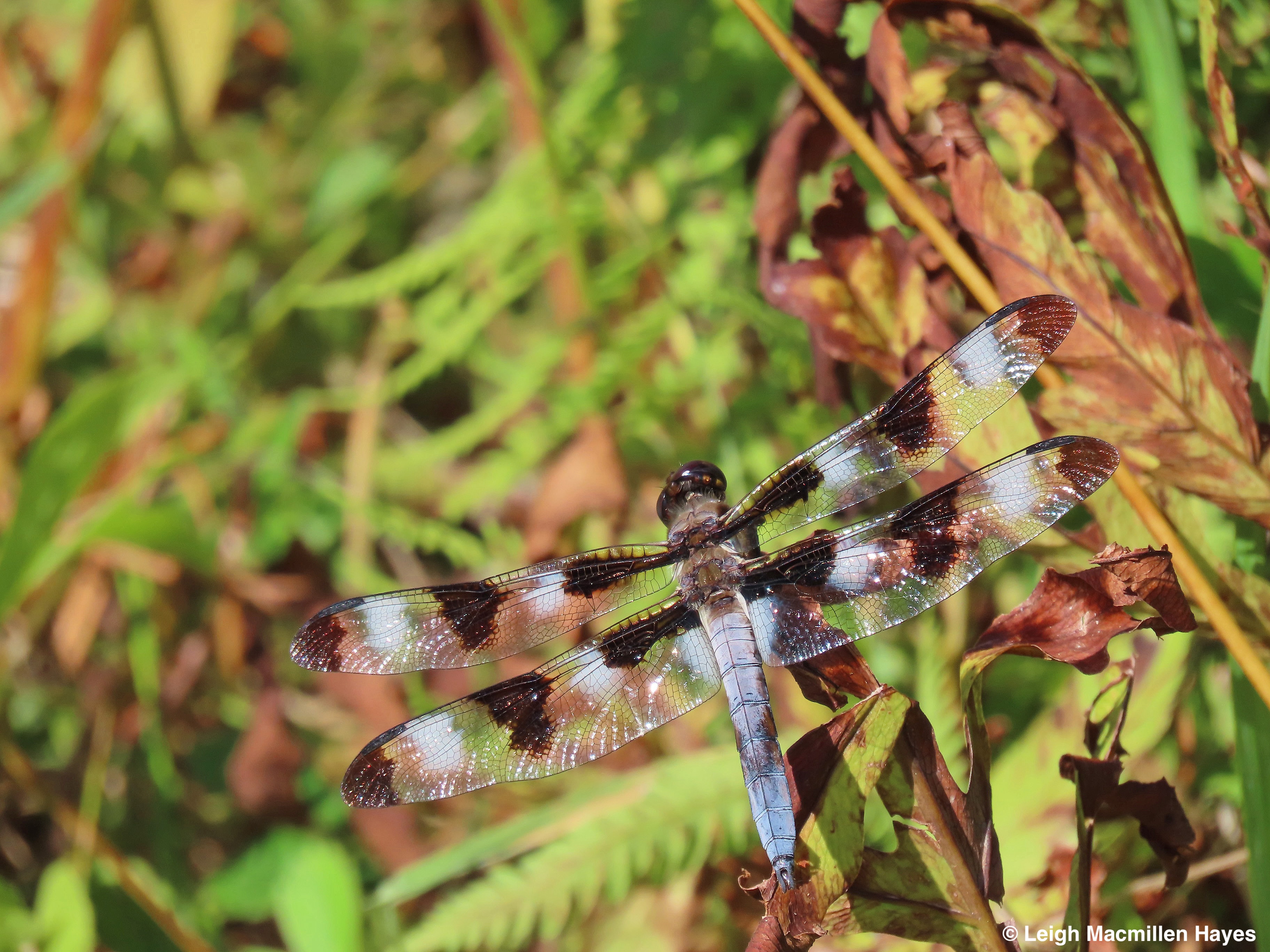
Over in the natural pesticide control aisle, I’ve a few options for you to consider, such as this handsome male Twelve-spotted Skimmer. Unfortunately, I just discovered these are on backorder, so you’ll probably need to wait until June if this is the style you prefer.

The same is true of the Eastern Pondhawk–in fact, I was totally surprised that I was able to snag this species, but suspect it has something to do with the store’s location between two ponds, and so close to a wetland and swamp.

Right now, the most abundant pesticides I can offer are in the form of Meadowhawk dragonflies like this Autumn Meadowhawk, a small skimmer with tan colored legs.

If you prefer something larger . . .

you might like the darners that keep flying off the shelf. That said, there are plenty more where this guy came from, so if you can’t find one in the shop, give me a shout, and I’ll check the backroom.

Summer is not over yet, despite what everyone has been saying lately, and so if it’s pollinators you are looking for, I’m afraid I overstocked. Well, there’s nothing to be afraid of, actually. Being overstocked on these is a great thing. And you can mix and match if you’d like, perhaps choosing these European Paper Wasps,

a few Honey Bees,

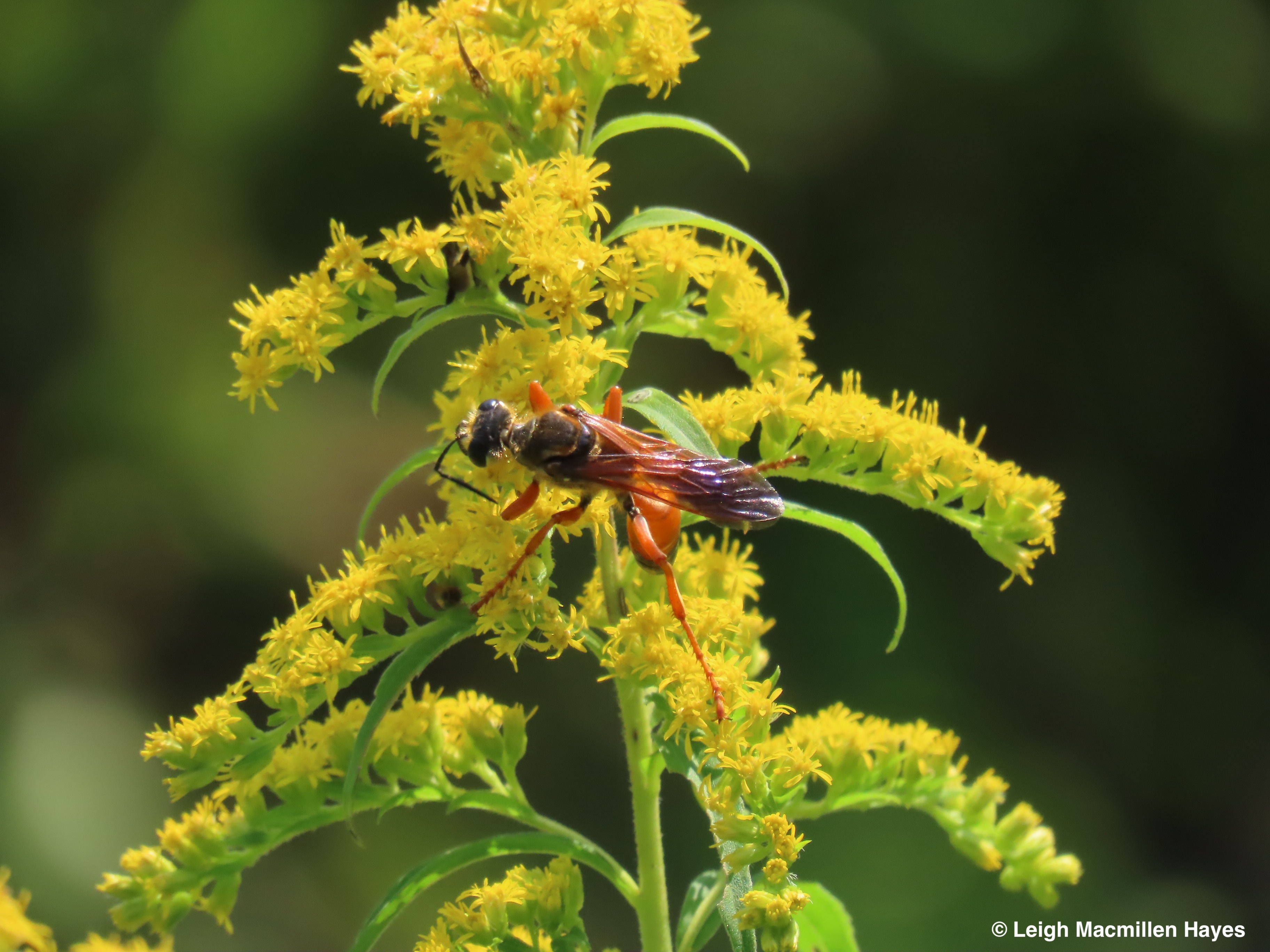
and some Locust Borers, all lovers of Goldenrod as you can see. I’ve also got Great Black Wasps, with their iridescent blue wings, and Paper Wasps, and Bumblebees, and . . . and . . . and so many to fill your reusable bag.

In the Fly By Day aisle, there are a few special selections, the first being this Lacewing that could be featured in a “Where’s Waldo” picture, so well camouflaged it is.

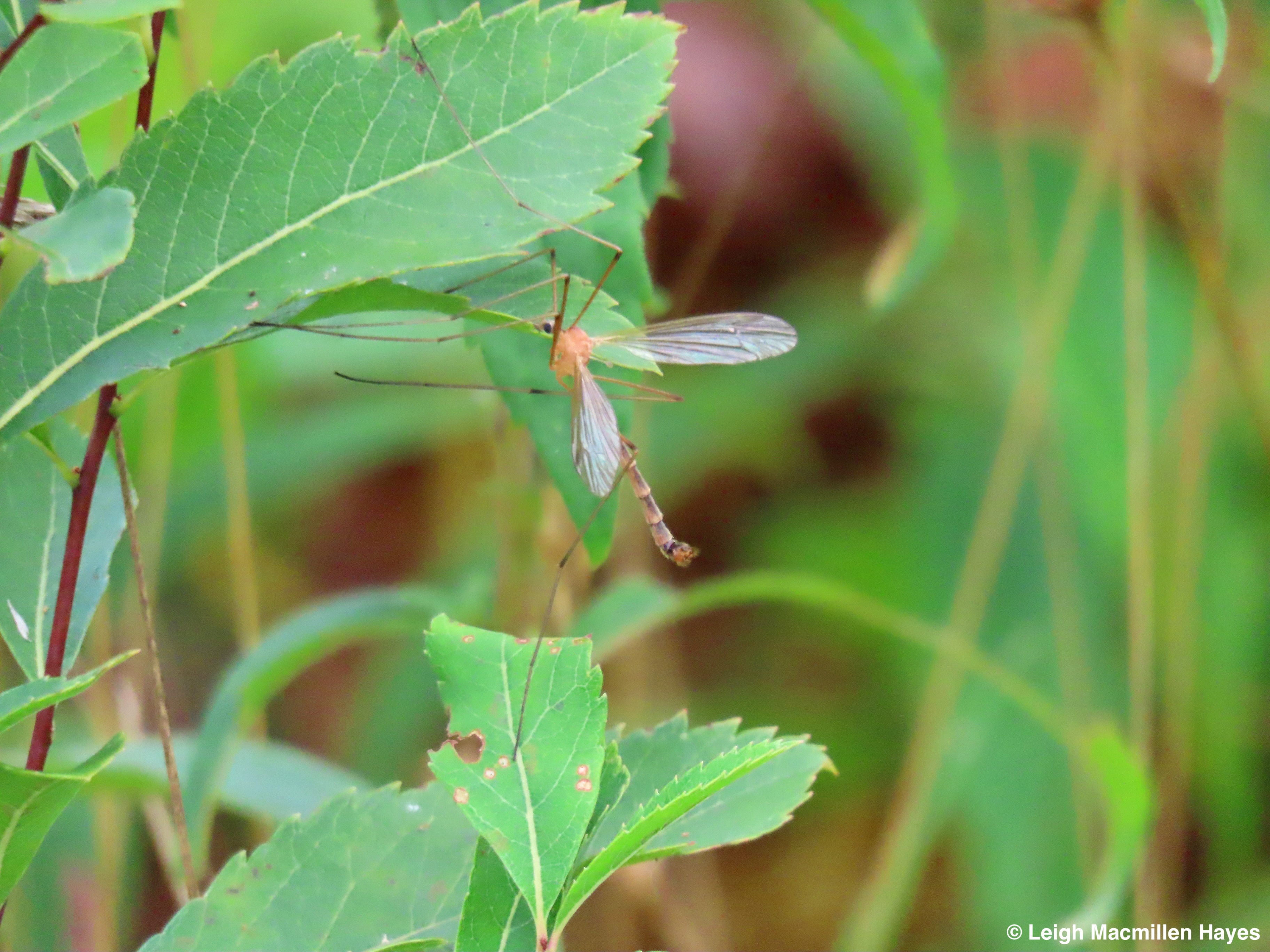
And a Crane Fly that you can scare people with and pretend it’s a giant mosquito. The thing is . . . they don’t bite. In fact, during their short lifespans, they don’t typically eat. So . . . little maintenance if you decide to put this one in your cart.

I’d be lax if I didn’t mention the employees such as this teenaged Ambush Bug who is very good at hanging out on Goldenrod plants near Black and Yellow Garden Spider webs, without getting tangled in all the drama.

But, being teenagers, sometimes two decide to tango in the breakroom under the Goldenrod, and these two canoodlers just had to have a bite to eat while they were so engaged. I’m sure the Sweat Bee never saw this coming.

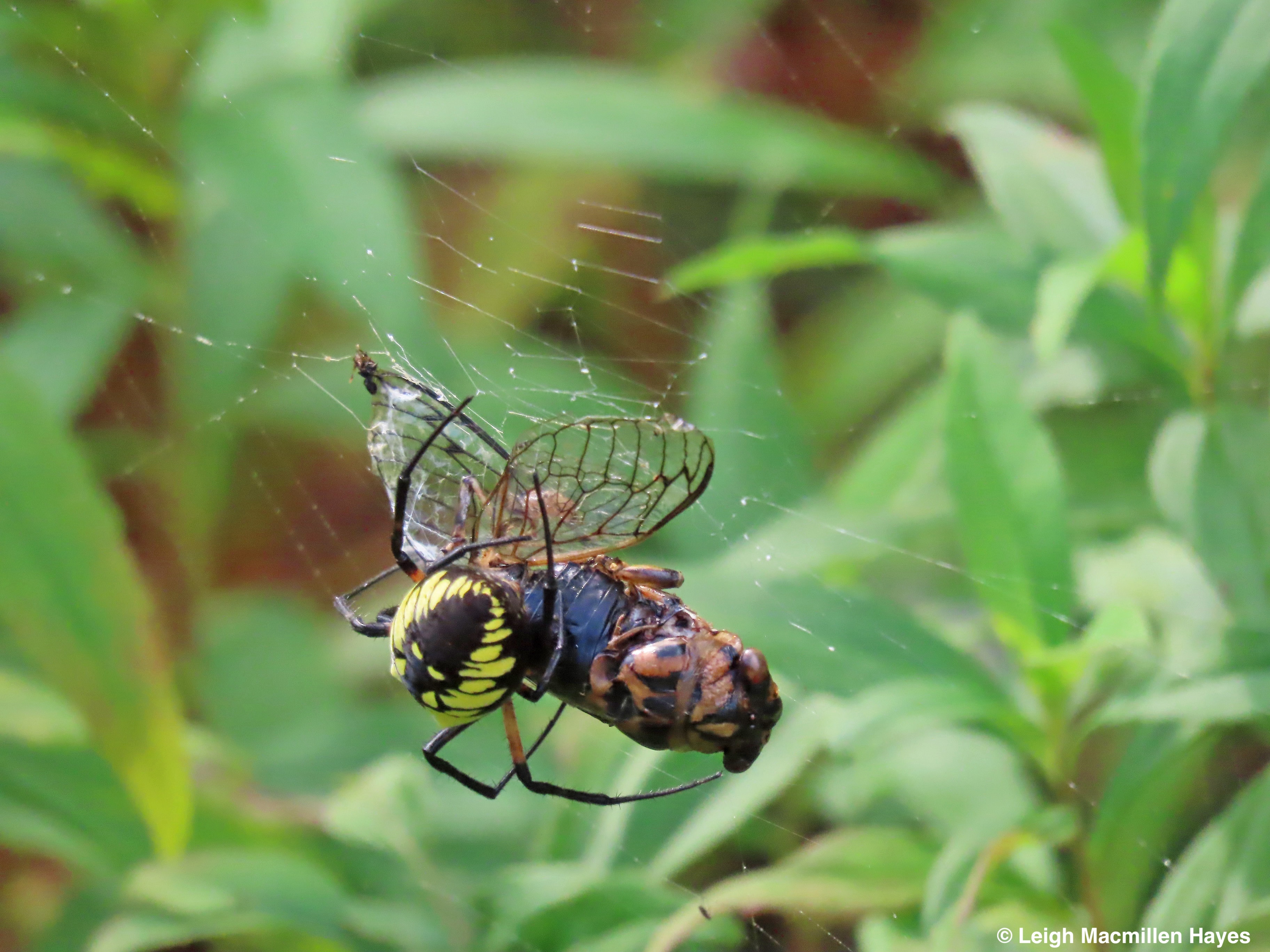
If you do decide to stop by the shop, the Black and Yellow Spiders are the chefs and they’re happy to provide you with a Dog-Day Cicada meal all wrapped up and ready to eat on the road. They have other items on the menu as well.

That said, this coming weekend, I do believe that the hardware store will have some items on the grill. So stop by and sample whatever delectable they prepare.

Food is actually a part of all our lives (haha, as it should be) and our youngest son is fortunate to work at a company in Manhattan that has a personal chef who prepares breakfast and lunch each day, mostly with locally-sourced food such as what is available at my store.

If you do come to the my shop, know that you’ll probably have to wait in line behind the Eastern Phoebes, who perch at roof-height and swoop in and out . . . often helping themselves and then zooming to the self-serve checkout line.

The guard doe keeps an eye on everyone passing through the door, so I don’t have to worry.

Occasionally, all four of us take a break from our respective jobs and come together to share a locally-sourced meal of our own–a la Fly Away Farm. Oh, and the kid (young man!) in glasses is holding his Lacy Blue pup who is sure that everyone who visits the hardware store comes just to greet and pet her.

As My Guy and I went for a long walk today, and hiked a mountain yesterday, we tried not to talk shop, but it occurred to me that while my eyes glaze over when he starts telling tales about hardware happenings, so do his when I point out the wonders of the natural world.

And so, I try not to tell him how to run his business (“try not to” being the operative phrase), and he lets me operate my own shop in my own way–even if it is all in my imagination.

I suppose you could say that while I’m married to a hardware store, he’s married to a . . . I’ll let you finish the line.

In the end, we both take stock . . . naturally.

Ode To A Garden Spider

Oh great orb weaver
Who lives among tall plants
Where you spin
A complex circular web
The size of a large platter
Complete with a hub
And non-sticky spokes
Upon which you walk,
While sticky cross lines
Ensnare your daily meals,
I revere you.
I study the webs
You and all of your sisters create,
But observe holes
In some areas
Where large insects
May have escaped,
Your web so constructed
That they don't break
The entire structure
During their struggle
To freedom.
And other sections
That remind me
Of the Cat's Cradle String Game
We used to play as kids.
Most nights,
As if on cue,
You consume
The entire silk dish,
Snacking on tidbits
Caught in the wheel
And then build
A fresh web
To start
A new day.
Really though, 
It's the bigger insects
You prefer,
And much like
E.B. White's famed Charlotte,
You inscribe
A daily message
Down the center
Of your creation.
It's upon this
Zig-zaggy stabilimentum,
An ultraviolet runway
Of multiple threads
Perhaps intended
to provide you stability,
Or as a prey attractor,
Or a warning to birds
Not to fly through,
That you hang in suspension
Waiting for the
Dinner bell to ring.
What I realize
While stalking
The neighbor's field,
Is that when a large insect,
Such as a grasshopper,
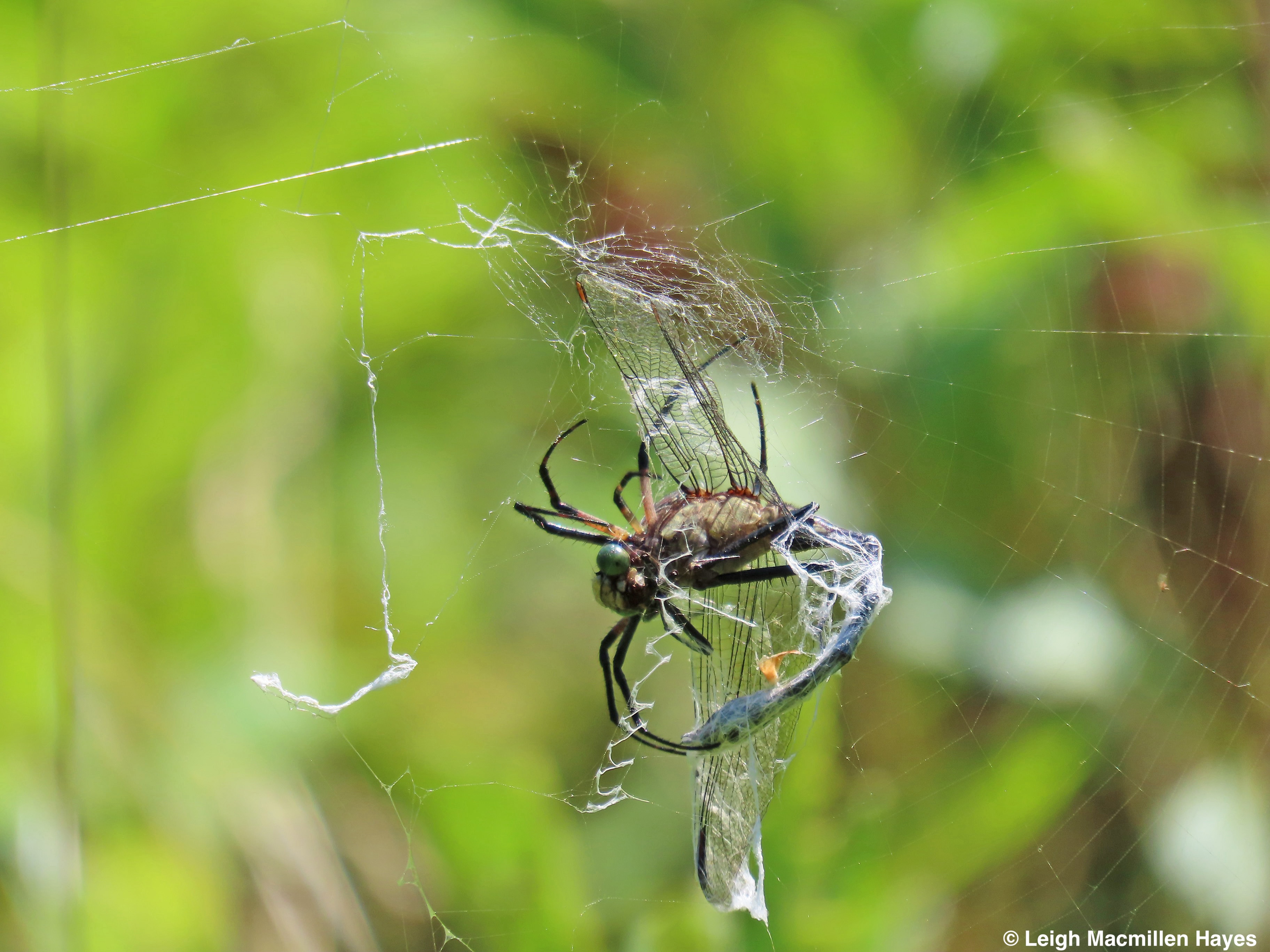
Dragonfly,
Or caterpillar
Gets caught in your web,
It takes you
Two or three days
Or more,
First injecting and paralyzing
with venom,
Then enwrapping with silk,
Before crushing the body
And liquifying the victim
With digestive juices
So it forms
A neat little package
Resembling a cocoon.
And storing it
For later consumption.
Despite eight eyes,
I'm told you have
Poor vision,
But make up for this lack
With hairy legs
That detect the arrival
Of a meal
Perhaps signaling
Sound and smell,
And certainly vibrations.
I'm afforded a look
At your pedipalps,
Those two short,
Hairy appendages,
Sticking out from your head,
That also work
Like sensory organs.
You may appear
Big and scary,
Your egg-shaped abdomen
Covered with asymmetrical marks
Upon the carapace,
Much like a turtle's shell,
And you may be
A carnivore,
But I celebrate you
Because I know
You are beneficial
In a garden or field
Such as this,
Since you control
The insect population,
Including some pests.
You also pollinate plants,
Recycle dead animals
(Well, they may be dead
Because you killed them,
But still . . .),
And serve as a food source
for others.
Oh great orb weaver,
Argiope aurantia,
Or more commonly,
Black and Yellow Garden Spider,
Thank you for affording me
Numerous views
Of you and your sisters
So that I might gain
A better understanding
Of your daily habits.

Field of Vision

Sometimes it’s the big things that pull me out the back door and other times it’s the small things. But this past week, it was an in-between thing that did the trick. And kept me returning for more and more.

Feeding on the Phlox outside the kitchen window was a Hummingbird Clearwing Moth. I’d seen it on several occasions, but the minute I stepped outside it flew off. Until this day when it let me snap numerous photos as I watched it seek nectar from the same flowers our local Hummingbirds love to visit.

And once I was out there, I knew it was time to climb over the stonewall and visit the neighbor’s field to see what it had to offer, given that so many goldenrods are in full bloom.

Upon a Steeplebush, a Netwing Beetle looked like it was holding court. I love the featheriness of its antennae standing tall above those beady eyes.

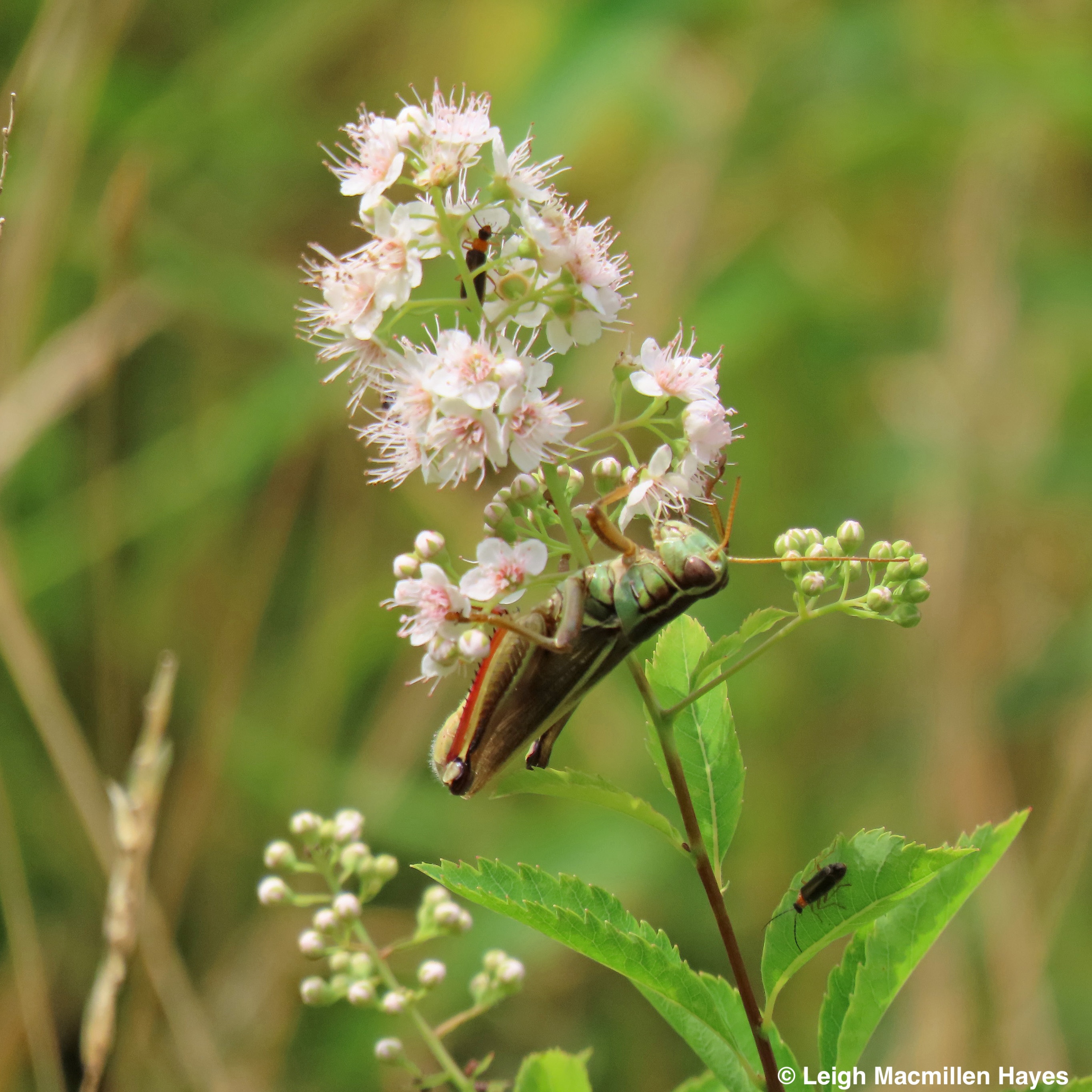
On a nearby Meadowsweet, another in the Spirea family like the Steeplebush, a Two-striped Grasshopper was certain that I couldn’t see it. I could. And I could hear grasshoppers and cicadas and crickets and birds, a field orchestra in full rehearsal form.

And as has been the action of so many Gold-marked Thread-waisted Wasps, these two were canoodling. I suspect we are surrounded by so many because they are so good at reproducing. Not a bad thing.

Also on frequent display and frequently in flight were the Pearl Crescent Butterflies.

And they too canoodled, though a bit discreetly. If you look at the underwing, do you see the pearly-white crescent? Thus the common name.

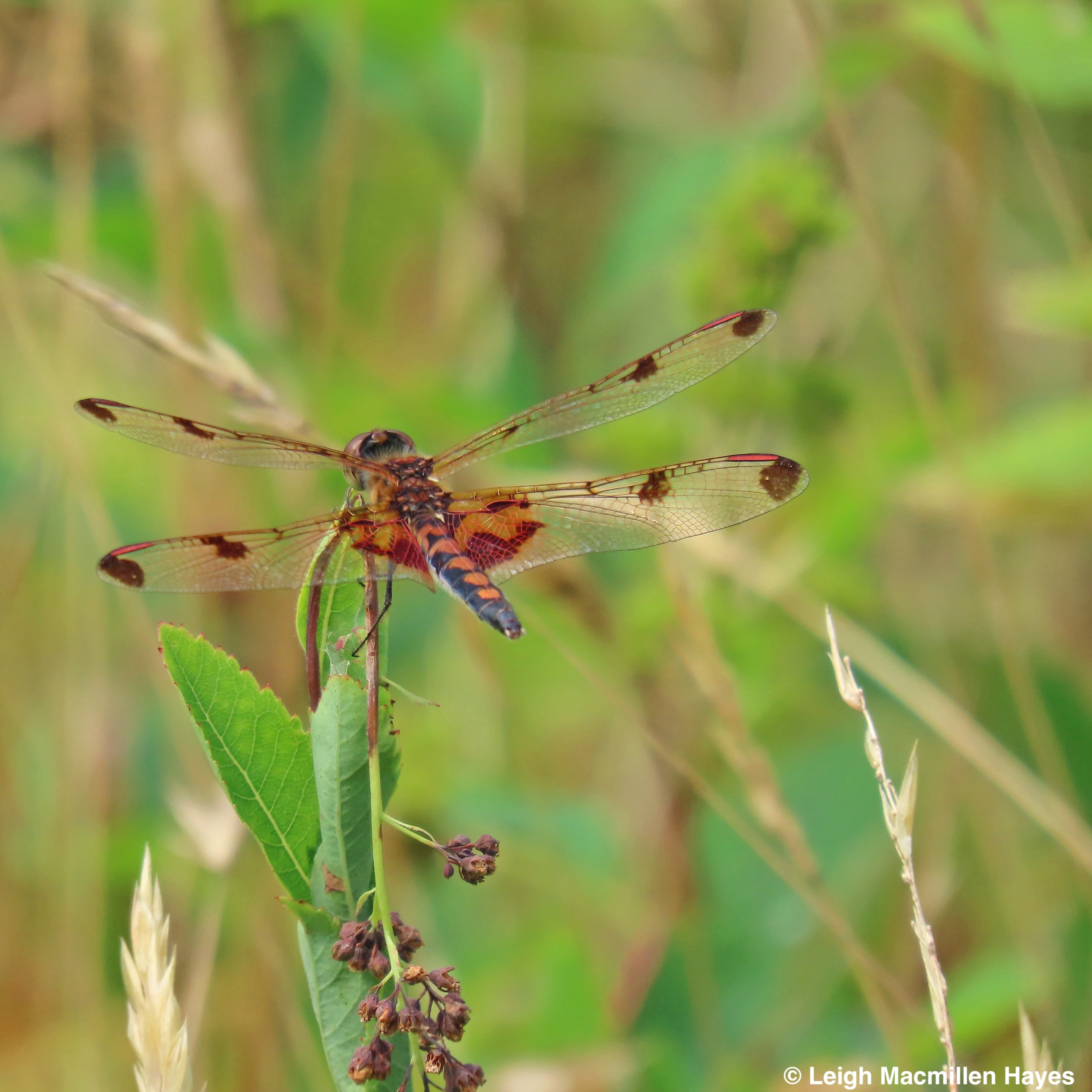
I had hoped to find a date for this male Calico Pennant Skimmer Dragonfly, her coloring would be all in yellow where his is red, but I’m afraid for the moment he’s still single. Maybe one day soon a gal will show up. I know I’ll keep looking.

Along the dragonfly line of field residents, this immature Blue Dasher Skimmer also posed for me. Again, on a Steeplebush, which gives height and vision for those who seek prey.

But some, like this Lancet Clubtail, prefer lower vegetation, and I suspect that’s where most of its meals were found.

My heart skipped a beat when I saw this large orange butterfly and I thought, “First Monarch of the season for me.” Until it wasn’t. This being a Viceroy, so identified by the lines or transverse bands on upper and lower wings. Monarchs don’t have that additional band.

My heart skipped another beat when I spotted this female Jagged Ambush Bug hanging out among the Goldenrod flowers. My, what powerful looking front legs she has. The better to grasp a meal. Can you spot a potential meal in her sight? I saw it, but she never showed any interest while I was watching. Darn. I hoped for a little action.

Believe it or not, the Jagged Ambush Bug can tack down an insect as large as a Bald-faced Hornet, such as this one. I haven’t witnessed it yet, but there’s still plenty of summer left.

Paper Wasps were also making the rounds. And really, the flowerheads fluttered constantly with all the frenzied activity happening upon them.

Even a Great Golden Digger Wasp partook in some of the nectaring collection.

But . . . there was something else I wanted to see. And I suspected that if I really looked, I might have success.

Bingo. It was the white packages at the outer edge of the web that led me to the creator. Charlotte.

I had a feeling Charlotte would be writing messages somewhere in the field.

And indeed she was. Years ago, when I didn’t dare walk into the field because of ticks, I wrote a children’s story about kids coming upon these large Black and Yellow Garden Spiders as they ran through Goldenrod flowers. Of course, that was about 28 years ago and I was starring out the window at the same field I can now walk in.

And because I can now do so, I found Charlotte 2 . . .

And Charlotte 3 who was preparing a meal for later. It looked to be a grasshopper of choice. If I spotted three, can you imagine how many more spiders there are out there?

In my story, if I recall correctly, the young boy character was afraid to run through the field and the young girl tried to give him some facts about Black and Yellow Garden Spiders because she wanted to become an entomologist. I should pull it out of the filing cabinet and reread it, but it’s not one for publication. It was just fun to write.

The reason I can go into the field now is thanks to my neighbors, Karen and Bill. He has mowed a circular trail so she can walk her dogs, and I love it because I can walk my thoughts. It’s a place where I can meet old friends and learn from them, and make new acquaintances.

And right now it’s a place where I can celebrate my new sight thanks to the medical team that performed cataract surgery on both of my eyes over the past two week. Until all of this happened, I had no idea how much I’ve been missing (think road signs and car blinkers for starters–never mind all the little things in nature that I love to spy).

I’m forever grateful for this new field of vision, the nurses and techs and Dr. France of Eyecare Medical Group physically for me, and my neighbors who carved this path as a way to save all those critters, who like me, call this place home. Of course, many of the critters are also a source of pollination for their vegetable gardens.

But I’ve saved the best for last. For I spotted one more critter in the field, and when I got home, it was on the Hydrangea.

This is a White M Hairstreak Butterfly. Do you see the M marking just below the orange on its hindwing? This is a RARE sighting! To be sure of ID, I grabbed Butterflies of Maine and the Canadian Maritime Provinces by Phillip G. deMaynadier, John Klymko, Ronald G. Butler, W. Herbert Wilson, Jr, and John V. Calhoun from the shelf in our study. And there it was: “Status and distribution in Maine: Probably a rare colonist.” Of the five authors, I’ve worked with Ron Butler in the past, so I reached out to him.

After I finally attached the photo (he had to remind me that I had neglected to do that), Ron sent this response:

“Hi Leigh,

Definitely!  And the furthest inland record to date.  Do you post your observations to iNaturalist? If not, can you send me the date and lat-long (or location on a map – I can get the lat-long) for this record?

Thanks – Ron”

According to the comments section in their book, “The White M Hairstreak is an expected and welcome addition to our region’s fauna, with the first adult observation in Falmouth by Doug Hitchcox on 24 July 2018, followed by two more records in 2018 from Rockport (Brian Willson) and Eliot (Bryan Pfeiffer and Josh Lincoln). A female was also recorded from Eliot on 5 August 2020 (John Calhoun), making this the first known repeat occurrence at a Maine locality.

I am in great company. Of course, I’m already anticipating the next edition of the book–haha.

I thank you again, Karen and Bill, for giving me the opportunity to explore the field and to my medical team for making sure my vision is crisp and clear.

Field of Vision indeed!

My Neighborhood Grocer

This week may have changed my mind about grocery shopping. I’ve always felt like it was a bit of a drag. We spend way too much money as we tromp up and down the aisles, and really, if I could just get away with living on popcorn, life would be grand. Brown popcorn for meat, green and orange for fruits and veggies, yellow for cheese, and of course, butter . . . you get the picture.

Plus there’s the fact that we live in a tourist town in the western part of a tourist state. So summertime at the grocery store means a full parking lot, lots of people not sure of their way around, nary a smile exchanged, and certainly very little gossip shared in the middle of the aisle with townspeople we haven’t caught up with in a while.

But, today changed all of that.

For today, I realized that visiting the grocery store is a bit like entering a secret garden with a keen eye.

It’s a place where I might not always choose the same offerings as others, but that’s okay, because in this place we can each find what appeals to us and hover like a hummer.

I discovered a Nectar Smoothie Bar had been added. So many love the new addition and visited it repeatedly on the fly.

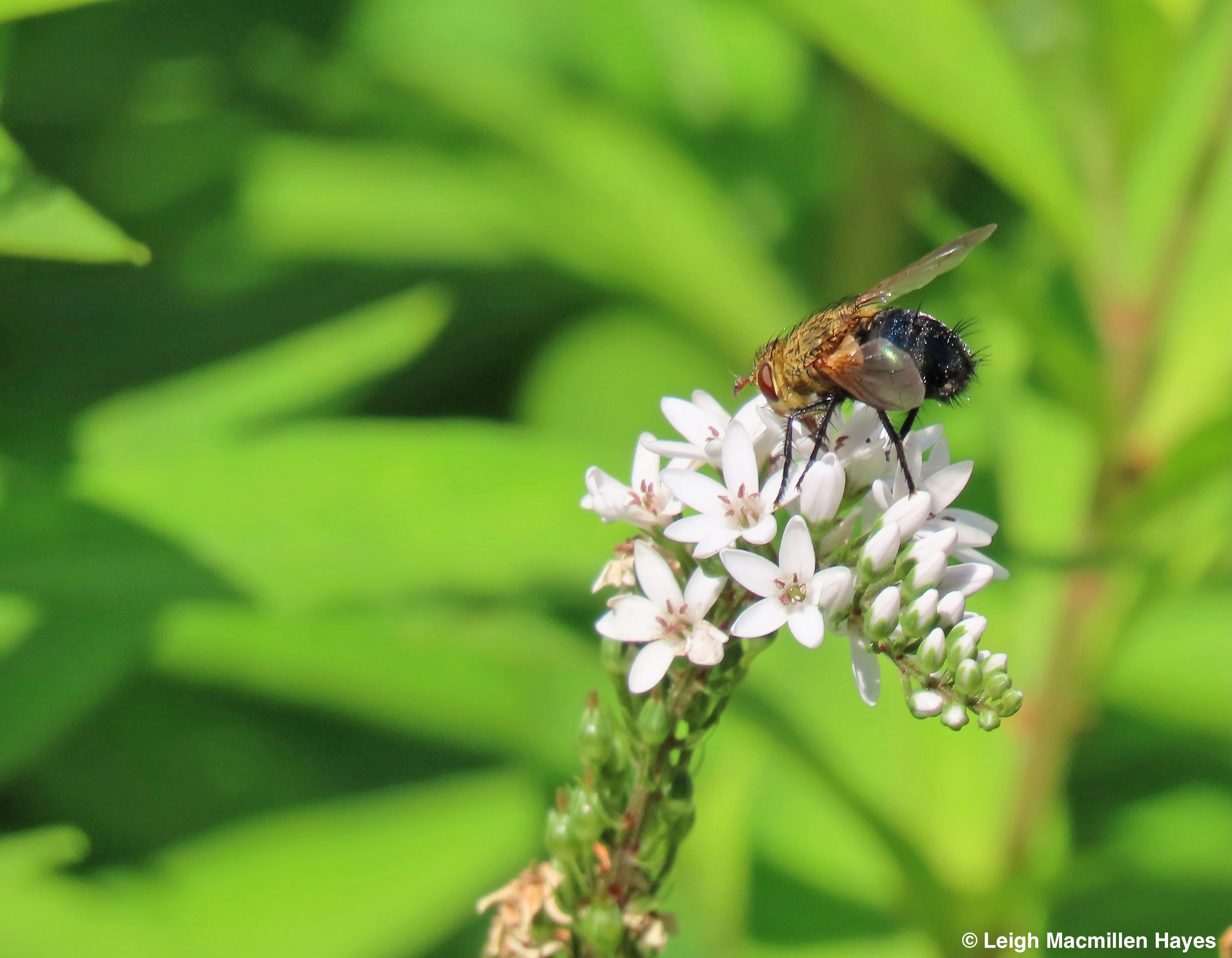
Another good thing is that most who entered, like the Tachinid Fly, brought their own straws so there was no waste.

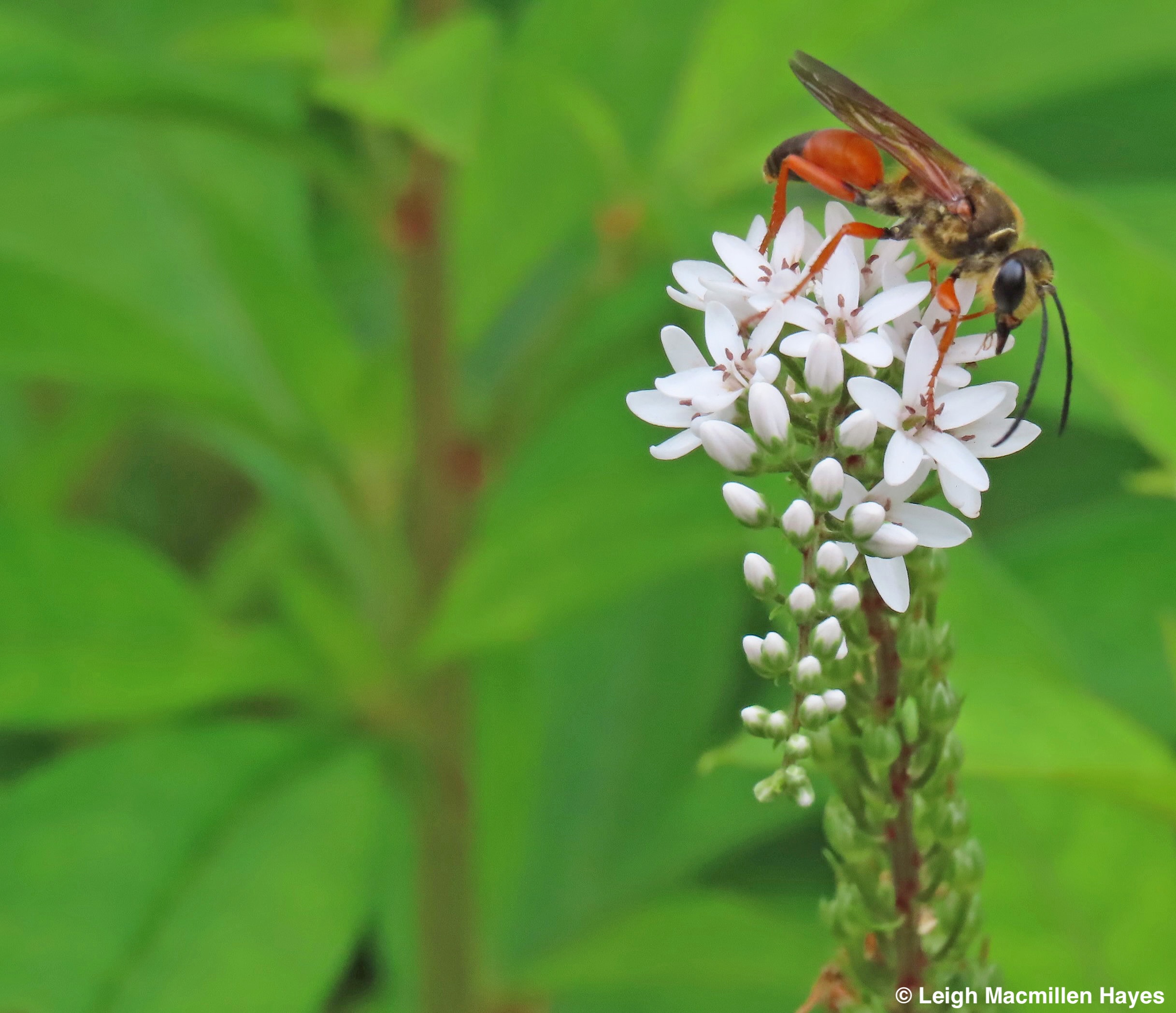
Even the Great Golden Digger Wasp got into the frenzied sip on the move once the store manager announced a taste testing.

I’m pretty sure the word went out to all Northern Crescent Butterflies to stop by for they really did pack the place.

Pearl Crescent Butterflies also cruised the aisles.

And sometimes they were in the same place at the same time, neighbors greeting neighbors after all.

Every Gold-marked Thread-waisted Wasp seemed to want a quick energy drink.

And then there were those like the female Widow Skimmer Dragonfly who came to watch. By the coloring of her wings, I think a better common name for her would have been Sunglass Skimmer. Certainly, she might have had an easier chance of meeting a date in aisle five, rather than just hanging out along the edge of the store.

Unfortunately, there were a few uncouth customers such as this Robber Fly, who snagged a meal without paying.

The Robber Fly wasn’t the only one. A spider hiding under a bouquet managed to lure an American Lady Butterfly and then he did what spiders do and stunned her. The EMTs where called in and though they could get her out of the web, they couldn’t save her. So, her body is being donated to science and will be added to a bug collection of a young boy I recently met.

I chuckled at the bedraggled look of this Bumblebee, who didn’t realize the misters would come on in the produce section.

Though there are plenty of Japanese Beetles who seem to shop constantly, so far, I only meet one Oriental Beetle, and I do have to say I was rather taken by its fan-shaped antennae.

As is usual, there’s always a slow slug in the way, especially at the check-out. Why is that?

Not all shoppers stood out, such as this Green Lacewing who appeared to be hiding. Perhaps to avoid the misters that had pummeled the Bumblebee.

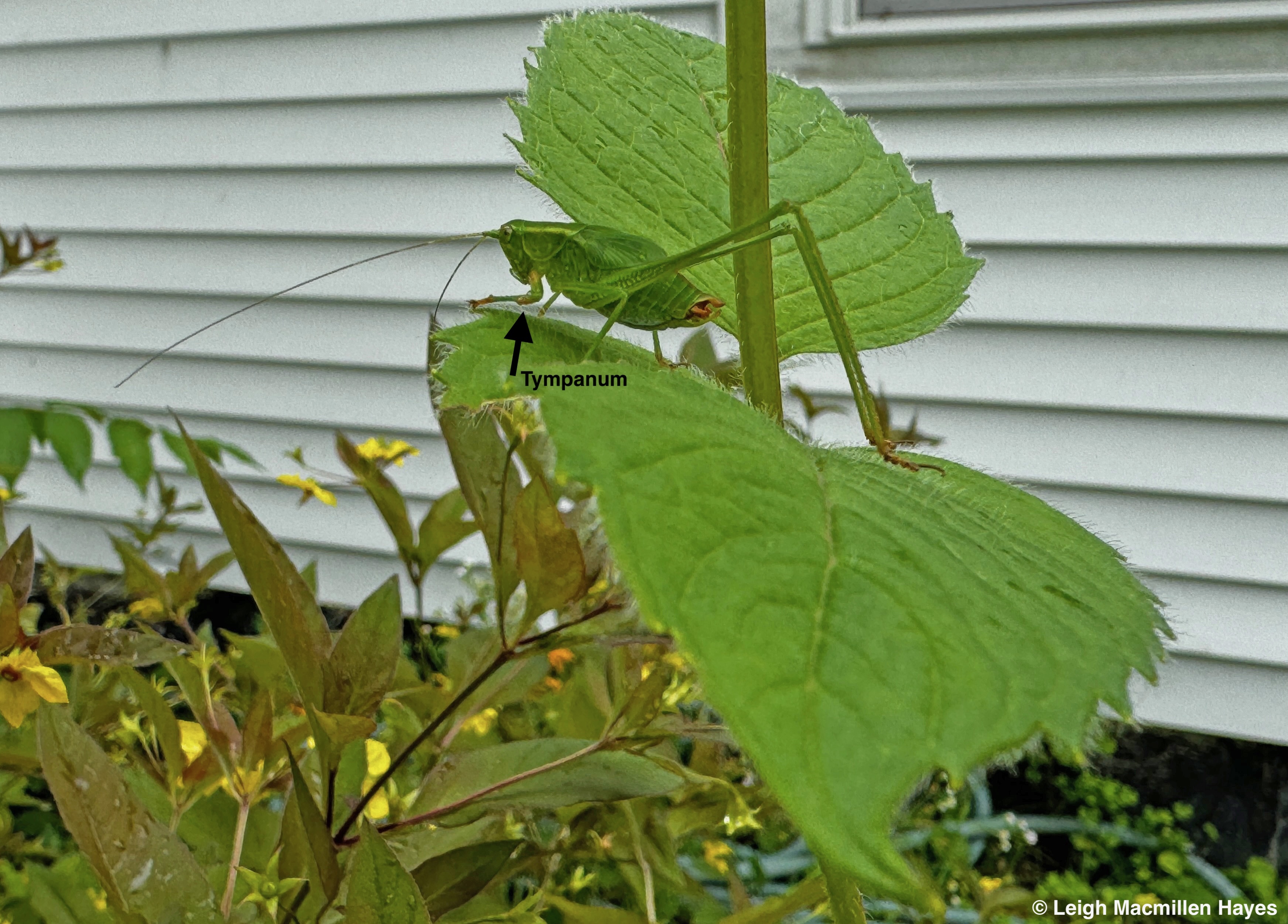
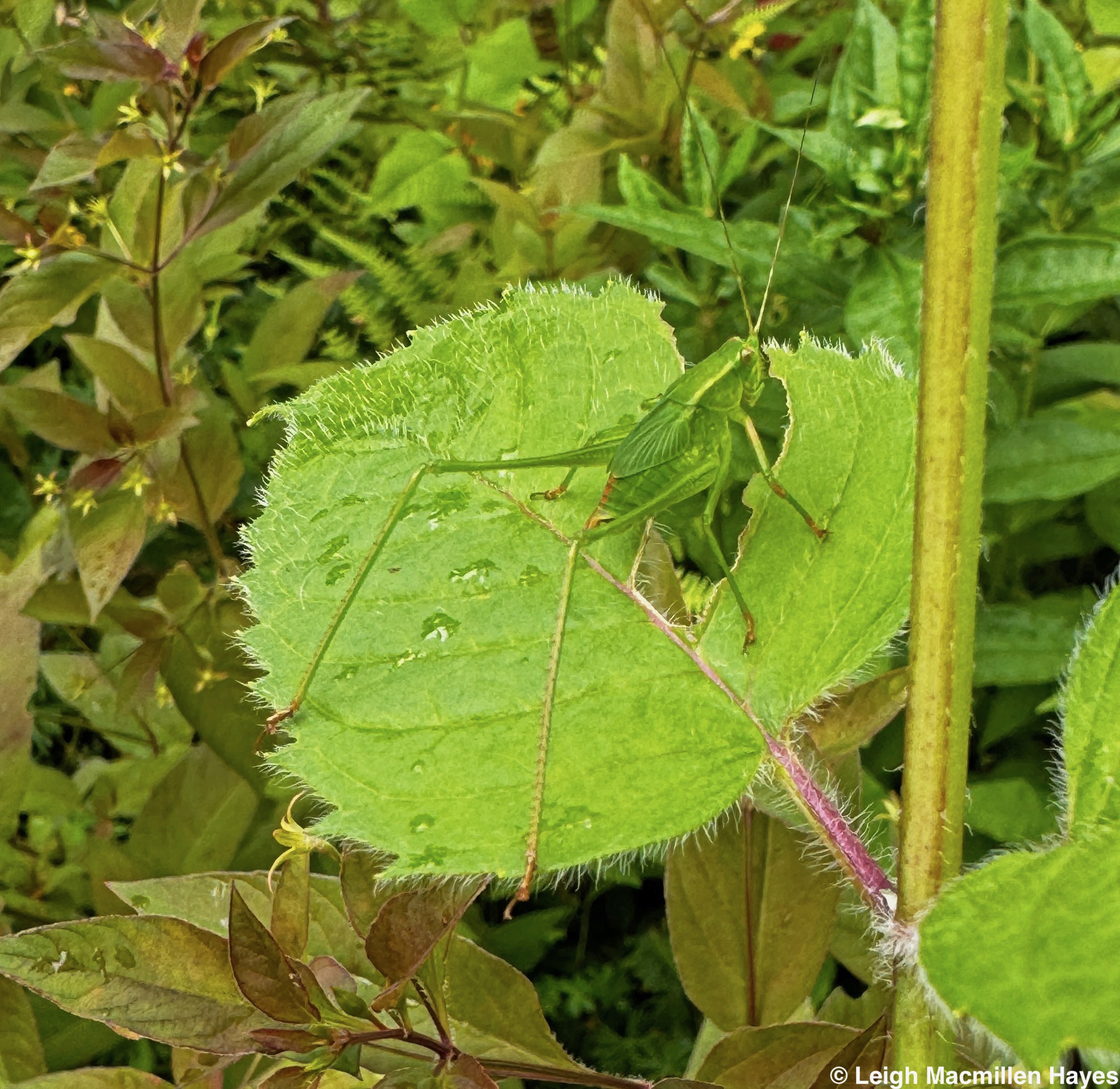
It does seem there’s always a celebrity or two in our midst during these summer days. Sometimes, it’s someone like Stephen King or Lois Lowry. But today it was Katydid. And she was listening–through the “ear” or tympanum located just below the “knee” of her front leg.

Do you see the tympanum on her right side? Do you think she heard that there was a spill in aisle 4?

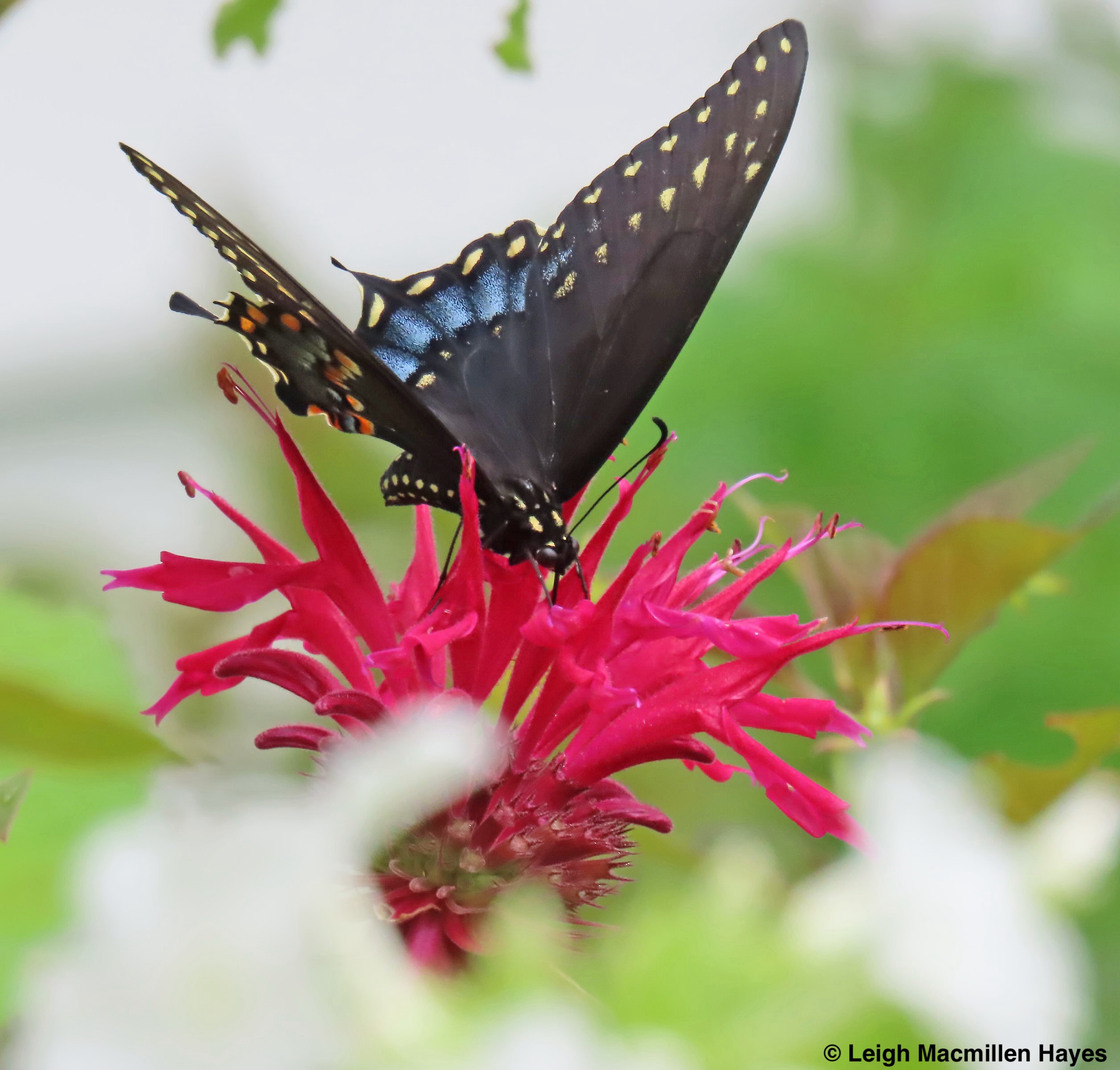
The Black Swallowtail Butterfly certainly heard and in she fluttered to sip up the nectar before it spoiled.

Oh boy. The Gold-marked Thread-waisted Wasps seemed to find each other in aisle 7 and for all I know they may still be canoodling behind the bakery.

So you see, grocery shopping isn’t all errands and drudgery. Note to self: Think of it instead like a visit to the candy store. Stop and sample along the way. Smell the Phlox. And remember, the store is committed to providing customers like you and me outstanding value for quality products at every day low prices. Right?!

I hope you’ll visit my neighborhood grocer often and enjoy the experience.

Man & Nature: Why Can’t We All Work Together?

I absolutely love it when the unexpected occurs and nature takes me by surprise and provides me with jaw-dropping opportunities. So here’s the thing. What is unexpected to me is an every day or every year occurrence in the natural world. It’s just that on that one day I happened to be in, as the saying goes, “the right place at the right time.”

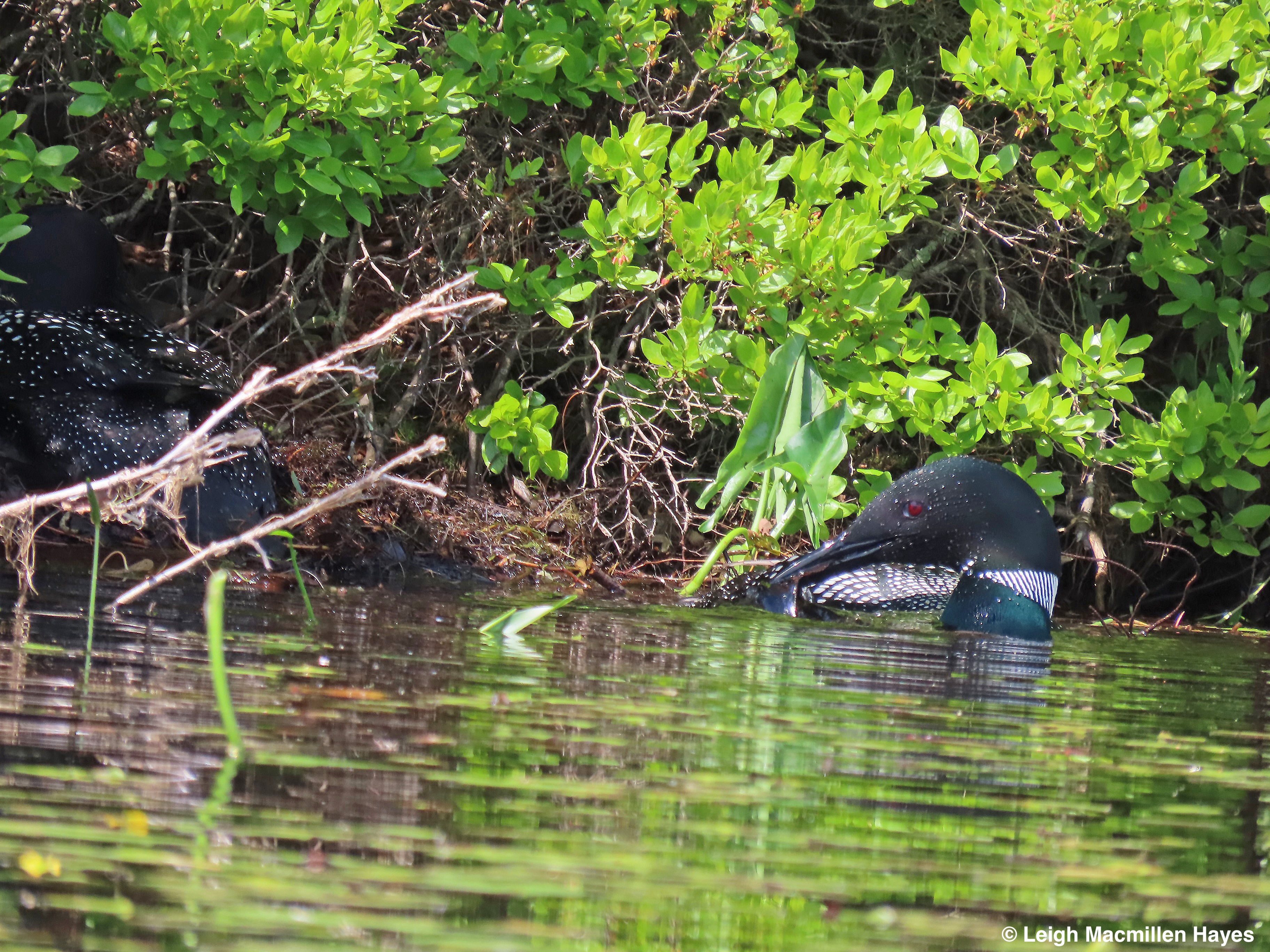
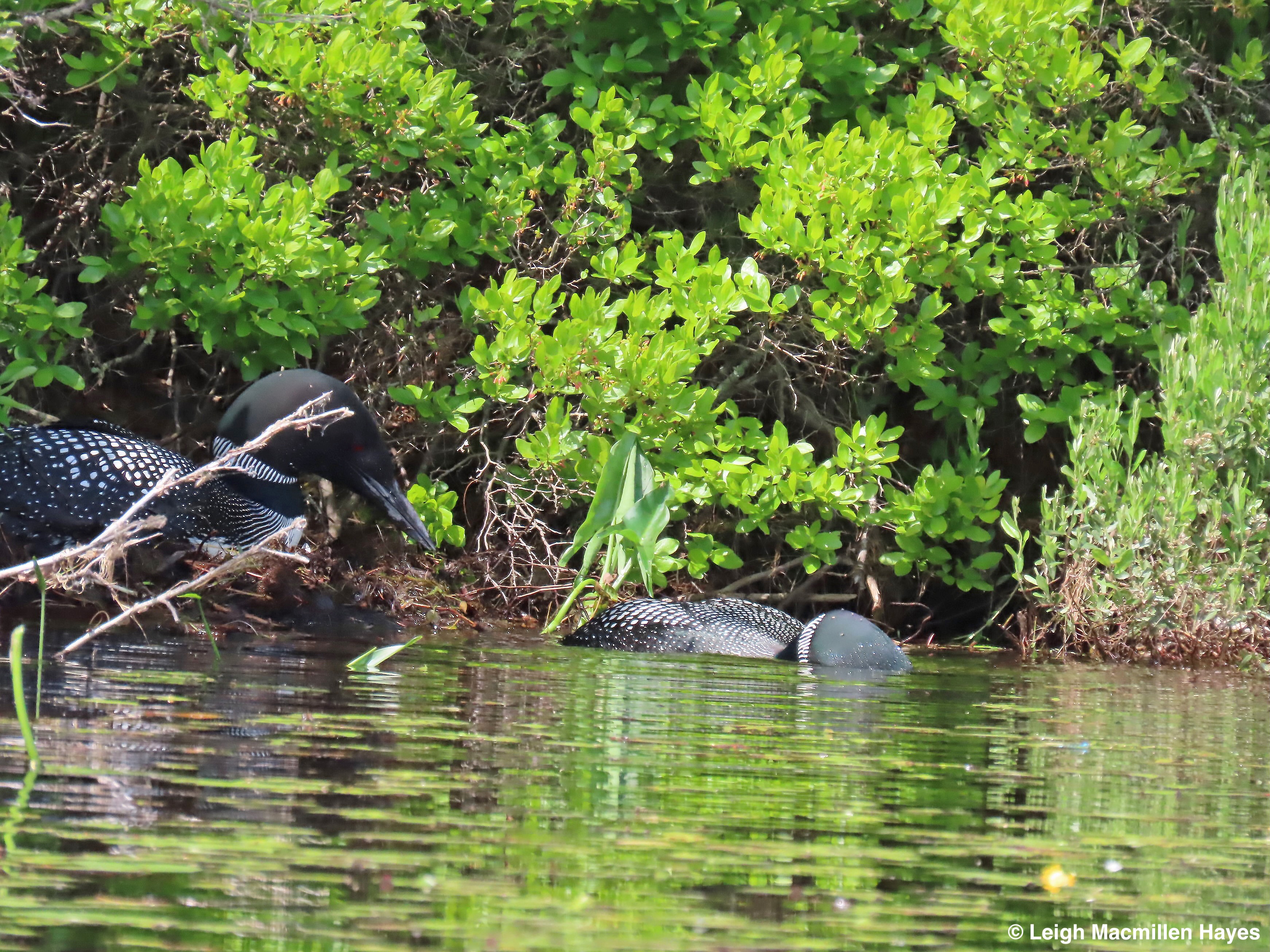
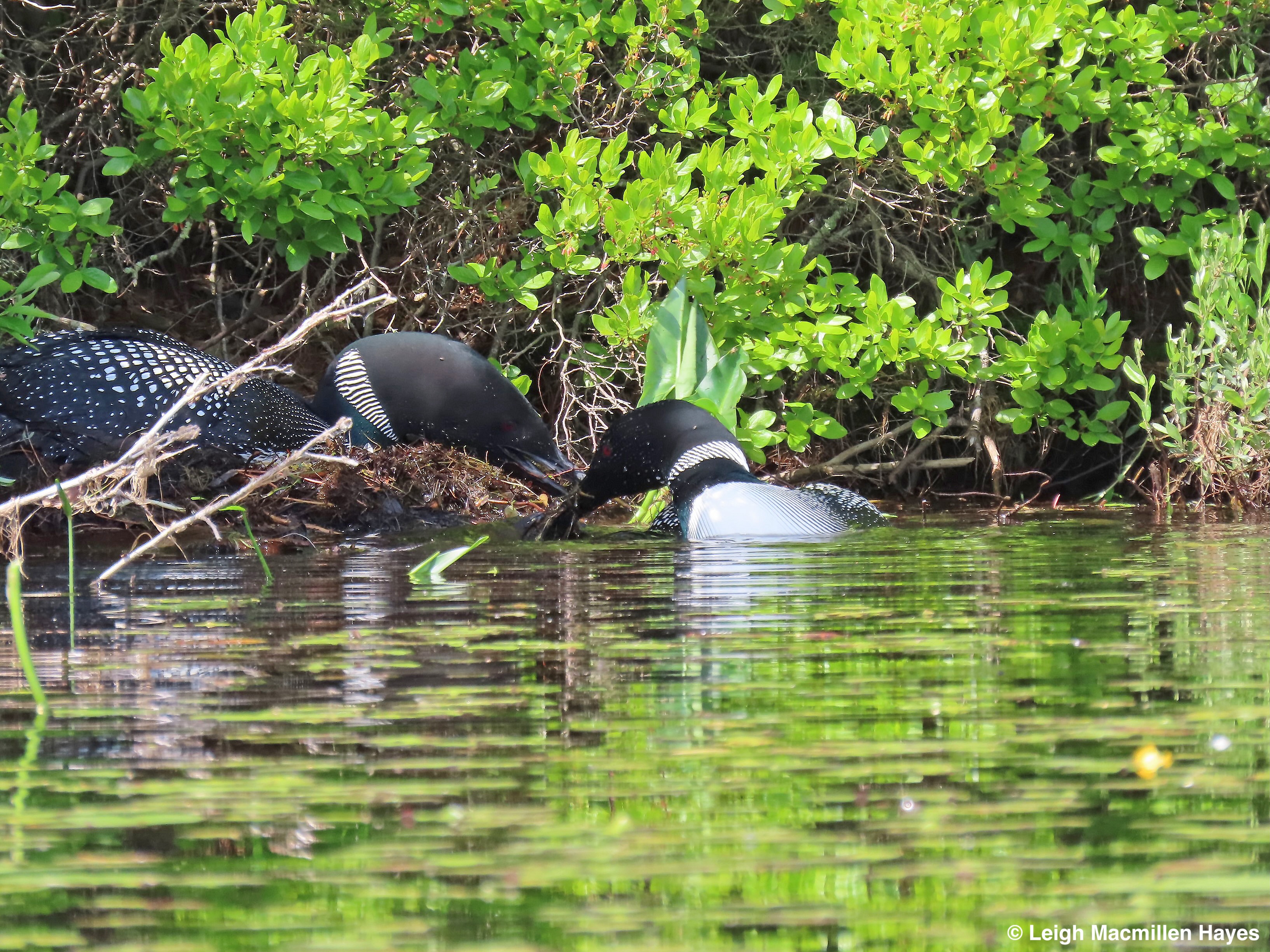
And so it was that during June I paddled between two islands and slight movement caught my eye. Mind you, I was a telescopic camera lens away from the action and so what may appear close, wasn’t. I’d unexpectedly happened upon two loons. Okay, so the truth be told, My Guy was the first to witness them. He pointed in their direction and then the two of us sat in our kayaks and watched.

This was a first for both of us. To observe as one loon pulled nesting material from the pond . . .

and dipped to gather more . . .

and carefully “handed” or rather beaked it over to the other . . .

who, in turn, received it . . .

and added it to the nest.

And so the nest building continued, but we’d seen enough and knew we needed to paddle away and leave them to their business.

A couple of weeks later, as My Guy explored the pond’s perimeter, I took a few moments to check on the nest and much to my delight, found a loon sitting on it. Notice its open mouth? I say “its” because I don’t know if this is the male or female and do know that they take turns incubating the eggs.

Notice how the loon’s mouth is open. Much like a dog pants to cool down, so do loons. According to National Audubon, “When it’s hot, some species will resort to gular fluttering. The bird will open its mouth and “flutter” its neck muscles, promoting heat loss (think of it as the avian version of panting).”

I’ve seen the same behavior in other birds, including Great Blue Herons.

It’s been an extremely hot summer, even here in the north country. In fact, the water temperature of our local ponds and lakes is way too high. It should be in the 70˚s, but instead is in the 80˚s and not at all refreshing for us, so I can only imagine the adverse effects it is having on flora and fauna.

The day after a pond association meeting this past weekend, My Guy and I hit the water again. While I was drifting for a while, numerous insects sought my boat as a landing spot. And then, this Scarlet Bluet landed, plastering a meal to the side of the boat.

It was a mighty big and juicy looking meal for this little damselfly to consume. He (his female counterpart is yellowish where he is so scarlety orange) dined for at least twenty minutes as I watched, and then I think it was more than he could handle, and off he flew, leaving the remains for me. I was starting to get hungry, but . . . not that hungry.

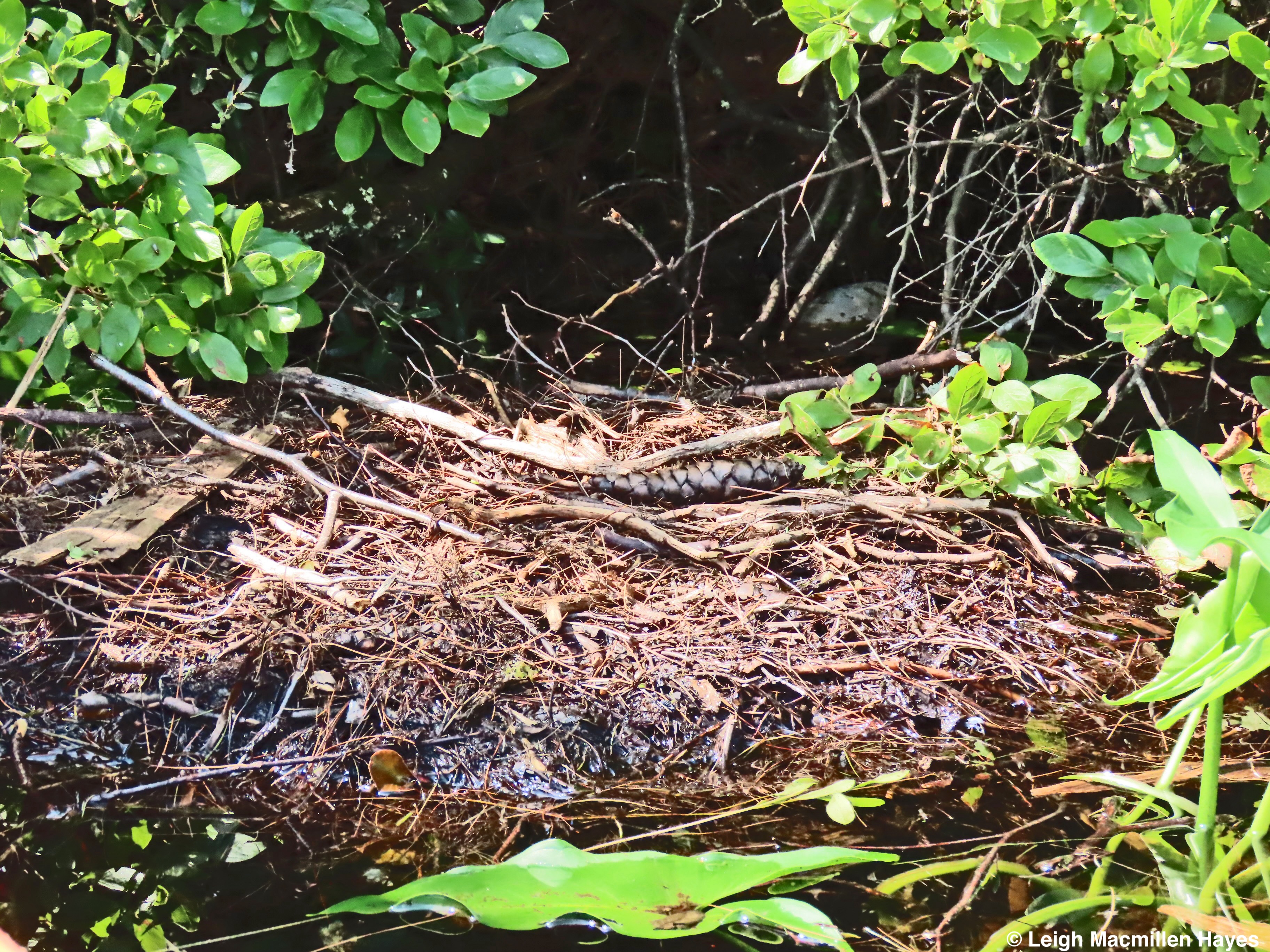
Once he departed, I made my way back toward the loon nest. As I suspected, it was empty. Usually, the local loon chicks hatch around the fourth of July (never a good mix with fireworks–think about noise, oh, and added pollution to the pond water).

BUT . . . then I took a closer look and this time I did get close because it was empty. Here’s the thing. About two weeks ago we had a major storm that didn’t last long, but deposited a lot of water. That seems to be the pattern of late. And I’d learned at the association meeting that the dam which controls the water level for this particular pond hasn’t been opened as much as usual and some people have water either directly under their docks or just over them. Ours is a floating dock, so it’s not an issue for us.

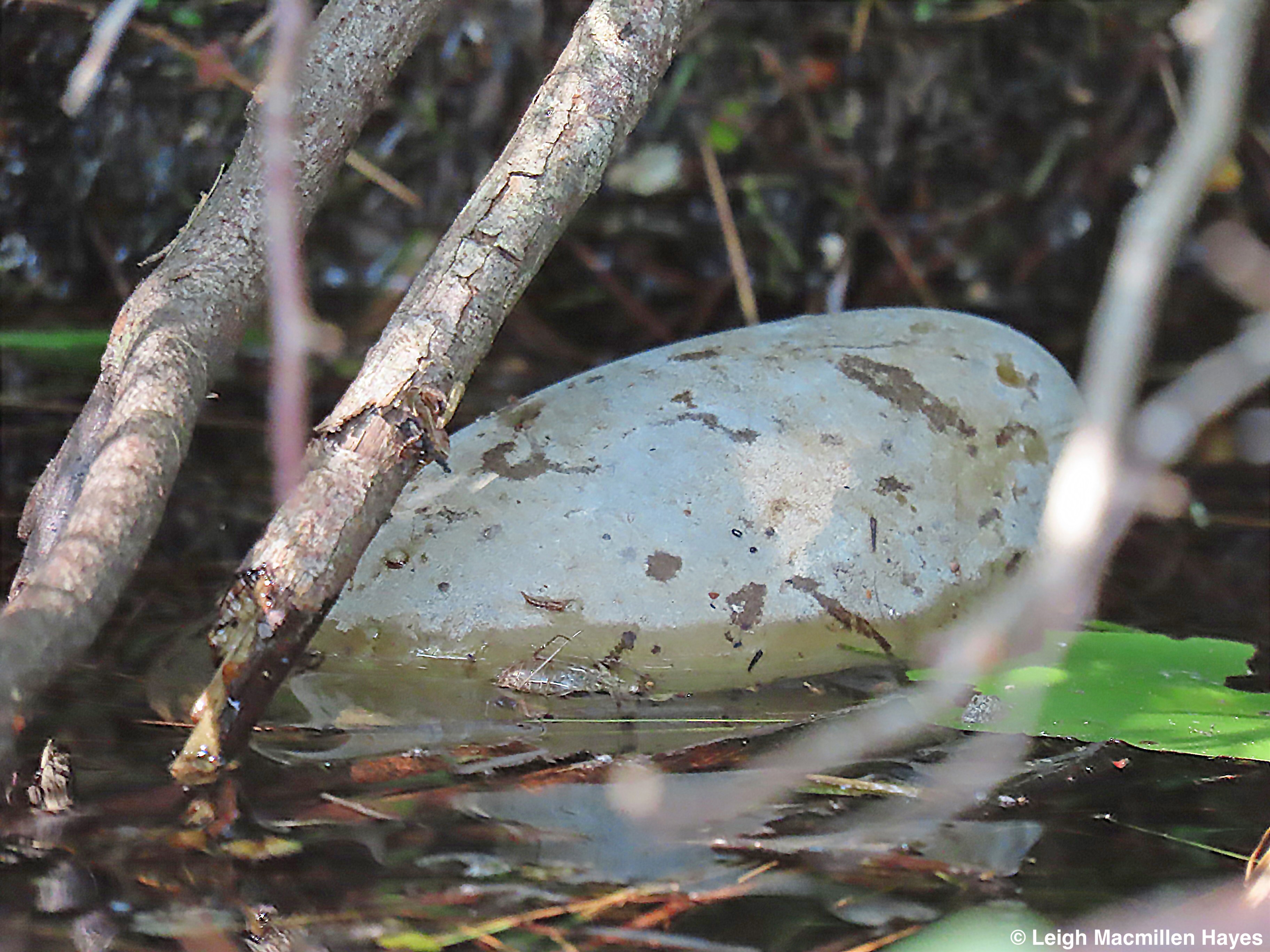
All that said, I spotted water behind the nest. And something in the water behind the nest.

A loon egg. That could probably mean that during that storm a couple of weeks ago, the nest was swamped, the adult abandoned it, and the egg floated off. It was a sad realization. I had to remind myself that nature happens.

In this case, it happened twice, for as I looked about, I saw a second egg off to the right of the nest.

Two loon parents who worked side by side to create a home.

Two loon chicks who never had the opportunity of life.

A dam that is controlled by a local government, and has a new dam tenderer, but it is also controlled by another entity father downstream, in the form of a hydroelectric power plant.

I shouldn’t blame them. I know that things don’t always work out the way we think they should. But still.

Man versus Nature; Nature versus Nature. Why can’t we all work together?

The Summer That Is

I was afraid this would be the summer that wasn’t. In the gardens, that is. Oh, and I use the word “garden” loosely, as mine are more a hodgepodge of flowers and ferns and herbs. But they are meant to be a safe haven as well, for birds and bees and even voles. And yes, woodchucks and porcupines.

Anyway, for a few weeks, as I walked about our property, it seemed there was hardly an insect visiting any of the early flowers–except maybe the Black Flies and Mosquitoes, and even they weren’t abundant this year. Gnats. Now that’s another story.

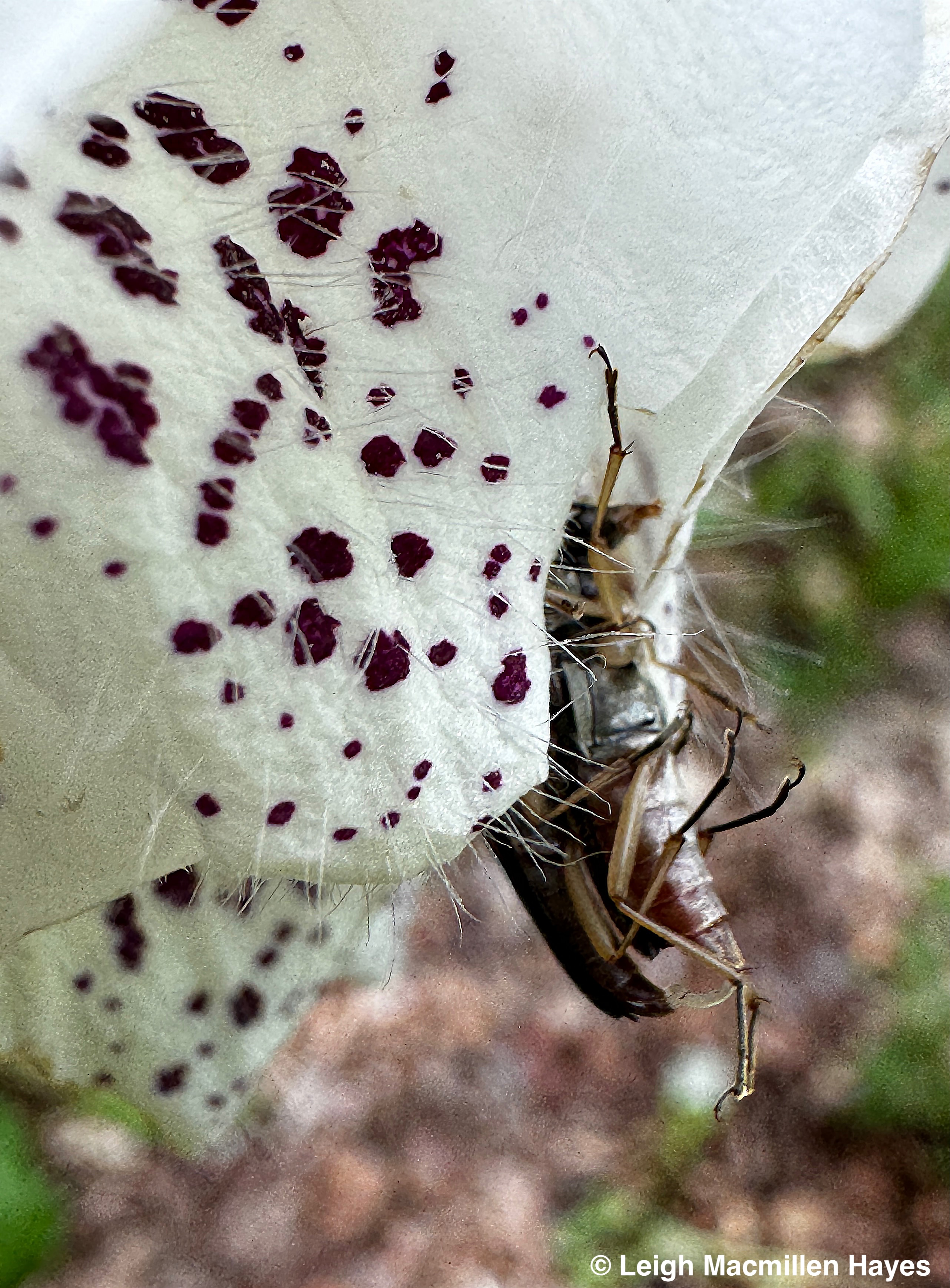
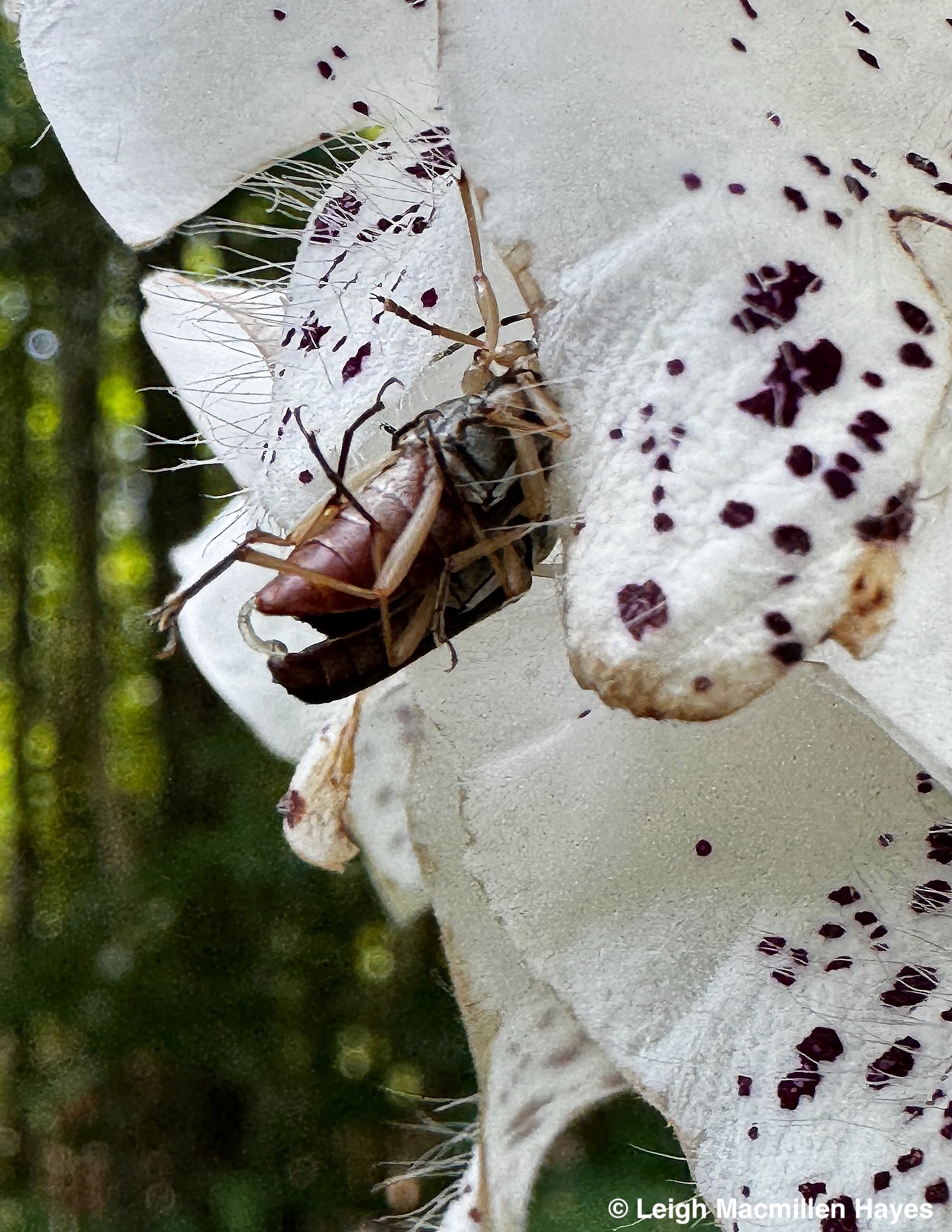
And then the other day I noticed an Ant scurrying across the Foxgloves where two Long-horned Flower Beetles were in full embrace.

Not only did I have insects to watch, but canoodlers at that. With what looked like a dozen legs in the mix. Ahem. Cuze there were, each insect sporting three pairs on the thorax.

These two had nothing to hide and so I watched until eventually they split up and went their separate ways. I only wish I knew where she laid her eggs.

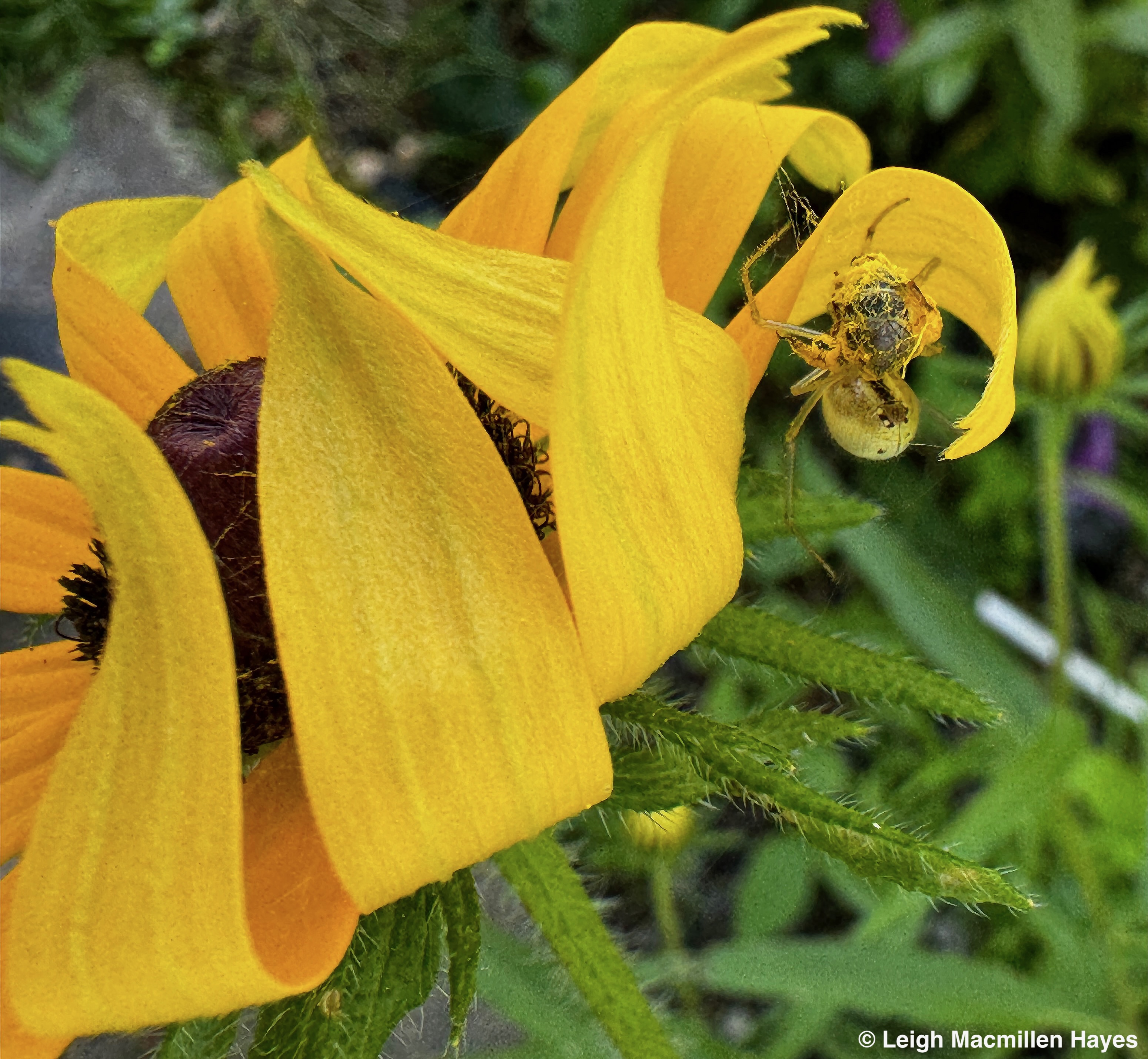
On the edge of another homespun garden, I spotted a Common Candy-striped Spider with a meal sac all packed up, the meal being a bee that seemed like it was probably much larger than the spider. But the spider didn’t care. Meanwhile there was another bee seeking nectar and I worried about its future.

And then Candy-striped started toward the live bee and I worried even more.

As you get a closer look at C-s, you may question the name. I did. My research turned up the fact that this egg-shaped arachnid can have an abdomen of varying colors from white to cream to green, and maybe even red. As for the stripes, there are those with broad or v-shaped stripes, but also my friend, who sports rows of dark spots.

The second bee flew off before being snagged, but if you look closely, you’ll see that C-s’s web is a tangle of threads and it had probably pulled down the flower petals to create a good hiding spot from which to snag its dinner.

As for that meal, it needed to be wrapped again . . .

and again, in an act to immobilize the prey and store it for a later meal. Kinda like a doggy-bag, of sorts.

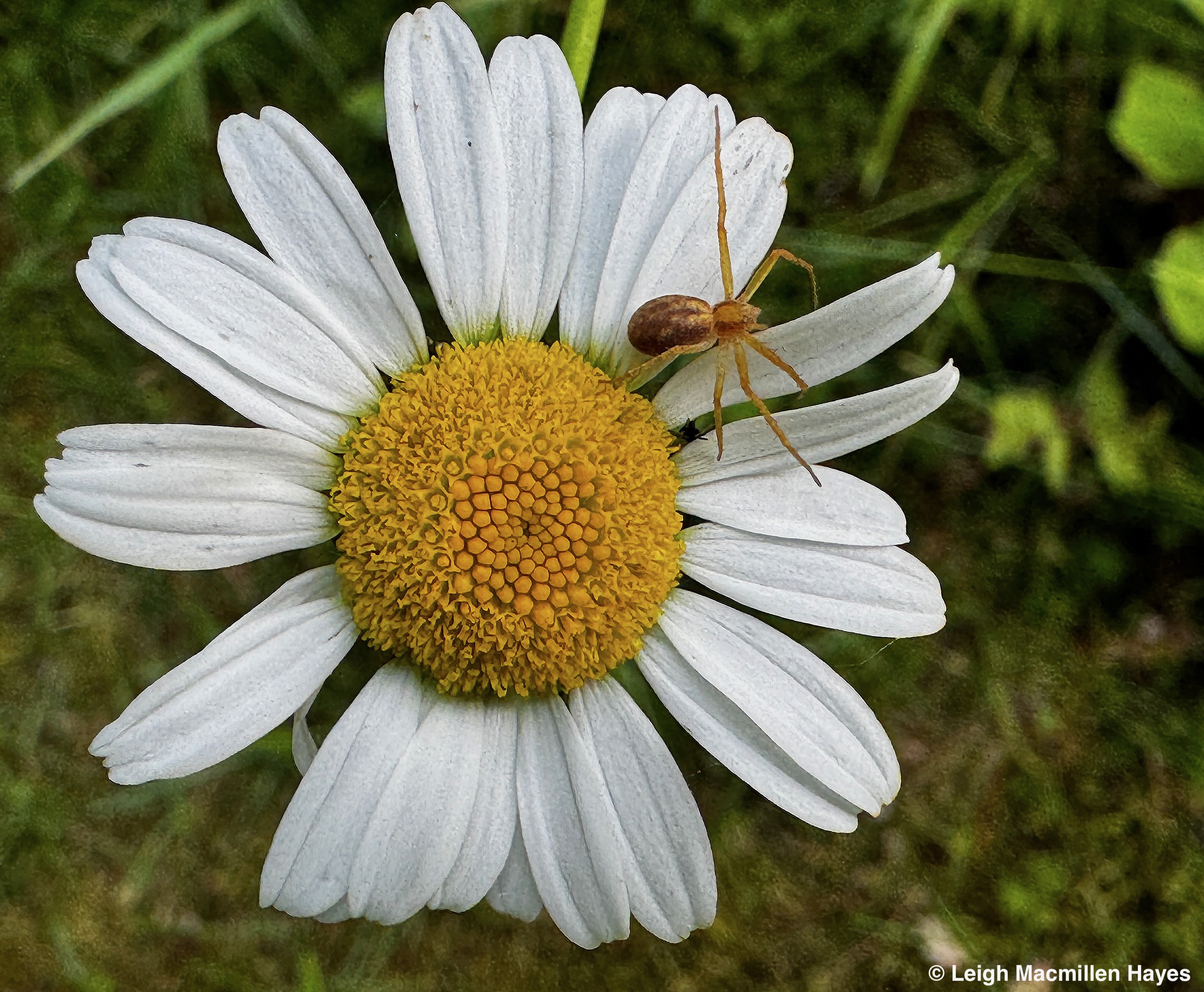
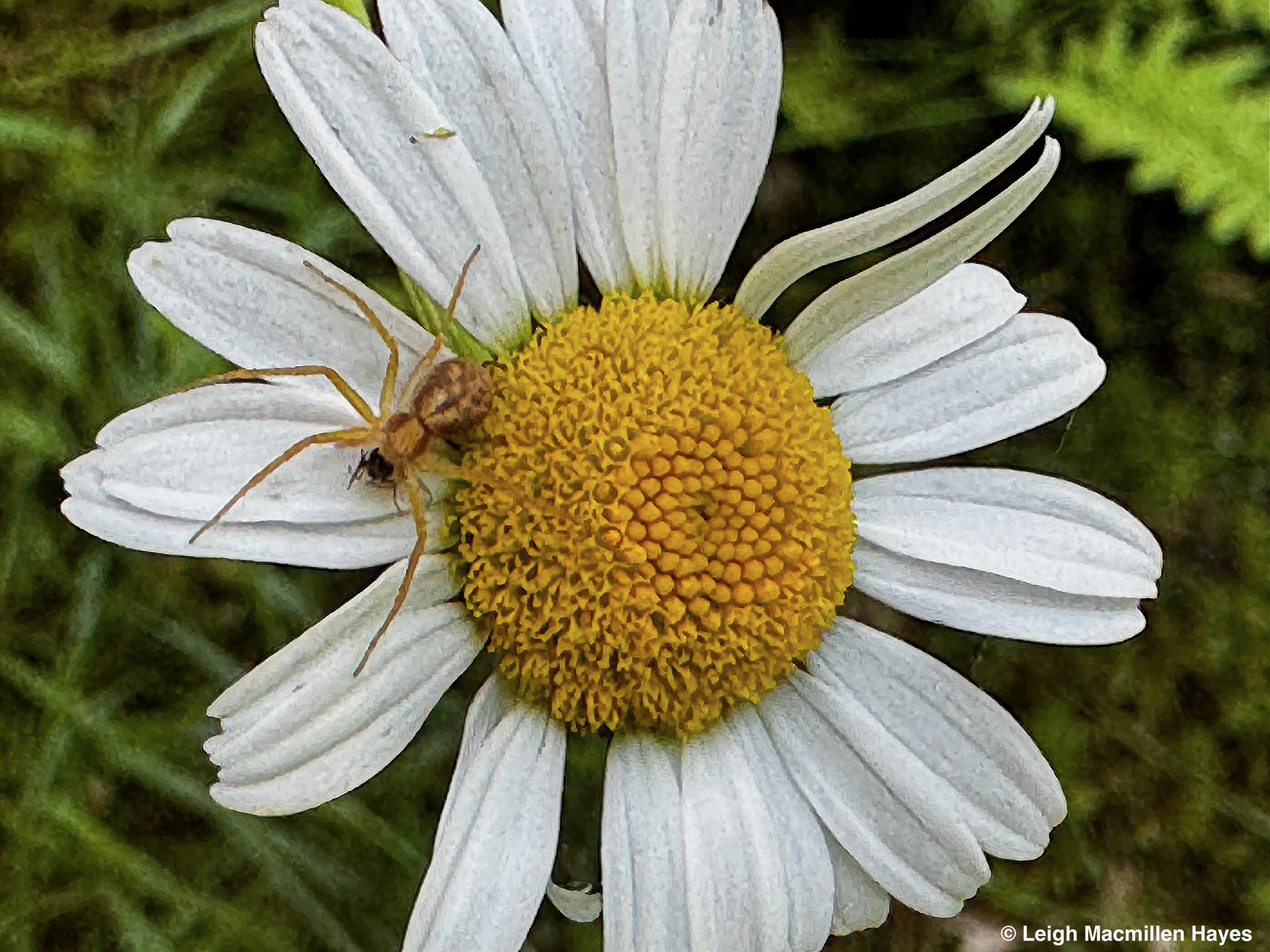
Back in the first garden, I found a Crab Spider hanging out on a daisy.

And then watched as it turned and pounced, yes literally pounced, on a tiny Gnat-sized fly. Rather than wrapping this tiny source of protein, the spider grabbed and bit it in ambush style.

In my own garden-visitation style, I circled and circled and moved on to another and then returned to circle some more. For several days on end.

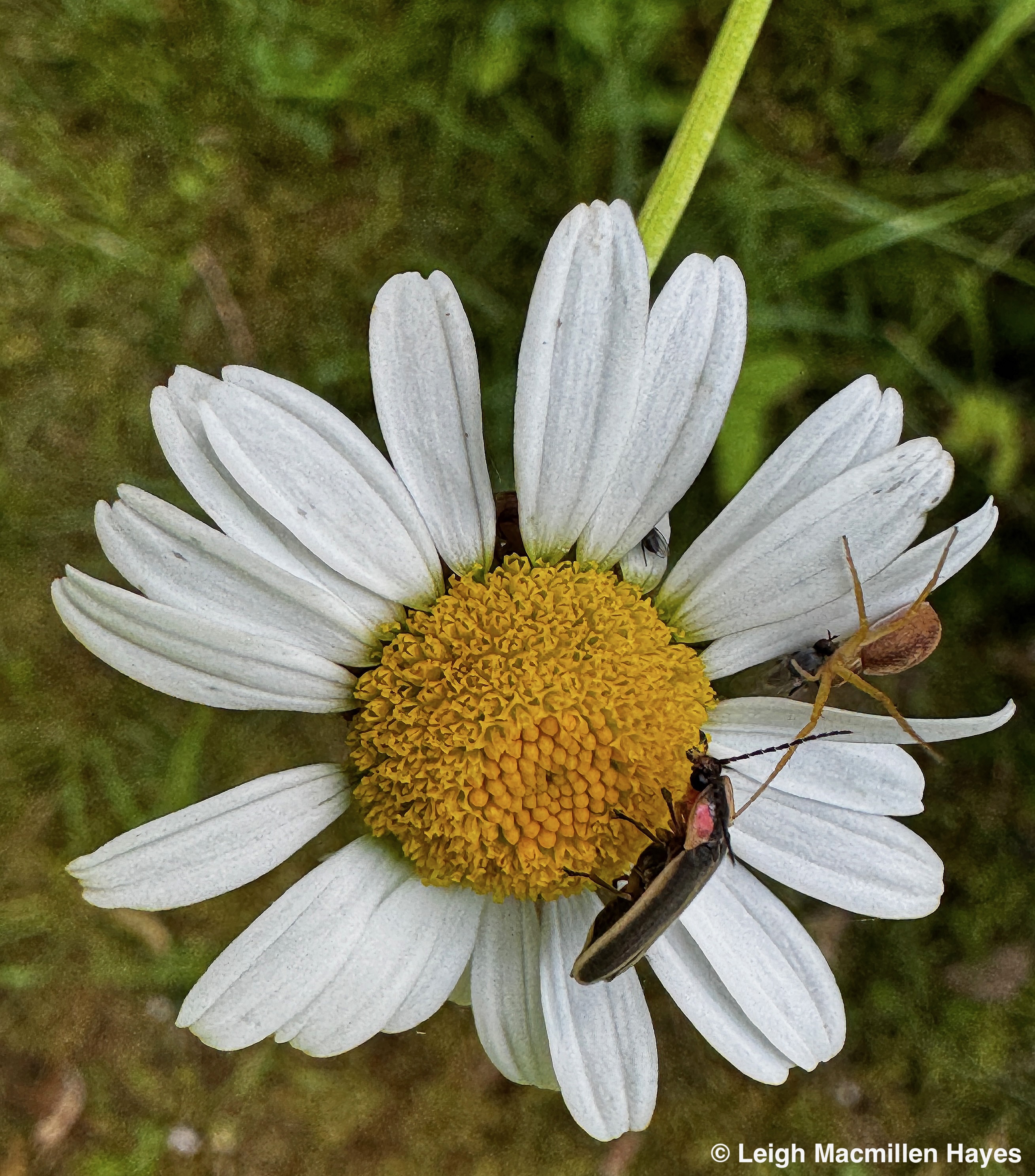
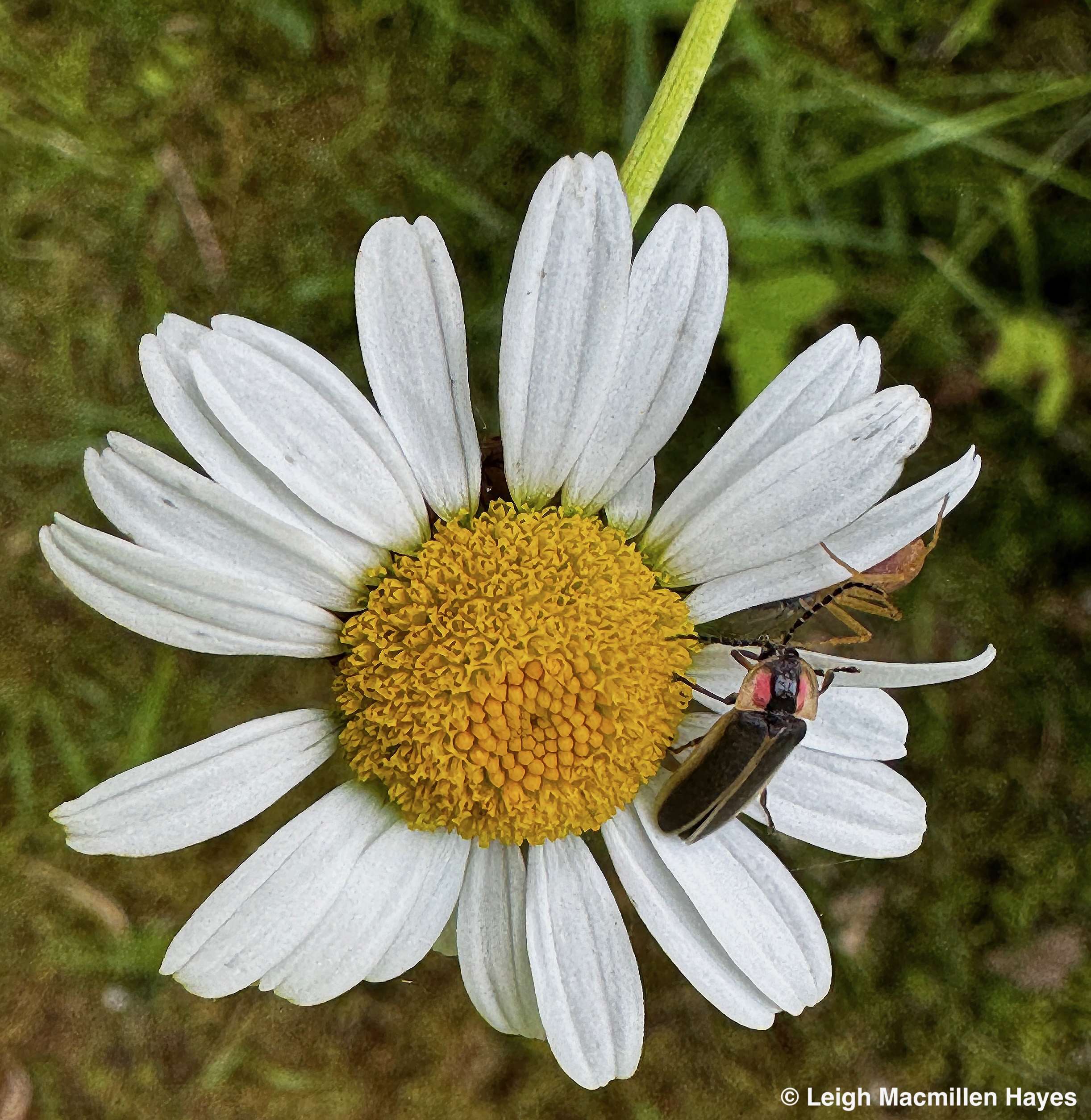
And with each circle, there was so much more to discover, like this Firefly visiting the same daisy where the same Crab Spider waited.

I must interrupt the garden saga here to say that every night of late, we have enjoyed the Firefly Show, an event that has been missing or greatly diminished in the past, but now has ramped up almost to the point of my childhood memories. Almost.

I could say that as I watched the insect and spider played a game, but it was hardly a game at all. Notice how the spider tapped the Firefly.

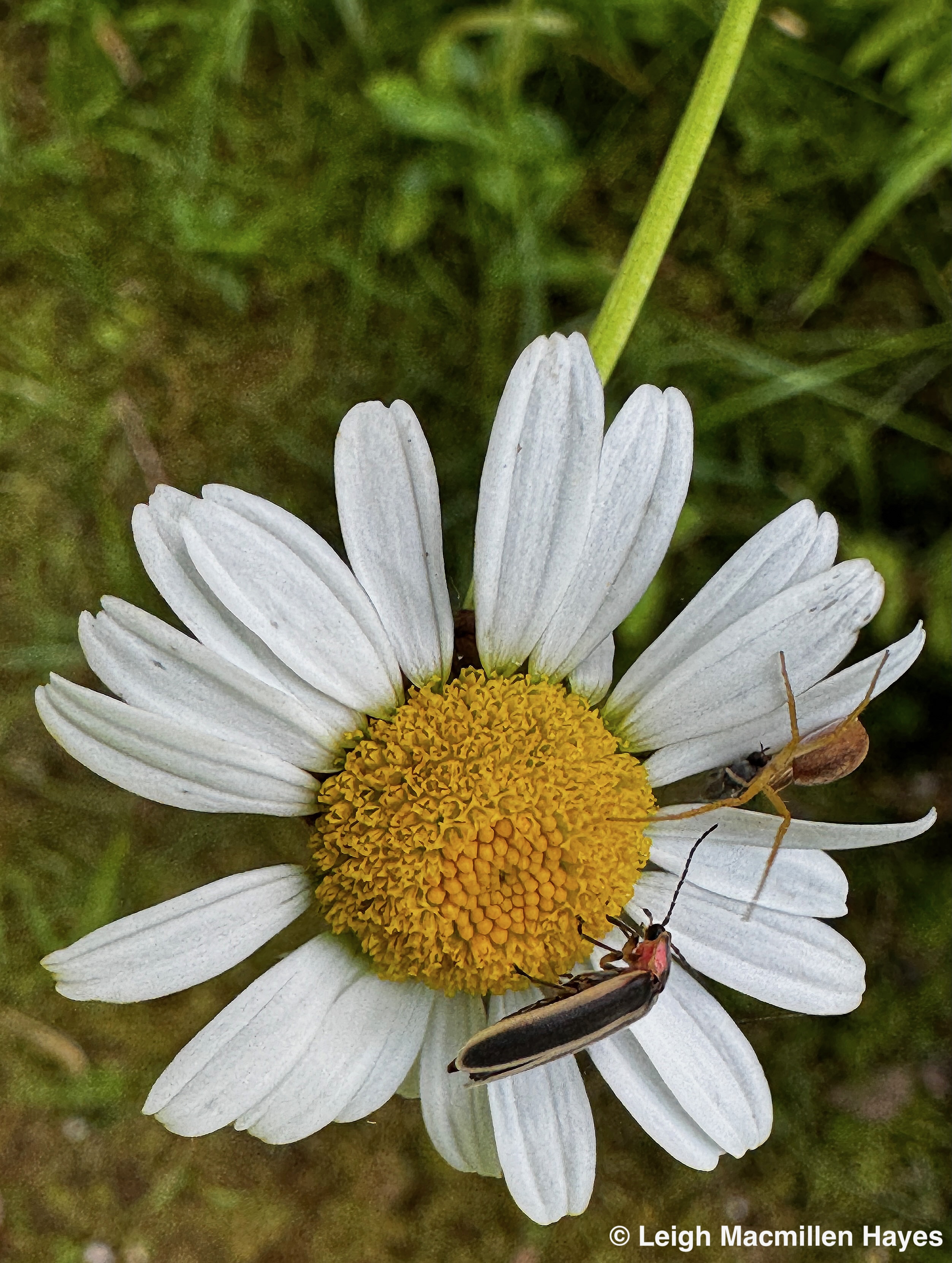
A brief retreat with the spider appearing to stay still (a skilled hunting technique), while the Firefly continued to probe.

And then the Firefly advanced. I wasn’t sure I could watch what would happen next for I knew how quickly the spider could pounce. Yet, I did. Watch that is.

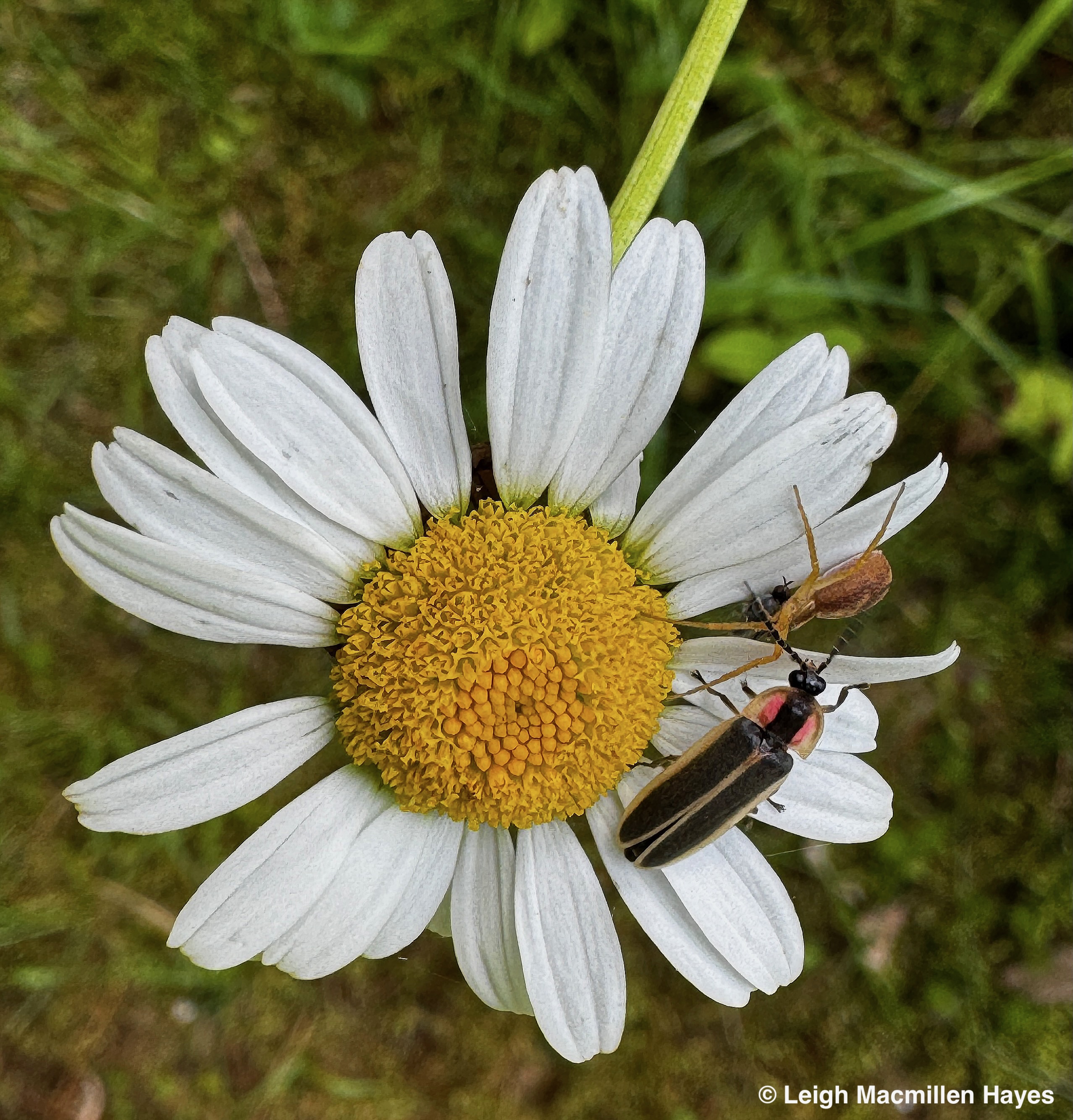
And I’m so glad I did, for what I observed was the spider retreating. Was the Firefly too big for the spider? Or was there another reason to avoid capturing what I thought looked like a fine and chunky meal? Whatever the reason, I was happy to see that the Firefly didn’t meet its demise.

The last I saw of these two before the Firefly flew–the spider went back into hiding and the Firefly moved to the opposite side. I knew relief in my human form, but had no idea again of the answer to why.

Meanwhile, back at C-s’s hamper, I couldn’t find C-s, but did find the remains of another meal consumed. It continued to amaze me how C-s didn’t care about the size of its prey, while the Crab Spider seemed to have a preference for smaller meals.

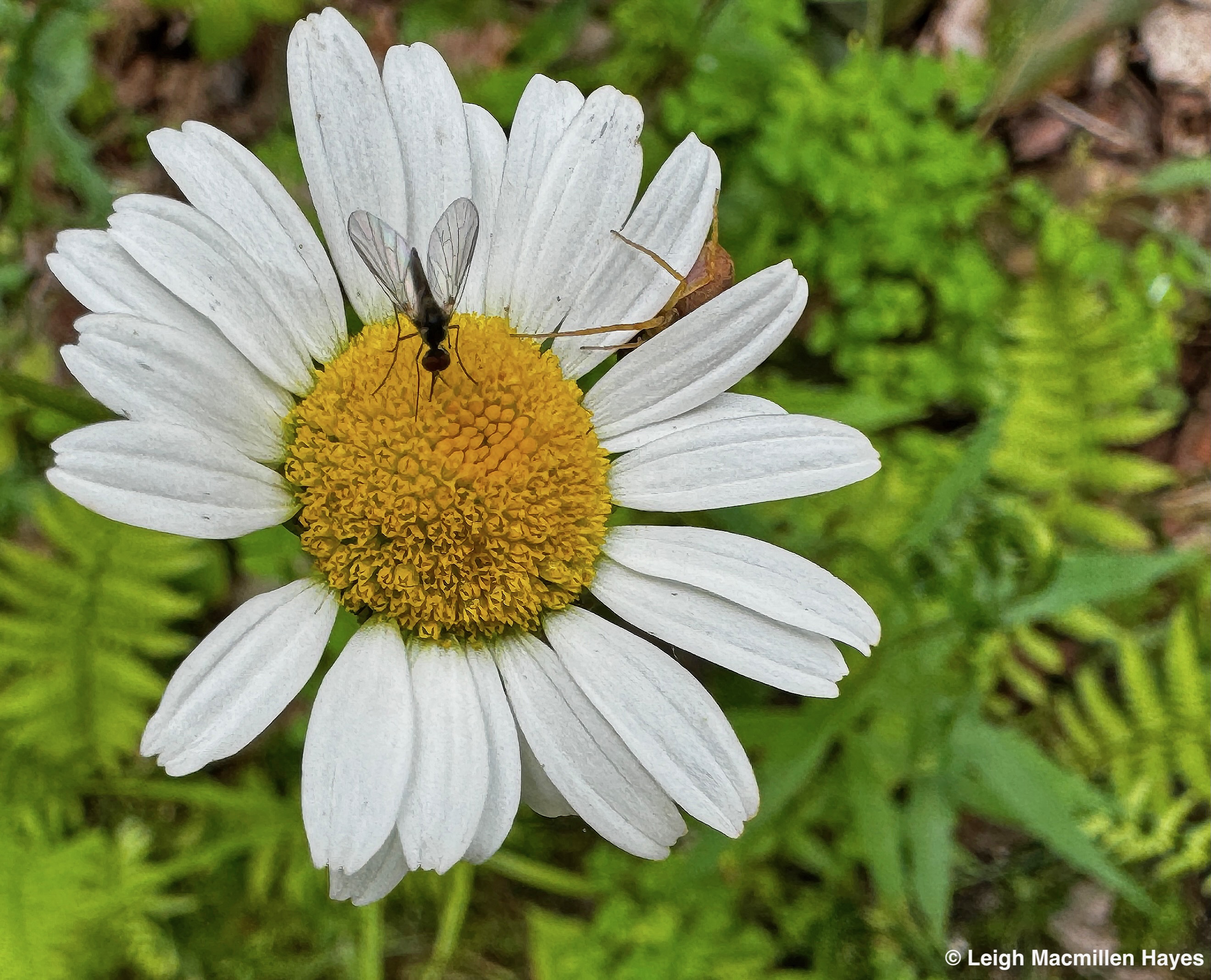
On day 3 or 4, I found the Crab Spider in its usual spot as a Flower Fly with a strong proboscis sipped nectar.

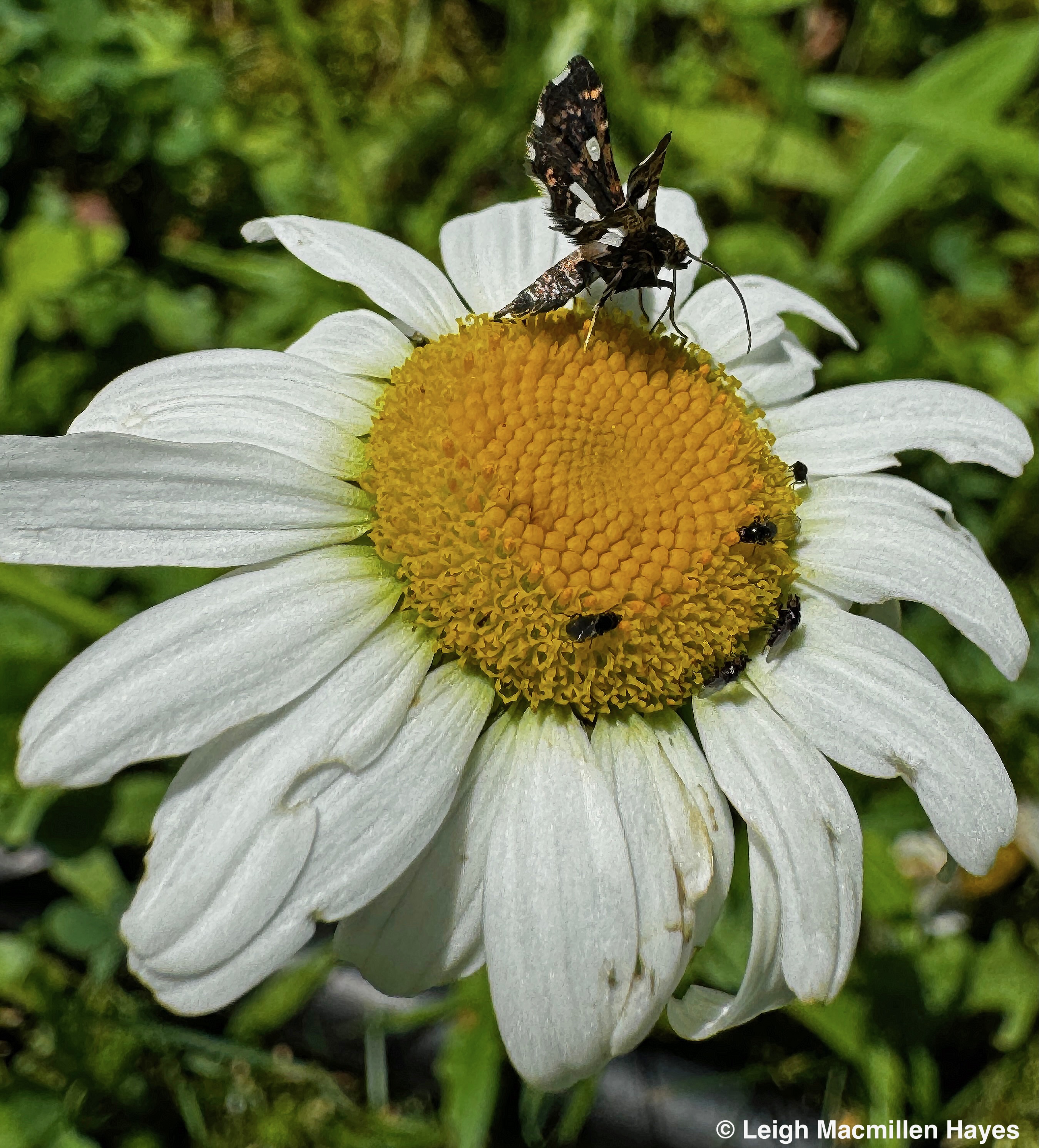
And on a flower about two inches away, an exquisite Spotted Thyris Moth, and a few Gnat-like flies feasted. I kept waiting for them to visit the Crab, but perhaps they sensed its presence. I’ll never know, but while I watched, they stayed on this flowerhead.

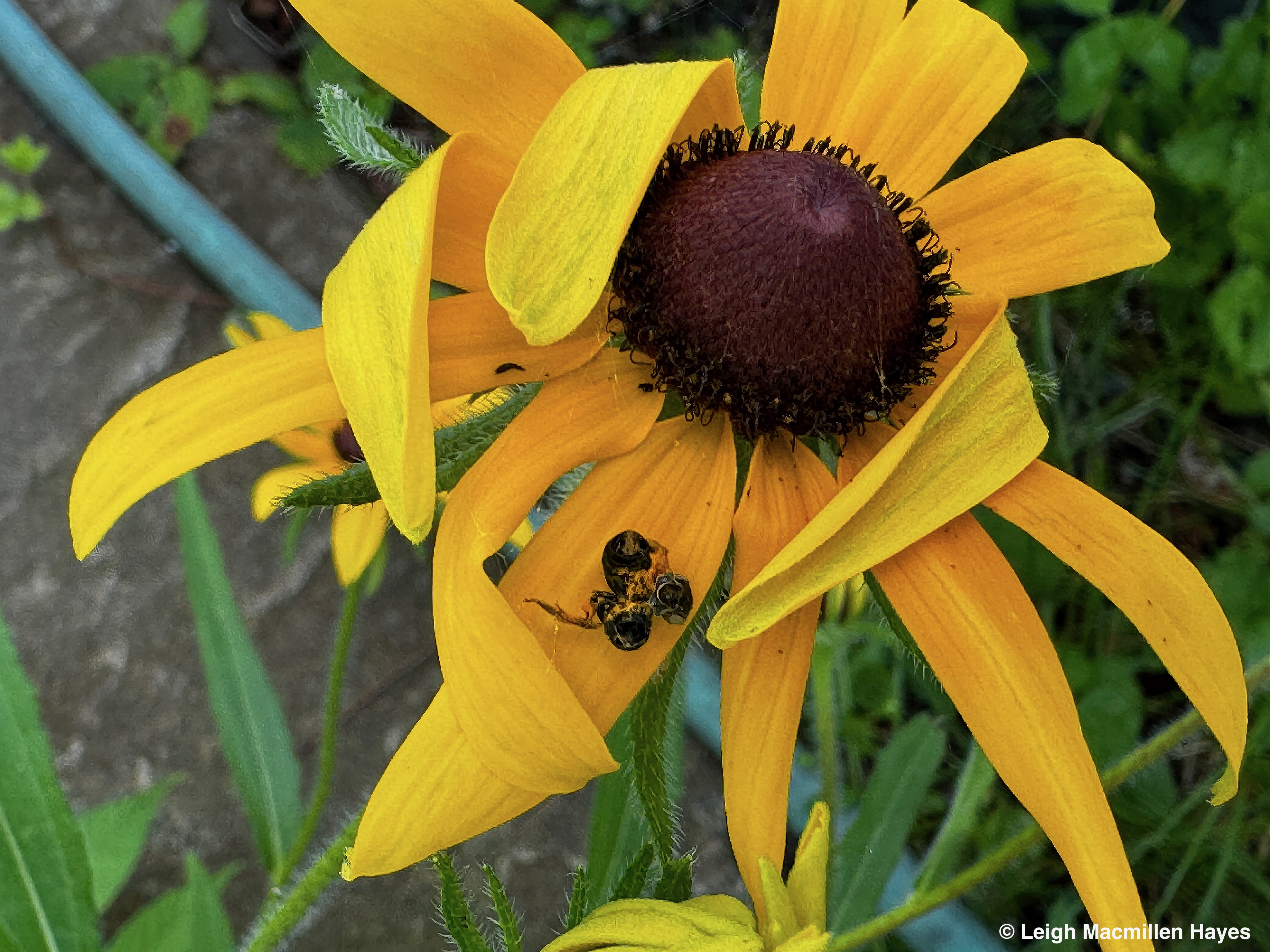
On another, a bee gathered not just the nectar that so many of the insects seemed to seek, but filled the sacs on its legs with pollen as well. Lots of pollen. It actually looked like two pollen sacs per leg to me.

In the midst of it all, other insects flittered and fluttered over the flowerheads, sometimes pausing to seek nectar like most of the others. This Fritillary Butterfly is one of many that took advantage of the gardens as well as the clover growing in the yard.

Sweet William seemed to be a favorite landing spot.

As I’ve said, I walked back and forth for all these days between gardens, which have many more flowers than I’m sharing, but it was these few that seemed to host the most visitors, including this Pearl Crescent Butterfly. Take a look at the underside of the hindwing. About halfway down, close to the edge, do you see the crescent-shaped pearl?

On another, a Bee Fly with its own incredible wing pattern. And those eyes. And hairy body. Oh my!

Late this afternoon, something big and dark flew in and it took me a moment to realize what I was witnessing.

Fritillaries canoodling atop Sweet William. As this story began, it ends. Canoodlers in action.

These two, however, got smart, and found a room where I couldn’t observe their every move, for up into a Northern Red Oak did they fly.

I was so afraid that this would be the summer that wasn’t in the pollinator gardens, but it’s turned out to be the summer that IS! And I can’t wait to discover more. So expect more. You never know what you might discover at wondermyway.com.

Plains and Barrens and Bogs, Oh My!

Places new to us and those so much more familiar rounded out the week as My Guy and I made time to explore. Our first journey found us driving over an hour and a half south and only getting fake lost as we searched for routes and a place to eat lunch. Mike’s Diner won, a hearty ham and cheese sandwich for him, and grilled cheese with tomato for me. Comfort food.

And then we headed along a few sandy trails in a land known for its Pitch Pine-Heath and Pitch Pine-Scrub Oak Barrens. It was vast. And flat. And offered so many shades of . . . green.

The Pitch Pines, with their bundles of three needles each (think: three strikes you are out–pitch, baseball, I didn’t make this mnemonic up, but use it all the time) were happily producing prickly cones, which take two years to mature.

This is a fire-dependent ecosystem, meaning the health of this place depends upon consistent fires. The Pitch Pine and other species that thrive here have developed adaptations to survive. The pine’s serotinous cones and thick armor-like bark are its adaptive features. The cone is covered in a thick resin that must be melted in order for it to open and release seeds. The Pitch Pine’s thick bark protects the tree from those fires.

And so in this place, periodic controlled fires occur in order to maintain its rarity.

Scrub Oak or Bear Oak is the other dominant tree species in the shrub layer of this space. There are lower shrubs like blueberry and huckleberry, and grasses, and ferns, all completing the picture.

The soil–sandy and acidic.

We left that place and drove a few miles to an abutting property to follow a longer trail system through a similar habitat. I think we were both quite taken by the vastness of the grassland.

As in the first, this is a place where fires are intentionally set to keep the species that have adapted to this space here, and not allow other species to take over. I think it’s rather like mowing a field. If you don’t mow for several years, as I’ve been watching on a hillside field closer to home (no, not the field that abuts our yard), White Pines have taken foot and are taking over the space. In fact, the same obviously happened in our woodlot, which was once a plowed plot, and now, 60 – 80 years later, it’s a forest of White Pine and Hemlock trees, but mainly the former.

Like the previous spot, this is a grassland and a heathland, with similar trees in the landscape. Blueberries make My Guy smile, always, and they grow abundantly here because of the soil conditions, but also because they have underground rhizomes with lateral stems that allow them to resprout after a fire.

Much to my delight, I spotted a Wood Lily in bloom, with its tiers of whorled leaves along the sturdy stem below. It is present here in Maine, especially in places like this, but even in woodlands. That said, my encounters with it are infrequent and therefore memorable. And as I type I’m picturing it at the summit of Pleasant Mountain and along the Heritage Trail on Amos Mountain in Lovell.

We enjoyed our time in those first two locations, and have so much more to learn about them, but returning to the home stage, even with rain in the forecast, was much more to our likening. And so we did.

It was here that we spotted Blue Flag Iris in bloom, with its showy runway and lack of a beard like the Irises that grow in our home gardens. I know I have a difficult time walking past without stopping to honor these flowers each time I see them. Blue Flag doesn’t mind having wet feet, which is good since it was growing in a wetland.

The sight of this next beauty will give you even more of an idea about where we’d ventured. It’s an area where Pitcher Plants grow in abundance and right now show off their parasol-like flowers.

The carnivorous Pitcher Plant obtains nitrogen and phosphorus by “eating” insects. Its oddly shaped leaves form a pitcher partly filled with rainwater and digestive enzymes. The spout is a hairy landing platform for insects attracted by its red venation and nectar glands. Imagine this: An insect crawls to the edge of the leaf, aka pitcher, slips on the downward-sloping hairs and plunges into the liquid below, where it drowns and enzymes and bacteria break it down. Any chances for escape are zapped by those stiff hairs. As it decomposes, it is digested by the liquid.

Do you see some insect body parts floating atop the water within the pitcher? And an ant trying to travel across the hairs rather than down. Unfortunately, I didn’t have a chance to watch its ultimate fate. Next time, for sure.

I want to jump back to the nodding flower of this carnivorous plant for a second. I tiptoed gingerly on the spongy carpet of sphagnum moss to take a closer look.

At two to three inches wide, it appears on the top of a thick, leafless stalk that can grow to two feet tall.

A flower consists of five sepals surrounded by three bracts, numerous anthers and an umbrella-like five-pointed style, over which five long yellow or red petals dangle. The whole inflorescence (flower) is held upside-down, so that the umbrella-like style underneath catches the pollen dropped by the anthers. Stigmas are located at the tips of the umbrella-like style.

This is also the land of native orchids, such as this Rose Pogonia, which to some resembles a snake’s head poking out of the heath or a fern with a snake’s name (Adder’s Tongue Fern). A bearded snake, if there is such a thing. The labellum or lip of the flower is bearded and some petals point outward and to the side. Despite all of that, it’s a delicate and intricate flower.

While the Rose Pogonia seemed to be waning, Tuberous Grass-Pink was putting on quite a display. The labellum or lip is not bearded, though it does have a yellow crest atop it, and petals and sepals point in all directions.

Farther along the trail, Tall Meadow Rue showed it had gotten an early start on the July 4th celebration with silent fireworks making a huge bang. (If only all fireworks could be like this. Quiet and beautiful.)

Swamp Candles were lit up as well, adding more color to the landscape.

As you can see, it was beginning to rain when we reached a display of Swamp Roses, and I loved how the droplets stood in a row on the folded edge of the uppermost petal.

And I don’t know why I should be surprised each time I meet these little gems because we’ve met so many times over the years, but it’s always as sweet as the first introduction. Please make the acquaintance of Water Forget-Me-Nots.

It was not just flora that made our trek so delightful, but also a few others who greeted us, or rather we greeted them, like the Red-backed Salamanders that I often find in a certain spot under some old Hemlock bark.

And the ever present chittering and chattering Red Squirrel.

That all brings me round to where we explored. The first trip included Kennebunk Plains and Wells Barrens Preserve. We did enjoy those, but it was our hometown tramp encircling Holt Pond that probably made us the happiest because though we know this space well, there’s always something different to see, and I’ve only shared a wee bit with you.

That said, if you go to Holt Pond Preserve, please know that from the parking lot off of Grist Mill Road to the Quaking Bog, the boardwalks are clear and highly visible. The rest of the board walk system, however is not, and we had to fight our way through vegetation and under downed trees. Once we reached the Southern Shore Trail, it was free sailing again. (Default: we maintain that section of the trail system).

And the bridge over this creek washed out last spring, but right now there is a stepping stone or two to help you leap across.

Yes, those swirls in the water are from raindrops and not insects (in fact, the bugs weren’t too bad), for by the time we got close to Chaplin’s Mill Road, the rain was falling steadily. But, we were prepared. And once again, we didn’t melt.

Plains, Barrens, and Bogs, Oh My! Just another reason to love Maine.

Lake Living & Maine Natural History Observatory

Two. Two publications this week. I’m always excited when the first appears on a local store shelf, but to have a featured article in the second as well (for the third time) is equally thrilling. Also scary. Why? Cuze once you put yourself out there you are out there and there are others out there just waiting to let you know how you erred. And if you know me, I err a lot. But it’s actually a good thing because it’s a humbling reminder that I’m not perfect. Thank goodness. That said, you don’t need to remind me–just sayin’.

So, take a gander and I hope you enjoy the reads. My two articles for Lake Living magazine are the first two in this issue.

The first is about the Bridgton and Saco River Railroad Museum that six young men are working to develop in Bridgton to commemorate the Narrow Gauge Railroad. I won’t give away any more of the story, but my hats go off to these guys and their passion and all of their efforts to make a dream come true.

My second article is about TimberNook Western Maine, a program set up to encourage kids to get outside and play. For hours. With varied age groups. Sometimes during school hours. Because play, and especially deep play, which it takes a bit of time to enter, are a critical part of growing up and interacting with others and the natural world. I have to say that before I sat in on a couple of sessions, I wasn’t so sure about this program–I mean, I’ve spent the last however many years playing with kids in nature, but teaching them about nature along the way, and this program is set up to let kids learn without too much adult intervention. And after watching the action and talking with kids and adults, I am now a huge fan of TimberNook and hope to sit in on more sessions, maybe as a volunteer.

There’s so much more in the magazine ranging from an article by Perri Black about birth and death; another by Laurie LaMountain about dock lights invented by the guys at Great Northern Docks; plus an appreciation of laundry by Suzanne Richards; book reviews from our friends at Bridgton Books; and some summer recipes by Perri. And the list of things to do and places to go–locally, of course.

It’s all right here, just a click away: https://www.lakelivingmaine.com/

Switching gears, I submitted an article about Dog-day Cicadas to the Maine Natural History Observer and was tickled to have it accepted.

According to their website: Maine Natural History Observatory’s mission is to improve the understanding of natural resources in Maine by compiling historic information and implementing inventory and monitoring efforts of Maine’s natural history.

The Observatory specializes in collecting, interpreting, and maintaining datasets crucial for understanding changes in Maine’s plant and wildlife populations. We are committed to filling data gaps for Maine’s least understood species and creating a legacy of data for use in nature conservation, land use policy decisions, and expanding scientific knowledge.

Specifically, our mission is to:

  • Compile and publish summaries of Maine’s natural history
  • Coordinate local and regional inventory and monitoring efforts of Maine’s flora, fauna, and habitats
  • Facilitate cooperation and exchange of information among organizations, agencies, and individuals conducting natural history research in Maine or caring for natural history collections
  • Engage in other activities related to the advancement of scientific knowledge and education of the public regarding the flora, fauna, and habitats of Maine.

As some of you know, one of my favorite summer activities is to watch Dog-day Cicadas emerge from their underground life and watch as they shed old skin for new before flying up into tree tops to sing love songs. I know of a couple of local cemeteries where I can usually watch the action and it’s even better when I can introduce someone else to the experience. But, not everyone can join me so in this article, I hope it feels like you are along for the journey.

It looks something like this:

You can read the entire article and a variety of others by clicking on the link: Maine Natural History Observer

Lots of cool stuff to read about. And if you do live locally, Lake Living is on a store shelf near you–up and down the Rte 302 corridor, plus north to Norway and Bethel, and south to at least Cornish.

Grab a copy and don’t forget to support our advertisers. They are the ones who pay so that you can pick up a free copy of the magazine. There’s one advertiser in particular that is close to my heart and I’d love to have you support. ;-)

Artistic Perspective Along the Trail

We went for a walk this morning, My Guy and I, along trails owned by Lakes Environmental Association, particularly their Highland Research Forest, and the network of Highland Ridge Ski Trails. It wasn’t strenuous, it was only slightly buggy, and it was lovely, with so many offerings and here I only captured a few.

Our first stop was beside the wetland that in the past has been home to Beavers and Great Blue Heron and a whole host of others. It’s still home to that whole host of others, but our sightings only included a few of the singing Bullfrogs.

Tree stumps soon garnered my attention, however, first because of this fresh Varnish Shelf Fungi, aka Hemlock Reishi. Sighting these and so many other mushrooms always bring an old soul friend to mind who died too young a few years ago, RIP Parker. You taught me so much and continue to travel the trail with me, and for that I’m grateful to be able to keep you alive . . . in my mind.

I’m not one to recommend foraging mushrooms because my knowledge of such is limited, though Parker always reminded me that there are more poisonous plants than fungi. I do know this one is, but at a certain point in its lifecycle. Obviously, a squirrel had already enjoyed a few bites.

Both My Guy and I were charmed by this stilt-rooted tree and we felt the presence of elves, rather than the fairies that often greet us. Can’t you just imagine entering through those arched doorways and then moving into your workshop to complete a project?

There was another with crazy hair day–so topped off was it with Big Red Stem mosses.

Possibly my second favorite, however, wasn’t so much a stump as an uprooted tree which also abounded with life.

Among the offerings, a cranefly or two or three or a dozen, fluttering in the dark as they do. The arrow points to one and I hope you can see the action of its wings.

And among the Brocade Moss that decorated the uprooted tree trunk, a Green Lacewing, a beneficial insect in the natural world. Do they bite? No. Do they eat aphids and other pests? Yes.

This is also the land of underarm-high Bracken Fern. At least it was as tall as my underarms.

And upon a moss-covered rock, a delightful display of Many-fruited Pelt Lichen with its saddle-like reddish brown projections or apothecia.

The dainty flower of cool, moist woods, Mountain Woodsorrel, also made an appearance in several spots. With shamrock-shaped leaves, the flower color has a strong pink-purple veining and somehow makes me want to gobble it up as if it were peppermint ice cream.

While we walked and occasionally talked and constantly looked, he for the trail because though it’s well-blazed, it’s not all well traveled and so we had to slow ourselves down and pay attention, while I looked for anything that begged a notice. And then we found this most unusual sighting–well, someone’s sighting may be unusual without these glasses. They are still out there, right where you lost them, I think on the Gibbons Trail. Or there abouts.

As always, you-know-who was patient with my periodic stops, usually finding a stump or rock upon which to wait. Sometimes a bridge had to be the resting spot. And this one we love for its construction across Carsley Brook.

His view: the brook as it flowed forth below the bridge. Okay, so the artist may have left a few trees out, but that’s artistic license–the freedom to paint what she/he wishes to portray a scene. And so I did.

We all view things in a different perspective and from a different angle. Thank goodness. This may not have been his perspective, but it was mine.

Solstice 2024

There’s a local trail I’ve been traipsing along solo or with company these past few weeks and when I dragged My Guy there early this morning, and said I was bringing my camera, his response, “Why, there’s nothing to see there.” Seriously. Doesn’t he know me better than that after all these years?

It’s a place where Bullfrogs sit upon lilypads in true frog style and wait patiently for a meal to fly by. Given all the Gnats and Deer Flies that buzzed our faces and ears as we walked, I assumed there was plenty of food and actually offered some, but he wouldn’t partake. The frog, that is.

Another who should also have been enticed by the offerings, seemed to care more about defending his territory than dining, this being a Four-spotted Skimmer Dragonfly. The name Four-spotted refers to the small dark spots on the upper edge of each wing, there being two per wing, and thus four per side or four per front wing and four per backwing.

Equally nonchalant about all the available food, but curious about me, was the female Calico Pennant, another skimmer who loves to perch at the tip of plants and twigs and returns to the same site over and over again. Though I didn’t have a good view of her abdomen except for a hint of color on segment 7, the yellow-colored stigma toward the tips of her wings, and her yellowish face gave proof to her gender. Males have red stigmas and red faces.

The immature male Common Whitetail cruised and paused, cruised and paused. This is such a handsome skimmer (not that the others aren’t). And while its abdomen resembles the female, it’s the wing pattern that identifies its gender. I love the complexity of dragonflies, even if I do have to relearn the clues each season.

Apparently, there were other things to do besides defend territory, and certainly rather than eat the biting insects–for canoodling was in order each time I visited. In this love wheel, the male Belted Whiteface dons the red thorax and he has clasped his mate behind her head with his claspers, as is the dragonfly custom. As Kurt Mead describes it in Dragonflies of the North Woods, “Prior to selection of a willing female, the male will transfer sperm from his testes located on the underside of the abdominal segment 9 to his hamulus located on the underside of segments 2 and 3. This is accomplished by simply arching the abdomen until the undersides of the appropriate segments make contact.” Once clasped, she arches her abdomen toward his hamulus to receive his sperm and thus fertilize her eggs.

Also flitting about, for that’s how these damselflies seem to move through the air, were some Ebony Jewelwings. The white dot or stimga at the tip of the wing signals this is a female, where the male has all dark wings. I love the iridescent colors of this species. And note how she has her abdomen reaching upwark in an obelisk position? That’s the Odonata way of avoiding overheating–thus reducing the surface area that is exposed to the sun’s rays. Oh, to be able to stick your butt toward the sun and cool off. On a day like today, and yesterday, and the day before, with our first heat wave in New England in two years, this would have been a most welcome adaptation.

Also along this trail, an extremely smart Eastern Phoebe who used a slight crevasse in a boulder upon which to build her nest of mud and moss and lichens. On the first trip, a friend and I spotted five eggs in the nest About a week and half later, these little chicks snuggled together like a pile of fluff with an occasional mustard-colored beak visible.

A week or so later and they continued to grow. What surprised me is how quiet they were, but that’s probably another technique that doesn’t give away the location of the nest.

That said, a Phoebe built a nest on the backside of our barn. It’s too high for us to notice if any eggs or chicks were located within, but we listen to the adults call back and forth all day long ,which is how we found the nest–they told us where to look and flew off anytime we passed that way.

The chicks above fledged within the last week and that nest is empty with no sound from an adult. It makes me wonder if the barn nest might see a second brood (if there actually was a first) for they continue to awaken us at about 4:20am each day. Stay tuned.

Another sight worth noting–the footprint left behind by a moose–traveling in the opposite direction of my foot. This was discovered by an observant participant on a recent walk for Loon Echo Land Trust.

And an even better observation: the track of a Black Bear. My foot is located beside a front foot as you can see, with the larger hind feet registering before and after. The big toe is on the outside of the foot, opposite of ours. The better for climbing stability.

It still seems early for butterfly flight to me, but this Pearl Crescent showed us this morning that life hasn’t been easy given its tattered wings.

I think one of my favorite sightings along this path, other than the moose and bear prints, oh, and the dragonflies, of course, was something I couldn’t share with My Guy. The timing just happened to be right on this particular visit, when Eastern Tiger Swallowtail butterflies, so differentiated from the Canadian Tiger Swallowtail by the fact that the yellow band near the edge of the underwing was broken by black marks.

They were puddling, an act of probing for salt and minerals. Most puddlers are males, who ingest the nutrients that are then stored in their sperm. During mating, the male passes these goodies along to the female as a nuptial gift in his spermatophore. 

So we assumed it was scat upon which they puddled.

Until we realized it wasn’t. They’re choice of nutrient-offerings–a smooshed frog. The trail is not just for walkers. ATVs and even trucks use it.

Yes, the poor frog. BUT, the butterflies and flies made sure that it did not go to waste.

And another frog smiled. I’m smiling too, for it is officially summer. Happy Summer Solstice 2024.

And speaking of the solstice–be on the lookout tonight for the characters of my fairy tale doing some dancing in the woods, as they did in The Giant’s Shower.

A Lost Art Found

At the end of April I began taking an art class offered by one of my peeps, a young woman who walked into the lives of many of us one day about twenty months ago; a young woman with a million talents to offer. Among those talents, she is a self-taught artist and we’ve been begging her to teach us.

At our first class, we had to draw a small box in the upper left-hand corner of the paper and place the person who has been our biggest art critic into it. That done, the critic was forever boxed–well, until she sneaks out, which she seems to do way too much.

And then we looked at some photographs in magazines and had to sketch them and determine the direction the eye would travel in the picture.

Next we looked at lines and perspective. I’d brought along my favorite colored pencils, but immediately felt my inner critic jump on me because all of my classmates were working with watercolor pencils, watercolor paint or acrylics. And the artist herself, gouache. Until I met her, I’d never even heard of gouache. Or at least never paid attention, if I had.

And so between classes I purchased a set of watercolor pencils and tried all over again. It certainly was a quicker way to create and I liked how I could blend the colors with a brush. But still, it was a long process to produce such.

Our next lesson was on values and we looked at how values add to the picture and stood outside and quickly sketched some scenes in the neighborhood.

And then she produced a photo of a white iris for us to illustrate. I struggled with this because I couldn’t figure out how to make the flower pop and so I cheated (well, maybe it’s not cheating, but rather an artist’s prerogative), and outlined the flower with a different color.

When I later asked the artist how to do this, she showed me that by making the background darker the flower would stand out. And so I tried again.

The other thing about the artist’s prerogative–you don’t have to include everything in your illustration that is in the photograph. And so you can see I left some leaves out on the second try. But I did want more detail in the flower.

“Painting is not about ideas or personal emotion. Paintings are about freedom from the cares of this world, from worldliness. All art work is about beauty.” ~Agnes Martin

When we were asked to draw a scene from another photograph and complete it only with greens to get a sense of value, I again needed help since I couldn’t create green from blue and yellow, and so she helped me choose three colored pencils to use.

And then the third class was upon us and I was encouraged to borrow her watercolors because it would be easier to create a color wheel. And my confidence took a dip as I was giving up my beloved pencils for an hour or two. And walking down a path I hadn’t followed in many, many years.

This was a study in complementary colors and from our mind’s eye we needed to paint a tree with mountains behind and use such colors. Not only was it kinda fun, but definitely a faster way to reach the end and the colors popped more.

Next we had to go big. Well, not that big really. I usually stuck to the size of the photograph, the easier to figure out how to position lines. But we were all given this photograph of Hemlock Bridge Road and had to use those same complementary colors to complete the scene. And so I played. And had great fun. And began to learn that I could let go. Sometimes.

That said, at home I attempted the same scene with the watercolor pencils and actually liked that as well. It was a different effect.

Back in class again, we learned more about using complementary colors and had different scenes to illustrate. This was with the watercolor pencils.

And then the afternoon dawned when composition was the topic. As we looked for the most interesting area in a scene. It never occurred to me to crop, just as we sometimes crop photographs.

I was a wee bit nervous for this one for a couple of reasons. One, I’d purchased some watercolor paints and new brushes. And two, the photo struck me as being a really difficult scene to replicate. Or at least represent. And so I did a painting smaller than the paper I was working on. And discovered that white was my friend.

A day or two later, I couldn’t wait to pull the paints out again, and give this another try. It’s much lighter/brighter than the actual photo or my first attempt, but I kinda like it.

That inspired me to go back to the other water scene and try it again. It looks nothing like the photo of an original painting, (I’m sorry, but I don’t remember the artist) but playing with the paints was becoming a favorite pastime.

A really favorite pastime, so much so, that I’m addicted; in a good way, of course. When I showed this to My Guy, he immediately knew where it was for we’d only climbed this particular mountain a week or so ago to count Lady’s Slippers. On a rainy day.

Over the weekend I photographed this Four-spotted Skimmer, so named for the four spots on each side: two per wing, the mid-wing spot being the nodus, and the black spot toward the tip of the wing being the stigma.

I know that what I like about sketching is that I can focus on details, but when painting with watercolors, that is much more difficult for me. And so I need to figure out how to let go a bit more. But that will come in time. Maybe.

For our last class yesterday, we had to choose a scene of our own to illustrate. I chose the wee studio on our back forty (haha, we only own six acres total, so it’s rather hard to have a back forty), where a pollinator garden adds to the picture. Okay, so this is a painting. The garden looks nothing like that. And the stonewall behind is much smaller. And, oh geesh, here comes the art critic.

The cool thing about the studio, which I don’t use anymore, but someone suggested yesterday I should do my artwork in there, is that we won it at the Fryeburg Fair many moons ago when we paid $25 for five raffle tickets to support Harvest Hills Animal Shelter. To enter, one has to duck. I’ve always felt that was a plus for it put me into a different place where I could create. And thus, The Giant’s Shower, the fairy tale I wrote and Solona Ward illustrated, was written in that space.

At the end of the last class, we were invited to show off our paintings and I chose the mountaintop scene. We were down one because she is on vacation, but seated left to right are Pam, Linda, Debbie, and me.

And our teacher for these past seven weeks was the one and only Jessie Lozanski, who recently painted this scene from photos I’d taken along a trail at the Bold Coast of Maine. It graces our kitchen and each time I look across at it I am transported to that time and place, but also to so many other times and places for it triggers many memories.

This morning I was gifted a painting by another student of Jessie’s. The painter of this scene is nine years old. And she’s an extraordinary naturalist whom I’ve had the pleasure of working with every other Wednesday for the past three school years. I love the grassy mounds and the fox and the tree–especially its trunk. This is an artist who is well on the way to finding her style and both she and Jessie will have their works for sale at Gallery 302s Art in the Park in July.

Here’s a photo of the young artist and her mom heading back along a trail we’d explored a few weeks ago. Anywhere we go, she finds inspiration.

The same is true of Jessie, and I know I take a lot of photos, but she takes a million more and I get it now because I’m looking at the world from a different perspective, like seeing the shades of green and yellow, and brown and even purple in our yard and the field beyond in a different light.

I am chuckling because shortly after purchasing the watercolor paints, I found this ditty in my collection. If I remember correctly, I painted this in college. Nobody is perfect. Thank goodness.

And I’m having fun finding an art that I thought I’d lost . . . all over again.

Cloudy Mondate

Between the two of us, My Guy and I have lived within an hour or so of today’s destination for a grand total of 103 years. Yikes. That makes us old. Of course, we aren’t. But for some reason we never visited this spot before. Maybe because it’s a tourist hotspot, and we’re hardly tourists. In fact today, we were dressed in our usual garb because our plan was to hike. And we did. But . . . we also did that touristy thing for a wee bit. Cuze when in Rome . . . yada, yada, yada.

And so first we paused by the Pebble, a glacial erratic.

I suppose when you compare it to the Boulder located about a half hour north of the Pebble, which we visited on February 14, 2022, it is rather pebble-like.

But what we really wanted to see was the Falls of Song, a waterfall that drops forty feet and is so named for the changing sound of the water that constantly flows.

According to an interpretive sign by the falls, “An 1885 Boston newspaper description of the scenic beauty and amenities stated of the Falls of Song that ‘their location in the depths of the primeval forest, their exquisite setting under the overhanging cliffs, the silvery clearness of the water and their magical musical effects, seemingly changing their song at every hour of the day, unite to place these falls among the most interesting and wonderful in the United States.'”

Another set of falls to draw our fancy was the Bridal Falls, so named because in the right conditions they appear to be lacy like a bridal veil. I felt like the conditions were indeed right today.

We followed the brook for over a half mile and the views kept changing and sounds kept enhancing our experience. If it had been warmer, we might have wanted to take a dip, but for today, just watching and listening as the water tumbled and plummeted and twisted and turned and glided and flowed was enough.

Back on the road as we drove up the mountain, we stopped again for a view from lunch bench and I found my place, which was my place in the early 1980s. Lake Winnipesaukee and Gunstock Mountain formed the backdrop and brought back memories of teaching and hiking and skiing and swimming and being. The best part is that this is the area where I learned to be. Be me.

To be native, like the Northern Bush Honeysuckle, for I began to realize all those years ago that this is the area where I belonged.

But today brought us to the home of others who also belonged in this place, beginning with Thomas and Olive Plant, the original owners of this mountaintop mansion. I could only hope to live here. But they did. For a while at least.

It’s a sixteen room home with halls and halls and an organ, and dumb waiter, and guest rooms like this one, and more halls, and sitting rooms, and great hall, and dining rooms, and servants quarters, and sunroom, and oh so much more. But this, the Brown Room, was my favorite, for recently carpet had been removed and the most incredible floor discovered, and it reminded me of our home, which had been similarly carpeted, and we discovered beautiful southern pine that has since brightened our days.

The sunburst pattern of the Brown Room floor–incredible.

But even more than the inside, we really enjoyed the outdoor living areas, this off the main hall, with a view of the lake and mountains beyond, Gunstock being straight across.

And an angel letting water form her wings.

We’re thinking we’ll take the month of August and welcome guests here. Haha. As if we ever welcome guests, the introverts we truly are. But really, the focus should be on the Arts and Crafts architecture and way the building fits into the setting.

And the gardens. Exquisite.

Olive Plant, original owner of the property in 1914, would have approved of today’s gardens which are tended by a group of volunteers. In this space that surrounded the mansion she had a 100-foot glass greenhouse.

I don’t know if this was part of her greenhouse selection, but among the wall that formed part of nursery grows Ivy-leaved Toadflax, a plant I don’t recall ever meeting in the past.

Clouds there were upon occasion today, but the yard boundary offered glimpses of brightness.

And along the trail where other specimens including this Bristly Locust, a legume.

We’d hiked along the brook, spent time exploring the mansion and grounds, and the headed off to hike another trail with only so much time on our hands. At the intersection of trailheads, we had the good fortune of meeting two women with local knowledge who showed us where we were and where we wanted to go . . . that being heading up Mount Roberts. We knew we didn’t have time to summit for My Guy had to get home for a meeting (at which he later received a well-deserved Lifetime Achievement Award), but we made a plan for a turn-around time.

The trail was blazed with orange markers and we might have believed that a Black Bear had marked the way, for so chewed and scratched were the signs, but I suspect it was a Red Squirrel who had a good chomp or two or ten.

That said, a female American Toad, her tympana (ear membrane) about the size of her eye, and overall size of her body providing a clue to her sex, but also doing her best to blend in to her surroundings as she paused upon a stone on the trail.

We’d hiked over a mile when I suddenly spied this from the trail. Ruh roh. That meant we had to start looking and counting, a task that slowed us down a bit.

We had set a turnaround time, knowing that we wouldn’t be able to hike the entire 2.5 miles to the summit because My Guy needed to get home for a meeting, and so at 3:15pm, with 1.7 miles behind us, we stopped our upward ascent, but before descending, I spotted a green golf ball on a Northern Red Oak leaf.

Each time I spot one, I’m in awe for it’s such a cool structure. Though it looks like a fruit, it’s caused by a chemical reaction the leaf has when a wingless adult female wasp, Amphibolips confluent, lays an egg into a newly-forming leaf. As the egg hatches and larvae grows, that chemistry causes the leaf to mutate and grow with it.

The wasp is commonly known as an Oak Apple Gall Wasp, and thus this is an Oak Apple Gall.

We chuckled on the way down, for we did pay more attention to the flora, and couldn’t believe that we’d passed by this Lady’s Slipper display located inches from the trail. But that’s what happens when you are moving on My Guy-speed, and watching every spot where you place your feet. Our total count on the way down: 52, but I’ve a feeling we missed many more.

And hiding under some trees near the trailhead: Ragged Robin, a treat because I’ve only encountered it a few times. I love its frayed, yet delicate display.

Because our descent was much faster than the ascent (and still we counted Lady’s Slippers, but that’s why I think we missed some), I stole a few minutes beside Shannon Pond where a small field of Lupine bloomed.

And a female Mallard swam toward the shore. She and a few jumping fish were the only wildlife spotted today.

That was okay, for we had a splendid Mondate wandering under the clouds, which seemed truly appropriate since we were at the Lucknow Mansion property now known as Castle in the Clouds in Moultonborough, New Hampshire. Why did we wait so long to visit? Maybe because it’s practically in our backyard.

The May Flower Whisperer

In rain or shine, as May gives way toward June, My Guy and I set off to hike a few local trails.

It’s not whether we have a view . . .

or not . . .

or if we have to stand beside lunch rock rather than sit (well, he sat, I didn’t) . . .

or even the challenges the trail chooses to offer, like crossing a well-mudded beaver dam that is rather tricky . . .

and spying the well-mudded lodge where the local residents were probably relaxing after a long night’s work,

but rather, the sights at our feet that drew our attention, such as the Black Chokeberries pink anthers and delicate petals enhanced by raindrops.

Scrambled-egg Slime Mold (aka Dog-vomit Slime Mold) showed off its intricate structure that looked more like a bunch of worms swarming together upon a decaying log.

Because we were always looking down, an American Toad, so certain it was invisible for so camouflaged was it, wasn’t. Invisible that is.

Plentiful were the Blue Bead Lilies, with their anthers hanging long awaiting pollination before rising in fruit forms that will soon look like . . . blue beads.

In several spots along one of the trails, White Baneberry, aka Doll’s Eye, so named because its fruit form resembles such, showed of its firework display and the insects were attracted.

And a carpet of Bunchberries, those with six leaves rather than four, asked that their floral displays be acknowledged.

Not to be overlooked, Wild Geranium’s runway lines upon each petal functioned as the nectar guides they were intended and the pollinators rejoiced.

I, too, rejoiced, for on the first rainy day, May 27, 2024, the trail we hiked, which is known by locals for its mosquito population, wasn’t at all buggy; but on our May 30, 2024, hike, our faces were constantly buzzed, though nary a bite, making me think they were all males. We kept an eye out for dragonflies and finally made their acquaintance, including with this Common Whitetail Skimmer, that hardly looked common.

The real reason, however, for our hikes this week was greed. Yes. Greed. You may know My Guy suffers from Blueberry Greed in the summer, but spring brings out another type and he takes on the mission to locate and count Lady’s-slippers. And he always wants more.

It may sound like an easy task because some are proud to stand straight and tall and can be seen easily from the trail.

But some, like the American Toad, like to hide. We, however, are persistent in our survey.

We found pinks of many hues, and their white variants.

And no spring feels right without a visit to My Guy’s favorite bouquet.

Lady’s-slipper pollination is a curious thing. Bees are lured in by the guide lines to a slit in the front petal, the slipper-like pouch, or flower’s labellum. Once inside, the bee cannot exit the way it entered because the petal structure turns inward.

The exit is at the top of the slipper, but to reach it, the bee must move through a hairy interior and rub against the flower’s stigma, depositing any pollen it may have carried in and brushing against the pollen mass called the pollenia before flying out.

Some bees get frustrated with the dilemma of discovering there is no nectar and the task of finding the exit and instead chew their way out, which seems to be what happened to this flower.

One flower in all that we found, did present as if it had been pollinated, for rather than the downward pose, the slipper was almost parallel to the ground and beginning to deflate.

Twice we came upon last year’s capsule, which is a rare treat for so few are actually pollinated because the bees learn not to bother. Fortunately, one woody capsule contains thousands upon thousands of seeds, which are released when the woody structure splits its seams.

Near the end of yesterday’s hike, the sun finally brightened the sky and forest, and we weren’t the only ones to enjoy it for a gartersnake basked beside the trail and helped us spot another flower to add to our count.

And on Monday’s hike we had another special sighting: an Ovenbird’s nest that I spotted because I saw the parent fly up through vegetation beside the trail as we approached.

We covered a lot of miles, hiked slower than My Guy’s normal pace, and kept reminding ourselves of the numbers so we didn’t lose track, but rain and mosquitoes didn’t hold us back.

Lady’s-slippers have a symbiotic relationship with fungi. A fungus helps break the seed and allows it to obtain nutrients and energy from organic matter in the soil, while the plant, once established, gives nutrients back through its roots. It takes anywhere from 3 – 7 years for the seed to develop underground and then may take another ten years of presenting as two pleated leaves, before a flower is produced. That means that by the time it first flowers, the plant might be 17 years old. So please, please, please, enjoy them the way we do. In their natural state.

Our count (which include last week’s visit to Wolfe’s Neck Woods State Park):

Wolfe's Neck
2022: 411
2023: 324
2024: 475

Albany Mountain
2020: 150
2021: 47
2022: 266
2023: 274
2024: 364

Overset Mountain and Sanborn River Trail:
2022: 286
2023: 351
2024: 598!!!!!!!!!! (You know who wanted to make it to 600, but came up just shy)

Grand Total this year: 1,437.

I'm not sure we are done and I know everyone is seeing them everywhere, which is a glorious thing. Now I'm wondering if all of last year's rain showers meant more fungi for My Guy's May Flowers.