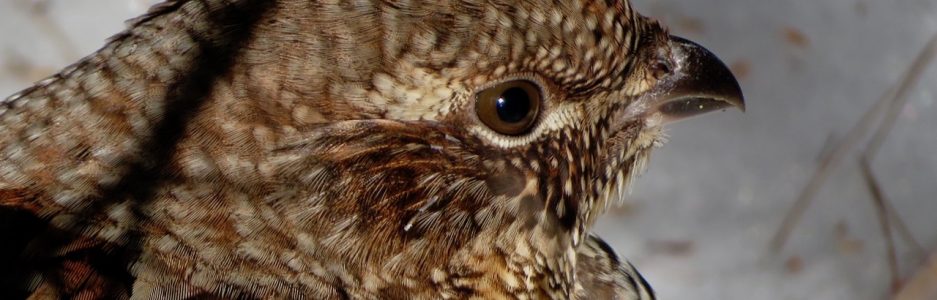
Bogging in Maine

What is a wetland? Basically, it is wet land! But more specifically, wetlands are often those transition zones between dry land and deep water.

There are four basic types of wetlands, which can be broken into even more types, but let’s stick with the four: marsh, swamp, bog, and fen.

Marshes are typically located along shores of rivers and streams, and even the coastline. Plus they can be found in the shallow water of ponds and lakes. Cattails, Arrowhead and other soft-stemmed emergent plants grow in these areas.

Swamps are found along rivers, streams, and lakes where mainly woody-stemmed plants such as shrubs and trees, like this Tamarack, grow.
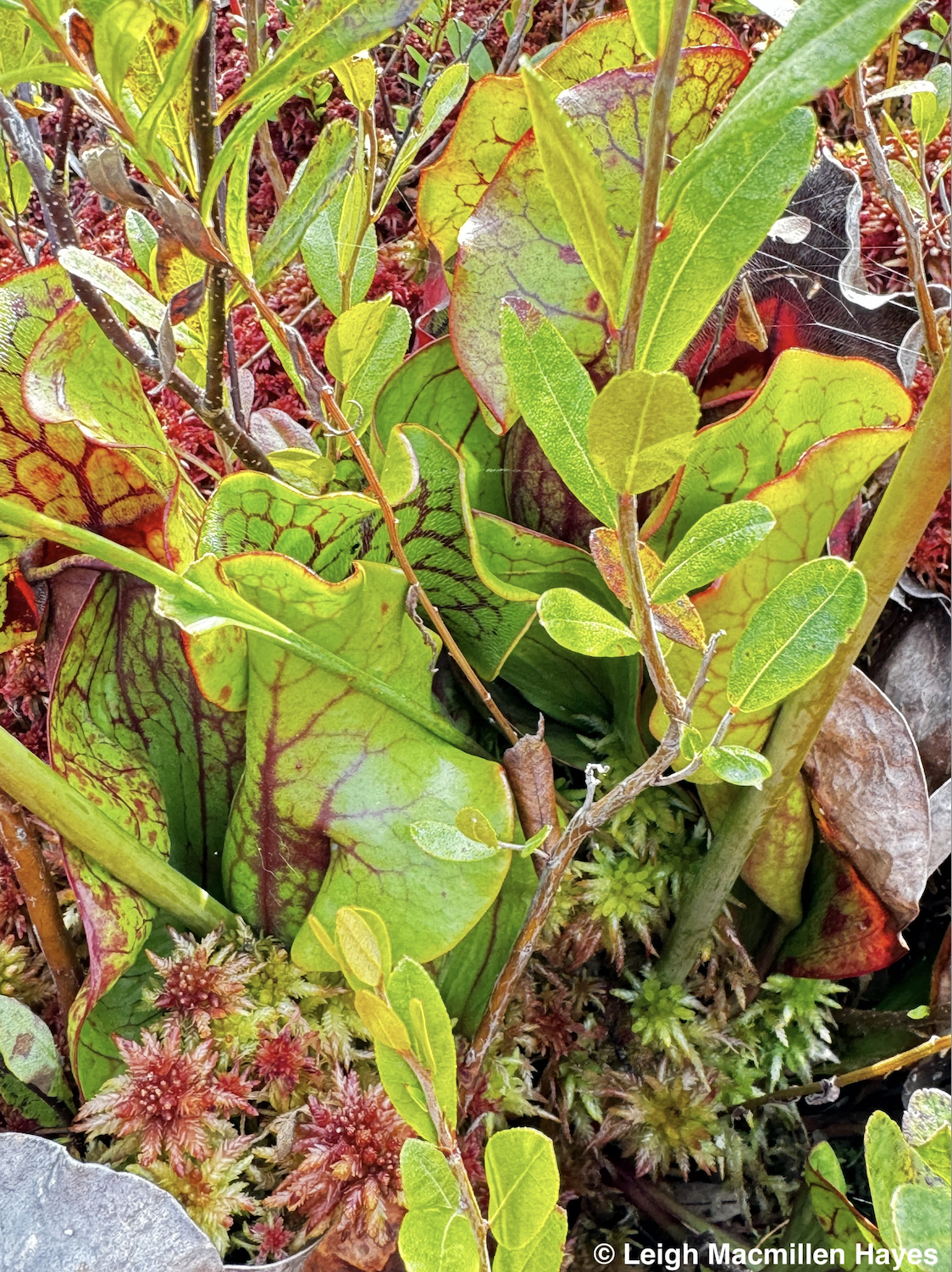
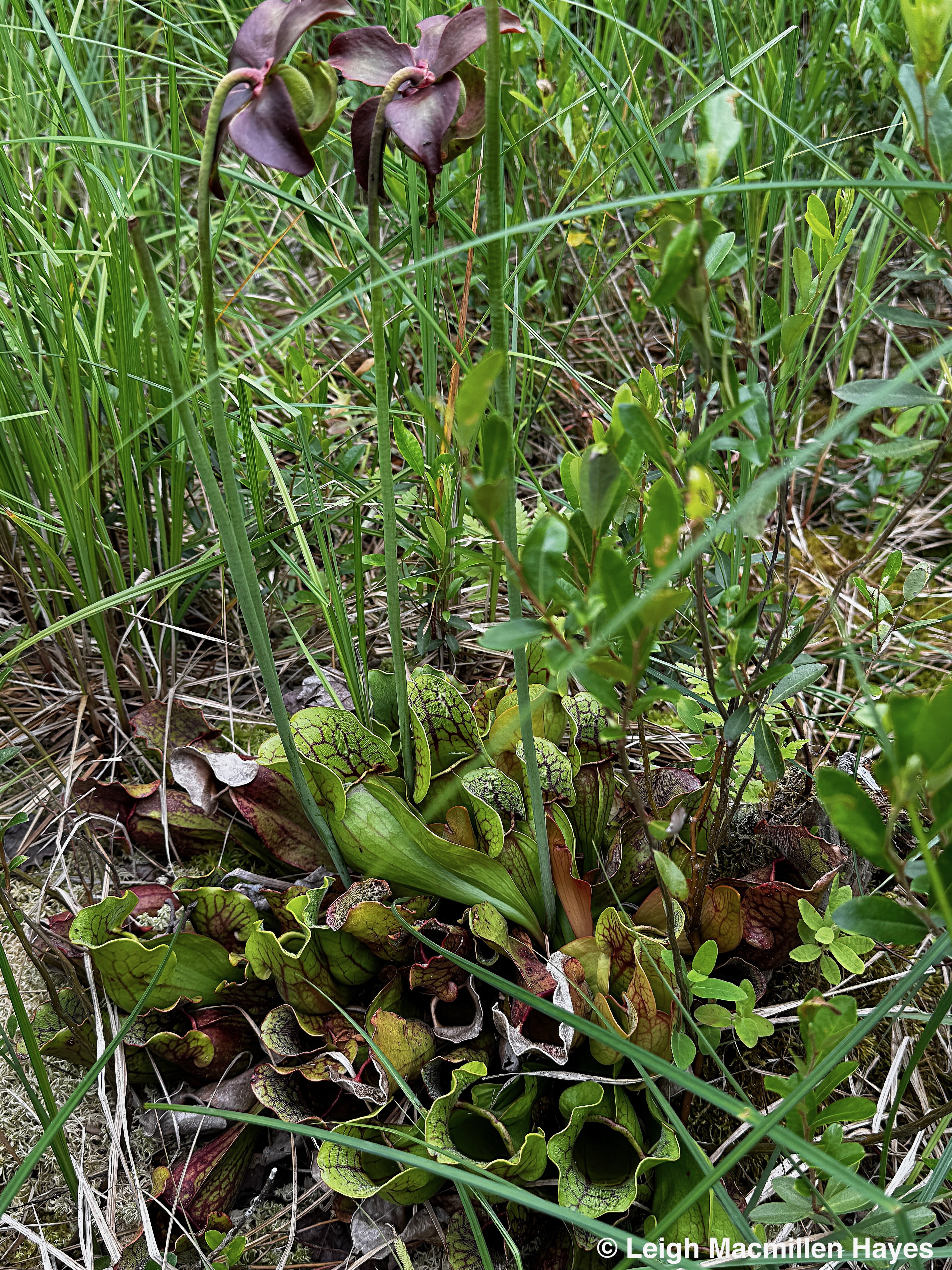
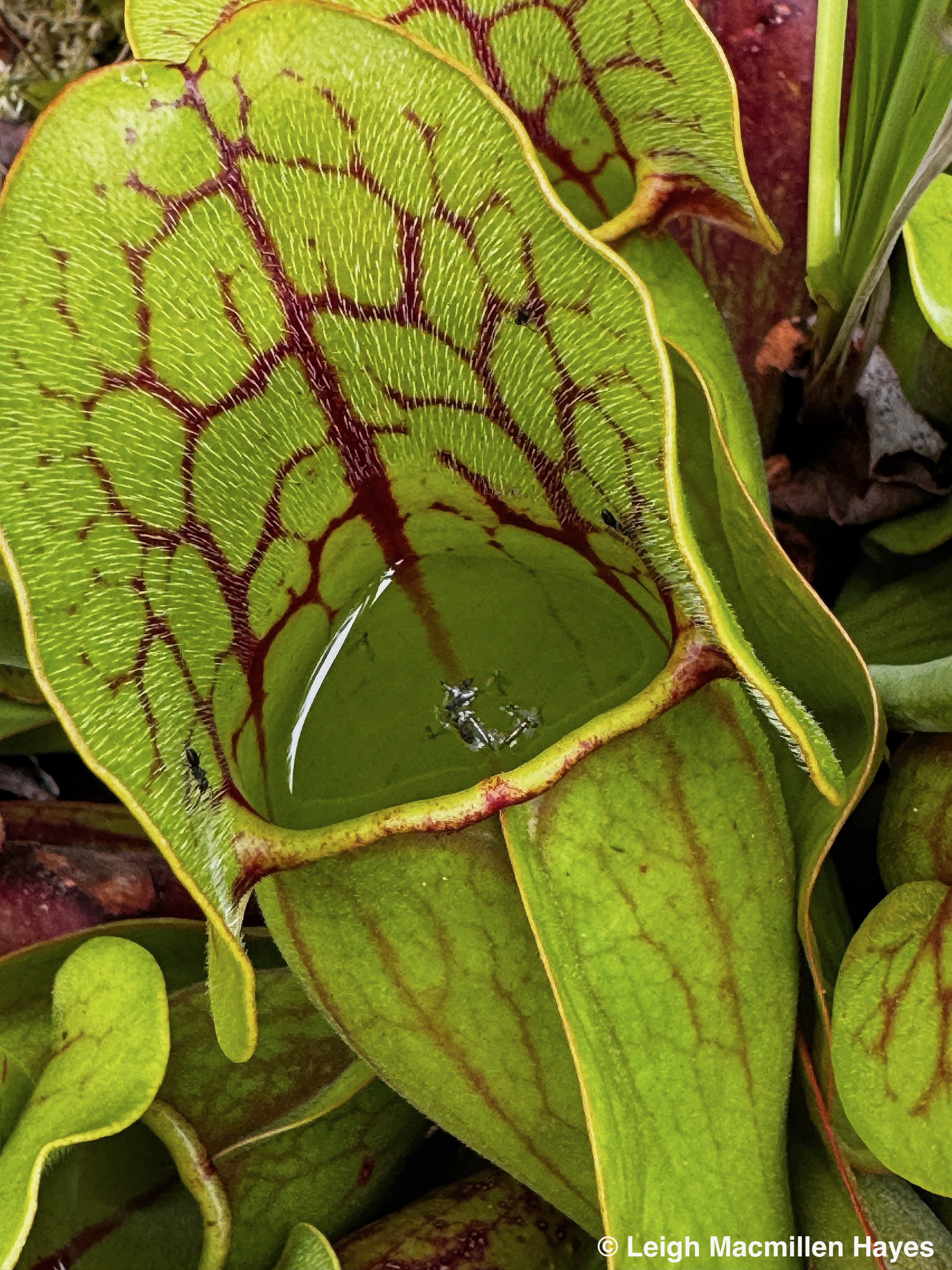
Pitcher Plants and Sphagnum Moss
Round-leaved Sundews

Bogs are found in our northern climate and often are deep depressions that have no drainage. They are covered with a surface carpet of sphagnum moss and insect-eating plants like the Pitcher Plant and Sundews.
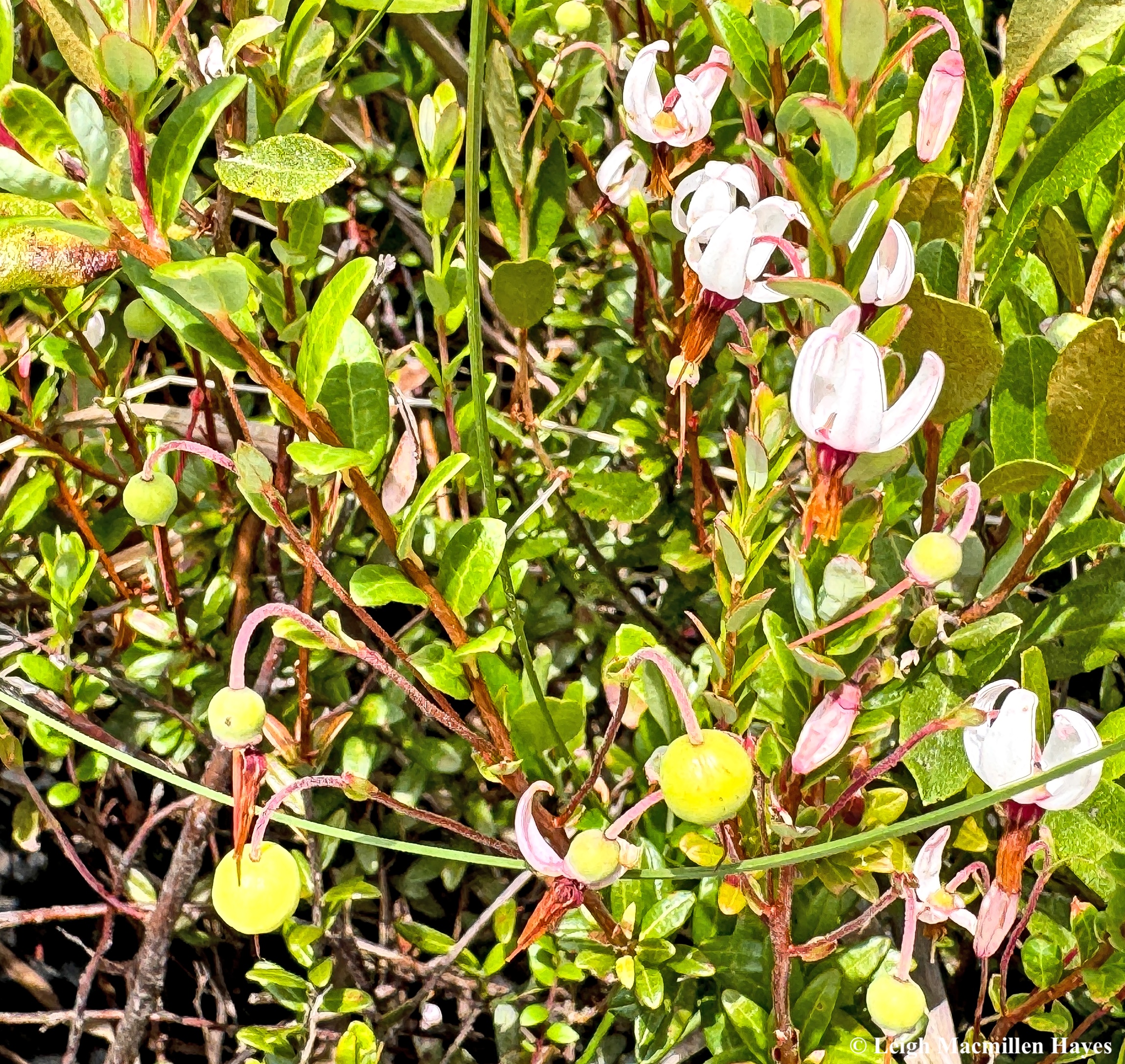
Cranberry flowers and fruits

Native Cranberries also flourish in the stagnant and acidic water of a bog.

Sphagnum Moss
Leatherleaf

Like bogs, Fens are found in northern climes, but the water is slow-moving, and does have some drainage. Layers of peat (sphagnum moss) and sedges and grasses and low shrubs like Leatherleaf may grow in these areas. The carnivorous plants like them as well.

But it’s not just the flora that makes a wetland so special. These places provide habitat for a wide range of insects and animals and birds as well. In fact, they act as nurseries, or places where any of the critters might raise young.

And as soon as the sun warms the air in the spring, friends and I scour the wetlands in hopes of discovering who is emerging on any particular day. One of my favorites to watch is dragonfly emergence (in case you are new to this blog and didn’t already know that. You can learn more here: Developing Dragonfly Eyes, but really, type “dragonfly” into the search button of this blog and a bunch of dragonfly related posts will pop up–all worth a read, I promise you.)
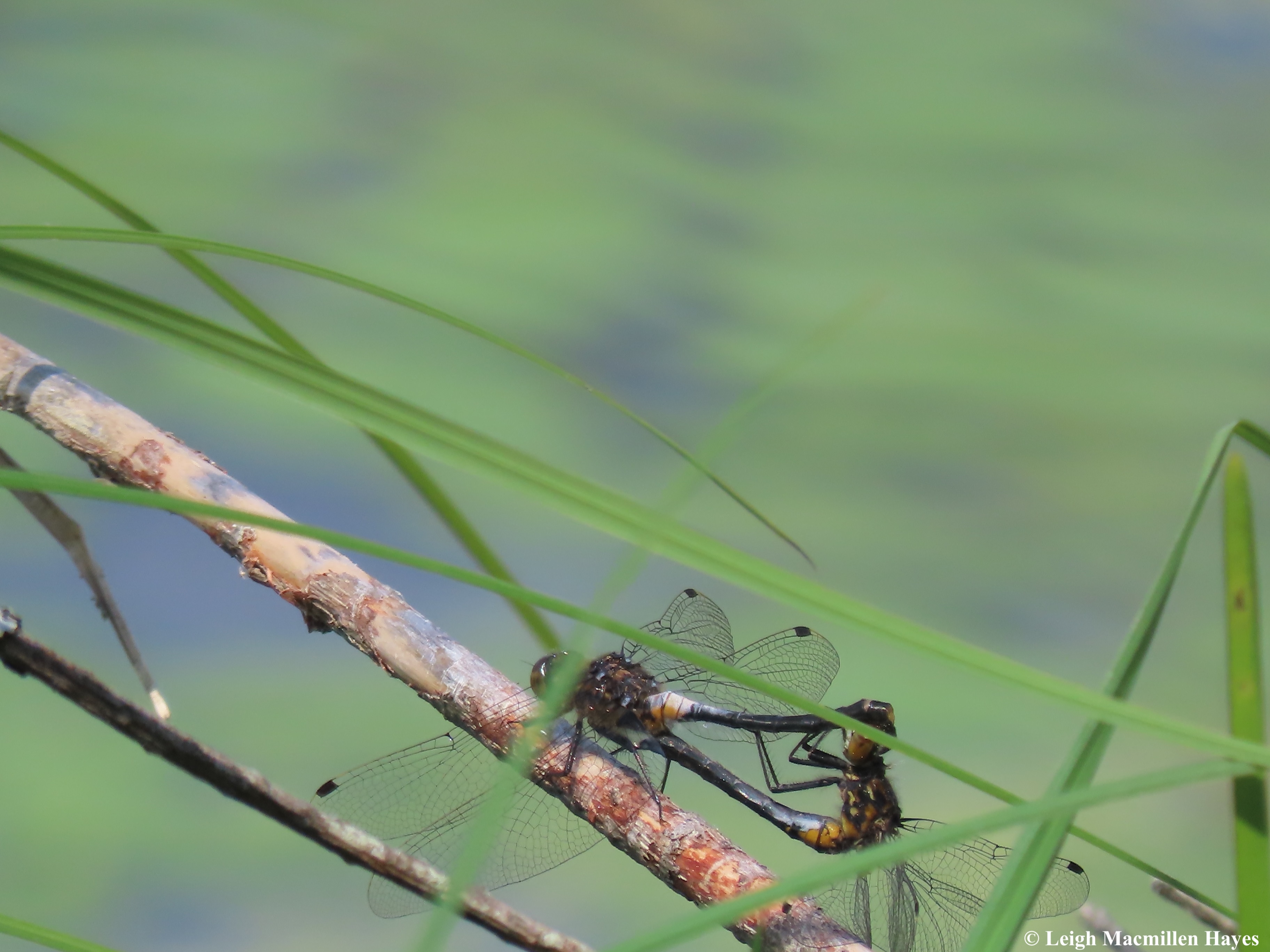
And like other insects, once emerged and a few days old, canoodling commences and dragonflies such as these Belted Whiteface Skimmers find each other and a presumably private place to mate. Private, that is, until I show up!

Eggs are laid in a variety of ways and places depending upon the species and this is a female Eastern Pondhawk taking a break upon a lily pad.

And here is a Forktail Damselfly laying eggs upon vegetation.
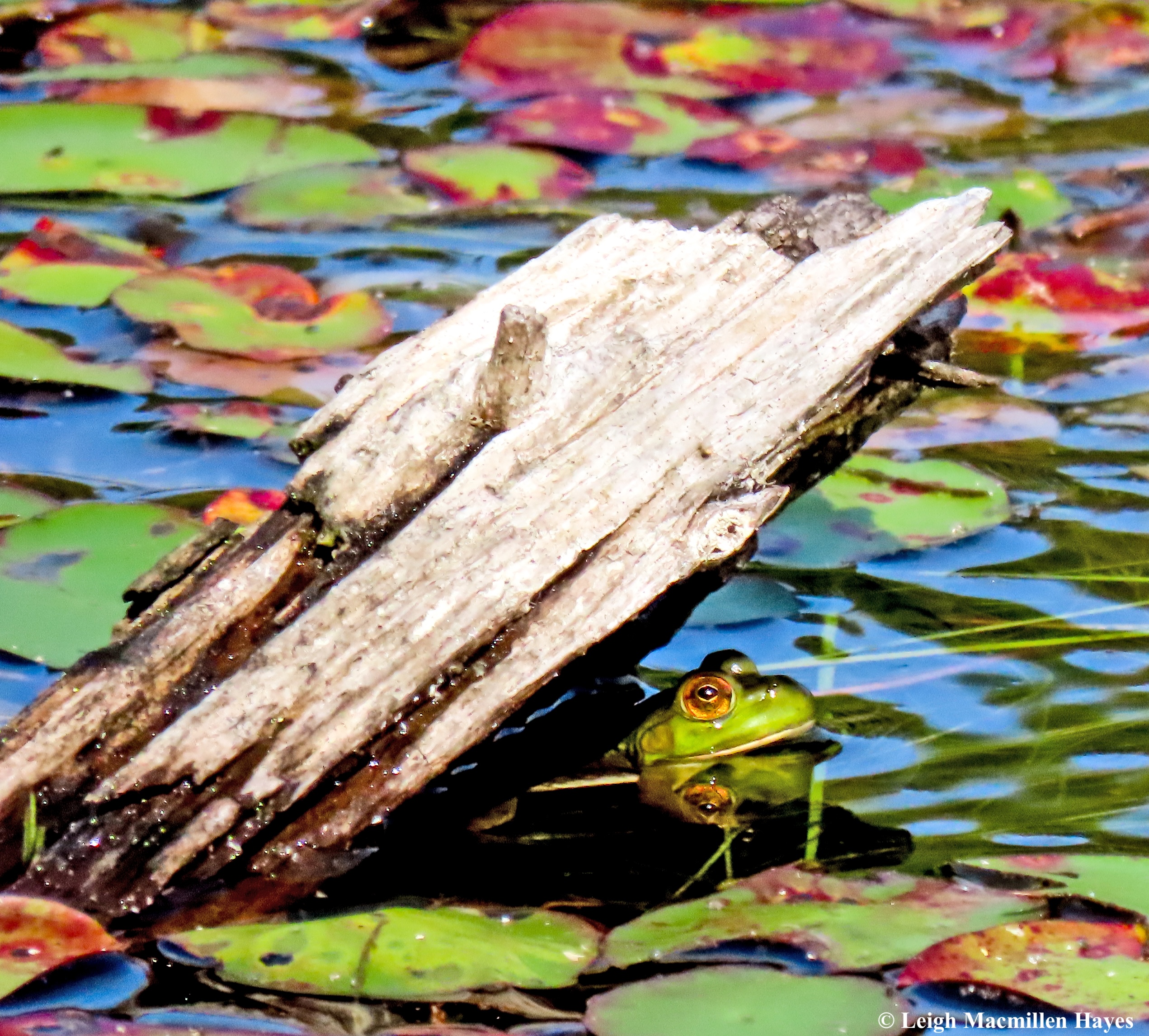
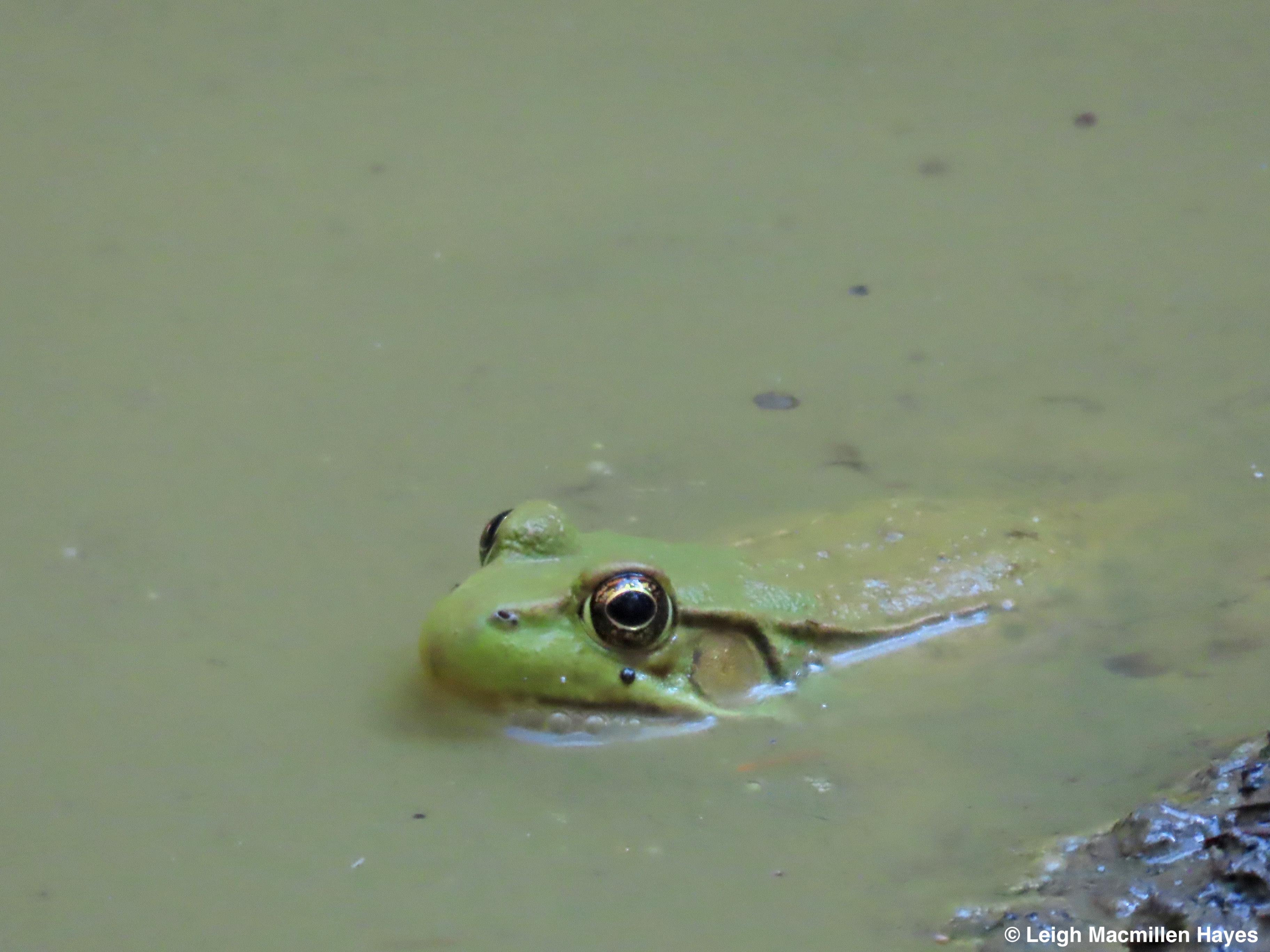
Frogs are also a highlight of a wetland, whether they are hiding in the shade on a hot summer day like this Bullfrog …
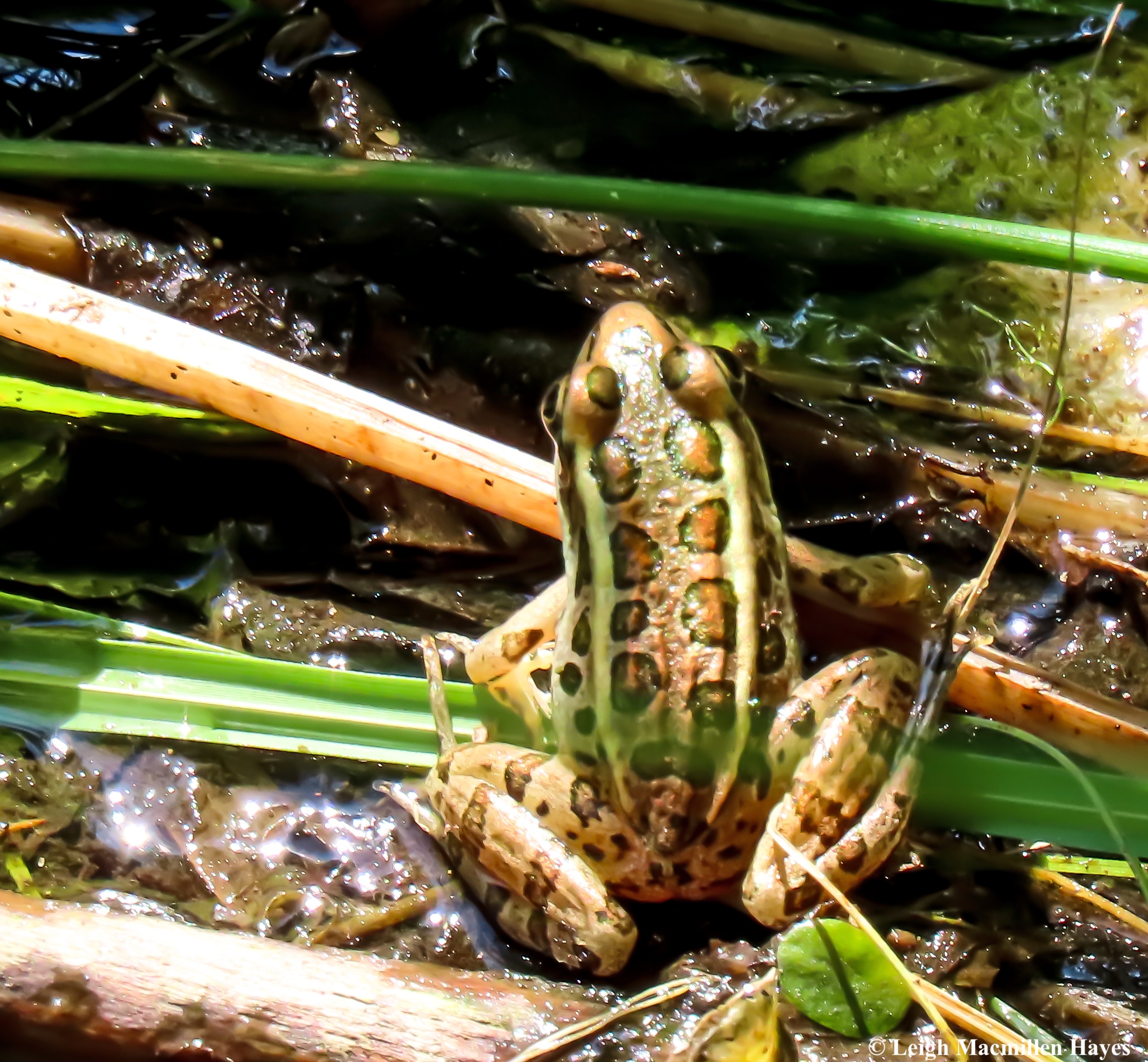
Or pausing briefly in the sun, such as this Pickerel Frog chose to do. Actually, it wasn’t so much basking as trying to remain hidden from my sight by not moving until I passed.
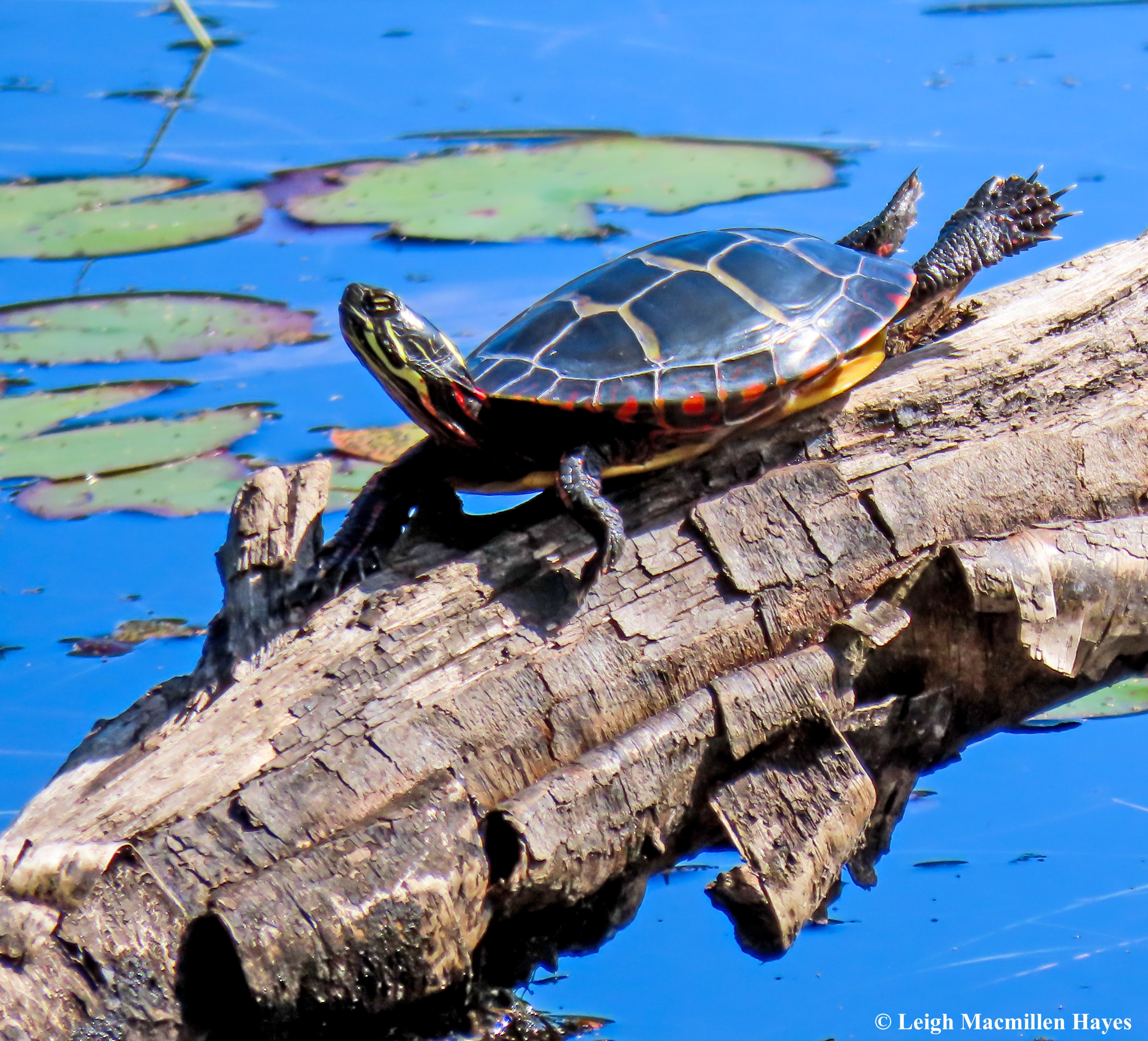
Those who do love to bask, (frogs do this as well) are the Painted Turtles, and the more surface area that is exposed to the sun’s beams, the better. Sometimes I’m surprised when I do capture a photo such as this one, for they are quick to sense my presence or hear me coming, and quickly slip into the water. But if you wait a few minutes, sometimes they’ll reemerge.
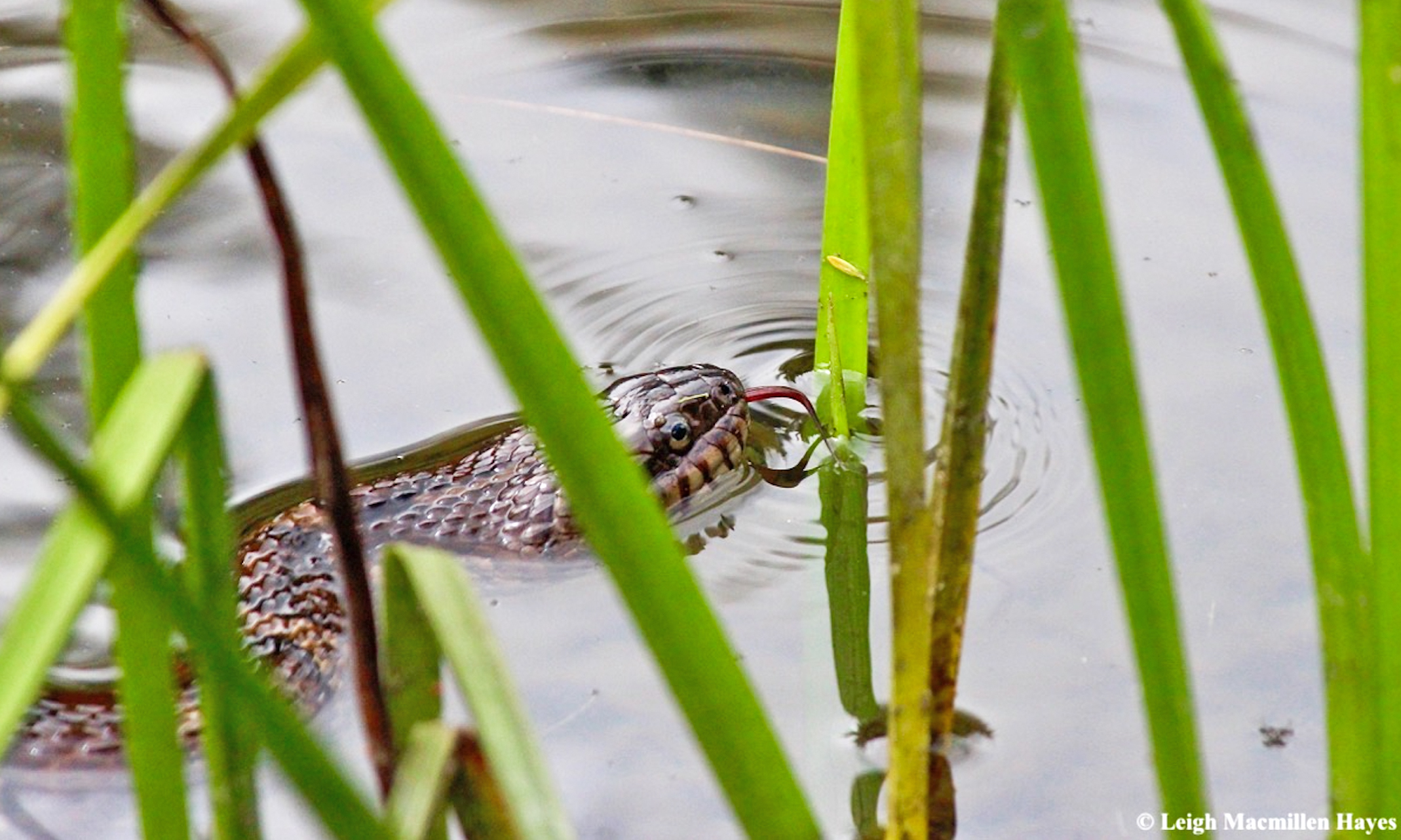
And there are Northern Watersnakes always on the prowl, using their tongues to make sense of their surroundings.
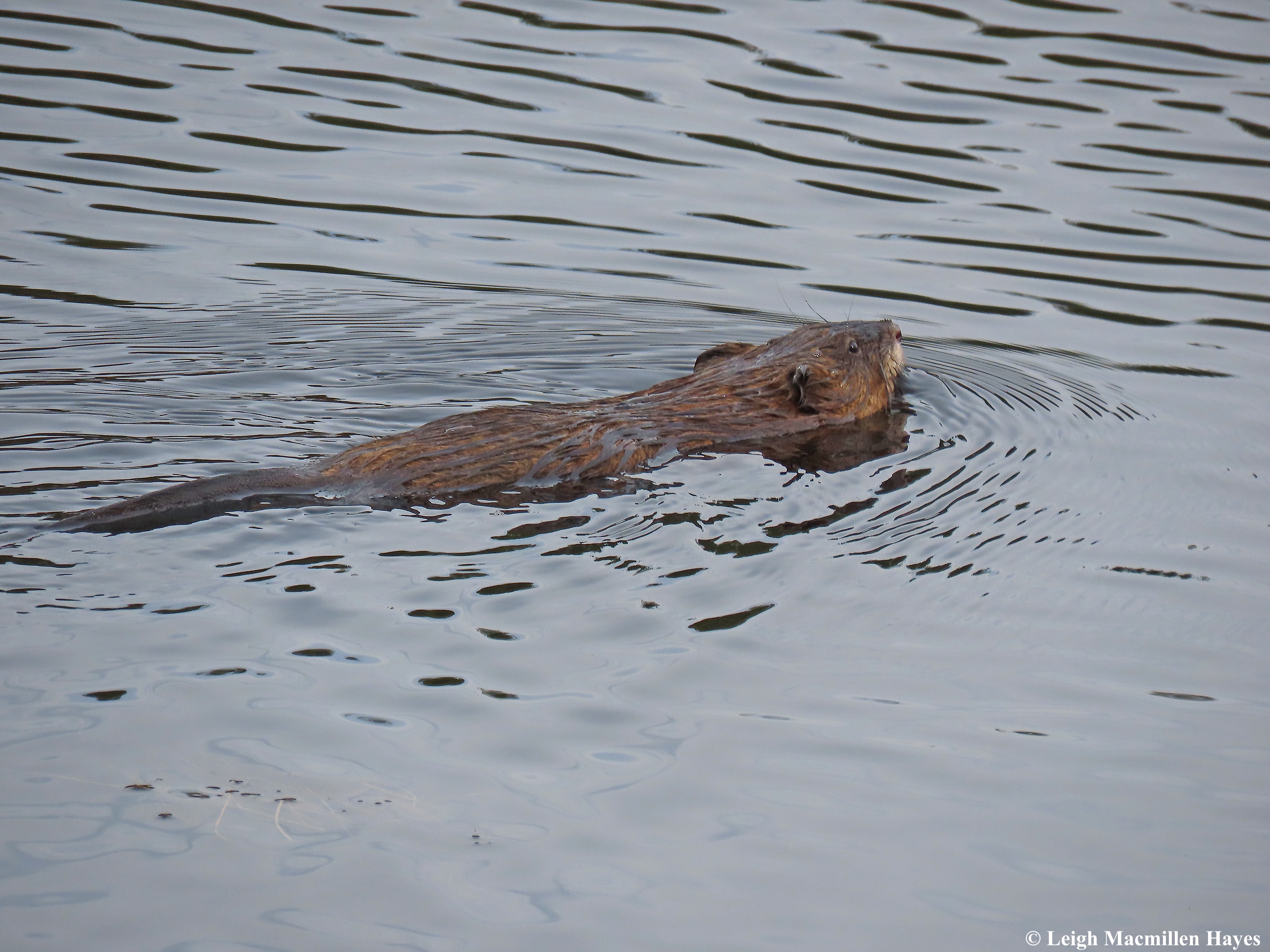
Mammals also use wetlands for forage for food and build homes and one of my favorites is the American Beaver, who knows the value of a wetland, and can create one in a short time by building a dam. Beavers build dams to created a deeper pond through which to navigate, for they are better at swimming than walking. They may alter the wetland to suit their needs for a few years, but then move on and let the dam breach and then a new type of wetland emerges and more critters move in and take advantage of what it has to offer.

That all said, it wasn’t until I spent more time with the animal pictured above that I realized it was actually a Muskrat–look at that thick, rounded tail, unlike the flat paddle of a Beaver’s.

And birds! Oh my. Mergansers . . .

And momma Wood Duck and her offspring . . .

and Papa Woodduck . . .

And Great Blue Herons always on the prowl for fish or amphibians know the value of the wetland as a food pantry.

So, this spring and summer and fall, I’ve been following My Guy and our friend, Bruce, beside and into and sometimes, thanks to Bruce’s drone, over a variety of wetlands.
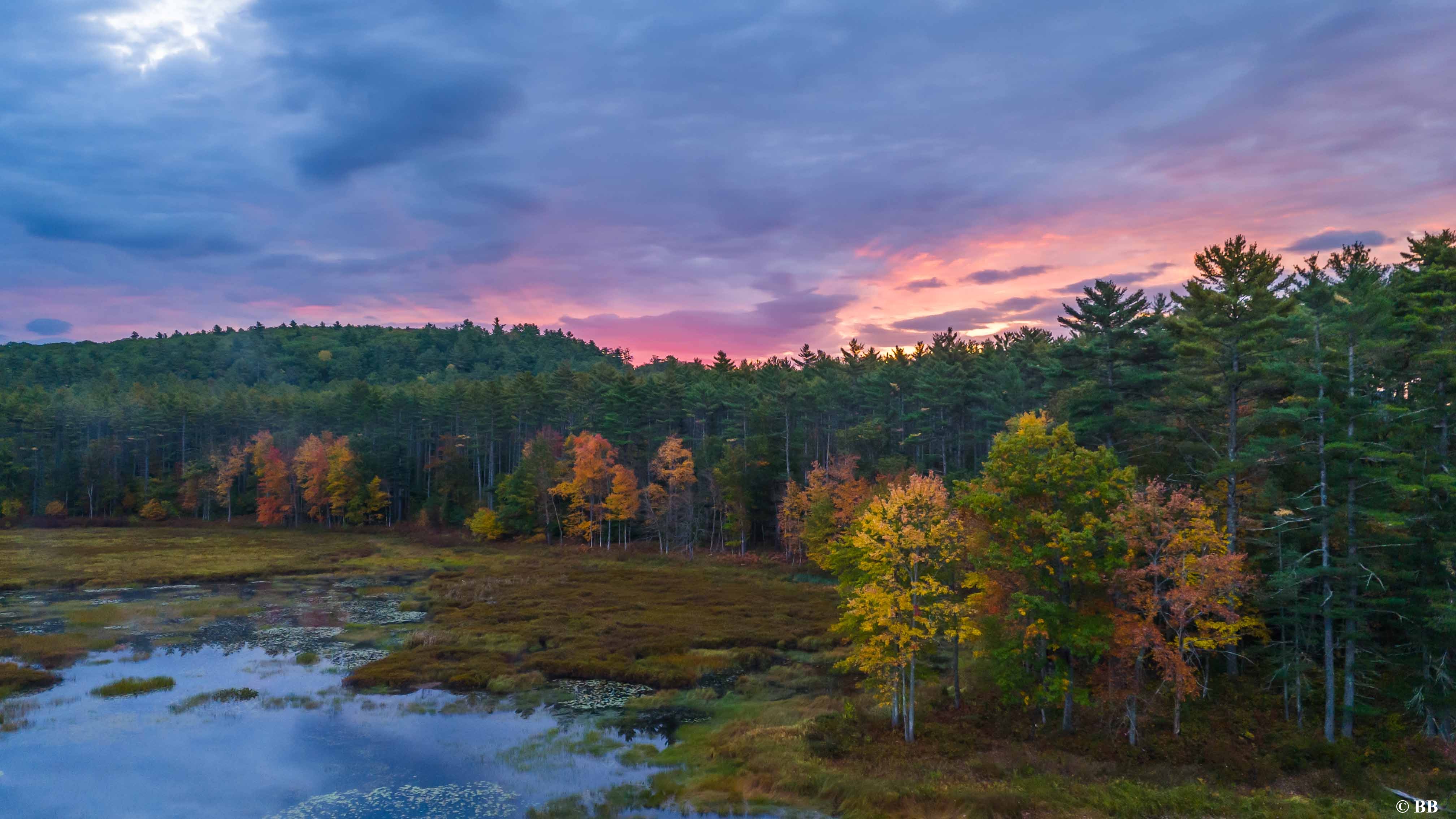
Bruce is an early riser (understatement), and occasionally I’ll meet him at a predetermined location as we did this past weekend–before the sun has risen. Though the thought of staying in dreamland for another hour or so is enticing, I never regret the decision because we get to view the world before it officially wakes up.

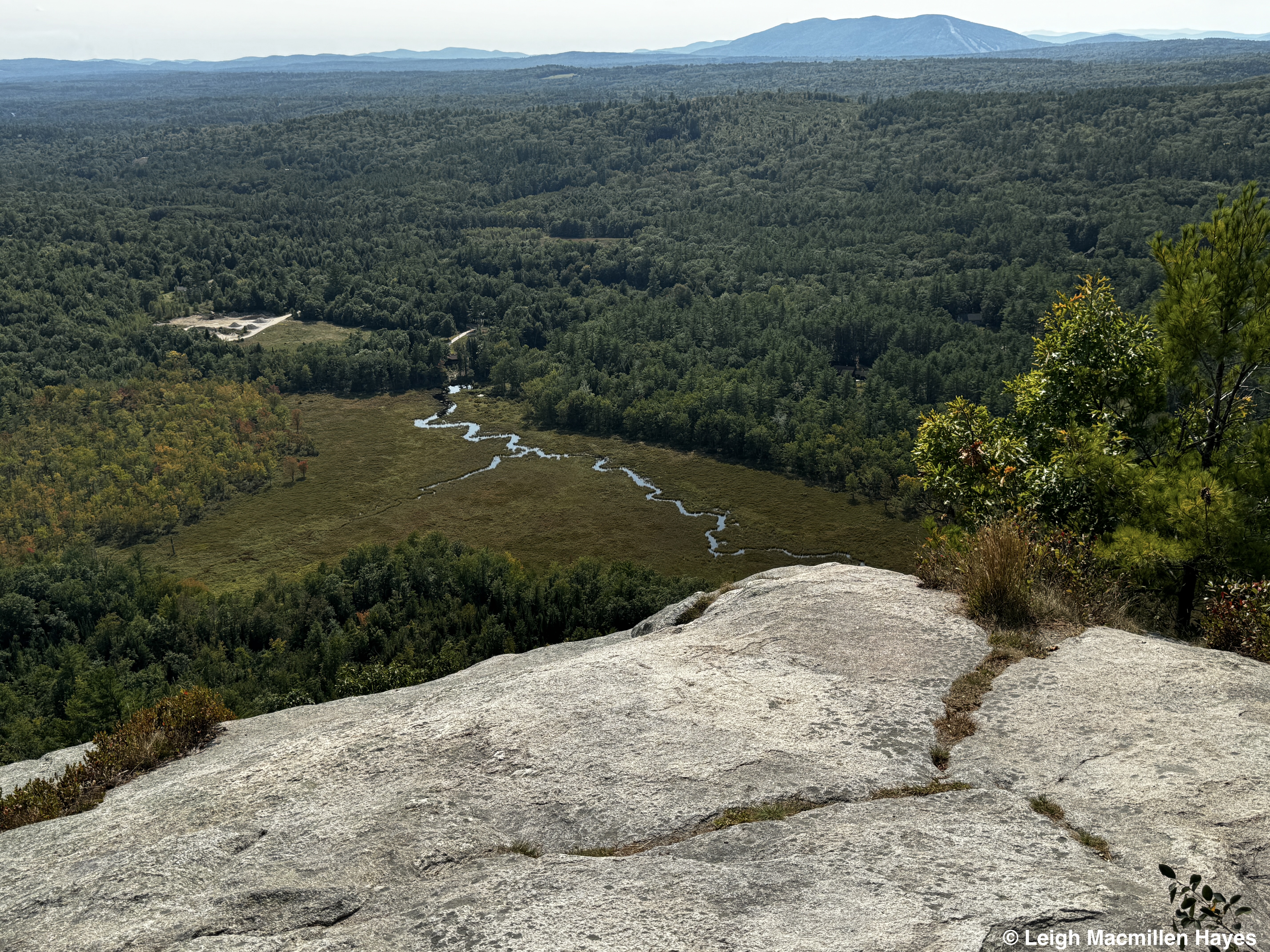
And with his drone we explore these areas we cannot easily access. This is one My Guy and I walked all the way around a few weeks ago without ever spying, though we knew it was there. But Bruce and I bushwhacked through a forest of White Pine Saplings and mature trees and reached the edge before he launched his bird and we were offered a glimpse of this most beautiful wetland with pockets of water connected by meandering rivulets.

The stream turned to forest for the trees told more of the story, as they closed in and I recalled that it wasn’t far from that spot that My Guy and I walked through a damp area where Royal Ferns grew and we found one teeny tiny mushroom fruiting on a hot summer day.

The mushroom was the little Orange Peel Fungus, and its name seemed so obvious. And the soil moist despite the severe drought.

Another day we began our exploration in the afternoon beside a small pond.

And the Droney-bird picked up on the wetland to the south.
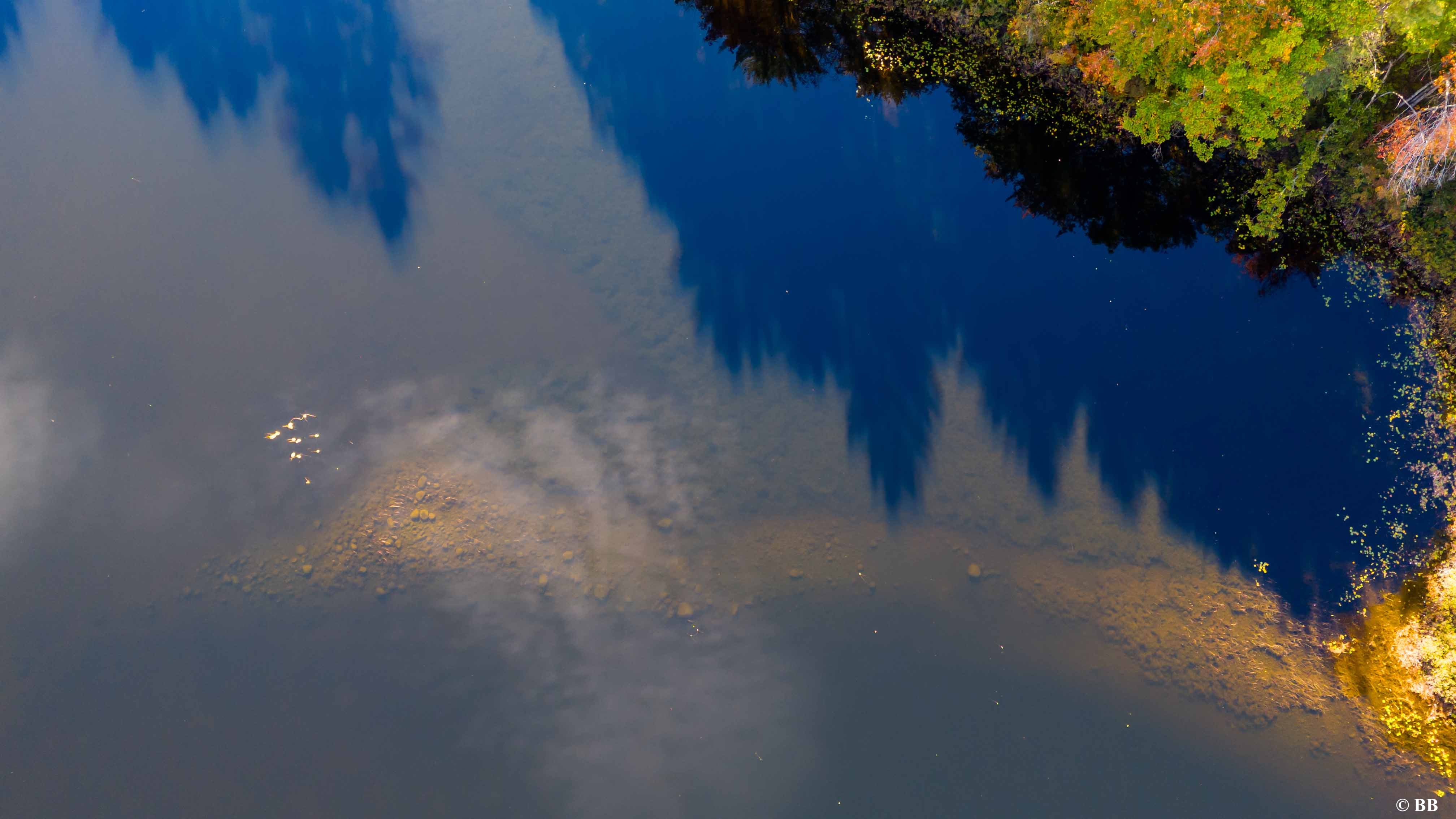
But that day what struck us as being more important was that it also took a clear picture of a sandbar in the water.

And as Bruce navigated it closer to the watery surface, we could see clear to the bottom. Mind you, it’s not a deep lake, but this is the water of Maine. Clean and clear.

And we celebrate wetlands for the critical role they play in maintaining the health of the environment.
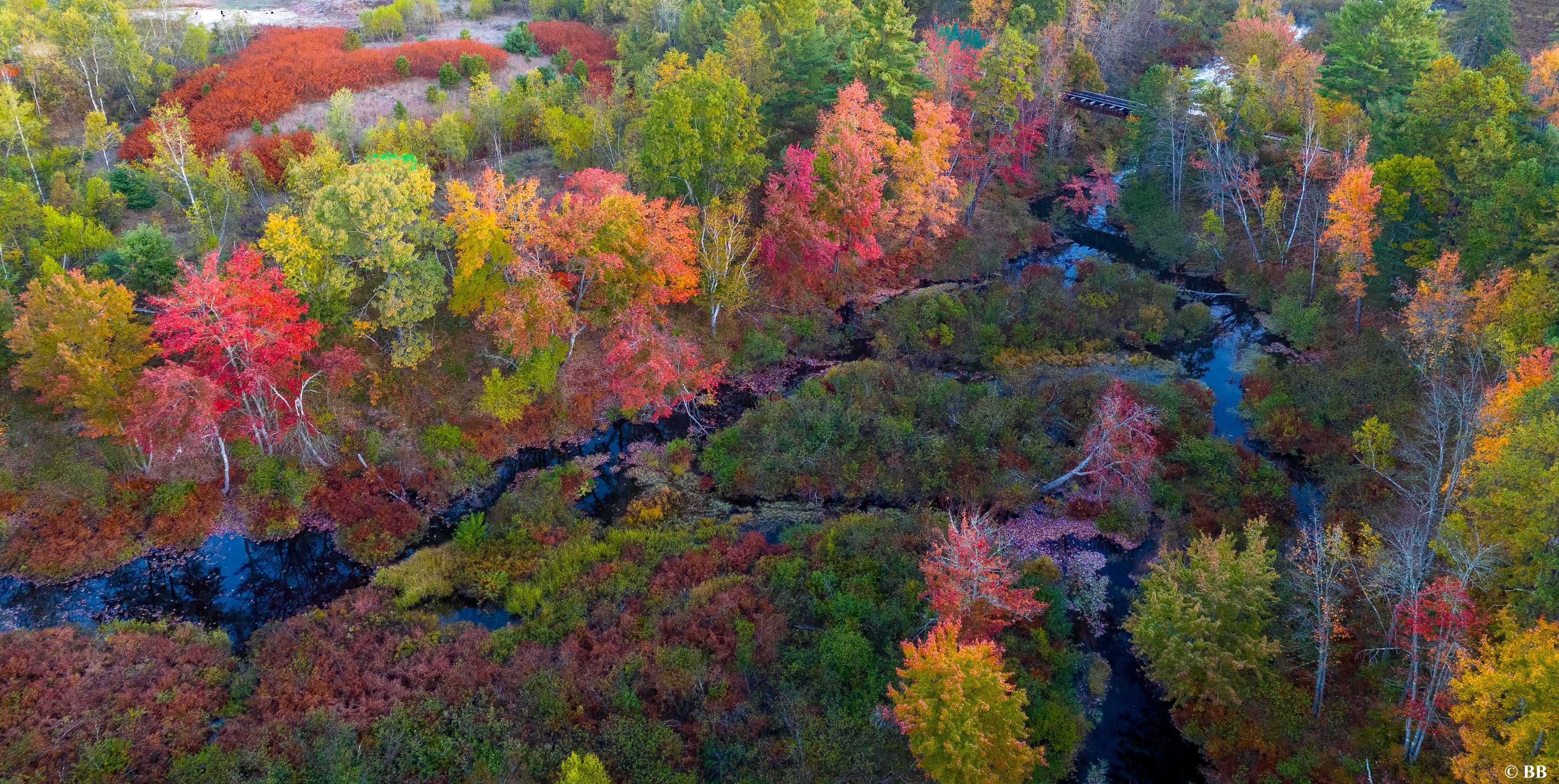
When I think about their ability to store and filter water and act as a natural sponge, absorbing and retaining large amounts of water during the heavy rainfalls of spring, and removing pollutants before they enter streams, and rivers, and lakes, it all seems so obvious that they should do this when you have a bird’s eye view.
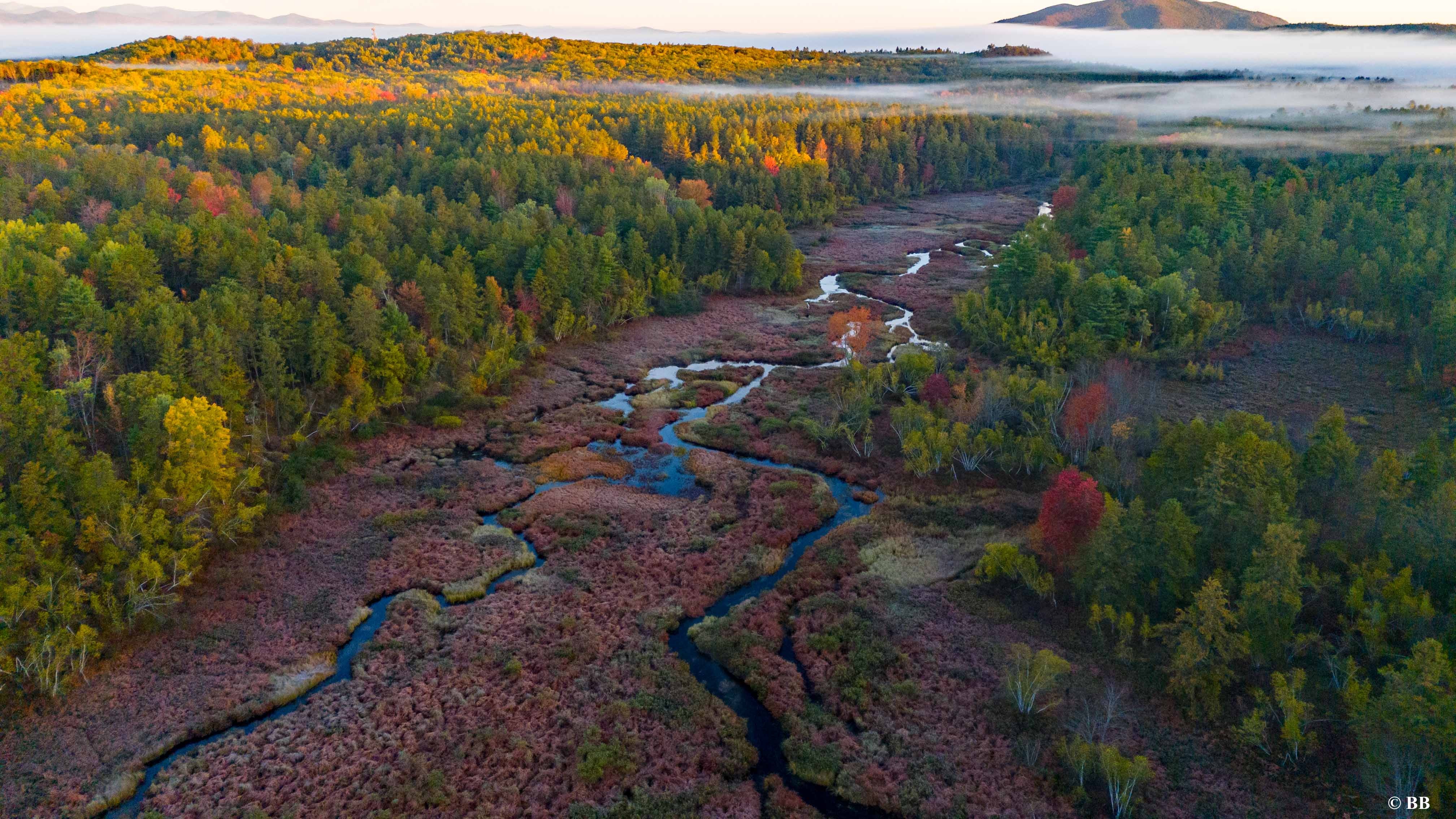
So here’s the curious thing about this wetland. It is located beside a local dump. And the more I think about that, the more I question those who created the dump, but give thanks for the unwavering workhorse that this wetland is in the ecosystem.
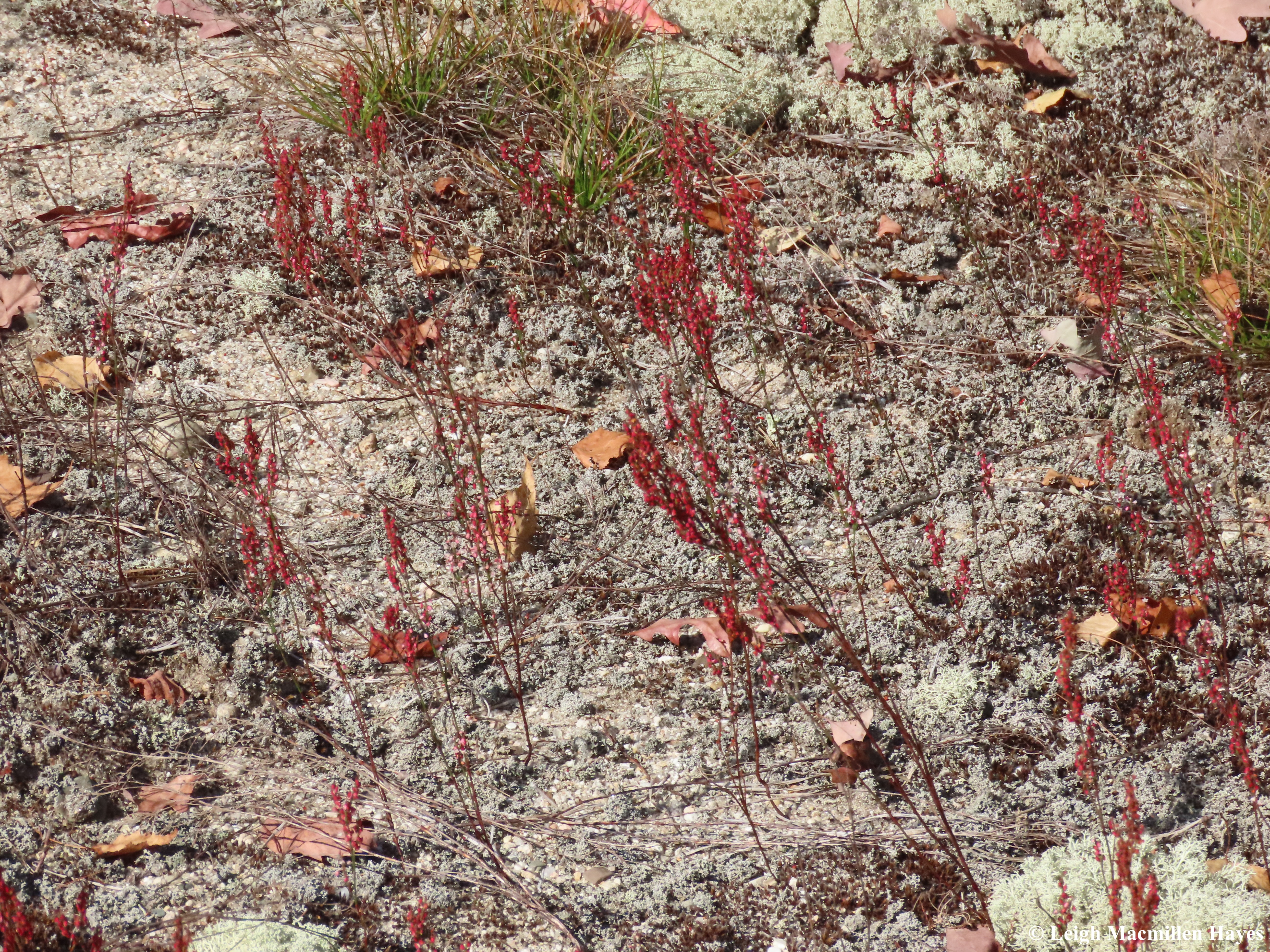
It was on the rise above this particular wetland, in a very sandy spot covered with Reindeer Lichen, that Bruce and I made a discovery. Well, he discovered it first and asked for an opinion. I’m full of those and so I met him and we took a look.

The discovery was a plant new to us both. Sand Jointweed or Polygonum articulatum. As you can see, the flowers are astonishing in their pink and white display.
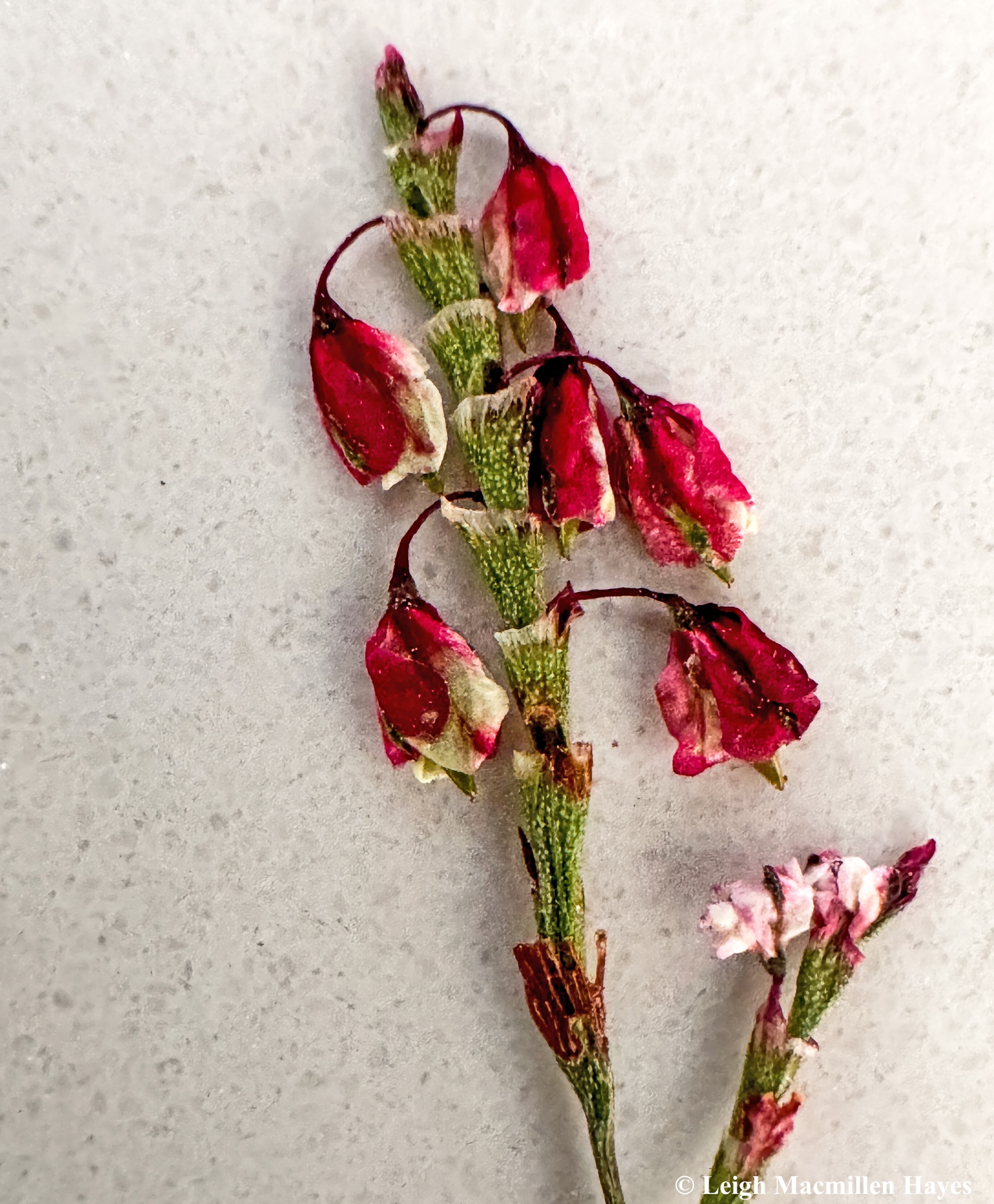
It was the stems that I found equally fascinating. At the base of the flower stalks there are sheathing bracts, giving it a jointed or segmented appearance. We didn’t see any leaves, but perhaps we need to look again. I think we were just amazed to have discovered a plant neither of us recalled meeting before. Often though, that means we’ll meet it again soon.

The small snippet followed me home, and today I looked at the flowers under the microscope and I was astonished to realize that they look rather like a map of a wetland.

I don’t jump at the invite every time it arrives for an early morning mission to explore a wetland, and one day really regretted it because when My Guy and I finally got to the location, we found a note with Bruce’s observations. We scanned the area with our eyes for about an hour before deciding that we were too late.

But . . . we promised ourselves that we’d pack a picnic supper and try again.

First we spotted one Bull Moose.

And then a second, and had a difficult time deciding that we should head home.

Did you know that 25% of Maine’s land area is wetlands? That’s four times the wetland area of the other New England states combined. The natural buffers they provide sustain the deep clear water we appreciate, and take for granted.

The margins or places where the land and water come together are bridges between two worlds. As many as 90% of all living things in our waters are found in these wetlands, no matter what form they take. I guess that’s why I love exploring them so often, because there’s always something to see. And another lesson to learn.

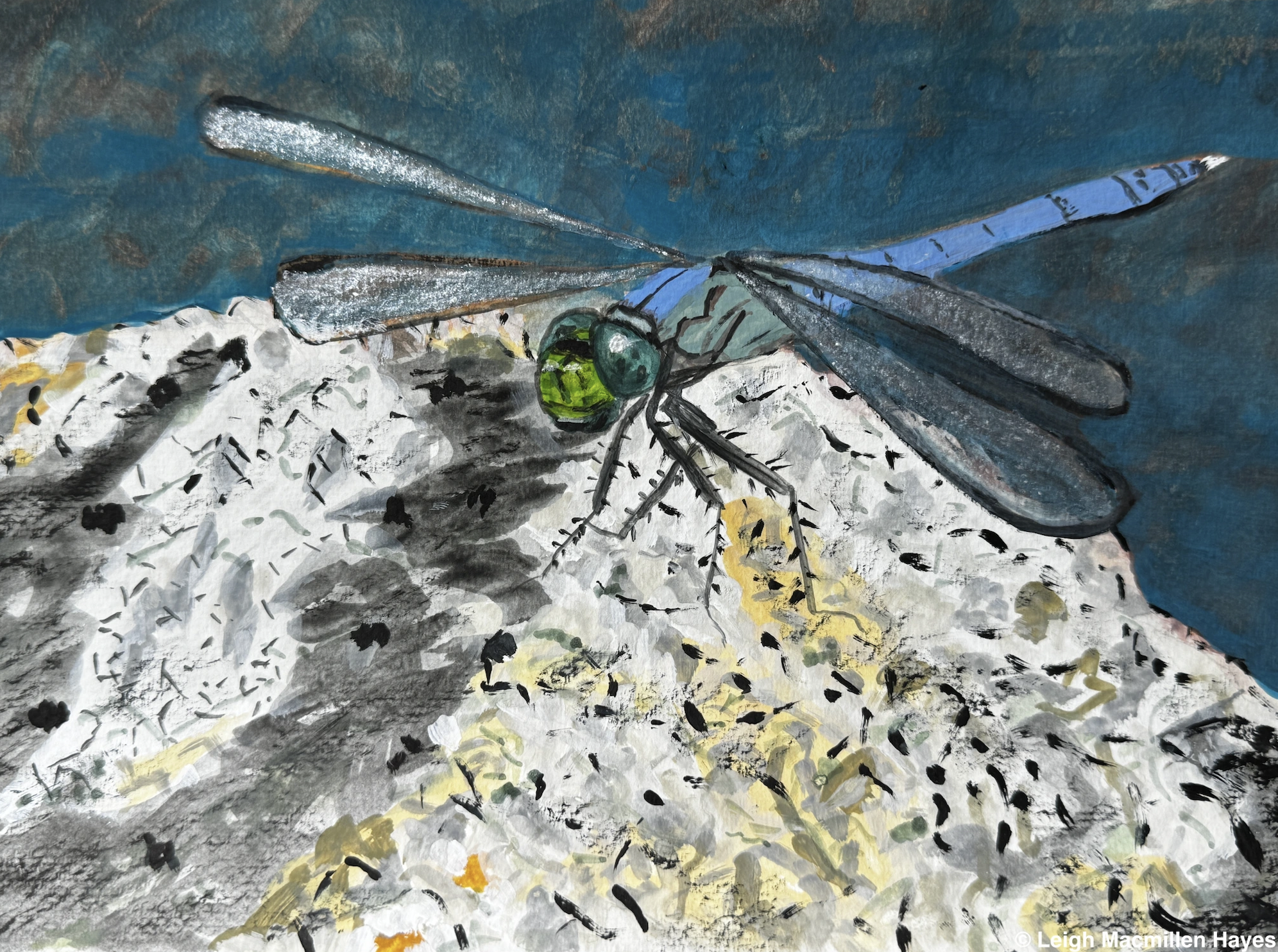
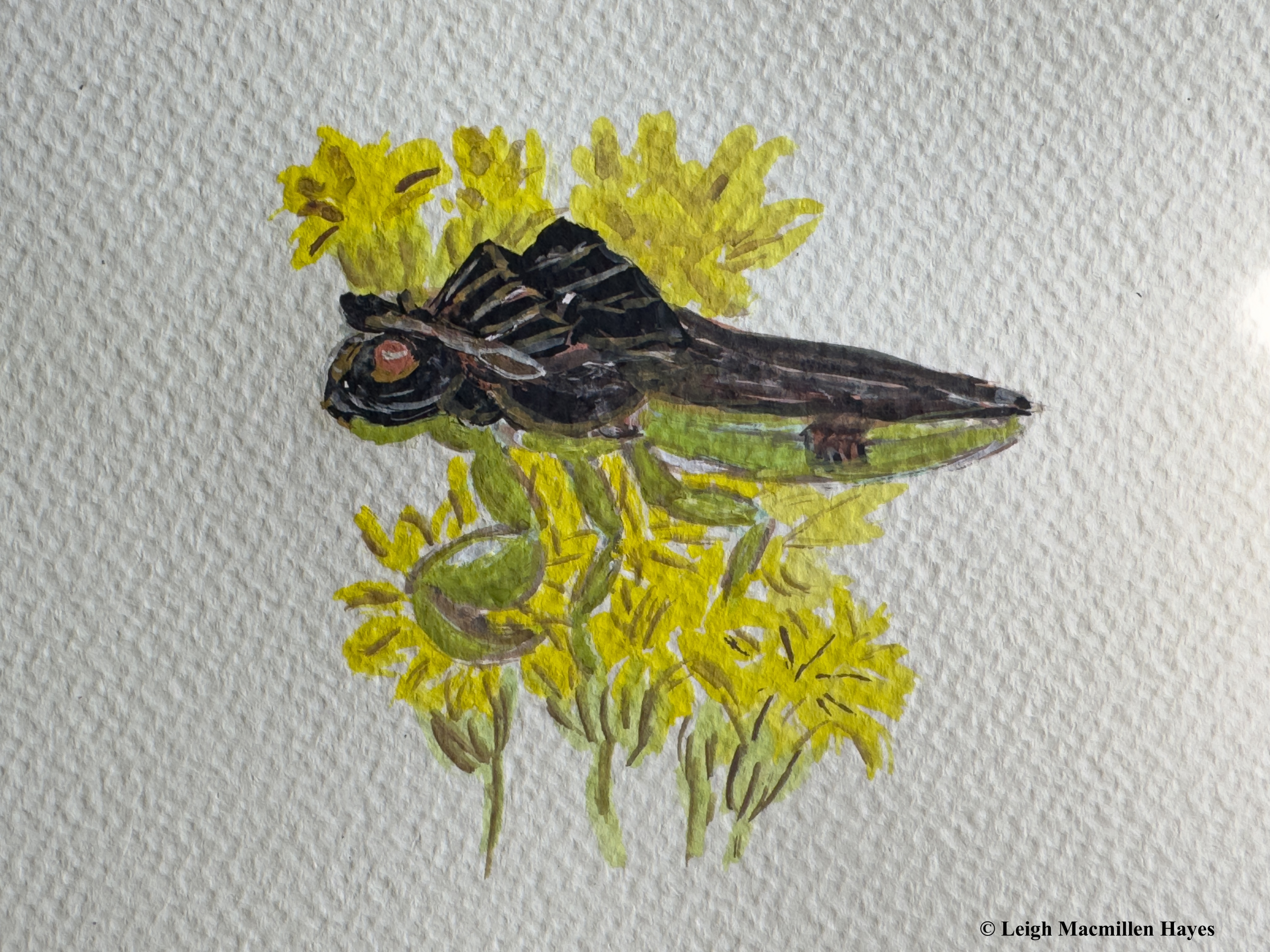
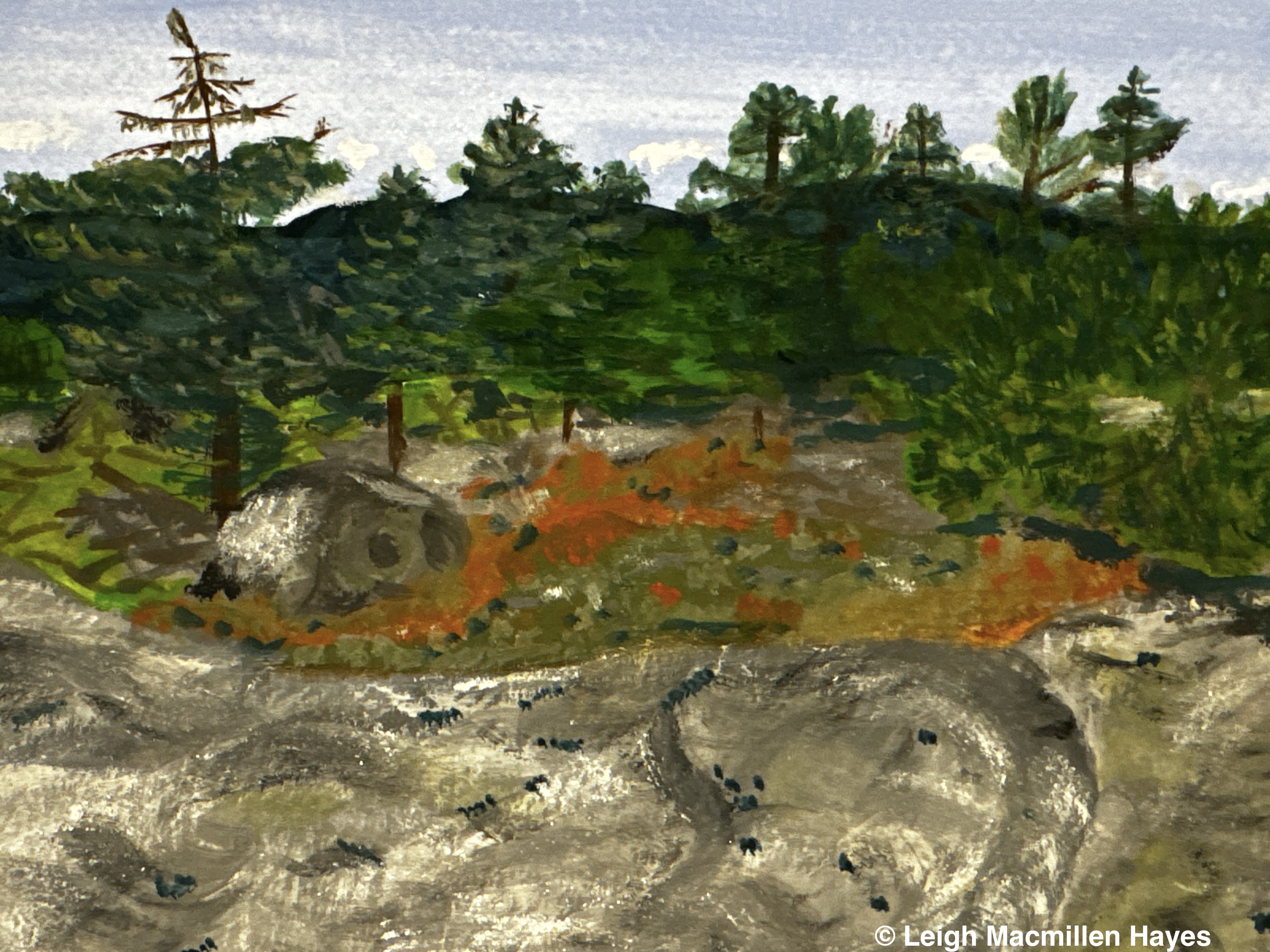
I leave you with this, a watercolor Bruce’s wife Eileen sent me recently. It was inspired by one of our local wetlands.

Some may see wetlands as dark and shadowy areas, mosquito hatcheries, with an abundance of leeches mixed into the scene, but the rest of us know their true value and I give thanks for living in this place where it’s so easy to go Bogging in Maine. And to share it with others. Thank you MG, BB, and EJB!
Lessons in the Shadows

The email arrived before 8am. “‘Morning. I have a dying/dead dragonfly. Perfect condition/appearance. Wonder if you could use it for your collection. No rush if so, I’ll keep it safe!”

And so it was that this afternoon I drove to a friend’s house and received this gift. In the moment, I knew it was in the Darner family, but I wasn’t sure about its full identification. The amber wing color drew my awe and I couldn’t wait to go home and look through my guides and make a decision.

But . . .

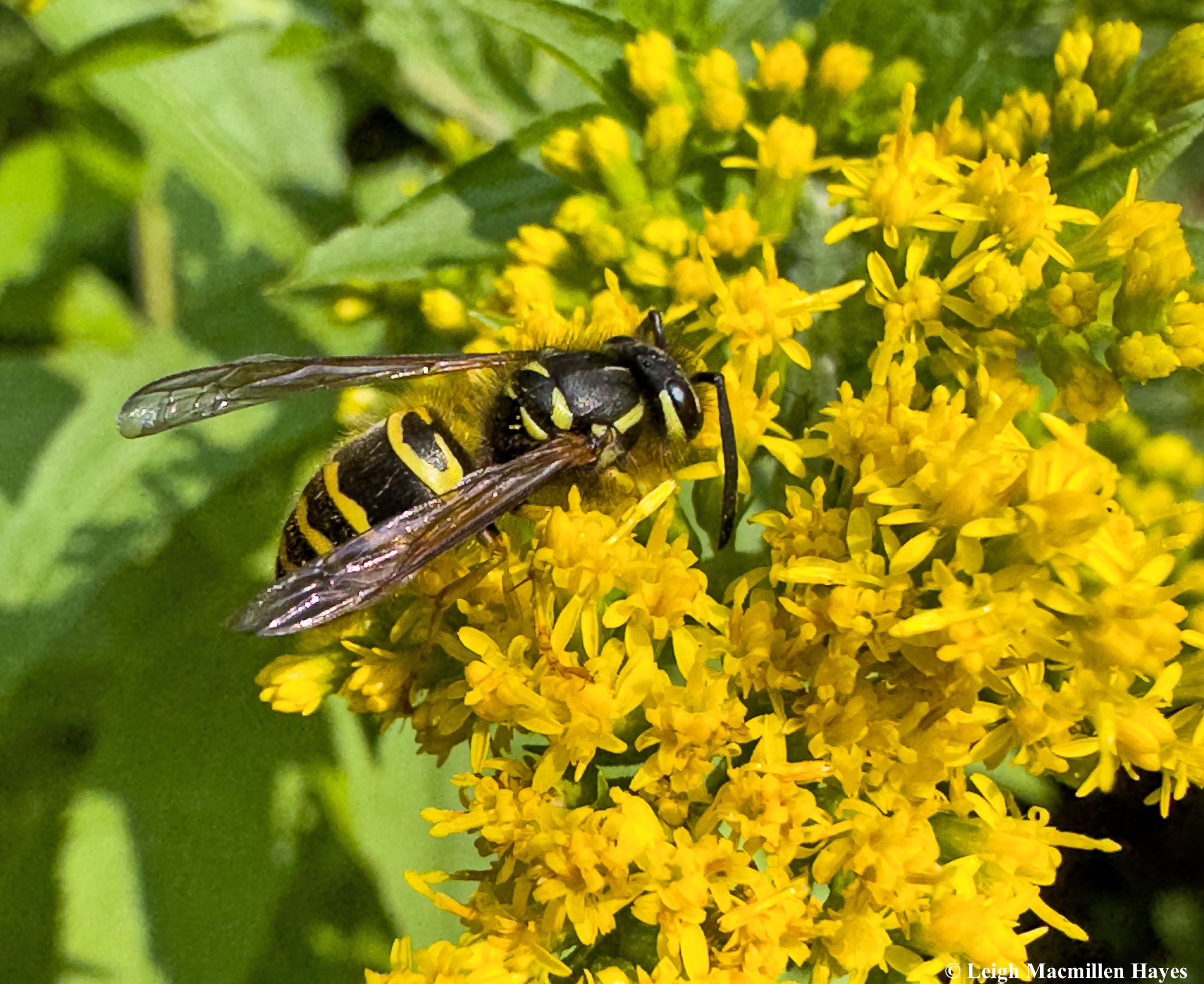
First I drove to a local preserve and followed the trail to a favorite wetland where Yellowjackets like this one and Bees of every kind, and Hornets, and Flower Flies buzzed and flew and buzzed some more as they frantically worked on the Goldenrods and a few Asters still in bloom.

I had intended to cover some miles, albeit at a slow pace, but . . . once I spotted this specimen, I knew my plans were shot. Instead, I was meant to be in this one place for a couple of hours. And so I stayed.

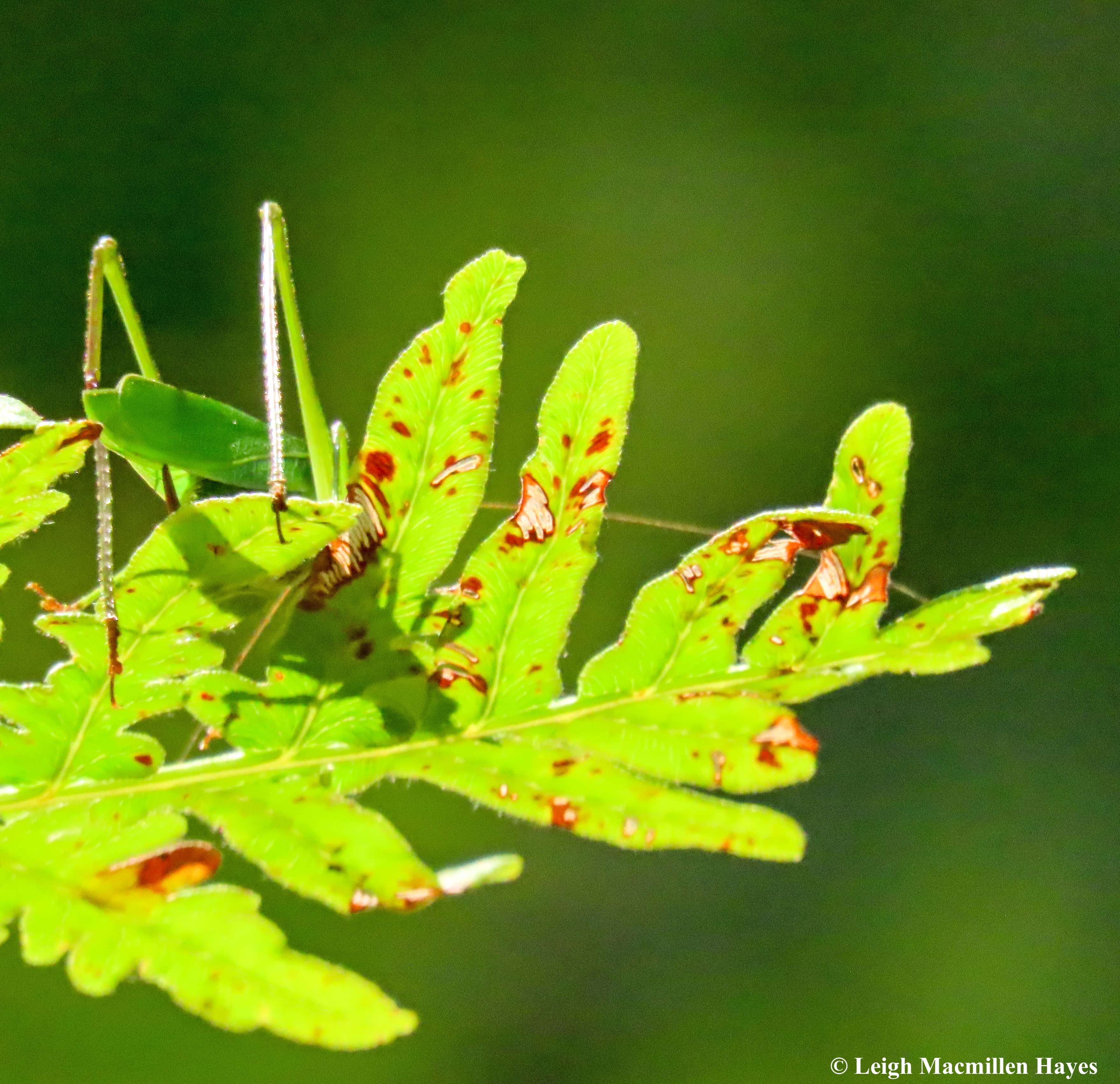
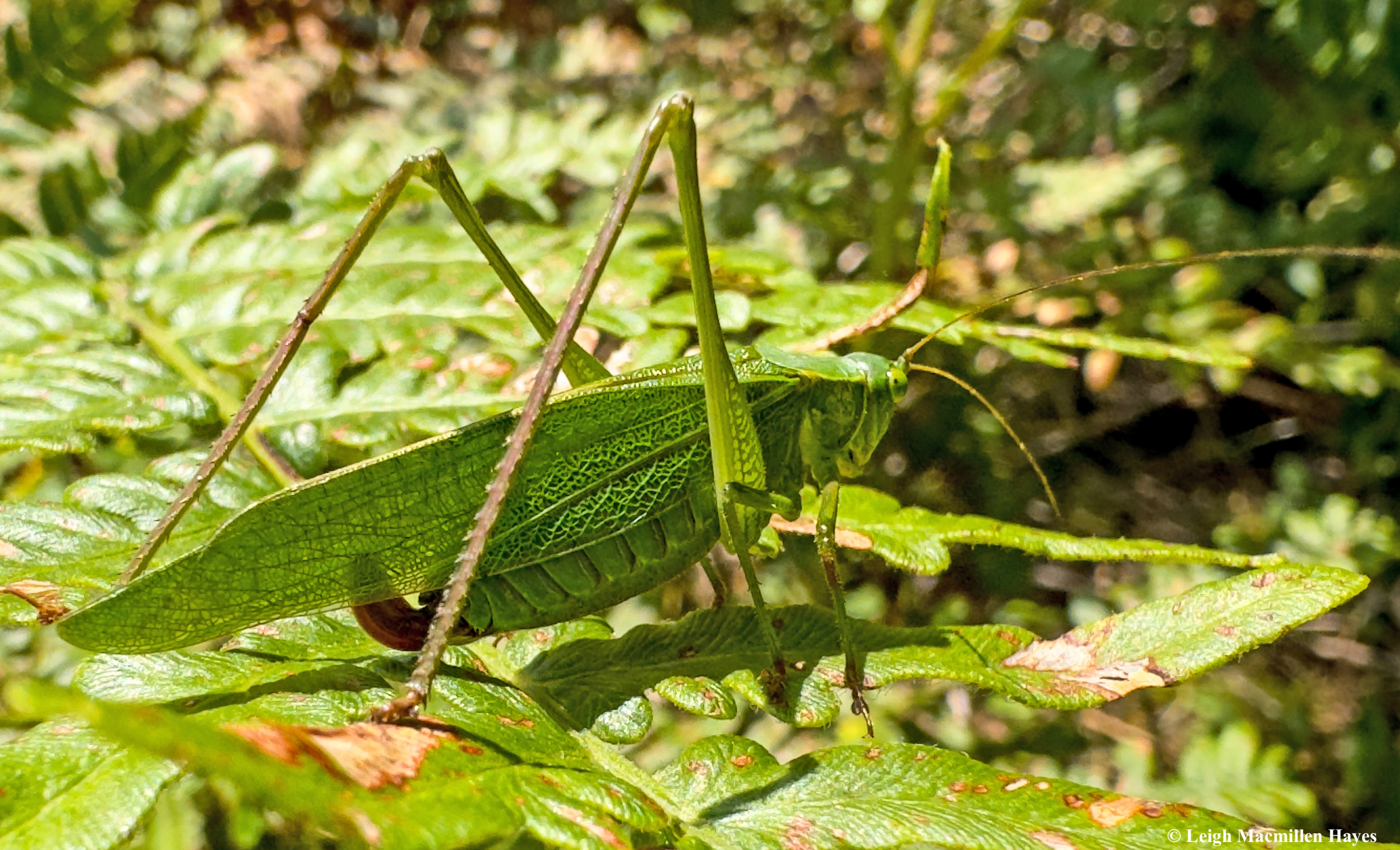
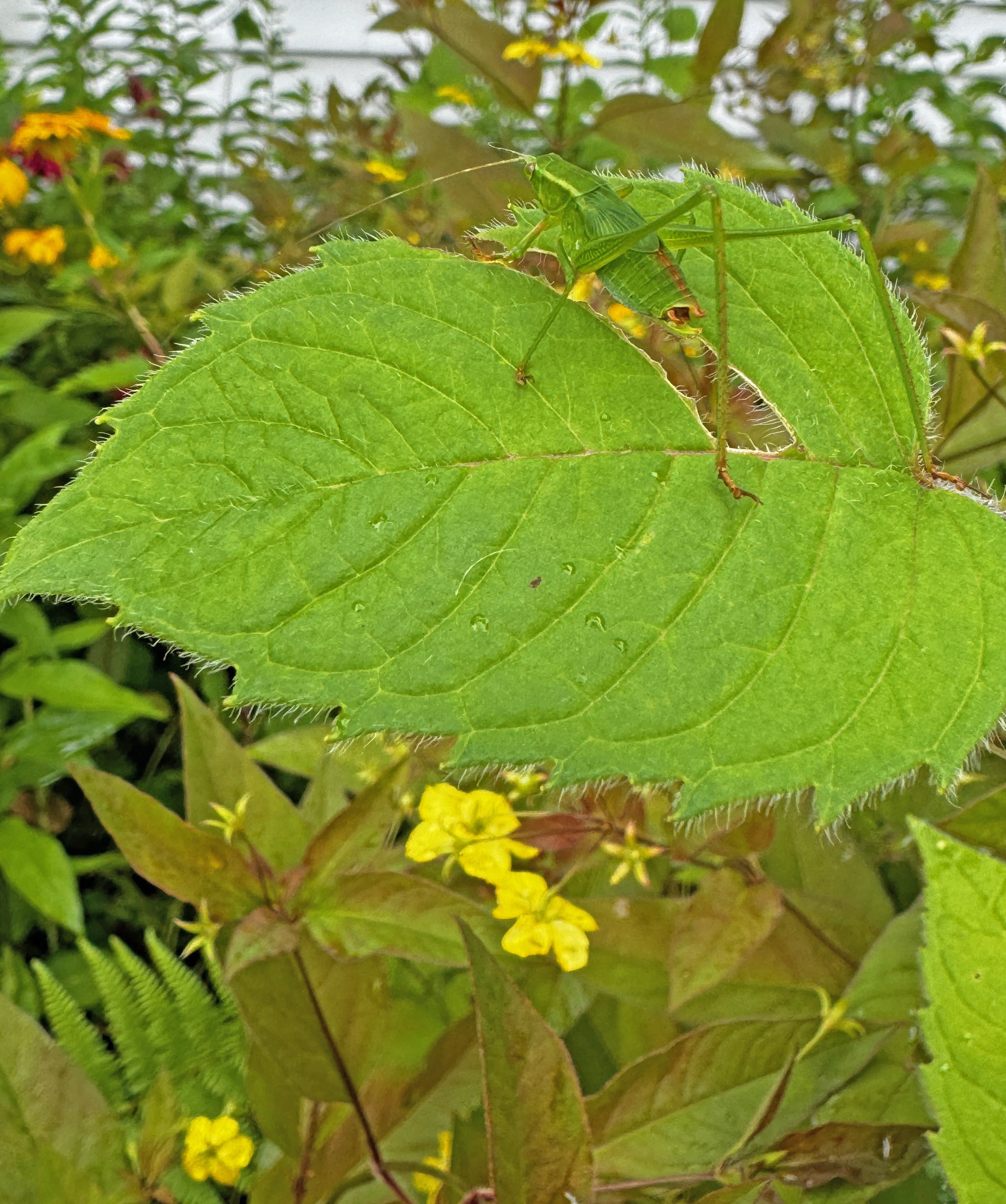
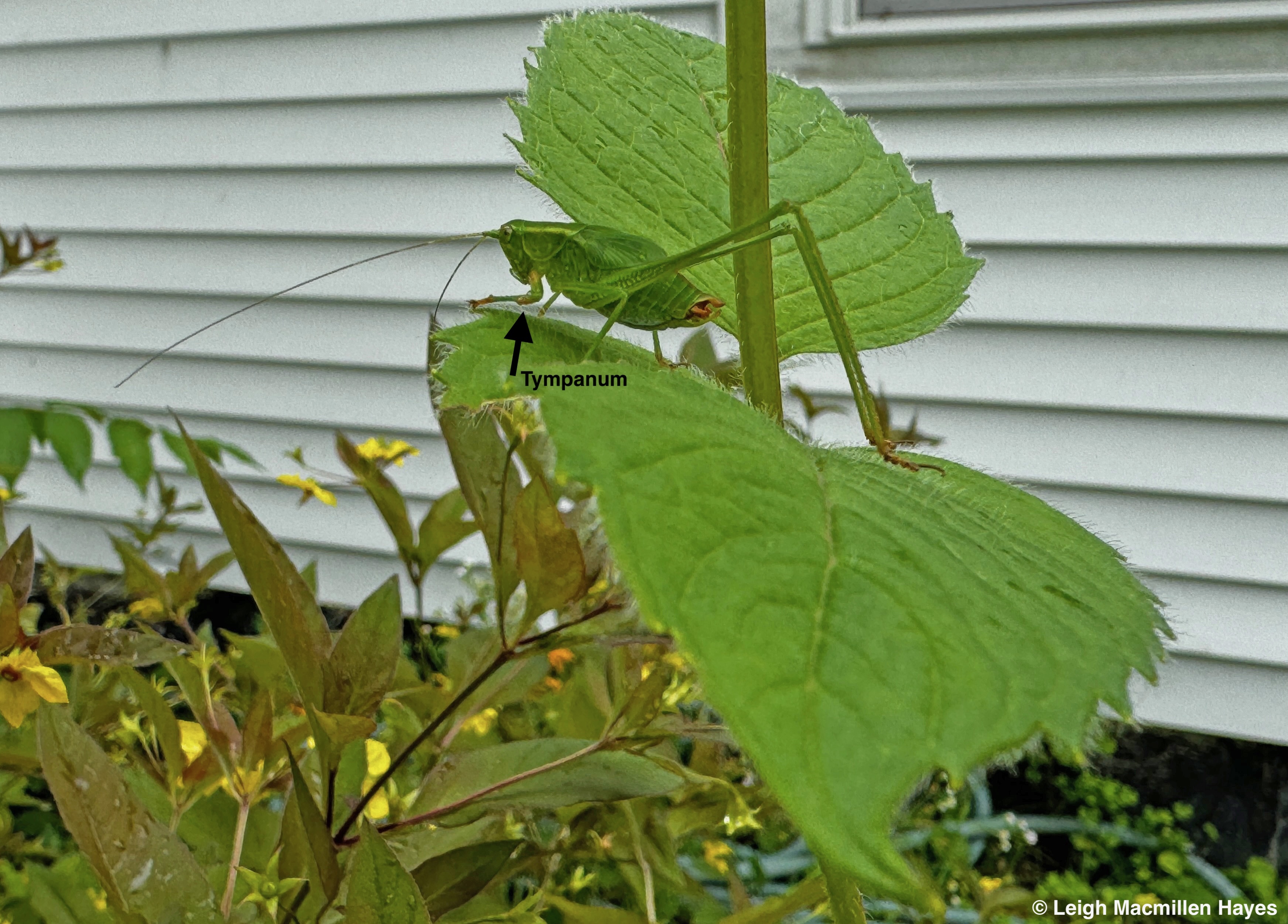
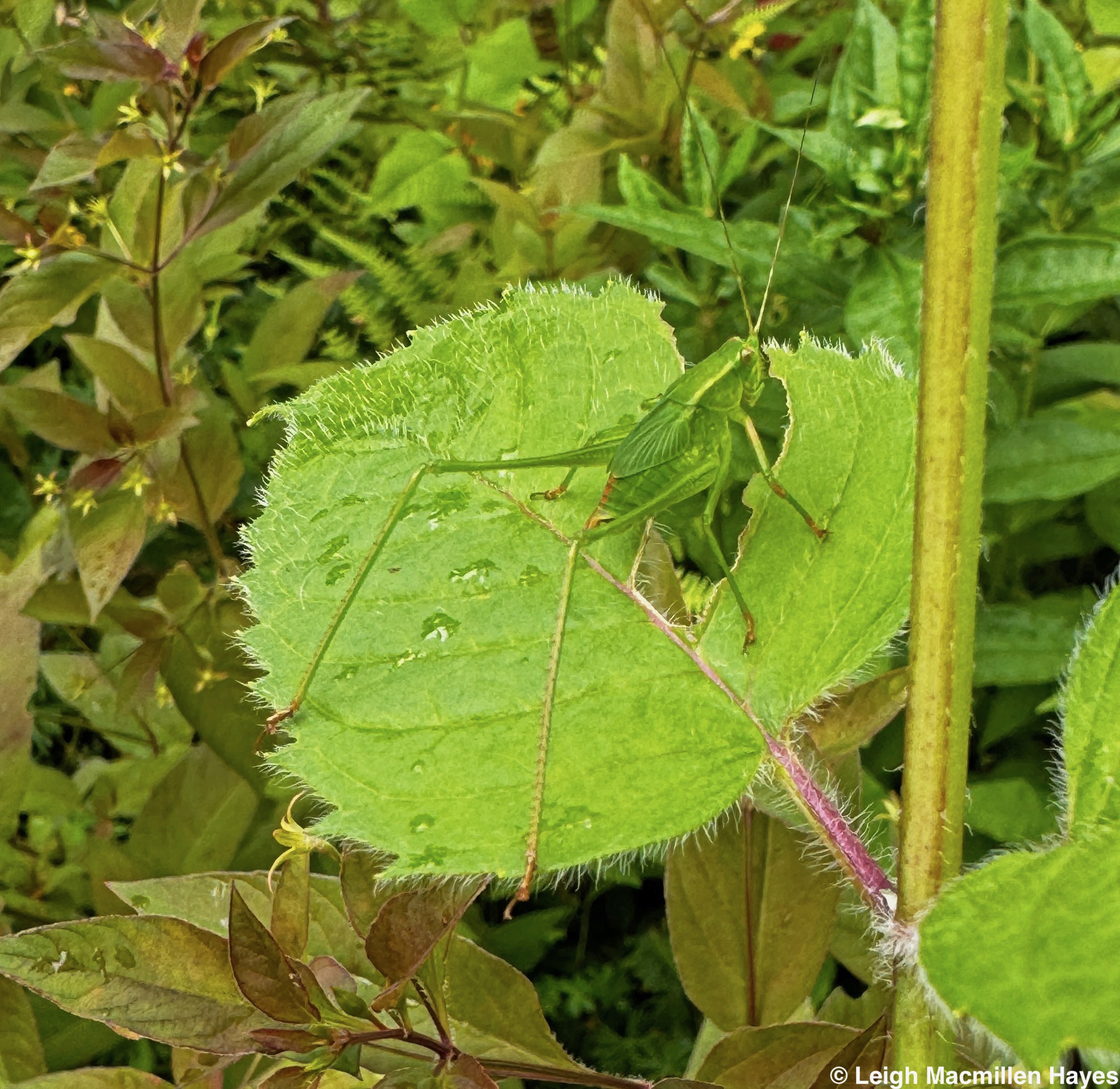
And reveled in the sighting of this Bush Katydid. As I said to another friend this morning via a text message–look at the armor and color and texture and design. Of course, then, I was referring to a Two-Striped Grasshopper. But truly, the same holds true for the Katydids in our world. (Especially my favorite Katy-did! She knows who she is.)
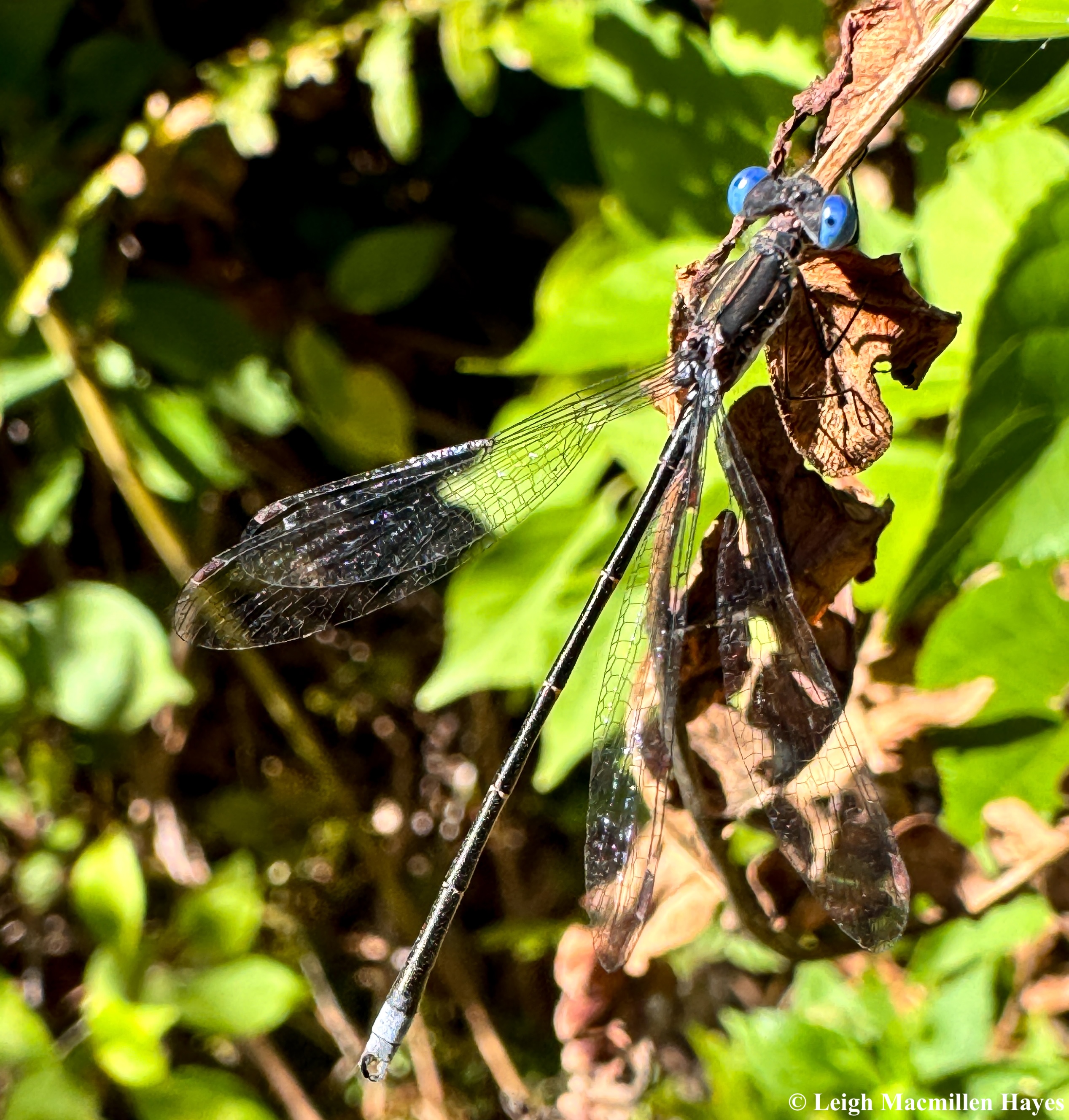
Also in my midst–Spotted Spreadwing Damselflies. This is the male and last week, plus today, I spotted them but couldn’t find a female anywhere.

Until I did. As always, her color is much drabber than his, but still she has the more important job . . . at least in my book of how the world turns.

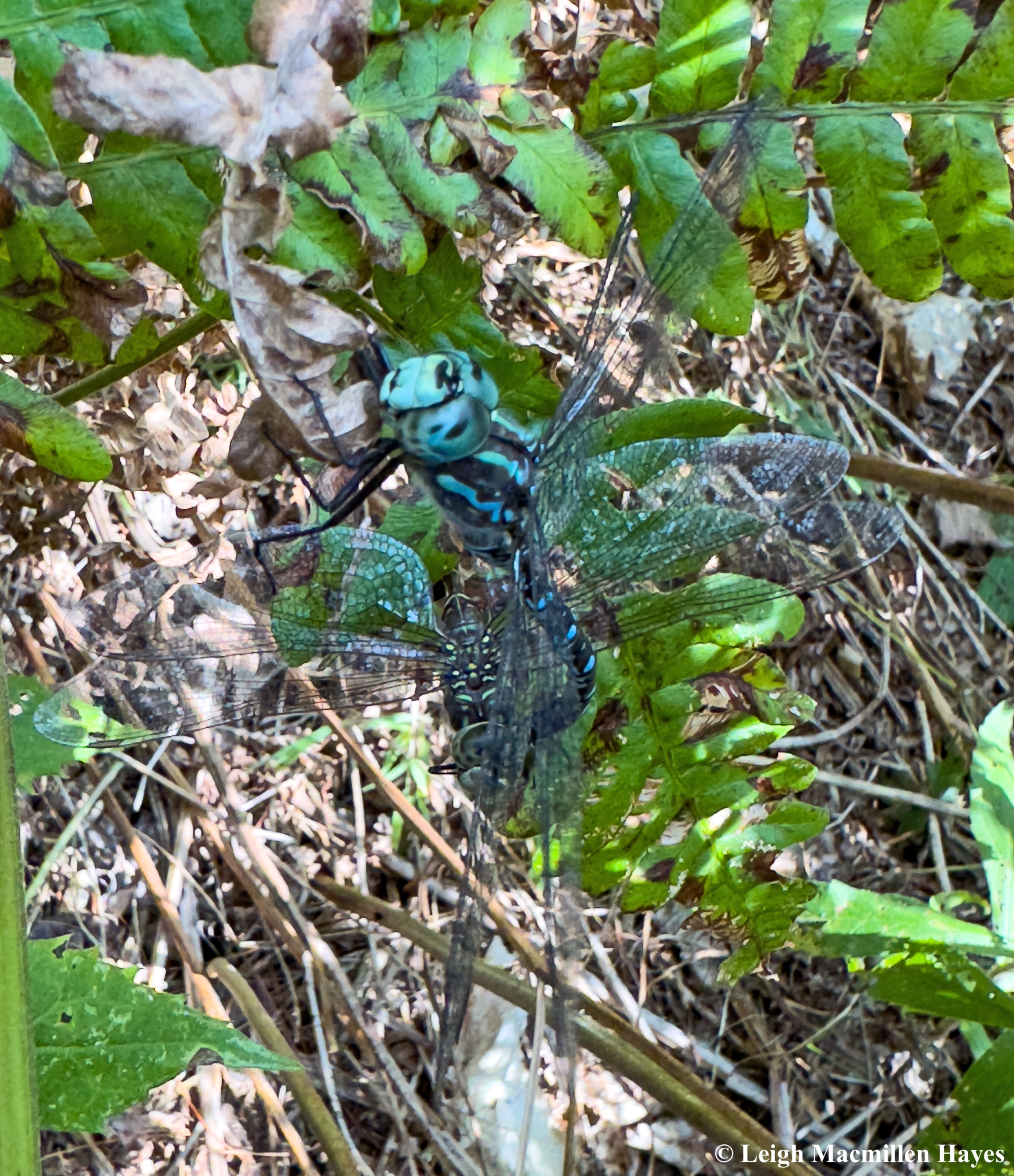
And speaking of that most important job, a couple of Canada Darners decided to canoodle right before my eyes. I couldn’t believe my good fortune. Notice how he uses the cerci at the end of his abdomen to clasp her behind the head and hold her in place as she curls her abdomen around to form the dragonfly mating wheel.

While I watched them, a snippet of movement caught my eye and I was forced, yes FORCED, to look elsewhere. Do you see what drew my attraction?

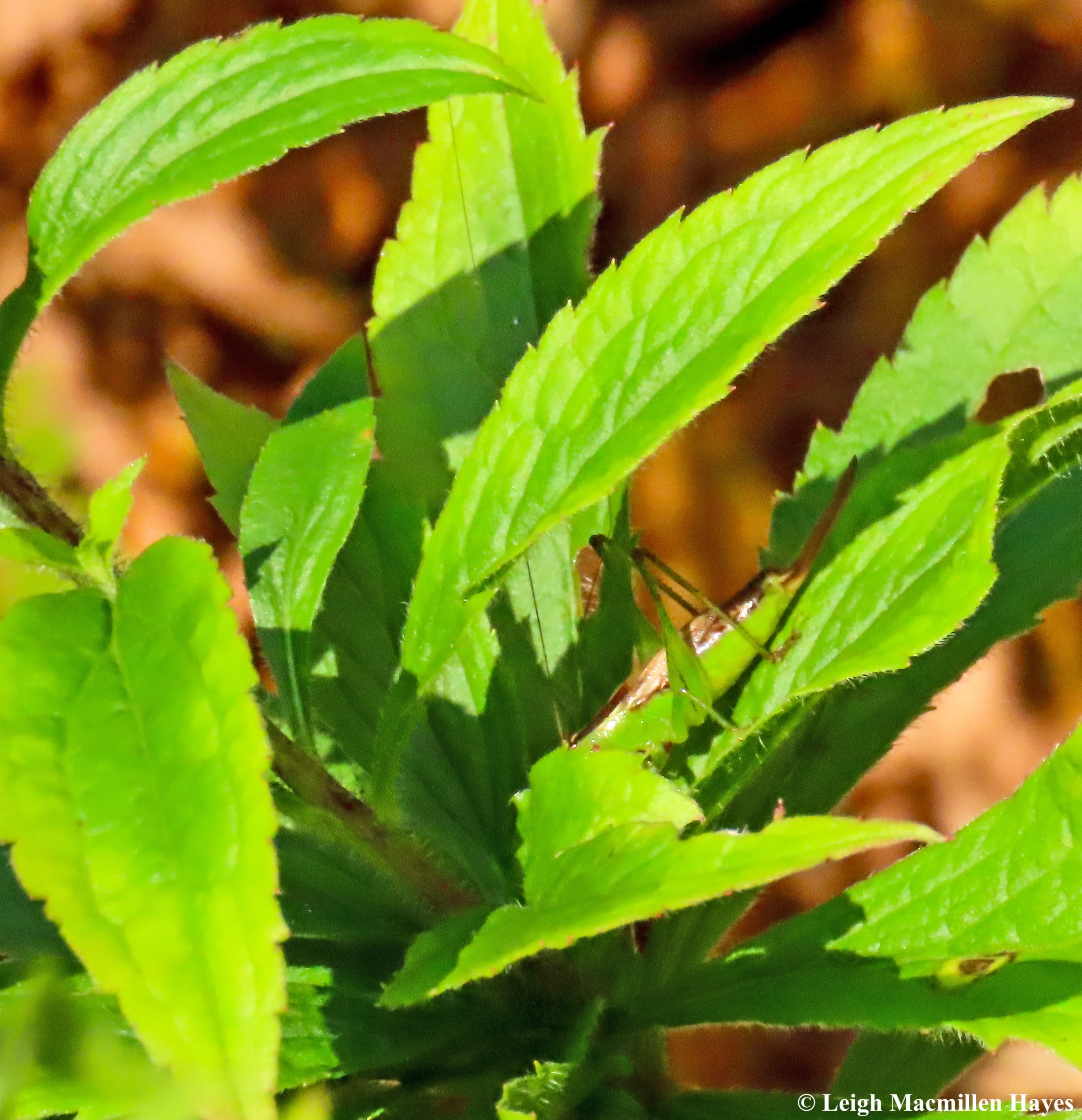
How about now? Just across the path from the much larger Bush Katydid, a smaller Meadow Katydid. Both seemed appropriate for this small ecosystem that included bushes and shrubs and wildflowers and ferns in the midst of a meadow.

And below the Katydid, more movement caused me to look more closely. Just this morning, another friend commented on the fact that she can’t believe the stuff I see. And I heard the same from another friend a day or two ago. I guess it’s all about tuning in–to sounds, I heard a wee rustle; and anomalies–I saw a bit of a color change. And tada: a small Pickerel Frog pausing on dead fern fronds–so camouflaged was it. Much like the two Katydids.

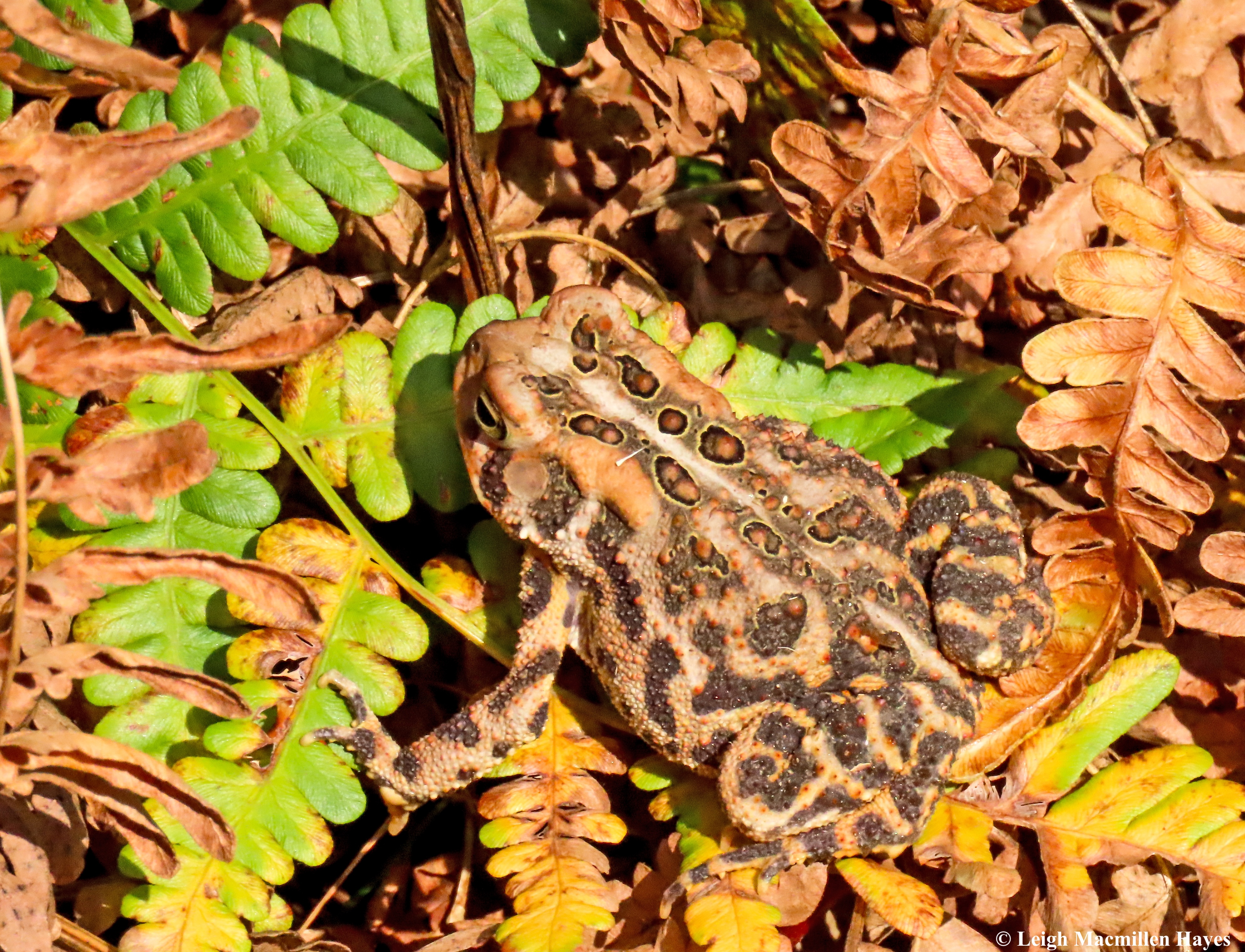
And about six inches away, I espied this female American Toad. She stayed as still as possible. Forever. Or almost forever. I would look away as I kept an eye on the canoodlers and then had to key back in to this site to spot the toad who was still there. I guess it’s all about being slow and training the eye to notice. Even if it’s something as ordinary as a Toad, it’s still a joy to be present and notice.

Suddenly I heard a rustling of wings and knew the sound to be canoodling dragonflies on the wing–or so I thought they were flying about. But I couldn’t see them anywhere. They were no longer posing on the fern where I’d first spotted them. The sound came from below and behind that fern, in the midst of other fern fronds. And then I found them. I don’t know why they left their original perch, but suspect another male drove them to move on. What I think happened next is that they got a wee bit caught in a spider web. And struggled fervently to free themselves.

So . . . I interfered. First I freed him and thought he’d take her along, but he flew off and then she did also. I can only hope that they found a different spot to continue their date night.

Other fliers in this same vicinity where the tiny Autumn Meadowhawks, this being a male.

His female counterpart was also posing everywhere.

They got as far as the tandem position, where the male clasps the female behind the head, but before they form the canoodle circle. That was the last I saw of them before it was time for me to move along for I had a date with another dragonfly waiting at home. Well, really, waiting in my truck for a ride home.

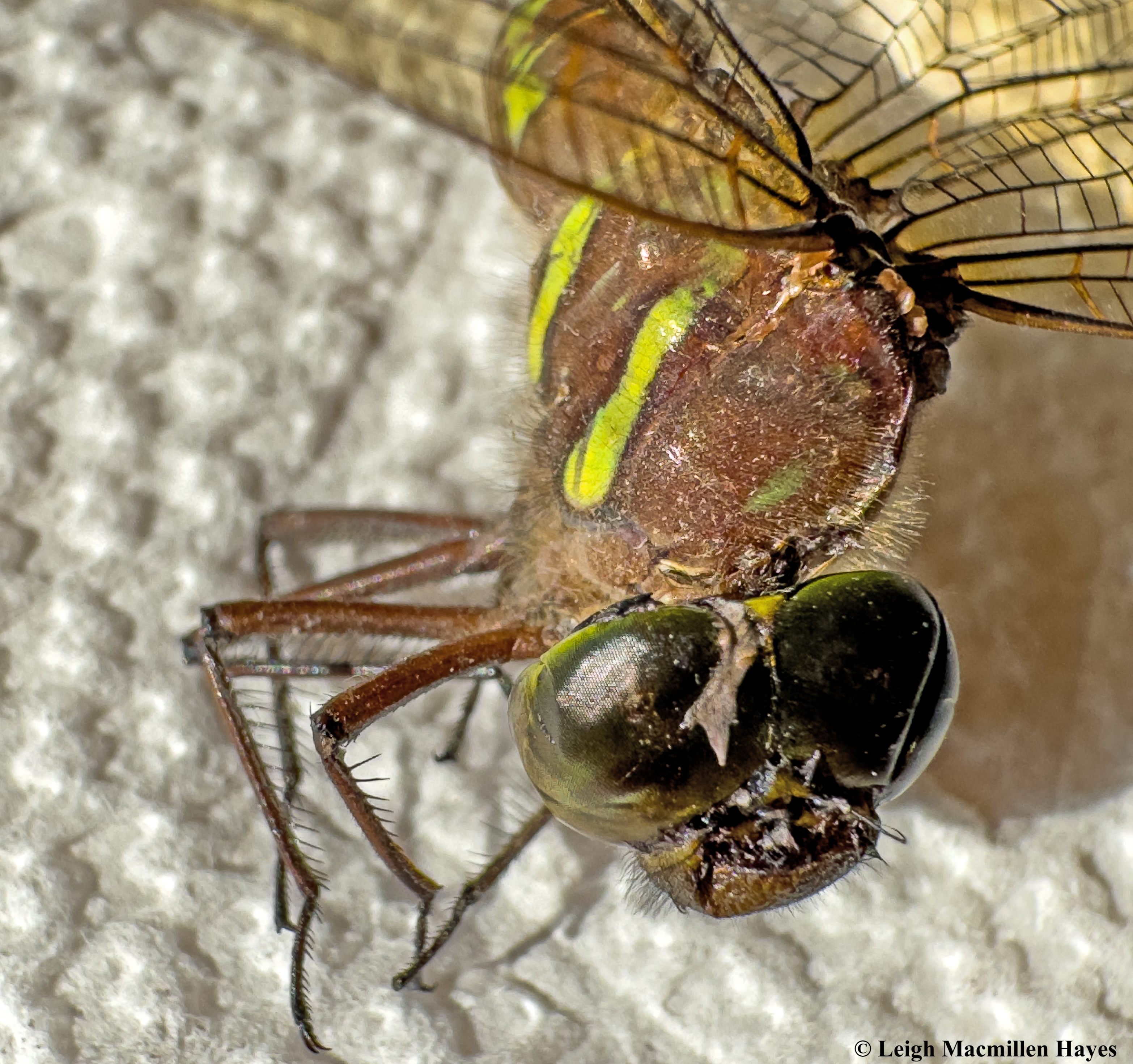
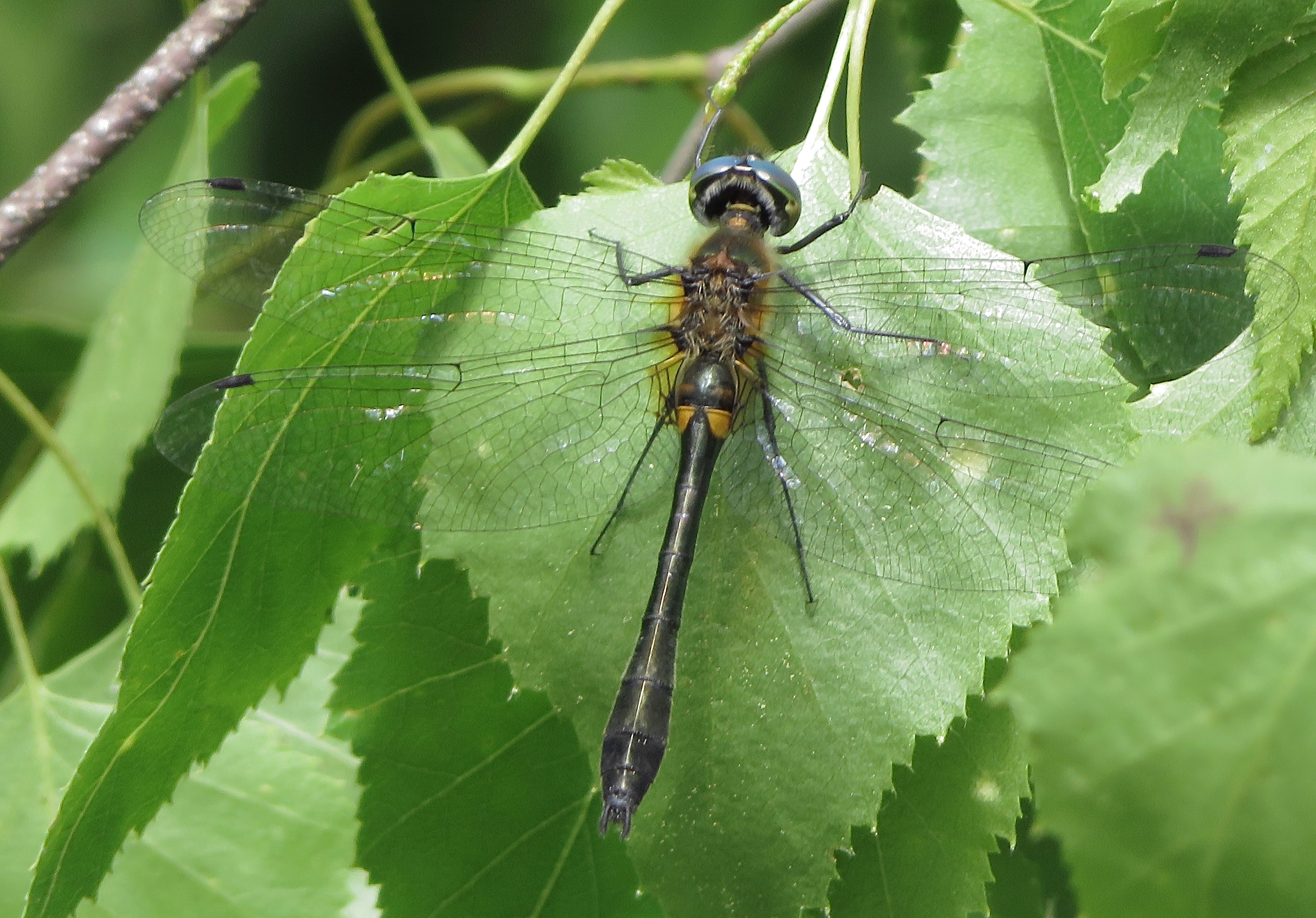
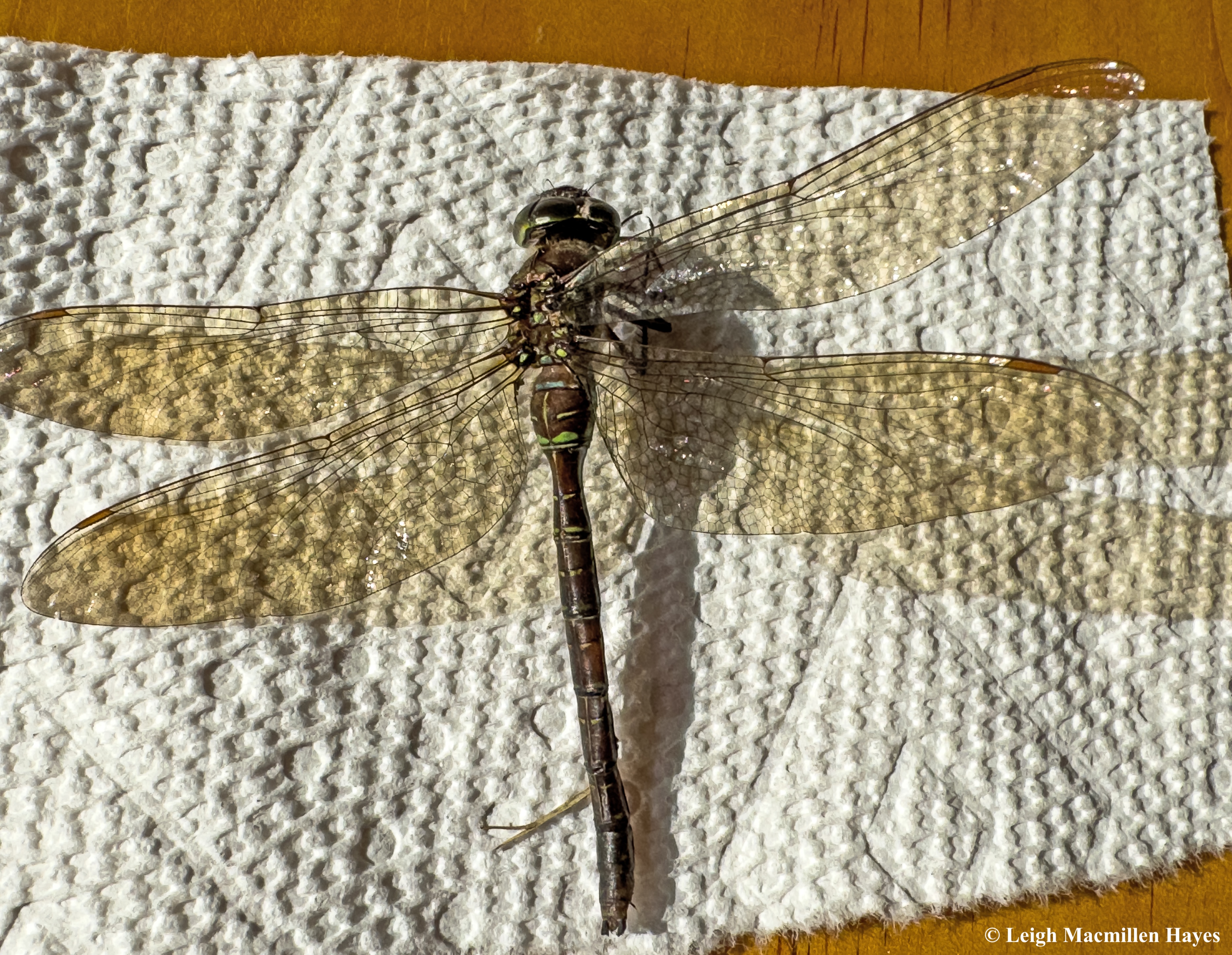
Once there, I studied this specimen, taking in as many details as possible. It was the colors and pattern on the thorax and abdomen that helped me come up with a name. And one other detail that could be easily overlooked. This particular species often has broken-off cerci at the end of the abdomen, a sign of maturity. Plus, it you look at the bulging start of the abdomen, below the thorax, there’s a slight blue line that crosses it, and in combination with the green markings, leads to species’ name.

The green thoractic strips also helped with identification.

The curious thing when my friend first offered this specimen to me was the fact that the two sets of wings were off kilter of each other. But as I told her, dragonflies operate the two sets of wings at different beats, and it’s especially noticeable when it’s chilly out as this morning was with temps in the low 40˚s. Pumping their wings is a way to stay warm. When she found this pretty female, its time on Earth was waning and though it pumped the wings alternately while in her hand, as she went to place it on the ground, it slowly breathed its last breath.

During those two hours I spent as the sun waned from the trail and meadow, I couldn’t believe what I’d seen, including the camouflaged Katydids, the canoodling dragonflies, and a few other canoodlers, plus all the pollinators.

But I was especially thankful for this one who taught me more about lessons in the shadows: a Shadow Darner Dragonfly.

And to K for the offering! Thank you for thinking of me yet again.
My Artistic Path: one year later

It’s all Jessie Lozanski’s fault that a year after publishing My Artistic Path, I’m publishing the next layer of paintings and sketches. Until I shared a few with my sister this afternoon, I had no idea how prolific I’ve been in this department. That said, some didn’t make it off the drawing board. Or rather, they did, but ended up in the trash, or in a pile to be considered at a later point in time. That’s the beauty of working with gouache, I can make changes at a later date. For me, that is liberating.

And now Dear Reader, you have three choices: 1) Read this entire post from beginning to end; 2) Scroll through the pictures and call it good; or 3) Click out of this post and pretend you either never saw it or that you did see it and loved all of it.

I have to say, I thought I’d paint more dragonflies like this Eastern Pondhawk, but when I scrolled through My Art Gallery, I discovered only a few others. That said, I did take some time to sketch the naiad forms of six families and then painted each one. You can visit all of those in Dragons of the Future if you wish.

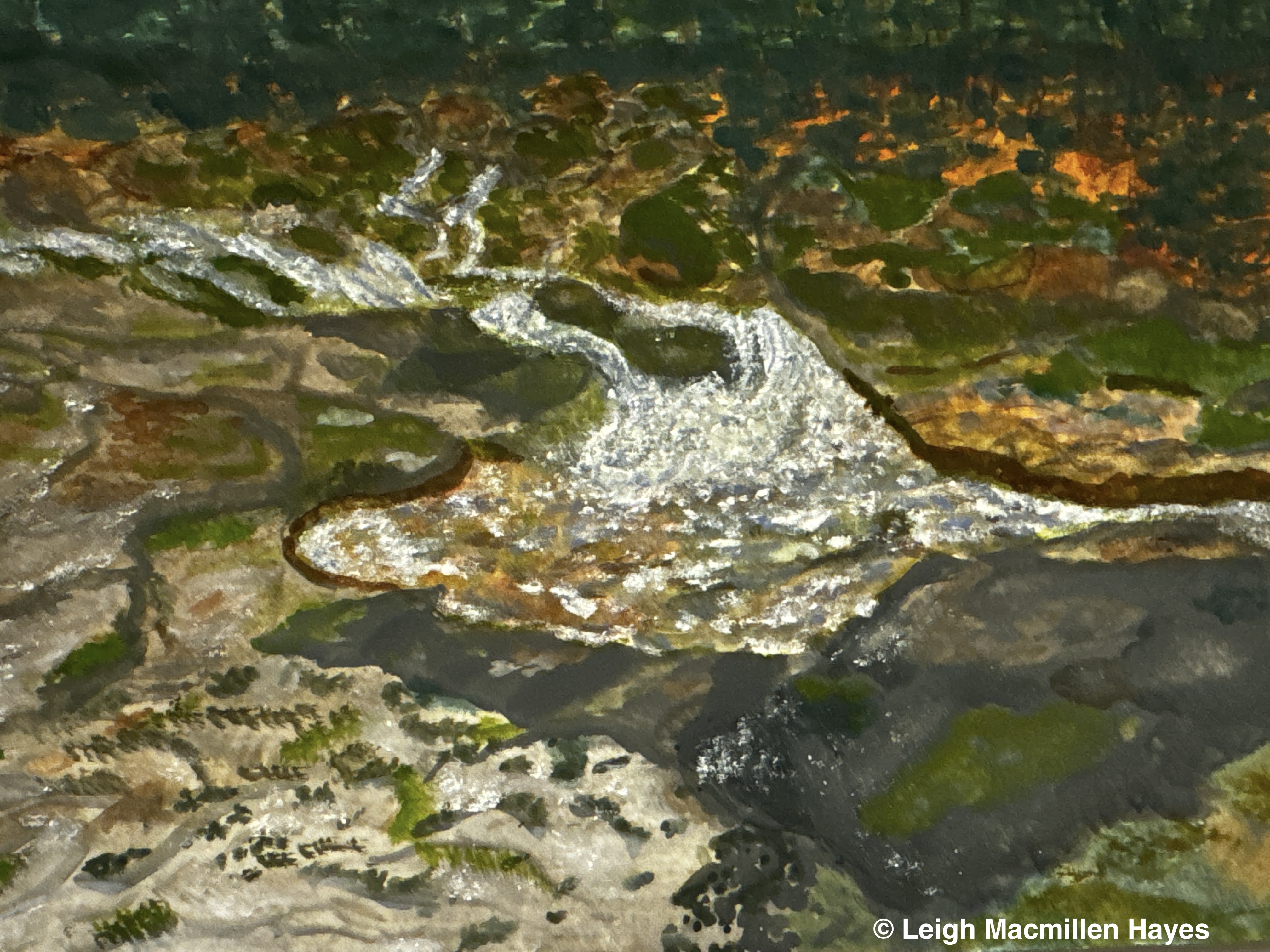
Waterways also intrigued me as I tried to figure out how to make the water look as if it is flowing. This is Province Brook in Chatham, New Hampshire.

And then there are the critters and I’m afraid you’ll see a few of them along this journey. The fun thing about this Chipmunk is that it made an appearance on a February day. I was tracking with some friends and we were pretty certain that we’d discovered Chipmunk prints, but it didn’t seem possible. Until it was because as we backtracked, we saw him and he posed for a few photographs. Sometimes, when you need more food, you might make a mad dash from your winter home to locate it.

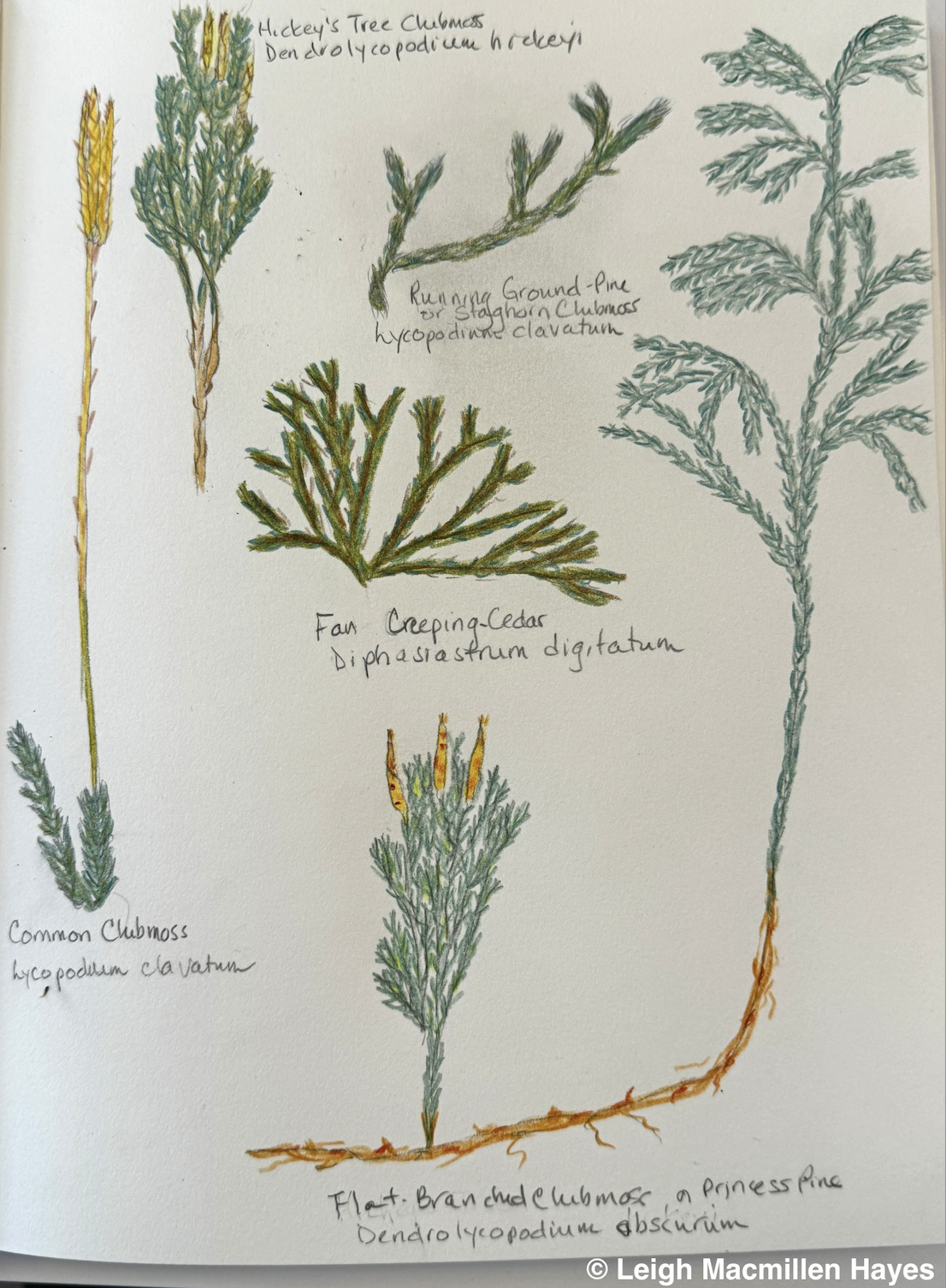
Clubmosses are one of the topics I’m trying to learn. . .when I take the time to do so. And so I sketched these after spending some delightful hours studying them as I wrote about in When is a Moss not a Moss?

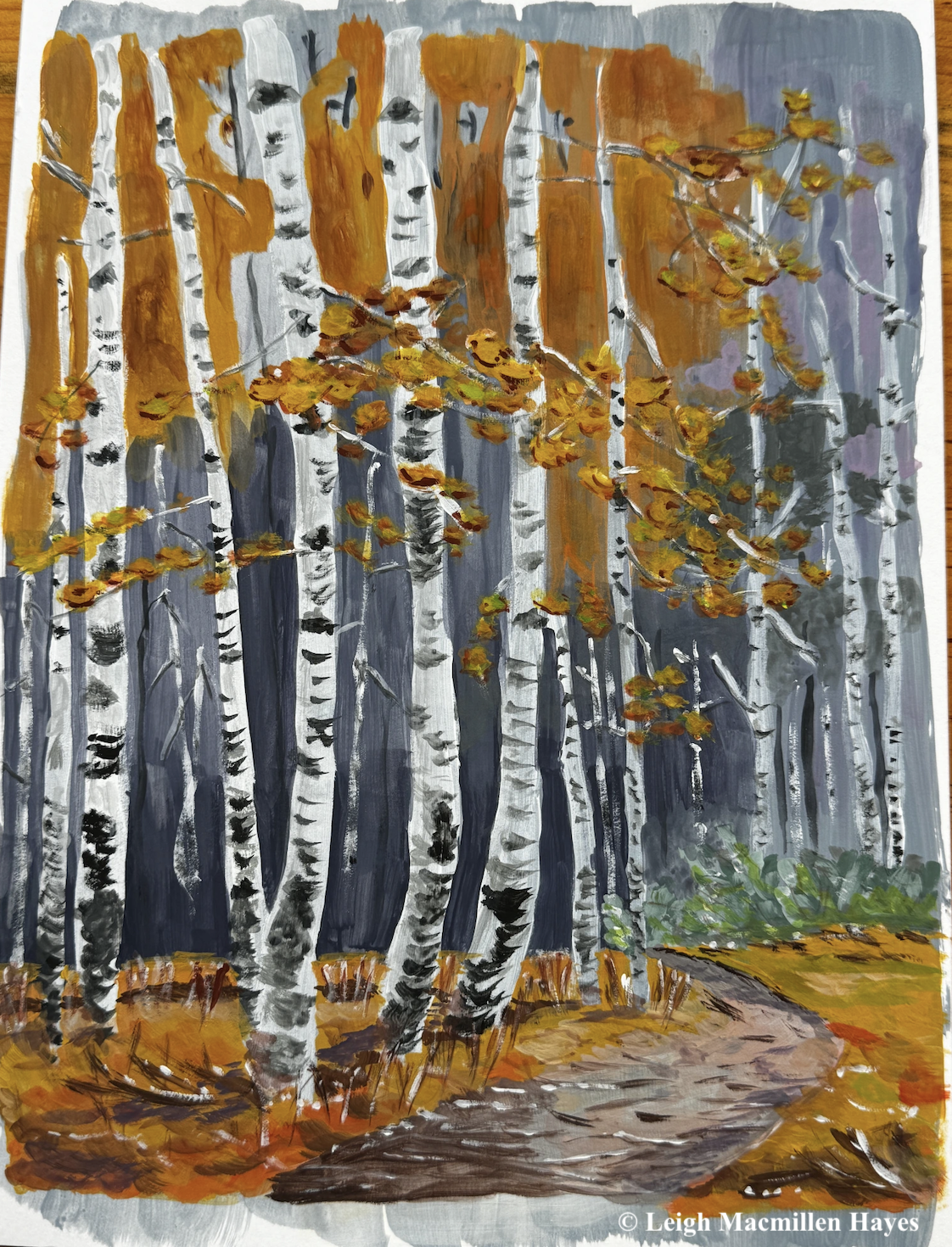
It’s the colors in this painting that I like. And figuring out how to paint Birch bark.

And then there was Forter Castle in Glen Isla, Scotland. I actually did three smaller versions of this castle and then decided to paint this larger picture based off one of those. It was a gift for Anne, our hostess when we were invited to spend a few nights there back in 2017, and in memory of her husband John. You can read more about that adventure here: From the Bonny Banks to the Highlands.

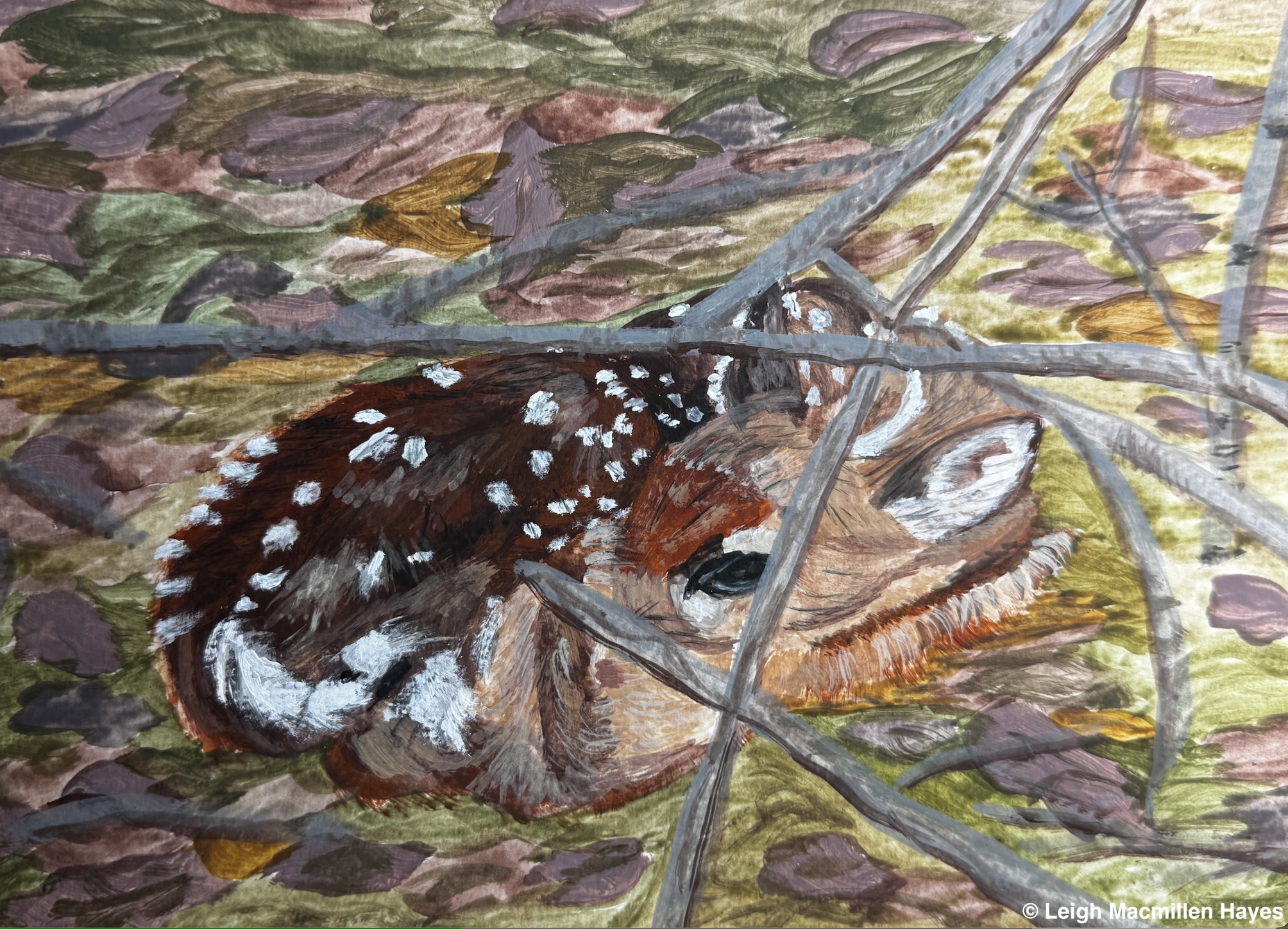
This next one will forever evoke the memory of my friend, Faith, who passed away this summer. We were on a Lakes Environmental Association walk at Holt Pond when we all “spotted” this fawn quietly waiting for momma. Quick pics and then we moved away.

And this is one of the Red Foxes who frequent our yard. In My Art Gallery, there are two more attempts, both in watercolor while this one is with gouache paints. Experimenting is fun.

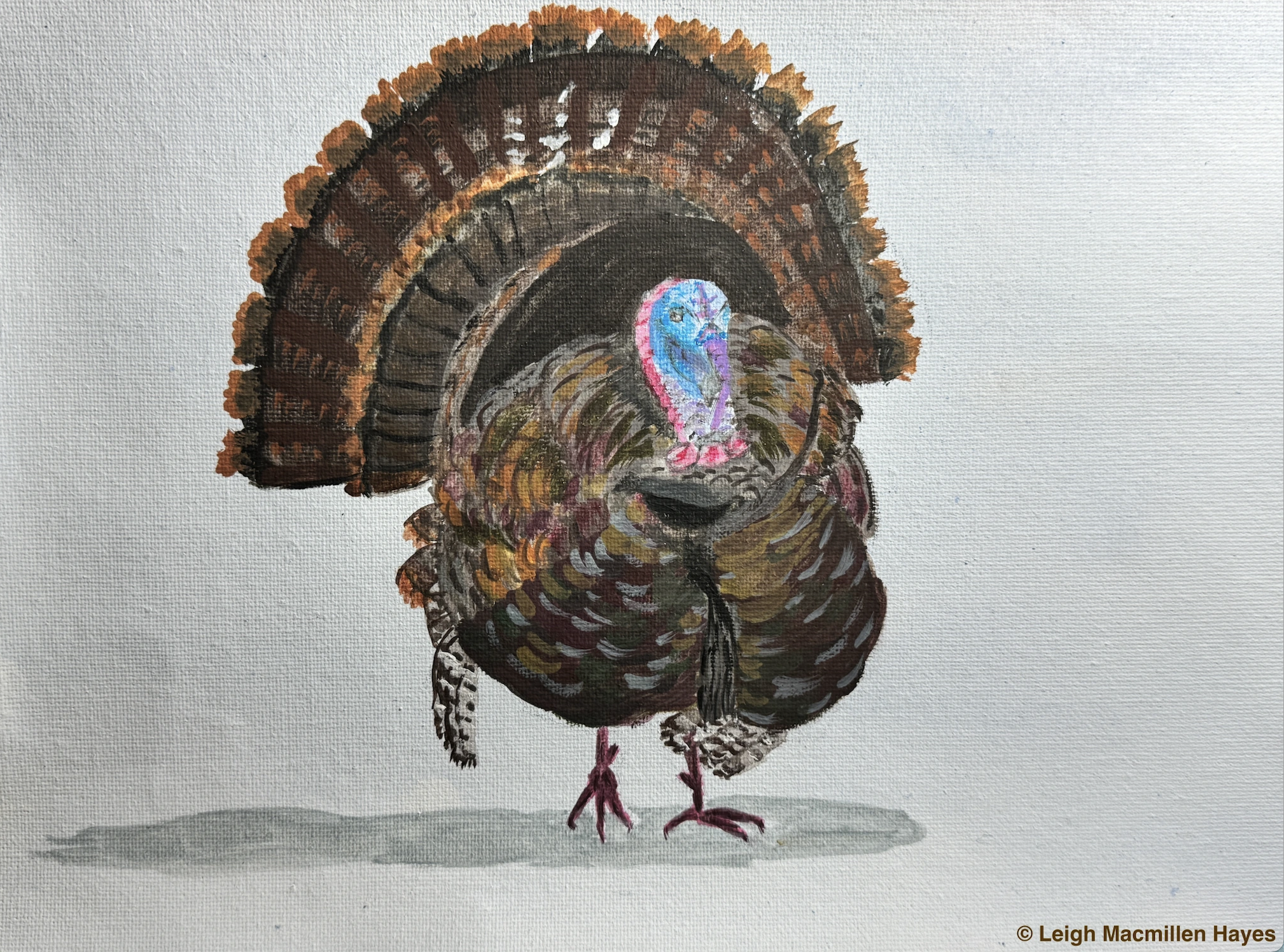
Tom Turkey! What more need I say.

In the midst of taking classes with Jessie this past year, which sadly ended in the spring, I purchased Grahame Booth’s book: Anyone Can Paint Watercolour Landscapes, and tried to follow the step-by-step instructions. This was a result of Lesson 1. There were six lessons altogether, and I thoroughly enjoyed the experience. You can see my other paintings based on the book by looking once again at My Art Gallery. Yikes, I’m beginning to sound redundant. Smiley Face!

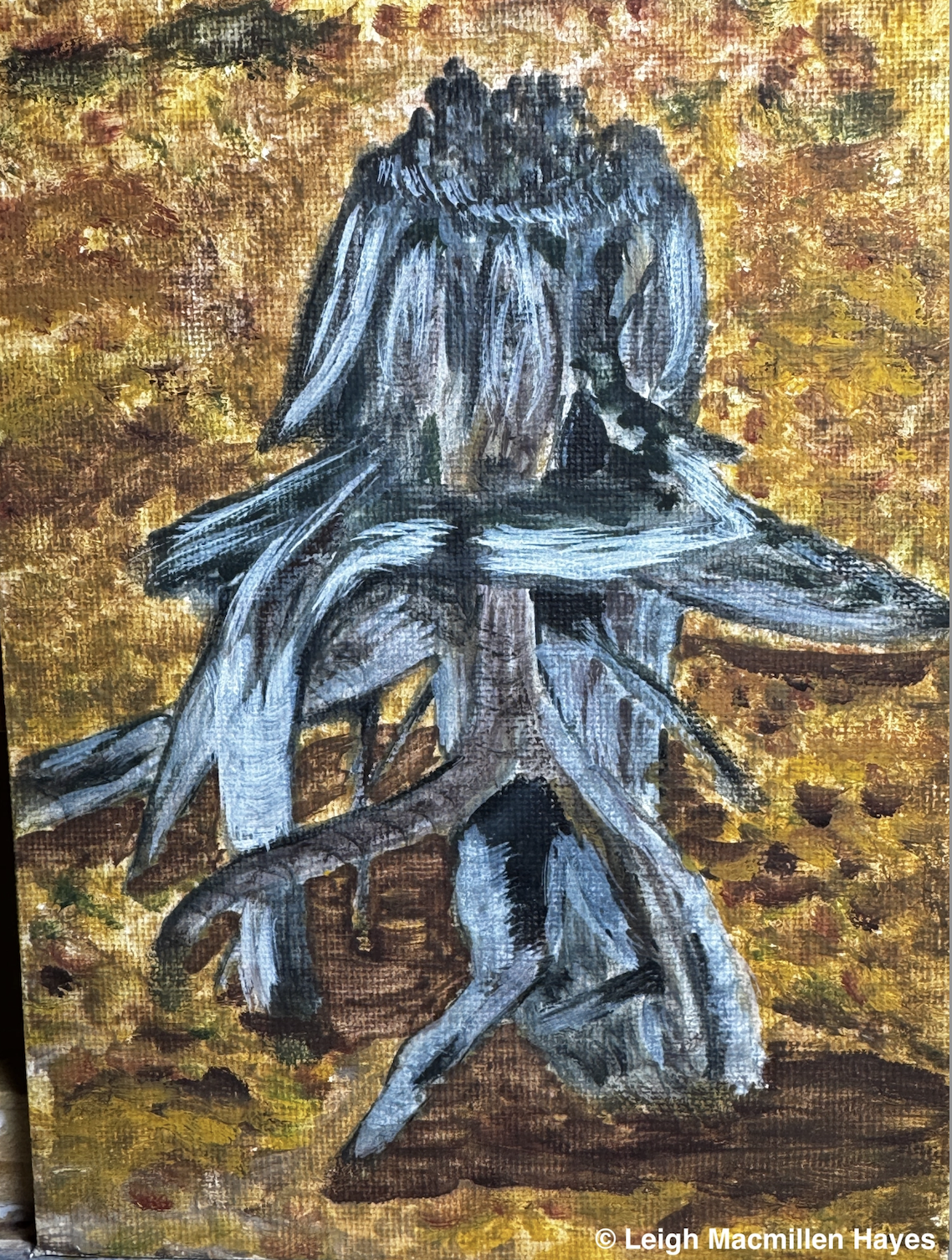
I like this one because I like the subject. I used a matted board to paint it. The stump is beside the Saco River in Conway, New Hampshire.

This one was for another friend because we had walked out to Kezar Pond in Fryeburg from her home the previous New Year’s Eve or Day, and it was just lovely.

And then there is a perennial subject of mine–the Stairway to Heaven tree along the cowpath in our woods. I especially love it when snow outlines the branches.

Another favorite scene takes me back to my childhood in Clinton, Connecticut, and I painted this for my sister and brother-in-law as a keepsake. So many memories in the spot that was our little piece of Heaven for so many years.

On and off, I’ve produced paintings of birds, and another favorite subject is the Great Blue Heron. I’ve also tried to paint rookeries, but often struggle with perspective. Of course, you can view my attempts you know where: My Art Gallery, to be shortened to MAG going forward.

No words necessary really–a male Northern Red Cardinal.

And his female counterpart.

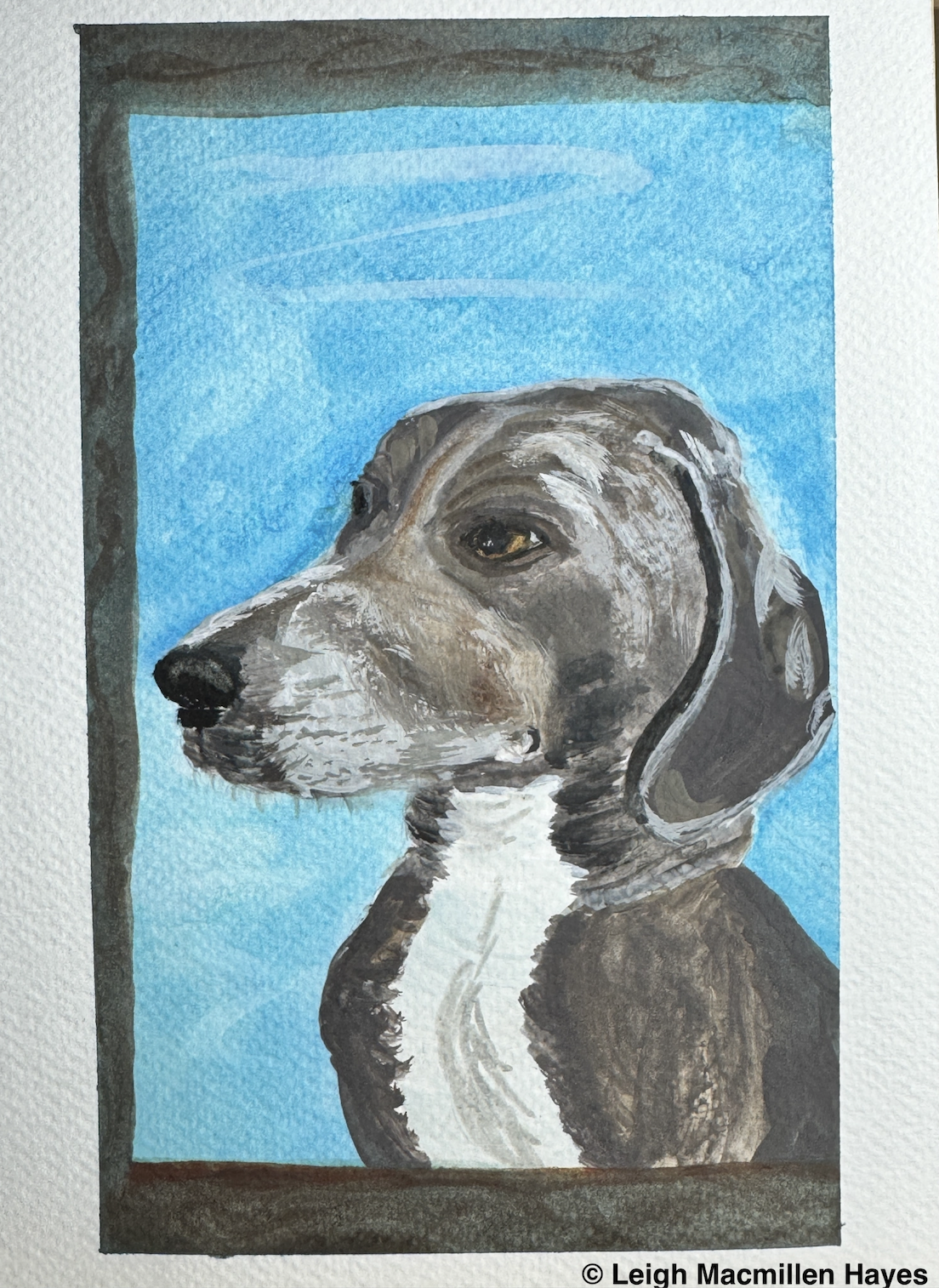
Our oldest son and his girlfriend rescued this energetic pup at the beginning of the pandemic.

And this pup belongs to our youngest son’s girlfriend’s mother.

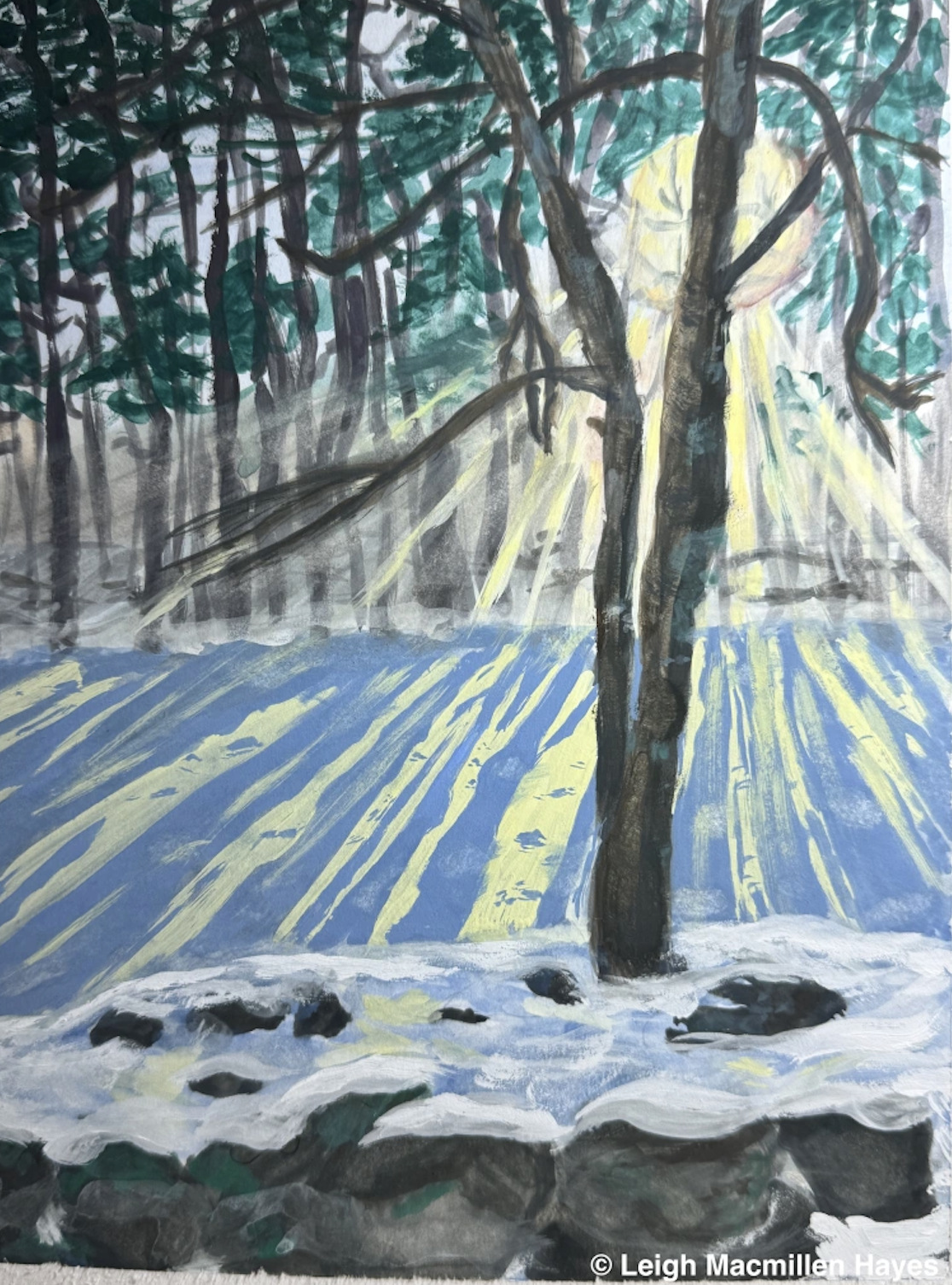
One morning, I stepped outside just after it had finished raining and the sun was shining through the trees out back and there was a layer of fog and shadows and it was just exquisite so I tried to capture it.

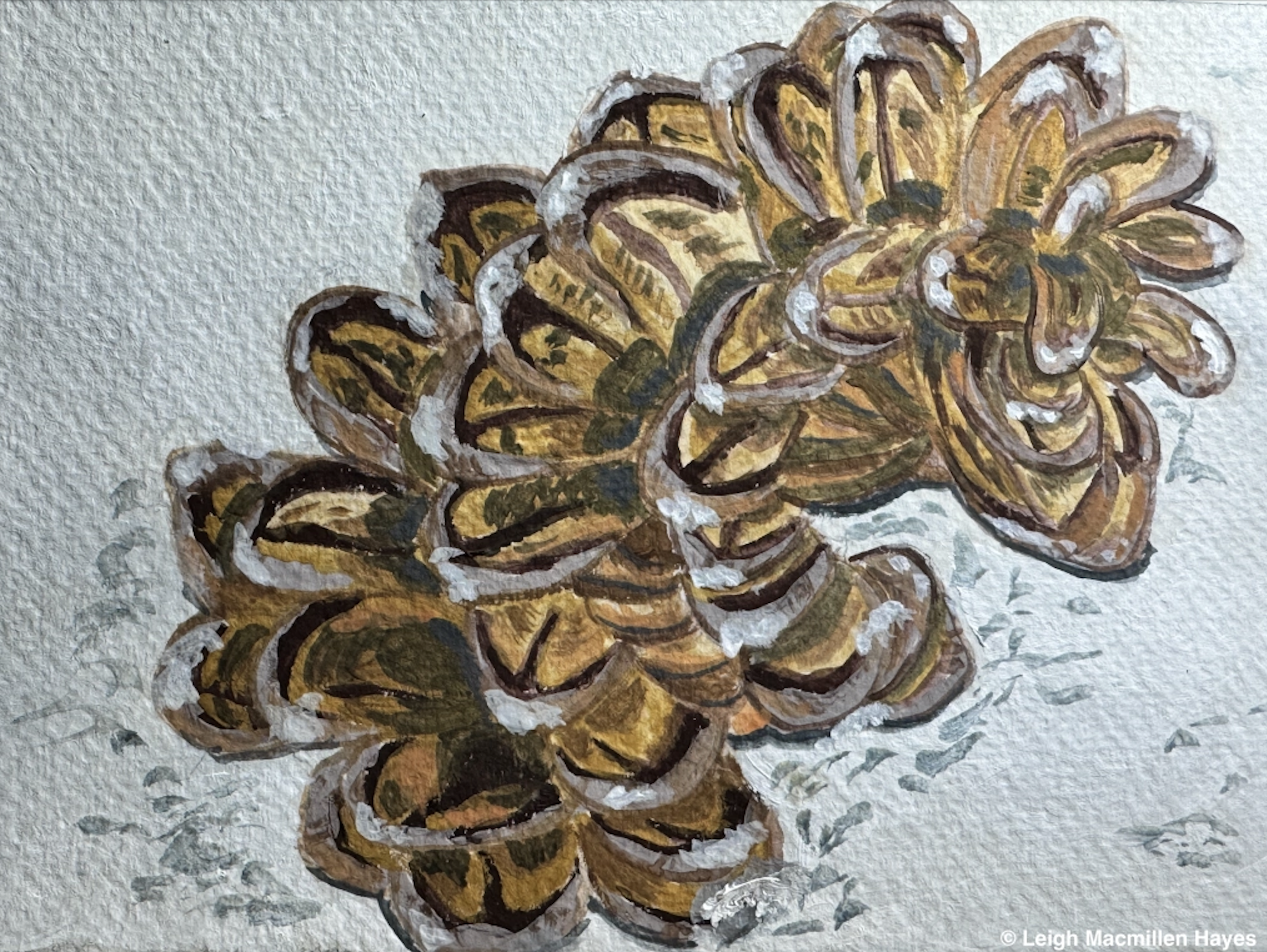
The White Pine Cone was something I started to sketch and then left for a long time, until I realized the scales were all arranged in a spiral of course and bingo, I knew how to go about it.

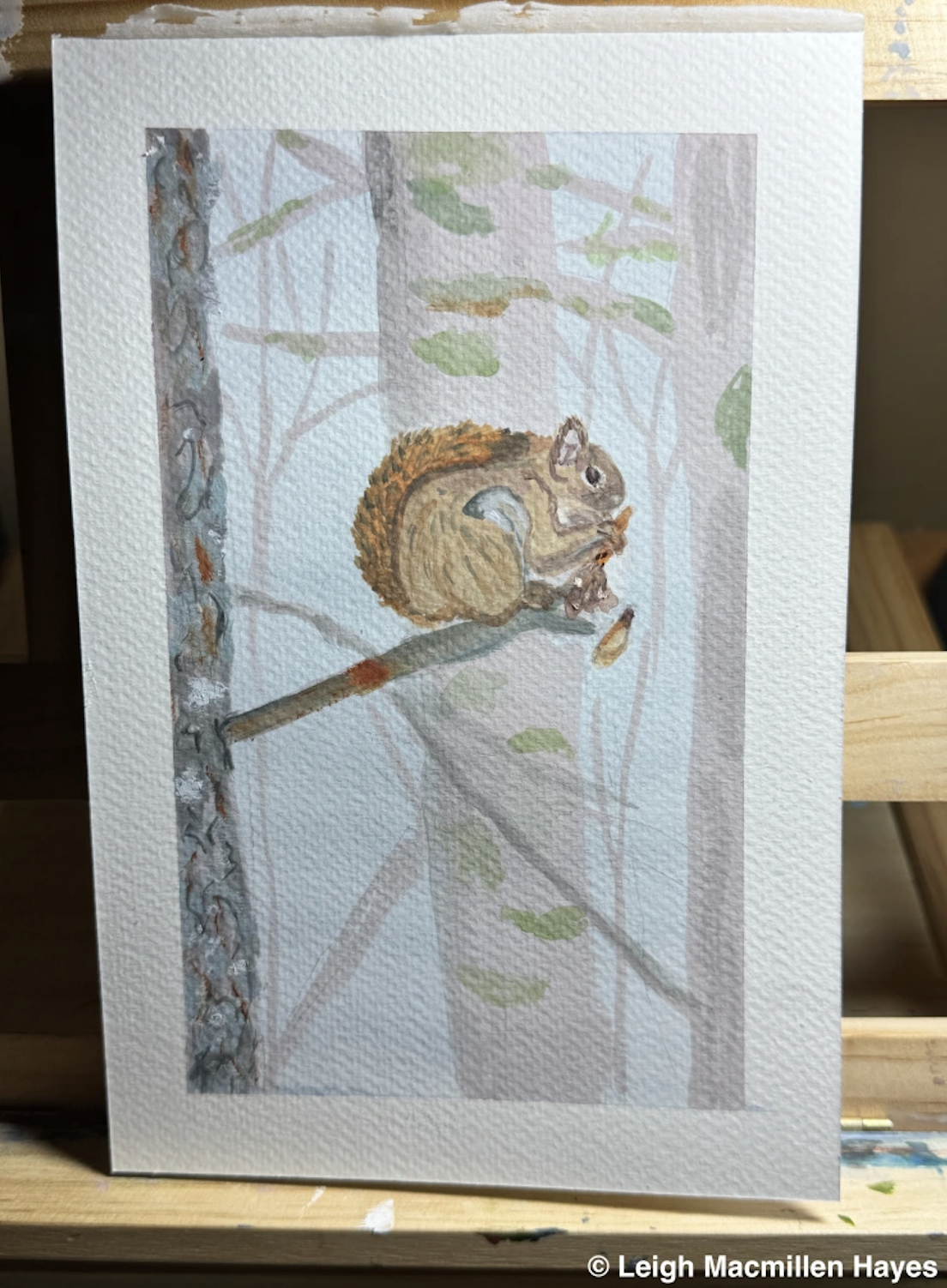
Turns out, I’m not the only one who knows to go about it–for Red Squirrels love to take each pine cone scale off in order to get to the seeds stored by such. Their method of descaling a cone is rather like us eating corn on the cob. I actually referenced both the pine cone painting and this one in Another Amazing Lesson from a Red Squirrel.

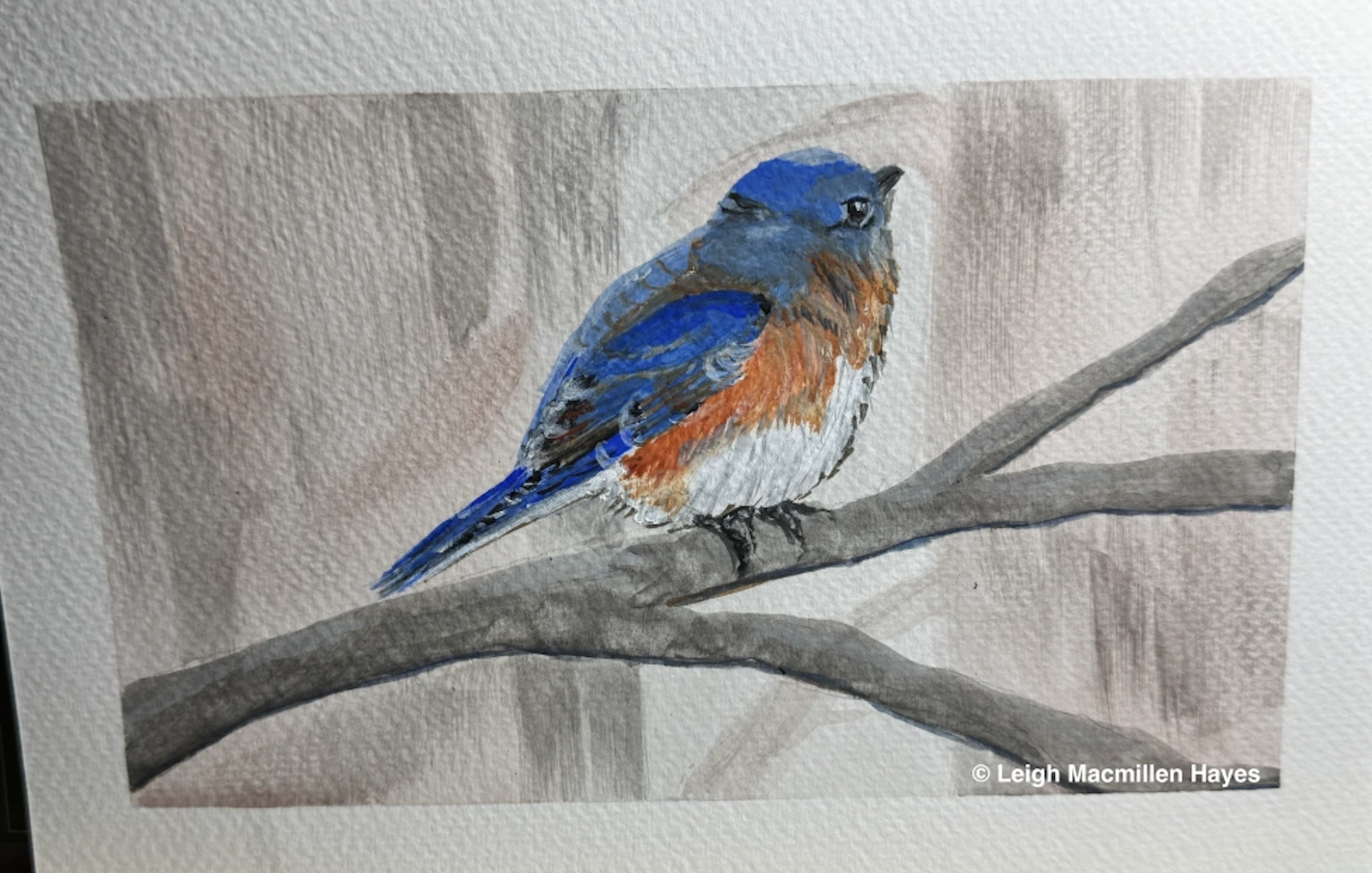
All last winter and spring, and into the beginning of the summer, my neighbor and I rejoiced because we had Bluebirds. In fact, a pair nested in one of our boxes, but that was around July 4th, and by the end of the week, she’d abandoned the nest. We’ll never know why.

A few more birds coming up–including this male Red Winged Blackbird at Brownfield Bog.

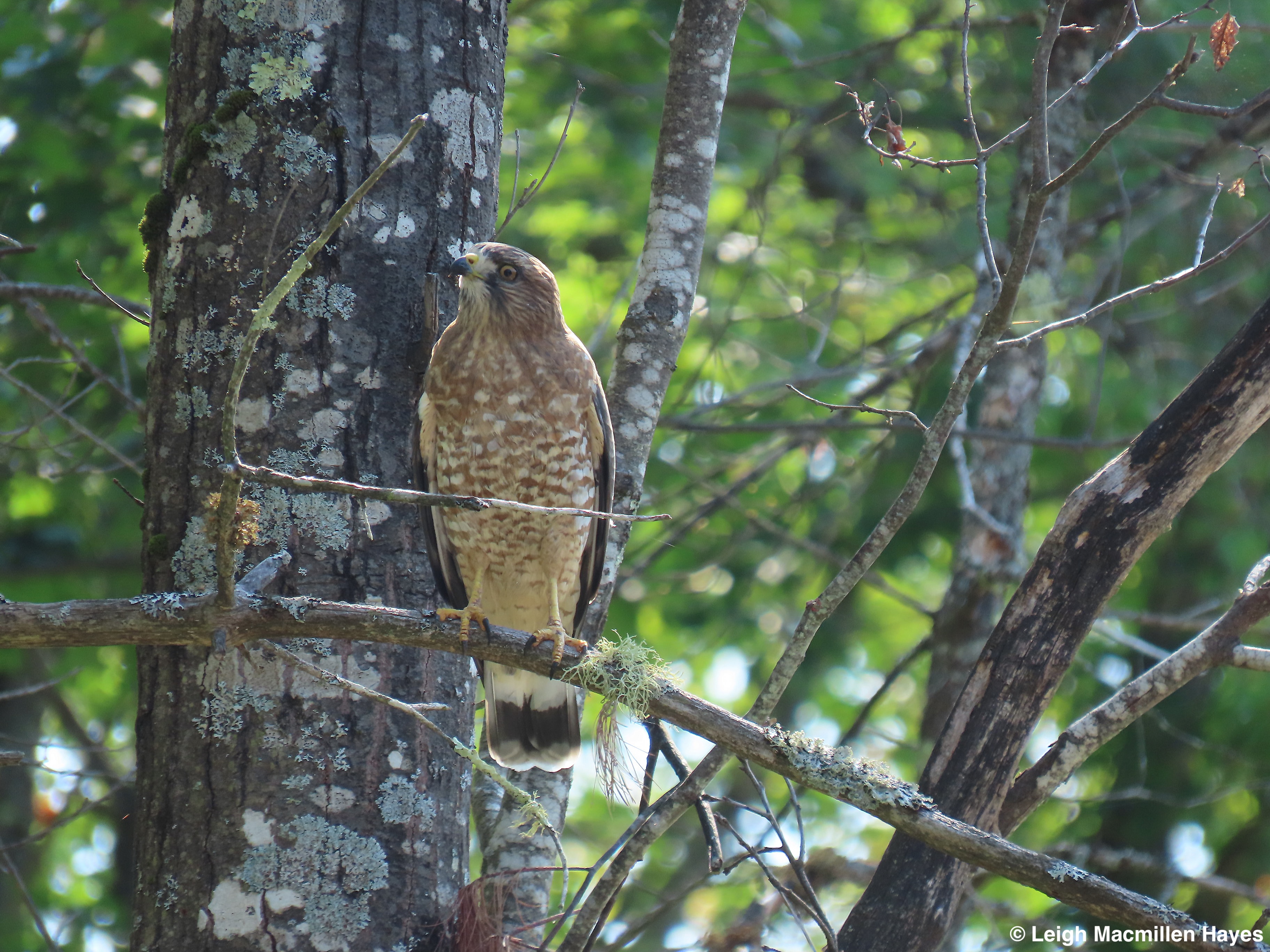
A Sharp-shinned Hawk in the backyard and field.

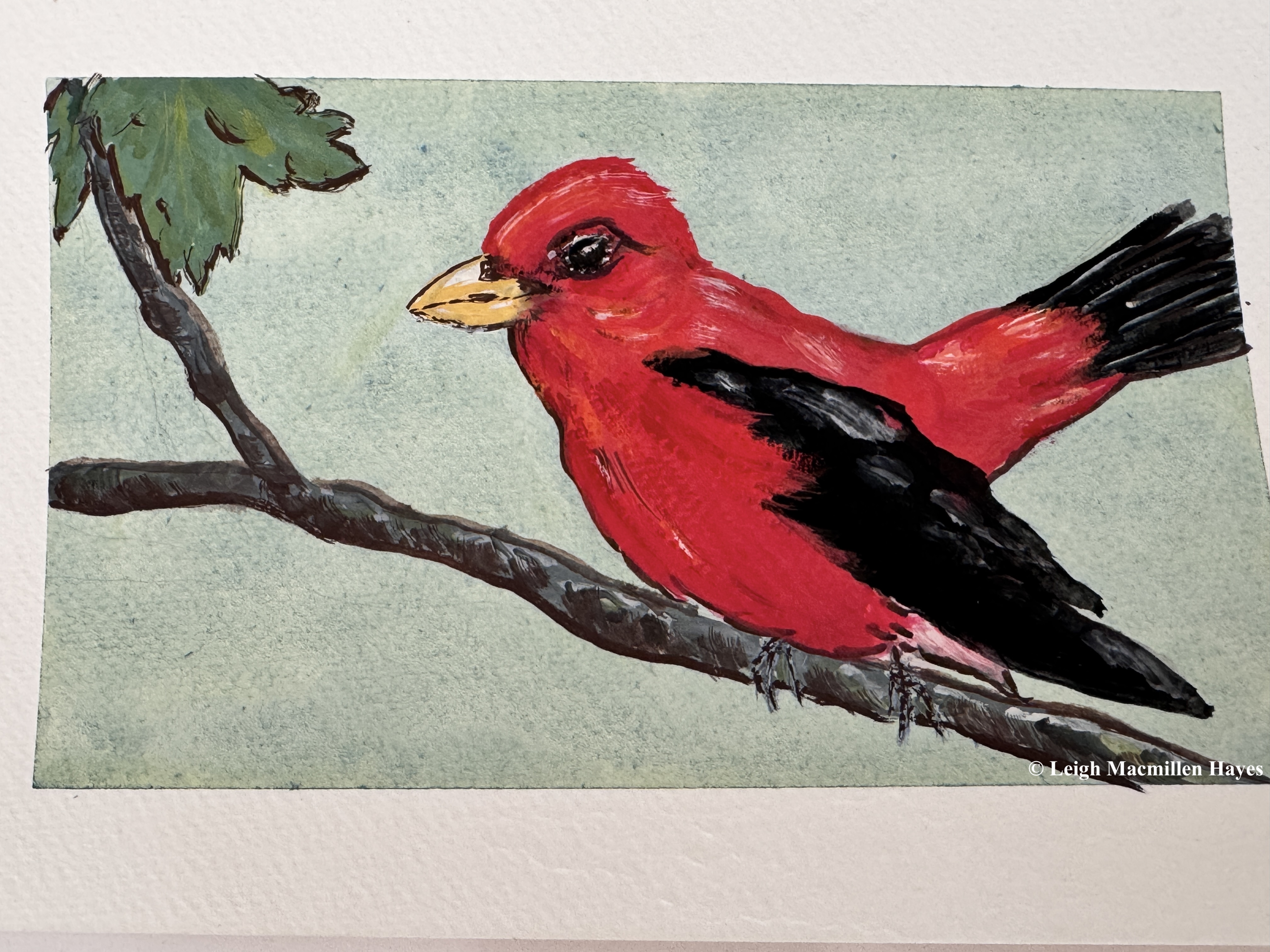
And a Scarlet Tanager on Mount Cutler in Hiram, Maine.

I did think I’d paint more butterflies, and perhaps this fall or winter I’ll attempt to, but it seems the Spring Azure is all I’ve done so far.

I’ve also made a couple of cards in the course of the year, this one for a First Grade student who was my penpal and she told me she really likes Dandelions. That girl will go far in life!

Another favorite topic of mine: Dog-Day Cicadas. If you type Cicada into the “Search” bar on my blog, you’ll discover several posts about these insects emerging. As I write, I can hear them “singing” from the treetops.

Sometimes, actually, more than sometimes, something catches one’s eye and this Tree Frog was one of those times. A friend and I had stopped to talk about a Snapping Turtle that seemed to be late laying eggs, and bingo, there was the frog on a tree.

Speaking of frogs and other critters who rely on vernal pools, visit MAG and you’ll find my Vernal Pool series, including a Fairy Shrimp that looks WAY bigger than its actual 1 – 1.5 inch size.

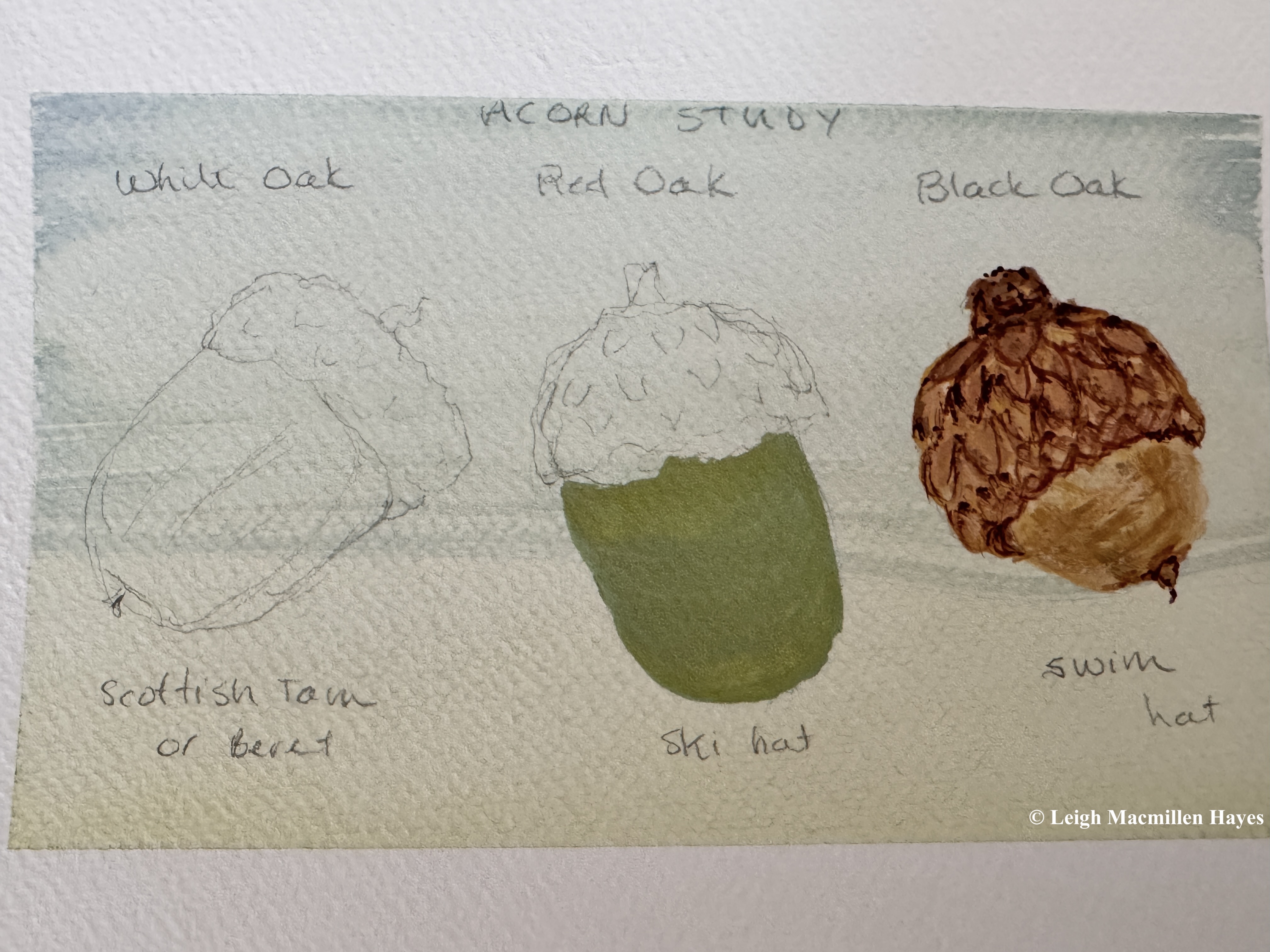
And then there was the day I pulled out a copy of National Audubon’s Field Guide to North American Trees because I wanted to get to know acorns better. Silly me, I came up with names for each one based on what they looked like to me, but I made the mistake of writing the names in pencil before painting a light colored wash on the paper. As I began to paint the acorns, I realized I wanted to change their names, but couldn’t erase them or paint over them. So . . .

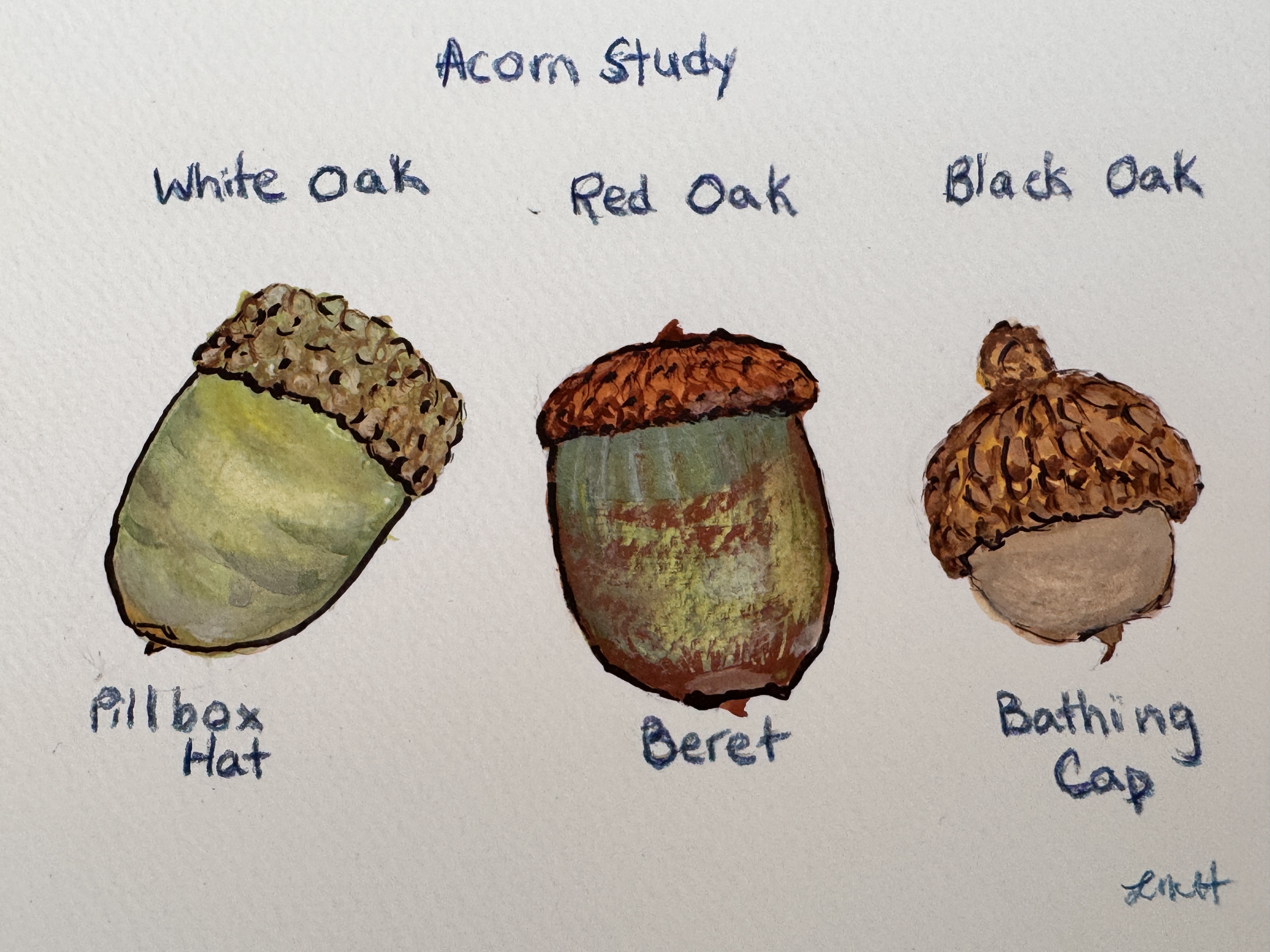
I sketched them again, and gave them new names.

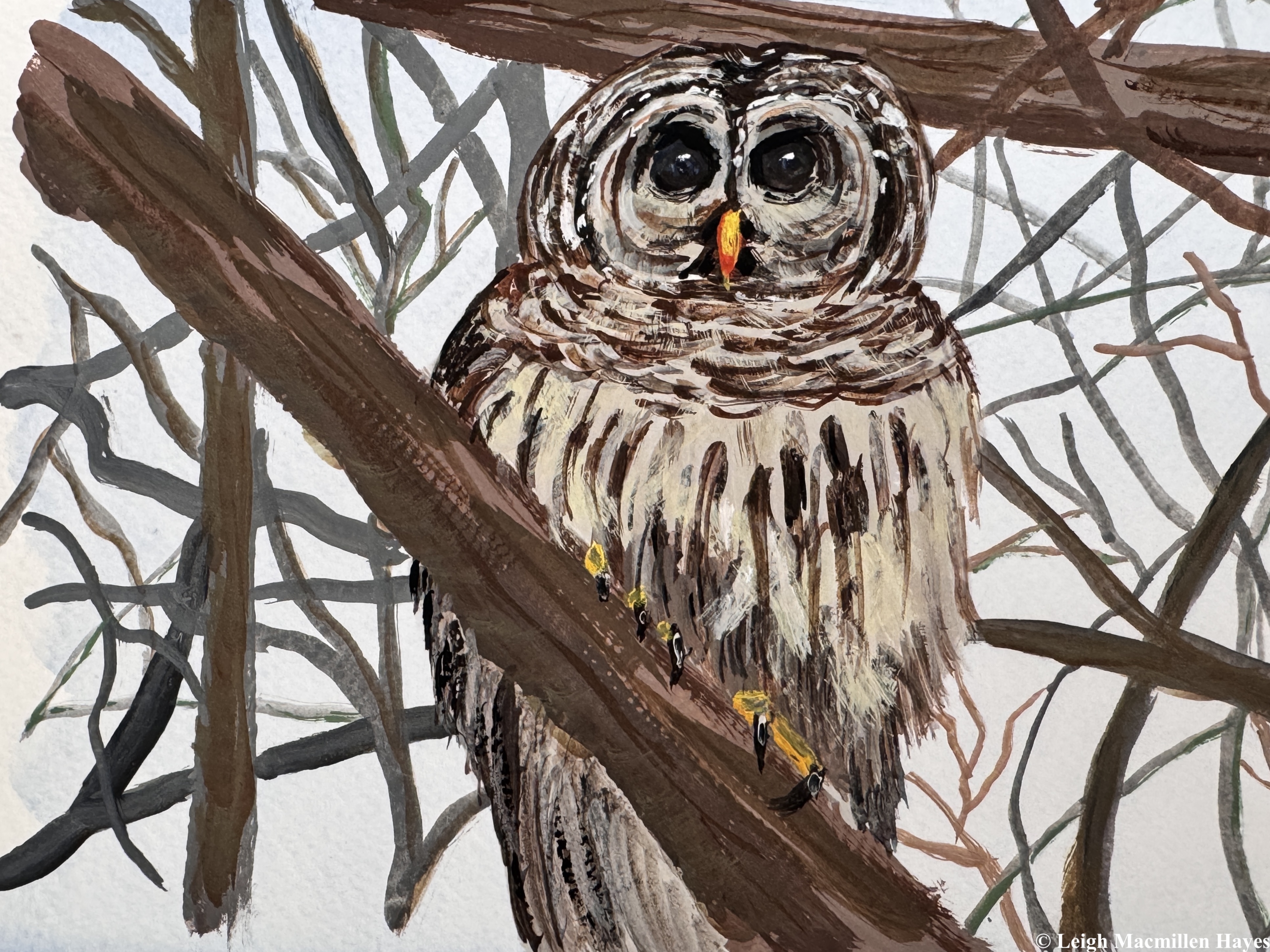
And finally the moment you’ve been waiting for, today’s painting:

I always like it when I try iNaturalist’s SEEK app on a painting and it agrees with me. Barred Owl it is.

Wow, I had no attention of pulling this all together today until about an hour ago when I was sharing photos with my sister and realized I hadn’t sent her any in a while. So thank you, B.S., for being my inspiration today . . . and always.

And thank you Dear Readers, for sticking with me today and always as I share My Artistic Path: one year later.

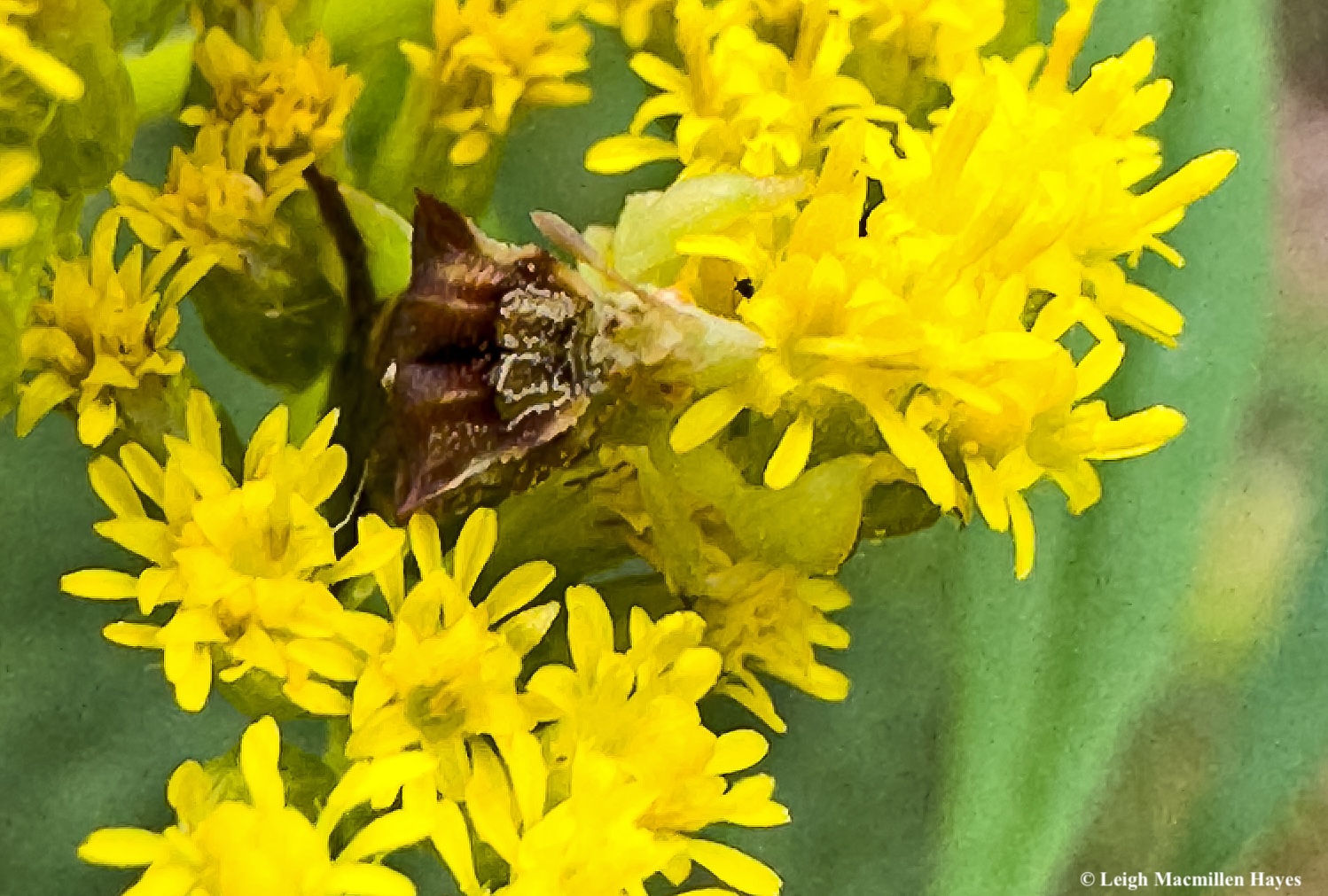
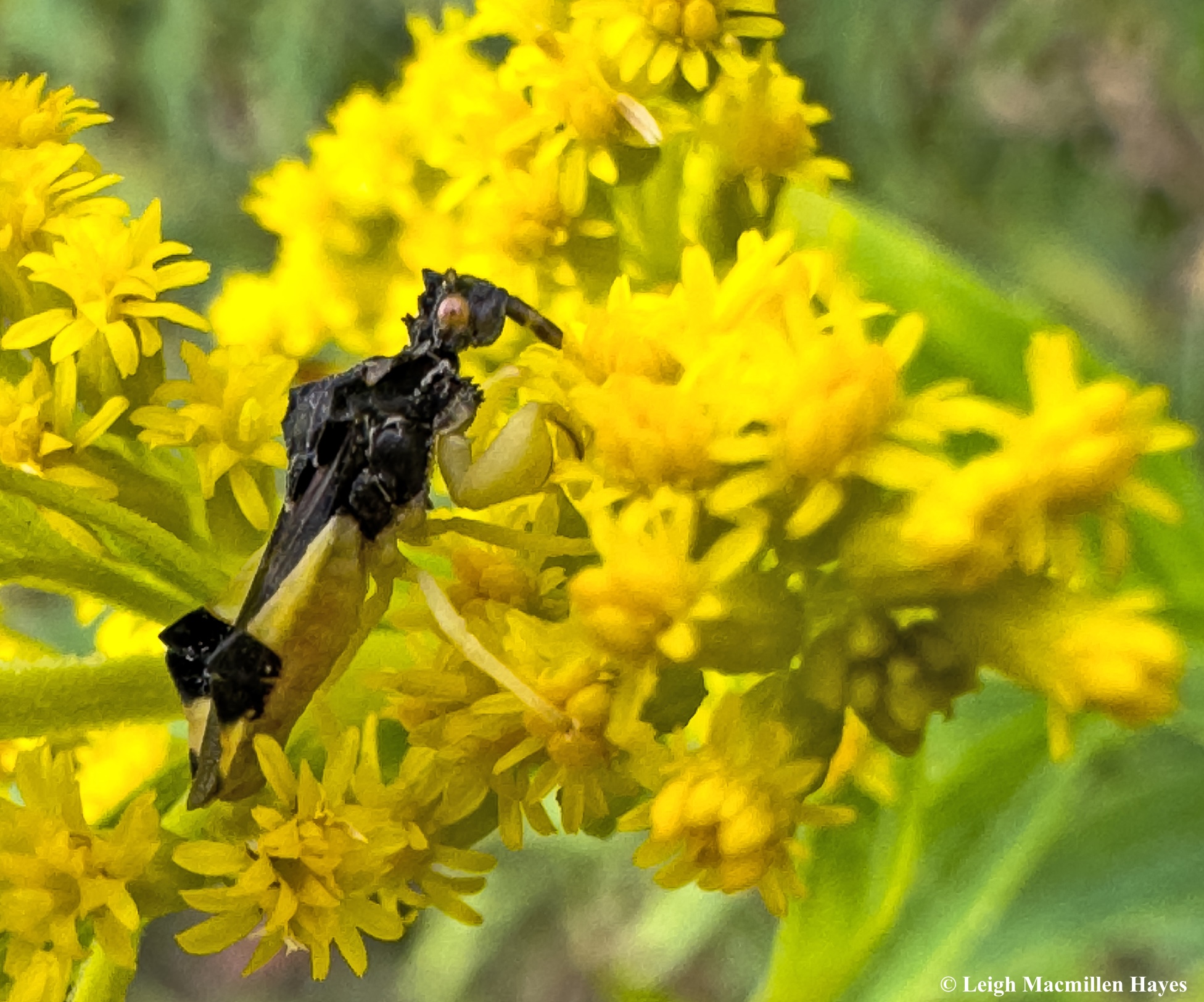
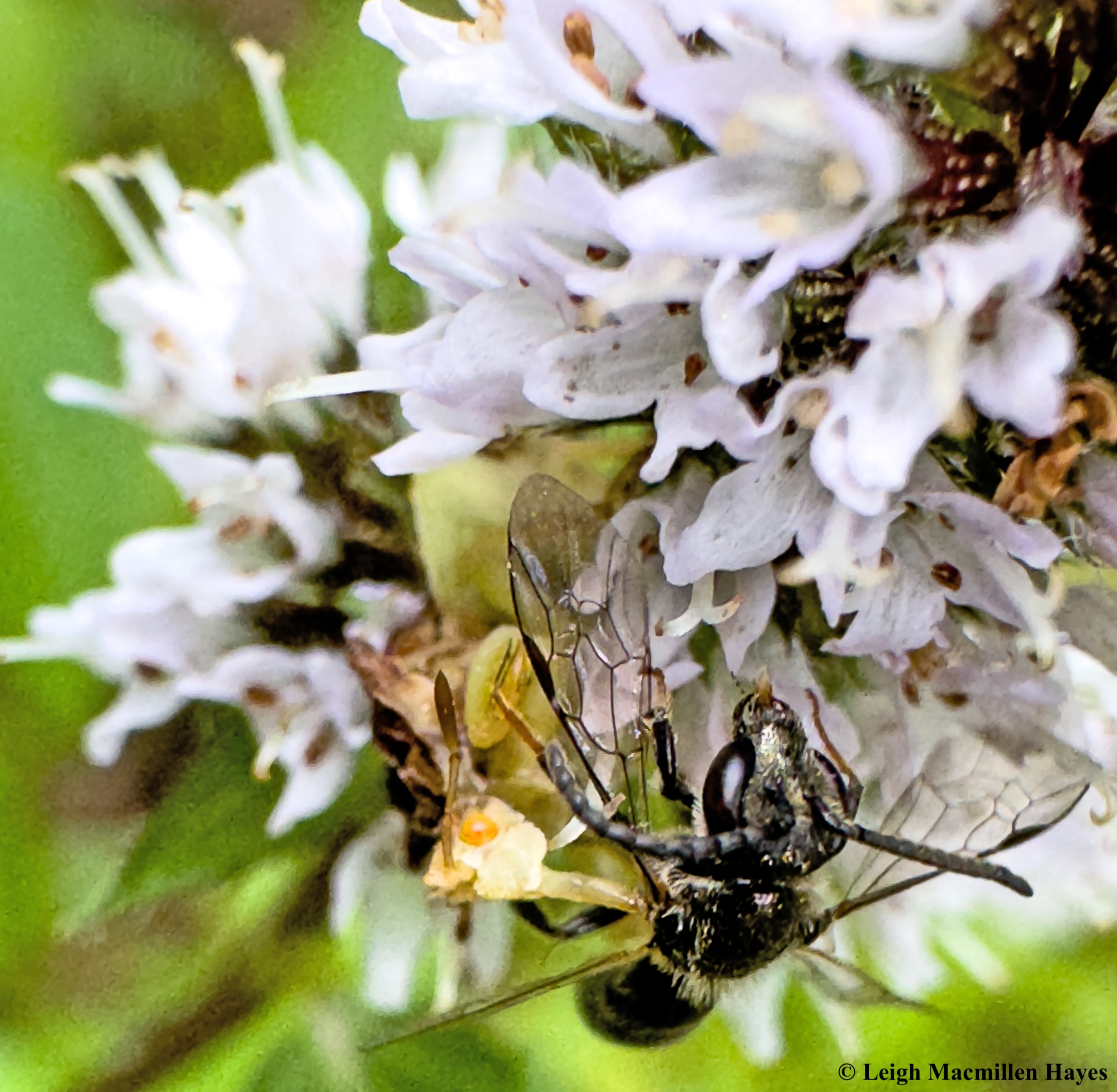
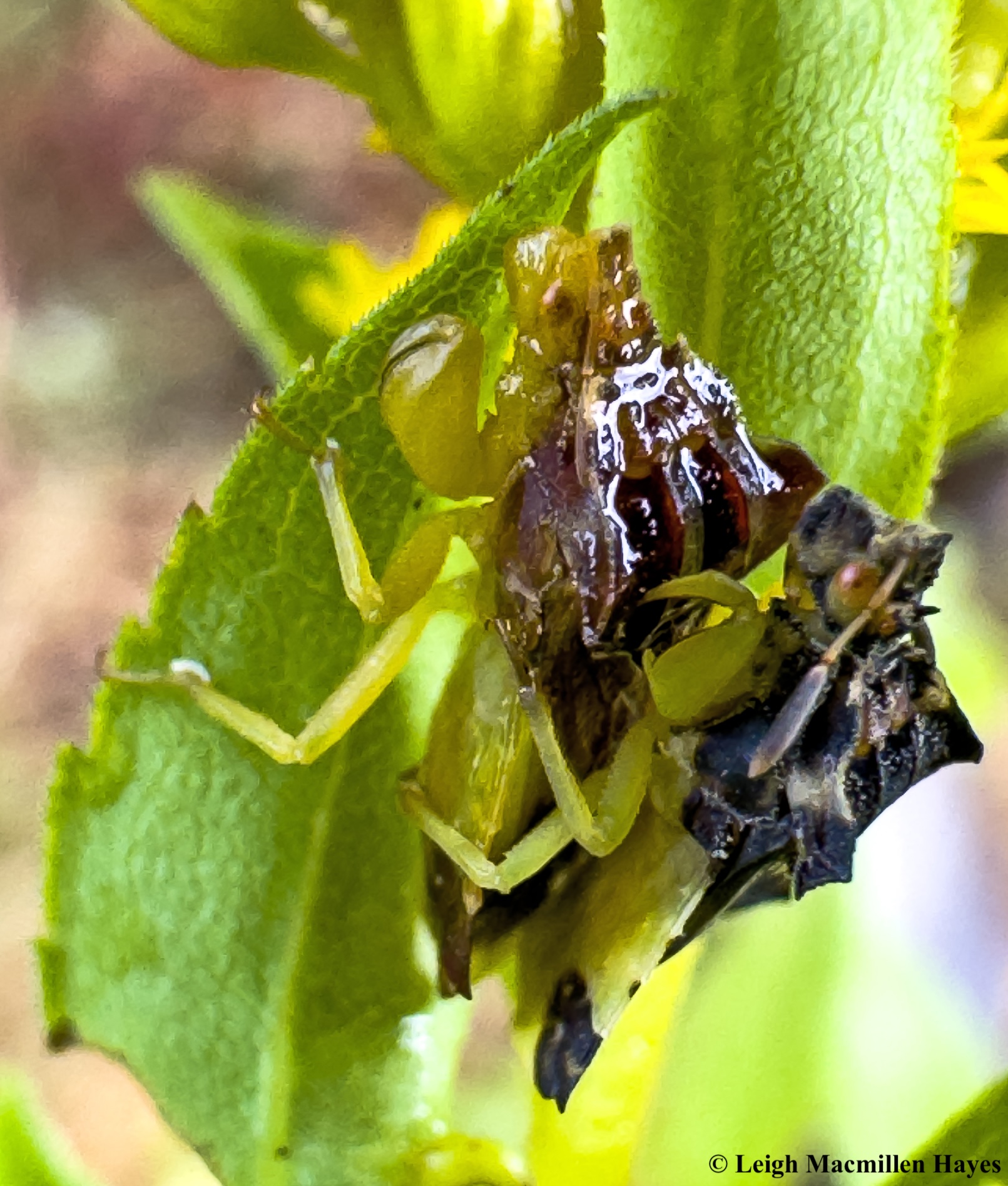
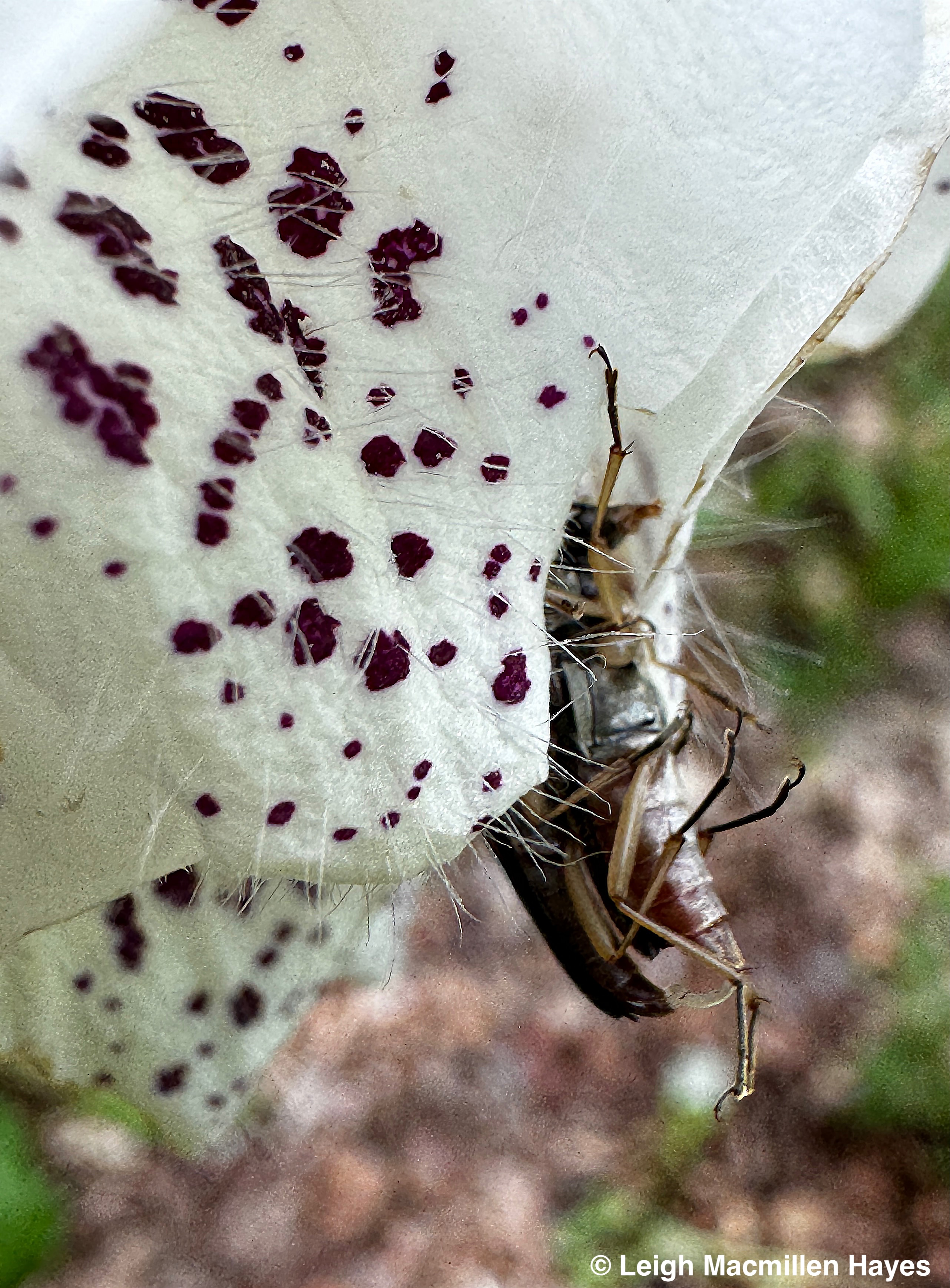
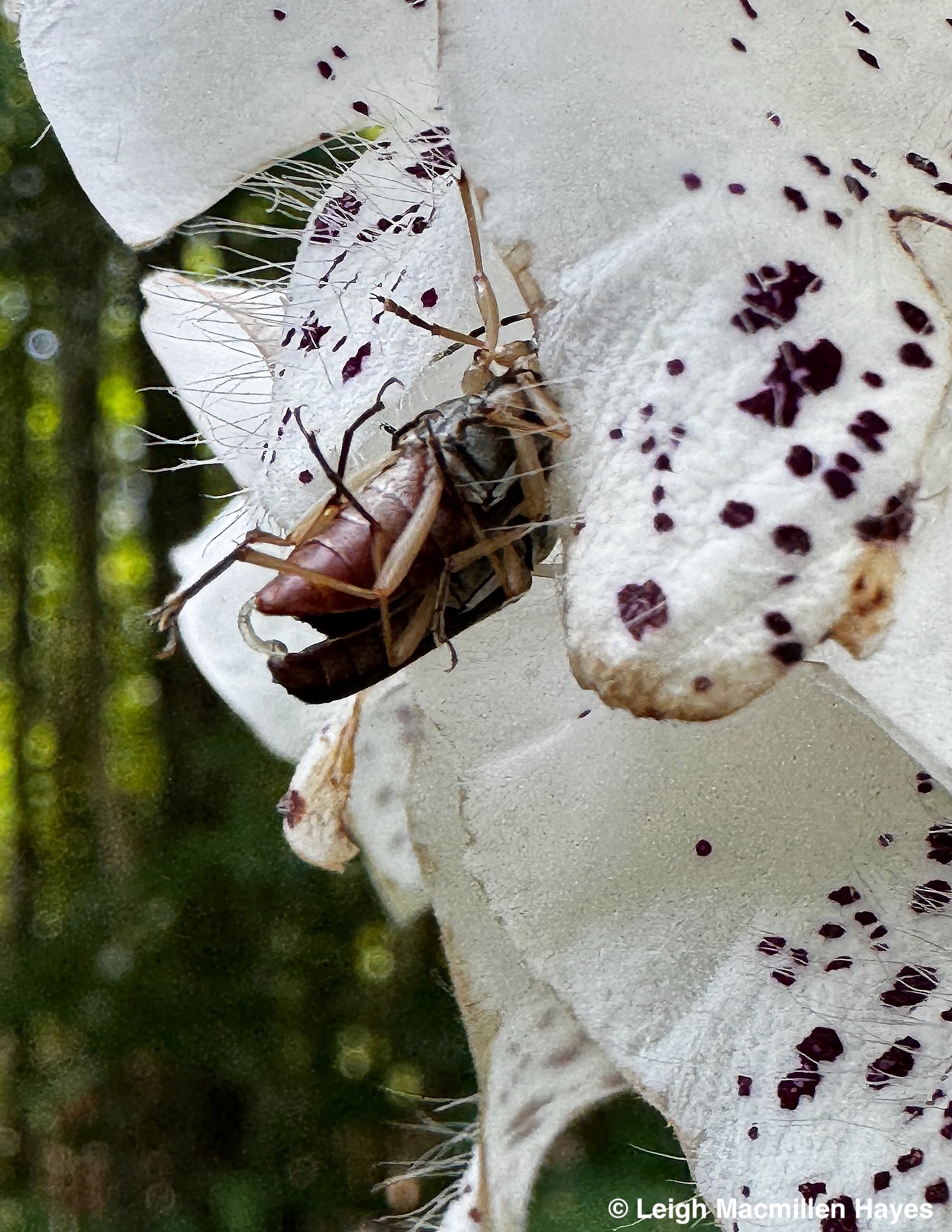
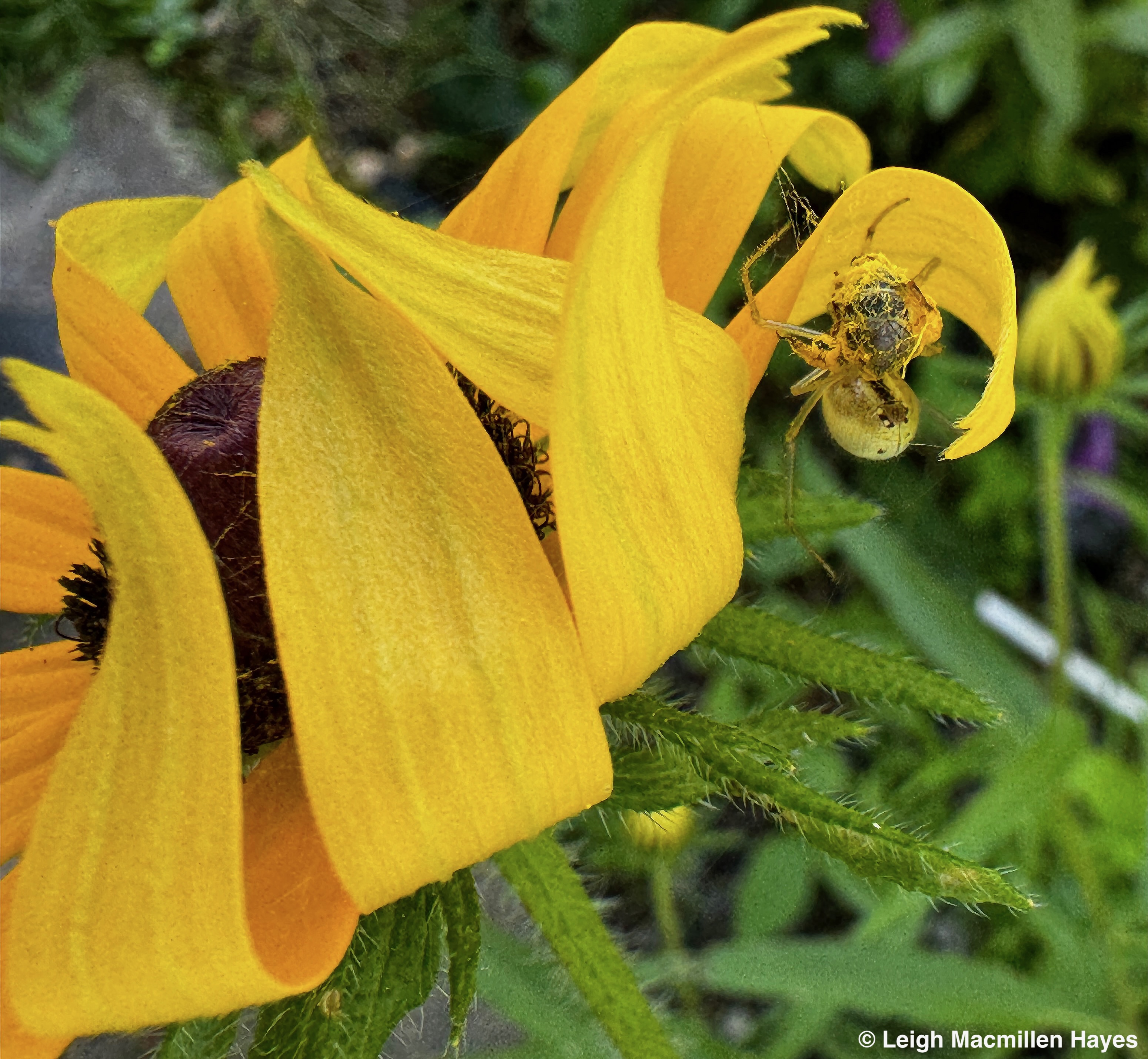
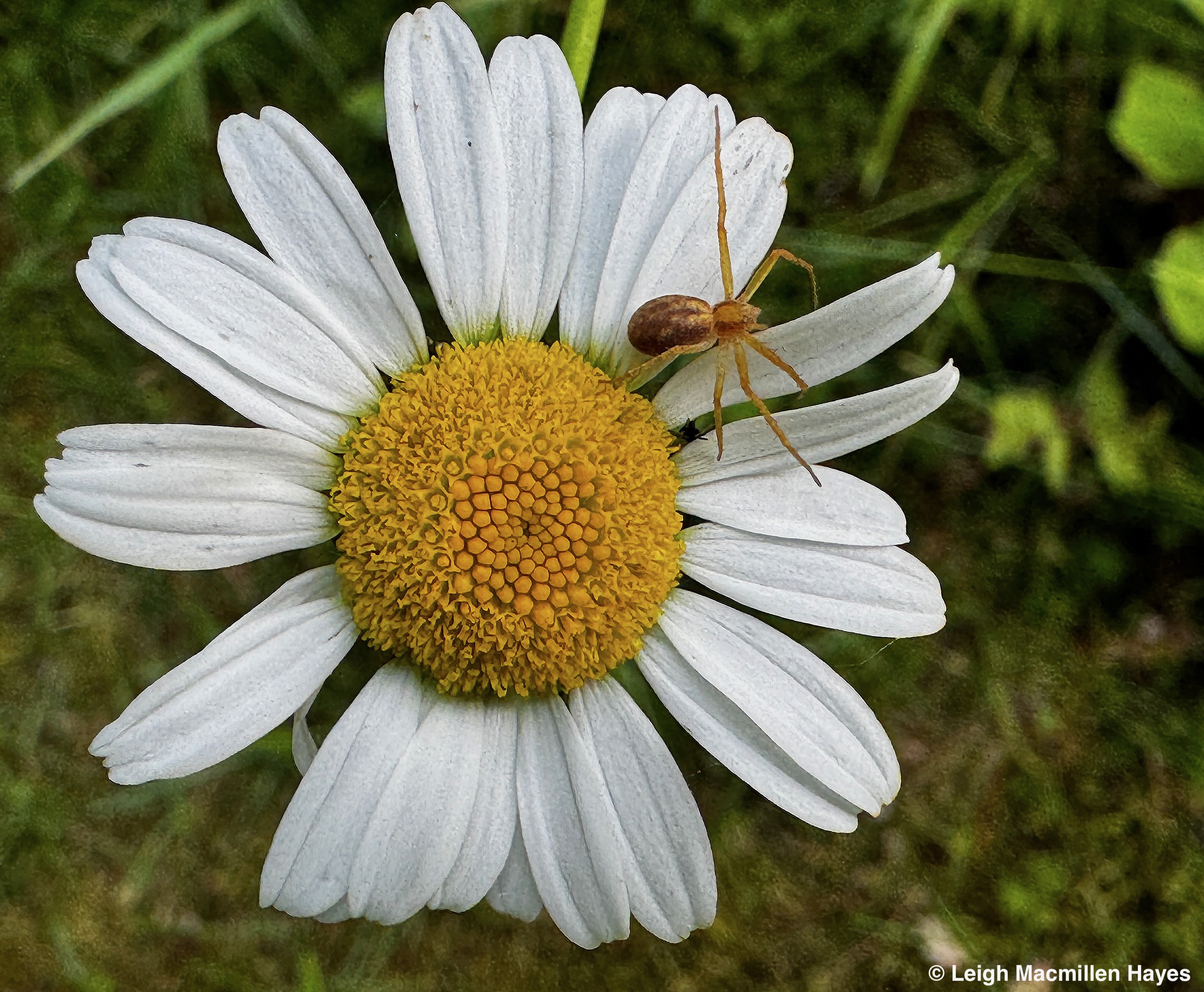
The Phymata Genus: Geniuses

You lurk in the midst 
Of Goldenrod flowers
Seeking the right moment
To earn your given name.
Mixing the color palate
With greenish-yellow,
White and brown hues,
You are well camouflaged.
Small, yet bulbous eyes
Watch with intensity
Waiting for prey
To approach.
Raptorial claws on muscular legs
Grab, and then impale
The victim’s body
With your short beak.
Meal size
Is of no importance
As you’ll take
Anything you can reach.
Once immobilized,
You inject paralyzing saliva
That liquifies its innards
Into nutrients you sip.
Sometimes you attack
When you are
In premarital status,
Which can last forever.
Being the smaller, darker male
You remain on the female’s back,
Guarding in hopes to claim her
When the time is right.
Your antennae twitch
As you tap forelegs,
And finally convince her
To join you in a canoodle dance.
Stealthy are you
With camouflage capabilities
And predatory prowess
That aids a healthy ecosystem.
Your swift hunting technique
Targets a variety
On insects both beneficial
And those that are pests.
As I hunt for you
I realize you are not alone
For others use the same flowers
To hide amongst and wait.
But today, let’s celebrate
You in the Phymata genus,
The Jagged Ambush Bugs,
Geniuses that I think you are.

My Flame for Black and Yellow Garden Spiders: a fire story

I’m back in the meadowy-field because, well, because of the Black and Yellow Garden Spiders and because of a brush fire on an extremely hot day last week.

Looking back toward our house, with our neighbors’ woods to the left and ours to the right, it looks as though the Goldenrod goes on forever. Actually, there’s some Meadowsweet and a few Steeplebushes, and some other flowers in the mix, and ferns including Sensitive and Marsh and Royal and Interrupted, and mosses galore. But right now it’s the Goldenrod and Spirea (Meadowsweet and Steeplebush) that are attracting the pollinators.

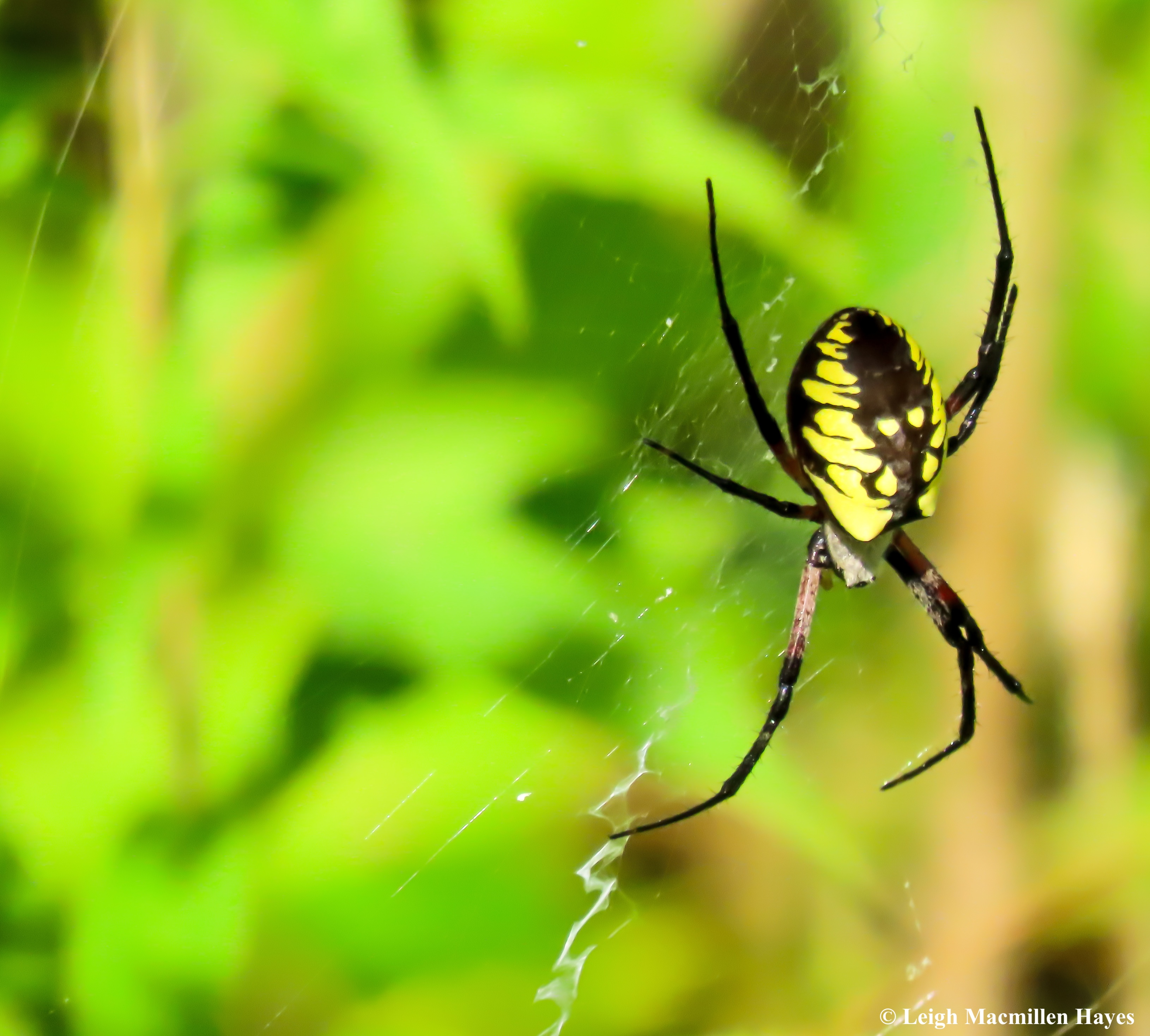
And since the beginning of August, the Black and Yellow Garden Spiders have made a return and as I slowly walk along the path my neighbor keeps mowed, I’ve been noticing more and more of them every day and wonder how many more I don’t see or are deeper in middle the field where I dare not venture . . . because I know there are Black and Yellow Garden Spiders in there.

One extremely hot afternoon last week, I noticed a few of the spiders hiding in the shade. I circled the field twice and then headed indoors to get out of the heat, rather like them. But before going in, I grabbed the SD card from my game camera.

A couple of hours later, actually about 5:30ish, I headed back out to relocate the game camera in our woods. My neighbor saw me and we waved before I disappeared.

Camera relocated, I decided to circle around the trail I’d created in our woods years ago because in the shade of the Pines and Hemlocks, and with a breeze, it was rather pleasant despite the temp being about 97˚.

I was almost to the power lines that cross both of our properties when she texted me: “Do you smell smoke?”

I sniffed and did not, which I told her.

“I’m really smelling it now,” she wrote a minute later.

“Oh boy,” I responded. “I’m just about to the power line. I’ll head home via the field.” Which meant I’d walk under the power lines toward her field, thinking that by walking north, I might be able to figure out where the smell was coming from.

And then I stepped out of the woods and onto the actual power line. “The minute I hit the powerline,” I wrote, “it is strong. Yikes.”

“I’m going to walk up the field,” she replied.

I could see haze toward the north and told her that.

And then, I heard a crackling sound near me that didn’t make sense.

The crackling was the fire.

“I see it,” I wrote. “It’s behind us Calk 911.” Yes, Calk cuze I was in a panic.

And if you look closely at the photo, you’ll see two spots of orange which were the flames.

“Behind where,” she asked because she had called 911, but she wasn’t sure where exactly I was.

And then in my panic I realized that I needed to call 911 and did so. “I’m on the phone with them,” I wrote. “Thank goodness you smelled it.”

Actually, we were both on the phone with the Dispatcher, who was incredibly calm as she asked me to describe what I could see. The fire was on land belonging to another abutter to our south and about thirty feet in from the power line. From where I stood, it was difficult to get a sense of how large it was, but no way was I going in there to give a more accurate account.

Thankfully, the cool, calm, and collected Dispatcher asked me the best way to the location, which she knew via e911, and for which I am grateful, and the fire department was in the midst of their weekly meeting, so within minutes, with the Dispatcher still on the line, I heard the sirens and ran to the field to meet them.

Because the power line is also part of the snowmobile trail, the trucks could follow the path up through the field, and then cross over and drive between the breaks in the two stonewalls that define our boundaries.

Once they were at the location, I ran down the field trail to meet my neighbors and My Guy.

A little while later, three of us decided to head up and take a peek from our land on the other side of the power line.

Ten men and one woman were in there spraying the area with foam and cutting trees, many of which I think were snags or broken from snow weight as they were Gray and Paper Birch.

Another firefighter sent a drone up to check the entire area. He also saw the haze to the north that I’d seen at first, and sent the drone that way, but thankfully found nothing.

They came back the next day to try to determine the cause, but we haven’t heard what it might have been, which is disconcerting because given how dry and crisp everything is right now, I live in fear of this happening again. (We hiked a local mountain today and the top is crisp and dry and fall foliage will not be so great this year because everything is brown)

This morning I was checking on my spider friends and others in the field and My Guy, who had been on an errand, found me out there and asked if I wanted to show him where the fire had been since he’d had to go back to his store when it actually was happening.

He didn’t realize how big of an area it was, probably 30 or 40 feet by 20, and the potential danger it could have caused if my neighbor hadn’t smelled the smoke and she and I hadn’t gone looking for the source.

But I’m trying not to focus on that and instead spend my time observing all that happens just over the stone wall from our house. Check out the size of that pollen sac!

And look at the hairy scales on this dainty Common Ringlet butterfly.

Though I occasionally meet a Katy-did around here, I think this past week was the first time I’d encountered a Broad-tipped Conehead! What a conehead it is!

There have been a variety of dragonflies over the course of the summer, and just this morning it was this male Twelve-spotted Skimmer who stopped by. Each evening, there are a bunch of Darners, but they won’t slow down enough for me to make a positive ID. I do positively give thanks for them because all are helping to keep the Gnat and Mosquito populations low. Of course, they also eat some of my other favorites, but I remind myself that that is nature at work.

I did worry that as the fire trucks were driving up through the field last week, especially when they cut across to get to my location, they were destroying the spider webs. And they probably did. But what they were doing was way more important in that moment. And . . . the spiders have found some new locations in the spaces where the tires flattened plants.

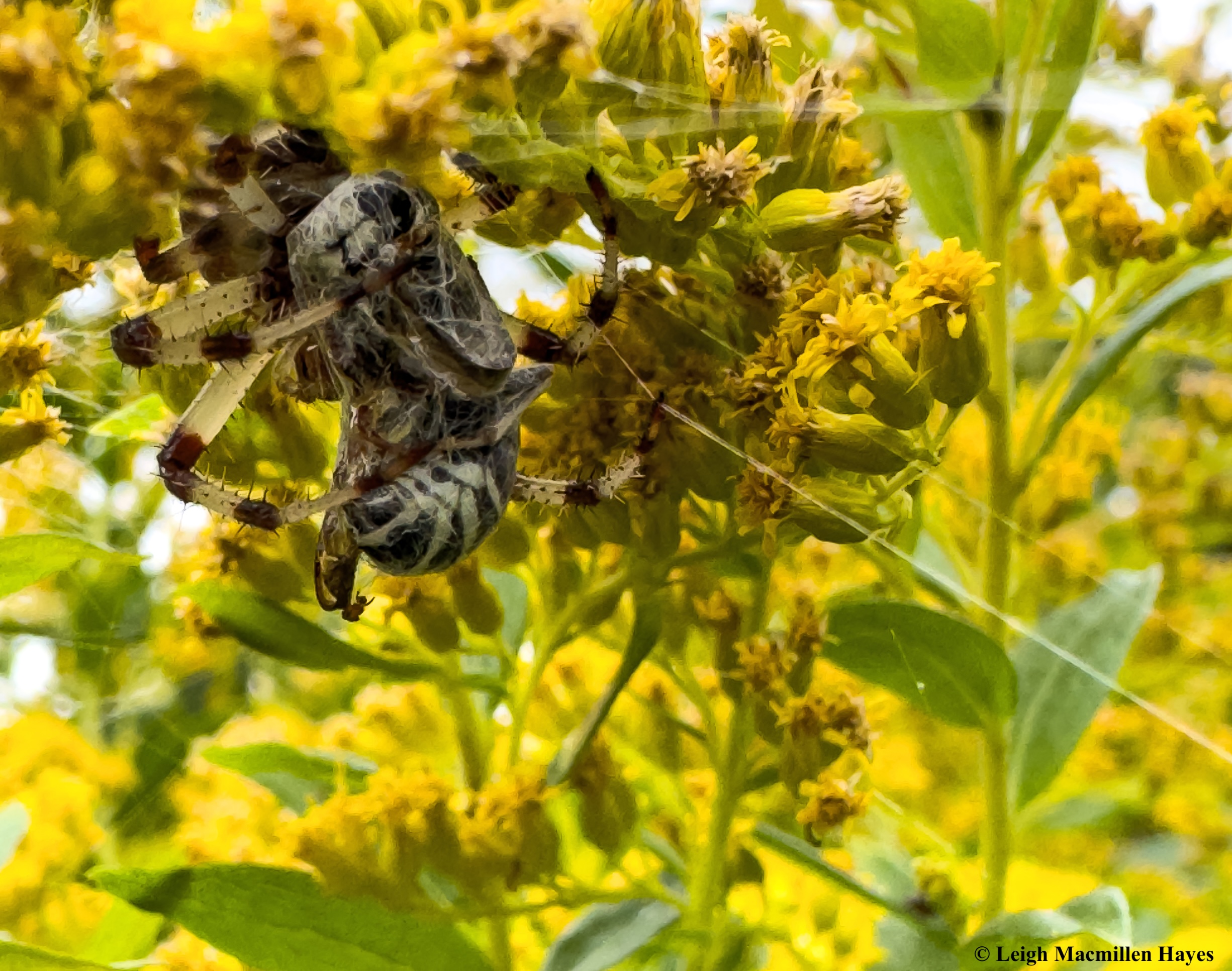
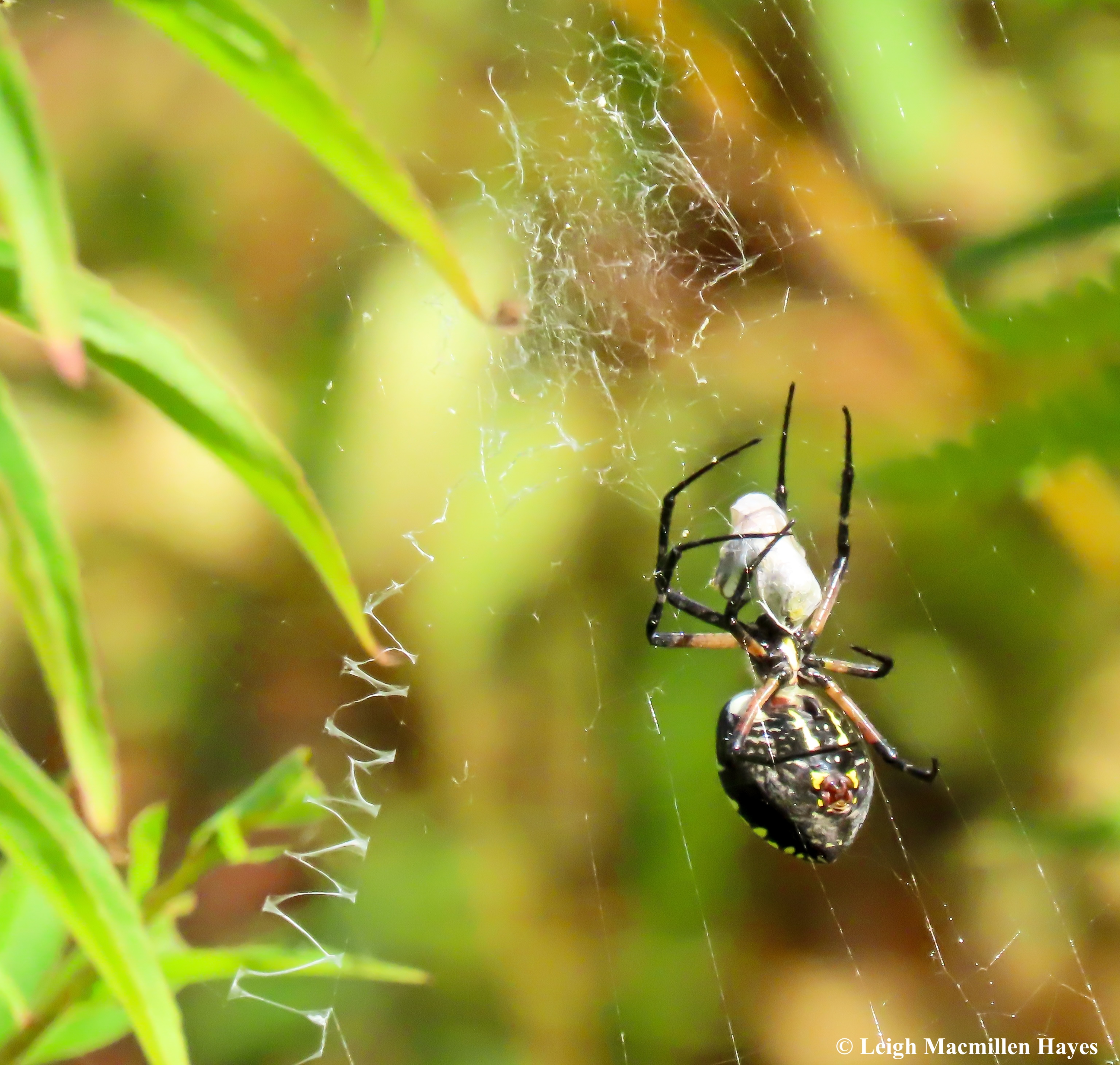
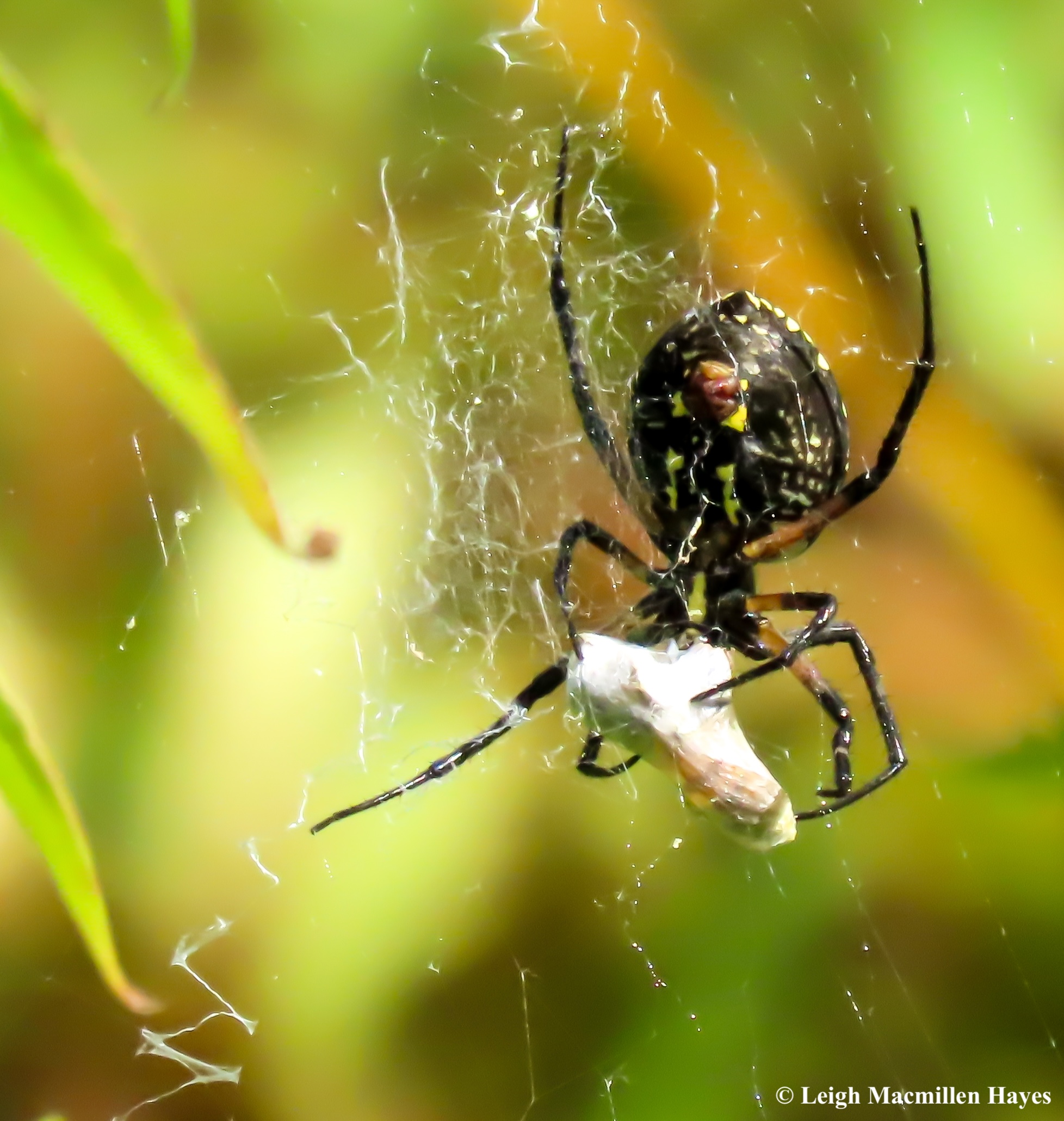
It seems every summer I learn something new from these spiders, and this year I’ve had some time to watch them wrapping their prey on more than one occasion. I’ve also watched as one Bumbler somehow managed to bounce off the web . . . one strand at a time, and fly off. But not all are successful and the spiders need to eat too.

Though they occasionally eat the pollinators, they also help keep the population of some not-so-beneficial insects down, such as this Oriental Beetle. It’s warp-speed work when an unsuspecting guest visits the web.

Silk flows from the spinneret and the victim is quickly wrapped up as the spider turns it over . . .

and over again.

Click on the arrow and you can watch this ten-second video of the action.

Their meals come in all shapes and sizes and there are plenty of grasshoppers to meet the spiders’ feeding needs.

What I found curious is that not everything gets wrapped in quite a neat package, and I’m not sure why . . . yet.

I also had the chance to watch as a meal package was moved from a lower part of the web.

And brought up to the central station, which is a rather cobweby creation in the center of the orb.

And then the spider went into its traditional upside-down manner in this home base as it continued to wrap the captured insect.

As I draw this blog post to a close, I want to note that most of the spiders (at least a dozen on any given day) I spot are located in an East/West orientation, their upper dorsal carapace or their underside facing in these directions.

And even when a Black and Yellow Garden Spider abandons a web site, the drag lines remain, for such is their strength.

Those drag lines are super thick and if we were to walk through them, heaven forbid, we’d bounce off of them. It’s an amazing wonder.

What happened to the resident spider of the web above? I don’t know. I did spot a male hanging out with the female a couple of weeks ago, so maybe they mated and were done. Or . . . she moved on to a different location.

At the end of the day and the end of the web and the end of this post, I will be forever in awe of these Black and Yellow Garden Spiders, and grateful for what they and all the insects teach me.

I am also incredibly grateful to my neighbors for their awe of the natural world as it plays out in our neighborhood. And for her nose! Which smelled that fire that could have set all of this aflame.

And I’m thankful for the calm woman at Dispatch and brave first responders who put out the brushfire on an extremely hot day.

My Flame for Black and Yellow Garden Spiders is best ignited by awe and not by real fire.

Zodiac Three: A Perfect Picture

The message arrived again for a boat trip, but this time the meet-up time was 5:30am, rather than 6. So I set my alarm for 4:00 in order to have an hour of quiet time to greet the day in darkness as I read and meditated and reflected and sipped coffee.

It was still dark when I arrived at the Captain’s home and hopped into his truck, with the boat in the back.

About ten minutes later we were in Hiram, Maine, at a boat launch along the Saco River. It’s been his dream for three years to make this journey and I love that I get invited along for the adventure.

I would have written about Zodiac Two, when we cruised along (with a small electric motor) the Old Course of the Saco in Brownfield Bog, but my photos were all out of focus and so since then he has given me a photography lesson and many tips.

The sun was just brightening the sky as we headed upriver, a smart plan in case the motor’s battery ran out of juice and then we could paddle and float back to the launch site.

I’ve been on the Saco a bunch of times in a variety of boats, but neither of us had ever explored this section below the Brownfield Bridge and I was struck by how calm and clean it was. The water is also quite low–thanks to the drought that we’ve been experiencing again this summer so we had to be aware of sandbars and stumps and logs and rocks. Well, actually, any time you are on the river, you have to be aware of obstacles.

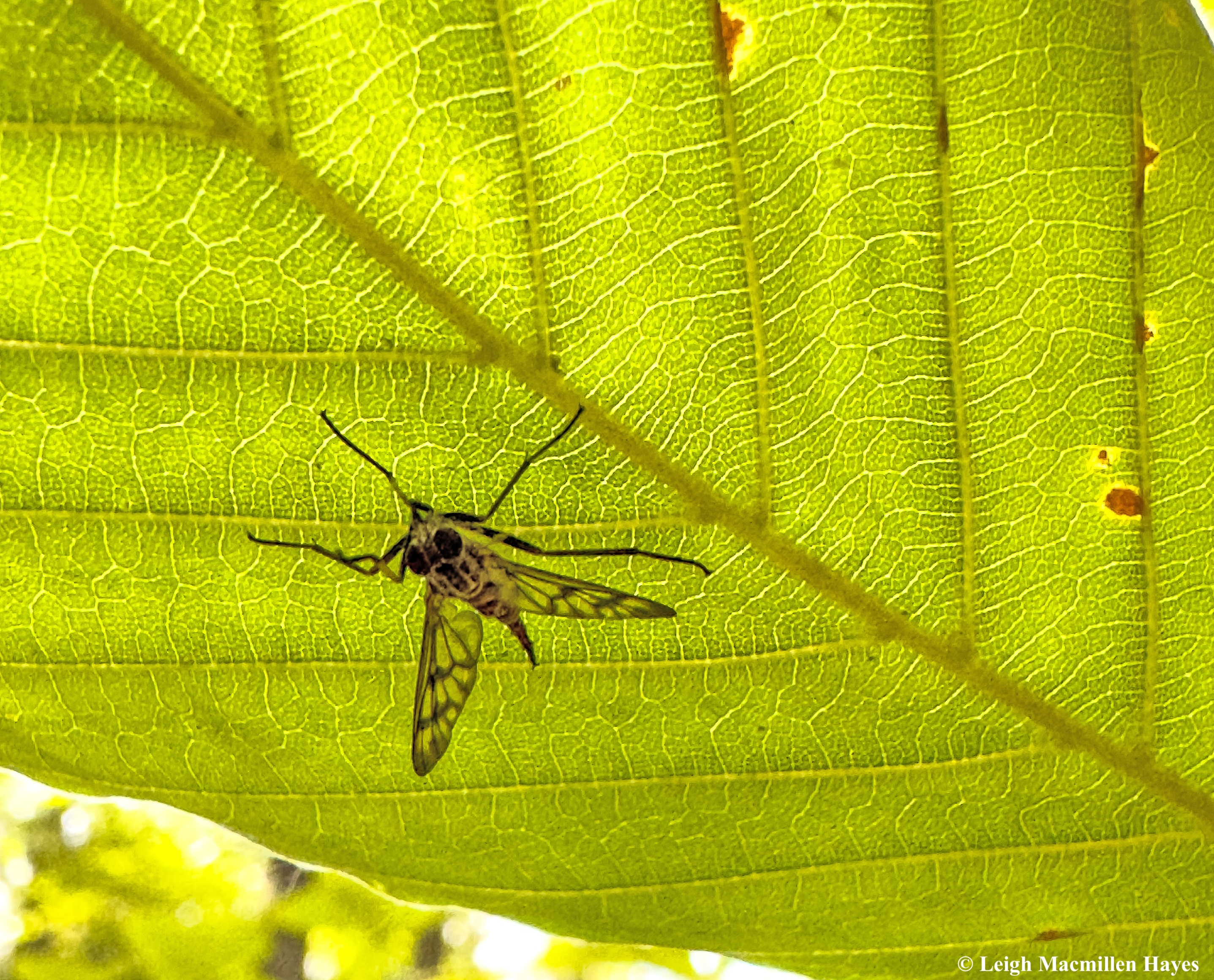
As we started the journey a dragonfly landed on my leg, and she proceeded to try to lay eggs. Have you ever felt the tip of a dragonfly’s abdomen try to pierce your skin? It’s a bit of a prickle. While she was doing that, I tried to snap a photo, but neither she nor I were successful. Still, I counted her as a good omen.

Sometimes, as we gently cruised along, we each took photos of the same scene, so some of these are his used with permission, and others are mine.

The reflection of the shoreline was one that struck both our fancies. We didn’t talk about it, but it was the layers that intrigued me and reminded me of the force of the water in this mighty river that originates in Saco Lake at the top of Crawford Notch in New Hampshire and winds its ways with a million oxbows to North Conway, NH, and then into Fryeburg, Maine, and across the state before it flows into the Atlantic Ocean in Saco.

Sometimes we realized we were looking at Silver Maple floodplains and other times there were steep cliffs. Always, we knew if there was a house or camping trailer near the edge, because they seemed to be located on high ground, but all the trees were cut between their high ground and the river to provide a view, and the result was intense erosion. One person even had several tarps draped over the ground in what we figured was an attempt to stave off the erosion. We think leaving the trees and trimming branches would have been a better choice, but no one asked us.

Another sign of erosion, the visible roots of many, many trees, also created works of art and my brain is already painting this scene in the future . . . maybe.

And then there was this work of art–a Silver Maple Lollipop, its leaves already shutting down chlorophyl production perhaps as a result of the dry spell we’ve been experiencing.

Slowly the sun rose and the water captured the sky in whirls and swirls and rainbows of its own making.

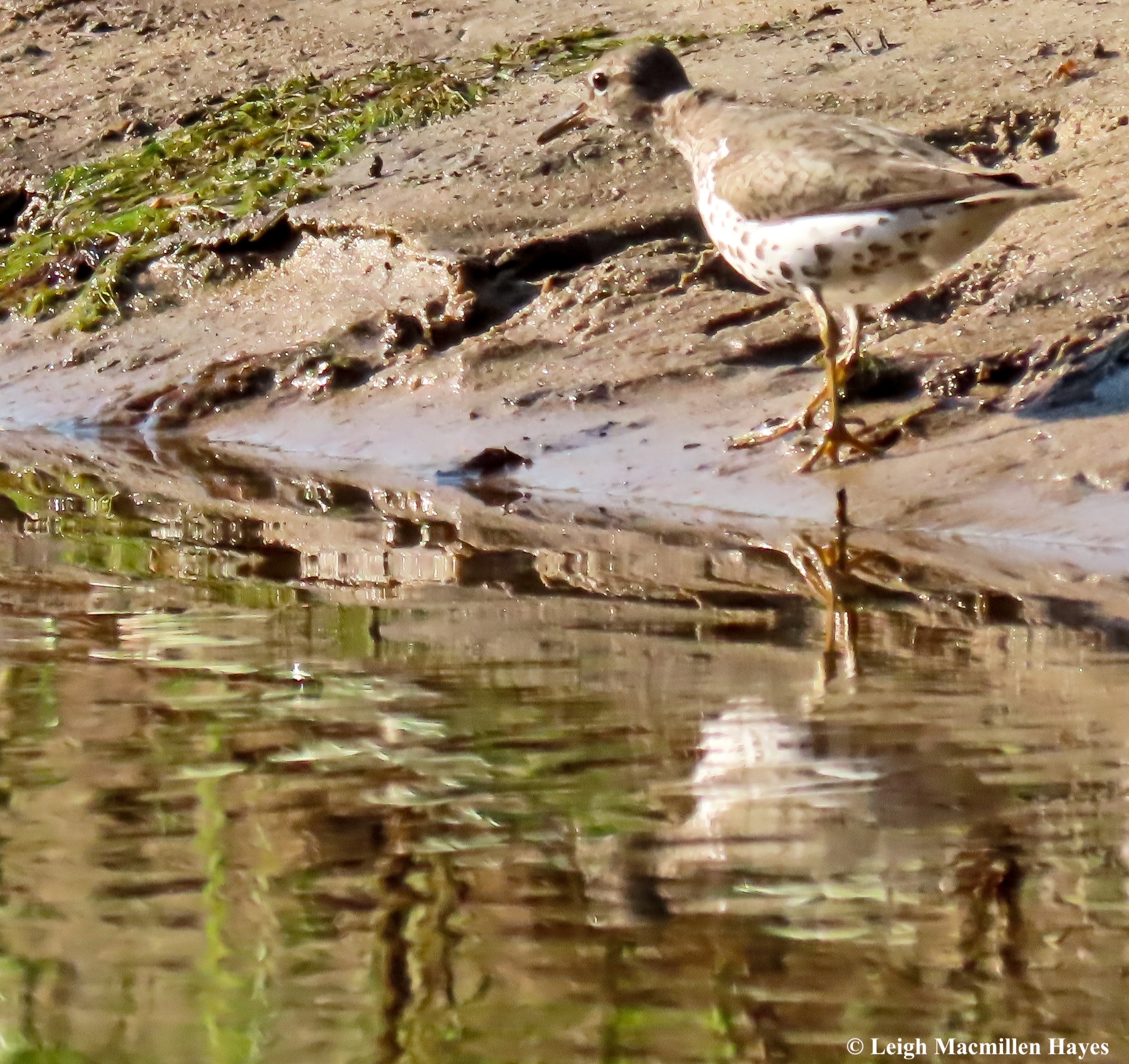
We’d both headed into this boat ride expecting to see birds, which we did, but we really expected Great Blue Herons and Bald Eagles. The drama artists. Our best sighting of the day was this Spotted Sandpiper, who walked along the river’s edge and then flew ahead and landed and did the same thing all over again. Over and over again.

Once the sun was fully up, our day turned into a bright one, and we had a nice breeze to accompany us. Plus tons of dragonflies and a few damsels, all of whom did not wish to let the paparazzi photograph them. Still, we gave thanks for we could see bugs in the air, but nothing attacked us, unlike during our Zodiac One and Two trips.

At what became our turn-around point, we got out of the boat and waded through the water to a beach, where Captain B set up his drone.

Above us, the waning moon stood out in the Bluebird Blue section of the sky.

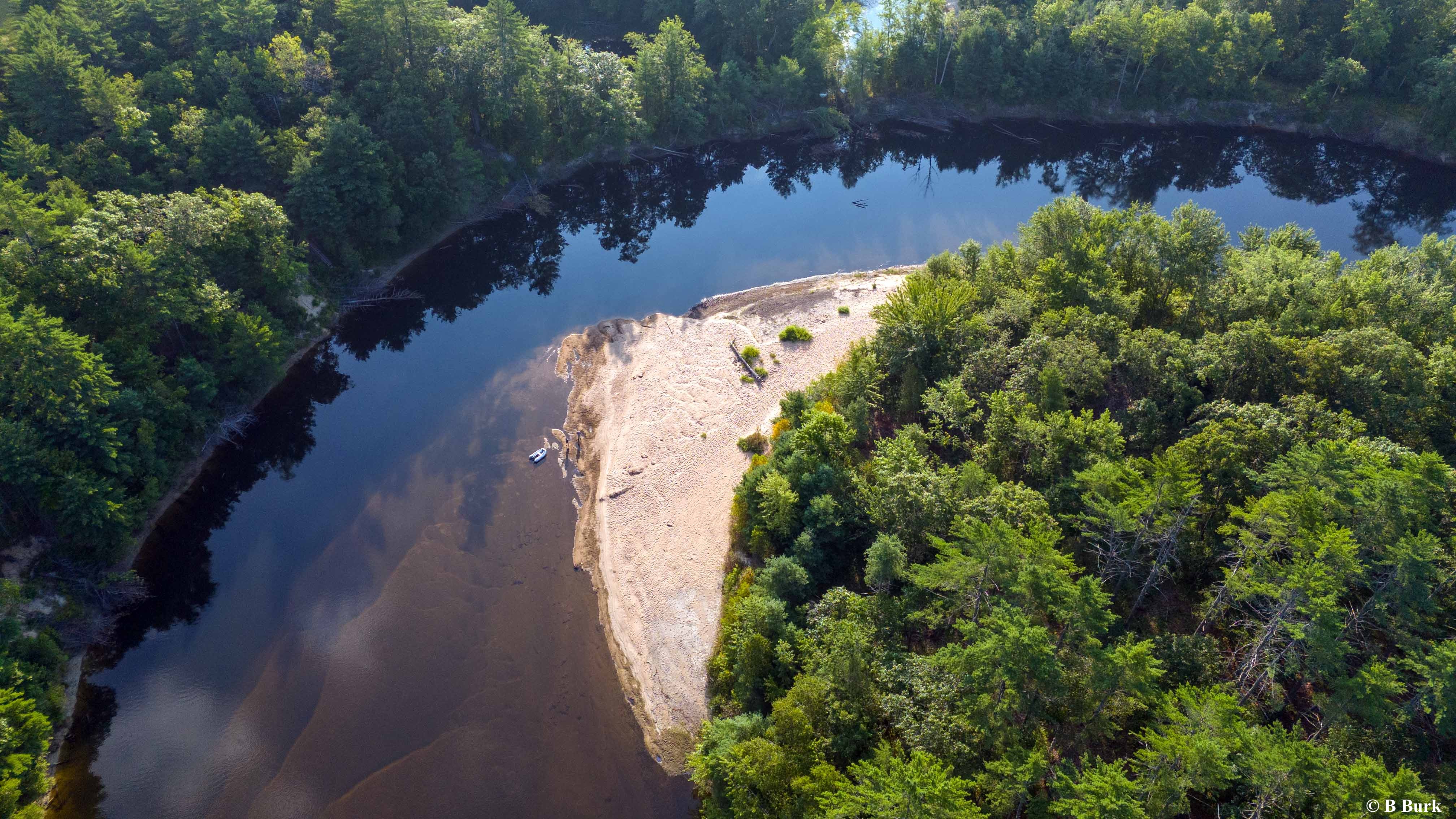
The drone allowed us to see the lay of the land, and despite the fact that I’ve seen it recently from Mount Cutler while hiking with My Guy and a friend, I was once again reminded just how beautiful this area is and how small we are.

Do you see that beach in the river’s bend? We were standing there.

You might be able to see the Zodiac now.

And the two of us near the boat. Plus the indentations of a million duck and goose footprints. A flock of something skittered and flew off as we approached this spot, but they were too quick for us to identify.

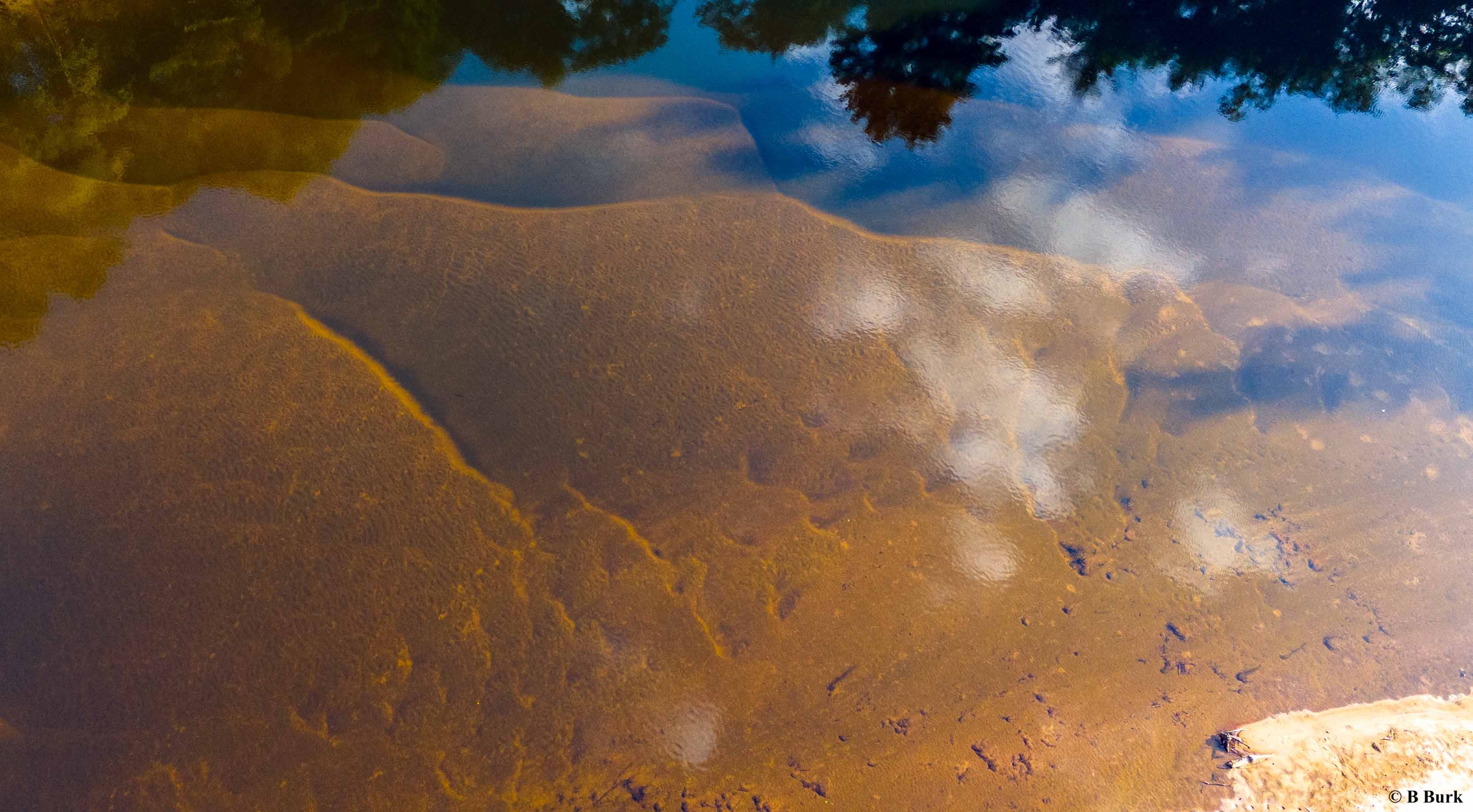
The drone also gathered this shot of the layers of silt in the water. Or maybe we weren’t really on the Saco, and had instead taken a trip to Mars? Oh, but wait, there is a reflection of trees that very much spoke to our being in Maine.

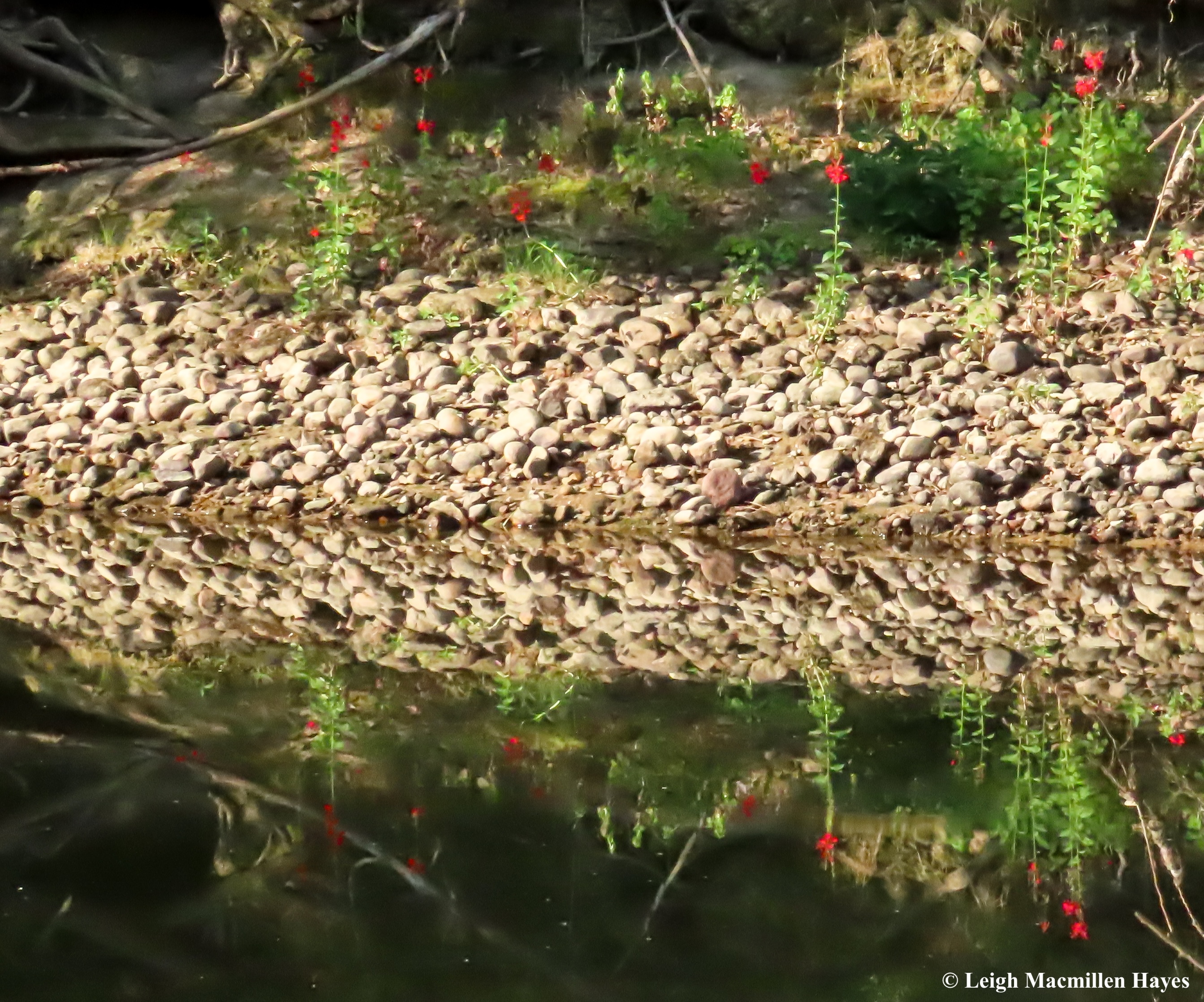
On the way back, we spotted Cardinal flowers that we somehow missed on the first leg of the journey. They decorated a few sections of the shoreline and maybe stood out more because the sun was shining so brilliantly on them.

For Captain B, it was a new flower to add to his list. For me, it was a sign that it is August and we were by water because they do like wet feet.

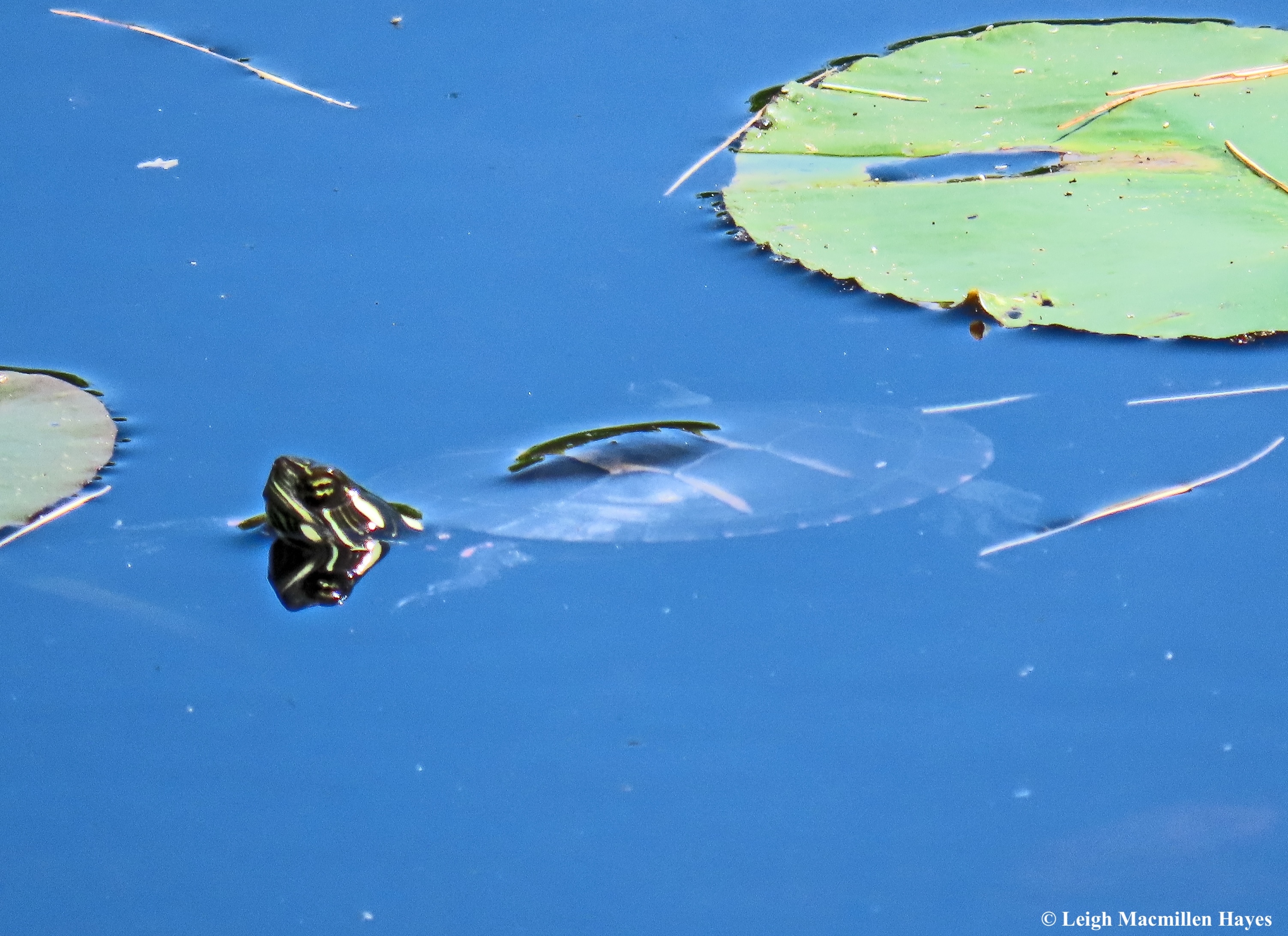
We also spotted one tiny Painted Turtle that didn’t seem at all bothered by our presence. I’d really wanted to see a turtle, so was thrilled with this finding. But surprised that we only saw one.

According to my GPS, our trip was four miles in each direction, but then I realized that the APP cut some corners, so maybe it was 4.5 miles one way. Plus I forgot to start it until after we’d left the beach.

The length wasn’t really important. It mattered more to have the opportunity to discover this wild and scenic and quiet section of the river (and not have to paddle!).

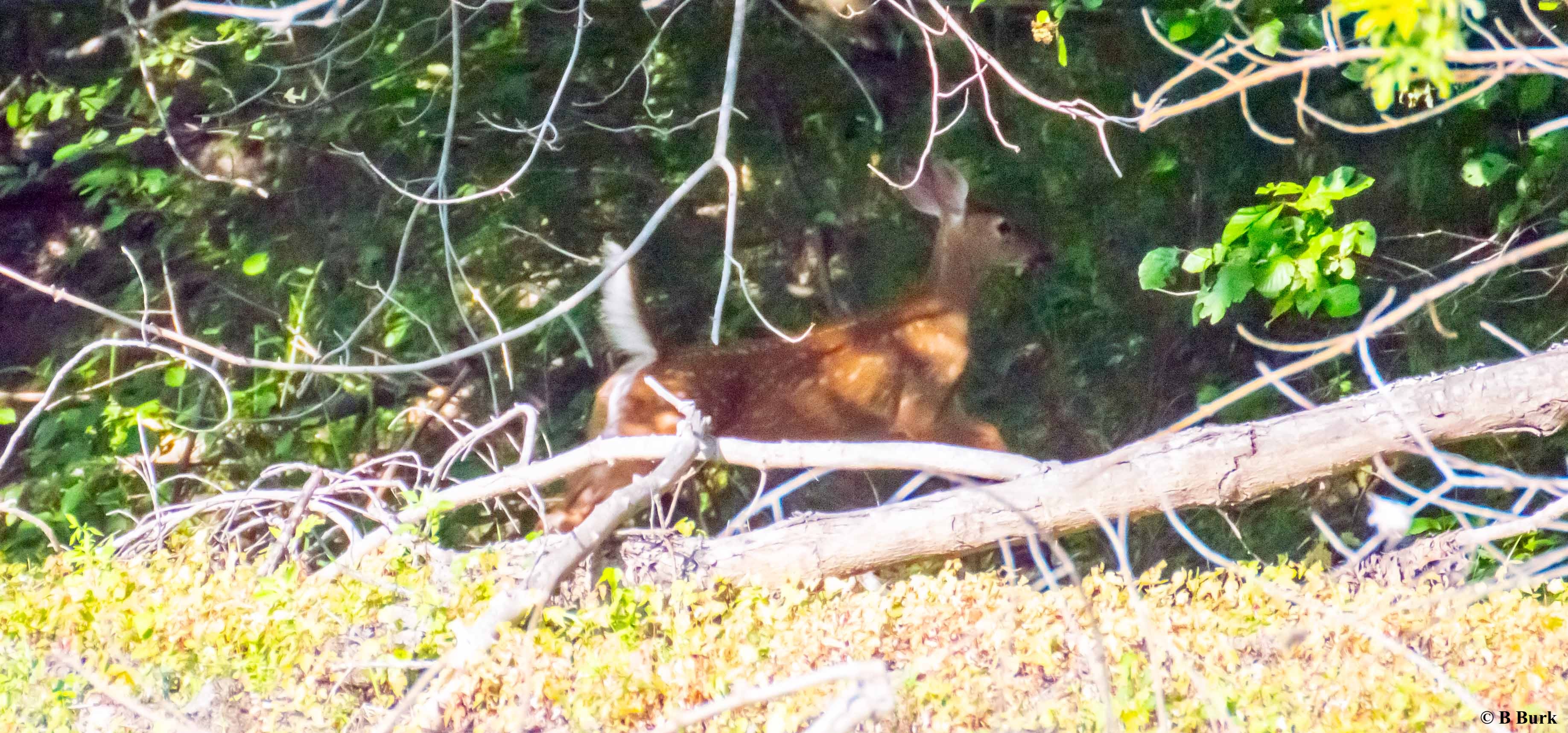
As for the perfect picture, this is one that Captain B snapped and I can’t believe he actually captured the fawn. We were both surprised, even though we’d expected to see deer, when a Doe and her spotted youngster stood by the water’s edge as they nibbled on grasses, but they saw us and quickly dashed into the woods, their white tails on high alert.

The sight of the two of them, however, is what I’ll cherish in my mind’s eye because that’s really where perfect pictures are stored.

Zodiac Three: The Perfect Picture. Thank you again and again, Captain B, for creating the opportunity. And I can’t believe you did get this last photo after all.

The Saga of Walker’s Rips

A friend recently mentioned a local road that I might want to walk down and determine if it was a good place to lead a walk for parishioners of St. Peter’s Episcopal Church and anyone else who joins us. As I drove in and the road changed from pavement to dirt, a rush of memories flooded my brain. And a smile embraced my heart.

About a half mile in, I parked my truck and decided I’d rather continue on foot to get to know the lay of the land better.

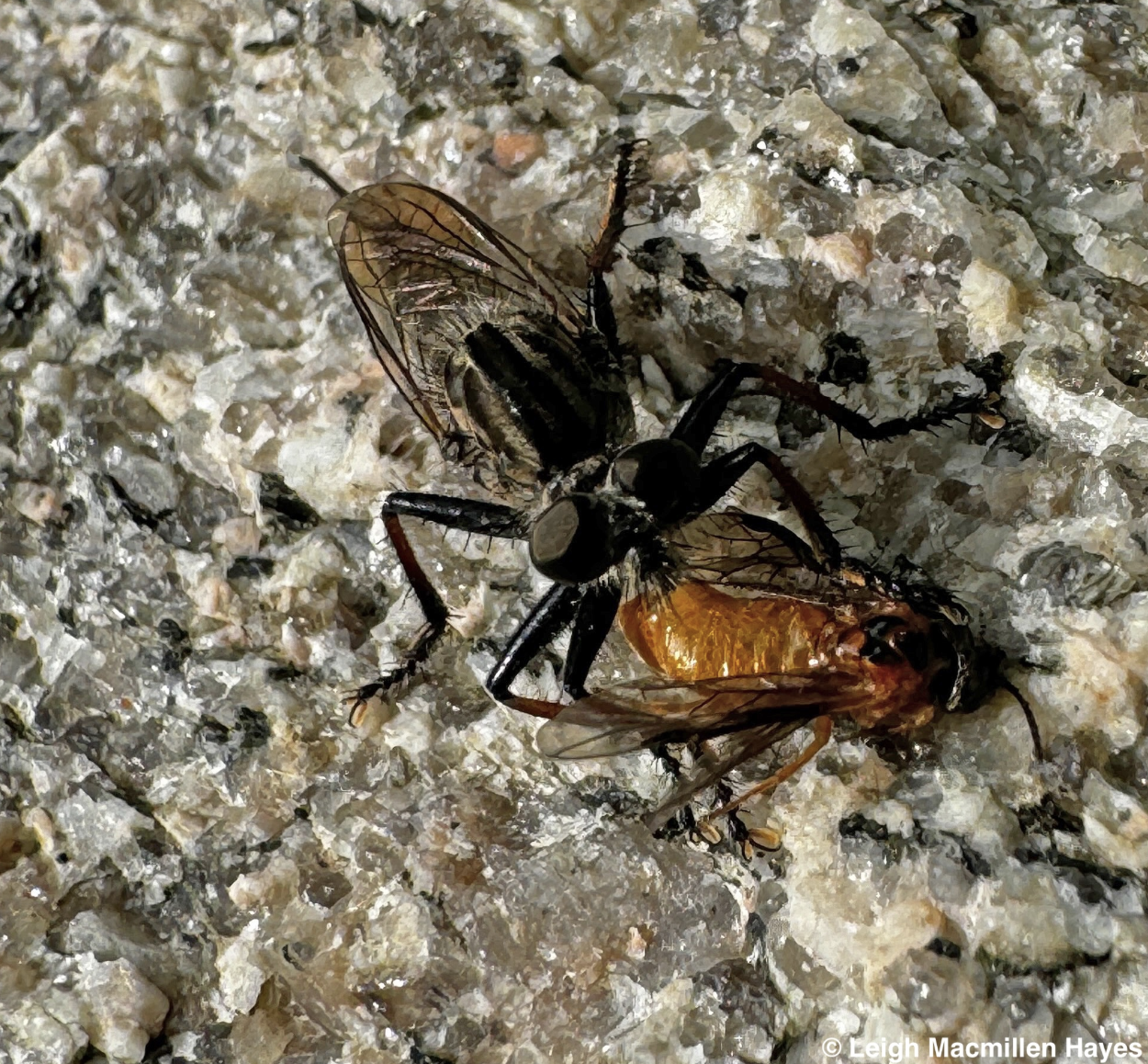
A flash of orange to my left and soon I was hunting for this Ichnuemon Wasp. It kept flying to the underside of fern fronds and upon reading up on it later, I learned that it was possibly an Enicospilus purgatus, a nocturnal species that likes night lights and gathers around them like moths. Maybe that’s why it was hiding from the daylight by landing on the underside of the leaflets.

Also hanging upside down was a Common Snipe Fly, aka the down-looker fly, which makes sense again given its location. They are known to prey on other insects, and I could only hope that Mosquitoes were on the menu for they were certainly all over me. Thankfully, only my face and fingers were exposed.

Within moments I arrived at the Mosquito hatchery and knew that there would be no relief, so I journeyed on because I’d come with a vision, but suddenly realized I was getting closer and closer to a memory of yore.

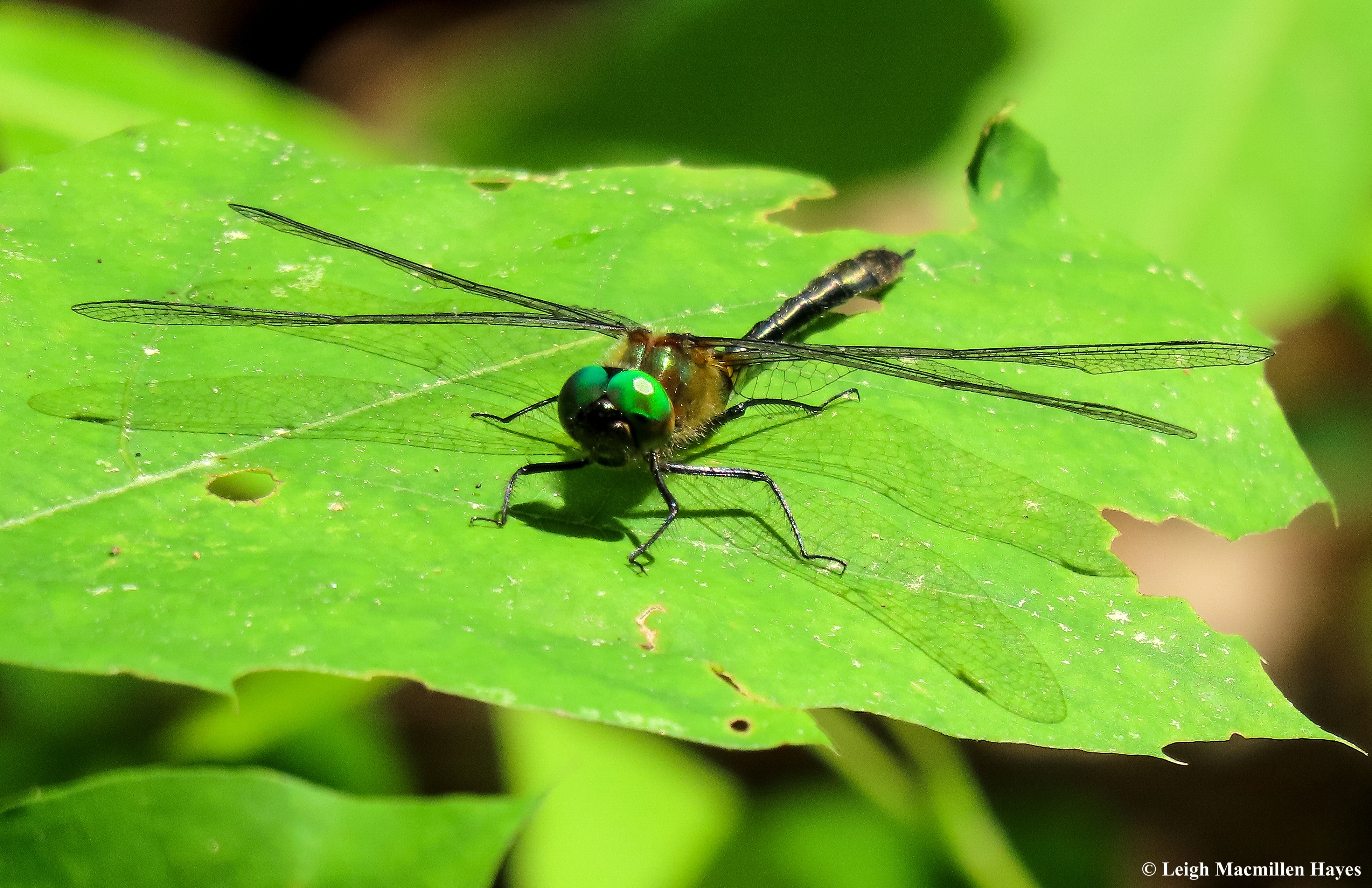
There were Racket-tailed Emeralds and other dragonflies on the move, but they hardly seemed to make a dent in the pesky population. But those great big green eyes. Oh my.

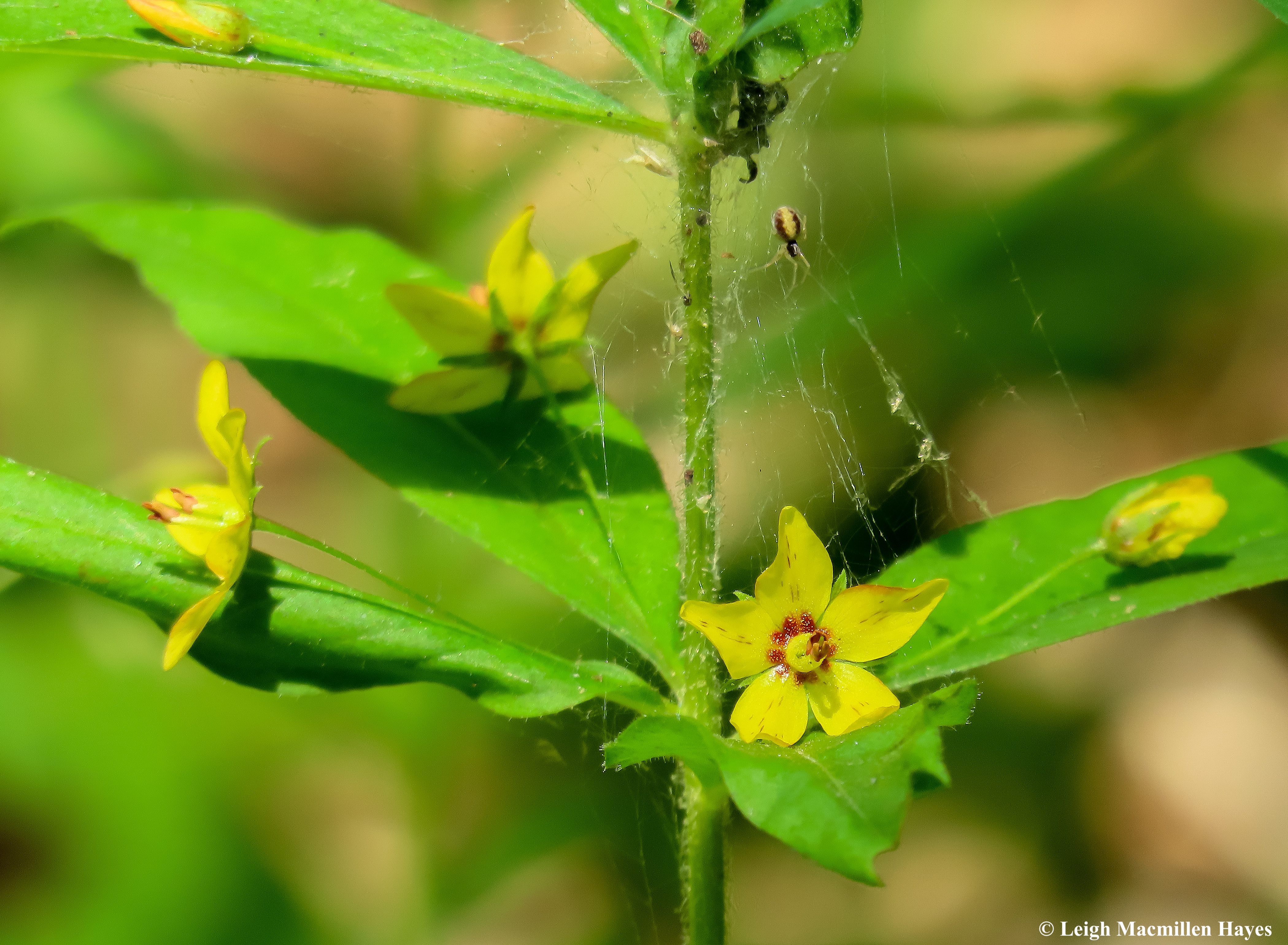
And when I went in for a close-up of a Whorled Loosestrife flower, I discovered a spider working on its web.

And gave great thanks, because certainly some Skeeters will get caught in there, and if you’ve ever looked around the natural world, you’ve realized that there are spiders and webs everywhere and the world is connected by silk.

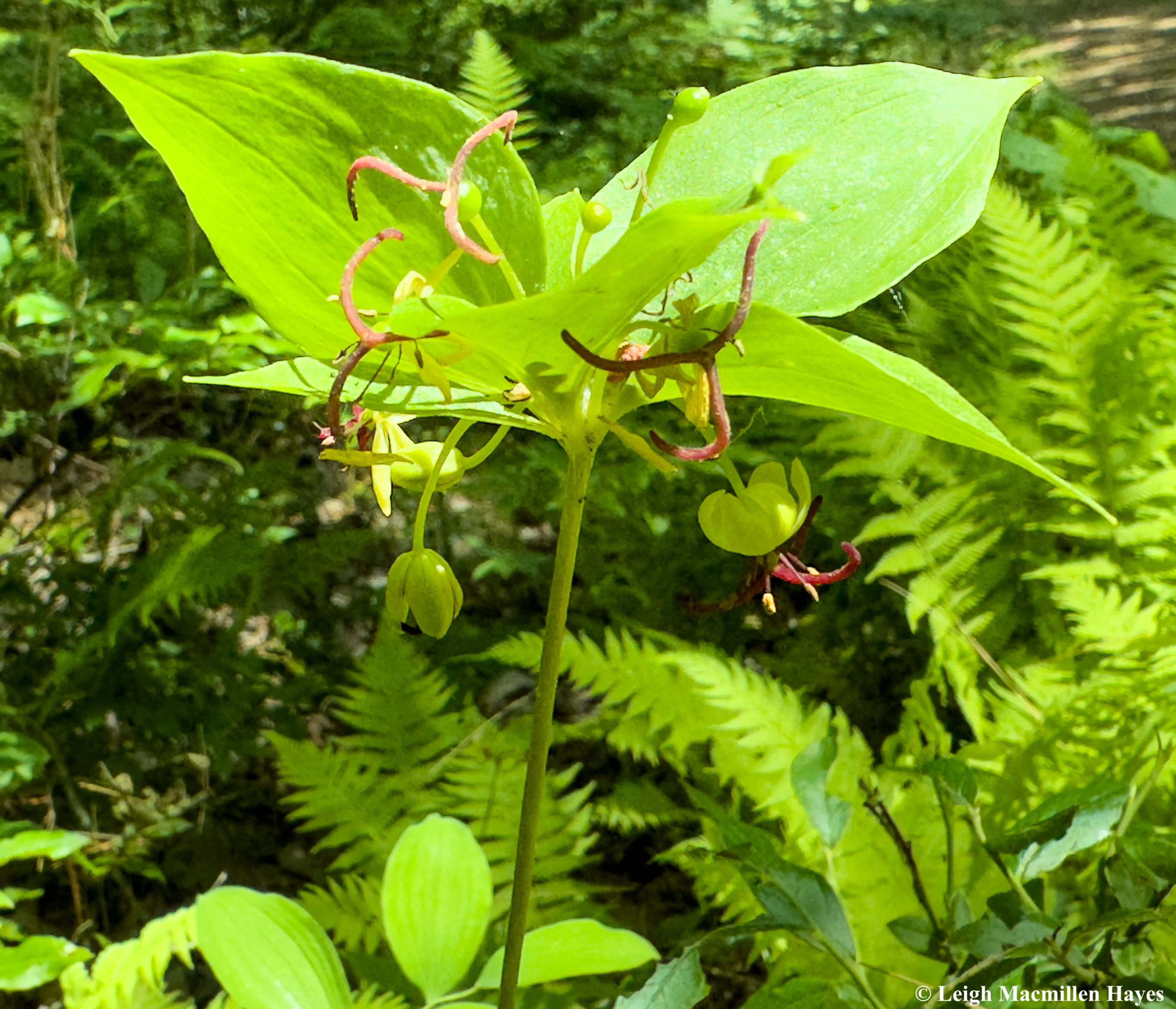
And then I spotted one of my favorite spring ephemerals, Indian Cucumber Root, and celebrated the number of blossoms with their crazy large stamens nodding below and others slowly turning upward upon having been pollinated, and becoming green fruits in the shape of tiny balls. The root is a tasty little white tuber and it’s always fun to introduce it to people, though it shouldn’t be foraged since it isn’t an abundant plant most of the time.

The biggest surprise of all was the flowers of Poke Milkweed just beginning to open in the form of five-parted crowns. They seemed befit for a queen and I was feeling like royalty as I struck gold along this route.

You see, this story really began in 1985 when I was teaching high school and junior high English in New Hampshire. My summer job that year, after working at a donut shop and consuming way too much product the previous few summers, was as director of a tween program for Laconia YMCA’s summer day camp. I still remember some of the names of the cast of characters, including Starr and Rowdy and Melissa and Jess. There were ten of them who joined me daily for activities and each week we headed off in a 13-passenger van named Mabel for an adventure, including some overnight trips.

One of our adventures was a camping trip on the Saco River. At the Y, the executive director placed a canoe in the pool and we taught the kids how to do the J-stroke. They seemed to master it. Packing lists were made, food purchased, canoes rented, plans made with Saco River Canoe and Kayak in Fryeburg, Maine, and voila, the day dawned for our big trip north. Accompanying us was a 16-year-old lifeguard named George.

One special thing I remember about our road trips was that no matter where we went each week, it was always a new place for this crew as many had never traveled far from home. That, in itself, made the experience worth it.

On this particular mid-July day we departed from the Y at 9:15am, stopped in Fryeburg for a fire permit and some last minute groceries and then I dropped the kids and George off at Swan Fall’s Dam where they loaded their gear into canoes, while I followed Fred Westerberg of Saco River C&K to the site of our first night. The plan was to leave our food and tents in the van, and spend the day paddling to it, thus giving the kids time to practice their new skills without too much extra in the boats. The site, which is no longer accessible, was near Hemlock Bridge. Fred brought me back to Swan Falls where the canoes were ready and so were the kids.

Our journey began at about 12:30pm. Suddenly, the kids didn’t know how to paddle, despite all of our practice for days on end. At least three went in circles during the first hour. But, the river was beautiful and we stopped frequently to let everyone catch up and swim.

At about 4:30, we found the stream Mabel was parked beside and let the kids swim for a bit before paddling toward the campsite because Fred had told me our destination for the night was boggy and they wouldn’t want to swim near it.

With our campsite finally set up, dinner consumed and dishes cleaned, we went for a walk and then returned to enjoy the fire before settling into the tents for the night.

In the middle of the night one of the girls yelled out, “HELP! SOMEBODY! HELP ME!

Fearing the worst, I dashed to her tent and asked, “Melissa, did you have a nightmare? “

“The zipper on my sleeping bag just got stuck,” she replied quietly.

Wednesday morning we got up early, packed our gear in the canoes and headed downstream toward the main course of the river. Across from the mouth of our stream, was a sandy beach where we made pancakes for breakfast.

I’ve since learned that the stream we had camped alongside is really the Old Course. “The ‘New Saco’ also known as Canal River, or these days, simply the Saco, was dug as a diversion in 1817 to reduce area flooding and to shorten the distance to markets in southern Maine. This 6-mile canal cut 15 miles off the length of the ‘Old Course.'” ~AMC’s Saco River Map & Guide.

At last we were off and paddlig until lunchtime. At times we felt like we were traveling through a jungle and civilization was non-existent. Following lunch, we took a long swim break and then continued on, the kids having become proficient paddlers.

So proficient that a few got ahead of George and me and didn’t heed our warning to pause when they heard the water flowing over Walker’s Rips.

Two canoes went over the Rips without any problems.

A third got stuck on the rocks. The girls panicked when water began flowing in one side of their boat and out the other. George pulled his canoe over to help. I did the same. The girl in George’s canoe got out to go to the riverbank, where other canoeists also lent a hand. She slipped on a rock and got caught between the canoe and a larger rock.

My canoe mate and I quickly portaged. Meanwhile as George and the couple helped get the two girls and their gear out of the stuck canoe, and proceeded to get the boat off the rocks, several things went overboard. Thank goodness for Hefty trash bags.

I told the kids who were on a sand bar to pick everything up from the water and I swam out to get the now freed canoe.

At last we were all on the beach below the Rips, and I began checking for injuries. I had cut my toe just before I swam for the canoe, but I didn’t have time to deal with it and so I put on my sneakers to avoid further injuries. The girl who had gotten stuck between the canoe and rock complained of bruised ribs–painful I was sure. Another had hit her back on a canoe and a bruise was starting to develop. All were shaken.

The Caretaker at the AMC campsite by Walker’s Rips had contacted Fryeburg Rescue and Fred Westerberg. And ambulance and our van Mabel arrived within minutes of each other.

I followed the ambulance to Memorial Hospital in North Conway where the girls were checked over and the doctor kindly suggested that what they needed was supper followed by an ice cream. And maybe some Tylenol.

During all of this, I’d been in touch with the Executive Director of the Y and we decided it would be best if I drove the kids back to Laconia where we’d spend the night in the Rec Room and I’d have them call their parents in the morning.

Somehow during the night, I developed a nose bleed. And then I realized that my toe was throbbing.

The next morning, the kids packed up, we ate breakfast, and then their parents arrived to pick them up and hear the tale of our adventure, which got more embellished with each retelling. The good news was that they continued to let me take their kids, but we stuck to hiking and camping for future trips.

All of that said, it brings me back to why I wanted to remember this by writing it down (mind you, I have a couple of letters I’d started to family, that helped me fill in some of the details of my memories. But . . . when I walked down that road twice this past week, I realized that this was the road we’d driven out on and I suddenly knew the route we’d taken to get to the hospital.

You see, about thirteen months later I moved to the area and though I recognized the road where we’d pulled onto Route 5, I never gave much thought to how we got there. And we’ve gone down the river a bunch of times in canoes and kayaks and even once in an inflated boat and never had a problem.

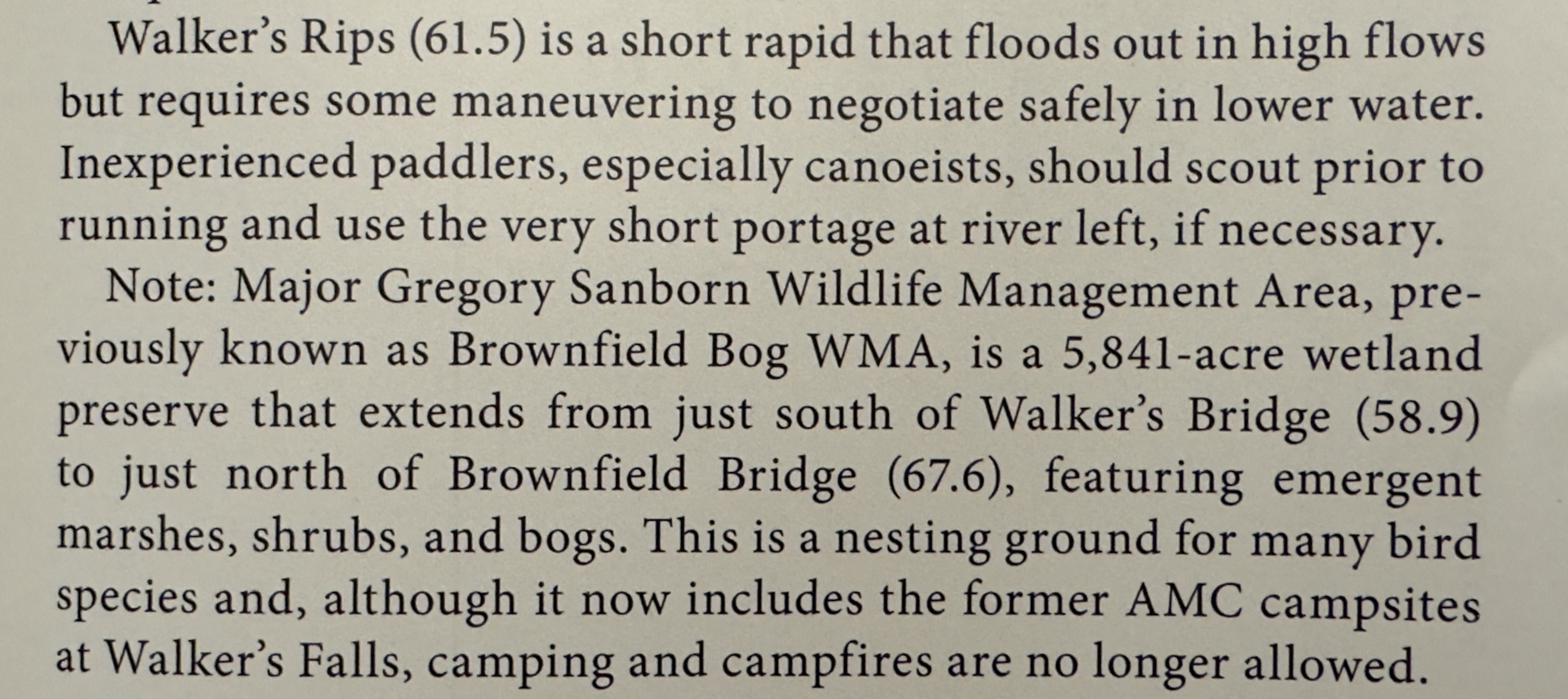
What surprised me was to realize that the camping area is no longer open, but right in front of this sign was where the ambulance awaited the girls.

And the now seemingly abandoned Caretaker’s cabin had been open and campers and canoeists were all around the area. Now it was like visiting a ghost town.

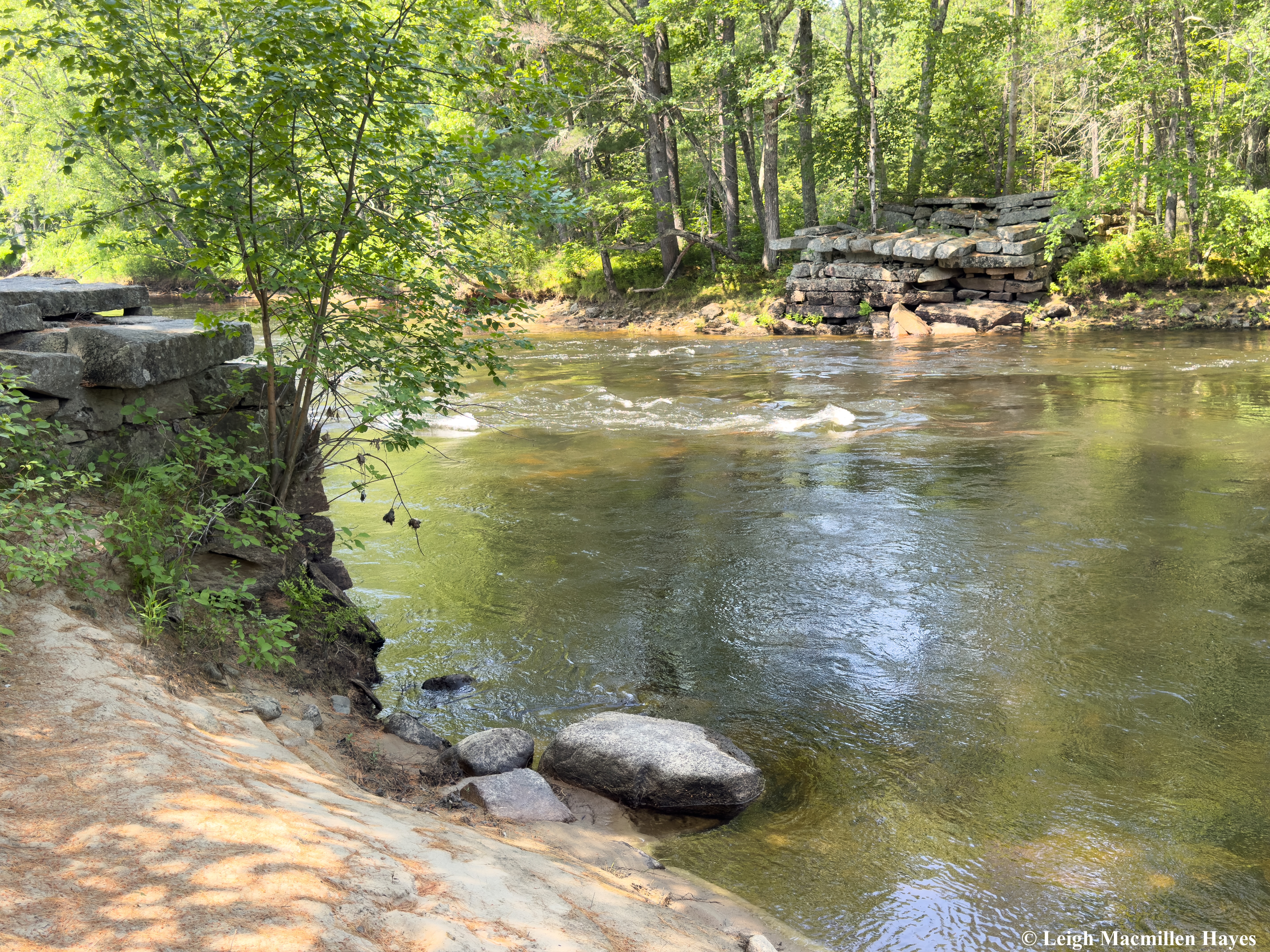
I stood on what had once been the support for a covered bridge (Thanks to my friend Moose for piecing together a brief history of the bridge built circa 1866, which carried traffic across the river to Walker’s Island. It deteriorated and collapsed) and looked down at the Rips, which were under more water than they were on the July day of our visit.

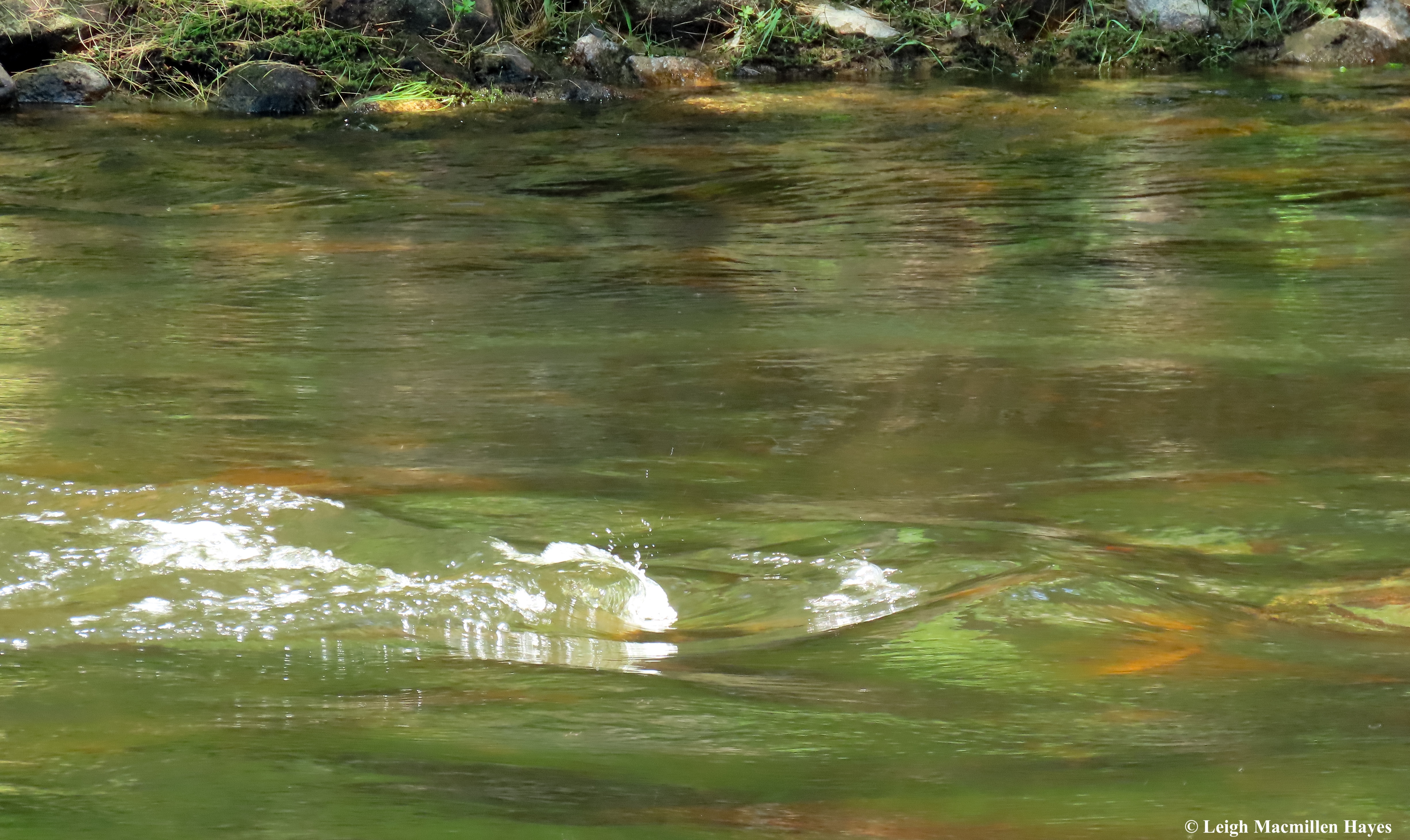
Standing above the bridge I spotted the rock where the canoe got hung up–it’s near the upper right-hand edge of the photo, where you might see a bit of ripple in the water.

For a closer look, the rock which will be forever known as The Rock.

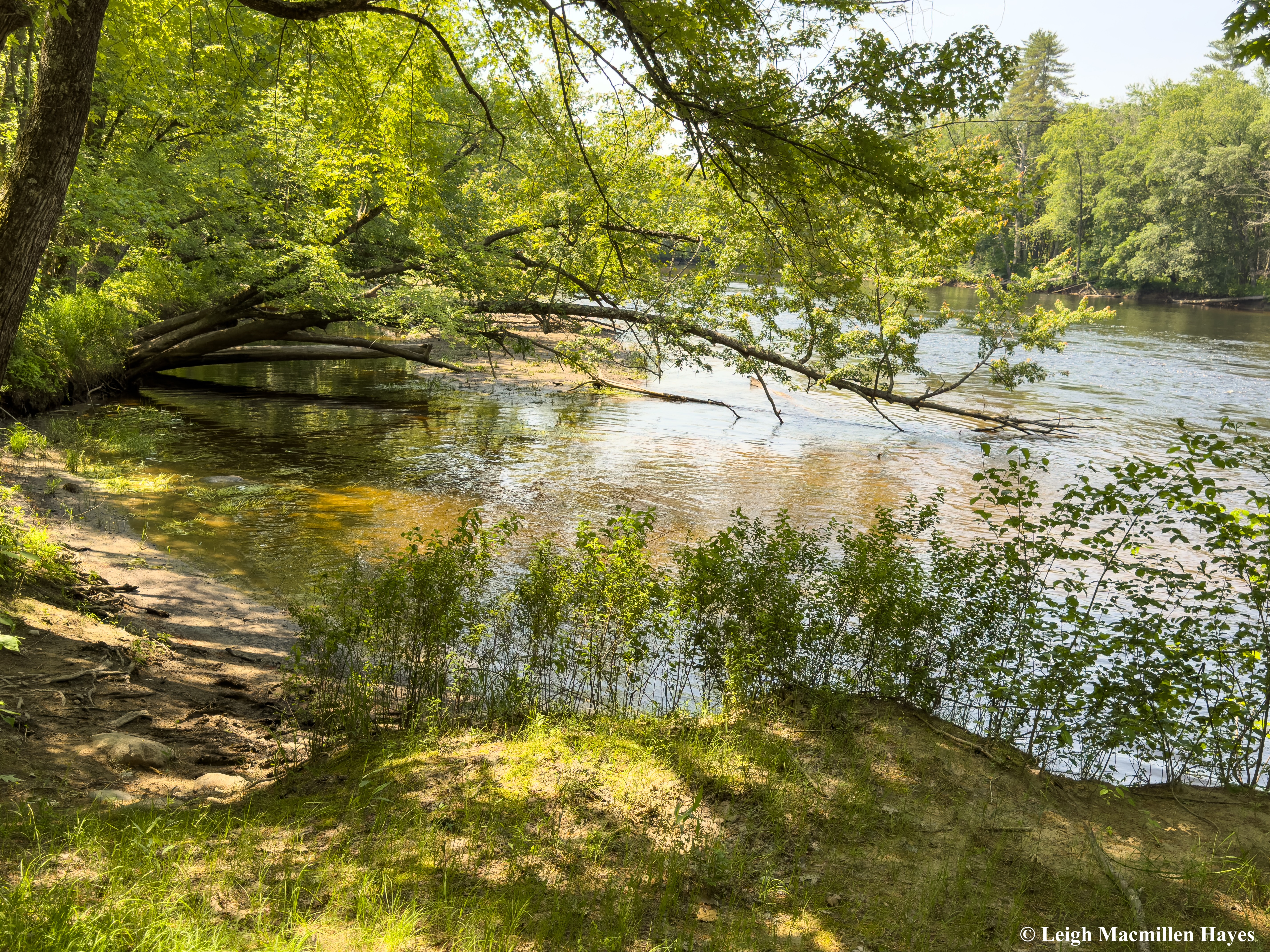
Below the Rips was the sandbar on the left, which was our gathering site as we collected all our belongings and assessed the situation. This week it was barely visible, but because the water was lower that day of our adventure, it was a more substantial beach.

I don’t know why I never thought to visit this site sooner via road, but am thankful that it was suggested and that I made the journey back in time.

I even dragged My Guy in one day because he had not been down the road either, and we then found our way to Pleasant Pond, which I think I may have visited with the kids shortly before we hit the Rips. Literally. Oh, and he’s not saluting the pond, but rather swatting Mosquitoes.

As for my throbbing toe all those years ago, after the kids went home, the Executive Director and I headed to the ER in Laconia and I received a prescription for an antibiotic and had to soak it and am here to say I survived. I do chuckle to think I was the only one with an actual injury.

The Saga of Walker’s Rips is one that has stayed with me all these years. And that summer job–one of the best I ever had. I only hope that the kids have as fond a memory of our adventures as I do. I’ll never know as we lost touch when I moved away to the Portsmouth area a month later.

In The Heat . . . of the moment

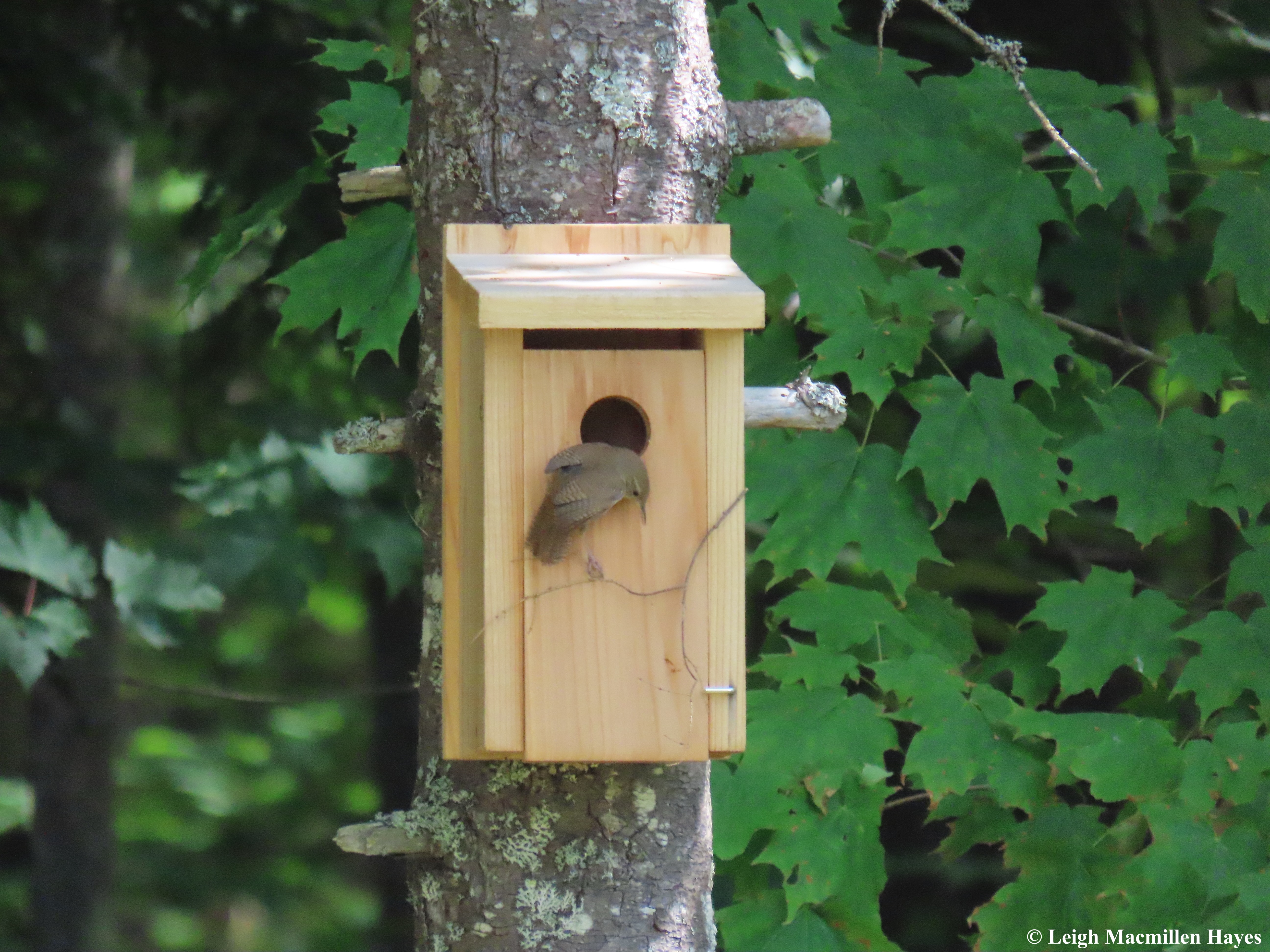
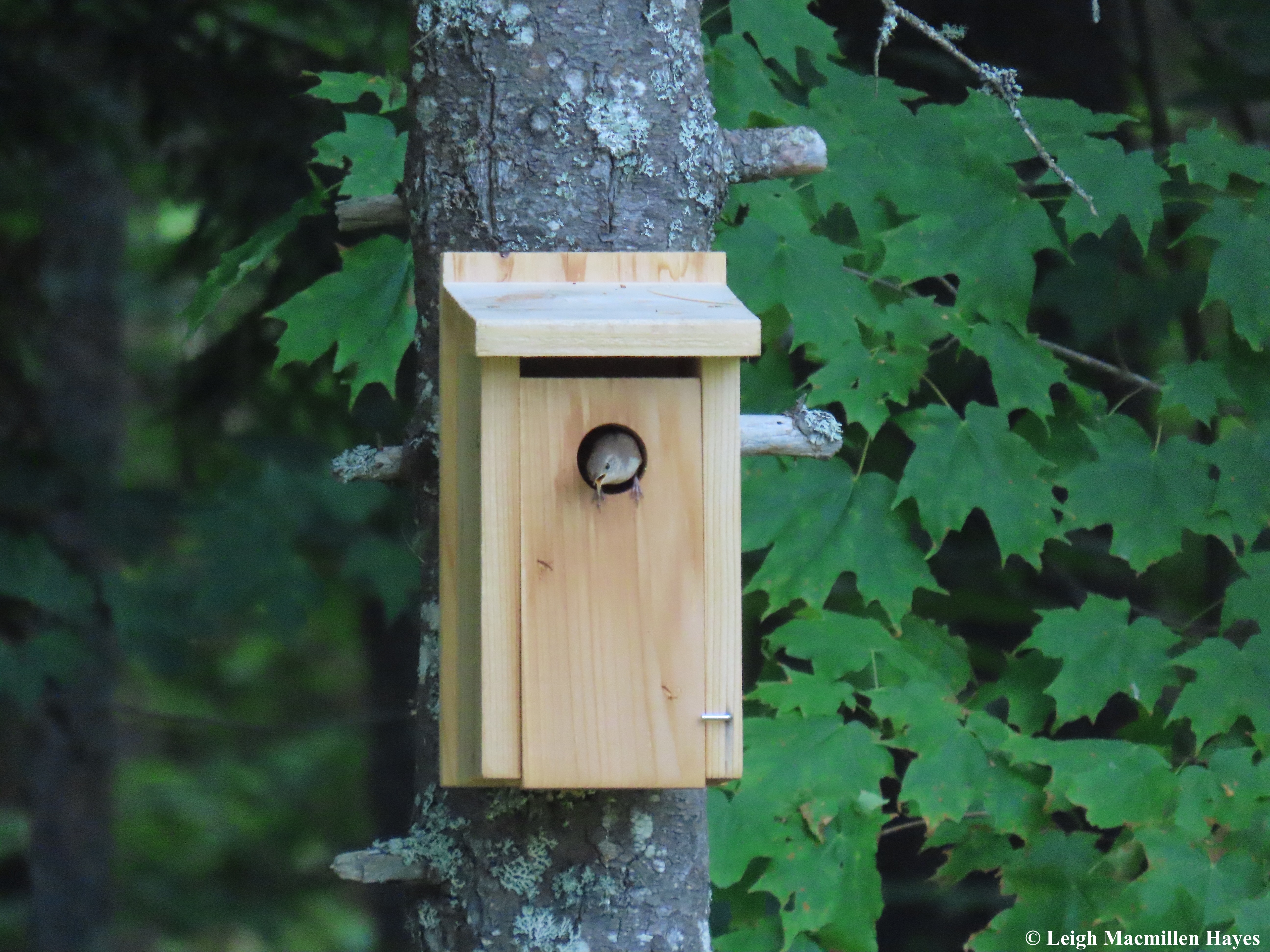
About dinner time yesterday, that is, dinner time for most people, as My Guy and I tend not to eat until about 7:30pm, as we sat on our patio, I suddenly saw action at a Bluebird house we’d nailed to a tree in the yard. After months of seemingly no action, a bird was flying to it and carrying sticks, and I realized that the male House Wren who has been singing from the trees had decided this just might be the place his loved one will want to set up housekeeping.

The action continued for about an hour last night, but then ceased.

And this morning . . . nothing that I could see.

And so deciding I wouldn’t have a chance to watch the fun of moving in today, I decided instead to head to a local wetland where the Painted Turtles taught me a lesson.

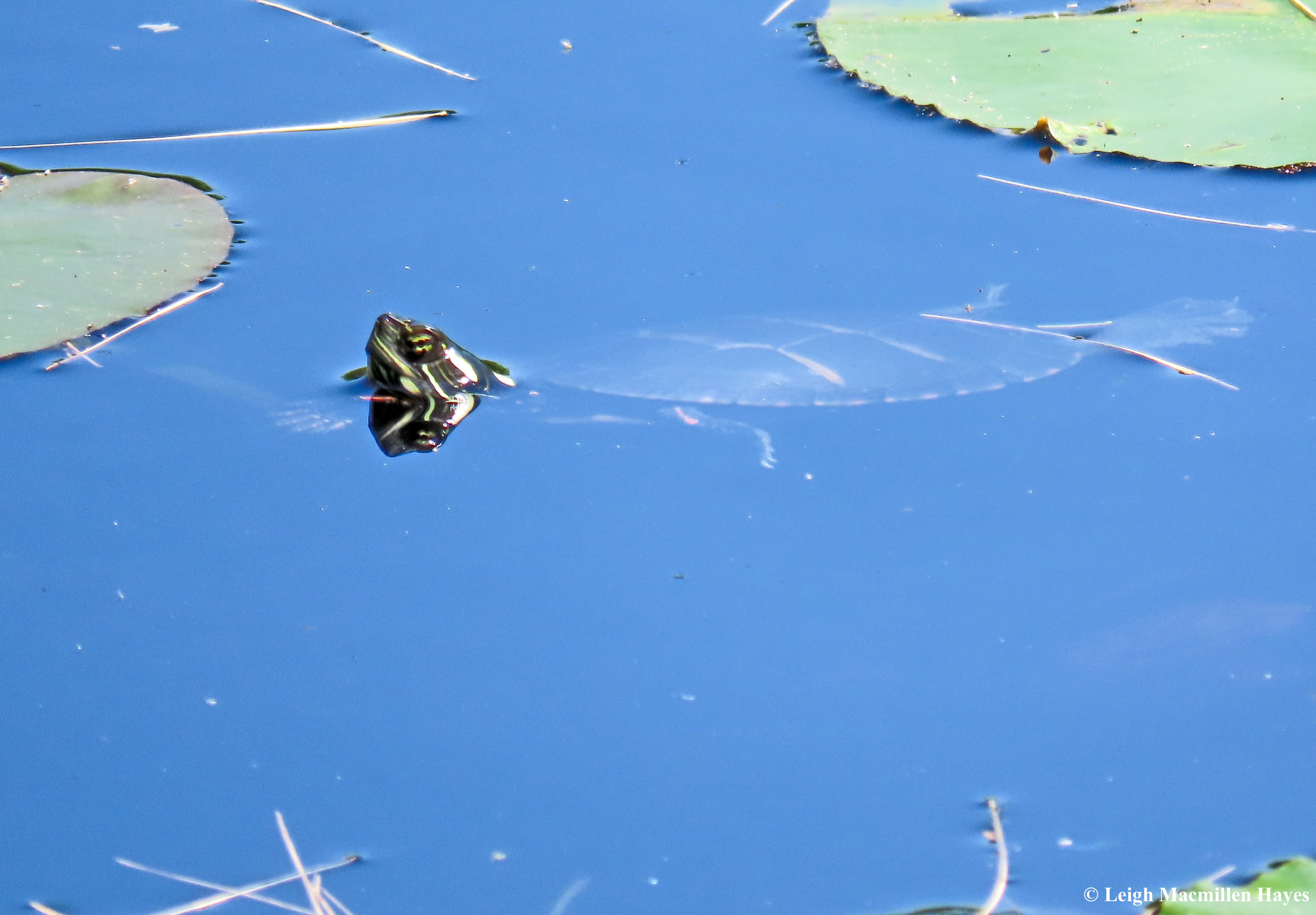
I love seeing turtles basking on logs and rocks in the water, but everywhere I looked today, they were not on any of these raised platforms. Instead, they floated. And it occurred to me that it was a brilliant strategy: stay near the surface of the water, but be a wee bit submerged, and therefore stay cool on the hottest of hot summer days thus far this season. Especially given that Painted Turtles have black carapaces or upper shells which are intended to absorb the heat . . . but extreme heat?

While I watched, I noticed that they all stayed in the same spot. How? By treading water, just like we do. Or so it seemed to me as I watched the feet move, but the head and shell remain still.

In all my years of turtle watching, I have never witnessed this before. Or . . . if I did, failed to take note.

Because I was by water, there were plenty of dragonflies as they defended their territories and ate some bugs on the fly and occasionally paused so I could admire and thank them. There were no Mosquitoes to speak of and only a few pesky Deer Flies.

This Four-spotted Skimmer and I spent quite a bit of time together because he was so beautiful and I could have looked at him forever, plus I loved watching him perch, then flight off to chase another dragonfly out of the area, and perch again, over and over.

But there were a few other things to observe. Well, more than a few, but only a couple that I’ll note.

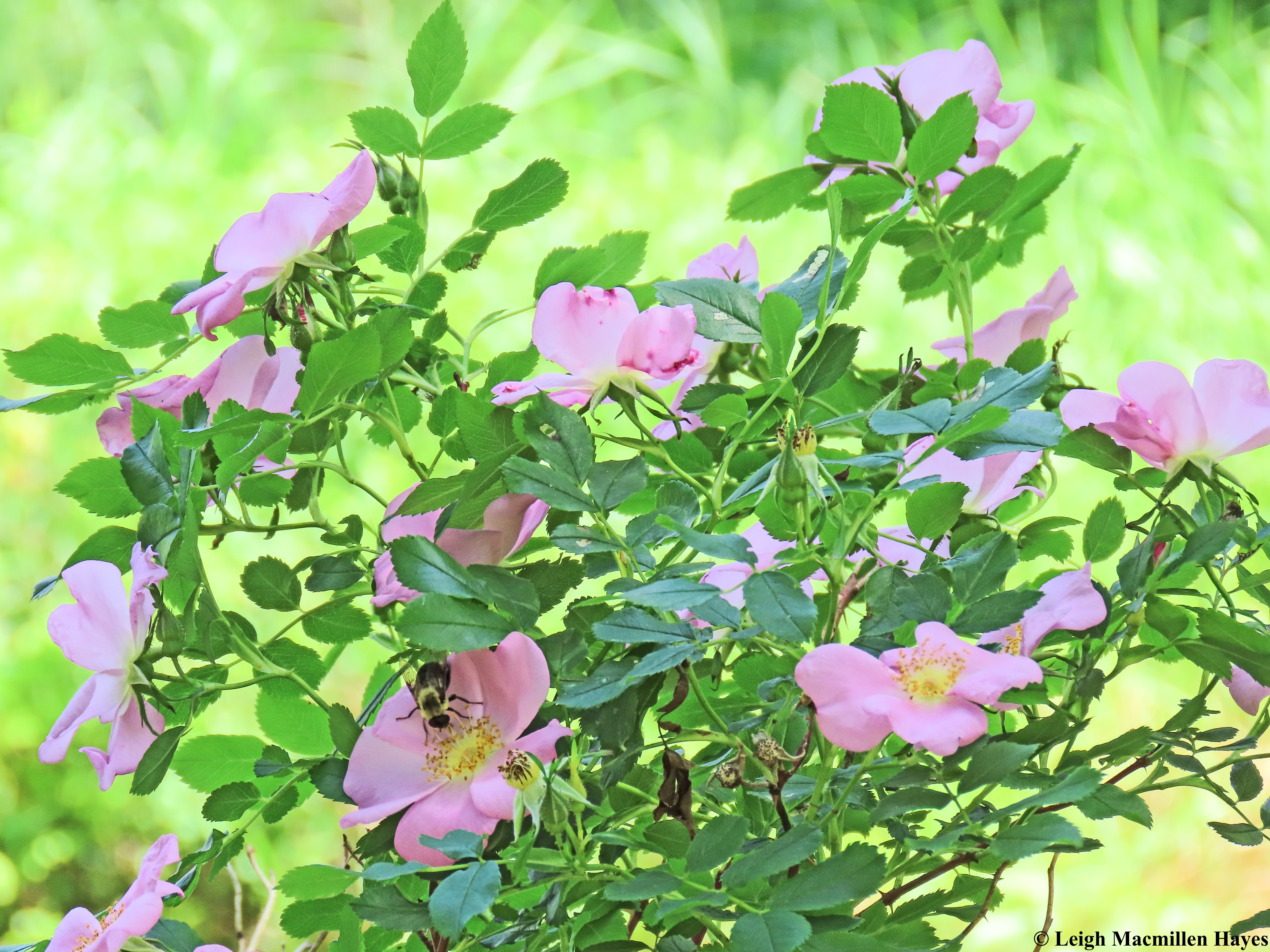
Have you ever noticed how on a hot summer day the smell of fallen pine needles is intensified by the heat? I just love that smell. And where there are Swamp Roses, there is also an aromatic fragrance, and it seemed I wasn’t the only one paying attention.

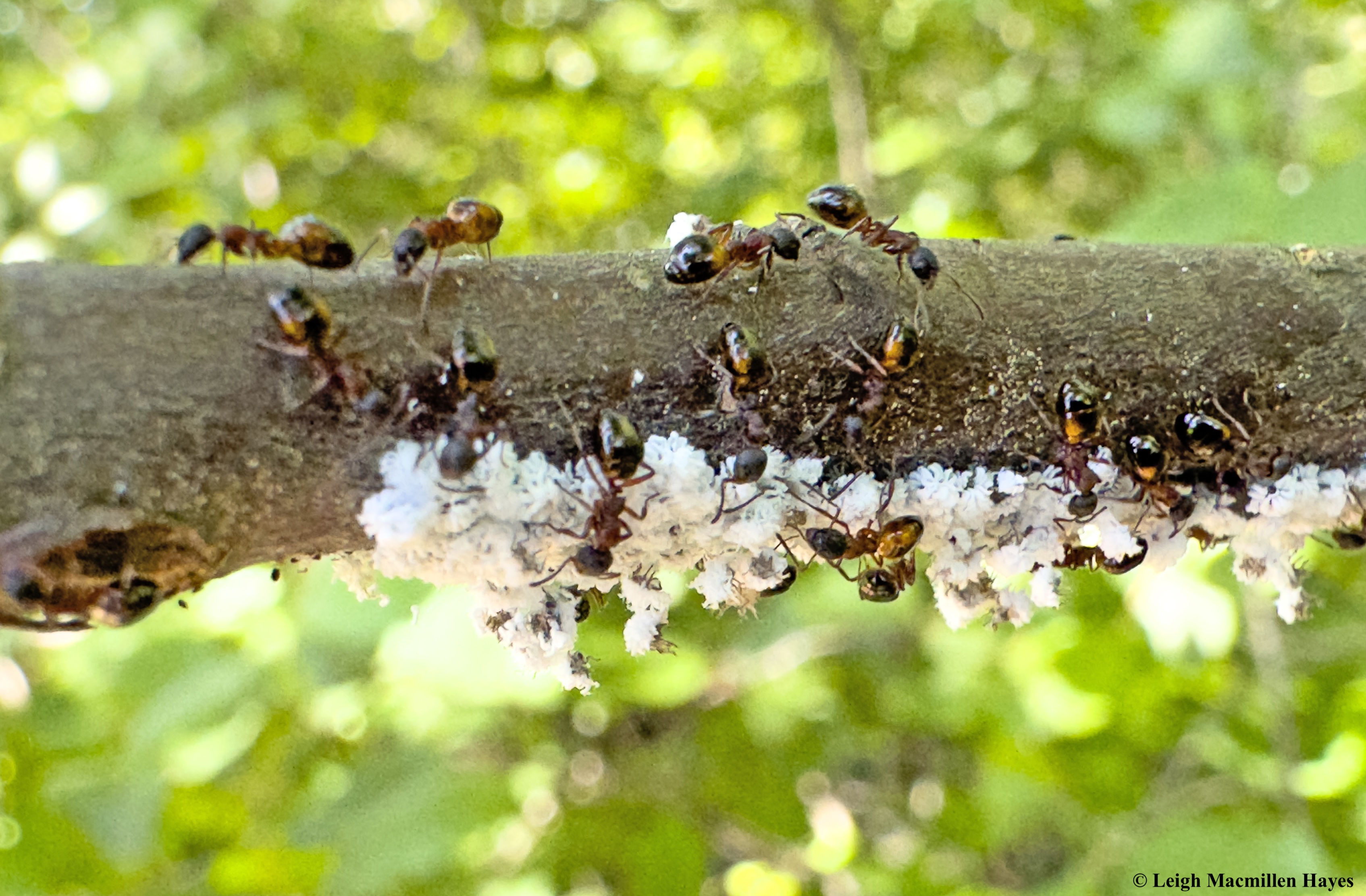
Seeking nectar is the job of bees and wasps and flowerflies and other. Seeking a sugary substance is the job of ants. On Speckled Alders.

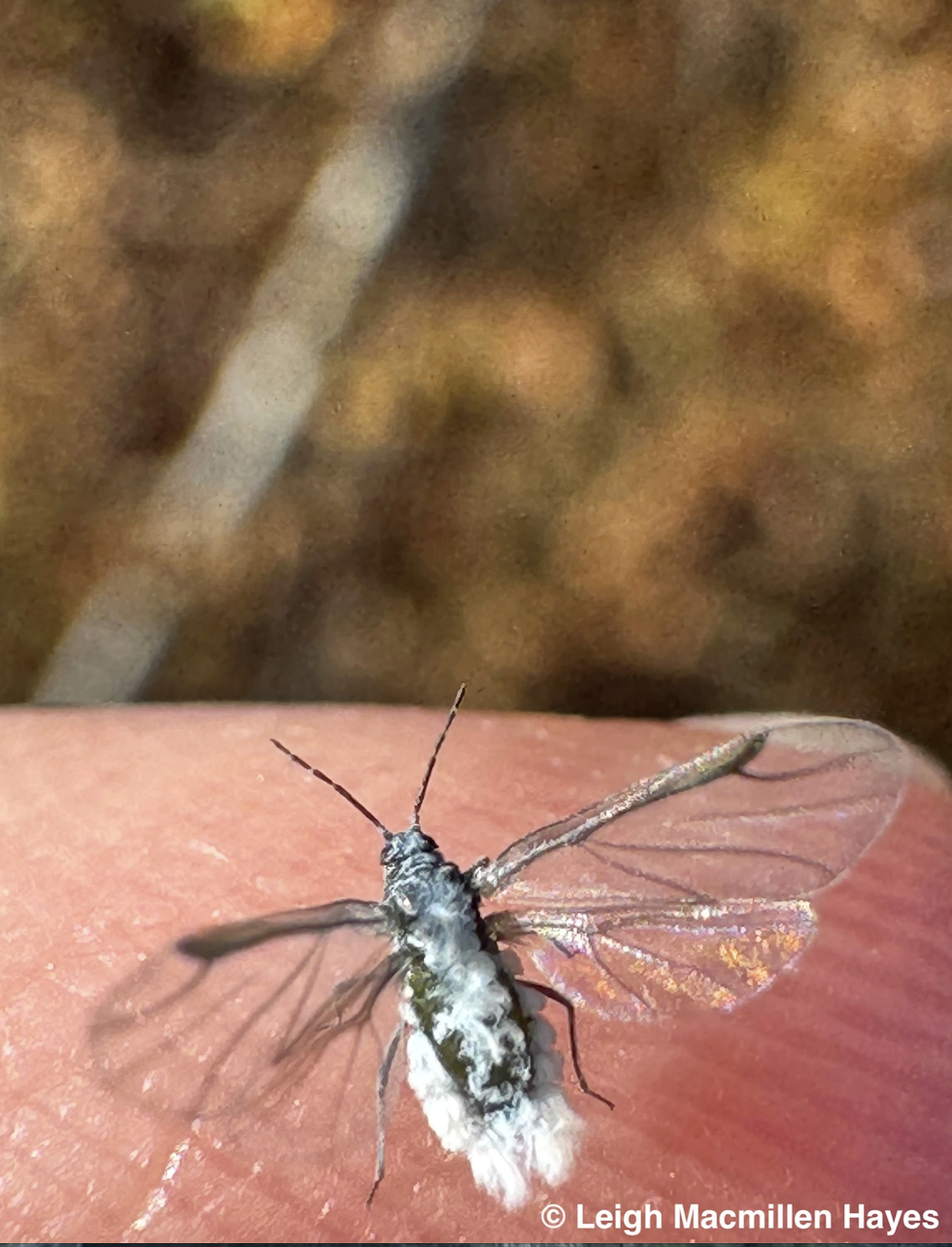
Ants “farm” or “milk” or basically tickle Woolly Alder Aphids that feed upon the shrubs’ sap and get the honeydew the tinier insects secrete.

That cotton candy look on the aphids is actually a waxy material they produce from their abdomens, perhaps meant to detract visitors. Or protect them from the weather. 

The relationship between the ants and the aphids is actually a form of mutualism as the ants protect the aphids from predators, while the aphids provide the ants with a food source. Hmmm. Maybe more of us need to pay attention to this way of living together.

At last I pulled myself away from the wetland, saying goodbye to all and thanking the Painted Turtles for today’s lesson.

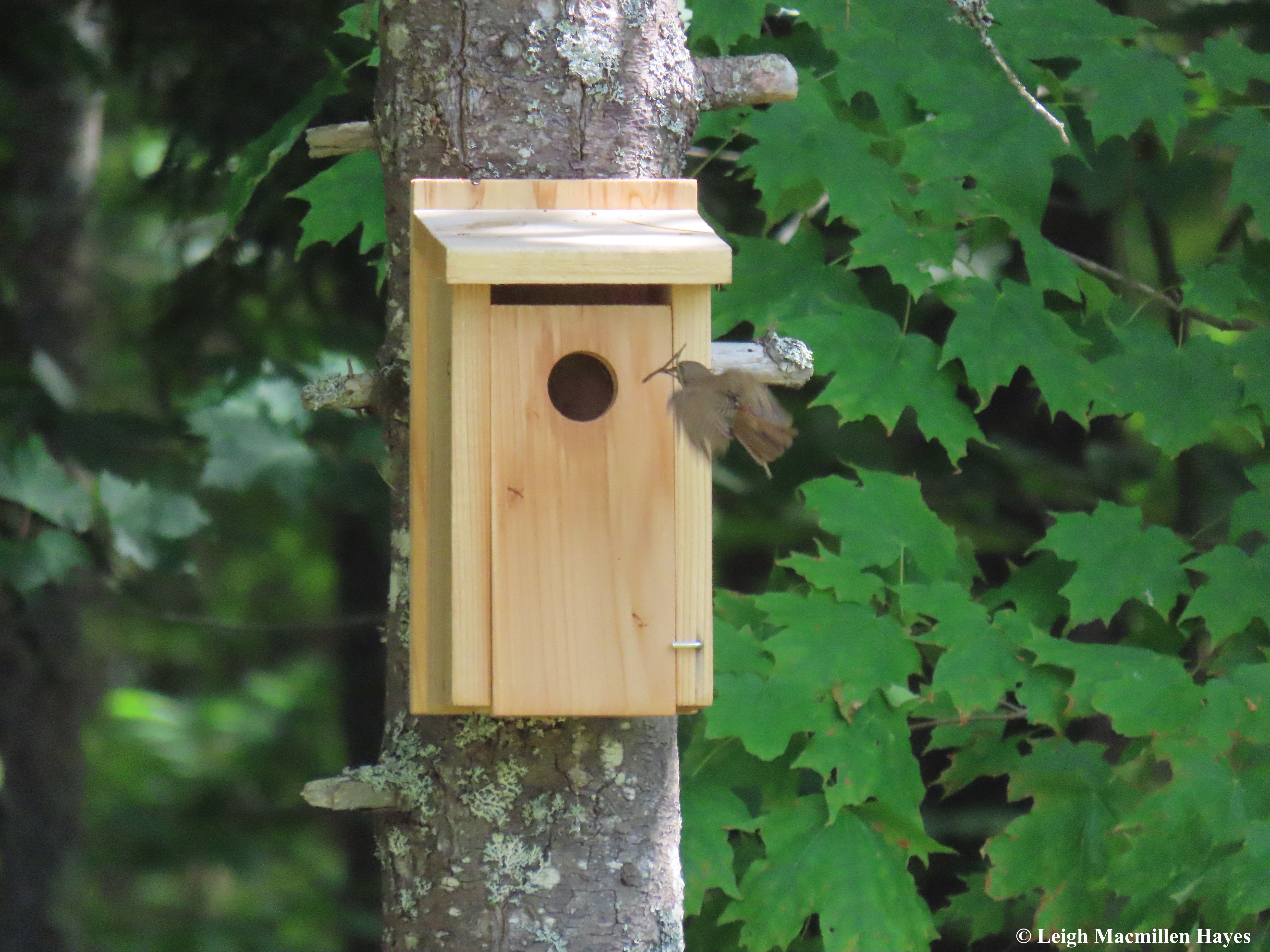
Back at home, I heard the Wren before I spotted it and sure enough, it was back on the job of setting up living quarters. Male House Wrens fill cavities with a tangle of sticks and then he tries to persuade his betrothed to build a nest, which she does toward the back of the cavity.

He kept gathering sticks from the ground and returning to the box, though getting them through the hole wasn’t always an easy task. I wanted to encourage him to also try the slot at the top of the box, but my encouraging act would have had the opposite effect, and so I kept my distance.

It was rather like watching a gymnastics show, for such an acrobat was he. And like the turtles treading water, I’d never actually seen a House Wren build a nest before–my knowledge all gained from literature.

Smaller sticks worked well, but those larger ones were much more entertaining from my point of view.

And then there was a really complicated one. Such a challenge.

But a little wiggle here and waggle there and voila. The stick was in the hole. So was the bird.

Until the next one. And then more contemplation.

But all things are doable when you persevere, so of course, another lesson learned today.

I’ve read that House Wrens fill several cavities and then let the woman decide. Smart birds. The jury is out in our neighborhood because my neighbor and I know that either he or another Wren keeps visiting a different birdhouse that the Bluebirds have also considered for their digs.

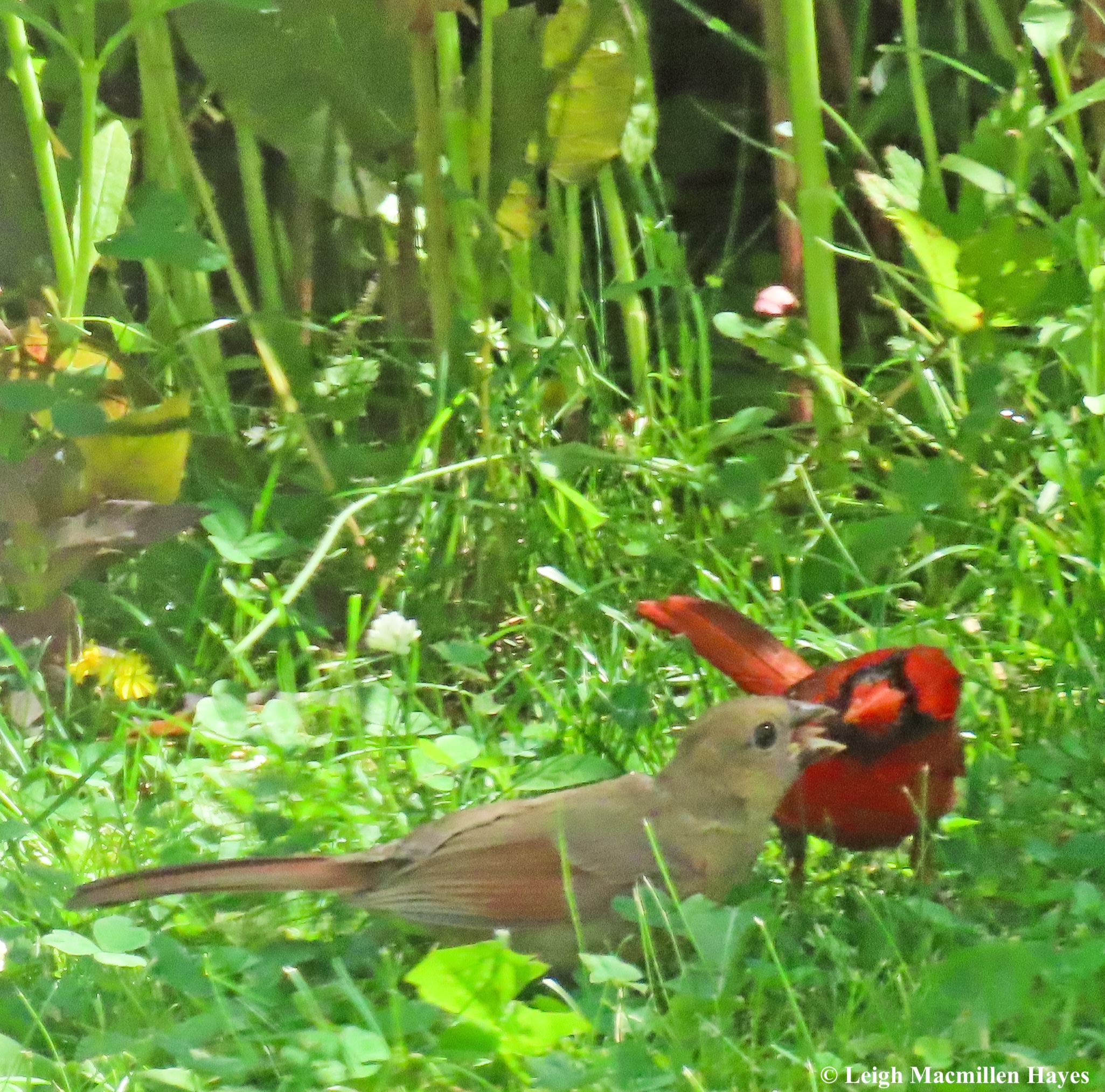
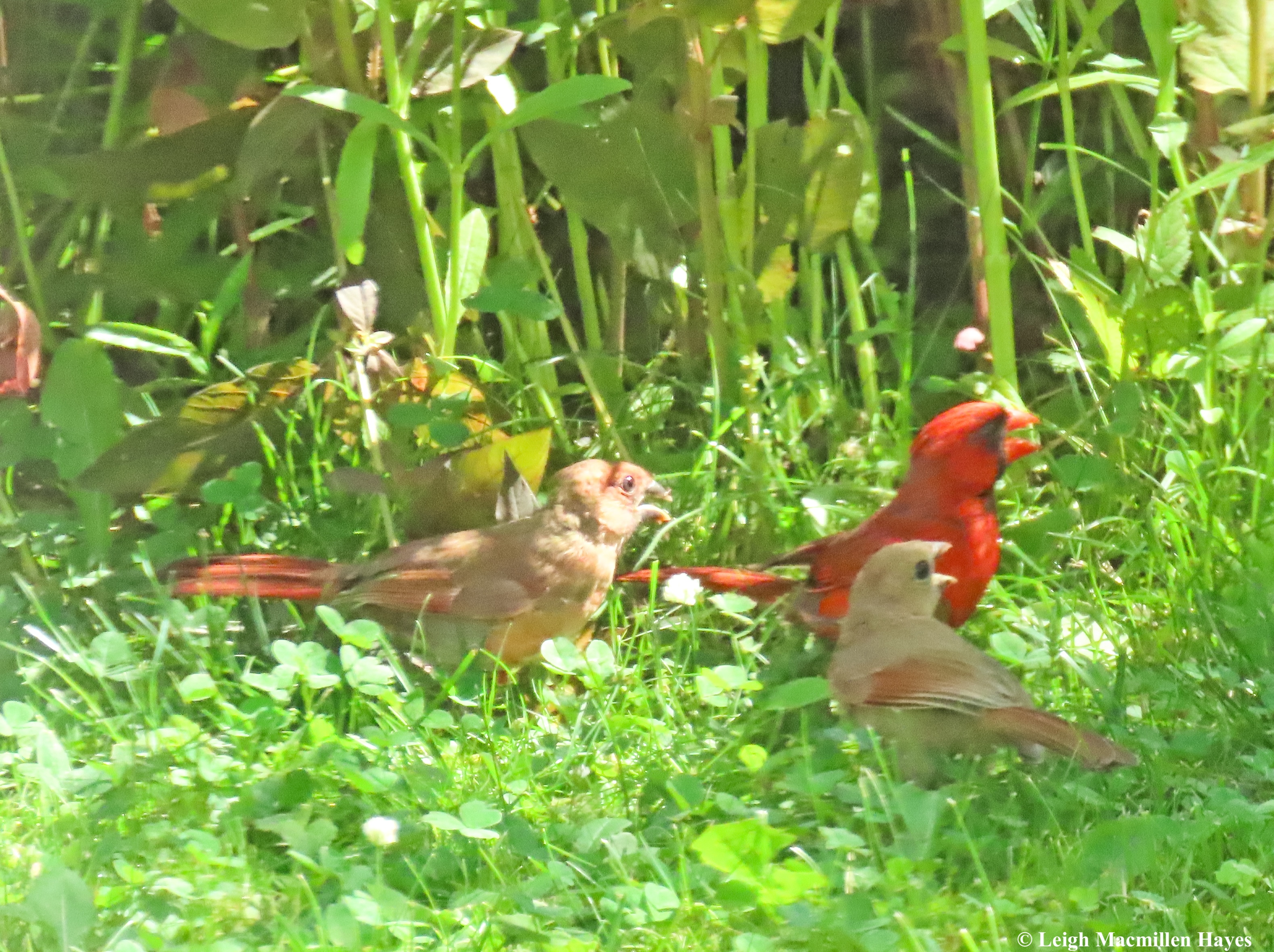
Heading back in, I suddenly heard a Cardinal, and suspected it was the male because I haven’t seen the female in at least a week. Through the glass in the back door, there he was, feeding a chick! We have a baby!

And then I realized he was feeding two babies, and my, were they ever insistent.

I must say, the chicks look much more like their mother than their father. But he did a great job of tending to their needs, ever the nurturing one.

Today has been really hot, and I know you are all aware of that, but in the heat I managed to be present in so many moments and give great thanks for that.

Summer Fauna among the Flora

As spring bid adieu and summer waved hello, I found myself wandering and wondering with others and alone and stopping in my tracks repeatedly, which is kinda what I do all the time I guess you could say, but suddenly this week there were a few special events that called for attention.

The first was Momma Snapping Turtle that I spotted beside a trail as I co-led a walk with Dawn Wood for Loon Echo Land Trust. Thanks to the magic of a camera lens, it may appear that we were close, but believe me, we all realized the sensitivity of the situation as this mother was digging in the dirt and laying eggs right before our eyes and we were transfixed–from a distance. There were fourteen of us and we tried to stand quietly and watch and ask questions and after about ten minutes decided it was time to come up with Plan B and reroute ourselves so that we wouldn’t stress her out.

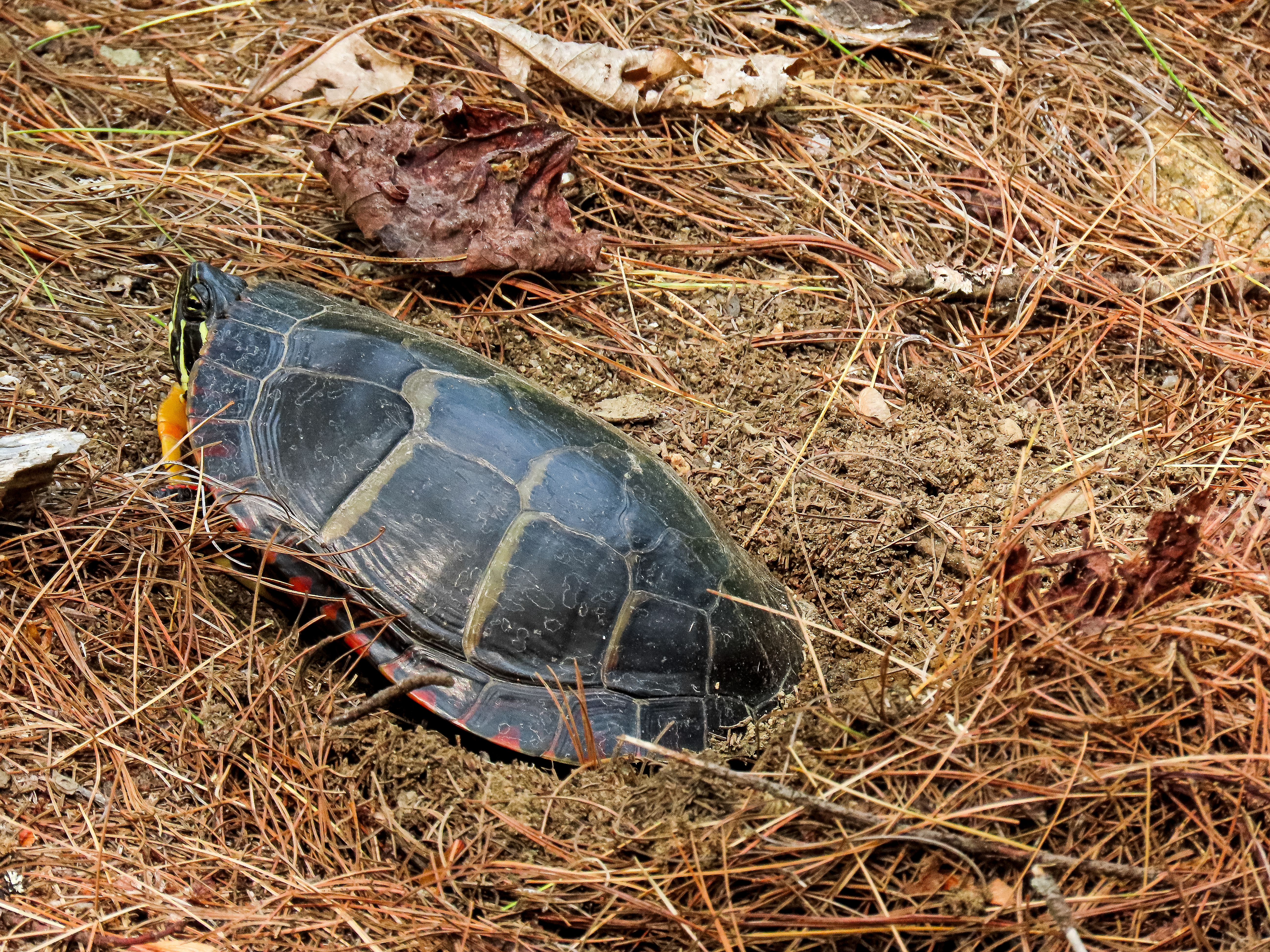
In another place a day later, it was a Painted Turtle upon which I focused and gave thanks that it didn’t consider plopping back into the water as they often do when we so much as breathe. From the spot where I stood, I think this was also a female, given the shorter nails, but I couldn’t say for sure because tail length and plastron (bottom shell) orientation are also key to ID. The male has a longer tail and a more concave or indented plastron, while the female’s is more convex or flatter.

That said, when I spotted this one, I knew its gender immediately, for like the Momma Snapper, this Momma Painted was also in the process of laying eggs. She pulled her head into her shell the moment I spied her.

In the few moments we spent together, however, she ever so gradually extended her head.

But I felt like she was keeping a wary eye on me. And very much wanted me to move along.

And so I did.

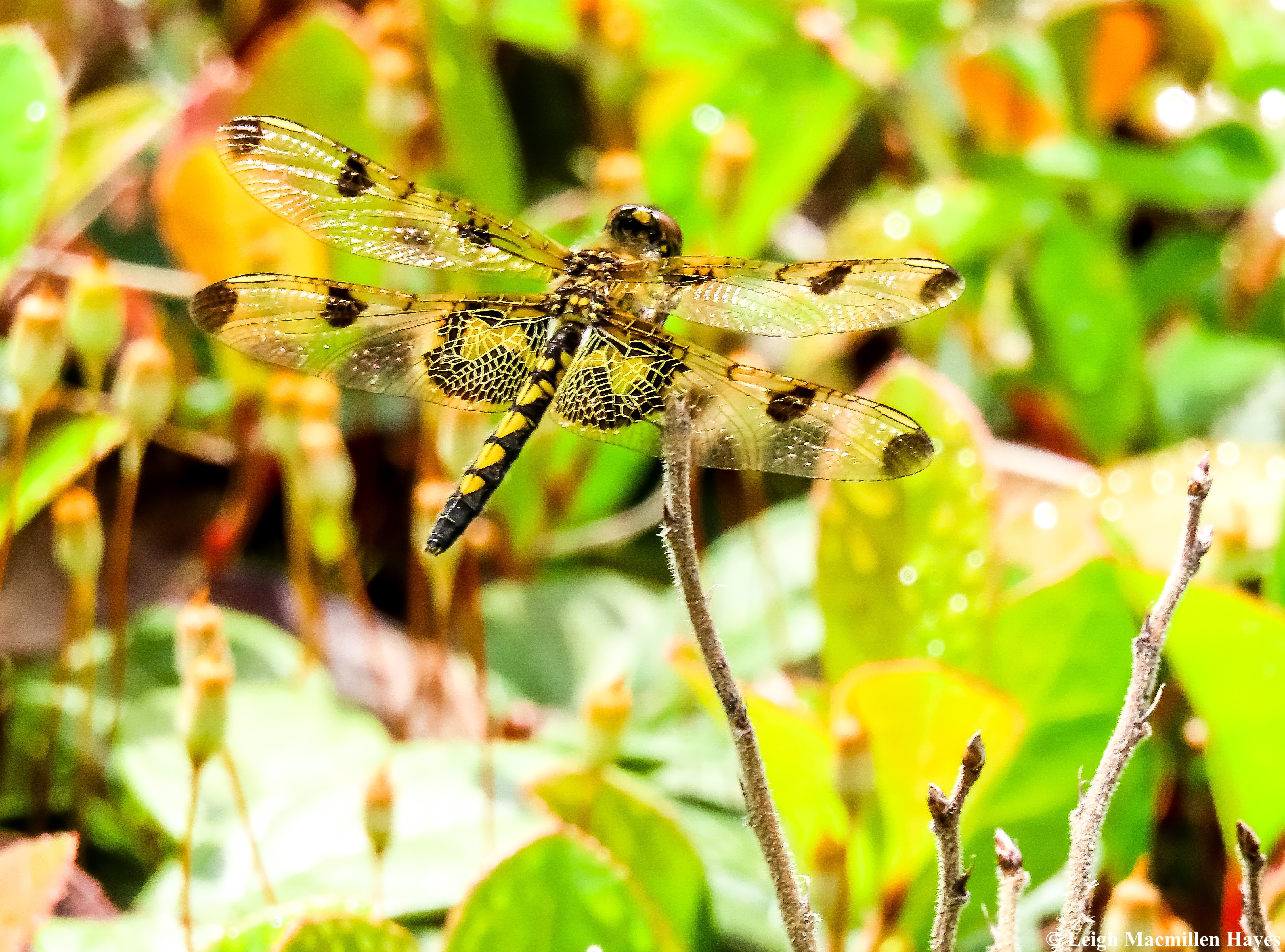
And then it was the insects that begged for attention, this being a female Calico Pennant Skimmer Dragonfly. Her coloration is yellow, while his is red. One of the things I love about perching dragonflies such as the Skimmer family, is that within their territory, they return to the same perches over and over again–flying off to capture food or defend said location, but usually back to the same twig or flower or one close by, making it easy to spend some time with them.

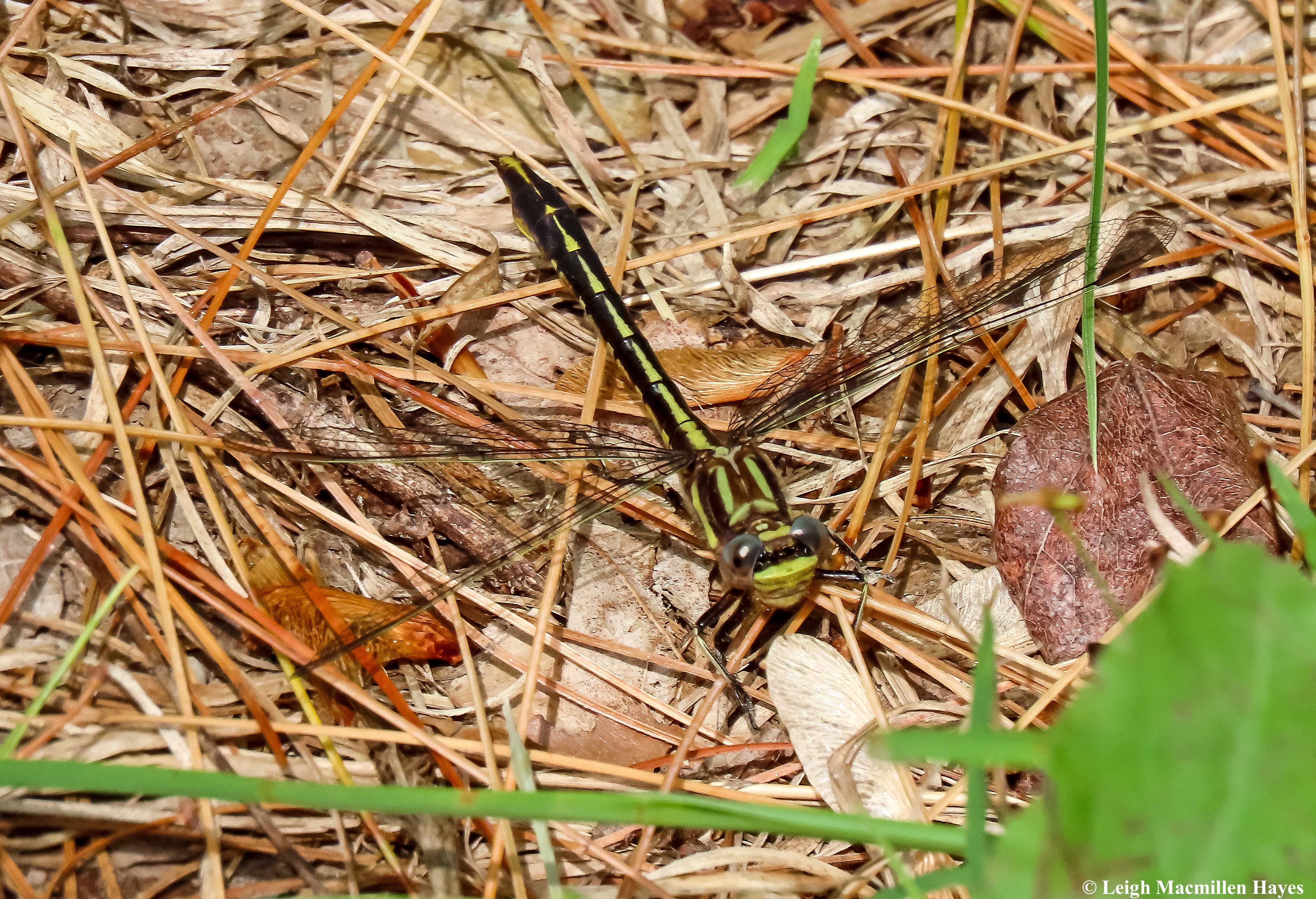
The Clubtail family is the same, this being a Lancet. These dragonflies often land on our dock or our kayaks and spend some time with us.

I swear they are as curious about us as we are about them. But maybe again, they are checking out our predator abilities. I much prefer letting them be the predators as they munch on Mosquitoes and Deer Flies and make time in the woods or on the water so much more comfortable.

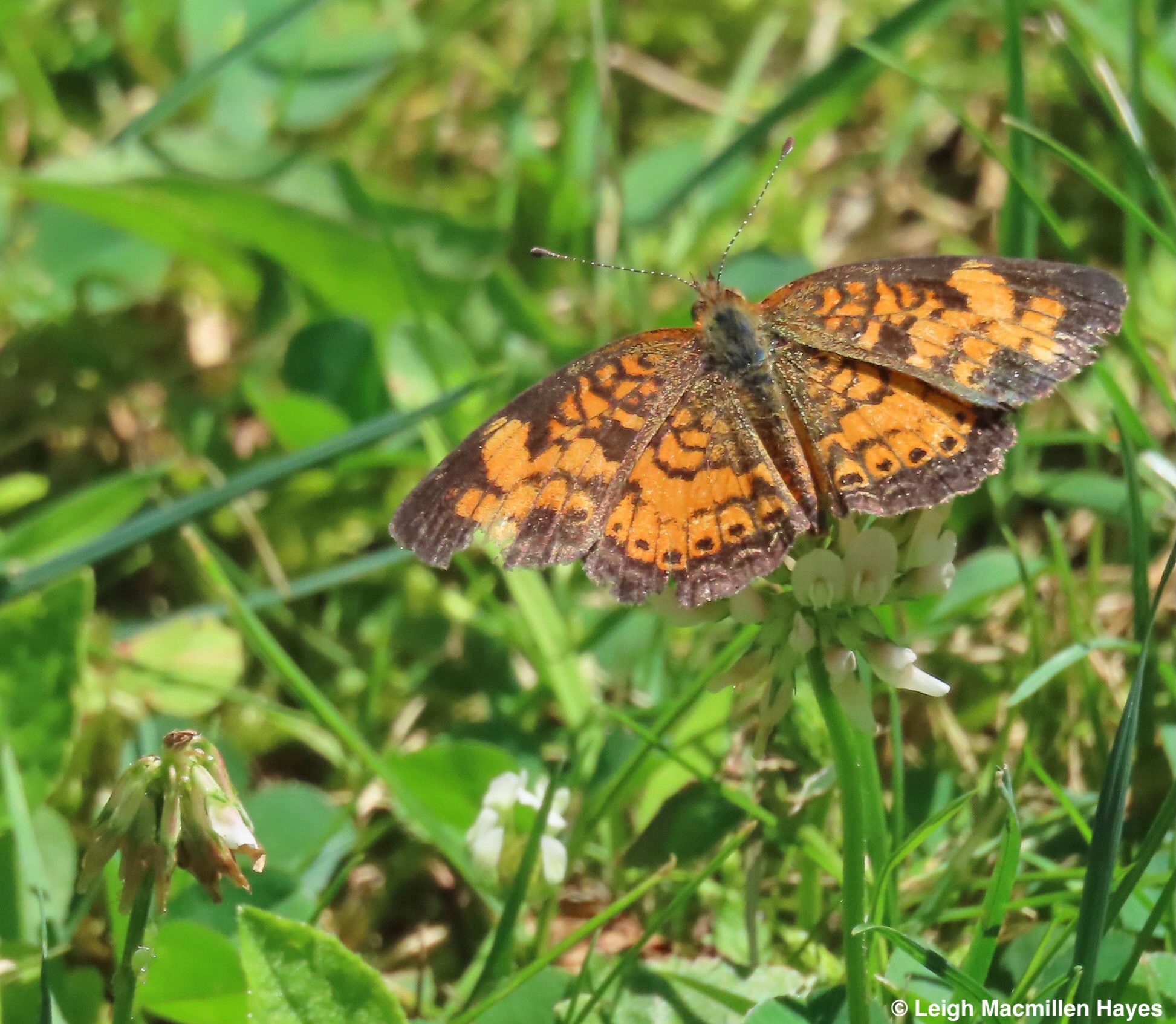
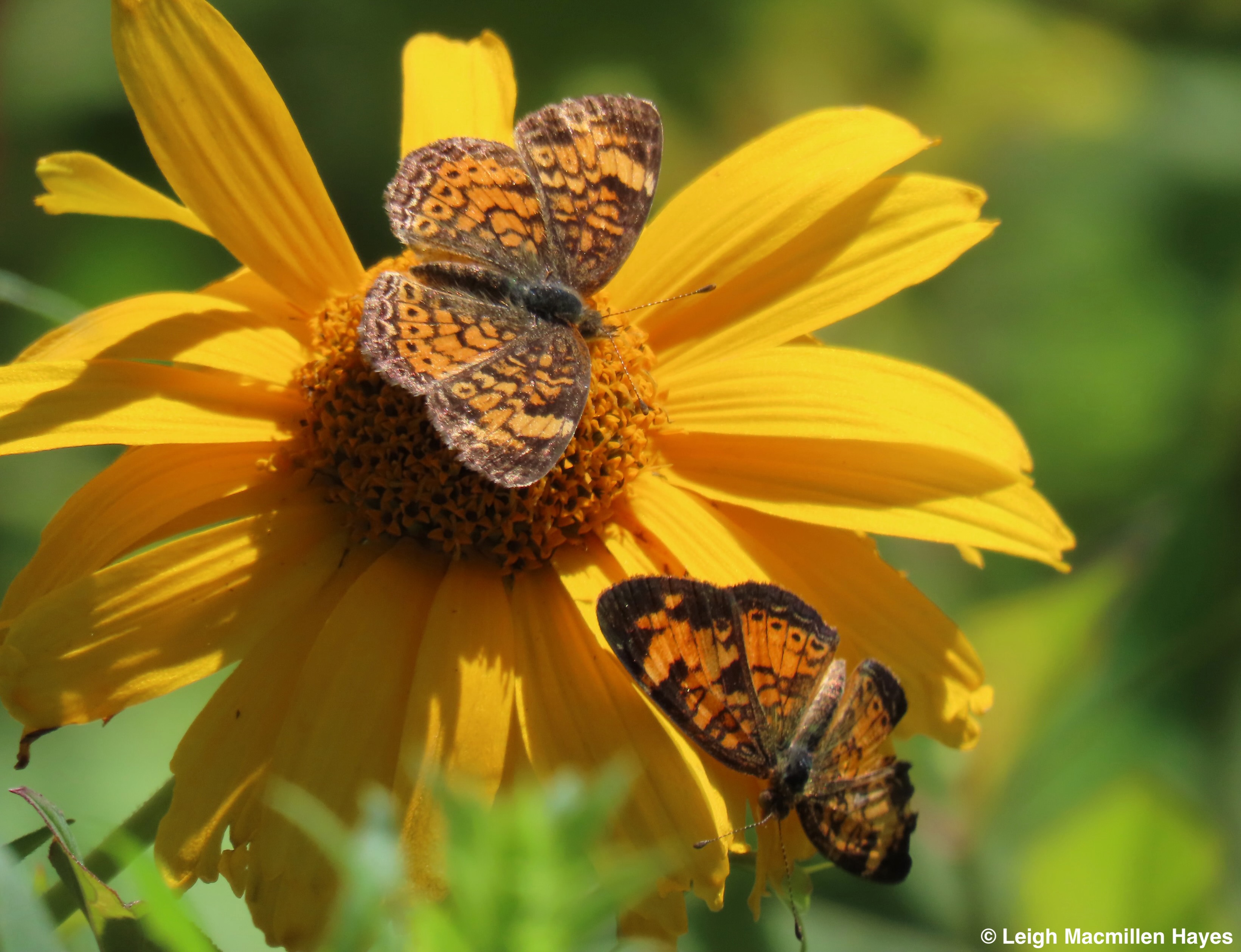
And then there are those who seek nectar and Meadow Hawkweeds are a valuable resource right now for Flower Flies and Bees and Wasps and Butterflies like this little Northern Crescent. Last summer I spent a lot of time with this species in my neighbor’s field and was thrilled to realize that as long as there was food available during the fall in the source of Goldenrods and Asters, they were present.

One of the most abundant butterflies this year has to be the Tiger Swallowtail. Canadian and Eastern, and probably hybrids in the mix, they are everywhere. Everywhere. Adding grace in their flutter-bys and color to the landscape. As well as serving as pollinators.

Dropping drastically back down in size, my attention was also drawn to the Long Dash Skipper Butterfly. According to the comprehensive field guide, Butterflies of Maine and the Canadian Maritime Provinces, by PhillipG. deMaynadier et al, “The Long Dash is named for the conspicuous stigma on the male forewing. Found on forewings of most other small, orange and brown skippers in our region, a stigma is a specialized patch of scales that emits pheromones used during courtship. In the Long Dash, the stigma is surrounded by black scales, making it appear larger than it really is.” Thus, this would be a male Long Dash Skipper upon one of its favorite flowers, Red Clover. But from the book, I’ve learned I should also look for it upon Cow Vetch, Common Milkweed, Spreading Dogbane, hawkweeds, Ox-eye Daisy, and knapweeds.

Keeping pace with me despite its much shorter legs, the Six-spotted Tiger Beetles, which I love for the iridescent green, practically ran ahead, reminding of Chalk-fronted Corporal Dragonflies who insist upon flying five feet in front, waiting till I almost catch up, and then flying another five feet ahead, over and over and over again. The only time I’ve seen the Six-spotted Tigers slow down is when they are canoodling. But even then, they are on the move.

Another insect, which is much slower, may have significant value in our landscape. If I’m correct with the ID, and I’m waiting for iNaturalist to confirm, this is Atanycolus cappaerti, a parasitic wasp. I can only hope that my ID is correct, because . . . according to Cornell University’s College of Agriculture and Life Sciences, A.cappaerti “attack [Emerald Ash Borer larvae] at rates high enough to be considered significant for biological control. While studies are still ongoing, the use of the native parasitoid A. cappaerti for augmentative biological control would be desirable from an environmental perspective as it is already established and has a niche in the ecosystem.” That’s in Michigan. But maybe in Maine as well? Please let it be so. This past winter we all noticed that EAB had spread significantly in our area.

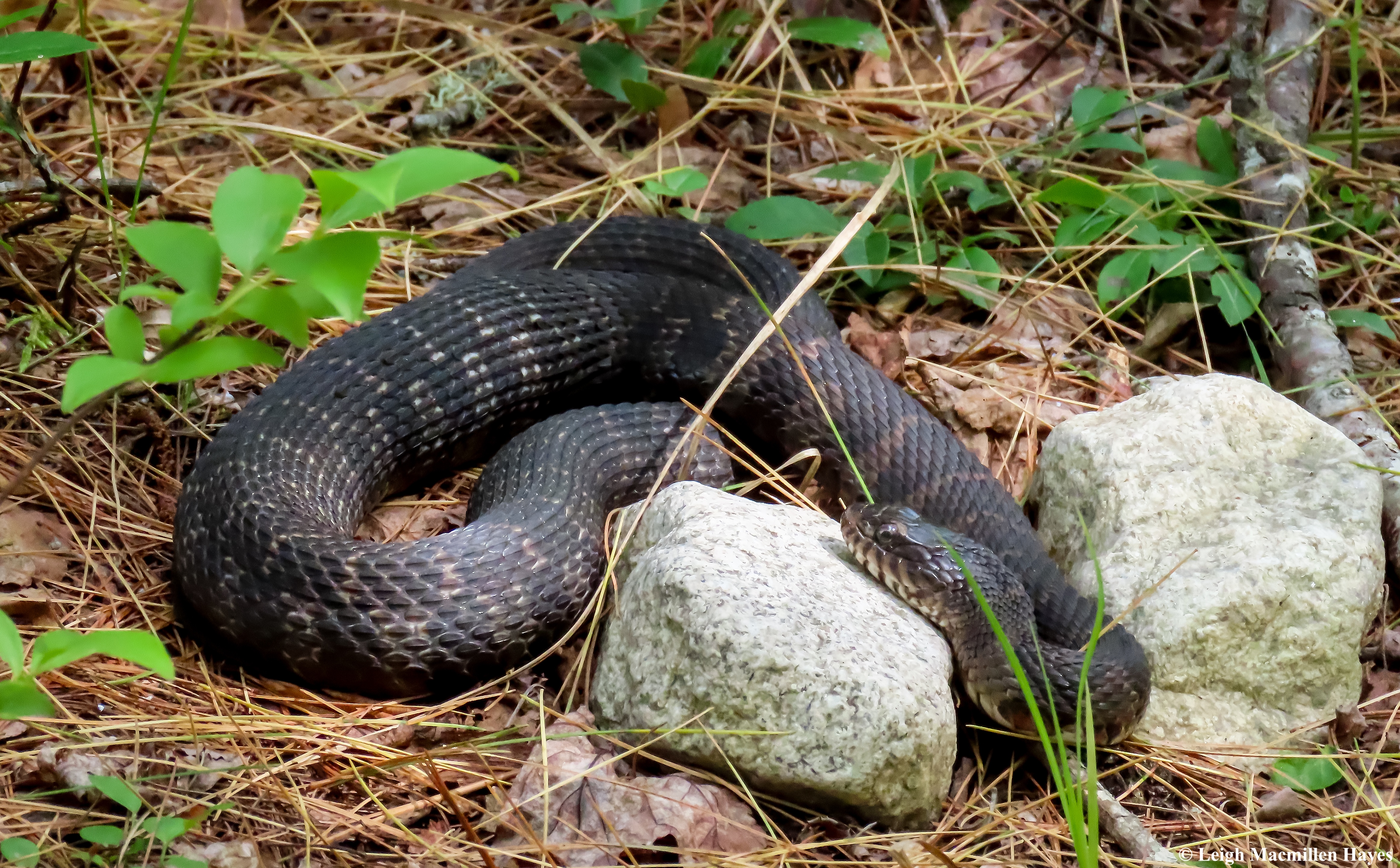
Basking just down the trail from the wasp was a Northern Water Snake who didn’t seem to mind my presence, and I tried not to mind its either.

He was aware of me, and I say he because in the Northern Water Snake world, the male is smaller than the female, and this one wasn’t really all that big, but still . . . a wee bit intimidating. Of course, it did nothing to make me feel that way, so the intimidation was all in my mind. Instead, he let me take a few photos and pass by without a confrontation, as is always the case. I remember once stepping out of a canoe and practically landing on one, who stayed put. And another time, realizing that one was basking in Maleberry shrubs at the edge of a pond as a few of us paddled by within mere inches–or so it seemed.

As spring gave way to summer this past week, I think one of the things that stood out most to me was sighting the turtles laying eggs. Though they don’t hatch at exactly the same time, it will take about two to three months for the eggs to incubate. Of course, temperature has much to do with that. But my experience in the past is that about the autumnal equinox we may see baby turtles crawling out of small holes, if not sooner. And if predators don’t get to them first. There’s always that risk.

I do love winter, but summer fauna among all the flora–so much life happening right before our eyes–its like an explosion of color and form and pattern and texture and sound. And it’s only the beginning. I can’t wait to see what the rest of the season has in store for us.

Wednesday Wanders=Wonder-filled

You know when you start something and you have no idea of what the future will hold and yet, you forge ahead cuze that’s what you naturally do? Well, that’s been the experience fellow Master Naturalist Dawn and I have had since I retired in October 2023.

At the time, I knew I would deeply miss outings with the Greater Lovell Land Trust docents, a group of dedicated volunteers who love to learn and then share that knowledge with the public. But, I’d made a promise to step away so the new person could have some space.

I’m a teacher at heart, however, and needed to continue down that path. So, prior to retiring I had approached Loon Echo Land Trust and asked if I could lead some winter walks for them, sharing the art of tracking and other winter wonders with their participants. That idea was well received and I invited Dawn to help. We began in November 2023 and when March 2024 arrived, and we should have been winding down, I realized we were having so much fun that the program needed to continue and so it did until last July. And then we took a brief hiatus.

The hiatus ended in September 2024, and on our first outing among our finds were a few Brown Hooded Owlet larvae, with their striking colors and pattern.

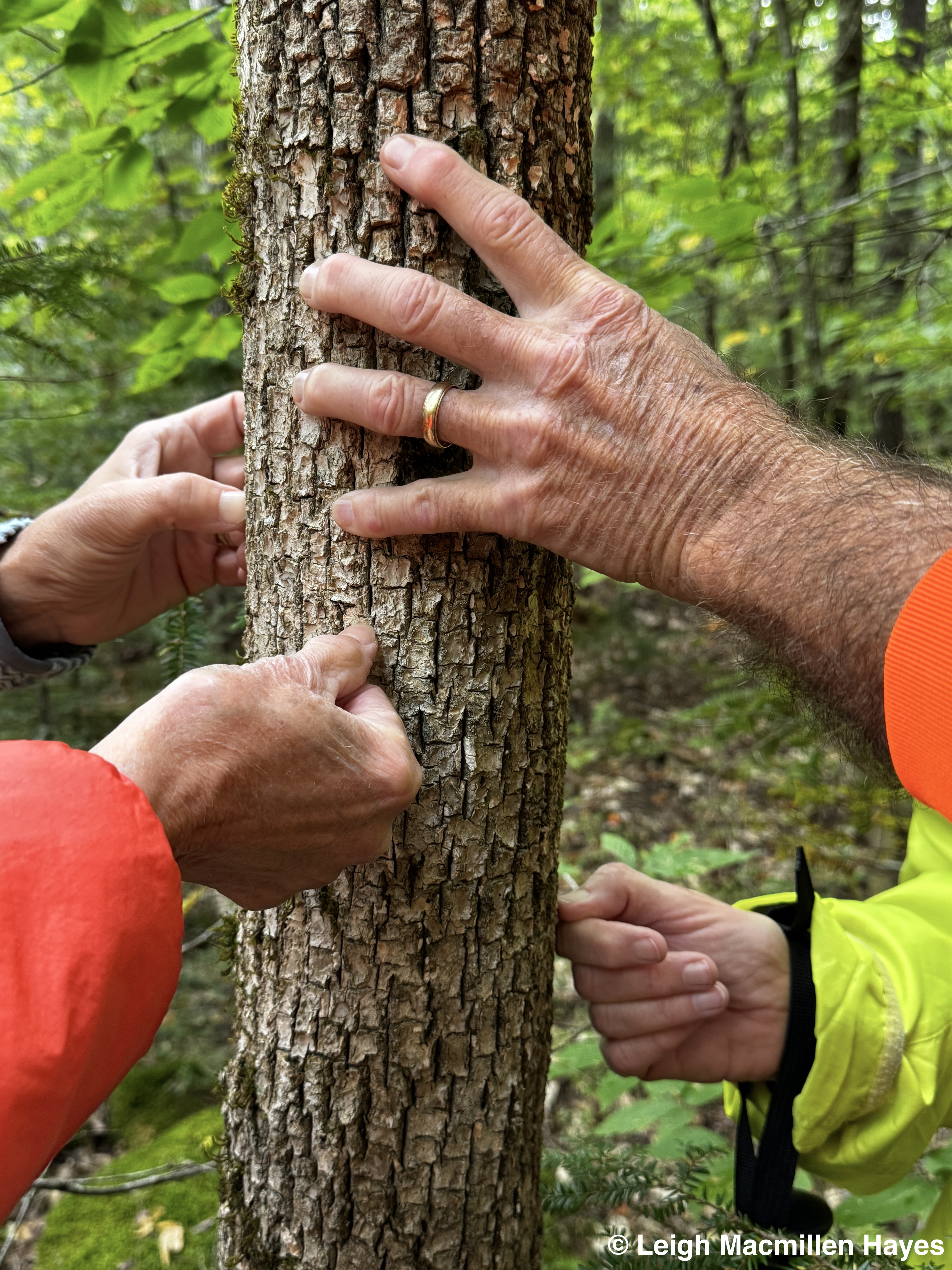
On that same journey, we reached a wetland where Black Ash grow, and encouraged participants to poke their thumb nails into the bark. I love it when people are willing to try and in this case, they realized the bark is corky. Especially after it has rained.

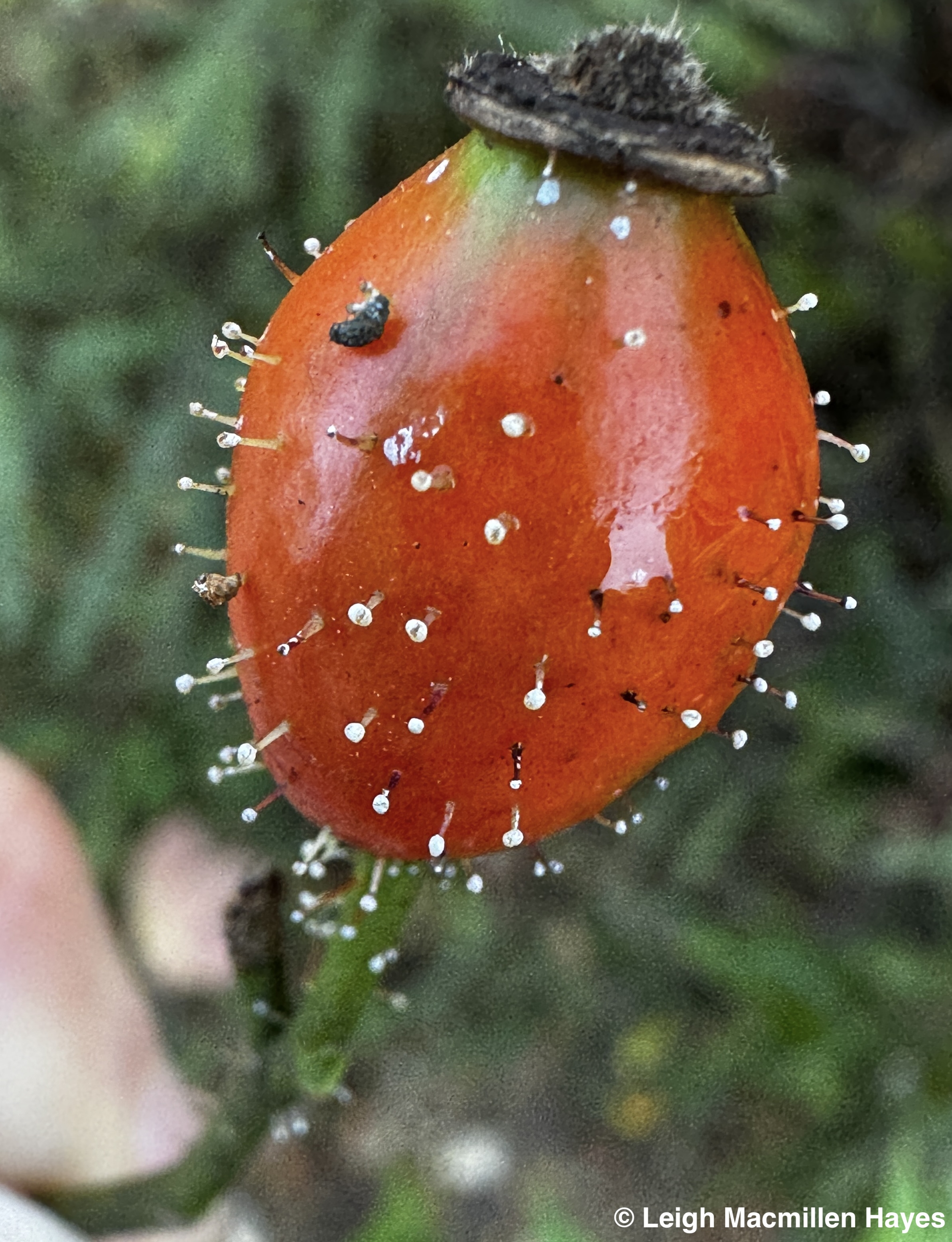
October found us being wowed by rose hips. Because–look at those spikes. We thought maybe a slime mold, but instead discovered it’s the gland-tipped hairs on the hips of Ground Rose. Otherworldy indeed.

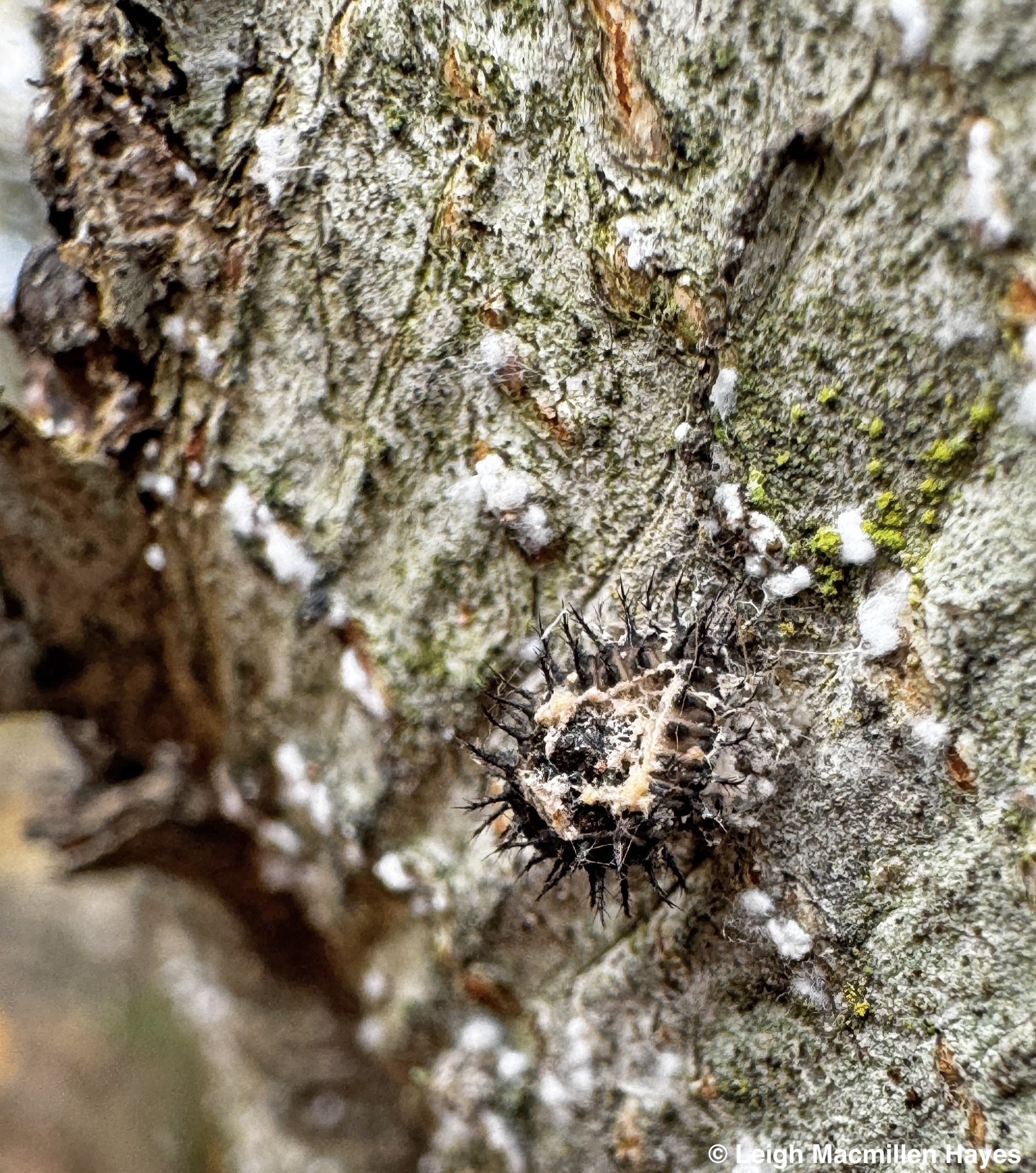
And speaking of otherworldly, the larval form of Lady Beetles also caught our attention, this one having been predated. So spiky as well, and especially when you think of what an adult Lady Beetle looks like–it doesn’t seem to match up. But . . . that’s how the natural world works.

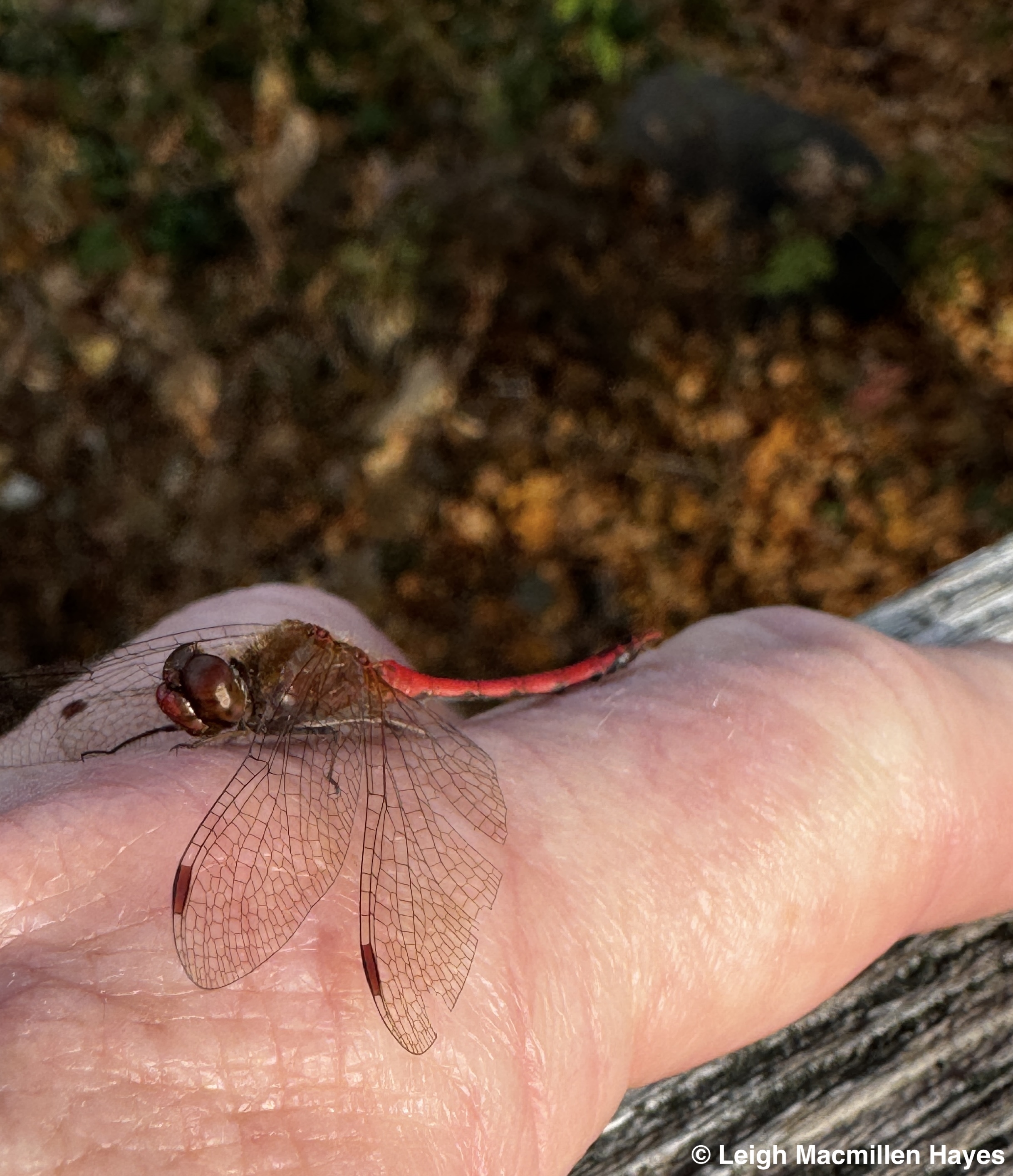
In November, we were only a wee bit surprised to still be greeting Meadowhawk Dragonflies. Notice the tattered hind wing–this one had met with some difficulties we could only imagine.

On another November expedition, while exploring an area where Beavers were quite active and had been busy mudding/insulating the outside of a lodge, plus gathering their winter food supply, we asked participants to become the critters and cut down their own trees. But . . . they had to hold the tree trunk as upright as possible and turn it, because certainly they couldn’t walk around it like a Beaver can.

Timber!

With a bit of snow in December (actually on Thanksgiving Day we had a lot of snow, but then the amount dwindled daily), we started tracking in earnest, spending the start of each walk with a brief explanation of how mammals move and clues to the prints they leave behind.

Measuring took on new meaning as stride (length from the front of one foot to the front of the next in a track) and straddle (length between the outside of one track and the outside of the next in the pattern, for example, put your feet together and measure from the outside of the left foot to the outside of the right and you have determined your trail width or straddle, which is key for some mammal print ID) were taken into consideration.

On a cold winter day in January, you would have thought that we’d bring hot cocoa. We had the cups. And we had the thermos. BUT . . . inside the thermos we had what we call mammal blood (red gelatin), and the group split into pairs and went off to find just the right spot to protect their “mammal’s blood” so we could check its temperature about twenty minutes or more later. It actually turned out to be later because we got caught up with tracking an actual critter in the meantime.

When we did check, it was the pair with the highest temperature that won bragging rights. They had found a suitable protected spot for their critter to survive.

We were still tracking in February, and were excited to follow a Porcupine to its den, and then backtrack to its feeding trees, where Eastern Hemlock branches minus buds and some needles, decorated the ground.

And though we had to dig to find, Porcupine scat in its typical comma shape, did happen.

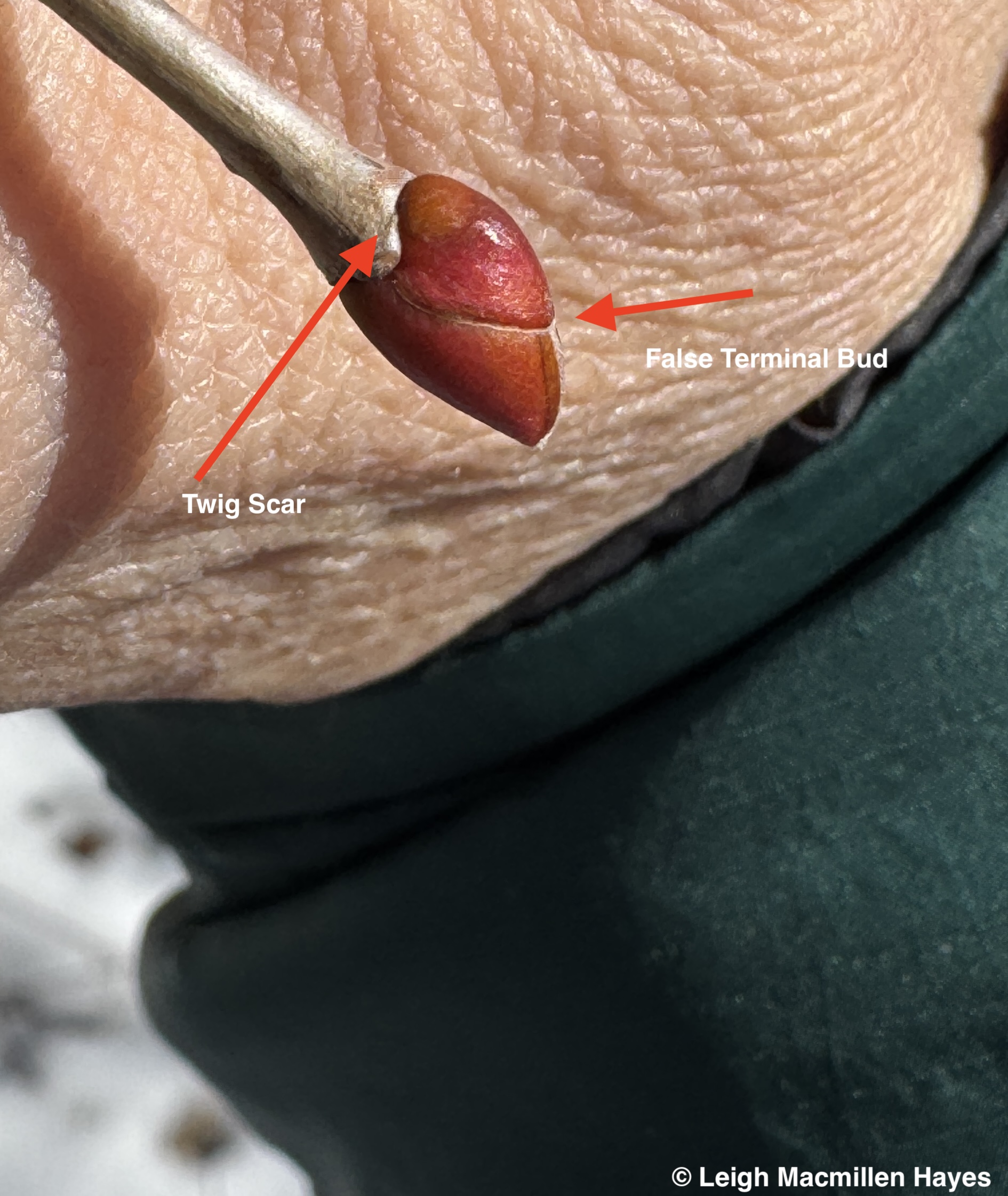
In March, it was the large red buds of Basswood that garnered our attention. And after posting photos of these, an arborist friend commented that the buds look like a mouse wearing a helmet and I’ll never unsee that going forward. Thank you, Eli!

As the temperature began to rise with the March sun, we also spotted deer beds such as this one and knew to look for deer hair! The red arrows point to some as it was time for them to shed their winter coat and with their body heat melting the snow, some stuck to the edges.

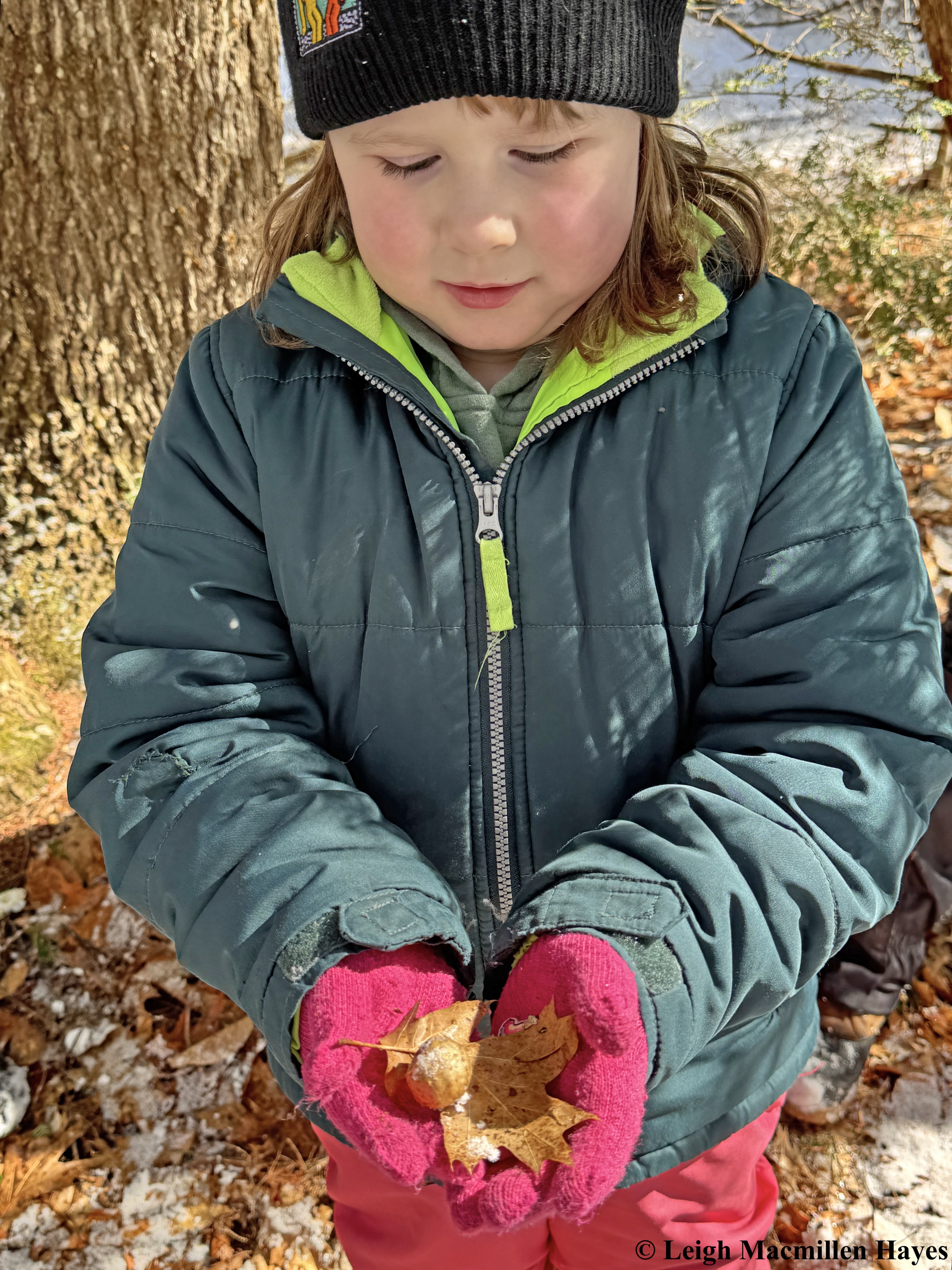
In April, on our way to a vernal pool, one of the many curious naturalists among us found an Oak Apple Gall, that would have been bright green when first formed last spring/summer.

Though it had snowed the day before, we did find Fairy Shrimp in the pool, and rejoiced as always because finding just one of this species makes the pool significant by Maine standards.

As I mentioned in a previous post, there are four species, each with a different count, that help determine if the pool is significant, but any pool that dries up in the summer and then fills up again in the fall is considered ephemeral or vernal.

When the calendar turned to May, we turned our attention to dipping in rivers and streams, curious to see what macro-invertebrates we might meet in those spaces. Out came the D-nets, which we don’t use in vernal pools, because we don’t want to disturb the egg masses of Wood Frogs and Salamanders.

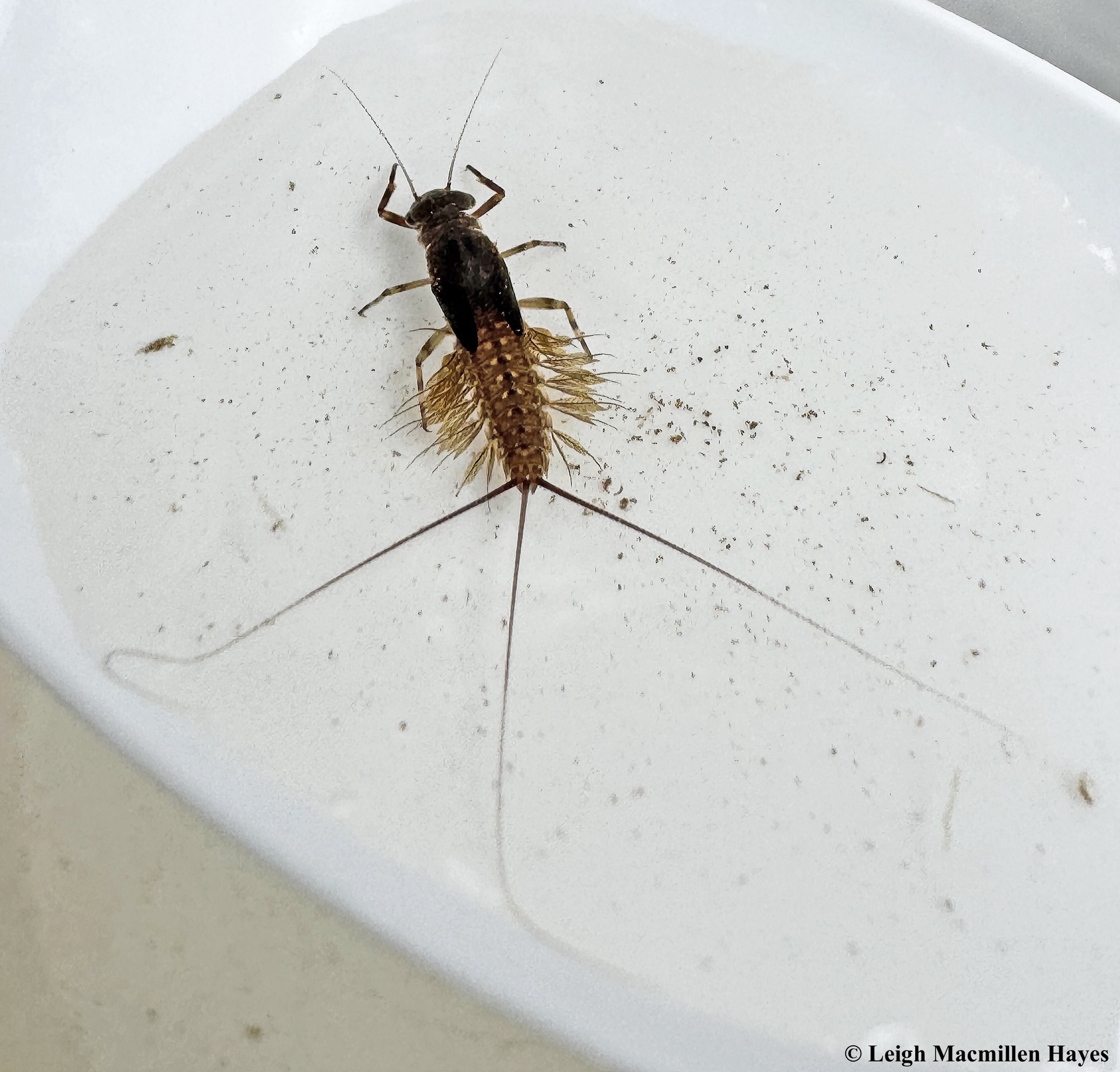
It’s always fun to meet the different species, including a variety of Mayflies in their larval form, with gills along their abdomens and three tails. Long tails quite often. And all that come out of the water, including Mosquito and Black Fly larvae, must go back in.

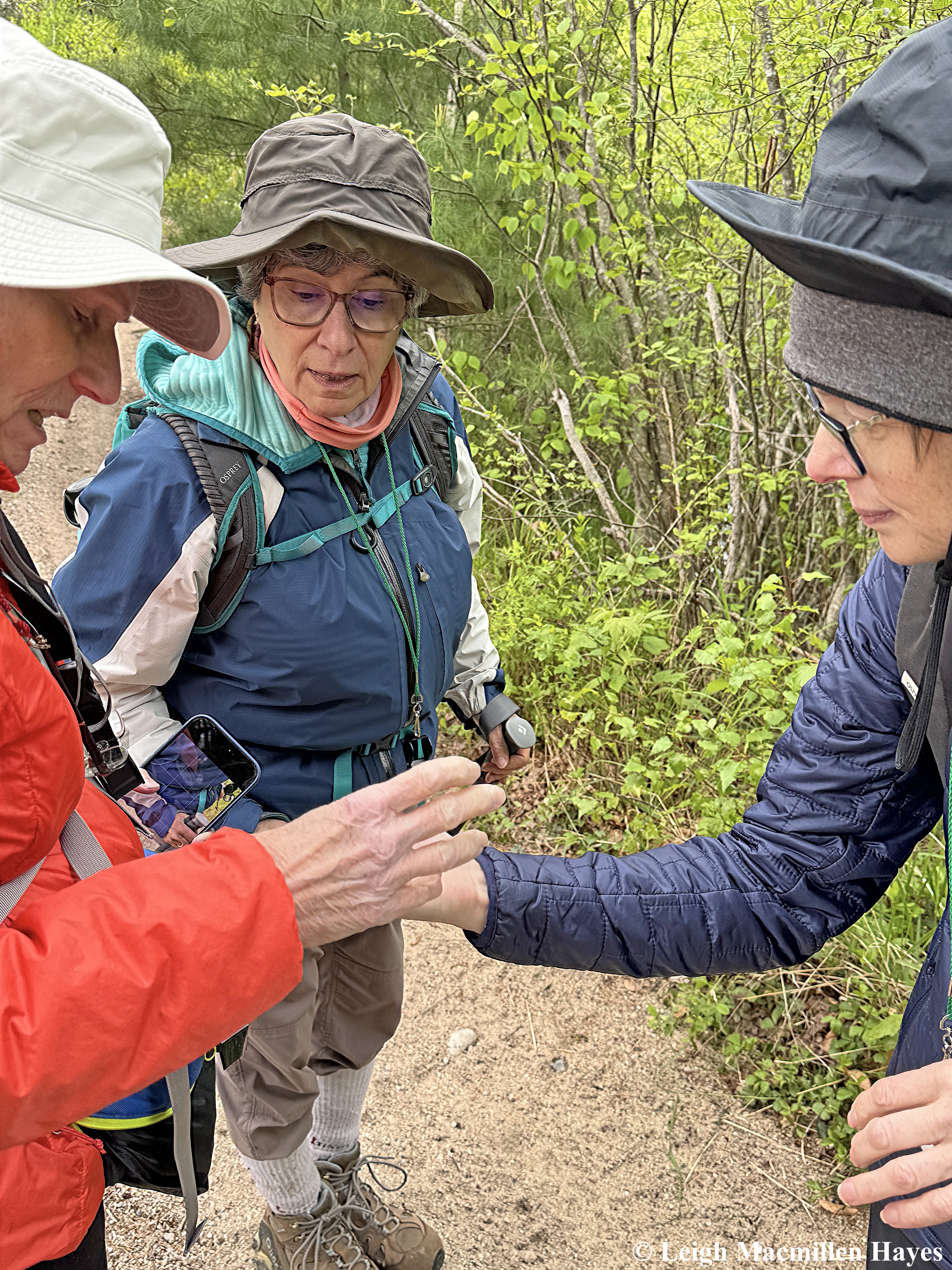
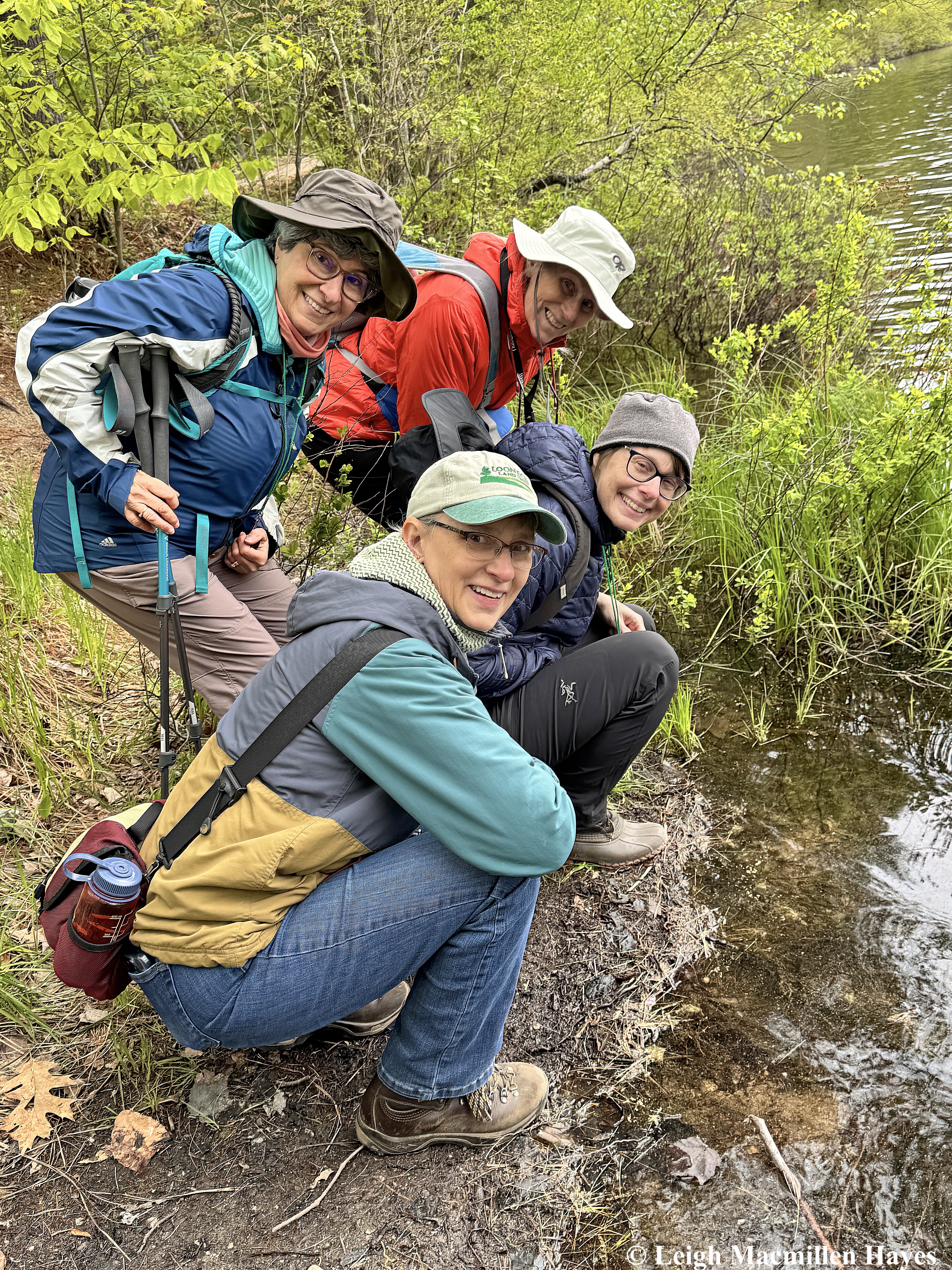
All of this brings me to this morning, when our group was quite small because some had apparently cancelled for various reasons and others were no-shows. That said, we had the best time, as we always do. But today felt extra special. You see, we had a plan to walk down an old trail, but since we were waiting for the no-shows, we thought we’d give them some time to locate us if we first visited a pond located about a hundred feet from the parking area and in the opposite direction of our intentions.

It was while squatting there that we realized miracles were taking place. But . . . we still wanted to share the trail with the participants, so we promised we’d return to the edge before it was time to depart. (As for the no-shows–we’re bummed they missed out.)

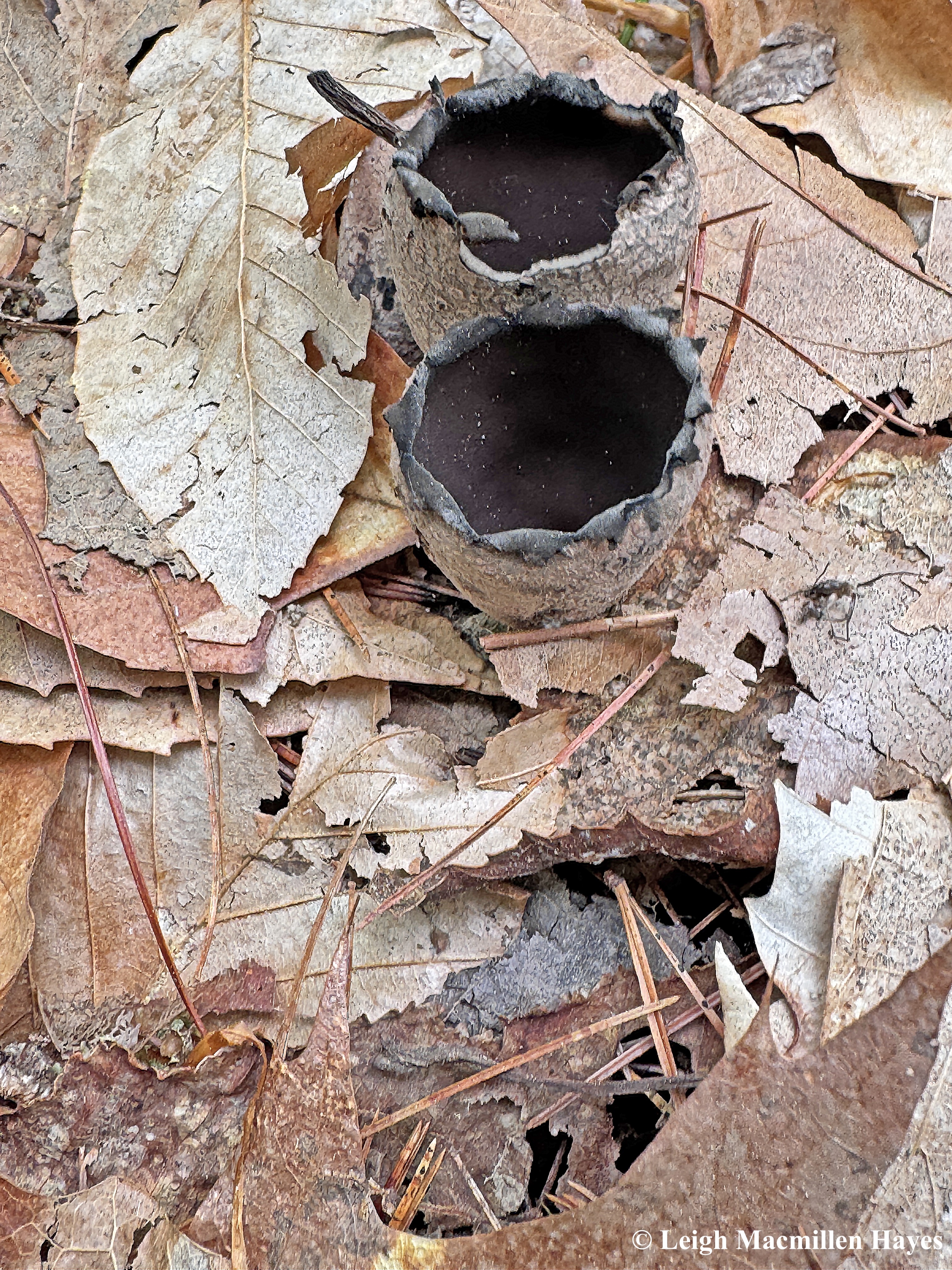
One of the participants who is a fungi enthusiast, and has eagle eyes, somehow spotted these mushrooms. None of us knew what they were, but iNaturalist’s SEEK app identified them as Devil’s Urns.

When I arrived home, I looked them up my Audubon Field Guide, and bingo: “Large, leathery brown, urn-shaped cup; Season: March-May; Habitat: Clustered on fallen deciduous wood, especially oak; Comments: This is one of the first mushrooms to appear in the spring in the East.”

Well done, Julie.

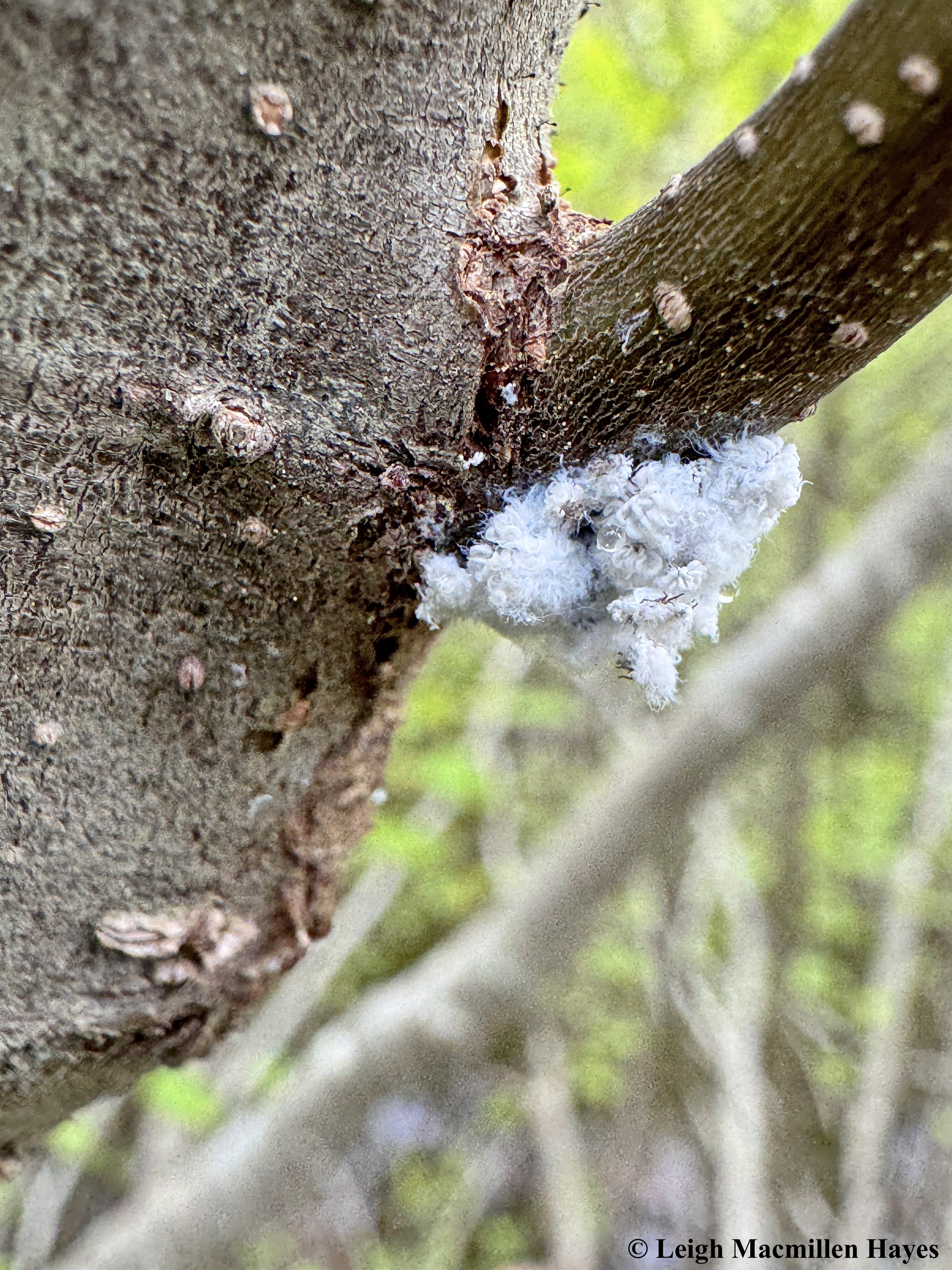
Woolly Alder Aphids were also visible, and once we saw one clump, we began to notice several. As we described how ants “farm” or seemingly tickle them to get them to secrete honeydew, one participant saw an ant and another saw drops of said liquid. Can you see it?

Well done, Marie.

And remember the little girl who found last year’s Oak Apple Gall on the way to the vernal pool in April? Well, another among us today found this year’s galls on newly emerged Oak leaves. It got us all thinking about leaves and insects and how mature insects lay or inject eggs into buds when they first form in late summer and so the moment the leaves begin to unfurl the following spring, larval forms jump into action and leaf miners and rollers and gall makers and everyone else have a heyday.

Well done, Heidi.

Marie, Julie, and Heidi also took an up-close look at last year’s Speckled Alder cones and we noted that the male catkins have already fallen to the ground for this year, their pollination duty now completed.

Lady’s Slippers, and Wild Sarsaparilla, and Star Flowers, and Canada Mayflowers, and Rhodora, and Dewberry, and Bastard Toadflax, and even Poison Ivy were admired and noted.

But, we all had a mission that we wanted to fulfill, so with about a half hour left, we retraced our steps rather quickly.

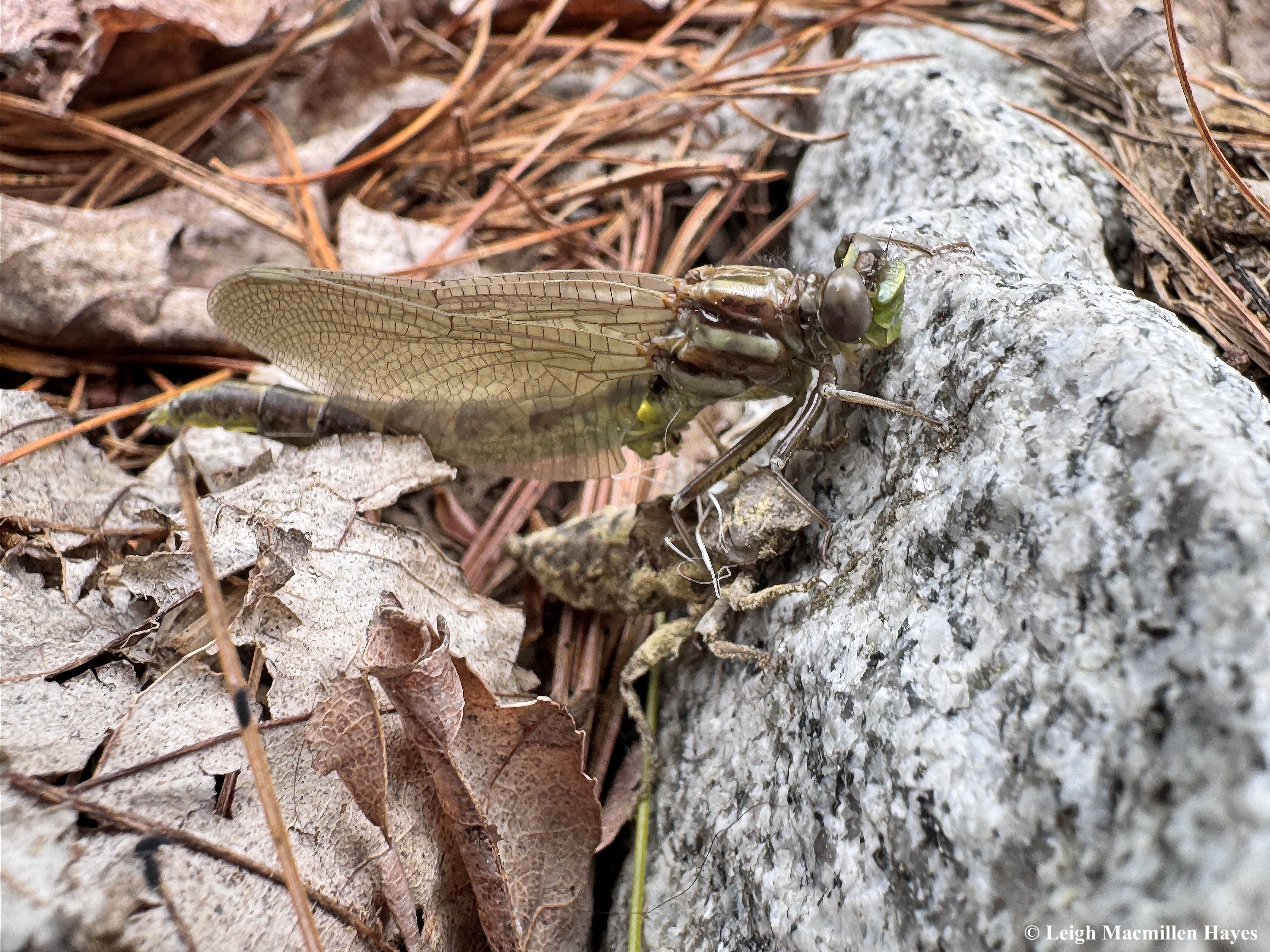
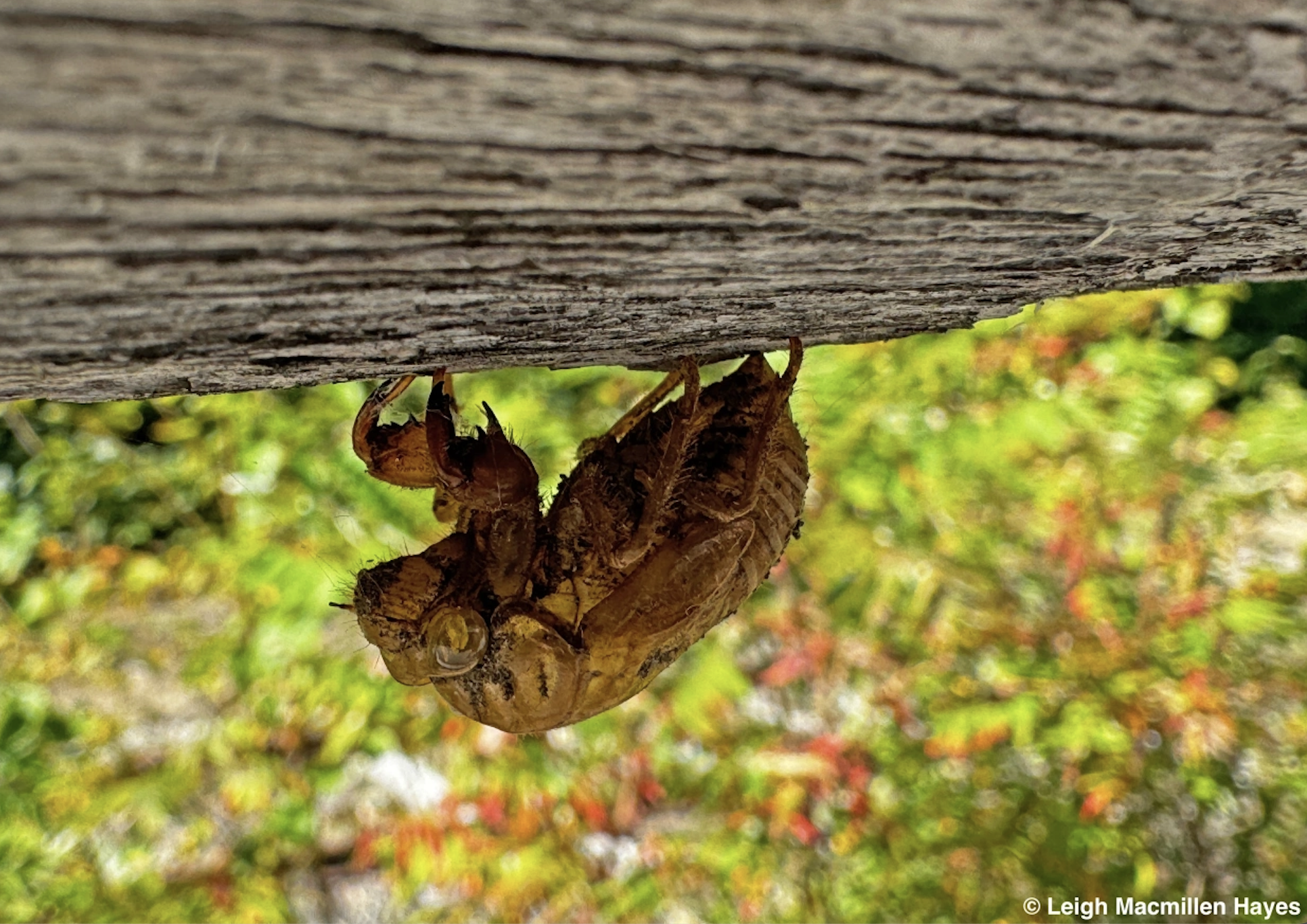
And into the plants at the pond’s edge we peered. Do you see it? A dragonfly naiad (nymph or larval form) upon a broken branch, with the adult form starting to split through the exoskeleton at the point between the wing pads. How could this be? Yes, we’ve seen dragonflies for the last week or two, but it was cold this morning. Raw. Breezy. Seemingly inhospitable for these summer fliers.

Apparently not, for once we looked around, we began to notice them everywhere. The dark naiad climbing up the rock was in search of the perfect spot. And if you look below the rock, you’ll see two naiads, one that is grayer in color, because its adult form had already eclosed or emerged; and the other browner one with the adult starting to pull out of the aquatic skin.

Here’s a closer look at the ones under the rock. Notice the eye placement. That is key to Identification according to family. In this case, with the eyes spaced far apart, it could be either a Petaltail or a Clubtail.

As I said, they were everywhere, and we felt it our duty to watch over them. To protect them from being predated, which is actually kinda funny, given that they are predators. But predators of the best kind because they feast upon Mosquitoes and Black Flies and Deer Flies, and others, of course, but it’s for those first three that we appreciate them.

Can you see how the adult is pulling out of the skin?

And do you see thin white strings extending from the exuviae to the back of the dragonfly? Those were the spiracles or underwater breathing tubes, which are no longer needed by the adult.

A few minutes later it is further out–can you see that? Once it gets its abdomen all the way out, it typically holds onto its shed skin and then pumps its insect blood into its wings so that they expand, before drawing that blood back into its body, allowing its coloration to eventually take true form.

Look for the white strings again.

Do you see them now? Completely unnecessary and therefore left behind.

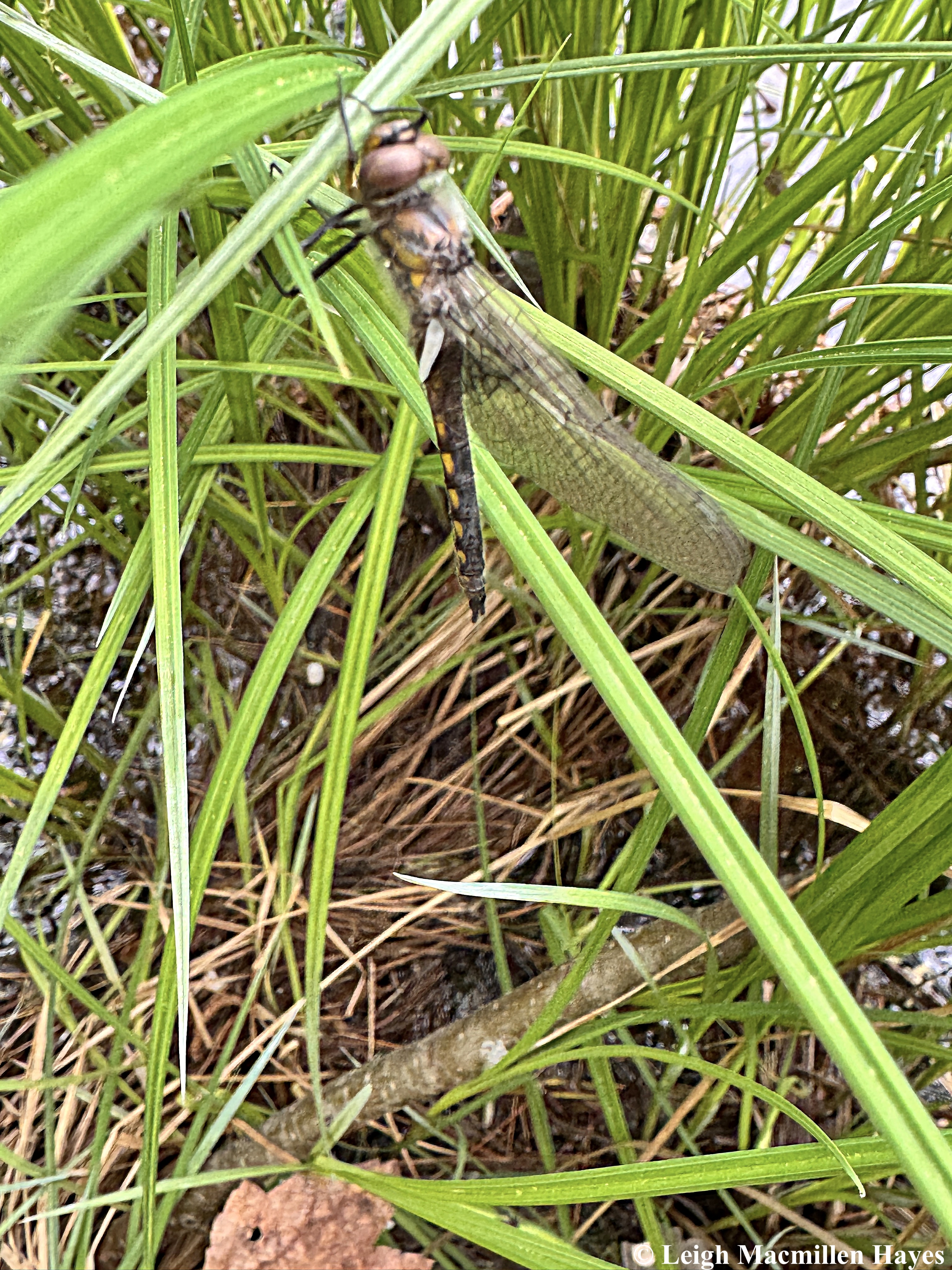
When the wings are at full length, they are held over the back and cloudy in color until it’s time to spread them and let them dry before first flight.

The eyes on this newly emerged dragonfly, along with its abdomen markings and cerci or claspers at the tip of the abdomen, tell us its in the Emerald family, and I suspect a Common Baskettail.

As we watched, we noticed some had wings that were stuck together, and this one with a curved abdomen. It was curious that it had left its exuviae before its wings emerged and so I wondered if they would unfurl.

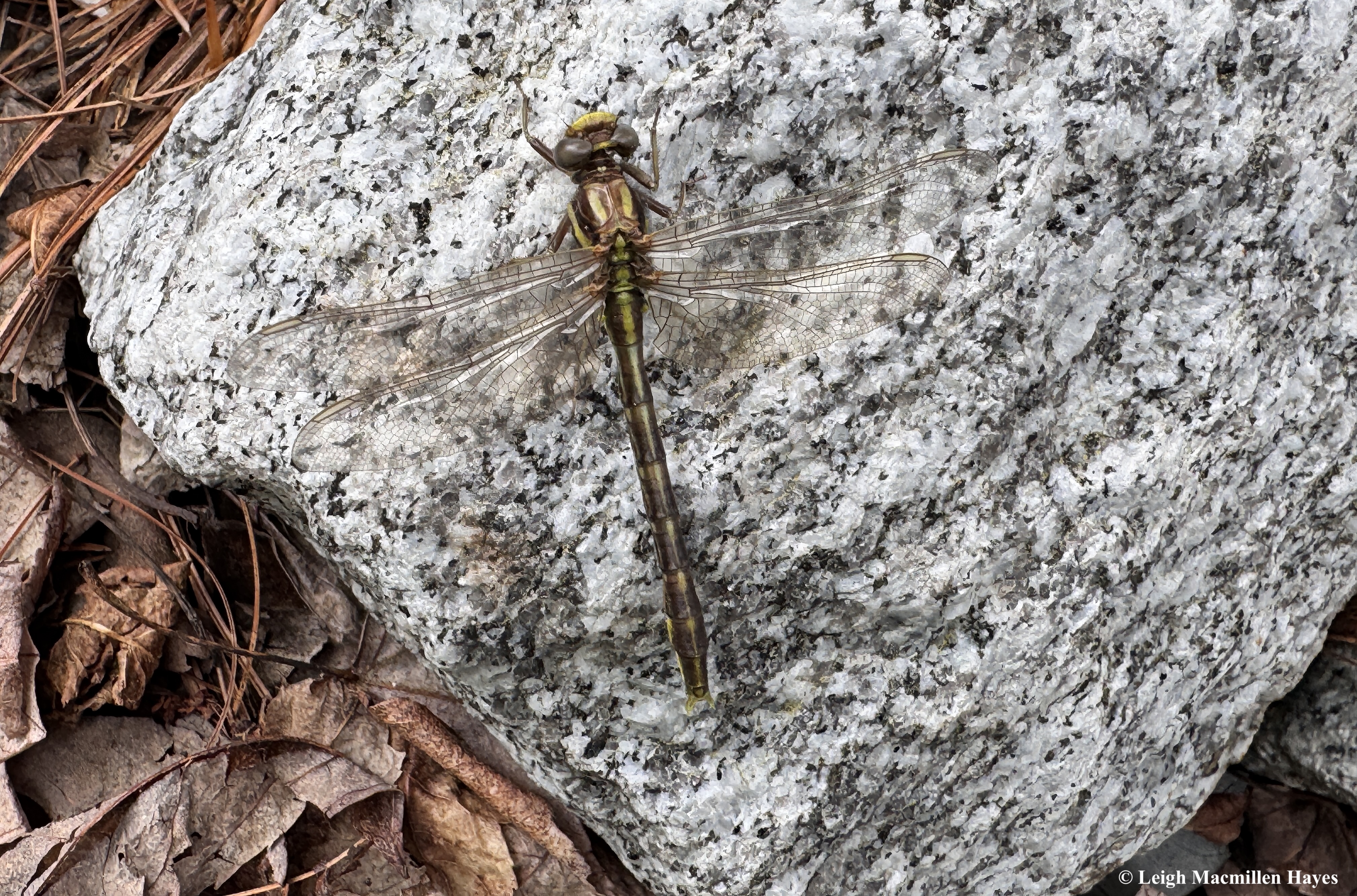
A few delighted us because we got to watch them spread their wings apart–translucent and shiny as they dried.

By the eye placement and beginnings of the markings, my identification stab is for Lancet Clubtail–one of the friendliest dragonflies who likes to land on us when kayaking. Or even on the dock.

As you can imagine, we had to pull ourselves away. The walk was supposed to end at noon, but it was 12:40pm when we finally finished–and honestly, I think we could have stayed a few more hours if we had food and other necessities.

All of our Wednesday Wanders for Loon Echo Land Trust are incredible because each one offers its own moments of awe.

Being honored, however, to share the emergence of dragonflies from their aquatic forms to terrestrial–and helping the ladies to understand that it takes hours for this process, and being surprised that so many had chosen what we considered to be a chilly spring day . . . it was beyond wonder-filled. As every Wednesday Wander is. But today, today was over the top.

Happy Belated 10th Anniversary, wondermyway.com

I can’t believe I missed the date by two days. I’d been planning this for months. Well, in the back of my mind, that is. No actual thoughts were jotted down on paper. I just knew what I wanted to do and when I wanted to do it . . . until I forgot. Or rather, it slipped my mind. Momentarily.

No harm done.

As the saying goes, “There’s no time like the present,” and so my gift to you dear readers will be to give you the present of time by taking you back to the beginning of wondermyway and then making our way to the present. And all of it is because I was given the gift of being present in the moment on so many occasions. Egads. That’s a lot of presents. And presence.

Wonder My Way

My first blog post was published on February 21, 2015, and entitled Wonder My Way. It began with these paragraphs: Wonder my way as I wander through the Maine woods. So often I see things that make me stop and wonder. Sometimes I figure it out, but other times, I’m just as happy that I don’t. It’s The Sense of Wonder that Rachel Carson wrote about which keeps me going. Do we need to have all the answers? I think not.

So join me for a tramp from our woodlot to the world beyond. I know not where this trail will take us, but I can guarantee that we’ll have fun along the way. Read more . . .

Spring in Slo-Mo

Spring is so fleeting in Maine. Oh, I know, it lasts the usual three months and the beginning and ending overlap with its seasonal partners, but really . . . one must take time to pause and watch or you’ll miss the most amazing action that occurs in slow motion right outside the window–and beyond.

For those who are new to my blog, Jinny Mae, who is featured in this and many blog posts, was a dear friend whose name I turned in to an alias as she faced cancer courageously and rather privately. In the end, the cancer consumed her, but the things we enjoyed along the way were bountiful, including this spring adventure to an incredible space in our little neck of the woods. Read more . . .

Universal Love

Written on Valentine’s Day, this post was dedicated to My Guy and all who wander and wonder with me.

When I wander, hearts frequently speak to me . . . Read more . . .

Nothing To Grouse About

I shared a unique experience with five other naturalists, the majority of them in the six to eleven age range. For twenty minutes the six of us watched a Ruffed Grouse at it moved about, overturning leaves and foraging on buds. When we last saw it, the bird headed off in the opposite direction that we intended to journey, and so we moved on with wonder in our eyes and minds.

And then the next day I returned on a mission to study some twigs at the same property. No sooner had I stepped onto the trail when I heard the sound of leaves cracking a wee bit and what to my wondering eyes should appear but the same bird.

The curious thing: the bird followed me, staying about ten feet away as I tramped on. I stopped. Frequently. So did the bird.

And we began to chat. I talked quietly to him (I’m making a gender assumption) and he murmured back sweet nothings. Read more . . .

Amazing Race–Our Style

Okay, so My Guy and I have enjoyed The Amazing Race show over the years and felt like there were some challenges either or both of us could face, but others that neither of us would dare attempt. And so . . . I created our own version.

The thing is that until I take the time to change the order of this post on my website, you’d be best to start at the bottom and read each entry, going up one step at a time. As in, this: Scroll down to February 18 on this link and then after reading that entry, make your way up one episode at a time, until you reach the last recorded on February 2, 2019. Oh heck, read it in any order that pleases you. Just get into the spirit of the race I created cuze I certainly had fun with it. And fooled a few people along the way.

The Amazing Race–Our Style

I’m sure when we said our wedding vows back in 1990, there was something in there about only riding a snowmobile once. And I did that once two years or so ago–mostly because I knew it would please my guy. Certain memories remain from that experience: I felt like a bobblehead inside the helmet; I lacked control as I sat behind him and couldn’t see; when I did peek around, I was sure my head was going to strike a tree so narrow was the trail; and I didn’t like the speed. Oh yeah, and at a road crossing, I do believe I jumped off and walked to the other side. With all of that in mind, I’m not sure what I was thinking when I created a Valentine’s gift for him–our very own Amazing Race. Read more . . .

wondermyway turns five

Five years ago today (ten now!) I turned from taking a hundred million photos on each tramp to taking a hundred million photos and writing about them.

Typically, on the anniversary I scan the past year’s posts and choose one from each month, providing a photo to represent it, with a brief (or not so brief) comment and link to the full read.

But . . . because this is a milestone I never imagined reaching (posts: 733; views: 76,793; visitors: 44371; followers: 578), I thought I’d take the time to thank you, the readers, for wandering through the wonders with me.

Thank you! Read more . . .

Dragonfly Whisperer Whispers

We had no intention of eating lunch in this spot today, but while looking for a mountain to climb, we kept encountering full parking lots and so our backroad meander put us beside a bog at lunch time and voilà, we managed to walk all of less than two tenths of a mile. Total.

But in that short distance, our eyes feasted. First it was all the Painted Turtles basking in the sun. Read more . . .

Surveying the Wildlife of Charles Pond

For the past two weeks at Greater Lovell Land Trust we’ve had the good fortune to conduct a wildlife survey in the waters that surround the newly acquired Charles Pond Reserve in Stow, Maine. Our hats are off to Alanna Doughty of Lakes Environmental Association (LEA) for her willingness to be the lead on this project and work in collaboration with us. Alanna, you see, has conducted previous surveys for Maine Inland Wildlife & Fisheries (MDIFW) at LEA properties, and was trained by wildlife biologist Derek Yorks to set these up.

MDIFW maintains a comprehensive database on the distribution of Maine’s amphibians and reptiles, as well as terrestrial and freshwater invertebrates and the data we’ve collected will add to the bigger picture. What we discovered was just as important as what we didn’t find. Read more . . .

Hightailing It Home

Friends,
At the risk
of sounding redundant,
I bring forth
a prickly topic.

A quick glance
while surveying treetops
and suddenly
my heart sang
as I spotted
a well-armored back.

Read more . . .

Happy 9th Birthday, wondermyway!

Thank you to all who read and comment and share wondermyway.com. Some of you have followed my blog posts since the beginning, February 21, 2015. A few have joined the journey as recently as yesterday. I’m grateful for the presence of all of you in my life.

To mark this occasion, I thought I’d reflect upon those moments when my wonder gave me a glimpse of the “Thin Places” that I’ve experienced either by myself or in the company of others.

To quote my friend, Ev Lennon, “A Thin Place is a spot of beauty, loveliness, space–an example of the wideness and grandeur of Creation.”

I think of them as places that you don’t plan a trip to visit, but rather . . . stumble upon.

Read more . . .

And that brings me to this year and this anniversary, belated as it may be. I can’t believe it’s been ten years since I started this endeavor, which has served as my diary and memory, and been a place for me to share so many incredible extraordinary ordinary experiences with all of you. Thank you for being faithful readers.

As I compare the numbers to year five, I haven’t written as often in the last five years, but your support has been incredible.

wondermyway.com by the numbers:

Posts: 1,076

Visitors: 135,888

Views: 205,389 and increasing constantly.

The most popular post of this new year was Giving Thanks for the Pileated Woodpecker. So far, anyway.

The Giant’s Shower

And since I retired as Education Director for a local land trust just over a year ago, I’ve added some other fun to the mix.

I did a thing. Years ago I wrote a children’s story. Well, a bunch of them actually. And I tried to sell this particular one to publishing houses. No takers. Then, a couple of years ago I purchased a Fairy Coloring Book created by the one and only Solana, teenage daughter of the Fly Away Farm Wards in Lovell and Stow, Maine, and approached her about illustrating my fairy tale. She took on the task and did an amazing job. Then I asked copyeditor Pam Marshall to wave her magic wand over it. And I asked local graphic designer Dianne Lewis to use some fairy dust and turn it into an actual book. I always said I’d never self-publish a book. And tada: I did just that. And now it’s even better because it’s published by http://www.indieauthorbooks.com.

Read more . . .

My Art Gallery

At the end of April I began taking an art class offered by one of my peeps, a young woman who walked into the lives of many of us one day about twenty months ago; a young woman with a million talents to offer. Among those talents, she is a self-taught artist and we’ve been begging her to teach us.

At our first class, we had to draw a small box in the upper left-hand corner of the paper and place the person who has been our biggest art critic into it. That done, the critic was forever boxed–well, until she sneaks out, which she seems to do way too much.

And then we looked at some photographs in magazines and had to sketch them and determine the direction the eye would travel in the picture.

Next we looked at lines and perspective. I’d brought along my favorite colored pencils, but immediately felt my inner critic jump on me because all of my classmates were working with watercolor pencils, watercolor paint or acrylics. And the artist herself, gouache. Until I met her, I’d never even heard of gouache. Or at least never paid attention, if I had.

Read more . . .

Lake Living on Lake Region Television!

And we said goodbye to Lake Living magazine, a glossy publication I’ve worked on since 2006.

We are movie stars! Well, maybe not quite. But, many, many thanks to Evan Miller of Lake Region Television for filming and editing Laurie LaMountain, owner and publisher of Lake Living magazine, and me recently as we said, “Fare Thee Well,” to working on this publication.

Read more . . .

And in the midst of it all, I still have the good fortune to share the trail with so many others . . .

and especially with My Guy, who is forever patient as I pause to consider the wonder of the moment.

My heart-felt thanks to him and to all of you for joining me so often as I wondermyway.

Wowza–ten years! I never imagined. No time like the present to wish wondermyway.com a belated 10th anniversary.

Love Bugs

It didn’t start out that way for me. Loving bugs, that is. I thought they were just that . . . bugs. Bothersome. Biting. Stinging. Needing-to-be-swatted critters.

And then one day that all changed for me as I began to take a closer look. And since the past two weeks a friend and I shared our keen interest in these critters during two Senior College (Lifelong Learning) classes, I thought I’d bring some of it alive again in this space.

If you attended these classes, there will be some repeated information, but it’s not all here, or we’d need four hours! And I’ve added a few things that I didn’t have time to include in class.

Enough said. Let’s get started.

Most, but not all, insects have mouth parts, but they come in a variety of forms. The most basic are for chewing, but sponging, siphoning or sucking, and piercing, then sucking are also important. Mosquitoes, adult fleas, lice, and some flies puncture tissue with a slender beak or proboscis, and suck the fluids within. Butterflies, moths, and bees also dine on fluids, but the proboscis of these species lack the piercing adaptations and extend only when their feet touch and “taste” a sweet solution. A spongy tip, aka labellum, on the tip of the proboscis allows most flies to sop up liquids or easily soluble food. Other insects, like ants, grasshoppers, beetles, and caterpillars nibble and grind their food with jaws or mandibles, which move horizontally.

Think mosquito: sticking a straw into a juice box (through your skin) and then sucking; bee and butterfly: using a straw; fly: adding a sponge to the tip of the straw; caterpillar: using pliers horizontally. You get the picture?

And then there are the legs and feet. Because insects live in a wide range of habitats, there are a wide range of structures to get the job done.

Cursorial: (running) Insects like Tiger Beetles, who have long and narrow legs and move swiftly (even when canoodling, though they do slow down a wee bit).

Saltatorial: (jumping legs) In this case, it’s the hind legs of Grasshoppers that are filled with bulky strong muscles to help propel them forward that come to mind.

Fossorial: (Digging) These insects, such as Dog-day Cicadas, live underground for the first few years of their lives and need their legs and feet, which look like modified claws, to dig. They tend to be broad, flat, and dense.

Natatorial: (Swimming) Aquatic beetles and bugs can move swiftly through water.

Raptorial: (Hunting) Enlarged with powerful muscles, these are found at the front of the insect where they are ready to strike at any time, then grab and hold prey, such as a Robber Fly has.

And just a reminder from science class all those years ago, without going into all of the details, like the fact that there are three sections in the thorax, the head contains the eyes, proboscis, and antennae, thorax supports three pairs of legs, and wings (and halteres or modified wings shaped more like clubs that help with balance and steering when in flight), and an abdomen.

I could share tons of photos of Bumblebees (and I’ve found it written as one word, and two), but this is one of my favorites because it shows the insect’s RED tongue seeking nectar from the Goldenrod.

This is another favorite because I sometimes forget that despite the rain, the insects are still out there during the summer, and perhaps finding the right spot to avoid getting wet comes with age.

Bumblebees are very hairy. They build underground nests and I have to wonder why this one didn’t return to hers, but perhaps the rain came down suddenly. It did rain a lot last summer.

In the spring, the queen who overwintered, conducts a reconnaissance mission in search of a good nest site and you might spot one in a weaving flight close to the ground as she checks out every little hole that might serve as the right underground chamber for her brood.

Paper Wasps are easy to identify because unlike other wasps and bees, they hold their wings out to each side rather than folded over the back. The fertilized queen also overwinters behind tree bark or under leaves.

So this wasp decided that a door jam in our house was the right spot to place a nest. Heck. It was protected. Out of the weather. Warm. All the comforts of home.

To build such a nest, fiber is gathered and chewed from buildings and trees and fence posts and then mixed with saliva until it becomes a papery substance.

The hexagonal cells created face downward and tada, a nursery is formed, each cell supporting one egg.

I am probably one of the few people in the world who spent several days standing on a kitchen chair to get a series of photos as this nest was being built.

And I was successful in my efforts, that is, until My Guy discovered it and decided that it really wasn’t such a good idea to have a nest in the house. I guess it speaks to how well the door didn’t fit into the door jam. We’ve since completed a reconstruction project of our own, so sadly, this won’t occur again, but never fear, there are usually lots of nests around the outside of the house.

Another who overwinters behind bark as an adult is the Mourning Cloak Butterfly, so named because the coloration is supposed to remind us of a cloak one might wear while mourning the loss of a loved one.

One activity that butterflies engage in, and usually it’s the males who do this, is “puddling.” We think of butterflies as flitting from flower to flower, sipping nectar here and there.

BUT . . . they need more. Yes, flower nectar is good for energy, but when your mind is on something else, you want to supplement your diet. Sugar water won’t give you that something extra to produce viable offspring.

Puddling means injesting salts, minerals, and amino acids from mud, scat, fermenting fruit, or carrion. In this case, the Tiger Swallowtails are seeking these treats from a squished frog. When they get around to canoodling with a mate, they’ll pass along a wedding present via their spermatophore, which will give their brides an extra boost and the females will pass that on to the eggs, thus giving them a higher chance of success.

For me, it’s the last two items in the list that help me best differentiate between butterflies and moths.

Notice the feathery antennae of the Luna Moth, who by the way, has no mouth parts because as an adult the job is only to mate. Leave the eating to the caterpillars in their larval form.

It’s just the opposite for the Clearwing Hummingbird Moth, who has a long proboscis like a butterfly that extends into the flowers to seek nectar. When in flight, the proboscis curls up and is tucked to the side of the moth’s head.

Grasshoppers molt as they grow and this was a larval form I spotted one extremely cold and blustery March day. It hasn’t any wings yet, but those will come as it sheds its skin several times before reaching adult size. Still, the youngsters look very much like their future mature selves.

And to round things out, I found this molted skin in the fall and was totally intrigued by how much detail it included, right down to the spars on the hind legs. Of course, they should be there, but I was totally surprised because I hadn’t thought about it before.

My next friend is a “Where’s Waldo” feature because it blends into its surroundings so well. Curiously, I grew up with the ever present summer song of Katydids in Southern New England, but despite living in the North Country for all of my adult life, I haven’t heard one in years. Then again, I only see one or two a summer it seems, so maybe there aren’t too many around who will listen.

Both dragonflies and damselflies begin life as aquatic insects. Think natatorial legs.

As some of you know, I could share a million photos of dragonflies and I’d never get tired of it, though you might. I am limiting myself to just a couple, including this female Racket-tailed Emerald, so named for the abdomen that widens toward the end somewhat like a tennis racket. I love imagination!

But probably my favorite dragonfly is the Stream Cruiser, especially when it has newly emerged and presents in browns and whites that make me think of Oreo cookies or a no-bake Icebox Cake (which I was honored with for my birthday this past year–thanks Deb!)

Just like there are subtle differences between butterflies and moths, the same is true for dragons and damsels.

I often meet members of this Orange Bluet family of damselflies when I’m paddling near our camp. My only wish is that this one had gone for the meal that awaited–a Deer Fly; before I became the Deer Fly’s meal. It wasn’t my lucky day.

The Orange Bluet is a pond damsel, so called because its wings are clear and closed when it perches.

Among the damelflies, there are also broad-winged varieties, such as this female Ebony Jewelwing. If you are near a stream or damp spot in the woods, be on the lookout for these beauties. And note the white stigmas on her wings. Her guy’s wings are all black.

And one last damsel that I wanted to include is a member of the spread-wings. It’s easy to think of these as dragonflies because the wings are . . . spread a bit apart like the dragons. But . . . note the thin body. And the arrangement of the eyes. Damsel eyes are a bit like barbells.

Beetles come in so many shapes and sizes and colors. And their antennae are variable as well. I just love the antennae on this Oriental Beetle.

There are also a variety of long-horned (long antennae) beetles, but what caught my eye was that these two were totally undisturbed by an ant that was seeking nectar as they romped.

Because I stalk my “gardens” and the adjacent field, I happen to know that these two canoodled for hours. I did miss their point of departure, but can safely assume I’ll meet their children in the future.

My final beetle to share today is the Winter Firefly, who is fireless as an adult. Though I’ve never seen this, I’ve read that the Winter Fireflies eggs, larvae, and pupae glow. But not the adult.

Though visible all year, now is a fun time to locate these beetles. (Wait–it’s a fire”fly,” but not a fly? Nope! And if you call it a Lightning Bug, which are its close relatives, you should note that it’s also not a bug!)

Notice the pink parentheses bracketing the shield behind its head–as a former English teacher, that makes my heart sing.

One of the most mysterious true flies in my neck of the woods is the Phantom Crane Fly. Think Phantom of the Opera when you look at the coloration. And seriously, this crane fly literally floats through the air, looking like the small outline of a box if you are lucky enough to spot it.

Crane flies are not oversized mosquitoes and they will not harm you.

Another in the Crane Fly family is the Winter Cranefly, a tiny, mosquito-looking insect with super long legs. The lightbulb is two inches long, so that should give you a bit of perspective on this insect’s size.

Like all members of the family, these can be found in moist places. And the males form swarms in an effort to perform pre-canoodle dances to entice a mate.

Another who is closely related to the crane fly family is also most readily seen on snow, this being the Snow Fly. It differs from other crane flies, however, in that it is wingless.

When I first spotted this one about a month ago, on a frigid day, I thought it was a spider at first. Until I counted its legs. 1. 2. 3. 4. 5. Yikes. Certainly not the eight legs of a spider. But . . . where’s leg #6?

Snow Flies, I learned, have the ability to self-amputate a limb that is beginning to freeze as a way to stop icy crystallization from spreading to the rest of the body, and especially its organs.

Since that first sighting, I’ve spotted a few more, and thankfully, all feature complete sets of three pairs of legs.

Next up in today’s lesson plan, the Robber Fly. This particular species has such a hairy body that it mimics a bee. Its proboscis, or mouthpart, is rather beak-like, the easier to consume insects.

Robber Flies wait patiently, or so it seems, and then when the time is right, they pounce. And stab the prey with their straw-like mouthparts, injecting the subject with enzymes that paralyze it before sucking the liquified guts. Yum.

While I found the Bumblebee hanging out on a rainy day, it was a humid day when I spotted this Robber Fly taking advantage of a little shade. And perhaps actually awaiting a meal that might fly or crawl into the plant.

The final order of the day encompasses the True Bugs. Most True Bugs suck juices from plants. Including this wooly aphid that looks like a snowflake when in flight.

It’s the white fluff covering their body that is their defining characteristic. The fluff is made of small waxy fibers that serve to help keep the aphids hydrated. The hairs may also deter predators from ingesting them.

Sap-suckers though they may be, they don’t harm their host plants, and are a delight to spot in flight–much like little fairies flying about the woods.

Another sap-sucking insect is another one of my favs: the Dog-day Cicada, this one being the cast skin of a nymph. I could wax poetic about them, but you can read more by visiting Celebrating Cemetery Cicadas, Resurrection, Consumed by Cicadas, My Love Affair, to name a few. I guess I really do like them since I’ve written about them so many times.

Love bugs yet? If not, I hope you at least will take some time to appreciate them. In winter and summer. And spring and fall.

Of all my favs, and there are many it turns out, this one pictured above probably tops the list. It is, after all, chocolate! Under those leathery elytra wings, of course. My friend, Aurora, gave this to me a year ago, and I don’t think she realizes how much I really love it and that it sits in a shady alcove on my desk so it doesn’t melt. Bugs should not melt! Nor should they be eaten! Especially Love Bugs!

Perfect Present

The Giant’s Shower: a book by me

I did a thing. Years ago I wrote a children’s story. Well, a bunch of them actually. And I tried to sell this particular one to publishing houses. No takers. Then, a couple of years ago I purchased a Fairy Coloring Book created by the one and only Solana, teenage daughter of the Fly Away Farm Wards in Lovell and Stow, Maine, and approached her about illustrating my fairy tale. She took on the task and did an amazing job. Then I asked copyeditor Pam Marshall to wave her magic wand over it. And I asked local graphic designer Dianne Lewis to use some fairy dust and turn it into an actual book. I always said I’d never self-publish a book. And tada: I did just that. And now it’s even better because it’s published by http://www.indieauthorbooks.com.

Aisling, a fairy who lives on Sabattus Mountain in the western Maine village of Lovell, has a vision during the Midsummer Eve celebration. 

Twinkles, flitters, a bit of fairy dust and some tsk-tsking are necessary to make Aisling’s vision a reality. 

If you read the story aloud, I highly encourage you to get all in your audience to participate in saying “Tsk, tsk,” each time Biddie does the same.

You and your children will delight in the story accompanied and the colorful and whimsical illustrations created by artist Solana Ward.  In fact, you don’t even need children to enjoy this story.

Marita Wiser, author of Hikes and Walks in and around Maine’s Lakes Region had this to say about the book, “The fairies in The Giant’s Shower will captivate children with their merry life in the forest. It’s not all magical though, as they moved from New Hampshire to Sabattus Mountain in Maine to avoid a certain devil. At least they thought the giant was a devil, but the situation wasn’t what it seemed at first. Both the writing and the detailed illustrations capture many features of the woods of northern New England, and the fun of fairy life and houses.” 

A naturalist and writer, many of you know that I hike frequently in Maine and New Hampshire, and those adventures inspired this story. I feel the fairies’ magic whenever I’m among moss-covered ground and tree stumps.

Included in the book are directions to the two featured settings, Sabattus Mountain and Arethusa Falls, featured in the photo above. Both are easily accessible for young hikers who might experience some magical moments while exploring. 

Also included is a list of character names and their explanations, as well as instructions to create fairy houses and fairy dust. 

The Giant’s Shower is available for $16.99 at Bridgton Books, Hayes Ace Hardware, Fly Away Farm, or by contacting me: thegiantsshower2023@gmail.com. Cash, check, or Venmo all work.

I do charge an extra $5.00 for shipping and handling if you ask me to send it to you.

Please consider purchasing a copy, or ten, as the book does make the perfect present.

My Artistic Path

In a way, this is A Lost Art Found continued. It’s the rest of the story, at least to this date.

Once I got hooked on painting, I couldn’t stop. What I’ve discovered is that it’s a lot like writing. You choose a topic, which for me so far has been from a photograph I’ve taken as I’m afraid to purchase an easel and try plein air; complete an outline or at least jot down notes to get an idea of where you are going with the topic in the form of a values sketch; choose how to frame the story whether upon watercolor paper or canvas, and the media being watercolors, acrylics, or gouache; begin a first draft of sketching a wee bit on the mat of choice and apply a light colored wash; paint the basic shapes to get the story on paper which may be more representational than factual; and then tweak, tweak, tweak, which sometimes takes me eighteen drafts to get to a publishable product, and even then, I know more changes can be made.

But here’s the thing. I’m brand new to this art form. And thanks to Jessie, my teacher/mentor, I’ve learned a lot and still have more to learn. Then what’s the thing? The thing is that in every painting I’ve completed so far, there’s plenty I can critique, but at least one thing that I like and so that’s what I want to focus on. The rest I can learn . . . down the road.

After our spring session of classes ended, I decided to keep going on my own.

The view from the summit of Blueberry Mountain, Evans Notch, New Hampshire, looking toward Shell Pond below and the mountains beyond. My fav: the shape of the pond.

Frenchmen’s Hole in Newry, Maine. My fav: the color of the water, darker in the depths and lighter as if flowed over rocks to the next fall.

Sunrise, Lubec, Maine. My fav: the rope in the foreground. And the sky.

Carsley Brook, Lake Environmental Association’s Highland Research Forest, Bridgton, Maine. My fav: the trees leaning across the brook.

Lady’s Slippers from any of our counts as a gift for My Guy, who I’ve learned only likes to count them when they are in bloom. Since that season, he can’t be bothered to note the leaves or occasional seed pods and is praying it snows soon so I won’t continue to point them out. My fav: the shape of the flowers.

The fire tower at the summit of Pleasant Mountain. My fav: a sense of perspective with the mountains.

All of these were watercolor paintings. And then . . .

I purchased some gouache and painted Hemlock Covered Bridge. My fav: the bridge and the reflection, but also the lesson that this was a bit like completing a paint by number as I broke it up into different sections.

Fall reflection cropped from a river scene. My fav: All of it. It was like painting a jigsaw puzzle. And i loved creating the wavy lines.

Winter along Heald Pond Road, Lovell, Maine. The interesting thing is that this barn was taken down a few weeks after I painted this scene. My fav: the barn boards and the snow. And my learning–painting the lower background before adding the foreground trees.

Our barn at Christmas. My fav: The reflection in the window.

Interior of Hemlock Covered Bridge in Fryeburg, Maine. My fav: sense of perspective.

Sunlit part of spider web inside Hemlock Covered Bridge on mat canvas. My fav: texture of the boards and light between boards.

Bob Dunning Memorial Bridge, Pondicherry Park, Bridgton, Maine. My fav: the different beams that provide support as each represents a different species of native wood.

Approaching Bob Dunning Memorial Bridge on a snowy day when no one else had yet entered Pondicherry Park in Bridgton, Maine. My fav: the bend in the bridge.

Beaver at Albany Mountain trail, Bethel, Maine. My fav: the beaver’s face.

Denning Black Bear. Location a well-kept secret. My fav: the eyes.

Painted Turtle, Moose Pond, Maine. On mat canvas. My fav: colors of the water.

In August, Jessie offered a second class and we had to stuff our art critics in a box in the upper corner of the paper and leave them locked inside and then jot down what we wanted to work on for this session. She also had us take a look at Van Gogh’s style of outlining and bringing focus together.

And then, from a photo of our own, we tried to emulate the famous artist. This was a rough draft that I never finished. My fav: I love the colors and simplicity of it.

A second attempt at emulating Van Gogh. My fav: the trees in the background.

Third try. The sky was different. My fav: getting better at perspective.

In between classes I continued to paint. One of my absolute favs: Bandit! The porcupine I met in the yard last year. My fav: His face.

A Moose My Guy and I met in the beaver pond on Albany Mountain Trail, Bethel, Maine. My fav: His face.

What’s left of the Hayes Homestead, My Guy’s great-grandparents’ farm in Nova Scotia. My fav: shingles.

An amazing moment when I visited the vernal pool out back as the sun lowered and discovered that in the stillness of the water, a rainbow was created by the pollen, and while the tree shadows draped across the pond, they also were visible in their usual vertical presentation on the water. My fav: colors of the sunlight on the pollen.

Back to class and learning more about values. I have to admit that I don’t always heed this advice and do a values sketch before painting.

Photo of Ovens Cave, Nova Scotia.

Cropping the photo in sketches.

One final sketch before painting.

First attempt in gouache. My fav: colors of the rocks.

Jessie taught us a neat trick to check values by using a filter on our phones.

Trying to be more abstract with the same scene. My fav: the color of the water.

Values photo of the same.

The third time we met we talked about basic shapes and had to quickly paint trees. It was supposed to be six trees, but our class only got through four. I guess we weren’t so quick after all. My fav: the willow. But also thinking about different shapes. And how to fill them in quickly.

Hairy Coo My Guy and I met in Scotland. My fav: the ear tag!

Values sketch of photo she offered in class, and getting the basic shapes on paper.

And then we could only use certain colors to paint the scene, filling in the shapes first before adding detail. This was mind opening for me. My fav: making blobs look like trees.

The same scene using different complementary colors on the wheel. I struggled with the values in this one. My fav: the trees still look like trees.

This one has been the most difficult for my family to understand. An intersection of granite ledges and tree roots on Bald Pate Mountain, Bridgton, Maine, on a canvas mat. My fav: the tree roots.

Ledges on descent of Rumford Whitecap Mountain, Rumford, Maine. My fav: the trees with the mountain backdrop.

Bickford Slides, Blueberry Mountain, Evans Notch, Maine. And the discovery that I had accidentally purchased a small tube of shimmery white watercolor paint. My fav: water flowing over the mossy rocks.

Shadows across Hemlock Bridge Road, Fryeburg, Maine. My fav: those very shadows. And the rocks that line the road.

Back to gouache to capture the reflection of a falling down cabin on a small pond in New Hampshire. My fav: the trees and hints of the blue sky.

The final assignment took us two classes. This is the scene I chose to paint. Sucker Brook at Greater Lovell Land Trust’s Wilson Wing Moose Pond Bog Reserve, Lovell, Maine.

Planning with sketches, markers, and paint and figuring out what might work best. And simplifying the scene.

Jessie gave me a piece of Hot Press Finish paper upon which to work, and I have to admit that it was a joy to paint on this. I started with the sky color as the wash and then worked on the snow next, then the water, and finally the trees. My fav: sunlight reflected on the snow in the background.

After I shared that painting with a friend, she commented, “Can’t you do something other than snow until there is snow?” So, I painted a fall scene at the summit of Bald Pate. The mountain tops are not quite this color yet, but will be in a couple of weeks. My fav: contrast of colors.

My last painting to date on a larger canvas sheet was a Pileated Woodpecker that frequents our woods. I discovered, like the Hot Press paper, I really like the canvas except that it takes a while for the paint to dry. My fav: the bird’s head and the pine tree bark on the right.

That’s all I have to offer at the moment. And if you stuck with me this far, I’m impressed. Thank you!

I keep thinking about this creative journey and can’t wait to see where it takes me next. If you are interested, you can follow my artistic path by clicking on wmw art gallery every once in a while.

My Love Affair . . .

I have no expectations
and only so much time
to take a walk
along a nearby trail.
Hiding below a wooden rail,
An arachnid known as a Brown Harvestman rests.
Though spider-like, it's not,
for its body is single segmented.
Curious to see
what else the posts may offer
I meet a slow-moving Yellow Bear caterpillar,
It's rusty-brown hairs warning me not to touch.
A few feet away,
Whimsical with its brilliant red caps,
known as the apothecia or fruiting bodies,
a British Soldier lichen protrudes with a pop of color.
As I continue, one Harvestman 
becomes two, or three, resting below,
and the long legs of these Daddies
is all I can see.
And then by complete surprise,
Hunchbacked in its former nymphal form,
with legs so stout and lobster-like claws,
I find a shed exuvia and my heart skips a beat.
Like the Harvestmen, 
where there is one, there's another,
and I can only imagine
their watermelon tourmaline bodies slowly emerging.
It's when I spot a crawling creature
colored with vivid camouflage
and golden-veined wings,
I realize I've missed one of my favorite views of metamorphosis.
But still I am there to watch 
as the adult form reaches out,
one muscular foot at at time,
as it walks first sideways and then skyward.
I know from experience
its tented wings will soon spread,
but worry it will meet the web beside it,
and rejoice when it instead finally flies into the forest.
On this late summer day I find another,
and can only hope these Dog-day Cicadas
have time to sing their raspy love songs
that will continue the circle of life as they know it.
A few more steps and I must backtrack,
for something large garners my attention,
its mottled pattern resembling the post
upon which this Carolina Sphinx moth rests.
A rustle and wing beats cause me to turn my gaze upward,
and I spot a Broad-winged Hawk landing,
and surveying the territory
for a consumable meal.
Intently, it looks down,
and all around with ten times the focus of my sight,
those predator eyes fixed as they are,
it must turn its head to see.
As I move the telescopic lens
I begin to wonder if it thinks its a creature
and I must admit that I duck
when it flies off . . . first toward me before swerving.
All of these sights I spy
in the course of forty-five minutes
and maybe three quarters of a mile
along the Mountain Division Trail.

On this day,
I develop a love affair
with the fence posts and all who gather there.
Can you imagine if I'd gone any farther?

Porcupine, Snakes, and Bears, Oh My!

Disclaimer: there may be some not so pleasant photos in this post. I apologize. BUT, what you will see is a fact of life.

Do I have your attention now?

Our afternoon began so innocently as we hiked along a well-traveled trail at Hawk Mountain in Waterford, Maine, where Goldenrods and Asters shown the way.

I knew I was in the right place the moment I saw a Black and Yellow Spider for I have spent the last two months enjoying their presence in our neighbors’ field and though they are beginning to decline in number as summer heads toward fall, a few are still on the hunt and packaging meals such as you see here.

Also like home, the presence of butterflies. Granted, we were only twenty minutes from home, so spotting Monarchs nectaring wasn’t a surprise. It was a delight, really.

And an American Painted Lady, her two eyespots on the hind wing as opposed to four smaller spots on the same wing of a Painted Lady, pasued on some bramble branches.

A Red Admiral also decorated the scene, even if it did appear to have a bit of attitude given its stance.

And then . . . and then I saw the body of a dead porcupine. It didn’t smell. But the Common Green Bottle Flies (in the Blow Fly family) that made their fly buzzing sounds around it indicated it had been dead for a bit. Some of you know that I love a such a wildlife mystery–and the opportunity to try to figure out what happened. BUT, the story doesn’t always piece together as neatly as I’d like.

First, there appeared to be three wounds on the animal’s back. Large openings. As if from a very hungry predator. And a brave one? Fishers are the porcupine’s main predator and they are known to attack the others face and belly, where the hair is soft as compared to the 30,000 barbed quills on its back. And a fisher and others would then visit the carcass repeatedly to dine. That hadn’t happened in this case. Instead, the animal died on its stomach. And other mammals didn’t take a repast from the offering. Did a domestic dog do the duty? If so, it must have had a head full of quills.

As for those metallic green flies, their maggots squirmed inside each large wound. By the hundreds. Maybe thousands. I wasn’t about to count. In his book, Insects of New England and New York, Tom Murray explains, “Blow flies are often associated with decaying organic matter, particularly carcasses and other sources of rotting meat and feces. In fact, they can figure prominently in forensic entomology, aiding in determining time of death.”

Murray adds, “This might sound like the dark ages, but cultures of sterile maggots of green bottle flies are sometimes used in hospitals to clean up deep wounds and infections that otherwise are difficult to treat. They only eat dead tissue, and secrete an antibiotic, preventing further infection. In nature, the normal food source is carrion.”

Maggots. A source of wonder! Who knew? Well, obviously doctors and scientists and Tom Murray!

There was one other thing to look at on the carcass, besides those three-toned quills and the soft curly hairs in the mix. The sole. Look how pebbly it is! The better for climbing trees, my friend. Think of non-slip socks with those little white treads. Porcupines don’t need to wear socks. Maybe they were the inspiration for such. Ahh, this site just got even better!

I still don’t know who the predator was but it took me back to what my neighbor and I discovered in her field yesterday. Two piles of feathers from the same bird.

The feathers appeared to have been plucked so I suspect a raptor did the deed, after all, they need to eat too. But what species died? We don’t know birds well enough to say. What was curious to us was that there was no blood. Nor any body parts. My neighbor’s dogs were onto a scent in the feathers, however, and we suspect that they had a better sense of either who the prey was or who needed a meal than we did.

Returning to today’s trail, I spotted Witch Hazel in bloom, the first of the season for me to spy. This flower always makes me happy with it’s yellow ribbons haphazardly displayed.

And then I sawa Maple Leaf Viburnum, its leaves already their magenta color and so many berries still intact.

And a Green Frog in a mucky puddle as we approached the summit.

The view is always amazing, enhanced by the brook and wetland below and our beloved Pleasant Mountain in the distance. You can even see the ski area at the right or northern end.

While we were out there I only captured a photo of one Turkey Vulture, but at least three road today’s thermals, gliding round and round.

And on the way down a small Garter Snake tried to hide from us. It was about the size of a pencil. And reminded me of another site in the field at home that I spotted this morning.

My first thought. Scat. Of course. Until I took a closer look. A spine?

And then I flipped it over and spotted scales. Probably a much larger Garter Snake. If I took a closer look at the scale pattern I could be certain of this ID. Maybe tomorrow. If I can locate it again.

From Hawk Mountain we made a mad dash to Mount Tire’m and again at the summit, a view toward Pleasant, just from a somewhat different angle.

We were in a bit of a rush, but My Guy didn’t mind that I wanted to explore the erratic boulders in the woods behind the summit. I think everyone who climbs that mountain ends up at this spot. Rock Castle? Bat Cave? Bear Den?

We decided on the latter given that we spied a bear through the trees.

And so, I did what I always do here and channeled my inner bear.

Now really, this wasn’t such a gruesome post after all, right? But wow. Porcupine with maggots, snakes, and a human bear. Oh my!

My Neighborhood Grocer

This week may have changed my mind about grocery shopping. I’ve always felt like it was a bit of a drag. We spend way too much money as we tromp up and down the aisles, and really, if I could just get away with living on popcorn, life would be grand. Brown popcorn for meat, green and orange for fruits and veggies, yellow for cheese, and of course, butter . . . you get the picture.

Plus there’s the fact that we live in a tourist town in the western part of a tourist state. So summertime at the grocery store means a full parking lot, lots of people not sure of their way around, nary a smile exchanged, and certainly very little gossip shared in the middle of the aisle with townspeople we haven’t caught up with in a while.

But, today changed all of that.

For today, I realized that visiting the grocery store is a bit like entering a secret garden with a keen eye.

It’s a place where I might not always choose the same offerings as others, but that’s okay, because in this place we can each find what appeals to us and hover like a hummer.

I discovered a Nectar Smoothie Bar had been added. So many love the new addition and visited it repeatedly on the fly.

Another good thing is that most who entered, like the Tachinid Fly, brought their own straws so there was no waste.

Even the Great Golden Digger Wasp got into the frenzied sip on the move once the store manager announced a taste testing.

I’m pretty sure the word went out to all Northern Crescent Butterflies to stop by for they really did pack the place.

Pearl Crescent Butterflies also cruised the aisles.

And sometimes they were in the same place at the same time, neighbors greeting neighbors after all.

Every Gold-marked Thread-waisted Wasp seemed to want a quick energy drink.

And then there were those like the female Widow Skimmer Dragonfly who came to watch. By the coloring of her wings, I think a better common name for her would have been Sunglass Skimmer. Certainly, she might have had an easier chance of meeting a date in aisle five, rather than just hanging out along the edge of the store.

Unfortunately, there were a few uncouth customers such as this Robber Fly, who snagged a meal without paying.

The Robber Fly wasn’t the only one. A spider hiding under a bouquet managed to lure an American Lady Butterfly and then he did what spiders do and stunned her. The EMTs where called in and though they could get her out of the web, they couldn’t save her. So, her body is being donated to science and will be added to a bug collection of a young boy I recently met.

I chuckled at the bedraggled look of this Bumblebee, who didn’t realize the misters would come on in the produce section.

Though there are plenty of Japanese Beetles who seem to shop constantly, so far, I only meet one Oriental Beetle, and I do have to say I was rather taken by its fan-shaped antennae.

As is usual, there’s always a slow slug in the way, especially at the check-out. Why is that?

Not all shoppers stood out, such as this Green Lacewing who appeared to be hiding. Perhaps to avoid the misters that had pummeled the Bumblebee.

It does seem there’s always a celebrity or two in our midst during these summer days. Sometimes, it’s someone like Stephen King or Lois Lowry. But today it was Katydid. And she was listening–through the “ear” or tympanum located just below the “knee” of her front leg.

Do you see the tympanum on her right side? Do you think she heard that there was a spill in aisle 4?

The Black Swallowtail Butterfly certainly heard and in she fluttered to sip up the nectar before it spoiled.

Oh boy. The Gold-marked Thread-waisted Wasps seemed to find each other in aisle 7 and for all I know they may still be canoodling behind the bakery.

So you see, grocery shopping isn’t all errands and drudgery. Note to self: Think of it instead like a visit to the candy store. Stop and sample along the way. Smell the Phlox. And remember, the store is committed to providing customers like you and me outstanding value for quality products at every day low prices. Right?!

I hope you’ll visit my neighborhood grocer often and enjoy the experience.

Man & Nature: Why Can’t We All Work Together?

I absolutely love it when the unexpected occurs and nature takes me by surprise and provides me with jaw-dropping opportunities. So here’s the thing. What is unexpected to me is an every day or every year occurrence in the natural world. It’s just that on that one day I happened to be in, as the saying goes, “the right place at the right time.”

And so it was that during June I paddled between two islands and slight movement caught my eye. Mind you, I was a telescopic camera lens away from the action and so what may appear close, wasn’t. I’d unexpectedly happened upon two loons. Okay, so the truth be told, My Guy was the first to witness them. He pointed in their direction and then the two of us sat in our kayaks and watched.

This was a first for both of us. To observe as one loon pulled nesting material from the pond . . .

and dipped to gather more . . .

and carefully “handed” or rather beaked it over to the other . . .

who, in turn, received it . . .

and added it to the nest.

And so the nest building continued, but we’d seen enough and knew we needed to paddle away and leave them to their business.

A couple of weeks later, as My Guy explored the pond’s perimeter, I took a few moments to check on the nest and much to my delight, found a loon sitting on it. Notice its open mouth? I say “its” because I don’t know if this is the male or female and do know that they take turns incubating the eggs.

Notice how the loon’s mouth is open. Much like a dog pants to cool down, so do loons. According to National Audubon, “When it’s hot, some species will resort to gular fluttering. The bird will open its mouth and “flutter” its neck muscles, promoting heat loss (think of it as the avian version of panting).”

I’ve seen the same behavior in other birds, including Great Blue Herons.

It’s been an extremely hot summer, even here in the north country. In fact, the water temperature of our local ponds and lakes is way too high. It should be in the 70˚s, but instead is in the 80˚s and not at all refreshing for us, so I can only imagine the adverse effects it is having on flora and fauna.

The day after a pond association meeting this past weekend, My Guy and I hit the water again. While I was drifting for a while, numerous insects sought my boat as a landing spot. And then, this Scarlet Bluet landed, plastering a meal to the side of the boat.

It was a mighty big and juicy looking meal for this little damselfly to consume. He (his female counterpart is yellowish where he is so scarlety orange) dined for at least twenty minutes as I watched, and then I think it was more than he could handle, and off he flew, leaving the remains for me. I was starting to get hungry, but . . . not that hungry.

Once he departed, I made my way back toward the loon nest. As I suspected, it was empty. Usually, the local loon chicks hatch around the fourth of July (never a good mix with fireworks–think about noise, oh, and added pollution to the pond water).

BUT . . . then I took a closer look and this time I did get close because it was empty. Here’s the thing. About two weeks ago we had a major storm that didn’t last long, but deposited a lot of water. That seems to be the pattern of late. And I’d learned at the association meeting that the dam which controls the water level for this particular pond hasn’t been opened as much as usual and some people have water either directly under their docks or just over them. Ours is a floating dock, so it’s not an issue for us.

All that said, I spotted water behind the nest. And something in the water behind the nest.

A loon egg. That could probably mean that during that storm a couple of weeks ago, the nest was swamped, the adult abandoned it, and the egg floated off. It was a sad realization. I had to remind myself that nature happens.

In this case, it happened twice, for as I looked about, I saw a second egg off to the right of the nest.

Two loon parents who worked side by side to create a home.

Two loon chicks who never had the opportunity of life.

A dam that is controlled by a local government, and has a new dam tenderer, but it is also controlled by another entity father downstream, in the form of a hydroelectric power plant.

I shouldn’t blame them. I know that things don’t always work out the way we think they should. But still.

Man versus Nature; Nature versus Nature. Why can’t we all work together?

The Summer That Is

I was afraid this would be the summer that wasn’t. In the gardens, that is. Oh, and I use the word “garden” loosely, as mine are more a hodgepodge of flowers and ferns and herbs. But they are meant to be a safe haven as well, for birds and bees and even voles. And yes, woodchucks and porcupines.

Anyway, for a few weeks, as I walked about our property, it seemed there was hardly an insect visiting any of the early flowers–except maybe the Black Flies and Mosquitoes, and even they weren’t abundant this year. Gnats. Now that’s another story.

And then the other day I noticed an Ant scurrying across the Foxgloves where two Long-horned Flower Beetles were in full embrace.

Not only did I have insects to watch, but canoodlers at that. With what looked like a dozen legs in the mix. Ahem. Cuze there were, each insect sporting three pairs on the thorax.

These two had nothing to hide and so I watched until eventually they split up and went their separate ways. I only wish I knew where she laid her eggs.

On the edge of another homespun garden, I spotted a Common Candy-striped Spider with a meal sac all packed up, the meal being a bee that seemed like it was probably much larger than the spider. But the spider didn’t care. Meanwhile there was another bee seeking nectar and I worried about its future.

And then Candy-striped started toward the live bee and I worried even more.

As you get a closer look at C-s, you may question the name. I did. My research turned up the fact that this egg-shaped arachnid can have an abdomen of varying colors from white to cream to green, and maybe even red. As for the stripes, there are those with broad or v-shaped stripes, but also my friend, who sports rows of dark spots.

The second bee flew off before being snagged, but if you look closely, you’ll see that C-s’s web is a tangle of threads and it had probably pulled down the flower petals to create a good hiding spot from which to snag its dinner.

As for that meal, it needed to be wrapped again . . .

and again, in an act to immobilize the prey and store it for a later meal. Kinda like a doggy-bag, of sorts.

Back in the first garden, I found a Crab Spider hanging out on a daisy.

And then watched as it turned and pounced, yes literally pounced, on a tiny Gnat-sized fly. Rather than wrapping this tiny source of protein, the spider grabbed and bit it in ambush style.

In my own garden-visitation style, I circled and circled and moved on to another and then returned to circle some more. For several days on end.

And with each circle, there was so much more to discover, like this Firefly visiting the same daisy where the same Crab Spider waited.

I must interrupt the garden saga here to say that every night of late, we have enjoyed the Firefly Show, an event that has been missing or greatly diminished in the past, but now has ramped up almost to the point of my childhood memories. Almost.

I could say that as I watched the insect and spider played a game, but it was hardly a game at all. Notice how the spider tapped the Firefly.

A brief retreat with the spider appearing to stay still (a skilled hunting technique), while the Firefly continued to probe.

And then the Firefly advanced. I wasn’t sure I could watch what would happen next for I knew how quickly the spider could pounce. Yet, I did. Watch that is.

And I’m so glad I did, for what I observed was the spider retreating. Was the Firefly too big for the spider? Or was there another reason to avoid capturing what I thought looked like a fine and chunky meal? Whatever the reason, I was happy to see that the Firefly didn’t meet its demise.

The last I saw of these two before the Firefly flew–the spider went back into hiding and the Firefly moved to the opposite side. I knew relief in my human form, but had no idea again of the answer to why.

Meanwhile, back at C-s’s hamper, I couldn’t find C-s, but did find the remains of another meal consumed. It continued to amaze me how C-s didn’t care about the size of its prey, while the Crab Spider seemed to have a preference for smaller meals.

On day 3 or 4, I found the Crab Spider in its usual spot as a Flower Fly with a strong proboscis sipped nectar.

And on a flower about two inches away, an exquisite Spotted Thyris Moth, and a few Gnat-like flies feasted. I kept waiting for them to visit the Crab, but perhaps they sensed its presence. I’ll never know, but while I watched, they stayed on this flowerhead.

On another, a bee gathered not just the nectar that so many of the insects seemed to seek, but filled the sacs on its legs with pollen as well. Lots of pollen. It actually looked like two pollen sacs per leg to me.

In the midst of it all, other insects flittered and fluttered over the flowerheads, sometimes pausing to seek nectar like most of the others. This Fritillary Butterfly is one of many that took advantage of the gardens as well as the clover growing in the yard.

Sweet William seemed to be a favorite landing spot.

As I’ve said, I walked back and forth for all these days between gardens, which have many more flowers than I’m sharing, but it was these few that seemed to host the most visitors, including this Pearl Crescent Butterfly. Take a look at the underside of the hindwing. About halfway down, close to the edge, do you see the crescent-shaped pearl?

On another, a Bee Fly with its own incredible wing pattern. And those eyes. And hairy body. Oh my!

Late this afternoon, something big and dark flew in and it took me a moment to realize what I was witnessing.

Fritillaries canoodling atop Sweet William. As this story began, it ends. Canoodlers in action.

These two, however, got smart, and found a room where I couldn’t observe their every move, for up into a Northern Red Oak did they fly.

I was so afraid that this would be the summer that wasn’t in the pollinator gardens, but it’s turned out to be the summer that IS! And I can’t wait to discover more. So expect more. You never know what you might discover at wondermyway.com.

Plains and Barrens and Bogs, Oh My!

Places new to us and those so much more familiar rounded out the week as My Guy and I made time to explore. Our first journey found us driving over an hour and a half south and only getting fake lost as we searched for routes and a place to eat lunch. Mike’s Diner won, a hearty ham and cheese sandwich for him, and grilled cheese with tomato for me. Comfort food.

And then we headed along a few sandy trails in a land known for its Pitch Pine-Heath and Pitch Pine-Scrub Oak Barrens. It was vast. And flat. And offered so many shades of . . . green.

The Pitch Pines, with their bundles of three needles each (think: three strikes you are out–pitch, baseball, I didn’t make this mnemonic up, but use it all the time) were happily producing prickly cones, which take two years to mature.

This is a fire-dependent ecosystem, meaning the health of this place depends upon consistent fires. The Pitch Pine and other species that thrive here have developed adaptations to survive. The pine’s serotinous cones and thick armor-like bark are its adaptive features. The cone is covered in a thick resin that must be melted in order for it to open and release seeds. The Pitch Pine’s thick bark protects the tree from those fires.

And so in this place, periodic controlled fires occur in order to maintain its rarity.

Scrub Oak or Bear Oak is the other dominant tree species in the shrub layer of this space. There are lower shrubs like blueberry and huckleberry, and grasses, and ferns, all completing the picture.

The soil–sandy and acidic.

We left that place and drove a few miles to an abutting property to follow a longer trail system through a similar habitat. I think we were both quite taken by the vastness of the grassland.

As in the first, this is a place where fires are intentionally set to keep the species that have adapted to this space here, and not allow other species to take over. I think it’s rather like mowing a field. If you don’t mow for several years, as I’ve been watching on a hillside field closer to home (no, not the field that abuts our yard), White Pines have taken foot and are taking over the space. In fact, the same obviously happened in our woodlot, which was once a plowed plot, and now, 60 – 80 years later, it’s a forest of White Pine and Hemlock trees, but mainly the former.

Like the previous spot, this is a grassland and a heathland, with similar trees in the landscape. Blueberries make My Guy smile, always, and they grow abundantly here because of the soil conditions, but also because they have underground rhizomes with lateral stems that allow them to resprout after a fire.

Much to my delight, I spotted a Wood Lily in bloom, with its tiers of whorled leaves along the sturdy stem below. It is present here in Maine, especially in places like this, but even in woodlands. That said, my encounters with it are infrequent and therefore memorable. And as I type I’m picturing it at the summit of Pleasant Mountain and along the Heritage Trail on Amos Mountain in Lovell.

We enjoyed our time in those first two locations, and have so much more to learn about them, but returning to the home stage, even with rain in the forecast, was much more to our likening. And so we did.

It was here that we spotted Blue Flag Iris in bloom, with its showy runway and lack of a beard like the Irises that grow in our home gardens. I know I have a difficult time walking past without stopping to honor these flowers each time I see them. Blue Flag doesn’t mind having wet feet, which is good since it was growing in a wetland.

The sight of this next beauty will give you even more of an idea about where we’d ventured. It’s an area where Pitcher Plants grow in abundance and right now show off their parasol-like flowers.

The carnivorous Pitcher Plant obtains nitrogen and phosphorus by “eating” insects. Its oddly shaped leaves form a pitcher partly filled with rainwater and digestive enzymes. The spout is a hairy landing platform for insects attracted by its red venation and nectar glands. Imagine this: An insect crawls to the edge of the leaf, aka pitcher, slips on the downward-sloping hairs and plunges into the liquid below, where it drowns and enzymes and bacteria break it down. Any chances for escape are zapped by those stiff hairs. As it decomposes, it is digested by the liquid.

Do you see some insect body parts floating atop the water within the pitcher? And an ant trying to travel across the hairs rather than down. Unfortunately, I didn’t have a chance to watch its ultimate fate. Next time, for sure.

I want to jump back to the nodding flower of this carnivorous plant for a second. I tiptoed gingerly on the spongy carpet of sphagnum moss to take a closer look.

At two to three inches wide, it appears on the top of a thick, leafless stalk that can grow to two feet tall.

A flower consists of five sepals surrounded by three bracts, numerous anthers and an umbrella-like five-pointed style, over which five long yellow or red petals dangle. The whole inflorescence (flower) is held upside-down, so that the umbrella-like style underneath catches the pollen dropped by the anthers. Stigmas are located at the tips of the umbrella-like style.

This is also the land of native orchids, such as this Rose Pogonia, which to some resembles a snake’s head poking out of the heath or a fern with a snake’s name (Adder’s Tongue Fern). A bearded snake, if there is such a thing. The labellum or lip of the flower is bearded and some petals point outward and to the side. Despite all of that, it’s a delicate and intricate flower.

While the Rose Pogonia seemed to be waning, Tuberous Grass-Pink was putting on quite a display. The labellum or lip is not bearded, though it does have a yellow crest atop it, and petals and sepals point in all directions.

Farther along the trail, Tall Meadow Rue showed it had gotten an early start on the July 4th celebration with silent fireworks making a huge bang. (If only all fireworks could be like this. Quiet and beautiful.)

Swamp Candles were lit up as well, adding more color to the landscape.

As you can see, it was beginning to rain when we reached a display of Swamp Roses, and I loved how the droplets stood in a row on the folded edge of the uppermost petal.

And I don’t know why I should be surprised each time I meet these little gems because we’ve met so many times over the years, but it’s always as sweet as the first introduction. Please make the acquaintance of Water Forget-Me-Nots.

It was not just flora that made our trek so delightful, but also a few others who greeted us, or rather we greeted them, like the Red-backed Salamanders that I often find in a certain spot under some old Hemlock bark.

And the ever present chittering and chattering Red Squirrel.

That all brings me round to where we explored. The first trip included Kennebunk Plains and Wells Barrens Preserve. We did enjoy those, but it was our hometown tramp encircling Holt Pond that probably made us the happiest because though we know this space well, there’s always something different to see, and I’ve only shared a wee bit with you.

That said, if you go to Holt Pond Preserve, please know that from the parking lot off of Grist Mill Road to the Quaking Bog, the boardwalks are clear and highly visible. The rest of the board walk system, however is not, and we had to fight our way through vegetation and under downed trees. Once we reached the Southern Shore Trail, it was free sailing again. (Default: we maintain that section of the trail system).

And the bridge over this creek washed out last spring, but right now there is a stepping stone or two to help you leap across.

Yes, those swirls in the water are from raindrops and not insects (in fact, the bugs weren’t too bad), for by the time we got close to Chaplin’s Mill Road, the rain was falling steadily. But, we were prepared. And once again, we didn’t melt.

Plains, Barrens, and Bogs, Oh My! Just another reason to love Maine.