Finding My Way, Naturally

The older (and possibly wiser) I grow, the more gratitude I find in my heart for all those who have paved the path for me. Beginning with my parents, who first grounded us in the natural world, sending my siblings and me out to play and not giving us limits so we could go to places like City Mission and Lost Pond to ice skate in the winter, and follow the old trolley line to the town dump or in the opposite direction in the summer, and certainly disappearing behind the houses across the street from us and down to the brook any time of the year, as well as taking us on long walks in the woods and along the Connecticut shoreline and encouraging us to learn–always.

And then there have been so many others who have crossed my path and I dare not name them for fear of leaving some out, but knowing that there were those who were obvious teachers for me, and others who I didn’t realize were such at the time, but I still came away with lessons learned–to all of them I give my heartfelt thanks.
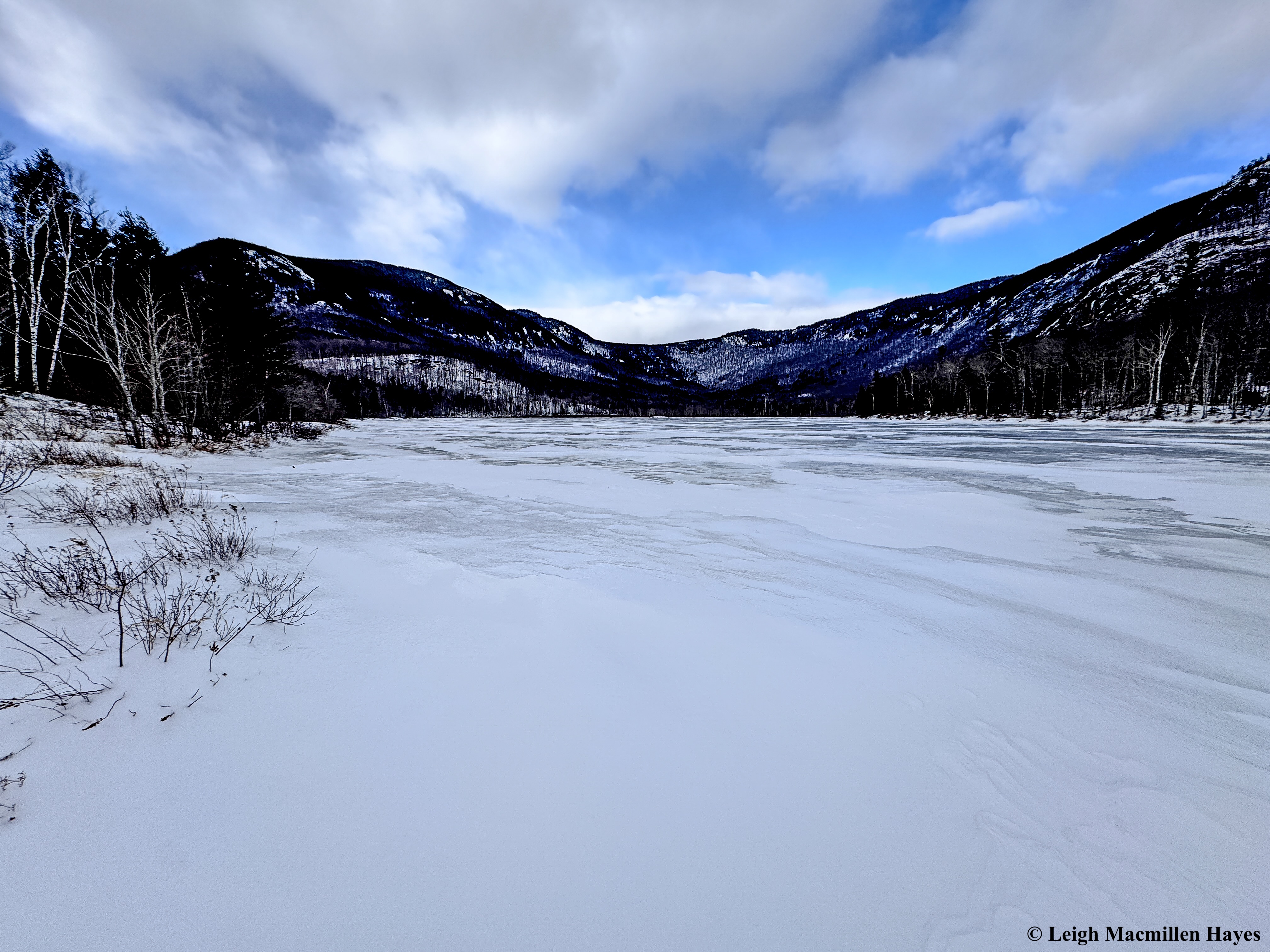
Some lessons have involved the big picture view of the world, no matter how cold the temperature and frigid the wind.
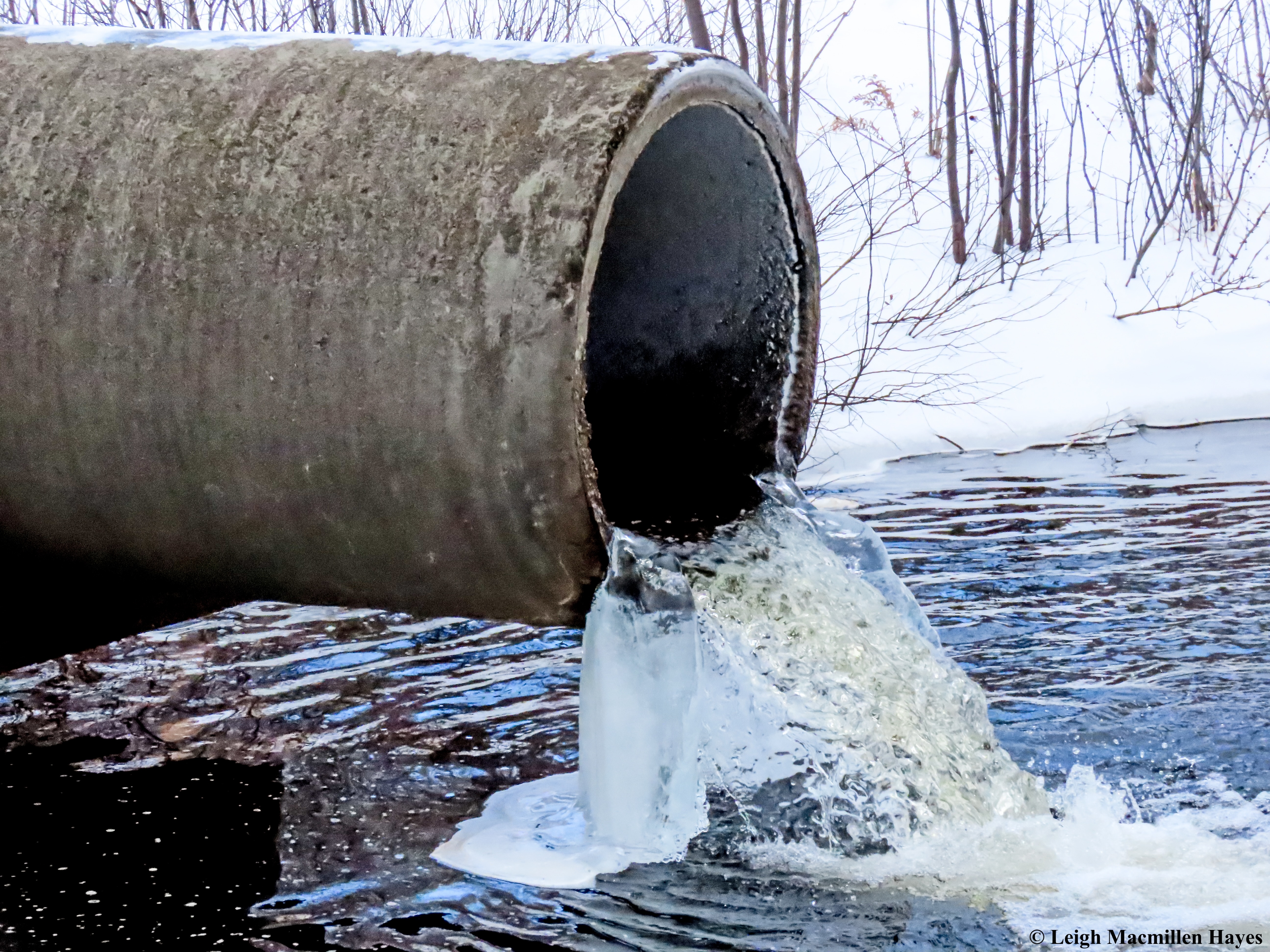
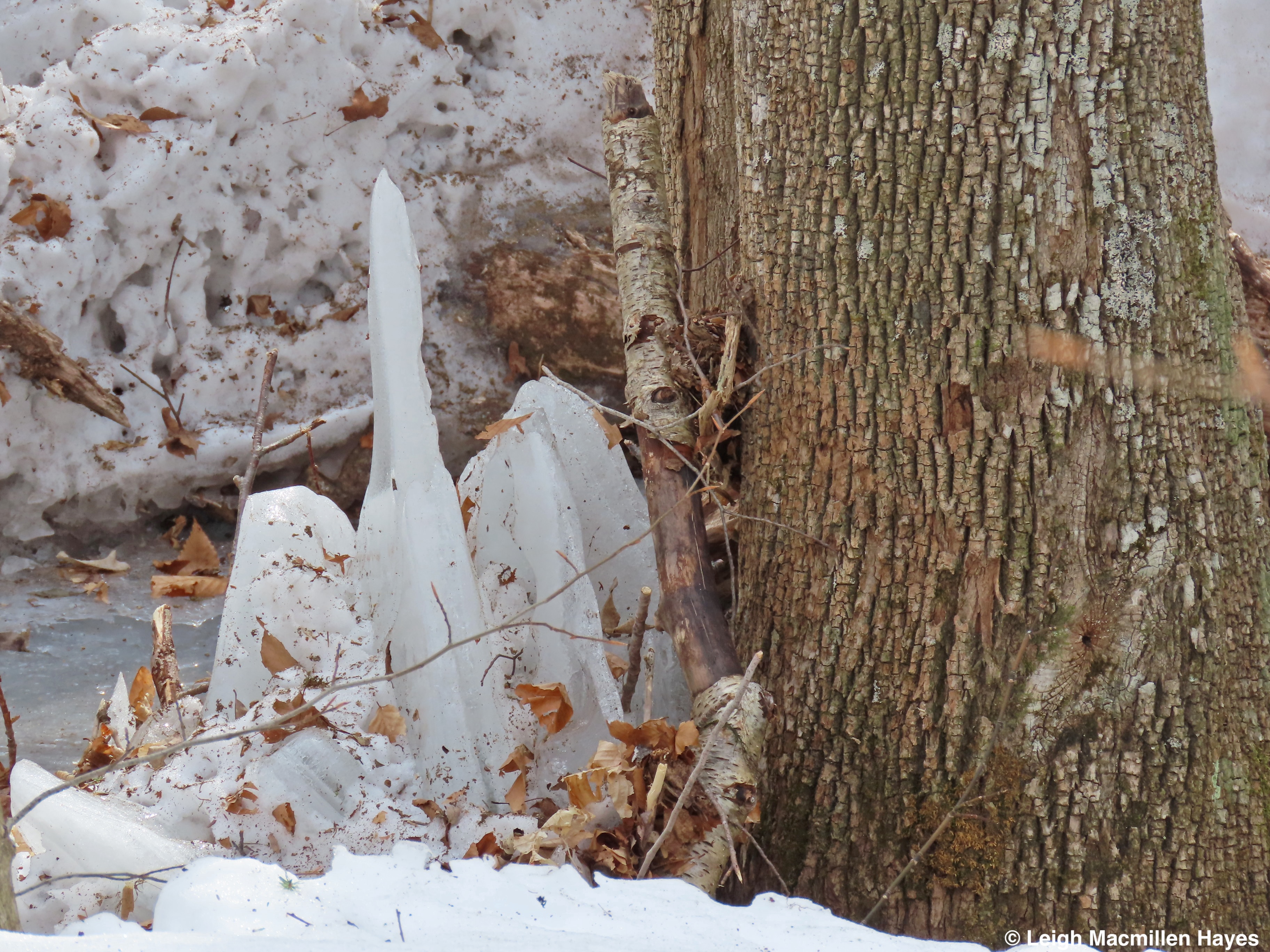
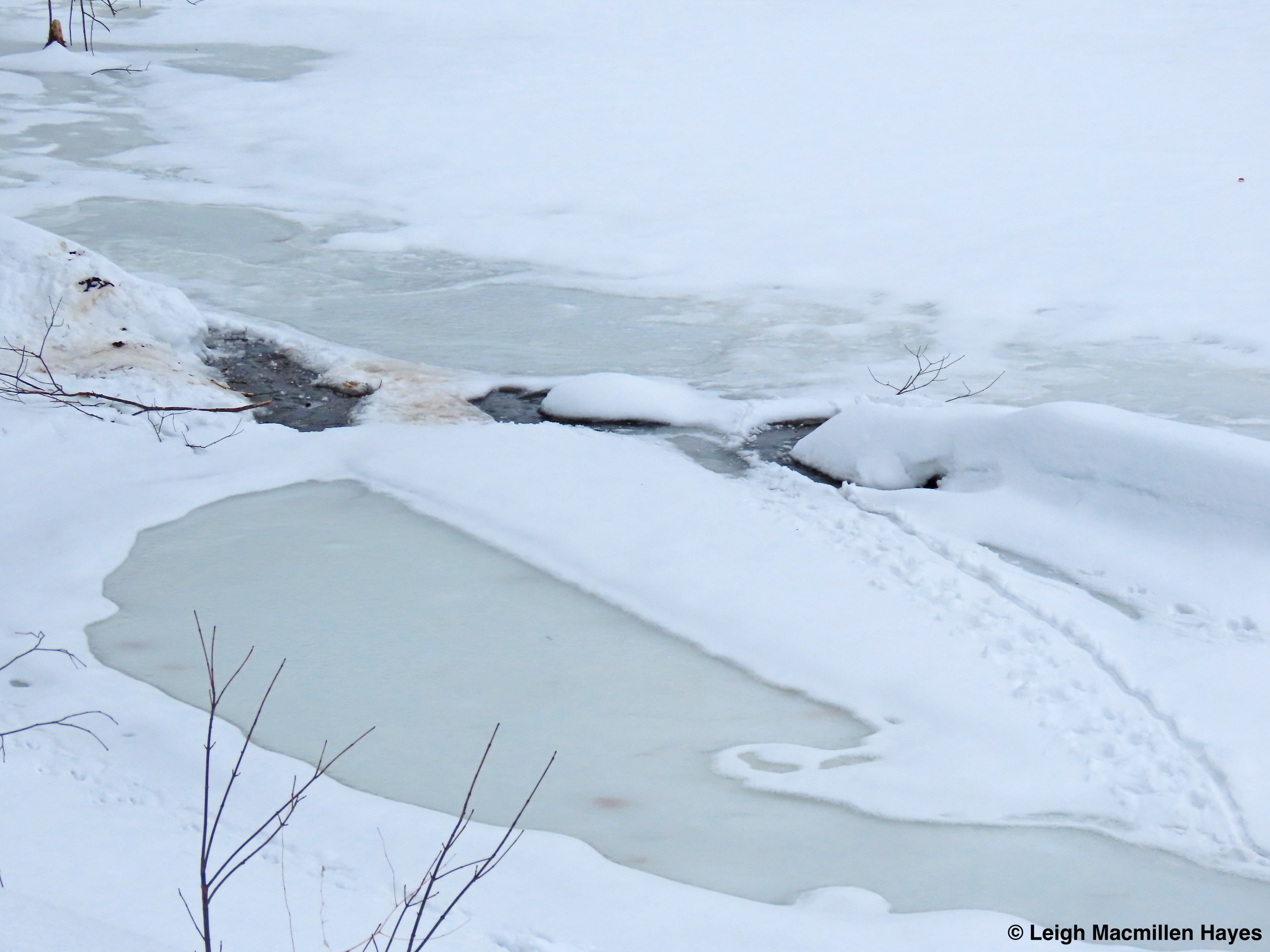
Other lessons have been much subtler, like realizing that ice forms in a perpendicular manner and fans out behind a culvert that spews water at the formation of a river.
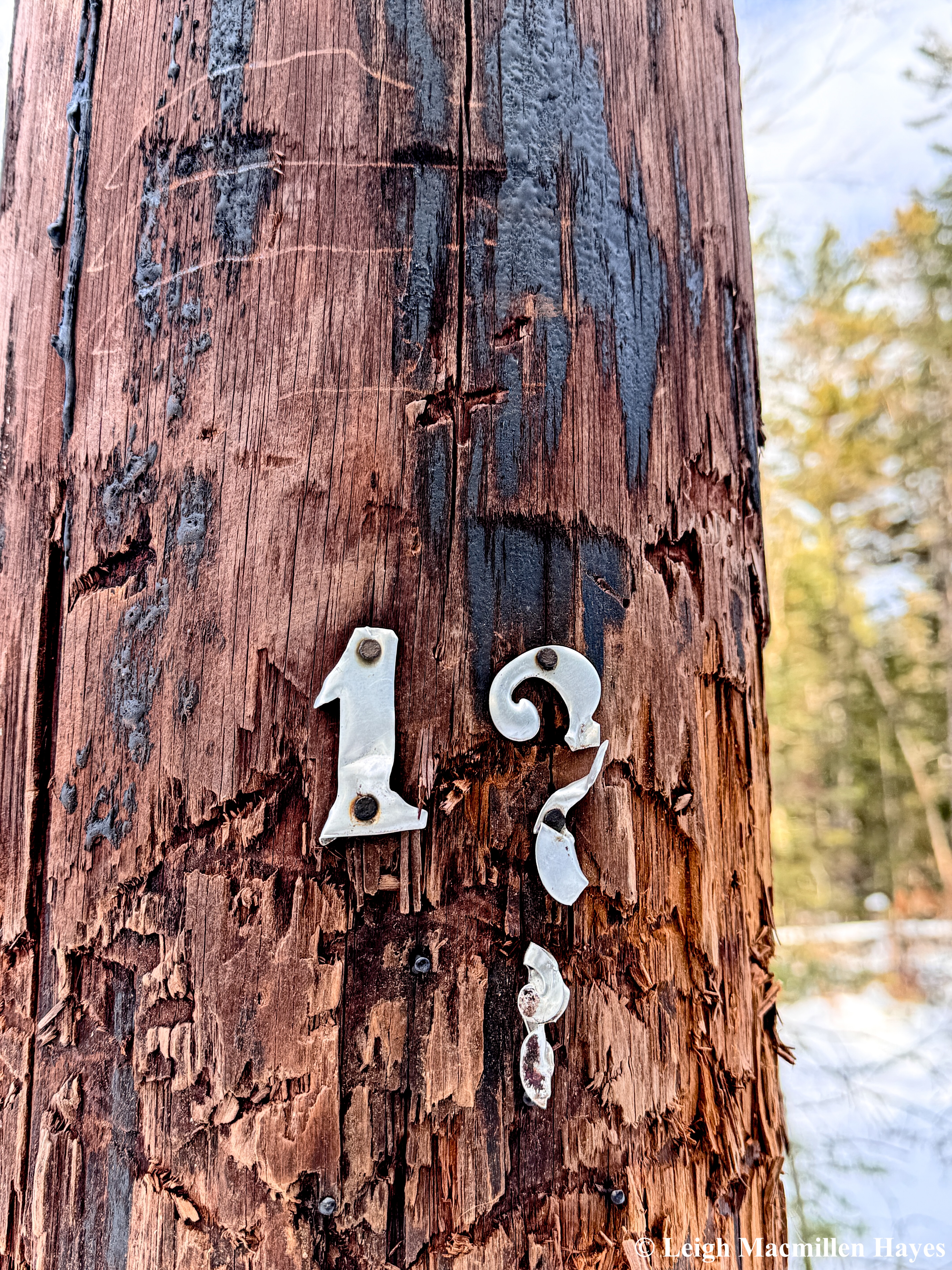
And then there have been reviews of old lessons, where the Black Bears leave no telephone pole untouched. The shiny numbers are invitations encouraging the bears to turn their heads and then pull upper incisors toward lower, mangling both the wood and metal.

And then to leave a signature scratch above this work of art.
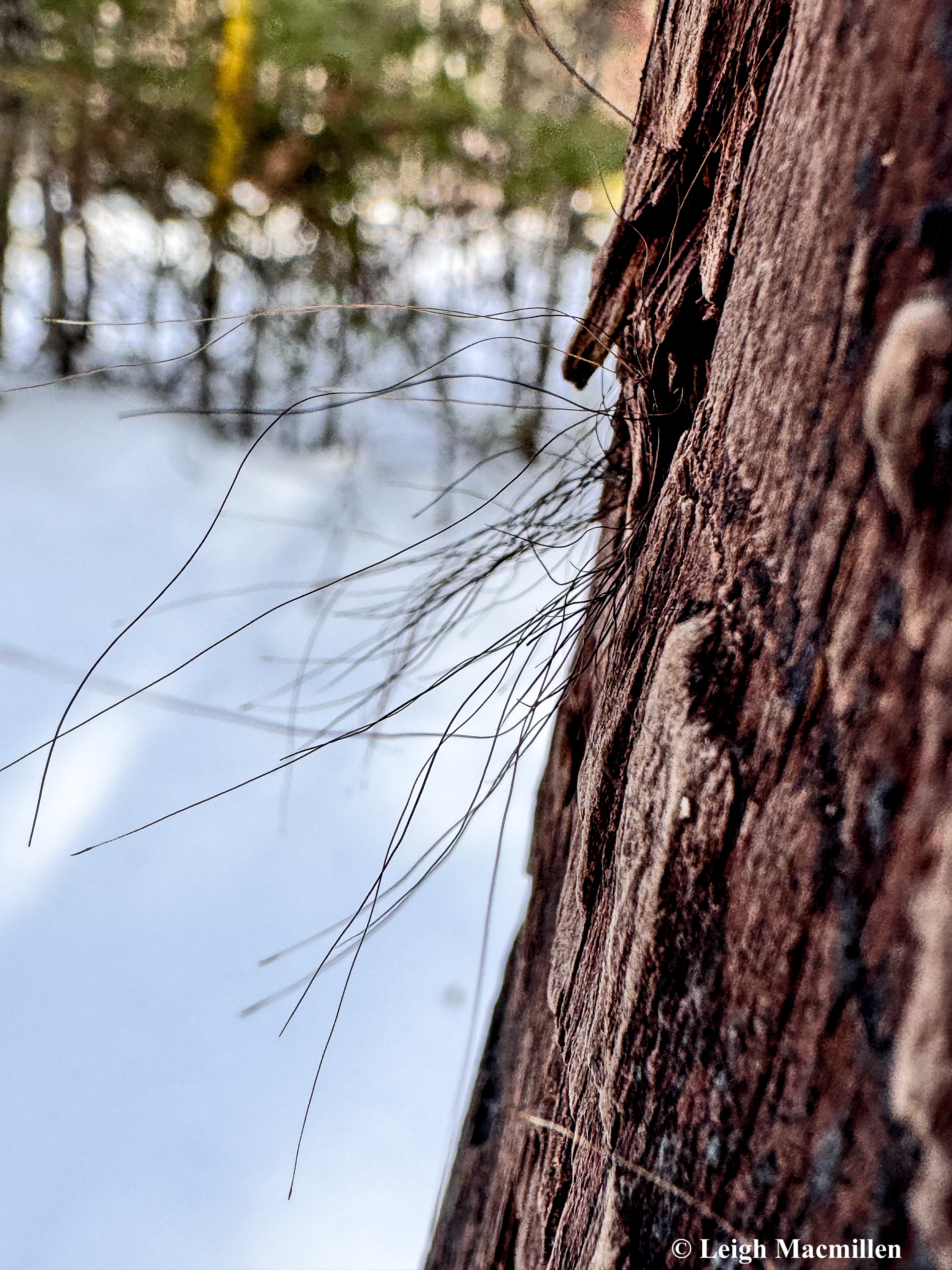
And in the midst of this action, to accidentally deposit a bit of hair on the mangled wood. (Please note that My Guy was surprised that I can still feel such glee looking at the same poles year in and year out, but I reminded him that each year I find changes, including hair on different poles and this year the scratch marks on several that I don’t recall seeing in the past or simply failed to notice. What’s not to love? )
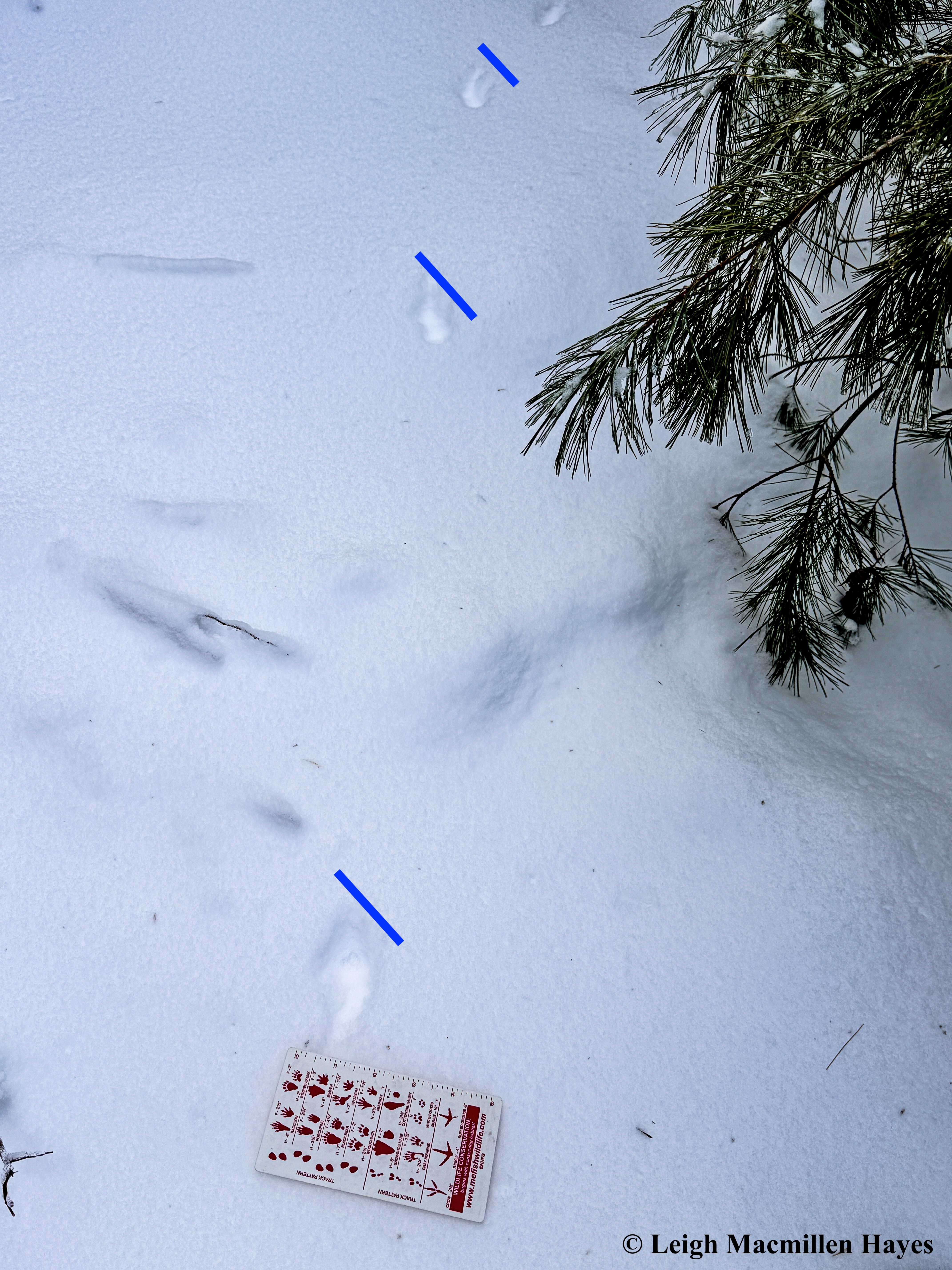
There are other old lessons that are also worthy of review–especially as once the snow flies I begin to see them written everywhere I look.

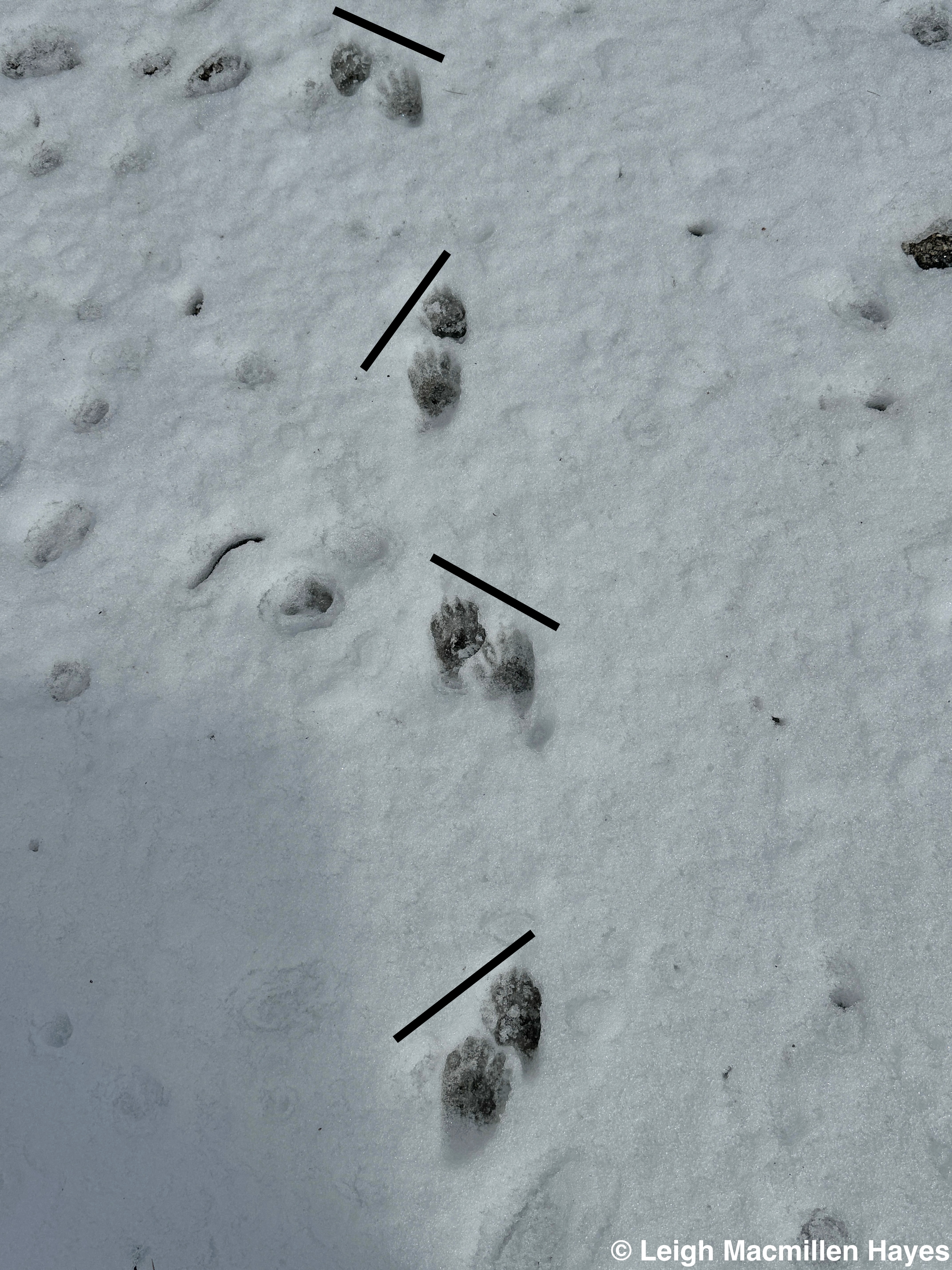
This one is the track of the Ermine or Short-tailed Weasel. I love how each set of prints represents four feet, the front two landing and then as this bounder’s hind feet begin to fall into place, the front feet lift off toward the next spot. One of the biggest give-aways to the creator is the diagonal orientation of each set of prints. Sometimes the diagonal changes, but it’s almost always present.
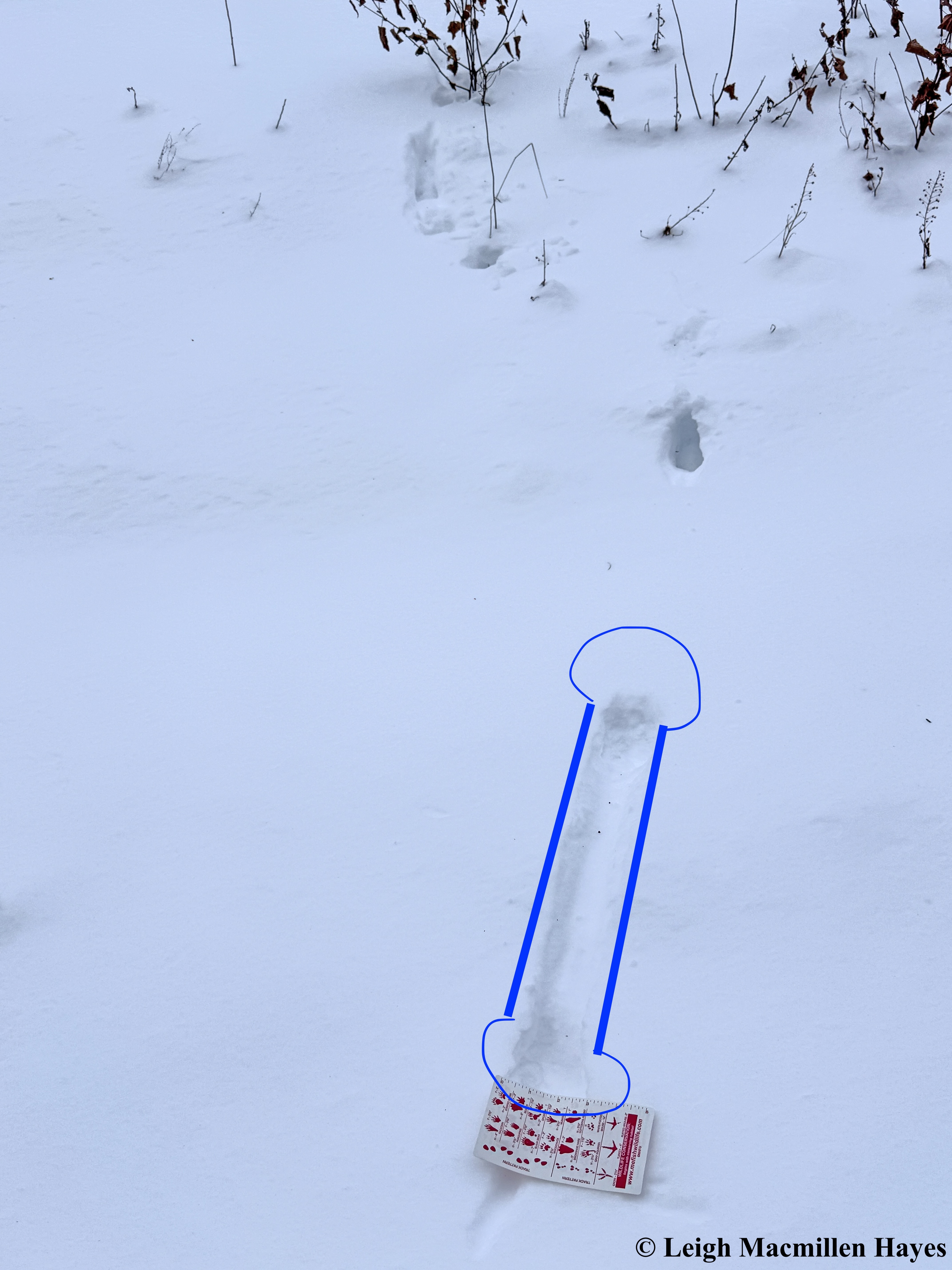
And just sometimes the same weasel decides to take it easy between sets of prints and goes for a quick slide, creating what is known to some as a Dog Bone and to others as a Dumbbell. I think it’s easy to see both once you know you recognize the behavior, but I can’t tell you how many years it took me to actually see this.

And then, along a wetland shoreline, another member of the weasel family reminded me that occasionally they like to slide much like a River Otter, but this being was a Mink!
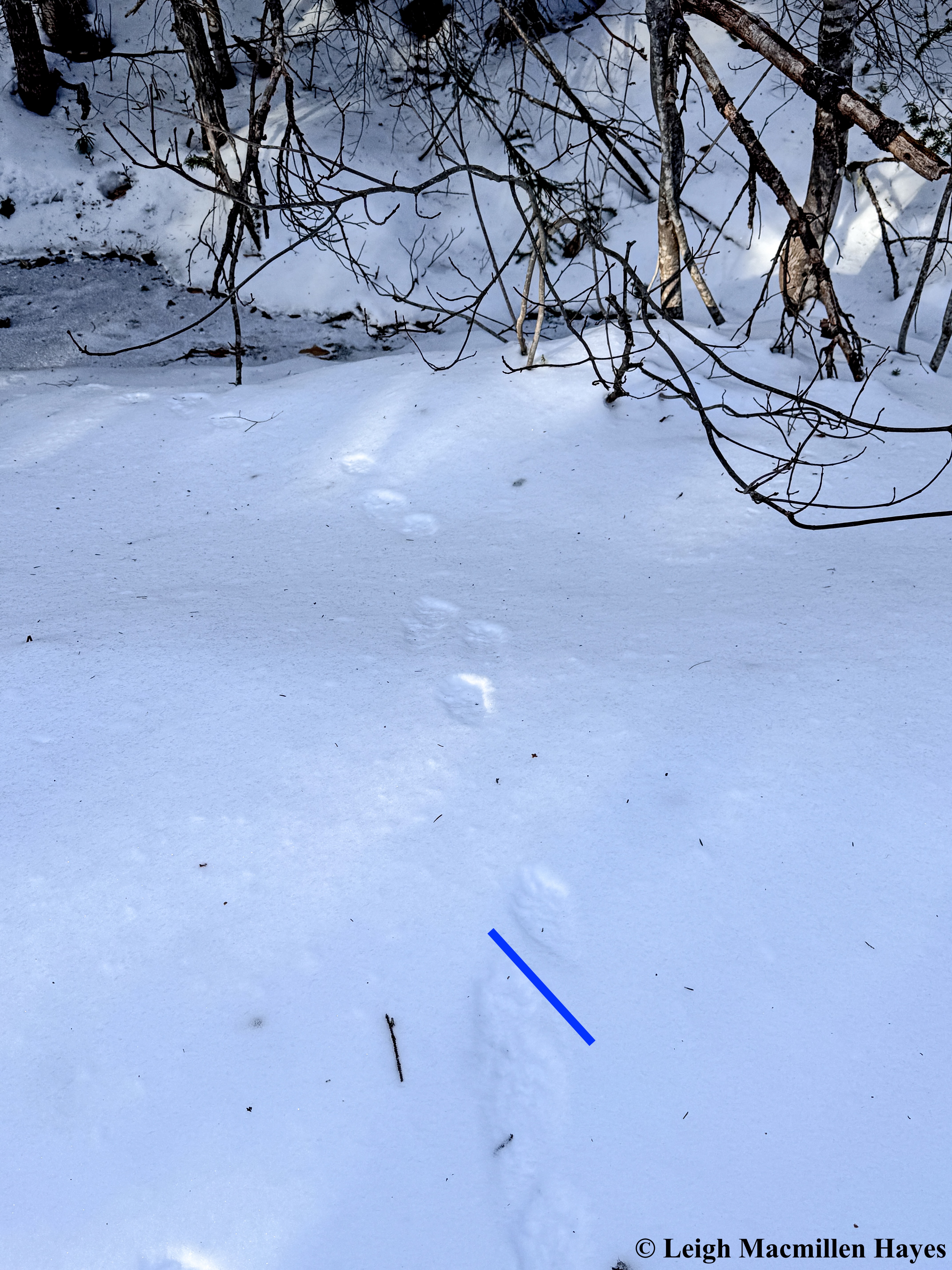
And not to be left out of the scene, a Fisher (not a Fisher Cat–ah, but the hairs go up on the nape of my neck). The diagonal is there and though this was a quick shot and not all the details are visible, all Mustelids (weasels) have five toes and all are bounders.
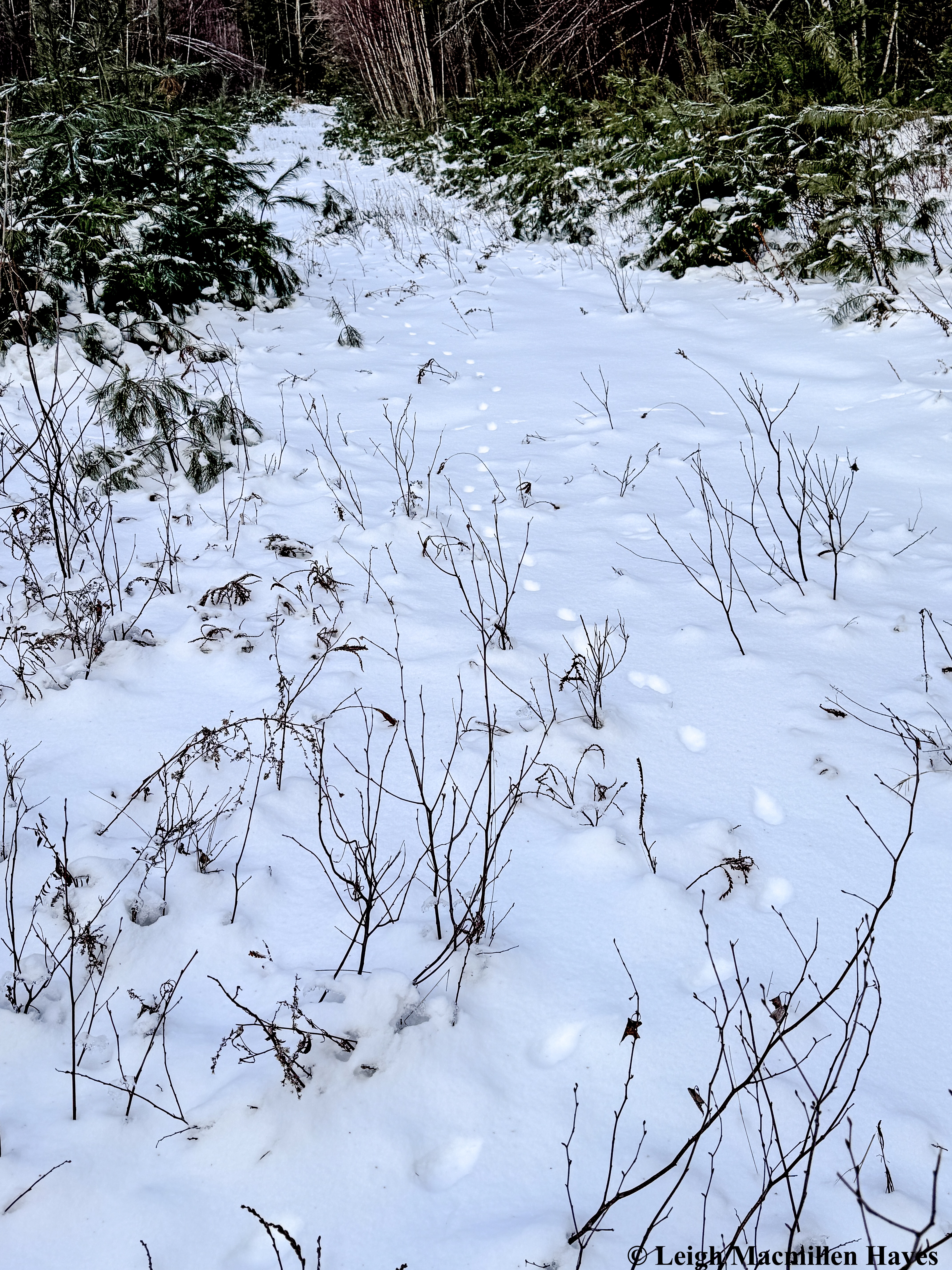
Red Foxes also write lessons in the snow and I followed this one for quite a ways, finding a spot where it pounced, though I’m not sure it caught the intended meal because there was no evidence of a struggle.

While its overall trail was the zigzag of an animal that double packs a spot because the hind foot typically steps where the front foot had already been, sometimes the trail zags more than it zigs and I imagine he was looking for another food source.
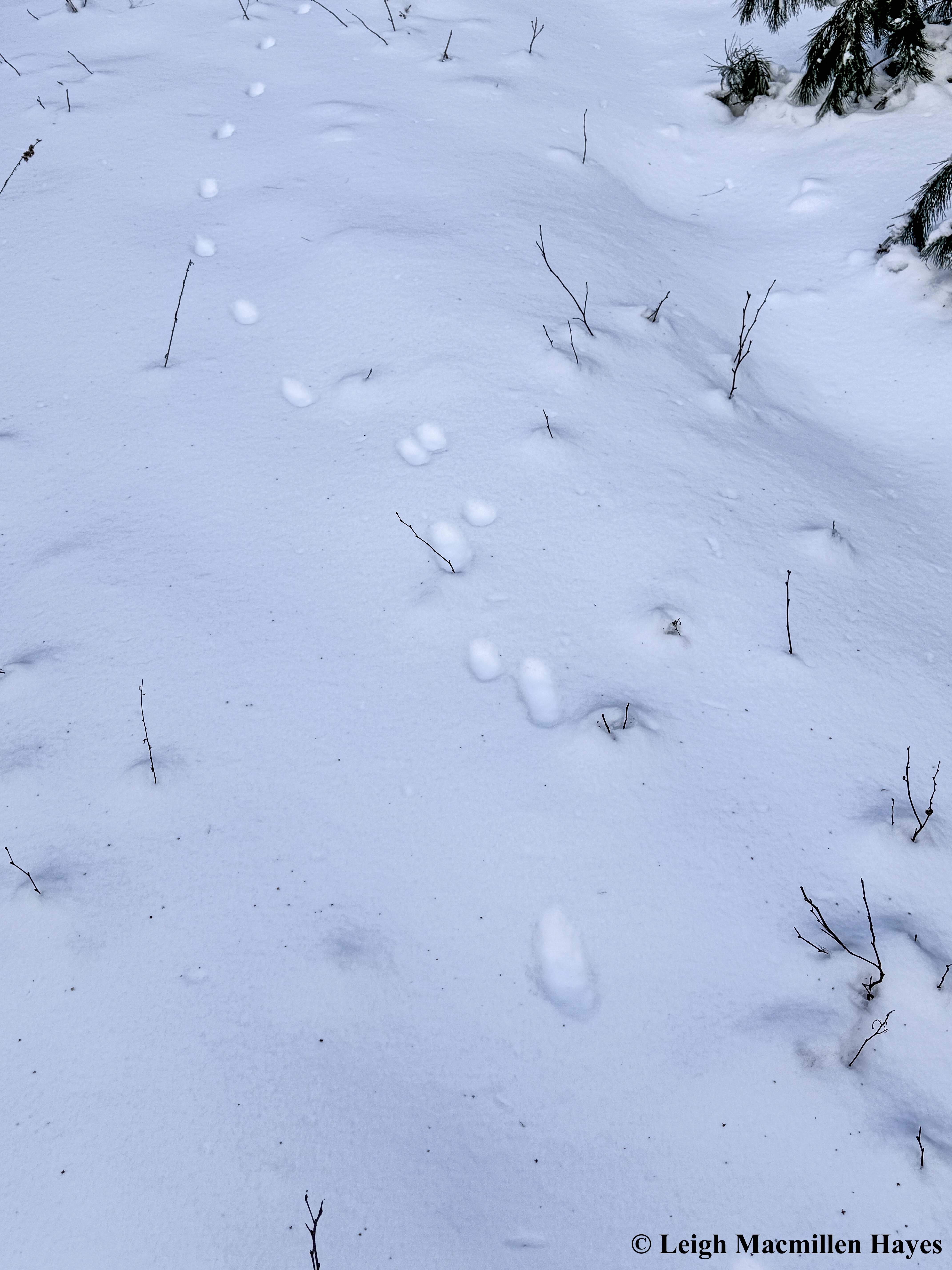
Occasionally he changed his pace and I had to wonder why–did he smell or hear something that I couldn’t discern?
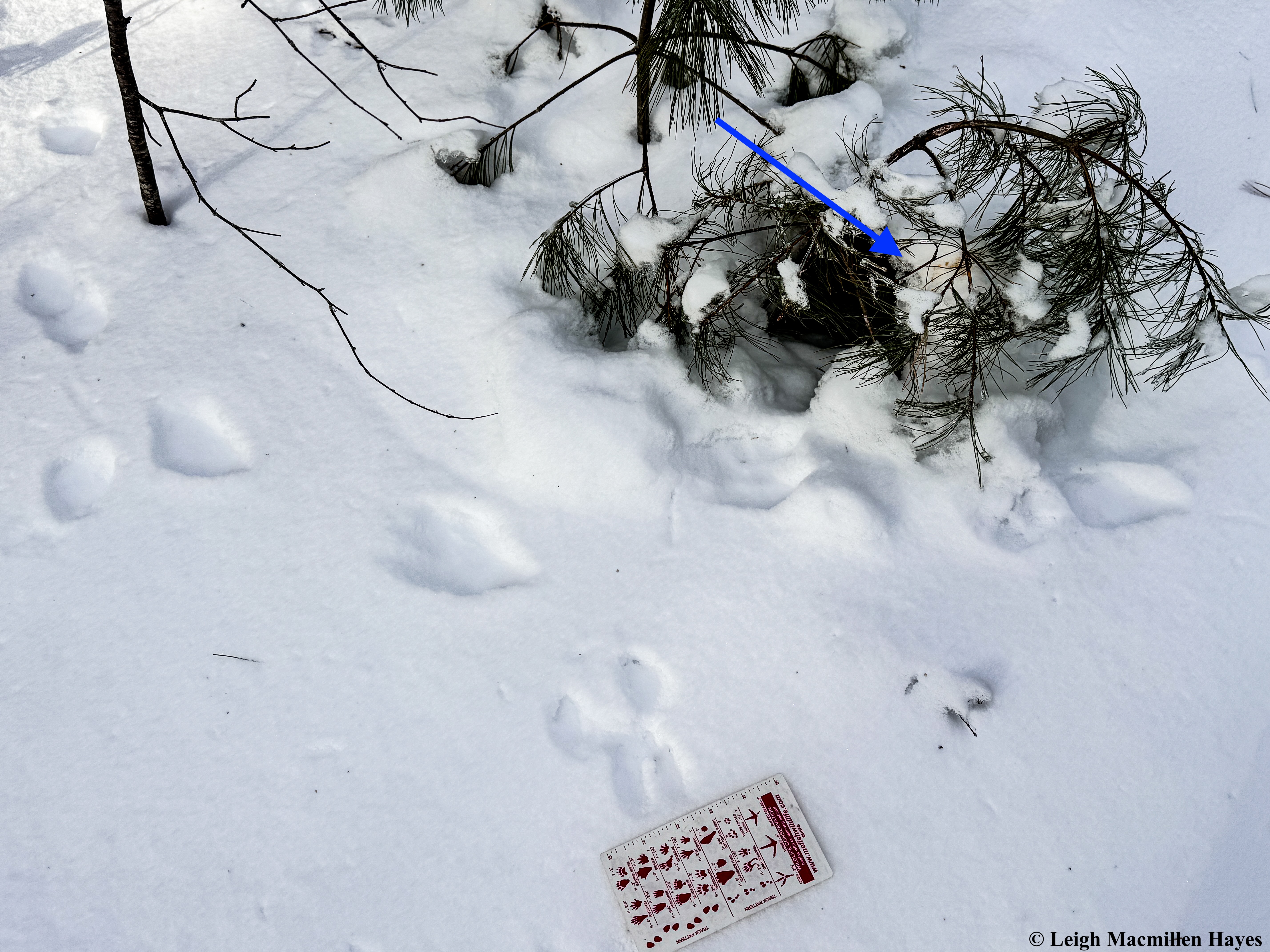
One thing I could easily discern–his territory marking. Fox urine! On a sapling. Skunk-like in odor. All classic during mating season, which we are in. Mind you, I learned this summer that Red Fox urine always smells skunky, but it’s even more so in the winter.

And I’m here to report that the Red Squirrel that crossed his path lived. For the moment anyway.
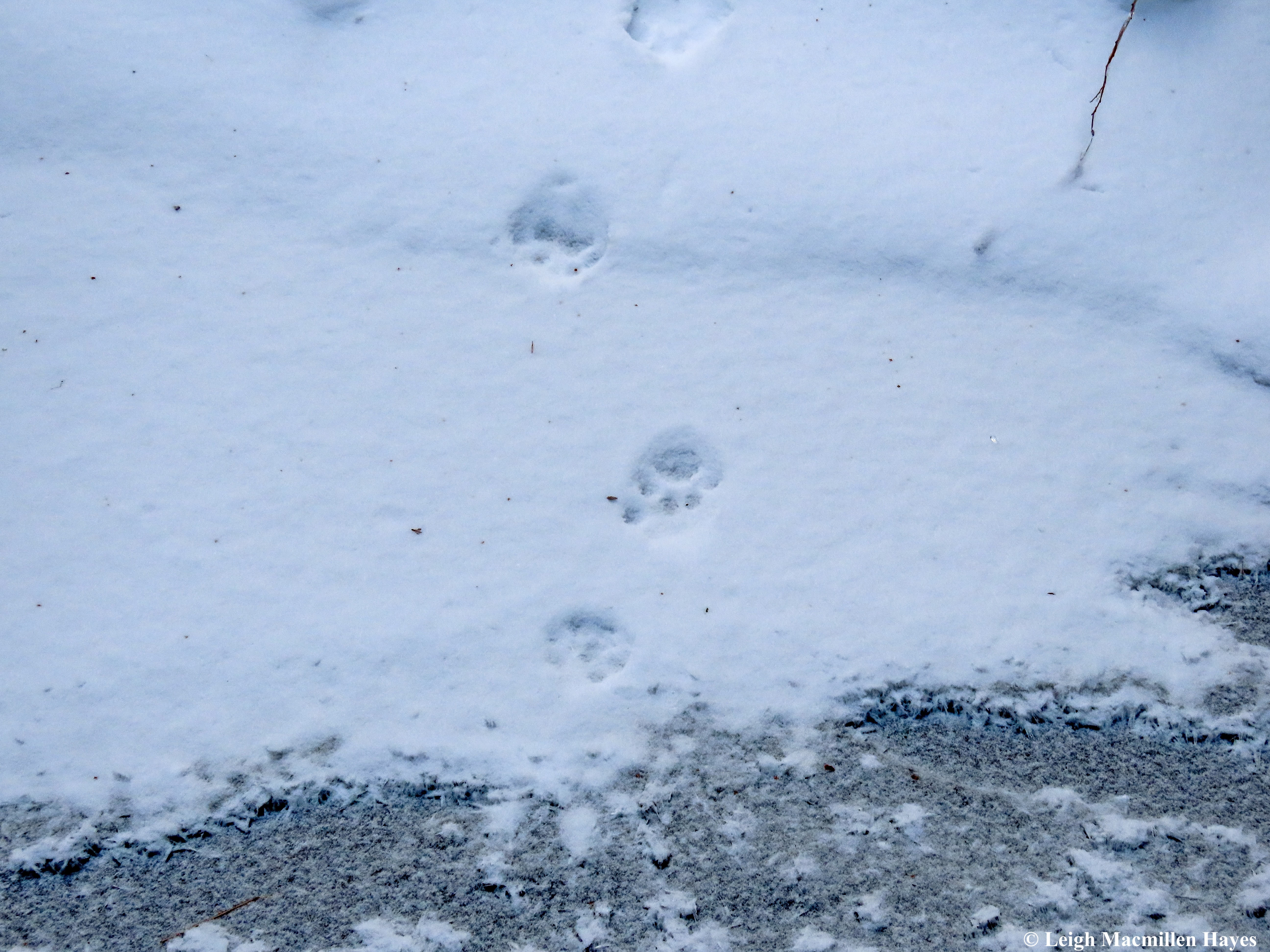
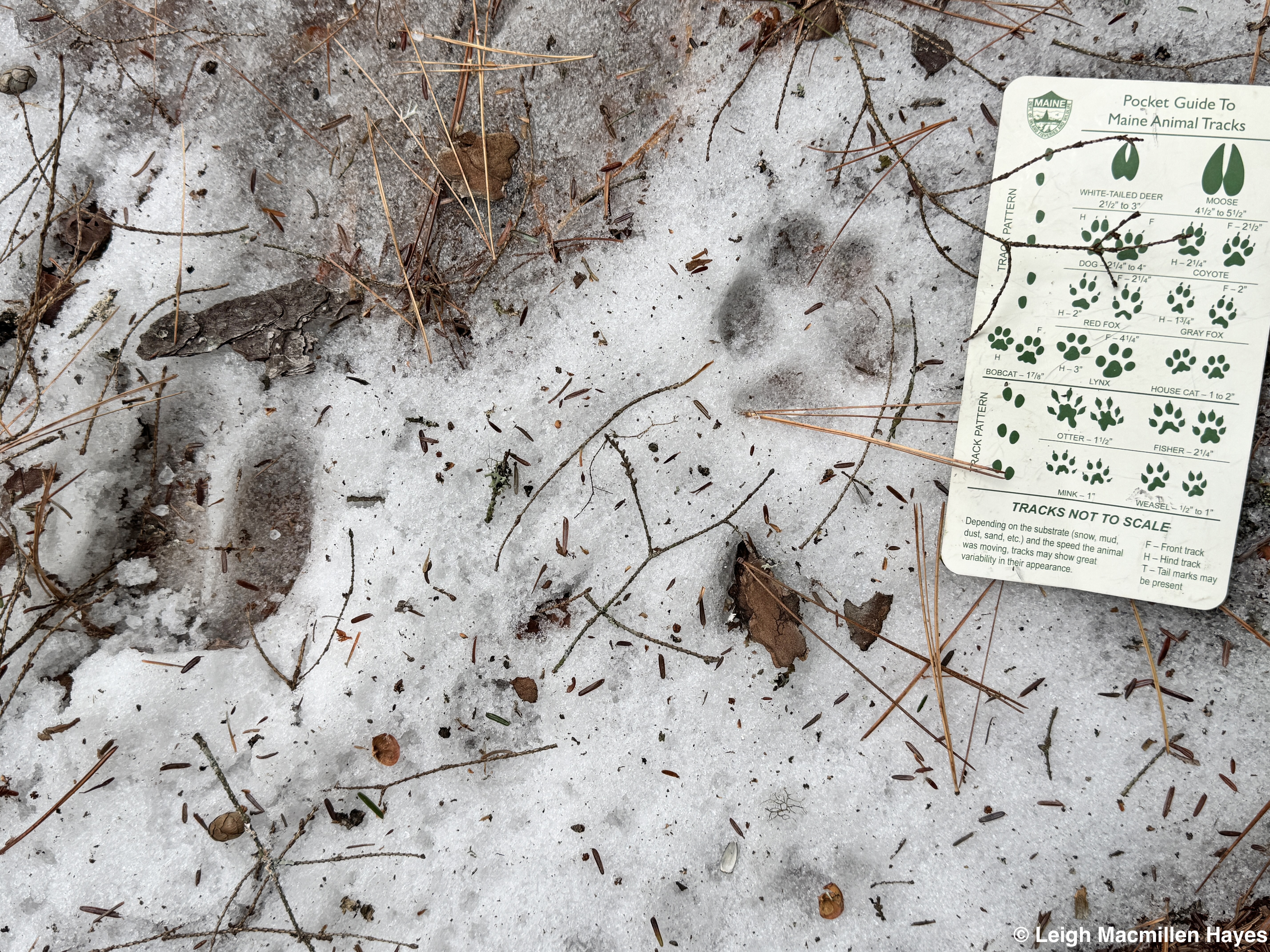
The final lesson of old, though hardly the final lesson, was the realization that some rather large prints were actually signals of two-way traffic. Do you see the upside down C in middle print? This is the neighborhood Bobcat crossing an ice bridge. But . . . which way is he walking?

Turns out in both directions. East and West. Packing the snow in one direction with both front and back feet and then following the same exact trail back. I remember the first time I saw this sort of behavior when I was looking for evidence of a Bobcat and a Coyote in a local watershed prior to offering a summer presentation to a lake association. It was about thirteen years ago and I think of it every time we hike the same trail at Five Kezar Ponds Reserve in Stoneham. First I knew I was following the Coyote and then I realized that a Bobcat had walked in the opposite direction on the Coyote’s prints. The same thing happened at Dan Charles Pond Reserve in Stow a few years ago. You can read about it in The Tail of Two Days.

Look carefully at the photo above. Do you see it? The better to reserve energy.
While I love reviewing old lessons because there’s always something new to observe or a better understanding of the animals behavior is gained, new lessons are even more exciting.

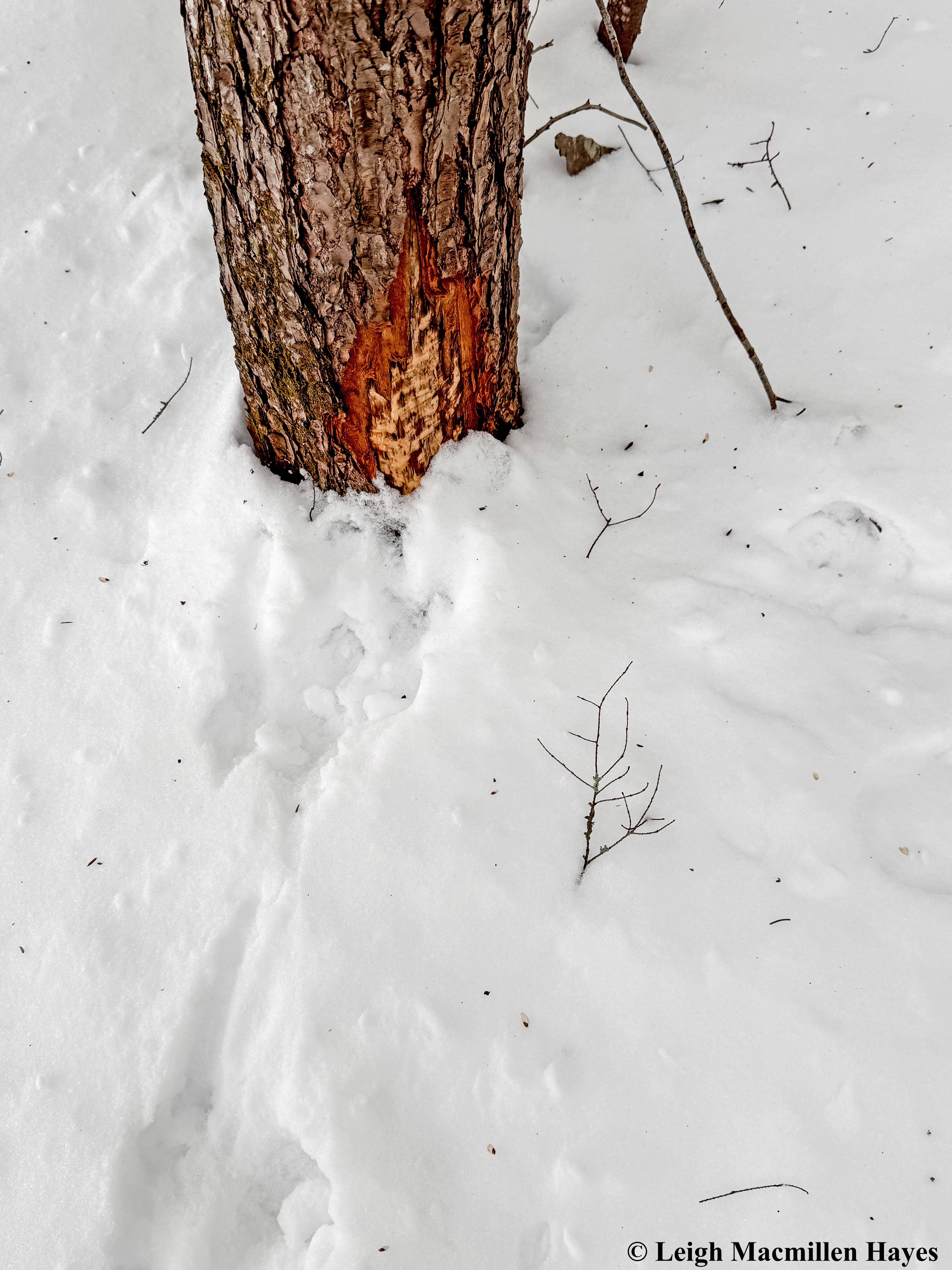
And tada, this is one. A Red Squirrel’s territorial mark.
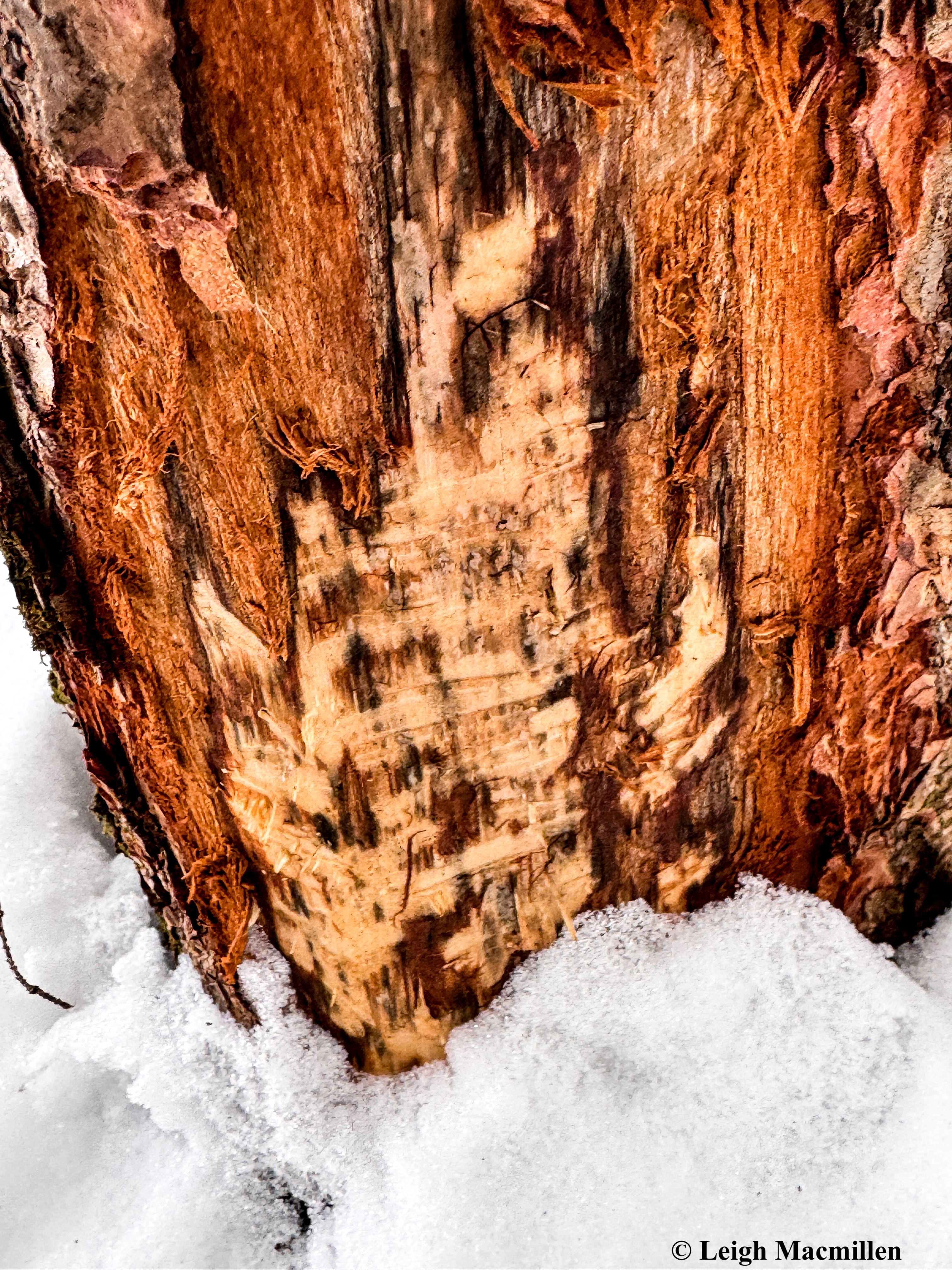
The bark is nibbled and striped and a scent post is left behind letting others know who inhabits this particular area. This is the first I’ve found, but now that I’ve seen it, I can’t wait to locate more.
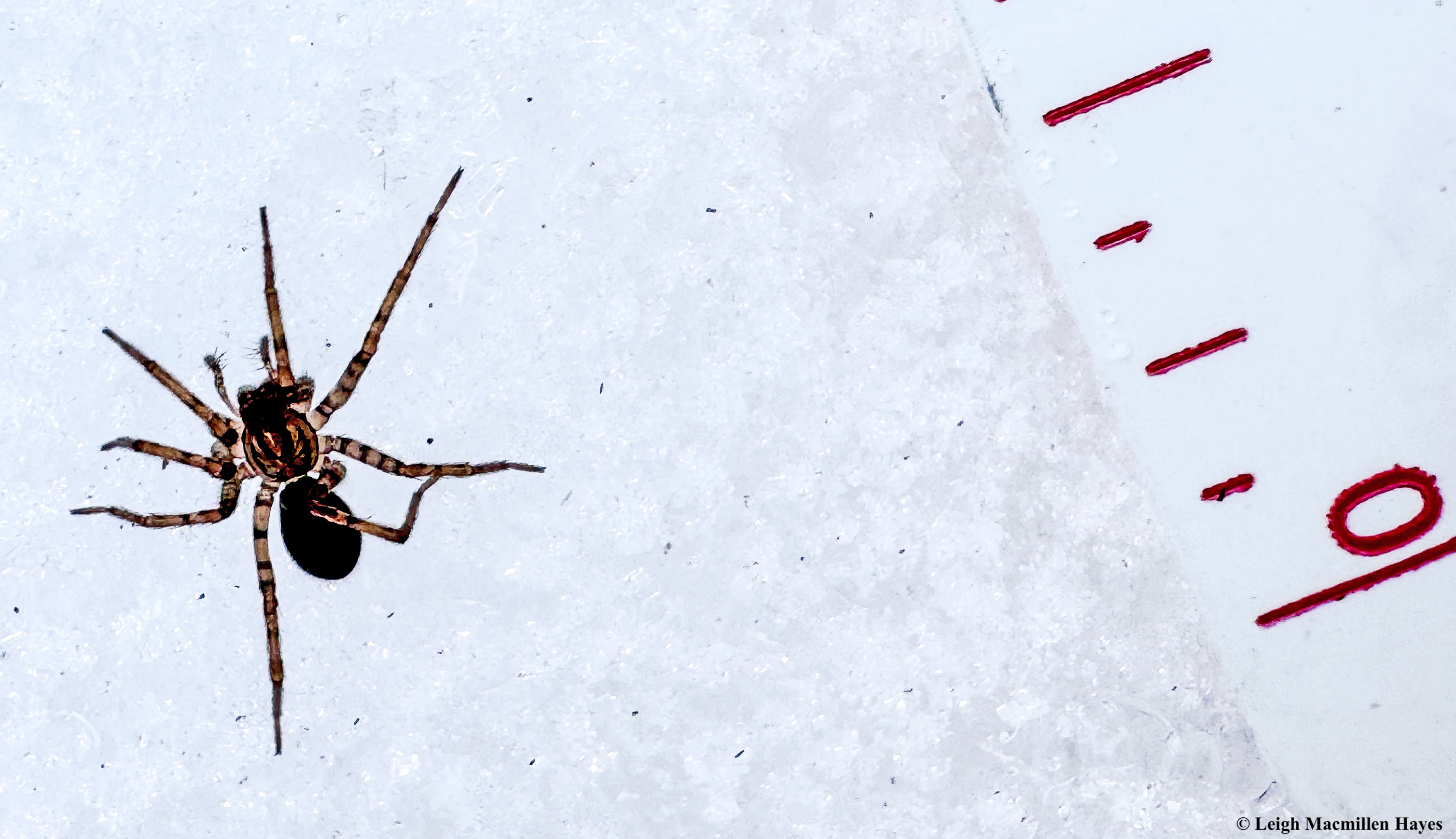
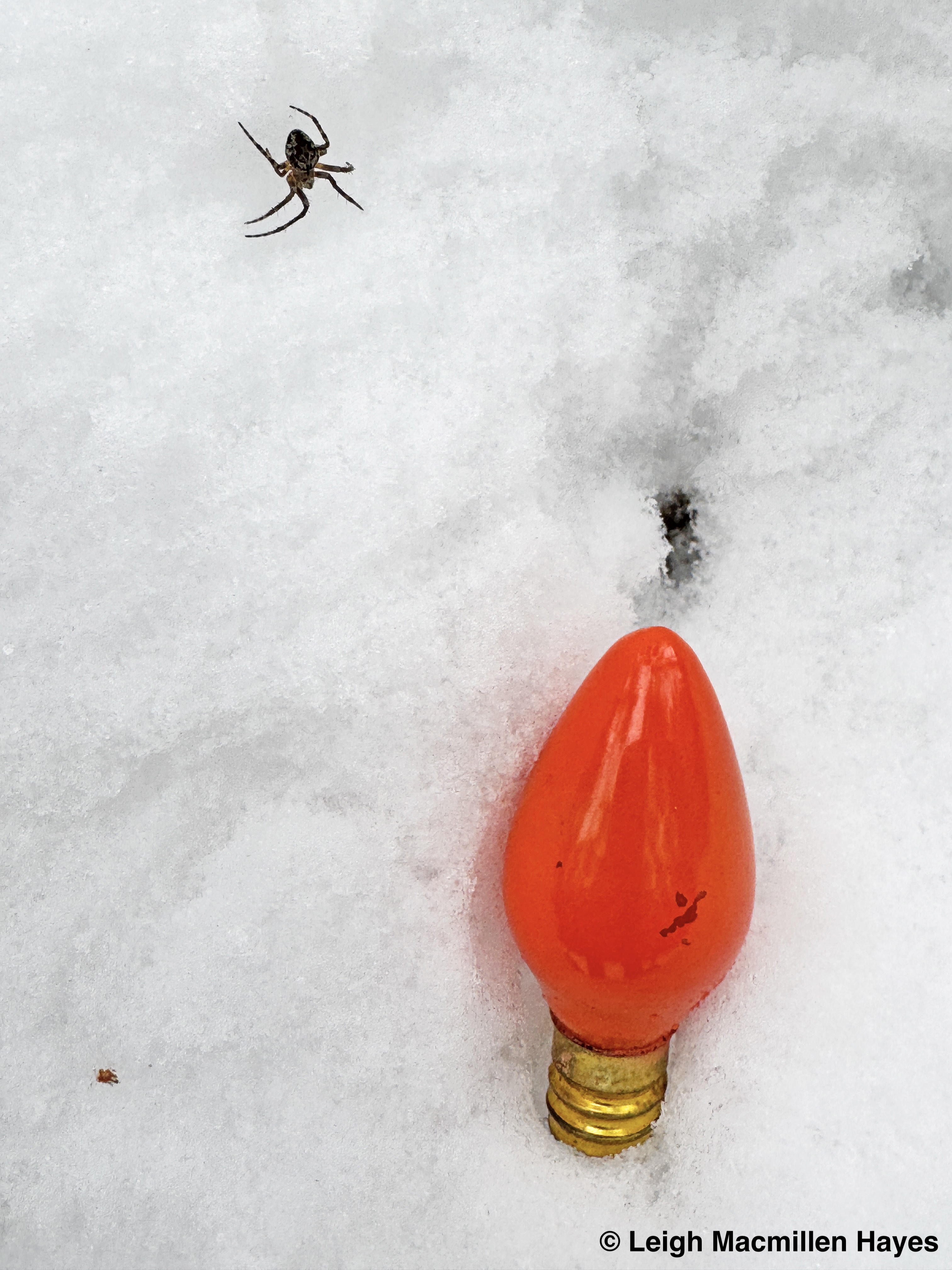
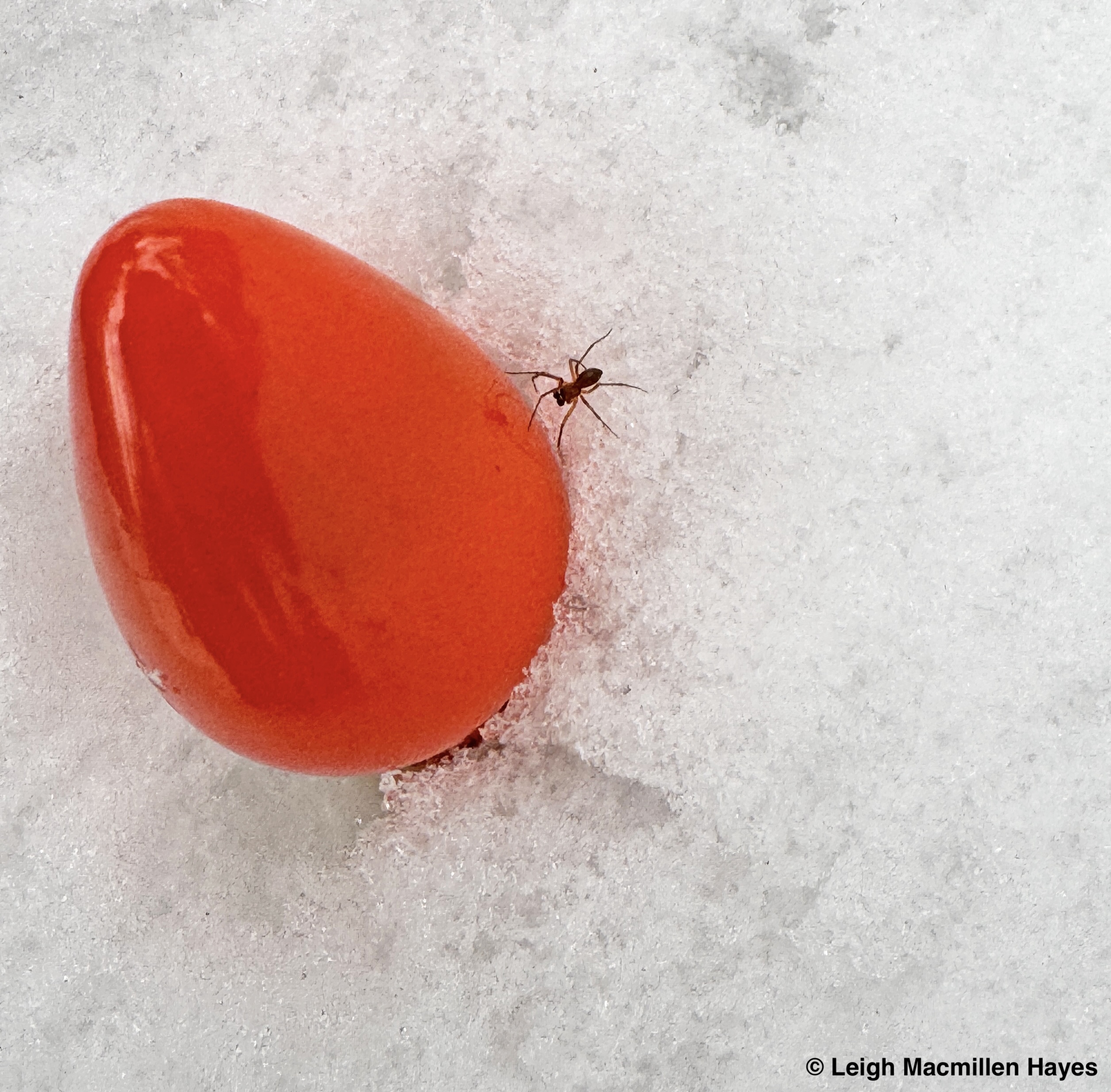
Another new lesson–discovering a Funnel Weaver Spider walking on the snow. Oh, I know that some spiders have Gylcerol that allows them to do this and I’ve seen sooo many, but a Funnel Weaver? Was it a bad decision? I’ll never know. So far, though, this is the only Funnel Weaver I’ve encountered this winter.
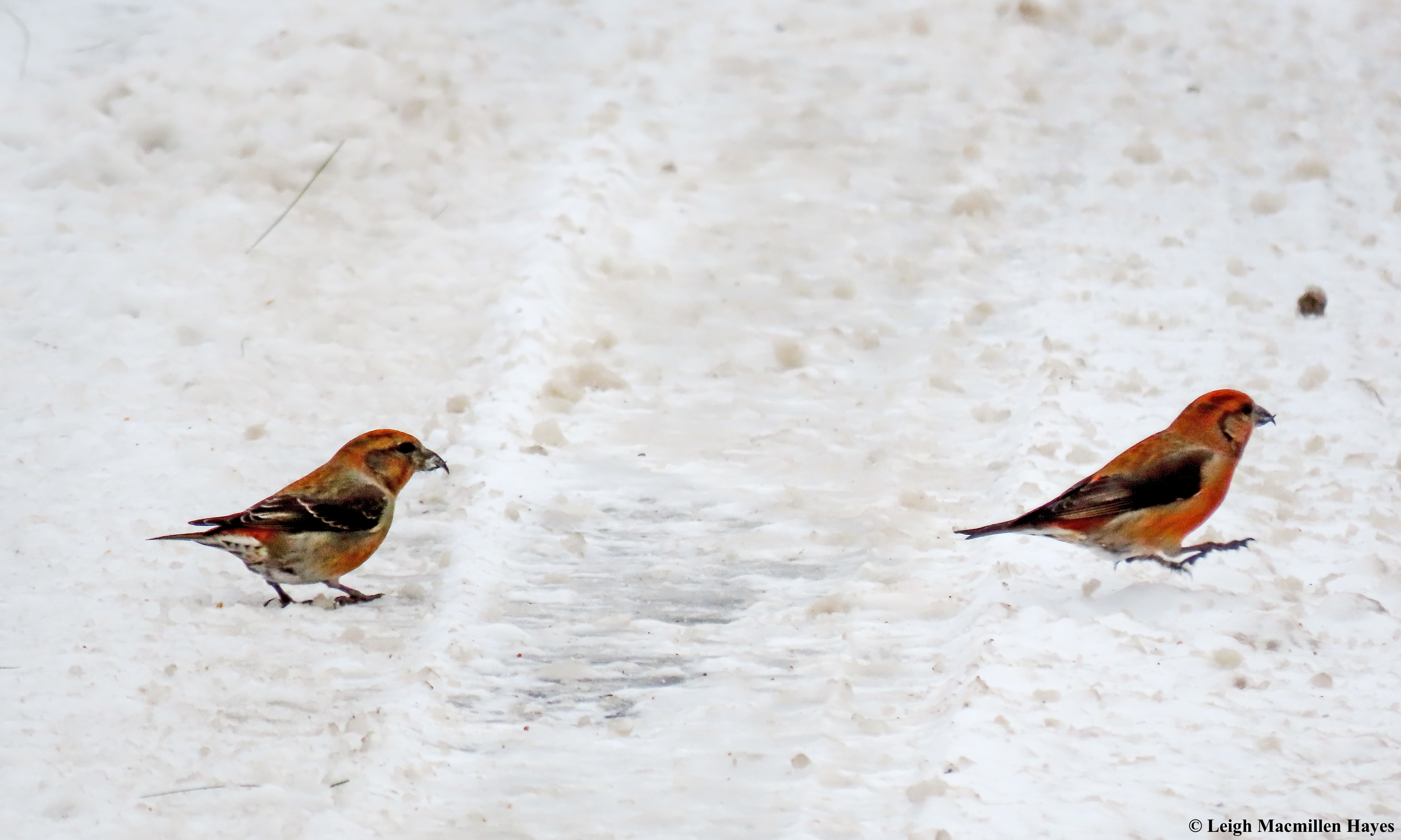
And then there have been sweet treats–not really lessons, though at some level everything is a lesson. But three times this past week I’ve spotted Red Crossbills–twice while participating in Maine Audubon’s Christmas Bird Count and once beside a local road where they’ve overwintered for years.
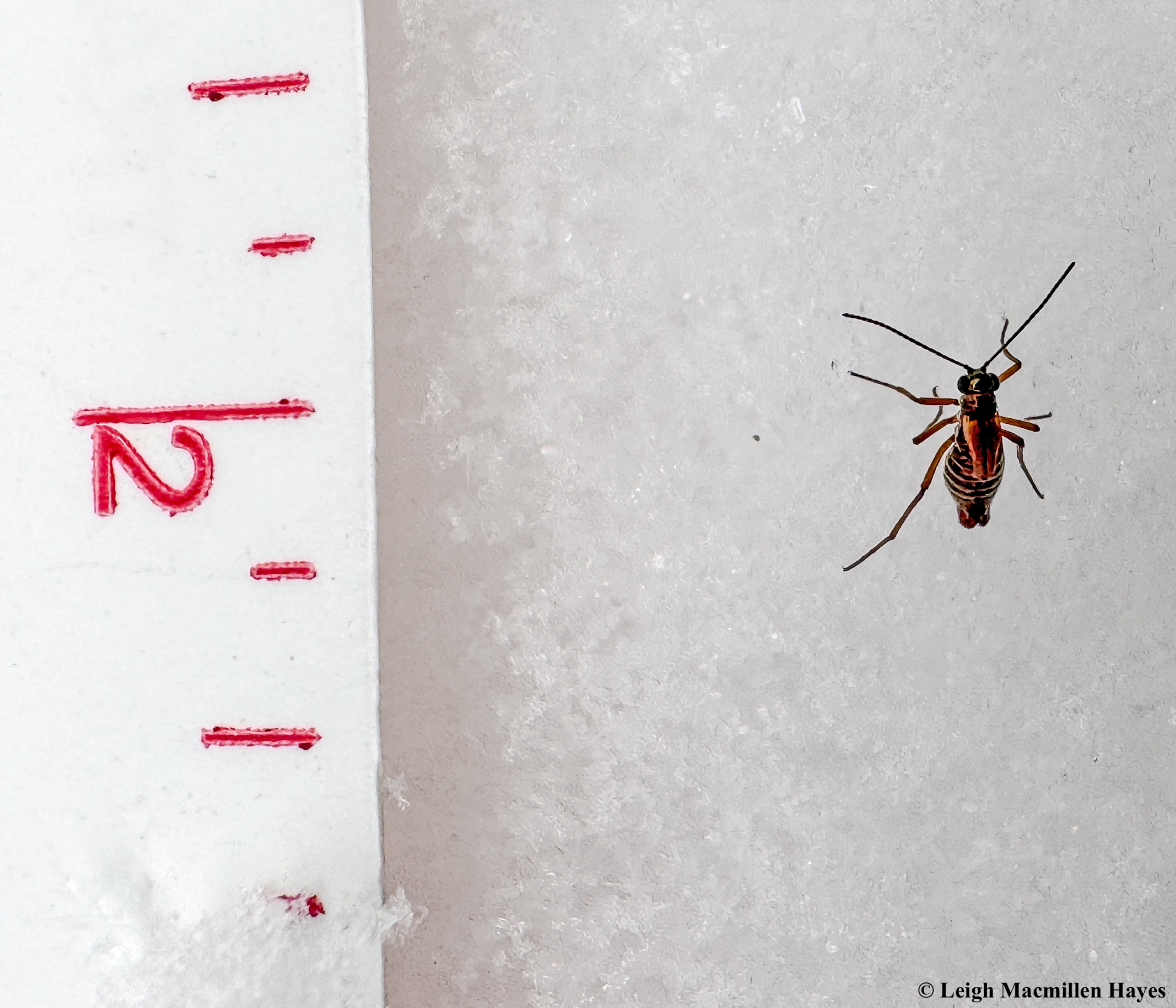
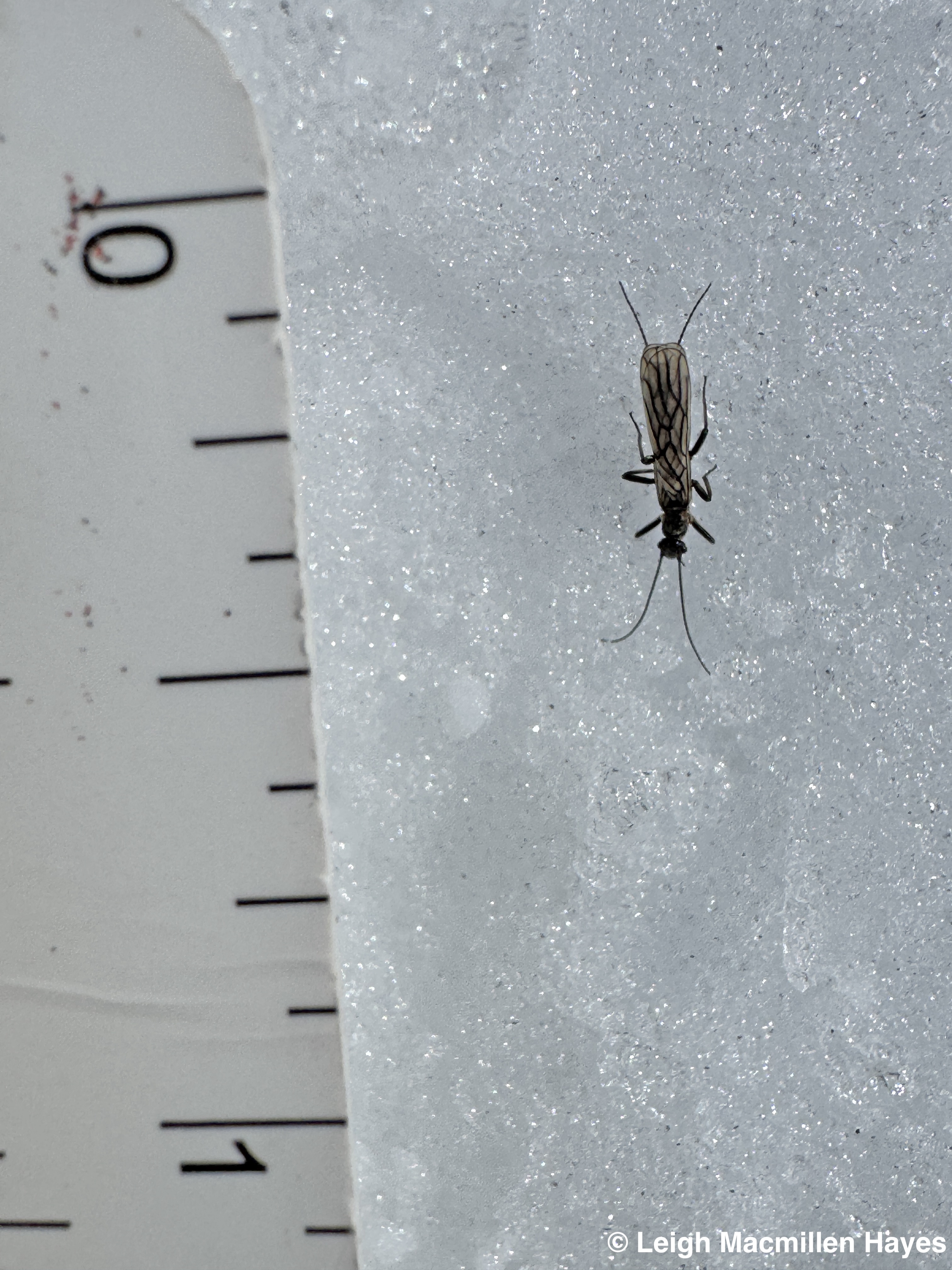
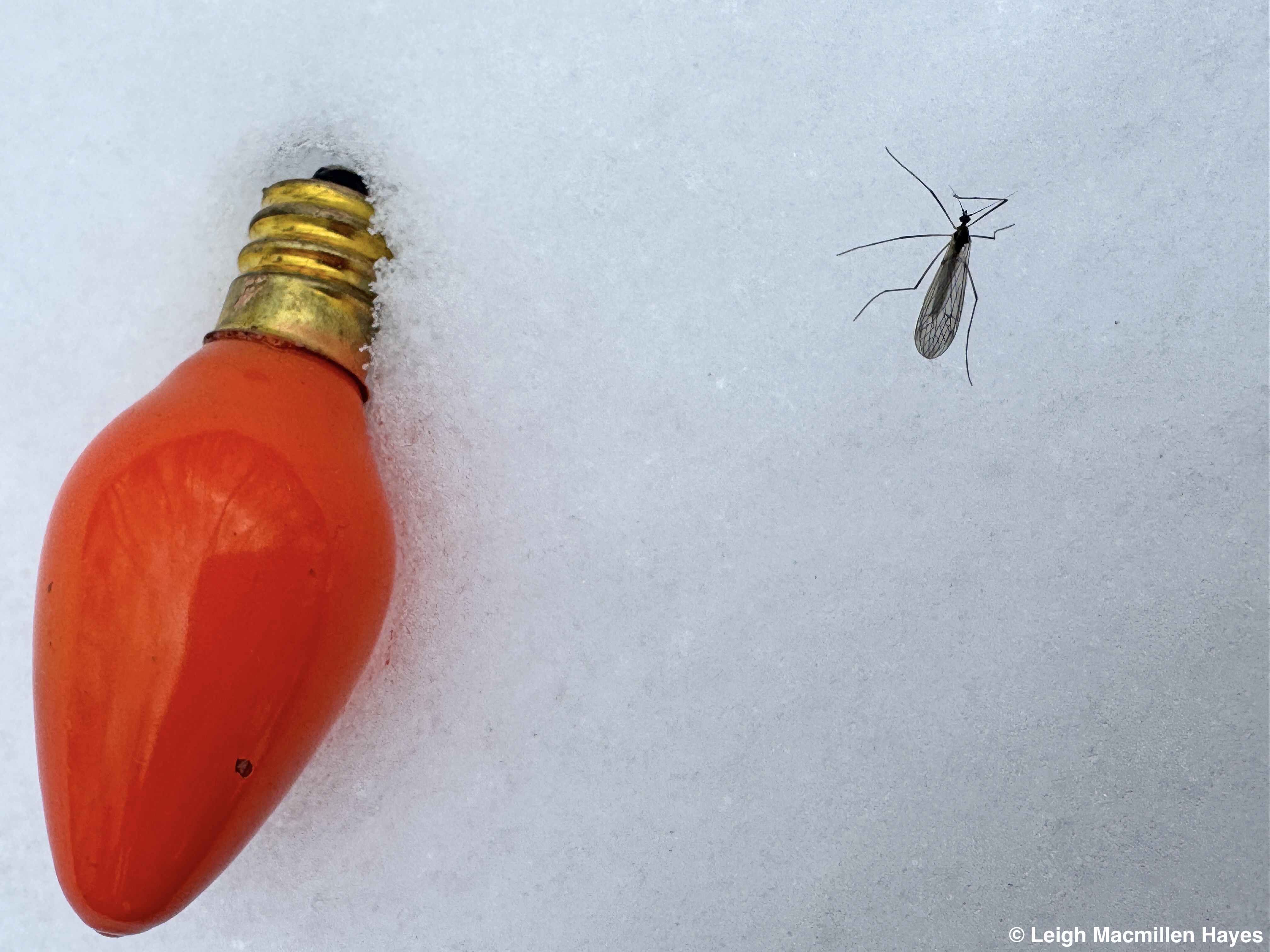
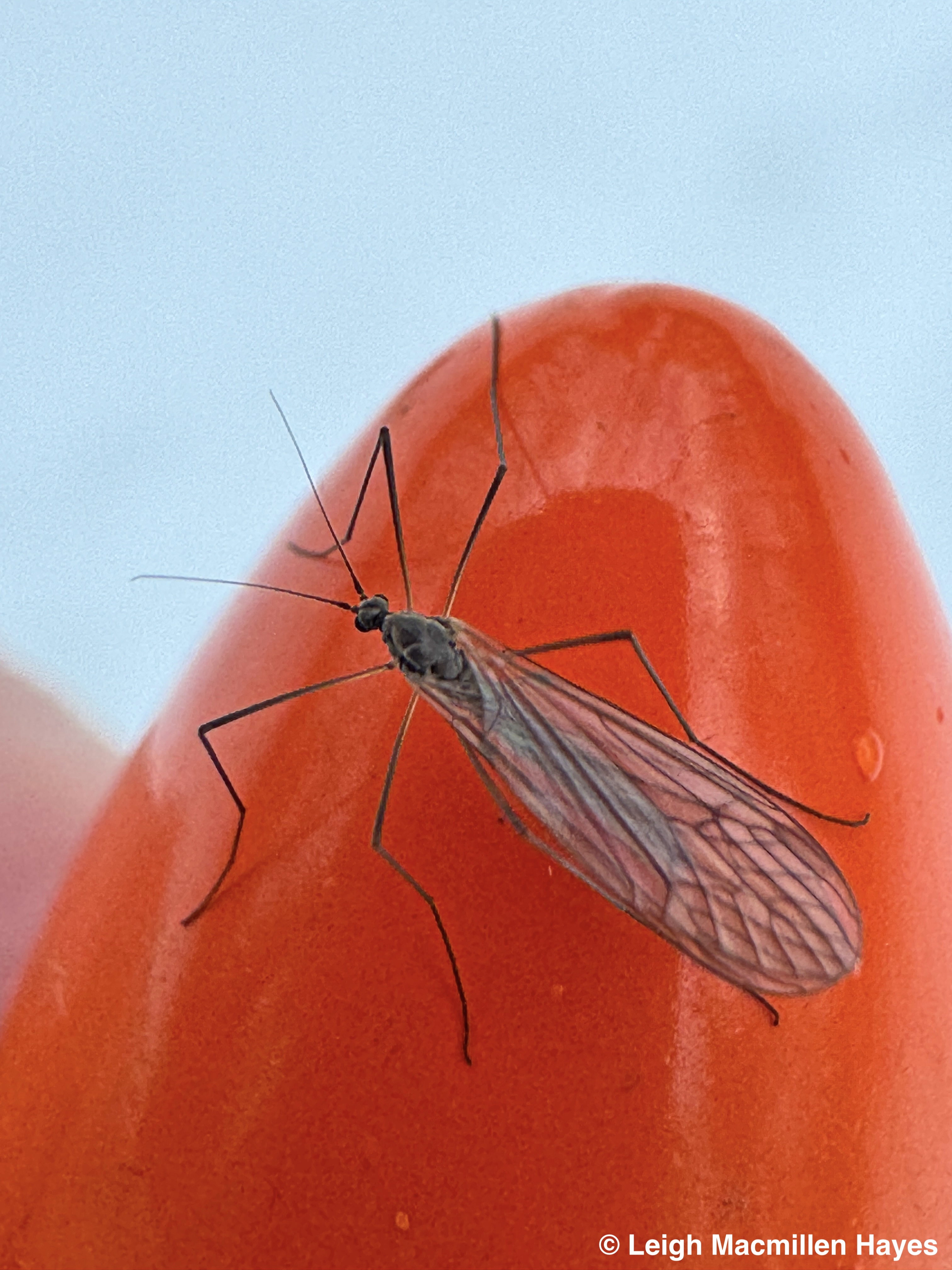
And . . . while the world view is important, sometimes it’s the teeny tiny things that need to be acknowledged–as in the case of this Snow Scorpionfly. I still can’t believe I spotted it. The snow was rather icy, so my ruler was sliding about, thus the positioning. But it’s there to give you a sense of this small insect’s size.
At the end of the day, or week, or hike, or blog post, my heart speaks a million words of gratitude to all of those who have helped me find my way, naturally.

I know I’m blessed.

I know how fortunate I am to have a curiosity about the natural world.

I know my desire to learn is a lifelong gift.

And I can only hope that in some small way, I can share my learnings with you.

Above and Below: a few wonders from skyline

Grab a cuppa your favorite beverage cuze this is gonna be a long one.

We haven’t taken a vacation in the past two years, but this past week changed that . . . thankfully. It was rather a last minute decision and the Wednesday evening prior to our Sunday afternoon departure found us booking places to stay and suddenly it felt real.

And then it was.

After a long drive, which we split up with a stay in Scranton, Pennsylvania, where we kept looking for the truck carrying “30,000 pounds of … bananas,” we pulled into Front Royal, Virginia, and vacation really began.

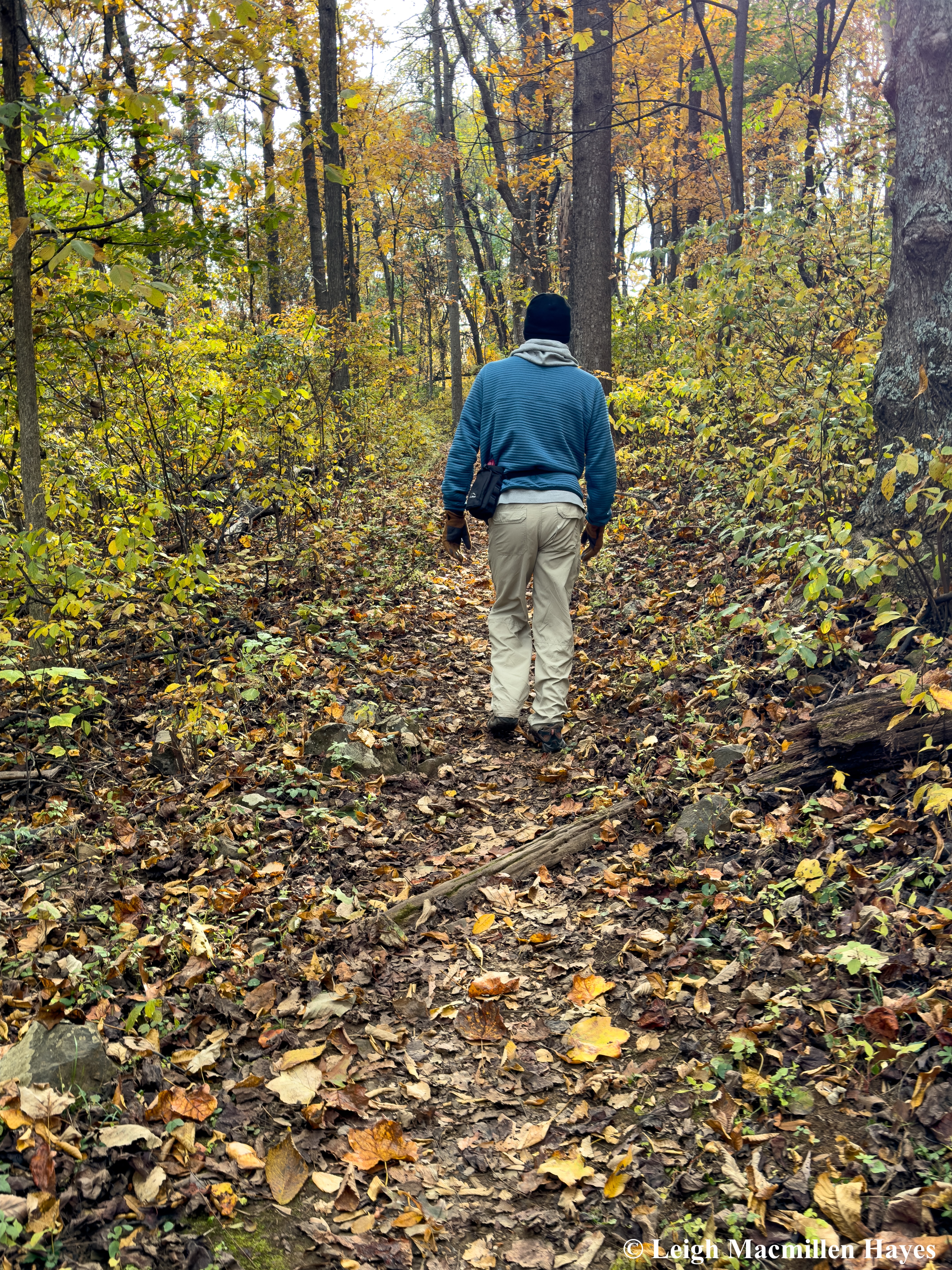
Our intention was to drive along Skyline Drive in Shenandoah National Park and hike as many trails as we could fit into five days. Thankfully, our friend Kimmy had given us a bunch of suggestions, and the rangers at the Visitor Centers had maps for each one.

On each of the trails we hiked, metal bands on the trail markers were stamped with the direction and mileage, and after not paying attention on Day 2, and finding ourselves at least a half mile beyond the point where we should have been looping around, we had to backtrack, and learned our lesson. Always check first before proceeding.

Had we looked, rather than thinking that we knew better, we would have discovered that the trail was to the right.

But it was a loop, so we thought we would end up back in the same spot. The laugh was on us. And laugh we did.

The trails we followed varied from easiest to moderate to difficult with somewhat steep sections or scrambles, and we loved the variety . . . underfoot and in the shrubs and trees, but more on that in a wee bit.

Many had outlooks where we could enjoy the view, but one in particular, reminded us to look, that being White Oak Trail.

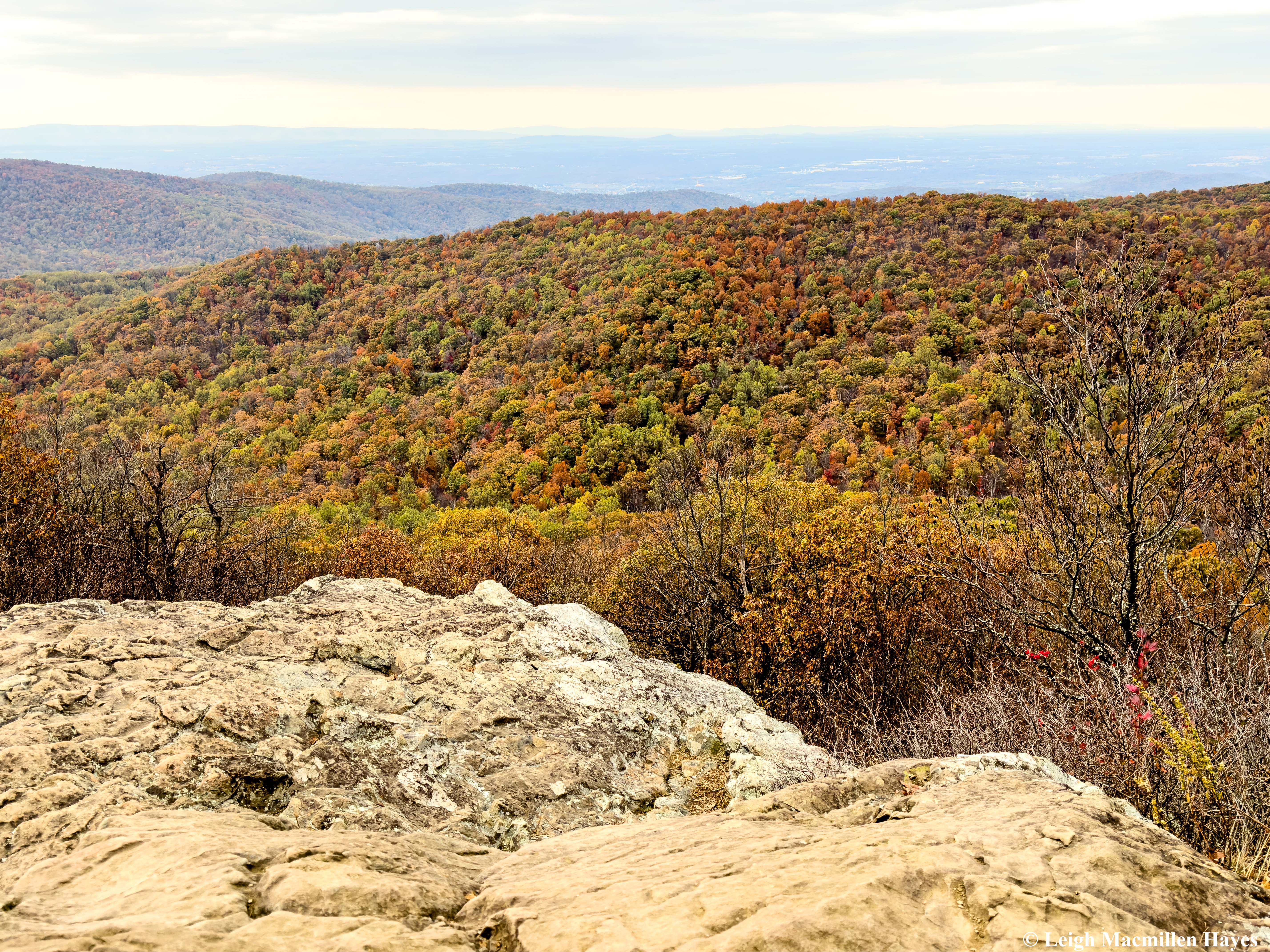
As the week went on, it was fun to note how the foliage changed. When we first arrived, the view at Compton Gap was that of a November tapestry . . . golds and greens and oranges and rusts . . . just a bit past peak. By the end of the week, after a windy, rainy period, many trees had lost their leaves.

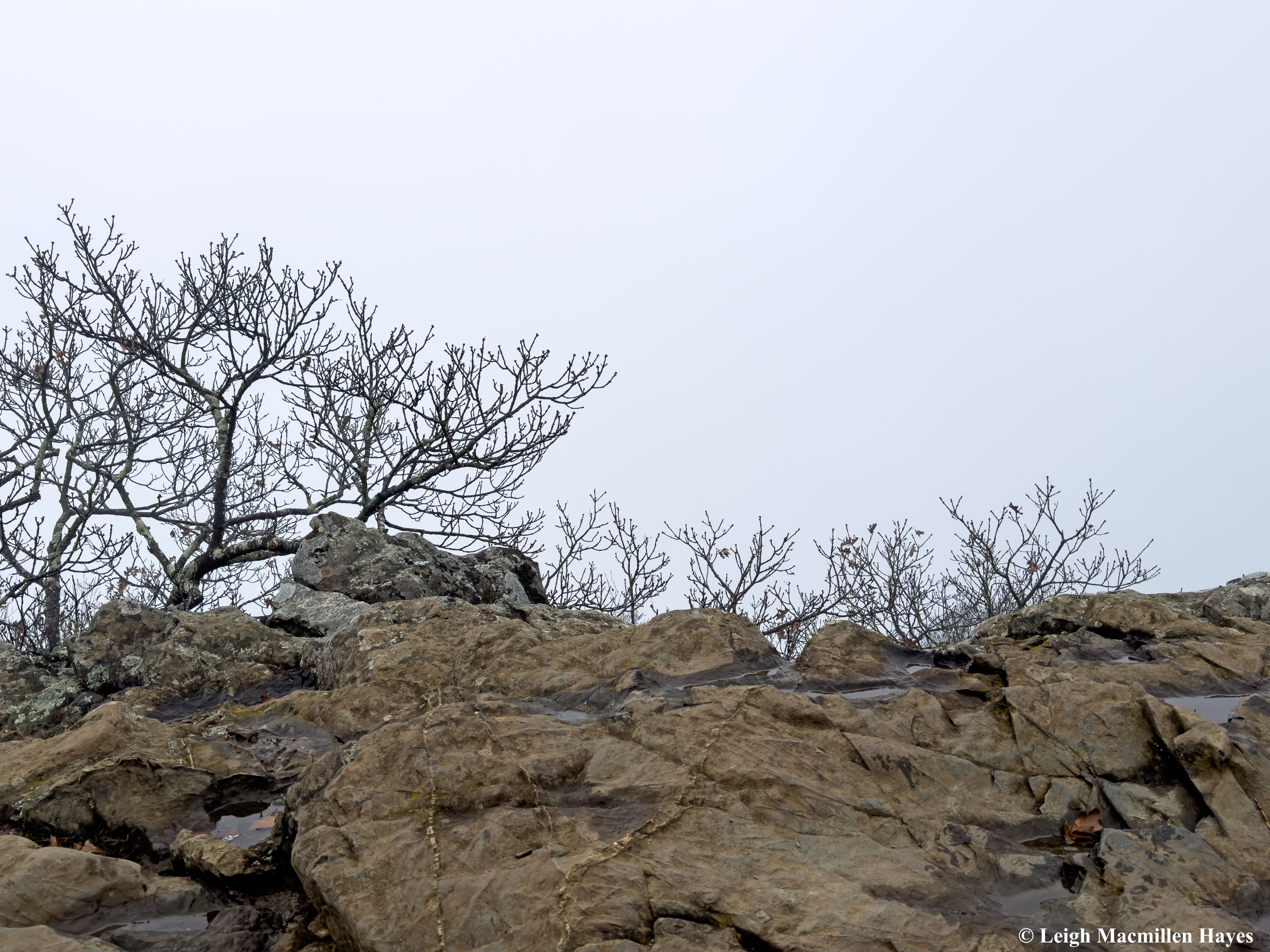
The next day, though we drove up the long and windy road and through Mary’s Tunnel, it was said rain that greeted us.

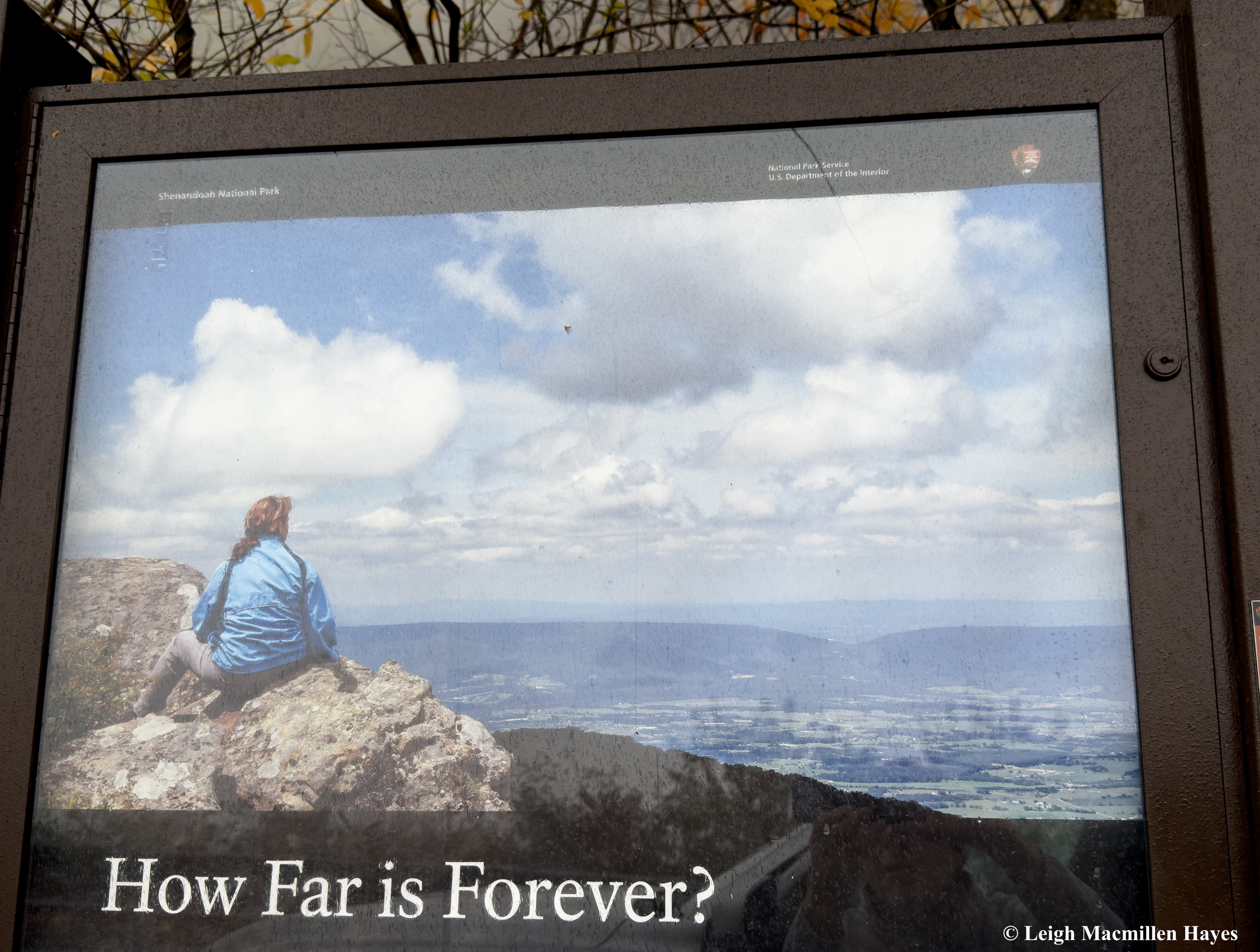
On that day and on and off the next, how far Was forever?

Not very.

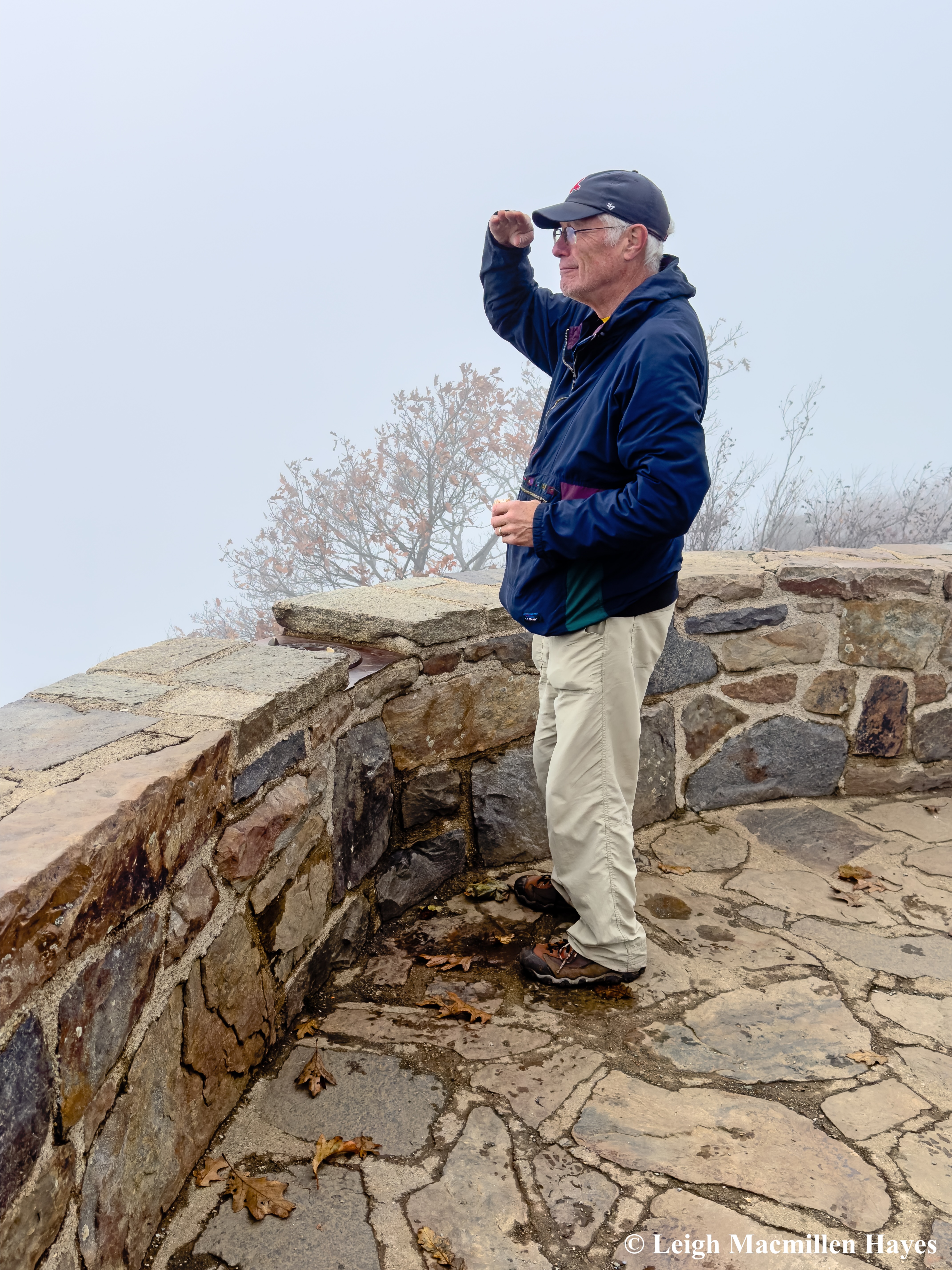
Even from the stone look-out at the summit of Stony Man, all was obscured.

But . . . we weren’t the only ones making the trek, and as we met other hikers along the way, we all chuckled about the lack of a view.

It didn’t really matter. We were there to hike, and that we did. And to enjoy each other’s company, and perhaps the lack of view put the emphasis on the latter focus.

There were other days or even moments on the same days, when we could see Forever, and gained a better understanding of the local topography.

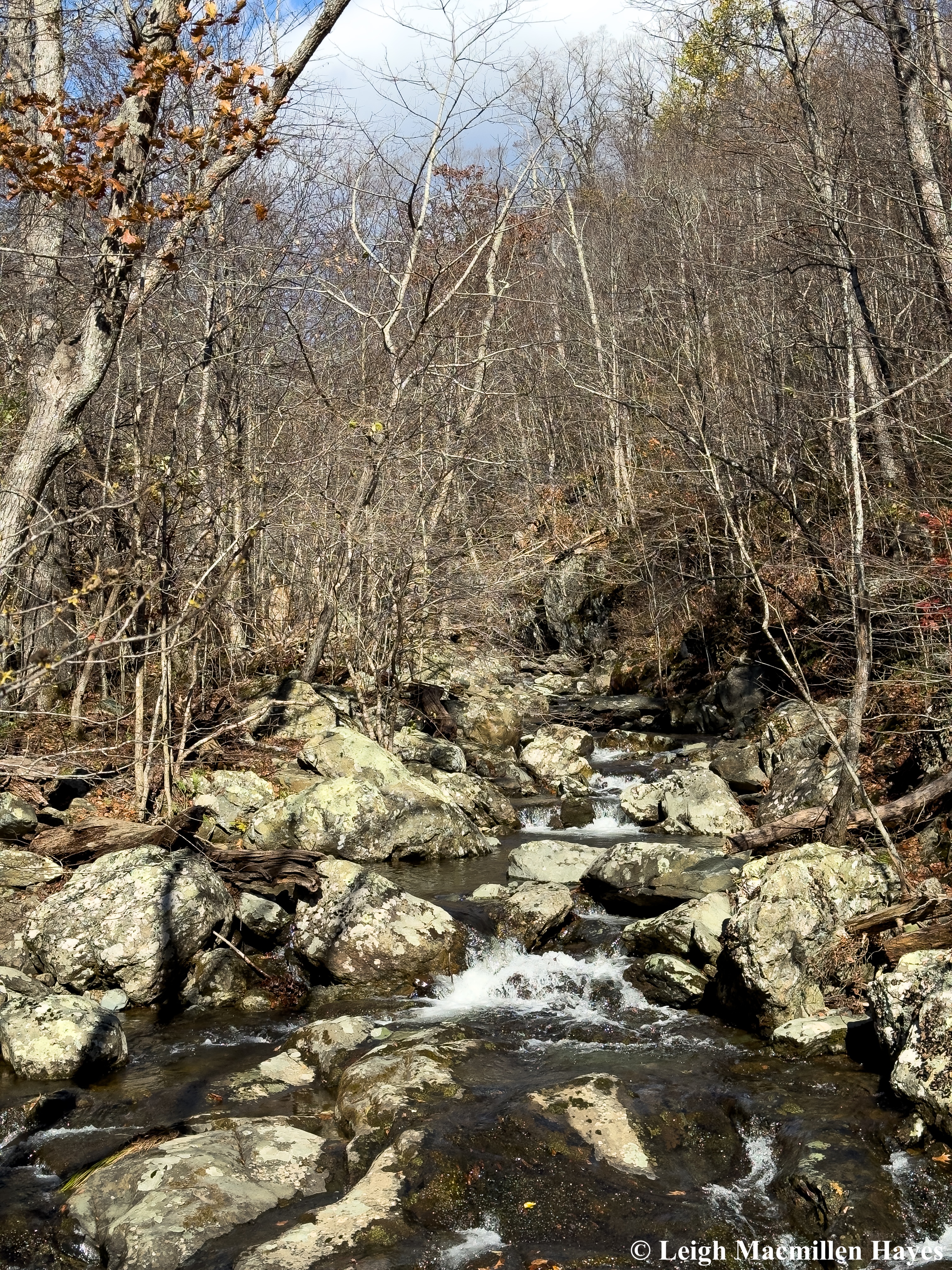
And sometimes we followed water, the very sound of which gladdened our hearts because it’s been so dry not only in New England, but also in the mid-Atlantic states, maybe more so, and the rain was welcomed by all.

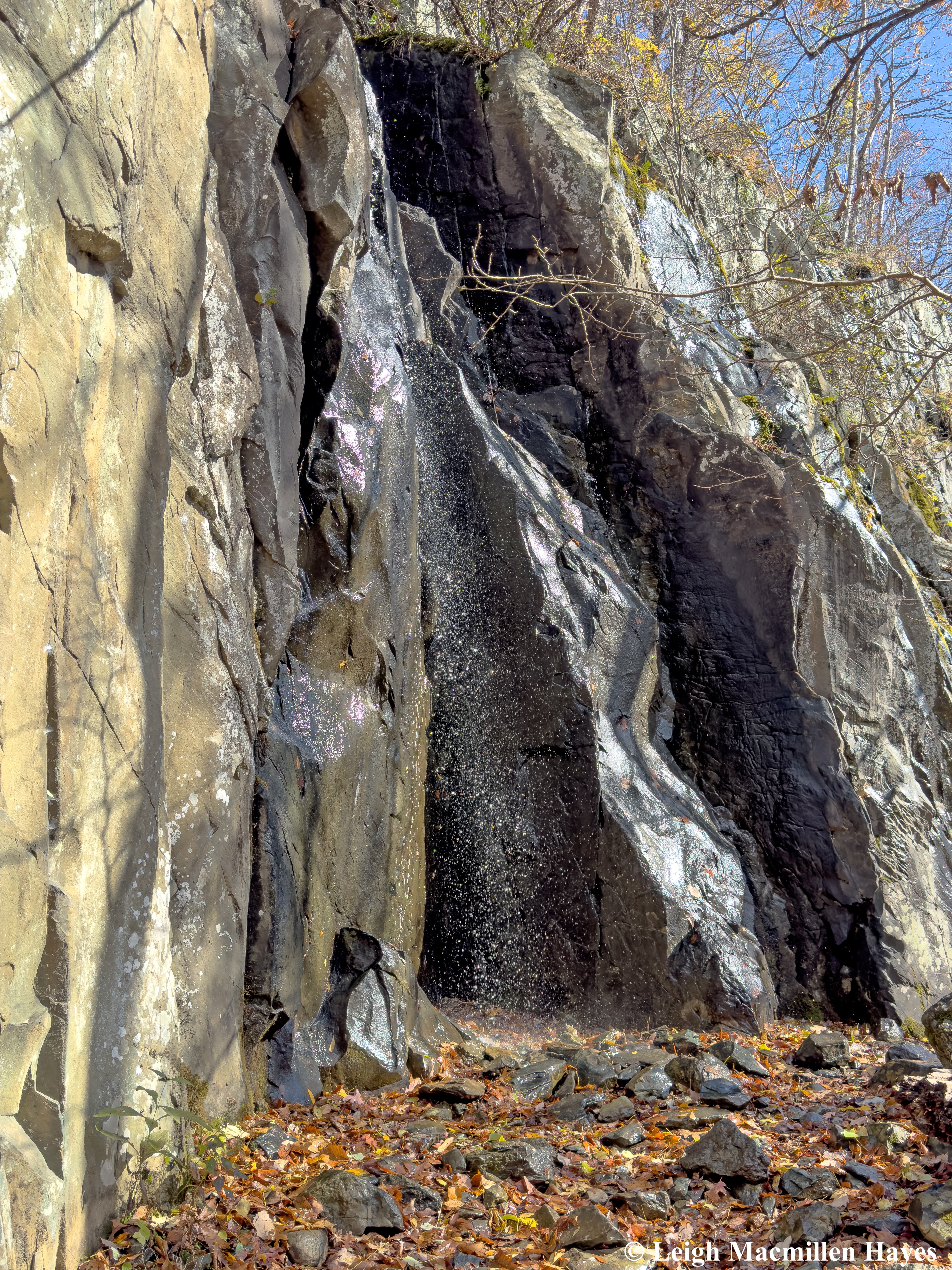
It even offered instant showers and since we were on and off the Appalachian Trail, we suspected thru-hikers might enjoy this very spot where the water poured down as a gift from above.

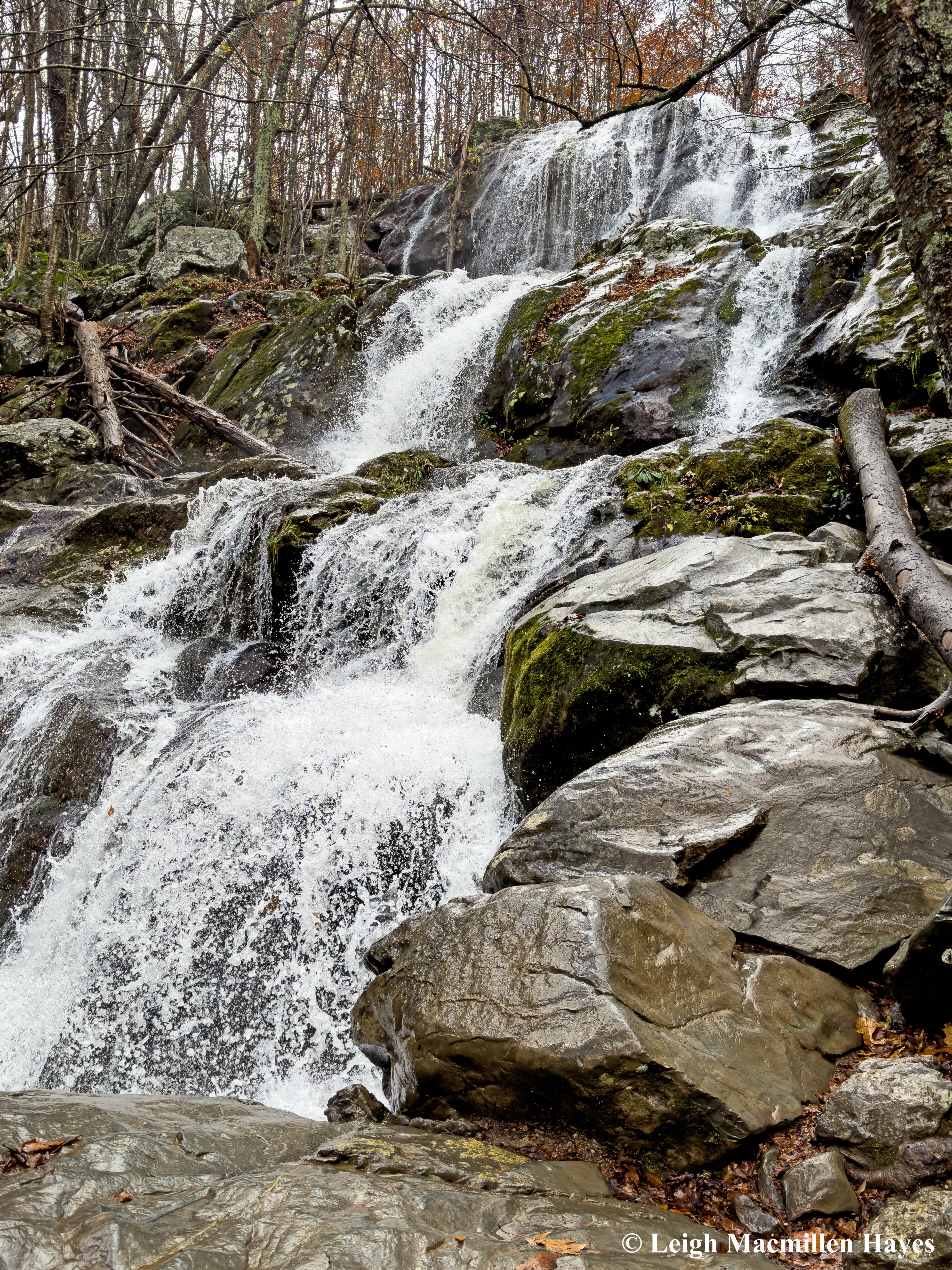
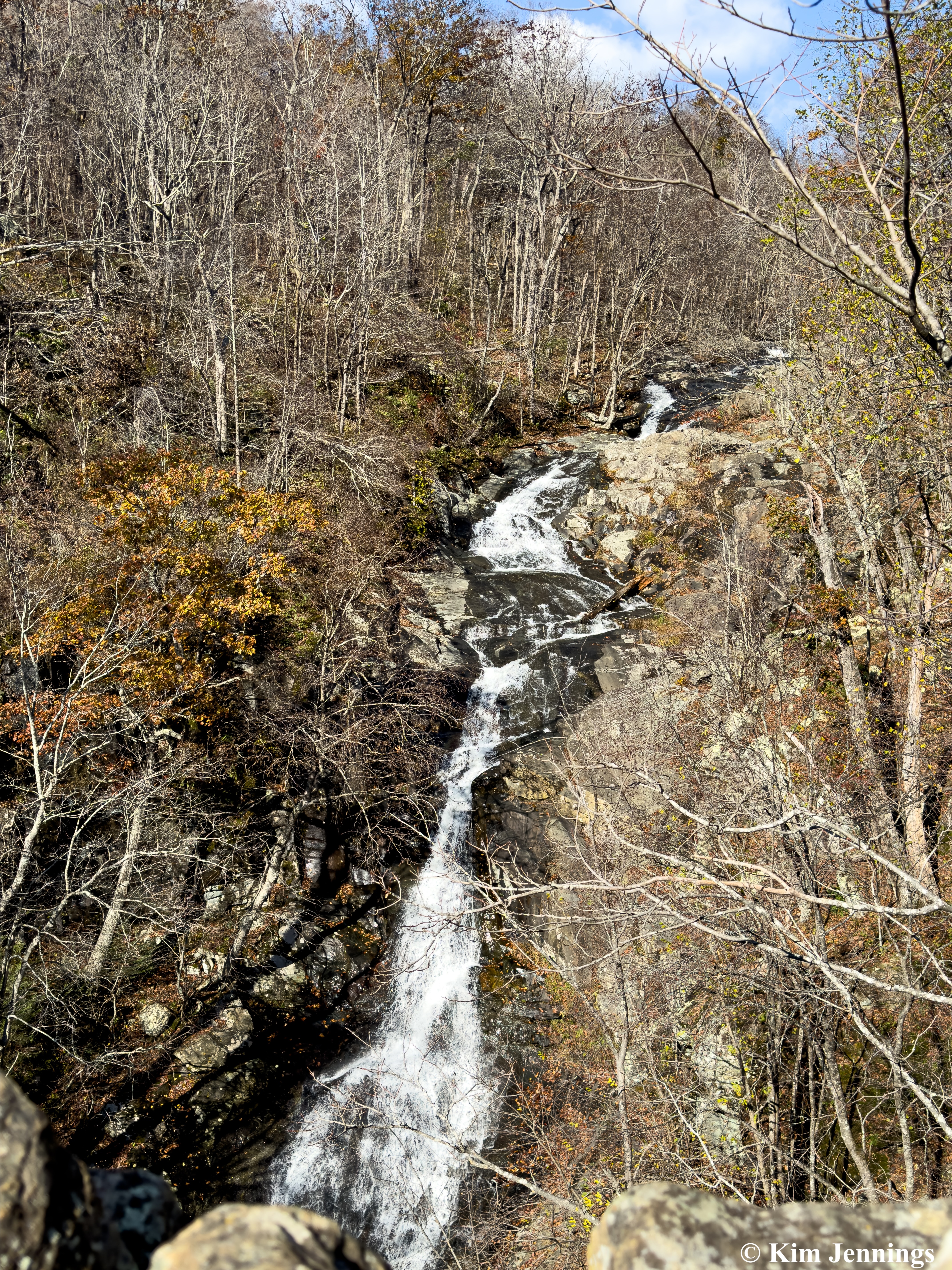
By week’s end, we had three favorite hikes, this one being to Dark Hollow Falls.

And then with two friends to White Oak Falls we discovered another favorite. I must admit that though this photo was taken with my camera, I let my friend, Kimmy, do the dirty work as the rocks she climbed over daunted me, especially as the wind roared.

The view also included much smaller sightings, like this Shaggy Soldier (Galinsoga quadriradiata), a curious little plant that was still in bloom along many of the trails. From a Botany in Scotland Blog, I read that “The genus Galinsoga is named after Ignacio Mariano Martinez de Galinsoga (1756- 1797). He was a famous physician in Spain’s royal court and is remembered most for writing a book about the health hazards of wearing corsets.” I’m not sure that answers the question of why the common name, but I do know that I completely agree with him about the health hazards of wearing corsets.

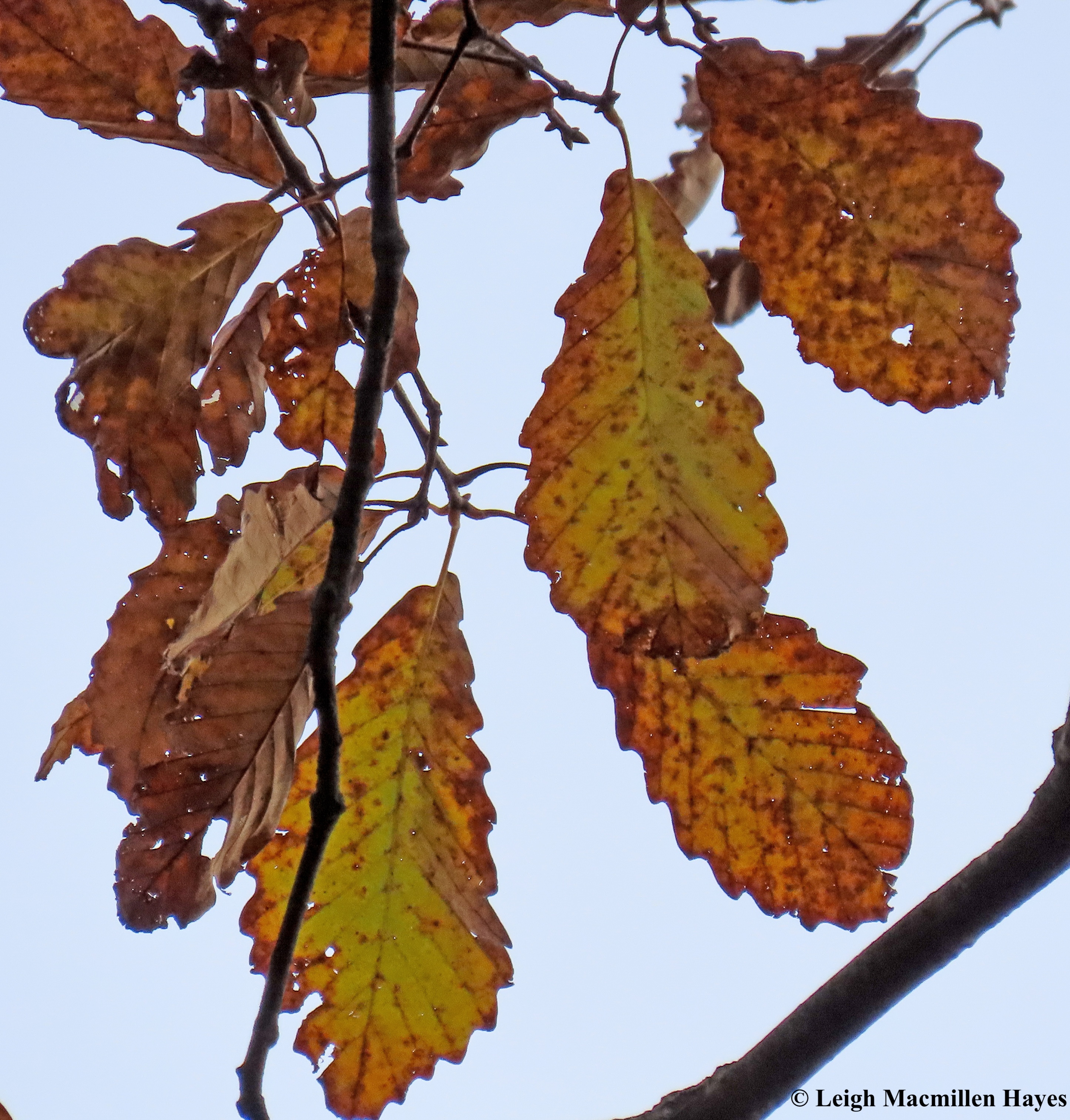
My heart nearly split in two when I spotted these Chestnut Oak leaves. A friend recently saw one of these in Portland, Maine, but this was my first introduction to the species.

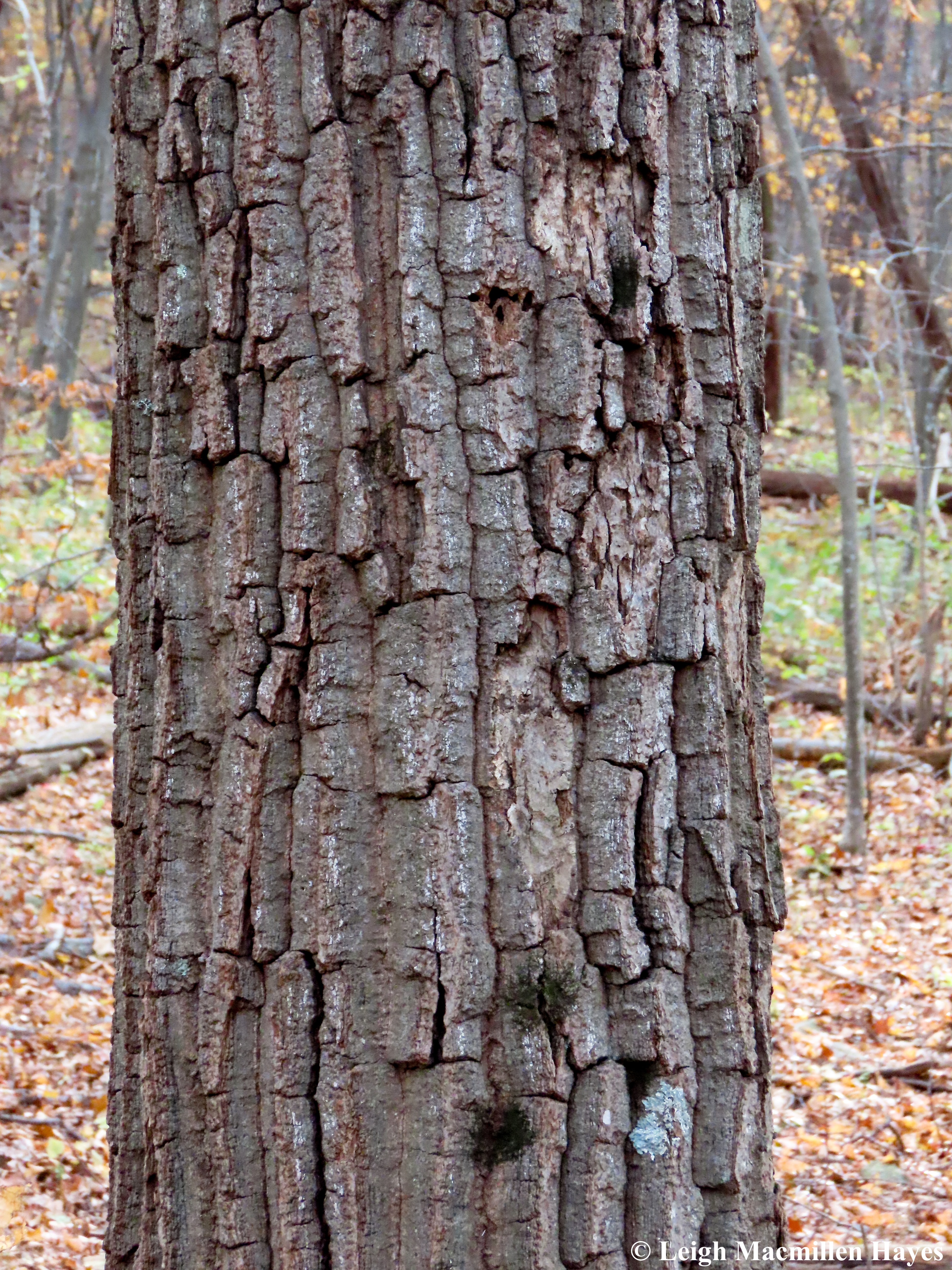
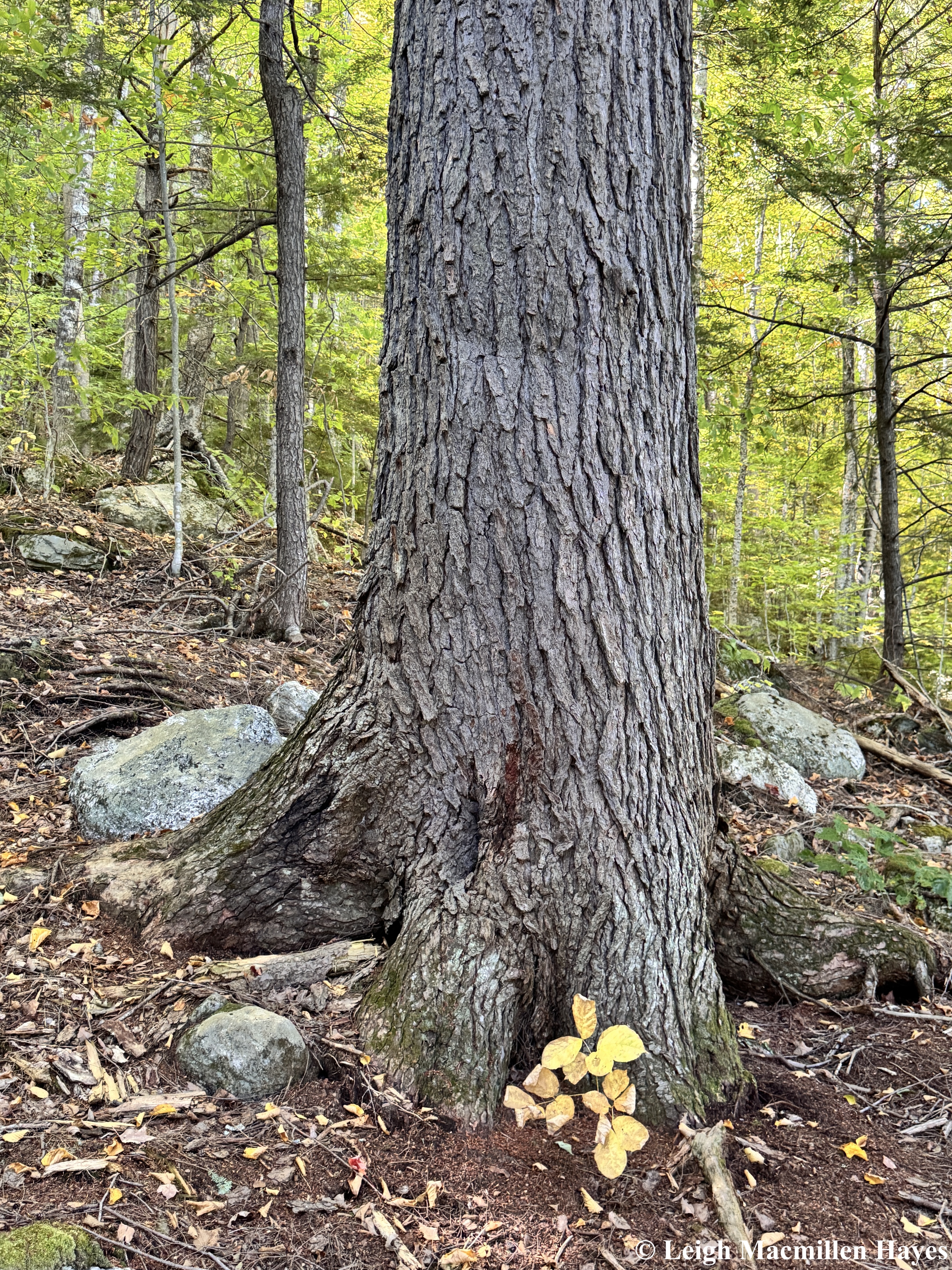
The mature bark is a combination of ridges and furrows, with a blocky presentation.

As I continued to meet new trees, I was thrilled and challenged and so purchased a Pocket Naturalist® Guide of Virginia Trees & Wildflowers.

My next introduction was to Sassafras, with its tulip-like, three-lobed leaves. There were so many on the ground, that they became part of the scenery along some trails.

And on Day 2, yes, it was chilly, but I took the opportunity to honor a Sassafras with a hug. That was one huge tree.

Again, the bark had ridges and furrows, though it wasn’t blocky like the Chestnut Oak. But . . . I could have easily thought it was an Ash. In hindsight, however, we didn’t encounter any Ash trees.

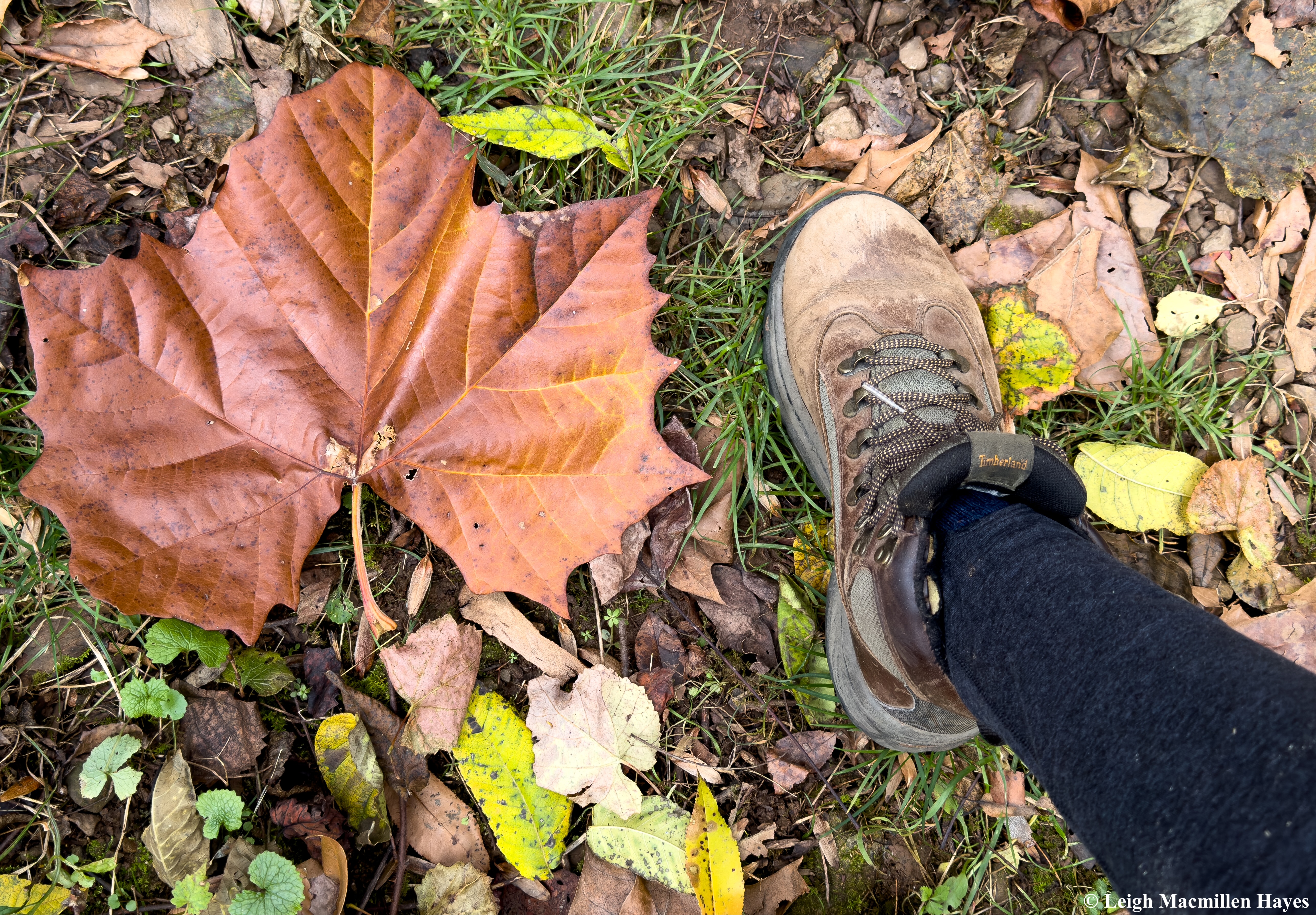
Though I have met the American Sycamore before, in fact, there used to be a large one in a neighboring town and for all I know it may still grow there. it was still fun to get a sense of the size of the leaves.

And then there was the Eastern Cottonwood, a cousin of our Aspens (Poplars), and I could only imagine all of the fluff along the Hawksbill Greenway in Luray, where this tree grew.

By its bark, I never would have known it, but fortunately, there was a sign below it that indicated it was a Cottonwood. I love signs!

Again, any of the barks we met all looked the same, at least during our brief encounters, so I was grateful for leaves that helped me differentiate them.

Others from away have mentioned Pawpaw, but this was my first time seeing the leaves that are widest at the middle.

They seemed to grow in clumps or groves and I wondered if they were all from seeds or is some root sprouting had also taken place. They reminded me of American Beech, which can do both and quickly fill an area where the sun shines.

One that I had never even heard of was the Princess-tree, and it had leaves the size of umbrellas. I’ve since read both pros and cons about this tree and you can do the same and make up your own mind about it, but it was certainly a surprise to meet it.

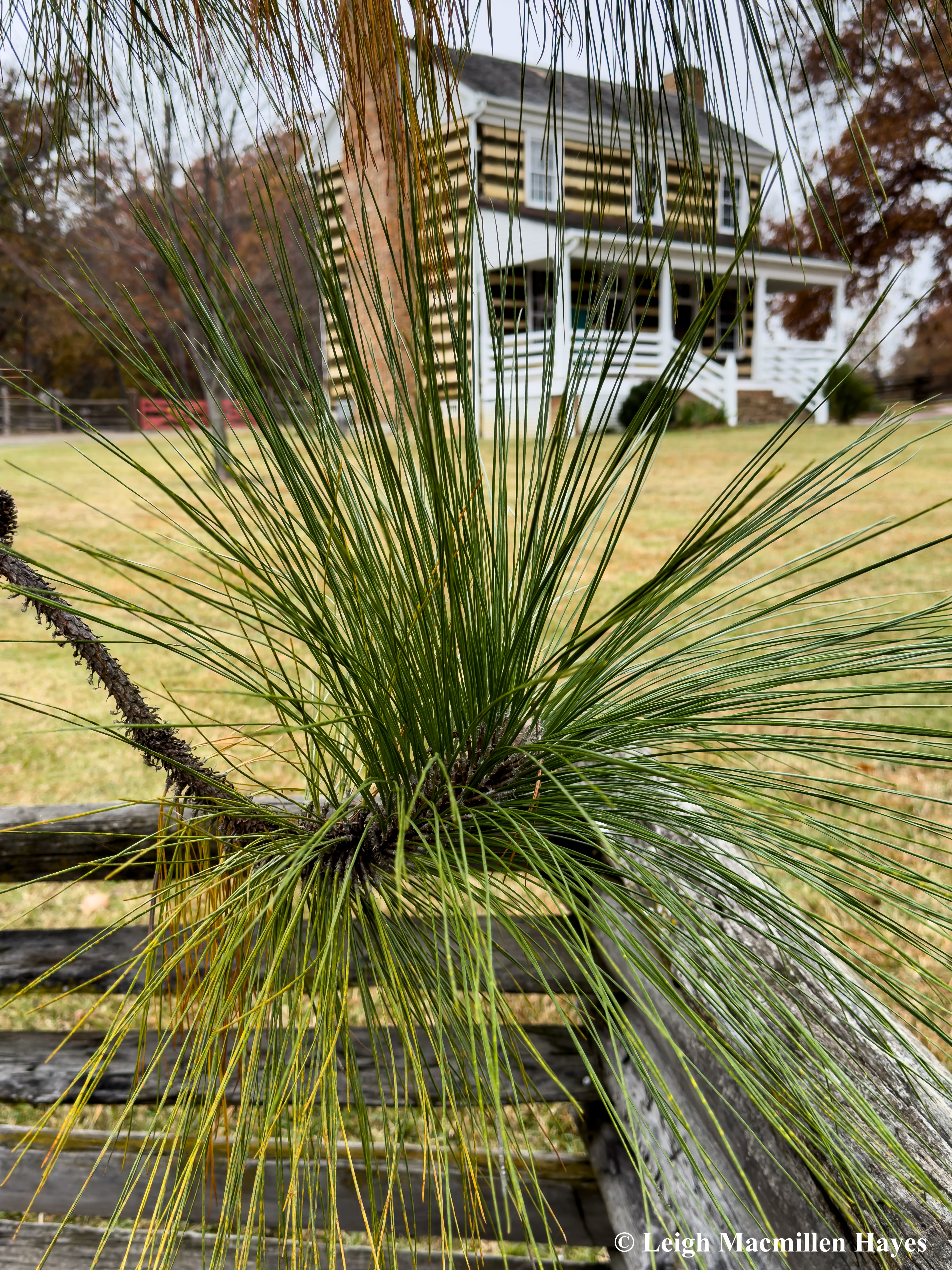
Almost last was one we found at the Shenandoah Heritage Village Museum. Again, I’ve heard of it, but this was a first time seeing it. My what long needles.

At about eight inches, each packet of three led me to identify it as a Loblolly Pine. I am sooo grateful that I purchased that guide.

So here’s the thing about the conifers. For a couple of days we met only deciduous trees, and most of them were the species I mentioned above. And then, as we went higher in elevation, we began to meet a few Eastern Hemlocks and White Pines and many of the trees we are familiar with in our woods. My Guy even noticed the various communities, and along some trails Mountain Laurel grew almost like a hedge.

I’ve saved this particular leaf for last in the tree section of this blog. Oh, believe me, I have plenty more to say. But this skinny leaf that My Guy held for me, is another Oak species.

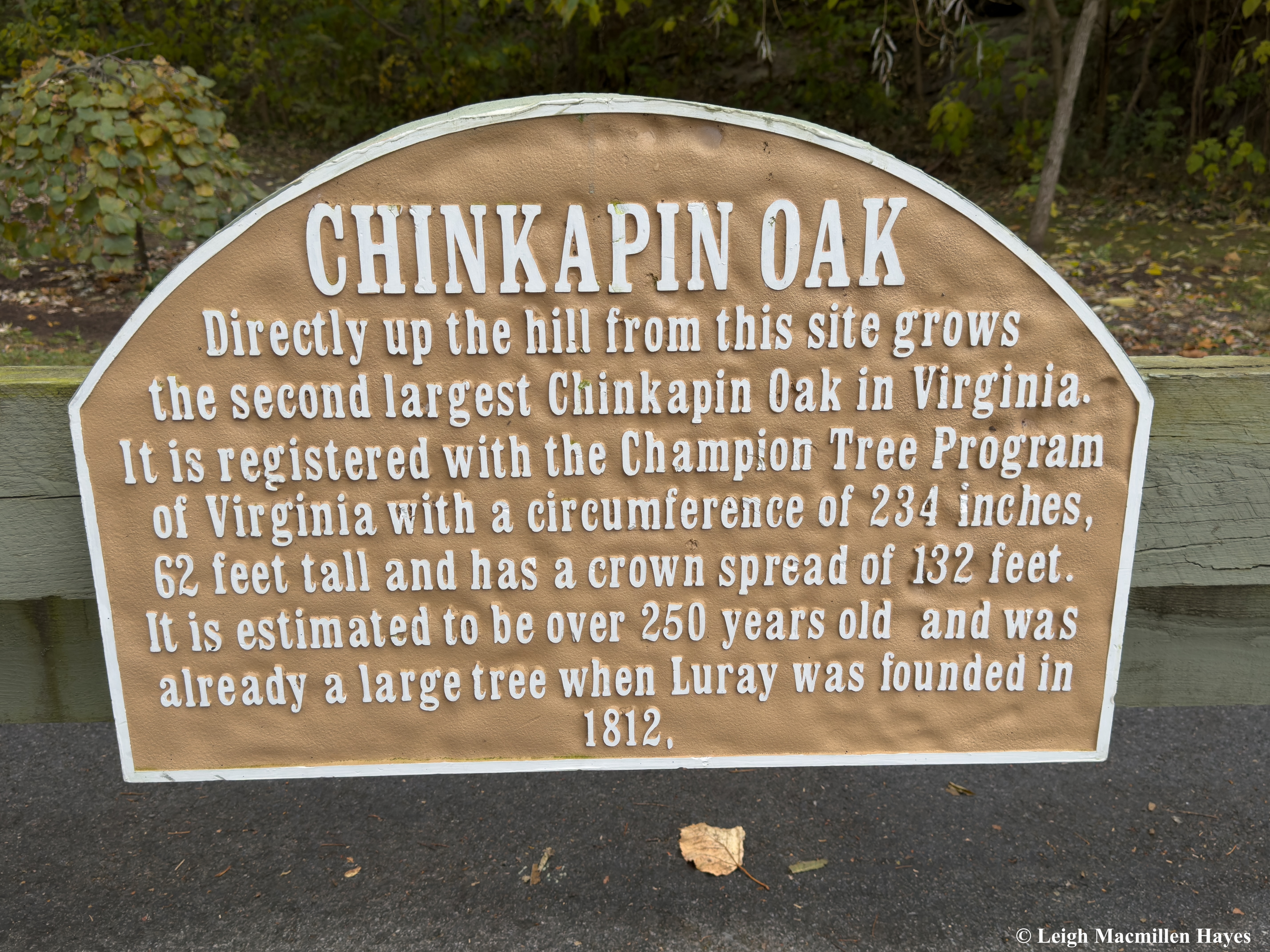
We only knew about it because on our rainy day hike, when we turned around from a mountain adventure and decided instead to explore in Luray, we discovered this sign along the Hawksbill Greenway, a two-mile trail through town.

We looked up the hill from the sign and didn’t spot anything that looked different. After we’d walked to both ends of the trail and back to our starting point in the middle, we headed up one street that led us to the next, and then one more because we had spotted something that we thought just might be the champion.

Meet the Chinkapin Oak. Born about 1775, think about all that this tree has witnessed. I wanted to hug it, but refrained because I didn’t want to accidentally introduce something to it. For example, what if I had teeny aphids on my mittens that I wasn’t aware were there from having touched other trees? No, instead, I just stood in awe of this mighty giant. We both did, actually.

Returning to the trails, sometimes we came upon historic sites, this one being the Fox family graveyard.

Lemuel F. Fox died in 1916 at the advanced age of 78. That’s actually an incredible feat.

Especially considering he survived the Civil War, where he served with the Confederate States of America.

At the Snead Farm on another trail, we discovered what seemed to be a raised dooryard and large foundation and sensed the Sneads had some money.

Perhaps the house burned down, or was taken apart and moved, but the horse barn still stands.

I peeked into each of the stalls, just because I could.

Interestingly, visitors can ride horses on some trails specifically designed for them. though this one isn’t.

It’s a place for everyone, including those with mobility issues, for the Limberlost Trail is accessible. .

And truly it is a place for everyone as we met people from a variety of states and countries, including Sri Lanka, Spain, England, Germany, Israel, and more.

A place for all also includes the critters who make their homes here. Deer. Did I mention White-tailed Deer? They are everywhere. We also spotted the occasional Gray Squirrel. And we really wanted to see a Black Bear, but didn’t have that opportunity.

Our most prolific mammal sighting, other than Deer, the Northern Short-tailed Shrews. These are not everyone’s favorite food as they emit a toxin and so are quickly dropped upon capture. Either one larger predator didn’t learn the lesson the first, second, third, fourth, or fifth time, or there are so many of them running around at night that the everyone tries to make a meal of them.

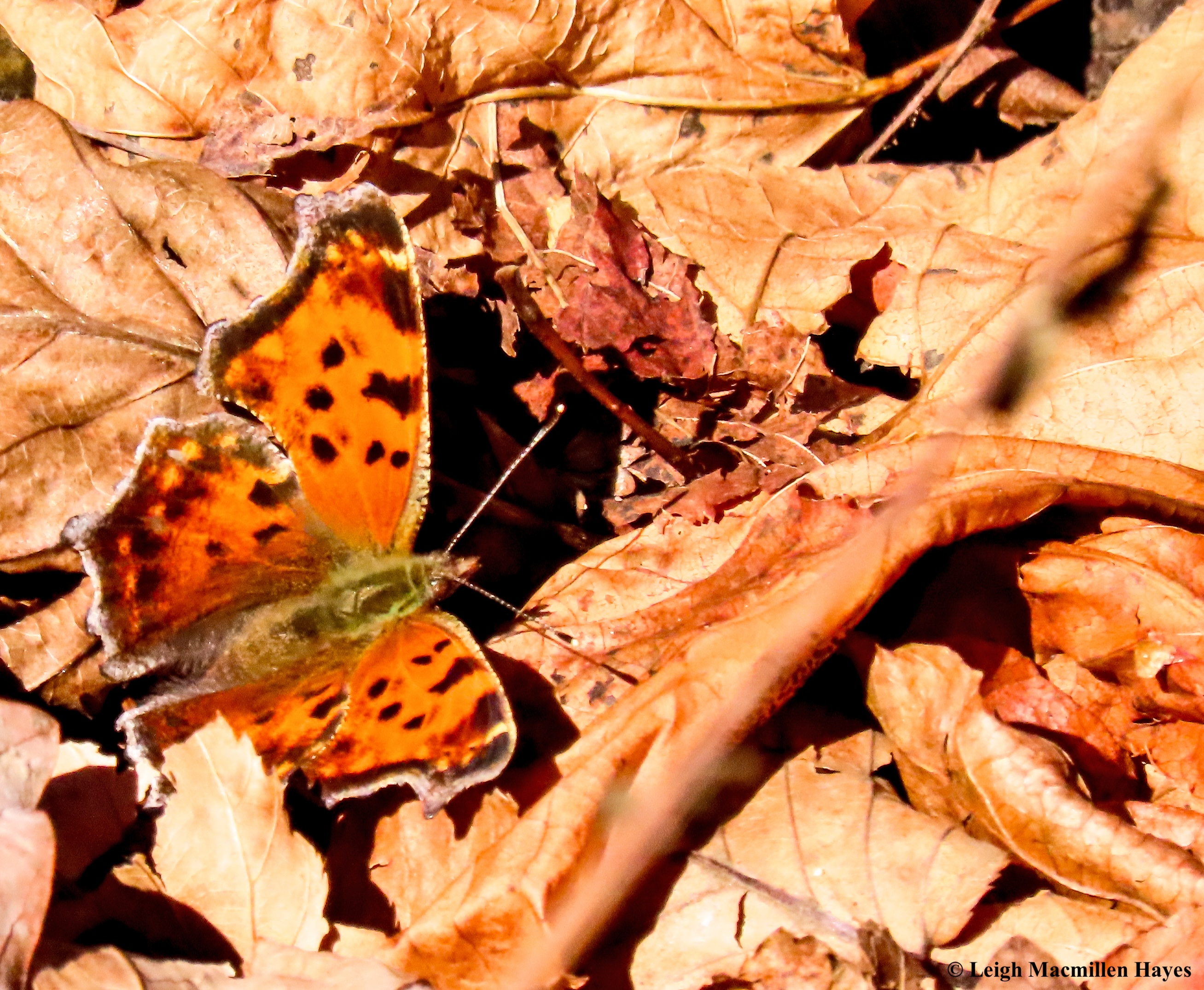
On the day we hiked with our friends, we had a couple of fun insect sightings, including this Punctuation or Anglewing Butterfly–be it either a Question Mark or Comma. It never did show the underside of its wings so we couldn’t determine it to species, but it was still a fun butterfly to spot.

Speaking of spots, we saw at least three Spotted Lanternflies. I was intrigued with their colors, but Kimmy told me to squish them as they are extremely invasive.

And because of her we got to see a Walkingstick upon a rock where she just happened to place her hand. If it hadn’t moved in that moment, she would probably not have seen it. We were all grateful that it did move. And then it posed for us.

Now that you’ve stuck with me for this long, I’ll let you know that I saved some of the best for last.

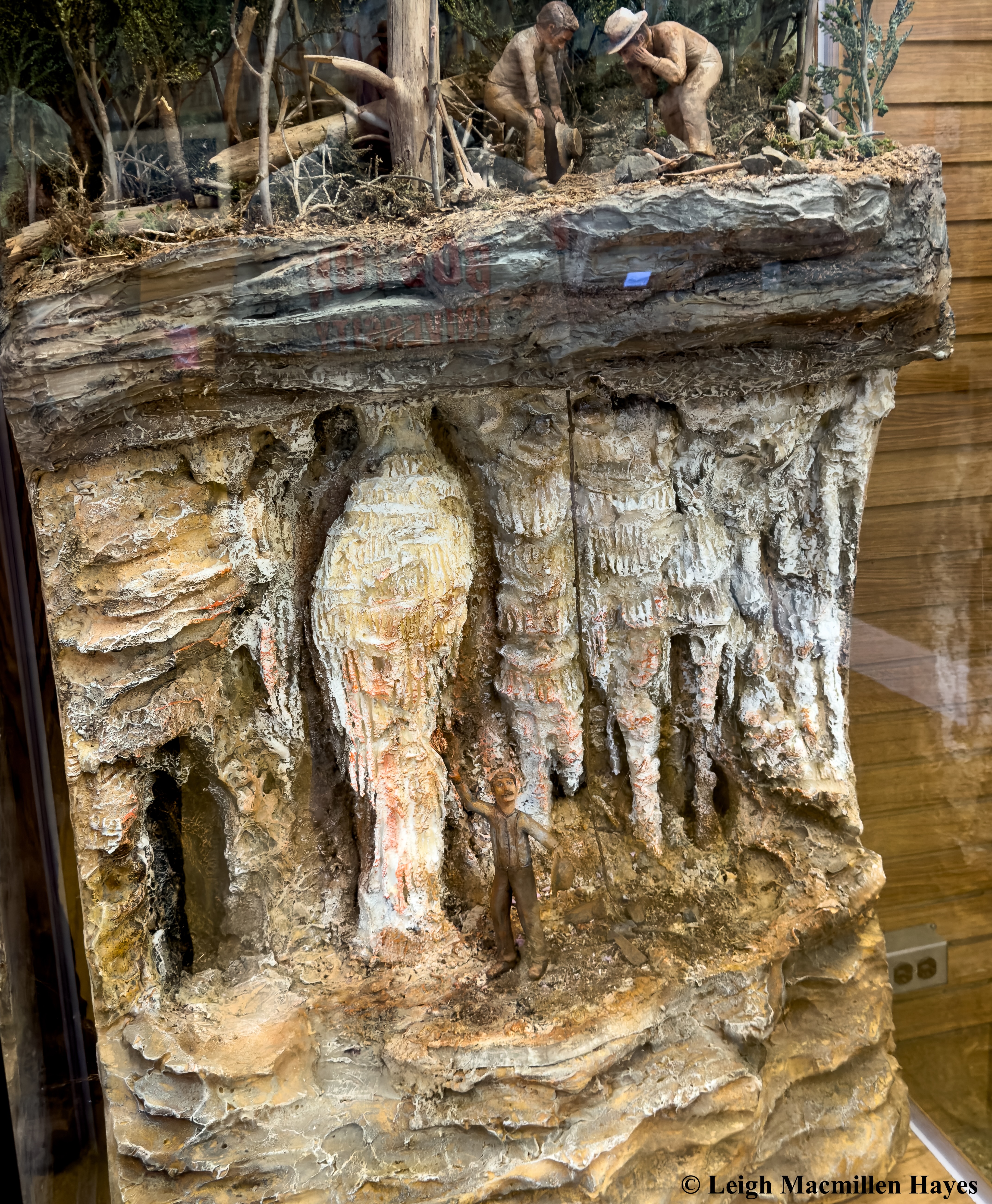
On that rainy day, we not only walked the Hawksbill Greenway, but we also went on a self-guided tour of Luray Caverns. According to the brochure we received at the ticket booth, the caverns are the largest in the East and were discovered by a tinsmith and local photographer in 1878. This diorama depicts that moment when the discovery was made.

And X marks the spot where it was made. Can you imagine the man’s excitement and amazement?

Discovered in August, we were told that the first tour occurred that November.

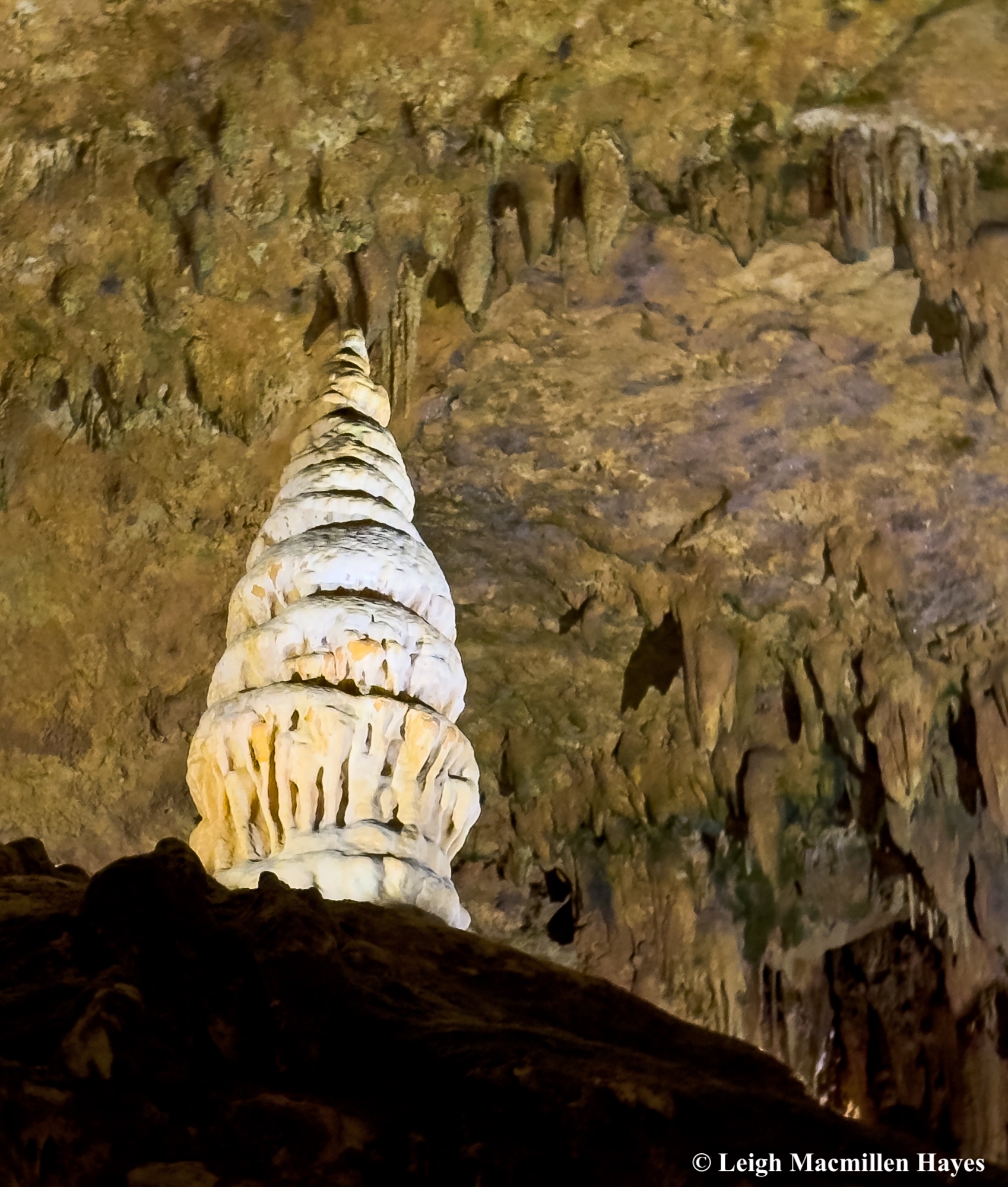
The cavern is a cave where Stalactite and Stalagmite meet, but in this instance that is an optical illusion. Can you see why?

There are veils to admire.

As well as a tent . . .

made of “curtains” that seem almost transparent.

We chatted with a couple of young docents and they told us that this structure is seen as something different in every season–from a Christmas tree to a pine cone to an ice cream cone, and one more that neither of us can remember. But the big question was: what ice cream flavor?

The answer: Rocky Road.

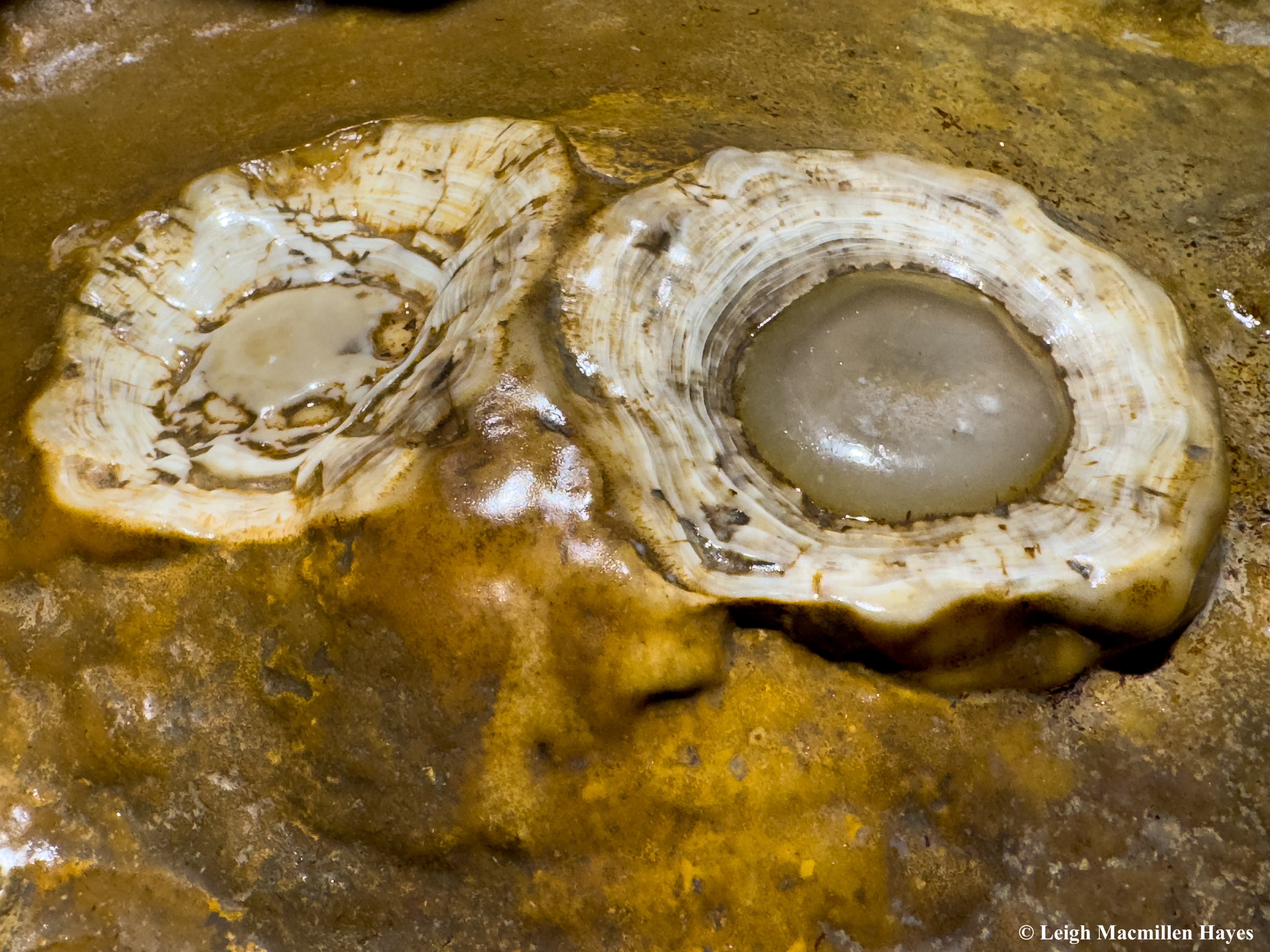
And then there were the Fried Eggs. Or oysters on a half shell?

We highly recommend a visit. I’ve only shared a few of beyond-belief spots, as around every corner there was a different formation to look at. I felt like I was in fairy land with lots of action everywhere as stories unfolded.

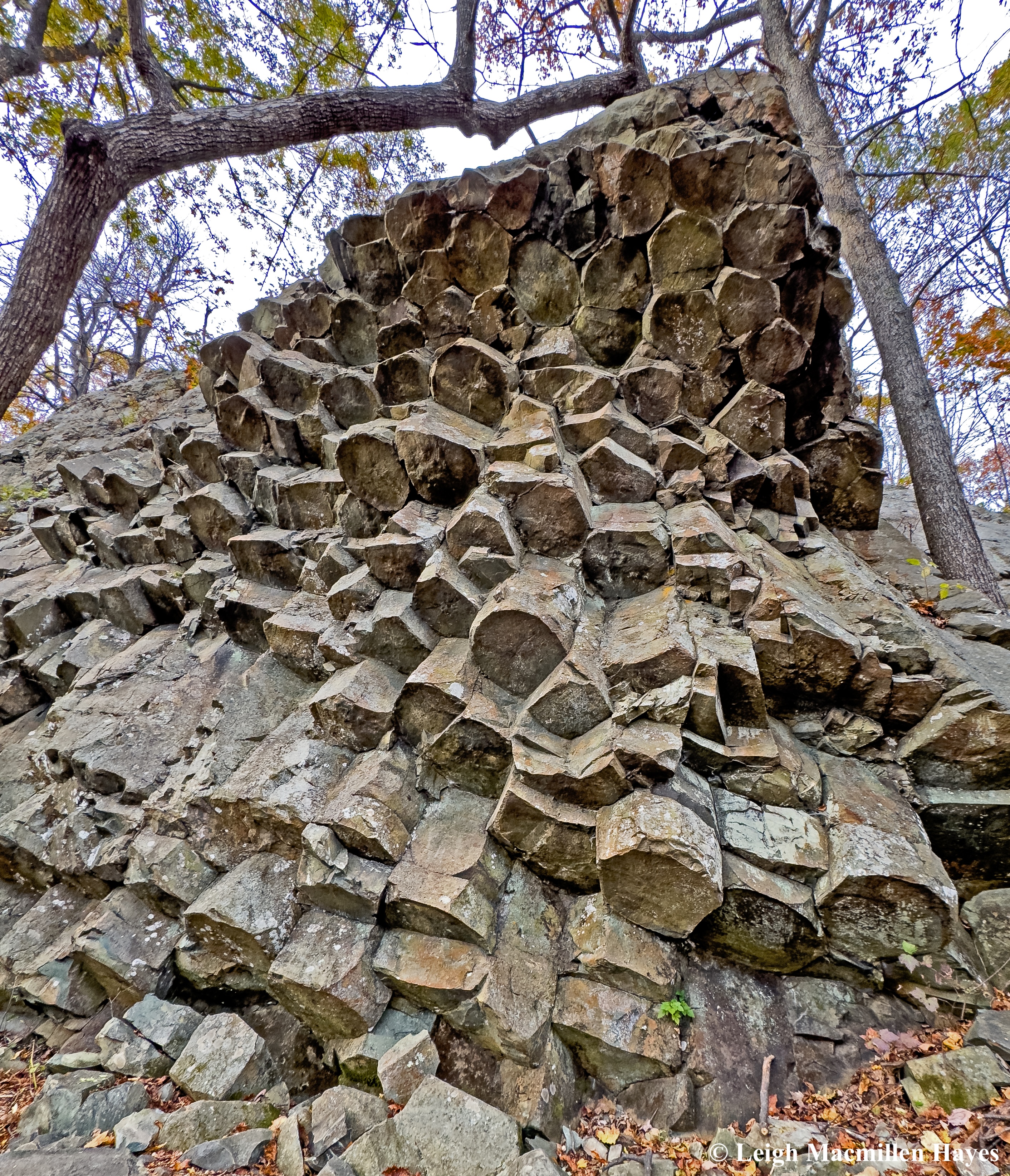
Back on the trails, we also had fun finds, like this columnar jointing, which turned it into yet another favorite trek. It’s known as the Fort Windham rocks and is greenstone and part of a series of lava flows, that we spotted in other places as well.

It reminded us of the Giants Causeway in Ireland, a geological phenomenon of 40,000 basalt stone columns formed by volcanic eruptions over 60 million years ago.

And so we posed.

We posed again at Dark Hollow Falls.

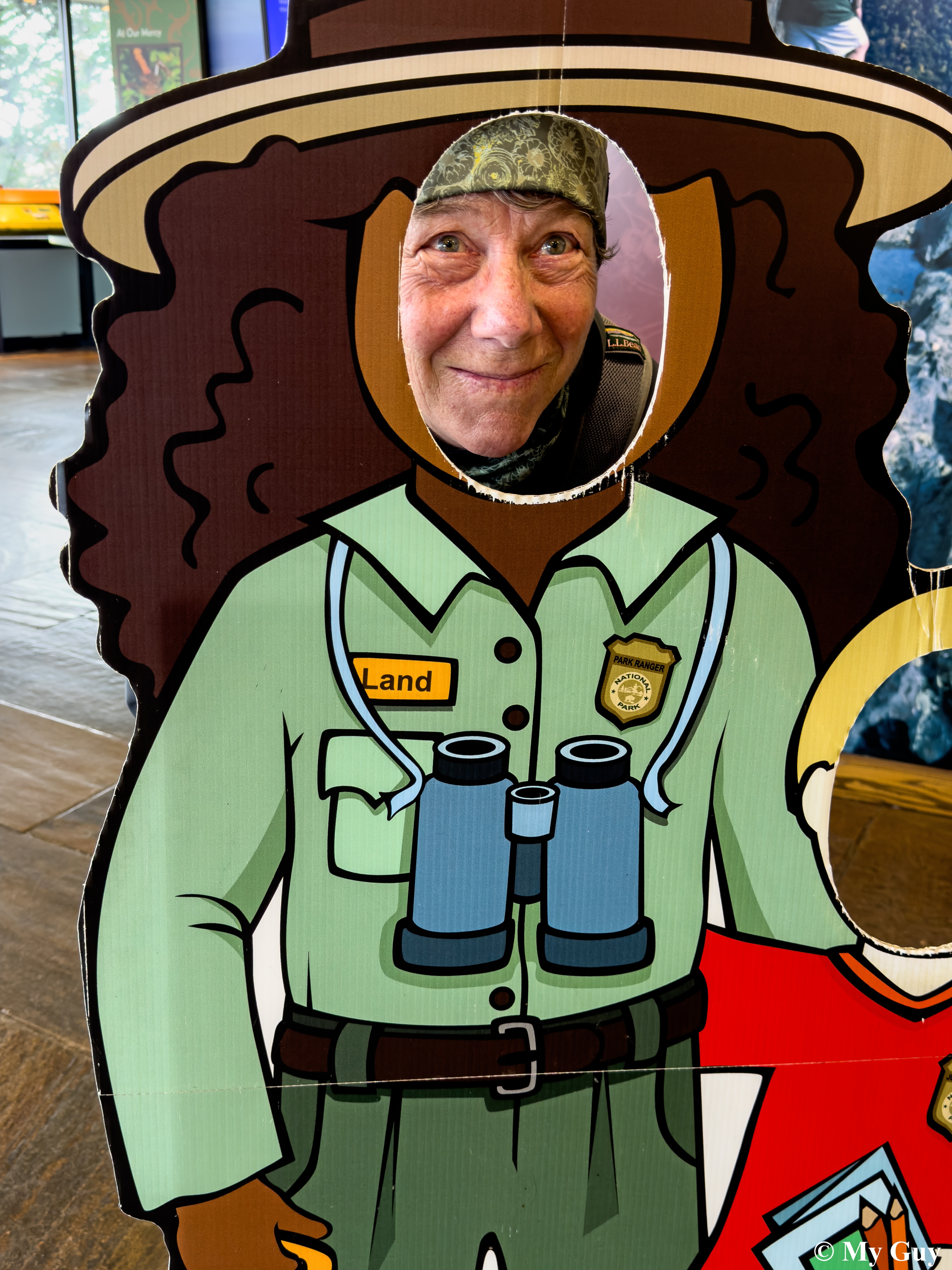
And then I took a shift as a park ranger. (Actually, the park rangers are furloughed under the current shutdown, so we were reminded each day to be extra careful while hiking because rescues could take hours.)

As for My Guy . . . no vacation is complete without a trip into the local hardware store.

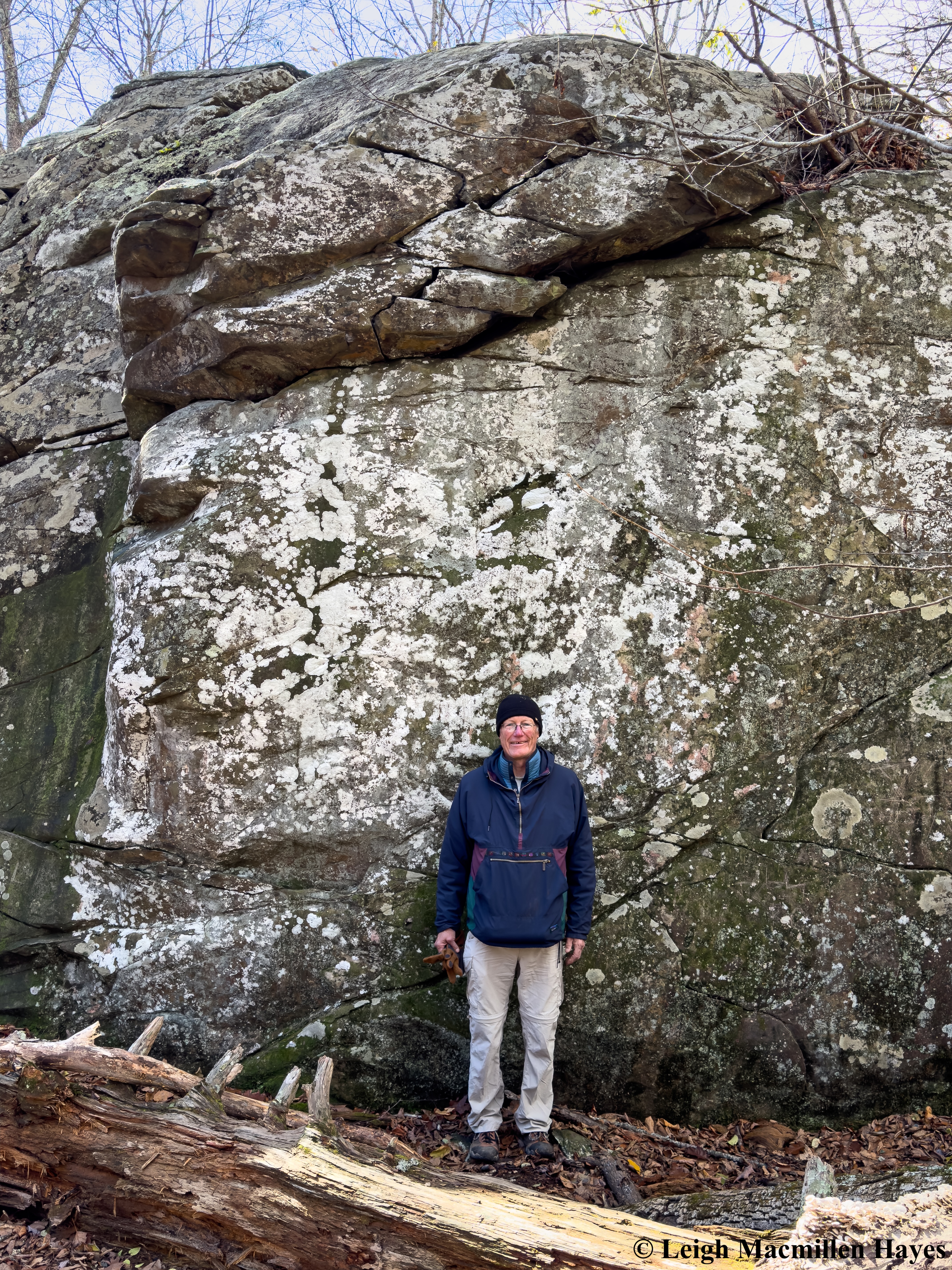
But where my readers usually see only the back of him, he was happy to lend his almost 6′ height as a reference for this large boulder.

And while we were truly excited to spend a week hiking together, we were equally excited to share the trail with these two, Maddie, a high school senior who had the day off, and her mom, Colonel Kimmy Jennings, USAF retired. Kim was a student of mine back in her middle school days. It’s always a joy for all of us when we can meet up and share the trail, though typically it’s when she makes a trip home to Maine, so she was thrilled that we’d actually ventured south. And our pose was in front of another example of columnar jointing.

After we hiked for about four hours with them, we had one more hike to tackle bringing our total to ten trails, that being Mary’s Rock, and then we left Luray and returned to Front Royal for the night before beginning our two-day journey home with a stop over in Albany, NY and a quick tour of the Norman Rockwell Museum on the final stretch.

Like any vacation, we’ll cherish this one forever.

Above and Below, I guess it was actually more than a few wonders that wowed us along Skyline Drive and in the area.

Far Winde-a-Way Mondate

It’s been a while since I’ve written about a Mondate, and believe me, we’ve had numerous. And other dates during the week as well, but today found us exploring a new-to-us property that’s just too special not to share. And I think the owners would appreciate it. I know that we appreciate that M suggested this to us. She was spot-on correct that we’d like it.

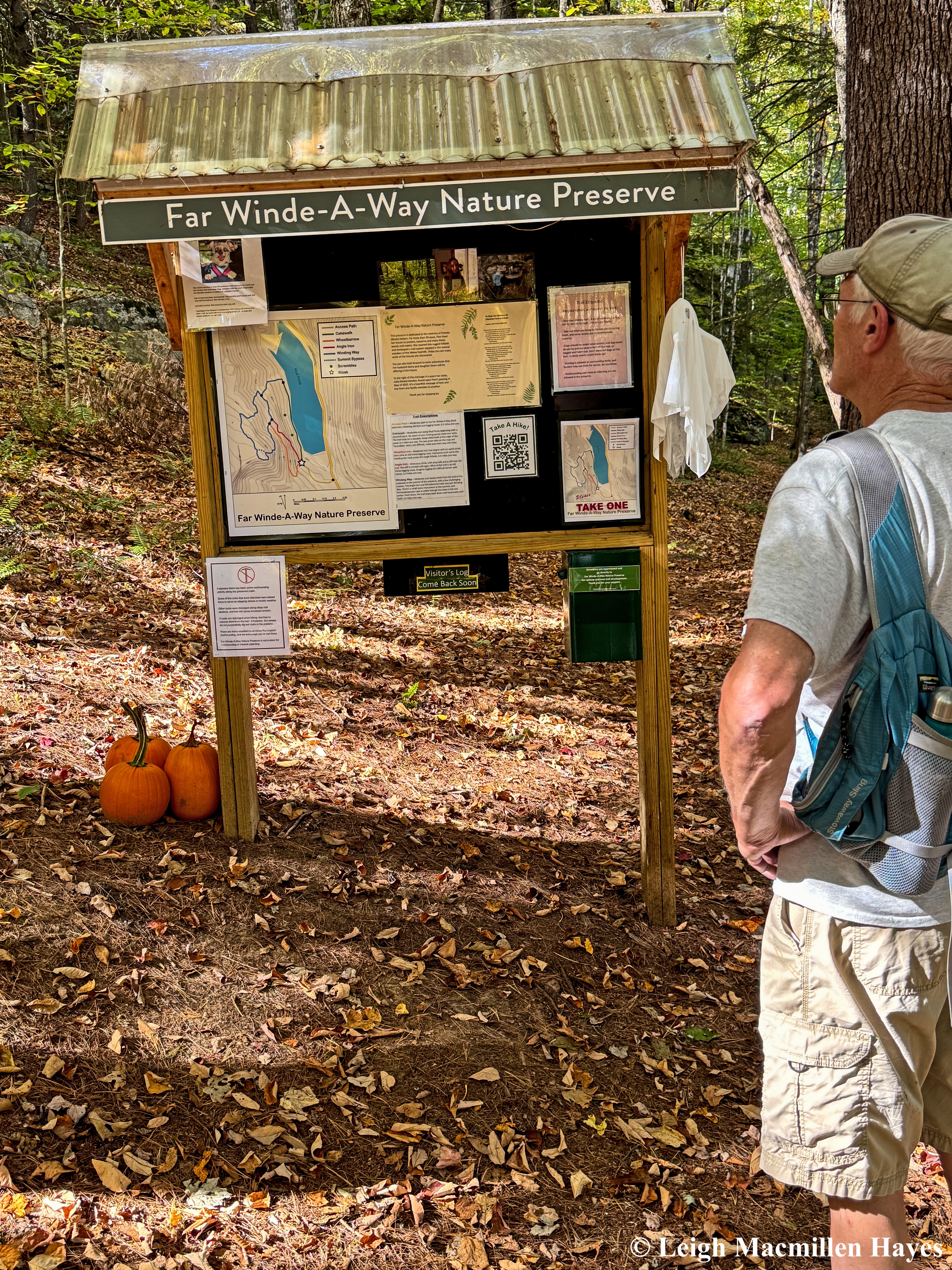
We’d been by a trail sign on the road a bunch of times to hike other trails in Greenwood, but until M mentioned it, we hadn’t really paid much attention. Until today. The kiosk is about .2 in from the road and I loved that there were pumpkins and a ghost to decorate it. And all the information hikers need to enjoy the area. Though My Guy goes without, I highly recommend trekking poles should you go forth on the well-marked trails. They are steep in places. And rocky in others. But that all adds to the fun.

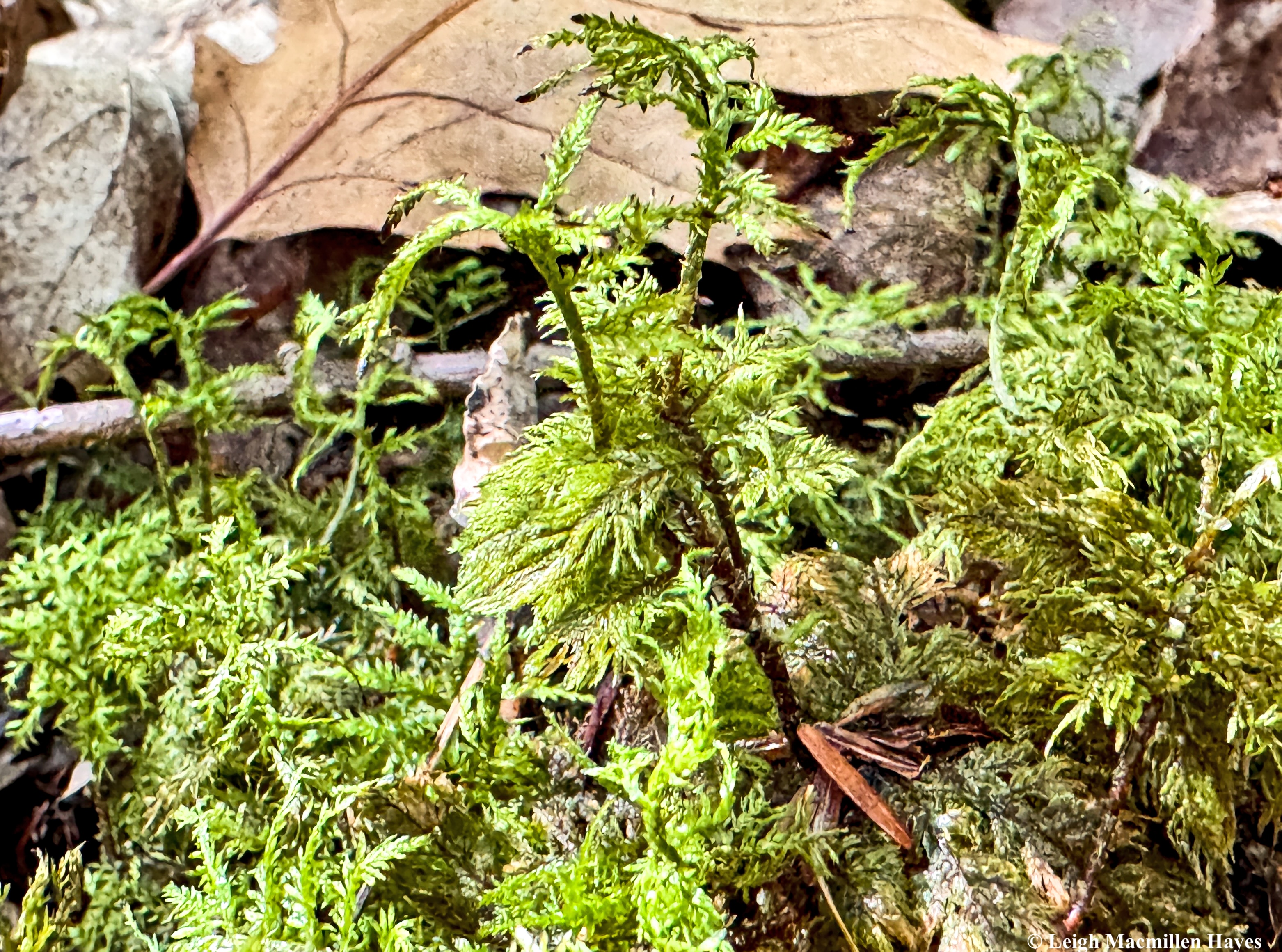
For me, the fun was enhanced by spotting examples of this pleurocarpous moss. It took me a while to learn that pleuro refers to side and carpous means fruit, thus they have a side fruit. They are low, tangled mats with branches that rise from the main stem.

This particular moss is the Stair-step Moss or Hylocomium splendens. It prefers deep shade and damp conditions. Due to the dry conditions we’ve been experiencing, this year’s growth of a new step rising from last year’s stem probably didn’t occur until recently.

There were other mosses, giving the trail a fairy-land look at times, but also abundant were the Christmas Ferns, which decorated long stretches of our route.

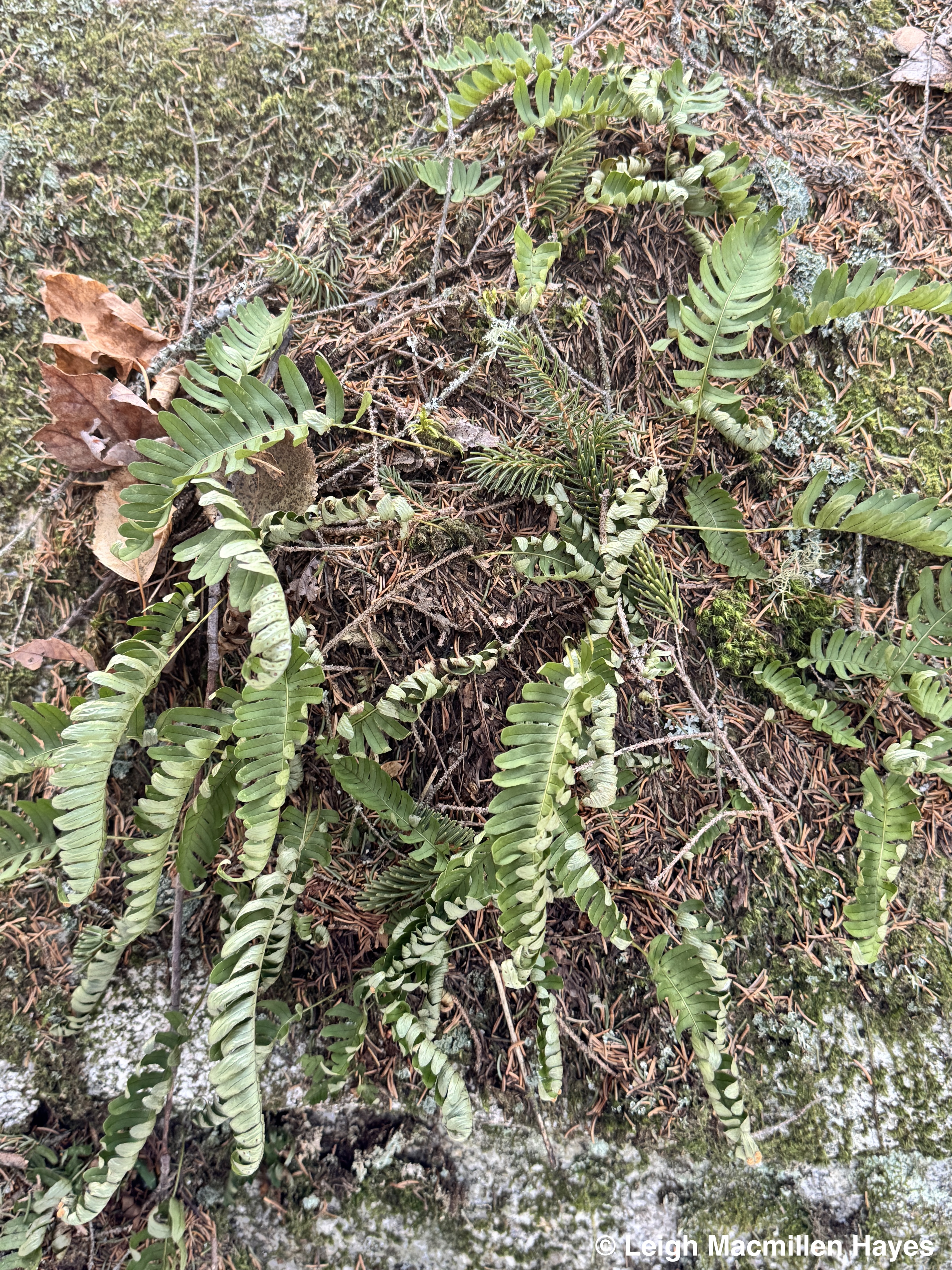
And not to be left out were the Common Polypody that always give boulders a bad-hair day look.

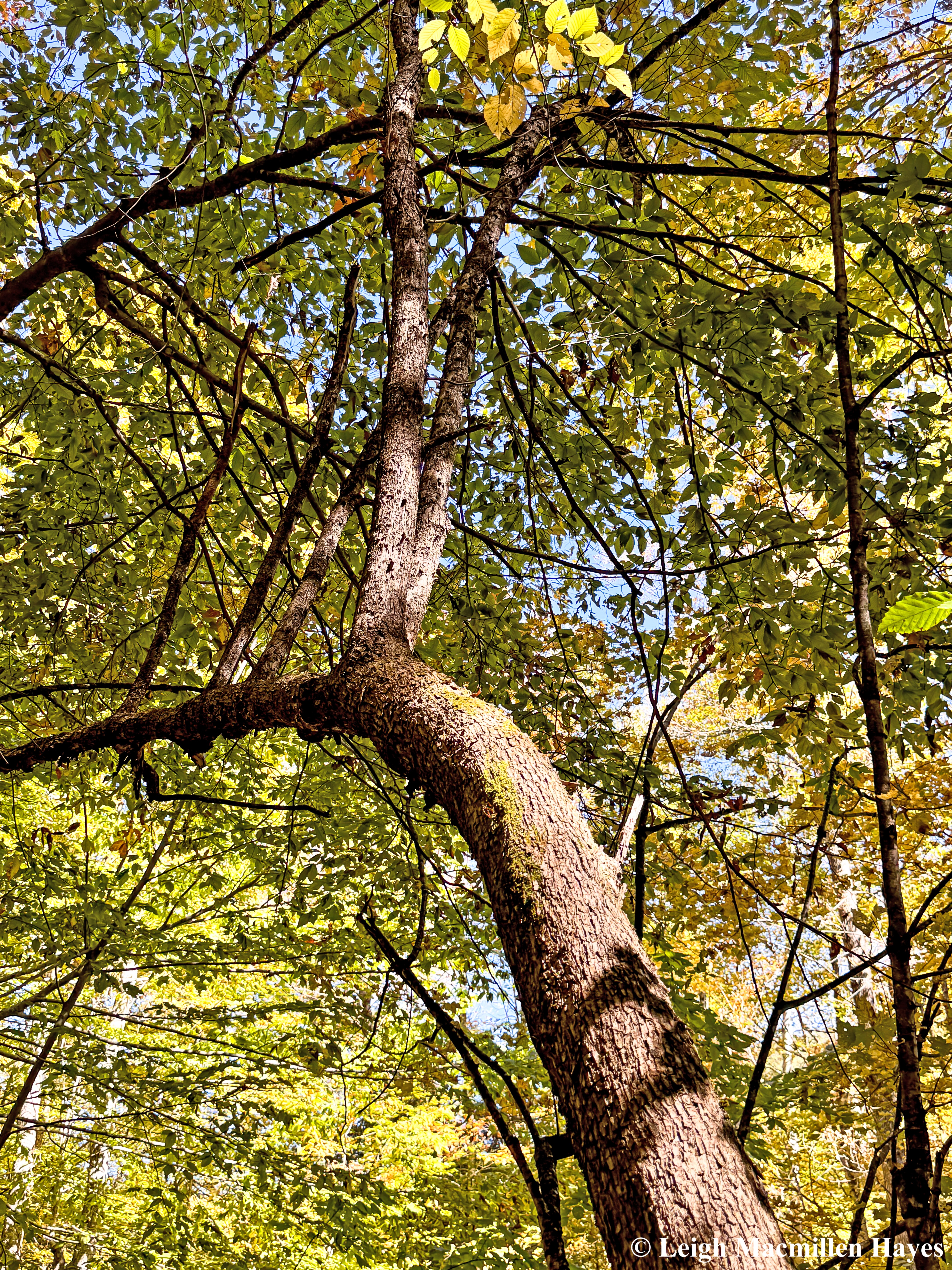
Those items would have been enough, but we realized from the start that we were in Hop-Hornbeam territory, and several surprised us. Typically, this is a tree that stands straight and tall, but a few must have been hit by other trees during storms perhaps, and their trunks had turned. Despite that, other branches took over and reached for the sun.

The other day some of us were looking at a sample of this tree and I asked them what they noticed about the bark. Their responses: shaggy and vertical lines. Spot on. Sometimes the bark is a bit tighter to the tree than this one we saw today, but it’s a great example of how this bark behaves. If you rub your hand on it, some pieces will flake off.

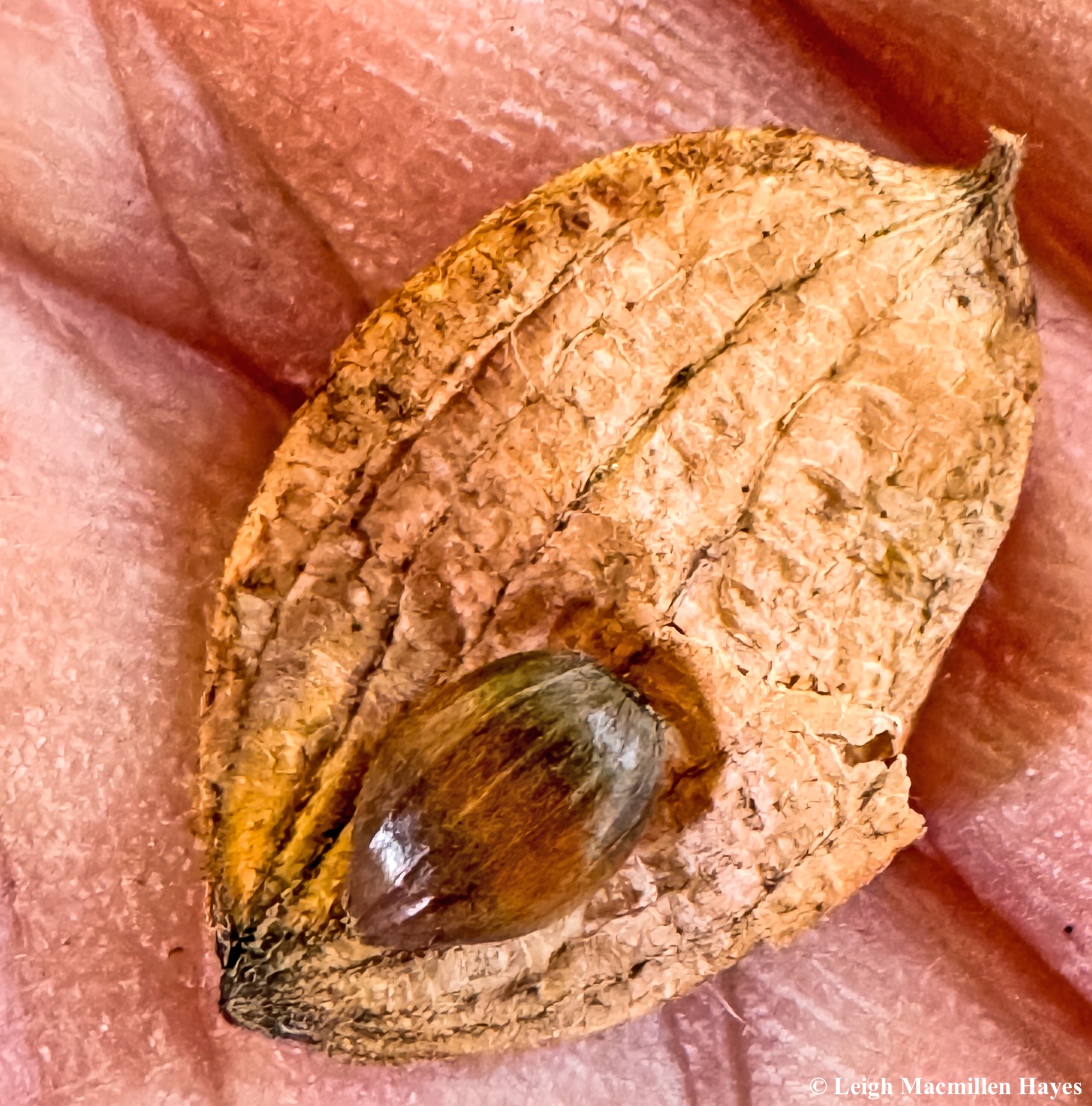
What I really wanted to see since we were in the presence of so many Hop-Hornbeams, were the hops for which it was named and BINGO! They were scattered along the trail, so I picked one up and slit the inflated paper-thin casing open and pulled out a seed. Such a small nutlet compared to the bouyant sac it was borne in.

The leaves are double-toothed and just as these emerged in the spring, male and female flowers would have developed. Being a member of the Birch family, the flowers are in the form of catkins, the male being longer and reddish-brown, while the female would have been shorter and green. Pollen is dispersed by the wind.

During the summer, the fertilized females form into cone-like structures, or strobiles, and their shape gives them their name for they look like hops.

I challenged My Guy to find some of these, which he’d never seen before. Knowing he likes a challenge, like counting Lady’s Slippers and looking for Bear Claw trees, I knew he’d pull through, and he did. But, he also developed Warbler Neck, for so high up in the tree does one need to look in order to spy the hops.

And so to counteract that, I suggested he look down. Success again. This guy is good!

At lunch log, we had a chance to enjoy the view and realized we were looking at Noyes Mountain, which we had hiked about a month ago.

With the camera, I could pull in the rocks on Noyes where we ate lunch before descending into an old mine below.

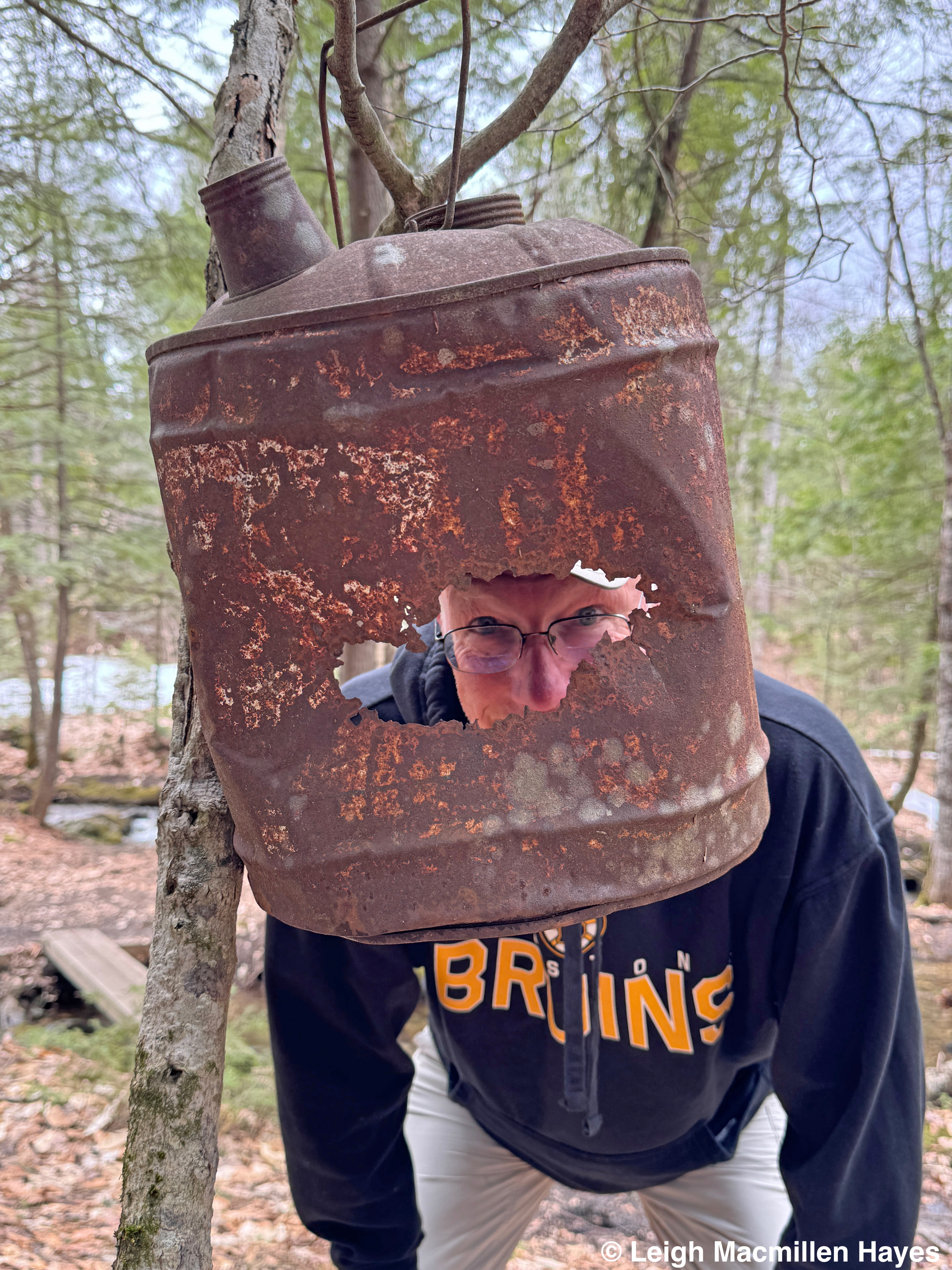
After circling around the summit of Far Winde-a-Way, where the views may be better in the winter, but we didn’t mind because that’s where we found some of the hops, we began our descent and noted a few artifacts, which got My Guy talking about the fact that metal cans for motor oil were replaced by plastic in the 1980s. He is Mr. Hardware, after all.

And I found a stone that had split naturally in quarters.

Well, maybe they weren’t exact quarters, but still it was worth a wonder to notice.

Another tree that we noticed as we descended was an American Basswood. The bark is similar to Northern Red Oak, but without the red in the furrows between the ridges, and the ridges are flat, almost brushed. Again, I rubbed my hand along the almost smooth surface.

I kick myself now, because I didn’t think to look for their fruits, but I did spot leaves on the forest floor. They are typically quite large, and have an assymetrical base, so if you fold a leaf in half, one base will be shorter than the other. The only other trees in our woods with this feature are the American Elm and Witch Hazel.

Next we reached a brook, where I’m sure the water cascaded over the moss-covered rocks in the spring when we experienced about fourteen rainy weekends, but today it was almost all dry, except for a few pools.

Creating a spider-web appearance on the pool’s surface were about a dozen Water Striders, so speedy in their dance routines.

And hiding at the edge, perhaps in hopes of capturing a Water Strider for a meal, was a Green Frog, with its dorsal lateral folds beginning behind its eyes and continuing down the edges of its back.

At the Cakewalk, for so a trail closer to Mud Pond is named, we met Mouth Rock. We’re pretty sure this wide-mouthed boulder ate all the cake because we never found any.

But our finds did include a champion! Co-champion actually–for the largest Eastern Hemlock in Oxford County according to Far Winde-A-Way Nature Preserve‘s website.

And I quote: The tree is: 10 feet in circumference, 90 feet tall, with a crown spread of 60 feet.

We also found this great specimen. Rock or tree? Tree or Rock? Rock and tree! Tree and rock!

Where does one end and the other begin for they looked like twins. Maybe that’s what happens when you spend so much time together. Kinda like some people looking like their dogs (we had a neighbor when I was growing up who always had beagles and he really did look like a beagle himself. Of course, we never told him that.)

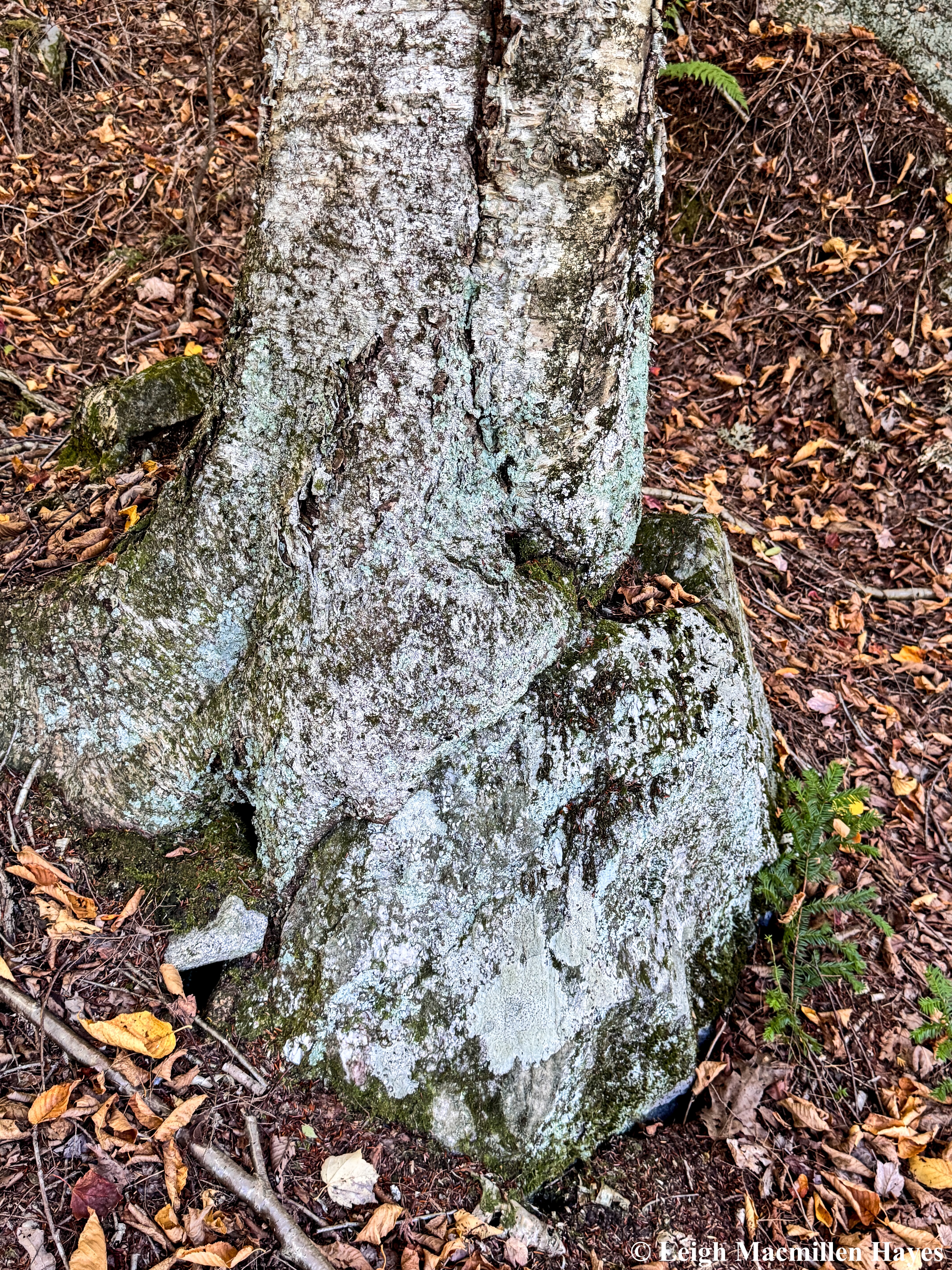
Anyway, this is a Yellow Birch that got its start in the moist soil that probably formed on the moss atop the rock and then sent its roots downward and trunk upward, but really, the two could have been one.

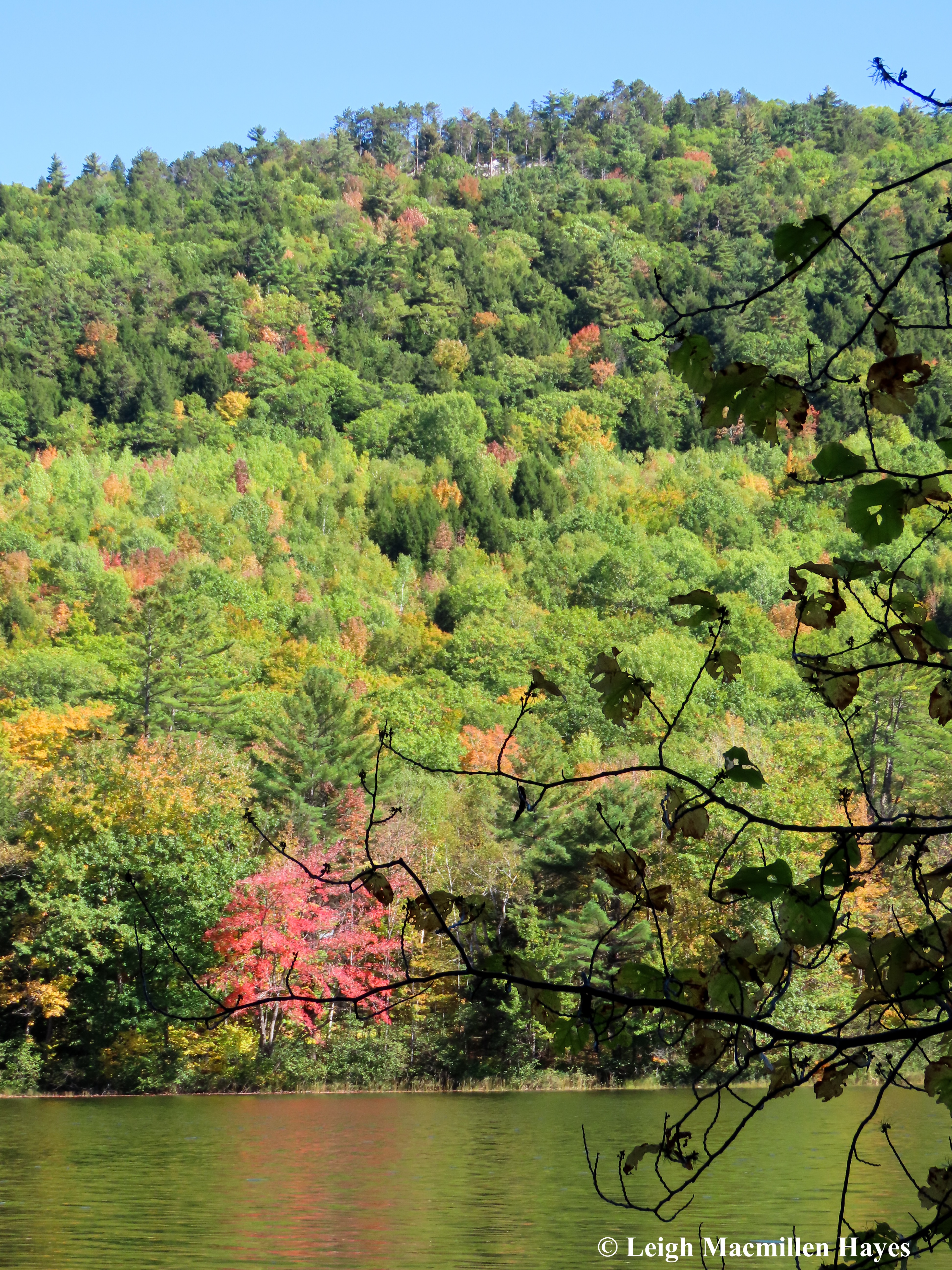
One of our last views before heading back up to the kiosk, was of Noyes Mountain again, only this time it included Mud Pond. And our early fall foliage season. Foliage reflections are among my favorite.

I’ll close this Far Winde-a-Way Mondate by giving thanks not only for My Guy and his love of new adventures, but also for the family that made these hiking trails available so that all of us could enjoy them: The husband and daughter of the late Pam Nelson. “This preserve is dedicated to the memory of Pamela (Roots) Nelson. For more than 30 years, Pam lived her dream to protect, conserve and enjoy these woods and waters. She roamed this rugged hillside and developed a trail system steeped in the natural wonders of the Maine foothills. Today you can enjoy some of the beauty she discovered.”

Pam passed away in 2022, but her family carries on her tradition, and this poem at the kiosk was written by her sister.

Thank you to M for suggesting Far Winde to us, and to the Nelsons for sharing it with all of us.

Ode to the RAIN!

It began in spurts, 
The rain that is.
Starting with some drops on Tuesday,
Followed by a few more on Wednesday.
But today, much to our delight,
we awoke to the drumming of droplets
upon our metal roof,
and I couldn't resist heading into the woods.
One Jack, or rather Jill-in-the-Pulpit,
lay down its sweet head
upon the wet ground
as if to kiss the moisture gathered there.
In a boggy section,
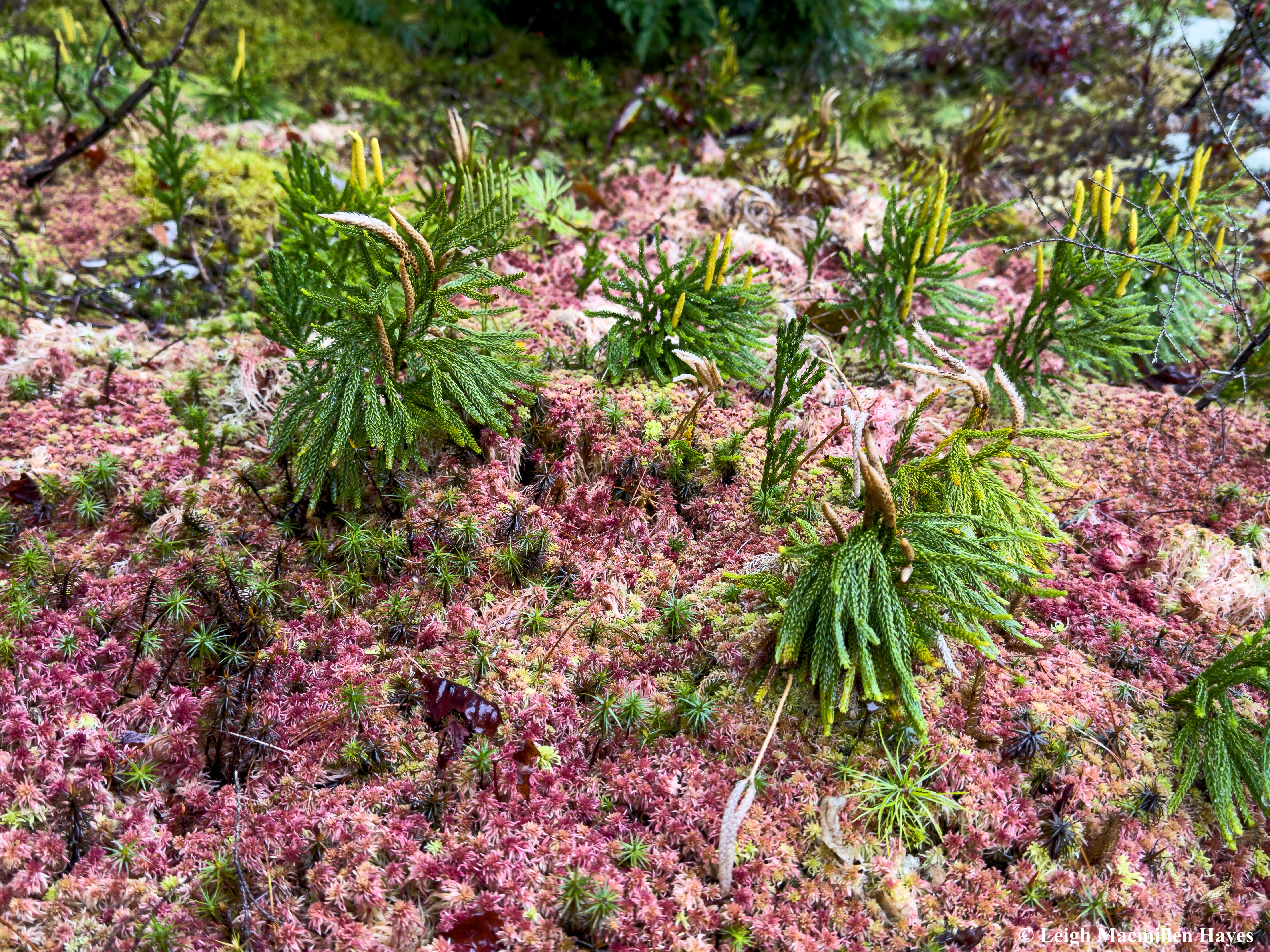
it made the Hickey's Tree Clubmosses
suddenly stand out in contrast
to the pink and green sphagnum below.
And upon every surface,
or so it seemed,
raindrops gathered,
sometimes hesitating for a moment.
Other droplets 
enhanced guidelines
and supporting threads
of a spider's web.
Because it was raining,
I decided to play and poked a stick
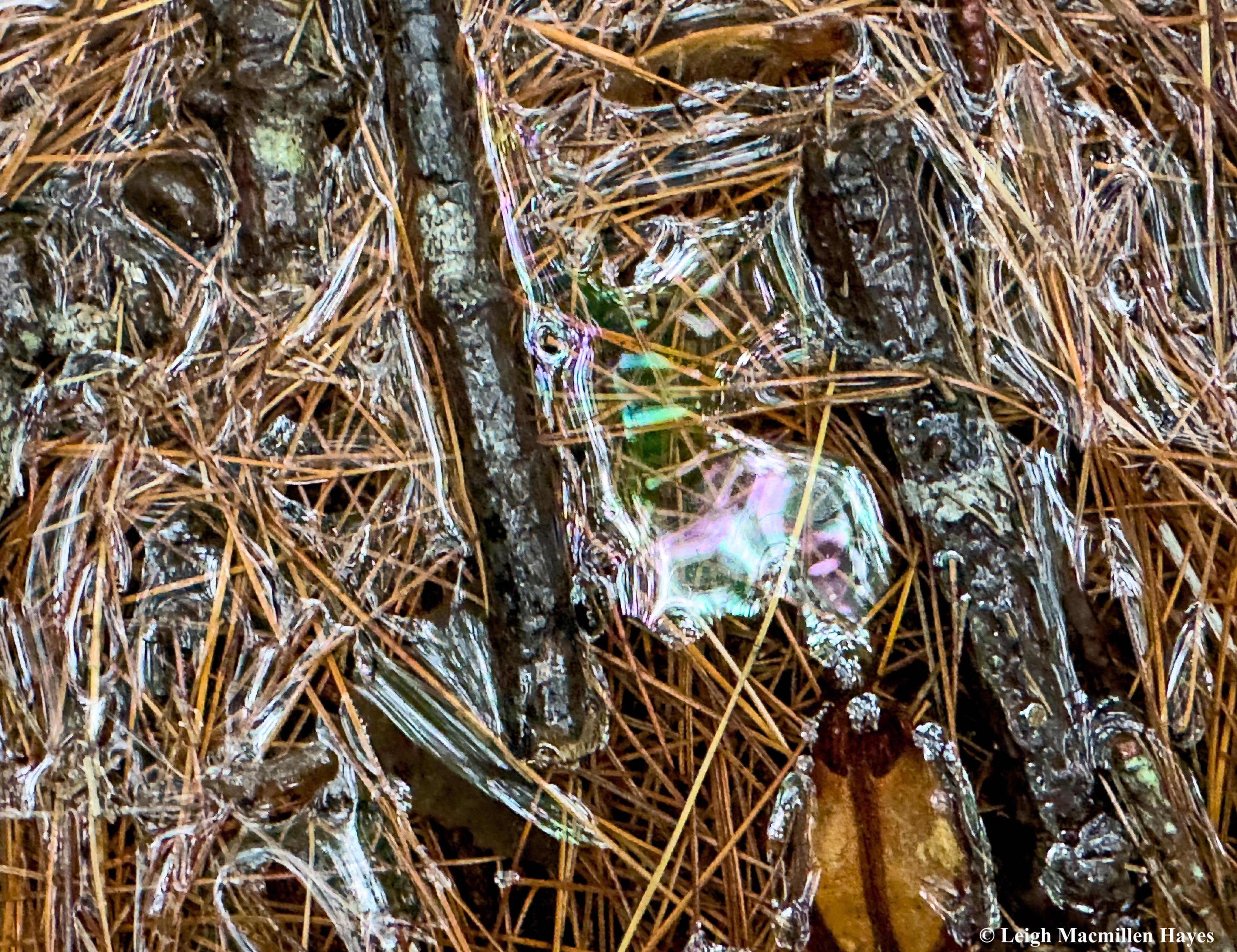
into the resin blister of a Balsam Fir,
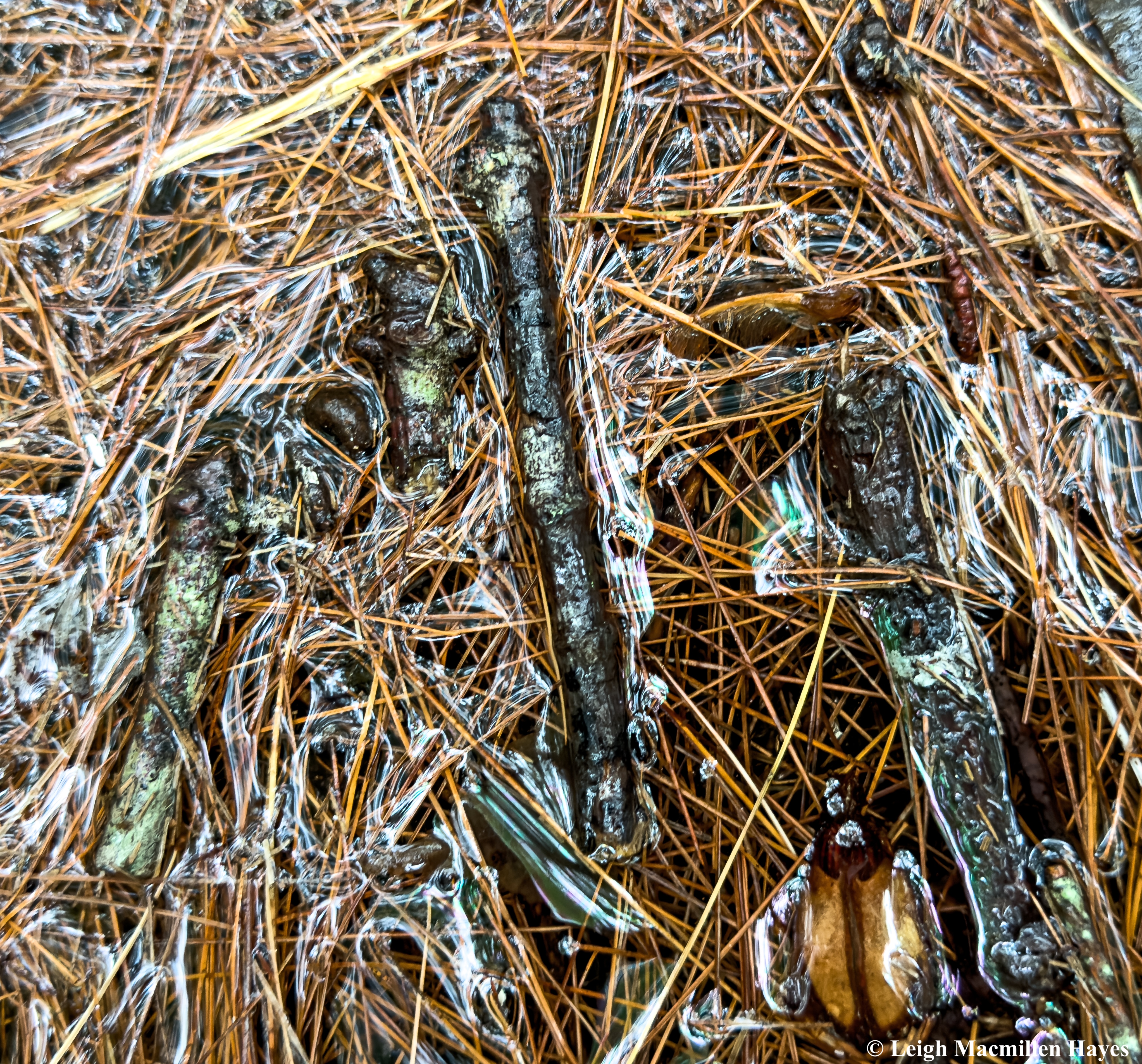
then placed it in a tiny puddle.
My sense of wonder
was well rewarded
as the essential oils
created ever-changing rainbows.
But my real intention
for heading outside so early
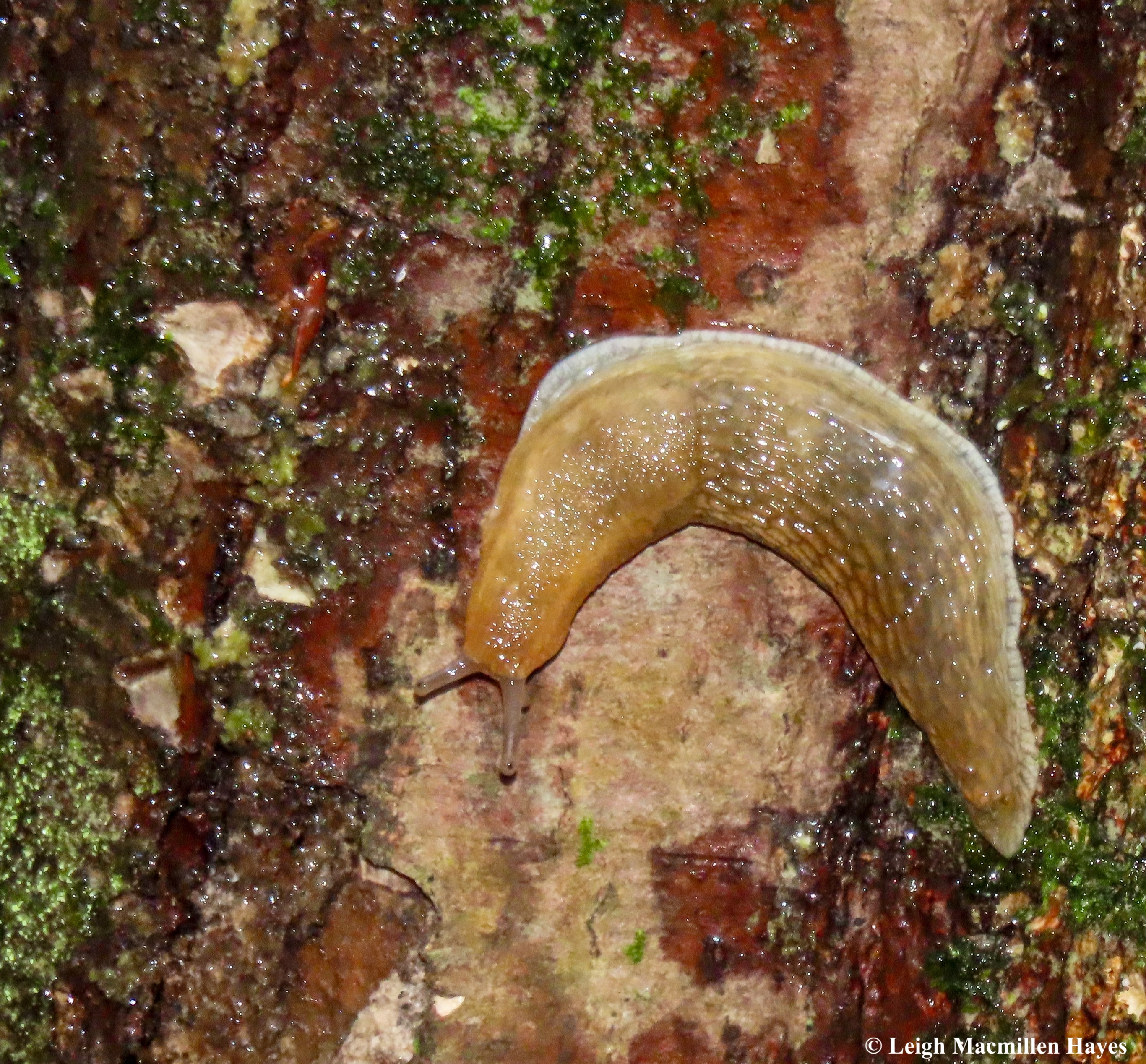
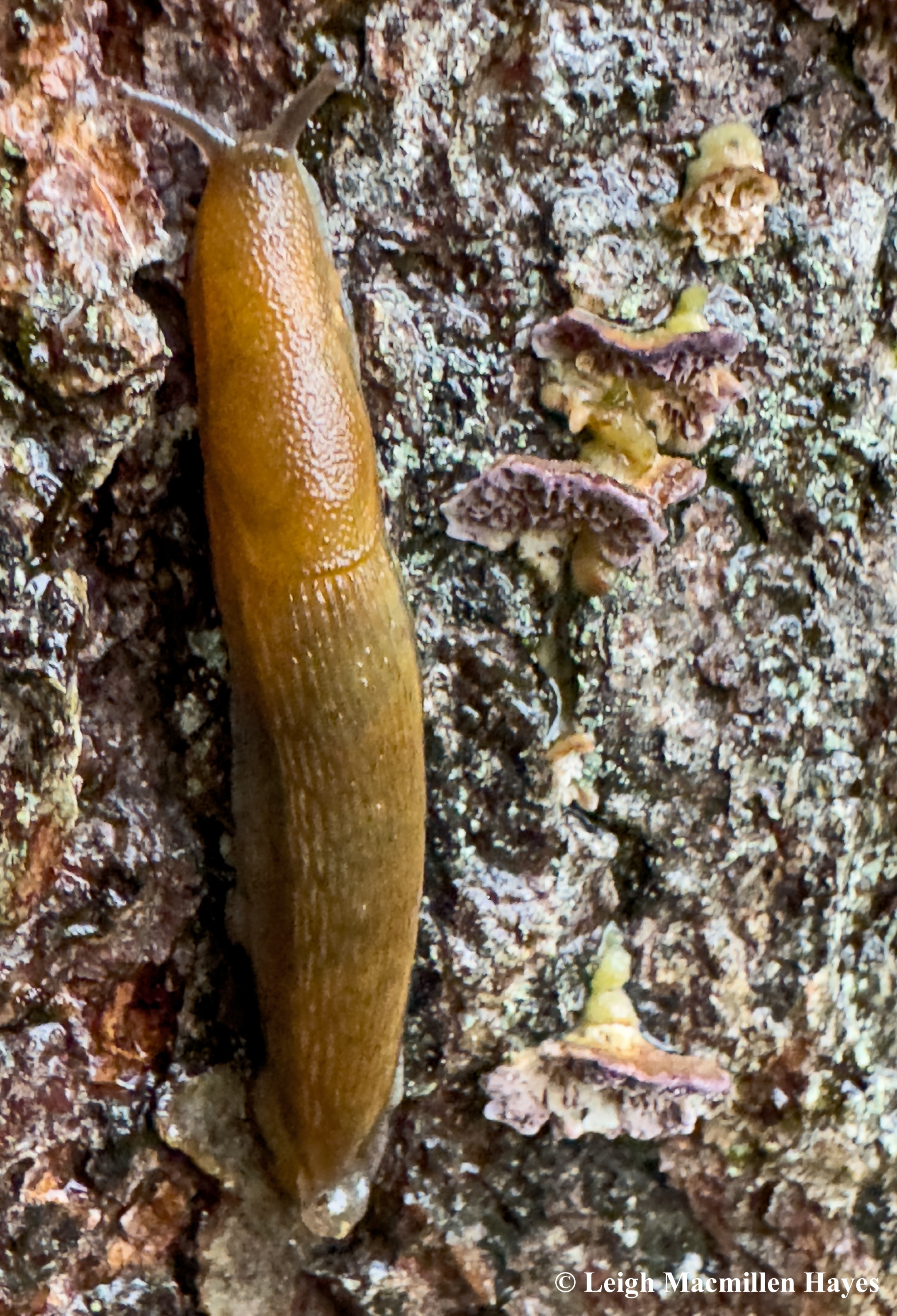
was to search for slugs
who haven't had an easy summer.
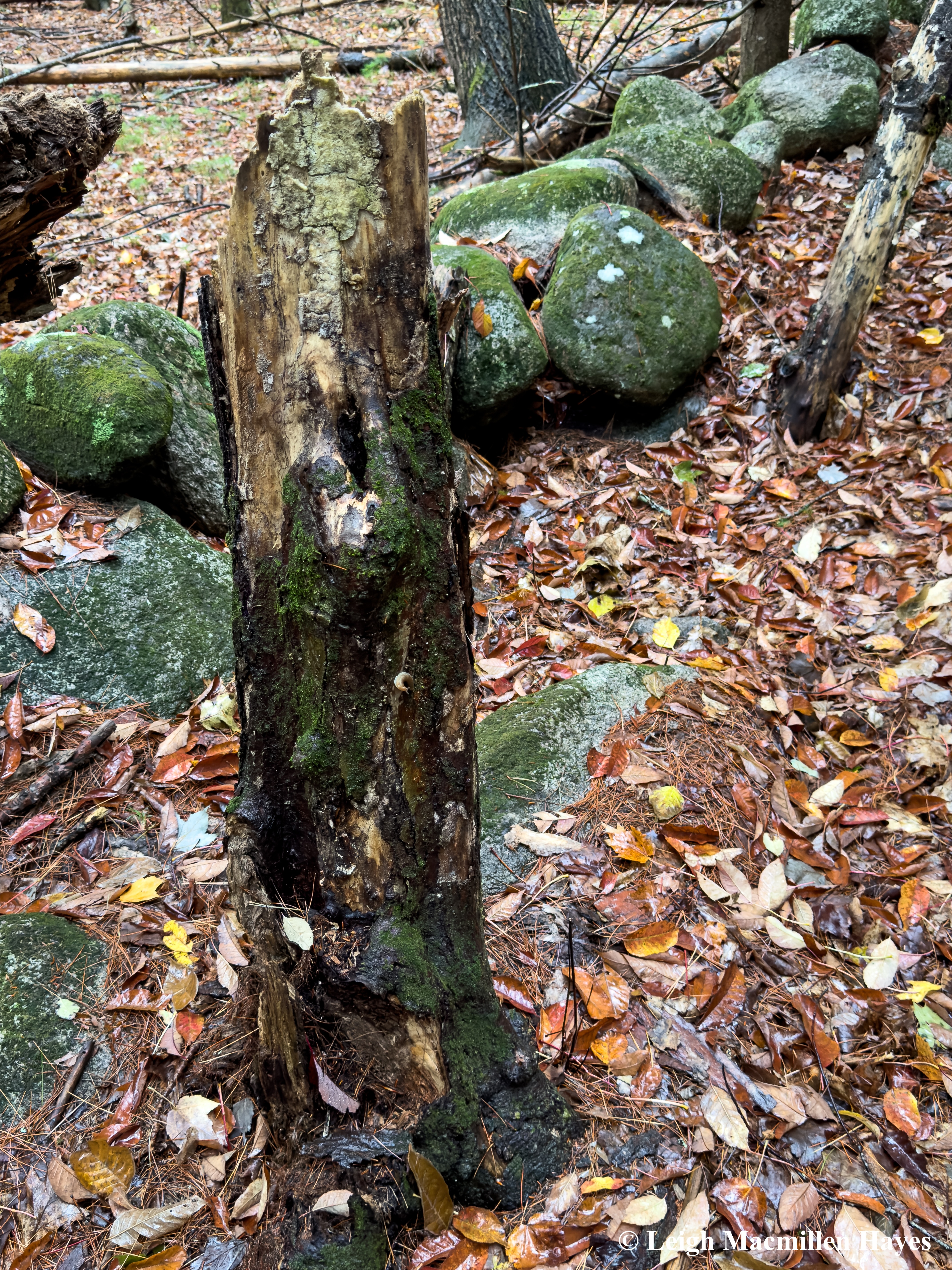
I was rewarded 
when upon a snag,
I found a Western Dusky
dining on smaller organisms than I could spot.
My other intention was to hunt for suds
and though I found some in the morning,
the pounding rather than pitter-pattering rain of the late afternoon
provided many an example.
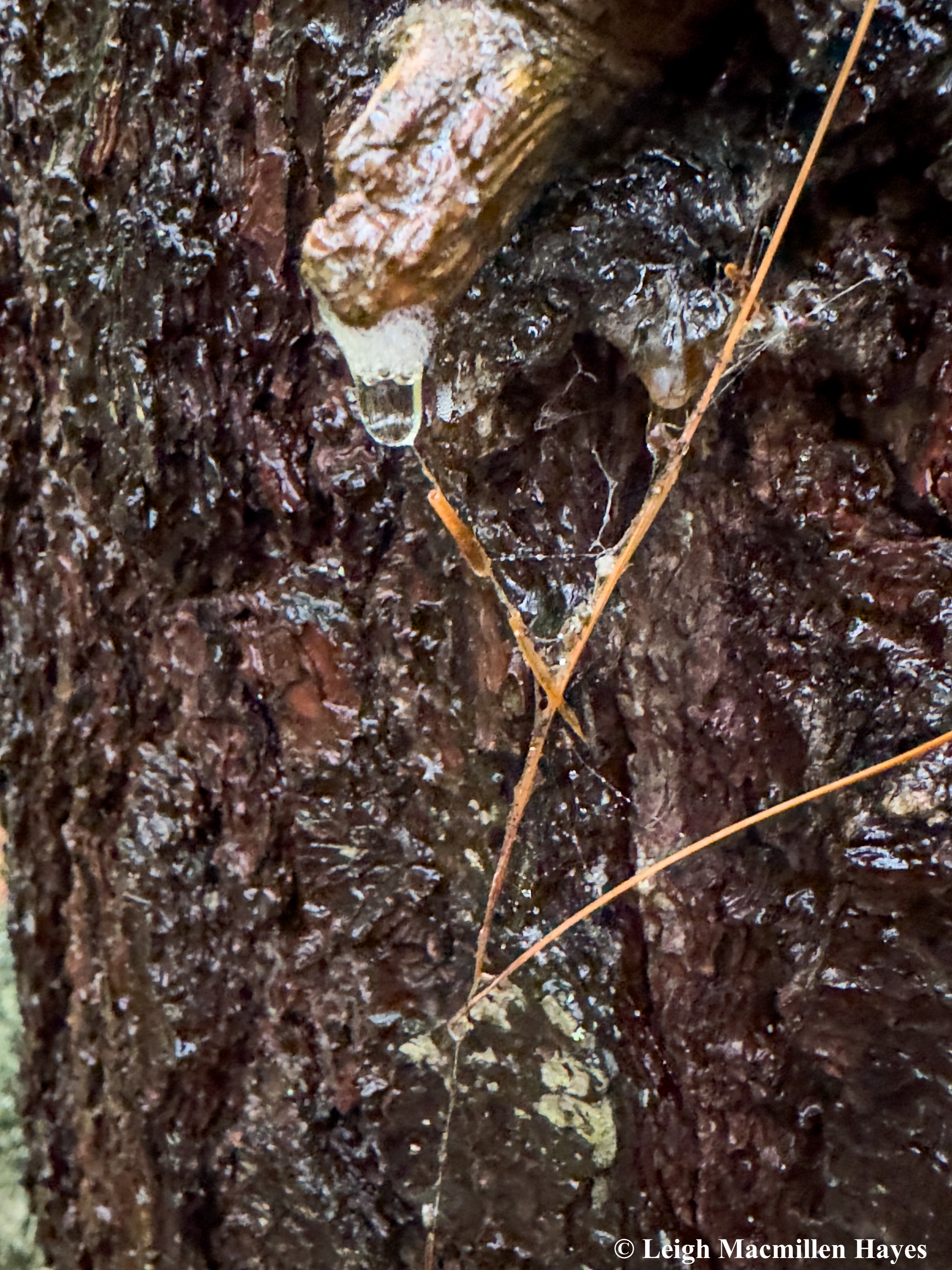
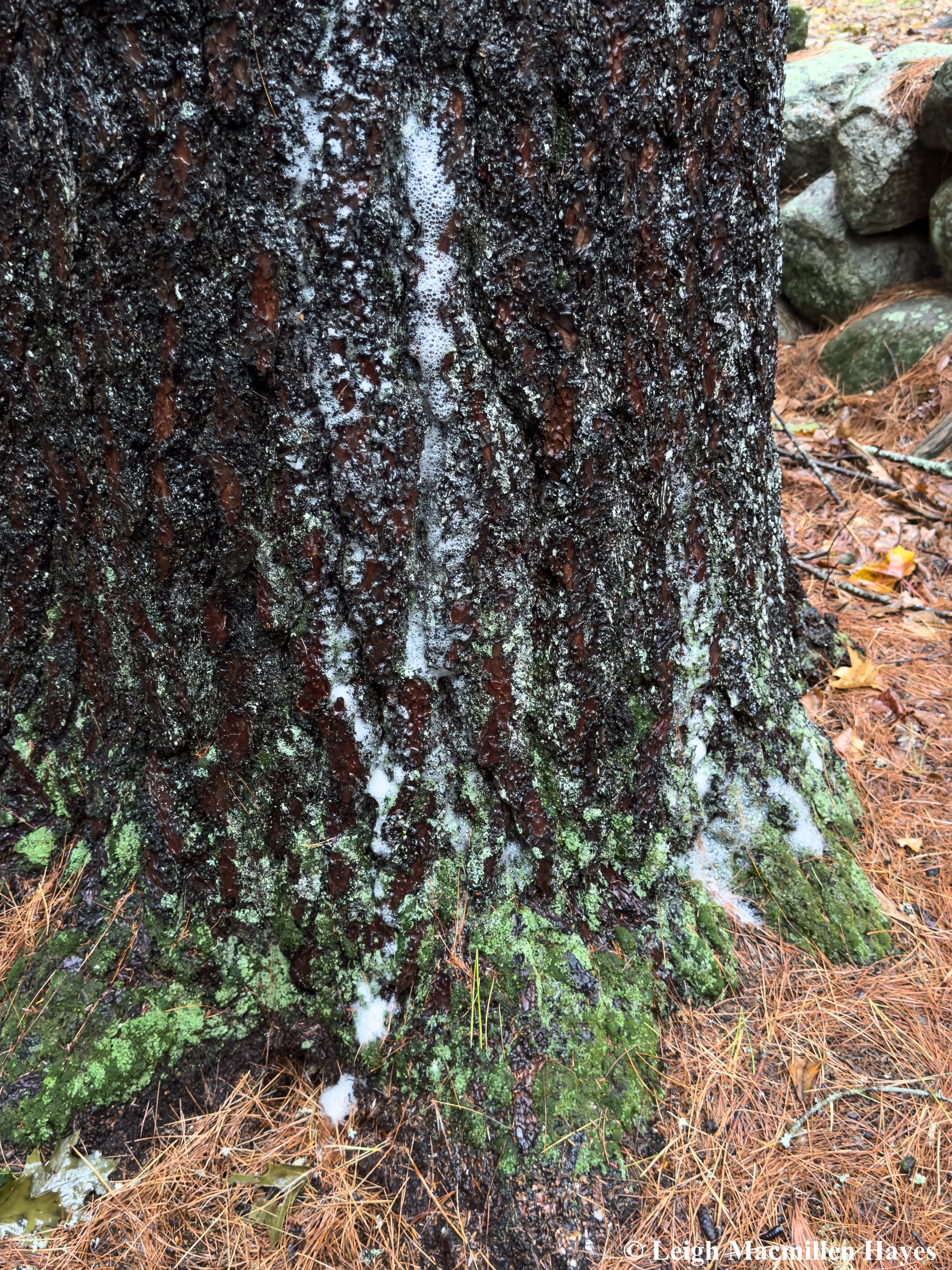
As the droplets dripped toward the base,
dissolving chemicals on the bark,
the surface tension changed,
and with the turbulence came air, thus forming foam.
It's all a matter
of one drop at a time,
but when the rain is heavy,
those drops form and release quickly.
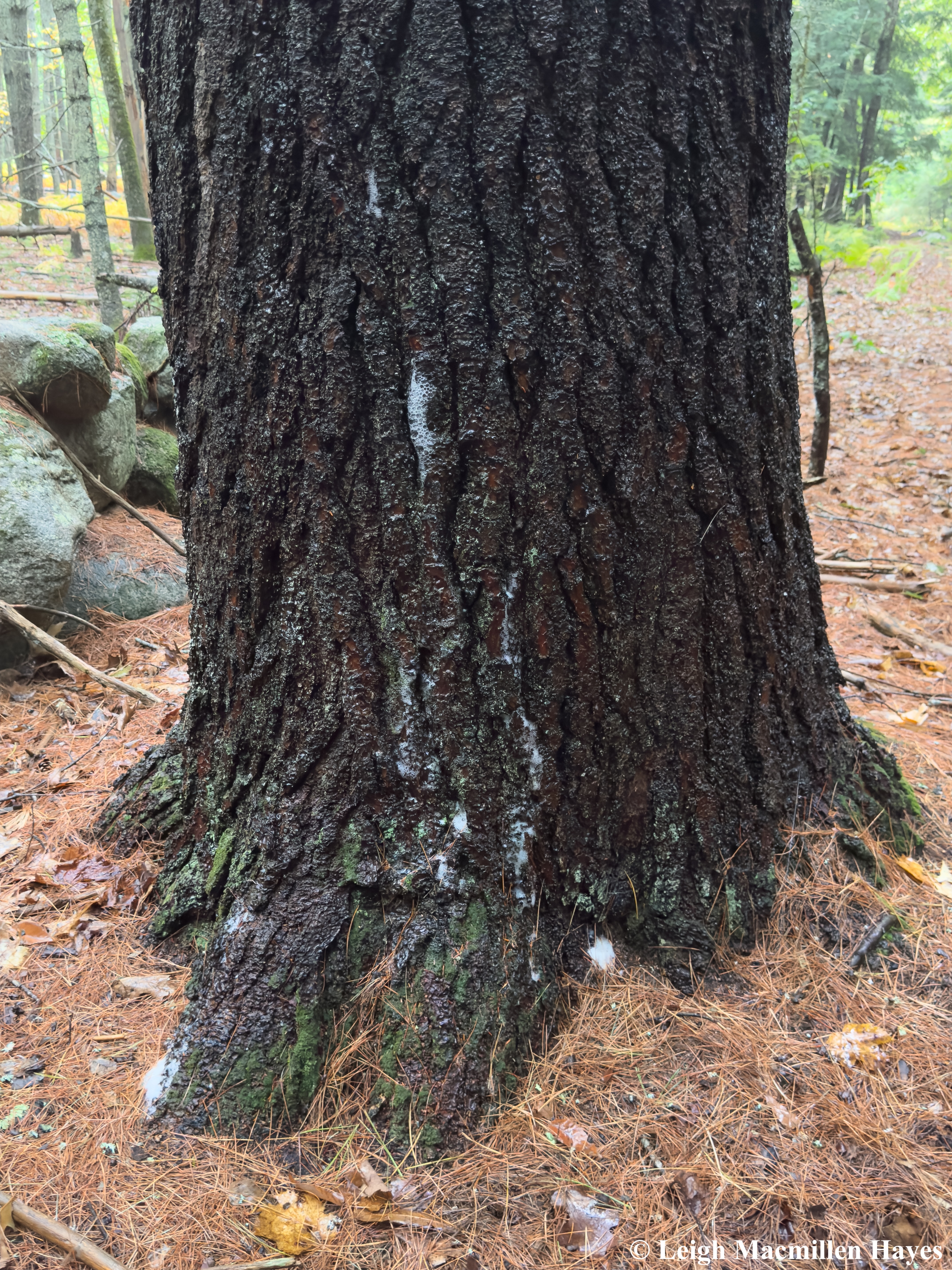
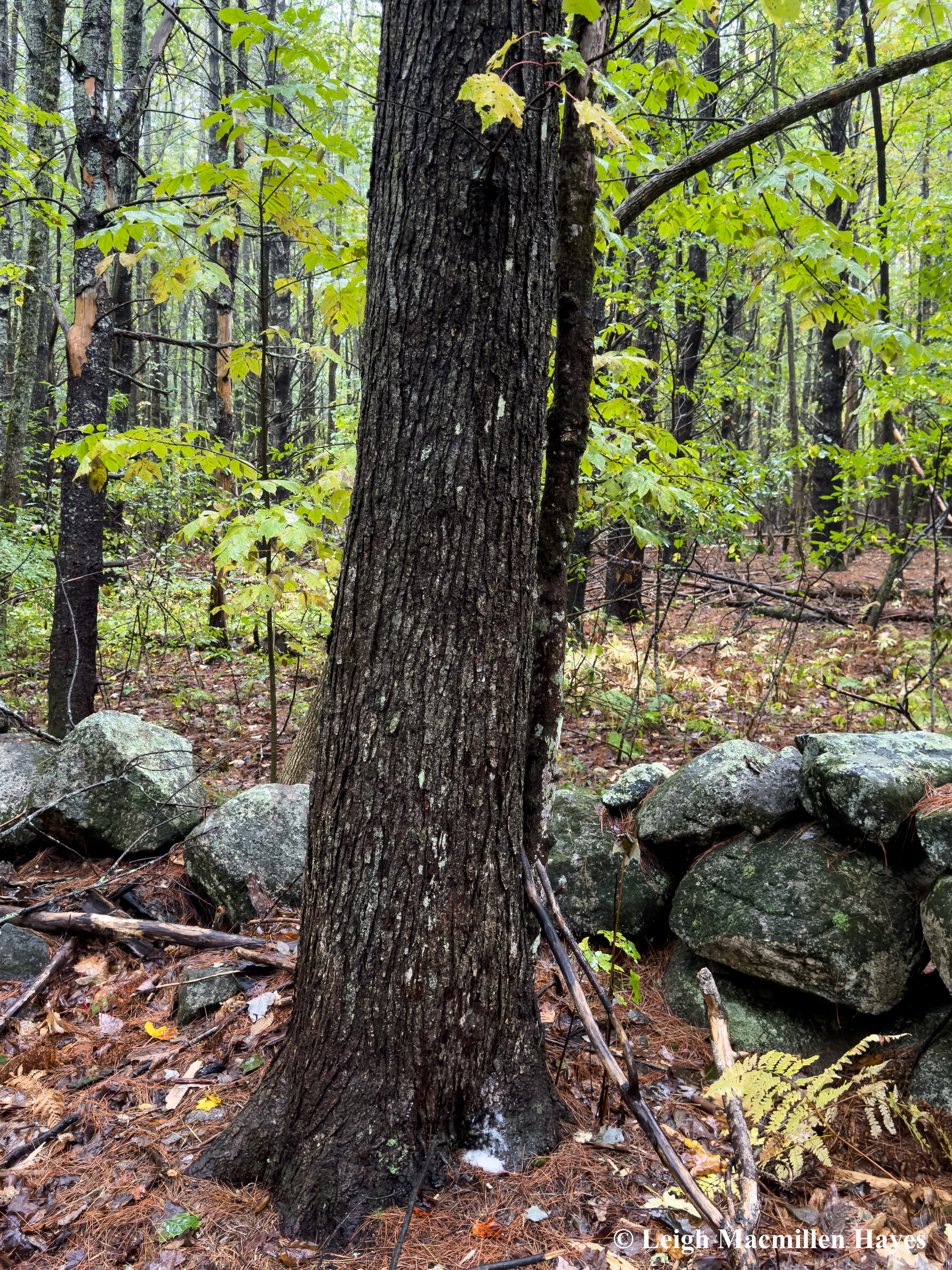
Upon one of the older White Pines
between the stonewall and old cow path,
I found lots of pine soap,
on the eastern side.
The same was true on the western side,
and as I now sit inside all cozy and dry,
it is pouring out there and I suspect almost every tree
has a base like this.
It's easy to think
that only pines offer the suds,
But I've learned from observation,
That others do the same, like this Red Maple.
And much to my pleasant surprise, 
I found a gathering of suds,
within an old Pileated Woodpecker hole,
on one of my favorite trees.
I like to think of it 
as the Stairway to Heaven Tree,
for such do its branches remind me,
as if I could climb them into the sky.
Because I was looking,
I discovered an insect,
this being a Hemlock Looper Moth,
taking refuge upon a trunk.
When I originally headed out the door this morning, 
and told My Guy I was going on a search for Slugs,
he said, "Who is this person I married?"
And we both chuckled.
All told I only found three. 
Nevertheless, I know these three
and many other critters and humans
join me in praising the rain.

Wednesday Wanders=Wonder-filled

You know when you start something and you have no idea of what the future will hold and yet, you forge ahead cuze that’s what you naturally do? Well, that’s been the experience fellow Master Naturalist Dawn and I have had since I retired in October 2023.

At the time, I knew I would deeply miss outings with the Greater Lovell Land Trust docents, a group of dedicated volunteers who love to learn and then share that knowledge with the public. But, I’d made a promise to step away so the new person could have some space.

I’m a teacher at heart, however, and needed to continue down that path. So, prior to retiring I had approached Loon Echo Land Trust and asked if I could lead some winter walks for them, sharing the art of tracking and other winter wonders with their participants. That idea was well received and I invited Dawn to help. We began in November 2023 and when March 2024 arrived, and we should have been winding down, I realized we were having so much fun that the program needed to continue and so it did until last July. And then we took a brief hiatus.

The hiatus ended in September 2024, and on our first outing among our finds were a few Brown Hooded Owlet larvae, with their striking colors and pattern.

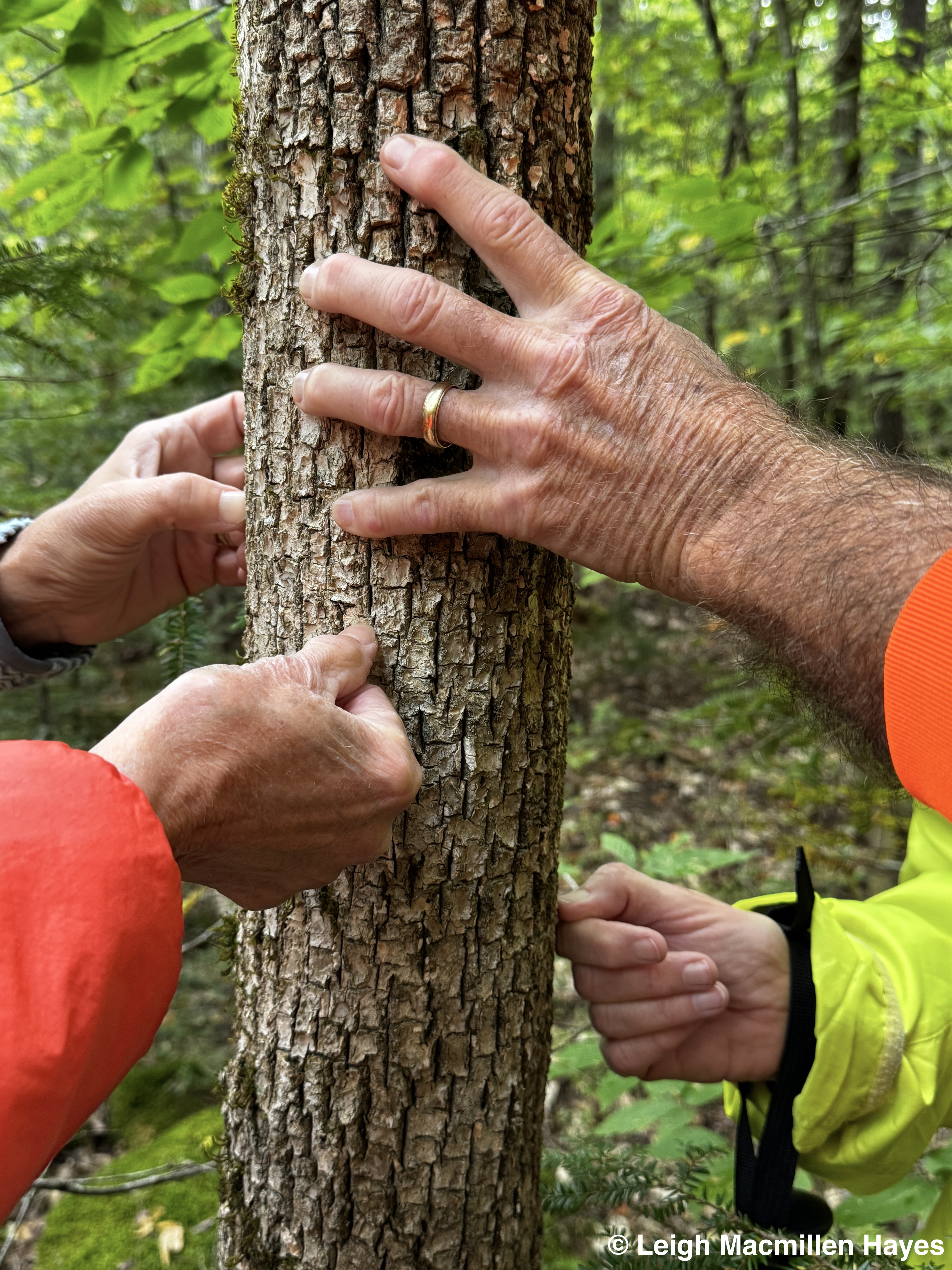
On that same journey, we reached a wetland where Black Ash grow, and encouraged participants to poke their thumb nails into the bark. I love it when people are willing to try and in this case, they realized the bark is corky. Especially after it has rained.

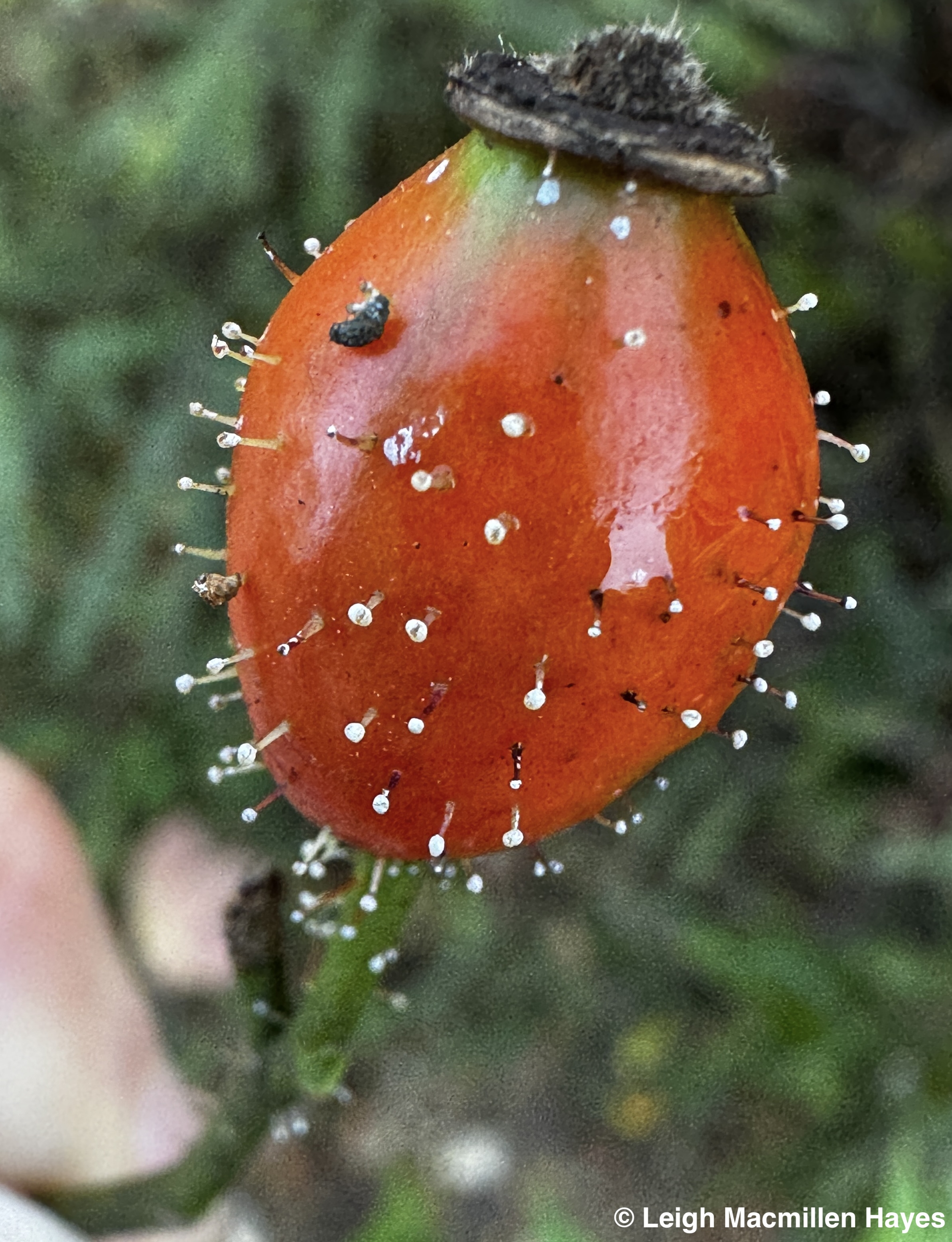
October found us being wowed by rose hips. Because–look at those spikes. We thought maybe a slime mold, but instead discovered it’s the gland-tipped hairs on the hips of Ground Rose. Otherworldy indeed.

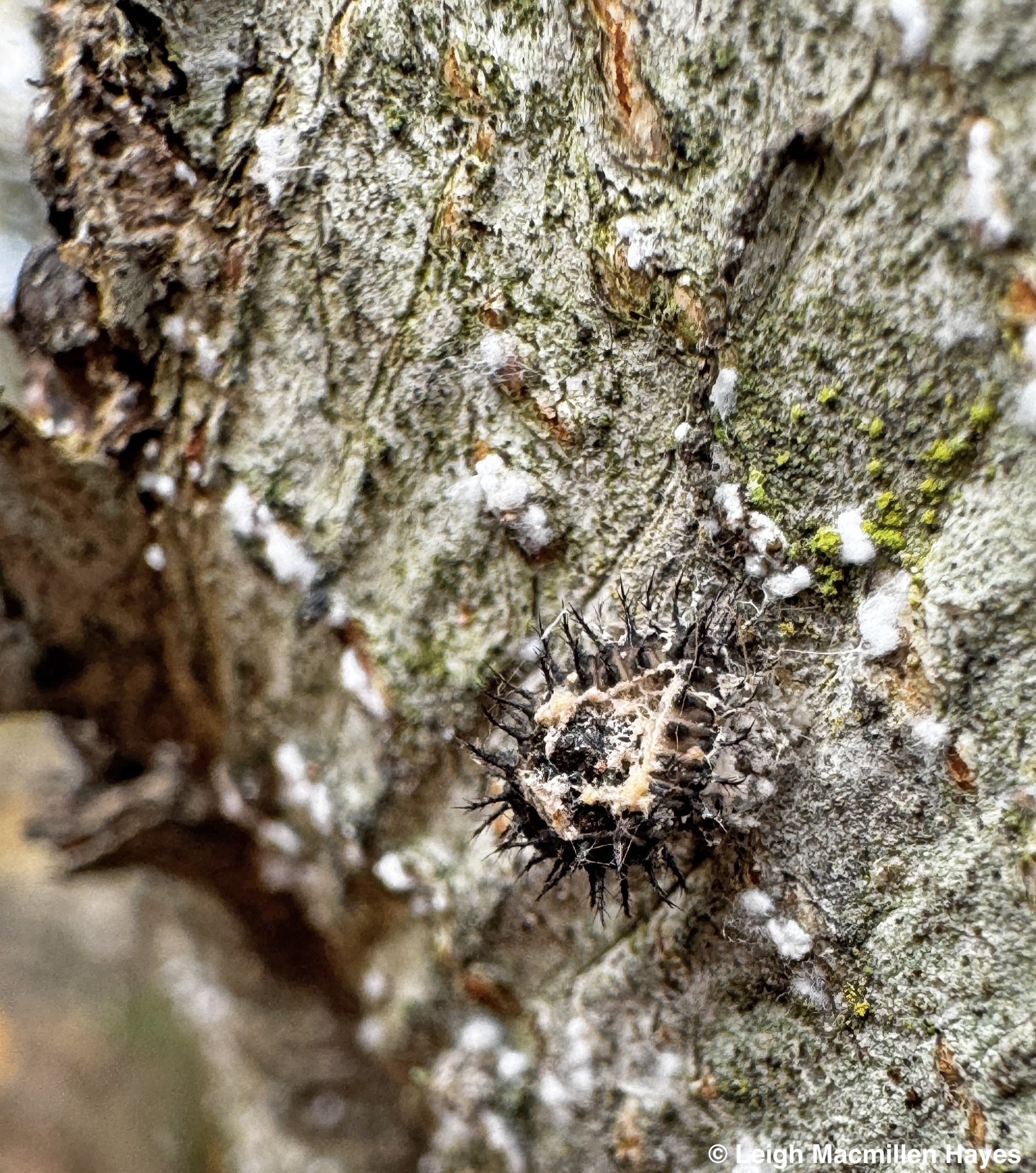
And speaking of otherworldly, the larval form of Lady Beetles also caught our attention, this one having been predated. So spiky as well, and especially when you think of what an adult Lady Beetle looks like–it doesn’t seem to match up. But . . . that’s how the natural world works.

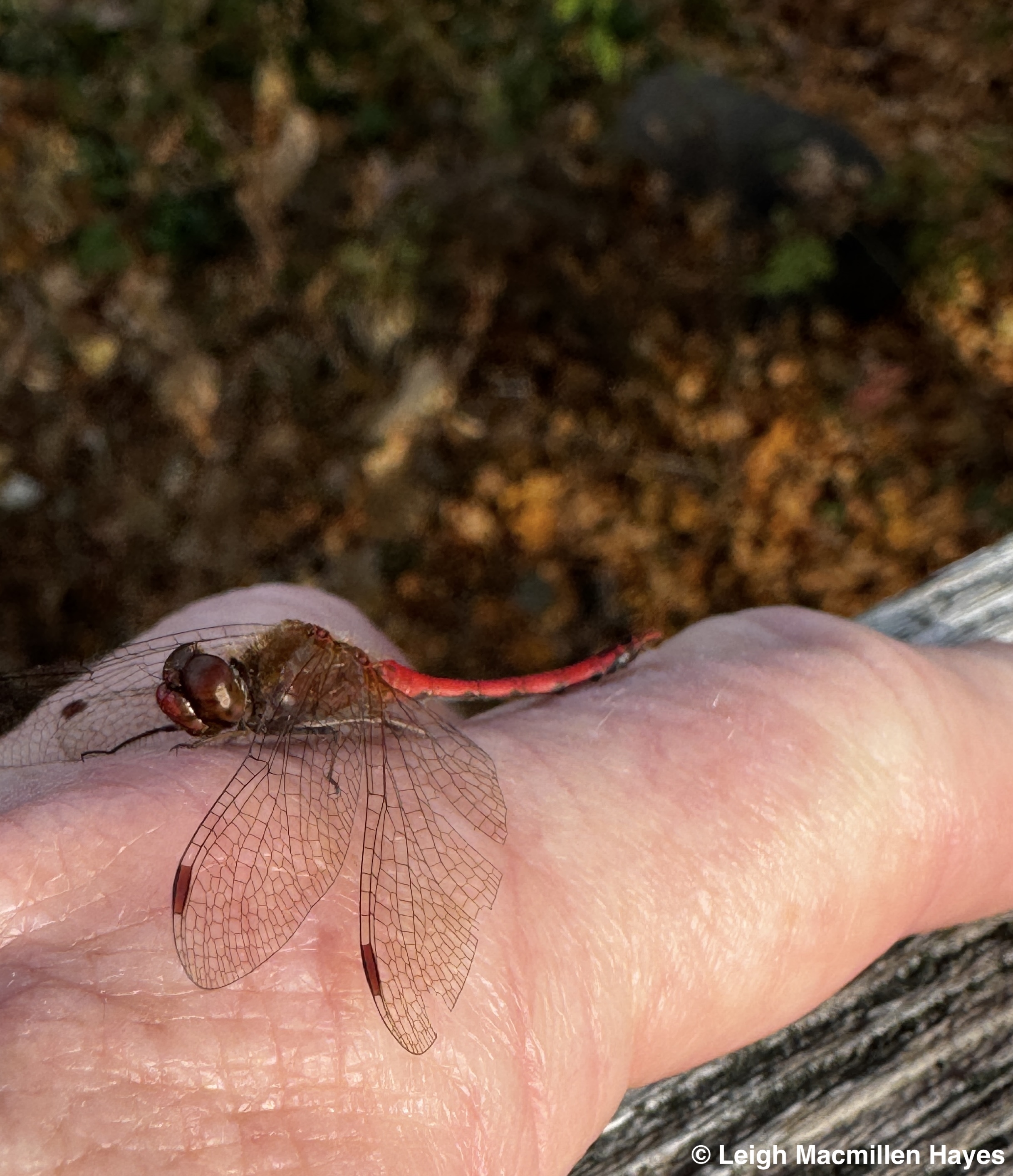
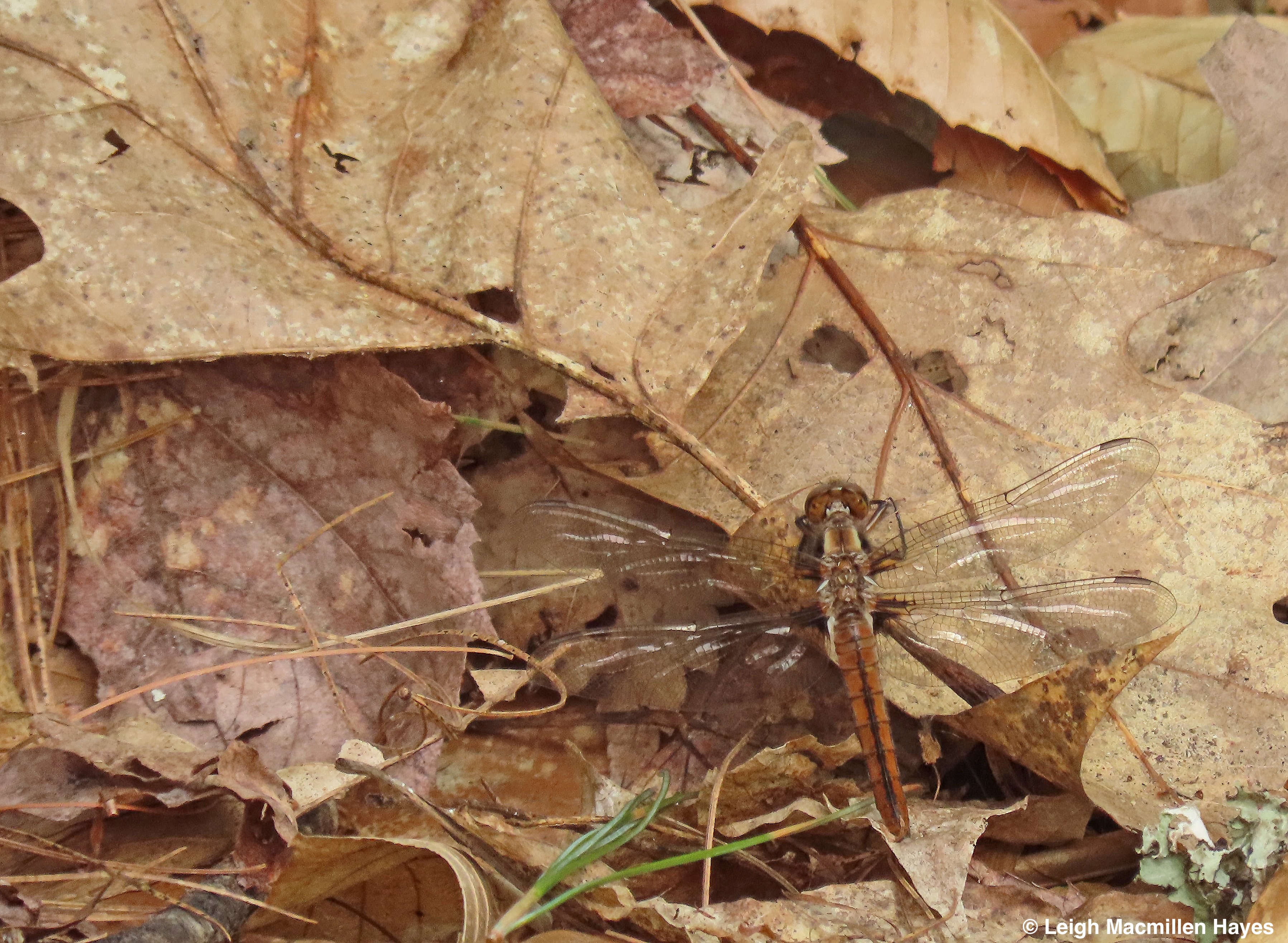
In November, we were only a wee bit surprised to still be greeting Meadowhawk Dragonflies. Notice the tattered hind wing–this one had met with some difficulties we could only imagine.

On another November expedition, while exploring an area where Beavers were quite active and had been busy mudding/insulating the outside of a lodge, plus gathering their winter food supply, we asked participants to become the critters and cut down their own trees. But . . . they had to hold the tree trunk as upright as possible and turn it, because certainly they couldn’t walk around it like a Beaver can.

Timber!

With a bit of snow in December (actually on Thanksgiving Day we had a lot of snow, but then the amount dwindled daily), we started tracking in earnest, spending the start of each walk with a brief explanation of how mammals move and clues to the prints they leave behind.

Measuring took on new meaning as stride (length from the front of one foot to the front of the next in a track) and straddle (length between the outside of one track and the outside of the next in the pattern, for example, put your feet together and measure from the outside of the left foot to the outside of the right and you have determined your trail width or straddle, which is key for some mammal print ID) were taken into consideration.

On a cold winter day in January, you would have thought that we’d bring hot cocoa. We had the cups. And we had the thermos. BUT . . . inside the thermos we had what we call mammal blood (red gelatin), and the group split into pairs and went off to find just the right spot to protect their “mammal’s blood” so we could check its temperature about twenty minutes or more later. It actually turned out to be later because we got caught up with tracking an actual critter in the meantime.

When we did check, it was the pair with the highest temperature that won bragging rights. They had found a suitable protected spot for their critter to survive.

We were still tracking in February, and were excited to follow a Porcupine to its den, and then backtrack to its feeding trees, where Eastern Hemlock branches minus buds and some needles, decorated the ground.

And though we had to dig to find, Porcupine scat in its typical comma shape, did happen.

In March, it was the large red buds of Basswood that garnered our attention. And after posting photos of these, an arborist friend commented that the buds look like a mouse wearing a helmet and I’ll never unsee that going forward. Thank you, Eli!

As the temperature began to rise with the March sun, we also spotted deer beds such as this one and knew to look for deer hair! The red arrows point to some as it was time for them to shed their winter coat and with their body heat melting the snow, some stuck to the edges.

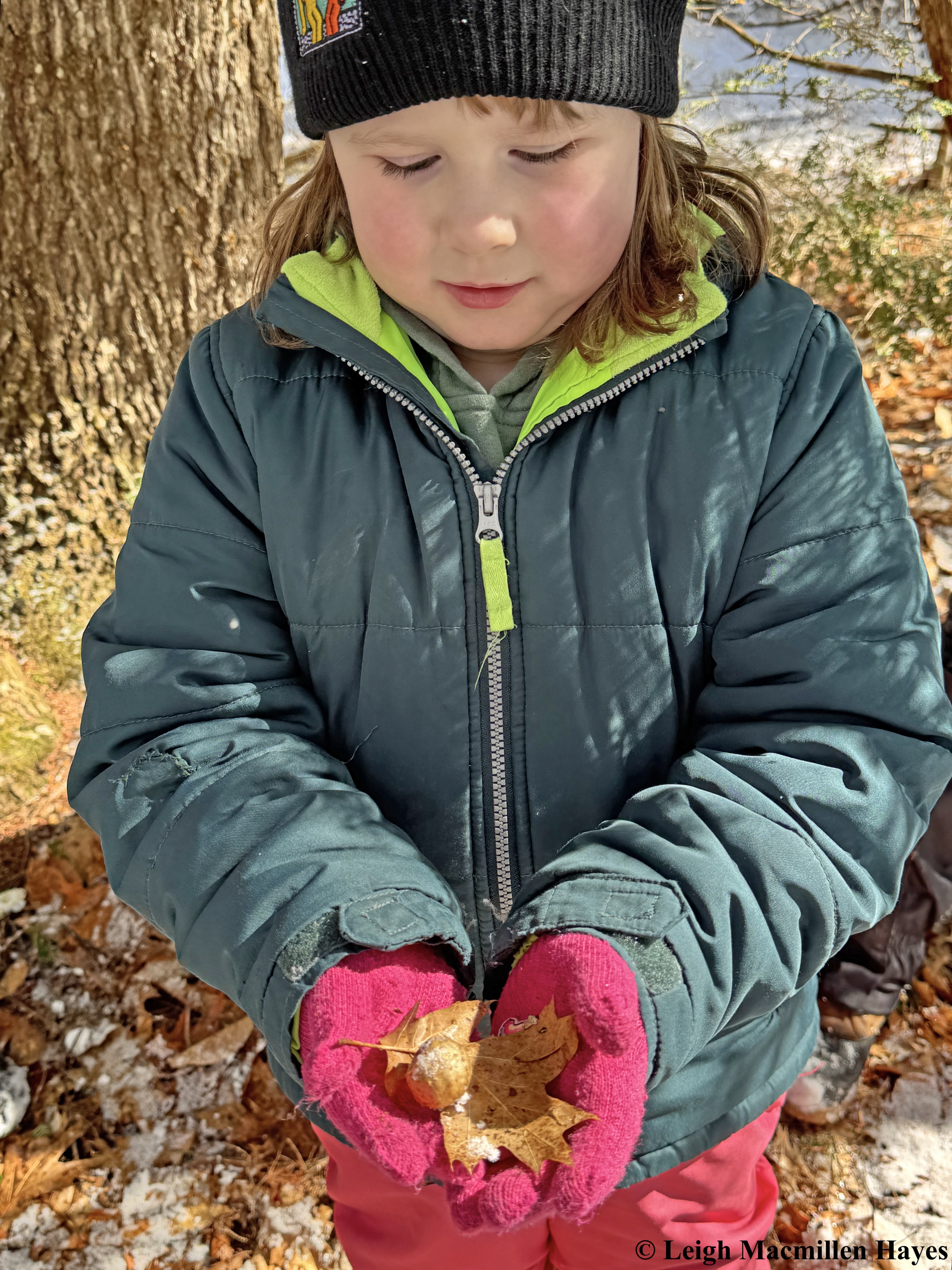
In April, on our way to a vernal pool, one of the many curious naturalists among us found an Oak Apple Gall, that would have been bright green when first formed last spring/summer.

Though it had snowed the day before, we did find Fairy Shrimp in the pool, and rejoiced as always because finding just one of this species makes the pool significant by Maine standards.

As I mentioned in a previous post, there are four species, each with a different count, that help determine if the pool is significant, but any pool that dries up in the summer and then fills up again in the fall is considered ephemeral or vernal.

When the calendar turned to May, we turned our attention to dipping in rivers and streams, curious to see what macro-invertebrates we might meet in those spaces. Out came the D-nets, which we don’t use in vernal pools, because we don’t want to disturb the egg masses of Wood Frogs and Salamanders.

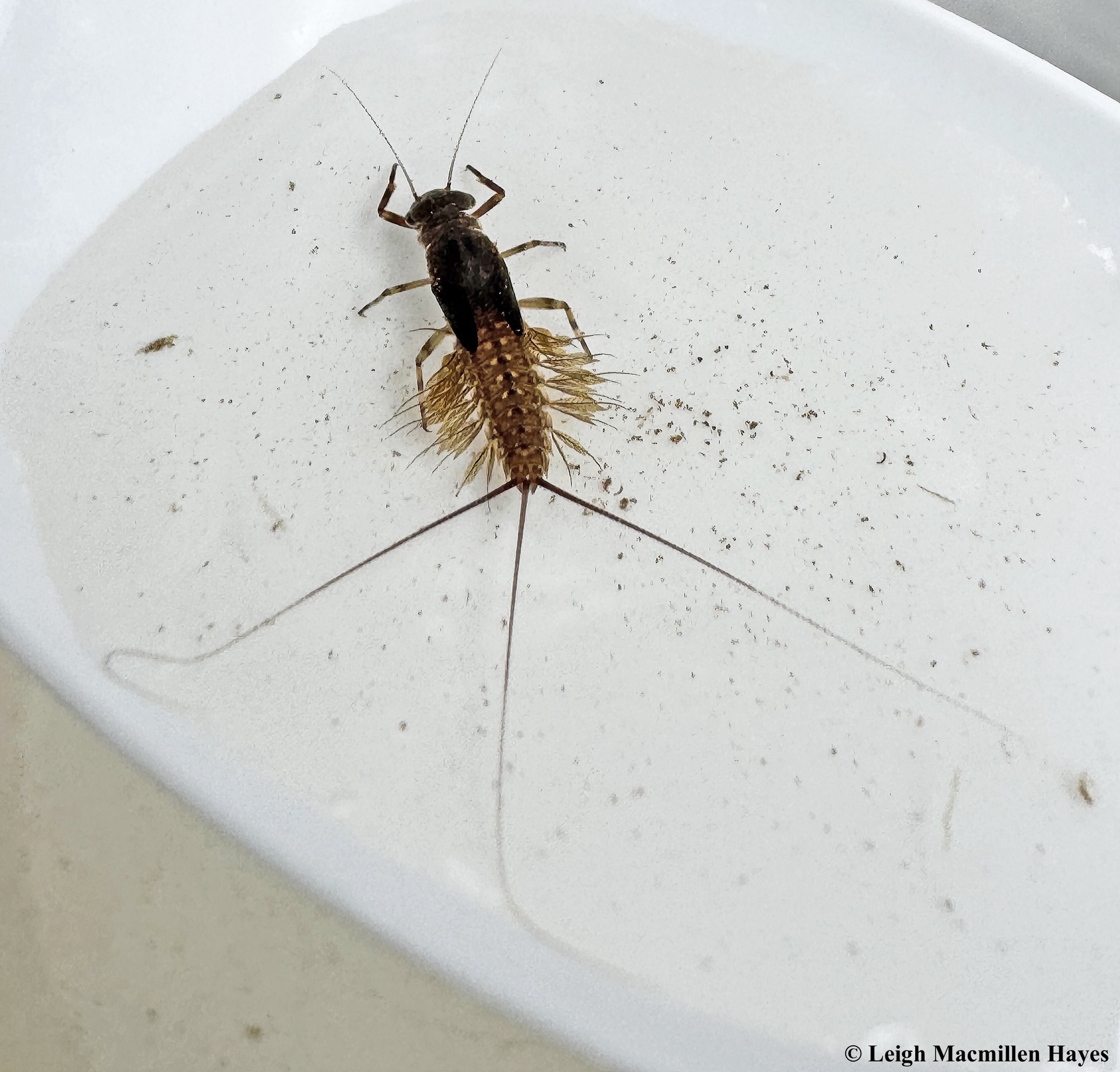
It’s always fun to meet the different species, including a variety of Mayflies in their larval form, with gills along their abdomens and three tails. Long tails quite often. And all that come out of the water, including Mosquito and Black Fly larvae, must go back in.

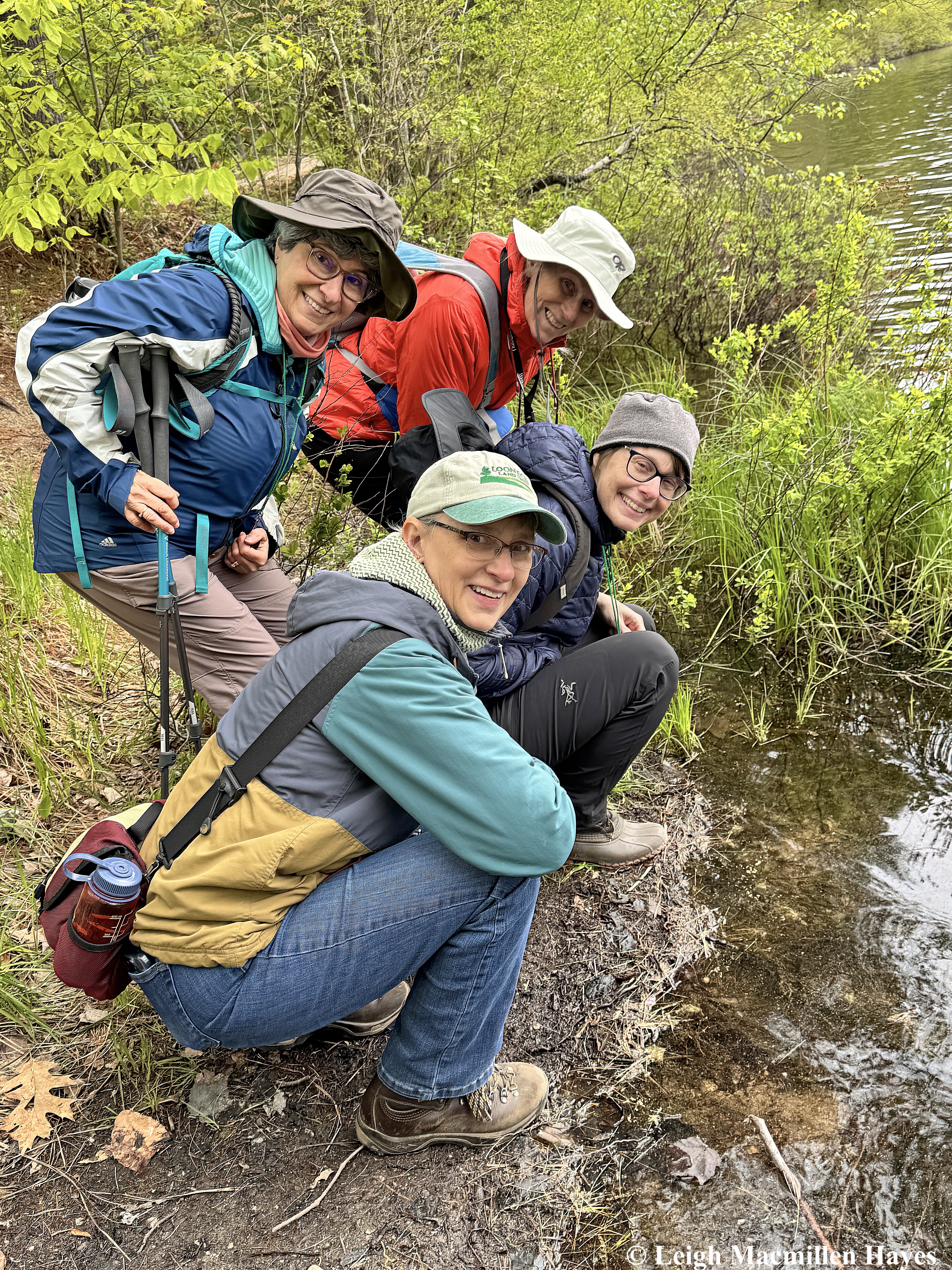
All of this brings me to this morning, when our group was quite small because some had apparently cancelled for various reasons and others were no-shows. That said, we had the best time, as we always do. But today felt extra special. You see, we had a plan to walk down an old trail, but since we were waiting for the no-shows, we thought we’d give them some time to locate us if we first visited a pond located about a hundred feet from the parking area and in the opposite direction of our intentions.

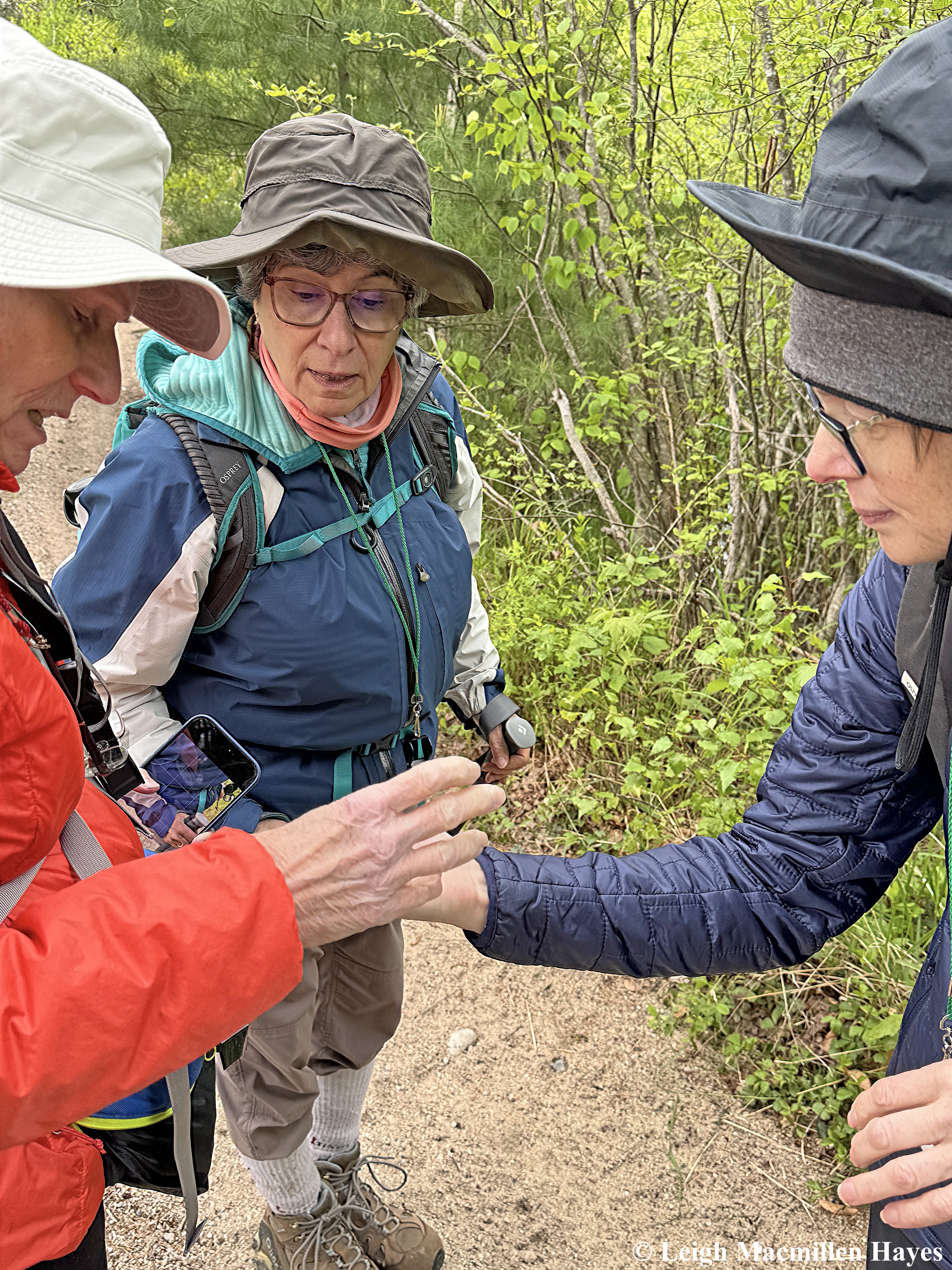
It was while squatting there that we realized miracles were taking place. But . . . we still wanted to share the trail with the participants, so we promised we’d return to the edge before it was time to depart. (As for the no-shows–we’re bummed they missed out.)

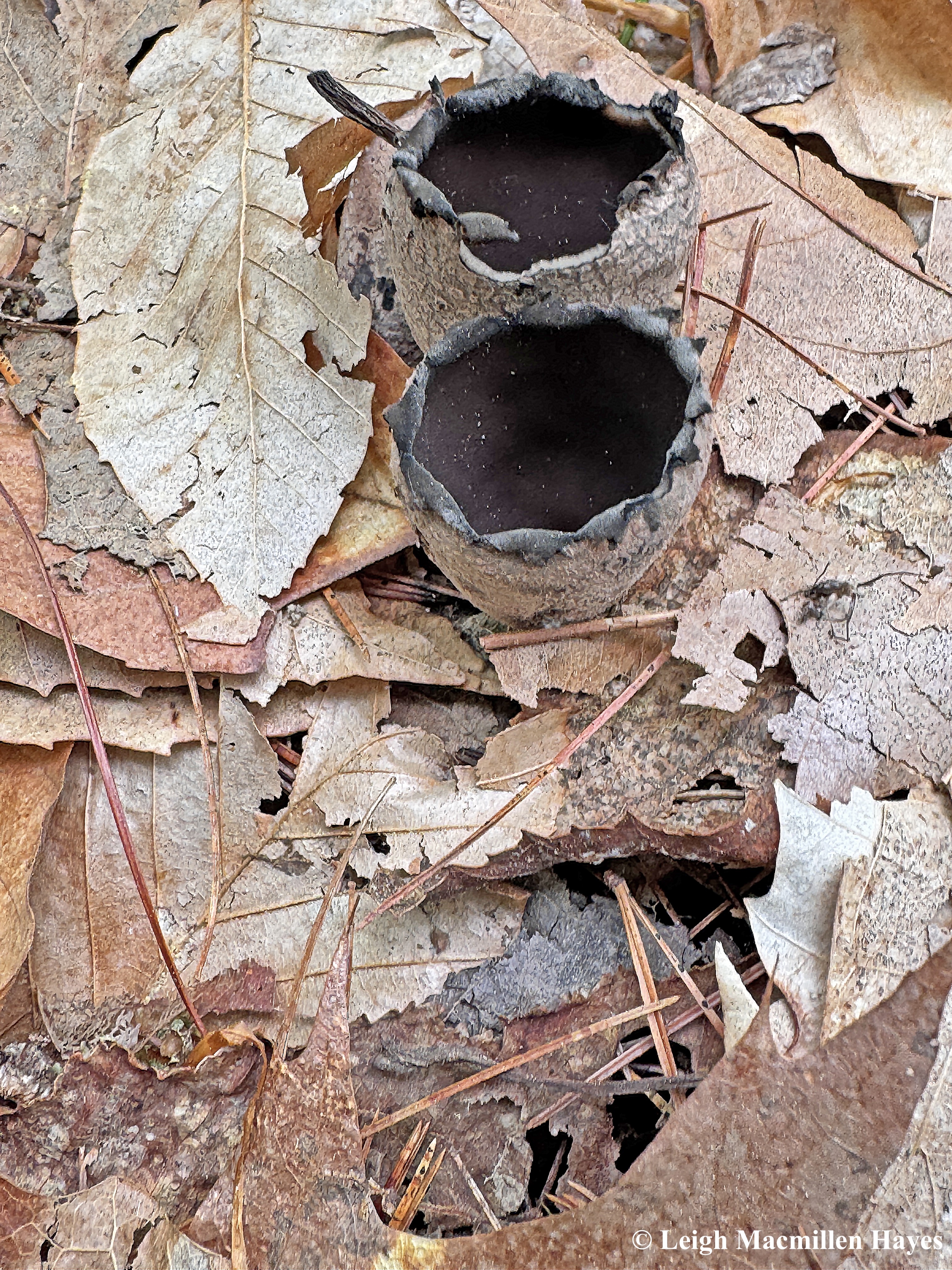
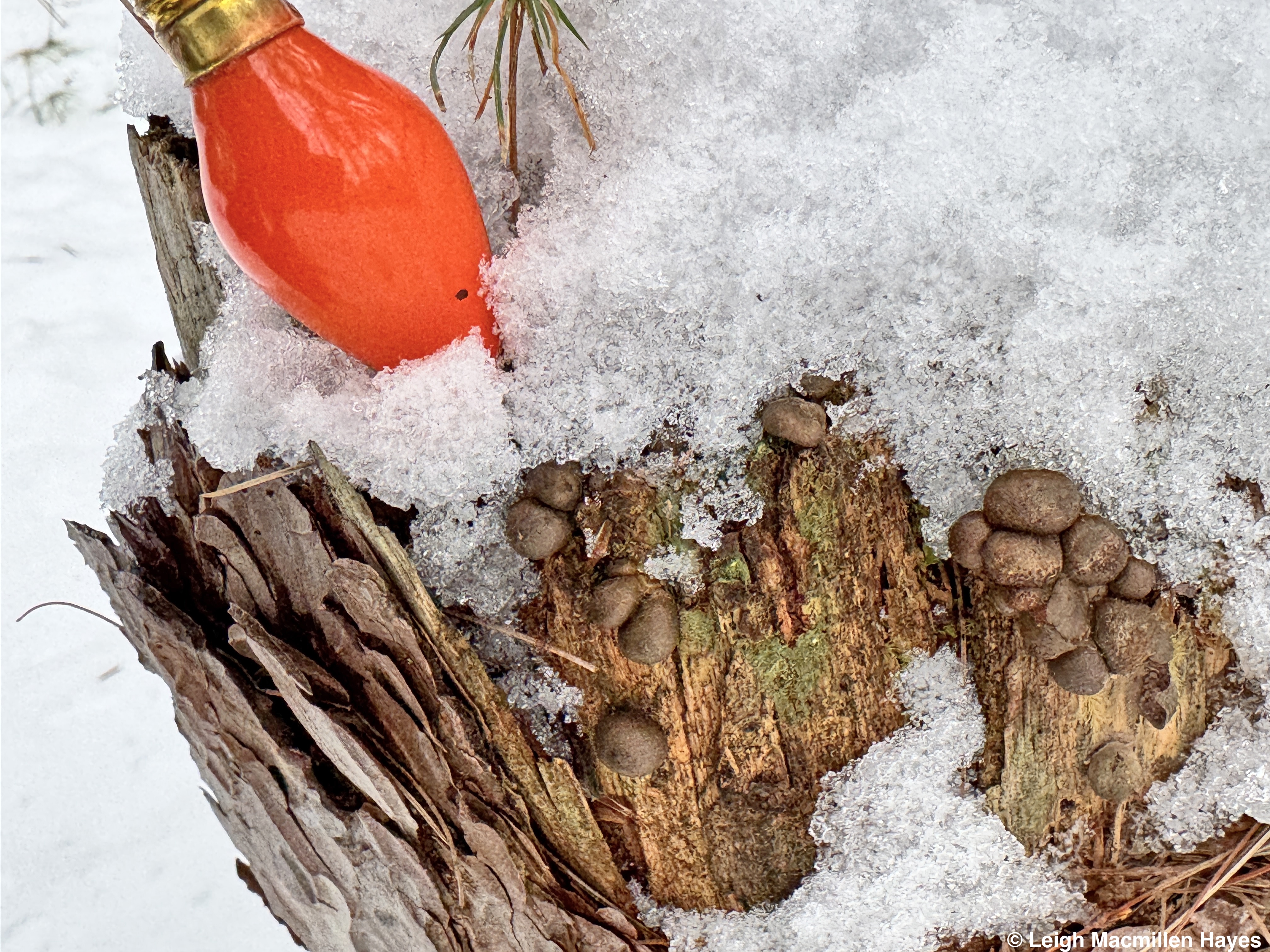
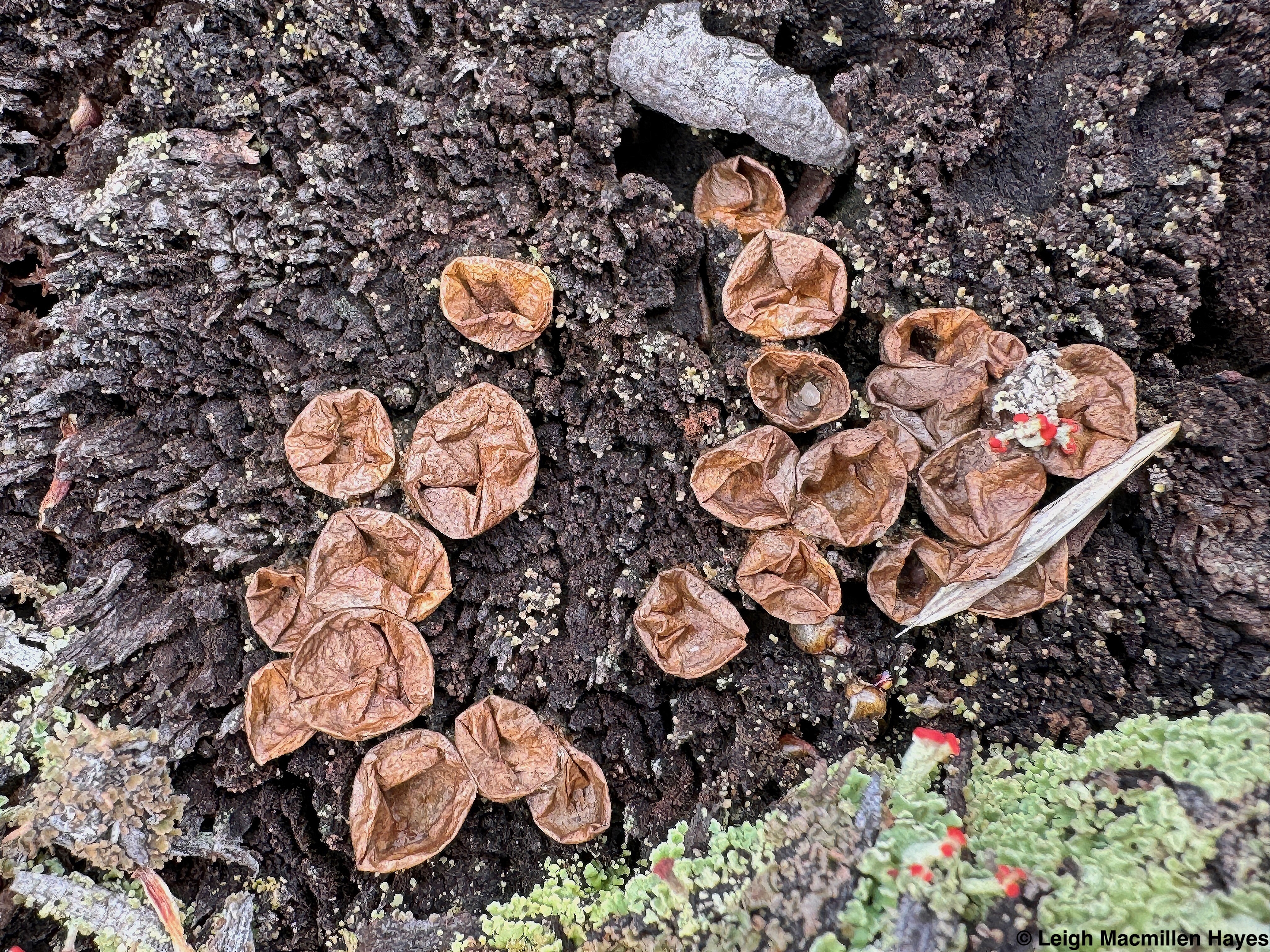
One of the participants who is a fungi enthusiast, and has eagle eyes, somehow spotted these mushrooms. None of us knew what they were, but iNaturalist’s SEEK app identified them as Devil’s Urns.

When I arrived home, I looked them up my Audubon Field Guide, and bingo: “Large, leathery brown, urn-shaped cup; Season: March-May; Habitat: Clustered on fallen deciduous wood, especially oak; Comments: This is one of the first mushrooms to appear in the spring in the East.”

Well done, Julie.

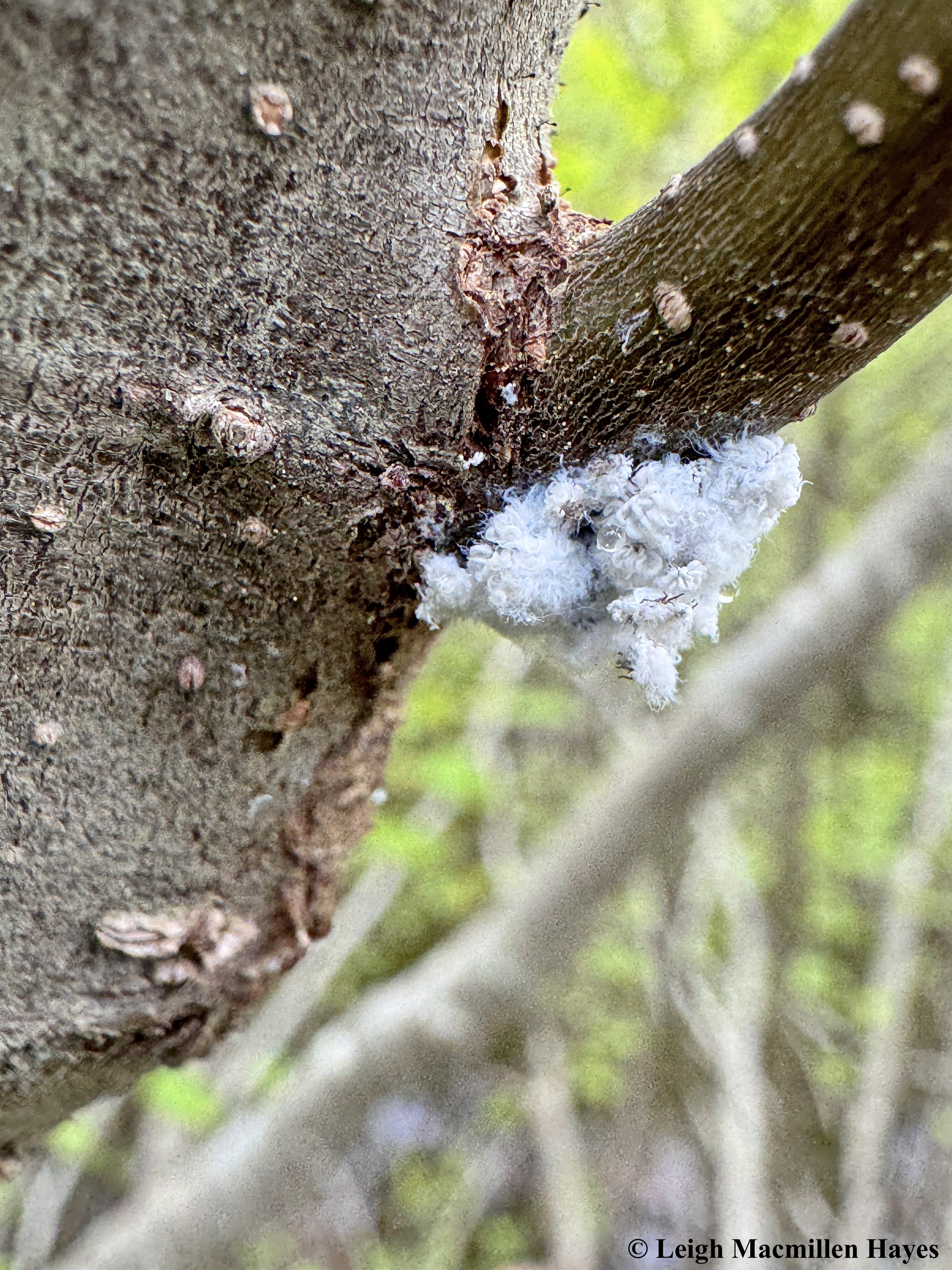
Woolly Alder Aphids were also visible, and once we saw one clump, we began to notice several. As we described how ants “farm” or seemingly tickle them to get them to secrete honeydew, one participant saw an ant and another saw drops of said liquid. Can you see it?

Well done, Marie.

And remember the little girl who found last year’s Oak Apple Gall on the way to the vernal pool in April? Well, another among us today found this year’s galls on newly emerged Oak leaves. It got us all thinking about leaves and insects and how mature insects lay or inject eggs into buds when they first form in late summer and so the moment the leaves begin to unfurl the following spring, larval forms jump into action and leaf miners and rollers and gall makers and everyone else have a heyday.

Well done, Heidi.

Marie, Julie, and Heidi also took an up-close look at last year’s Speckled Alder cones and we noted that the male catkins have already fallen to the ground for this year, their pollination duty now completed.

Lady’s Slippers, and Wild Sarsaparilla, and Star Flowers, and Canada Mayflowers, and Rhodora, and Dewberry, and Bastard Toadflax, and even Poison Ivy were admired and noted.

But, we all had a mission that we wanted to fulfill, so with about a half hour left, we retraced our steps rather quickly.

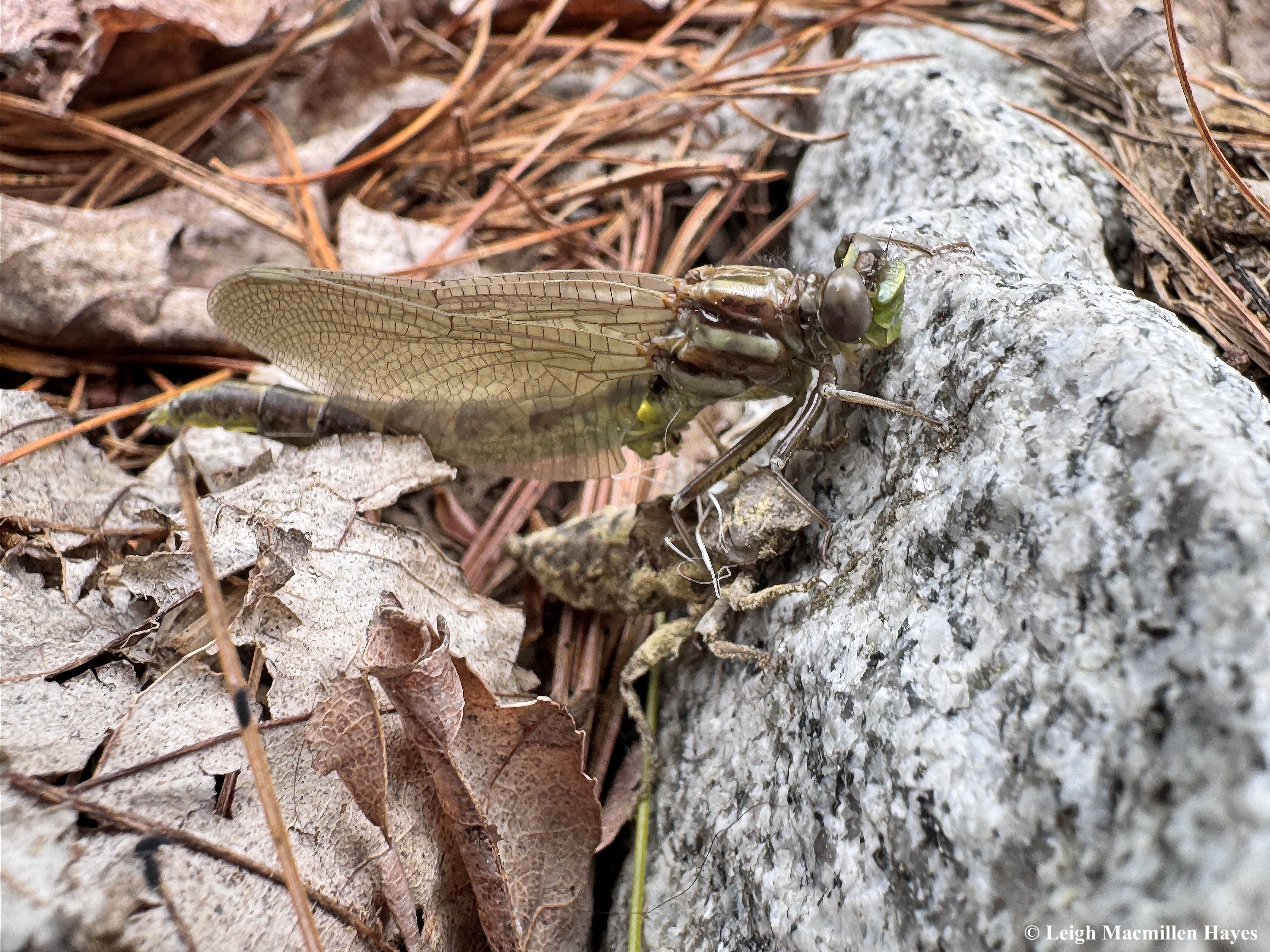
And into the plants at the pond’s edge we peered. Do you see it? A dragonfly naiad (nymph or larval form) upon a broken branch, with the adult form starting to split through the exoskeleton at the point between the wing pads. How could this be? Yes, we’ve seen dragonflies for the last week or two, but it was cold this morning. Raw. Breezy. Seemingly inhospitable for these summer fliers.

Apparently not, for once we looked around, we began to notice them everywhere. The dark naiad climbing up the rock was in search of the perfect spot. And if you look below the rock, you’ll see two naiads, one that is grayer in color, because its adult form had already eclosed or emerged; and the other browner one with the adult starting to pull out of the aquatic skin.

Here’s a closer look at the ones under the rock. Notice the eye placement. That is key to Identification according to family. In this case, with the eyes spaced far apart, it could be either a Petaltail or a Clubtail.

As I said, they were everywhere, and we felt it our duty to watch over them. To protect them from being predated, which is actually kinda funny, given that they are predators. But predators of the best kind because they feast upon Mosquitoes and Black Flies and Deer Flies, and others, of course, but it’s for those first three that we appreciate them.

Can you see how the adult is pulling out of the skin?

And do you see thin white strings extending from the exuviae to the back of the dragonfly? Those were the spiracles or underwater breathing tubes, which are no longer needed by the adult.

A few minutes later it is further out–can you see that? Once it gets its abdomen all the way out, it typically holds onto its shed skin and then pumps its insect blood into its wings so that they expand, before drawing that blood back into its body, allowing its coloration to eventually take true form.

Look for the white strings again.

Do you see them now? Completely unnecessary and therefore left behind.

When the wings are at full length, they are held over the back and cloudy in color until it’s time to spread them and let them dry before first flight.

The eyes on this newly emerged dragonfly, along with its abdomen markings and cerci or claspers at the tip of the abdomen, tell us its in the Emerald family, and I suspect a Common Baskettail.

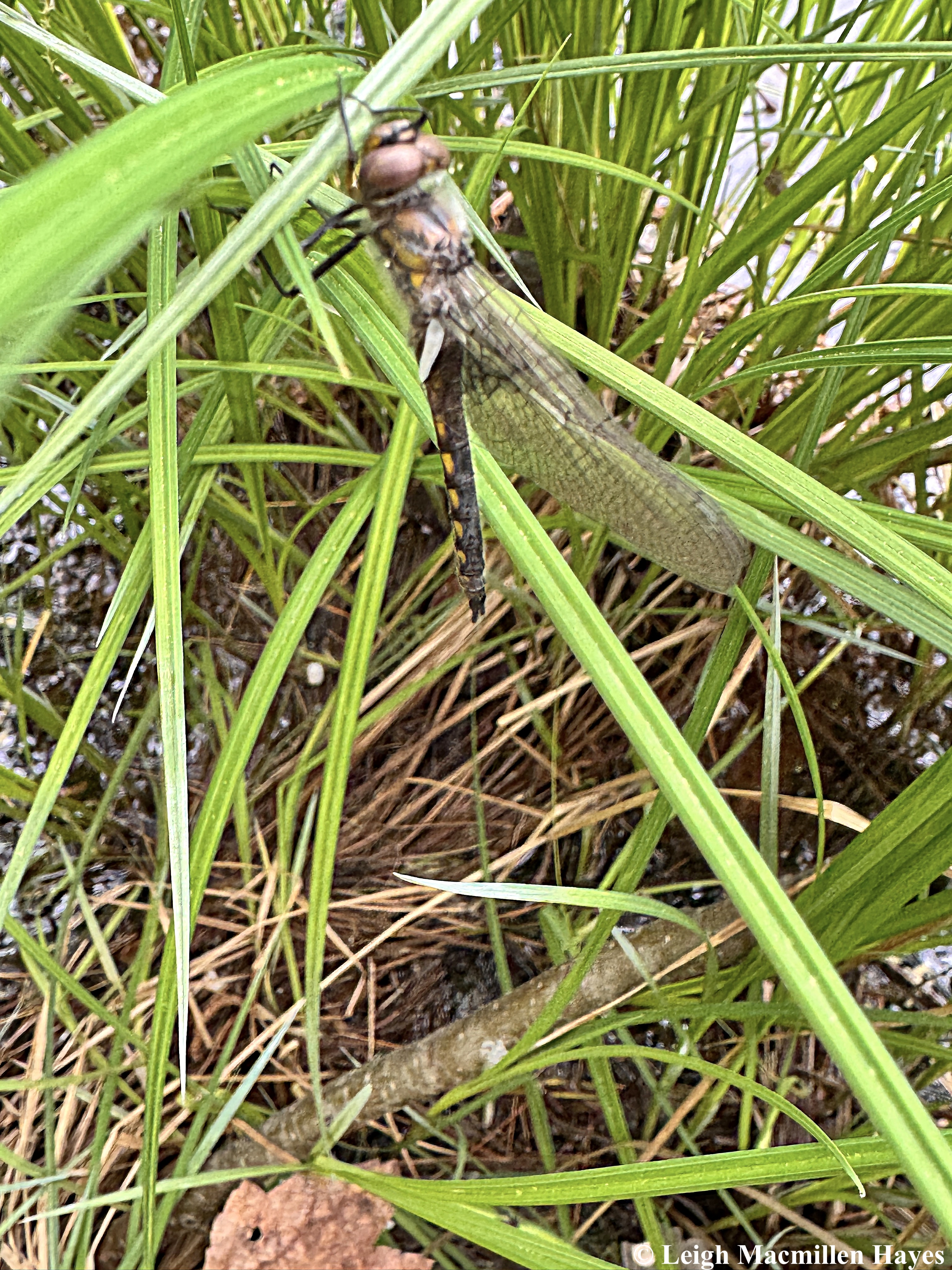
As we watched, we noticed some had wings that were stuck together, and this one with a curved abdomen. It was curious that it had left its exuviae before its wings emerged and so I wondered if they would unfurl.

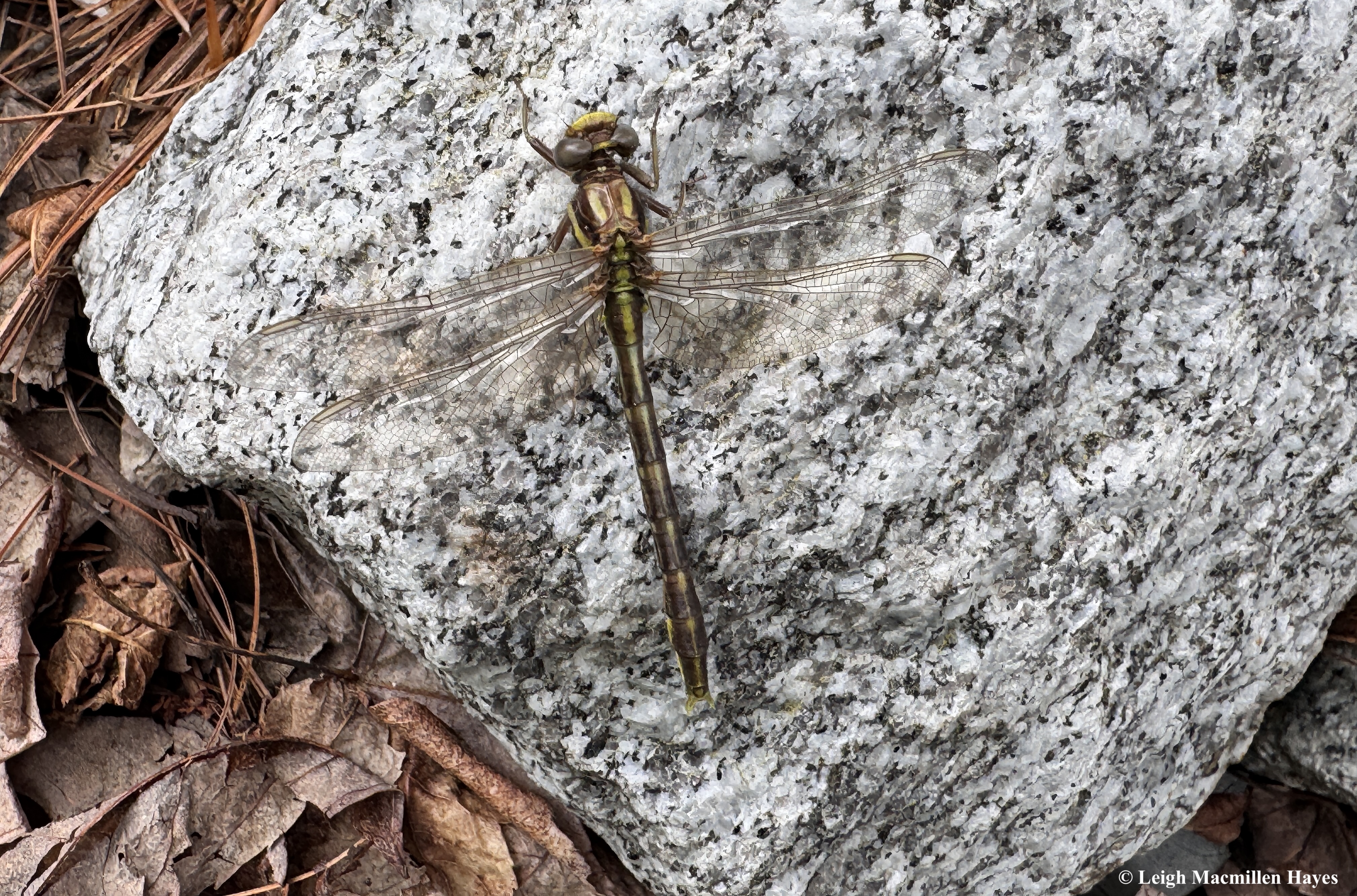
A few delighted us because we got to watch them spread their wings apart–translucent and shiny as they dried.

By the eye placement and beginnings of the markings, my identification stab is for Lancet Clubtail–one of the friendliest dragonflies who likes to land on us when kayaking. Or even on the dock.

As you can imagine, we had to pull ourselves away. The walk was supposed to end at noon, but it was 12:40pm when we finally finished–and honestly, I think we could have stayed a few more hours if we had food and other necessities.

All of our Wednesday Wanders for Loon Echo Land Trust are incredible because each one offers its own moments of awe.

Being honored, however, to share the emergence of dragonflies from their aquatic forms to terrestrial–and helping the ladies to understand that it takes hours for this process, and being surprised that so many had chosen what we considered to be a chilly spring day . . . it was beyond wonder-filled. As every Wednesday Wander is. But today, today was over the top.

Part of the Neighborhood

The text arrived from one of my first playmates on Wednesday. “Good morning,” she wrote, “Just wanted to give you a heads up my fat and sassy Juncos are headed your way. Only had a couple yesterday and none this morning. Hope they had a safe trip! Blow them a kiss for me. Hugs.”

A few hours letter I wrote back that I’d let her know when they arrived.

And a few minutes, voilà! My second text to Kate: “No sooner said than BINGO! I looked out the back door and there were three!”

On Thursday afternoon, the Bluebirds arrived. Kate told me she’d had three couples all winter in Connecticut. “They are so stunning! They seem to be the kindest of breeds. They don’t squabble as much as others and share better.”

After that, it was a Tree Sparrow. And many more Juncos each day.

And today, the Chickadees and Tufted Titmice and Bluejays, of course, but also Goldfinches, and one Tree Sparrow, and Mourning Doves, and Red-breasted and White-breasted Nuthatches, and Downy and Hairy Woodpeckers, and I’m sure others that I’m missing, and suddenly, the feeders were busy. Toss into the mix Red and Gray Squirrels, and Crows, though the latter stayed about ten feet away from the action, while the former got right into it, and it was a full house.

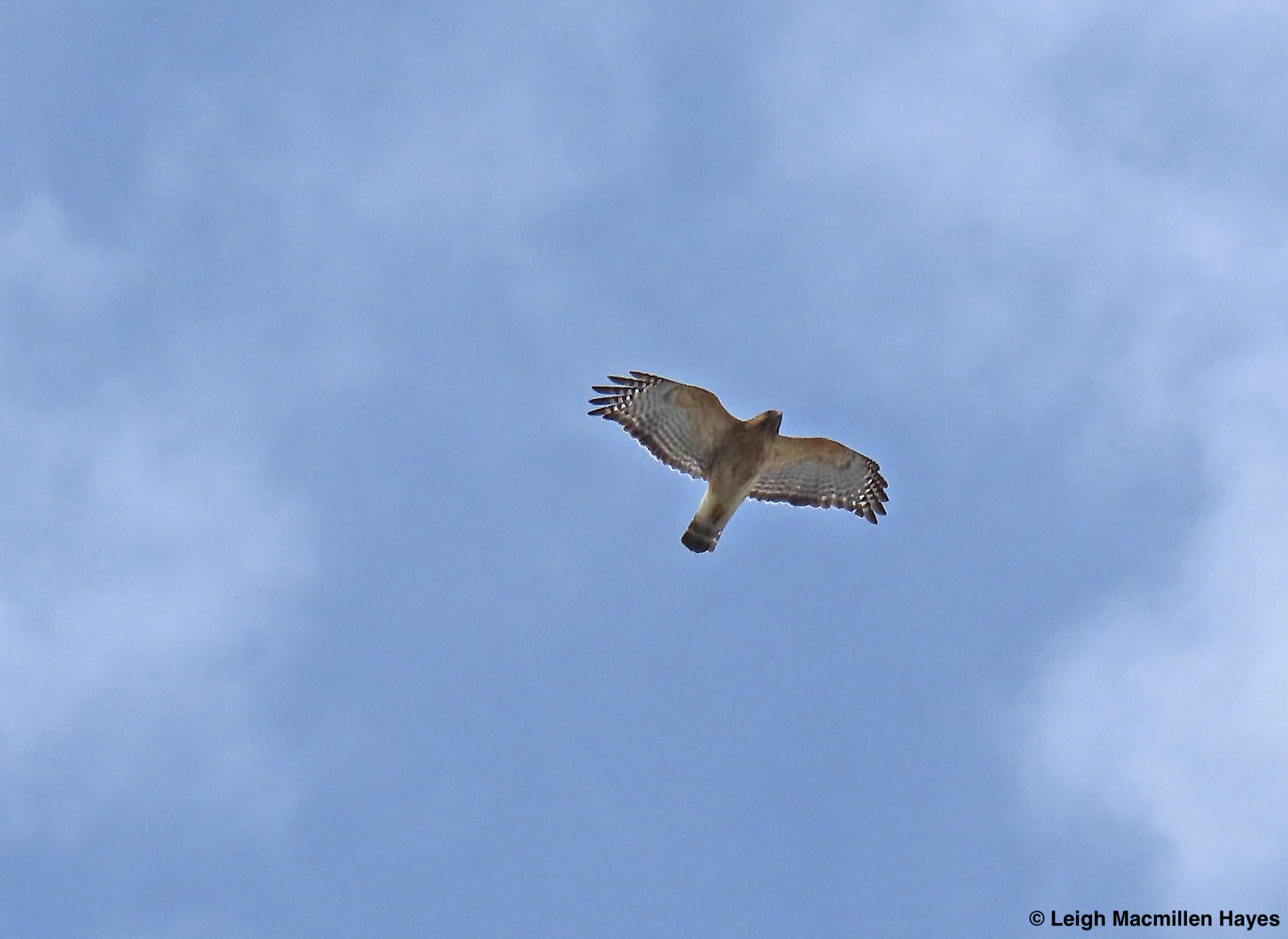
This afternoon, I interrupted the action for a few minutes when I headed out the back door to go for a tramp in the woods and had just reached an opening when I heard, then saw this guy and knew that our resident Red-shouldered Hawk had returned.

According to Stan Tekiela’s Birds of Prey of the Northeast, “Adults return to the same nest and territory for many years; the young also return.”

Welcome home!

I had no sooner lost sight of the hawk, when movement from another source caught my eye.

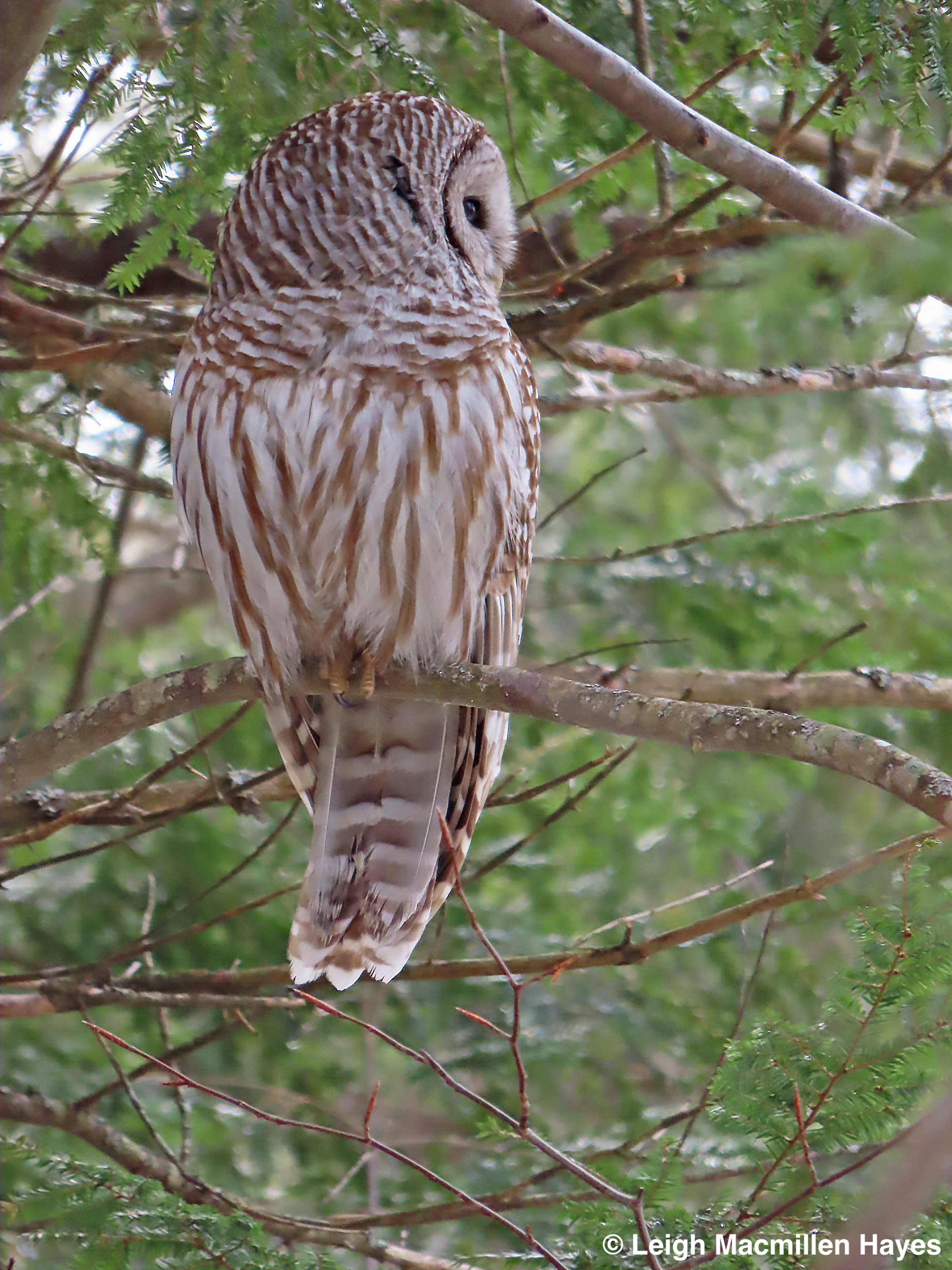
Flying from the ground up to a tree limb was a Barred Owl. And my heart was even happier than it had been.

We spent a few minutes together and I gave great thanks also that the vernal pool over which the owl perched is still rather frozen. No frogs or salamanders would be on the menu yet. I did, however, worry about the birds in my yard, but there was nothing I could do.

Except, that is, watch my friend for a few more minutes before waving goodbye to him and moving on.

And that’s when I heard a song, or rather many songs, that took me back to a summer morning and realized that as much as I don’t want winter to come to an end this week, the time has come because there is so much more to see and welcome and wonder about. The Red-winged Blackbirds were in a large flock with Grackles, and Robins, and more Crows. And the chorus was most delightful.

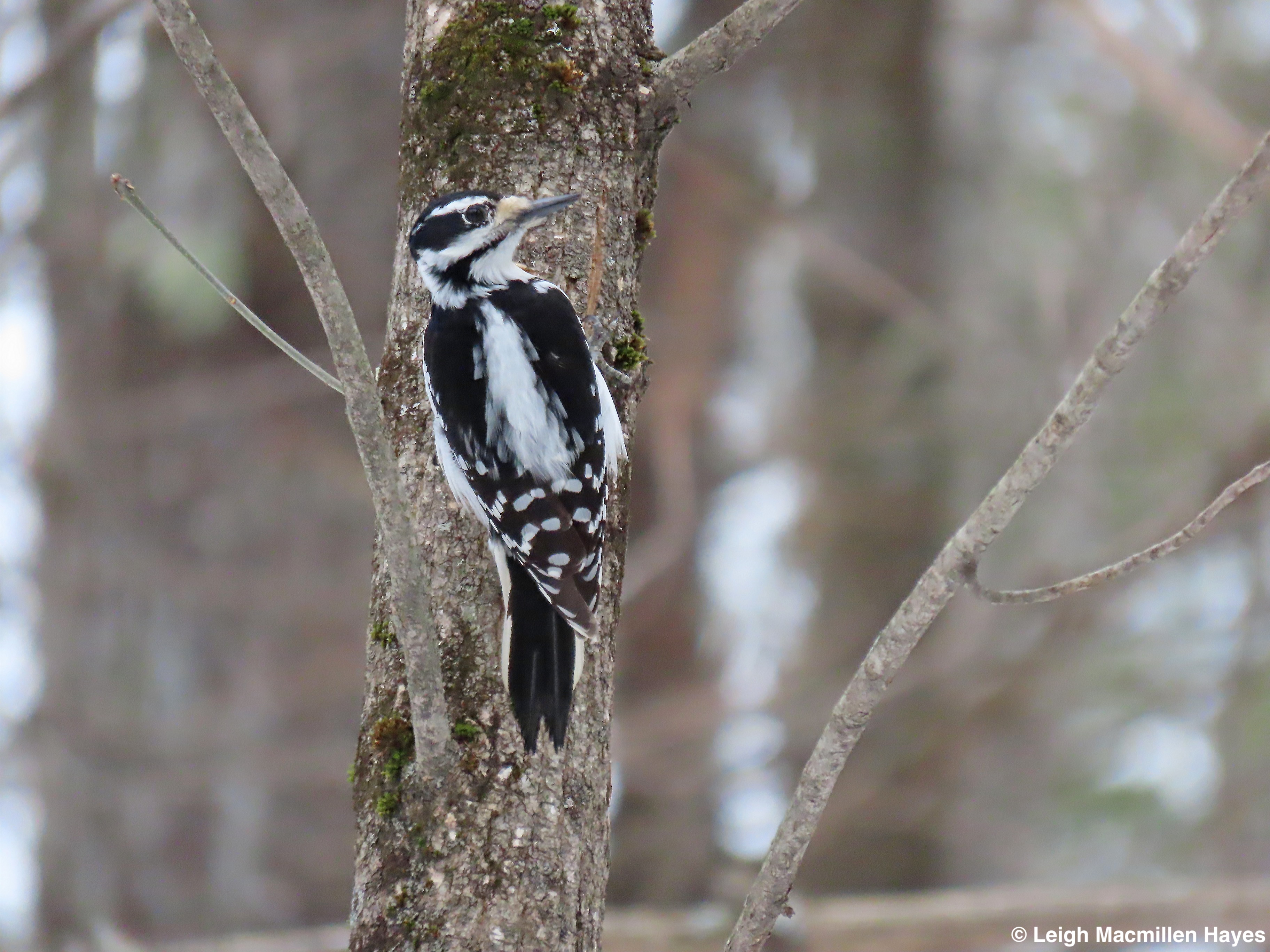
I’d say the female Hairy Woodpecker was much quieter than the others, but it was her inflight song that encouraged me to look for her.

I just hope it wasn’t Emerald Ash Borers she was seeking as she drilled a few test holes in the tree. Of course, if she can help control them, then that’s a good thing.

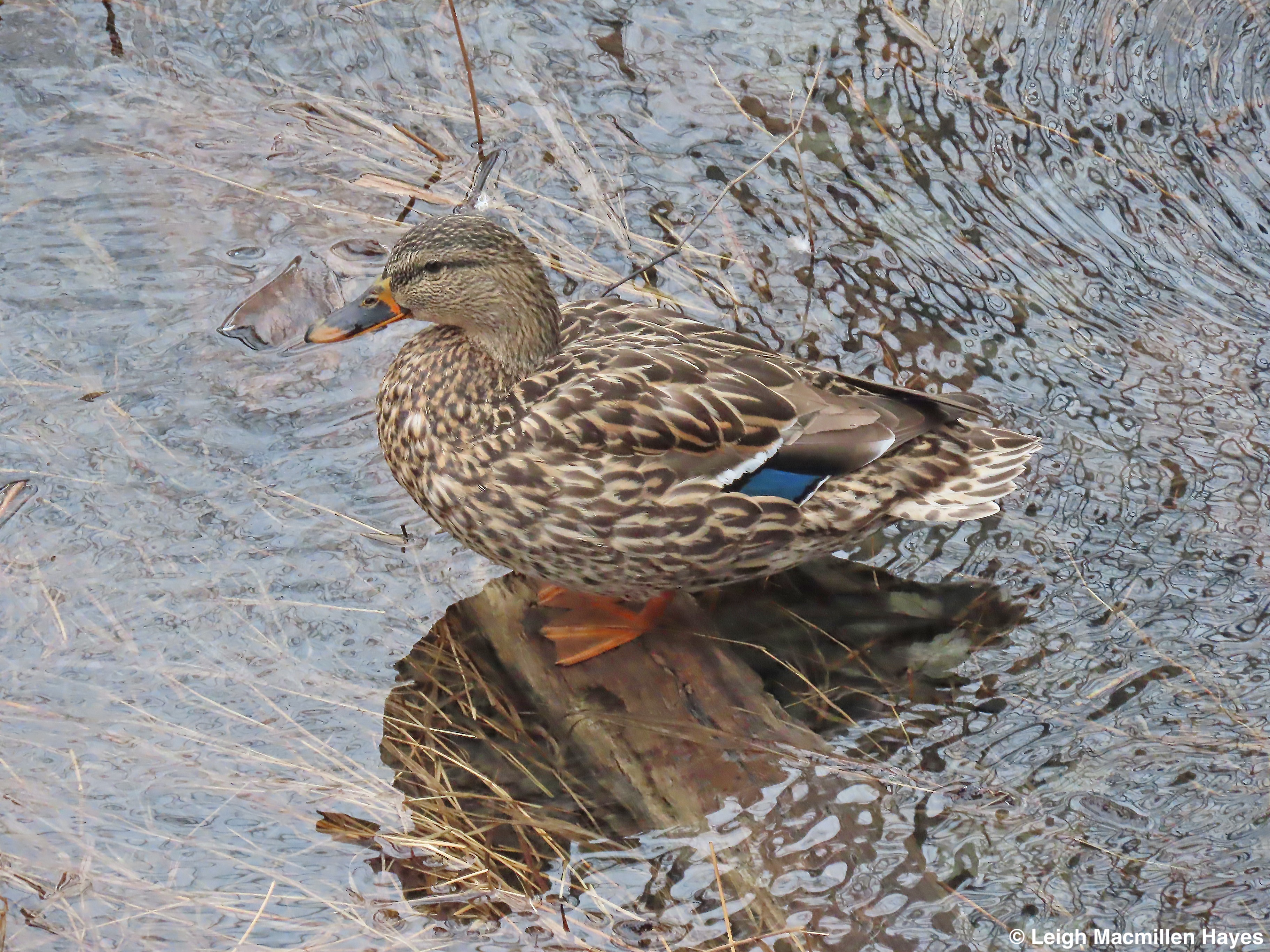
My journey led me to a local brook where the Mallard flock is spreading out more as the ice is receding quickly during these suddenly 50˚ days.

That said, they are still there.

He preened . . .

as she looked on.

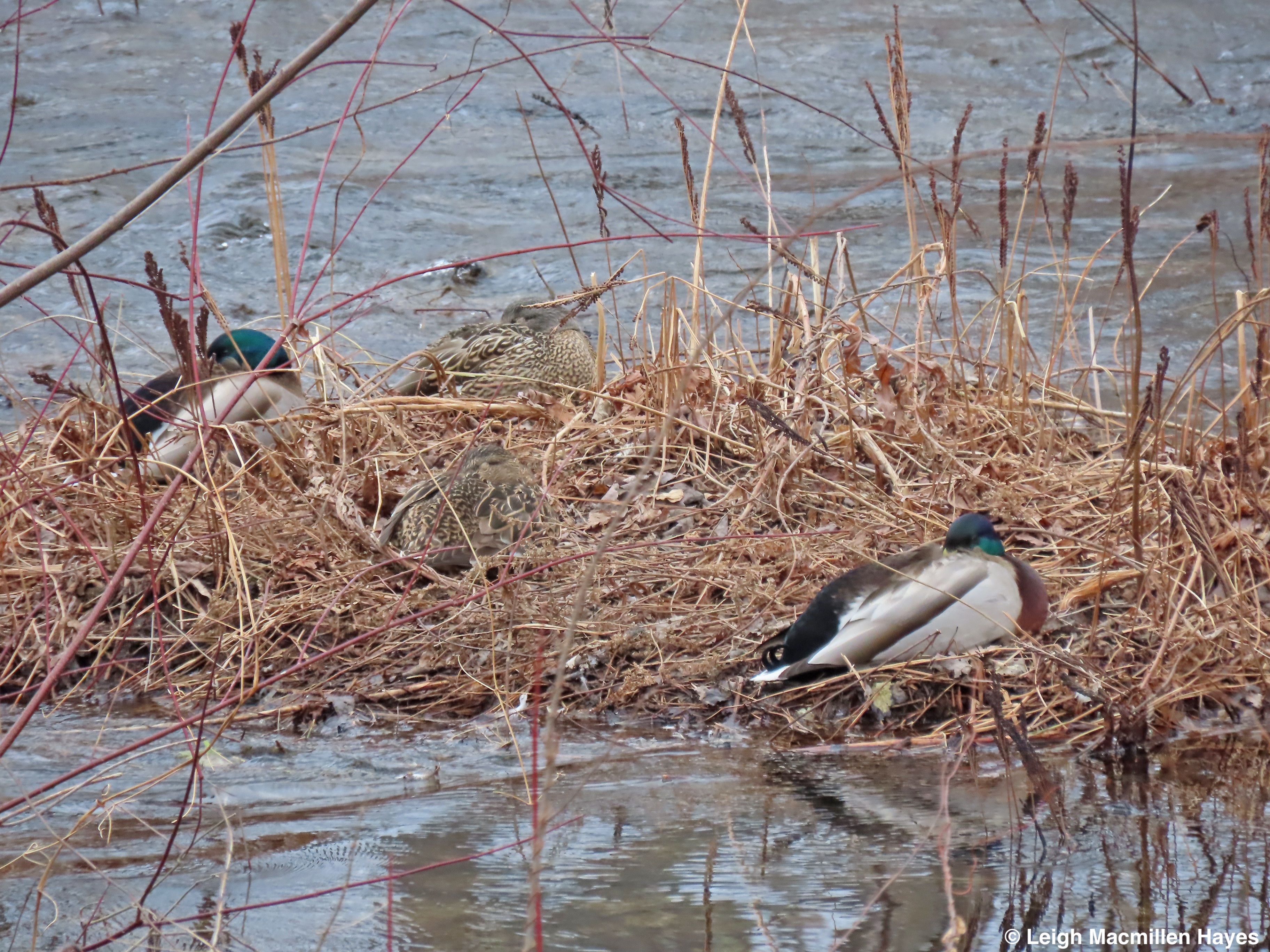
Others did what we should all consider doing on a Sunday afternoon: stick our heads under our wings and take a nap.

But I didn’t. How about you?

Upon a second brook that flows into the first, another species caught me by surprise as I rarely see it in this place. A female Common Goldeneye. I’ve always had a problem with the descriptor “common.” That prominent golden eye is hardly common in my book.

Moseying along, I realized it wasn’t just birds who were greeting the day. Chipmunks have been dashing about on the snow for the last week or two, taking advantage of any acorns the squirrels may have hoarded. (And birdseed–as I watched one stuff its cheeks the other day.)

One critter that surprised me was a Carpenter Ant making its way toward a boulder rather than a tree. Though I see the exoskeletons of these ants in Pileated Woodpecker scat all the time and even found some fine specimens in our woods today, I don’t recall ever spotting one on snow before.

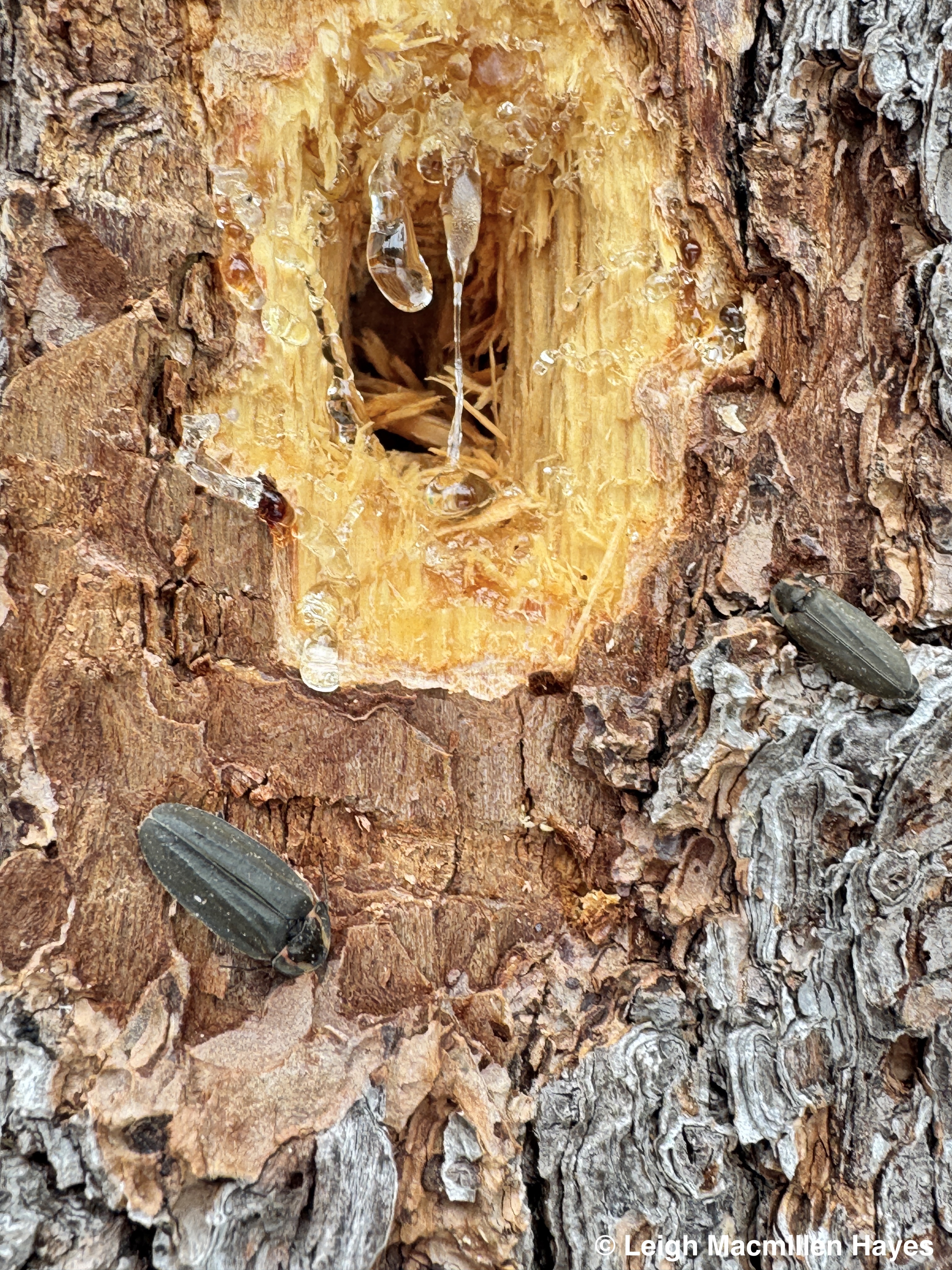
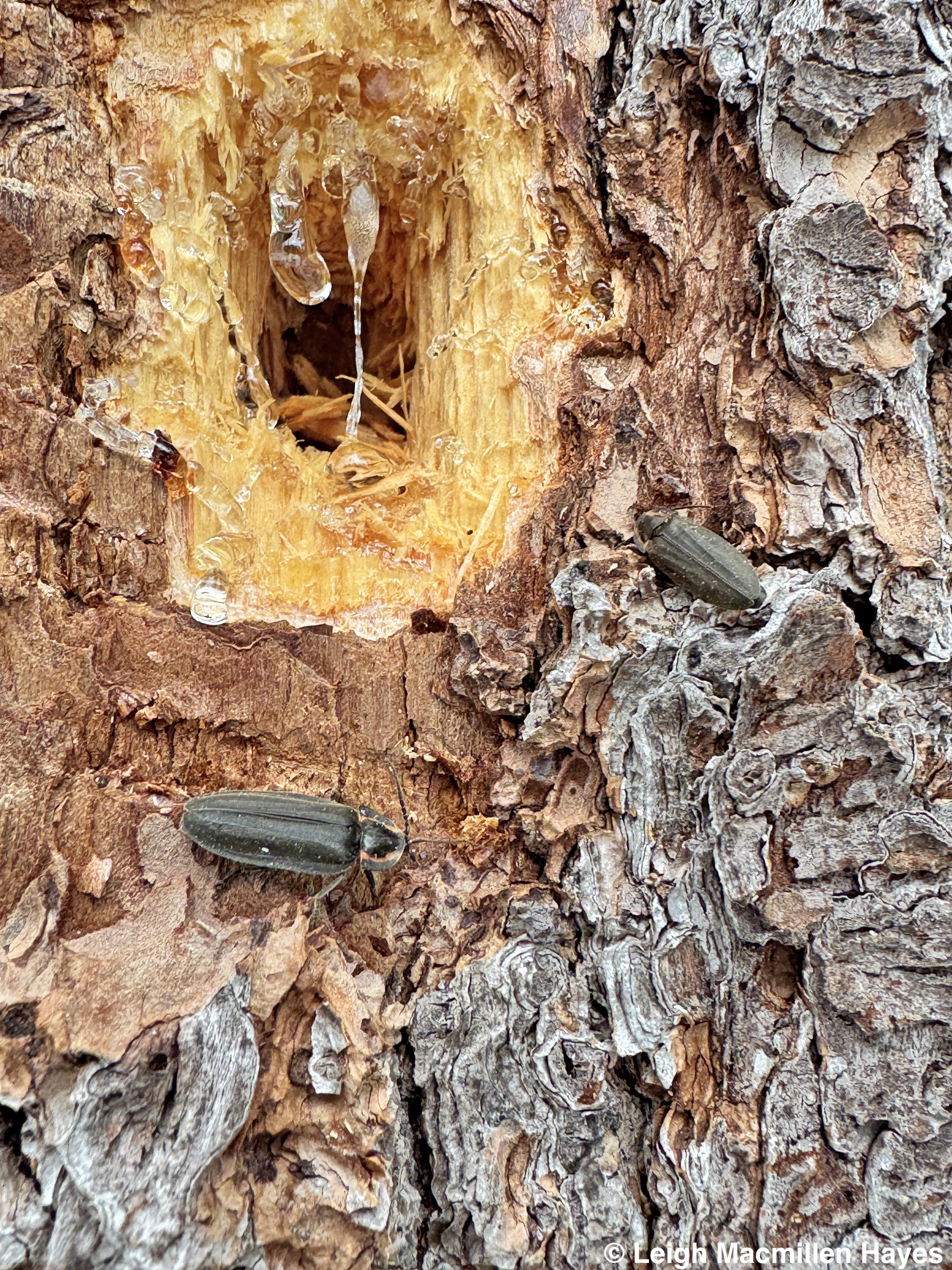
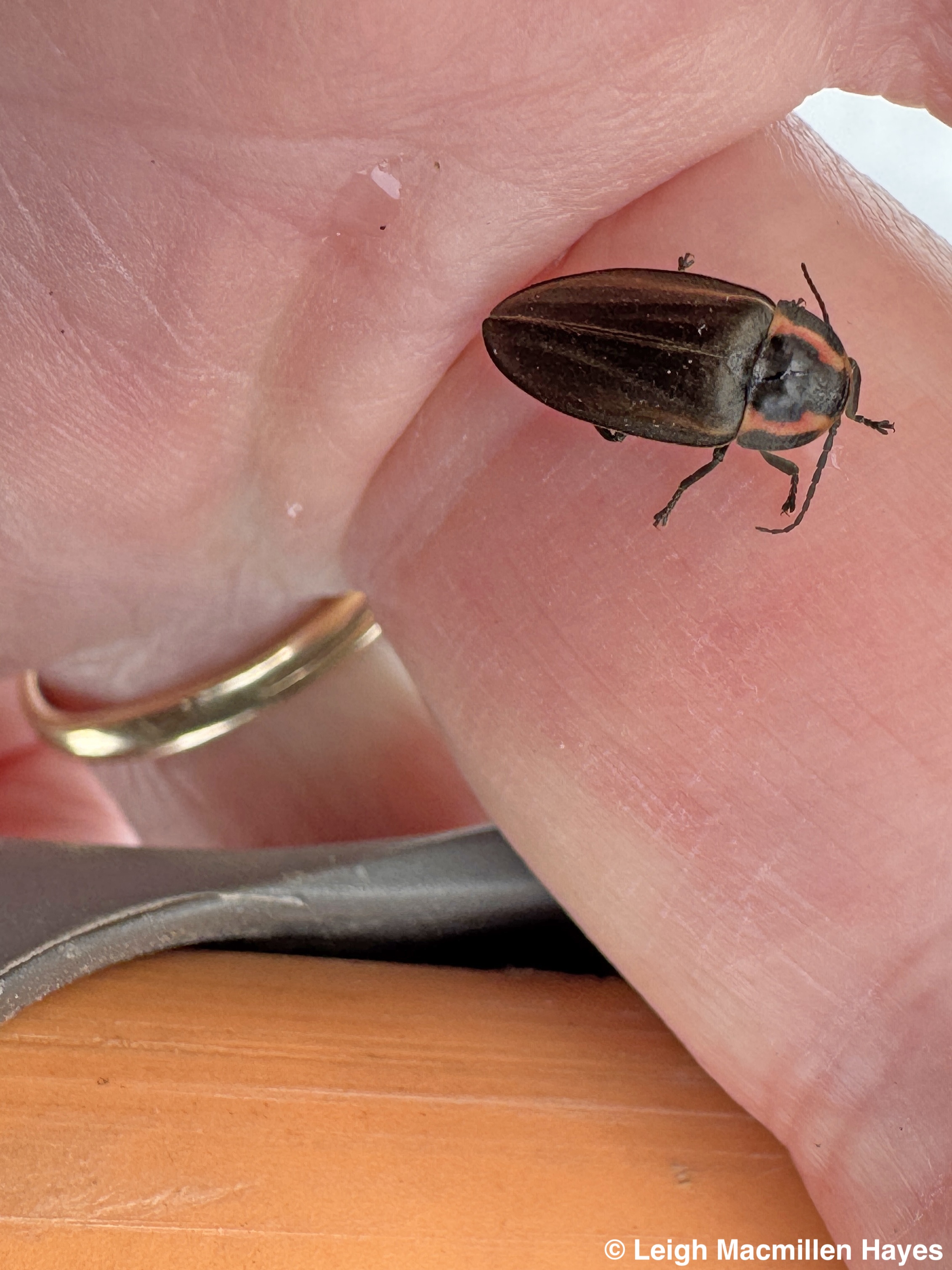
Speaking of Pileated Woodpeckers, their freshly excavated holes are dripping with sap and by this hole I found a couple of Winter Fireflies. So, um, Winter Fireflies are fond of Maple Sap. In fact, some call them Sap-bucket Beetles. But White Pine sap? Do you know how sticky it is? As in, you can practically glue =-your-fingers-together sticky.

When I first spotted these two, I wondered if the sap might have given them pause. Were they stuck?

But then there was movement and in that moment, all was good with the world.

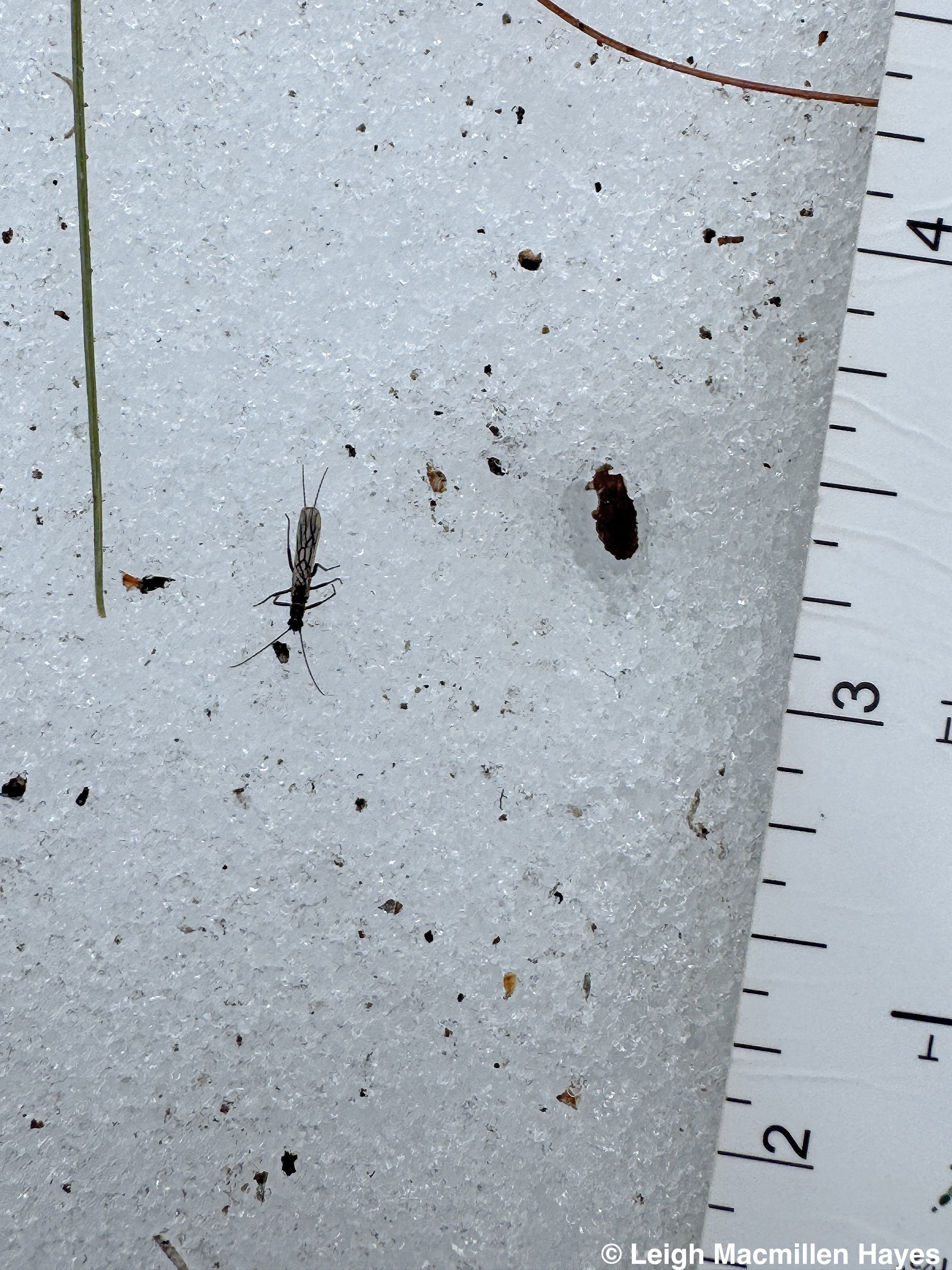
I had one more discovery to make–actually, it’s been my quest this year to find this species and its relative who is only about a half inch longer.

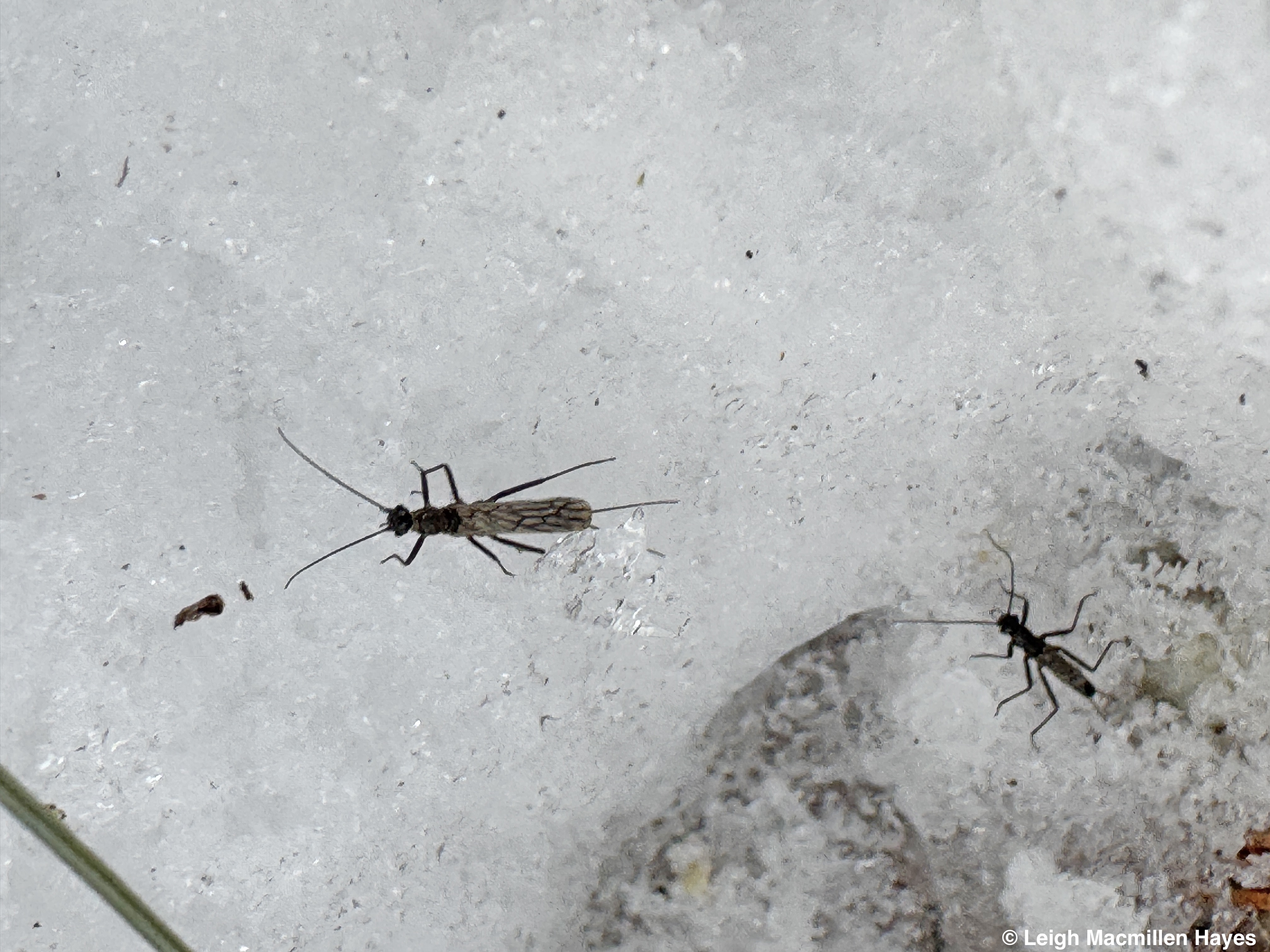
But I must have missed the mass emergence of Small Winter Stoneflies, and their cousins, Winter Stoneflies, for like today, I’ve only seen one or three or maybe five on any particular occasion near these brooks, when in the past there were so many more. Might last summer’s drought and water conditions be the reason for so few? After all, these species are highly sensitive to pollution and thus, are indicators of excellent water quality. I have to hope that I just missed the right day.

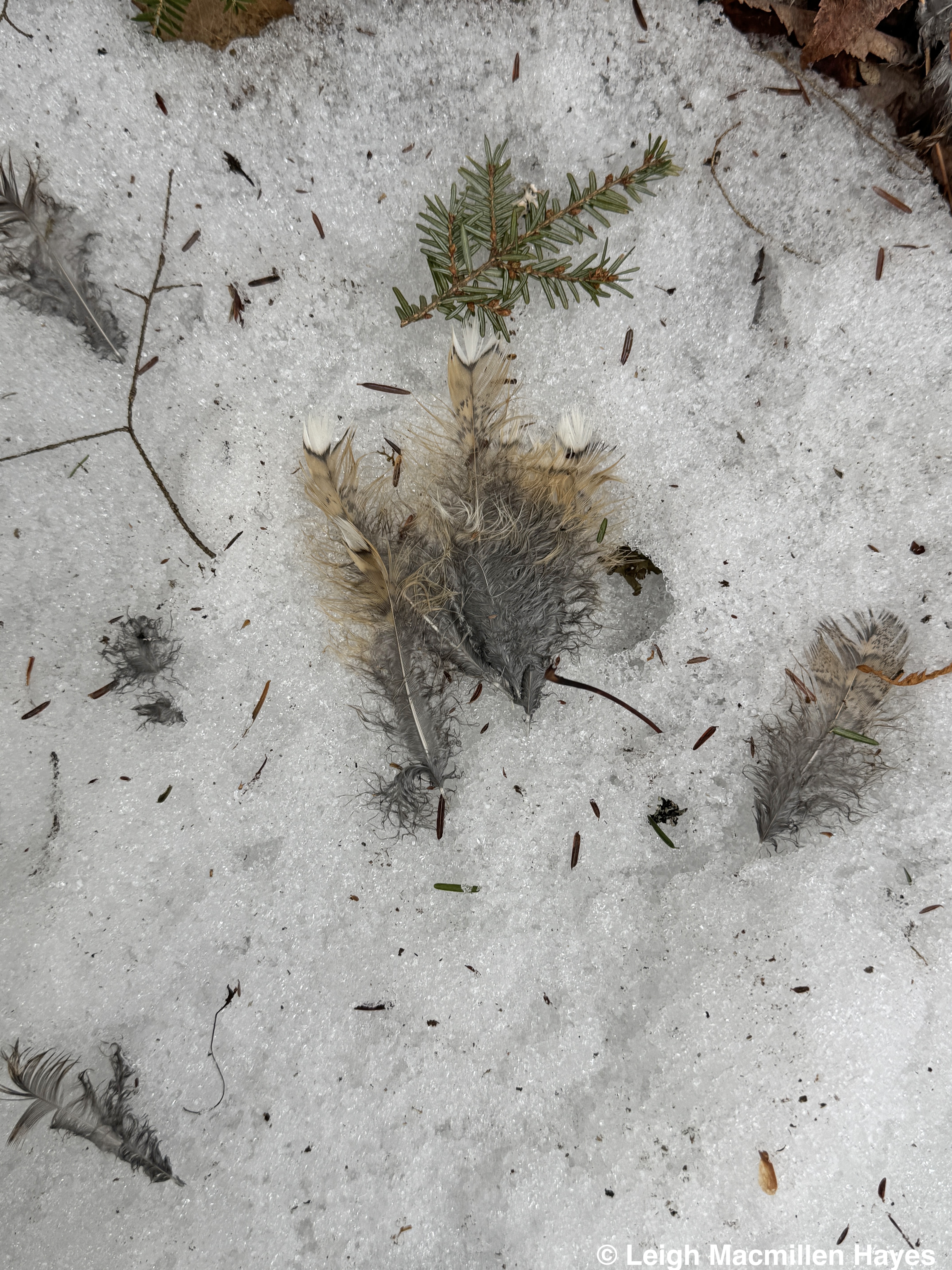
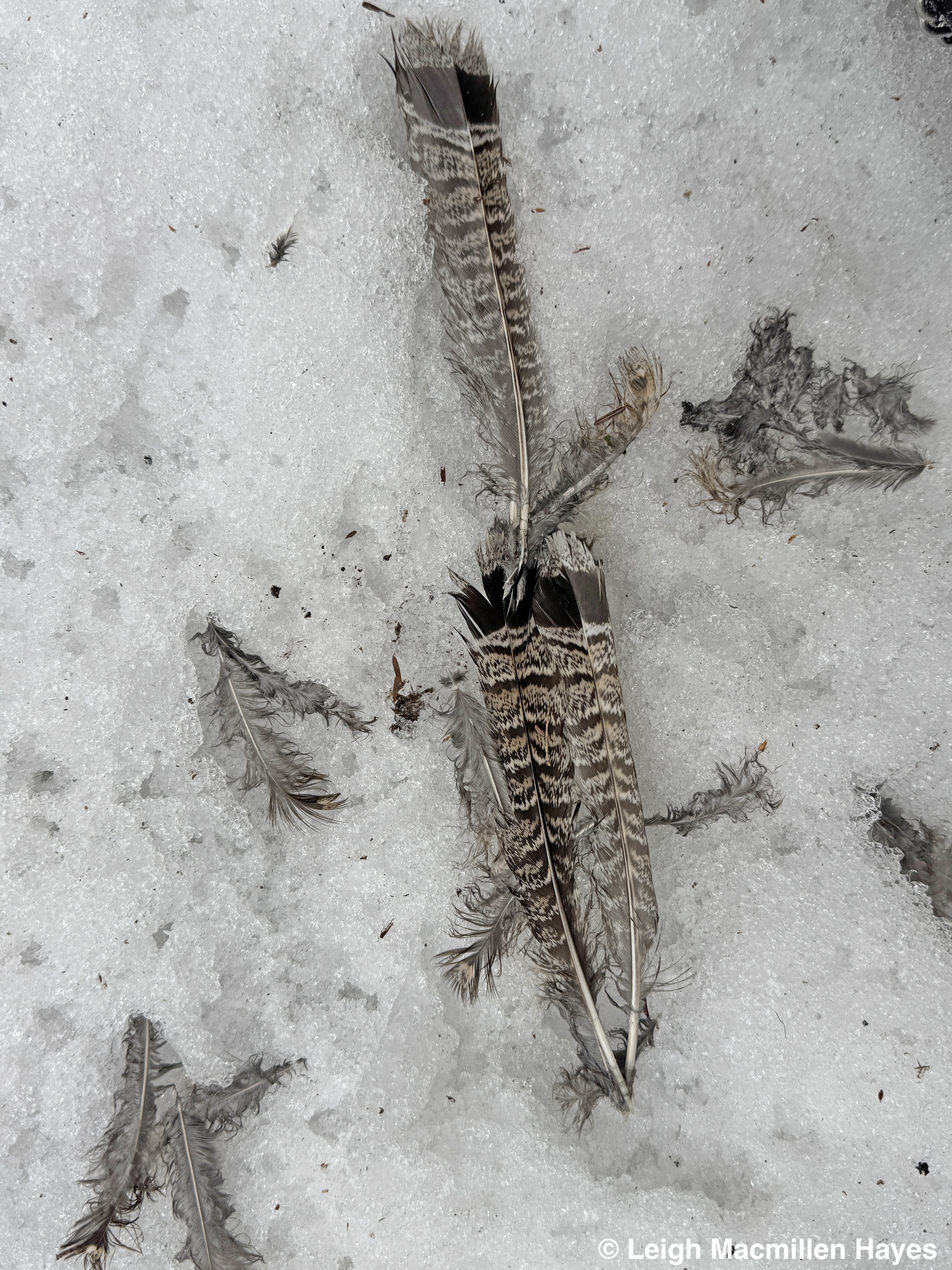
After the Stonefly discovery, I did find one more thing that always brings me around to the cycle of life. A small bird was plucked and became the meal of a larger predator.

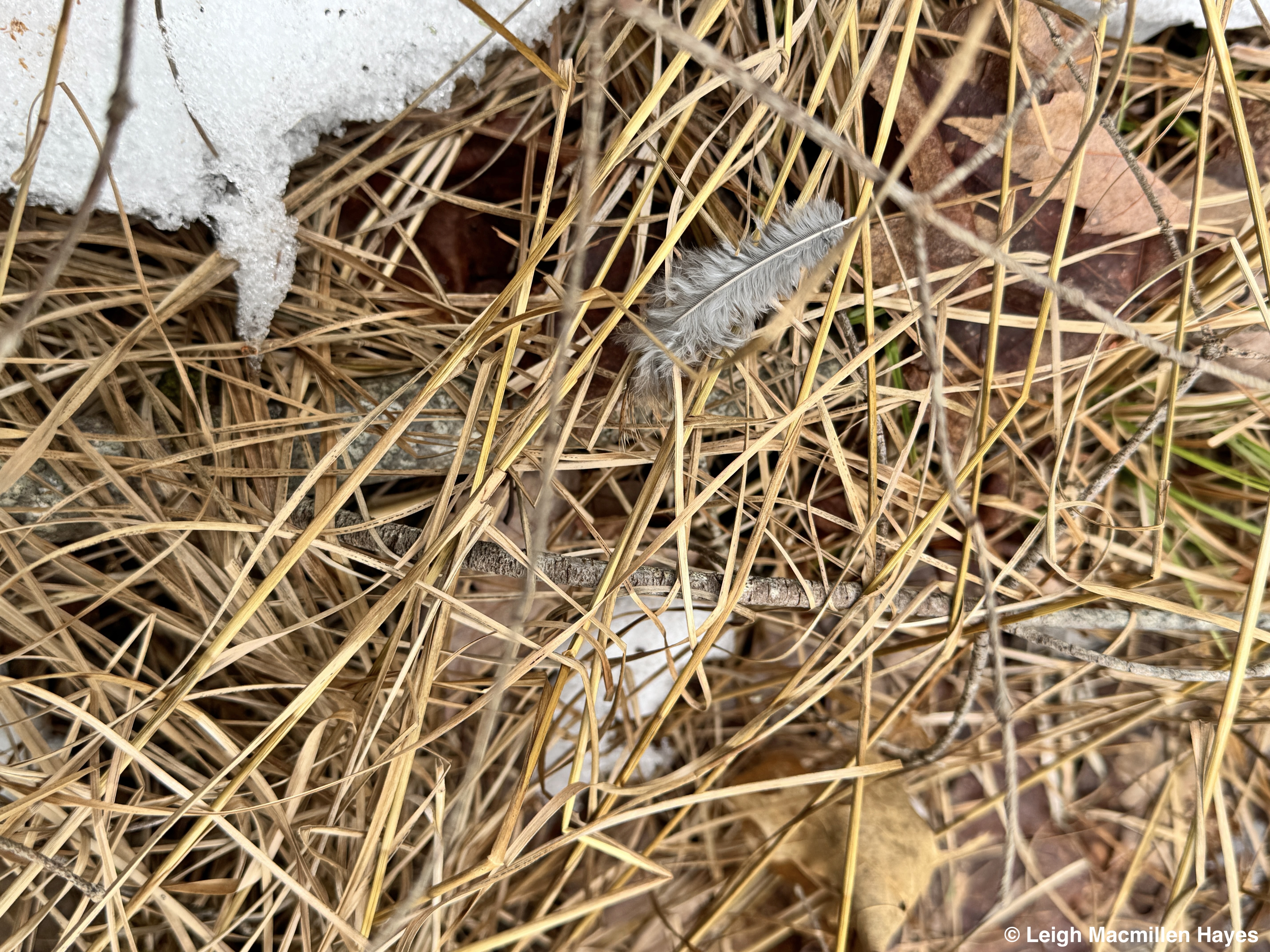
Curiously, some feathers were stuck to the bark of the tree . . .

My thought was that the predator sat high above, and let the plucked feathers drop and being a pine, a few stuck to the sap, or maybe just to the rough bark. Or maybe the bird was consumed right there on the side of the trunk.

I don’t know and I don’t know who the predator was, but energy was offered and sunshine turned into seeds and insects that fattened up the smaller bird were passed on to the bigger critter.

Perhaps the Barred Owl knows the whole story. Or the Red-shouldered Hawk.

All I know is that I gave thanks for this day to wander and wonder and be greeted by so many who are all a part of my neighborhood. Well, really, I’m a part of their neighborhood, and I appreciate that they share it with me.

Celebrating Creation aLONG the MOUNTAIN

When asked the other day if I am enjoying spring, I responded, “I’m still loving winter.”

So is My Guy.

And so today, we took to a beloved mountain trail and reveled in the sights and sounds.

Beside a brook, our journey began, where as the water flowed, nature’s artistic hand created a magnificent display of ice sculptures.

On the way up the loop trail, and again on the way down the other side, the golden carpet was set before us, for into the warn pathway do leaves settle after a wind event.

Because we were hiking in a deciduous forest to begin, our eyes kept scanning the tree trunks, and tada, we were rewarded. Well rewarded.

It seemed like everywhere we looked, we spotted American Beech trees with bear claw marks indicating multiple visits to feast upon the beech nuts.

We suspected some of these trees we were meeting again as if for the first time, but though we lost track of how many we spied, we knew it was more than we’d seen in the past and gave thanks to the trail conditions that allowed us to move without caution, and the fact that it is still winter and there were no leaves to hinder such views.

While studying almost every tree for a while, I kept noting the trunks of another species, this the two-toned aspen that looks like an oak toward its base, but morphs into a birch toward the top.

There was no question whether Quaking or Big-Toothed for leaves upon the snow told the species name: My, what big ____ you have!

As we continued to climb, the neighborhood changed and so did the forest floor–of course, still upon firm snow, for suddenly, we walked upon a green carpet.

It was in this section of forest that I began to spot Common Polypody ferns predicting the temperature, for they were still a tad bit curled indicating it wasn’t exactly warm, but not completely curled telling us it wasn’t freezing cold either. It was just right!

Well, almost just right, for because of recent rain and warmer temps last week, the melt down has begun and ice flows along the trail were frequent in the coniferous forest.

That same flow continued down a crevasse that we admired from the path, but didn’t need to descend. Thankfully.

A short distance later, we reached Lunch Ledge, aka North Ledge, and took in the view toward Mount Washington.

As we ate, we looked at all the Beech trees below (and other species, of course) and wondered how many more Bear Trees there are in these woods since we saw so many just from the trail. And we wondered if there might be a den nearby.

Following lunch, we continued our trek, and then found a spot where another had dined.

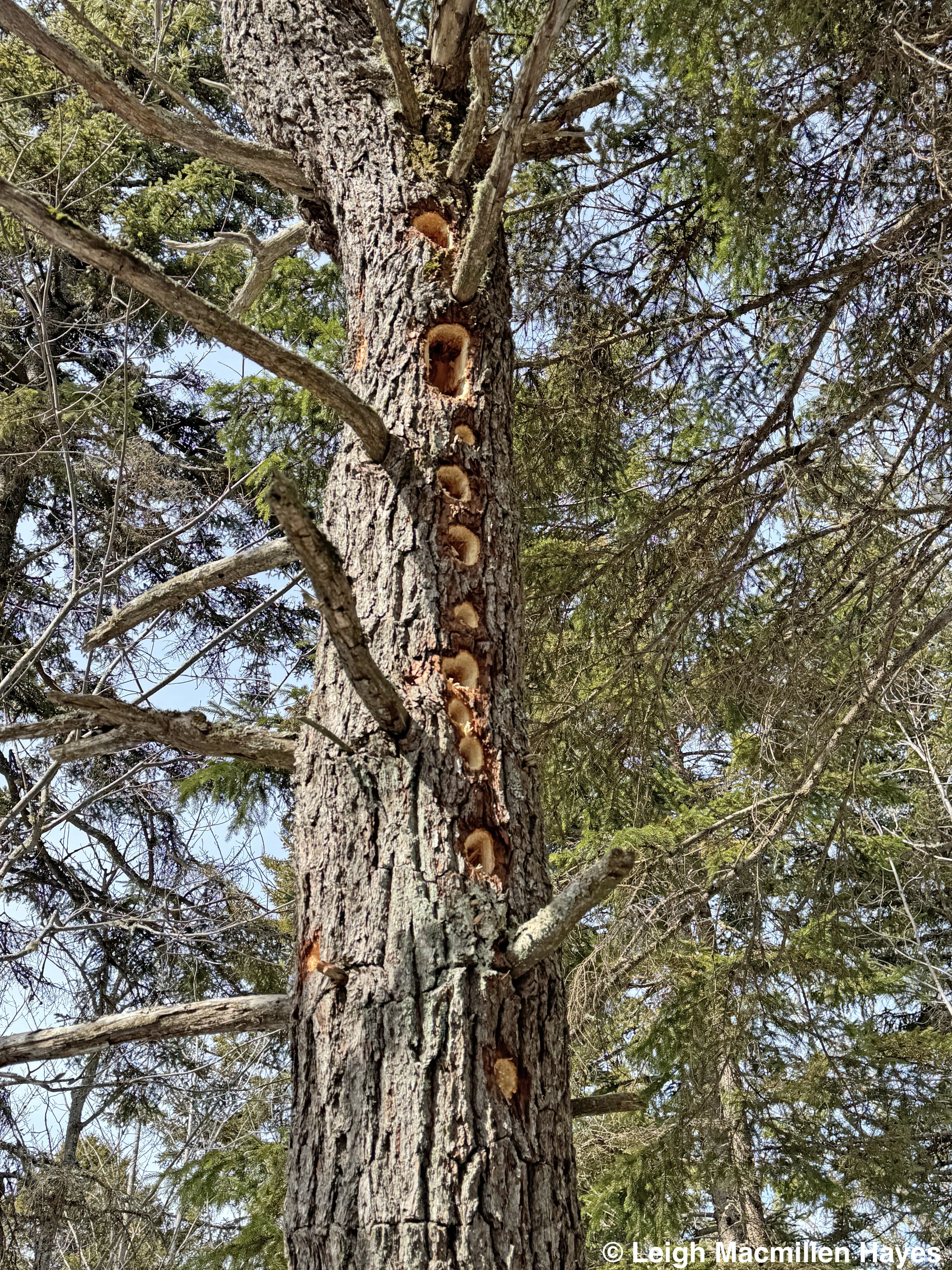
By the number of fresh holes in the tree, we knew the Pileated Woodpecker had visited this spot on more than one occasion, rather like the Bears and the Beech trees.

I must confess, I cannot pass up the opportunity to look for scat and so I heeded the invitation to hunt for the treasure. And again was well rewarded.

At this time of year, Pileated Woodpecker scat includes bits of indigestible Carpenter Ant exoskeletons and some wood fiber. The whitewash is uric acid since birds evacuate the acid and feces simultaneously–from an opening just under their tail called the cloaca or vent.

Some of the trees along this part of the trail are Balsam Fir and we kept spotting their cones on the ground.

And then middens or garbage piles of Balsam Fir cone scales started to appear and we knew that a Red Squirrel had been dining. We saw some tracks, but never actually heard a squirrel, red or gray, though a Chipmunk dash across the snow and hid from us.

In one area, there were multiple middens, the one in front being about eight inches high. And that brought us to a discussion about the fact that until about 25 years ago, I had no idea what a midden was. Or a cache.

Nor scat. But oh my. A midden and scat on the same rock!

Which came first? My thought is that a Red Fox deposited its twisted and hairy scat–in typical manner upon a high place by a trail, and that the Red Squirrel came along at a later date to dine upon the same rock. I don’t think the Fox’s meal was this particular squirrel. In fact, by the color of it, I don’t think it was a Red Squirrel at all.

But this brought up an additional comment from My Guy about the fact that I can’t stand to see someone spit (think baseball games), but get all excited over scat. (And kill sites.)

I blame it all on Bridie McGreavey for teaching me about such, and once again rejoiced when I spotted Ruffed Grouse scat in a pile that told me the bird had roosted in this spot along the trail one night this winter.

My Guy claimed that he was going to contact Bridie and tell her that she took a mild-mannered English teacher and turned her into . . . me! (There was a reference to Lois Lane in there;-) )

I might have to mention that I never imagined him practicing Yoga!

At last we reached Dessert Ledge, aka South Ledge, again with Mount Washington in the offing, and the northern slope of Round Mountain in front of us.

From there we began our descent, pausing again to admire the ice and water that were part of the display and the blue hues exhibited.

This one crossing I have to admit I was dreading for I thought it might be under ice, but the rocks, which you can’t see because I was standing on them, were bare, and I felt comfortable pausing to take in the view.

We knew by what we spotted, such as these four slabs of ice somehow caught and wedged by a tree, that the force of the water had been quite strong in the past week, given the weather conditions.

We even spotted an ice berg upon the opposite bank.

Water always soothes my soul, so I thought I’d offer this short video for you to enjoy.

The planet offered us some amazing sites and sounds today, but our favorites were probably the Bear Claw trees.

Yes, we’re still enjoying winter as we did today while we celebrated Creation along the mountain: Long Mountain.

And gave thanks as we always do to Larry and Mary who share this trail and others with so many of us, and Bruce, their trail creator, who does an amazing job.

The Tale of Two Tails

We call ourselves the Trail Snails–a group of St. Peter’s Episcopal Church parishioners always accompanied by various non-parishioners who like to crawl at a snail’s pace.

Each week I try to find a different location, thinking fairly flat for locomotion and with natural elements that will bring out their sense of wonder. The first isn’t always easy, especially given the amount of snow and ice we’ve had this winter; but the second is a cinch since there’s so much to wonder about in our little corner of the world. When we started these walks in the fall, I did not expect that we’d continue weekly throughout the winter. But we have.

And so today six people (parishioners and non) joined me at my house to head out to the well-packed snowmobile trail. Of course, it wasn’t as well packed for the first thirty feet and that proved a bit challenging because we all wore some variation of micro-spikes rather than snowshoes, but they all persevered.

Once on the main trail, I showed them Porcupine tracks and then asked them to find the next set of such. It only took a minute for one to spot the pattern. While we looked at them and I shared some fun facts, I looked around and realized I was standing in the middle of recent Porky activity. Not only were there fresh tracks, but also scat and twigs cut at the traditional 45˚ angle, with buds and needles missing. We looked up into the tree, but fortunately no one was at home.

I think I know this Porcupine because he’s a frequent visitor to the Hemlocks in our woods and the neighbors’.

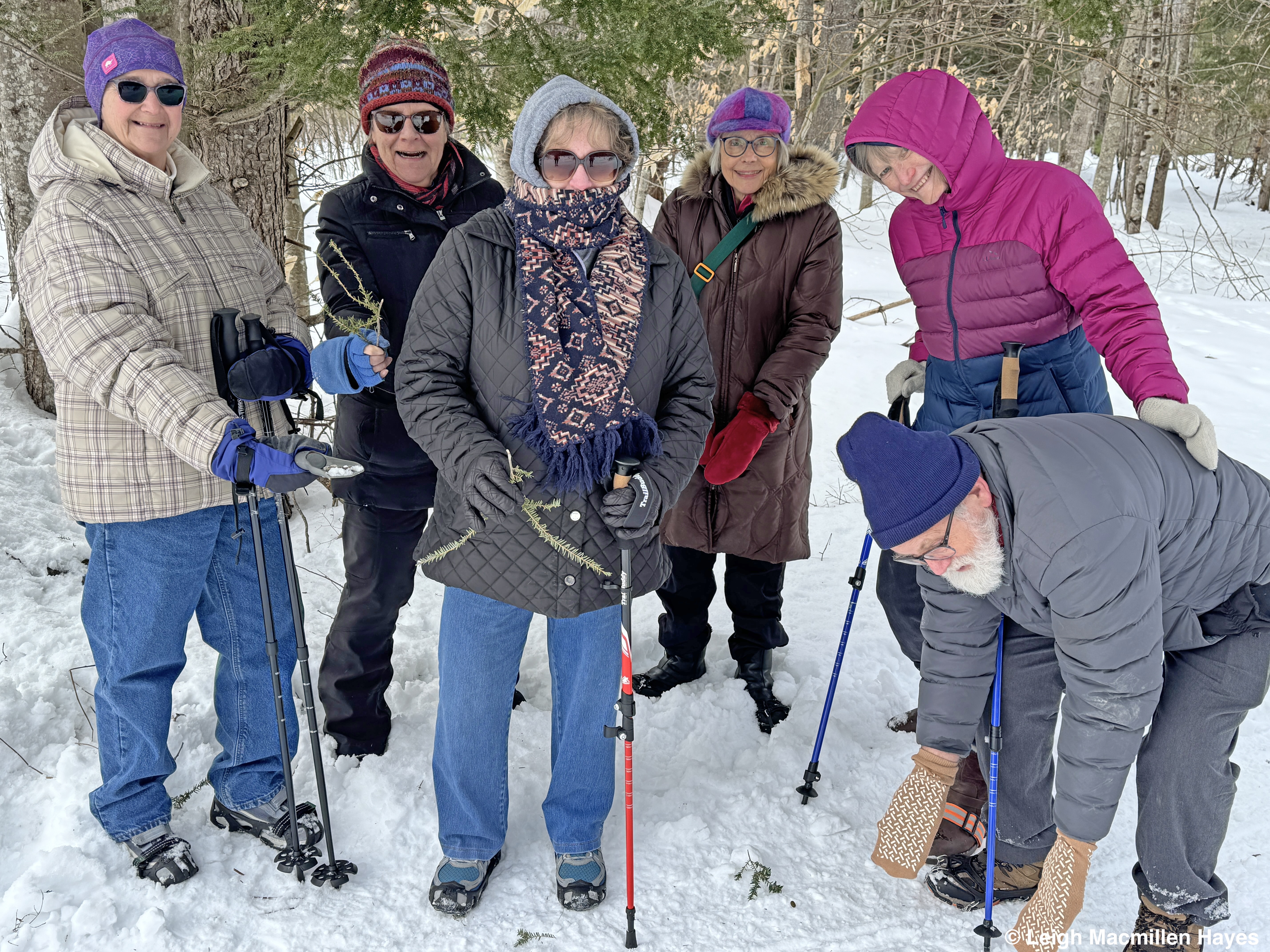
When I asked the group to share the findings and become a Porcupine, they did so, though I think they think I’m a wee bit crazy. Maybe I am. Anyway, Left to right: Nancy holding some scat on my scat shovel, Marion and another Nancy with twigs, Marcia smiling about it all, and Gary wearing my Porcupine socks to show how the feet are like sandpaper to gripe a tree as they climb, while his wife Julia was there for moral support and to help him up if need be.

We paused at many other spots along the way, including looking at the silk a Pine Tube Caterpillar uses to construct its tube.

And admire a perfectly round display of Lungwort, a foliose lichen consisting of a fungus and a green algal partner living together in a symbiotic relationship with a cyanobacterium.

Had I brought water, I would have poured some on it to show off how green it quickly gets since the alga would have kicked into action to provide food for the fungal structure.

Lungwort is sensitive to air pollution and habitat loss, so spotting it is always a treat and reminds us of why we love living here in western Maine.

We also looked at buds on an Ash to figure out which species and I told them about the Emerald Ash Borer and showed photos of what blonding looks like.

It turns out what we were looking at was a White Ash–hairless buds that dip into the upside-down, C-shaped leaf scar.

And then there were the Winter Fireflies that we found still as could be on the snow. I picked one up in the scat shovel and thought it must be dead.

That is . . . until we noticed its antennae began to move.

And then it started to walk. Last we knew, I’d left it and its kin on their favorite tree, a Sugar Maple, with hopes that as the temps warmed today and will continue to do so going forward, the insects will survive.

Just before reaching our driveway at the end of our walk, we also saw a Winter Cranefly, but moments after I scooped it up in my scat shovel, it flew. At least most everyone got to see it.

As Trail Snails, we walked not quite a mile and a half in two hours, but saw so much, and I was especially jazzed by the new Porcupine evidence. I think they were as well. Maybe not jazzed, but curious.

And in our time together we saw only three snowmobiles. While it was brought up that those on the machines miss all that we were seeing, I did explain that My Guy often comes back from a ride and tells me of the wildlife he and friends sighted. There I am being so quiet and not seeing any, but somehow despite the machine he spies so much more.

And then this afternoon, I picked up a friend and drove to another section of the local snowmobile system. We walked and talked and talked and talked some more, catching up because despite retirement we are both incredibly busy. In a good way. Doing things we love to do.

As we walked, I kept pointing out Porcupine tracks and if we’d had snowshoes on, I might have convinced her to look for the feeding trees and den sights, but we chose to begin with micro-spikes and quickly ditched those since the snow conditions on the well-packed trail were just right.

We also paused to listen to a Barred Owl and tried to spot it to no avail.

And then, near water, we spied tracks of a different sort. And scat. And mud. And not quite open water.

The scat was from Otters. And I really wanted to take a closer look, but didn’t trust the trail down, despite it being well traveled.

What I now realize I didn’t take a photo of were tree marks in the snow, which in the moment I surmised were twigs blowing down toward the water.

I noted that the track continued across the road upon which we walked and so I suggested we take a look and see if we could note anything about the Otters’ behavior.

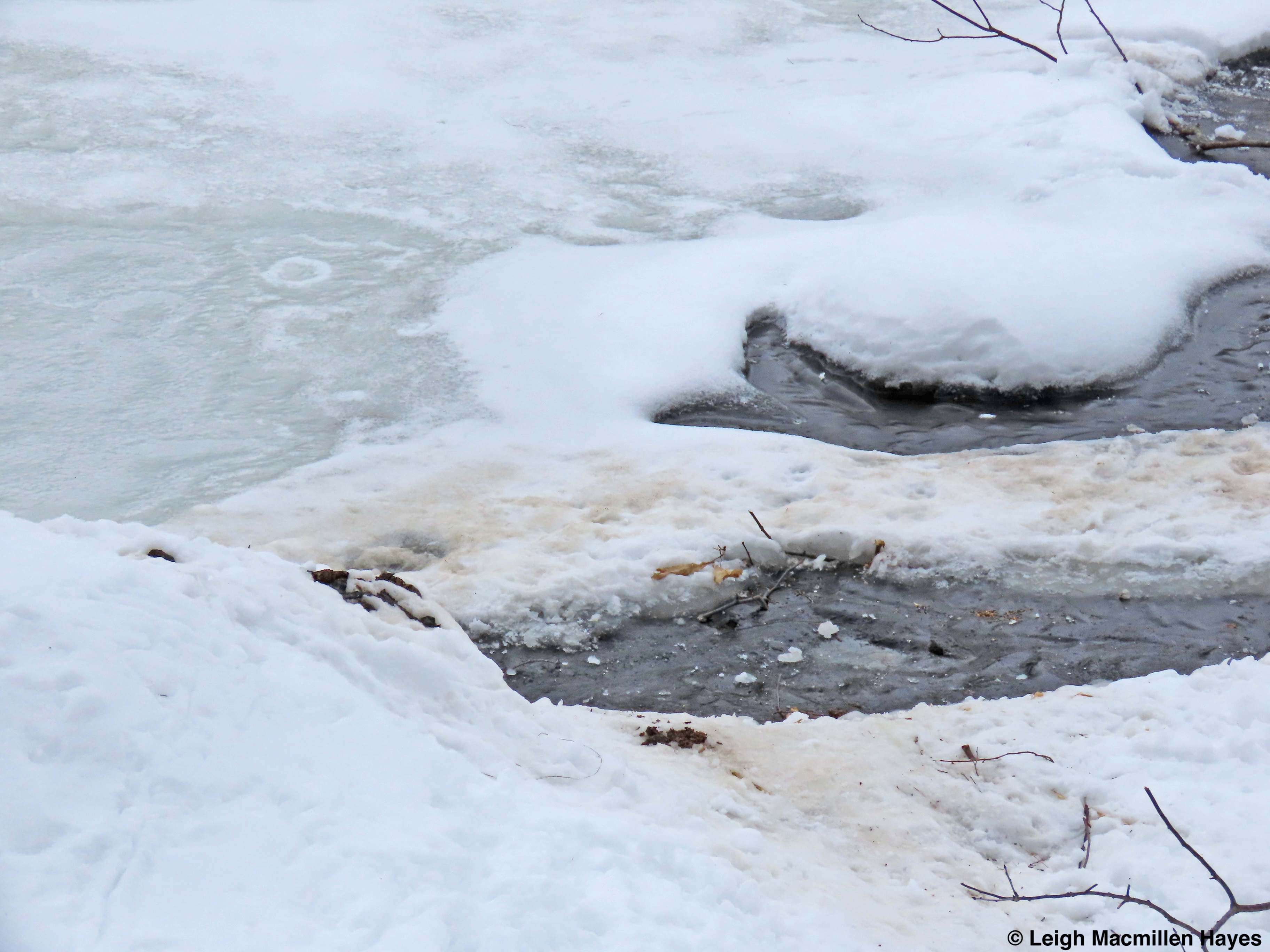
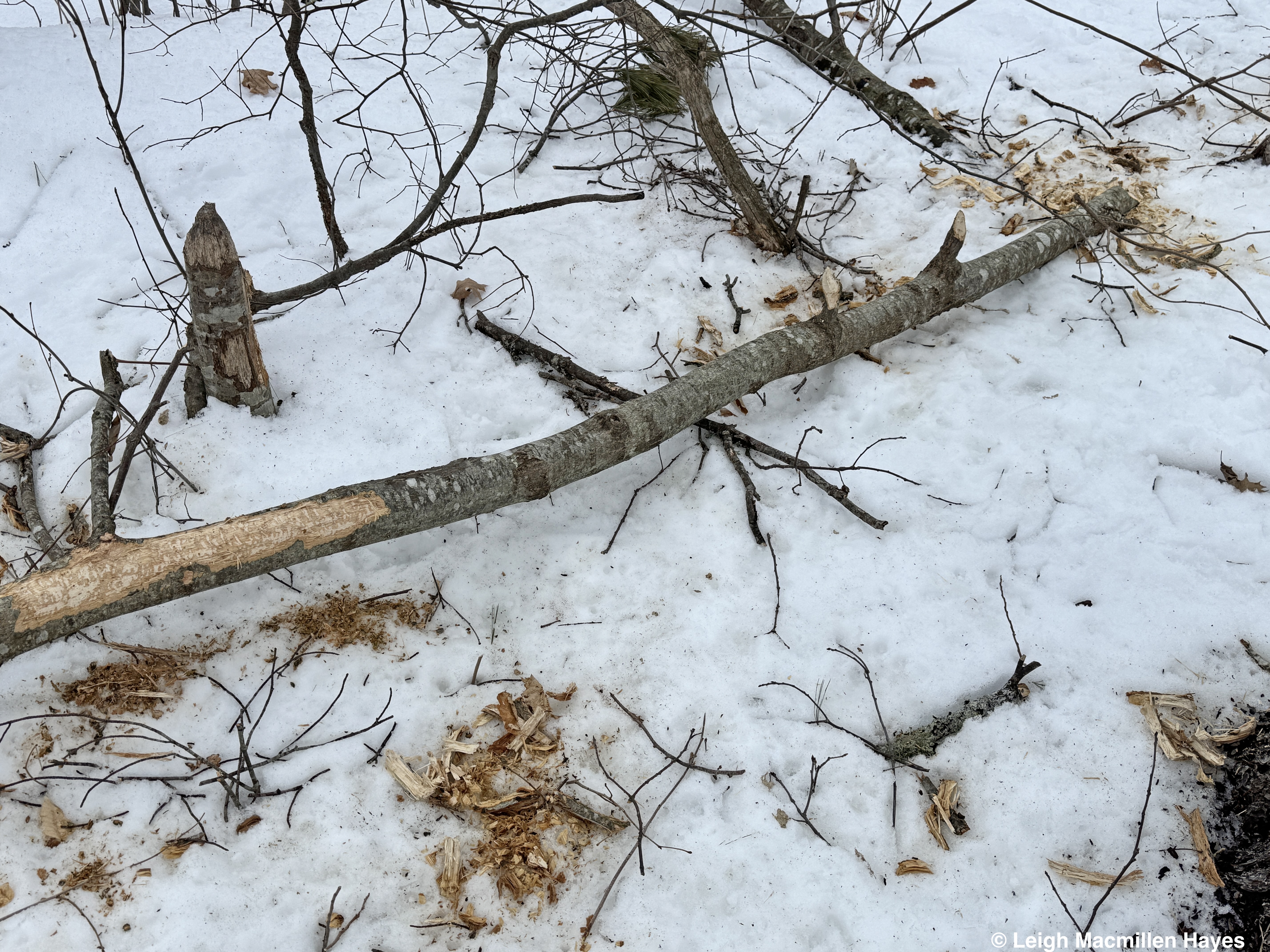
We certainly did not note anything about such, but instead discovered fresh Beaver works. And suddenly the indentations left by the twigs made sense–Beavers dragging tree branches down to the water to take back to their lodge or winter food raft.

Maybe like some people that I’ve heard are looking for more firewood right now to stay warm the rest of the winter, the Beavers didn’t realize everything would stay frozen as long as it has and so they needed to replenish the pantry.

Shortly after that, at about the 2.5 mile mark from our journey’s beginning, we turned around and started to walk back. And then something stopped us in our tracks. It took me a few moments to say, “Look,” and grab my camera and I feared this something would slip out of sight before I did so.

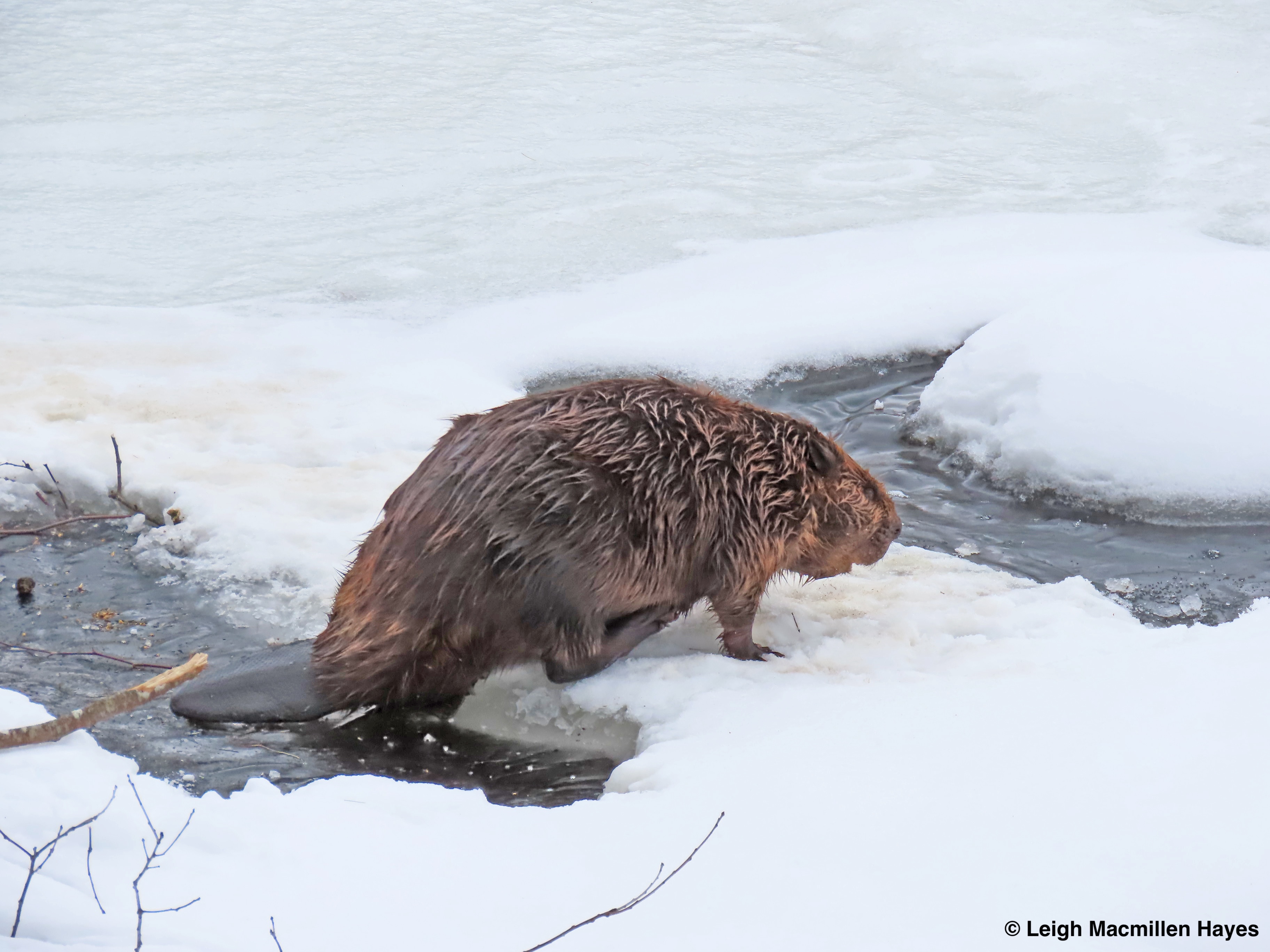
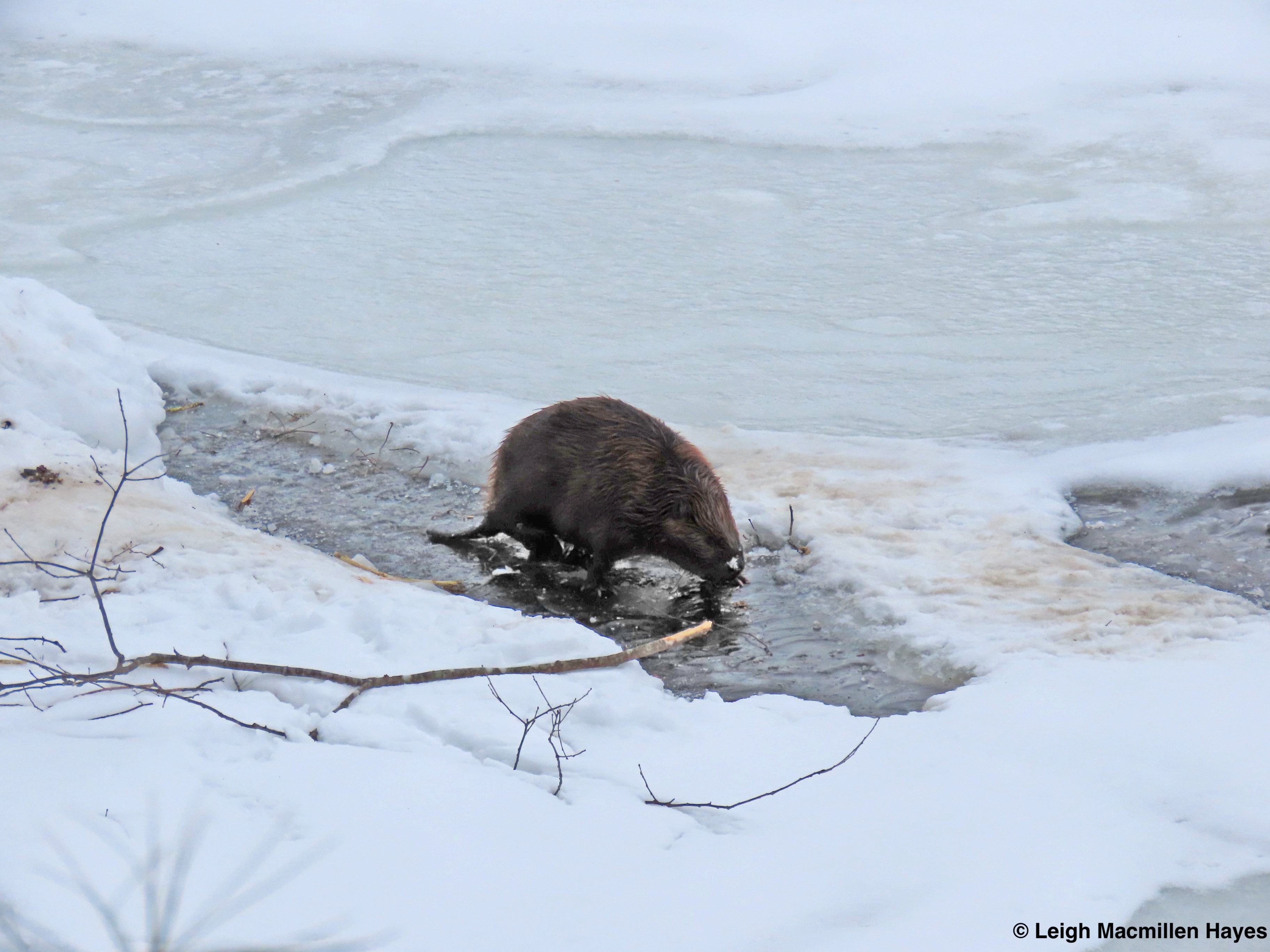
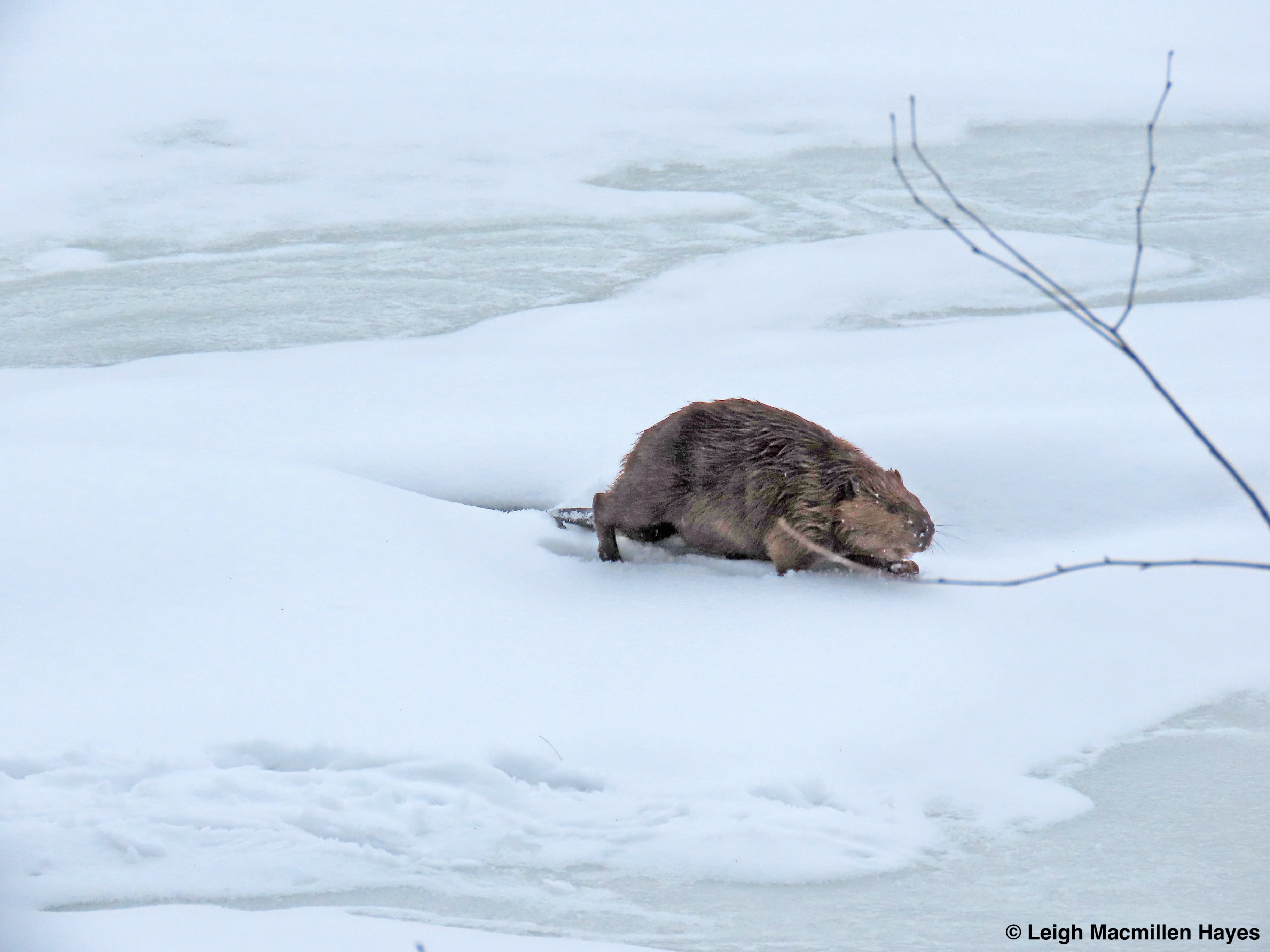
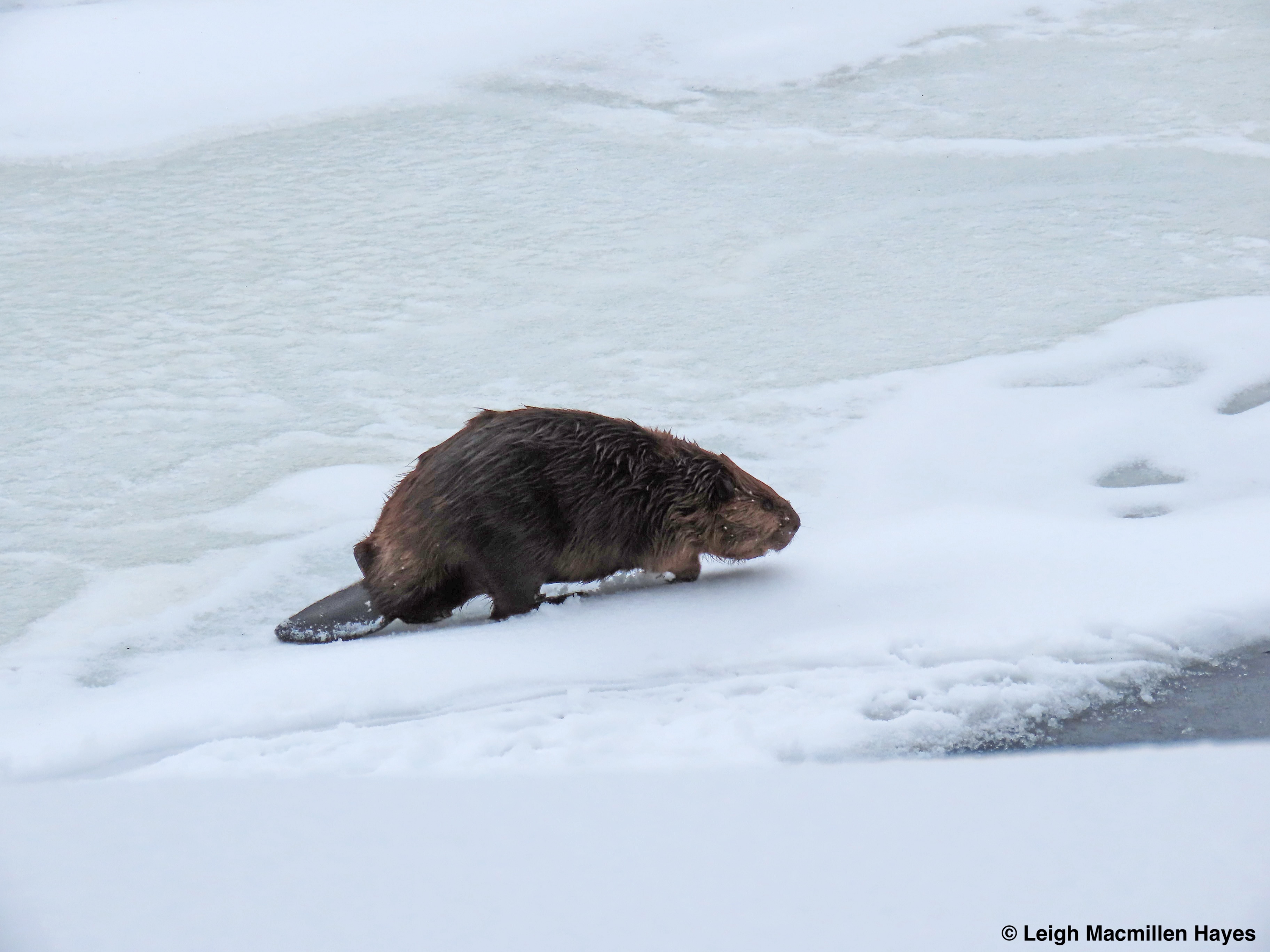
The Beaver must have come up the hill to cross the road to go grocery shopping by the trees he’d previously cut down, and then spotted us and we watched it waddle down its well packed trail toward the ice.

We thought our time together would end in a second as it slipped into the water, but then we realized it was looking for an open hole.

And scratching the snow and ice, even to the point of getting snow on its face.

It kept trying and we kept watching.

Still no luck for the Beaver, while we felt we were having all the luck in the world.

Traveling on land is such a vulnerable activity for Beavers and I could only hope that the Otter scat in this very spot where we stood above the water was the result of the Otter eating something else and not making a meal of a Beaver kit. Because really, they both can take advantage of the same hole in the ice.

We also wondered where the lodge might be but the bank’s edge was too steep for us to note if it was nearby.

And then, just like that, the Beaver found open water and this was the last we saw of it before it made its escape.

We knew we were blessed, Marita and I. And gave great thanks for hearing the Barred Owl, spying Otter Scat, and spending a few minutes with a Beaver.

What a day, from a Porcupine’s Tale to a Beaver’s, two mammals with tails of grand importance–the former being for defense and stability on a tree limb, and the latter for a rudder, as well as stability like a tripod when cutting down a tree, and fat storage as well.

In Search of Winter Stoneflies

I’ve been waiting for this day for the last few weeks. To that end, every couple of days I’ve snowshoed out the back door and made my way down to the park, eyes always looking down just in case. To no avail.

Oh, the ducks are always there, as its their winter hangout, being one of the few places with open water given how cold the temps have been. Even this morning, the thermometer registered -7˚ at our house.

What I love about the sun shining on the male Mallards heads was that some appeared green and others blue in their iridescent hue. They rather reminded me of Ebony Jewelwing Damselflies who have bodies of the same color, albeit a million times smaller.

But it wasn’t the ducks that I sought. Instead, it was this. A Winter Stonefly!

In winter, crazy as it may seem, the aquatic immature stage of a Winter Stonefly, aka naiad, crawls from the rocky bottom home of the brook where it has spent the last year or more maturing (going through as many as thirty molts) and shredding fallen leaves, climbs up through crevices in the snow that covers the brook, finds a plant or some other spot to emerge as an adult, and leaves behind its shed skin, much like a dragonfly or damselfly.

Today, though not abundant, the insects were all on the move and most headed west, as I’ve noted in the past.

Their mission: to reach a tree trunk.

Once there, they’ll crawl under the snow beside the trunk and I had to wonder if we’ll hear the sounds of their party reverberating through the cold night air tonight. That said, today it wasn’t hundreds of insects; but that day will come soon.

Why to the tree trunks? And why crawl under the snow? The bark is warmest in that spot, so it is a good place to get out of the weather.

Stoneflies have hammer-like structures on their abdomen that make noise when thumped against a surface, like a tree trunk or a twig or even the ground. This is a mating call. The males drum, and the females drum back, and voila, they find each other and canoodle.

And just to mix it up, this spot is also home to Small Winter Stoneflies.

Like Mayflies and Caddisflies, Stoneflies are particularly sensitive to pollution and serve as bioindicators of water quality. That means the brooks beside which I walked have excellent water quality. That is good news indeed.

Since I was in the park, I decided to look around to see who else might be living there. There was an abundance of Gray Squirrel tracks, and those left by a Red Fox or two, and even Raccoons. But then in a spot where I hadn’t spotted this tree for any reason before, I noticed that a Beaver had paid attention.

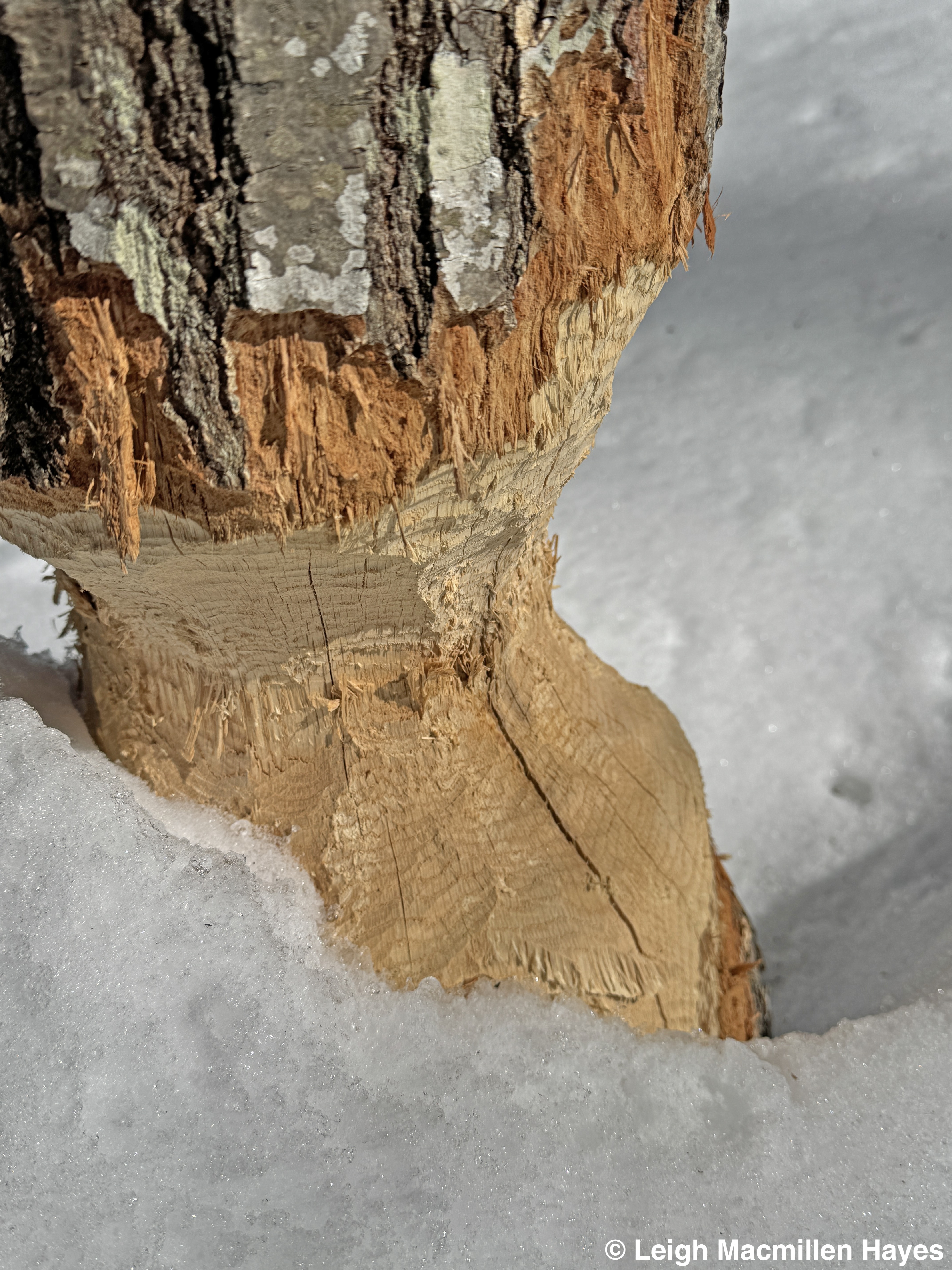
Can’t you just imagine the Beaver cocking its head to the side and trying to cut this tree down. From the looks of it, this tree was partially chopped down before ice formed over most of one of the two brooks that flow through the property, so I would imagine in early December. How did I miss this before?

And where there are White Pine Saplings, some times there are signs of a Pine Tube Caterpillar’s winter home. Well, it could have been in this one or any of the dozen others I spotted nearby.

The larval form of the Pine Tube Moth, Argyrotaenia pinatubana, binds clusters of needles together. What typically happens is that the caterpillar uses between ten and twenty needles to form a tube or hollow tunnel. (You might also see the little white Pine Scale insect to the left of the tube.)

In October 2021, I had the good fortune to watch some Pine Tube Caterpillars at work.

Back and forth they moved, excreting silk that formed a ladder-like web. The caterpillars moved up and down their silk-lined tunnels to feed on needles at the tip. When the time comes, each caterpillar creates one more tube and does the same thing until it is ready to pupate overwinter.

The moth will emerge in April, when I’ll need to pay attention again (if I remember). Two generations occur each year and those that overwinter are the second generation.

Those were all great sightings. BUT. Not all is perfect with the natural world. And the blonding on the Ash tree is certainly an indicator of one thing that is wrong.

Emerald Ash Borers are invasive insects that will attack and kill both weak and healthy Ash trees of all species.

Most of the EAB’s life cycle takes place below the bark.

Tunnels or galleries from feeding larvae accumulate and disrupt the flow of a tree’s nutrients. All wood boring insects leave behind tunnel patterns, but to my knowledge no others have the S-shaped or sinuous curves of EAB.

During the winter, woodpeckers probe for larvae feeding beneath the bark, and often reveal infested trees. The “blonding” I referred to earlier is the light color left behind as the birds remove the outer bark.

I checked some of the debris below one of the infected trees, in hopes of finding woodpecker scat filled with the larval and/or pupal forms of EAB, but so far have not had success. Though some towns are bringing in parasitic wasps to attack the mature insects, wouldn’t it be great to know that we have birds who can help in the effort?

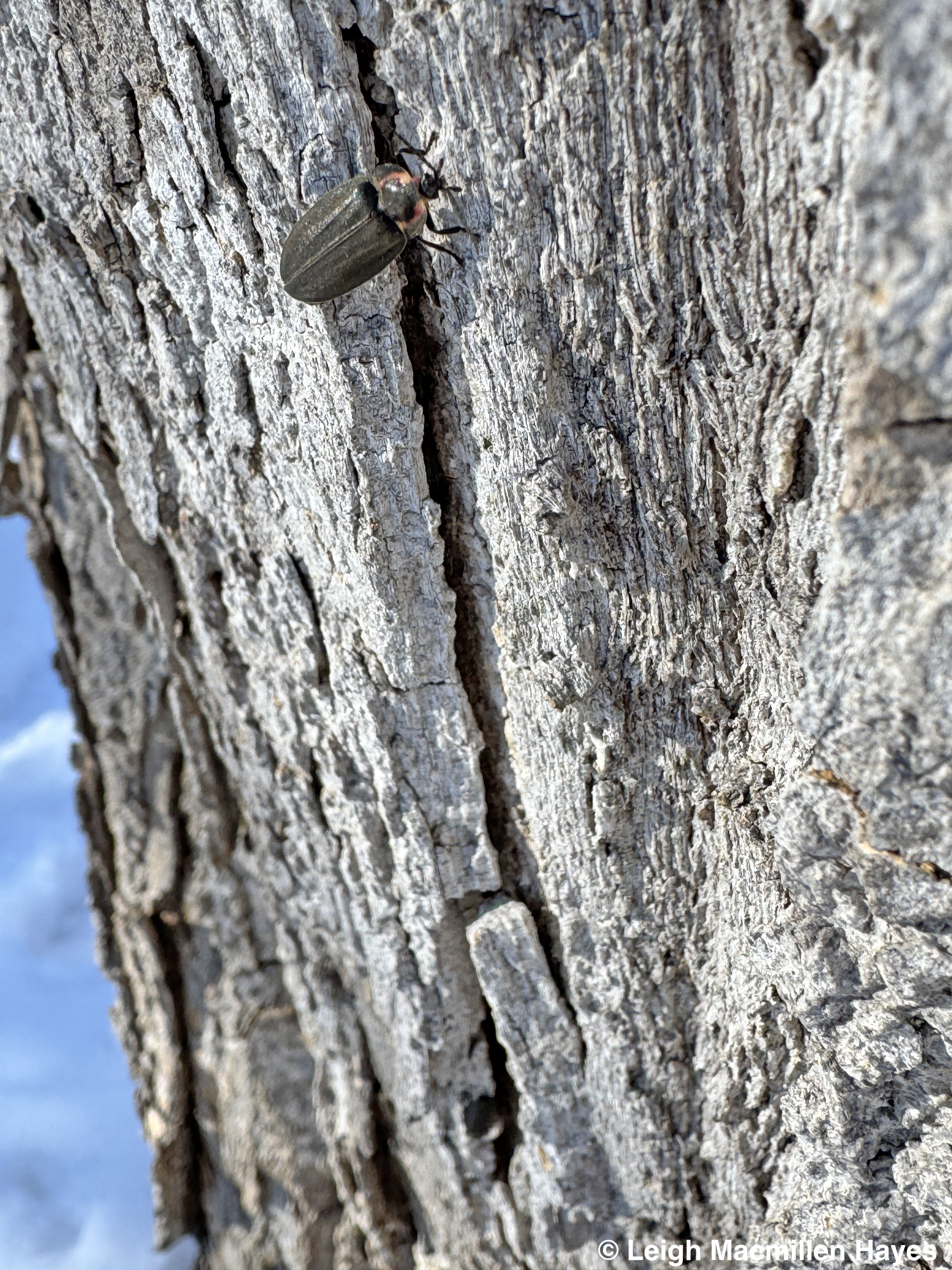
While studying the Ash trees, I looked across the trail at a couple of Sugar Maples and discovered another insect whom I think the world of, the Winter Firefly.

So here’s the thing: fireflies are not flies; they are beetles. Unlike many beetles, however, Winter Fireflies overwinter as adults.

Also, they are diurnal and don’t have lanterns to light up the night sky.

Once I started looking, I discovered quite a few either crawling on the trunk or tucked just underneath where the bark curled away from the tree.

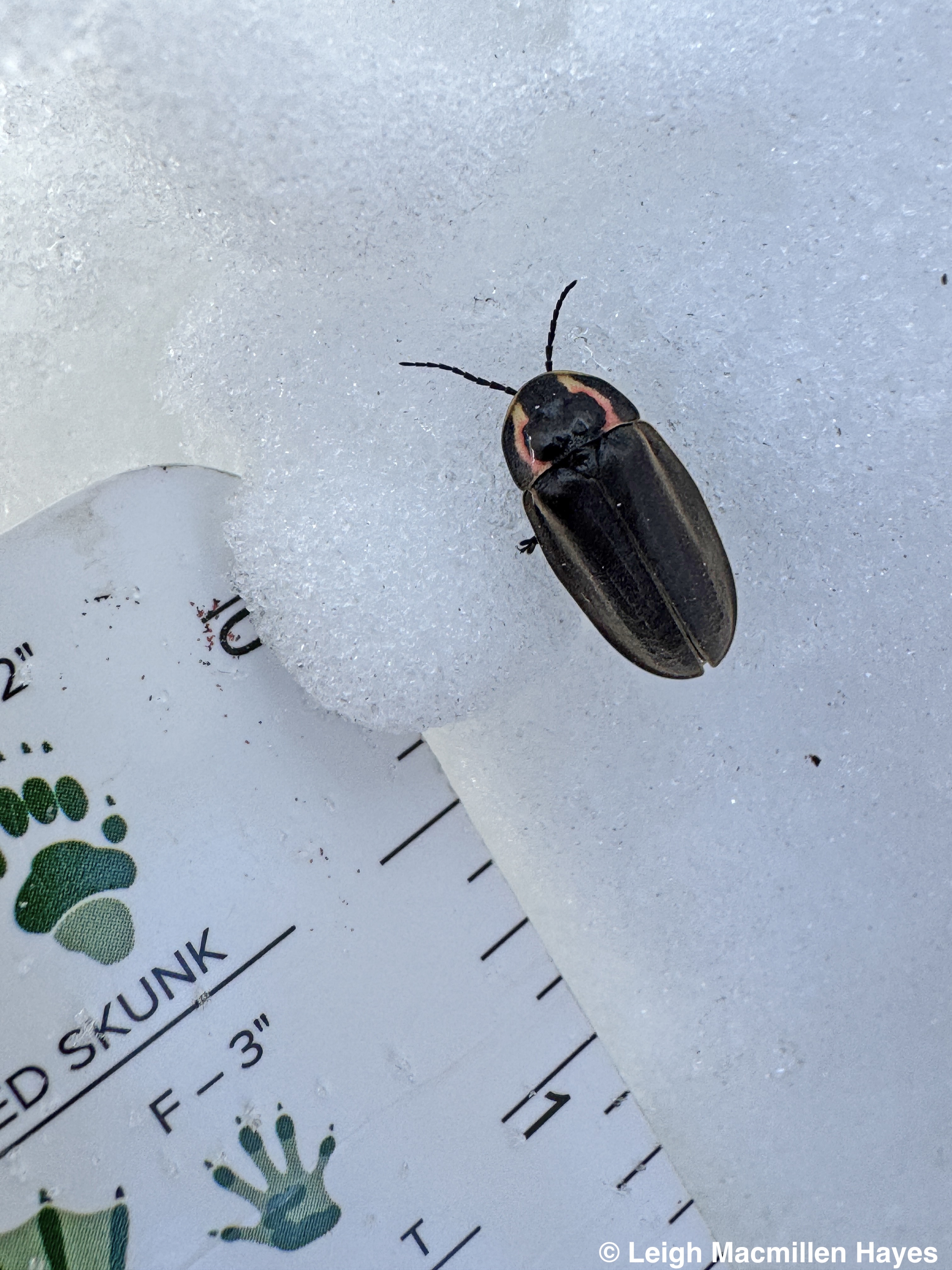
There were also a bunch on the snow, like this one above, and they appeared to be dead, which surprised me. Or maybe they were just taking a rest?

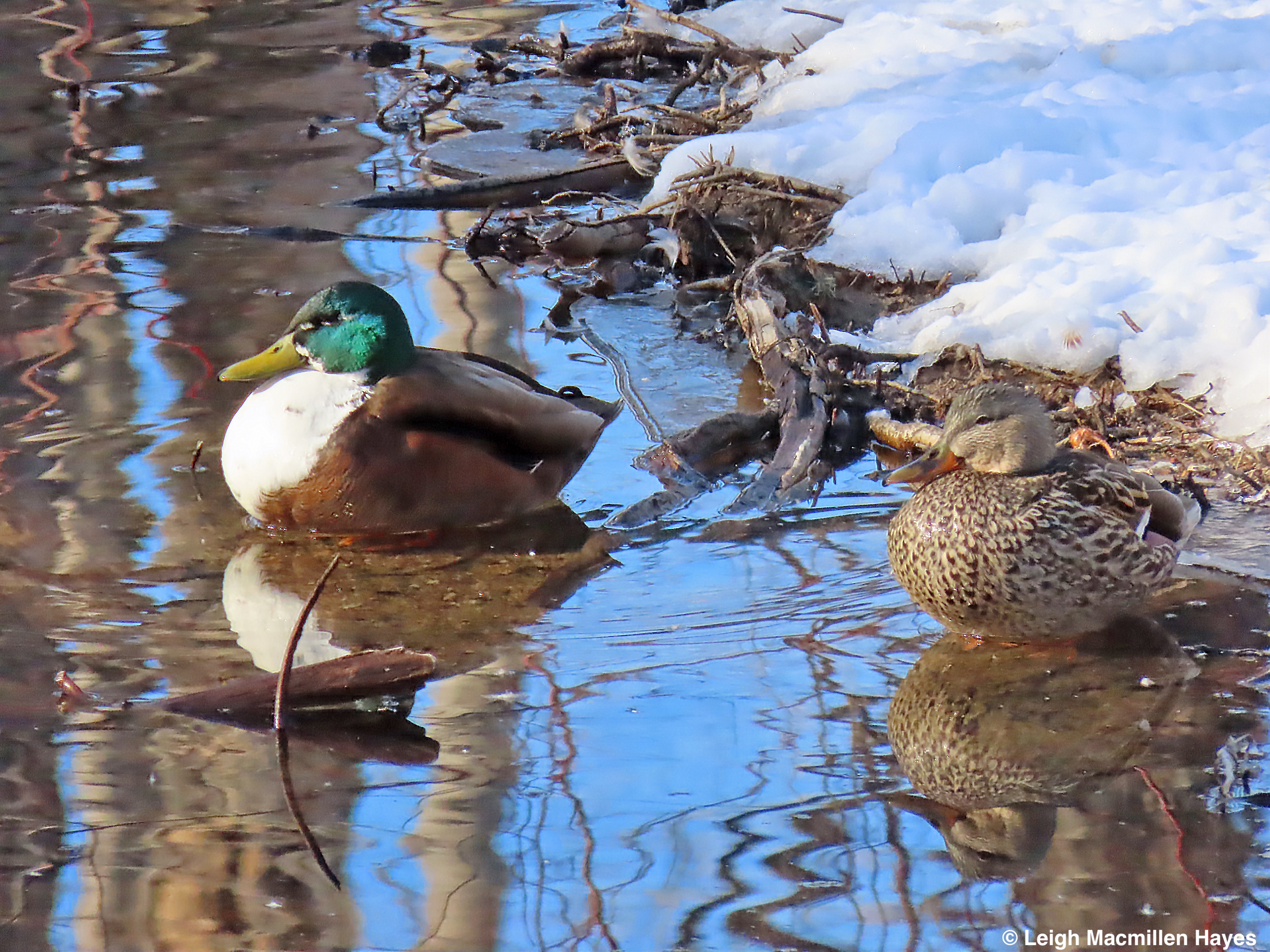
Back to the ducks I returned before heading home. And this time, it wasn’t just Mallards who came into my view. I would like to confidently say that the duck on the left is a female American Black Duck and on the right, a female Mallard.

BUT . . . yes, it’s true, there always is a but, I’m only basing my conclusion on the difference in their beaks and according to The Sibley Field Guide, there are hybrids.

The rest of the bodies of these two look almost identical, and perhaps not as dark as the Black Duck should be. Am I right? (You know that when I’m alone I’m 100% correct, but in blog-land, I’m not alone so I welcome any tips to help me have a better understanding.)

There were a zillion Mallards and though some seemed to be couples like these two, others ganged up and squawked and zipped about chasing each other in circles.

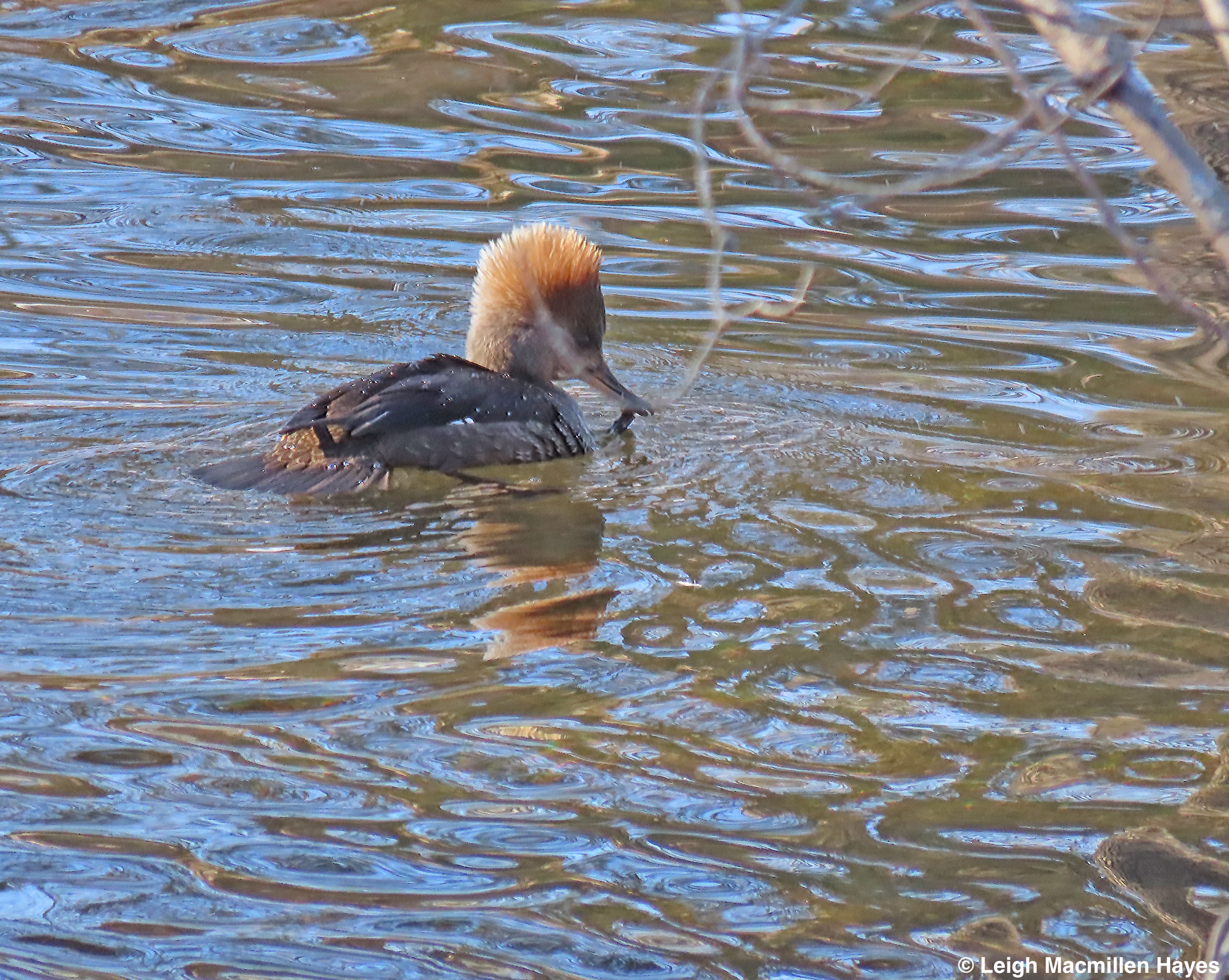
And then into the mix entered a pair of Hooded Mergansers, she being the more drab color. Actually, I spotted two males, but only one female. Then again, I stood only in one spot to view the open water, so I don’t know who might have been around the bend.

Both the male and female Mergansers were diving and feeding, possibly on small fish.

As I watched them, another duck paddled my way and I thought for sure it was a rare species and couldn’t wait to get home and check my field guides.

He had the green head and yellow bill of a breeding male Mallard, and gave chase to his woman.

But that white bib?

It was almost as if the White-bibbed duck had the opposite coloration of the male Mallard, with the light colored chest and dark flank versus Mr. M’s dark chest and lighter flank.

Mr. White-Bibbed also had a white eye line that I didn’t see in the Mallard. And his chest seemed to stick out prominently.

The best I can tell from a little research, is that this is the result of a Mallard canoodling with a domestic duck. Again, if I’m wrong, please let me know.

Some call them Manky Mallards or Domestic Mallards. Mrs. Mallard seemed rather pleased with her choice and if these two do stay together, I can only wonder what their offspring will look like.

Just before I walked home, I heard and then saw a pair of Northern Cardinals. She didn’t make herself clearly visible, because if you look closely, you’ll note the berries of another invasive, Bittersweet, that she was dining upon. Junk food for birds. And they are the reason it spreads so rampantly in our area. I have to say, I remember a time when I thought Bittersweet was beautiful as a decoration.

At the end of the day, I have to say I went in search of Winter Stoneflies and came home well rewarded.

Bald Pate Mondate

Driveway and pathways cleared of snow? ✔️

Bird feeders filled? ✔️

Sandwiches packed? ✔️

Microspikes in truck? ✔️

And we were on our way over the hills and through the woods.

It’s actually a short journey to this trailhead, but by the time we arrived, it was already 11am and others had been there before us, thus making the trails easy to follow in the fluffy snow.

And even My Guy appreciated the beauty that surrounded us.

About an hour later, we reached lunch log and the view through the trees included Peabody Pond in Sebago.

It wasn’t long after that when we climbed up to the beginning of the open ledges at the summit and looked back toward Pismire Mountain in Raymond in the distance and a bonsai Pitch Pine in the forefront.

There are a few landscape photos one must take when on this mountain, Peabody Pond being one of them. Thanks to the volunteers and staff of Loon Echo Land Trust who cut down some trees to open up the scene.

Another must-take is Hancock Pond to the west, and we always wave to our friends Faith and Ben, even though we know they aren’t in residence at this time of year. But we trust that they wave back anyway, from their winter home.

Before we left the summit, I took a couple of seconds to admire the Pitch Pine needles because I wanted to honor some of the evergreens that grow here.

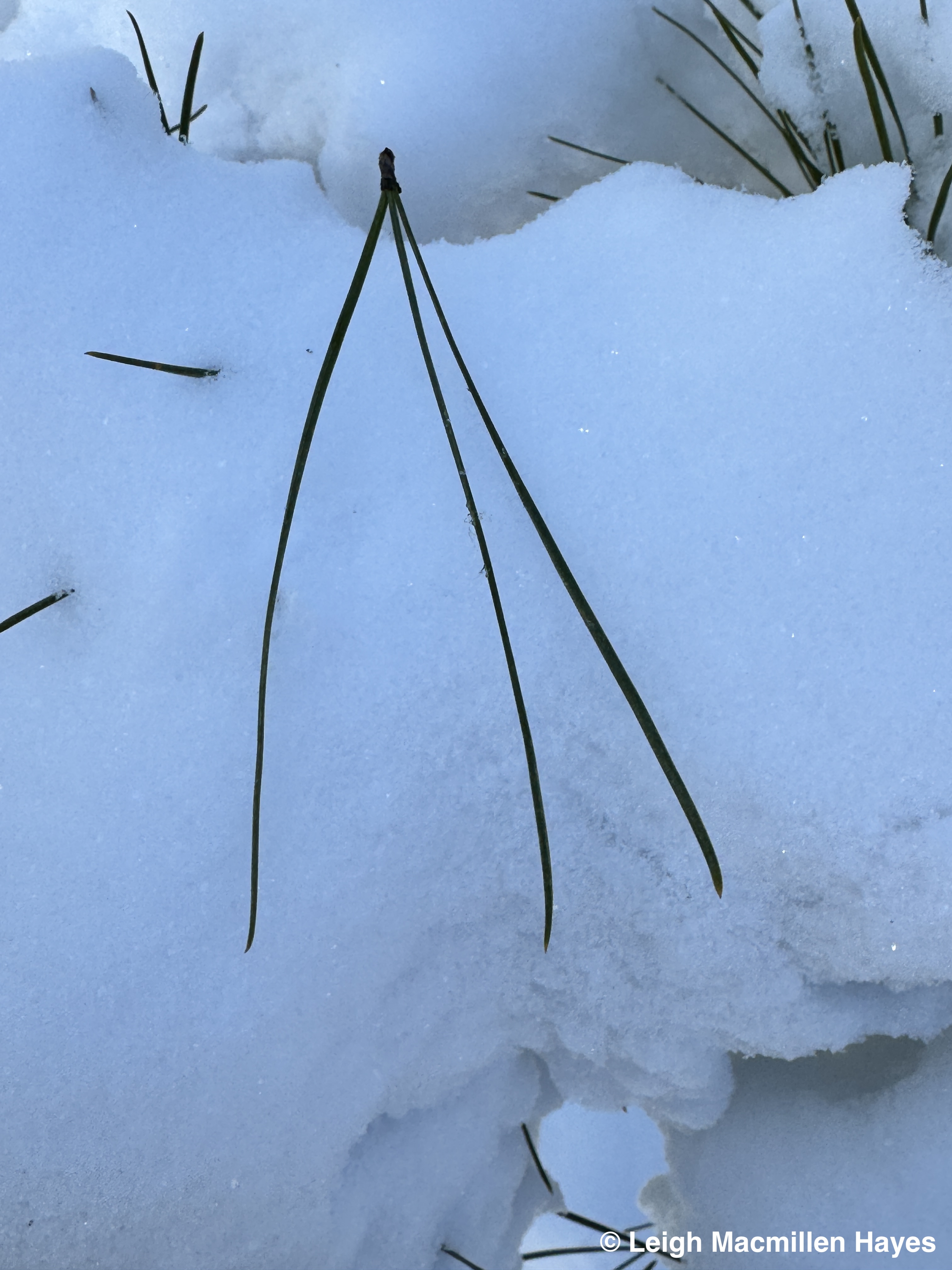
While White Pine has bundles of five needles, spelling M-A-I-N-E for our state tree, or W-H-I-T-E for it’s common name, I used to think that trees with three needles were Red Pines. They are not. Rather, these are the needles of the Pitch Pine: three strikes, you’re out!

Red Pines also grow on the summit and in other places along the trails, along with the ubiquitous Whites.

Red Pines, however, have bundles of two rather long and stiff needles that snap in half easily, rather than being short and flexible like those on White Pines.

Our journey continued to a false summit, where another view shot needed to be taken. Often, from this spot, Mount Washington is visible in the saddle of Pleasant Mountain’s ridgeline, but the red arrow is pointing to clouds that obscured the mighty one on this beautiful, crisp day.

My Guy asked me which way to go, and I told him to keep turning right at intersections. That is, until we reached the Trail End sign. He didn’t obey the sign, nor did he turn right here. Instead, we did a U-turn and headed toward the parking lot.

Along the way, however, I wanted to honor one more evergreen because I know several grow here, but don’t often get to see them at other places where we hike. These are the needles of Jack Pine; in short bundles of 2: Jack and Jill.

And right next to them I met another evergreen I can’t recall ever spotting before. Maybe I have, but today it was like meeting it for the first time: a Northern Cedar. What a fun find. And the topic for a future public hike formed in my mind: Meet the Evergreens.

About three hours later we arrived back at the kiosk, noting ours was the only truck in the parking lot. We’d met only one other person and his friendly dog, but by the prints left by other humans and dogs, we knew the trails had been well traveled today.

The orangy-red indicates our trails of choice. We’re rather predictable on this mountain, most often traveling this route.

At the end of the hike, I returned the hiking pole I’d borrowed, grateful to Loon Echo Land Trust and its kind volunteer who had created these, since when I went to grab my pole from the back seat, I realized I’d pulled it out the other day. Silly woman.

Hiking pole in truck? Not a ✔️

As soon as we arrived home, I put it back in so that next time I’m ready and someone else can use the poles at the kiosk.

Thank you once again to Loon Echo, not only for the pole, but for preserving this beautiful property in perpetuity and maintaining the trails and always thinking not only about the landscape and its importance, but all who travel here as well.

It was a perfect day for a Bald Pate Mondate.

Another Amazing Lesson From A Squirrel

Maybe I’m a slow learner. Maybe I just need the same lessons over and over again.

Whatever it is, I’m grateful for all who teach me, non-human to human, because there is always something to learn.

This week it was my friend Red who led the class. If you were down the hall in this outdoor school, you may have heard him, for he tends to be quite loud, and a bit critical, when he’s not dining upon a pinecone that is.

His plan, as it often is, was to strip the cone of its protective scales and seek the tiny seeds tucked in by the core or cob of the cone. Each scale contains two winged (think samara that help the seeds flutter toward the earth when its warm enough for the scales to open on their own) seeds and to me it seems like a lot of work for a little gain.

But if you’ve ever watched a Red Squirrel at work, you’ve noticed they are quick and can zip through one cone in mere minutes. Of course, it helps that they don’t worry about the “trash” and just let the scales and discarded seed coverings or pods, and even half consumed cones and cobs pile up in a garbage pile known as a midden. Spotting one of these is a sure sign you’ve entered Red’s classroom. And if you pause and look around, surely you’ll find many more middens. After all, Red Squirrels are voracious consumers. But again, given the size of the seeds, they need to be.

So here’s lesson #1: Leave the scraps. Oh wait, not on our indoor dining tables, but in the woods. And not our food in the woods, unless you are composting. But downed trees and snags and leaves and all that will replenish the earth, just as my squirrel’s garbage will do.

I should clarify that Red shares the school with many others who have their own classrooms and I’m sure when I finish my latest assignments I’ll have more to learn from the porcupines and deer and hare and coyotes and foxes and bobcats and yada, yada, yada who live under the mixed forest canopy.

The sight of so many Eastern Hemlock twigs on the forest floor told me I’d stepped into Porky’s room so I looked for evidence, wondering if he was at his desk or not.

Lesson #2: Slow down and observe.

The answer was no, but he’d left his calling card on a dangling twig and so I know where I might find him should a prickly question enter my mind.

Because I was told by Red to slow down and observe, I noticed another spot where he’d visited and this time his midden was of a different sort in the form of snipped twigs. Much smaller snips than Porky drops, which is a good way to tell the two critter’s food source apart.

Just as Porky’s twigs had been cut with the rodent diagonal, so were Red’s.

I noted that he hadn’t eaten the buds at the tip of the twig, but once I flipped one over I discovered numerous buds or seed pods had been dined upon.

Lesson #3: Check twigs more often. And remember, this year was not a mast year for Eastern White Pines, so Red has to supplement with hemlock buds and cones. (And also remember, cones on hemlocks are not called pinecones because they don’t grow on pine trees. Conifer refers to cone-bearing, so both pines and hemlocks are coniferous trees.)

Back inside I decide to sketch a pinecone. It was a sketch I’d started months ago, but abandoned because it seemed to difficult to draw.

But then, thanks to Red, a realization came to mind.

Lesson #4: Pinecones have overlapping bracts or scales that protect those seeds developing inside of them. They close in the dark and open in light, especially on sunny days and it is then that the seeds become airborne on their samaras. And the bracts or scales grow in spirals around the core or what I think of as a cob. I knew that, but had forgotten it until I decided to sketch.

And so I drew some guidelines to aid me as I tried to recreate the cone’s spiral staircase.

It was fun to watch it grow and realize each cone actually fans out in a Fibonacci spiral sequence. It’s an amazing wonder of nature.

Feeling my drawing was complete, I began to add color in the form of gouache paint, scale by scale.

And slowly, the painting began to represent a cone . . . at least in my mind’s eye.

A dash more color and voila–my amateur attempt at painting a pinecone. I have to admit, I was rather tickled because I really didn’t think I could pull this one off. But I have my art teacher, the talented Jessie Lozanski, to thank for giving me the confidence to try.

And I have Red, my other teacher, to thank for the lessons because it was in watching him turn the cob ever so effortlessly that I was reminded about the cone’s spiral.

And so I tried to honor him as well. I may be a teacher, but I’ll always be a student.

Lesson #5: As we head into this new year, I hope you’ll join me in slowing down and noticing and honoring. Especially outdoors. Or even out your window.

I’m forever grateful to Red and all the other teachers who come in many forms, not just as mammals, for the amazing lessons I’ve learned and can’t wait for the next class.

Wait. Watch. Wonder. Learn.

As I waited for the sun to rise on this final day of autumn 2024, before the dawning of the winter solstice, I watched the sky. It seemed late. Of course it seemed late. Tomorrow will be the shortest day of the year.

Ever so gradually, the sky brightened. First, there was barely a hint of light shining through the trees as if taking its time was a way to remind me to slow down.

And then I began to see it. Not the orangey-yellow I expected, but rather a blue gray that slipped out from behind the silhouettes of the tree trunks, who stand as watchers, observers, of every dawn every day.

Ever so slowly, a hint of pinkish purple rose in the East and the blue gray was transformed.

I, too, wished to be transformed. By this first light. By this new day.

And then it occurred to me that I do rejoice at each daybreak and look forward to its offerings.

Today, however, was a wee bit different as it was the day to enter a place I’ve barely visited since the spring and I felt drawn to part the hemlock boughs and venture forth into my own secret garden, that isn’t a garden at all, at least not if you expect it to be a place where flowers and vegetables are tended. Ah, but it is a garden from so many others. And its those others that I hoped to meet.

In her book entitled Church of the Wild: How Nature Invites Us Into The Sacred, author Victoria Loorz writes, “You wander slowly and intentionally. It is your full presence along the path that matters. It is an act of reverence, a saunter. John Muir hated the word hike. He urged people to saunter. ‘Away back in the Middle Ages,’ he told his friend once, ‘people used to go on pilgrimages to the Holy Land, and when people in the villages through which they passed asked where they were going, they would reply, ‘A la sainte terre,’ ‘To the Holy Land.’ And so they became known as sainte-terre-ers or saunterers. Now these mountains are our Holy Land, and we ought to saunter through them reverently, not ‘hike’ through them.”

And so I sauntered, not letting the stone walls or barbed wire stop me from crossing over manmade boundaries.

All the while, I wondered, “Who will I interact with today?” and “Will I be able to shut down my inner ramblings and really wait, watch, and listen?”

My heart quickened despite my efforts to slow my breathing, when I spotted not only the heart-shaped prints of White-tailed Deer who really own these woods, but also one who pursues them, the Bobcat.

Would I spot any evidence that though they travelled in opposite directions a day or so apart, their paths eventually crossed? That remained to be seen.

What I did know was that unless I sat for a time, I would not spot any critters because the snow conditions were such that I stood firmly on top–like walking on water–frozen water, and made a loud crunching sound with the fall of each footstep.

Those who know me well, know that I am a cradle Episcopalian. Among other things, I love the liturgy. But what I’m discovering I love the most is the shared fellowship with a diverse group of people.

And in the same way, I love the woods out my door and how each and every other-than-human being IS diverse, and how they aid and abet their neighbors, sometimes offering a helping tree limb or shared nutrients, and other times feeding upon others because they, too, need energy.

And in the forest, there is life and death, and a dead snag can be just as beautiful as a live tree. And in its death, offer space for others to live.

During today’s saunter, I bushwhacked sometimes and followed old logging trails in other moments. During all of my visit, I often encountered places that needed consideration for navigation, but in the pause as I gave thought to my way forward, I noticed reflections that reminded me of my desire to do the same. Take time to reflect.

I made sure to look up and down and felt a need to celebrate discoveries, such as this perfectly round Snowshoe Hare scat. Last year there weren’t many hares in this part of the woods, so I can only hope that this year will be different.

Evidence of deer activity was everywhere, from well tramped routes that generations have followed for eternity to freshly rustled up Northern Red Oak leaves indicating a search for acorns to dine upon.

What made me chuckle, however, was the realization that it wasn’t just the deer who were taking advantage of an abundant acorn crop. A squirrel had cached one here and another there–that should serve as a meal for a later day.

After searching for a friend I doubted I’d meet, and I didn’t (Porky is saving our meeting for another day), I stepped out to an old logging road and instead met another I couldn’t recall from previous saunters. Perhaps it was because I was approaching it from a different direction than my norm.

This Yellow Birch has apparently graced this spot on a boulder for many years. And though it looks as if it served as a turning tree during a logging operation about ten years ago, it still stands tall.

In fact, by the amount of catkins at the tips of its branches, it appeared the birch was full of life and love and ready to make more birches in the future.

At its feet, fleur de lis scales that protected its tiny seeds had fallen from last year’s pollinated catkins and will eventually break down and add to nutrients to the forest floor.

What I am always wowed by, and today was no different, is the shape of a birch seed–which reminded me of a tiny insect with antennae. A future is stored in that wee structure and maybe this one seed will some day germinate on the boulder below it. Unless a bird eats it first. But then again, maybe it will germinate somewhere else when it comes out in the bird’s scat.

The bark of the birch made me think of landscape paintings I’ve seen from deserts far from this place in western Maine. And I realized I don’t have to go far to travel to other places.

Even as I left the Mother Birch behind, I turned back to see if I could remember it from so many other visits, because certainly it didn’t just appear today. Or did it?

Turning around again, I nearly tripped over a few fallen twigs, but it was what stood out among the dying vegetation covering the twigs that drew my attention. A random feather?

Not at all. I’d stumbled, rather than sauntered, upon a site where a bird had given up its last breath so that another critter could live.

The bird happened to be a Ruffed Grouse, and I had to remind myself not to be sad about the loss because of the joule or energy units procured by another. In its death, sunshine and birch seeds and whatever else the bird had eaten provided sustenance in the form of a gift.

Of course, spotting the Ruffed Grouse’s track did give me pause for I suspected it to be the bird’s last impression.

Moving on toward a former log landing, I smiled again at the sight of another who took a risk of crossing the large forest opening, but knew enough to tunnel under the snow frequently. Was it frequently enough? Voles are everyone’s favorite food. Well, maybe not mine. But I’ve possibly eaten meat from some critter that dined on a vole and so maybe some of its joule had been passed on to me as well.

Frequently on my journey, as often happens in these woods, I encountered the one who greeted me at the start. Well, its footprints greeted me at least. But I always give thanks for such sightings for though Bobcats are solitary and elusive, knowing they are here and that we walk in the same woods and perhaps see and smell the same things makes me happy.

And then it occurred to me. I need to be more like the Bobcat and improve my waiting and watching and listening skills. I’m always in too much of a rush to see what might be next on the agenda. So much for sauntering.

As this last day of autumn 2024 gives way in the wee hours of December 21 to winter, and the sun once again rises in the East, I need to remember to be more like the saunterers. To be alert to offerings. To wait. To watch. To wonder. To learn.

Each day is a new awakening with teachings. Thank God for that.

My Bright Idea: Filled with Awe and Wonder

Just as I stepped out the backdoor this afternoon, I realized I really should have something in my pocket to use as a reference because the snow conditions were perfect. And so I grabbed the nearest object, which happened to be an old orange Christmas bulb that no longer brightens a tree, but serves as a reminder of past holidays in my parents’ home. Not exactly a tracker’s go-to instrument, but it does measure two inches in length.

I suppose I shouldn’t have been surprised to spot Snow Fleas, aka, Springtails atop the snow, but I was. They always strike me as more of a February event, but really, they are always on the leaf litter below the snow, we just don’t take the time to look. And today’s temperature felt a bit like February leaning into March, a rather pleasant reprise from the frigid temps of the past week. And so these insects made their way up through the snowpack to do their thing: dine on fungi and decaying matter that I couldn’t see.

Also flying about and landing, Winter Craneflies, which are smaller than their summer cousins, but still have the long legs and transparent wings. They were everywhere–both flying and walking on snow.

And even the bulb! That was a bit of an experiment because I wondered if the Crane Fly would climb up once I placed the bulb in its face–much like when I can entice a dragonfly to do the same. Voila!

It wasn’t just insects to exclaim over and a few feet later I discovered the impressions of feet of another traveler. The prints left behind on one side of me indicated a hopper/leaper of the mini-kind. And it entered the snow as indicated by the hole at some vegetation that I knew grew below.

What really gladdened my heart was seeing that on the other side of my feet, its gait changed and I knew my identification was spot-on: a Vole who can change from a hopper/leaper to a perfect walker, where one foot packs the snow down and the next foot lands in the exact same spot creating a trail that looks a straight line with a zigzag twist.

Next up to shine the light bulb on–a spider! Walking on snow also. Many spiders are winter walkers and weavers and I was thrilled to spot this little one.

It had a pretty snazzy pattern and I believe it to be an orbweaver.

Then I began to play with the bulb, and spotted a tree with a hole that invited a fitting. I was admiring the tree’s bucketload of Ulota crispa, or Crispy Tree Moss, when something else caught my eye.

Below where I’d placed the bulb was the leftover molt of a tussock moth caterpillar. My, what spiny hairs you have. You make the spider’s hairs seem almost not worth mentioning. So I didn’t.

For a few minutes, trees continued to hold my attention, including this one, grafted into an H. Sometimes I think the H trees were created for me.

And not the be outdone, the Northern Red Oak showed up a brilliant display of its inner “red,” which seemed a perfect match for my bulb.

Upon a Red Pine tree stump, the bulb stopped again, this time to shine a light on a tiny pine sapling that resembled a palm tree. Whether the sapling is a Red Pine or White, I failed to figure out because my attention was consumed by something else.

The bulb changed its position to point downward, highlighting the Wolf’s Milk Fungi that grew below the sapling.

And my playful spirit did what it often does when spotting this species. I found a small stick and poked the little puff balls, which released its spores in a smoke-like manner. I can’t show you the action, but you can see the results of the dried salmony-brown spores atop some of the now-deflated brown balls.

Over the past week and half, about a foot of snow has fallen here in our neighborhood and last night’s addition, plus today’s slightly warmer temps made for some great tracks as I’d already witnessed with the Vole. Gray Squirrels also left their marks–the two smaller feet in the back being their front feet. That always feels like a bit of a stretch until you watch a squirrel move across the landscape.

There was another tree, or should I say pair of trees, that I paused by for a bit because I think of them as a landmark ’round these parts. I love introducing others to these two–the Yellow Birch growing as it does atop a White Pine. I can just imagine the stilts the birch will stand upon when the pine finally finishes rotting away.

As I admired the trees, I noticed something else. My squirrel friend had hopped up, but I can only imagine it didn’t manage a good landing, for there was only one foot impression left behind. In my mind’s eye, I could see him tumbling down–had another squirrel tried to attack from behind?

In the past year, I’ve gotten back into sketching and have been learning to paint, and now see the world through different eyes and know that I’ve walked past this barbed wire many times before, but never noticed it. Today, it looked like an artistic insect in acrobatic motion and love how the bulb found its way into the display.

As I finally headed toward home because darkness was settling in, another spider crossed my path and so I set the bulb before it.

And the spider quickly walked away. Perhaps orange isn’t its color.

To say I went without expectations today would be wrong. For I truly thought I’d see the creator of these works of art since they were made this past week. I did not.

Instead, I came away with revelations and rejoiced in letting my playful spirit run free as I was filled with awe and wonder.

As for the light bulb–it was a bright idea! A brilliant one, really.

The Inside Out Porcupine

This story begins at about 5:10am on November 5th. I awoke to a noise that immediately became plural–and the ruckus sounded like it was taking place in the barn that is attached to our old farmhouse. For about fifteen minutes things shifted and banged and dropped, and then all was silent. My Guy slept through it all.

At lunch time, however, he did as I asked, and climbed to the hay loft to find out what had happened. And that’s when he discovered that I really did hear things dropping, for the myriad trophies our sons “earned” years ago for soccer, and peewee football, and golf, and baseball, and basketball, and hockey, and Pinewood Derbies, and who knows what else, were astray.

I’m going to digress for a minute or two, but really, it was the more creative trophies they received that I like the best like these from Boy Scout Cake Bakes.

And this one for being the king of Nordic Ski Team ski waxing.

Now back to the barn: As My Guy poked around, and there’s a lot of stuff up there right now because we’ve torn up the floor boards on the first level in anticipation of saving the structure and making it safe to park a vehicle in there again, he made a discovery and quickly sent me a photo because I wasn’t home.

A porcupine was snoozing under the Air Hockey table!

We set a trap that I hoped the critter would evade. And it did. My Guy also made quite a lot of noise the next day and saw Porky move from under the table to below a chair. And then he couldn’t find it.

Checking on the situation again a day or so later, we discovered Porky had indeed done some work–beginning with chewing the window and sill.

And he left signs of his adventures, including muddyish footprints on the wall below the window.

And quills scattered about, some even sticking into the rug originally placed because this had been a Rec Room back in the day when our sons were young. Right now it’s a Wreck Room!

Was there scat? Yes, but not nearly as much as expected, and I could track his movements.

Today, I was out there looking for more evidence. So . . . I have a rather extensive collection of tree cookies and twigs and even some branches–all for teaching purposes, including this particular piece of a sapling I’d carried down a mountain because it was in the way on a trail, but deserved to be saved for it features a moose scrape.

But even better than that, this afternoon I noted some wood chips and scat below it and realized Porky had taken some samples.

I love how I can get a sense of the size of his teeth with the work that he did.

And I’m surprised but happy to announce that he didn’t touch any of the other samples stored up there.

I decided to follow his trail and found a few scat specimens on the stairs, and others along beams that are right now uncovered given the first floor changes planned for later this week.

The question I haven’t answered yet and I suspect its because leaves have blown in and covered any evidence: which entrance did he use?

This is one he’s used for the past several winters. Okay, truth be told, we’ve owned this property for over 30 years and have housed a porcupine (and raccoons and woodchucks and opossums and anyone else) for all of those years. They used to have a different entrance, but we made some changes four years ago that forced them to find a new way into their abode.

If you look at the bottom of the beam, you can see where Porky has worked in the past to enlarge this hole over the split granite.

And just last year, he started another between the barn and an attached shed.

With all those years of co-existing, I was sure we’d find far more damage when we removed the floor boards. But . . . we did not. What we did find: Eight, yes eight, suet feeders that had disappeared over the years and I always suspected the raccoons had taken them under the barn because I couldn’t locate them in the yard, field, or woods.

All I can think is that Porky was sated when he entered and didn’t need to gnaw on the wood.

The funny thing about the latest Porky adventure, is that it could have been prevented if we’d thought to close the trap door at the top of the stairs. It took us a day or two to realize this and I feared that Porky would stay up there forever, given that he had plenty of wood to eat and a rather snug place to sleep with the only predators being us.

That said, the trap door does get closed now. And there is no new evidence of a visitation by my favorite rodent. And we didn’t trap him afterall. And he’s still in the woods somewhere. And I can’t wait to meet him–just outside, not in.

And when I do, I’ll be curious to see if it’s my old friend Bandit, for he and I met behind the barn last November and I’ve since honored him with a painting.

Here’s hoping the Inside Out Porcupine stays outside going forward. I’ll be looking for him.

November 11, 2024 Mondate

It’s Veterans Day 2024 and My Guy and I chose a trail less traveled in the National Forest, giving thanks to our families, friends, and strangers who have served our country. It’s because of them that we can hike along trails and old logging roads, and even bushwhack; two of the many freedoms they’ve given us are the freedom to move about our country and the freedom to not live in fear (well, most of the time).

And so today found us crossing the state line and beginning our journey beside Langdon Brook in Chatham, New Hampshire. Like everywhere we look these days, the water level was low–a result of the current drought.

What isn’t low is the number of Geometer Moths, and I believe this to be The Bruce Spanworm, aka Winter Moth, that is currently on the move, emerging from the duff in October and November. I didn’t look for females, who are flightless, but saw plenty of males on the wing.

Our trek found us following steep old logging roads for a good portion and as we looked for Bear Claw Trees, I spotted this, a hornet nest.

One Bald-faced queen started building this nest in the spring by chewing wood and mixing it with saliva to create a paper-like material. I love that you can see the multiple layers of horizontal combs, under what’s left of the papery outer envelope.

Just last week on a hike closer to the Atlantic Ocean we saw another football-shaped structure, that one being much more intact than today’s example.

Take a second to admire those layers of paper.

What to our ever wondering eyes did eventually appear, the first of several Bear Claw Trees, but I promise to not share all of them with you.

What I will share is this one, a first for us. We often see “elbow” trees in the woods, but never before have we spotted a “collar-bone” tree, so dubbed by My Guy. I think it’s a great description of the morphed shape of this Red Maple, probably caused by logging equipment rubbing against it years ago.

And because we were in a place where one would expect to see wildlife, or at least the signs of such, we found Moose tracks.

Where there are tracks, there is bound to be scat, though the tracks were much fresher than this pile. We actually expected to find both because we’ve traveled this way several times before and know it can be a highway.

As much as we both wanted to see the real deal today, I was glad we didn’t spot a Moose since it’s rutting season. That said, there were plenty of mature trees to hide behind had one approached us.

A few miles up and down, and a short trail new to us that was so much easier than the usual bushwhack approach we’ve taken in the past, and we arrived at our destination: Mountain Pond. With the Doubleheads in the background.

Doesn’t it have the cold November look?

It was breezy, but really, not as cold as it should have been and we both wore sweatshirts and anorak windbreakers and were quite comfortable.

Once we reached the pond, we decide to follow the loop trail that encircles it, and stopped at the lean-to for lunch–just far enough from the open water to be out of the wind.

And then it was time to continue on, dealing with rocks and roots most of the way. A bit technical in the footing department especially at the outlet brook, but not difficult.

Soon after crossing the brook, we entered fairy land. Even MG recognized it for what it was.

We didn’t see anyone at home, but trusted they were sleeping as is their habit during the day. Even the boulder condominium looked like it housed a few.

It’s places like this that inspired my children’s book, The Giant’s Shower.

If you are interested in a copy, or two, or three, please contact me by leaving a message in the comments of this blog because I’m not sure the thegiantsshower email mentioned at the end of that blog post is currently working.

But I digress.

On the far side of the pond, we spied the Baldfaces, which gave us a better sense of our place in the world at that moment.

After completing the loop, we found the short trail back to the logging roads and practically ran down hill, despite the signs indicating we should do otherwise.

Not far from the start of our journey, I spotted a classic representation of Red Fox scat. The tapered end and twist are what give it away. And its size.

I actually expected to find a range of scat samples along the way, but that was not the case. And the only critters we saw were two Red Squirrels who dashed for cover as we approached.

But we did have an unusual sighting . . .

On the way back, about 100 feet below where I’d parked the truck, I spotted something else–Goldenrod in bloom on November 11th.

For the last few years, my nephew and I have been sharing photos of plants blooming when they should not be and he’ll receive this one in a text message soon.

The other amazing thing about this bloom . . . the Bumblebee seeking nourishment upon it. At first I thought the bee was either sleeping or dead, but it moved.

It does need to watch out, however, because just below it an Ambush Bug was busy dealing with another Bruce Spanworm moth–one down, a million more Winter Moths to go.

But again, I couldn’t believe that the Ambush Bug was still active either. We had a hard frost a few days ago. How did all of this happen?

November 11, 2024, a day to remember all those who served our country and a day for My Guy and I to take advantage of our freedoms and make some discoveries worth wondering about on this Veterans Day Mondate.

A Squirrel’s Garden

A lot has happened this week on many different fronts, both personal and public, both positive and not so, some comical (like the porcupine that awoke me one morning because it had managed to climb to the second floor of the barn and toppled our sons’ many “earned” trophies) and others more serious, with some in between thrown into the mix, cuze life happens.

To that end, some of my best moments were spent looking and wondering. In the woods. Of course. In our woods, in particular.

I headed out onto the old cowpath in search of a dear friend, not certain if I’d meet him or at least spot signs of his passing. And it wasn’t a deer I was looking for–although, in a way it was because I haven’t seen a single one in several months and any scat along this trail is from last winter and spring and at that time it was so prevalent that with every step I took, it was there.

No, it was this little guy that I sought. This photo is from last winter when he and I spent hours eyeing each other.

Though his territory could have been several acres and there’s plenty of land out there to inhabit, he, like me, preferred the cowpath, and especially the stone walls since they served as perfect spots to cache his immense supply of pine cones, and as dining room tables, the better to see any approaching predators.

What he sought were the tiny winged seeds, tucked into each protective scale by the twos. If you’ve ever had the joy of watching him munch, you’ll know it’s fast paced as he deftly pulls the seeds out and discards the scales, getting right down to the “cob” of the cone.

The result is a pile of half consumed scales and a few uneaten seeds and cones not quite yet opened and some scat and its all known as a midden (by us humans anyway) or the trash barrel.

Actually, any high place will do and if it has nooks and crannies to serve as storage shelves all the better. Last year was a mast year for the White Pines in our woods. It takes two years for a pine cone of this species to reach maturity.

This year, there are only remnants of Red’s garbage pails and even they are almost hidden by twigs and leaves and needles.

But, while I was exploring his old neighborhood, I discovered something else in this pile that he had used for refrigeration and dining purposes.

Do you see what I spotted? Babies! No, not squirrel babies. But rather: Miniature White Pines.

Once I saw those, I checked every stack that we’d cut years ago and found the same story written upon them. The seeds Red had left uneaten found conditions were right on the rotten logs. Will they survive? Maybe a few, but there are plenty more tiny saplings on the forest floor.

The thing is that I found no evidence of Red and not once did he squawk at me, so I suspect either he moved on to a better food source or became a meal for another, passing all of that energy and sunshine he’d consumed on to the next.

This year, it’s the Northern Red Oaks that have produced a mast crop–of acorns. Actually, they did so last year, and the year before as well. For those of us who frequent Red Oak woods, it’s like walking on ball bearings–and can be a wee bit treacherous as they roll under our boots.

Red Oak acorns are filled with tannins and so, unlike their White brethren which are gobbled up almost immediately by rodents and birds and deer among their consumers, it seems a little of this one is nibbled, and then a little of that one initially. Eventually, the tannins leach out, especially if the acorn has been buried for future consumption, and then the entire nut within may be eaten.

As I looked for Red this past week, I found instead his cousins, the Gray Squirrels in action. Where Red Squirrels are very territorial, Grays tend to have overlapping habitats, and there are at least three on our six acre plot of land.

Burying acorns is their way of caching and it’s possible that what I observed was this squirrel leaving a scent mark with its nose so that come snowfall (and I have faith that it will fall–and can only hope abundantly), it can relocate the food supply. What this squirrel misses, another will find. And those that no one finds might turn into oak trees that will feed future generations, just as the pine saplings may someday do.

It’s for these critters and so many more that we ask that no motorized vehicles pass along the cow path, no matter how tempting it may be. (Thank you, Marguerite, for creating this sign for me.)

And if you are in there, you might happen along the rather rough labyrinth I created, a place that like the squirrels, I return to often.

It’s at the start of the labyrinth that brings a smile to my face each time, for Red had visited and his calling card is still there.

Thank you, Red, for planting your Squirrel Garden. And for capturing my mind and heart and soul this week.

A Day of Firsts

This has never happened before. Then again, there’s a first for everything.

My Guy and I have been hiking together for the last 38 years, and in all that time, never, ever have we been greeted by neighborhood chickens, with one rooster even sending us off to the tune of his cock-a-doodle-do.

The past is always present and just after the send off, we paused by the homestead foundation, possibly that of A.H. Evans, which is located within feet of the trail’s head. And it appears that if this did belong to A.H., he was the head of a large family for it’s a huge foundation.

The barn foundation was also impressive and we could sense the work that went into such a creation.

And based on the configuration of rocks and boulders between the house, outbuildings and barn, all were once attached.

Again, assuming all of this belonged to A.H., I did discover a 1916 document that suggested he grew rutabagas: “A. H. Evans, Fryeburg, raised 90 bushels rutabagas in 1-8 of an acre.”

At some point in time, the land also must have served as a saw mill close to what is now a small stream, but may have been more of a brook in the past, there’s a pile of saw dust that hikers must climb. This is not uncommon in Maine woods. And it’s forever soft underfoot, however many years later.

We spotted a few Painted Trilliums, and lots of Sessile-leafed Bellwort, and other flowers waiting to come, and a Chipmunk peeking out from a rocky ledge, and mosses, and lichens, and so much more, (oh, and a few Black Flies, but again, not bad in the scheme of things), but this was the first American Toad of the year for us. Toads can remain absolutely still, a smart adaptation as they blend into the scenery.

It’s about two miles to the summit, which isn’t all that high, but it’s the perfect quick hike (okay, remember who I was hiking with) for an afternoon. And at said summit, we stood for a few moments as we gazed upon the ridgeline of our hometown mountain–Pleasant by name.

And at the summit, a Red Maple showed off its gifts to the future in the form of an abundance of samaras. Well, I see them as gifts. Given that we have an abundance of Sugar Maple seedlings growing in our yard doesn’t exactly thrill MG.

As we started to walk back along the trail, I spotted something we’d both missed on the way up. Wild Columbine. In flower. The. Most. Spectacular. Flower. That structure. Those colors.

And because we took a different path down, Striped Maple showed off its own set of flowers, limeade green in hue. I chuckled later when I commented on how the Beech leaves gave the trail such a summery look, and MG mentioned that he had even spotted toilet paper. It took me a second, during which I searched for a roll of white, before I realized he was referring to Nature’s Toilet Paper, for so large are the leaves of Striped Maples, and soft, and not poisonous, so you know they are safe to use. Not that we often encounter Poison Ivy in the woods, but it could happen.

Back at the trailhead, the chickens weren’t there to congratulate us for a safe return, but we encountered probably the best finds of the day–several immature Chalk-fronted Skimmer Dragonflies. Let this next season begin.

Indeed, this was a day of firsts.

Fall After Fall Mondate

At the start of today’s hike I met a rock. A rock covered in soft green broom mosses. A rock that invited a caress. And so I did. Repeatedly.

When I mentioned that it was the perfect pet rock to My Guy, he reminded me that it wouldn’t fit in my pocket. Details. Details.

And so our hike continued through a wet area where we gave thanks for the boardwalk system. And for the opportunity to change out our hiking uniform from winter to spring. Oh, we had Muck boots in the truck, but welcomed the opportunity to wear hiking boots, and summer hiking pants, and sweatshirts, and baseball caps instead of winter gear.

The wetland wasn’t so wet, but the water swirled around rocks just below an old mill as we crossed a bridge over the brook known as . . . Mill Brook.

In its lower reaches, we paused to rejoice in how the water swirled around and over and under the boulders and reveled in the fact that their faces were smoothly carved as can only happen in places where so much H20 has flowed for eons.

Leaving the water behind for a time, we met some friends. Beech Trees. Particular American Beech Trees. American Beech Trees more commonly known to us as Bear Claw Trees. And in this case, an oft-visited Bear Claw Tree.

Where there is one there is usually another. And another. And another. We found several, but imagined that many more exist given how many claw marks we found on these trees.

About two miles or more from the trailhead, we followed the spur trail to North Ledge (aka Lunch Ledge) and sat down to dine. Below stood a forest of hardwoods that we’d passed through and we had to wonder how many more Bear Claw Trees we might find if we actually took the time to go off trail and look. One of these days.

I did take time to examine a few fruticose lichens growing on the bark of a hemlock overlooking Lunch Ledge, this one being a Boreal Oakmoss, which is actually a lichen despite its mossy name.

And a Bristly Beard Lichen, with its short bristles decorating each branch.

From North Ledge, it’s at least a mile and a half across the mountain, with ups and downs and all arounds to get to the other side. Including snow. Given that we’d had two spring snowstorms, with the first being March 24, and both dumping a couple of feet upon the landscape, it was no surprise. Should we have donned our Muck boots?

Nope. I poked my hiking pole in at one point and discovered there was at least a foot of snow left in spots, but it was soft and easy to hike through and so we did.

At last we reached the southern side, where the trail turned and hugged the edge of the mountain. It was downhill from there.

But first, a quick break at the outlook, where we actually met the only other person who was on her way out as we were on our way in. Looking west, we could see snow showers in some surrounding mountains, but our day consisted of a few raindrops, sunshine, clouds, and a breeze. Perfect for hiking.

Also perfect for hiking: a delayed dessert of Dark Chocolate McVities! A favorite of mine since 1979 when I devoured their biscuits on a regular basis while attending school in York, England.

Downward we hiked and then we met Mill Brook again as it cascaded forth.

And forth.

And continued forth some more.

We followed as it flowed between a crevasse in the boulders–headed as you might note toward . . . My Guy.

And admired it repeatedly along its course.

Occasionally it fanned out over boulders in its midst.

And plunged into pools.

It was a lot of water and we were thrilled to hike beside it and are still exclaiming over what a fun hike it was. Oh, there was mud. And ice. But those were secondary condtions. So far, we agreed, this was our favorite hike of the year.

Where were we? Where bears of all types roam, including this crazy Bruin, who is usually a Maine Black Bear.

And no, we did not fall, though I know a few of you were wondering because you know my ability to do so at inopportune times. It was the waterfalls that we followed that made this Fall After Fall Mondate at Long Mountain so special.

Thanks as always to Mary McFadden and Larry Stifler. Through their generosity, many trails in the area are open to the public. And through the work of their employee, Bruce Barrett, those trails are well maintained.

Of Stumps and Snags on this St. Patrick’s Day

Stump: the base of a tree that has been chopped down or fallen, but is still connected to its roots.

Snag: a standing dead or dying tree; or part of a tree that is dying.

To visit a stump presumed dead
is to find life that comes in many forms.
Mosses and lichens colonize in a manner all their own,
and saplings find a new spot upon which to grow.
British soldiers crowd the scene,
their red caps marching toward the future
with fruiting spores planning to form
more of the same.
In their midst
others who are deflated,
the papery remains of puffball fungi
having already spread their wealth.
And a tiny White Pine
who chose this spot
upon which to germinate
at least seven years ago.
Stopping beside another stump,
it is not the residents who call this home
that attracts my attention,
but rather the sign of another who had paused here.
Beaver nip sticks, a source of winter food, 
were on display,
the trees from which they came
now skinny stumps in the background.
And growing on this stump,
scaly-surfaced trumpets
blaring Irish tunes
for all to lichen.
The next stump in my survey
had rotted from the inside out
and humus formed within
its castle-like chambers.
It even had an arched doorway
for leprechauns to enter
or pass into the next world
and the stump itself was leading the way.
There was another, 
which though the wood had already decomposed,
offered a substrate for a few
to set up housekeeping.
I was struck by the contrast
of a small clump of British Soldiers
on this one, whilst its neighbor
supported an entire army.
And only one small clump 
of Four-tooth Moss,
decorated with raindrops
in a salute to our March weather.
It's when one takes 
the time to look,
that the tiniest residents
make an appearance.
And so I watched this tiny spider
works its magic
of building guide lines
and creating a snare in hopes of a grand capture.
Not all stumps in this river-side location
were the result of man's intervention,
for old beaver works
highlighted tree spirits in the curvature of the lines.
Switching my attention to snags
brought the vision
of more artwork
upon the skeleton of a tree trunk.
And a display of the (w)holiness of this place,
for such were the portals
carved by beeltes in the past
that had breached the bark.
Finally, I stood by one mighty snag
that is a marvel of this natural world,
so much of it decomposed
yet replenishing the soil.
Looking skyward from within,
one can see branches
and marcescent leaves above
speaking to the xylem and phloem still in operation.
What bark is left,
serves as armor for this old oak,
and as scaffolding
upon which mosses and lichens can grasp.
It's what I spy inside,
however, that takes my breath away.
Oddly enough, it is named
for the breathing structure of another.
And when I compare it to 
the nose of my oldest son's furbaby,
I can see the resemblance, sorta.
Dog Nose Fungus.

As for stumps and snags, I must give thanks
for they are hardly useless in the landscape,
but rather hosts of many a forest life,
and I'm sure St. Patrick would approve.

Reflection Mondate

Snow. Slush. Mud. Water. Flurries. Wind. Sun. Clouds. They were all on today’s menu. It’s a March thing. And so we decided to embrace it and head to a spot we usually avoid this time of year.

Our destination was a country lane beside the Old Course of the Saco River in Fryeburg, Maine. During the winter, this road is part of the snowmobile system. In spring, summer, and fall, it sees a fair amount of traffic. But . . . because of current conditions and the fact that a portion of the road washed out a few months ago and another portion is under at least six inches of water, the gates are closed and the only traffic is via foot. Perfect conditions in our book.

I love to walk roads like this because they always have something to offer and today it was the discovery of a bunch of rather dramatic winter weeds known as Roundhead Bush-clover. Bristly, spiky flower heads. Curly leaves with nooks and crannies.

The sky was equally dramatic and ever changing as we viewed it while walking southeast with the ridge line of our beloved Pleasant Mountain forming the backdrop.

We managed to easily get around a major washout, but then encountered this and it is not a puddle. The water is flowing across the road and we could feel the current as we were determined to get to the other side.

We are both here to report it was at least six inches deep in the deepest spots. We were feeling pretty darn smart for thinking to wear our muck boots.

Just over a mile in we reached the coveted spot: Hemlock Bridge. The bridge has spanned what is now the Old Course of the Saco River for 167 years. Built of Paddleford truss construction with supporting laminated wooden arches, Hemlock Bridge is one of the few remaining covered bridges still in its original position.

Peter Paddleford of Littleton, New Hampshire, created this design by replacing the counter braces of the Long-style truss bridge, creating an unusually strong and rigid structure. During three seasons, you can still drive across it.

Yes, we’d seen a lot of water on the road and in the field and noted how high the river was and flooded the fields were, but it really struck home when we noted the short distance between the bridge and the water. And a memory popped into our heads simultaneously.

Today we never would have been able to kayak to Kezar Pond as we did in August 2023. If you look at the cement support on the left and scroll back up to the previous photo, you get a sense of how high the water is right now. And that’s not the highest it’s ever been. Not by a long shot. But you must keep reading to learn more about that.

Once on the bridge, there’s plenty of graffiti to examine, or not. I prefer to take in the views and love how the boards create a frame–this one looking in the direction of Kezar Pond.

And this toward Saco River. Both are a bit of a paddle, but a fun paddle.

Exiting the other side of the bridge, we discovered we weren’t the only ones to have passed this way. Perhaps we were the only humans, but raccoons had also been out for a walk, or rather a waddle.

After spending a few minutes looking around and scaring off Wood Ducks, it was time to turn around.

On the way out, it was the silhouette of one large and statuesque American Elm that captured my heart as it always does.

And we could see snow squalls in the mountains, while a few flurries fell on us.

At last we finished up where we’d started. And that’s when we saw the owner of the land we’d passed through coming down his son’s driveway. The legendary Roy Andrews is a storyteller of the past and we were delighted that he stopped his truck to chat with us. He told of stories passed on to him about logging operations and situations, especially when the river reverses flow during high water events and once a huge amount of logs were lost until they could haul them out individually in the summer. And he told us that the highest he has ever seen the river is three feet above the floor of the bridge. “Well, that’s a bit of an exaggeration,” he said. “It was 34 inches high.”

This was a reflection Mondate as Roy reflected upon the past and we did the same, both recalling different times we’ve traveled this way, via skis and snowmobile and vehicle and foot and we are so grateful that we can continue to enjoy the past and present. And hope for the same in the future.