Another Amazing Lesson From A Squirrel

Maybe I’m a slow learner. Maybe I just need the same lessons over and over again.

Whatever it is, I’m grateful for all who teach me, non-human to human, because there is always something to learn.

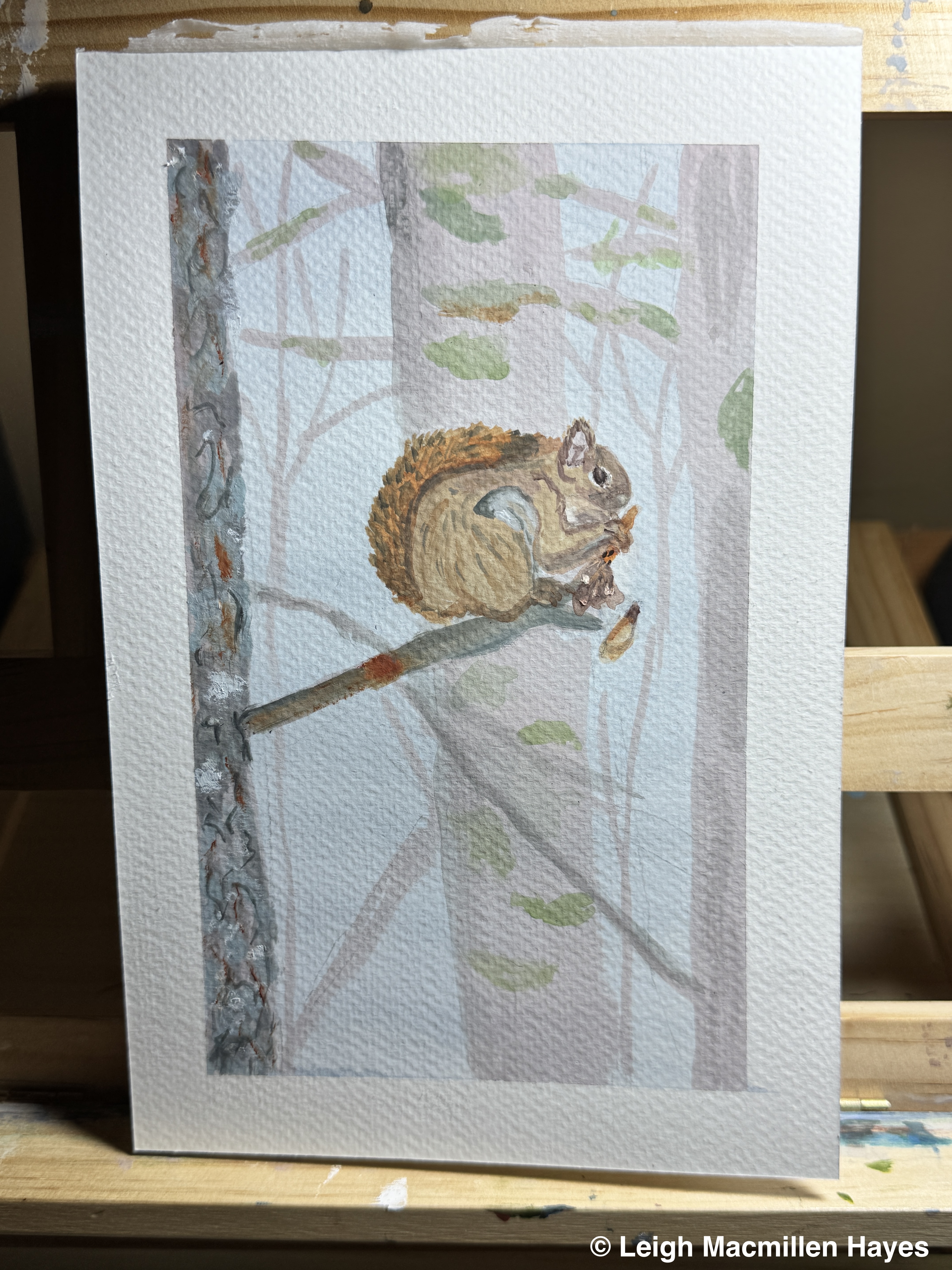
This week it was my friend Red who led the class. If you were down the hall in this outdoor school, you may have heard him, for he tends to be quite loud, and a bit critical, when he’s not dining upon a pinecone that is.

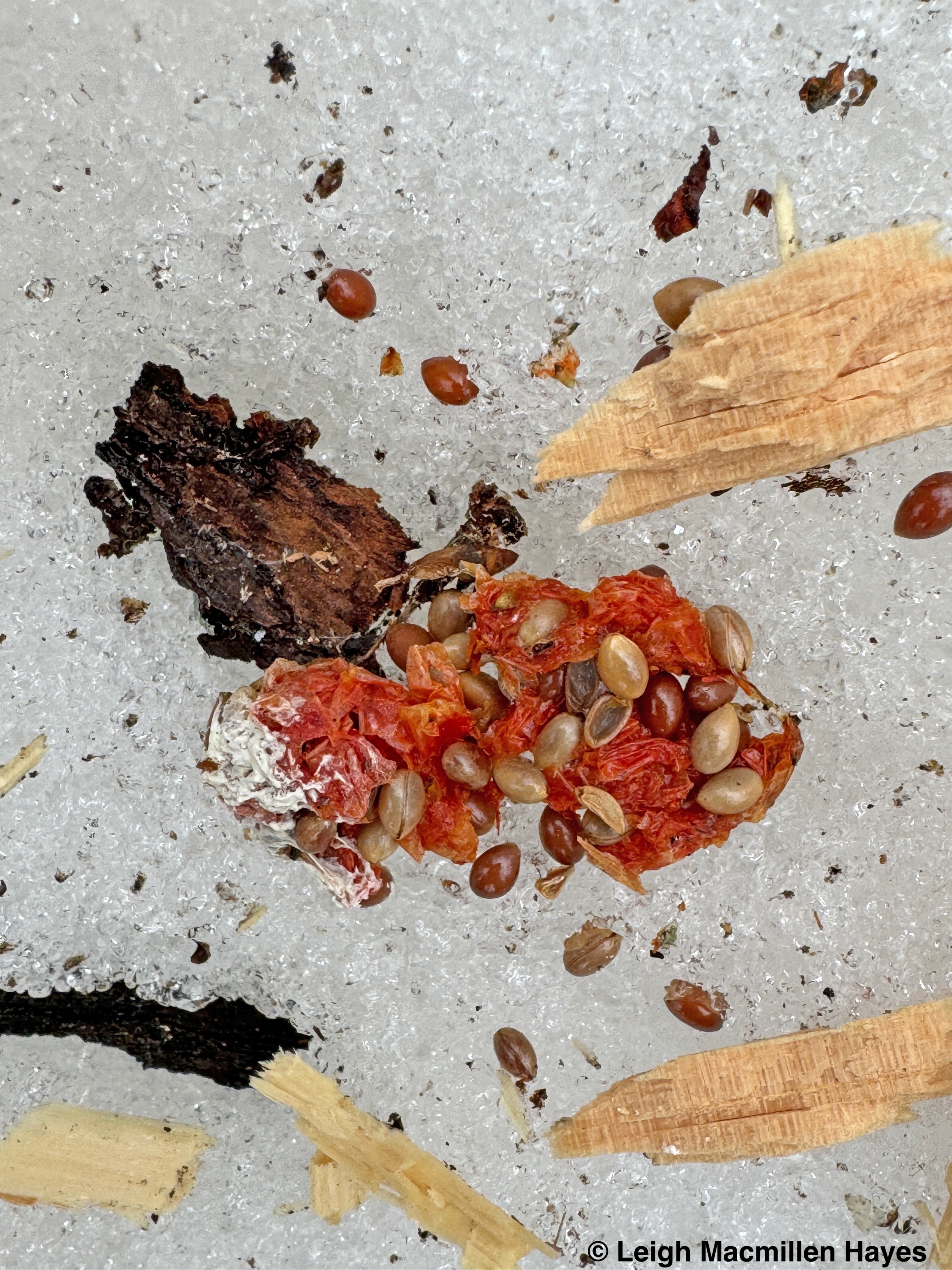
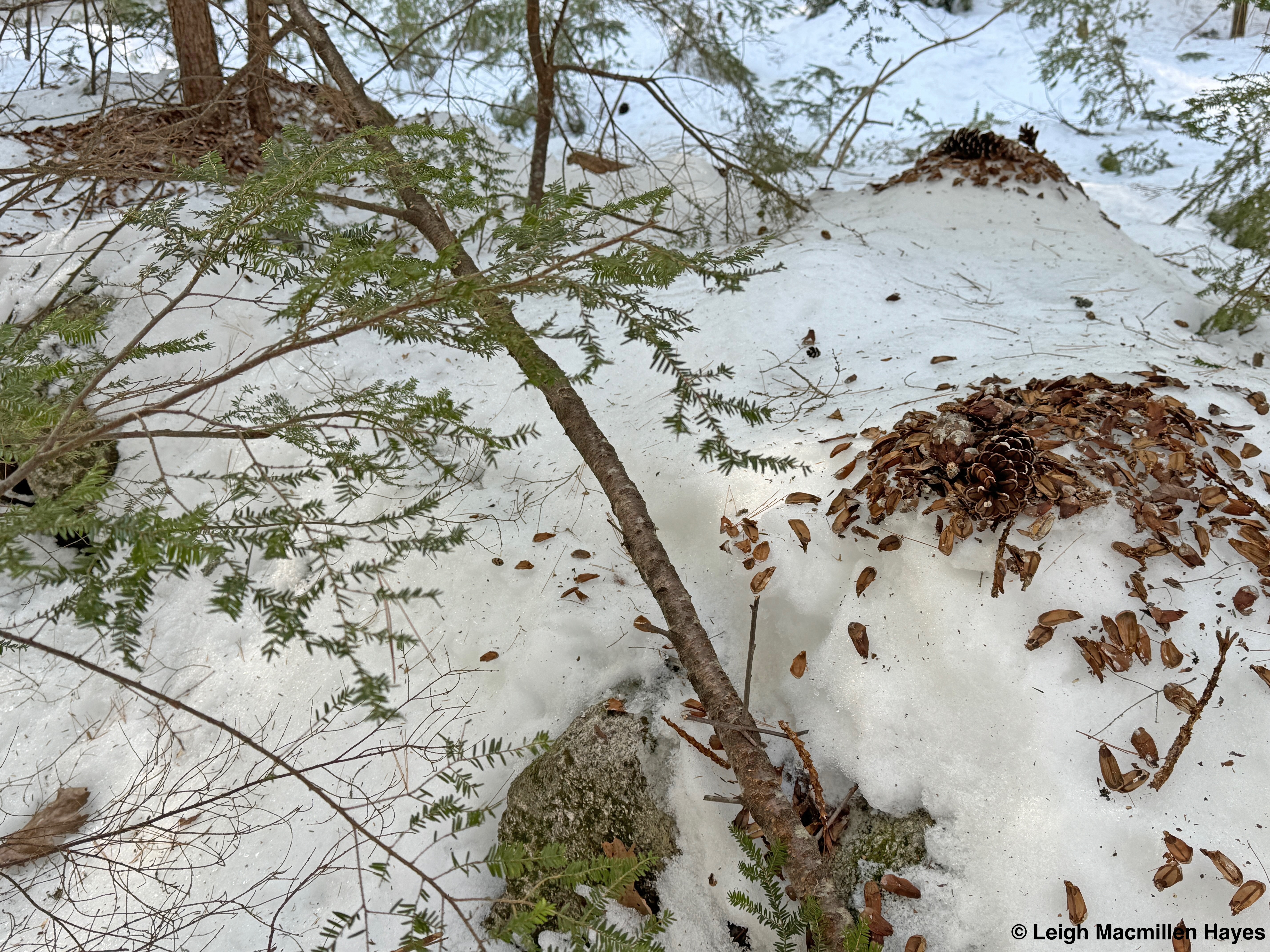
His plan, as it often is, was to strip the cone of its protective scales and seek the tiny seeds tucked in by the core or cob of the cone. Each scale contains two winged (think samara that help the seeds flutter toward the earth when its warm enough for the scales to open on their own) seeds and to me it seems like a lot of work for a little gain.

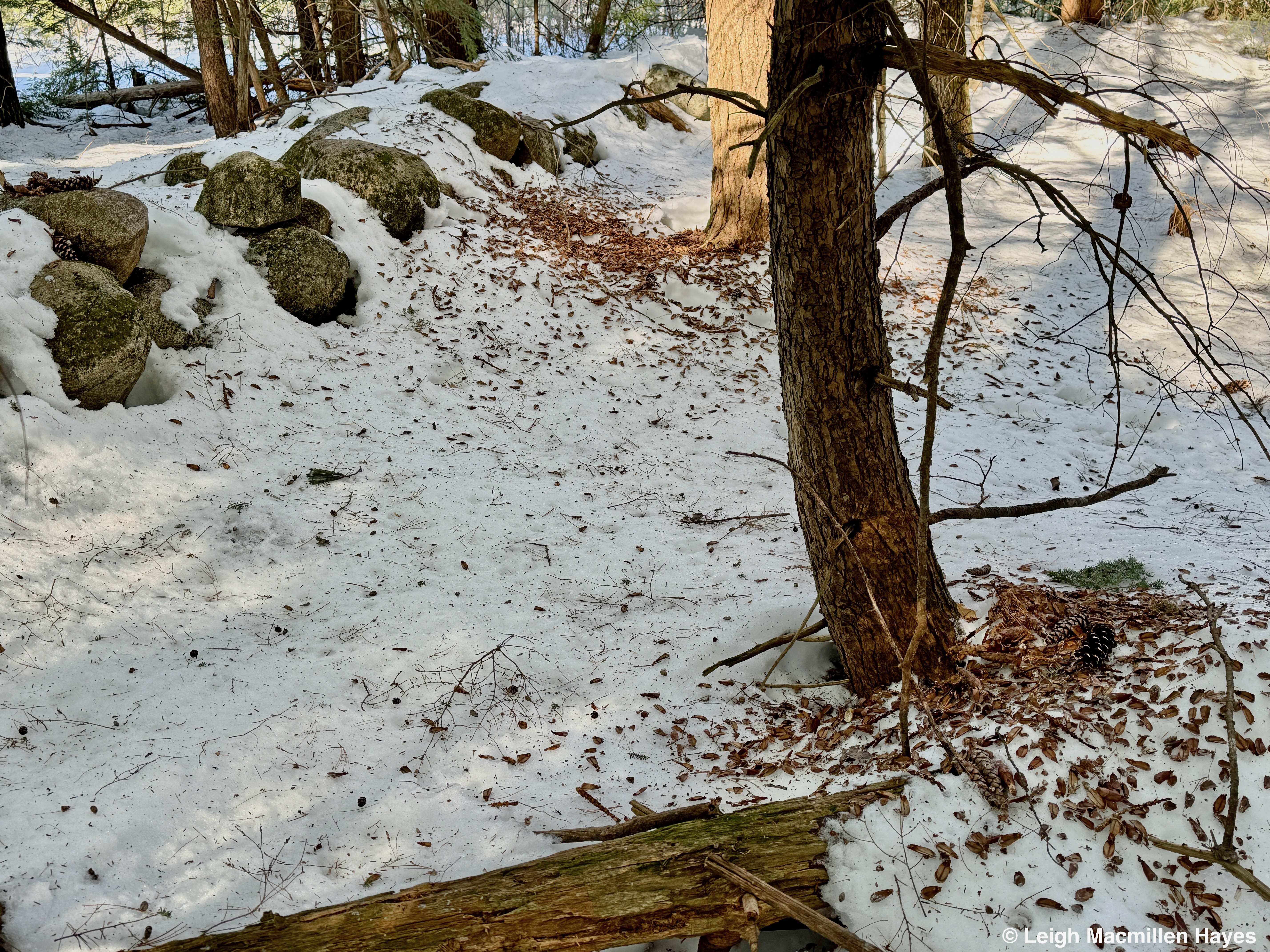
But if you’ve ever watched a Red Squirrel at work, you’ve noticed they are quick and can zip through one cone in mere minutes. Of course, it helps that they don’t worry about the “trash” and just let the scales and discarded seed coverings or pods, and even half consumed cones and cobs pile up in a garbage pile known as a midden. Spotting one of these is a sure sign you’ve entered Red’s classroom. And if you pause and look around, surely you’ll find many more middens. After all, Red Squirrels are voracious consumers. But again, given the size of the seeds, they need to be.

So here’s lesson #1: Leave the scraps. Oh wait, not on our indoor dining tables, but in the woods. And not our food in the woods, unless you are composting. But downed trees and snags and leaves and all that will replenish the earth, just as my squirrel’s garbage will do.

I should clarify that Red shares the school with many others who have their own classrooms and I’m sure when I finish my latest assignments I’ll have more to learn from the porcupines and deer and hare and coyotes and foxes and bobcats and yada, yada, yada who live under the mixed forest canopy.

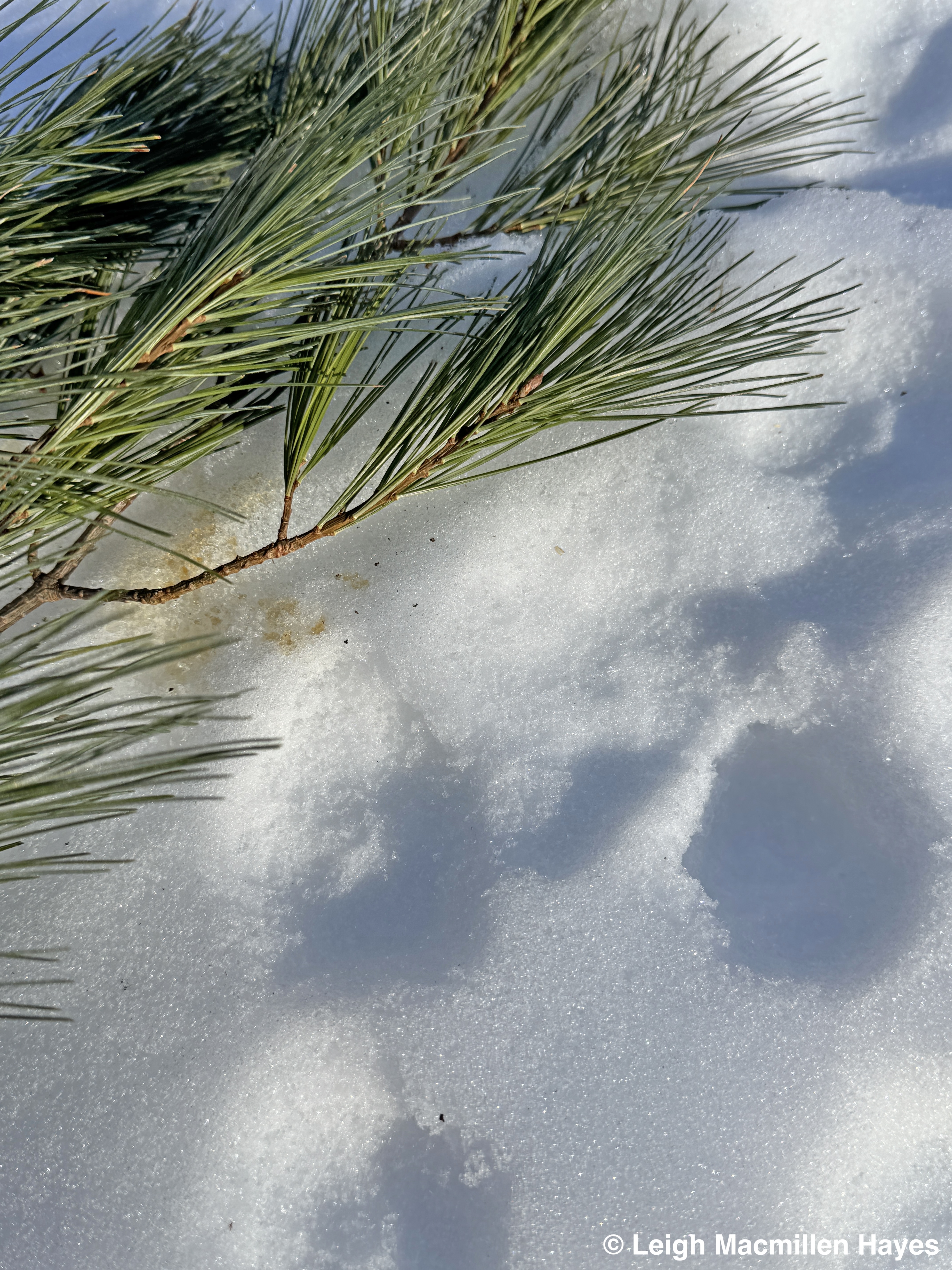
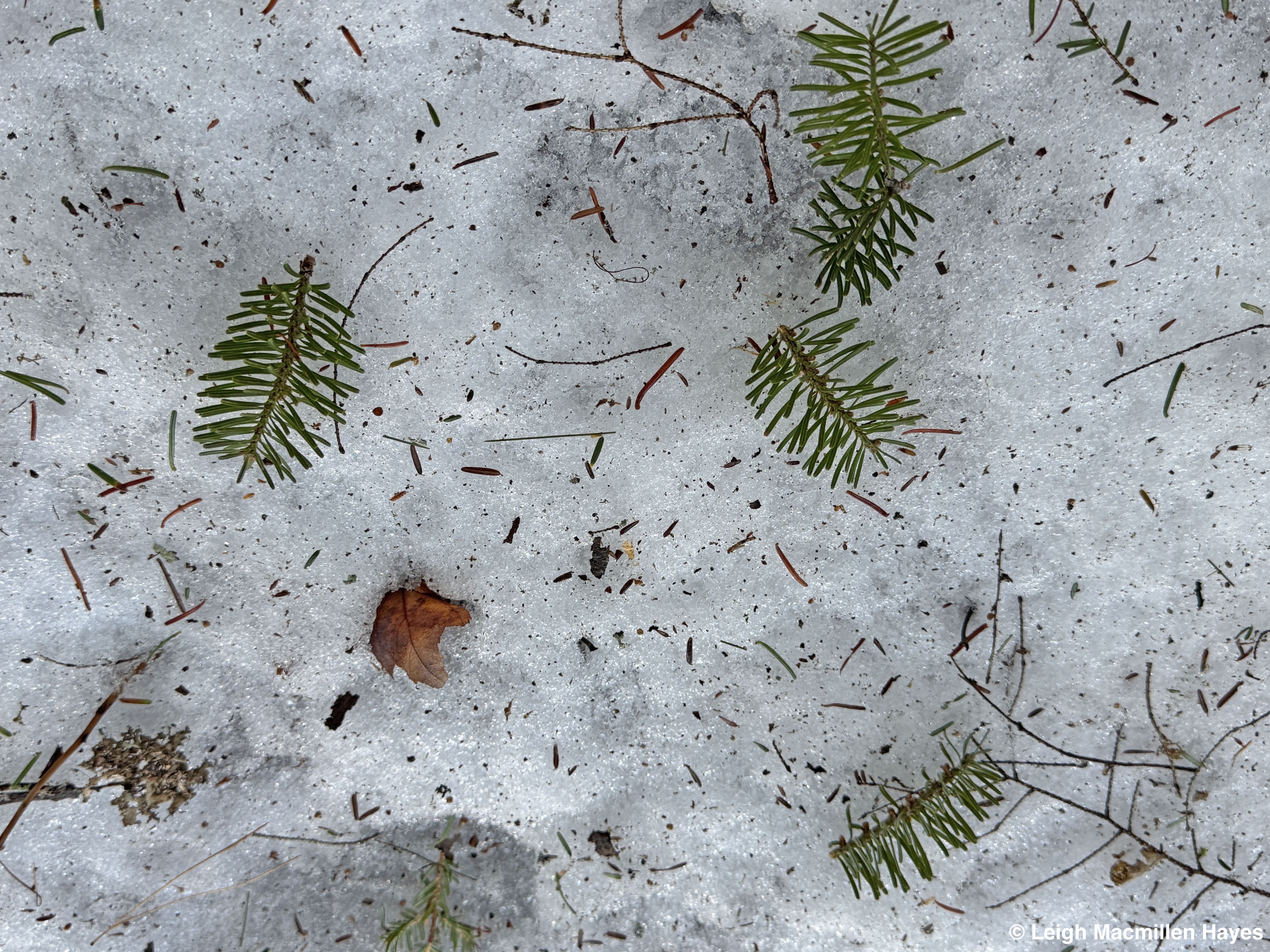
The sight of so many Eastern Hemlock twigs on the forest floor told me I’d stepped into Porky’s room so I looked for evidence, wondering if he was at his desk or not.

Lesson #2: Slow down and observe.

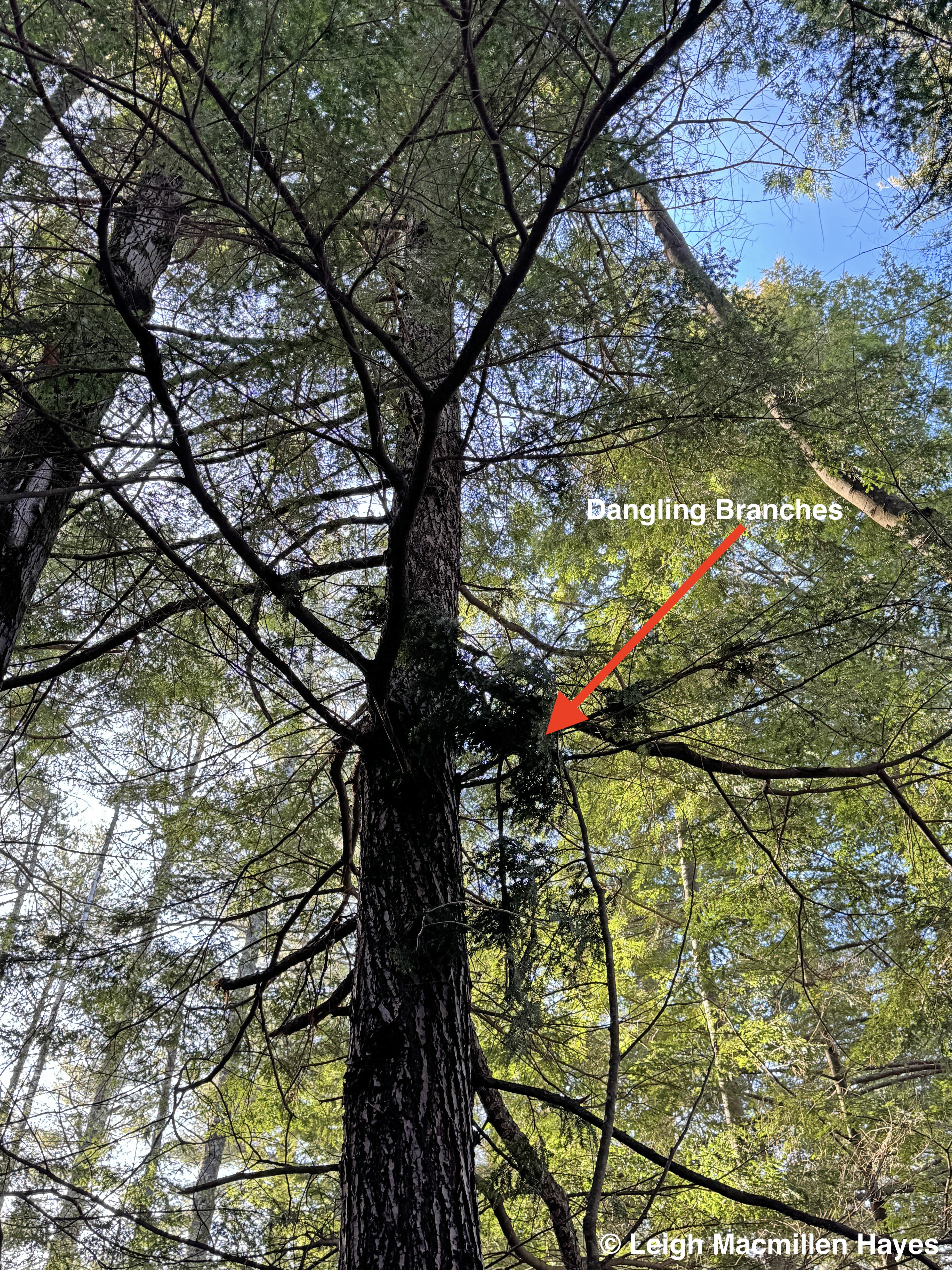
The answer was no, but he’d left his calling card on a dangling twig and so I know where I might find him should a prickly question enter my mind.

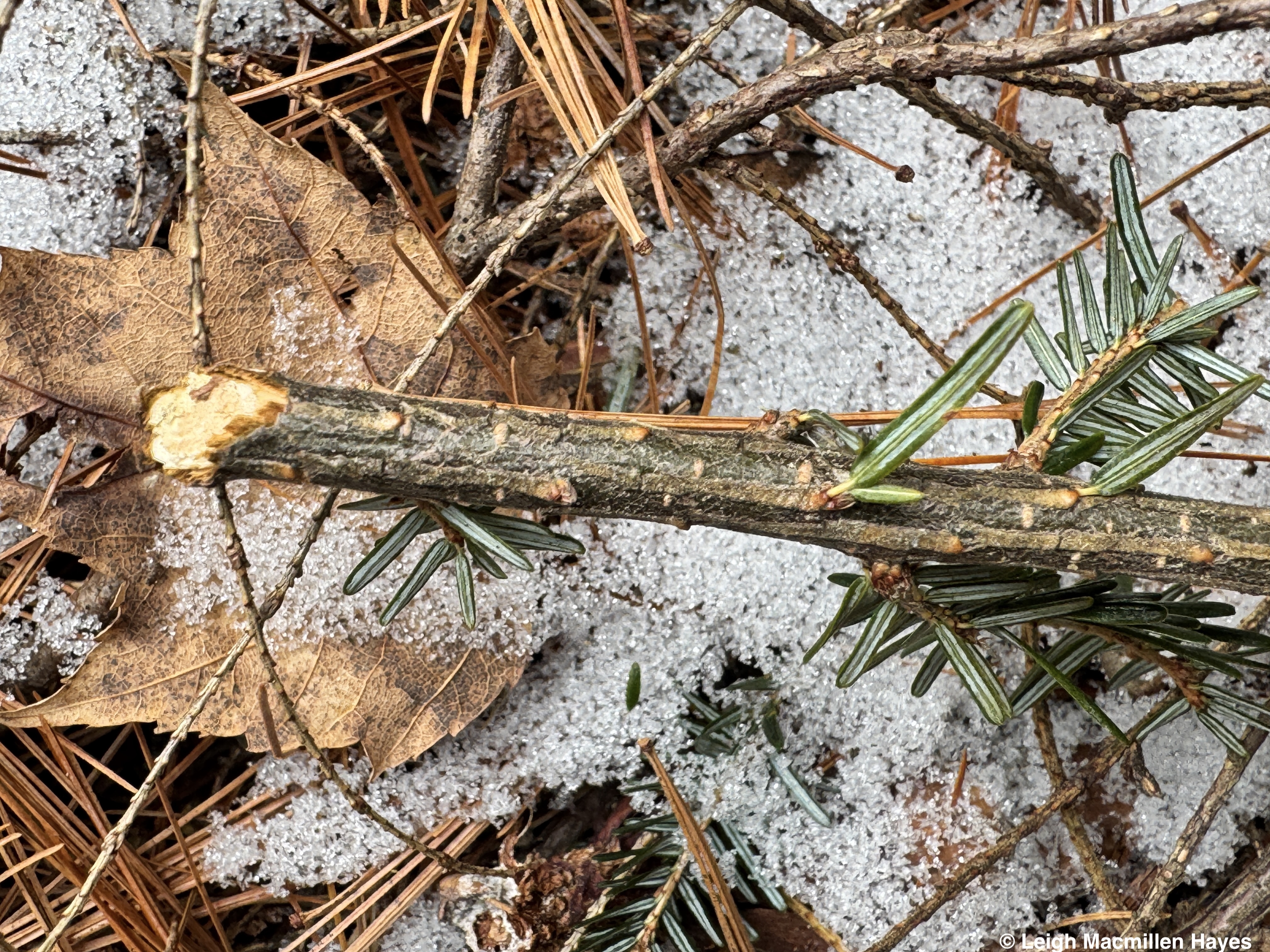
Because I was told by Red to slow down and observe, I noticed another spot where he’d visited and this time his midden was of a different sort in the form of snipped twigs. Much smaller snips than Porky drops, which is a good way to tell the two critter’s food source apart.

Just as Porky’s twigs had been cut with the rodent diagonal, so were Red’s.

I noted that he hadn’t eaten the buds at the tip of the twig, but once I flipped one over I discovered numerous buds or seed pods had been dined upon.

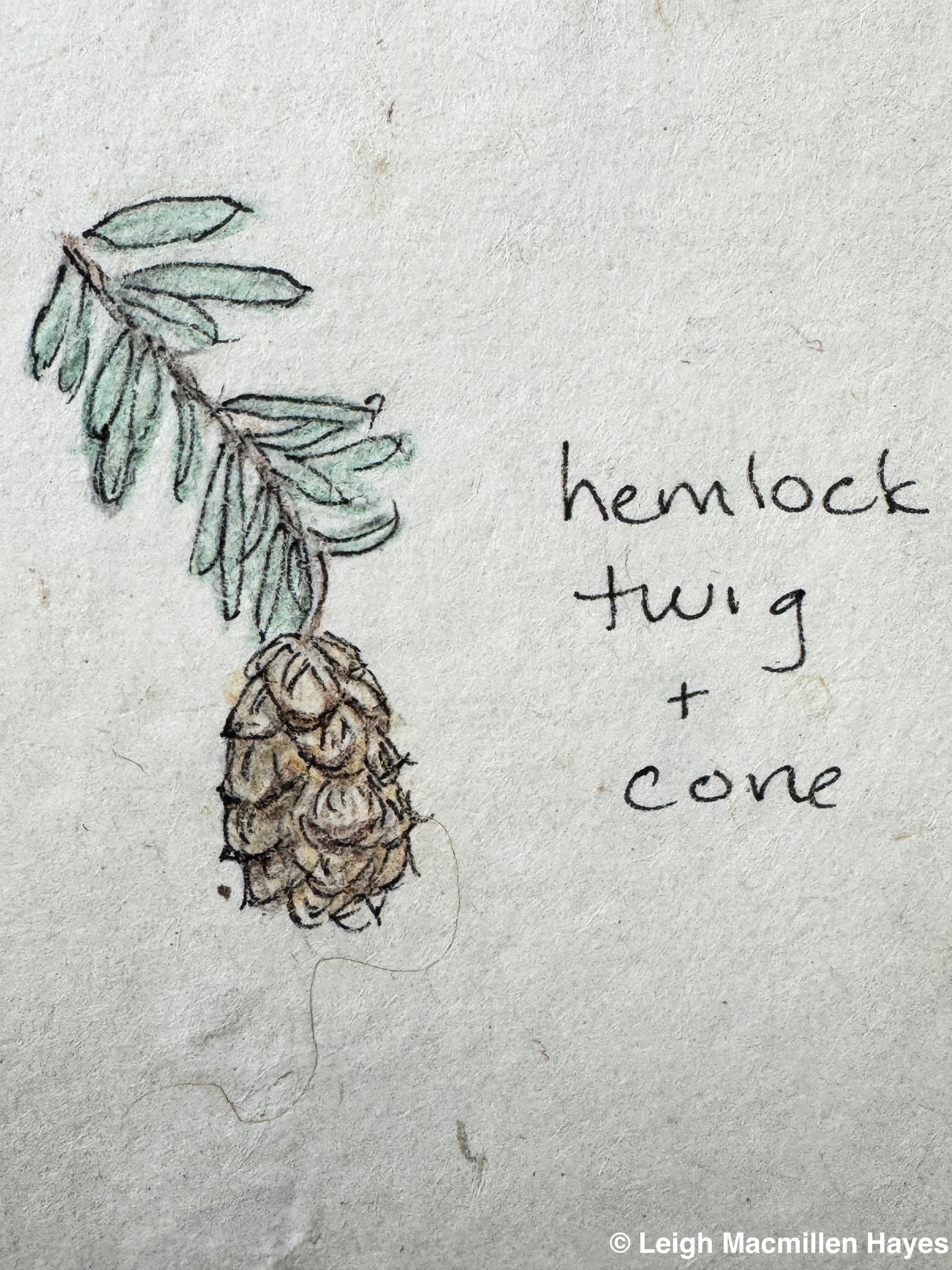
Lesson #3: Check twigs more often. And remember, this year was not a mast year for Eastern White Pines, so Red has to supplement with hemlock buds and cones. (And also remember, cones on hemlocks are not called pinecones because they don’t grow on pine trees. Conifer refers to cone-bearing, so both pines and hemlocks are coniferous trees.)

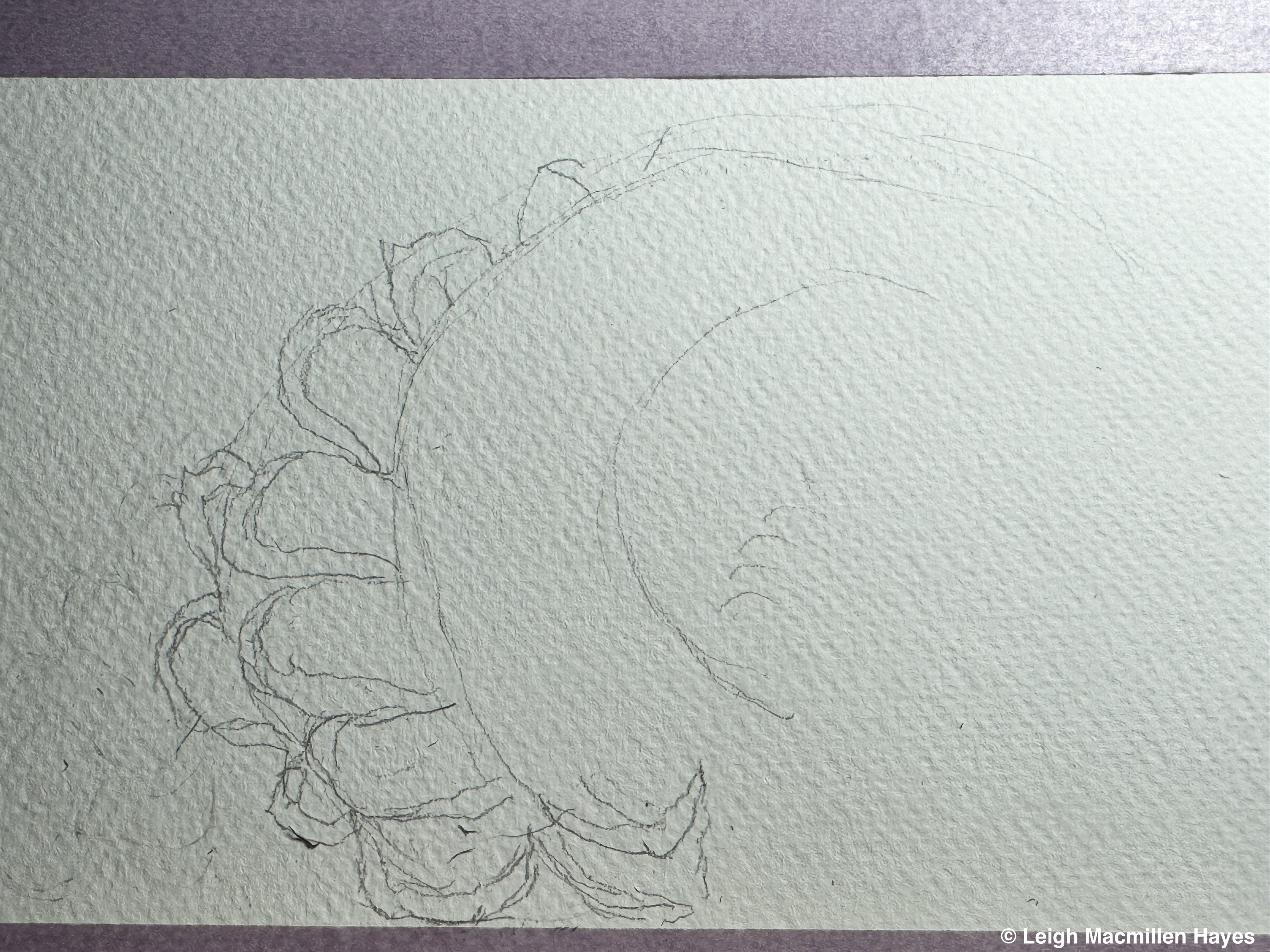
Back inside I decide to sketch a pinecone. It was a sketch I’d started months ago, but abandoned because it seemed to difficult to draw.

But then, thanks to Red, a realization came to mind.

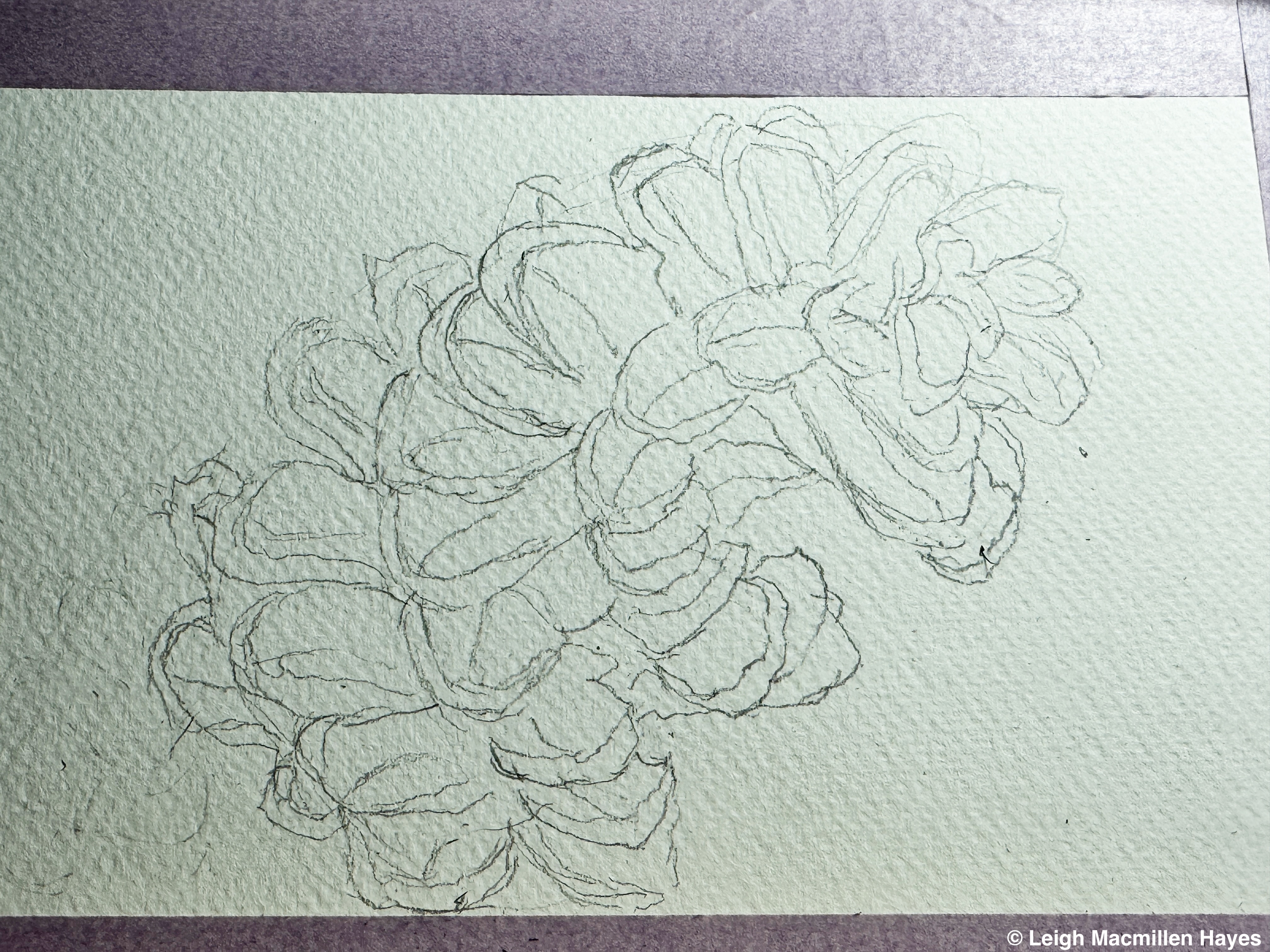
Lesson #4: Pinecones have overlapping bracts or scales that protect those seeds developing inside of them. They close in the dark and open in light, especially on sunny days and it is then that the seeds become airborne on their samaras. And the bracts or scales grow in spirals around the core or what I think of as a cob. I knew that, but had forgotten it until I decided to sketch.

And so I drew some guidelines to aid me as I tried to recreate the cone’s spiral staircase.

It was fun to watch it grow and realize each cone actually fans out in a Fibonacci spiral sequence. It’s an amazing wonder of nature.

Feeling my drawing was complete, I began to add color in the form of gouache paint, scale by scale.

And slowly, the painting began to represent a cone . . . at least in my mind’s eye.

A dash more color and voila–my amateur attempt at painting a pinecone. I have to admit, I was rather tickled because I really didn’t think I could pull this one off. But I have my art teacher, the talented Jessie Lozanski, to thank for giving me the confidence to try.

And I have Red, my other teacher, to thank for the lessons because it was in watching him turn the cob ever so effortlessly that I was reminded about the cone’s spiral.

And so I tried to honor him as well. I may be a teacher, but I’ll always be a student.

Lesson #5: As we head into this new year, I hope you’ll join me in slowing down and noticing and honoring. Especially outdoors. Or even out your window.

I’m forever grateful to Red and all the other teachers who come in many forms, not just as mammals, for the amazing lessons I’ve learned and can’t wait for the next class.

CBC: Everything Counts

December 27, 2024. 8:15am. 5˚. Blue sky. No wind.

The perfect day to count birds for Maine Audubon’s Annual Christmas Bird Count.

Focus area: Sweden Circle, Maine.

Super focus area: Pondicherry Park and Highland Research Forest, both located in Bridgton, Maine.

Partner in counting: Dawn Wood.

The Christmas lights on Bob Dunning Memorial Bridge in Pondicherry Park rather said it all for so coated were they with ice crystals when we arrived this brisk morning. Fortunately, though, we knew it was going to be as cold as it was and had dressed appropriately.

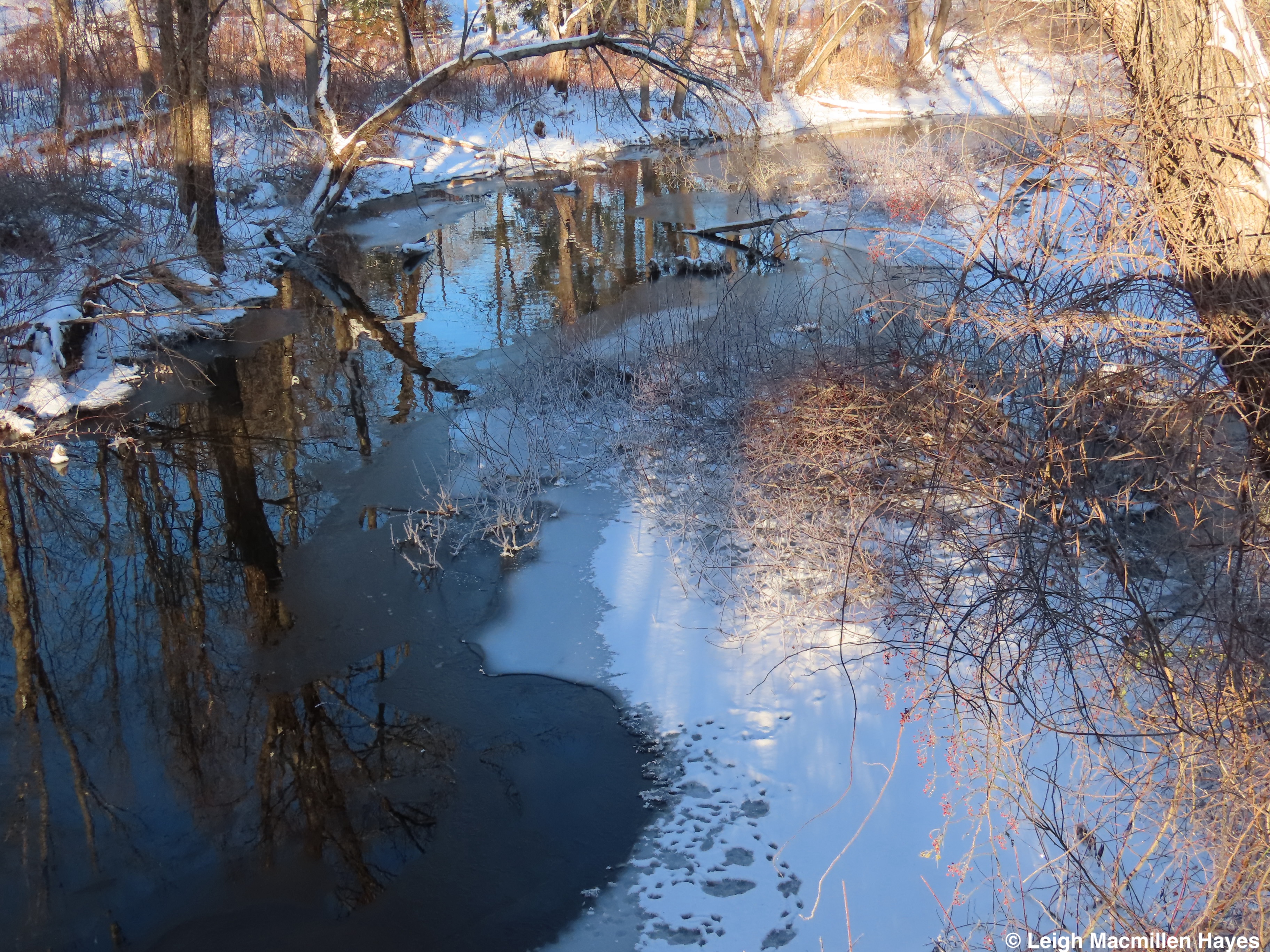
And really, there is nothing more beautiful than the world beside water on such a morning for everything was coated like the candle and the world was transformed into a glistening display.

Just a few days prior, when I’d walked in the park, I had noted that Stevens Brook was almost completely frozen and feared we wouldn’t even see ducks on today’s count. But . . . wind a couple of days ago had done its own deed and opened things up.

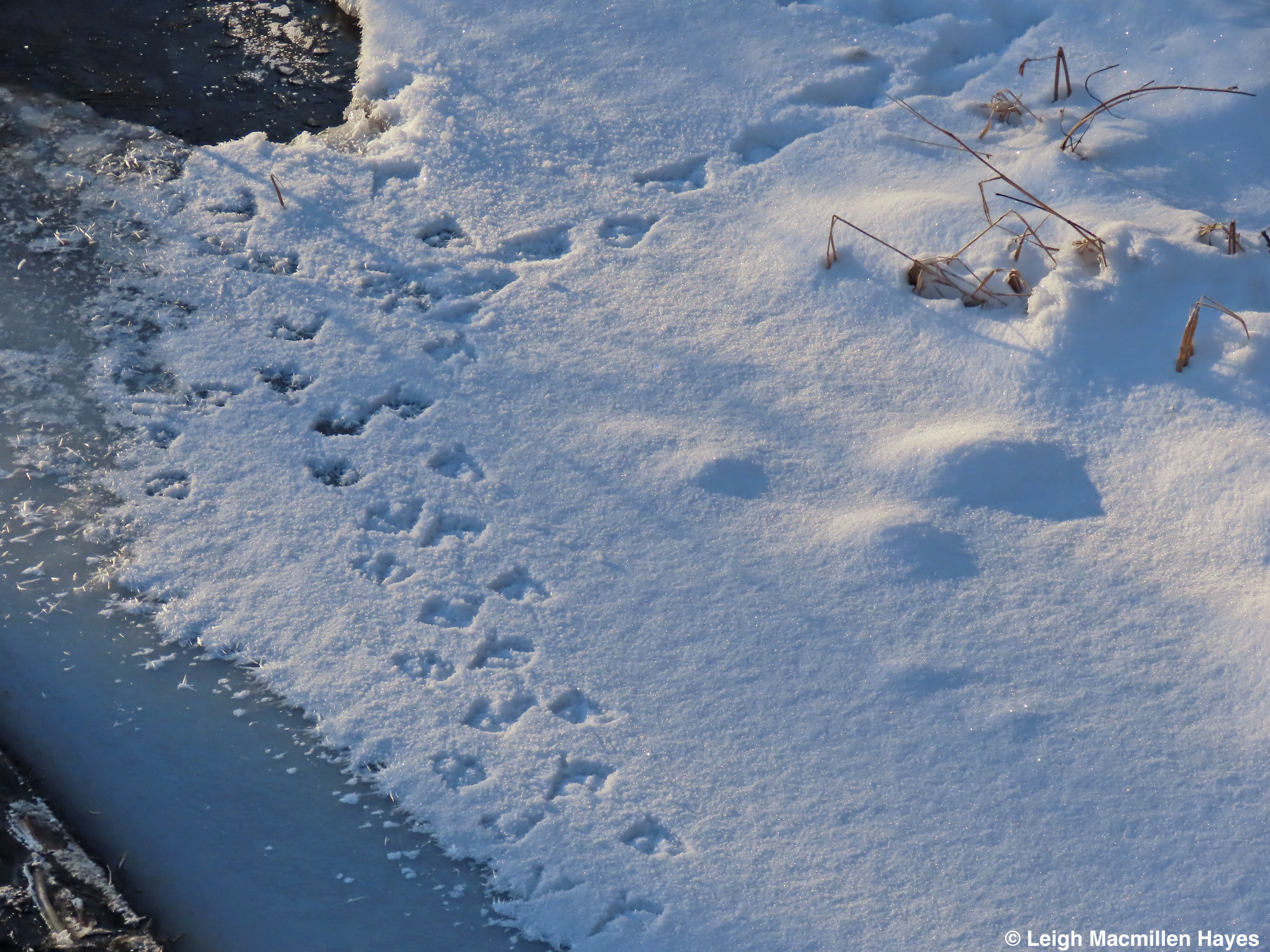
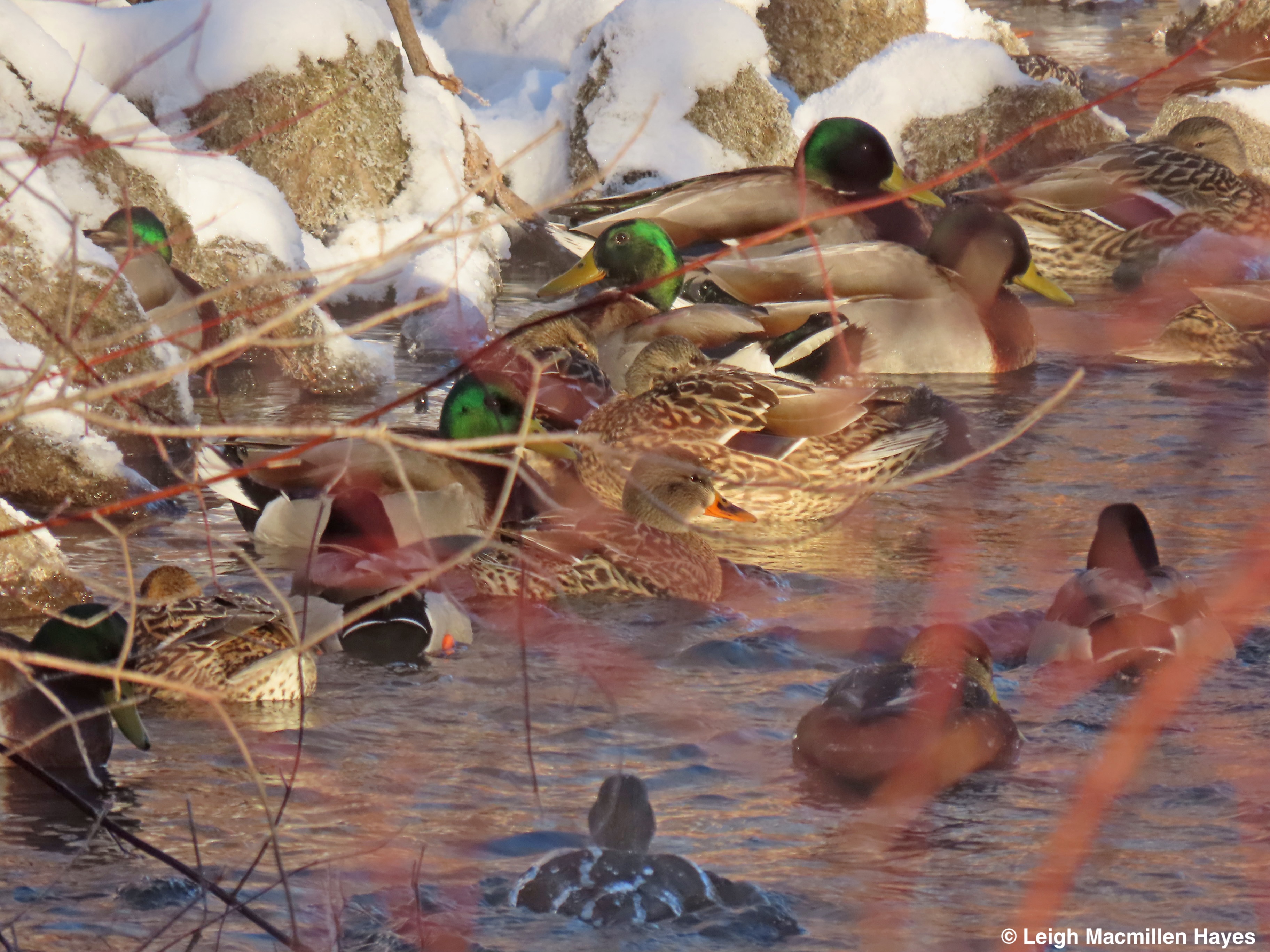
And much to our delight, we spotted duck tracks along the edge at about the same time that we heard a few Mallards quack in their Mallardy way that sounds much like a laugh.

And then we spotted more ducks and had to walk around a building to get a closer look. And count. And count again. And eventually decided on 100 as a number to represent the ducks as best we could for there were so many and they were in constant motion and some flew in in the midst of our efforts.

Half of birding is listening and it was the “Peter, Peter,” call that told us to look for the Tufted Titmouse.

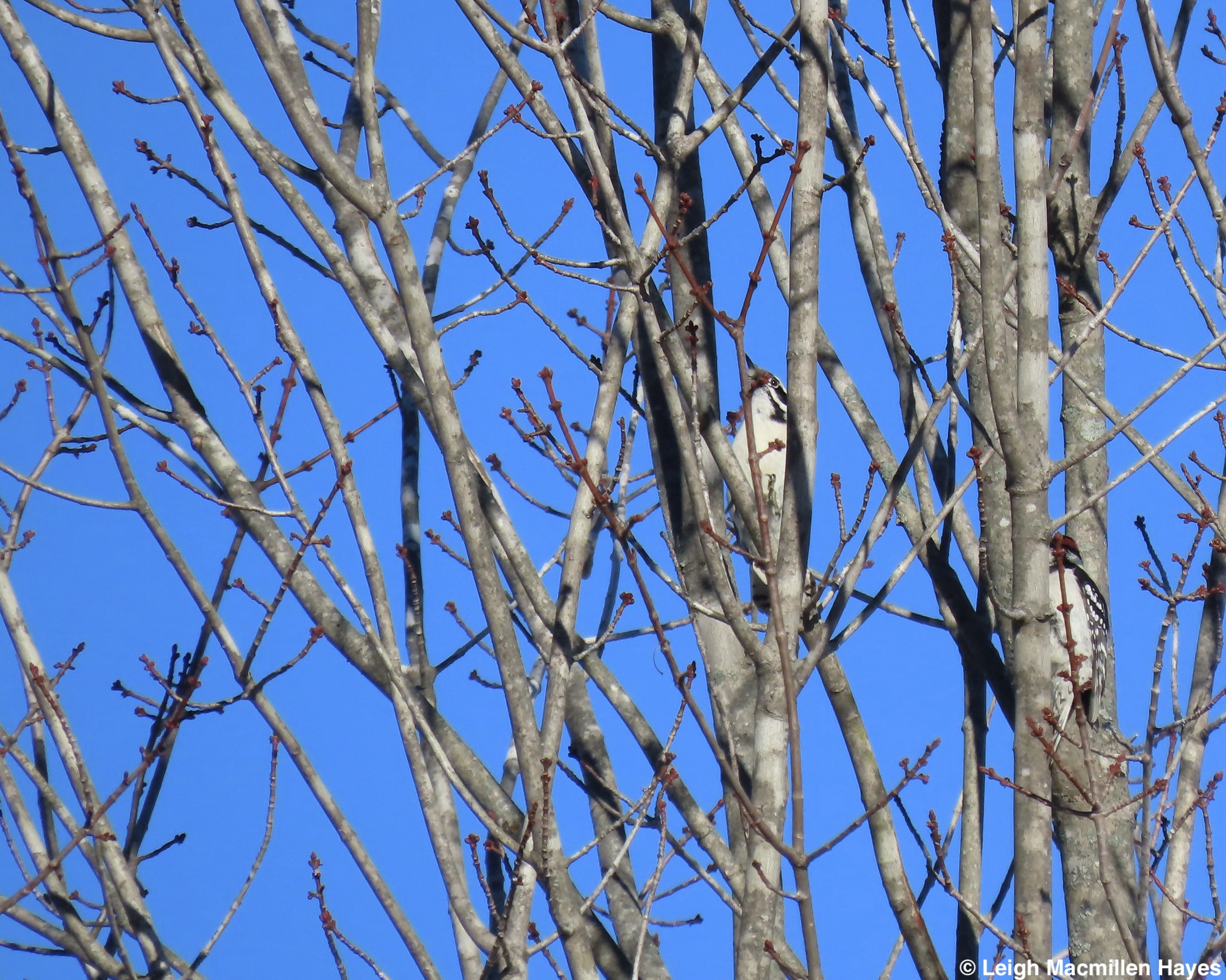
We also spotted two Hairy Wookpeckers playing a game, or so it seemed, as one would fly to a branch, the other would follow, and then the first would move again and on it went with them trying to mimic the branches between their flying sprints.

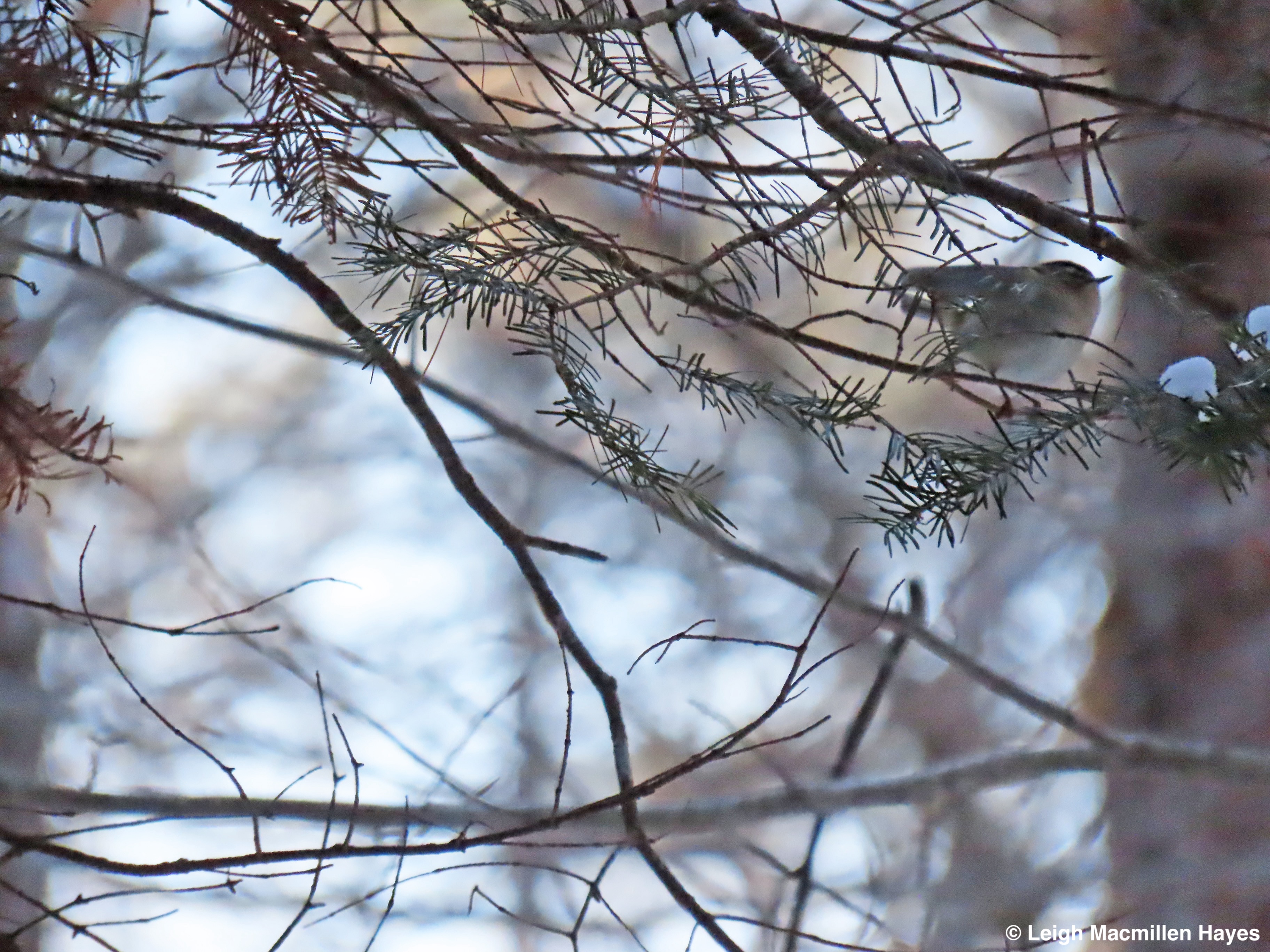
And talk about moving, we saw five Golden-crowned Kinglets, who performed their own acrobatic moves for us, which made them difficult to photograph for they were never still. That’s the thing about photographing birds–“And then it flew,” we’ve often been heard to say once we spot one.

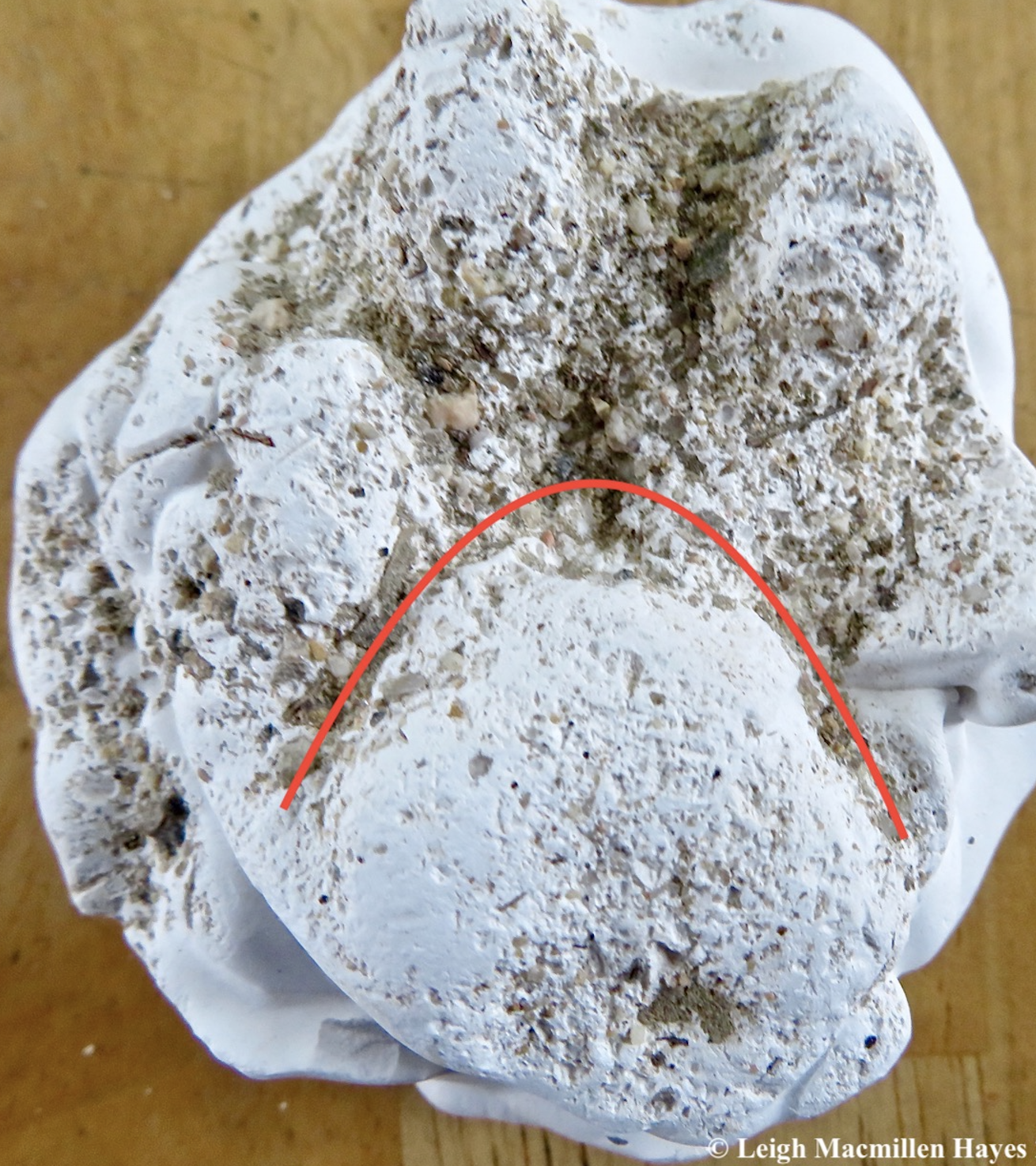
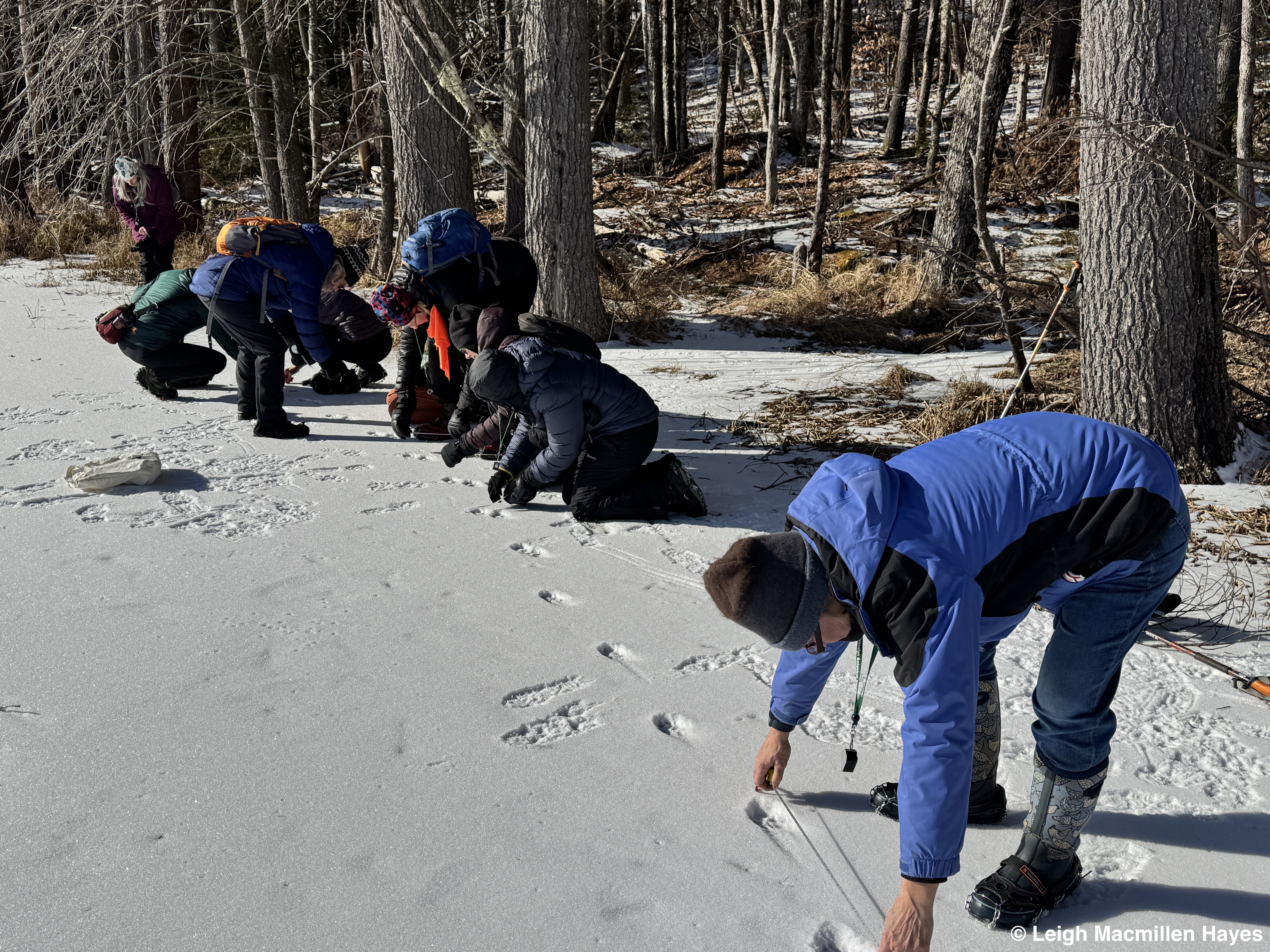
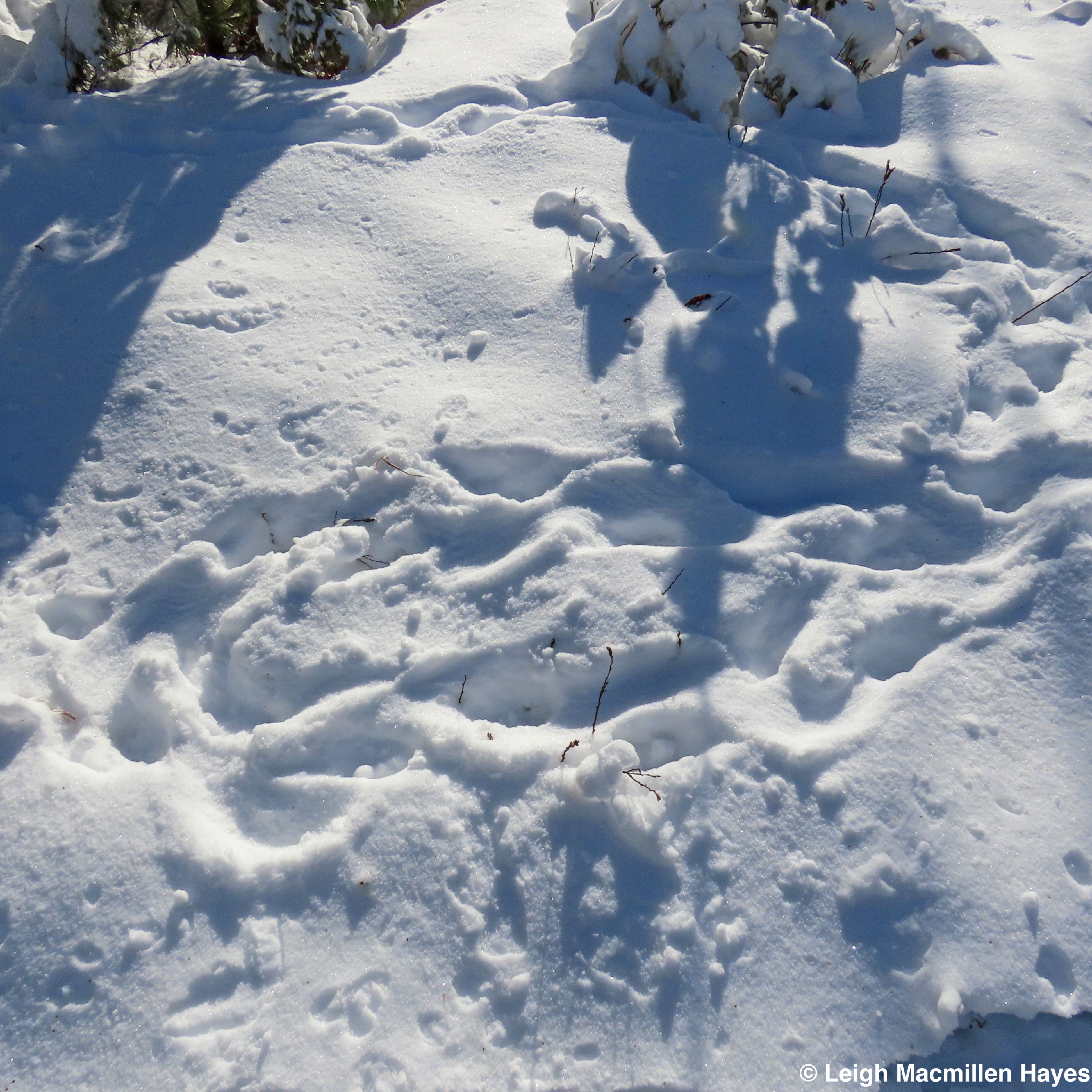
As we moved along the trails, another site garnered our attention: wing prints. Dawn measured the wing span–36 inches. A bit too short for a Barred Owl, but it was still our best guess. And there was plenty of food available either atop the snow or just below in the form of mice and voles. We’ll never know who actually left these impressions or if a meal was part of the deal, but that’s okay because sometimes mysteries can’t be solved and that’s what keeps us going.

We did wonder if we could add such a sighting to our bird count, but since we couldn’t name the species, thought better of it.

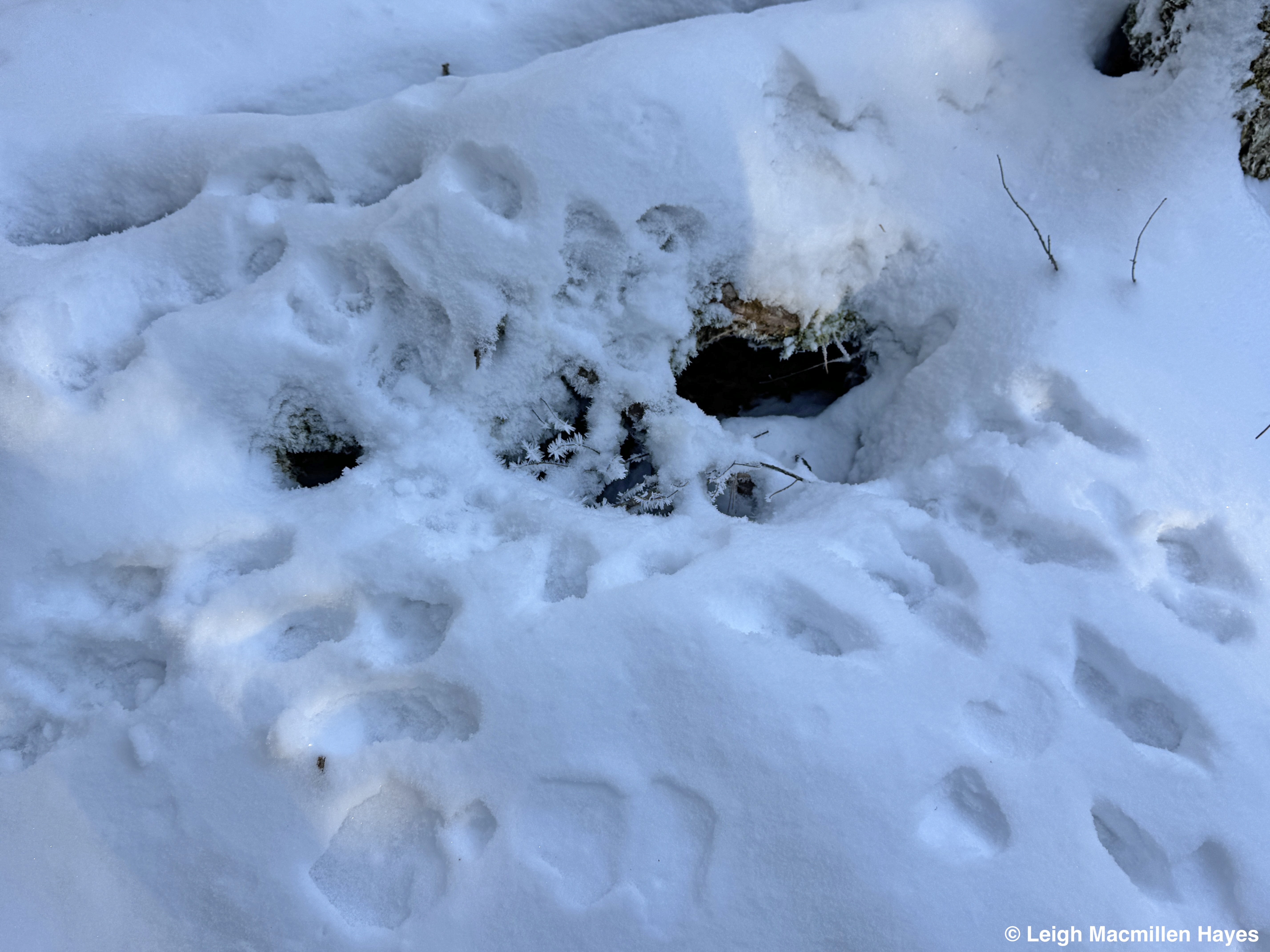
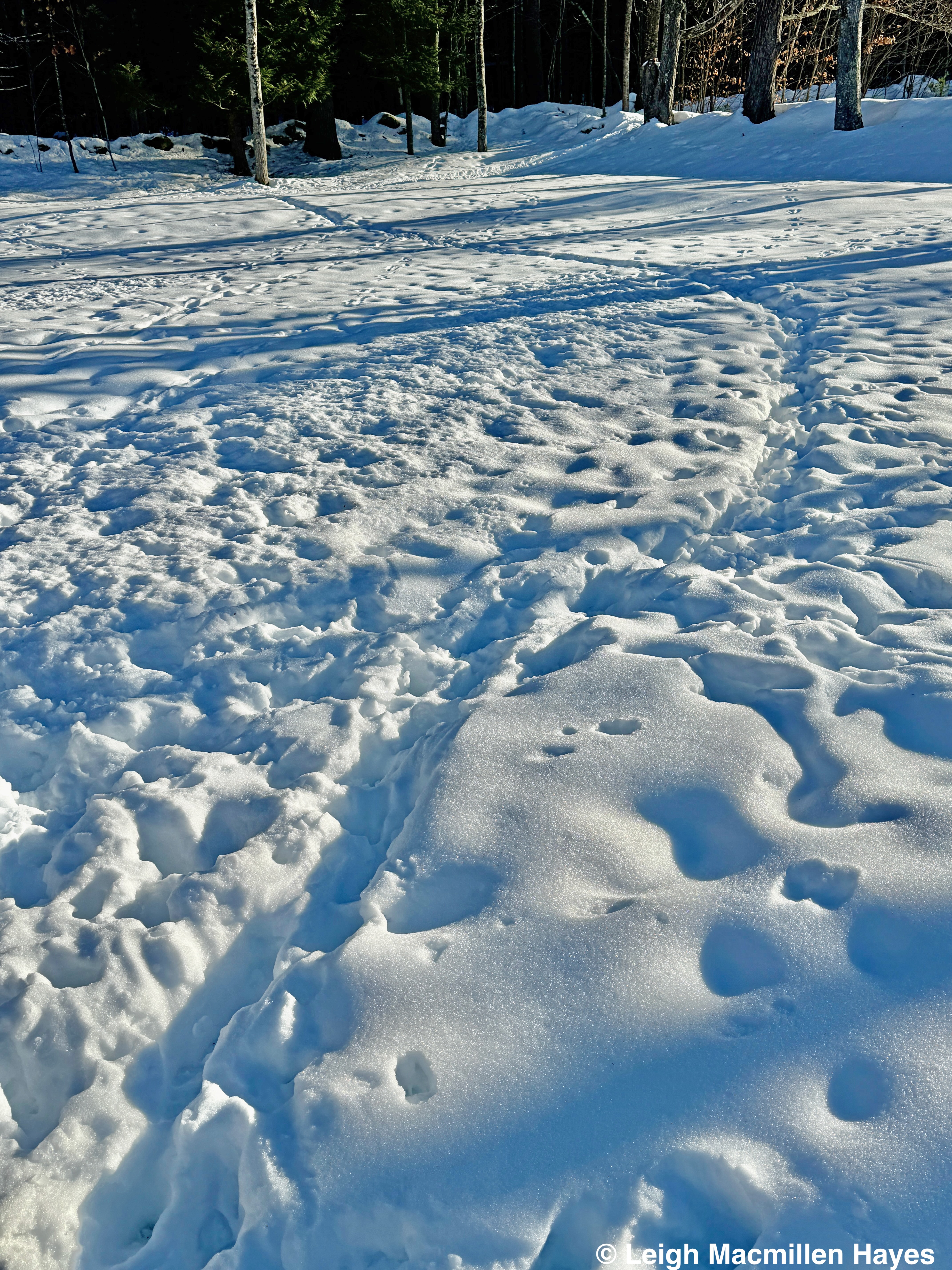
In another area, we noted no birds, but plenty of fox tracks and even faintly sniffed the skunky scent of Red Fox. It seemed very curious about some holes so we went in for a closer look.

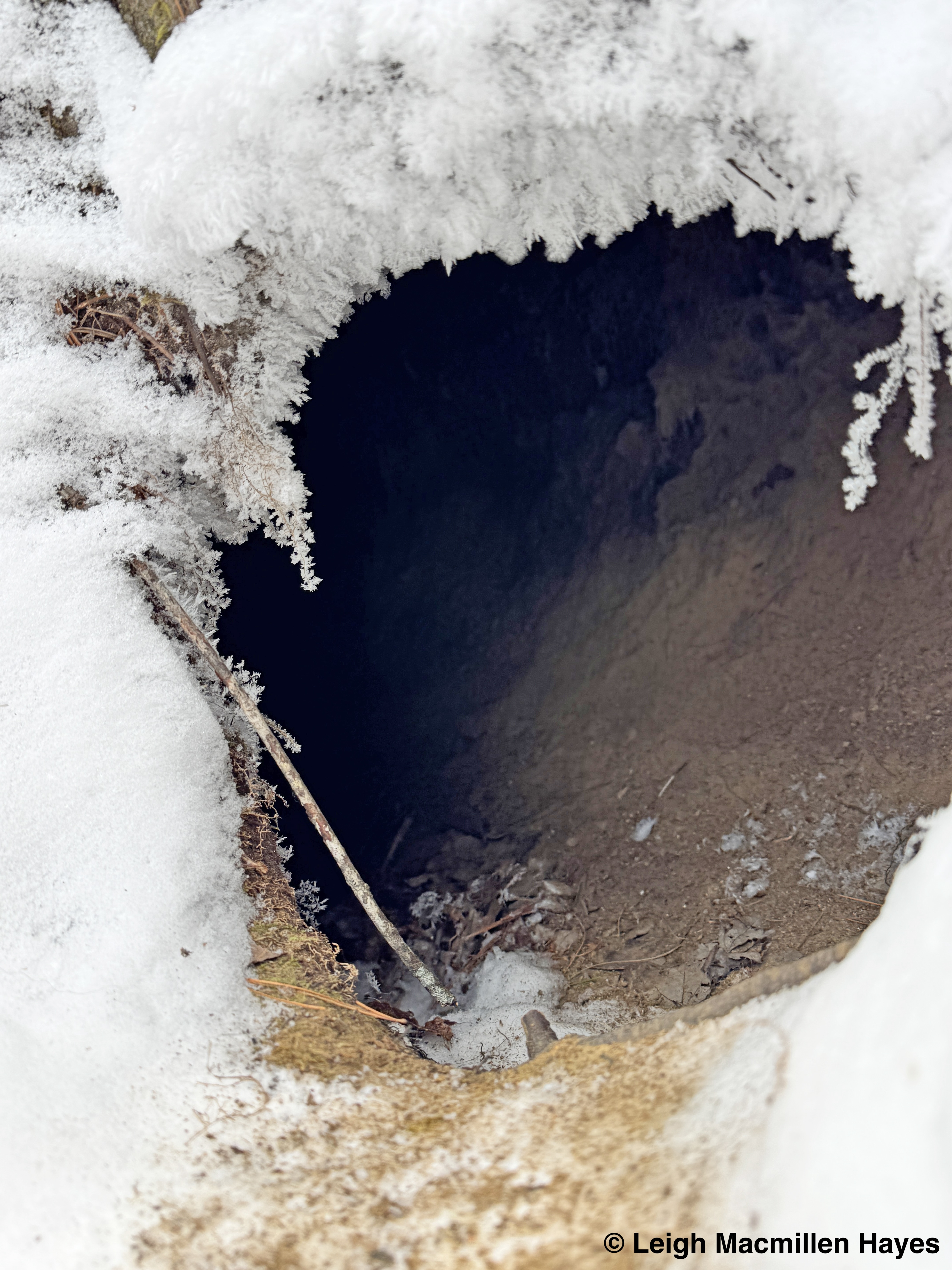
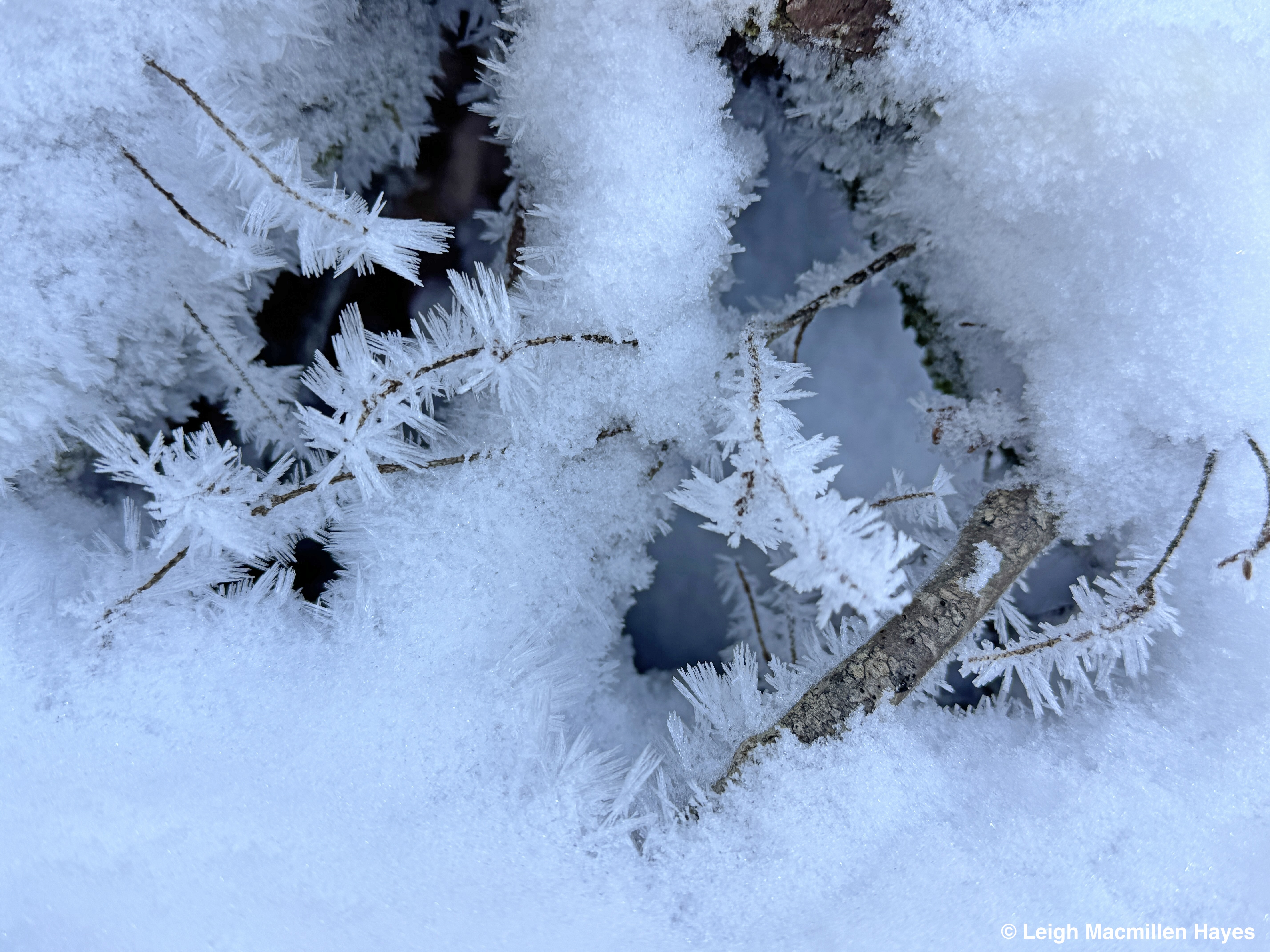
The best we saw–ice needles indicating one of two things: a critter surviving and breathing in the holes; or moisture below rising and freezing. We decided to stick to the first story and knew that we were one hundred percent correct because when no one else is around, we can think what we wish.

Another set of prints tricked us for a few minutes. Our first thought when we spotted the sashay look of the track was a Porcupine. Especially since we had just been talking about one that resides somewhere in my woods. But the prints within the track didn’t strike me as porky. And then we realized it wasn’t really a trough, but rather had a ridge in the middle. And it was skinnier than a porky trough would be.

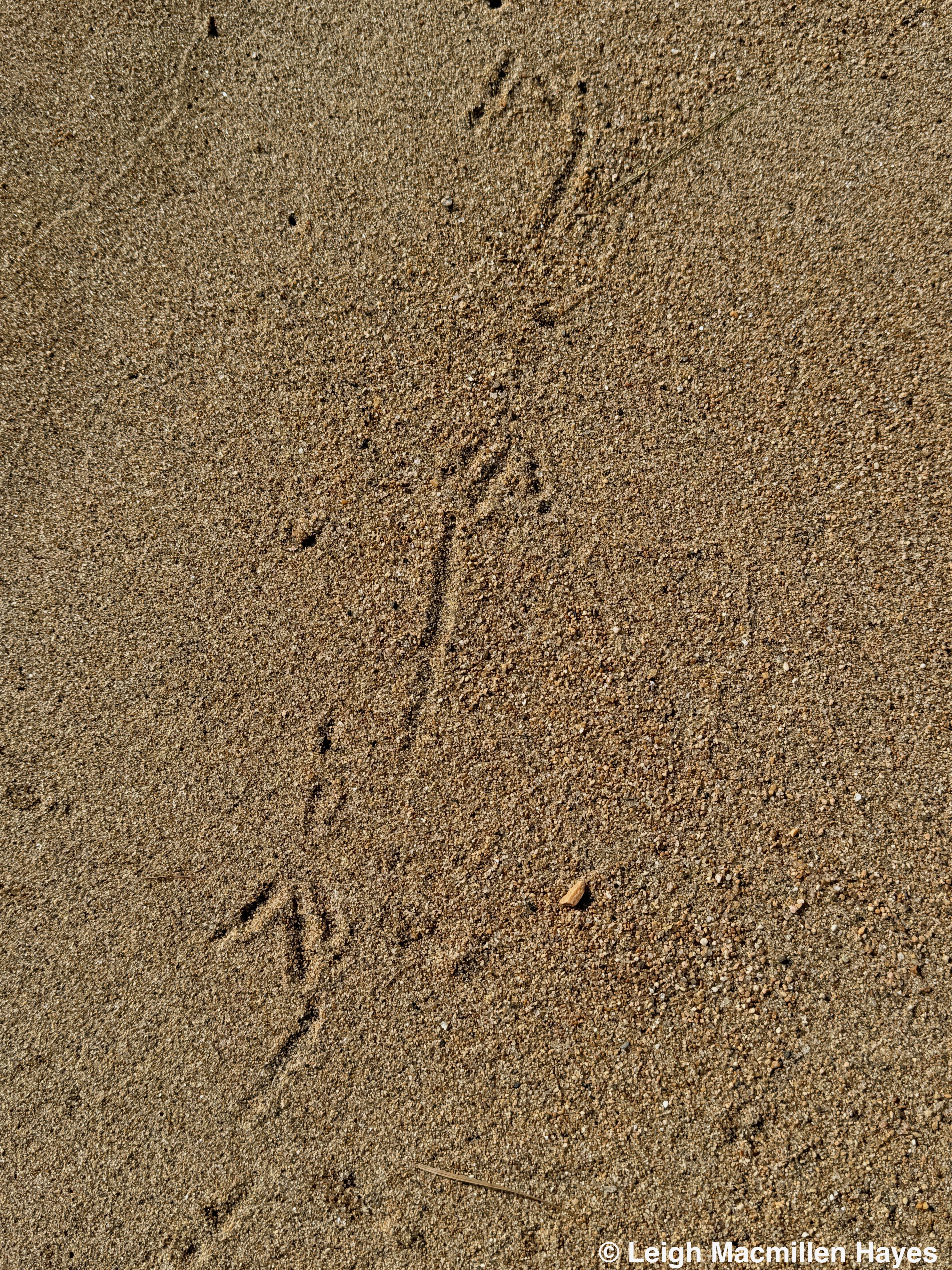
What else could it be? And had we seen this sort of track before? And then it hit us: A Ruffed Grouse! Another bird sighting without the sight of the bird. Again, it didn’t count, but it was a great lesson as we ease into this year’s tracking season.

Before we left the park, we were in an area where I often see and hear lots of bird activity and today there was absolutely none. And then a Bald Eagle flew out of a tree. I wasn’t quick enough to focus the camera, but we both will hold that shot in our minds’ eyes.

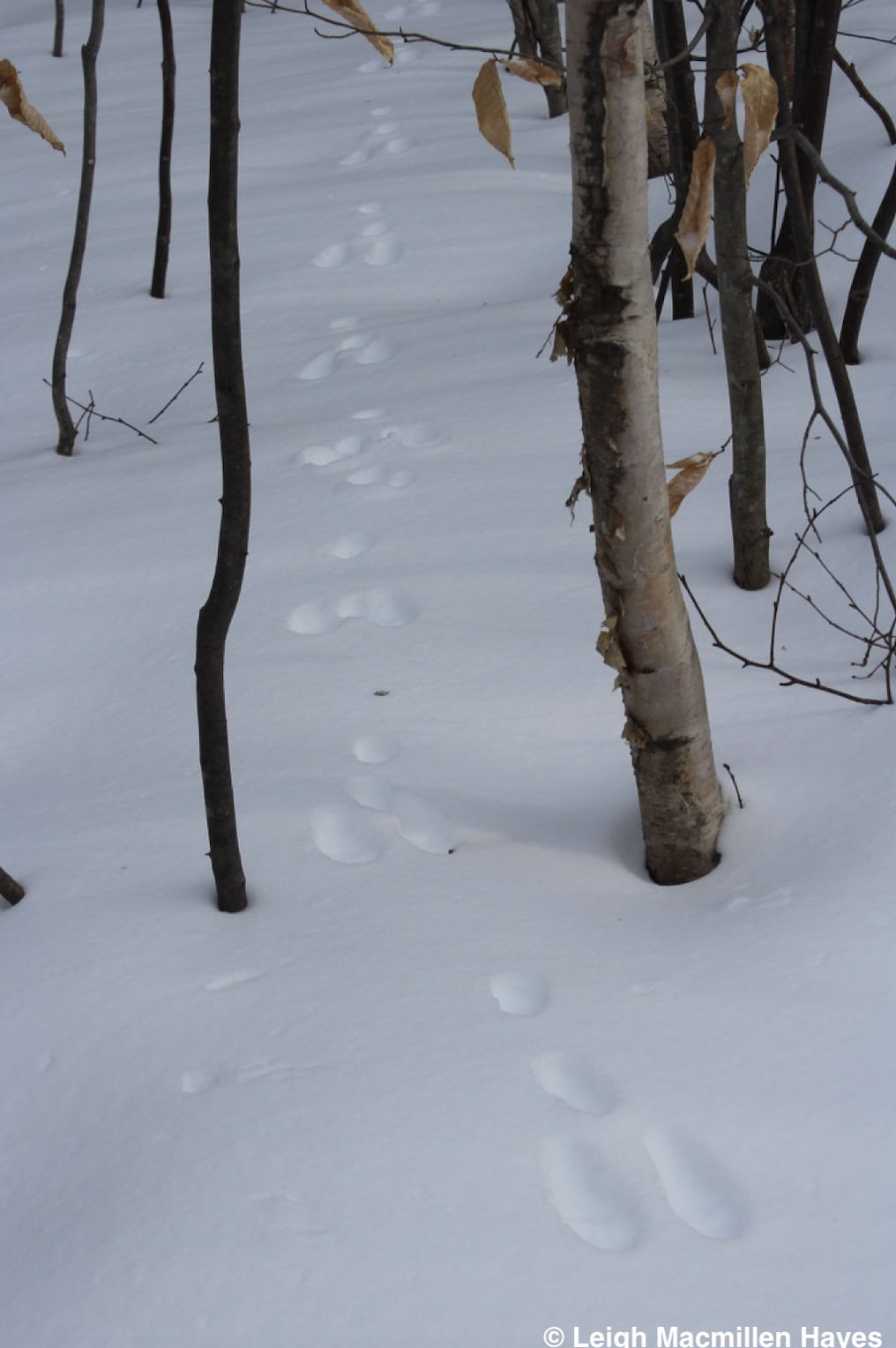
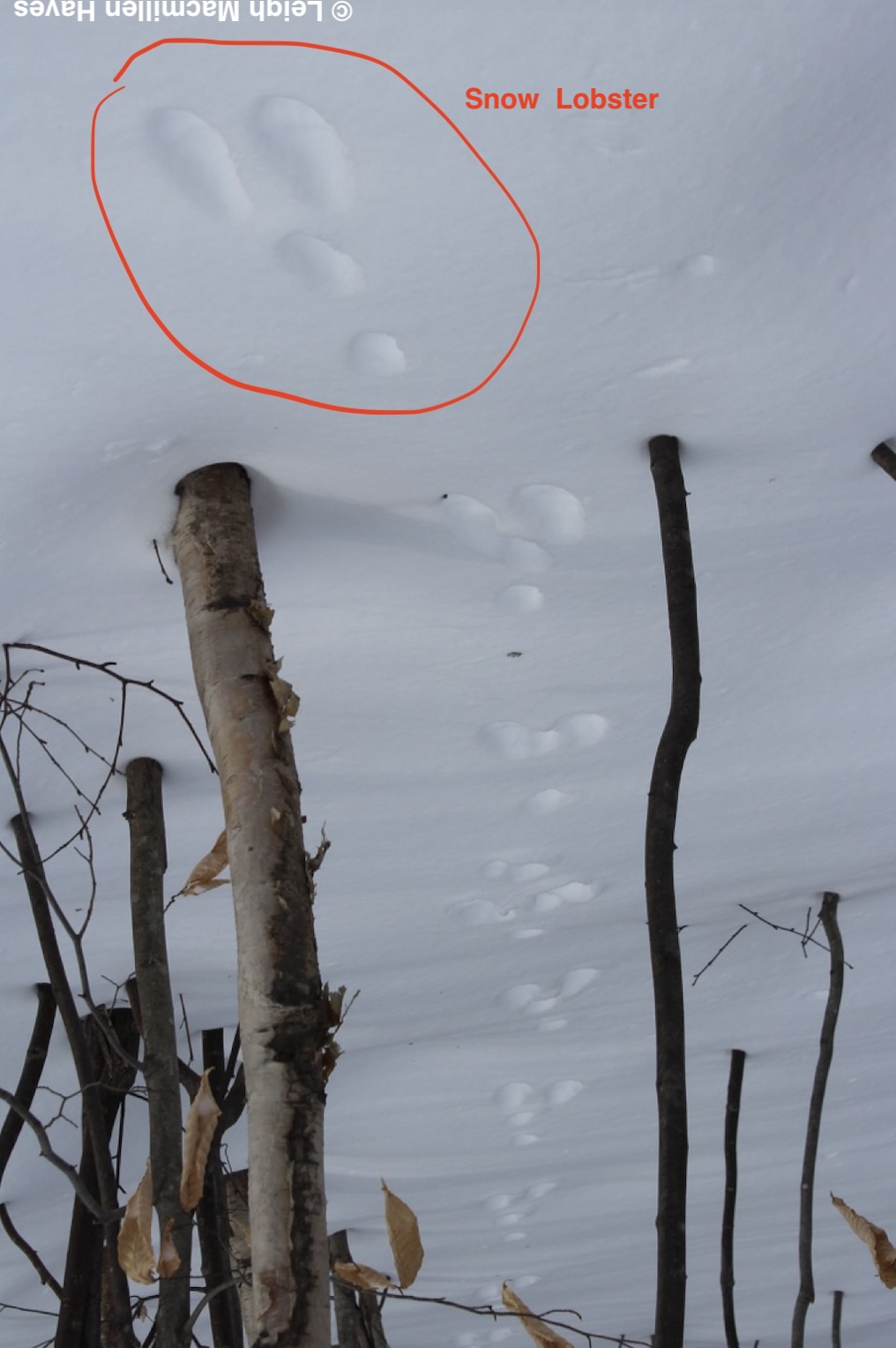
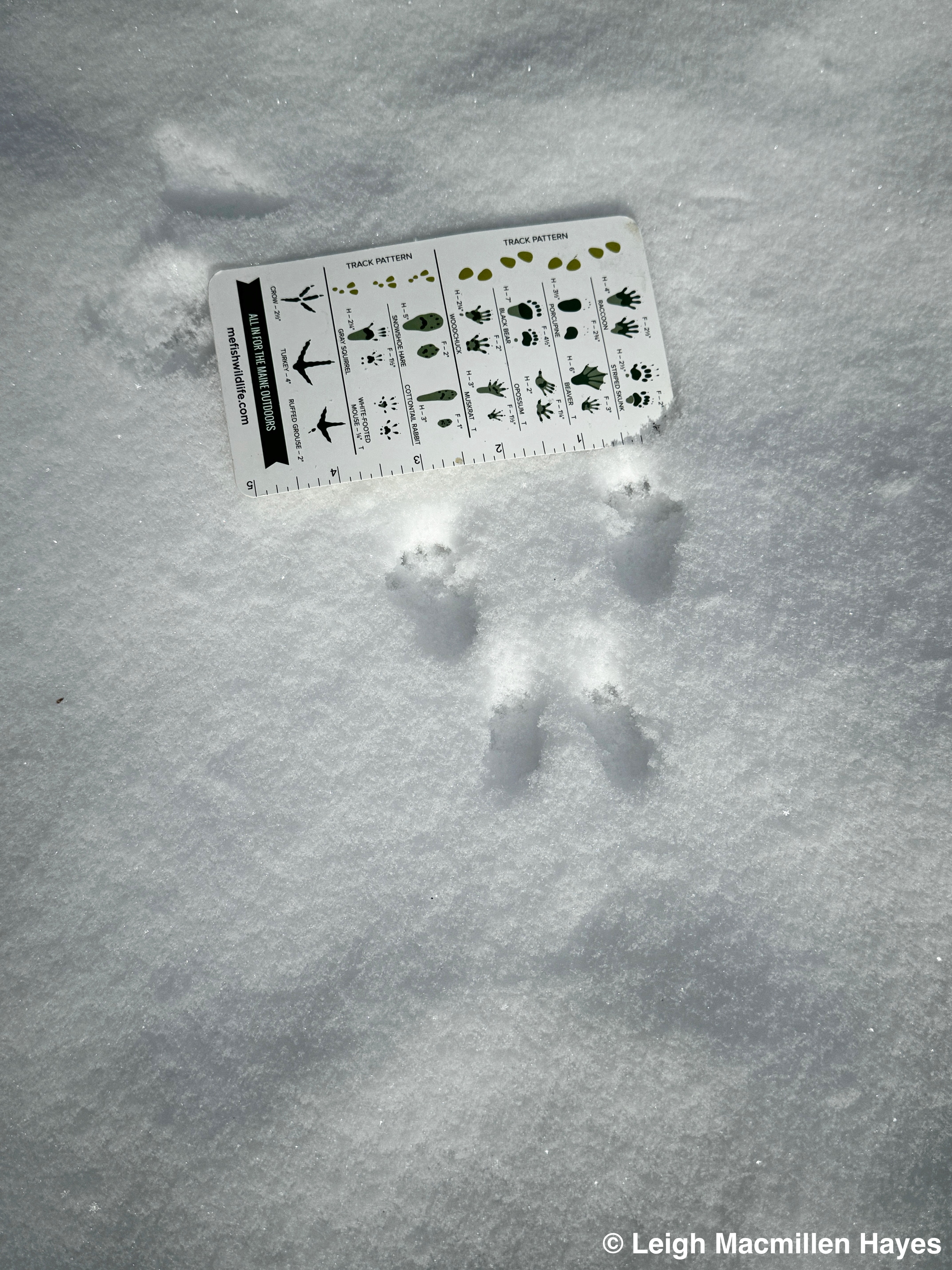
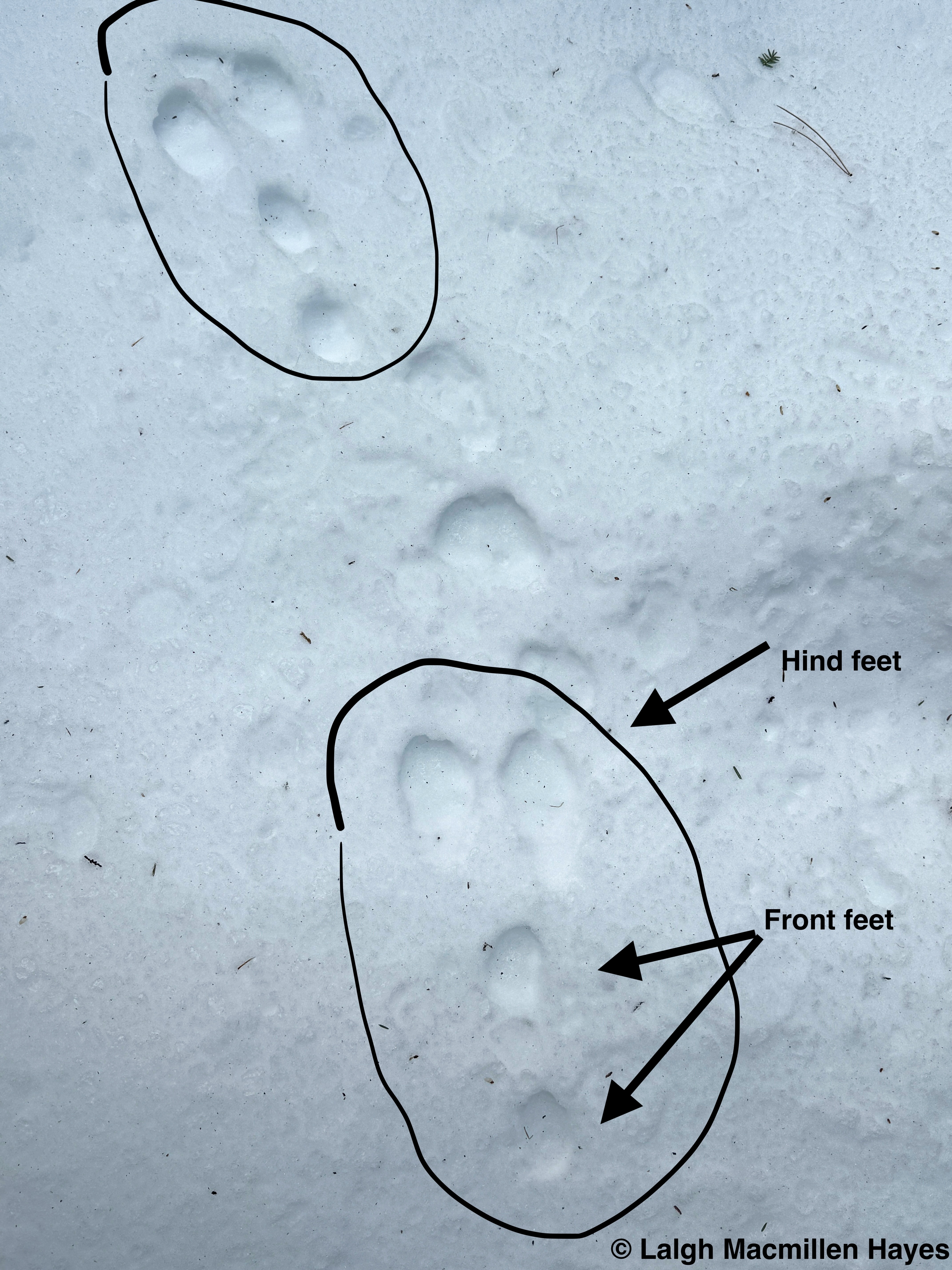
After completing our survey of Pondicherry Park, we drove north to Highland Research Forest, and not far into the property began to spot Snowshoe Hare tracks. These are the snow lobsters of the North Woods for so do the set of four feet look when arranged perfectly, which doesn’t happen with each hop. But, if you look at the set of four prints in the bottom-most impression, you’ll see the two smaller front feet that landed on an angle thus forming the lobster’s tail, with the hind feet swinging around and landing in front of them to form the claws.

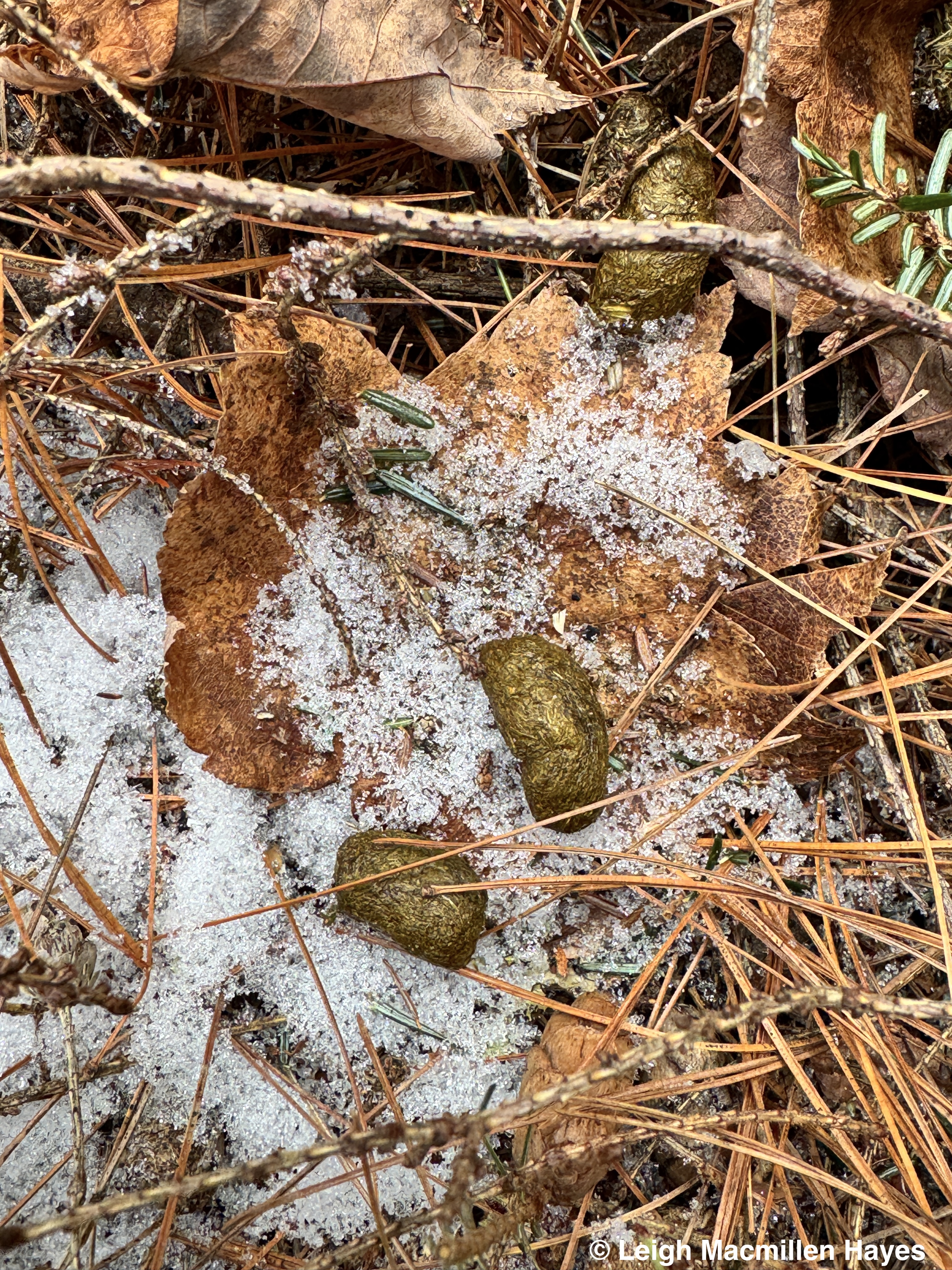
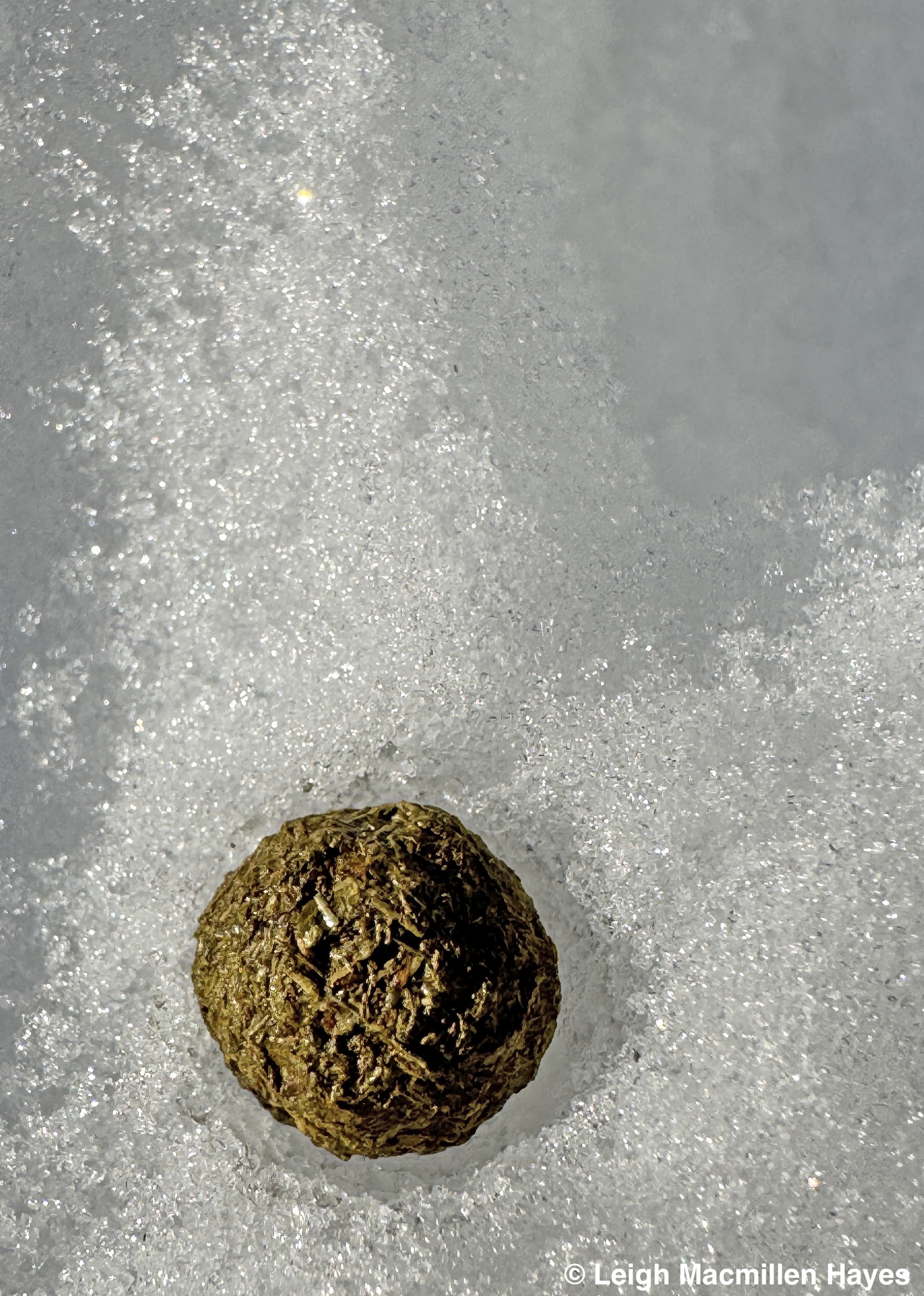
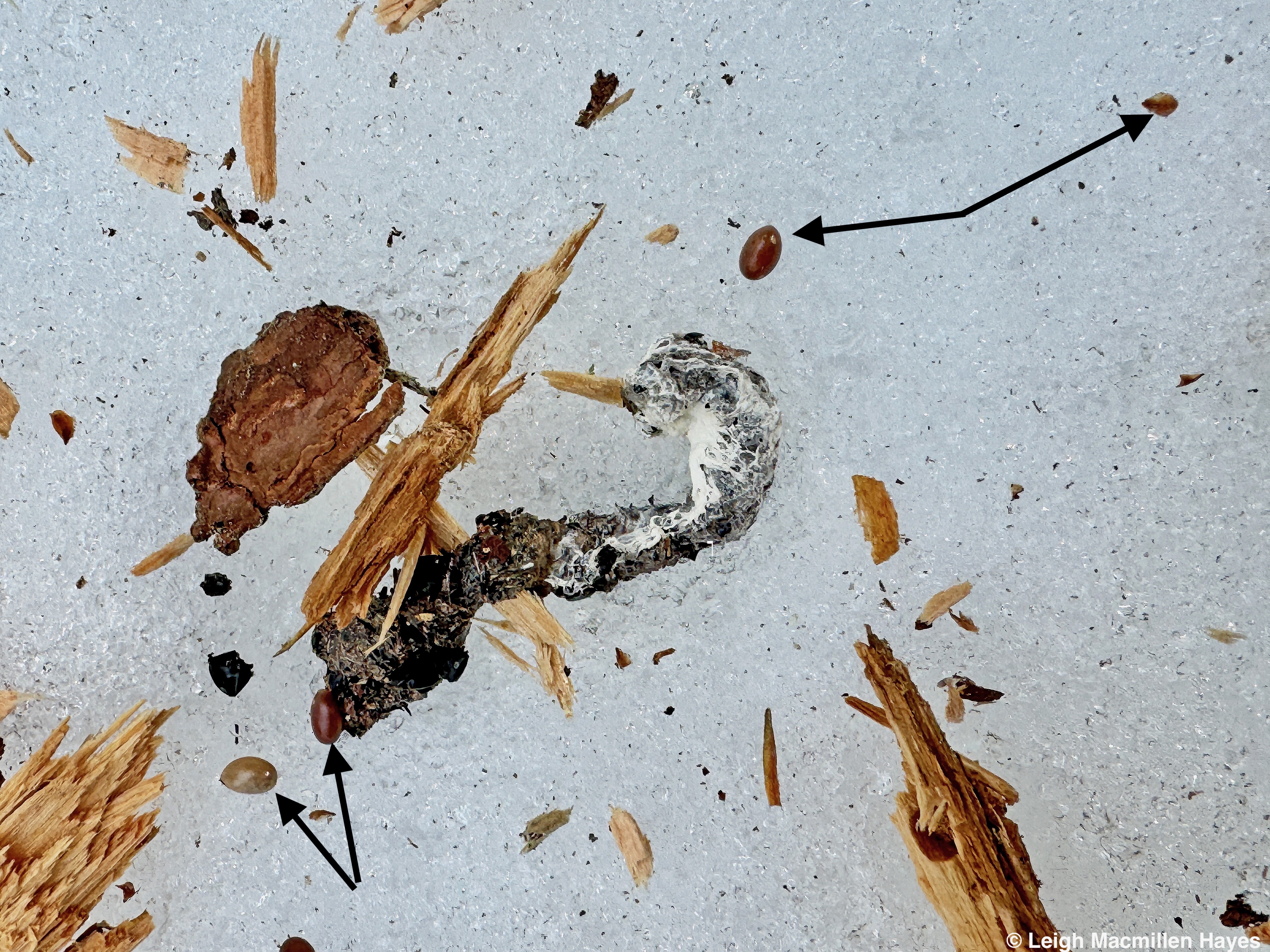
And where there are Snowshoe Hare tracks, there is scat.

Malt Ball-sized scat full of plant fiber, as it should be.

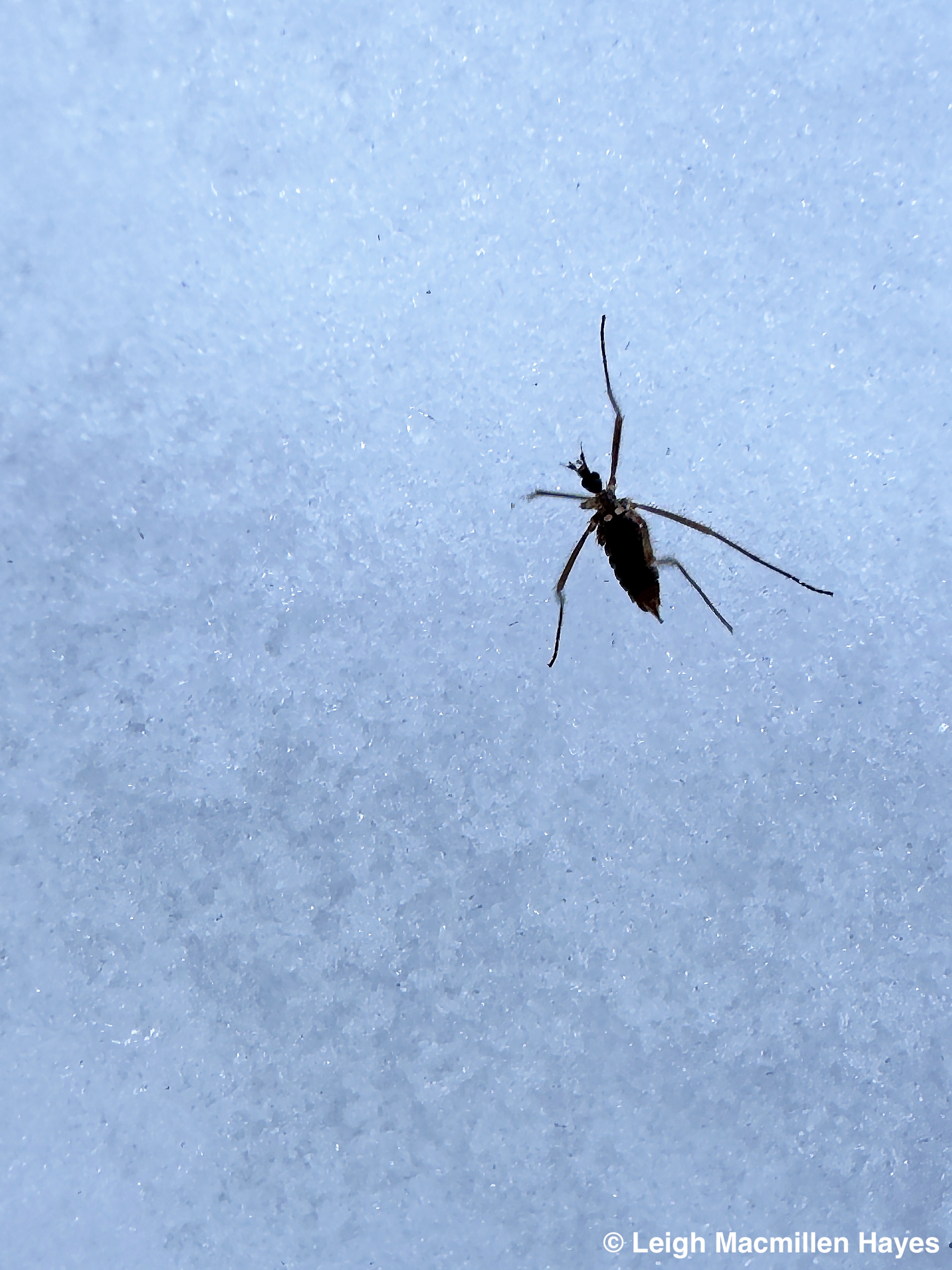
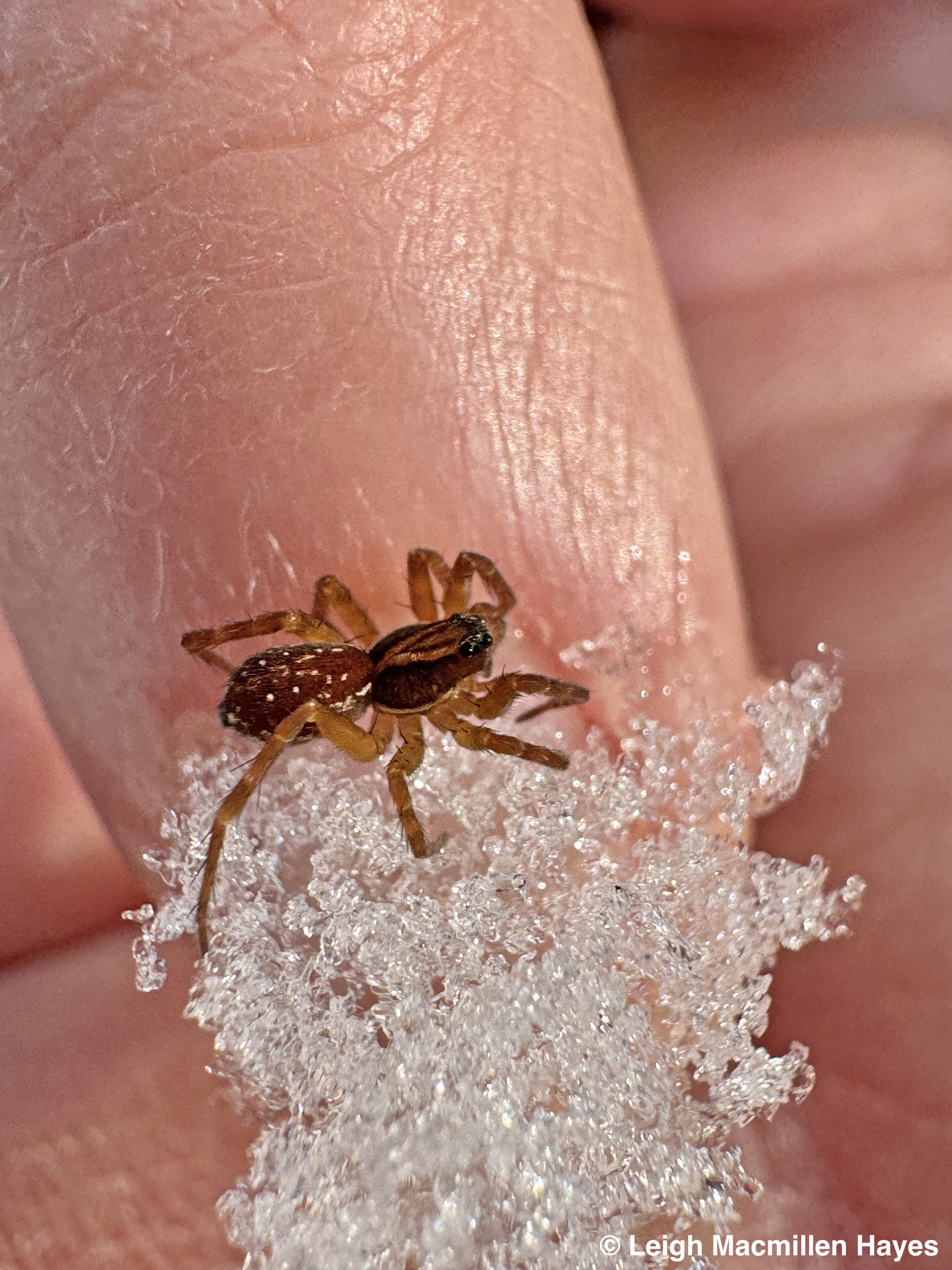
And when one is looking and listening intently, one sees all kinds of things. Yesterday, while hiking along a trail near our home with My Guy, we began to count Long-jawed Orb Weaver Spiders walking on the snow, proving not all spiders are dormant in the winter. That made sense for yesterday afternoon as the temperature was above freezing, but today’s temp was colder and though it eventually reached 32˚ by the time we finished, it was still in the 20˚s when we began to spot this behavior.

I assume the spiders are able to lower their bodies’ freezing point by producing a cryoprotectant, a glycerol anti-freeze compound that prevents them from freezing. An amazing adaptation.

Going in for a closer look, check out those hairy legs! And the long pedipalps used in reproduction; they are also tactile and function like insect antennae.

It’s funny how once you notice one thing, your attention is attracted to another, and such was the case that as we hunted for spiders, we spotted a caterpillar, that didn’t seem to be alive and can only trust that it was blown off a twig.

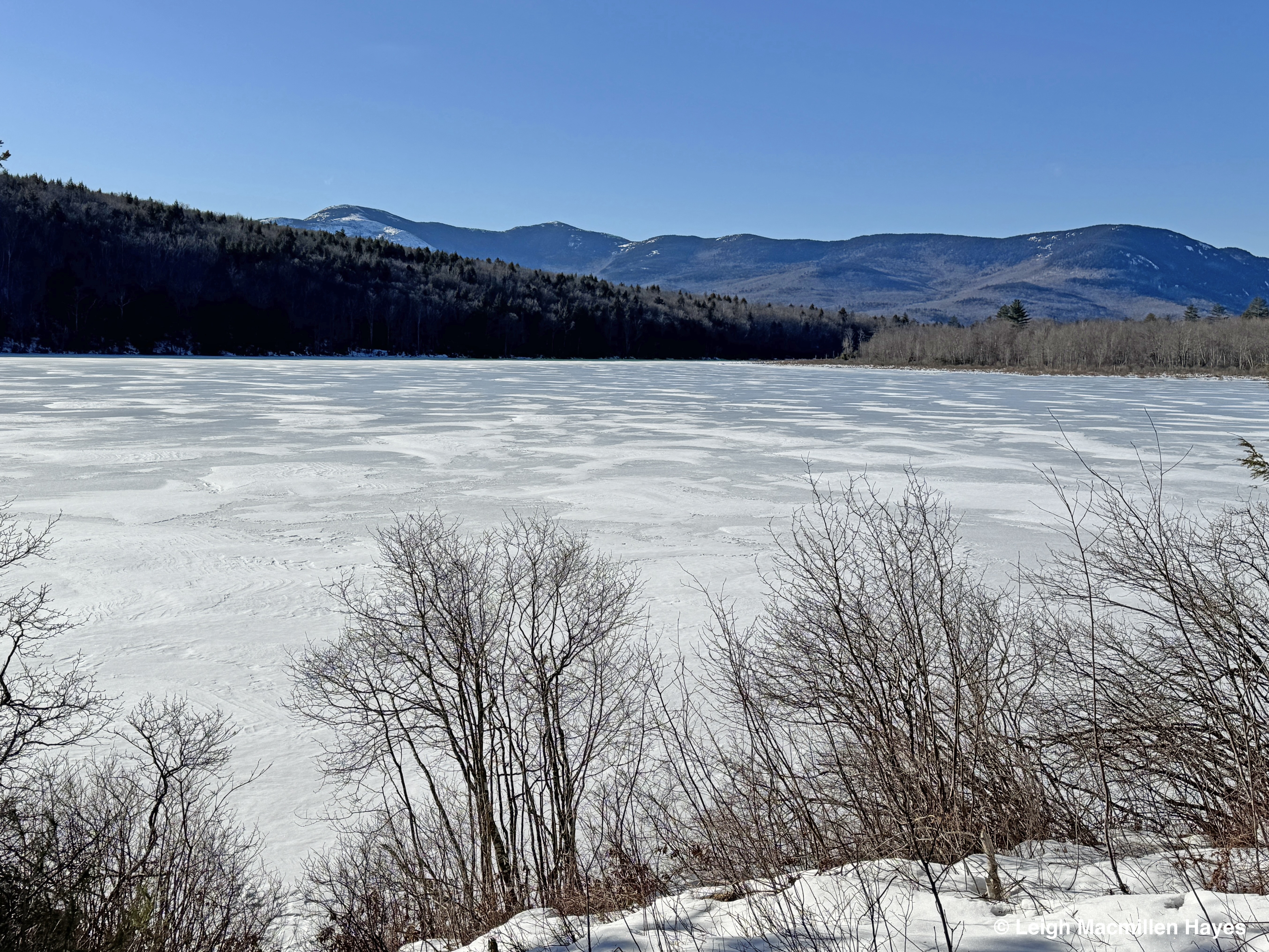
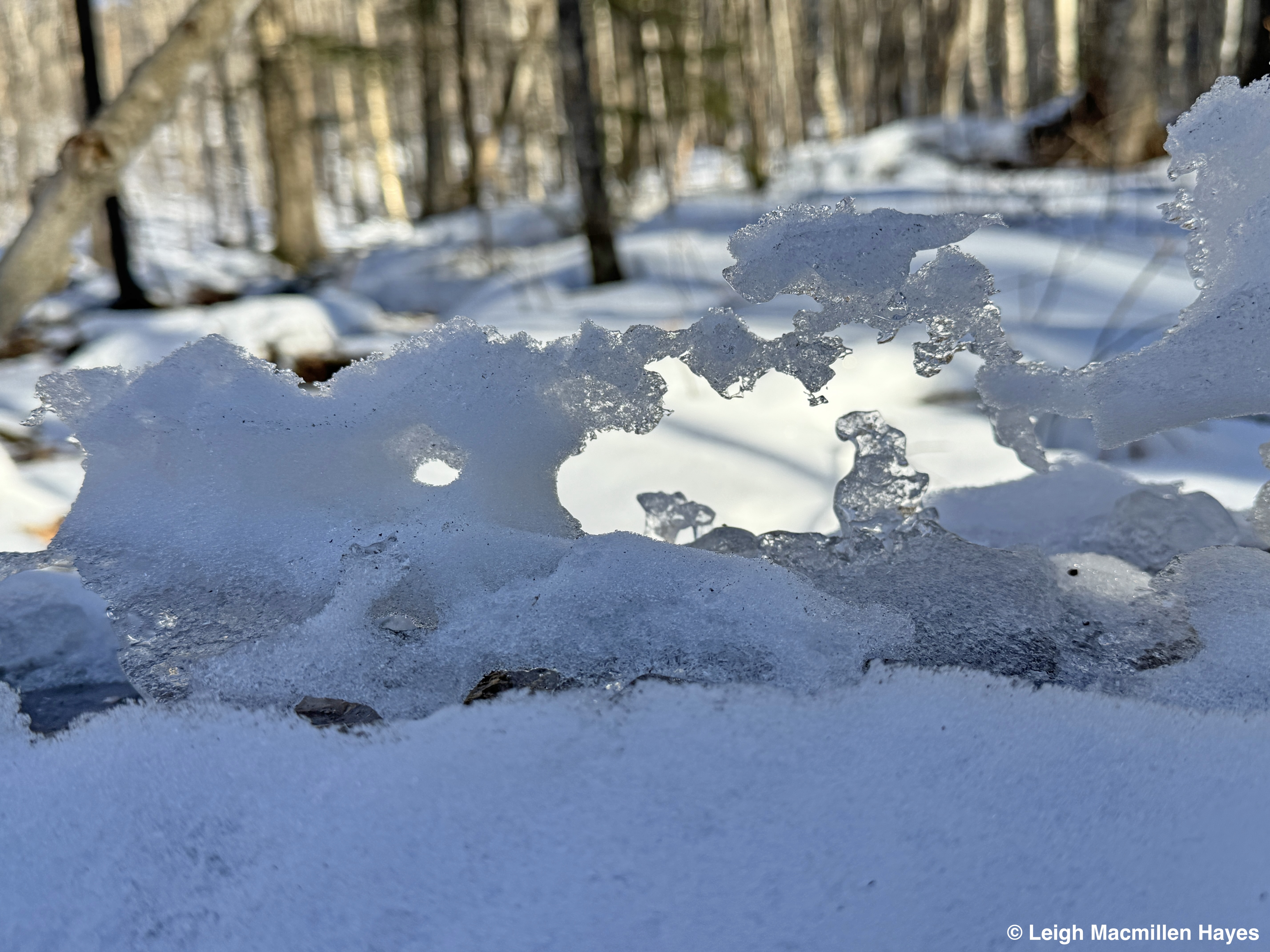
Like the park, Highland Research Forest is located beside a wetland and a lake, with lots of waterways in between. And like the park, the frost offered artwork, each crystal unique.

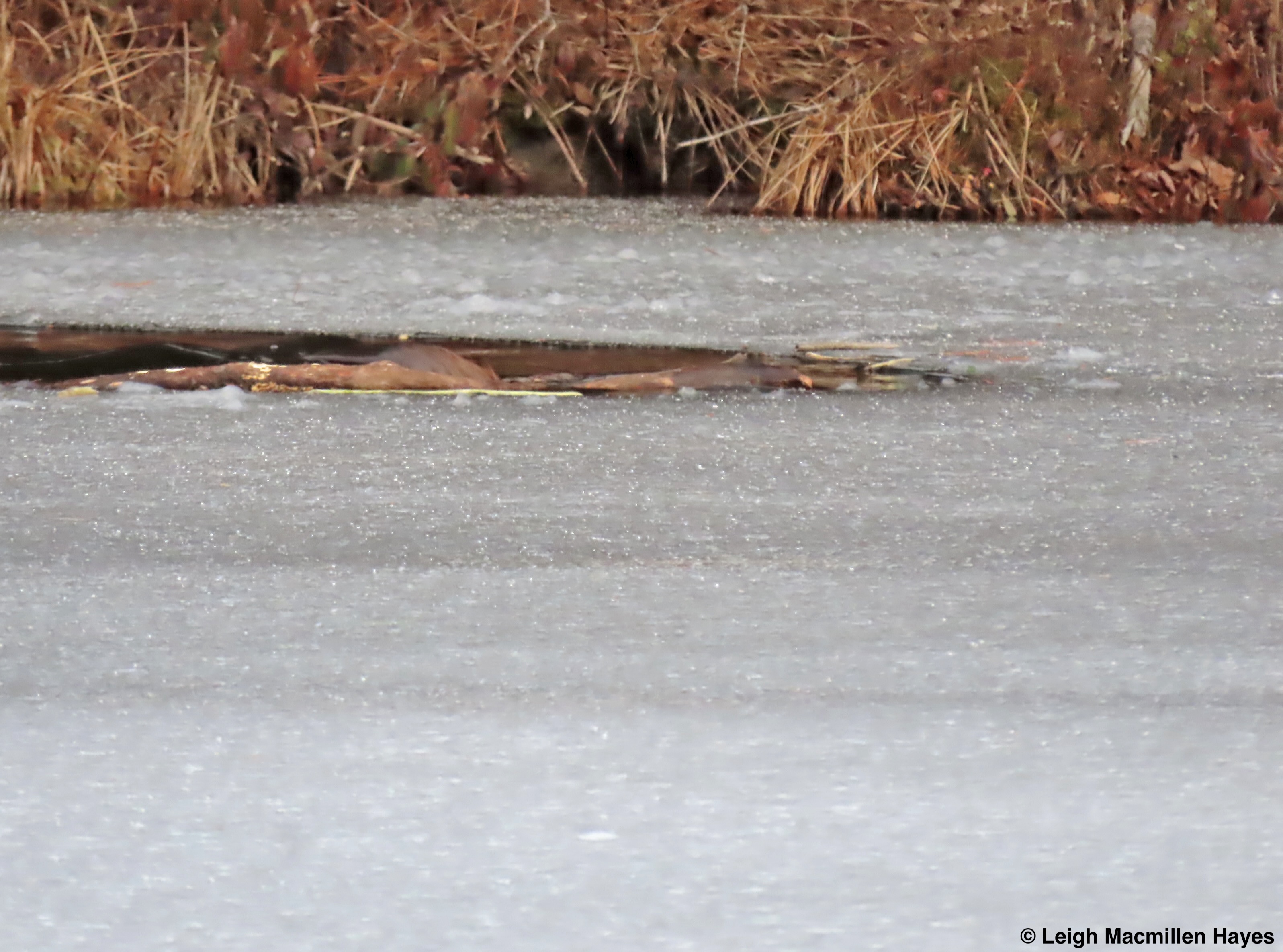
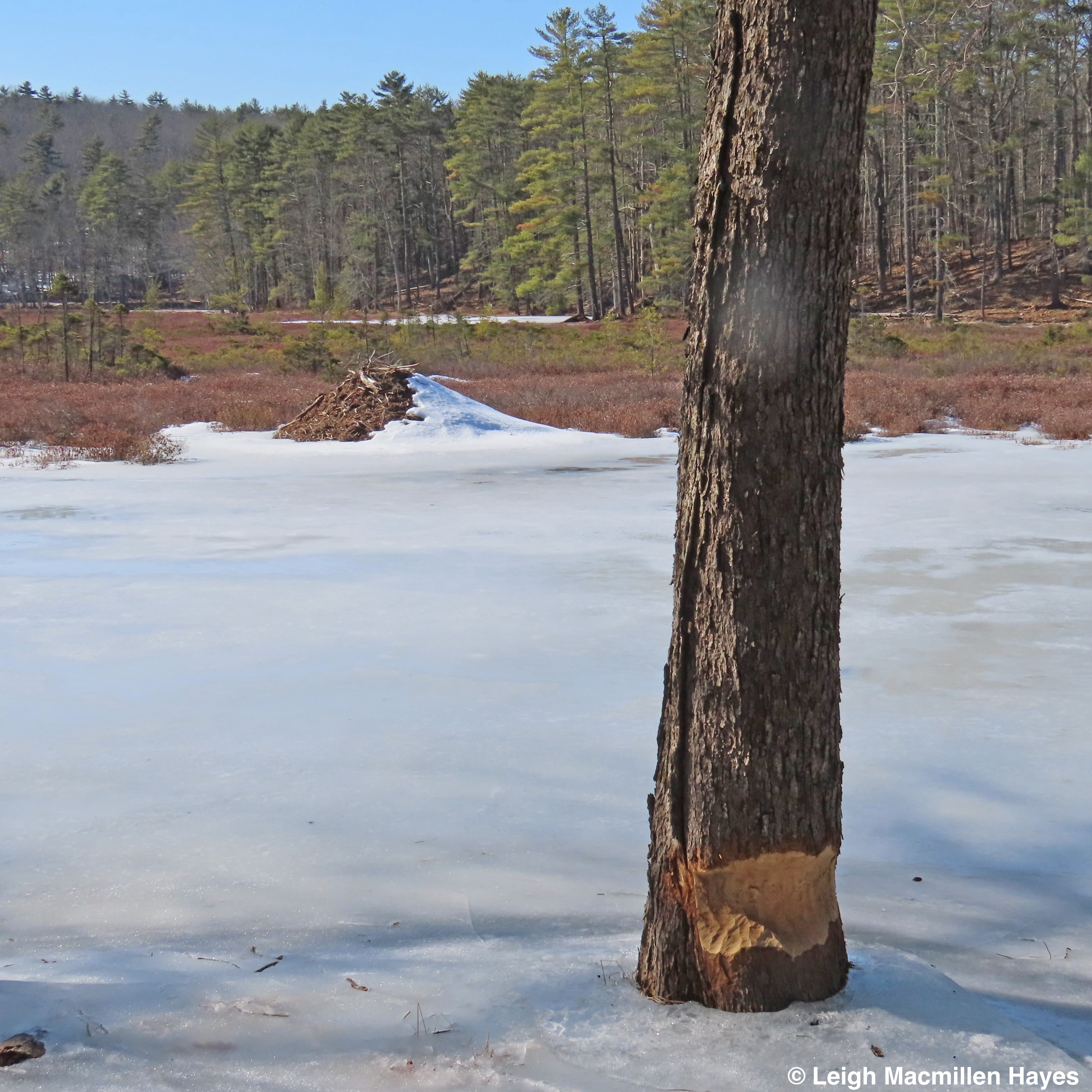
Since we were there to scan the wetland for birds but came up empty handed, we were forced to observe the newest beaver lodge in town. We didn’t walk out to it, because of course, tracking was not our official business of the day, but we suspect based on the mud and resent log additions, that it continues to be inhabited.

We really were birding. Honest. It’s just that this property usually has less activity of the avian sort than the other and today was no different. And then we realized that a year ago we said we’d start here in the morning and may be be honored with more sightings, but in the planning stages forgot, so have promised ourselves that next year we will begin our birding adventure at Highland Research Forest and then go to Pondicherry.

But tracks. Oh my. We saw tracks. Which brought up another discussion. Two years ago Dawn assisted me in leading a Senior College tracking expedition on this property. I chose it because I knew it to offer many tracks of a variety of mammal flavors. And that year, we walked a loop trail and finally found signs when we were about two tenths of a mile from the starting point: a Deer rub on a tree; and one or two sets of Snowshoe Hare tracks.

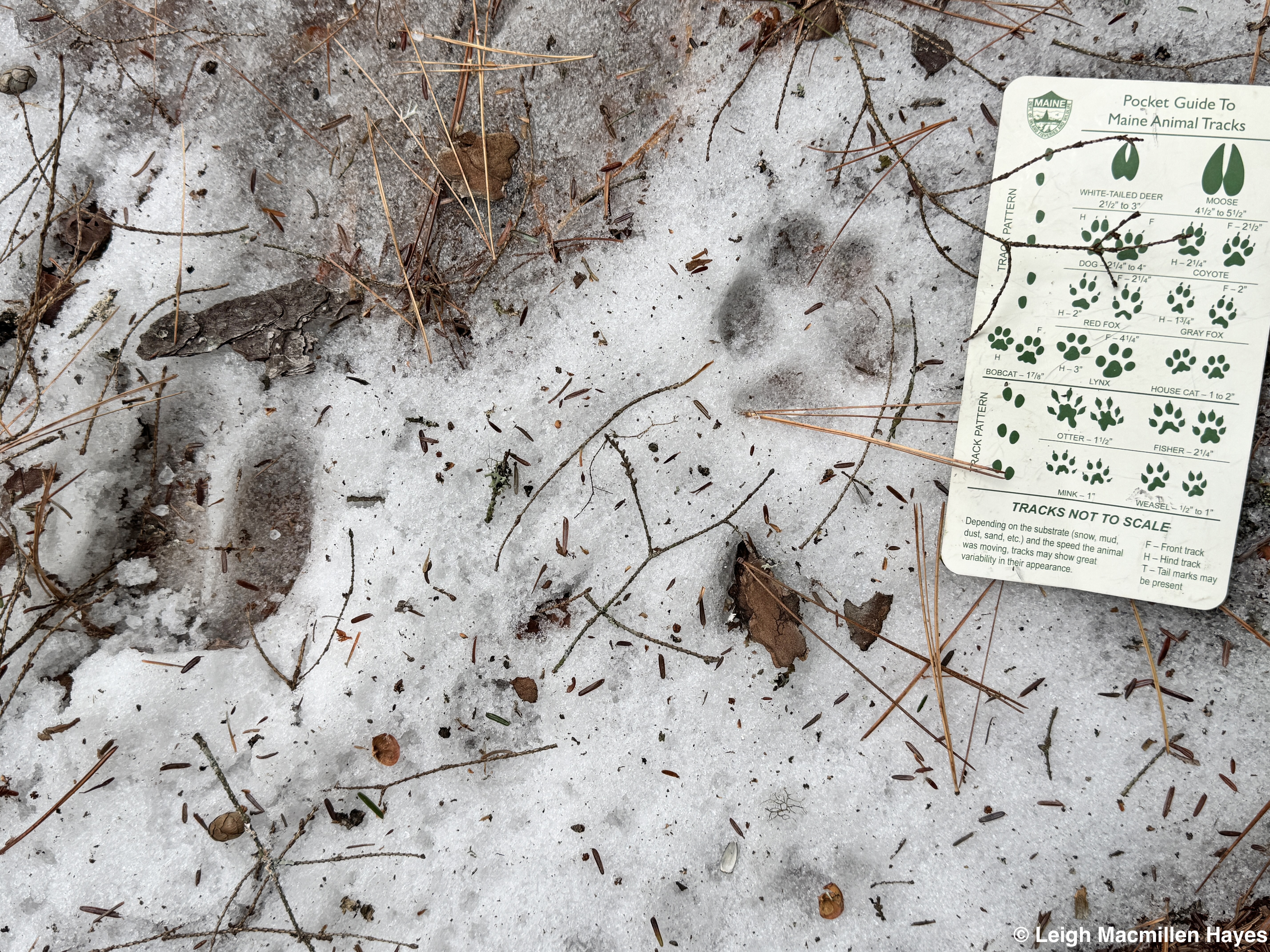
Today, however, while bird activity was almost non-existent, the mammal activity was overwhelming. Including these Fisher prints. (Note to the wise: Fishers are in the weasel family and not the cat family, so they are Fishers and not Fisher Cats.)

And on a high spot near the trail in the midst of the Fisher track: another sign post. Fisher urine. Apparently he was marking his territory with a mere dribble here and another dribble there.

Reaching Carsley Brook, we paused on a bridge, again in hopes of hearing a few peeps. There was an occasional Black-capped Chickadee and a White-breasted Nuthatch, but few others making their presence known.

That said, there were other presents to honor, again two other members of the weasel family: an Ermine and a Mink. The giveaways, track width and foot orientation on a diagonal.

Moving away from the brook, we again found bird sign in the form of . . . Turkey prints. But again, though birdy they were, they couldn’t count toward the bird count.

Pausing as we did frequently to make sure we didn’t miss anything in the bird department, we spotted others flying from twigs. Well, maybe not flying yet. But certainly dangling. As is their habit in the winter. The first was the cocoon of a Promethea Moth, which will fly in the future.

And a few feet farther along the trail, that of a Polyphemus Moth.

Both are attached to the twigs with an incredible reinforcement of silk, and reminded me of how my friend Marita recently reinforced the “idiot strings” on my mittens so they can dangle from my wrists when I take them off to jot down notes or take a photograph.

We also found another spider to admire.

And a kazillion mouse tracks showing their keen interest in risky night-time missions.

Just before we finished, and while we were searching the trees for a Woodpecker, an anomaly caught my attention and I realized I was starring at a Barred Owl. Unfortunately, it flew off before I had a chance to focus the camera on it, but like the Bald Eagle earlier in the day, it was a thrill.

Oh, and did I mention the Great Horned Owl that we spotted this morning as it kept watch in the exact spot we saw the Eagle? It’s amazing the Bald Eagle didn’t take it out, but this bird seems to lay claim to the area for it sits in the same spot day after day.

At the end of our Christmas Bird Count today, these were our findings:

Distance covered: 5.8 miles

Time of travel by foot: 6 hours

Mallards: 100

Downy Woodpeckers: 5

Hairy Woodpeckers: 3

Pileated Woodpecker: 1

Blue Jay: 5

American Crow: 10

Black-capped Chickadee: 17

Tufted Titmouse: 3

Red-breasted Nuthatch: 1

White-breasted Nuthatch: 9

Golden-crowned Kinglet: 5

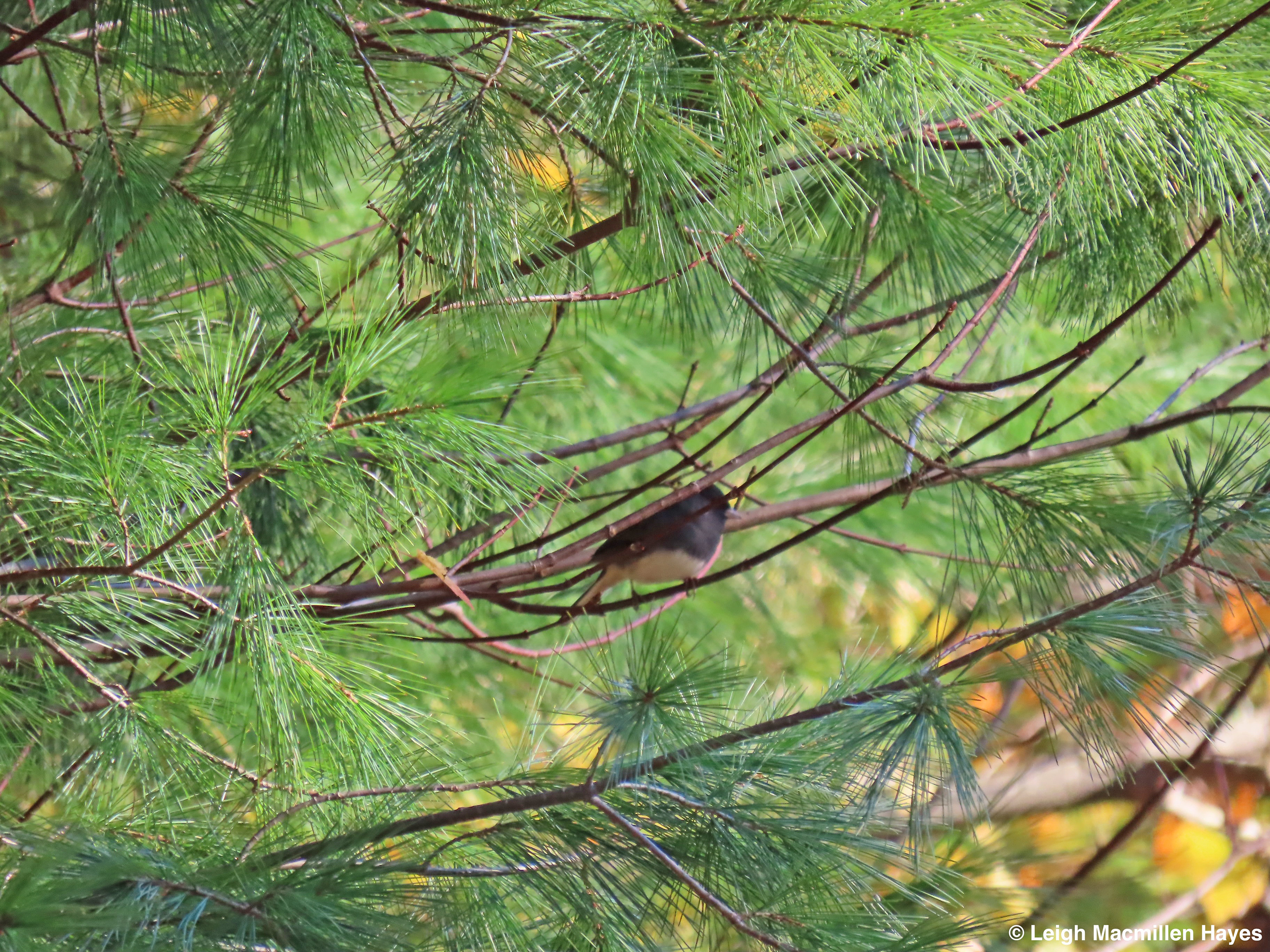
Dark-eyed Junco: 2

Bald Eagle: 1

Barred Owl: 1

Long-jawed Orb Weaver Spiders (12/27/24): 14; (12/26/24 with My Guy): 94

Caterpillar: 1

Moth Cocoons: 2

Tracks: a zillion including Ruffed Grouse and Turkey.

Surely the bird tracks count for something as everything counts.

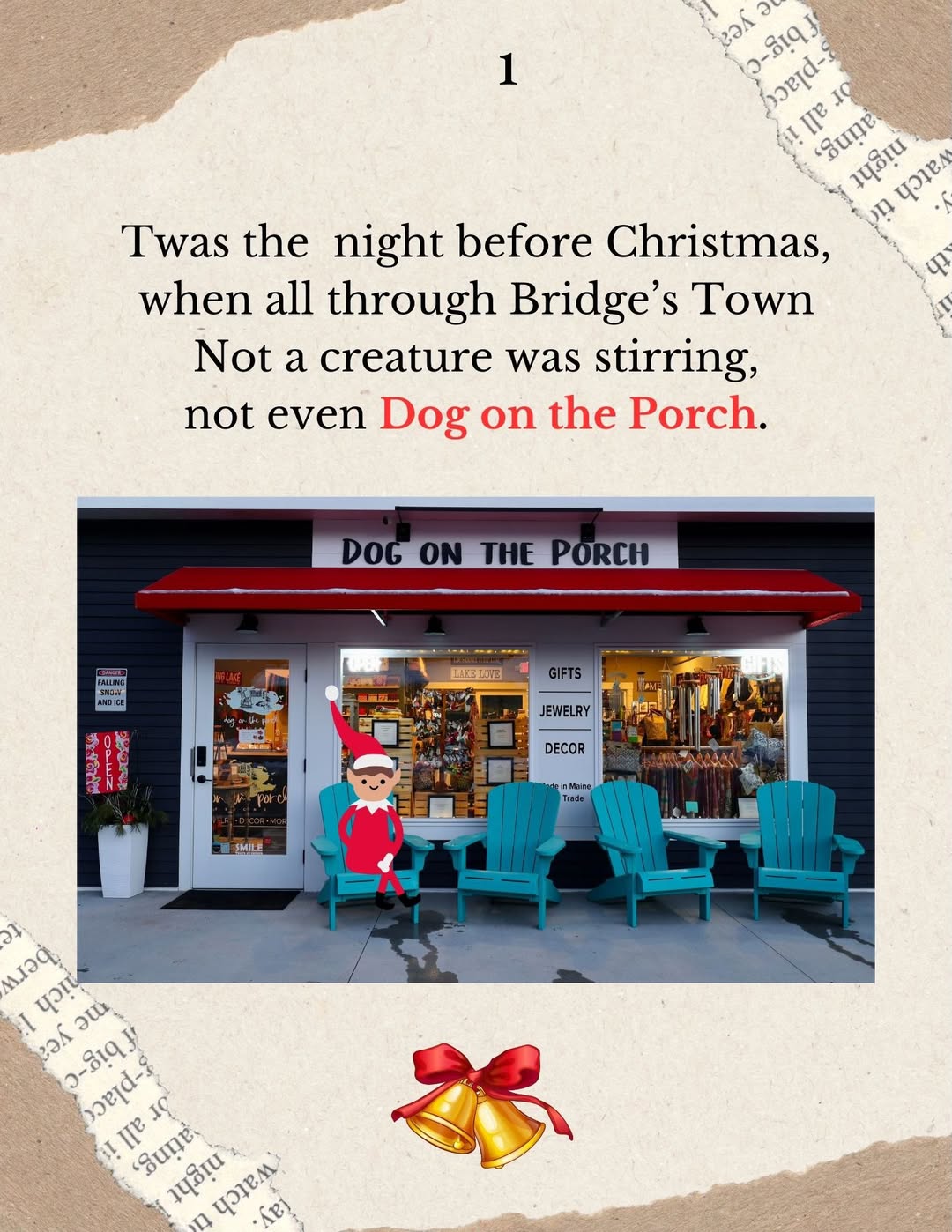
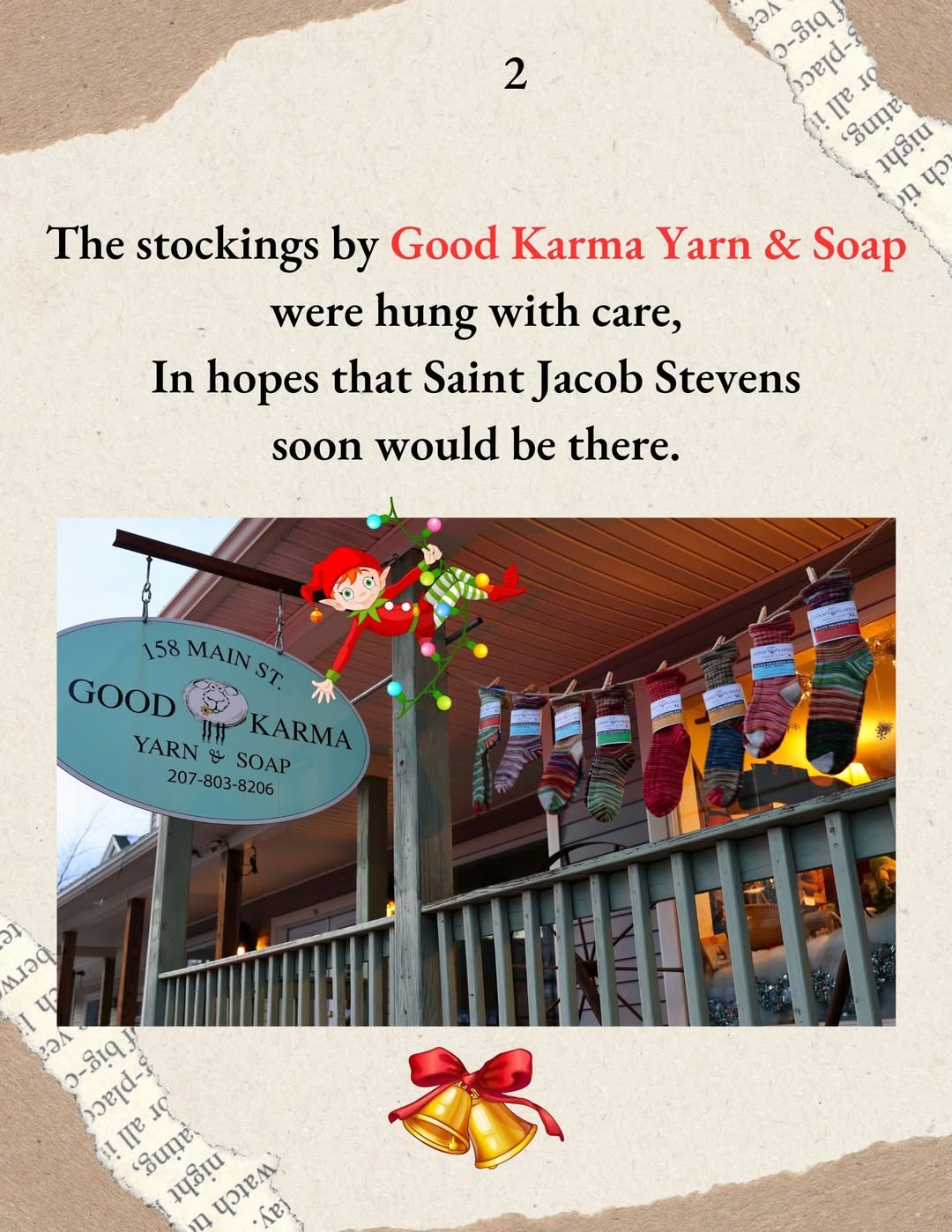
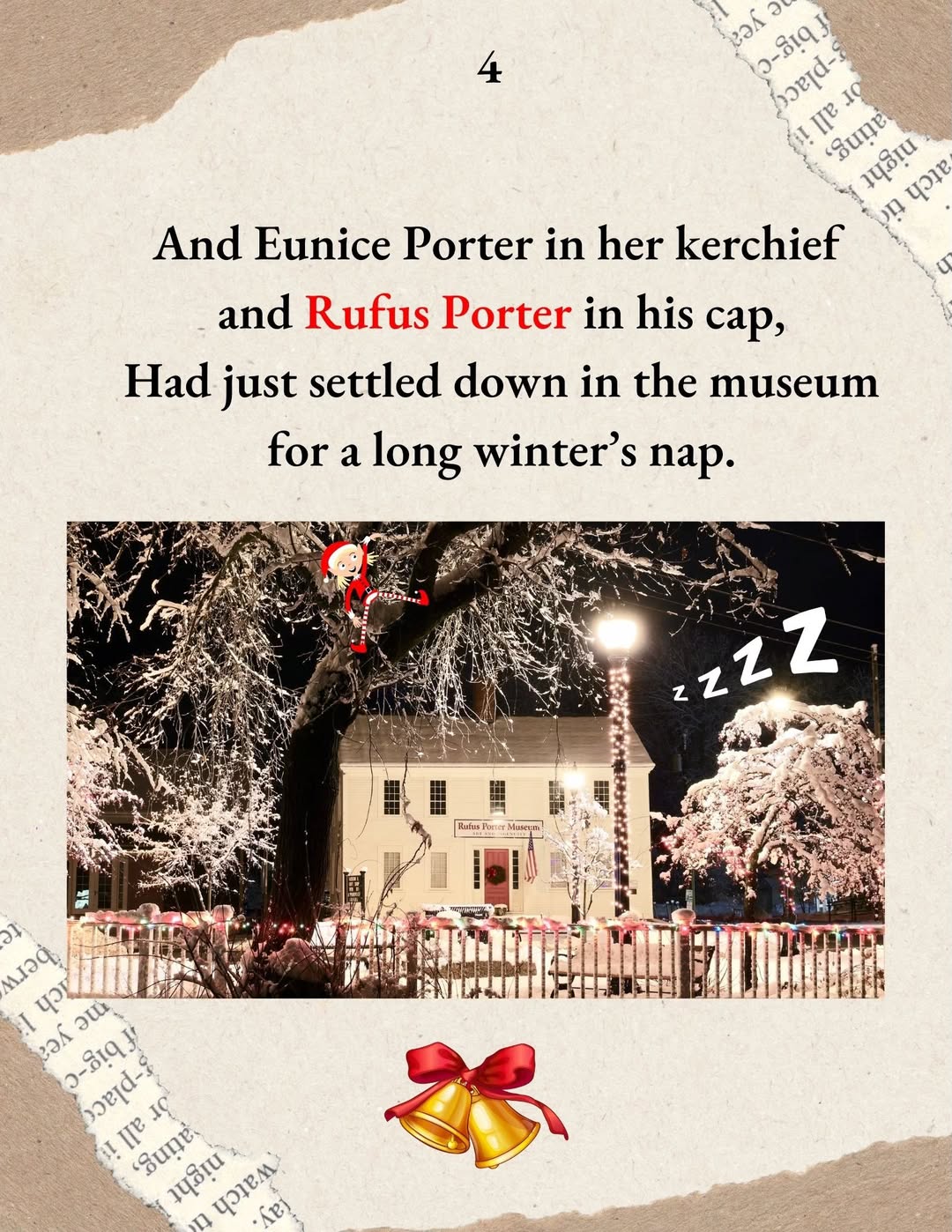
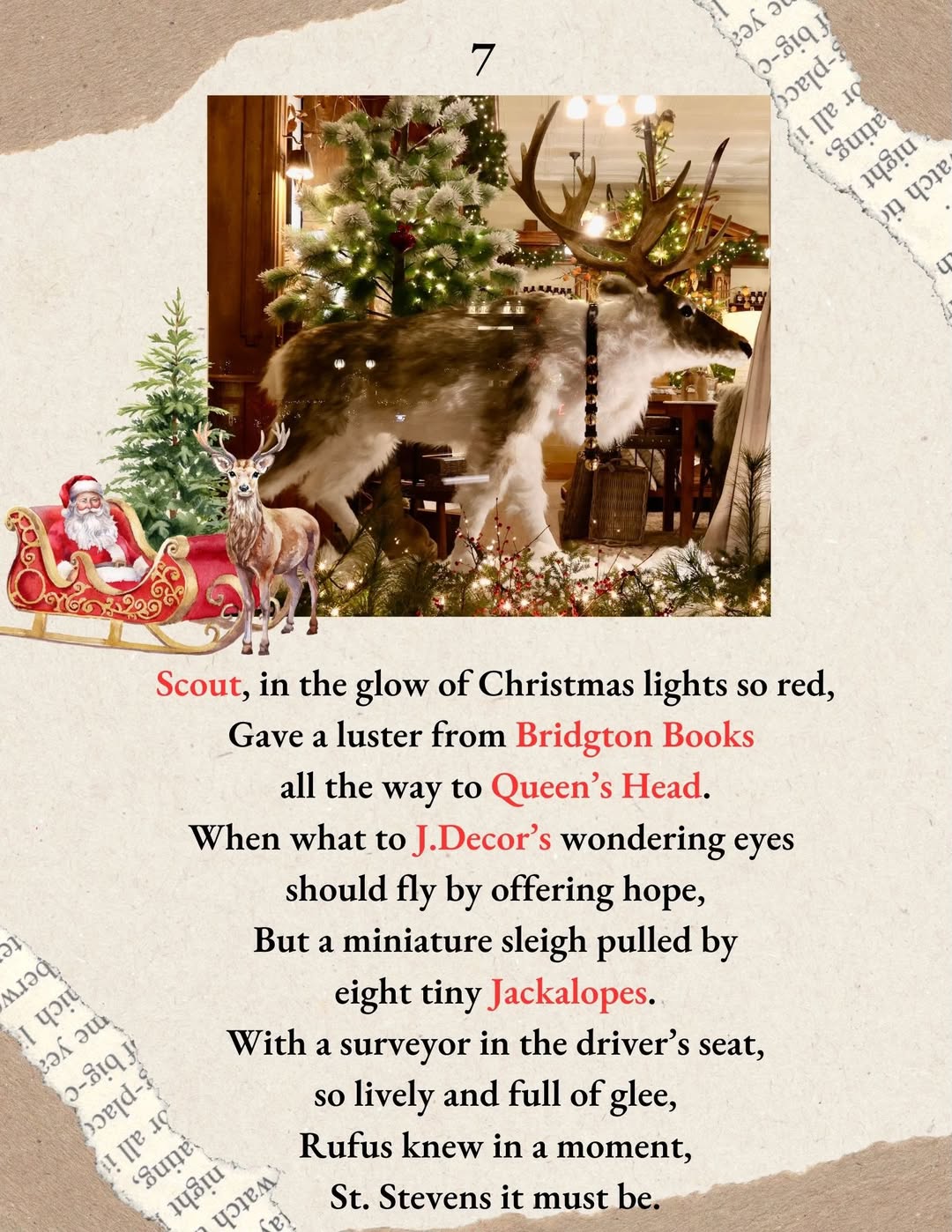
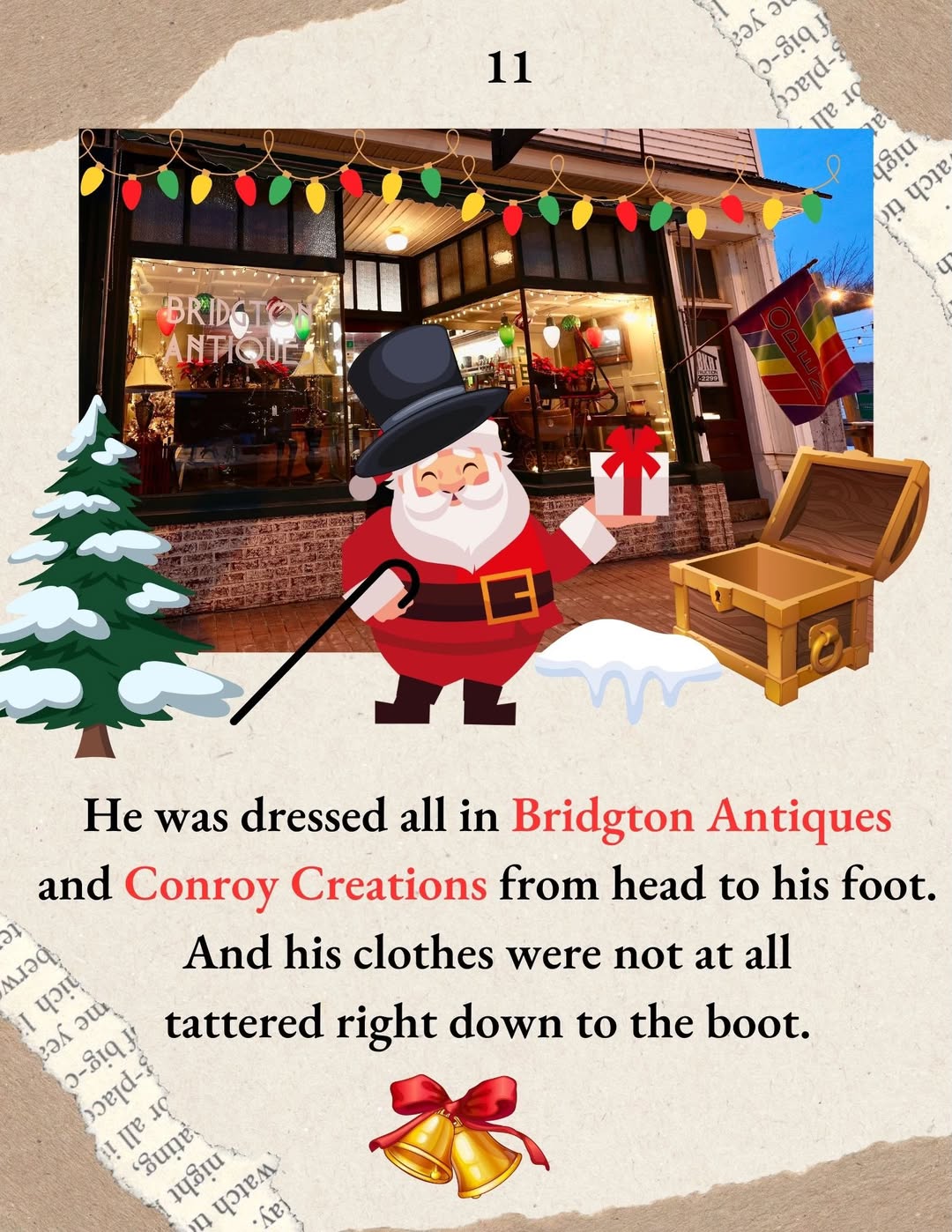
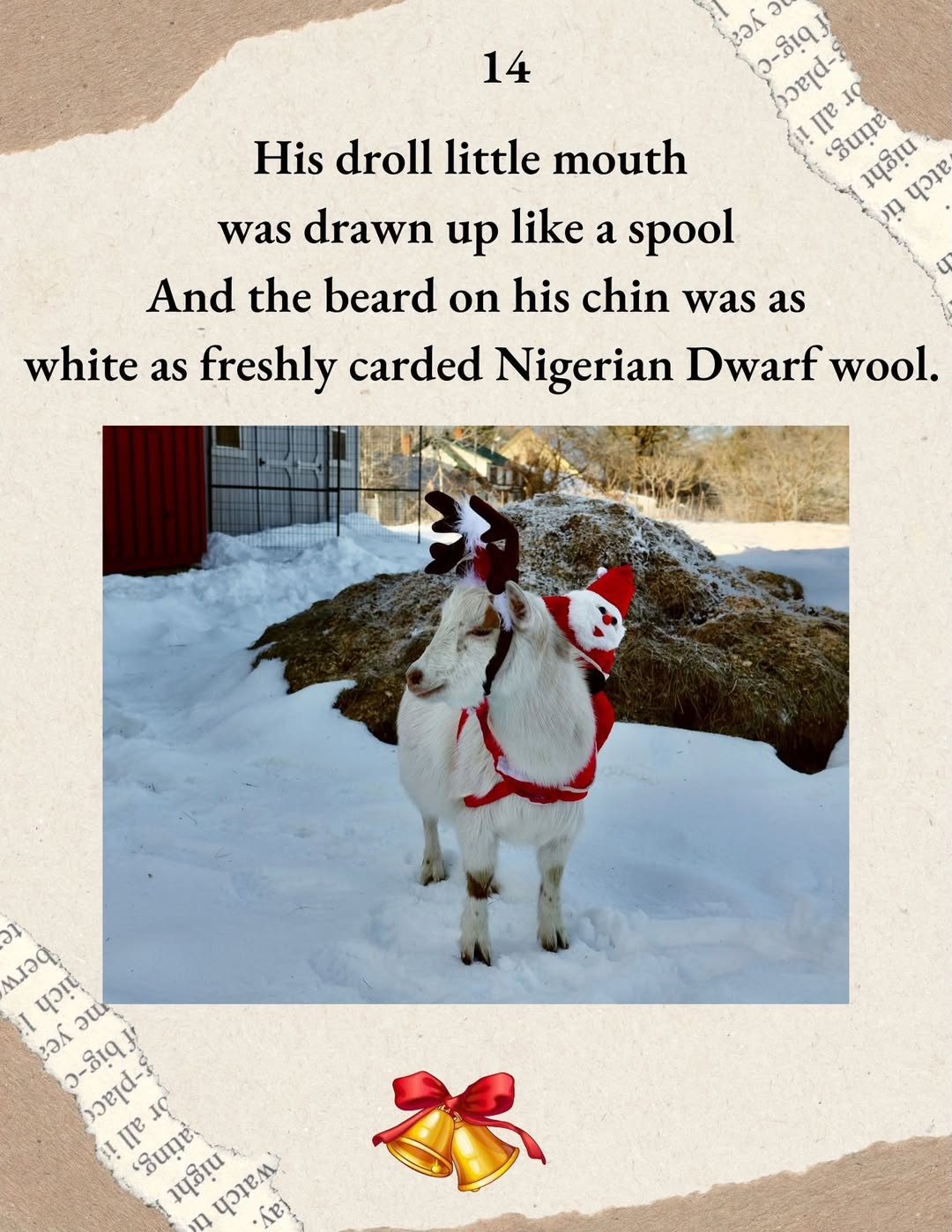
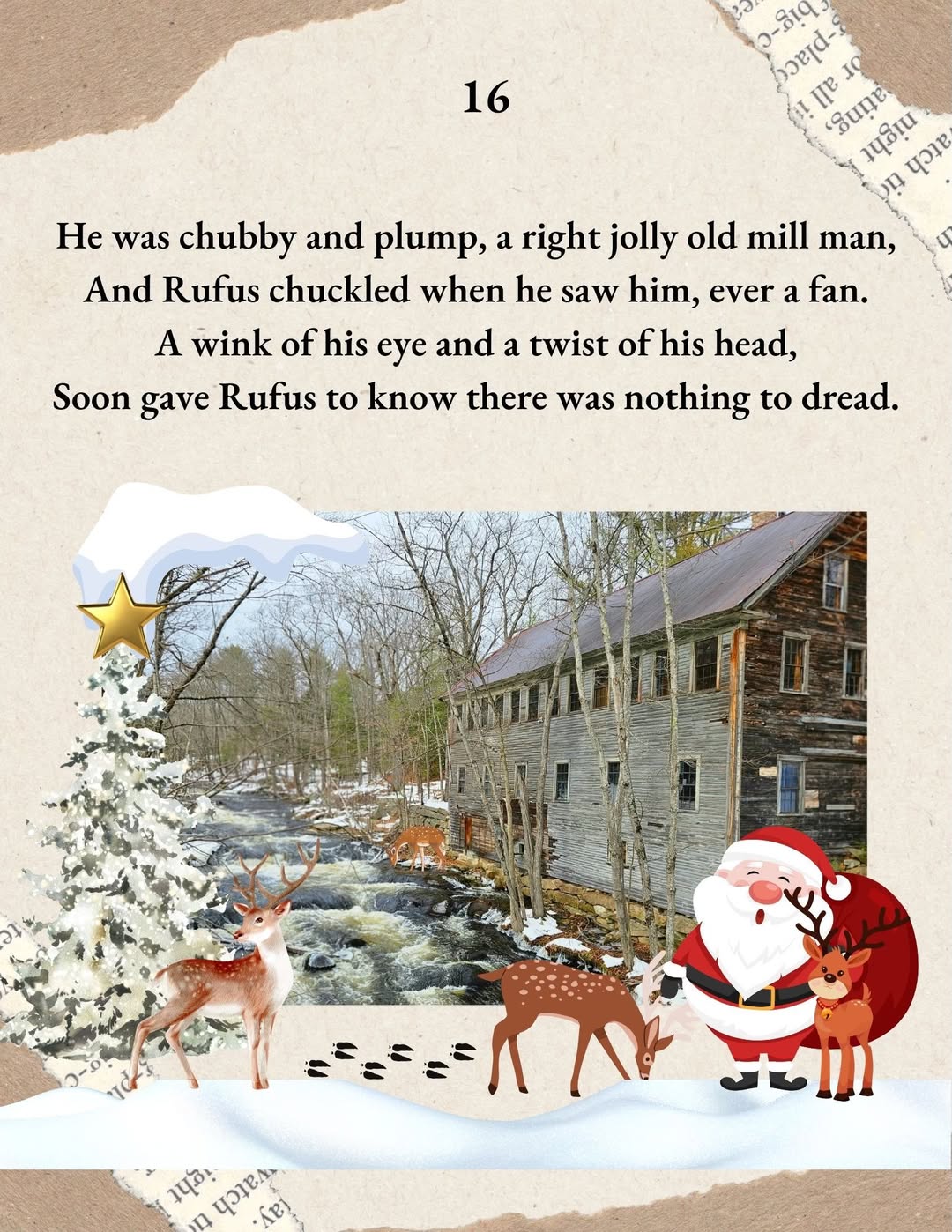
Twas The Night Before with a local twist

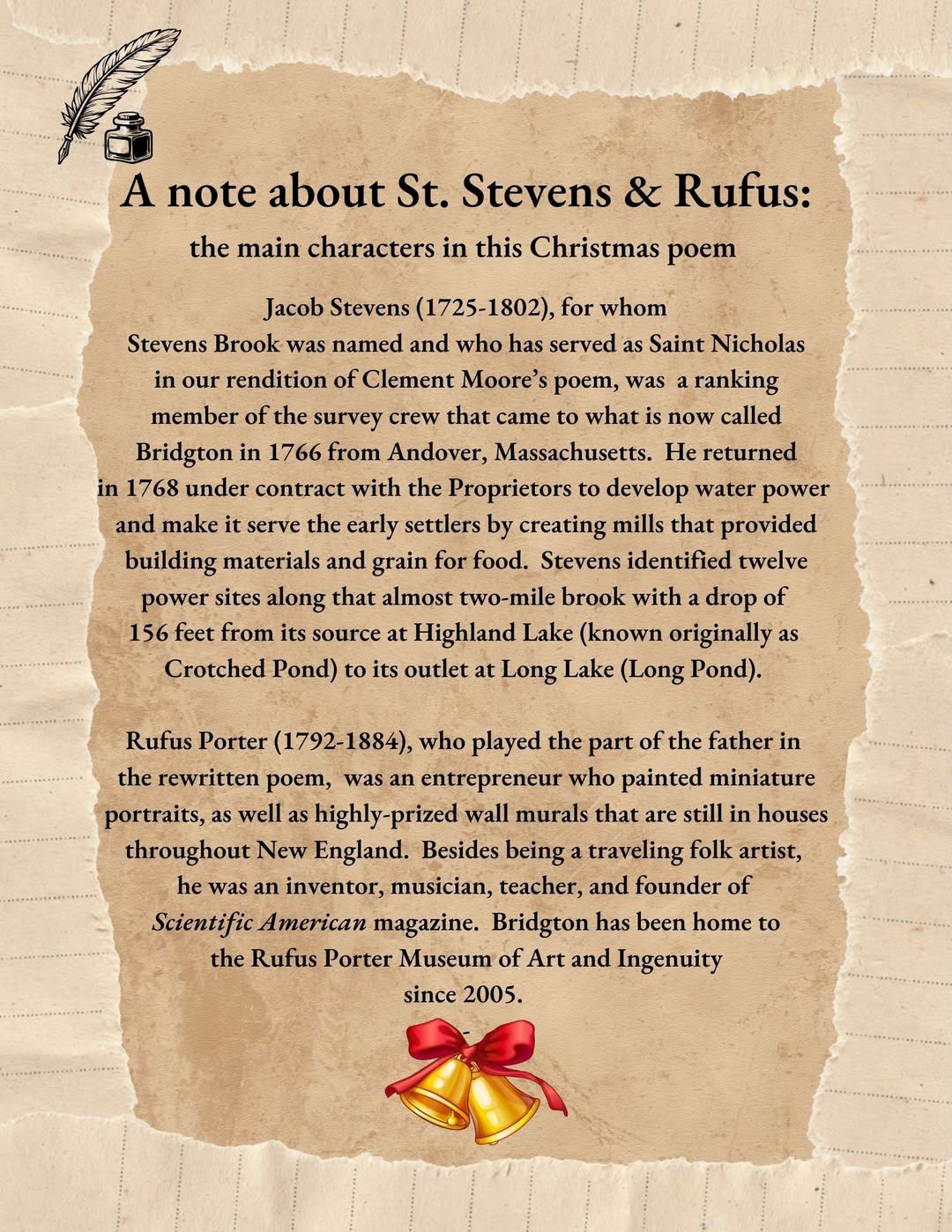
Pam Ward and I hope you have enjoyed reading our rendition of “Twas The Night Before Christmas” as much as we enjoyed revising and illustrating it so it encompassed at least a wee bit of our community and the spirit that ties us together.

Pam is a photographer and co-owner with her husband, Justin, of Bridgton Books. Please be sure to step into this wonder-filled independent book store when you are in town. Oh, and you might purchase a copy of The Giant’s Shower, a fairy tale, while you are there.

Wait. Watch. Wonder. Learn.

As I waited for the sun to rise on this final day of autumn 2024, before the dawning of the winter solstice, I watched the sky. It seemed late. Of course it seemed late. Tomorrow will be the shortest day of the year.

Ever so gradually, the sky brightened. First, there was barely a hint of light shining through the trees as if taking its time was a way to remind me to slow down.

And then I began to see it. Not the orangey-yellow I expected, but rather a blue gray that slipped out from behind the silhouettes of the tree trunks, who stand as watchers, observers, of every dawn every day.

Ever so slowly, a hint of pinkish purple rose in the East and the blue gray was transformed.

I, too, wished to be transformed. By this first light. By this new day.

And then it occurred to me that I do rejoice at each daybreak and look forward to its offerings.

Today, however, was a wee bit different as it was the day to enter a place I’ve barely visited since the spring and I felt drawn to part the hemlock boughs and venture forth into my own secret garden, that isn’t a garden at all, at least not if you expect it to be a place where flowers and vegetables are tended. Ah, but it is a garden from so many others. And its those others that I hoped to meet.

In her book entitled Church of the Wild: How Nature Invites Us Into The Sacred, author Victoria Loorz writes, “You wander slowly and intentionally. It is your full presence along the path that matters. It is an act of reverence, a saunter. John Muir hated the word hike. He urged people to saunter. ‘Away back in the Middle Ages,’ he told his friend once, ‘people used to go on pilgrimages to the Holy Land, and when people in the villages through which they passed asked where they were going, they would reply, ‘A la sainte terre,’ ‘To the Holy Land.’ And so they became known as sainte-terre-ers or saunterers. Now these mountains are our Holy Land, and we ought to saunter through them reverently, not ‘hike’ through them.”

And so I sauntered, not letting the stone walls or barbed wire stop me from crossing over manmade boundaries.

All the while, I wondered, “Who will I interact with today?” and “Will I be able to shut down my inner ramblings and really wait, watch, and listen?”

My heart quickened despite my efforts to slow my breathing, when I spotted not only the heart-shaped prints of White-tailed Deer who really own these woods, but also one who pursues them, the Bobcat.

Would I spot any evidence that though they travelled in opposite directions a day or so apart, their paths eventually crossed? That remained to be seen.

What I did know was that unless I sat for a time, I would not spot any critters because the snow conditions were such that I stood firmly on top–like walking on water–frozen water, and made a loud crunching sound with the fall of each footstep.

Those who know me well, know that I am a cradle Episcopalian. Among other things, I love the liturgy. But what I’m discovering I love the most is the shared fellowship with a diverse group of people.

And in the same way, I love the woods out my door and how each and every other-than-human being IS diverse, and how they aid and abet their neighbors, sometimes offering a helping tree limb or shared nutrients, and other times feeding upon others because they, too, need energy.

And in the forest, there is life and death, and a dead snag can be just as beautiful as a live tree. And in its death, offer space for others to live.

During today’s saunter, I bushwhacked sometimes and followed old logging trails in other moments. During all of my visit, I often encountered places that needed consideration for navigation, but in the pause as I gave thought to my way forward, I noticed reflections that reminded me of my desire to do the same. Take time to reflect.

I made sure to look up and down and felt a need to celebrate discoveries, such as this perfectly round Snowshoe Hare scat. Last year there weren’t many hares in this part of the woods, so I can only hope that this year will be different.

Evidence of deer activity was everywhere, from well tramped routes that generations have followed for eternity to freshly rustled up Northern Red Oak leaves indicating a search for acorns to dine upon.

What made me chuckle, however, was the realization that it wasn’t just the deer who were taking advantage of an abundant acorn crop. A squirrel had cached one here and another there–that should serve as a meal for a later day.

After searching for a friend I doubted I’d meet, and I didn’t (Porky is saving our meeting for another day), I stepped out to an old logging road and instead met another I couldn’t recall from previous saunters. Perhaps it was because I was approaching it from a different direction than my norm.

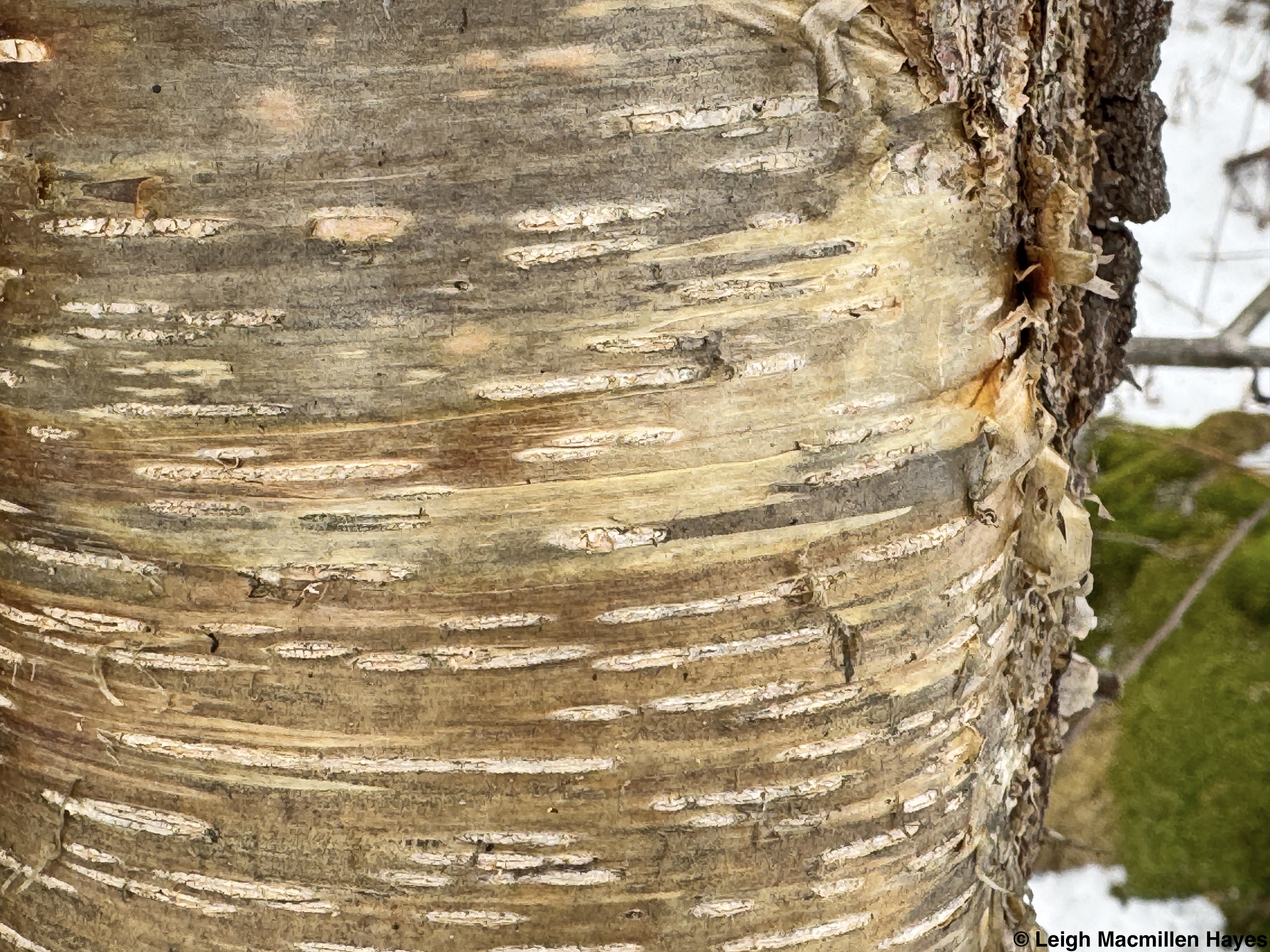
This Yellow Birch has apparently graced this spot on a boulder for many years. And though it looks as if it served as a turning tree during a logging operation about ten years ago, it still stands tall.

In fact, by the amount of catkins at the tips of its branches, it appeared the birch was full of life and love and ready to make more birches in the future.

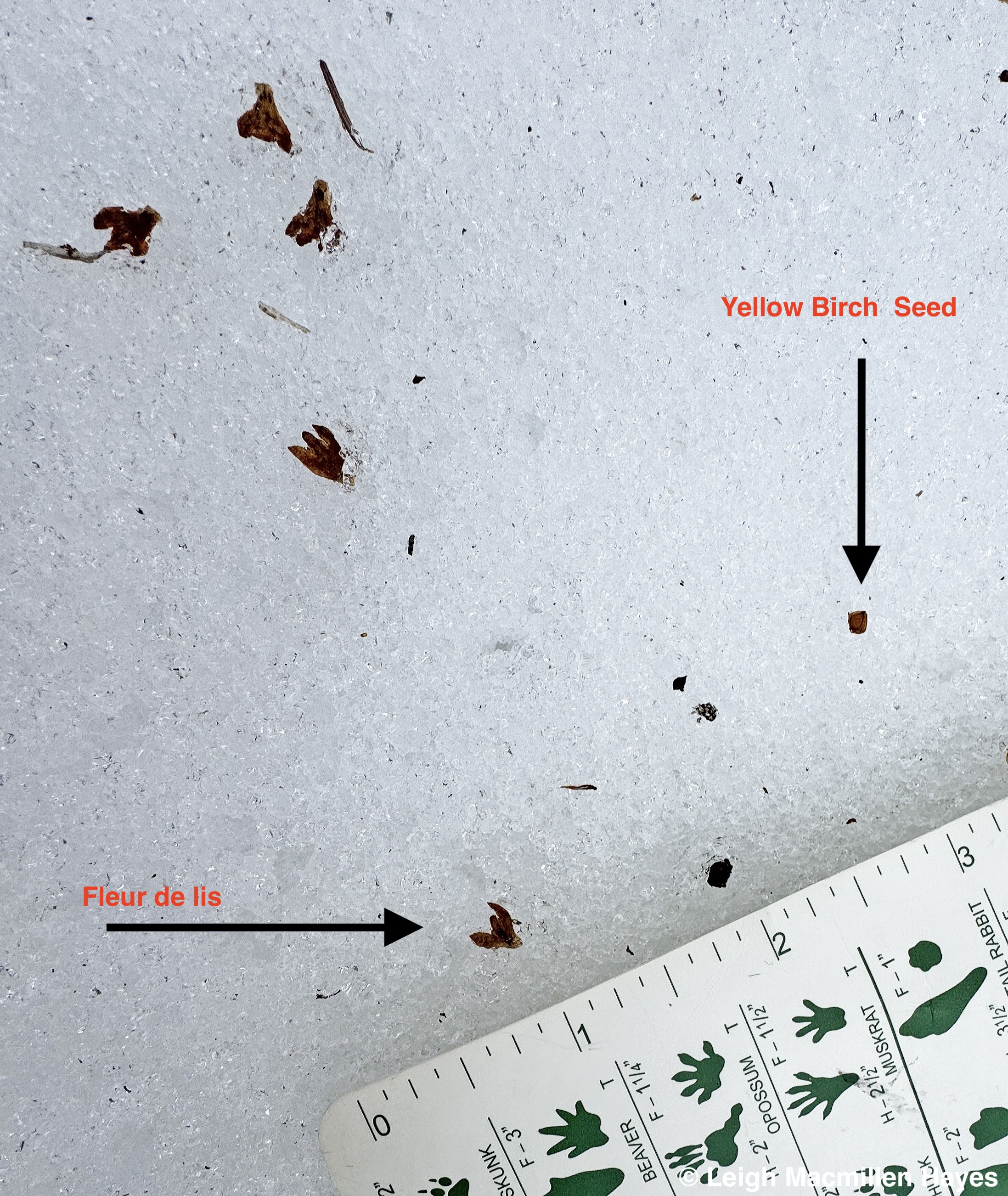
At its feet, fleur de lis scales that protected its tiny seeds had fallen from last year’s pollinated catkins and will eventually break down and add to nutrients to the forest floor.

What I am always wowed by, and today was no different, is the shape of a birch seed–which reminded me of a tiny insect with antennae. A future is stored in that wee structure and maybe this one seed will some day germinate on the boulder below it. Unless a bird eats it first. But then again, maybe it will germinate somewhere else when it comes out in the bird’s scat.

The bark of the birch made me think of landscape paintings I’ve seen from deserts far from this place in western Maine. And I realized I don’t have to go far to travel to other places.

Even as I left the Mother Birch behind, I turned back to see if I could remember it from so many other visits, because certainly it didn’t just appear today. Or did it?

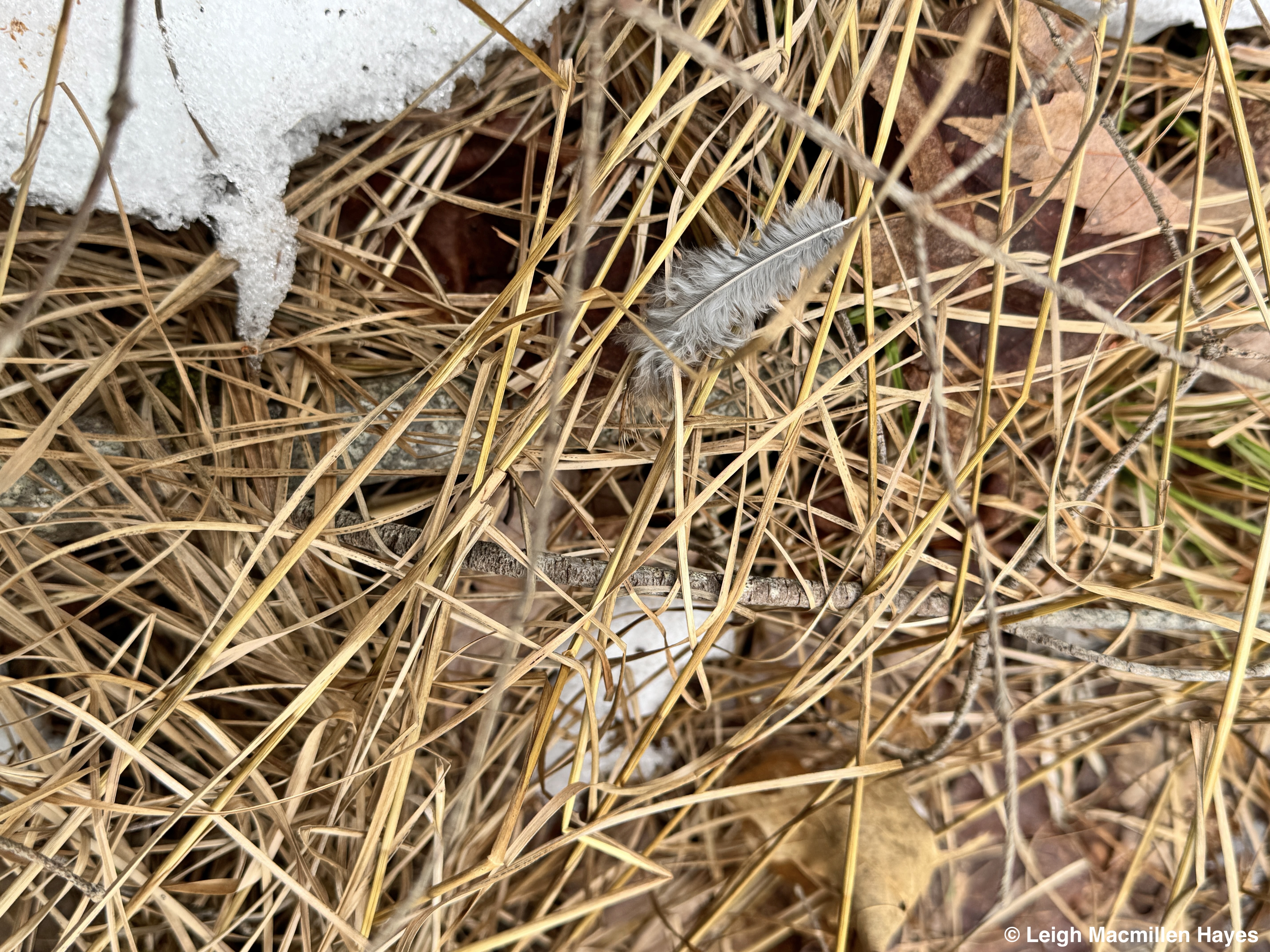
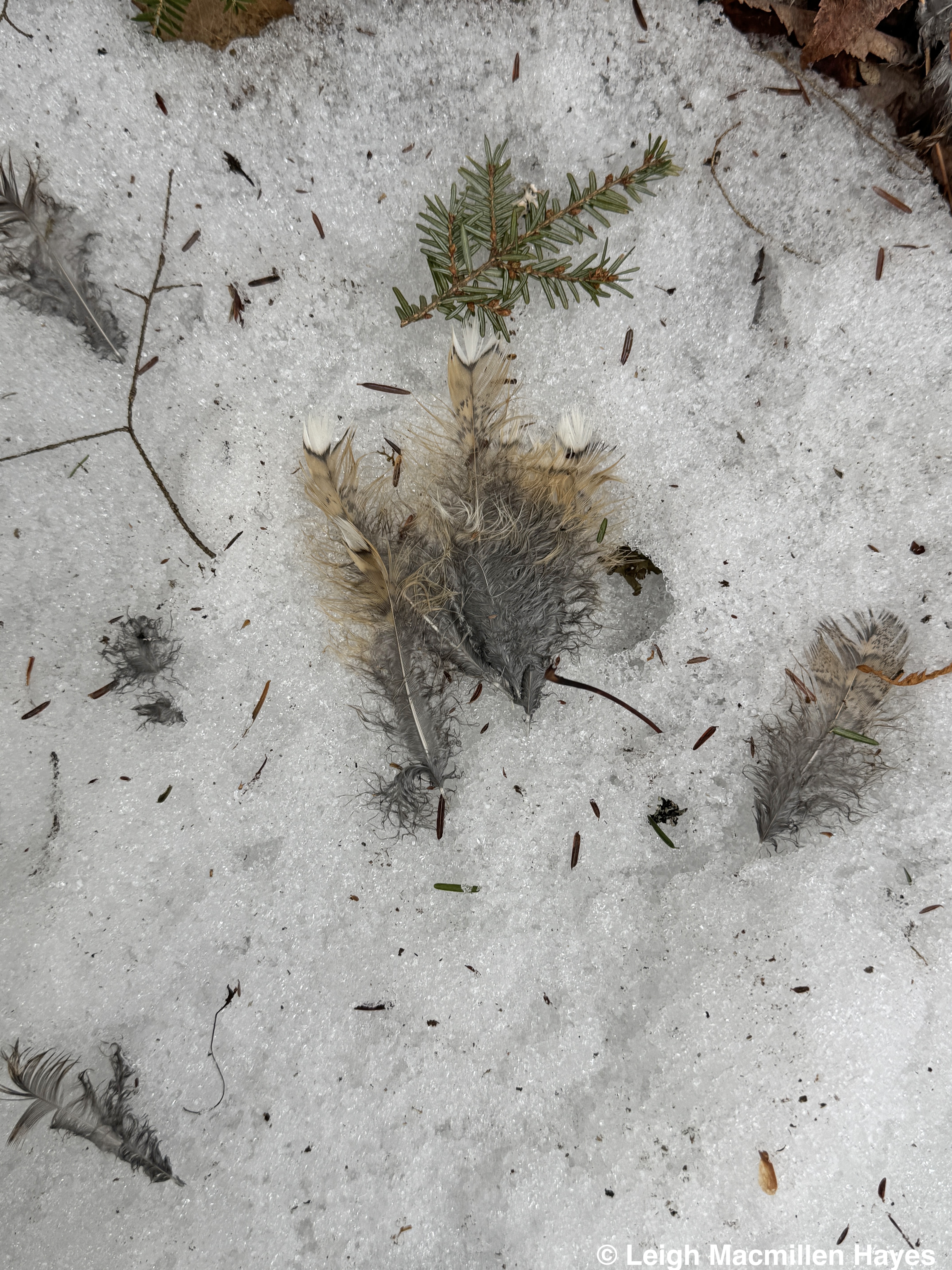
Turning around again, I nearly tripped over a few fallen twigs, but it was what stood out among the dying vegetation covering the twigs that drew my attention. A random feather?

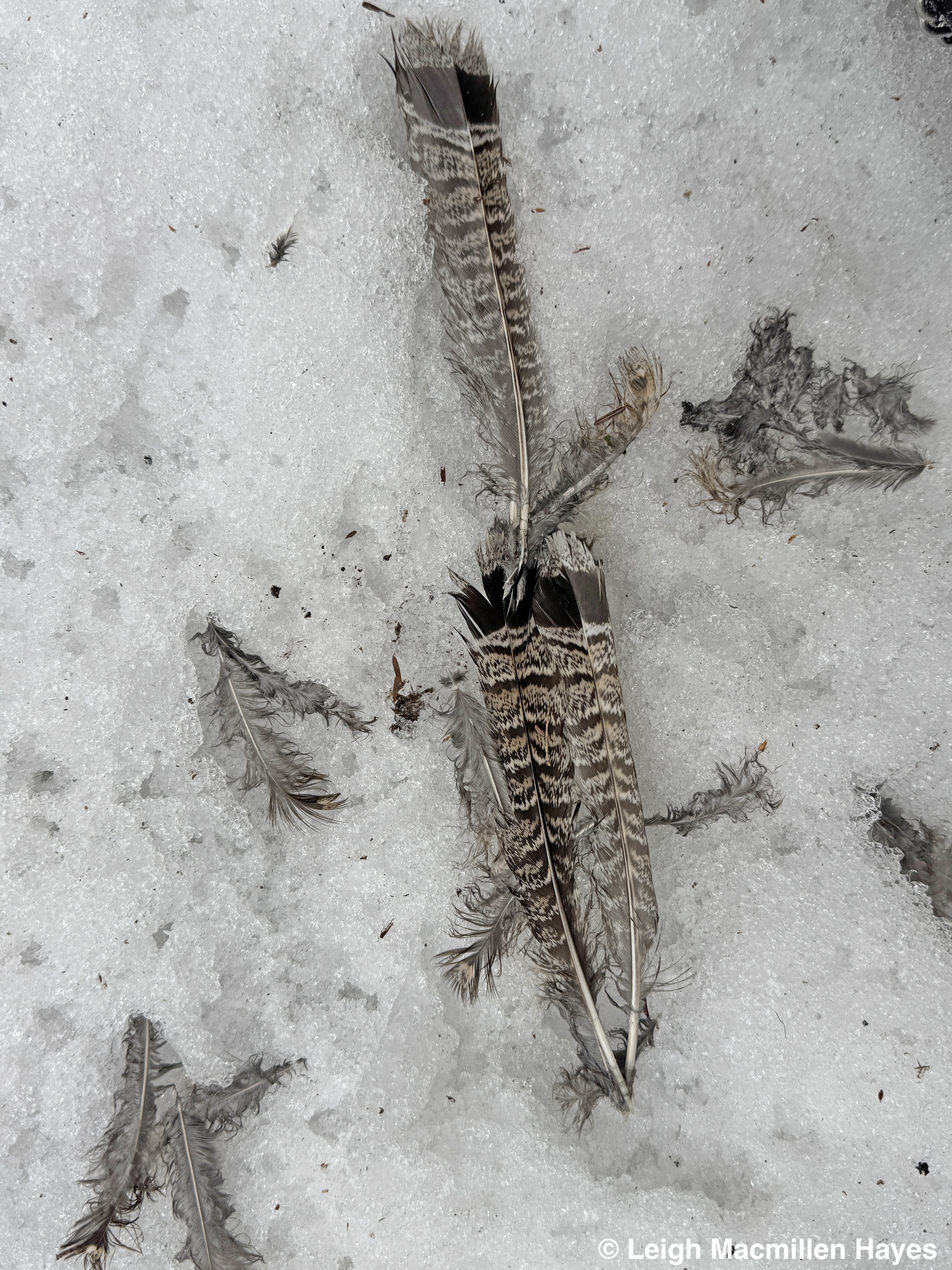
Not at all. I’d stumbled, rather than sauntered, upon a site where a bird had given up its last breath so that another critter could live.

The bird happened to be a Ruffed Grouse, and I had to remind myself not to be sad about the loss because of the joule or energy units procured by another. In its death, sunshine and birch seeds and whatever else the bird had eaten provided sustenance in the form of a gift.

Of course, spotting the Ruffed Grouse’s track did give me pause for I suspected it to be the bird’s last impression.

Moving on toward a former log landing, I smiled again at the sight of another who took a risk of crossing the large forest opening, but knew enough to tunnel under the snow frequently. Was it frequently enough? Voles are everyone’s favorite food. Well, maybe not mine. But I’ve possibly eaten meat from some critter that dined on a vole and so maybe some of its joule had been passed on to me as well.

Frequently on my journey, as often happens in these woods, I encountered the one who greeted me at the start. Well, its footprints greeted me at least. But I always give thanks for such sightings for though Bobcats are solitary and elusive, knowing they are here and that we walk in the same woods and perhaps see and smell the same things makes me happy.

And then it occurred to me. I need to be more like the Bobcat and improve my waiting and watching and listening skills. I’m always in too much of a rush to see what might be next on the agenda. So much for sauntering.

As this last day of autumn 2024 gives way in the wee hours of December 21 to winter, and the sun once again rises in the East, I need to remember to be more like the saunterers. To be alert to offerings. To wait. To watch. To wonder. To learn.

Each day is a new awakening with teachings. Thank God for that.

The Secret Giver of Gifts 2024

Being St. Nicholas Day, the day to honor the 4th century bishop from Myra who is the patron saint of children and sailors, I was reminded of a time when our youngest asked, “Mom, are you Santa?”

If you feel like you’ve read this before, rest assured. You have. But I love this story and so here it is again.

He’d held onto the belief for far longer than any of his classmates. And for that reason, I too, couldn’t let go. And so that day as we drove along I reminded him that though the shopping mall Santas were not real, we’d had several encounters that made believers out of all of us.

The first occurred over thirty years ago when I taught English in Franklin, New Hampshire. Across the hall from my classroom was a special education class. And fourteen-year-old Mikey, a student in that class, LOVED Santa.

Each year the bread deliveryman dressed in the famous red costume when he made his final delivery before Christmas break. To Mikey’s delight, he always stopped by his classroom. That particular year, a raging snowstorm developed. The bread man called the cafeteria to say that he would not be able to make the delivery. School was going to be dismissed after lunch, but we were all disappointed for Mikey’s sake.

And then  . . . as the lunch period drew to a close, Santa walked through the door and directly toward Mikey, who hooted with joy as he embraced the jolly old elf. As swiftly as he entered, Santa left. I have no doubt that that was Santa.

And about nineteen years ago, as the boys sat at the kitchen counter eating breakfast on Christmas Eve morning, we spotted a man walking on the power lines across the field from our house. We all wondered who it was, but quickly dismissed the thought as he disappeared from our view, until . . . a few minutes later he reappeared. The second time, he stopped and looked in our direction. I grabbed the binoculars we kept on the counter for wildlife viewings. The man was short and plump. He wore a bright red jacket, had white hair and a short, white beard. The boys each took a turn with the binoculars. The man stood and stared in our direction for a couple of minutes, and then he continued walking in the direction from which he’d originally come. We never saw him again. I have no doubt that that was Santa.

Another incident occurred about seventeen years ago, when on Christmas Eve, our phone rang. The unrecognizable elderly male voice asked for our oldest son. When I inquired who was calling, he replied, “Santa.” He spoke briefly with both boys and mentioned things that they had done during the year. I chatted with him again before saying goodbye. We were all wide-eyed with amazement. I have no doubt that that was Santa.

Once I reminded our youngest of those stories, he dropped the subject for the time being. I knew he’d ask again and I also knew that none of us wanted to give up the magic of anticipation for those special moments we know as Christmas morning, when the world is suddenly transformed.

I also knew it was time he heard another story–that of Saint Nicholas, the Secret Giver of Gifts. It goes something like this . . .

The nobleman looked to Heaven and cried, “Alas. Yesterday I was rich. Overnight I have lost my fortune. Now my three daughters cannot be married for I have no dowry to give. Nor can I support them.”

For during the Fourth Century, custom required the father of the bride to provide the groom with a dowry of money, land or any valuable possession. With no dowry to offer, the nobleman broke off his daughters’ engagements.

“Do not worry, Father. We will find a way,” comforted his oldest daughter.

Then it happened. The next day, the eldest daughter discovered a bag of gold on the windowsill. She peered outside to see who had left the bag, but the street was vacant.

Looking toward Heaven, her father gave thanks. The gold served as her dowry and the eldest daughter married.

A day later, another bag of gold mysteriously appeared on the sill. The second daughter married.

Several days later, the father stepped around the corner of his house and spied a neighbor standing by an open window. In shocked silence, he watched the other man toss a familiar bag into the house. It landed in a stocking that the third daughter had hung by the chimney to dry.

The neighbor turned from the window and jumped when he saw the father.

“Thank you. I cannot thank you enough. I had no idea that the gold was from you,” said the father.

“Please, let this be our secret,” begged the neighbor. “Do not tell anyone where the bags came from.”

The generous neighbor was said to be Bishop Nicholas, a young churchman of Myra in the Asia Minor, or what we call Turkey. Surrounded by wealth in his youth, Bishop Nicholas had matured into a faithful servant of God. He had dedicated his life to helping the poor and spreading Christianity. News of his good deeds circulated in spite of his attempt to be secretive. People named the bishop, “The Secret Giver of Gifts.”

s-stockings

Following Bishop Nicholas’ death, he was made a saint because of his holiness, generosity and acts of kindness. Over the centuries, stockings were hung by chimneys on the Eve of December 6, the date he is known to have died, in hopes that they would be filled by “The Secret Giver of Gifts.”

According to legend, Saint Nicholas traveled between Heaven and Earth in a wagon pulled by a white steed on the Eve of December 6. On their doorsteps, children placed gifts of hay and carrots for the steed. Saint Nicholas, in return, left candy and cookies for all the good boys and girls.

In Holland, Saint Nicholas, called Sinterklaas by the Dutch, was so popular for his actions, that the people adopted him as their patron saint or spiritual guardian.

Years later, in 1613, Dutch people sailed to the New World where they settled New Amsterdam, or today’s New York City. They brought the celebration of their beloved patron with them to America.

To the ears of English colonists living in America, Sinterklaas must have sounded like Santa Claus. Over time, he delivered more than the traditional cookies and candy for stockings. All presents placed under a tree were believed to be brought by him.

Santa Claus’ busy schedule required he travel the world in a short amount of time. Consequently, as recorded in Clement Moore’s poem, “The Night Before Christmas,” a sleigh and eight tiny reindeer replaced the wagon and steed.

Since Saint Nicholas was known for his devout Christianity, the celebration of his death was eventually combined with the anniversary of Christ’s birth. December 24th or Christmas Eve, began to represent the Saint’s visit to Earth.

Traditionally, gifts are exchanged to honor the Christ Child as the three Wise Men had honored Him in Bethlehem with frankincense, gold and myrrh.

One thing, however, has not changed. The gifts delivered by Saint Nicholas or Santa Claus, or whomever your tradition dictates, have always and will continue to symbolize the love people bear for one another.

Though they are now adults, my continued hope for my sons is that they will realize the magic of Christmas comes from the heart and that we all have a wee bit of Santa in us. Yes, Patrick, Santa is real.

May you continue to embrace the mystery and discover wonder wherever you look. And may you find joy in being the Secret Giver of Gifts.

Snow–Bugs and Flakes

Betwixt. Between. Be flowers. Be bugs. Be glad for there is so much to wonder about in the natural world. And I don’t even know the half of it. But I wouldn’t be happy if I wasn’t always learning.

It was 28˚ when I awoke this morning. Late this afternoon on this brilliant sunlight day, with temps at least 30˚ warmer, I walked out through our woodlot to the right and then looked back across the neighbor’s field toward our house, taking in the sea of seedheads and I was sure my insect hunting days had come to an end.

But much to my surprise, and really, I shouldn’t have been surprised, the chirps of crickets and grasshoppers, like this Red-legged example, filled the air. I might not have seen the grasshoppers if they hadn’t flown to a new spot occasionally, for so camouflaged are they in the current setting. Or always.

And then, much to my delight, I noticed a Saffron-winged Meadowhawk flying low and making frequent stops, allowing me to do the same. We live in a wet area, but still, I’m often surprised by some of species I meet here.

From the field, I decided to continue along the power line that crosses our property and the neighbor’s and many more beyond that and as I’d told my friend Meg from North Carolina the other day–Mount Washington, our mighty New England Rock Pile, is at the far end and it looks like we could walk right to it. Give or take a few days–or drive there in about an hour.

It’s along the path below the lines that I discovered Cotton-grass, which is a sedge, with its fluffy little heads speaking to the bogginess of this area.

Cottongrasses self-pollinate, their flowers being “perfect,” given that each contains both male (stamen) and female (carpel) parts. And the seeds are attached to parachutes waiting for a breeze (or animal) to move them to a new home.

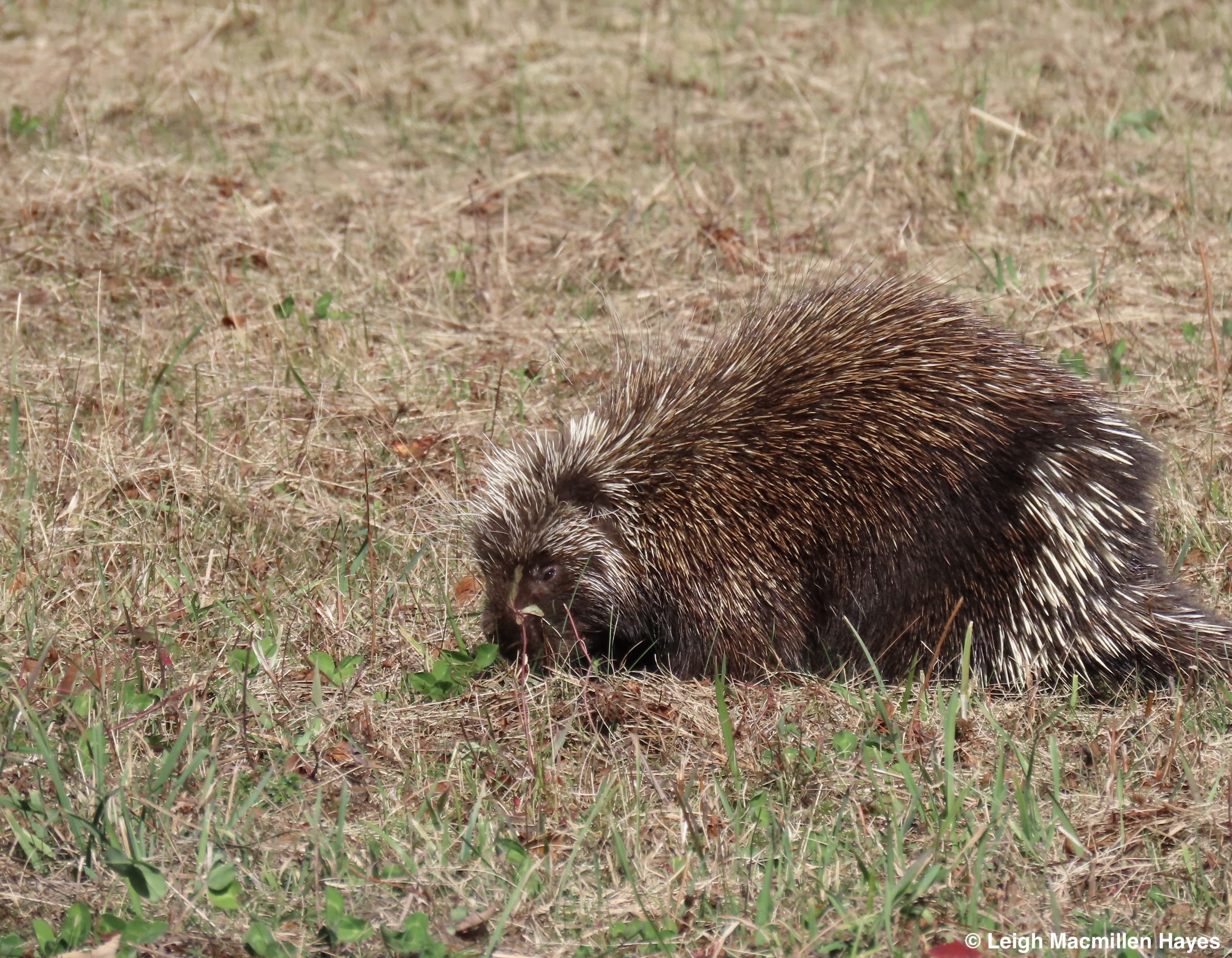
Spotting the curly, cottony-hairs reminded me of the belly hairs of porcupines, which of course, reminded me of the Porky some friends and I spotted in another field in town yesterday. The time is coming when these critters, whom I’ve come to adore, will transition from life in the field to life in forest trees.

Last November I wrote about this particular porcupine, Bandit, whom I met in our yard, along the same route I began today’s journey. Perhaps soon, we will meet again.

Getting back to today’s story, I left the power line, and headed out an old logging trail that I tend to frequent most often in the winter. But it was sunny, and I was enjoying that warmth, and wondered what else I might spy along the way.

For starters, there were the “dried” Pearly Everlasting Flowers, which I should have gathered because they do dry so well. Instead, I just admired them.

And I had frequent encounters with more Saffron-winged Meadowhawks, flying much like White Corporal Skimmers in early spring–always landing and then moving a couple of feet ahead of me whenever I made a move.

Helping with ID of this species, are the fine black lines in the sutures of the abdomen. And the red stigma toward the tip of each wing is outlined in black. Otherwise, I might confuse it for an Autumn Meadowhawk.

I also had the pleasure of meeting a female Shadow Darner, but then I went to offer a finger for her, thinking she might want to take advantage of my body heat, and instead she tried to bite me. So, I let her be and we went our own ways.

At a former log landing, Juncos were on watch, and given how much seed is available, I know they’re mighty happy with the current conditions. It seems like they just arrived in the past week or so, but the good news is that many will overwinter here.

Oh and a few will fly to Connecticut so that my dear friend, Kate, can watch them as well.

Being an old logging road and log landing, conditions were apparently ideal this past summer, and I paused for a moment to admire forest succession, with grasses and herbs forming the floor, and more grasses and sedges growing taller, topped by Gray Birch, and a backdrop of Red Maples, and Big-tooth Aspen, and Paper Birch.

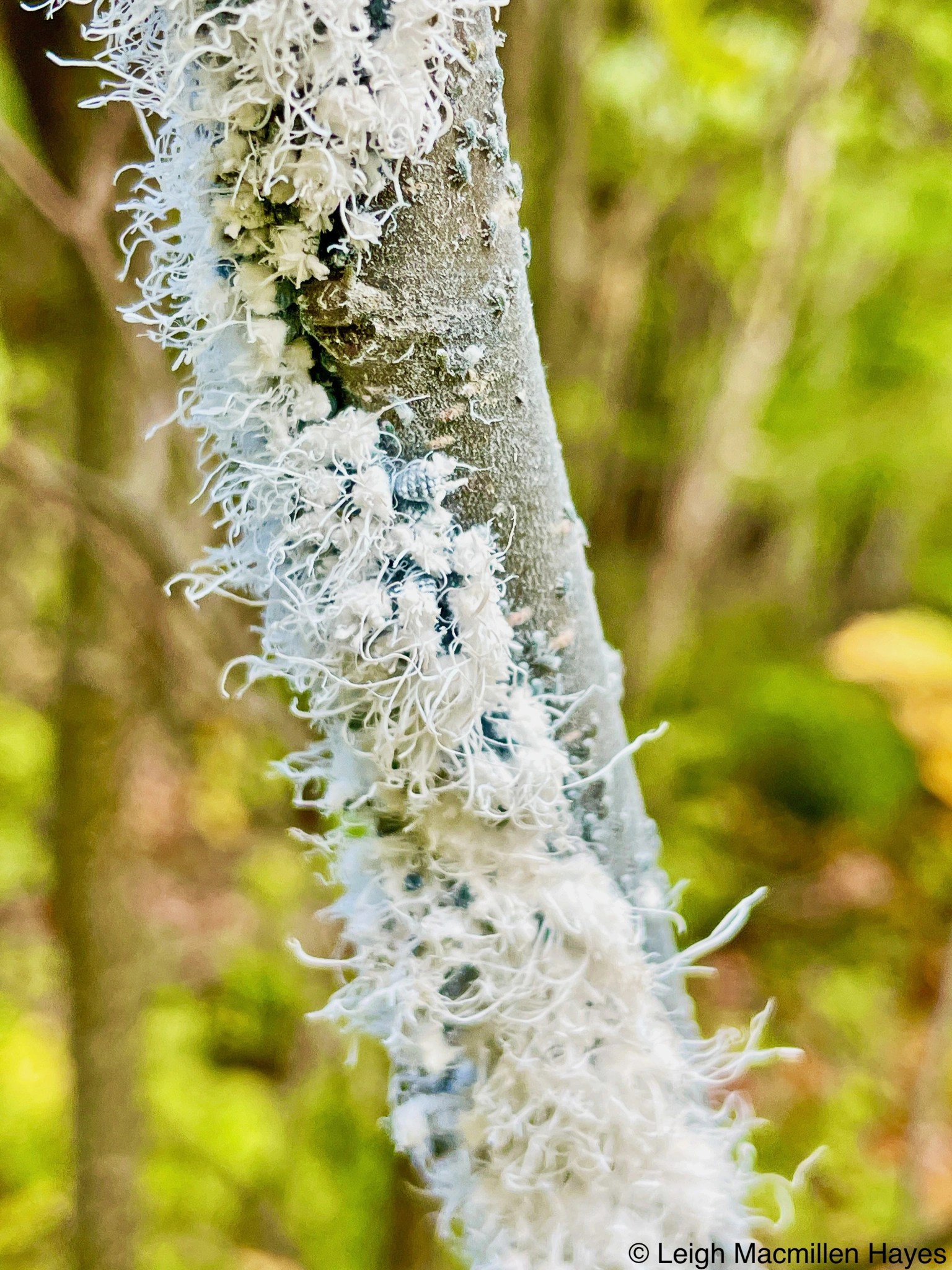
And then it was back to the now dry bed of a stream crossing where Speckled Alder shrubs are closing in on the trail, and Woolly Alder Aphids are living their best life seeking sap from the woody plants.

That Cotton Candy or even Cotton-grass look is actually a waxy material they produce from their abdomens, and when they group together like this, perhaps its meant to detract visitors. Or protect them from the weather. Had a I visited on a summer day, I’m sure I would have spotted ants trying to tickle them (it’s called farming) to take advantage of the honey dew the aphids secrete.

Speckled Alder Aphids live an interesting life style. Actually, according to Donald W. Stokes in his book, A Guide to Observing Insect Lives, “There are two life cycles in this species. In one, the aphids remain on alder trees throughout their lives. They are believed to overwinter as adults in the leaf litter at the base of an alder. In spring, they crawl up the plant and feed on its sap. There are several generations per year and adults of the last generation overwinter.

In the other life cycle, the aphids alternate between two plants. The aphids overwinter as eggs placed on maple twigs. In the spring they hatch into females, which feed on the undersides of maples leaves and reproduce. They are wingless, but in midsummer produce winged offspring, also females, which fly to alders. These females feed and reproduce on alders, and give birth to wingless young. Then in the late fall, they produce winged young, which fly back to maples and give birth to both male and female young. The males and females mate, and each fertilized female lays a single egg on a maple twig. Only the eggs overwinter.”

It’s things like this that add to my sense of wonder. Two life cycles? The adults of one life cycle overwinter while the eggs of the other are do the same? That’s amazing.

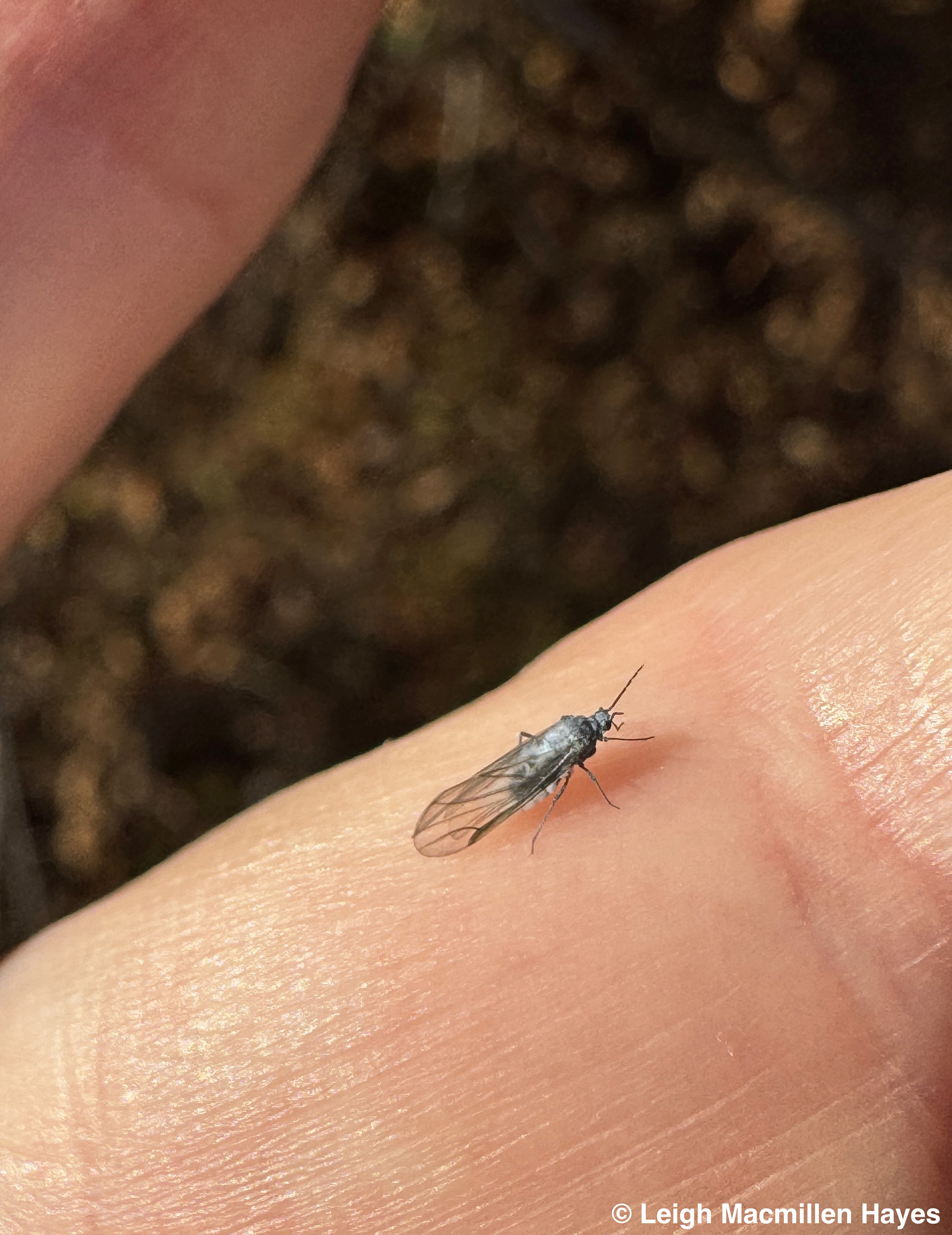
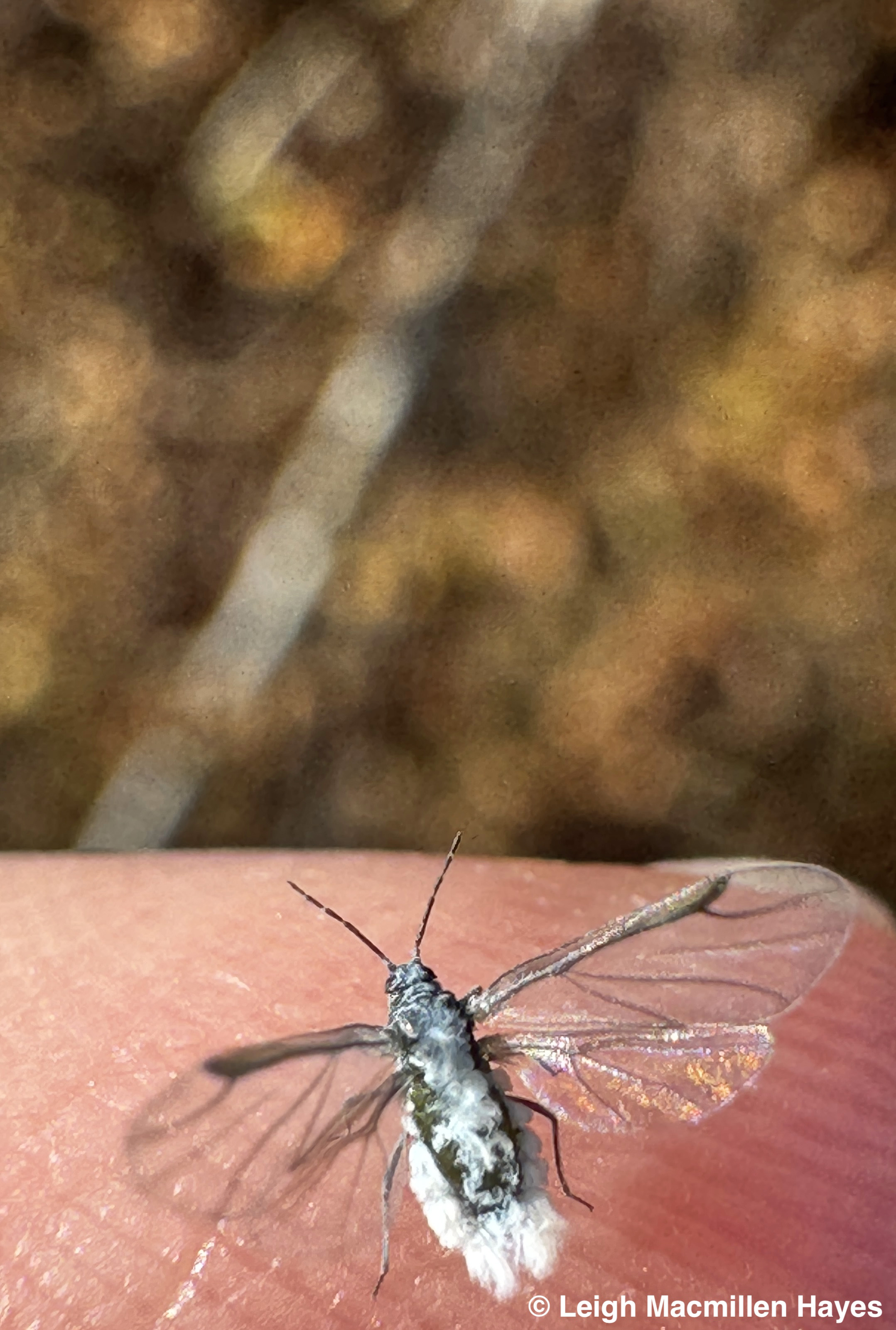
And on the fly in a bit of abundance right now for I saw a bunch today and I’ve been seeing them along many trails that I hike, are the flying aphids. If you stick your hand out and cup it, you can get one to land.

Don’t worry, they don’t bite. And they don’t even tickle, despite that waxy hair.

They’re actually kinda beautiful in their own way and as they fly they look like tiny flakes of snow, thus some refer to them as Snow Bugs.

So I have two forever-friends-since-birth and I’ve already referred to Kate earlier in this blog because she is a great lover of Juncos, along with everything else in the natural world, and so is her sister, Patty, who once told this joke when we were kids:

Q: What’s white and goes up?

A. A dumb snowflake.

One of these two is eleven months younger than me and the other is eleven months older and she and I just chatted yesterday and I’m so thankful to have them in my life all these years. Yes, B.S., I am also incredibly thankful to have you in my life.

But once again I digress. Except I had to tell that joke. Because it kinda reminds me of the aphids in flight.

Back to the power line, I decided to pull the Mighty Mount Washington in with the telephoto lens. Yes, dear readers, that is snow! Several inches of the white stuff has fallen over the last few days. And there is rime ice.

My favorite season is only a walk down the power line away.

Snow: Bugs and Flakes. It’s all wonder-filled.

My Artistic Path

In a way, this is A Lost Art Found continued. It’s the rest of the story, at least to this date.

Once I got hooked on painting, I couldn’t stop. What I’ve discovered is that it’s a lot like writing. You choose a topic, which for me so far has been from a photograph I’ve taken as I’m afraid to purchase an easel and try plein air; complete an outline or at least jot down notes to get an idea of where you are going with the topic in the form of a values sketch; choose how to frame the story whether upon watercolor paper or canvas, and the media being watercolors, acrylics, or gouache; begin a first draft of sketching a wee bit on the mat of choice and apply a light colored wash; paint the basic shapes to get the story on paper which may be more representational than factual; and then tweak, tweak, tweak, which sometimes takes me eighteen drafts to get to a publishable product, and even then, I know more changes can be made.

But here’s the thing. I’m brand new to this art form. And thanks to Jessie, my teacher/mentor, I’ve learned a lot and still have more to learn. Then what’s the thing? The thing is that in every painting I’ve completed so far, there’s plenty I can critique, but at least one thing that I like and so that’s what I want to focus on. The rest I can learn . . . down the road.

After our spring session of classes ended, I decided to keep going on my own.

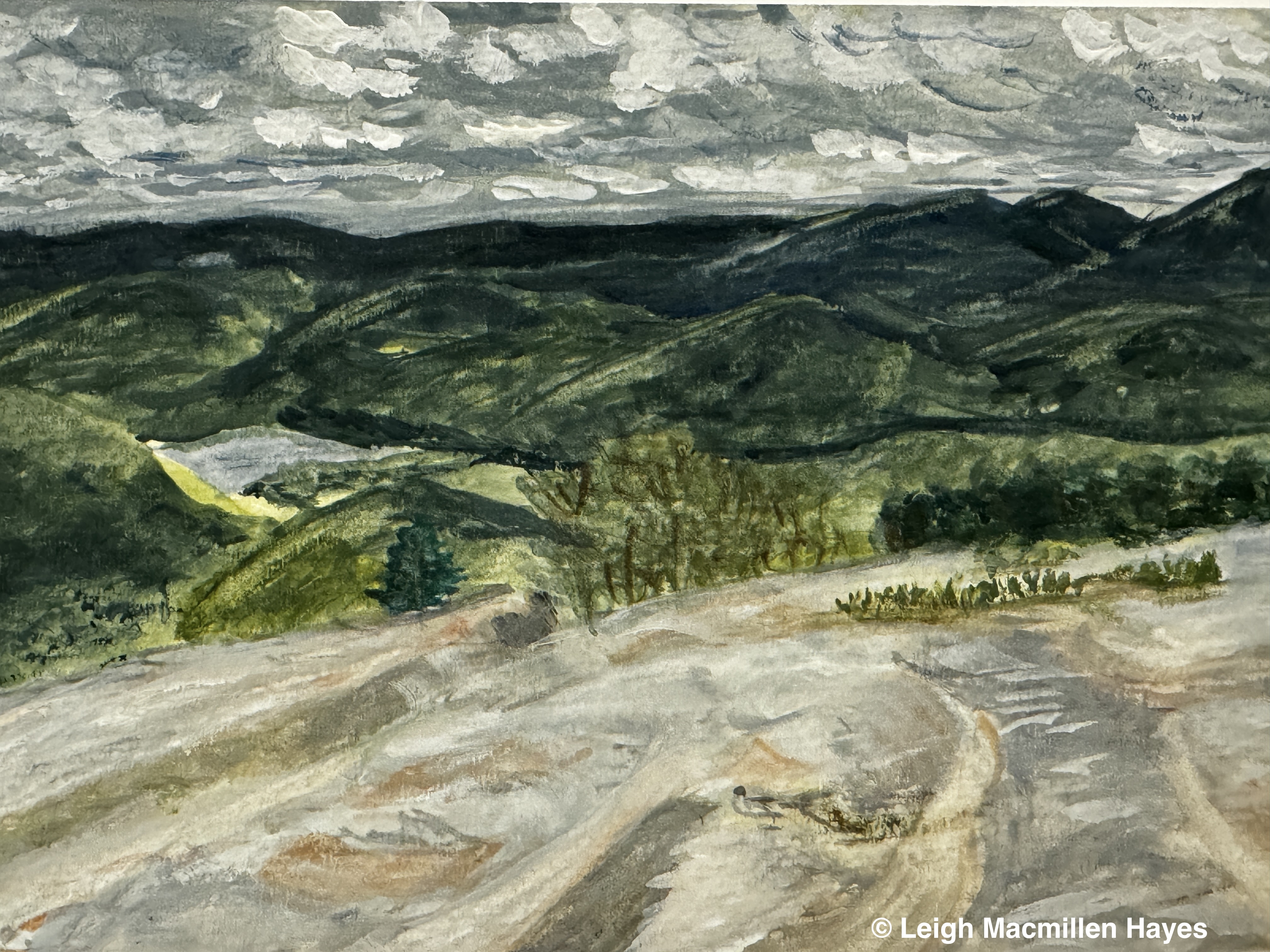
The view from the summit of Blueberry Mountain, Evans Notch, New Hampshire, looking toward Shell Pond below and the mountains beyond. My fav: the shape of the pond.

Frenchmen’s Hole in Newry, Maine. My fav: the color of the water, darker in the depths and lighter as if flowed over rocks to the next fall.

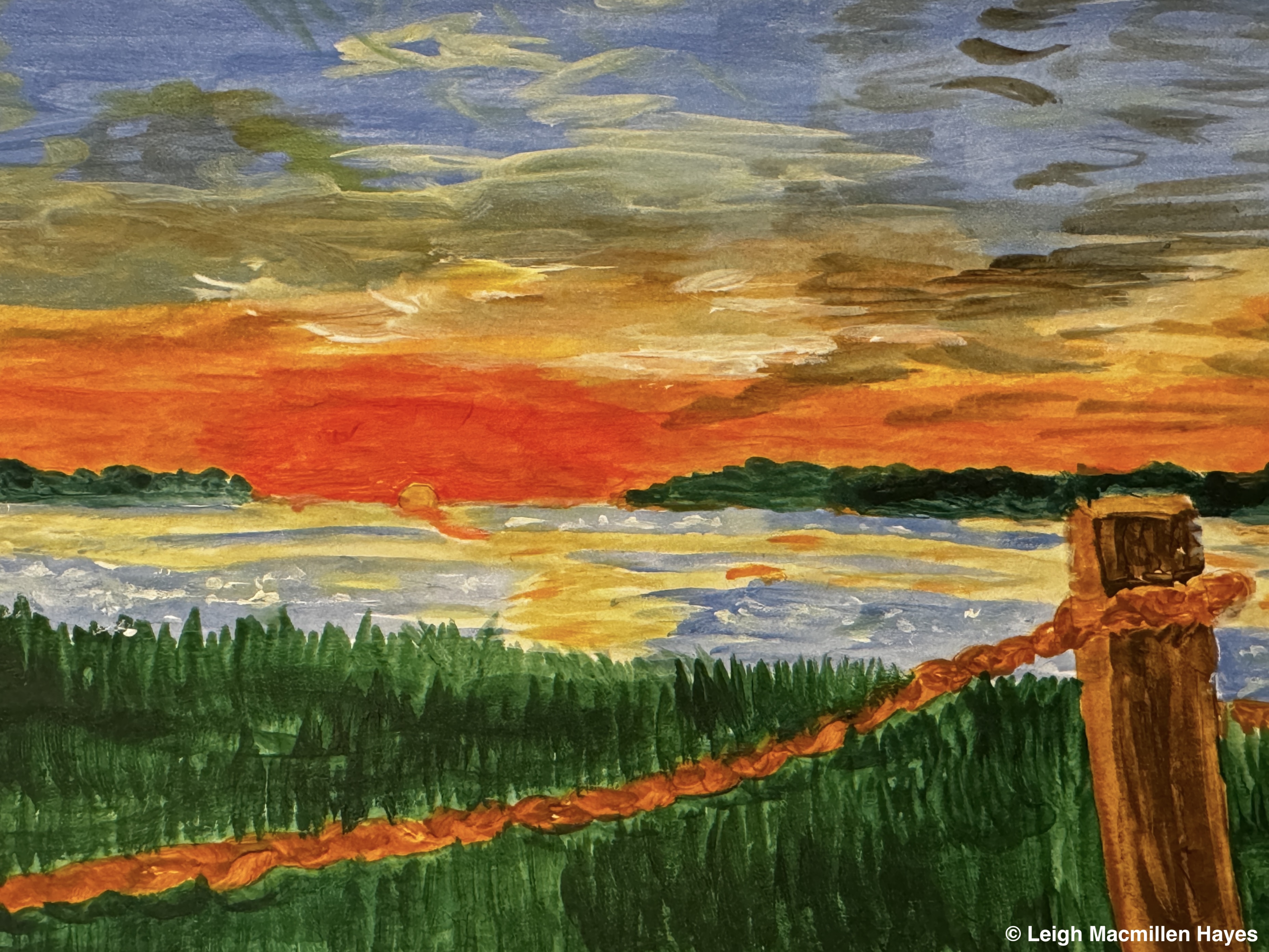
Sunrise, Lubec, Maine. My fav: the rope in the foreground. And the sky.

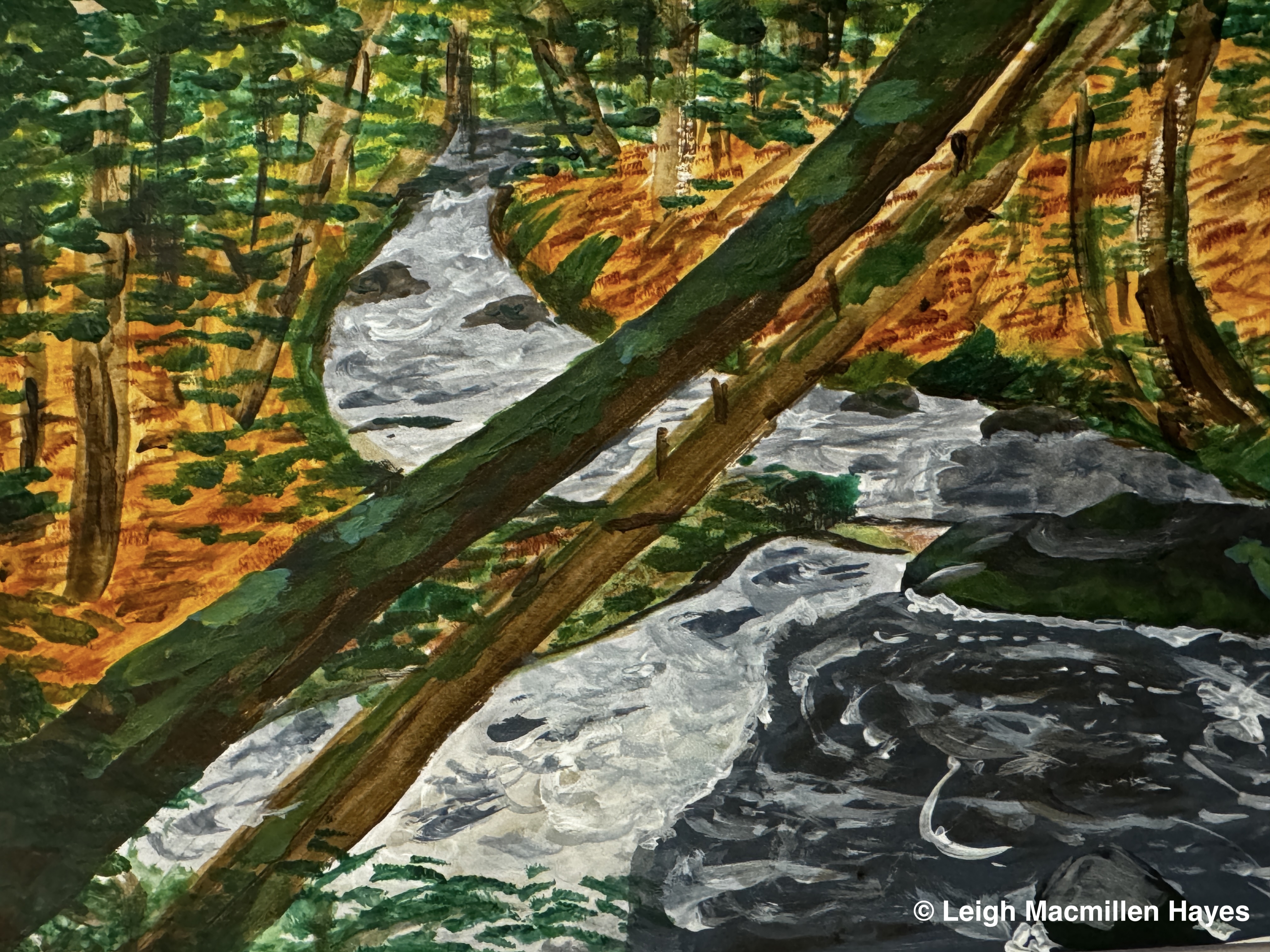
Carsley Brook, Lake Environmental Association’s Highland Research Forest, Bridgton, Maine. My fav: the trees leaning across the brook.

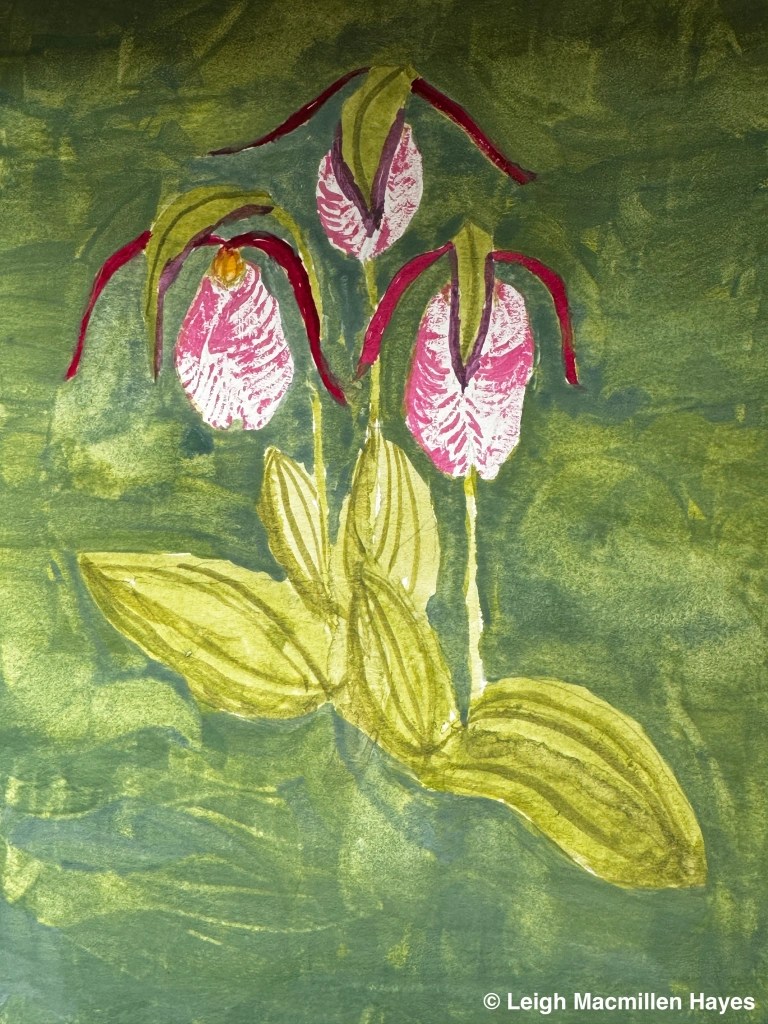
Lady’s Slippers from any of our counts as a gift for My Guy, who I’ve learned only likes to count them when they are in bloom. Since that season, he can’t be bothered to note the leaves or occasional seed pods and is praying it snows soon so I won’t continue to point them out. My fav: the shape of the flowers.

The fire tower at the summit of Pleasant Mountain. My fav: a sense of perspective with the mountains.

All of these were watercolor paintings. And then . . .

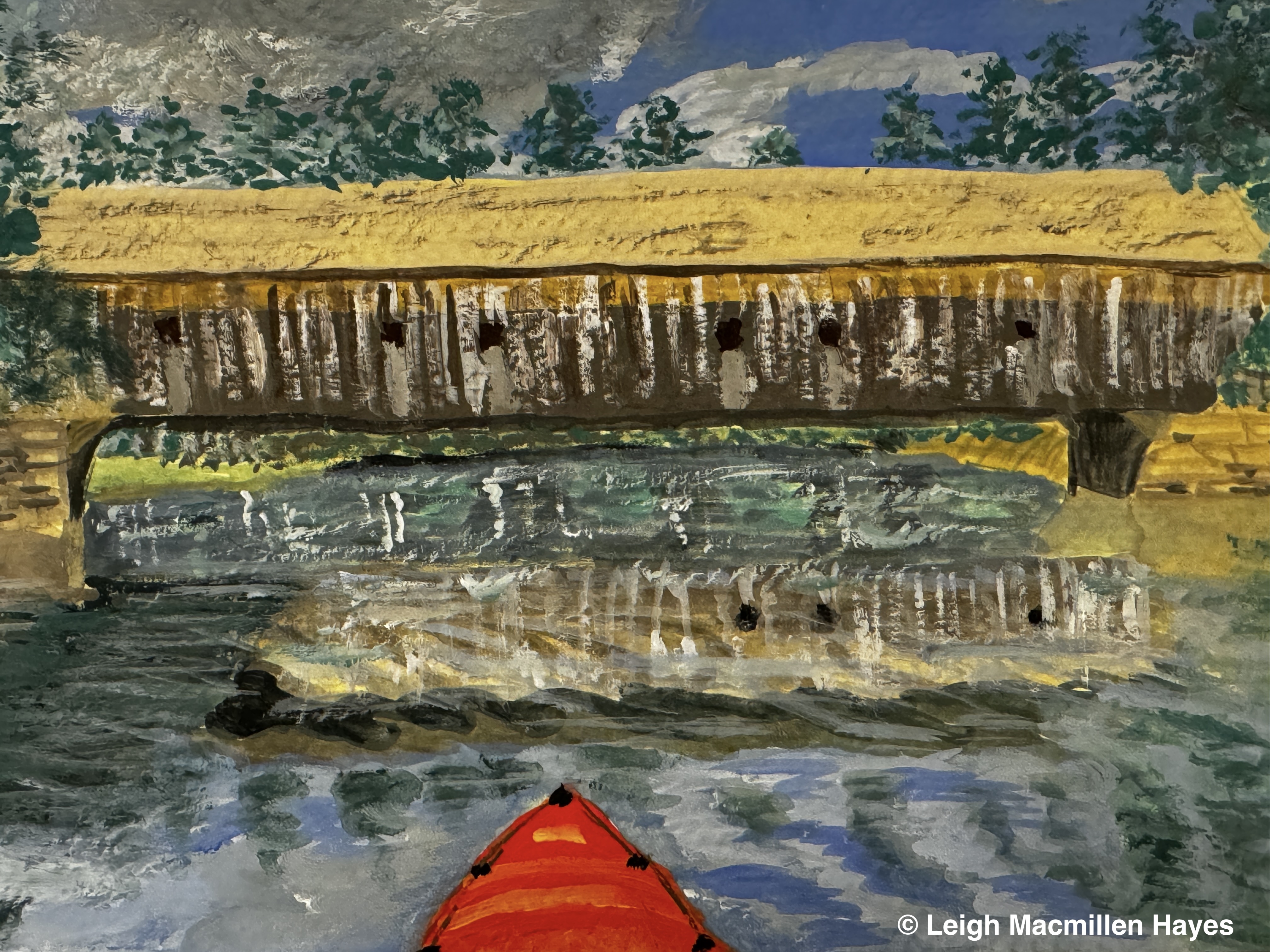
I purchased some gouache and painted Hemlock Covered Bridge. My fav: the bridge and the reflection, but also the lesson that this was a bit like completing a paint by number as I broke it up into different sections.

Fall reflection cropped from a river scene. My fav: All of it. It was like painting a jigsaw puzzle. And i loved creating the wavy lines.

Winter along Heald Pond Road, Lovell, Maine. The interesting thing is that this barn was taken down a few weeks after I painted this scene. My fav: the barn boards and the snow. And my learning–painting the lower background before adding the foreground trees.

Our barn at Christmas. My fav: The reflection in the window.

Interior of Hemlock Covered Bridge in Fryeburg, Maine. My fav: sense of perspective.

Sunlit part of spider web inside Hemlock Covered Bridge on mat canvas. My fav: texture of the boards and light between boards.

Bob Dunning Memorial Bridge, Pondicherry Park, Bridgton, Maine. My fav: the different beams that provide support as each represents a different species of native wood.

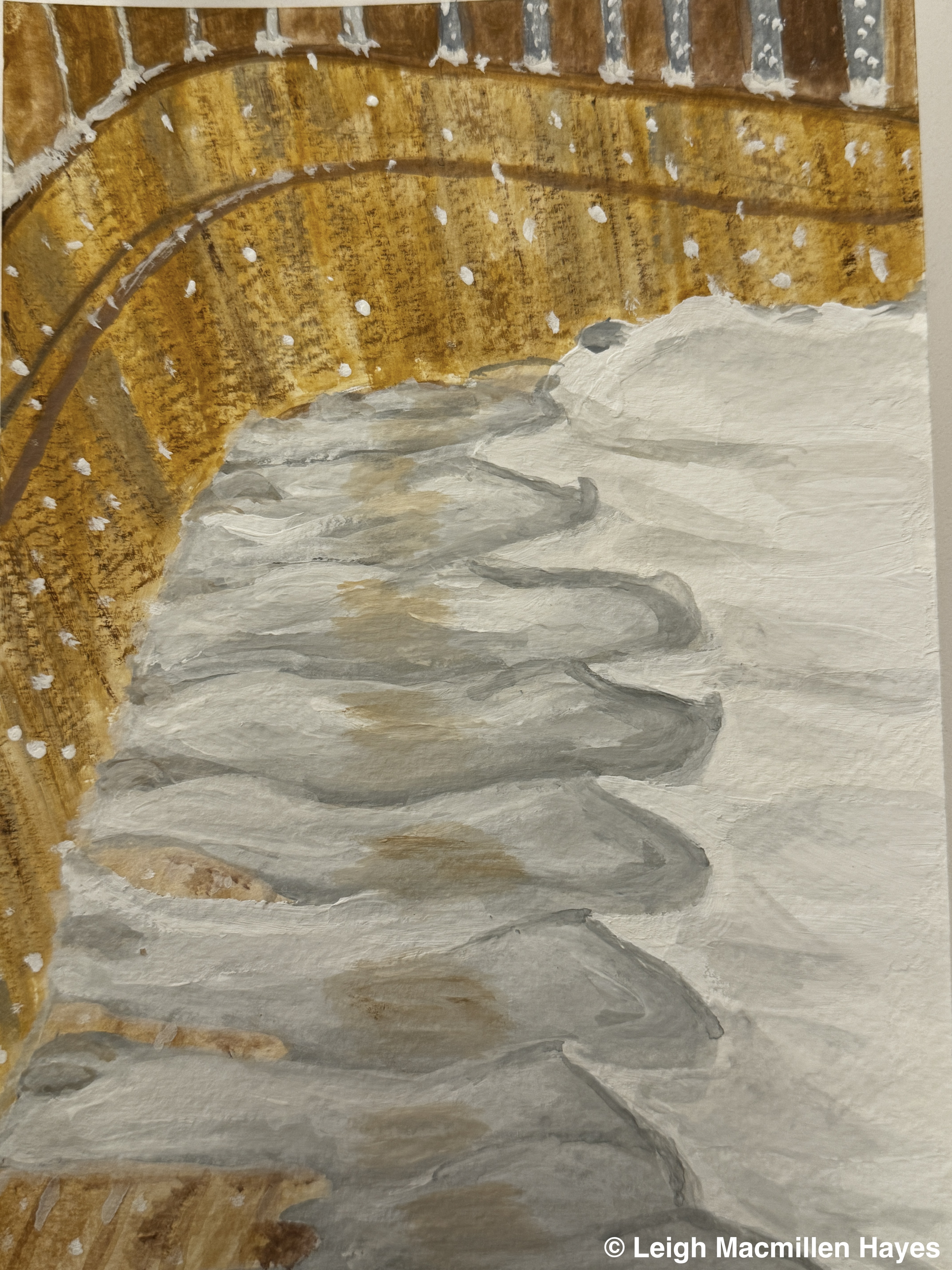
Approaching Bob Dunning Memorial Bridge on a snowy day when no one else had yet entered Pondicherry Park in Bridgton, Maine. My fav: the bend in the bridge.

Beaver at Albany Mountain trail, Bethel, Maine. My fav: the beaver’s face.

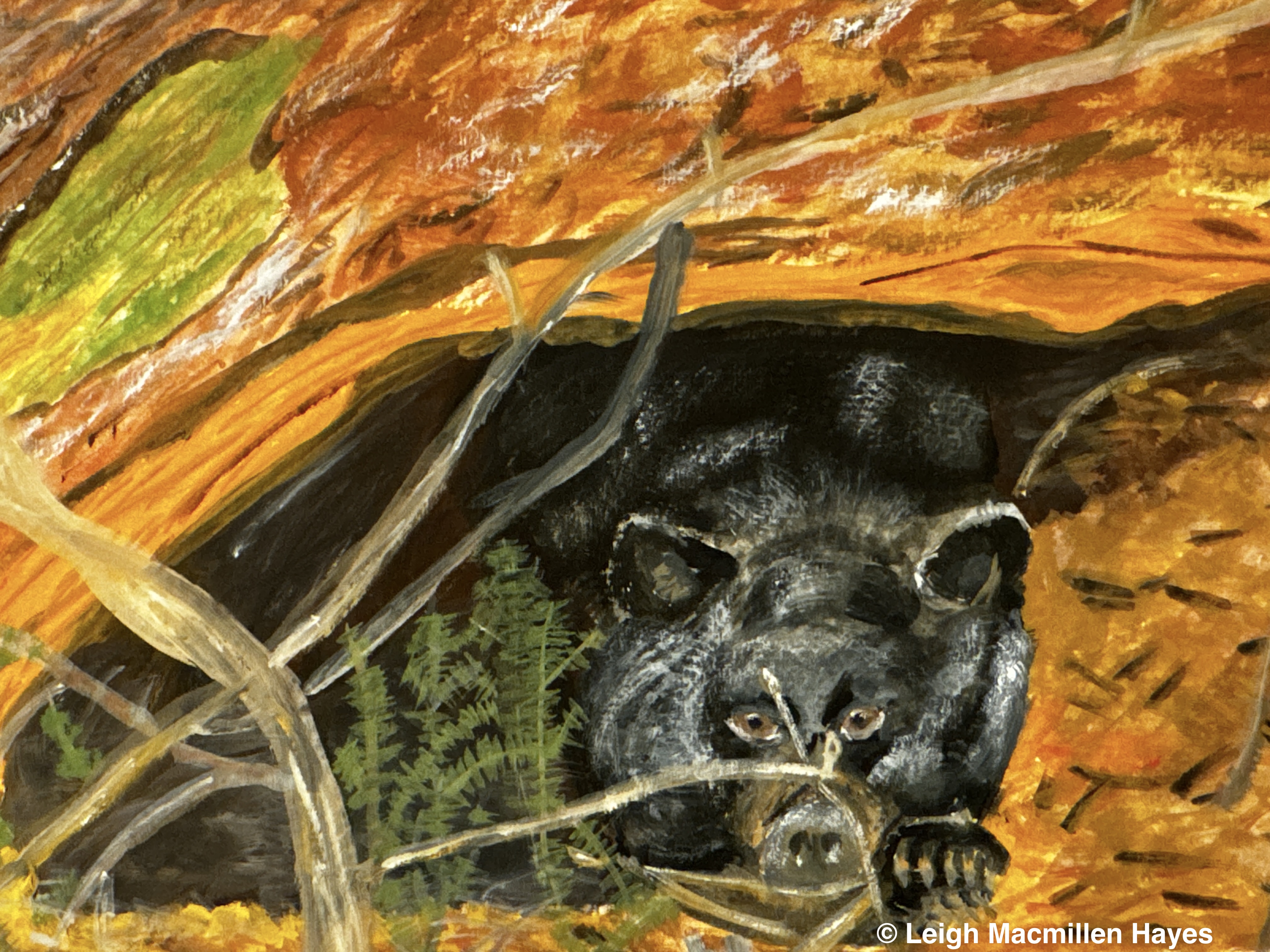
Denning Black Bear. Location a well-kept secret. My fav: the eyes.

Painted Turtle, Moose Pond, Maine. On mat canvas. My fav: colors of the water.

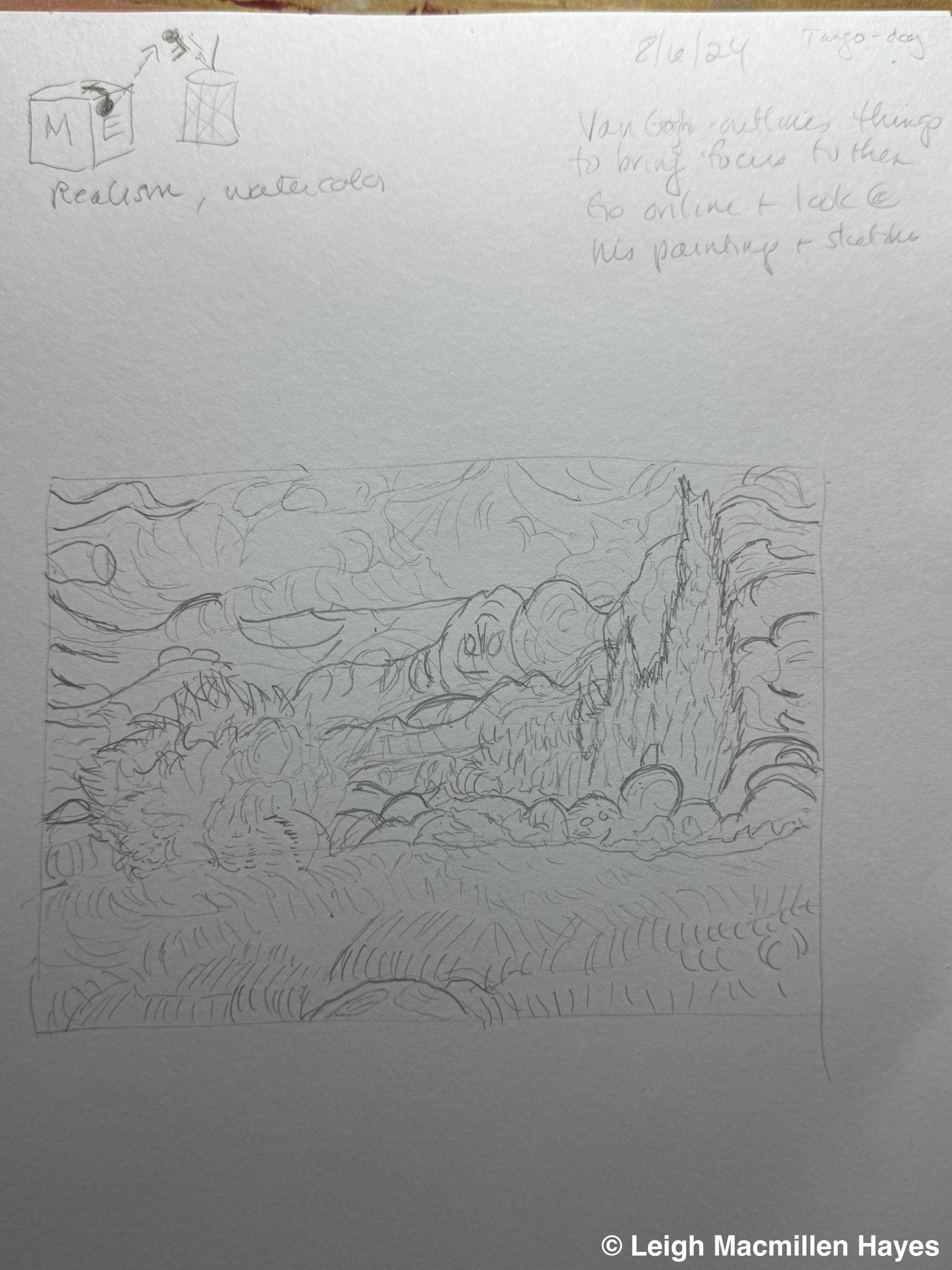
In August, Jessie offered a second class and we had to stuff our art critics in a box in the upper corner of the paper and leave them locked inside and then jot down what we wanted to work on for this session. She also had us take a look at Van Gogh’s style of outlining and bringing focus together.

And then, from a photo of our own, we tried to emulate the famous artist. This was a rough draft that I never finished. My fav: I love the colors and simplicity of it.

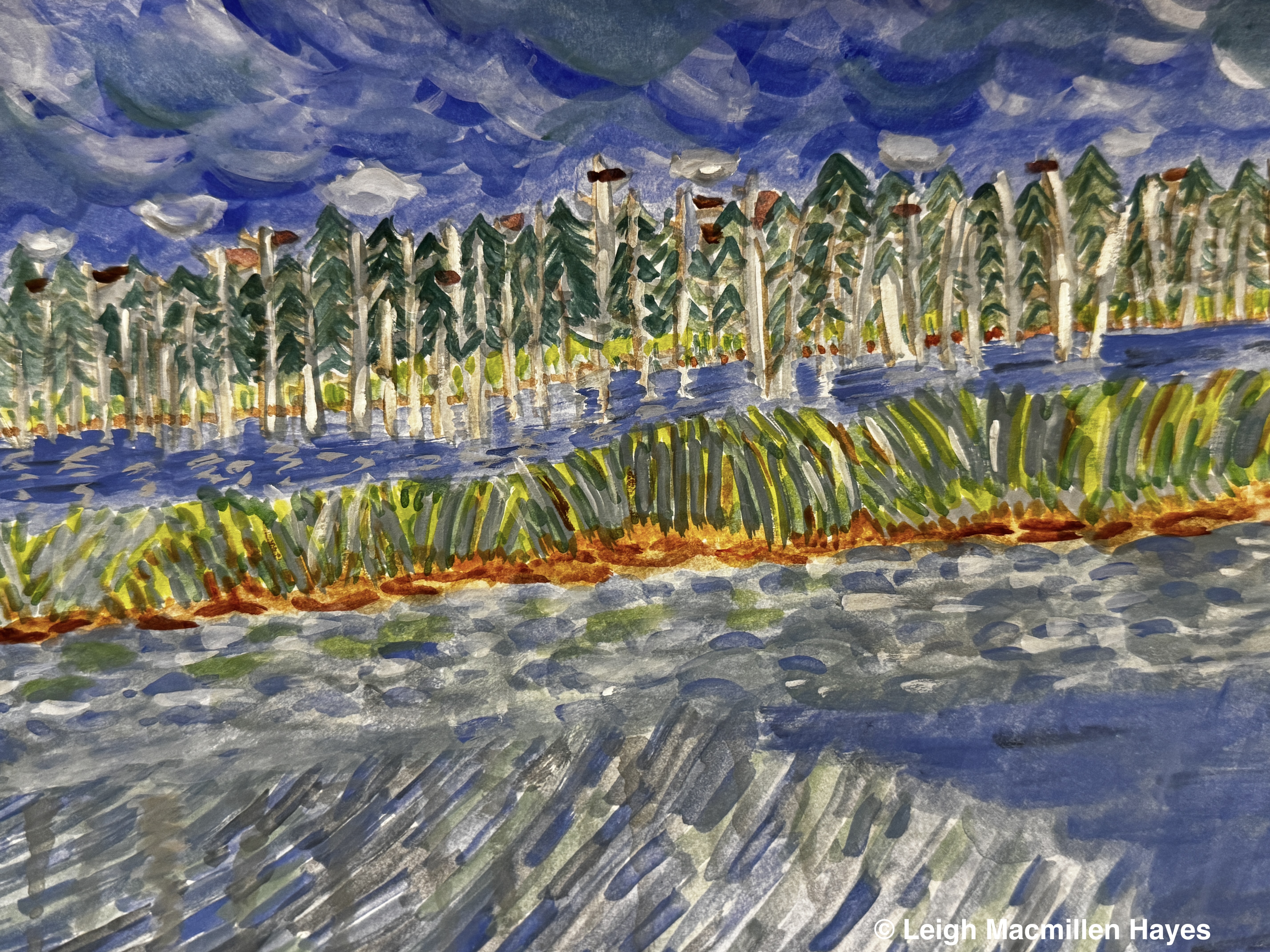
A second attempt at emulating Van Gogh. My fav: the trees in the background.

Third try. The sky was different. My fav: getting better at perspective.

In between classes I continued to paint. One of my absolute favs: Bandit! The porcupine I met in the yard last year. My fav: His face.

A Moose My Guy and I met in the beaver pond on Albany Mountain Trail, Bethel, Maine. My fav: His face.

What’s left of the Hayes Homestead, My Guy’s great-grandparents’ farm in Nova Scotia. My fav: shingles.

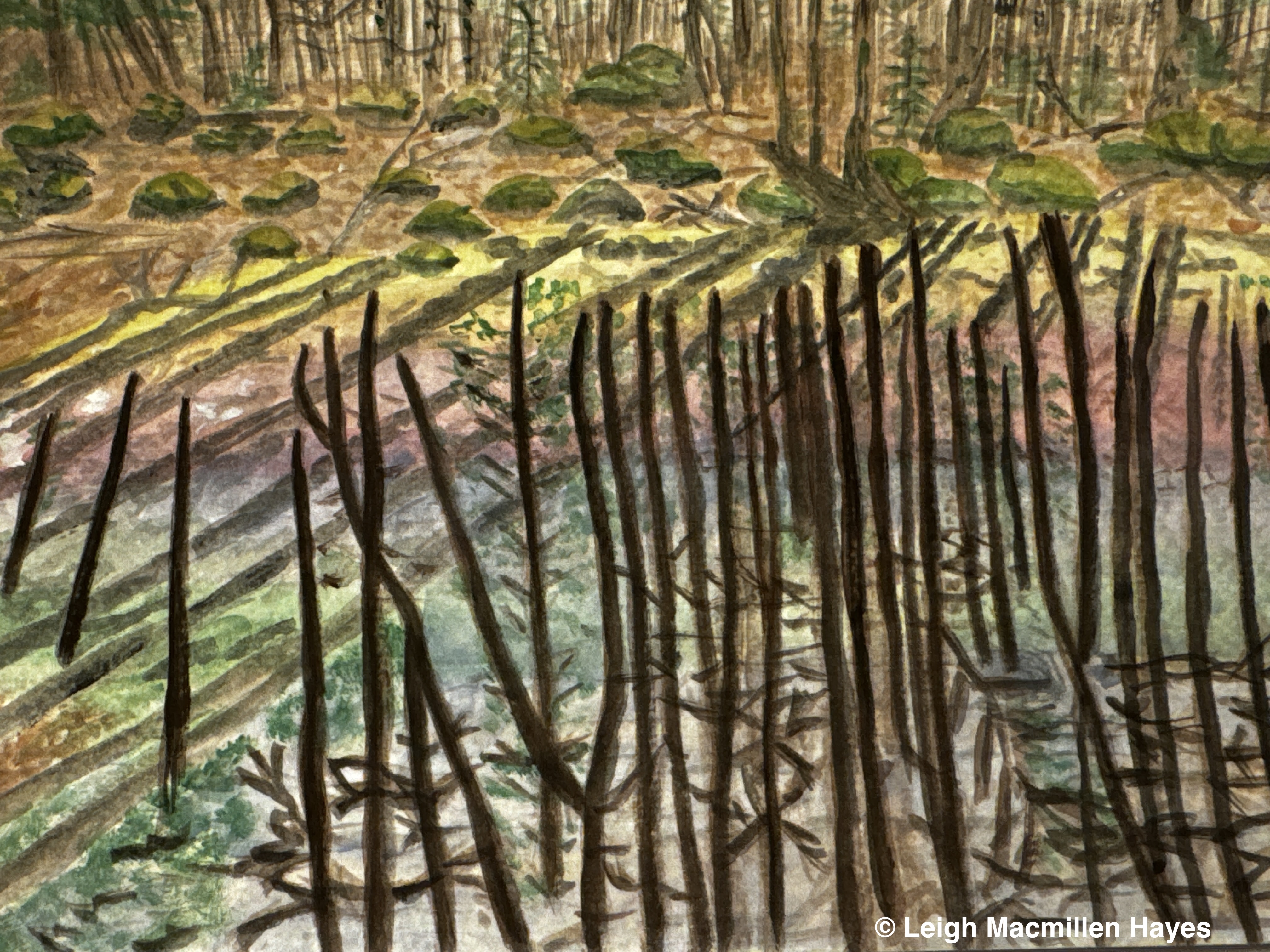
An amazing moment when I visited the vernal pool out back as the sun lowered and discovered that in the stillness of the water, a rainbow was created by the pollen, and while the tree shadows draped across the pond, they also were visible in their usual vertical presentation on the water. My fav: colors of the sunlight on the pollen.

Back to class and learning more about values. I have to admit that I don’t always heed this advice and do a values sketch before painting.

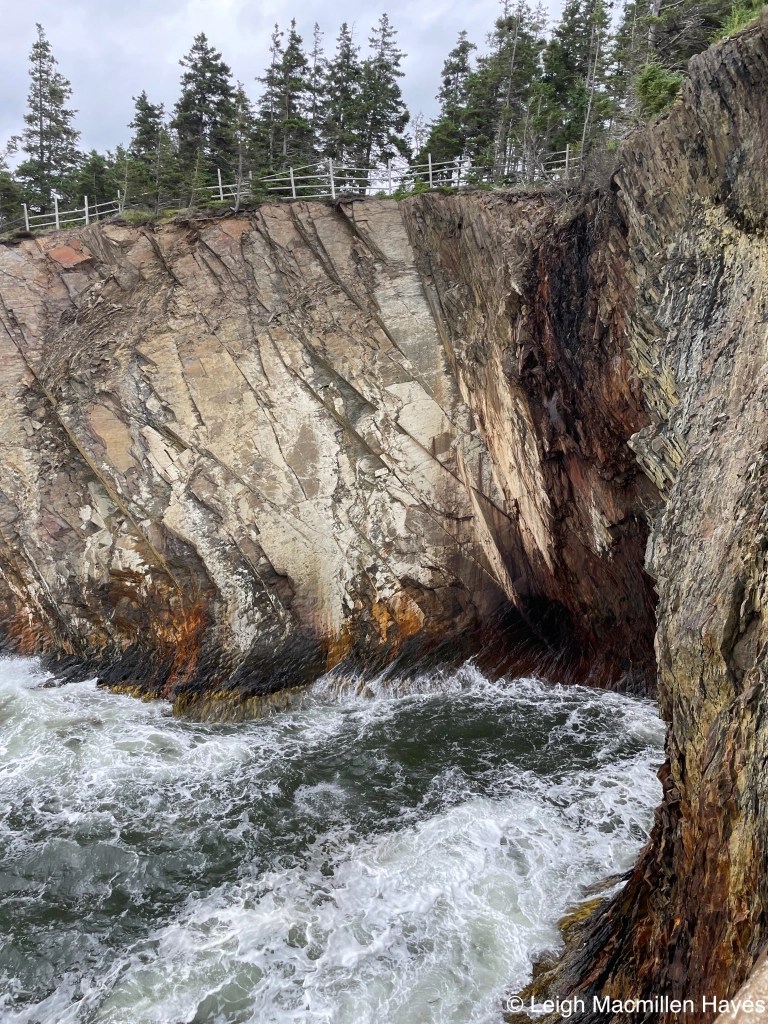
Photo of Ovens Cave, Nova Scotia.

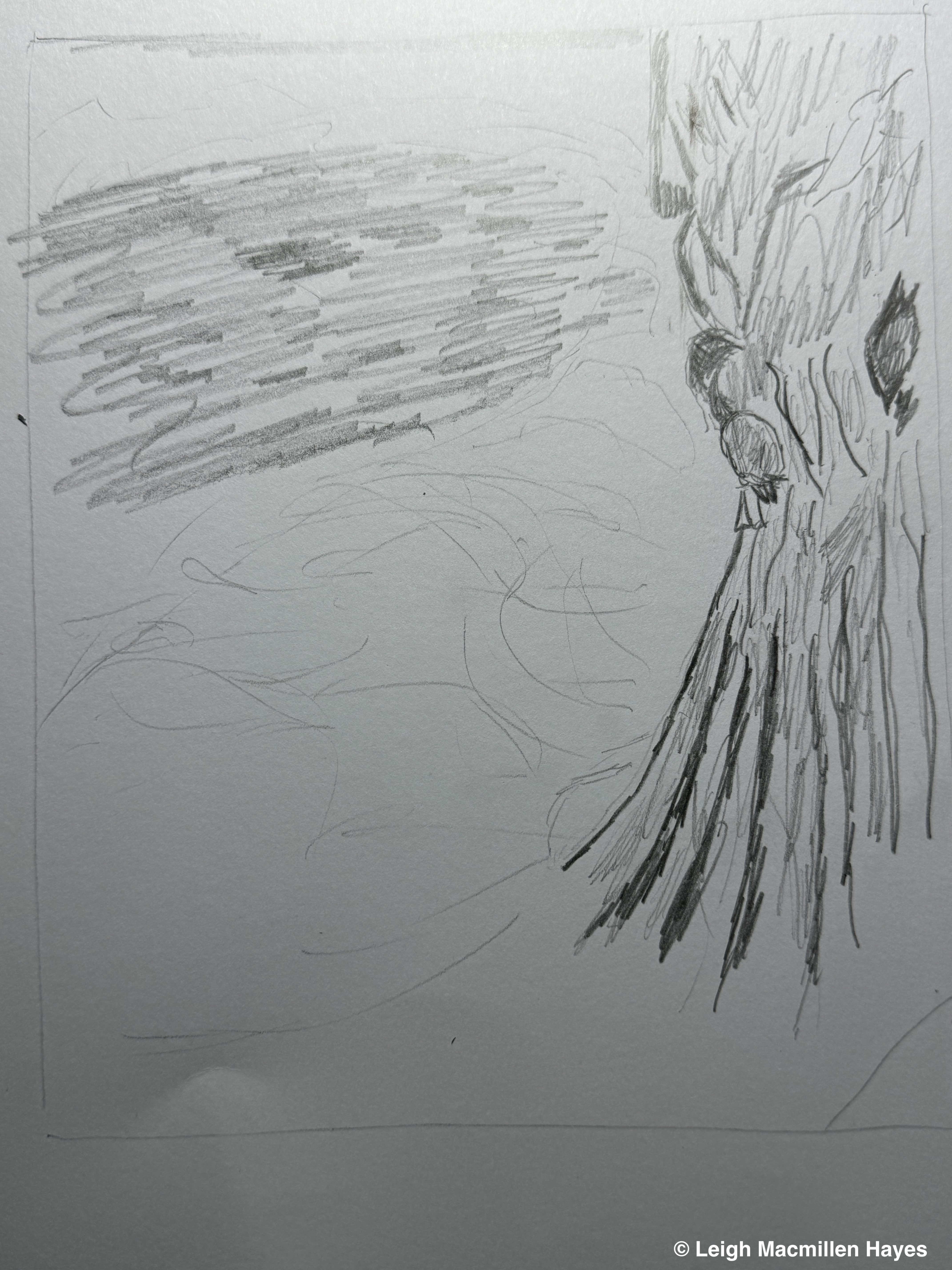
Cropping the photo in sketches.

One final sketch before painting.

First attempt in gouache. My fav: colors of the rocks.

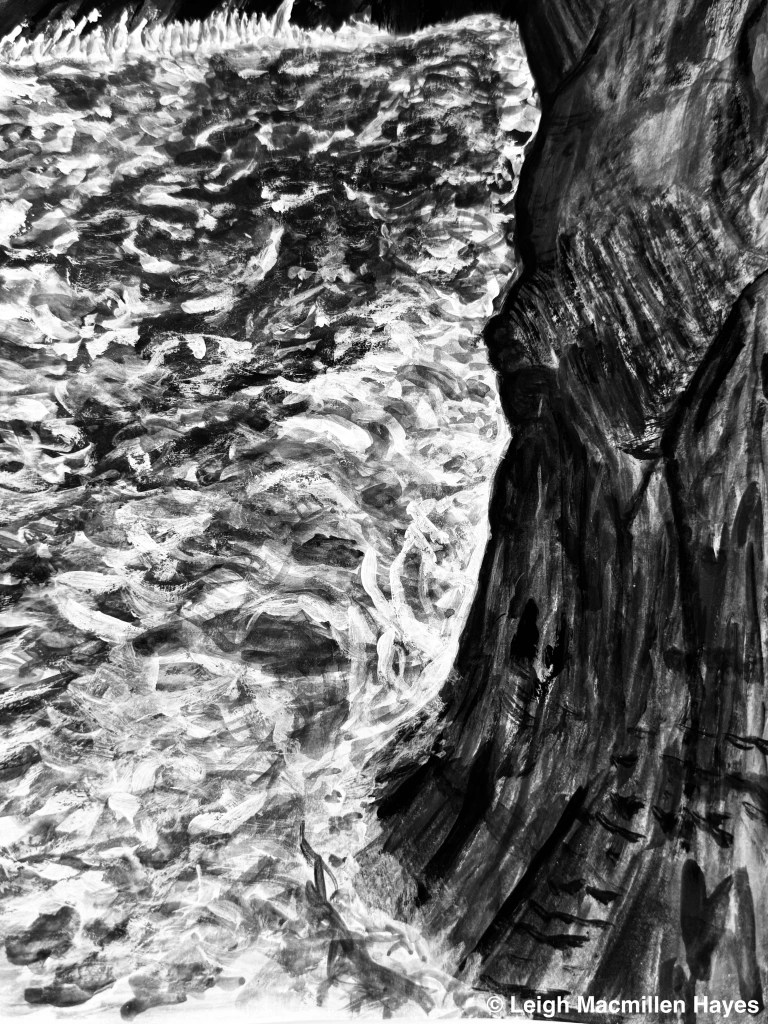
Jessie taught us a neat trick to check values by using a filter on our phones.

Trying to be more abstract with the same scene. My fav: the color of the water.

Values photo of the same.

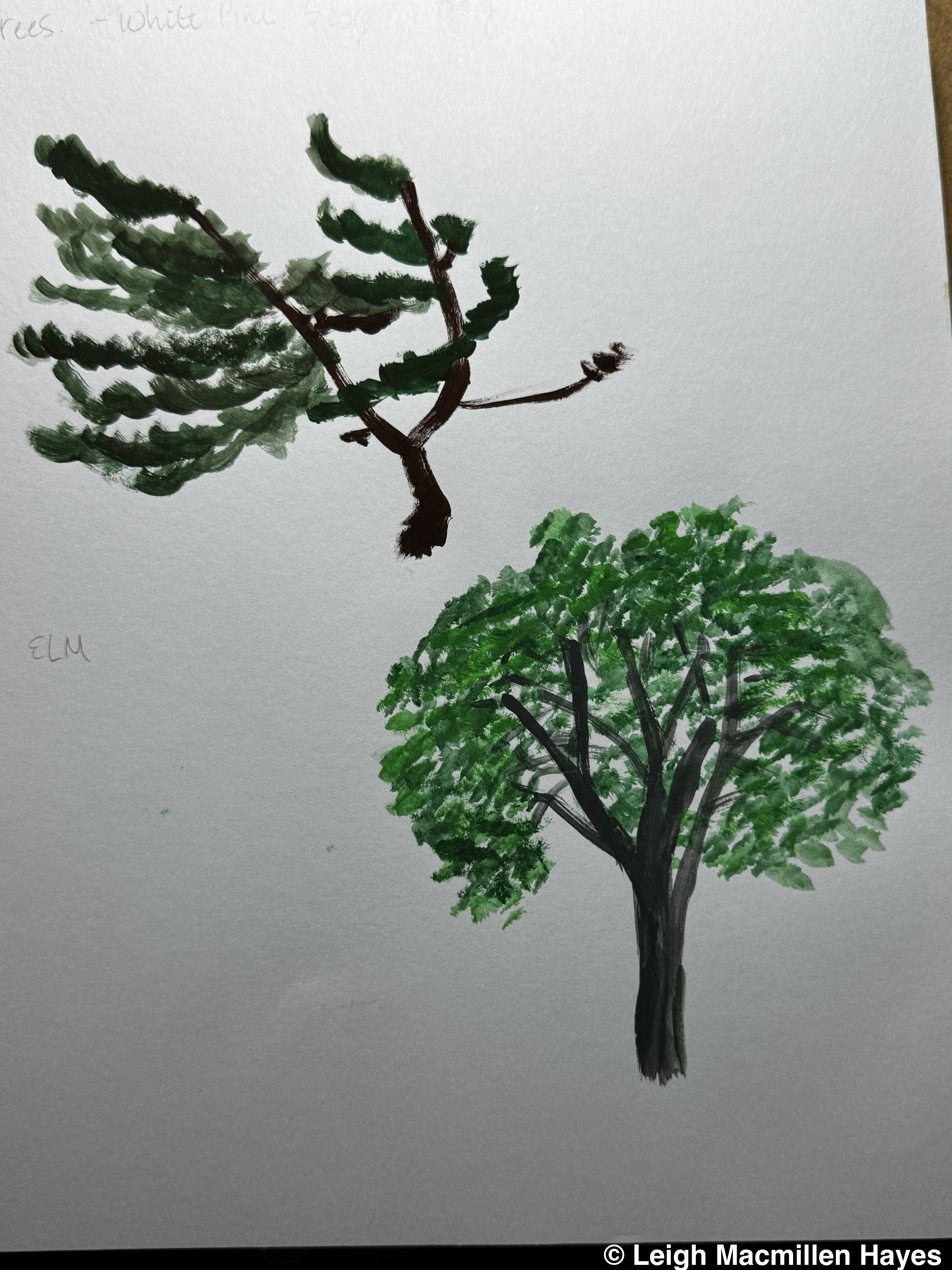
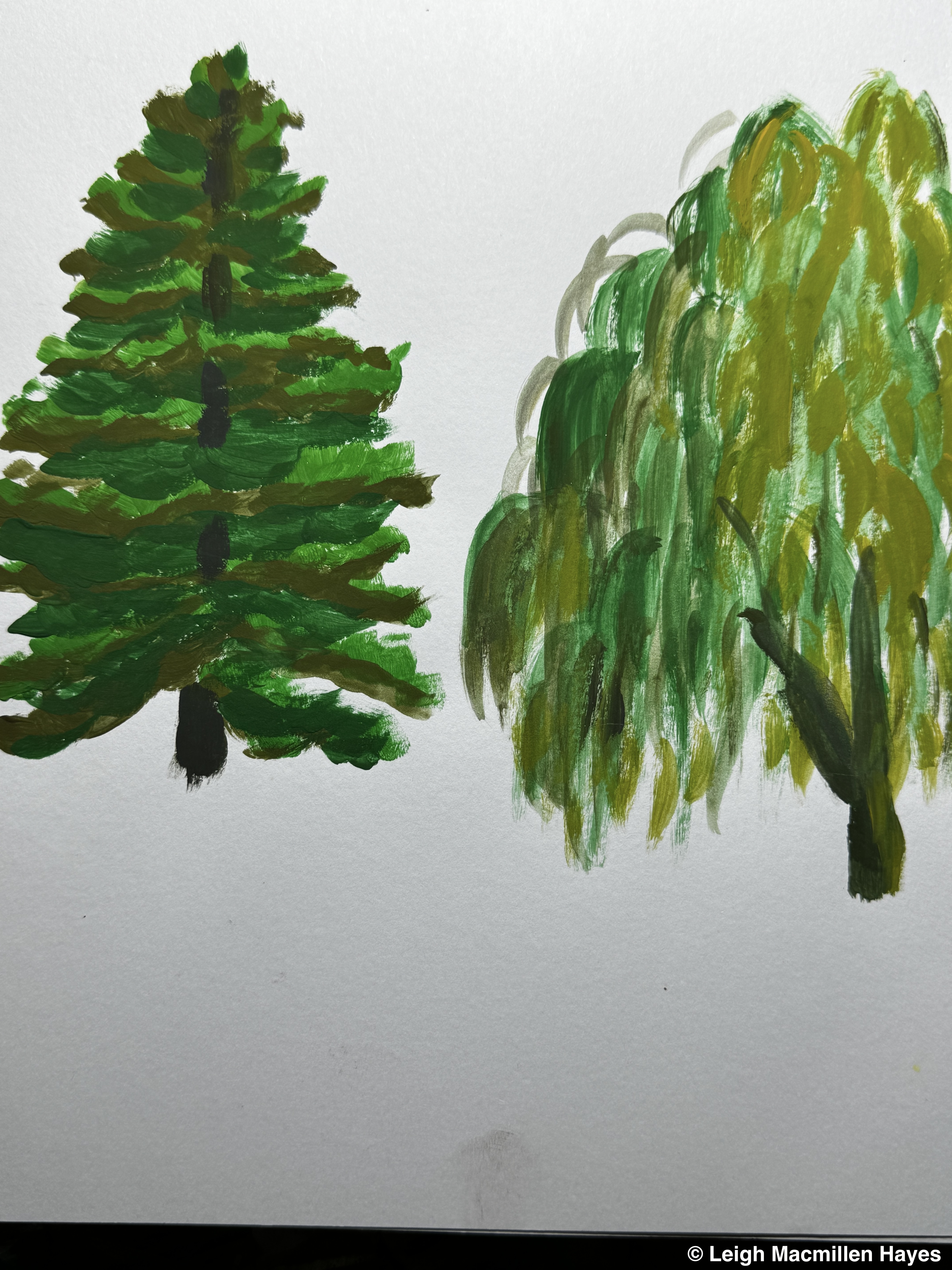
The third time we met we talked about basic shapes and had to quickly paint trees. It was supposed to be six trees, but our class only got through four. I guess we weren’t so quick after all. My fav: the willow. But also thinking about different shapes. And how to fill them in quickly.

Hairy Coo My Guy and I met in Scotland. My fav: the ear tag!

Values sketch of photo she offered in class, and getting the basic shapes on paper.

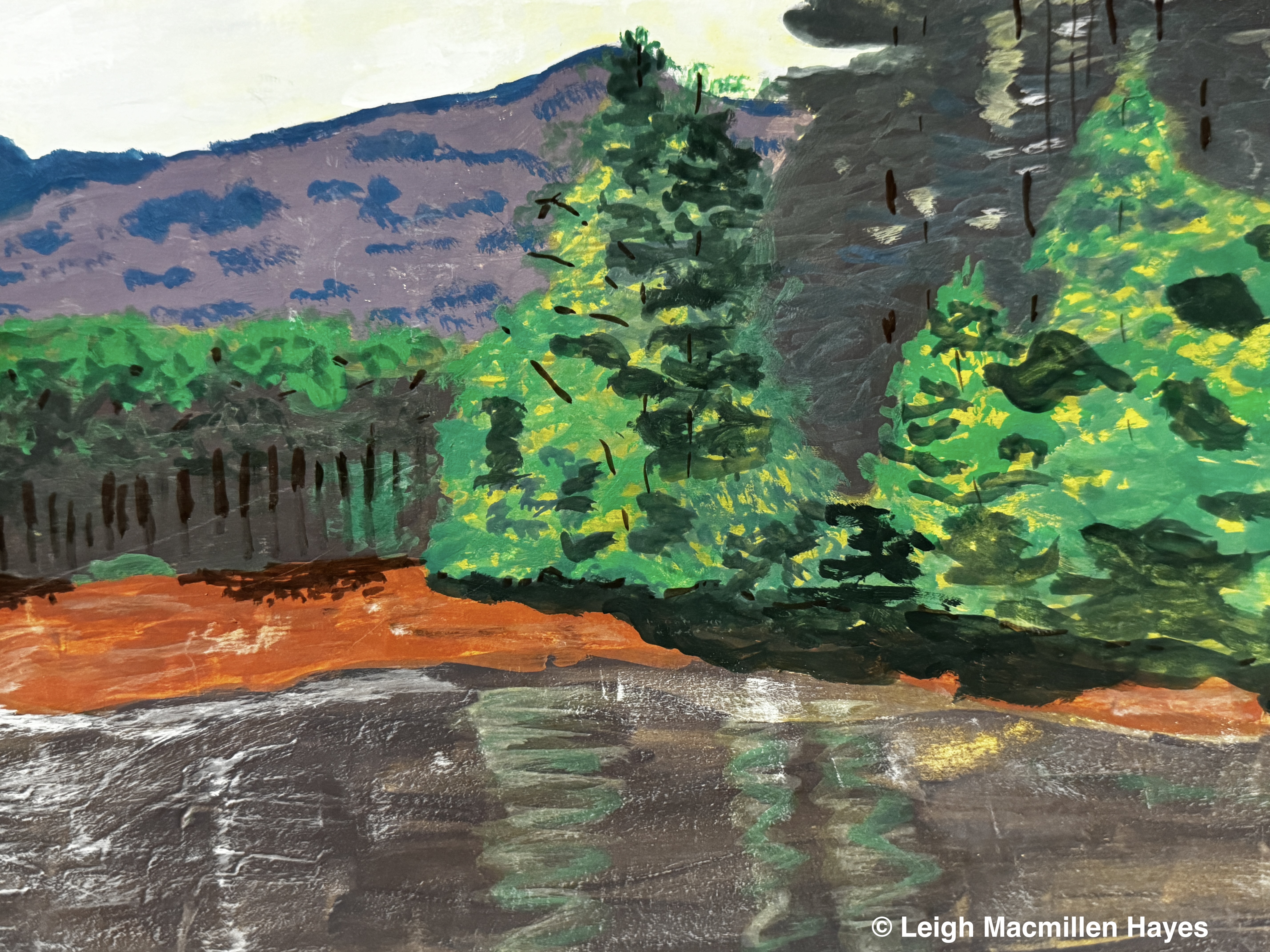
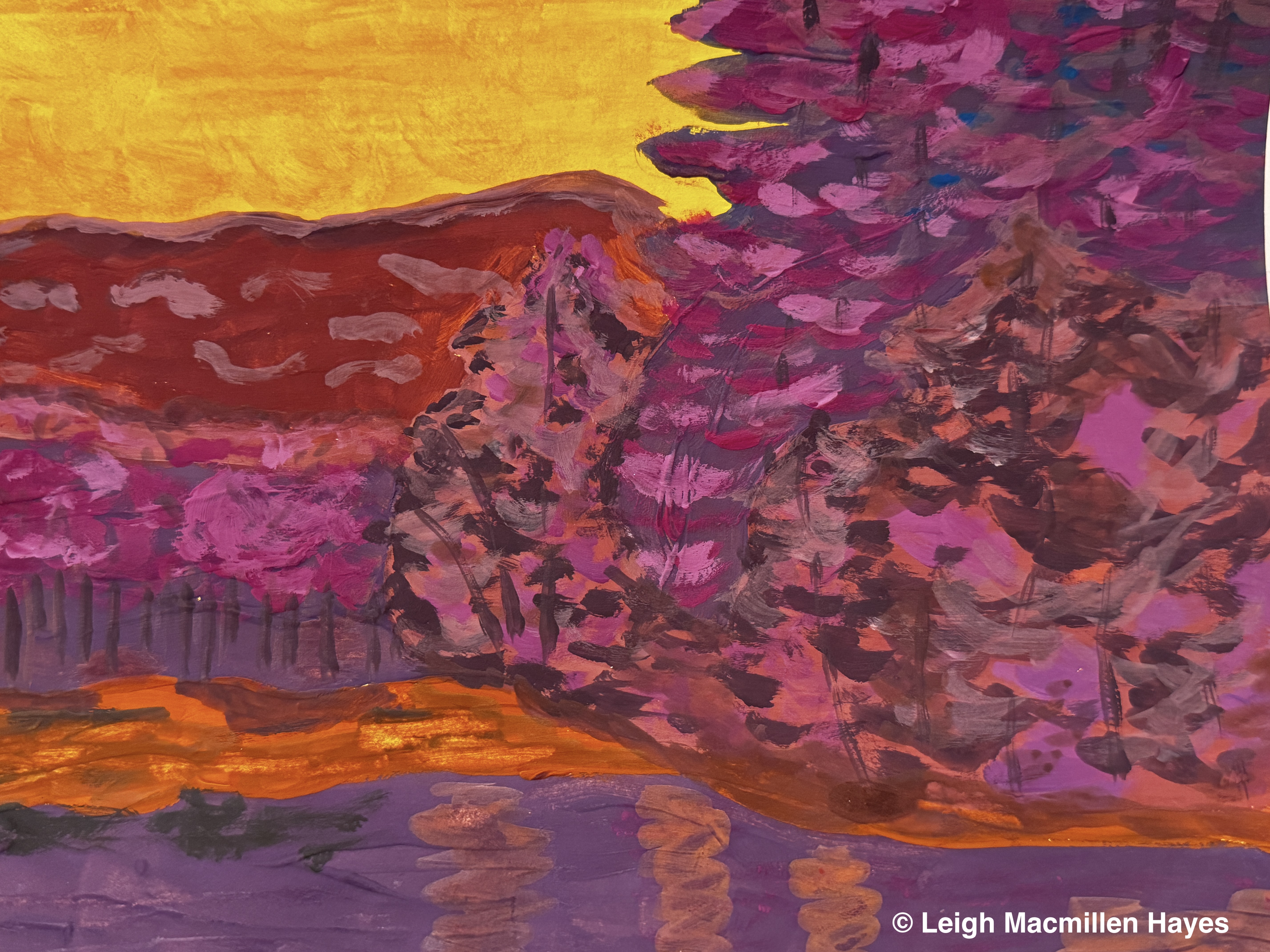
And then we could only use certain colors to paint the scene, filling in the shapes first before adding detail. This was mind opening for me. My fav: making blobs look like trees.

The same scene using different complementary colors on the wheel. I struggled with the values in this one. My fav: the trees still look like trees.

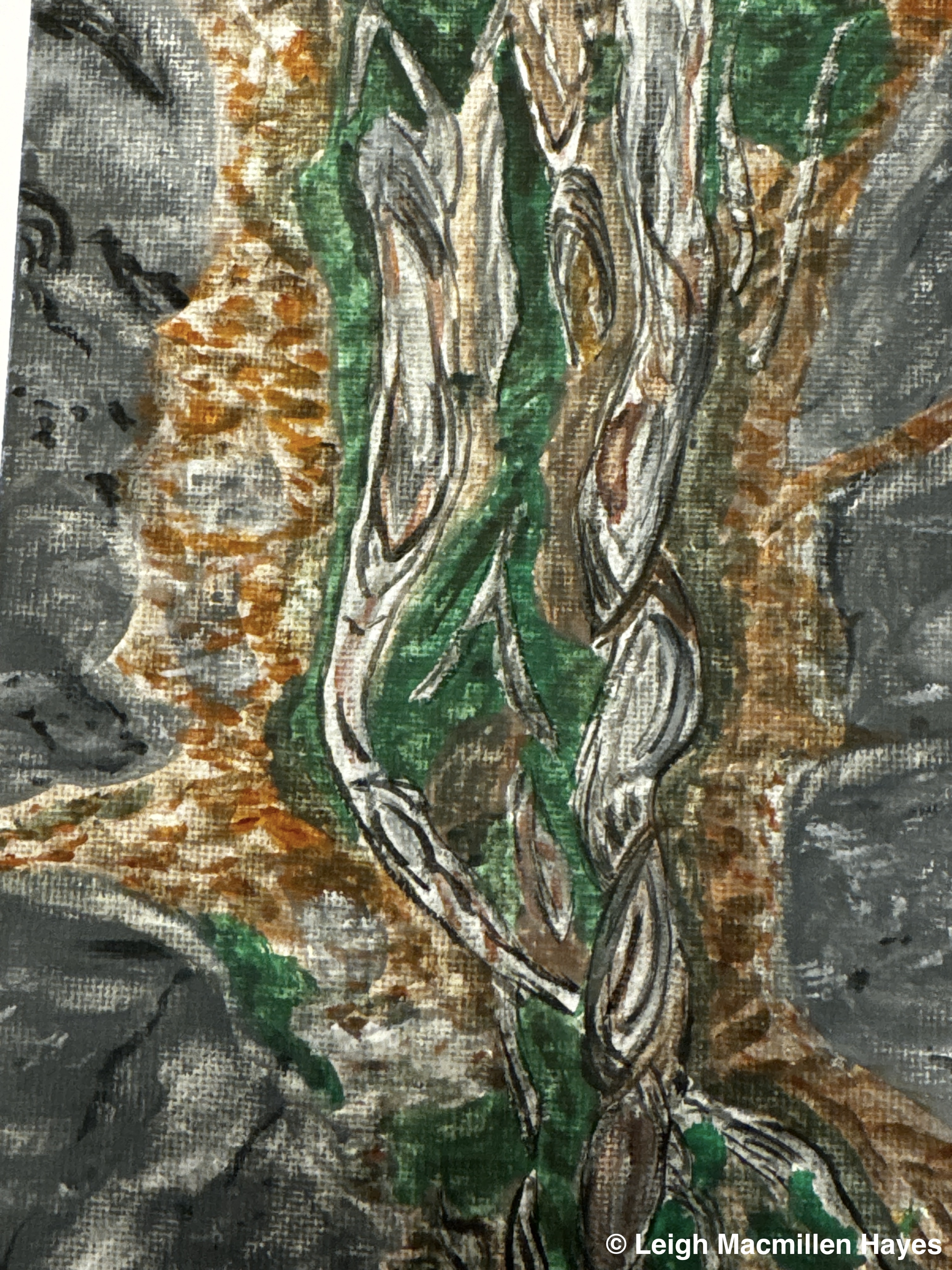
This one has been the most difficult for my family to understand. An intersection of granite ledges and tree roots on Bald Pate Mountain, Bridgton, Maine, on a canvas mat. My fav: the tree roots.

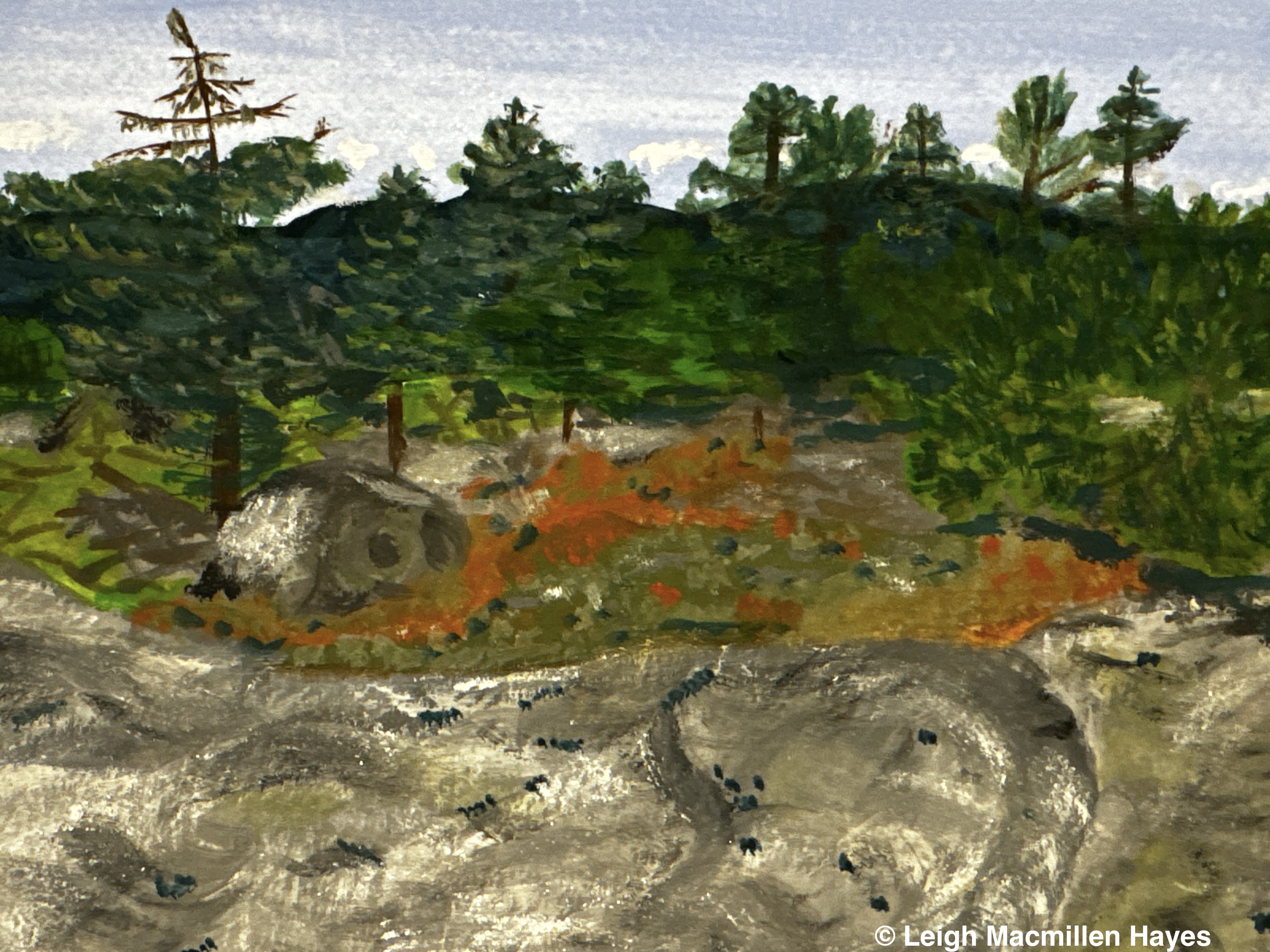
Ledges on descent of Rumford Whitecap Mountain, Rumford, Maine. My fav: the trees with the mountain backdrop.

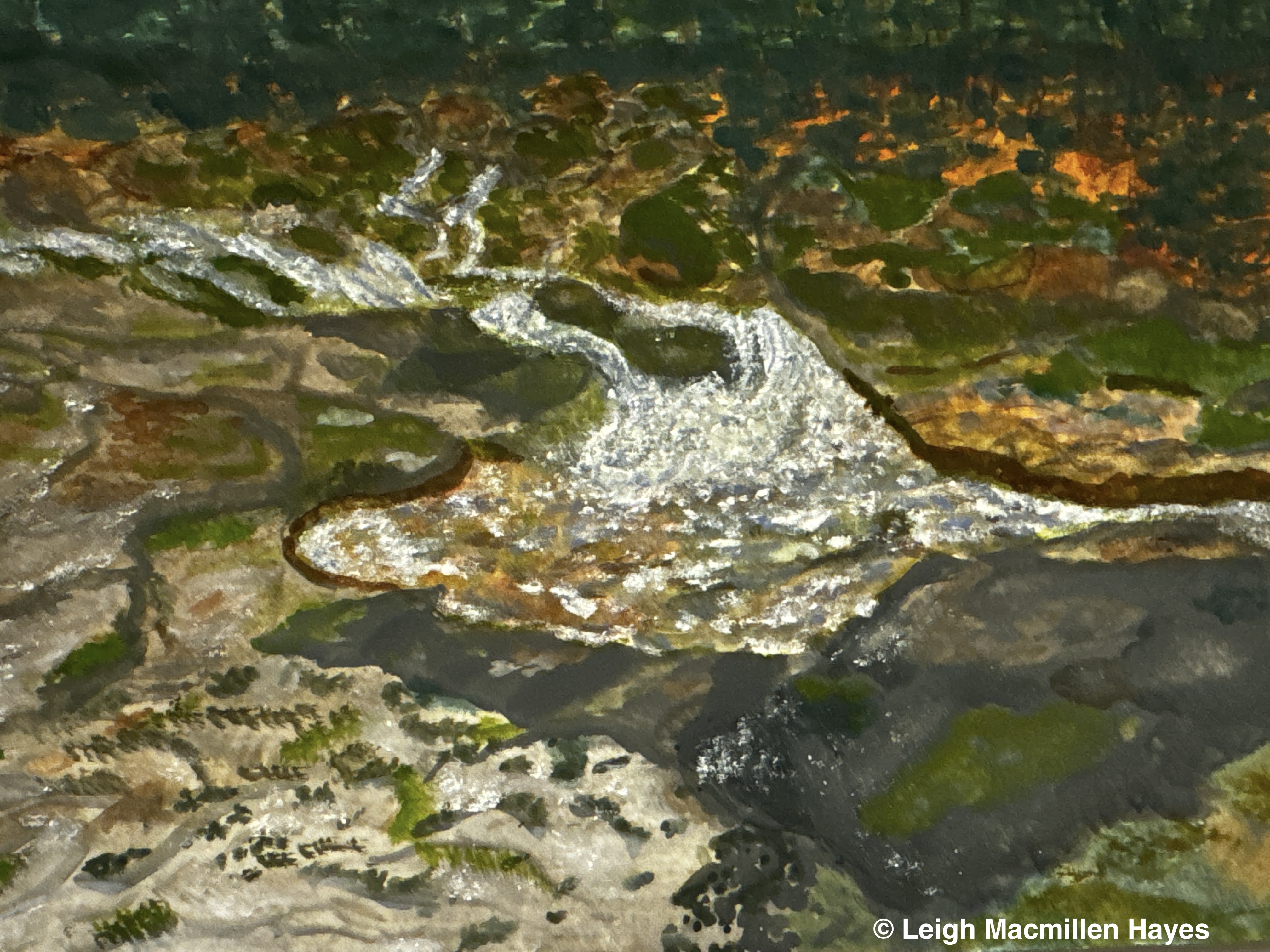
Bickford Slides, Blueberry Mountain, Evans Notch, Maine. And the discovery that I had accidentally purchased a small tube of shimmery white watercolor paint. My fav: water flowing over the mossy rocks.

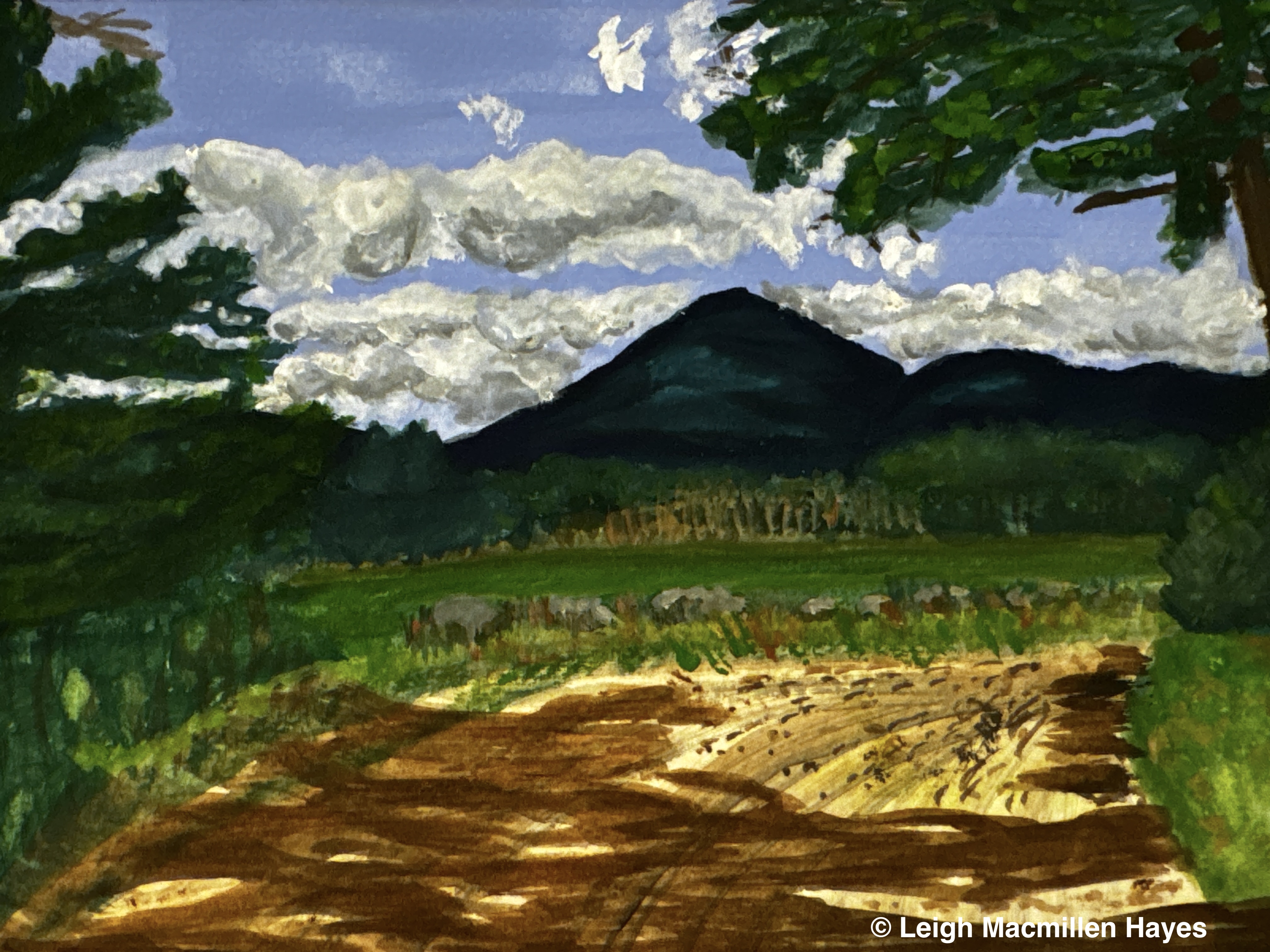
Shadows across Hemlock Bridge Road, Fryeburg, Maine. My fav: those very shadows. And the rocks that line the road.

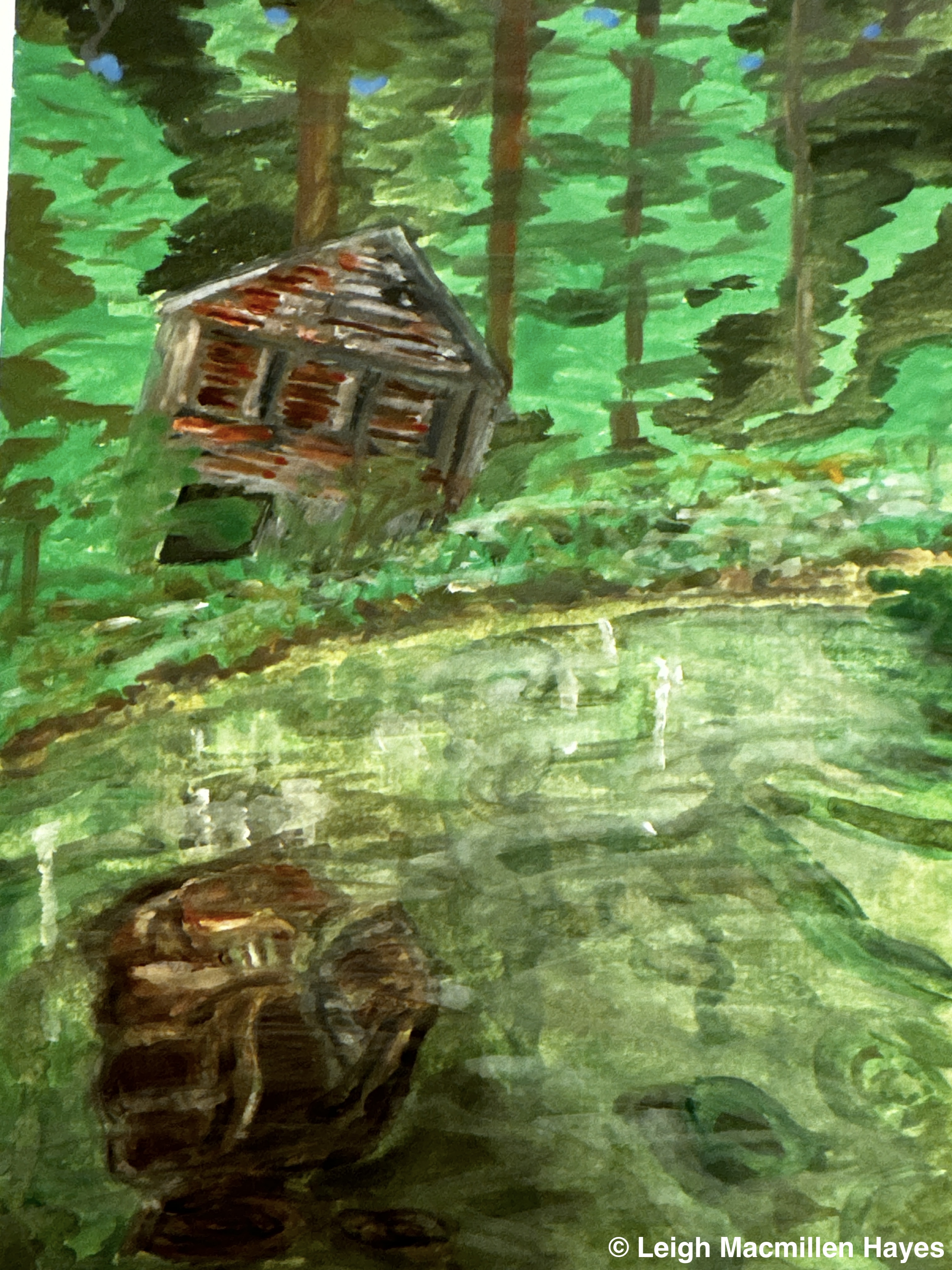
Back to gouache to capture the reflection of a falling down cabin on a small pond in New Hampshire. My fav: the trees and hints of the blue sky.

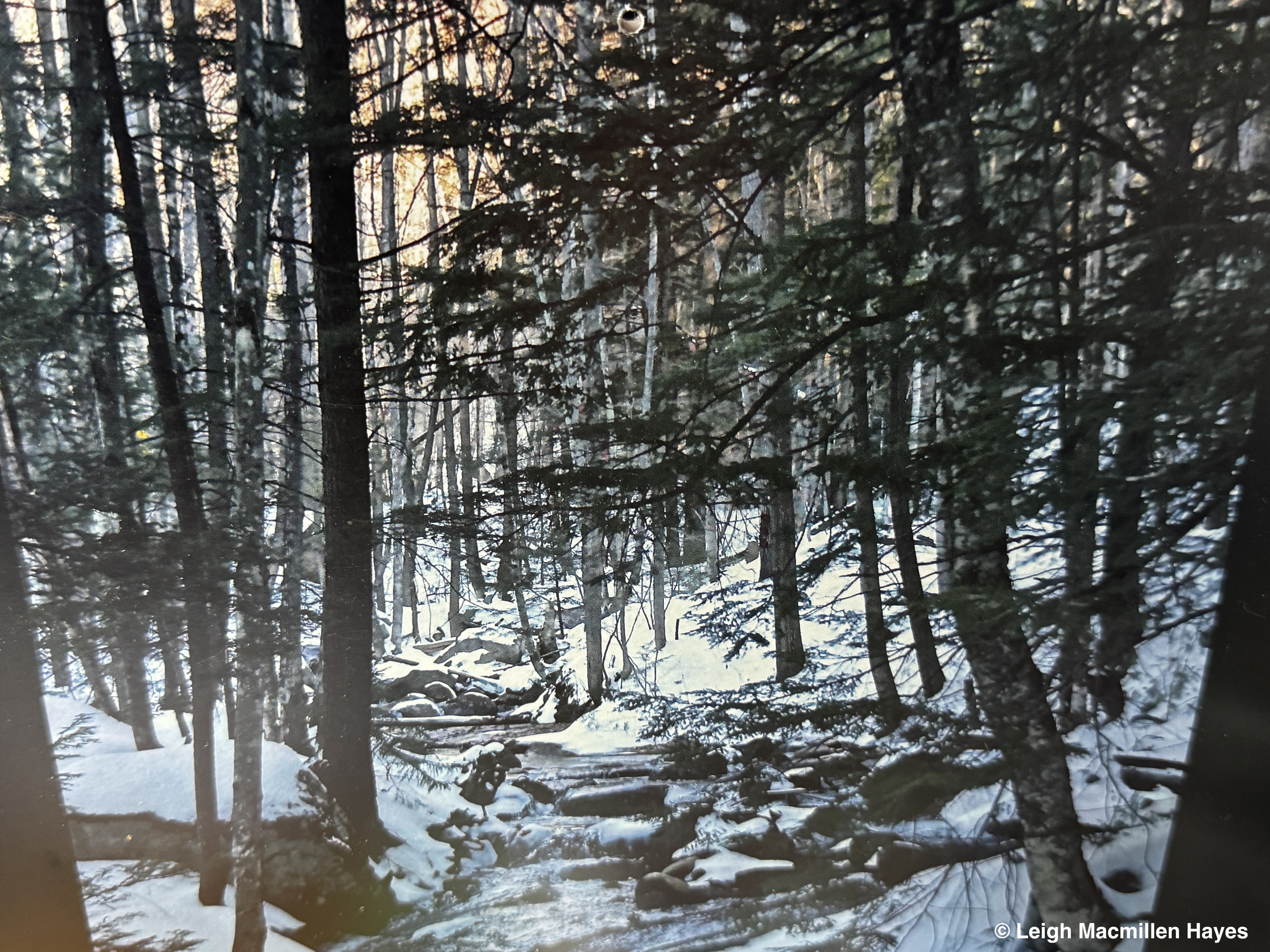
The final assignment took us two classes. This is the scene I chose to paint. Sucker Brook at Greater Lovell Land Trust’s Wilson Wing Moose Pond Bog Reserve, Lovell, Maine.

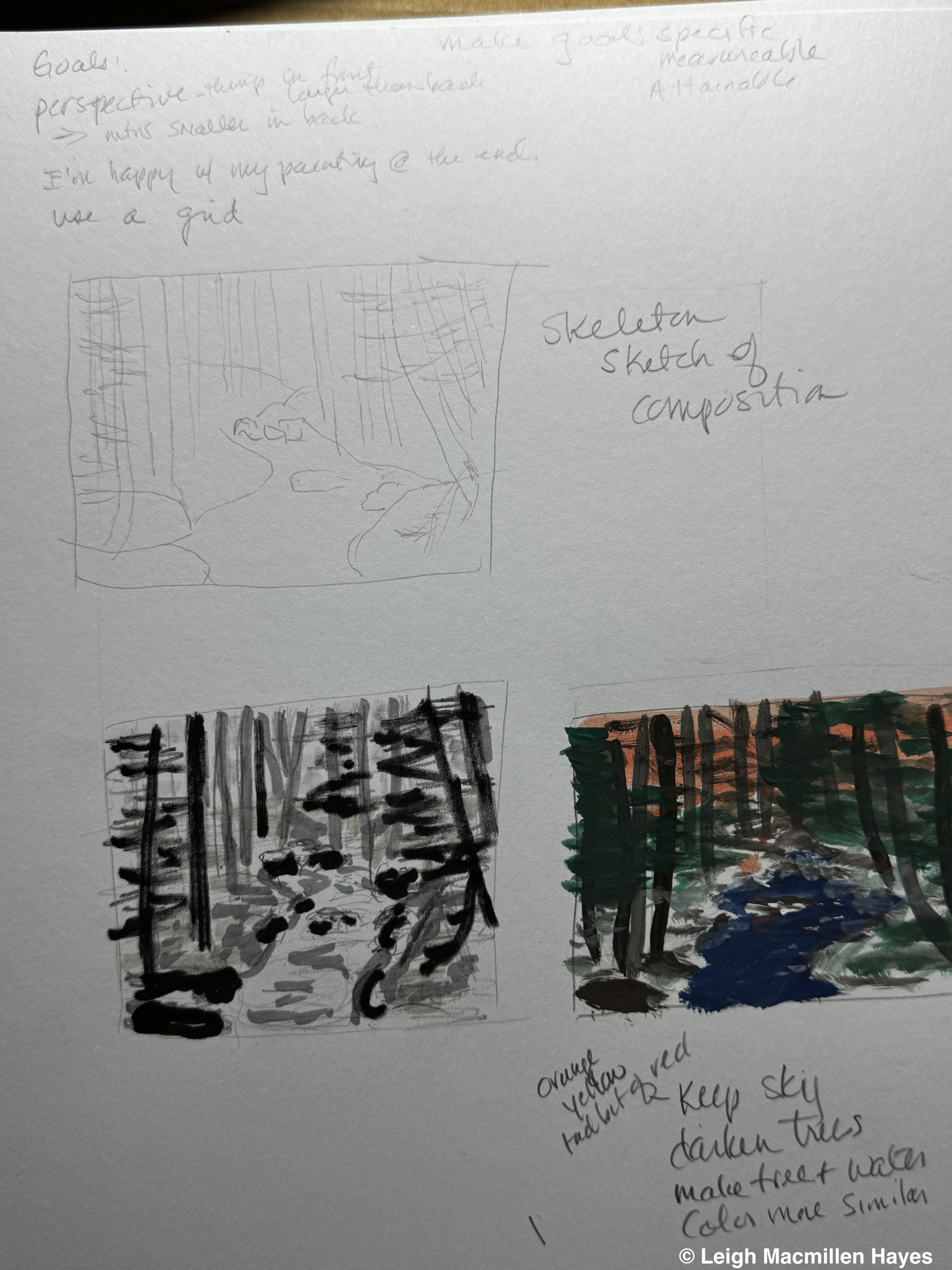
Planning with sketches, markers, and paint and figuring out what might work best. And simplifying the scene.

Jessie gave me a piece of Hot Press Finish paper upon which to work, and I have to admit that it was a joy to paint on this. I started with the sky color as the wash and then worked on the snow next, then the water, and finally the trees. My fav: sunlight reflected on the snow in the background.

After I shared that painting with a friend, she commented, “Can’t you do something other than snow until there is snow?” So, I painted a fall scene at the summit of Bald Pate. The mountain tops are not quite this color yet, but will be in a couple of weeks. My fav: contrast of colors.

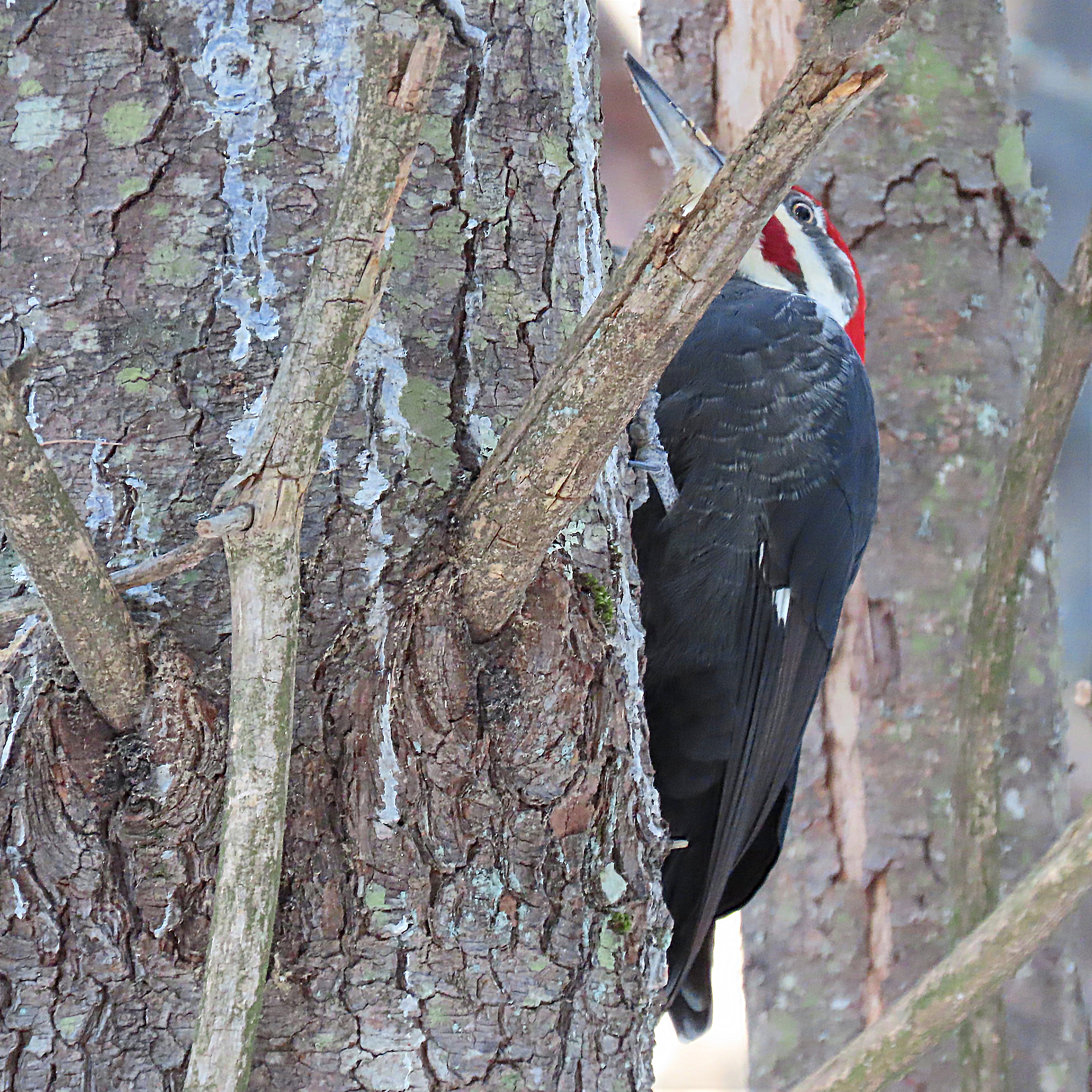
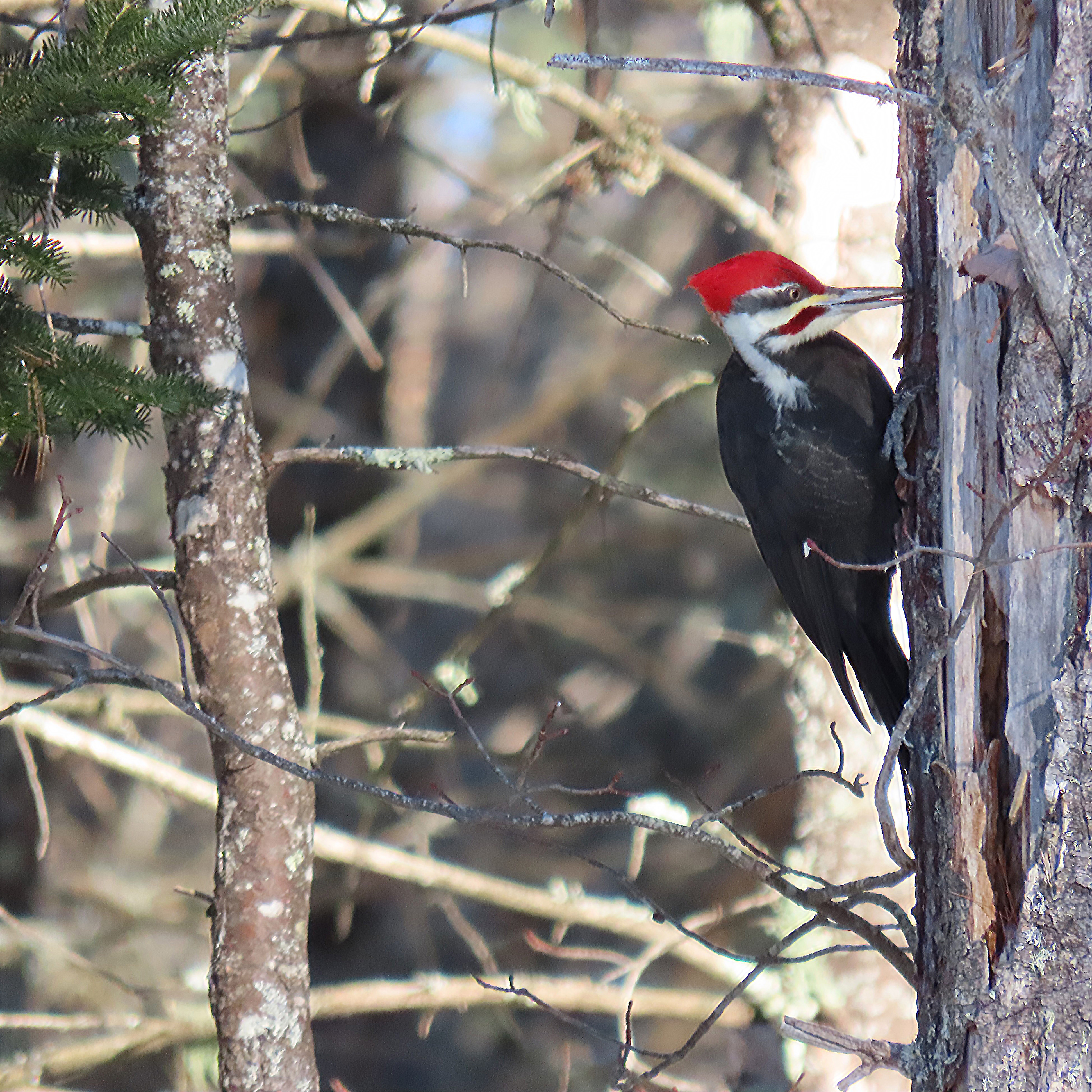
My last painting to date on a larger canvas sheet was a Pileated Woodpecker that frequents our woods. I discovered, like the Hot Press paper, I really like the canvas except that it takes a while for the paint to dry. My fav: the bird’s head and the pine tree bark on the right.

That’s all I have to offer at the moment. And if you stuck with me this far, I’m impressed. Thank you!

I keep thinking about this creative journey and can’t wait to see where it takes me next. If you are interested, you can follow my artistic path by clicking on wmw art gallery every once in a while.

Reflection Mondate

Snow. Slush. Mud. Water. Flurries. Wind. Sun. Clouds. They were all on today’s menu. It’s a March thing. And so we decided to embrace it and head to a spot we usually avoid this time of year.

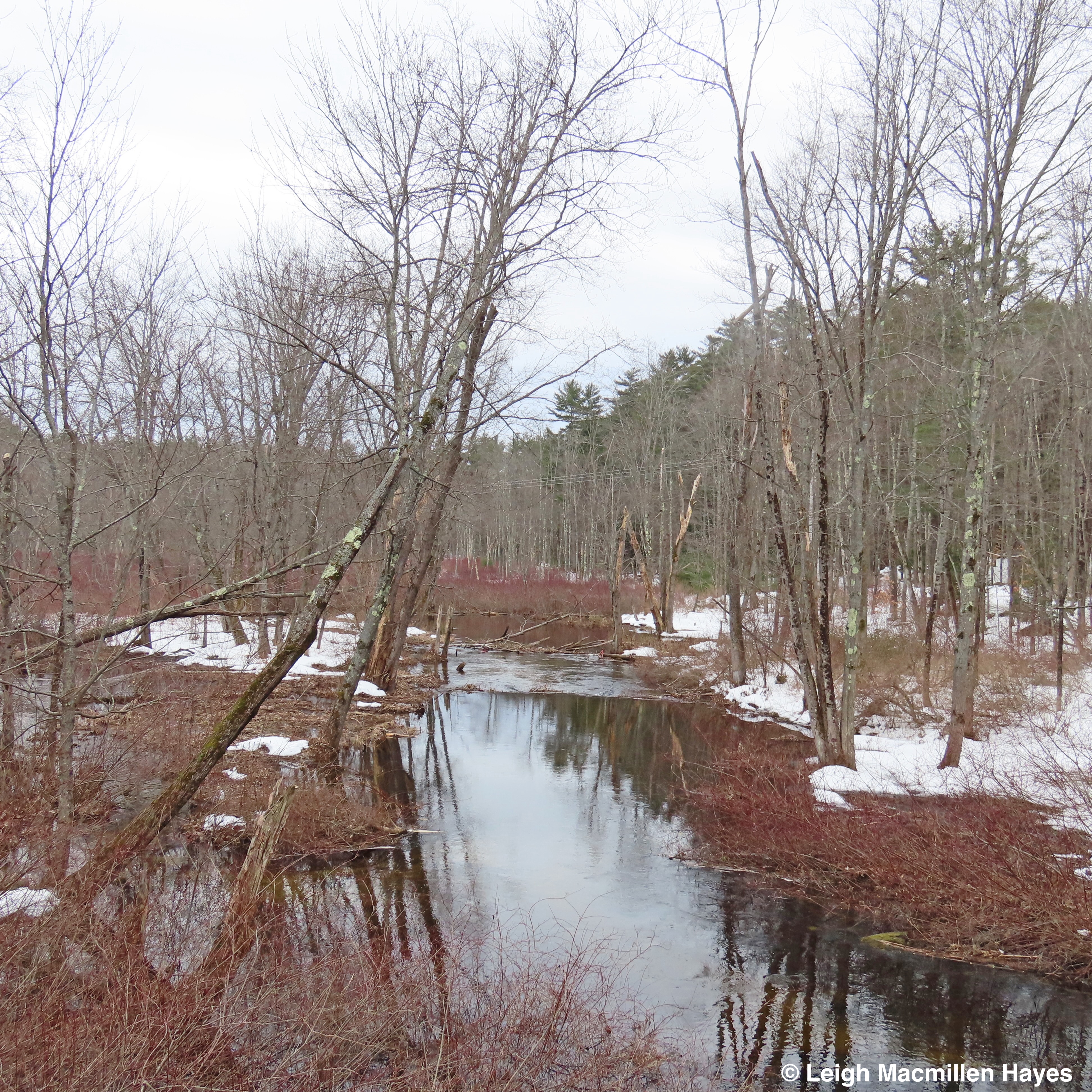
Our destination was a country lane beside the Old Course of the Saco River in Fryeburg, Maine. During the winter, this road is part of the snowmobile system. In spring, summer, and fall, it sees a fair amount of traffic. But . . . because of current conditions and the fact that a portion of the road washed out a few months ago and another portion is under at least six inches of water, the gates are closed and the only traffic is via foot. Perfect conditions in our book.

I love to walk roads like this because they always have something to offer and today it was the discovery of a bunch of rather dramatic winter weeds known as Roundhead Bush-clover. Bristly, spiky flower heads. Curly leaves with nooks and crannies.

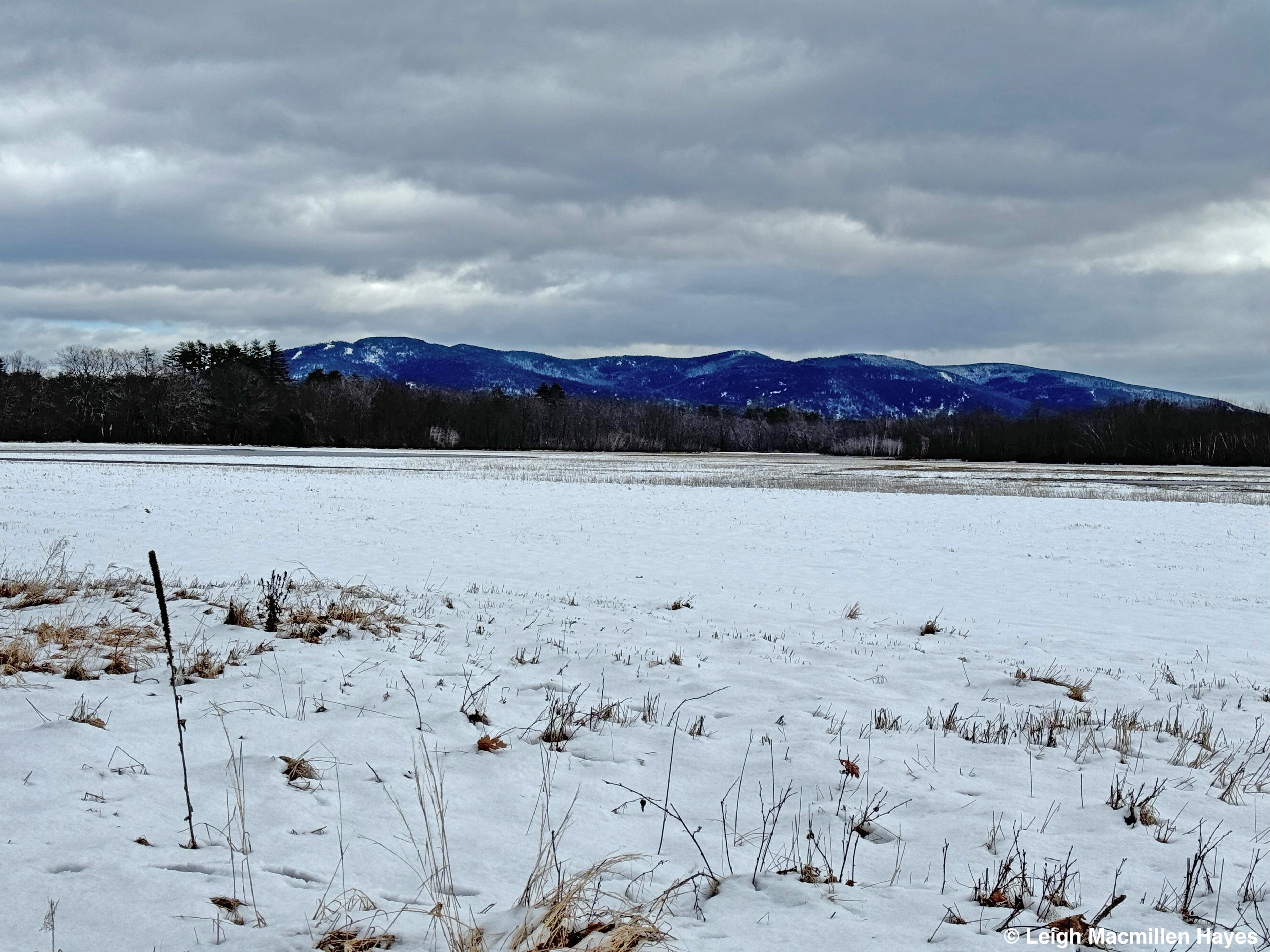
The sky was equally dramatic and ever changing as we viewed it while walking southeast with the ridge line of our beloved Pleasant Mountain forming the backdrop.

We managed to easily get around a major washout, but then encountered this and it is not a puddle. The water is flowing across the road and we could feel the current as we were determined to get to the other side.

We are both here to report it was at least six inches deep in the deepest spots. We were feeling pretty darn smart for thinking to wear our muck boots.

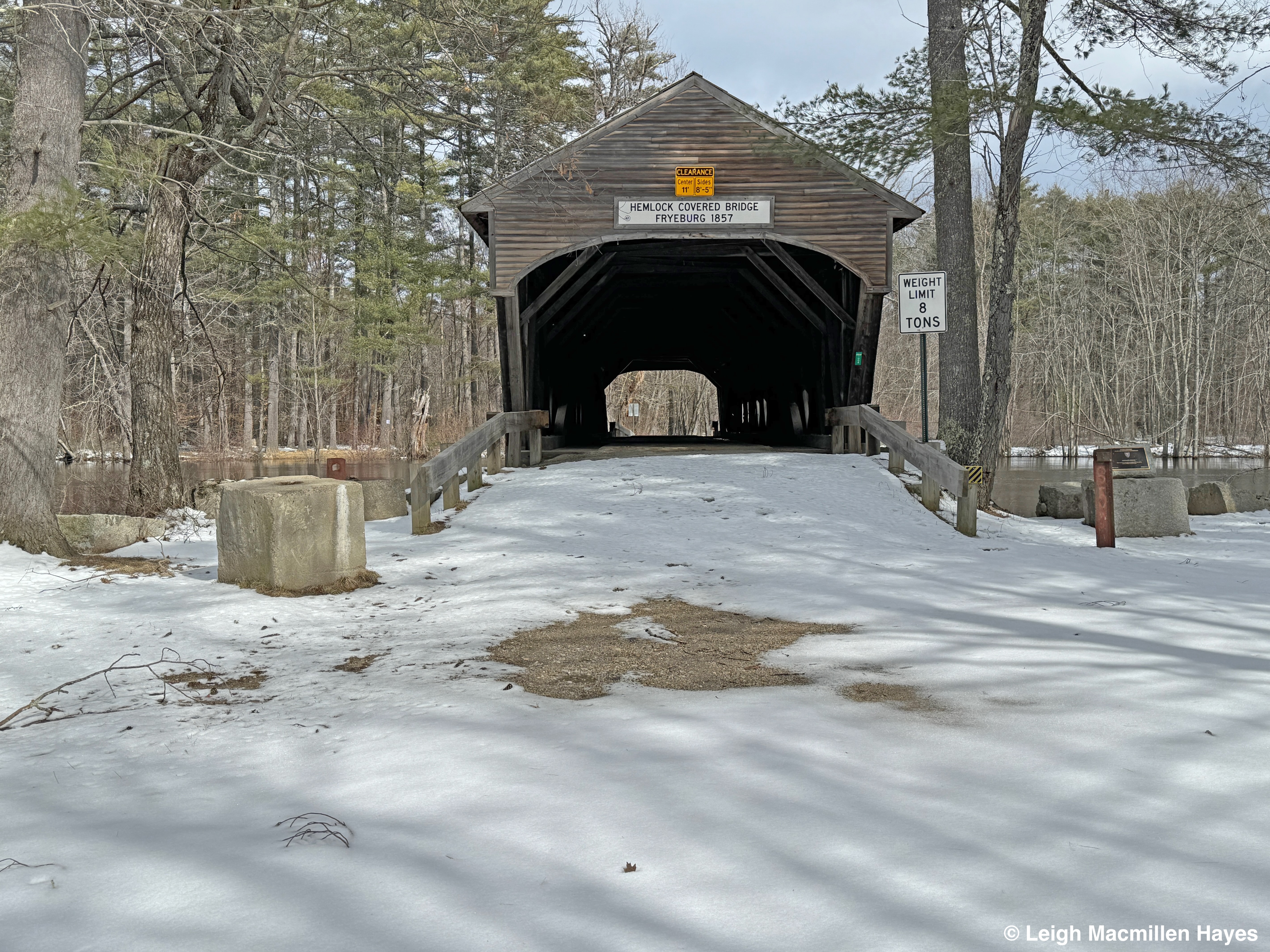
Just over a mile in we reached the coveted spot: Hemlock Bridge. The bridge has spanned what is now the Old Course of the Saco River for 167 years. Built of Paddleford truss construction with supporting laminated wooden arches, Hemlock Bridge is one of the few remaining covered bridges still in its original position.

Peter Paddleford of Littleton, New Hampshire, created this design by replacing the counter braces of the Long-style truss bridge, creating an unusually strong and rigid structure. During three seasons, you can still drive across it.

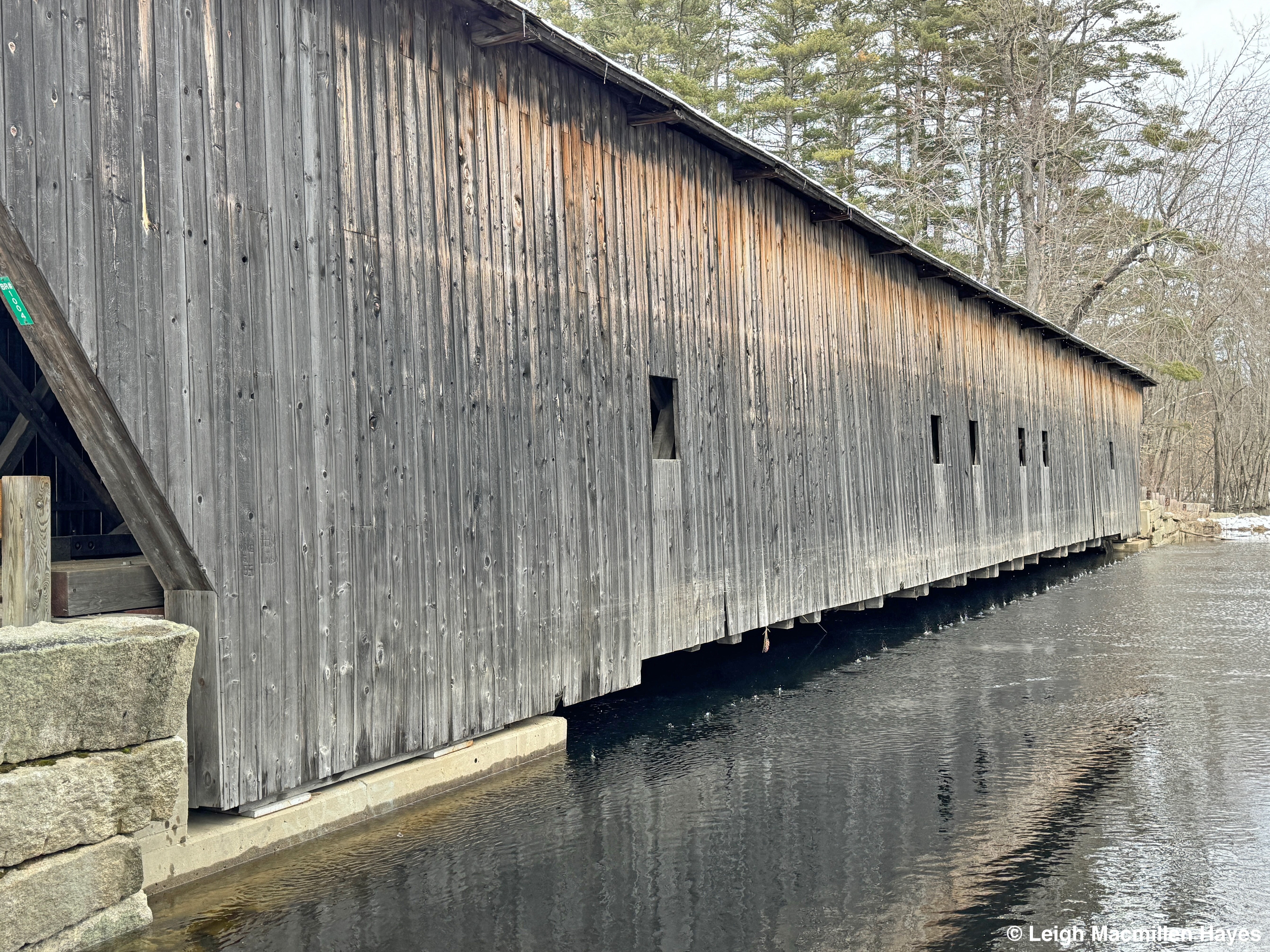
Yes, we’d seen a lot of water on the road and in the field and noted how high the river was and flooded the fields were, but it really struck home when we noted the short distance between the bridge and the water. And a memory popped into our heads simultaneously.

Today we never would have been able to kayak to Kezar Pond as we did in August 2023. If you look at the cement support on the left and scroll back up to the previous photo, you get a sense of how high the water is right now. And that’s not the highest it’s ever been. Not by a long shot. But you must keep reading to learn more about that.

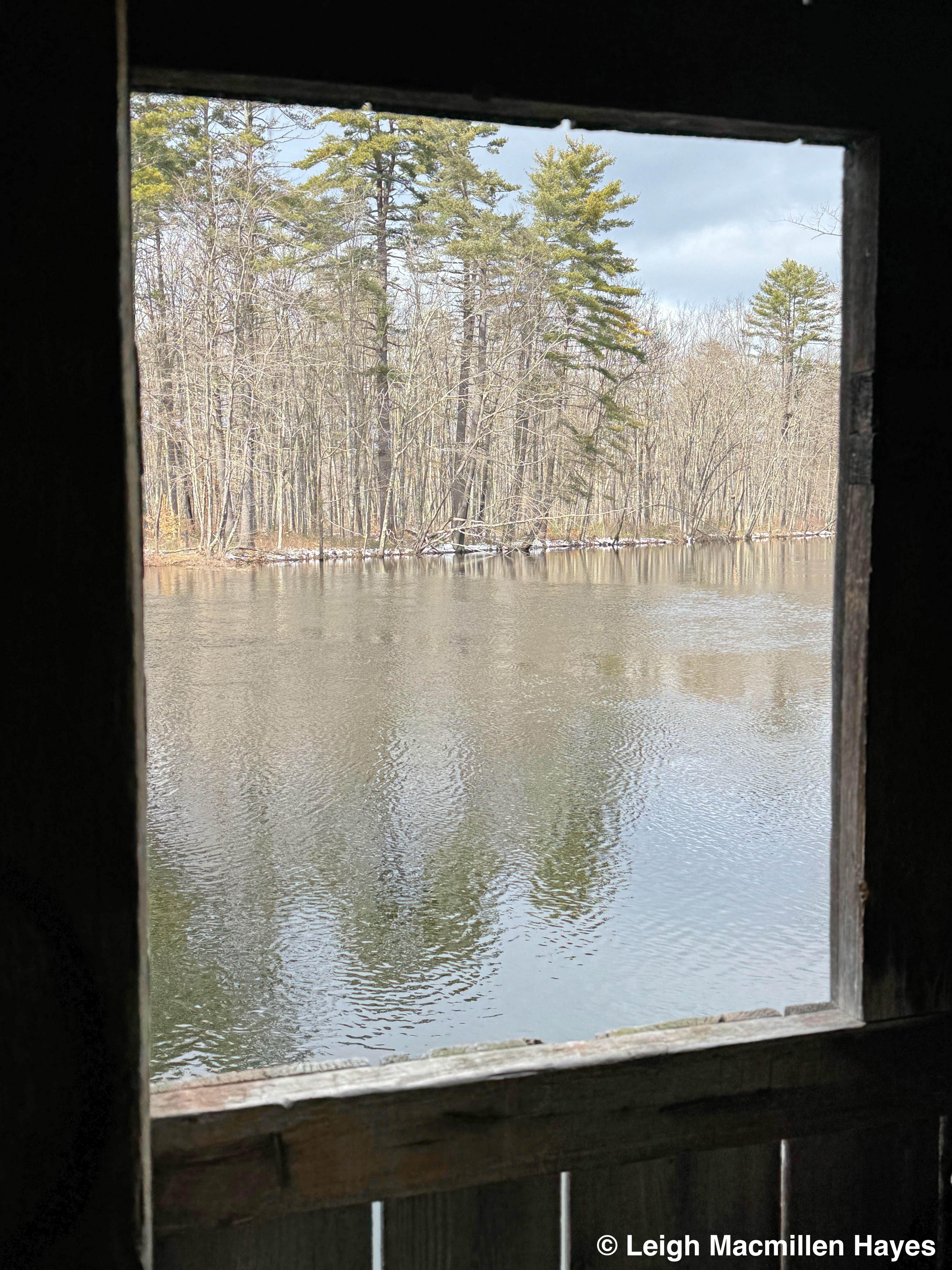
Once on the bridge, there’s plenty of graffiti to examine, or not. I prefer to take in the views and love how the boards create a frame–this one looking in the direction of Kezar Pond.

And this toward Saco River. Both are a bit of a paddle, but a fun paddle.

Exiting the other side of the bridge, we discovered we weren’t the only ones to have passed this way. Perhaps we were the only humans, but raccoons had also been out for a walk, or rather a waddle.

After spending a few minutes looking around and scaring off Wood Ducks, it was time to turn around.

On the way out, it was the silhouette of one large and statuesque American Elm that captured my heart as it always does.

And we could see snow squalls in the mountains, while a few flurries fell on us.

At last we finished up where we’d started. And that’s when we saw the owner of the land we’d passed through coming down his son’s driveway. The legendary Roy Andrews is a storyteller of the past and we were delighted that he stopped his truck to chat with us. He told of stories passed on to him about logging operations and situations, especially when the river reverses flow during high water events and once a huge amount of logs were lost until they could haul them out individually in the summer. And he told us that the highest he has ever seen the river is three feet above the floor of the bridge. “Well, that’s a bit of an exaggeration,” he said. “It was 34 inches high.”

This was a reflection Mondate as Roy reflected upon the past and we did the same, both recalling different times we’ve traveled this way, via skis and snowmobile and vehicle and foot and we are so grateful that we can continue to enjoy the past and present. And hope for the same in the future.

Breaking Up . . .

They say it’s hard to do and usually I feel the same, but this year has been different, and suddenly the time has come. Letting go though, that’s the part that causes me the most struggle.

Then again, six days ago I knew the end was near.

And today, the denouement became clearly obvious.

How things can change in only a matter of time i’ll never understand.

My heart grieved for all that has been lost.

But warmed by what I found instead.

And when I stooped over to peer into the shallow depths, I knew I was going to be okay.

The end had come, but new beginnings awaited.

Goodbye Winter. I’m breaking up with you, though honestly, I think you broke up with me this year. You’ll always hold a place in my heart, but this year you didn’t seem to kindle the usual flame.

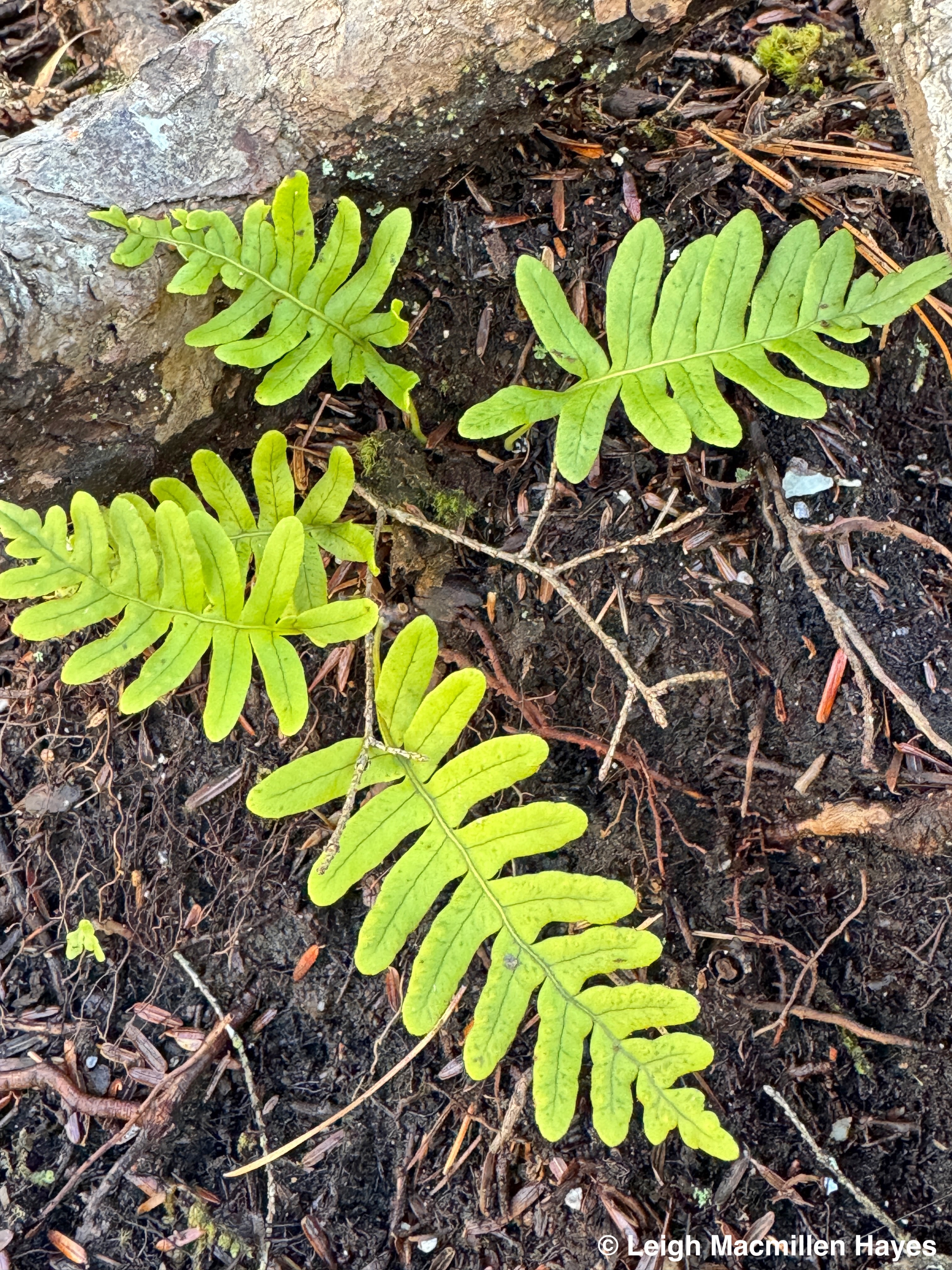
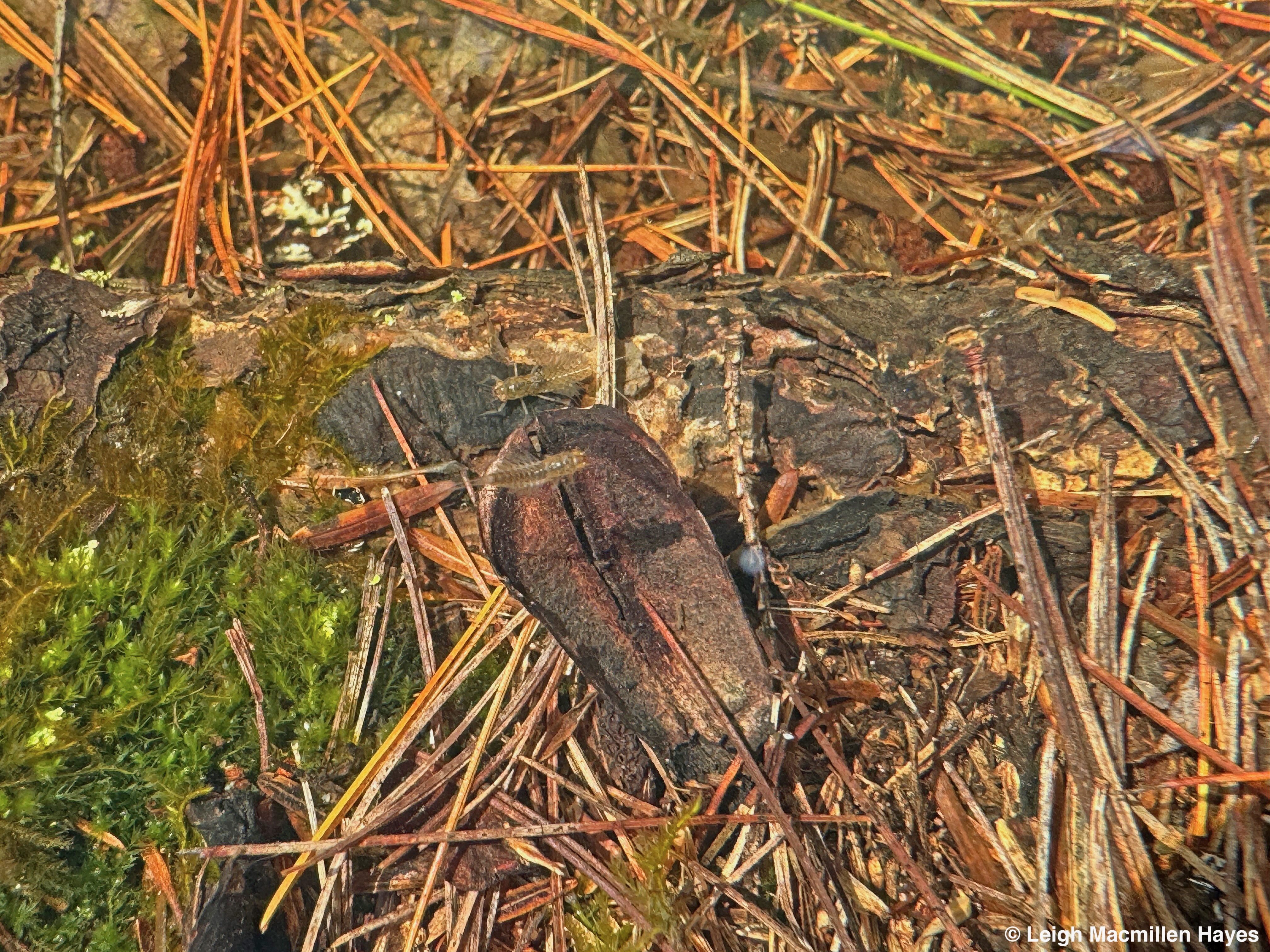
Hello spring! Thanks for reaching out in the form of Common Polypody Ferns, Mayfly Larvae by the hundreds, and even the Woolly Bear caterpillar. By the bits of debris on her bristly hairs, it was obvious that she’d just emerged from under the leaf litter where she’d overwintered and was frantically crawling along the road in search of a place to form a cocoon and metamorph into the Isabella Tiger Moth she’ll soon become.

I’ll always love you, winter. But right now, I’m already smitten with spring.

Pondering in Pondicherry

I love that I can step out the back door and explore hundreds of acres of woods or follow a path, cross a road, and step into a town park protected with a conservation easement. Lately, I’ve been spending a lot of time in the park, for starters because I love to spot the Mallards and look for Winter Stoneflies, but also because I’m working on getting to know bryophytes and lichens better. Of course, I could to that anywhere because mosses and lichens grow everywhere. And do not harm the substrates upon which they grow. In fact, they may actually help as in the form of mosses retaining water.

So, I invite you to step across the Bob Dunning Memorial Bridge and into Bridgton’s Pondicherry Park. Sixty-six acres of forest beside Stevens and Willet Brooks, with stonewalls, an old spring, and carved trails, including one that is ADA accessible, though in the current conditions, it’s icy and micro-spikes are the best bet for staying upright.

I’m almost certain these two ducks are named Donald and Daffy, but what I do know is that they laugh. A lot. Or at least that’s what it sounds like when they quack.

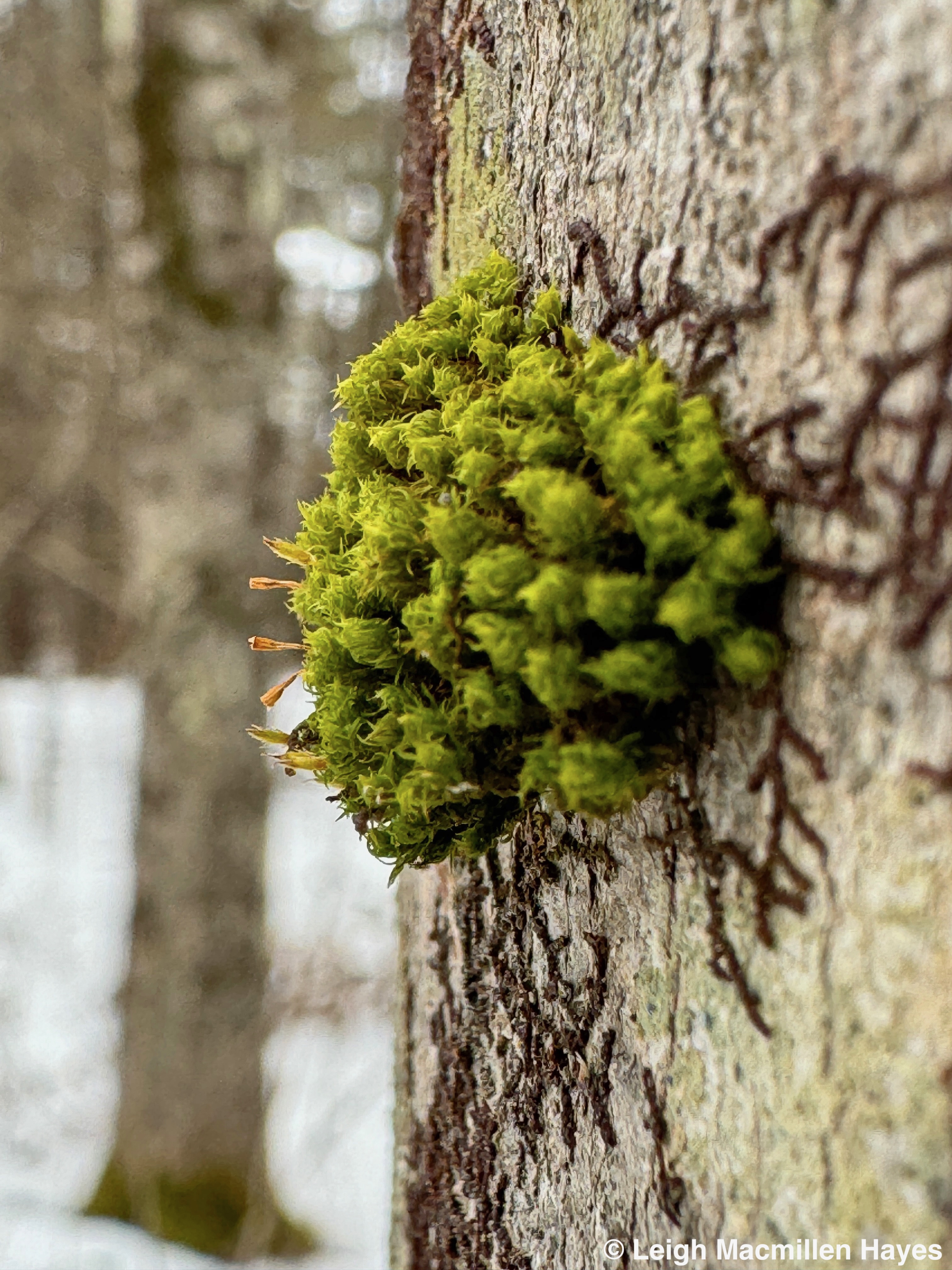
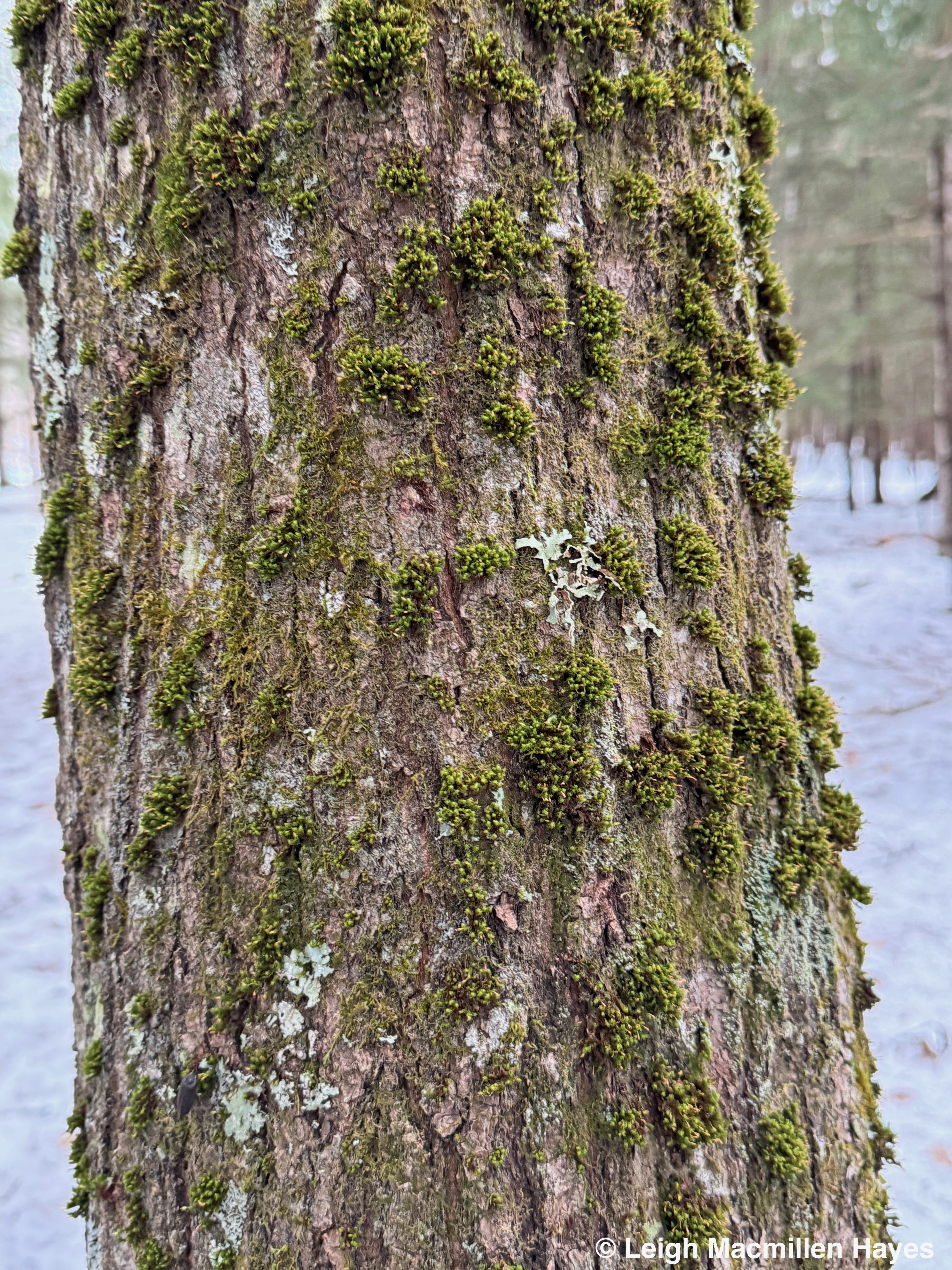
Finally, the reason I invited you along for this journey. One of my favorite little mosses. Meet Ulota crispa, or Crispy Tuft Moss (and Curled Bristle Moss and Crisped Pincushion . . . and probably several other common names). This moss is an acrocarp in form, meaning that the main stem generally grows upright and the capsules and seta or stalks that hold the capsules grow from the tip of the main stem. Usually, they grow upright that is, but in the case of Ulota crispa, they orient horizontal to the ground.

On this tree trunk, you might notice the pale green crustose lichen (crustose meaning crust-like and tightly pressed to the surface of its substrate) and the brown spiderwebby structure of a Frullania liverwort. Like mosses, liverworts are also considered bryophytes–meaning they don’t have a vascular system like plants and trees; nor do they produce flowers or seeds.

Ulota crispa grows in little tufts between the size of a nickel and a quarter. On some trees you might find one or two and others, such as this one, there are many.

My walk in the park was actually a self-assigned quiz because a friend and I had visited a few days prior and I wanted to make sure I could identify species on my own. As I always say when I’m tracking by myself, I was 100% correct in my ID.

But actually, this quiz did give me time to slow down and notice features, such as the thickness of the Brocade Moss, aka Hypnum imponens. This one is a pluerocarp in form, because the moss grows mostly prostrate, has many branches, and the capsules and seta (stem supporting capsule) arise from a side branch rather than the tip like that of the acrocarp.

I found one downed tree (and I’m sure there are many others under the snow) that looked as if it was covered with a carpet, a Brocade carpet. Given that a brocade fabric has a raised design, this common name seems to fit, though my research informs me that the Latin Imponens is the root for “imposter.” Apparently it can have different looks. That’s something I’ll need to pay attention to in the future.

Delicate Fern Moss, or Thuidium delicatulum, is another pluerocarp species. The fronds really do look like miniature fern fronds, in fact, twice-cut in fern lingo. But that’s a topic for another day.

I found the Delicate Fern Moss growing on a tree trunk, but also on a rock. Mosses don’t have actual roots, because remember, they are non-vascular plants. Instead, they have rhizoids, which look rather root-like, that anchor the plant to the substrate.

So how do they get water and nutrients? Via their leaves. And they have the unique ability of being able to dry out completely and stop growing, but pour water on them, or visit them on a rainy day after a dry spell, and they’ll begin growing again and turn from brown to green as photosynthesis kicks back into action.

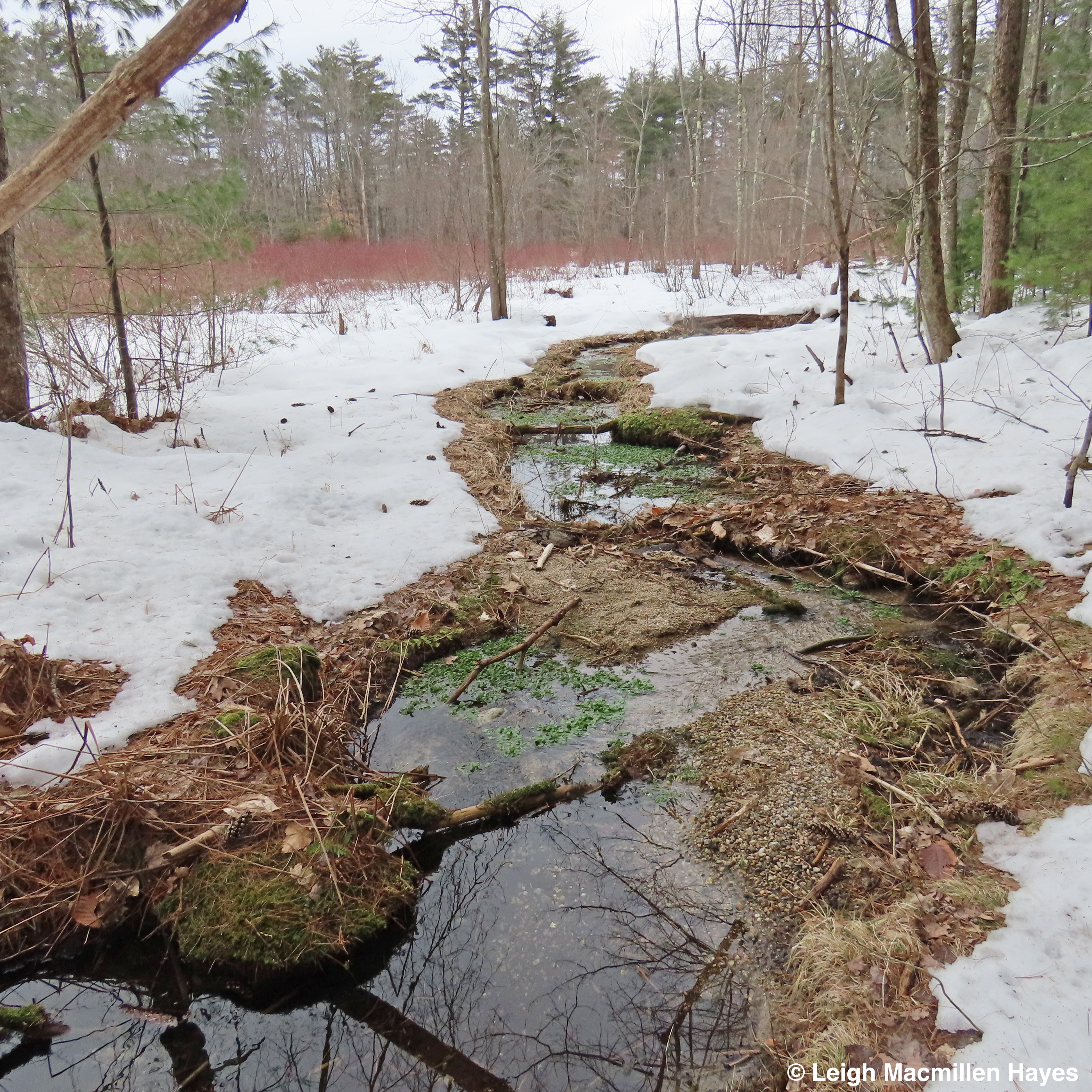
If you been in the park, then you may now this stream below the Kneeland Spring. And you realize that I’d probably already spent an hour on the path and hadn’t moved very far. The old joke that I can still see my truck in the parking lot doesn’t work this time though because I had walked there. But I could still see the parking lot.

What attracted me to the stream was the sense of color. On a bleak winter day, the view was breathtaking in a subtle way.

In particular, the bright green of a plant that isn’t a moss or liverwort, but rather a vascular plant known as Watercress. It grows in natural spring water, thus its abundance below the spring from which this water flows.

While I was admiring the Watercress, I met a moss that I swear I’ve never laid eyes on before, but don’t think I’ll ever forget going forward: Willow Moss, aka Fontinalis antipyrectica. Its one that prefers to be submerged, thus its location. When the water is warmer, I need to get to know it better, but it almost looked like the leaves were braided.

The funny thing about this spot is that as I was looking down, a young couple walked along the trail above me. In an instant, the young man and I made eye contact and at once recognized each other as we are neighbors. He said, “I wondered who was down by the stream.” He wasn’t at all surprised.

Because the snow is beginning to melt, I finally saw an example of the poster child for acrocarpous mosses: Common Haircap Moss or Polytrichum commune. Here are a couple of easy ways to ID it from other haircap species: when dry, the leaves don’t twist as they fold upward toward the stem and the leaves have reddish tips.

Mixed in with the mosses were some little structures that actually remind me of caterpillars. They are also non-vascular and are associates of mosses, these being liverworts. Bazzania trilobata does not have a common name as far as I know. That’s probably a good thing because it forces me to learn the scientific name.

A small piece may have followed me home and stuck itself under the microscope. Liverworts are also small and where a moss has leaves arranged in more than three rows, a liverwort has two rows, like this one. That said, some have a third row underneath. Another key is that while mosses often feature a midrib, liverworts as you can see by this example do not. There’s more, but that’s enough to get started.

Mosses and liverworts aside, I had been looking for examples of this foliose lichen upon a previous visit, and finally found this one. It’s one of the ribbon lichens, but I haven’t yet figured it out to species. And I don’t know if it grows on anything other than Eastern White Pines, for that is where I see it.

Lichens come in four forms. Earlier I mentioned crustose: crust-like or pressed against the substrate; foliose–foliage-like or leafy; fruticose: upright and pendant, think grape branch; and squamulose: with little raised scales.

So, which form is this? Ah, the quiz is now in your hands. Crustose, Foliose, Fruticose, or Squamulose. I’ll tell you it isn’t the latter. Of the first three, which is it?

The little black discs or bumps are its reproductive structures.

Here’s a great take-away from Joe Walewski’s Lichens of the North Woods: “Successional stages of lichen communities on rock progress from crustose lichens, to foliose lichens, and then on to fruticose lichens. In contrast, successional stages for lichen communities on tree bark follow an opposite pattern. Many crustose lichens are a sign of an older successional lichen community.”

If you answered my question above as the form being crustose, you would be correct. Common Button Lichen or Buellia stillingiana.

This next one pictured above is among my favorites. Maybe it’s because though I find it on other trees, I love how it appears between the “writing paper lines” on the ridges of Eastern White Pine bark. Known as Common Script Lichen, or Graphis scripta, you might see it year round as white spots on trees but the squiggly apothecia (reproductive or spore-producing structure) appear only when it gets cold enough.

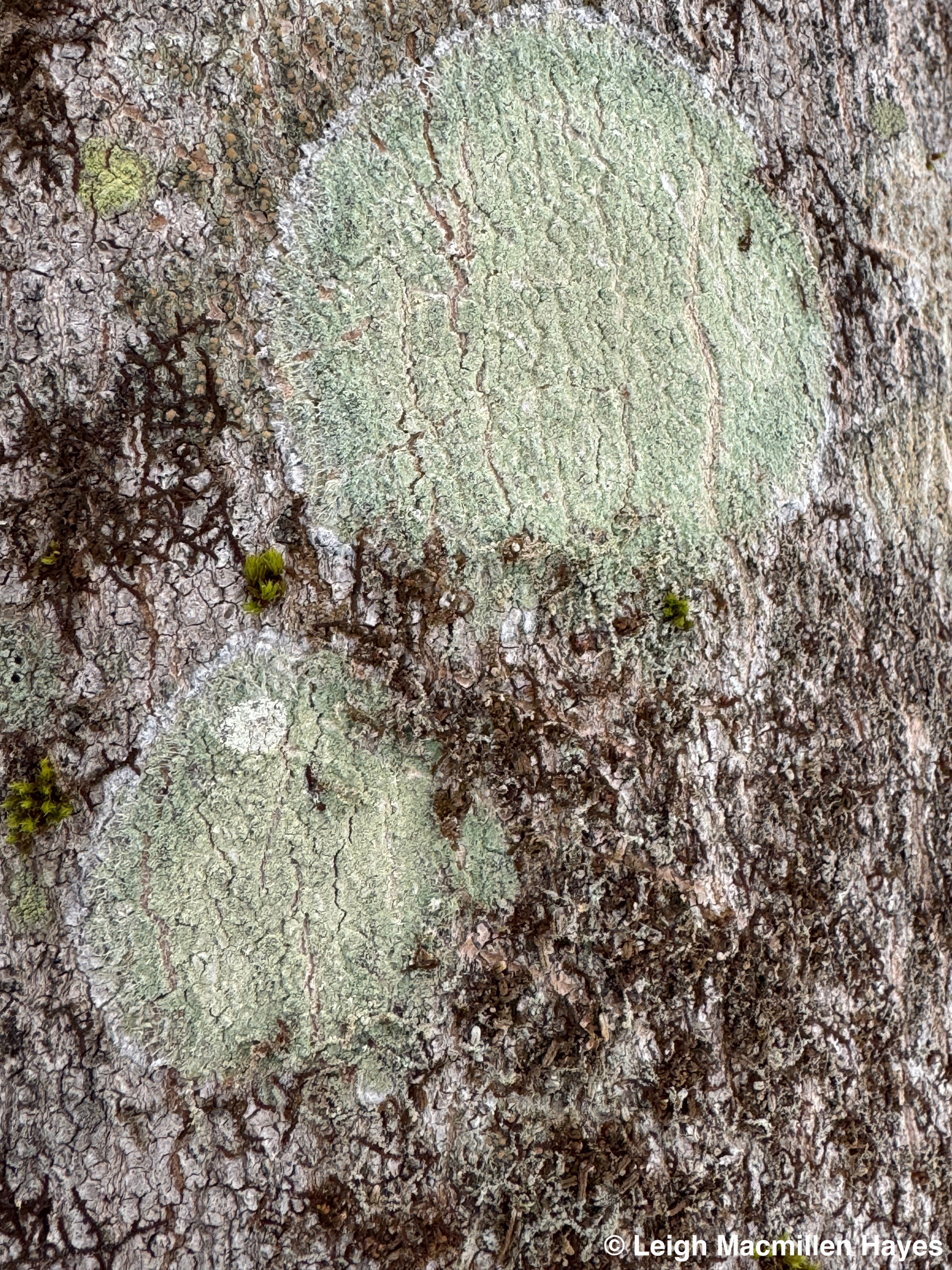
And here again: same crustose form, different crustose colors. Do you see at least three colors? Two shades of green surrounded by a blueish-grayish white? The white fringe is called the prothallus, a differently colored border to a crustose lichen where the fungal partner is actively growing but there are no algal cells. Though named the Mapledust Lichen, Lecanora thysanophora, it grows on several species of trees just to keep us all questioning ourselves.

The final lichen of this journey, and believe me, there could be a million more, or maybe not quite that many, but . . . anyway, is the Common Green Shield. I’m realizing just now that I don’t have a fruticose lichen to share, but that I’ll leave for another day. This Flavoparmelia caperata demonstrates the foliouse form. One that my lichenologist friends, Jeff and Alan, describe as one you can easily ID while driving 60 mph. Of course, you should be looking a the road and not at the lichens or your cell phone, but should you glimpse it out of the corner of your eye, you can easily remind yourself that it is a Common Green Shield.

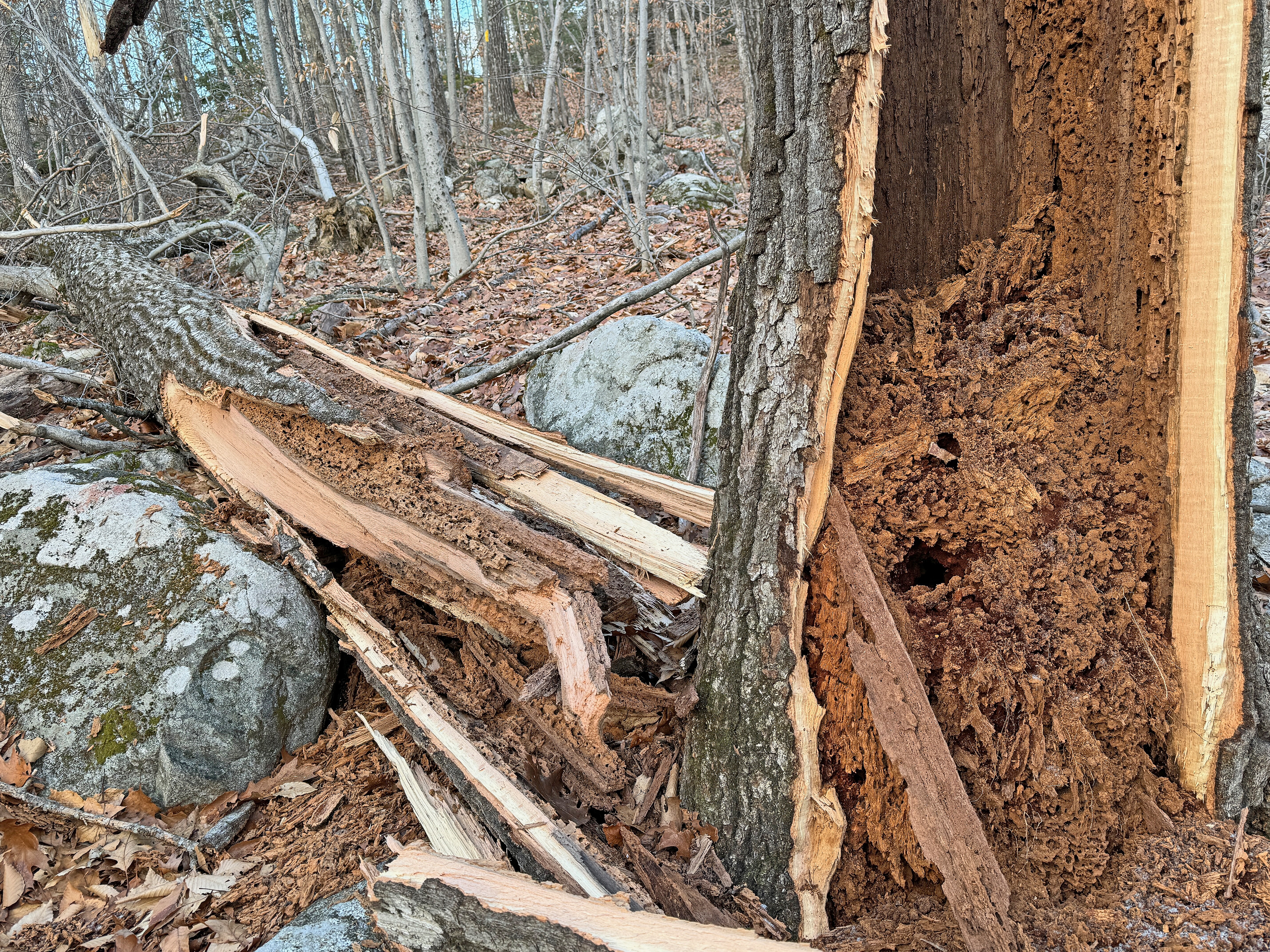
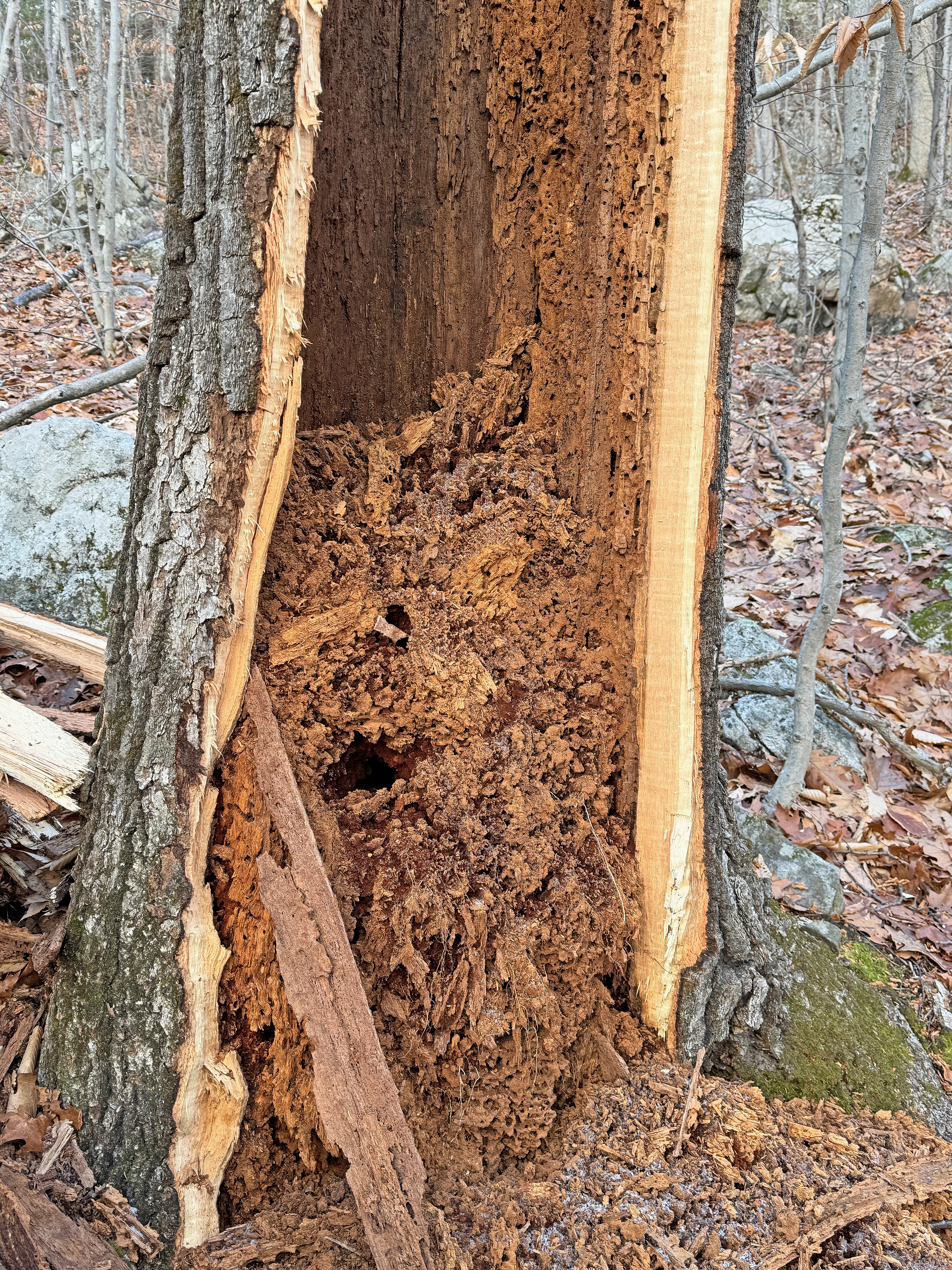
While finally making my way homeward, I was stopped by a sight that always invites a look. You may be tired of seeing it, but I hope I never am. The debris left behind by a Pileated Woodpecker.

There are at least two packets worth examining in this mess, and if you know what I mean, see if you can find them.

The tree was one rather gnarly Eastern White Pine and it grew near one of the old boundaries for the park was originally three different properties that were combined to create such an open space. You can read about that in Pondering the Past at Pondicherry Park. I suspect its growth pattern had something to do with being a boundary tree in an otherwise open area.

Do you see the bird’s excavation site?

And did you find this scat in the debris? Staghorn Sumac had been part of this bird’s diet prior to visiting the tree.

But carpenter ants were on the menu as well. Vegetable, Protein, Fiber. The perfect meal.

When I arrived home, it was time to do some organizing of my moss collection, some of these which I’d collected in the past and kept in Ralph Pope’s Mosses, Liverworts, and Hornworts: A Field Guide to Common Bryophytes of the Northeast.

The book is warped because, of course, most of these were damp when I placed them in it.

Here’s the thing about collecting mosses: only take just enough to study. Mosses can take a long time to grow, so you only need a small piece for closer inspection. As for lichens, if you need to, collect from those that have fallen off trees. Otherwise, let them be. They take even longer than mosses to grow.

And I encourage you to spend some time trying to get to know what you meet up close and personal. Looking through a loupe and sketching help me.

Slowing my brain down and noticing. I love that I am finally making time to do this again. And taking topics that had often stymied me and trying, trying, trying to get to know them better.

While I was pondering once again in Pondicherry, I did notice that someone was pondering about me. I went with the expectation of possibly seeing an owl while spending time quizzing myself on all of these species, and indeed I did. See an ice owl that is.

Oopsy of a Mondate

Knowing it was going to be warmer today, we decided to venture to a local park where the snow pack would be less. That doesn’t sound right coming from this snow queen, but we didn’t feel like postholing or having snow stuck to the bottoms of our snowshoes.

This is a place where we know beavers are active. And I, of course, went with expectations. And convinced My Guy that we should begin and end at the bog.

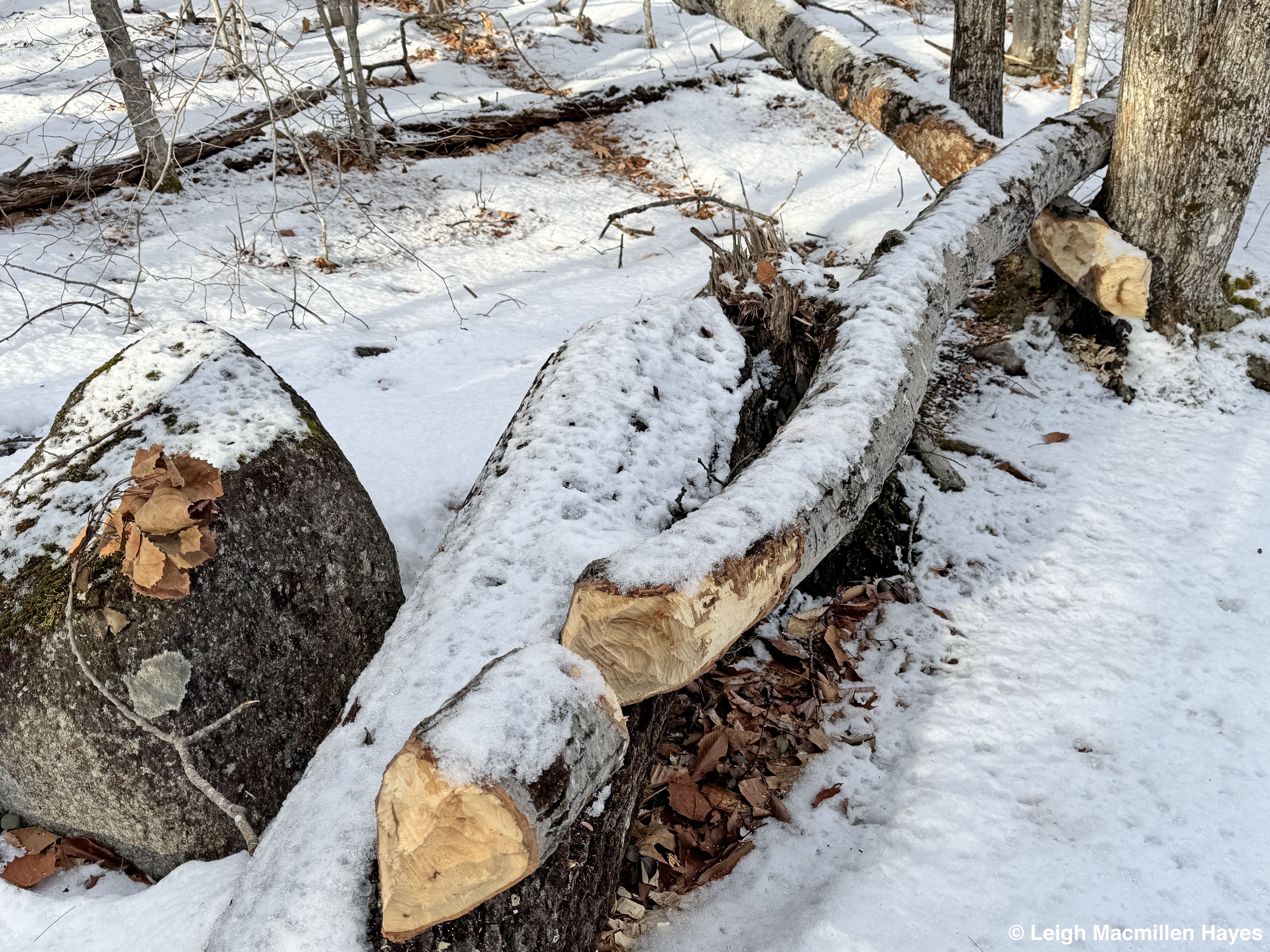
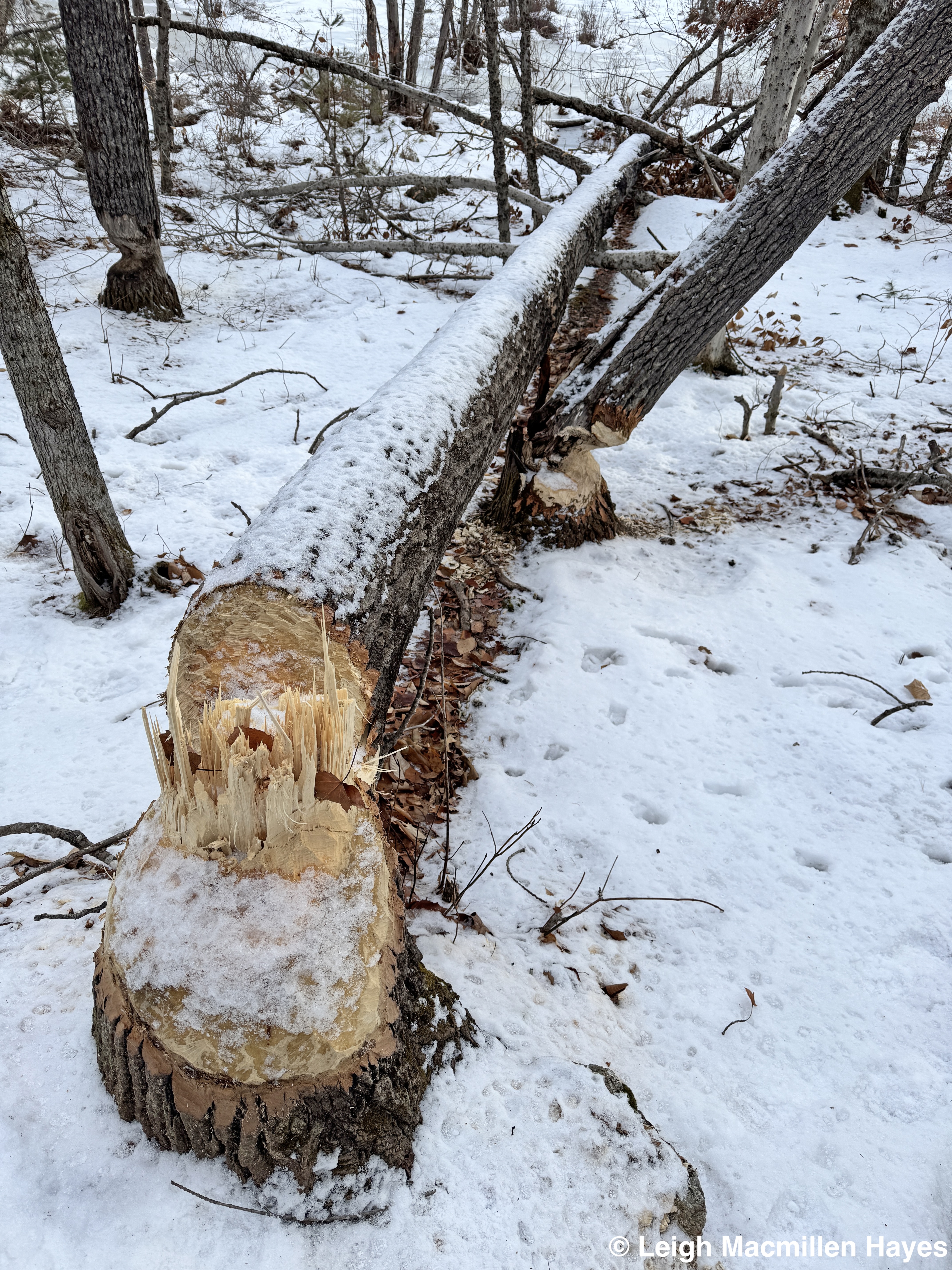
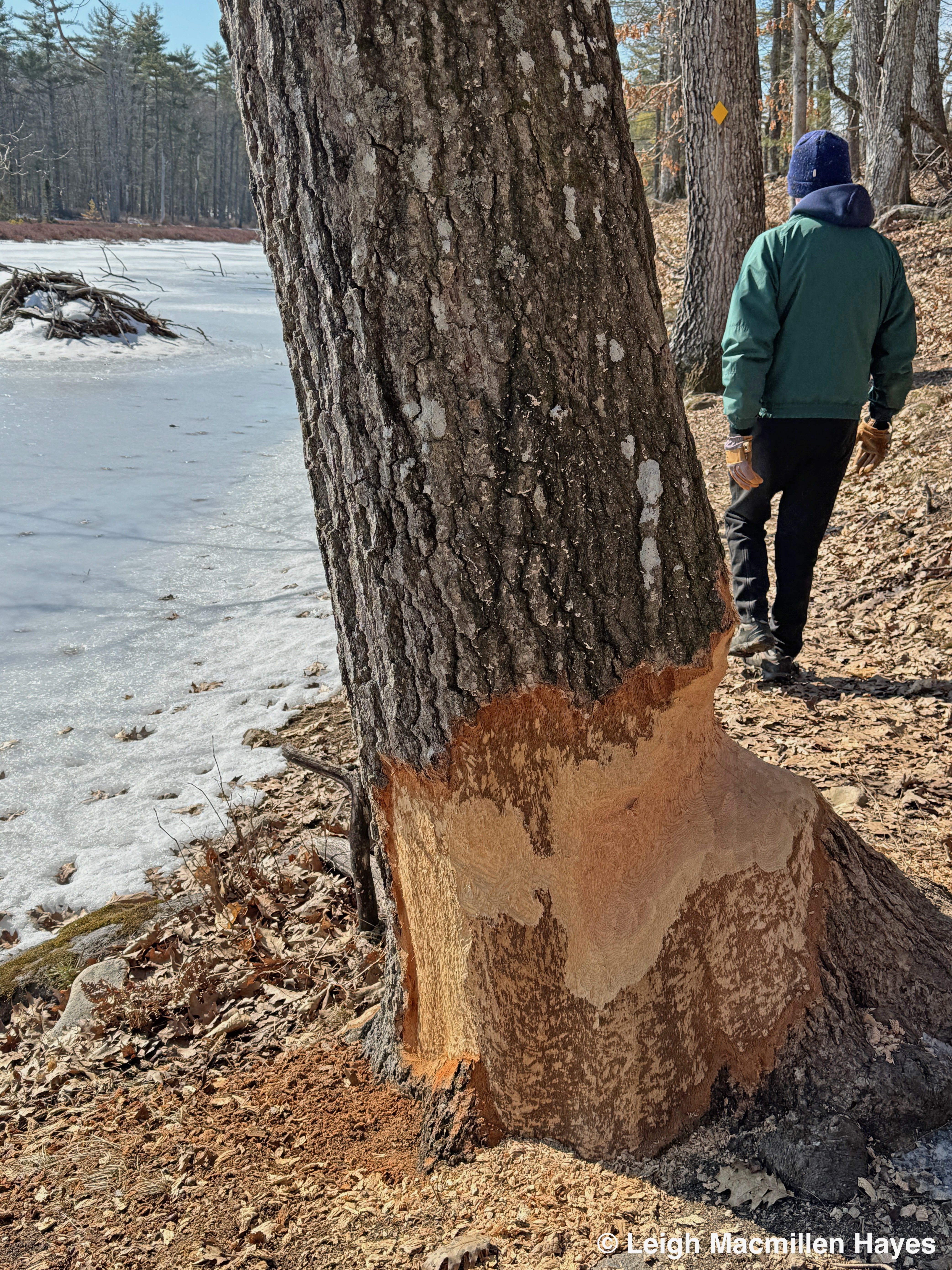
And bingo–a beaver-chewed tree that had probably been munched upon this past fall based on the color of the sapwood greeted us immediately.

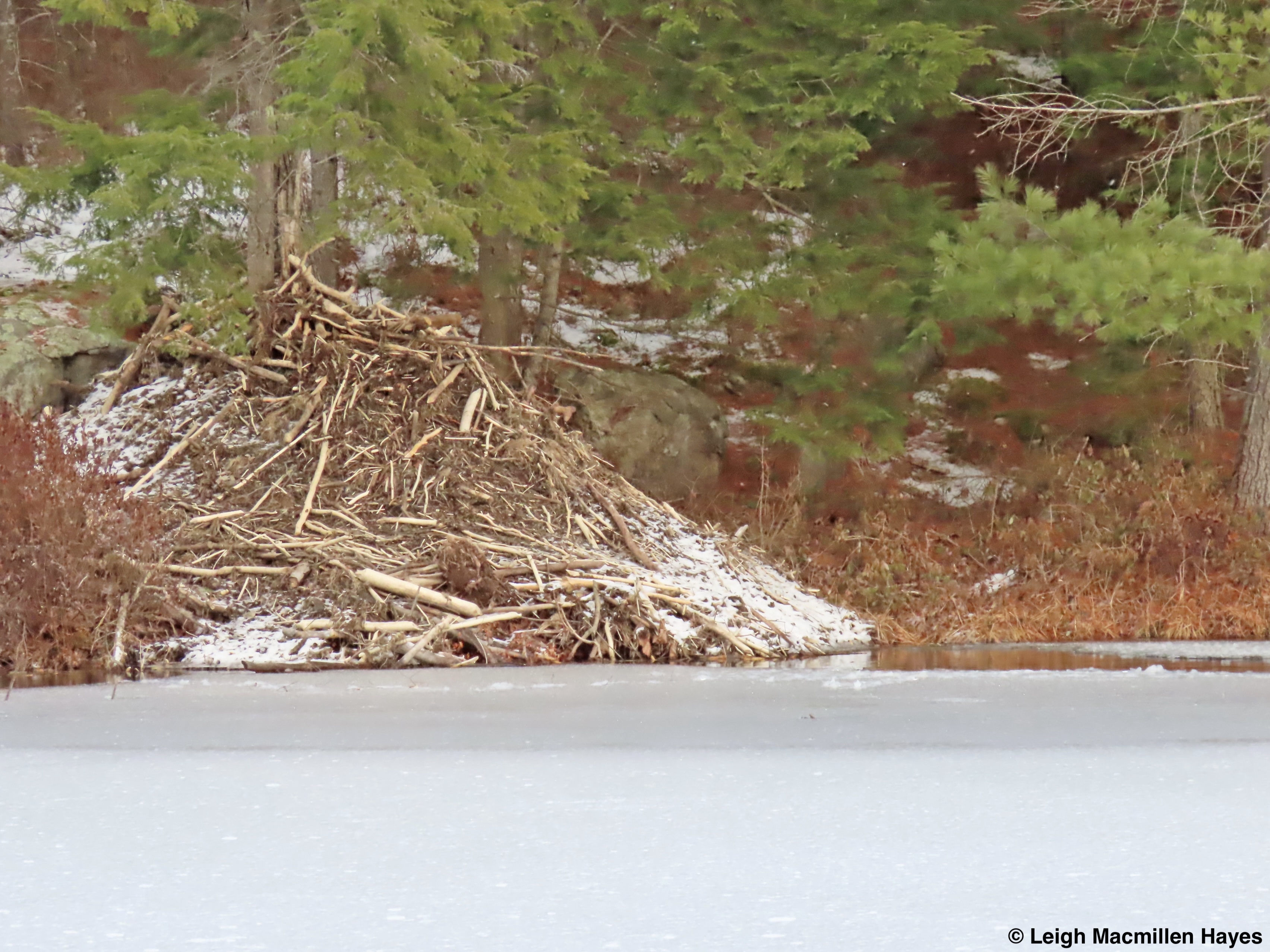
But do you see the lodge in the background?

Here’s a closer look. Fully iced in and no mud on the exterior. This one had been active for several years, but today we learned that that is no longer the case.

Still, as we moved past it, there was another tree (on the left) that had been equally munched upon this past fall, while the color of the wood on the tree to the right indicated activity from a previous year.

There was even a dam, but I was beginning to lose hope. And to kick myself for coming with expectations. When will I ever learn?

Because we were in a park, there were structures and behind one close to the path, we found an Eastern Phoebe nest upon a platform placed there for the very bird to set up housekeeping each spring.

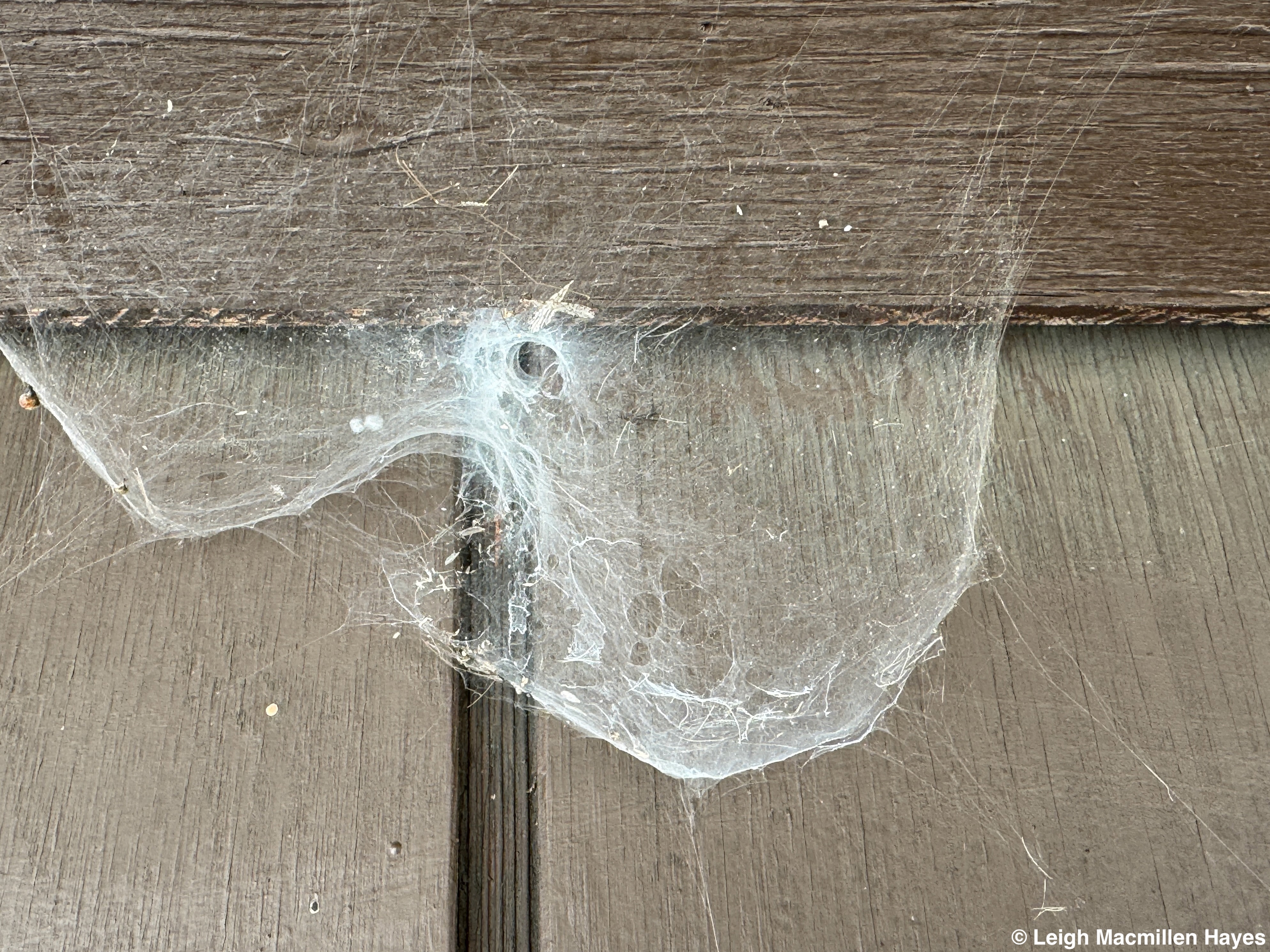
The cool thing was that the Phoebe wasn’t the only structure dweller, for directly below her nest a Funnel Weaver Spider had constructed an intricate home. I love all the guylines meant to keep the web intact, in fact it worked so well, that the winds of the fall and winter didn’t seem to have touched it. Well done, spider!

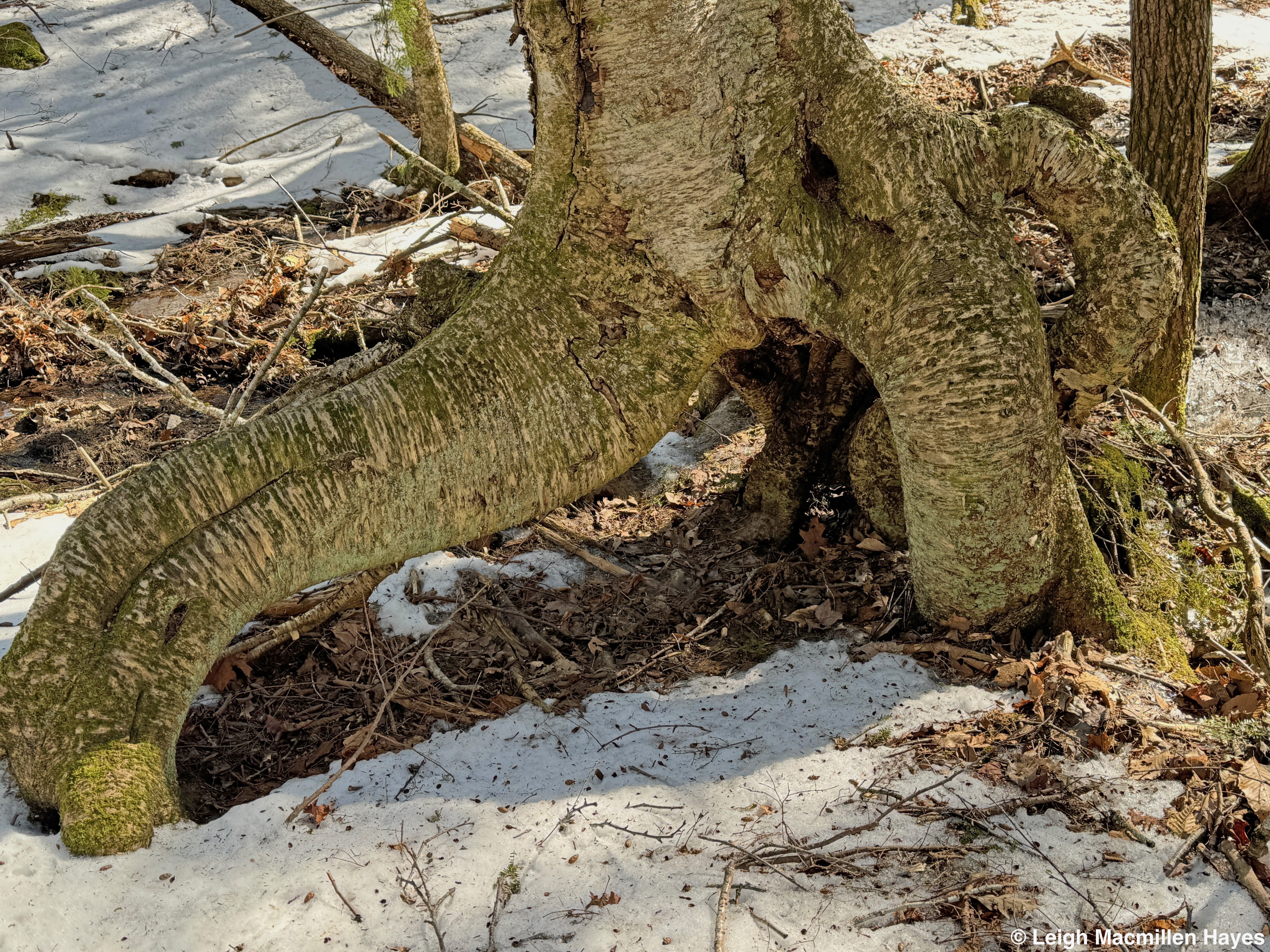
As we continued on, I thought about the gems this place offers, including this beautiful old Yellow Birch standing on stilts. As I noted in Becoming Tree Wise, the seeds of Yellow Birch, like Eastern Hemlock, struggle to germinate on the forest floor, but give them a moss-covered rock, or tree stump, or nurse log, and bingo, a tree grows on it. As it continues to grow, the roots seek the ground below and if it is upon a stump or log that eventually rots away, you have a tree in the forest that appears to stand on stilted legs. Tada!

Our trail was sometimes bare and other times snowy or icy, so we did don microspikes, which turned out to be the perfect choice most of the time.

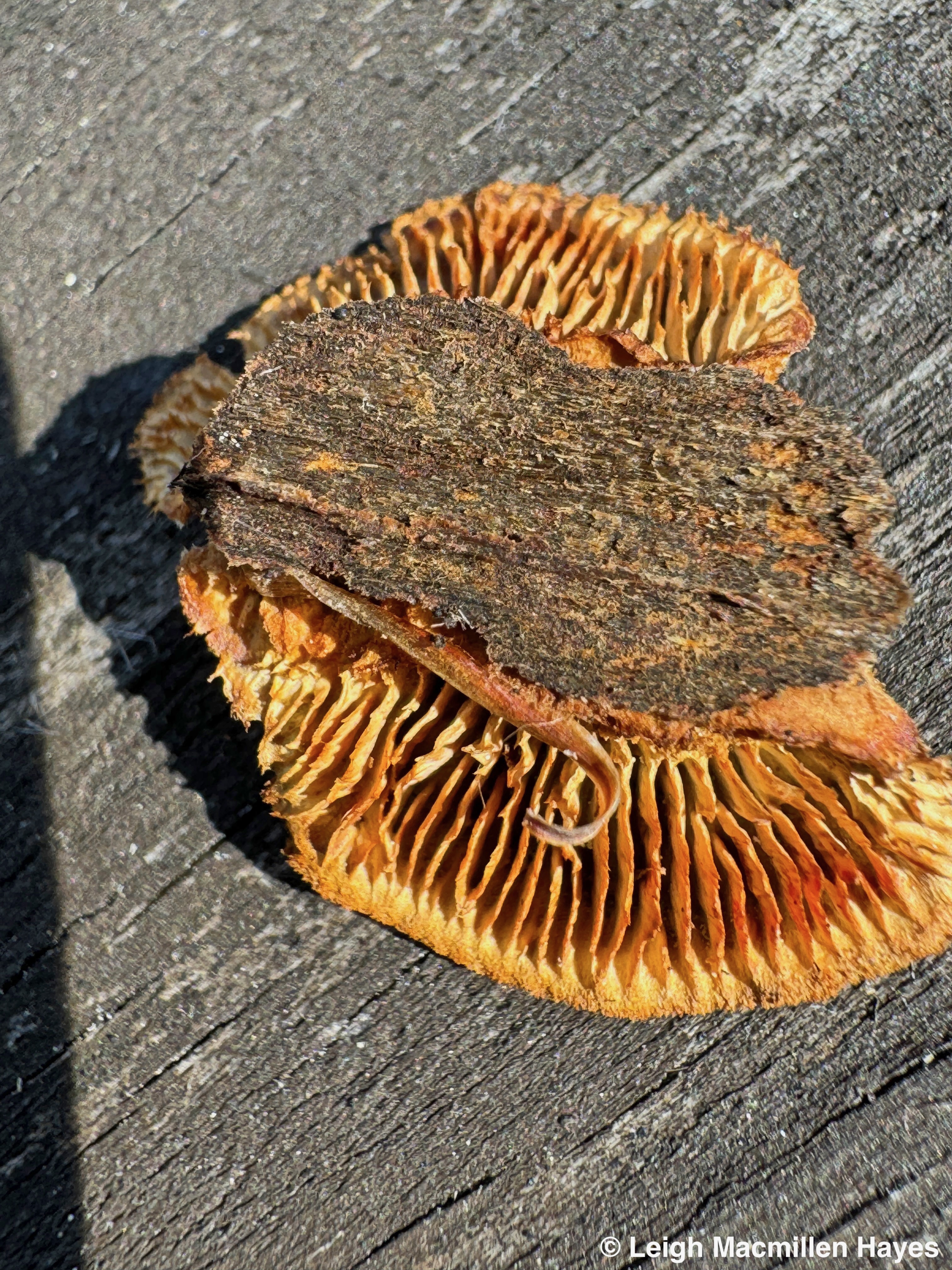
At the summit of what is known as Lookout Trail, the view is of the forest beyond, but we did look down at the picnic table and discovered mushrooms growing on the wood. The cap was like a tapestry of oranges and yellows and rosy browns.

It was the underside, however, that aided ID: Gloeophyllum sepiarium (Rusty-gilled Polypore or Conifer Mazegill).

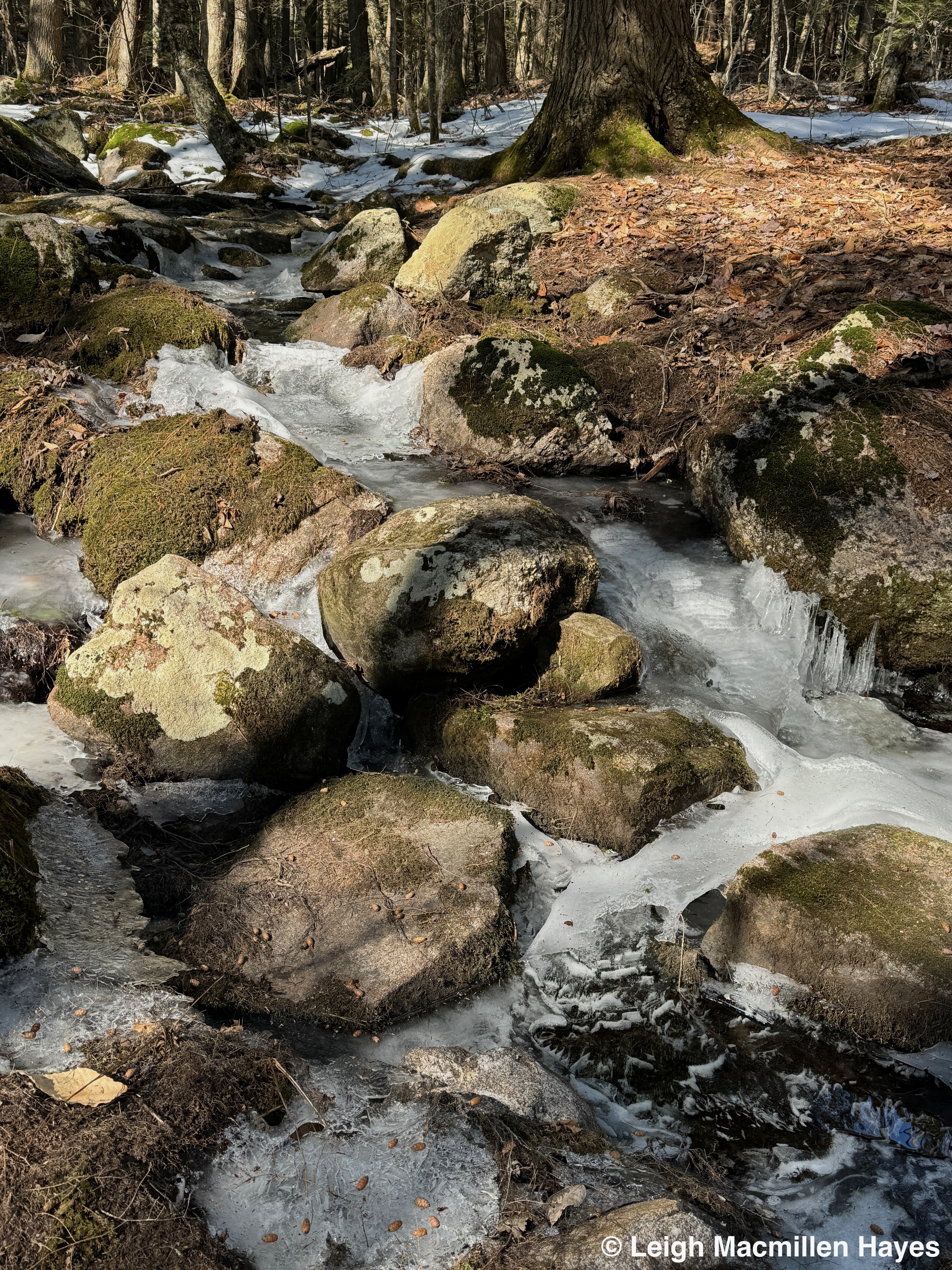
Occasionally there were brooks to cross and icicles to admire and sounds of percolating water flowing beneath the ice to encourage stopping for a few minutes to take it all in.

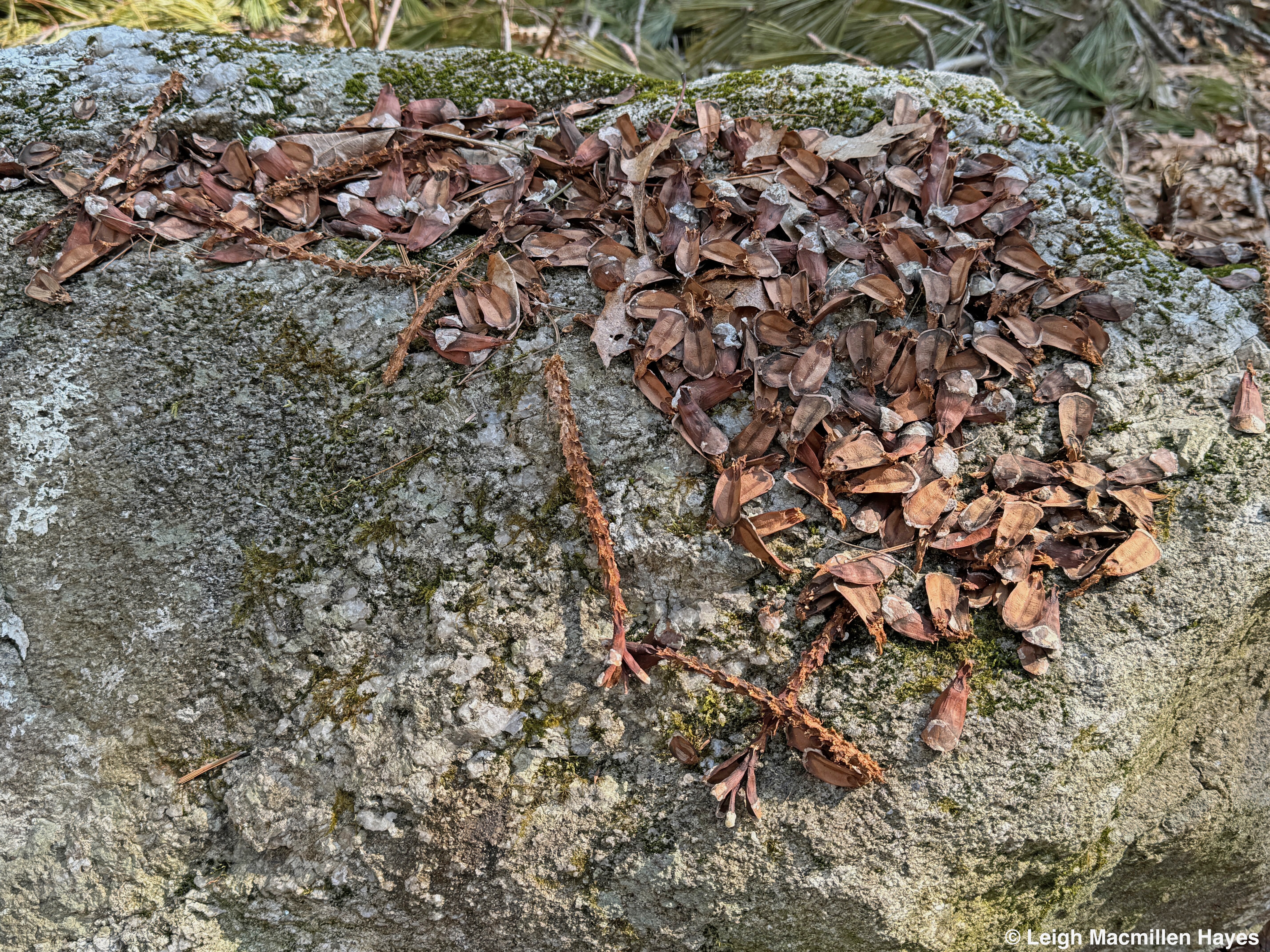
Heading downhill, in a boulder field below a granite ledge we discovered the territory of one very busy Red Squirrel. Middens covered numerous rocks.

And I could only imagine what the original cache had looked like. Since it takes two years for pinecones to mature, next year this squirrel may not be so fortunate, but living in the here and now, life is good.

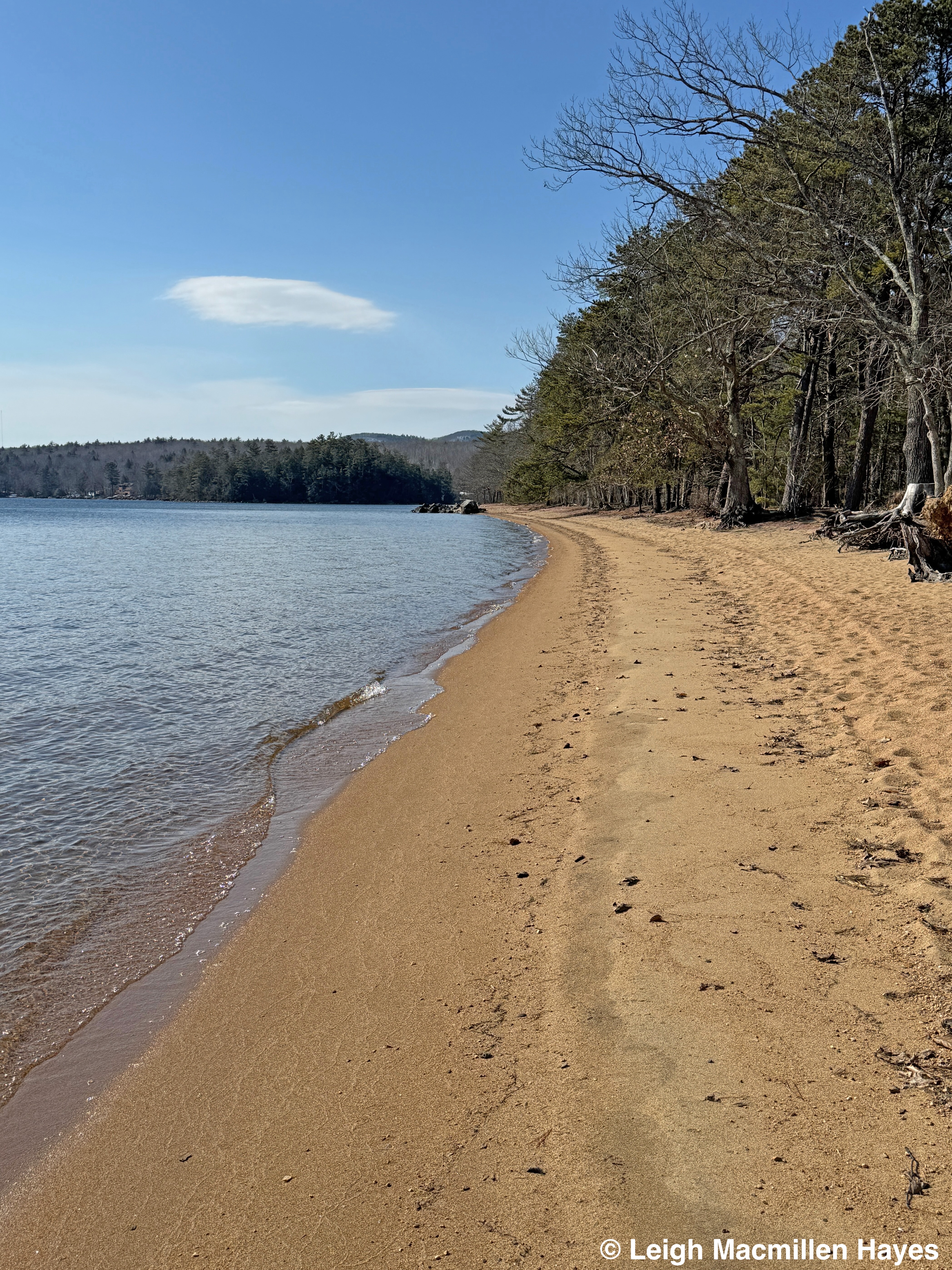
At last we reached the lake for which the park is named and for the second year in a row, it did not freeze this winter. Being the second largest lake in Maine, it covers 45 square miles and at its deepest hole is over 300 feet in depth.

We backtracked a birds trail along the water’s edge and found our way to the perfect lunch spot.

The view from lunch rock found us dining with few words shared as we took in the vastness of this space while small waves broke along the shoreline and we realized we could have been at the coast.

Back on the trail, we hiked a couple more miles before returning to the bog’s opposite shoreline. Surely, the beaver would not let me down.

And there is was. The lodge that is. With mud on it. That meant a family could have overwintered in this one.

Wouldn’t you feel warm and cozy inside that building?

And there was evidence that another tree had been dined upon in the fall. But . . . no signs of smaller trees being cut for a food supply. Are they still home? I do not know, but maybe another visit in a month or so will reveal the truth.

There was, however, lots of sign that humans had been cutting trees: to clear trails so people like us could enjoy them.

And we did as we journeyed the West Side of Sebago Lake State Park.

So you must be wondering why this was an Oopsy of a Mondate. No, I didn’t fall. Nor did My Guy.

In fact, we had a wonderful time exploring and loved every minute of our adventure.

But . . . there was some logging going on and it wasn’t until we got home and I looked at the Sebago Lake State Park website that I discovered this message: February 25, 2024 | Campground infrastructure improvements begin tomorrow, Monday 2/26/2024. While heavy trucking activities occur, State Camping Rd. in Naples will be closed to foot-traffic for public safety. However, the Day Use Area, found at 11 Park Access Rd. in Casco will remain open to visitors. Thank you for your patience and understanding while these improvements occur.

Oopsy. Don’t follow our footsteps, but rather go to the Day Use Area instead.

Winter Inventory

We live on the edge. The edge of a small town in western Maine. The edge of a neighbor’s field. The edge of a vast forest.

Our property only encompasses six acres, but it’s six acres that I love to explore and it’s been my outdoor classroom for a long time.

And so today, I invite you along to take a look; if you are a regular, you may have already met the friends I’m about to introduce, but their actions keep me on my toes, much like the deer who crisscross our yard on a regular basis.

Though the acorn crop was abundant in our area, the deer make several trips day and night to consume sunflower seeds and corn and they’ve worn a path (deer run) making it easier to travel. They don’t always follow it, as you can see, but do so enough that it’s much like my snowshoe trails.

The yard is full of tracks, for besides the deer, there are gray and red squirrels who also frequent the feeders, an occasional red fox that I’ve yet to see this winter, and our neighbors’ dogs and cats. Everyone has a place at this table.

Of course, the deer run does lead to another species they love to munch on, the needles of a Balsam Fir. They frequently pause here before climbing over the stone wall into our wood lot.

And so I paused too. And discovered yet another cache and midden created by one of our local Red Squirrels. I’m in awe because until yesterday, I wasn’t aware of this one and I can see it from the desk where I’m writing right now. And to top it off, yesterday was the first day since I filled the feeders at the beginning of December that I saw a Red Squirrel chasing the Gray Squirrels away.

I, too, climbed over the wall and look who I met. Always on alert and often either skittering along the ground or a stone wall, or chastising me from its branch of choice, Red doesn’t realize that I’m a fan.

Next, I ventured over to the old cow path, bordered as it is by two walls, and checked on the cache and midden situation that’s become so familiar to me.

The cache or storage pantry of pine cones is located under the mound of snow the black arrow points toward. At last measurement as recordered in The Forever Student, Naturally, the pile was a foot high. As you can see if you look closely at the tops of the stones behind the snow-covered pile, you’ll spy several middens. So my question is this and I’ll have to wait until the snow melts to answer it: Are all of the cones the squirrel is consuming (well, seeds actually, for the midden is the pile of discarded scales that protect the seeds, plus the cob or core left at the end) coming from under the rocks, where I’m sure there was more storage space, or the bottom of the pile, because Red Squirrels do tunnel? I can’t wait to realize the answer in another month or so.

The pine tree beside the cache also provides a grand dining spot.

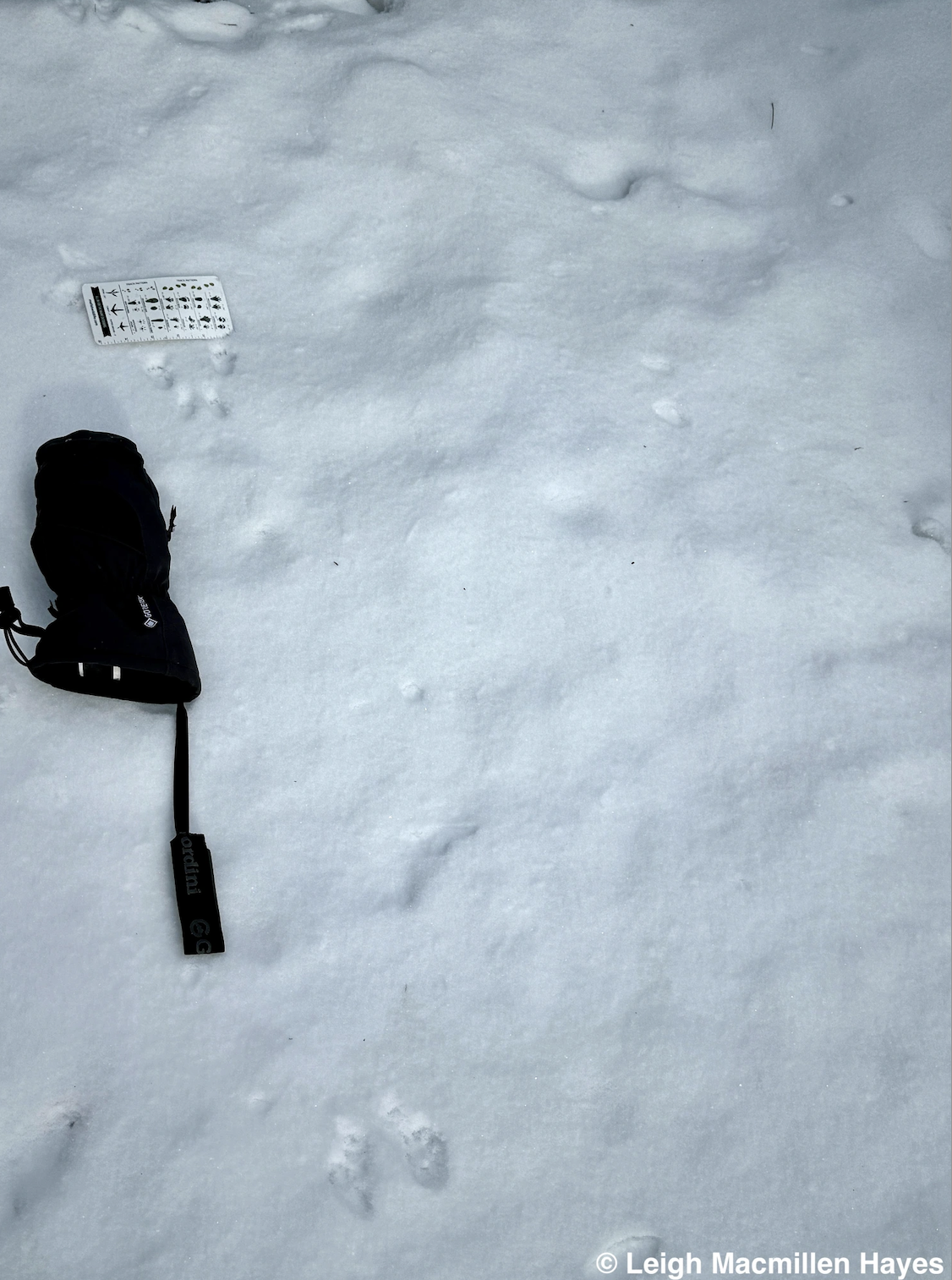
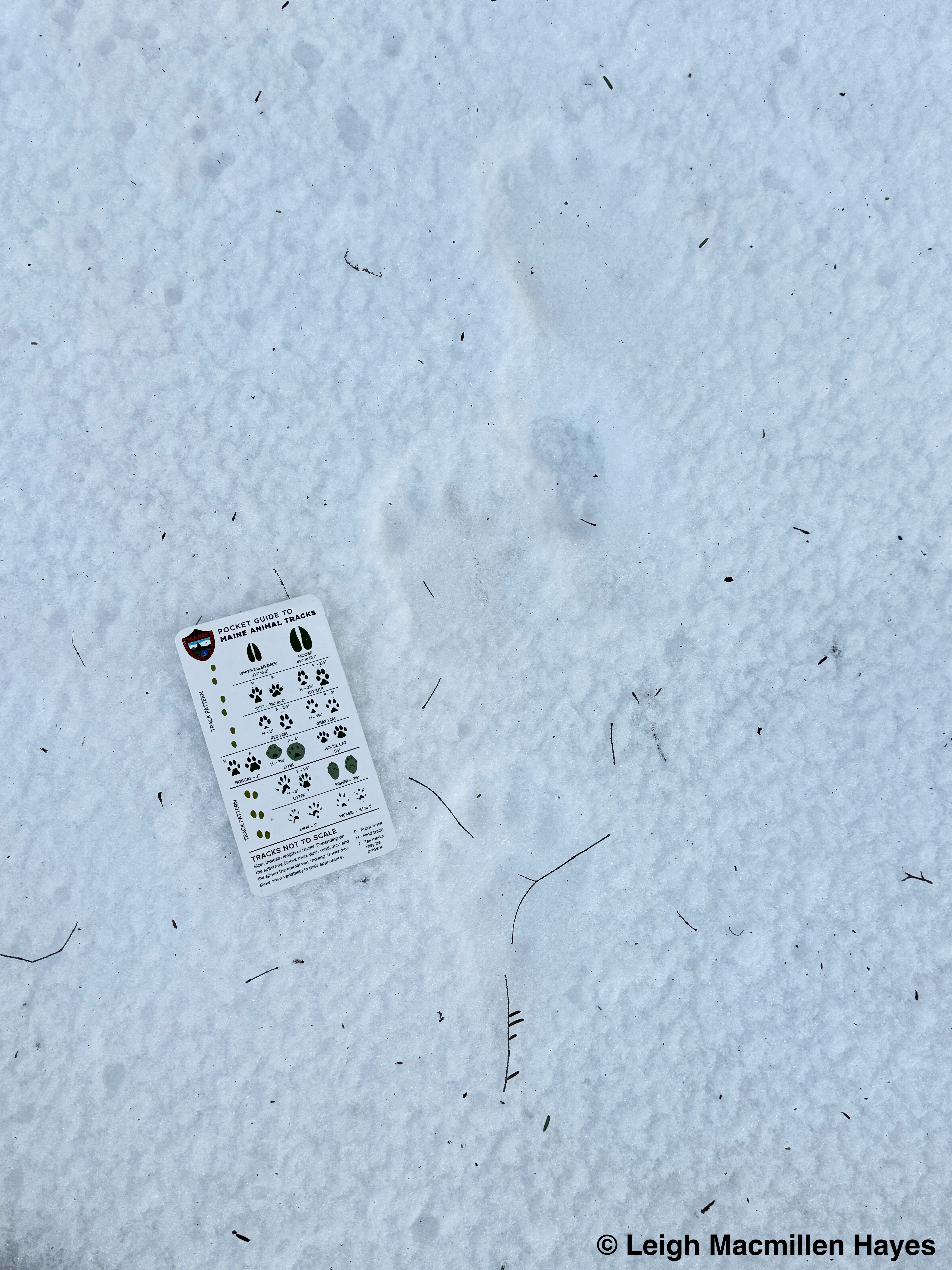
About an inch of snow fell overnight, so when I went into the woods this morning, I found fresh Red Squirrel prints, with the straddle or track width being the typical three inches. It was a bit nippy with the wind chill, so I didn’t get the card placed exactly as it should have been, but you get the idea. Its big feet in front are actually this hopper/leaper’s hind feet.

Okay, so I did risk the freeze for a minute because I spotted the set of four prints behind the first set I’d photographed and realized not only how close together the four were, but also the length of the leap from one spot to the next: My mitten and wrist holder are 19.5 inches in length and they didn’t cover the length of this motion–perhaps an attempt to quickly reach safety in the other wall or up a tree.

That action was on the eastern end of the path, but there’s more to see as I head west.

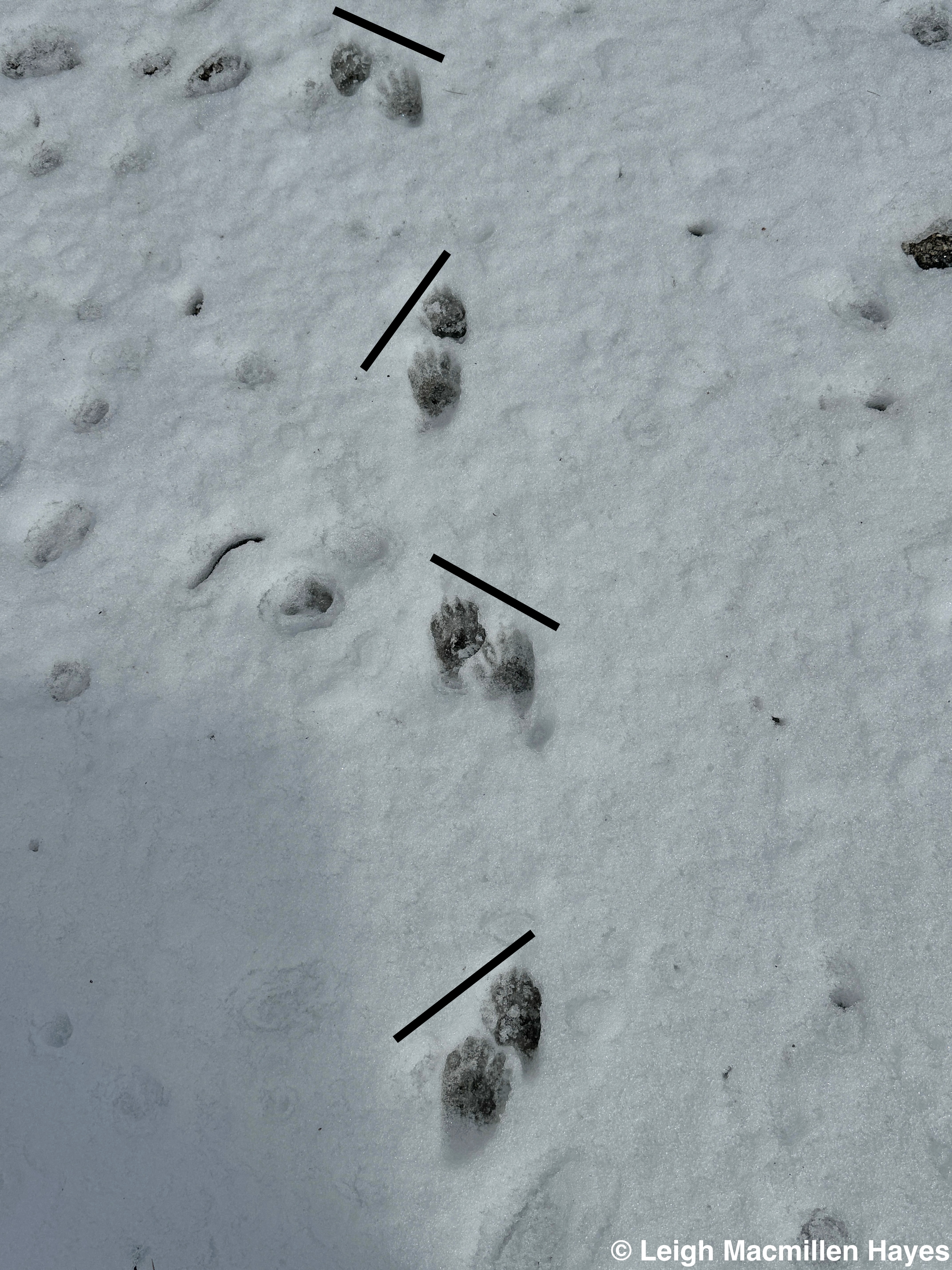
A few days ago, and probably because the night temperatures were more moderate, a family of rascals crossed from the other side of the wall and onto the path. By the baby fingers of the front foot, I know they were Raccoons.

As waddlers, Raccoons have their own pattern that is easy to recognize once you get it into your head. They don’t travel this way all the time, but most often I find their prints, with a front foot (baby hand) of one side and hind foot (a bit longer print) of the other side juxtaposed on opposite diagonals. If you look at the black lines I placed before each set of two prints I hope you’ll see what I mean. And notice the keys. It’s all I had in my pocket that day and I wanted something for perspective. I really didn’t expect to find the raccoon tracks.

I went back home and grabbed a tracking card to set on the ground. If you’ll look closely, you’ll note that it’s more than one animal, but all the same family. I followed them across the wood lot, over another stone wall, and into the field where they split up into four individuals before heading off in to the neighbor’s woods on the far side.

Back to the cow path I did return and this time it was a scene just off the path that drew my attention. Our Pileated Woodpecker has been active as evidenced by all the wood chips on the ground. That means one thing to me. Time to look for scat.

And I wasn’t disappointed. Check out that cornucopia stuffed chock full with insect body parts that the bird couldn’t digest.

Finding this is always like opening a Christmas present. The thrill never ends. But, curious spot here. Seeds. Staghorn Sumac seeds.

And on the pine tree and at its base, I found more of the Staghorn Sumac in bird droppings, a completely different form from the Carpenter Ant droppings.

Both followed me home! The Carpenter Ant scat is very fragile.

The sumac, being fleshier, held together better. Under the microscope I noted that there were some ant body parts mixed in with the sumac.

Here’s a closer look at one of the legs of a Carpenter Ant–notice the long “thorny” thing, which is the tibial spur located at the base of the tibia.

And an exoskeleton plus another leg. With lots of wood fiber in the mix. Lots of nutrients and fibers mean scat findings for me.

A power line bisects our property and I have a love/hate relationship with it. I do love that it looks like we could walk north to Mount Washington. But my destination was to the trees on the western (left-hand side), where we own at least one more acre enclosed by stone walls.

About half of that acreage is a combo of hemlocks and firs fighting for sun. In the end, the hemlocks will rule the world, but the firs are trying to compete.

It is here that I discovered Snowshoe Hare tracks and my heart smiled again. There’s not much on this portion of our land for the hares to dine upon, such is the landscape when the trees block undergrowth. But on either side of the walls, there’s plenty available to them in areas that have seen timber cuts within the last twenty years.

Here’s the thing about hare prints–as hoppers, the smaller front feet land first and often, but not always, on a diagonal. The much larger hind feet swing past where the front feet had been as the mammal moves forward, and thus appear to land in front when you look at the overall pattern. And my favorite part of this set of four footprints: the overall shape, which to me looks like a snow lobster with the front feet forming the tail and hind feet the claws. Do you see it?

This neighborhood on the other side of the power line also supports a Red Squirrel who in true squirrel tradition travels this way and that.

And like its relative on the other side, it took time to cache a bunch of cones and now feasts upon its supply.

And leaves its garbage for nature to recycle. Notice how the middens are often located on high spots such as the rocks along the wall–the better to be in a spot where you can see who or what might be approaching. Even those on the ground below trees mean that the squirrel probably did most of its dining from a branch above, and then let the trash fall.

What could a squirrel possibly fear in these woods? Besides coyotes and foxes and bobcats, oh my, think Fisher such as the one that left these tracks in the squirrel’s territory. As far as I could tell, the Fisher (and it’s not a cat, it’s a member of the weasel family) was only passing through, probably on its way to hunt down the hare. Though a squirrel would make a fine meal, as well.

Heading back across the power line, cases stood out on the White Pine saplings at the start of the cow path. The cases consisted of clusters of needles bound together. This is the work of the larval form of a Pine Tube Moth, Argyrotaenia pinatubana. What typically happens is that the caterpillar uses between ten and twenty needles to form a tube or hollow tunnel.

The caterpillars move up and down their silk-lined tunnels to feed on needles at the tip until they are ready to overwinter.

The moth will emerge in April, when I’ll need to pay attention again. Two generations occur each year and those that overwinter are the second generation.

Walking home via a different path in our woods, I spot deer beds. At least a half dozen spread out under the pines and hemlocks, the spot where the evergreens keep heavy amounts of snow from reaching the forest floor, thus making it easier for the animals to move.

Finally back home, there’s one more member of our family to mention–a porcupine. This may be my friend Bandit, but I haven’t actually seen him in a while so I can’t be certain.

The porcupine did check out a tiny hole under the barn, but we don’t think it actually stayed there. Will it return. Probably, as the barn has long hosted this species; along with other small critters.

That’s a lot for now and at last I’m done counting the stock for our winter inventory. There’s more out there, but this is certainly enough to make me realize that they don’t live in our woods, but rather, we humbly reside in theirs.

World Spinning Out of Control, Naturally

If it seems like the world is spinning out of control, that’s because it is . . . on so many levels in so many ways. Even some things I’ve witnessed of late in the great outdoors don’t make sense.

Two weeks ago I sent this email message to my friend, an incredible naturalist, hunter, forester, David Sears. Dave knows everything and has taught me so much over the years.

Here’s the message: “Daily we have three deer come into the yard because now that there is snow on the ground, they can’t get to the acorns so easily, but do love the sunflower seeds by the bird feeders. It’s a doe and two skippers. On Thursday I saw another doe with them. And then, as I was finishing up writing the tree blog, Becoming Tree Wise, late afternoon yesterday, I saw two by the feeders and two about 20 feet away. A doe and a skipper in each set. The doe farther away was licking the butt of the skipper. At least that’s what it looked like she was licking from my desk. For minutes on end. And then the other doe and skipper approached them and got quite close. The second doe nudged the first and the first jumped away, paused and then headed back over the stonewall and into the woods. The second doe and two skippers remained close to each other and then I noticed the second doe was bent over. I was trying not to move because even though I’m inside, they hear me and startle easily. I finally grabbed my binoculars and realized the doe was licking the underside of the skipper. I have never seen this before. Have you? Two does bathing a youngster? And at this time of year?”

Unfortunately I did not get a photo of the licking behavior because I didn’t want them to run off into the woods as I tried to understand what I was seeing.

Dave’s response matched my thoughts: “Seems strange at this age. Certainly groom them when young, but a little old now.”

Me: “And two doing the grooming?”

Dave: “Mother nature doing her thing.”

Me: “Yup. She doesn’t read our books.”

About a week or less later, I was on a reconnaissance mission with friend and fellow naturalist Dawn Wood at Loon Echo Land Trust’s Tiger Hill Community Forest in Sebago, Maine, when we spotted the sashay track a porcupine leaves in fluffy snow.

We tried to follow the track to locate either its feeding tree or den, but this porcupine provided an example of more strange behavior. Itacted like a dog, doing zoomies across the landscape. Literally, it walked in circles.

All over the place. Was it rabid? It certainly wasn’t seeking a date because it was too late for mating season. And we couldn’t find evidence that it was evading a predator.

We never did find the feeding tree or den site and wonder if we’ll see the same behavior when we return to the site this week.

On another recent day, I was with Dawn again, climbing Bald Pate Mountain in South Bridgton, when she spied this dead mouse upon a branch. White-footed or Deer Mouse I can’t say for certain.

Our immediate thought was that a Shrike had impaled it on a branch, but upon closer examination, it wasn’t impaled, but perhaps had been dropped by a predator. The question remains: Why didn’t the predator return to enjoy the meal. Or is it being saved for a later date? Perhaps it was letting any toxins leach out?

At the end of many days, I’m left looking for answers, much like this Gray Squirrel on the snow mound outside a kitchen window. Of course, the squirrel must have been wondering why I wasn’t supplying more bird seed for it to consume. This same critter actually jumped partway up the kitchen door a few times in what I assume to be protest.

As for me, I wonder how to make sense of scenes like these that I’ve shared and how to keep an open mind as the world continues to spin out of control.

Becoming Tree Wise

So here’s the deal. A friend and I were supposed to lead a tree workshop today, but the weather didn’t cooperate. I’m not complaining about the few inches of snow–it’s the sleet that came first and the rain that is now eating up some of the snow that bothers me.

That said, I’m going to take you on a deep dive to meet some of the trees of Maine in their winter format. We are so fortunate to live in a section of the country where there is such variety, but that doesn’t mean we all know a species with just a quick glance. Oh, maybe you do. I know I sometimes have to slow my brain down before my mouth makes an announcement.

I found a drawing of a tree “cookie” on the internet this past week and decided to recreate it in one of my sketch books this morning. I like it because it helps me better understand how a tree works.

The key factor here is that trees are made of . . . wood. You knew that. But, what exactly is wood? Think scaffolding and plumbing. A tree needs structure to grow so tall, but it also very much needs food and water. Two components, therefore, make up the wood: Xylem and Phloem. Xy (think sky high) transports water from the roots, while Phloem (Think flow low) moves the sugar made in the leaves via photosynthesis during the summer down through the trunk.

As you can see from the sketch, the Phloem is only present on the outer layer of a tree–right under the bark. The Xylem makes up the majority of the wood.

And all those Xylem cells–they are made up of an outer wall of lignin, which gives the trees structure, and an inner layer of cellulose, which provides flexibility. Some trees, like Gray Birch, have a high concentration of cellulose, thus allowing them to bend under the weight of the snow, usually, but not always, without snapping.

The Xylem actually acts as a bunch of straws pulling up water, along with nutrients and minerals, from the soil. But can we actually see this action occuring in the trees? The answer is a resounding, “No.” It’s not at all like we might use a straw to slurp up a frappe, but rather a passive flow, where the water molecules evaporate through the stomata (holes in a leaf surface, similar to our pores), they draw other water molecules upward from the soil to the roots, and the roots to the Xylem, and the Xylem to the leaf, and the leaf to the air (Think water vapor = Transpiration).

Going back to the sketch above, the early wood of each year, which occurs in spring and summer, is much lighter in color than that of the late wood, but the two together create a ring documenting that particular year.

The heartwood, which isn’t labeled, is the inner core. It provides support for the trunk and is actually dead because over time the Xylem gets clogged up with resin. And each year more of the tree dies from the inside out.

If you are still with me, let’s get to the actual trees I want you to meet.

Up first is a White Ash, Fraximus americana. This is one of those species that once you get to know it, you spot it from a distance because of the pattern of the bark. What exactly is the pattern? Well, I see intersecting ridges that form obvious diamond-shaped furrows which appear as an X or cantaloupe rind, but others see an A for Ash, and still others see a V, and some even spy a woven basket. The thing is, whatever pops out for you and will help you identify it in the future should be your go-to image stored in your brain.

One of my favorite things about Ash bark is that it is corky and after a storm, you can pinch water out of it or stick a fingernail into it.

The twig is quite stout and ashy-gray in color. The buds are opposite, and the terminal bud at the tip of the twig is rounded or dome-shaped.

One of the features that speaks to the color of this Ash is the shape of the leaf scar below the new bud. A leaf scar is where last year’s leaf was attached until the end of the growing season. At that time an abscissa layer formed between the petiole (stem) and the twig. The leaf fell off and the tree healed the wound quickly with a protective cork. The bundle scars are part of the pipeline as they were the vascular tissue contained in the petiole of the leaf. Each tree has its own number of bundle scars located within each leaf scar.

Back to the shape–can you see how the bud dips a bit down into the leaf scar rather than sitting across the top of it. This tells us it is a White Ash and not a Green Ash. Add to that the fact that the terminal bud is not hairy.

And my rendition of White Ash bark.

Up next is another favorite. Oh never mind. They all are my favorites. This is a Red Maple, Acer rubrum.

The bark is light to dark gray in coloration and almost smooth with crackled, vertical, plate-like strips. It curls outward on either side, and on older trees, look for tails to curl out on ends of strips.

Sometimes, it is difficult to determine if a maple is Red or Sugar, but one of the clues I look for is the Bull’s Eye target on the bark. There are several on this one, can you see the rounded patterns that aren’t completely formed? The target is formed as a reaction to a fungus.

Again, this is a tree with opposite branching. So one of the keys to tree ID is to know if the branching is opposite or alternate. I love this mnemonic devise: Very MAD Horse. Trees/shrubs with opposite branching include Viburnums like Hobblebush; Maples; Ash; Dogwoods (unless it’s the Alternate-leafed Dogwood); and Horse Chestnut.

As you can see, the buds are red. This is another clue that it’s a Red Maple: there’s always something red on the tree. Sugar Maple buds are much smaller and brown.

Each bud has 3 or more scales and each scale is fringed with little hairs. The twigs are straight and also red, especially newer wood.

My rendition, though I do need to work on the target.

And the twigs/buds, which are already becoming more bulbous. I have to be honest with you. As a kid and young adult, I did not know that buds for the next year form in the previous summer and overwinter under those toasty scales for protection. I suppose I never actually thought about it. But of course they do, because that’s when the tree has the most energy. In April, they will flower, and by May the leaves will begin to form.

But right now, it is snowing again–YAHOO!

American Beech, Fagus grandifolia, is our next exhibit. These trees can tolerate shade and I will never forget when a local forester showed some students a tree cookie that was about two inches in diameter and he asked one to count the number of tree rings. Sixty years old. Yes, they tolerate shade.

In fact, Beech trees tolerate a lot. Typically, the bark is smooth, unless . . . there are cankers or blisters dotting it that are caused by the tree’s reaction to a fungus that gains access via a tiny puncture made by Beech Scale Insects. The insects are teeny little things, with fluffy white coatings, and they congregate on the bark for 50 weeks, where they pierce the tree repeatedly to get sap. For two weeks of their lives, they can fly. The rest of the time, they stay put and sip.

Another thing that Beech trees tolerate is Bear Claw marks and if you are a follower of wondermyway, I need say no more. If not, search for bear claw trees in the search bar.

They also tolerate humans carving initials. More than they should; And those initials and those bear claw marks will always be present as long as the tree lives. In fact, they’ll be in the exact same place at the same height that they were originally made, but they’ll have widened a bit each year.

All trees grow out from the heartwood, and up from the uppermost branches. So if you place a trail blaze on a tree, it will always be in the same spot, you just need to make sure that you don’t screw it all the way into the tree or the tree will grow around it eventually. (Rule of thumb: leave about two inches between the sign and the tree; and check it each year)

Beech twigs are deep brown with white lenticels. Oh yikes. We haven’t talked about lenticels yet. All trees have them. A lenticel is like the pores in our skin and allows the tree to exchange gases. Lenticels come in a variety of shapes including raised circular, oval, and elongated. (Remember, leaves have stomata for the same purpose.)

As you can see, the bud is sharp-pointed, covered with many scales, and a delightful golden brown. Some see it as a cigar. That description doesn’t work for me, but it is tapered at both ends. And really, nothing else looks like this in the north woods. While this photo is of a terminal bud, the twigs and buds are alternate.

Leaves on Beech are marcescent and wither on the trees over the winter. In fact, if there is a sudden breeze and the leaves start to rattle, I’ve been known to become rattled, thinking there is something or someone else in the woods with me.

And this time I present American Beech, which can be blotched with crustose lichens (look like they’ve been painted onto the bark).

And a twig, showing the growth rings, which occur where the previous year’s terminal bud had been.

And now for an upclose look at the bark of Northern Red Oak, Quercus rubra. (I almost wrote Maple, and for some you’ll know that as “my mouth or in this case my fingers before my brain”–like when I call a Beech, that I know darn well is a Beech, a Birch. Such is life.)

Red Oak bark is greenish brown or gray and has rusty red inner bark. When I look at it, I see wide, flat-topped ridges that run vertically parallel but also intersect like ski tracks. Shallow furrows separate the ridges.

The red inner bark is especially noticeable in winter.

The twigs and buds are alternate in orientation. The twigs are smooth, and greenish brown, but the buds are much more intersting as they occur in a crown at the tip of the twig. Each bud has many scales and matted wooly hairs. I love their chestnut brown color.

My rendition of a Northern Red Oak.

And the twig. As you can see, there are also buds along the twig, not just at the tip, and they do grow alternately. Also, Oaks have marcescent leaves as well, though most fall off before spring. I did spot a very mature Red Oak the other day that is overwhelming full of dried leaves.

And now let’s meet several members of the Birch Family. Up first is the Paper Birch, Betula papyrifera. You may know this commonly as a White Birch, but I prefer Paper, and will explain why after introducing you to its kin.

Betulin is a compound in the cells of the outer bark that is arranged in such a way as to reflect light and make it appear white. The betulin crystals provide protection from the sun as well as freeze/thaw cycles. It also protects the tree from pests. And to top it off, betulin is the reason the bark is a good fire starter as its highly flammable and waterproof. Your go-to for a rainy day fire. It was also used to build birch bark canoes.

Young Paper Birch bark is white, but often with an orange and pinkish tinge. It has thin, horizontal, light-colored lenticels. As it matures, the bark changes from white to creamy white. Sometimes I even see the colors of a sunset in it, including some blue in the winter.

The outer layers separate from the trunk into curled sheets, thus the paper nomenclature. But, I caution you not to pull it off, as prematurely exposing the cambium layer may harm the tree.

Older bark can sometimes make this tree more difficult to identify because it has gray sections of rough, irregular designs, especially around the base.

One of the features I look for on a Birch to determine if it is a paper, besides the curly bark, is the mustache that is drawn over the branches on the trunk. In the photo above, the branches are no longer there, but do you see two mustaches? Sometimes both ends droop down even more.

The twigs of Paper Birch are alternate, as are the buds. New growth on a reddish brown twig is usually hairy. And buds may grow on shoot spurs, which I’ll show you in a minute.

Paper Birch buds are covered with scales that are sticky, especially if squeezed. And for the most part, they are not hairy.

Their flowers are in the form of catkins, with tiny seeds protected by fleur de lis-shaped scales. Paper Birch catkins appear mostly in clusters of three.

My rendition, though I need to sketch one with the branches and mustaches. Another day.

This sweet tree has long served as a reminder to me to go off trail and look for a mesmerizing spring of water. Oh, not every Yellow Birch reminds me to do that, but I know where I took this particular photo and the spring is about an eighth of a mile behind it.

Yellow Birch, Betula alleghaniensis, has bronze to yellowish-gray bark that is shiny. And it too curls, but this time it curls away in thin, ribbony strips, giving the bark a shaggy appearance.

One special note about Yellow Birch, and the same is true for one of our conifers that I’ll discuss soon, is that the seeds struggle to germinate on the forest floor, but give them a moss-covered rock, or tree stump, or nurse log, and bingo, a tree grows on it. As it continues to grow, the roots seek the ground below and if it is upon a stump or log that eventually rots away, you have a tree in the forest that appears to stand on stilted legs.

So I mentioned for Paper Birch that they have spurs of stacked buds and so do the Yellow Birch. The bud appears at the end of the stack and by the leaf scars left behind you can count the age of the spur.

The twigs are not hairy, but they have their own unique distinction. I wish I could share this with you, but you’ll have to go out on your own and find a Yellow Birch twig–the distinction is a scratch ‘n sniff test. If you scratch it and smell wintergreen, then you have found a Yellow Birch.

Three to four catkins appear on Yellow Birches, but they are not clustered, so that’s another clue as to the color/name of the tree.

My Yellow Birch.

Gray Birch, Betula populifolia, is an early succession tree, meaning when an area has been cleared, this is one of the first trees to grow. Unlike Paper Birch, which can live to the ripe age of 90 or so if conditions are right, and Yellow Birch that can survive over 200 years, Gray Birches are not long lived and many only survive 30 – 60 years.

Often these trees are leaning, even if they don’t have snow piled upon them. And their lower branches remain on the tree, where Paper Birch tend to self-shed. The branches are pendulum, leaning toward the ground in an arc. And below each branch or where a branch had been, is a triangular shaped gray beard.

I mentioned earlier that I prefer Paper over White for a Paper Birch, and one reason is because Gray Birch also appear white. But Gray does tend to have a dirtier look to it and it has little to no peeling.

Gray Birch twigs are very fine, and super warty. In fact, it’s fun to run your fingers over them and feel the lenticels, like someone glued salt crystals to them. Their coloration is dull gray to brown and they are not hairy, nor do they smell like wintergreen when scraped.

The red brown to greenish brown buds are short, with scales that also lack hairs, and they are not sticky.

As for catkins, most appear in early spring as a single one or a pair. If you spot a single one in the fall/winter, then it is usually a solitary male.

Tada. A Gray Birch.

The final deciduous tree is a Quaking Aspen, Populus tremuloides. (I bet you are thinking, “Oh phew, she’s almost done, but never fear, I have four conifers to share with you.)

Quaking Aspens are also early succession trees, and they can grow from seeds, but also like to root sprout. One tree in Utah has over 50,000 stems from one root and covers over 100 acres.

The bark is grayish-green, and more so green on a wet day like today. It also has horizontal bands that become more evident as the tree matures.

The buds of the Aspen are alternate, shiny and dark brown. They aren’t sticky like its cousin, the Big Tooth Aspen. I think the most defining feature of these buds is their varnished appearance. My experience is that Porcupines love them.

The twigs are thick, smooth, and chestnut brown.

I haven’t sketched this tree yet, so I’ve added it to my to-do list.

Balsam Fir, Albies balsamea, smells like a Christmas Tree. This is a conifer that stands straight and tall as if in military fashion.

Its bark is pale gray and smooth, but covered with small dash-like raised lenticels and blister bumps filled with a sticky resin. Pick up a stick when there are puddles nearby, poke a blister and let the resin ooze onto the tip of the stick and then place the stick into a puddle and watch the essential oils form and change shape on the water’s surface. This works best on calm water.

Being an evergreen, Balsam Fir have leaves (needles) that are always on them, though they lose some each year. And gain new ones, of course. If you were to remove all the needles, you’d find a smooth twig.

The needles appear to be arranged in a flat manner, but actually spiral around the twig. They are shiny above and have two rows of white lines below, which are actually the stomata.

At about an inch in length, they attach directly to the twig and some have notched tips.

Their cones are 2 – 4 inches in length, and are dark purple before maturity. The unique thing about Balsam Fir cones is that they stick up from the twig rather than hanging down like other conifers.

I think I found the only Balsam Fir in the forest that wasn’t military straight, but as I always say, “Not everything reads the books we write.”

And my offering of the twig.

Eastern Hemlock, Tsuga canadensis, has cinnamon red to gray bark. As the tree matures, the bark features narrow, rounded ridges covered with scales that look like they could flake off, but they are rather sturdy.

Overall, the tree has a lacy look and its leader bends over making it appear to dance in the forest.

Hemlocks are like Yellow Birches, in that they need a moist area to set root and often grow on moss-covered rocks or tree stumps or nurse logs, so called because they are rotting trees that provide nurturing places for other things to take form.

While the Balsam Fir needles are about an inch long, Hemlock needles are about a half inch in length. And whereas the Fir needles are directly attached to the twig, Hemlock needles are attached via tiny petioles or stems. And the underside also has two rows of stomata, but so close together, they may appear as one.

The twigs are very fine and very flexible.

Hemlock cones are about 3/4 inch in length ( I got carried away with the size of this one, or you could say its a macro look at the cone) and oblong in shape. They are pendant, meaning they hang off a slender stalk. And small rodents and birds love to eat their seeds that are attached as a pair to the underside of the scale.

Oh, did I say they are all my favorites? Well, maybe my favoritist of all is the Red Pine, Pinus resinosa.

The bark is reddish brown to pinkish gray. I see it as a jigsaw puzzle, but my friend and fellow naturalist Dawn, sees it as a topo map.

Its broken into irregular, thin, flaky scales, that you may see on the ground surrounding the trunk.

As the tree matures, those scales are broken by deep fissures into irregular looking blocks.

Red Pine was of particular importance during the 1930s to 1960s, when the Civil Conservation Corps (CCC) planted plantations of this species on former pastureland as a reforestation project. Once in a while I stumble upon a grove of Red Pines planted in rows and realize that I’m in such a plantation. They were considered a cash crop for telephone poles.

The orange-brown twigs of the Red Pine tend to curve upwards and if you look upward you’ll notice that the needles are all clustered at the end, giving them the look of bushy chimney sweep brooms.

The needles are in bundles of two, and they are about 4 – 5 inches long. If folded in half, they break cleanly.

Red Pine cones are egg-shaped, about two inches in length, and lack prickles like some other species sport. It takes two years for them to mature.

What do you see? Jigsaw puzzle? Topo map? Or something else entirely?

Finally, we have reached the last species for today, White Pine, Pinus strobus. I’m showing you the bark of a mature tree, but if you look at a young pine you’ll note it is very different with its smooth, pea green bark.

Mature trees, such as this, have dark gray to brown bark, with long flat ridges, and deep, dark furrows. What I love about mature White Pines is that the flat ridges have lines that resemble writing paper and I love to write.

White Pine twigs are slender and gray-green to orange-brown. Bundles of five needles is the count for White Pine, which is cool because it spells its name: W-H-I-T-E, or M-A-I-N-E, since it is our State Tree. (Please remember that Red Pine has only two needles in a bundle, and doesn’t spell its name.)

Cones are 4 – 8 inches long, cylindrical, and also take two years to mature. And it takes a Red Squirrel about 2 minutes to peel back the scales and eat all the seeds as if they were corn kernels on a cob.

Dear readers, if you made it this far, I thank you for sticking with me. I do love to write and maybe I’ve written too much.

But I hope you’ll venture out and get to know these trees better by studying their idiosyncrasies and coming up with your own mnemonics to remember their names.

May you become tree wise and may I continue to learn about and with the trees.
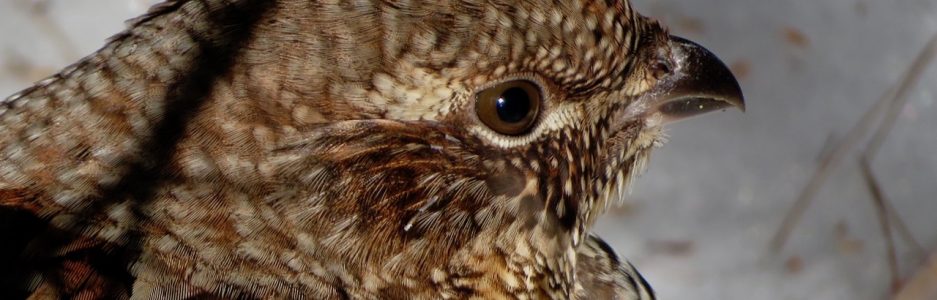
Pileated Woodpecker Works

Pileated Woodpeckers often take the rap unfairly for killing trees. In fact, even though they drill holes into the bark and excavate wood in order to reach the galleries of Carpenter Ants, the trees are both dead and alive. Huh?
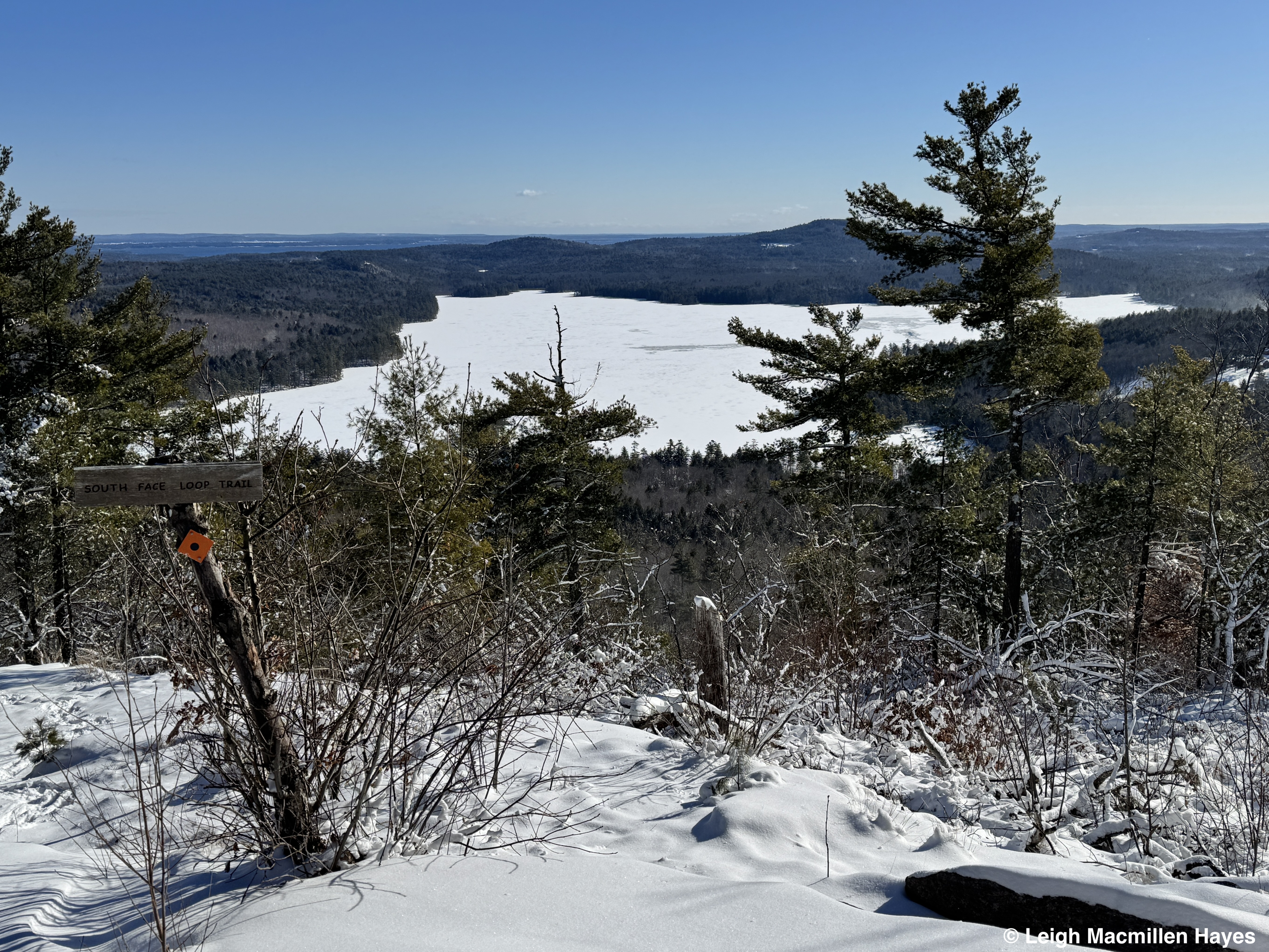
Take for instance this Eastern White Pine along the cowpath in our woods. While the Pileated Woodpeckers have riddled it with holes, its still standing and still producing needles and cones, because there’s enough bark left to protect the cambium and sapwood.

There was a time years ago when hearing or spotting a Pileated was a rare occurence, but now it seems that every day I either find evidence of habitat, hear their drumming and Woody Woodpecker calls, or actually spot one such as this that I spent some time with by the cowpath today.

And it’s not just holes that they drill. Quite often, I’ll see a tree that appears to have been chisled and shredded. This to is also Pileated Woodpecker sign.

Some trees receive only one visit, but others must be a huge source of food for multiple squarish to rectangular holes are drilled.

I love to peer into the holes because sometimes I’m rewarded with sightings such as this . . . a long-horned beetle that got stuck in the sap and is now frozen in situ.

Though we can’t see it, Pileated Woodpeckers have sticky tongues, which they probe into the tunnels the delicious (to a woodpecker, that is) ants have created. Their bodies don’t process all of the ant, and so their scat is another sign I love to find. It’s like a treasure hunt at the base of a tree and let’s me know if the bird was successful in dining or not.

Their scat is made up of the Carpenter Ant exoskeletons, and some wood fiber, and white uric acid.

If you haven’t looked for this, I highly encourage you to do so. Any scat is fun to encounter because it helps us determine who passed this way, but there’s something extra special about seeing those body parts and knowing better the critter’s diet.

Pileated Woodpeckers excavate from any spot on a tree, including at the base, so if you see large woodpecker holes there, you’ll know the creator. The cool thing is that they use their long tail feathers as the third leg on a tripod in order to stay steady while smacking their beaks into a tree.

Don’t worry, their brains don’t get rattled. While it was long believed that they had a shock absorber to protect their heads, new research states this: “Their heads and beaks essentially act like a stiff hammer, striking and stopping in unison.” You can read more here: New Study Shakes Up Long-held Belief on Woodpecker Hammering.

So I stated earlier that not all trees are dead, until they are like this one, even though the Carpenter Ants have set up their own woodworking shop. The heartwood, at the center of the tree is deadwood and its pipelines that served as the xylem and phloem, servicing the tree with water, minerals, (xy rhymes with high pulling these up from the roots), and sugars (phlo rhymes with low, pulling sugars down from the leaves), become clogged with resins and that’s where the ants take up residence. A storm knocked this particular tree over on Burnt Meadow Mountain where My Guy and I hiked about a month ago. It was so overcome with the ants that the core could no longer support the tree.

If you look closely, you can see the galleries or tunnels the ants had created. That’s a lot of ants and a lot of work.

My woodpecker seems to be hanging out in a small part of its territory these days. A Pileated Woodpecker’s territory can reach up to 200 acres, and there’s certainly more than that available to him here (the red mustache indicates this is a male), but he appears to have found his pantry closer to our home.

I don’t mind because it means I get to witness him on a more intimate basis.

Pileated Woodpecker works. Indeed.

Birds Of A Feather?

The other day a friend asked if my bird feeders were busy, but I’d been so focused on looking at mosses through the microscope lens, that I had my back turned to the yard and no idea what was going on out there.

Then today dawned.

And as is typical, a large flock of Juncos flew in. I love to watch them sit up in the Quaking Aspen and then almost dive bomb before gracefully landing on the ground, where I always make sure to spread plenty of seed for the ground feeders. My seeds of choice–a wild bird mix and lots and lots of black oil sunflower seed. Plus suet.

Of course, the Blue Jays also had a presence and, in fact, always make their presence known with their loud squawks. But I do love their colors, especially against the snow, and so I welcome them.

One of my favorite visitors is also the most timid–the female Cardinal. The second any little movement or sound startled her, she flew to a line of shrubs, a favorite hangout for most of the species that visit our yard. And when she flew, usually the others did as well. And then two minutes later, they’d begin to filter in again.

Her guy friend showed up as well, but she spent more time here than usual, despite his bossy attempts to get her to fly. Soon, though, he won’t be pushing her away, but rather sharing seeds beak to beak.

Tufted Titmice happened by and I had to wonder if this one saw its reflection in the feeder. That does happen and sometimes the results are comical.

Meanwhile, at another feeder, a large Gray Squirrel that grows larger every day thanks to my offerings, made sure everyone knew that the feeder attached to the tree was his. We knew when we put it there, that this would be the case, but it was our only choice of position.

And so he dines. A. Lot.

The good news is that eventually he leaves and others, such as this Goldfinch, fly in and look for just the right seed of choice.

Bingo. Mission accomplished.

And then . . . and then . . . two surprise visitors arrived. Bluebirds . . . of happiness, of course, for they made me happy.

And then, another surprise visitor–a female Purple Finch who looked quite pleased with her tasty seed.

She was so pleased, that she apparently invited two males to join her. Their postures and bad hair day made me laugh–they seemed to have been put here to provide comical relief. That’s not true at all, but so it seemed.

With all of this action, I had to stand as still as possible to take these shots through the back door window. And because I was so still, I had yet another surprise.

Bird seed is not just for birds, as the squirrels prove daily. And the White-tailed Deer often make that statment at night, but today . . . today was different. They came in the morning and were like vacuums as they consumed the seed.

Observing the birds, I often note that the Juncos can be quite defensive, the Male Cardinal sometimes suggests the female should leave (until that is when he decides to feed her), Chickadees fly in, grab a seed and fly off to a branch to break it open, and Goldfinches hang out together. As do the deer. These were the two young skippers, and they weren’t at all disturbed to be in each others space.

One of the skippers approach this feeder was instantly startled by its movement, but momma doe was much more curious, though in the end she chose to opt for seeds on the ground.

And all were delicious.

After about a half hour, my body tense from holding still for so long because after all, they were only steps from where I stood, the deer had consumed most of the ground seed and headed off to the woods. I waited a few minutes to give them time to depart without pressure and then went out to spread more seed around.

It took a few more minutes and then the action picked up again and in flew a male Downy Woodpecker to sample the suet.

His mate also arrived and waited in the Aspen to take her turn, though there are two suet feeders out there so I’m not sure why she felt the need to wait her turn.

And the rest of the mixed flock returned as well, including the Tufted Titmouse.

At the end of the day, my favorite visitors were the Bluebirds for it was such a treat to see them.

I can only hope they make a habit of returning to our yard.

And the deer, who found everything tongue-licking good.

And along with the squirrels, proved that not every bird has feathers. I mean, seriously, have you ever watched Gray Squirrels fly from tree to tree? And Deer fly across a field? Certainly reindeer fly.

On This Finally Snowy Day

White flakes have a way of quieting the Earth.

All slows down and the world transforms.

Something beyond calls, and despite the wind and frigid temperature, I heed the invite for several hours.

My feet journey along curvy paths.

I spy treasures–gifts tucked into furrows.

Others flowing out of ancient springs.

There’s a staircase to heaven offering a climb.

A long uprooted tree pretending to be a dinosaur.

And tucked away in a spot only a few wanderers know, another dinosaur outlined in white.

The snow coats like a blanket, offering protection going forth.

And fills the waters where the ducks take turns sleeping and dabbling.

Back on the homefront, the male Cardinal’s red shouts for joy.

While the female seeks the seeds of hope.

Juncos and Chickadees show courage at sharing a feeder.

And occasionally a Goldfinch flies onto the scene.

In the midst of it all, a tree spirit guffaws as every element of the universe shines . . .

on this finally snowy day!

The Secret Giver of Gifts

The spirit of the season has settled upon me at last, though it isn’t snowing and the Grinch actually turned our hopes of a White Christmas into forty shades of green. But still, today I was reminded of a time when our youngest asked, “Mom, are you Santa?”

He’d held onto the belief for far longer than any of his classmates. And for that reason, I too, couldn’t let go. And so that day as we drove along I reminded him that though the shopping mall Santas were not real, we’d had several encounters that made believers out of all of us.
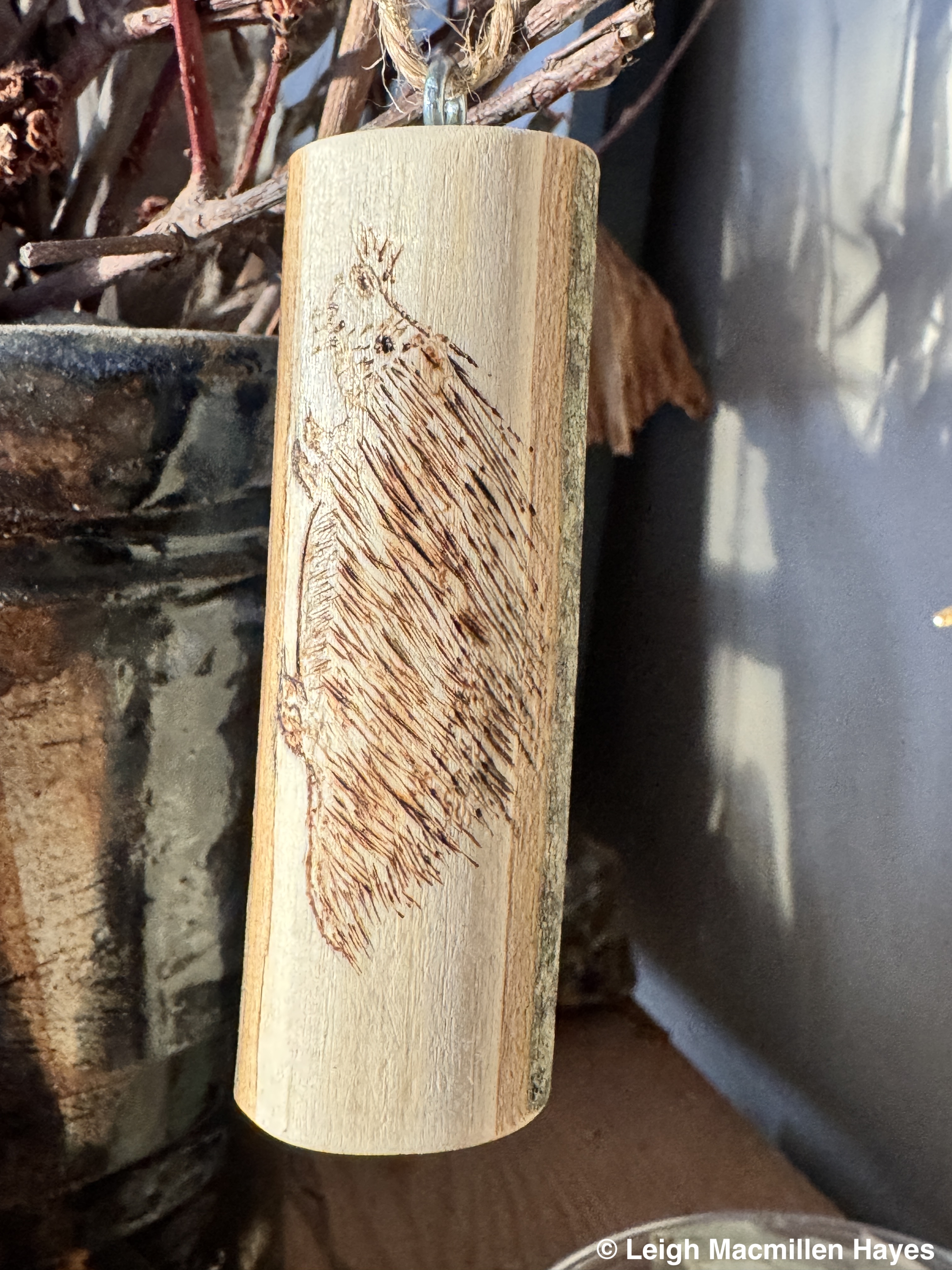
The first occurred over thirty years ago when I taught English in Franklin, New Hampshire. Across the hall from my classroom was a special education class. And fourteen-year-old Mikey, a student in that class, LOVED Santa.
Each year the bread deliveryman dressed in the famous red costume when he made his final delivery before Christmas break. To Mikey’s delight, he always stopped by his classroom. That particular year, a raging snowstorm developed. The bread man called the cafeteria to say that he would not be able to make the delivery. School was going to be dismissed after lunch, but we were all disappointed for Mikey’s sake.

And then  . . . as the lunch period drew to a close, Santa walked through the door and directly toward Mikey, who hooted with joy as he embraced the jolly old elf. As swiftly as he entered, Santa left. I have no doubt that that was Santa.

And about nineteen years ago, as the boys sat at the kitchen counter eating breakfast on Christmas Eve morning, we spotted a man walking on the power lines across the field from our house. We all wondered who it was, but quickly dismissed the thought as he disappeared from our view, until . . . a few minutes later he reappeared. The second time, he stopped and looked in our direction. I grabbed the binoculars we kept on the counter for wildlife viewings. The man was short and plump. He wore a bright red jacket, had white hair and a short, white beard. The boys each took a turn with the binoculars. The man stood and stared in our direction for a couple of minutes, and then he continued walking in the direction from which he’d originally come. We never saw him again. I have no doubt that that was Santa.

Another incident occurred about seventeen years ago, when on Christmas Eve, our phone rang. The unrecognizable elderly male voice asked for our oldest son. When I inquired who was calling, he replied, “Santa.” He spoke briefly with both boys and mentioned things that they had done during the year. I chatted with him again before saying goodbye. We were all wide-eyed with amazement. I have no doubt that that was Santa.

Once I reminded our youngest of those stories, he dropped the subject for the time being. I knew he’d ask again and I also knew that none of us wanted to give up the magic of anticipation for those special moments we know as Christmas morning, when the world is suddenly transformed.

I also knew it was time he heard another story–that of Saint Nicholas, the Secret Giver of Gifts. It goes something like this . . .

The nobleman looked to Heaven and cried, “Alas. Yesterday I was rich. Overnight I have lost my fortune. Now my three daughters cannot be married for I have no dowry to give. Nor can I support them.”

For during the Fourth Century, custom required the father of the bride to provide the groom with a dowry of money, land or any valuable possession. With no dowry to offer, the nobleman broke off his daughters’ engagements.

“Do not worry, Father. We will find a way,” comforted his oldest daughter.

Then it happened. The next day, the eldest daughter discovered a bag of gold on the windowsill. She peered outside to see who had left the bag, but the street was vacant.

Looking toward Heaven, her father gave thanks. The gold served as her dowry and the eldest daughter married.

A day later, another bag of gold mysteriously appeared on the sill. The second daughter married.

Several days later, the father stepped around the corner of his house and spied a neighbor standing by an open window. In shocked silence, he watched the other man toss a familiar bag into the house. It landed in a stocking that the third daughter had hung by the chimney to dry.

The neighbor turned from the window and jumped when he saw the father.

“Thank you. I cannot thank you enough. I had no idea that the gold was from you,” said the father.

“Please, let this be our secret,” begged the neighbor. “Do not tell anyone where the bags came from.”

The generous neighbor was said to be Bishop Nicholas, a young churchman of Myra in the Asia Minor, or what we call Turkey. Surrounded by wealth in his youth, Bishop Nicholas had matured into a faithful servant of God. He had dedicated his life to helping the poor and spreading Christianity. News of his good deeds circulated in spite of his attempt to be secretive. People named the bishop, “The Secret Giver of Gifts.”

s-stockings

Following Bishop Nicholas’ death, he was made a saint because of his holiness, generosity and acts of kindness. Over the centuries, stockings were hung by chimneys on the Eve of December 6, the date he is known to have died, in hopes that they would be filled by “The Secret Giver of Gifts.”

According to legend, Saint Nicholas traveled between Heaven and Earth in a wagon pulled by a white steed on the Eve of December 6. On their doorsteps, children placed gifts of hay and carrots for the steed. Saint Nicholas, in return, left candy and cookies for all the good boys and girls.

In Holland, Saint Nicholas, called Sinterklaas by the Dutch, was so popular for his actions, that the people adopted him as their patron saint or spiritual guardian.

Years later, in 1613, Dutch people sailed to the New World where they settled New Amsterdam, or today’s New York City. They brought the celebration of their beloved patron with them to America.

To the ears of English colonists living in America, Sinterklaas must have sounded like Santa Claus. Over time, he delivered more than the traditional cookies and candy for stockings. All presents placed under a tree were believed to be brought by him.

Santa Claus’ busy schedule required he travel the world in a short amount of time. Consequently, as recorded in Clement Moore’s poem, “The Night Before Christmas,” a sleigh and eight tiny reindeer replaced the wagon and steed.

Since Saint Nicholas was known for his devout Christianity, the celebration of his death was eventually combined with the anniversary of Christ’s birth. December 24th or Christmas Eve, began to represent the Saint’s visit to Earth.

Traditionally, gifts are exchanged to honor the Christ Child as the three Wise Men had honored Him in Bethlehem with frankincense, gold and myrrh.

One thing, however, has not changed. The gifts delivered by Saint Nicholas or Santa Claus, or whomever your tradition dictates, have always and will continue to symbolize the love people bear for one another.

Though they are now adults, my continued hope for my sons is that they will realize the magic of Christmas comes from the heart and that we all have a wee bit of Santa in us. Yes, Patrick, Santa is real.

May you continue to embrace the mystery and discover wonder wherever you look. And may you find joy in being the Secret Giver of Gifts.

Lake Living magazine, Fall/Winter 2023

It takes us several months to toss ideas around, set up and conduct interviews, and then let the writing process play out. The latter is among my favorite activities because it takes work to figure out how to present the topic and because people are passionate about their subject and share a lot more in an interview than we need, as writers we have to get to the gist of it and then hone, and hone, and hone some more. Even the final published piece is not really the final draft because always, at least when I read what I’ve written, there are things I would change or other words I wished I’d used or examples I wish I’d given. But . . .

With all that said, I present to you the Fall/Winter issue of Lake Living magazine, which is in its 26th year of publication (and I give great thanks that I’ve been privileged to write for and work on the magazine staff since 2006).

And the table of contents:

The cover photo and lead article were written by Marguerite Wiser, a young woman of many talents. Marguerite has written several articles for Lake Living in the last few years and it’s great to have her voice in the mix.

Tear Cap, as you’ll discover upon reading the article, is about a collaborative effort that celebrates community in an old mill in Hiram, Maine.

Editor and publisher Laurie LaMountain has written about Ian Factor’s studio in Bridgton in a previous issue, but now Ian has taken his work a step further and you can read all about what he’s bringing to Fryeburg Academy students in Fryeburg, Maine.

Laurie wrote several other articles as you can see from the table of contents, one about the Magic Lantern and their STEM programs, and another about an interesting painter who captured her whimsy with his own sense of whimsy. When we chatted on the phone after she’d interviewed Dwight Mills, I could tell she most jazzed about the man.

A new contributor to this issue was Mollie Elizabeth Wood. When I heard about her topic, my gut reaction was, “Really? For Lake Living?” But, you’ve got to read this article. It’s incredibly well written and brings death to the forefront, because, after all, it’s on the horizon for all of us.

One of my articles is about a new building currently under construction at the Rufus Porter Museum in Bridgton, Maine. If you are a long time follower of wondermyway.com, you may recall the day the community walked the Church Building at the museum down Main Street. If you are new to wmw.com or have a memory like mine, here’s the link: Walking with Rufus Porter. Now, the campus is growing and it’s an exciting addition to town.

Pre-pandemic, when advertisers were more abundant, and publishing costs were lower, we published Lake Living four times/year and in the fall and spring issues you could find book reviews from the owners and staff of Bridgton Books, an independent book store. Above are Justin Ward’s picks from the bookshelf.

Now, we only publish two issues, so in each one you can see what they recommended each time you pick up a copy of the magazine. These are Perri’s Preferences.

This last article resonated with me because it’s about two people from different sides of the table who sat down to chat and realized they have a lot in common and figured out a way to work together. Rex Rolfe of Rolfe Corporation in Bridgton, owns an aggregate /excavation business, and Erika Rowland is the former Executive Director at Greater Lovell Land Trust, where I also work.

This past summer, a small group of us stood in one of Rex’s pits that abuts land trust property, and the two shared their story. It’s what got me thinking that we need to educate others about this topic.

Oh, and that pile of sand behind Rex–it’ll help keep you from sliding on local roads when the snow finally flies this winter as town trucks have been going in and out recently to fill their storage facilities.

When we came up with the editorial list for this issue I thought, “Well, this one doesn’t seem to have a theme,” but as Laurie wrote in her editor’s notes on page 4, “Community, connection, collaboraton, creativity–these are the concepts that thread through this issue of Lake Living . . . they are the hallmarks of where we live . . . ”

And on October 10, Laurie received this message from a reader:

I leave you all with an image of Rex Rolfe’s toy collection and hope that you’ll take the time to brew a cup of tea and sit down with the magazine and enjoy all that is within its covers . . . and then support the advertisers so we can continue to bring this to you for free!

Here’s a link to the whole shebang: Lake Living magazine

Lost and Found Mondate

We chose a trail we’ve never hiked before, though we’ve conquered this mountain from two other trails many times over the years. Today’s choice was based on an email from Allen Crabtree, leader of the Denmark Mountain Hikers. The lovely thing about it was we walked along a snowmobile trail to the summit and so were happy to be on micro-spikes and not snowshoes or postholing. And the temperature was crisp enough to keep the snow firm, at least on the way up Burnt Meadow Mountain.

After passing by what I think was an old barn foundation, the trail continued on fairly level ground for a bit and we worried that I may have misunderstood the directions.

But that didn’t really matter because we were in the woods, together, and enjoying the fact that a fisher had loped across the landscape probably last night when the snow was still soft enough to leave impressions before this morning’s temp of 17˚.

At last the trail began to get steeper and I gave great thanks that it was such a packed trail for it made for an easy ascent. We had no idea what conditions might be under the snowmobile trail, but I suspect on a summer day this isn’t an easy way to go. Not that the other two trails are either.

My real reason for suggesting this hike to My Guy was because I wanted to revisit this site, which we’d reached previously on a exploration down from the summit in 2012.

At the time I was working on an article for Lake Living magazine entitled “Maine’s Lost Ski Areas” and interviewing various skiers and making MG tag along with me as I visited the former ski areas. “Trails hidden in the forest provide us with clues that our town fathers worked hard to create recreational areas, but also to boost the local economy,” I wrote in the article. “You can still find some of the trails and remnants of rope tows and chair lifts. When you unexpectedly come upon cement pads and towers while hiking, it’s a bit like entering a ghost town, a place that has seen a livelier day. So many people have a history with these legendary ski areas. They learned to ski at this one, met their spouse at that one, or won first place in a race.

The skiing industry began in the lakes region in 1936 when a group of ten businessmen each invested $25 and considerable labor to build the first rope tow in Maine. The Jockey Cap Ski Tow helped make Fryeburg ‘The Ski Capital of Maine’ for a brief time.

According to newspaper articles and brochures preserved by the Fryeburg Historical Society, the Fryeburg Winter Sports Committee hired Paul Lamere, a ski instructor, to run a branch of the Lamere School of American Skiing. Lessons were offered one day a week.

Because the Maine Central Railroad had a station in town, Fryeburg residents saw the ski area as a means to support businesses during the Depression. Leaflets proclaiming “Weekends for Your Winter Sports” mentioned “good motels, good restaurants, good rooms in private homes, all prices reasonable . . . use the lighted ski-tow, Friday and Saturday nights, a brilliantly lighted slope and rope to pull you up the hill, a new thrill for winter sports enthusiasts” were distributed in the Portland area. The cost for a ride on the snow train from Portland to Fryeburg was $1.50 and a ski ticket was about $1.00.” (I should mention that the photo above was made possible to Lake Living by the Fryeburg Historical Society.)

But we weren’t at Jockey Cap today. And this ski area was a wee bit newer as I quoted former Lake Region High School principal Roger Lowell telling me he’d skied at Burnt Meadow Mountain, which had one lift and a lodge. If you look below the arrow, the top tower was the end of the line and skiers had to exit off the T-bar at that point.

From my article, “According to NELSAP (New England Lost Ski Area Project), in 1967 the Burnt Meadow Mountain Recreation Area received a loan from the Farmer’s Home Association to create a ski area that opened for the 1971-72 season, but saw its demise when several bad snow years followed. In 1980, Wendell Pierce, owner of a northern Maine ski area, purchased Burnt Meadow and renamed it Zodiac Skiway.”

“‘It had pretty good skiing from the top,’ recalls Roger, ‘but three quarters of the way down it flattened out and you had to get up steam to make it all the way without poling.’ He and his team got into trouble for going too fast. ‘WE were bombing the thing so we wouldn’t have to skate to the lift,’ he says.

While there on his own one day, Roger learned about a race. After discovering he couldn’t inspect the course, he found himself last in line. ‘I figured what have I got to lose so I went fast. It didn’t matter if the gates were down a bit. You would have thought I was Jean-Claude Killy.’

Roger won the race and received a blue ribbon similar to what they award at the Fryeburg Fair. ‘I think it said something like FIRST on it,’ he says, a wry look on his face. ‘It was very generic. A conversation piece.’ That was the last race held there. The ski area continued to lose money and closed in 1982. The T-bar still stands intact.” That was 11 years ago, but today’s photos speak to the fact that it still stands intact.

It didn’t take long for us to reach the summit, where we walked around taking in the views beyond, this a look toward Stone Mountain, which is accessible via the Twin Brook Trail.

Finally, we sat upon lunch rock to enjoy our sandwiches, followed by Fly Away Farm’s Almond Biscotti with Mocha Drizzle. MG just thought it was chocolate so let’s keep that secret between us.

At last we began our descent, with a goal to find Mount Washington. And we did. Do you see it between the trees?

And then we found it again when we slipped off trail to take in the scene from a ledge. We always love to know where we are in the world. Our little world.

As we continued downhill, I was stopped in my tracks. That happens occasionally. (Insert smiley face) But this tree that leaned across the trail begged to be noticed and I’d missed it on the climb up the mountain.

Its manner of growing needles upon the trunk like no other evergreen that I know of gave me an immediate identification.

Add to that the number of needles that grow in short individual bundles: 3. Three strikes and you are out. Pitch Pine. Get it?

In the end, we thought we’d lost winter, but we found it alive and well and holding on for a wee bit longer. And even longer than that if you are at the summit of Mount Washington.

At the same time, because we are on the cusp of a seasonal change, we found spring in the form of swelling Red Maple buds . . .

and Striped Maple.

We also found some stuff left behind by other recent hikers. We left the sunglasses on a cairn at the summit.

And a glove at the trail intersection.

In fact, just after putting the glove on the sign we found an optic cleaning clothe–maybe to clean the sunglasses?

This was indeed a lost and found Mondate.

Oh, and thanks again to Allen Crabtree for his write-up and directions to the trailhead and mention of my friend Marita Wiser’s book: Wrote Allen: “The origin of the name “Burnt Meadow” is not clear.  Most trail guides attribute the lack of large trees on the mountain to the Great Fires of 1947 which also burned more than 80% of the old homes in Brownfield.  Marita Wiser, in her Hikes in and around Maine’s Lake Region says,”…the name of Burnt Meadow was established long before [1947].  It is shown on…an 1858 map of Brownfield.’”