Senior College: Forever Students

We honestly weren’t sure anyone would sign up. Or show up.

Vernal Pools and Macroinverebrates
Leigh Macmillen Hayes and Dawn Wood
Friday, April, 25, May 2, 9, and 16th, 9:30 – 11:30 am
April 25: The Hidden Life of Vernal Pools
Discover the wonders of vernal pools—seasonal wetlands vital to forest ecosystems. Learn how wood frogs, salamanders, and fairy shrimp rely on them for breeding and why protecting these fragile habitats matters. Join us indoors at St. Peter’s Episcopal Church for this engaging workshop.
May 2: A Day at the Vernal Pool
Meet at Loon Echo Land Trust’s Raymond Community Forest, Conesca Road, Raymond. Walk ¼ mile to the vernal pool, where we’ll provide tools to explore its temporary residents and their unique ecosystem.
May 9: Meet the Macros
Ever wonder who lives in local streams? Join us to discover the tiny creatures that call them home! Dive into the world of macro-invertebrates—those fascinating “big bugs” without backbones—and learn how macros tell us about the health of the environment. This hands-on workshop will take place indoors at St. Peter’s Episcopal Church. 
May 16: Macro-invertebrates Up Close
Explore the role of macro-invertebrates in stream health and the ecosystem. Join us for hands-on dipping and rock turning to assess water quality at Northwest River and Douglass Brook, Tiger Hill Community Forest, Sebago.
Maine Master Naturalists Leigh Macmillen Hayes and  Dawn Wood of Bridgton will lead these experiential classes. Both have a sense of wonder about the natural world and spend hours exploring only a few feet from a trailhead.

And then they did. Almost 30 of them. The first class, as you can see, was an indoor introduction to vernal pools where we shared our photographs, ID books, and models, and told stories about our experiences in these ephemeral habitats. Their questions were numerous and they shared stories as well, making it an even richer experience.

And then we ended with a musical treat since we knew that there was at least one conductor in the audience. As you click on the arrow to listen to the Springtime Chorus, remember that Wood Frog calls sound like “Wruck, wruck.” Spring Peepers: “Peep, peep, peep.” Green Frogs: “Ga-dunk, ga-dunk.” And Bullfrogs: “Jug-a-rum, jug-a-rum.”

Thank you, Jan, for leading this, and thank you to everyone for participating so willingly.

The following Friday we awoke to rain and again we were sure no one would show up. BUT . . . that did not stop them and we slowly snaked through the forest on our way to the vernal pool.

Of course, we all suffer from that most wonderful of syndromes: Nature Distraction Disorder (NDD), and the summer grape that grows along the Grapes Expectations Trail at Raymond Community Forest was the first thing to draw our attention.
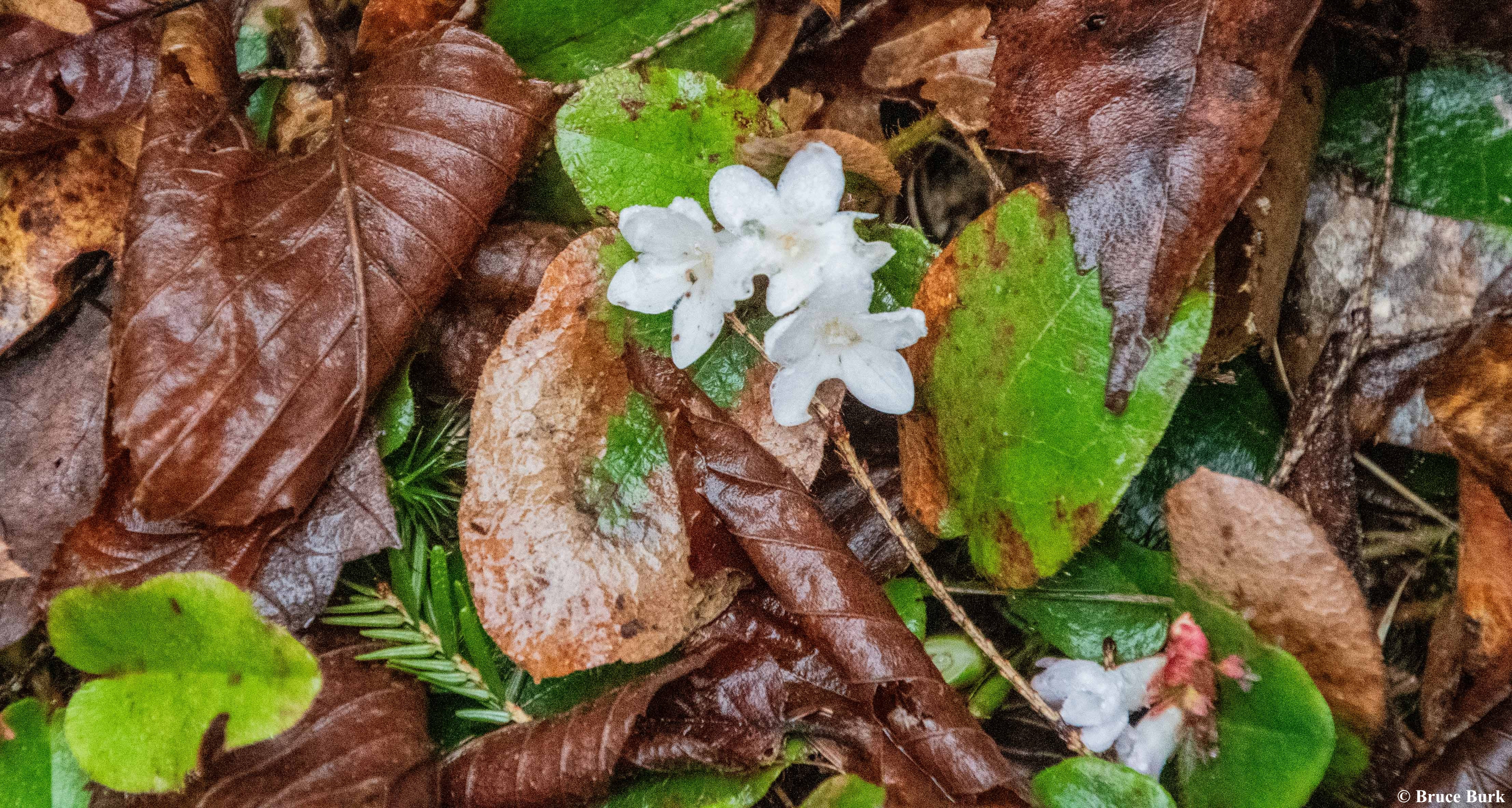
Trailing Arbutus with its sweet little flowers also caused us to pause.

At last we reached the pool and because the sky was overcast and some raindrops and mist fell, we couldn’t see into the pool very well, especially to admire the egg masses deposited by Wood Frogs and Spotted Salamanders. But . . . we could dip.
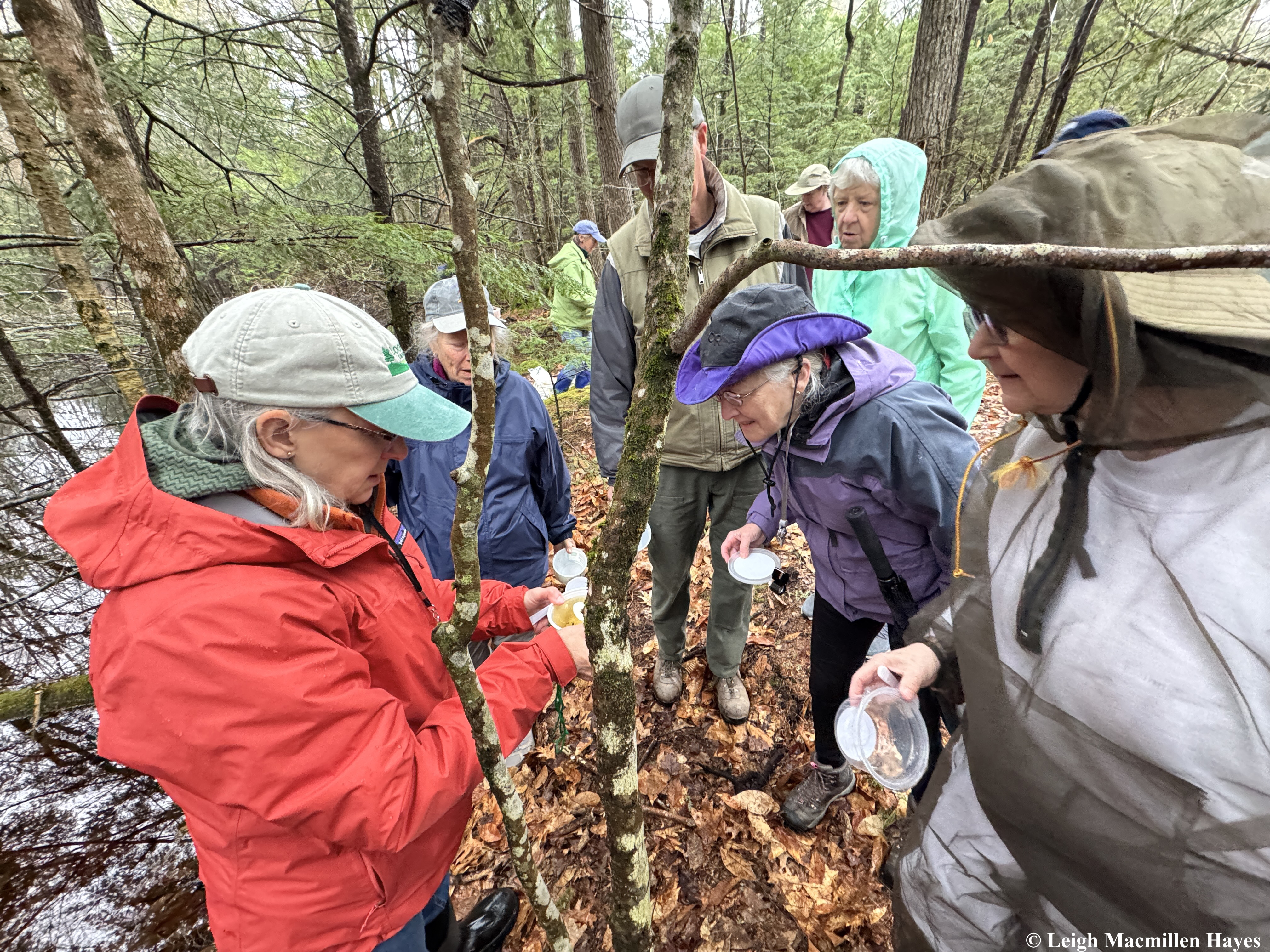
And within a few minutes the prize of the day was discovered and everyone came to take a peek at what Dawn had found.

Soon one Fairy Shrimp (just enough to make the pool significant by Maine standards) was followed by multiple more. This particular one happens to be a female with a full brood sac at the top of her abdomen.

I’ve said this before, but it’s worth mentioning again and again:

40 Wood Frog egg masses make a pool significant; OR 20 Spotted Salamander egg masses; OR 10 Blue Spotted or Jefferson Salamander egg masses; OR a single, yes one, Fairy Shrimp.

Fairy Shrimp are cool because in order for eggs to be viable, the pool must dry out. And they can survive being dry for multiple years. And in any given year, not all eggs will hatch, thus saving some in the bank for another year or ten.

Our other finds that day include Phantom Midges–with inner workings visible through the translucent body.

And Predaceous Diving Beetle larva, plus . . .
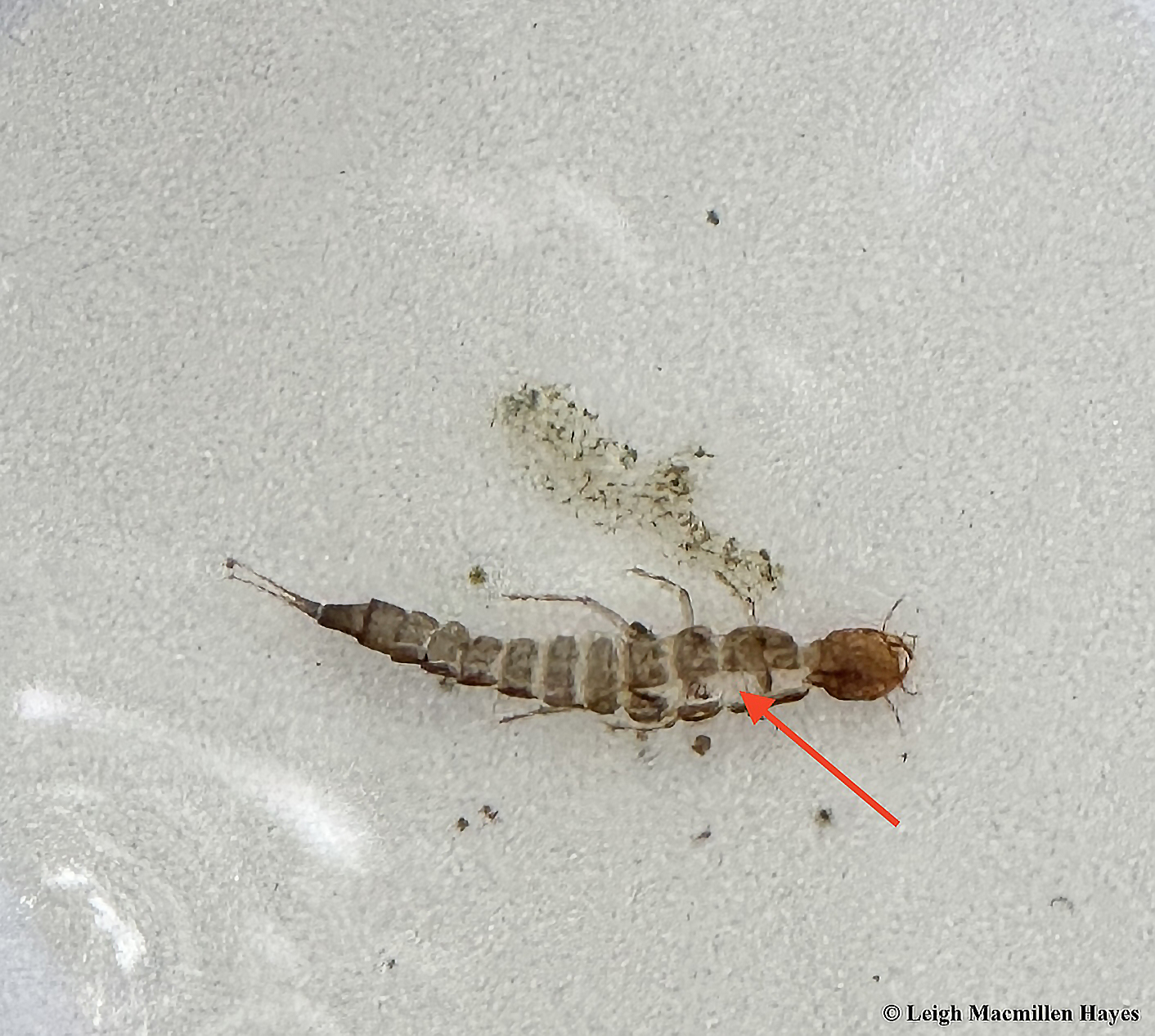
the shed skin of a PDB, with a split where the wings of the adult emerged first and then the rest of the body squeezed out through that slit that the arrow indicates.

This is the adult, with an air bubble on its back end; and if you look closely, you may see a few Mosquito Wrigglers twisting and turning in the photo as well.

We always remind everyone that all larval forms must go back into the pool or stream or whatever waterbody, because in the whole scheme of things, everything is important.

I laugh when I look at this photo because as a youngster, my brother always noted that my mouth was always open in pictures–apparently he thought I talked too much.

But obviously, on this Friday I was waxing poetic about something.

Before we left the pool that day, the students had a surprise for us. The previous week I had pulled out a party noisemaker and reminded those who had attended our winter class on insects that it served as a great tool to illustrate how a butterfly or moth proboscis (mouth part) curls up in flight, but upon a flower, they extend it to reach the nectar. Turn the noisemaker over, however, and suddenly you have a frog tongue–as they snap it out to capture an insect.

And tada, unbeknownst to us, everyone was suddenly a frog. Heck, if we were going to make them perform in the frog chorus, then they might as well be frogs. It was awesome. And yes, they did perform in the chorus once again, after which we left the pool and headed home.
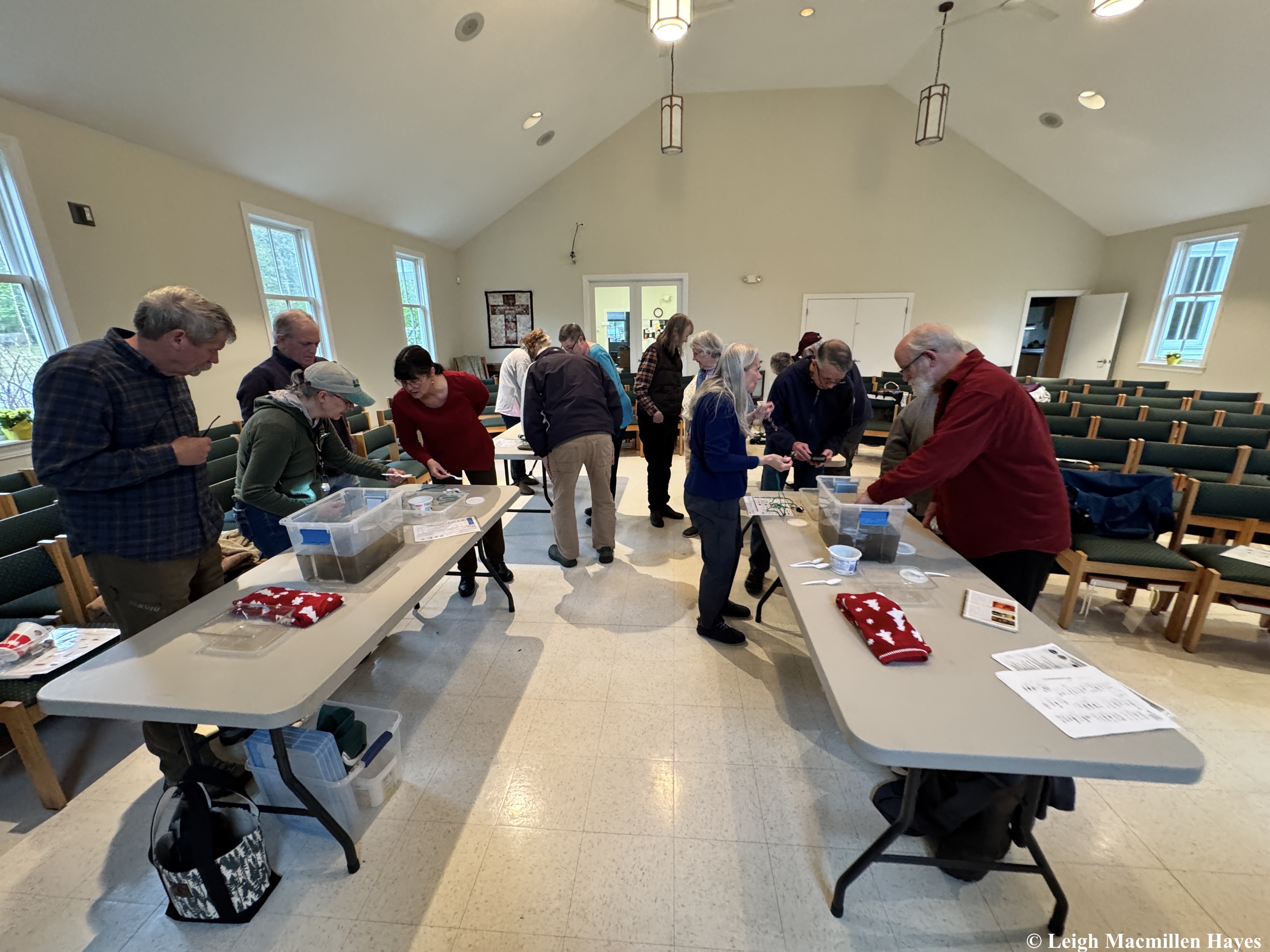
Week three found us back at the church, where we began with a slide show about Benthic Macro-invertebrates.

Benthic: Living at the bottom of a body of water (stream, river, pond)

Macro: Large enough to be seen with the naked eye

Invertebrate: Animal without a backbone

Macro-invertebrate: Large, water dwelling animal able to be seen with the naked eye.

Prior to the class, Dawn and I spent an hour or so trudging to and fro a local wetland to retrieve containers of water so that after the initial presentation, the students could take a look–up close and personal, in the comfort of a building. (Never fear: all critters were safely released in the same spot where we captured them with our D-nets)
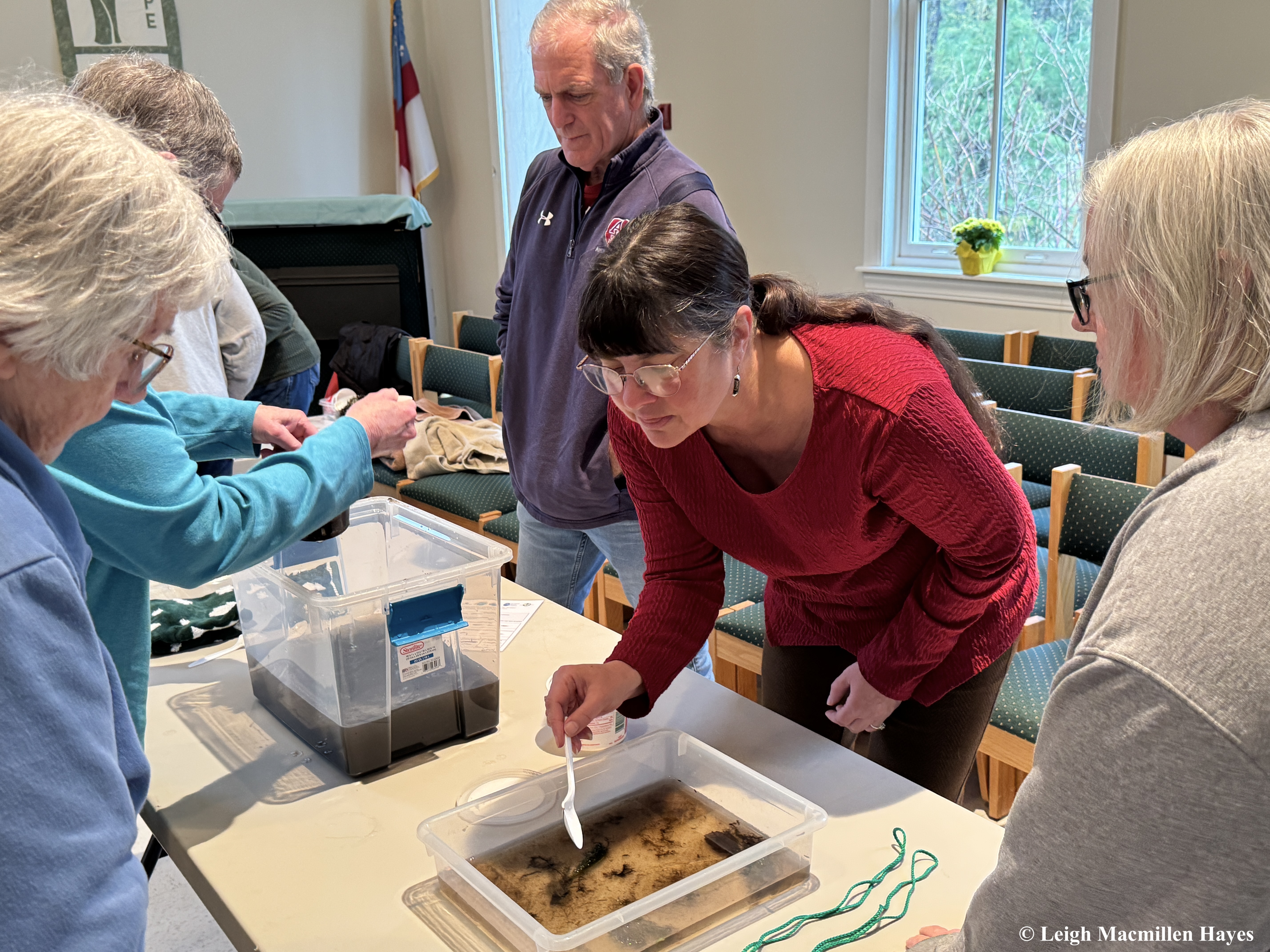
They started starring into the water and began to notice movement. And then, using spoons and small containers and lids, all recycled, they were able to glimpse the wonders of the water.
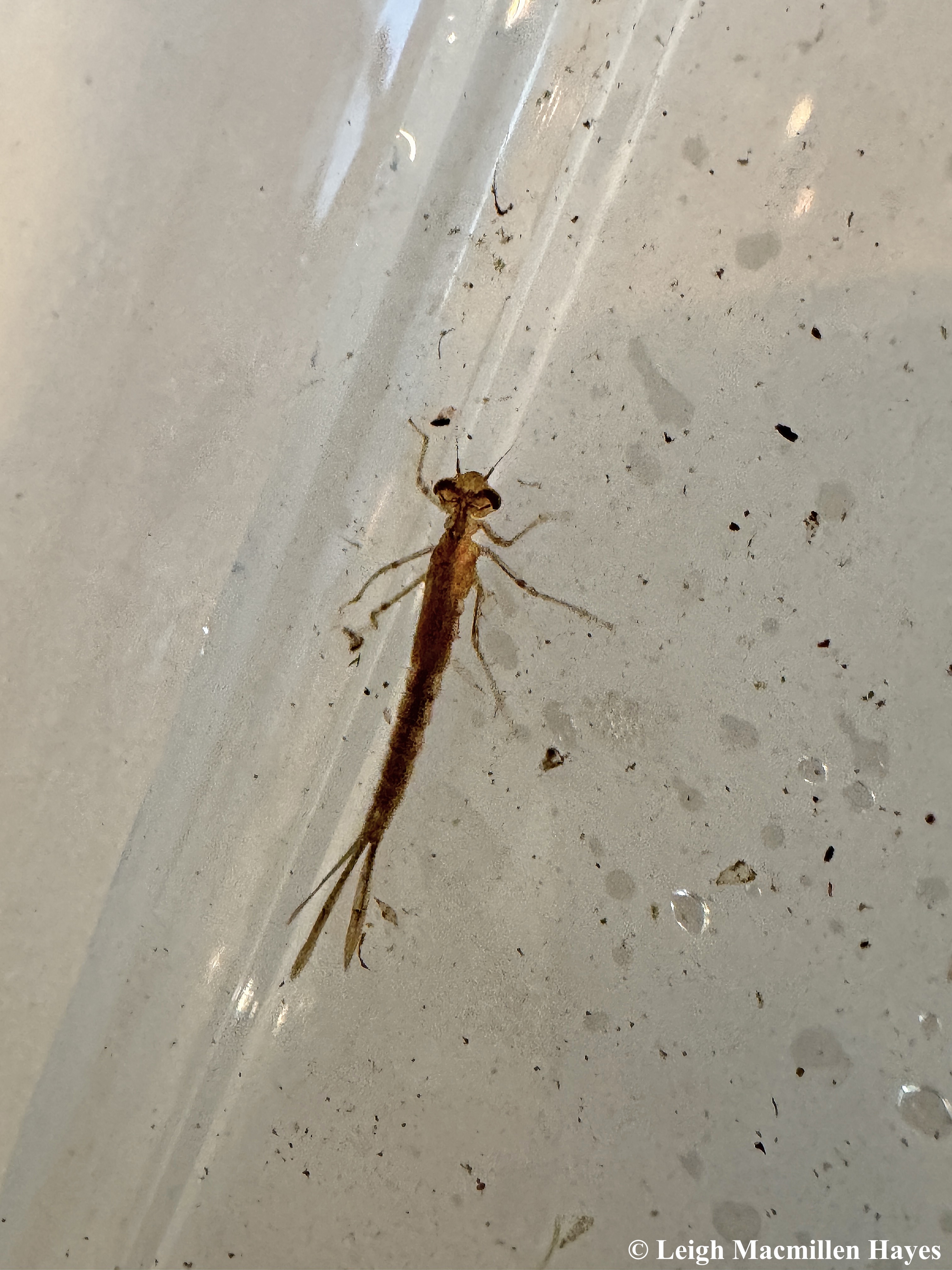
One of the favorite finds was the larval form of a damselfly, with three paddle-shaped tails that serve as gills.
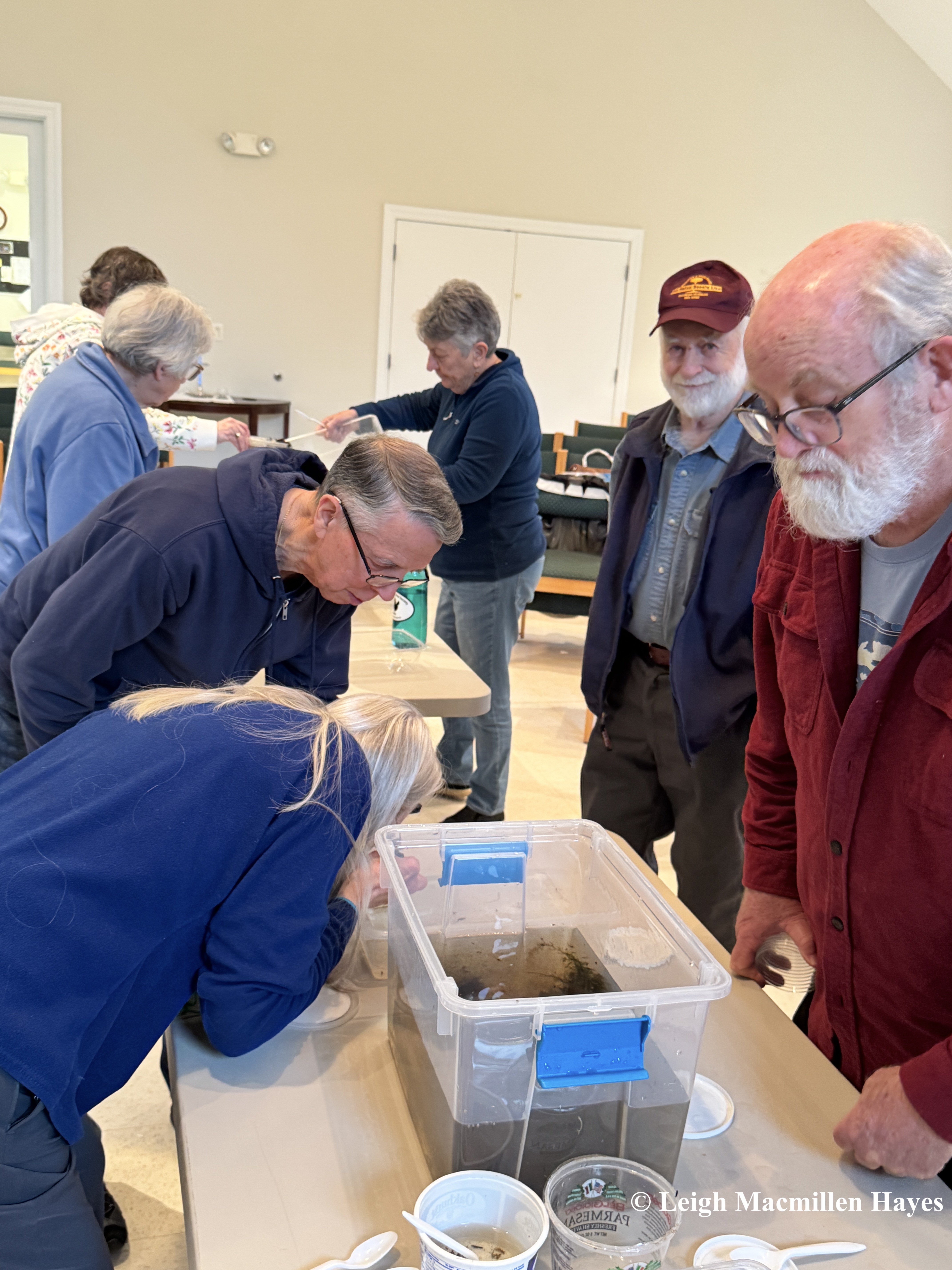
The critters love to hide under the leaves and muck that we’d pulled up so sometimes it took a few moments to wait for the water to settle before spotting something moving.

But they did. And with the use of loupes on lanyards that we borrowed from Loon Echo Land Trust, they found Mayflies and Damselflies and Dragonflies and Backswimmers and more.

Finally, today dawned. The forecast kept changing all week, so we were pleasantly surprised by the sun. That said, you know those Mosquito larvae we always encourage everyone to save? Well, they are hatching. But, just as for the rain, everyone was prepared.

Oh, and yes, another moment of NDD hit us only a hundred feet from the parking lot. We love mud.
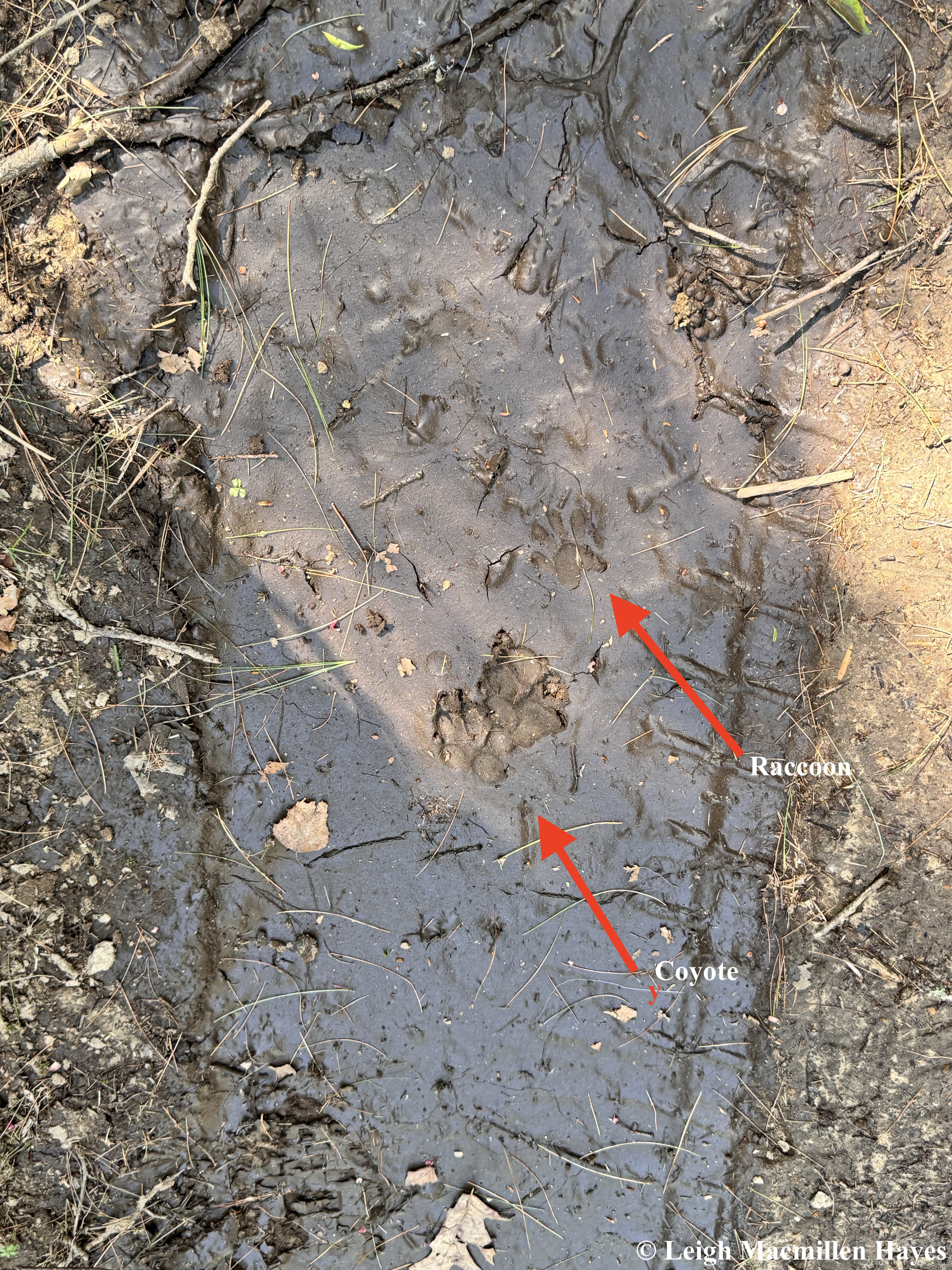
Especially when it tells us who passed this way during the night. In this case, it was two critters: a Coyote and a Raccoon. If we can’t have snow, mud is great. In many ways, it’s even better than snow for the prints are much crisper and easier to read. (Don’t tell the snow I said that. Ever. If you do, I’ll deny it.)
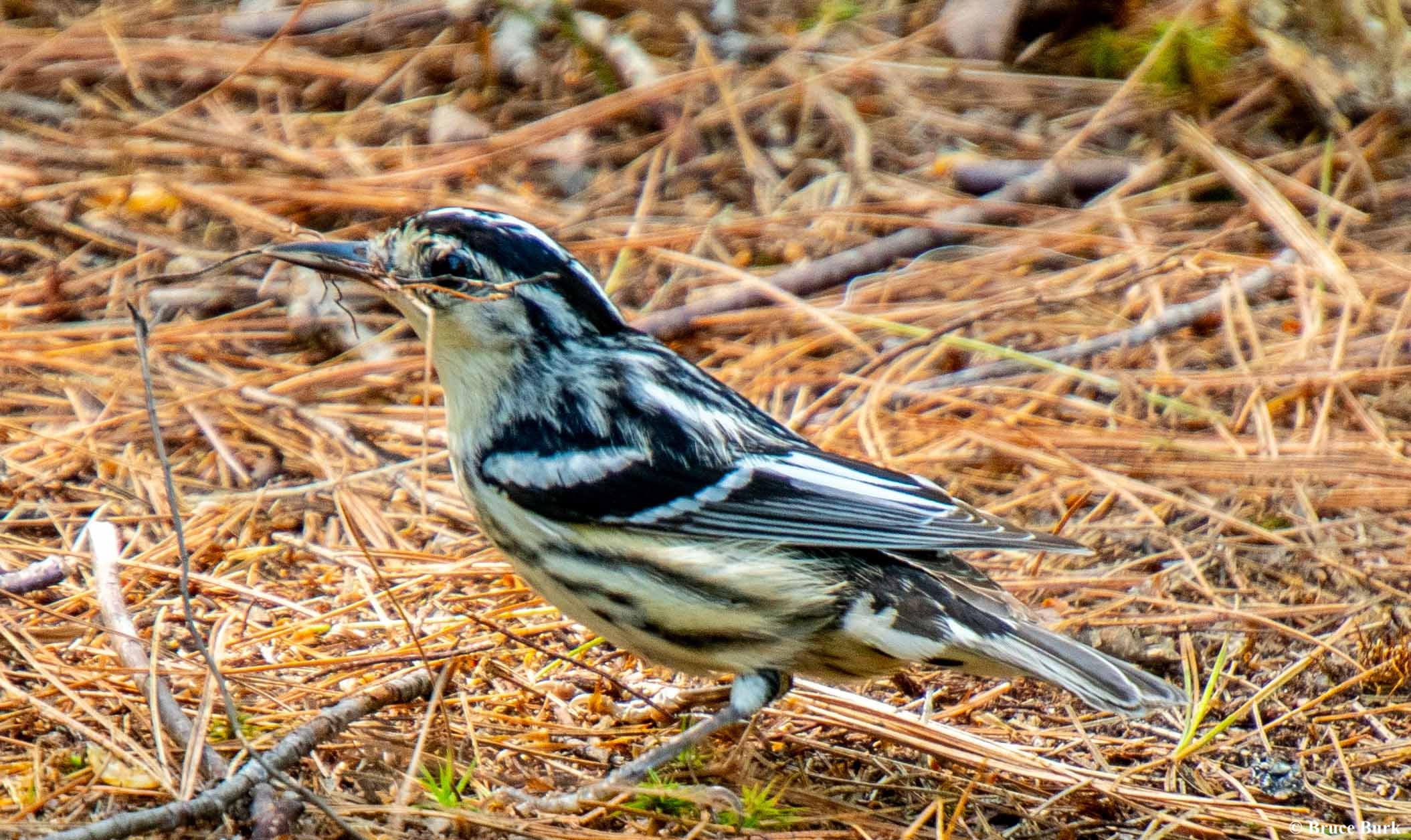
But . . . we had a mission and a time frame. The Black and White Warbler didn’t care. Apparently, we had entered its territory and despite our presence, it went right on collecting nesting material.

When nature surprises us with these moments, I always feel we’ve been blessed to be witnesses.

Finally, it was time to dip the D-nets into the river.
We’d placed a few tables near it so everyone could take a look without risking going into the water. Plus, the trail to the water is narrow and once we realized the bird was building a nest there, it made it even more important that we not spend too much time.

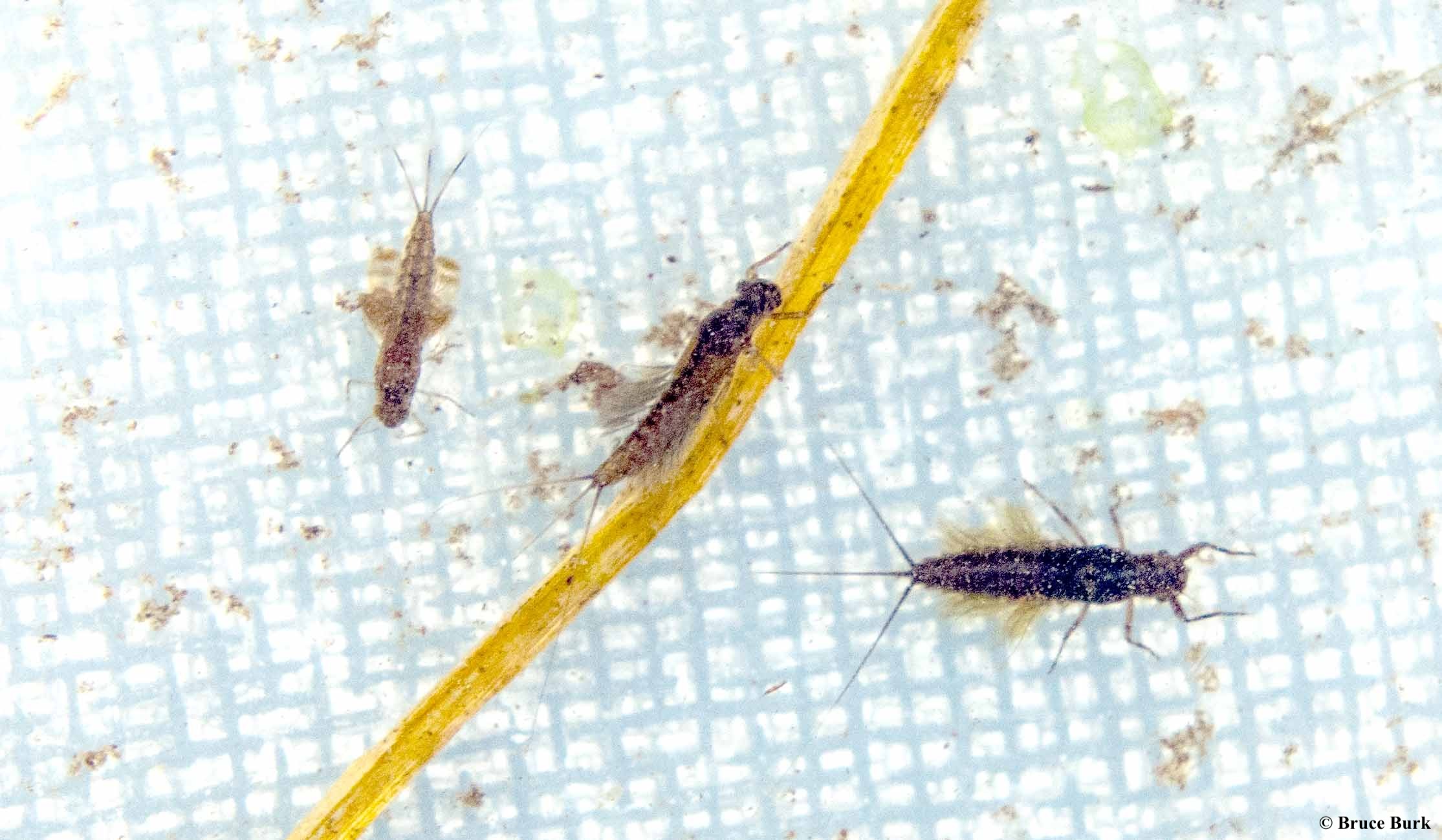
The most prolific finds of the day: Mayfly larvae.

There are so many types of Mayflies as everyone soon realized. What I love about them: their feathery gills on the sides of their abdomens, and the three long tails that most feature, which they even had as adults, probably helping with balance for one thing.

Again, it was an enthusiastic crew and any time something interesting was discovered, all wanted a chance to see.

We had a damselfly that at first I thought was a Water Scorpion because the three shorter tails were held together so that they looked almost like the tubes at the end of the abdomen, but then I took a better look and realized that they weren’t elongated and in every other way, it had damselfly written all over its head and body.

Caddisfly larvae also entertained us and we found a Northern Case Maker, plus . . .
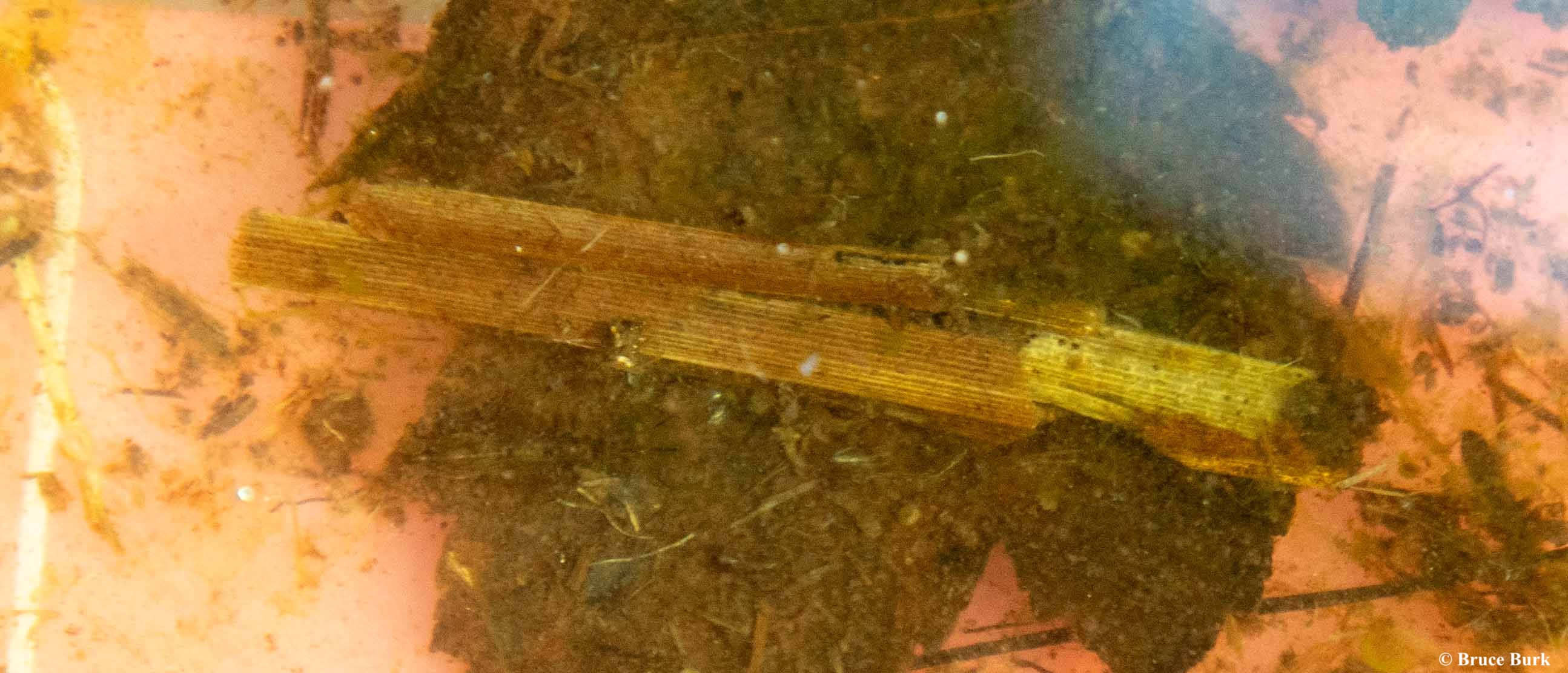
what might have been a Giant Case Maker, who built its home from the broken off tube of vegetation.

Everyone was fascinated, but we had one more stop to make so eventually we had to pack up shop in this location and move down the road to another trail.

Another NDD moment happened as we walked beside a vernal pool where we could not only spot Spotted Salamander egg masses, but also these of the Wood Frog variety, and tons of tadpoles feeding on the green algae. It actually created a full circle from our first classes about vernal pools.

A Pickerel Frog also caught our attention and delight. Bruce caught an amazing photo of the underside of its rear thighs–with the yellowish coloration. Both Pickerel Frogs and Northern Leopard Frogs have spots, but one of the defining differences is the yellow, or sometimes orange color that you see here.
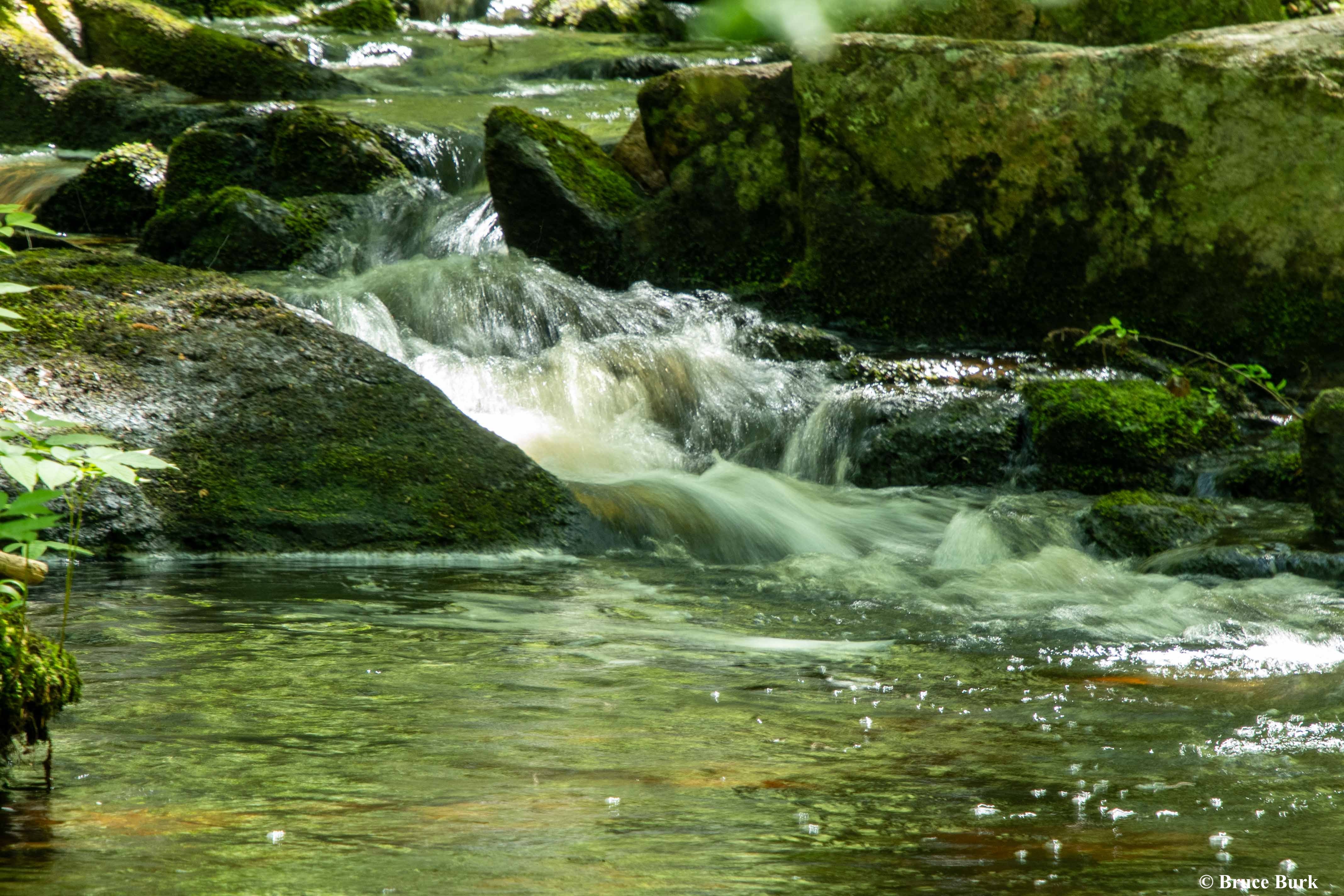
Our final destination was Douglass Brook, where the water flowed faster than it did in the section of the river where we had dipped only a half hour earlier.

Our reason for this location was because it has lots of rocks and we wanted everyone to see how some critters use them as places to cling.

So once again, we took an up close and personal look.

And scooped up anything we could find.

Including Black Fly larva which like fast-flowing water. I think folks were not quite as keen on saving every little critter given how many Mosquitoes swarmed us, but still they did.
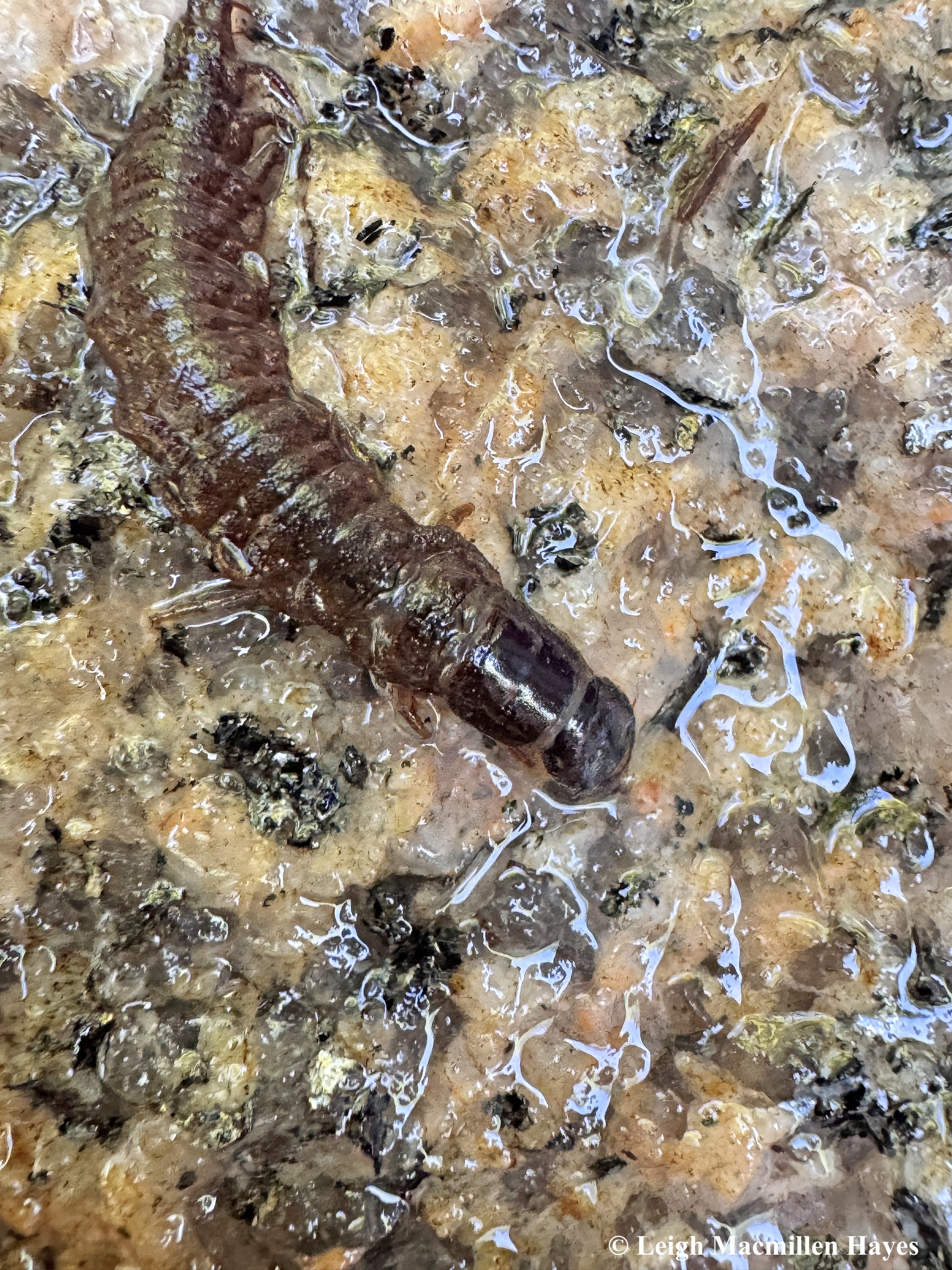
We also found a Dobsonfly Larva, aka Hellgrammite, who prefer the fast flowing water and hold onto rocks with strong claws on their legs, or so I read in A Guide to Common Freshwater Invertebrates of North America, and that’s exactly what this one did.
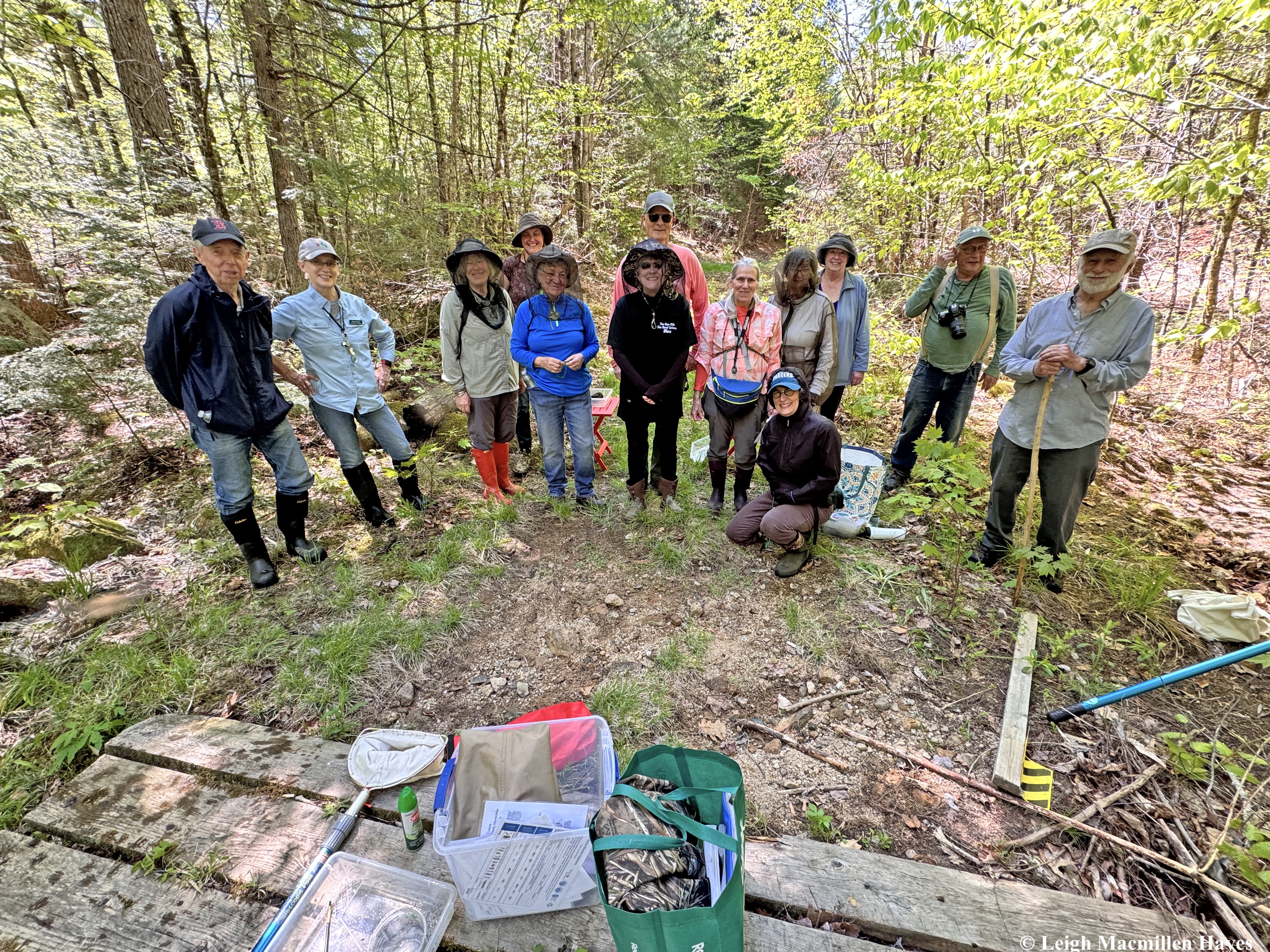
Two hours passed quickly and finally it was time for the four-week class to come to an end. And we were all smiles.

Senior College is an awesome opportunity for us mature beings to learn. The curriculum is diverse; there are no prerequisites, term papers, exams, or grades.

Hats off to the all-volunteer board. And to the students. We can’t believe how many of you joined us each week. And thank you all for helping us carry equipment today.

Many thanks also to Dawn for co-leading with me. And to Bruce for taking so many photos so that I could use them to share all of these incredible learnings with you.

Mr. Cretella, my high school Spanish and Latin teacher, popped into my head just now. In my yearbook, Mr. C. wrote, “Never lose your desire to learn.” Those words have reverberated with me over the years. I don’t remember what anyone else wrote, but his sentiment struck a cord. Pretty amazing, given that when I took Latin I my senior year, I was forever substituting Spanish words if I didn’t know the answer on a quiz or test.

Wherever he is now, I’m grateful that Mr. C. encouraged my desire to learn. And love that so many are the same.

Senior College: Forever Students indeed!

Vernal Pool 1: Oh Baby(ies)

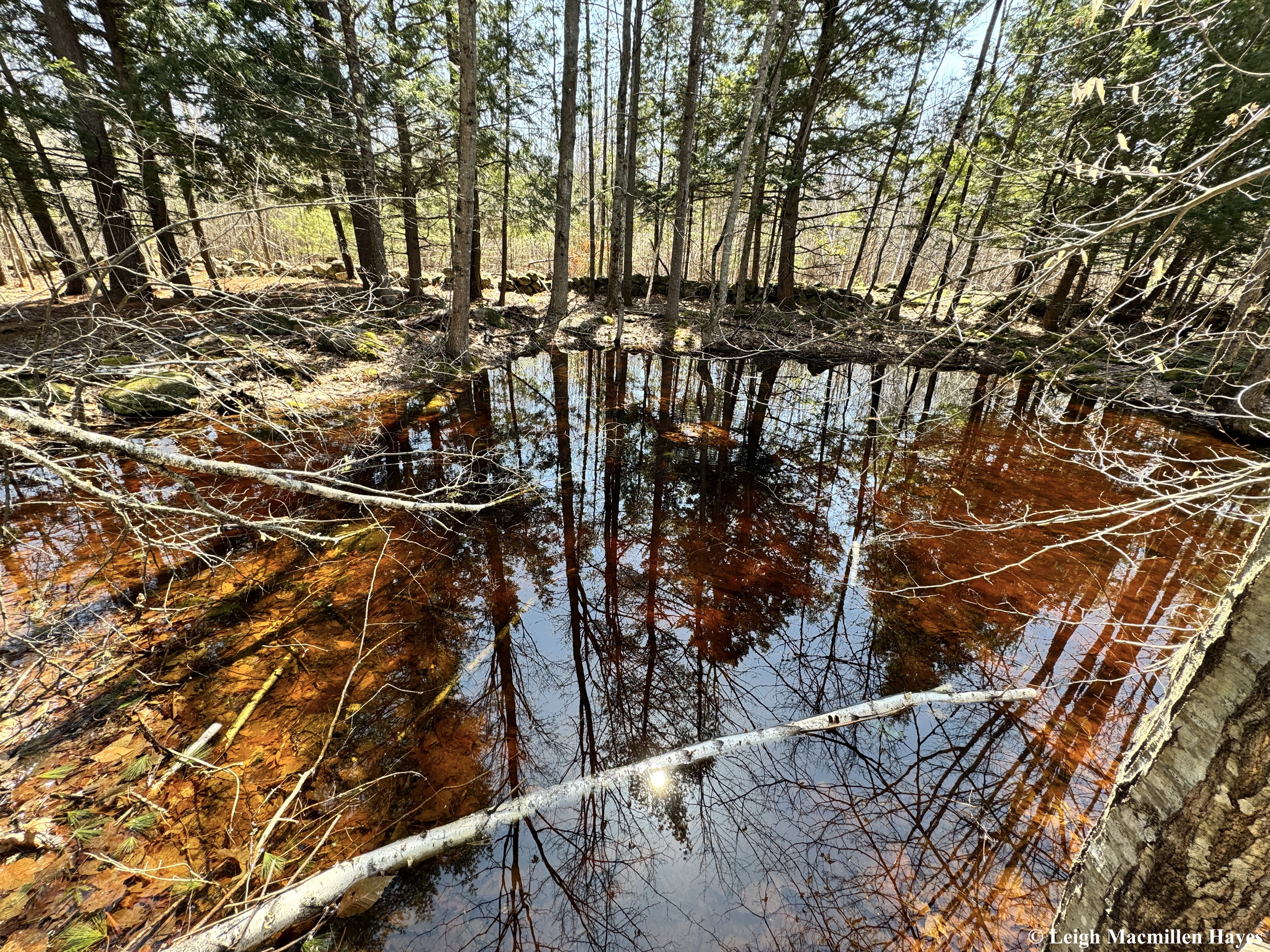
Once the snow and ice began to melt, I started making almost daily visits to “My” vernal pool, located about a quarter of a mile from our house, and only a hop, skip, and jump, well maybe a few hops, skips, and jumps, from the cowpath, and more importantly, on neighbors’ property.

I met the neighbors for the first time last November when I spotted them walking their dog through their woods as I looked for any insects on trees. They were breaking branches to create a sorta trail, and I encouraged them to walk the cowpath instead because it’s flat and I try to keep it cleared of downed branches.

It was upon our second encounter when they did actually use the cowpath (and have done so regularly since though our paths haven’t crossed in months) that I asked them if they knew about the vernal pool. They did not. The dog was a rescue and they’d only had her for a few months and she was the reason they were out walking in the woods.

Being my blunt self, I did ask that they not bring their dog to the vernal pool in the spring and explained about the Wood Frogs and Spotted Salamanders who use it as a breeding pond. Yeegads. But they didn’t take it to be rude, and instead told me that they think they have another vernal pool elsewhere on their land, closer to their house. Then they invited me to walk in their woods and explore anytime. Um, I thanked them and admitted that I’ve been doing that for years; I just don’t go close to the house.

At last, about two weeks ago, the ice went out. But . . . there was no action. It was cold and seemed to snow every other day and the ground was still frozen and the breeders just weren’t ready. I waited.

Finally, on Sunday, April 13, 2025, we had some rain, and our local Big Night celebration was announced via text and email messages. Big Night is that night(s) when it’s been raining in the afternoon and evening and the roads are wet, and volunteers head out to locations close to home to help amphibians cross the road without getting smooshed. Or help most of them.

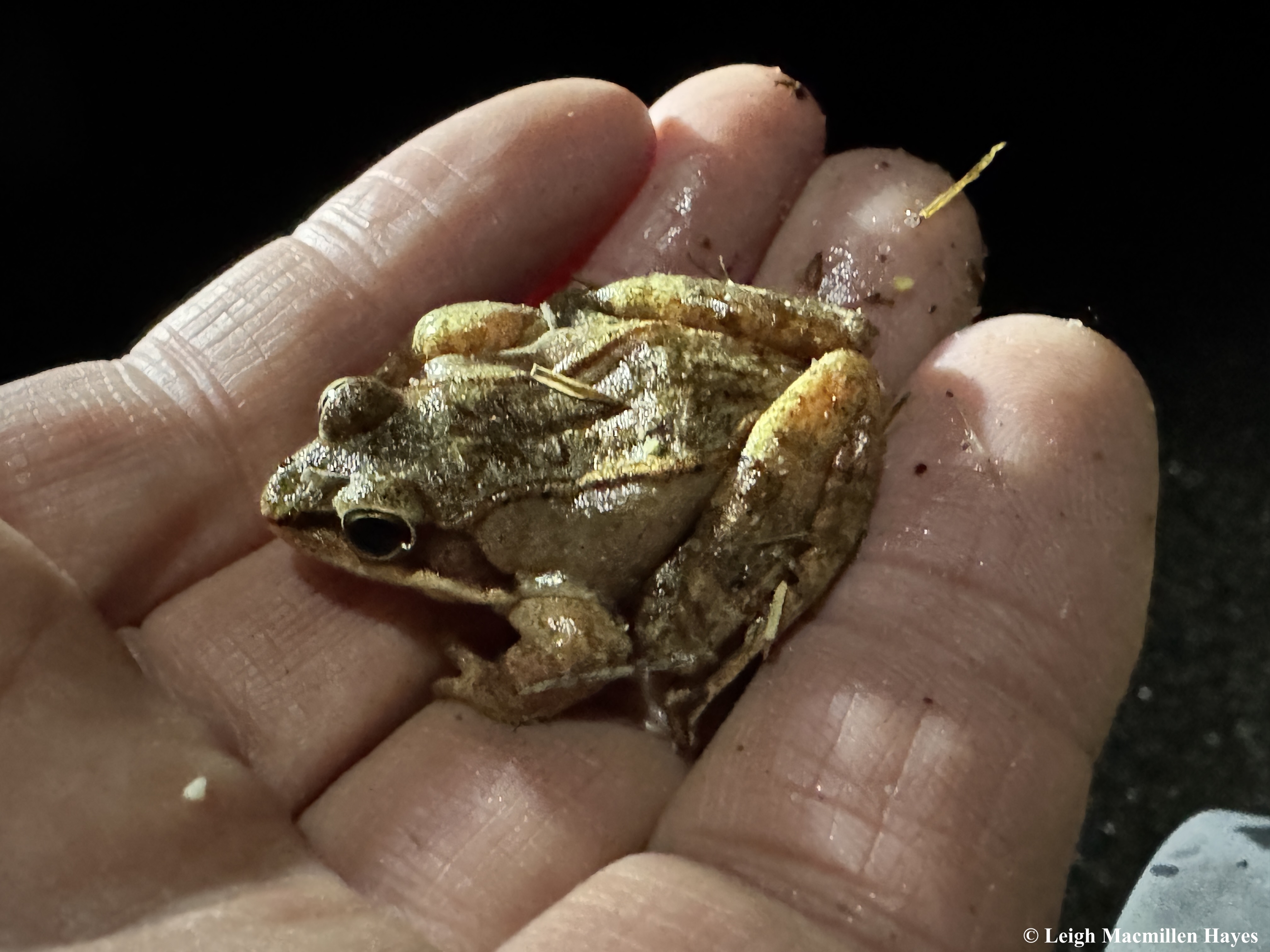
We didn’t hear any Wood Frogs or Spring Peepers as we approached the pool of our attention that night (not “My” vernal pool, which is thankfully not near a road), so we weren’t sure if we’d see any action. And others south and east of us had been posting for a week that they’d only found one or two frogs during any given rain event. Still, we went. And were glad we did because we helped a total of 158 Wood Frogs (including the one pictured above) and Peepers that night. There were still a few smooshed, but as always, we reminded ourselves that they become food for other critters.

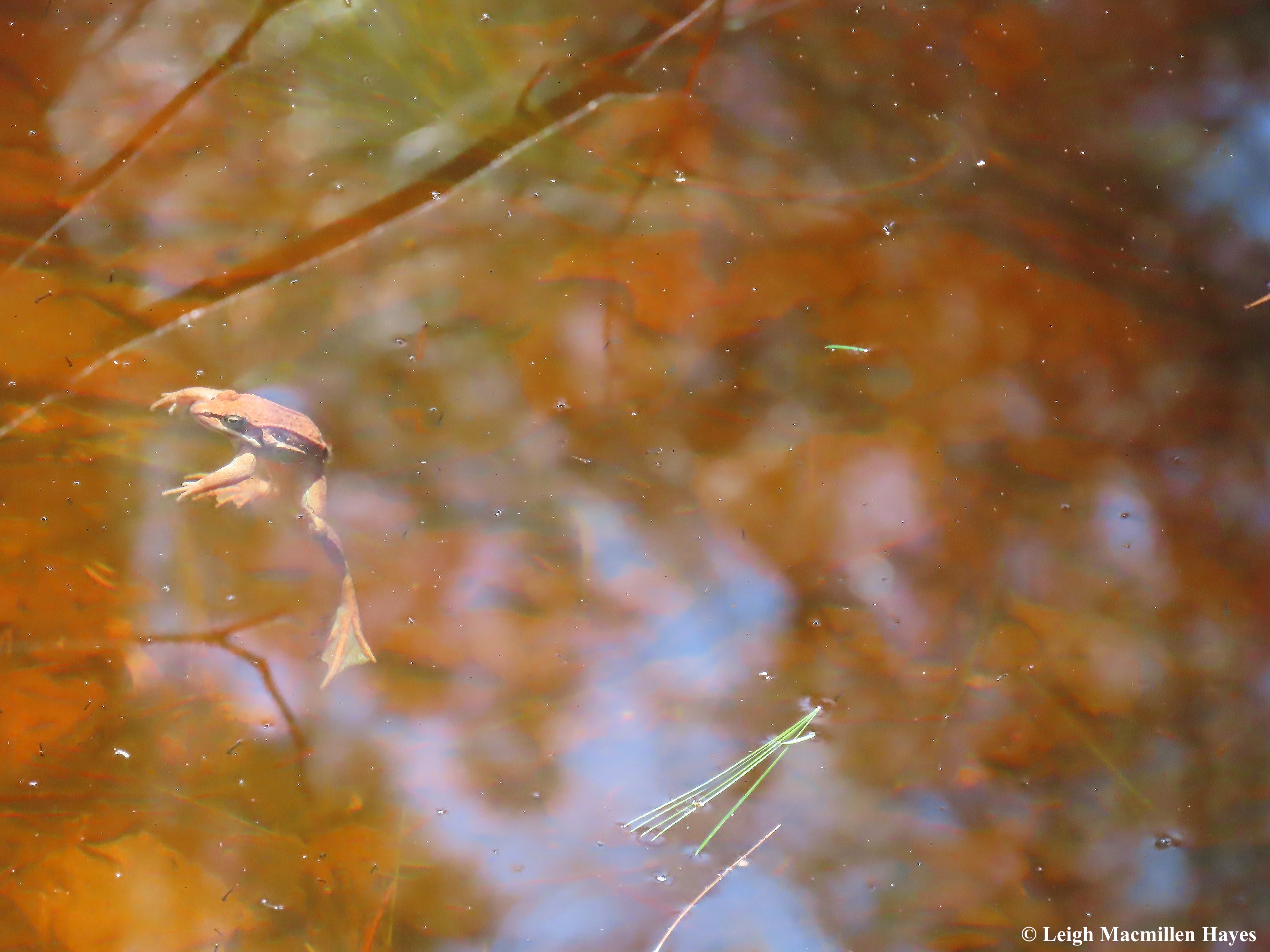
Given that success, the next afternoon I visited “My” pool and heard not a peep upon my approach. But I did what I do, and stood as still as possible upon a rock at the edge, and within a few minutes this male Wood Frog surfaced.

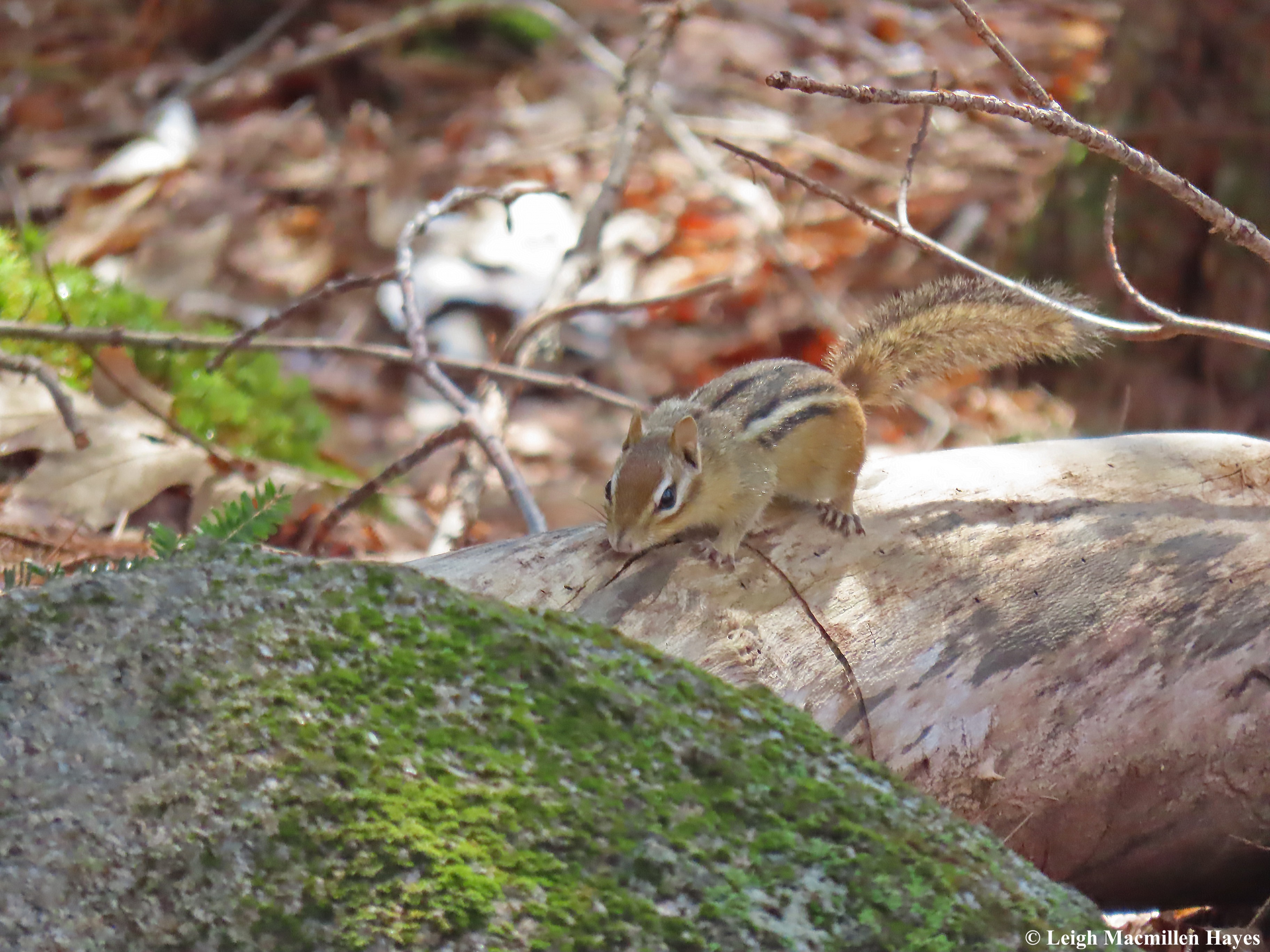
And I decided that this year I am going to try to be more present at the pool and try to get to know all who venture in and around it, including Chippy, on an eternal search for seeds to stuff into his cheeks.

Mid-morning Tuesday found me making my way to the pool again and this time, I could hear the “Wruck, Wruck” calls of the male Wood Frogs as I approached. Spring has finally sprung. Oh, and the crocuses have finally bloomed. Beaked Hazelnuts with their tiny yet exquisite magenta flowers as well.

And then, my first peek into the pool, and there it was, a Wood Frog egg mass about the size of a wiffle ball and I wondered if it had been there on Monday and I just hadn’t seen it.

As always, I stood still, and as always, it took the frogs a few minutes to surface, but suddenly they were everywhere, and probably wishing, if frogs can do such a thing, that I would leave so they could begin their mating chorus again.

But I stayed. And wondered. Why is it that a Gray Squirrel, like the Chipmunk, can scamper about and rustle the leaves and make all kinds of noise and the frogs continue to float upon the surface, but the minute I flinch, they dive to the bottom and hide under leaves for minutes on end?

I did decide to change positions after a bit of enjoying the sight of so many frogs, because I wanted to see if there were any egg masses at the western end of the pool, but discovered none.

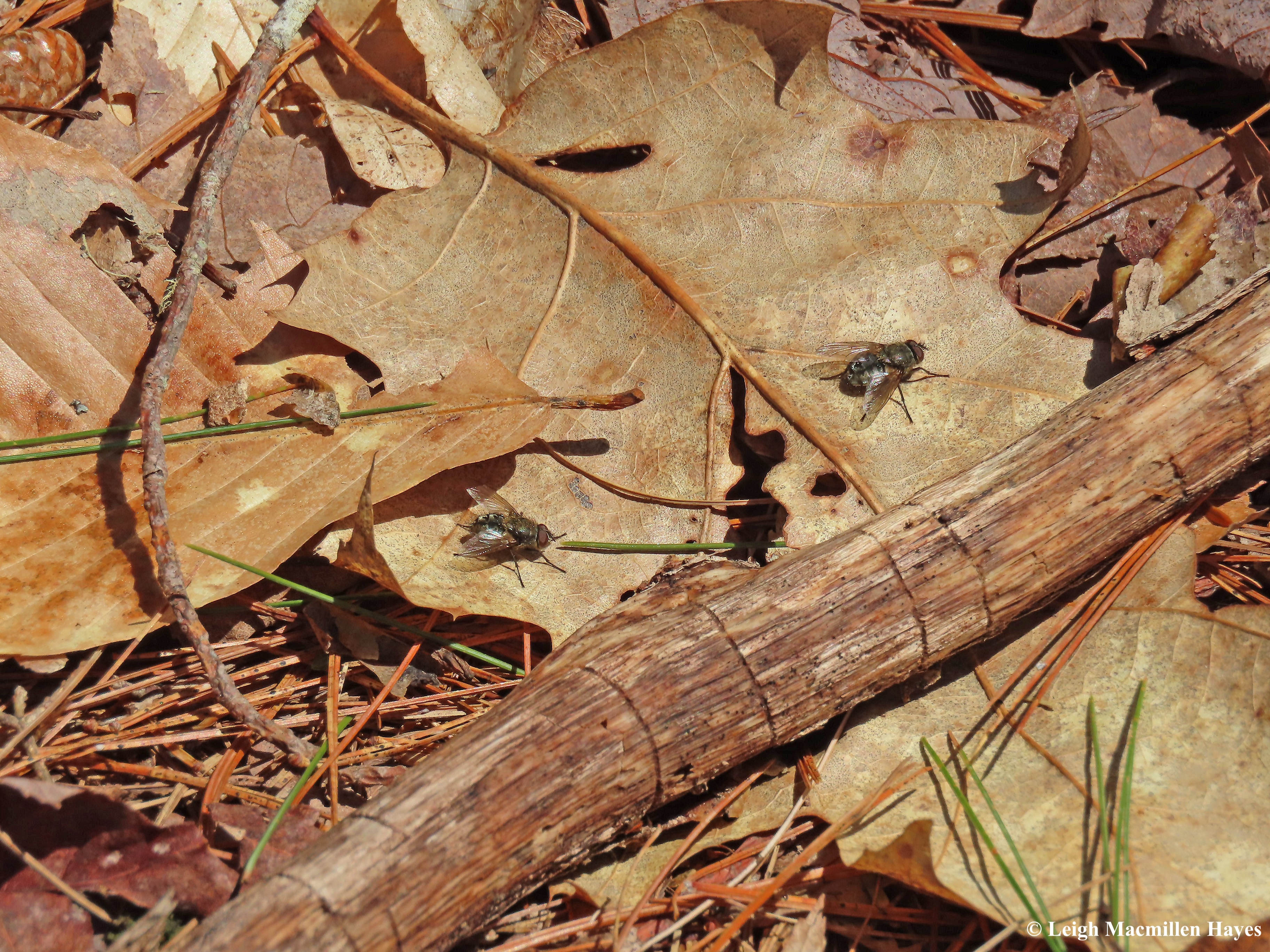
I did spy a bunch of Cluster Flies by the edge of the water.

And in the water, I watched Mosquitoes larvae wiggle about and a Predaceous Diving Beetle lift its butt to the surface to fill the air bubble located under its wings or elytra.

And then the Beetle surprised me and after swimming under the small log, it climbed onto it and gave me a whole different perspective for I never think about them as fliers, but they have strong wings and can do such, especially if the pool they are in dries up and they need to get to another pool. Apparently they are also attracted to lights, another reason not to keep outdoor lights on all night.

My morning visit came to an end when the frog nearest to me dove down and hid under the leaf cover. Well, sorta hid. Do you see it?

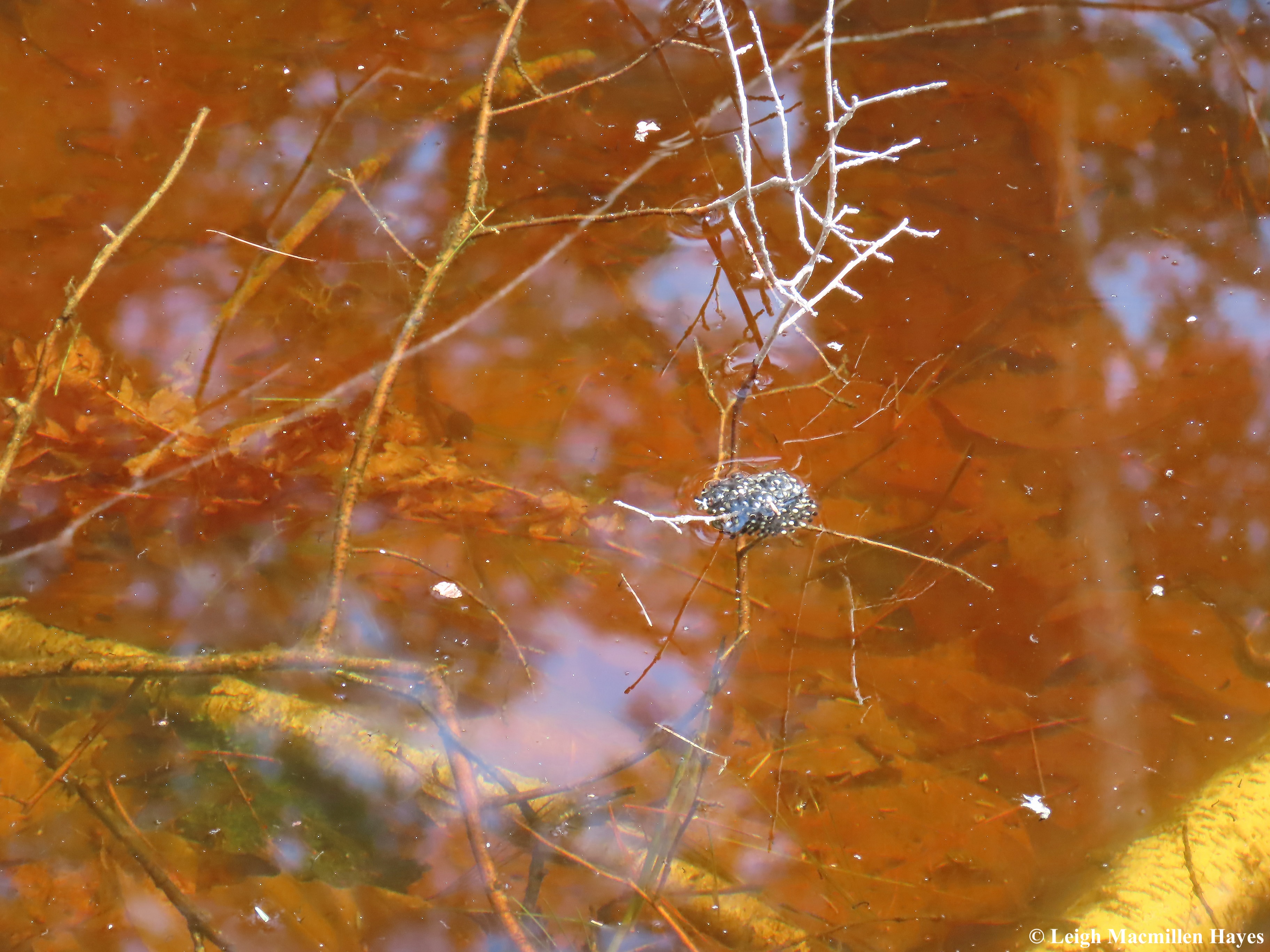
I was so taken with the pool, that I returned again in the afternoon. And this time I spotted something I’d missed in the morning. A more recently deposited egg mass. I suspect it had been there for at least a few hours because it was already bigger than a quarter, which is the size they are at first.

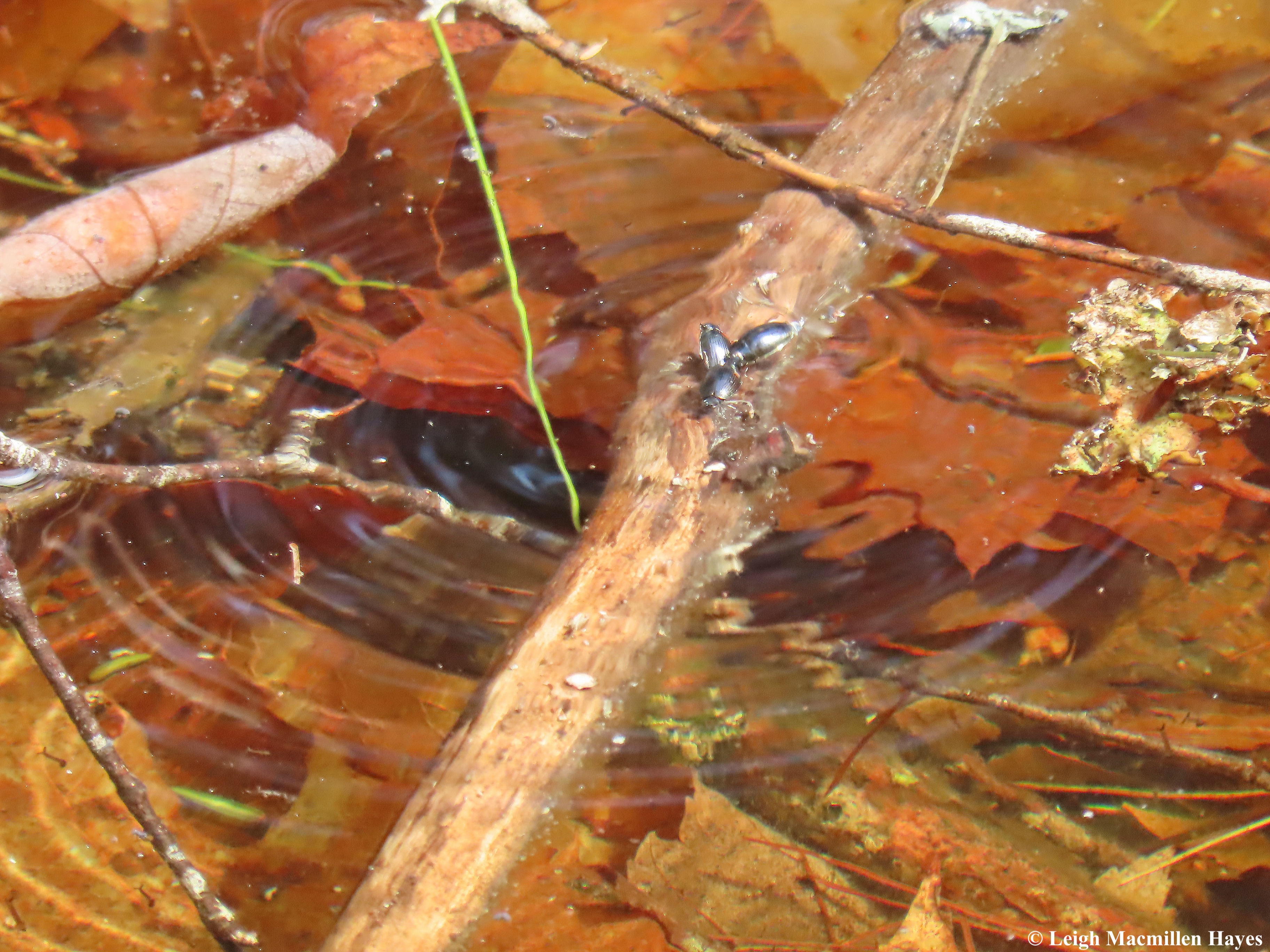
During this visit, I also spotted Whirligig Beetles gyrating around each other in breakneck speed, creating ripples everywhere.

And male Wood Frogs ever on the look out for a date.

In fact, so anxious were they that sometimes one male tried to grasp another, but the one underneath quickly squealed and swam away.

Then I spotted another old friend or its relative and wondered if the Long-jawed Orb Weaver that had created a perfect web between branches over the water was one that I’d photographed on the snow this past winter. Probably not. But a woman can dream.

Later in the afternoon on Tuesday it began to rain and while the storm didn’t last too long, it was enough to wet the roads and again the word went out for Big Night #2. This time there were a few Spotted Salamanders on the move as well.

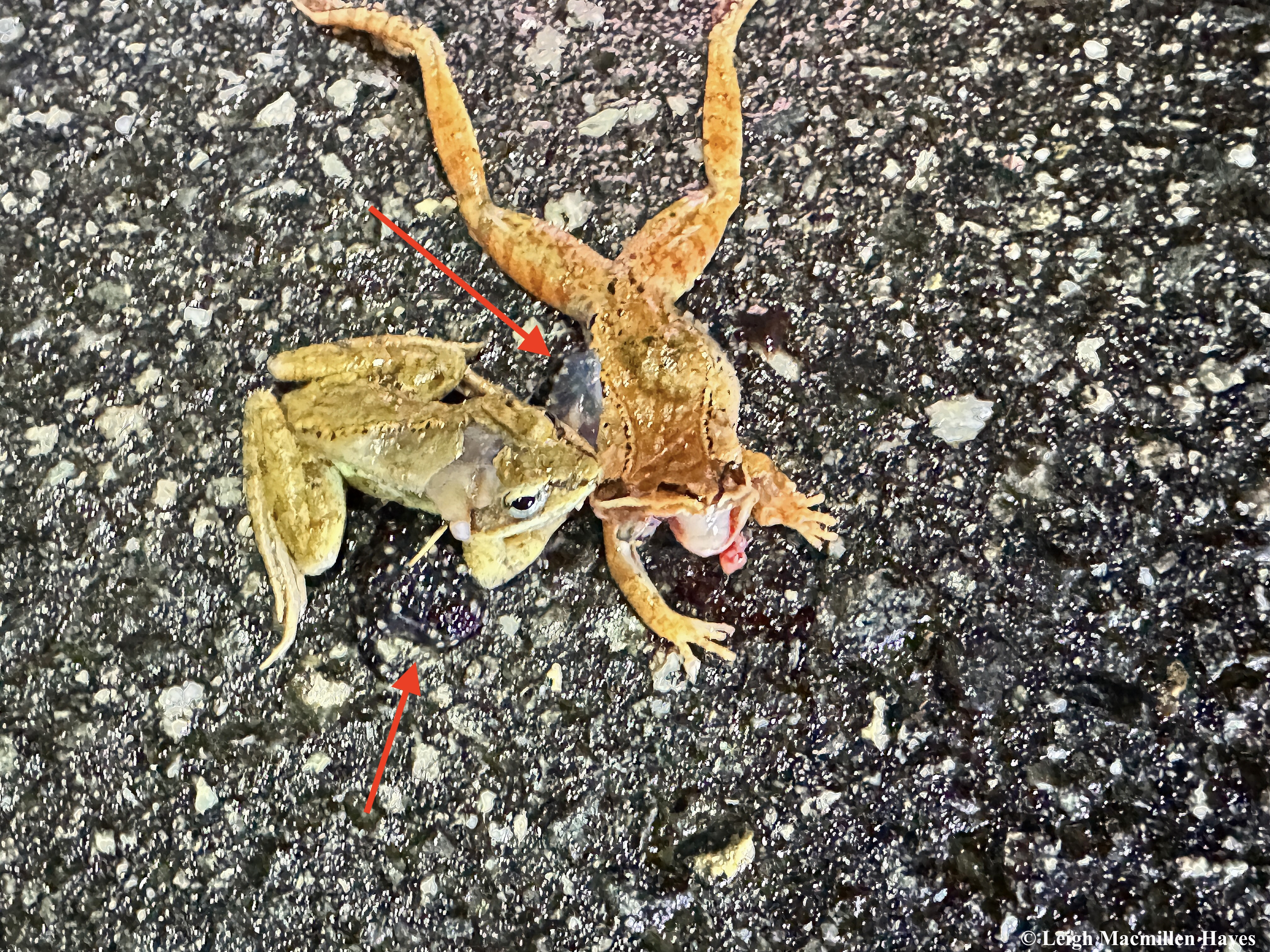
The next photo may disturb you, so you may want to skip over it.

I included this picture of two squished female Wood Frogs because this is what happens when we drive by vernal pools and other wetlands on rainy nights. And I added the arrows to show the egg sacs that had popped out as the tires drove over these ladies.

We let out a communal groan as we heard the pop, and then made this discovery, trying to ease the moment by reminding ourselves that they would become food for others, but still . . . reinforcing the reason why we’ve been celebrating Big Night(s) on this local road for at least 25 years of organized events and I suspect many more before that.

All told for saves on Tuesday night: 836 live Wood Frogs, Spring Peepers, Spotted Salamanders, plus at least one Green Frog and one Eastern Newt.

That was a BIG night! And many thanks to Dawn and Maggie for organizing it.

And from the sound of the “Wrucks” on Wednesday, which was louder than the day before, I knew the ladies had returned to “My” pool as well. And the guys were feeling successful.

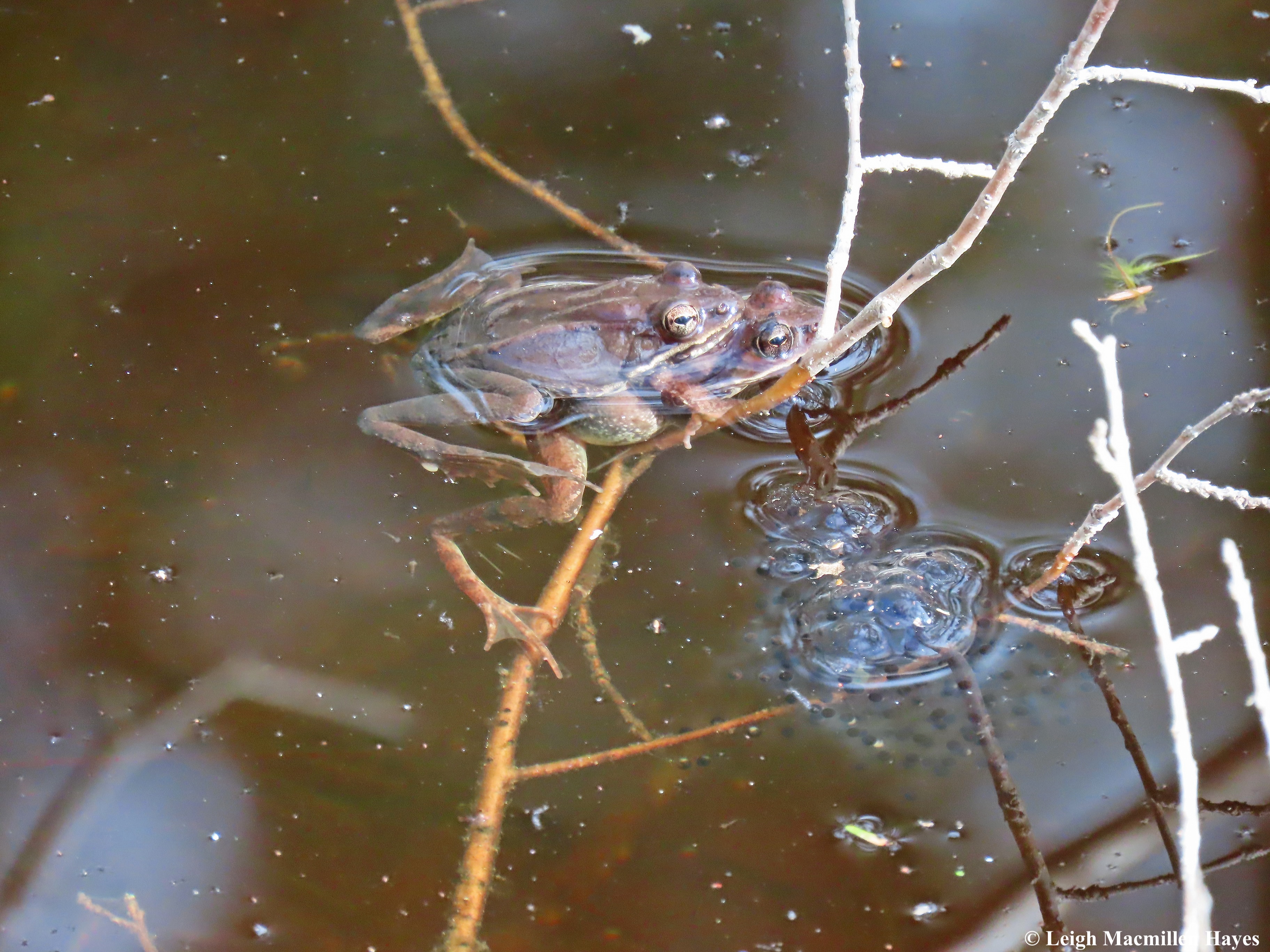
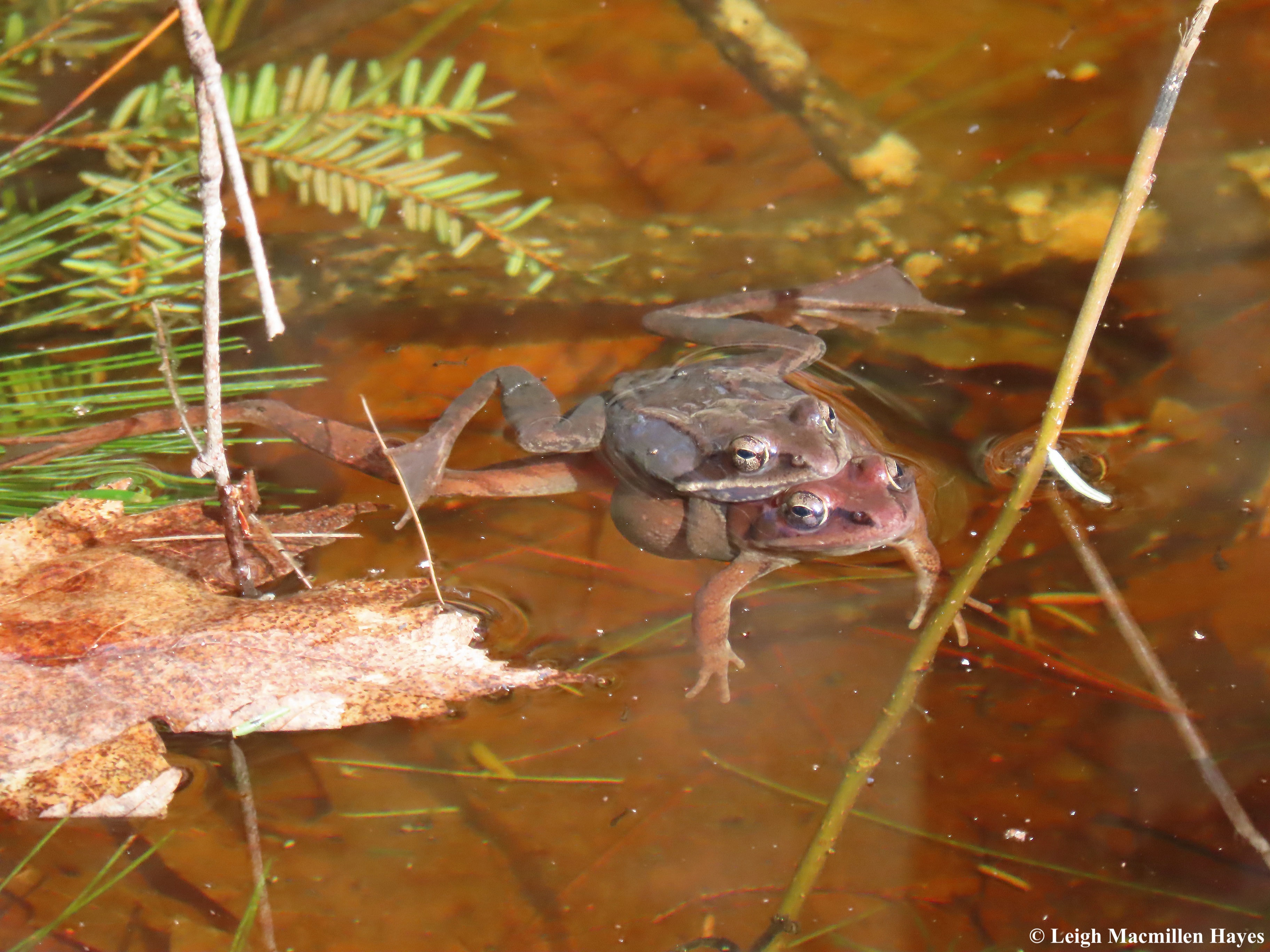
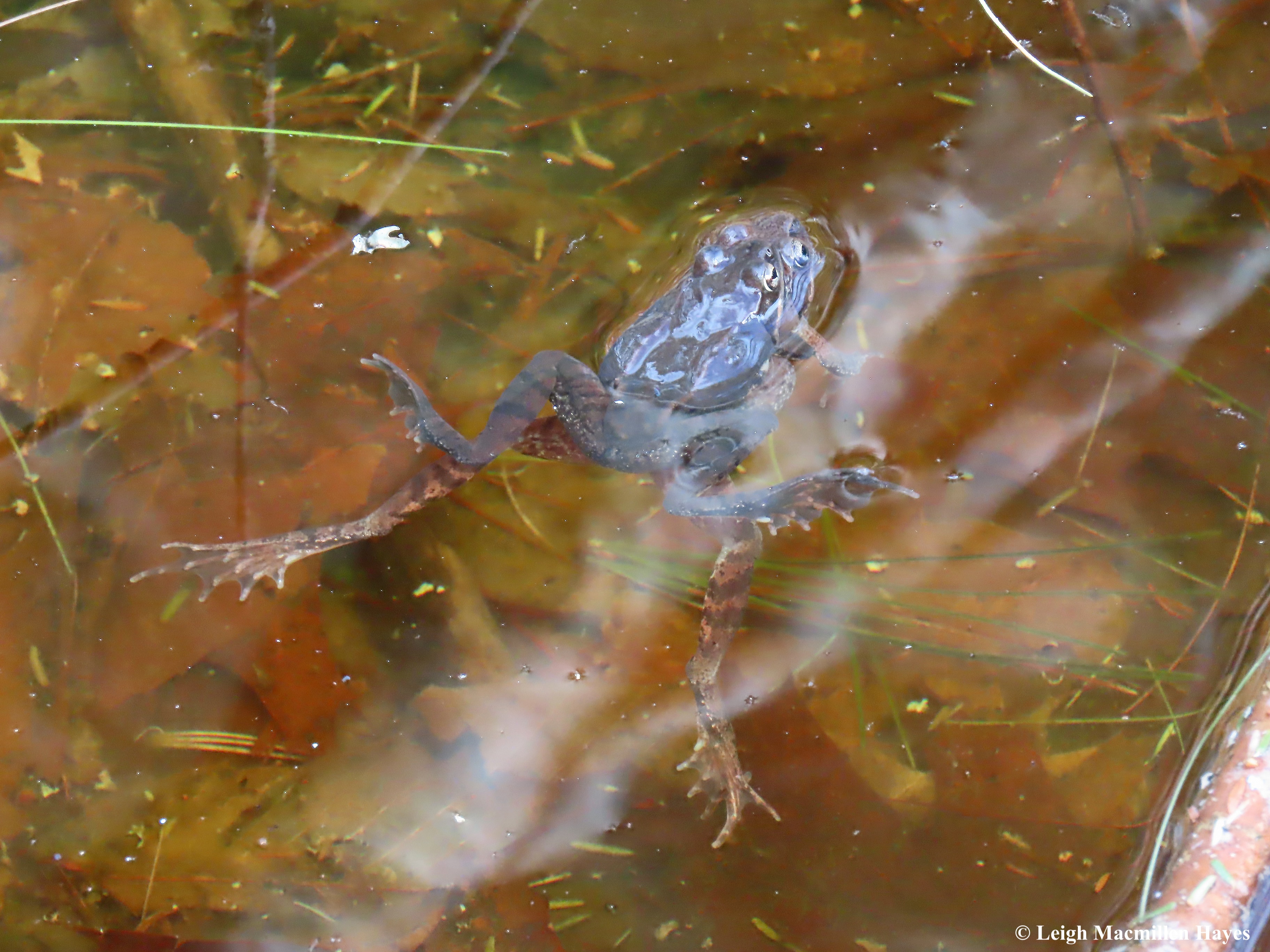
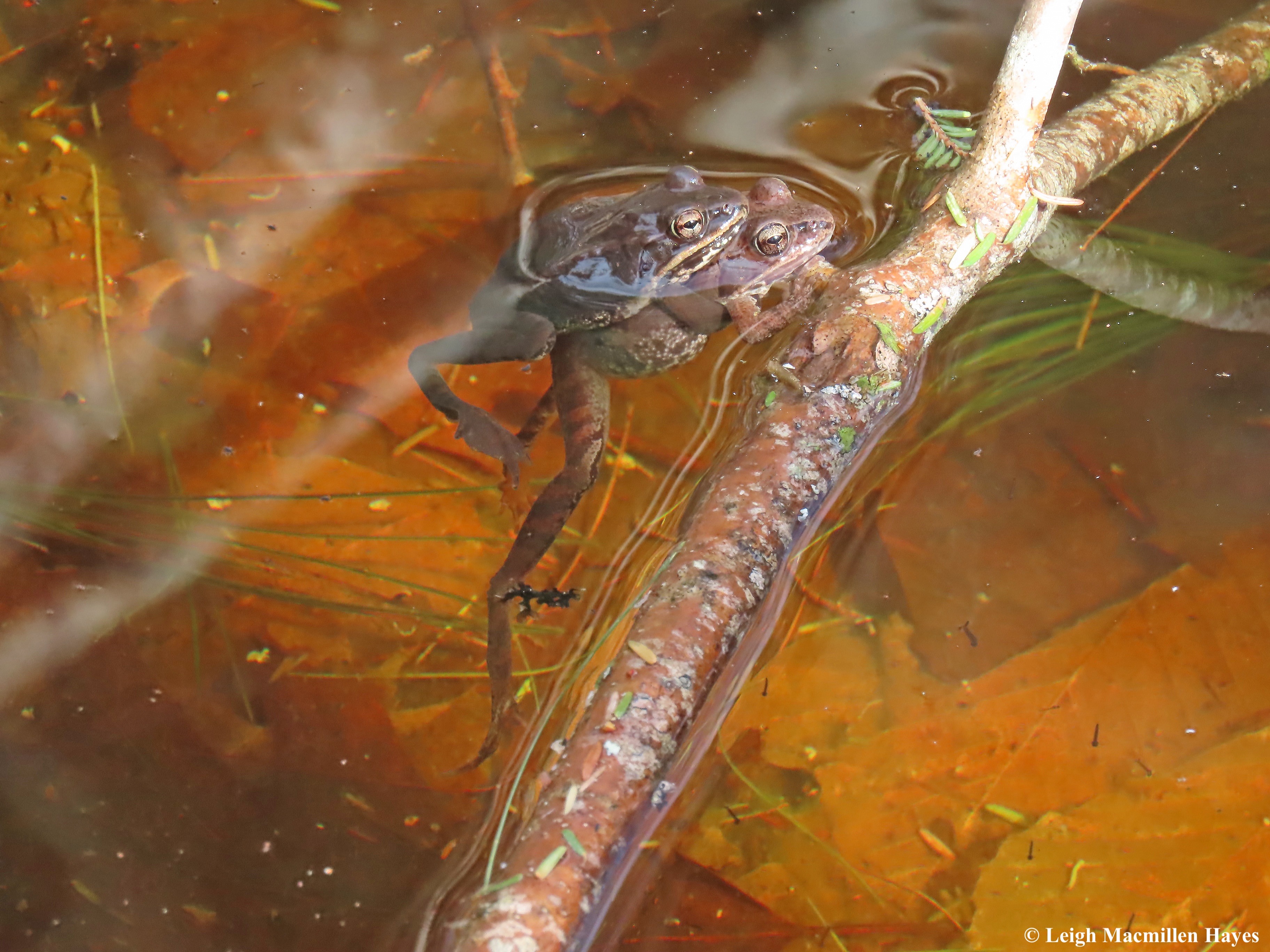
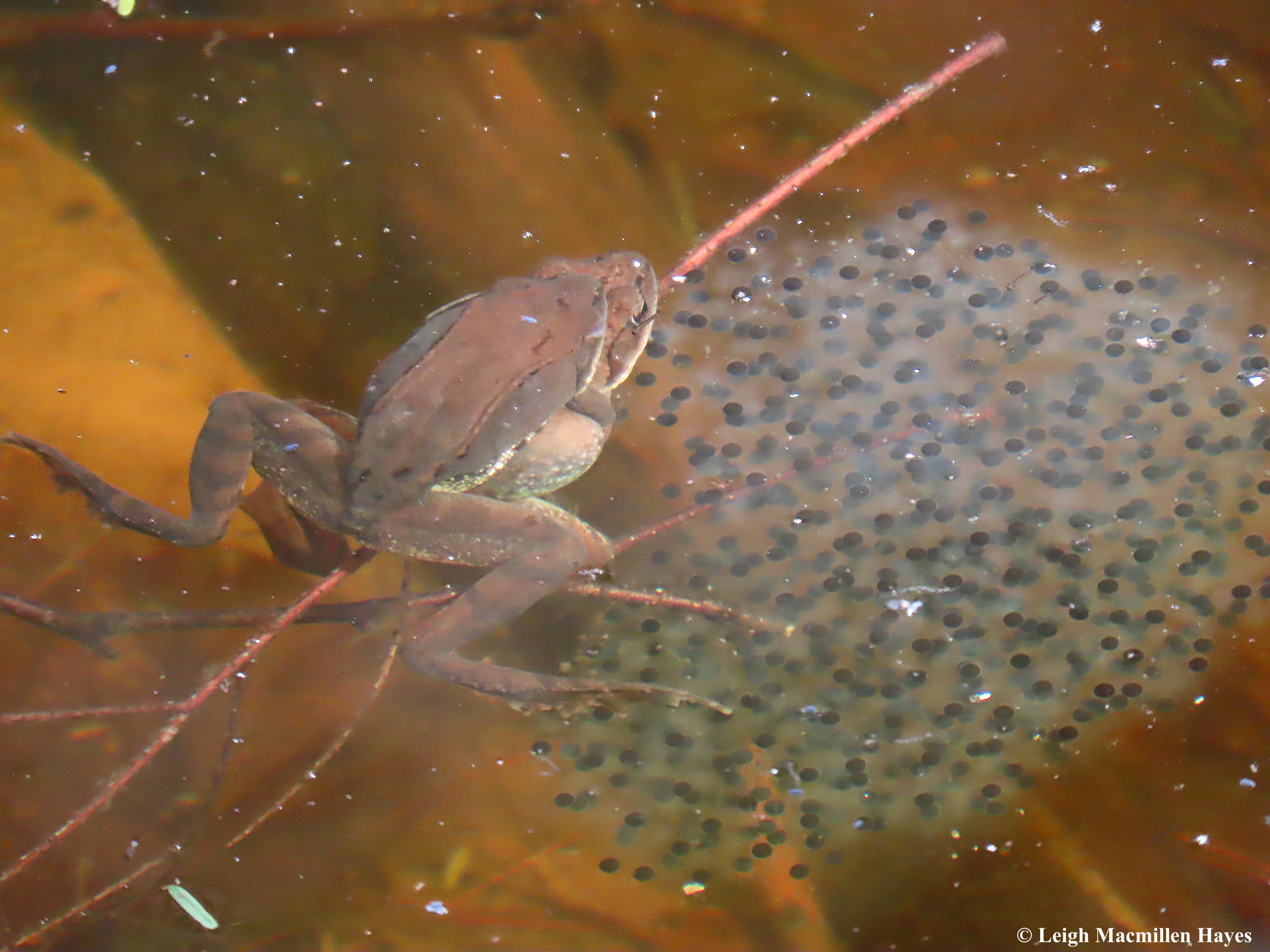
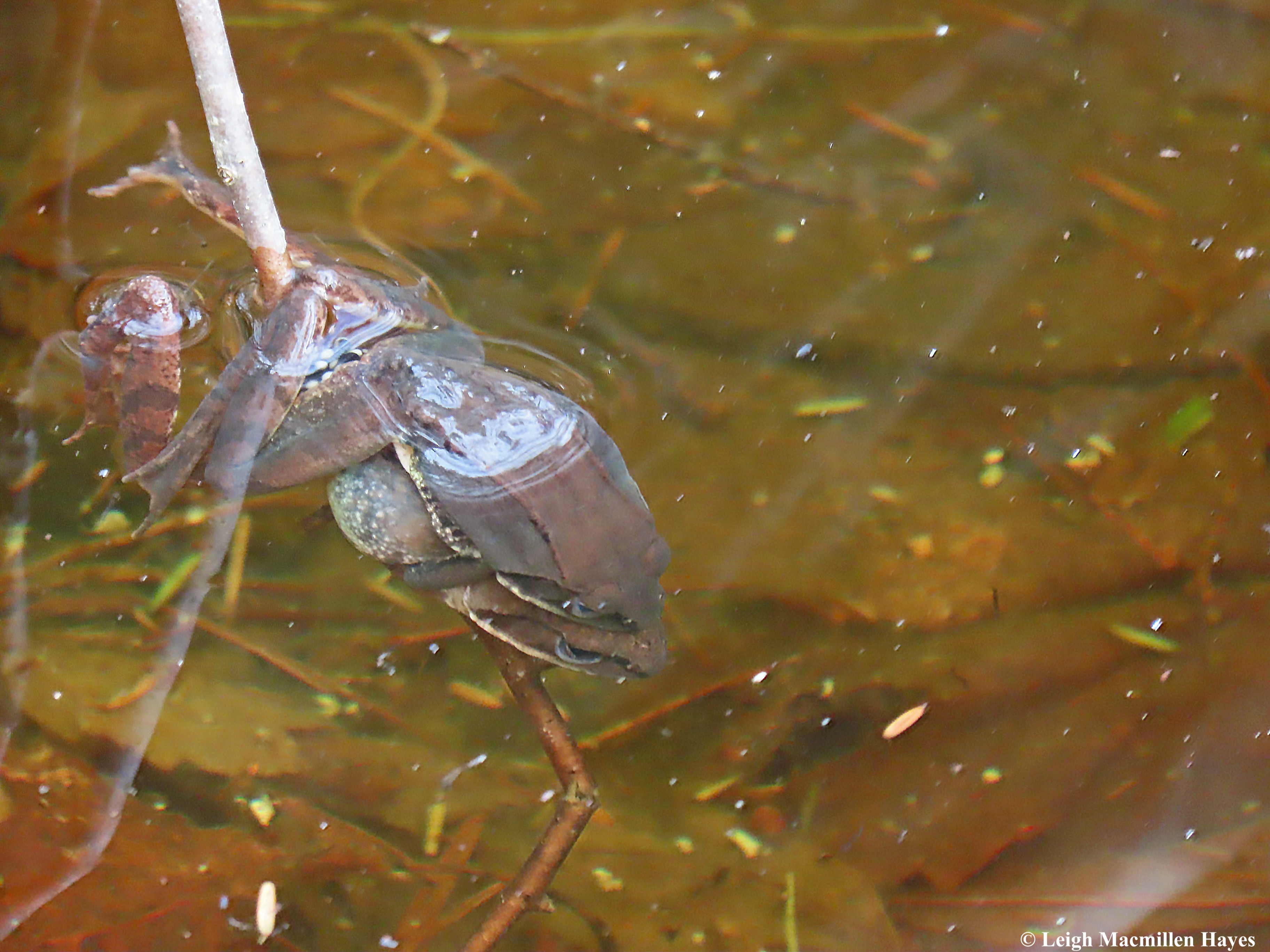
Within a minute of standing there, I looked down and spotted a couple embraced in what is known as Wood Frog amplexus, the smaller and darker male being on top with his forelegs wrapped around her, just above her enlarged belly.

She seemed to be in full control as she moved about the twigs, looking for a good location to deposit her eggs.

I thought the first spot was perfect because it was located near another egg mass and Wood Frogs tend to deposit their eggs in communal colonies, the better to avoid predation–especially if yours are among the first and are surrounding by other egg masses, and therefore protected.

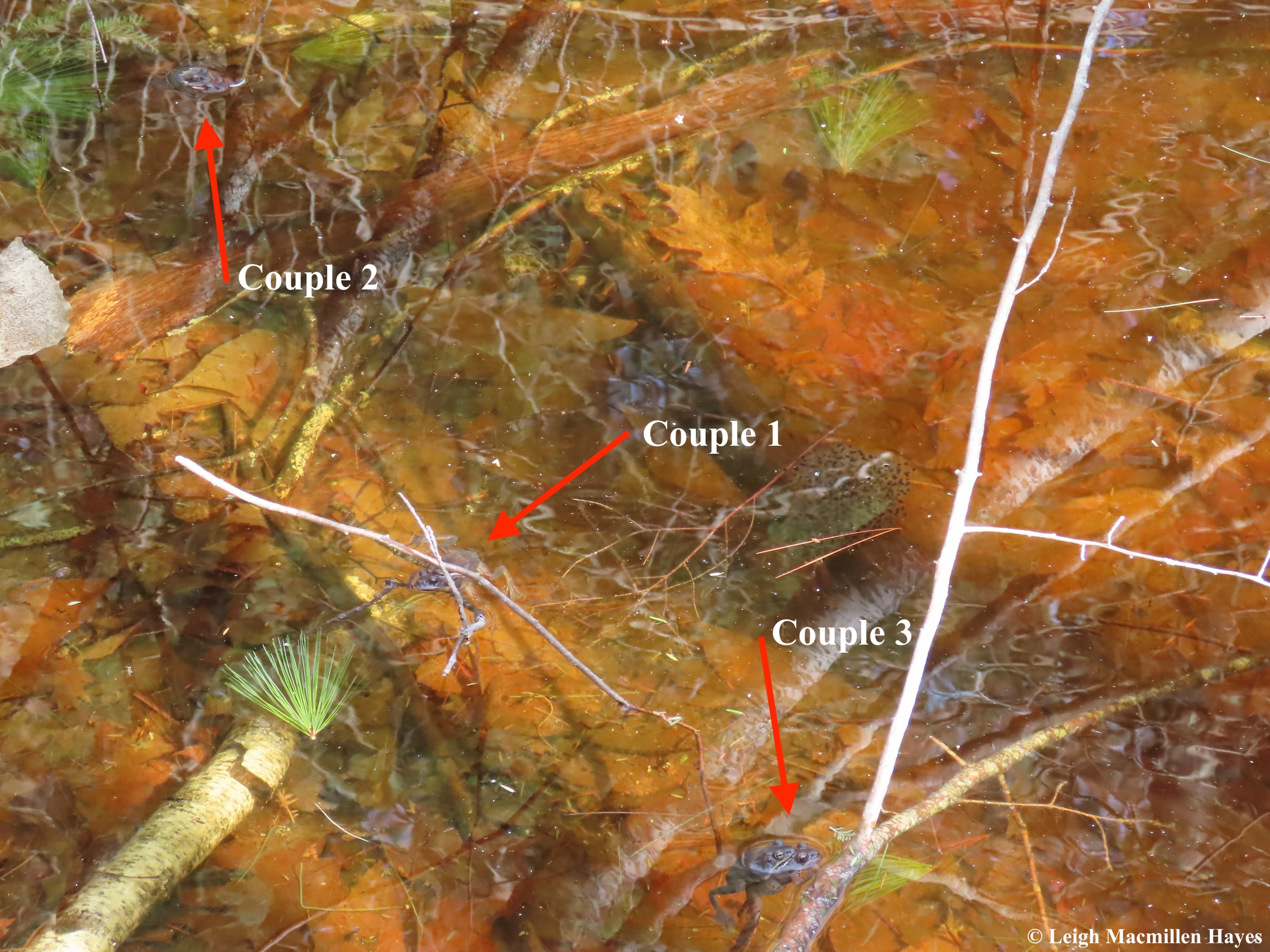
Scanning the pool, I spotted another couple and decided that going forward they need names, so this is Couple 2.

Meanwhile, Couple 1 continued to move about the same set of twigs.

And then near my rock, Couple 3 appeared.

There were also lone males, and because it was breezy, no one seemed to mind my presence. In fact, a couple of males in the western corner even “Wrucked” a few times.

Couple 2 found a larger branch and hung out there.

But Couple 1, they were on the move again.

This time testing a different set of twigs. All I could do was wonder exactly what she was looking for. What made a prime location prime?

I don’t have the answer and probably never will, but still couldn’t believe my good fortune to have all three couples right there by my feet.

And then . . . and then Couple 1 swam off and disappeared under a recently fallen tree and I thought, “That’s a good place because there are so many branches to choose from,” but at the same time I was disappointed because I figured I’d never see the rest of the story.

Until . . . they swam back out and approached the twig of their first choice.

And seemed to be making a move to settle upon it.

Only they didn’t. Instead, they swam to another twig that they’d tried earlier; one that had no other egg masses.

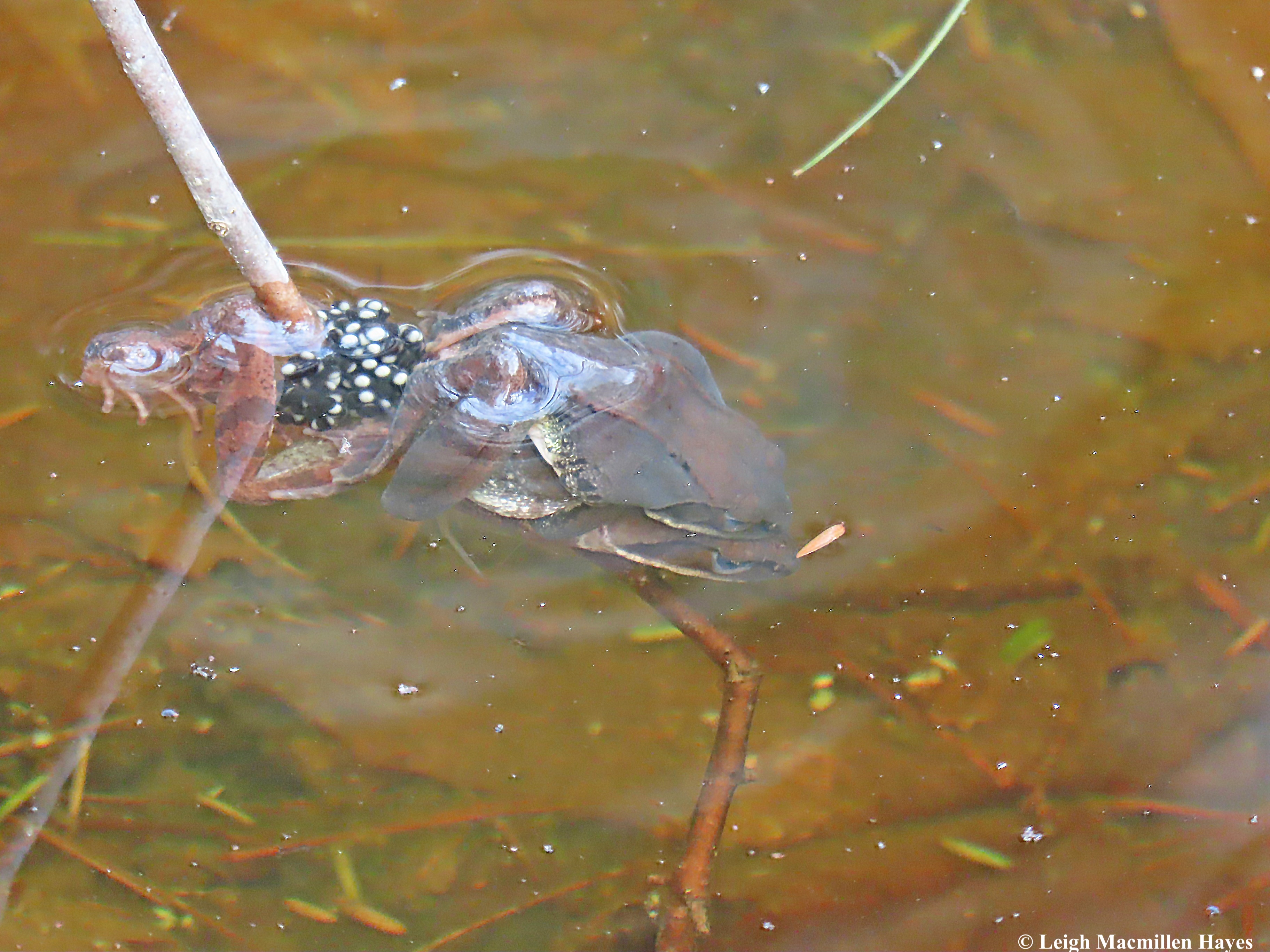
And suddenly, right before my eyes, she began to lay eggs, which he fertilized externally. Can you see the black and white dots between their hind legs?

I could not believe I was finally witnessing this amazing moment. Magic in the making.

My body was stiff from standing so still, but it was so worth the effort.

With her hind legs, and I may be wrong about this, she appeared to be wrapping the mass around the stick so it would be well attached.

The eggs are black and white, the Pied Pattern, the top of the egg being dark so predators from above may not see it because it more closely matches the dark leaves and muck on the floor of the pool, and white on the bottom so that predators within the pool will think it’s just sky.

So, as luck would have it, and I was feeling super lucky and grateful for the opportunity to observe, my camera battery died. And the back-up battery was at home. (Note to self: carry it in my pocket.)

I pulled out the next best thing and shot this photo with my iPhone. He eventually moved off of her, but not too far away, probably exhausted from all the effort. And she remained below the quarter-size egg mass for a few more minutes.

As for the other two couples, one disappeared under the fallen tree and the other went under the leaves below my rock, perhaps seeking privacy.

Finally, I took my leave. With a huge smile on my face.

Oh Baby(ies), I know your parents will leave the pool soon, but I’ll be there to watch over you. Maybe not daily, but frequently for as long as the pool holds water, being ephemeral as it is.

The Exclamation Point

The crossover from winter to spring is actually emulating the same from autumn to winter with fluctuating temperatures and snow. But still there is so much to see if you can get outside.

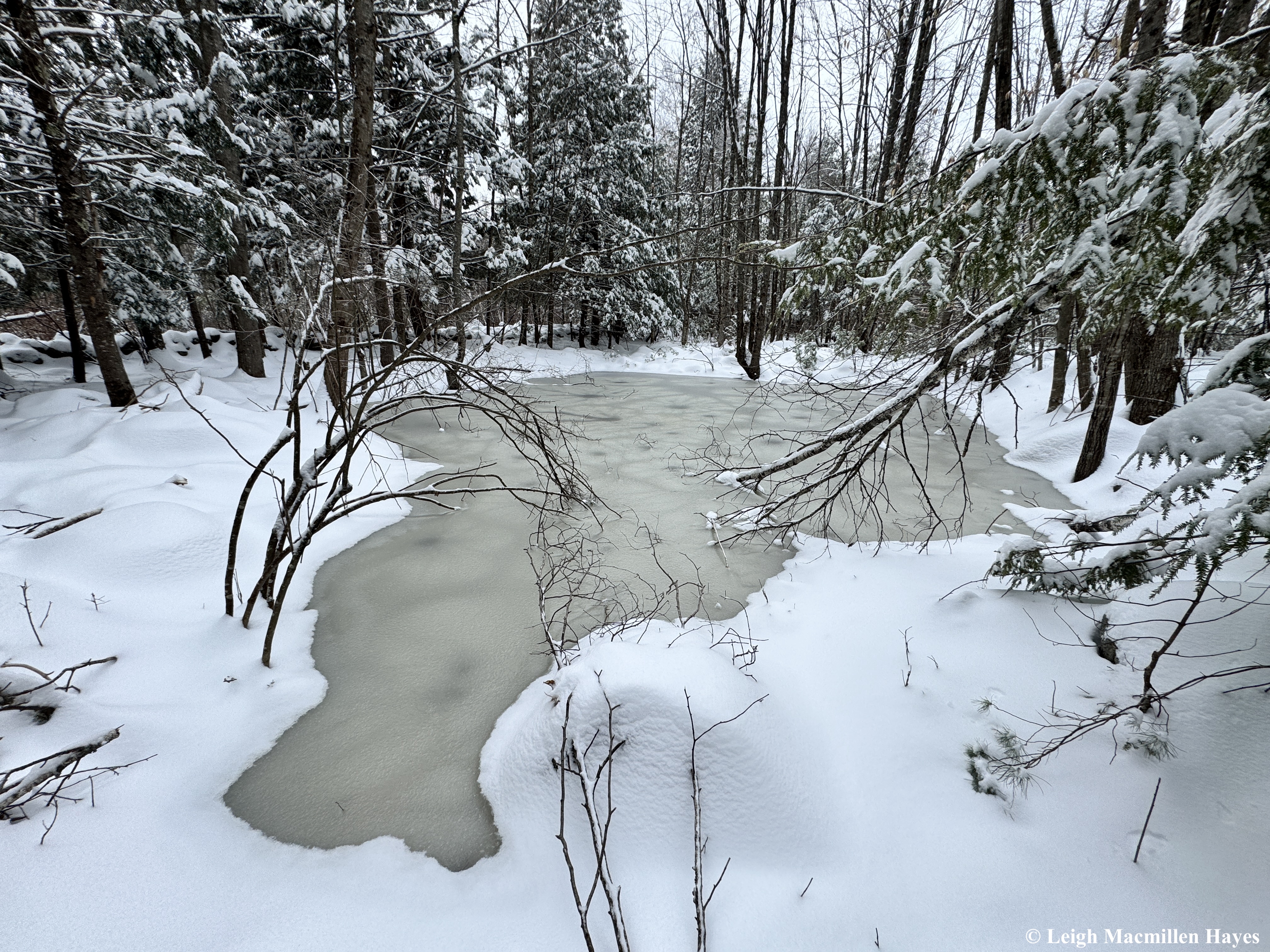
Yesterday, My Guy and I paid a visit to “our”vernal pool (located on a neighbor’s back forty) and noted that it was still ice covered. That said, I know I’ll start making almost daily visits because any time now the ice will begin to melt and tada, the action will start to happen.

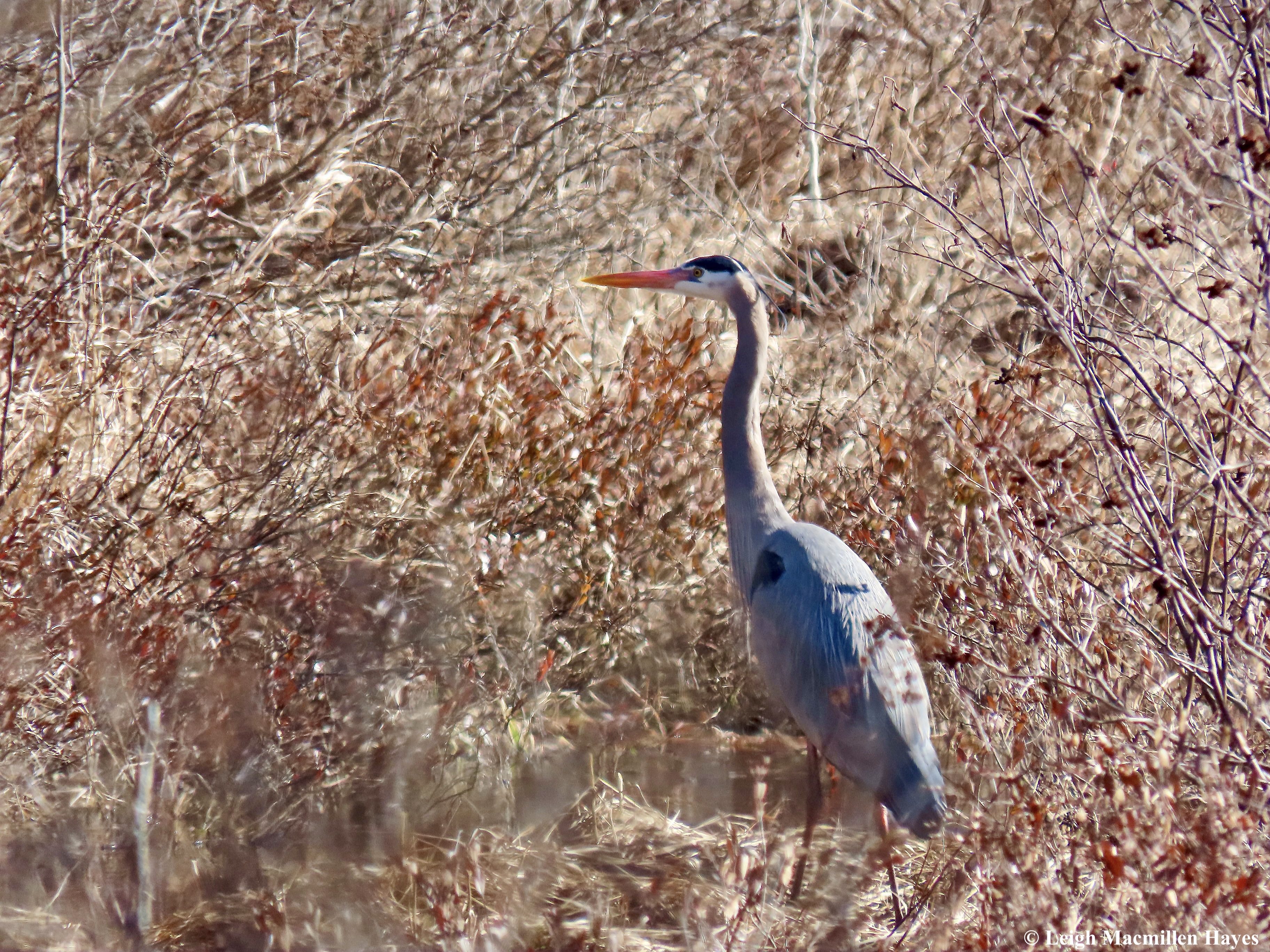
The day before, we’d walked a local trail that still had areas of snow here and there, but were delighted to spot our first Great Blue Heron of 2025, which was apropos as this morning I received an email from the state biologist asking if I’m still willing to monitor three rookeries as I have done for the past 15 years. YES!

And the day before that, while hiking another trail in a different town where there was almost no snow, we had a quick sighting of an Anglewing Butterfly that I couldn’t name to species because it flew off before I could spot the markings on the underside of its wings.

Now those sightings seem like only memories and how could they have possibly occurred given that five inches of snow accumulated quickly yesterday.

But early this morning, the snow turned out to be a tracker’s delight, for fresh tracks showed details providing names for the creators who passed this way.

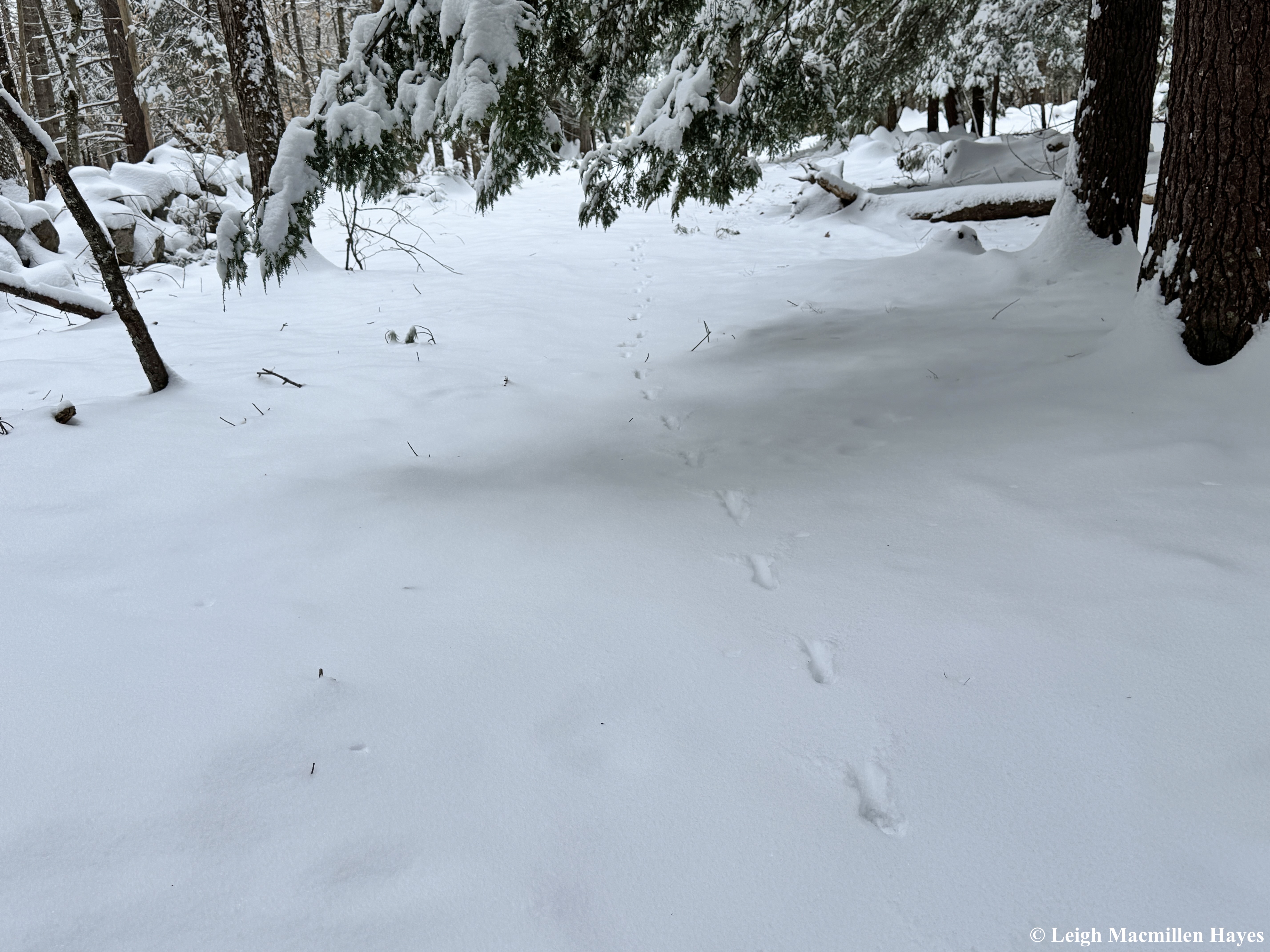
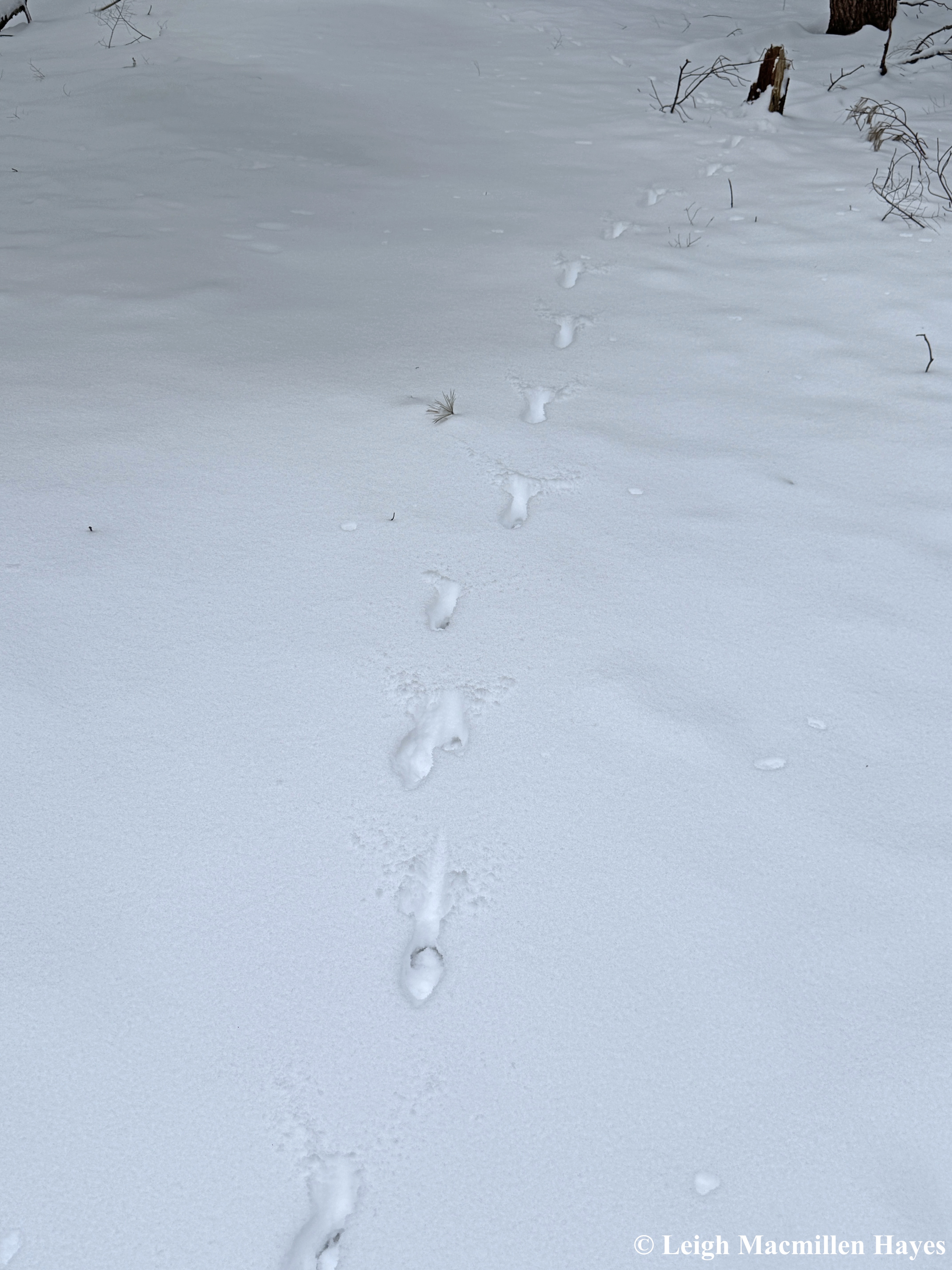
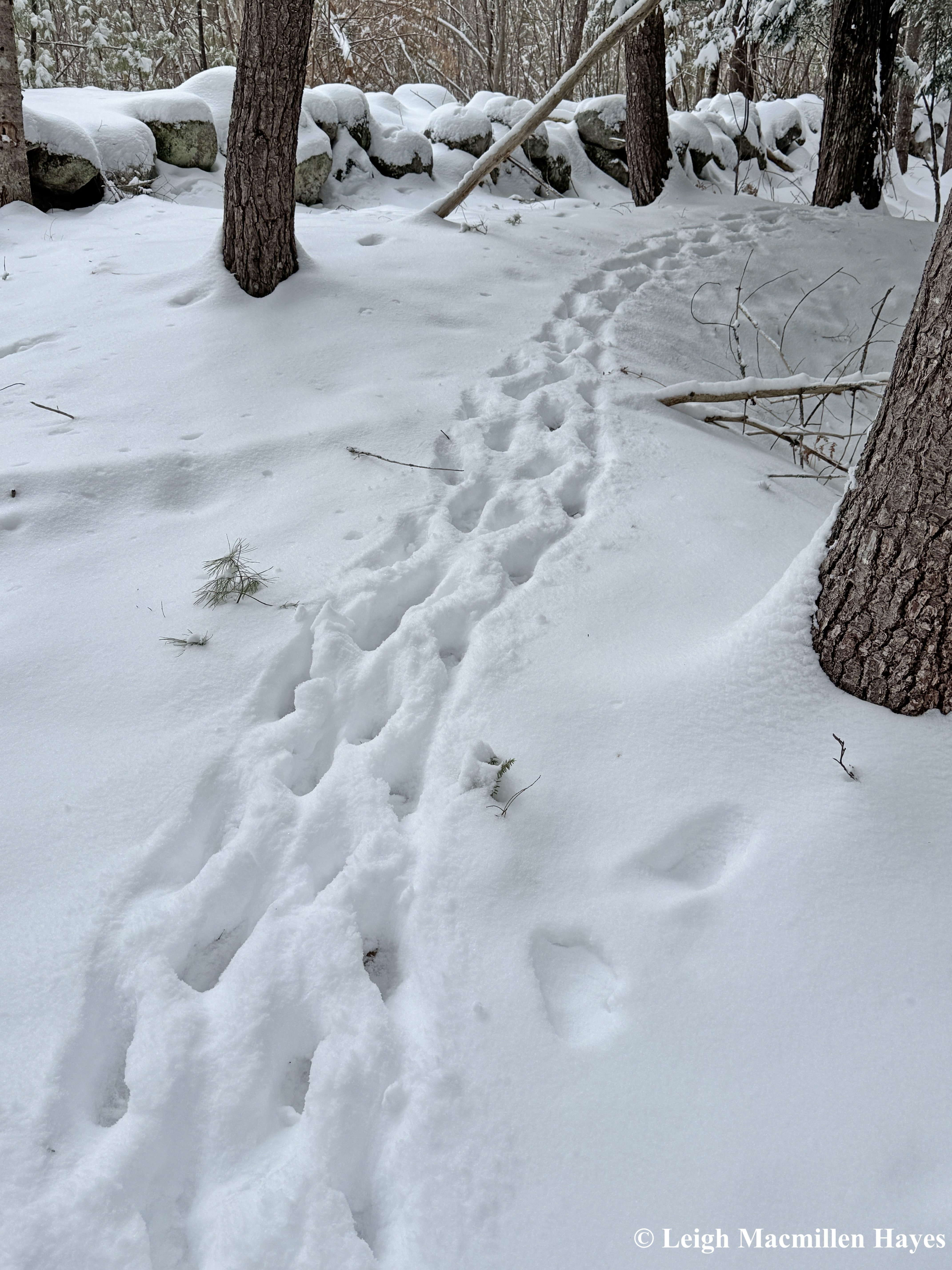
And so along our cowpath (where cows haven’t walked in years), I followed the Red Fox, wondering where it might lead me.

I knew I should have backtracked it so as not to put pressure on it, but knowing and doing are two different things.

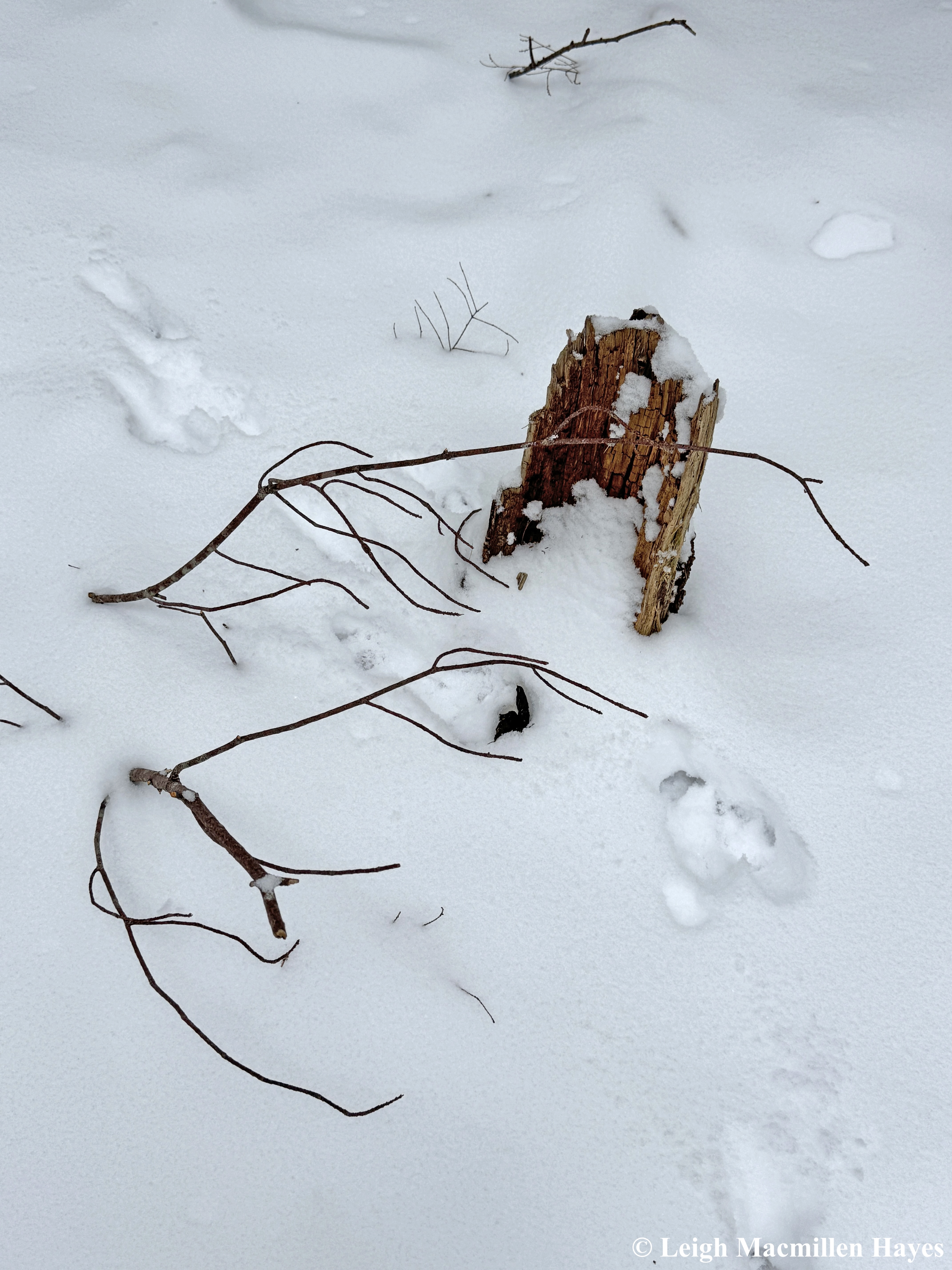
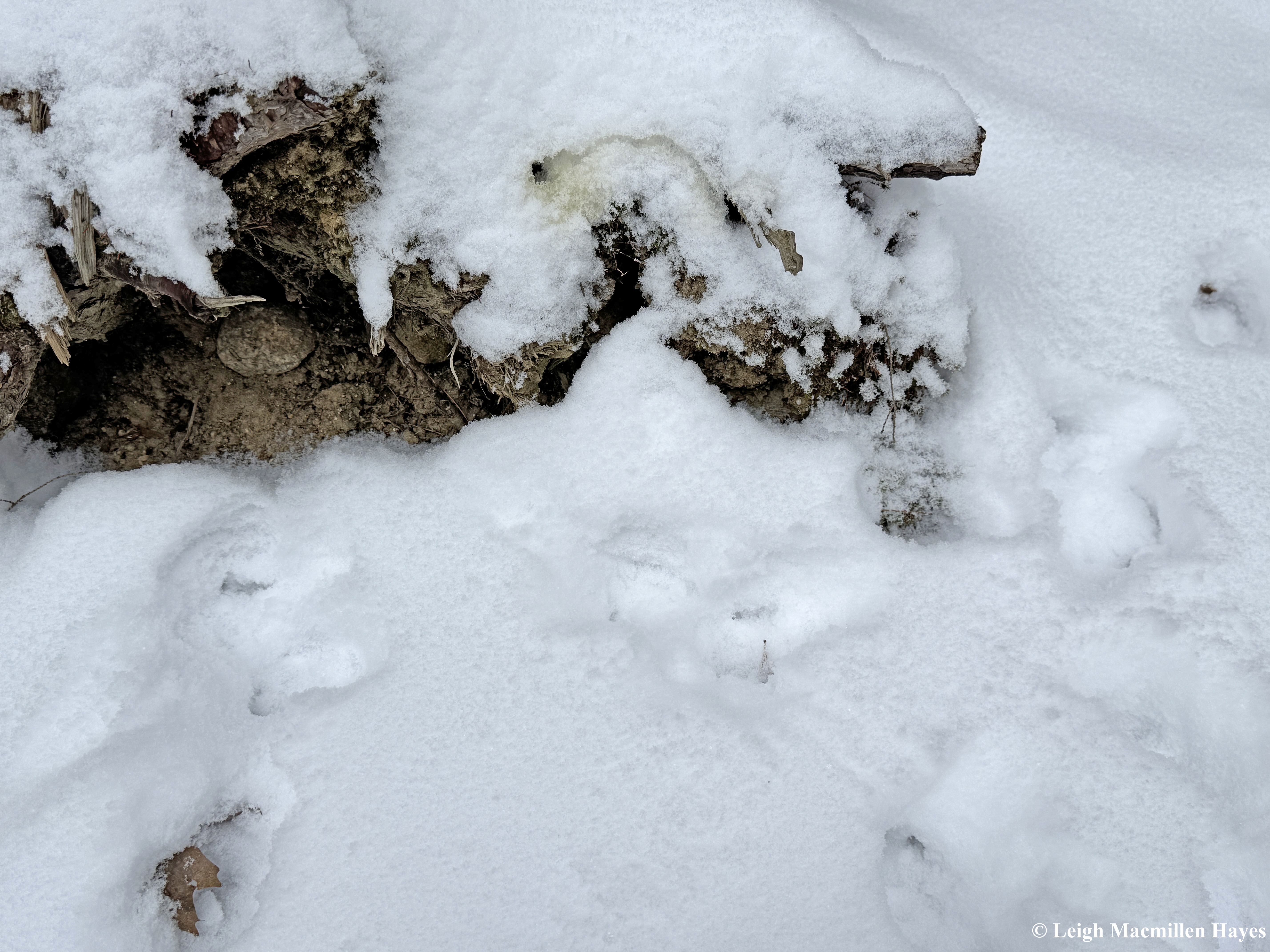
If I had backtracked it, I might have discovered the source of its scat left in such a location beside a tree stump, that I thought it was a boundary marker the Fox had deposited.

And it may well have been, but I suspect there was other important information given off by the scat such as the fox’s gender, age, and health, for a few steps later it left a sign and scent of its availability in the form of skunky-smelling pee. I thought mating season had come to an end, but apparently I thought wrong and the fox knows best.

We stayed together for a bit, though there were a few downed trees I chose to walk over or around, rather than under like the fox did. When it reached the stonewall between our land and the neighbor’s field, I decided to turn around and head toward the vernal pool instead to perform my daily check.

The transformation from yesterday to today should not have amazed me–My Guy and I walked in sleet and then snow yesterday, but still . . . the vernal pool seemed like a whole other place–almost like December 25th rather than March 25th.

To the left of the pool I noticed tracks that I’ve seen frequently here and beside the cowpath and knew that the resident Porcupine had been out and back overnight. I love the sashay of its track pattern and will miss seeing that when the snow does finally melt.

I followed Porky’s track to a Hemlock and noted that it had climbed up and down. I know about where its den is because I followed its tracks a few weeks ago over a couple of stonewalls and then into the yard of a neighbor around the corner, but decided to not locate the actual spot cuze it might seem a bit odd that I was looking for such.

Can you imagine seeing this woman show up in your backyard because she wants to know where the Porcupine she displaced this winter is now denning?

On my way out today, I did grab the game camera because I fully expected to see the Red Fox on it. For some reason, it alluded the camera, but I did find a couple of Porky videos. The first was taken about a week ago and I encourage you to watch the ten-second demonstration of the mammal’s behavior.

Not only do Porcupines sashay, but they have other dance moves as well, and I only wish I’d seen these in snow, but if I ever do, I’ll have a better understanding of interpreting them.

This behavior is one of self-defense–as Porcupines don’t see or hear very well, but it must have sensed danger. The camera didn’t pick up on a predator, but those erect quills being flashed all around indicate something loomed in the night.

I’d love to call it a dance of joy, but know better. It was meant to be an intimidating dance. If a predator should get close, Porky could lash out with those 30,000 quills, which are easily detached and can become embedded in the skin of the attacker. Definitely not a dance of joy from the predator’s point of view.

A couple of days later, Porky was all business as he headed toward home, leading me to believe he felt no threat in that moment.

Here’s the thing. His den is the same den of the Porky by the vernal pool and I know he has sampled several trees poolside, as well as several trees cowpath-side, so I assume it is the same animal.

I left the pool behind and walked down the driveway of a local business and then slipped into a park where I again met Foxy Loxy on the move.

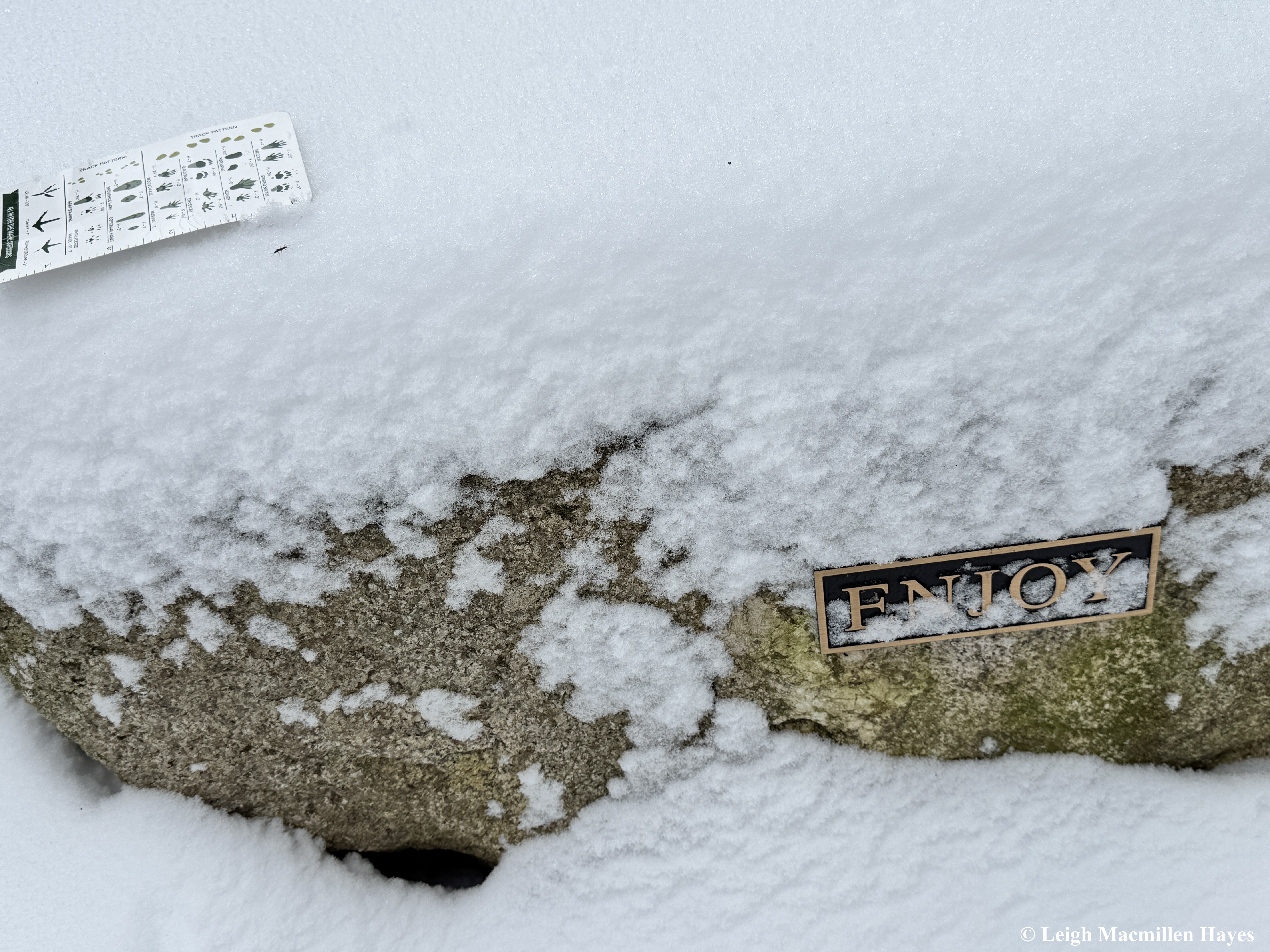
He wasn’t the only one moving, either. Do you see the tiny black mark by my tracking card?

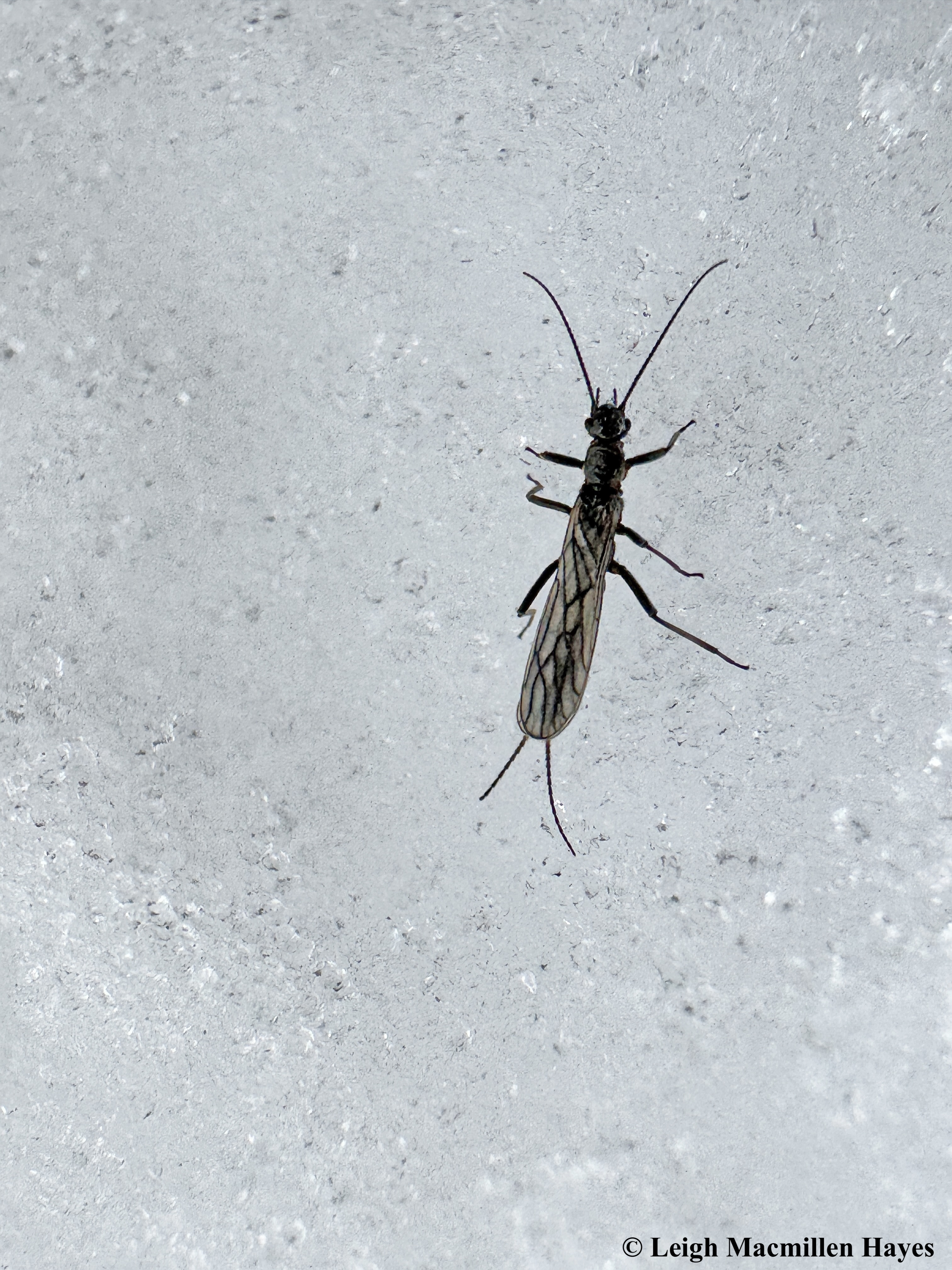
Winter Stoneflies were having a heyday this morning. It always excites me to see them because their nymphs require healthy, clean water and so to live in a area where these tiny insects are abundant means we are among the fortunate.

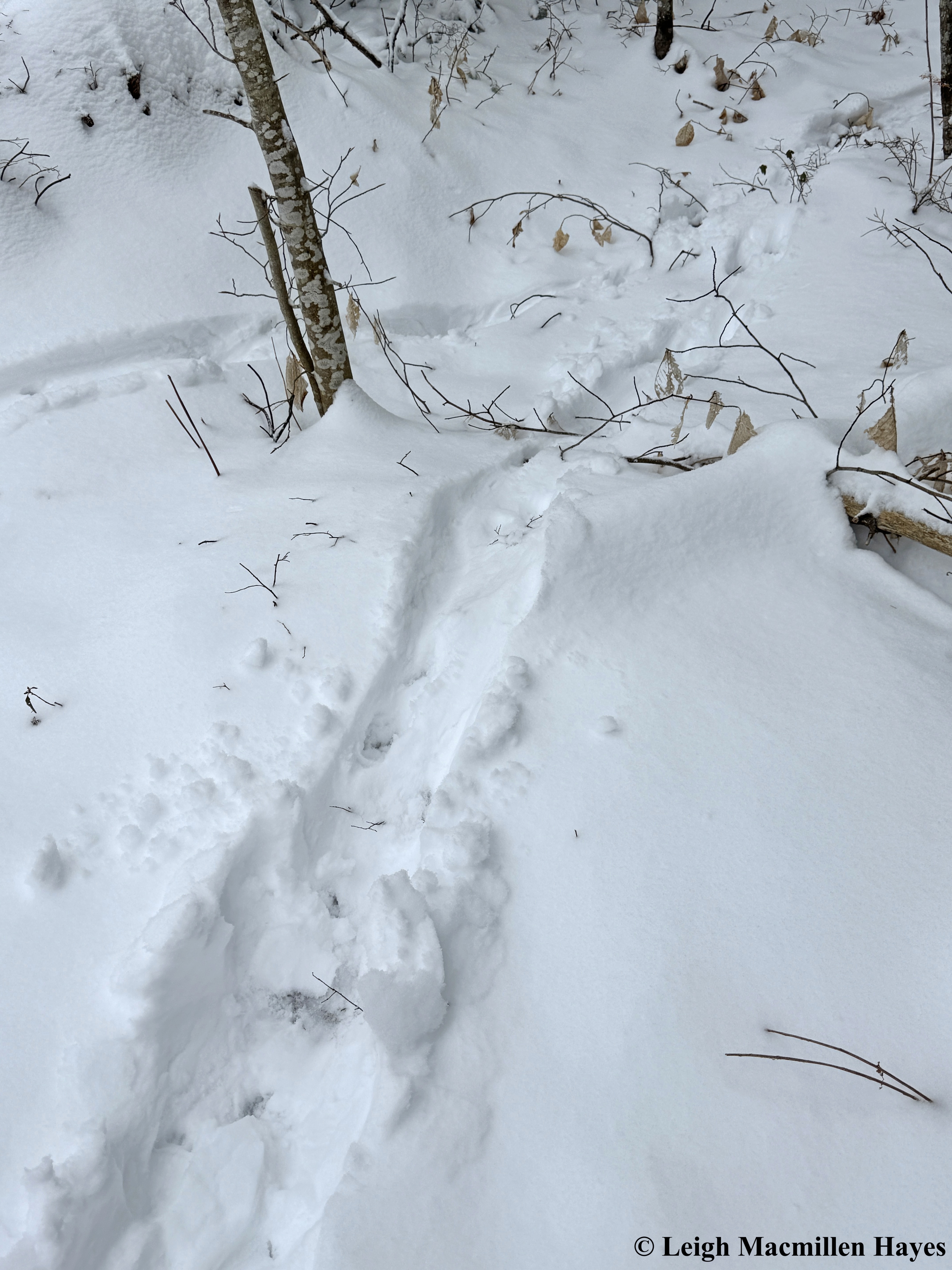
How fortunate? Super! For my next great find was . . . drum roll, please . . . an Otter slide. My heart be still.

I’ve seen their slides in this very spot before, but it’s been quite a few years. Of course, I had to follow the path that they took, which was really a bushwhack, given that they crossed the path we humans have created.

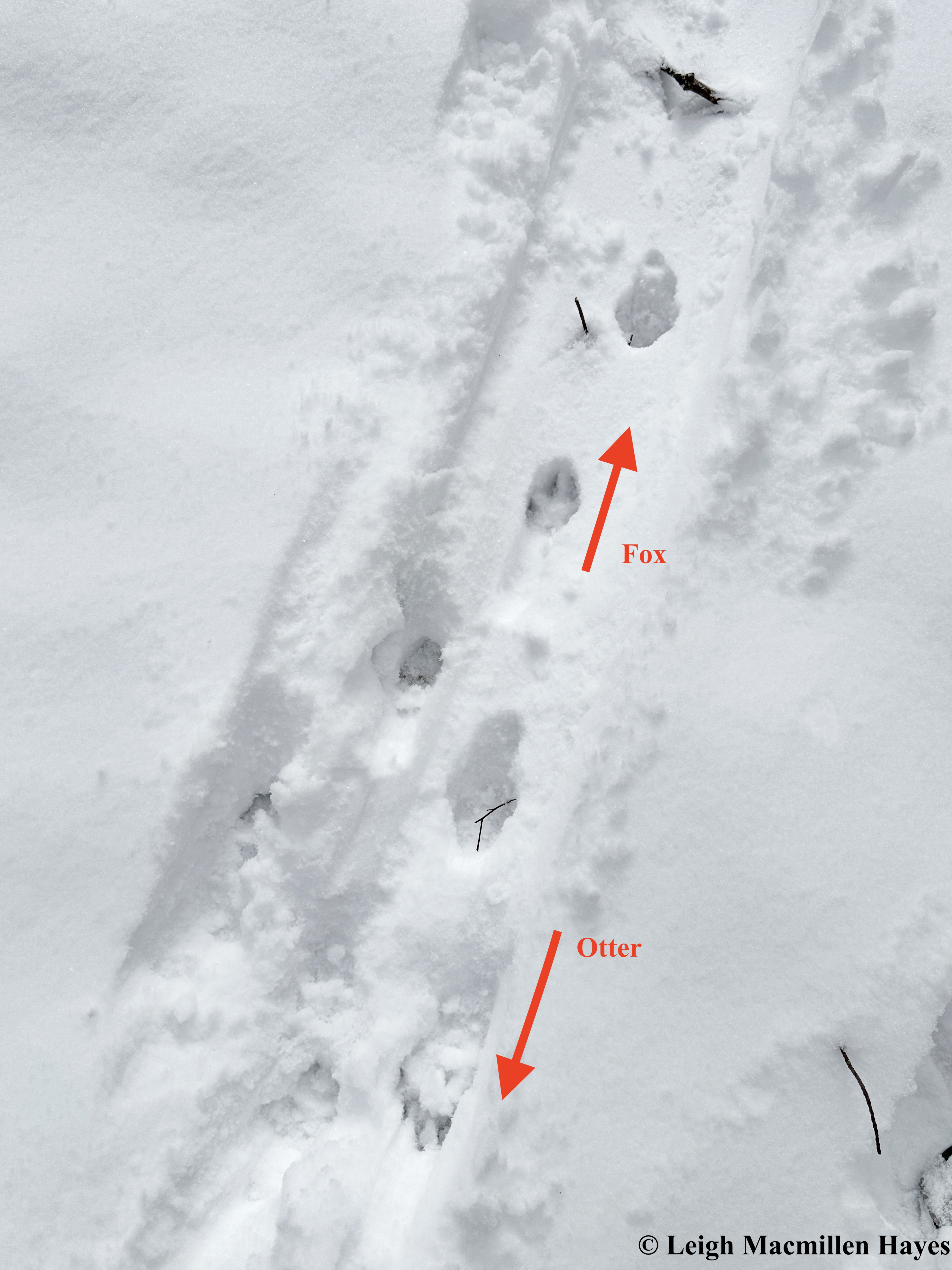
This is the spot where the Otter came out of the brook and bounded up the hill. I assume it was one, but sometimes they travel in family units and follow the same route so what looks like one could be two. Foxes do the same.

Speaking of that, do you see a set of tracks coming in from the east to meet the Otter? Or at least sniff around and wonder where it went? Those belong to the Red Fox.

The same Red Fox who traveled through our woods? Possibly.

And this is the spot where the Otter slid back into the water.

Fortunately the Otter didn’t meet its fate by becoming a meal for the Red Fox. Yet.

I moved on from that spot, but it seemed no matter where I went the Red Fox had been there before me.

And always searching. Food is a strong motivator.

So is finding a mate. More urine and this time there were two foxes, so I wonder if he found a she.

And I’m wondering how many Gray Squirrels who frequent our bird feeders will become meals for kits. The squirrels are well fed; I can attest to that.

I felt like life couldn’t get much better, and then others made their presence known, like the Long-jawed Orb Weaver,

Winter Firefly,

and another robust spider.

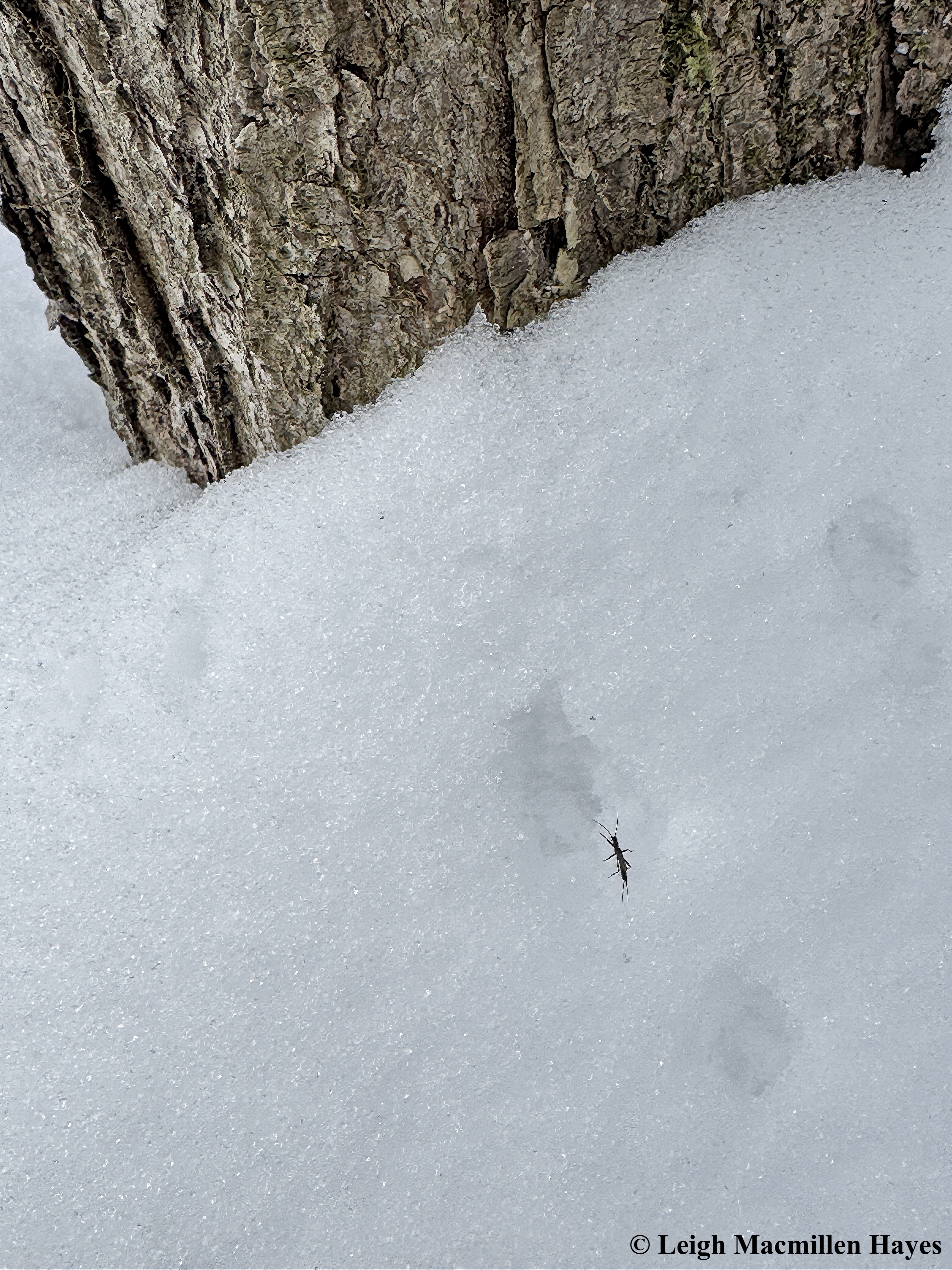
As for those suddenly ubiquitous Stoneflies . . . I kept looking for one that had actually reached a tree and was at last successful.

Until it wasn’t, and I wanted to say (and actually did), “Hey Bub, you took a wrong turn. You’ll never find a mate if you don’t reach that tree trunk.”

Of course, there are many more trees in the forest and perhaps something didn’t seem quite right about this one.

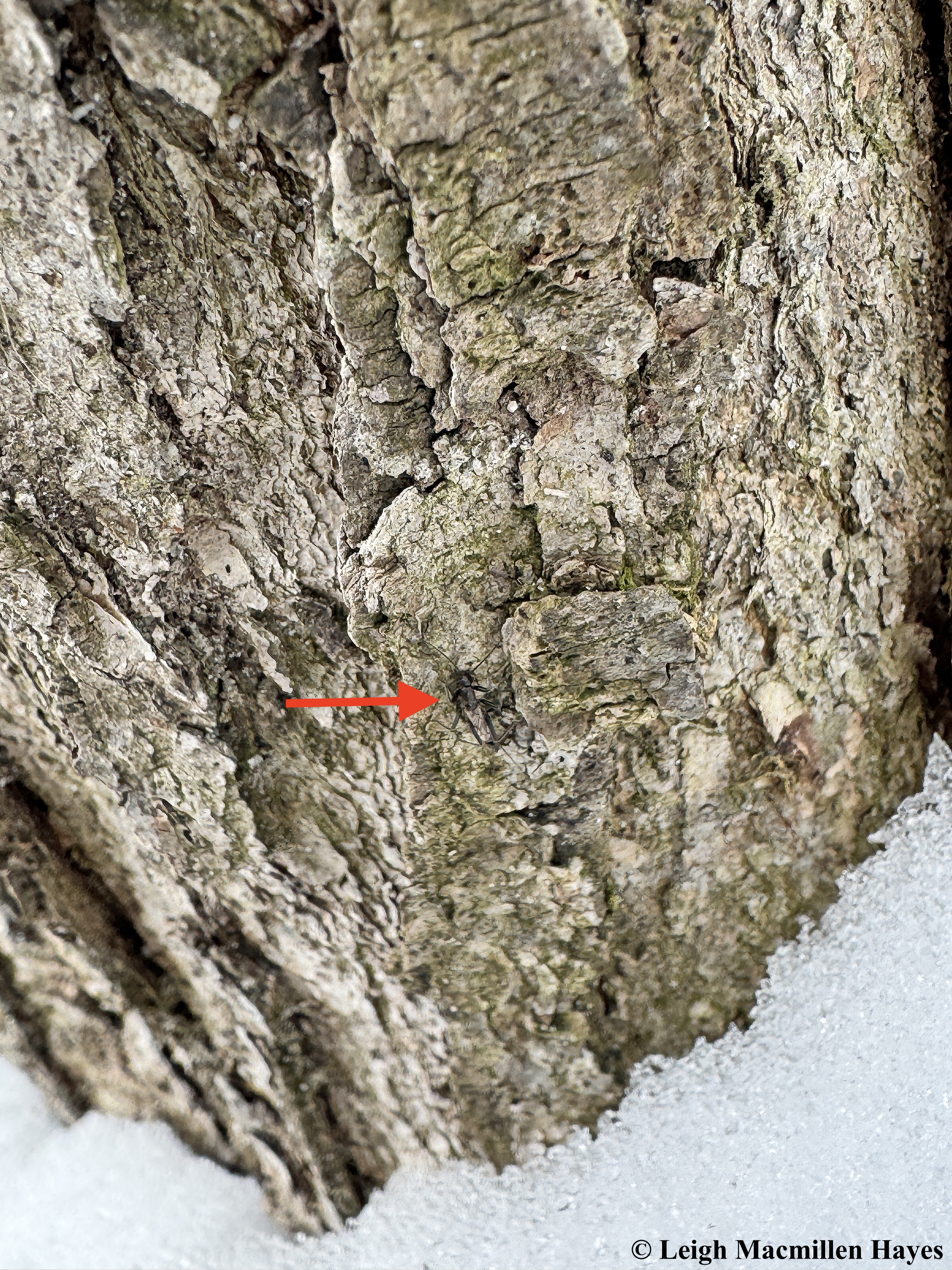
Until it did. And the Stonefly started to climb up onto the bark.

Do you see it?

How about now? It’s definitely a Where’s Waldo moment.

Does the arrow help?

With his abdomen, he’ll create a drum beat only she can hear, and I left him to it in hopes that he was successful.

As I turned around, I met a young mother and her two-year old son out for a nature hike and so I introduced them to the Stoneflies. The tot was thrilled and he kept locating others. We chatted for a few minutes and then it was time to part and he turned to me, smiled, and said, “Goodbye,” and then blew me a kiss. His mother was as surprised as I was. I blew a kiss back to him.

There was so much out there to make my day today, and that kiss was the final seal.

It brought me back around to the Anglewing Butterfly. On Saturday I couldn’t tell My Guy if it was an Eastern Comma or a Question Mark, both species that as adults overwinter behind bark.

This is a Comma, where as the Question Mark would have this same line, plus an additional dot making it look like a QM.

My Guy’s comment, “For you, it doesn’t really matter. They are all Exclamation Points.”

YES! And today was full of Exclamation Points. I’m forever grateful.

P.S. As I headed home a couple of hours later, the temperature had risen and snow plops were falling from trees and the conditions for tracking had significantly deteriorated.