The Tale of Two Tails

We call ourselves the Trail Snails–a group of St. Peter’s Episcopal Church parishioners always accompanied by various non-parishioners who like to crawl at a snail’s pace.

Each week I try to find a different location, thinking fairly flat for locomotion and with natural elements that will bring out their sense of wonder. The first isn’t always easy, especially given the amount of snow and ice we’ve had this winter; but the second is a cinch since there’s so much to wonder about in our little corner of the world. When we started these walks in the fall, I did not expect that we’d continue weekly throughout the winter. But we have.

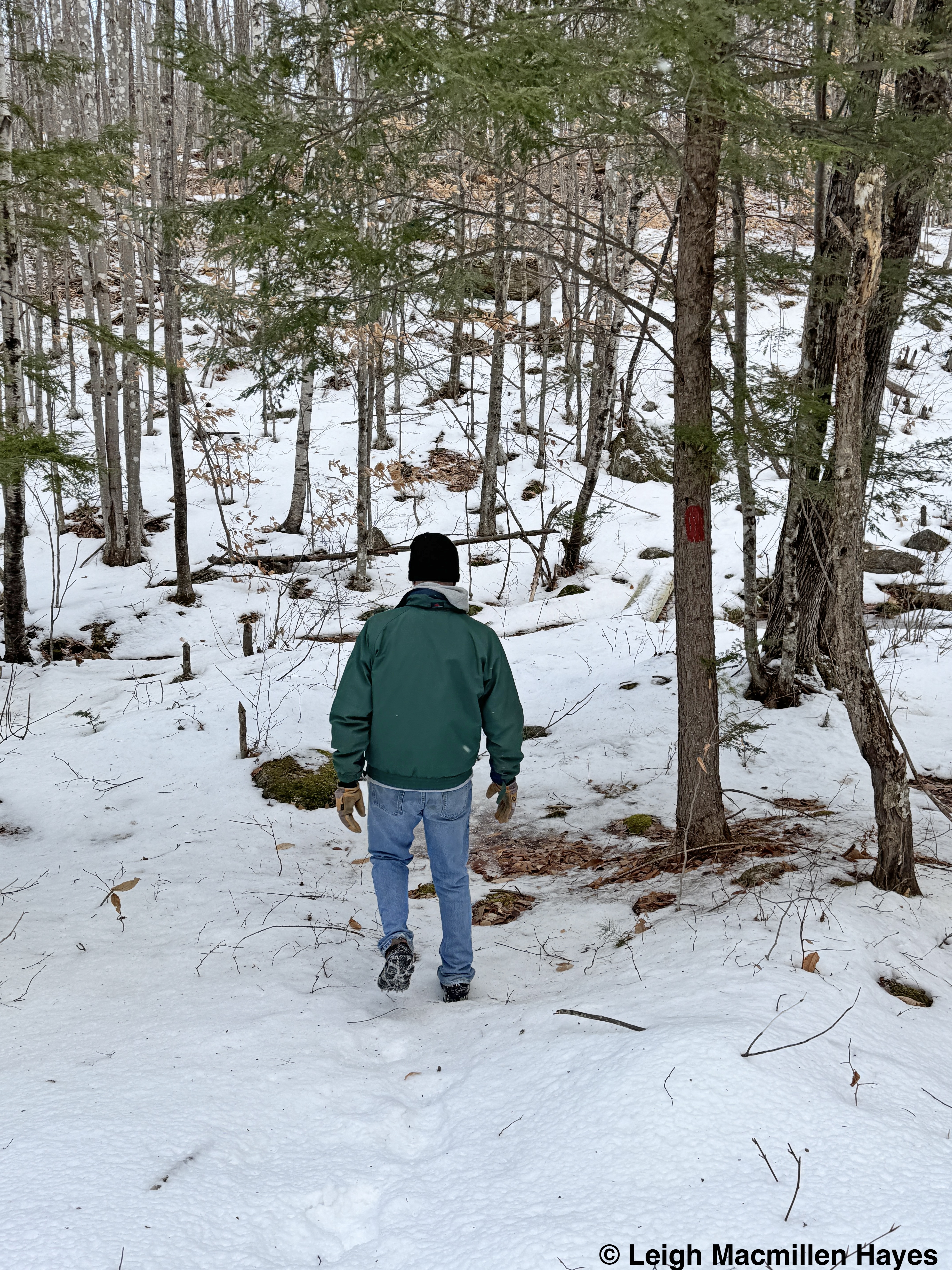
And so today six people (parishioners and non) joined me at my house to head out to the well-packed snowmobile trail. Of course, it wasn’t as well packed for the first thirty feet and that proved a bit challenging because we all wore some variation of micro-spikes rather than snowshoes, but they all persevered.

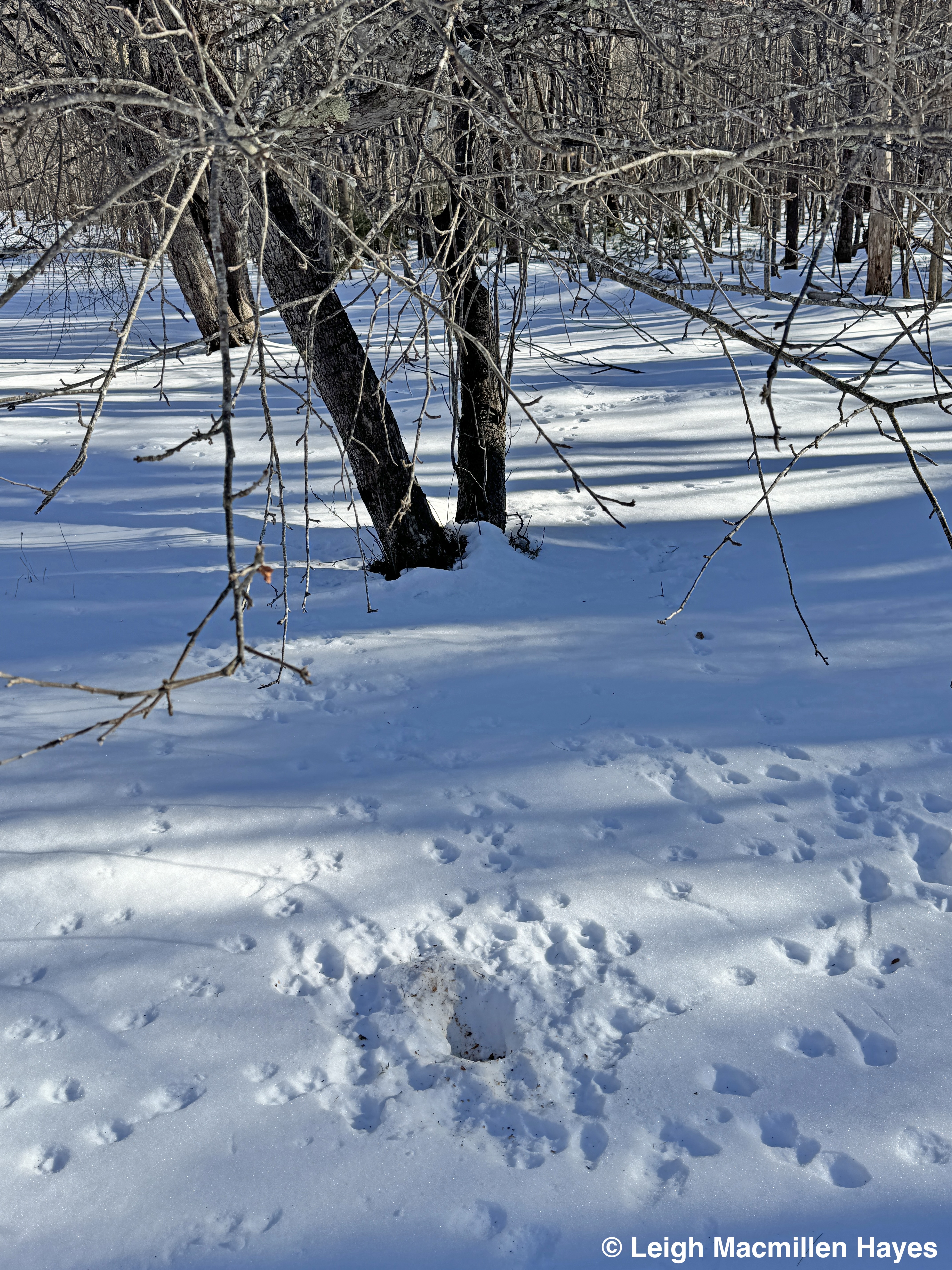
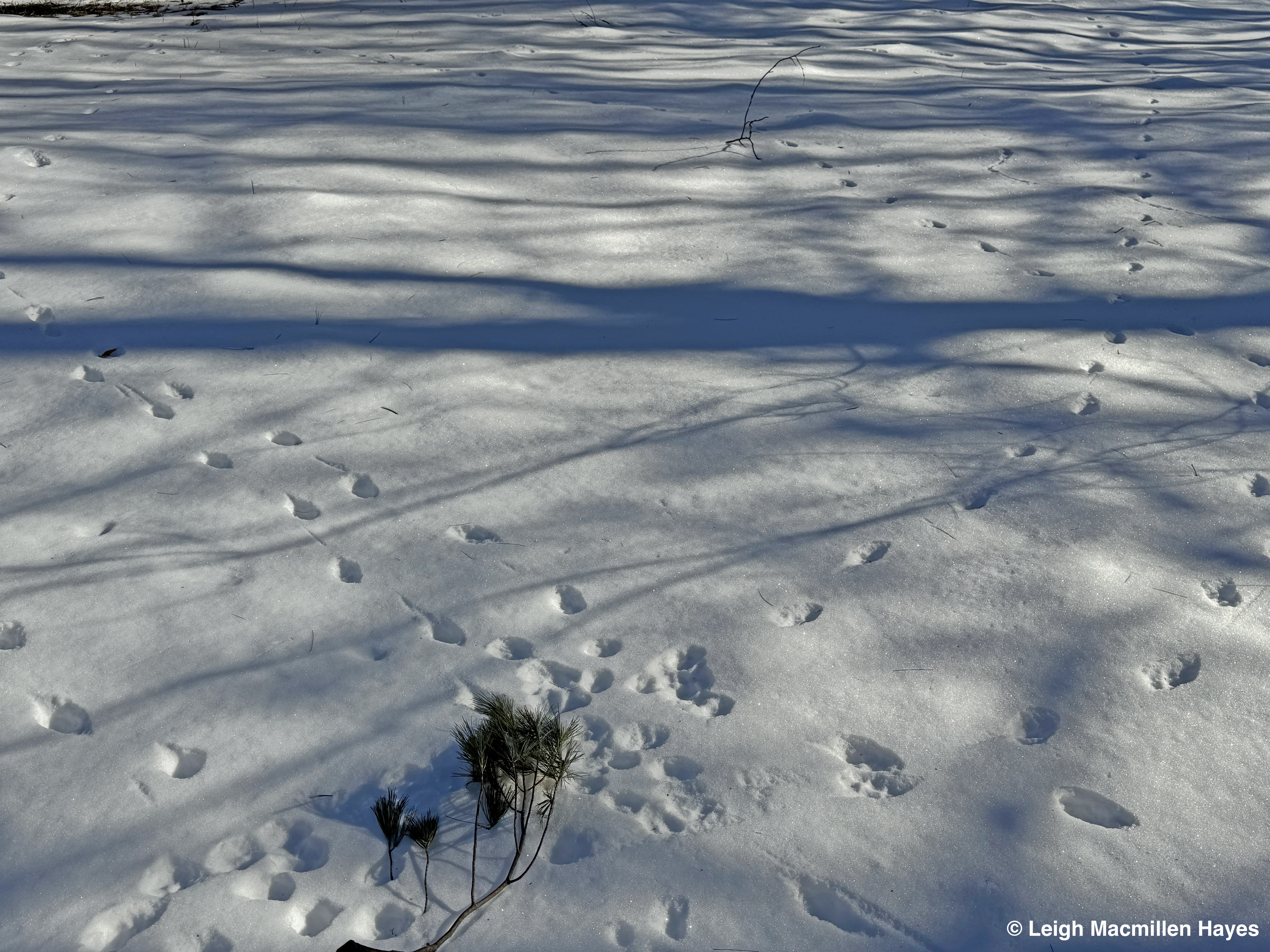
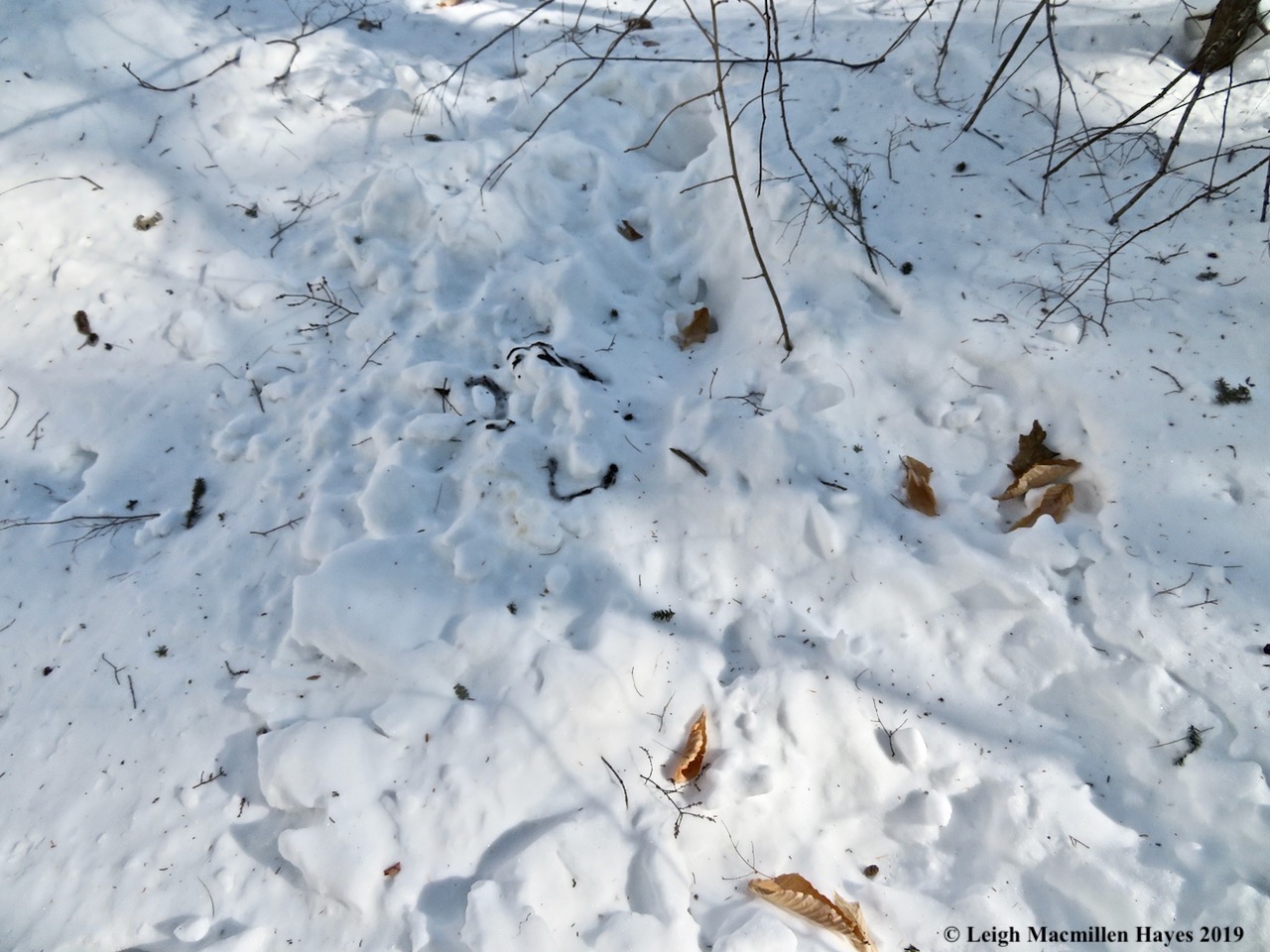
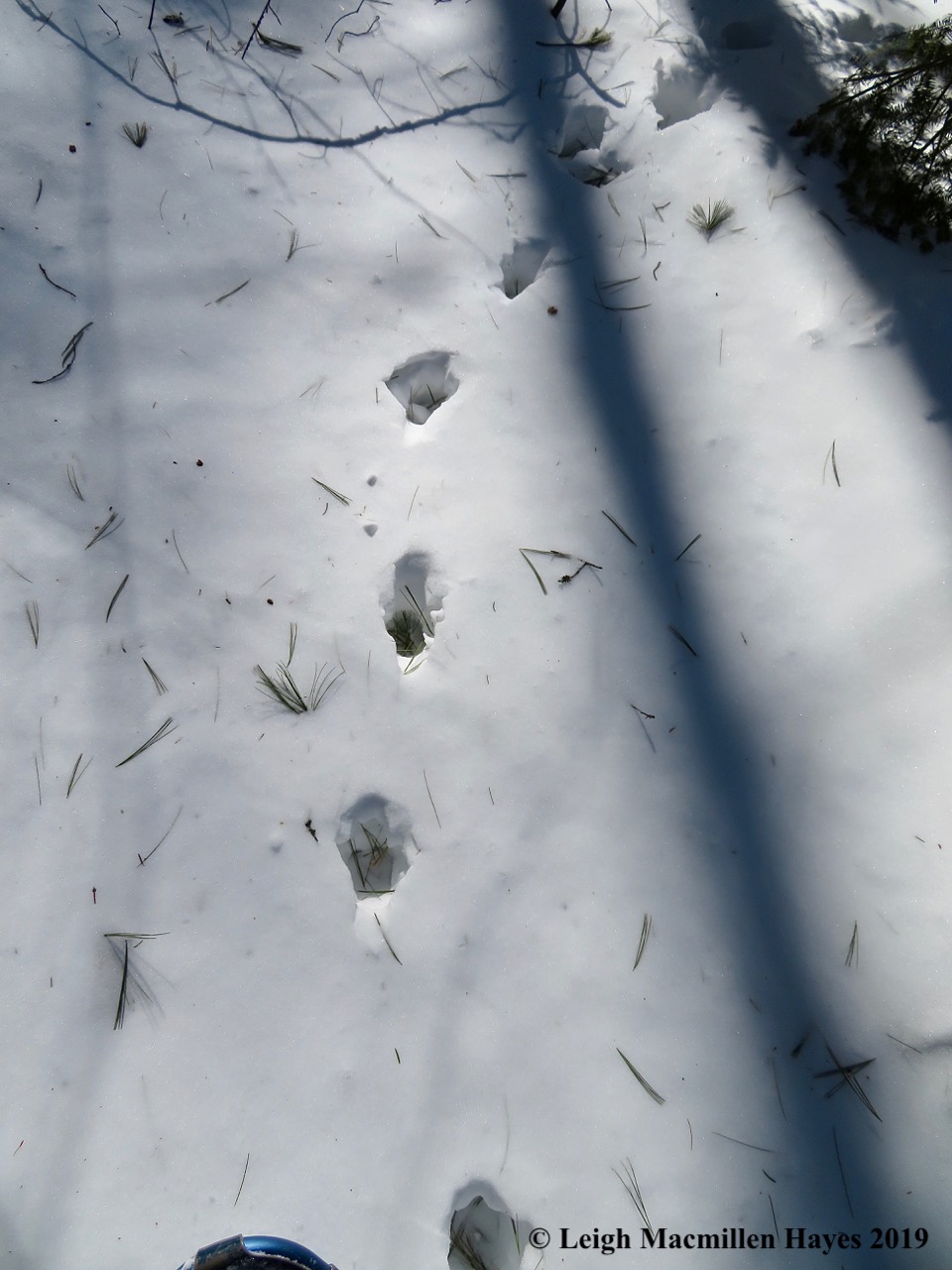
Once on the main trail, I showed them Porcupine tracks and then asked them to find the next set of such. It only took a minute for one to spot the pattern. While we looked at them and I shared some fun facts, I looked around and realized I was standing in the middle of recent Porky activity. Not only were there fresh tracks, but also scat and twigs cut at the traditional 45˚ angle, with buds and needles missing. We looked up into the tree, but fortunately no one was at home.

I think I know this Porcupine because he’s a frequent visitor to the Hemlocks in our woods and the neighbors’.
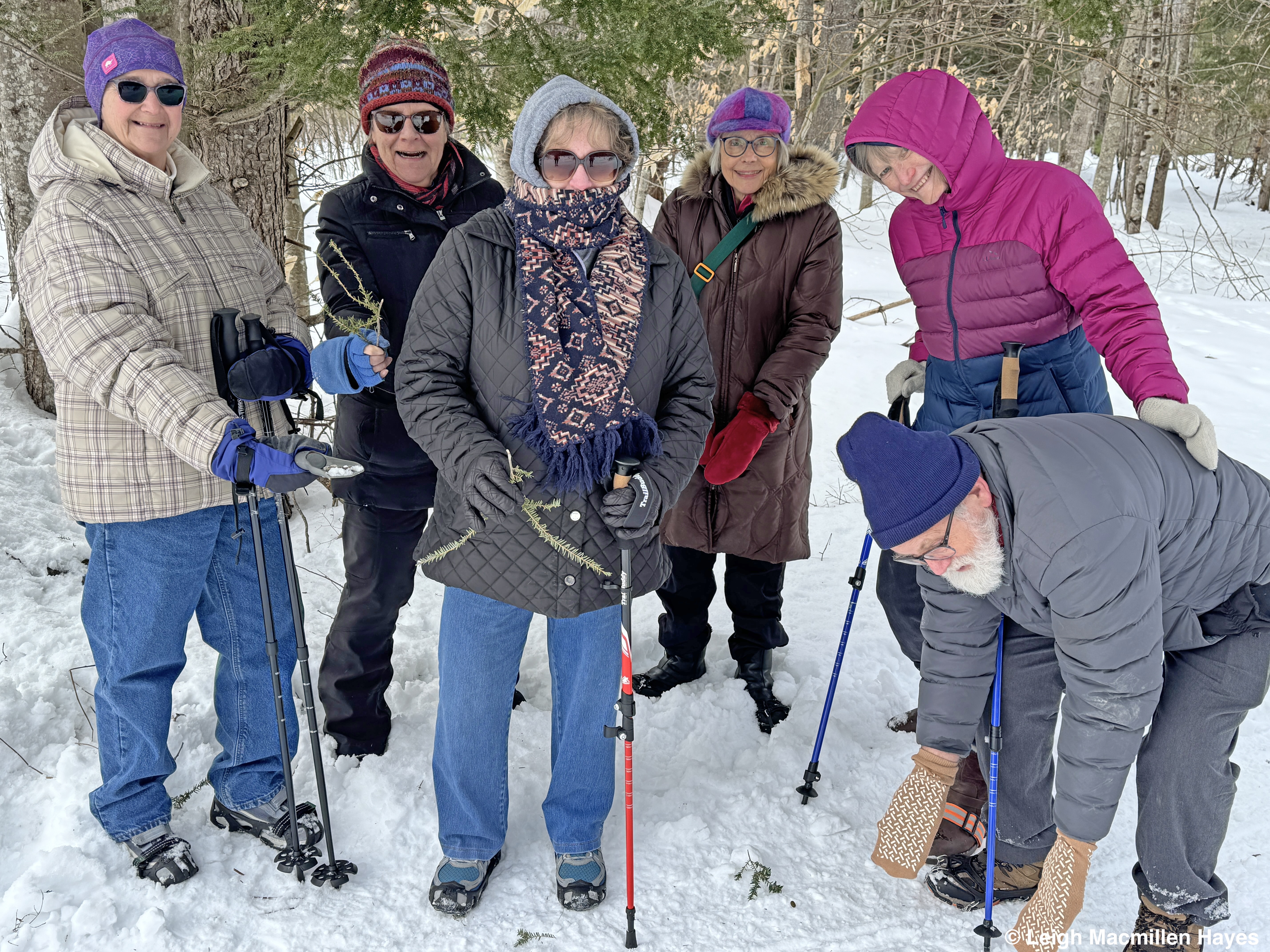
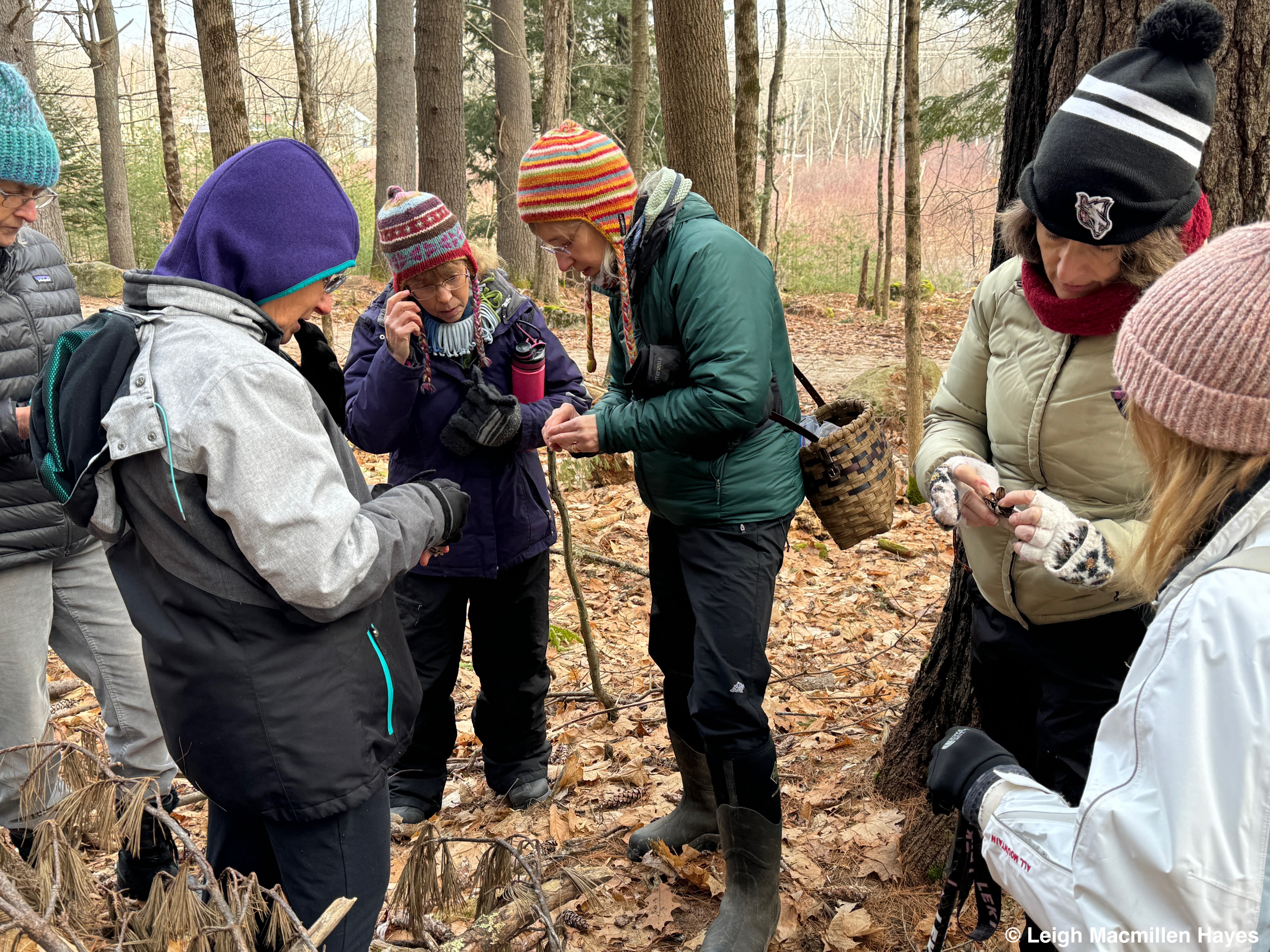
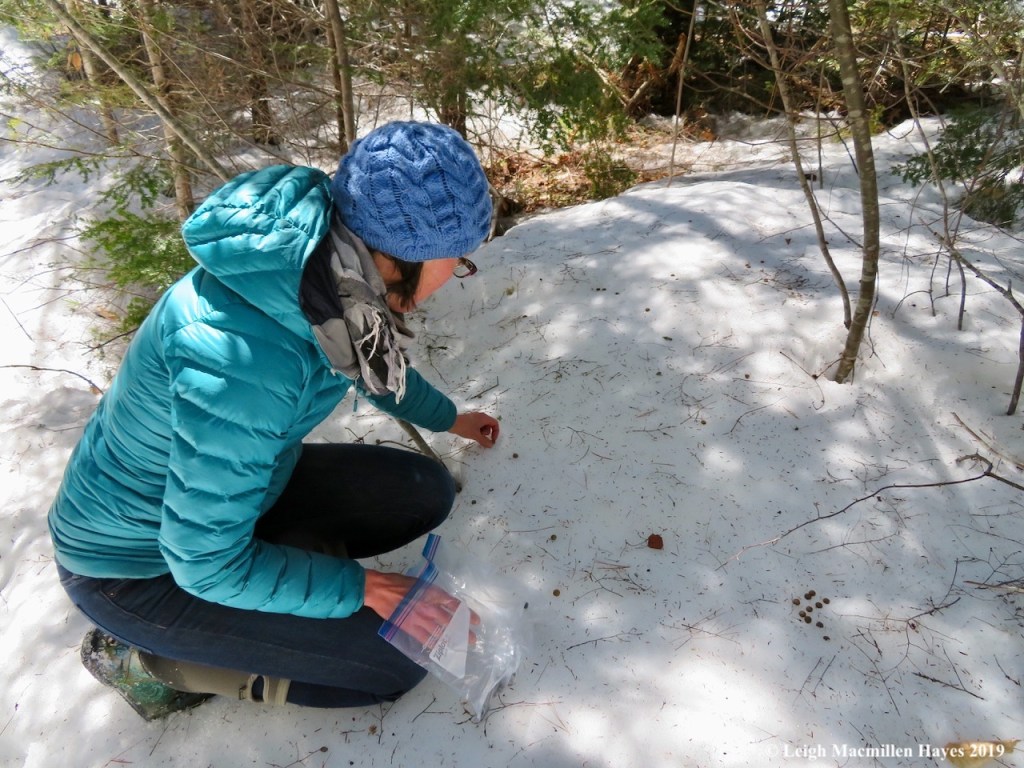
When I asked the group to share the findings and become a Porcupine, they did so, though I think they think I’m a wee bit crazy. Maybe I am. Anyway, Left to right: Nancy holding some scat on my scat shovel, Marion and another Nancy with twigs, Marcia smiling about it all, and Gary wearing my Porcupine socks to show how the feet are like sandpaper to gripe a tree as they climb, while his wife Julia was there for moral support and to help him up if need be.

We paused at many other spots along the way, including looking at the silk a Pine Tube Caterpillar uses to construct its tube.

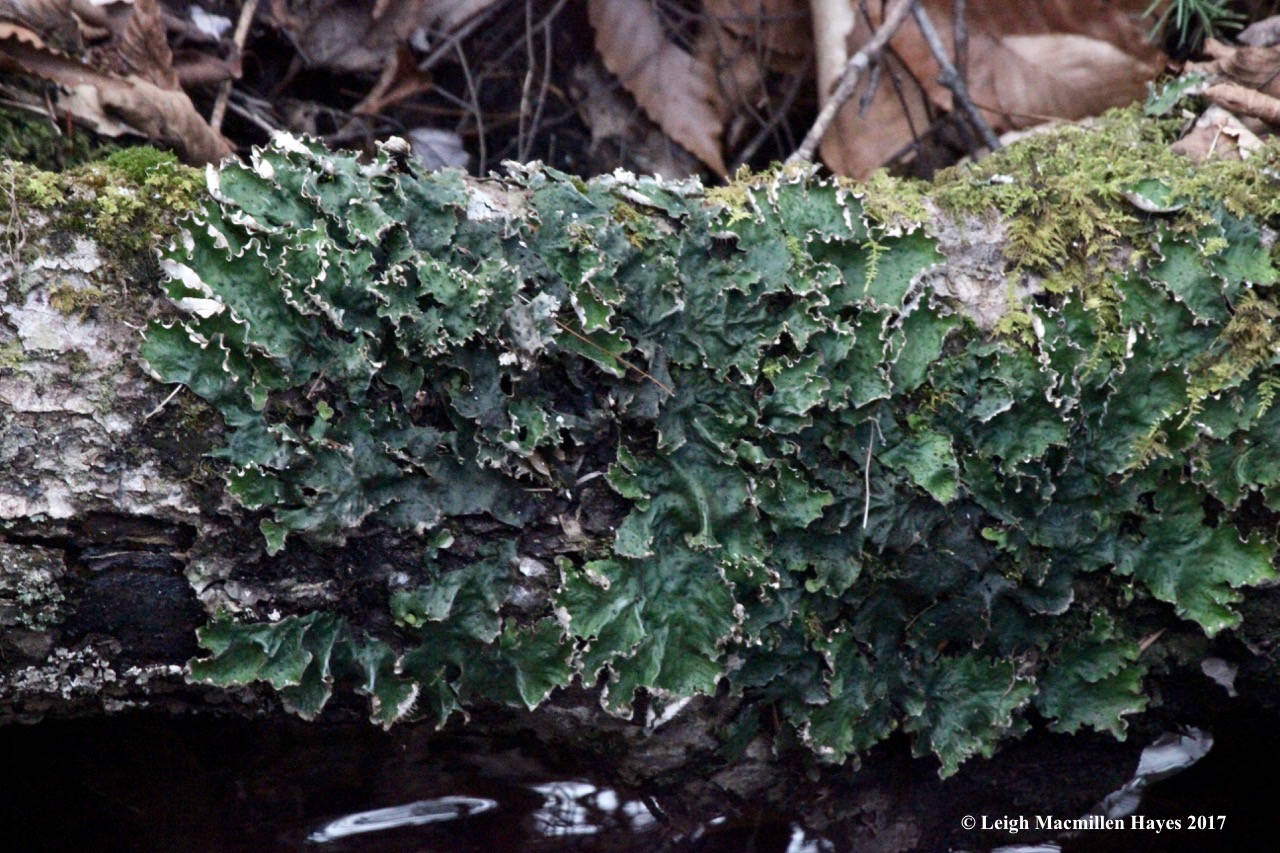
And admire a perfectly round display of Lungwort, a foliose lichen consisting of a fungus and a green algal partner living together in a symbiotic relationship with a cyanobacterium.

Had I brought water, I would have poured some on it to show off how green it quickly gets since the alga would have kicked into action to provide food for the fungal structure.

Lungwort is sensitive to air pollution and habitat loss, so spotting it is always a treat and reminds us of why we love living here in western Maine.

We also looked at buds on an Ash to figure out which species and I told them about the Emerald Ash Borer and showed photos of what blonding looks like.

It turns out what we were looking at was a White Ash–hairless buds that dip into the upside-down, C-shaped leaf scar.

And then there were the Winter Fireflies that we found still as could be on the snow. I picked one up in the scat shovel and thought it must be dead.
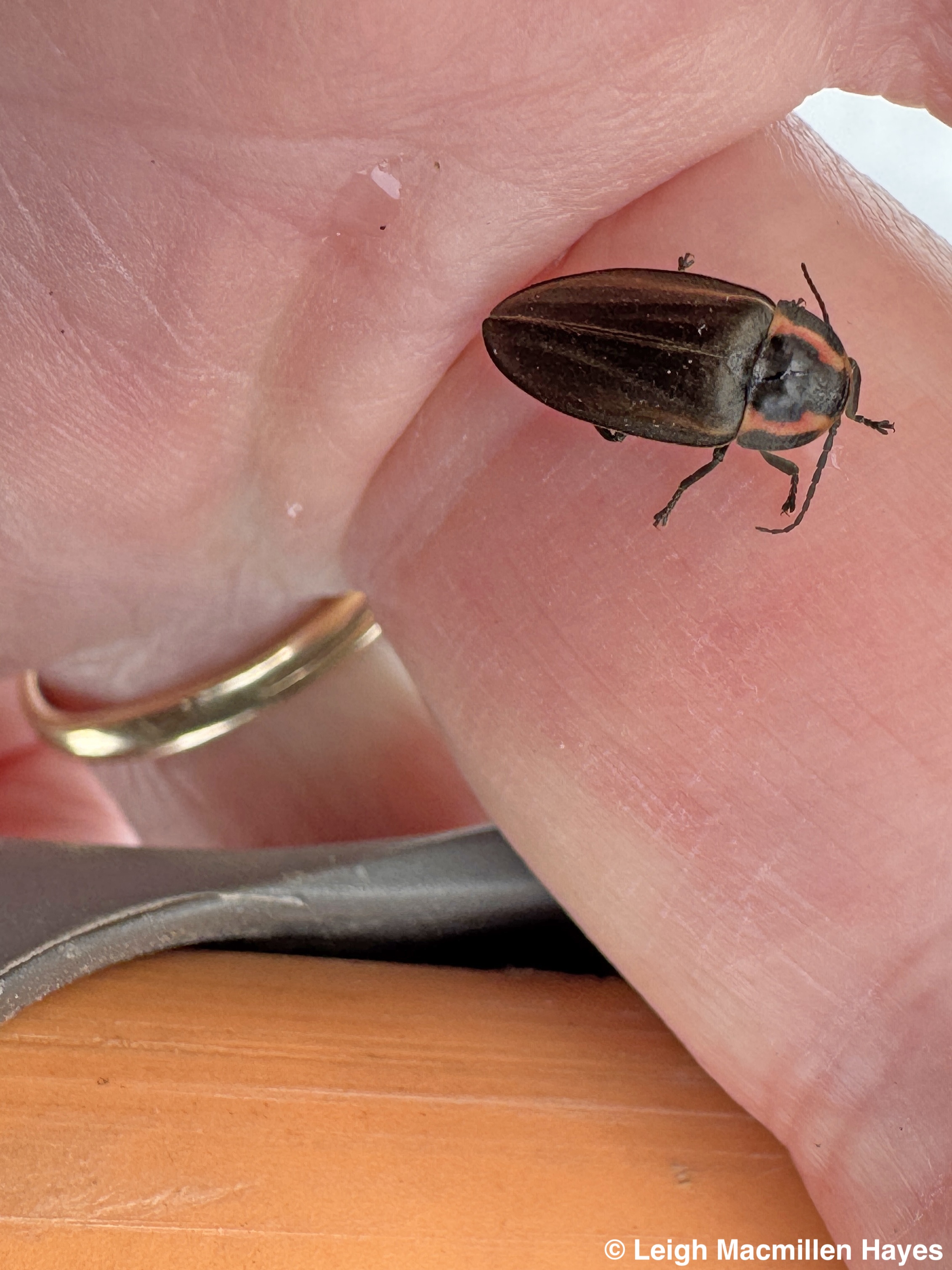
That is . . . until we noticed its antennae began to move.

And then it started to walk. Last we knew, I’d left it and its kin on their favorite tree, a Sugar Maple, with hopes that as the temps warmed today and will continue to do so going forward, the insects will survive.

Just before reaching our driveway at the end of our walk, we also saw a Winter Cranefly, but moments after I scooped it up in my scat shovel, it flew. At least most everyone got to see it.

As Trail Snails, we walked not quite a mile and a half in two hours, but saw so much, and I was especially jazzed by the new Porcupine evidence. I think they were as well. Maybe not jazzed, but curious.

And in our time together we saw only three snowmobiles. While it was brought up that those on the machines miss all that we were seeing, I did explain that My Guy often comes back from a ride and tells me of the wildlife he and friends sighted. There I am being so quiet and not seeing any, but somehow despite the machine he spies so much more.

And then this afternoon, I picked up a friend and drove to another section of the local snowmobile system. We walked and talked and talked and talked some more, catching up because despite retirement we are both incredibly busy. In a good way. Doing things we love to do.
As we walked, I kept pointing out Porcupine tracks and if we’d had snowshoes on, I might have convinced her to look for the feeding trees and den sights, but we chose to begin with micro-spikes and quickly ditched those since the snow conditions on the well-packed trail were just right.

We also paused to listen to a Barred Owl and tried to spot it to no avail.

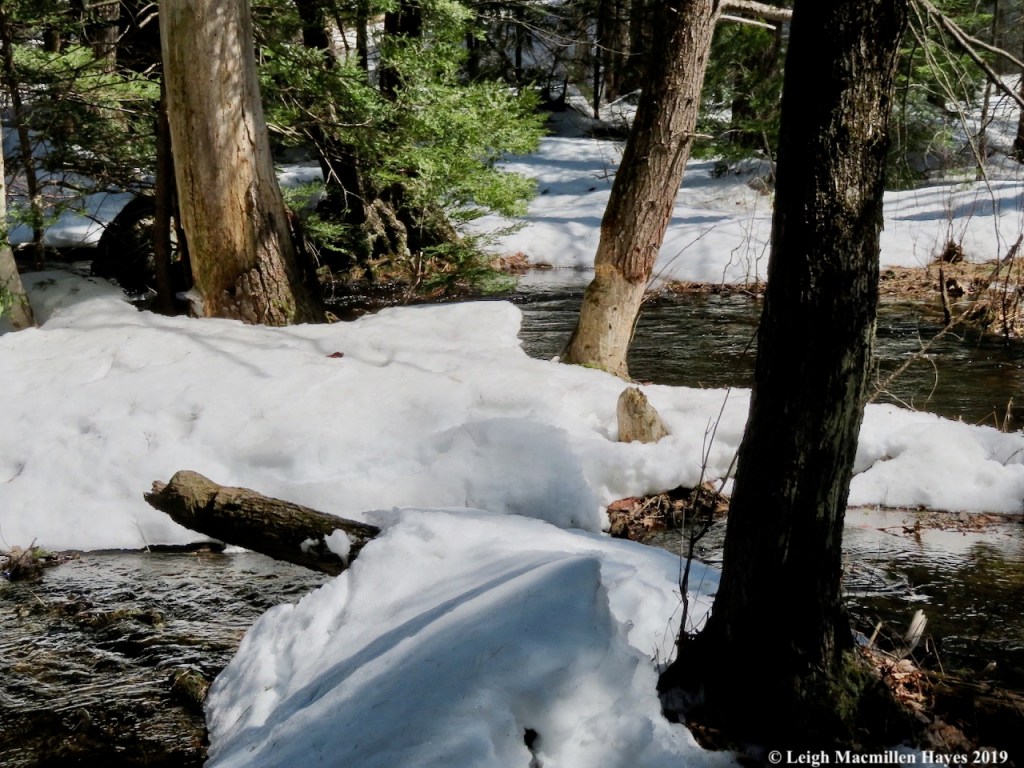
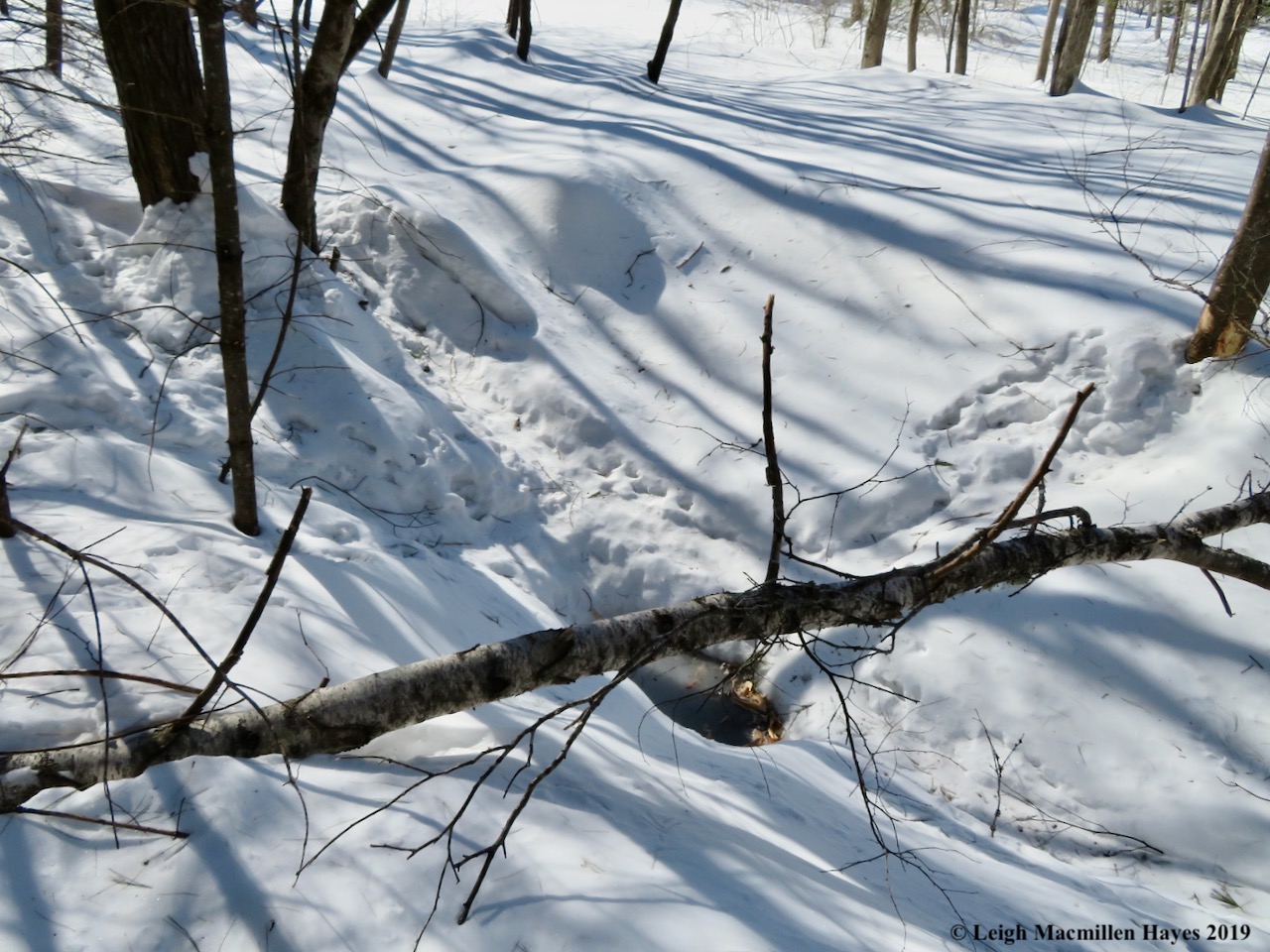
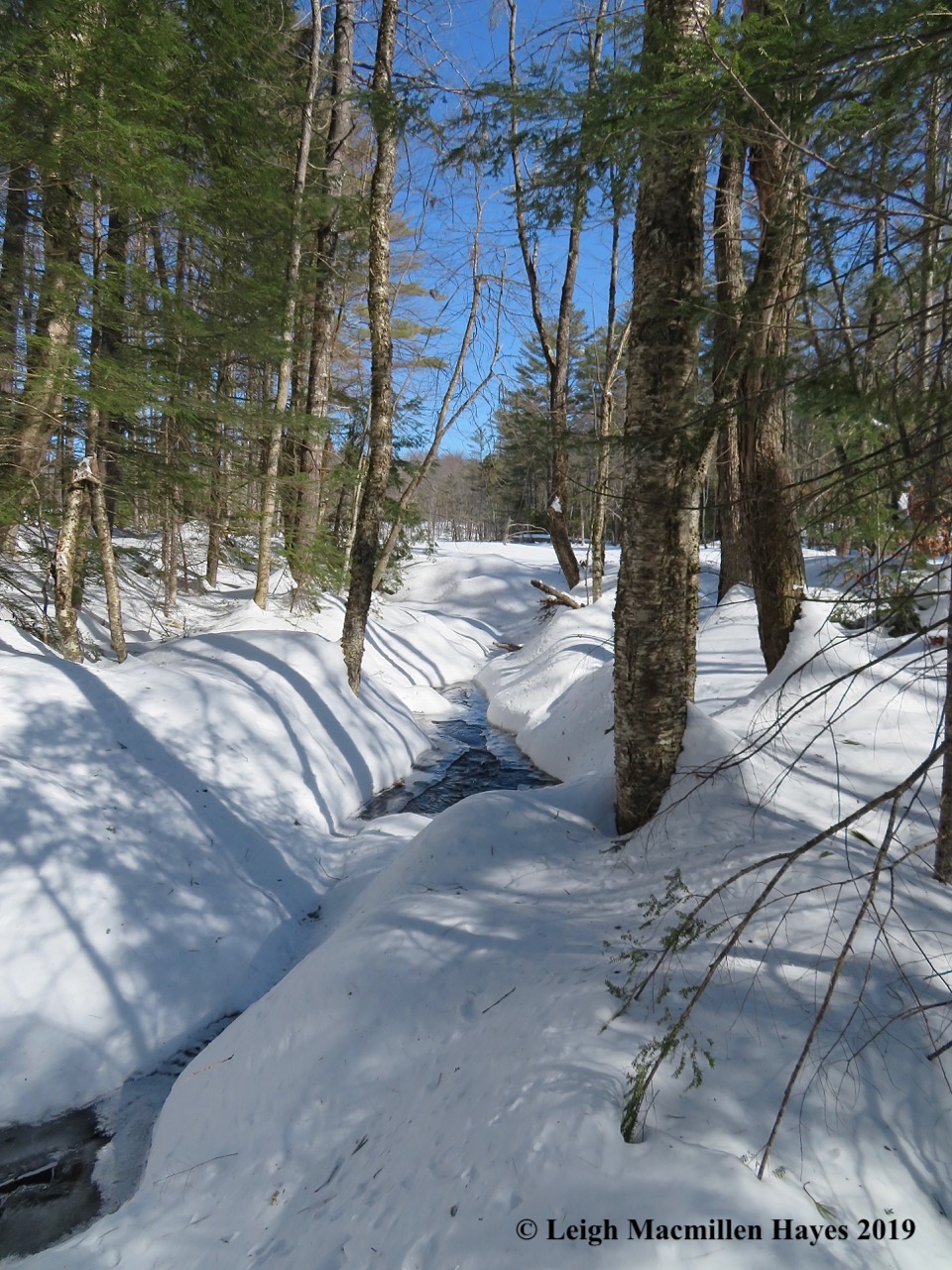
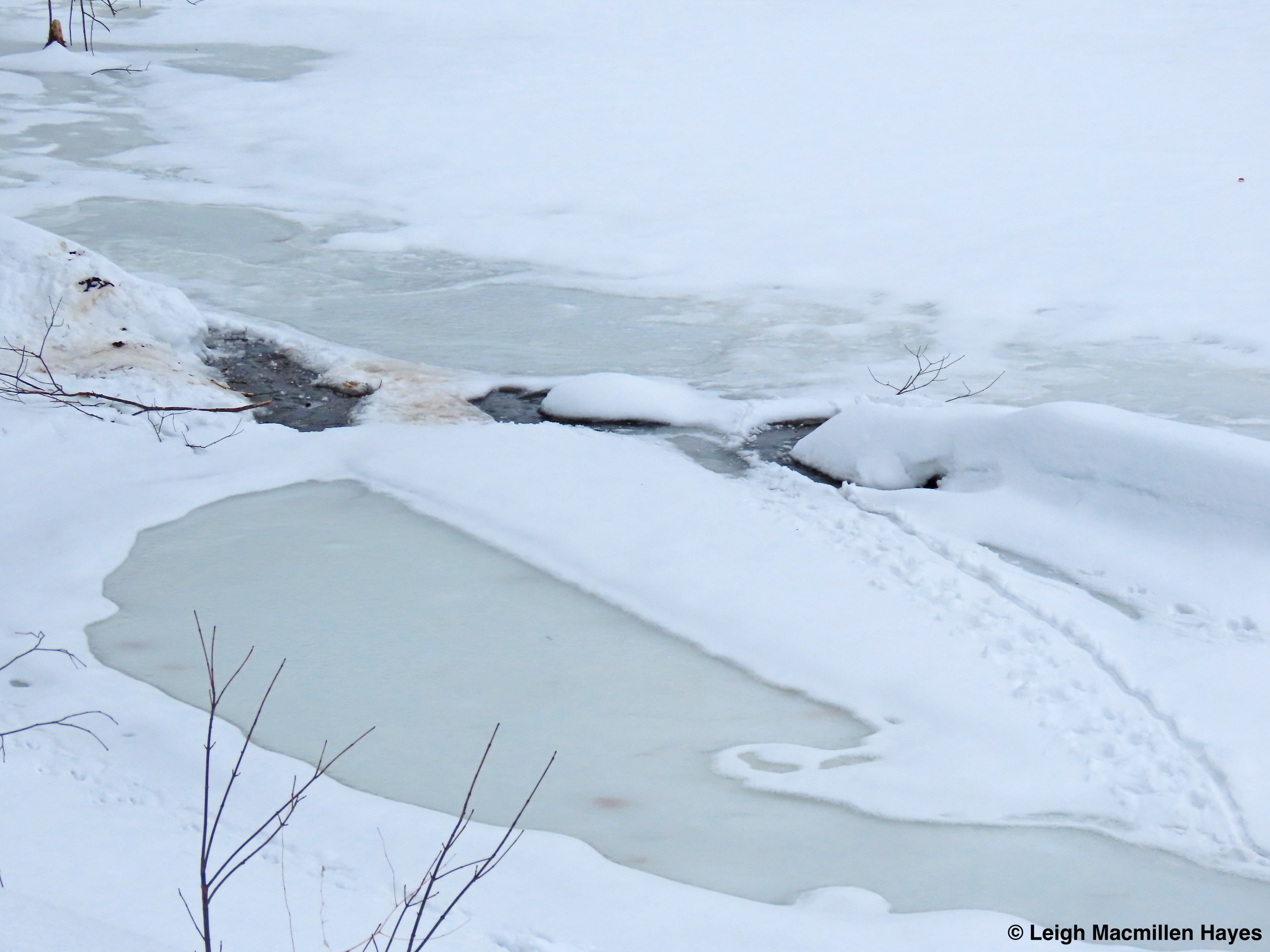
And then, near water, we spied tracks of a different sort. And scat. And mud. And not quite open water.
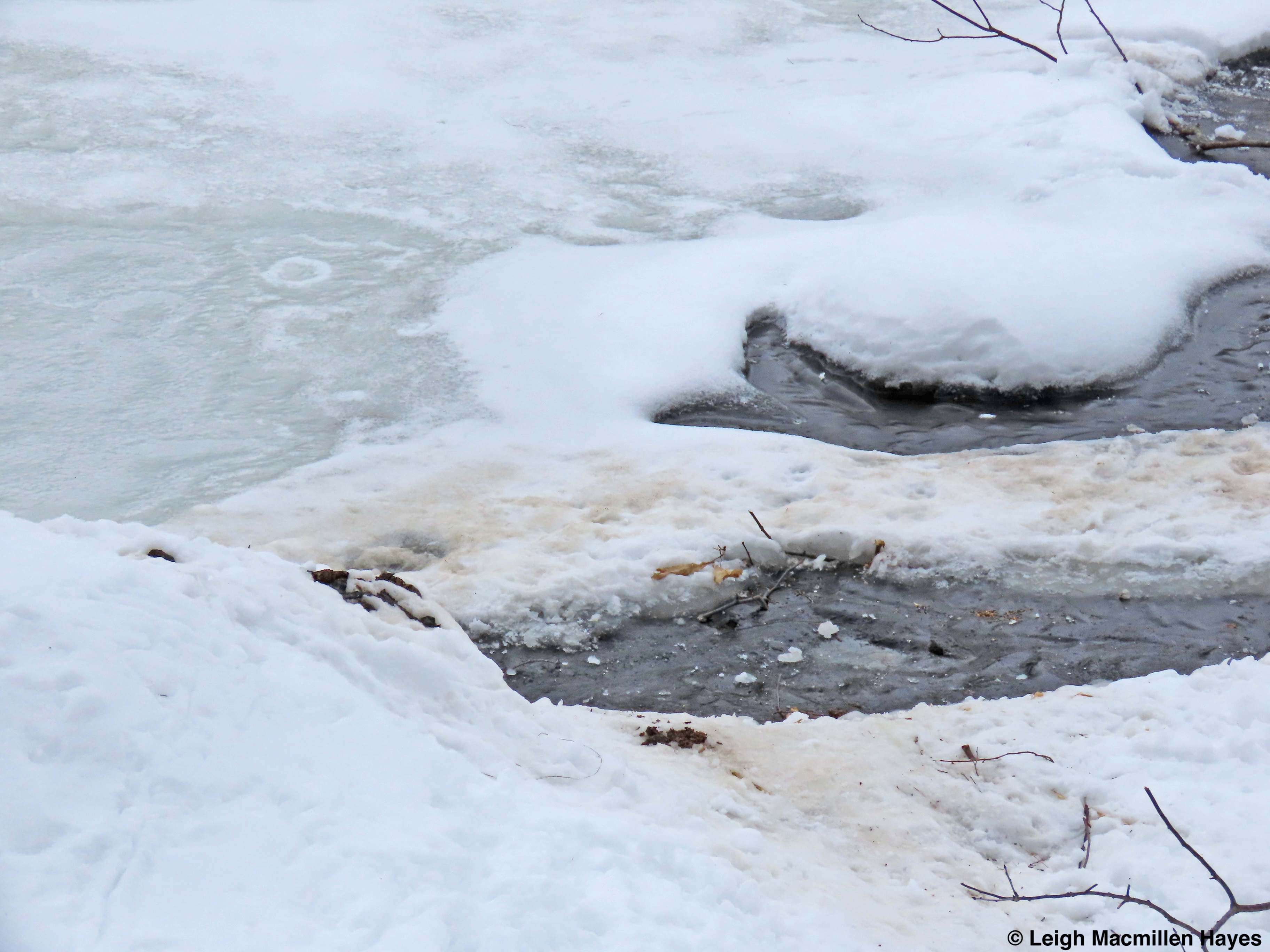
The scat was from Otters. And I really wanted to take a closer look, but didn’t trust the trail down, despite it being well traveled.

What I now realize I didn’t take a photo of were tree marks in the snow, which in the moment I surmised were twigs blowing down toward the water.

I noted that the track continued across the road upon which we walked and so I suggested we take a look and see if we could note anything about the Otters’ behavior.

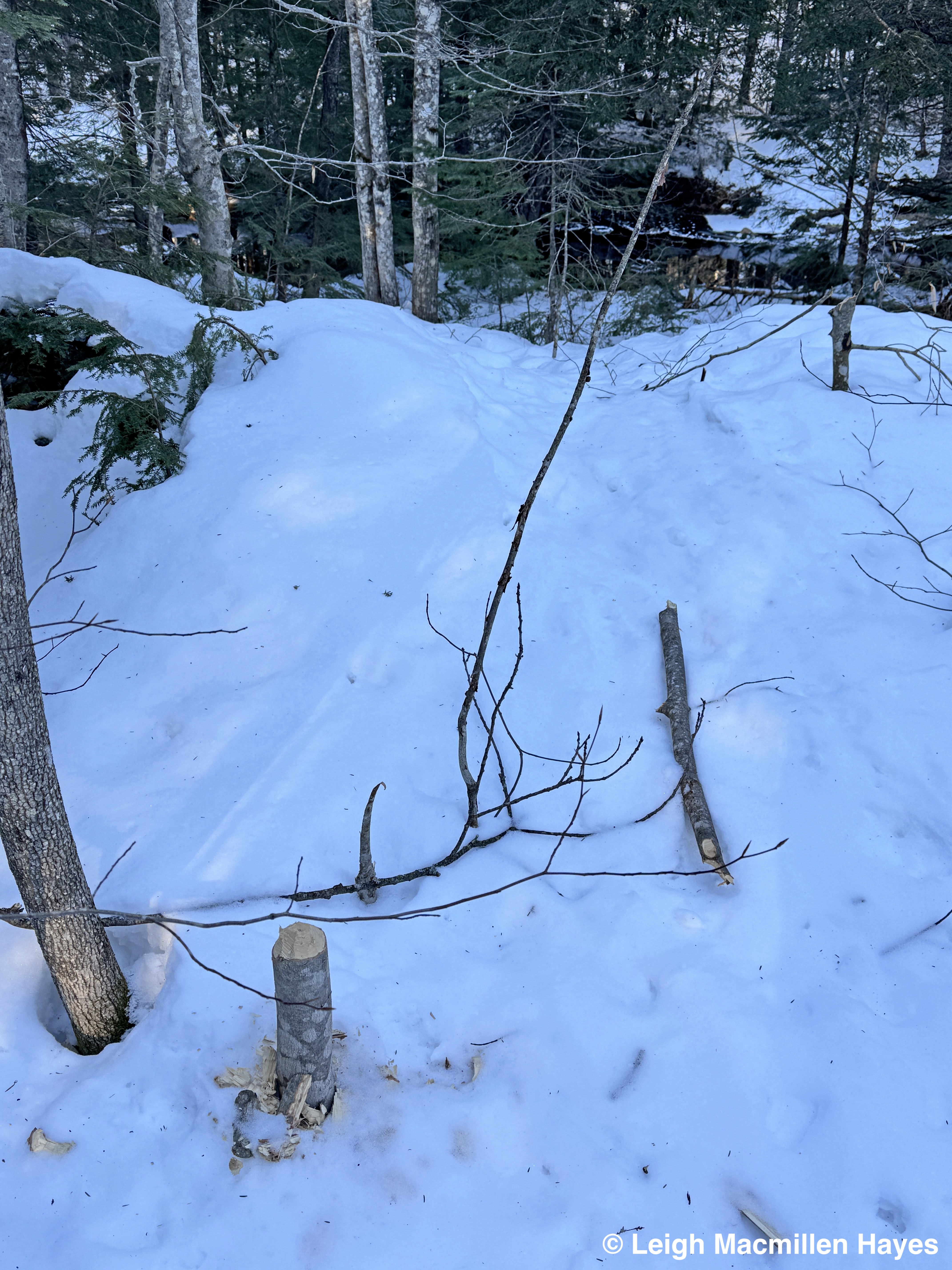
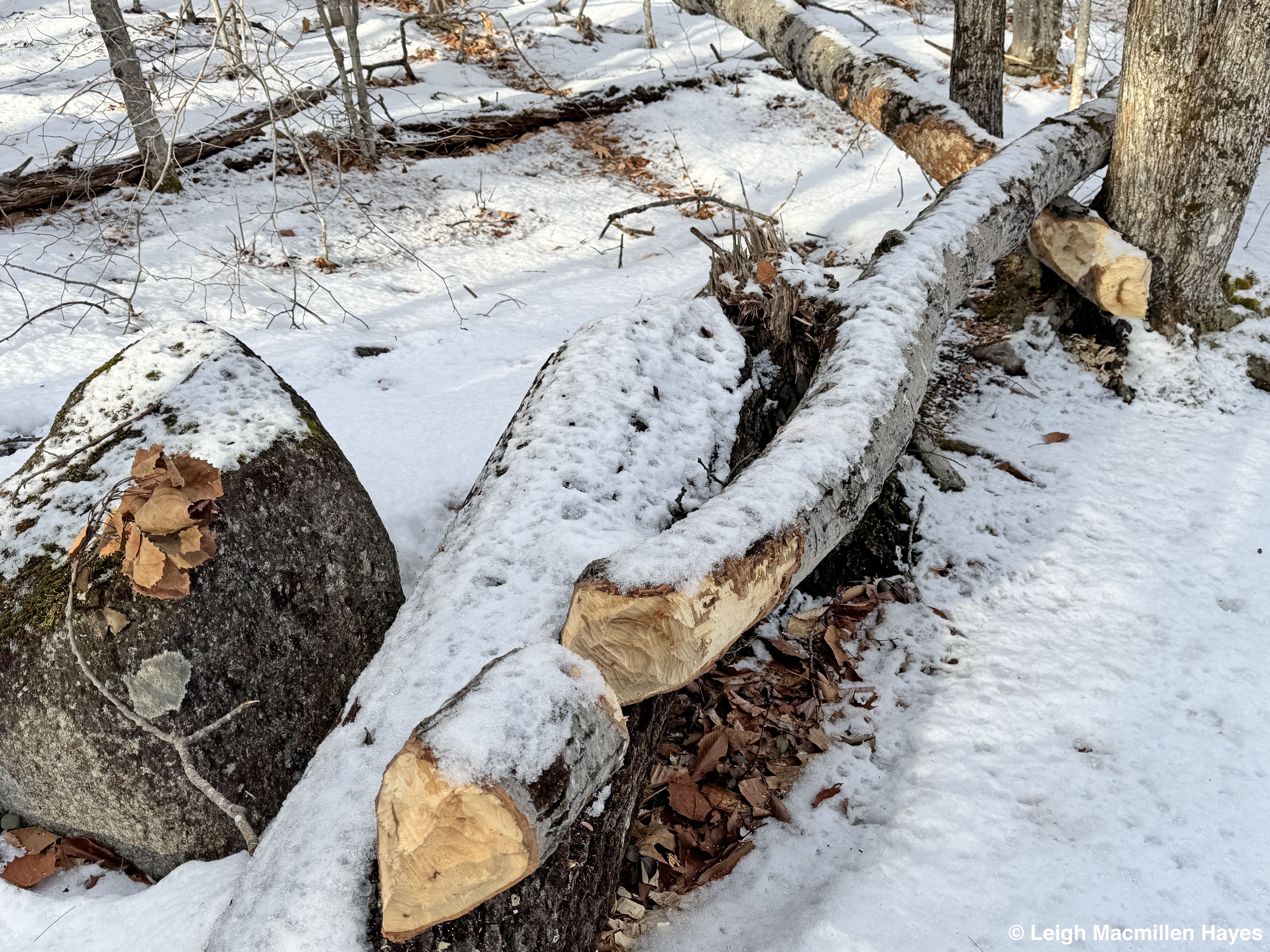
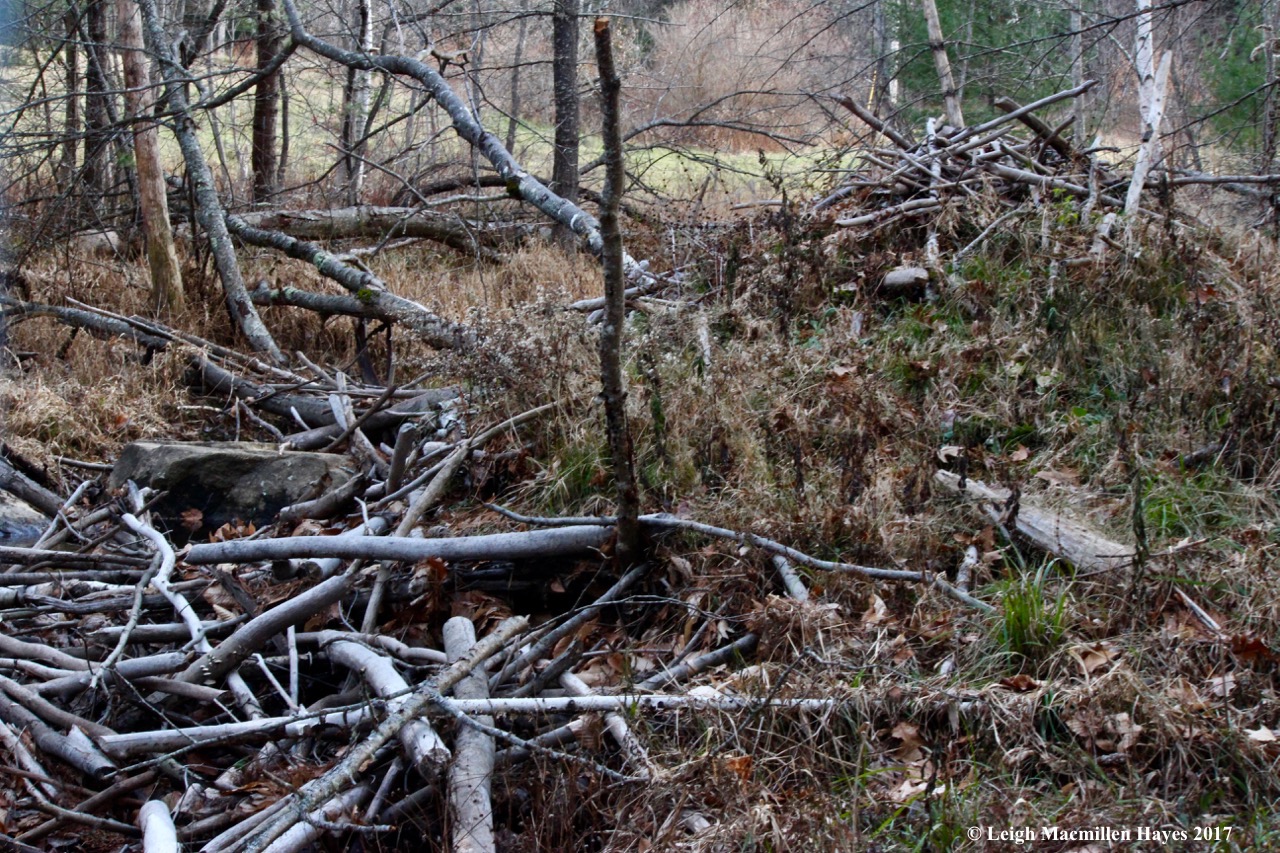
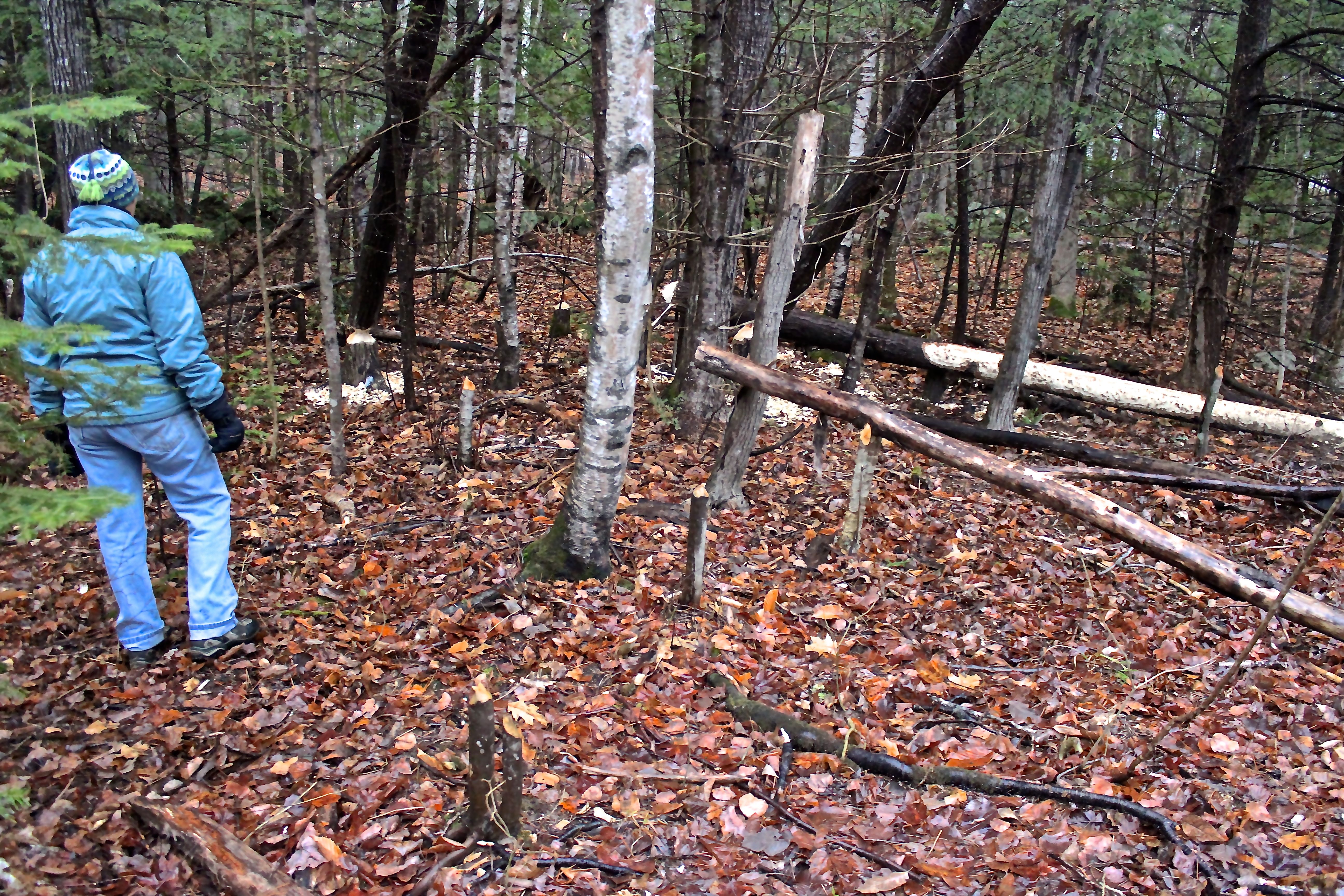
We certainly did not note anything about such, but instead discovered fresh Beaver works. And suddenly the indentations left by the twigs made sense–Beavers dragging tree branches down to the water to take back to their lodge or winter food raft.
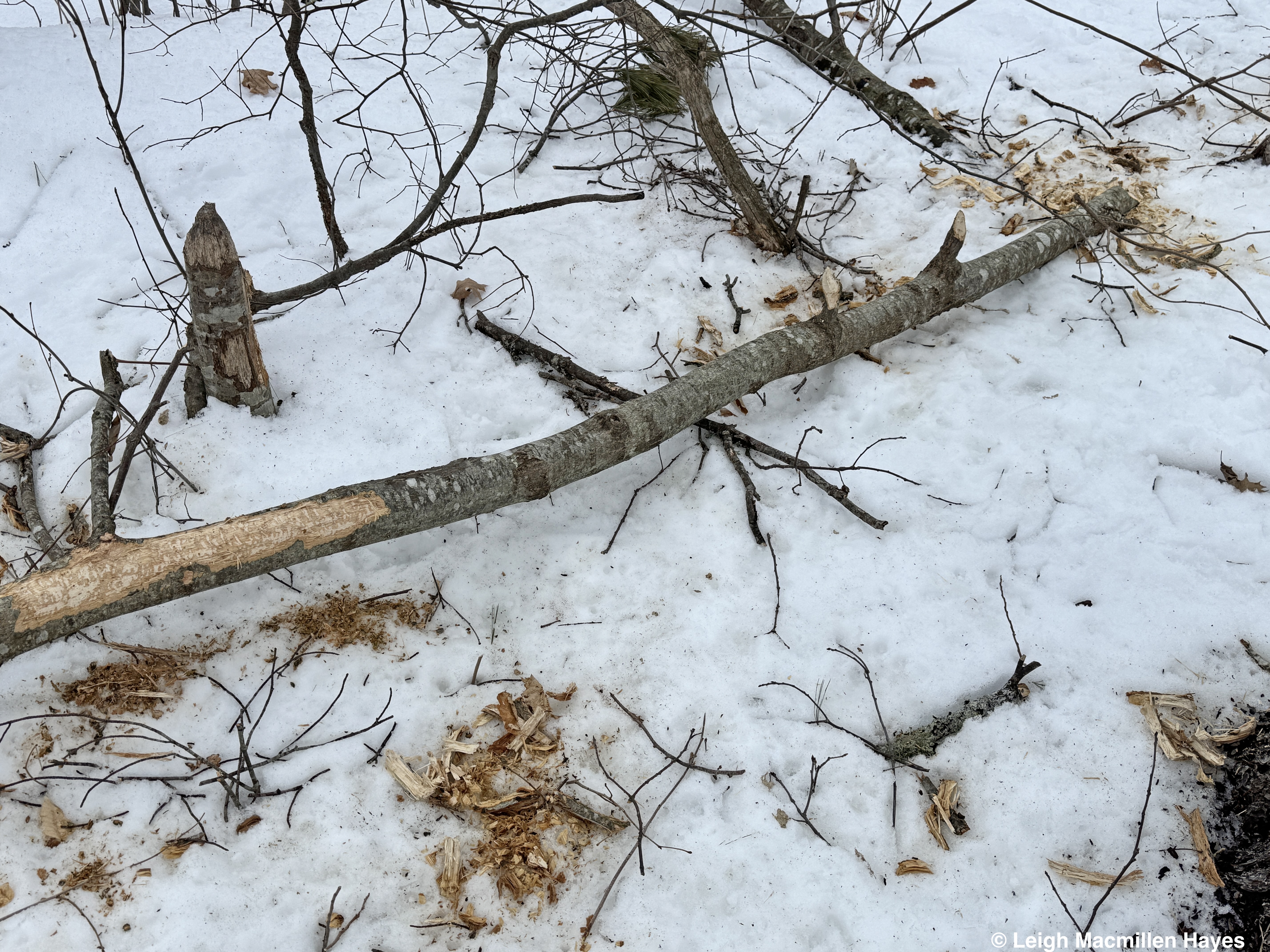
Maybe like some people that I’ve heard are looking for more firewood right now to stay warm the rest of the winter, the Beavers didn’t realize everything would stay frozen as long as it has and so they needed to replenish the pantry.

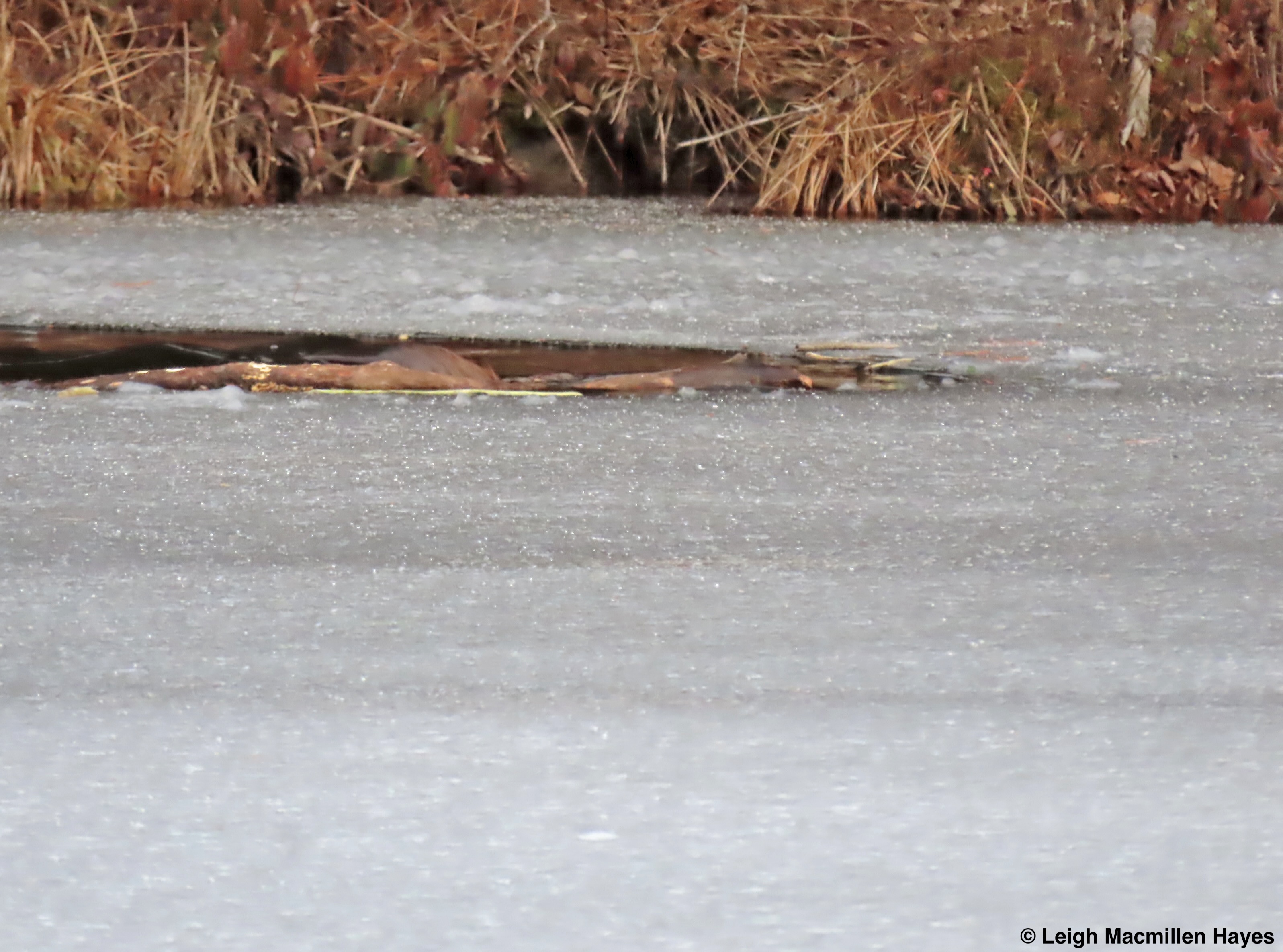
Shortly after that, at about the 2.5 mile mark from our journey’s beginning, we turned around and started to walk back. And then something stopped us in our tracks. It took me a few moments to say, “Look,” and grab my camera and I feared this something would slip out of sight before I did so.

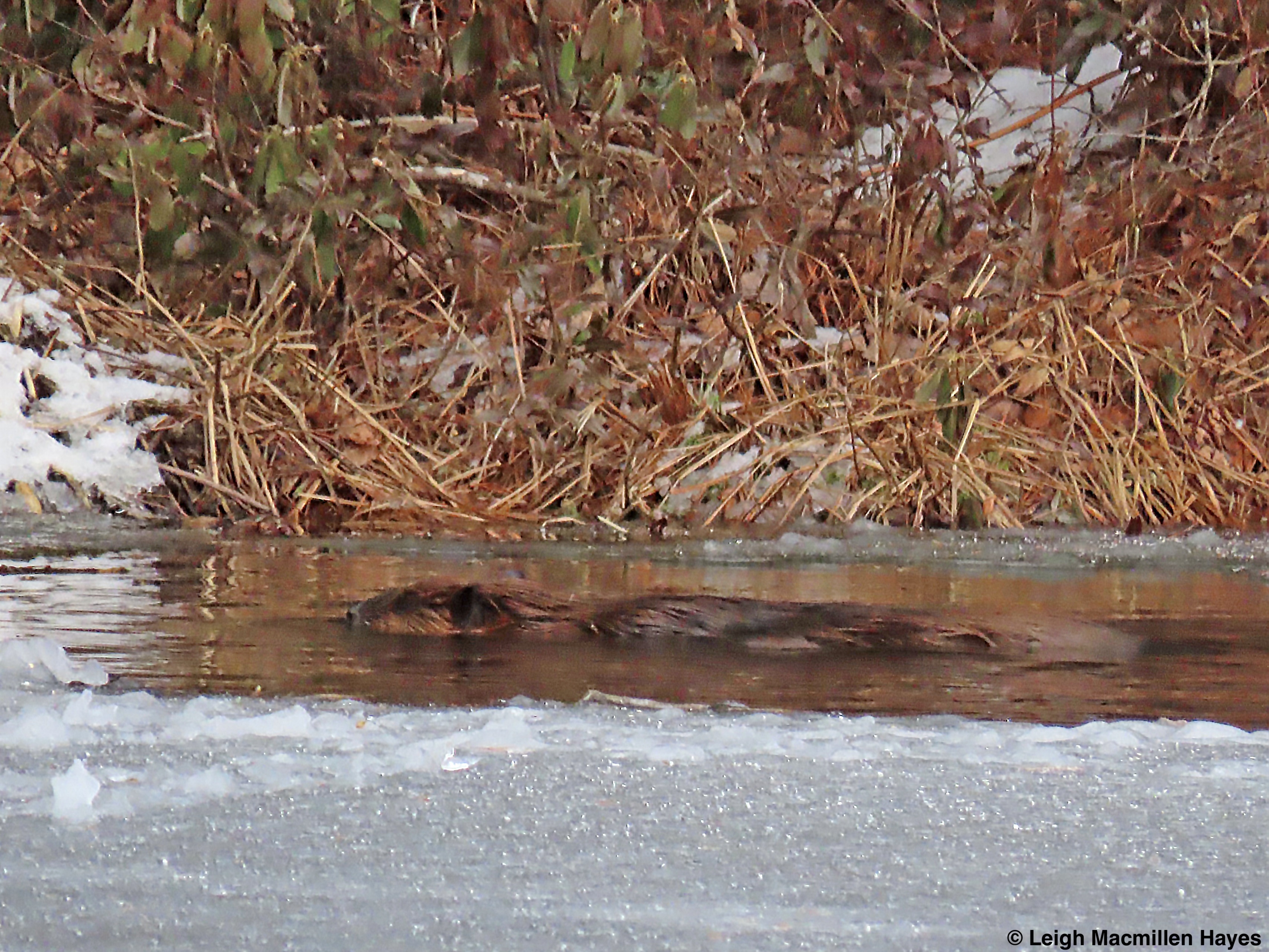
The Beaver must have come up the hill to cross the road to go grocery shopping by the trees he’d previously cut down, and then spotted us and we watched it waddle down its well packed trail toward the ice.
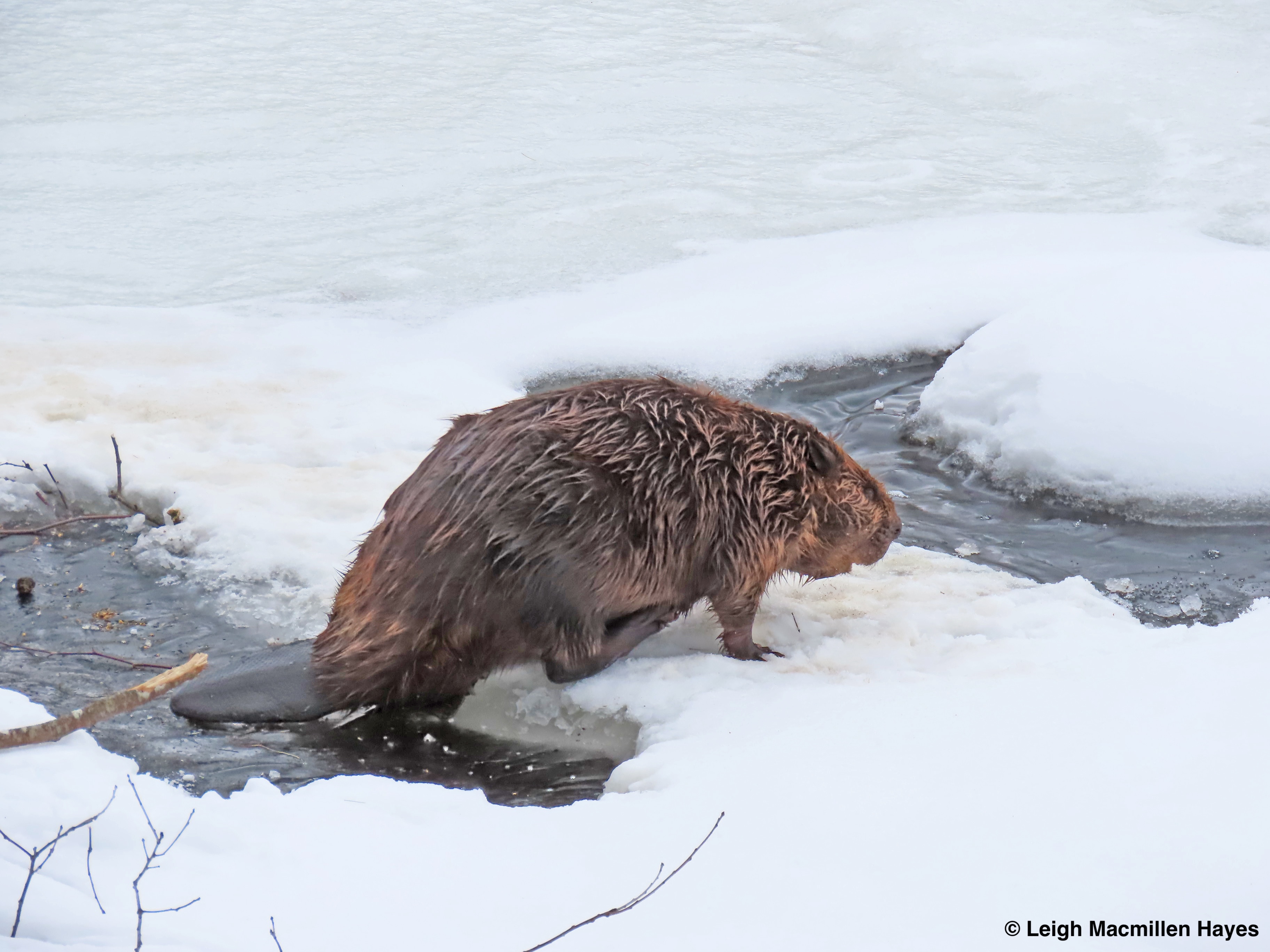
We thought our time together would end in a second as it slipped into the water, but then we realized it was looking for an open hole.
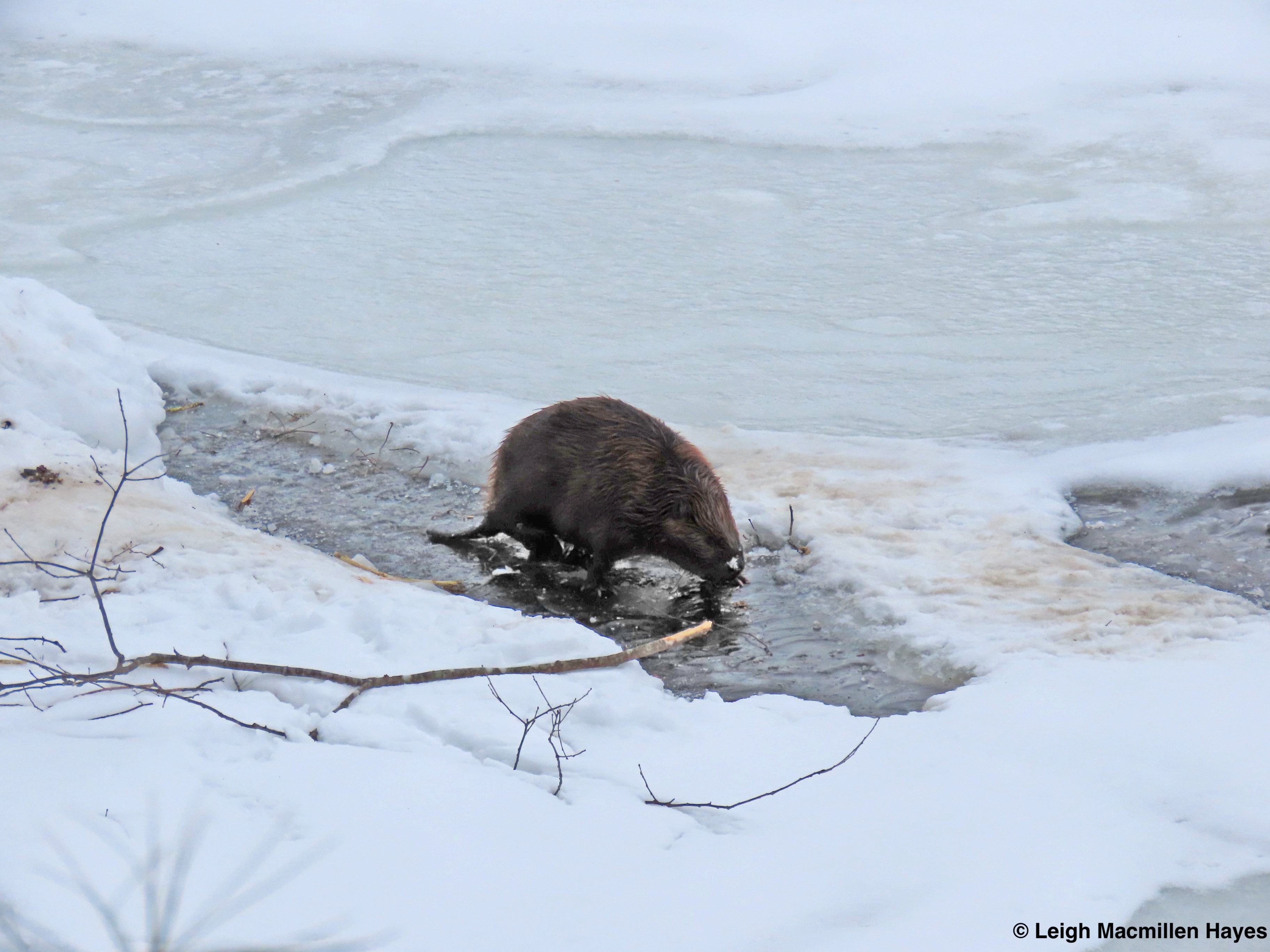
And scratching the snow and ice, even to the point of getting snow on its face.

It kept trying and we kept watching.
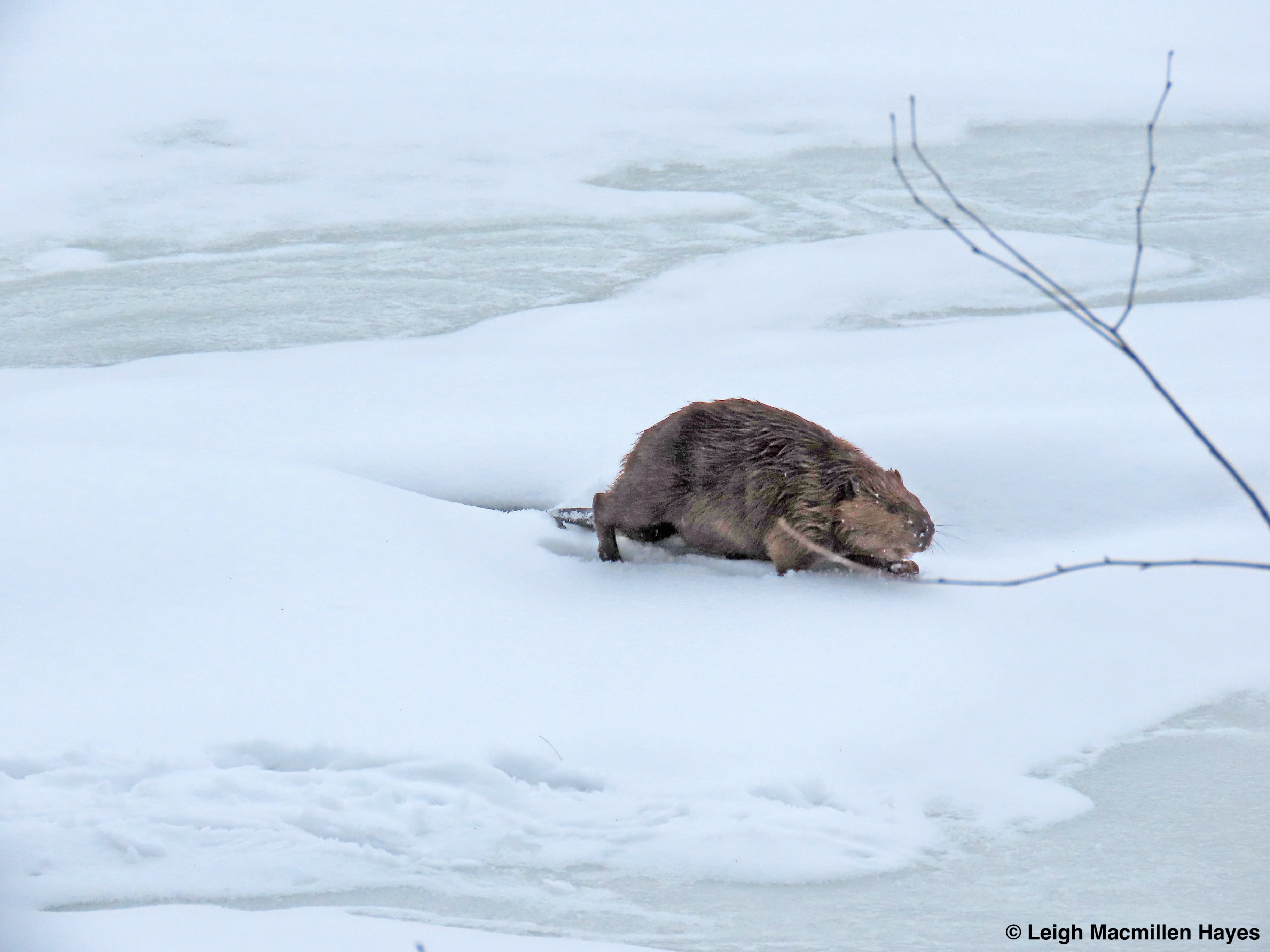
Still no luck for the Beaver, while we felt we were having all the luck in the world.
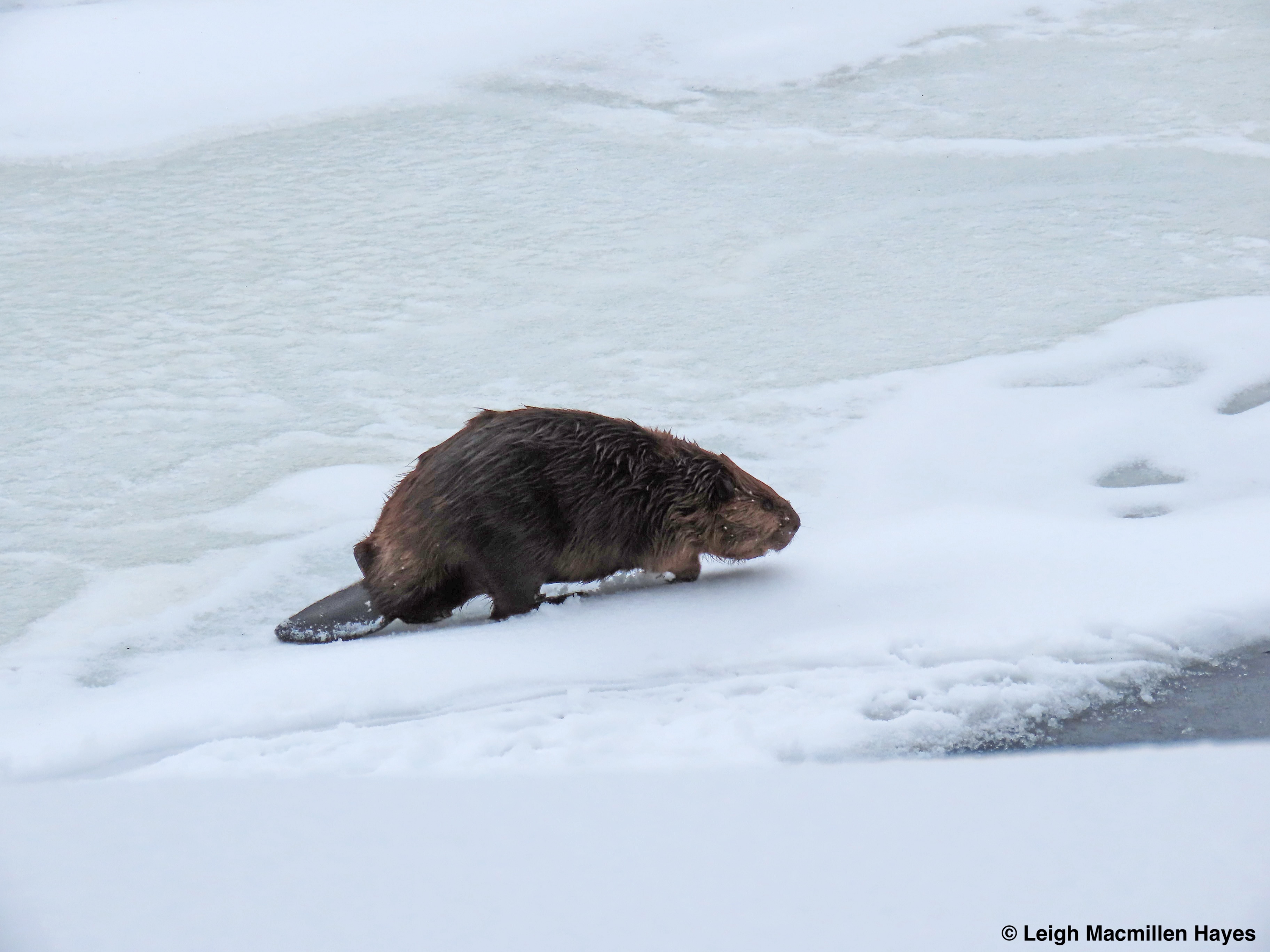
Traveling on land is such a vulnerable activity for Beavers and I could only hope that the Otter scat in this very spot where we stood above the water was the result of the Otter eating something else and not making a meal of a Beaver kit. Because really, they both can take advantage of the same hole in the ice.

We also wondered where the lodge might be but the bank’s edge was too steep for us to note if it was nearby.

And then, just like that, the Beaver found open water and this was the last we saw of it before it made its escape.

We knew we were blessed, Marita and I. And gave great thanks for hearing the Barred Owl, spying Otter Scat, and spending a few minutes with a Beaver.

What a day, from a Porcupine’s Tale to a Beaver’s, two mammals with tails of grand importance–the former being for defense and stability on a tree limb, and the latter for a rudder, as well as stability like a tripod when cutting down a tree, and fat storage as well.

Bluebird Days are the best days

It’s been delightfully frigid this past week. My kind of temps because it makes me feel so alive when I’m out in the woods. And as My Guy and I were saying when we hiked this afternoon, it’s all about dressing right. So we did.

Just after turning onto the side road of our intended destination, we watched a Vole scamper across and then dart this way and that while I stopped the truck. Did either of us take a photo? No. But those moments are always for the mind’s eye.

And then, after parking, I spotted this sweet little snowman on the other side of the snowbank and thought, “What a job well done, given the cold temps of the week.” You see, it’s not really snowman-building-kinda snow, but someone was successful.

Our journey included walking a mile in to the trailhead, though we noticed a few people had actually driven in; something you can’t usually do at this time of year . . . if there is more snow. Alas. That we don’t have.

But . . . I love to walk in because . . . there are telephone poles. And being adjacent to the National Forest, it’s a rather wild place. And these poles tell a story of just how wild.

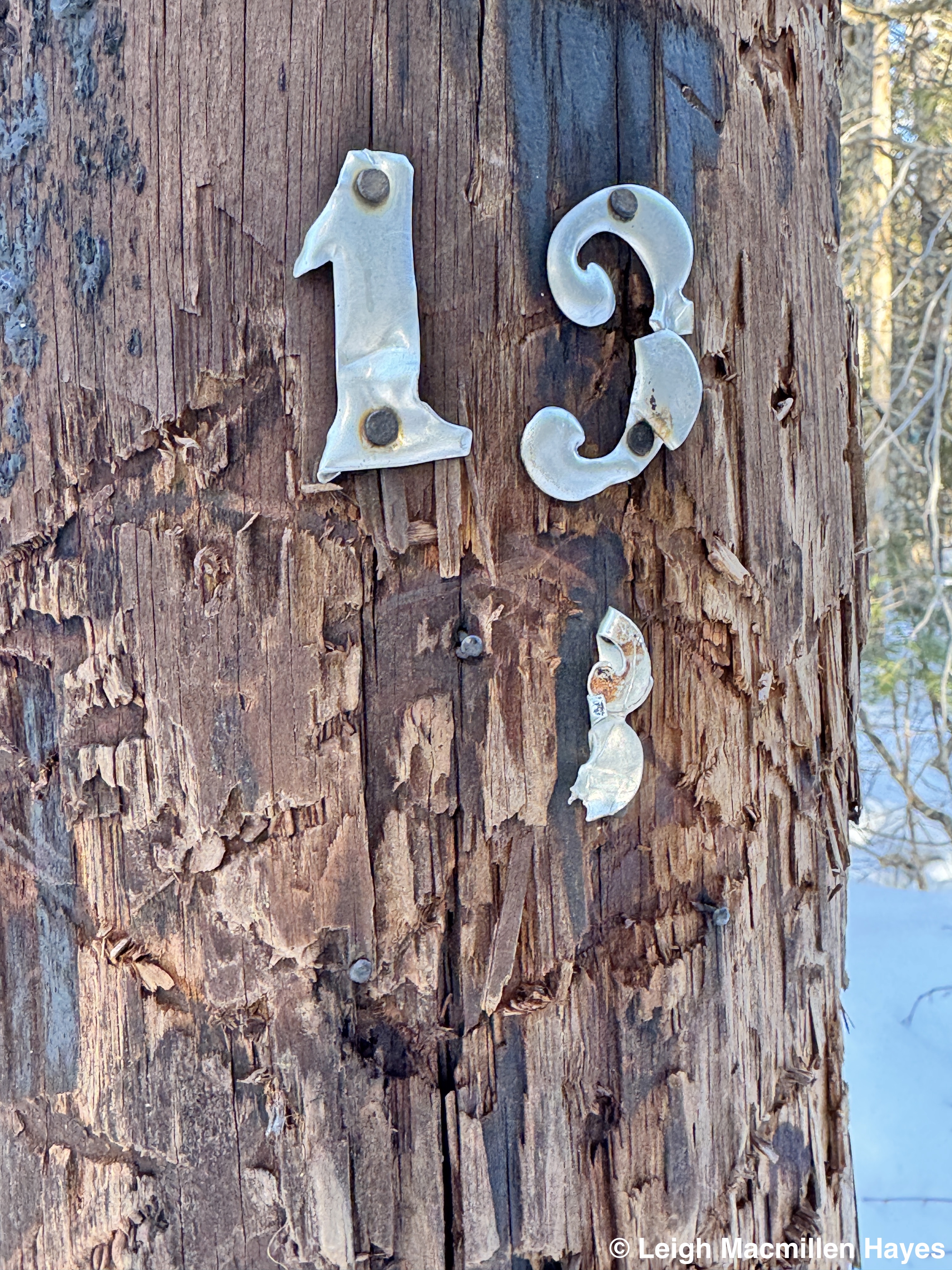
In fact, on this one the shiny numbers have been attacked and I can just imagine the activity that took place here.

In my mind’s eye, the Black Bear scratched the pole and then rubbed its back as it turned its head and bit at it. Why? That’s a question for which I’ve heard several different answers over the years, from something different in the woods, to it likes the creosote, to it feels the vibration coming down from the electrical wires above. I’m not sure of the answer, but I do know that I like to use my back scratcher once in a while and I can imagine the Bear does as well. His is just MUCH bigger than mine.

I always tease My Guy that this is his favorite game, to which he guffaws. But I can’t resist taking a look. I mean, look at pole 17. The metal is fairly intact, but can’t you just see the upper incisors chomping down and dragging back toward the lower, while the head is turned to the side?

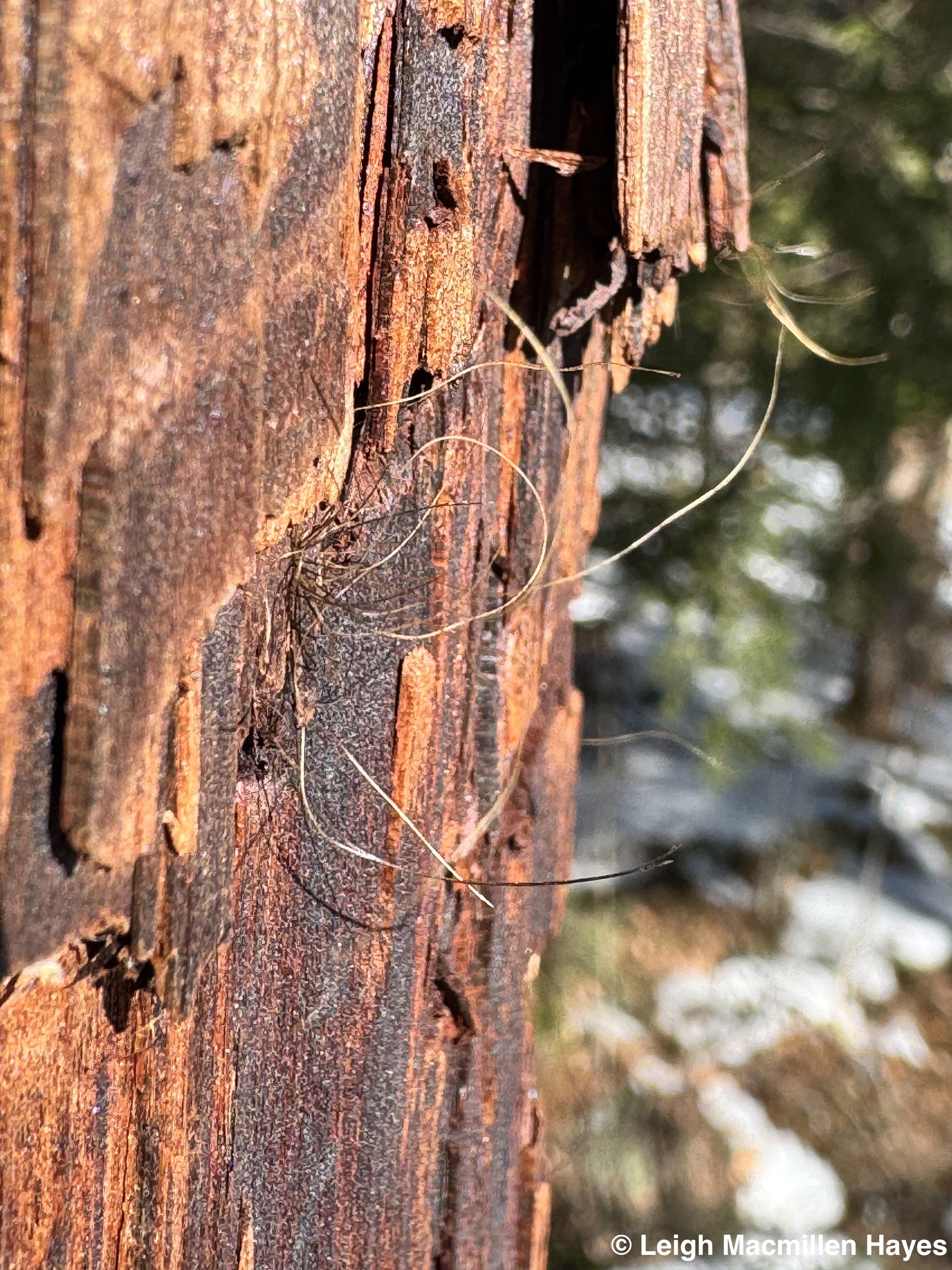
And don’t you just covet those hairs? My Guy asked why some are so light in color–that’s because this action may have occurred in the spring. It could be territorial, and maybe that’s the only answer we need. Anyway, over the summer, the color bleached out.

This pole had been attacked so many times over the years, that the numbers are now completely gone. In the past, I’ve noted that the number 5 somehow seemed to draw the Bear’s attention, and today I don’t recall seeing Pole #5 or #15. Maybe this was one of them. Because I was with you-know-who, I didn’t take too much time to pay attention to what number this pole should have been.

I was just happy to be out there looking at them.

Once we reached the trailhead, well, actually, even before we reached it, we noticed Red Fox prints and tracks. By the gazillion.

And then, in the middle of a field that is part of the trail, a perfect Red Fox scat filled with fruit. You can thank me for not making this a more upclose and personal photo.

There was a reason for the fruit . . . because the trail next passed through an old orchard. And there, the tracks increased significantly.

Apples were on the Fox’s menu and those that had been buried under the snow were excavated.

And because it is that time of year, I noticed something else going on in the midst of all the tracks.

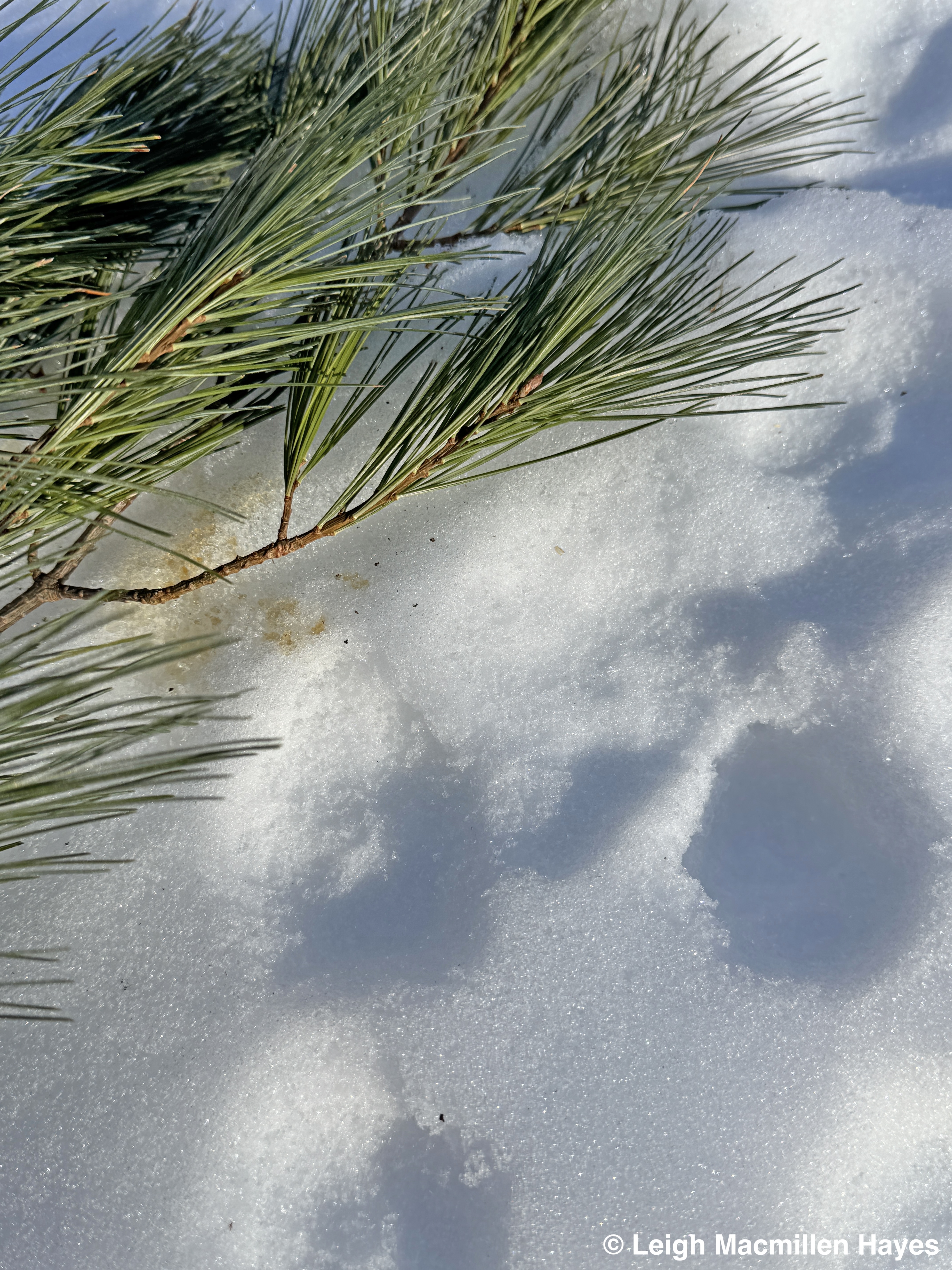
Do you see the downed White Pine branch?

Take a closer look and you’ll see urine. Fox pee. Male Fox pee.

Just yesterday I was hiking with a friend through her acreage and we found the same. Numerous Fox tracks and spots where the Fox had peed on saplings and anything else that poked out of the ground and snow. And so I invited her to get down on her knees and sniff it, just like a vixen would do.

Skunky!

She stood up smiling and it’s a smell she’ll never forget.

The Fox guys are leaving their messages everywhere to let the ladies know they are available for a date or two or three.

Speaking of yesterday, as we continued to hike, we spotted lots of Deer runs, well worn pathways through the woods. And then a spot where they seemed to browse a bit on downed Hemlock twigs.

But why were the twigs on top of the snow? I lifted one up and noted the 45˚ cut of it. The same on the next. And the next. And then we spotted the curved form of . . . Porcupine scat. Plus some pee.

We looked around and couldn’t find Porcupine tracks anywhere leading to or from the tree.

And so I looked up because that’s what I do whenever I’m under a supposed Porky tree. And low and behold, he was walking out on a branch high above us. We quickly moved away from the trunk and enjoyed the view from below, before continuing our tour.

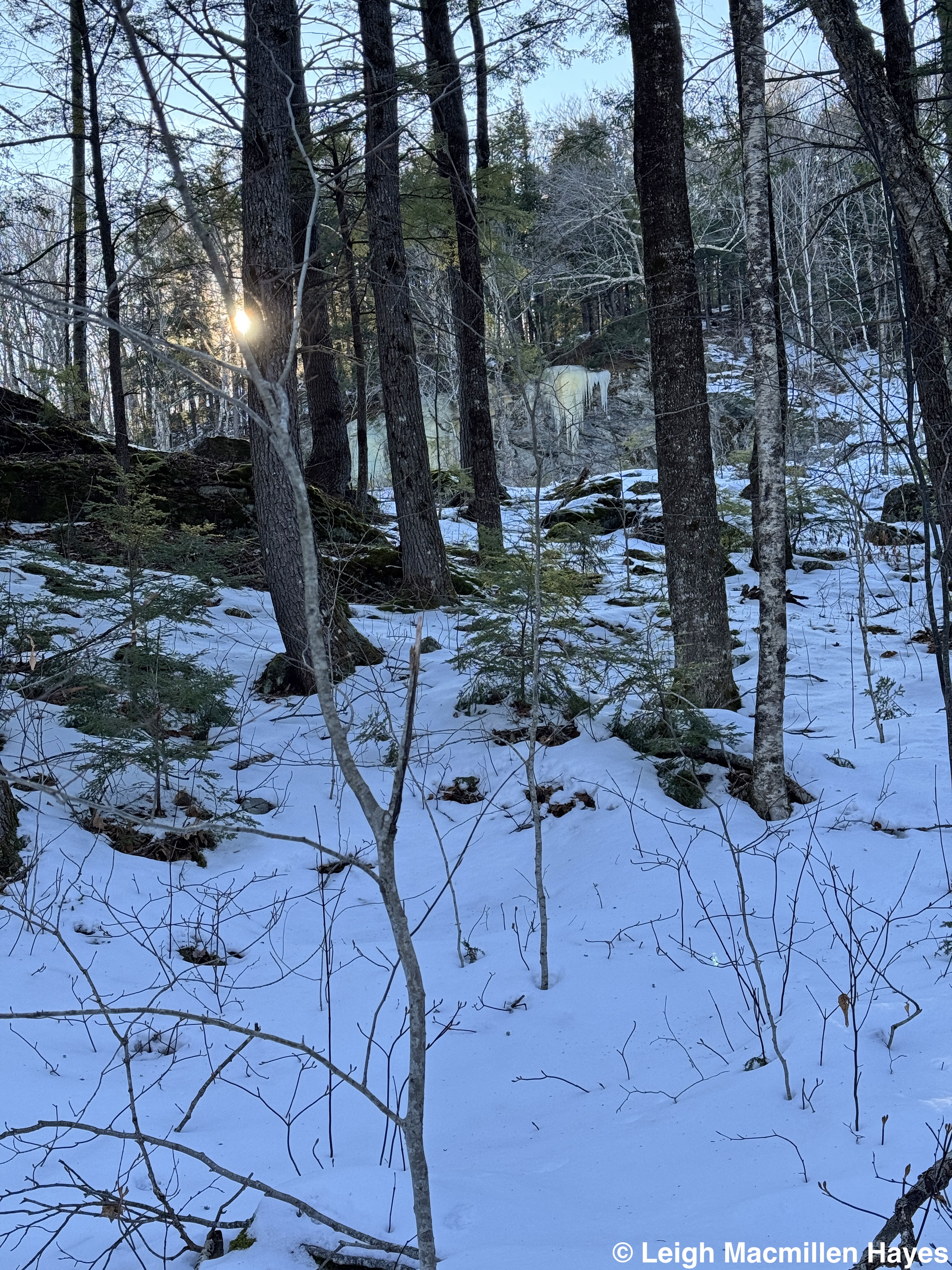
But I digressed and so I looked skyward today and noticed ice dangling from the cliffs above–prickly in nature, much like yesterday’s Porcupine, but beautiful all the same.

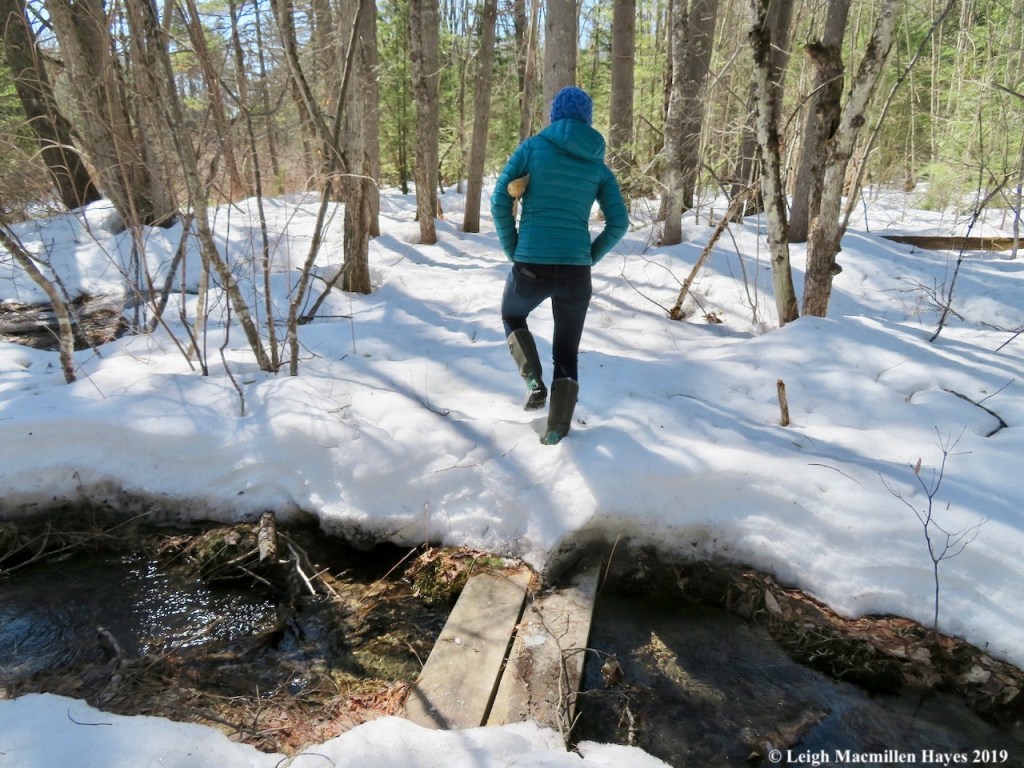
And down low, we noted a good crossing point in case we needed it because last year we arrived at this brook from the opposite direction and discovered the bridge had been washed to the opposite shore during a storm and we had to find our way across with snowshoes on our boots. We wanted to be prepared today.

Much to our dismay and surprise, the bridge hadn’t been repaired, but fortunately the brook was iced over in this section and we decided to run across in hopes of making it safely to the other side.

Success.

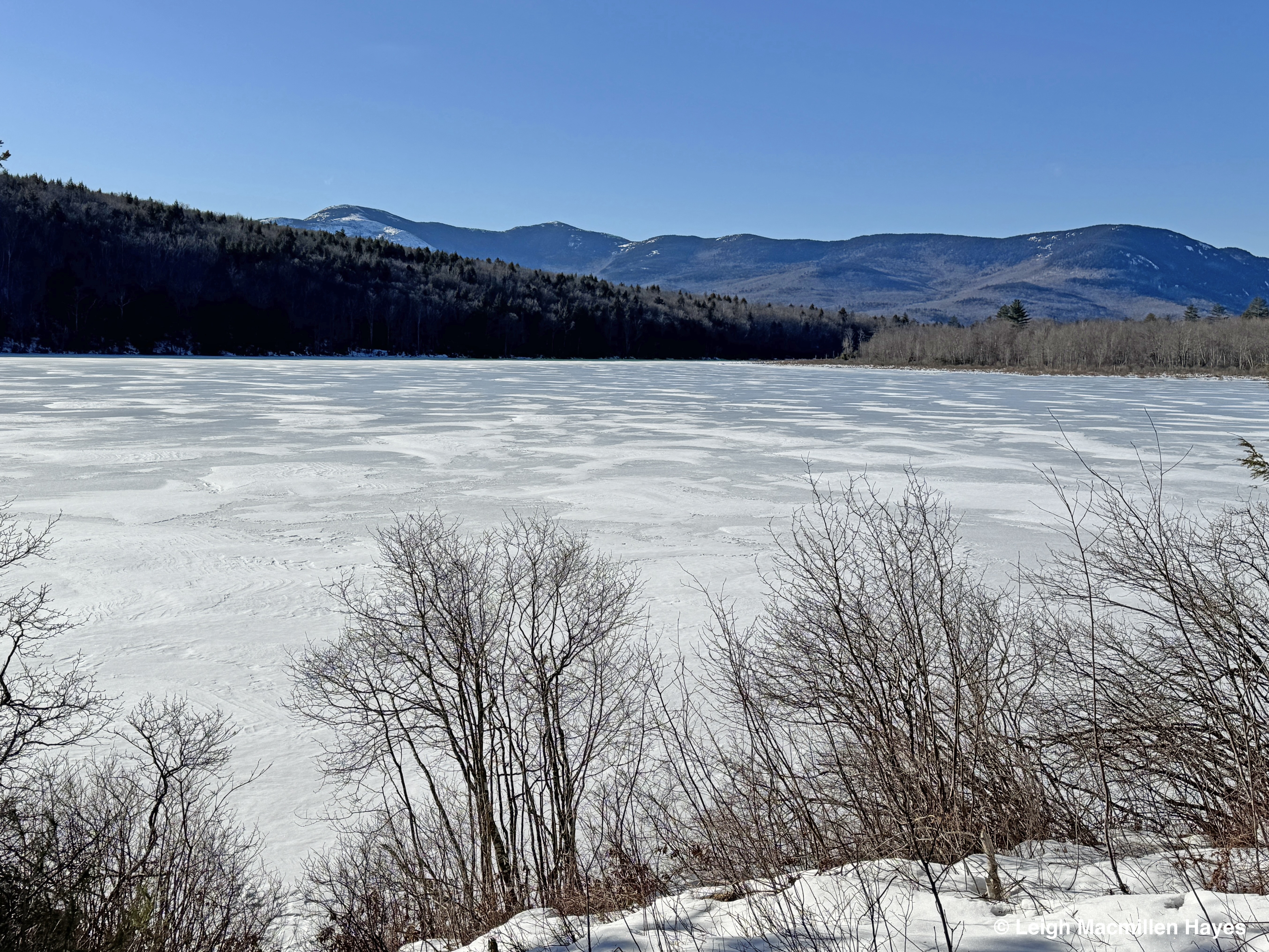
A bit farther on and we reached the lookout point for the pond we were circling, with the mountains of Evans Notch forming the backdrop. It looked like a perfect skating rink.

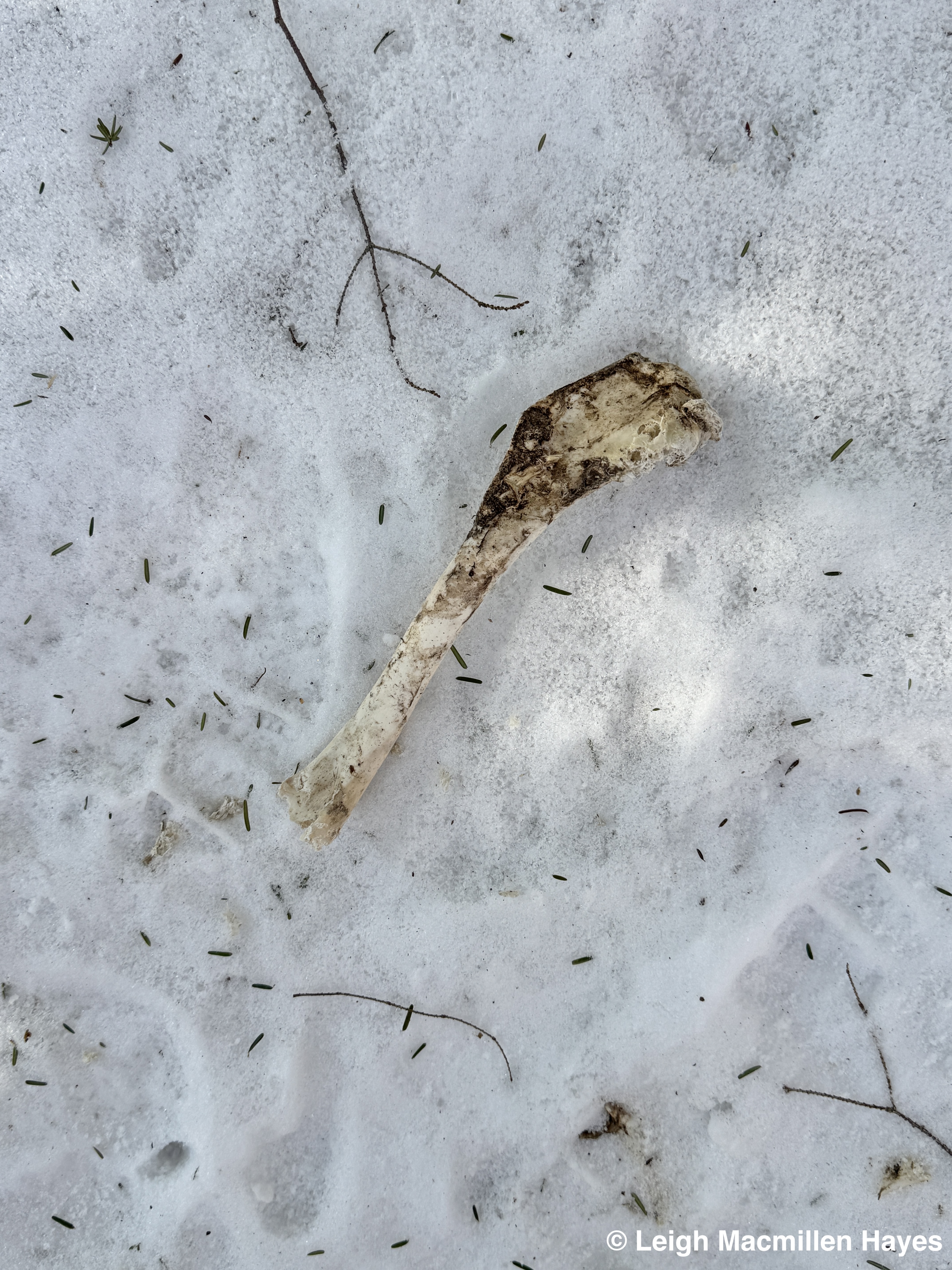
Fox tracks and Coyote tracks continued to mark the way for us and at one spot we saw a few deer bones. I really wanted to look for more evidence of what happened, but time wasn’t on our side.

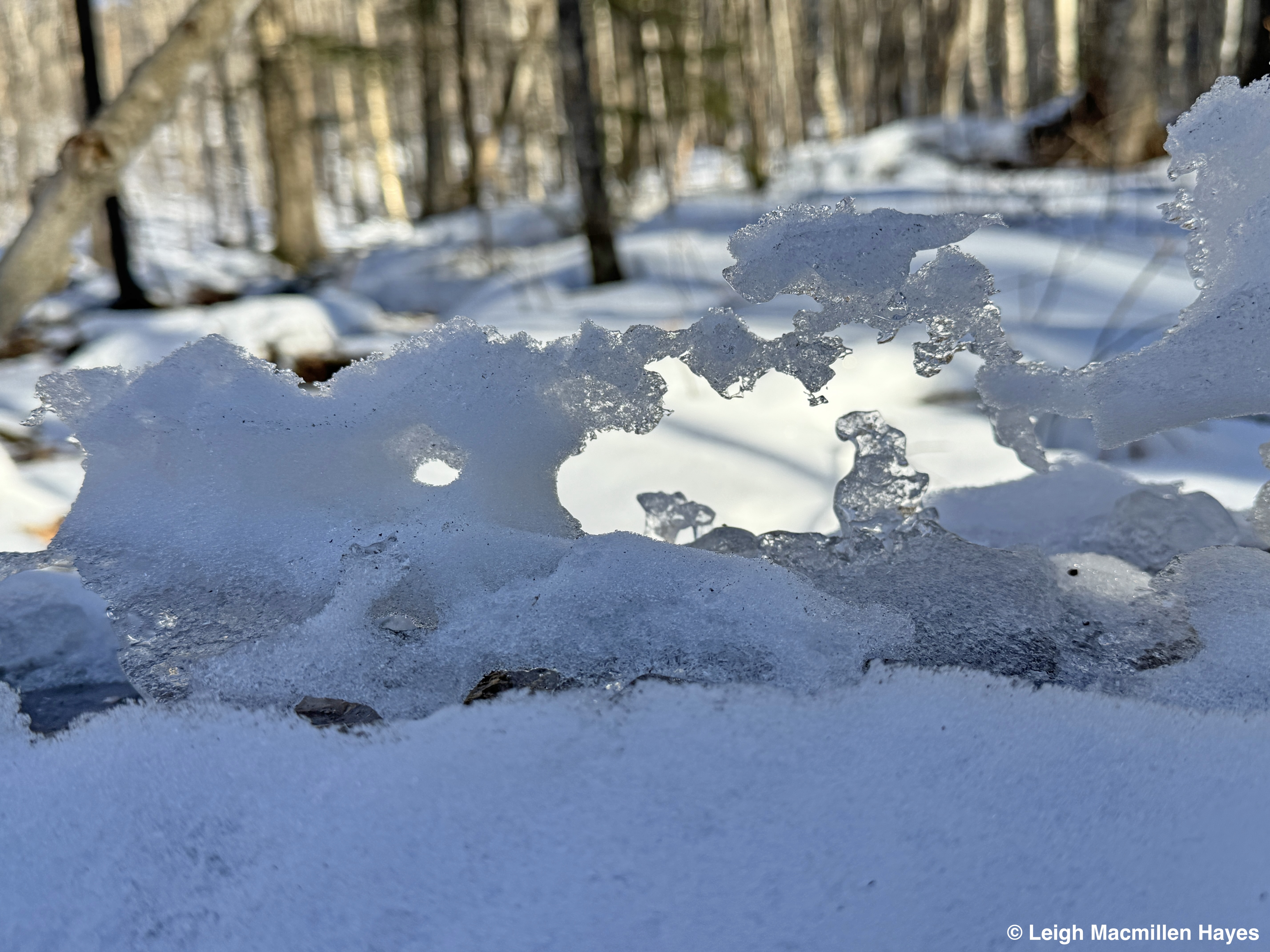
Instead, I paused only briefly to admire how the snow and ice danced across a fallen log.

Admired an old friend who watches all who pass this way.

And noticed more colorful ice dripping off a ledge as the sun dipped lower in the sky.

And then, much to my surprise, some Beaver works right beside the trail.

There were more and they were rather fresh and there was a trail to the water and so I asked My Guy if he’d mind if I checked out the activity for a moment.

He did what he always graciously does when I ask such, and found a rock to sit upon and patiently wait.

At the water’s edge, I found more signs of the Beaver’s activity, including gnaws on a much larger trunk, and a pile of chew sticks. Did the Beaver sit here to dine? Perhaps. The water was open, so he didn’t have to eat under the ice.

On the way back up the hill to meet My Guy on the edge of the trail, I smiled at the sight of another Beaver tree, that showed how the Beaver, like the Bear, turns its head to scrape the bark and get at the cambium layer.

Funny thing about this one, possibly a previous generation of this Beaver’s family had visited the same tree, as evidence by its graying top that had been cut at least a few years ago and had started to stump sprout.

We had one more bridge crossing to make before heading back to the telephone-poled road, this time with ice and open water to view.

And clumps of stars fashioned upon the ice that reflected the sky.

To say it was a Bluebird day is trite. But truly it was with the sky matching the bird’s plumage.

And on the way out, while I looked at another telephone pole, My Guy saw a Coyote run across the road. A minute later and I spotted a second one headed north as well.
Dancing Vole. Fox dates. Beaver works. Icy art. Coyotes hunting. The first and last were alleged since we don’t have photographs to prove our sightings, but My Guy assured me that since the two of us saw them, they actually happened.

Bluebird days are indeed the best days.

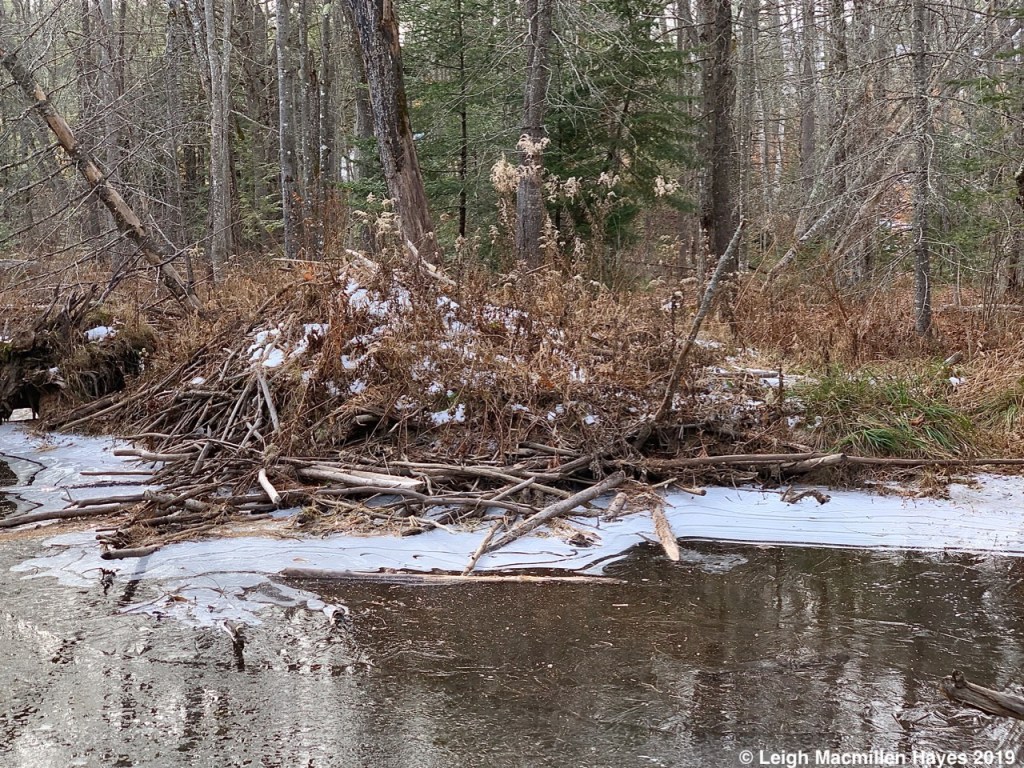
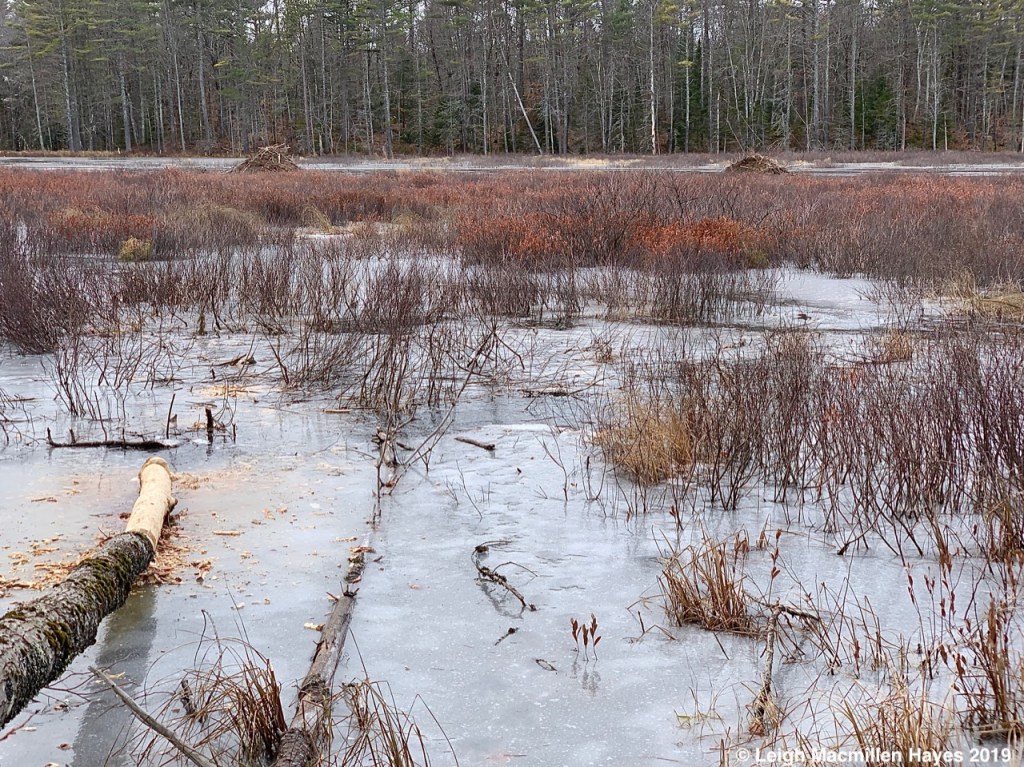
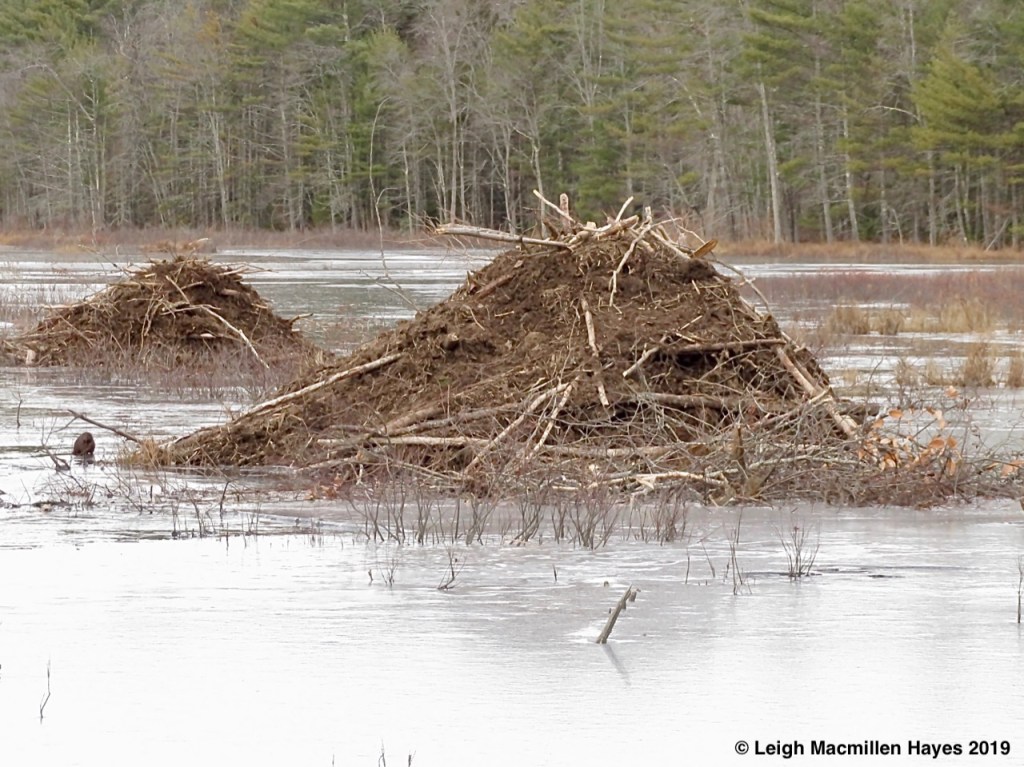
The Beaver’s Tale

Much to our delight,
just after parking the truck
at a local trailhead,
the caretaker crossed the road
to bid us hello.
After sharing with us
his plans for an upcoming adventure,
we wished him Bon Voyage,
and started down the trail,
giving thanks that friends
had pre-packed it
with their snowshoes
last week
so we only had
to wear micro-spikes.
(Thank you, Sue and Lee)
At last reaching one of two ponds,
around which we planned to tour,
we chuckled at the juxtaposition
of summer and winter,
in the forms of
canoes, snow, and ice.
A few more steps,
and we weren't sure
which season witnessed
what must have been an immense crash
as part of this old hemlock
slammed onto the ground.
Meanwhile, 
the upper most section
of the fallen tree
was caught by friends
who are still doing their best
to hug it
and keep it
from careening
to the forest floor.
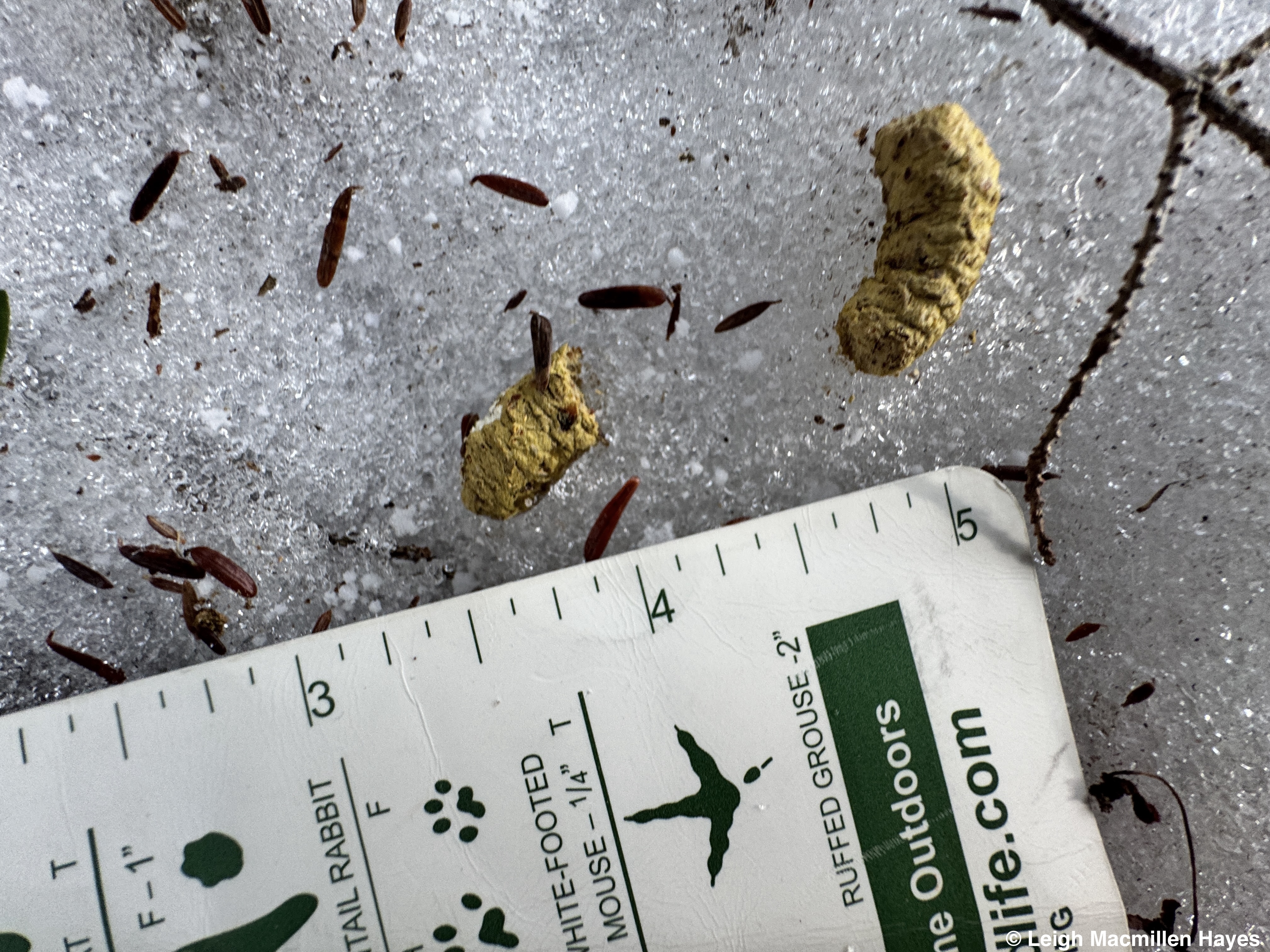
And farther still, 
a bunch of
mustard colored droppings,
aka scat,
bespoke the past presence
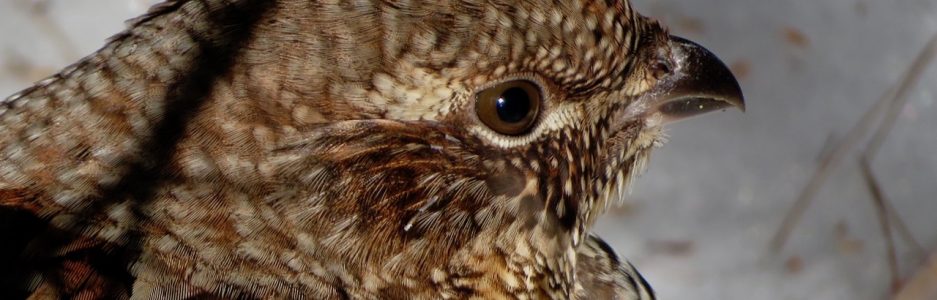
of a Ruffed Grouse
who must have dined well.
By the shape of the prints 
in front of him on the trail,
My Guy immediately new the maker,
for one was a wee hand,
and the other a bit longer,
and both were
offered on opposite diagonals,
as is this waddler's presentation,
it being a Raccoon.
When we reached the lifesaver,
we knew we were at the halfway point,
and had to decide
to continue to the next pond,
or only circle this one
because our time was limited.
We chose the latter,
saving the other for another day.
The trail next passed
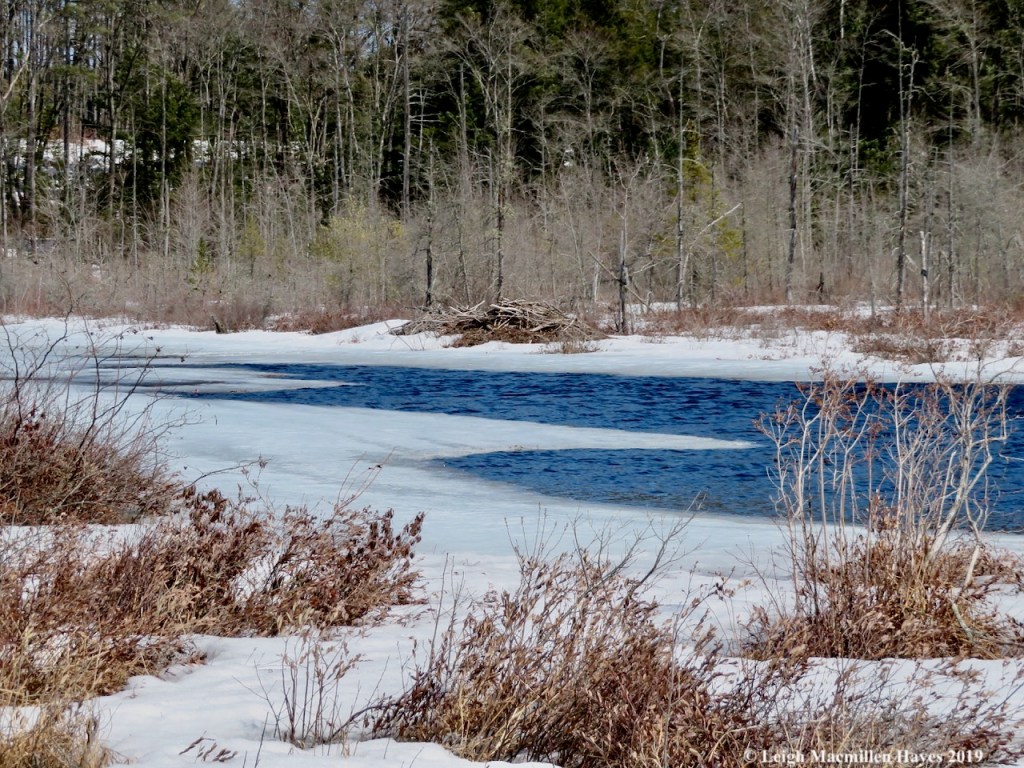
beside a wetland,
and in the middle
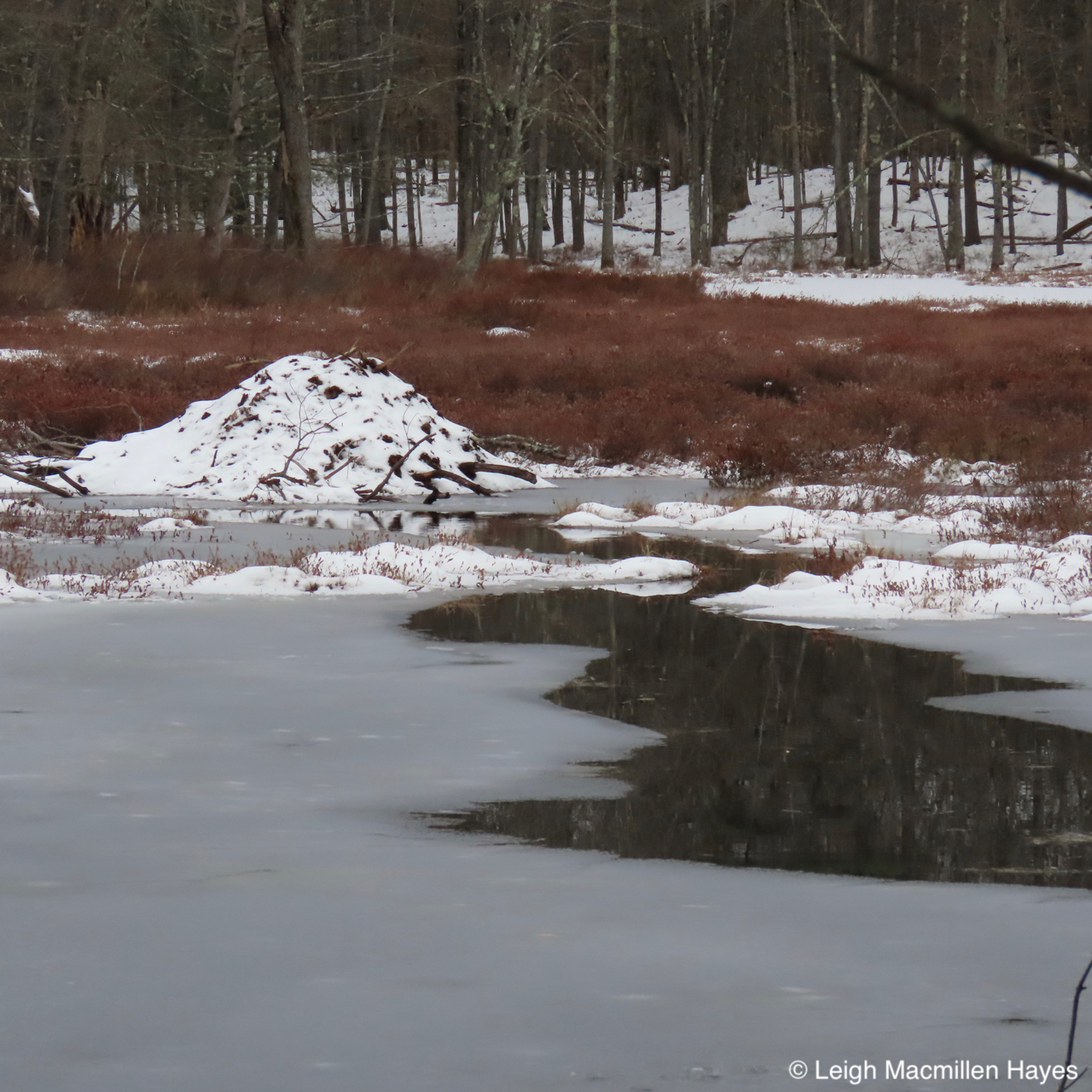
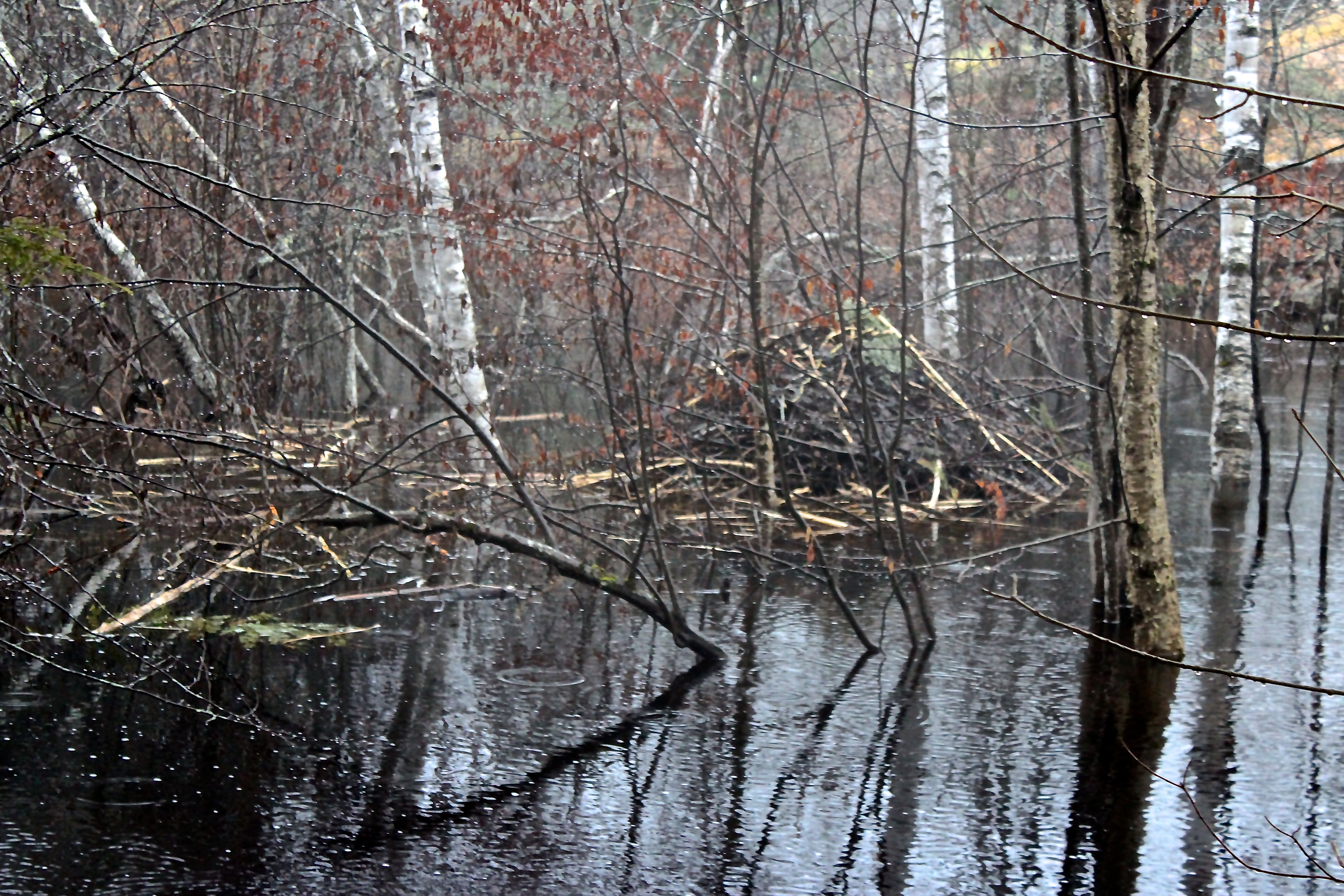
I spotted the Big House, Little House, Back House, Barn,
of a Beaver family,
with fresh wood
indicating someone was probably
in residence.
Continuing on, 
it soon became apparent,
that a logging operation,
had taken place,
but the workers
were of the non-human sort,
for such were the toothmarks
of said Beavers.
We found 
example after example
of trees sawed
with their chisel-like teeth,
and some even crossed the trail
we followed
for our route
was of no concern to them.
Upon reaching 
the other side
of the wetland,
I looked at the lodge again,
and found it curious
that there was no open water,
given that up until today's frigid temps,
we had a bit of a melt,
and surely the Beavers
would have been
on the move.
And then mere minutes and steps later,
because there are no leaves on the trees,
I spied across the way,
a huge new lodge
that we somehow missed
as we hiked above it
a half hour earlier.
As I zoomed in with the camera,
what should I see,
but a Beaver swimming
in open water,
and my heart was still,
and I wanted to stay
in that spot forever.
For about ten minutes,
that Beaver and I shared the space,
mind you from a distance.
My Guy was just up the trail,
and did not see what
I was focused on.
And this was not the time
to shout,
"Hey look, there's a Beaver!"
because no sooner said,
then there would not
be a Beaver anymore.
Chew sticks were visible
on either side of the pool
he had created
and I suspected he was grabbing a few
from an underground "raft"
of sticks previously stored,
or cached as we say,
and bringing them in
for the rest of the family to dine.
I think my assumption
may have been correct,
for when he reached
the far end of the pool,
he slipped quietly underwater,
rump first rising in the air,
and then whole body disappearing.
It's a funny thing
to realize
that when a Beaver
isn't aware of my presence,
it doesn't need
to slam its tail
and surprise me
or warn its family
that I am there.
Rather, it barely
leaves a ripple
upon the water's surface.
About five minutes later, 
the Beaver appeared again,
and then disappeared under water
beside the lodge
and I again assumed
I was correct
that chew sticks
were on the menu
this night
as they are every night.
With that 
I took my leave
from my lookout spot,
and followed My Guy
toward the conclusion
of our journey,
giving thanks all the way,
for the Beaver
who went about its daily duties
and let me be a witness.
As the sun 
began to set
on this day,
January 2, 2025,
I realized that it
shall be forever more
the day I celebrate
this Beaver's Tale.
Thank you to the owners of the land,
Mary and Larry,
and to their caretaker Bruce,
for conserving this place
so all may live
as nature intended.

Where The Beaver Led Me

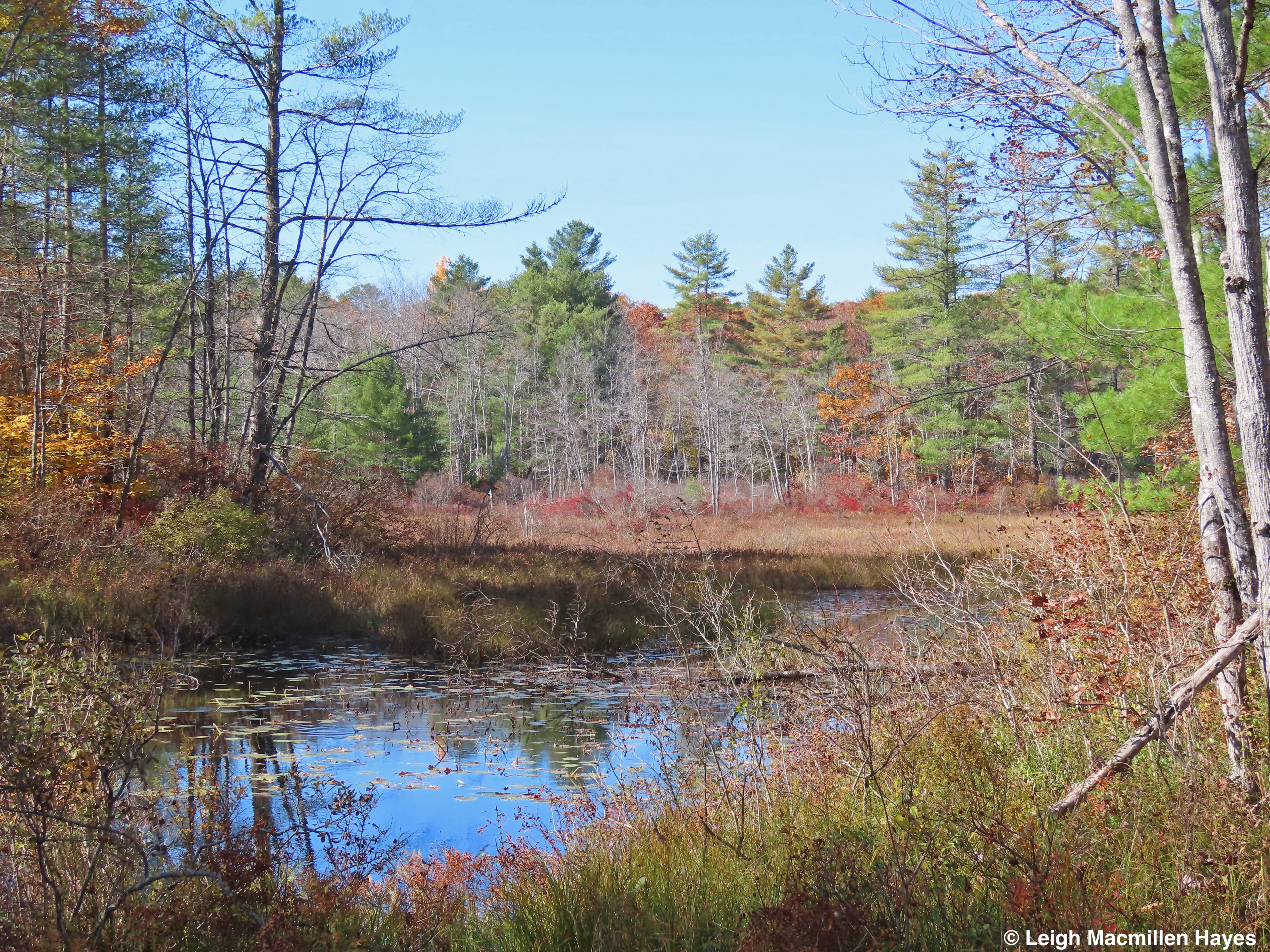
Where there is water there may be Beavers. And so I explored two locations on several occasions this weekend in a quest to spend some time with one of the most incredible mammals of our region.

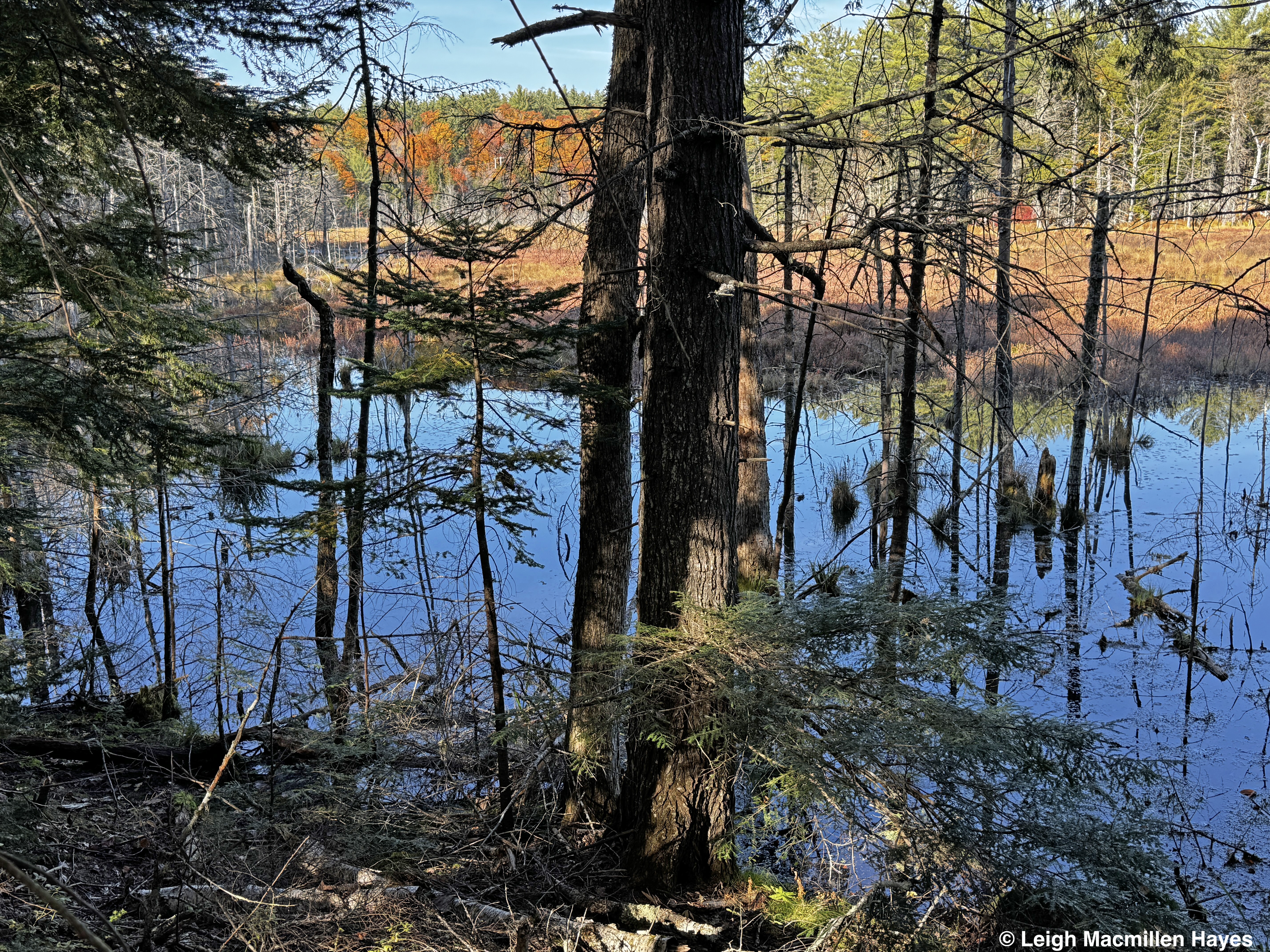
One such spot is beside a wetland associated with a brook. It’s a place rich with color and texture, and ahh, those fall scents of earth and water and fallen leaves and Balsam Fir all settled together in the late afternoon after the morning sun has baked them.

The other was beside another brook that served as the outlet for a small pond, and again the colors and textures and scents filled my senses, enhanced by a slight breeze that made for a most delightful exploration on October days with temperatures in the 70˚s.

I don’t want temps to remain in the 70˚s always, but these days are gifts meant to be cherished and remembered by our skin and our soles.

I discovered along the way that I wasn’t the only one basking in the sunlight, for Painted Turtles also took advantage of the warm rays to regulate their body temperature. It also provides an opportunity to hang out with friends as they congregate along logs and rocks.

Easter Painted Turtles, beautifully adorned as they are, feature intricate red coloring along the sides of their shells and bodies, plus a orangy-yellow belly, and lines of red and orange and yellow green on their necks and legs.

But beyond all of this, I’m reminded that they play a vital role in maintaining the health of their ecosystems as they consume a diverse diet from aquatic plants, to algae, insects and small invertebrates, thus cycling nutrients throughout the habitat–an environmentally healthy habitat.

I gave thanks to the Beavers for reminding me of that fact.

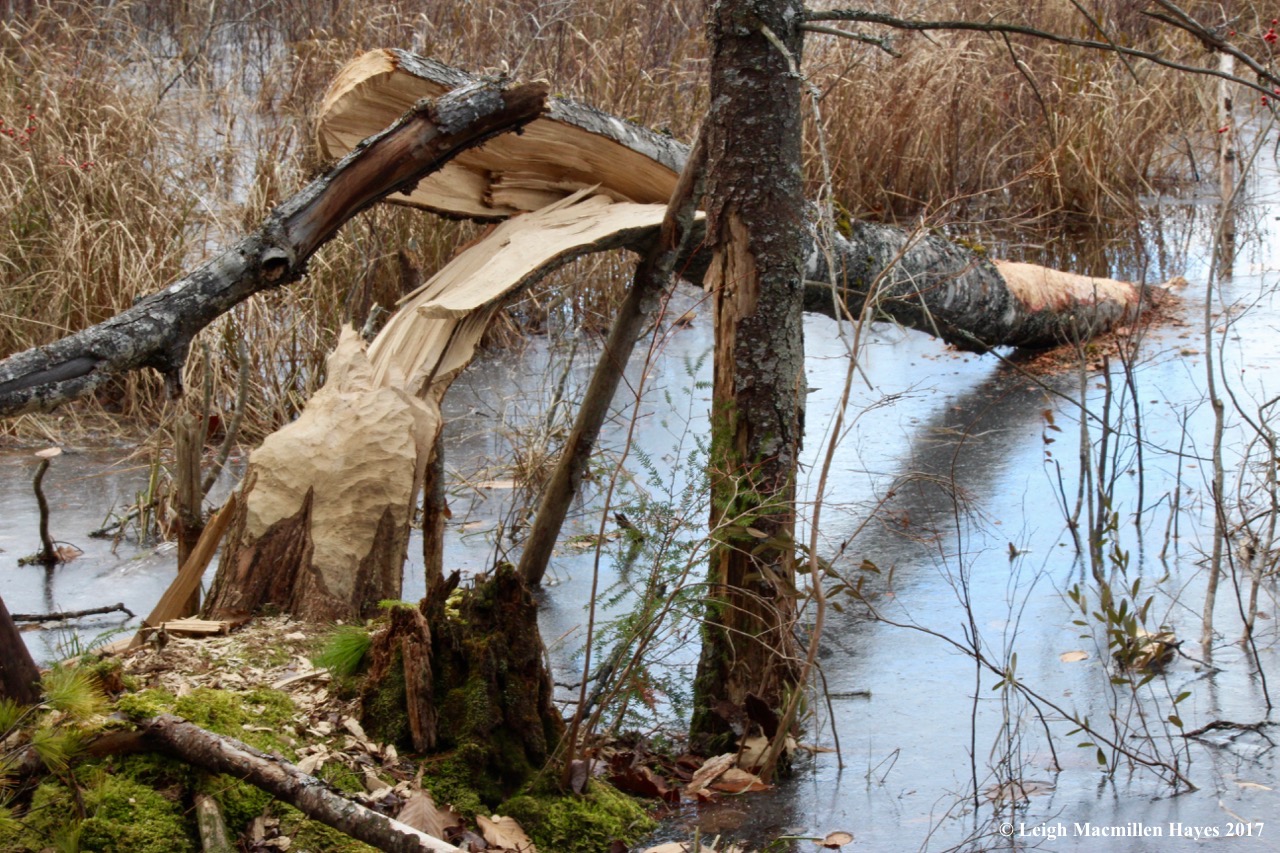
Back to the Beavers, my journey continued when I spied new Hemlock branches atop a lodge.

And then I began to find pathway after pathway across land to water where the family, since there are usually two or three generations of Beavers who live in a lodge and work the area together, had dragged downed trees and branches overnight and carried them between their teeth out to their residence.

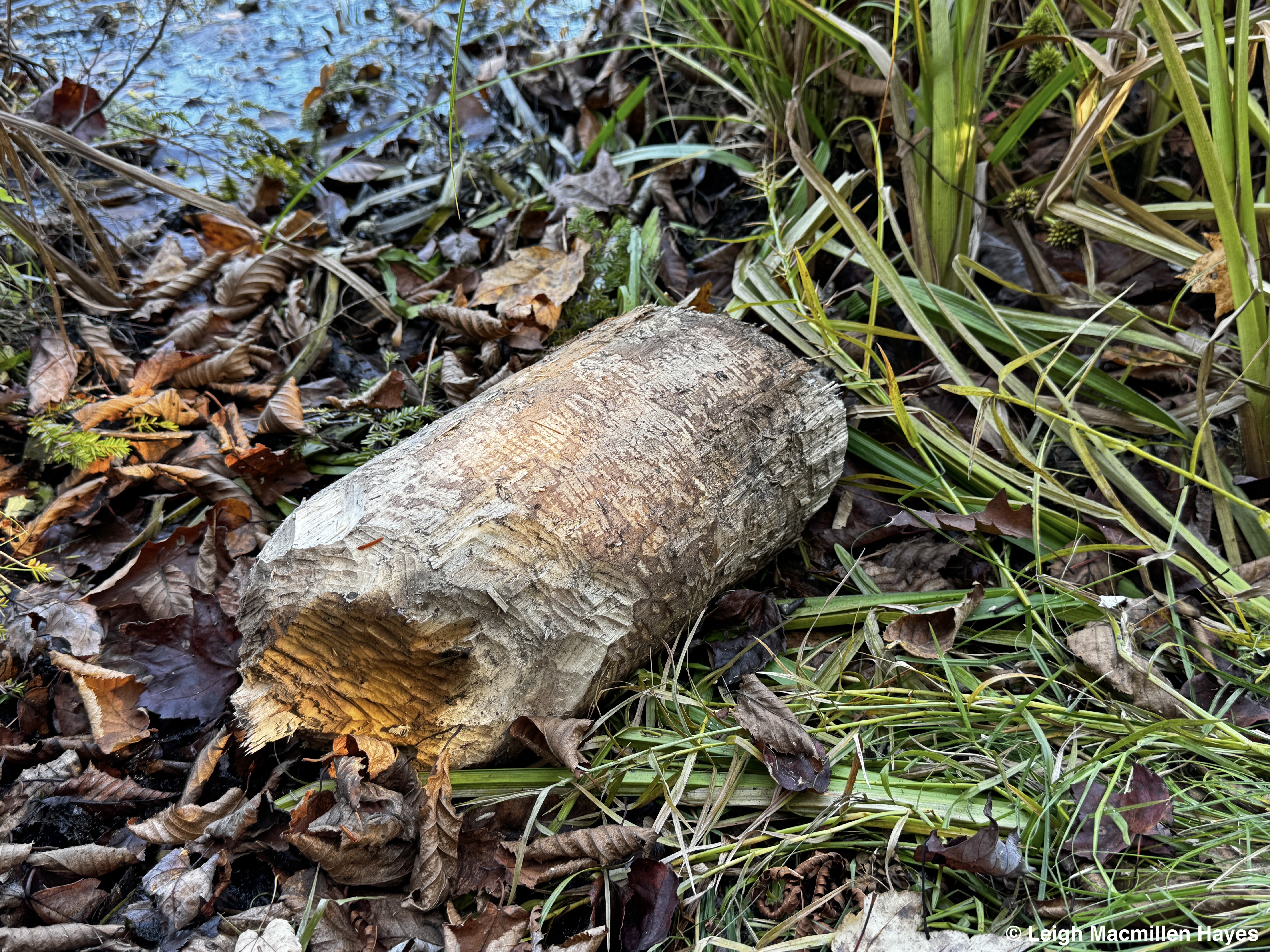
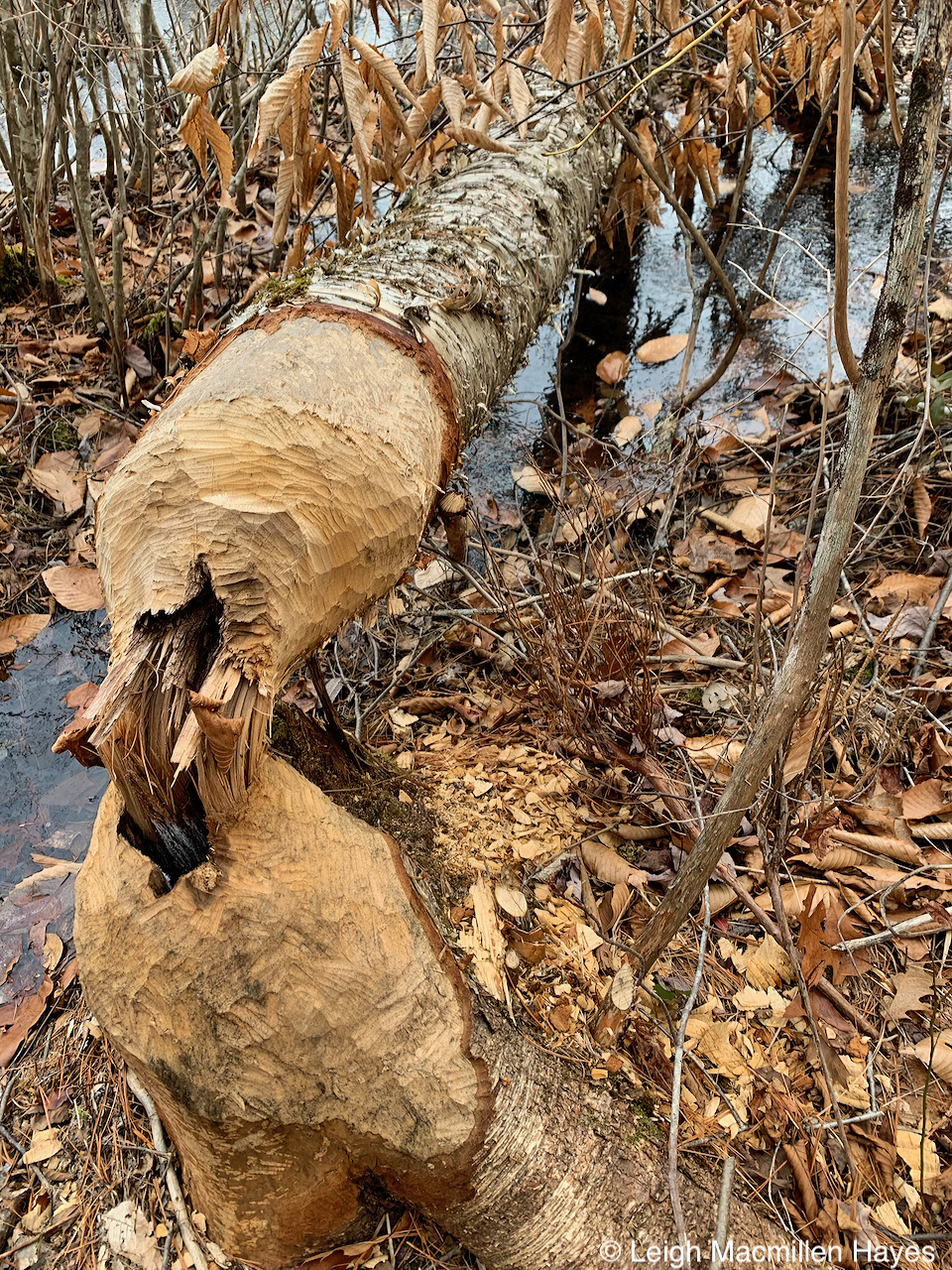
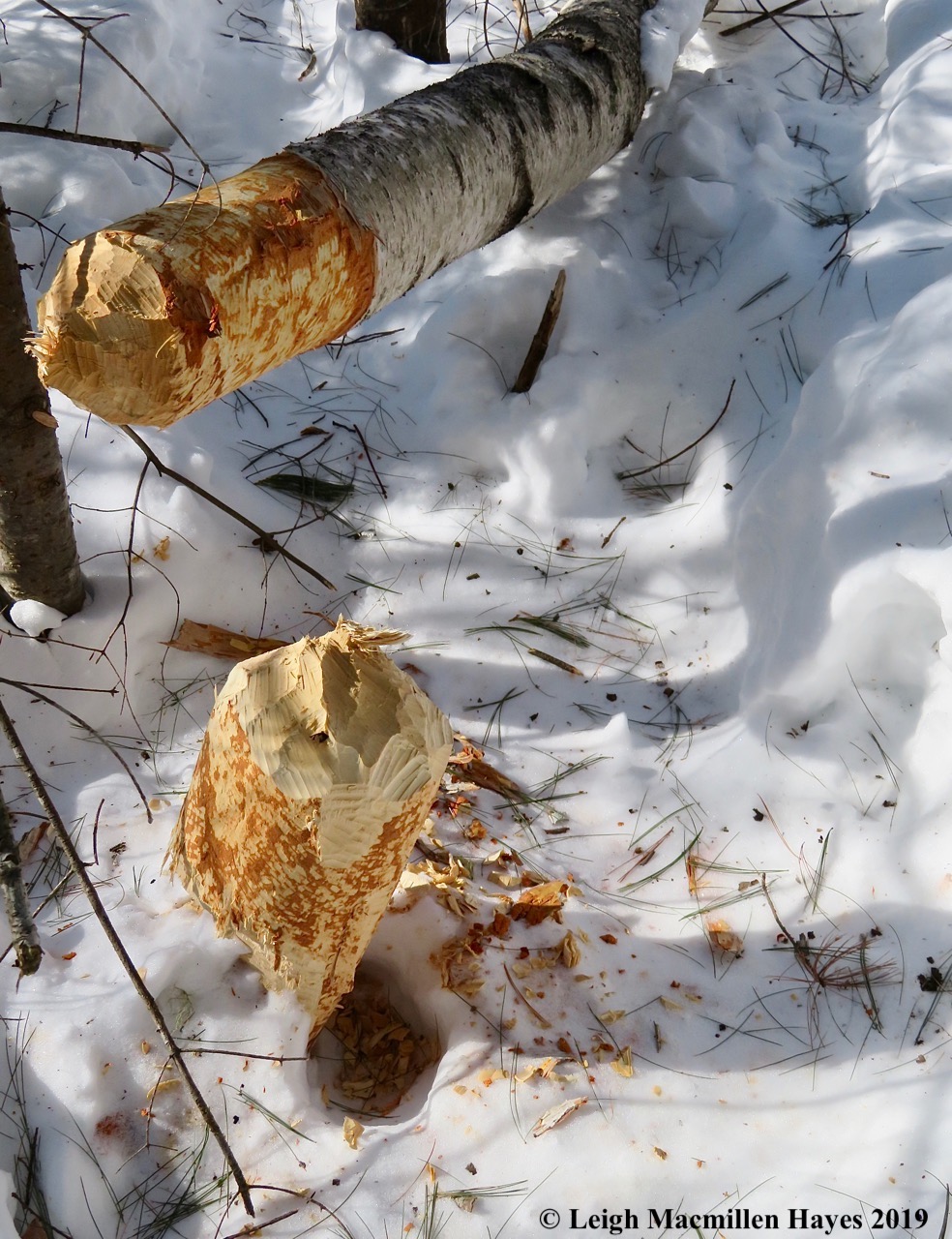
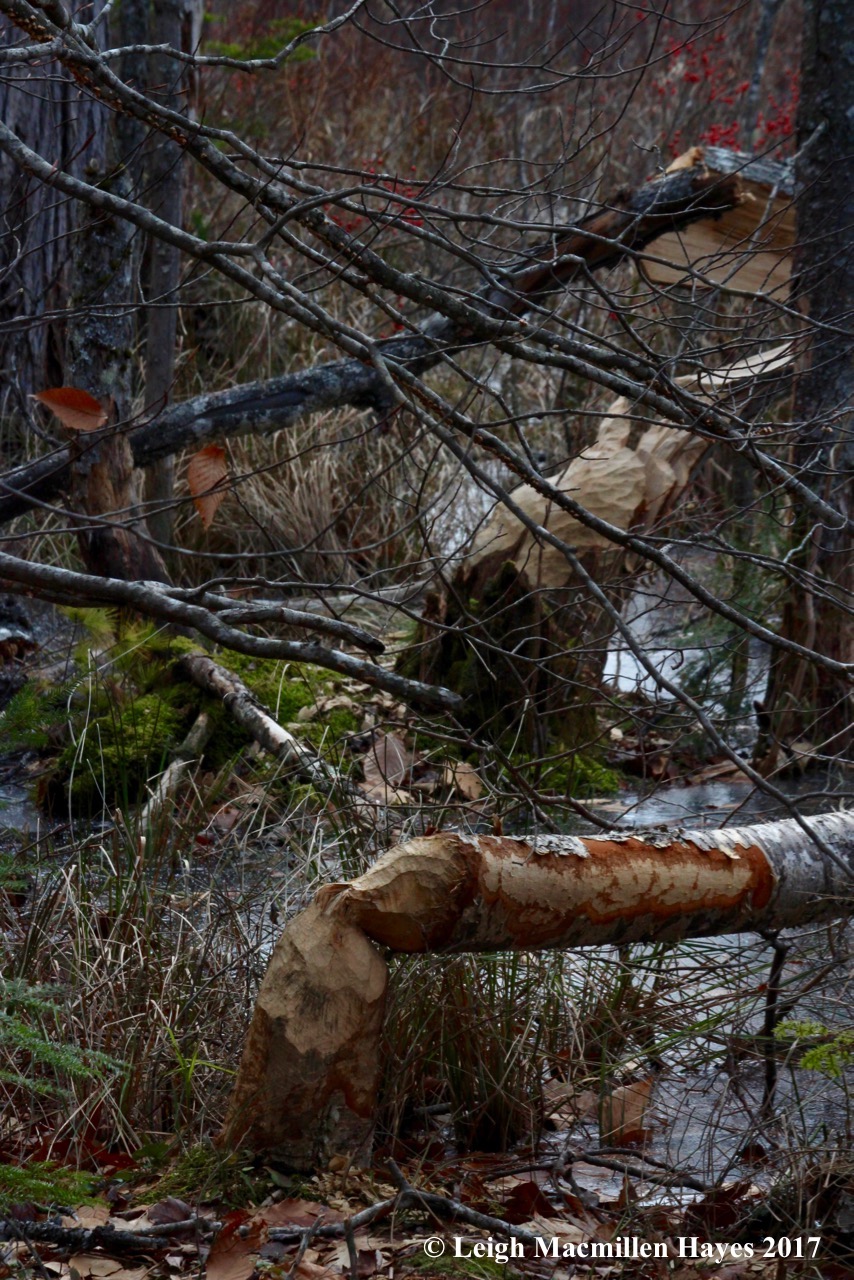
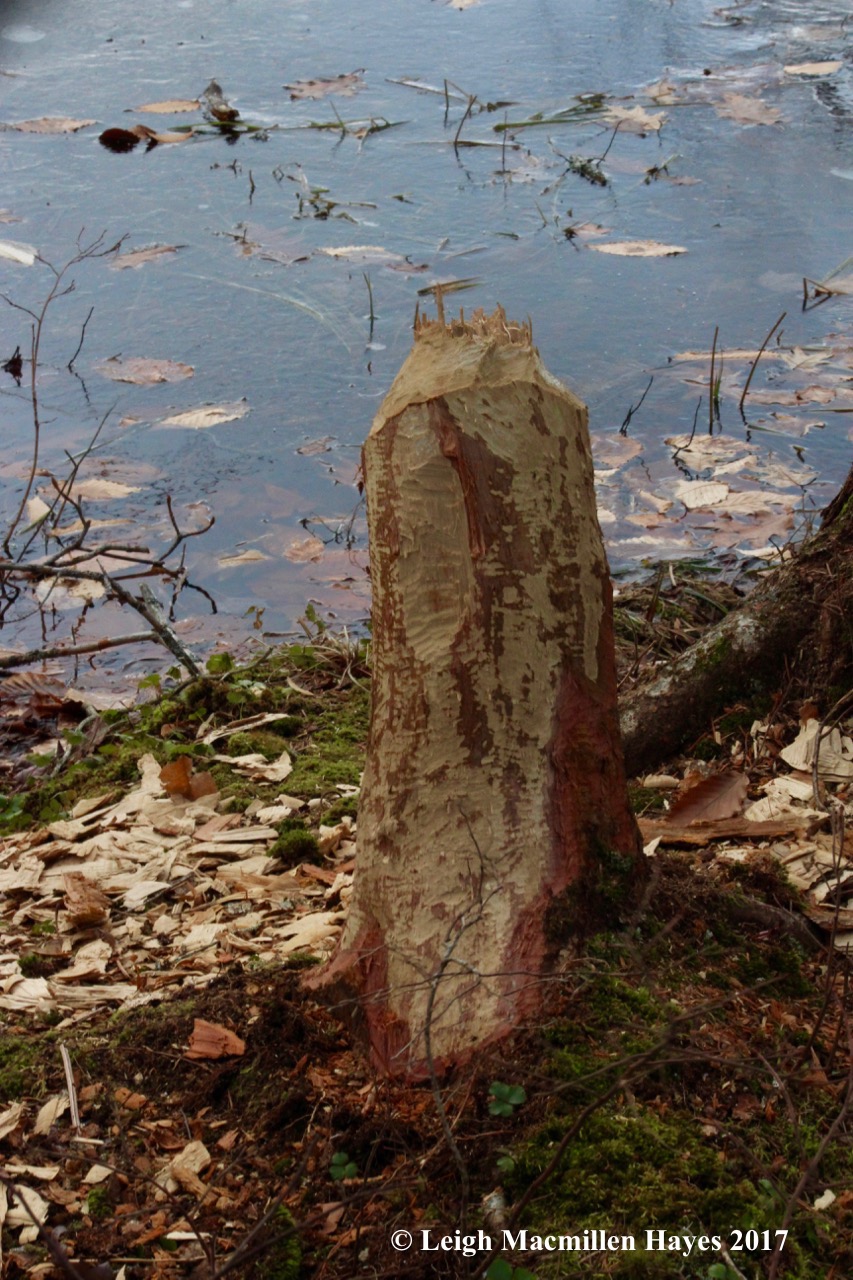
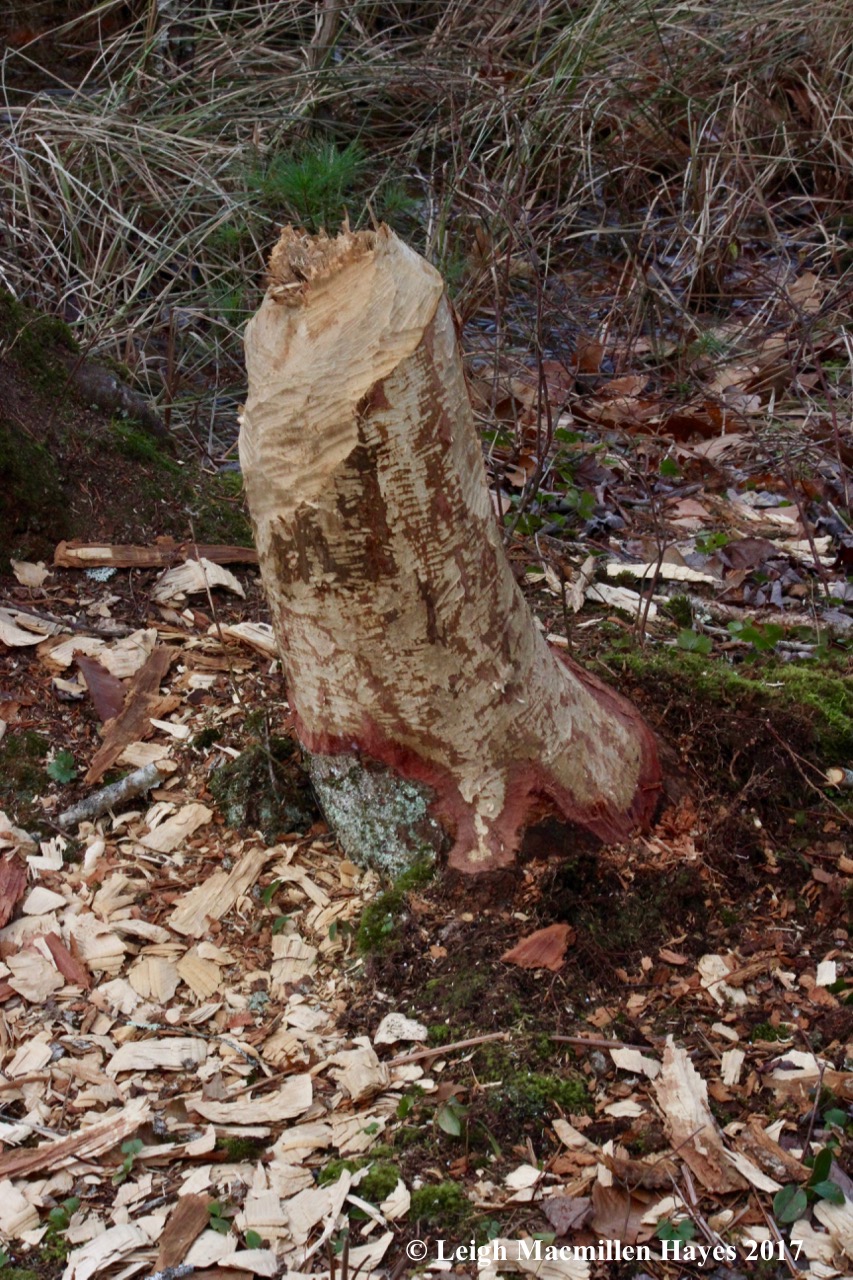
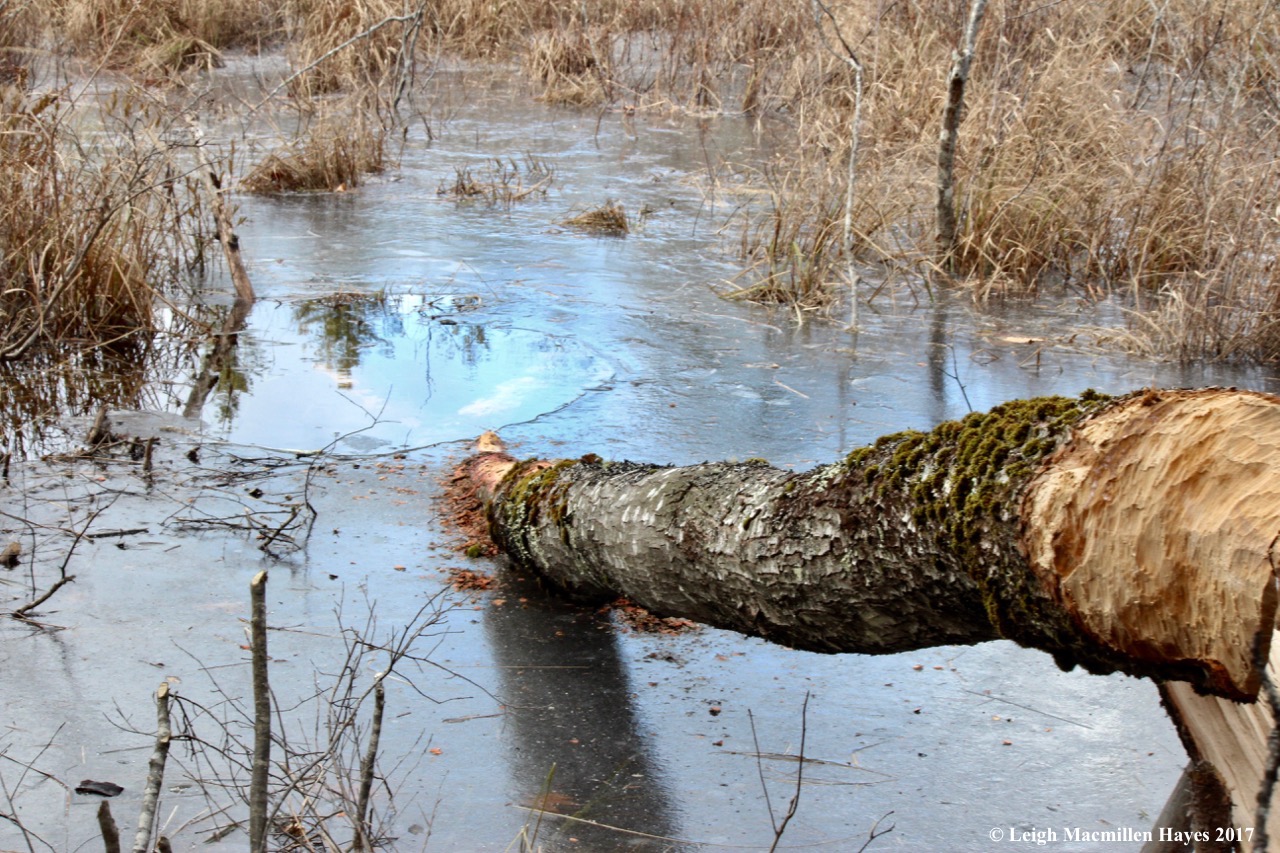
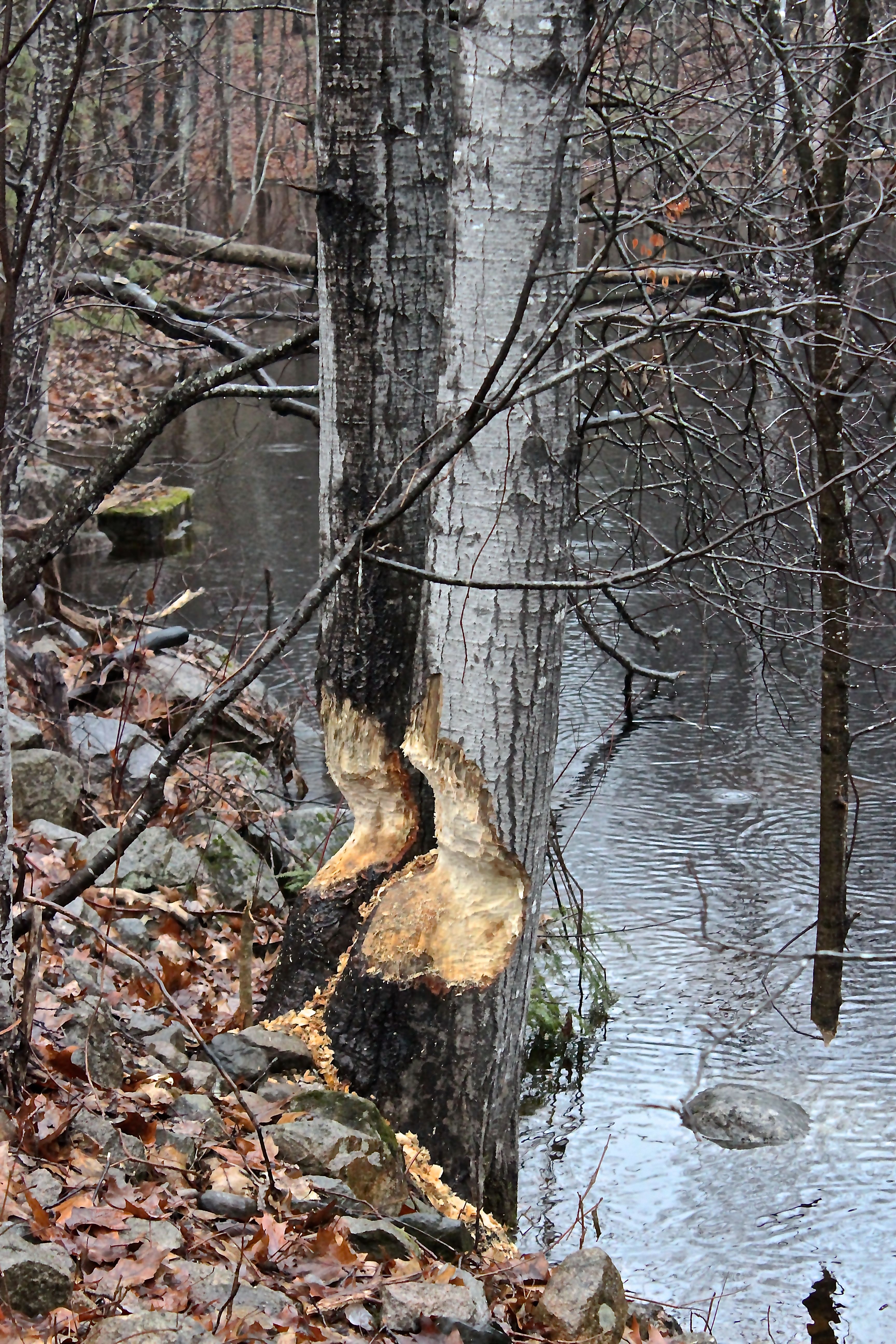
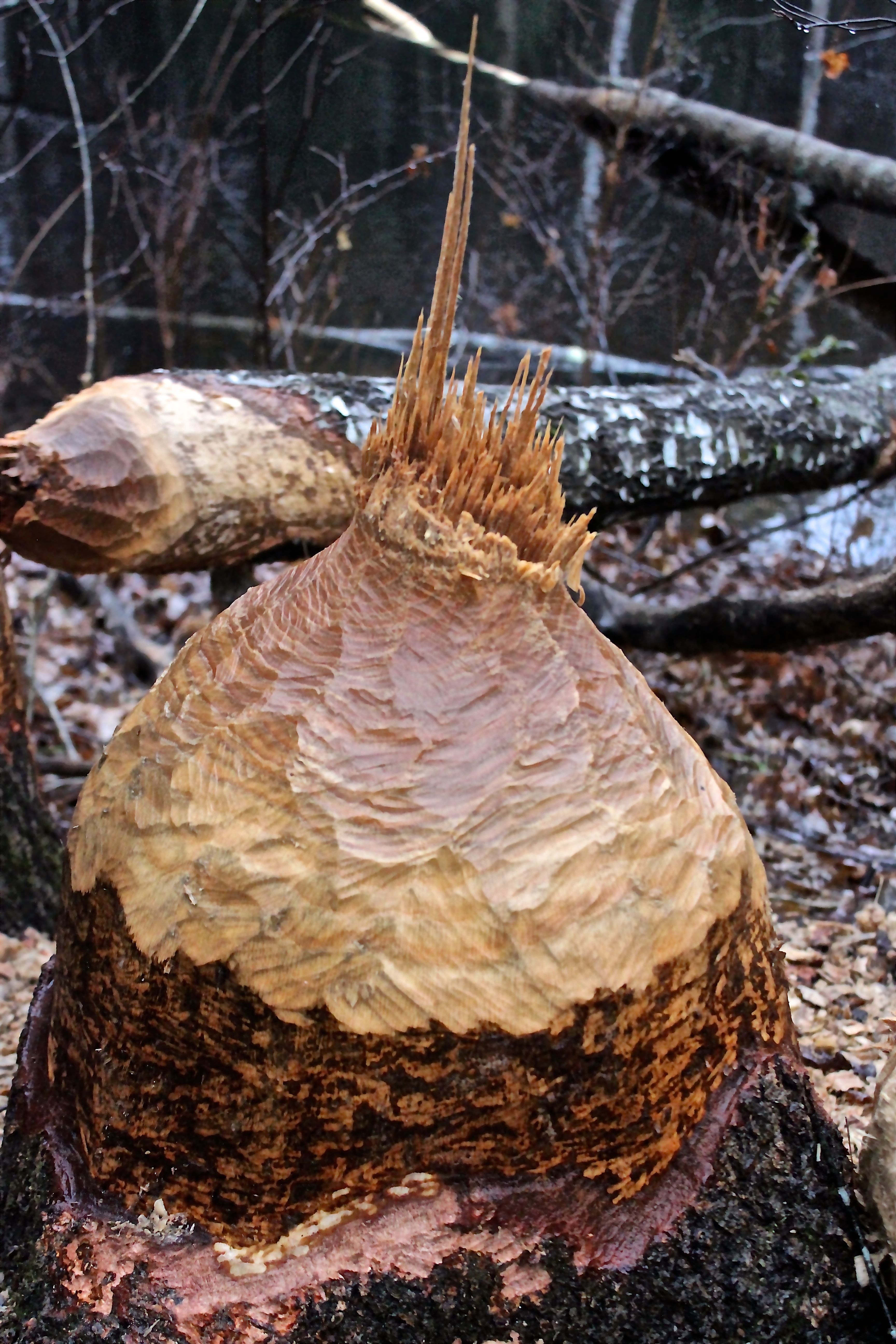
Their works were many and sculptures magnificent as they chiseled away and when I spotted this tree, I had visions of one standing on its hind feet and using its tail to form a tripod, the better to steady its body, as it turned its head to the side and began to work. With head cocked, it created the consistent angle of the half inch groove as the upper and lower incisors come together.

To reach such heights, I could only assume it was a mature Beaver. That, or one stood upon the back of another. Ah, but that’s the stuff of fairy tales. (I do like fairy tales–just saying).

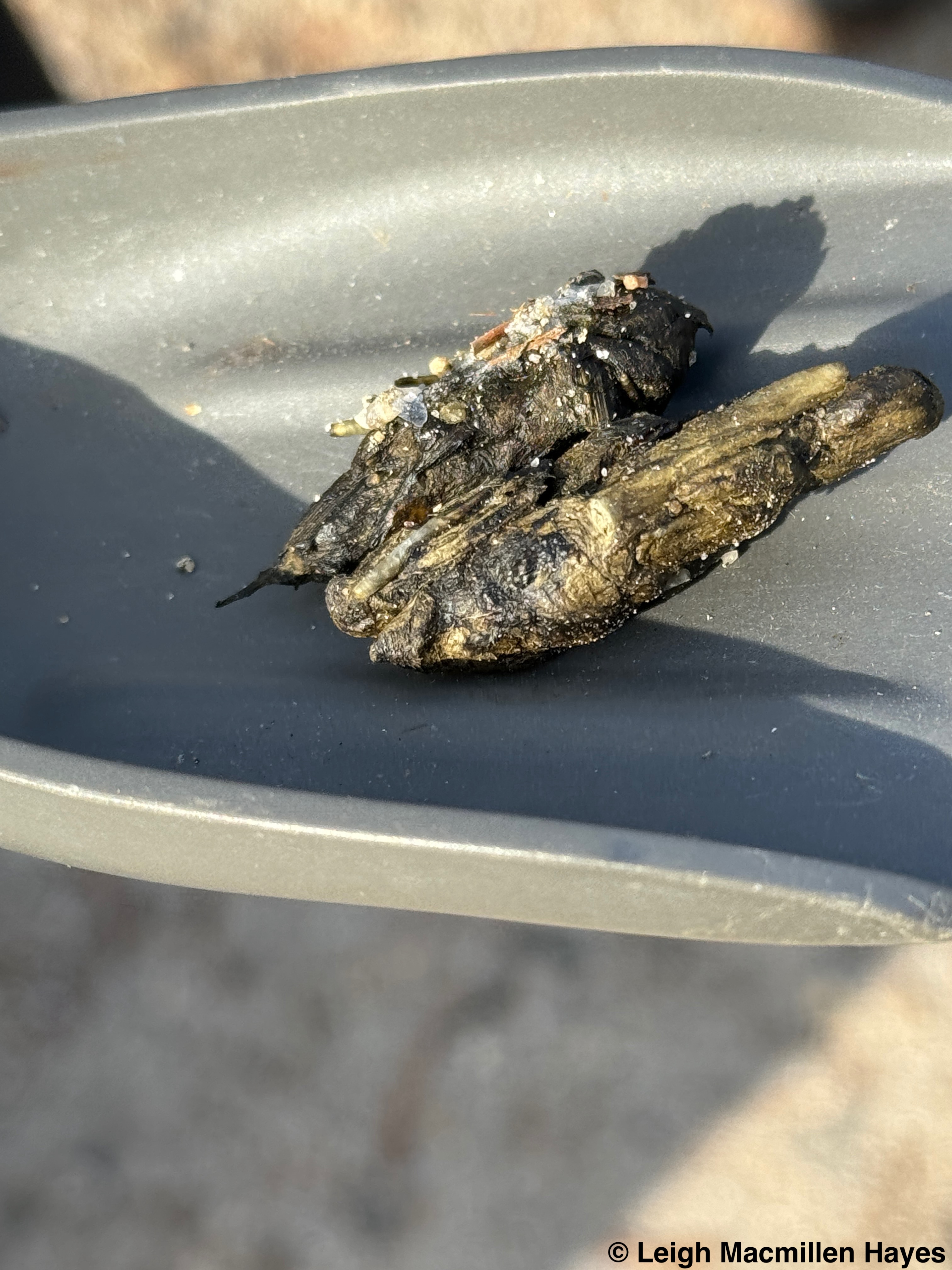
As I looked around the base of a tree for more evidence, I discovered this. What could it possibly be? Scat?

No. Pellets? Yes. Several of them. Filled with bones. And maybe hair. And/or feathers.

The creator? My brain automatically went to Barred Owl and I’ve seen and heard the owl in these woods on many occasions.

But . . . these natural treasures could also have been produced by a resident eagle or hawk or so many other birds. Based on the number of pellets under this one tree, its a certain signpost of a productive area for whatever bird chose to prey from above.

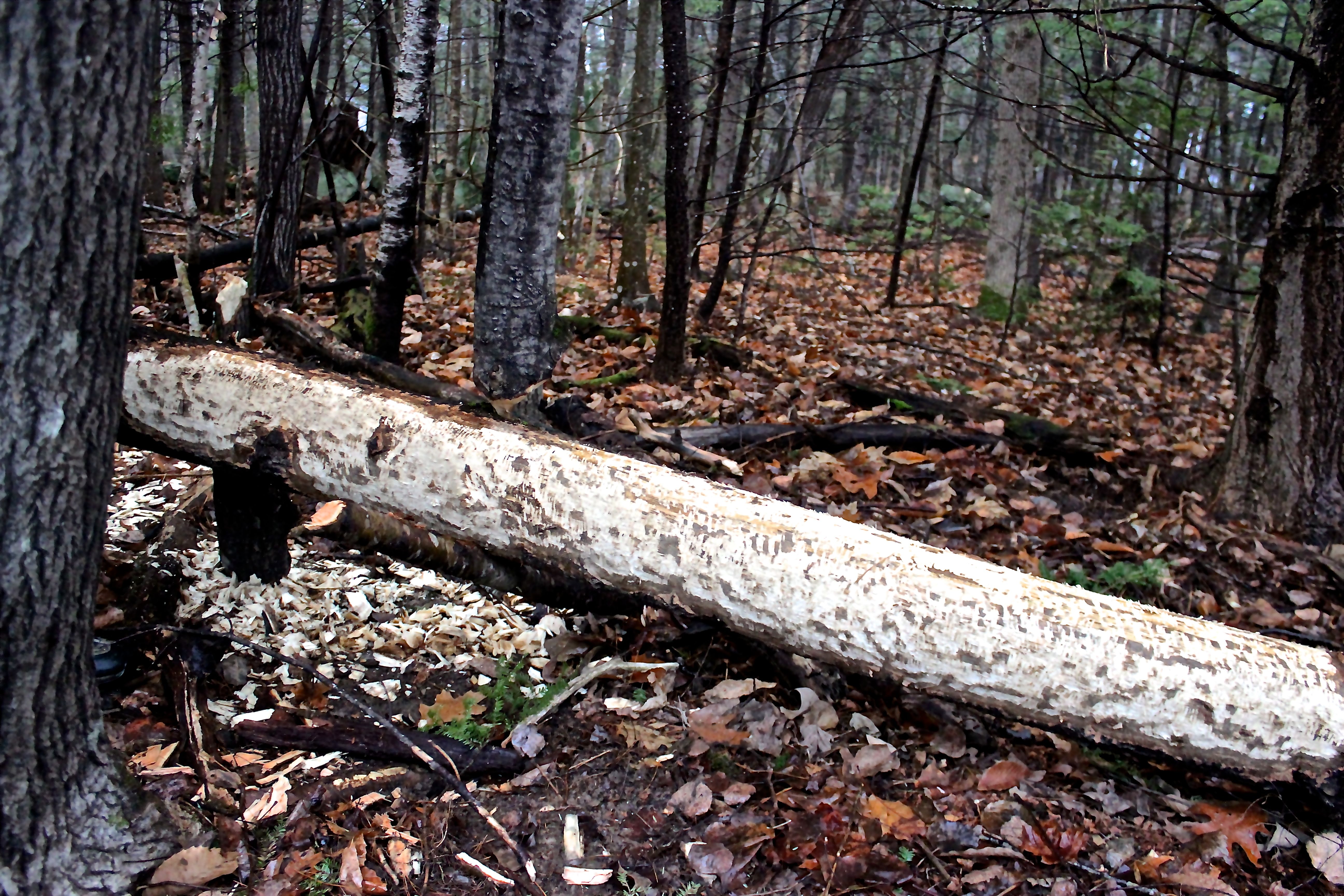
Moving farther along as I bushwhacked, I knew I was getting closer and closer to the animal of my dreams when I spotted trees being turned into logs.

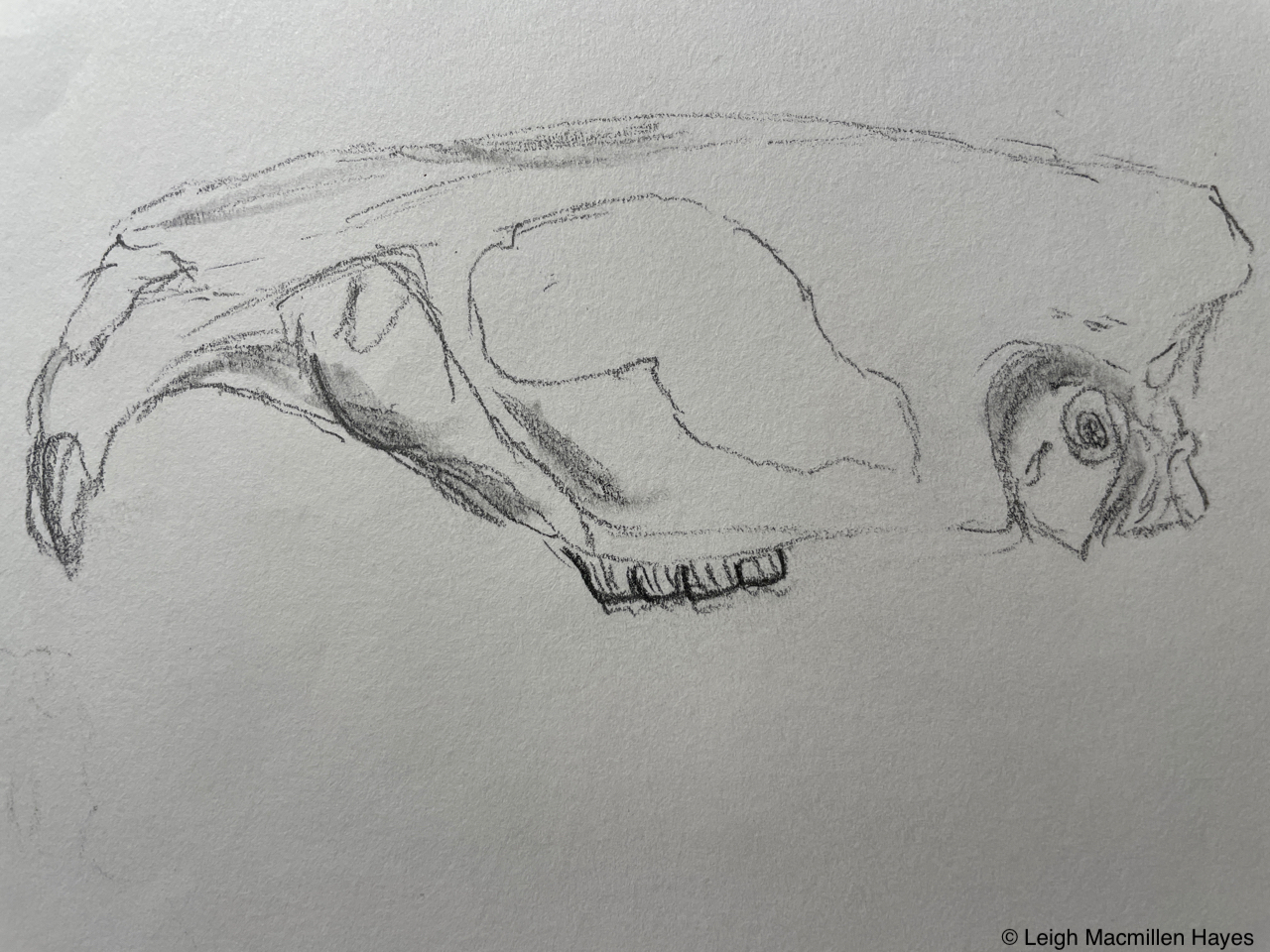
A beaver’s dental formula is this: 2 incisors on top, 2 incisors on bottom, 0 canines on top, 0 canines on bottom, 2 premolars on top, 2 premolars on bottom (that look like molars), 6 molars on top and 6 molars on bottom, for a total of 20 teeth. Recently, I was able to sketch the upper part of the skull of an older family member, who’d lost some of its molars.

These large, semi-aquatic rodents are gnawers. To that end, their incisors are highly specialized for chewing through really, really tough things and they grow continually throughout the critter’s life.

And like all rodents, the front surface of their incisors is coated in enamel reinforced with iron (hence the orange color), which makes it resistant to wear and tear from gnawing.

When the chisel-like teeth chew and fell trees, the much softer white dentine layer (the section behind the enamel) is ground down quicker than the enamel, thus creating a sharp chisel surface.

As strict herbivores, a Beaver’s diet varies with changes in the season. During spring and summer, they are drawn to waterlilies, algae, grasses, sedges, herbs, ferns, shrub leaves and shoots. By late summer, however, tree cutting begins as they gradually change their dietary habits from herbaceous to woody materials. Twigs, roots, bark and especially inner bark become the source of nutrition. Aspen, birch, alder, and willow are favored species, but beavers will cut almost anything including conifers.

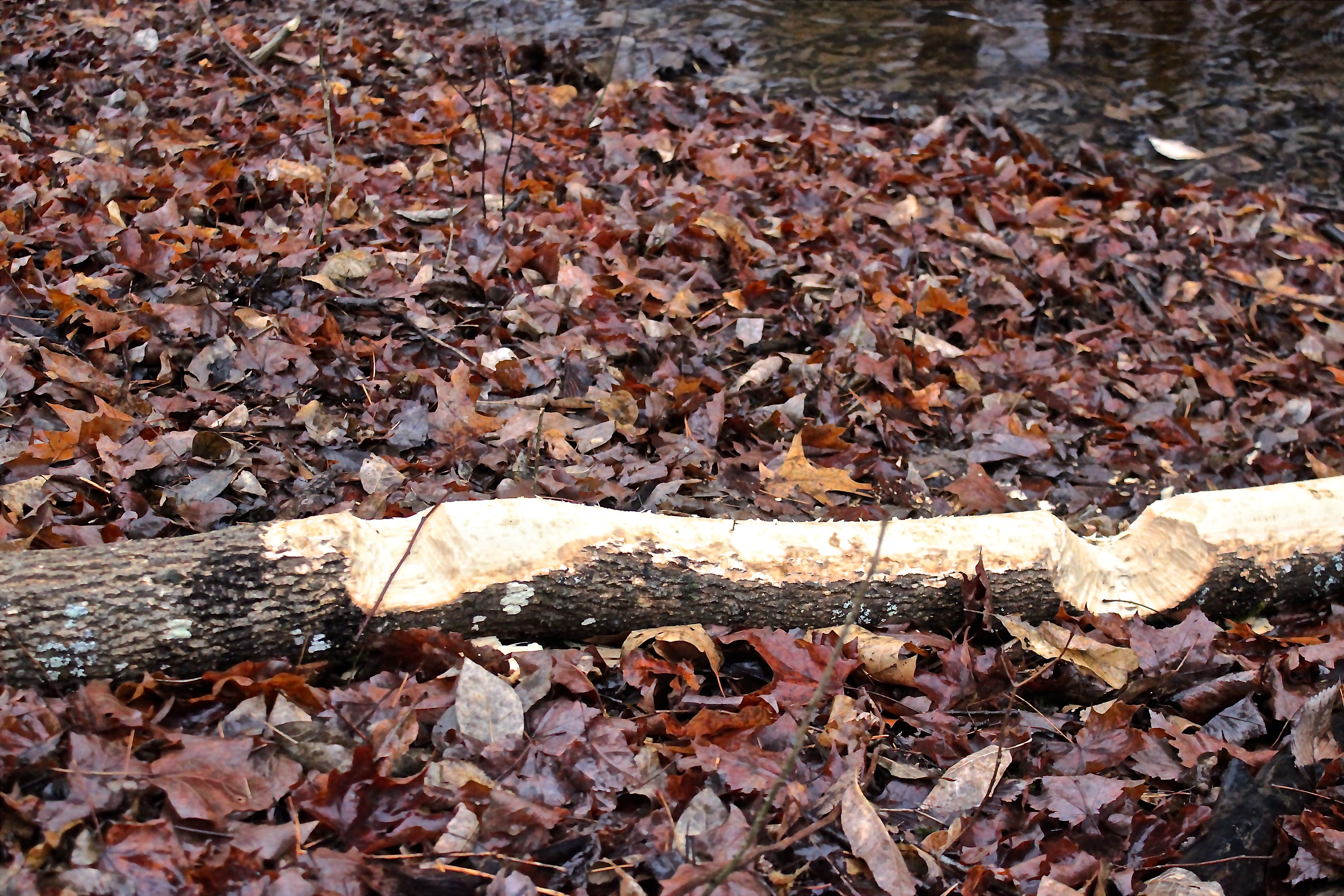
Occasionally, I saw individual logs on land or upon a muddy spot in the water. Again, the consistency of the gnawing was to be admired.

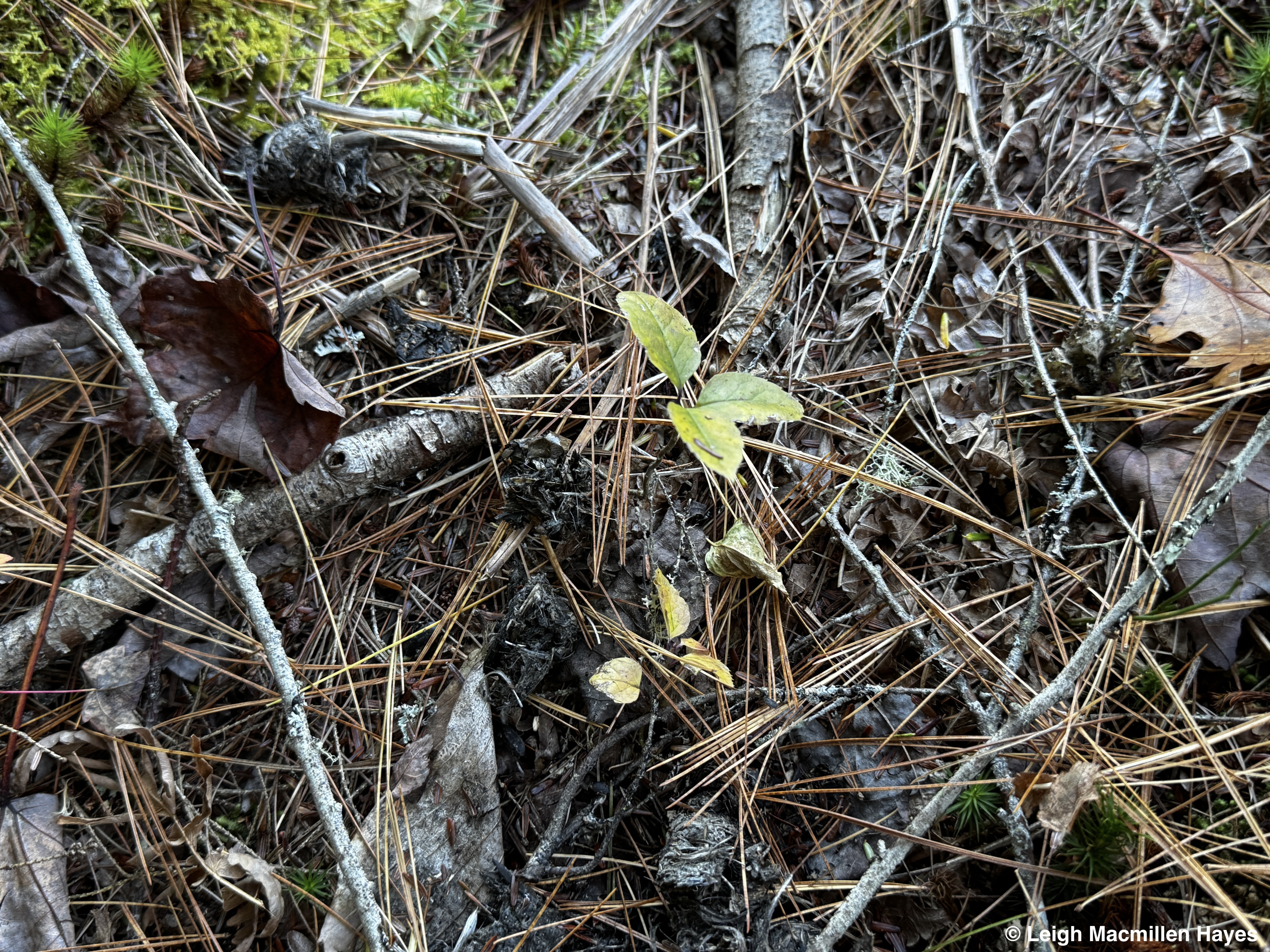
And where there are Beavers, there may also be Porcupines. At least, there was a couple of years ago when I spent some winter days tracking one to this cozy little den. Remnants of scat are all that remain and spiders have instead made a home in the hollow of this tree.

And then I spotted the most amazing feat of all. A widow maker dangling from a tree (that is if you are about eight inches tall), its bottom gnawed off and more gnawing about a foot and a half off the ground.

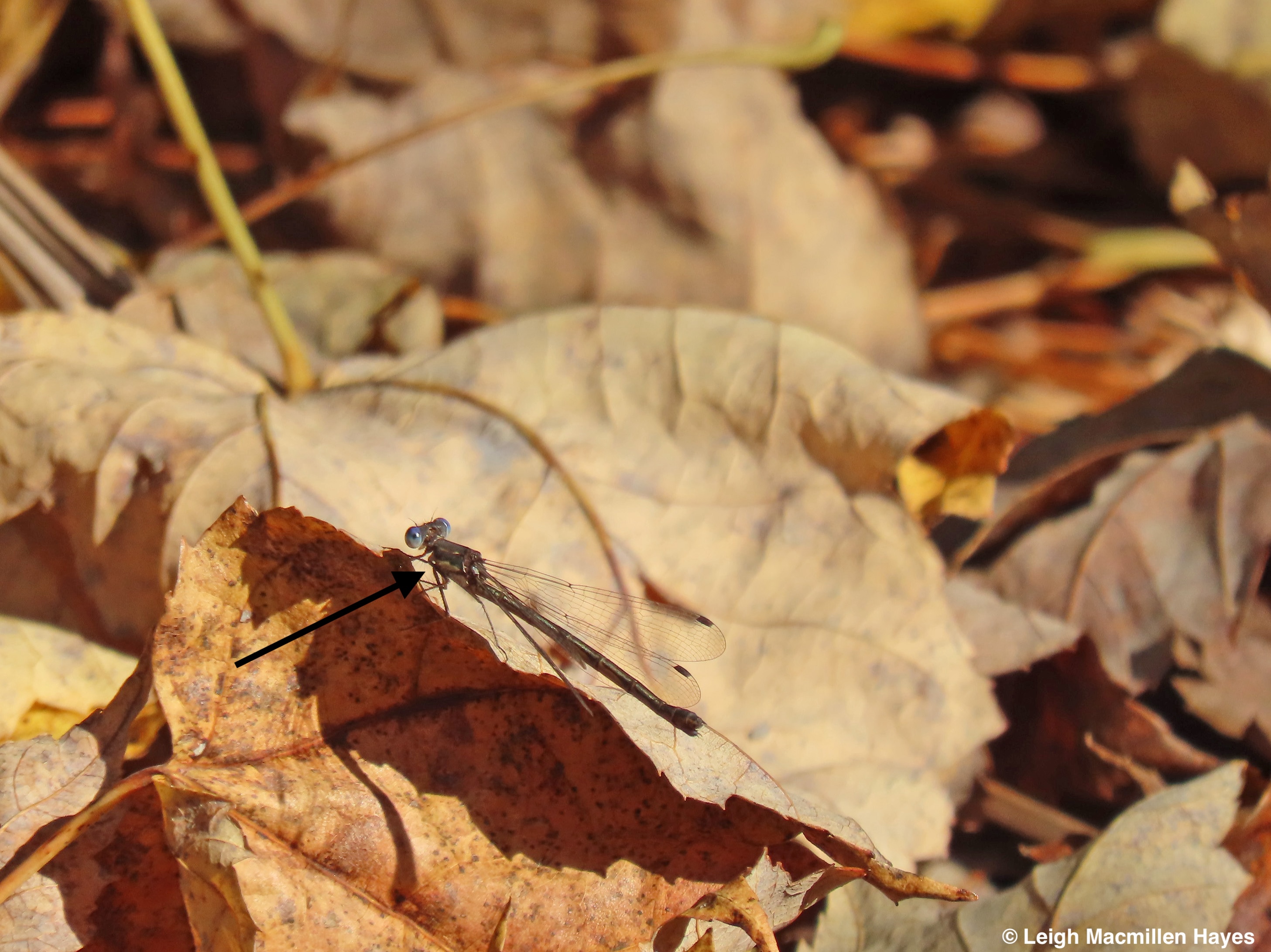
My search was interrupted again when a Spotted Spreadwing Damselfly entered the scene in a sunny spot. So named Spreadwing because unlike other damselflies that fold their wings over their backs when at rest, the Spreadwings, um, spread their wings. On the of left hand side it looked like this insect had four wings rather than two, but such was the sun’s angle in that spot and thus the shadows upon the leaves.

Identification was based on the lower side of the abdomen, where it is difficult to see, but there are two spots below the thorax stripes as compared to the Great Spreadwing with has two yellow stripes with brown between them, and no spots.

Autumn Meadowhawks were also on the fly and I kept seeing males with no ladies about.

A couple of hours later, one flew in, but though they danced in the air together as he chased her, they never did canoodle, in my presence anyway. And the last I saw of them, they headed to separate branches of a pine tree, perhaps to spend the night in rooms of their own.

The Beavers weren’t canoodling either, but they were certainly active given the rolls of mud and grasses and sedges and probably reeds I kept finding along the water’s edge.

And then I discovered the much sought after (at least by me) Beaver print. It’s a rare occasion to see a print, but sometimes I do in the snow. Their tails and the trees they haul swish away such evidence of their travels.

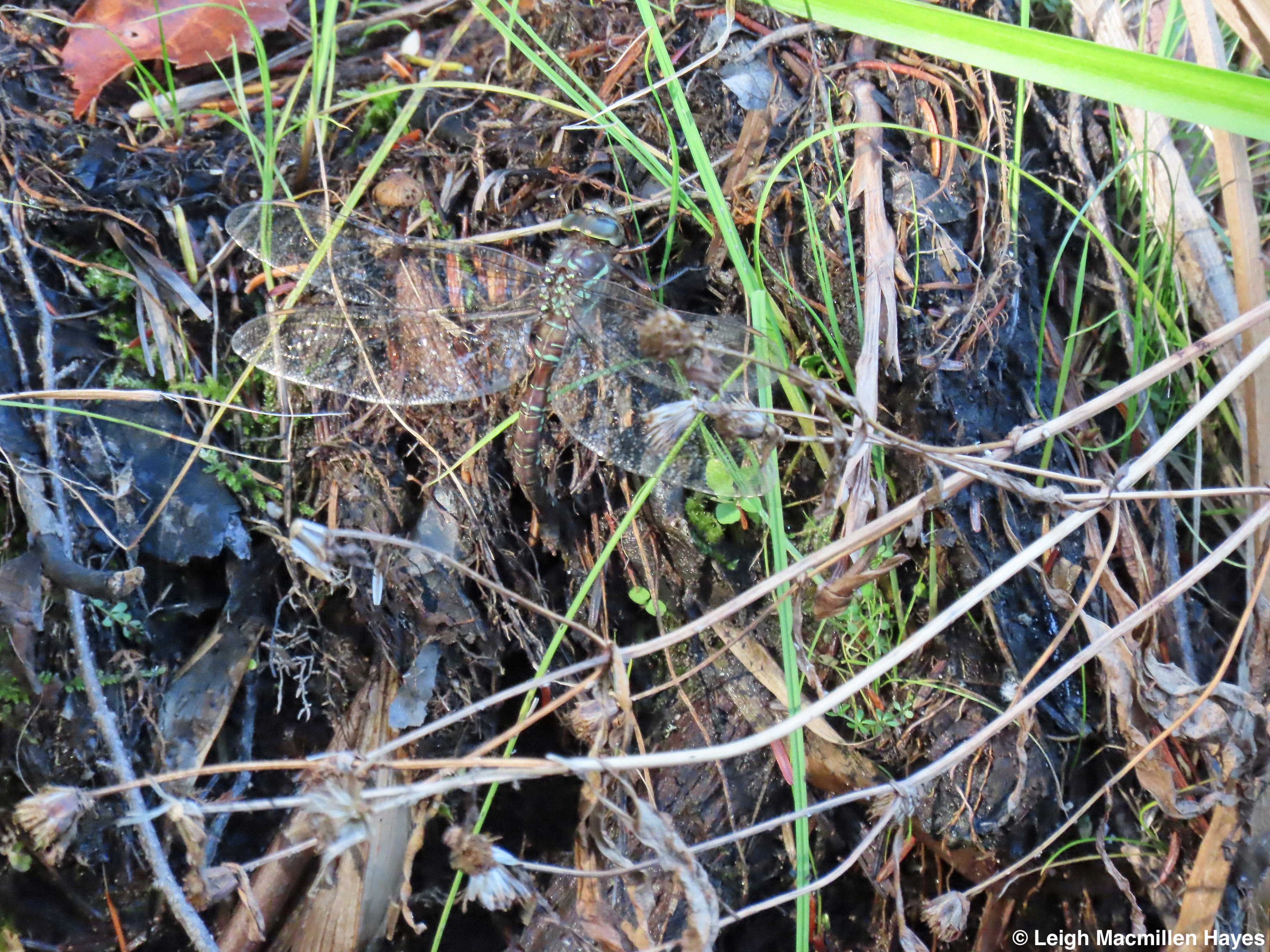
As I stood beside a Beaver path and downed trees just above where I spotted the print, another flying insect entered the scene. And I had the joy of watching her as she deposited individual eggs in vegetation.

With her ovipositor located under her abdomen, the female Swamp Darner punctures a hole in mud, and logs, and aquatic vegetation in which to lay her progeny. The cool thing is that her eggs can survive a year without water, incase the level is low as it is right now. I suspect by spring these will be quite wet.

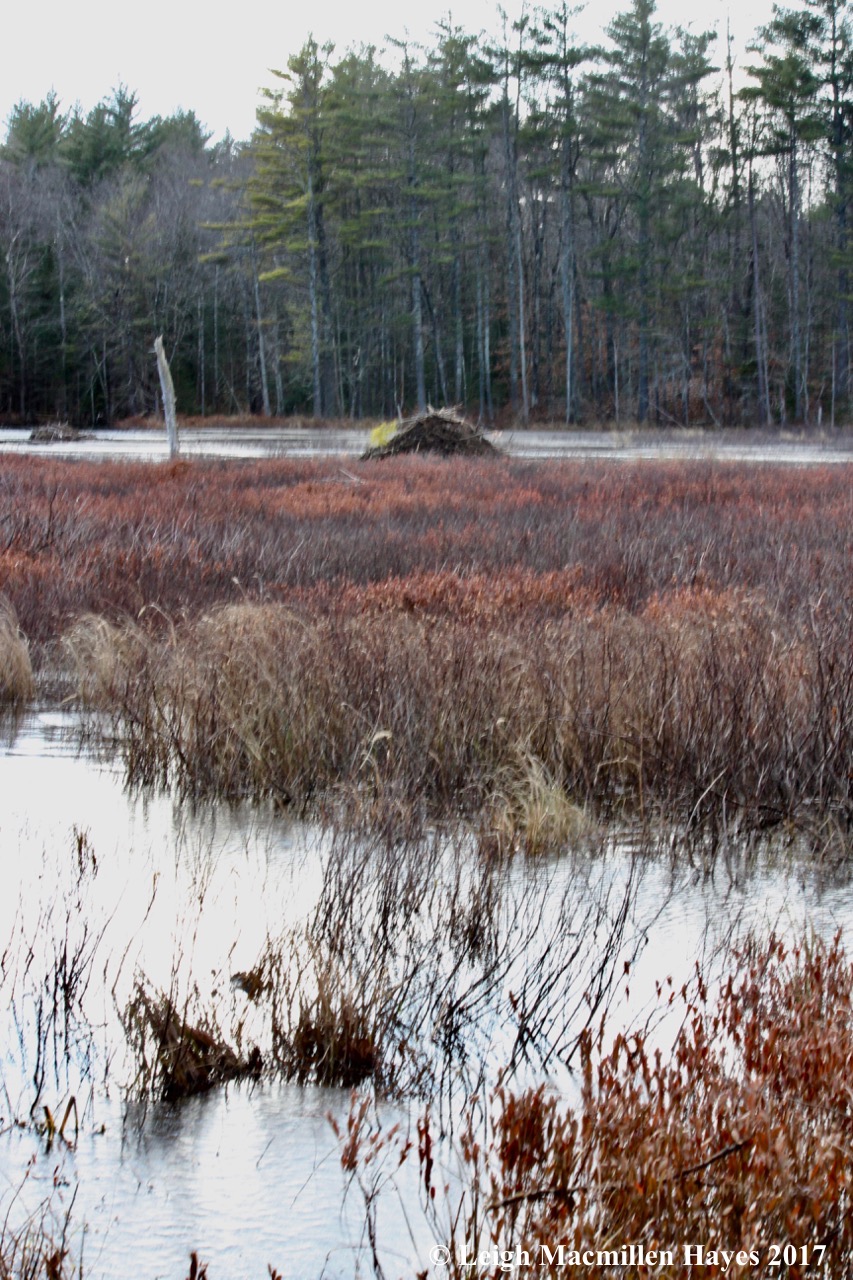
I never did find the Beaver(s) of my dreams, but spied another platform that may have been a lodge in the making. I hope they are still living there as the evidence leans in that direction.

At the end of the day, however, my heart was full with all my findings in both locations and I gave great thanks to the Beavers who led the way and all the discoveries I made as I searched for them.

Wednesday Wanders

Today’s wander begins at the end because it can in my book of life. And by the end, I think you’ll understand why I made that choice. But don’t scroll ahead cuze then you’ll ruin the surprise.

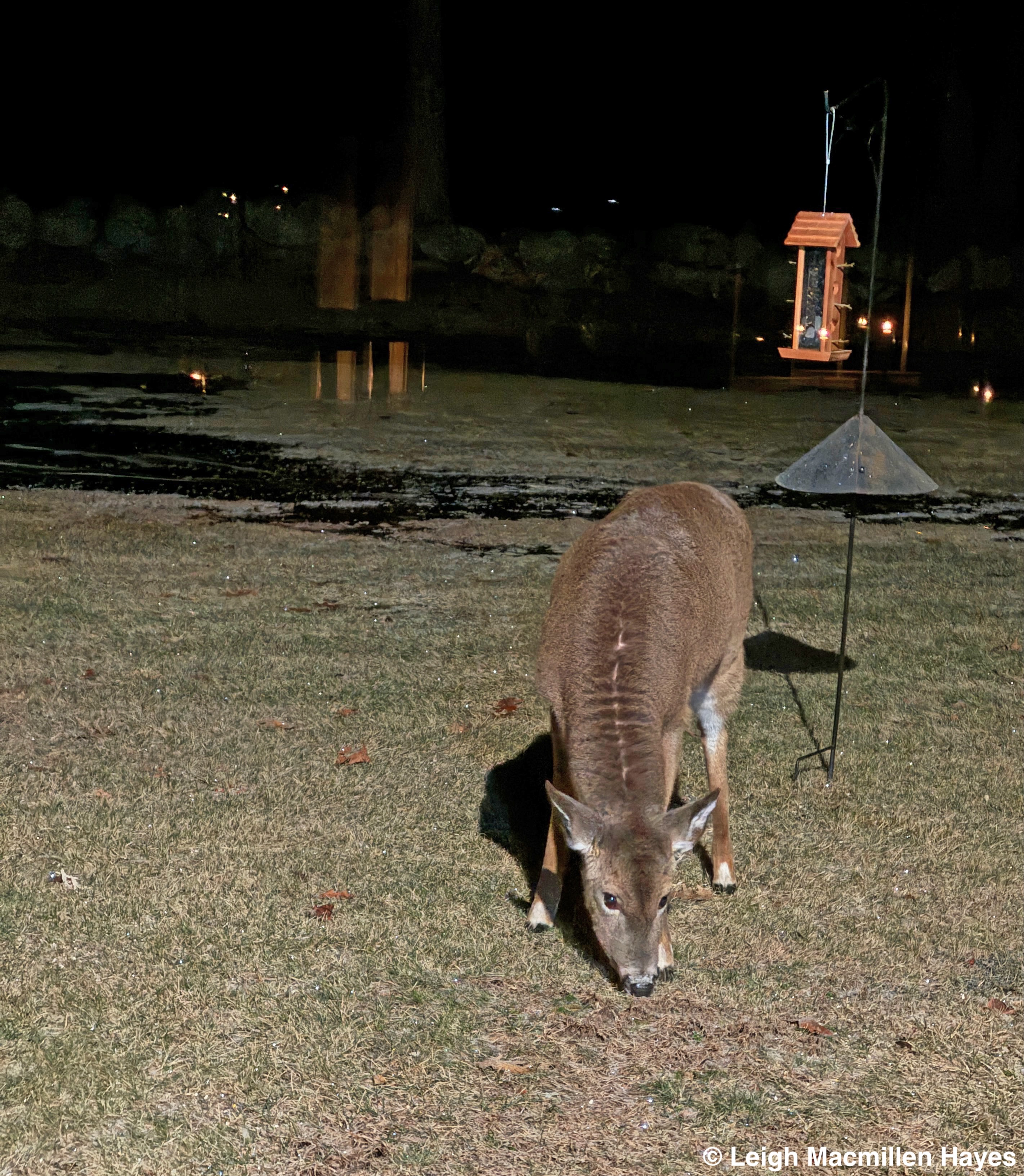
Our deer friends are feeding on bird seed and corn right now about ten feet from the back door. Meanwhile, the fairies are flittering about behind this doe. Do you see their twinkling wands at work?

Actually, all the lights are kitchen reflections on the door window.

This, of course, has nothing to do with the rest of the day, but I do love our deer friends and like to honor them when I can.

Now on to the nitty gritty of the rest of the story. My friend Dawn and I are Maine Master Naturalists as you may know. And because of that, we must volunteer time to teach others about the natural world. An unpaid job that is hardly a hardship because it’s so much fun.

Right now, we are in the midst of offering a program every other week for Loon Echo Land Trust in Bridgton. And the winter focus is tracking. Not easy to do without snow or mud. Wait a second. The animals are always on the move, and without the snow, we must look for signs. And so we did.

The first, a special offering left on top of a rock that Dawn actually noticed this past weekend when her son and daughter-in-law were visiting, and which she complety embarrassed him by taking photographs of it.

Out came my scat shovel today and everyone took a look. By its form, size, and location, we determined Red Fox.

Our real mission today, however, was to explore the territory of a Red Squirrel. No, this is not my friend Red, but another who has established a territory in a different space that’s also been blessed with an abundant amount of pine cones this year.

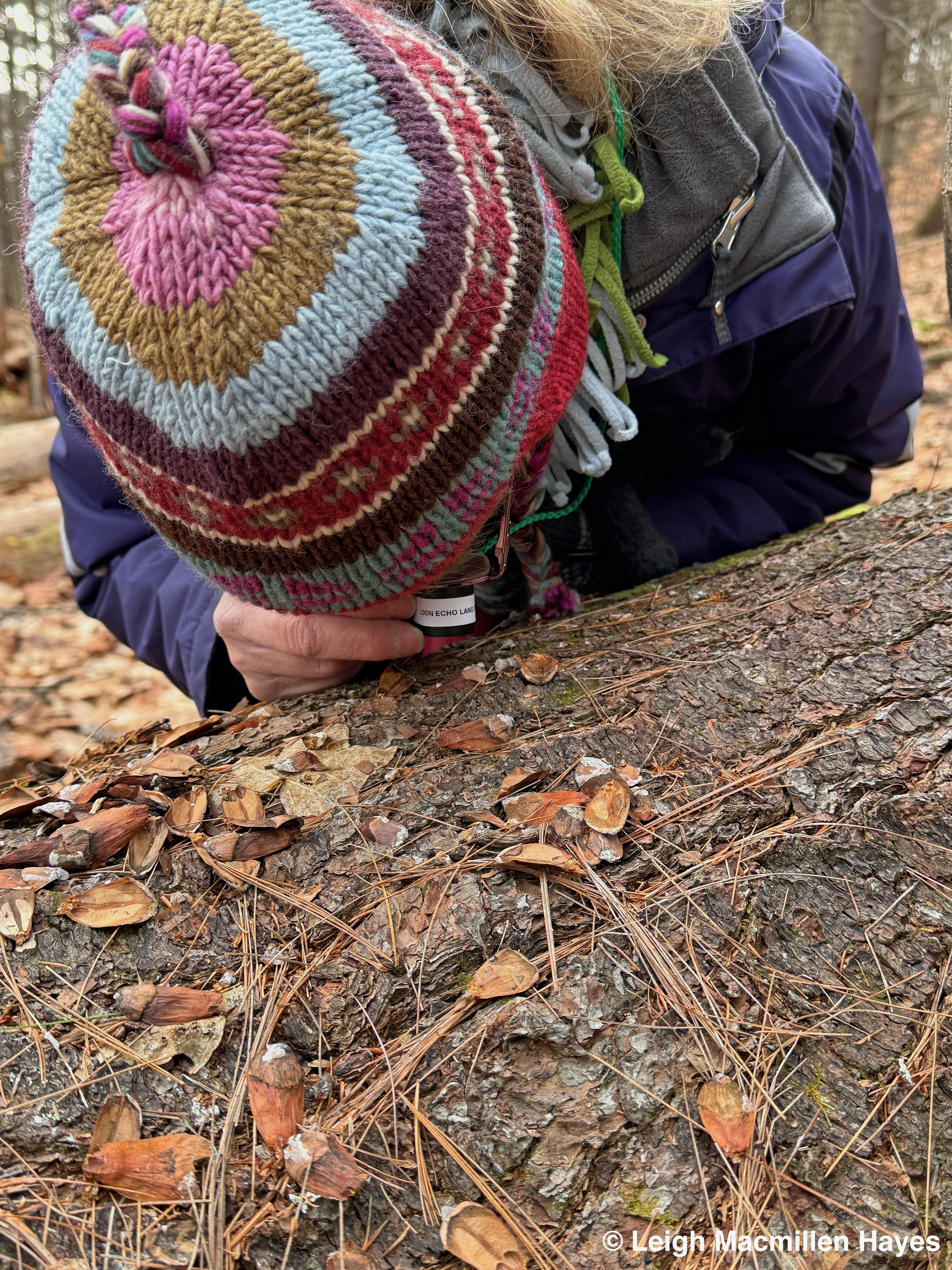
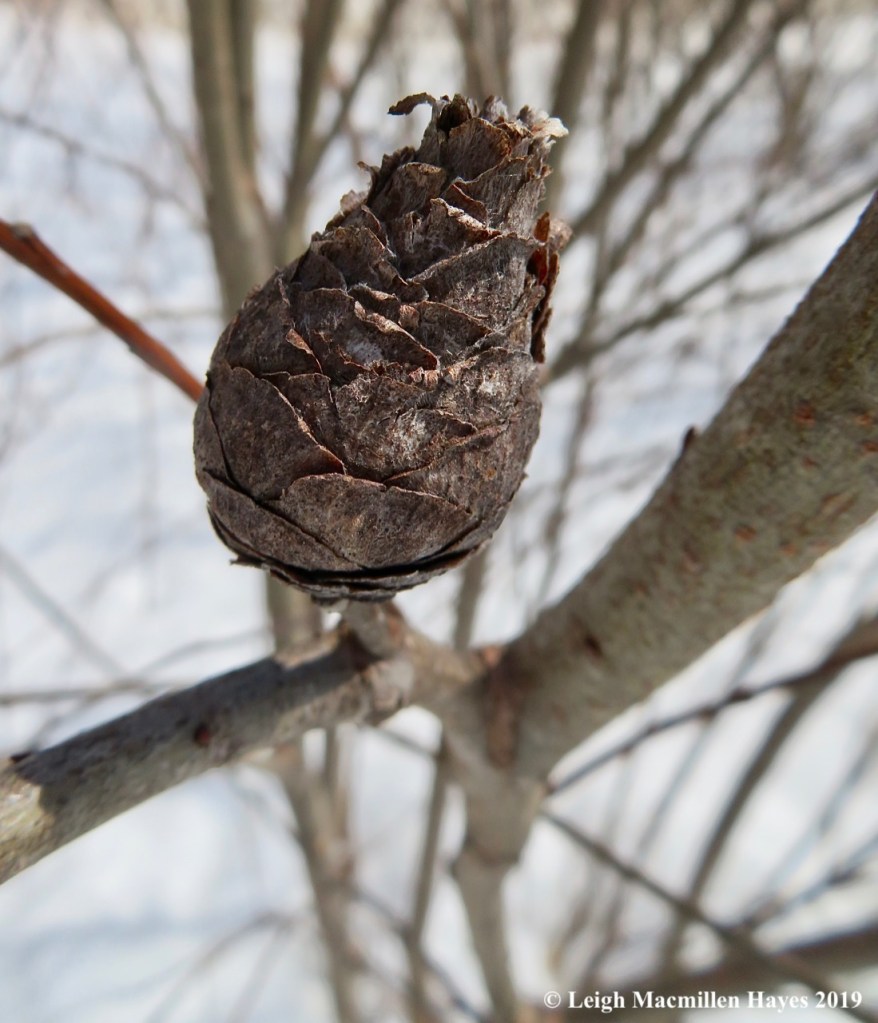
We wanted the partipants to take a close look at the scales where the seeds the squirrel sought had been stored. They got right into it.

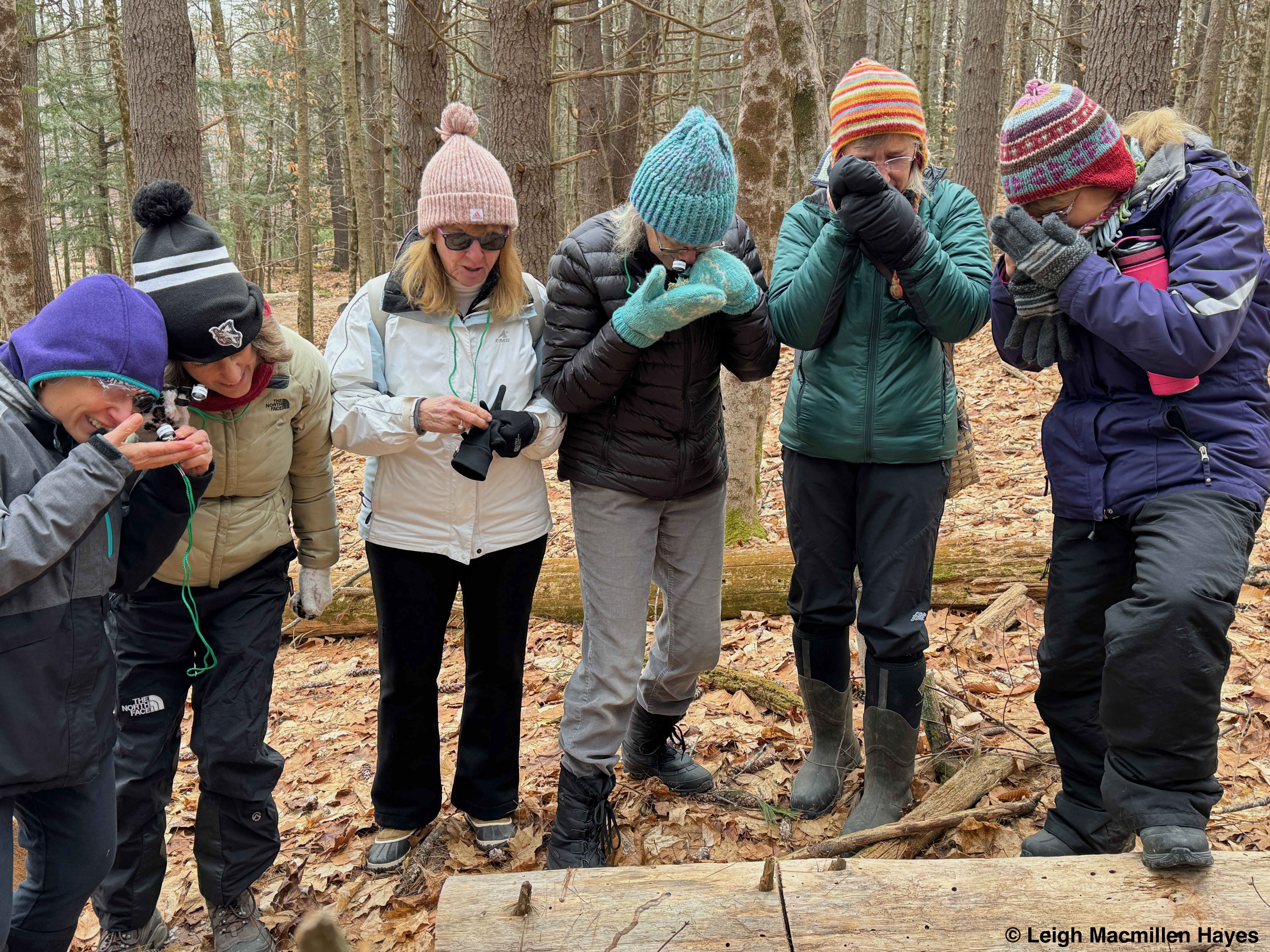
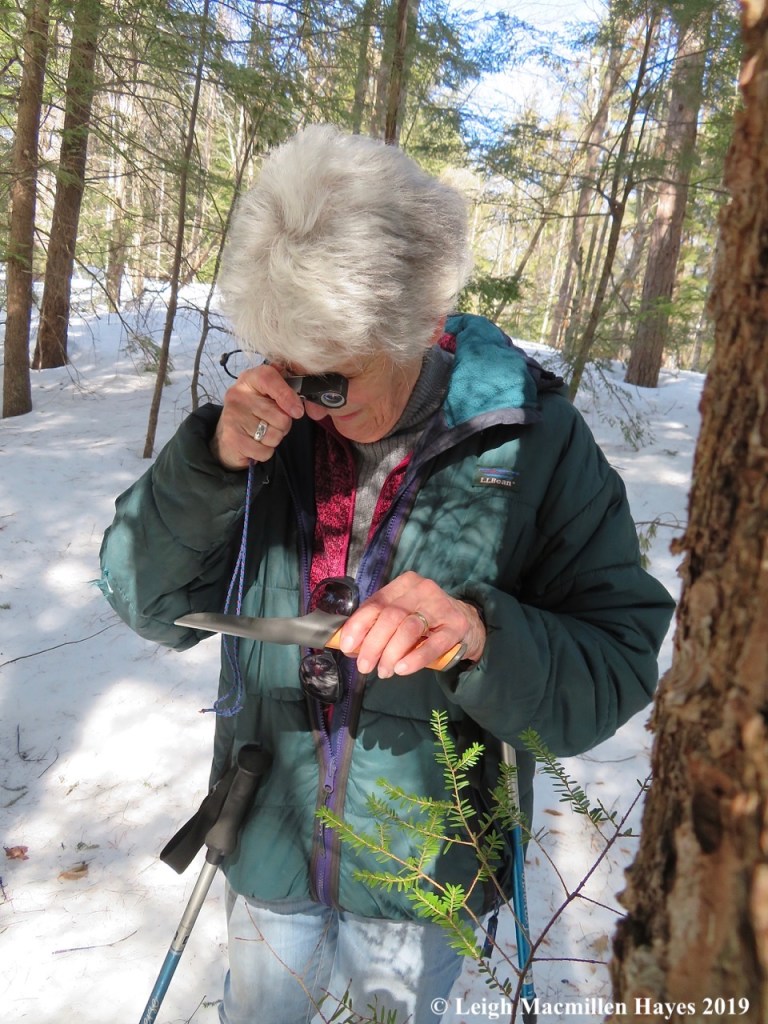
After locating caches and middens created by said squirrel, we taught the ladies how to use a loupe, aka hand lens, by holding it close to their noses and bringing the object closer until they could focus on it.

To say it opened up a whole new world is possibly an understatement.

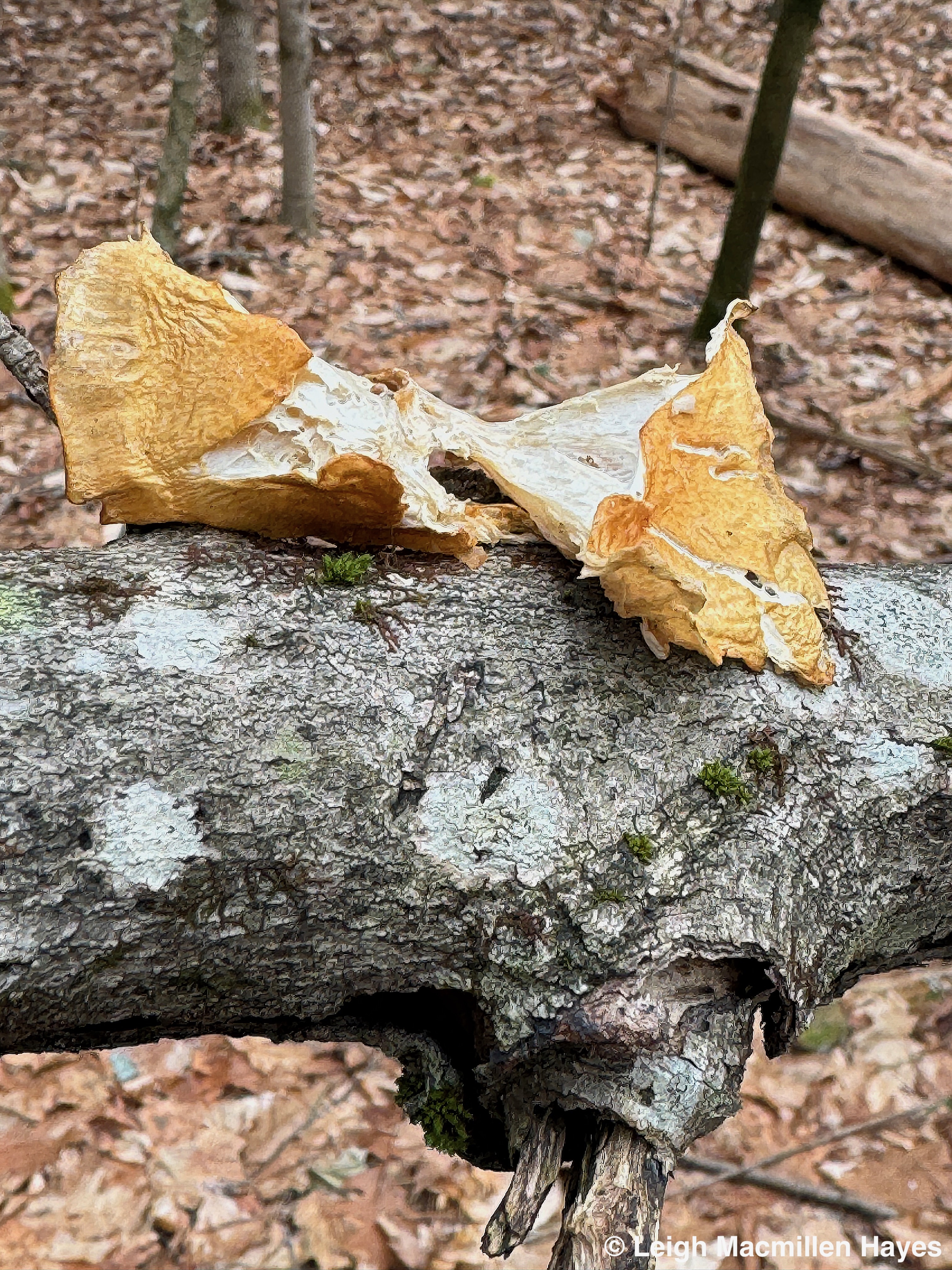
Discovering the tiny seeds the squirrel consumes would have been enough, but there was more. In one section of this squirrel’s habitat we found numerous mushrooms upon branches, placed there by the rodent to dry. Talk about being in a food pantry.

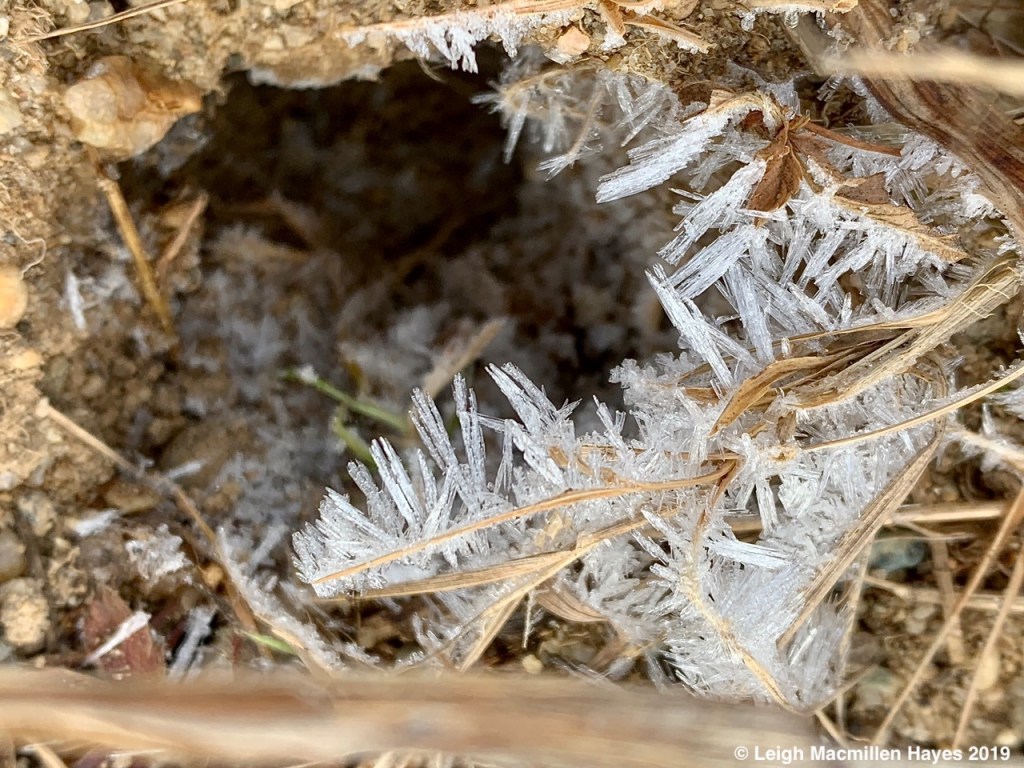
And then . . . and then . . . we spotted hoar frost between a couple of stacked logs . . . and surmised that our little friend was living in the space below. How cool is that? Wicked, in these parts of the woods.

What we learned is that this particular squirrel’s territory is located between two downed trees and a wetland, about the size of half a football field.

At the edge of the wetland, it was time to turn our attention from the squirrel to another rodent.

Yes, a Beaver. Once our eyes cued in, just like spotting the squirrel’s mushrooms, beaverworks made themselves known.

And so we encouraged partipants to channel their inner Beaver and try to chop down carrot trees.

Like any Beaver, they were eager to shout, “TIMBER.”

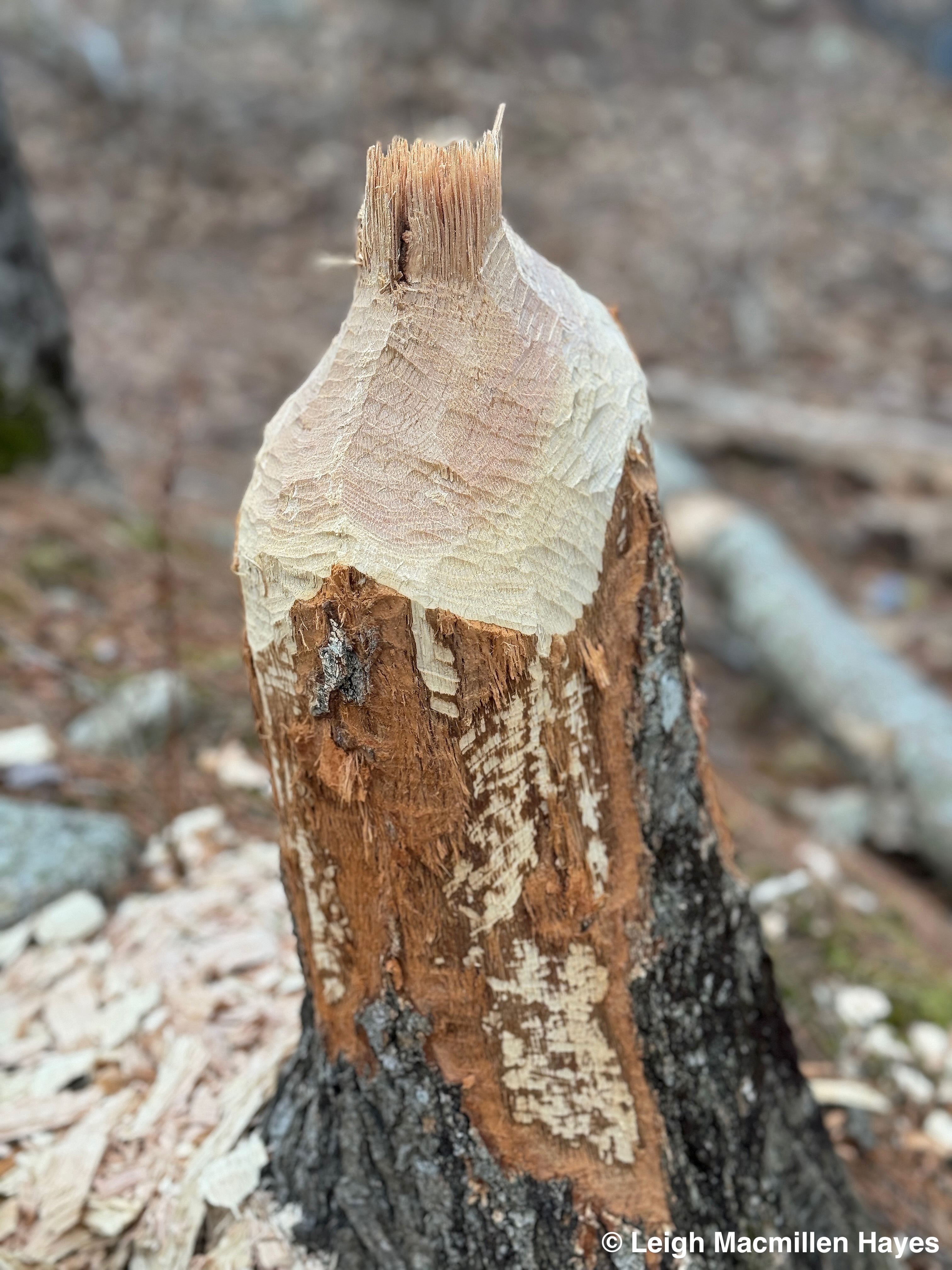
And rejoiced when their tree stumps matched the Beaver’s sculptures.

Finally, we took them along a path that led to more Beaver works, where we noted how its the cambium layer that this rodent seeks for its nutritional value. The rest is left behind, rather like a squirrel’s midden.

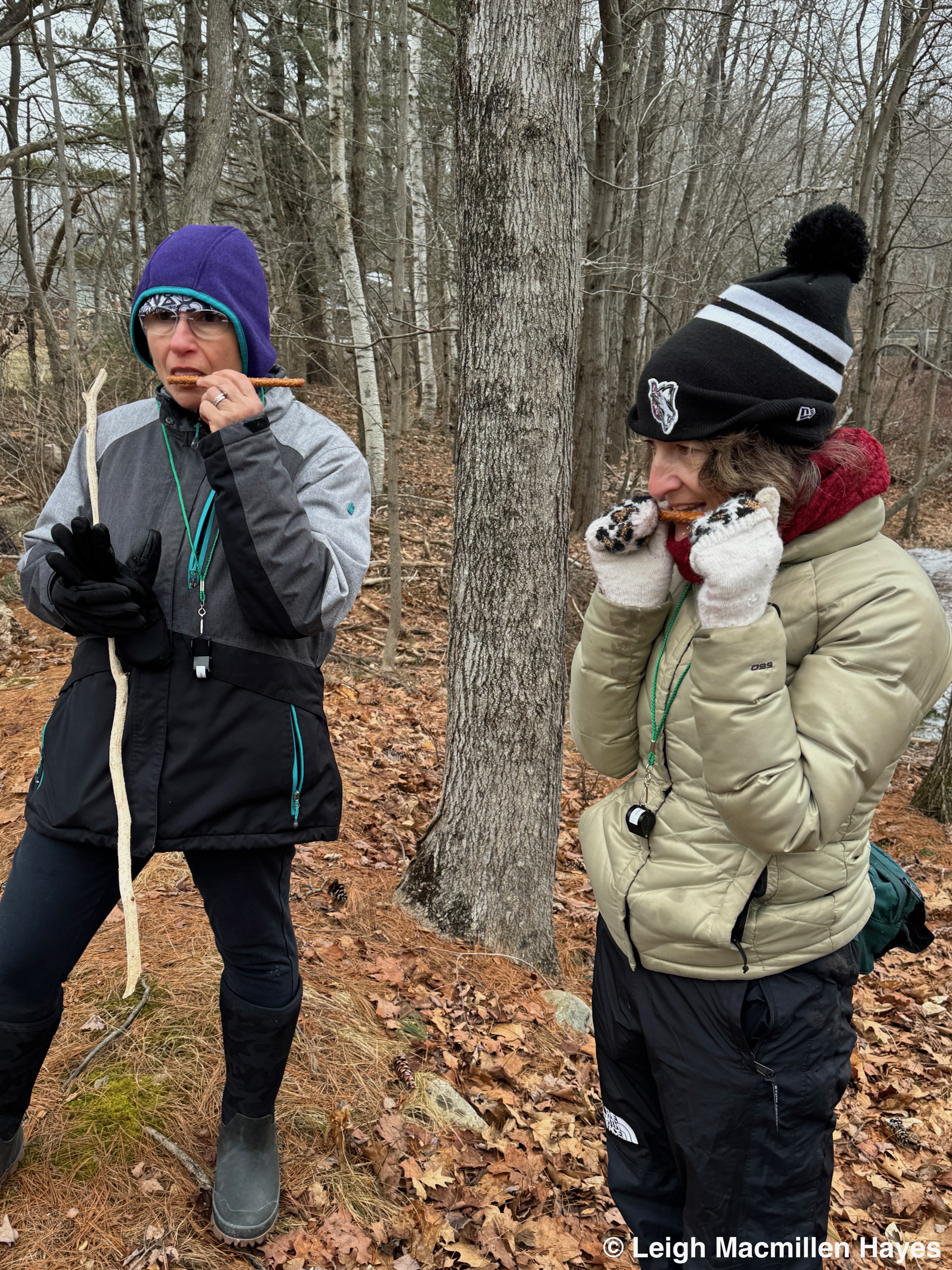
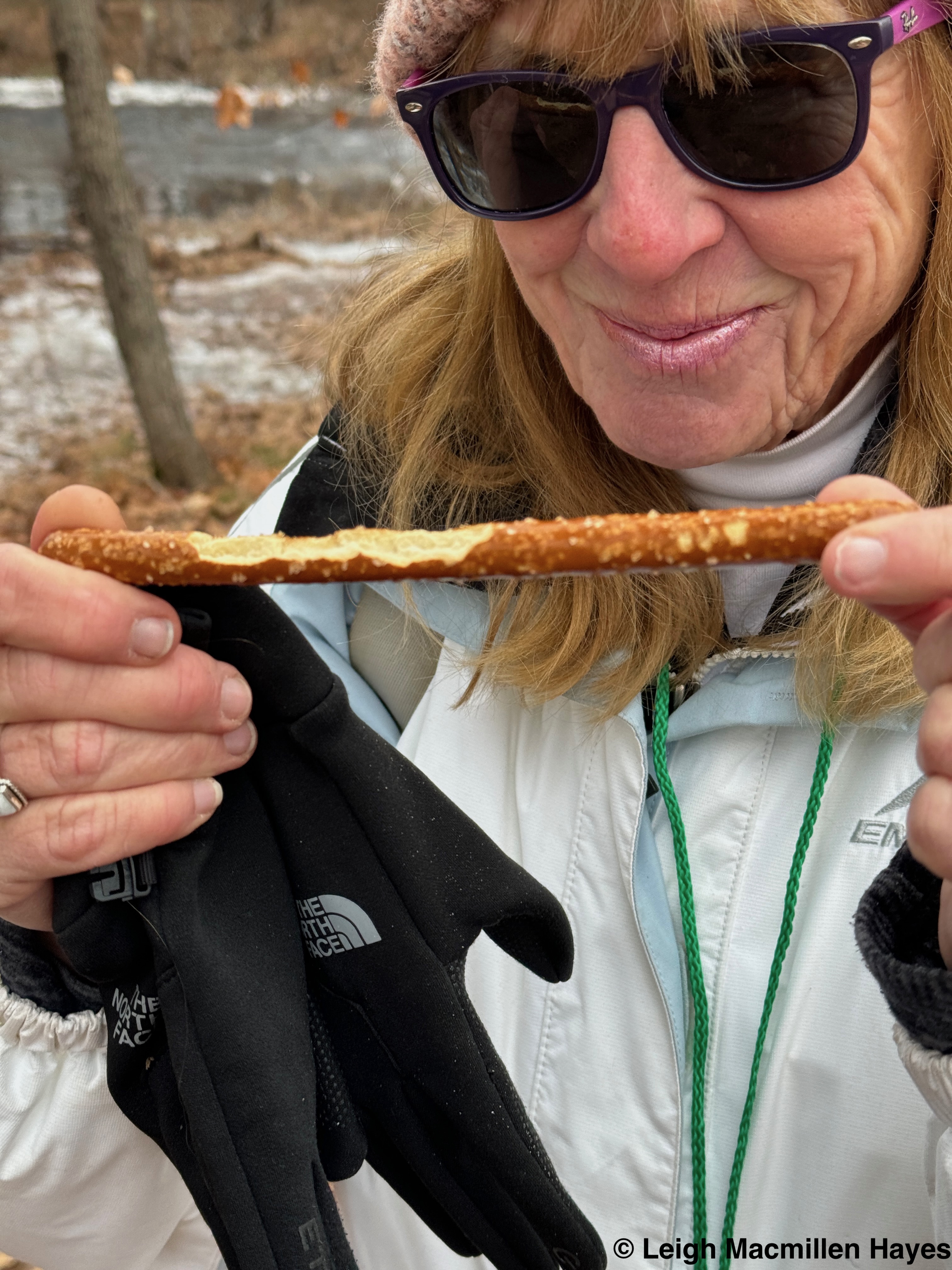
And so the inner Beaver channeling continued, this time with pretzel sticks and they were challenged to only remove the outer layer.

The competition was stiff, and a couple of Beavers broke their sticks so we’re not sure they’ll survive the winter.

But at least one was super successful.

While only one Beaver fells a tree, the family may help to break that downed tree into smaller pieces and there are at least three sections like this indicating that they’ve worked on it–maybe one at each spot. We don’t know for sure, but that’s the picture we like to imagine.

Below where we stood, we spotted the dam and talked about construction.

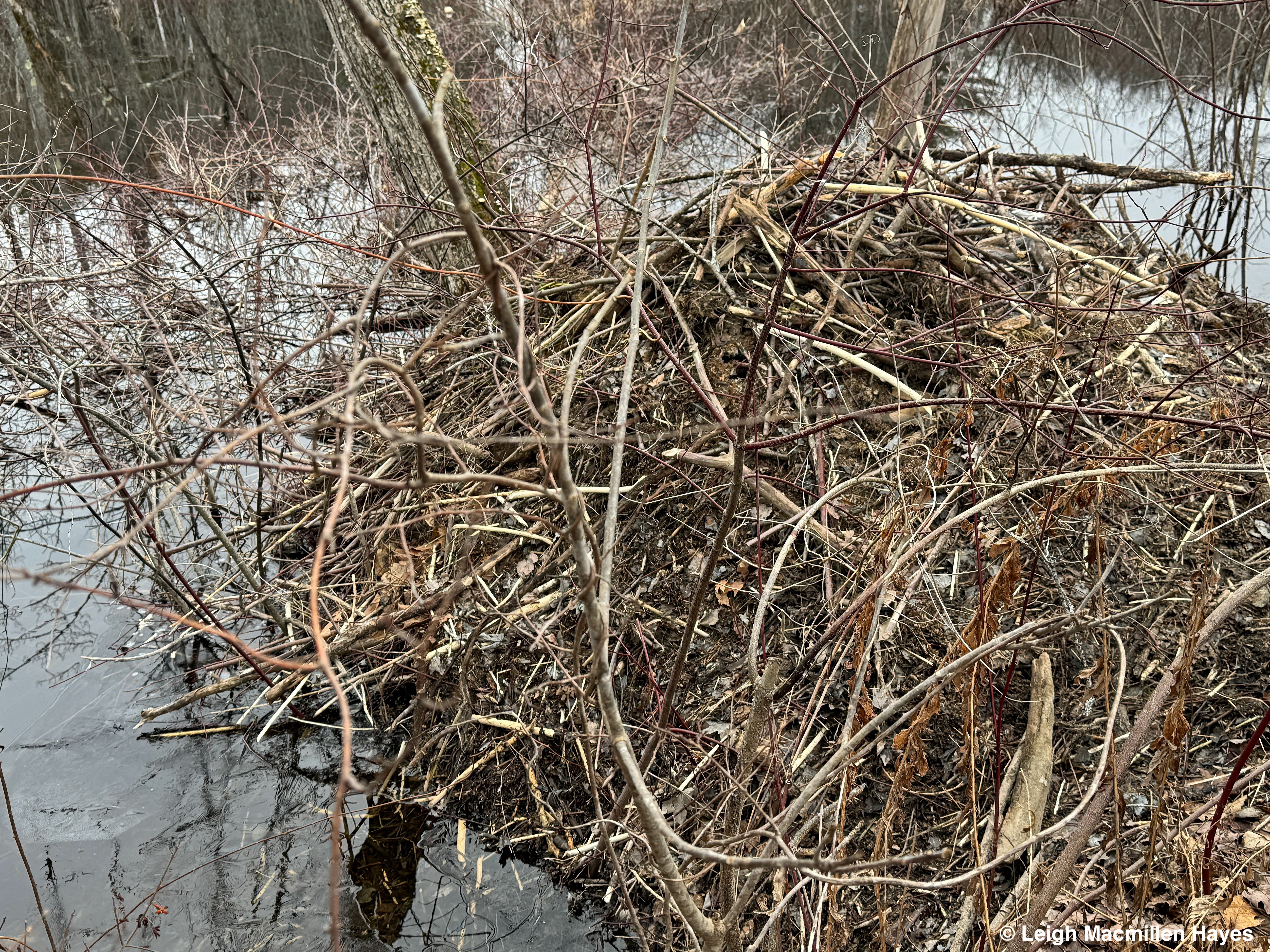
And then located the lodge. Another cool thing–more hoar frost at the top where a vent hole exists and is not covered with the mud that insulates the rest of the structure.

By evidence of the frost, we suspected the family was gathered within, probably consisting of mom and dad, at least two two-year-olds who will move on in the spring, and maybe a few youngsters.

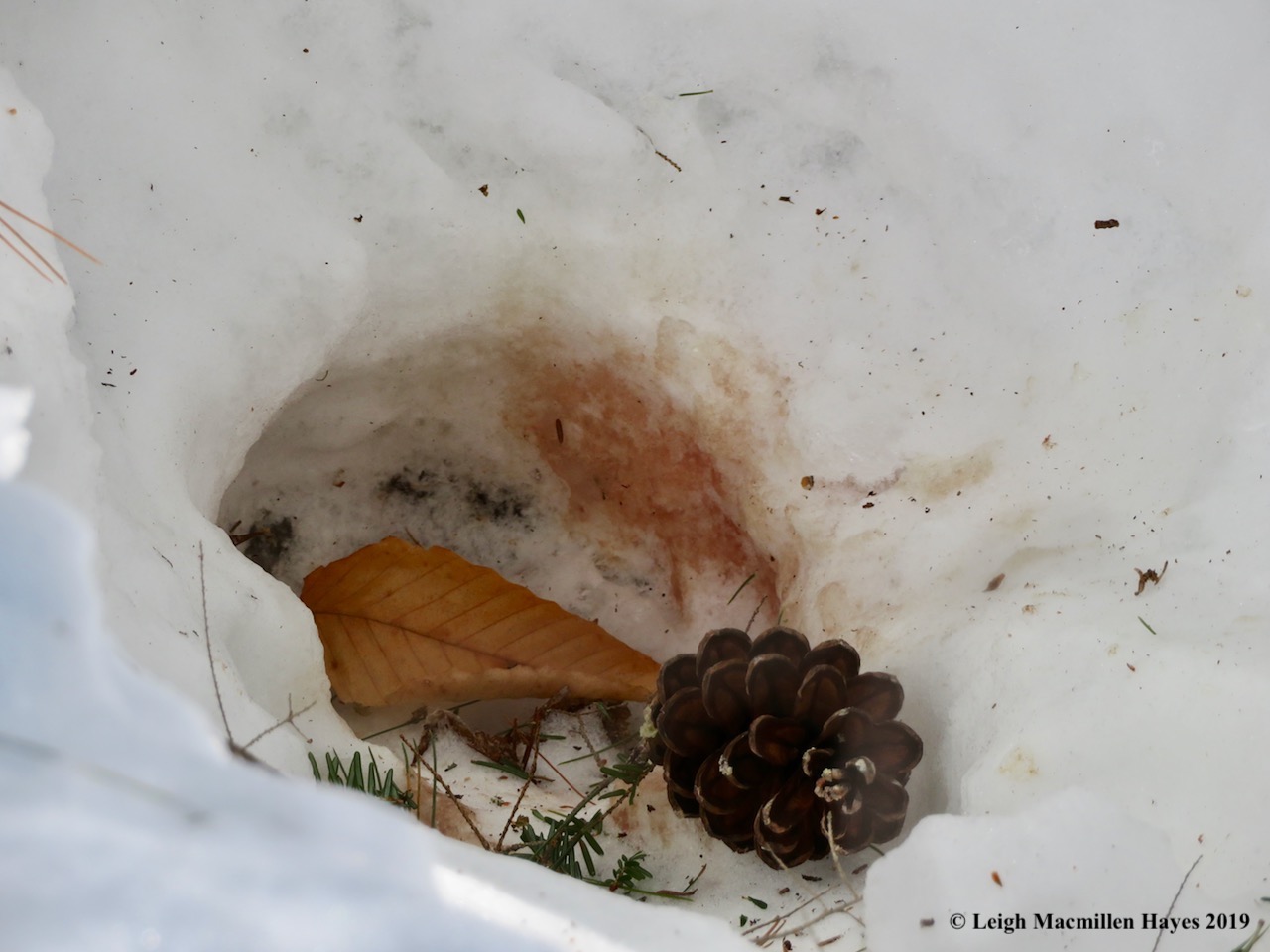
As we walked beside a trail on our way to check out another lodge we determined wasn’t active, one among us discovered a kill site. So here’s the thing. When we first met in the parking lot, that same participant pointed to a Bald Eagle that flew just above the trees.

Could the eagle be the predator of what had been a duck? We suspected so.

The blood was fresh.

Nearby a Mallard had been quaking and we thought it was laughing at us and our enthusiasm and inquisitiveness. But perhaps it was lamenting the loss of a mate. Or at least trying to locate the mate that had become a meal–providing energy for another to carry on.

Yes, it’s sad. But this is nature. This is how it works.

After two delightful hours of discovery and learning, we said goodbye to everyone, dropped in at Loon Echo Land Trust’s office, and then went on a reconnaissance mission at another local spot, trying to determine if we should use it for a class we’ll teach for Lake Region Lifelong Learning, another volunteer venture.

And it was there, that just after we’d talked about being in hare territory and knowing that the lack of snow meant that a hare would stand out amongst the leaves, that . . . Dawn spotted a Snowshoe Hare.

We were so excited about how the morning had unfolded and spying the hare was a grand reward.

Can you track mammals without any snow. YES!

Wednesday Wanders, oh my! So much to learn. So much to share.

The Beaver’s Tale

Once upon a time . . . no wait. This isn’t a fairy tale.

Rather, it’s about changes in the landscape that one might observe, such as a brook suddenly overspilling its banks as was the case in this location upon a December visit. We’d had rain, but that much?

It wasn’t long before a friend and I spotted the reason for the high water. Some new residents had moved into the area and built a lodge of sticks. Unlike the story of the three little pigs, one of whom built a house of sticks that the big bad wolf came in and blew down, the makers of this structure took special care to make it solid and strong and weatherproof. Yes, a beaver or two or six had taken up residence with the intention of spending the winter. Beaver families usually consist of a monogamous couple, plus their two-year-old (almost adult) kids, and yearlings. Mating occurs in the water during the winter and kits are born inside the lodge in the spring.

In order to move into the lodge, a dam needed to be constructed as well. If you look closely, you’ll see that above it there was a bit of an infinity pool with the ice at level with the dam, while below it some water flowed at a much lower level. Though we couldn’t walk along the ice to measure the length of the dam, it was quite long. and made of sticks and leaves and mud. Typically, the family works on this project by creating a ridge of mud and probably the herbaceous plants of the meadow, and then they use the mud and sticks to stabilize it. Maintenance is a constant as water or other critters or humans have a way of breaching the dam.

We, too, build dams to serve similar purposes, such as this one originally constructed to operate a saw mill. Hmmm.

Getting back to the lodge: it also needs nightly work as long as conditions allow and this has been a winter of despair for those of us who love cold temperatures and snow and even ice if it’s in the right place, like on a pond or lake and not in the driveway.

Take a look at how the beaver is holding the small twig.

A beaver’s dental formula is this: 2 incisors on top, 2 incisors on bottom, 0 canines on top, 0 canines on bottom, 2 premolars on top, 2 premolars on bottom (that look like molars), 6 molars on top and 6 molars on bottom, for a total of 20 teeth. Recently, I was able to sketch the upper part of the skull of an older family member, who’d lost some of its molars.

These large, semi-aquatic rodents are gnawers like their relatives. To that end, their incisors are highly specialized for chewing through really, really tough things and they grow continually throughout the critter’s life.

And like all rodents, the front surface of their incisors is coated in enamel reinforced with iron (hence the orange color), which makes it resistant to wear and tear from gnawing. When the chisel-like teeth chew and fell trees, the much softer white dentine layer (the section behind the enamel) is ground down quicker than the enamel, thus creating a sharp chisel surface.

But to me the coolest aspect is that their lips close behind the incisors, thus permitting them to gnaw and carry sticks underwater without choking.

And bingo, you can see the stick being carried in that gap between the incisors and molars. Food sticks become lodge or dam sticks once their nutritional value has been consumed: a true plan of repurposing.

As it turns out, that wasn’t the only beaver family at work in town. This next family, however, chose to park their tree in a spot the fire department lay claim to for filling a water tank. But . . . reading is not on a beaver’s talent list.

In this other place, so many trees have been felled, but not all have fallen as intended, getting hung up on other trees instead. Not wanting to anthropomorphize, but I have to wonder what expletives flash through a beaver’s brain when trees don’t hit the ground as planned.

As strict herbivores, a beaver’s diet varies with changes in the season. During spring and summer, they are drawn to waterlilies, algae, grasses, sedges, herbs, ferns, shrub leaves and shoots. By late summer, however, tree cutting begins as they gradually change their dietary habits from herbaceous to woody materials. Twigs, roots, bark and especially inner bark become the source of nutrition. Aspen, birch, alder, and willow are favored species, but beavers will cut almost anything including conifers.

Imagine this. A beaver cocks its head to the side as it gnaws, thus the consistent angle of the half inch groove as the upper and lower incisors come together.

Likewise, porcupines gnaw, but their incisors are much narrower and the pattern more random.

So, the question remains. Where were the parking lot beavers living? In the past, a family has inhabited the northern most reaches of this pond, but in this case, they had built a lodge on a point not far from the southern end.

The top of the lodge is the only section not covered with mud, for it serves as a “smoke stack” of sorts, a place for beaver breath to escape. Visit a lodge on a cold winter day and you might observe the vapors rising.

And then it was on to another locale, where beavers have inhabited the same lodge for a number of years. When beavers choose to live in a pond or lake or sometimes even a river, there’s no need to build a dam for the water is usually deep enough for their underwater movement.

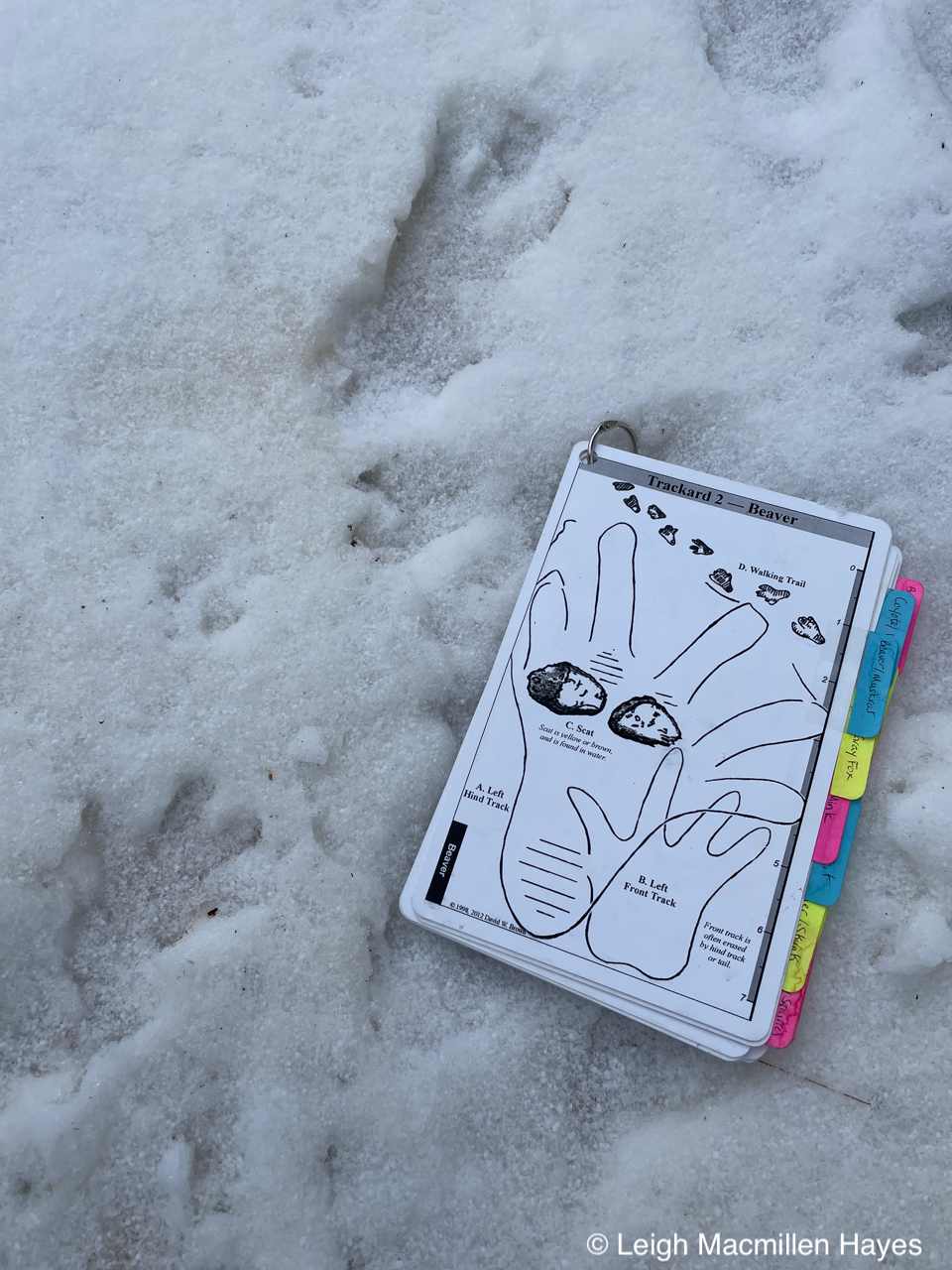
I often tell people that beaver prints are a rare find because they are either wiped over by the tail or by trees being hauled to the water. Once in a while, however, I’m proven wrong and the sleety snow on a recent day awarded just the right conditions for the webbed feet to be observed.

Tree work and broken ice added to the story of the critters’ journey to and fro the pond. While quite adept at time spent in the water, they are rather clumsy on land and most of their work is within a hundred feet of the edge.

Winter food is cached close by the lodge entrance so that they can swim under the ice to retrieve a stick. A beaver’s ears and nose have a valve that closes when it is submerged and they can stay underwater for up to fifteen minutes. Back at the lodge, there is a raised chamber surrounded by a moat that leads to the entrance tunnel. It’s upon the raised area that they dine, and groom, and even give birth.

At this particular pond, My Guy and I noted two lodges connected by an open channel between. Given the number of tail slaps that announced our presence near both lodges, we thought perhaps both were active and inhabited by the same family.

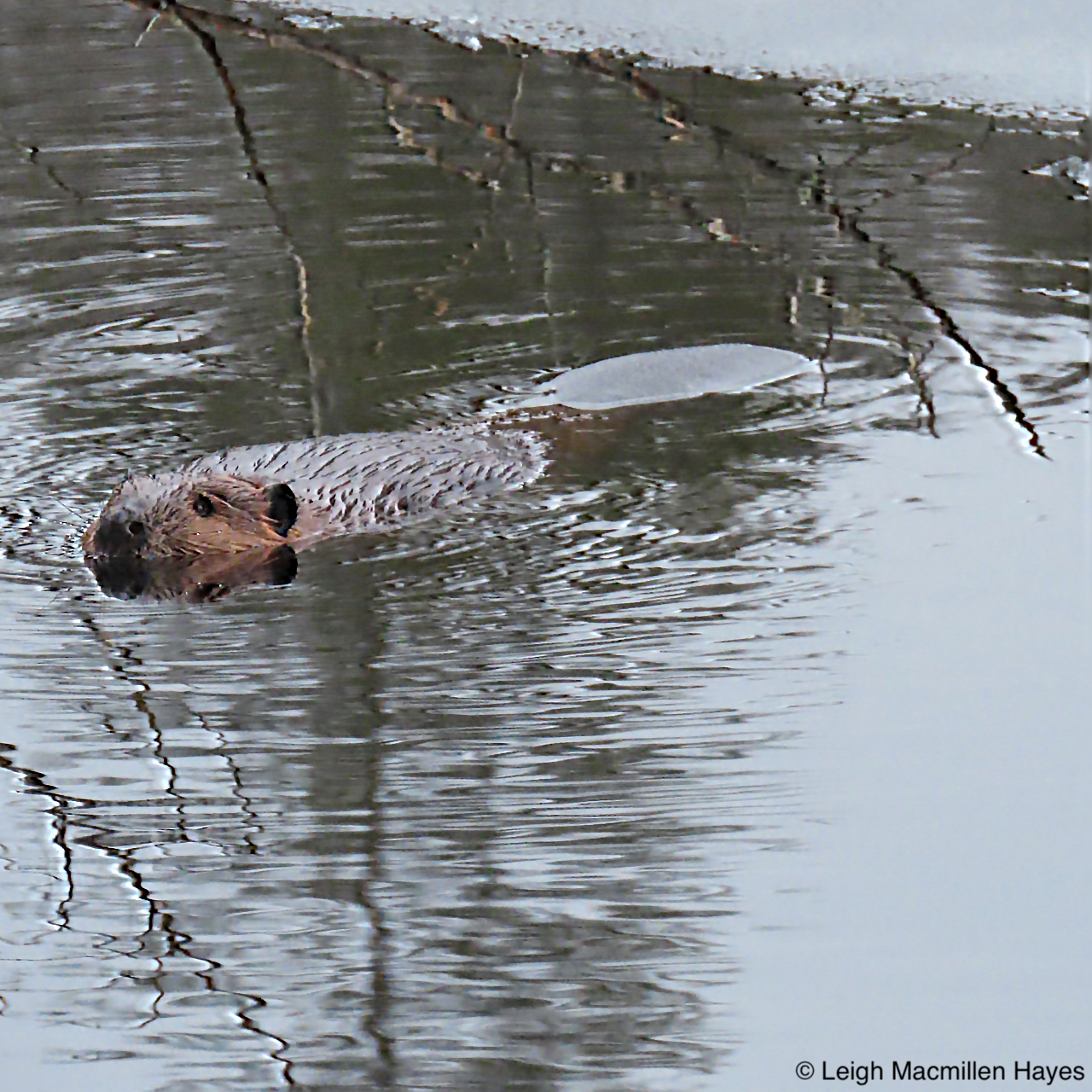
And then, and then . . . finally, we spotted a beaver that spotted us. We kept expecting it to slap the water with its tail in a manner of warning so other family members would seek deeper water or cover. Instead, it swam past us.

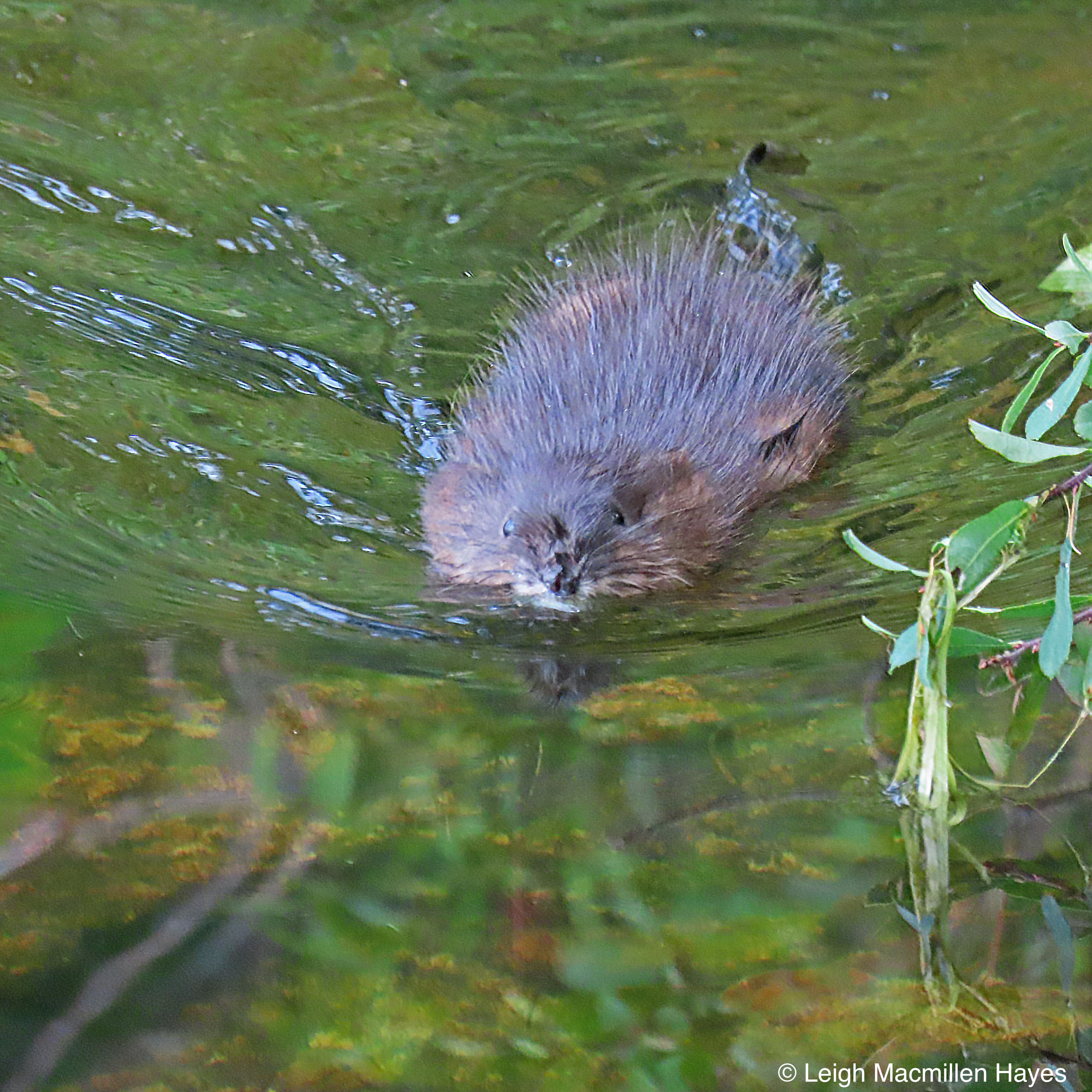
The thing is that a rodent relative, namely the muskrat, exhibits many similarities, but also differences, including a skinny, snake-like tail.

The beaver’s tail is a source of wonder. While its furry body consists of long, shiny guard hairs covering dense and softer hair that traps air and helps protect the critter from the cold, the tail is broad and flat and scaly. It’s used for a variety of reasons including stability when standing upright on land (think tripod), as a rudder for propulsion in water, as fat storage and thermal regulation, and how we are most familiar, as a warning device.

A beaver’s tale indeed.

Worth the Wait Mondate

It took us a while to get out the door today, but perhaps that was because we knew we weren’t traveling far and we’d have plenty of daylight in which to explore.

Today’s destination: Sebago Lake State Park, a locale whose existence we take for granted and seldom make time to actually visit. But when we do . . . ah. We hiked over five miles today, with a few false starts, but never really getting lost.

It was a blustery but beautiful day and conditions switched from snow to ice to puddles to ice under water to bare ground. And somehow, at exactly noon we reached the summit of the Lookout Trail, where a picnic table painted brown from my guy’s hardware store awaited. Looks like maintenance will need to return to the store for some touchups this spring.

After lunch, we found our way down to the water, which in this neck of the woods looks like the ocean. That said, the Atlantic Ocean is only about thirty minutes away. Sebago Lake State Park, at 1,400 acres, opened in 1938. The lake itself, at 45-square miles, is Maine’s second largest. It’s a place with diverse natural communities, which makes it a jewel.

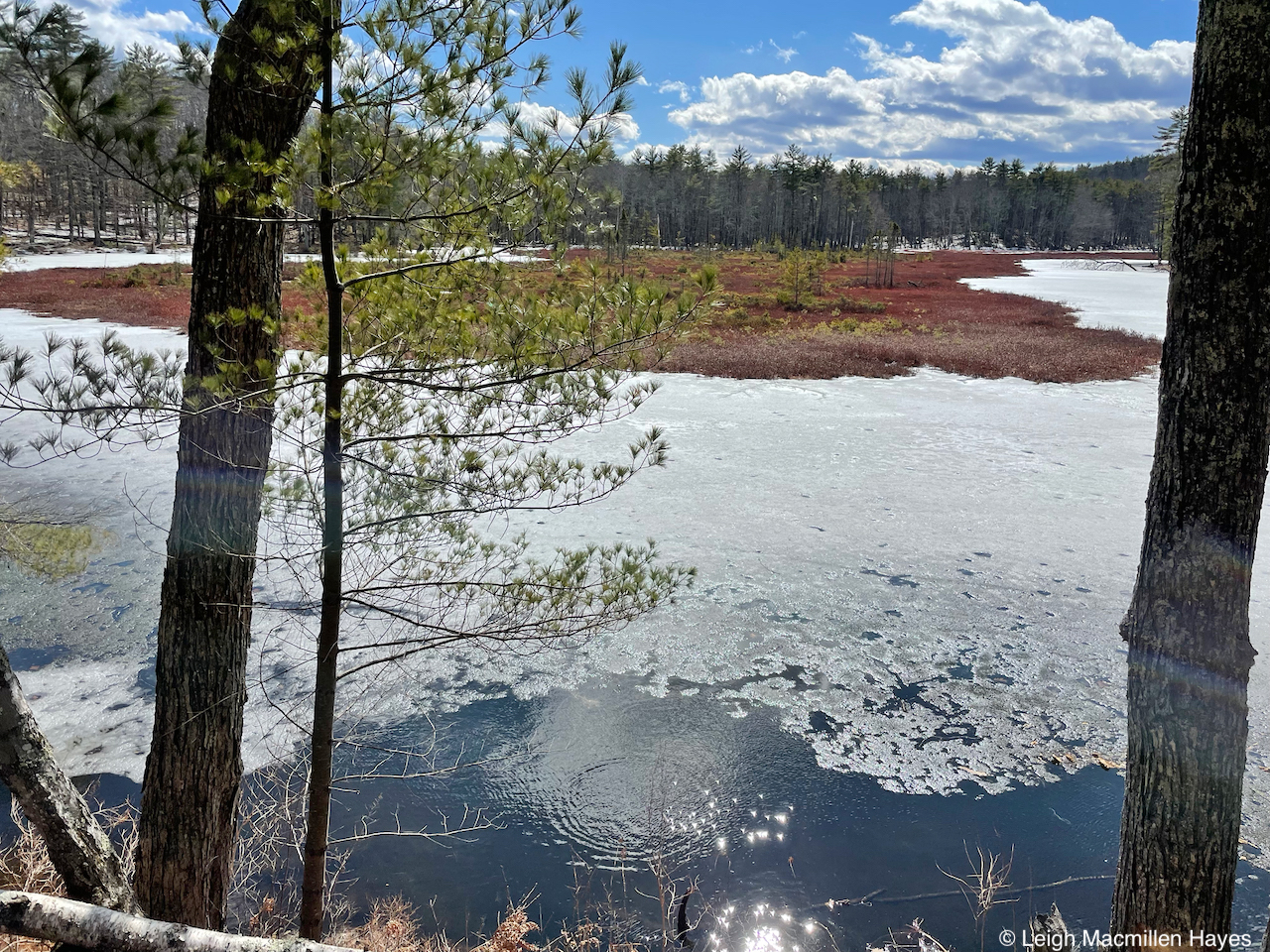
All of that is fine and well, but my favorite habitat of all we saved until the end. Horseshoe Bog on the park’s west side always has something to offer. It’s called Horseshoe Bog because of its shape. The question was: what would today’s offerings be?

It soon became evident when we began to notice lodges.

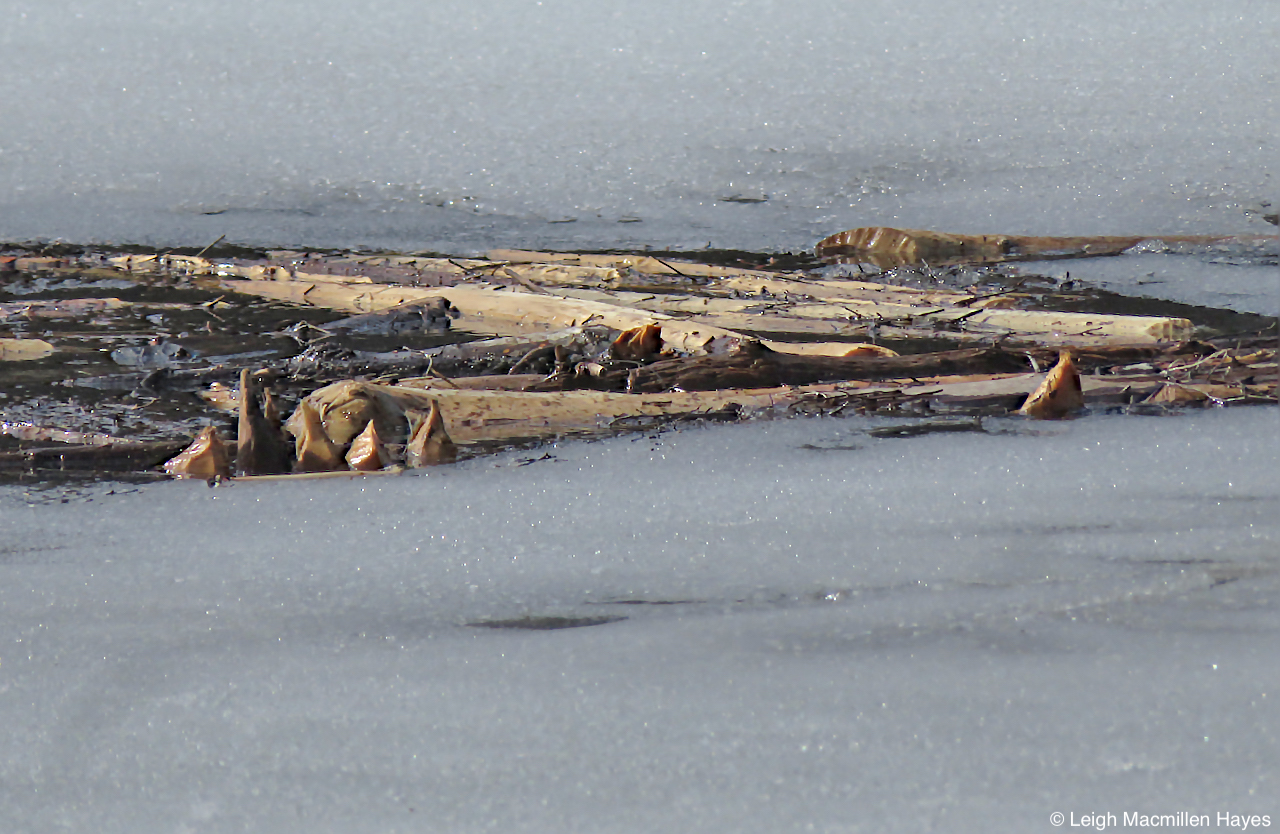
And chew sticks floating in a raft-like manner in a wee bit of open water. Because beavers don’t hibernate, they cache or stockpile sticks underwater so they can nibble on them once the pond freezes over in winter.

As pure herbivores, beavers subsist solely on woody and aquatic vegetation.

As we continued along the path, we paused frequently to admire their previous works, some of which hadn’t been successful in terms of felling the trees. Yet.

Others seemed like attempts to perhaps consider on some future date.

And still others made us feel as if we were walking through an art gallery for so unique were their forms.

Though a beaver will chew on any tree, its preferred species include alder, aspen, birch, maple, poplar and willow. 

I’m always in awe when I think about how beavers obtain their food by toppling large trees with no other tools than those specially adapted incisors and powerful lower jaw muscles. Even after years of chewing wood, their teeth don’t become too warn and never stop growing. The four incisors (two top; two bottom) are self-sharpening due to hard orange enamel on the front and a softer dentin on the back. That means the softer backside wears faster, creating a chisel-like cutting surface. And chisel they do.

Moving rather slowly, for I’d asked my guy to change his pace when we began to circle the bog, we counted five lodges, and figured that at least two of them were active. The two bookmarking this photo we weren’t sure about.

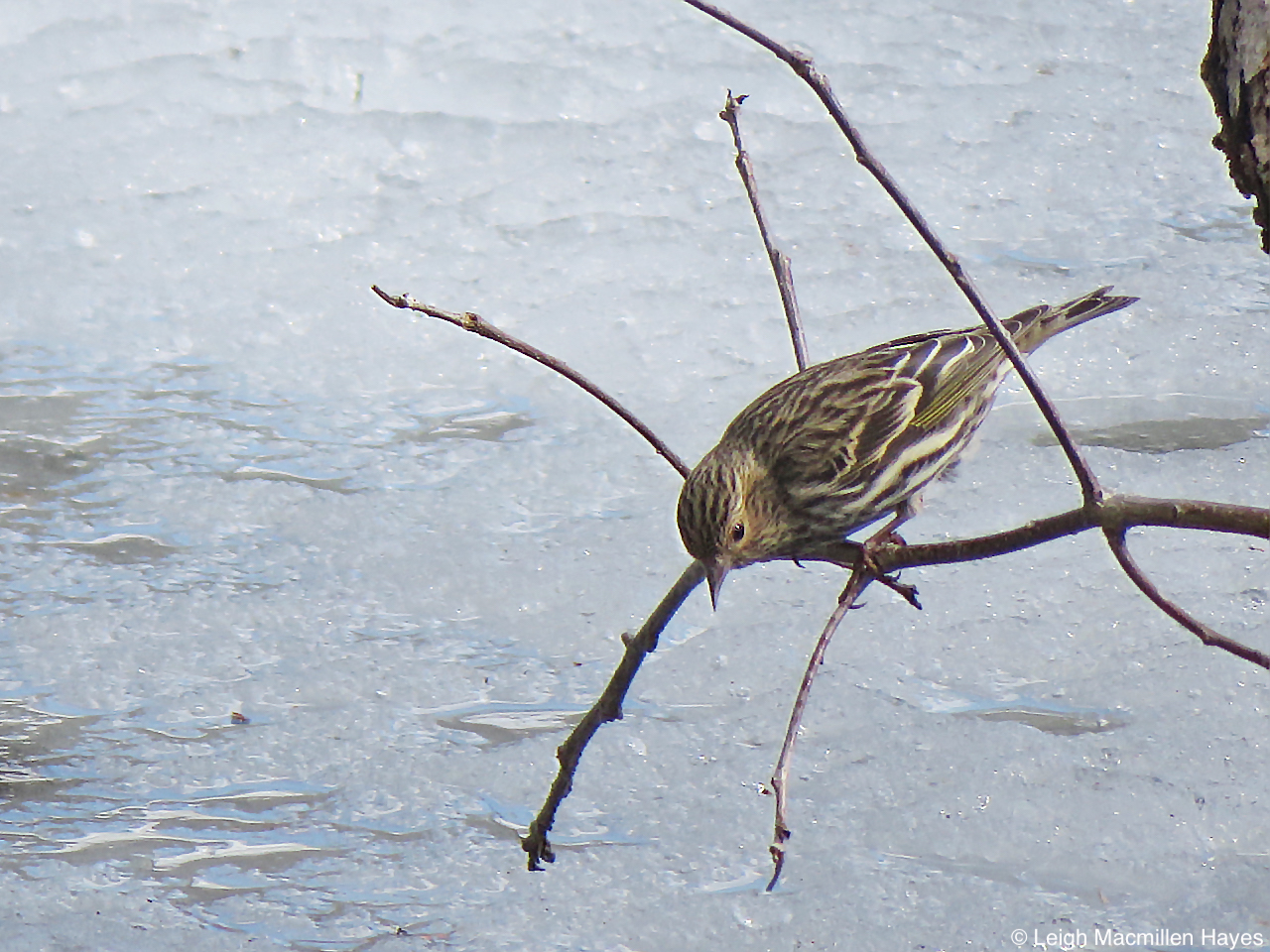
Suddenly we spotted some action in the water and my guy caught a glimpse of a critter that swam under the ice and out of our sight. All I saw were the ripples on the water. But . . . that meant that we stopped. For a while. And in flew a small flock of Pine Siskins.

And so they garnered my attention for a few moments.

When I wasn’t searching for more beaver action, that is.

At last we reached another lodge and both of us chose trees on either side of it to hide beside and remain quiet. I have to say that I’m so impressed with how still my guy can be . . . thank goodness for that earlier half-second sighting because he was as eager as I was to spy more activity.

Unfortunately, it was in that moment that my guy finally walked toward me that the beaver did show. He missed the sighting, but for me, it was well worth the wait on this first Mondate of spring.

All In A Day’s Walk

My mission was two-fold. Hike up a small mountain and capture a one minute video to post on a work website next week, and retrieve a game camera so we can download the photos and then place in a different location.

And so it was that on this brisk morning, snow-capped Mount Washington greeted me. If you zoom in, you might see the buildings at the summit.

Because I was at a different summit that I frequent, I knew I had to check on the activity of the local residents and wasn’t disappointed. First, I followed their trails, where leaves are well packed. Those led to trees, but no downed nip twigs as one might expect. That could only mean one thing–there are still plenty of acorns on the ground for them to eat. Because I was searching, however, I was thrilled to discover one sign that the season is changing. I knew that by the five layers I was wearing, but the stripped bark and cambium layer of a birch indicated the same. A porcupine’s diet varies with the offerings and part of their winter dining includes just this. Notice, too, the pattern of the incisor marks. Such a design thrills me no matter how often I encounter it.

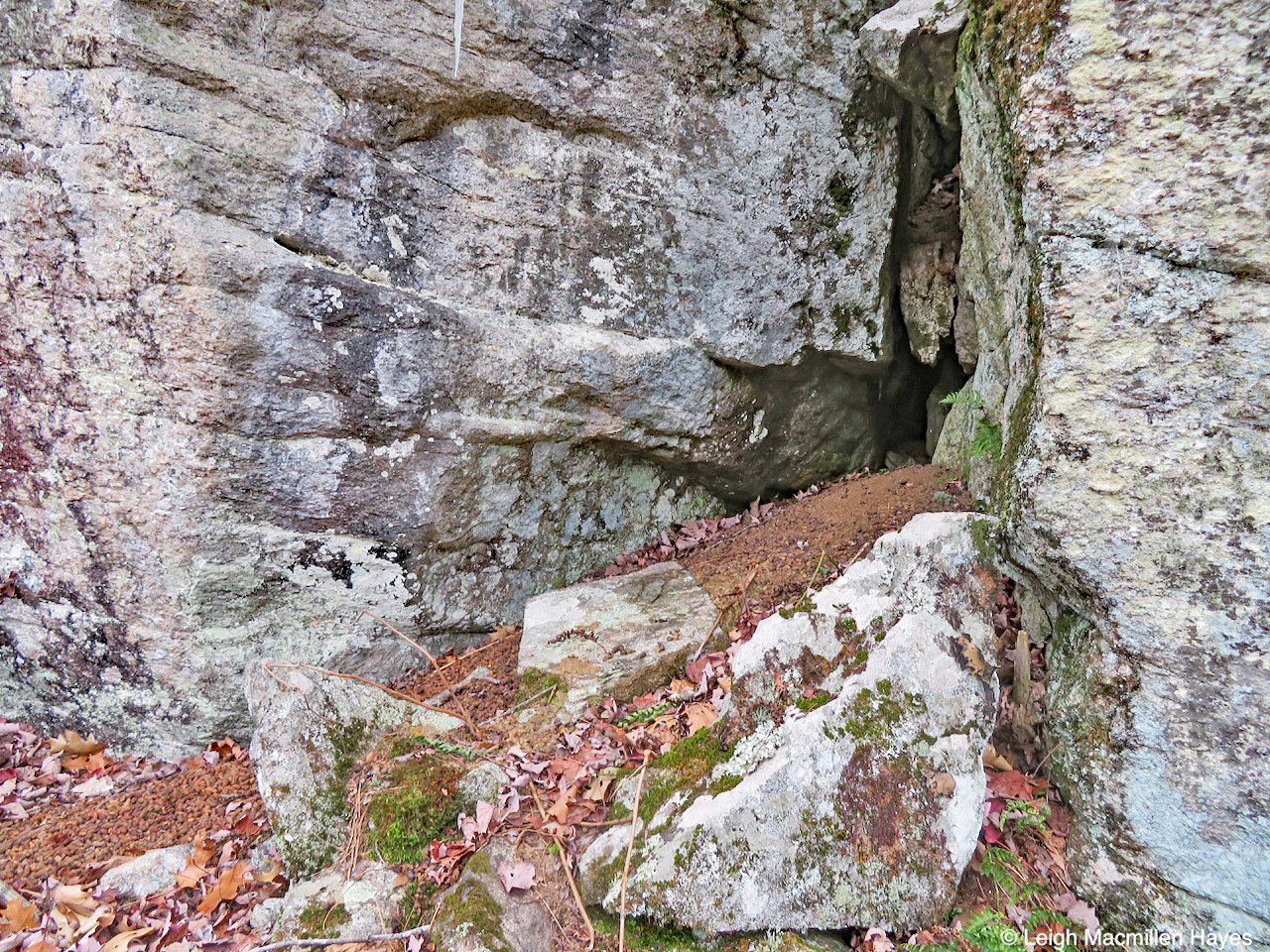
One of the porky trails led into a crevice below where I stood. It was there that I caught the first glimpse of icicles and knew I had to climb down. My route wasn’t the same as the porcupine’s for I’m not quite as nimble on rocks and slippery leaves.

But, with grace, I descended and made the surprise discovery of Mount Rushmore East. At least, that’s how the rock faces looked to my eyes.

But seriously, I wanted to spy the icicles from below and they became the inspiration for next week’s GLLT Moment.

That wasn’t all I wanted to spy and I wasn’t disappointed for the trail of scat indicated one potential den site.

And more scat led to another. I suspect those aren’t the only two, but I wanted to keep moving, such was the temp.

That said, right beside the second porcupine den, I found a small hole in the ground capped in hoar frost and suspected that someone was inside. It seemed a bit larger than a chipmunk hole. Maybe a squirrel? Or a weasel? Or even, the porcupine’s den vent?

While those choices rolled around in my brain, I climbed up the ledges and made my way down the trail until it intersected with another. Eventually, water once again stopped me as it often does.

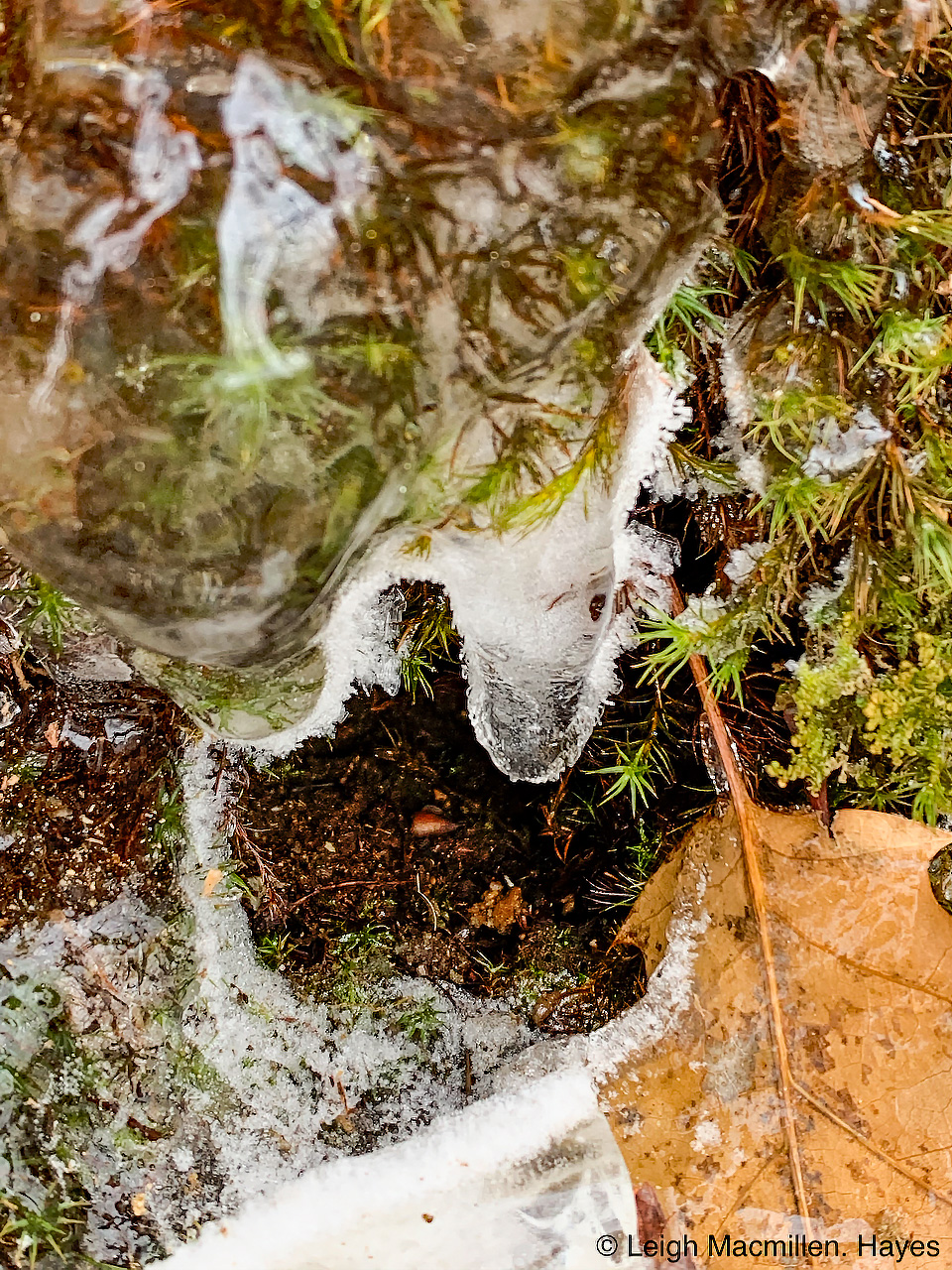
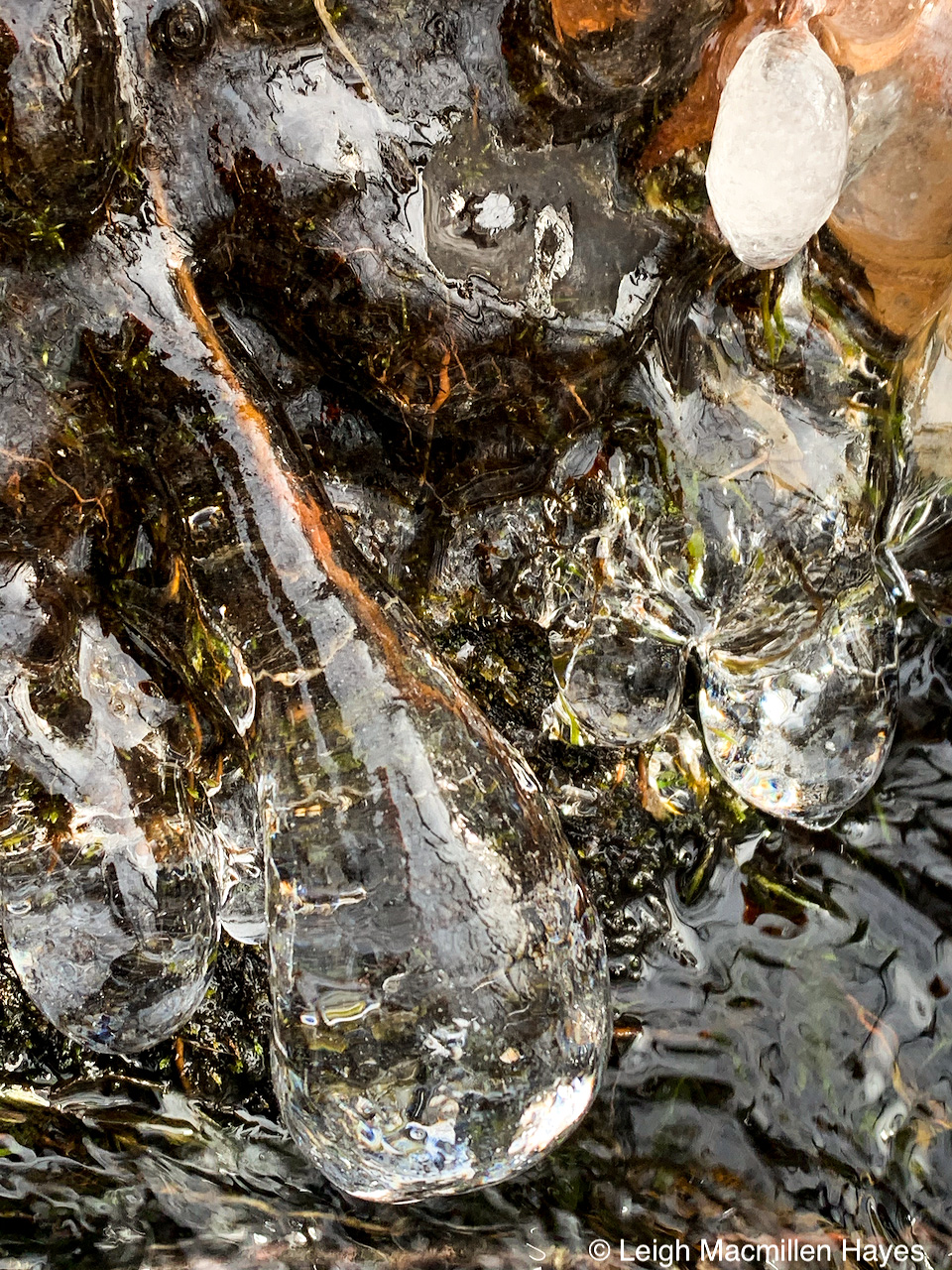
Only two weeks ago the temperatures in western Maine were in the 60˚s and 70˚s, but the past few days have been chilly and already dancing elephant legs are forming over sticks that dangle above moving streams.

Even the froth created by the friction of the stream’s movement had frozen in place.

I stopped a few more times, but finally reached the spot that was my second intention of the day. While exploring in this area a couple of week’s ago with several Greater Lovell Land Trust docents, we noticed beaver trees. The work looked rather recent and so we set up a game cam in hopes of getting a view of the perpetrator.

Today’s visit, however, showed no fresh work on this tree.

And a skim of ice indicated no one had recently walked out of the water. I snagged the camera and dropped it at the office so the photos can be downloaded. I hope they reveal more than a few test pics of us homo sapiens.

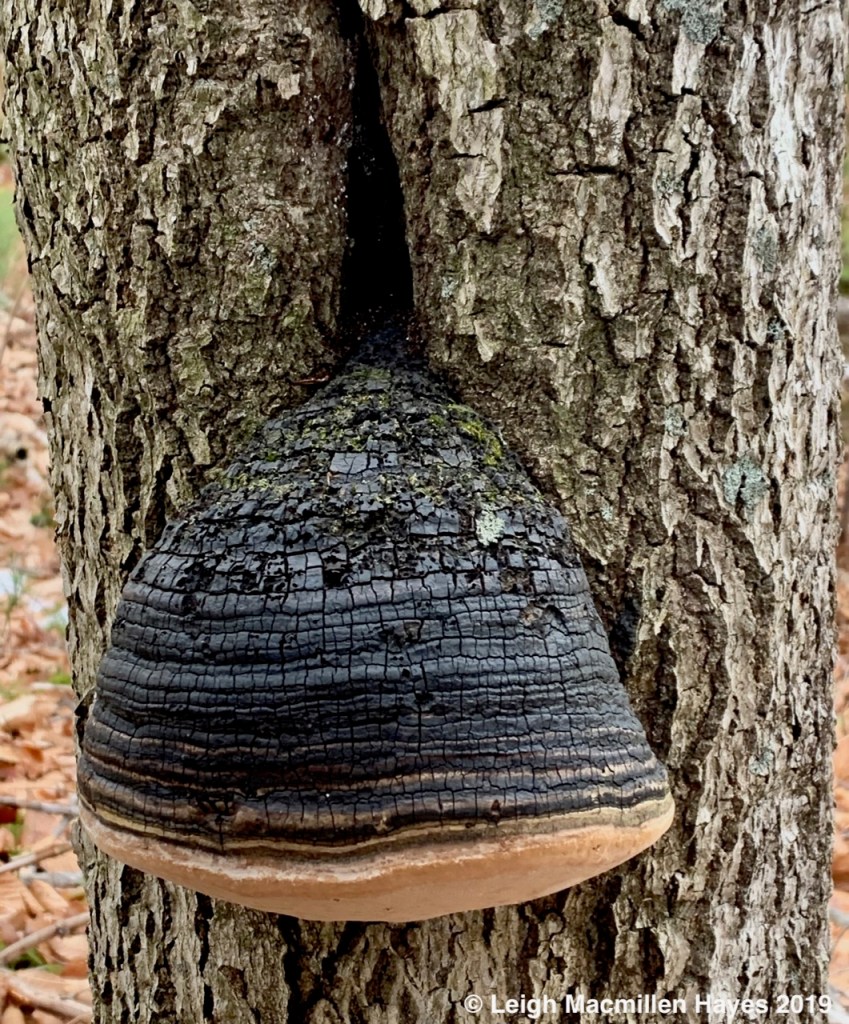
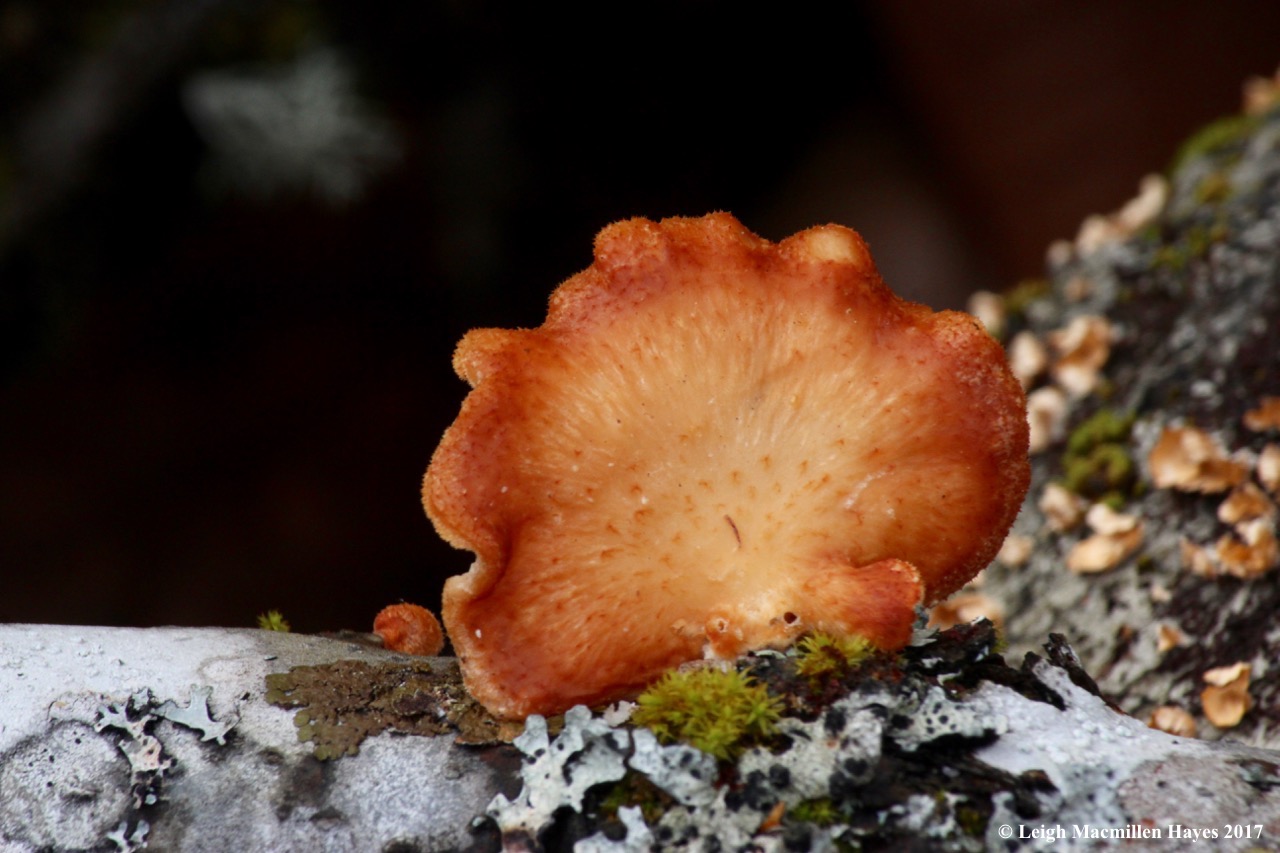
It was while heading back to my truck that this splash of color caught my attention. Notice the Striped Maple leaf on the mushroom–they are like a matched set. I’ve been torn in my identification between an Artist’s Conk and a Red-belted Polypore, whose belt is not always red.

But more important than identification was presentation. And the knowledge that the middle mushroom grew when the tree was still standing, while the others fruited after the tree had fallen, for mushrooms must always orient toward the ground, the better to spread one’s spores, of course.

My final sighting of the day, that still has me smiling, occurred in the middle of the adventure, but I wanted to save it for last. Do you see what I saw?

How about now?

Surely now you can.

Who cooks for me? I wish this Barred Owl would, for I must now prepare dinner. But that’s okay because I’ll take him with into the kitchen in spirit and give thanks that I had the opportunity to spend a few minutes with him . . . all in a day’s work.

Rejoice in the Unexpected

My hostess wasn’t home when I ventured upon her land today, but I went with her blessings. And in return was blessed.

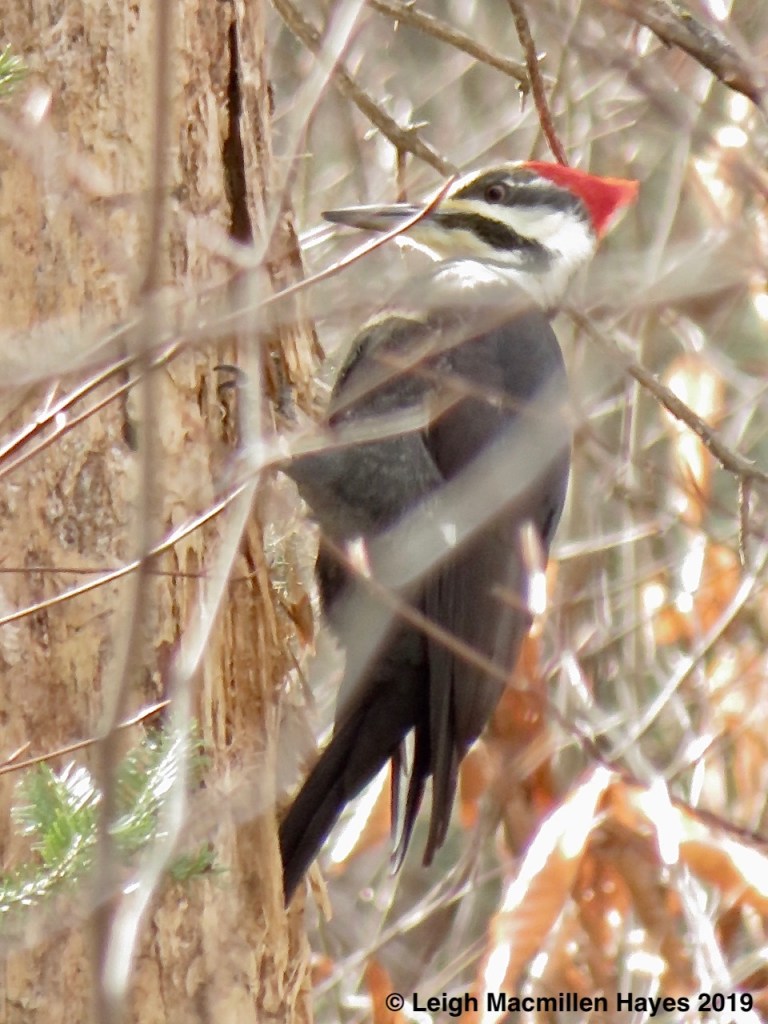
I’d barely stepped into the woods when a female pileated woodpecker called for attention as she tapped with intention and sloughed off pieces of bark in a quest for insects.

My own quest was to check on beaver activity, for I’ve traveled this land before and knew their previous hangouts, but . . . by the level of water behind the first dam the water was a wee bit low and I sensed no one was at home nearby.

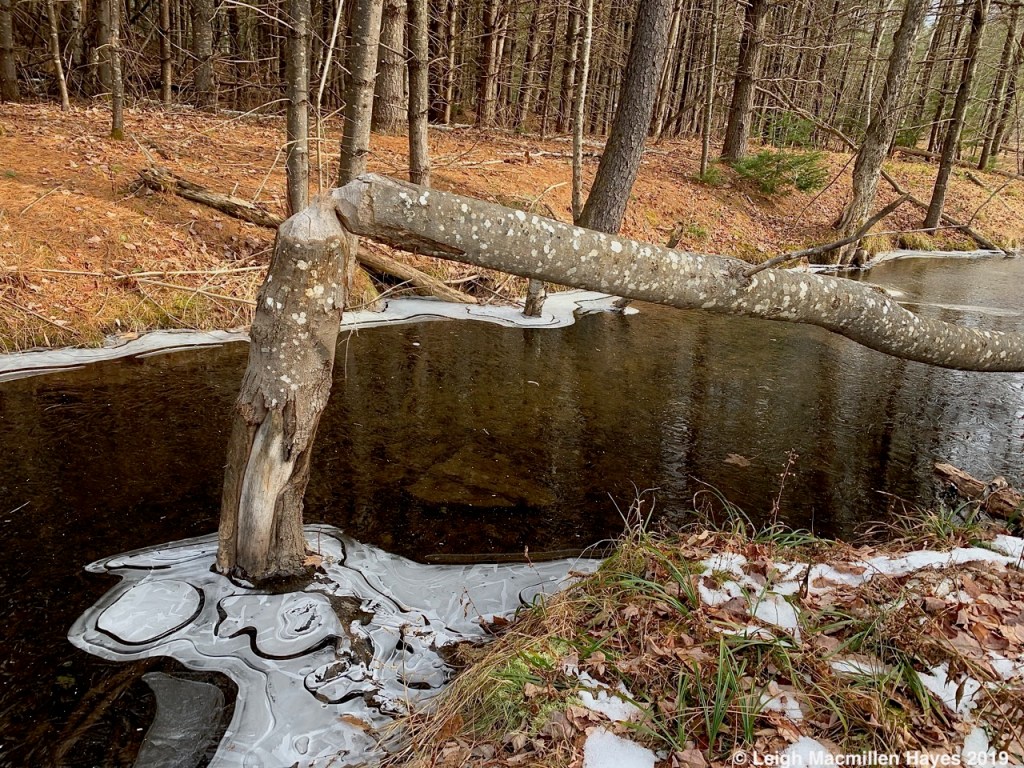
Just below the dam, a tall sculpture created last year indicated that we grow ’em big in these parts. Beavers, that is. But really, last winter the water was higher and so was the snow, so it wasn’t a super hero beaver after all who had gnawed and shouted, “Timber.”

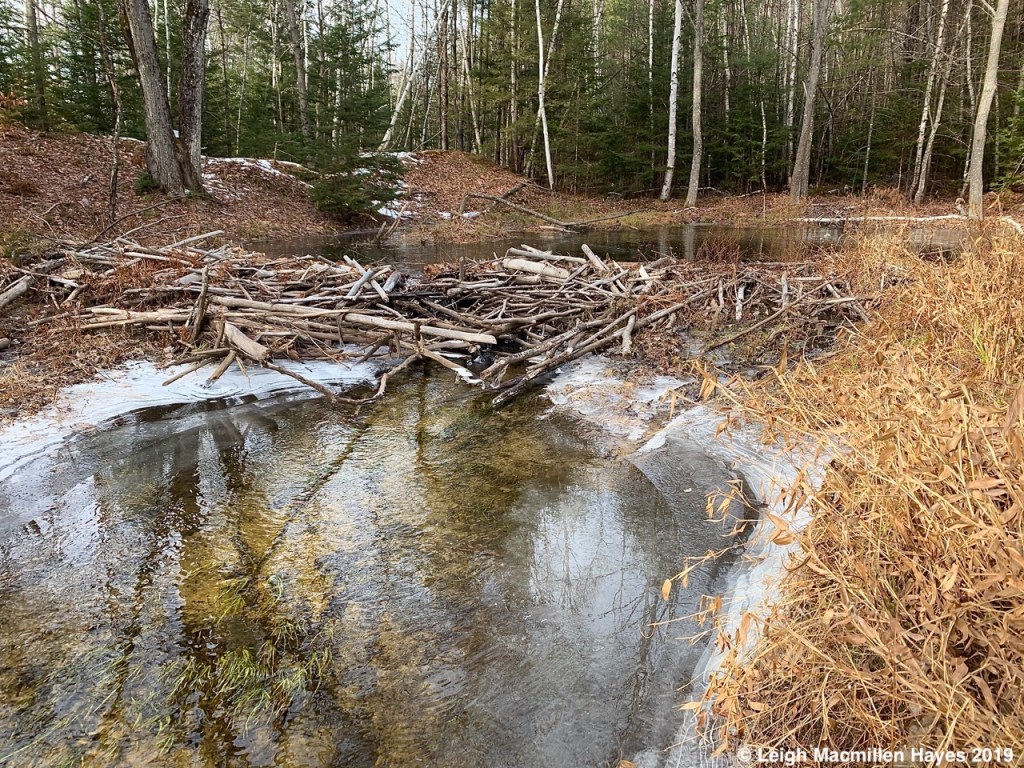
A wee bit downstream stood dam number 2, also not in current use. But . . .

By the path through broken ice, I suspected that an otter had checked out the scene rather recently.

Perhaps he had high hopes of finding someone at home. When I knocked, no one answered.

Dam number 3 was also defunct and I began to wonder if there were any beavers in the neighborhood.

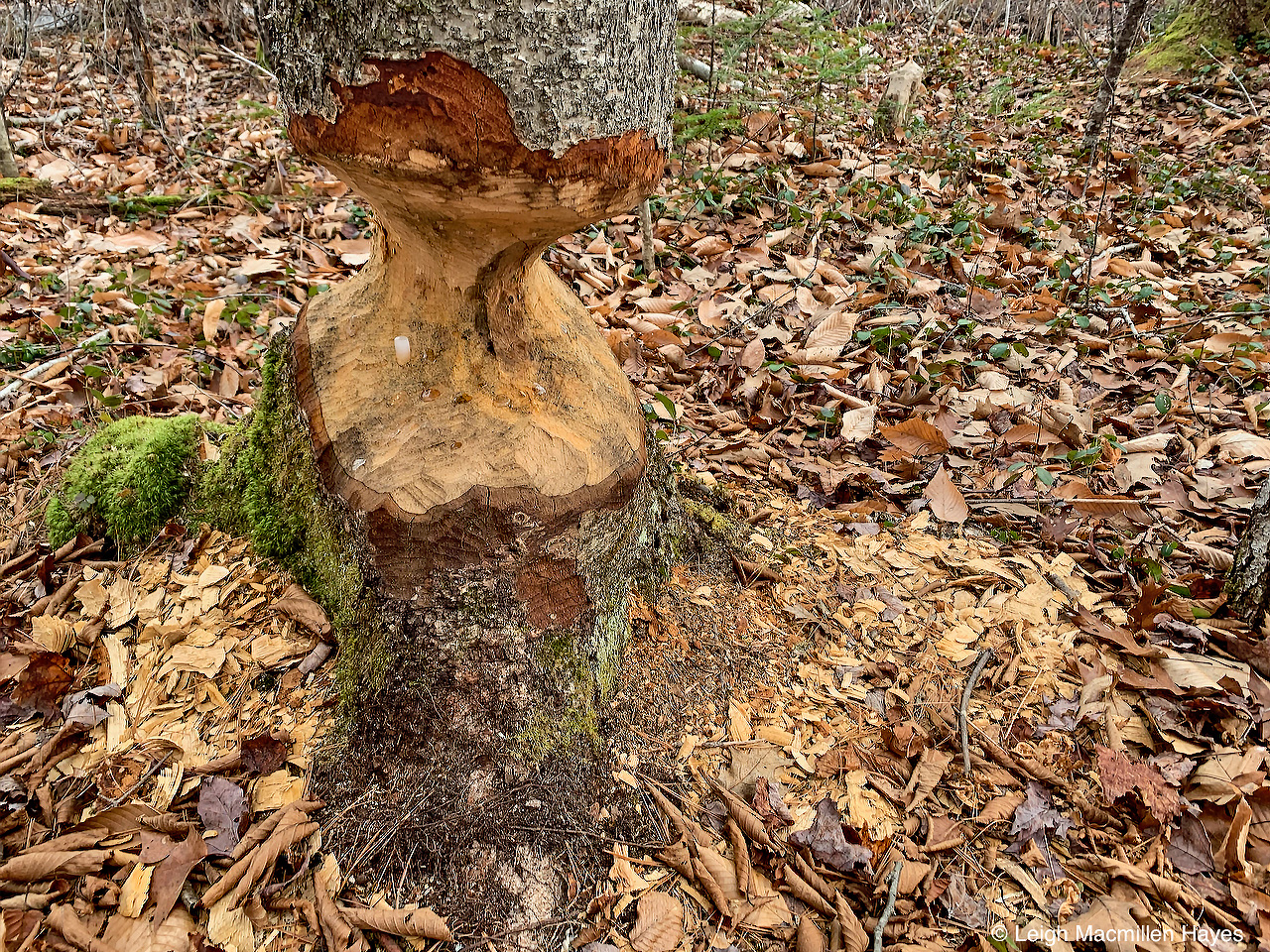
And then . . . and then I spotted a tell-tale sign: fresh incisor marks on a single tree. Do you notice how they are oriented left to right? A beaver must turn its head to the side in order to scrap the tree trunk and reach the inner bark with its upper and lower incisors.

Beyond the new works, were plenty of old, the shades of the wood telling the story of years of activity.

And on some trees, new met old, adding more colors and designs to the art work.

An old lodge stood in the middle of the wetland that was fed by a brook and stream, where ice sealed the world above from the world below.

A closer look at the lodge revealed that it had been compromised, and the memory of an exploration last winter reminded me that a predator had been attracted to it but didn’t seem to find anyone at home. Today, it seemed, the house was still an empty chamber.

As I continued along the edge of the wetland, I found one tree where a beaver merely took a quick taste and perhaps didn’t find it to his liking. Or . . . a predator happened along and he skedaddled back through the icy water to the safety of home.

It became apparent that someone was indeed home, just not in the first lodge. And by the color of the wood, the logging operation had occurred rather recently.

Wood chips on the ice added to the assumption that this was a recent harvest and if you look beyond, you’ll see two dome-shaped lodges in the offing.

From the shore, both looked well mudded, like we might add insulation and Typar to our homes to keep winter temperatures at bay. This technique also makes it resistant to attack from predators. What it doesn’t keep out is other undesirable visitors often in the form of hordes of insects.

The closest lodge was rather skyscraper in height and I began to wonder, was it the living room and the shorter one perhaps the kitchen? Did you know that beavers heap sticks until they are well above water and then gnaw their way up into the structure to create a chamber?

Much of the color surrounding the houses and throughout the wetland was provided courtesy of leatherleaf and its upright leaves and future flowers stored within the tiny buds.

Not far downstream from the two lodges, an infinity pool any homeowner might die for gave proof that someone was indeed home. Keeping the water high is important for beaver survival since they need to access their food supply of munch sticks stored underwater near the lodge and come and go from said homestead via a secret entryway. Secret to us and most of their predators, that is. Water snakes came find them in season. And otters can find them at any time, especially when the possibility of enjoying a meal of a young one seems a possibility.

Below dam number 4 water rushed and ice formed.

Dam number 5 was along a different stream, and though it hasn’t been in use for several years, its structure is worth honoring.

The meadow above invites others to take advantage and in the spring muskrats and wood ducks were seen in this place.

That’s the thing about beavers; they create wetlands that create habitats for others to enjoy, such as the deer that left behind some rubs on trees by dam number 1. From the raggedness at both ends of the rub and smooth wood between, I knew a buck had roamed this land and rubbed his antlers, leaving an inviting scent for a doe to notice.

And a chipmunk hole surrounded by hoar frost indicated someone was eating and breathing within.

But . . . not all chipmunks have decided to retreat to their underground homes just yet. The funny thing about a chipmunk is that it can pose as still as possible for minutes on end so a predator won’t spy it, but the minute it decides to move, it chirps. Why is that?

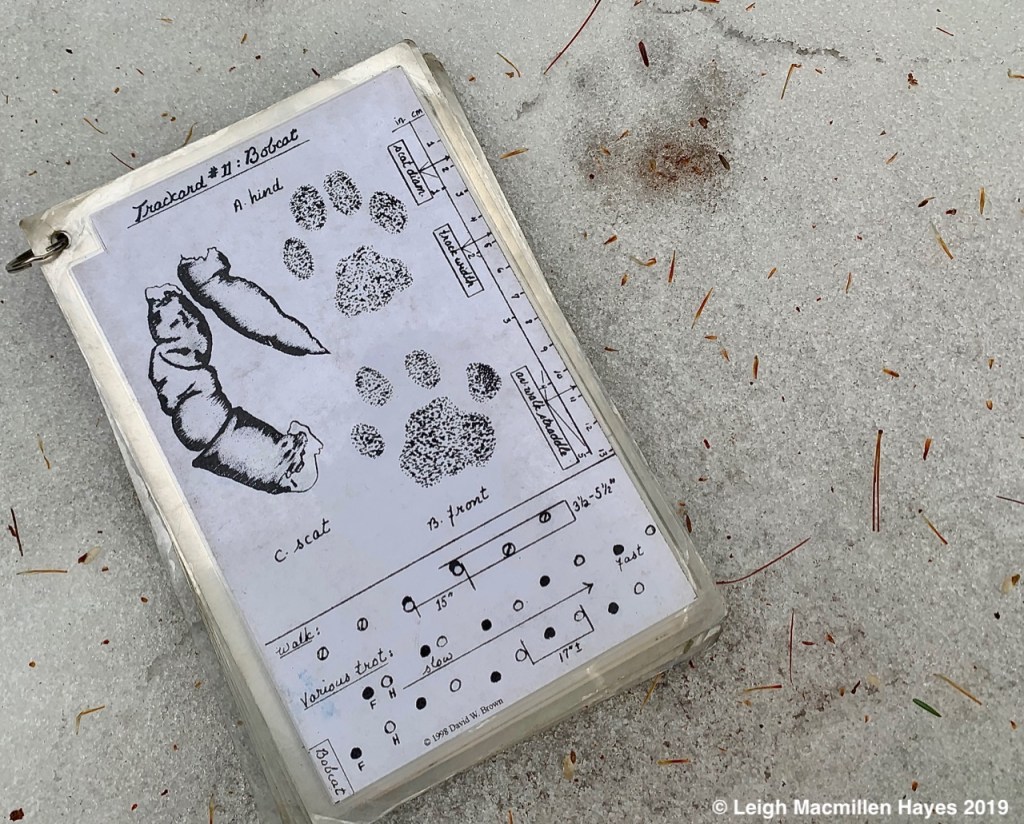
Certainly, it seems, it sends out a message to others like the bobcat who left behind a print or two or three on several patches of snow.

I traveled this land today because of the generosity of my hostess and so for her I found a bunch of fungi and decided to honor her with a false tinderconk as my way of giving thanks for letting me trespass almost anytime I want.

I’d gone to check on the beavers and was pleased with the discoveries I made for I know where they are and aren’t active. And I’ll return because those five dams and four lodges are only a taste of what her land has to offer.

But, it was the ice that once again stopped me in my tracks. Like the water it forms from, I’m always awed by the artwork created, in this case chandeliers dangled.

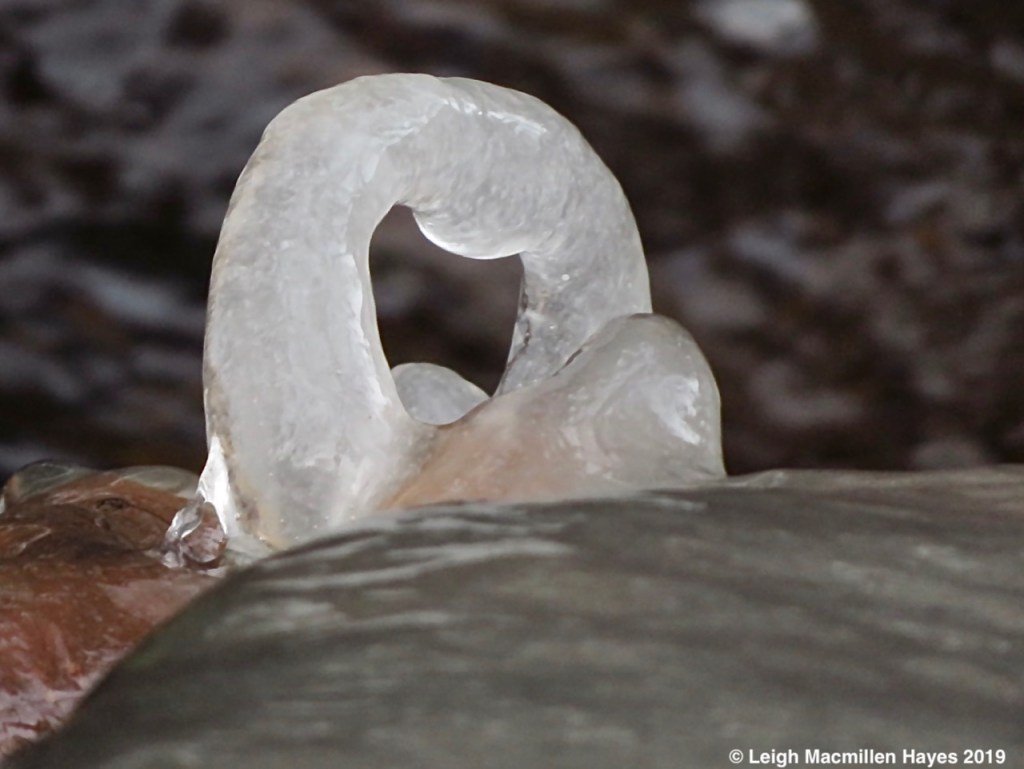
Seriously. Seriously, my heart stopped when I found a three-dimensional heart sticking up from a rock. Seriously.

My favorite find of all though, was a reflection of my face as I rejoiced in the unexpected.

This next month I hope you’ll make time to do the same.

Beaver Caper

Our interest was piqued a couple of weeks ago and we promised each other we’d return to learn more–thus today was the day that Alanna Doughty, education director of Lakes Environmental Association, and I ventured to the Muddy River at Holt Pond Preserve.

Crossing the Emerald Field at the corner of Grist Mill and Chaplins Mill Roads, we found our way to the trail, passed into the woods and immediately noticed some fresh works created by Castor canadensis.

Please take note of the small portion of a sapling trunk in the bottom of this photo, for I promise that you’ll see it again. And again. And . . .

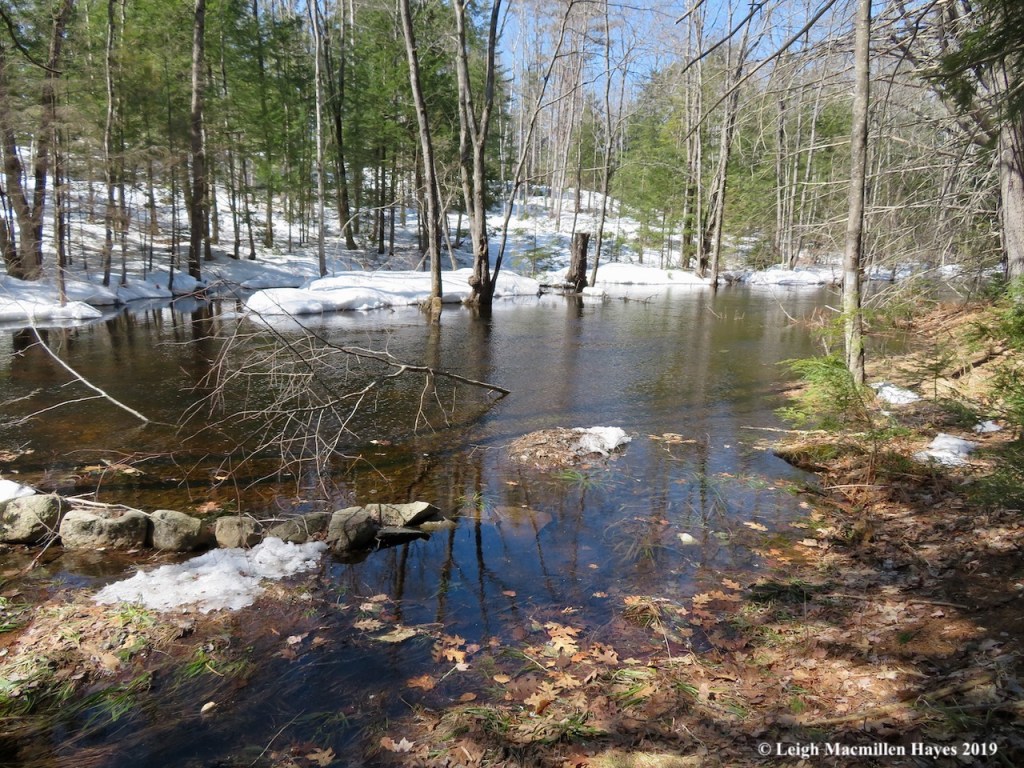
But in the meantime, we slipped, slid, and postholed our way to the brook, and noted where water flowed over an old dam so it was obvious this wasn’t the spot to which the beavers had dragged their sawn logs.

Also notice the “Posted” signs on the trees. Can beavers read? It did seem that they stayed away from the far shore. Maybe they can read ;-)

We looked upstream, but decided to turn around and follow the river down, ever curious about what we might find.

First, however, we did pause to admire the ice sculptures where the water rushed and gurgled and bubbled over the old dam. Soon, these will be a thing of the past and we’ll miss their varied forms frozen in time only momentarily.

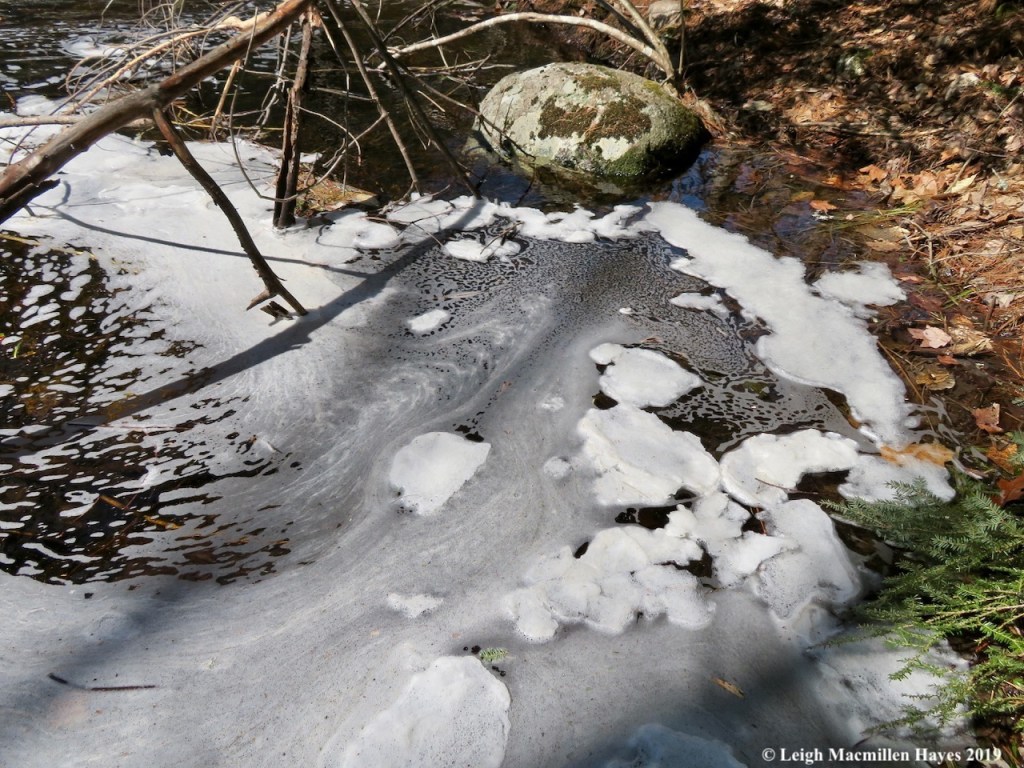
And then, as we started to walk south, the foamy water drew our attention.

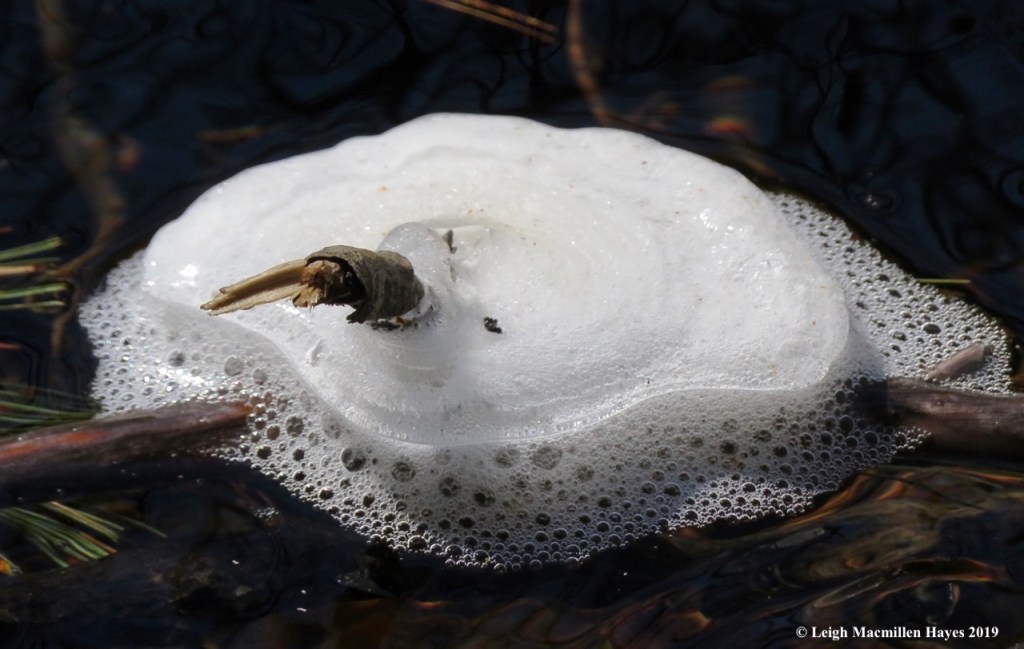
Where Alanna saw frozen froth of rootbeer floats . . .

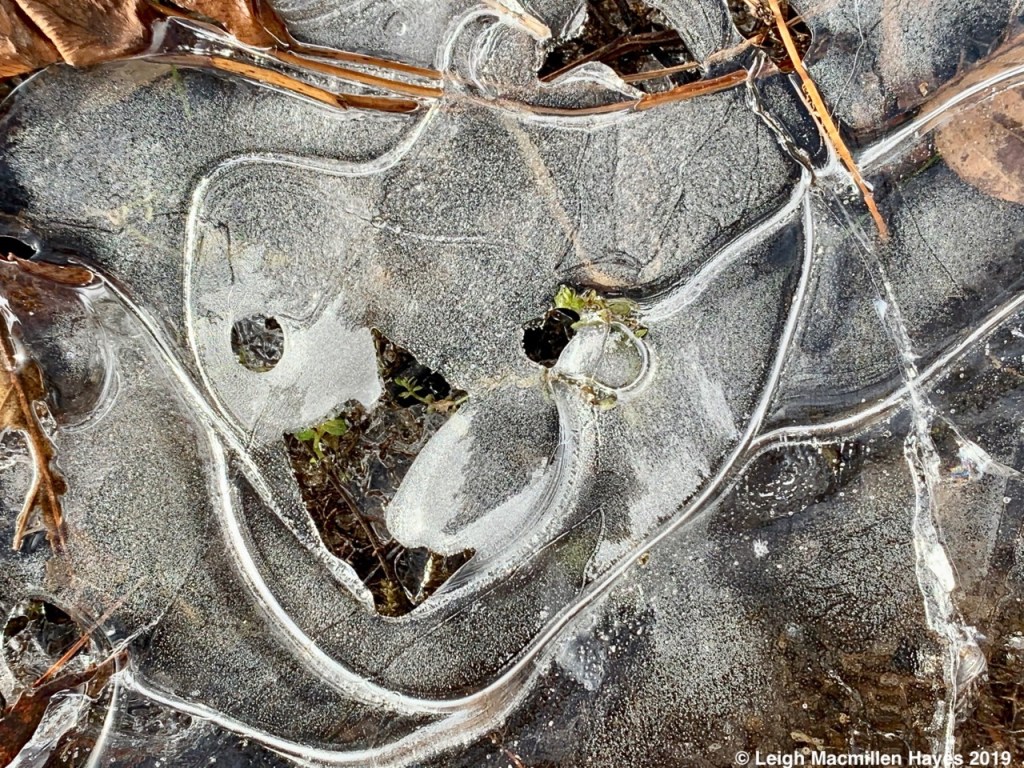
I saw mini ice discs in their final form.

And one that created a tree skirt with a lacy slip below.

Just beyond we spied the largest of all the sculptures and gave thanks for its existence. In our minds’ eyes we could see the upper part of the sculpture taking shape when the snow was deeper beside the brook. And the lowest part a more recent attempt of the chiseling artist.

The artwork was enhanced by the chips splayed about as if creating a textured pedestal for the display.

Just beyond that spot, we looked further south and scanned the shoreline, not noting any further work of the sculptor. The water didn’t seem particularly backed up so we figured there wasn’t a dam below. What did it all mean? We knew from our previous visit that there was more work north of our location, but had so hoped to find something new to the south.

The only thing visible, a few old beaver stumps such as this one. Given that, we did a 180˚ turn and made our way north.

First, however, we had to walk through the water and gave thanks for our boots, before passing “the” tree one more time.

Alanna, being much younger and far more agile than me, was kind enough to lead and wait, lead and wait. And because she was ahead, she went shopping when I wasn’t looking. I don’t remember what we were talking about when it suddenly occurred to me that she held a piece of the sapling trunk we’d spied earlier. This is a woman who loves to laugh and so she did when I commented on the specimen tucked under her arm.

Notice how snug she held it as she walked with intention across one of the stream bridges.

We walked for another bit before we found more beaver works, including a cache of debarked twigs–beaver chews. They seemed so fresh, and some were actually green, that we got to thinking. Winter food stash? We know that in the fall they gather saplings and branches, anchor them in the mud and when the ice covers the river, they slip out of the underwater tunnel in their lodge and chew off a stick from the stockpile to bring into the feeding compartment for a meal, thus keeping themselves safe from winter predators. But . . . these weren’t near a lodge and seemed like the result of a fresh logging operation and so we wondered, did they have a new lodge in mind? Are they planning to build a new dam?

We also had to wonder about their debarkation–so smooth were the sticks.

As we continued on, our nature distraction disorder kicked in periodically, as it should, and we rejoiced in the sight of buds on Trailing Arbutus, aka Mayflower.

But still, it was more beaver works that kept calling our names and we tried to pay homage to all of them.

The last fresh one we saw was on a beech and we knew by the height that the cuts had been made when the snow was deeper. So . . . were the beavers still around?

Oh, wait. While we wondered, Alanna also had deer scat to collect.

And just beyond that–weasel scat found its way into her bag.

And then a winter firefly crossed our path as seems to happen frequently of late.

Onward we continued for we wanted to check on a couple of lodges we knew existed. Do you notice that the art work remained tucked safely under her arm?

For a little bit our trail took us away from the Muddy River, but when we returned to it, we focused on old beaver works–a fallen tree and a girdled hemlock. That got us thinking about the fact that they do girdle trees–often, in our experience, it’s hemlocks that they seem to debark in a band that encircles the tree, thus killing it. These they don’t drop to use for building or feeding. So why go to all that effort? We’ve heard different theories, including that once the tree dies, a species more to their liking will grow? True? Maybe.

We continued to look for more recent works, but found none. Until . . . we spotted some brown snow.

Leaves and river muck had been pulled up and distributed over the snowy surface beside the water. We stepped closer and saw footprints that were indecipherable, but knew by the pile of gunk that we’d discovered the makings of a beaver scent mound. Had the two-year-olds left the lodge and set out to claim their own territory? We suspected such.

Atop it all, we noted where a scent mark had been left behind. Of course, we both had to get down on all fours and sniff. I thought it smelled a bit like wintergreen, perhaps an indication of a meal consumed. Most often it smells more vanilla in nature. We found the starts of another scent mound a bit further along that emitted a muskier scent and we thought of the beaver marking its territory with castoreum.

Oh, and then there was some more scat to collect for Alanna spied the round nuggets or malt balls of a snowshoe hare.

At last we reached the board walk that leads back out to the Muddy River, some of it under water and again we gave thanks for our boots–hers Boggs and mine Mucks. Both perfect for our adventure.

From the board walk we could see the twin lodges on the river, but neither had any fresh logs atop and so we still didn’t know from whence the beavers came. It appeared they hadn’t used the old lodges, but we never found any new ones. Or a dam. But the scent mounds were super fresh. And so, we concluded that we’ll have to revisit the area either early in the morning or later in the day in hopes of spying the industrious builders in action.

In the meantime, we left with new findings, new questions, and for Alanna, some new scat and new beaver works–the one tucked under her arm a reminder of our Beaver Caper.

“A Perpetual Astonishment”

It was actually still winter when I joined Lakes Environmental Association’s Education Director Alanna Doughty and LEA member Betty for a “Welcome Spring” snowshoe hike at Holt Pond Preserve this afternoon–but really, for western Maine, it was a delightful spring day.

Our hearts smiled as our journey began beside a clump of pussy willow shrubs, so named for their resemblance to tiny cats’ paws. Actually, the white nubs are flowers pre-bloom. Their soft, silvery coating of hairs provides insulation thus protecting these early bloomers from cold temperatures.

That being said, they aren’t protected from everything and if you look, you may see pineapples growing on some. Those pinecone-like structures were created with leaves by a reaction to a chemical released by the larva that allows a gall gnat midge to overwinter on the willows. It’s a crazy world and everything seems to have its place.

Hanging out with the pussy willows were speckled alders, some with protrusions extending from last year’s cones. It was almost like they had tried to flower. In reality, they were alder tongue galls–resulting from a fungus rather than an insect infecting the female catkins. Apparently, the tongue-like growths are green to begin, but transform to orange, red and finally brown. I’ve yet to see it in its early form but time will tell.

We passed a spider walking across the snow and then came upon another member of the lilliputian world–a winter stonefly on the move. How they and the spiders survive the cold and snow is dependent upon special compounds including glycerol, proteins, and sugars that act like antifreeze. By its presence, we knew we were approaching a fast-moving stream.

More evidence of the stream’s presence became immediately apparent when we moved from the field to woods and immediately spied a sign of beaver works.

Stepping down beside the Muddy River, we began to see beaver tree after beaver tree. Each a most recent work.

Alanna stood upon an old dam, but though it was obvious they’d crossed over it by the well traveled trail of tracks, repair work was not yet part of the scheme for the water flowed forth.

We stood there for a few minutes and tried to understand what they had in mind, when one in our group spied the beaver chews in the water–their snack of choice.

We wondered if they were active downstream or up, and decided to follow the trail north.

A few minutes later, we came upon another trail well-traveled and knew that they’d been working in the vicinity.

In the brook, covered with spring ice, which features a different texture than the frozen structures of winter, was a small tree.

And then our eyes followed the beavers’ tracks back and we saw from whence it had been sawn.


And dragged through the snow. In our minds’ eyes we appreciated their efforts.

Still, we didn’t know what the beavers were up to, so we moved on in hopes of learning more about their activities. All the while, there were other things to notice, like the orange brain fungus growing on the inside of a stump. We weren’t the only ones to appreciate it for snowfleas, aka spring tails, also searched the surface.


Since we were beside the river, it might have made sense that we checked out the beaver works via canoe, but . . . the snow is slowly melting and it will be a while before we need to bring our own paddles, personal flotation devices and duct tape (just in case the canoe springs a leak).

From the boat launch we followed the secret trail and made our way out to the red maple swamp.

In a sunny spot we spied a swab of earth–a taste of what is to come. And the ever delightful wintergreen offering the first shade of spring green with a dash of spring pink.

Slowly we made our way back out to the Muddy River, where we stood and looked across at two beaver lodges on the other side. We didn’t dare cross, but from where we stood, it appeared that the lodges may be active given that we could see the vents at the top. It also appeared that they’d been visited, though we weren’t sure if the tracks were created by predators. Was this where the beavers who had been so active downstream were living? Or were these the homes of their parents? Were the new beaver works those of the two year olds who had recently been sent out into the world to make their own way? Our brains wondered and wondered?

We weren’t sure, but with questions in our mind, we moved on toward Holt Pond.

There were other things to see as we walked across the wetland, including the woody structures of maleberry capsules and their bright red buds.

Rhodora, that delightful pink beauty showed us that she’s waiting in wings.

As we made our way back, more wood chips on the ground indicated that a carver of another type had been at work–of the bird type rather than rodent.

To identify it, we looked not only at the shape of the chiseled structure, but also the scat we found among the chips.

Because it was filled with the body parts of carpenter ants and we knew its creator’s name–pileated woodpecker.

And then we found an insect of another type. Why was a hickory tussock caterpillar frozen to a twig? Was it shed skin from last fall? How did the structure last throughout the winter? We left with questions, but gave thanks for the opportunity Alanna provided to share the afternoon wandering and exploring and thinking and looking forward–to spring.

In the midst of our wandering, we did discover a fairy house and suspect that tonight some wild dance moves are on display under the Super Equinox Worm Moon.

“Every spring is the only spring, a perpetual astonishment.”

British Author Edith Mary Pargeter, also known by her nom de plume, Ellis Peters (1913-1995)

Forest in a Bottle

When Pam and I stepped into the woods this morning, I don’t think either one of us understood the enormity of the task before us. You see, our job was to gather all the pieces of the forest through which we’d pass.

And so we began by collecting a recent beaver masterpiece with fresh wood chips below.

There was a beaver sculpture as well, those tooth grooves deep and distinctive.

And their tracks, which all emerged from a recently frozen-over hole. The tracks were a few days old, but we added them to our findings just the same.

Because we were in beaver territory, to our delight we found otter tracks and slides galore–many of them fresh.

There was even an otter hole that we wondered if the beavers had used as well. We decided we might as well throw it in to our bag.

And we couldn’t resist our favorite otter activity of all–the spot where the infamous slider slid.

Following the trail to a different part of the forest, we spotted a diptera pupa that gave us pause for quite a while as we admired its structure and the perfectly formed circle where the fly had chewed its way out. We were so in awe that it seemed only obvious we would want to include it in the collection.

Further on, we reached a brook and spied a muskrat, that dark body in the center. As it turned out, it was a stone muskrat and we left it behind as we chuckled about our mistaken ID.

By the brook, we did, however, find mink prints in the dust of snow that had settled upon thin ice. Those were certainly worth capturing.

We also gathered more otter slides, and then stumbled upon an apparent otter roll, an area where the playful critter made a lot of fuss and left behind some urine and tarry-looking scat. We were sure we’d hit the jackpot.

Because we were beside running water, the icy baubles were not to be ignored.

Nor was the snow depth, which we determined to be close to four feet deep.

And then we marched onto a wetland, where we were stumped for quite a while about some mystery tracks. Should we take them or leave them, we wondered. The pattern indicated a perfect walker, as in a candid or feline, but the depth was deep and the toes threw us off.

The curious thing was that those tracks and others left behind by a mink and a fox led to a deep hole beside a tree.

I thought the frozen fluid within was blood, but Pam leaned more toward urine. One thing we knew for sure, if it was a kill site, there were no remains. Had the mammals been on the hunt to no avail? Take it or leave it–we put it in the same category as the mystery prints.

The mystery tracks also led to a beaver lodge and it appeared that the mystery track maker had tried to locate another meal. Given that there was no air vent at the top of the lodge, we doubted anyone was at home at the time of its visit, and so we left the lodge behind.

After standing in the middle of the wetland and eating our own lunches, we discovered a set of perfect red fox prints that we just had to include in our collection. The top print in this photo is actually the hind foot and the lower print is the front. Can you see the chevron in the foot pad?

There was another lodge we considered grabbing because the top of it appeared to possibly have a vent, but like the fox, we took a closer look and discovered that it, too, was abandoned so we left it behind.

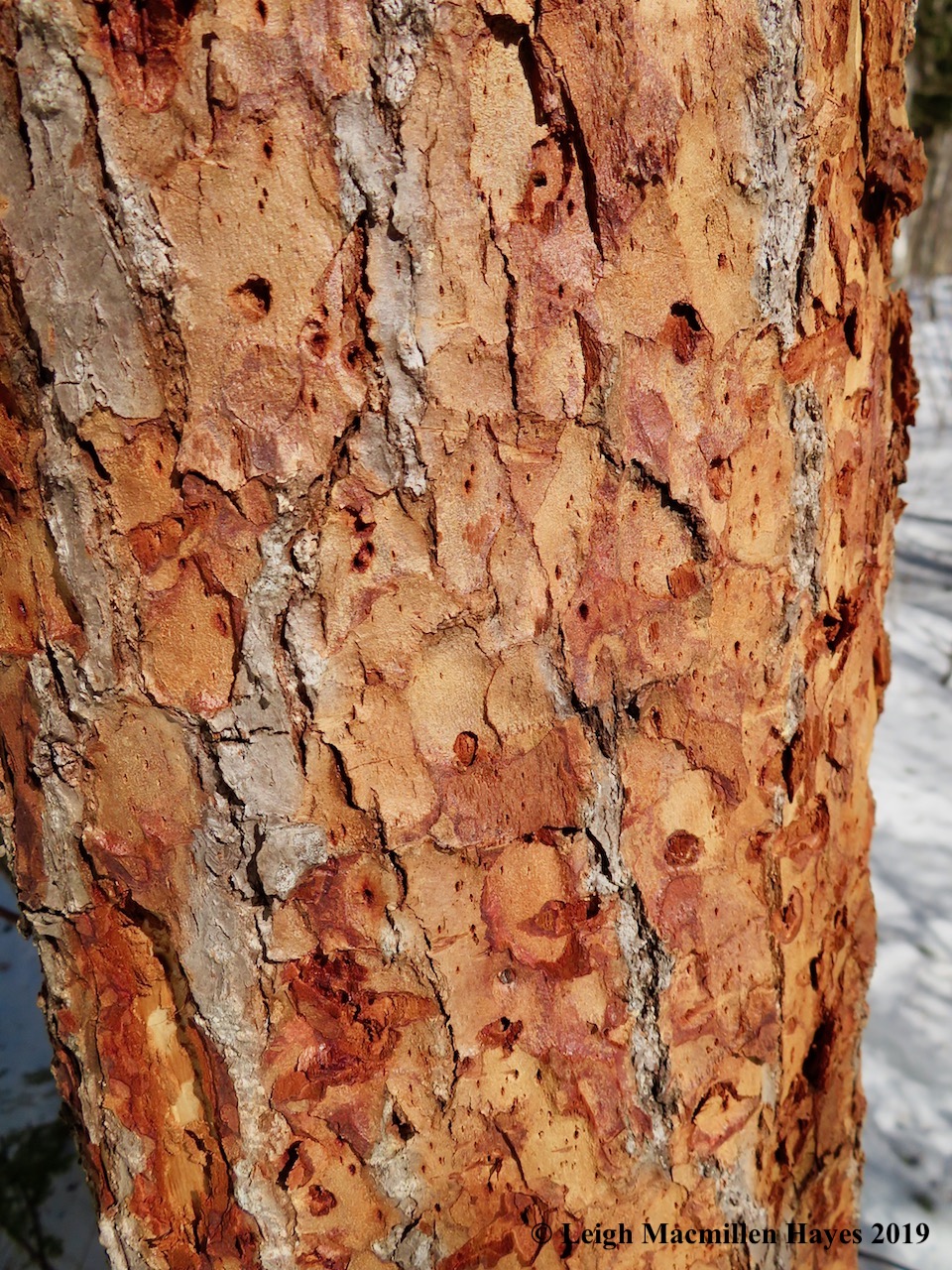
Instead, we made our way off the wetland and back into the woods where a debarked hemlock tree stopped us in our tracks. Nuthatches and woodpeckers are known to scale trees–removing the outer bark to get at the insects underneath. Can you see the insect holes? And the cinnamon color of the inner bark? This one was a keeper, for sure.

Especially since a section where the inner bark had been removed revealed a polished layer like one might find on a table top.

There was also a huge snow-capped burl to pick.

And a small cross-section of the liverwort Frullania juxtaposed beside script lichen. Everyone should have a sample of those two.

Two old heron nests were well worth adding into the mix. They’d been used in the past until two years ago. If the herons do return to the rookery, we suspect they’ll build new structures so we didn’t feel so bad gathering these.

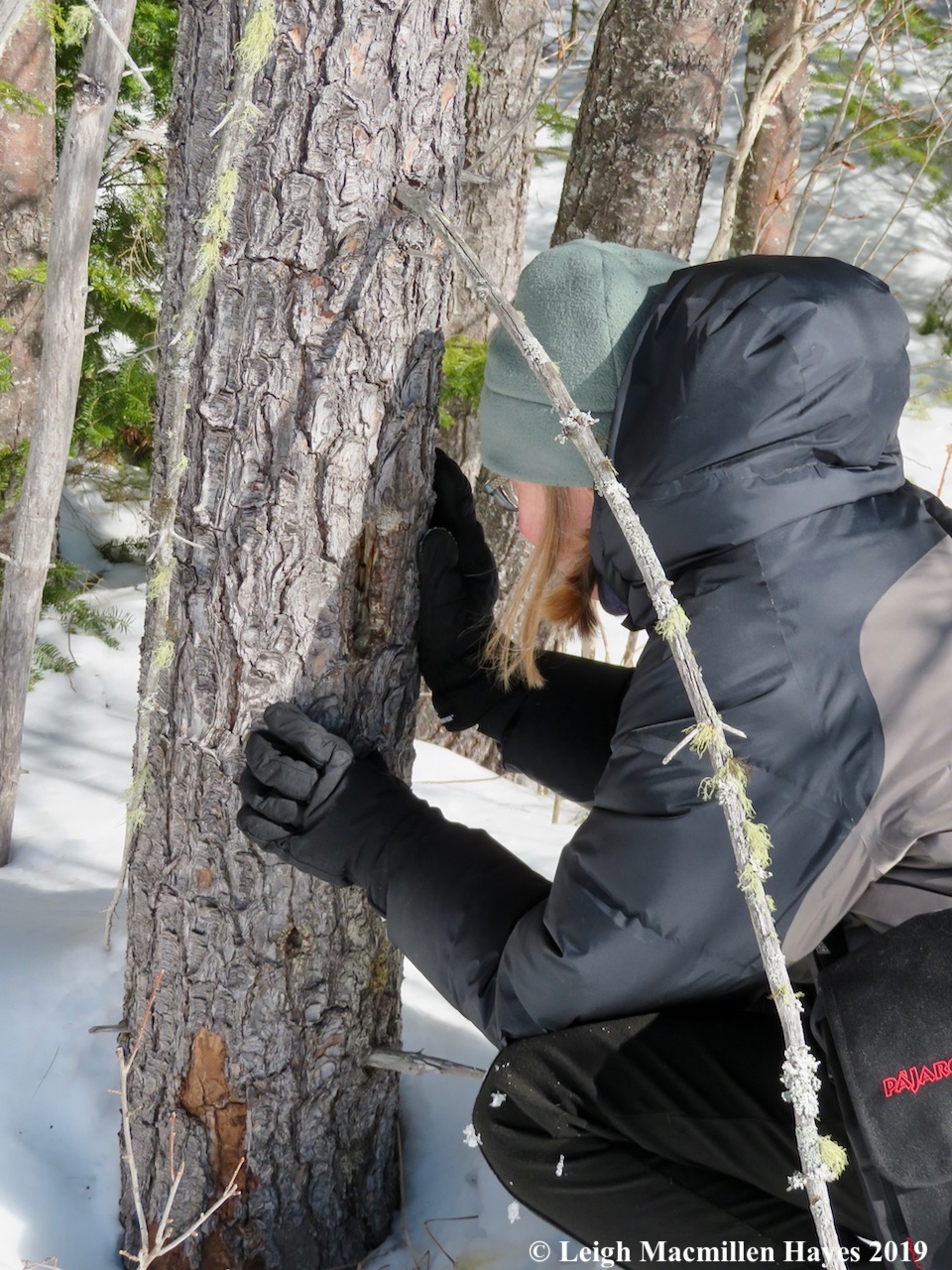
And then there was a pileated woodpecker hole that would have to represent all woodpecker holes in these woods. Before tossing it into the bag, Pam made sure that no other critter had set up housekeeping within.

Our final finding was one that made us think back to the mystery tracks. The more we studied these and later met the mystery tracks again and followed them for a while, the more we understood that not only did beavers, otters, foxes, deer, mink, and snowshoe hare romp in these woods, but so did coyotes.

The best thing about this coyote was that it made a coyote angel in the snow! We most definitely scooped that up.

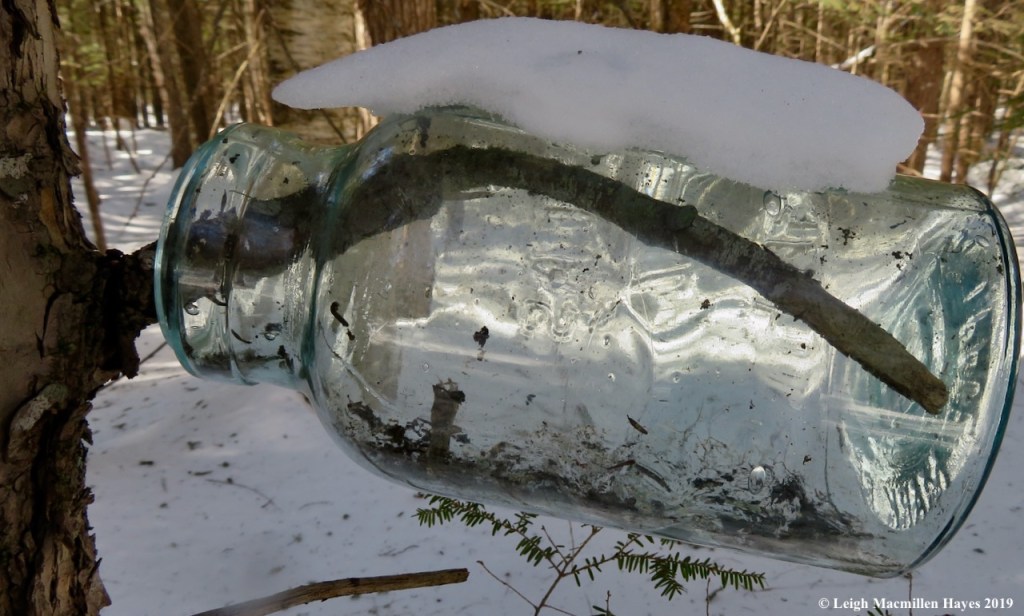
For you see, our mission was to put it all together–in a glass jar. Haven’t you always wondered about the magic involved with placing a ship in a bottle? Well, today, we spent six hours amassing various items in the woods and then assembled them–creating a forest in a bottle. Can you see it?

For the Benefit of All

Living in an area where five land trusts protect land for us and the species with whom we share the Earth strikes me as a valuable reflection of who we are and where we live. Land trusts work with community members to acquire land for permanent conservation through purchases and donations. They also create legal and binding conservation easements that allow residents to protect land holdings in perpetuity, while retaining private ownership. Scenic views, wildlife corridors, flora and fauna, and topography remain, subject only to the whims of nature itself, which is ever-changing.

m1-first lodge

One of the biggest re-designers of the landscape is the beaver. And this afternoon, Jinny Mae and I ventured onto land owned by a friend and under conservation easement by the Greater Lovell Land Trust, to see what changes may have occurred in the past two months since we last visited.

First, we tramped off a logging road and checked on a lodge that was active two years ago. Today, the water level was low and there was no sign of activity. And so we continued on.

m2-pipsissewa

As we climbed up a small incline we stumbled upon a large patch of pipsissewa and had to celebrate our find.

m5-hexagonal pored fungi upperside

Back on the logging road, a tree brought down by one of nature’s recent whims introduced us to a fungi we had not met before–or at least as long as we could remember. And once we saw the underside, we were sure we would have remembered it.

m4-hexagonal-pored

Hexagonal-pored polypore (Polyporus alveolaris) caused us to emit at least six ohs and ahs.

m6-grape fern

Our next discovery–a grape fern. Actually, more than one grape fern once our eyes keyed in on them.

m7-checkered rattlesnake plantain

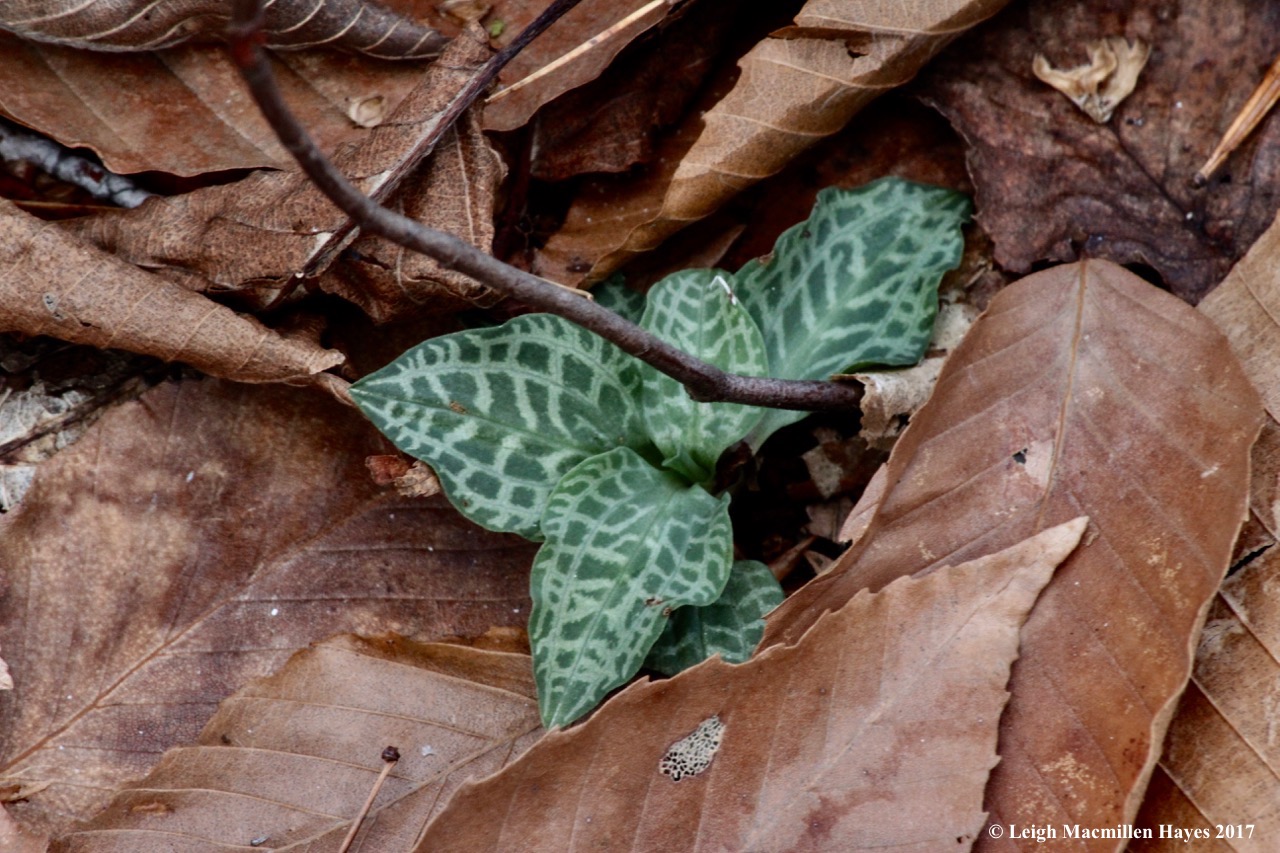
And then the checkered rattlesnake plantain; and again, once we spied one, we noticed that a whole patch shared the space. We just needed to focus for their presence was subtle amidst the brown leaves.

m8-bees nest 1

Before we met a snake of another kind, Jinny Mae spotted honey combs on the ground.

m8-excavation site

A look about and the realization that a raccoon or skunk had probably excavated the nest.

m9-snake liverwort

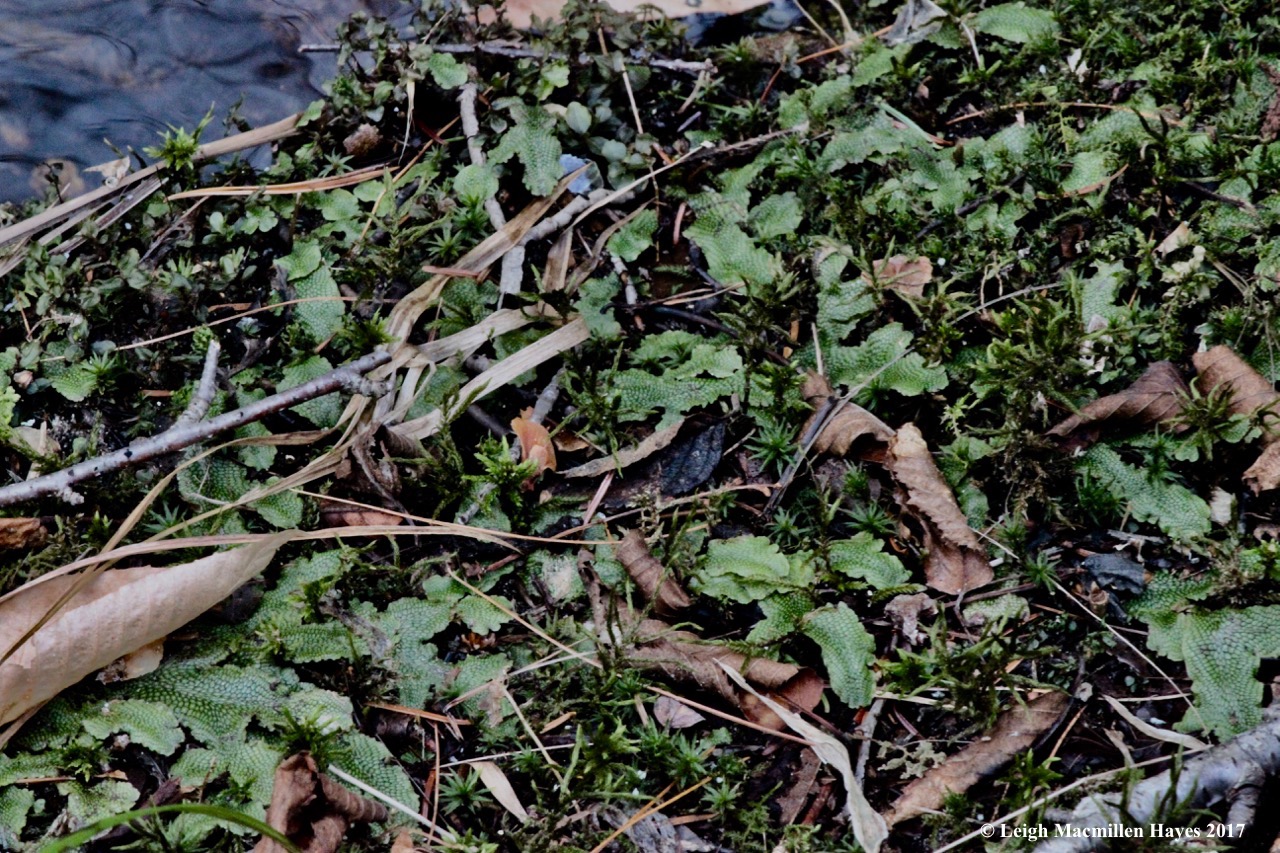
And then we met that other snake. You see, the last time we walked this property, we did see a garter snake. As we began our wander today, we commented that there would be no snakes or toads. But . . . we were wrong. This second snake was a snakeskin liverwort (Conocephalum salebrosum). For us, this was a second in another way for it was our second sighting of the species. Maybe now that we are aware of it, we’ll notice it growing in other places. We do know that its preferred habitat is wet or damp.

m10-umbilicate lichen?

In the same area, but across the brook in a place that we couldn’t reach today due to high water, we saw what looked like an umbilicate lichen, aka rock tripe. The color and substrate threw us off and so we’ll just have to visit again for further study. (“Oh drats!” they said with a smile.)

m11-beaver 1

The liverwort and mystery lichen were our turn-around point. On our way back, we decided to follow the water because we were curious. And within minutes our curiosity was appeased. The beavers we’d suspected might be casually active two months ago, had become incredibly active.

m12-beaver 2

Statue . . .

m13-beaver 3

upon statue . . .

m19-beaver 6

upon statue . . .

m20-beaver 7

upon statue announced their presence. And we acknowledged the fact that they have to turn their heads to scrape off the bark.

m14-beaver 4

Any trees that hadn’t been hauled away had been downed and gnawed upon in situ.

m15-beaver 5

It looked as if this one was a more recent dining adventure for there were wood chips upon the thin layer of ice and a hole showing were the diners had entered and exited the refectory.

m16-oak leaf and ice

Because of the ice, we noted other works of art worth admiring.

m18-lungwort 2

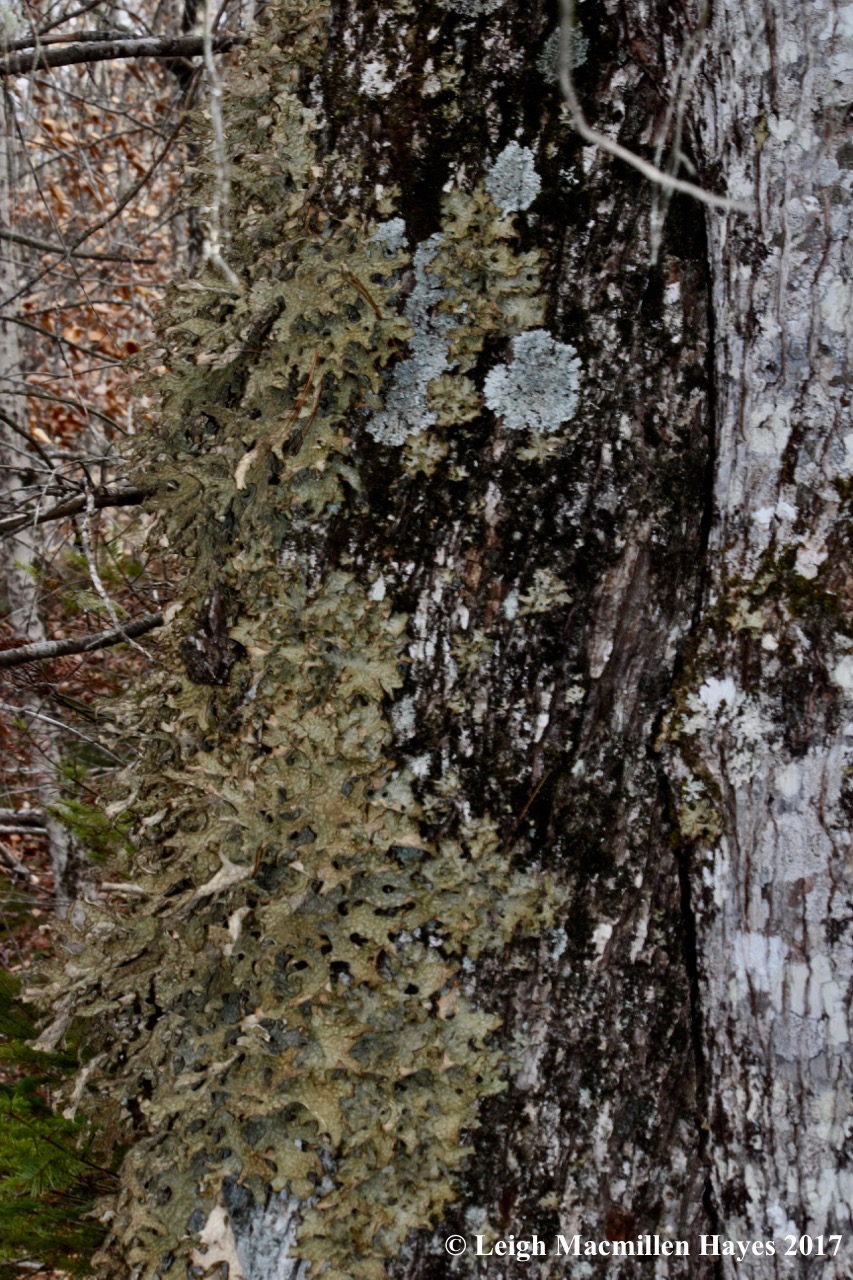
And occasionally, our downward gaze turned upward when we spied trees covered in lungwort worthy of notice.

m21-beaver 8

But really, it was the beaver works that we celebrated the most.

m23-beaver 10

And the fact that thanks to the beavers we learned that the inner bark or cambium layer of a red maple is . . . red.

m23a--not all cuts work in the beavers favor

No matter where we looked, in addition to recent windstorms, the beavers had changed the landscape. The curious thing is that most often the trees landed in the direction of the water, making it easier for them to enjoy their chews of inner bark and twigs in a relatively safe environment, but occasionally, hang ups occurred. And that brought about the question, how is it that most trees are felled toward the water? But not all?

m23a--lodge

While our focus was on the trees along the shoreline, we also kept admiring the water view as well.

m24-lodge

And noted the most recent activity at this particular beaver lodge, including a mud coating to insulate it for the winter.

m28-welcome flag on lodge

We also appreciated that a welcome sign blew in the breeze–in the form of an evergreen branch.

m29-otter scat

And where one finds water and beavers, there are otters. We knew of their presence by the scat left behind in a trail well traveled. Several times we found examples of the same.

m31-main channel open

As the sun lowered while we approached the beaver dam, we quietly hoped to see North America’s largest rodents at work, but settled for sky reflections on water and ice. And the knowledge that by their works and sign, we trusted they were present.

m32-dam1

At last we reached the dam, an expansive one at that. It’s in great shape and so no time had been wasted repairing it. That’s a good thing given that a few flurries floated earthward on this day that felt like winter. There’s food to gather and a home to prepare so work must be efficient.

m33-dam other side

Water trickled through in a few places and ice formed, but the infinity pool created by the dam continued to exist.

m34-brook

And below, the water flowed on–to other beaver dams and otter adventures we were sure. For Jinny Mae and me, our adventure needed to draw to a close. But . . . we made plans to explore again in a few months to see what changes may have occurred–with land owner permission, of course.

As we walked out, we gave thanks for the owners and their appreciation of the landscape and those that call it home today and tomorrow.

From the land comes food and water that benefits the critters who live here and us. It also offers us good health when we take the time to embrace it by exploring, exercising and just plain playing outdoors.

Protection is key. So is education, which develops understanding and appreciation. I know for myself, my relationship with the landscape continues to evolve.

I’m thankful for the work being done to protect the ecosystem. There’s so much I still don’t understand, but with each nugget of knowledge gained, the layers build. Maybe someday I’ll get it. Maybe I never will. Either way, I’m happy for the chance to journey and wonder on properties owned by land trusts and individuals.
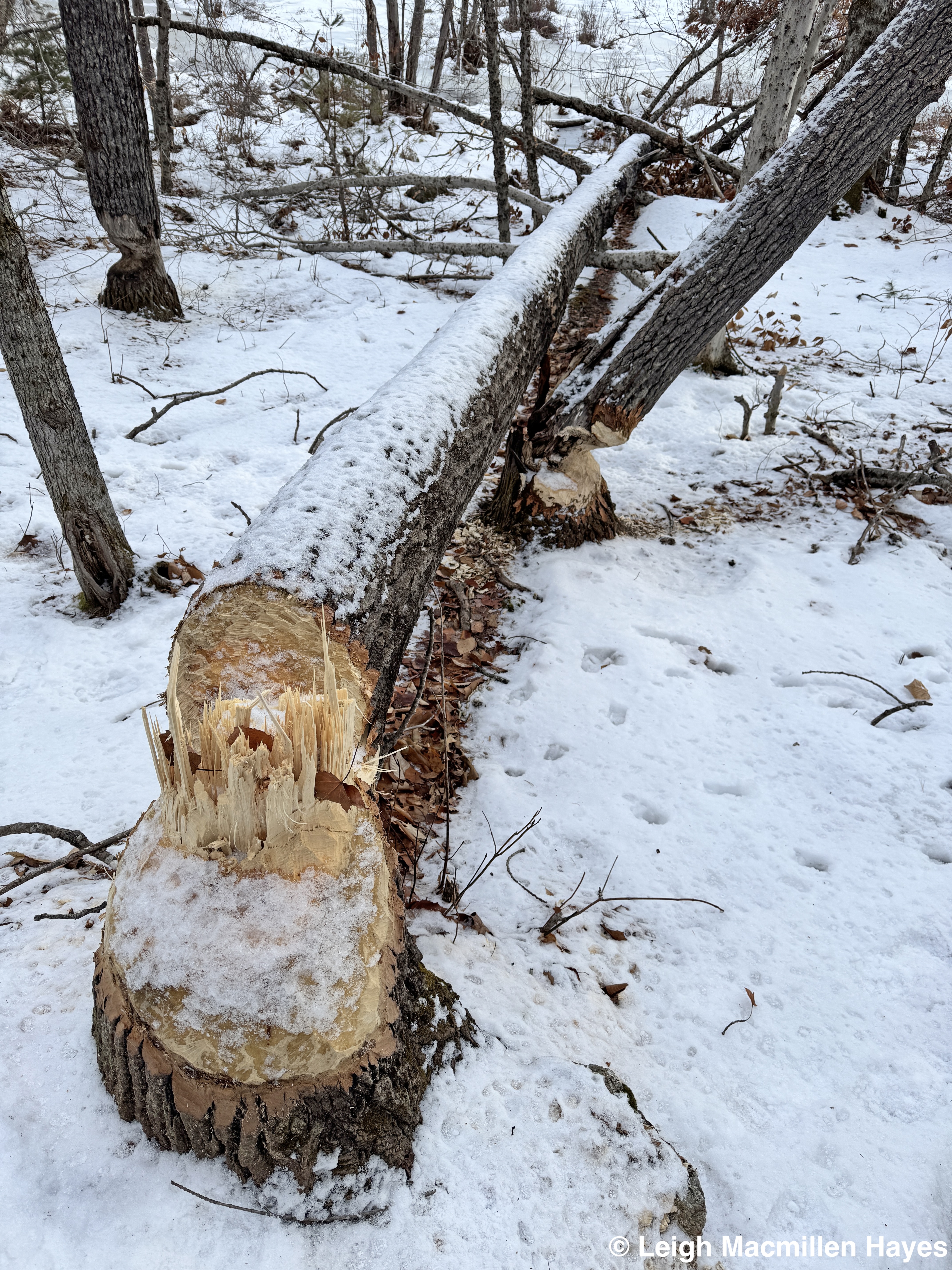
Even though we can’t all endow the future of our properties, we can get involved to ensure that these organizations continue to protect land for future generations of humans and wildlife so it will remain in its natural state for the benefit of all.


Making a list

and checking it twice. That’s what the busy beavers on a friend’s property appear to be doing right now as they ready for winter.
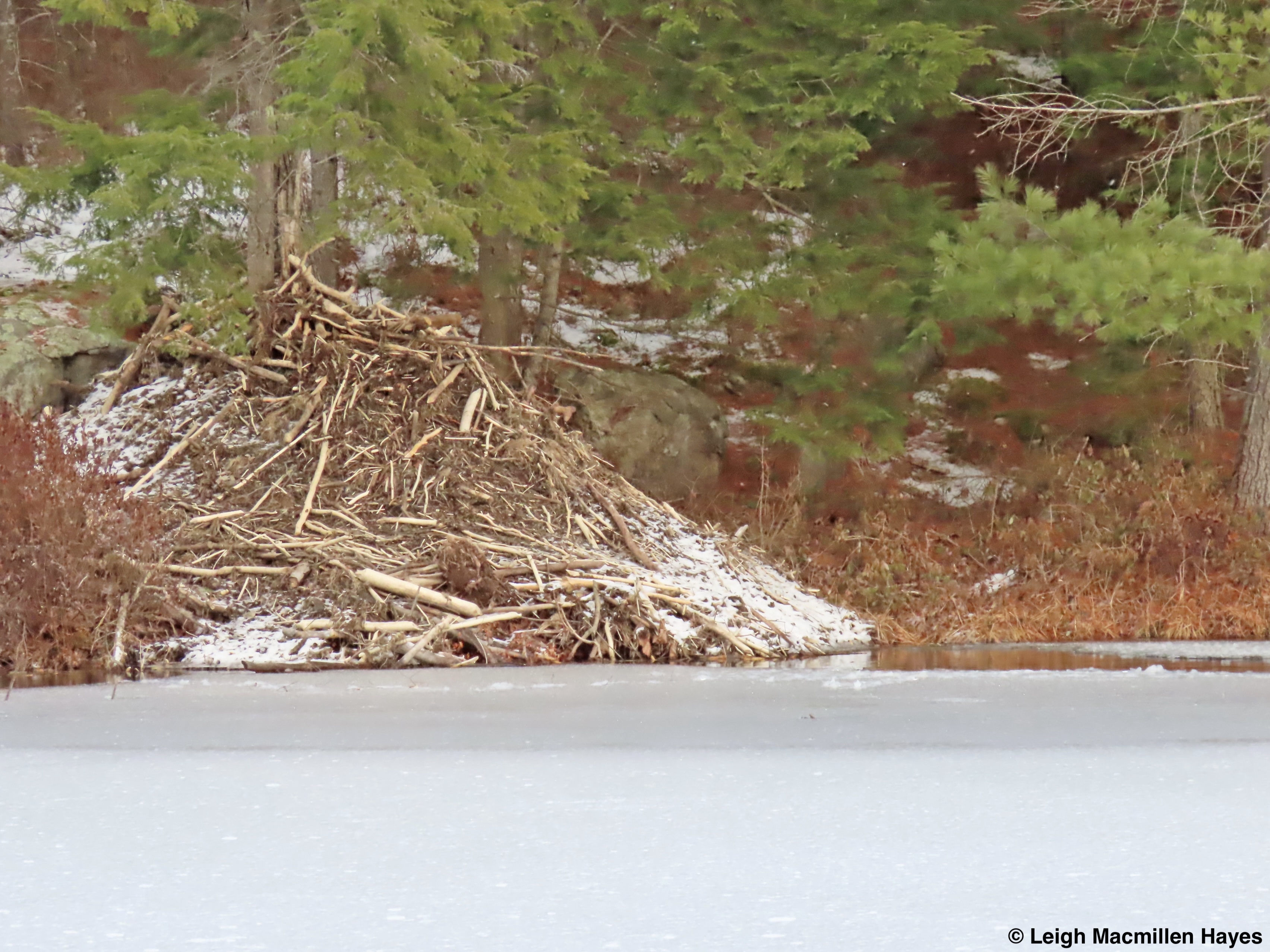
When JoAnne asked if I wanted to see the recent beaver works, I jumped at the opportunity.

beaver pond 1

Today’s rain didn’t stop us from heading out to explore. She first discovered this new pond when she walked down a sloping field and noticed through the trees what looked like water–where it wasn’t supposed to be.
beaver creek 2

A creek flows through her neighbor’s property and once supported several mill sites.

beaver stream width

It continues, or should I say continued, across her property, coming in from the right. That is, until things changed.

beaver ribbons

This past summer, in the middle of what is now the pond, JoAnne stood beside the then creek and marked a property boundary with pink tape.

beaver ribbon 1a

The ribboned tree was on the far side of the creek before her new neighbors  came knocking.

At a former dam site, they took it upon themselves to do their own construction. It needs work as we could see some holes, but I’ve no doubt that they’ll be on that in no time.

  beaver works 6beaver works 4beaver works 2

Their industrious nature was evident everywhere we looked. No tree species was spared. Once felled, they trimmed the branches and carried or dragged them to the water.

beaver debark

With their large front teeth, beavers bite chips off trunks. Their rodent teeth never stop growing so gnawing wood helps keep them in check. Because their lips are located behind their teeth, they can keep their mouths closed while they work. No need to hum a logging tune.

beaver chews

Some trees are particularly tasty and it seems that they like more than just the bark and cambian layer, the softwood just beneath the bark. Or perhaps they are cutting them into log-size pieces to make for easier carrying and maneuvering in the water.

beaver shed

Nothing was safe, including the sapling that had grown beside the shed.

beaver industry

beaver works 3

Sometimes things don’t work out quite the way they intend.

beaver caught

The upper part catches on other trees. All that effort . . . for naught.

beaver works 5

We stood in awe and wondered about how nature plays tricks on them occasionally.

beaver height

We marveled at the thought of them standing on their hind feet to work.

beaver trail 2

And we noticed their oft-traveled roadways throughout the area.

beaver admiration

One of the truly curious things–most of the trees have fallen toward the water. Chance? Instinct? Engineering skills? They’ve learned how to fell a tree in that direction, thus creating the quickest route back to safety?

beaver lodge 2

The lodge is large. Accessible only via underwater entrances, the beaver family has protection from some predators. Outside, we could see part of their winter feed pile. We suspect there are more sticks below the water that will be available once the ice finally forms.

beaver statue 2

When all is said and done, statues like this will remain to remind JoAnne and others of these natural engineers and how they altered the land to create the water world they need for survival, which will ultimately benefit other wildlife.

As for their checklist:

*dam secure?

*lodge in good repair?

*food cut, moved and stored?

How about you? Have you made your list and checked it twice?