My Artistic Path: one year later

It’s all Jessie Lozanski’s fault that a year after publishing My Artistic Path, I’m publishing the next layer of paintings and sketches. Until I shared a few with my sister this afternoon, I had no idea how prolific I’ve been in this department. That said, some didn’t make it off the drawing board. Or rather, they did, but ended up in the trash, or in a pile to be considered at a later point in time. That’s the beauty of working with gouache, I can make changes at a later date. For me, that is liberating.

And now Dear Reader, you have three choices: 1) Read this entire post from beginning to end; 2) Scroll through the pictures and call it good; or 3) Click out of this post and pretend you either never saw it or that you did see it and loved all of it.
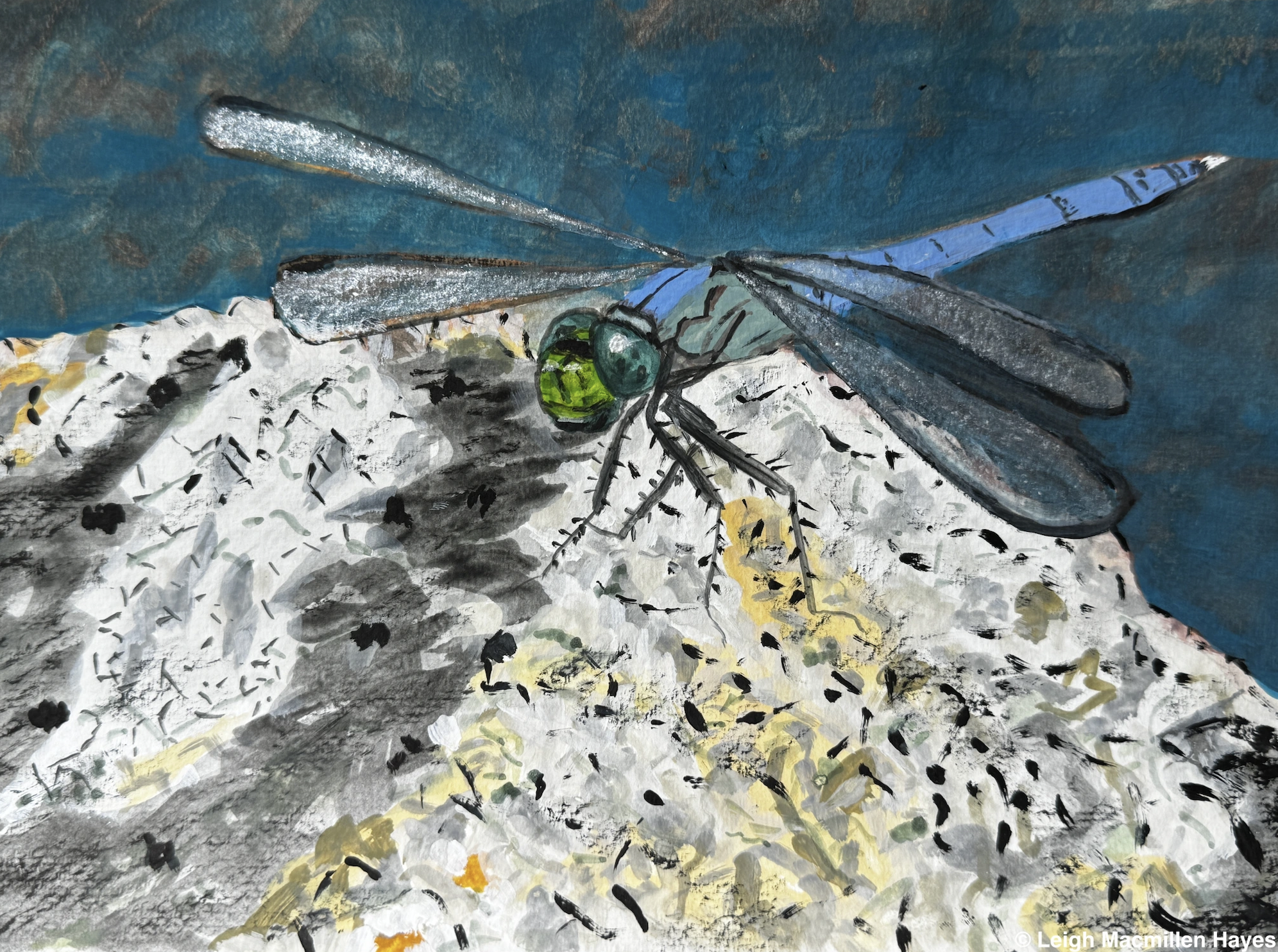
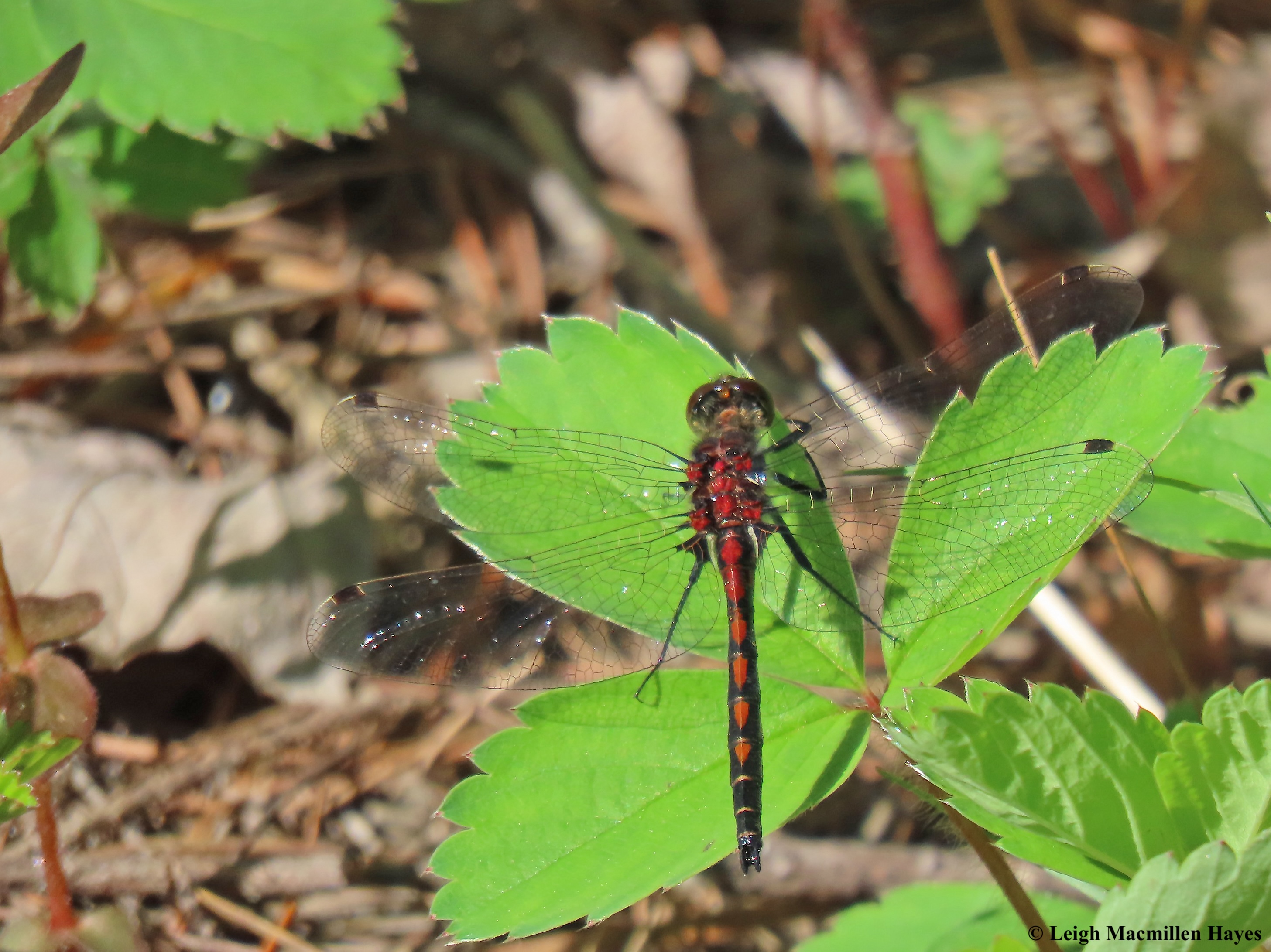
I have to say, I thought I’d paint more dragonflies like this Eastern Pondhawk, but when I scrolled through My Art Gallery, I discovered only a few others. That said, I did take some time to sketch the naiad forms of six families and then painted each one. You can visit all of those in Dragons of the Future if you wish.

Waterways also intrigued me as I tried to figure out how to make the water look as if it is flowing. This is Province Brook in Chatham, New Hampshire.

And then there are the critters and I’m afraid you’ll see a few of them along this journey. The fun thing about this Chipmunk is that it made an appearance on a February day. I was tracking with some friends and we were pretty certain that we’d discovered Chipmunk prints, but it didn’t seem possible. Until it was because as we backtracked, we saw him and he posed for a few photographs. Sometimes, when you need more food, you might make a mad dash from your winter home to locate it.
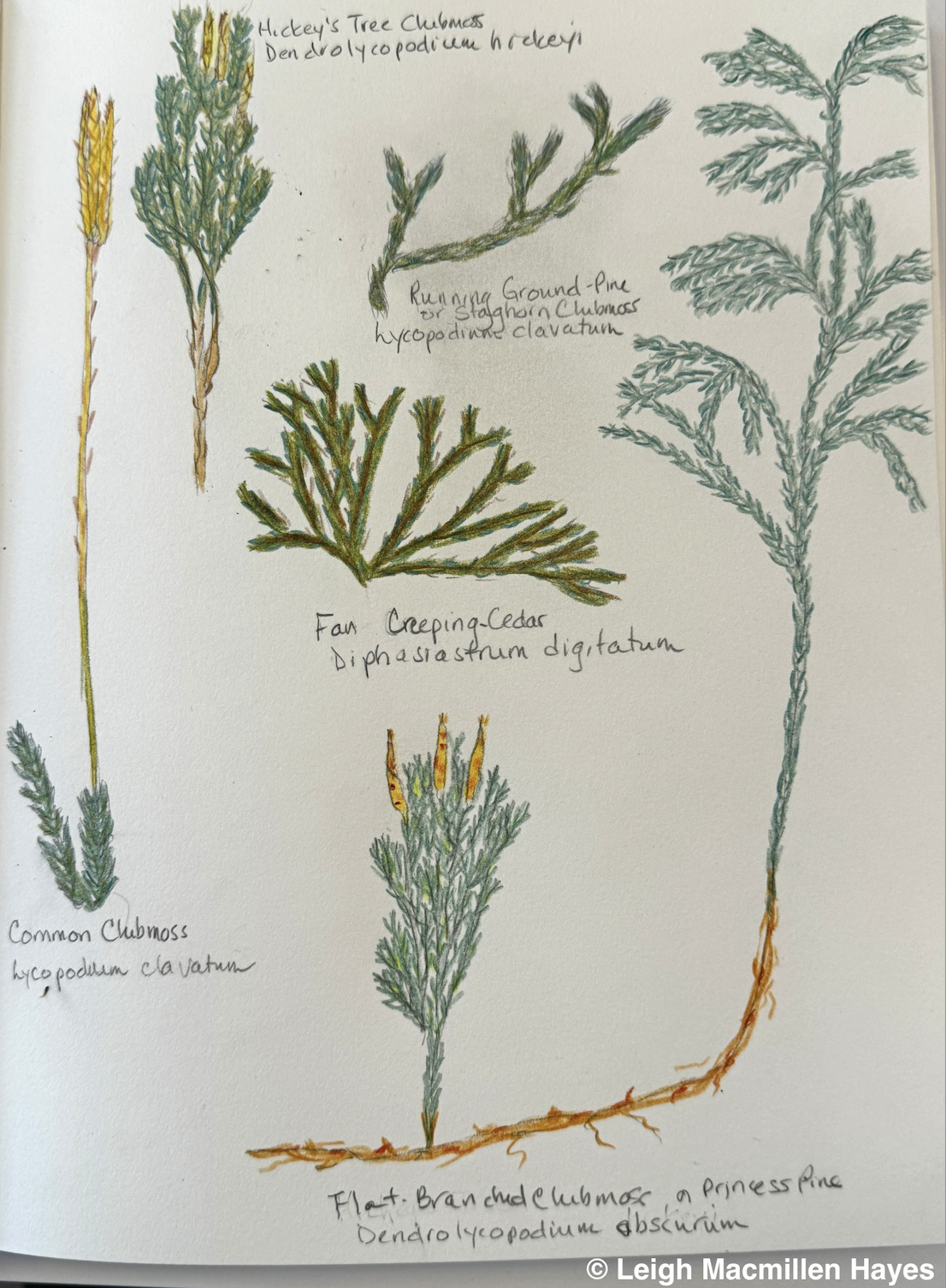
Clubmosses are one of the topics I’m trying to learn. . .when I take the time to do so. And so I sketched these after spending some delightful hours studying them as I wrote about in When is a Moss not a Moss?
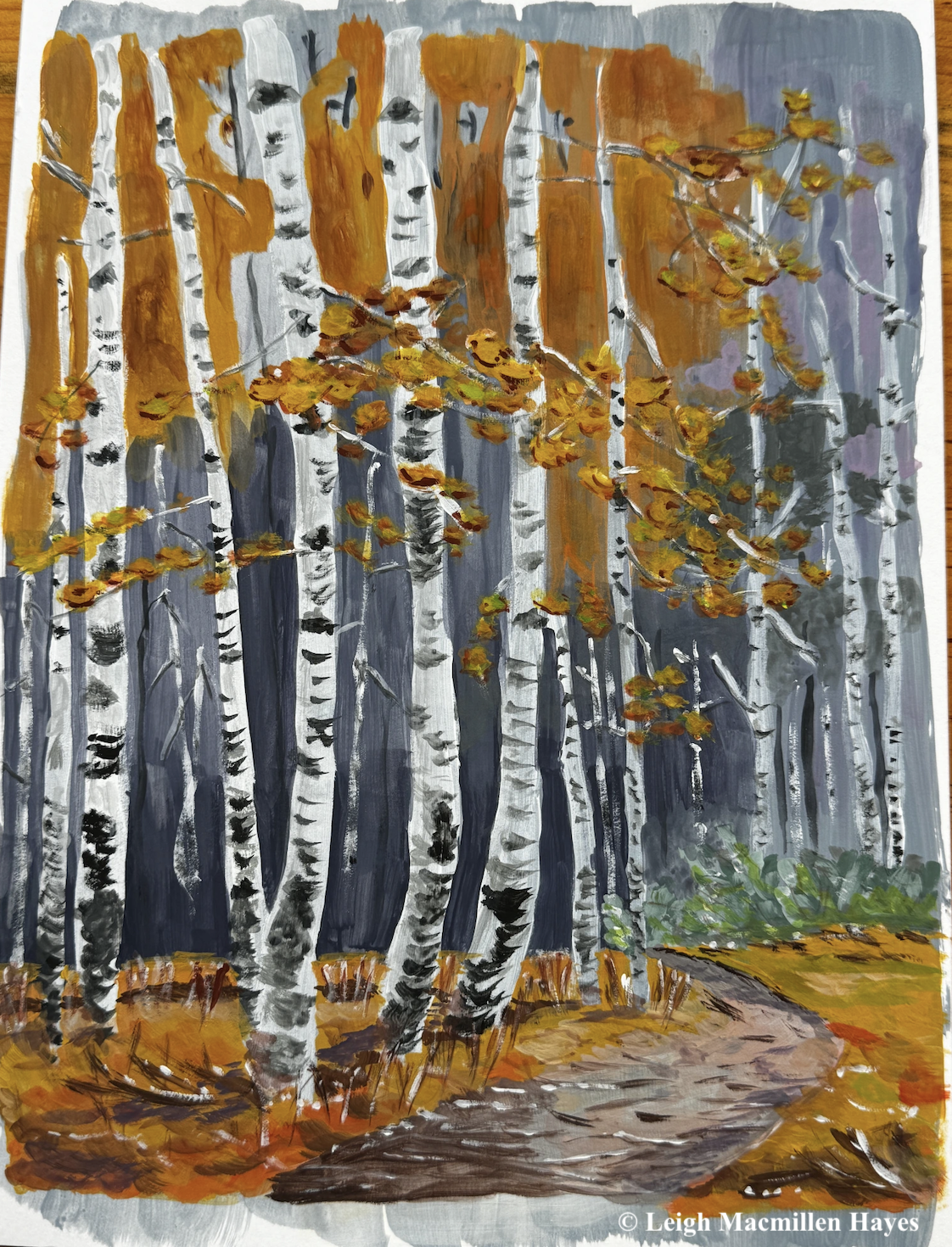
It’s the colors in this painting that I like. And figuring out how to paint Birch bark.

And then there was Forter Castle in Glen Isla, Scotland. I actually did three smaller versions of this castle and then decided to paint this larger picture based off one of those. It was a gift for Anne, our hostess when we were invited to spend a few nights there back in 2017, and in memory of her husband John. You can read more about that adventure here: From the Bonny Banks to the Highlands.
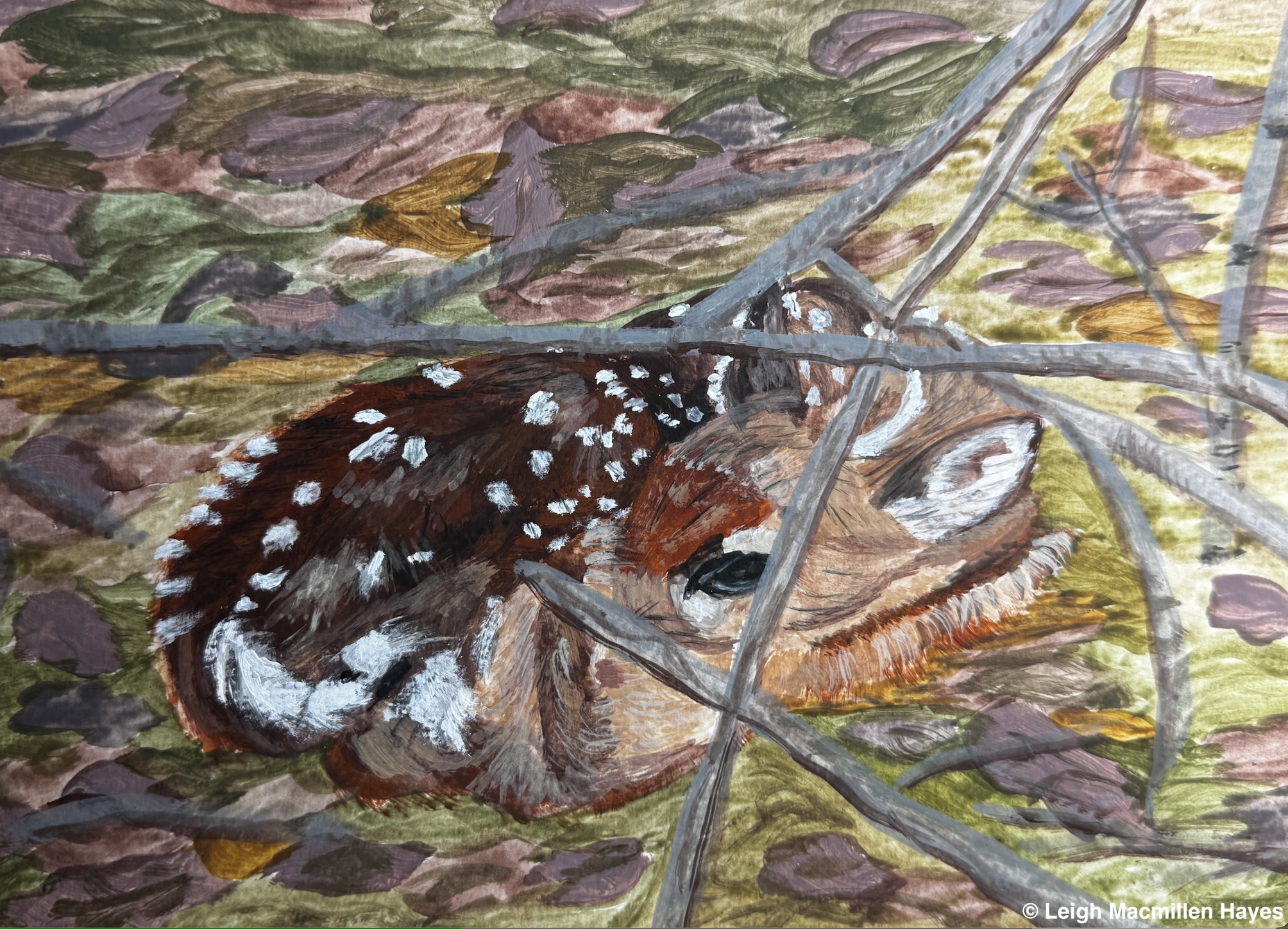
This next one will forever evoke the memory of my friend, Faith, who passed away this summer. We were on a Lakes Environmental Association walk at Holt Pond when we all “spotted” this fawn quietly waiting for momma. Quick pics and then we moved away.

And this is one of the Red Foxes who frequent our yard. In My Art Gallery, there are two more attempts, both in watercolor while this one is with gouache paints. Experimenting is fun.
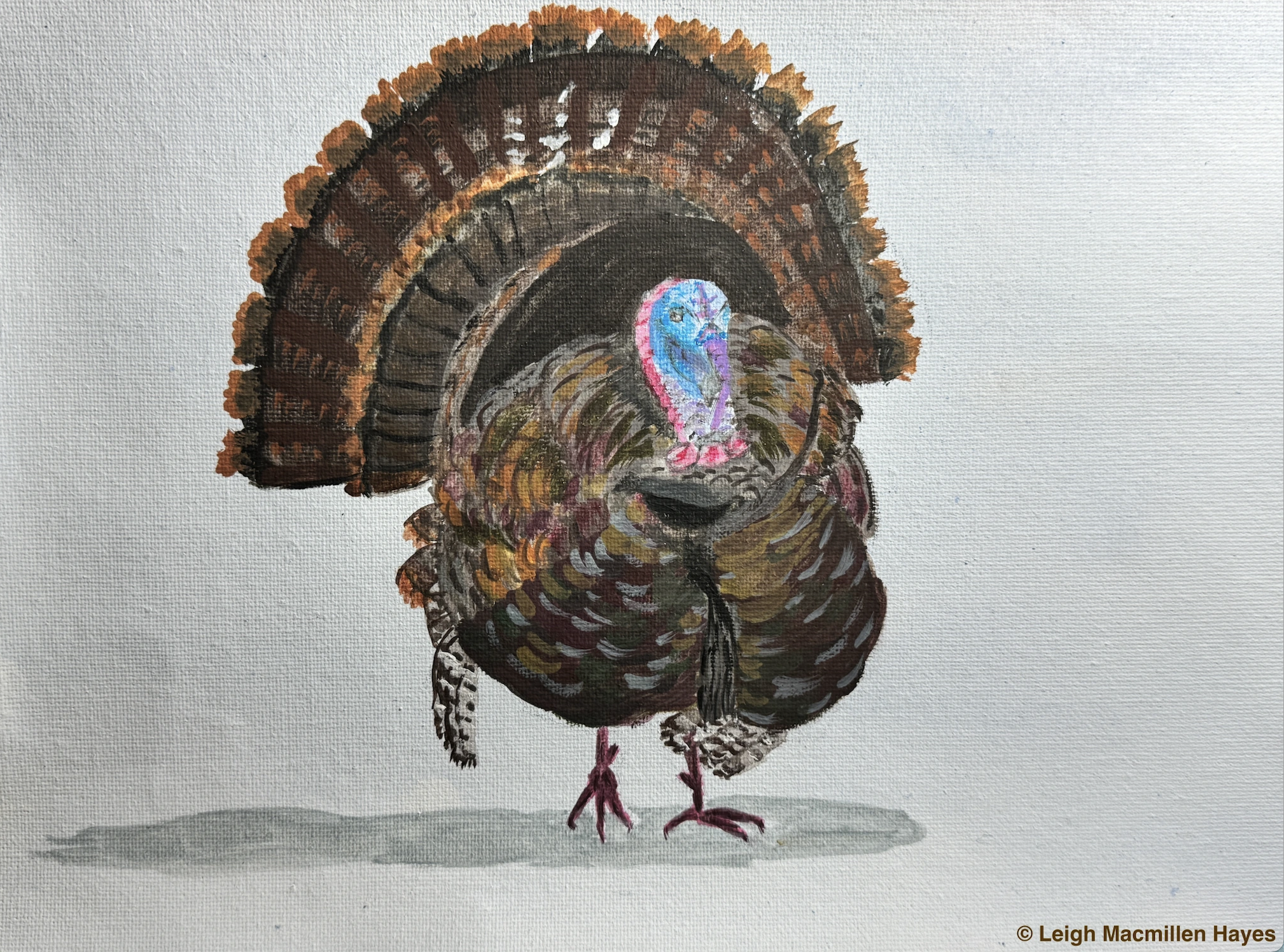
Tom Turkey! What more need I say.

In the midst of taking classes with Jessie this past year, which sadly ended in the spring, I purchased Grahame Booth’s book: Anyone Can Paint Watercolour Landscapes, and tried to follow the step-by-step instructions. This was a result of Lesson 1. There were six lessons altogether, and I thoroughly enjoyed the experience. You can see my other paintings based on the book by looking once again at My Art Gallery. Yikes, I’m beginning to sound redundant. Smiley Face!
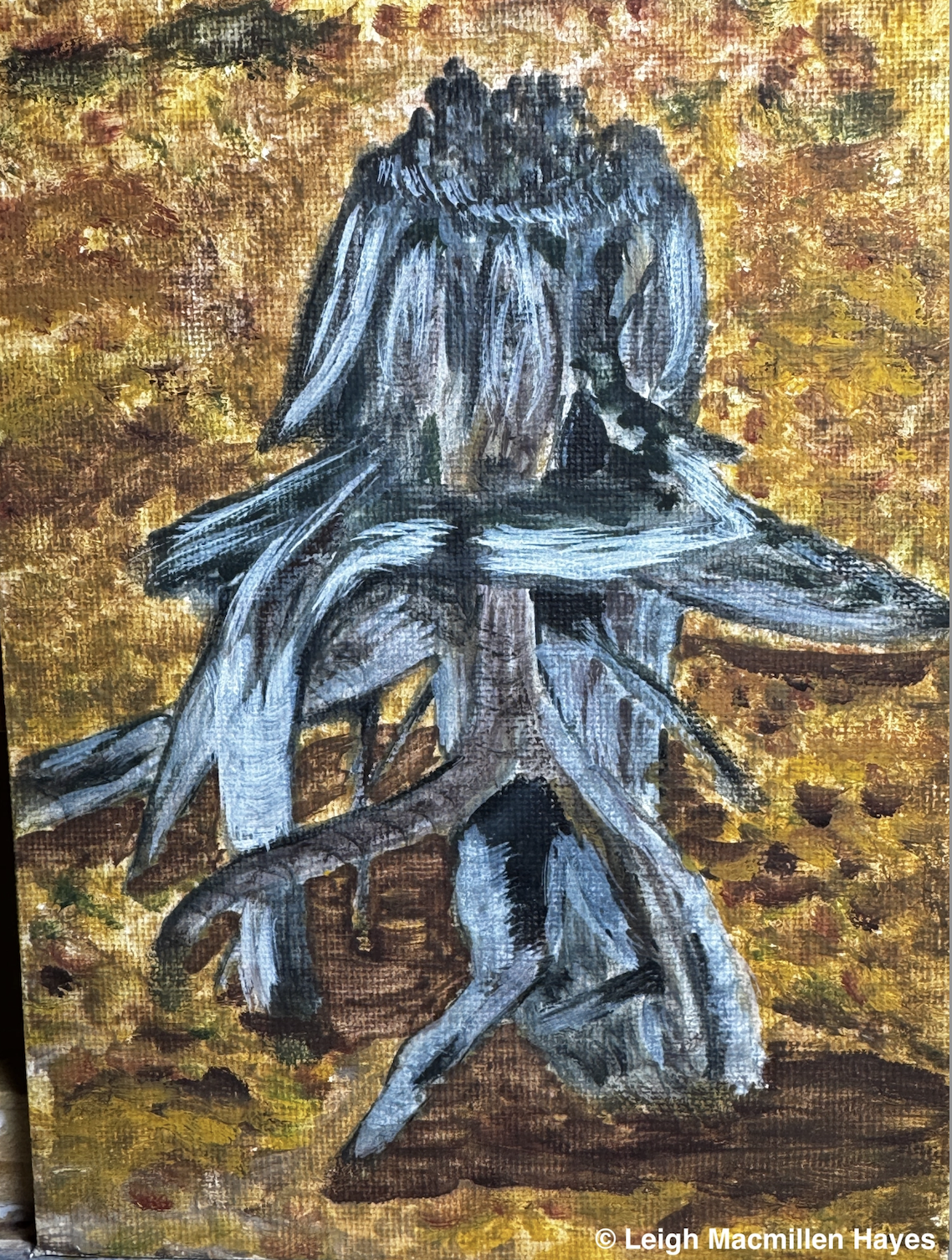
I like this one because I like the subject. I used a matted board to paint it. The stump is beside the Saco River in Conway, New Hampshire.

This one was for another friend because we had walked out to Kezar Pond in Fryeburg from her home the previous New Year’s Eve or Day, and it was just lovely.

And then there is a perennial subject of mine–the Stairway to Heaven tree along the cowpath in our woods. I especially love it when snow outlines the branches.

Another favorite scene takes me back to my childhood in Clinton, Connecticut, and I painted this for my sister and brother-in-law as a keepsake. So many memories in the spot that was our little piece of Heaven for so many years.

On and off, I’ve produced paintings of birds, and another favorite subject is the Great Blue Heron. I’ve also tried to paint rookeries, but often struggle with perspective. Of course, you can view my attempts you know where: My Art Gallery, to be shortened to MAG going forward.

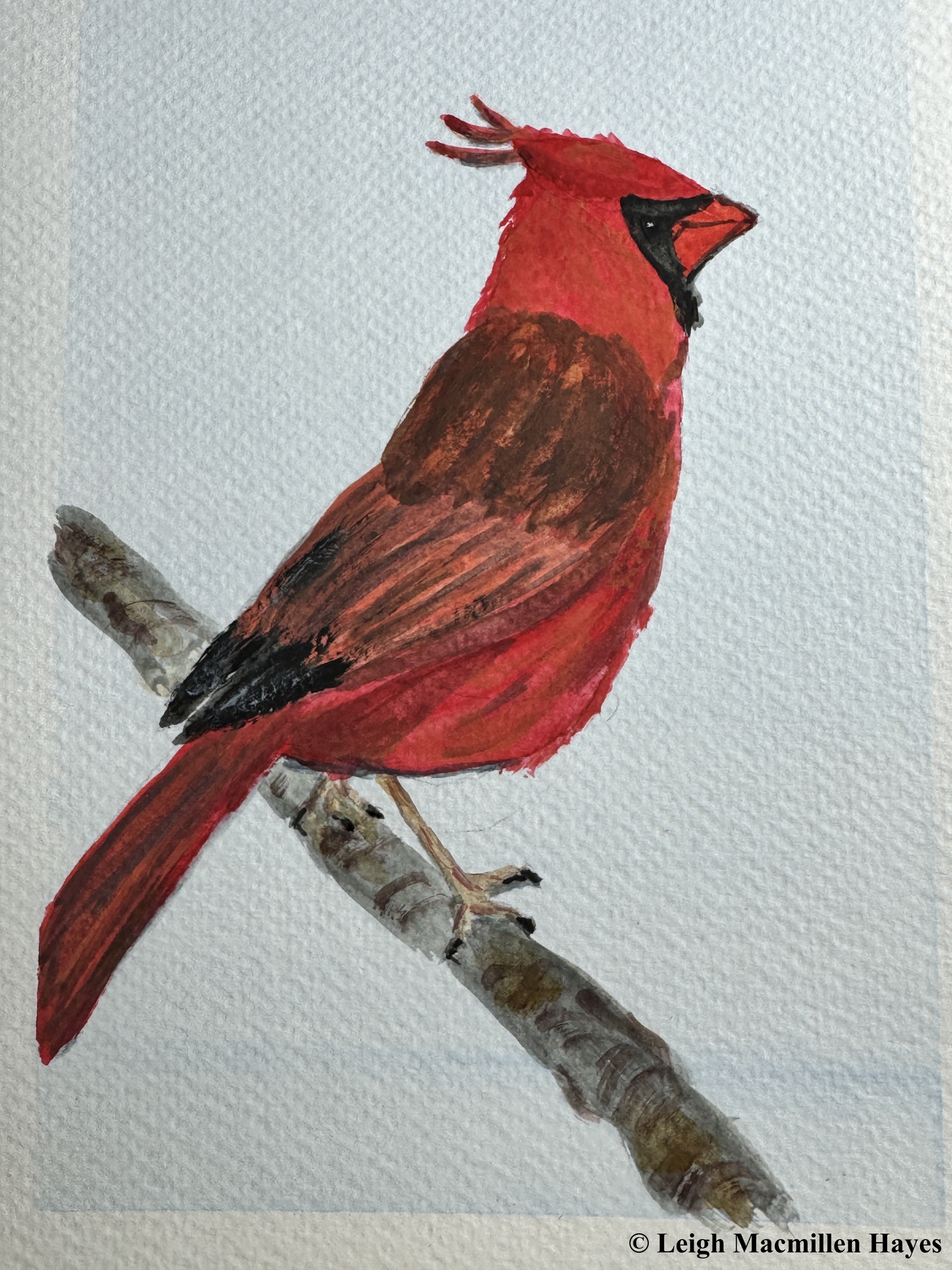
No words necessary really–a male Northern Red Cardinal.

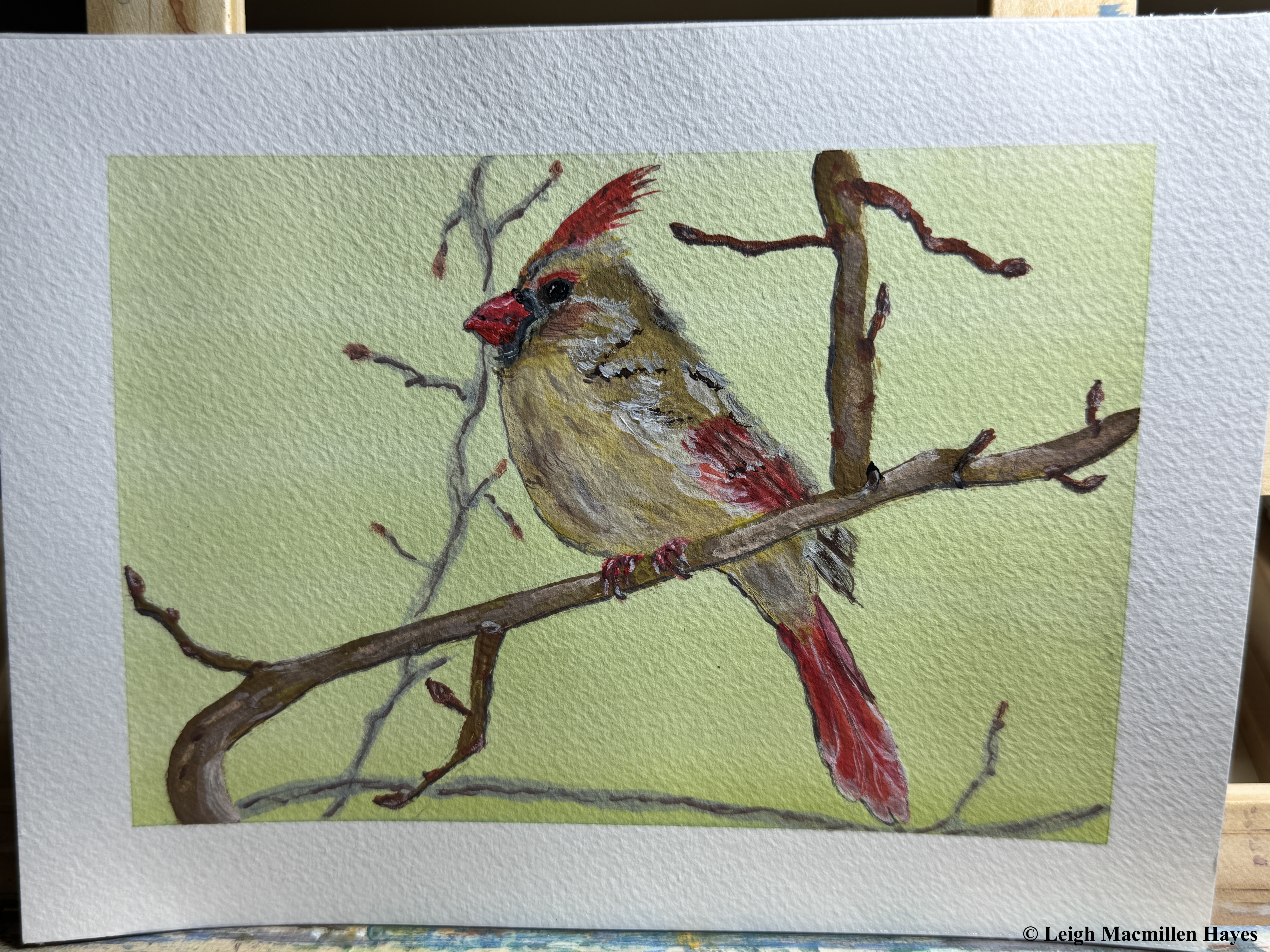
And his female counterpart.
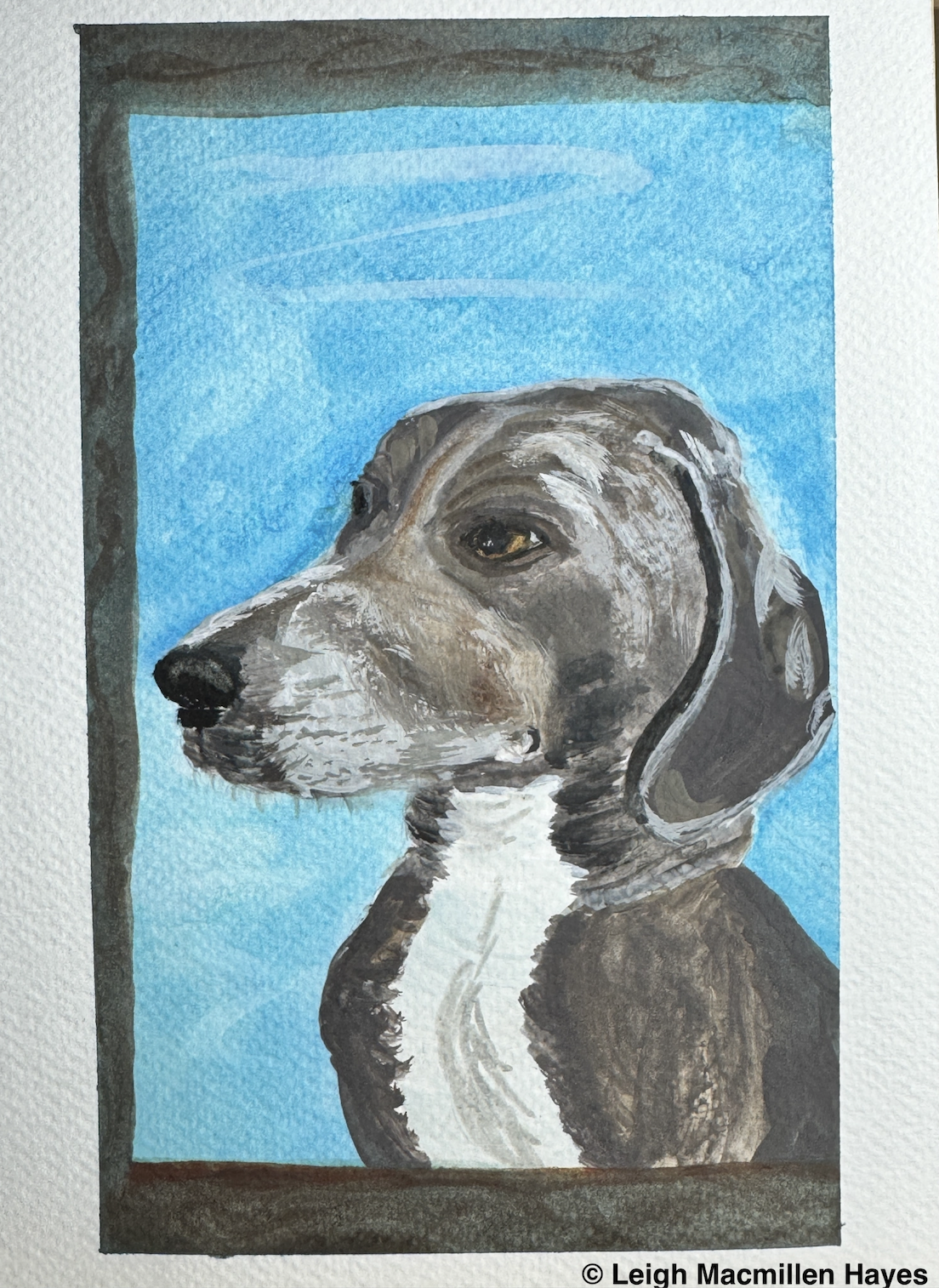
Our oldest son and his girlfriend rescued this energetic pup at the beginning of the pandemic.

And this pup belongs to our youngest son’s girlfriend’s mother.
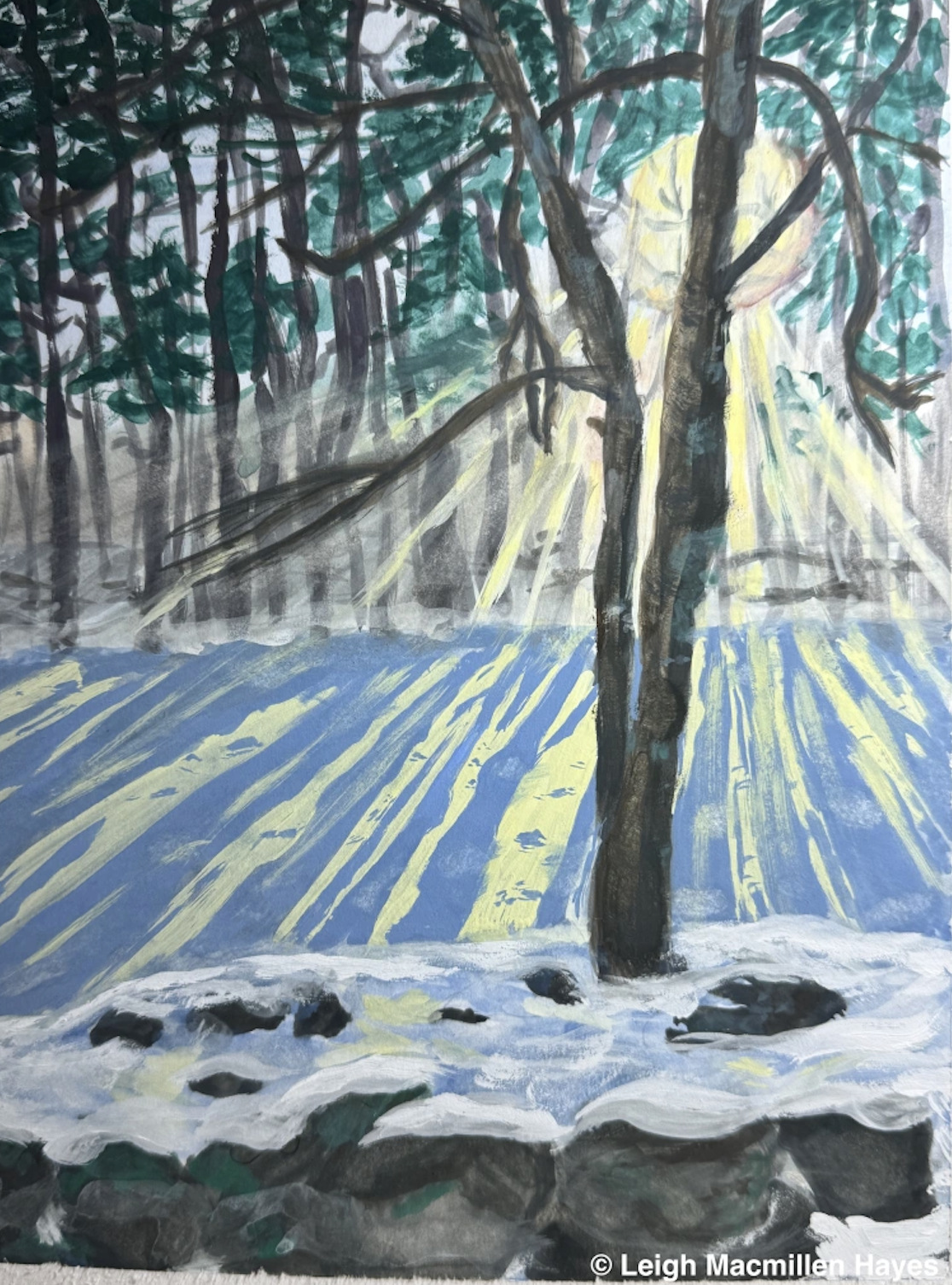
One morning, I stepped outside just after it had finished raining and the sun was shining through the trees out back and there was a layer of fog and shadows and it was just exquisite so I tried to capture it.
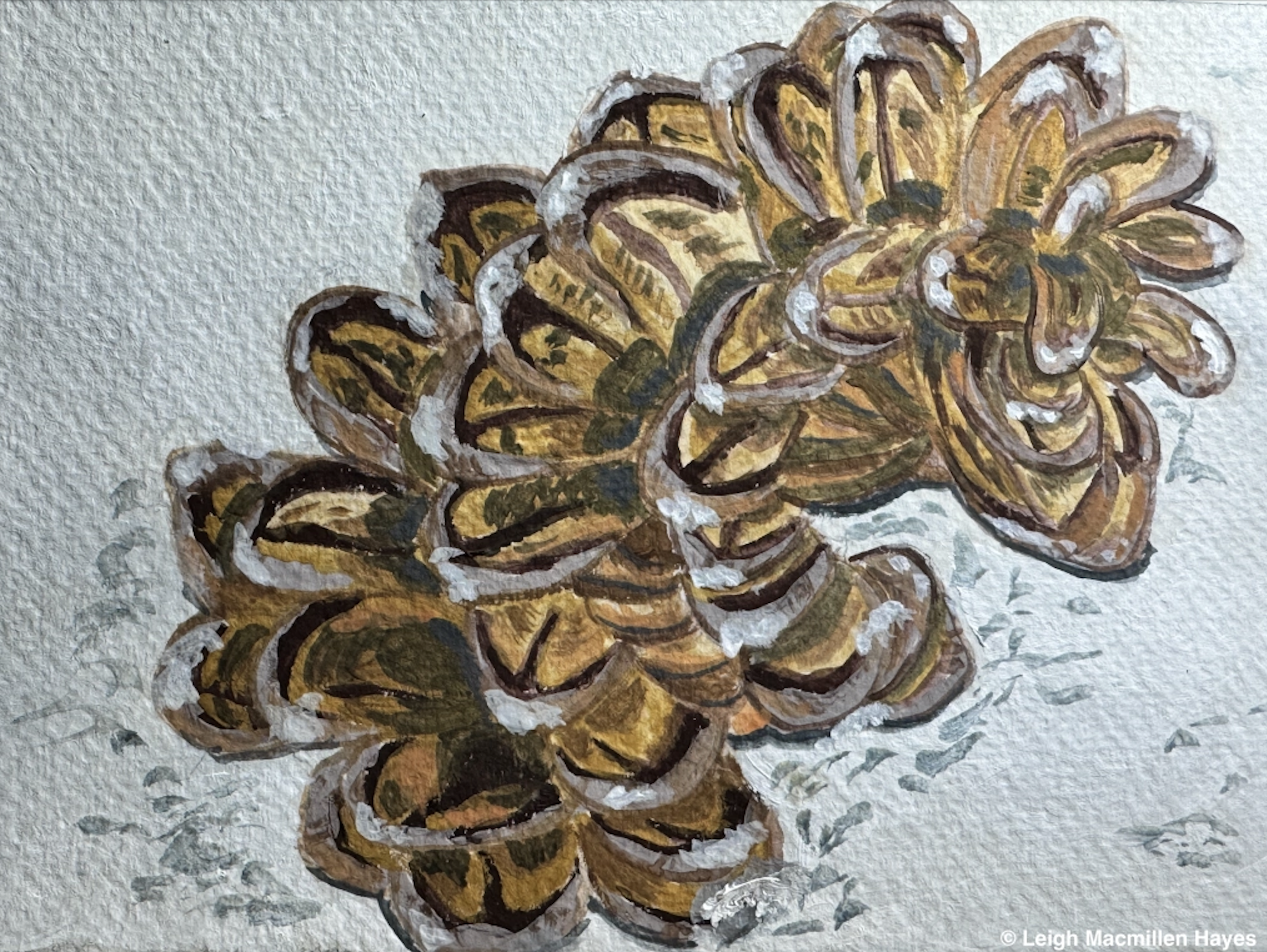
The White Pine Cone was something I started to sketch and then left for a long time, until I realized the scales were all arranged in a spiral of course and bingo, I knew how to go about it.
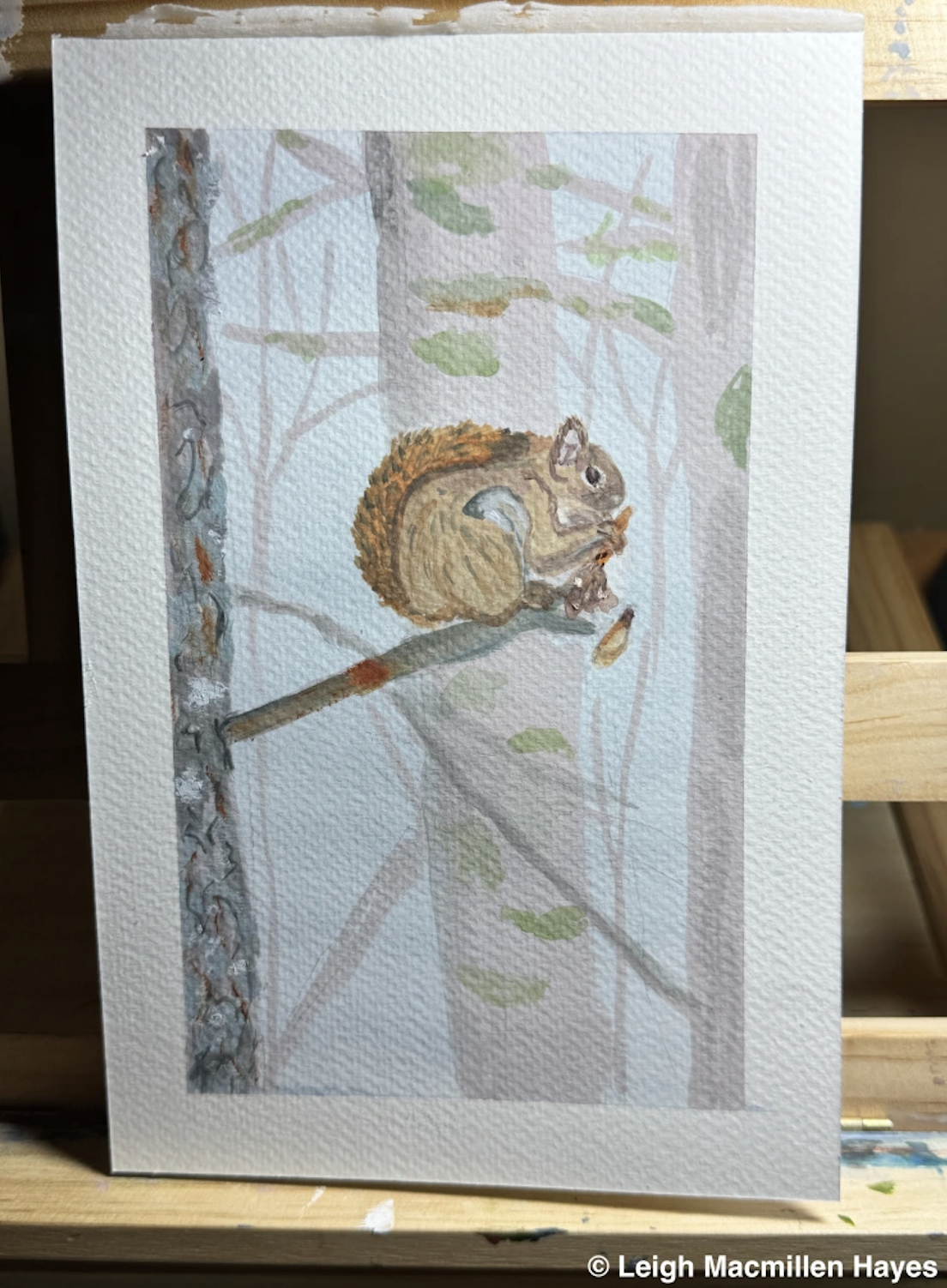
Turns out, I’m not the only one who knows to go about it–for Red Squirrels love to take each pine cone scale off in order to get to the seeds stored by such. Their method of descaling a cone is rather like us eating corn on the cob. I actually referenced both the pine cone painting and this one in Another Amazing Lesson from a Red Squirrel.
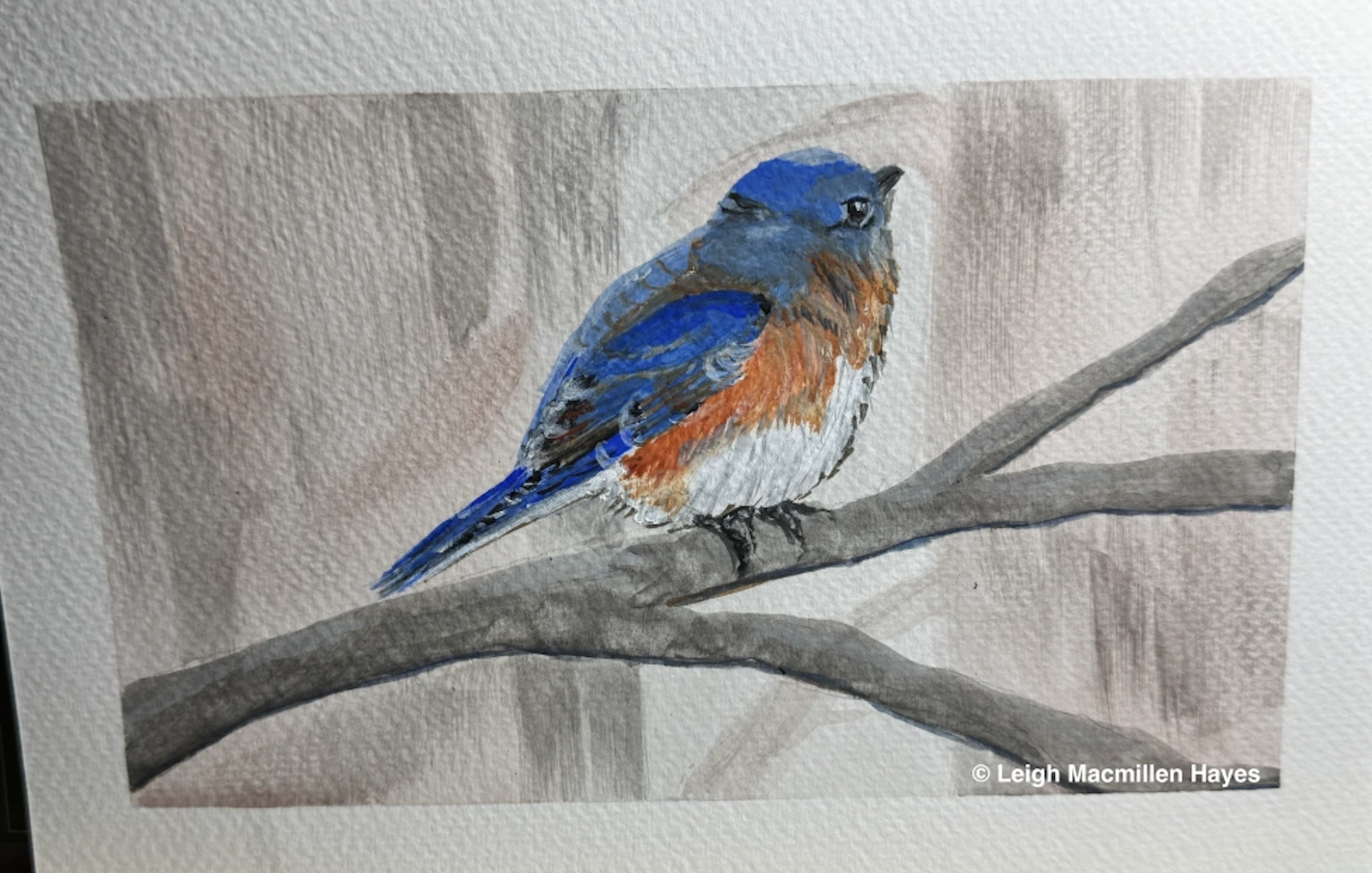
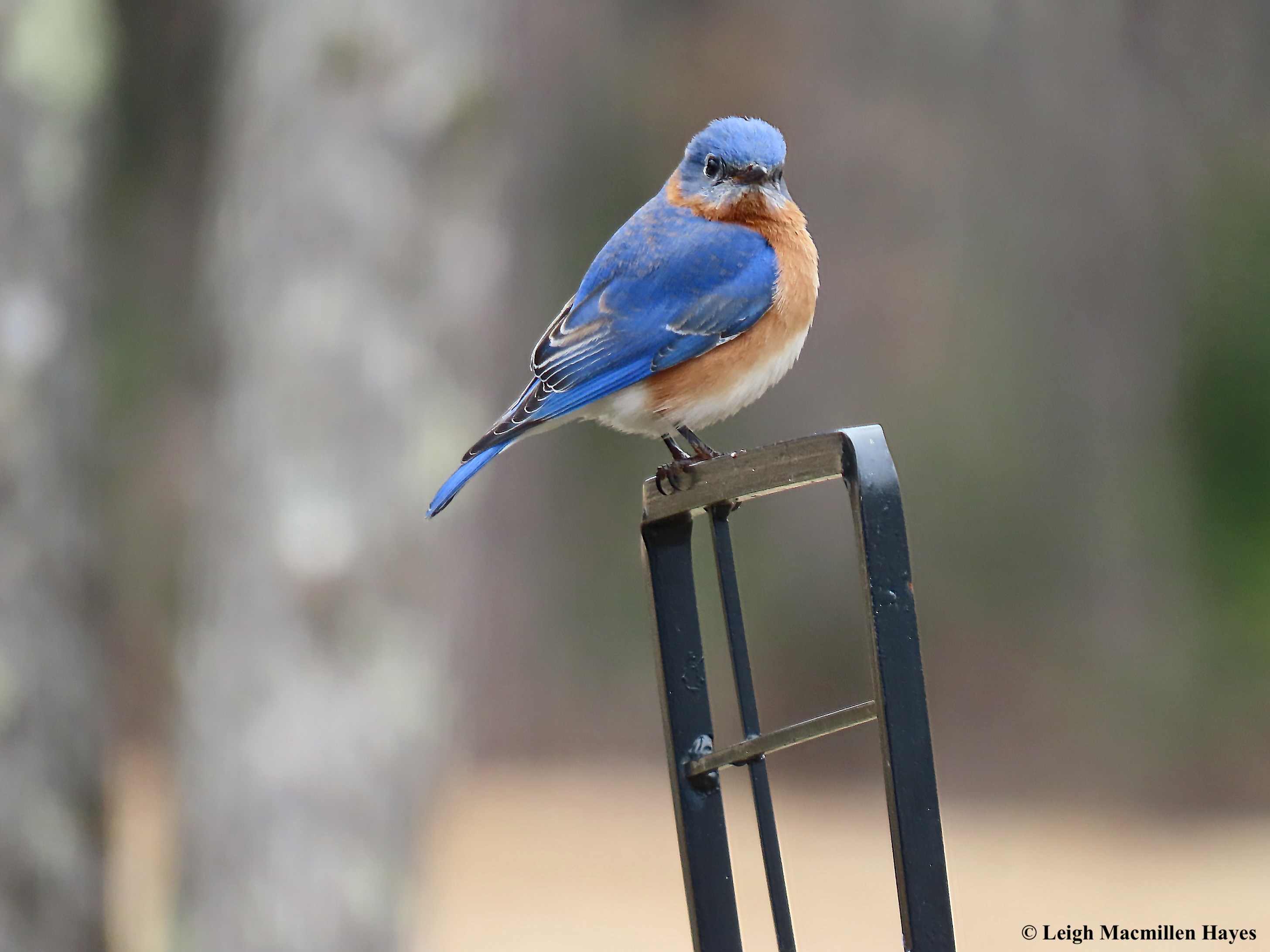
All last winter and spring, and into the beginning of the summer, my neighbor and I rejoiced because we had Bluebirds. In fact, a pair nested in one of our boxes, but that was around July 4th, and by the end of the week, she’d abandoned the nest. We’ll never know why.

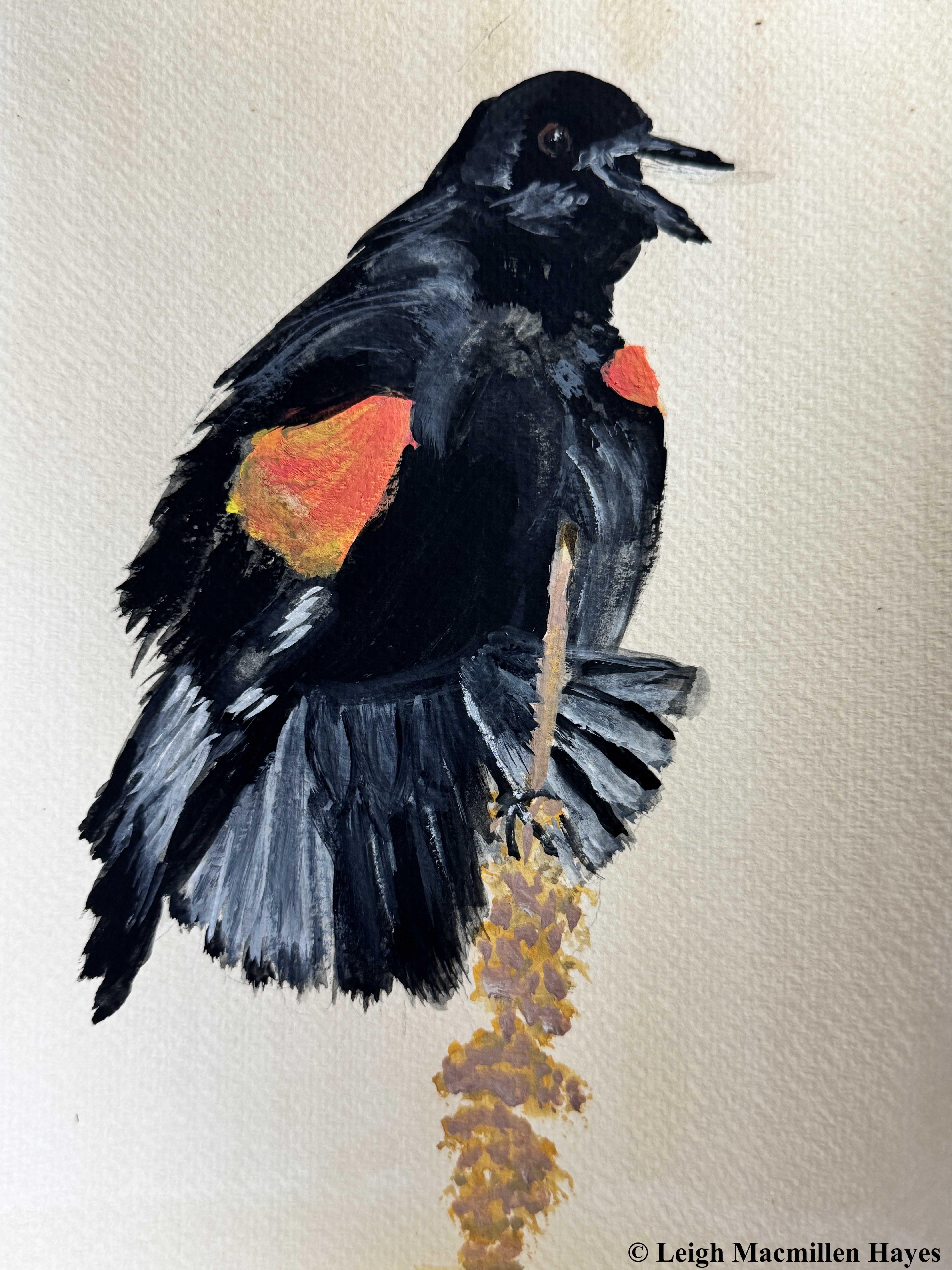
A few more birds coming up–including this male Red Winged Blackbird at Brownfield Bog.

A Sharp-shinned Hawk in the backyard and field.
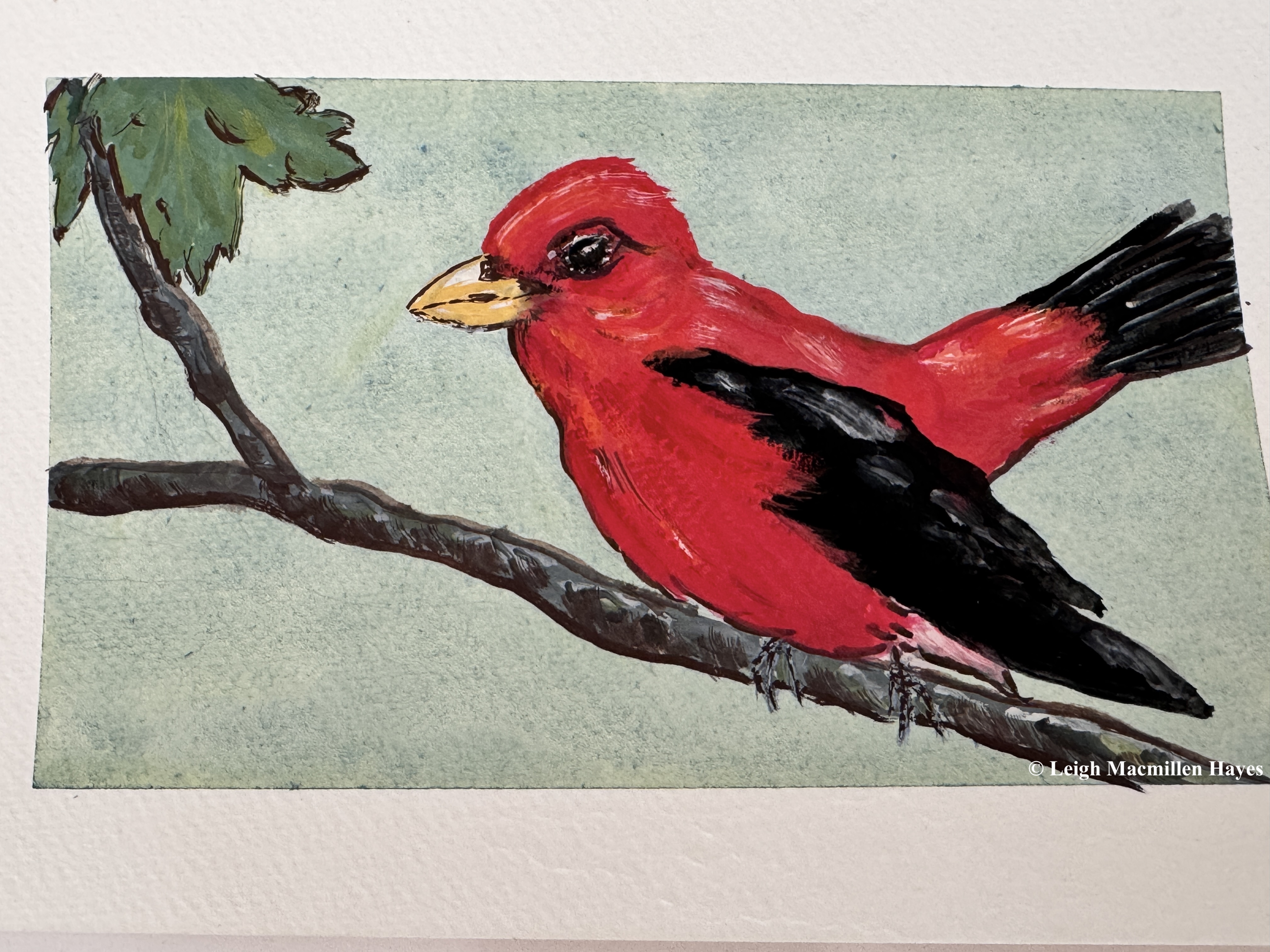
And a Scarlet Tanager on Mount Cutler in Hiram, Maine.

I did think I’d paint more butterflies, and perhaps this fall or winter I’ll attempt to, but it seems the Spring Azure is all I’ve done so far.

I’ve also made a couple of cards in the course of the year, this one for a First Grade student who was my penpal and she told me she really likes Dandelions. That girl will go far in life!

Another favorite topic of mine: Dog-Day Cicadas. If you type Cicada into the “Search” bar on my blog, you’ll discover several posts about these insects emerging. As I write, I can hear them “singing” from the treetops.

Sometimes, actually, more than sometimes, something catches one’s eye and this Tree Frog was one of those times. A friend and I had stopped to talk about a Snapping Turtle that seemed to be late laying eggs, and bingo, there was the frog on a tree.

Speaking of frogs and other critters who rely on vernal pools, visit MAG and you’ll find my Vernal Pool series, including a Fairy Shrimp that looks WAY bigger than its actual 1 – 1.5 inch size.
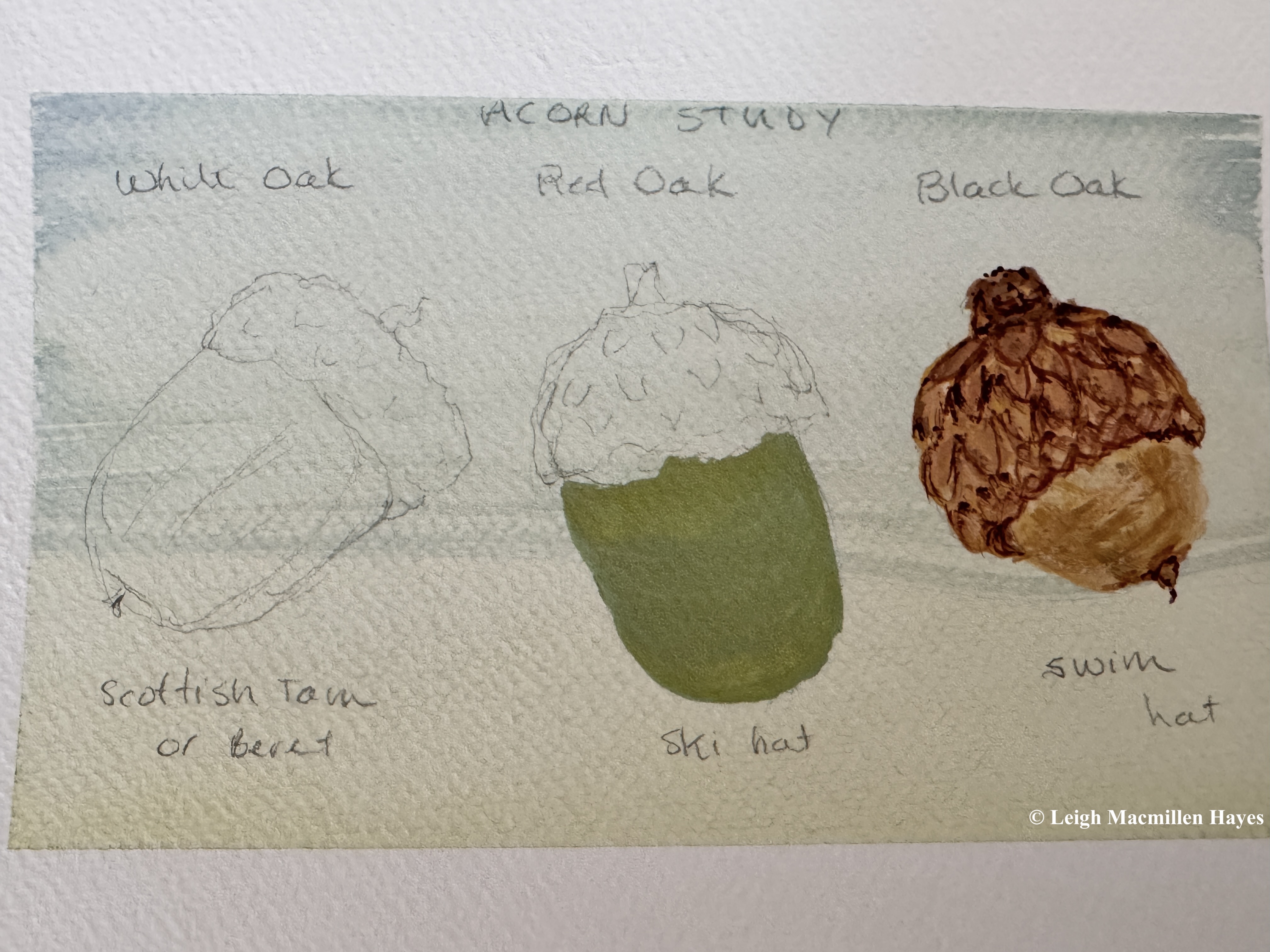
And then there was the day I pulled out a copy of National Audubon’s Field Guide to North American Trees because I wanted to get to know acorns better. Silly me, I came up with names for each one based on what they looked like to me, but I made the mistake of writing the names in pencil before painting a light colored wash on the paper. As I began to paint the acorns, I realized I wanted to change their names, but couldn’t erase them or paint over them. So . . .
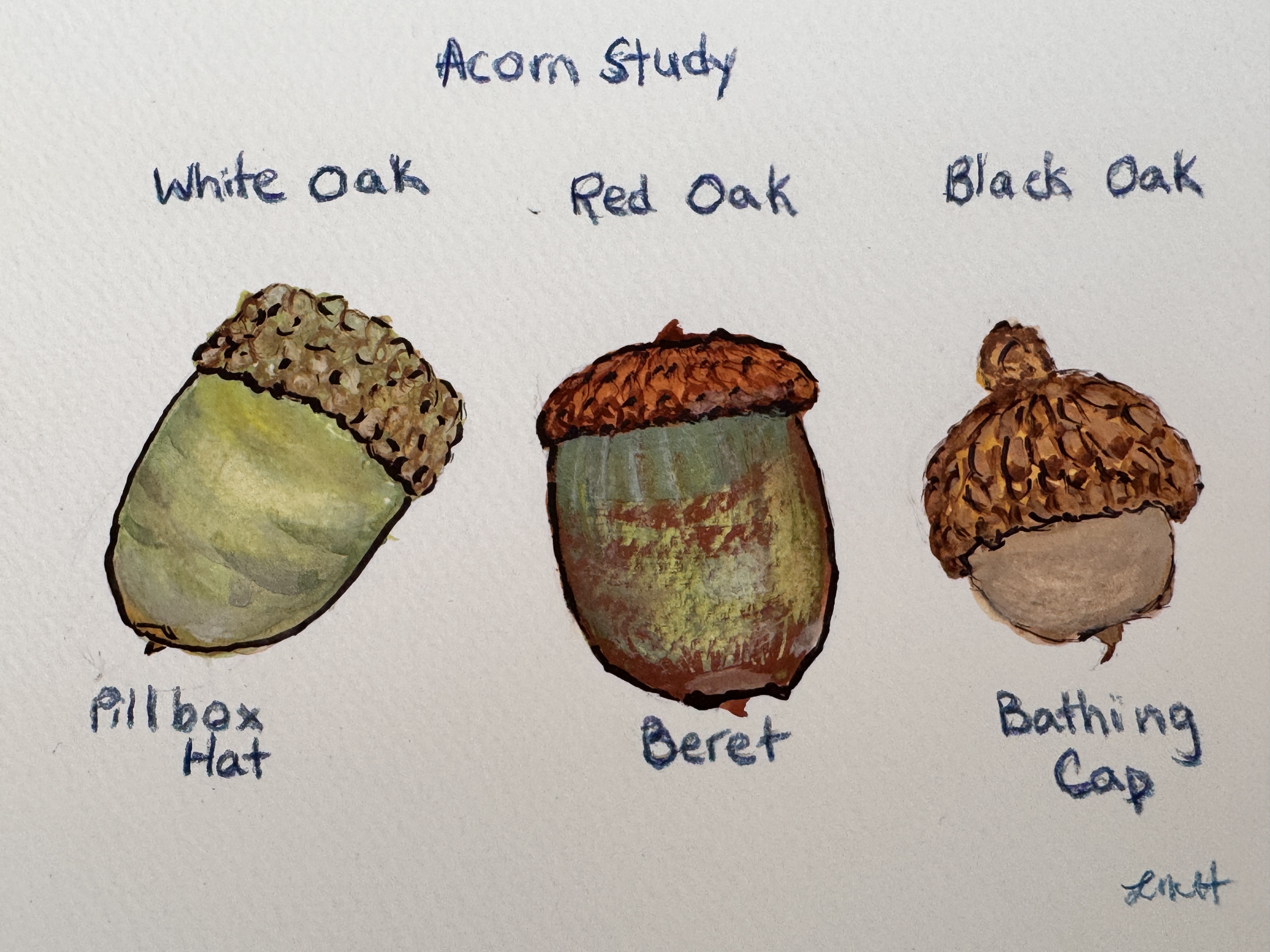
I sketched them again, and gave them new names.

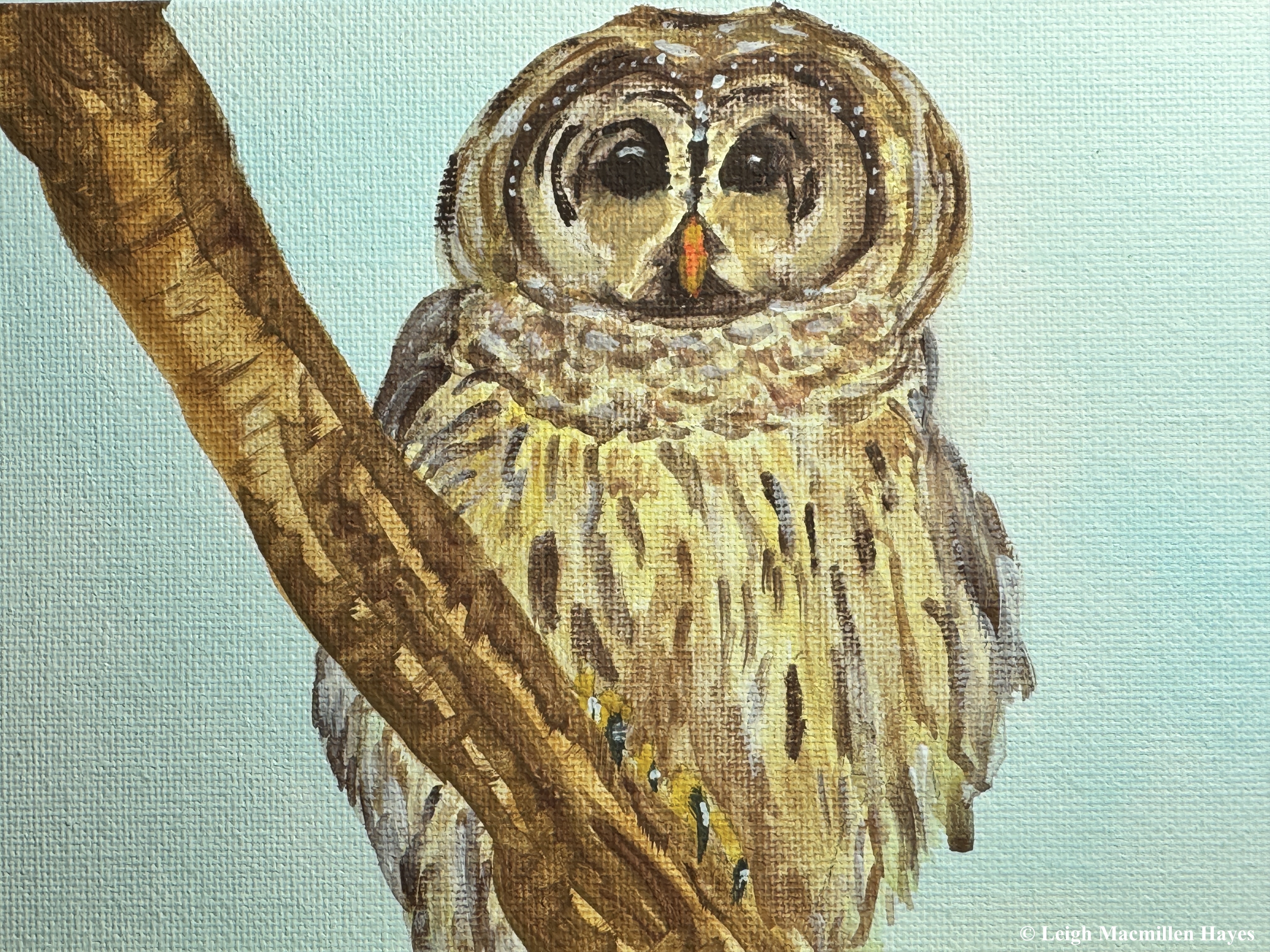
And finally the moment you’ve been waiting for, today’s painting:
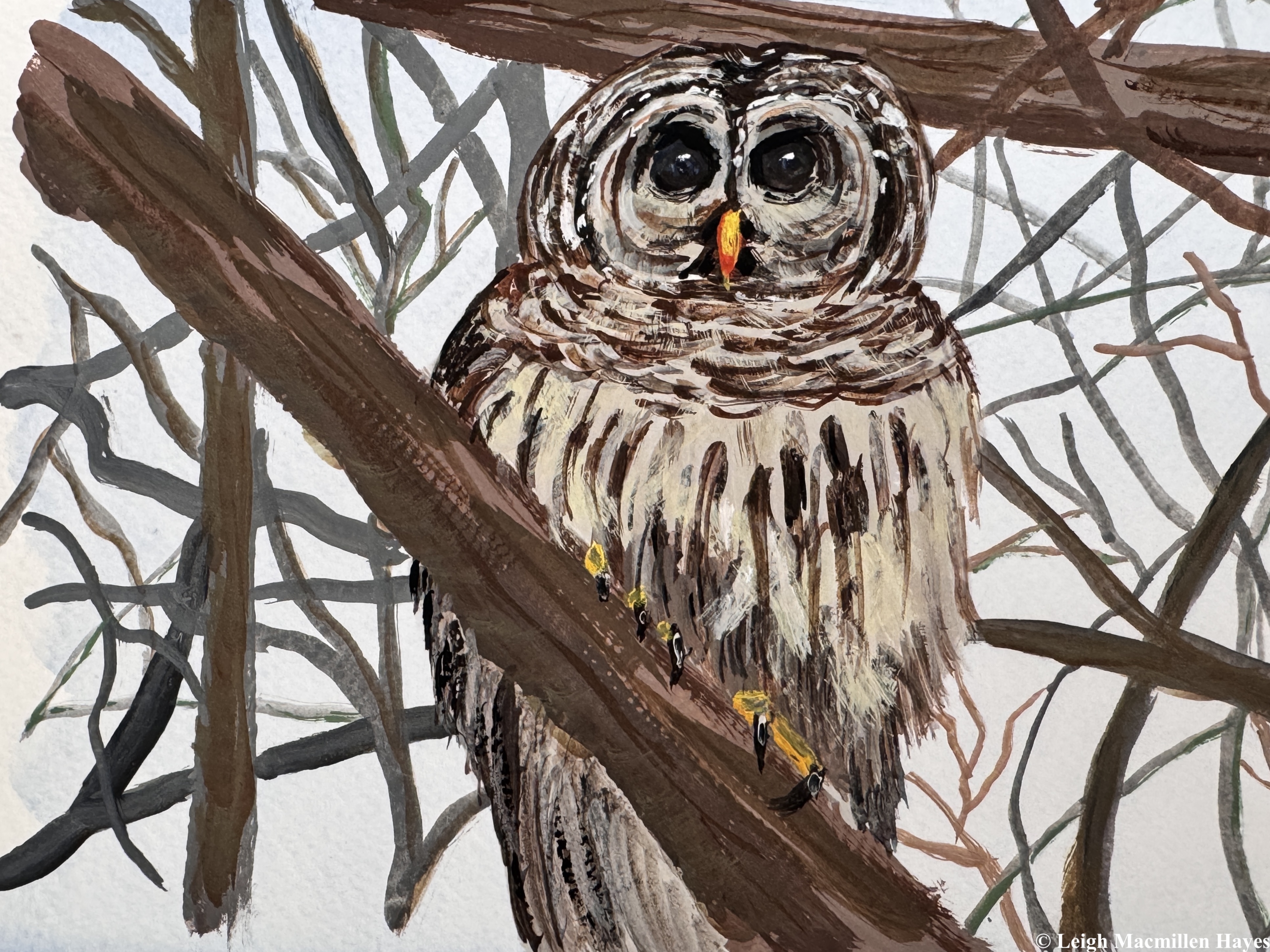
I always like it when I try iNaturalist’s SEEK app on a painting and it agrees with me. Barred Owl it is.

Wow, I had no attention of pulling this all together today until about an hour ago when I was sharing photos with my sister and realized I hadn’t sent her any in a while. So thank you, B.S., for being my inspiration today . . . and always.

And thank you Dear Readers, for sticking with me today and always as I share My Artistic Path: one year later.

In The Heat . . . of the moment

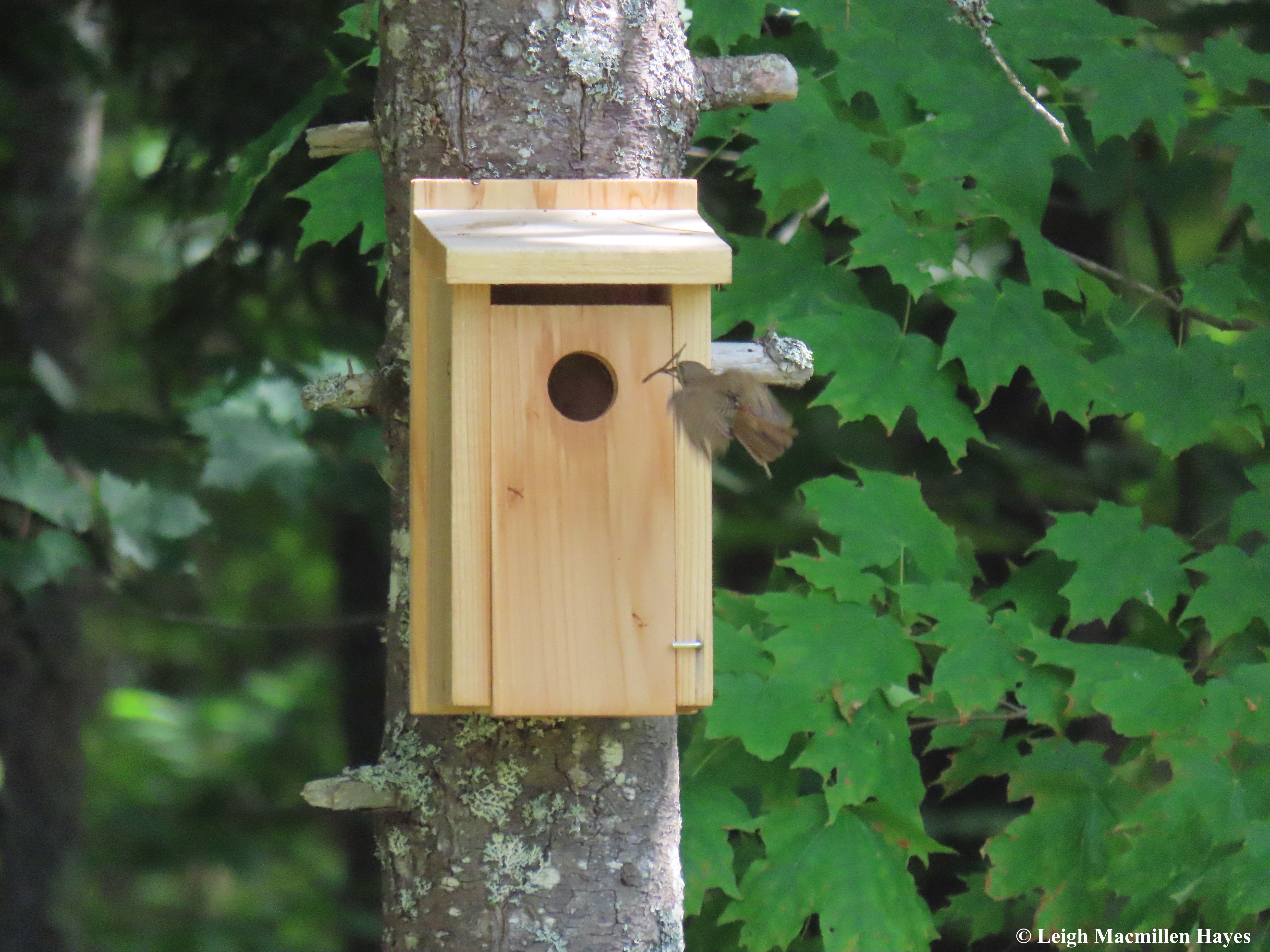
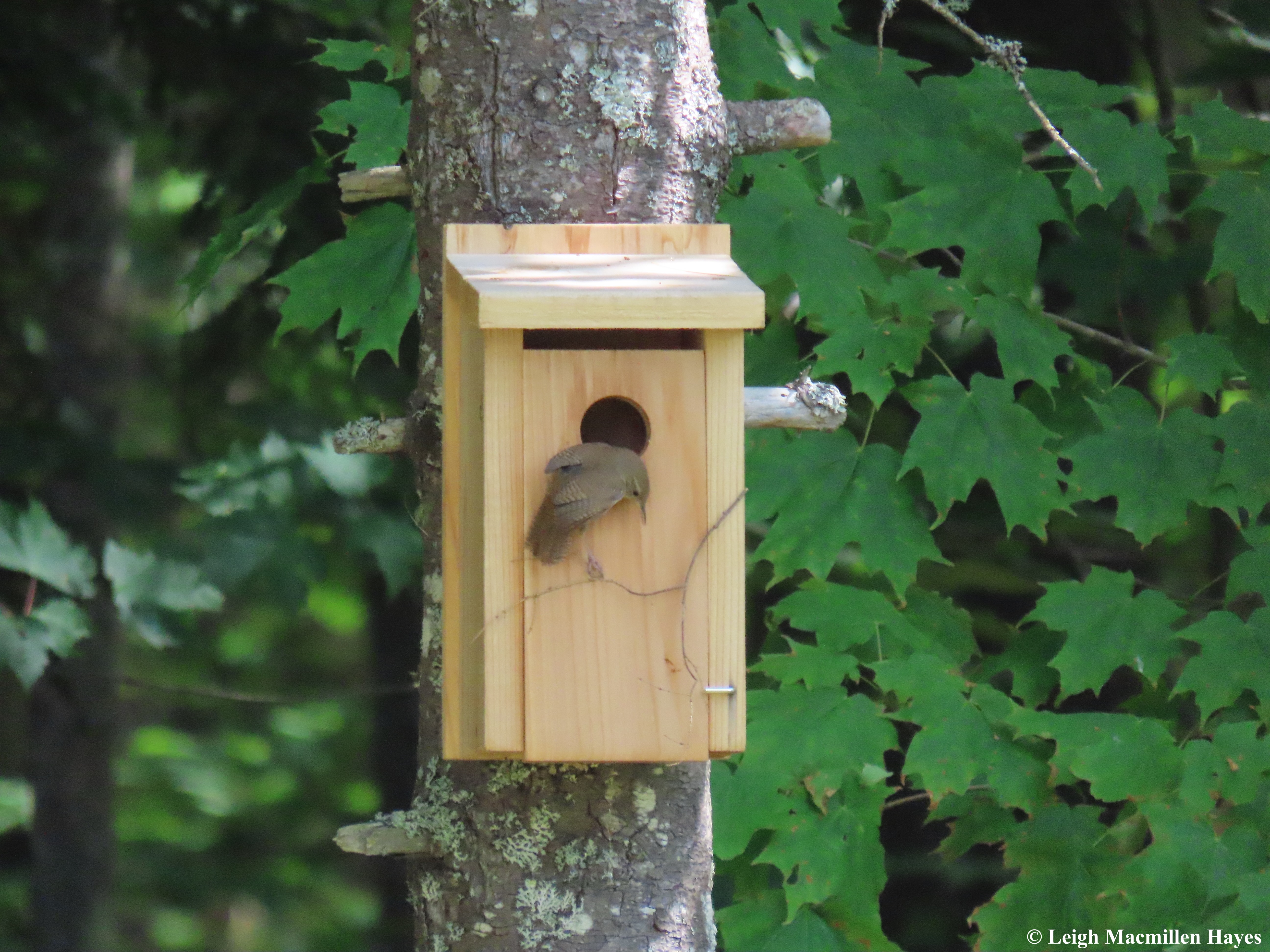
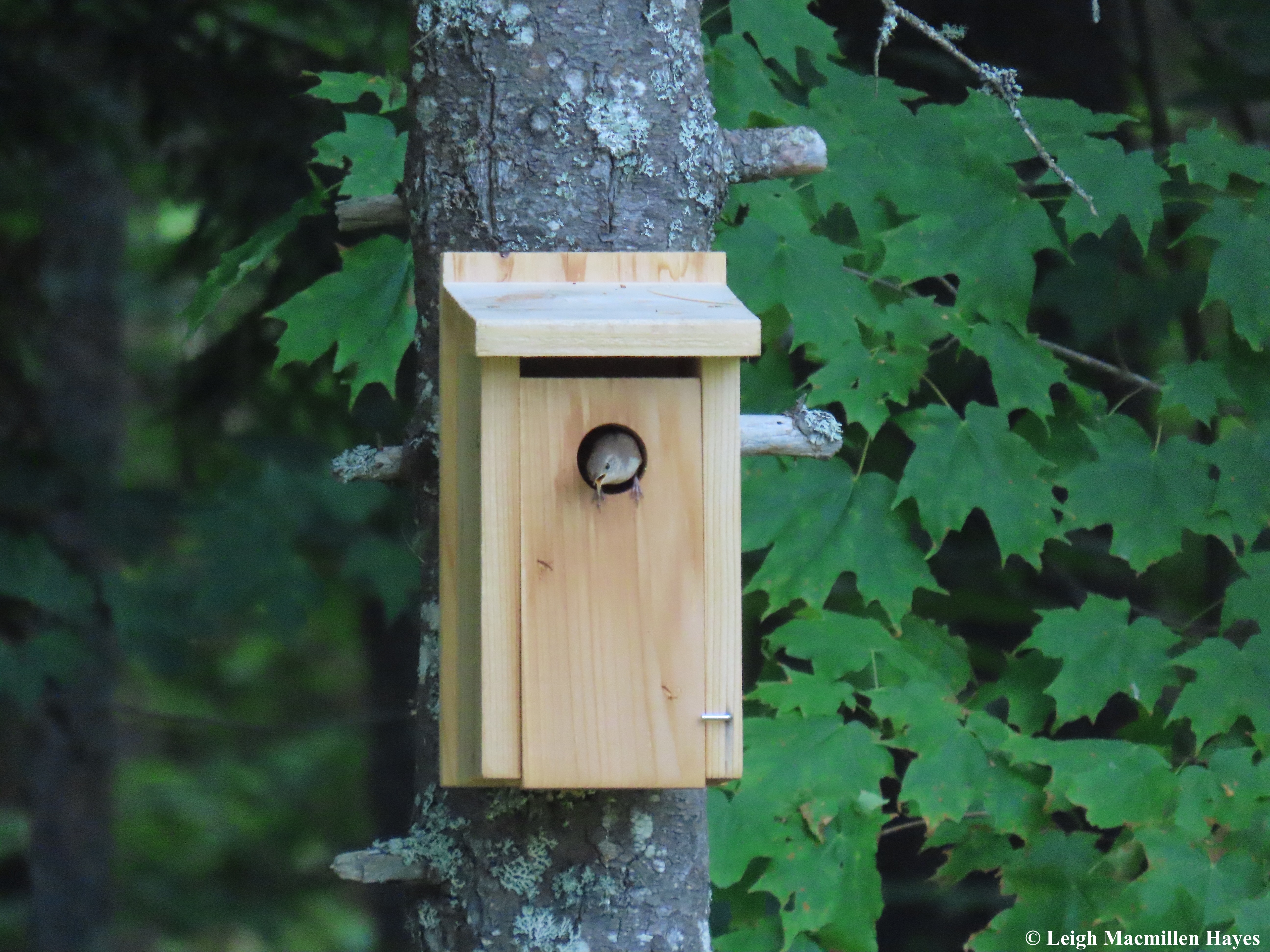
About dinner time yesterday, that is, dinner time for most people, as My Guy and I tend not to eat until about 7:30pm, as we sat on our patio, I suddenly saw action at a Bluebird house we’d nailed to a tree in the yard. After months of seemingly no action, a bird was flying to it and carrying sticks, and I realized that the male House Wren who has been singing from the trees had decided this just might be the place his loved one will want to set up housekeeping.

The action continued for about an hour last night, but then ceased.

And this morning . . . nothing that I could see.

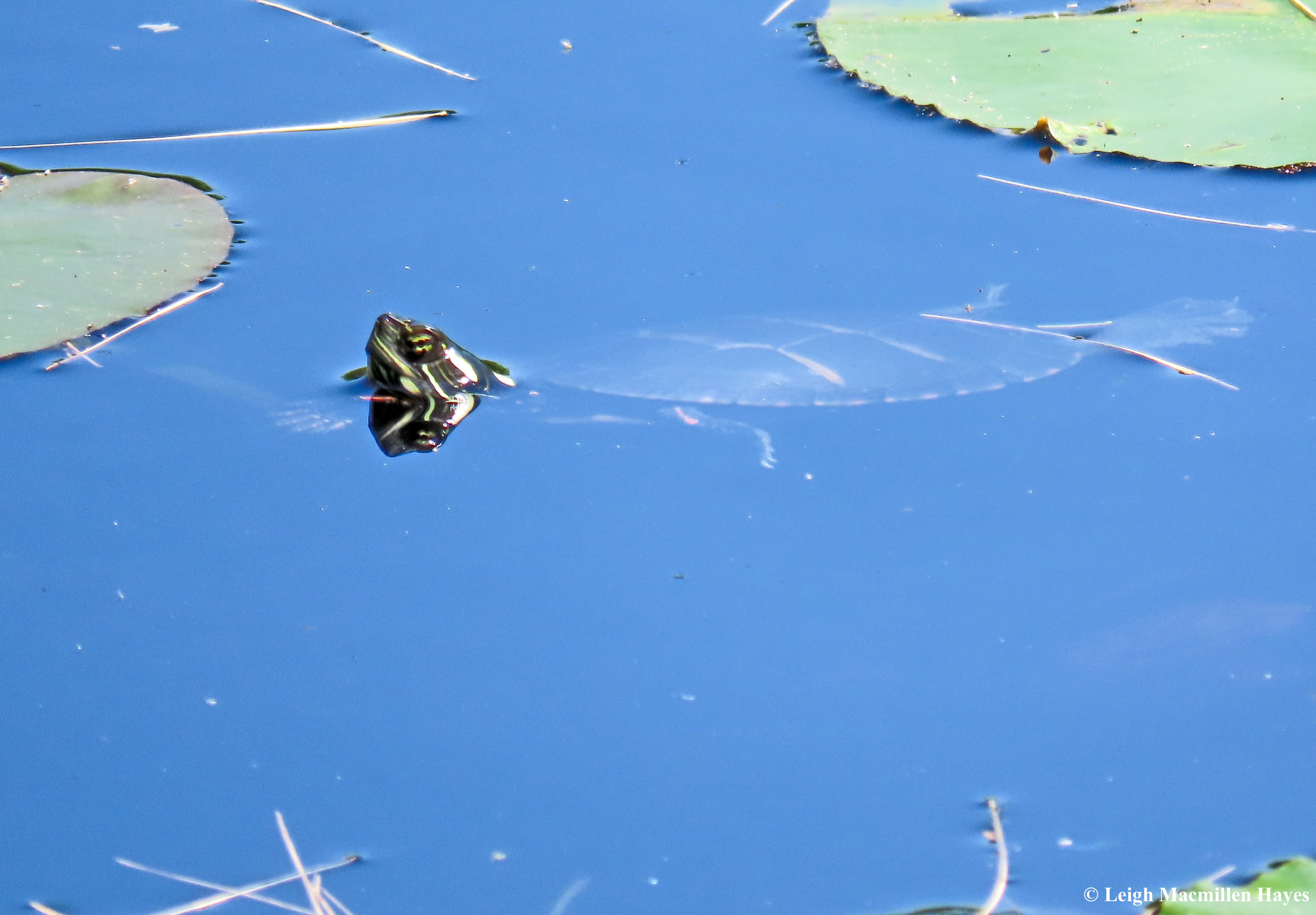
And so deciding I wouldn’t have a chance to watch the fun of moving in today, I decided instead to head to a local wetland where the Painted Turtles taught me a lesson.

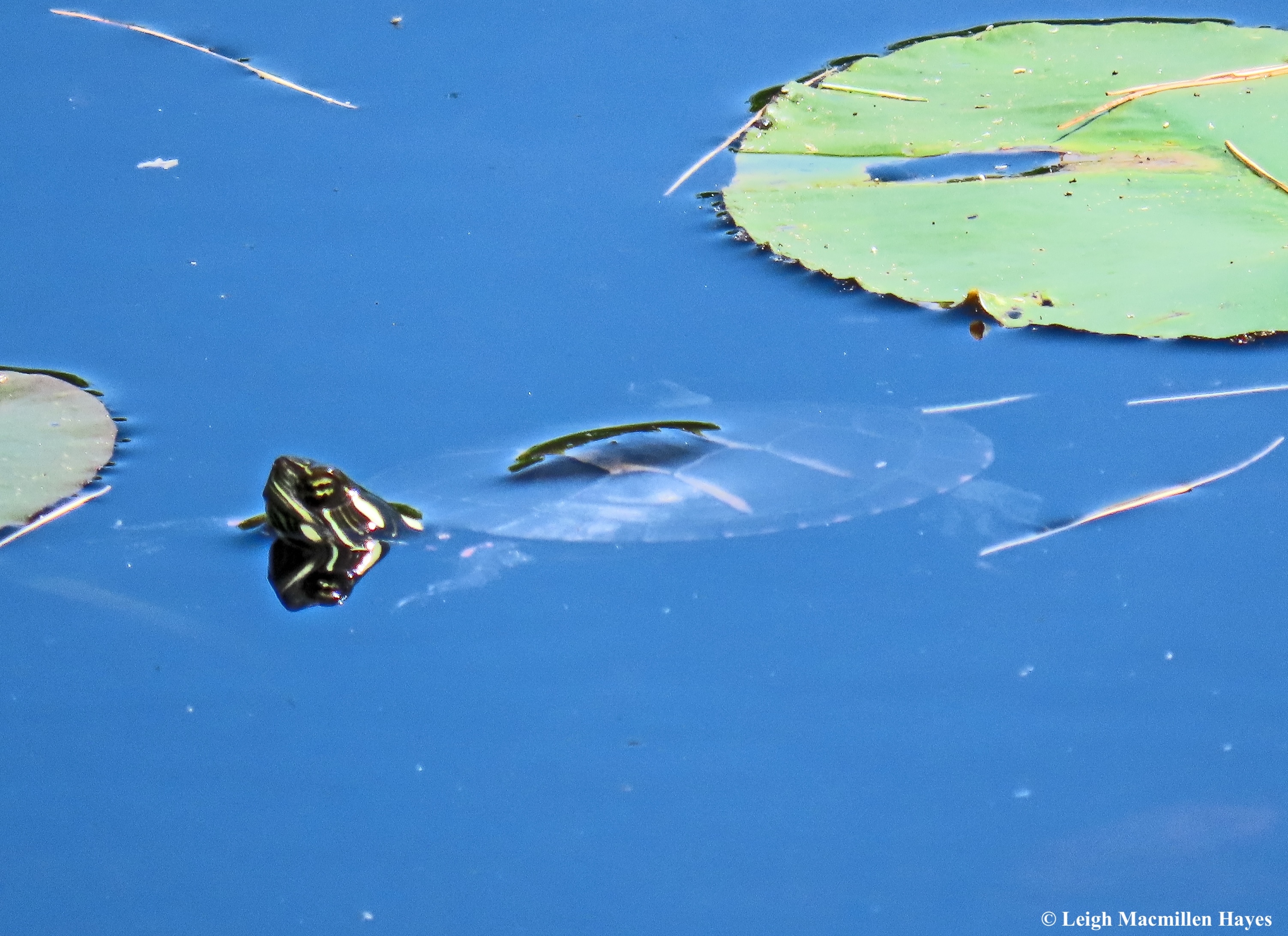
I love seeing turtles basking on logs and rocks in the water, but everywhere I looked today, they were not on any of these raised platforms. Instead, they floated. And it occurred to me that it was a brilliant strategy: stay near the surface of the water, but be a wee bit submerged, and therefore stay cool on the hottest of hot summer days thus far this season. Especially given that Painted Turtles have black carapaces or upper shells which are intended to absorb the heat . . . but extreme heat?

While I watched, I noticed that they all stayed in the same spot. How? By treading water, just like we do. Or so it seemed to me as I watched the feet move, but the head and shell remain still.

In all my years of turtle watching, I have never witnessed this before. Or . . . if I did, failed to take note.

Because I was by water, there were plenty of dragonflies as they defended their territories and ate some bugs on the fly and occasionally paused so I could admire and thank them. There were no Mosquitoes to speak of and only a few pesky Deer Flies.

This Four-spotted Skimmer and I spent quite a bit of time together because he was so beautiful and I could have looked at him forever, plus I loved watching him perch, then flight off to chase another dragonfly out of the area, and perch again, over and over.

But there were a few other things to observe. Well, more than a few, but only a couple that I’ll note.

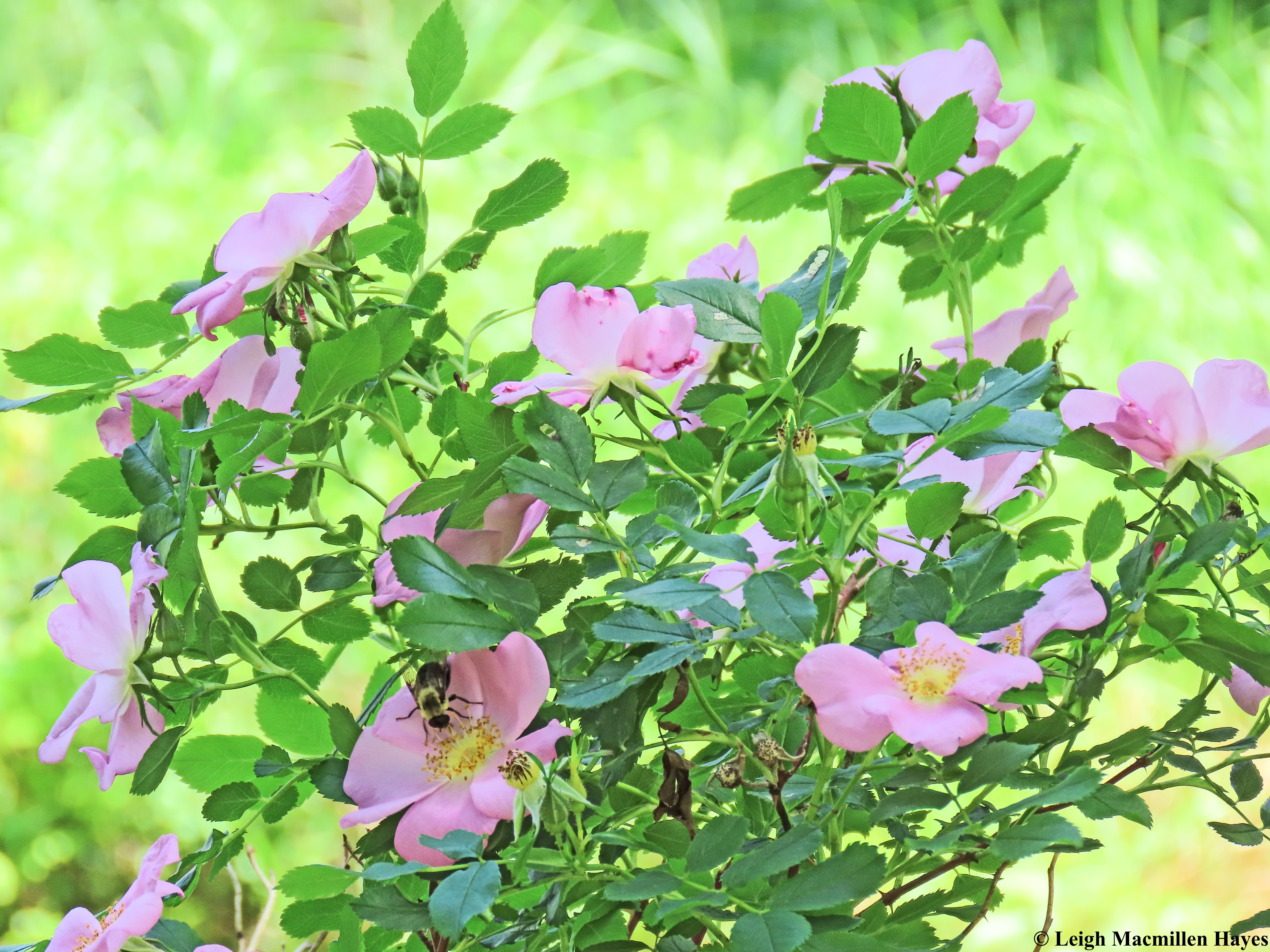
Have you ever noticed how on a hot summer day the smell of fallen pine needles is intensified by the heat? I just love that smell. And where there are Swamp Roses, there is also an aromatic fragrance, and it seemed I wasn’t the only one paying attention.

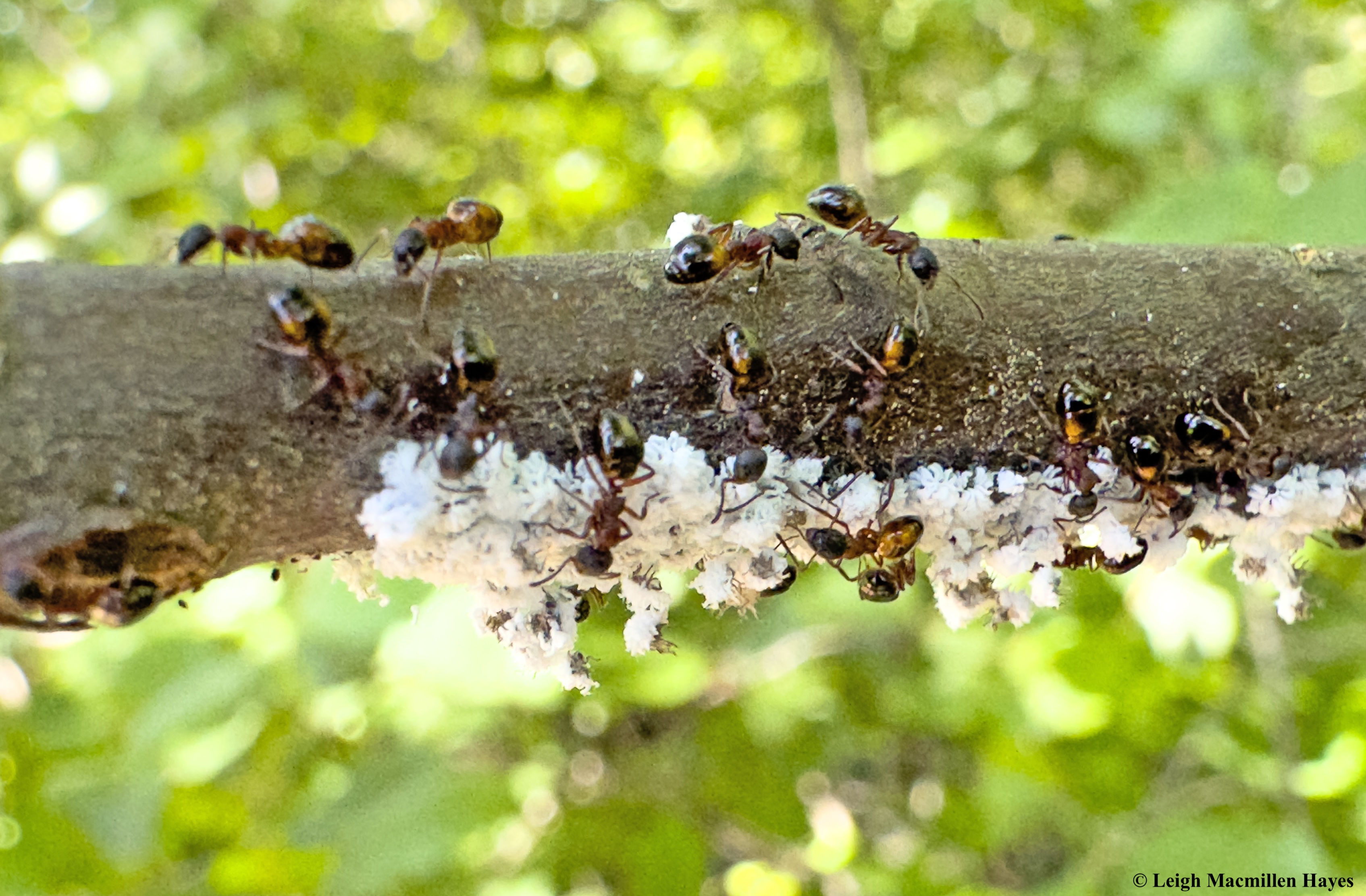
Seeking nectar is the job of bees and wasps and flowerflies and other. Seeking a sugary substance is the job of ants. On Speckled Alders.

Ants “farm” or “milk” or basically tickle Woolly Alder Aphids that feed upon the shrubs’ sap and get the honeydew the tinier insects secrete.

That cotton candy look on the aphids is actually a waxy material they produce from their abdomens, perhaps meant to detract visitors. Or protect them from the weather. 

The relationship between the ants and the aphids is actually a form of mutualism as the ants protect the aphids from predators, while the aphids provide the ants with a food source. Hmmm. Maybe more of us need to pay attention to this way of living together.

At last I pulled myself away from the wetland, saying goodbye to all and thanking the Painted Turtles for today’s lesson.

Back at home, I heard the Wren before I spotted it and sure enough, it was back on the job of setting up living quarters. Male House Wrens fill cavities with a tangle of sticks and then he tries to persuade his betrothed to build a nest, which she does toward the back of the cavity.

He kept gathering sticks from the ground and returning to the box, though getting them through the hole wasn’t always an easy task. I wanted to encourage him to also try the slot at the top of the box, but my encouraging act would have had the opposite effect, and so I kept my distance.

It was rather like watching a gymnastics show, for such an acrobat was he. And like the turtles treading water, I’d never actually seen a House Wren build a nest before–my knowledge all gained from literature.

Smaller sticks worked well, but those larger ones were much more entertaining from my point of view.

And then there was a really complicated one. Such a challenge.

But a little wiggle here and waggle there and voila. The stick was in the hole. So was the bird.

Until the next one. And then more contemplation.

But all things are doable when you persevere, so of course, another lesson learned today.

I’ve read that House Wrens fill several cavities and then let the woman decide. Smart birds. The jury is out in our neighborhood because my neighbor and I know that either he or another Wren keeps visiting a different birdhouse that the Bluebirds have also considered for their digs.

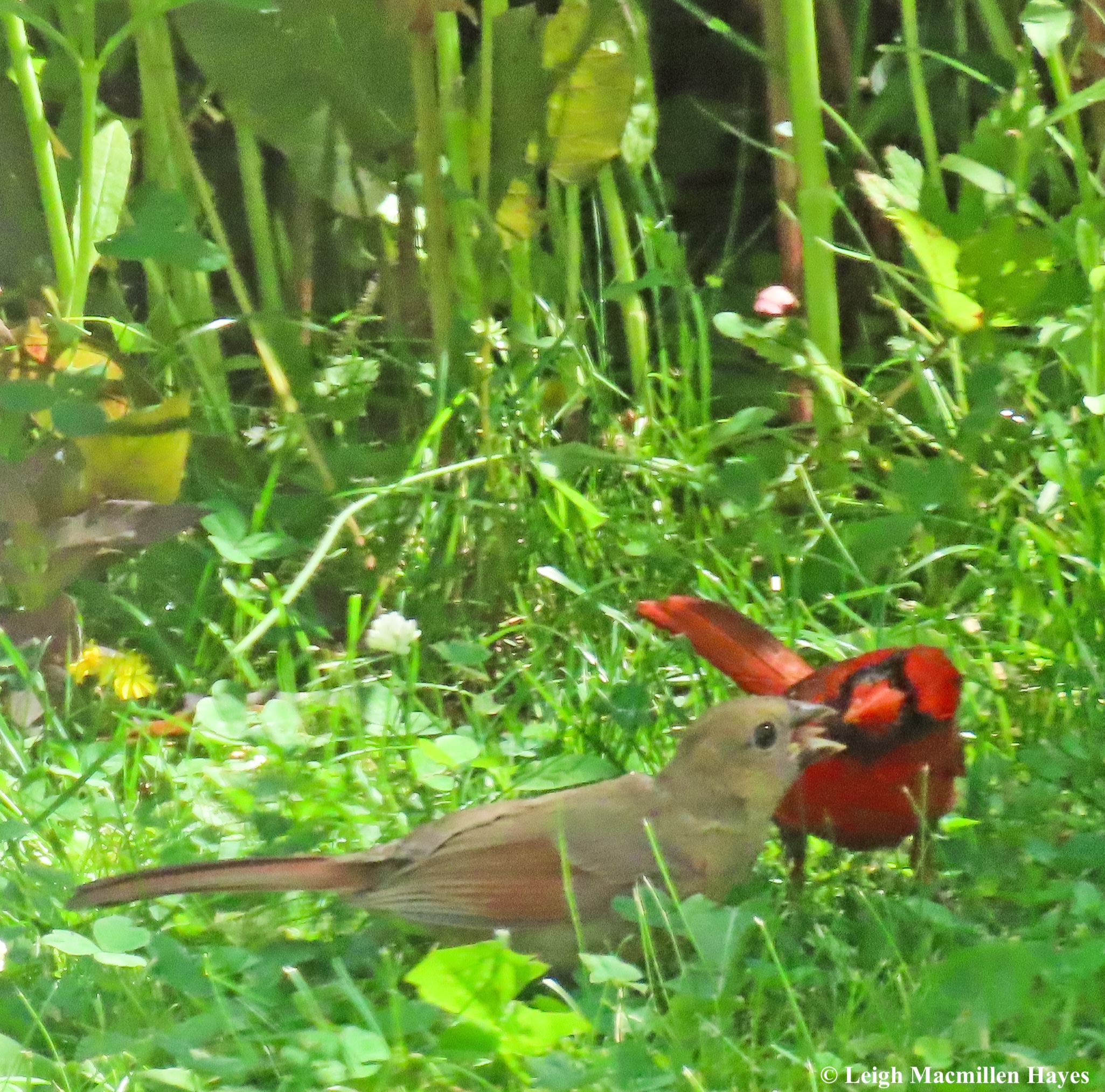
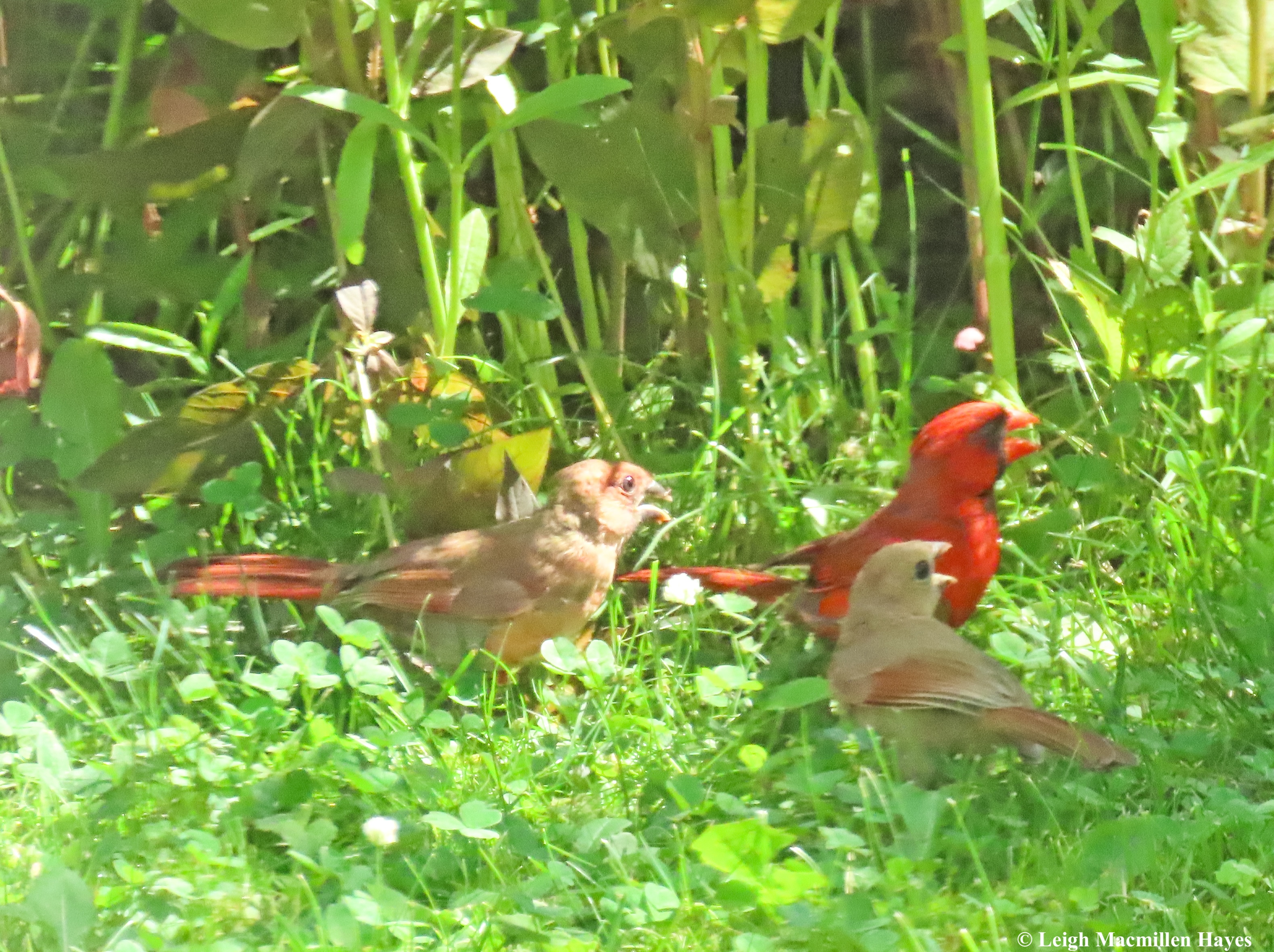
Heading back in, I suddenly heard a Cardinal, and suspected it was the male because I haven’t seen the female in at least a week. Through the glass in the back door, there he was, feeding a chick! We have a baby!

And then I realized he was feeding two babies, and my, were they ever insistent.

I must say, the chicks look much more like their mother than their father. But he did a great job of tending to their needs, ever the nurturing one.

Today has been really hot, and I know you are all aware of that, but in the heat I managed to be present in so many moments and give great thanks for that.

Zodiac One: Maiden Voyage

The message arrived the day before: Leigh, I am ready for the morning. The truck is loaded. I suggest wellies unless you don’t mind wet feet. I plan on being there for 6:00am. All you need is your camera.

And so I set the alarm for 4:30am, spent an hour reading and sipping coffee in the peace of a quiet kitchen, and then headed out the door with my camera on my shoulder.

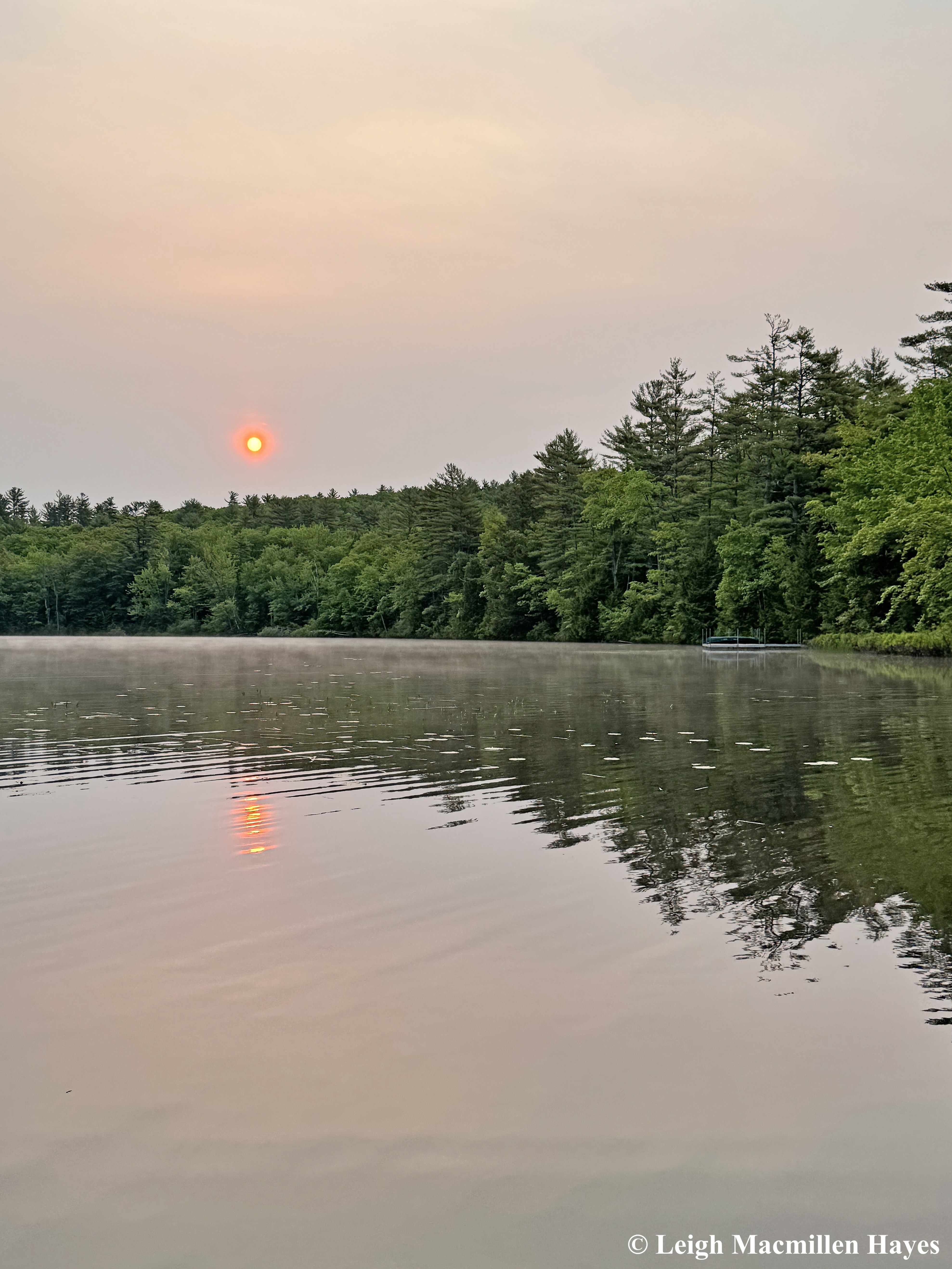
As the sun rose, it became apparent that the smoke from the Canada wildfires was going to cast a haze upon this June day.

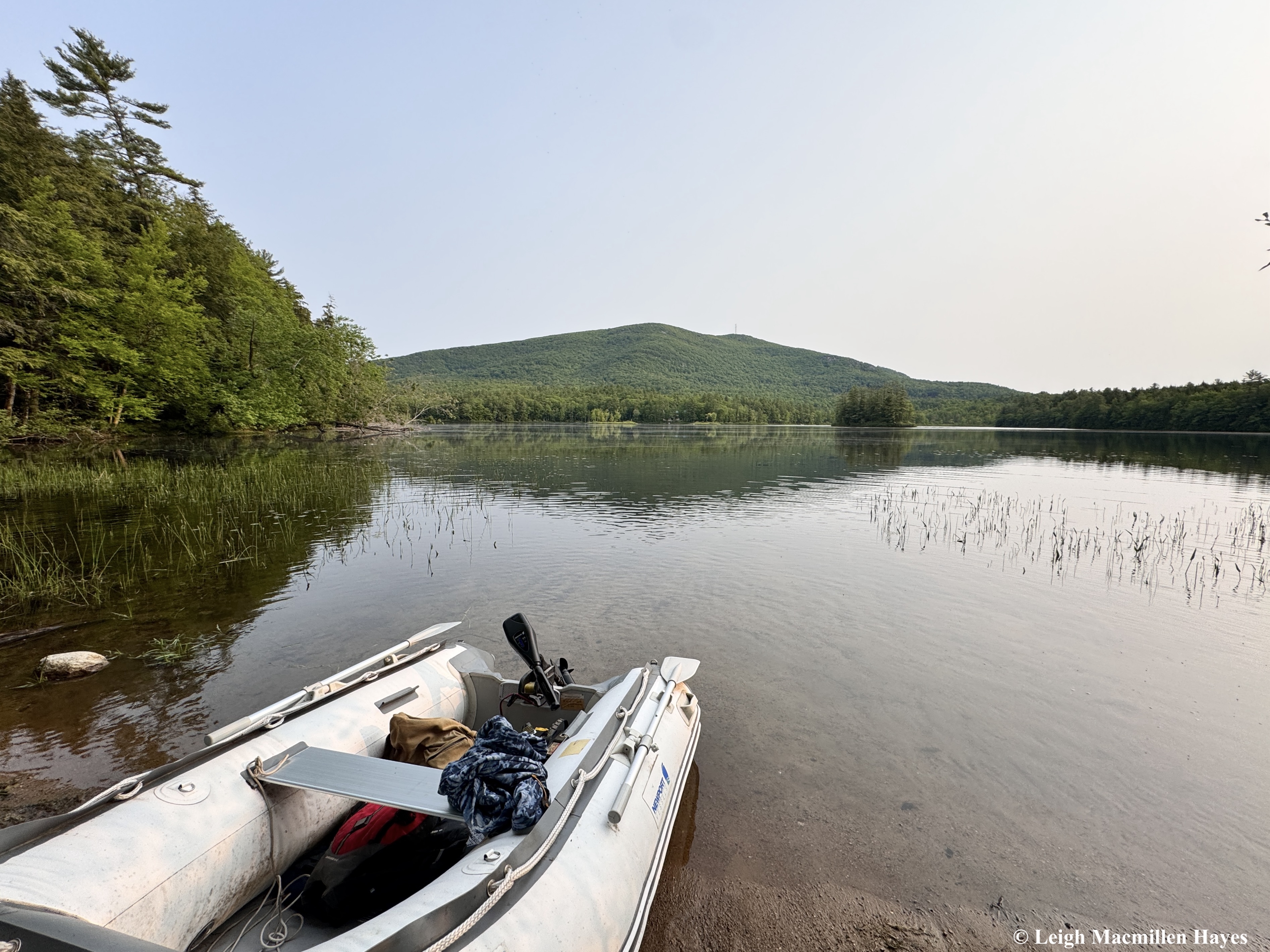
And indeed it did. But, at 6:00 in the morning, with the temperature at 48˚, lake fog, or in this case, pond fog, danced across the surface of the water like fairies performing a swirling ballet. Actually, the fog occurs when cool, moist air meets relatively warmer water, causing the water to evaporate and condense, thus creating mist that burns off as soon as the sun rises.

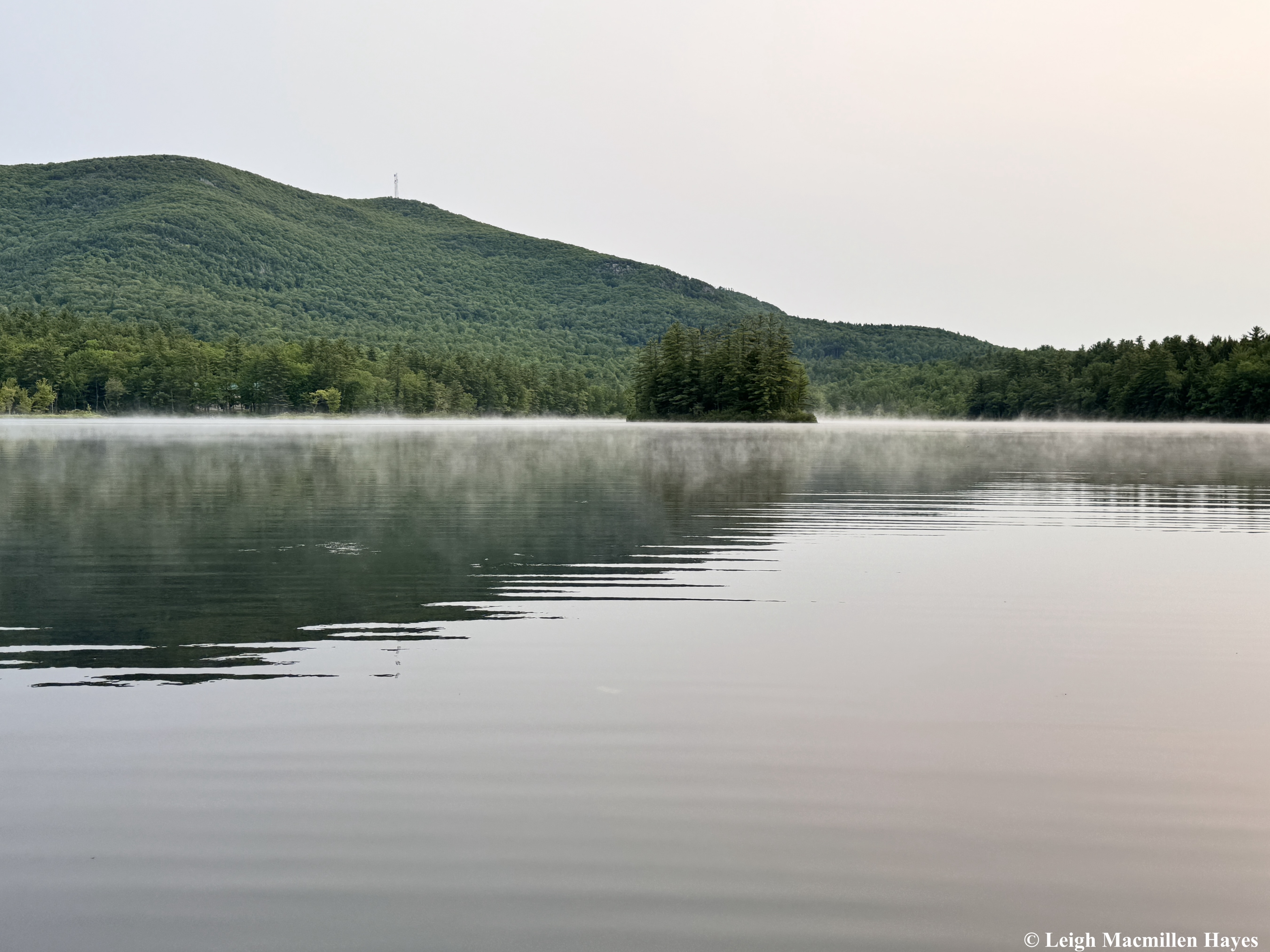
With Pleasant Mountain’s Southwest Peak in the background, I knew my place in the world.

The captain of the boat wondered if I’d ever been on the pond before. I have. Once. This past winter when Laurie LaMountain, of Lake Living magazine, and I spent a day tramping through the snow and across the pond and sometimes getting fake lost, but finally finding our way back to her house seven miles later.
I had not, however, ever seen it in the spring or summer. Well, except from the teepee on the Southwest Ridge of the mountain.

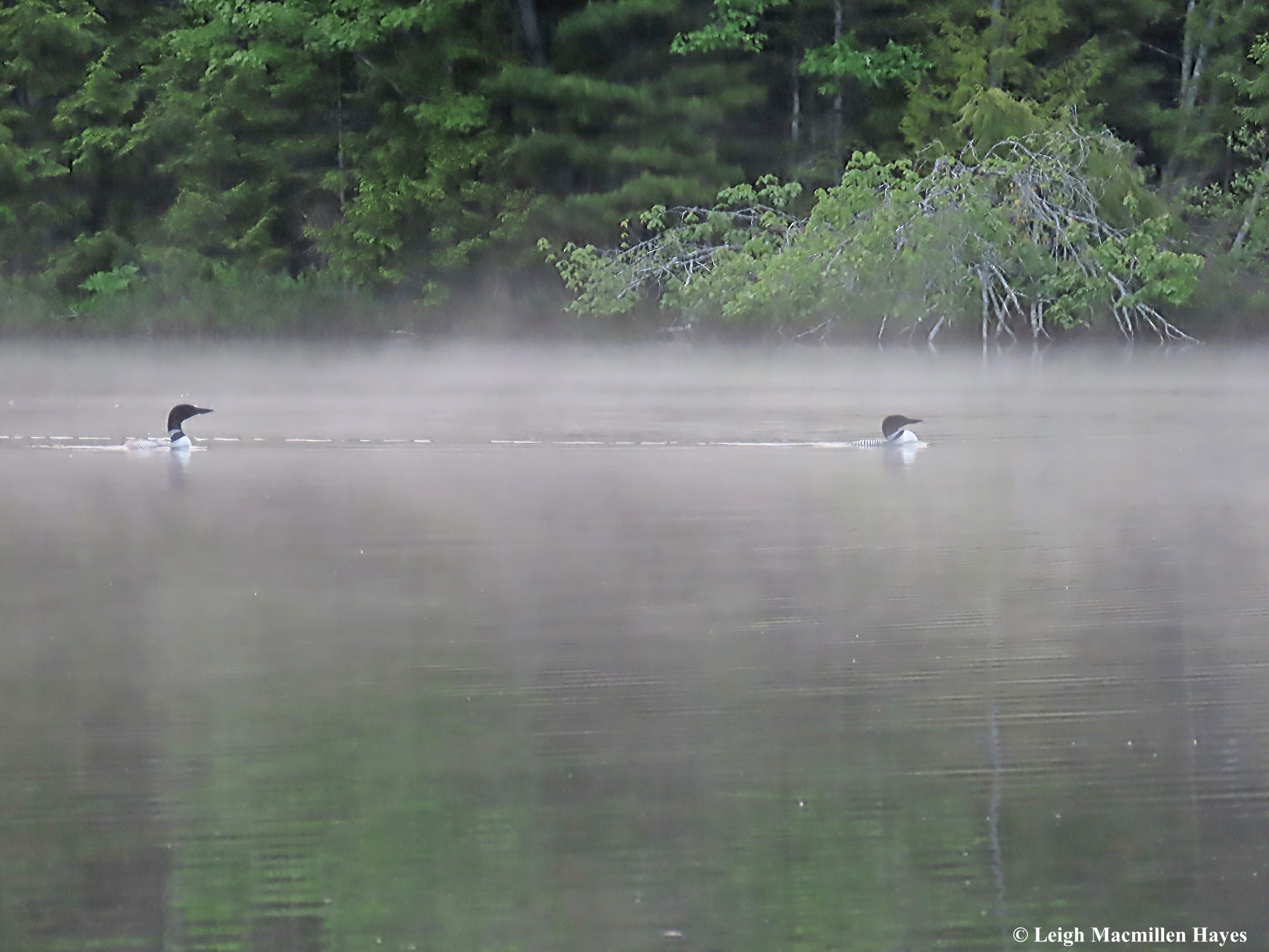
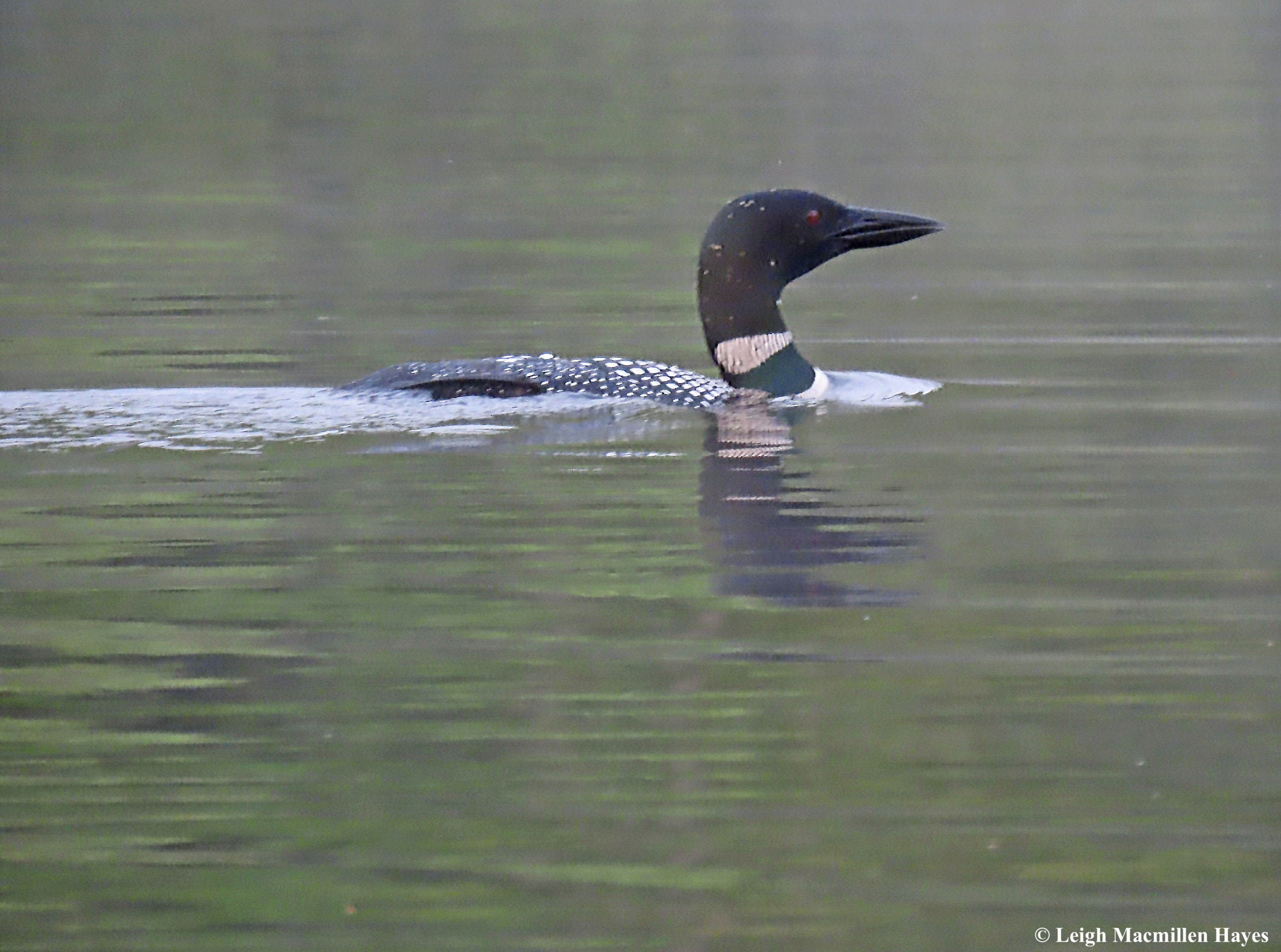
Once upon the water, we first heard, then saw a pair of Common Loons swimming and diving for breakfast. Bass are plentiful in this body of water, and we saw plenty of them as well.

There was a third loon that the other two greeted, but within a half hour it took to the air and flew south.

I found that curious because in the wee hours of the previous morning I heard one fly over our house, announcing its presence with a Loon tune, and wondered if it was a teenager looking for a place to find a mate or at least hang out where the resident pair(s) wouldn’t mind. Maybe this third Loon was doing the same and the others suggested it move on. Or maybe they were its parents and again, they looked forward to be empty nesters for another week or so.

After spying the Loons, our tour took us near Pickerel Weeds and suddenly our eyes clued in on the beginning of other life forms.

By now it was 6:20am and obvious that the Damselfly Naiads had already chosen this day to climb up the stalks maybe as early as 4:00am to begin their new life as terrestrial fliers. I’ve seen this occur later in the morning, but did not expect that they emerged so early when the air was still a bit chilly.

I probably should not have been surprised, for a few weeks ago I saw them emerging in another place on an equally chilly day.

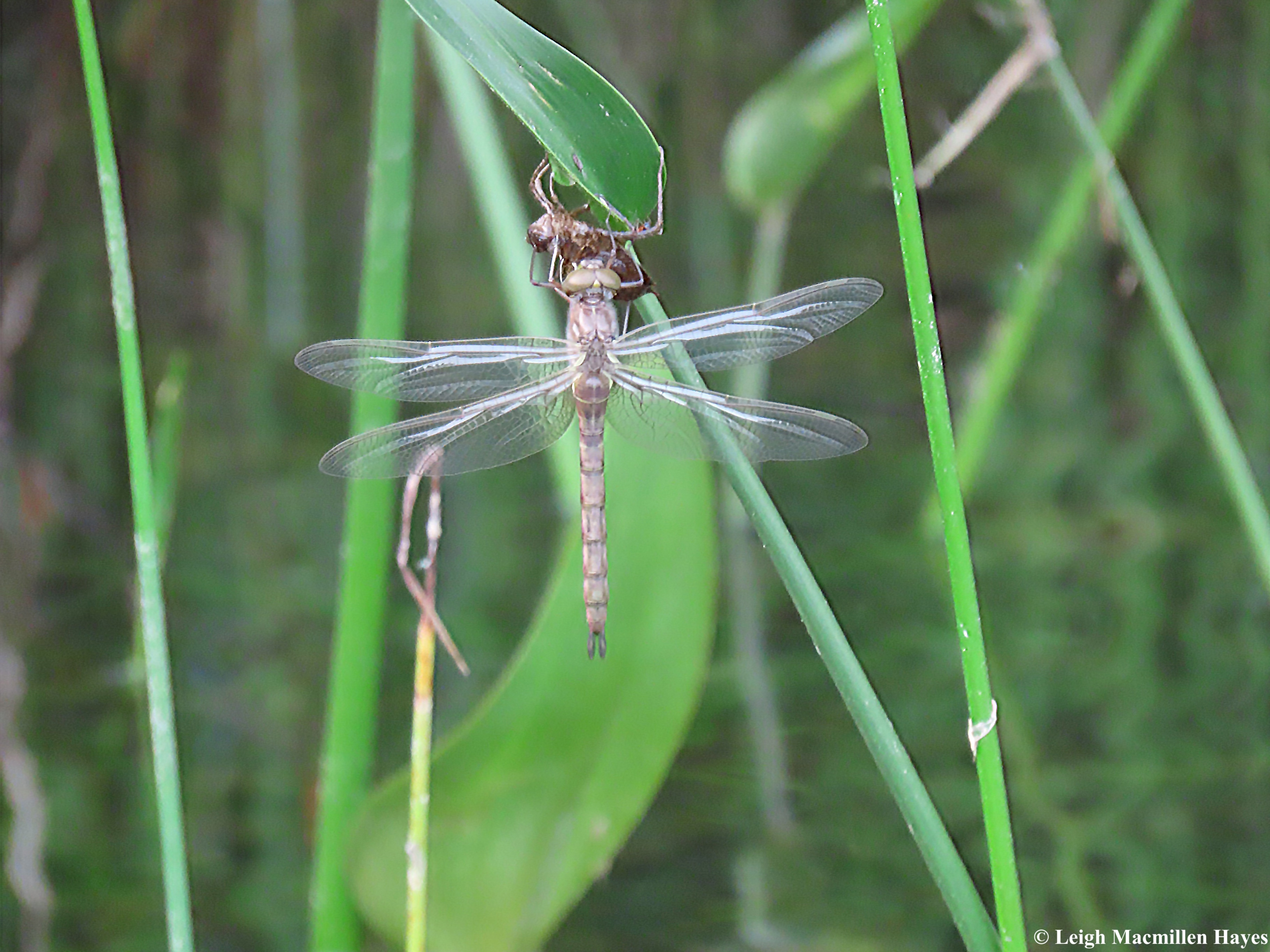
Of course, where Damselflies are, so often are there Dragonflies, and this Darner spread its wings in our presence, so shiny and cloudy as was to be expected until they dry out.

With its wings spread, thorax and abdominal colors would begin to transform providing a clue to its name, but I suspected it was a Common Green Darner. We didn’t have time to watch that color change and so we silently moved on, for such is the ability with an electric motor.

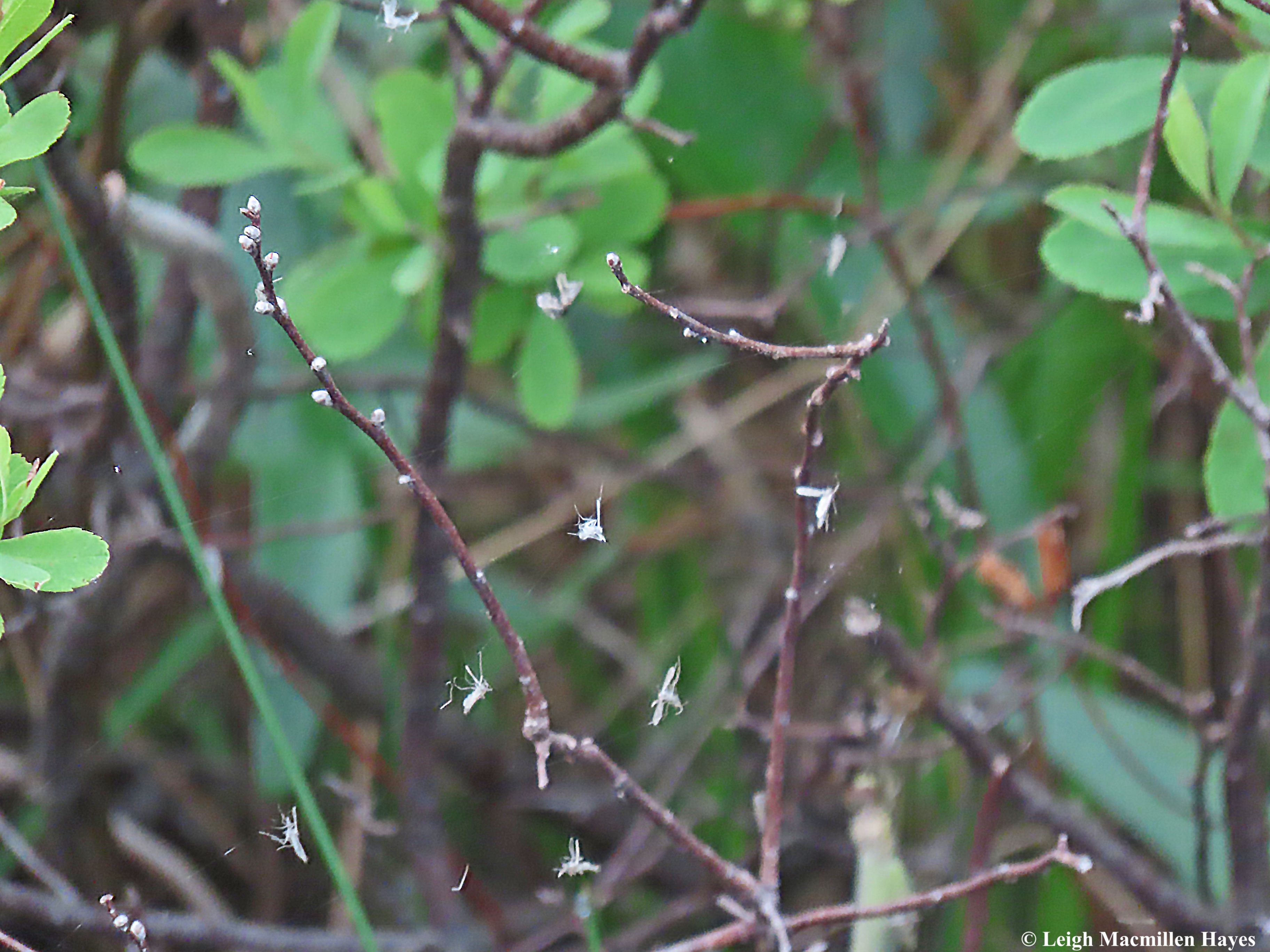
Among the vegetation behind the Pickerel Weeds there were many orb spider webs and among the webs, looking as if they, too, had been performing a dance, were little Whiteflies taking their final bows.

Posed above and ready to fly off at any moment were Kingbirds with their handsome tuxedo appearance, looking like they were ready to attend a formal dinner.

And perhaps they were.

For everywhere on the northwestern side of the pond, more Dragonflies had emerged, and after a few minutes it became obvious that they were all of the same family: Calico Pennant Skimmers.

In fact, they were also all the same gender, the yellow hearts on the abdomen and coloration on the thorax and wings all leading me to think they were females.

The Calico Pennant in the name comes from the design on the wings, which once opened and dried is really stunning.

Although, I say that they were all females, it could be that all begin life with this hue and it only changes to red for males and bright yellow for females as the individuals mature.

In one spot, we found at least five, plus a bunch of Damselfly exuviae also upon the stems and leaves.

Do you see all five, two being almost a mirror image? Why “almost”?

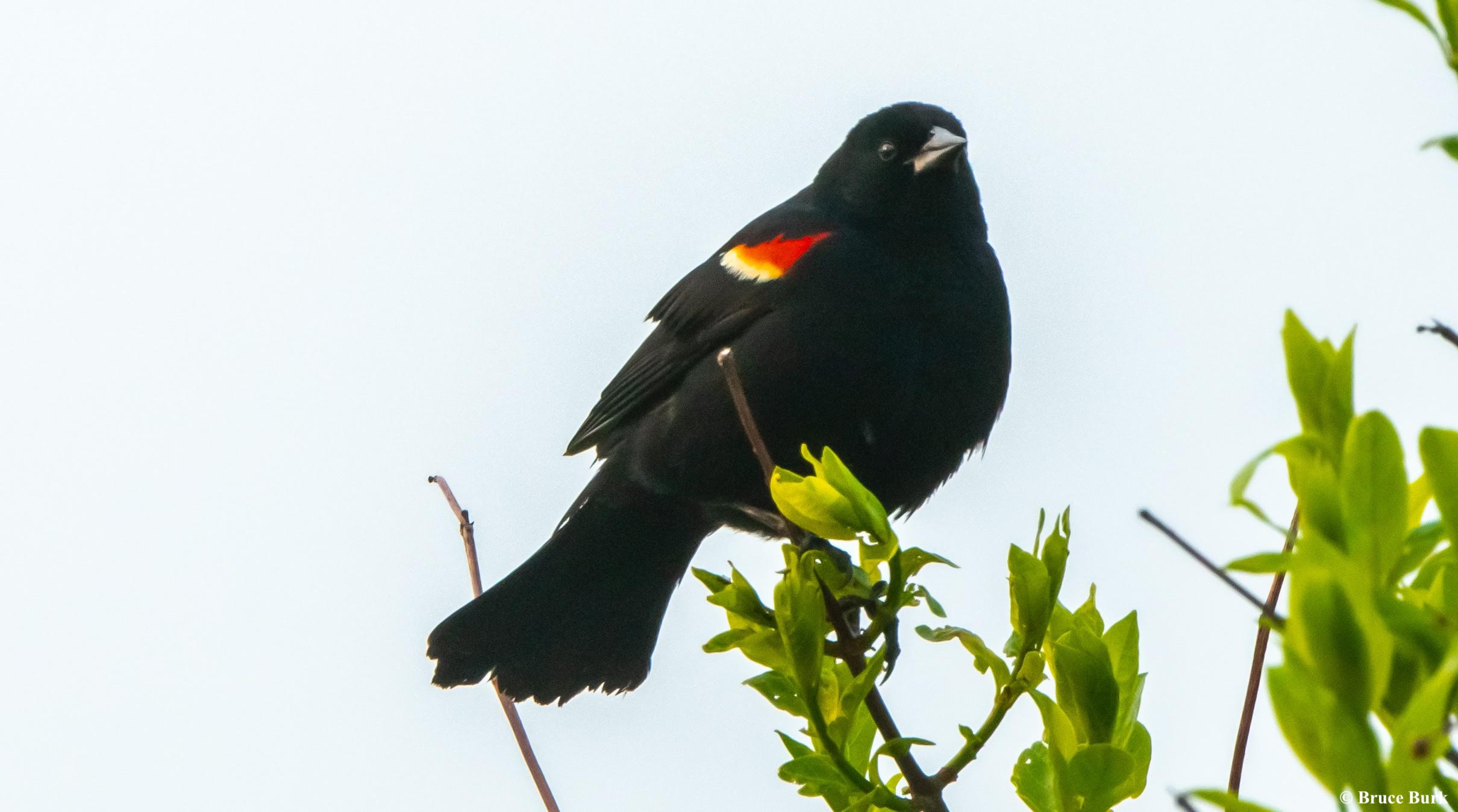
Loons and Kingbirds weren’t the only ones on the morning hunt. This handsome male Red-winged Blackbird seemingly had a family to feed and wanted to make sure we didn’t approach. Thank goodness for telephoto lenses.

In the midst of the shrubs below, his Mrs. was on the hunt and had a full mouth. If you look carefully, you may notice some Dragonfly exuviae below her, their shed skins left behind once they took flight–the insects, that is.

We wondered if the Mrs. was taking advantage of this morning’s Dragonfly offerings and capturing those that were just emerging, an easy meal for herself, but probably also for some wee chicks she may have tucked away in a nest nearby. Their meal would have to wait until we moved on, and so we quickly did.

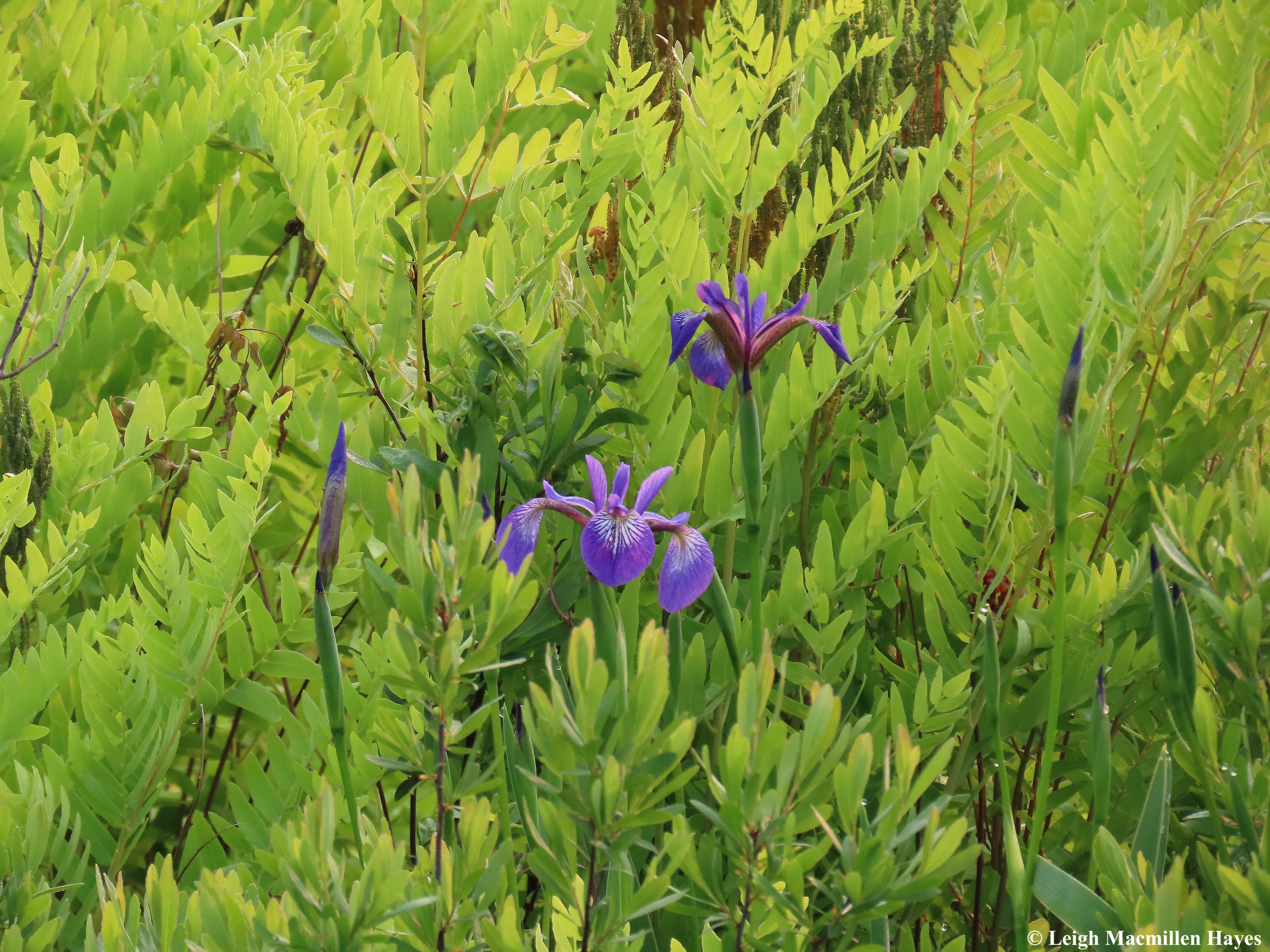
But not without pausing for a moment to admire the newly opened Blue Flag Iris among the Royal Ferns. Though the ferns have their own crowns of fertile stalks, the irises looked like exquisite tiaras fit for queens.

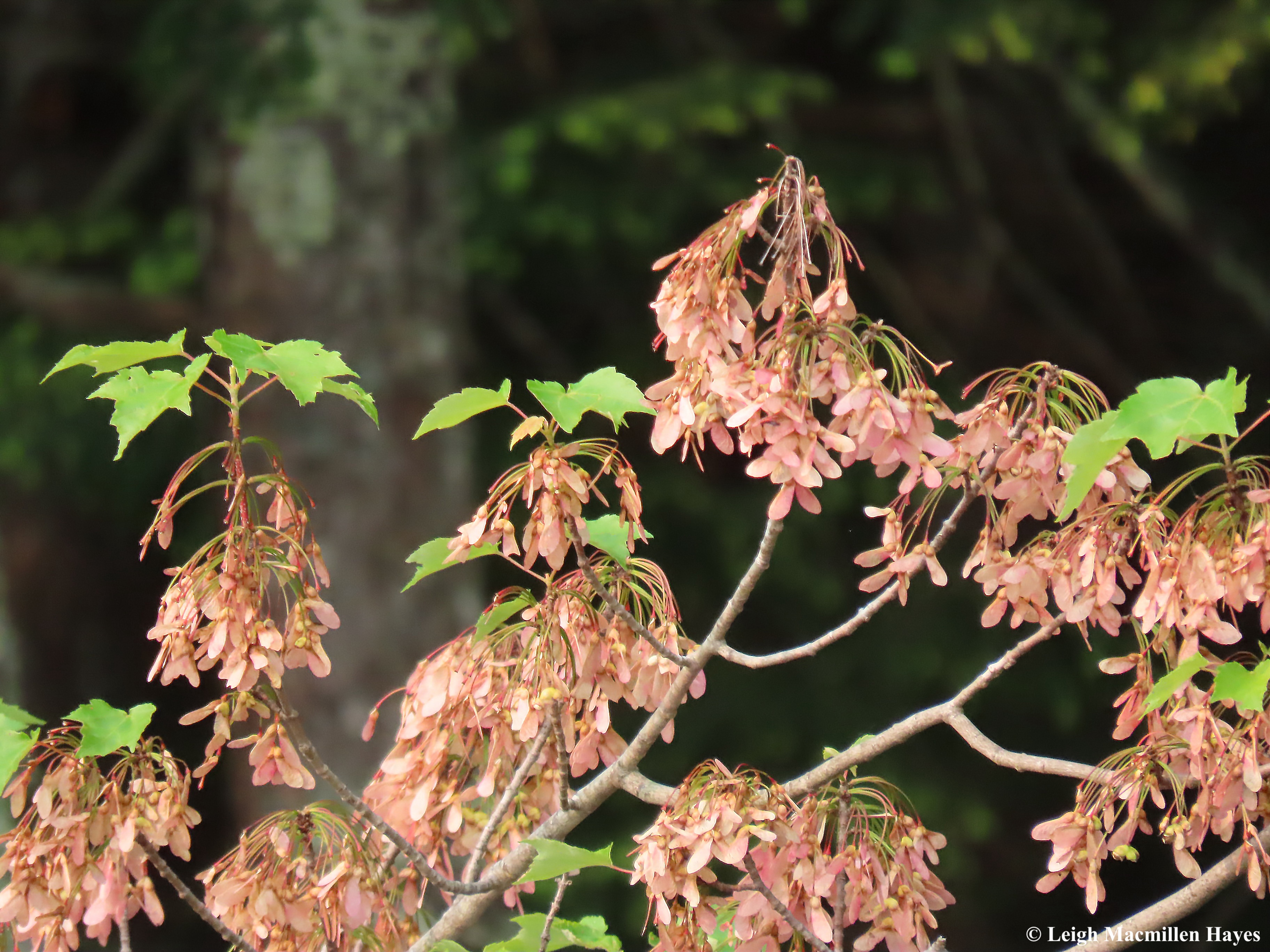
Finally heading back toward the boat launch, we saw explosions of Red Maple seeds dangling like chandeliers that perhaps the Queen Irises had ordered.

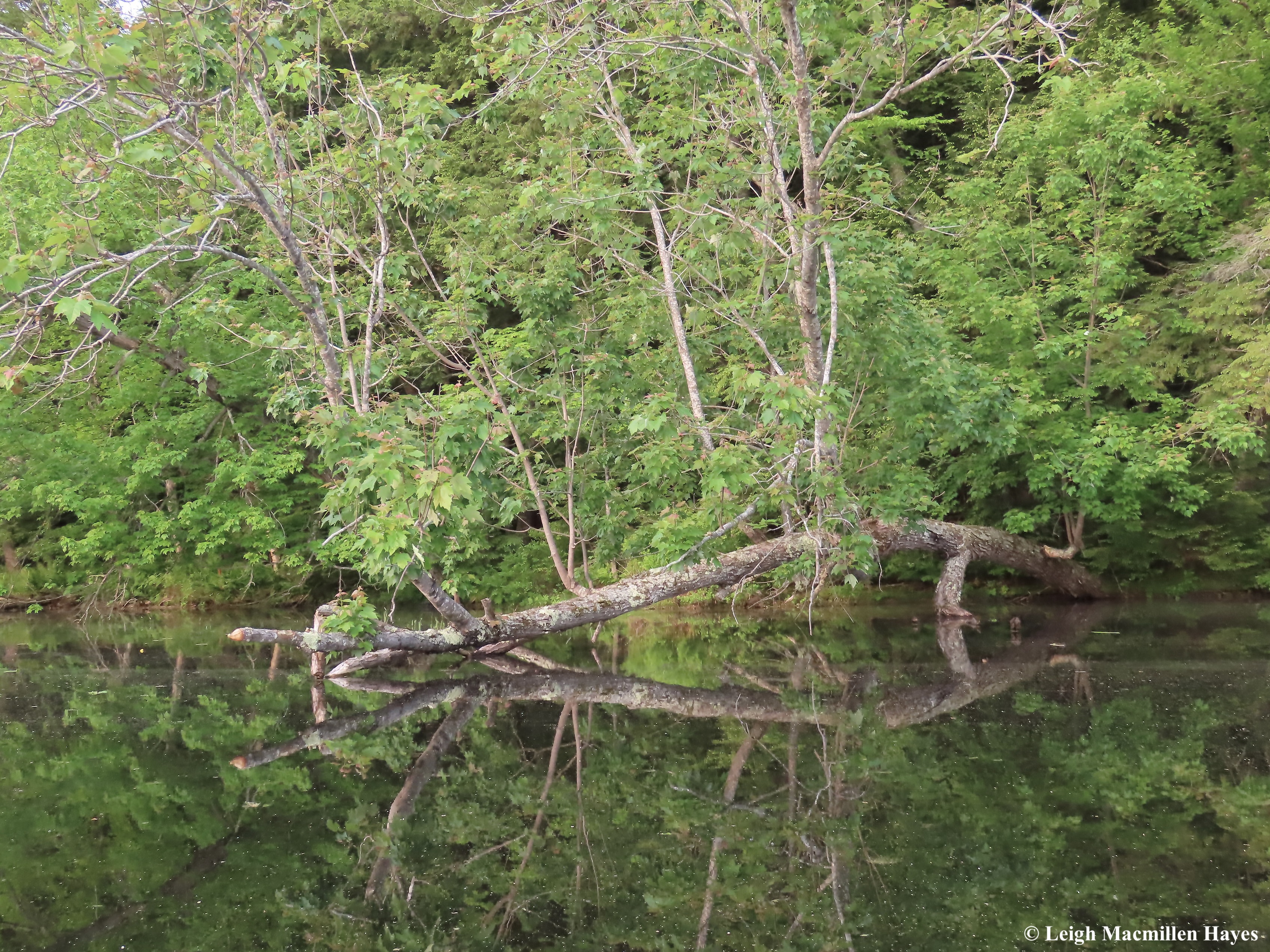
And another Red Maple that gave us pause for it deserved being noticed since it had obviously fallen years ago, but lifted its branches upward and was still in rather good health, its roots at least partially intact. Perseverance.

And then we noticed the tip of it. Across the pond we’d spotted a small beaver lodge in an adjacent wetland, and wondered about the Beaver’s own peserverance–it looked as if the tip of the tree had been harvested this past winter from the ice, and looking at other parts of the tree behind the tip, there’d been some harvesting previous years. We didn’t get close enough, but suspect the Beaver may have felled the tree, and its been a source of building material and food ever since.

Two hours later, Captain Bruce landed the Zodiak at the boat launch, and I gave great thanks for the invitation to explore Beaver Pond in the quiet of the morning.

The Black Flies were plentiful as they buzzed in our ears, but they weren’t biting so that was good.

We also saw several turtles swimming, including one huge Snapper that swam under the boat and neither of us captured in a photograph, and possibly a Water Snake.

Zodiac One: a maiden voyage for me. Here’s to many more! Thank you, Bruce.

Memorial Day Dragons and Damsels

It finally stopped raining and with a wee bit of sun late this afternoon, the temperature broke 60˚ and I found myself exploring a local wetland where all kinds of interesting things happen daily. And yearly. In cycles. And sometimes I happen to be there.

One of my favorite events is the emergence of dragonflies and damselflies. It seems like we endure Black Flies for most of May, all the while looking forward to our champs, the Ondonata family, to step in or rather up out of the water and transform before our eyes and take on the world. This usually happens by Memorial Day.

And this year is no different. The dragons and damsels have been emerging for the past couple of weeks, but now is prime time. And they are just in time because the Black Flies and Mosquitoes have had a heyday with all this rainy, cold weather, and today . . . as it warmed up, so did they and I have red welts on my neck to prove that they are biting. It’s all good, I remind myself. It’s all good. They are bird food. And so are the dragonflies, who eat the Black Flies, et al, and if they become bird food, all the more energy sent the bird’s way.

Cloudy wings and clinging to its shed skin indicated that this dragonfly had just made that magical transformation from its aquatic life to terrestrial existence. And I was there to protect it. For a while anyway. Until the Black Flies sent me scurrying onto the next great find.

That next being a damselfly, also with cloudy wings indicating it had also just emerged. Though I don’t know who the first dragonfly was that I met today because it didn’t yet have enough colors and pattern to make that determination, I did learn that this damsel is called Aurora! I don’t recall ever greeting it before, but based on the the lack of shoulder stripes, black patch with wavy edges on the thorax, and yellow sides led to this ID once I consulted Damselflies of the Northeast by Ed Lam.

Now it’s one I don’t think I’ll forget. AND, I love that it is named for my ten-year-old naturalist friend, Aurora. Or she for it. Or neither, but they both share the name of an electrical phenomenon.

As I looked about, I spotted several other newly emerged dragons and damsels, all with their signature cloudy wings, but then I spied this one.

Yes, it’s wings are cloudy, but this Lancet Clubtail has an issue going on, for its wings are folded, rather like the main character in my fairy tale, The Giant’s Shower, for Falda’s wings are also folded.

That didn’t stop Sir Lancet from climbing up a fallen branch with gusto. But I did wonder about his fate.

That said, I moved on because I had some Painted Turtles I wanted to meet, figuring that they’d be basking after several days of temps in the 40˚s. Being ectotherms, they rely on external heat to regulate their body temperature. Sun is their friend.

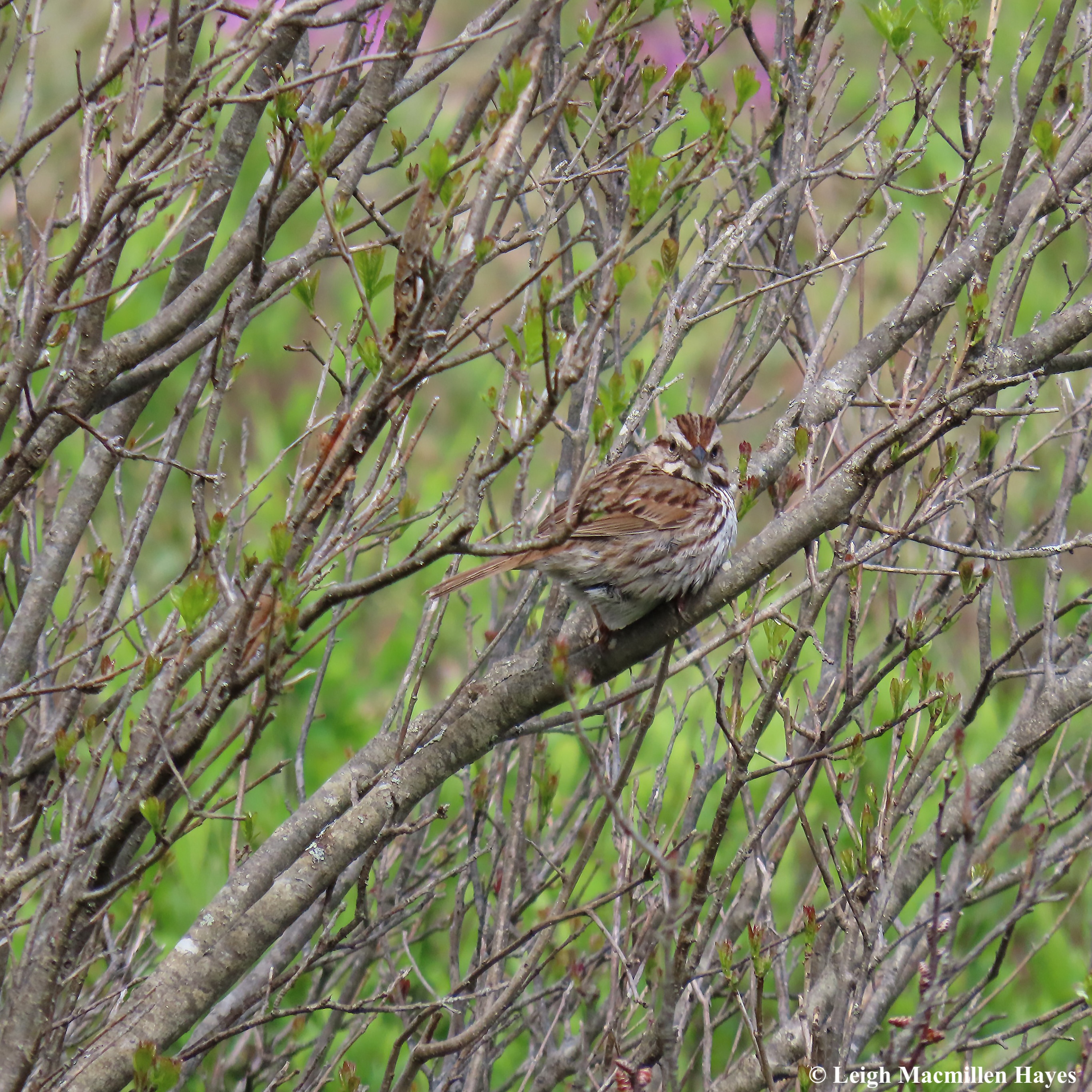
Being in a wetland, the bird song was plentiful, but though the Merlin app included a chorus of plenty including Redstarts and Towhees and Common Yellowthroat and more, the only one who posed was a Song Sparrow.

I walked about a mile away from my starting point, but really was eager to return because I knew there was more to see and learn in that spot.

Almost back, I met a Dreamy Duskywing Butterfly, a species I’ve met in this place before but not sure we’ve encountered each other anywhere else. I love the tapestry of its dusky wings.

A moment later, an old friend flew in–Hudsonian Whiteface–this being a male, for the female’s markings are yellow. These are early spring skimmers, and I have to remind myself not to confuse them with Calico Pennant skimmers who have similar, yet different abdominal markings, he being red and she yellow. Also, the Calicos, being pennants, have a stained glass basal wing pattern that the Hudsonian’s don’t exhibit.

Back at base camp, or rather, my starting point, I checked on Sir Lancet. He’d crawled up the branch to a rather perfect hiding spot at the Y, at least to my eyes. And look into his eyes I did. Including the three simples eyes, singularly called ocellus, which are arranged between the two large compound eyes. Each ocellus offers a single lens with which to view the world, while the compound eyes offer multiple lenses. Amazing. I can’t even begin to imagine such sight.

But what I also noticed about my folded-wing friend was the green “blood” that seemed to be stuck within those wings. Dragons and damsels and other insects that emerge from an exuviae break through their old skin, their wings coming out first with the head, and then pulling the abdomen out slowly and pumping their insect blood first into the wings until they reach full length before drawing said blood back into the body and allowing the abdomen to extend to full length and slowly take on the hues of its adult self.

I’ve seen this in others with folded wings though, where the insect blood seems to have become blocked and is still visible in the transparent wings and maybe that’s why they are deformed? But what causes this?

I don’t have an answer, but try to remind myself that eventually this dragonfly will become units of energy for a bird or another insect and that’s its way of giving.

Meanwhile, though it was getting late and the temperature was starting to drop again, two immatures caught my attention–a Mayfly subimago or dun and another Lancet. Both had cloudy wings announcing their age.

And both were fairly safe in each other’s company, for the Mayfly has no mouthparts, not that it could eat anything as large as a dragonfly at this point, and the Lancet wasn’t quite ready to eat yet for it had some more work to do in order to become a flying predator.

Slowly Lancet’s wings became more transparent and though dinner prep was on my mind and I knew I needed to head home, I waited until it spread its wings and then without a backward turn or wave goodbye, took off. Despite that, I wished it my usual, “Fare thee well.”

And as I walked back to the truck, a young Lancet met me. I was totally surprised to find it land with wings folded over its back. Had we just met only steps away by the water? How cool would that be if it were true.

And then my all-time favorite appeared, a Stream Cruiser with its Oreo Cookie coloring. I was asked the other day what my favorite bird is and I came up with at least five different species, but the Stream Cruiser will always be my favorite dragonfly.

And dragonflies and damselflies on Memorial Day weekend–another favorite for we all know that the Black Flies will now be on the decline.

Memorial Day weekend not only means a return of the Dragons and Damsels who slay those other pesky bugs, but also a time for us to remember those who died serving our country, like my Mom’s brother, age 19, who died in World War II. Thank you Uncle B. We never met, obviously, but Mom brought you alive in my mind for you were her best friend and I know you are with me and trust you would approve my curiosity and adventures and reverence for the natural world .

Collecting Birds

OK, I admit it. I’m a collector. Of things. But they are all special things. And many of them handcrafted. And most of them with a story to tell.

So, yes, I collect birds. No, not dead or dying birds. And certainly not living birds. Just . . . birds. My collection is actually quite small, and until today I hadn’t given it much thought, but it began a hundred years ago when I was a senior in college and my roommate and I hosted a student from Great Britain in our dorm room for a week.

I honestly cannot remember her name or too much about her. But I do remember that at the end of her stay she gave us each a bird.

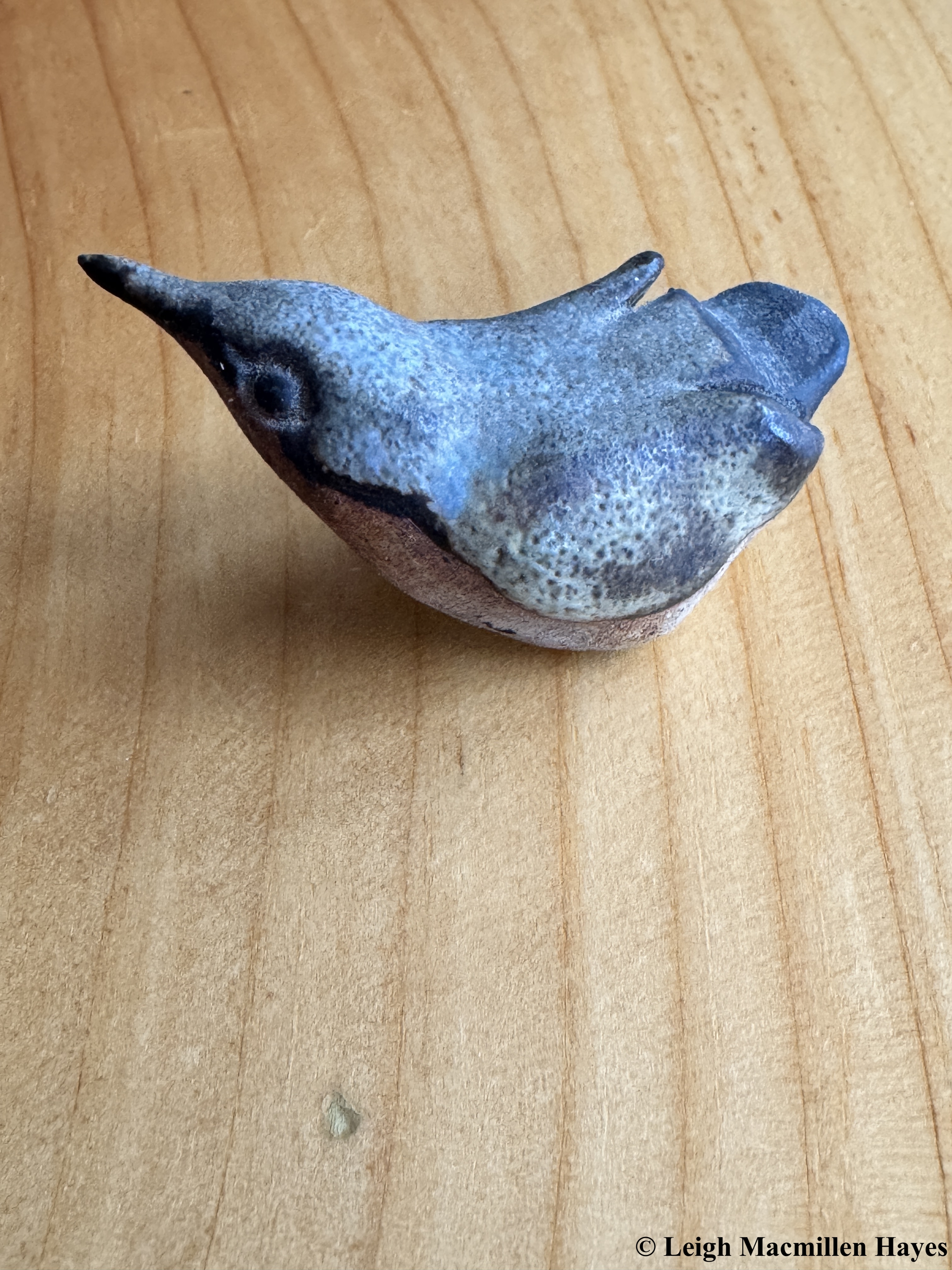
And I remember she told us they were of the Tit species, which didn’t mean a whole lot at the time, but now that I see and hear Titmice on a regular basis, I have a better appreciation. This little bird has graced my desk for decades and the young woman’s name keeps flitting in and out of my mind, so maybe I’ll recall it by the time I finish writing. I now realize I haven’t thought about her in years, despite my fondness for the gift she bestowed upon me.

Another gift was the carving of a Chickadee, and I received this one about 35 years ago from a sweet little man named Carl and I only wish he’d lived long enough to know how much I still appreciate it.

Likewise with this Loon, crafted for us by my Godfather Russell because he knew My Guy and I love our encounters with these birds who symbolize Maine. And he loved to paint, among many other talents.

I also cherish these two ornaments that never made it to a Christmas tree because they pose instead from a vase of twigs in my study. The one on the left was created by Dr. Fred, a founder of the Maine Master Naturalist Program, and the Hummingbird was gifted to me by my friend Marita after she spent some time bicycling around Cuba last year.

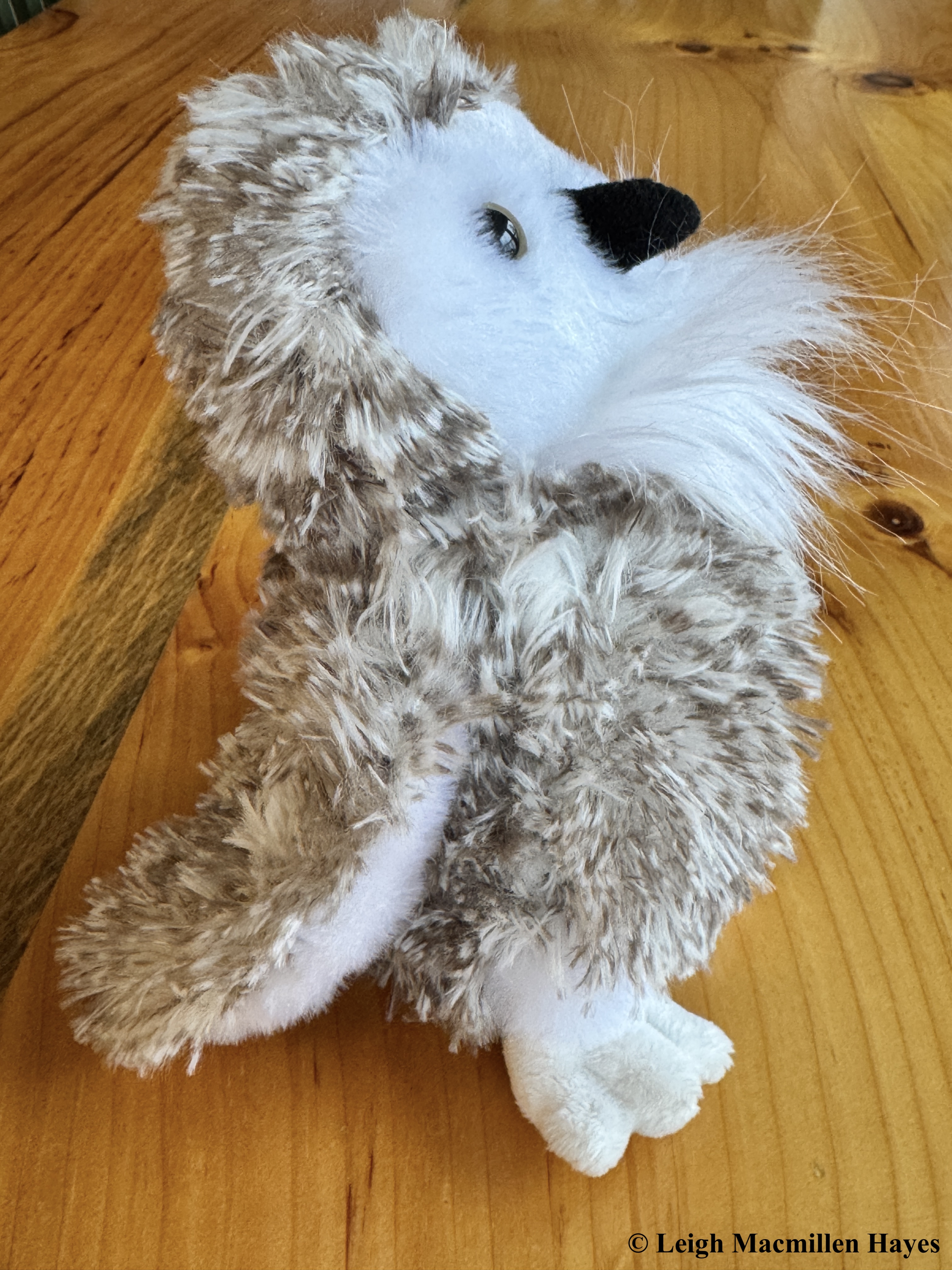
And then there is the Token Owl. Token, because if one is leading an Owl Prowl and there is no guarantee of spotting an Owl, it always pays to pull such a stuffie out of one’s pack so that everyone can leave saying, “I saw an Owl.” Sometimes you just need to make things happen.

All of this leads me to what I realized today is becoming quite a collection: my paintings of birds.

Pileated Woodpecker in our back forty, which is actually only five more acres beyond the house. One of his favorite trees, however, is at the edge of our yard before the woods, where we’ve left several super tall dead snags and he uses them to mark his territory early in the morning, and later in the day as he taps away. Every day.

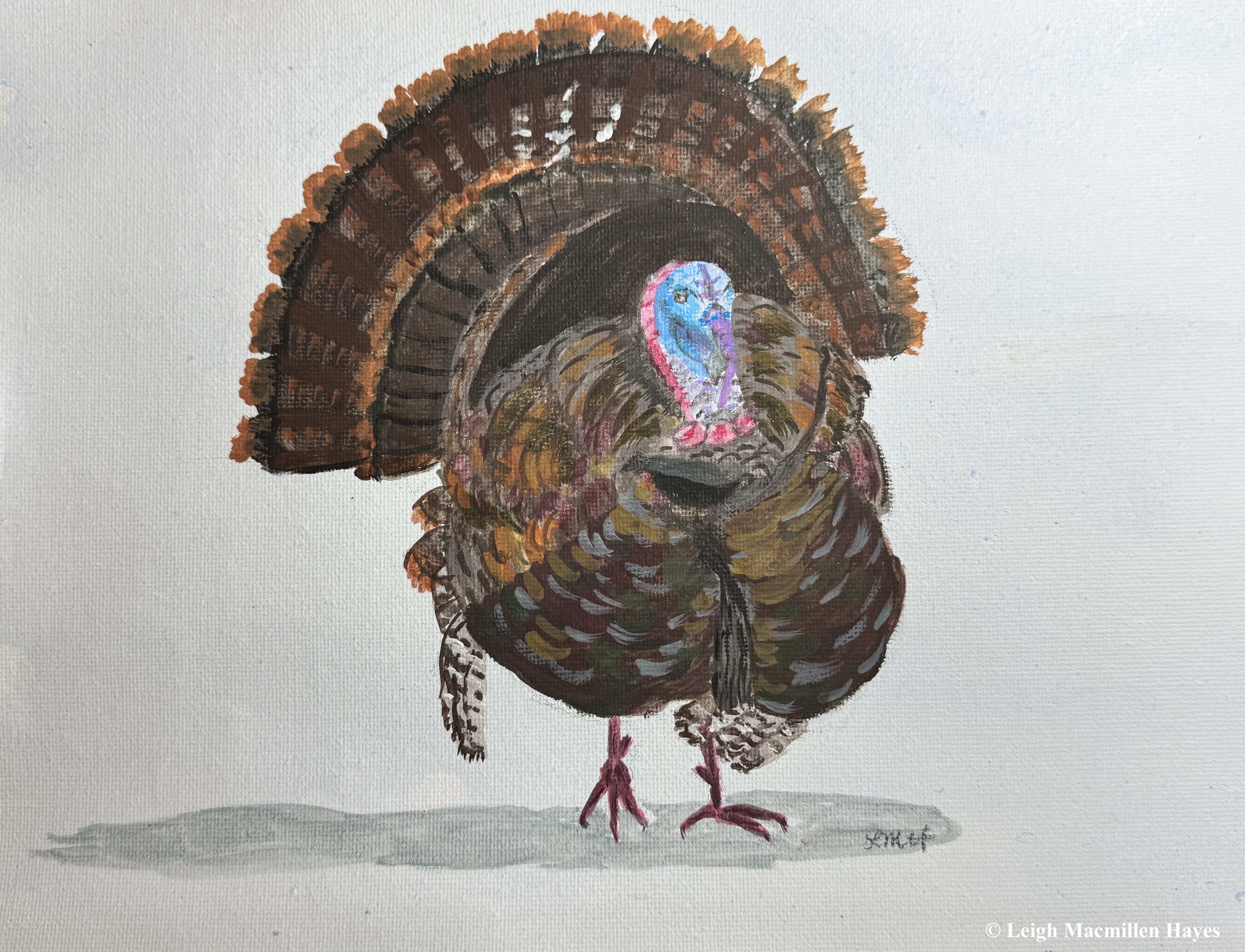
Tom Turkey strutting his stuff across the yard in hopes of wooing a hen. I can only assume he did though I never caught them in the act, but so large is the Turkey population round these parts.

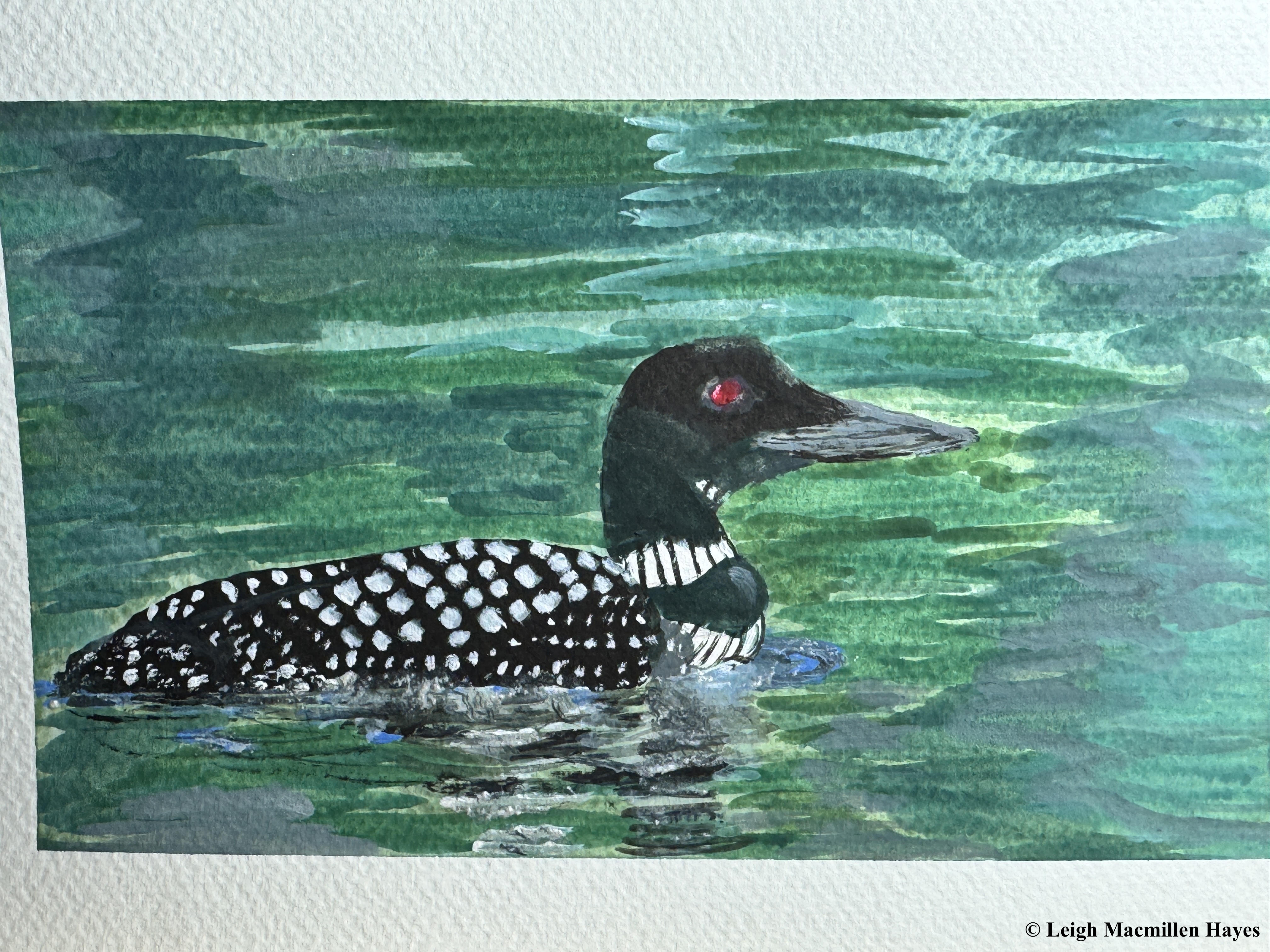
A Common Loon in front of the dock at camp. I admit that like dragonflies, I can never take too many photographs of loons.

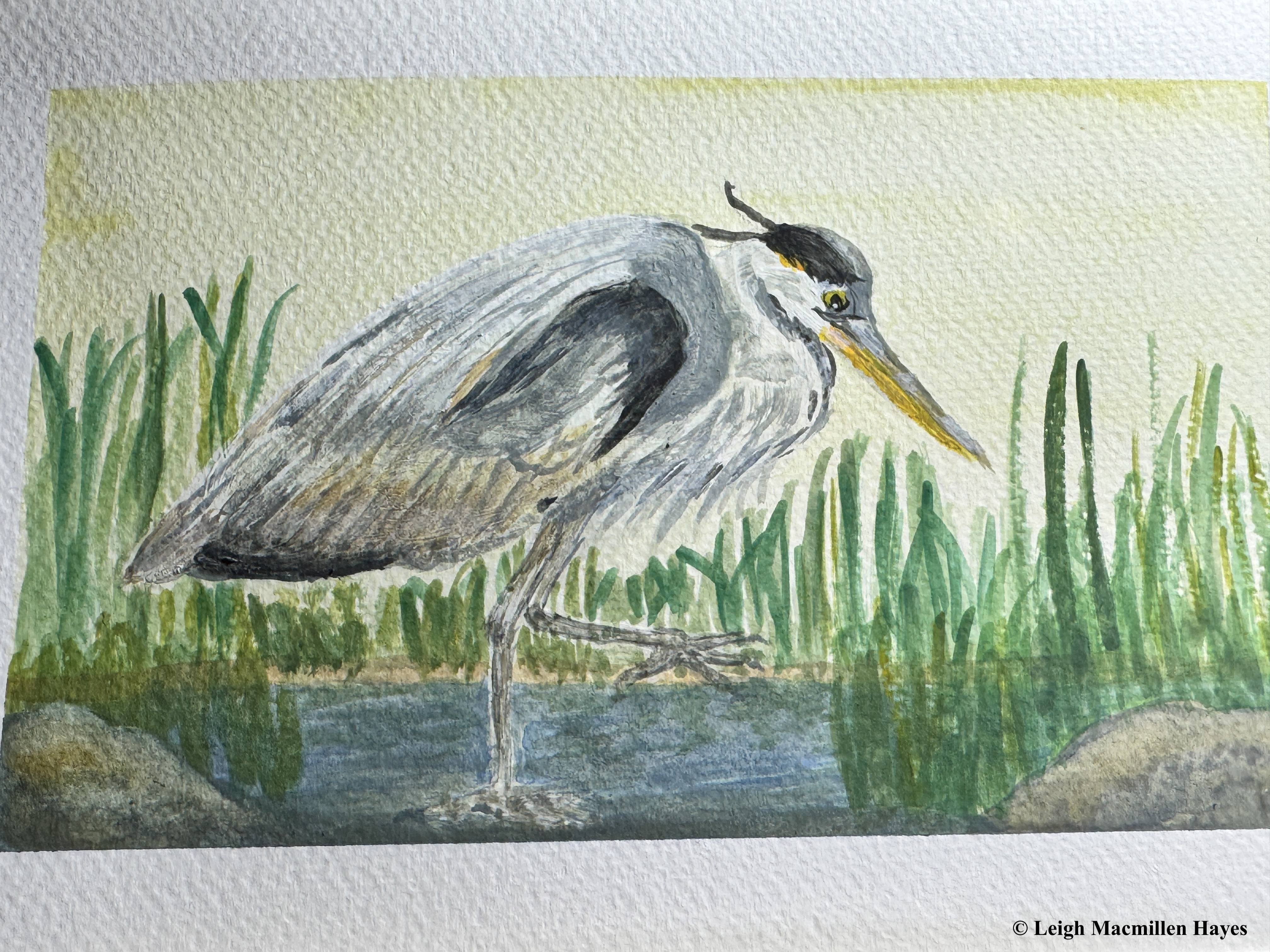
Great Blue Heron scoring a wee fish for a snack.

And another searching for another meal.

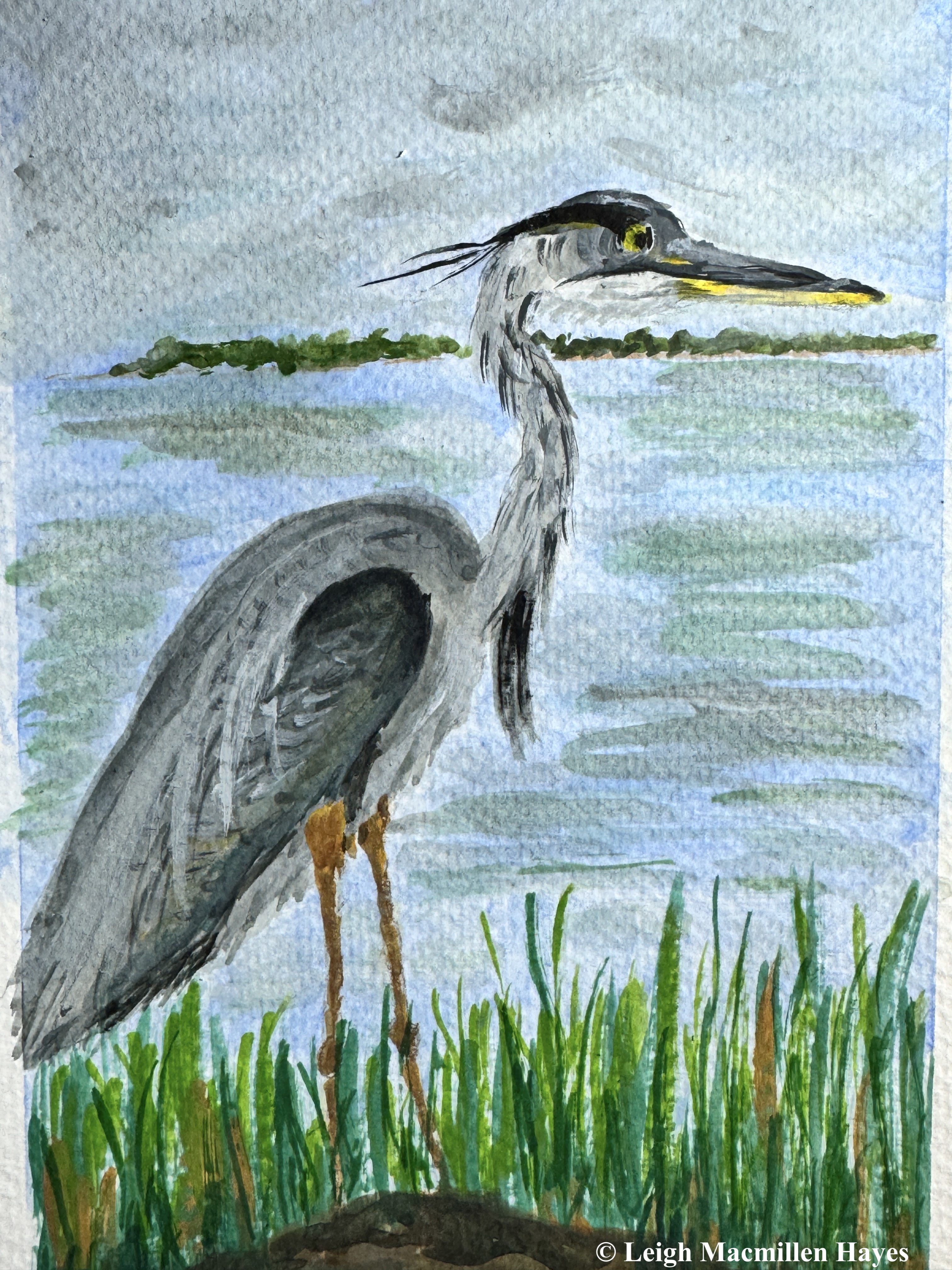
And still seeking more, its eyes always intent as it stalks its prey.

A Barred Owl near the vernal pool, thankfully when there was still ice on it about a month ago, but he’s in the area, so anything can happen.

Ah, but how I love to meet these critters, who unless they are calling, remain incredibly still and blend in with the scenery and I’m sure I pass by more than I actually spot.

Mr. Cardinal, and I’ve been waiting for him to pass sunflower seeds on to his Mrs. because I’ve seen him do it in the past and it’s such a lovely gesture.

The Mrs. waiting for a gift from her betrothed. To my knowledge, she’s still waiting. One of these days he’ll surprise both of us.

Mr. Bluebird, who also visits daily, as does his Mrs., and from the direction of their travel, I believe they are setting up housekeeping in a house my neighbor erected just for them.

One of the zillion Juncos my friend Kate sent up from Connecticut. They arrived the day she told me they were on their way. That was a few weeks ago. In a snowstorm the other day, we had quite a large flock, but I think most are continuing their journey north as now I only see a few at a time.

My first attempt at painting a Robin following instructions in a book.

And then trying to tweak the painting and turn it into an American Robin. I fooled SEEK, a free app developed by iNaturalist. It came right up with A. R.

SEEK also knew this to be a male Red-Winged Blackbird. What it didn’t know is that it was one I saw calling a few weeks ago when there didn’t seem to be any females around.

And finally, my new friend, who has actually been in the neighborhood for a long time, but we only recently spent a few minutes together the other morning: Sharp-shinned Hawk.

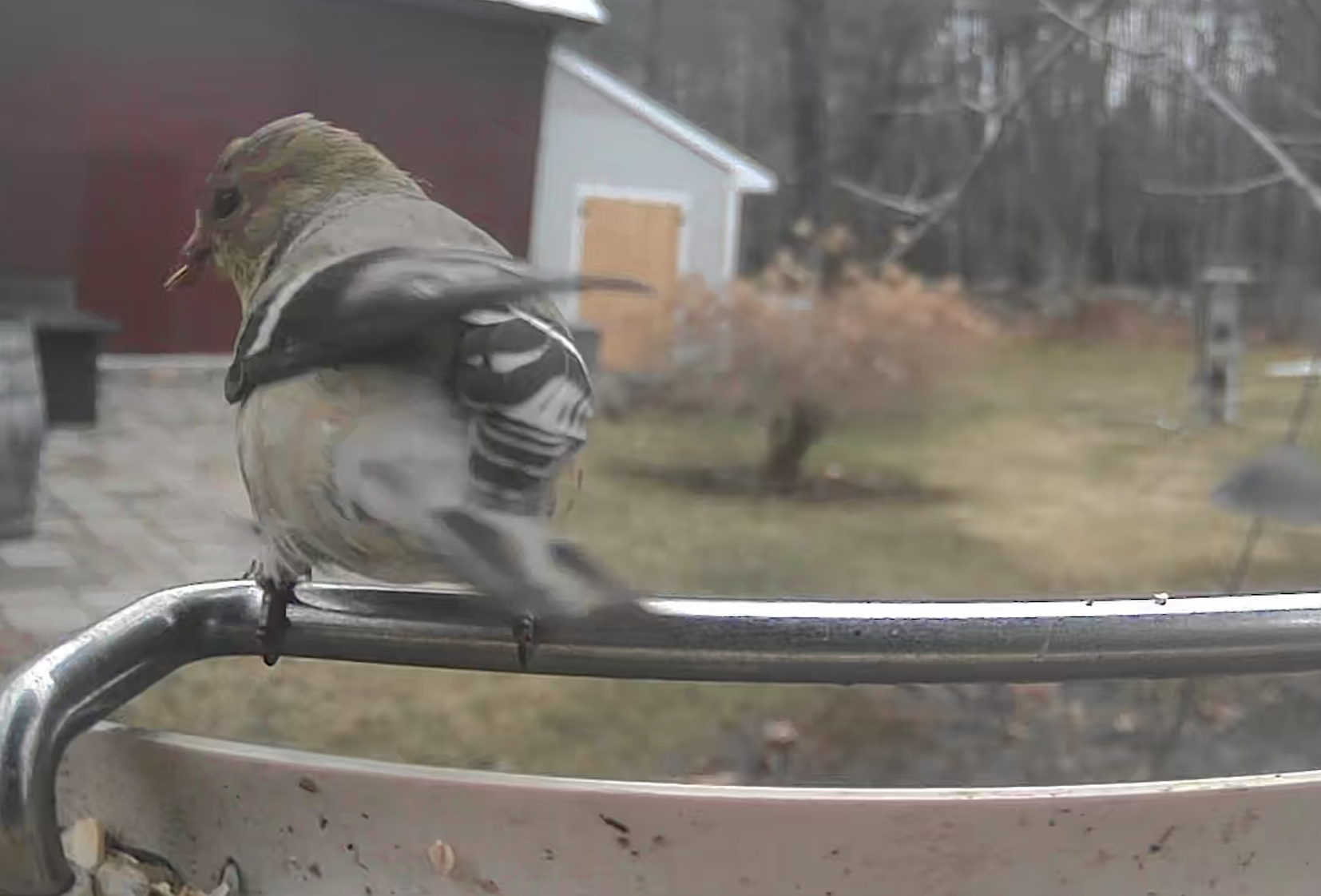
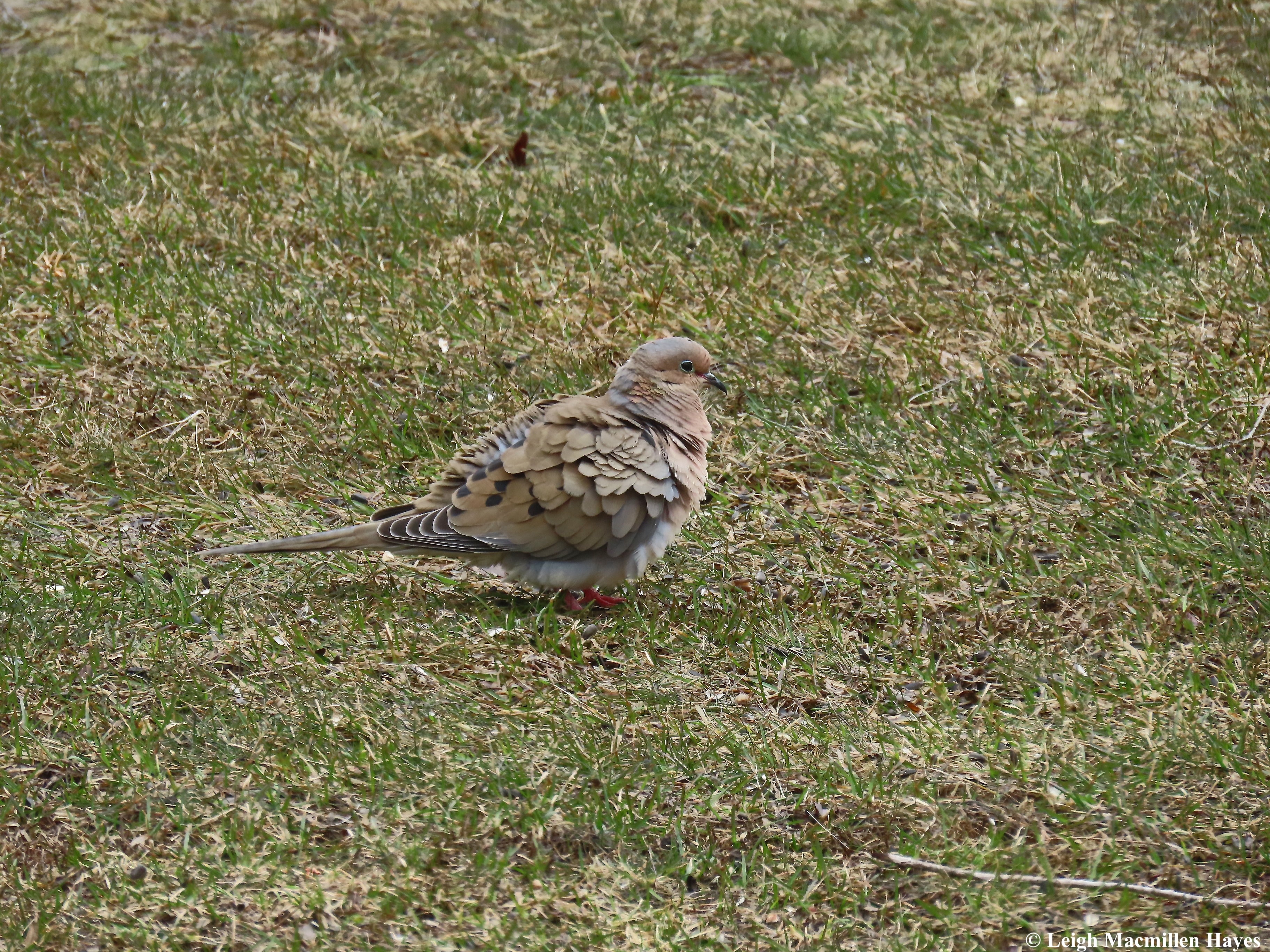
As I look out the window right now, besides this Goldfinch, the Bluebirds are both here, plus Robins, Juncos, Chickadees, Tree Sparrows, White-Breasted Nuthatches, and Mourning Doves. And actually, there are more Juncos than I expected.

That is the extent of my bird collection–at least for the moment. Thanks for stopping by to take a look.

The student from Britain: Jillian. It just came to me.

The Wild Out My Window

I know I should take in the bird feeders. After all, it is April 8. And a friend found bear tracks in her yard about seven or eight miles away on April 1st–and it was for real, though I did question if she was trying to fool me.

But I haven’t done so yet and the past two days have offered insights and outsights as I’ve stood at the back door periodically, ever ready to snap a photo.

Picture taking began early on the 7th–at about 6:15am, when the lighting was a bit dark and my camera encouraged me to use the flash, but I chose not to because I knew it would offer a reflection of light on glass and I’d never get a photograph of the critter of my intent.

Much to my surprise, a Sharp-shinned Hawk helped me greet the day. The bird perched about twenty feet from the back door, right in the midst of my feeding station–well, the feeding station I’d set up for birds, though my plan has always been for me to provide the food in the form of seeds and suet, not in the form of other birds.

We spent a few minutes together, Sharpie and me, and not a single bird flew in–thankfully.

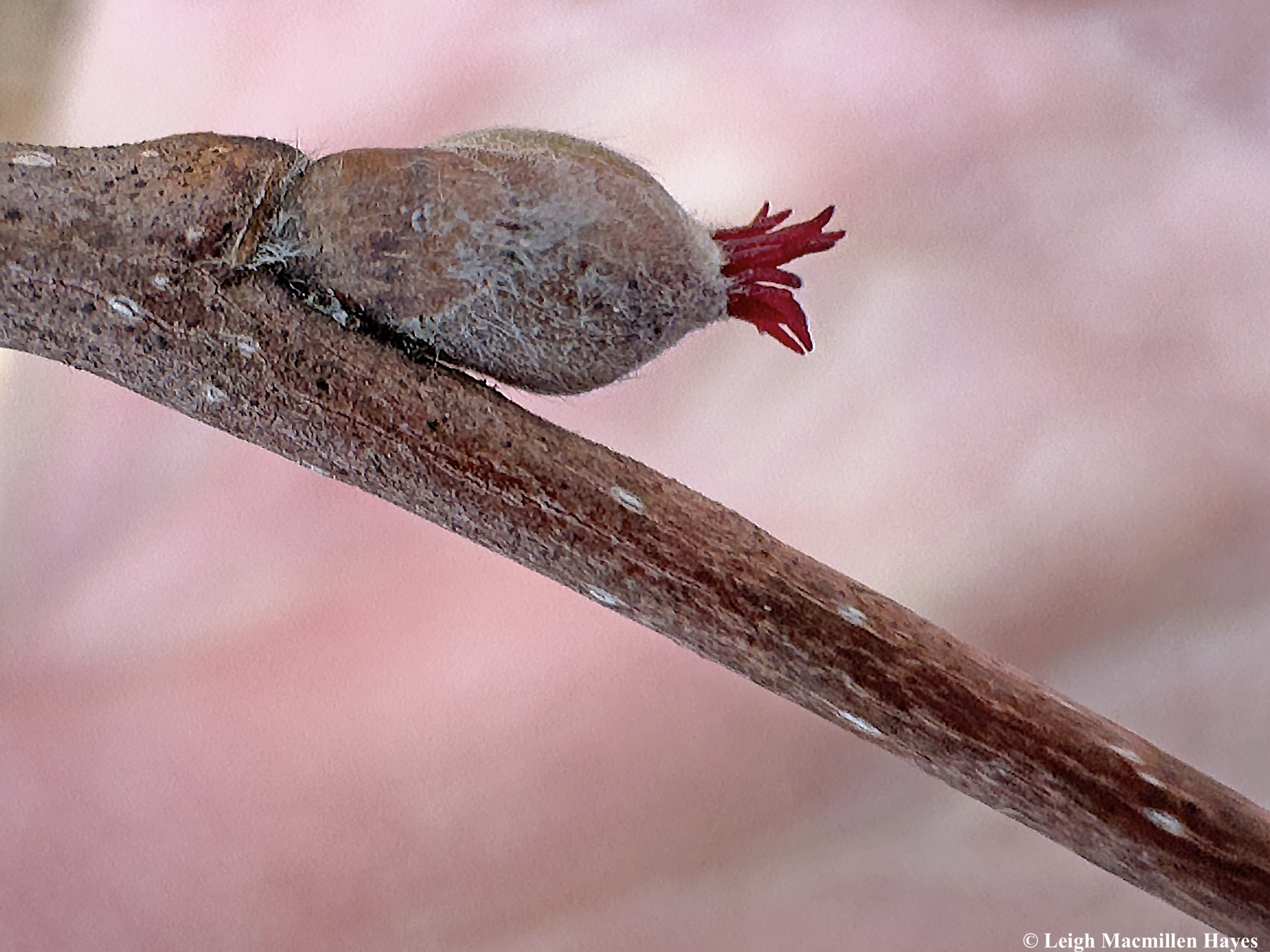
The feeders were actually quite low on seed, but knowing the Hawk was around, I decided to wait to refill them and instead took off for a hike with My Guy, where we spotted Beaked Hazelnut in flower.

Back at home, I immediately filled the feeders and spread seed on the ground, and it seemed like within seconds, we had visitors.

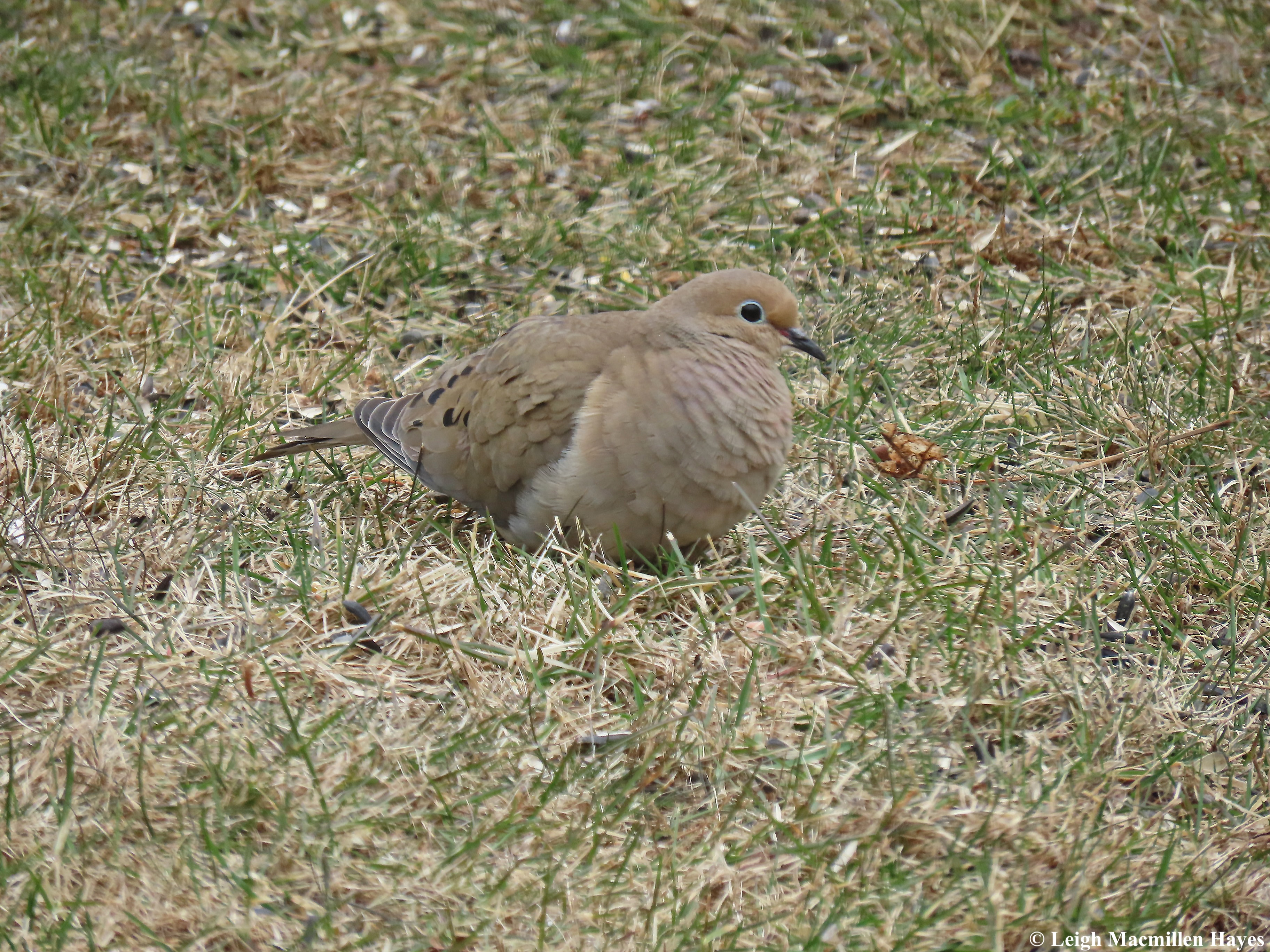
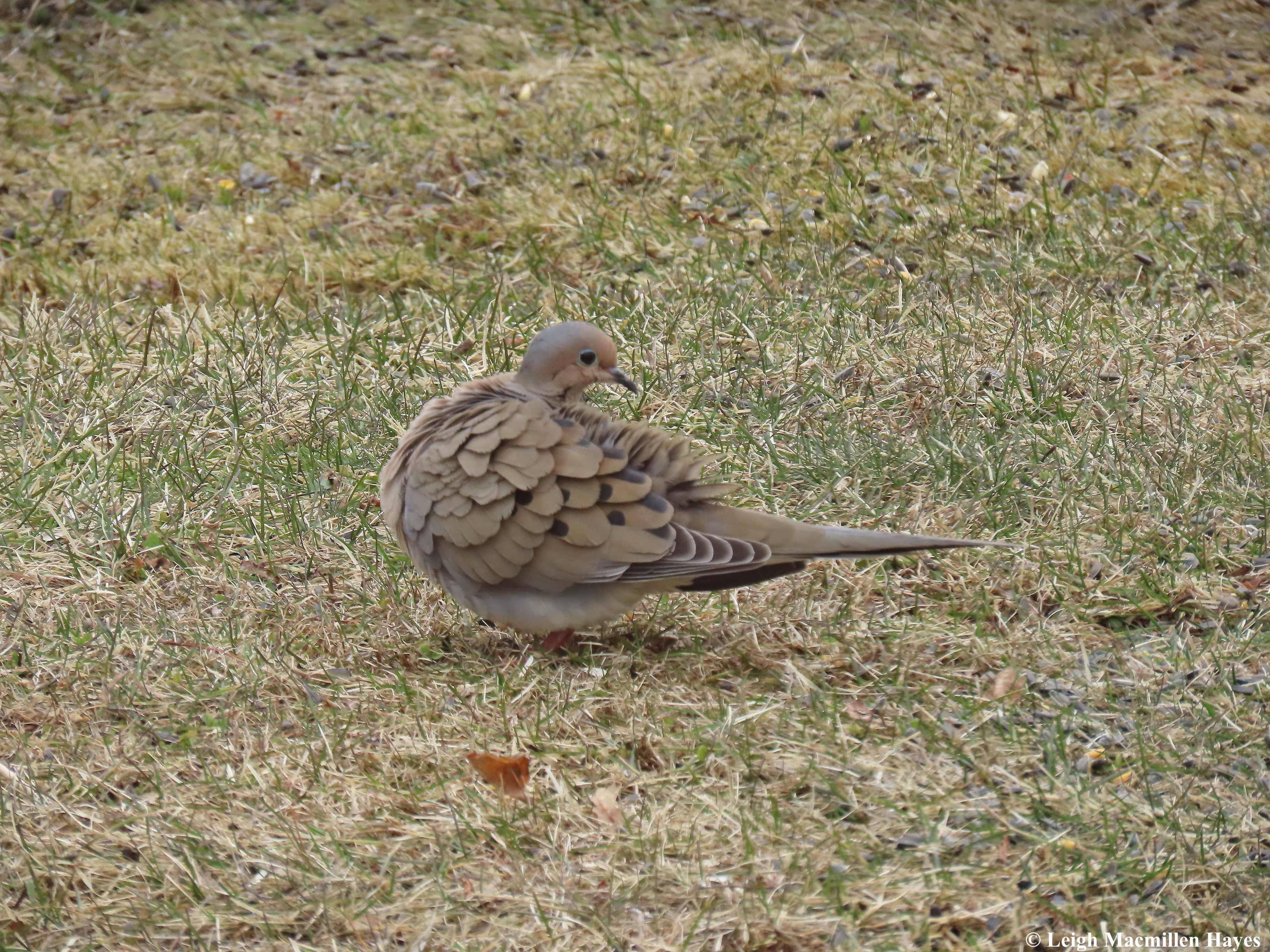
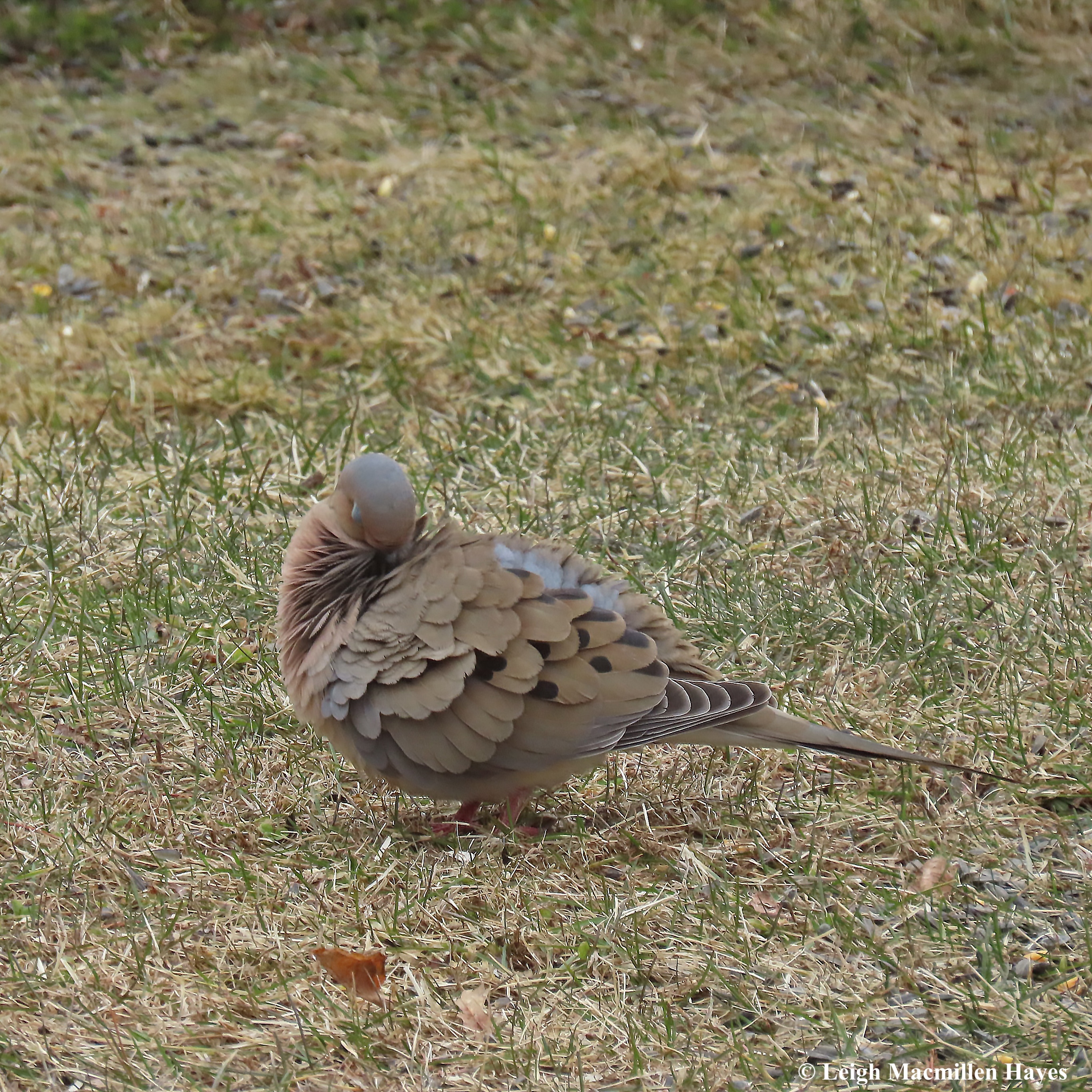
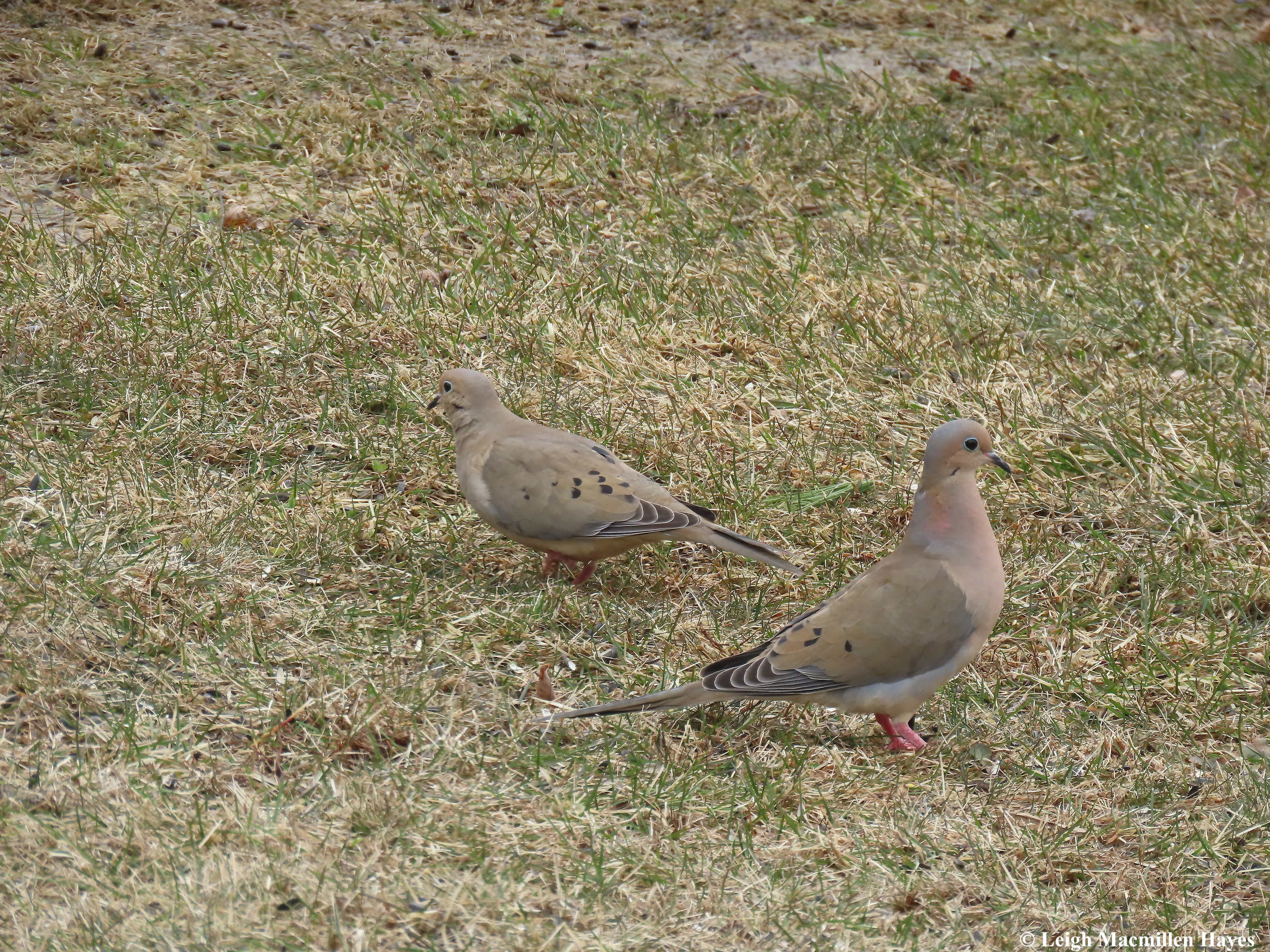
The female Mourning Dove was a bit of a hog–filling her crop non-stop.

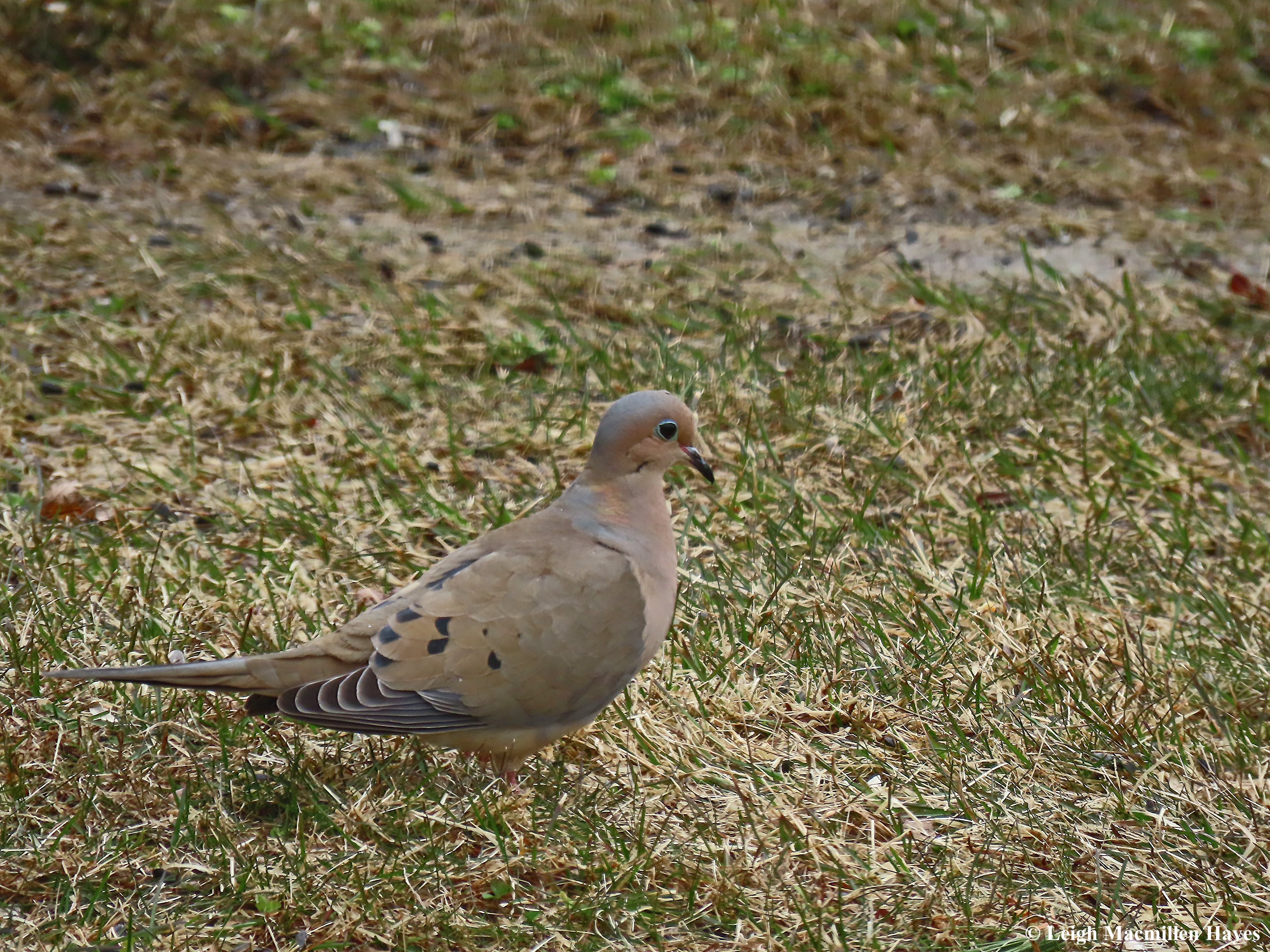
Her male counterpart didn’t seem to care about eating and he marched about going this way and that.

And then I noticed him begin to fluff out his feathers and all I could think of is a Tom Turkey and I suspected I knew what he had on his bird brain.

He’d fluff, then calm down and strut past her, but she didn’t seem to care as she stayed low and kept on gathering more seeds for later consumption.

Then he’d fluff up again.

And preen to make sure he was looking his best. I was impressed.

She didn’t care.

Like her, I turned my attention in a different direction as at least three Song Sparrows splashed in a large puddle and also sought seeds. I’ve yet to hear their songs, but they’ve been back in Maine for at least a couple of weeks.

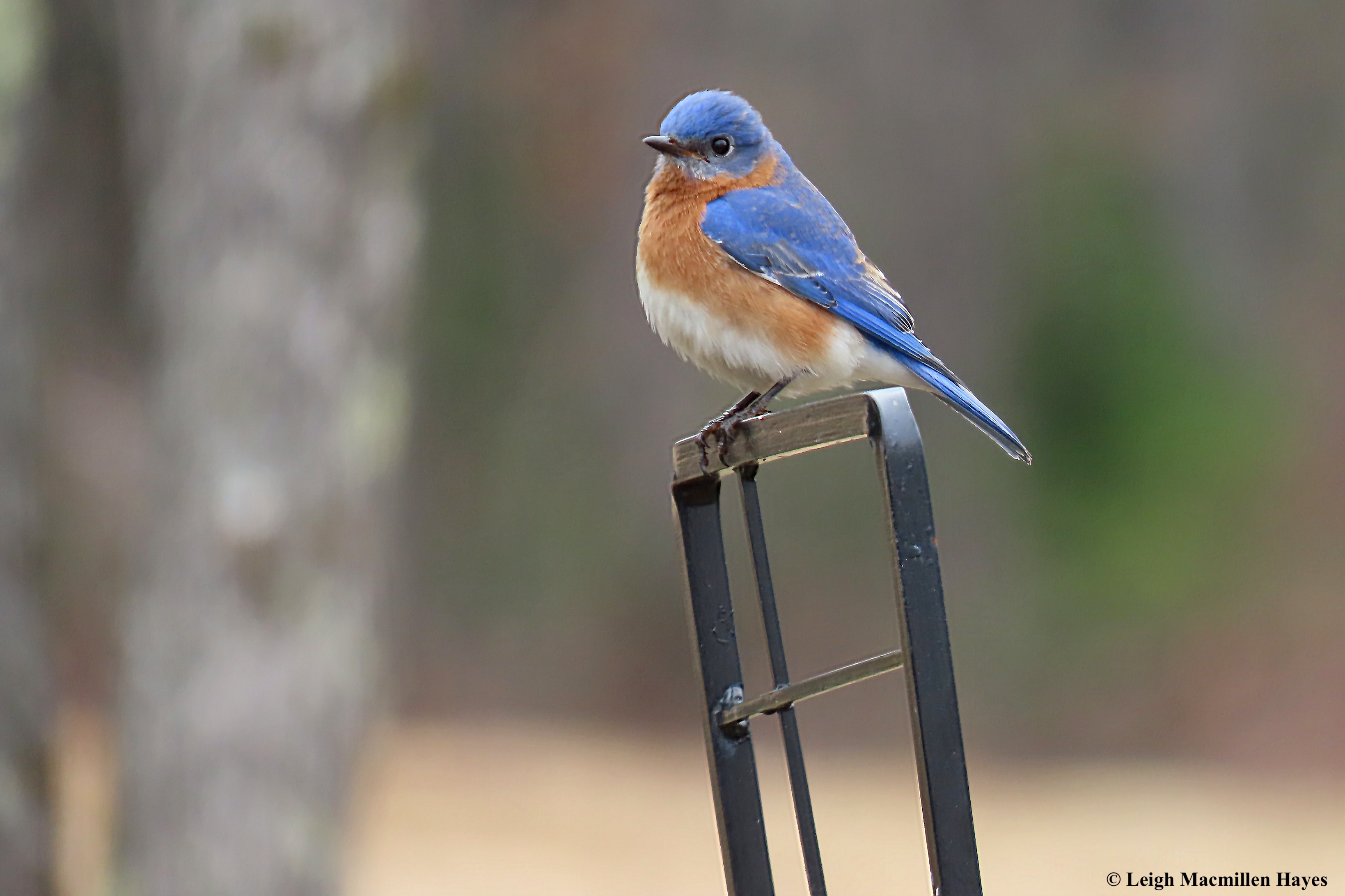
And then a female Bluebird joined the scene and made me give thanks for our neighbor’s field and the houses she has installed for these beauties.

Her mister also kept flying in, actually more often than his Mrs., but he only occasionally sought sustenance. The rest of his time, he watched and waited, and waited and watched.

When I did turn my attention back to Mr. Mourning Dove, he was fluffing up again.

And then he approached his true love.

And tried to jump on her back, but she quickly hopped away. It took him a while, but finally, he headed north, walking across the yard to I know not where. And she stayed and gathered more seeds.

At one point all three species, the Tree Sparrow, female Mourning Dove, and male Bluebird all occupied the same space, but then he flew–as birds are known to do, especially when I want to photograph them.

More interested in suet was the male Downy Woodpecker. I kept expecting his lady to arrive, but she never did appear.

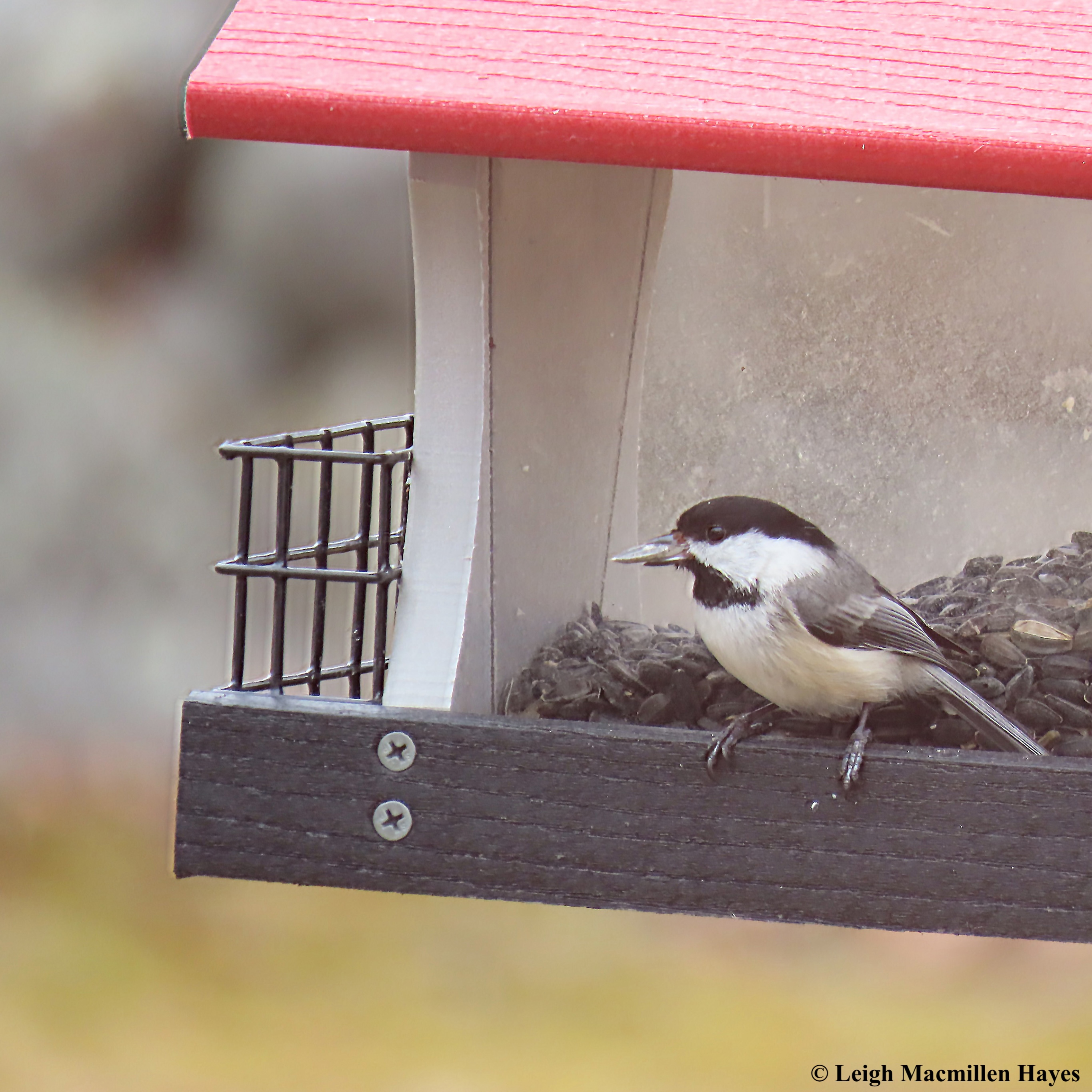
There was, however, a lot of Chickadee action, and I cannot say whether male or female, for to my uninformed eye, they all look the same.

White-breasted Nuthatches also came, seeking both suet and seeds in no particular order.

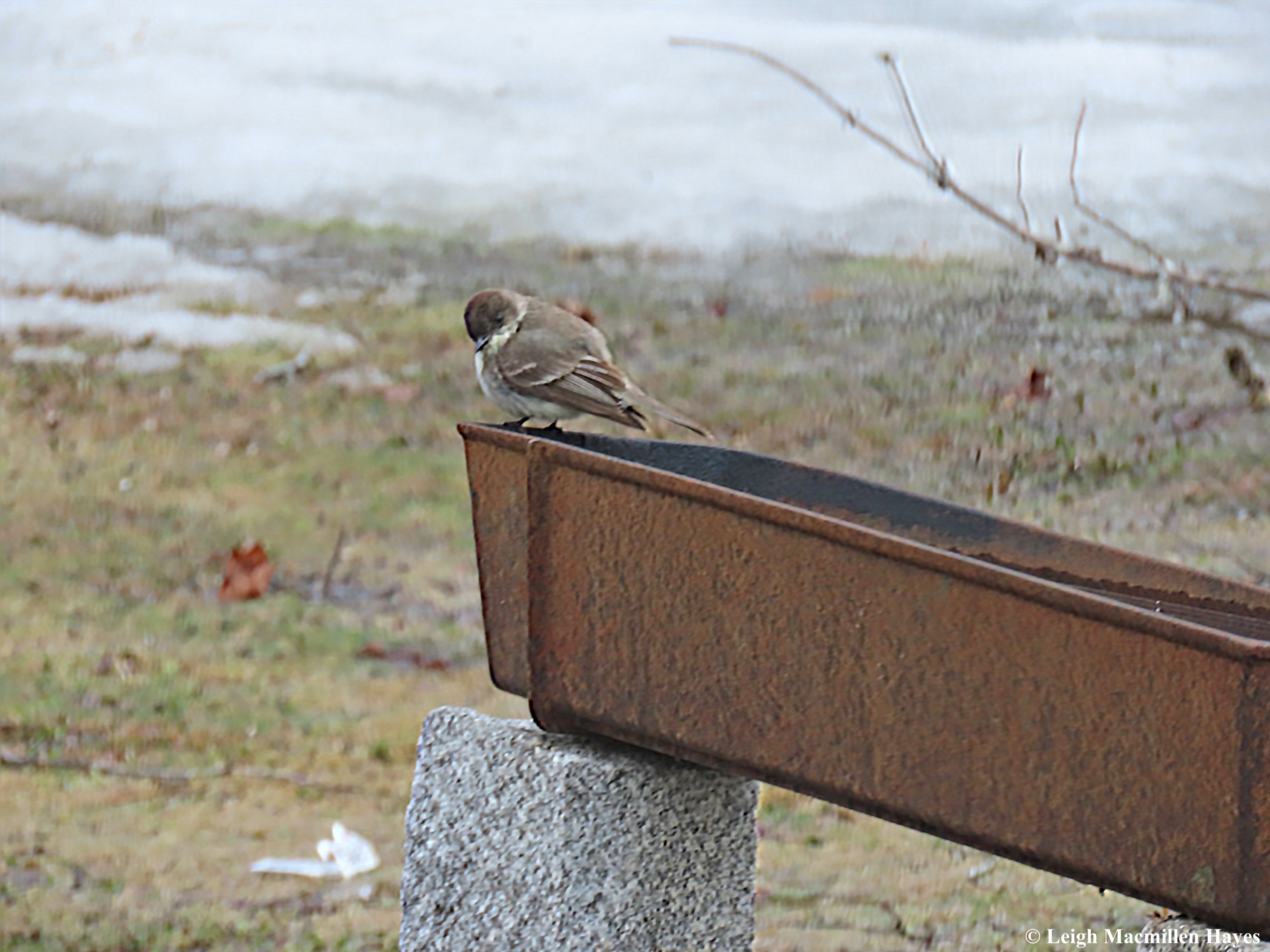
And for the first time this year, an Eastern Phoebe entered the scene. She’s tried to build a nest over our front door one year and on our back shed the next. I’m curious to see where she decides to locate her adobe this year.

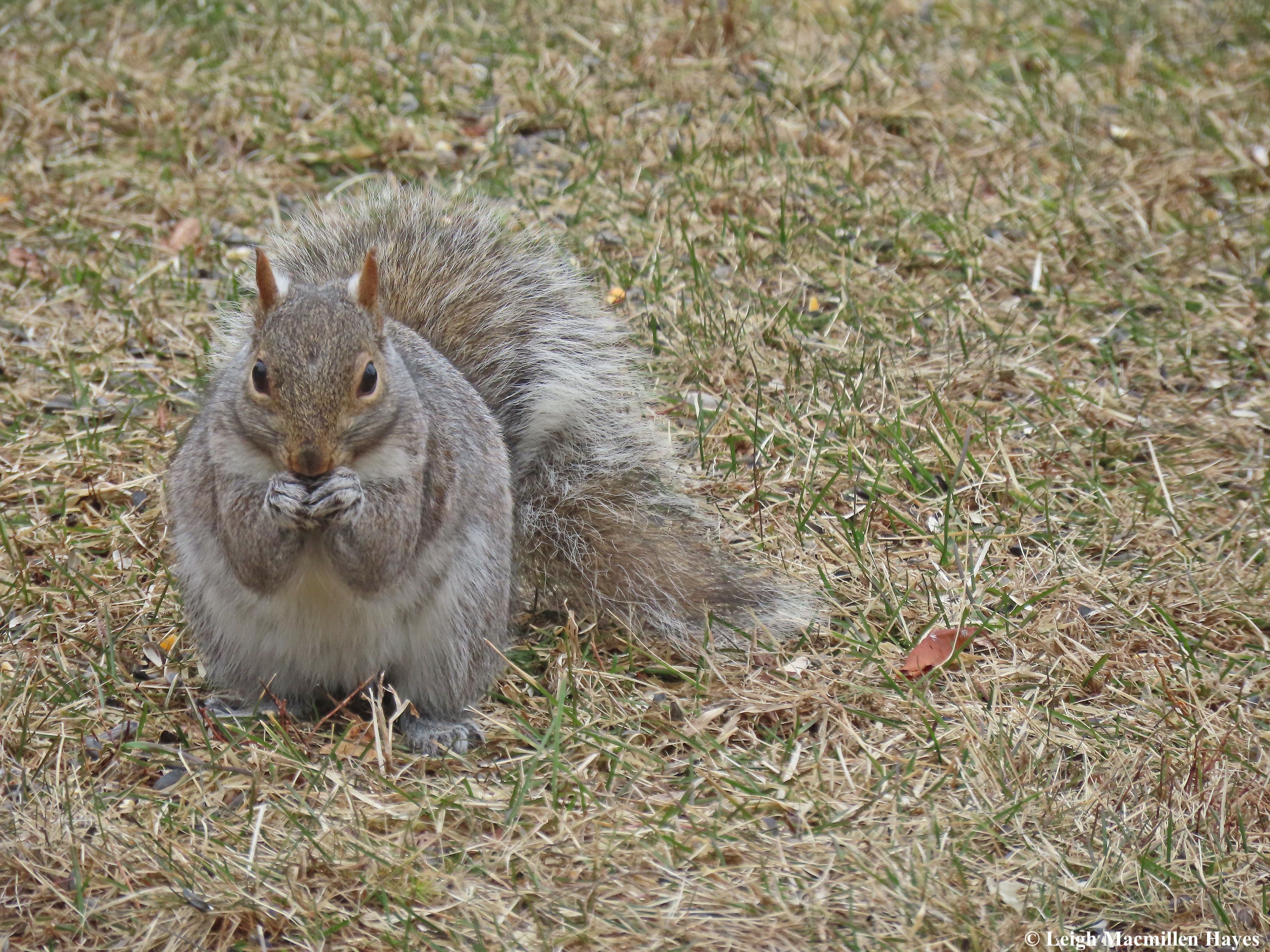
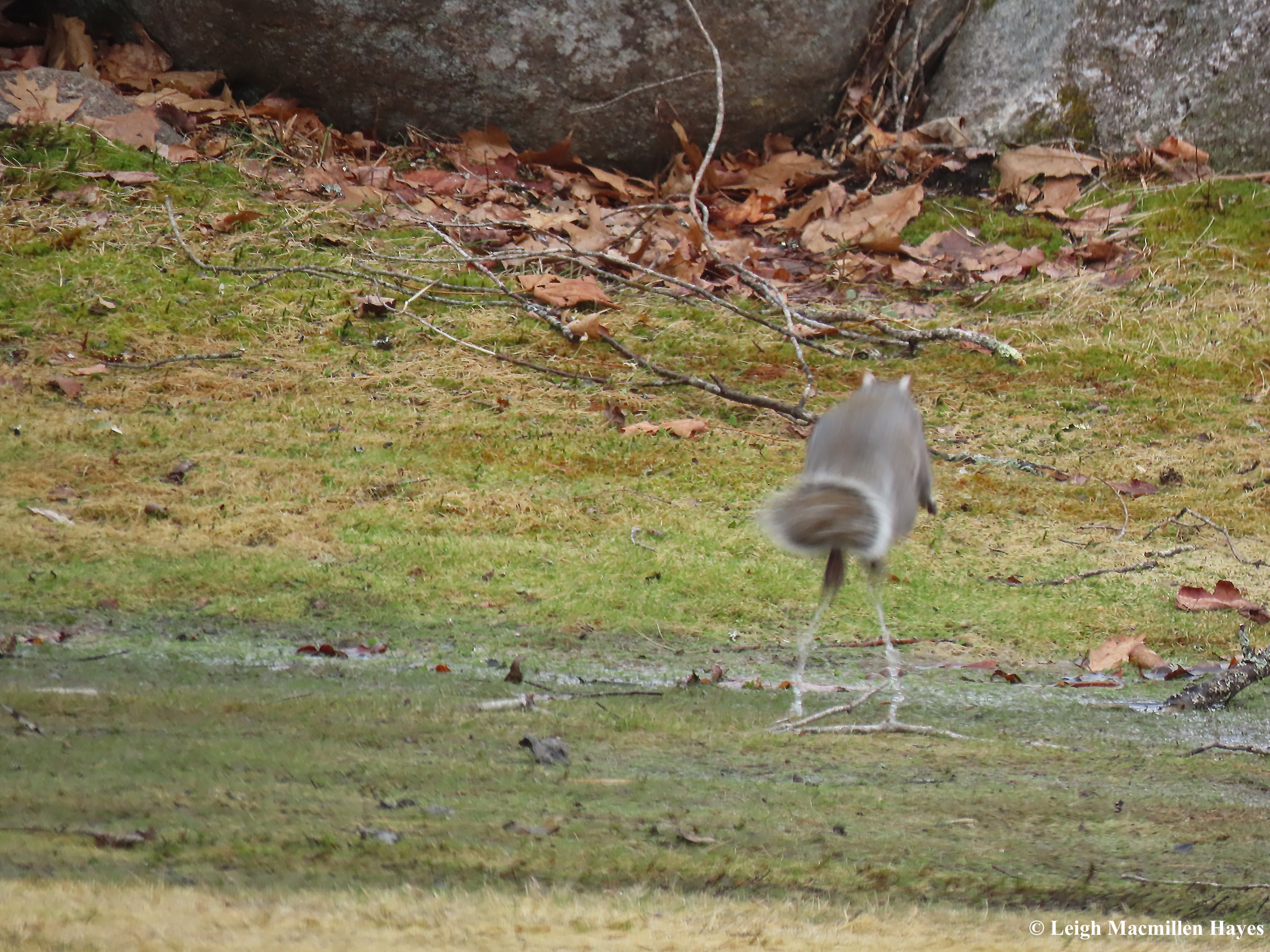
The final bird for yesterday was the Squirrel Spoonshovel, so deserving of its common name for all it seems to do is shovel seeds into its mouth. Nonstop. All day long. This one and six of its nearest kin.

But eating bird food apparently works, and I couldn’t believe it when I saw it take flight.

This morning dawned with the Bluebirds and all their neighbors back in residence. And I could not help but think of the patience this male has as he perches for minutes on end.

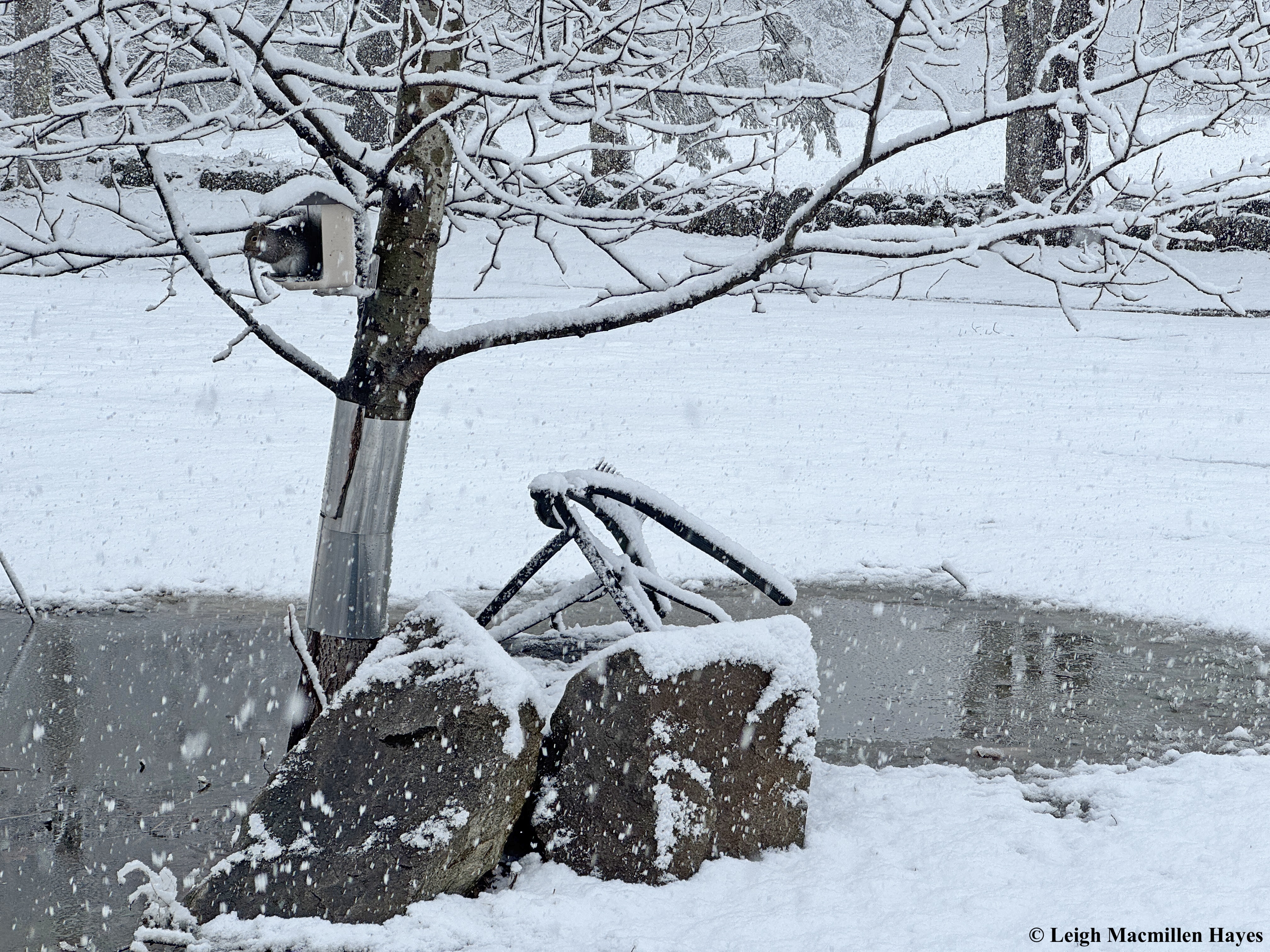
That is . . . until it began to snow and he looked at the first flakes with disdain.

And then back at me as if it was all my fault. Really, I tried to explain, I can’t control everything, despite my fervent attempts.

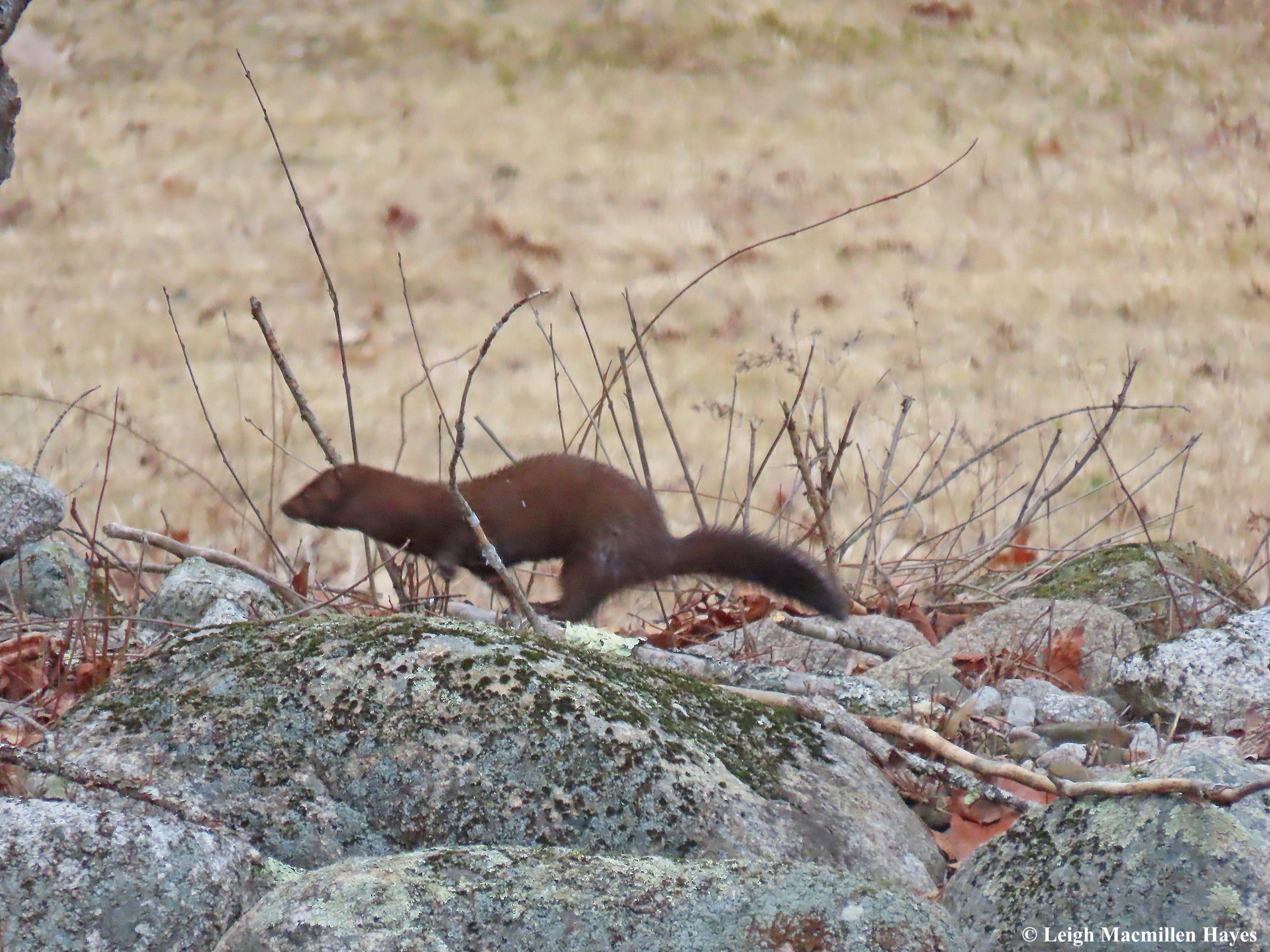
The star of the show today, however, was another unexpected visitor, this in the form of an American Mink!

My photos are not crisp for so quickly did he bound, but I couldn’t believe my good fortune to have spotted him.

I’ve seen fewer squirrels today and wonder if he might know why. Although, as I typed that, I looked out the window and tada, there was one, and then a second.

They fought for a chance to sit in the bird feeder . . . of course! Because after all, they are Squirrel Spoonshovels, that rarest of bird species.

The wild out my window . . . is truly wild here in western Maine. And each of these is just a snapshot of time, for honestly, I don’t spend every moment standing by the backdoor.

But just imagine if I did . . .

Bogging With Bridie

We parked on the little dirt connector road between Route 160 and Lord Hill Road, close to Bog Road, because we knew the conditions would be such that driving into Brownfield Bog would be impossible. Besides, walking would offer more time to catch up on each other’s lives. Well, I’m afraid I did most of the talking, but at least my friend Bridie is up to speed on my life. Hers is so full of students and research and writing, that just having time to breathe in the fresh air of her childhood backyard was enough.

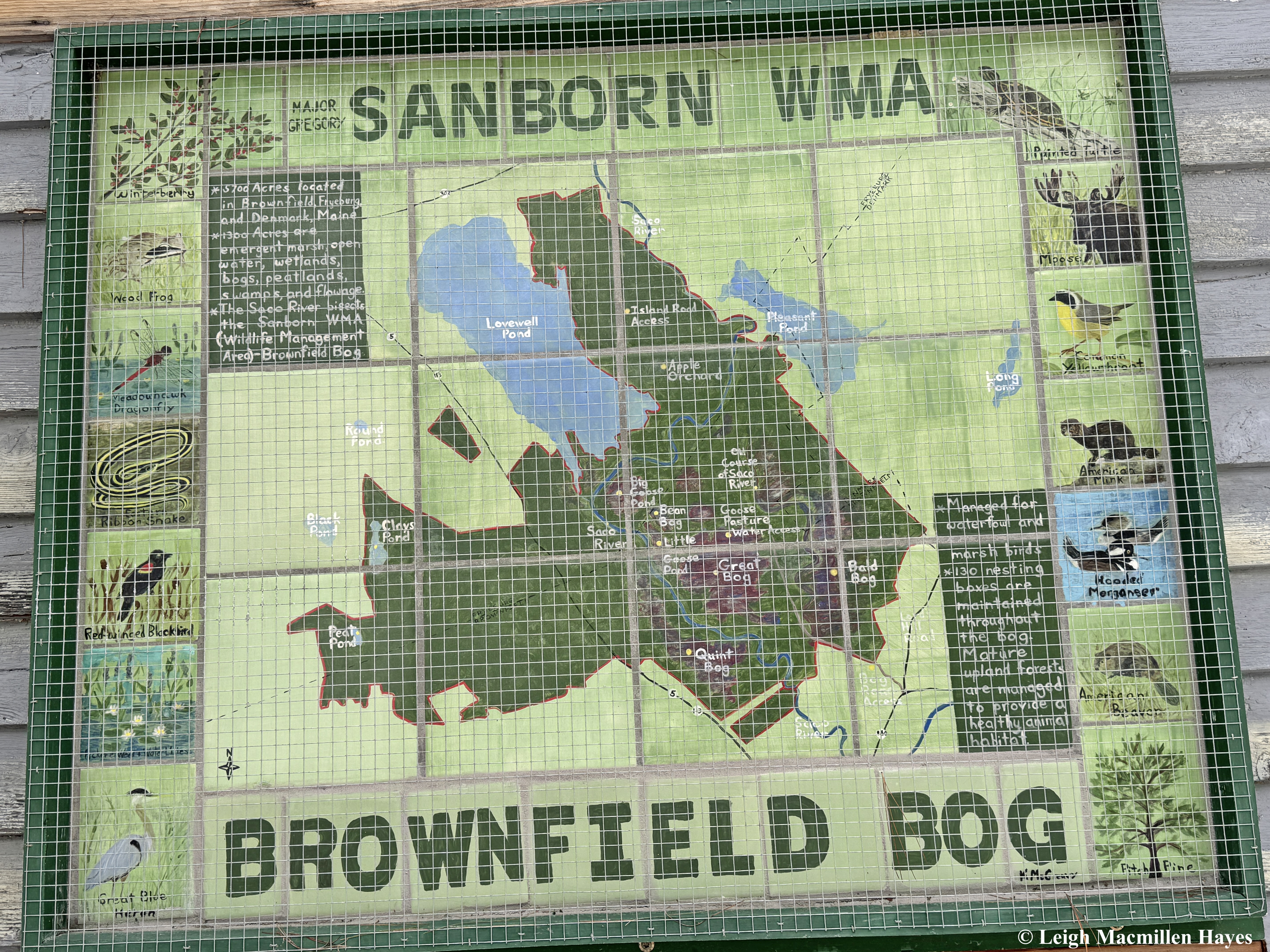
At the old shed, we paused to admire the work of her mom, Kathy McGreavy, a potter who created this tile map of Brownfield Bog in 2017 as her capstone project for the Maine Master Naturalist program. And we wondered how many of the same species we might see or encounter today.

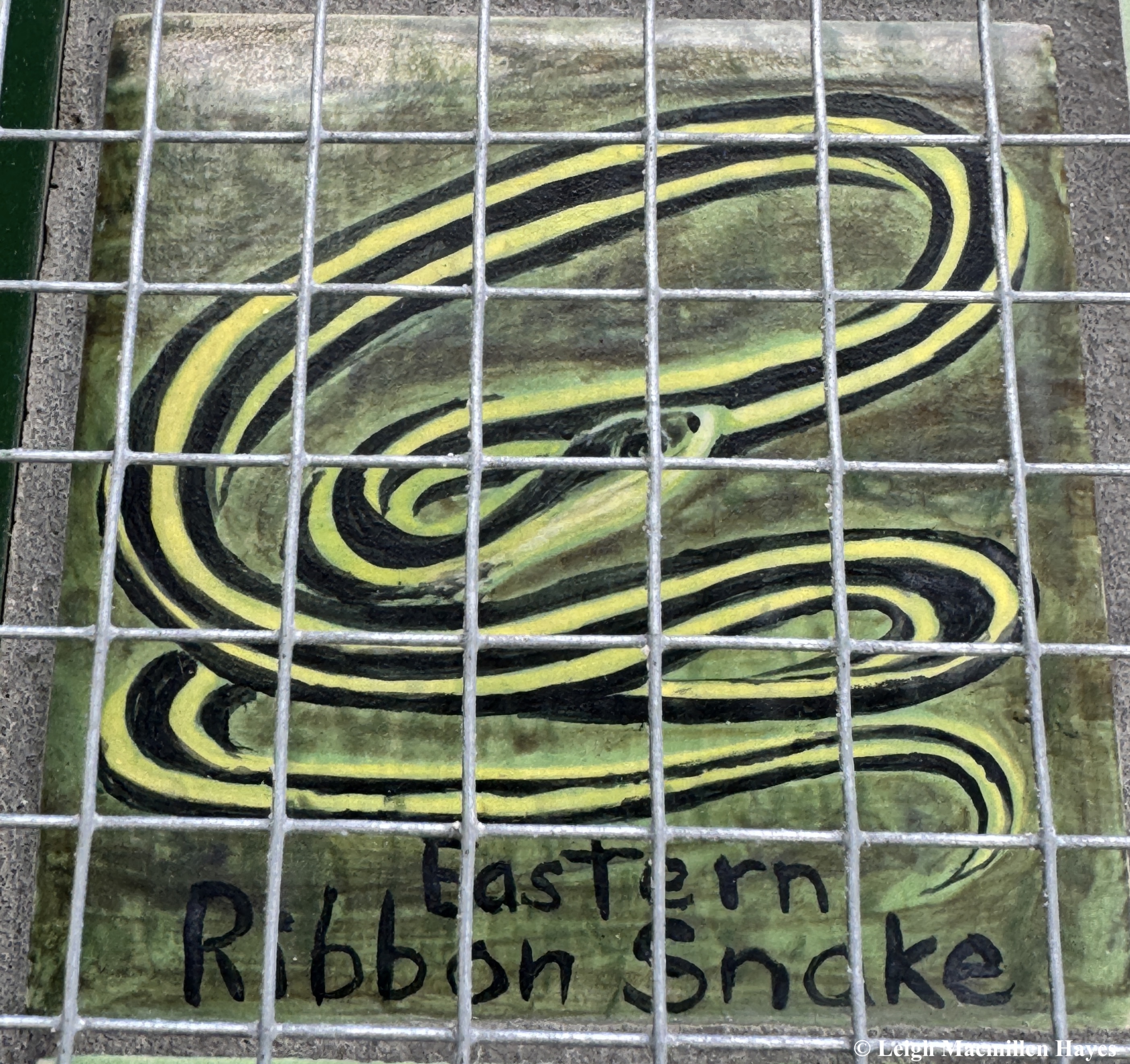
One particular tile always elicits a shared memory, for I was with Bridie when we spotted an Eastern Ribbon Snake slither across the road and down into the water.

It was then that I learned that Ribbon Snakes are a species of special concern in Maine, and rather uncommon. Since then, I’ve seen at least one more in the bog and a few more in several other local spots, but each sighting is special, and always I return in my mind to that first time.

And why the wire across the tile art work? It seems woodpeckers like to peck at the tiles and Kathy had to repair a few a year or two ago.

We couldn’t go out on the bog today, as we had done previous winters. After all, we are on the cusp of spring, and didn’t trust the ice. But from the edge we admired Pleasant Mountain forming the backdrop–and always giving us an idea of where home is located.

Down a side road, which we were able to walk being not flooded (yet), we found our way to Pirate’s Cove along the Saco River and the water is high and mighty and muddy. For a few minutes we watched in silence. Well, we were silent, but the river wasn’t.

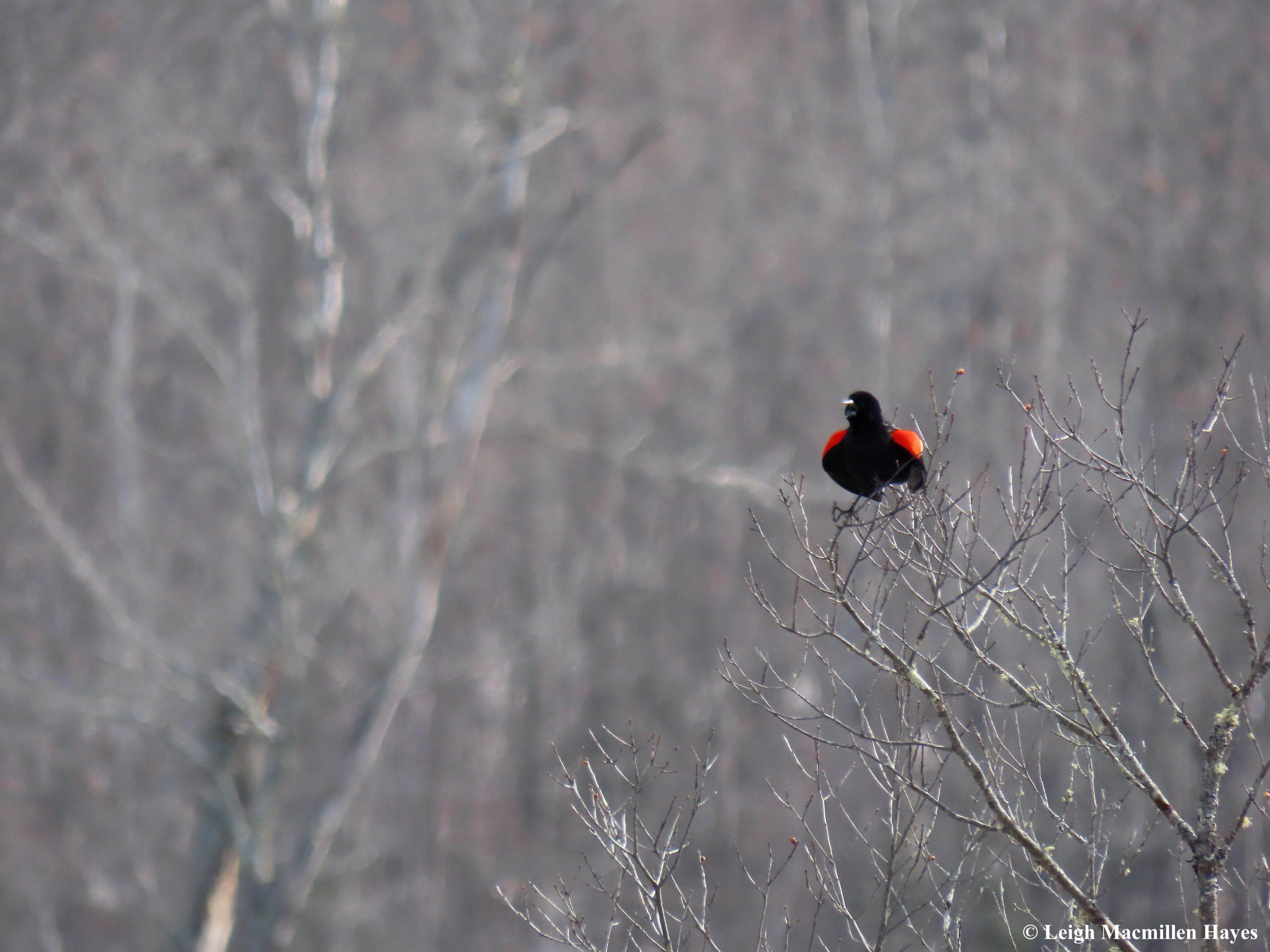
Returning to the main drag, we made our way back to the Old Course of the river and were greeted by the most delightful bird chorus, including the conk-le-rees of the Red-winged Blackbirds.

With their bright red shoulder patches bordered below in yellow, they were calling from high perches among the shrubs.

Puffing out while calling is indeed a breeding activity, and so the race is on. May the best males find a mate.

Our other bird sightings included this White-breasted Nuthatch, plus Hairy Woodpeckers, American Tree Sparrows, Canada Geese, and a thousand Wood Ducks. Or so it seemed. The fact that they moved every time we spotted them, even if two hundred yards away, might mean that there weren’t quite that many, but rather that we kept meeting the same ones in different locations.

We also saw signs of Pileated Woodpecker works. Not only do they excavate holes while in search of Carpenter Ants, they also shred and chisel and in these woods, that seems to be a favorite activity. We wondered why, but couldn’t come up with an answer.

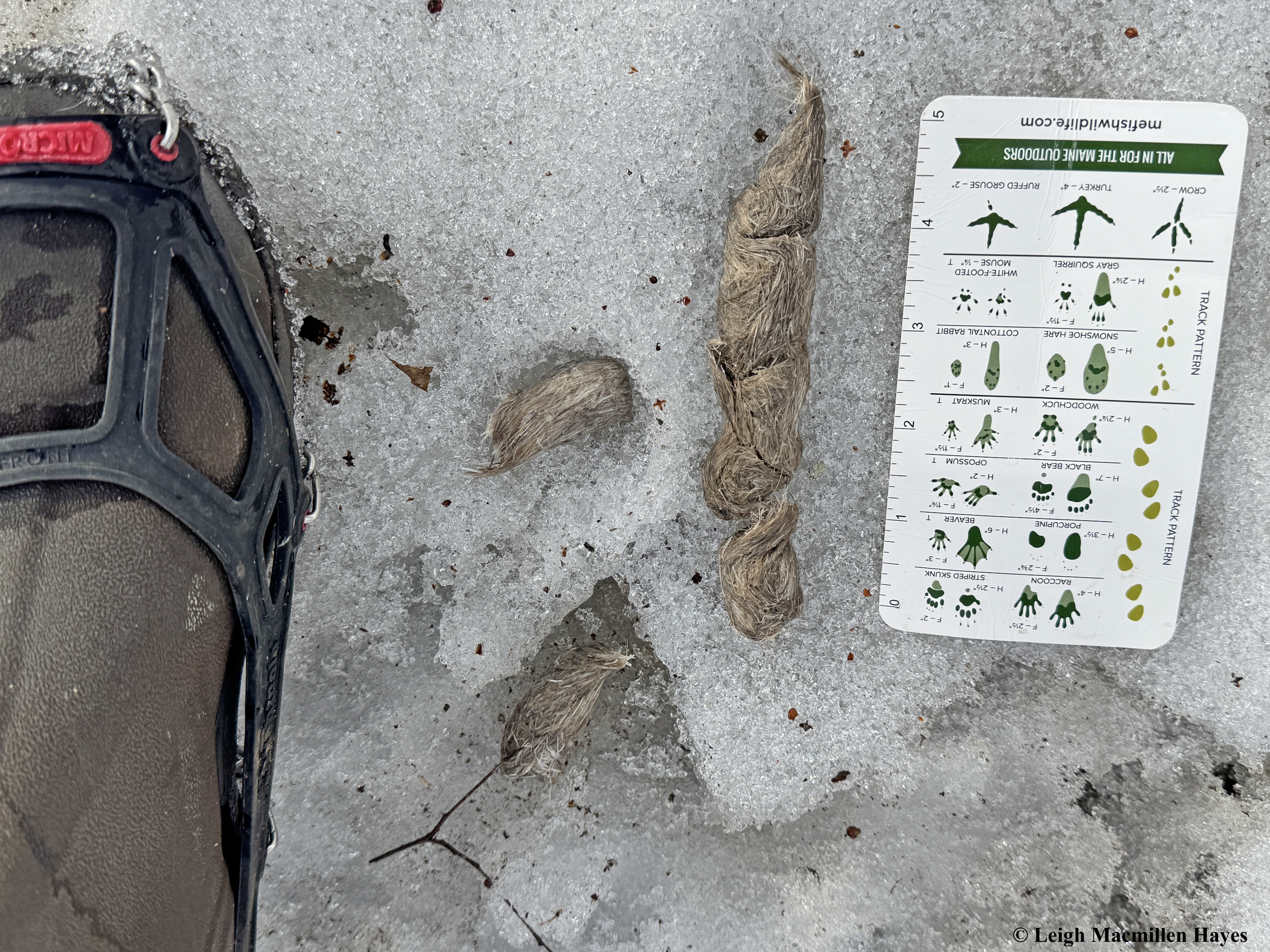
We did, however, do what Bridie taught me to do a million years ago and searched for scat. Bingo! Though we saved this thought for another day, we did wonder if we dissected the scat, would we be able to tell about how many ants had been consumed?

And no adventure with Bridie would be complete without some tracking in the mix. Our snowpack is quickly dwindling and where three days ago at home, we still had a foot, now there are lots of bare spots and what snow is left might be only about four inches.

That said, we relished the finds we did make, including lots of Vole tunnels like these. And I reminded Bridie that she was the one who introduced me to the subnivean layer, that microhabitat between the ground and the bottom of the snowpack (think back to Thanksgiving 2024), which provides insulation and protection for many animals, like the Voles, who happen to be on everyone’s dinner menu.

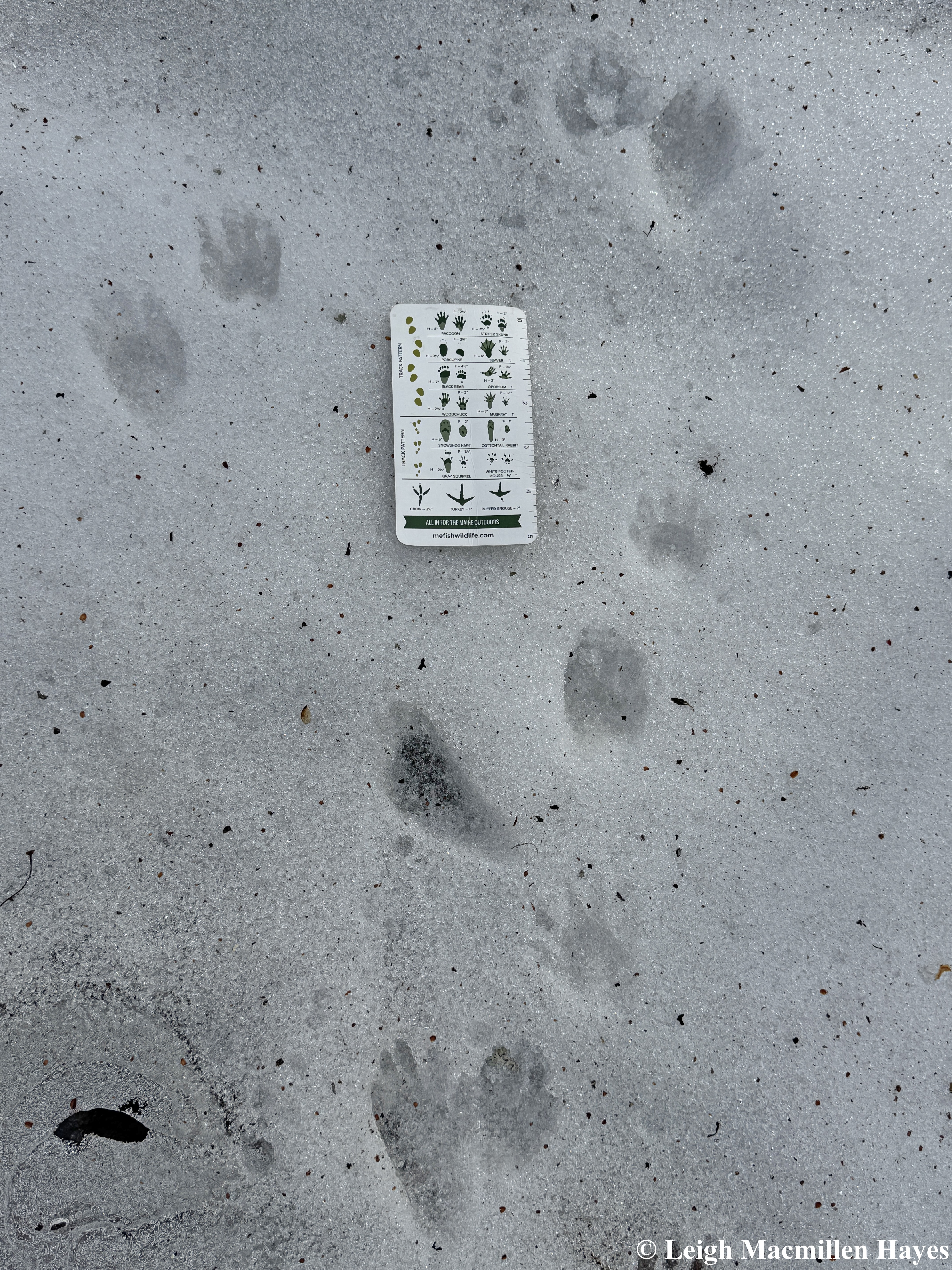
Our other finds included Raccoon tracks,

Mink,

and Coyote,

plus a family of Coyotes on some sand at Goose Pasture.

And, of course, our adventure could not be complete without discovering several Coyote scats.

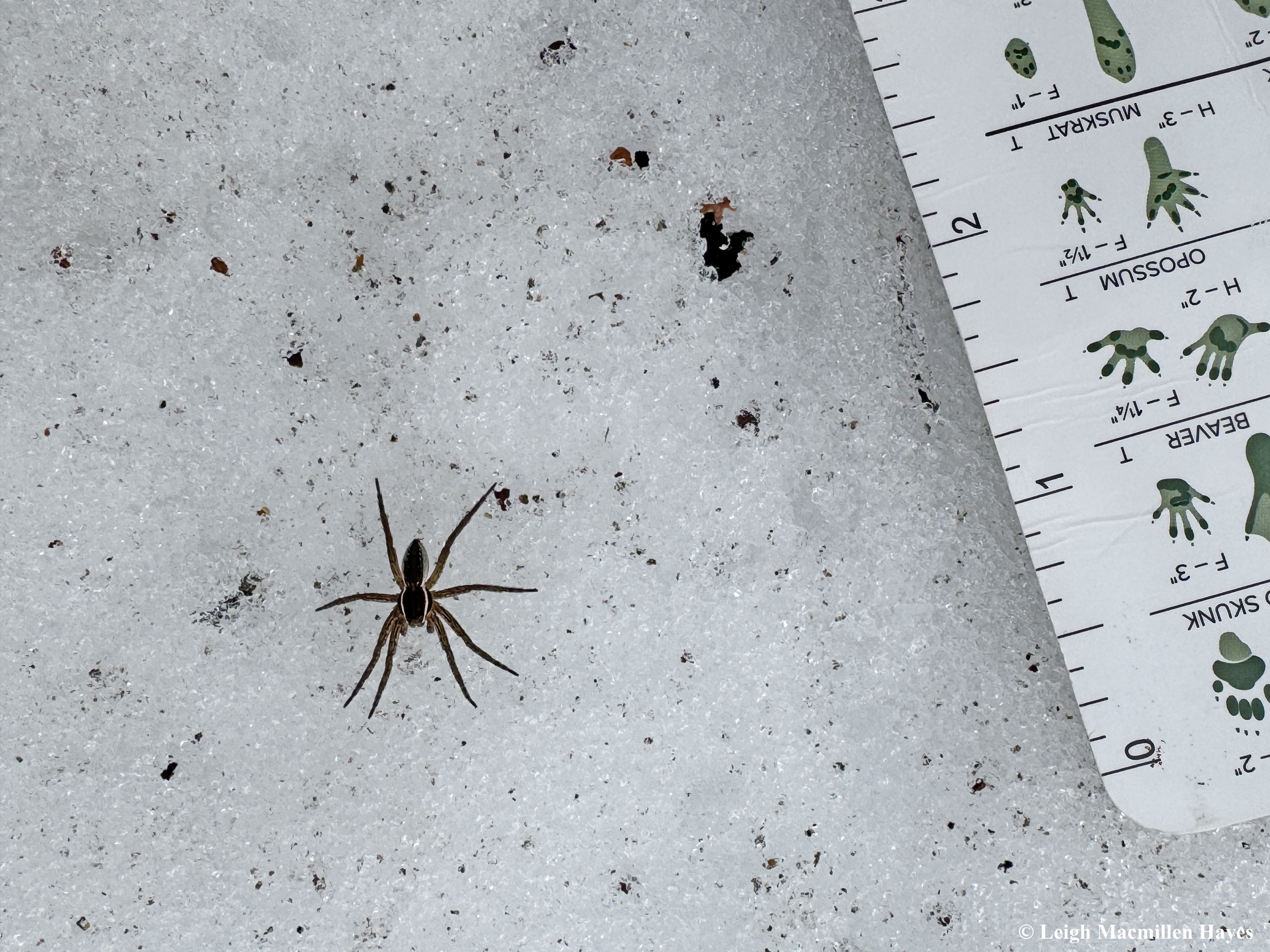
And just for good measure, we met one large Six-spotted Fishing Spider.

Okay, so it wasn’t really as big as the close-up made it look.

There were also beaver works in various places, though we suspected this was a wee bit old, but not older than a few months ago based on the color of the wood. The warmer temps made the sap flow a bit.

There are a bunch of well-mudded lodges in the bog, but we didn’t see any hoped for activity today.

We did, however, discover some scent mounds and know that claiming territory is an important assignment that will become more significant as the ice begins to melt and the two-year-olds leave the lodge to venture off on their own and claim a territory.

Next, we turned our focus to a few shrubs, including the Winterberry. While I still have some dried bright red berries as decorations in my house, most of the berries on branches have shriveled and we wondered why the birds hadn’t dined on them when they were ripe.

What we discovered, much to our delight, was that some had been procured by little brown things, presumably mice, and had been consumed in a bird’s nest. It’s illegal to take bird nests without a permit and this is one reason, they are recycled into homes for other critters.

What totally surprised us about the Winterberry, however, was that we found one shrub with the berries still bright red and plump, as if today was December 18th and not March 18th. Again, we wondered why.

We also found a few of last season’s cranberries hiding under their leaves. That reminded me of another day I’d spent searching for cranberries in the bog years ago–and though I told Bridie about it, I’ll save that two-day story for another day.

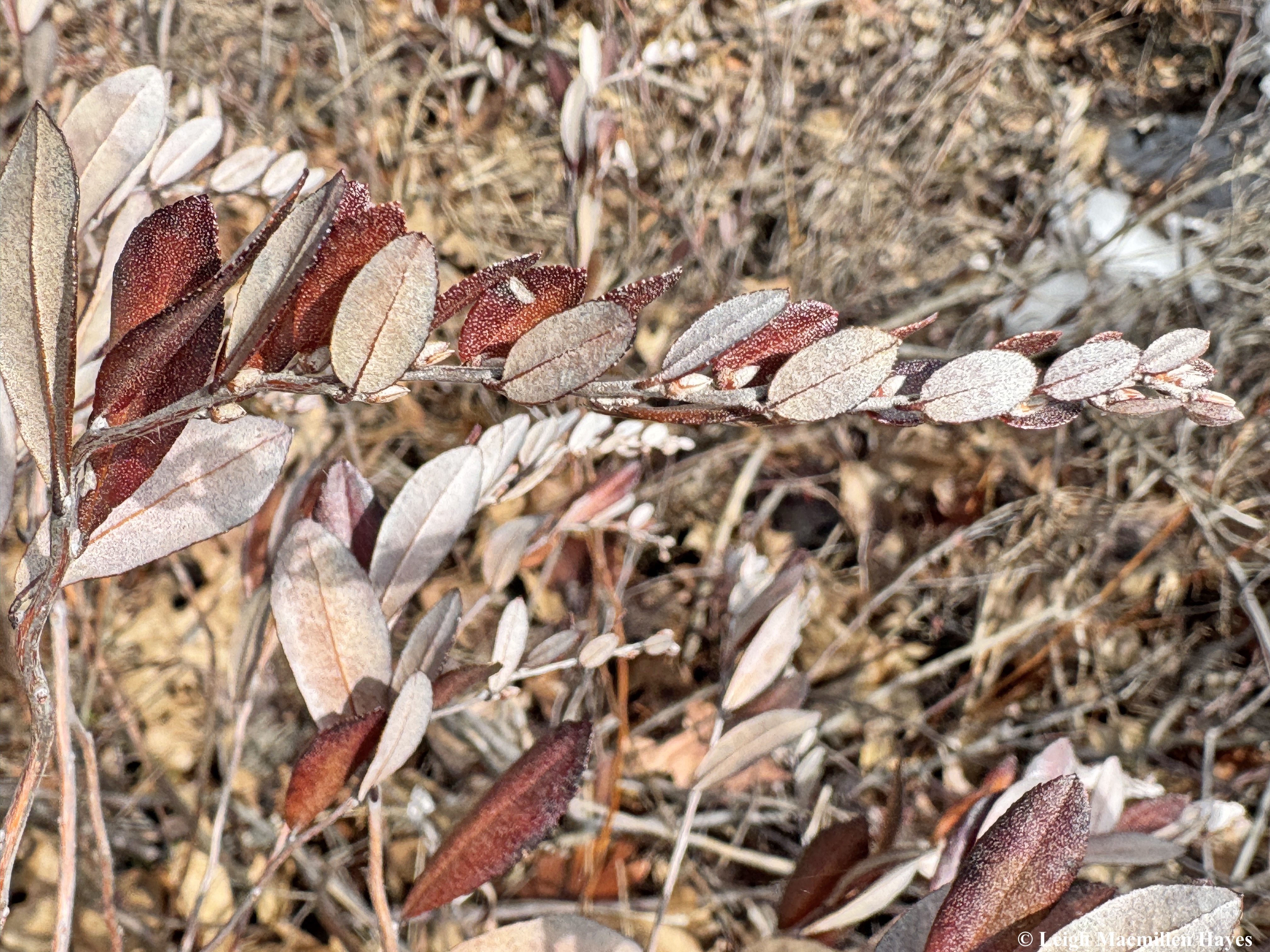
Leatherleaf also had offerings to provide, in the form of little flower buds along the woody stems.

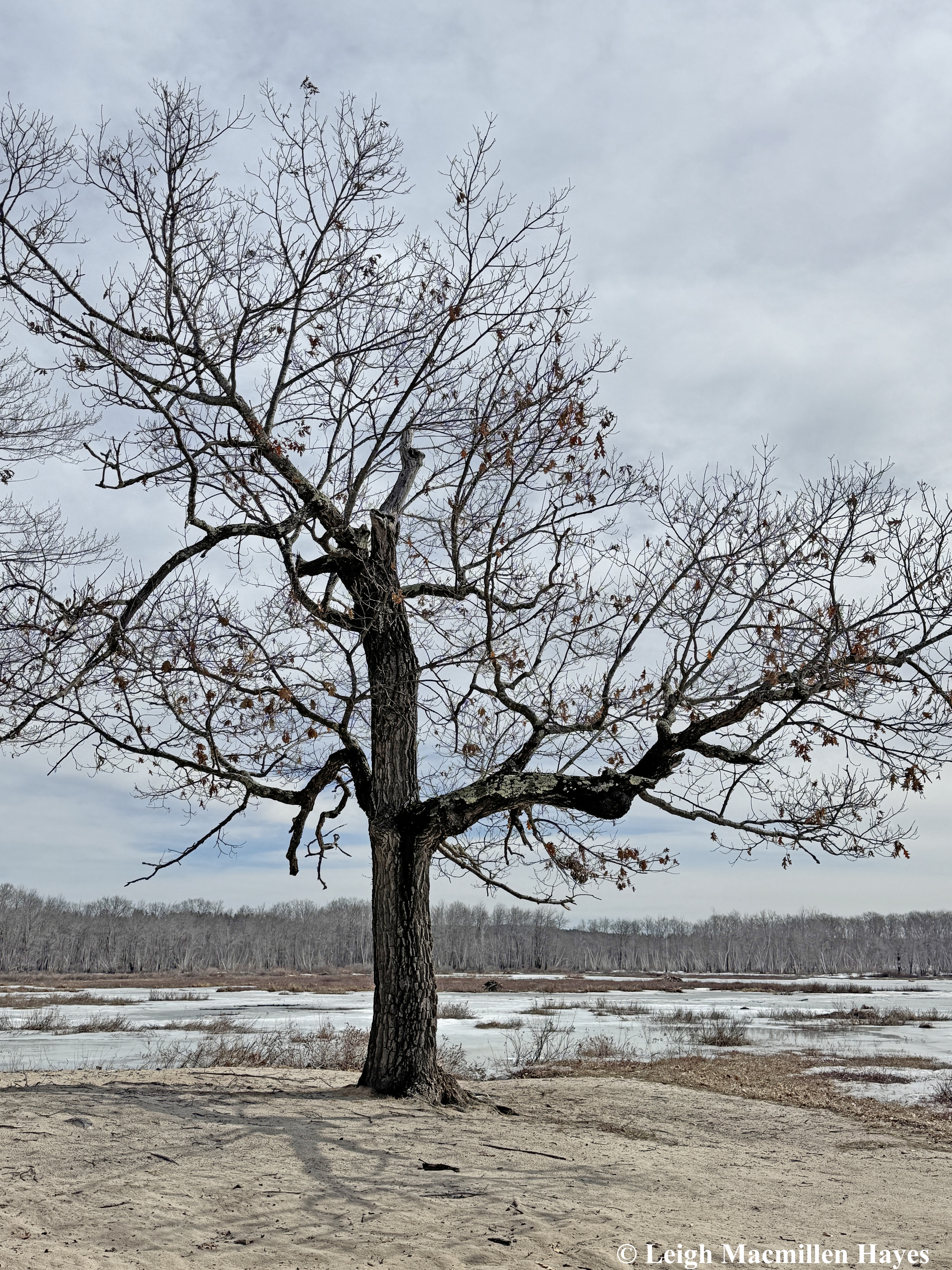
At last we reached the old Oak at Goose Pasture and stood there for a bit taking in the sun and warmth and feeling like it was a bit of a beach day. But, our time together was coming to a close, and we knew this would be our turn-around point.

That said, there were a couple of other gifts to share together, as today was the first day this year that the two of us saw Pussy Willows in bloom.

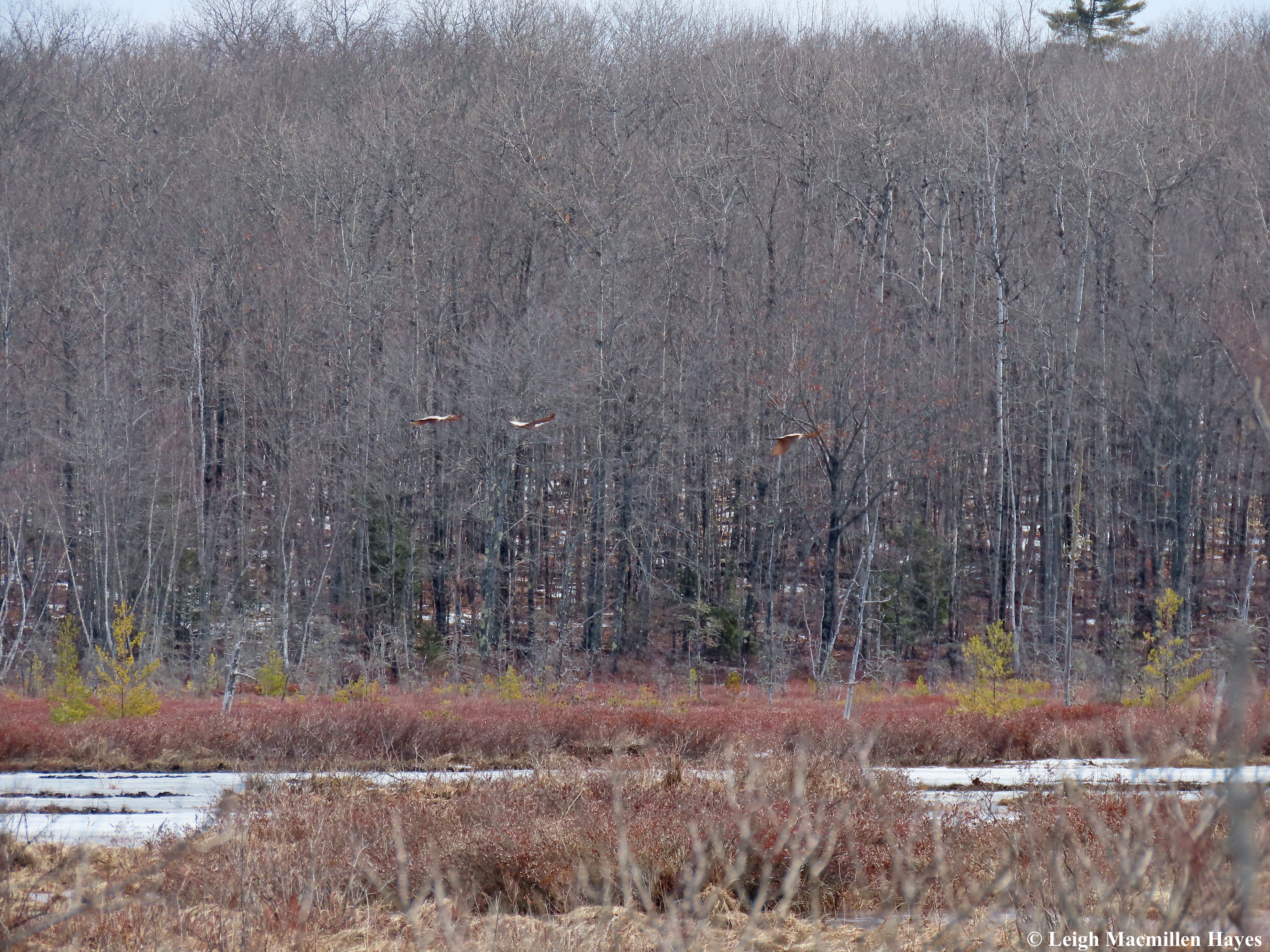
And, drum roll please, we heard them before we spotted them way over on the other side of the bog, but their distinctive call told us to look that way and sure enough there were two Sandhill Cranes.

Like the Wood Ducks they flew, but the two morphed into three as we watched them take to the air.

We’d been blessed. In so many ways.

And at the end of our time together, after traveling 6.2 miles, we needed to say our goodbyes.

The thing is, she wasn’t really with me, which I realized when I went to put my arm around her for our selfie shot. But, in my mind, she was and I had the best time Bogging with Bridie today, her birthday.

Happy Birthday, Bridie McGreavy!

Thursday By The Sea

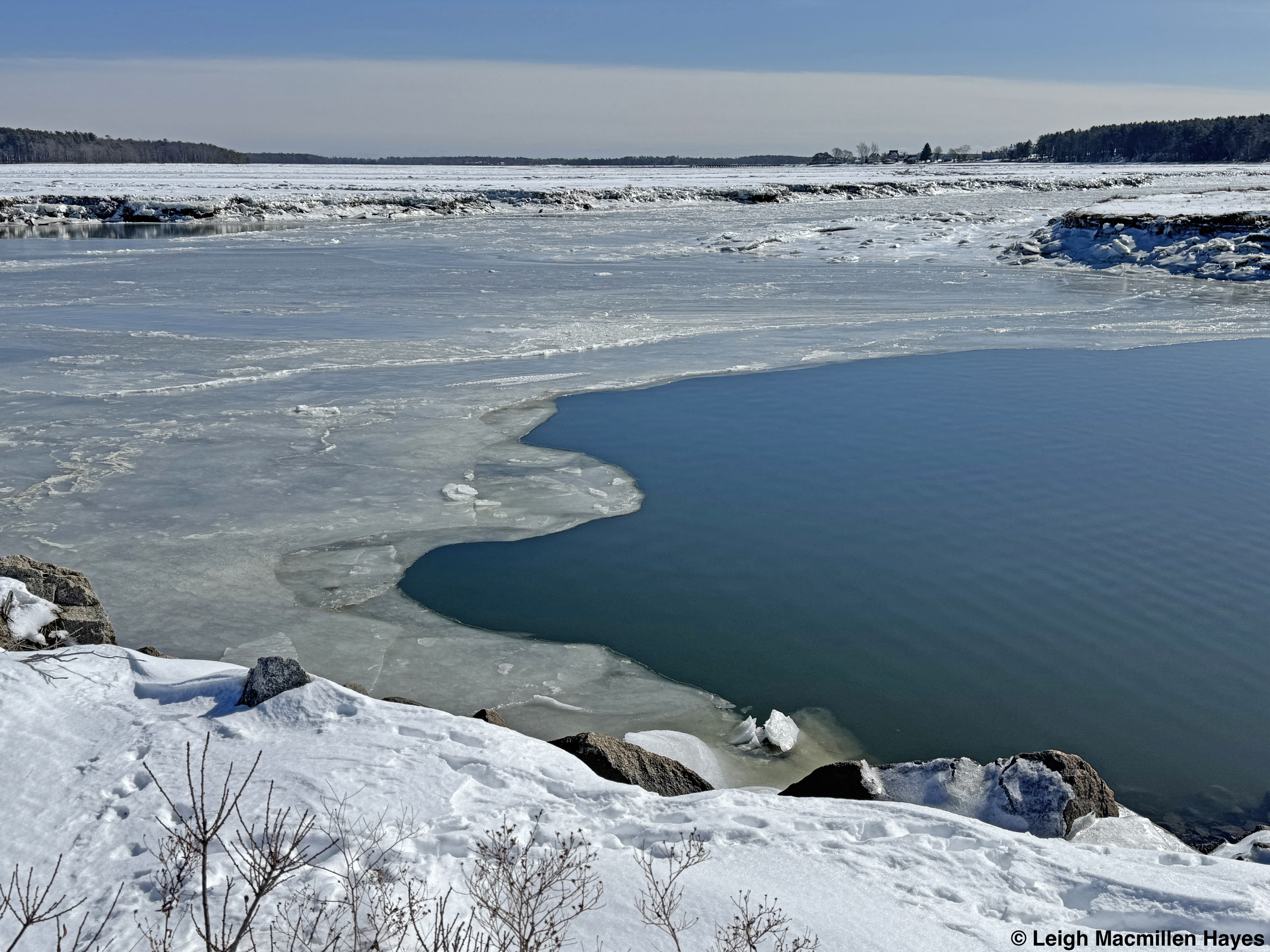
Salt air. It’s a necessity. As kids, my Dad used to remind us to cleanse the innermost recesses of our lungs with salt air while we walked or sailed along the Connecticut coast. And My Guy was used to doing the same as he grew up along the shores of Cape Cod. And so we are drawn. Periodically. To do the same. Together.

Our tramp today began along the Eastern Trail at Scarborough Marsh. For a ways, the trail was hard packed, and we reveled in donning micro-spikes rather than snowshoes. Until, that is, we found ourselves eventually post-holing and decided maybe it wasn’t the right choice after all.

But still. We walked beside Dunstan River where the hues of blue were so subtly varied and I gave thanks to my art teacher, Jessie Lozanski, for helping me to notice. Will I paint this scene? Maybe. One never knows what moves me to paint, until it just does.

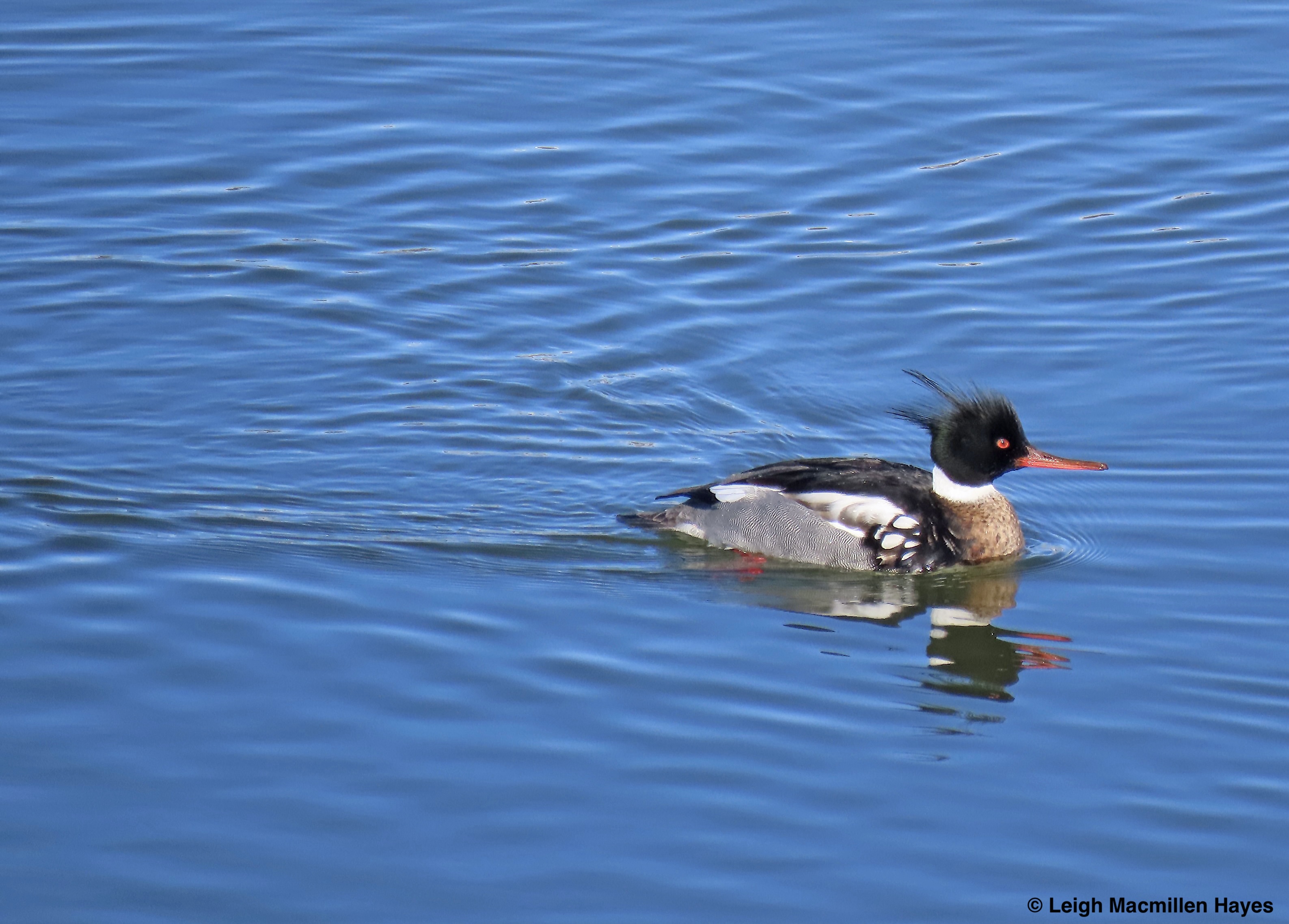
It was the ducks, however, who were the real stars of the show, including the male Red-breasted Merganser showing off his typical wild hair day. Or perhaps it should be “wild feather” day.

Either a mate or an immature male joined the show. And actually, there were many others, all hanging out together.

Also in the mix, Common Goldeneye Ducks, with golden eyes indeed.

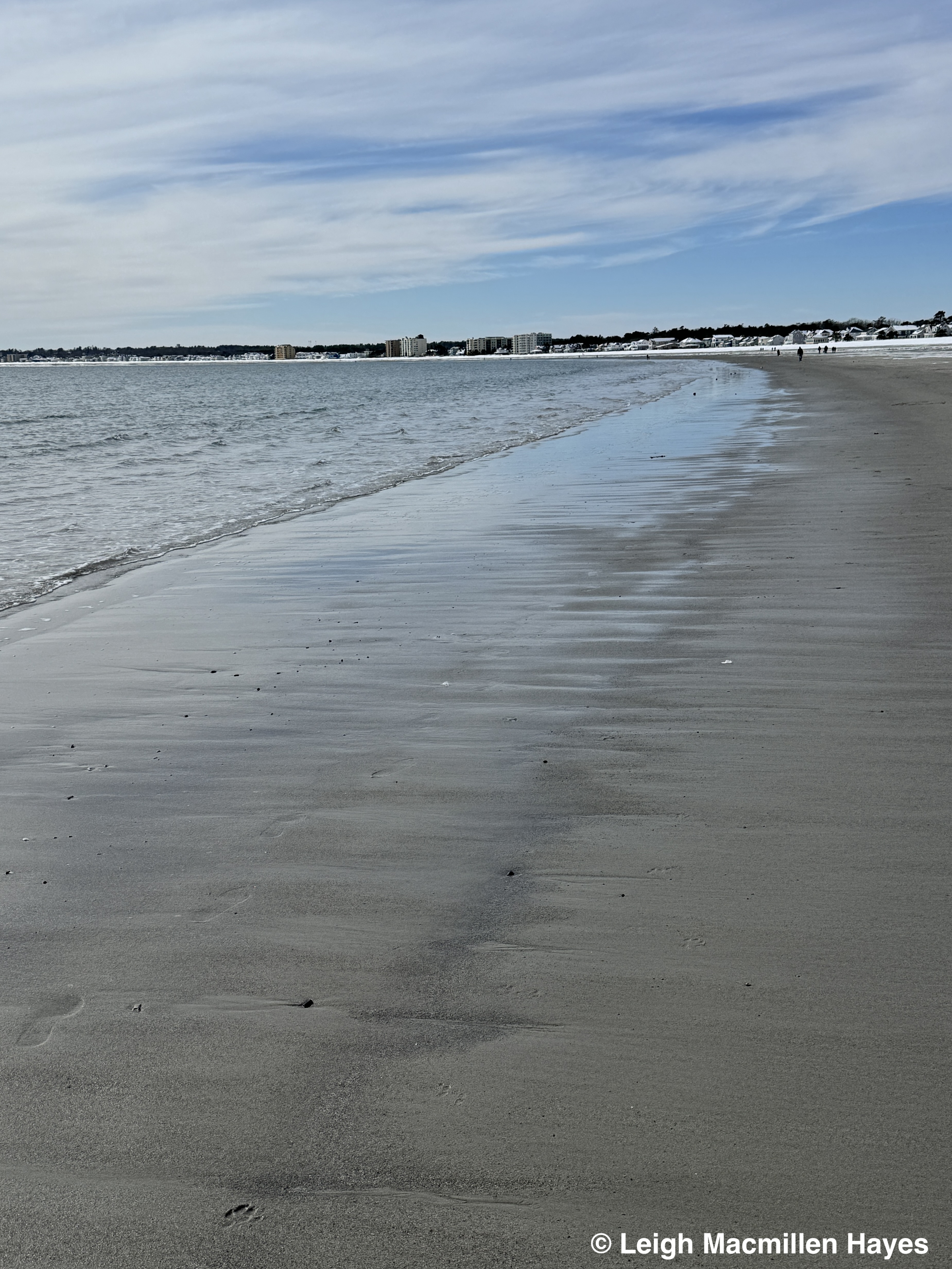
But, post-holing didn’t appeal to us and so we headed down the road to Pine Point Beach, where snow hugged the beach, but below the tide-line all was clear.

And so we took off, toward Old Orchard Beach.

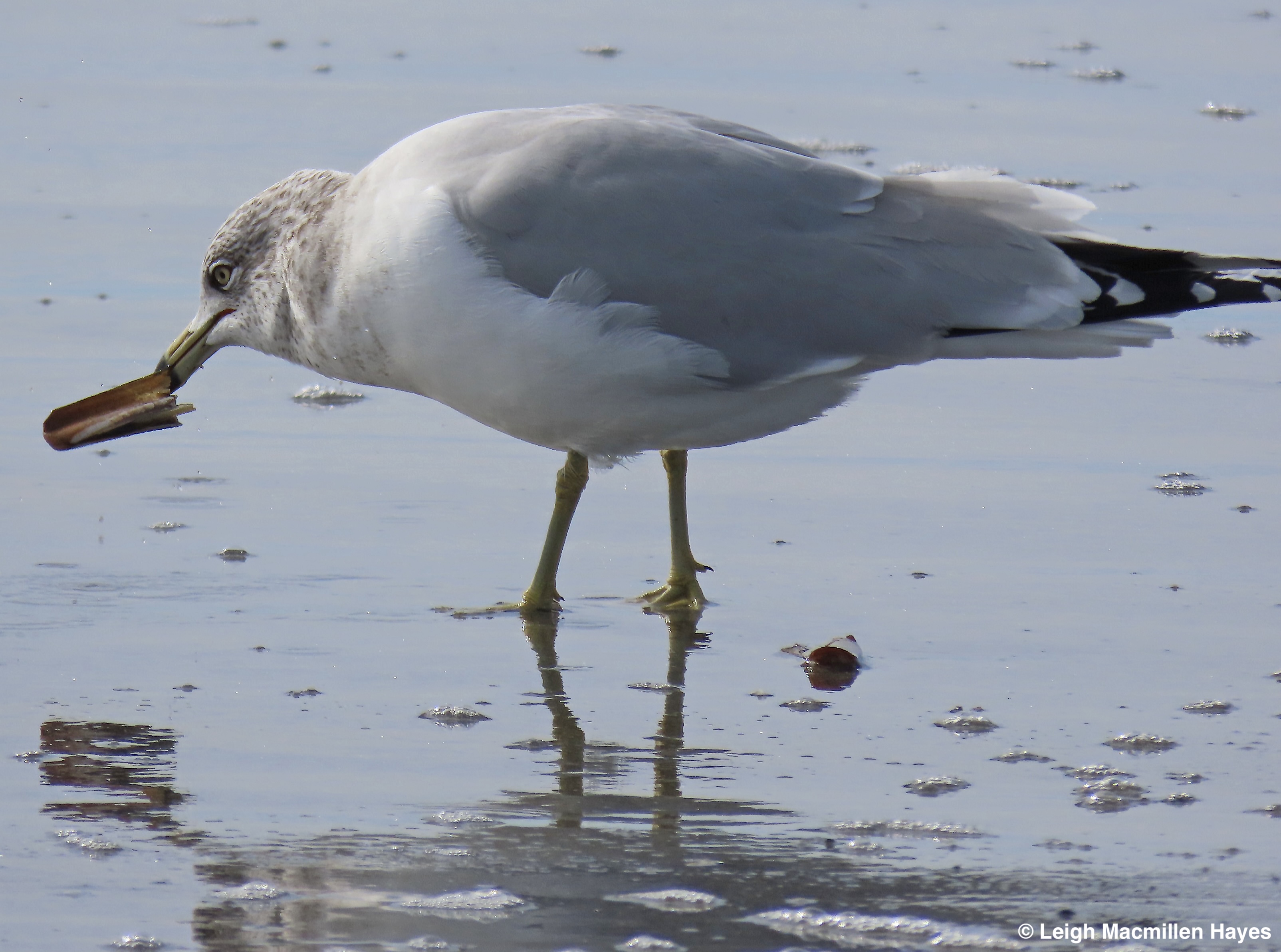
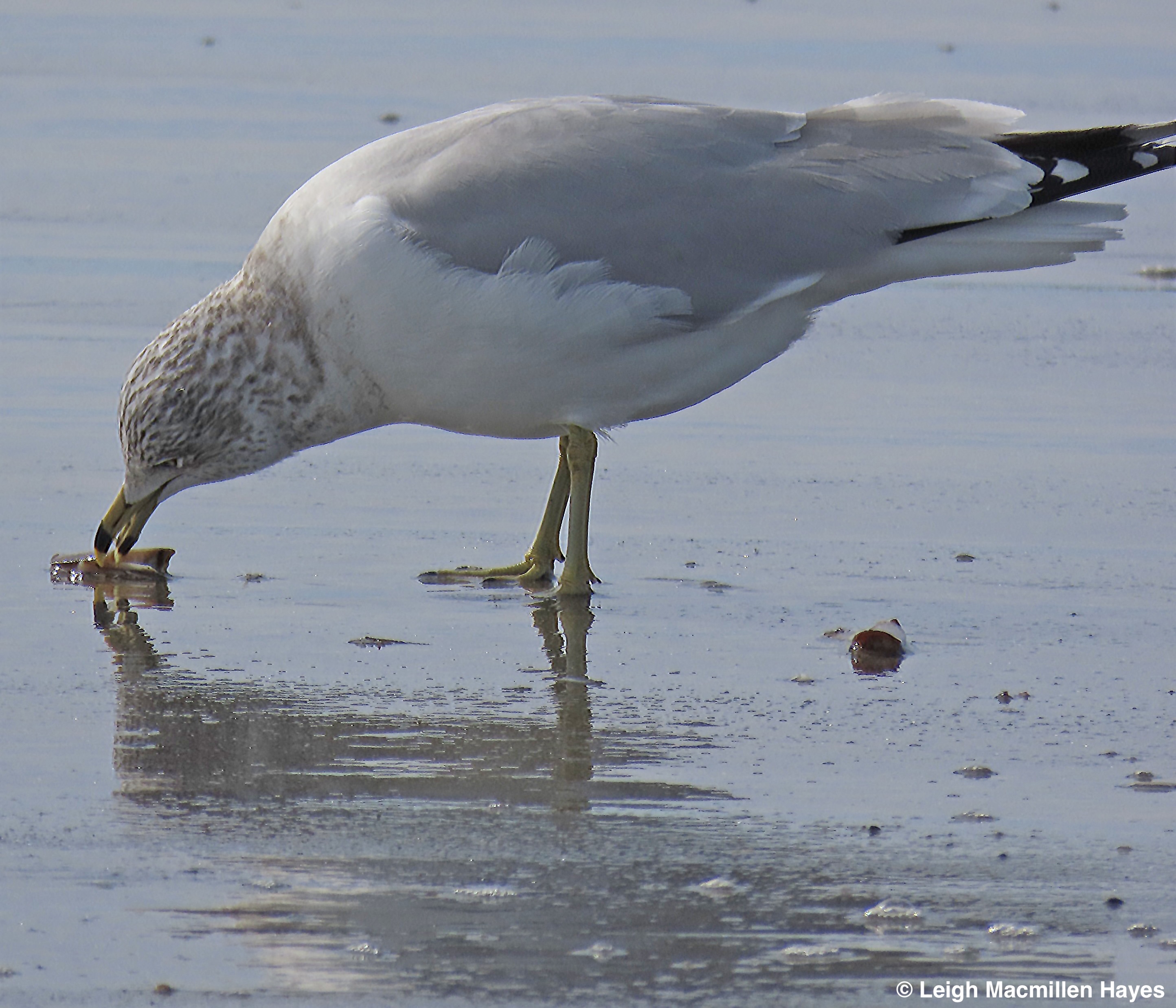
It was here that the action was even better than the marsh (today, that is) and we paused as we watched a Ring-billed Gull tackle a meal.

The bird thrashed its food this way and that, as the morsel inside tried, I’m sure, to avoid being further consumed.

While sometimes dropping the shell helps, I’m not sure why the bird did this, unless he wanted to give his morsel a moment. A moment to do what? Regrow if it could? Burrow into the sand?

It’s not like it could actually get away at this point, being a Razor Clam. And since the shell was less than half its normal size, we knew the bird had dined well on this one.

Being amongst the gulls always gives me pause, for I need to slow down and think who they are. The fact that we grew up together, the gulls and I, doesn’t matter.
Here’s the lesson: Ring-billed–has a dark ring around its bill (bingo!). And yellow legs.

The one with whom it commonly shares the shoreline is the Herring Gull, with red on its bill, and pink legs to stand upon. And it has an orangey ring around its eye. Of course, I think this is all correct. Whenever I’m in a situation where I see them together, or even alone, I wish I had my birder friend Joe Scott in my pocket to clarify the differences.

What I do know is that this gull (I believe another Herring), had a bum foot and we watched as it bumbled along, putting some weight on its injury, but taking a rest between limps.

The other Herring of my attention, showed what that foot should have looked like–held at an angle when lifted off the ground, rather than dangling straight up and down.

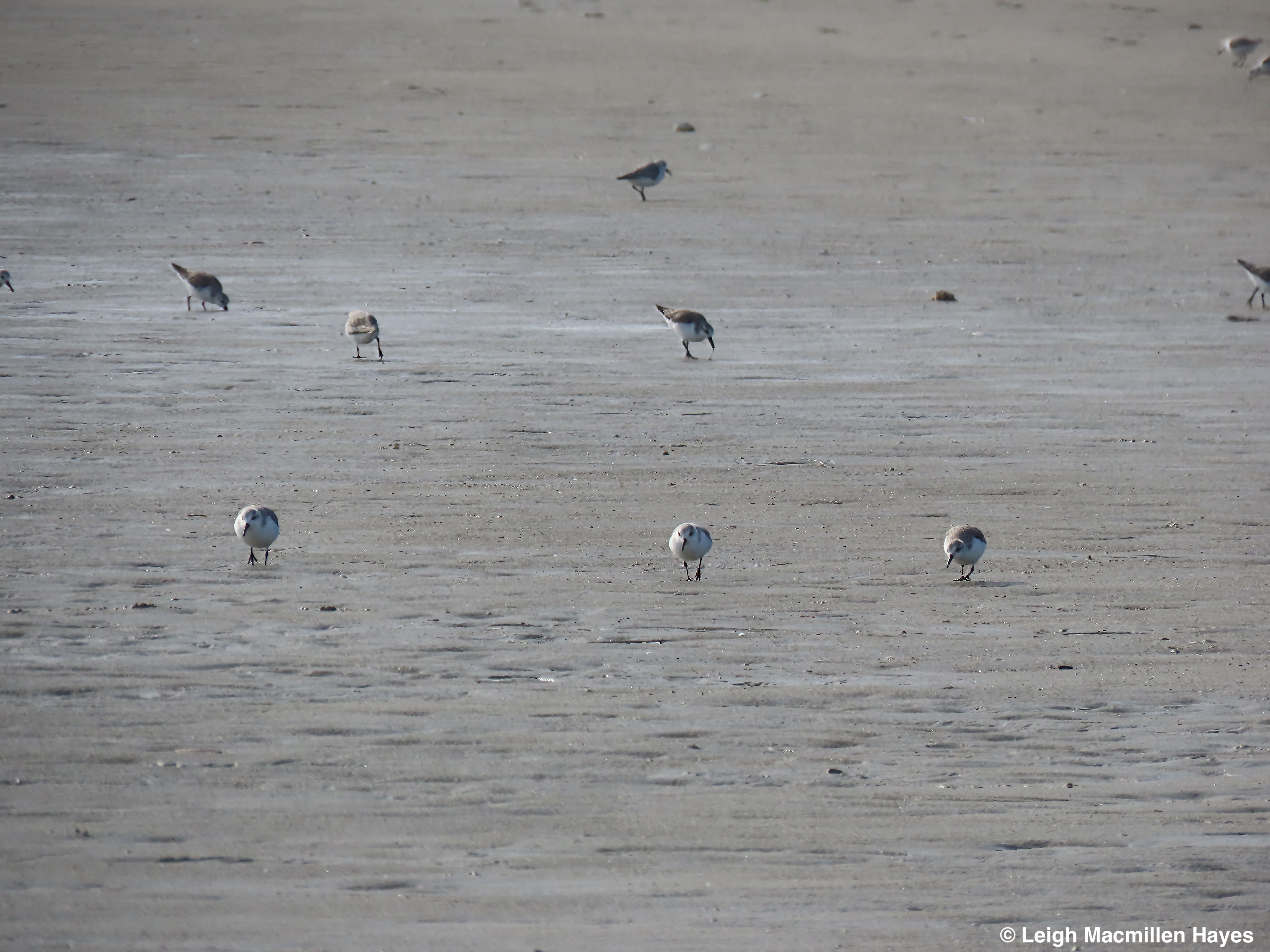
A huge flock of Sanderlings were also in the mix, flitting and foraging where the tide had recently ebbed.

The black bill and legs help in IDing this species. But heck, just watching them race up and down the beach and play in the waves is good for the soul. Almost as good as the salt air.

My attention included more than the birds, for occasionally there were shells to celebrate, especially when they showed their age by serving as home to others including barnacles.

When I turned the Common Whelk over, I realized two things: it was empty. Bummer. But also, it had grown in whorls, much like White Pine pinecones, their scales swirling around the “cob” as they do.
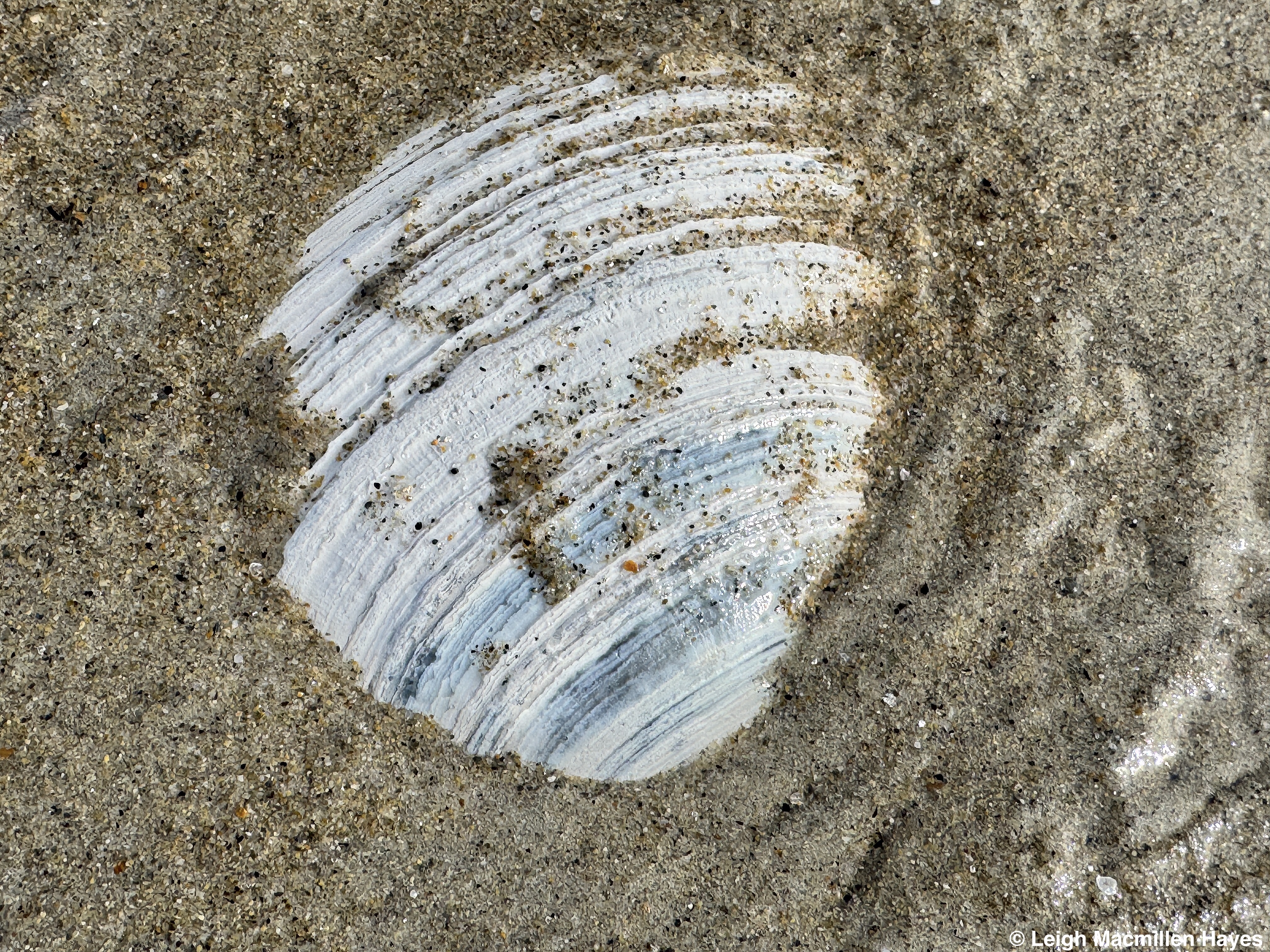
And everywhere there were Quahog shells, most upturned and empty, methinks because the gulls had been dining. I didn’t dig this one up, but instead reveled in its colors and layers, which very much reminded me of Scarborough Marsh.

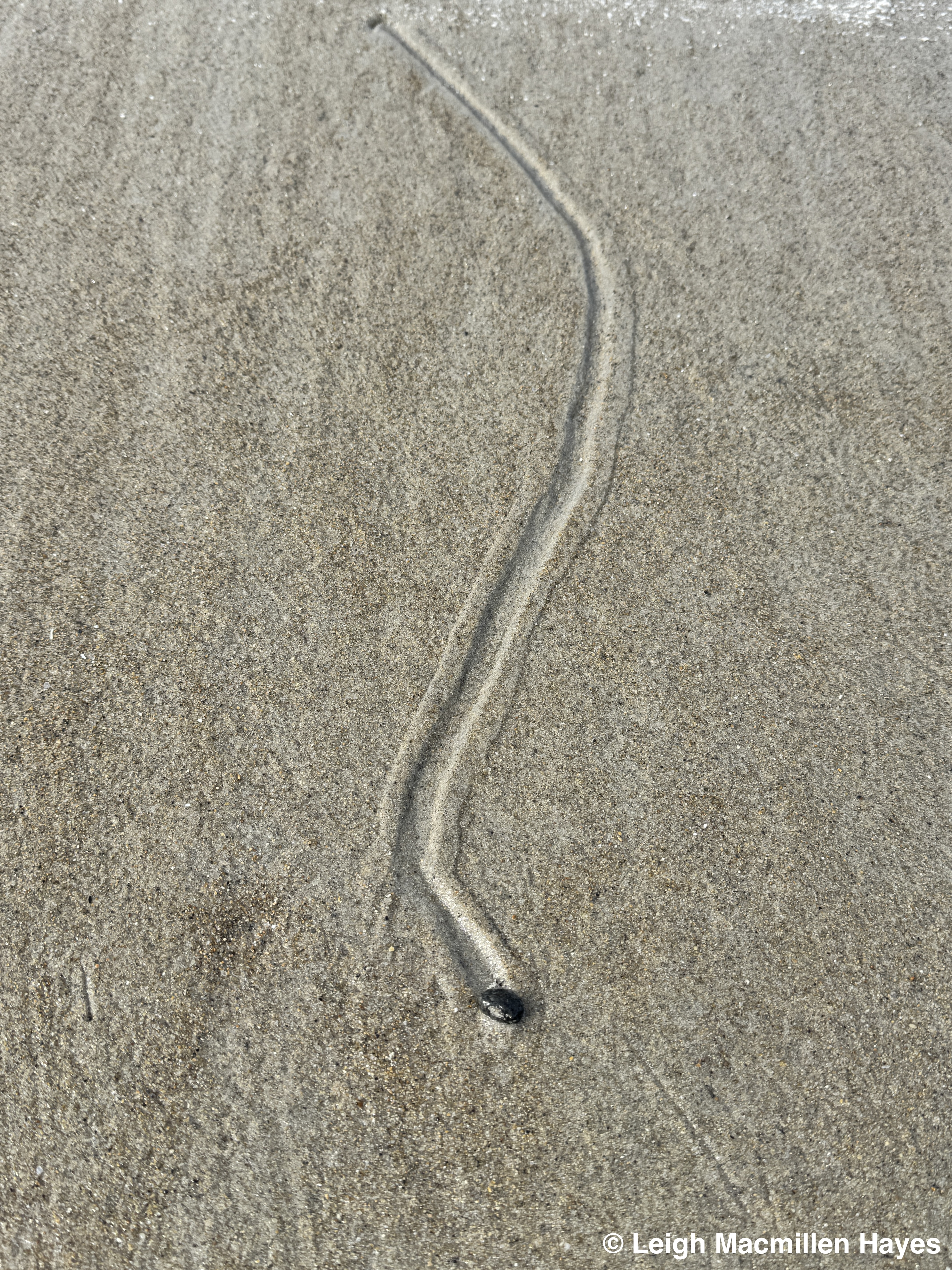
And no venture should go without tracking, though having the actual creator present in the very moment is rare, but such was the case with this snail.

One of my favorite things about this beach is that I always spot Sand Dollars upon it. Well, at least parts of them, this one being worth $.20 since a piece of the quarter was missing.

Another was worth $.47.

And finally a whole dollar! My Guy thought I’d collect them, but I have a few and felt that pictures would suffice for today.

The most unusual find of the day was this. And we spotted quite a few. I think its a sea ball, created with vegetation by wave action. I’ve seen pond balls full of hemlock and balsam fir needles, but had never noticed this sort of structure at the ocean before, having spent my entire life wandering the shoreline of New England. That said, maybe I just never noticed it before, but now that I have, the balls were everywhere.

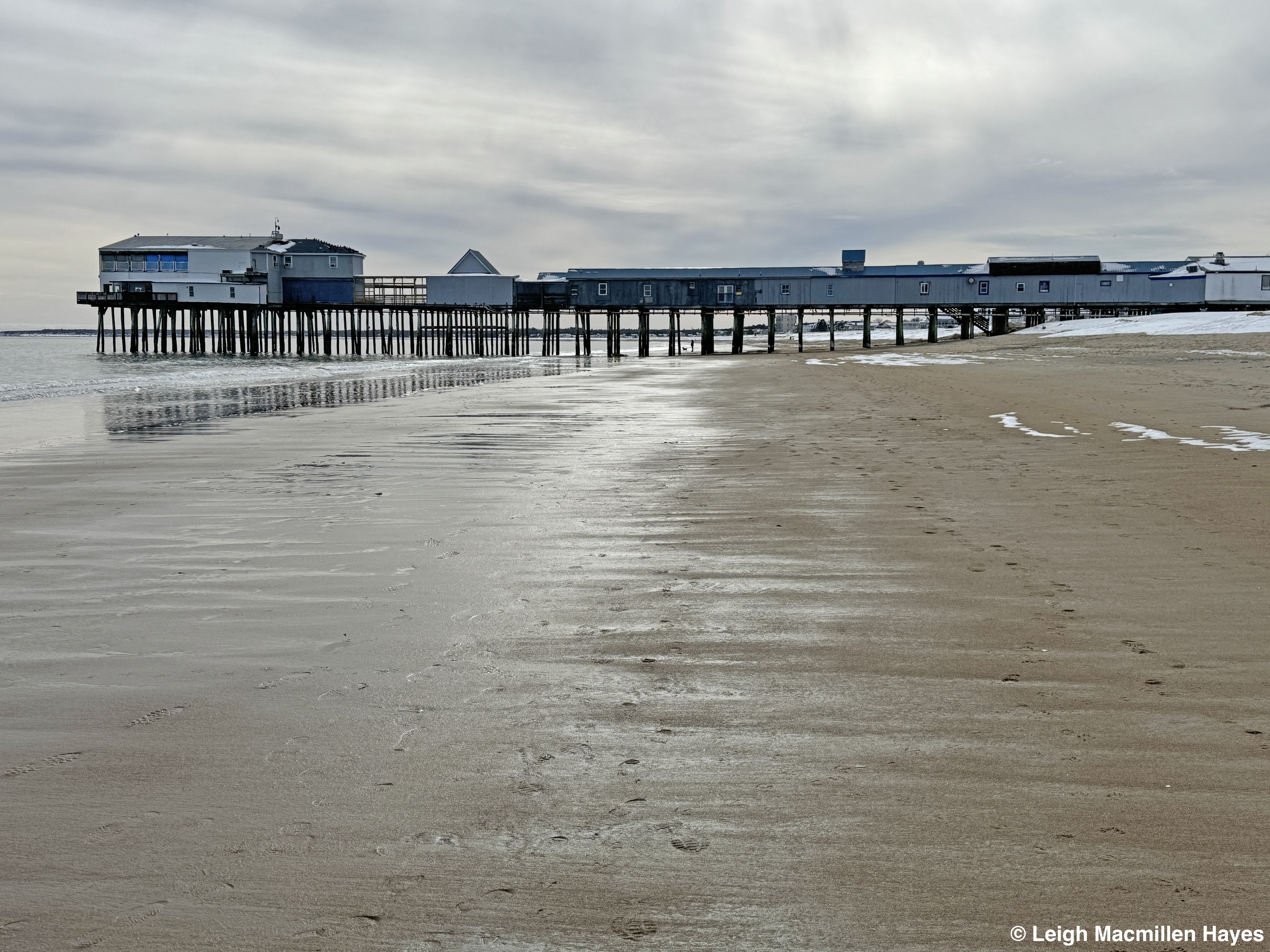
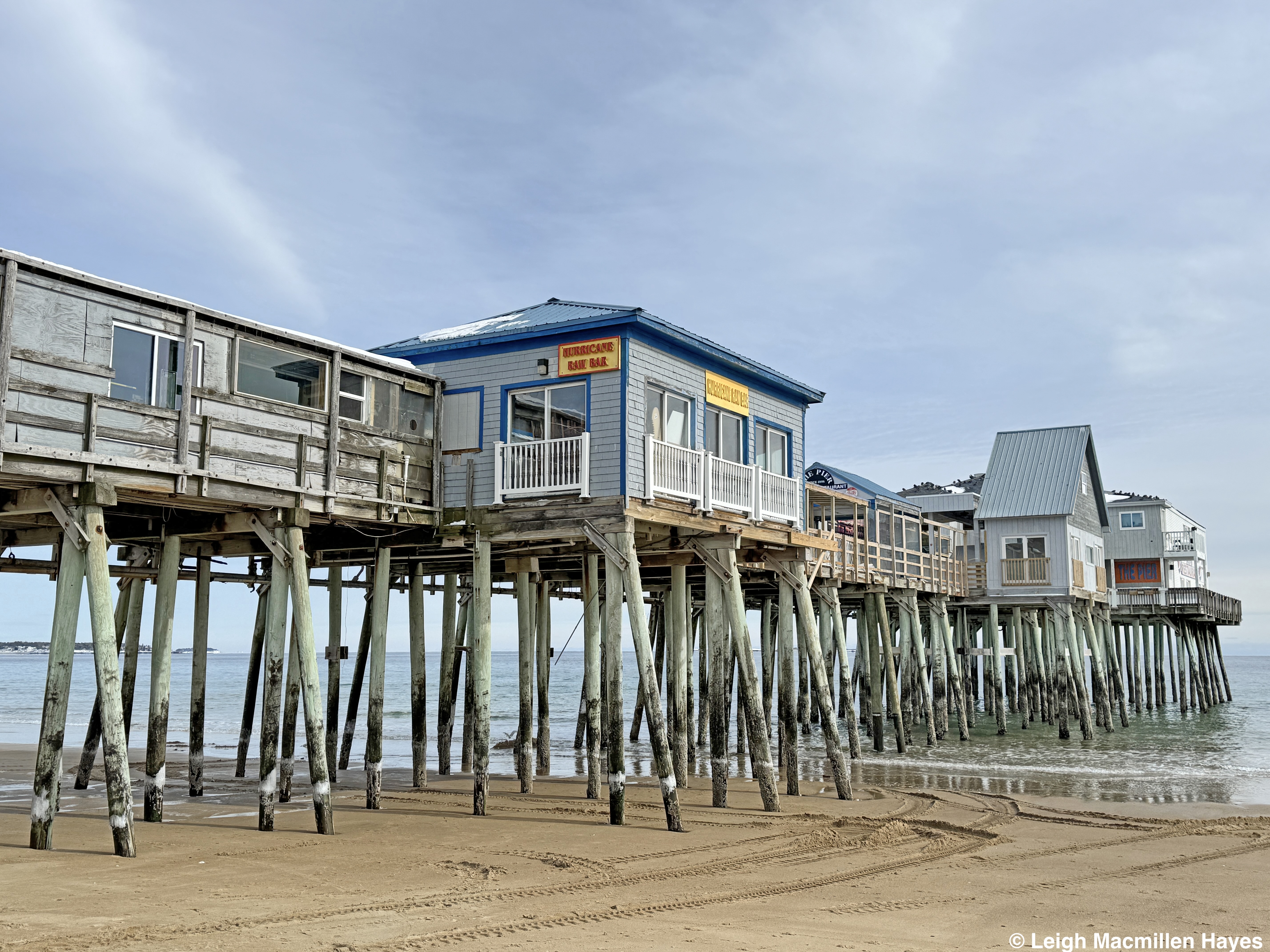
At 2.5 miles from the start, we reached the Pier at Old Orchard Beach. In the summer, it’s abuzz with people and sound and aromas and activity.

Today, all was quiet. Delightfully quiet. Well, there were natural sounds, but those are meant to be.

Life stood absolutely still at the OOB’s Palace Playland beyond, with ice on the Pier’s piers speaking winter to the amusement park’s summer.
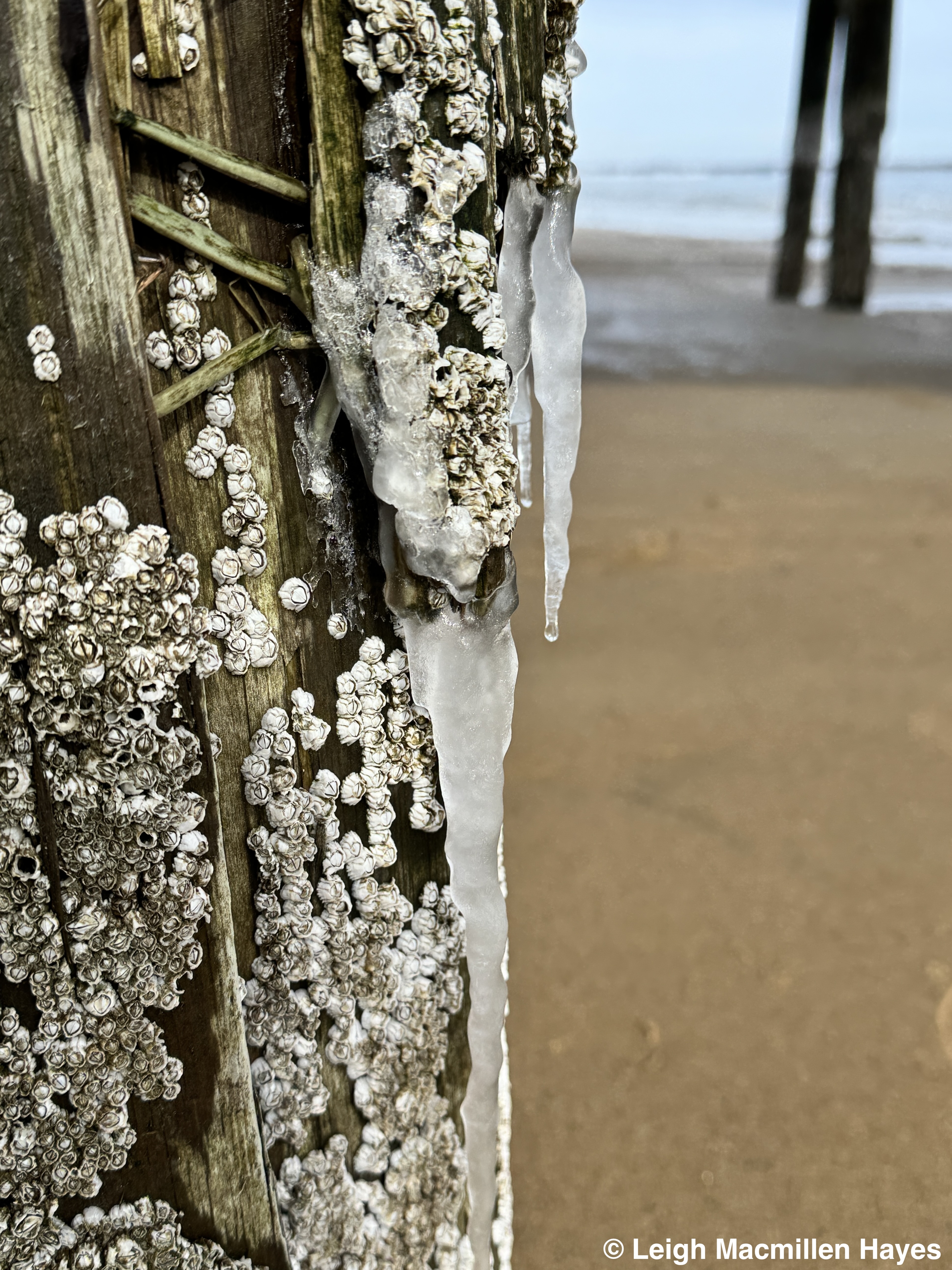
Even the clustered Barnacles stayed snug as icicles dripped.

We took one last look and then, as the tide changed, so did our direction.

Back under the piers did we pass as the waves increased and began to break, adding a little drama to the scene.

On the way back, I noticed and commented every time I spotted a Sand Dollar. My Guy was certain I’d spotted $35.46. I’m pretty sure it was closer to $6.74. Really though, it was priceless.

Thursday by the sea–a delightful day to walk along the Atlantic Coast in our beloved state of Maine as we did what Dad would have hoped and filled the innermost recesses of our lungs with salt air.

Perley Pond Preserve Presents

I love to learn and today’s presence offered such as I explored Loon Echo Land Trust’s Perley Pond/Northwest River Preserve in Sebago. I’ll be leading a hike there this Saturday, so if you are so inclined, I hope you’ll come along. But if you can’t, then please read on. (Note: Jon Evans, Stewardship Manager for LELT will be with me on Saturday, and he’ll have so much more to offer about the lay of the land, which was acquired by the trust in 2014. Today marked my first visit to this property.)

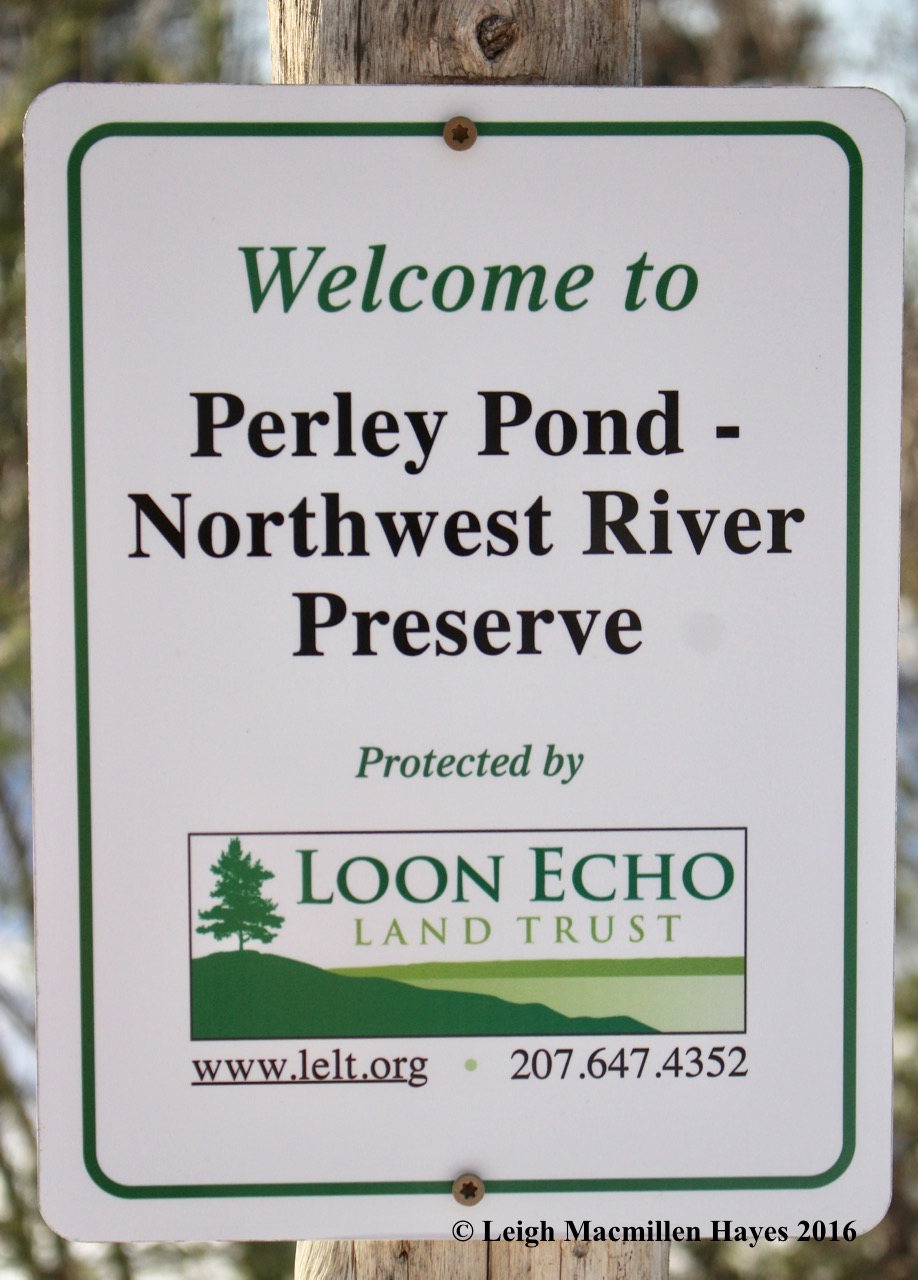
p-land-trust-sign-1

There are three entry points along Folly Road and I began my reconnaissance mission at the first, where I didn’t get far due to a stream not quite frozen, but still found plenty to examine.

p-evening-primrose

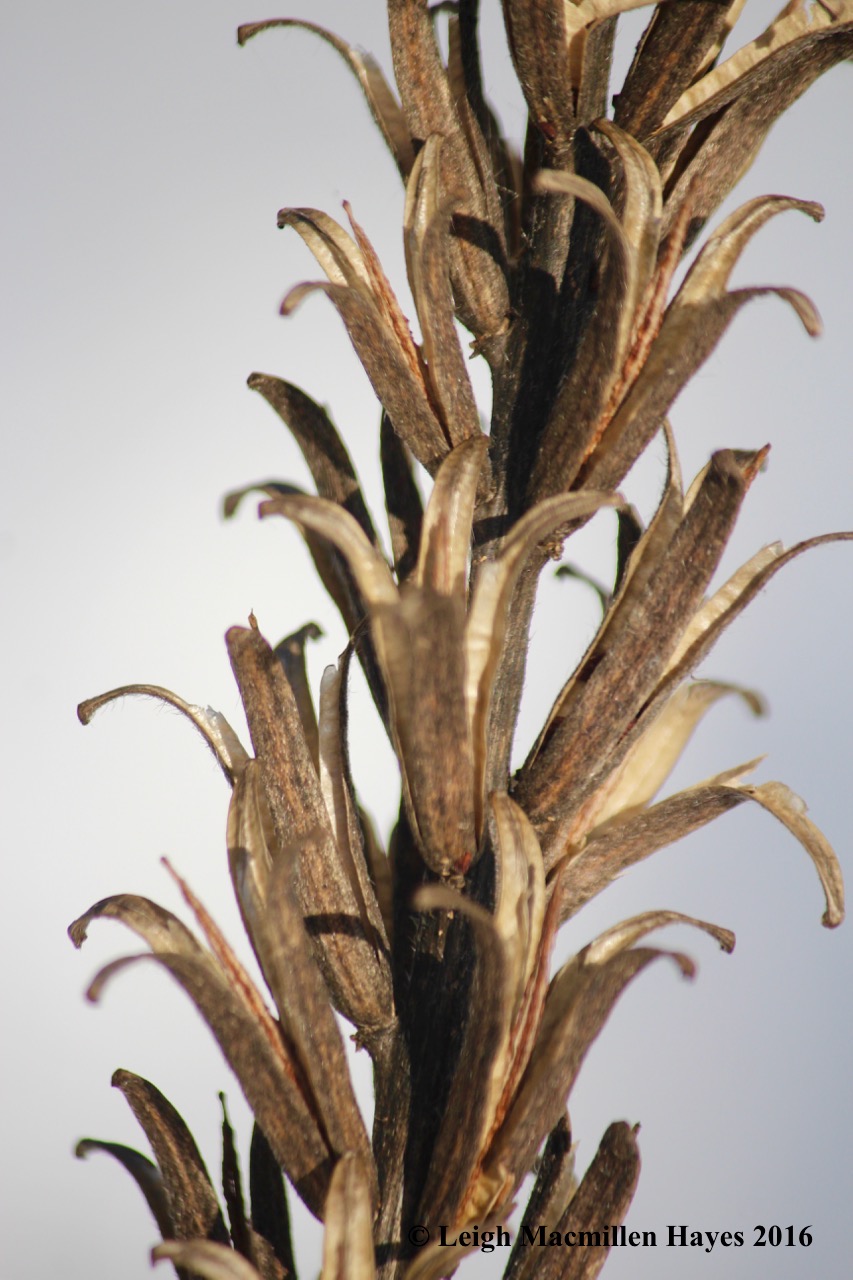
Evening Primrose stood at alert in the field just off the road. Tall in stature, its distinctive seed pods peeled back in four parts and small seeds looked like fresh ground pepper on the snow.

p-black-eyed-susan

Black-eyed Susans also decorated this space, some leaning over to share their offerings. The hairy bracts and gumdrop shape made these easy to spot.

p-beaked-hazelnut-1

One of my favorite finds in the first section of the property–the hairy twig, catkin, leaf and bud of a Beaked Hazelnut. Just last week I saw the same, well, minus the catkins, in Lovell. And knowing that certain leaves are marcescent, e.g. remain attached to the stem throughout some or most of the winter like oak, witch hazel and especially beech, I was thrown off by this other type. It had me thinking birch and well it should have because Beaked Hazelnut is a member of the birch family. But #1, though a hairy twig like Yellow and Paper Birch, the leaf base wasn’t right for either, and #2, I didn’t recall ever seeing these leaves still dangling in later fall/early winter. The trees taught me a lesson today–the most perfect of gifts–a few Beaked Hazelnut leaves continued to dangle, though most were turning quite dark in hue and I suspected will fall soon, and, I found Gray Birch leaves also clinging. Just when I thought I knew everything, nature proved there’s more to learn. So the gift was a reminder to pay more attention.
p-log-landing

I left that section and walked down the road to a spot where a chain prevents vehicles from entering the old log landing. It certainly didn’t stop the deer who had danced in the night.

p-sweet-fern

As I moved through the landing, I paused to admire another dancer as witnessed in the fluid movement of Sweet-fern.

p-sweet-fern-catkins-2

Like the Beaked Hazelnut, its catkins were wrapped gifts that spoke to the future.

p-willow-gall

Also in this space, a few willows with their own little packages.

p-willow-gall-1

The willow pine cone gall was created in the summer by a gall gnat midge. The larva stage secreted a substance on the stem that caused the willow to go into overdrive–resulting in a multi-layered chamber composed of hardened material that would have been leaves, but alas, the stem growth was arrested. Inside that hairy structure resides the wintering larva, nice and snug for the winter. It will metamorphose into a gnat when warm weather arrives.
p-fir-christmas-tree

As I walked along I noticed Christmas tree patterns among the firs.

p-fir Christmas Tree1.jpg

It was a simple case of an upside-down look. Once flipped, in my brain anyway, the seasonal symbol was obvious.

p-ornaments-big-tooth-on-fir

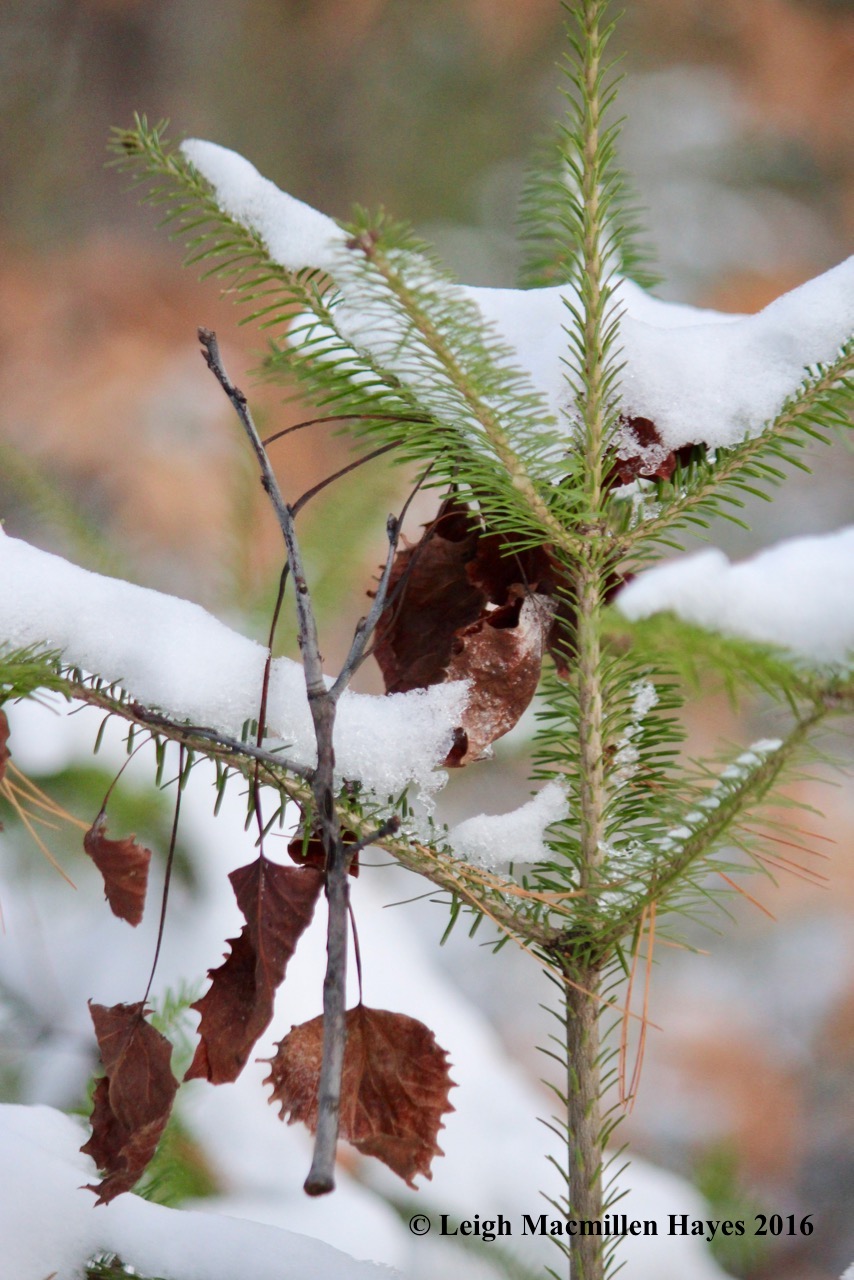
And the ornaments dangled–in the form of Big-toothed Aspen leaves and White Pine needles,

p-ornament-lichen1

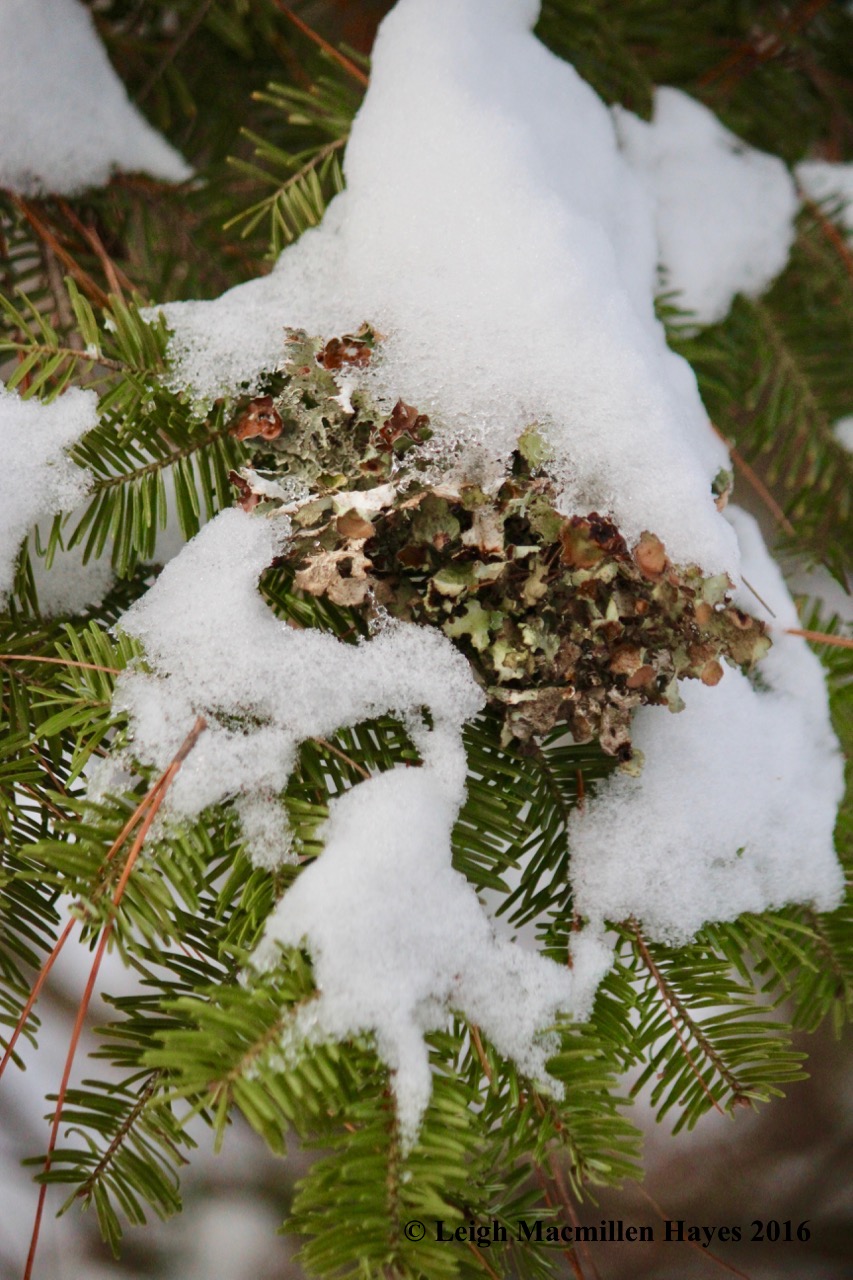
Northern Camouflage Lichen,

p-ornament-pileated

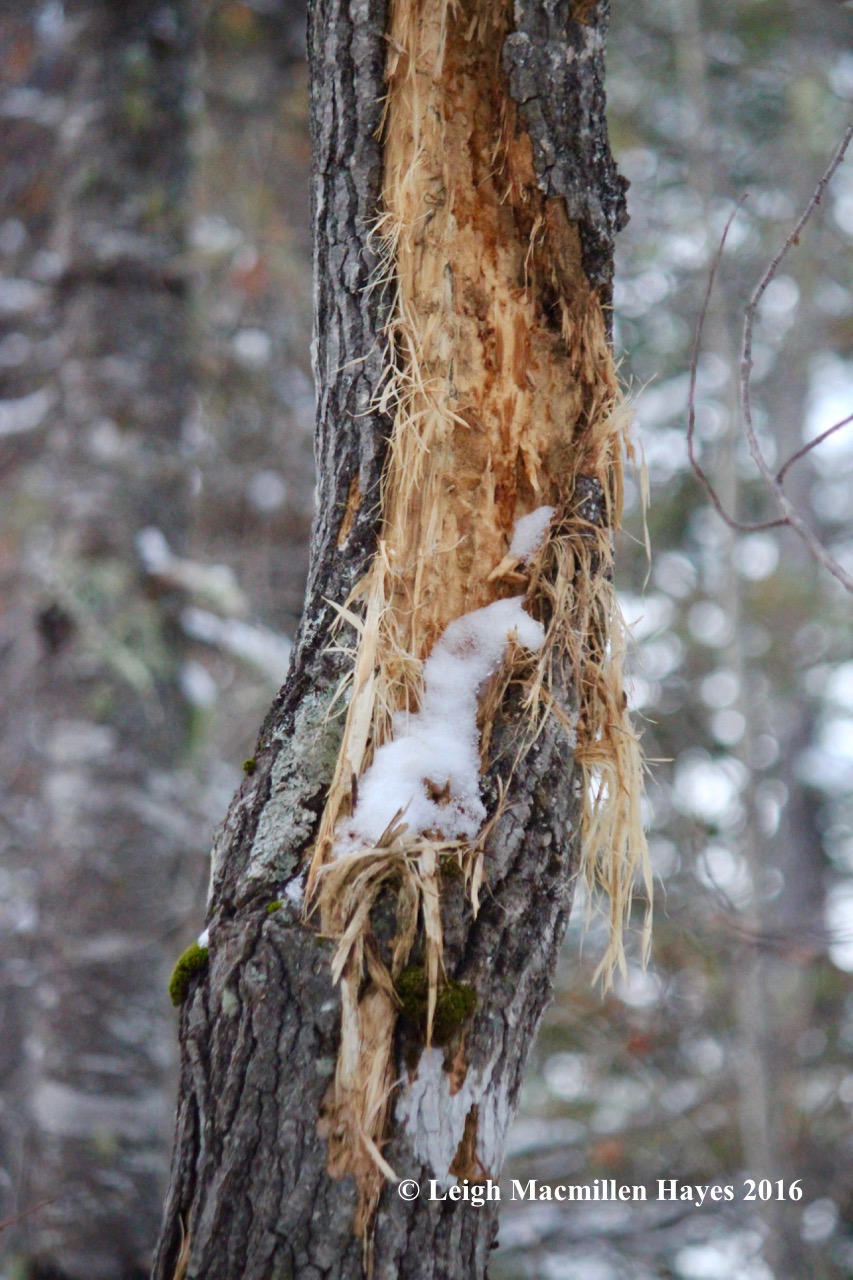
and shredded bark created by . . .

p-ornament-pileated-works

a Pileated Woodpecker in search of food.

p-ruffed-grouse

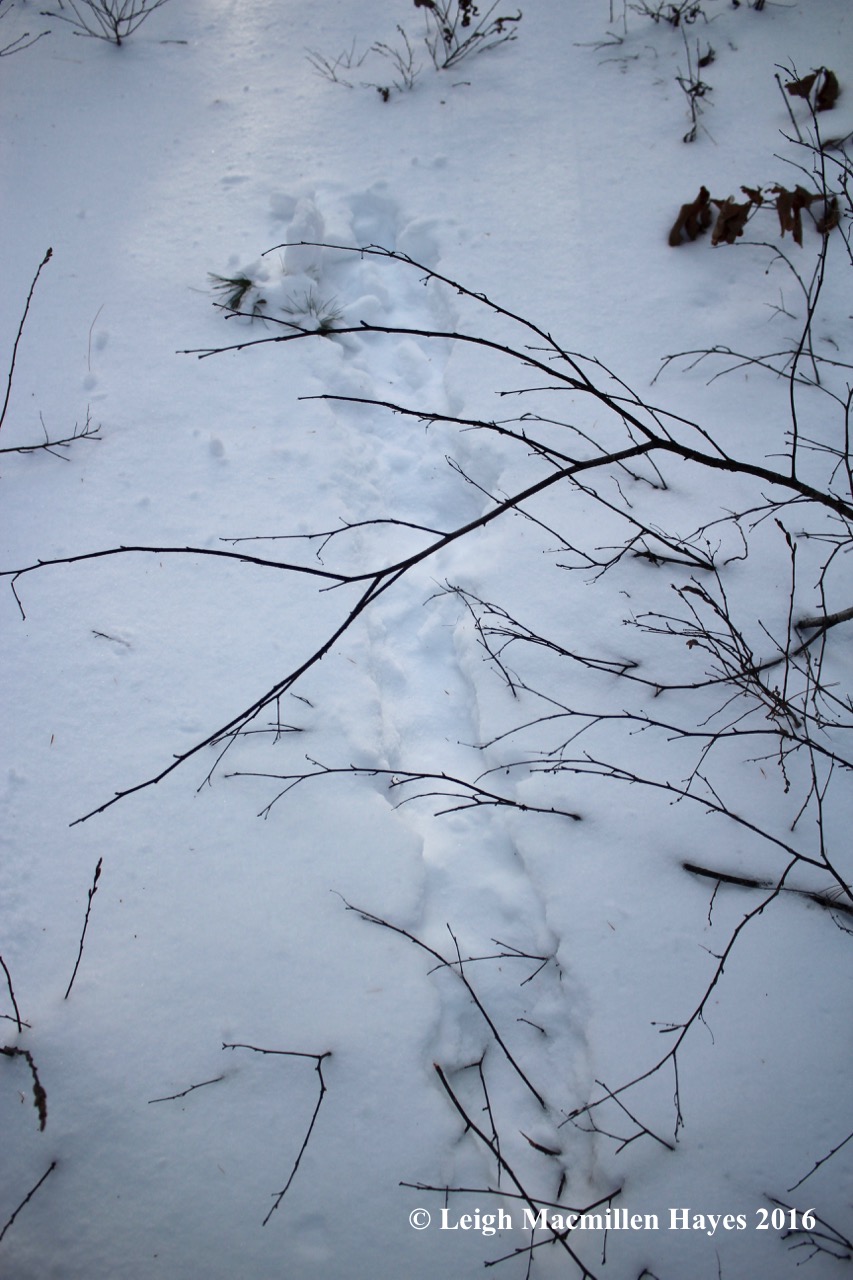
I felt my good fortune to find a spot where a ruffed grouse had tunneled.

p-big-tooth-burl

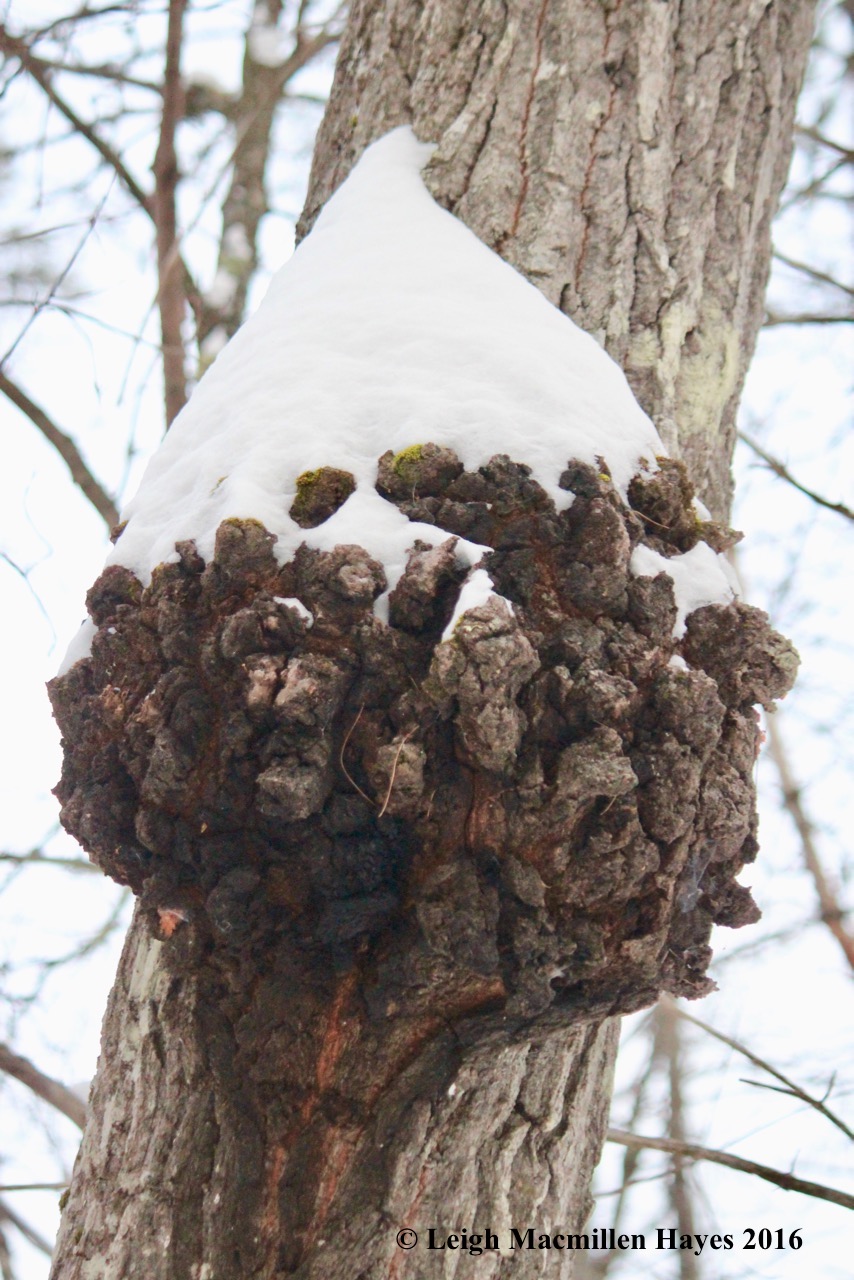
And then I was stopped by a burl. Like a gall, this was created by insects.

p-big-tooth-bark-1

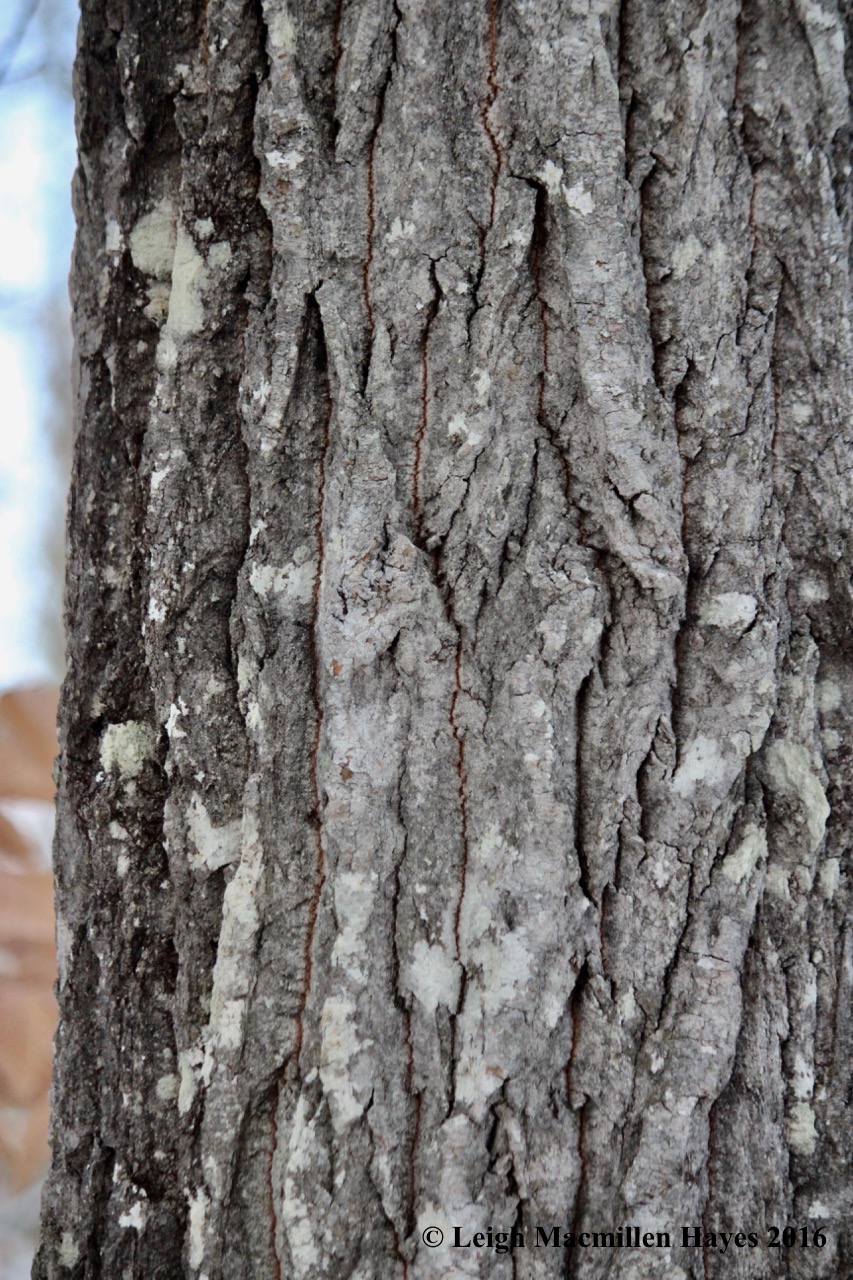
The tree of choice featured lower gnarly bark that resembled a Northern Red Oak.

p-big-tooth1

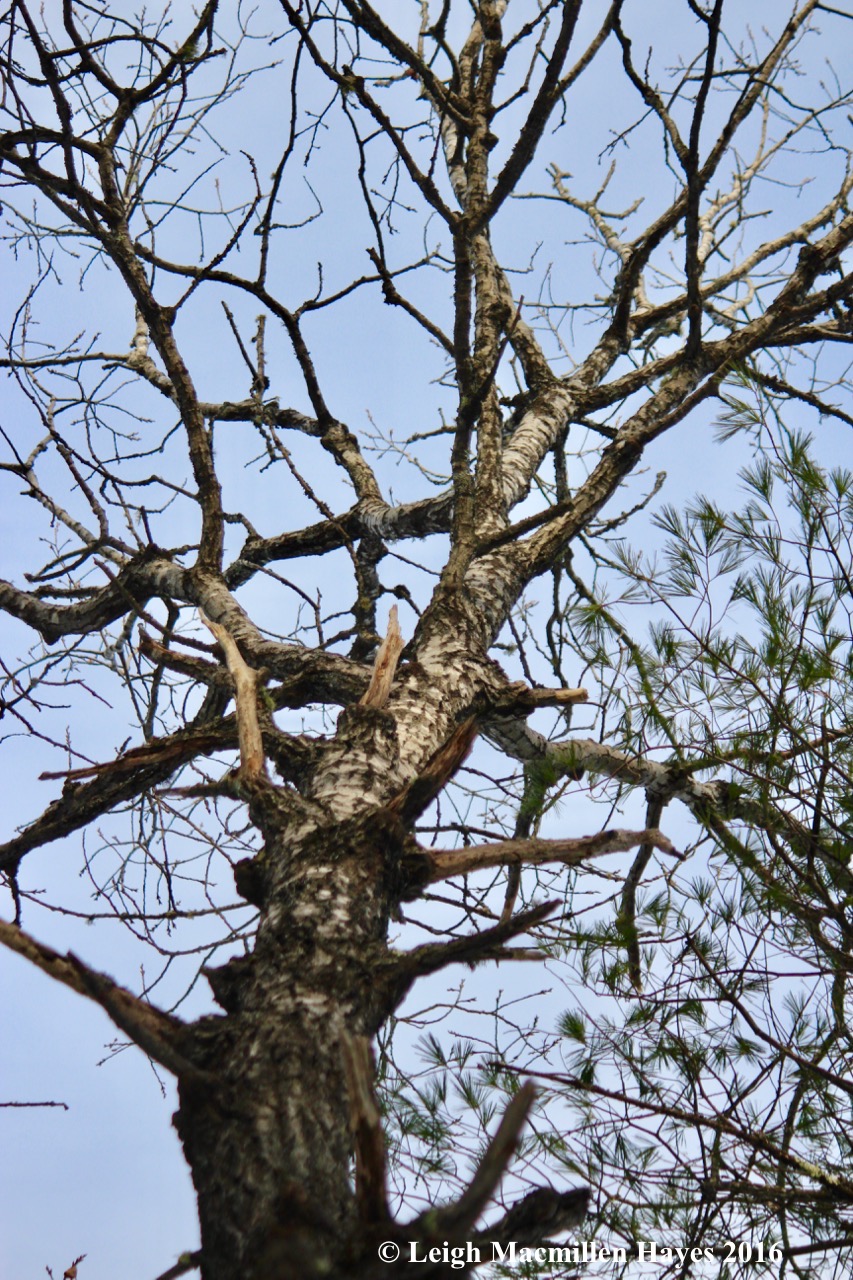
But a peek toward its crown revealed a birch–the two-fer one gift: Big-toothed Aspen.

p-big-tooth-leaves

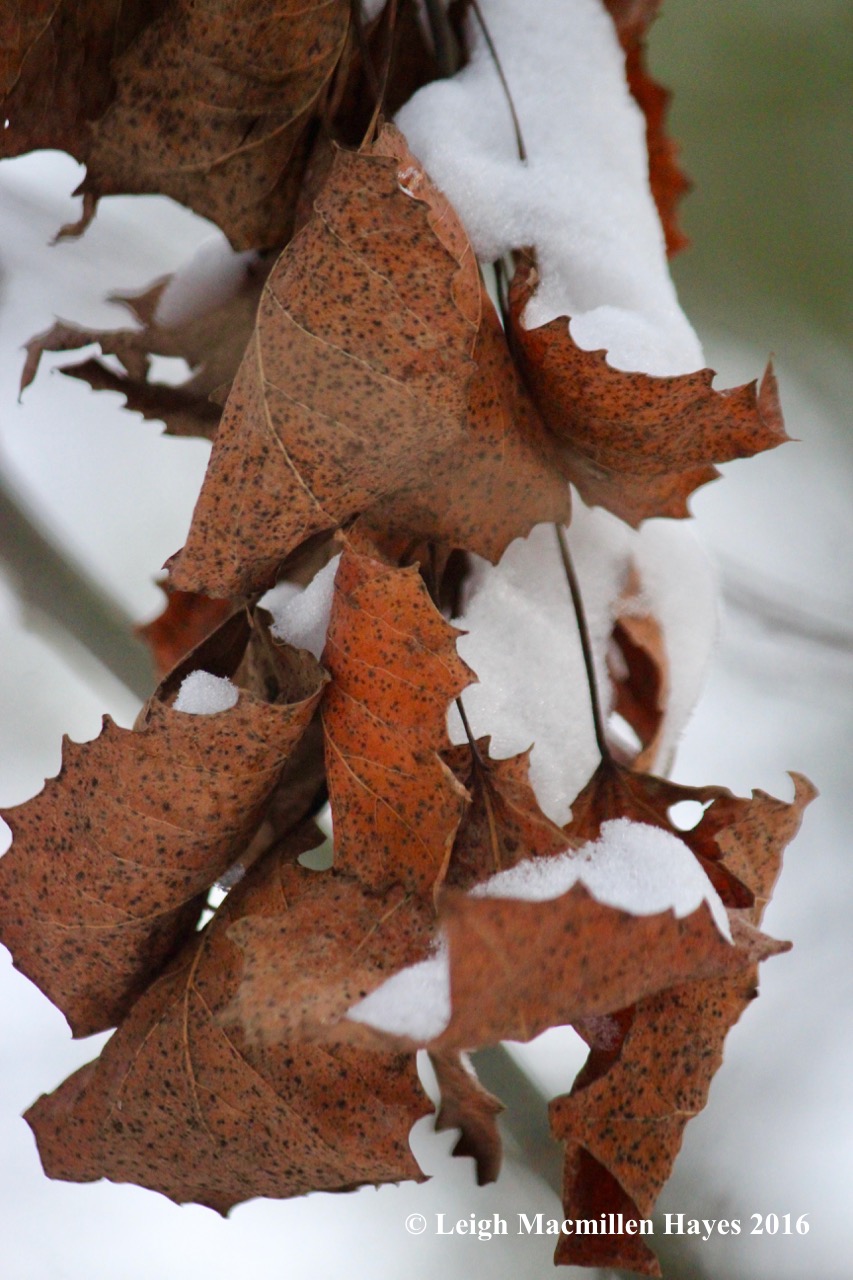
Its leaves, oh my, another  temporarily “marcescent” variety–showing off the big teeth for which it received its common name.

p-white-oak-leaves

Speaking of leaves, there were numerous renditions of White Oak–another dancer that seemed to freeze in motion.

p-red-pine-heart

Here and there among the offerings, Red Pine. This particular one showed my love for it where a branch had broken off. Do you see the wee heart?

p-red-pine-geometry

While mature Red Pines feature bark that reminds me of a jigsaw puzzle, I found some younger trees, their structure speaking to geometry.

p-piscataqua-sign

Continuing on along the logging road, I wondered if perhaps I’d gone astray. Suddenly, I found myself in Piscataqua County–miles and miles from home. I knew I was in unknown territory, but was I really that far from home? More than my usual fake lost?  Or someone’s sense of humor?

p-owl-1

Maybe so. Certainly I was in the land of owl feet.

p-coyote

And a tuckered coyote?

p-bushwhack

It was at this point that I headed off trail, made easy by underbrush.

p-deer-tracks

Deer tracks led me to another wonder-filled gift.

p-northwest-1

The wetland and Northwest River, one of the namesakes for this place.

p-pitch-pine-bark1

It was here that another lesson presented itself–the layered bark made me realize I was viewing Pitch Pine growing beside the bog. My understanding was that these grew on ledges or rocky outcrops. But here was one with wet feet. And so I later consulted Bogs and Fens by Ronald B. Davis (I highly encourage you to add this title to your Christmas wish list) and discovered that not only does it grow in dry woodlands, but also “in swamps and at the edges of fens and bogs.” (Additional note: Pitch Pine Bogs are listed as S2:  “Imperiled in Maine because of rarity (6-20 occurrences or few remaining individuals or acres) or because of other factors making it vulnerable to further decline”; thus another reason to give thanks to LELT for preserving this place)

p-pitch-pine-1

p-pitch-pine-needles

Pitch Pine needles present themselves in bundles of three–perfect for this time of year–ahhhh, the Trinity.

p-rhodora-1

Rhodora

p-leatherleaf-1

and Leatherleaf added to the winter ornamentation.

p-ice-break-through

In my attempts for “the perfect photo,” I broke through the ice several times. I’d been post-holing through about seven or eight inches of snow all afternoon sans snowshoes because it was quite easy to move about in the fluffy stuff, but when I reached the edge of the water, the snow had insulated the thin ice cover and . . .  crash, crackle, crunch, I sunk in to the top of my Boggs and even a wee bit over.

p-trail-back

On my way back down the logging road, I realized how my own tracks were much more varied than that of the deer who’d passed before me.

p-land-trust-boundary

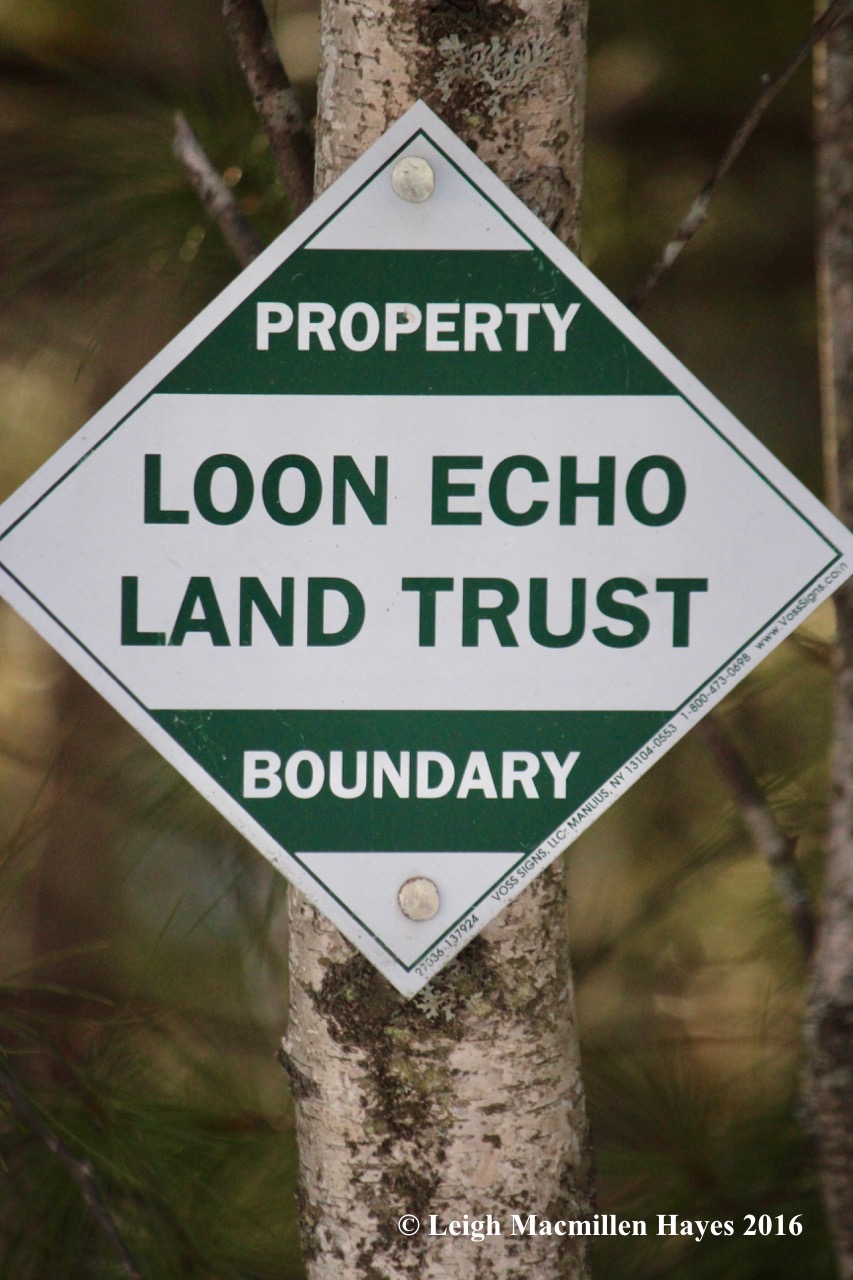
And then I came to a boundary sign. Opps. Guess I went beyond the land trust’s property, though thankfully no signs deterred me from trespassing.

p-perley-pond-1

And a wee bit further down Folly Road, I stopped at Perley Pond, part of the namesake for this property–and part of the reason for my presence for the presents presented.