My Flame for Black and Yellow Garden Spiders: a fire story

I’m back in the meadowy-field because, well, because of the Black and Yellow Garden Spiders and because of a brush fire on an extremely hot day last week.

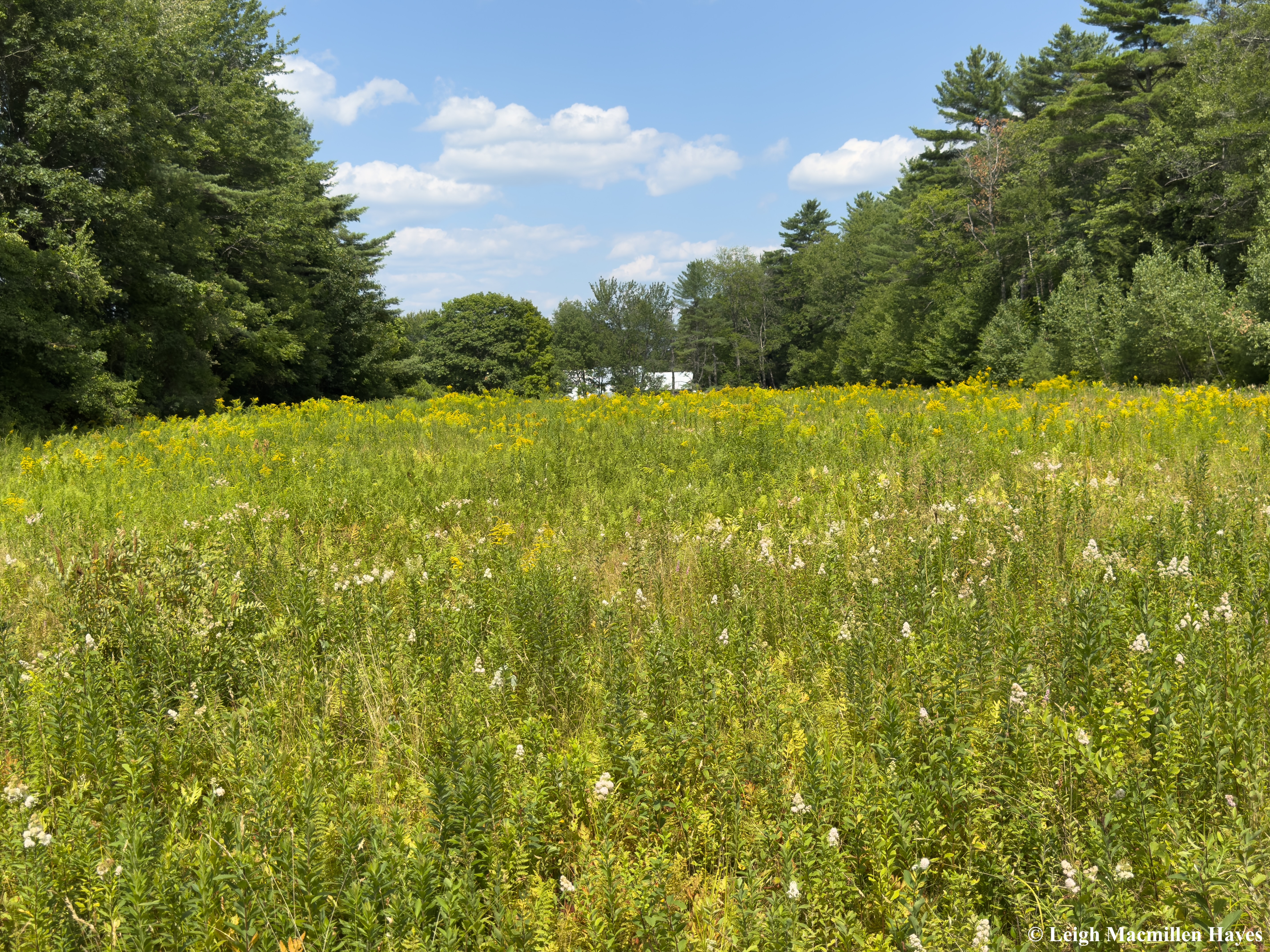
Looking back toward our house, with our neighbors’ woods to the left and ours to the right, it looks as though the Goldenrod goes on forever. Actually, there’s some Meadowsweet and a few Steeplebushes, and some other flowers in the mix, and ferns including Sensitive and Marsh and Royal and Interrupted, and mosses galore. But right now it’s the Goldenrod and Spirea (Meadowsweet and Steeplebush) that are attracting the pollinators.
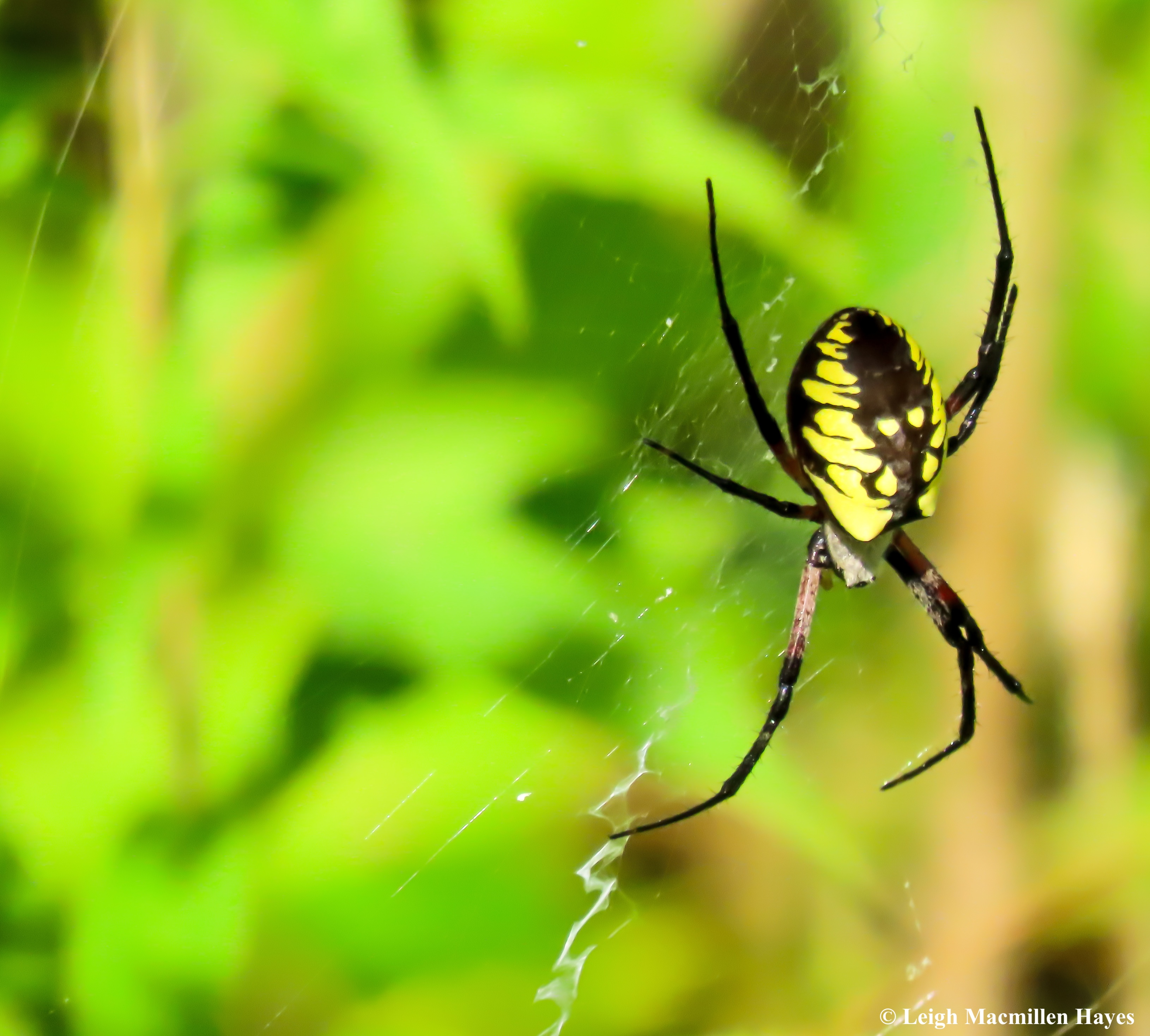
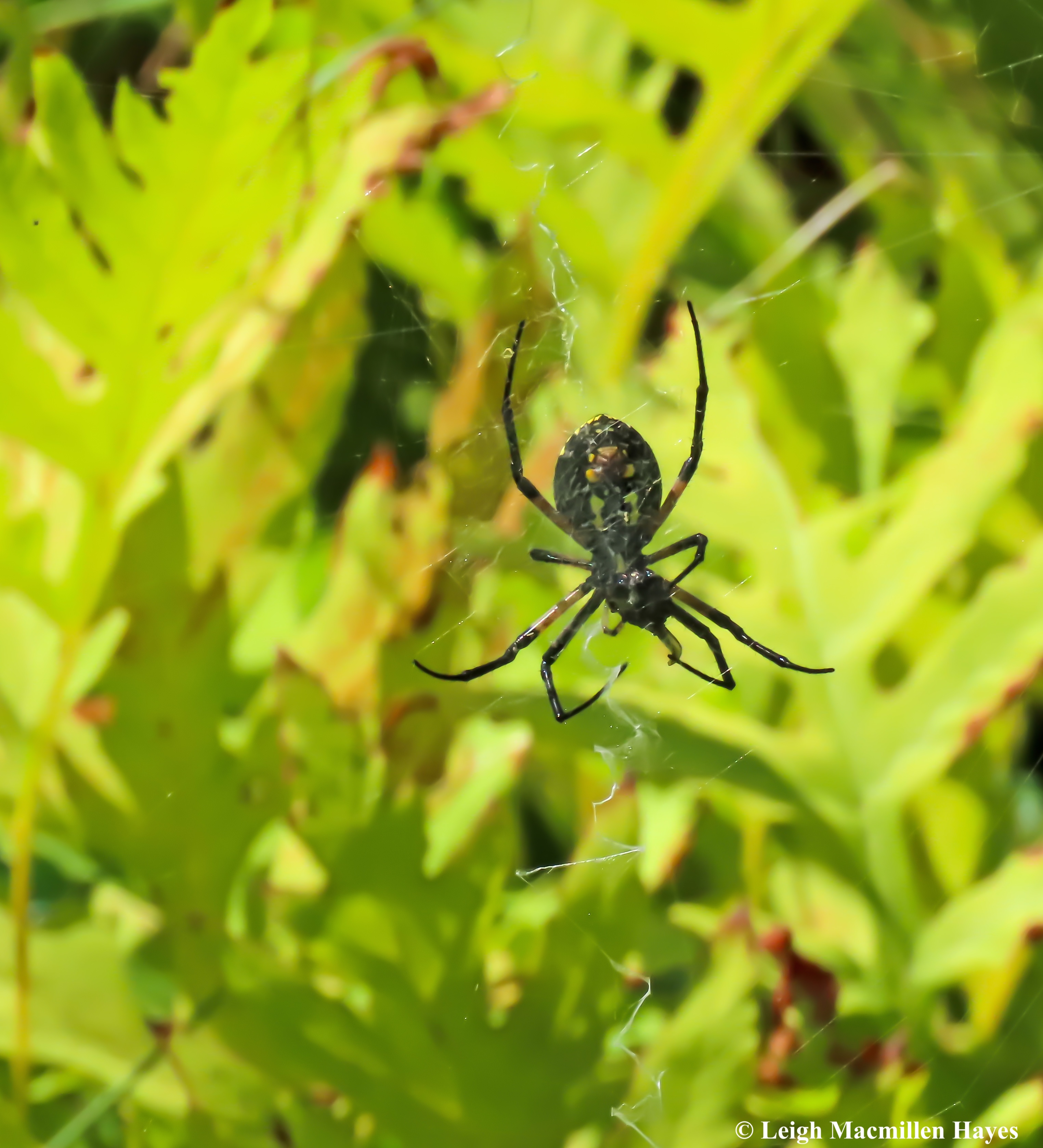
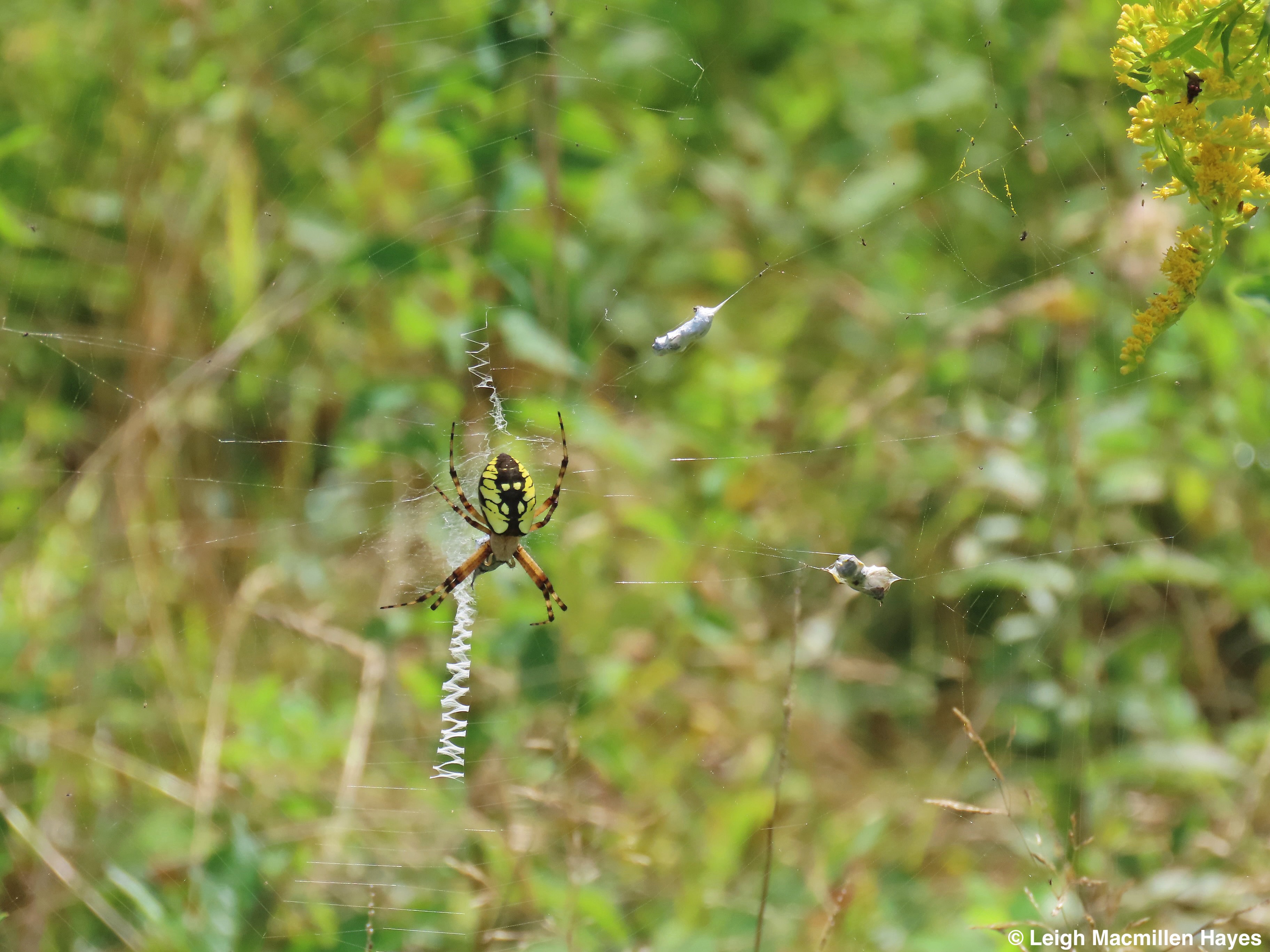
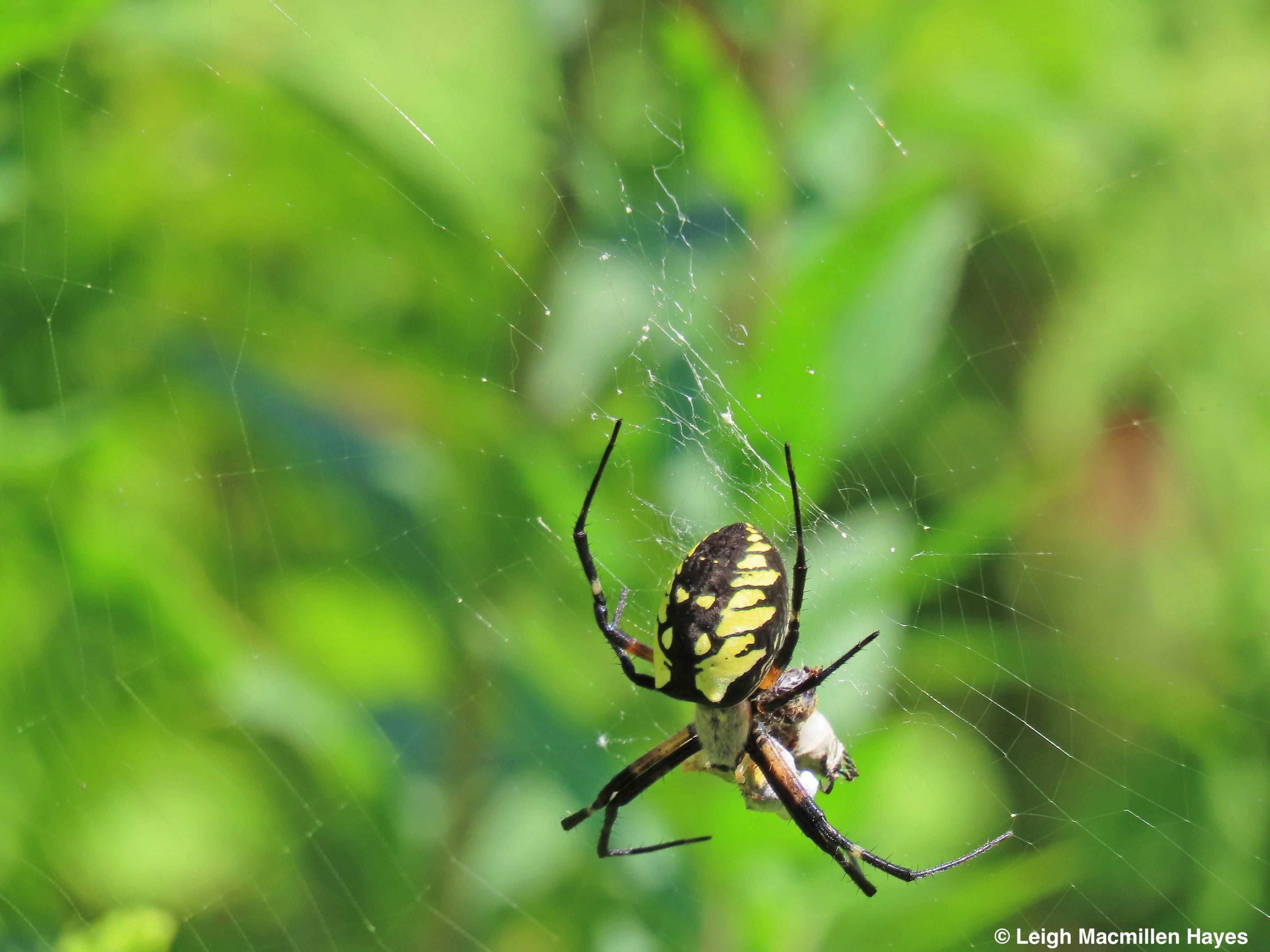
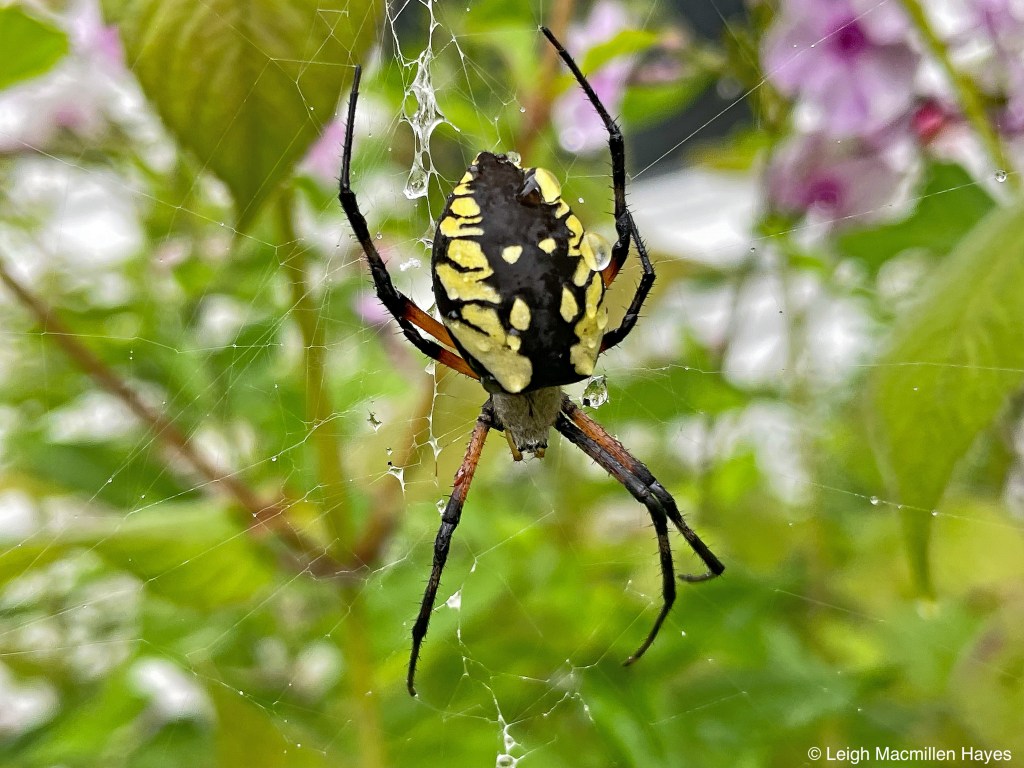
And since the beginning of August, the Black and Yellow Garden Spiders have made a return and as I slowly walk along the path my neighbor keeps mowed, I’ve been noticing more and more of them every day and wonder how many more I don’t see or are deeper in middle the field where I dare not venture . . . because I know there are Black and Yellow Garden Spiders in there.

One extremely hot afternoon last week, I noticed a few of the spiders hiding in the shade. I circled the field twice and then headed indoors to get out of the heat, rather like them. But before going in, I grabbed the SD card from my game camera.

A couple of hours later, actually about 5:30ish, I headed back out to relocate the game camera in our woods. My neighbor saw me and we waved before I disappeared.

Camera relocated, I decided to circle around the trail I’d created in our woods years ago because in the shade of the Pines and Hemlocks, and with a breeze, it was rather pleasant despite the temp being about 97˚.

I was almost to the power lines that cross both of our properties when she texted me: “Do you smell smoke?”

I sniffed and did not, which I told her.

“I’m really smelling it now,” she wrote a minute later.

“Oh boy,” I responded. “I’m just about to the power line. I’ll head home via the field.” Which meant I’d walk under the power lines toward her field, thinking that by walking north, I might be able to figure out where the smell was coming from.

And then I stepped out of the woods and onto the actual power line. “The minute I hit the powerline,” I wrote, “it is strong. Yikes.”

“I’m going to walk up the field,” she replied.

I could see haze toward the north and told her that.

And then, I heard a crackling sound near me that didn’t make sense.

The crackling was the fire.

“I see it,” I wrote. “It’s behind us Calk 911.” Yes, Calk cuze I was in a panic.

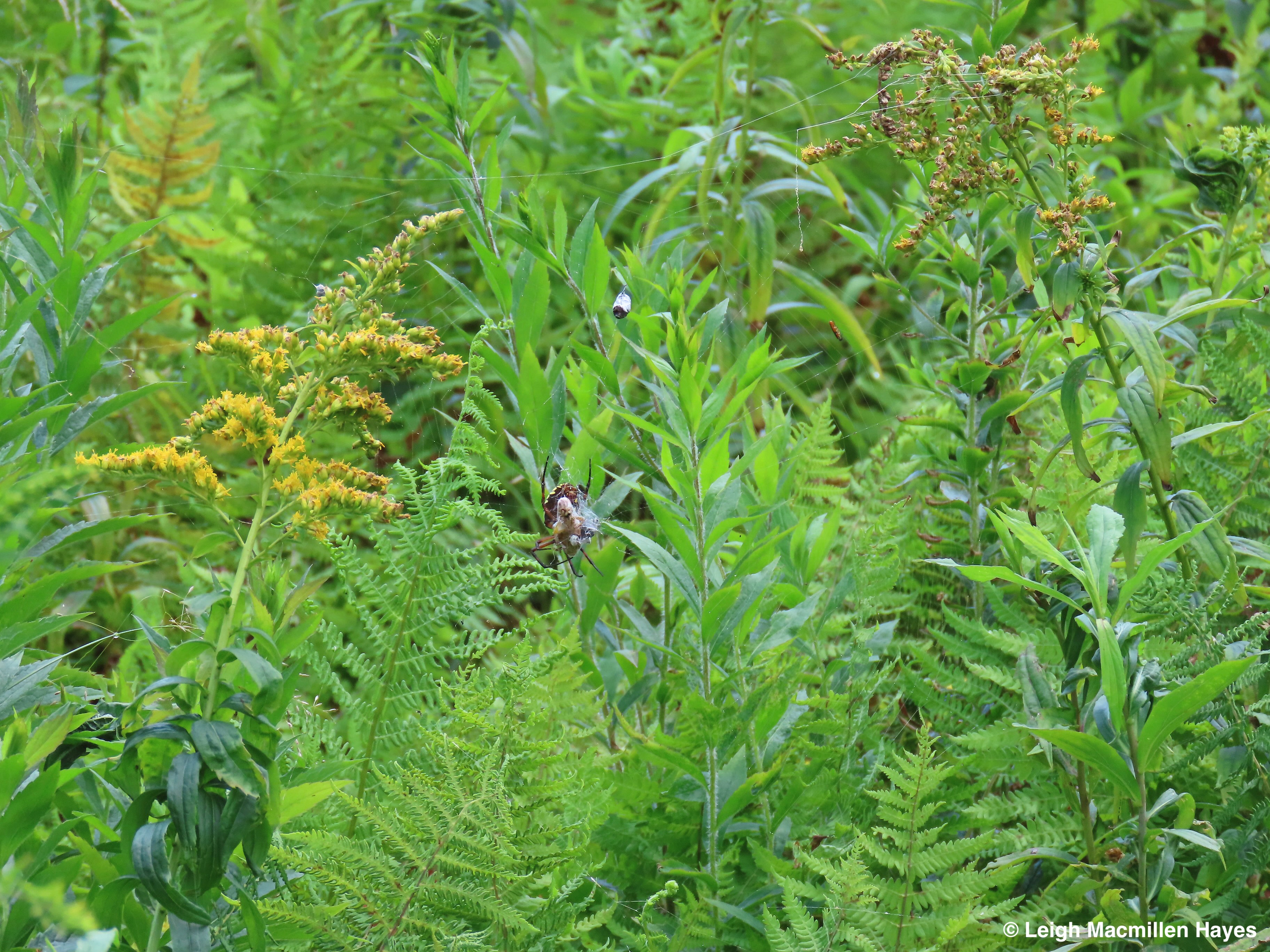
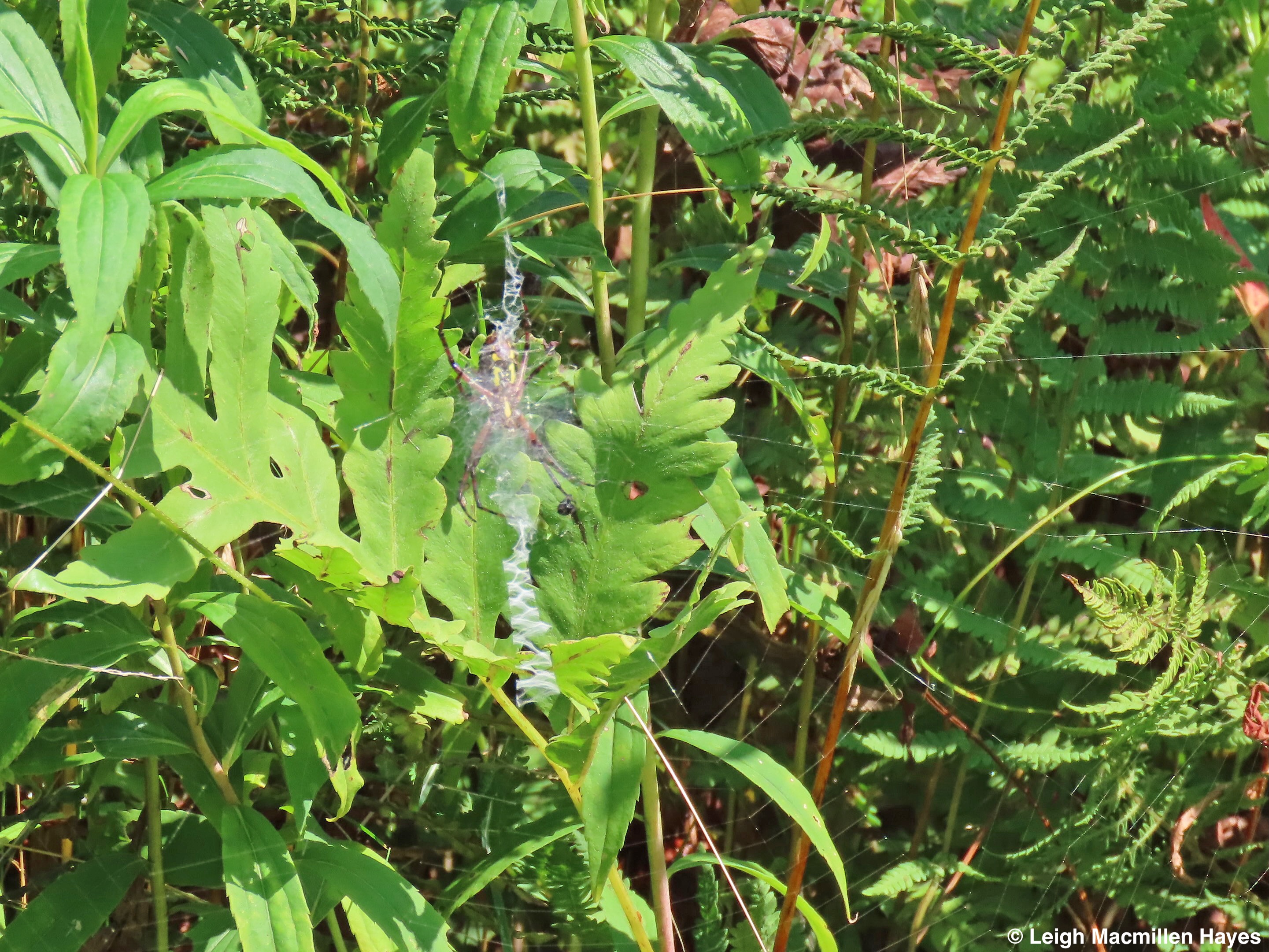
And if you look closely at the photo, you’ll see two spots of orange which were the flames.

“Behind where,” she asked because she had called 911, but she wasn’t sure where exactly I was.

And then in my panic I realized that I needed to call 911 and did so. “I’m on the phone with them,” I wrote. “Thank goodness you smelled it.”

Actually, we were both on the phone with the Dispatcher, who was incredibly calm as she asked me to describe what I could see. The fire was on land belonging to another abutter to our south and about thirty feet in from the power line. From where I stood, it was difficult to get a sense of how large it was, but no way was I going in there to give a more accurate account.

Thankfully, the cool, calm, and collected Dispatcher asked me the best way to the location, which she knew via e911, and for which I am grateful, and the fire department was in the midst of their weekly meeting, so within minutes, with the Dispatcher still on the line, I heard the sirens and ran to the field to meet them.

Because the power line is also part of the snowmobile trail, the trucks could follow the path up through the field, and then cross over and drive between the breaks in the two stonewalls that define our boundaries.

Once they were at the location, I ran down the field trail to meet my neighbors and My Guy.

A little while later, three of us decided to head up and take a peek from our land on the other side of the power line.

Ten men and one woman were in there spraying the area with foam and cutting trees, many of which I think were snags or broken from snow weight as they were Gray and Paper Birch.

Another firefighter sent a drone up to check the entire area. He also saw the haze to the north that I’d seen at first, and sent the drone that way, but thankfully found nothing.

They came back the next day to try to determine the cause, but we haven’t heard what it might have been, which is disconcerting because given how dry and crisp everything is right now, I live in fear of this happening again. (We hiked a local mountain today and the top is crisp and dry and fall foliage will not be so great this year because everything is brown)

This morning I was checking on my spider friends and others in the field and My Guy, who had been on an errand, found me out there and asked if I wanted to show him where the fire had been since he’d had to go back to his store when it actually was happening.

He didn’t realize how big of an area it was, probably 30 or 40 feet by 20, and the potential danger it could have caused if my neighbor hadn’t smelled the smoke and she and I hadn’t gone looking for the source.

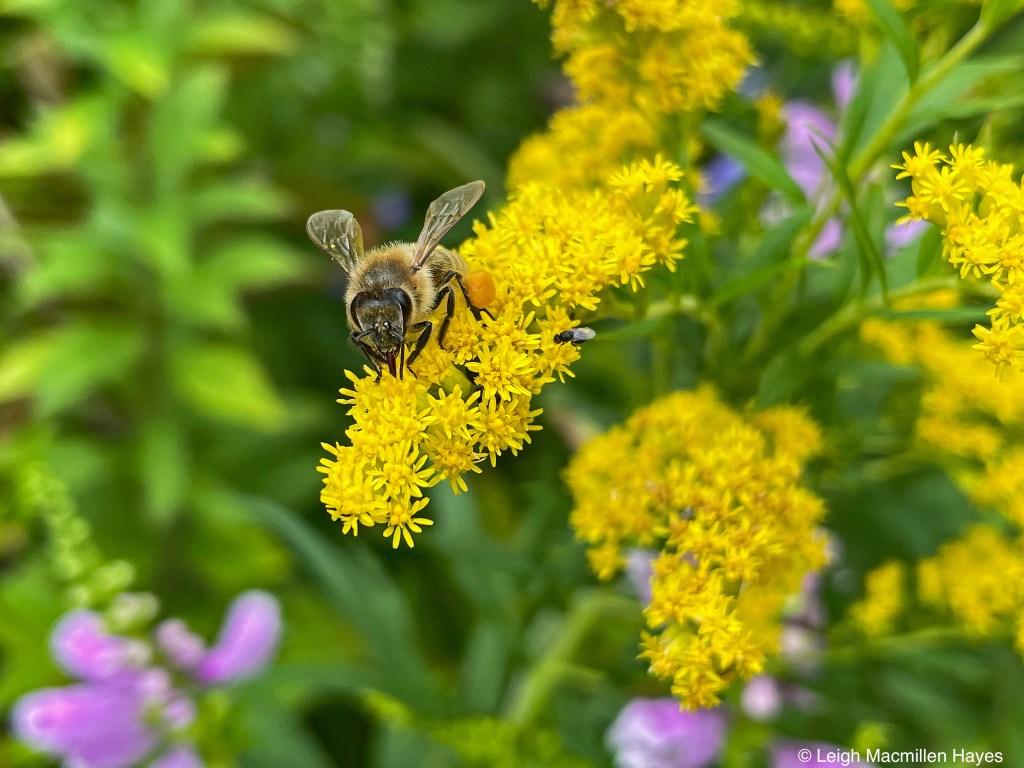
But I’m trying not to focus on that and instead spend my time observing all that happens just over the stone wall from our house. Check out the size of that pollen sac!

And look at the hairy scales on this dainty Common Ringlet butterfly.

Though I occasionally meet a Katy-did around here, I think this past week was the first time I’d encountered a Broad-tipped Conehead! What a conehead it is!

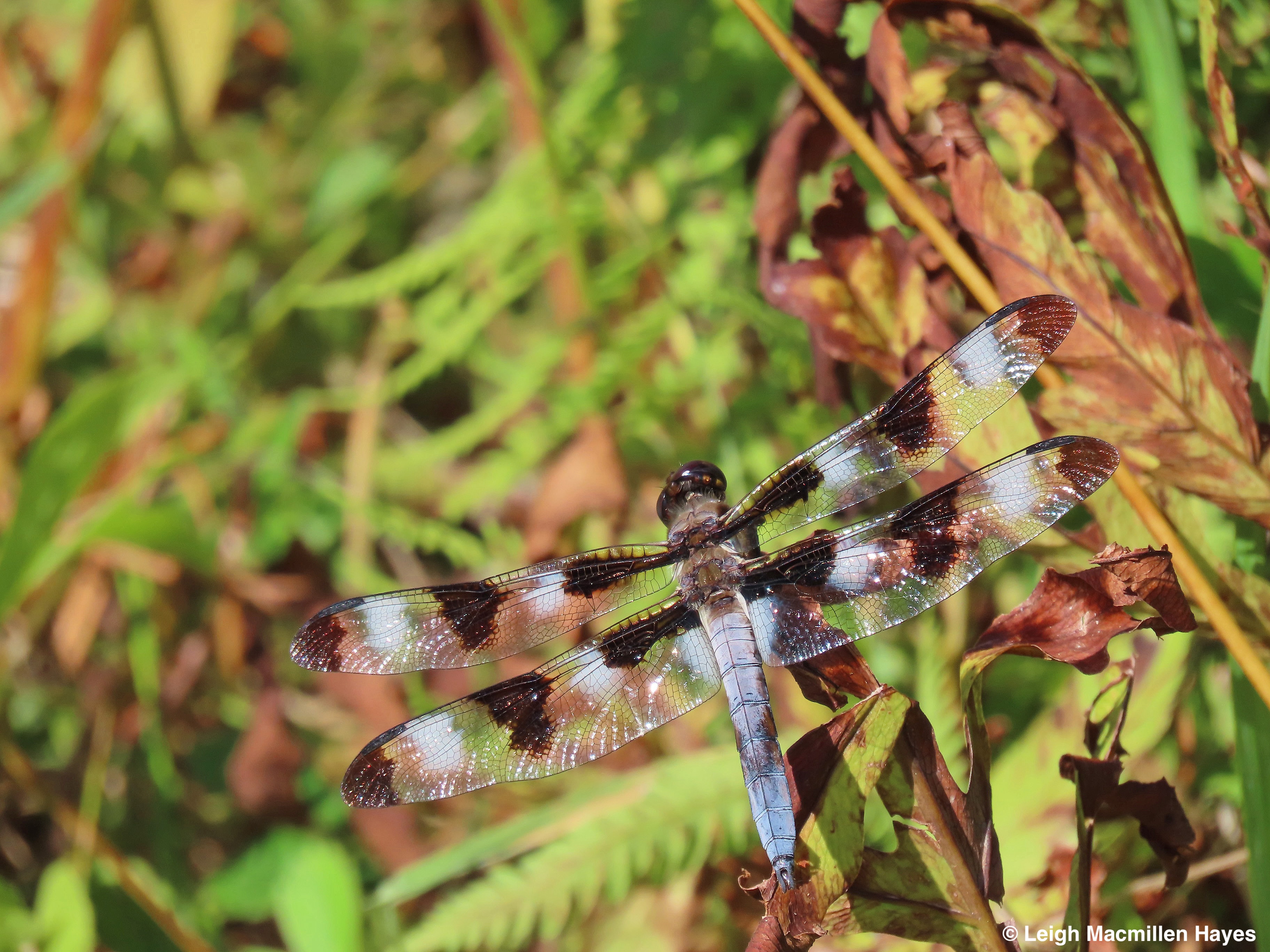
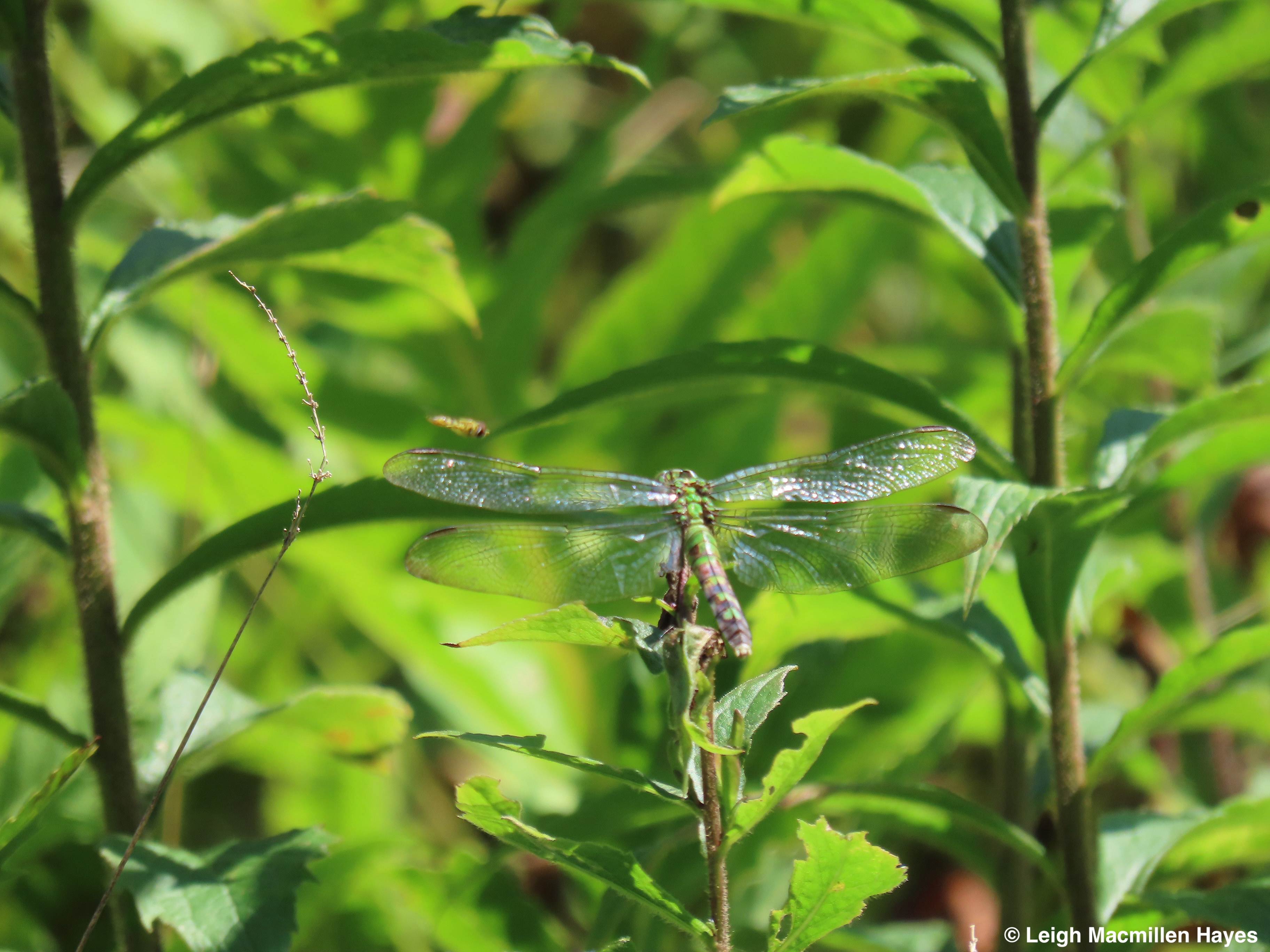
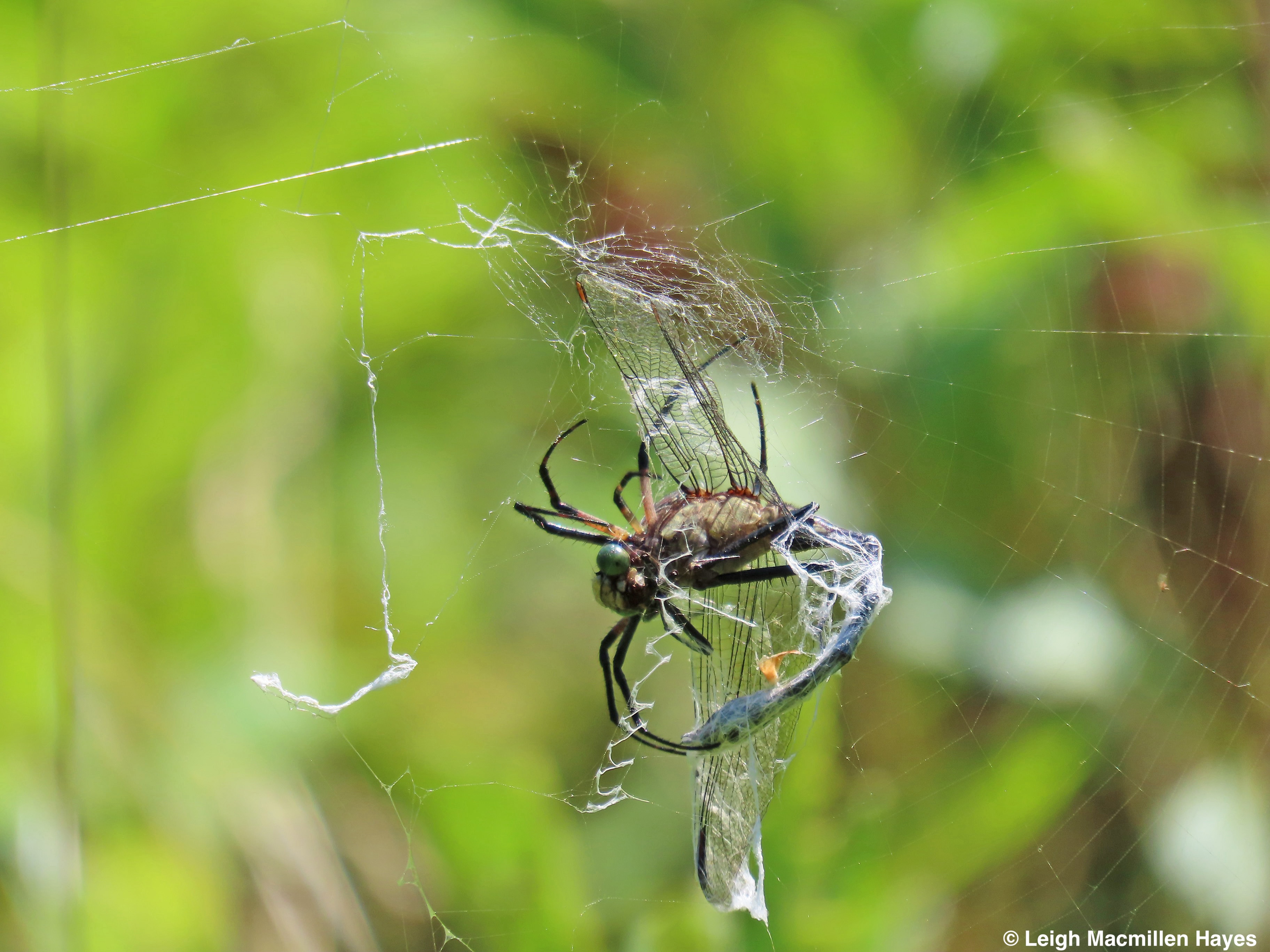
There have been a variety of dragonflies over the course of the summer, and just this morning it was this male Twelve-spotted Skimmer who stopped by. Each evening, there are a bunch of Darners, but they won’t slow down enough for me to make a positive ID. I do positively give thanks for them because all are helping to keep the Gnat and Mosquito populations low. Of course, they also eat some of my other favorites, but I remind myself that that is nature at work.

I did worry that as the fire trucks were driving up through the field last week, especially when they cut across to get to my location, they were destroying the spider webs. And they probably did. But what they were doing was way more important in that moment. And . . . the spiders have found some new locations in the spaces where the tires flattened plants.
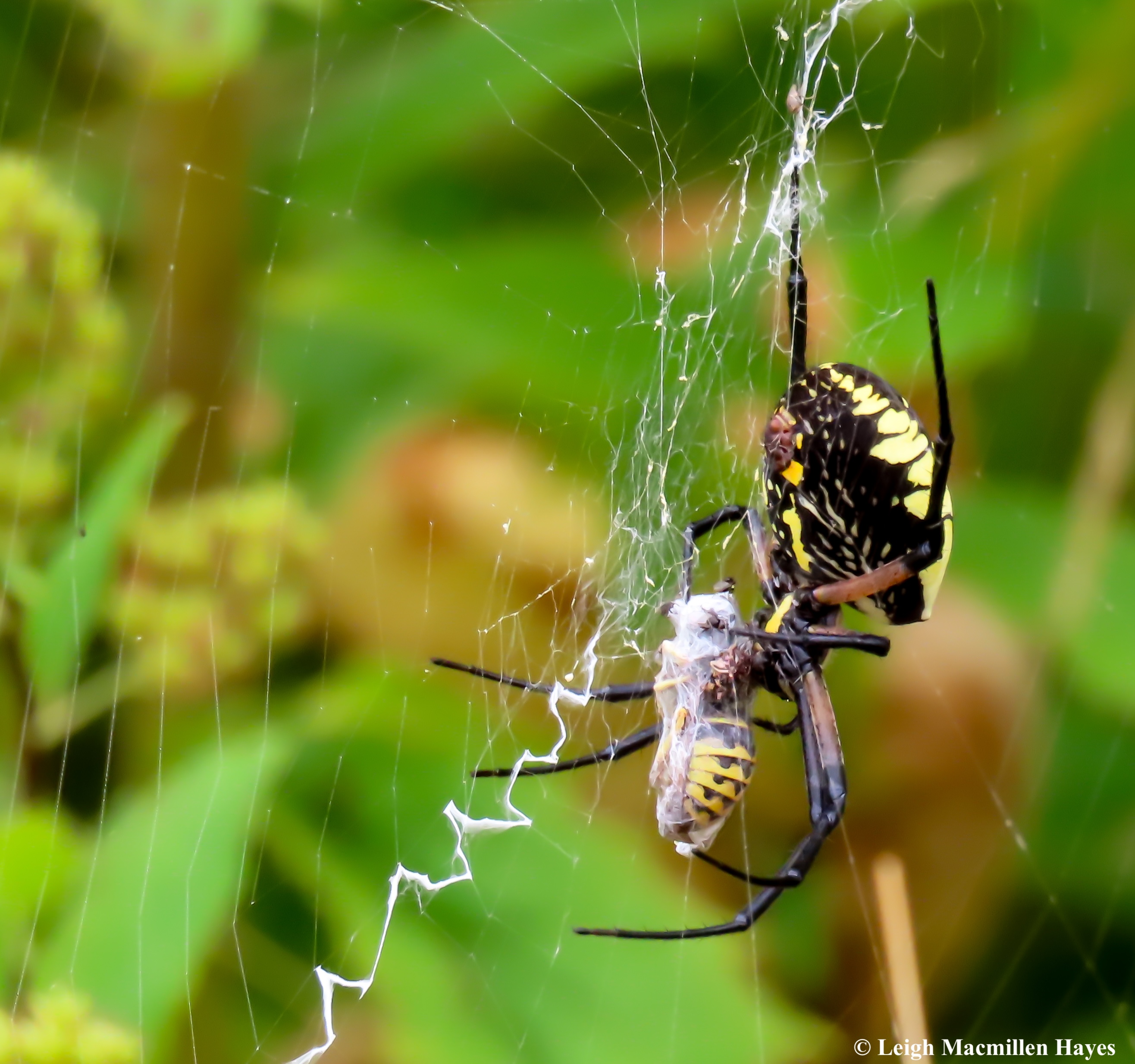
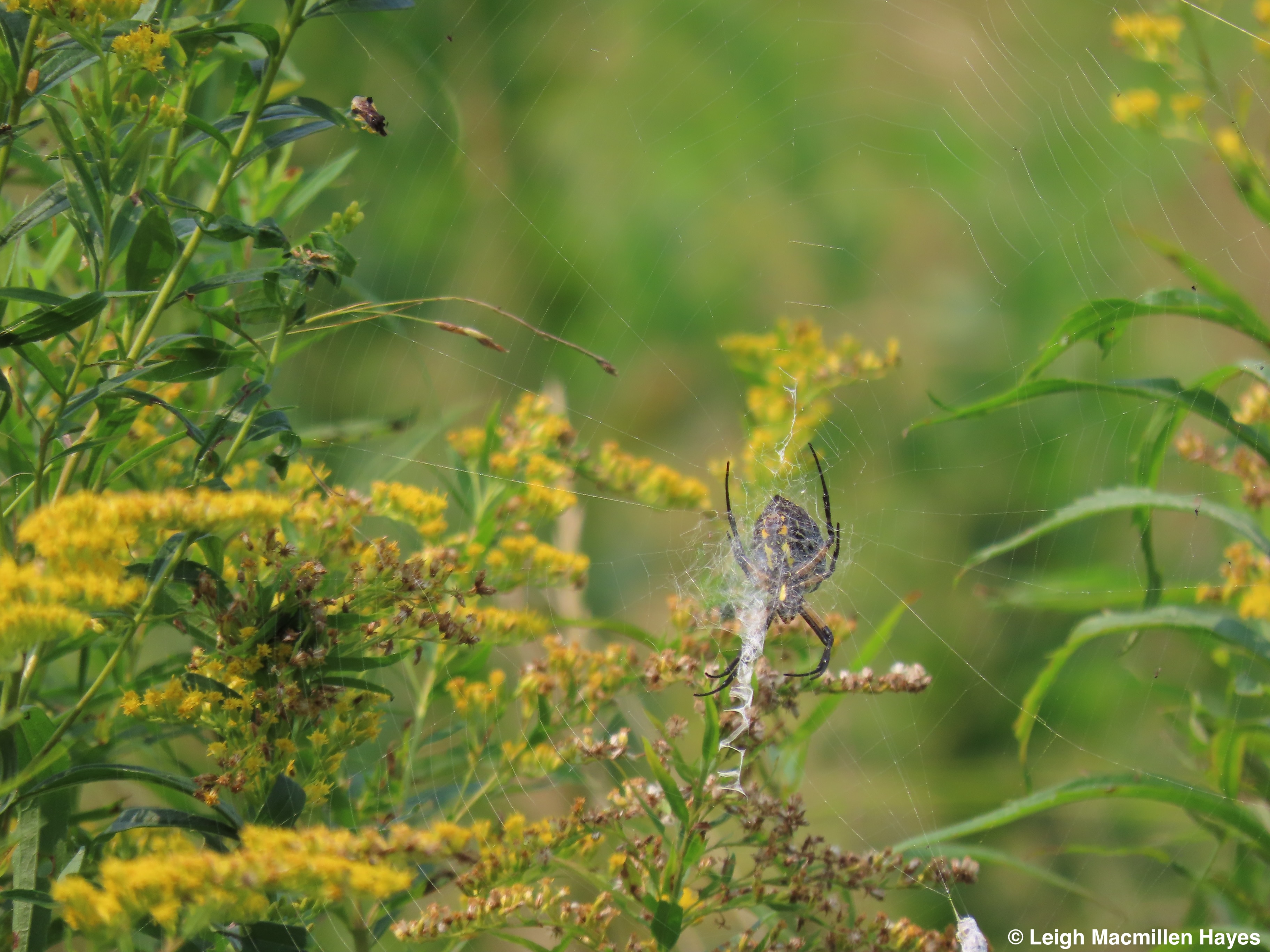
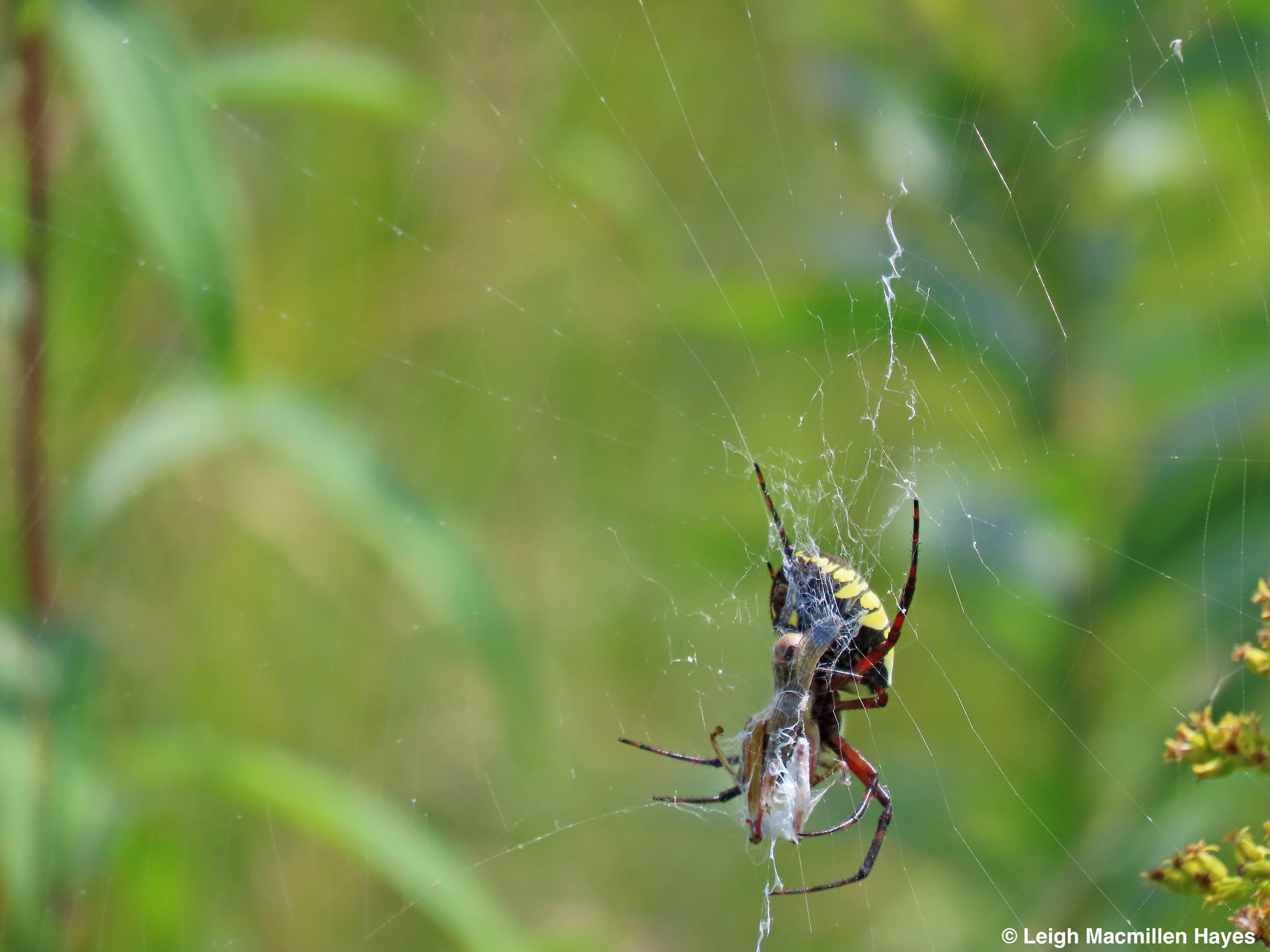
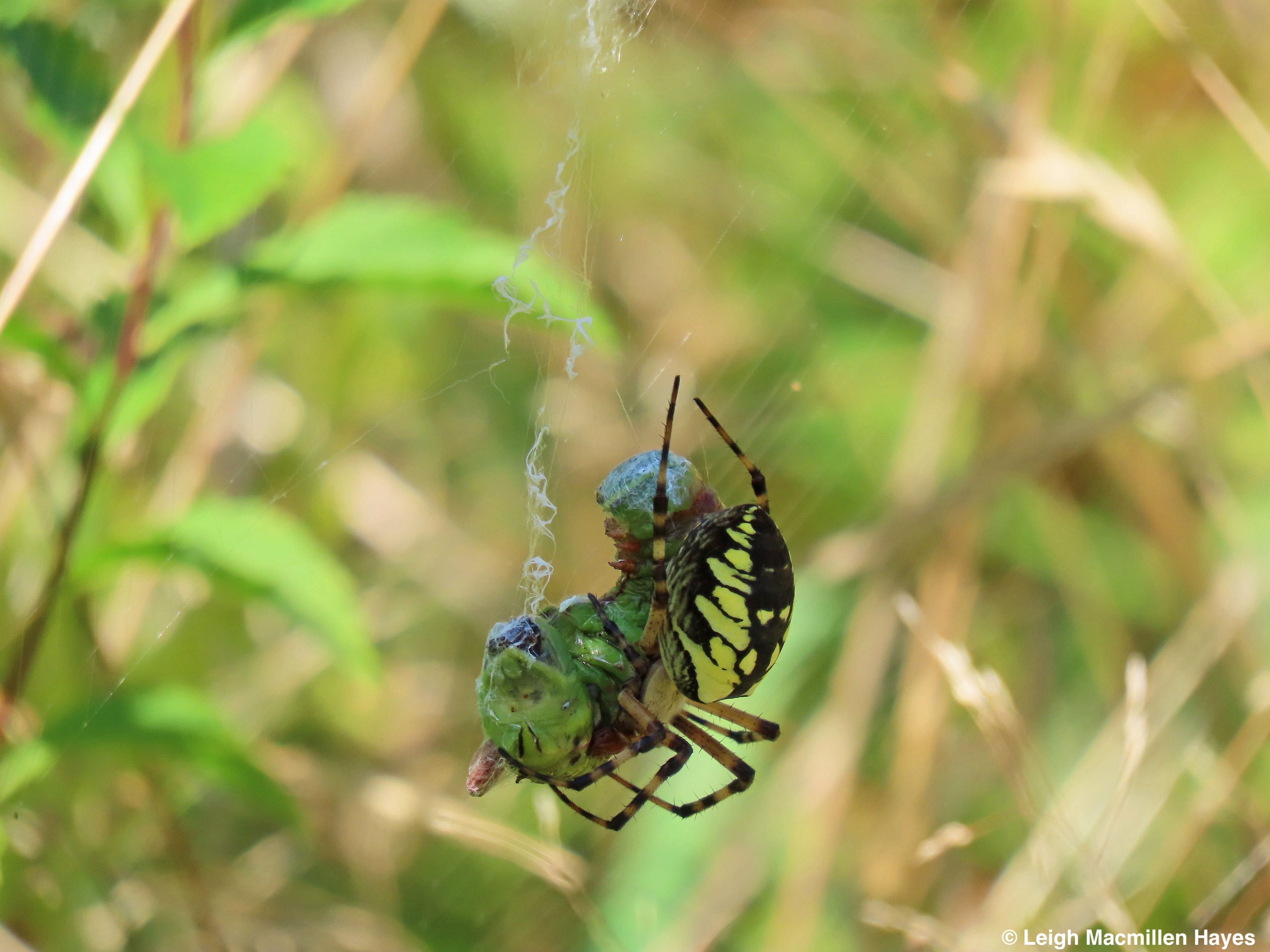
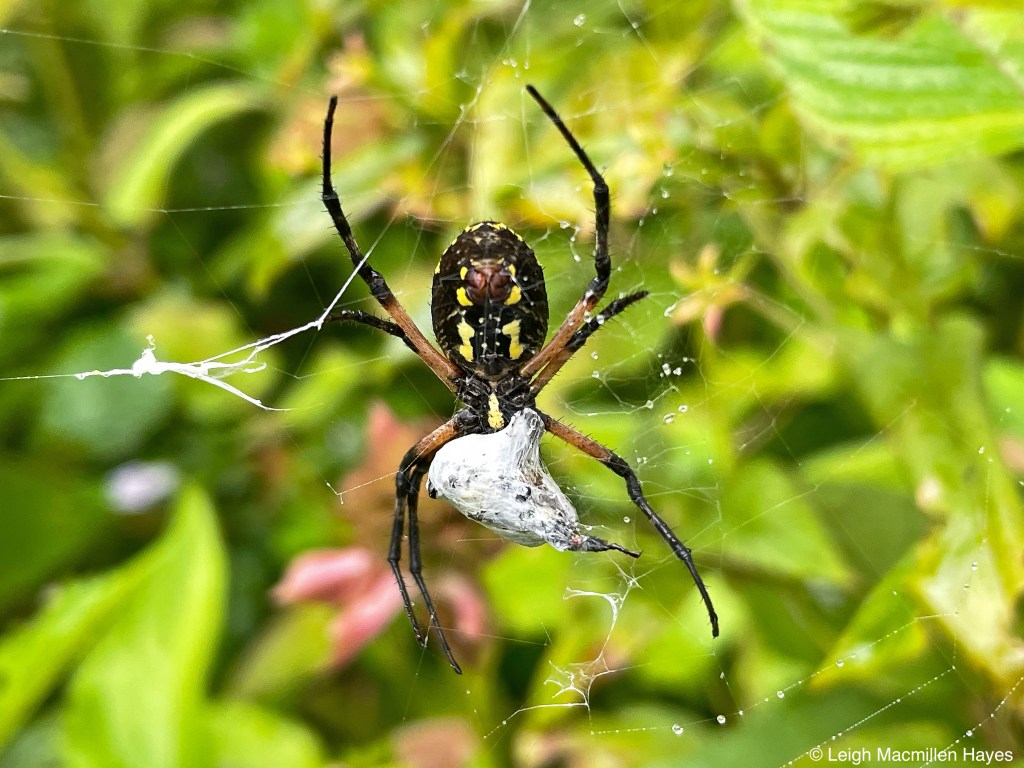
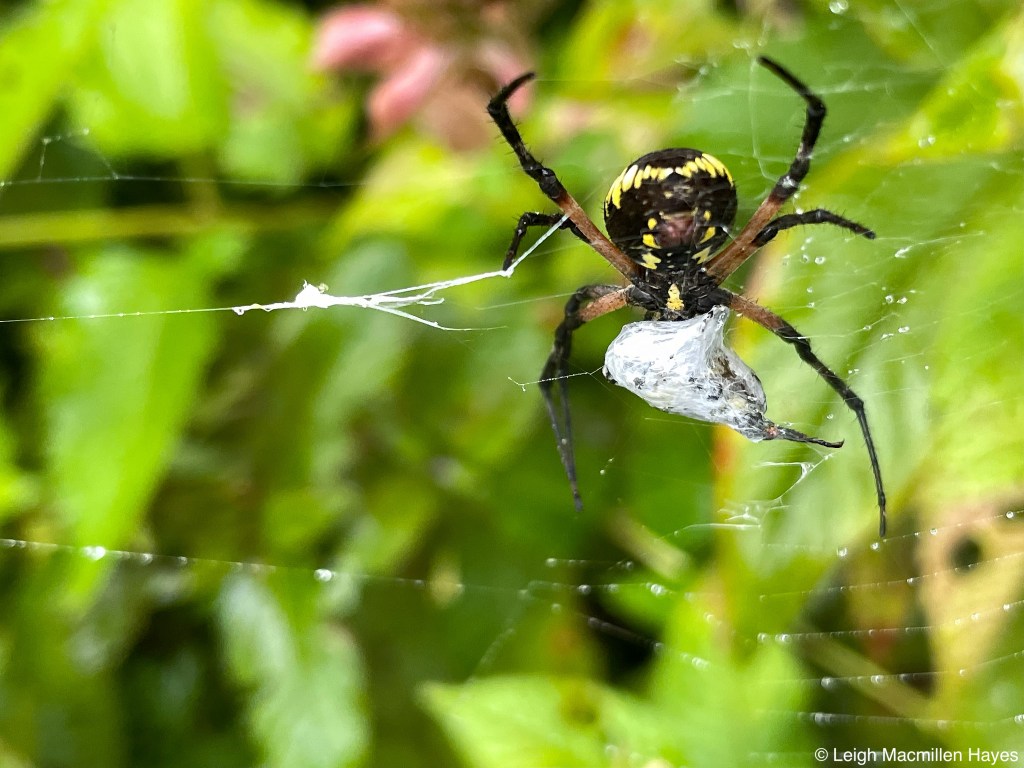
It seems every summer I learn something new from these spiders, and this year I’ve had some time to watch them wrapping their prey on more than one occasion. I’ve also watched as one Bumbler somehow managed to bounce off the web . . . one strand at a time, and fly off. But not all are successful and the spiders need to eat too.
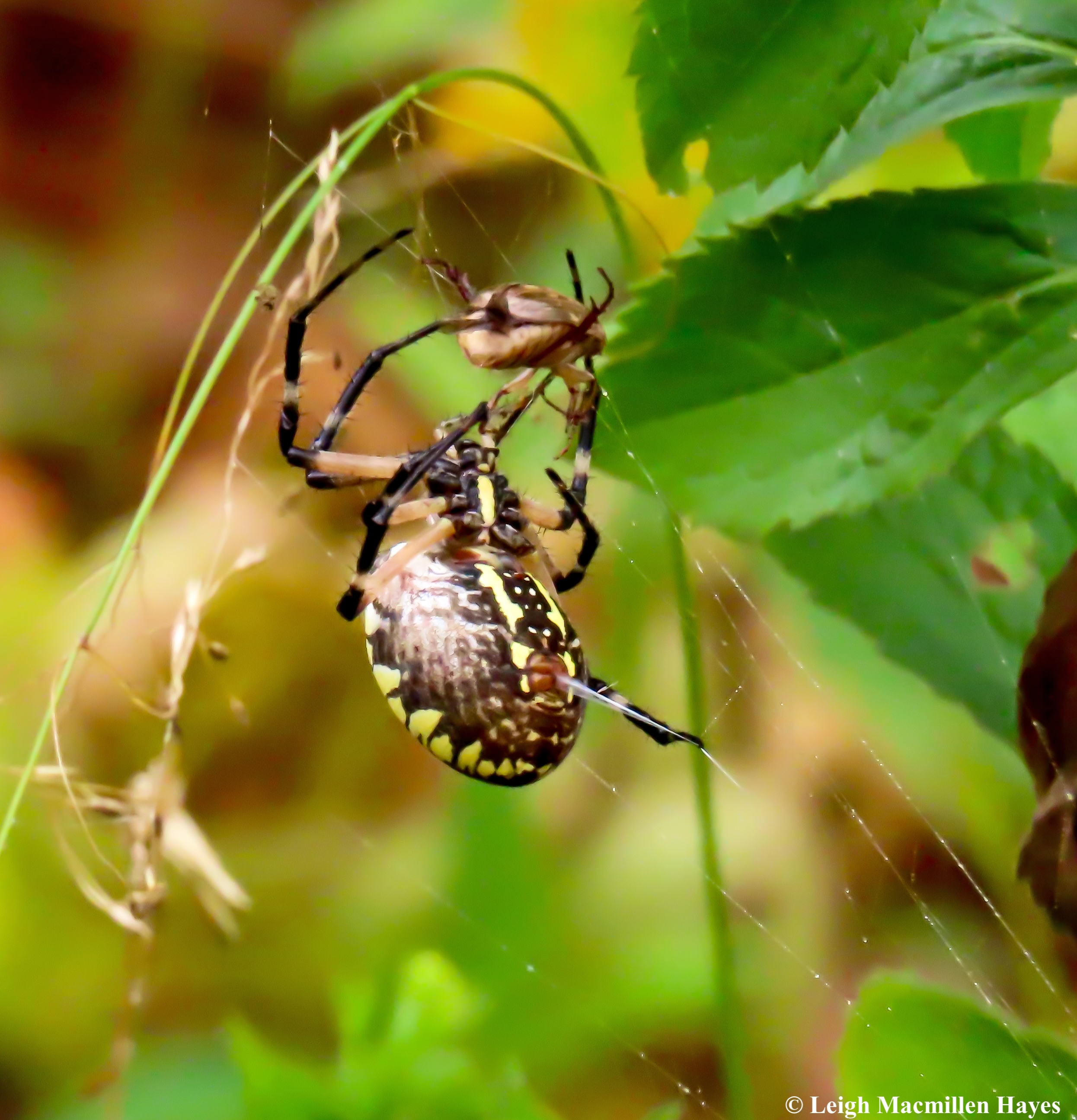
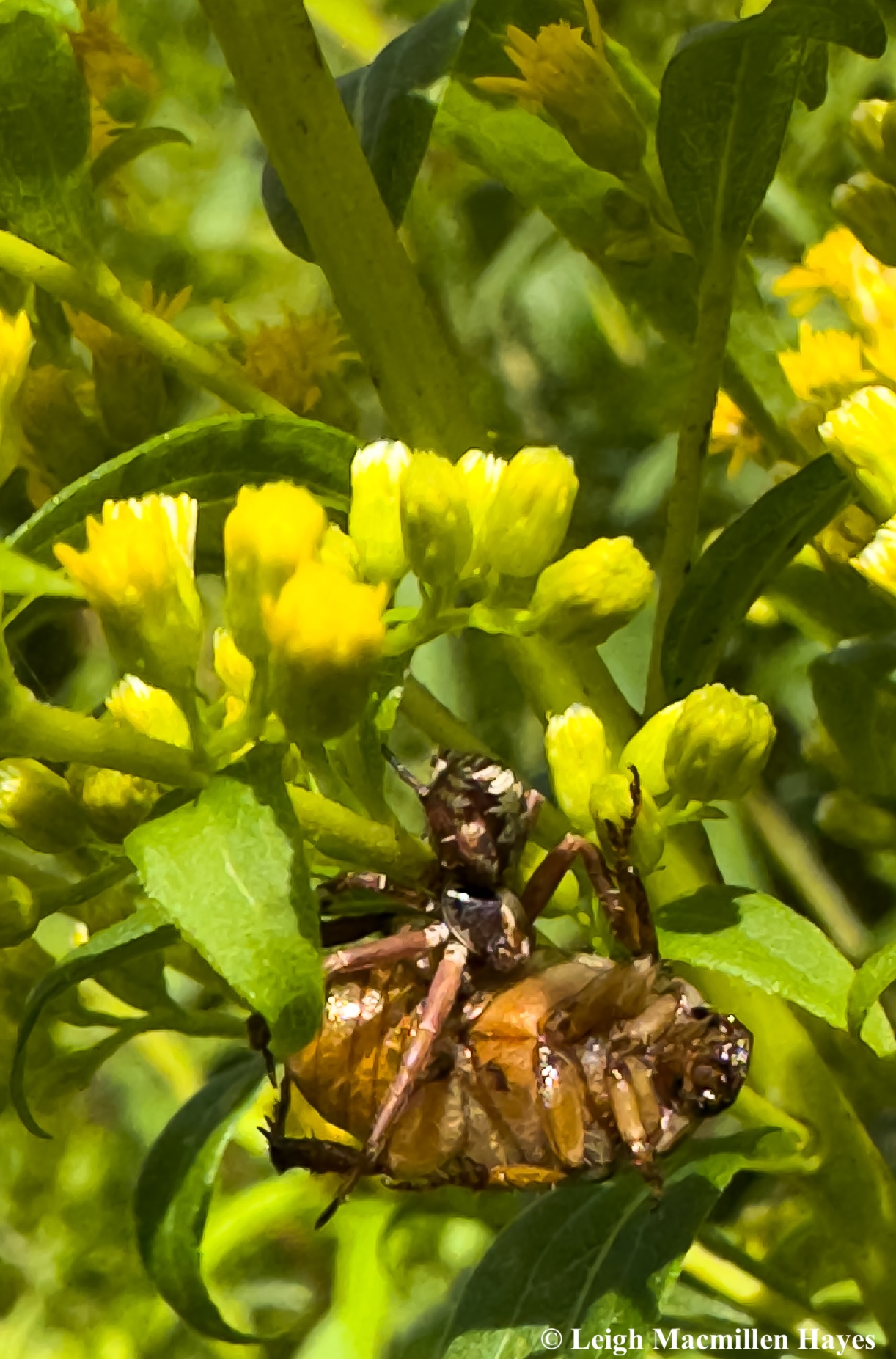
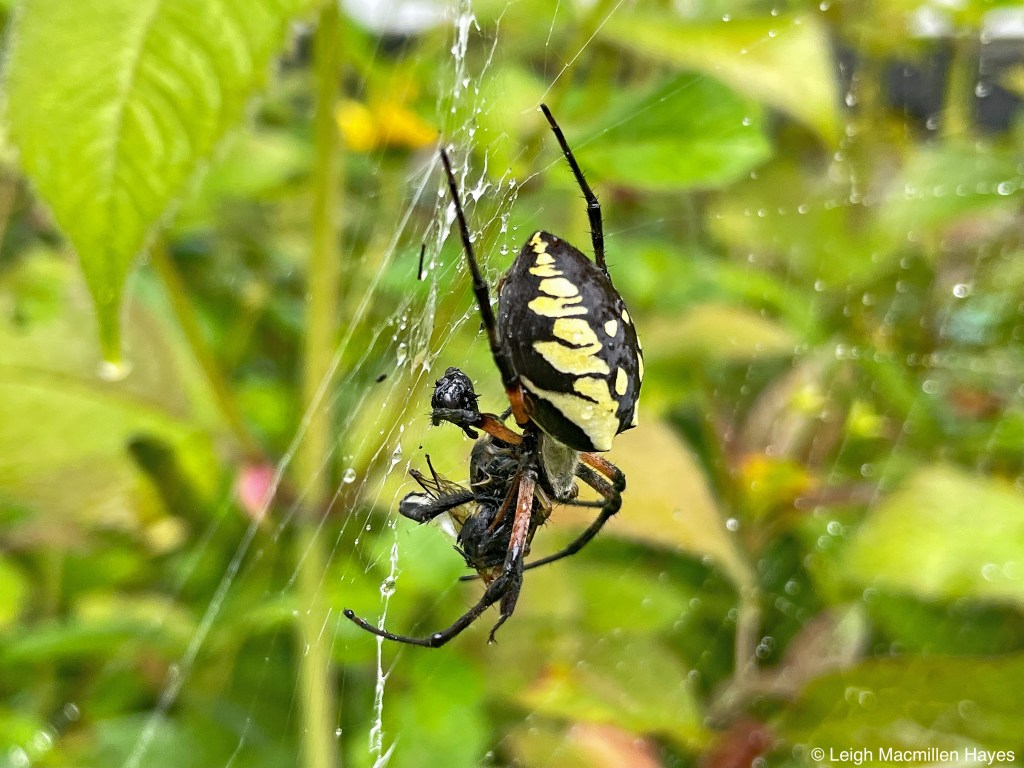
Though they occasionally eat the pollinators, they also help keep the population of some not-so-beneficial insects down, such as this Oriental Beetle. It’s warp-speed work when an unsuspecting guest visits the web.
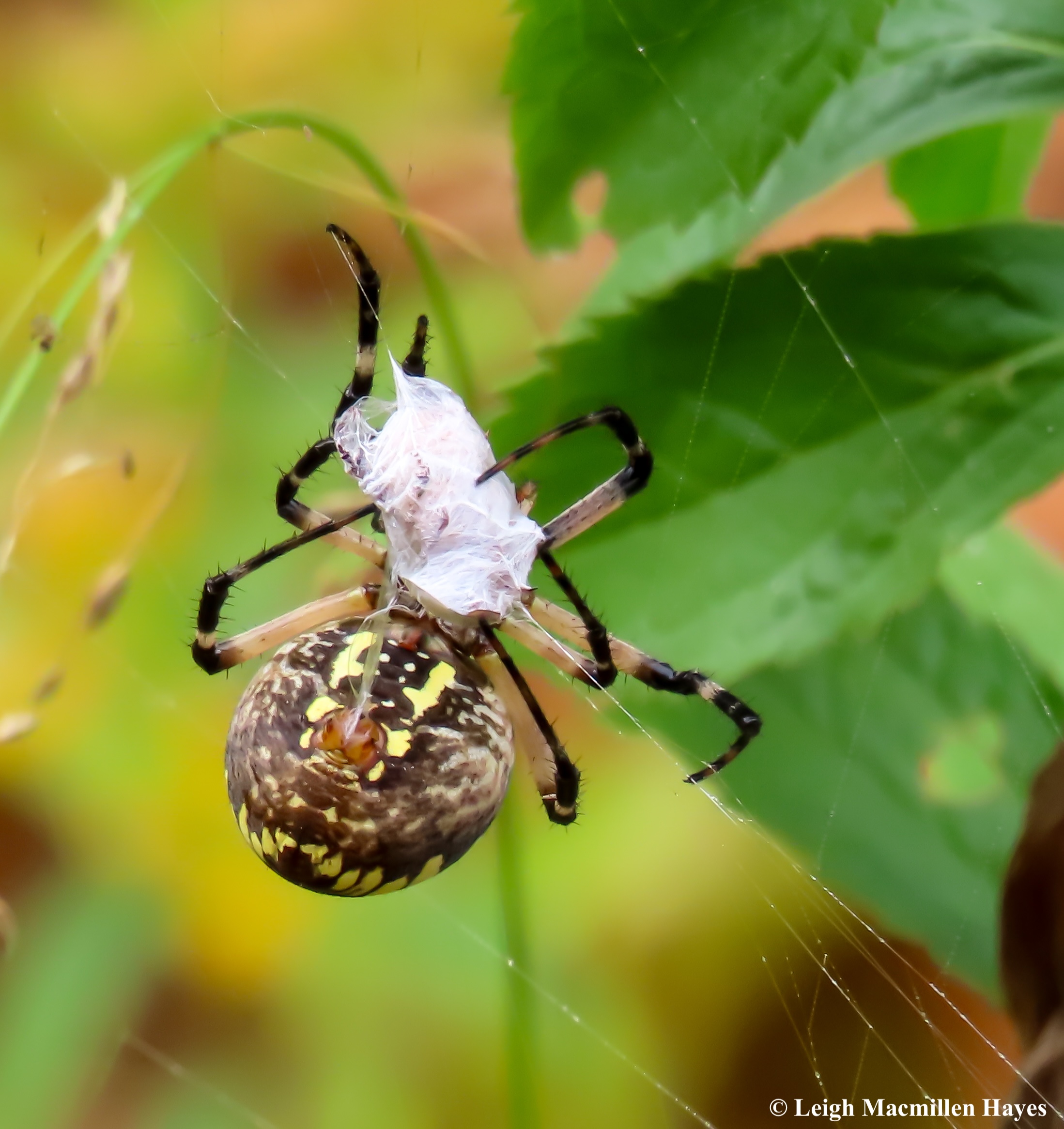
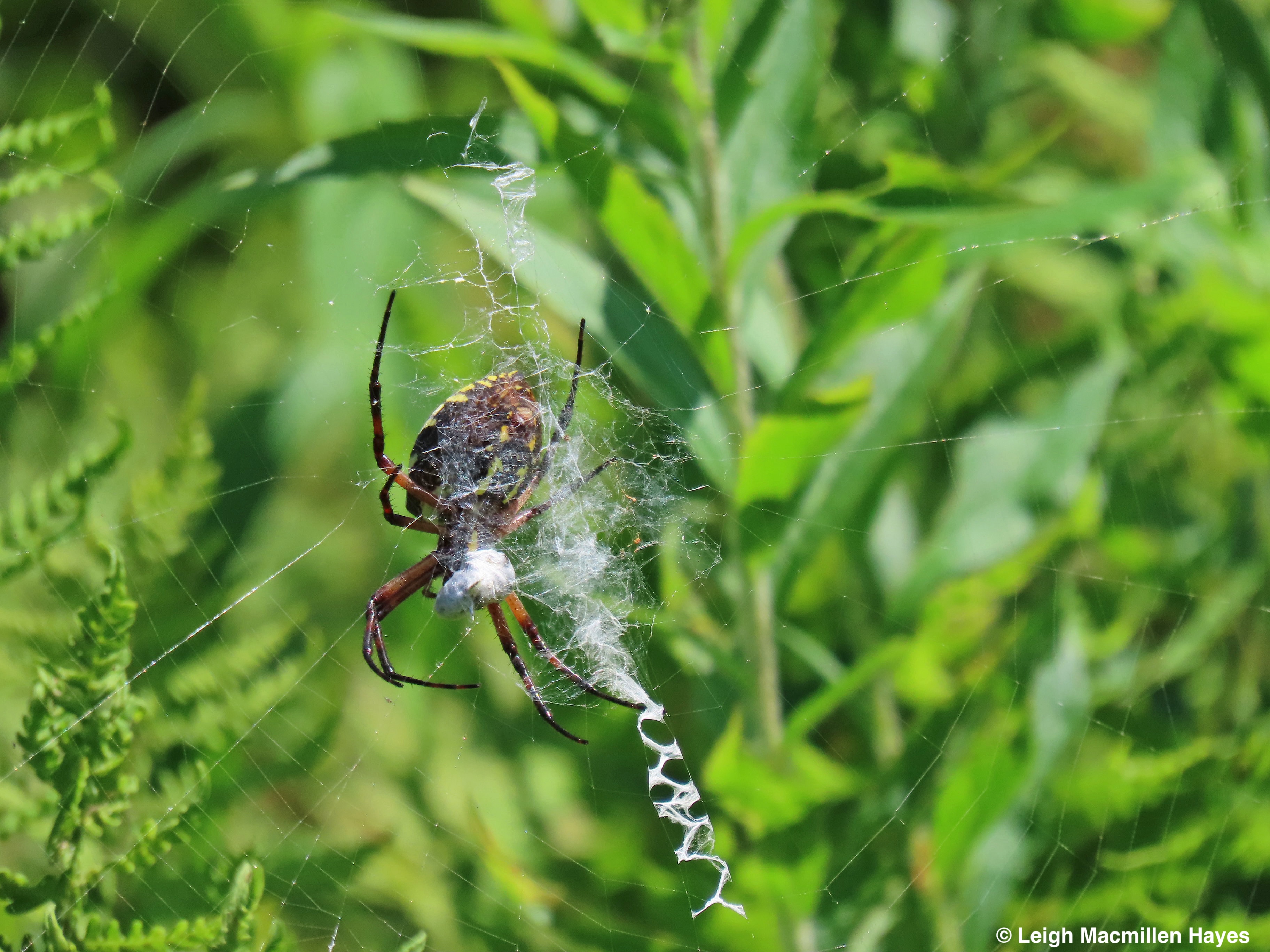
Silk flows from the spinneret and the victim is quickly wrapped up as the spider turns it over . . .

and over again.

Click on the arrow and you can watch this ten-second video of the action.
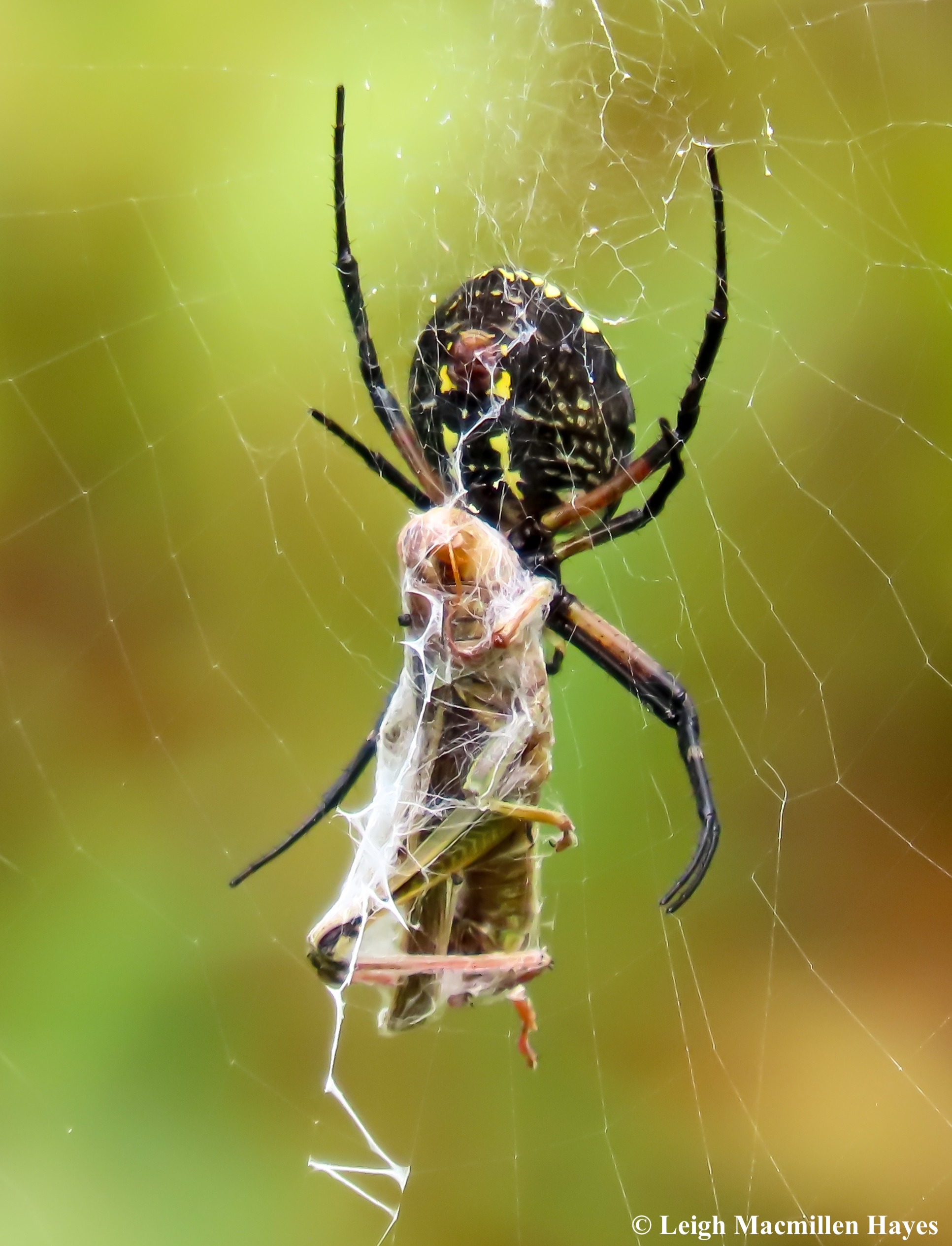
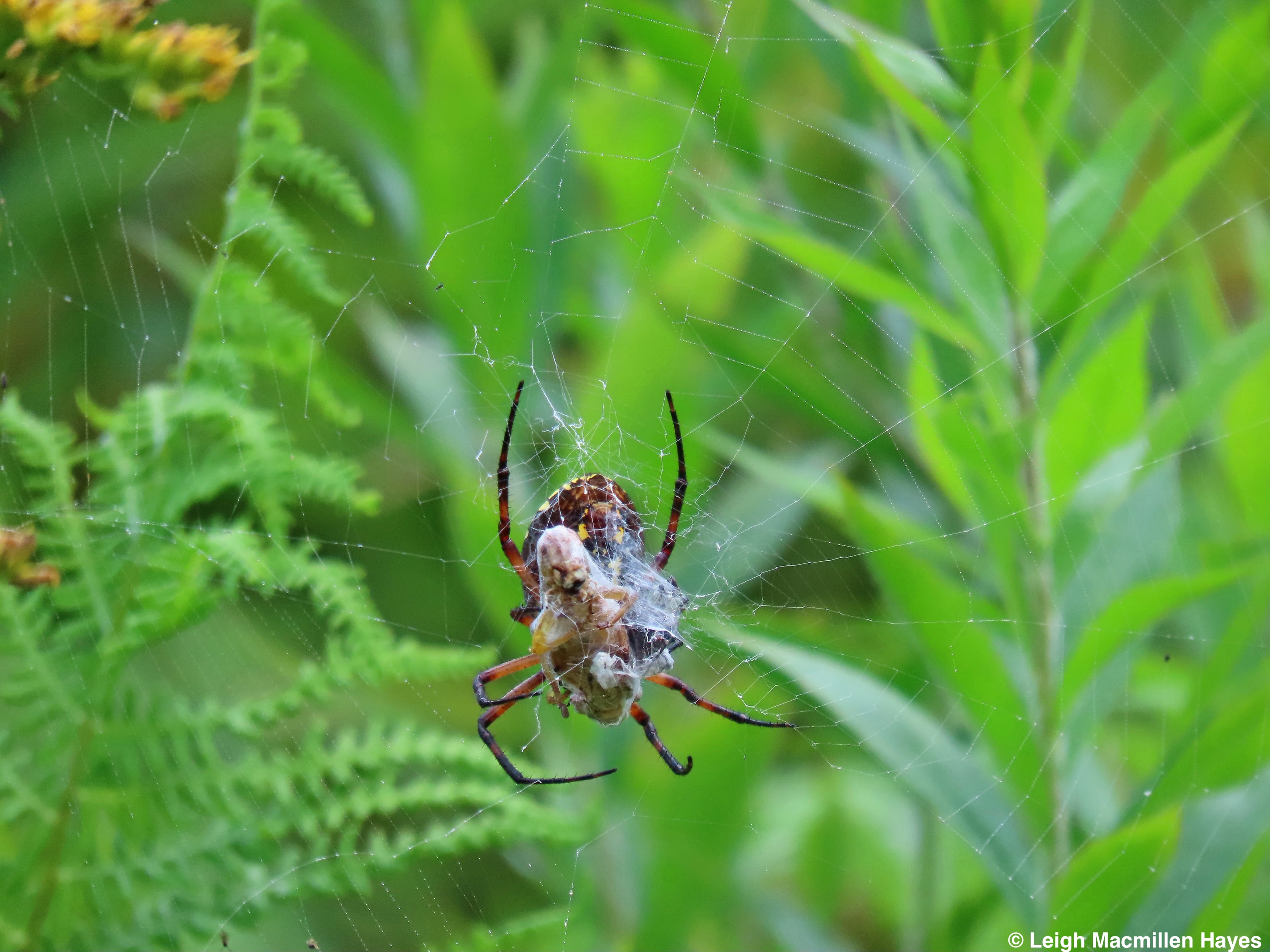
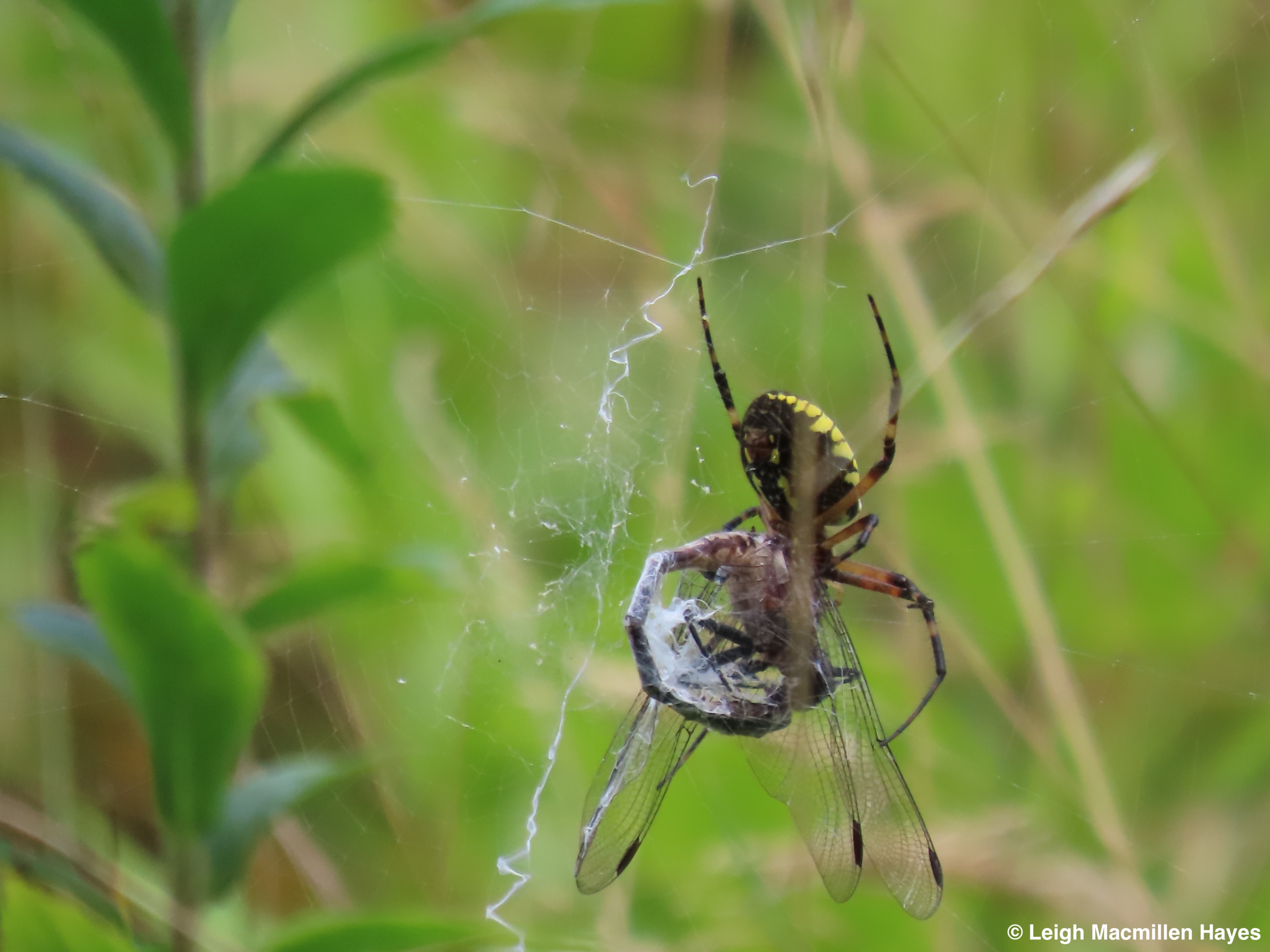
Their meals come in all shapes and sizes and there are plenty of grasshoppers to meet the spiders’ feeding needs.

What I found curious is that not everything gets wrapped in quite a neat package, and I’m not sure why . . . yet.
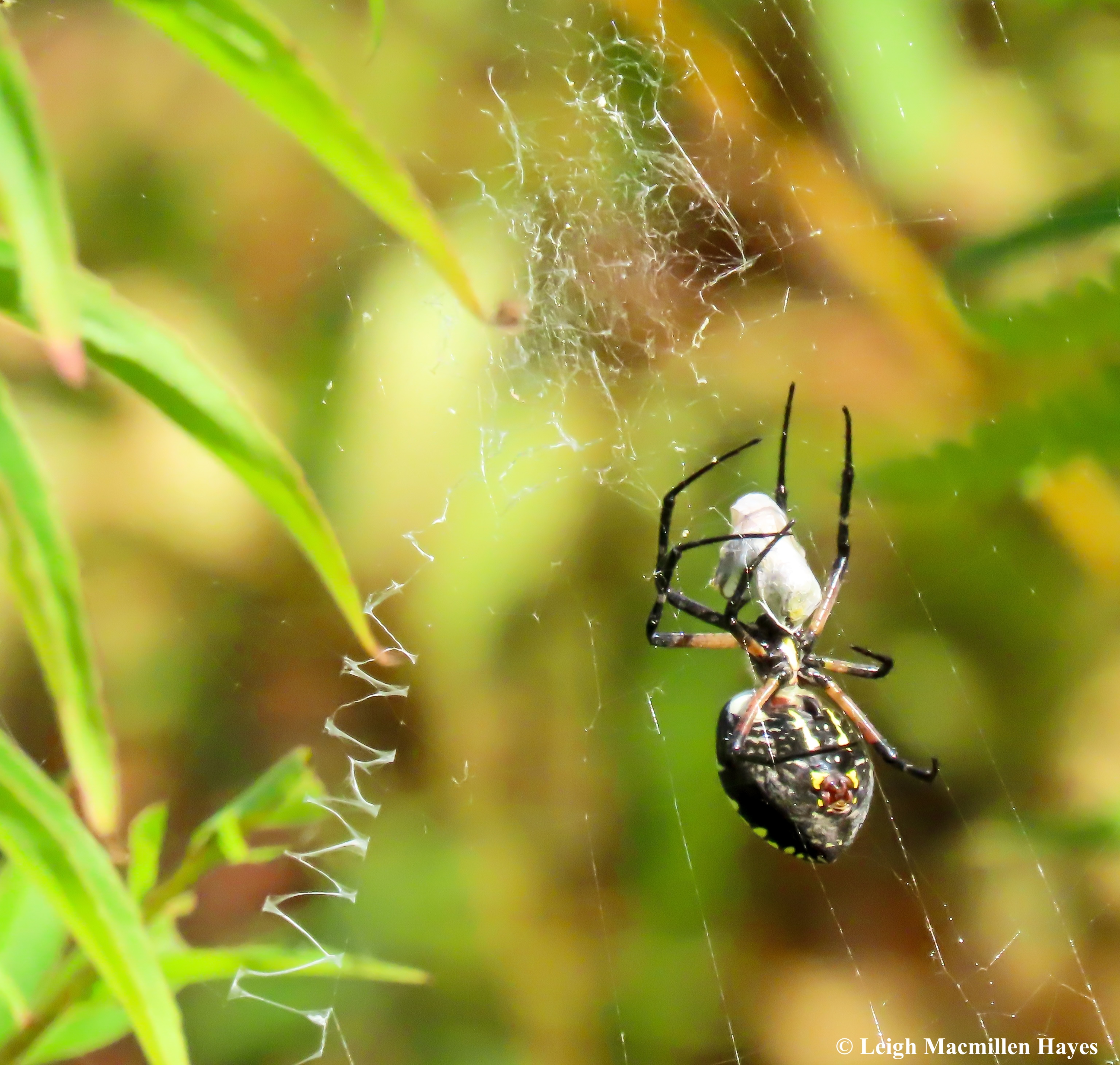
I also had the chance to watch as a meal package was moved from a lower part of the web.

And brought up to the central station, which is a rather cobweby creation in the center of the orb.
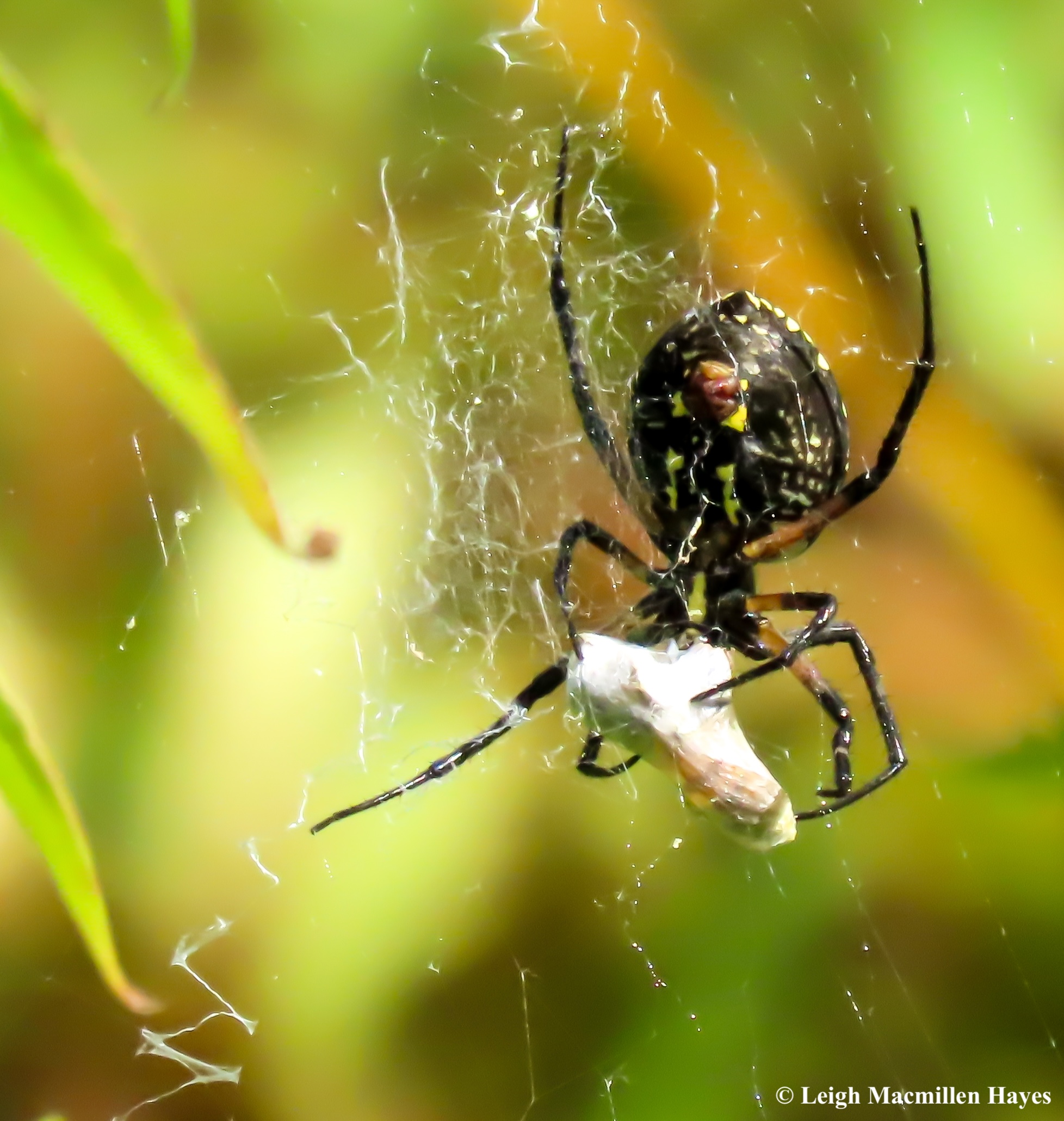
And then the spider went into its traditional upside-down manner in this home base as it continued to wrap the captured insect.

As I draw this blog post to a close, I want to note that most of the spiders (at least a dozen on any given day) I spot are located in an East/West orientation, their upper dorsal carapace or their underside facing in these directions.

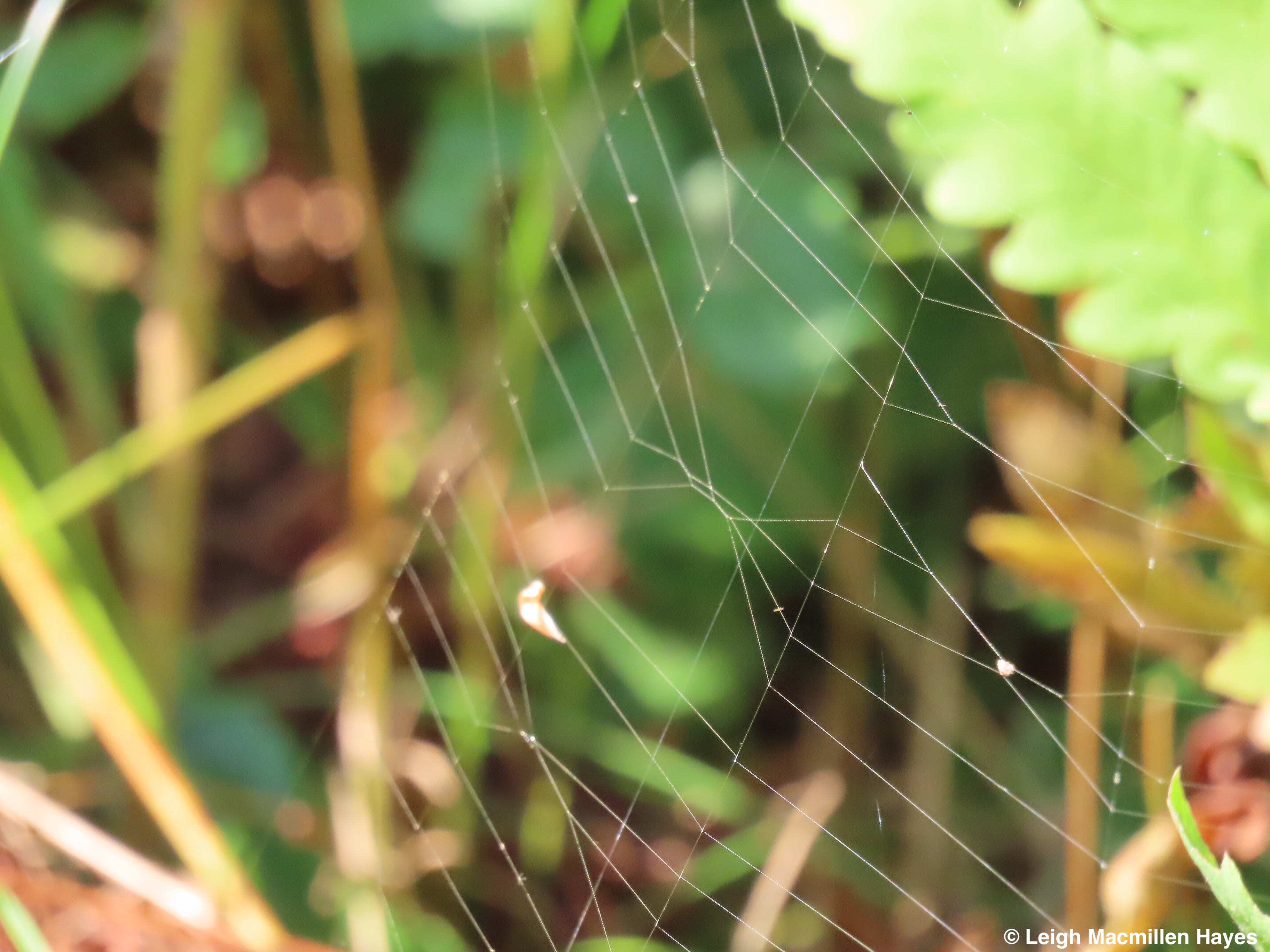
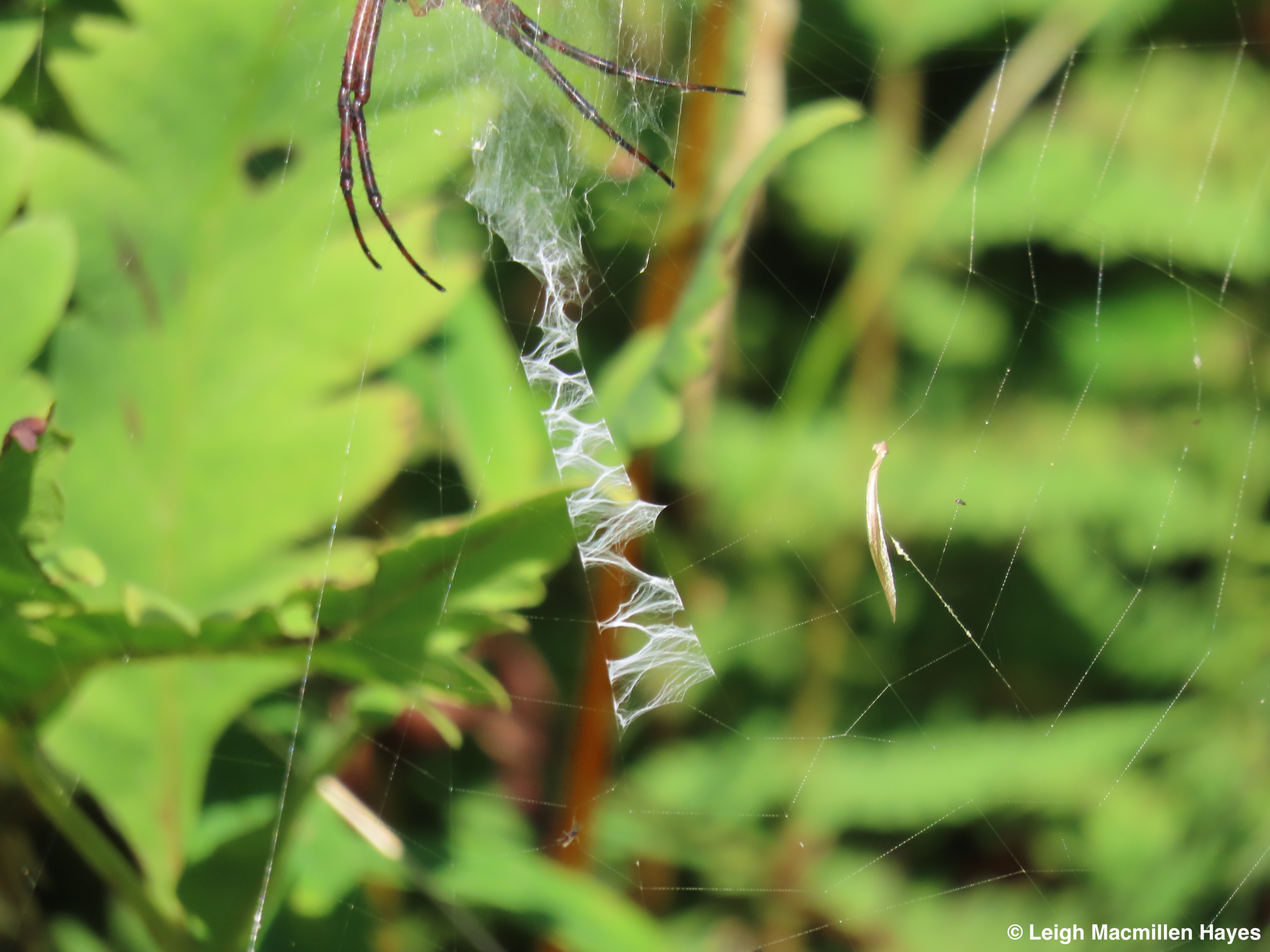
And even when a Black and Yellow Garden Spider abandons a web site, the drag lines remain, for such is their strength.

Those drag lines are super thick and if we were to walk through them, heaven forbid, we’d bounce off of them. It’s an amazing wonder.

What happened to the resident spider of the web above? I don’t know. I did spot a male hanging out with the female a couple of weeks ago, so maybe they mated and were done. Or . . . she moved on to a different location.

At the end of the day and the end of the web and the end of this post, I will be forever in awe of these Black and Yellow Garden Spiders, and grateful for what they and all the insects teach me.

I am also incredibly grateful to my neighbors for their awe of the natural world as it plays out in our neighborhood. And for her nose! Which smelled that fire that could have set all of this aflame.

And I’m thankful for the calm woman at Dispatch and brave first responders who put out the brushfire on an extremely hot day.

My Flame for Black and Yellow Garden Spiders is best ignited by awe and not by real fire.
Walking My Thoughts Among Life and Death

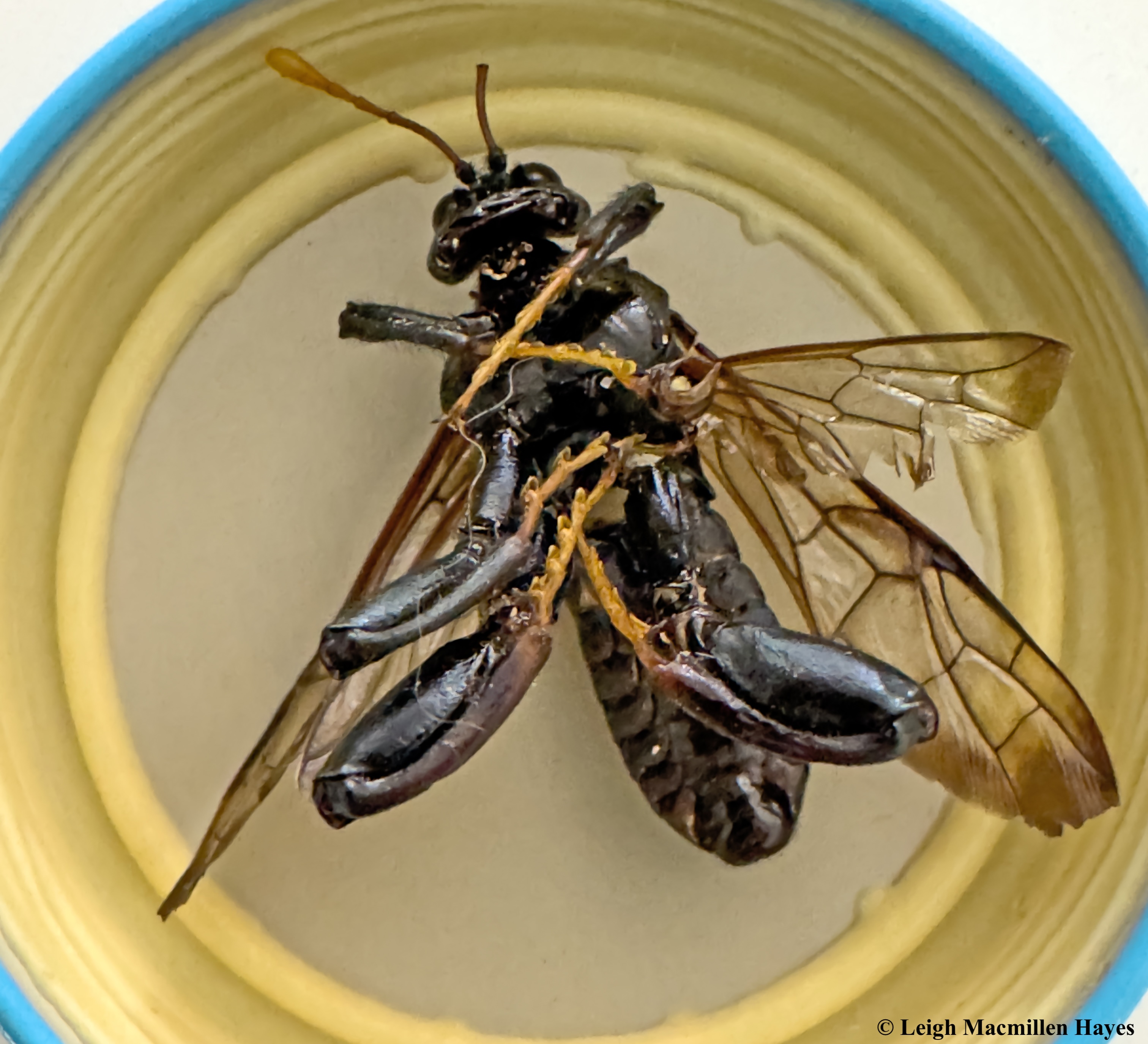
People present me with cool gifts and yesterday was no different. First, I received an email from a friend asking if I could ID a bug she’d found on the ground following a quick but harsh storm on Wednesday night. And after I did so, she asked if I’d like it for my collection.

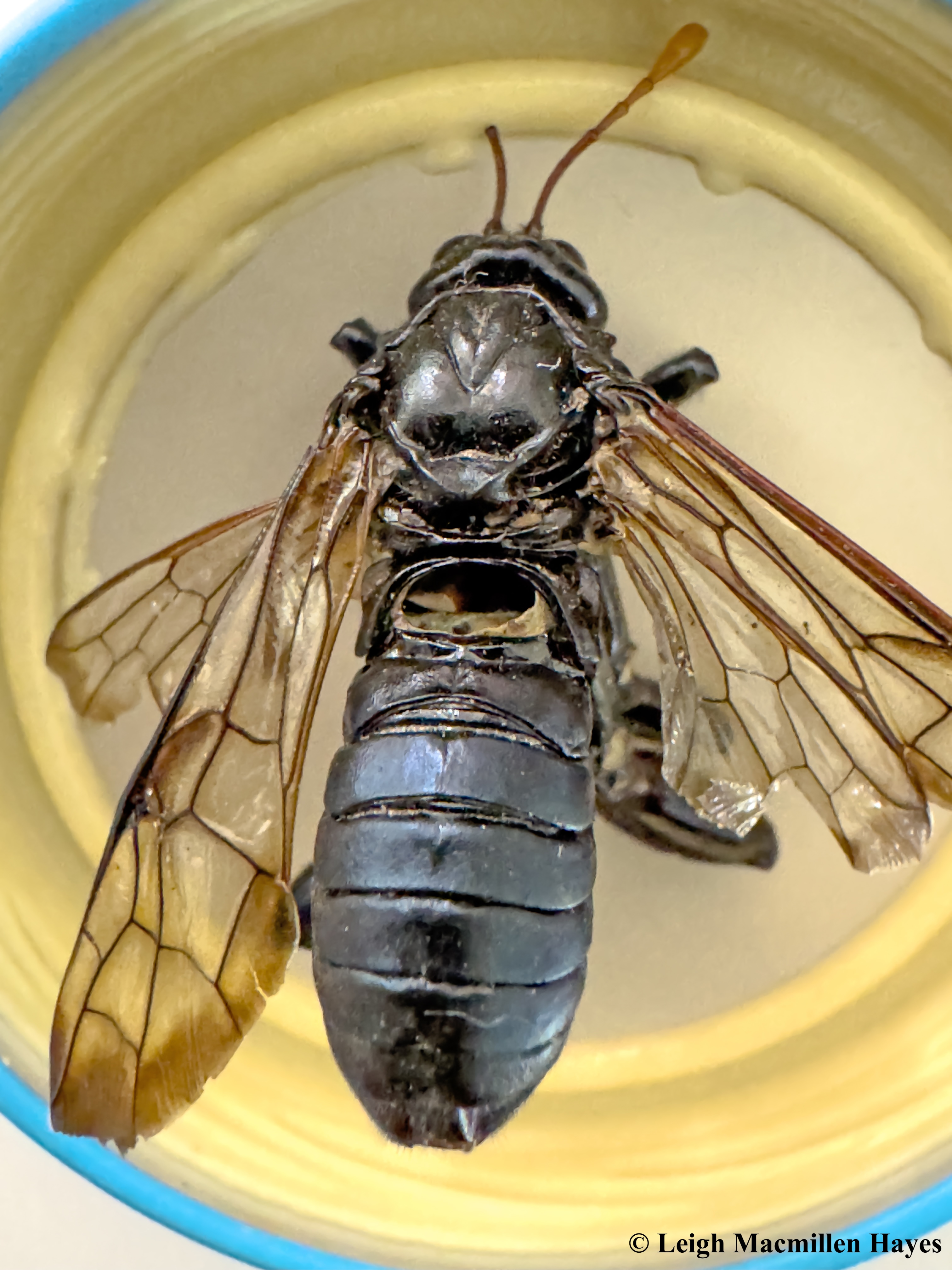
Like it? I’d LOVE it. Look as those beefy legs. All meat on the femur and tibia, which give this insect a rather mean look. That and it’s size. From head to tip of abdomen it measures 1 1/4 inches, and it has a wing span of 1 7/8ths. Not one you really want to meet in a vacant alley.

Before I was gifted this creature, I asked if it had a whitish spot on at the top of the abdomen and was correctly informed that it did not.

Except: upon closer inspection after I picked it up from Kappy yesterday, I discovered that it did indeed have such, only where the spot had been was now a hole. And it appeared that the guts had been sucked out of it.

That got me to thinking about the weather this past week and the Bumble Bees I went in search of during some rain on Thursday. All were taking a mid-day siesta as they clung to flowers and water droplets formed on their bodies.

Some had been better at locating a spot under the foliage, but by the matted hair on the thorax, it didn’t seem to make a difference. Wet is wet.

And one I thought was rather silly because it could have easily climbed into the Hosta flowers to sleep, but instead chose the outside upon which to wait out the storm. It really wasn’t much of a storm on Thursday, but rather a pleasant summer rain that we needed.

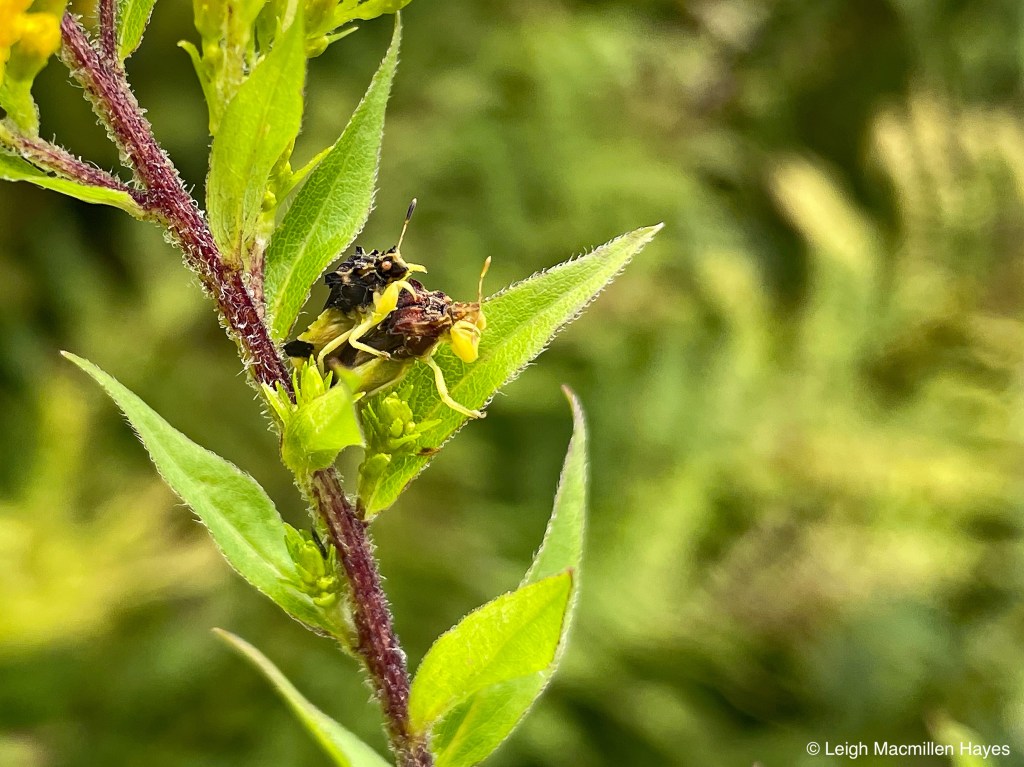
Then on Friday I found this sight, an Ambush Bug using its raptorial legs to hold its prey, a Bumble Bee.

At less than a half inch in size, Ambush Bugs sit silently on or under flowers, waiting for the right moment to do as their name implies and ambush an insect with their hooked forelegs, then inject a venom to immobilize the victim. They also inject a liquifying fluid that turns the prey’s insides into a buggy milkshake, the summer drink that they slurp through a straw-like beak.

Knowing they can take down prey many times their own size, I began to wonder about my bees and the Mighty North American Elm Sawfly (the larvae of which, I’ve just learned feed on foliage of willow, birch, maple, cottonwood, aspen and other poplars, and of course, elm trees).

I wondered if the rain on Wednesday night and again on Thursday, helped the Ambush Bugs because they had wet and lethargic insects clinging to flowers or leaves and just waiting to be victimized–in a buggy sort of way.

I’ll probably never know, but today, I headed out to the field, which I’ve decided is actually a meadow, and I think I’ve said that before, to see if I could find more Ambush Bugs.

My neighbor, Karen, who owns the field, saw me and followed a cutover path her husband created (mowed) and we met in the middle to chat for a few minutes. And then, as we were about to go our own ways, we saw a species the two of us have been seeking for several weeks now. The best part is that we saw the Black and Yellow Garden Spider at the same time.

As it turns out, when I checked my blog posts for last year, we spotted the first of this species on August 3rd. Well, I did anyway. I think Karen was a few days ahead of me, but once I had cataract surgery, the whole world opened up and gave me a Field of Vision I hadn’t experienced in a long time.

Today’s female was working on spinning a meal into a package, and it was difficult to tell what she’d caught. But that didn’t matter to us. We were just so happy to have spotted her . . . together.

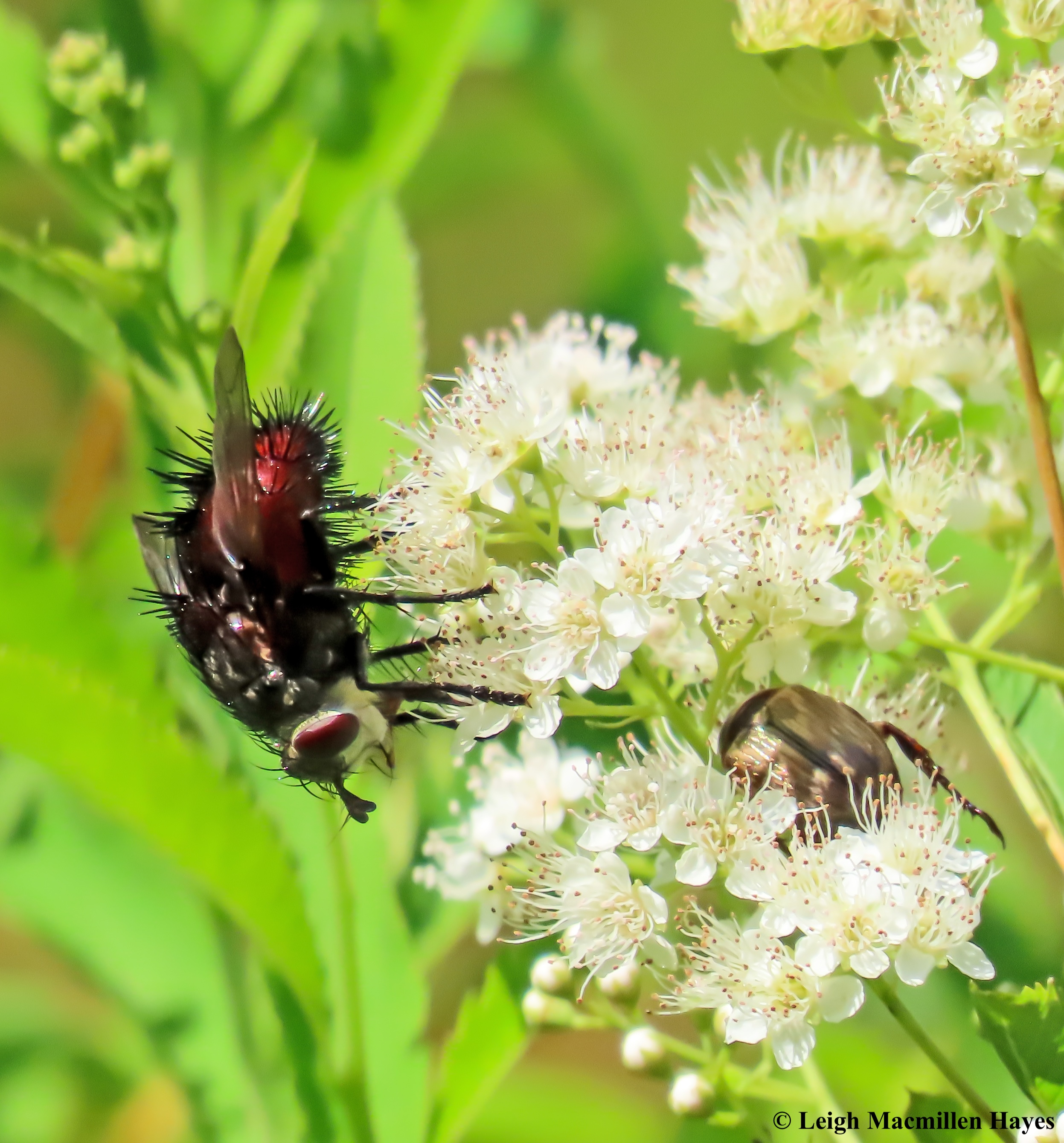
Later in the day I was back in the field, and again had a first sighting for this year–a Tachnid Fly, its dark oval eyes and bristly oversized body a giveaway. Tachnid Flies are considered beneficial because they dine on lots of other insects including sawflies (hmmm), borers, and green stink bugs, plus tent caterpillars, cabbage loopers, and spongy moth larvae.

Suddenly an interesting looking insect flew in . . . only it wasn’t one insect but two, and moving rather rapidly across the flower tops.

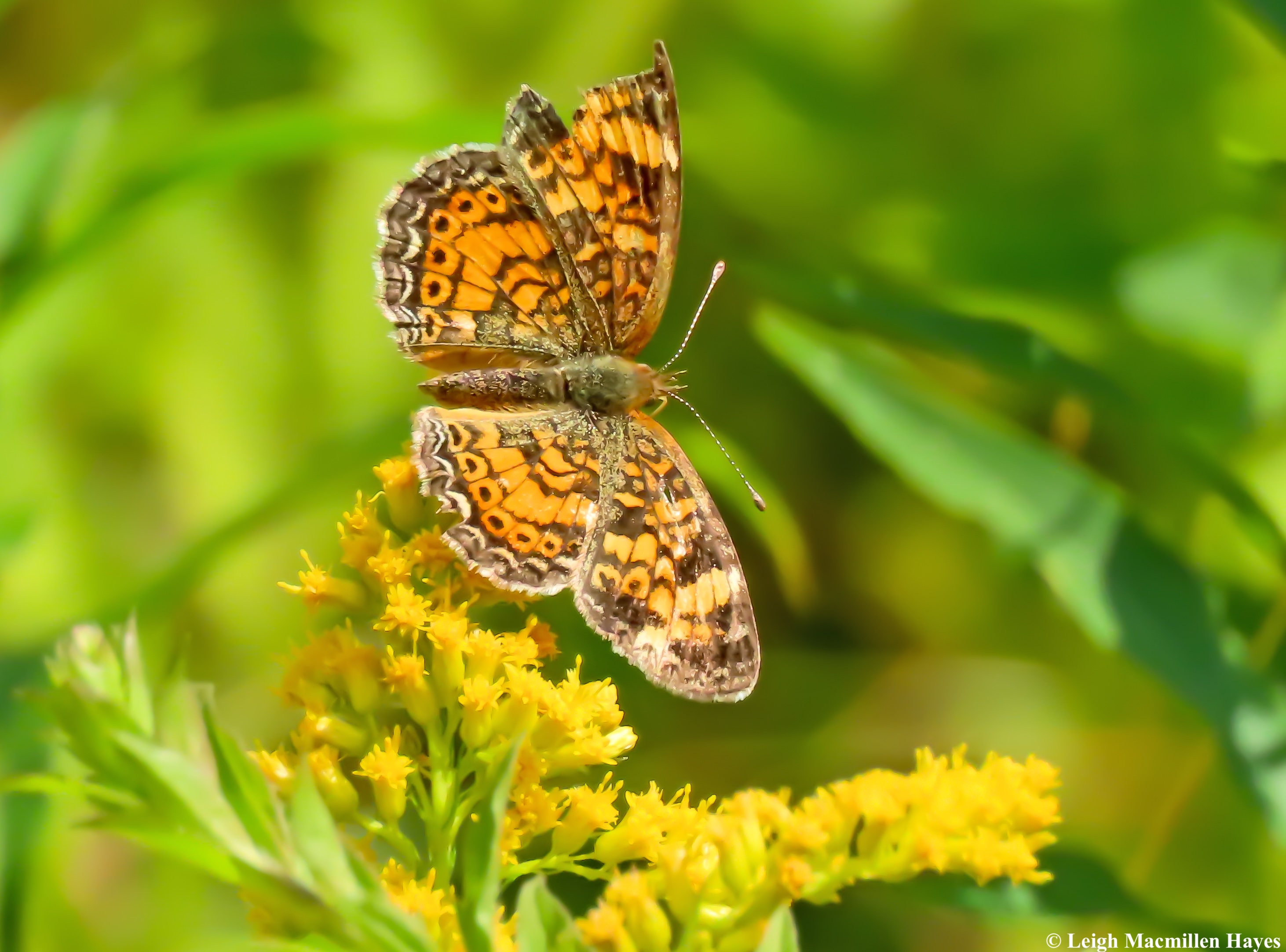
As they moved on, my eyes caught the action of a Pearl Crescent Butterfly, its forewing tattered and I thought of part of the conversation Karen and I had had earlier. She wondered where all the dragonflies have gone.

There are still a few Calicos and Spangles, and I suspect we’ll see more in the future, especially as the Meadowhawks continue to emerge, but our neighborhood was rich this year with birds nesting and many of the dragonflies became food for the young and I suspect this butterfly had a narrow escape at becoming such a meal. Bugs feed birds and that’s a good thing.

And then the Gold-marked Thread-waisted Wasps paused nearby and showed off their true canoodle form before moving on again.

At last my search paid off today, and I began to spot one Ambush Bug after another, laying in wait.

I just had to remind myself to look for insects hanging below flowers rather than buzzing about in true and frantic pollinator mode, such as this Yellowjacket. The Ambush Bug is by the left side of its face, but blends in incredibly well with the Goldenrod.

As it turned out, there were also spiders enjoying feasts much bigger than themselves.

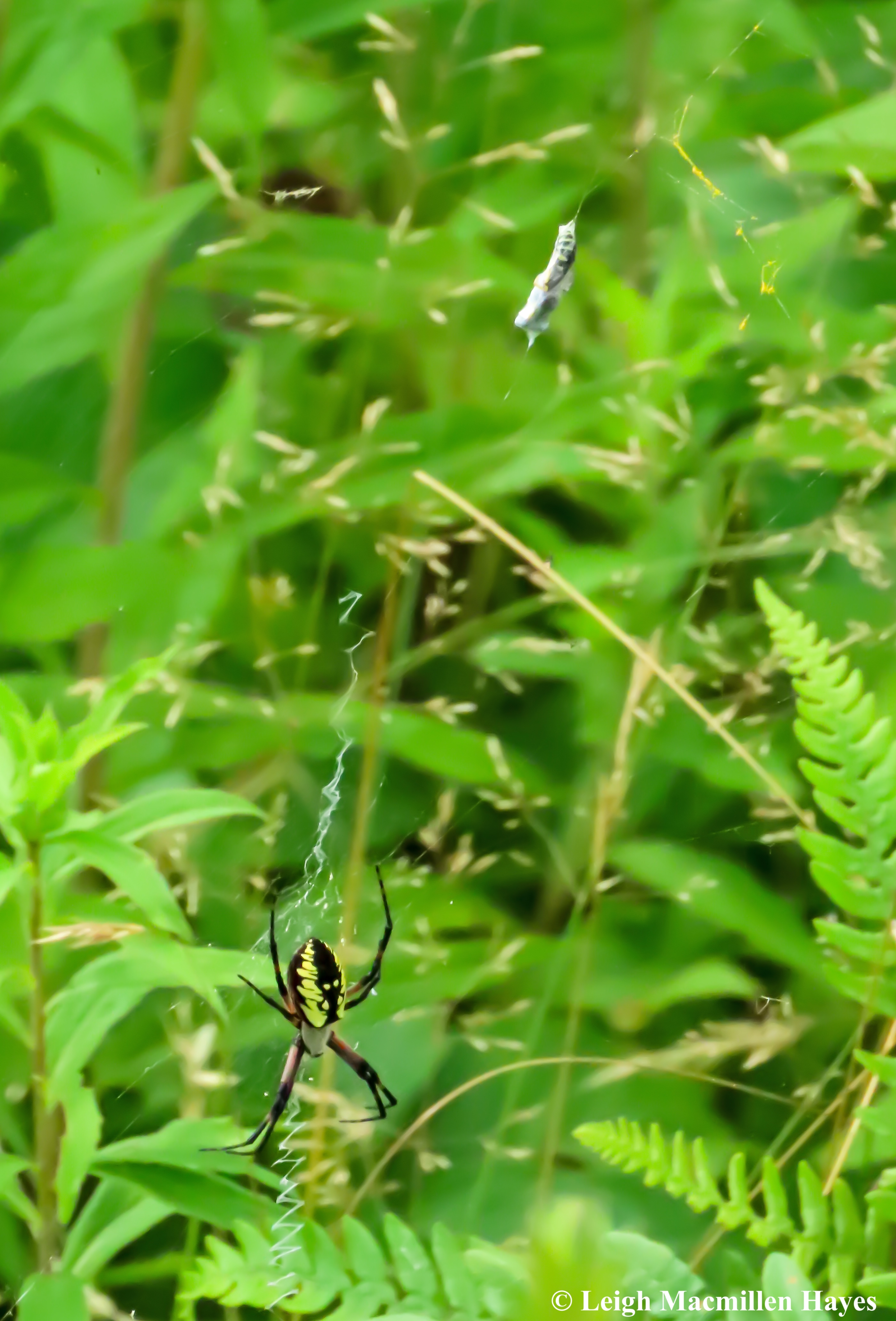
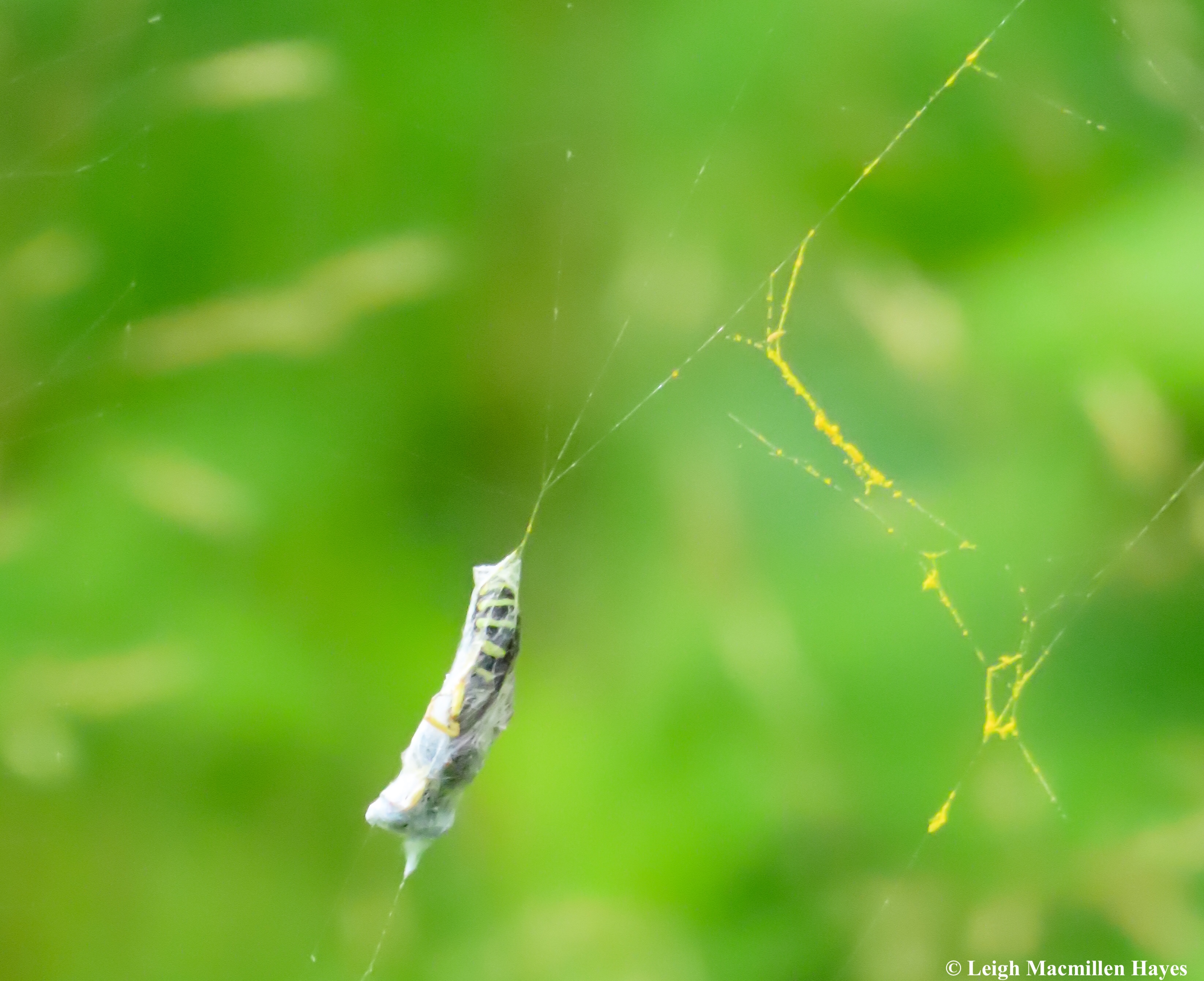
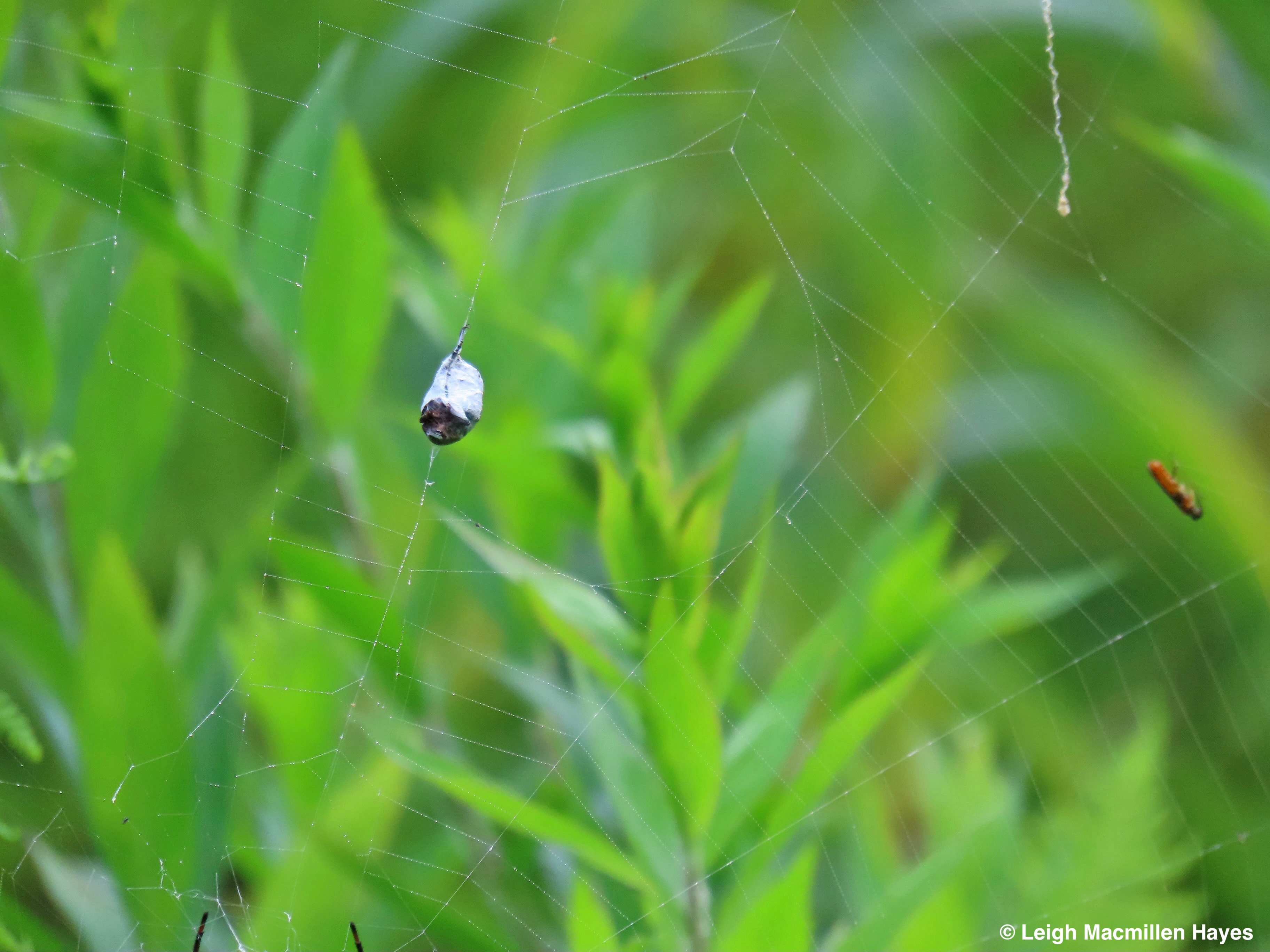
And then another Black and Yellow and then this, the third, with a packaged meal suspended in the web above.

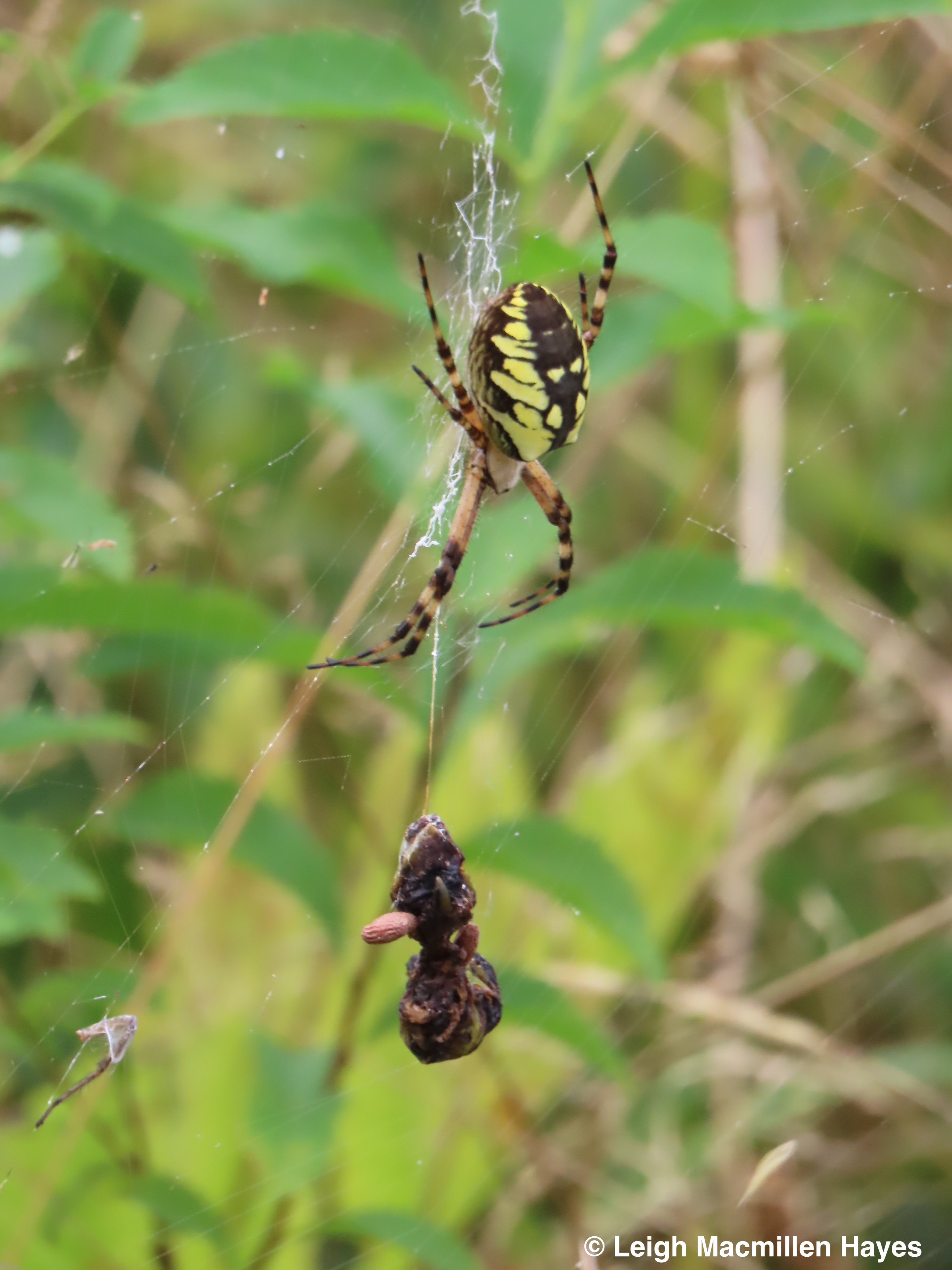
I couldn’t be sure of what species had been captured, but by its markings suspected it could be Locust Borer. What I loved even more than the doggy-bag meal, was the yellow Goldenrod pollen trapped on the spider web.

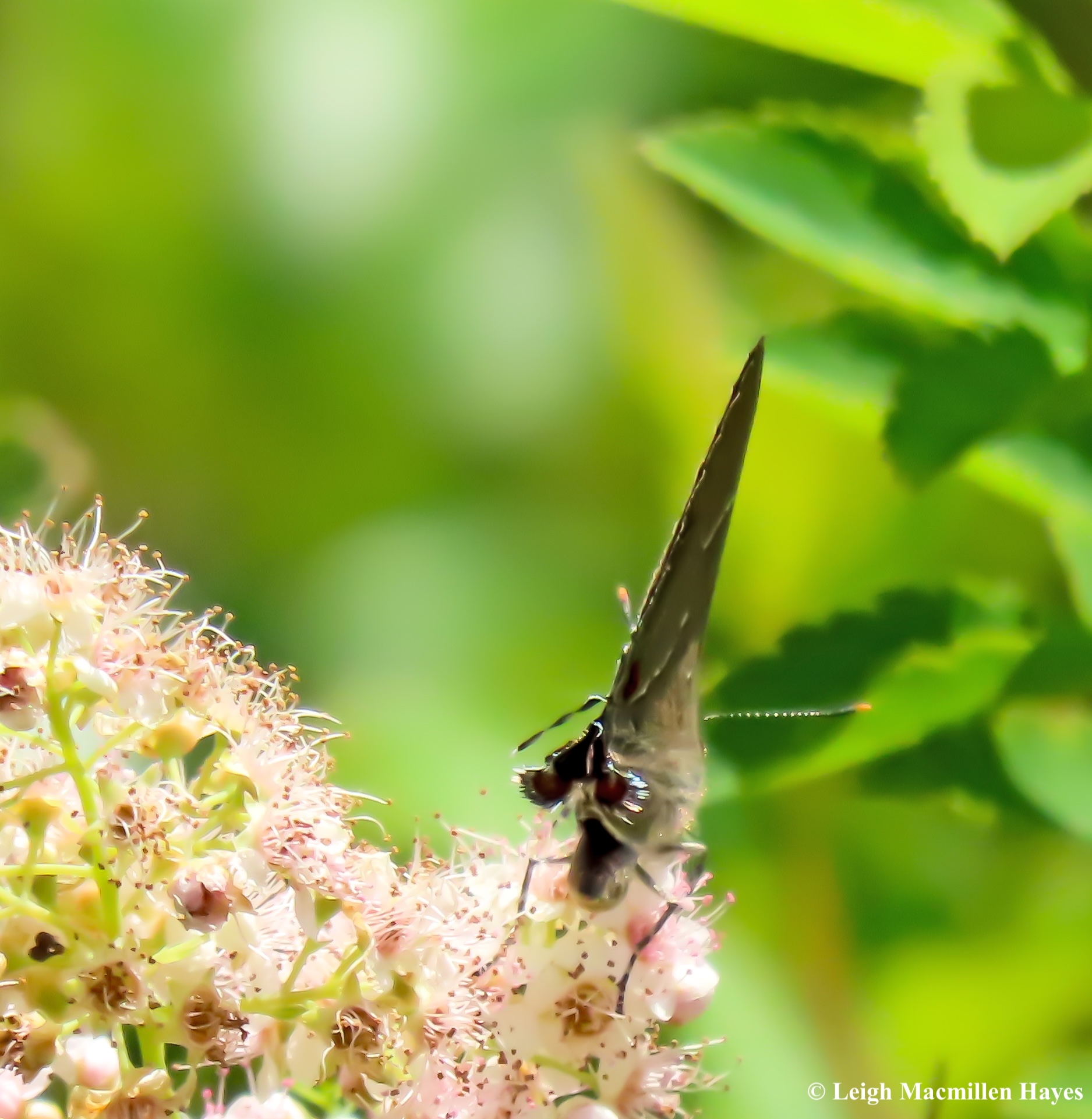
And then, as I circled back, I found myself looking at the butt end of a small butterfly I met for the first time in this very place last year.

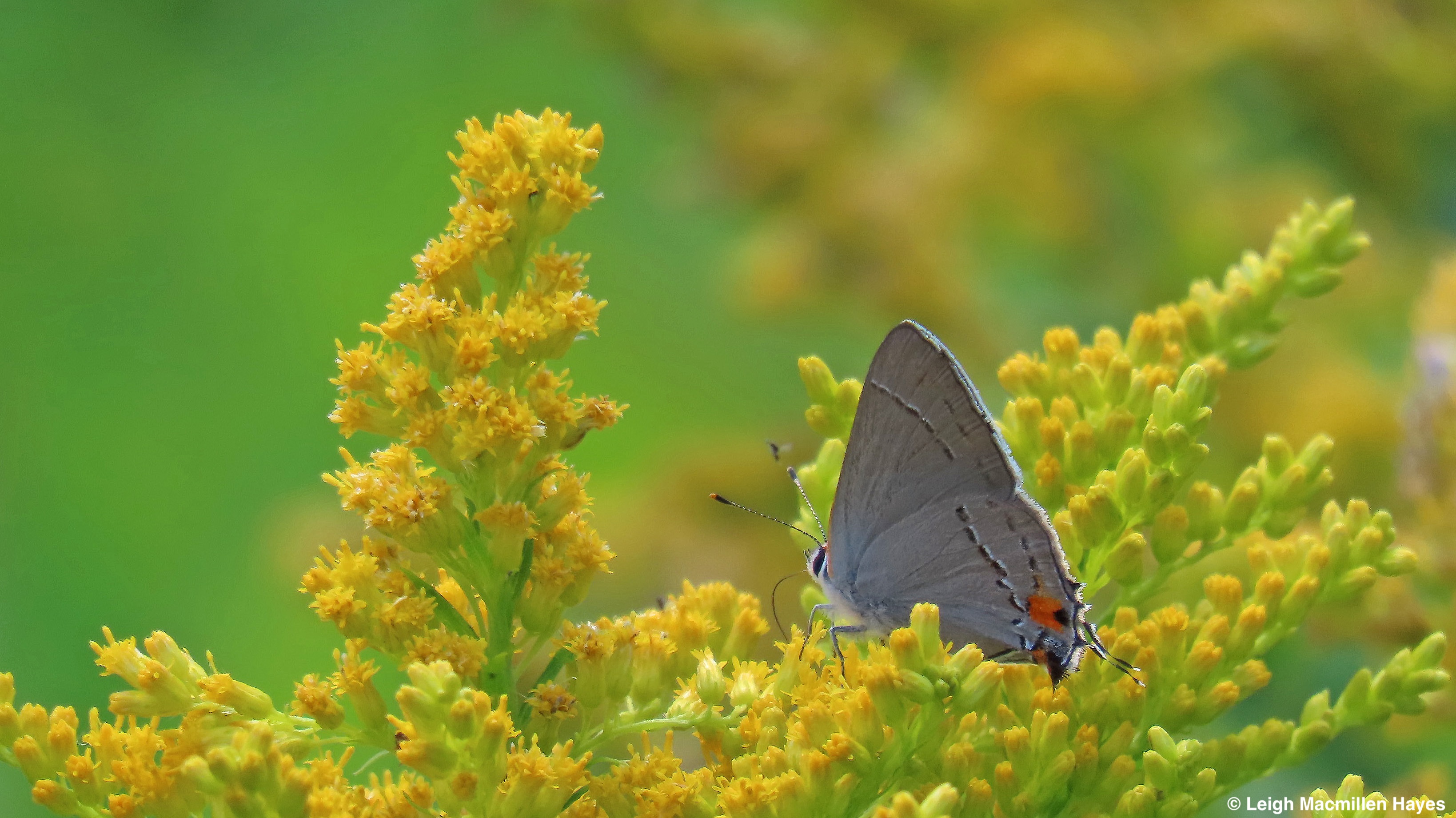
This is a White M Hairstreak Butterfly. Do you see the upside-down M marking just below the orange on its hindwing? This is a RARE sighting! Well, I actually first spotted this species on August 3 of last year and contacted Ron Butler, one of the author’s of Butterflies of Maine and the Canadian Maritime Provinces, along with Phillip G. deMaynadier, John Klymko, W. Herbert Wilson, Jr, and John V. Calhoun. At that time, it was the furthest inland record, according to Ron. And here, one year later, we meet again. Well, not the same butterfly, but its offspring and I’m thrilled to realize that this is now part of its habitat.

What a day. What a week. I don’t have all the answers about life and death, but do love that I can take my thoughts for a walk in my neighbors’ field and try to gain a better understanding. Yes, bugs feed birds; and bugs feed other bugs; and the circle of life goes on and I’m always thrilled to watch so much of it play out and open my eyes and mind to the possibilities.

Taking Stock . . . Naturally

As locals know, My Guy owns a hardware store and I often say I am married to the store. It’s true because it is a constant in our lives and follows us on walks and hikes even on his days off. And though our oldest son has taken over the reins in the past two years, My Guy still cannot completely let go.

I’ve come to realize, however, that that is okay because it means I can tend my own shop. Of course, while he owns the land and the building, I need to rent space, but it’s well worth the priceless price.
Step through the open-air doorway, and you’ll find right now I’ve got proboscis-style straws on display. They are especially beneficial when sipping from Red Clover, a member of the legume family.
And for safe storage, the Peck’s Skipper likes to show how to curl the straw up when not in use.

If you are an introvert, like me and the Common Ringlet Butterfly, you might prefer to flit from flower to flower, but then hide in the vegetation after spending so much time demonstrating for the public how to use your straw.

Common Wood-Nymphs are equally inclined to hide, but still available on the shelf for you to choose, and you can decide if this stored straw appeals to you, or not.

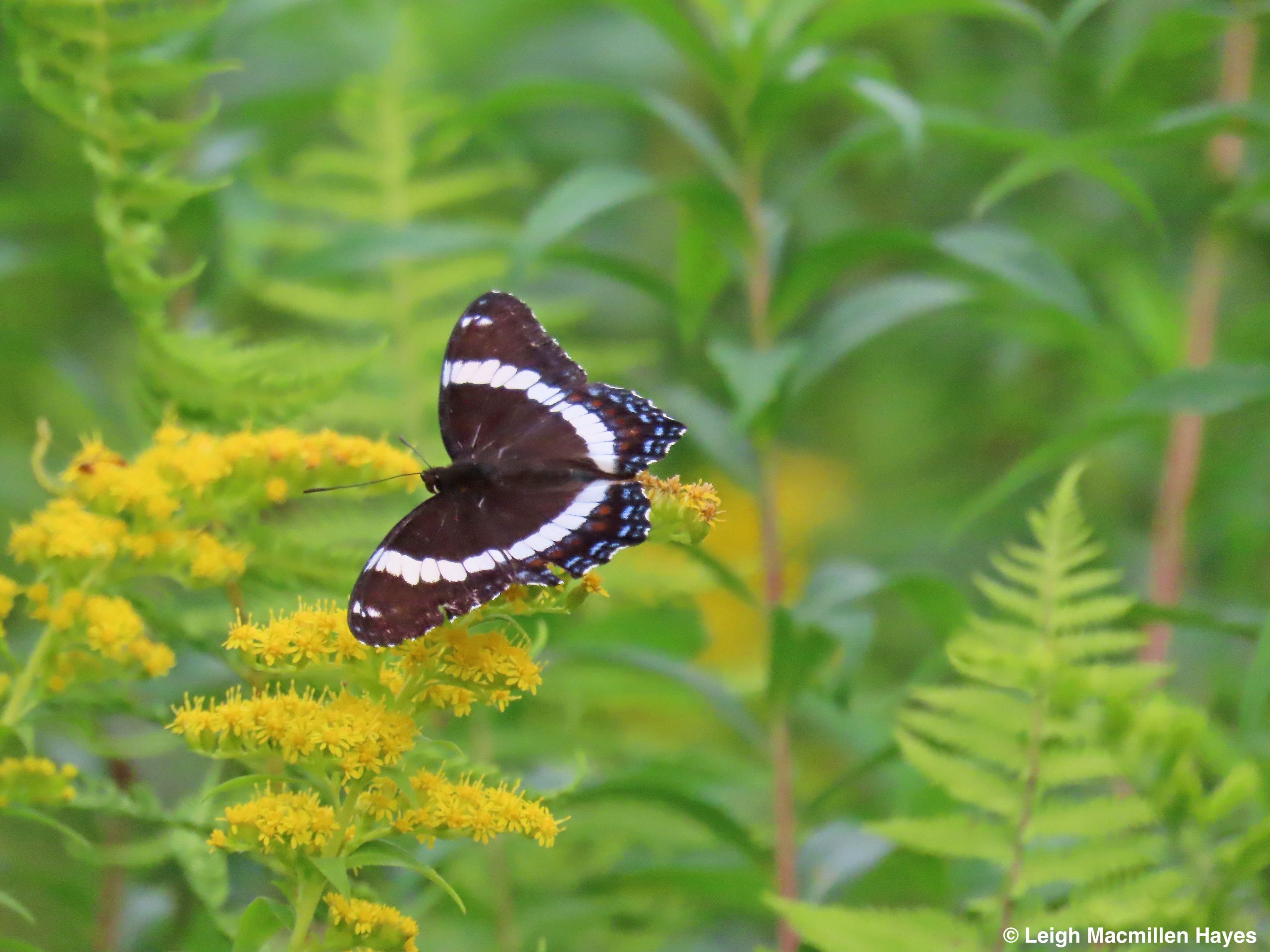
White Admirals are especially plentiful right now, and want you to know that whether hanging upside down,

or right side up, their straws always work, so it might be a good one to think about purchasing.

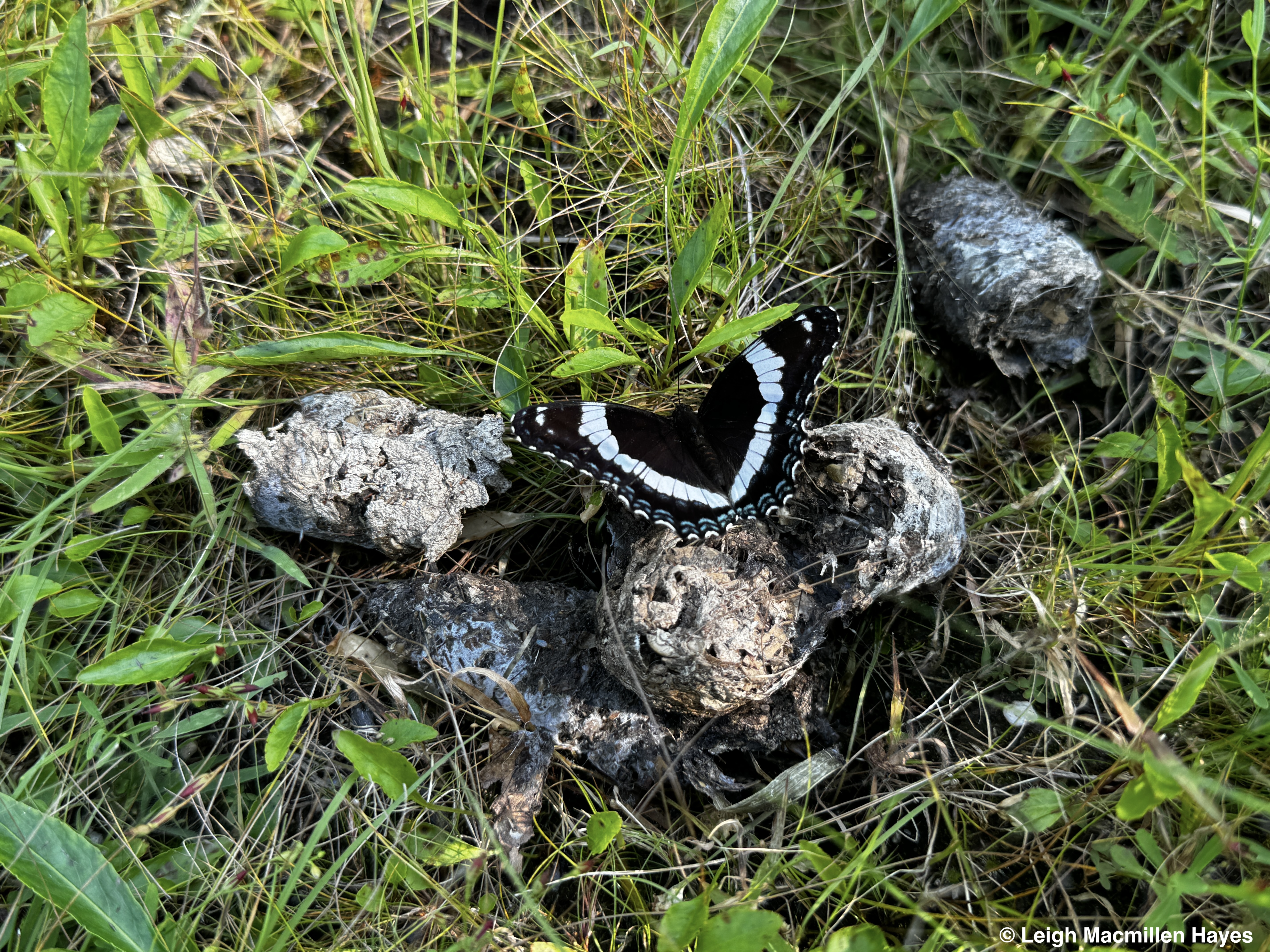
Especially if you like to get some of your nutrients from scat. We can throw in some scat for you, if you’d like–at no extra charge!

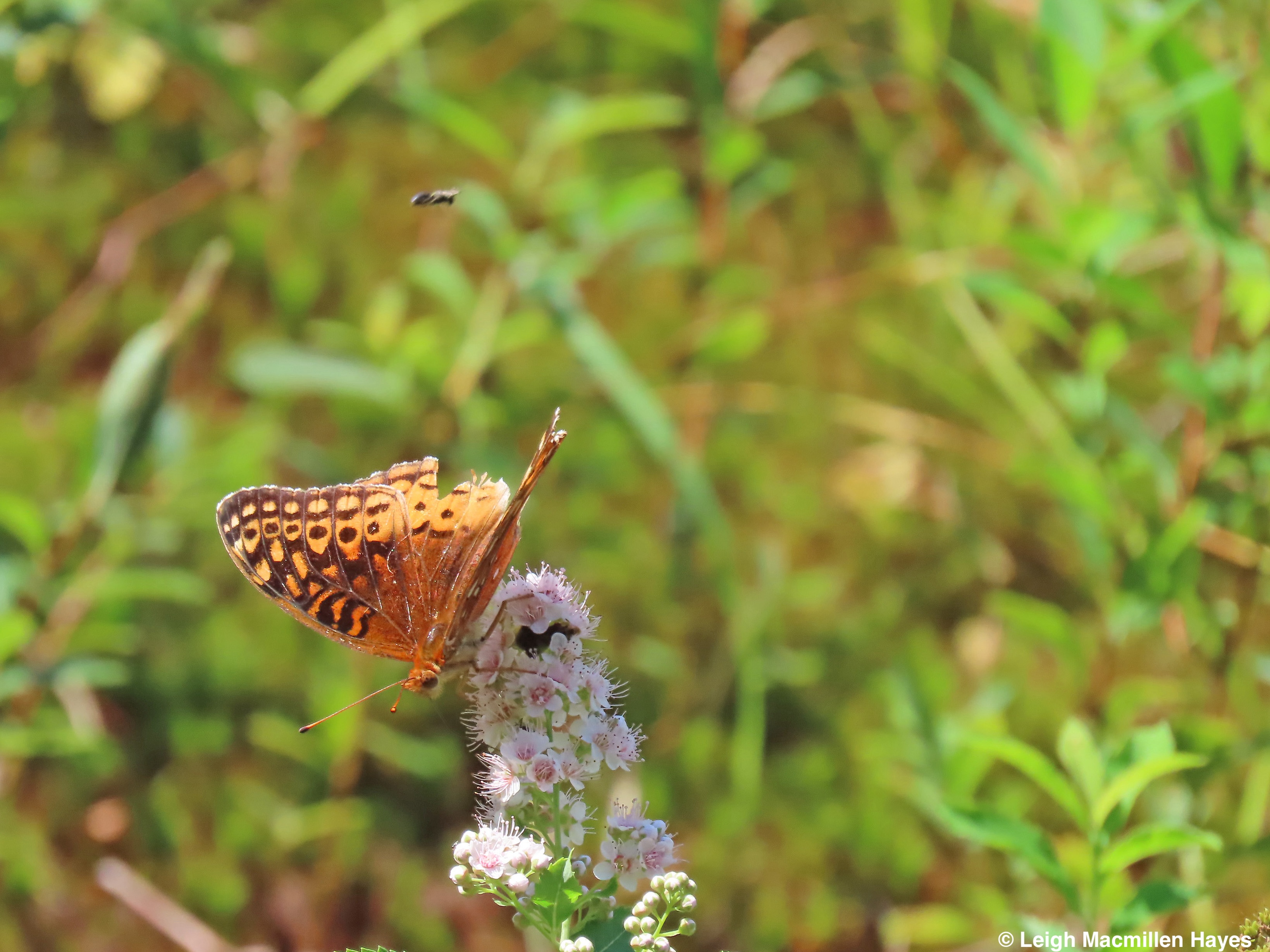
Sometimes it’s the packaging that makes all the difference, so we’ve got several orange choices for you to consider, this being the Fritillary style. Make me an offer I can’t resist, and this straw is yours due to the fact that it has been used previously, as evidenced by the tattered wing.

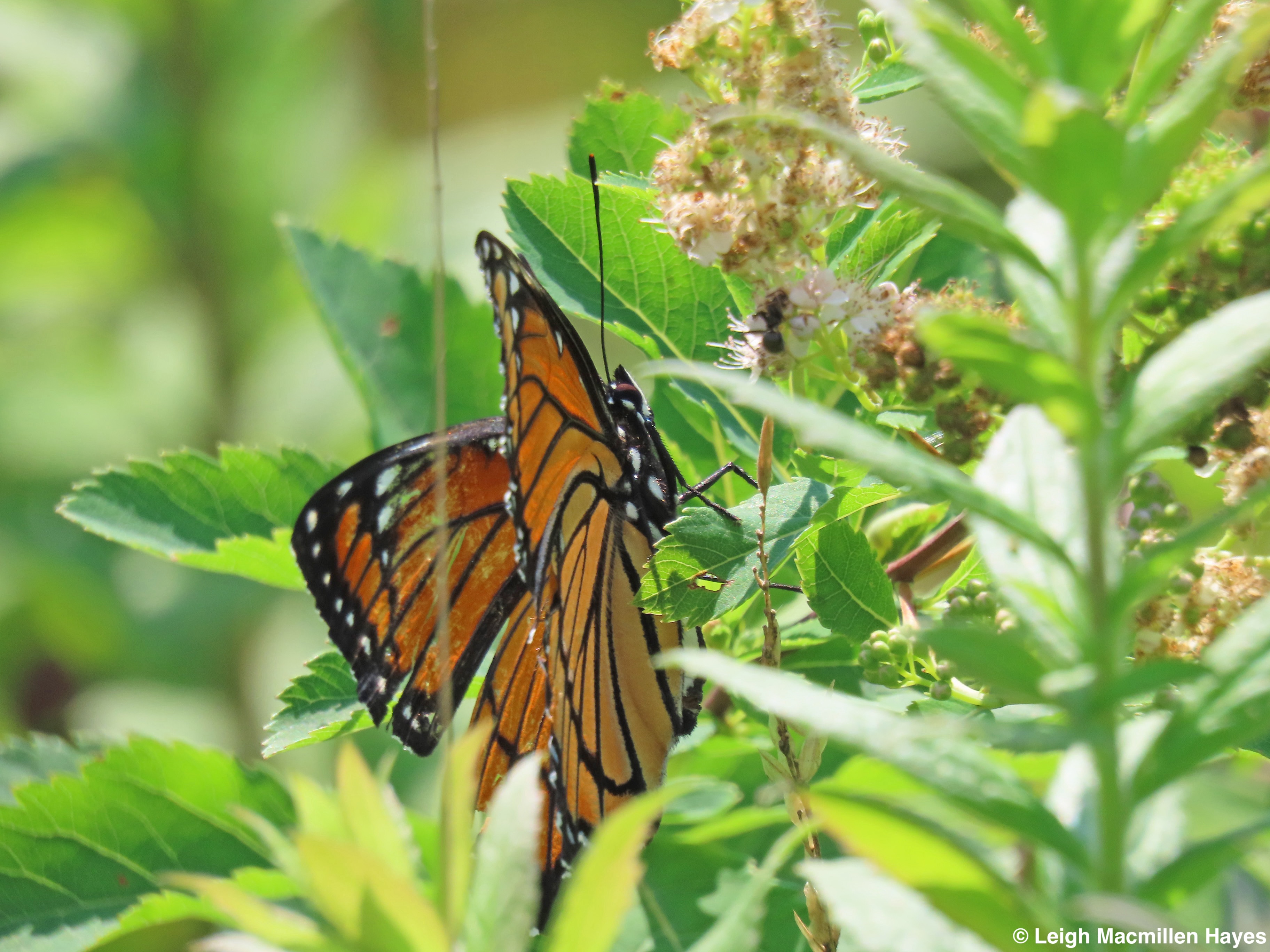
If you prefer something a bit bigger and brighter, there’s the Viceroy, with that dark band crossing its wings.

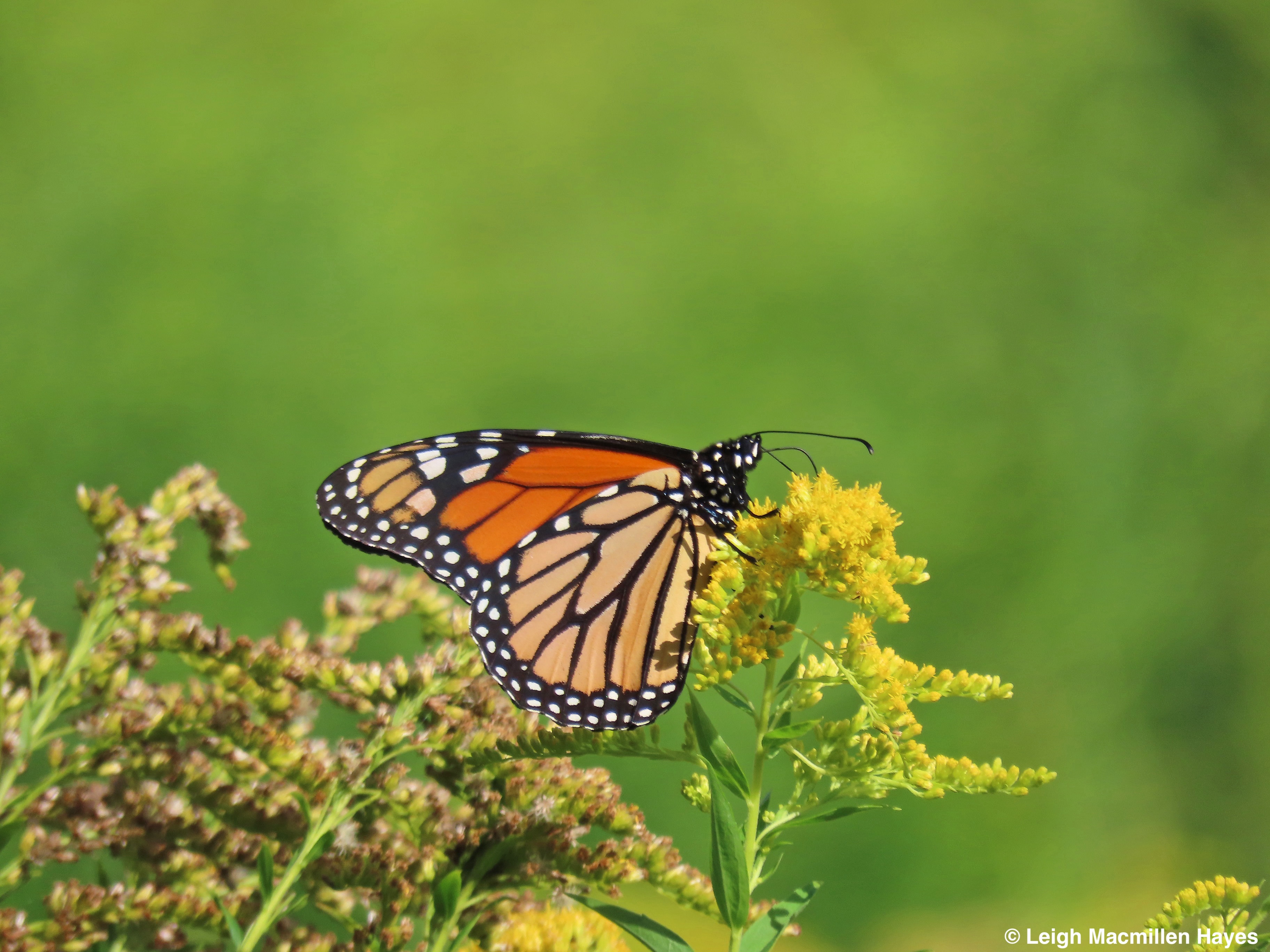
Or the biggest of all, the Monarch, who lacks the black band that is part of the Viceroy packaging.

For the tykes in your life, we also have Pearl Crescents and Northern Crescents in stock. The former is slightly smaller than the latter for the youngest in your gang.

Those are all great, but I have two that I much prefer, the first being this Clouded Sulpher that comes in pastel colors only, which contrast with the darker-colored straw.

And the creme de la creme has to be the White M Hairstreak, a rare species that I was able to special source a few weeks ago, and every once in a blue moon (such as this August is), I can find another to offer you. That is the case right now, but hurry because I don’t know how long this butterfly will remain on the shelf.

Over in the natural pesticide control aisle, I’ve a few options for you to consider, such as this handsome male Twelve-spotted Skimmer. Unfortunately, I just discovered these are on backorder, so you’ll probably need to wait until June if this is the style you prefer.

The same is true of the Eastern Pondhawk–in fact, I was totally surprised that I was able to snag this species, but suspect it has something to do with the store’s location between two ponds, and so close to a wetland and swamp.

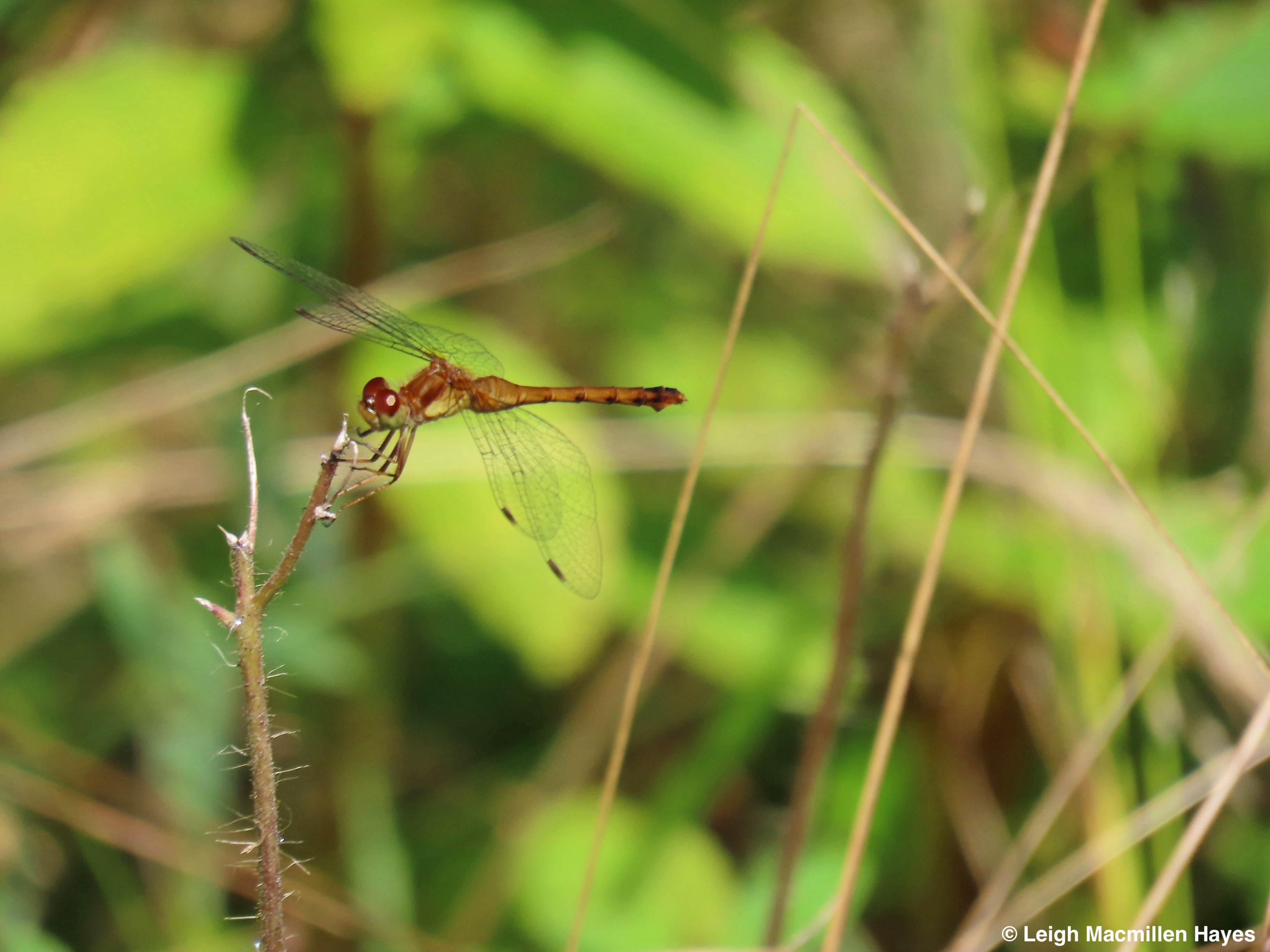
Right now, the most abundant pesticides I can offer are in the form of Meadowhawk dragonflies like this Autumn Meadowhawk, a small skimmer with tan colored legs.

If you prefer something larger . . .

you might like the darners that keep flying off the shelf. That said, there are plenty more where this guy came from, so if you can’t find one in the shop, give me a shout, and I’ll check the backroom.

Summer is not over yet, despite what everyone has been saying lately, and so if it’s pollinators you are looking for, I’m afraid I overstocked. Well, there’s nothing to be afraid of, actually. Being overstocked on these is a great thing. And you can mix and match if you’d like, perhaps choosing these European Paper Wasps,

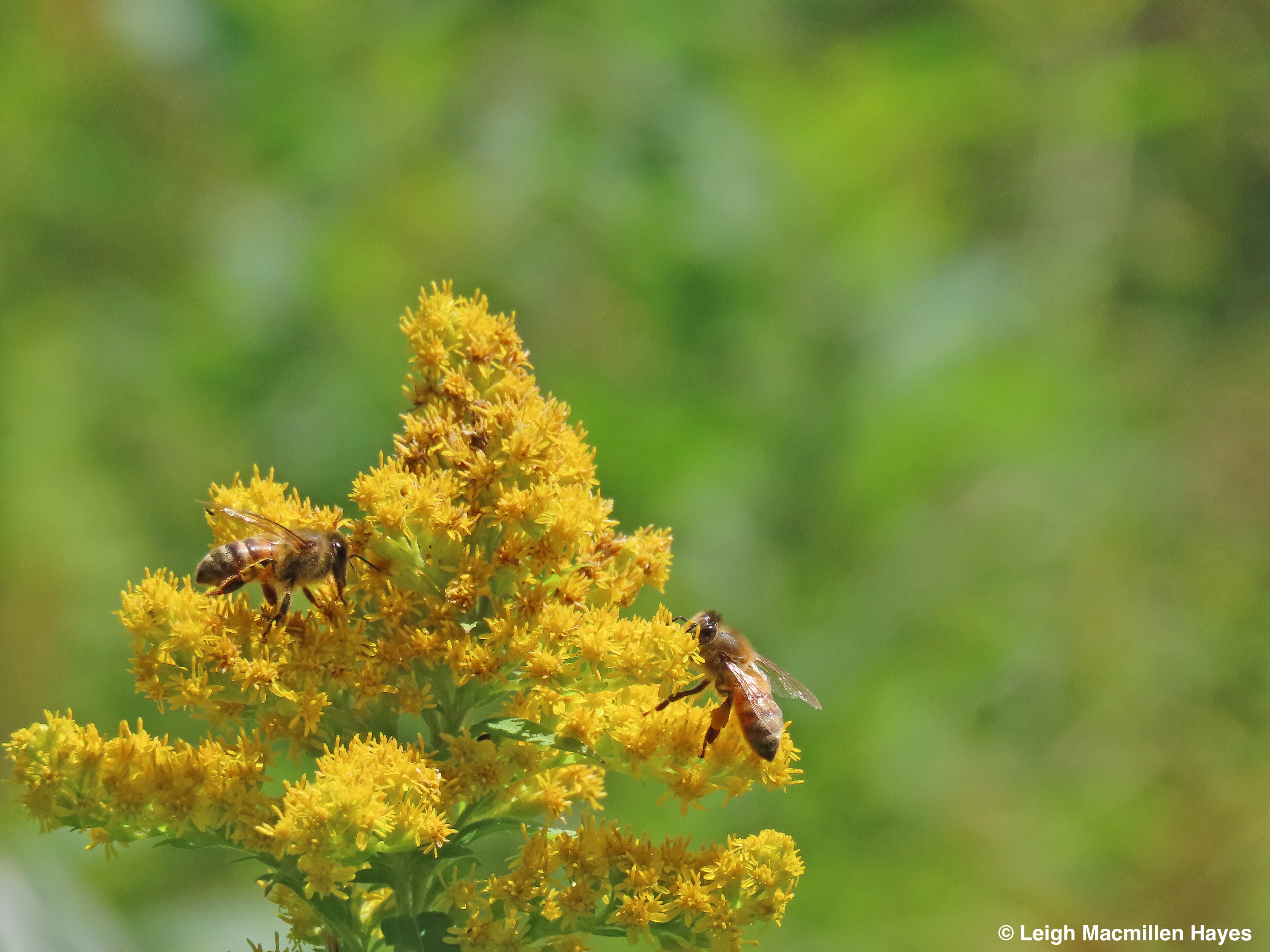
a few Honey Bees,

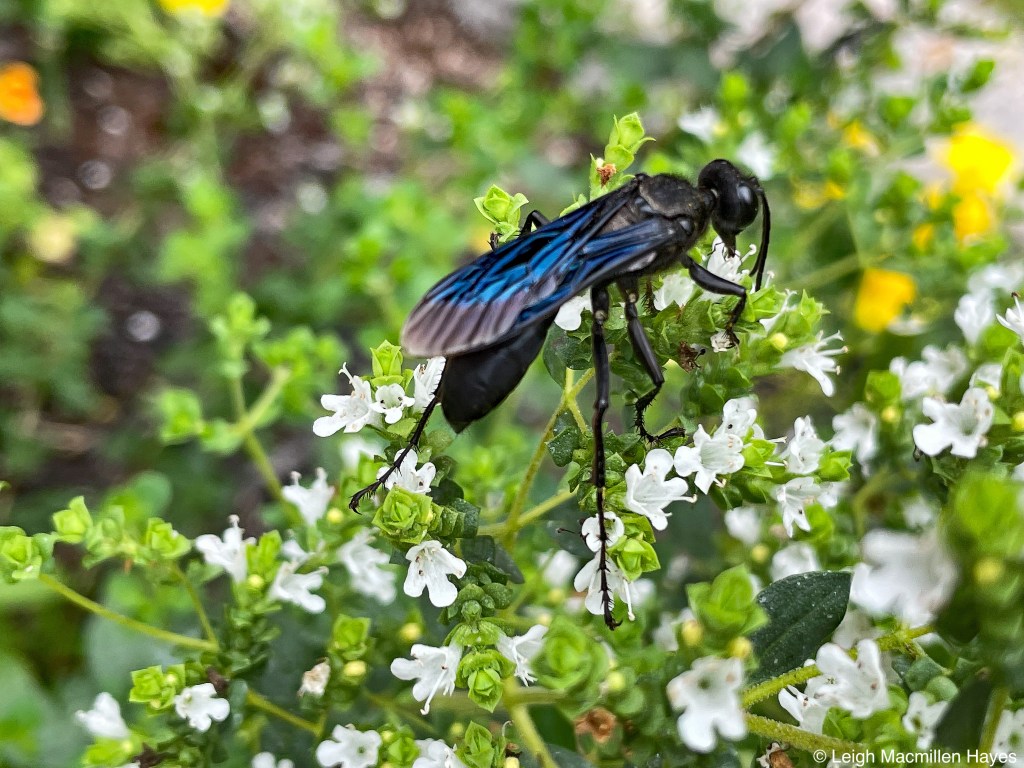
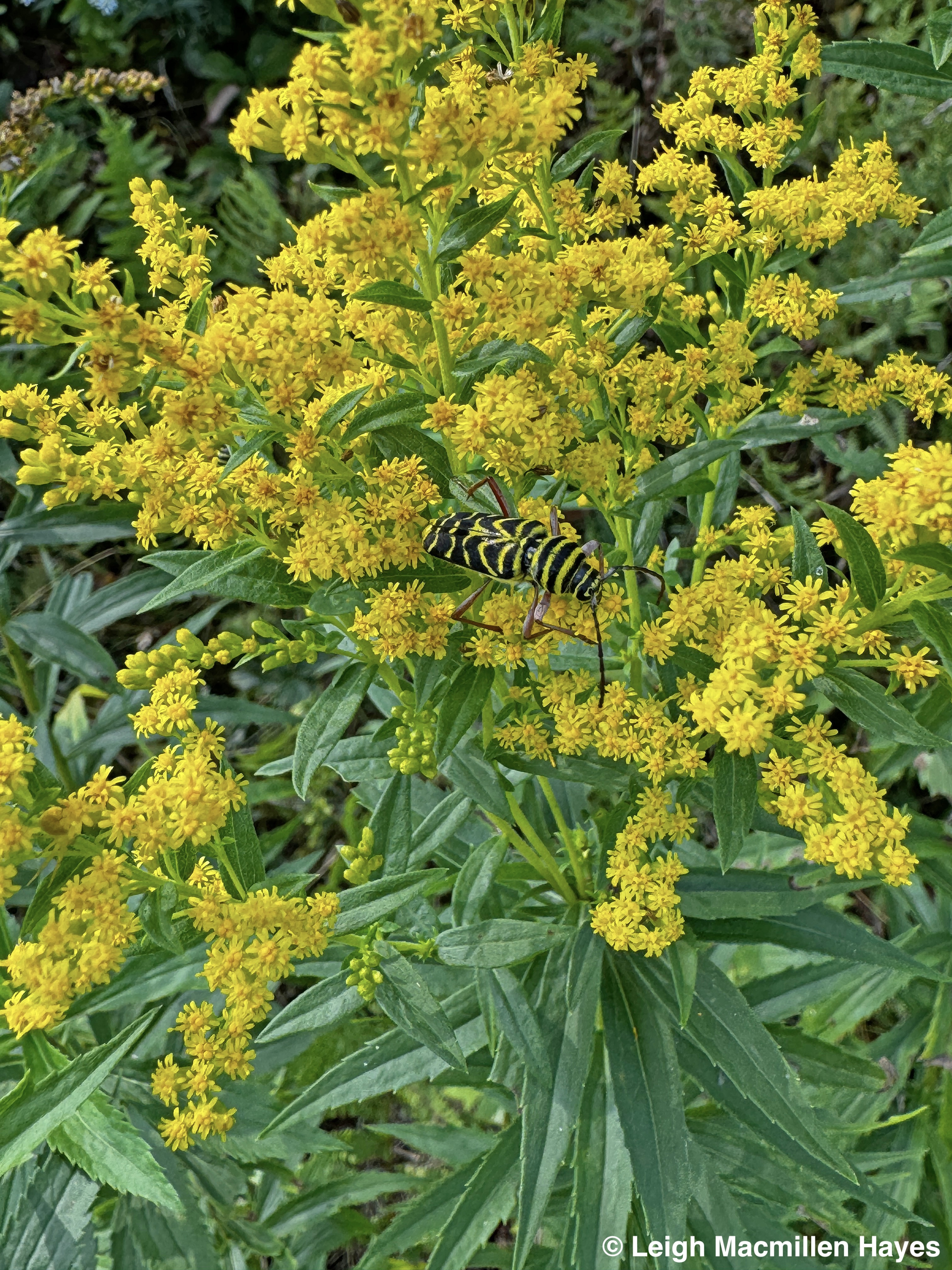
and some Locust Borers, all lovers of Goldenrod as you can see. I’ve also got Great Black Wasps, with their iridescent blue wings, and Paper Wasps, and Bumblebees, and . . . and . . . and so many to fill your reusable bag.

In the Fly By Day aisle, there are a few special selections, the first being this Lacewing that could be featured in a “Where’s Waldo” picture, so well camouflaged it is.

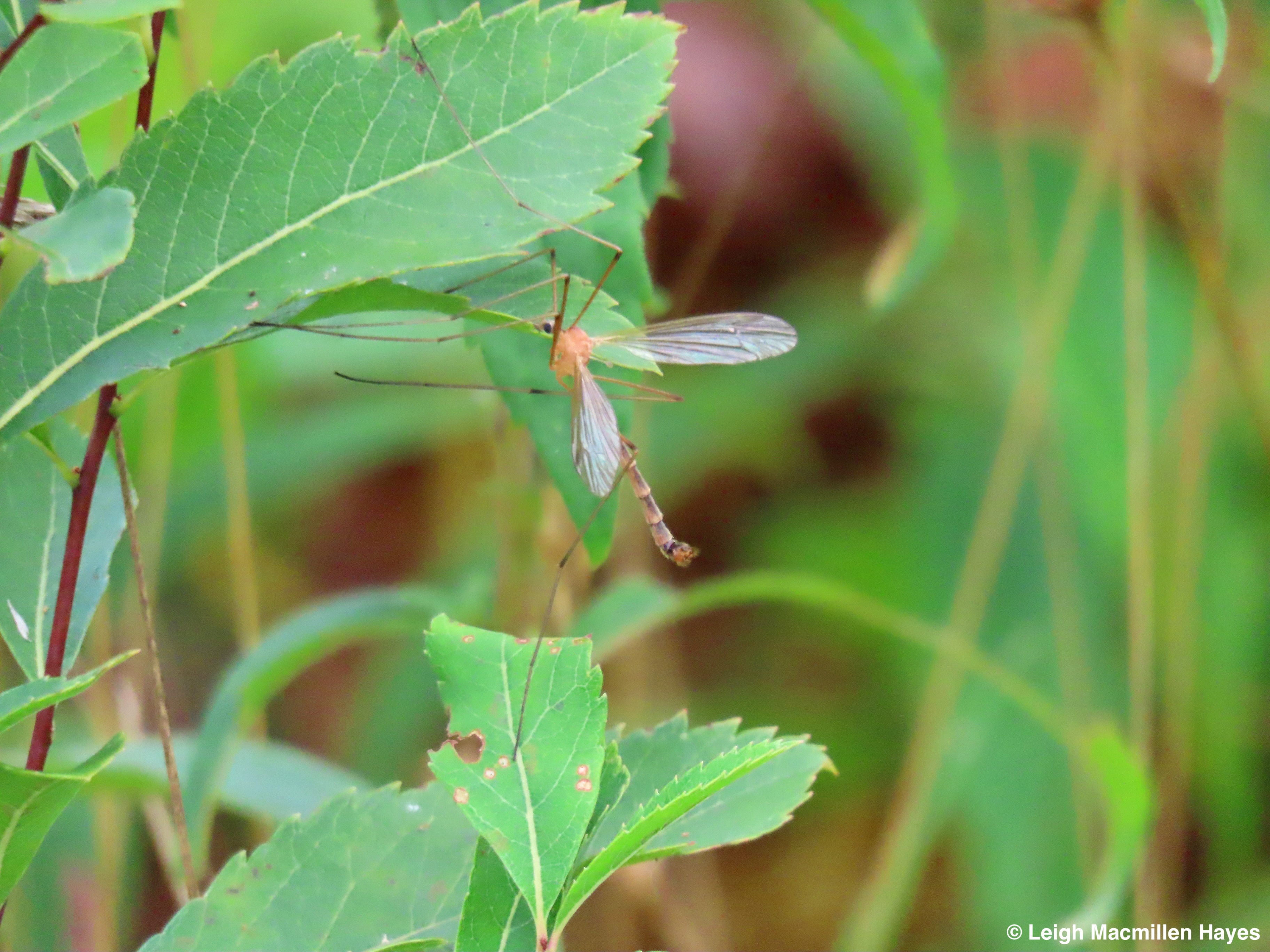
And a Crane Fly that you can scare people with and pretend it’s a giant mosquito. The thing is . . . they don’t bite. In fact, during their short lifespans, they don’t typically eat. So . . . little maintenance if you decide to put this one in your cart.

I’d be lax if I didn’t mention the employees such as this teenaged Ambush Bug who is very good at hanging out on Goldenrod plants near Black and Yellow Garden Spider webs, without getting tangled in all the drama.

But, being teenagers, sometimes two decide to tango in the breakroom under the Goldenrod, and these two canoodlers just had to have a bite to eat while they were so engaged. I’m sure the Sweat Bee never saw this coming.

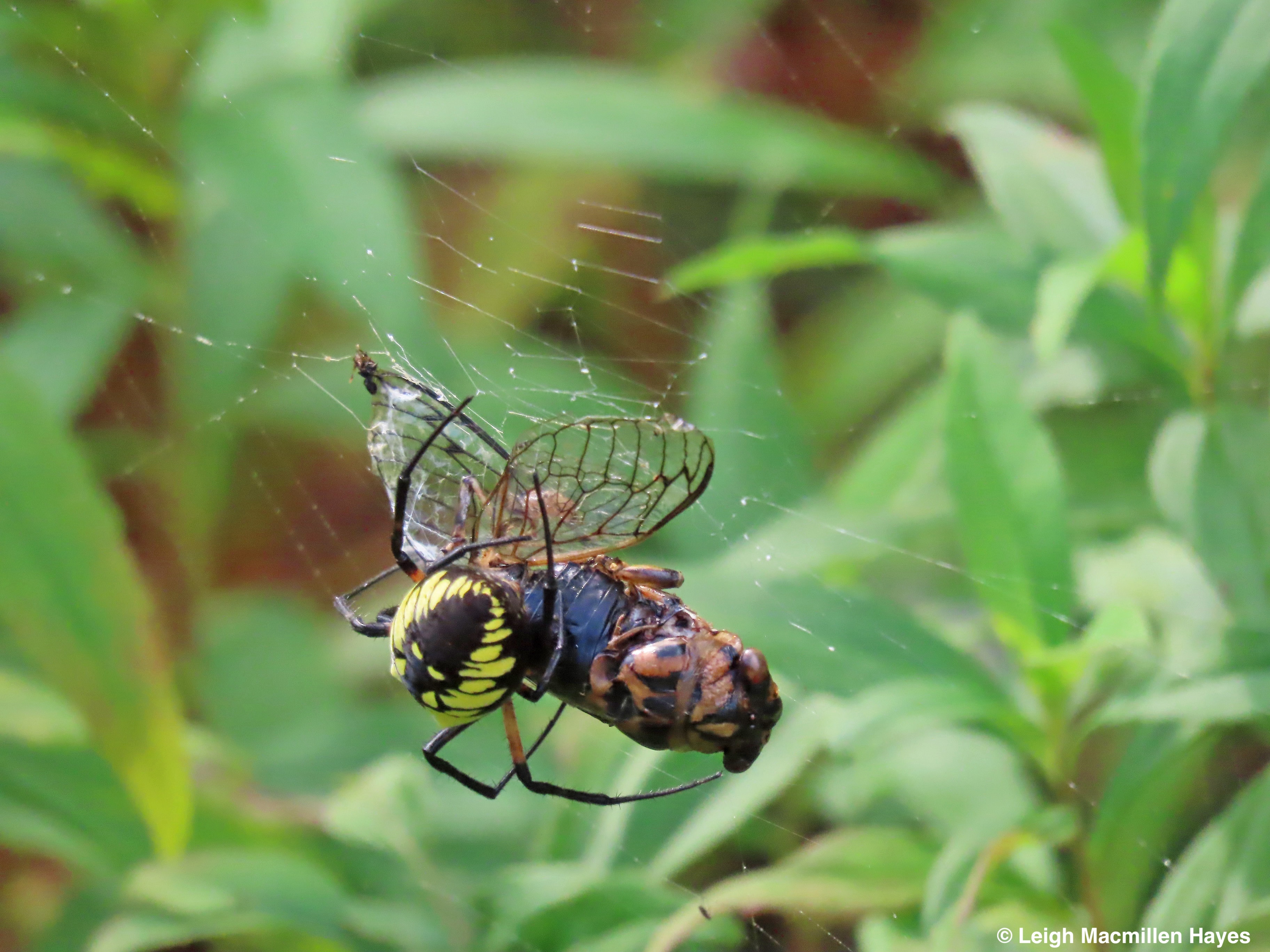
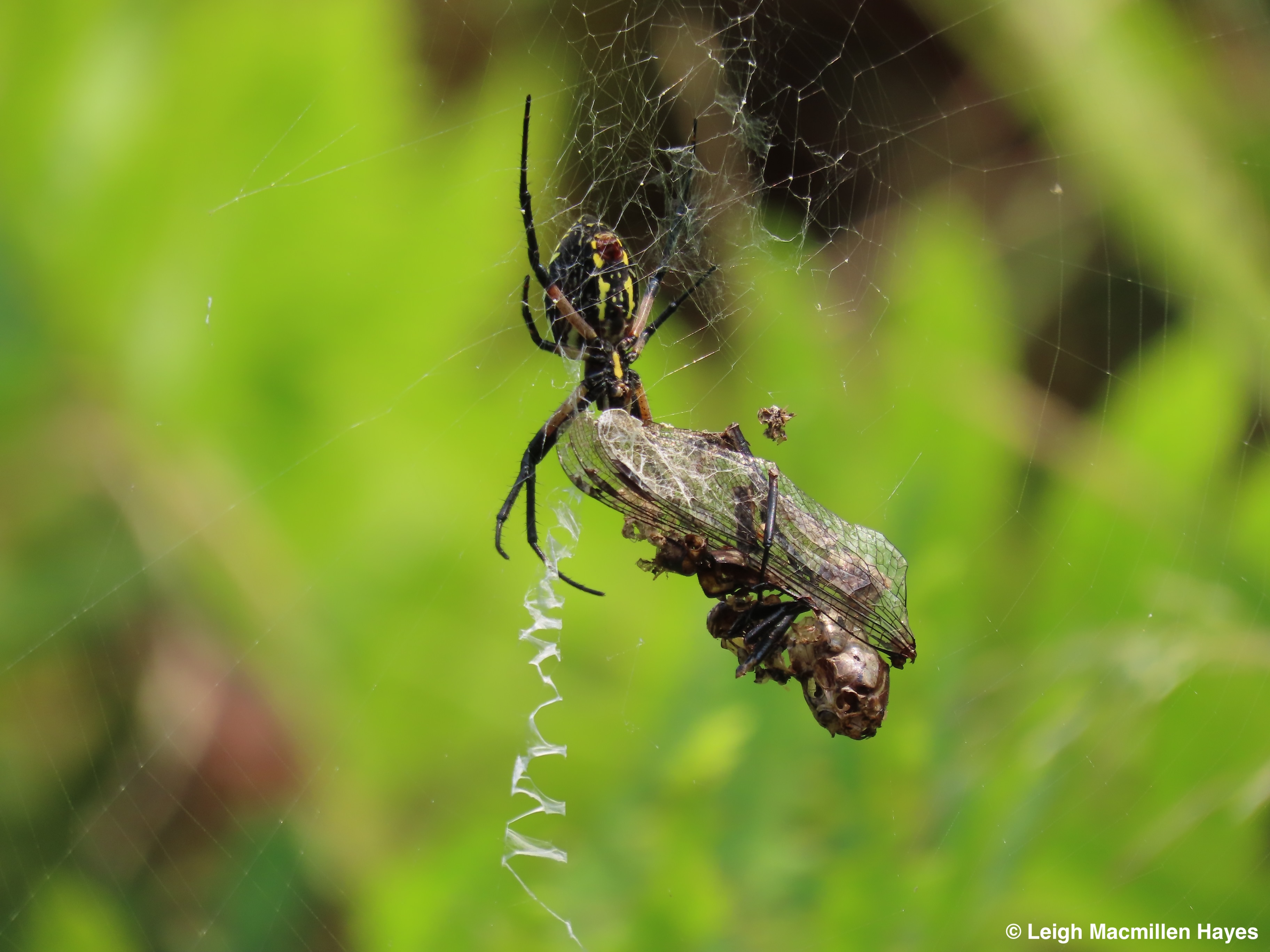
If you do decide to stop by the shop, the Black and Yellow Spiders are the chefs and they’re happy to provide you with a Dog-Day Cicada meal all wrapped up and ready to eat on the road. They have other items on the menu as well.

That said, this coming weekend, I do believe that the hardware store will have some items on the grill. So stop by and sample whatever delectable they prepare.

Food is actually a part of all our lives (haha, as it should be) and our youngest son is fortunate to work at a company in Manhattan that has a personal chef who prepares breakfast and lunch each day, mostly with locally-sourced food such as what is available at my store.

If you do come to the my shop, know that you’ll probably have to wait in line behind the Eastern Phoebes, who perch at roof-height and swoop in and out . . . often helping themselves and then zooming to the self-serve checkout line.

The guard doe keeps an eye on everyone passing through the door, so I don’t have to worry.

Occasionally, all four of us take a break from our respective jobs and come together to share a locally-sourced meal of our own–a la Fly Away Farm. Oh, and the kid (young man!) in glasses is holding his Lacy Blue pup who is sure that everyone who visits the hardware store comes just to greet and pet her.

As My Guy and I went for a long walk today, and hiked a mountain yesterday, we tried not to talk shop, but it occurred to me that while my eyes glaze over when he starts telling tales about hardware happenings, so do his when I point out the wonders of the natural world.

And so, I try not to tell him how to run his business (“try not to” being the operative phrase), and he lets me operate my own shop in my own way–even if it is all in my imagination.

I suppose you could say that while I’m married to a hardware store, he’s married to a . . . I’ll let you finish the line.

In the end, we both take stock . . . naturally.

Ode To A Garden Spider

Oh great orb weaver
Who lives among tall plants
Where you spin
A complex circular web
The size of a large platter
Complete with a hub
And non-sticky spokes
Upon which you walk,
While sticky cross lines
Ensnare your daily meals,
I revere you.
I study the webs
You and all of your sisters create,
But observe holes
In some areas
Where large insects
May have escaped,
Your web so constructed
That they don't break
The entire structure
During their struggle
To freedom.
And other sections
That remind me
Of the Cat's Cradle String Game
We used to play as kids.
Most nights,
As if on cue,
You consume
The entire silk dish,
Snacking on tidbits
Caught in the wheel
And then build
A fresh web
To start
A new day.
Really though, 
It's the bigger insects
You prefer,
And much like
E.B. White's famed Charlotte,
You inscribe
A daily message
Down the center
Of your creation.
It's upon this
Zig-zaggy stabilimentum,
An ultraviolet runway
Of multiple threads
Perhaps intended
to provide you stability,
Or as a prey attractor,
Or a warning to birds
Not to fly through,
That you hang in suspension
Waiting for the
Dinner bell to ring.
What I realize
While stalking
The neighbor's field,
Is that when a large insect,
Such as a grasshopper,
Dragonfly,
Or caterpillar
Gets caught in your web,
It takes you
Two or three days
Or more,
First injecting and paralyzing
with venom,
Then enwrapping with silk,
Before crushing the body
And liquifying the victim
With digestive juices
So it forms
A neat little package
Resembling a cocoon.
And storing it
For later consumption.
Despite eight eyes,
I'm told you have
Poor vision,
But make up for this lack
With hairy legs
That detect the arrival
Of a meal
Perhaps signaling
Sound and smell,
And certainly vibrations.
I'm afforded a look
At your pedipalps,
Those two short,
Hairy appendages,
Sticking out from your head,
That also work
Like sensory organs.
You may appear
Big and scary,
Your egg-shaped abdomen
Covered with asymmetrical marks
Upon the carapace,
Much like a turtle's shell,
And you may be
A carnivore,
But I celebrate you
Because I know
You are beneficial
In a garden or field
Such as this,
Since you control
The insect population,
Including some pests.
You also pollinate plants,
Recycle dead animals
(Well, they may be dead
Because you killed them,
But still . . .),
And serve as a food source
for others.
Oh great orb weaver,
Argiope aurantia,
Or more commonly,
Black and Yellow Garden Spider,
Thank you for affording me
Numerous views
Of you and your sisters
So that I might gain
A better understanding
Of your daily habits.

Not Just An Insect

Out of curiosity, and because it’s something I do periodically, I’ve spent the last four days stalking our gardens. Mind you, I do not have a green thumb and just about any volunteer is welcome to bloom, especially if it will attract pollinators.

This image has an empty alt attribute; its file name is 1-2.jpg

iWhat I’ve discovered is that in sunshine and rain, the place is alive with action from Honeybees and Gnats . . .

This image has an empty alt attribute; its file name is 2-2.jpg

to Paper Wasps,

This image has an empty alt attribute; its file name is 5-1.jpg

and even several Great Black Wasps, their smoky black wings shining with blue iridescence as they frantically seek nourishment and defend territories (including letting this particular human know that she’s not welcome at the party by aggressively flying at her).

This image has an empty alt attribute; its file name is 8-2.jpg

Bumblebees were also full of buzz and bluster and it was they who reminded me of one important fact.

This image has an empty alt attribute; its file name is 4-2.jpg

The color of the storage baskets on their hind legs depends upon the color of the pollen grains in the plants they’ve visited.

This image has an empty alt attribute; its file name is 5-2.jpg

There were millions of other insects, well, maybe not millions, but hundreds at least, flying and sipping and buzzing and hovering and crawling and even canoodling, the latter being mainly Ambush Bugs with the darker and smaller male atop the female.

This image has an empty alt attribute; its file name is 14-2.jpg

And then, because I was looking, I discovered an insect in the process of being wrapped for a meal intended for later consumption. I’ve long been fascinated by Ambush Bugs and Assasin Bugs and this, the Black and Yellow Garden Spider, Argiope aurantia. What’s not to love? She’s an orb weaver, meaning she spins a complex circular web, in this case among tall plants, that features spokes which are non-sticky that she uses to walk upon, and round wheels that are sticky to capture prey. The web is the size of a platter. A large platter. And . . . every night she consumes the entire thing and rebuilds a new one for the next day. In the process of consuming the threads, she can take advantage of any little insects like mosquitoes that get caught in the stickiness, but it’s the bigger insects that she prefers to eat.

This image has an empty alt attribute; its file name is 15-3.jpg

Do you see the rather conspicuous zigzaggy line down the middle of the web? That’s called the stabilimentum and may have several purposes: providing stability; attracting insects with the multiple threads like an ultraviolet runway such as the colorful lines and dots on plants; or perhaps announcing to birds that they shouldn’t fly through the web. Whatever the reason, it’s in the center of the stabilimentum that the spider hangs in suspension, waiting for the dinner bell to announce ring.

This image has an empty alt attribute; its file name is 16-1.jpg

Though she has eight eyes, her vision is poor. But . . . her hairy legs may also help in the detection that a meal has arrived, perhaps signaling sound and smell, plus she can sense the vibrations.

This image has an empty alt attribute; its file name is 18-1.jpg

Once captured, she injects a venom (that is harmless to us bipeds) to immobilize her subject and then begins to spin a sac around it.

This image has an empty alt attribute; its file name is 23-1.jpg

Remember, I’ve been watching her for four days, while she’s hanging upside down playing the waiting game and showing off her egg-shaped abdomen with its asymmetrical yellow markings on the carapace (much like a turtle’s shell) to her silver-haired head.

This image has an empty alt attribute; its file name is 24.jpg

Some days I felt like she might just be Charlotte, writing a message only Wilbur could interpret.

This image has an empty alt attribute; its file name is 30.jpg

And one day she surprised me by turning right-side up. It was then that I was offered a closer look at those little bumps on her head that serve as eyes. And the pedipalps, those two little hairy appendages sticking up on her head that work like sensory organs.

This image has an empty alt attribute; its file name is 27.jpg

An hour or so after finding her upright, when I checked again, I thought she’d gone missing. Instead, I discovered she’d climbed to the top of one of the plants upon which she’d spun her web.

This image has an empty alt attribute; its file name is 28.jpg

Perhaps she was surveying the area as she waved her front legs, looking about her domain.

This image has an empty alt attribute; its file name is 31.jpg

A day later, a new web, and another meal packaged, and slowly my buzzers were being consumed. But, she also likes grasshoppers and crickets and the garden is full of them.

This image has an empty alt attribute; its file name is 32.jpg

And then this morning dawned, with T.S. Henri in the offing and a few raindrops upon a broken web announcing the storm’s intended arrival. Wait. The web–it had holes but had not been entirely consumed. That wasn’t all, yesterday’s meal also hadn’t been consumed. And the spider was nowhere to be seen. I looked up and down and all around and couldn’t find her. Had she meant to save the meal, waiting for her venom to pre-digest it by liquifying the internal organs and in flew something larger than her and dinner went uneaten? Had our time together come to an end just like that?

This image has an empty alt attribute; its file name is 33.jpg

I wasn’t going to let the issue go, and so I continued to search, and guess who I found about three feet away upon a new web?

Even more exciting was the discovery that I can see her from the kitchen window AND, the view is of her underside so I can actually see her brown spinnerets at the end of her abdomen and maybe I’ll get to watch her capture a meal.

This image has an empty alt attribute; its file name is 34jpg.jpg

Well, so I thought, but two hours later, when I next looked, I realized I’d missed the action and she’d already securely wrapped her latest victim–all that was still visible was a leg.

This image has an empty alt attribute; its file name is 35.jpg

Though the prey may be one, this is NOT just another insect in the midst of my quest. Actually, it’s not an insect at all for spiders are arachnids, with eight legs versus an insect’s six. She may be scary big, as well as carnivorous, but she is beneficial to the garden as she helps control insect populations, including some pests.

And how do I know she is a she? Her male counterpart I’ve yet to meet, but he’s much smaller and all brown, unlike her beautiful coloration.

There’s more to this story I’m sure and I look forward to learning more about her as I try to interpret the messages she leaves. If you have a chance, go out and stalk your gardens and be wowed by what you find.