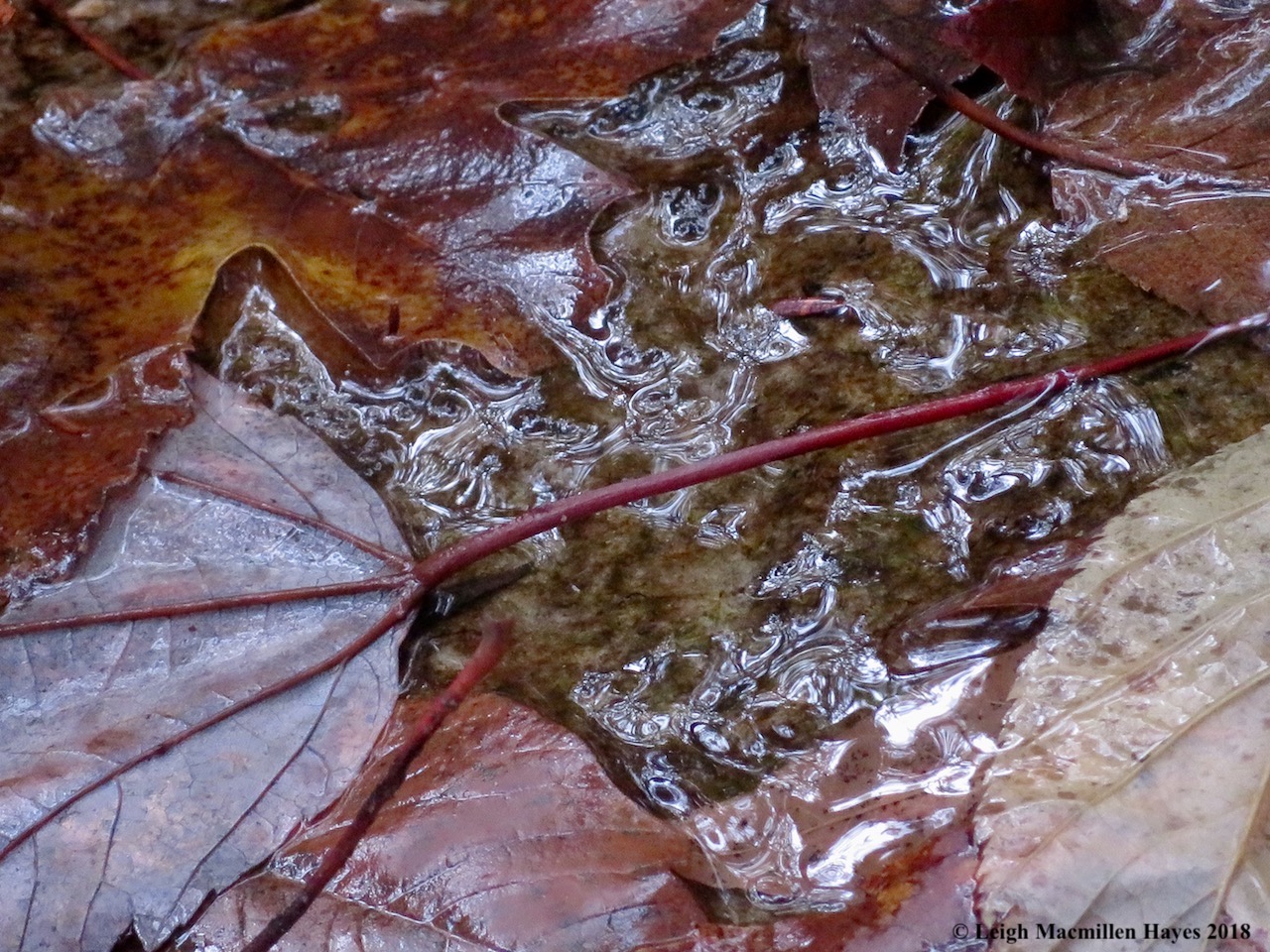
Finding My Way, Naturally

The older (and possibly wiser) I grow, the more gratitude I find in my heart for all those who have paved the path for me. Beginning with my parents, who first grounded us in the natural world, sending my siblings and me out to play and not giving us limits so we could go to places like City Mission and Lost Pond to ice skate in the winter, and follow the old trolley line to the town dump or in the opposite direction in the summer, and certainly disappearing behind the houses across the street from us and down to the brook any time of the year, as well as taking us on long walks in the woods and along the Connecticut shoreline and encouraging us to learn–always.

And then there have been so many others who have crossed my path and I dare not name them for fear of leaving some out, but knowing that there were those who were obvious teachers for me, and others who I didn’t realize were such at the time, but I still came away with lessons learned–to all of them I give my heartfelt thanks.
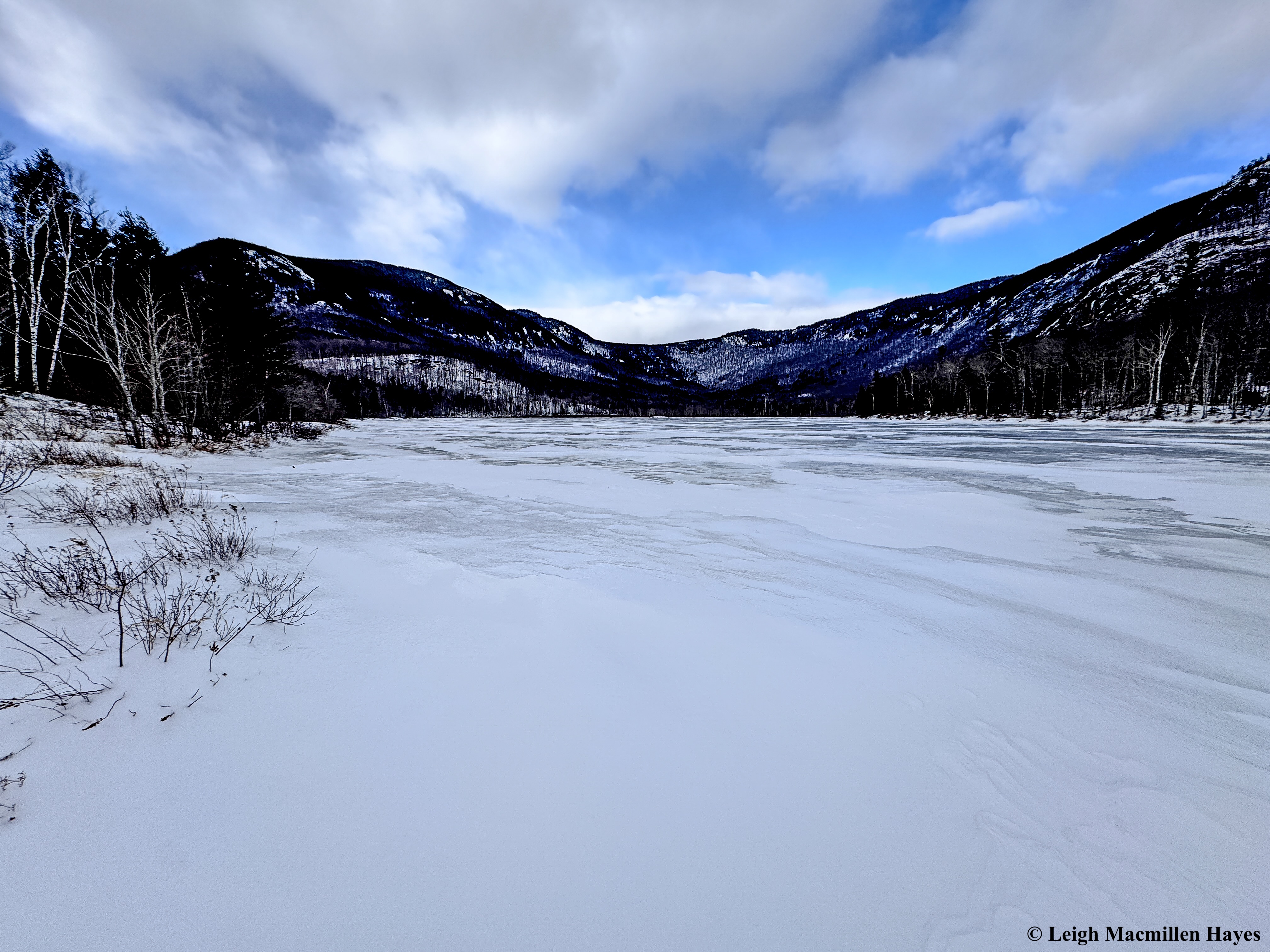
Some lessons have involved the big picture view of the world, no matter how cold the temperature and frigid the wind.
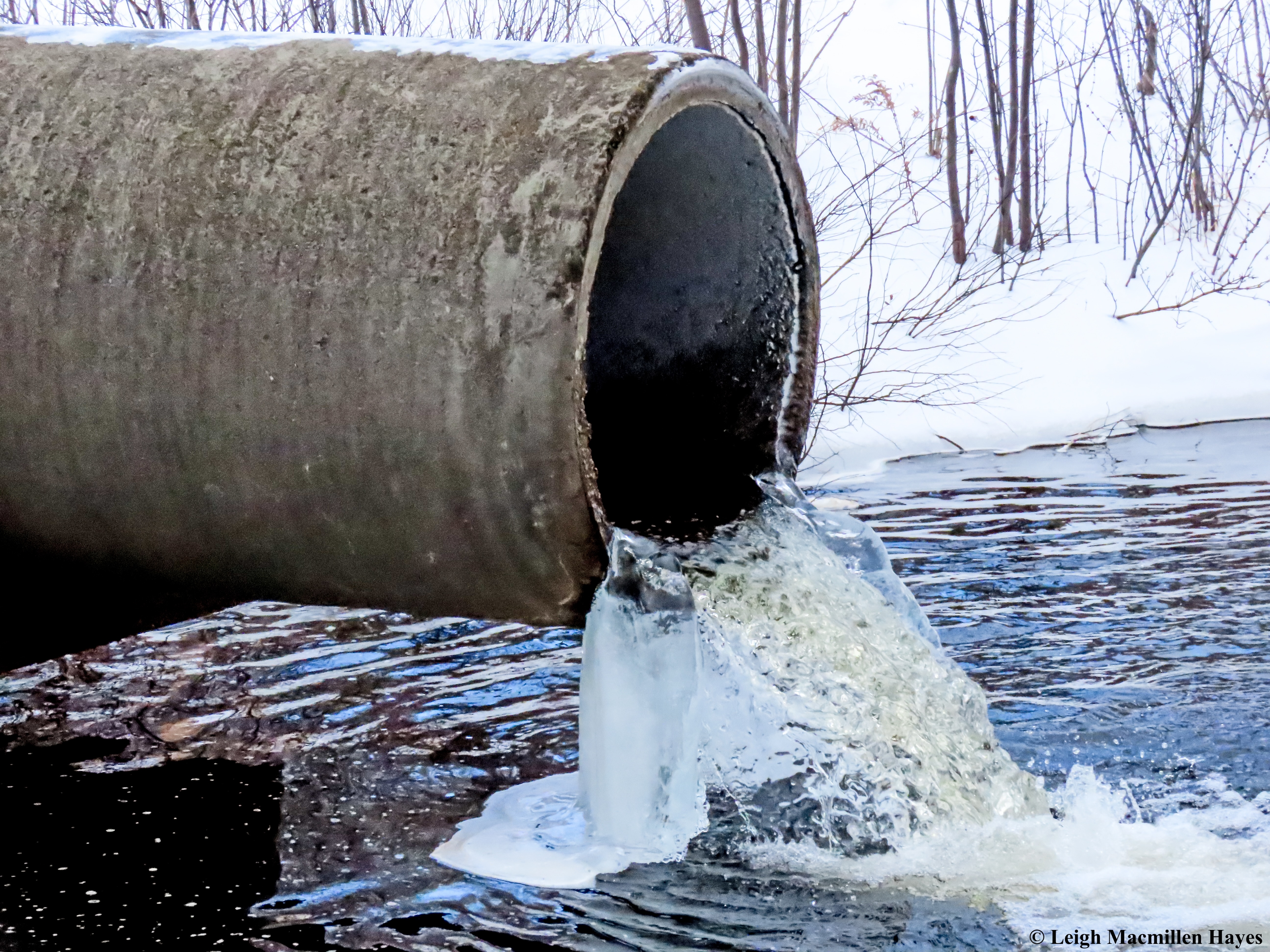
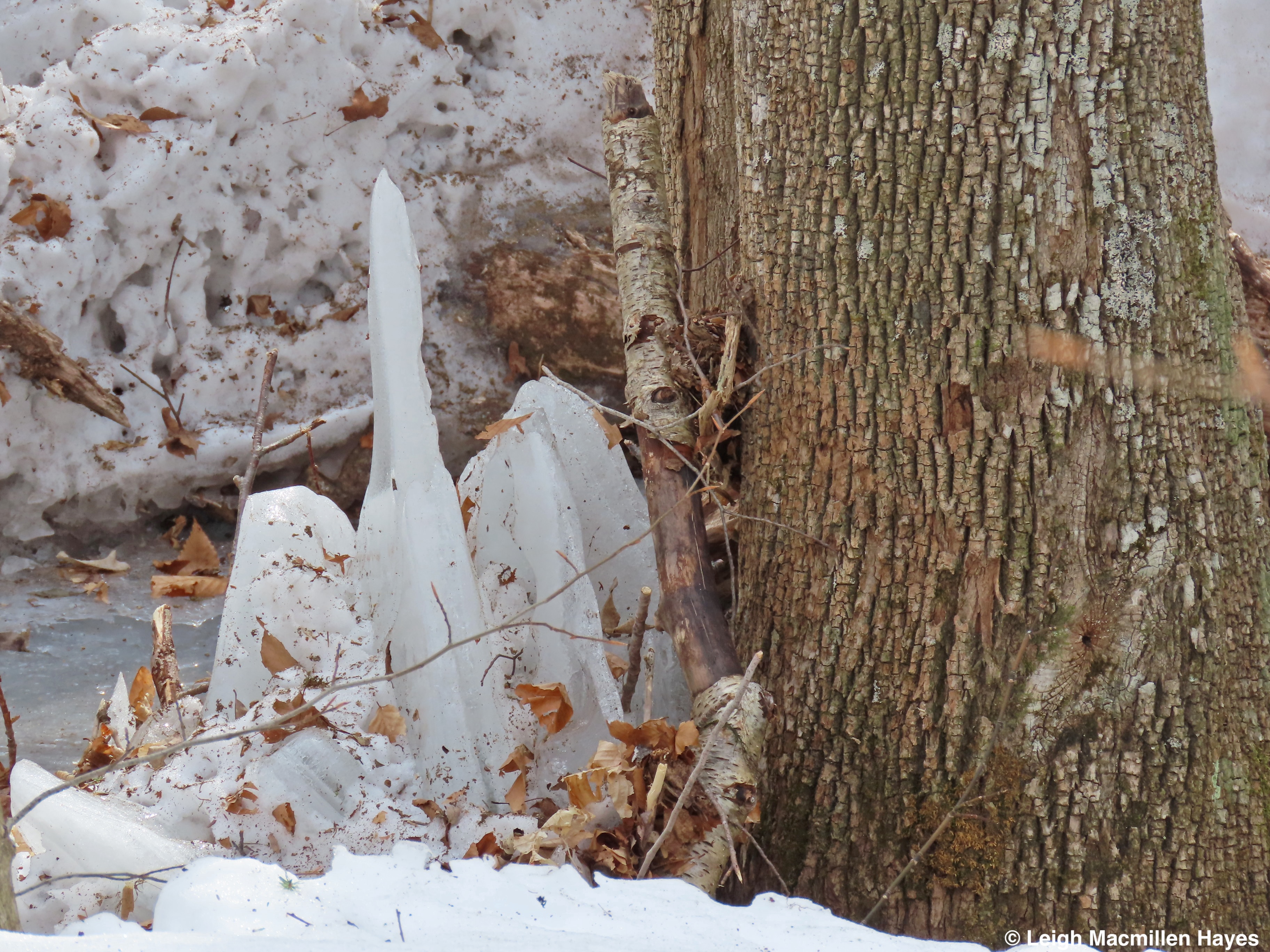
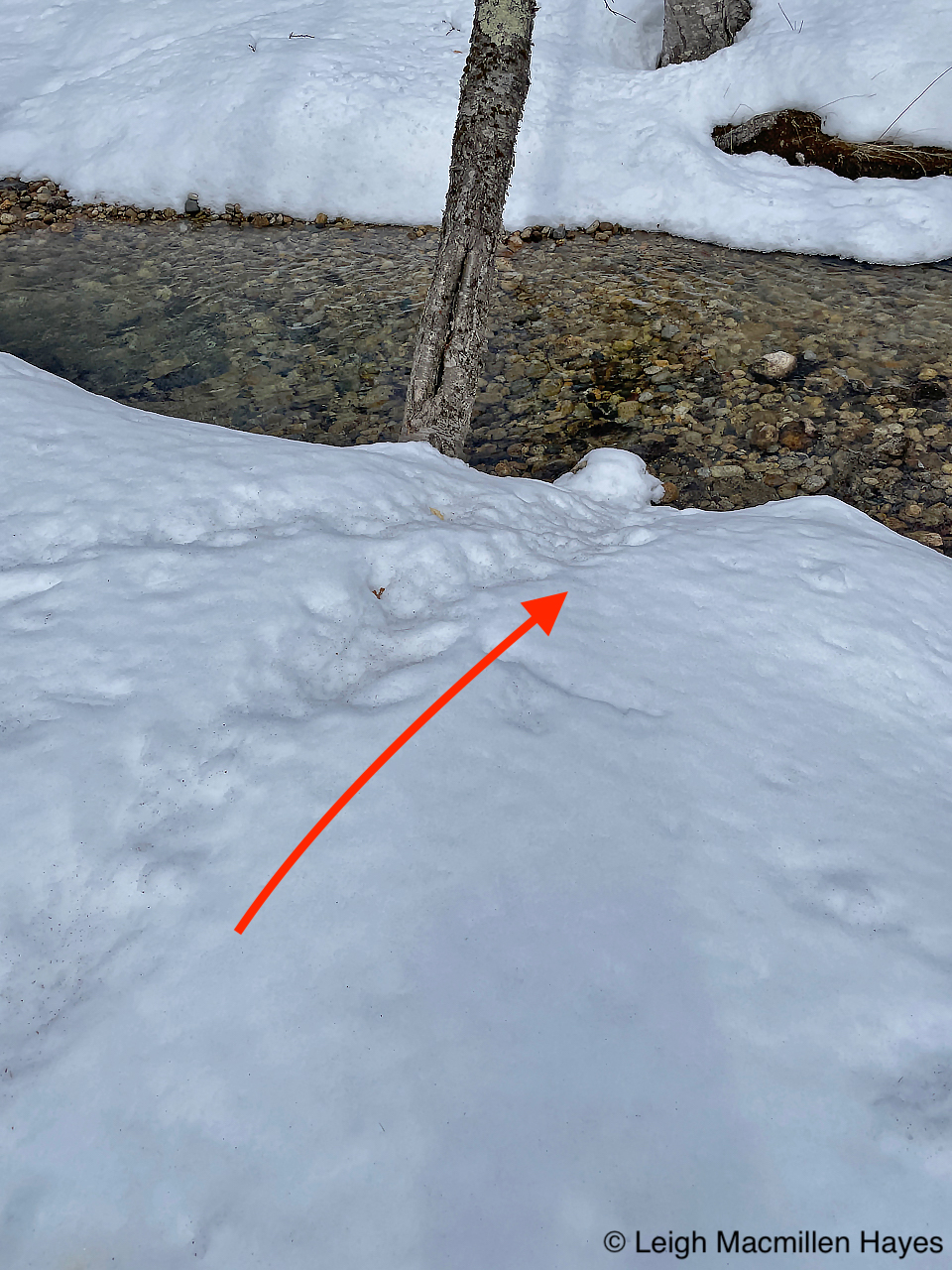
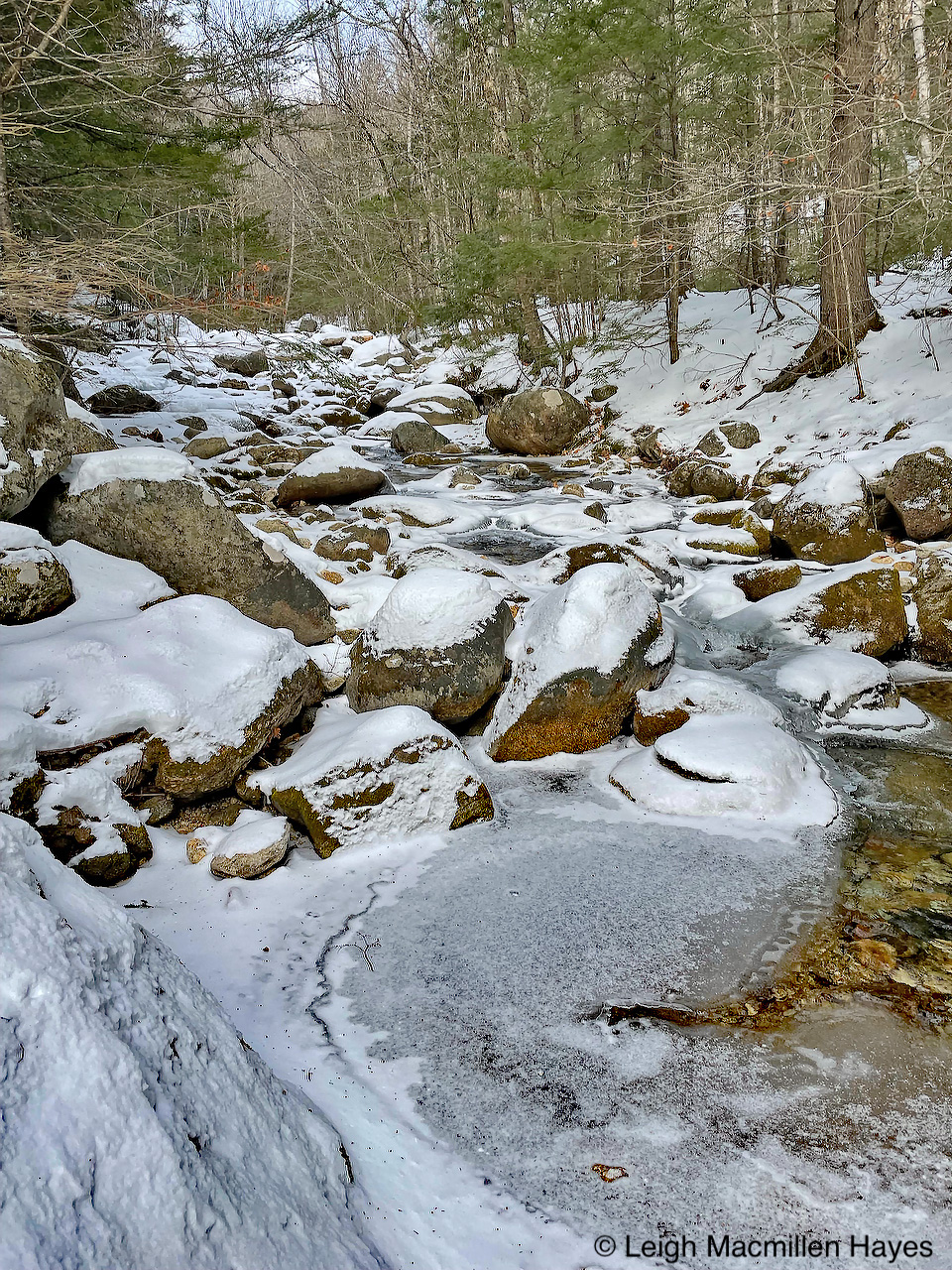
Other lessons have been much subtler, like realizing that ice forms in a perpendicular manner and fans out behind a culvert that spews water at the formation of a river.
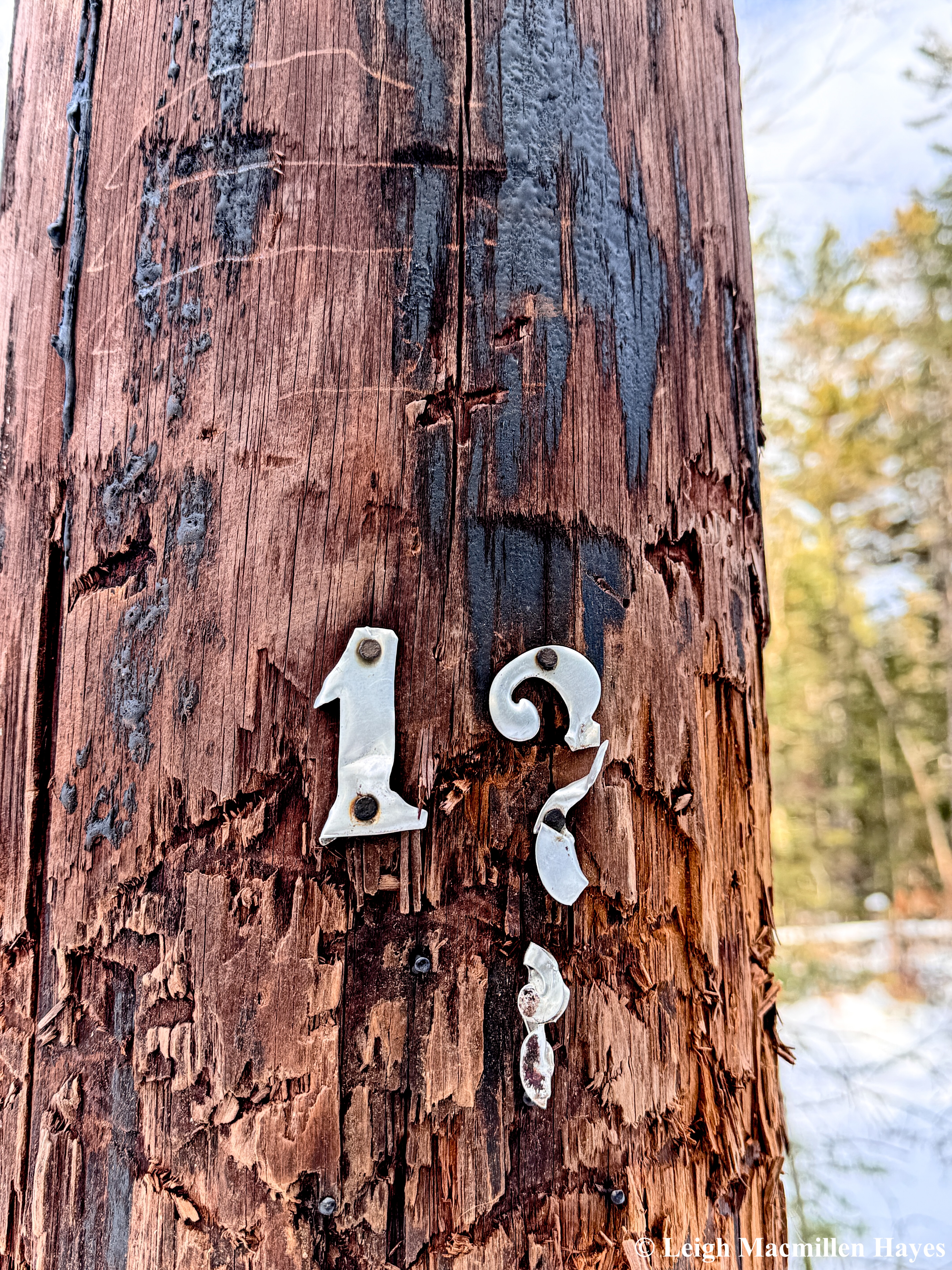
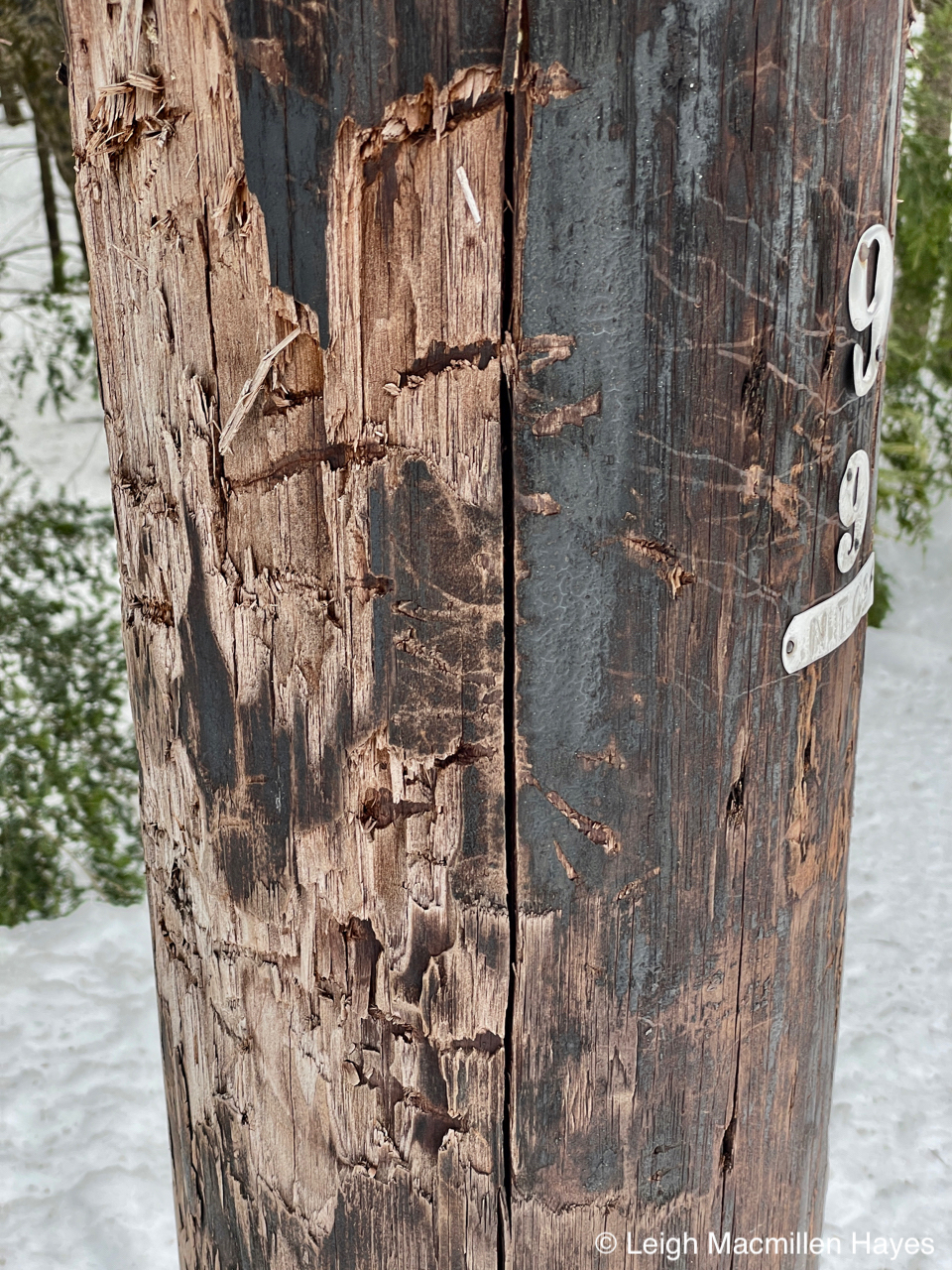
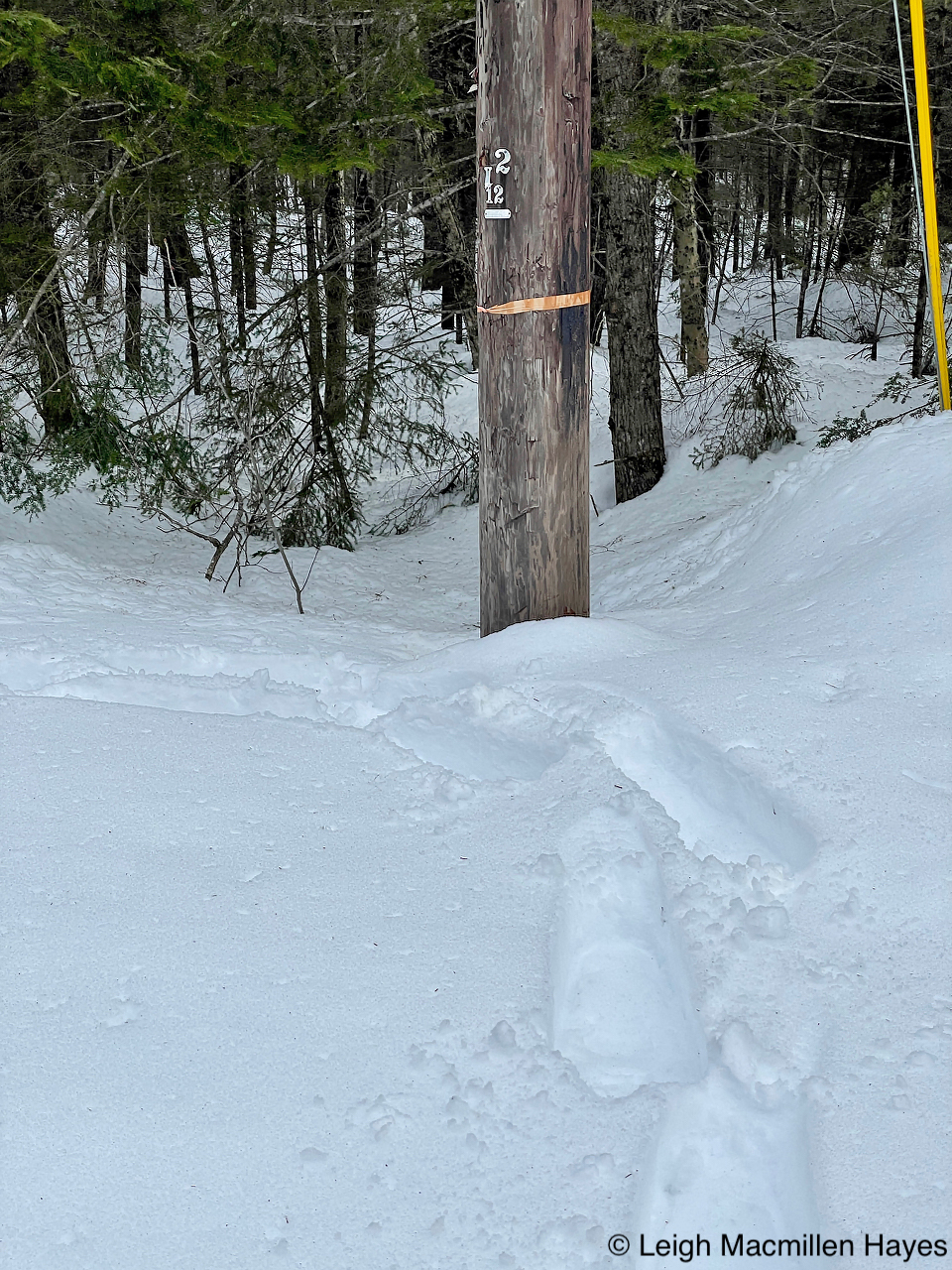
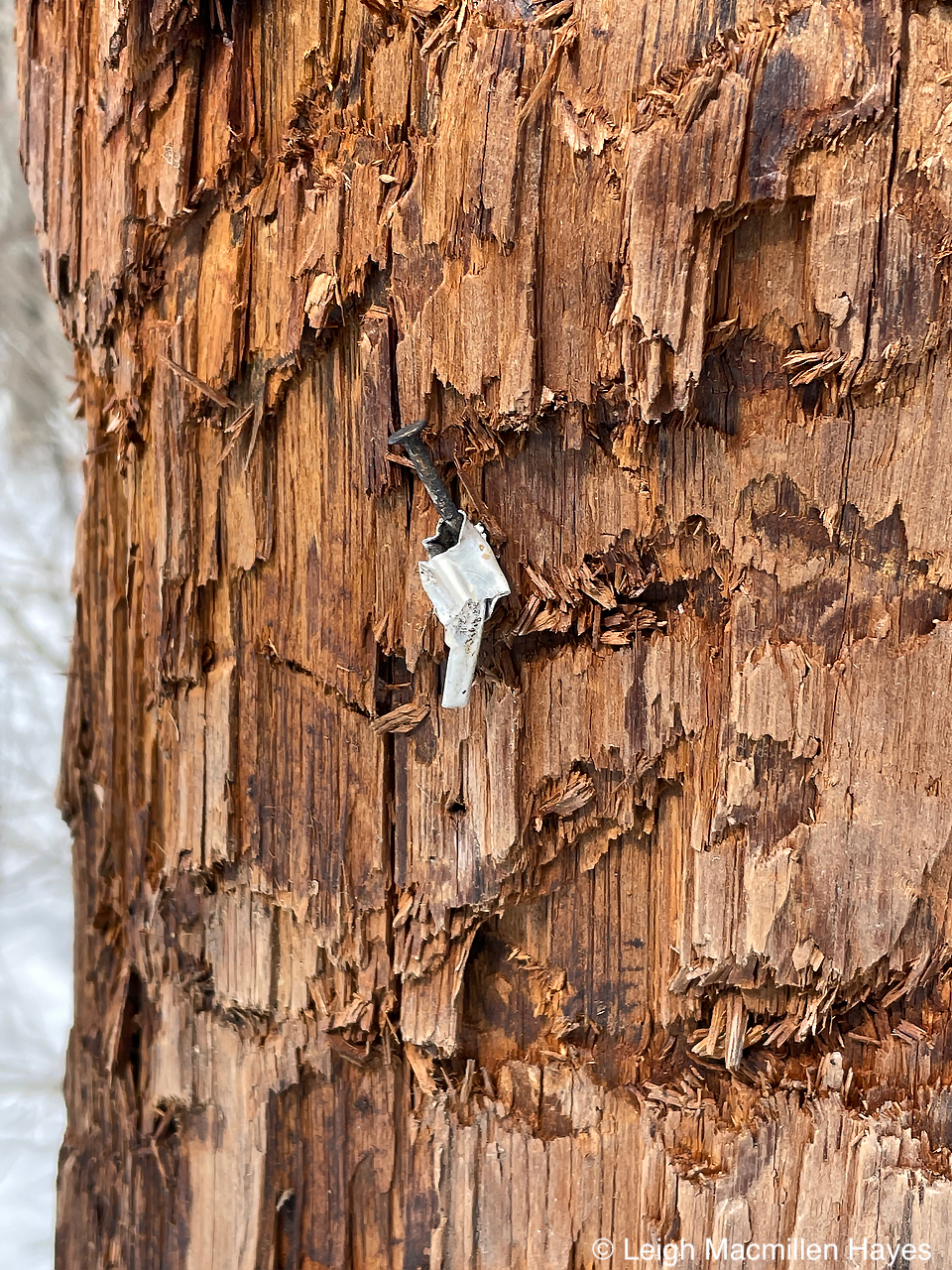
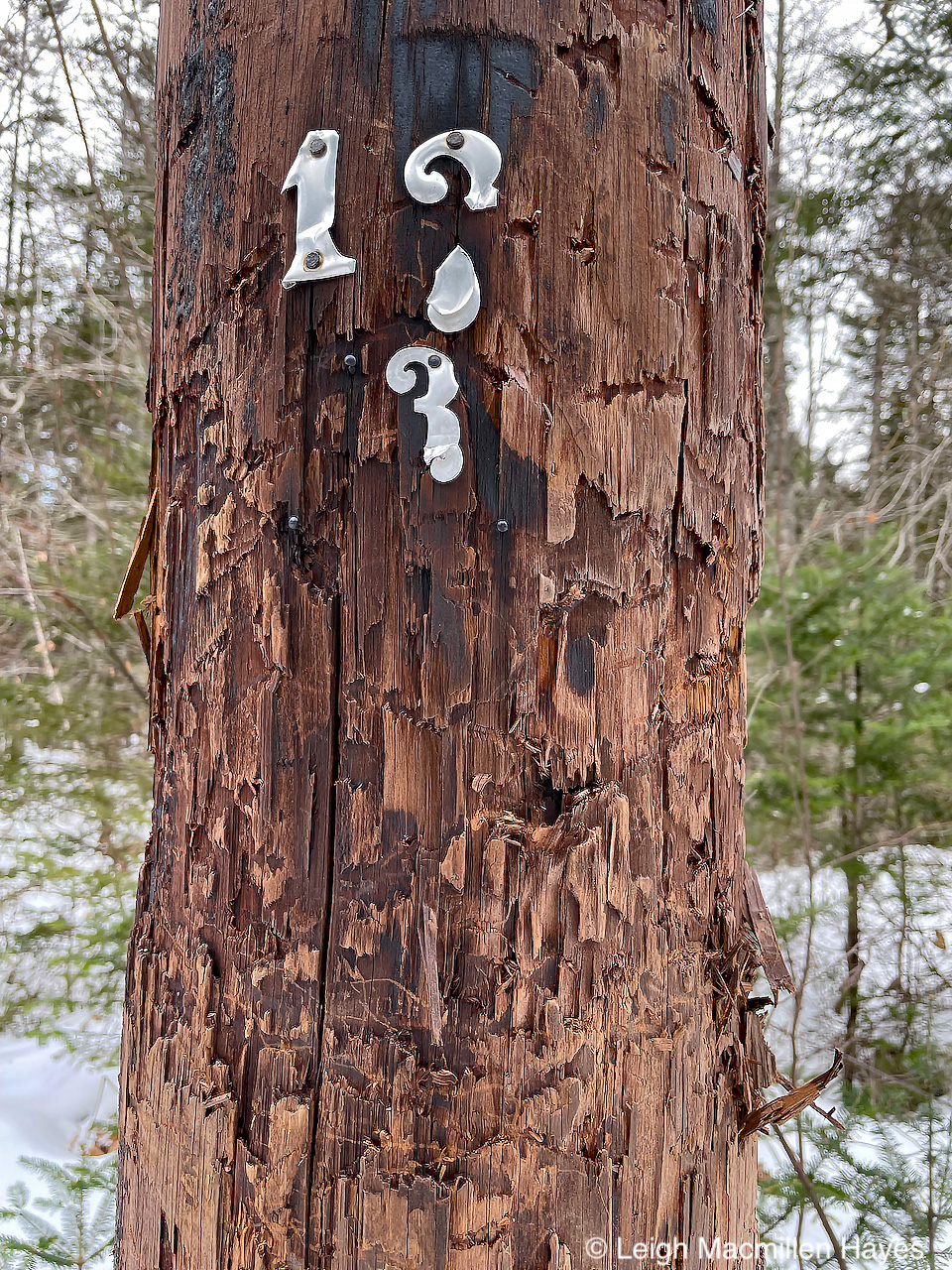
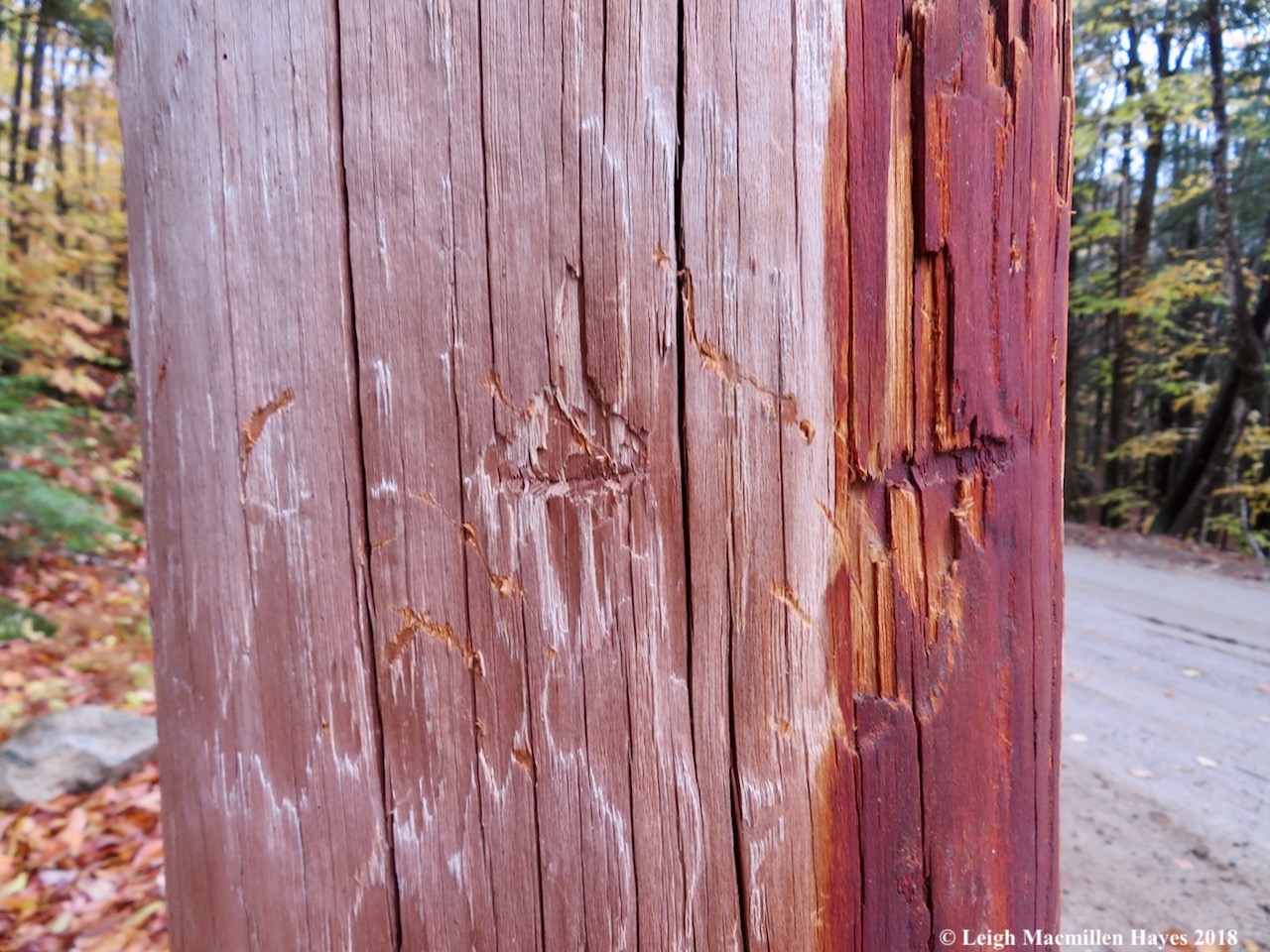
And then there have been reviews of old lessons, where the Black Bears leave no telephone pole untouched. The shiny numbers are invitations encouraging the bears to turn their heads and then pull upper incisors toward lower, mangling both the wood and metal.

And then to leave a signature scratch above this work of art.
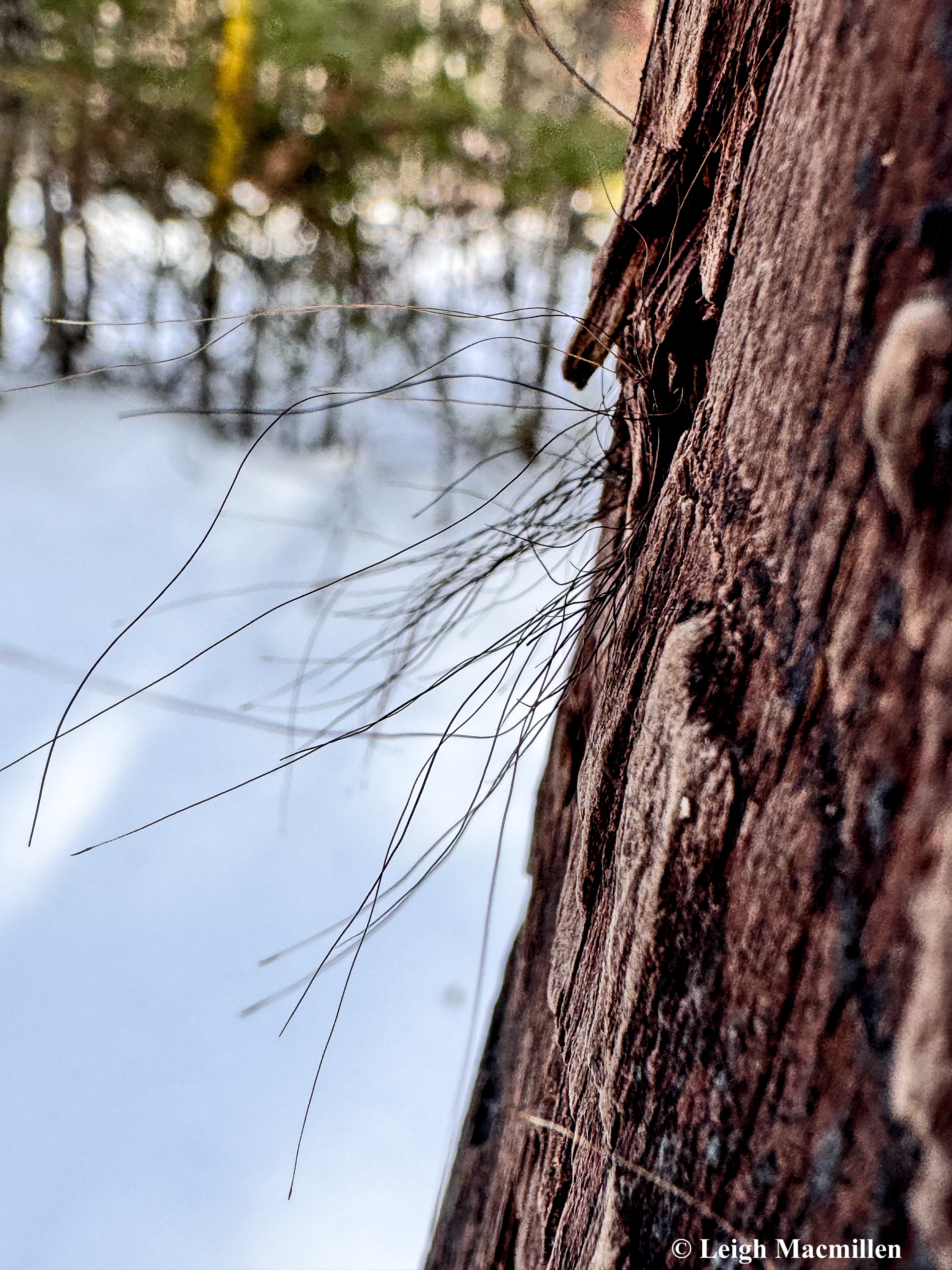
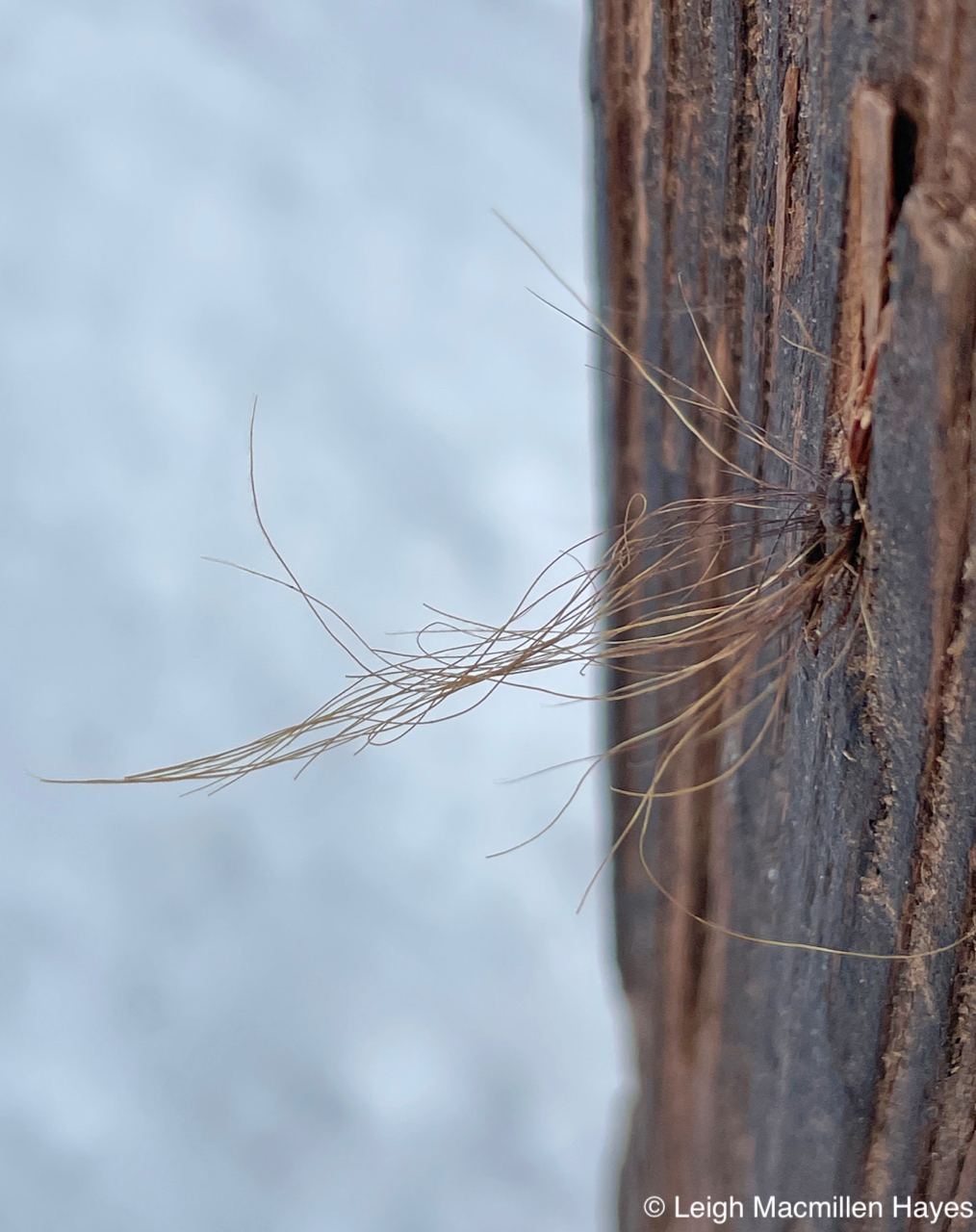
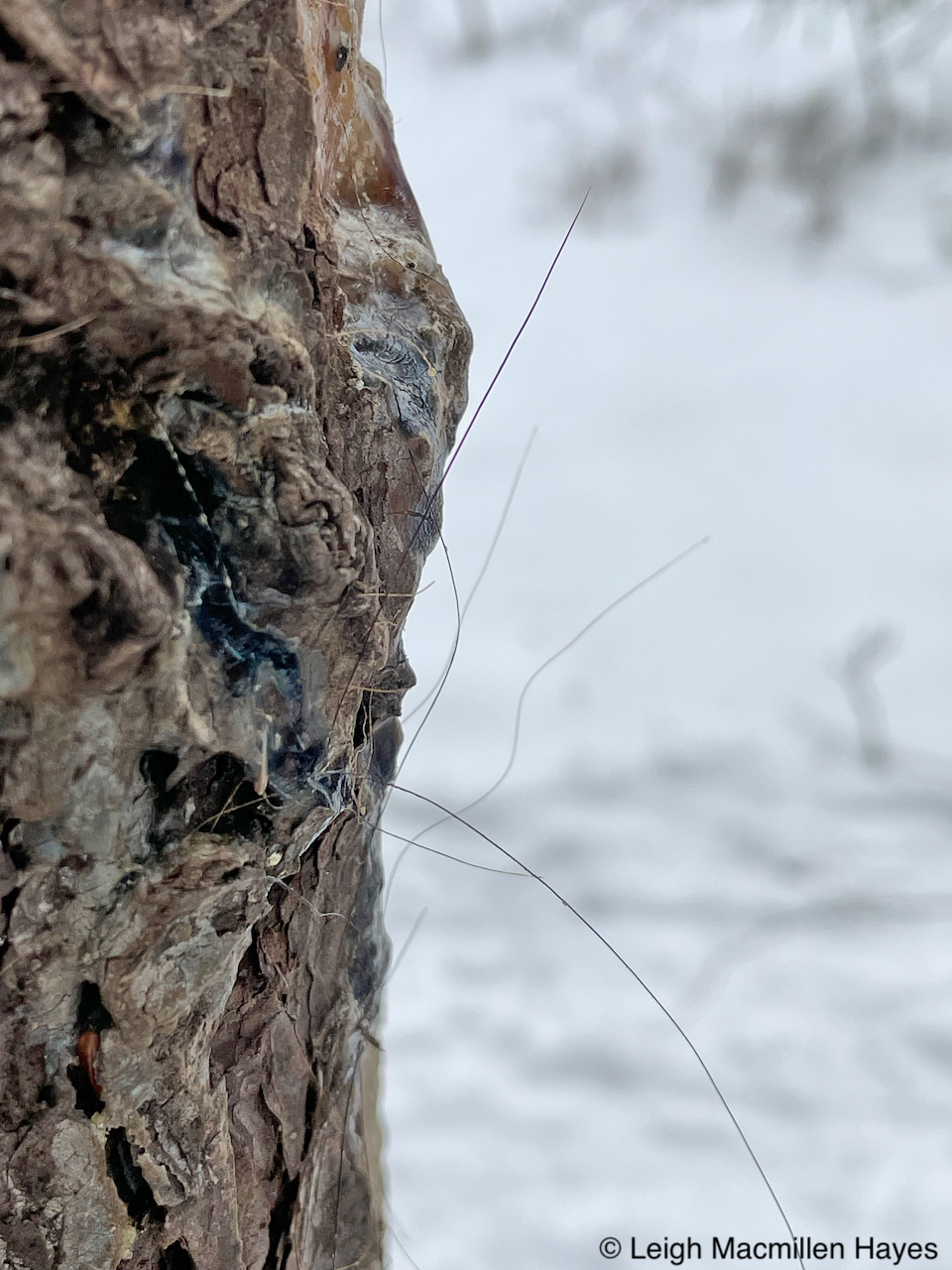
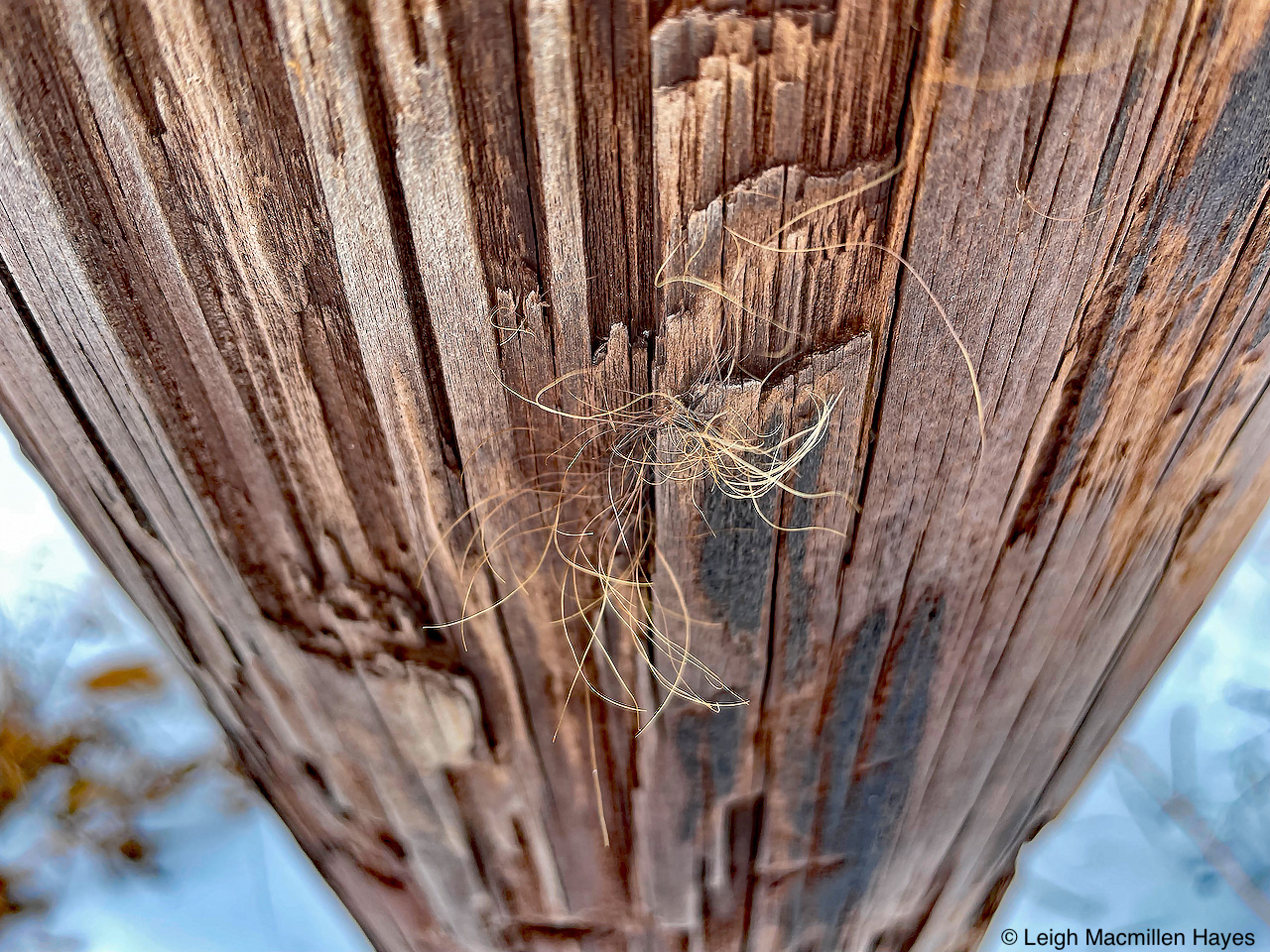
And in the midst of this action, to accidentally deposit a bit of hair on the mangled wood. (Please note that My Guy was surprised that I can still feel such glee looking at the same poles year in and year out, but I reminded him that each year I find changes, including hair on different poles and this year the scratch marks on several that I don’t recall seeing in the past or simply failed to notice. What’s not to love? )
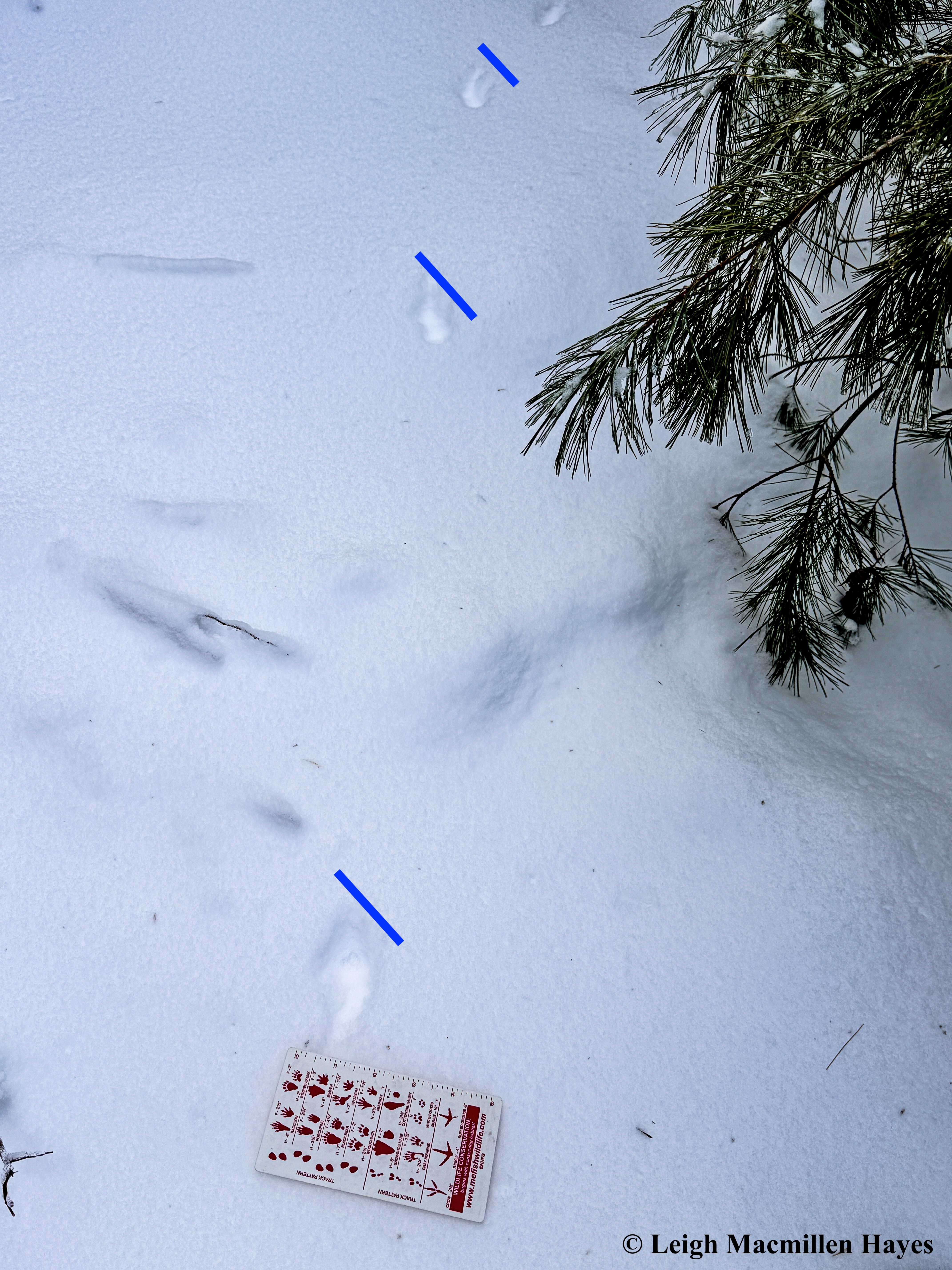
There are other old lessons that are also worthy of review–especially as once the snow flies I begin to see them written everywhere I look.

This one is the track of the Ermine or Short-tailed Weasel. I love how each set of prints represents four feet, the front two landing and then as this bounder’s hind feet begin to fall into place, the front feet lift off toward the next spot. One of the biggest give-aways to the creator is the diagonal orientation of each set of prints. Sometimes the diagonal changes, but it’s almost always present.
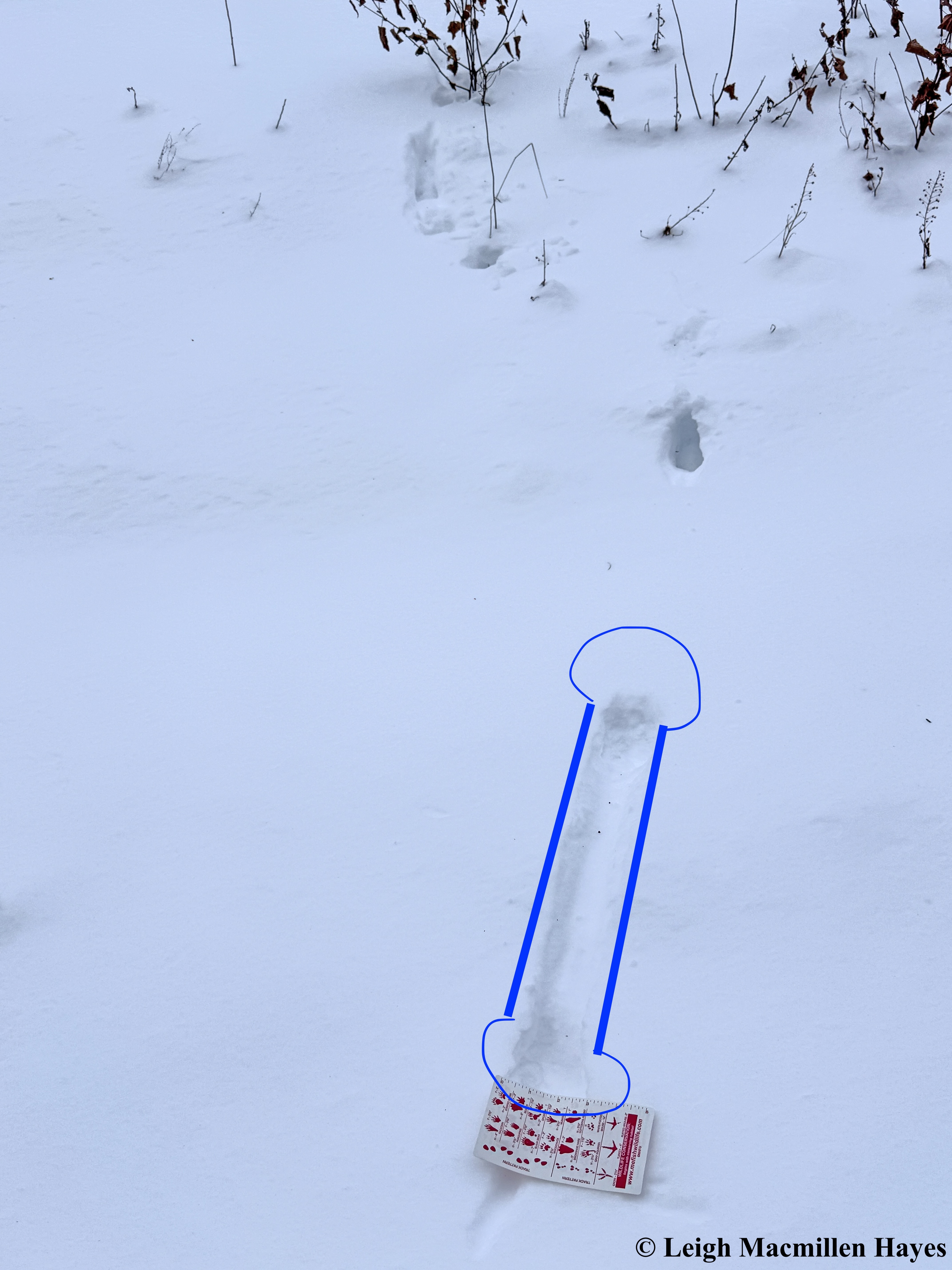
And just sometimes the same weasel decides to take it easy between sets of prints and goes for a quick slide, creating what is known to some as a Dog Bone and to others as a Dumbbell. I think it’s easy to see both once you know you recognize the behavior, but I can’t tell you how many years it took me to actually see this.

And then, along a wetland shoreline, another member of the weasel family reminded me that occasionally they like to slide much like a River Otter, but this being was a Mink!
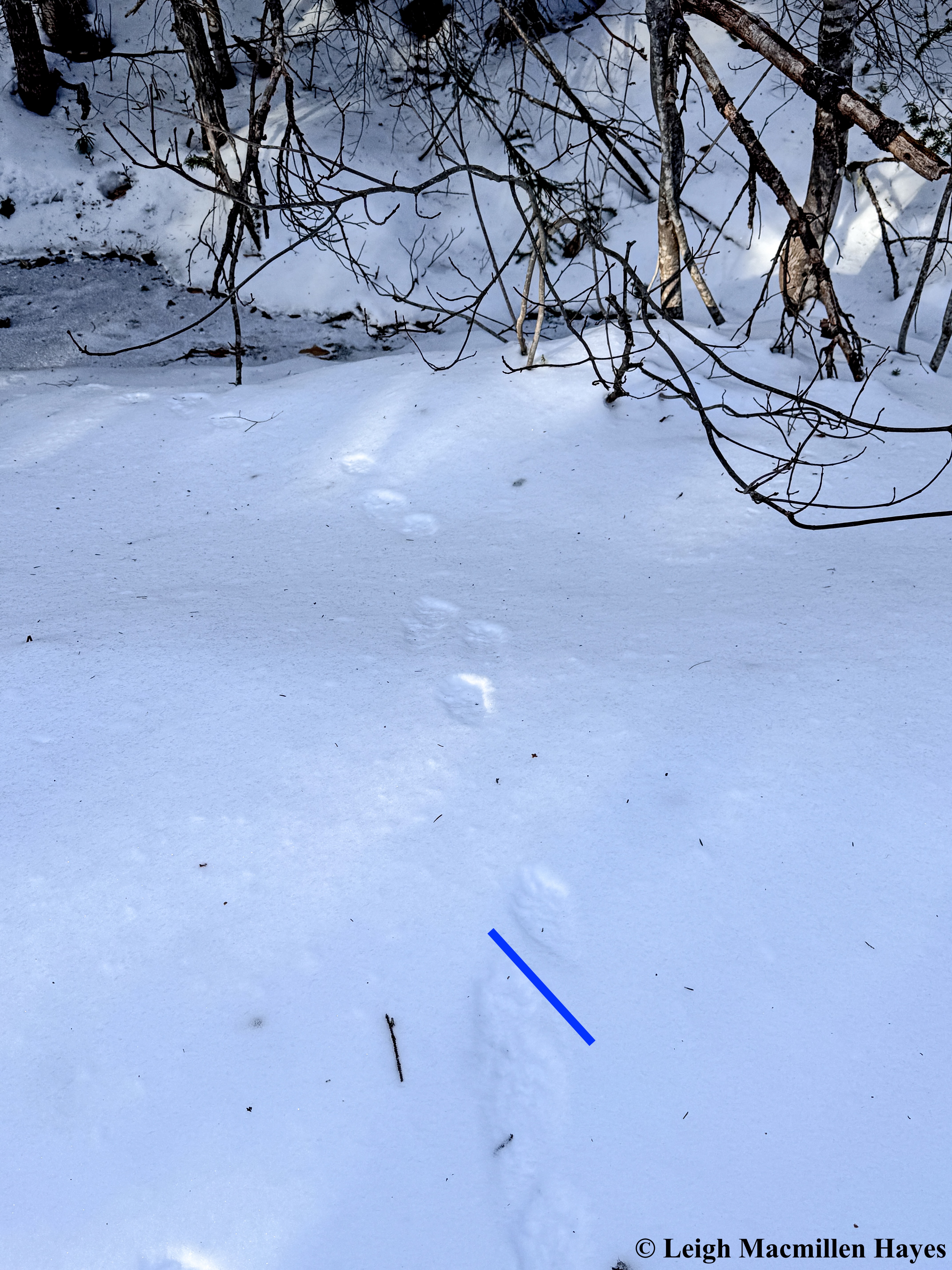
And not to be left out of the scene, a Fisher (not a Fisher Cat–ah, but the hairs go up on the nape of my neck). The diagonal is there and though this was a quick shot and not all the details are visible, all Mustelids (weasels) have five toes and all are bounders.
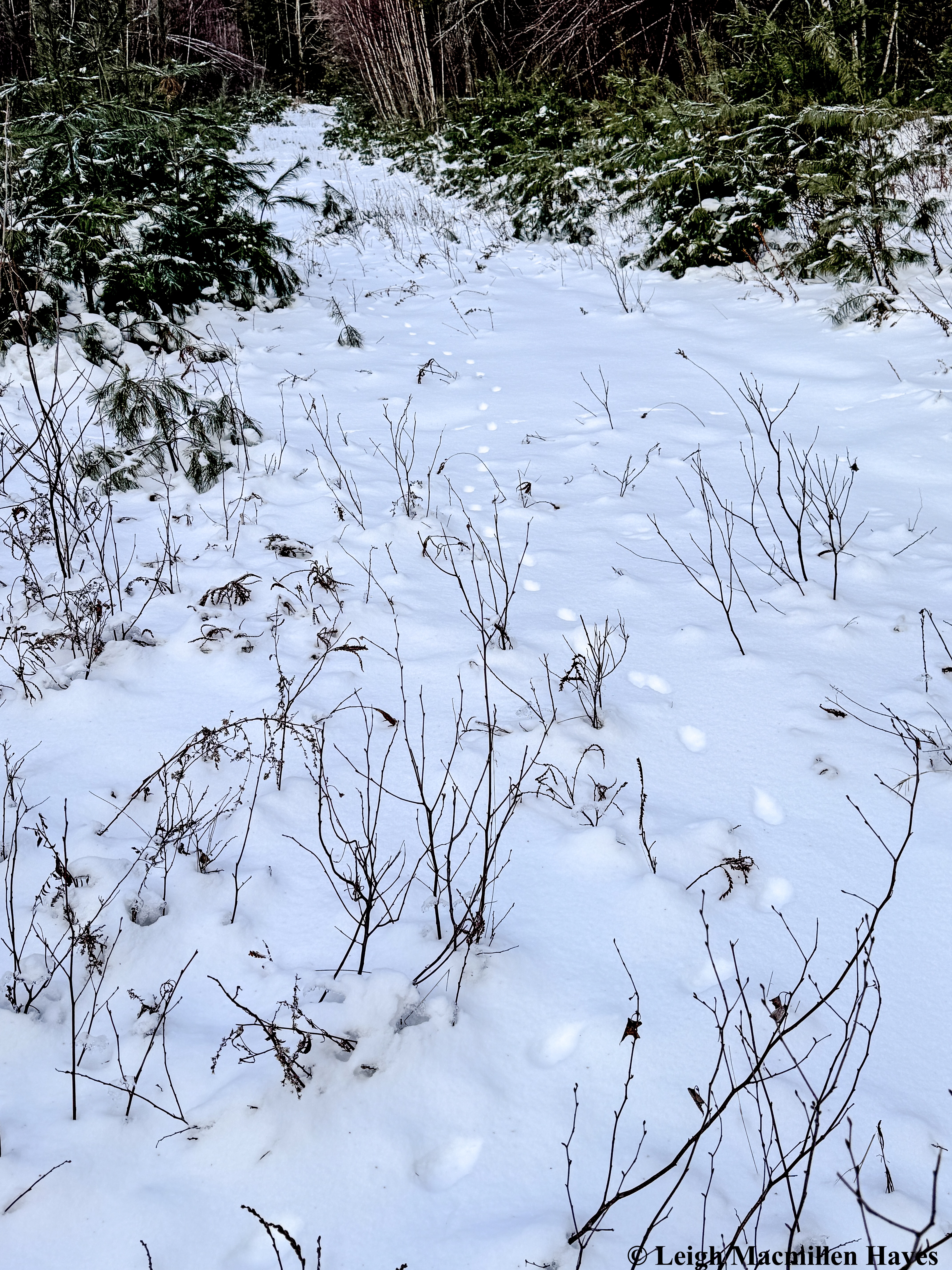
Red Foxes also write lessons in the snow and I followed this one for quite a ways, finding a spot where it pounced, though I’m not sure it caught the intended meal because there was no evidence of a struggle.

While its overall trail was the zigzag of an animal that double packs a spot because the hind foot typically steps where the front foot had already been, sometimes the trail zags more than it zigs and I imagine he was looking for another food source.
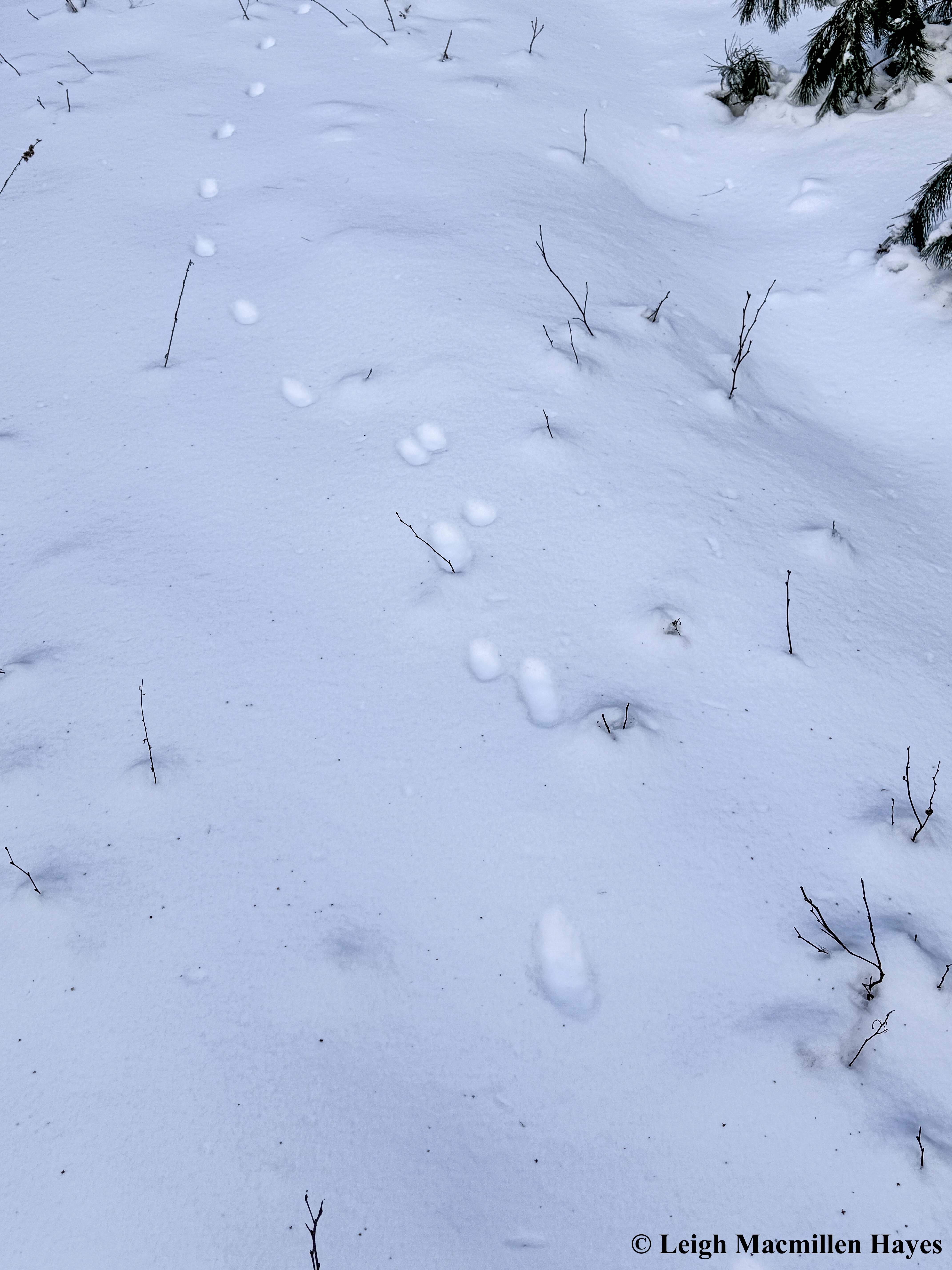
Occasionally he changed his pace and I had to wonder why–did he smell or hear something that I couldn’t discern?
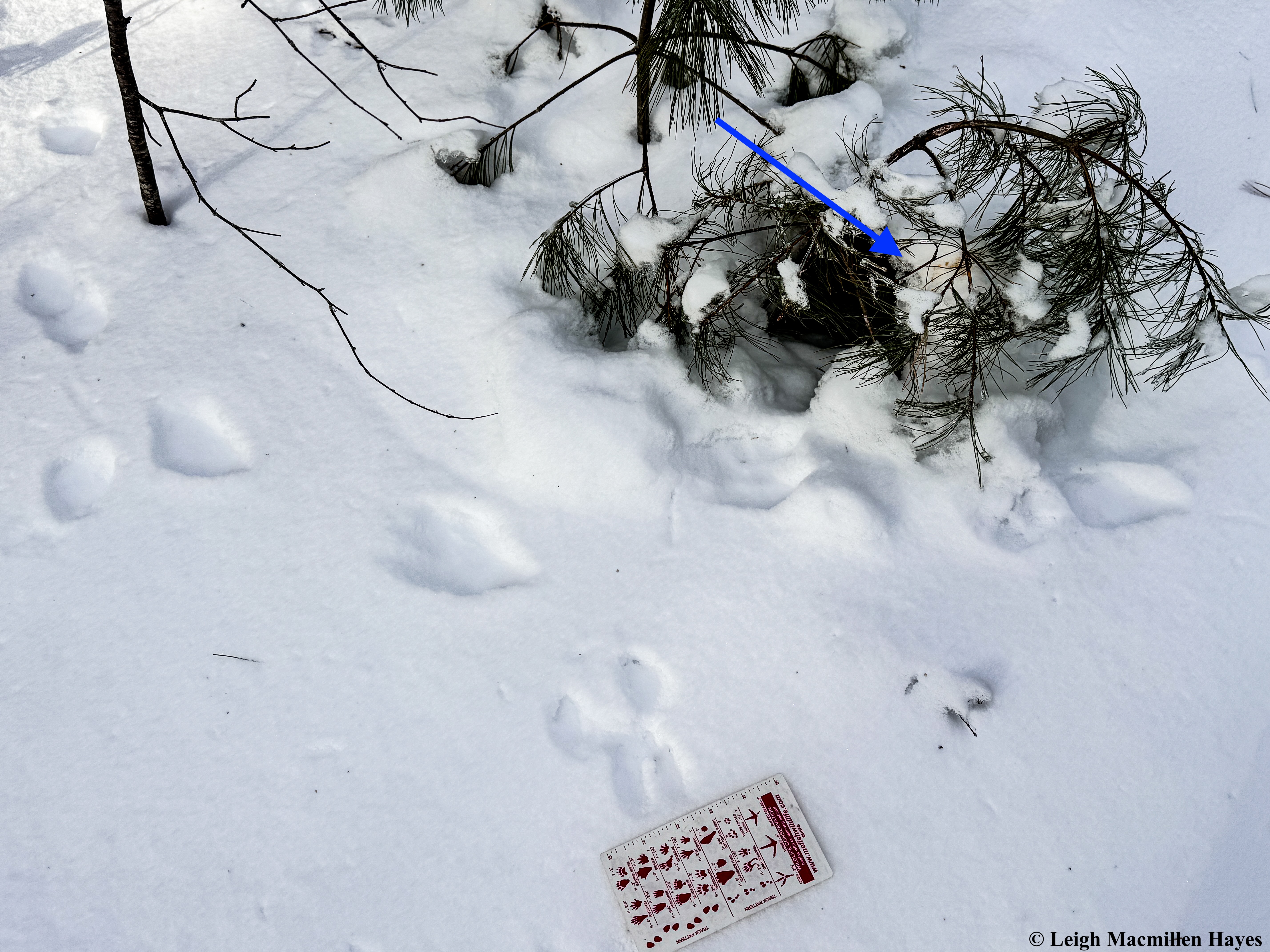
One thing I could easily discern–his territory marking. Fox urine! On a sapling. Skunk-like in odor. All classic during mating season, which we are in. Mind you, I learned this summer that Red Fox urine always smells skunky, but it’s even more so in the winter.

And I’m here to report that the Red Squirrel that crossed his path lived. For the moment anyway.
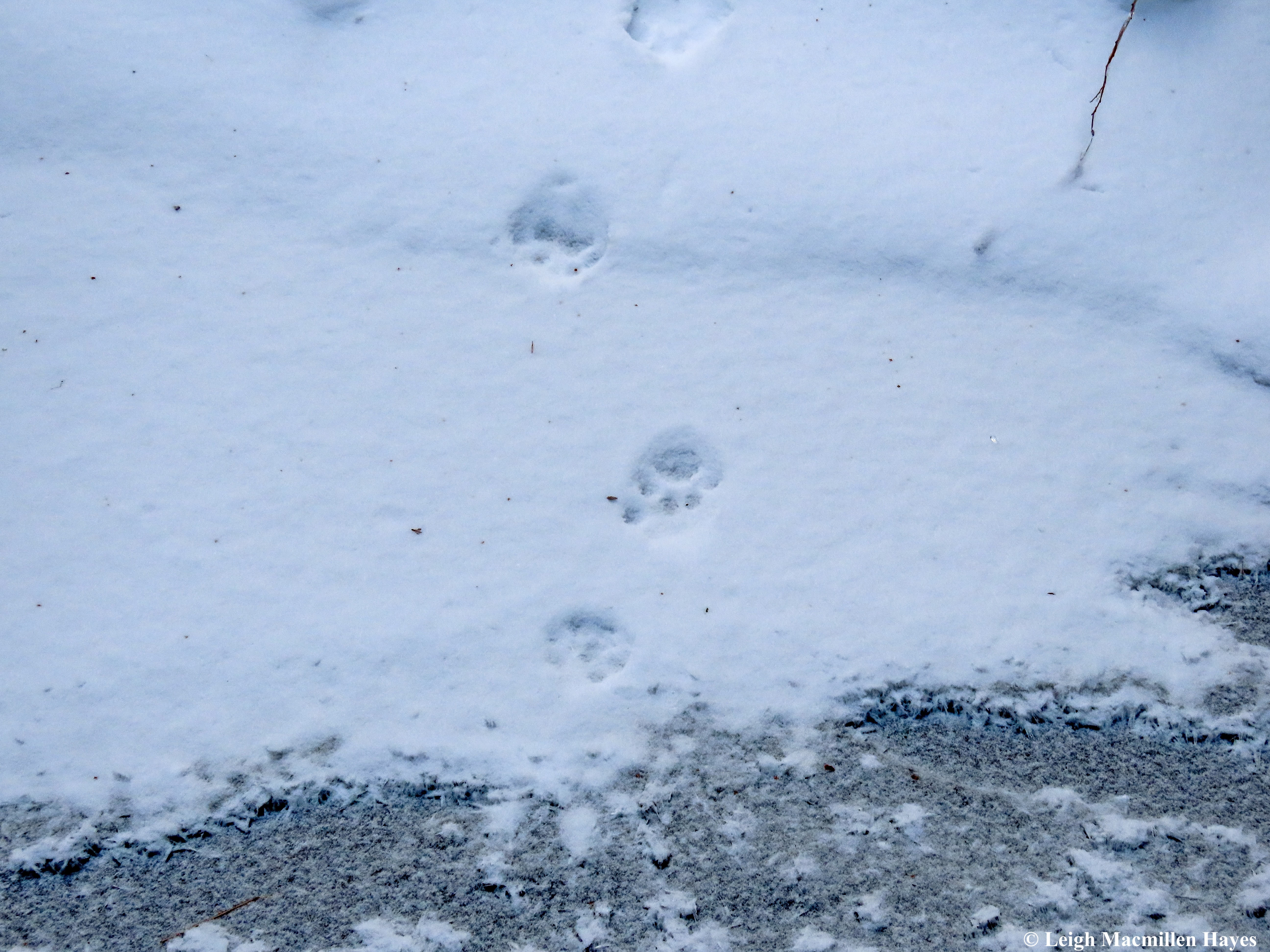
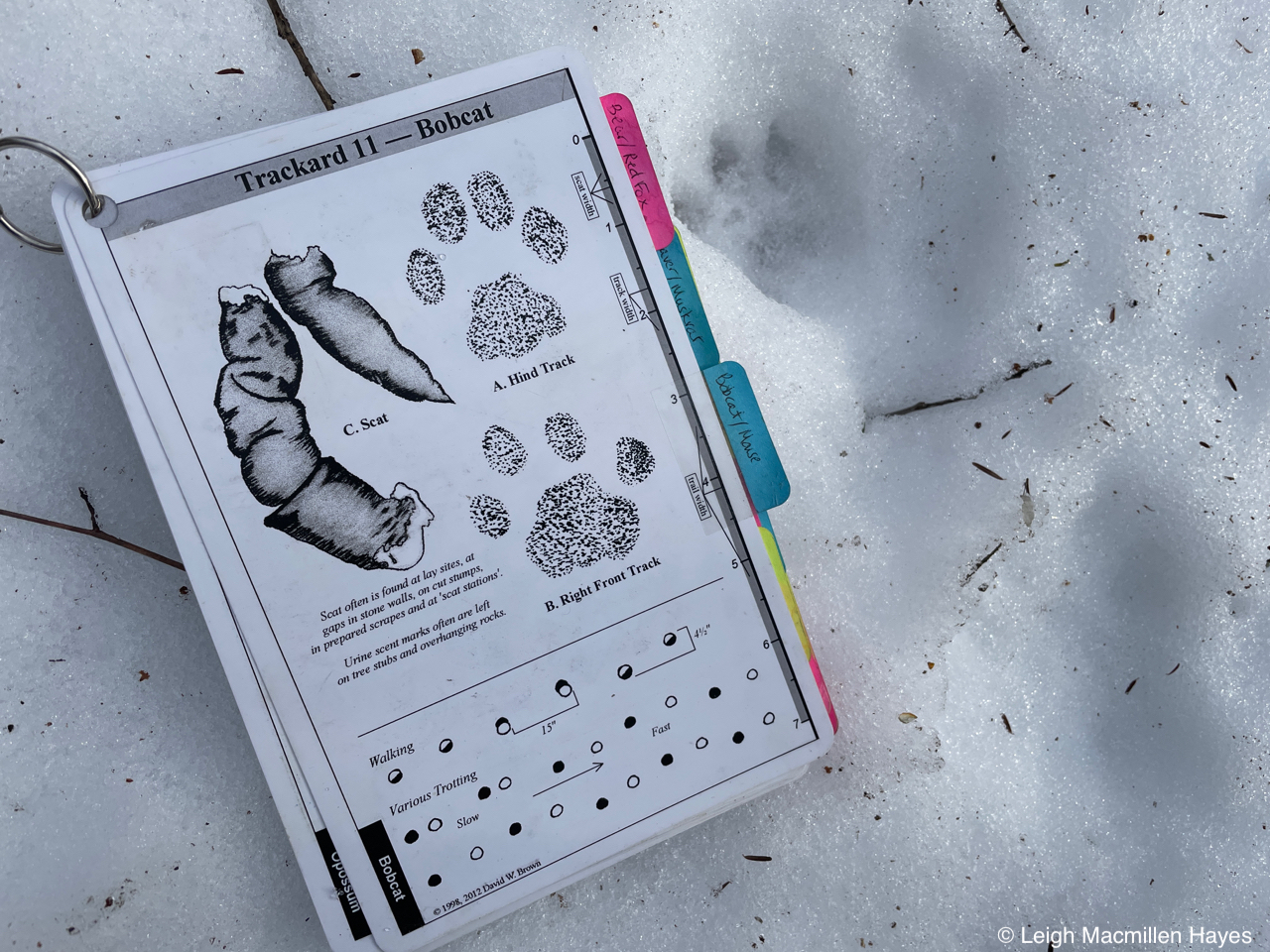
The final lesson of old, though hardly the final lesson, was the realization that some rather large prints were actually signals of two-way traffic. Do you see the upside down C in middle print? This is the neighborhood Bobcat crossing an ice bridge. But . . . which way is he walking?

Turns out in both directions. East and West. Packing the snow in one direction with both front and back feet and then following the same exact trail back. I remember the first time I saw this sort of behavior when I was looking for evidence of a Bobcat and a Coyote in a local watershed prior to offering a summer presentation to a lake association. It was about thirteen years ago and I think of it every time we hike the same trail at Five Kezar Ponds Reserve in Stoneham. First I knew I was following the Coyote and then I realized that a Bobcat had walked in the opposite direction on the Coyote’s prints. The same thing happened at Dan Charles Pond Reserve in Stow a few years ago. You can read about it in The Tail of Two Days.

Look carefully at the photo above. Do you see it? The better to reserve energy.
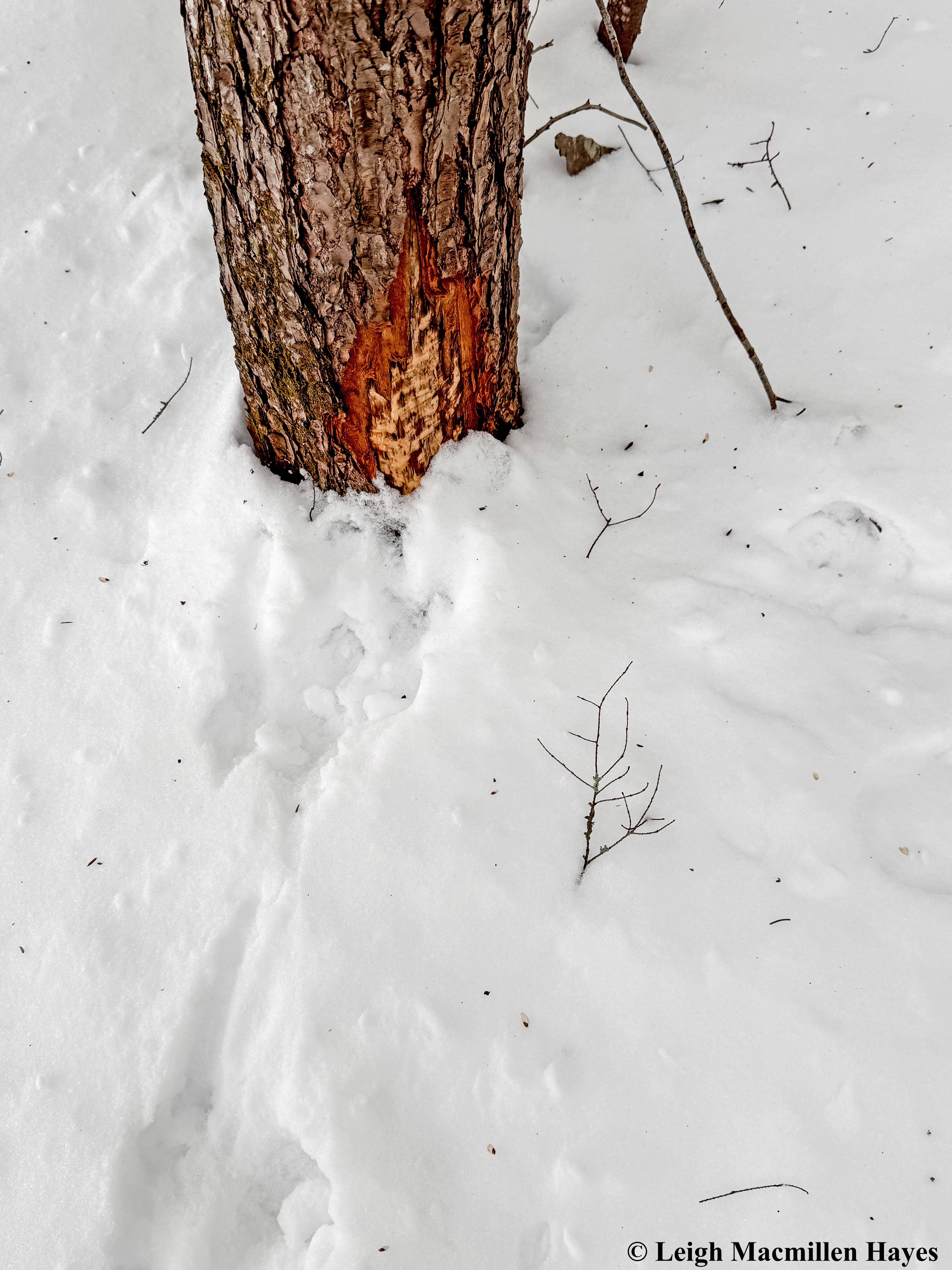
While I love reviewing old lessons because there’s always something new to observe or a better understanding of the animals behavior is gained, new lessons are even more exciting.

And tada, this is one. A Red Squirrel’s territorial mark.
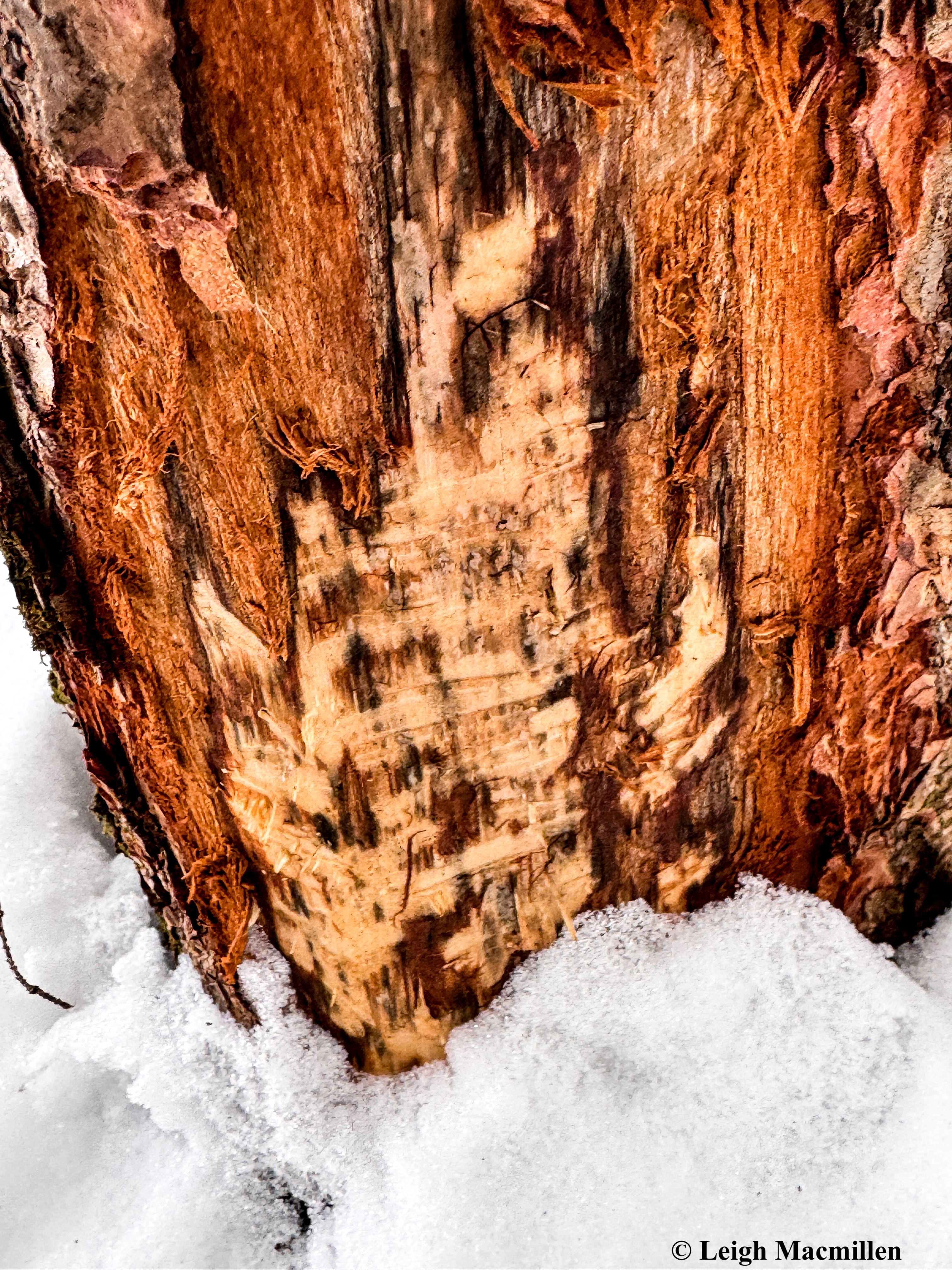
The bark is nibbled and striped and a scent post is left behind letting others know who inhabits this particular area. This is the first I’ve found, but now that I’ve seen it, I can’t wait to locate more.
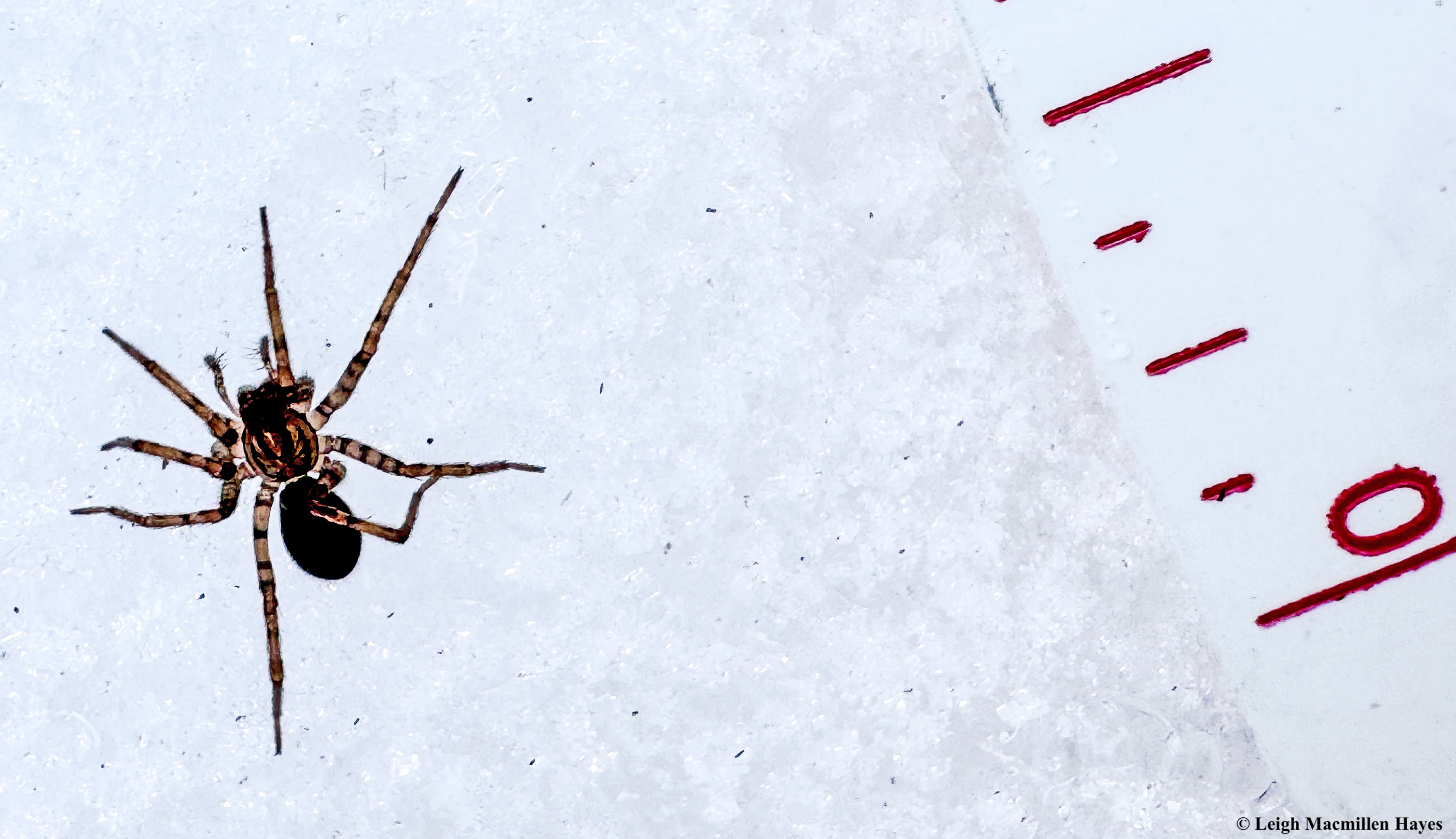
Another new lesson–discovering a Funnel Weaver Spider walking on the snow. Oh, I know that some spiders have Gylcerol that allows them to do this and I’ve seen sooo many, but a Funnel Weaver? Was it a bad decision? I’ll never know. So far, though, this is the only Funnel Weaver I’ve encountered this winter.
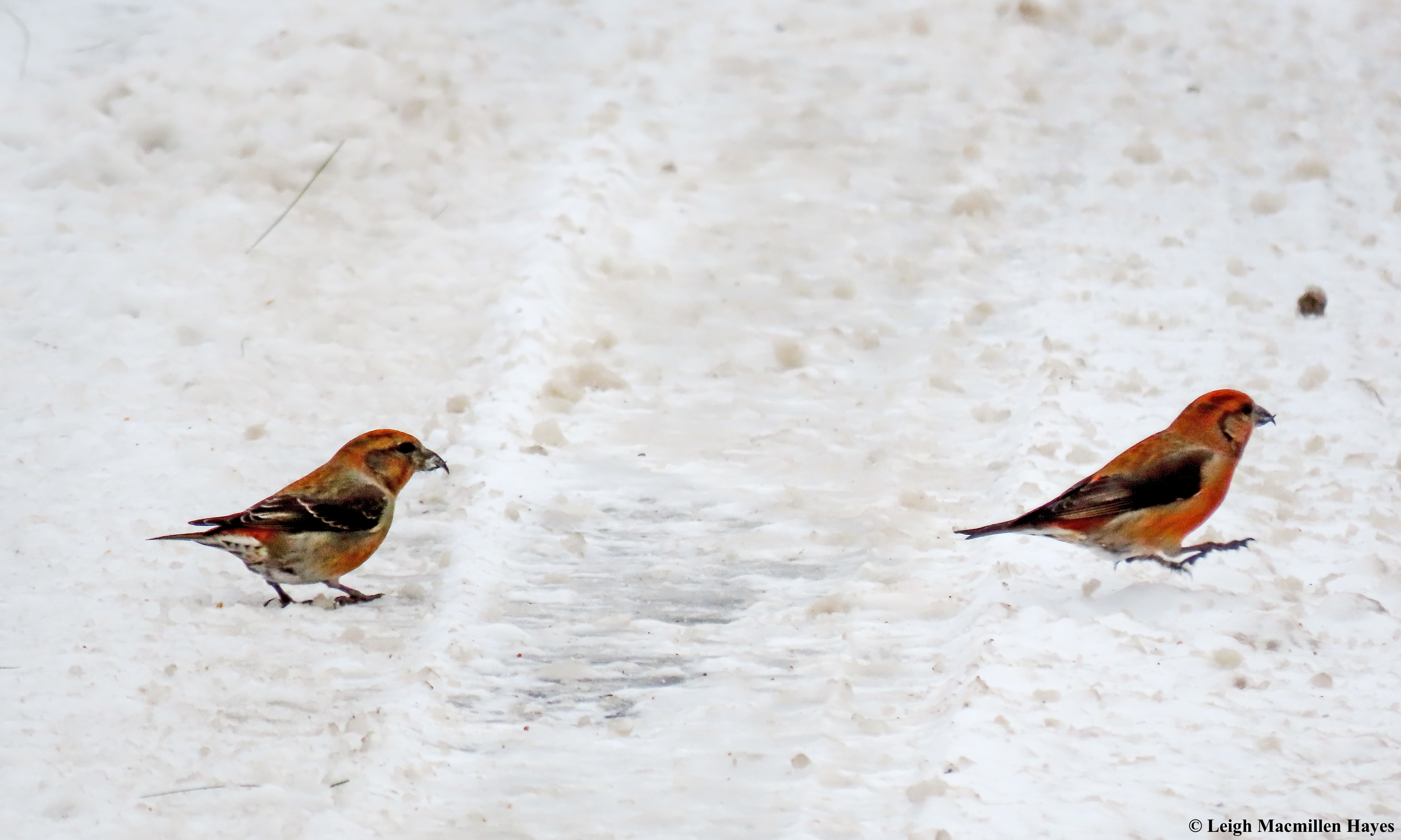
And then there have been sweet treats–not really lessons, though at some level everything is a lesson. But three times this past week I’ve spotted Red Crossbills–twice while participating in Maine Audubon’s Christmas Bird Count and once beside a local road where they’ve overwintered for years.
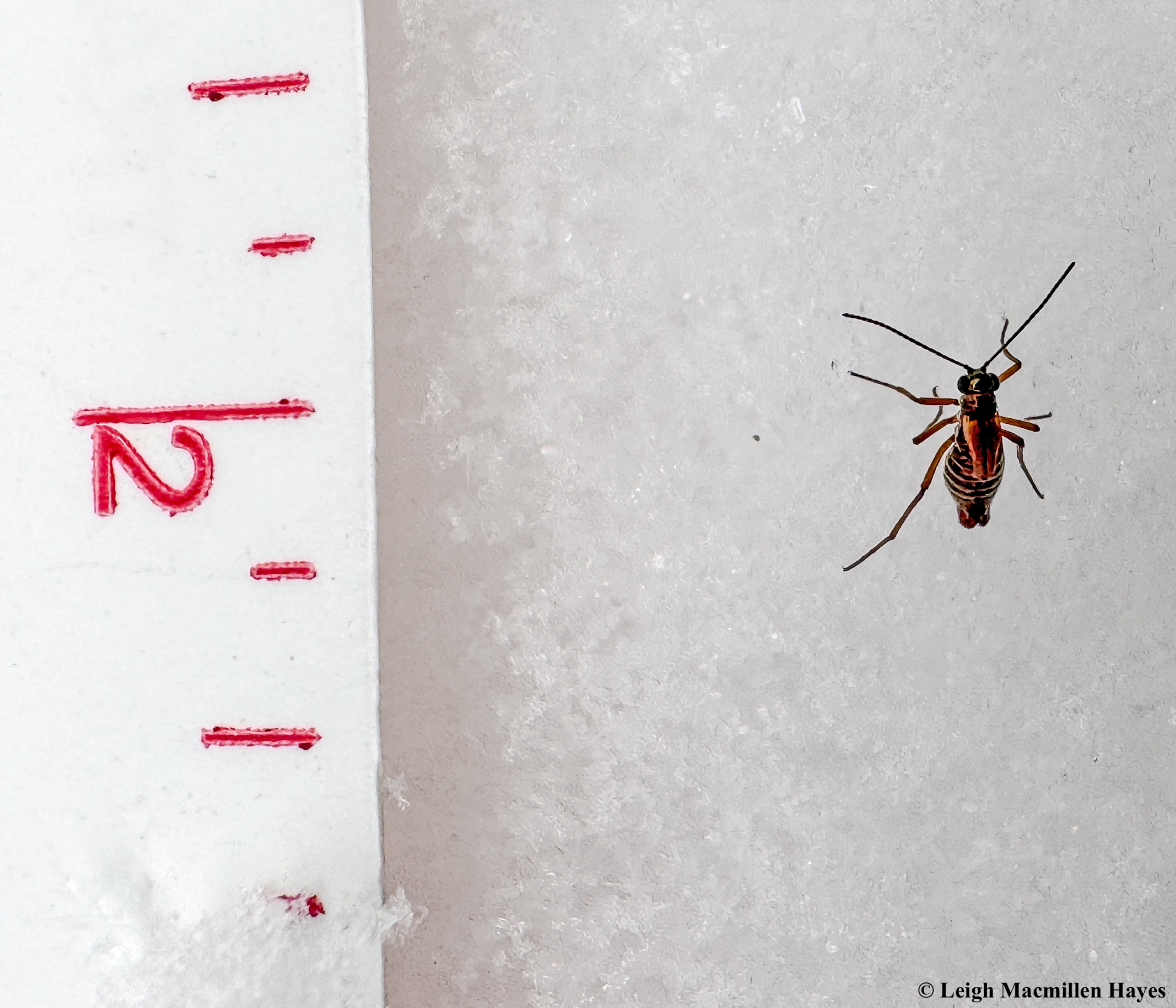
And . . . while the world view is important, sometimes it’s the teeny tiny things that need to be acknowledged–as in the case of this Snow Scorpionfly. I still can’t believe I spotted it. The snow was rather icy, so my ruler was sliding about, thus the positioning. But it’s there to give you a sense of this small insect’s size.
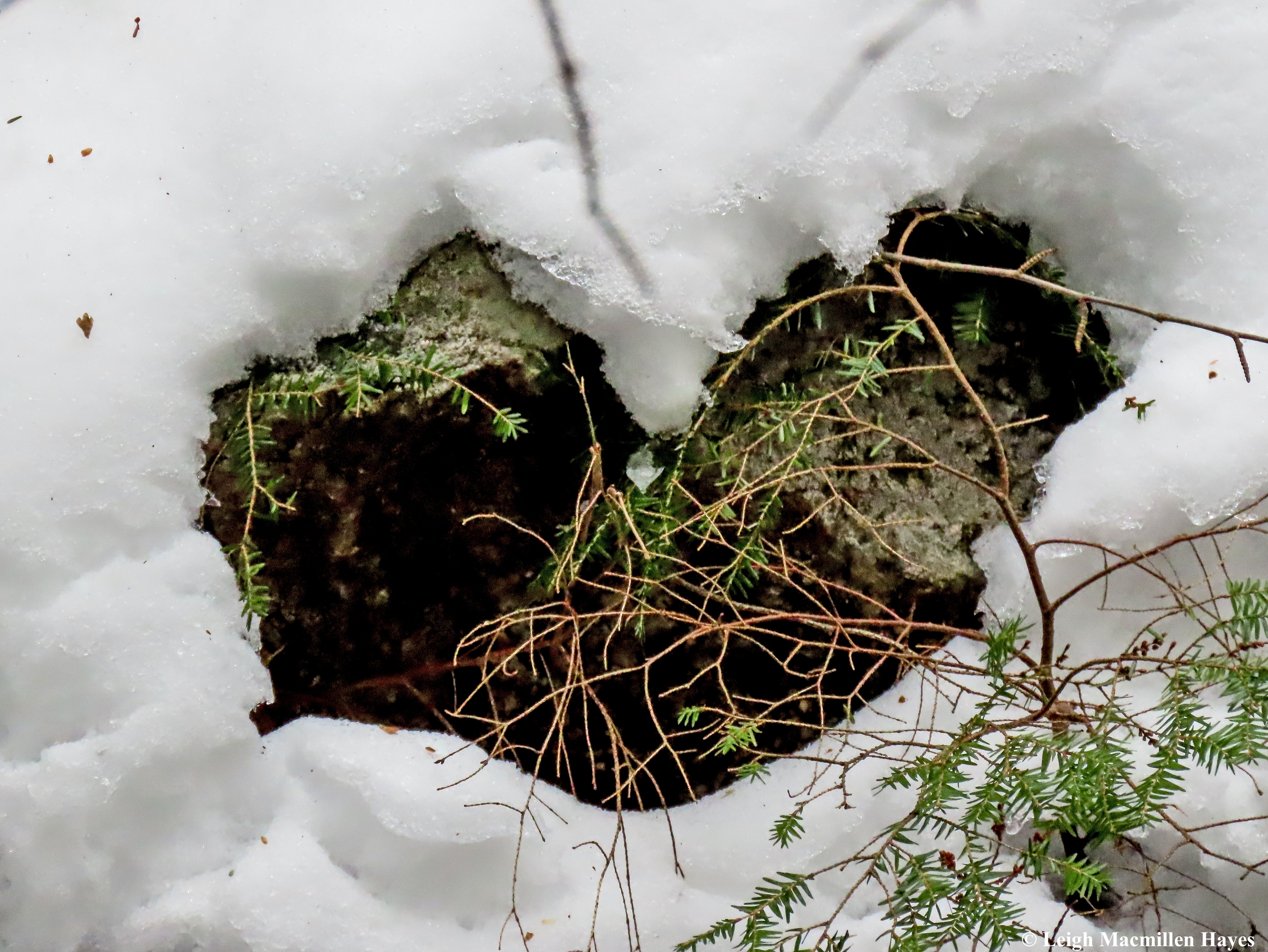
At the end of the day, or week, or hike, or blog post, my heart speaks a million words of gratitude to all of those who have helped me find my way, naturally.

I know I’m blessed.

I know how fortunate I am to have a curiosity about the natural world.

I know my desire to learn is a lifelong gift.

And I can only hope that in some small way, I can share my learnings with you.

Surprise Ending

Sometimes we follow familiar trails and other times we go off the beaten path. Well, sometimes we go off the beaten path along familiar trails. And other times, we just plain go off the beaten path because we’ve never explored an area before, and even then, we don’t exactly follow the intended route and part of that might not have been our fault for perhaps maps and blazes didn’t correspond. But in the end . . .

Wait. Let’s start at the beginning. We drove across the border into neighboring New Hampshire for a hike and though we’d never been to this spot before, I suspected when I spotted the fruits upon the Mapleleaf Viburnum, that we’d made the right choice. Usually it’s the colors of the leaves that tug at my heart strings, for there is no other tree, or shrub in this case, that exhibits these colors in combination: pinkish-red, purple, magenta, and burgundy.

But the dark blue fruits have disappeared on most that I’ve seen this fall and so I was thrilled to discover so many upon several of this species.

We followed the trail, and then went off trail, of course, for about 2.5 miles, but noted that the description of wetlands was rather deceiving. Oh, they were there, but not clearly visible from the trail and even when we did get to the edges, we could barely see the water for buffer vegetation was so dense. That said, I’m sure the water quality was good. That said, we were in an area with some warning signs about a mining operation years ago, and so the water quality must have been compromised and we can only hope is recovering.

As we circled our way out, we noted that we could have been anywhere in northern New England for we were familiar with all the plants and trees we met. And then My Guy, who does not like mushrooms as part of a meal, spotted a bunch of Red-belted Polypores, which we both admired for a few moments.

Our first leg of the journey completed, we ate lunch and then drove down the road and wandered into the woods again to locate the site of an open pit that was last mined in the early to mid 1900s.

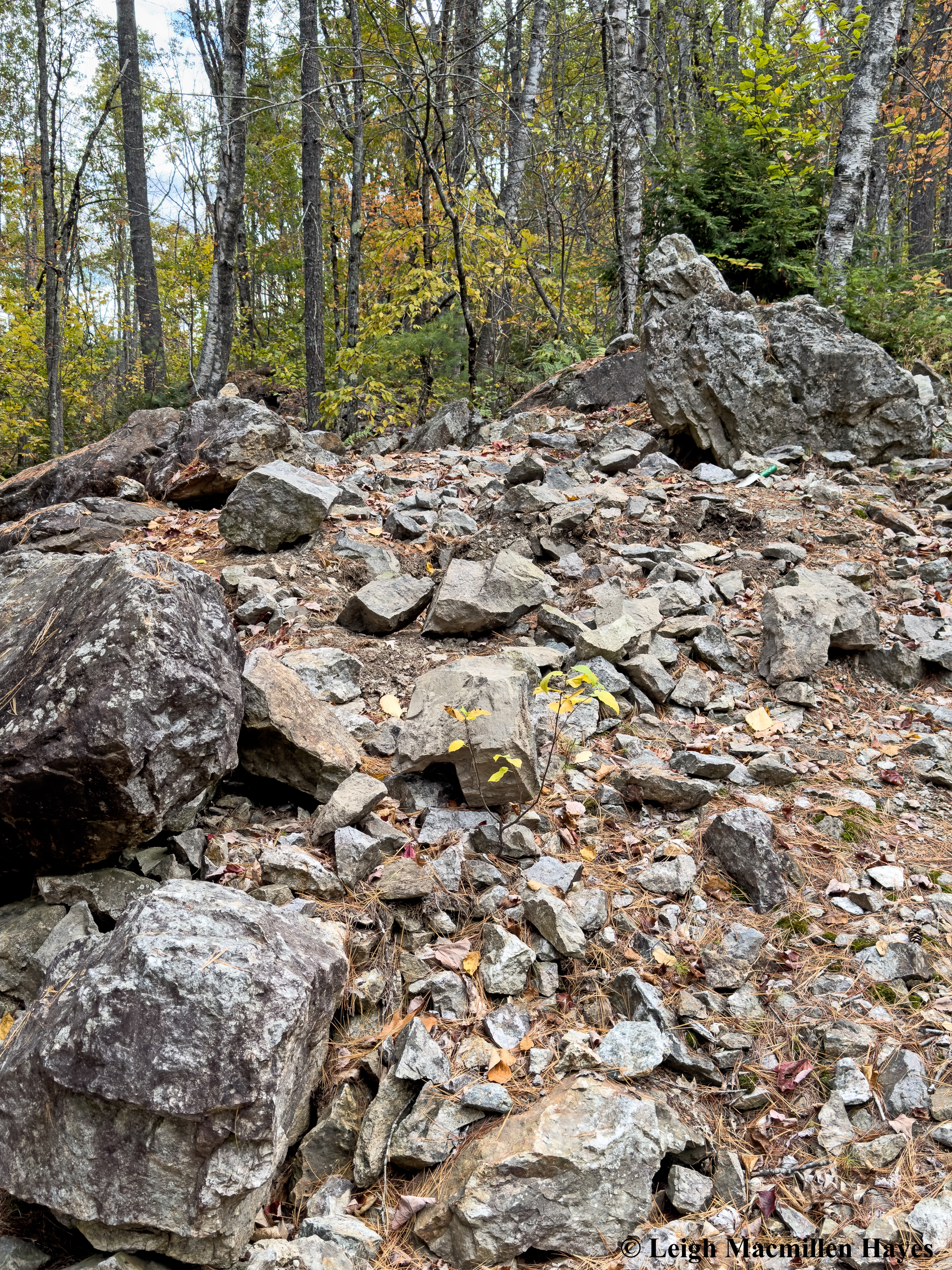
Since then, others have tried their hand at prospecting and if you are a “Where’s Waldo” fan, I encourage you to try to locate a trowel in the photo above.

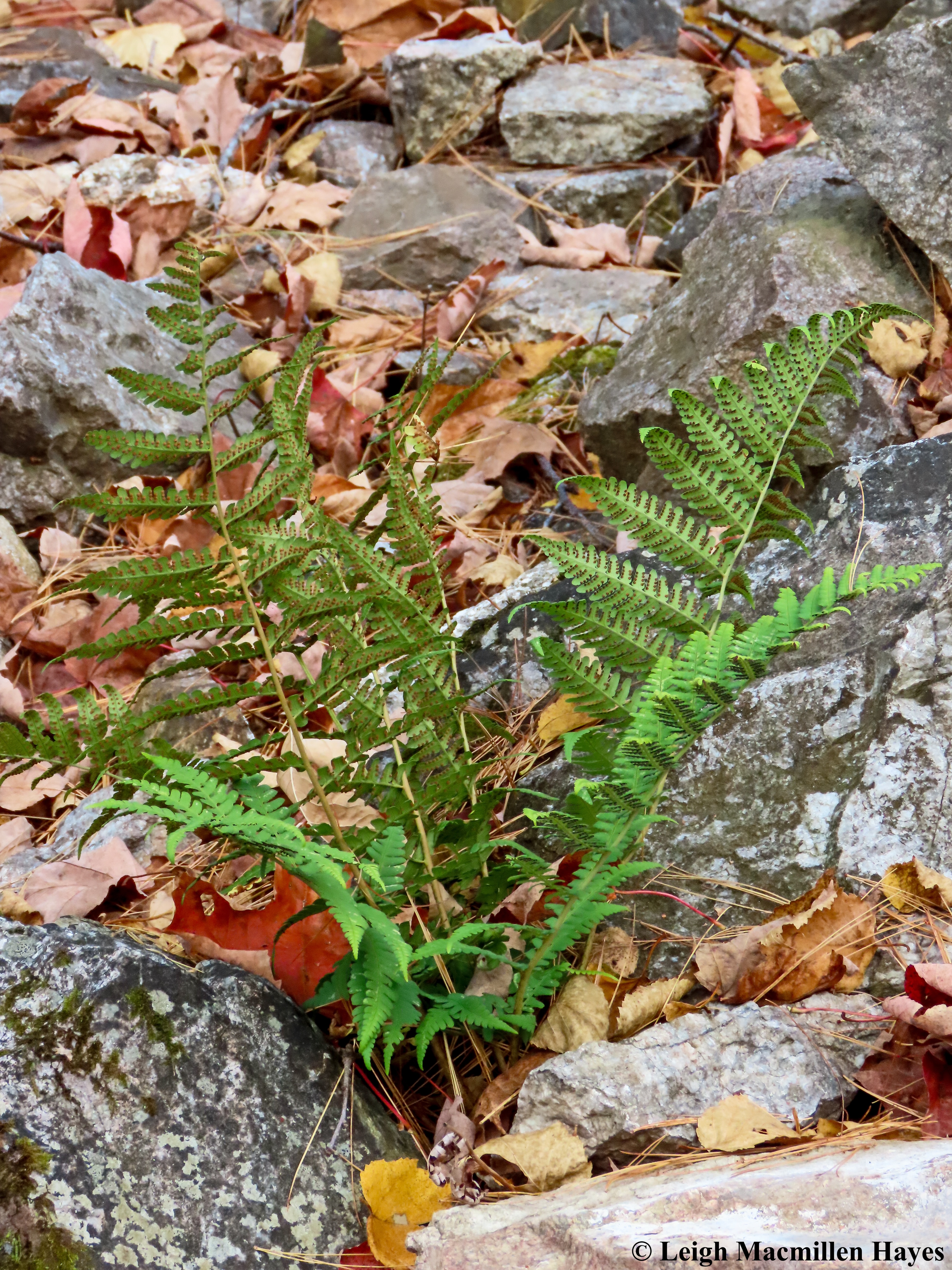
Among the waste rock dump, I was amazed to see a Marginal Wood Fern with its bluish-green leaves and loaded with sori (groups of spores) lining the edges of each leaflet. Their dark color indicates the spores had ripened, but still visible was the whitish, translucent tissue (indusium) that is kidney-shaped, and partly covered the spores.

We left that trail behind and headed off to complete one more loop. Well, we thought it was a loop. Turns out we followed two different trails that did not meet.

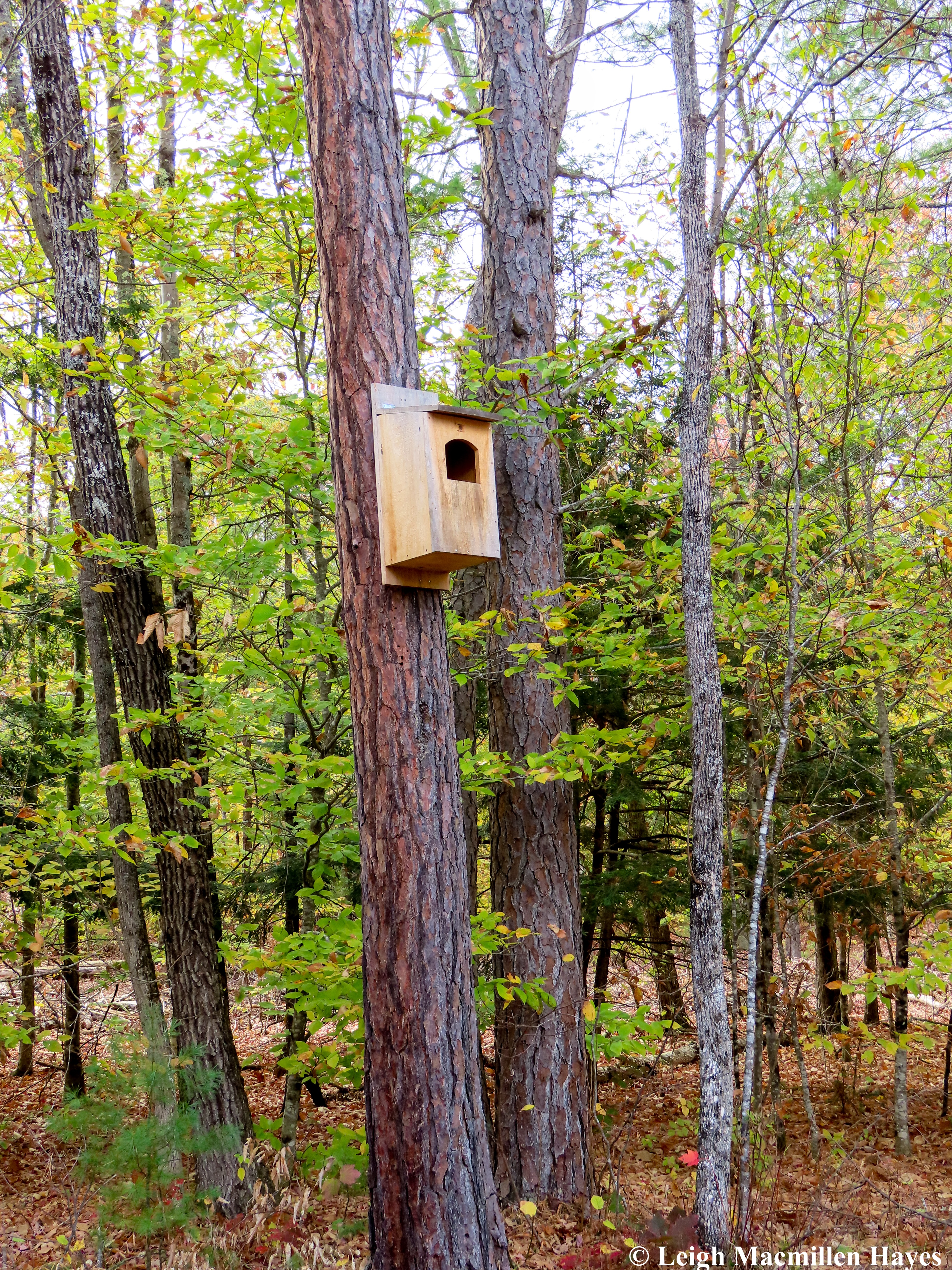
But, along the way, we discovered this huge bird box, a nesting box meant to encourage Barred Owls. I’ve since read that these should be in a mature hardwood forest near water. This one was located on a conifer at the edge of an old log landing. There was water nearby, though it took us some a while to locate it. Has the nest ever been used, we wondered. The Barred Owls in our neck of the woods seem to find tree hollows in which to set up housekeeping and the fact that I hear them most nights and occasionally spot one during the day, and have for several decades means they are quite happy living here, and don’t need a box.

But I digress and return home in that last thought and we hadn’t returned home yet for we had two more discoveries to make on our rather off-course trek, the latter one being the most significant.

As I said, we eventually located a wetland after bushwhacking once we reached a dead end on the trail. We would have explored it more, but had just realized that what we thought was a loop wasn’t and we wanted to know where another trail might lead in the time we had left before heading home.

Take note of the water level. Not too low. Curious.

In trying the connect dots, we returned to our starting point of this third leg of the journey and then hiked in the opposite direction. Again we reached a dead end. And again, we bushwhacked from there and came to one rather dried up wetland. Why?

Perhaps there was a beaver upstream? We don’t know. But we did spend some time exploring it.

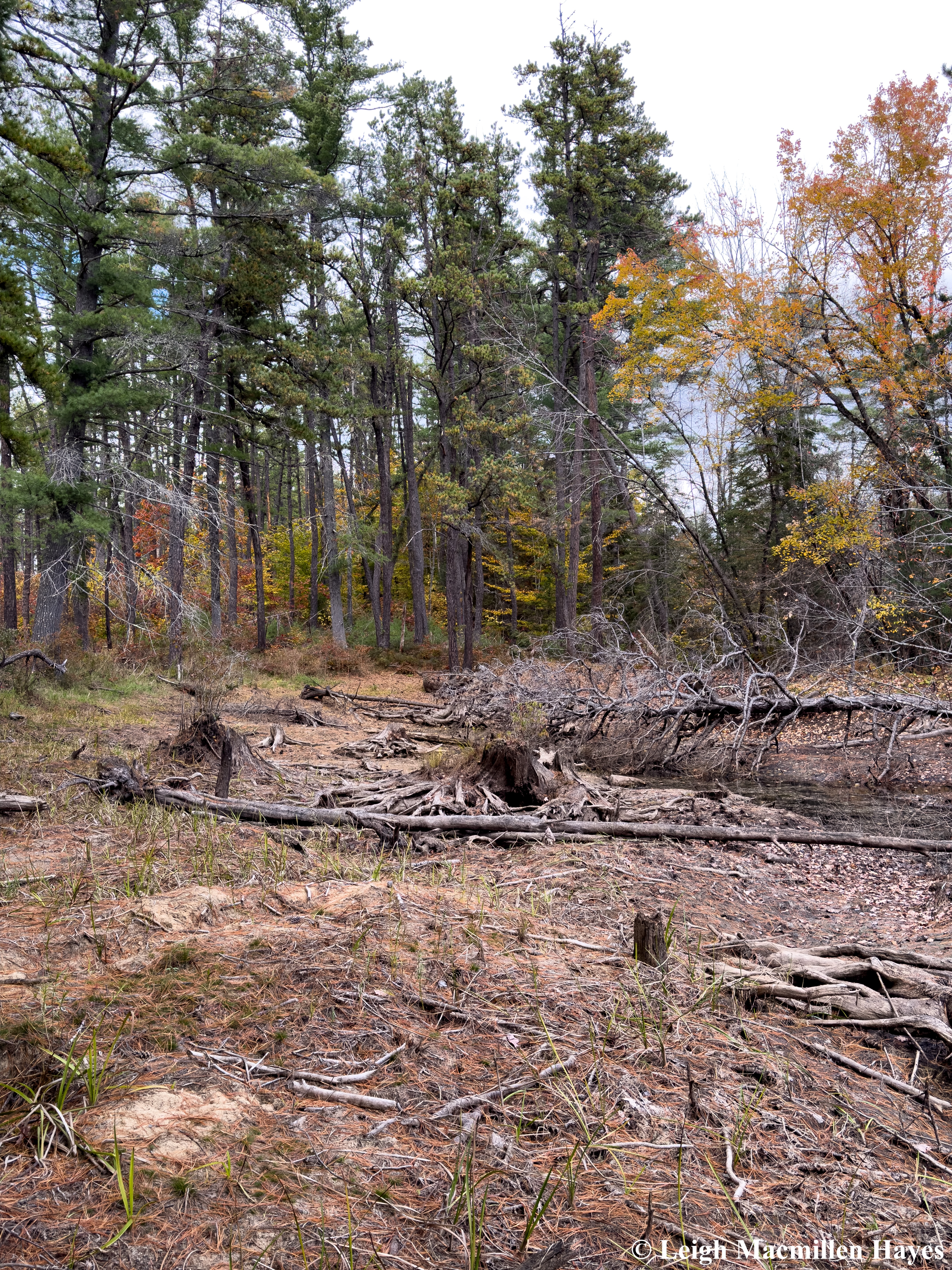
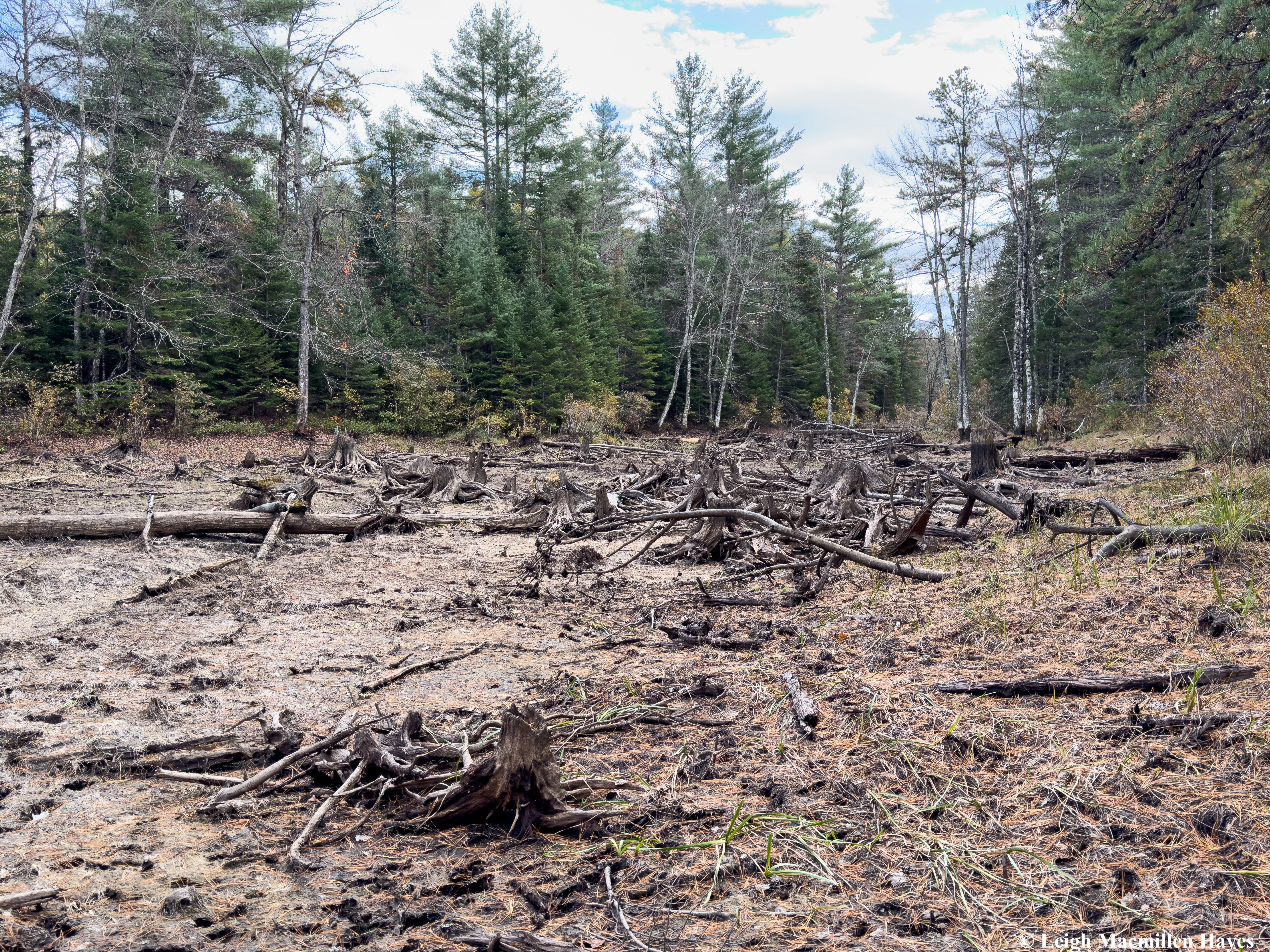
At first glance, it was so barren and my heart was saddened for the loss of life. Obviously, this used to be part of the forest as evidenced by the tree trunks. And then it was flooded. And now it isn’t. Since the drought? Since before that? Answers we don’t have.

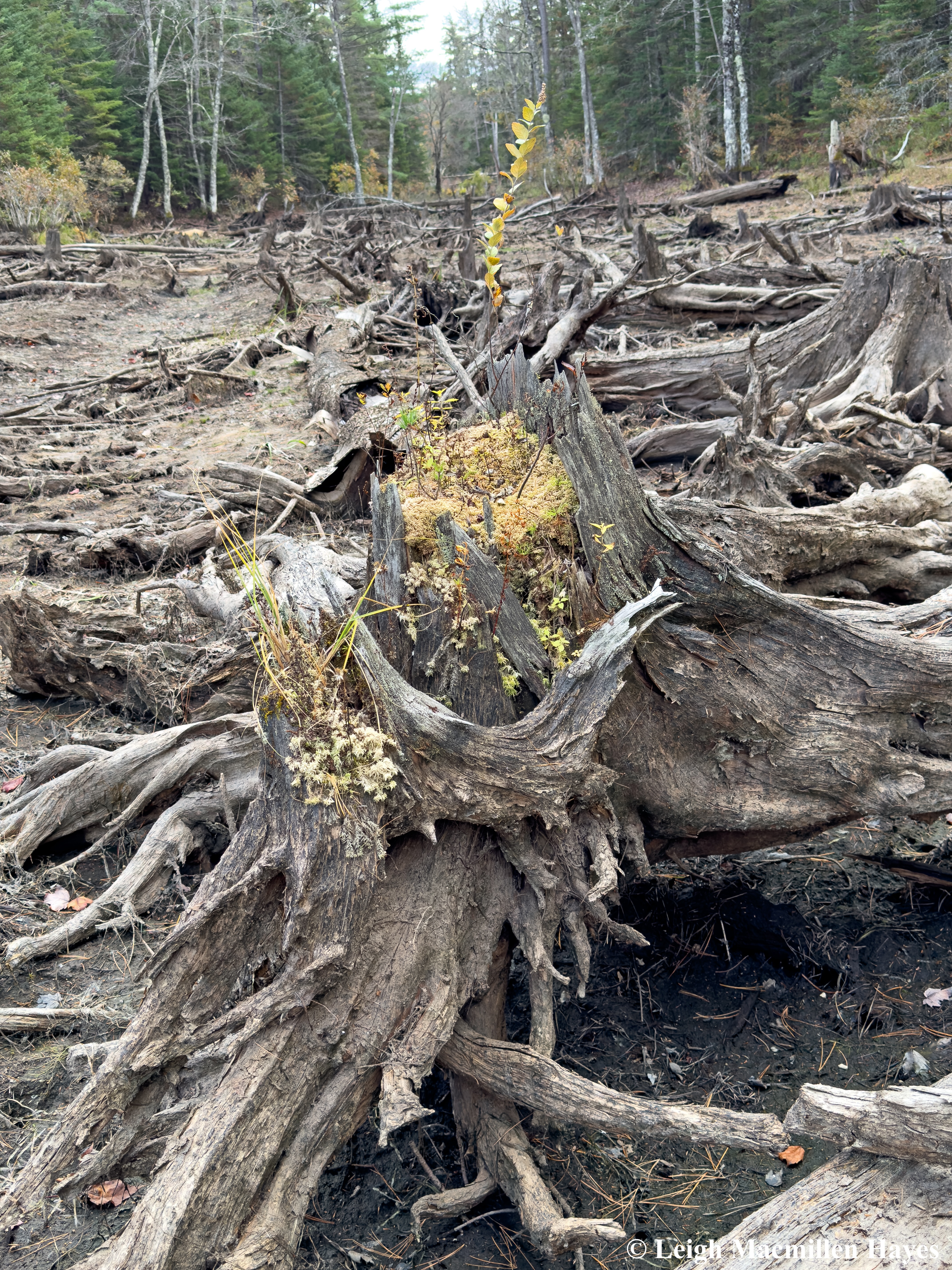
My Guy explored in one direction and I moved across the mud in another and met a stump garden.

In its own dried-up way, it was a thing of beauty with lichens and mosses and plants and grasses and trees all finding their niche in the midst of such apparent devastation.

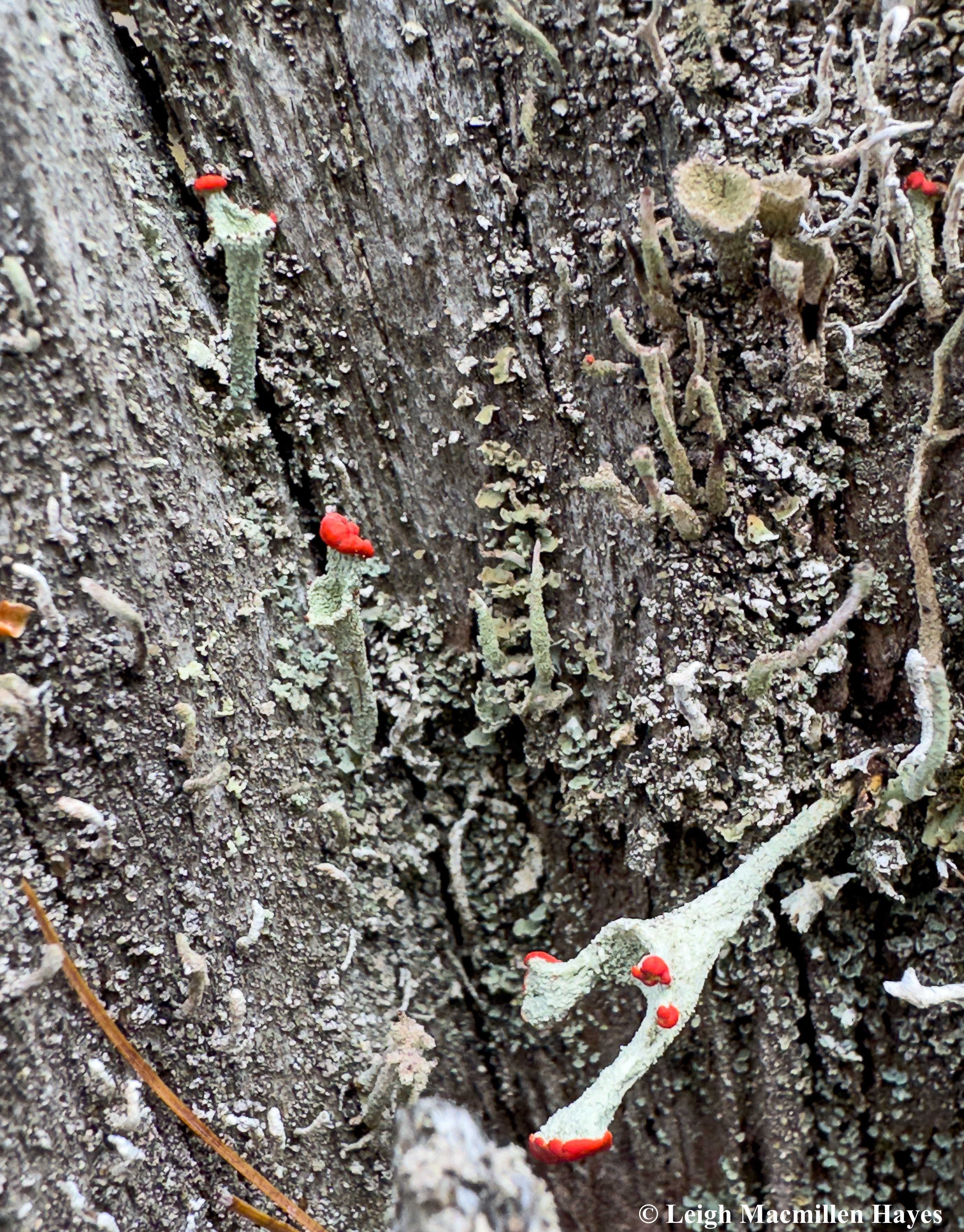
On the barkless outside, I discovered a myriad of lichens from Pixie Cups to Powderhorn (now apparently called Wands) to Red-fruited Pixie Cups.

Not to be confused with British Soldiers, which do not have cups, the Red-fruited Pixie Cups brought a smile to my face due to their goblet formation topped with those outlandish caps along the margins. The red is actually the apothecia or reproductive structures where spores develop.

Beyond the garden stump was another and even another, their roots wrapped in a forever embrace.

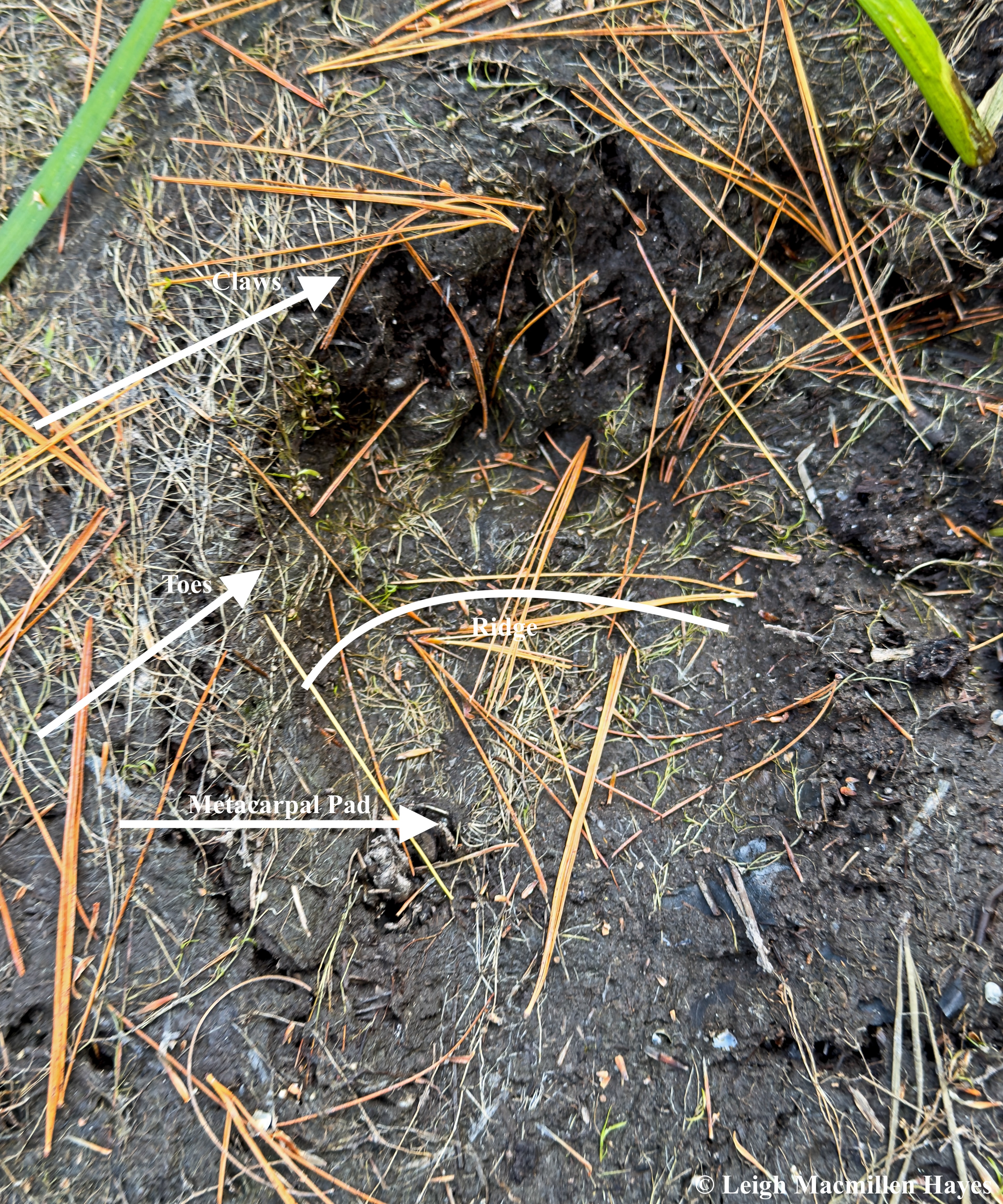
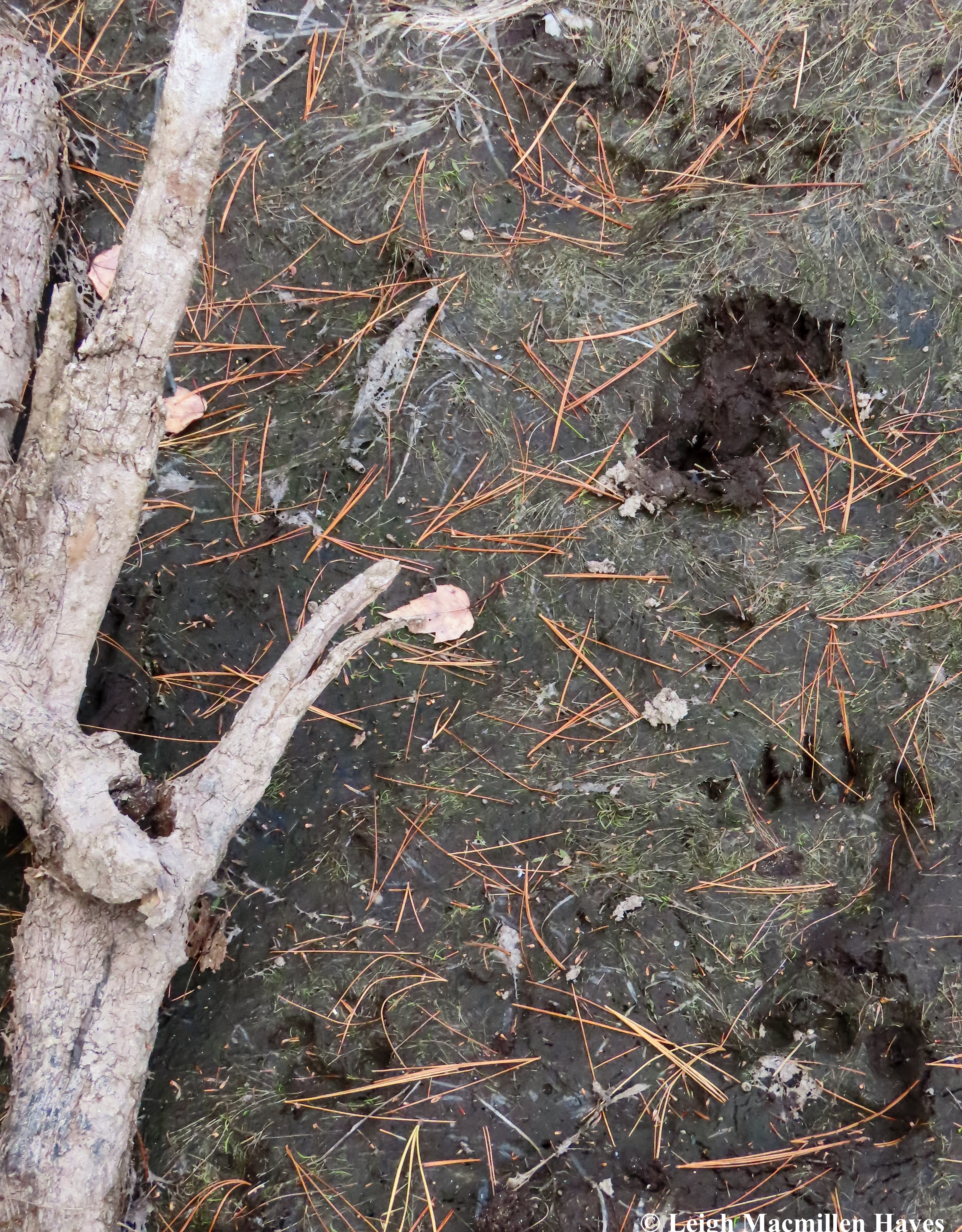
But the show stopper was what I spotted in the mud. A track. There were deer tracks galore. But . . . another mammal or two or three had also passed this way. Note the details.

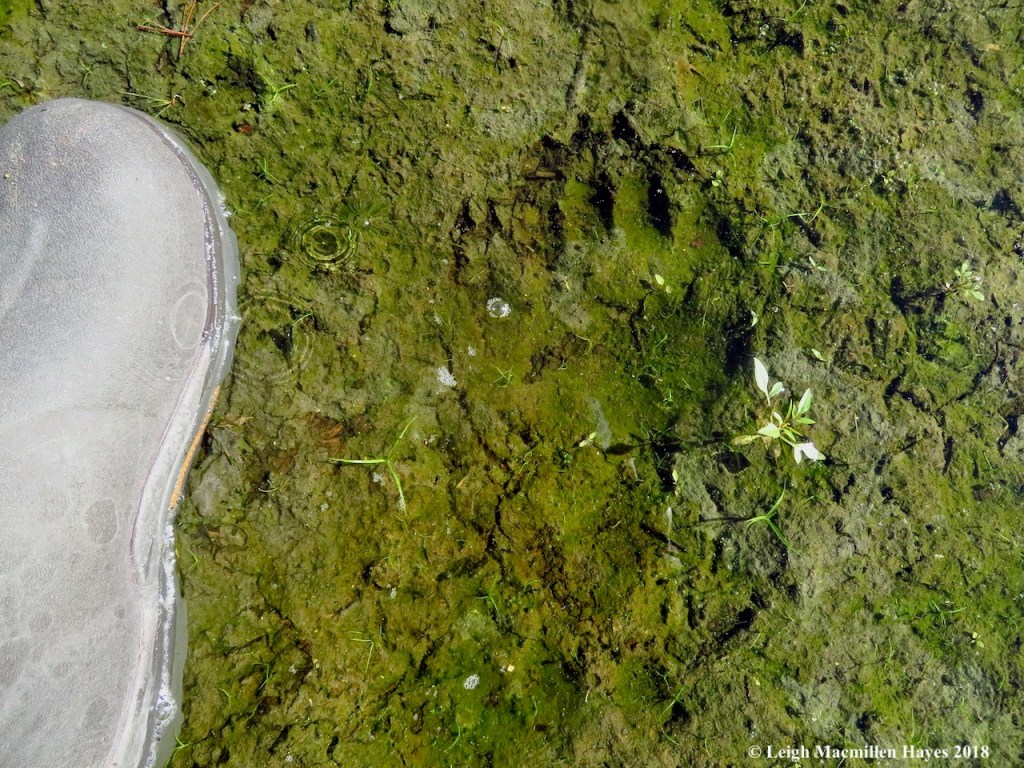
I present to you, my dear readers, a bear print. Black Bear in this neck of the woods. The smaller toe is on the left, which means this is a right front foot–their big toes are on the outside of their feet rather than the inside like ours; better for climbing trees.

Do my arrows help you to see the parts of the foot?

Bears are waddlers, which means they have wide hips and their pattern tends to be a bit of a zig zag, with a hind foot landing near where a front foot had been. Oh, let the tracking season begin.

With two white lines, I’ve tried to trace two bear tracks that My Guy is studying.

Suddenly this desolate, dried-up space, wasn’t so bad after all.

This was our surprise ending. My heart be still.

Celebrating Creation aLONG the MOUNTAIN

When asked the other day if I am enjoying spring, I responded, “I’m still loving winter.”

So is My Guy.

And so today, we took to a beloved mountain trail and reveled in the sights and sounds.

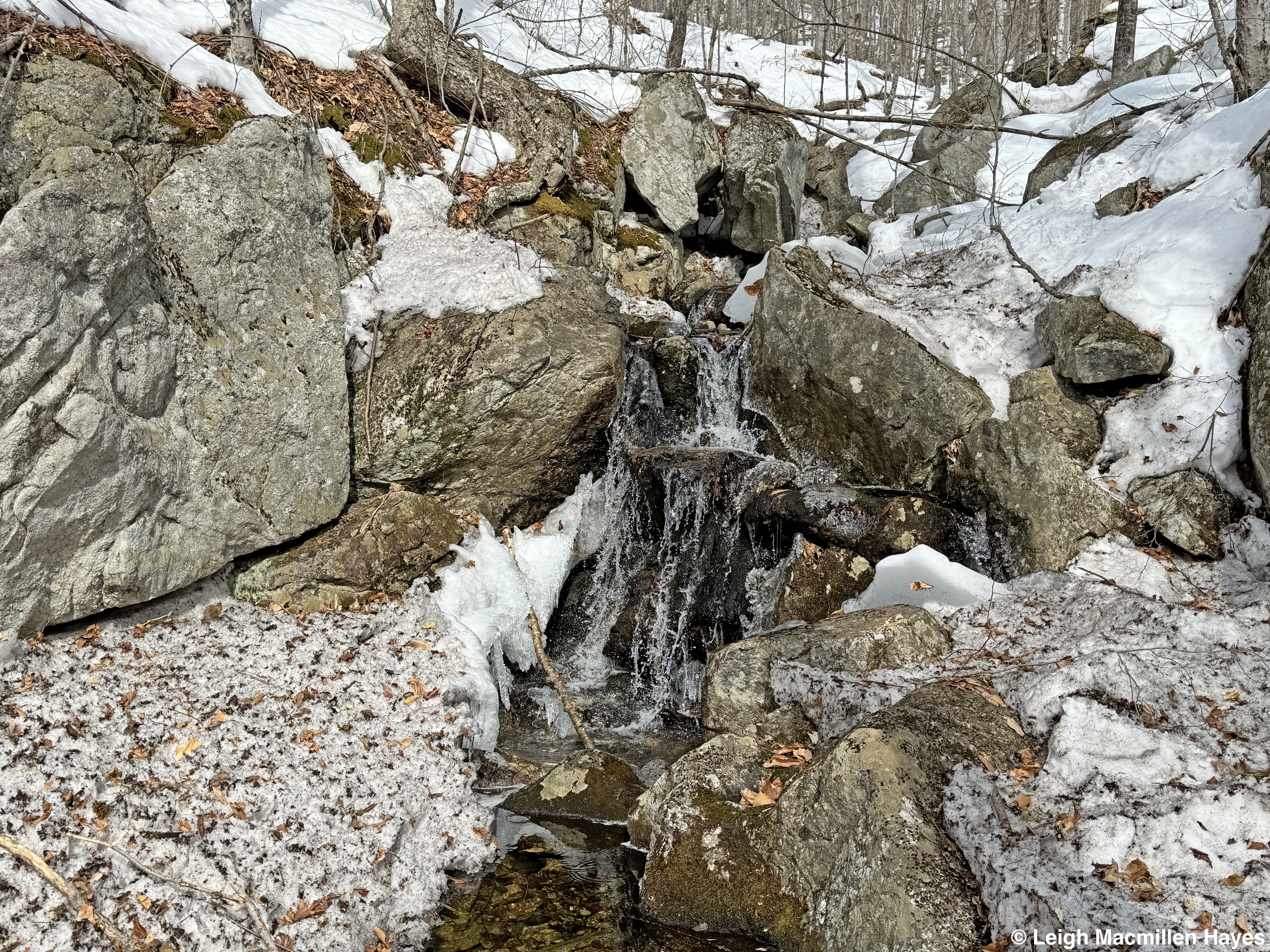
Beside a brook, our journey began, where as the water flowed, nature’s artistic hand created a magnificent display of ice sculptures.

On the way up the loop trail, and again on the way down the other side, the golden carpet was set before us, for into the warn pathway do leaves settle after a wind event.

Because we were hiking in a deciduous forest to begin, our eyes kept scanning the tree trunks, and tada, we were rewarded. Well rewarded.

It seemed like everywhere we looked, we spotted American Beech trees with bear claw marks indicating multiple visits to feast upon the beech nuts.

We suspected some of these trees we were meeting again as if for the first time, but though we lost track of how many we spied, we knew it was more than we’d seen in the past and gave thanks to the trail conditions that allowed us to move without caution, and the fact that it is still winter and there were no leaves to hinder such views.

While studying almost every tree for a while, I kept noting the trunks of another species, this the two-toned aspen that looks like an oak toward its base, but morphs into a birch toward the top.

There was no question whether Quaking or Big-Toothed for leaves upon the snow told the species name: My, what big ____ you have!

As we continued to climb, the neighborhood changed and so did the forest floor–of course, still upon firm snow, for suddenly, we walked upon a green carpet.

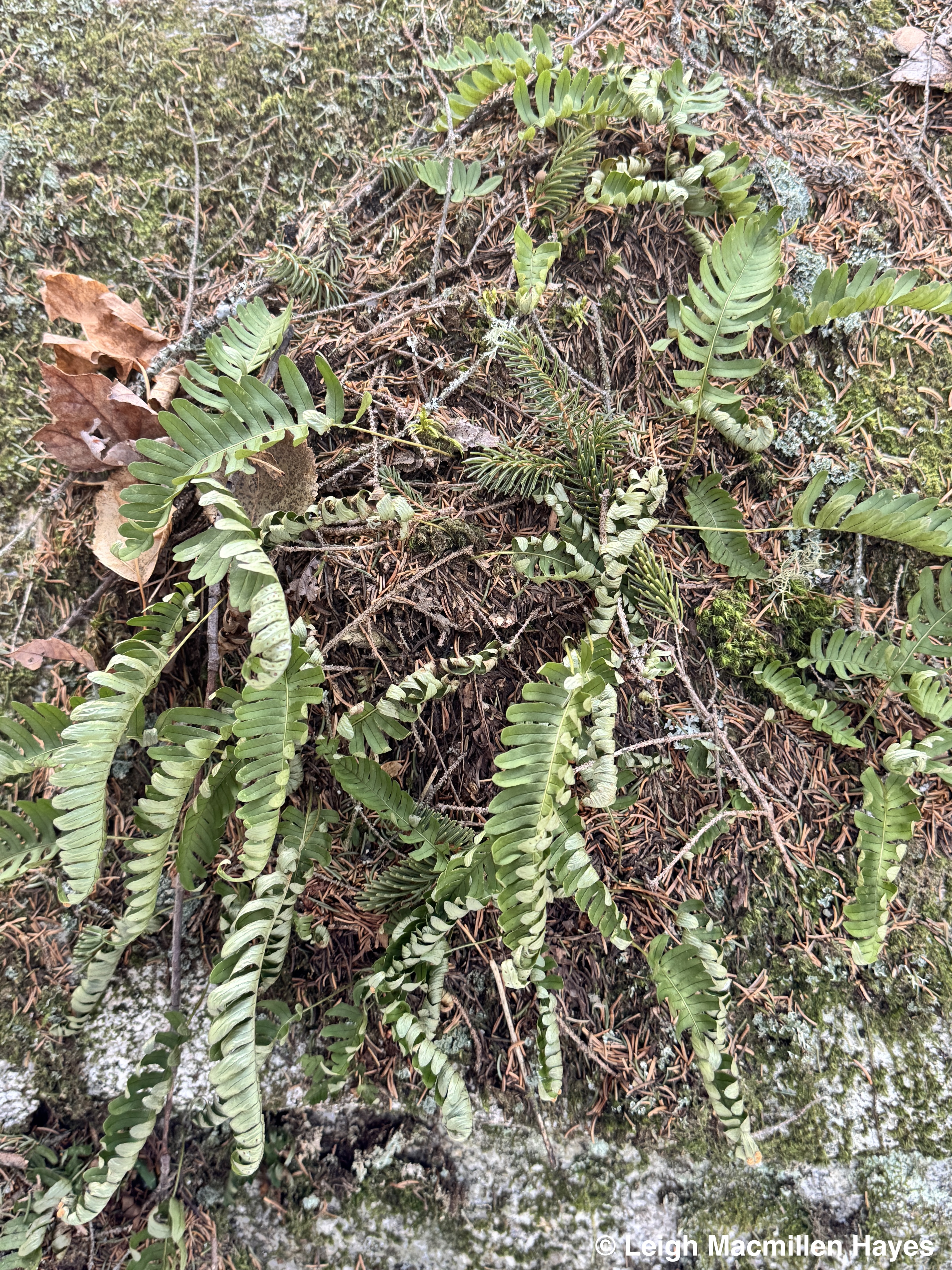
It was in this section of forest that I began to spot Common Polypody ferns predicting the temperature, for they were still a tad bit curled indicating it wasn’t exactly warm, but not completely curled telling us it wasn’t freezing cold either. It was just right!

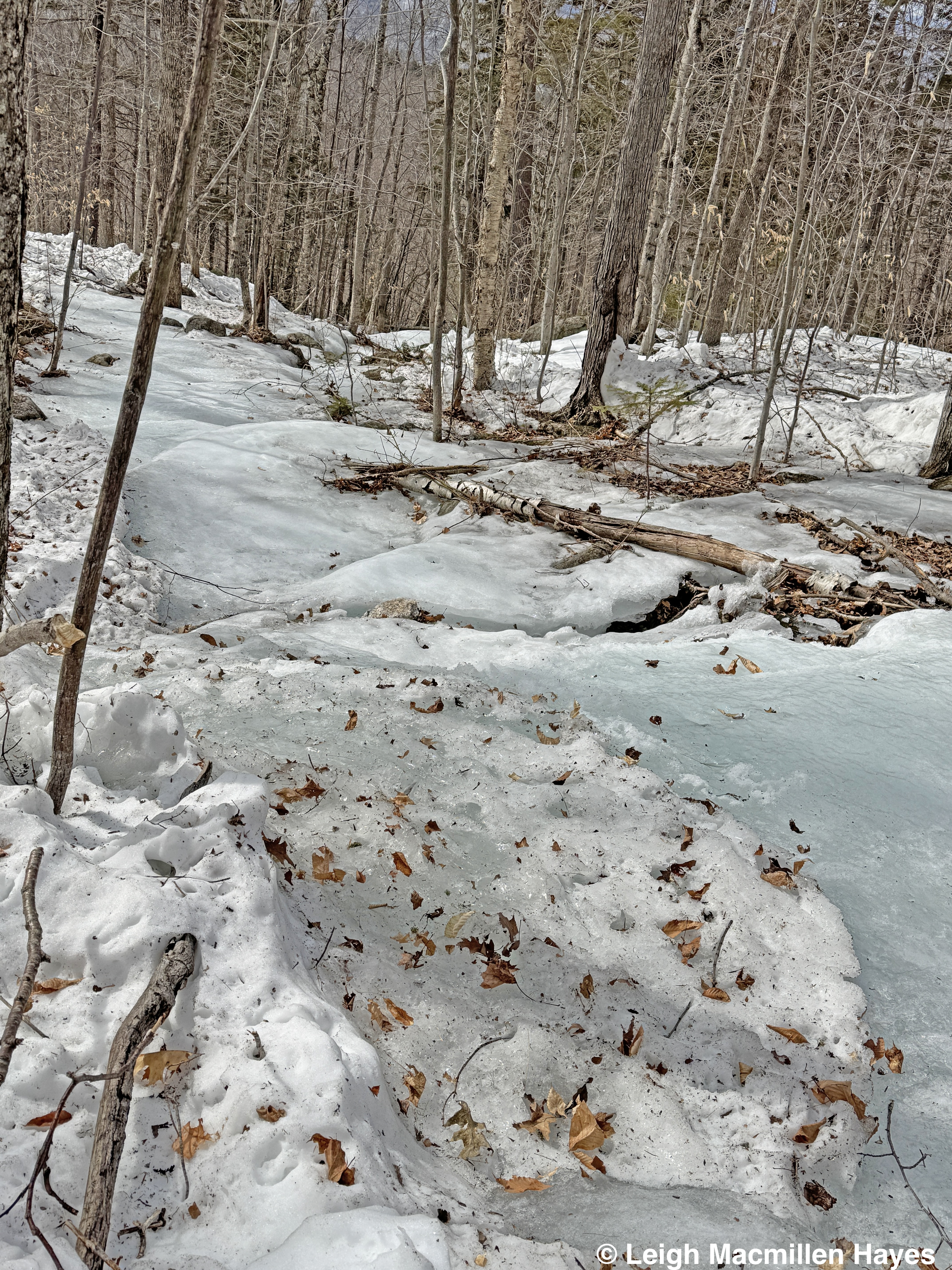
Well, almost just right, for because of recent rain and warmer temps last week, the melt down has begun and ice flows along the trail were frequent in the coniferous forest.

That same flow continued down a crevasse that we admired from the path, but didn’t need to descend. Thankfully.

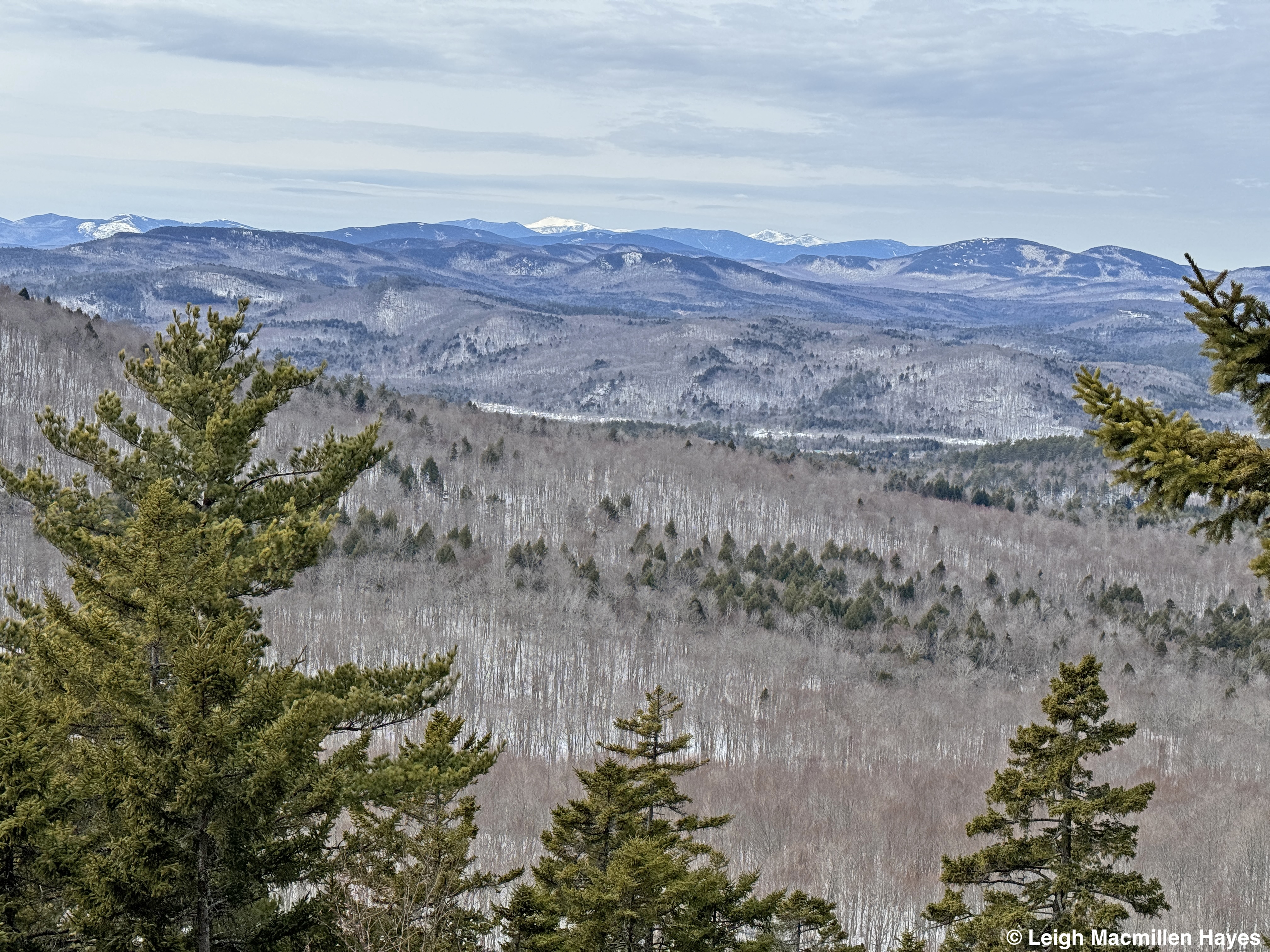
A short distance later, we reached Lunch Ledge, aka North Ledge, and took in the view toward Mount Washington.

As we ate, we looked at all the Beech trees below (and other species, of course) and wondered how many more Bear Trees there are in these woods since we saw so many just from the trail. And we wondered if there might be a den nearby.

Following lunch, we continued our trek, and then found a spot where another had dined.

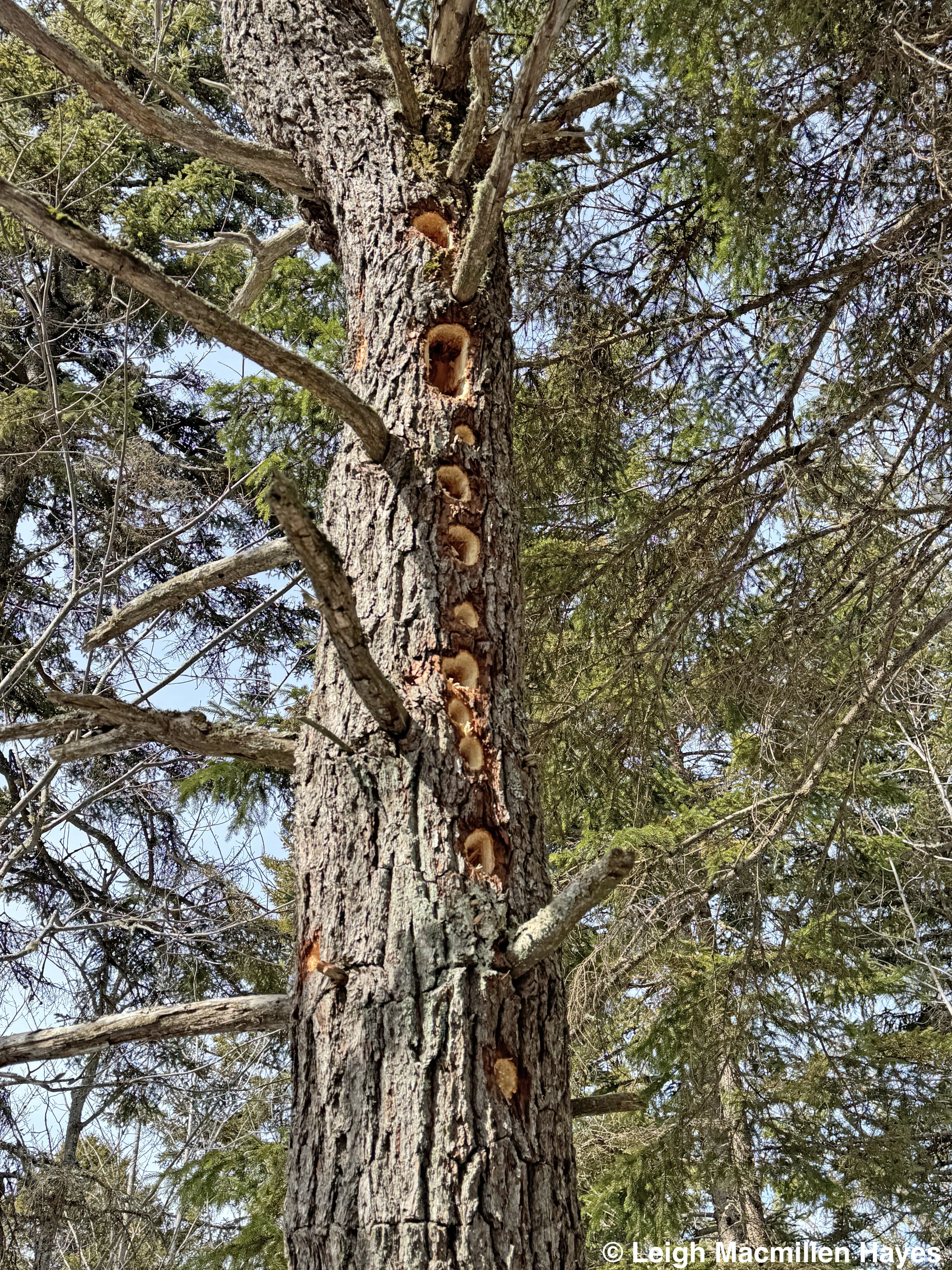
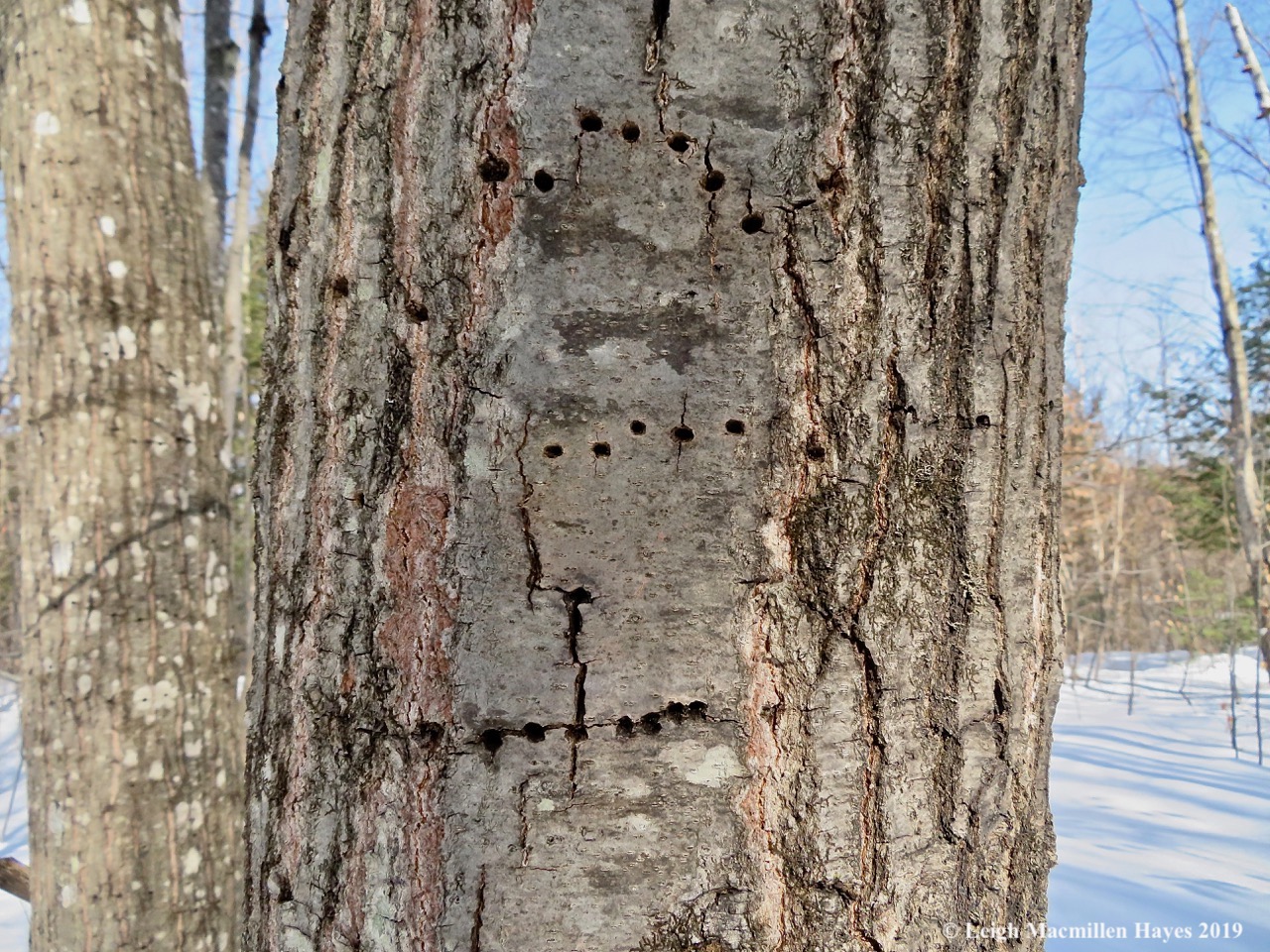
By the number of fresh holes in the tree, we knew the Pileated Woodpecker had visited this spot on more than one occasion, rather like the Bears and the Beech trees.

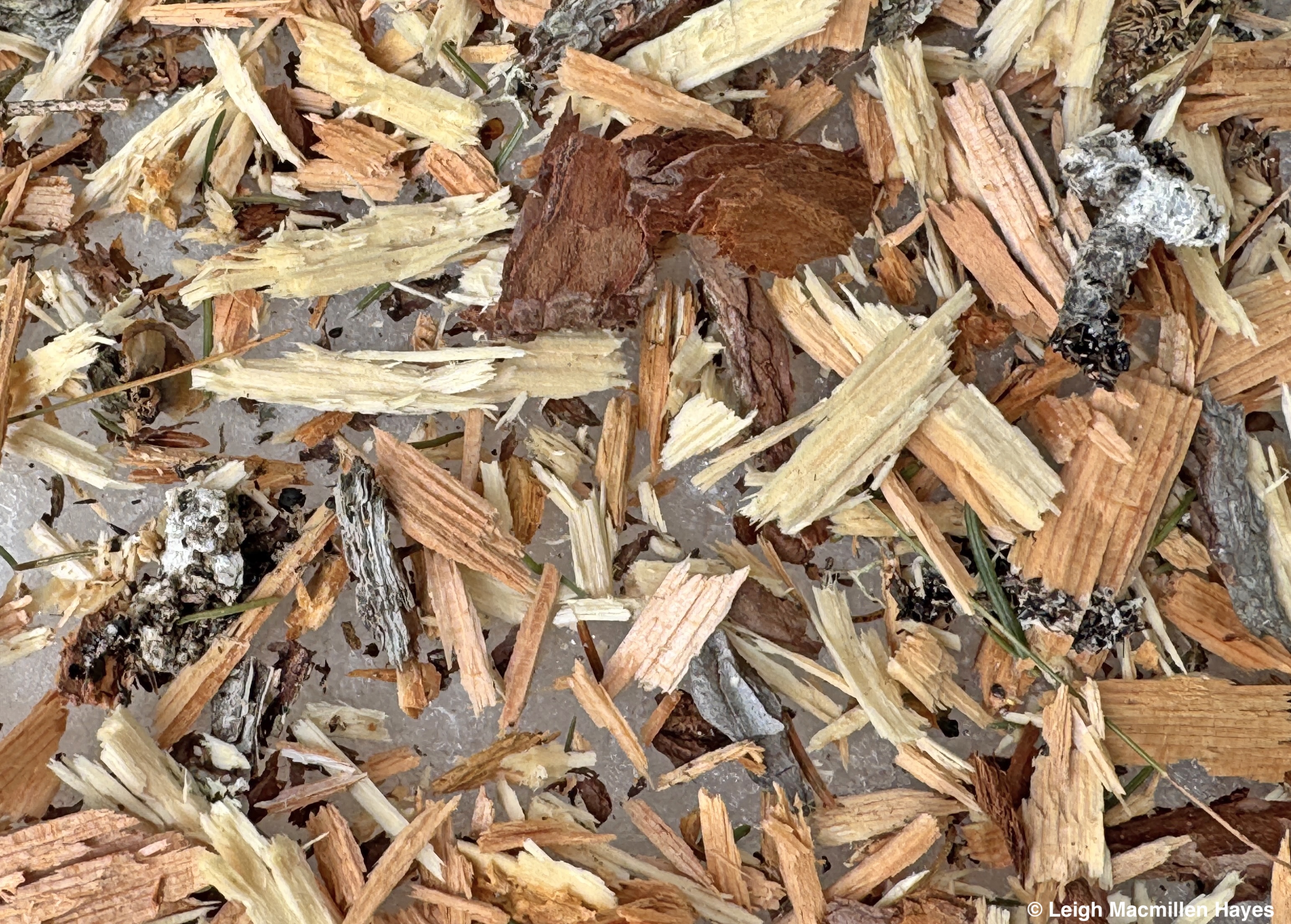
I must confess, I cannot pass up the opportunity to look for scat and so I heeded the invitation to hunt for the treasure. And again was well rewarded.

At this time of year, Pileated Woodpecker scat includes bits of indigestible Carpenter Ant exoskeletons and some wood fiber. The whitewash is uric acid since birds evacuate the acid and feces simultaneously–from an opening just under their tail called the cloaca or vent.

Some of the trees along this part of the trail are Balsam Fir and we kept spotting their cones on the ground.

And then middens or garbage piles of Balsam Fir cone scales started to appear and we knew that a Red Squirrel had been dining. We saw some tracks, but never actually heard a squirrel, red or gray, though a Chipmunk dash across the snow and hid from us.

In one area, there were multiple middens, the one in front being about eight inches high. And that brought us to a discussion about the fact that until about 25 years ago, I had no idea what a midden was. Or a cache.

Nor scat. But oh my. A midden and scat on the same rock!

Which came first? My thought is that a Red Fox deposited its twisted and hairy scat–in typical manner upon a high place by a trail, and that the Red Squirrel came along at a later date to dine upon the same rock. I don’t think the Fox’s meal was this particular squirrel. In fact, by the color of it, I don’t think it was a Red Squirrel at all.

But this brought up an additional comment from My Guy about the fact that I can’t stand to see someone spit (think baseball games), but get all excited over scat. (And kill sites.)

I blame it all on Bridie McGreavey for teaching me about such, and once again rejoiced when I spotted Ruffed Grouse scat in a pile that told me the bird had roosted in this spot along the trail one night this winter.

My Guy claimed that he was going to contact Bridie and tell her that she took a mild-mannered English teacher and turned her into . . . me! (There was a reference to Lois Lane in there;-) )

I might have to mention that I never imagined him practicing Yoga!

At last we reached Dessert Ledge, aka South Ledge, again with Mount Washington in the offing, and the northern slope of Round Mountain in front of us.

From there we began our descent, pausing again to admire the ice and water that were part of the display and the blue hues exhibited.

This one crossing I have to admit I was dreading for I thought it might be under ice, but the rocks, which you can’t see because I was standing on them, were bare, and I felt comfortable pausing to take in the view.

We knew by what we spotted, such as these four slabs of ice somehow caught and wedged by a tree, that the force of the water had been quite strong in the past week, given the weather conditions.

We even spotted an ice berg upon the opposite bank.

Water always soothes my soul, so I thought I’d offer this short video for you to enjoy.

The planet offered us some amazing sites and sounds today, but our favorites were probably the Bear Claw trees.

Yes, we’re still enjoying winter as we did today while we celebrated Creation along the mountain: Long Mountain.

And gave thanks as we always do to Larry and Mary who share this trail and others with so many of us, and Bruce, their trail creator, who does an amazing job.

Solstice 2024

There’s a local trail I’ve been traipsing along solo or with company these past few weeks and when I dragged My Guy there early this morning, and said I was bringing my camera, his response, “Why, there’s nothing to see there.” Seriously. Doesn’t he know me better than that after all these years?

It’s a place where Bullfrogs sit upon lilypads in true frog style and wait patiently for a meal to fly by. Given all the Gnats and Deer Flies that buzzed our faces and ears as we walked, I assumed there was plenty of food and actually offered some, but he wouldn’t partake. The frog, that is.

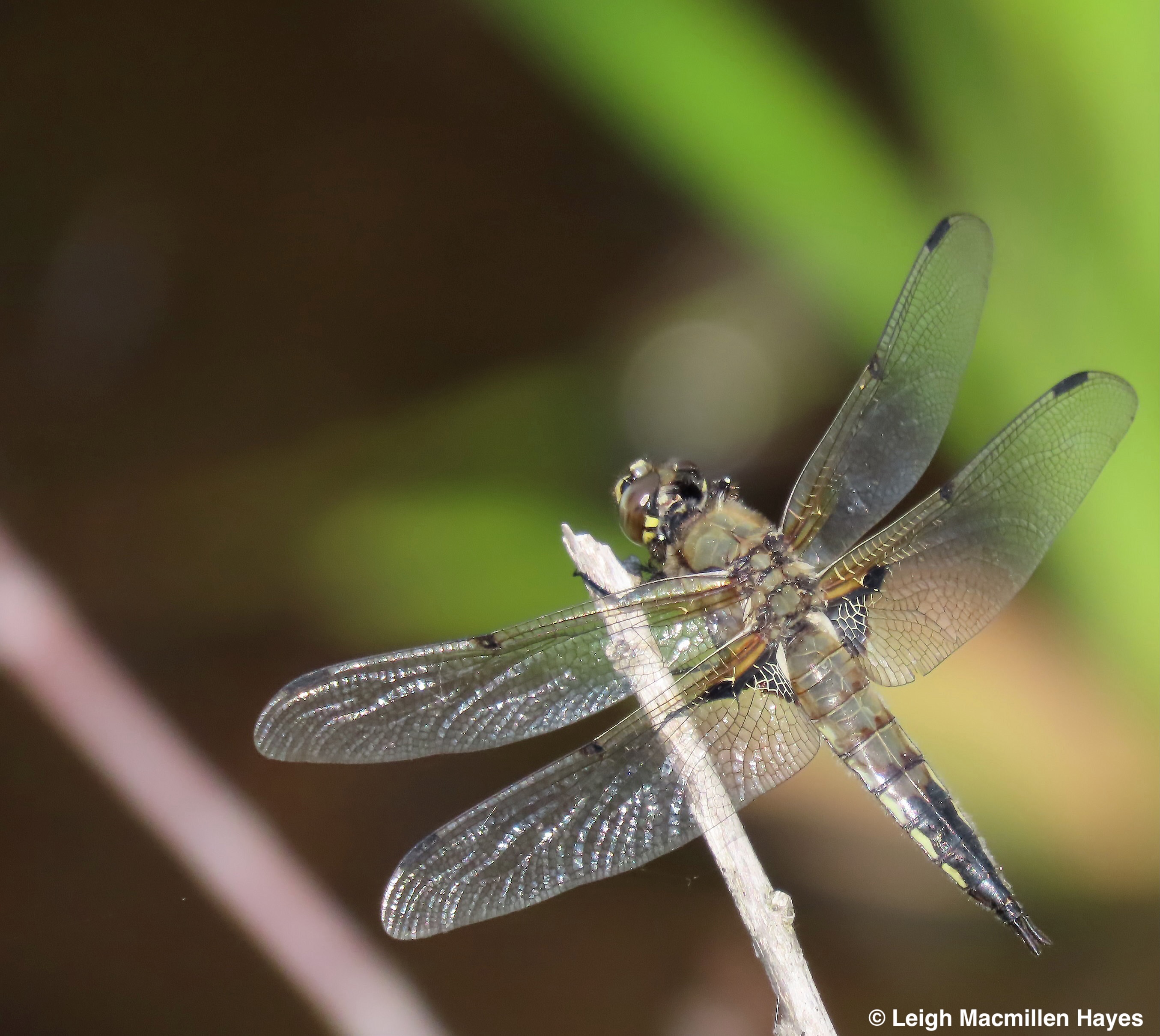
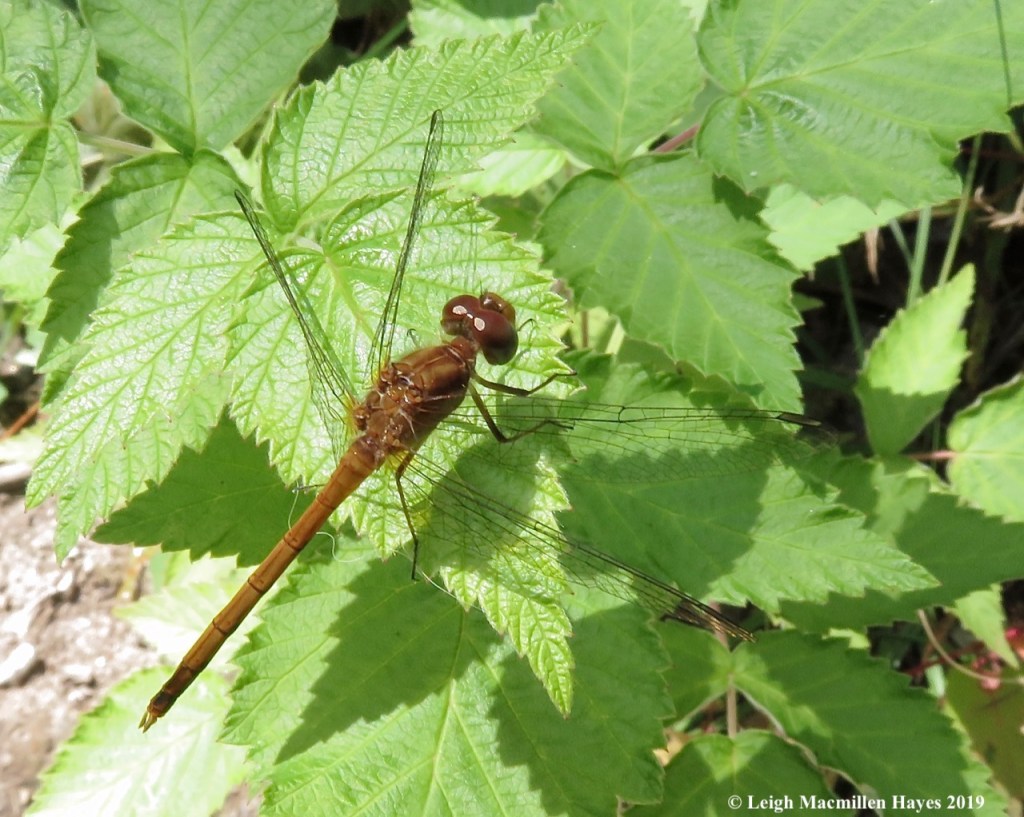
Another who should also have been enticed by the offerings, seemed to care more about defending his territory than dining, this being a Four-spotted Skimmer Dragonfly. The name Four-spotted refers to the small dark spots on the upper edge of each wing, there being two per wing, and thus four per side or four per front wing and four per backwing.

Equally nonchalant about all the available food, but curious about me, was the female Calico Pennant, another skimmer who loves to perch at the tip of plants and twigs and returns to the same site over and over again. Though I didn’t have a good view of her abdomen except for a hint of color on segment 7, the yellow-colored stigma toward the tips of her wings, and her yellowish face gave proof to her gender. Males have red stigmas and red faces.

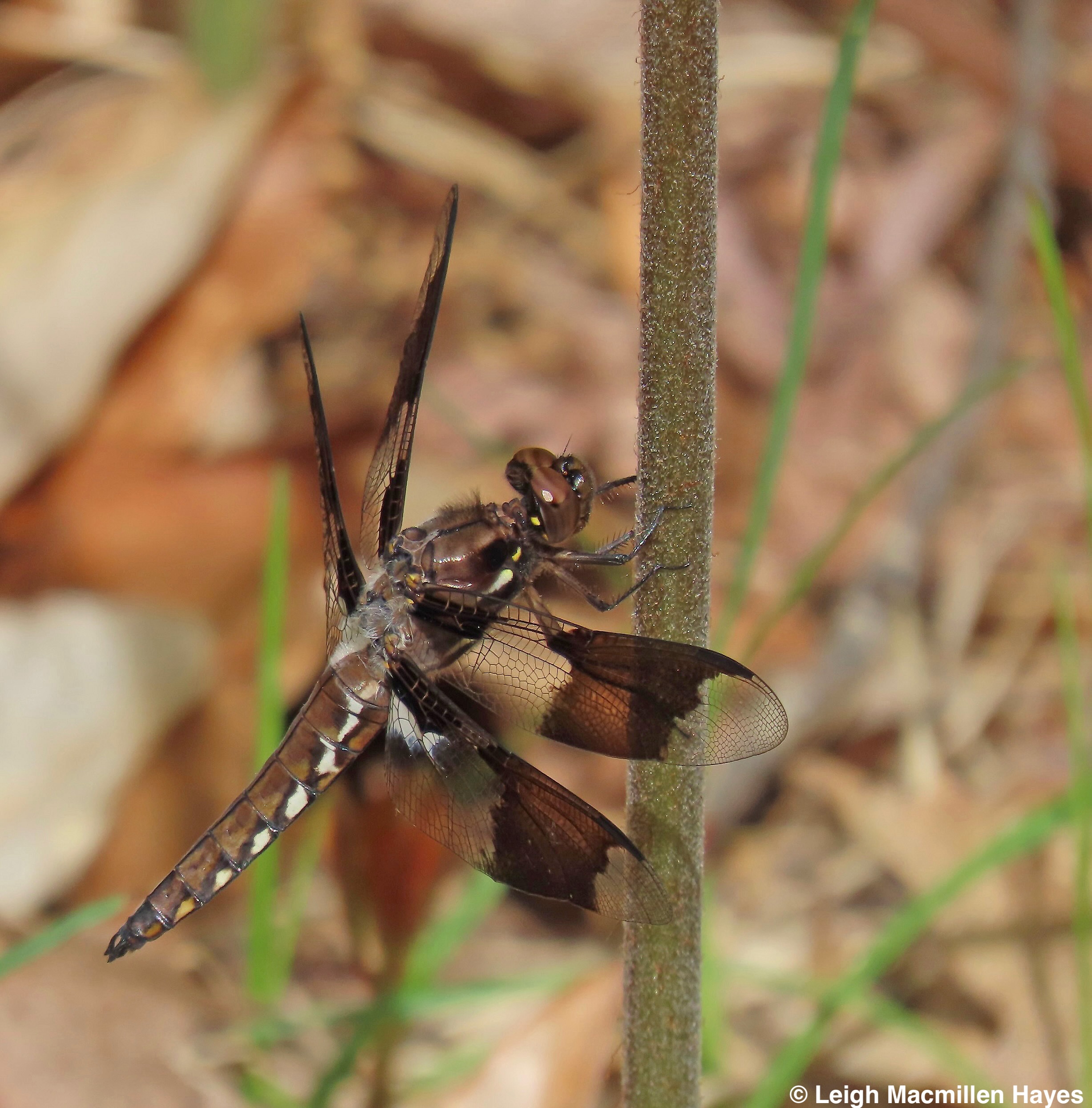
The immature male Common Whitetail cruised and paused, cruised and paused. This is such a handsome skimmer (not that the others aren’t). And while its abdomen resembles the female, it’s the wing pattern that identifies its gender. I love the complexity of dragonflies, even if I do have to relearn the clues each season.

Apparently, there were other things to do besides defend territory, and certainly rather than eat the biting insects–for canoodling was in order each time I visited. In this love wheel, the male Belted Whiteface dons the red thorax and he has clasped his mate behind her head with his claspers, as is the dragonfly custom. As Kurt Mead describes it in Dragonflies of the North Woods, “Prior to selection of a willing female, the male will transfer sperm from his testes located on the underside of the abdominal segment 9 to his hamulus located on the underside of segments 2 and 3. This is accomplished by simply arching the abdomen until the undersides of the appropriate segments make contact.” Once clasped, she arches her abdomen toward his hamulus to receive his sperm and thus fertilize her eggs.

Also flitting about, for that’s how these damselflies seem to move through the air, were some Ebony Jewelwings. The white dot or stimga at the tip of the wing signals this is a female, where the male has all dark wings. I love the iridescent colors of this species. And note how she has her abdomen reaching upwark in an obelisk position? That’s the Odonata way of avoiding overheating–thus reducing the surface area that is exposed to the sun’s rays. Oh, to be able to stick your butt toward the sun and cool off. On a day like today, and yesterday, and the day before, with our first heat wave in New England in two years, this would have been a most welcome adaptation.

Also along this trail, an extremely smart Eastern Phoebe who used a slight crevasse in a boulder upon which to build her nest of mud and moss and lichens. On the first trip, a friend and I spotted five eggs in the nest About a week and half later, these little chicks snuggled together like a pile of fluff with an occasional mustard-colored beak visible.

A week or so later and they continued to grow. What surprised me is how quiet they were, but that’s probably another technique that doesn’t give away the location of the nest.

That said, a Phoebe built a nest on the backside of our barn. It’s too high for us to notice if any eggs or chicks were located within, but we listen to the adults call back and forth all day long ,which is how we found the nest–they told us where to look and flew off anytime we passed that way.

The chicks above fledged within the last week and that nest is empty with no sound from an adult. It makes me wonder if the barn nest might see a second brood (if there actually was a first) for they continue to awaken us at about 4:20am each day. Stay tuned.

Another sight worth noting–the footprint left behind by a moose–traveling in the opposite direction of my foot. This was discovered by an observant participant on a recent walk for Loon Echo Land Trust.

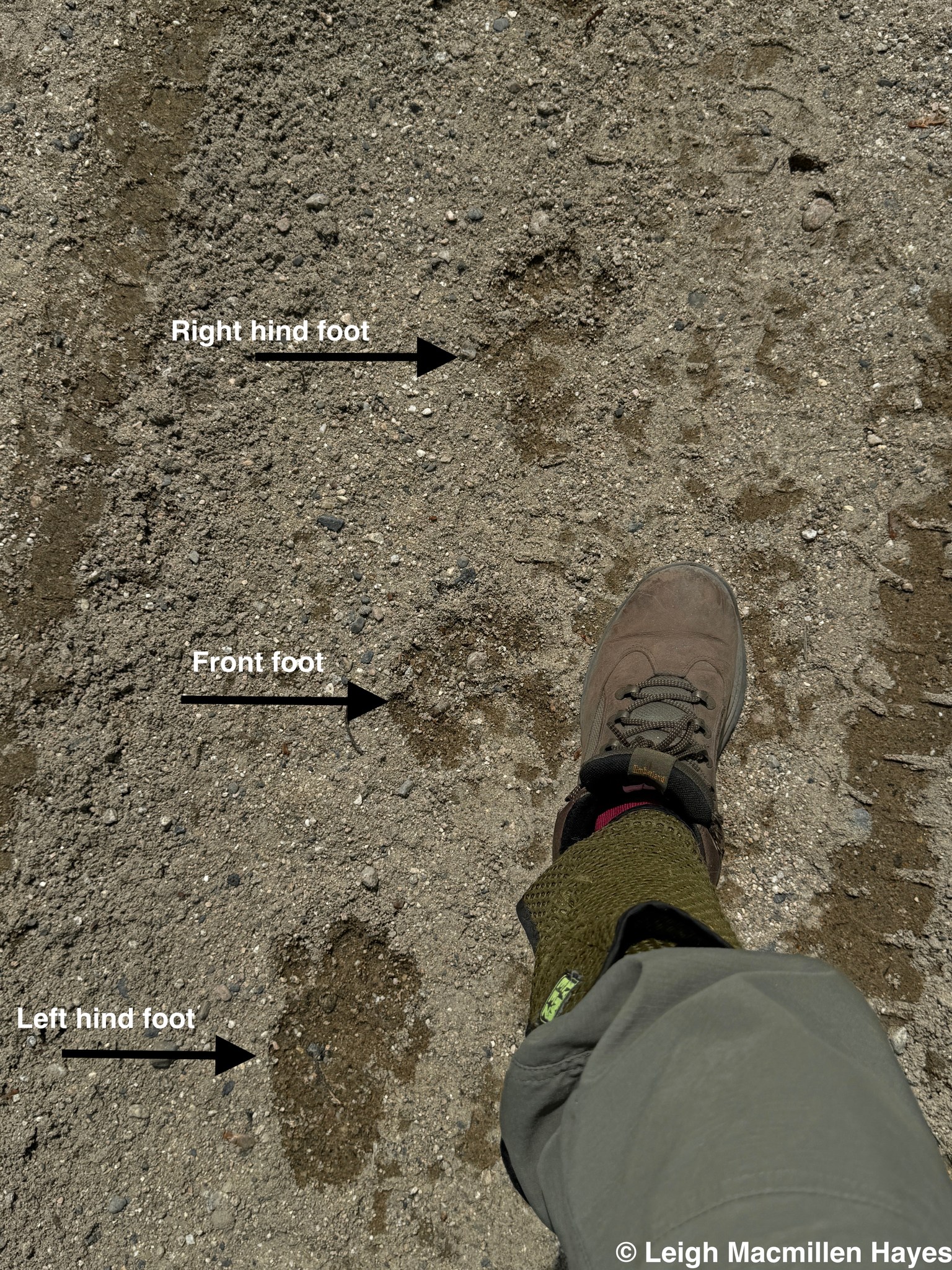
And an even better observation: the track of a Black Bear. My foot is located beside a front foot as you can see, with the larger hind feet registering before and after. The big toe is on the outside of the foot, opposite of ours. The better for climbing stability.

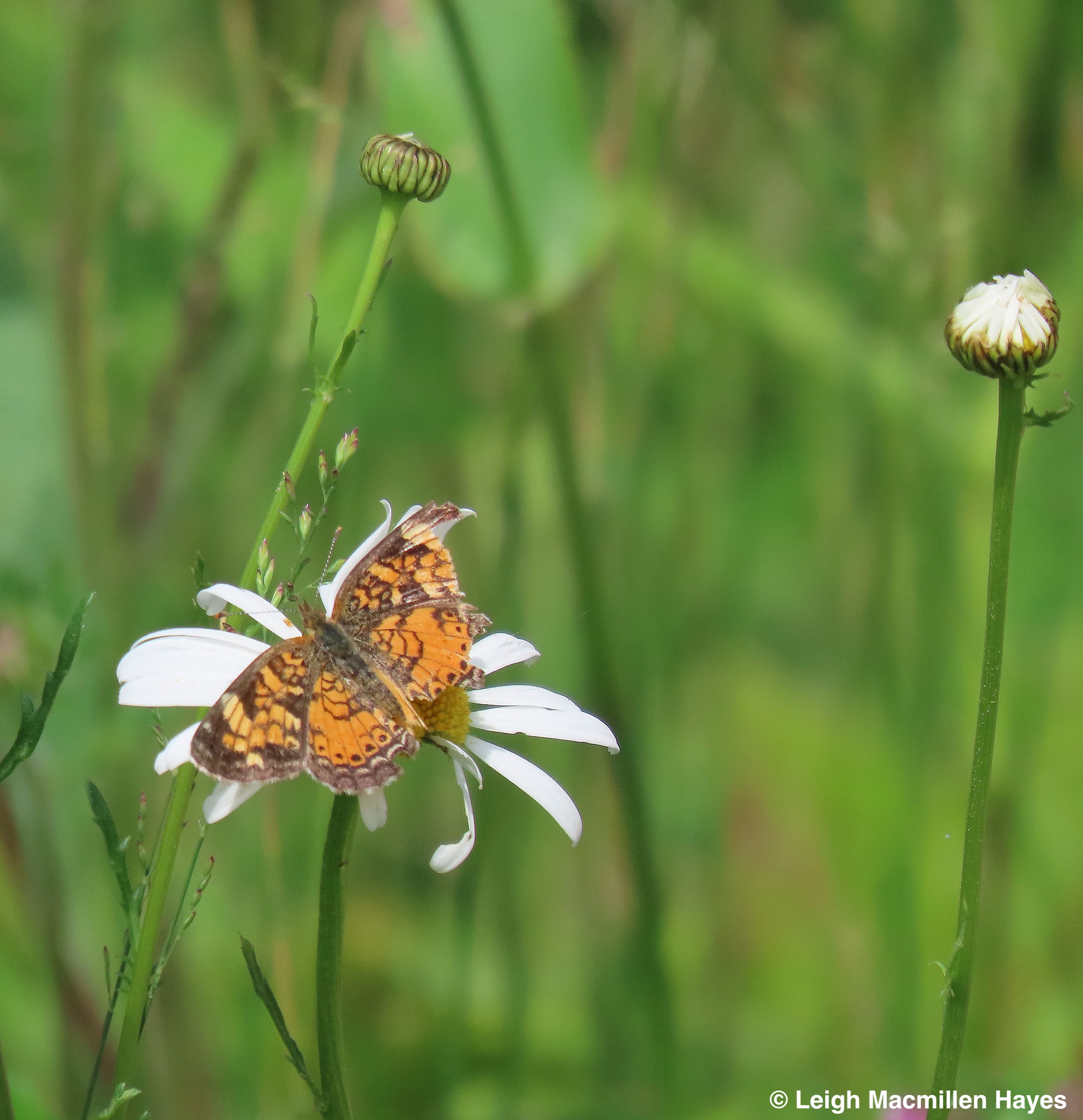
It still seems early for butterfly flight to me, but this Pearl Crescent showed us this morning that life hasn’t been easy given its tattered wings.

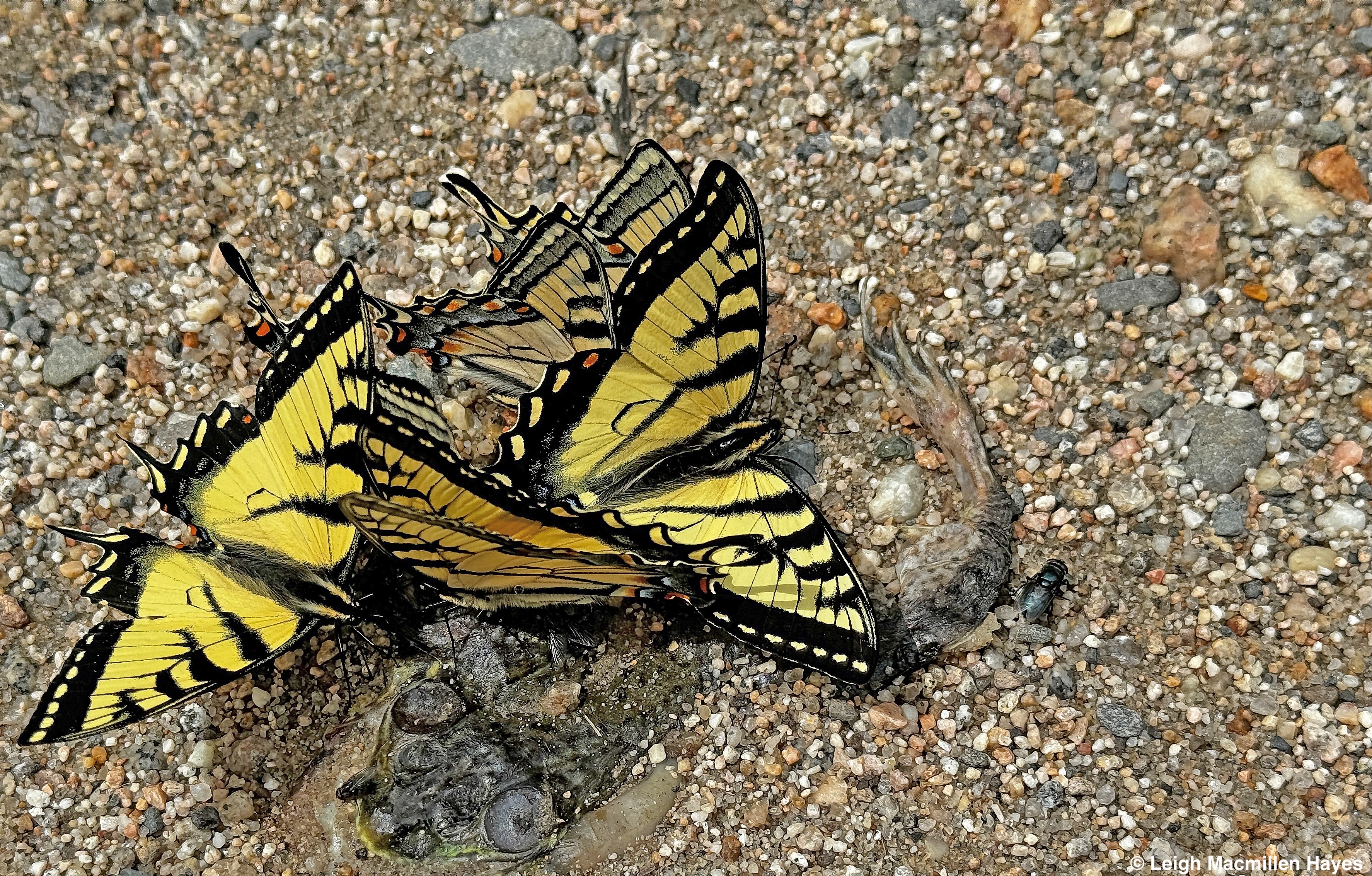
I think one of my favorite sightings along this path, other than the moose and bear prints, oh, and the dragonflies, of course, was something I couldn’t share with My Guy. The timing just happened to be right on this particular visit, when Eastern Tiger Swallowtail butterflies, so differentiated from the Canadian Tiger Swallowtail by the fact that the yellow band near the edge of the underwing was broken by black marks.

They were puddling, an act of probing for salt and minerals. Most puddlers are males, who ingest the nutrients that are then stored in their sperm. During mating, the male passes these goodies along to the female as a nuptial gift in his spermatophore. 

So we assumed it was scat upon which they puddled.

Until we realized it wasn’t. They’re choice of nutrient-offerings–a smooshed frog. The trail is not just for walkers. ATVs and even trucks use it.

Yes, the poor frog. BUT, the butterflies and flies made sure that it did not go to waste.

And another frog smiled. I’m smiling too, for it is officially summer. Happy Summer Solstice 2024.

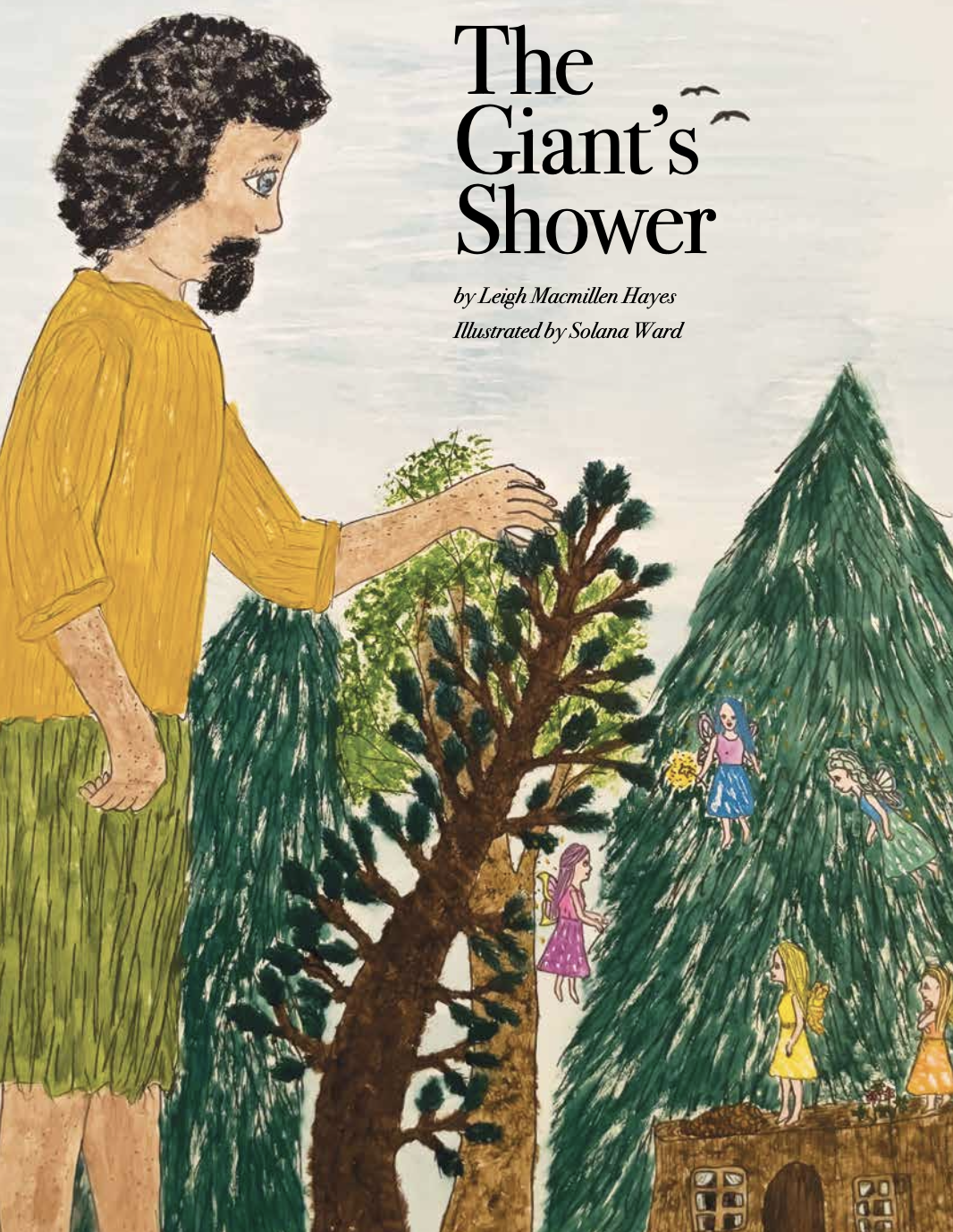
And speaking of the solstice–be on the lookout tonight for the characters of my fairy tale doing some dancing in the woods, as they did in The Giant’s Shower.

New Treasures of Nova Scotia

We’ve journeyed to Nova Scotia several times before, my guy and me, but it’s one of those places that beckons for a return adventure, and so we heeded the call and went forth.

The first leg of the trip found us tailgating in the parking lot for The Cat in Bar Harbor. When we had gone inside to pick up our tickets, we realized we couldn’t take tomatoes or bananas into Canada and so we put them on the lunch menu.

Our yacht was a wee bit late arriving, but at last we spied it pulling in to the dock. Given that, we still had to wait a bit more to board so others could disembark and pass through USA customs.

At last it was our turn and we rolled up the ramp and into the parking lot of this huge catamaran ferry with Yarmouth, Nova Scotia our destination, 3.5 hours away. Somehow we scored a table and chairs in the bow and sat down to enjoy the international cruise. I don’t have photographs to prove this, so allegedly we saw dolphins off the port side and even a whale just starboard shy of center that the boat drove over (remember, it’s a catamaran)–and might possibly have made contact with for we felt a thump.

At Canadian Customs we offered to give up the tomatoes and bananas and were told not to worry.

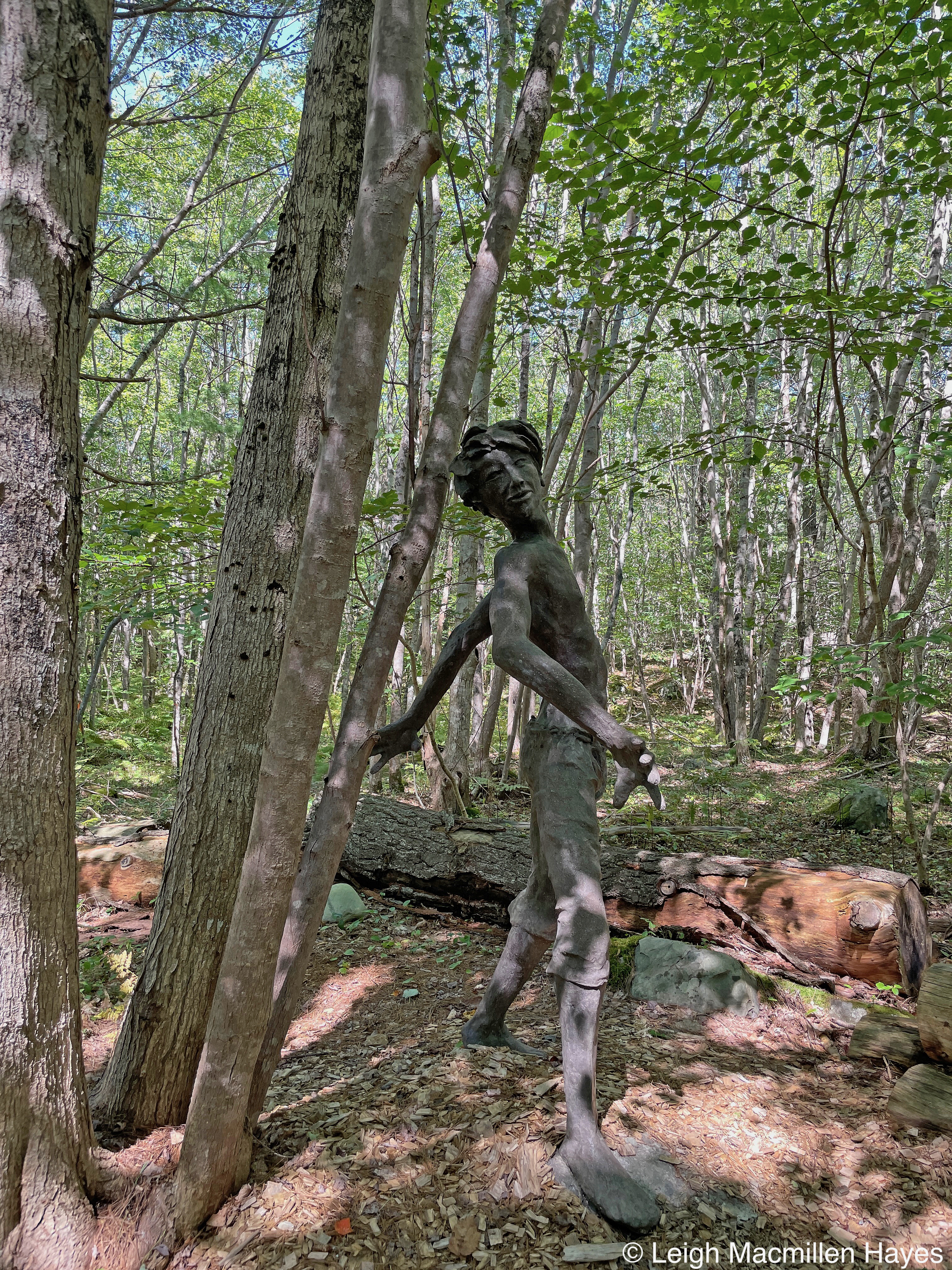
The first night found us at a hotel in Yarmouth and then we began our journey north the next morning, pausing at a spot a woman in the Liverpool information center suggested we visit: Cosby’s Garden Centre. It’s home not only to an amazing display of plants, but also the imaginative artwork created by Sculptor Ivan Higgins.

Around every corner of the path that weaves through the woods, there are plantings and sculptures waiting to surprise, all made of wire and concrete.

My Guy is not exactly a garden-type-kinda guy, but he absolutely loved all the discoveries we made and at one point we split up and he couldn’t wait to show me what he found. Ahhh, but I’ll wait until the end of this post to share that. Don’t skip ahead cuze you’ll ruin the surprise.

This one was one of my favorites. Do you see it?

How about now? I snuck up on this guy who was hiding behind the trees. There are acrobats and dragons and all kinds of wonders to locate and if you are driving by on the road, you really have no idea what is hiding in the woods behind the garden centre.

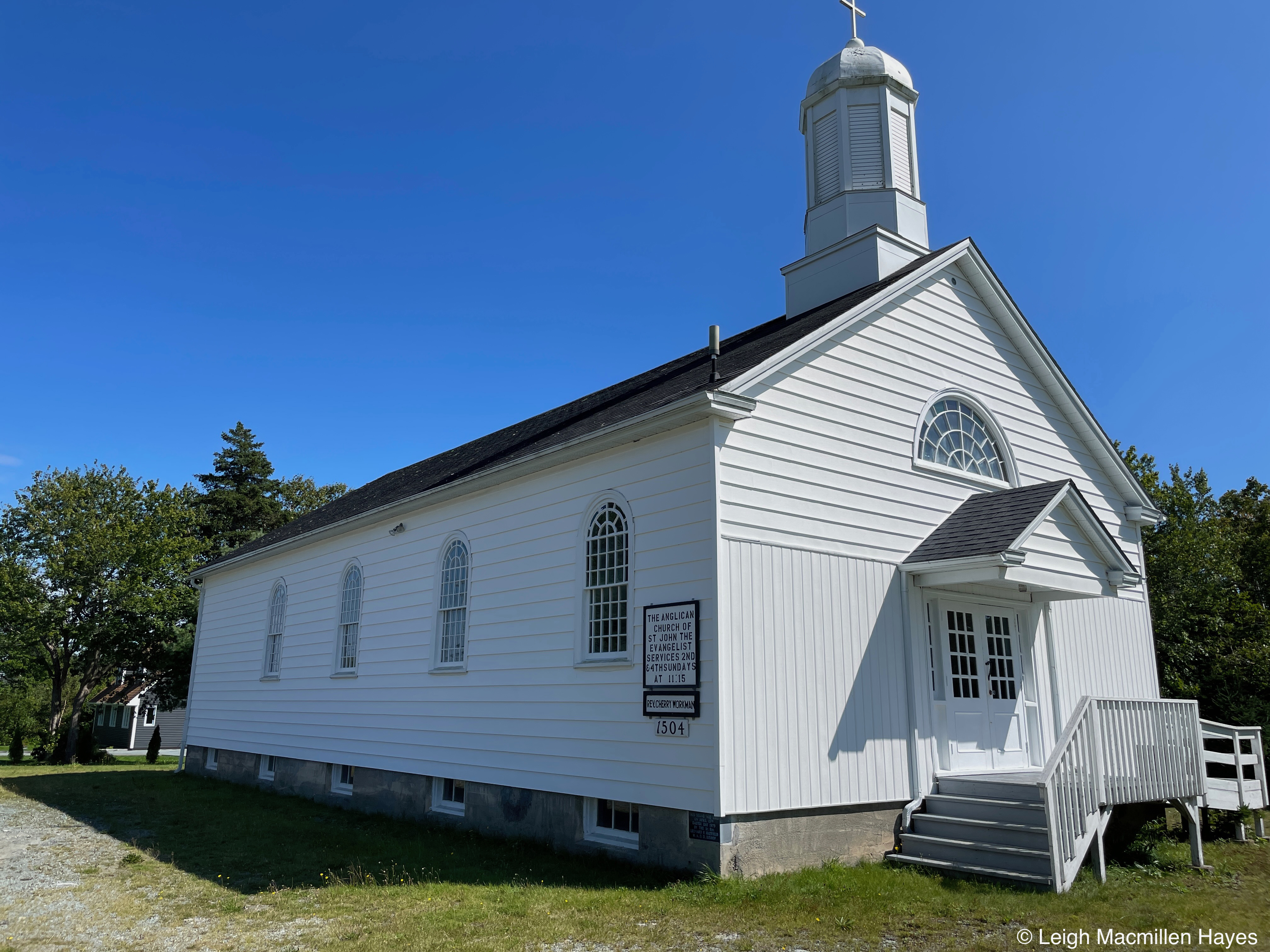
Our next stop was St.John the Evangelist Anglican Church in Eagle Head. The last time we visited, My Guy’s (MG) second or third cousin gave us a tour of the church and said that if MG had been at the service the day before, he would have pointed to almost everyone in the parish and said, “You are related to him, and her, and her, and . . . ”

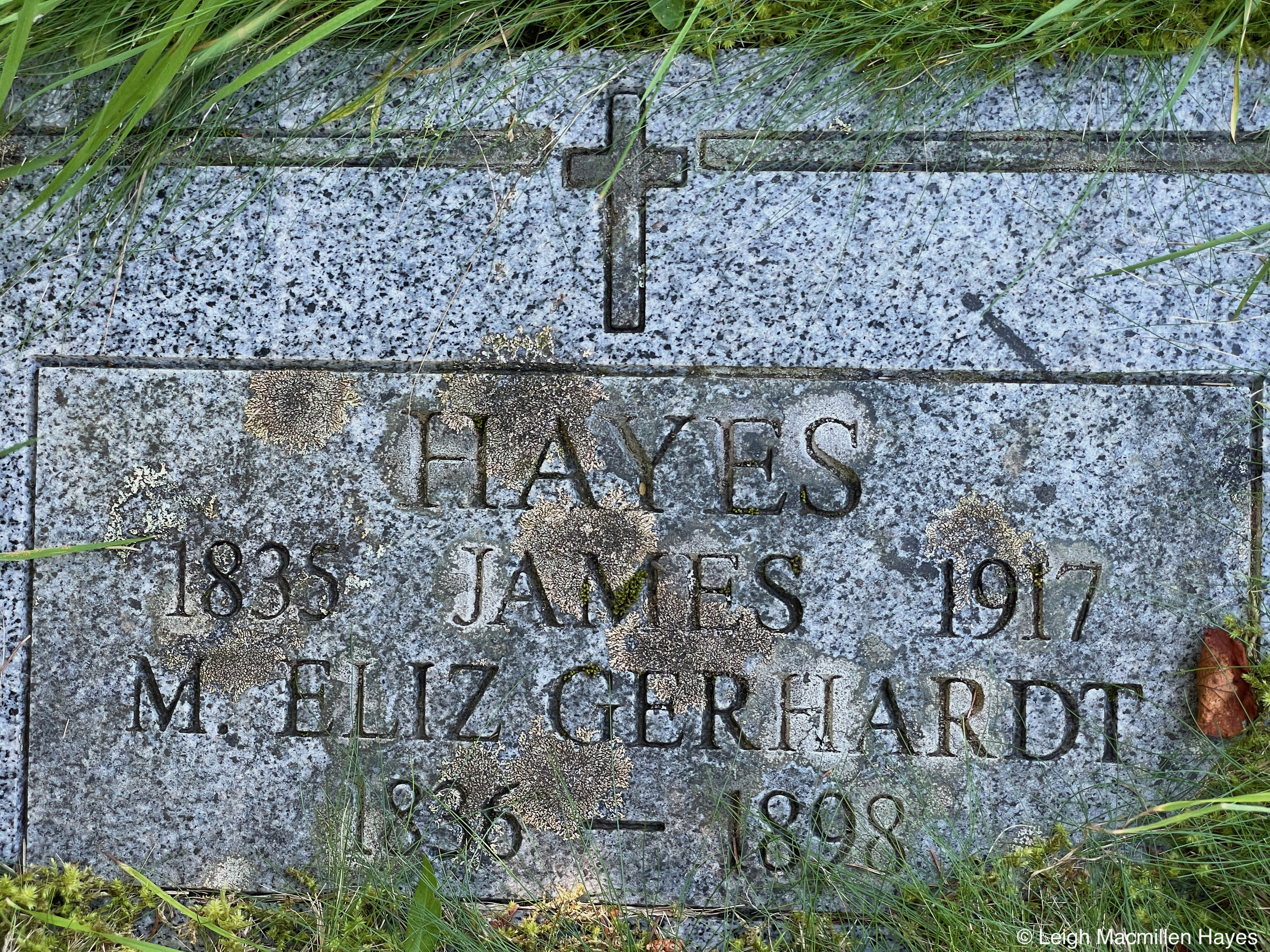
We visited the gravesite of MG’s great-great grandparents and then continued up the road to West Berlin , where we stopped in to visit his relative’s widow. (RIP Borden)

After sharing our condolences because Borden passed away two years ago, and catching up with her, we went for a walk up the lane to follow the route MG and Borden’s great-greats used to traverse to their home. Only the ell is left now, the rest of the house having burned many moons ago, but still.

It was here where they toiled as they farmed the land by the ocean and we felt like we were breathing some of the same air they used to breath.

And then it was another 45 minutes or so to our “hometown” of three nights as we’d rented a chalet overlooking the town of Lunenburg.

Ours was the cabin in the middle, complete with kitchen, living room with woodstove, bedroom, and kitchen, plus deck with bench and grill, and plenty of firewood, and sorta an ocean view being the Oceanview Chalets. It was a delightful place to stay, clean, comfortable, and quiet. Plus, this is a dark-sky -friendly property and on the third night there was no cloud cover and we enjoyed the celestial view.

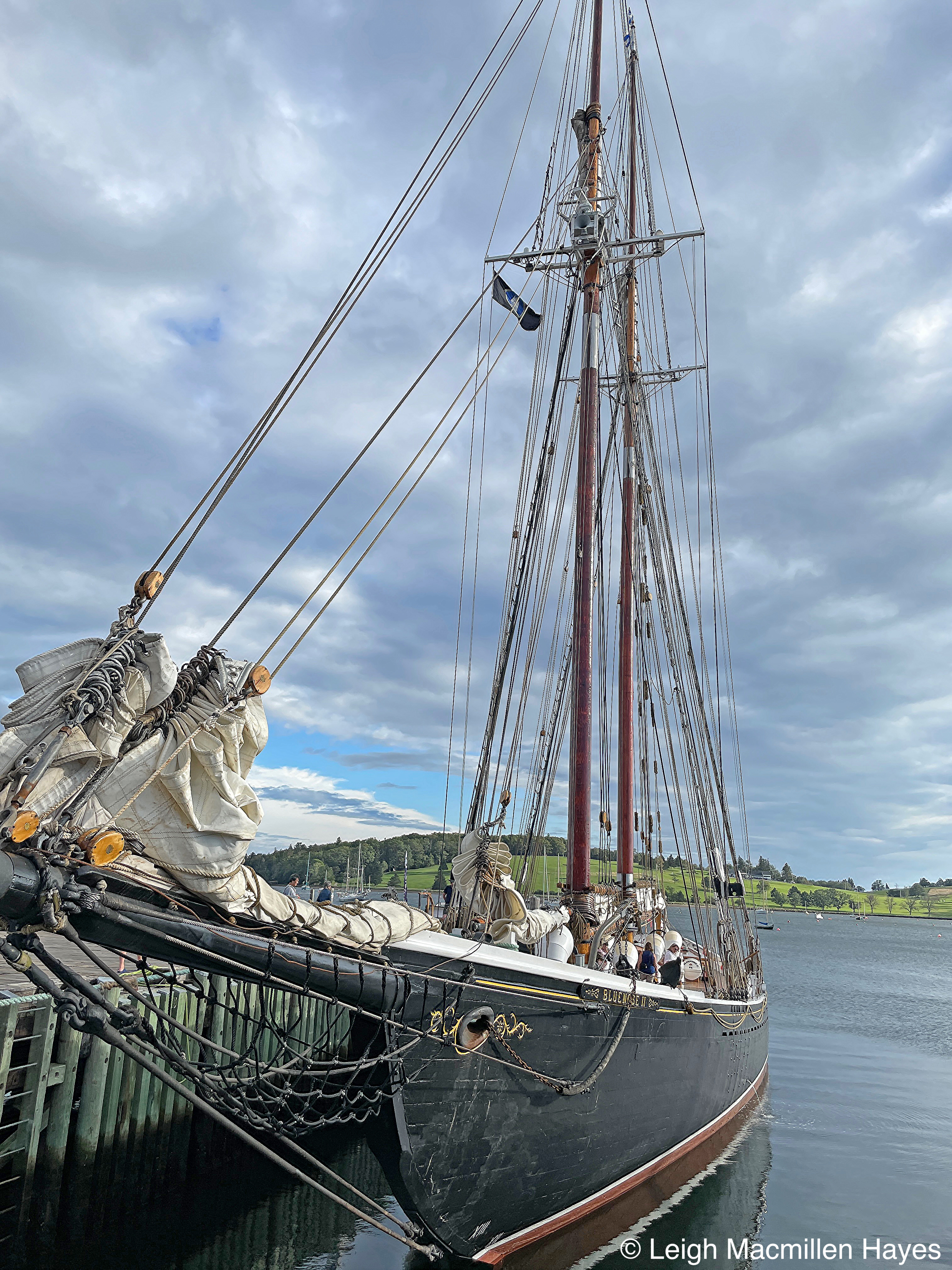
Though we didn’t tour the Bluenose II, it gave us pause each time we walked past it, for it’s one handsome schooner that was built at a local shipyard to honor the legacy of the original Bluenose that struck a reef off of Haiti in 1946. The present day boat was constructed in 1963 by some of the same shipbuilders as the first.

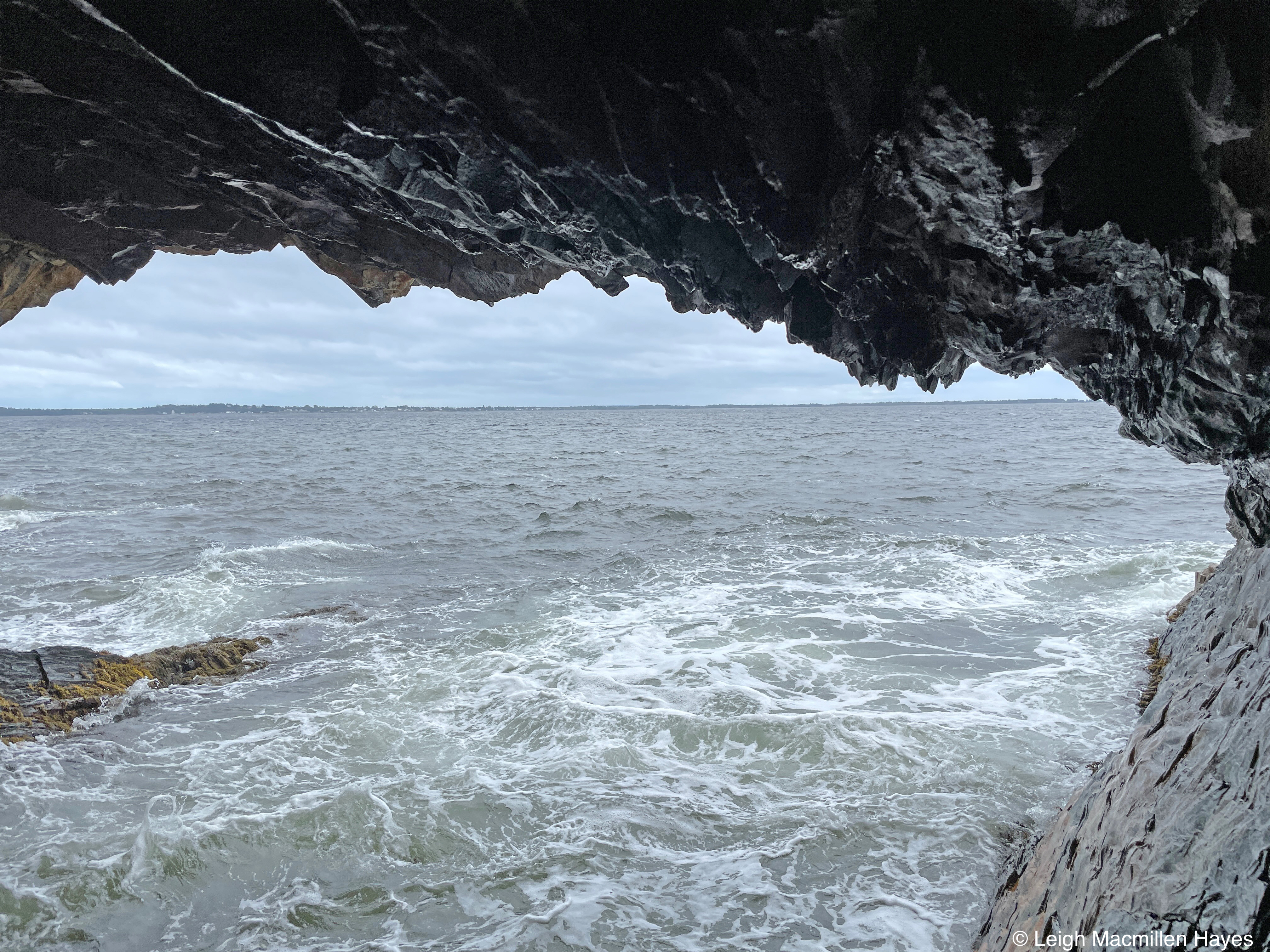
Wind and a few raindrops, but mostly wind, gusty wind, blowing at at least 25 miles per hour, were the name of the game on our first full day in Lunenburg. We drove to Ovens National Park in Riverport and walked the ocean-side cliff trail to explore the sea caves. I followed MG down into Tucker’s Tunnel, a natural cave that was extended during the 1861 Gold Rush! Yes, there’s touted to be gold in this area and though we didn’t do it, you can rent a pan and go gold panning!

Opposite the overlook at Indian Cave, where as the story has it, the cave was “named after an ancient legend wherein a M’Kmaq native paddled his canoe into the cave emerging near Blomidon on the other side of the province,” we noticed something we’ve never viewed before.

If you look closely at this photo, you may see small white balls floating in the air. The wind was so strong that as waves crashed below, balls of foam rose like silly snowballs rising rather than falling.

Walking along, we began to get a sense of the force of nature and reason it’s called Ovens Natural Park, for the caves look rather earth-oven-like in shape, much the way an Ovenbird builds its ground nest in the same shape.

In Cannon Cave, we climbed all the way down and in, and I was sure we were going to get washed away each time a wave roared in. The wave action really does create a resounding boom and it’s much more dramatic than Thunder Hole in Acadia National Park, at least in our opinions.

From Riverport, we drove to Mahone Bay, a sweet little town of shops and known for its three church spires. But for us, it was the rail trail that attracted our attention, so after lunch at Oh My Cod, we planned to find the spot where three trails meet and walk a portion of each. Somehow that plan changed without us even realizing it, and instead we followed the Dynamite Trail for 11K each way (6.8 miles each way) and honestly, had beat feet by the end.

But, in the midst of it all, we stumbled upon this art display: High Tide contructed by Erin Philp, a local artist, woodworker, and shipwright. According to a plaque at the site, the sculptures are based on the classic Lunenburg Dory design, historically used in combination with Grand Backs Schooners, like the Bluenose, to fish the Atlantic Coast. “The High Tide collection . . . elevates the vessels into a new and surprising relationship with their environment, highlighting and celebrating these simple, yet enchanting boats.” Indeed!

At our turn-around point on the Dynamite Trail we literally stopped in our tracks when we spotted a deer ahead and it mimicked our behavior. Look at those ears on high alert. The three of us spent a little time together, and then it continued across the trail while we turned to head back.

A few minutes later we spotted two more, this one licking its chops after enjoying some buds and leaves.

At home, we love to watch deer from the kitchen windows, but it’s an equally fun sighting when we are somewhere else.

The next day we realized that we’d skipped a planned hike after visiting Ovens National Park, and so we headed to Hirtle’s Beach and Gaff Point in Dayspring. In contrast to the rail trail, this was a combination of beach, forest, and rocks, and much more comfortable under our weary soles.

Again, the winds were strong, which enhanced the wave action.

After circling the point, MG skipped a few stones, channeling his inner child.

You might say we are glutons for punishment, but after lunch at the chalet, we walked down the road and found another rail trail, the Back Harbor Trail. This time, however, we only walked about two miles on the trail, coming out at the other end of town. Rhonda the Snake was waiting to greet us and so we admired her unique skin pattern.

Walking back through town, I spotted this Basswood tree in full fruiting form. The fruits are nutlets borne on a stem bearing a persistent bract, or modified leaf–note its lighter green coloration. Somehow the bract aids in the wind dispersal of the fruit.

It was on this day’s journey that I also met Jointed Charlock, aka Wild Radish. Apparently, it’s an invasive species, so I should be grateful we hadn’t met before.

Our time in Lunenburg came to an end, so then we drove northwest to Amherst. Okay, so here’s where I have to tell the story of my mistake. When I first booked our next chalet, I saw that it was two miles out of Amherst, and thought that was perfect. We’d be on the Bay of Fundy and yet only two miles from town.

Ahem. Wrong. I failed to read the rest of the sentence until we arrived and grabbed a late lunch. Two miles out of town, and then 25 more miles to Lorneville on the Northumberland Strait.

It’s a good thing we did some grocery shopping before driving north to Amherst Shore Country Inn. Despite the distance to the Bay of Fundy, our little place, with a living room, dining area, kitchenette, bedroom with jacuzzi, and small bath was perfect. And the deck, also with a grill and adirondack chairs, offered a spendid view of the gardens and waterfront of this 20-acre property.

It also offered a splendid view of Craneflies for so many hung out on the windows. I spent at least an hour one morning watching them walk as if on wobbly stilts, occasionally fly, canoodle, and even lay eggs on damp vegetation.

Our first full day dawned foggy, but still we made the long drive to the cliffs of the Bay of Fundy. After realizing we were a wee bit too early for the Joggins Fossil Cliffs museum to open, so we instead drove to Eatonville in Chignecto Provincial Park to go for a hike.

A couple of miles in, we realized that even when we reached the coast, the fog would be too pea-soupy and so we retraced our steps.

On the way out, we did stop for a walk along a red sand beach, so colored because the sand eroded from rocks with significant iron content.

We decided that rather than retrace the drive back to Joggins, we’d follow a loop, which turned out to be a mistake for a detour spit us back out opposite where we wanted to be and cost us some time. We missed the last guided tour at the fossil cliffs, but climbed down to the beach and began searching for signs of the Coal Age.

One of our finds was possibly a calamite fossil, a type of horsetail plant that lived in coal swamps of the Carboniferous Period.

It was back to Chignecto the next day because we really wanted to explore more of the park. A park ranger mapped out a trail for us and off we went. We only had time for about five or six miles, but would love to someday explore more.

I think one of my favorite sights occured there as well as everywhere else we traveled in Nova Scotia, a sea of goldenrods and asters.

My other favorite sight was the color of the water. We’ve never been to Bermuda, but somehow based on photographs I’ve seen, I’m pretty sure we discovered the Bermuda of the North.

Though we never did see the tides I was hoping for because I’d not read the directions for the chalet fully, we could see the effects of erosion everywhere, and had to wonder how much longer this spruce will hold its ground.

Next stop on the agenda, not that we had such, was Cape D’or Lighthouse, erected to warn mariners of the tidal rip. Though the history of a fog horn and then lighthouse date back to 1875, the current concrete structure was built in 1965.

As we stood out on the point and looked back, I was rather grateful that it was low tide and we could get a real sense of the topography.

Our final trek that day was to the Three Sisters Sea Stacks. So . . . it turns out that when we were hiking in the fog the previous day, we weren’t all that far from the sea stacks. And it also turns out that while we might not have had a good view of them in the fog, arriving late in the day also didn’t offer a spectauclar one from a camera’s point of view because the sun was setting right behind them and my photos came out overexposed. That said, I did want to share The Fissure, a large crack in the underlying bedrock that occurred as a result of extreme faulting and lifting 325 million years ago. Can you see the large rock suspended over the beach?

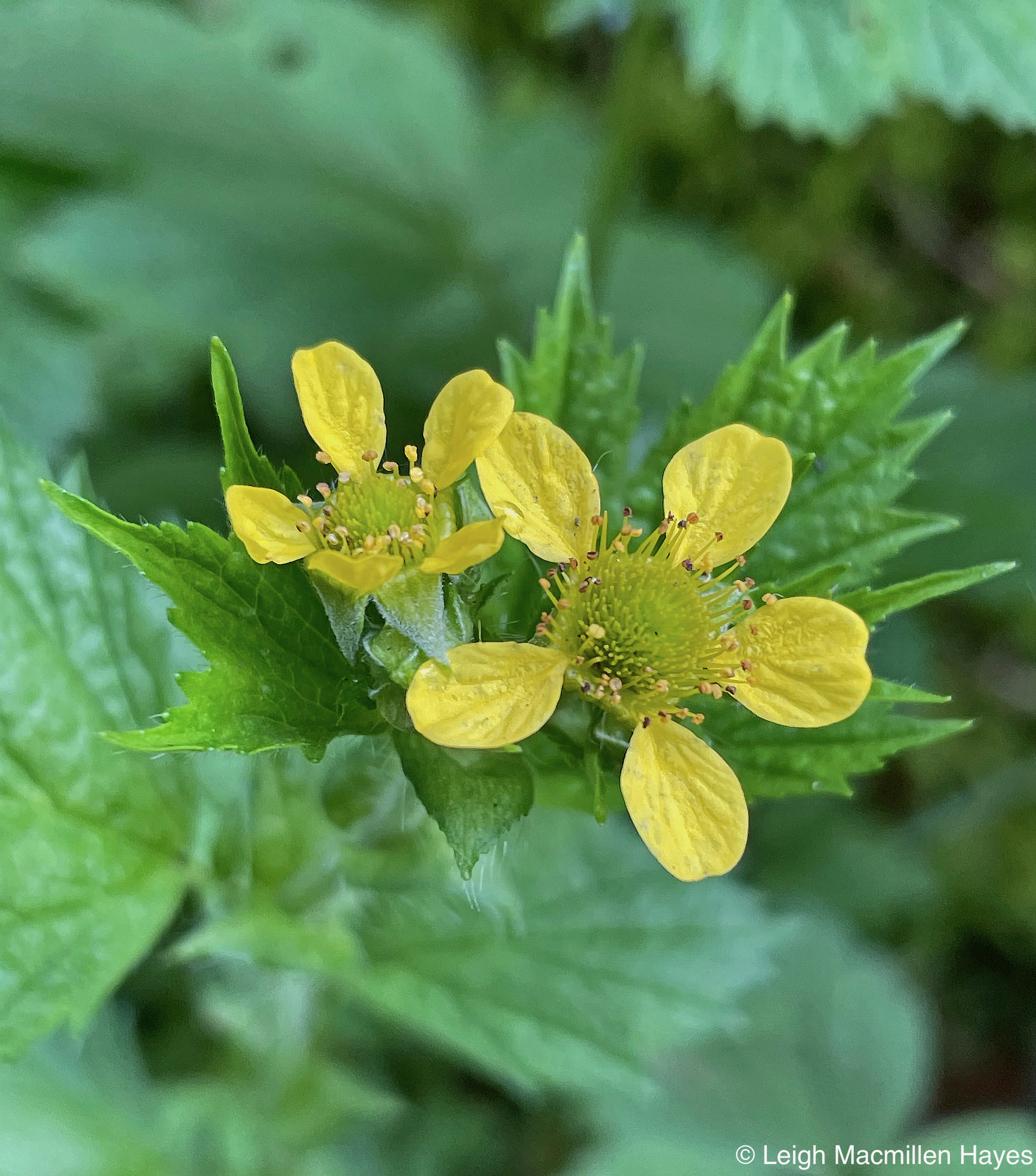
In our Chignecto Park hikes I spotted a few flowers also new to me including Herb Robert and this one, Large-leaved Avens, which is said to grow from the Arctic south to Northern USA.

And back at Northumbria Strait, Cormorants cooled off by spreading their wings.

All right, so if you’ve stuck with me this long, I promised when we were at Cosby’s Sculpture Garden Centre that I’d show you what My Guy spotted and took me to see: Momma Bear reading to her three sleepy cubs. It was a foreshadowing . . .

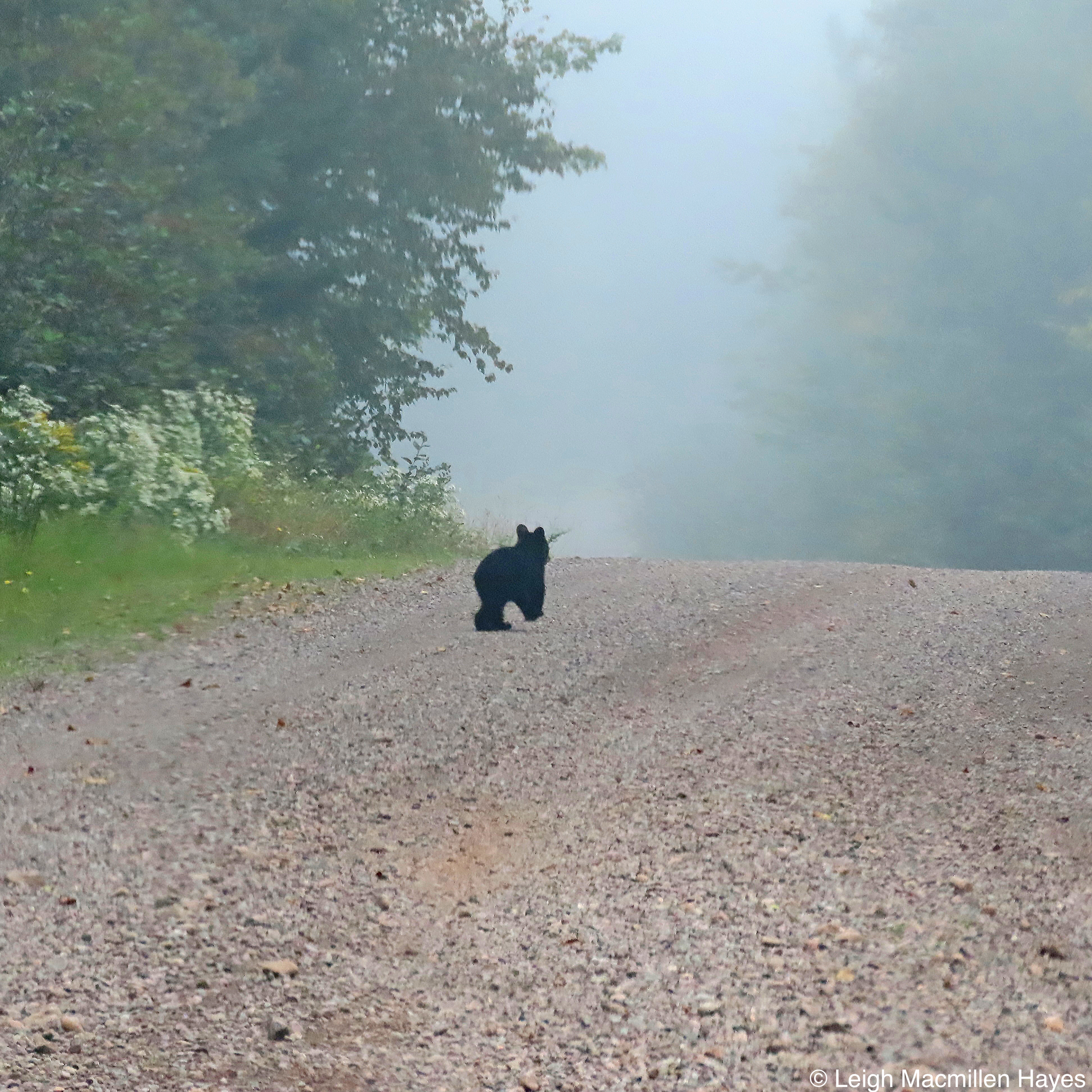
Of the best kind, for on that foggy day as we left Chignecto and eventually made our way to Joggins, we allegedly spotted momma bear and a cub cross the road. As I reached for my camera, a second cub crossed the road. I told My Guy to not start driving again because I thought we might see a third cub, and Bingo! He scampered out of the woods and racced up the road as if saying, “Hey guys, wait for me.”

The treasures of Nova Scotia. Indeed.

Phone Tag

We headed into the wilds today where we didn’t have cell coverage which was quite okay with us. It was a favorite hike, though we weren’t sure what the conditions would be so we brought both snowshoes and micro-spikes.

From the get-go, it was obvious that snowshoes would be the necessary item and so we donned them and headed down the road.

It’s a road I LOVE to walk rather than drive down because there are telephone poles that call for my attention. Do you see what I saw? Nice shiny numbers, yes. But even better, the scratches.

And on this one scratches plus bite marks. All the work of a Black Bear. Whether it’s the creosote on the pole, the hum of electricity riddling high above on the wires, or something new and shiny in their territory, Black Bears are attracted and rub their backs against the object as they turn their heads to nip and bite. The jagged horizontal lines speak to the upper incisors scraping the wood as they reach toward the lower incisors.

Almost a mile in we reached the starting point for our expedition. Much but not all of the Stone House property is conserved under an easement with Greater Lovell Land Trust.

Typically we circle the Shell Pond trail system in a counter-clockwise fashion, but we decided to do the opposite today and so once we reached the airfield, I had to turn back to take in the view of the mountains from part of the runway built in the 1960s by Henry Saunders so that he could fly into the Stone House property. Saunders Brothers owned this property at that time and had a dowel mill in Bridgton, but their main mill was in Westbrook, Maine.

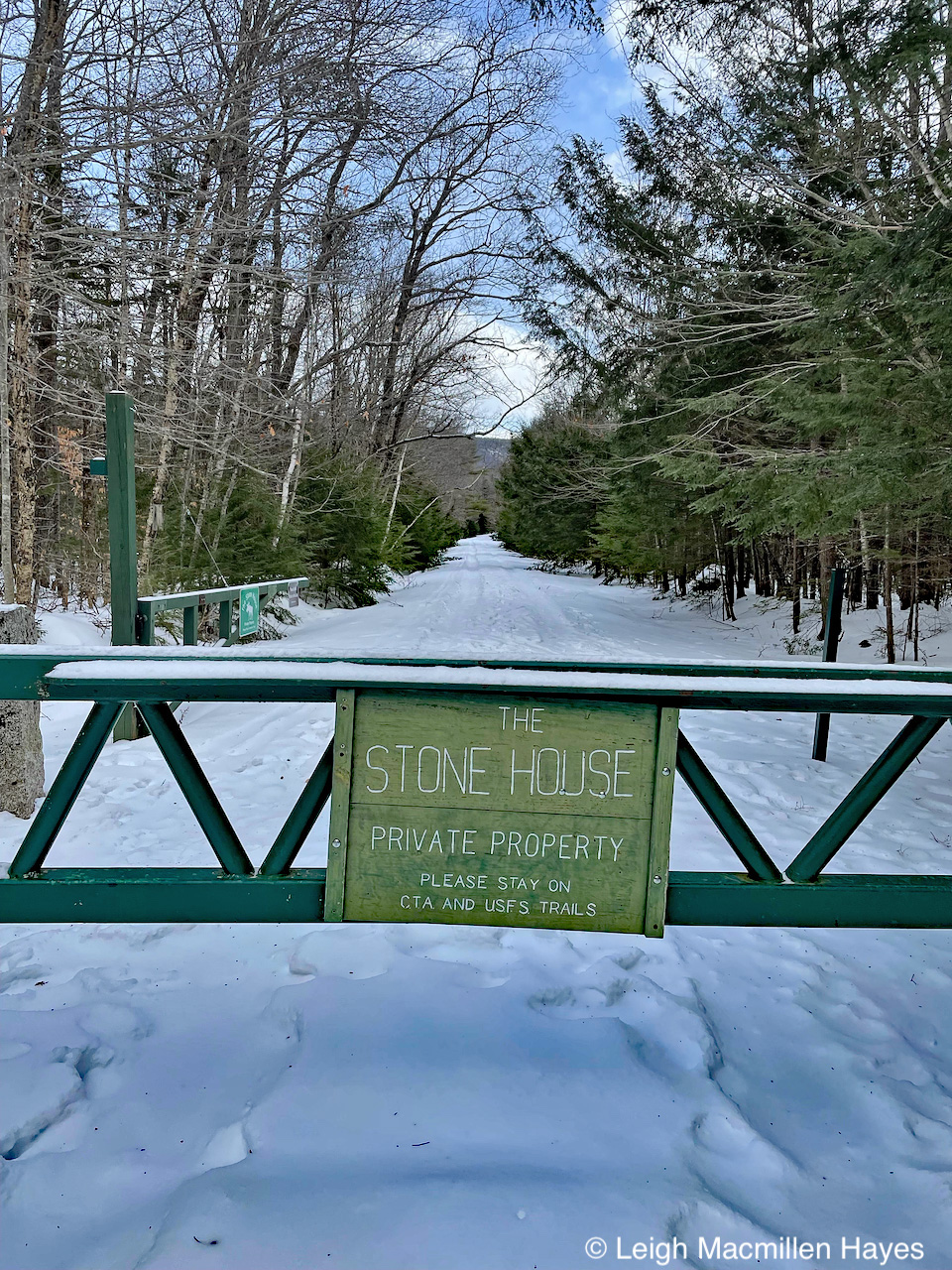
The airfield passes by the Stone House and hikers must stay on the trail. In Cold River Chronicle, local historian David Crouse wrote recently: “The Stone House, located on the Stone House Road (formerly known as the Shell Pond Road) in North Stow, Maine, was built about 1840 of split granite blocks quarried on nearby Rattlesnake Mountain by Abel Andrews (1807-1884), who settled there with his family in the 1830s. Abel’s wife, Lucinda Brickett (1817-1884), was daughter of John Brickett of the so-called Brickett Place at North Stow. The homestead passed to Abel’s son Elden (1836-1914) and then to Elden’s son Ira Augustus (1863-1942), who sold it in 1917. Since 1917, this property has had a succession of owners other than the Andrews family. Between 1951 and 1986 it was owned by Saunders Brothers Company of Westbrook, ME, who built a private 1600 foot airstrip in the field south of the stone house. Saunders Brothers used the stone house as a hunting lodge for their employees and guests. In 1986, the property was purchased by David Cromwell. The Stone House farm property is still in private ownership and is completely surrounded by land owned by the U. S. Forest Service’s White Mountain National Forest.”

Each time we pass this way I give thanks to the owners who allow hikers and hunters and rock climbers to use their trails.

We continued on through the orchard, where we had to start breaking trail as others had turned back.

Rattlesnake Brook flows beside the orchard and in a couple of months wildflowers and ferns will emerge, but for now there’s a lot of snow, with a Nor’easter sitting on the doorstep waiting to enter in a couple of days.

Everywhere, there were Otter trails a few days old and I could only imagine the fun of sliding across the orchard, through the woods and in and out of the water.

As custom has it, we stopped at a bench overlooking Shell Pond and realized it was time for a Double Chocolate Brownie–energy needed to continue the journey.

At another stream crossing, I had to pause again. Spring will come and I will love it, but I’ll miss this.

And I’ll miss having the opportunity to spot sights like this–the track of a Mink. I didn’t have Trackards with me for this trip so I grabbed chapstick from my pocket for size. The chapstick is 2.5 inches in length and the trail width was a wee bit longer.

Hiking backwards, well, not literally walking backwards, but you know what I mean, I was afraid I might miss this guy, but there T-Rex was, donning a winter hat.

Onward and upward my own guy and I trudged, pausing occasionally to take in the view. If you decide to go in the next day or two, we packed a great trail for you to follow.

At a second bridge crossing Rattlesnake Brook, we paused again.

Another Mink track exiting the brook. Probably the same critter.

But this one was even better because a deposit had been made.

In the form of scat, of course.

After several hours of hiking, we found our way back to Shell Pond Road, and I picked up where I’d left off with my game of Phone Tag, checking each telephone pole that I’d skipped on the way in.

Pole number 7 was especially chewed up.

But, the real joy of the game was finding the phone message I’d sought–Bear hair. The color was such for it was bleached by the sun which causes a Black Bear’s hair to turn ginger.

If you do decide to go to the Shell Pond trail and play your own version of phone tag, be aware that you’ll need to park by the first field just over the bridge that crosses Cold River and walk in–trying not to swim in the pool along the way.

Who needs cell coverage when you’ve got such a party line of poles to follow?

Sworn to Secrecy

I’ll let you in on a tad bit of a secret . . . eventually.

But first, today was a tracking day and so five of us did just that. When we arrived at the intended location, due to snow conditions, I think we had low expectations. I know I did.

We had just stepped off trail to begin our bushwhack excursion when we spotted this Ruffed Grouse scat. So the curious thing about this is that there are two kinds of grouse scat, the typical cylindrical packets coated with white uric acid, but also a juicier, brown dropping. And I regret that I didn’t take a photo of the juicier, yet slightly frozen stuff we saw dripping from some twigs above. At the time, I knew the brown stuff was significant because I’ve looked it up before, but couldn’t bring it to mind. Thanks to Mark Elbroch and Eleanor Marks, I found an explanation in Bird Tracks and Sign: “Interestingly, after producing these lower-gut-generated solid evacuations, some game birds, such as a grouse, often then evacuate a semi-liquid brownish mass from the upper gut, or cecum, with the two types of droppings coming out sequentially; the more liquid, almost liver-colored scat comes out second and is spread on top of the solid matter. In Ruffed Grouse, it is common to find the hard, fibrous scats at one roost and the soft, brown cecal droppings at another.”

But not uncommon to find them together!

We stood for a long time discussing the grouse scat and when we finally moved on, it wasn’t too far that we discovered bobcat prints. Given that the prints were not super fresh because there was some debris in them, we decided to follow the track forward. Had they been fresh, we would have backtracked so as not to put pressure on the animal. Though secretly, we all love it when we do actually get to spot a mammal. Or a grouse, for that matter.

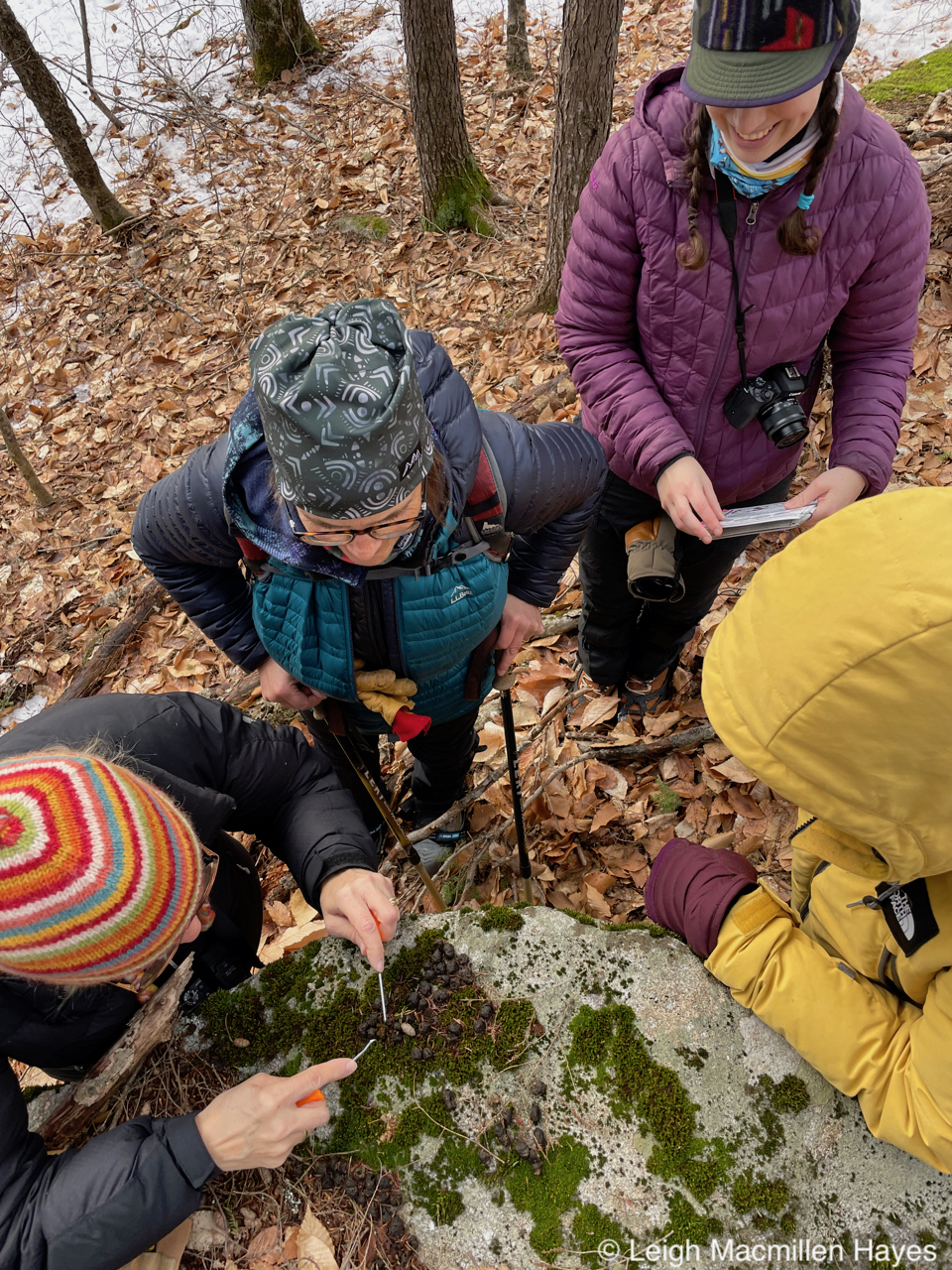
Eventually, we lost track of the bobcat, because as you can see, there were spots with no snow. But then we stumbled across a sighting that confused us. White-tail Deer scat on the edge of a boulder. Dawn has some new tools she was gifted for Christmas, and so she was excited to pull them out. Our confusion, despite the fact that it looked exactly like deer scat, was caused by the location. On top of a boulder. On the edge of said rock. We came up with a few stories, but will let you try to interpret this on your own.

Back in the snow, we found canine rather than the feline prints we’d been looking for and so out came the tape measure to determine species. Based on the fact that the print measured less than two inches at the widest point and that the stride, or space between where two feet touched the snow (toe to toe), we determined it was a Red Fox.

Everywhere, we spotted Red Squirrel holes and middens, indicating the squirrel had cached a bunch of hemlock cones in numerous pantries and returned since the snow fell to dig them up and dine, leaving behind the cone cobs and scales in trash piles. What struck us was that for all the middens we saw, we never heard or caught sight of any squirrels. In fact, we didn’t see any animals . . . until we did. Huh? You’ll have to read on.

Our next great find close to the pond we walked beside, was more scat! Of course, it was. This being the works of a River Otter and filled with fish scales, all those whitish ovals embedded in it. Like a small pile of Raccoon scat we’d spotted earlier, but again, I forgot to photograph (the sign that we were having fun making all these discoveries), otters tend to defecate in latrines, using the same places over and over again.

Our movement was slow, and every once in a while we’d spread out until someone made a discovery and then we’d all gather again.

Which was exactly what happened when this Snowshoe Hare scat was discovered. Three little malt balls.

After the hare find, we followed a couple of canine trails that took us back to the water. Domestic dog or Coyote? We kept questioning this, but never saw human prints. And the animals did seem to be moving in a direct line on a mission. The warm weather we’ve been experiencing may have been enough to make their prints look larger than they typically would so I think I’m leaning toward Coyote.

But in following those, we discovered a sign from another critter by the water’s edge: Mink scat!

When our time was nearing an end and we bushwhacked back to a road near the trailhead, we were all exclaiming about our cool finds. And then a little birdie we encountered asked, “Do you want to see a bear?”

We don’t need to be asked that question twice, though now that I think back, I’m pretty sure we asked the birdie to repeat the question. YES! She gave us directions and we decided we needed to take an immediate field trip. We each hopped into our vehicles, drove almost to the destination, parked, and walked as quietly as we could toward the den site.

We got us a bear! A Black Bear! The birdie said it has been there since sometime in December.

Now that I’ve shared it with you, I’ll say no more for the five of us are sworn to secrecy about its location.

Where the Bobcat led us

When GLLT Tuesday Trackers meet at a property, we never know what animal sign we’ll need to interpret or what greater understanding we’ll gain. Today was no different and we had a few surprises along the way.

What we’ve all learned is that we need to take a bird’s eye view and consider where we are, whether it be forest or field or wetland, look at how the mammal is moving and what type of pattern it is creating as it moves, get down and count toes, look for nail marks and notice other idiosyncrasies, and then follow the trail for a ways, looking at the prints in different light, or under different trees. Often under hemlock trees we find the best prints because there’s not as much snow since the boughs hold it.

And so today’s adventure began with us following this particular animal and debating—do we see claw marks, is the overall shape round or oval, is there a lead toe, is the ridge creating a C on its side or an X between the toes and heel pad? It took some time, but we finally found a few prints that gave us confidence it was a bobcat we were following. So, where did the bobcat lead us?

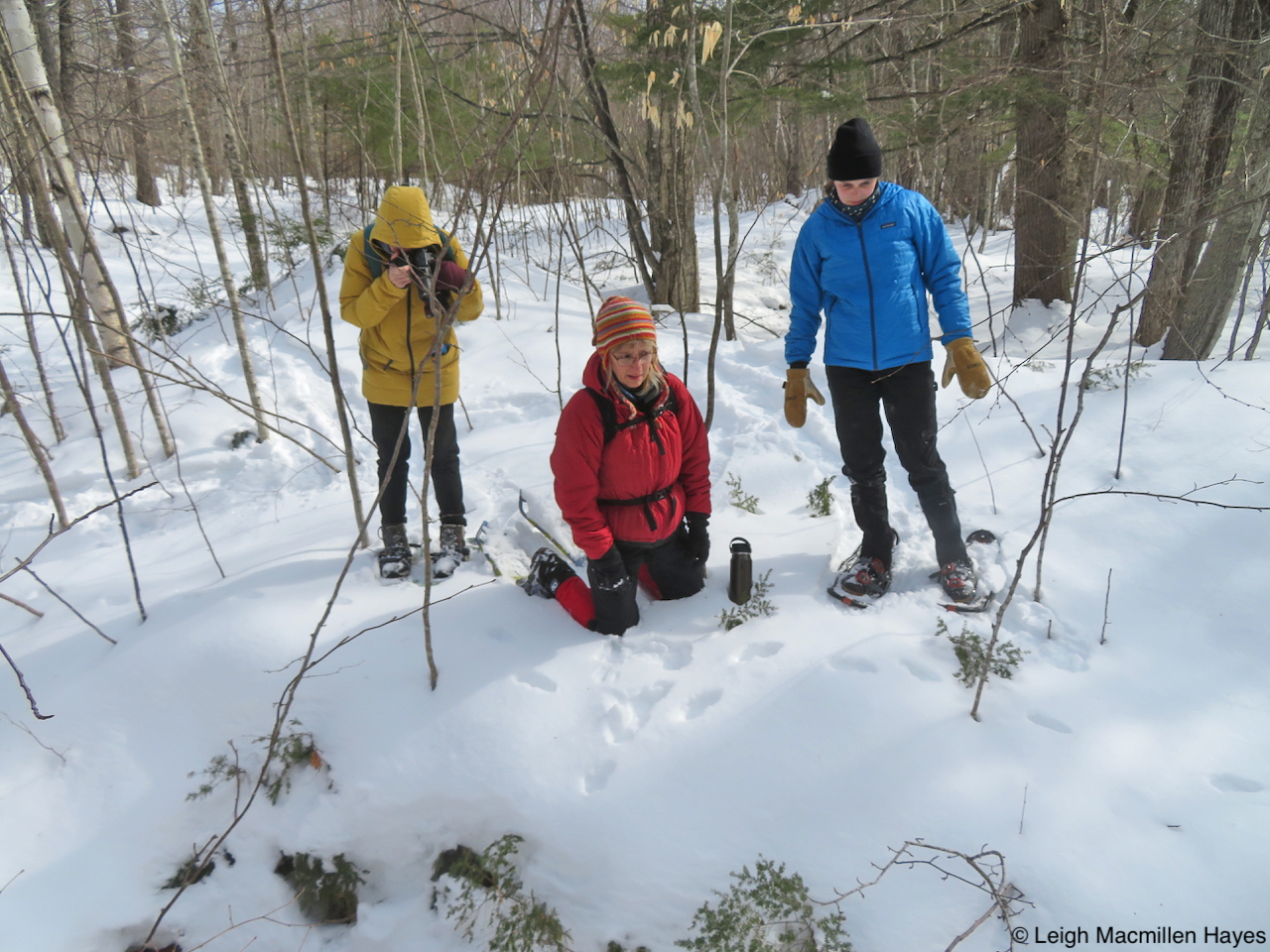
Our first stop was along a stream where he walked beside the edge—about two or three feet above the open water for such is the snow height—but then paused for a moment and seemed to step down because he was curious about something. And so were these three, Pam, Dawn, and Emily, for they spied something in the water below.

From our position on the opposite bank, a few of us saw what we thought they were looking at. “It’s furry,” Dawn told us.

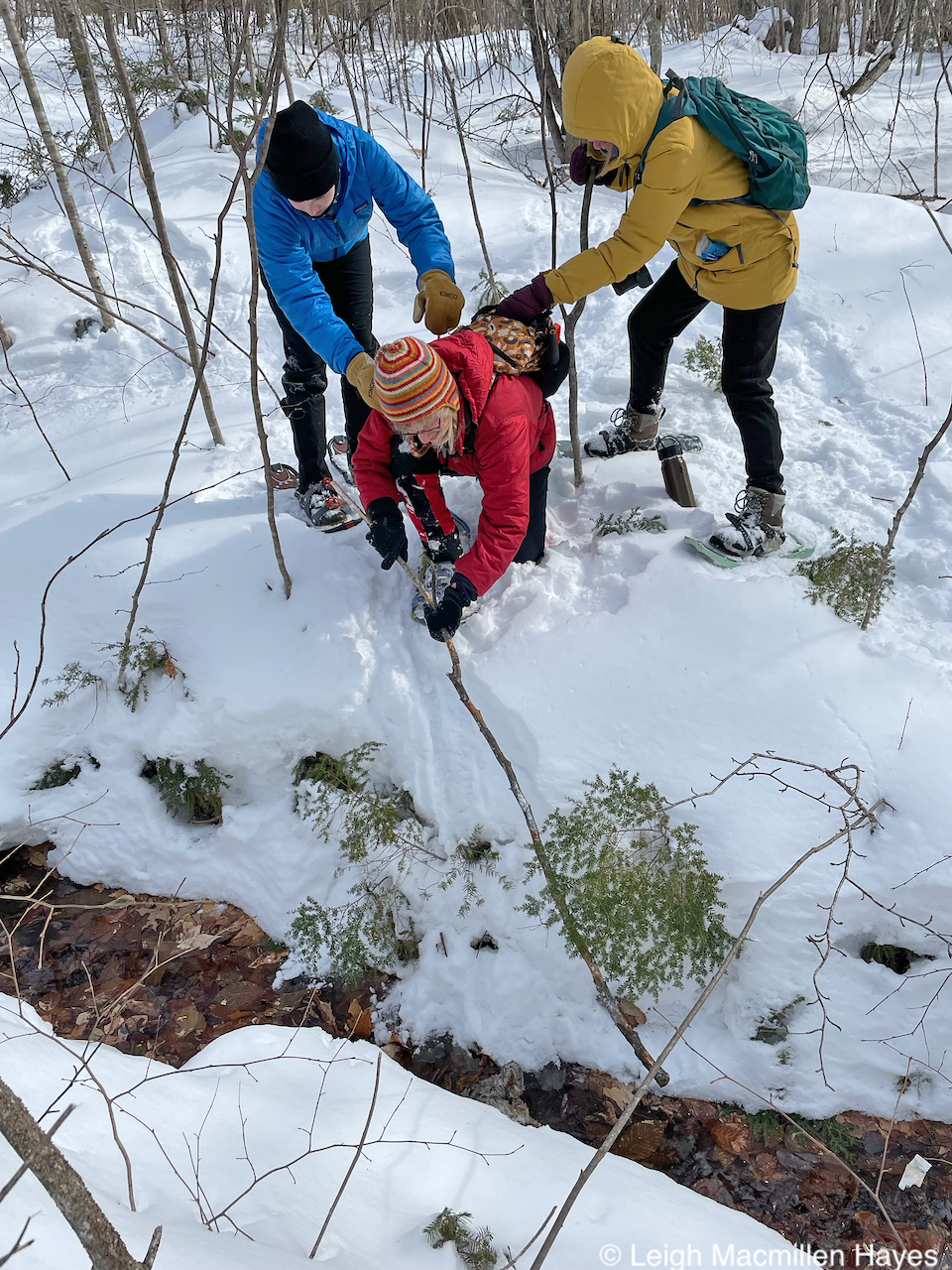
She wanted to go down into the water because it didn’t appear to be all that deep, but still that would have meant she’d be wet and so Emily hunted around and found a branch to use as a poker instead.

As Dawn wiggled the stick, all the time exclaiming that it was big, whatever it was, and trying to turn it over, Emily and Pam grabbed her to make sure she didn’t turn into an otter and slide down, though I suspected she would have laughed about the experience.

We all watched intently, making suggestions about the critter’s identity while Dawn continued to poke at it and move it. Mammal? Skull? Full body?

The coloration was definitely unique, but it is winter after all, so the freezing temperatures and fact that it was in water may have altered its appearance.

Those were our thoughts anyway, and we voiced our opinions, until . . . Dawn flipped it over and saw . . . a tag.

So hoping for a kill site where the bobcat may have dined, instead we found ourselves looking at . . . a stuffed owl.

Peter took Pippi’s hiking pole and aided Dawn in rescuing the sopping wet bird and if you look closely you may see water dripping from it.

Our chuckles must have rippled through the forest as we laughed at our great find. Mighty trackers are we. But . . . we think the bobcat was almost fooled as well. Almost.

The owl then flew from Peter’s hands to a perch and there it shall remain, or so we think.

For a few minutes we returned to and continued upon a logging road, and then the bobcat called for our attention again and so we did follow it. As I said to the group, normally I’d insist that we backtrack the animal so we don’t put stress on it, but the tracks were at least a day old.

This time the bobcat led us to a hemlock tree. Do you see the debris under the tree?

How about now? And stained snow by the trunk?

There were even little brown commas atop the snow that could easily be mistaken for hemlock cones. But rather, they were a form of scat.

Like us, the bobcat had been here, but for some reason he chose to pass by.

Whenever we spy downed hemlock branches, comma-shaped scat, and lots of urine at the base of a tree, we know to look up and so we did. High above sat a male porcupine. Males are known to stay in a tree during the day while females typically return to the den each morning and head back to the tree of dining choice at twilight. Here’s are two curious things: 1. the bobcat passed by—they will go after a porcupine, but perhaps this one was too high up. (Fishers are a porcupine’s #1 enemy.) 2. we looked all around and couldn’t find any porcupine tracks. If we had, we might have followed them to see if we could locate the den. But, since we couldn’t we came to the assumption that this porcupine has been up in the tree since at least our last major snowstorm on Friday, February 25.

Back on the bobcat’s trail we did go, being stymied occasionally because though we knew it was a bobcat, there were a few prints that resembled a deer and we came up with all kinds of stories about flying deer and other critters of our imaginations.

But always, we’d find a few classic prints and again feel 100% confident of our ID. Well, not ours, but the bobcat’s.

So where would it lead us next? To a spruce tree all covered with sap . . . and fur.

Some of the hair was dark and coarse.

In other spots it was redder and softer. After much debate, and noting that it was all up and down the tree from just above snow level to at eye sight and maybe a bit above, I think we all agreed it was a bear marking tree. Bears sometimes nip and bit trees and rub their backs on them and their hair gets stuck on splinters or in this case also sap.

According to North American Bear Center: “Favorite trees have little ground vegetation to prevent a bear from approaching them, and they often lean slightly toward the trail.  Look for hair caught in the bark or wood 2 to 5 feet high and look for bites 5½ to 6½ feet high.

The hair often bleaches to brown or blond after a few months but can still be distinguished as bear hair from its length and appearance.  Guard hairs are typically coarse and 3-4 inches long and have a narrow base that may be wavy.  Bears are shedding their winter fur when much of the marking is done in spring or early summer, so the bark may also catch underfur, which is thin, wavy and shorter.”

Two feet up made sense given the snow’s depth.

You’d think that would have been enough, but again we wondered: where will the bobcat lead us?

This time it was a snapped snag and we noticed he’d walked along the top of it.

And then one among us spotted this. Brown snow and more hair. We were sure it was a kill site. Yes, as trackers we really like kill sites because they are fun to interpret and we appreciate the energy passed from one animal to another via the predator/prey relationship.

For a few minutes we took turns walking around the site trying to take in everything presented to us, including some hair that had fallen into the snag’s hollow.

I think it was the two=toned hair that helped us figure this one out. Plus the fact that there was no blood. This was a spot where the bobcat sat down, thus the rather tamped down snow that had turned brown. The warmth of his body helped to flatten it and in so sitting, some of his hair, which is black and white, got stuck, similar to what we see in deer beds at this time of freezing and warming temps. The mammals are beginning to shed their winter coats and last week we had an unusually warm day so change is in the air.

We admired his hunting spot and balance beam. And then it was time for us to leave.

But those grins remained on our faces for we were grateful we’d taken the time to see where the bobcat might lead us at GLLT’s Charles Pond Reserve today.

Good Hair Mondate

The temperature dipped overnight and wind picked up out of the WNW but given the destination we had chosen, we knew if we dressed appropriately we’d be fine because we’d be in the woods most of the time, unlike last week’s walk where we were completely exposed to the elements on Popham Beach. That said, it was cold today.

Our plan was to follow the trail around Shell Pond at the Stone House property and do it with micro-spikes on our boots rather than snowshoes. Or at least on my boots. Given that there had been some foot traffic, we hoped that when we actually arrived at the trail we’d made the right decision.

As it turned out, most of the traffic had headed to the air strip, but a few had walked our way and really, there’s more ice than snow in this part of western Maine right now.

We cruised along at My Guy’s speed, which boded well for keeping our bodies warm and gave thanks that we were both quite comfortable as we began to circle the pond. Mammal tracks were numerous, but most muted and really, we didn’t want to take time to stop and measure so we only named to each other those we were certain we knew.

Well, one of us did walk a tad faster than the other, but that’s nothing new.

In what felt like no time, we greeted the Keeper of the Trail who gave us a smile from below his winter hat.

And then we reached lunch bench, which my guy cleaned of snow so we could dine on our peanut butter and jelly sandwiches in comfort. Well, sorta in comfort. It was here that we met the wind as it swept across Shell Pond from Evans Notch. So, it was a quick lunch.

And a quick journey to the orchard. As we crossed the bridge over Rattlesnake Brook I recalled once watching a muskrat swim beneath. My guy informed me that I’d probably not see such today–how right he was.

I was feeling a bit bummed that we’d circled so quickly but we did promise ourselves that by the Stone House we’d turn off the air strip and check out Rattlesnake Pool and Gorge, which we’d missed on a Thanksgiving Day hike when we journeyed up Blueberry Mountain located behind the house to Speckled Mountain.

Each time we pass this way I give thanks to the owners who long ago put most of the forested part of the land into a conservation easement with Greater Lovell Land Trust and allow hikers and hunters and rock climbers to use their trails.

And so up the Stone House Trail we went, passing the gorge to start so we could meet the brook at a spot above and watch as the water swirled under ice,

below boulders,

and down through a chute,

creating ice sculptures all along its journey.

Briefly it danced into Rattlesnake Pond, and then followed the course below.

The pool’s nature as forever emerald green never ceases to amaze me.

We met it again at Rattlesnake Gorge were the flow continued despite all the frozen formations.

Down it continued on its way to the point where I earlier showed it in its calm and completely frozen flatwater oxbow.

Click on the video to briefly enjoy the sound.

As much as I was thrilled to have visited the Rattlesnake sites because it was too dark to do so the last time we hiked here, it was the image in the negative space of the ice that really put a smile on my face today.

Do you see a bear?

Back at the air strip we turned right and headed back to the gate. After that, we still had another mile to walk because we’d parked closer to Route 113 since the road in to Stone House isn’t plowed.

And then we played my favorite Stone House Road game–checking telephone poles for bear hair. Black bears LOVE telephone poles. For the creosote? Maybe. Is it the soft pine that they can so easily chew and claw? Maybe. Is it a great place to hang a sign that you are available for a date or this is your territory? Probably, but maybe it’s the other two possibilities that lead the bears to the poles. I do know this. They are well marked along this road.

In the process of biting and scratching some hair is left behind. Mating usually takes place in late June or July, so possibly this hair was left then and has since bleached out in the sunshine.

Shiny numbers also seem to draw their attention, or perhaps the bear wants to hang its own sign and tear down the one left by a human.

Look at the horizontal dots and dashes–can you see them? Think of the bear turning its head and the upper and lower canine teeth meeting as it bites at the wood.

Closer to the truck one pole indicated that the bear won–it had almost totally remodeled the pole including removing most of the number.

As Mondates go, I have to say this one was a very good hair date! And I’m not talking about mine or my guy’s, since we didn’t care what we looked like as long as our warm hats smooshed our manes.

May the Wonder Never Cease

I’m pretty sure everything others and I see are ordinary, but we manage to make them extraordinary because we feel like we’ve been honored with gifts when we notice them. And so it has happened that in the last three days I’ve had the opportunity to notice some rather mundane sights.

First, there was the Solitary Sandpiper foraging for insects in a kettle bog. I was with six others and we weren’t exactly silent as we stood by the muddy margin of the water, and yet the bird never acknowledged our presence, but we were certainly in awe of its company.

In that same space a Catbird crying its meow calls also foraged and our eyes flickered from one to the other as we tried to keep track of their movements.

It wasn’t just “our” feathered friends who garnered our attention for we love mud and happened to be standing in some and what’s mud without mammal prints? As in . . . Black Bear prints.

Indeed. We even took time to measure the straddle or distance from the outside of the hind print on the left-hand side of Ursus Americanus’ body to the far side of its front foot print–about 20 centimeters in total. Also in the corridor, prints of raccoons a many, and a fox.

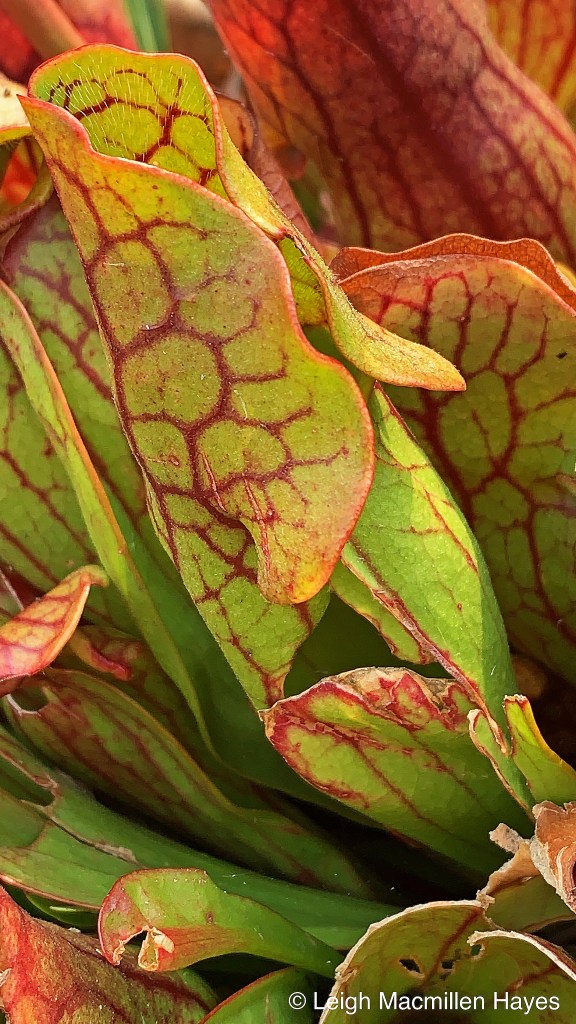
Though bears and raccoons and foxes may all be omnivores, taking advantage of whatever meal might be available in the moment, there were a few carnivores in the mix–including the most beautiful of all: Pitcher Plants with their tree of life decorated pitcher-style leaves.

One more carnivore who had somehow survived being consumed by a bird or another member of the Odonata family also honored us–in its last moments of life: a Sedge Darner Dragonfly.

We studied its markings on both abdomen and face, which helped in identification, and then watched as it cocked its head and let forth one last sigh. We were there for it in the moment and now it rests upon my desk.

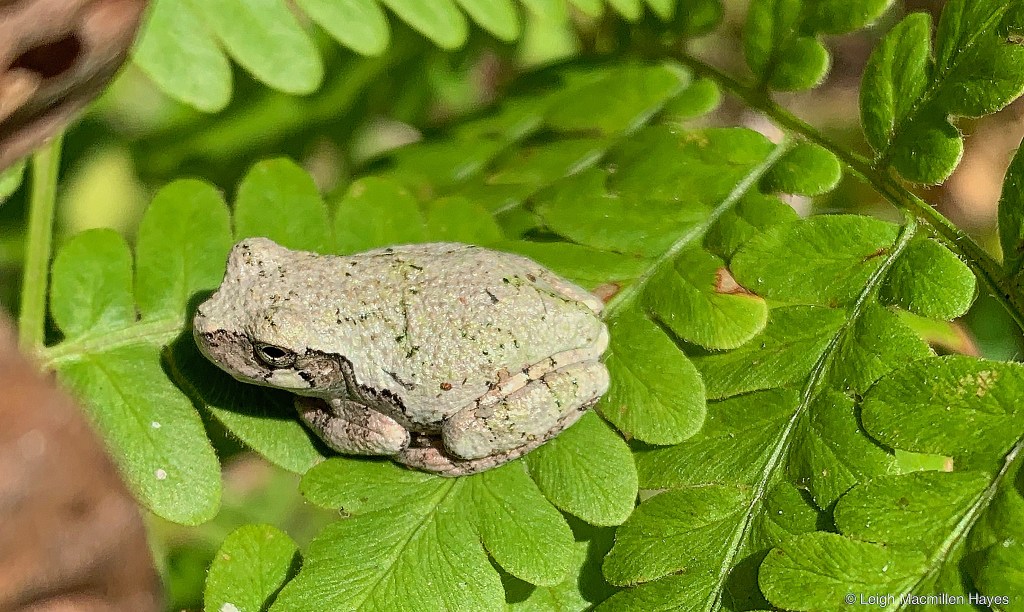
If that wasn’t enough, the next day three of us walked another large swath of land in the same vicinity and one among us with a keen eye spotted this little gem upon a Bracken Fern. (Thanks M.Y.) The baby Gray Tree Frog was not larger than a Spring Peeper and it struck us that it was a wee bit cold as the morning had dawned and indeed when we passed by again an hour and a half later, it was still in the same position, though as we approached we did notice it move, so we knew it had more life in it than the Sedge Darner.

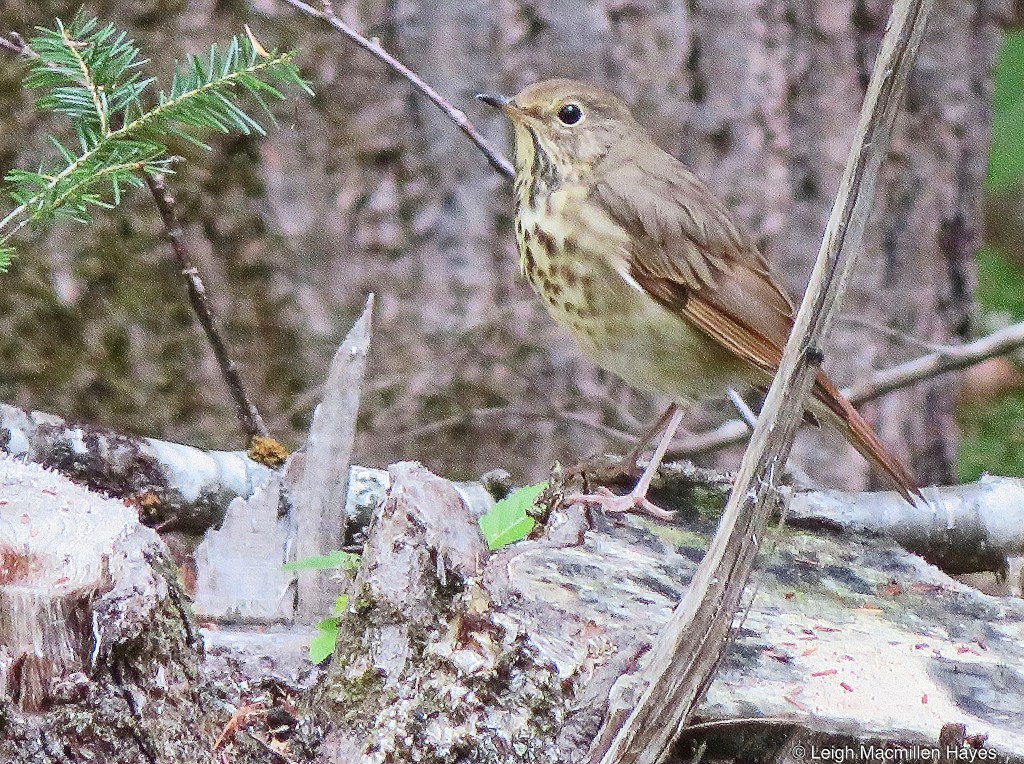
In the same woodland, we spied a Hermit Thrush, who made itself know not by its melodic song that we enjoyed for much of the summer, but rather by its behavior as it stood upon the stump and then darted to the ground as it foraged before hopping back on the stump. These swaths of land–how important they are to support all of this wildlife that needs each other to survive. And us to notice so that we don’t go crazy and alter the land so much that they lose their habitat.

Today, the offerings continued. And in the midst of some important information being shared about a conserved property, a wee Painted Turtle was spotted. The acorns offered a certain sense of size.

You know how puppies seem to need to grow into their paws? That’s how I felt about this turtle. Not only did it have to grow into its feet and claws, but also its head. And then there was the attitude as exhibited on its face, though that may have had something to do with the fact that a bunch of us were in its space and we tried once or twice to reroute it, but it had its own idea of a mission and really, who are we to tell it where to go?

One might think that all of that was enough. But . . . was it? Well, in another space that is a private property under conservation easement, a metallic Oil Blister Bug made itself known.

It’s not one known to fly and if you take a closer look, you’ll note that its wings are rather limited given its overall size. But that color. Oh my!

The crème de la crème, however, may not be the clearest photo, but it was the coolest find of all: a black Eastern Chipmunk. One other and I had been listening to a Barred Owl call when we heard the sound of scampering nearby.

I’ve been receiving reports of the black chipmunk’s existence in the area the past few weeks, but was still totally surprised to make its acquaintance at least a half mile or more away from where others had seen one. Is there more than one?

As I understand it, the black color is caused by too much of the pigment melanin, which with elevated amounts results in dark skin, feathers, scales, or in this case, fur.

From the ordinary to the extraordinary, may the wonders never cease.

Bear to Beer Possibilities: Brownfield’s Burnt Meadow Mountain

It’s been a while since my guy and I have ventured on a Bear to Beer Possibility hike, but today dawned bright and even a wee bit chilly. A perfect August day. A perfect hiking day.

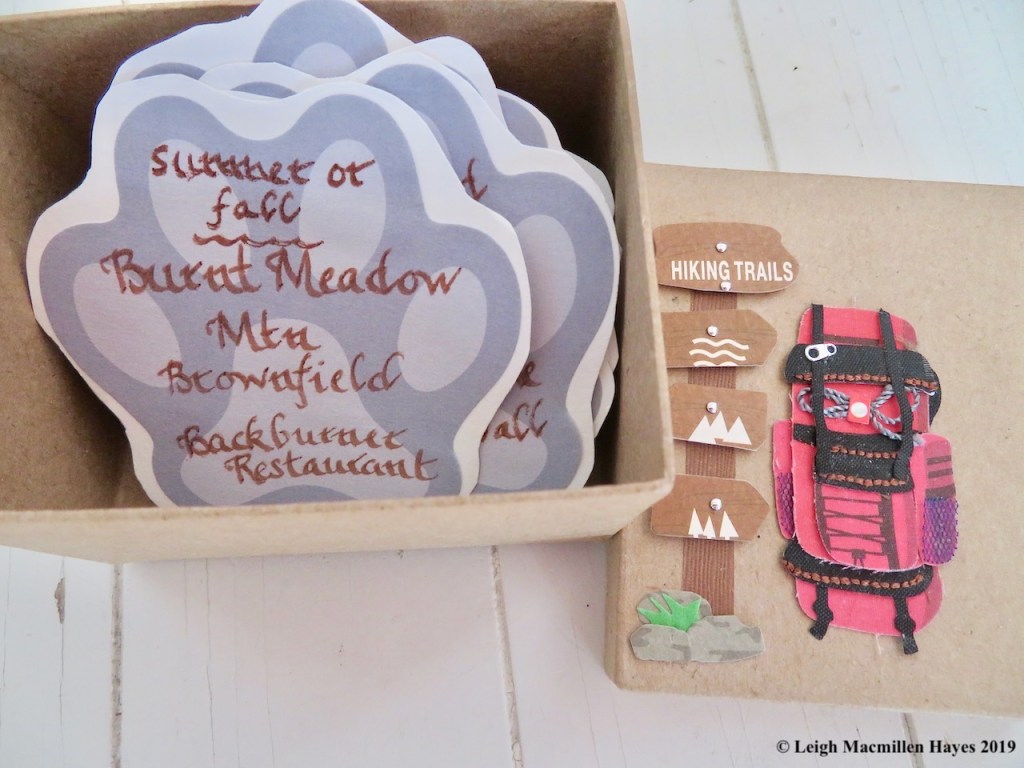
As he dipped his hand into the little box filled with potential, Burnt Meadow Mountain in Brownfield surfaced.

And so it was that we decided to hike up and down the Twin Brooks Trail rather than doing the loop to the North Peak. Though a bit longer, it proved to be a good choice as we came upon a couple of bear trees we hadn’t met previously. The first was the best for so many claw marks did it feature.

Even from the back side there was proof that not only was this our favorite bear tree, but it was also some bear’s favorite.

A little further on we found another we hadn’t met before. Or . . . perhaps we were meeting it for the first time all over again. That happens to us sometimes and, after all, we were approaching from a different angle than is our norm.

There were other things to slow us down, like the occasional Autumn Meadowhawk Dragonfly, especially in an area where the trail had been rerouted a few years ago during a logging operation and most of the growth is early successional.

And a Bald-faced Hornet nest that was quite active. “How does your nest grow?” I asked the lady of the house. “With chewed wood fibers mixed with saliva,” she responded. The result was an impressive condominium a few feet off the trail.

Continuing on, there was a cave that deserved a visit so my guy peeked in. Fortunately, no one peeked out.

And then . . . another bear tree, though not nearly as impressive as those we spotted previously.

Onward and upward we climbed. Thankfully, we didn’t have to partake of the heart-throbbing scramble of the North Peak Trail that sometimes gives me pause, but we still had some scrambling to do on the trail of today’s choice.

It was worth it, for we paused at one point and turned to take in the view of Mount Washington.

At last we reached the flat top of Burnt Meadow Mountain. It always amazes us that with all the boulders and ledges we encounter on the way up, the summit is rather like a mesa.

Lunch rock found us taking in the view to the east. The Atlantic Ocean is somewhere beyond the sea of trees.

And though there were still plenty of berries at the top, we never met an interested bear. (Almost 20 years ago, we did when hiking there with our sons.) Nor was my guy interested in what I typically call his blue gold.

Instead, he chose to nap.

As for me, well, you can guess what I was doing before we descended. This tiny dragonfly is a female Eastern Amberwing and this was our first meeting. I first met her male counterpart last month in NYC’s Central Park.

She wasn’t a bear, but in my book, she was the next best thing.

And the Backburner Restaurant in Brownfield wasn’t open when we passed by on our way home, so . . . our bear to beer possibility this time included bear trees but not beer. Even so, it was a great hike.

Bear to Beer: Bishop Cardinal to Lord Hill

Our destination sounded rather regal; as if we’d be paying our respects to Bishop Cardinal and Lord Hill. And indeed we did.

We also paid our respects to telephone poles. Well, actually only certain ones. They had to have a certain look–as if a Black Bear had backed into the pole and turned its head around at an angle and bit the wood with its upper and lower canine teeth thus leaving nearly horizontal marks that look like a dot and dash. In the process, the aluminum numbers had to be a bit mangled in order to receive our attention. This particular pole was right by the trailhead and so after examining it, we headed up the blue trail at the Greater Lovell Land Trust’s Bishop Cardinal Reserve on Horseshoe Pond Road in Lovell.

Along the way, we examined every American Beech we saw, but actually passed by a spot where we know there are several with the marks we sought. If you go, look for the blue dot on the white arrow and hike in at a diagonal from there.

Our hope today was to find other bear claw trees we’d missed previously and so we kept going off trail in search. Turning onto the red trail, we continued to check. Sometimes it’s the shape of the tree’s crown that makes us wonder.

We have learned that we can’t dismiss any bark without walking all the way around and bingo–we had a new-to-us bear claw tree.

I don’t know why it is, but those marks make our hearts sing. Perhaps it’s the knowledge of the wildness of it all and the fact that we share this place with such intelligent beings.

Whatever it is, we decided that rather than creating waypoints for each tree we found, we’d try to remember the location by using other landmarks such as a certain waterbar that was intended to divert snowmelt and rain from washing out the trail. When you reach that certain waterbar on the red trail, turn left and walk in about twenty yards. If you don’t find our tree, perhaps you’ll discover another.

Continuing up the trail, we did note a few other favorites off to the right.

Sometimes, in my mind’s eye, I could just see the movement of the climber.

With one such tree, the marks were lower than most and I wondered if it was a younger bear. Of course, we have no idea how long ago those marks were left behind. Mary Holland suggests a way to age them that we haven’t tried yet. And we didn’t look for fresh marks. Really, we need to be better sleuths going forward.

In case you are wondering, occasionally we noted other points of interest, such as the burst of beech buds, their spring green leaves all hairy and soft, which is actually quite a contrast to the papery feel they eventually acquire.

Here and there, the cheerful display of Round-leaved Violets brightened the path.

And drone flies, with their bigger than life eyes, posed. Any black flies? Yes, a few, but not biting . . . yet.

We were almost to the old shack site, if you know where I mean, when our journey off trail revealed another fine specimen. Again, the claw marks were on the backside since we approached from the trail. Always, always, always circle about and you might be surprised.

Eventually, we reached the intersection with the trail to Lord Hill and continued our surveillance as we continued our hike.

Once we turned right onto the Conant Trail, we did find one tree with marks long ago made . . . by some bears with either an extreme understanding of relationships, or more likely, a few who weren’t all that intelligent after all.

At last, the trail opened onto the ledges overlooking Horseshoe Pond and it was there that we sat down on the warm granite as a nippy breeze flowed across. Enjoying the view of Horseshoe Pond below and the mountains beyond, we ate lunch.

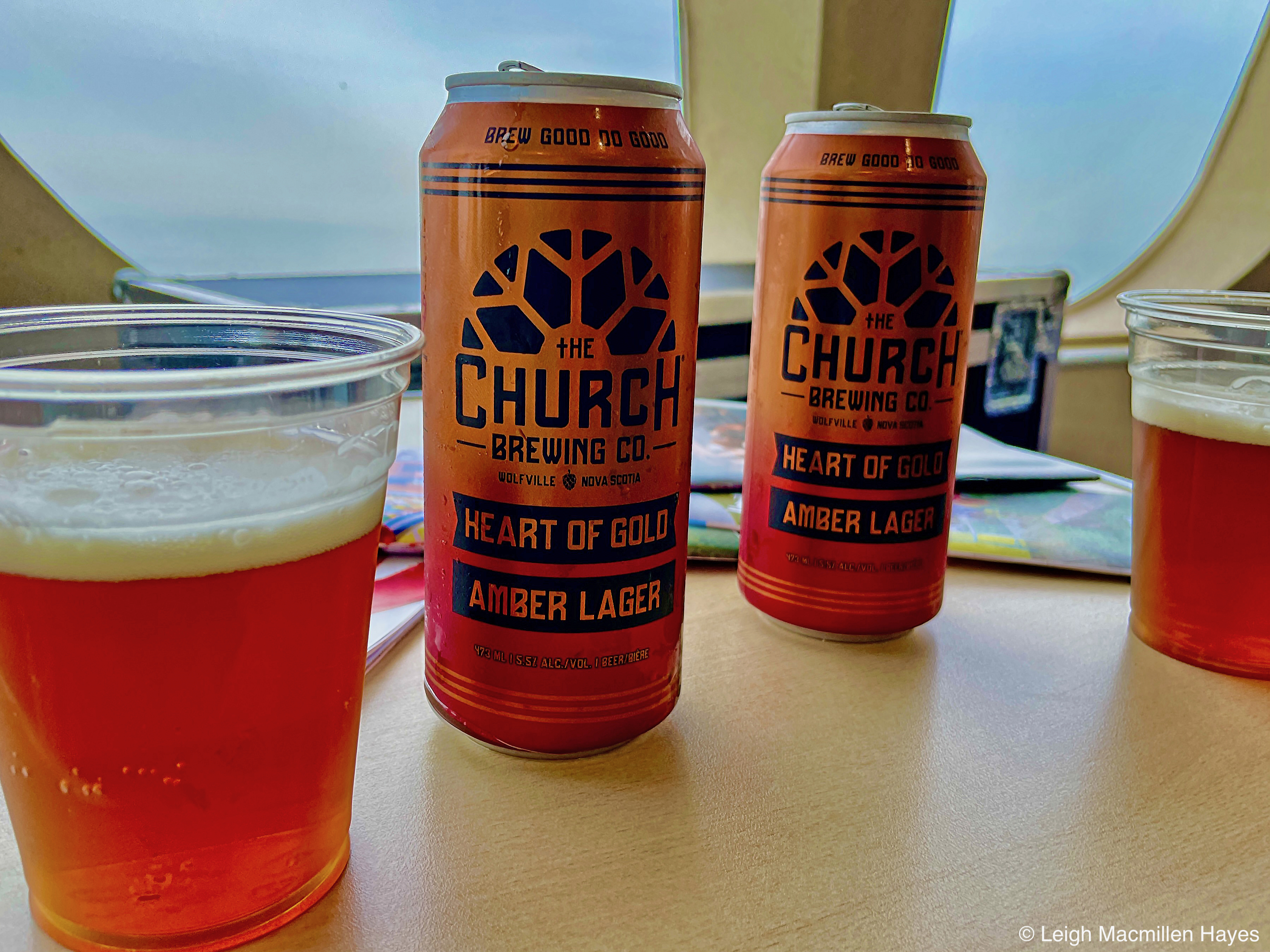
We also toasted a few others with a Honey of a Beer brewed by Lee of another spelling! Dubbel Trouble was double delicious. Thank you, Lee Fraitag. ;-) Our toast was also doubled for we gave thanks to Paula and Tom Hughes, who live just below on the pond. Tomorrow we’ll enjoy a Mother’s Day Brunch at the Old Saco Inn courtesy of the Hugheses. ;-)

Clink. Clink.

After enjoying lunch rock we journeyed up to the Lord Hill Mine.

According to mindat.org, Lord Hill Mine was “a former rare mineral specimen quarry. Briefly worked in episodes in the mid-20th century for feldspar. Originally a mineral collector’s site in the late 1870s. Opened by Nathan Perry and Edgar D. Andrews in the early 1880s. Originally called Harndon Hill, but the named changed in a complex change of names about 1917. Operated solely by Nathan Perry by 1882. Operated for massive topaz for educational mineral collections in the 1970’s by Col. Joseph Pollack of Harrison, Maine. The locality is the type locality for hamlinite, now regarded as a synonym for goyazite. Granite pegmatite. Oxford pegmatite field. Local rocks include Carboniferous alkali feldspar granite (muscovite accessory mineral).

We spotted several people busy digging for their fortunes and decided to let them. They either were so tuned in to their work that they didn’t hear us or they chose not to. No matter. After a quick look about, we quietly followed the mine trail down–our own focus still on the trees.

And at the point where the National Forest abuts the Greater Lovell Land Trust’s property, we turned back onto the land trust’s loop trail. We’d come up from the left, so turned right to continue our descent.

And yes, we found one more bear tree. Somewhere along the way, I lost track of the number of new finds. But, we trusted that for all we found, there were so many more we must have missed. And then some.

Back on Horseshoe Pond Road, we turned left and checked all the telephone poles along the edge, examining each for bear hair because we’ve seen it stuck on them before. Today, no hair.

So why do the bears pay attention to telephone poles? Think of it as a combo backscratcher and messageboard. Pretend I’m a young male, ready and available. Wanna go out for a date tonight? Give me a call.

Despite the lack of hair, because we were looking, we found a Mayfly. That in itself, was another reason to celebrate.

Bishop Cardinal and Lord Hill. We thank you both. Black Bears, we thank you. Lee, we thank you. Paula and Tom, we thank you. (Happy Mother’s Day, Paula) All are regal indeed.
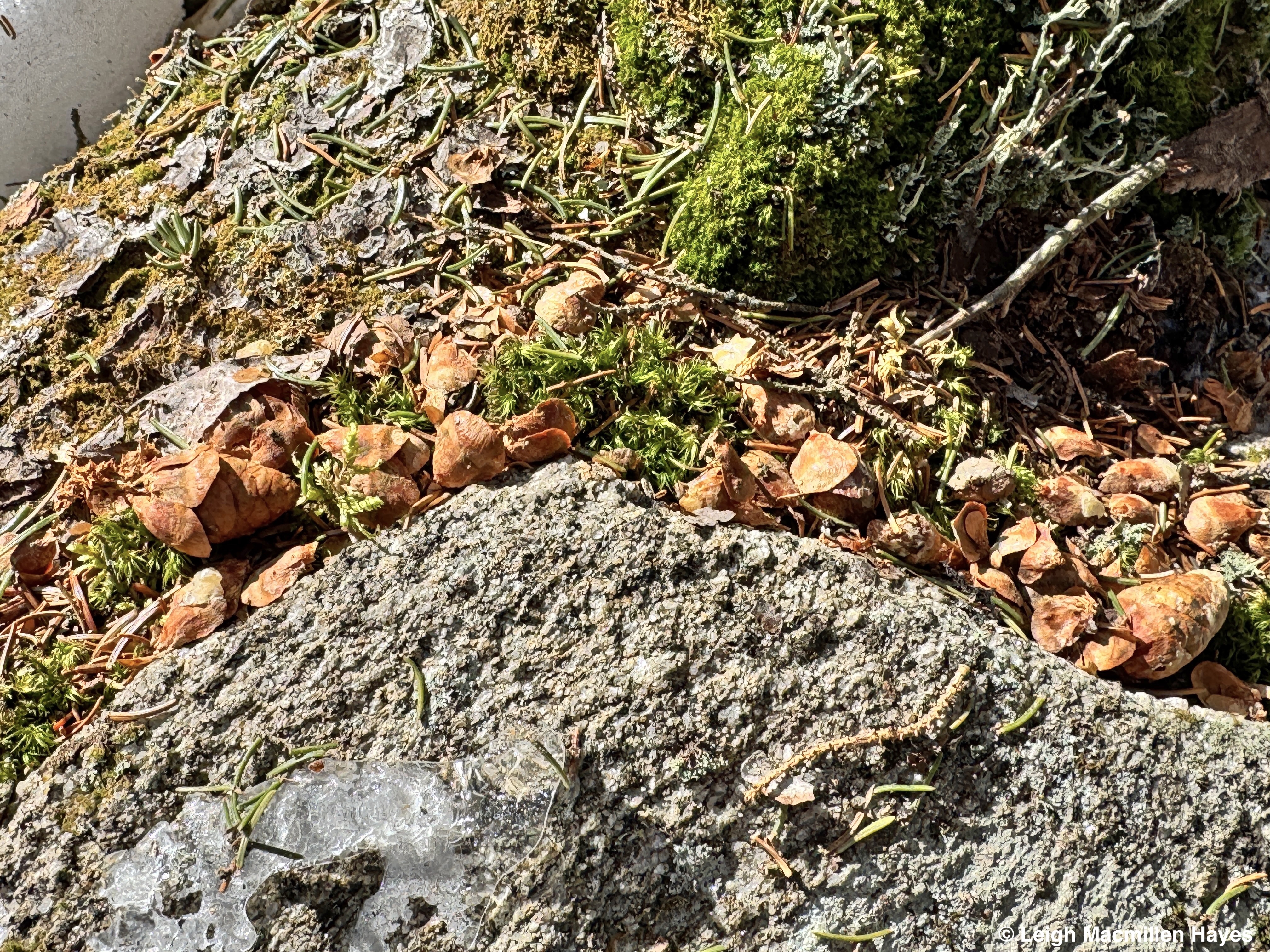
Bear to beer possibilities: Bishops Cardinal Reserve and Lord Hill Mine.

Duck, Duck, Porky Bear!

Our mission today, which we chose to accept, was to revisit a Porcupine den and check on the activity there and if time allowed, find a certain Red Pine tree in the forest. We knew the location of the den for we’ve visited it several times in the past three or four months, but had only a vague idea of where the Red Pine grew tall.

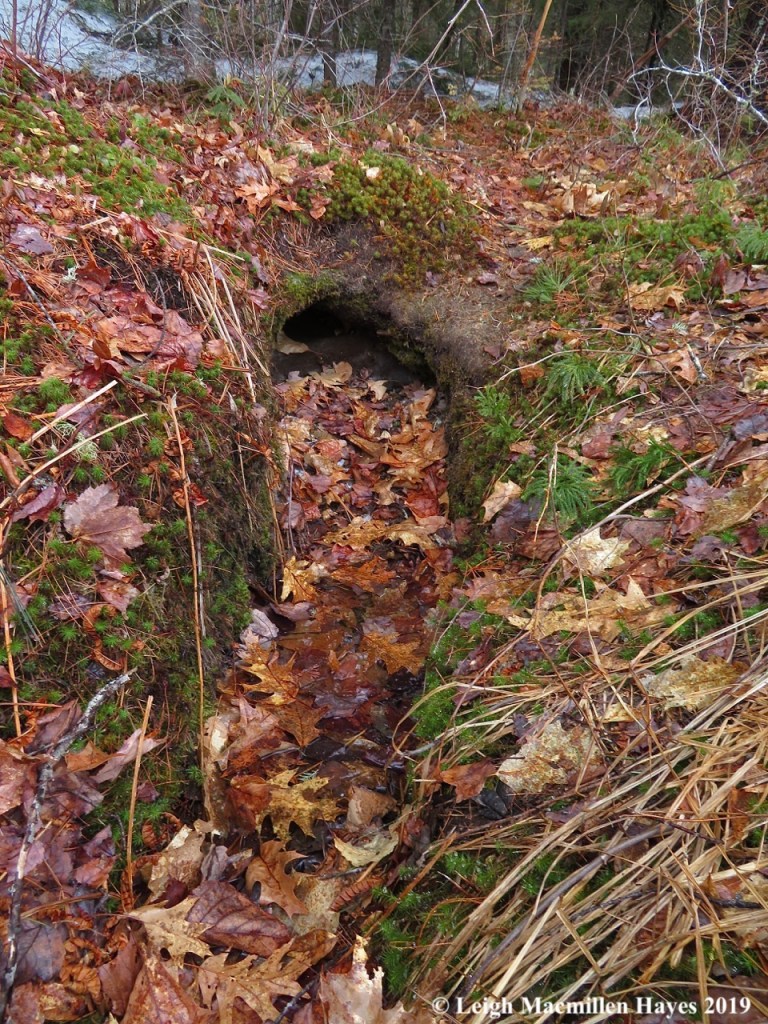
The Porcupine’s entry hole was just as we’d remembered it, but it was the scene about that had changed since our last visit. Hemlock boughs decorated the still snow-covered forest floor in great quantity.

And so we looked up–at two trees now mere skeletons of their former selves. All that was left–backbones and ribs. The meat and flesh had been almost completely nipped off. But, it still made us smile for the Porcupine had done what Porcupines do. And except for our occasional visits, it seemed they’d not been interrupted by human interference.

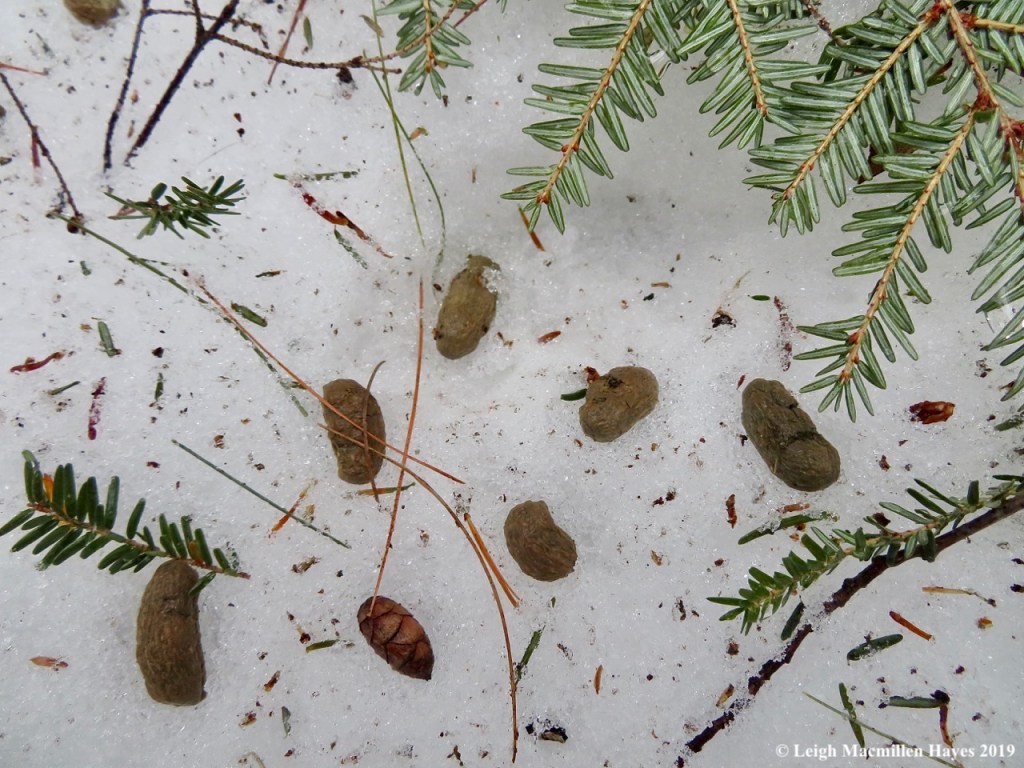
The other thing Porcupines do is scat. Prolifically. Below their tree of choice. And by their dens. Of course, I needed to document such. This presentation offered a delightful contrast, subtle though it may have been, of the prickly rodent’s scat and a Hemlock cone. Sometimes the color is so similar, and as you can see the size is as well, that it’s difficult to tell them apart. But, if we are what we eat, then their similarities make perfect sense.

After admiring the Hemlocks, we returned to the hole and noticed a few quills. You may need your detective eyes to locate them. I’ll leave it at that (Faith and Sara–good luck).

And then we moved out to the edge of the brook to check on another entrance to the same den. It didn’t appear to have been used recently, but that got us wondering about the melting snow. Having said that, we could see the pathway created to the upper right of the tunnel was worn, but any scats we found there were quite dried out and deteriorated to the point of being almost unrecognizable.

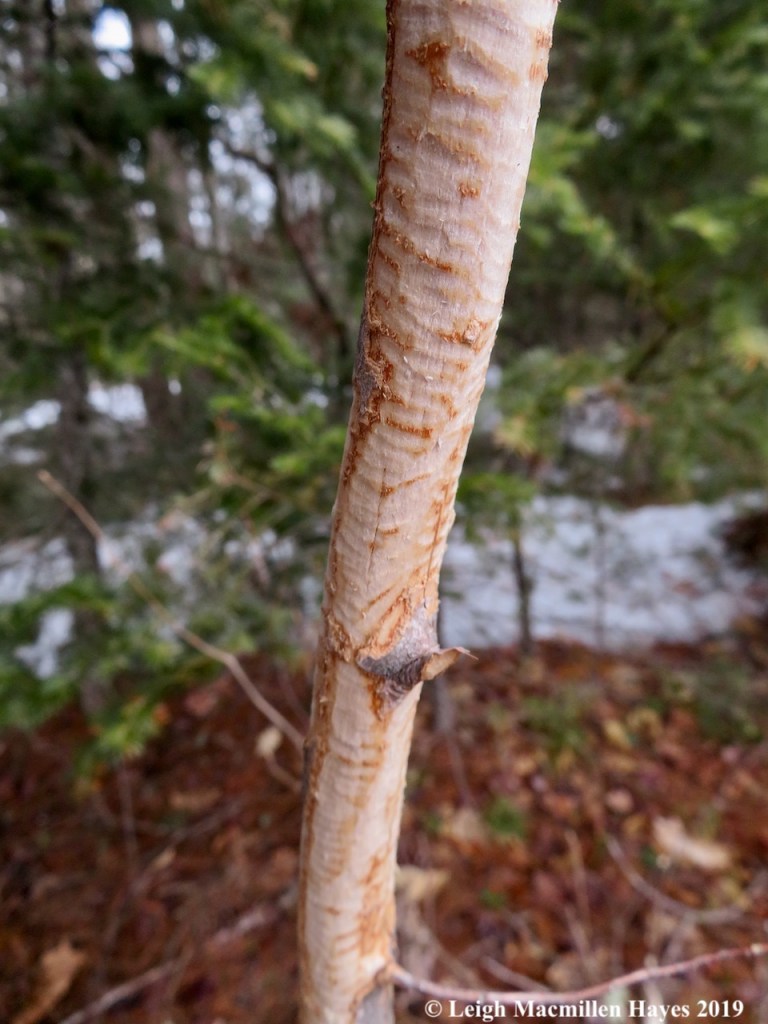
Just above the tunnel, however, a new discovery–another Porcupine tree. This one a Beech sapling–most of it denuded of bark and even a few twigs. Our questions continued. Was the upper part of this seven or eight foot tree dined upon when the snow was deep? And the lower part as the snow melted? Or had the Porcupine recently climbed up? How in the world can such a large animal climb such a small tree without snapping the trunk in half? I could practically wrap my thumb and pointer finger around it. Ah, but they do. Another amazing feat by one with grippers for feet.

Leaving the Porcupine area behind, we moved along beside the brook and paid our respects to the Itt family. Cousin Itt and his cousins stood clustered together eagerly awaiting the sun that was to come.

Our slow motion then found us beside a stump upon which Pixie Cup lichens grew. Pixie Cups or Goblet lichens are members of the Cladonia group. This find made us realize that as the snow pack dwindles we have so much to learn or relearn. Thank goodness it’s a slow melt and we have time. ;-)

Our time today next involved a magic trick. One of us poked the blisters on the trunk of a Balsam Fir.

With a glob of resin attached to the broken twig, she tossed it into the water. Then we stood and watched . . . as the oil dispersed, changed shape and colors, and the tiny piece of twig moved about like a water fairy’s motorboat.

The essential oil within the sticky tree goo propelled the twig and created a map that could have been the United States.

As we watched, some of the oil broke away and feathered out in the movement of the water . . . but in a fashion we didn’t understand for it seemed to only float so far and then circled back.

As I said, we watched for a while, and where the little twig settled, we began to notice another shape emerging . . . a duck. Some people look at clouds, but we were fascinated by a substance that has antiseptic properties to seal cuts and protect them from infection, lessens the pain of burns if smeared gently onto skin, and serves as nature’s gasoline when one wants to start a fire. Oh, and reacts in water by creating fascinating rainbows while propelling objects.

At last we pulled away for I had a time crunch, but we still wanted to reach the Red Pine. To get there, we passed a Turkey kill site we’d discovered in January. The feathers remained and reminded us of the day we’d spent trying to solve the mystery of the Turkey’s demise. If nothing else, we came up with a good story that day.

From the feathers, we journeyed on, reaching the edge of a wetland that stretched away from the brook. My time was running out, but we gave ourselves six more minutes (why not five, you ask? Why not?) and scanned the tree tops in search of one Red Pine. And then . . . we spied it.

We weren’t the first, for a Winter Firefly moved out from under the bark as we admired its colors and jigsaw presentation–of the bark that is. We admired the insect as well, but that bark. Oh my.

And then our real “Oh my!” exclamations began for we had found what we sought. Bear claw marks on the bark! They are much more subtle on Red Pines than American Beech, but as we circled the tree we kept seeing them.

The thing about the Red Pine is that the flaky bark must make it difficult to climb, but then again, we couldn’t tell how high Ursus americanus had gone. Mind you, we didn’t look at any other trees in the forest, and as I sit and think about this one now, I can’t wait to return (I’ve a feeling my guy will want to be in tow for the next expedition) because this morning I’d forgotten that Black Bears use lone Red Pines as communication poles–turning their heads and biting into the tree while rubbing their backs against it to leave a scent (Think date night invitation). Usually, some hair is left behind in the sap. We did located old Pileated Woodpecker holes filled with sap, but no hair. Yet.

Our journey out was more of a bee-line because our six minutes took longer and I was a wee bit late to an interview, but my hostess was gracious when I explained that a Red Pine had held me up! And then on my way home I stopped by some more open water and much to my delight, a pair of Wood Ducks struck just the right pose.

And now I’m torn. Which duck do I prefer? The Balsam Fir Duck or the male Wood Duck? Such decisions to have to make at the end of the day.

Duck, duck, porky bear! They were each special in their own way.

Cranberry Memories

It’s amazing how a simple act such as taking cranberries out of the freezer and transforming them into a relish can take one back in time, but so it did today.

My family knows best that I’m not a foodie, and cook only because we can’t survive on popcorn alone (drats), but one of my favorite flavors brings a burst of tartness to any meal. And as I concocted the simple cranberry orange relish we so enjoy, moments spent picking them kept popping up.

On several occasions last fall, I bushwhacked toward the fen, stopping first to explore the kettle holes that dot the landscape.

And though I love tracking all winter, it’s those unexpected moments in other seasons when I recognize the critters with whom I share the Earth that make my heart quicken.

Especially when I realize that one of my favorites has also passed this way, stomping through the water . . .

and then onto the drier land. Yes, Ursus americanus had been on the hunt as well.

He wasn’t the only one fishing for a meal, though of a much smaller spidery-style scale.

And then there were my winged friends, the meadowhawks.

I remember the mating frenzy occurring as that most ancient of rituals was performed both on the leaf and in the air.

Other winged friends, showing off a tad of teal, dabbled nearby.

Eventually, I tore myself away from the kettle holes and tramped through winterberry shrubs filled with fruits and cinnamon ferns ablaze in their fall fashion.

After all, my destination was the cranberry fen.

And last year was a mighty fine year for those little balls of wonder that hid below their green leaves. I filled my satchel to overflowing before taking my leave, knowing that in the coming months I’d share the foraged fruits with family and friends and remember time well spent.

Not only did the abundant fruit make it so special, but on my way out I stumbled upon another kettle hole and much to my delight spotted two Sandhill Cranes, part of a flock that returns to this area of western Maine on a yearly basis.

While the cranes foraged on the ground, a Great Blue Heron watched them approach.

And then in flew a Bald Eagle who eventually settled in a pine tree beside a crow.

With that, the cranes flew off and a few minutes later so did the heron. And then I left, trying to find my way out, but I’d gotten a bit twisted and turned and ended up cutting through someone’s yard to get back to the road. Because I was a wee bit confused, I couldn’t find my truck right away, and in the process of looking I dropped a few cranberries. It was all worth it! And still is as we’ll enjoy that relish in our chicken salad sandwiches tonight.

Ah, cranberries. And bears. And spiders. And dragonflies. And birds. Ah, cranberry memories.

Framed by the Trees

Our journey took us off the beaten path today as we climbed over a snowbank at the end of Farrington Pond Road and onto the Greater Lovell Land Trust’s John A. Segur Wildlife Refuge East. We began at a piece of the parcel neither Pam Marshall or I had ever explored before, which added to the fun. At first, we followed the tracks of a giant, and eventually decided they might have belonged to another human being. Might have. Always wonder.

And then we were stopped in our tracks as we looked up and recognized a Great Blue Heron–or so it seemed in the dead snag that towered over the edge of Farrington Pond. Except for one tiny area of water, the pond is still very much ice covered so it will be a while before this ancestor of the Greats sees her relatives return.

Standing beside the bird-like structure was another that helped us find beauty and life in death.

We peered in, and down, and up, and all around. With each glance, our understandings increased. So did our questions.

There were holes that became windows looking out to the forest beyond.

But those same windows helped us realize they were framed by the results of their injuries. You see, it appeared that a pileated woodpecker had dined on the many insects who had mined the inner workings of the tree. After being so wounded by the birds, the tree attempted to heal its scars as evidenced by the thick growth ring structure that surrounded each hole. Or at least, that’s what we think happened.

To back up our story, we looked from the outside in and saw the same.

We also noted the corky bark with its diamond shapes formed where one chunk met another.

And much to our surprise, we found one compound leaf still dangling. No, this is not a marcescent tree, one of those known to hold its withering leaves to the end of time (or beginning of the next leaf year). But instead, this old sage is one of the first to drop its leaves. So why did one outlast the race? Perhaps to provide a lesson about leaves and leaflets, the latter being the components of the compound structure.

Adding to the identification, we realized we were treated to several saplings growing at the base of the one dying above. By its bud shape and opposite orientation we named it Ash. By its notched leaf scars and lack of hairs, we named it White. White Ash.

Because we were looking, Pam also found a sign of life within. We suspected a caterpillar had taken advantage of the sheltered location, but didn’t know which one.

About simultaneously, our research once we arrived at our respective homes, suggested a hickory tussock moth. Can you see the black setae within the hair?

Pam took the research one step further and sent this: “I read that the female lays eggs on top of the cocoon and then makes a kind of foam that hardens over them so they can survive the winter. How cool is that?” Wicked Cool, Indeed!

We probably spent close to an hour with that tree, getting to know it from every possible angle.

And then it was time to stop looking through the window and to instead step into the great beyond.

We did just that, and found another set of mammal tracks to follow. Tracking conditions were hardly ideal and we followed the set for a long way, never quite deciding if it was a fisher or a bobcat, or one animal traveling one way and another the opposite but within the same path.

Eventually, we gave up on the shifty mammal and made our way into the upland portion of the property where I knew a bear claw tree stood. Pam’s task was to locate it and so she set off, checking all the beech trees in the forest.

Bingo! Her bear paw tree eyes were formed.

It was a beauty of a specimen that reminded us of all the wonders of this place.

From that tree, we continued off-trail, zigzagging from tree to tree, but never found another. That doesn’t mean we visited every tree in the refuge and so we’ll just have to return and look some more.

We did, however, find some scratch marks on a paper birch.

They were too close together to have been created by even a young bear, but we did consider squirrel. Wiping off the rosy-white chalk that coated the bark, we did find actual scrapes below. Now we’ll have to remember to check that tree again in a year or so and see what we might see.

What we finally saw before making our best bee-line out (don’t worry, our Nature Distraction Disorder still slowed us down) was the view of Sucker Brook and the mountains beyond.

At last we pulled ourselves away, but gave great thanks for that ash tree that framed our day and our focus and for all that we saw within it and beyond.

Doozy of a Playdate

When I sent out the invite to the Maine Master Naturalist Program’s Lewiston 2013 class for a tracking expedition at one of two possible locations, grad Alan responded, “Any place you pick in western Maine is fine; you know the area and conditions well. The only request I have is for you to try to show me a ‘bear tree.’”

Bingo! I pulled a third location out of my hat because it was within an hour of those who would join us and I knew that it passed the bear tree test.

And so six of us met at 10am, strapped on our snowshoes, and ventured forth. It’s always such a joy to be with these peeps and talk and laugh and share a brain.

Because our focus at first was on beech bark while we looked for bear claw marks left behind, we also shared an imagination. One particular tree made us think of a horseshoe.

Even

Eventually we found a few trunks with the etched scratches of bear claws that had grown wider with the years. After the first find, which was actually on a different tree, the others developed their bear tree eyes and became masters at pointing them out.

And though we’d come to track, there wasn’t a whole lot of movement in the preserve except for the occasional deer. But . . . we still found plenty to fascinate us, including Violet-toothed Polypore.

Alan was the fungi guru of the group and so to him we turned to confirm our ID. We were correct, but in the process he taught us something new about this gregarious mushroom. There are two types of Violet-toothed: Trichaptum biforme grows on hardwoods; Trichaptum abietinum grows only on conifers. Now we just need to remember that. Before our eyes the former reached to the sky on the red maple.

All along, as I’ve done all winter, I searched for an owl in a tree. Penny found one for me. Do you see it?

What I actually saw more than the owl was the face of a bear. OK, so I warned you that we took our imaginations with us.

We were almost down to the water, when the group paused. Tracks at last. Near water. Track pattern on a diagonal meaning one foot landed in front of the other in a consistent manner for each set of prints. Trail width or straddle: almost three inches. Stride we didn’t measure because it varied so much, but it was obvious that this mammal bounded through the landscape. Identification: mink. Repeatedly after first finding the tracks, we noted that it had covered a lot of territory.

At last, we made our way out onto the wetland associated with South Pond and followed the tracks of a much bigger beast–in fact multiple beasts: snowmobiles.

Rather than find lunch rock, we chose lunch lodge and stood in the warm sun to enjoy the view.

We did wonder if it was active and determined that though there had been some action in the fall as evidenced by the rather fresh looking sticks, there was no vent at the top so we weren’t sure any beavers were within. Maybe it was their summer cottage.

Close by, however, we found another lodge and the vent was open so we didn’t walk too near.

Because we were on the wetland, we did pause to admire the cattails, their seeds exploding forth like a fireworks finale (but of the silent type, which I much prefer).

Back on the trail, the bark of another tree stopped us. We looked at the lenticels, those lines that serve as a way to exchange gases much like our skin pores, and noted that they were thin rather than the raised figure 8s of a pin cherry.

We had a good idea of its name, but to be sure we conducted a sniff test.

Smells like . . . wintergreen! We were excited to have come face to face with black or sweet birch. Some also call it cherry birch. Hmmm . . . why not wintergreen birch? Because, yellow birch, a relative, also has that wintergreen scent when you scratch the bark, especially of a twig.

Continuing along, the temperature had risen and snow softened so periodically we had to help each other scrape snowballs off the bottoms of shoes.

Otherwise the feeling was one of walking on high heels.

As I said earlier, all kinds of things stopped us, including the straight lines of the holes created by sapsuckers, those warm-weather members of the woodpecker family. One in the neighborhood apparently decided to drum to a different beat as noted by the musical notes of the top line.

Speaking of woodpeckers, for a few minutes we all watched a pileated and admired its brilliant red crest in the afternoon sun, but we couldn’t focus our cameras on it quickly enough as it flew from tree to tree. We did, however, pause beneath a tree where it had done some recent excavation work.

And left behind a scat that resembled a miniature birch tree.

At last, four hours and two miles after starting (we’d intended to only be out for three), we’d circled around and stopped again at the kiosk to look at the map. Do note that we’d also picked up a passenger along the way for Carl Costanzi, a Western Foothills Land Trust board member and steward of the Virgil Parris Forest came upon us and joined our journey. We picked his brain a bit about the property and he picked up a pair of snowshoes that had malfunctioned for one of us. Thank you, Carl! That’s going above and beyond your duties.

Before departing, we did what we often do–circled around and took a selfie.

And then we left with smiles in our hearts and minds for the time spent reconnecting. Our memories will always be filled with the discovery of the first bear tree not too long after we began. As Penny said, “That first one was a doozy.”

Our entire time together was a doozy–of a playdate.

Thanks Beth, Gaby, Roger, Alan, and Penny. To those of you who couldn’t join us, we talked about you! All kind words because we missed you.

Bear to Beer: Middle and Peaked Mountains

My guy opened his Christmas Bear to Beer box and considered the possibilities. The winner was . . .

Middle to Peaked Mountains in North Conway, New Hampshire.

The day had dawned warm after the recent deep freeze and so we had to consider how to dress and what to use for footwear.

Given that our route would take us uphill as we ascended via the Middle Mountain Trail to Middle Mountain, retrace our steps to the connector before summiting Peaked Mountain and then follow the Peaked Mountain Trail down, we knew we needed to dress in layers, but not quite so many and not quite so heavy.

We also weren’t sure of our footwear until we arrived at the parking area and saw the well-packed trail. Our choice–micro-spikes over snowshoes. We only hoped that when we reached the intersection of the Middle Mountain Trail and the Connector Trail, we wouldn’t regret our decision. But time would tell.

In the meantime, after we climbed over the snowbanks to get to the trailhead, we had to conquer the gate. We’ve climbed Peaked in the past, as well as walked the Pudding Pond Trail, both part of the Green Hills Preserve, so we knew that typically one walks around the gate. Today, we merely stepped over it–which tells you something about the snow depth.

At .2 miles, the trail comes to a T. The right hand route leads to Pudding Pond, while the left requires a brook crossing before continuing on to the mountain trails.

A bit further along, we came to one set of several that denote the trail system. In terms of following it via the signs, trail blazes, and well worn path, it was easy. Given the soft snow conditions and contour, we’d rank it a moderate hike.

It was one that got the hearts pumping, which is always a good thing. And when one of us needed a rest, we pretended that we just wanted to admire the sound and sight of the gurgling brook.

We passed through a few natural communities, including hemlock groves, and mixed forest. But our focus was really on any beech trees and by the leaves that littered the path, we knew there were plenty.

We scanned the bark every time we spied a beech, and saw not a nail scrape anywhere. But . . . sad to say we did notice tarry spots which oozed out of the cracks in the bark caused by cankers a tree develops as a defensive attempt to ward off beech scale insects and the nectria pathogens that follow their entry points.

The community changed again as we approached the summit of Middle Mountain, where red pines dominated the scenery. And in the warm sun, the snow became softer.

Two miles and some sweat equity later, we’d shed some clothes and reached the top.

From there, my guy went in search of lunch rock and I eventually followed.

It was actually more of lunch ledge and we set up camp, using the jackets we weren’t wearing as our seating area.

The view beyond our feet included Conway Lake in the distance. Lunch consisted of chicken salad sandwiches made with our own cranberry orange relish offering a taste of day in the fen picking berries, a Lindt peppermint dark chocolate ball, and an orange, topped off with frequent sips of water.

While we sat there, I did what I do. There were no beech trees to look at and so I focused in on the bonsai red pine in front of us. Its form, unlike its relatives who stood tall behind us, was the result of growing on the edge of the ledge where it took the brunt of the weather.

I took the liberty of turning a photo of a lower branch 90 degrees because I could see the face of the tree spirit reaching out as it formed a heart. It is February after all.

But enough of that. We were on a mission to find a bear paw tree. When I chose this trail, I had no idea if we’d see one. Yes, we’d climbed Peaked in the past, but never had we noticed any trees with such marks left behind.

So, down we slid, I mean climbed, off Middle Mountain until we reached the connector and could see Peaked’s summit in the background.

We weren’t too far along when our constant scanning paid off! Bingo. A bear paw tree. Some people bag peaks. We bag bear paw trees.

Our mission accomplished, though we continued to look, we journeyed on to the second summit.

From there, we had more of a view of North Conway below, the Moats forming the immediate backdrop, and Mount Chocorua behind.

In front of us, we looked across to Middle Mountain from whence we’d just come.

And behind, Cranmore Mountain Ski Area and Kearsarge North in the background.

With my telephoto lens I could pull in the fire tower atop Kearsarge. It’s among our favorite hiking destinations.

We didn’t stay atop Peaked as long as we had on Middle because the wind was picking up. On our journey down, the mountain views included Washington.

We continued to look for bear trees but found no others. That being said, there were plenty of beech trees on the Peaked Mountain Trail, but the sun was in our eyes for much of the journey, and we had to pay attention to where we placed our feet because traveling was a bit slippery given the soft snow. Maybe there were others after all, and we just didn’t notice.

We completed the 5.5 mile hike about four hours after beginning, ran a few errands, and finally found our way to the finish of today’s bear to beer possibility at the Sea Dog Brewing Company. Black bears like to sip too!

Election Day Tramp

It always strikes me that no matter how often one travels on or off a trail, there’s always something different that makes itself known–thus the wonder of a wander.

And so it was when Pam Marshall, a member of the Greater Lovell Land Trust, joined me for a tramp at the John A. Segur Wildlife Refuge West on Farrington Pond Road this morning. She had no idea what to expect. Nor did I.

13-puff balls to pop

It was misty when we met, but neither of us was daunted by the weather. Ever so slowly, we made our way over the wet leaves, roots, and rocks, pausing frequently–especially each time we saw puff balls. How can one resist poking or squeezing them to watch the spores waft out like smoke. The skin of mature puffballs split prior to releasing spores. And we . . . we helped the process a wee bit.

20-blue stain fruiting

Green stain fungus also drew our attention. Its fruiting bodies were minute, but well worth wet knees for a closer examination.

19-hexagonal-pored polypore

With Pam in the lead for most of the way, she kept finding cool stuff, like this hexagonal-pored polypore.

1-Sucker Brook Outlet

It took us a while, but we finally reached the wetland by the Sucker Brook Outlet where blueberry, maleberry and leatherleaf shrubs added color to the otherwise gray day.  For a while we stood under the protection of a large hemlock and took in the scene in silence.

2-Silhouettes on Lower Bay and cotton grass

From our vantage point, an island in Kezar Lake’s Lower Bay looked like a ghost ship. And in the foreground, cotton grass still touted its tufted heads.

3-beaver lodges

At our feet we could see some aquatic plant roots floating in the water, a beaver treat, and trusted by the mud on the lodges that there had been recent activity. Perhaps they rested indoors before planning to spend time later in the day preparing for the cold months ahead.

4-Pitcher Plants

After a while and because I knew they were there, I took Pam along the edge of the brook for a short distance to locate several pitcher plants. Someone once photographed them in their young green form and described them as rare. While helping Dr. Rick Van de Poll, principal of Ecosystem Management Consultants (EMC) in Sandwich, New Hampshire, set up study plots at Lakes Environmental Association’s Highland Lake Reserve in Bridgton during July 2017, we had to watch where we stepped to avoid crushing pitcher plants. It was a perfect time to ask Rick about the green color. Were there green pitcher plants in Maine? And if so, were they rare? He explained that it was just a matter of sunlight and age, all would eventually take on a redder hue in veins and then overall leaf coloration as they matured.

5-pitcher plant runway

This morning, we found some sporting brighter red leaves.

6-spiders within and webs above

And another plant that was duller in color. Since we were in the locale where the green plant had been discovered, I trusted that it was beginning to show its age. It was the duller one that drew most of our fascination. Carnivorous pitcher plants obtain nitrogen and phosphorus by eating insects. Their oddly-shaped leaves form a pitcher partly filled with water and digestive enzymes. The spout is a hairy landing platform for insects attracted by red venation and nectar glands. Imagine this: an insect crawls to the edge of the leaf, aka pitcher, slips on the downward-sloping hairs and plunges into the liquid below where enzymes and bacteria break it down. Any chances for escape are zapped by those stiff hairs. Do you see what we saw? A spider web across the top of the leaf? And within?

8-larger spider manuevering the smaller one

Dueling fishing spiders.

9-pulling it under its body

And so we watched.

10-and out again

The larger one continuously manipulated the smaller one, which appeared to be dead. Back and forth under its body, it kept moving the smaller kin.

11-and back under

Was it trying to eat the other? One last meal before it too succumbed to the plant? Was it trying to move past the dead spider so it could try to climb out? Should we save it?

12-let 'em be

In the end, we left the action with questions in our minds and didn’t interfere.

7-watching the spider action

Except, that is, to take photographs and make a film. Again, our knees were wet and we didn’t care.

14-pigskin puffball 1

Back on the trail, we found an area where Earthballs decorated some old lumber slash. Their warty outer skin drew our attraction.

15-skin of pigskin

Another common name for Scleroderma citrinum is Pigskin Poison Puffball. Since it’s football season, it’s good to note that footballs used to be made of a pig’s . . . bladder and not its skin, though historically they were called pigskins. Rather than feel leathery, these seemed more rubbery, thus the reference I guess.

15-popping pigskin

And because they were puffballs, they invited a poke.

16-an explosion of spores

From a couple of slits, mature blackish spores erupted. I had to chuckle for no matter with whom I share a trail, puffballs always invite the same reaction–pick up a stick and give it a jab. And each time we share the same moment of glee. And our inner child is released one more time. Thankfully.

18-insect within pigskin

Of course, we found ourselves on our knees yet again when Pam spied something within an Earthball that had exploded prior to our visit. Upon closer inspection, it turned out to be an inanimate insect that looked like it was covered in spores. Canary in the coal mine?

25-Pam and the bear scat

Our next great find was of a different sort and I had to pull the Trackards from my pack while Pam got down for another upclose and personal look. Notice her knee?

22-bear scat

Black bear scat! Indeed. Cylindral and large. We looked for tracks, but conditions were such that we didn’t find any. The scat was enough for this day.

24-Tamaracks

If you go, we strongly encourage you to follow the green trail all the way to the bird/wildlife viewing point along Sucker Brook. Today, the tamaracks on the shore to our right added a tone of bright beauty to the overcast day.

25-Sucker Brook--beaver lodge

And another old beaver lodge also looked like it had received a mud treatment. We could see some beaver chew sticks in the water by the edge of the brook and so we knew again that there had been recent activity. It just means we’ll have to return for another visit if we want to catch some action–perhaps earlier in the day.

In the meantime, we let the view point become our turn-around point and quickly (sorta) followed the blue trail back for we both needed to move on to the rest of our day.

But . . . despite the mist and occasional raindrops, we elected to tramp. And were delighted with the results. Here’s hoping the rest of the day goes like that.


Bishop Cardinal Reserve: Where (Wo)Man and Nature Intersect

Perhaps we should have tiptoed and tried to silently pass through the woods much the way a fox or bear might, but that is not our habit. And so on today’s Tuesday Tramp for the Greater Lovell Land Trust, we chatted and wondered aloud as we hiked along the  trails of Bishop Cardinal Reserve on the upper side of Horseshoe Pond Road in Lovell. Consequently, our wild mammal sightings were non-existent. Despite that, we saw soooo much.

9-docents Bob and Pam

Our team was small this morning, with only docents Bob and Pam joining me, but still we made plenty of noise as we looked about.

4-bear pole

The first sign of mammal and human interaction, of course, was the telephone pole beside the trailhead. If you’ve traveled with me either literally or virtually before, you know how I LOVE a telephone pole. It’s not the fact that such brings electrical power and other modern day amenities to our homes, but instead the realization that bears are attracted to them and like to leave a mark as they claw and bite at the anomaly in the forest surroundings. I always check for hair left behind, but today was disappointed to find none.

5-scratches on bear poles

Despite the lack of hair, there were a few newer scratches worth celebrating.

6-spider

And a small spider tossed into the mix. The temperature was on the chilly side as the wind blew, but not cold enough to begin the process of accumulating glycols in its blood (e.g., antifreeze) that would allow the spider to supercool. By physiologically adapting via special antifreeze compounds, the tissues of some Maine spiders remain unfrozen at temperatures well below freezing, and thus avoid turning into little blocks of ice once winter sets in. Of course, had it been a little bit cooler, this spider probably would have hidden in the leaf litter below rather than trying to send a telegram via the phone pole.

7-bear tree

A little further along the trail, however, we did find more bear sign in the form of claw marks on beech trees. And that raised the question: Do bears only climb beech trees? No. But, beech bark is one of the best to show off their signature scratches.

10-Pam's bear tree 1

After I showed Pam and Bob a couple of trees with claw marks, they began to look about and Pam spied one I’d not noticed before.

10-Pam's bear tree

Congratulations on your First To Find (FTF) Award, Pam! Well deserved.

11-deer skull

It wasn’t only bear sign that made the walk intriguing. A year and a half ago, this same couple had spied an entire deer carcass along the lower part of the trail. And so when we arrived in the vicinity today, we looked around. And eagle eyes Pam spied half the skull atop the leaves. What had happened to the deer? Human interaction? Old age? It was a rather large skull.

12-herbivore teeth

My, what flat teeth it had. Because herbivore teeth are highly specialized for eating plant matter which may be difficult to break down, their molars tend to be wider and flatter, thus allowing the animal to grind its food and aid in digestion.

13-lower jaw

We looked about for other bones and had to satisfy ourselves with a lower jaw. Had the rest of the skeleton been scattered and we just couldn’t see it below the recent leaf cover or had mice and other rodents dined on the bones from which they sought calcium? Coyotes, bears, and even another deer may also have moved the bones and found their own nourishment. Whatever happened, we knew it had been recycled . . . naturally.

14-coyote scat

And not far away on the edge of a bridge over a stream . . . coyote scat. It was not fresh, but fresher than the deer skull event, and full of hair. On what did the coyote dine? Snowshoe hare? Gray squirrel? Some other delectable offering? We weren’t sure.

15-squirrel storage

Dinner in the woods came in many forms, however, and on a fallen tree about four feet from the ground we found a mushroom turned upside down. Despite recent wind storms, we didn’t think it had blown up to that spot. Instead, a squirrel had set it there to dry. A squirrel’s food pantry is far bigger than a kitchen cupboard. Would it remember where it had placed the mushroom? Probably. Would another squirrel discover and snag it? Possibly.

16-squirrel storage

But there were others set in different spots to dry, so the original cacher might have some success in retrieving the food it had stored.

17-icy formation

As our time drew to a close, we noticed patterns in the mushrooms imitated by icy spots in a stream that spoke to the morning’s chill.

18-Horseshoe Pond Road

But the sun had come out and we relished its warmth as we headed back to our vehicles and on into the rest of our days.

16a-man-made wonder

Before doing so, however, there were two more sights to commemorate–the man-made line up of doors found deep in the woods . . .

2-Sand castle

and rain-made castles along the road side.

Bishop Cardinal Reserve–where man and nature intersect.