Book of September: Forest Trees of Maine

The other day a friend and I made plans for an upcoming hike. Before saying goodbye, she said, “Don’t forget to bring your tree book.”
t-cover (1)

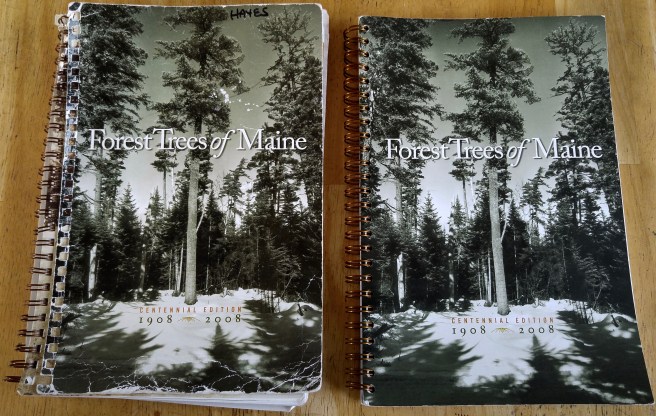
Really? I have at least thirty books dedicated to the topic of trees. But . . . I knew exactly which one she meant: Forest Trees of Maine. I LOVE this book–or rather, booklet. You’ll notice the tattered version on the left and newer on the right. Yup, it gets lots of use and often finds its way into my pack. When I was thinking about which book to feature this month, it jumped to the forefront. I actually had to check to see if I’d used it before and was surprised that I hadn’t.

Produced by the Maine Forest Service, the centennial issue published in 2008 was the 14th edition and it’s been reprinted two times since then.

t-b:y 2 (1)

In previous years, the book was presented in a different format. Two editions sit on my bookshelf, and I need to share with you two things that didn’t find their way into the most recent copy.

From 1981: Foreword–“It is a pleasure to present the eleventh edition of Forest Trees of Maine. 

Many changes have occurred in Maine’s forest since 1908, the year the booklet first appeared. Nonetheless, the publication continues to be both popular and useful and thousands have been distributed. Many worn and dog-eared copies have been carried for years by woodsmen, naturalists and other students of Maine’s Great Out-Of-Doors.

We wish the booklet could be made available in much greater quantity, however, budgetary considerations prevent us from doing so. I urge you to use your copy of Forest Trees of Maine with care. If you do, it will give years of service in both field and office.”

Kenneth G. Stratton, Director.

From 1995: One of two poems included. I chose this one because it was one my mother often recited.

Trees

I think that I shall never see
A poem lovely as a tree.

A tree whose hungry mouth is prest
Against the earth’s sweet flowing breast;

A tree that looks at God all day,
And lifts her leafy arms to pray;

A tree that may in Summer wear
A nest of robins in her hair;

Upon whose bosom snow has lain;
Who intimately lives with rain.

Poems are made by fools like me,
But only God can make a tree.

~Joyce Kilmer

t-how to use keys (1)

The most recent edition of Forest Trees of Maine provides a snapshot of the booklets history and information about the changes in the Maine landscape. For instance, in 1908, 75% of the land was forested, whereas in 2008, 89% was such. The state’s population during that one hundred year period had grown by 580,457. With that, the amount of harvested wood had also grown. And here’s an intriguing tidbit–the cost of the Bangor Daily News was $6/year in 1908 and $180/year in 2008.

Two keys are presented, one for summer when leaves are on the trees and the second for winter, when the important features to note are bark and buds.
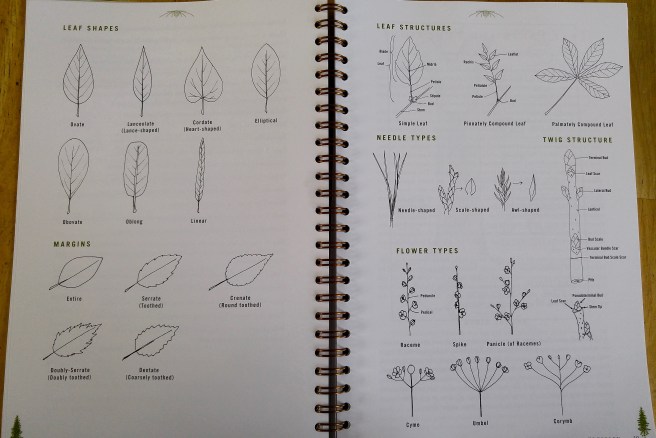
t-leaves (1)

t-glossary (1)

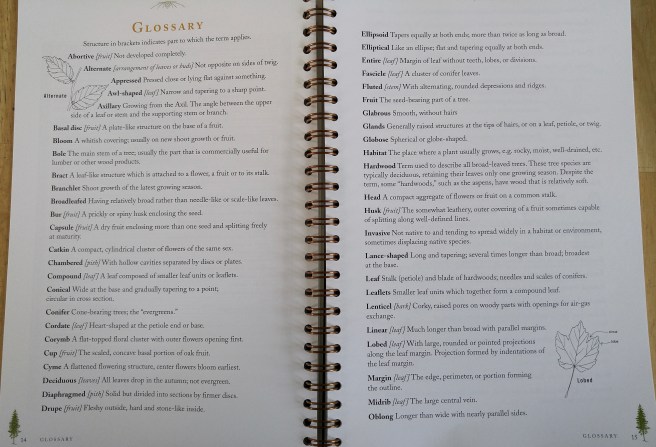
Terms for leaf shapes, margins and structure, twig structure, plus needle types and flower types are illustrated and various terms defined.
t-tree parts (1)

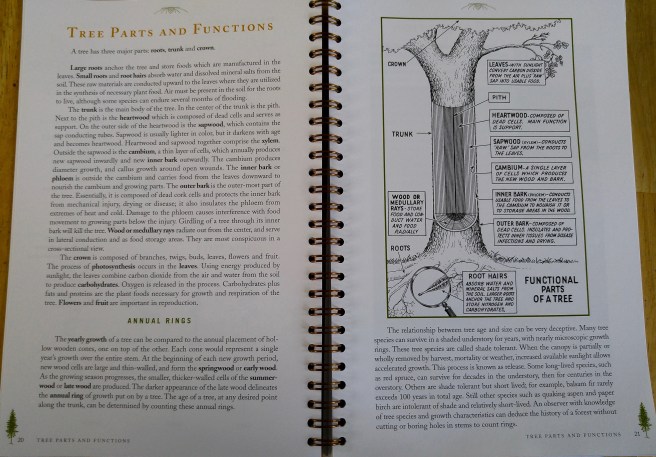
There’s even information on how a tree works because they do–for our well-being and for the benefit of wildlife.

t-white pine (1)

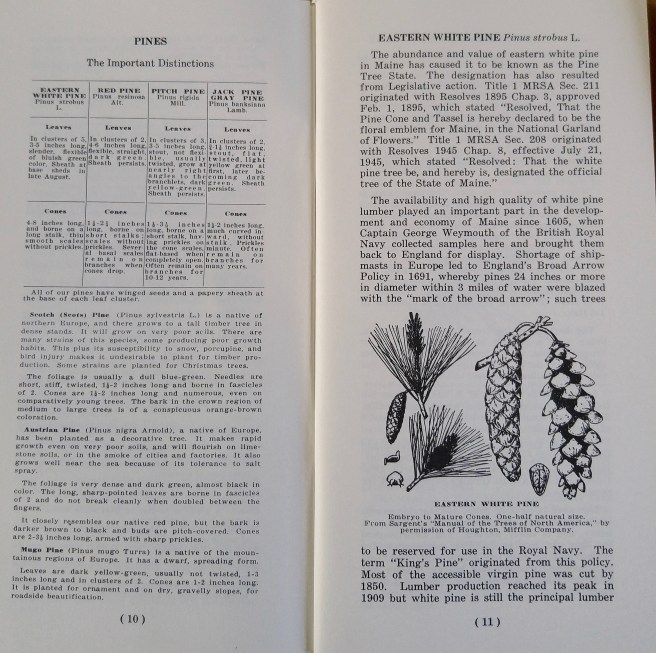
And then the descriptive pages begin. Each layout includes photographs, sketches and lots of information, both historical as in the King’s Arrow Pine, and identifiable as in bark, leaves, cones, wood, etc.
t-pines blue book (1)

1981

t-pines yellow book (1)

1995

Though some of the information is the same, it’s fun to note the differences from the two earlier publications.
t-maple key (1)

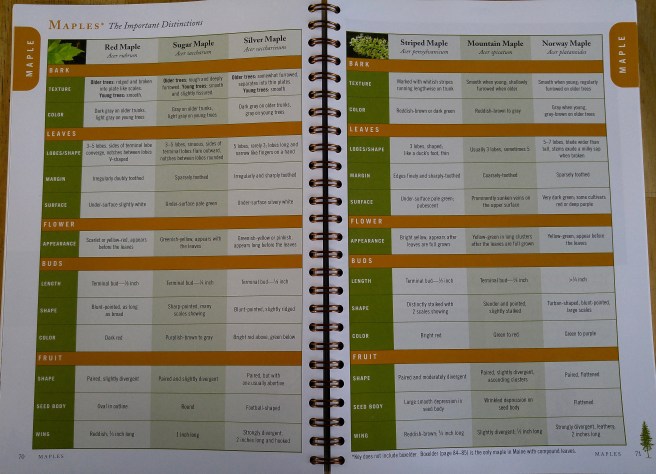
At the beginning of each family, major descriptions are noted in an easy to follow format.
t-maple (1)

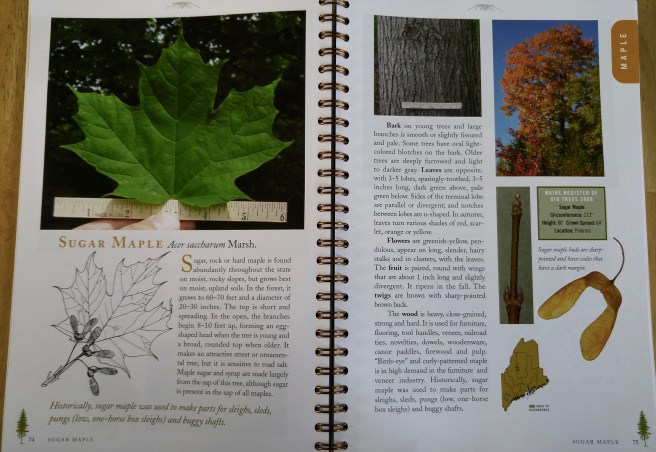
And like the conifers, the broadleaves are portrayed.

Tomorrow, when my friend and I venture off, I’d better remember to pack this booklet. She’s peeked my curiosity about what she wants to ID because I’ve climbed the mountain before and perhaps I missed something. She already has a good eye for trees so I can’t wait to discover what learning she has in mind for us.

This Book of September is for you, Ann Johnson. And it’s available at Bridgton Books or from the forest service: http://www.maineforestservice.gov or forestinfo@maine.gov.

Forest Trees of Maine, Centennial Edition, 2008, published by The Maine Forest Service


Book of August: BARK

IMG_2913

Book of August

It was my journey through the Maine Master Naturalist class several years ago that lead me to this book of the month: BARK–A Field Guide to Trees of the Northeast by Michael Wojtech.

The book actual evolved from Wojtech’s work, under the tutelage of Tom Wessels, toward a Master’s degree in Conservation Biology at Antioch University New England.

Between the covers you’ll find information about bark structure, types of bark and bark ecology. There is a key for those who are so inclined.

And then the biggest chunk of the book is devoted to photographs and descriptions for each type of tree that grows in our New England and eastern New York State forests. These include the common and Latin names, family, habitat, range maps, leaf and branch pattern, leaf shape and notes.

For me, there are two take away items from this book. First, I learned to categorize bark based on its pattern from smooth to ridges and furrows, vertical strips, curly and peeling to others covered in scales and plates. He breaks bark type into seven varieties that I now find easy to identify.

Second, I came to realize something that I may have known but never gave much thought to–except for  American beech bark, which remains smooth all its life (unless it’s been infected by the beech scale insect), bark differs from young to mature to old for any particular species. Oy vey!

Though this book is useful in the winter, now is the time to start looking. To develop your bark eyes. The leaves are on and will help with ID, thus you can try the key and you’ll know if you’ve reached the correct conclusion or not.

Go ahead. Purchase a copy and give it a whirl. I must warn you, it becomes addictive and can be rather dangerous when you are driving down the road at 50mph. As Wojtech wrote in the preface, “If you want to experience a forest, mingle among its trees. If you want to know the trees, learn their bark.”

While you are at it, I encourage you to visit the small western Maine town of Bridgton, where the Bob Dunning Memorial Bridge leads into Pondicherry Park. Each of the sixteen bridge beams is constructed from a different tree and the bark is still on them. Test yourself and then grab one of my brochures at the kiosk to see if you got it right. If there are no brochures, let me know and I’ll fill the bin.

And while you are there, stop by the independent bookstore, Bridgton Books, to purchase a copy of BARK.

BARK: A Field Guide to Trees of the Northeast by Michael Wojtech, University Press of New England, 2011.

Book of January: A Guide to Nature in Winter by Donald W. Stokes

Stokes 1

Book of January

I have a number of winter nature books, but one of my go-to favs is A Guide to Nature in Winter by Donald W. Stokes. My copy is old (1976–it was a very good year–I graduated from high school) and a bit weathered, but that’s because it has seen frequent use.

Divided into eight field guides, Stokes covers all aspects of winter: winter weeds; snow; wintering trees; evidence of insects; winter’s birds and abandoned nests; mushrooms in winter; tracks in the snow; and woodland evergreen plants.

For each topic,  pen-and-ink drawings by illustrator Deborah Prince and the author are included in the key, as well as natural history descriptions.

The natural history descriptions are just that–Stokes’s descriptions are part of the story that Kevin Harding of the Greater Lovell Land Trust reminds us to share with others. Here’s an example: “St. Johnswort (Hypericum perforatum)–An old country custom in Europe was to hang a special yellow-blossomed plant in your window on the eve of St. John’s Day (June 24), in order to repel bad spirits and counteract the evil eye. In general, the presence of this plant was considered a good omen, and since it was thought that the plant warded off lightning and revealed the identity of passing witches, St. Johnswort was allowed to prosper around the farmhouse. It became known as St. John’s Plant or St. Johnswort (wort meaning “plant” or “herb”). When the plant immigrated to North America it left its traditions behind, and although still as effective as it probably ever was against evil, St. Johnswort is now seldom used for that purpose.” Of course, then he goes on to describe how the plant grows and the seed heads that will appear in the winter landscape.

One of the things I’ve learned from this book is to keep it simple. In the chapter about winter trees, Stokes encourages the reader to begin with the six most common deciduous trees: oak; maple; ash; beech; birch; and aspen. Learning these along with the evergreens provides you with knowledge about 80% of the trees in your forest. I’ve spent the last couple of years developing my bark eyes. I still have much to learn, but can eliminate the common species when I encounter bark I’m uncertain about.

It’s well worth taking the time to read A Guide to Nature in Winter from cover to cover–it’s an easy and enjoyable read. I say it won’t take long–unless you are like me and you pause to underline (yes, I mark my books up–even write in the margins, oh my!) details and take time to understand what you do see along the trail. I probably should invest in a more up-to-date copy, but I feel right at home engrossed in the one that I have.

And it’s also easy to turn to a particular chapter to figure things out. The simplified, illustrated keys should bring you quickly to an identification. And as I said before, the natural history description will further enhance your learning.

The book is available at Amazon.com, but if you live near an independent book store like Bridgton Books, then I strongly encourage you to shop there.

A Guide to Nature in Winter: Northeast and North Central North America, by Donald W. Stokes, illustrated by Deborah Prince and the author, published 1976, Little, Brown & Company.

Book of October: Reading Rural Landscapes

Book

There are many reasons why I love living in western Maine, and the fact that I can walk into Bridgton Books, an independent bookstore, and be handed a book that   shop owner Pam Ward thinks I would enjoy is one of them. Pam was so right.

Reading Rural Landscapes by Dr. Robert Sanford, professor of environmental science at the University of Southern Maine, is a perfect follow-up to Tom Wessels book, Reading the Forested Landscape.

Sanford takes us one step further in looking at the remnants in the woods. Here in western Maine, I often stumble upon stone walls, barbed wire, foundations, mill sites and other evidence of life gone by. All of this appears in places that seem so far away from civilization. How can it be? Did people actually live in these out of the way places? Why?

Sometimes, it’s difficult to imagine that the make-up of the neighborhood was completely different from what we know. We forget that following the Civil War many people left the area for greener fields and less of that good old stone crop. We forget that numerous farms once decorated our landscape. We forget that all the trees we love, didn’t exist.

Reading Rural Landscape’s size (5″x8″) means it fits easily into a backpack and has become one of the guides that I often carry. Sanford includes information about plants and trees at homesites, transitions that occur after fields have been used for pasture or agriculture, examinations of house, barn and outbuilding foundations, mill sites and early commerce, indications of rural roads from farming and stagecoach to logging and trolley, the meanings of stonewalls and barbed wire, plus cemeteries and symbols on gravestones.

Sanford includes a glossary, chapter notes that are as interesting as the chapters, and an extensive reference section. For $19.95, this is a valuable resource.

Ultimately, Sanford encourages stewardship of the land–protection of these historical places. He also encourages us to support those who continue to farm the land and work in the forests in sustainable manners.

Reading Rural Landscapes: A Field Guide to New England’s Past by Robert Sanford, PhD, published 2015, Tilbury House Publishers

The Need for More

Yesterday I stopped into our local independent bookstore, Bridgton Books, to purchase a title recommended to me by a friend (thanks D.B.), H is for Hawk by Helen Macdonald. While there, Pam, one of the proprietors, showed me Reading Rural Landscapes by Robert Sanford because she thought I’d be interested. Of course I was, and so for all of two seconds I debated about which to buy and guess what–I’m now the proud owner of both titles. I had earned a $10 credit (for every $100 spent, you receive $10 off if you belong to their book club and there is no book club fee–truly independent).

At camp, I was also reading another book (purchased at Bridgton Books a year or two ago). Well, actually rereading it because I like the author’s style/voice and maybe just a wee bit because she’s an Episcopalian. And she lives in Alaska–another draw for me. If You Lived Here, I’d Know Your Name: News from small-town Alaska by Heather Lende.

3 books

Both last evening and this morning, I read from all three. Not simultaneously, of course. It’s always been that way for me. Skipping from one topic to the next. Easily bored? I don’t think so because being bored is not part of my makeup. More like an insatiable need to know more.

The bees and wasps and flies and ants and hummingbirds have the same insatiable need right now, as they flit and walk and crawl from one plant to the next, sucking nectar and exchanging pollen along the way.

beebee2

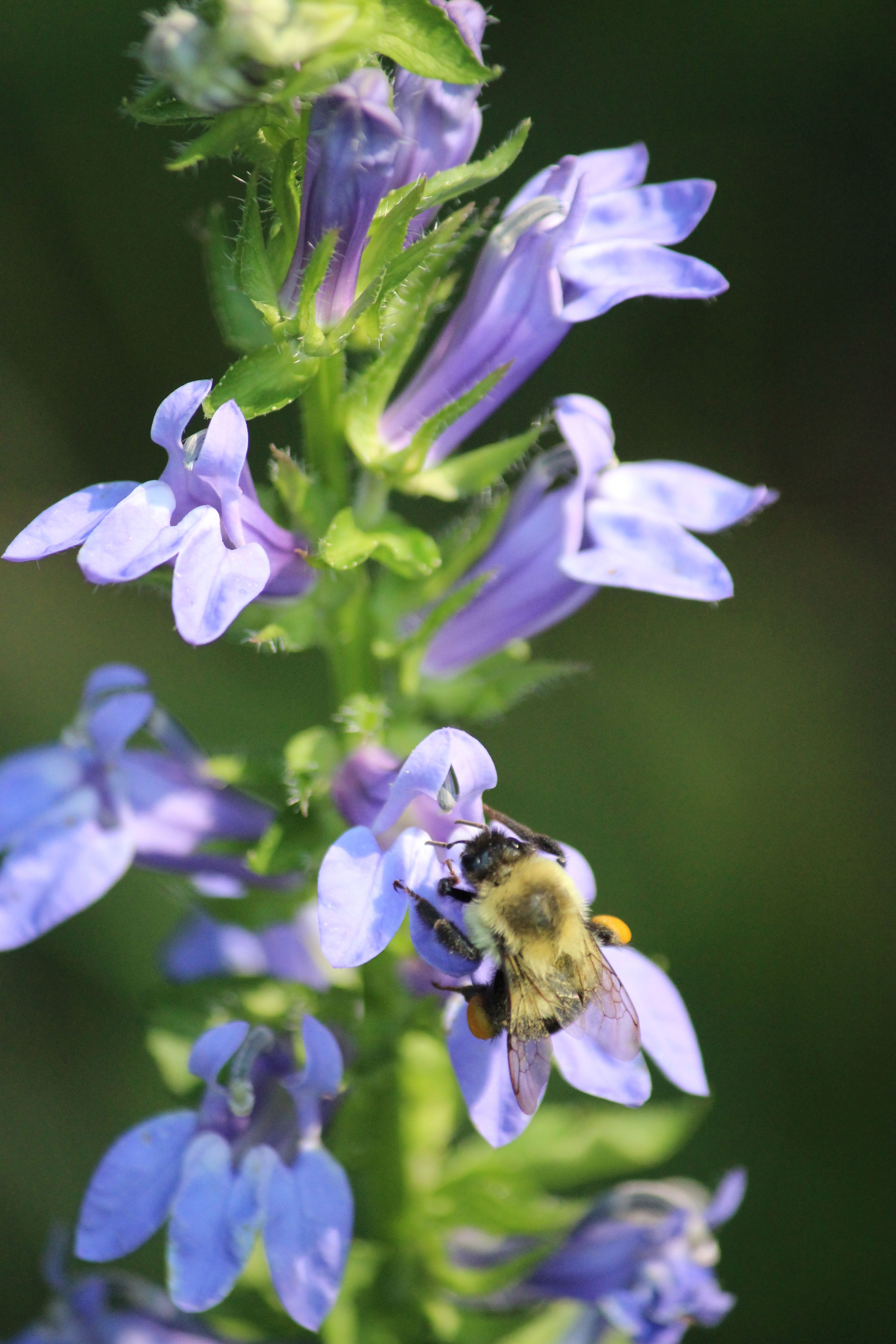
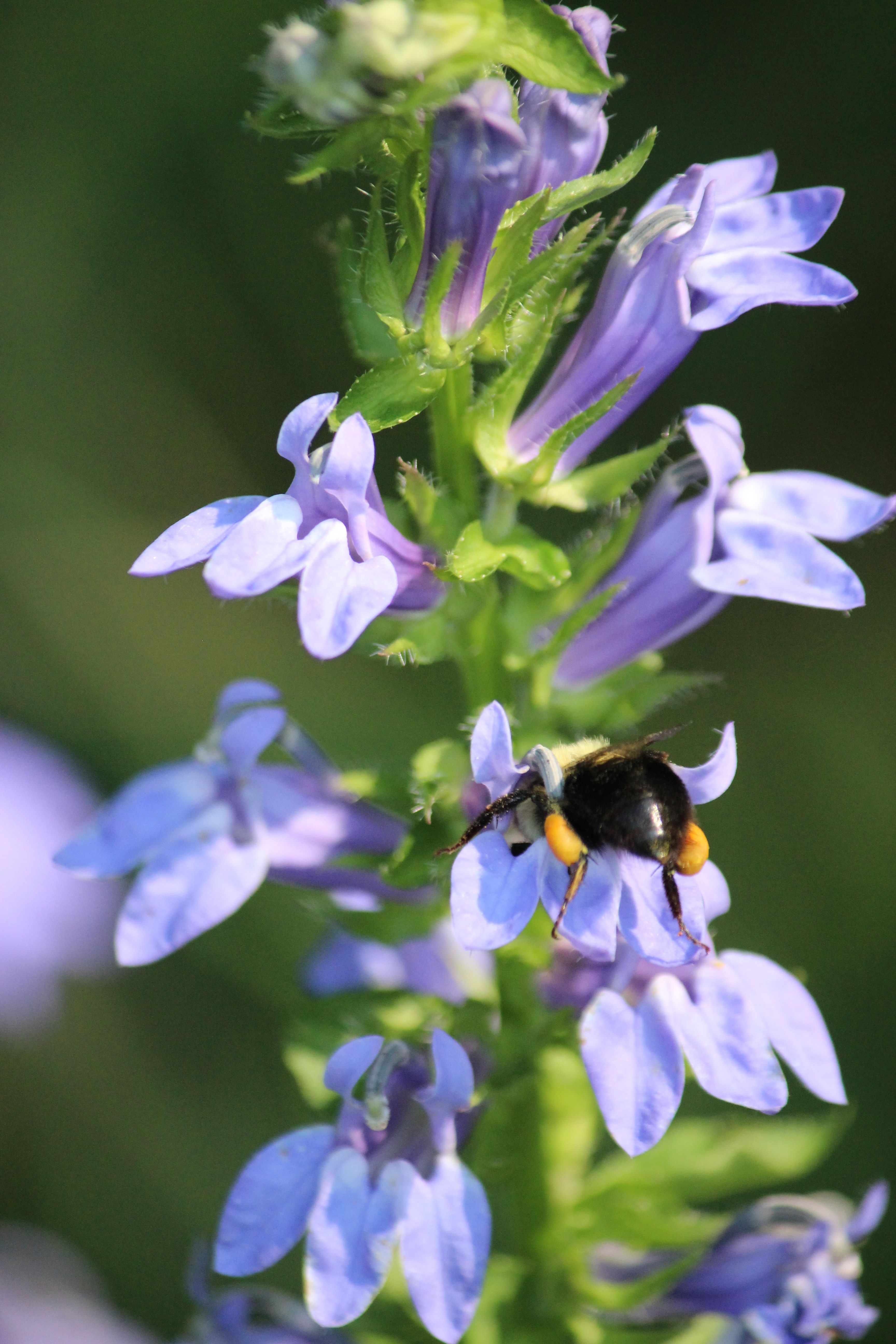
This busy bee was well-laden with pollen. Its bright orange sacs bulge on its hind legs like a kid wearing arm floaties in the water.

bee on mintbee on mint 2

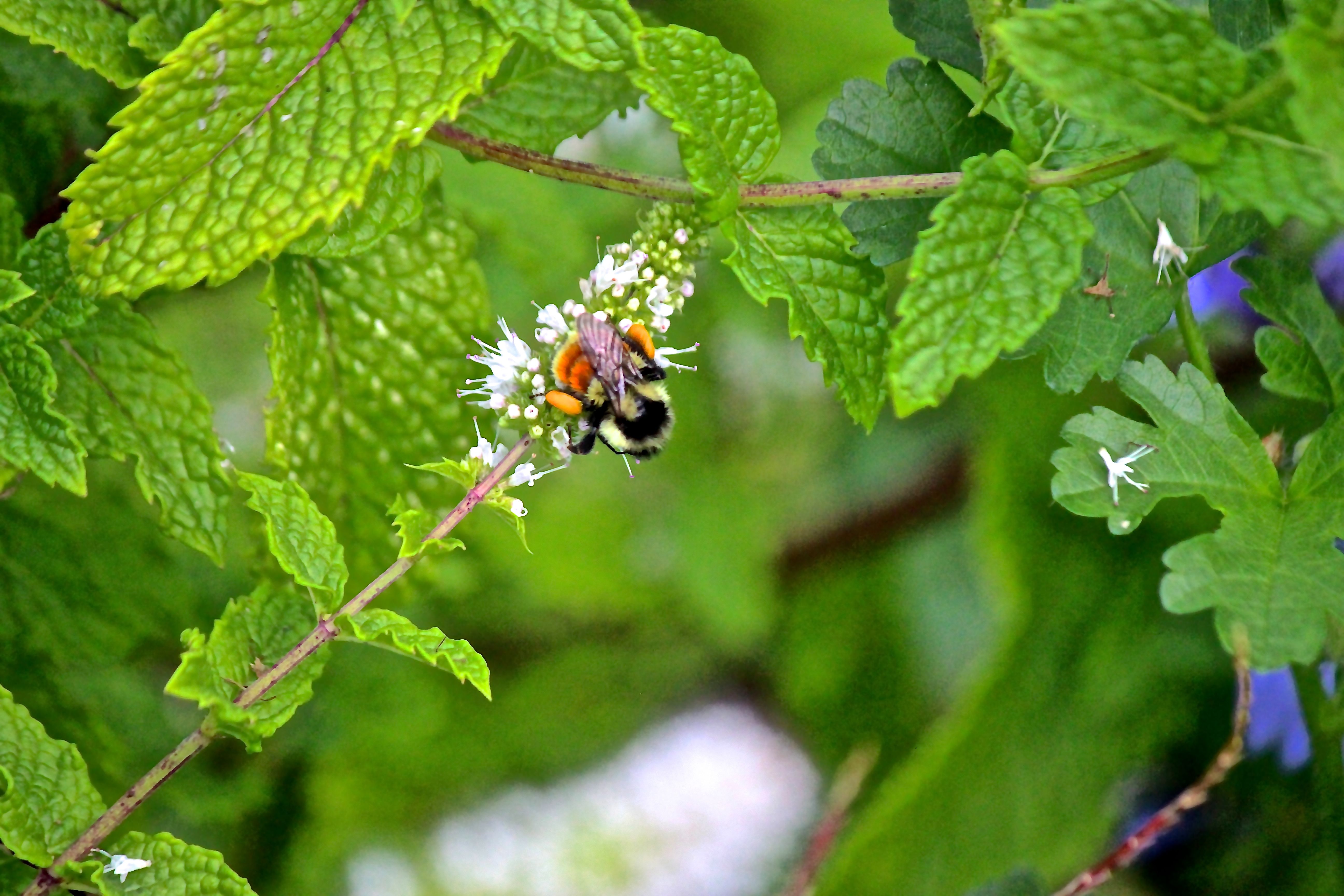
Every time a bee visits flowers, the pollen sticks to its fuzzy body–its antennae, legs, face and body. Think pollen magnet!

The middle legs are equipped with comb-like hairs that scrape off the pollen and transfer it to the pollen presses located on the hind legs.

bee 3

Like our calves, the bee’s legs have a tibia or lower leg section. The tibia is shiny and surrounded by hairs, including some that are rather long and stiff. These form the pollen basket. Located at the lower end of the tibia  is another comb-like structure (ankle), and on the metatarsus (heel or foot) is the press. When it comes to pollen collection, the two structures work together like levers.

Nectar moistens the pollen, making it sticky. The pollen is transferred to the press, and then is manipulated between the press and comb until it sits flat on the bottom of the tibia. Each time a new batch of pollen is added, it’s pressed onto the bottom, forcing the pervious batches to move further up the tibia.  A full basket (think one million grains of pollen) bulges, but hairs hold the pollen in place as the bee flies from one plant to another before heading home to stock the nest.

beefly on goldenrod

It’s not just hairy bees who are active in the gardens.

large blue wasp

Gathering for the family is important business.

wasp 2

Thanks to the goldenrods and asters, there’s plenty of pollen and nectar still to be gathered.

yellowjacket

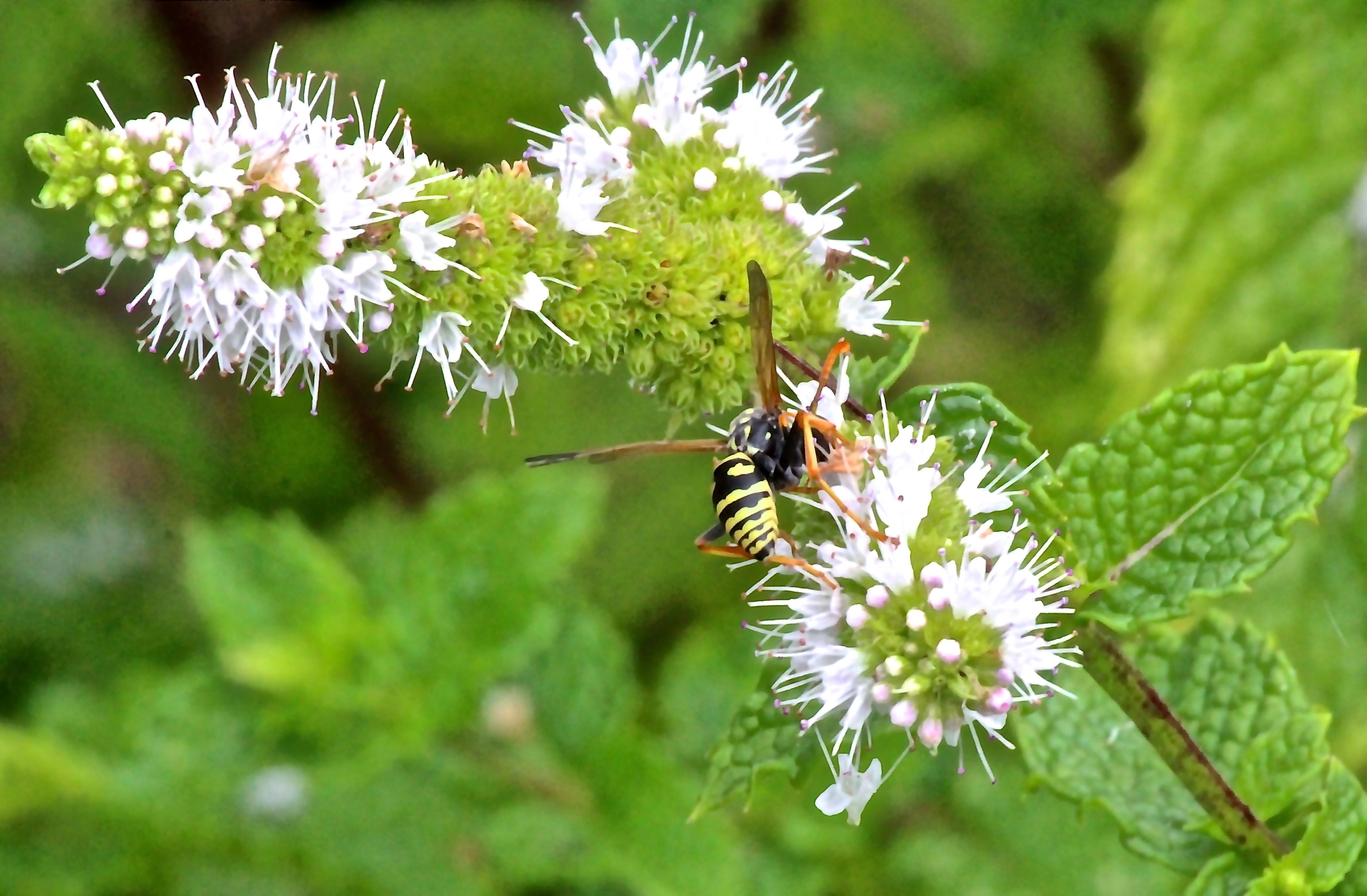
The mint seems to be the biggest hit among the variety.

spiders 1

And there is other action as well. A funnel weaver tried to challenge the larger spider, but quickly retreated.

spider 2

Whenever I take a closer look at the crawling and flying members of the gardens, I’m in awe of their colors, patterns, hair or lack of, and overall body structure.

inchworm

You may have to look closer to find the visitor on this coneflower.

red legged grasshopper

This red-legged grasshopper tried to make itself invisible.

grasshopper 2

The camouflage worked better once it climbed to the top of the fence. When grasshoppers fly, I can hear their wings make a rasping sound. But moving as this one was, there wasn’t a peep. The crickets and cicadas, however, I couldn’t see, but they’ve been contributing to a chorus all day.

hummer approaching

hummer approaching 2

hummer approaching 3

hummer approaching 4

hummer approaching 5

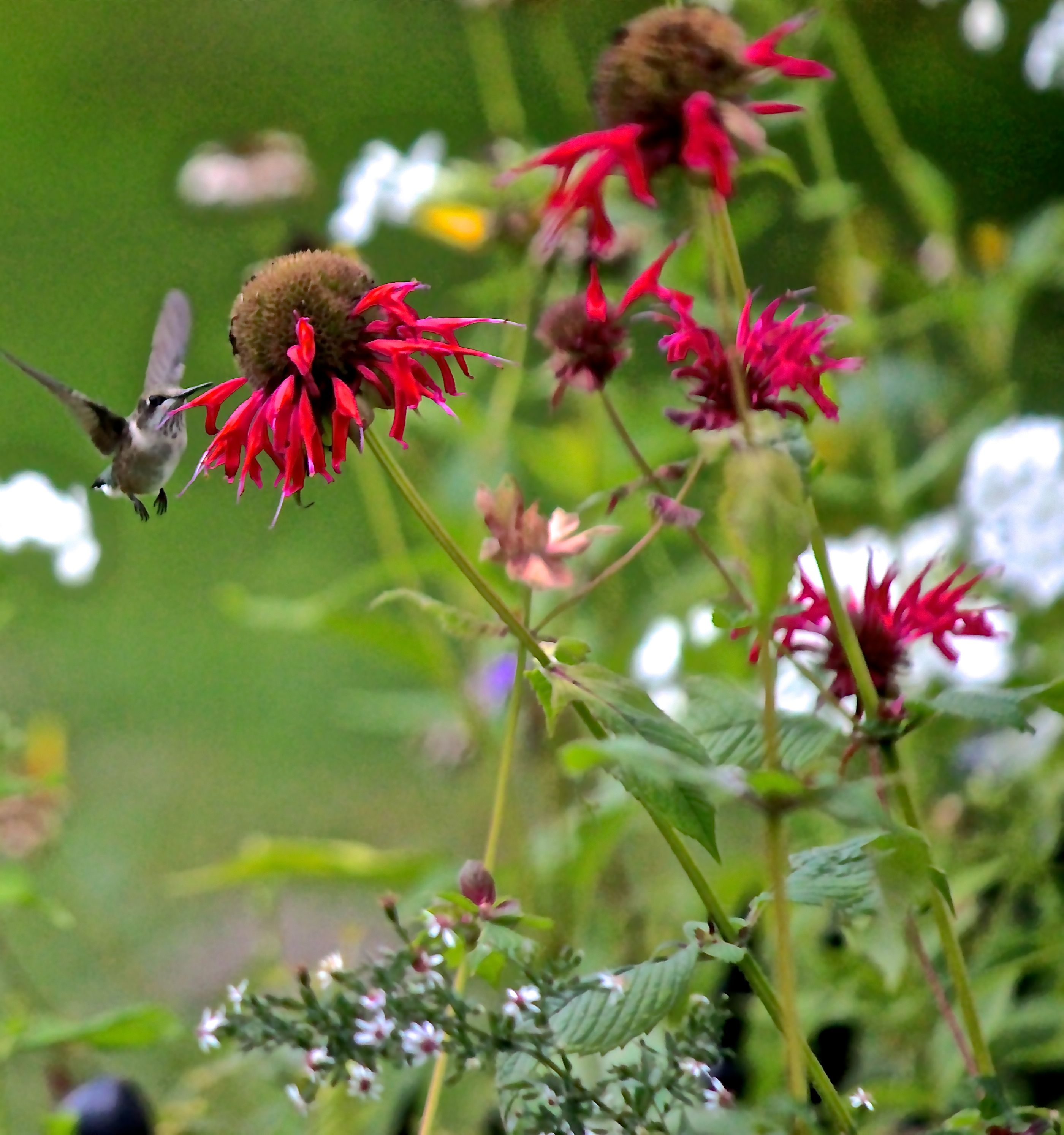
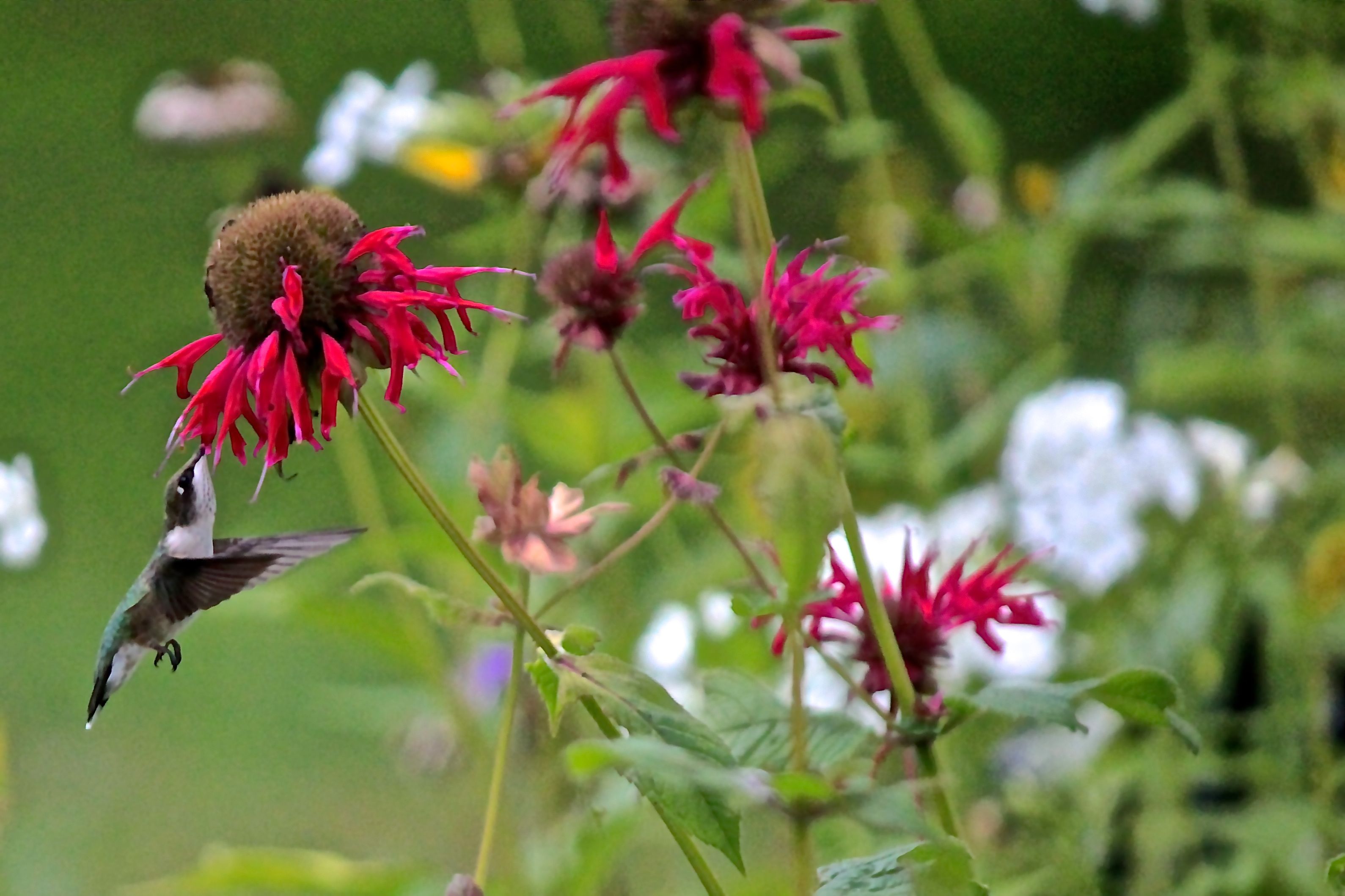
And then there is the hummingbird–ever swift and beautiful with its iridescent colors. Whether it is dining on nectar or insects attracted to the nectar, I don’t know, but it always returns, seeking more.

We all have the need for more. The frightening thing is that oftentimes we take more than we need. For the sake of the birds and insects, we need to think about that and how we might change our ways.