The Rest of the Story

I had only one intention when I stepped onto the patio this afternoon, but that changed quickly when I spotted a Great Black Wasp behaving in what I thought was a peculiar manner . . . until it wasn’t.

Rather than flying around the flowers, where I usually find these large wasps, who may be aggressive in terms of flying at me to let me know I need to take a step back, but never actually stinging me, this Great Blue was walking frantically through the grass. Well. we call it grass. I guess I should say “across the lawn,” but that sounds too fancy for our yard.

Do you notice something strange about the wasp? It was actually carrying a spider. I was stymied at first, until I read that they bring home treats for larvae to feed on. This I wanted to see.
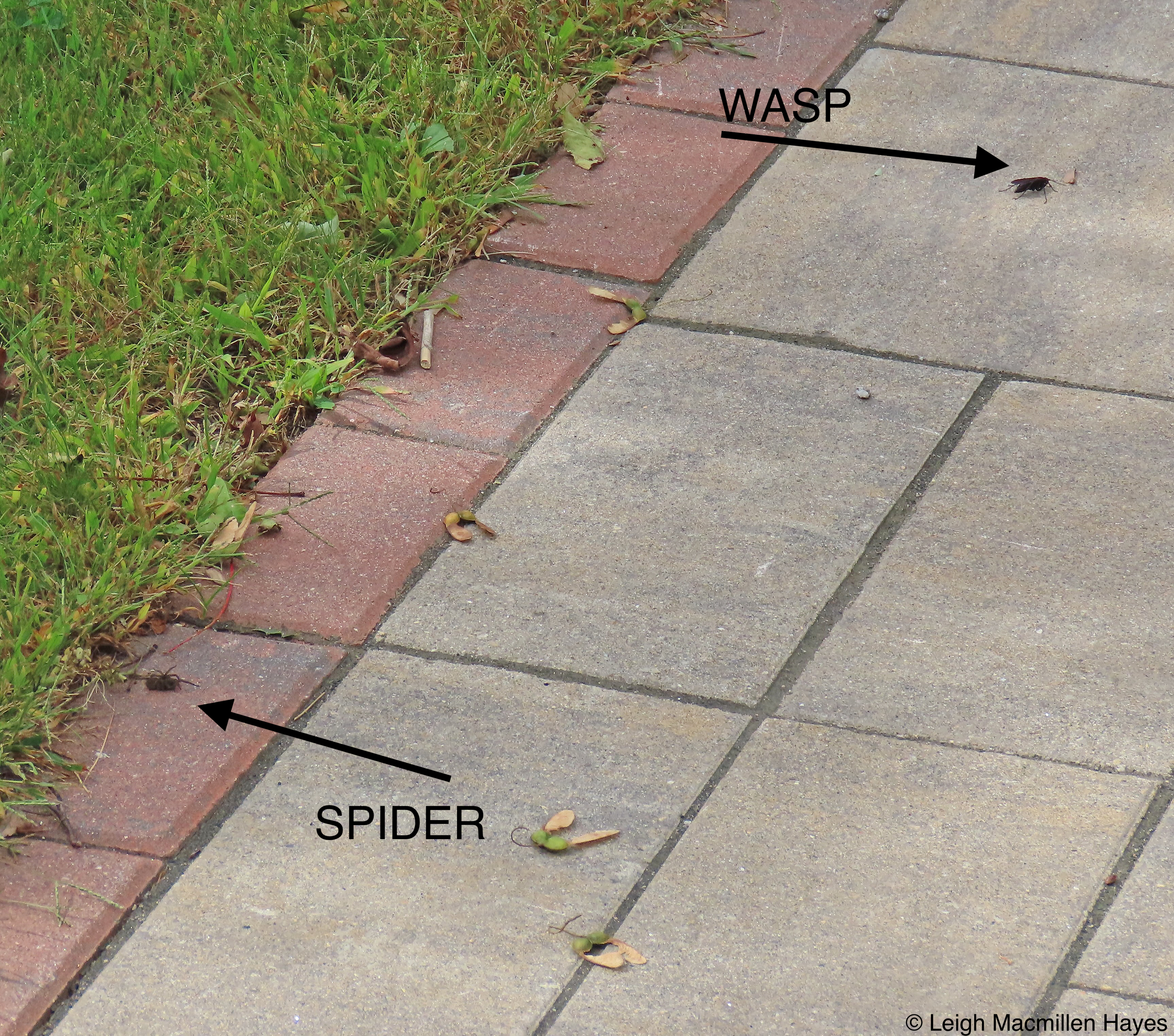
What I observed was that the wasp dropped the spider on the edge of the patio and then the wasp scrambled around on the ground for a bit before flying off. The spider stayed dead still . . . cuze it was dead! Apparently, the wasp won the struggle, if there was one, and paralyzed the spider.

Since the wasp had flown off, I decided to give it some time, though I was curious to know if it would return. Dragonflies defend territories, but do wasps know where they dropped a meal?

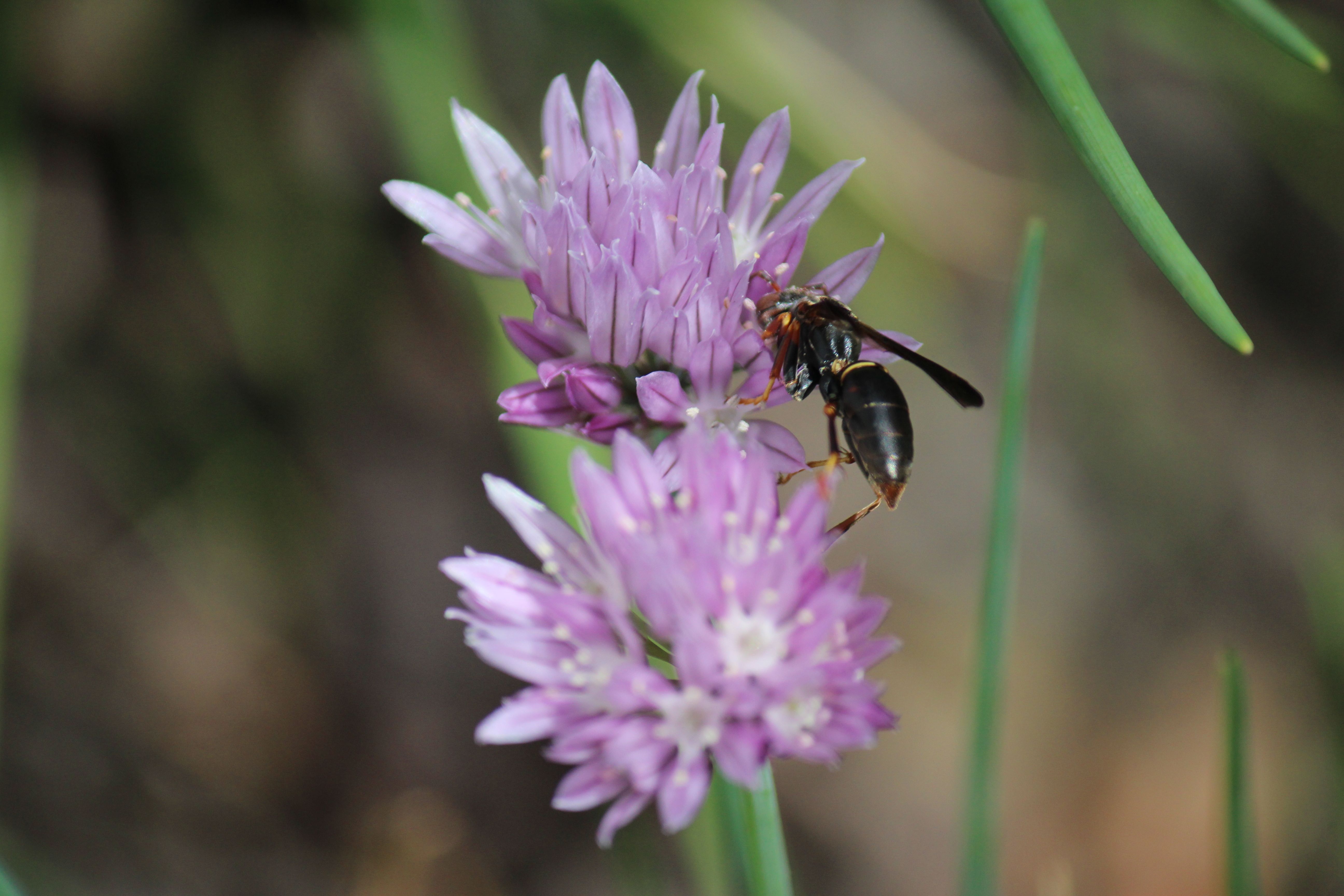
Instead, I turned my attention to the flowers that are still in bloom, including this Oregano I let go to flower because though I love its flavor, I equally love the insects it attracts, like this Thread-waisted wasp.

That got me to thinking how I often see the insects in situ, but don’t get to follow their daily lives.

That said, I poked around some more and found Bumblebees on Sedum,

Great Blue Lobelia,

Plus Turtlehead . . . going in,

And backing out.

There was even a Green Stink Bug trying to trick me into thinking it was just part of the leaf.
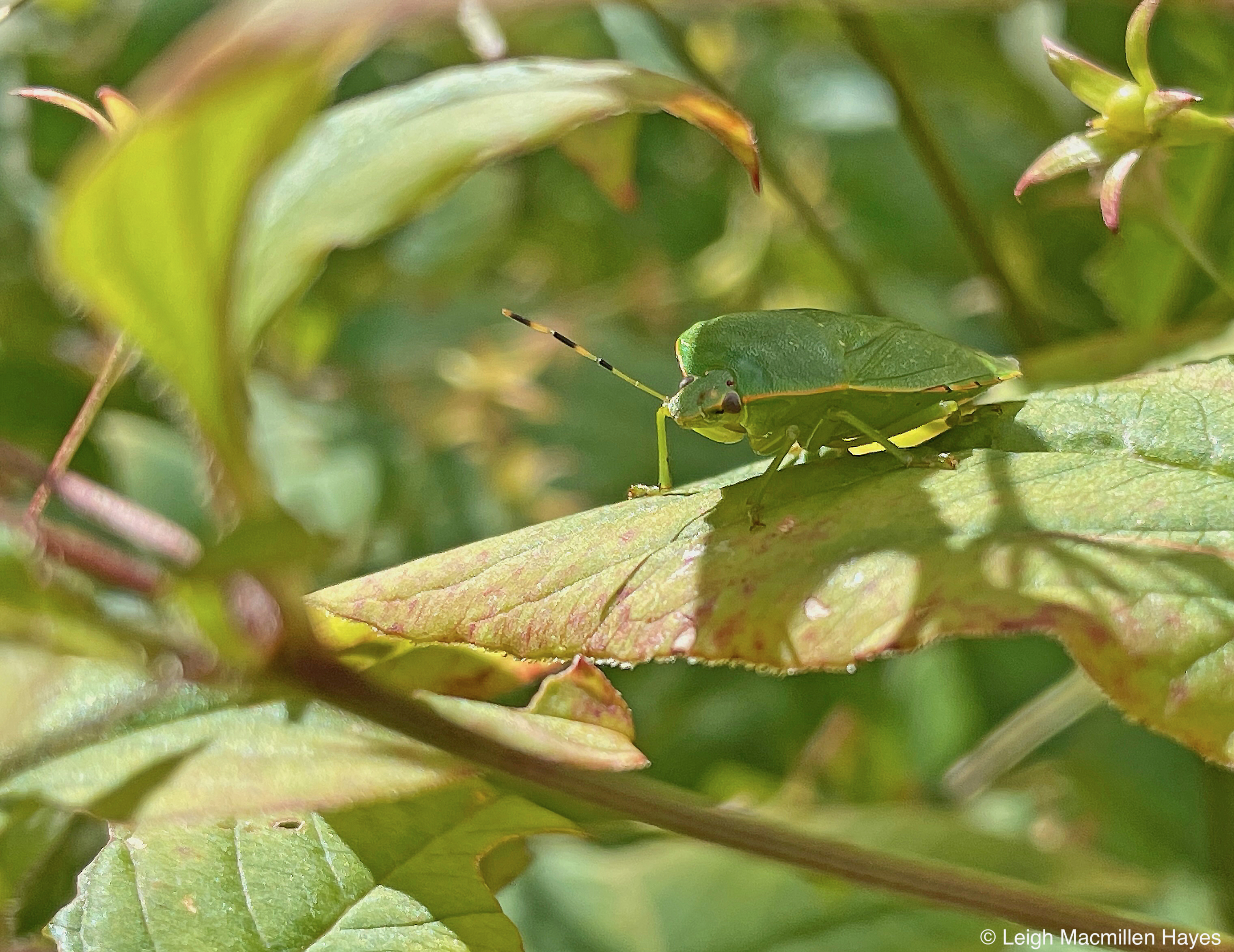
But I let it know that I was aware of its existence.

There were even a couple of canoodling wasps who flew out of the herb garden and landed on a window screen before moving on.

I, um, moved with them to the corner of the house, where they frantically walked across the ground as well. But when they finally flew off toward the driveway, I decided to give them some space.

(Note: Do you see the brown maple leaves? Who would think that after last year’s drought we’d have too much rain this year, but that’s exactly what happened and the Sugar Maple leaves in some places are drying up and dropping. Fall foliage? I’m thinking it’s not going to be as spectacular a show as we’d like.)

When I returned to the spider’s location, I noticed that the wasp had returned but was behaving in an odd manner . . . or so it seemed to me. Its legs on the right side appeared to have collapsed.
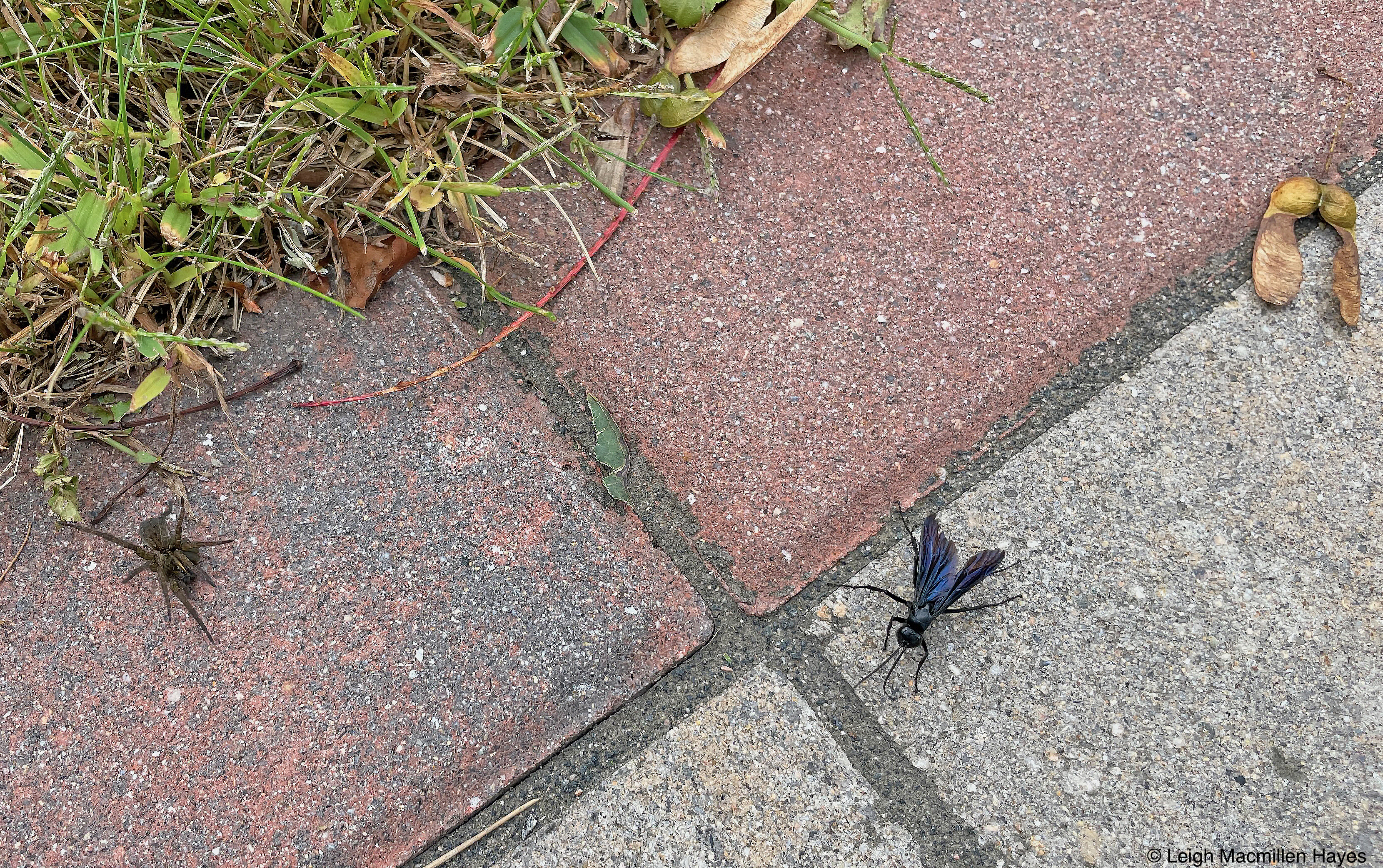
Eventually, however, it stood on all six and walked back toward the spider.
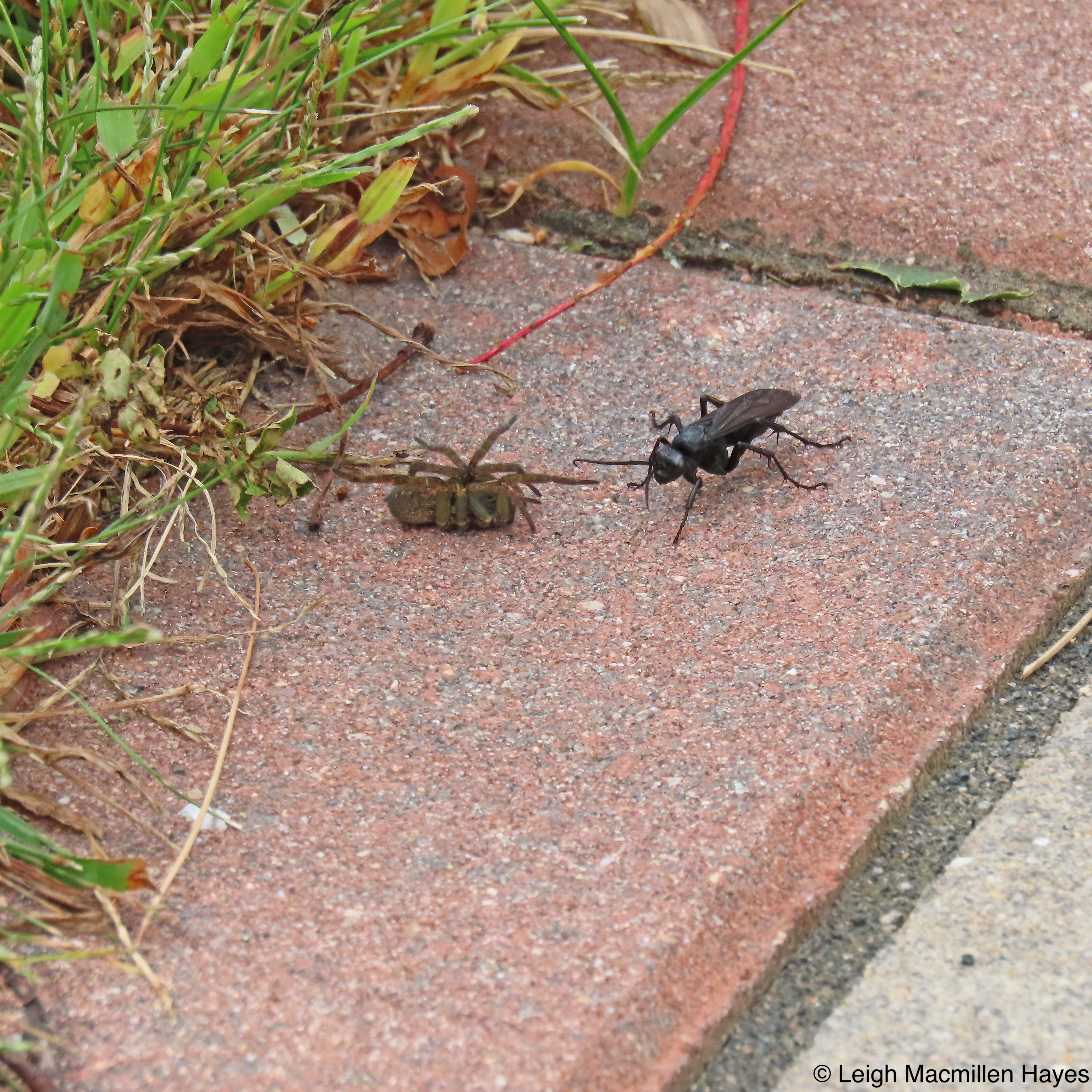
I was amazed to think that this insect had flown off, but knew where it had left the intended meal. All I can think of is that there has to be a scent involved.
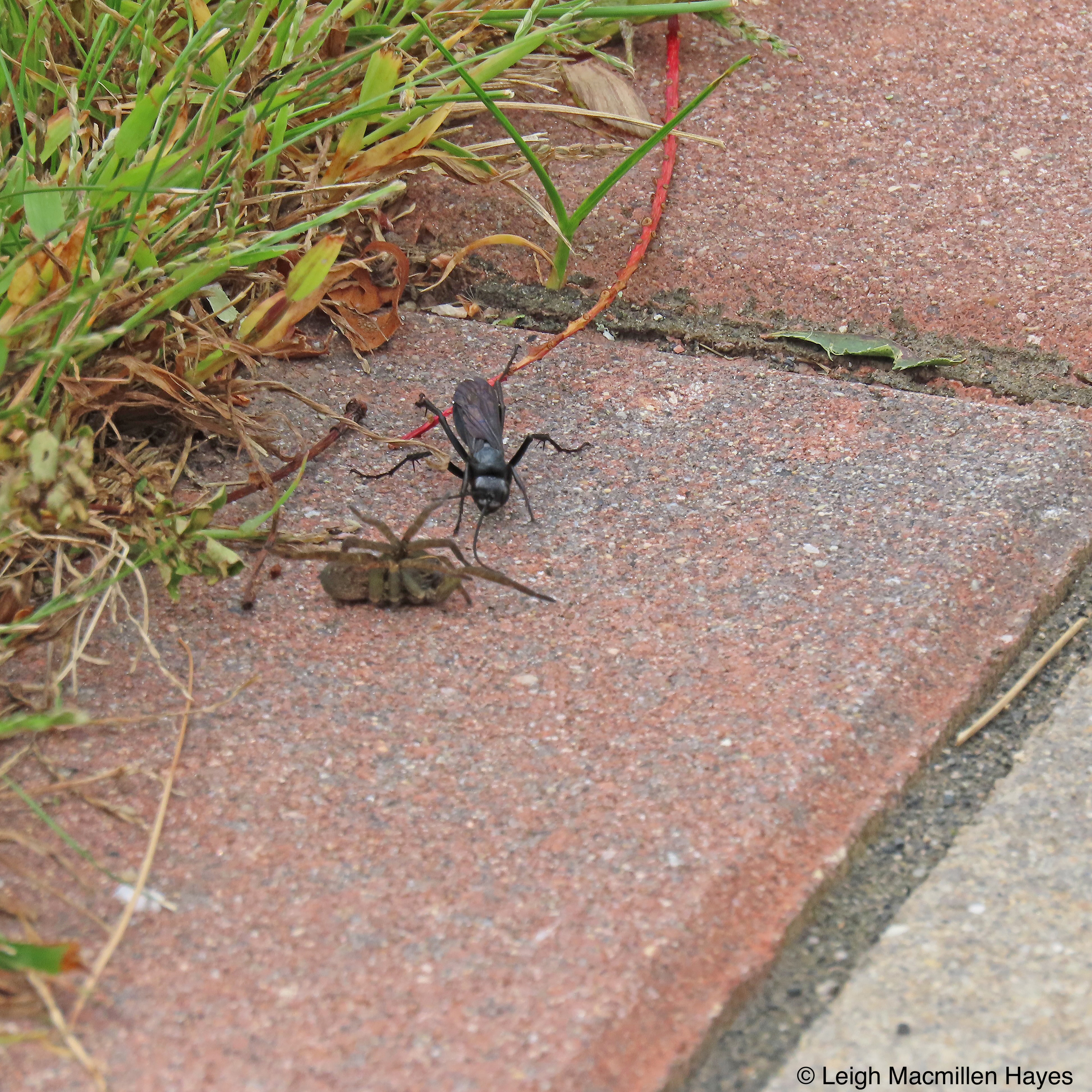
The wasp proded the spider with its antennae before grasping it again.
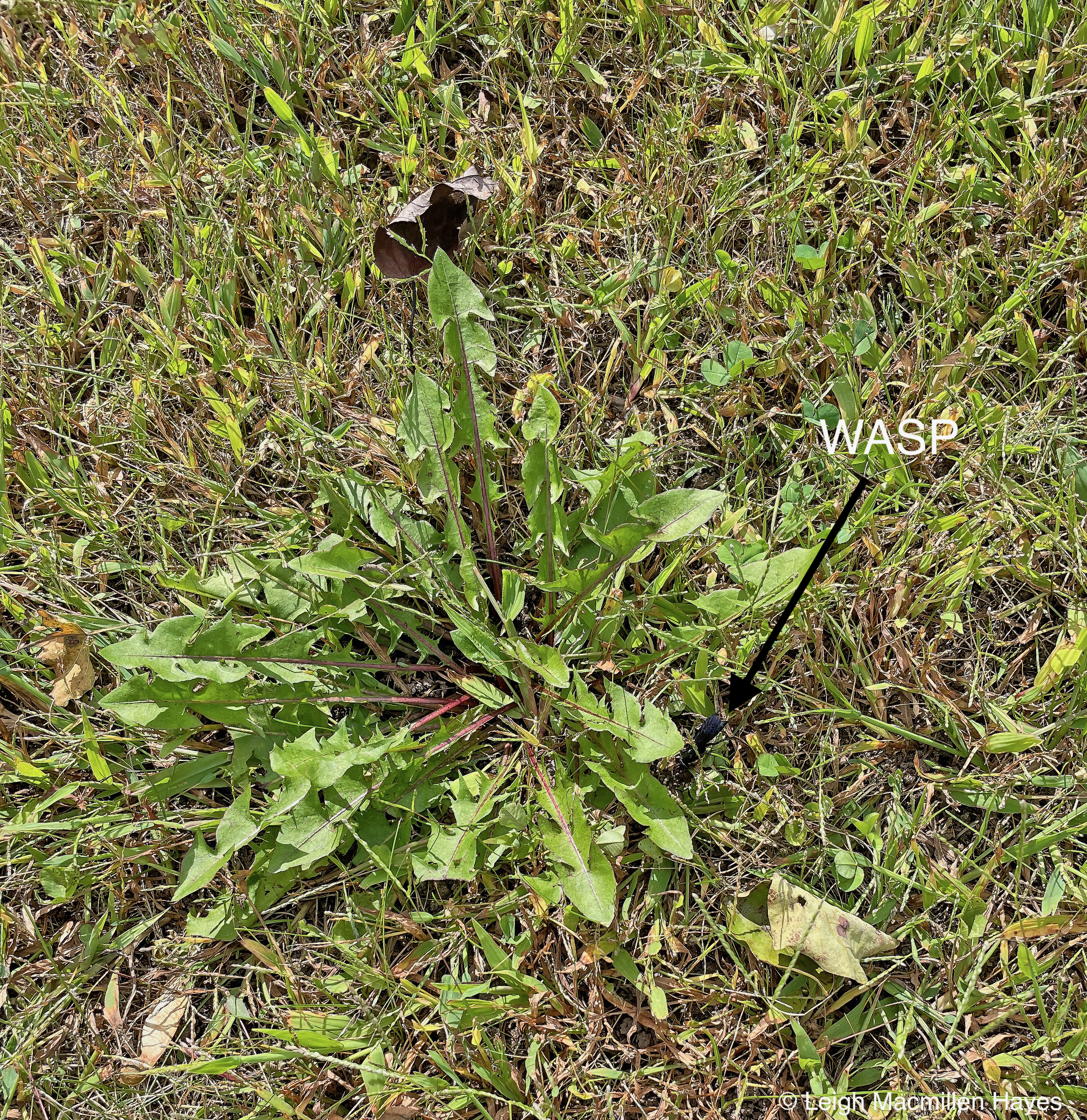
And then the two headed off in the same direction of travel as I’d earlier observed (north). Until, that is, the wasp passed under the dandelion leaves and somehow dropped the spider. Off the wasp flew, but again, a minute or two later, it returned to the exact spot and located the spider that I couldn’t even see.
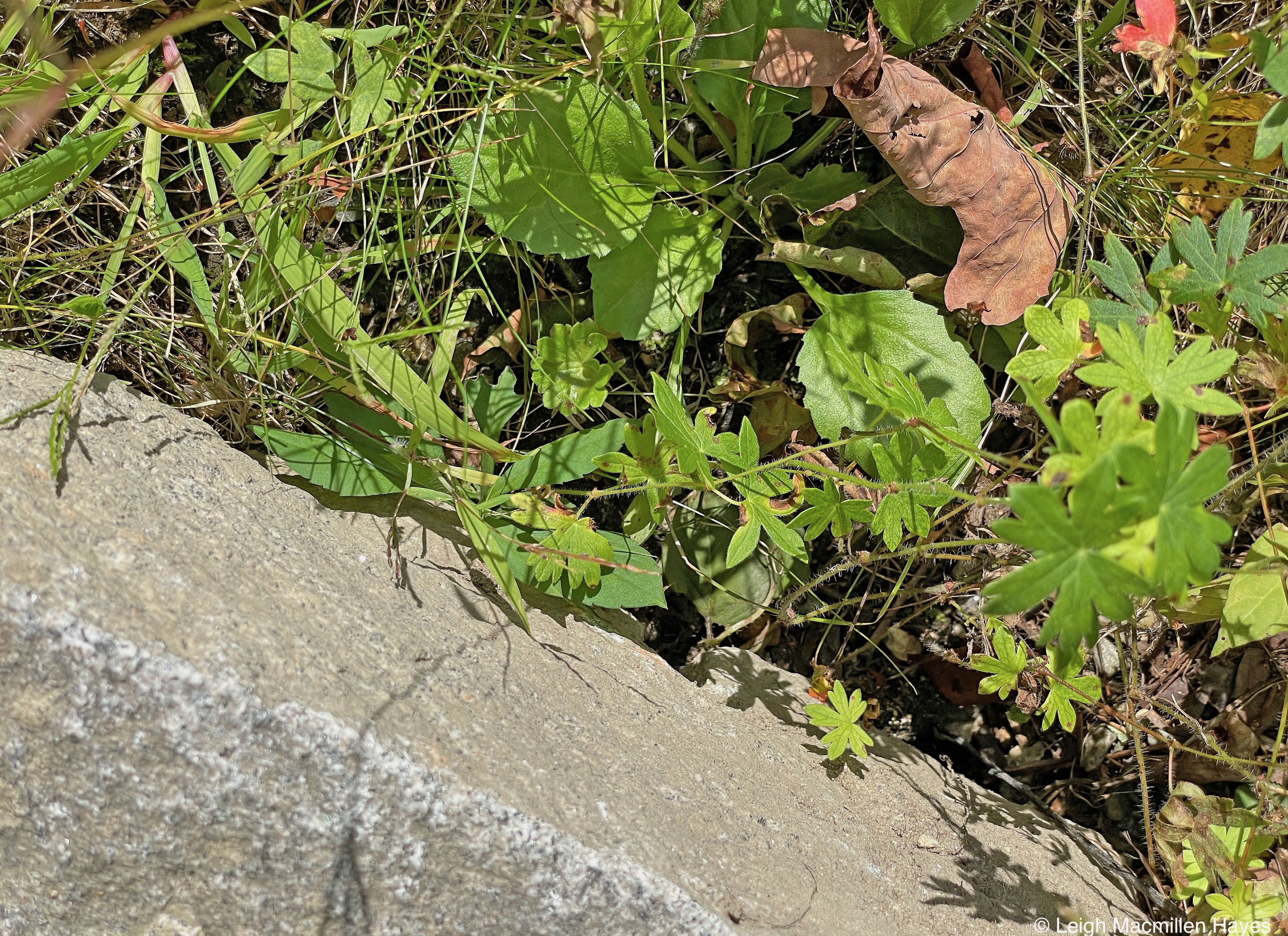
Then the march began again and I followed the two until the wasp reached the edge of another garden. It climbed over the granite stone, taking the spider with it, and then disappeared below the foliage and that’s the last I saw of them.

I’d gone outside originally to sit on the patio and start rereading a book I read about 30 years ago. That never happened.

And I don’t know the rest of the story for the Great Black Wasp, but I sure wish I did. I wish I knew what happened between the wasp and the spider because I imagine that would have been a great show. And I wish I knew where the wasp’s hole was and its larvae were waiting for a meal, as I assumed.

One of these days, I’ll open that book and maybe the rest of the wasp’s story will be revealed or another story will attract my attention.
Moments of Awe

The garden hum slowed significantly in the last few days, with bee buzz overpowered by cricket chirps. But still they come.

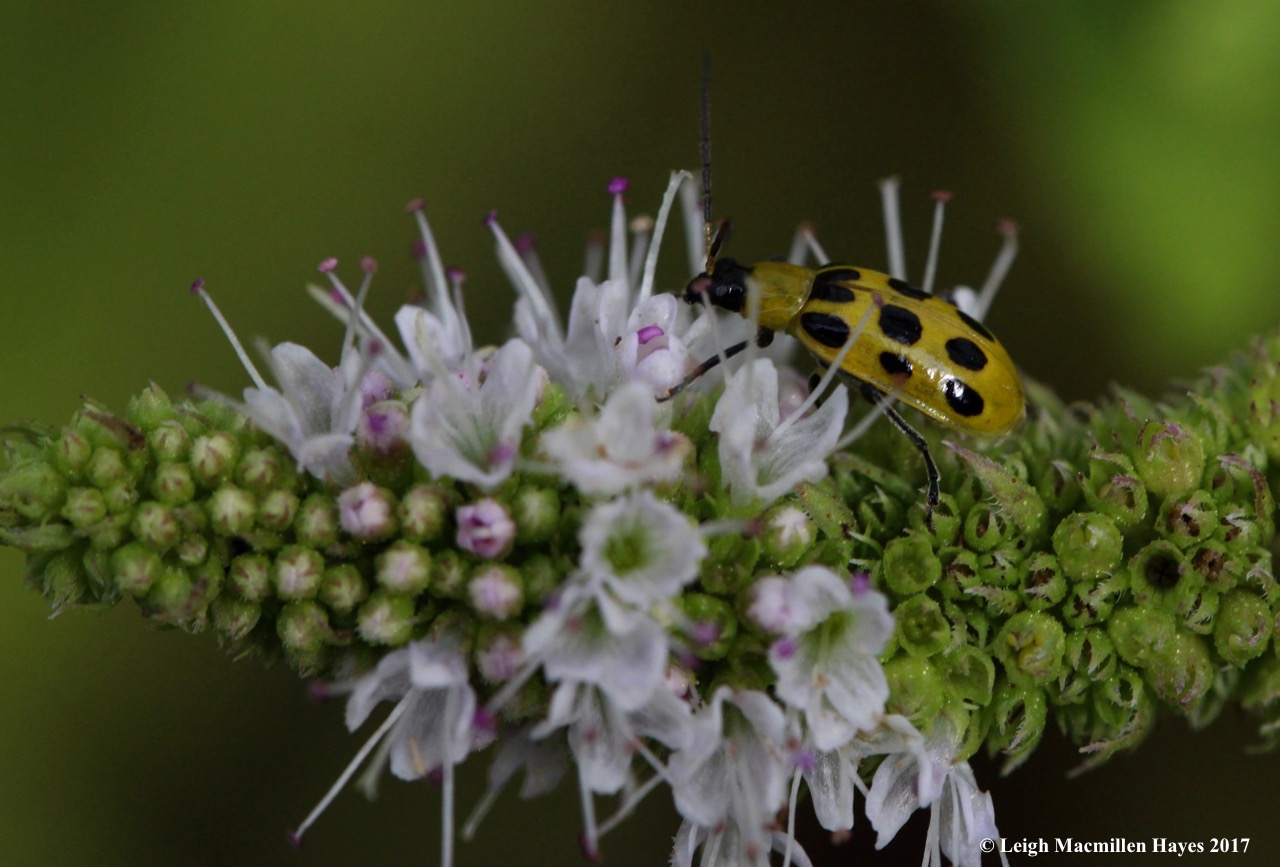
i6-spotted cucumber beetle

The first insect I focused on wasn’t a bee at all, but a spotted cucumber beetle who paid a surprise visit. It’s been years since I grew cucumbers and I can only imagine that it was a couple of houses shy of my neighbor’s garden. Instead, it made do with the mint.

i1-hoverfly, haltere

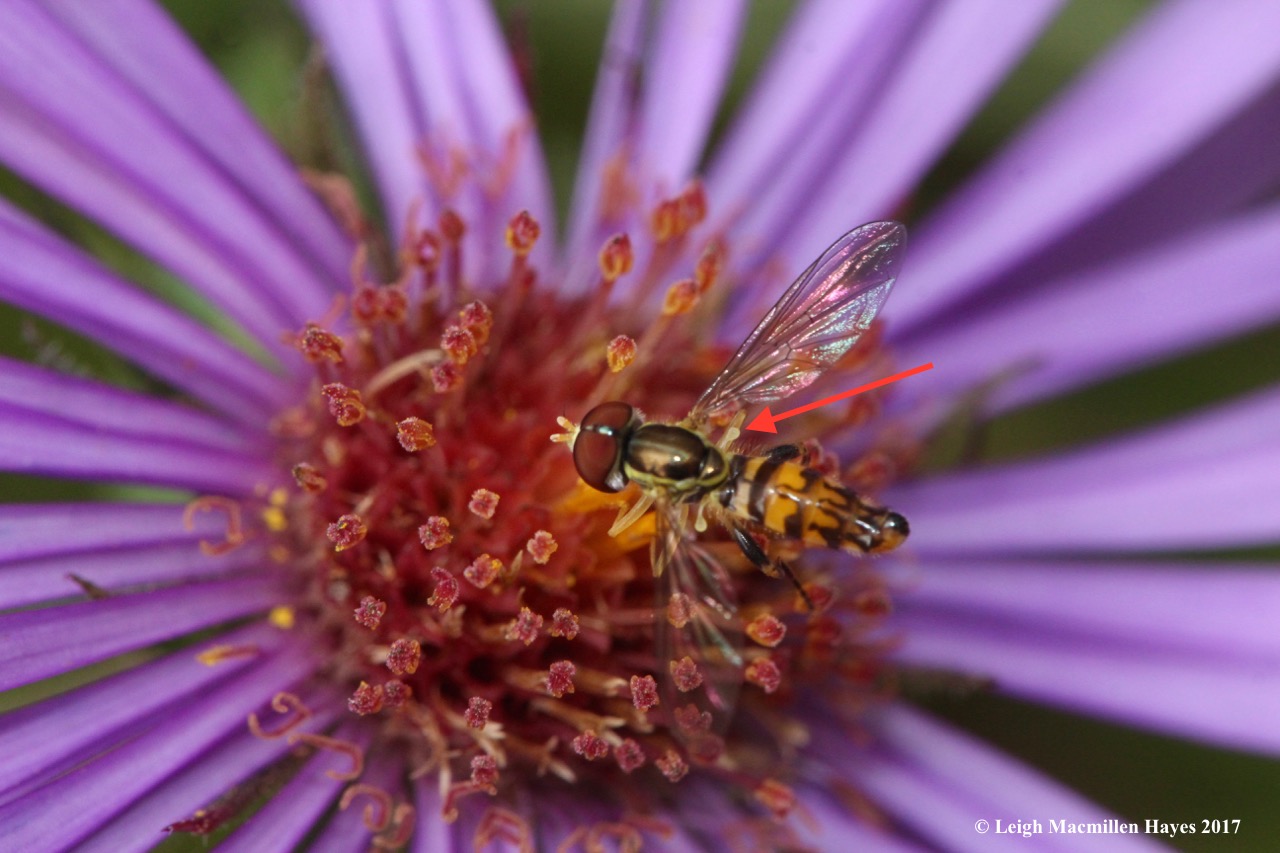
A second glimpse wasn’t at a bee either. But I must admit that I’m forever mesmerized by  the tiny hover flies that frequent the flowers. Hover flies are true flies, so while they may look a bit bee like, they don’t sting. And they take time to enjoy the nectar. My, what big eyes they have–taking up most of their head space. And such short antennae.

i1-hoverfly-haltere

Since I was paying attention, I also realized that hover flies don’t have hindwings per say. Rather, as dipterous insects, they have halteres, which are a modified form of a hindwing. The halteres help with balance and guidance while in flight and are situated behind the forewings on the thorax or middle section of the body. Remember–head, thorax, abdomen. Here’s another tip: two wings fun, four wings run. Well, don’t exactly run, but get out of the way.

i2-sweat bee

One of my favorites in the garden mix, the jewel-like sweat bees with their metallic green heads and thoraxes, plus yellow and black striped abdomens.

i7-sweat bee

“Sweat bee” doesn’t strike me as the most romantic name for such a beautiful specimen, but they are so called because they’ve been known to land on us in search of a salty sip as we perspire. They will sting if annoyed.

i3-bumblebee face

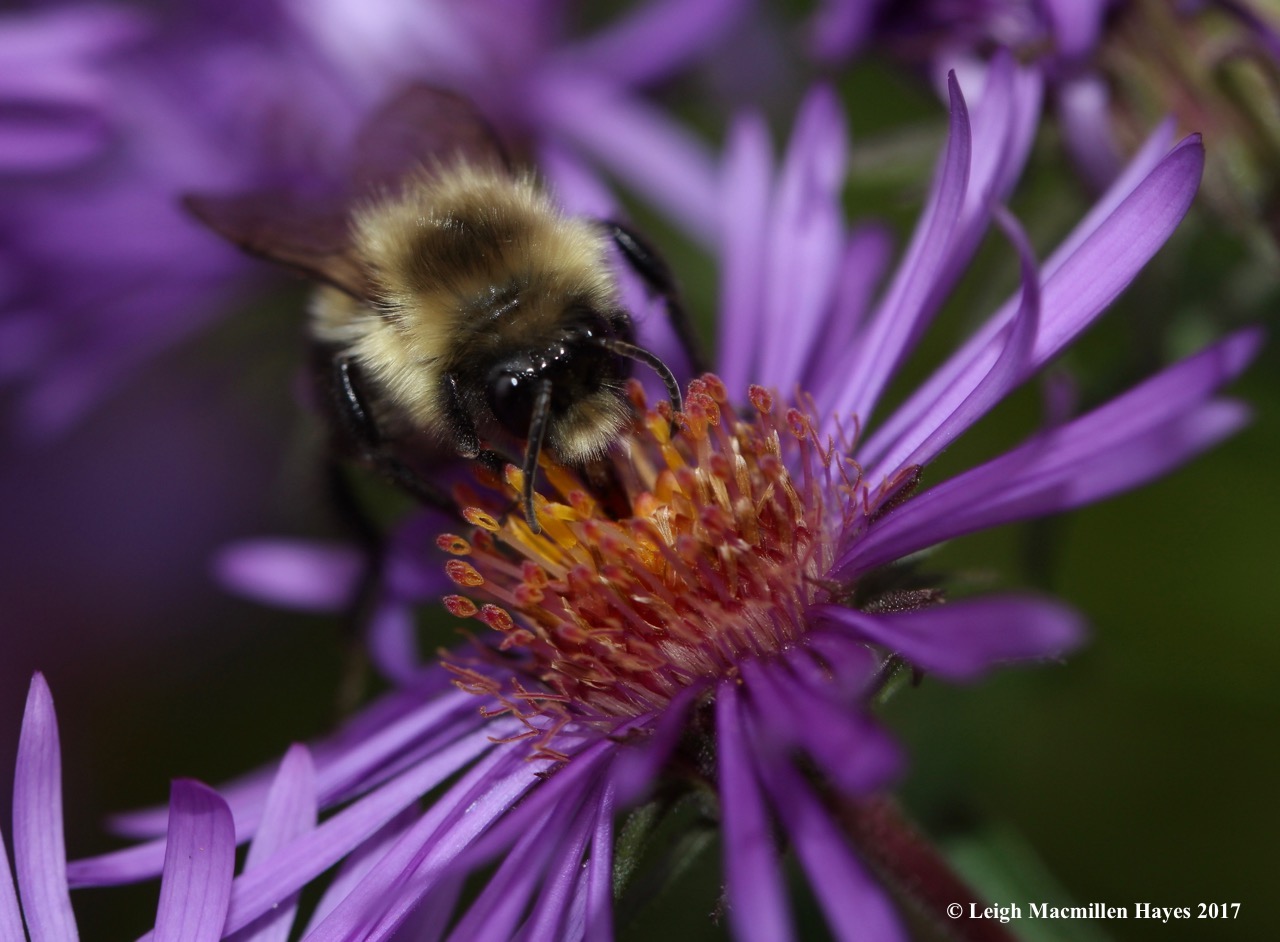
But their sting isn’t as pronounced as that of the bumblebee; I thought about that as I  carefully greeted one face to face while he sucked with his straw-like proboscis. The bumbles were in constant motion today. Though they’ve been in a collection tizzy all summer, I had to wonder, do they sense the end is near? And still, they perform their job.

i4-honey bee, leg parts1

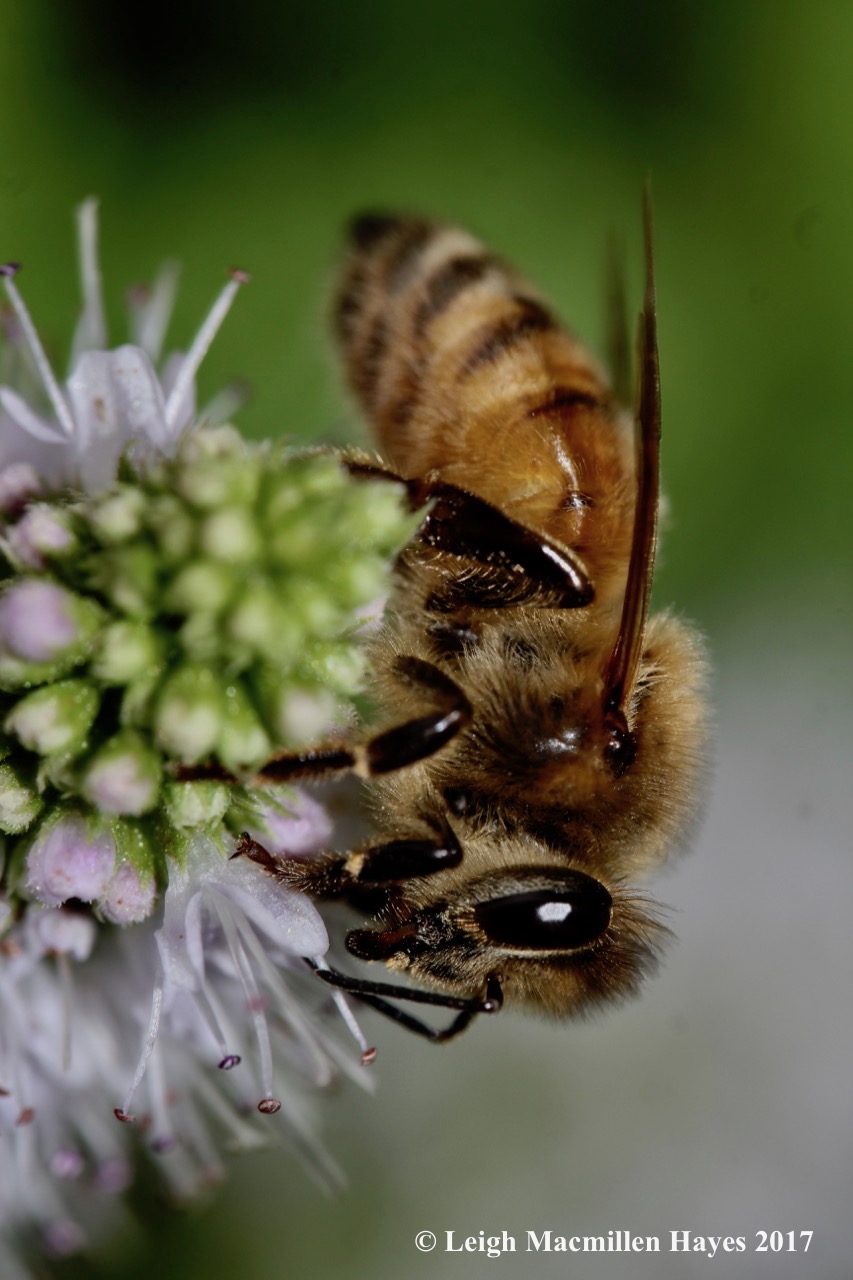
Taking its time in the collection process was a honeybee. Perhaps it knows the end is coming for it was much calmer than has been the norm and stayed in the same spot for several minutes, ever so slowly only moving its head.

i5-honeybee 2

All the better for me to take a closer look, including at the segments of its leg. I’m fascinated by the claws at the base of the tarsus.

Each day, the sweet offerings diminish as do the number of pollinators. Long ago I swore I didn’t like insects, but the more I look, the more in awe I am. Even though I know there will be other things to focus on, I’m going to miss these moments of wonder.


Buzzin’ ‘Bout

 Air traffic control to Flight 233. Over.

Flight 233 approaching runway. Over.

Runway lights are on, Flight 233. Have a safe landing. Over.

OK, so I have no idea what a conversation between air traffic control and a pilot really is, but I do know that some plants have runways to guide pollinators. And by the way–233 on a phone=BEE.

IMG_3446

Have you ever seen a more beautiful runway than the one on an iris?

lupine 2

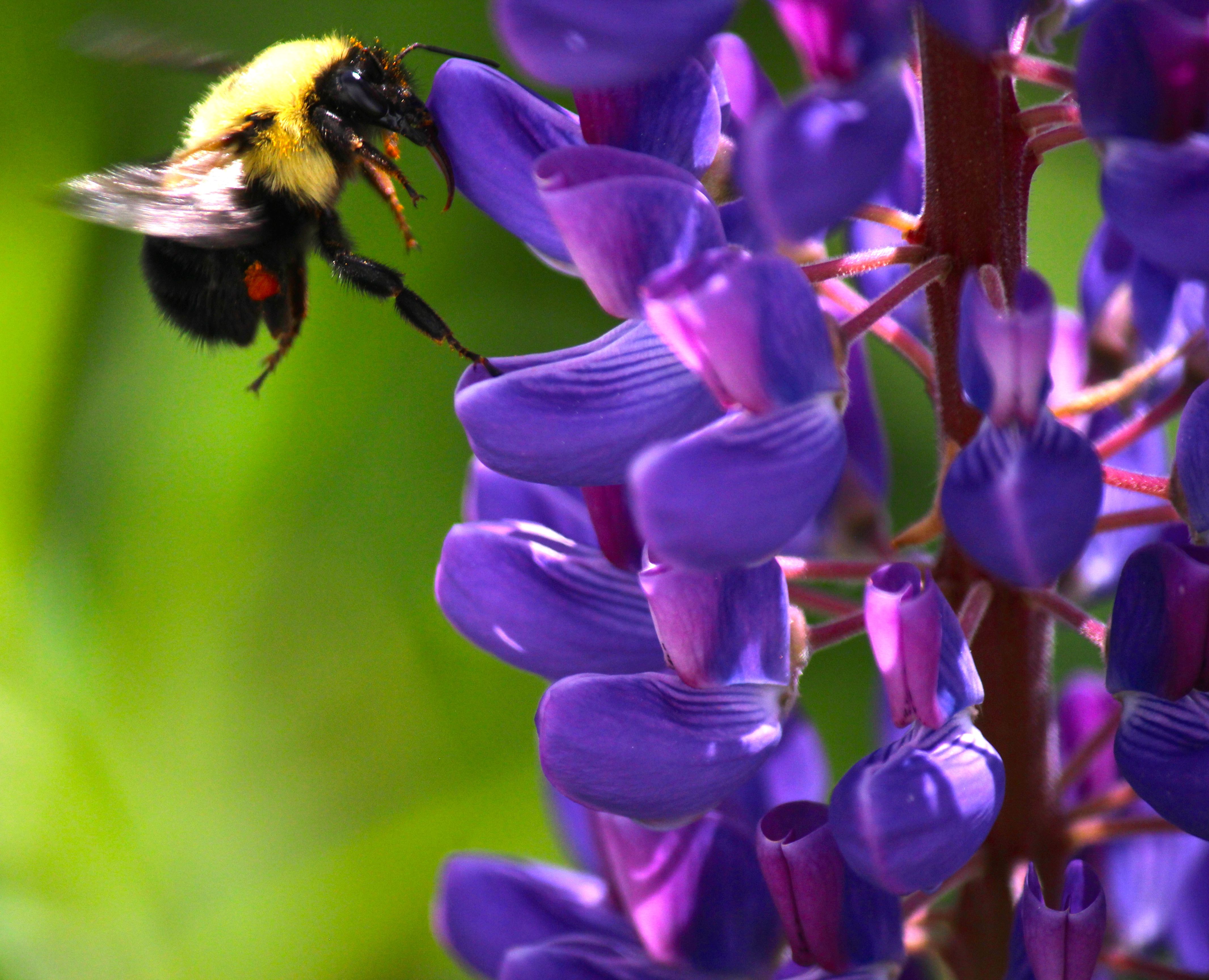
With their banner, wings and keels, the pea-like structure of the lupine is different, but . . .

lupine, bee

it’s a favorite for a variety of pollinators.

bee 2

A nip of nectar

bee 3

and a dash of pollen

bee 4

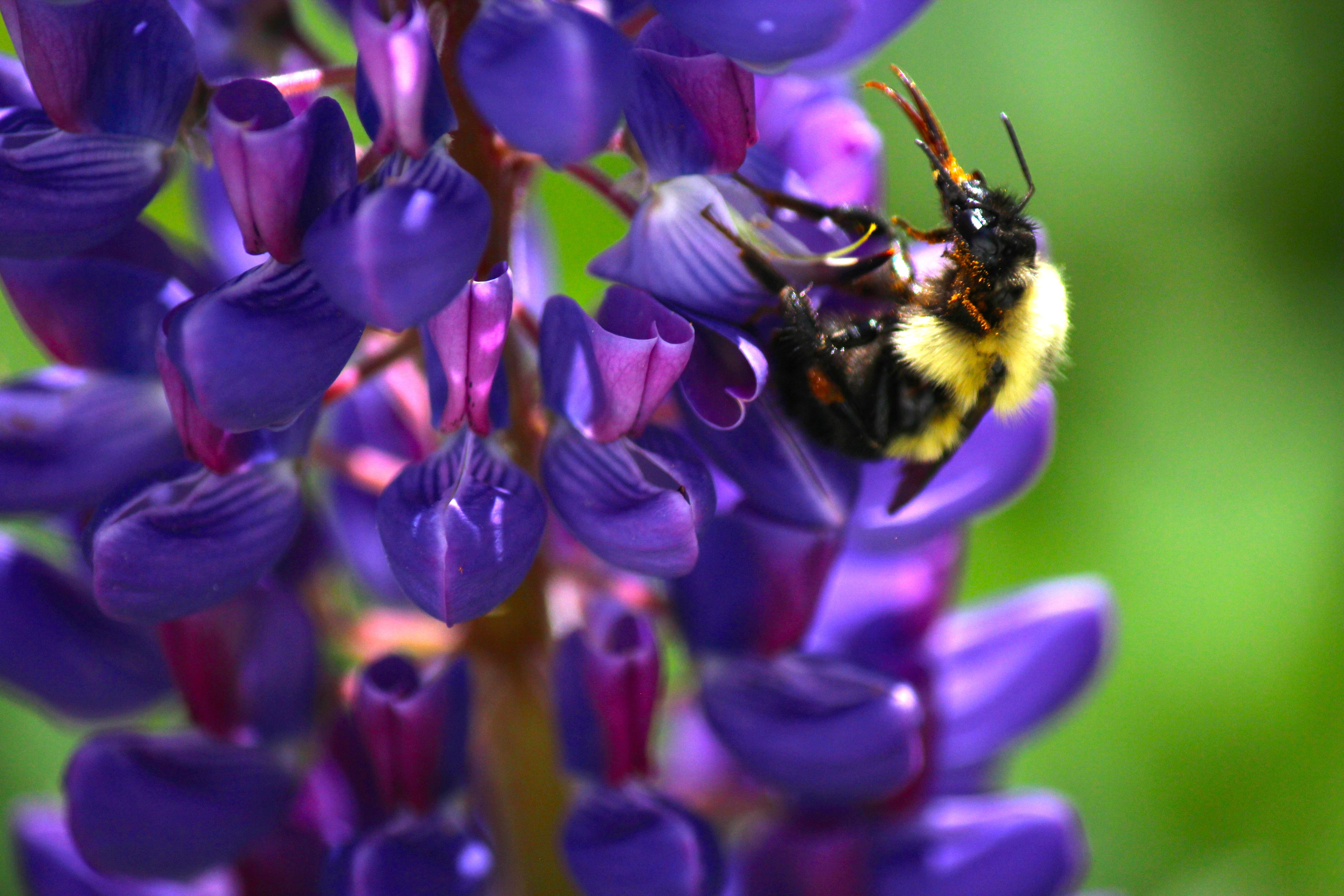
makes for a happy bumblebee and a happy flower. The bee’s orange pollen basket is almost full.

butterfly

Some wildflowers don’t need pollination to produce viable seeds, but when a visitor drops by for a sip, some pollen will attach to its fuzzy body and be transported to the next plant.

hawkweed

Notice the hairiness below the flower of the orange hawkweed–I’ve read that that’s an attempt to keep slow moving insects, like ants, from coming in for a treat–they prefer flying insects. Rather picky.

chives 2

Though chive blossoms consist of numerous flowers that are perfect, in that they each have both male and female parts, they can’t self-pollinate because the stamen sheds pollen before the pistil is ready.

chives 1

Thus, they depend on flying pollinators to deal with the timing issue.

daisy 1

Like the hobblebush I mentioned in earlier posts, the daisy consists of a ray of white sterile flowers surrounding a disk of yellow fertile flowers.

daisy 2

It had just opened today, but already is attracting attention.

So many different guiding lights. Thanks for buzzin’ ’bout with me on this nectar flight.