Pileated Woodpecker Works

Pileated Woodpeckers often take the rap unfairly for killing trees. In fact, even though they drill holes into the bark and excavate wood in order to reach the galleries of Carpenter Ants, the trees are both dead and alive. Huh?

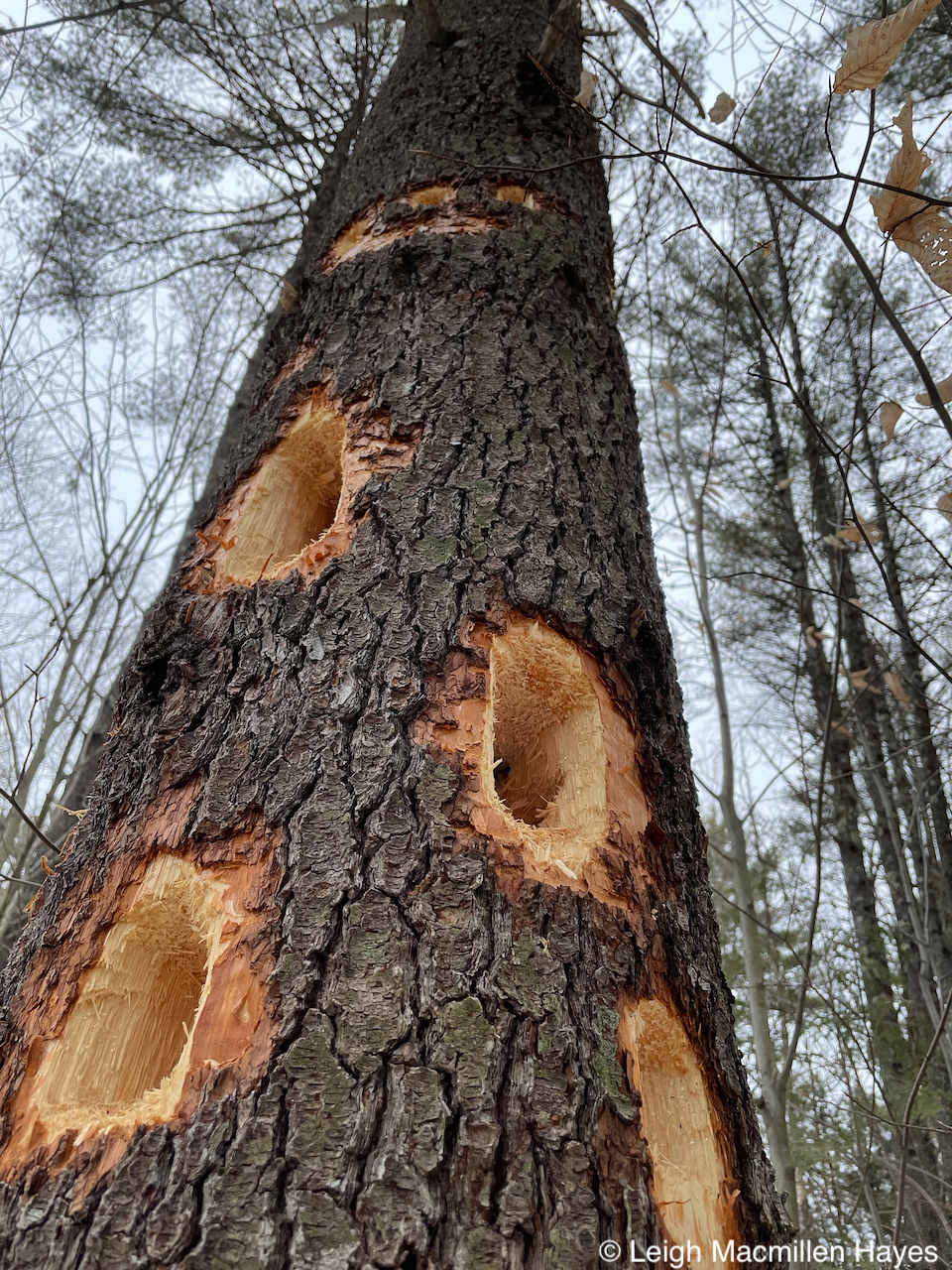
Take for instance this Eastern White Pine along the cowpath in our woods. While the Pileated Woodpeckers have riddled it with holes, its still standing and still producing needles and cones, because there’s enough bark left to protect the cambium and sapwood.

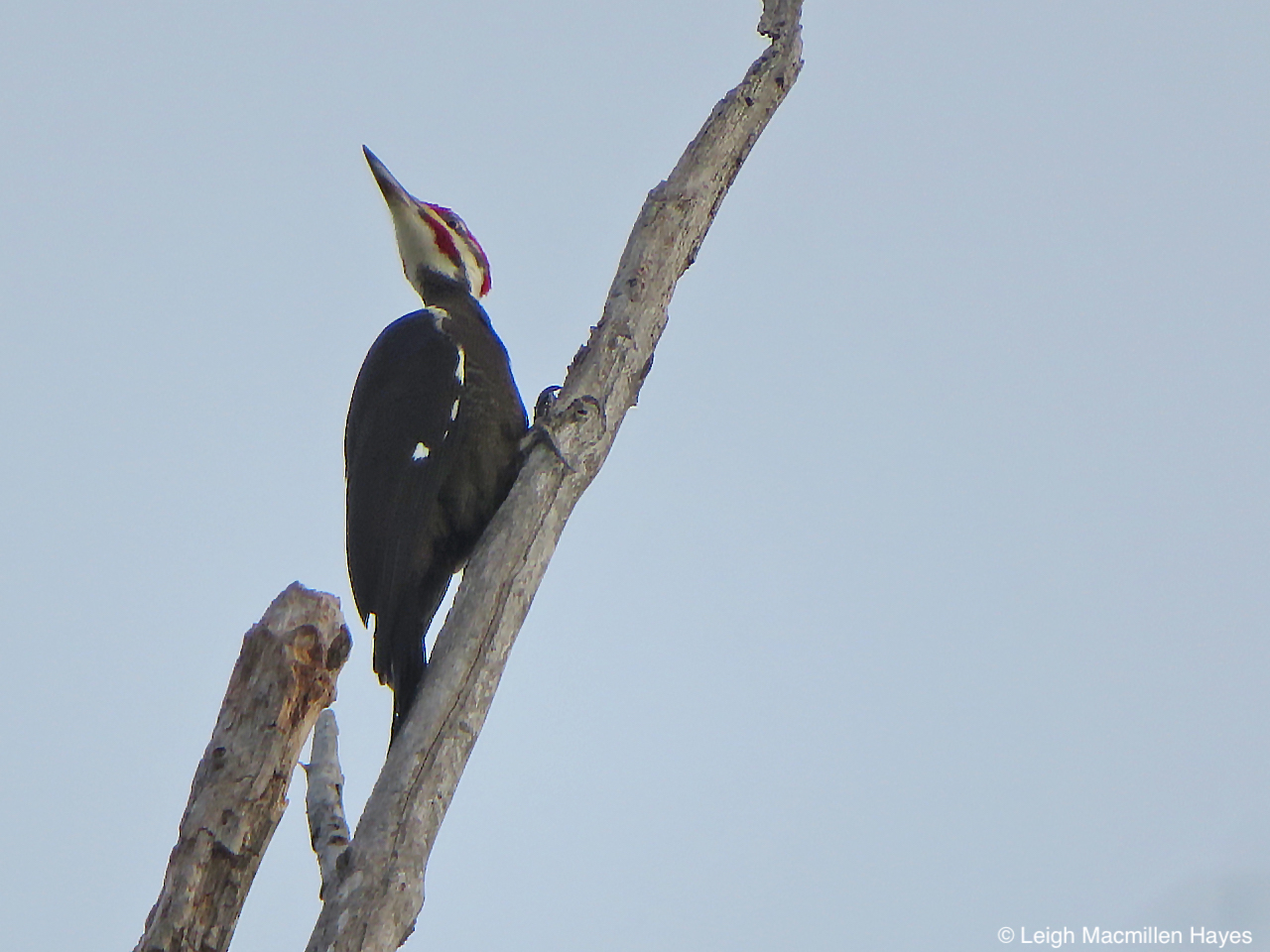
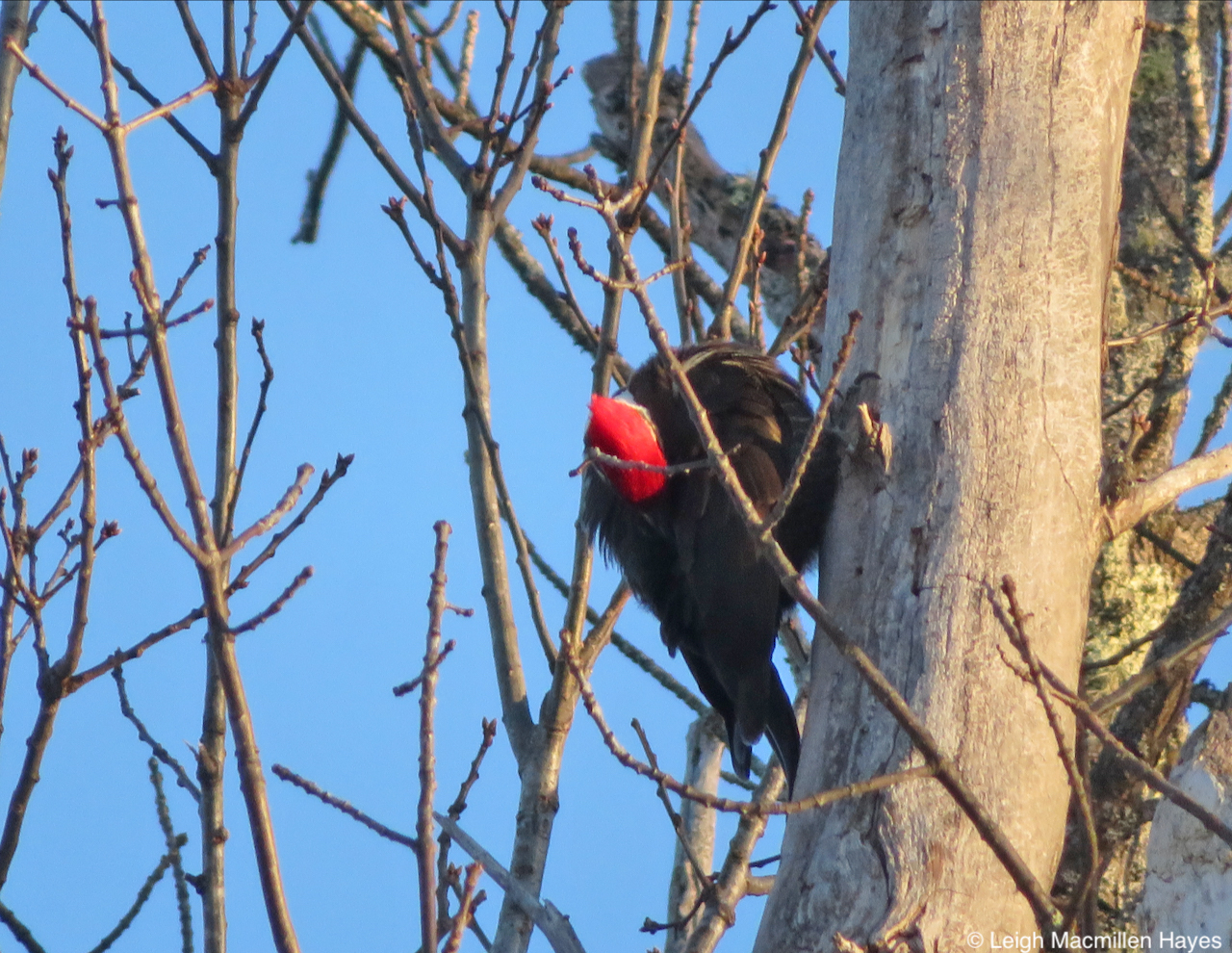
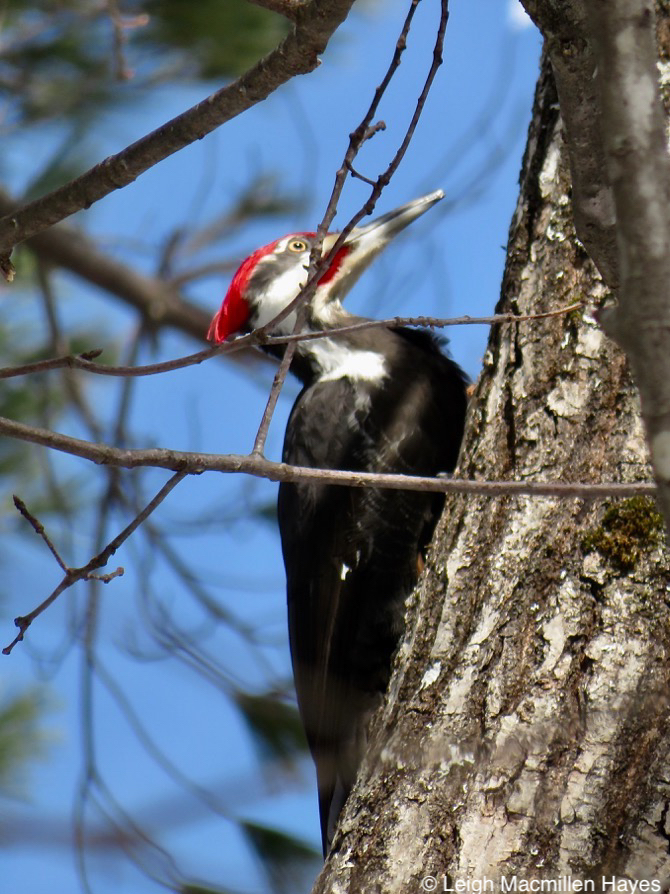
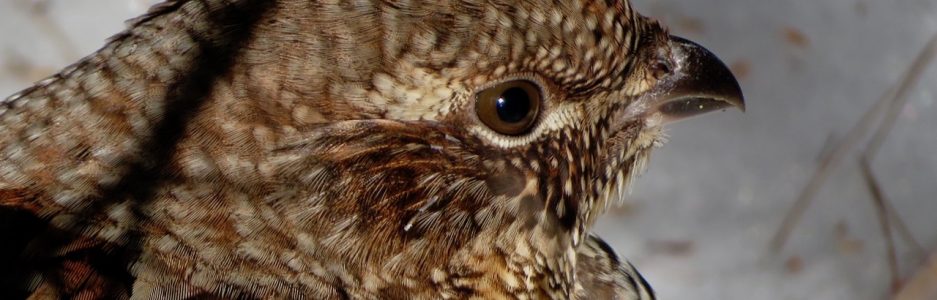
There was a time years ago when hearing or spotting a Pileated was a rare occurence, but now it seems that every day I either find evidence of habitat, hear their drumming and Woody Woodpecker calls, or actually spot one such as this that I spent some time with by the cowpath today.

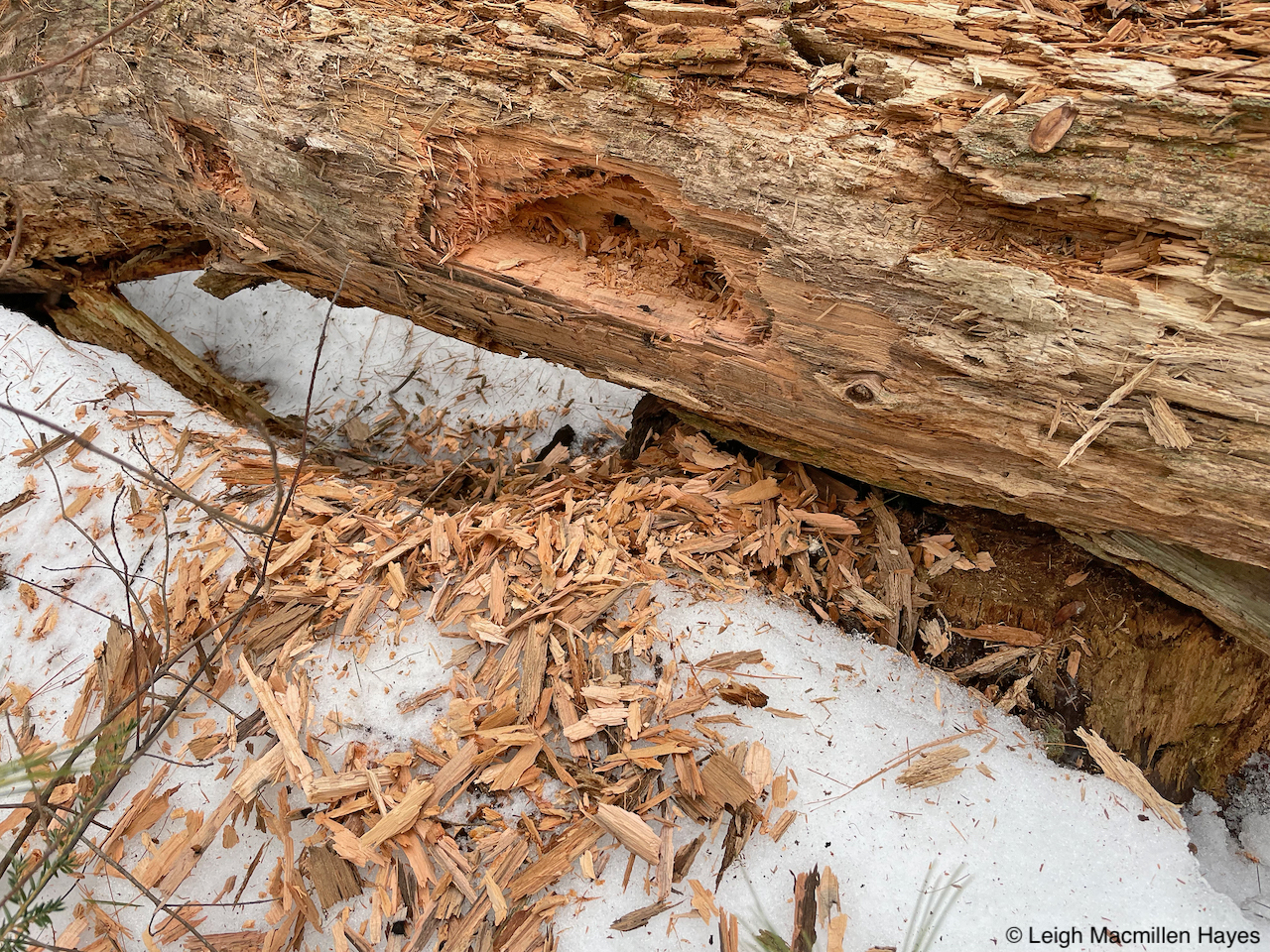
And it’s not just holes that they drill. Quite often, I’ll see a tree that appears to have been chisled and shredded. This to is also Pileated Woodpecker sign.

Some trees receive only one visit, but others must be a huge source of food for multiple squarish to rectangular holes are drilled.
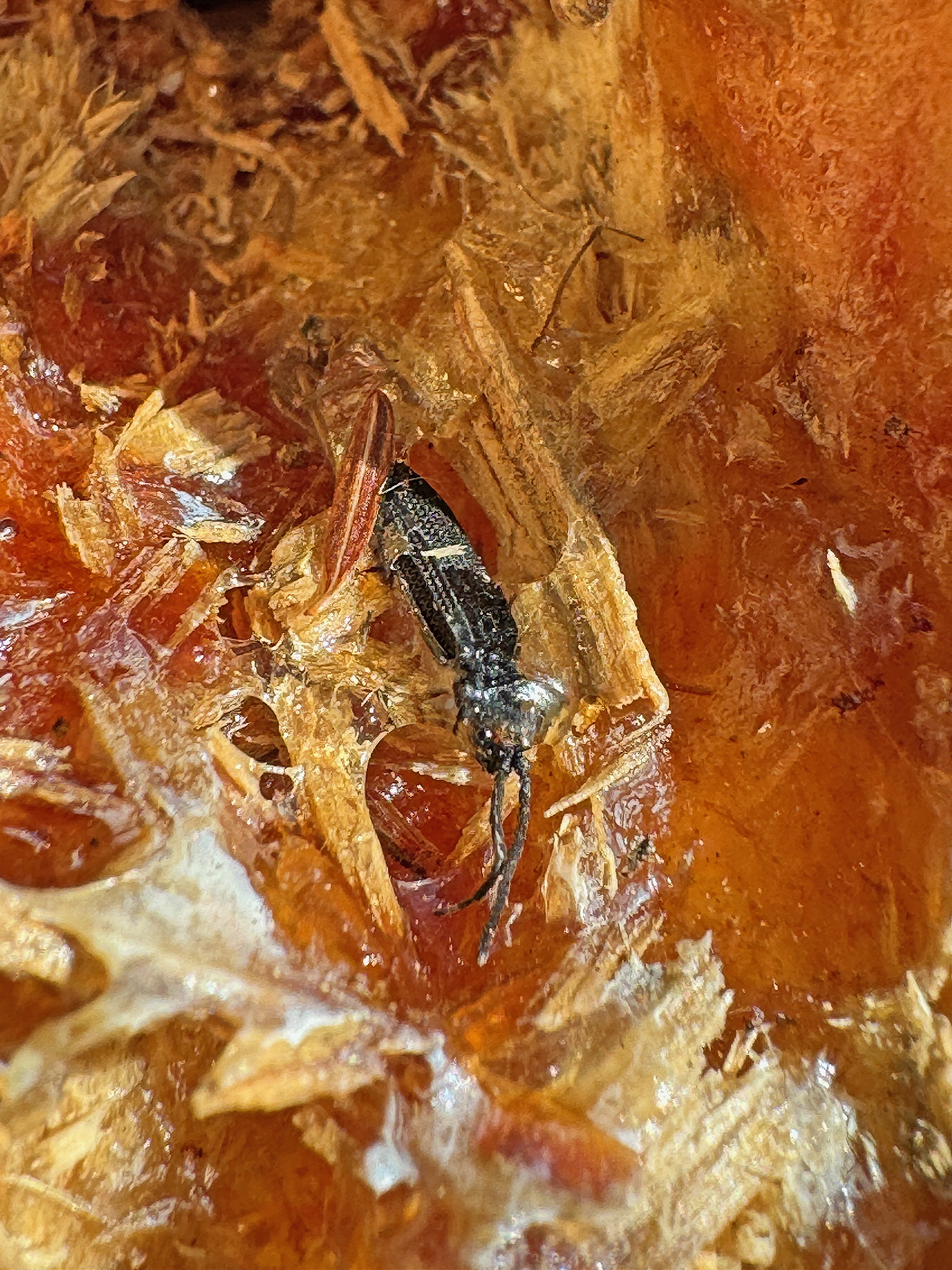
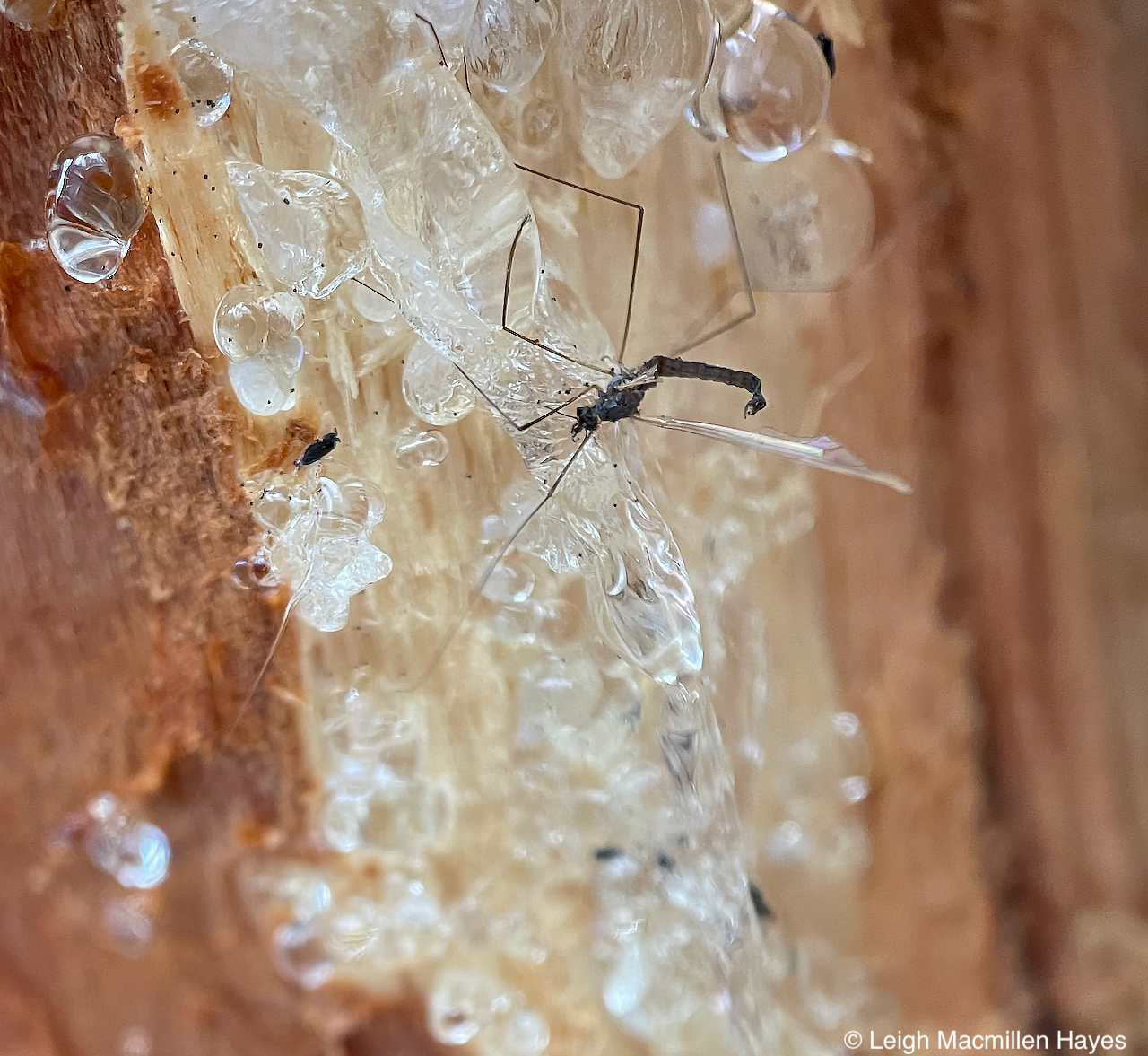
I love to peer into the holes because sometimes I’m rewarded with sightings such as this . . . a long-horned beetle that got stuck in the sap and is now frozen in situ.
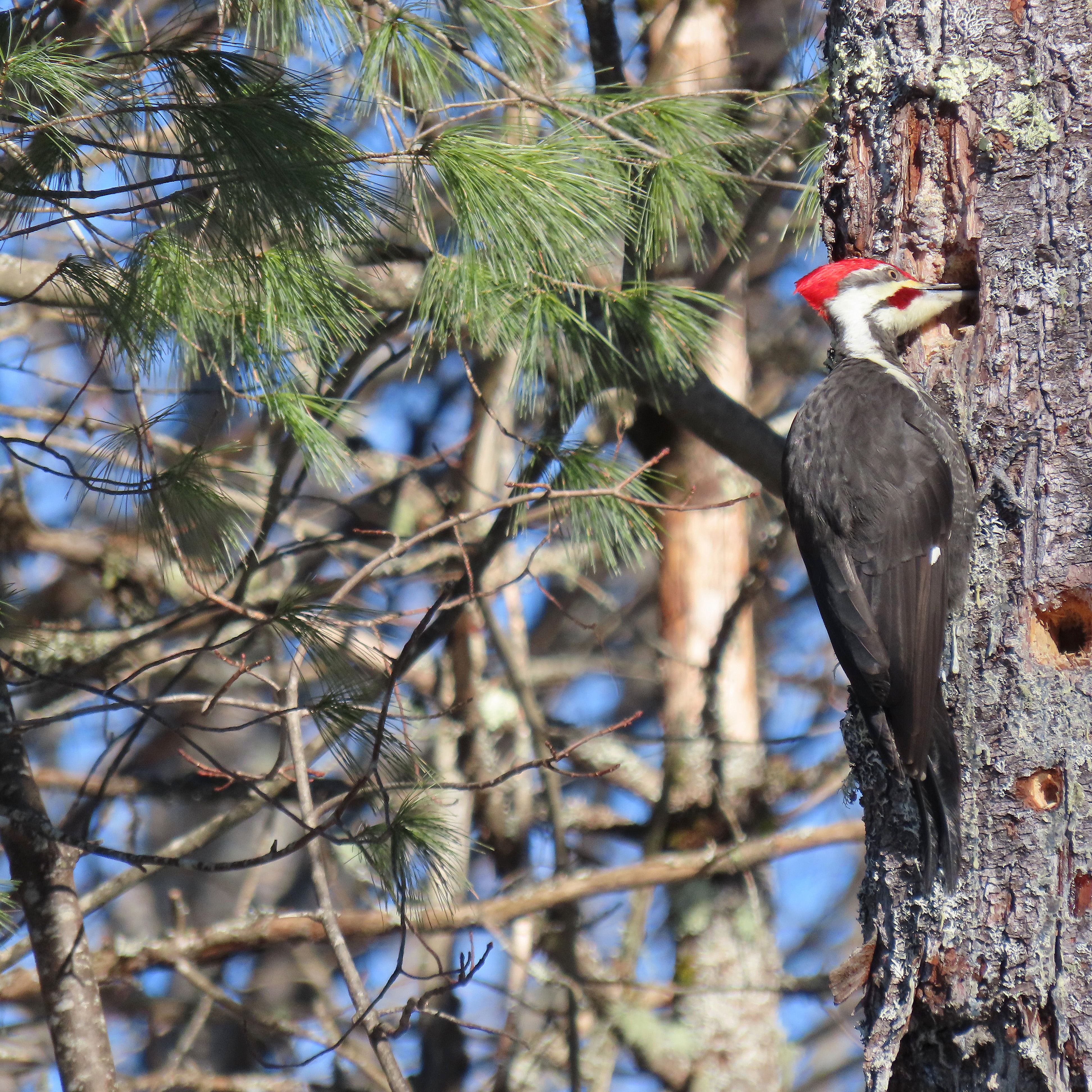
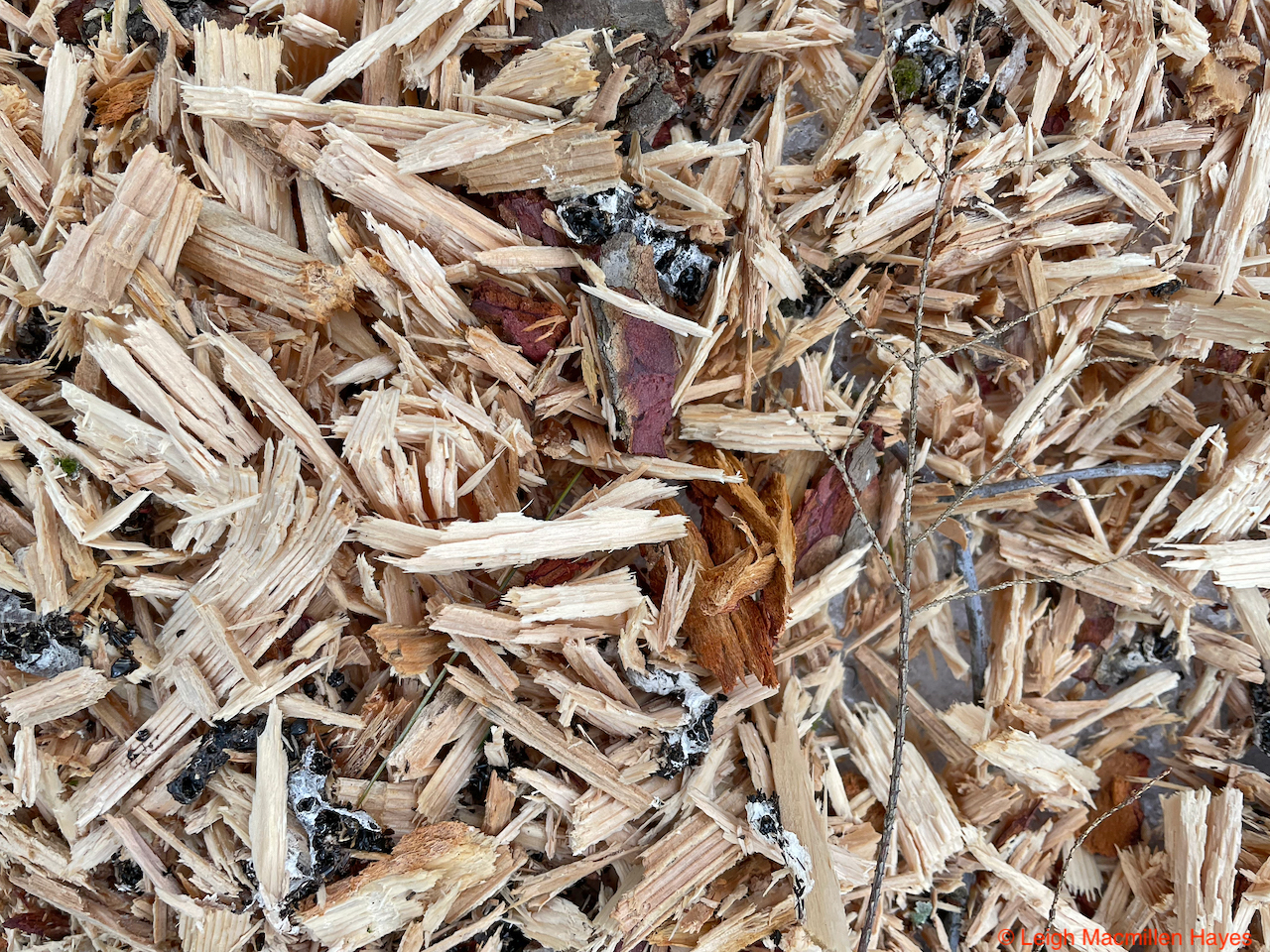
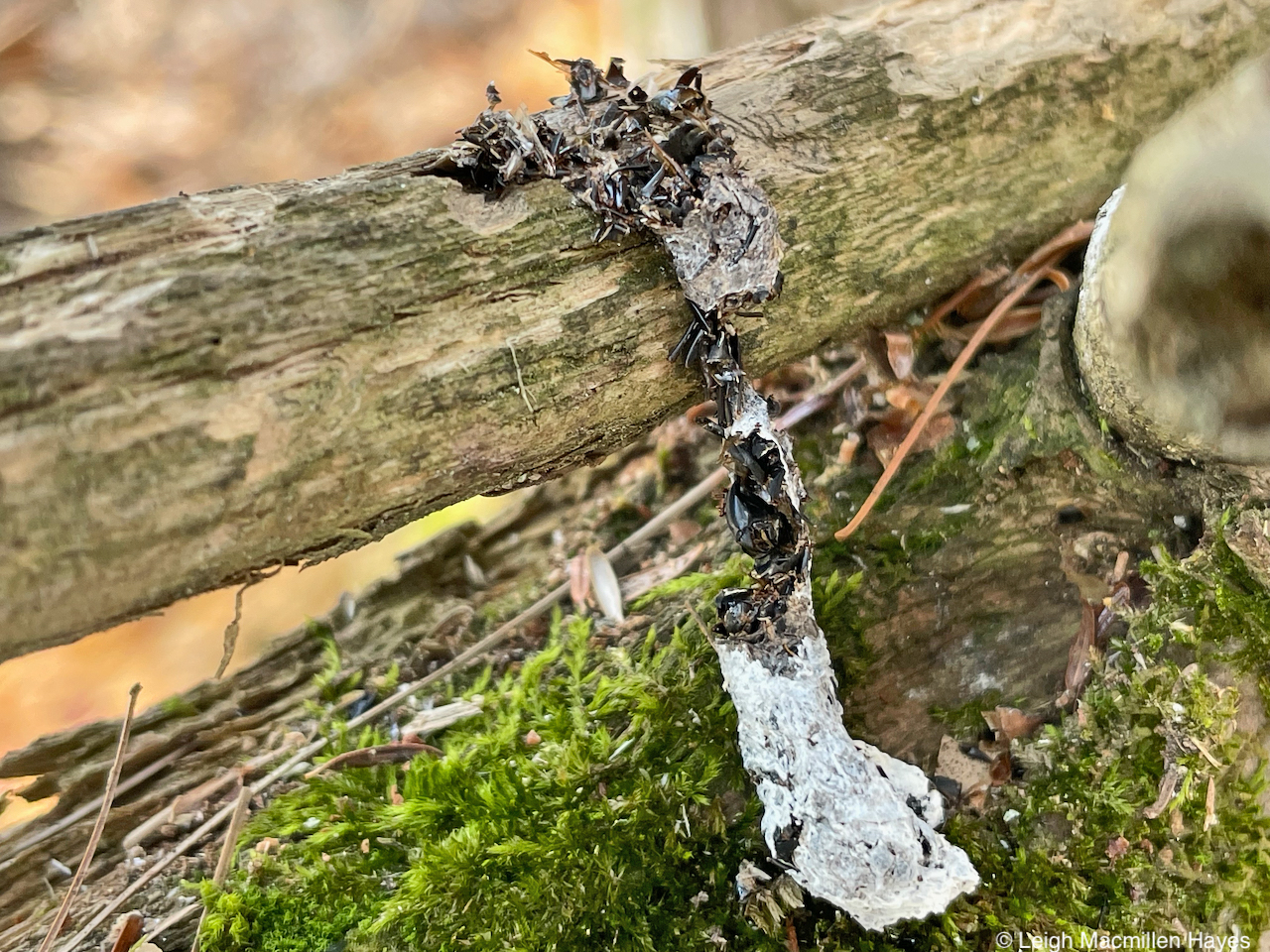
Though we can’t see it, Pileated Woodpeckers have sticky tongues, which they probe into the tunnels the delicious (to a woodpecker, that is) ants have created. Their bodies don’t process all of the ant, and so their scat is another sign I love to find. It’s like a treasure hunt at the base of a tree and let’s me know if the bird was successful in dining or not.

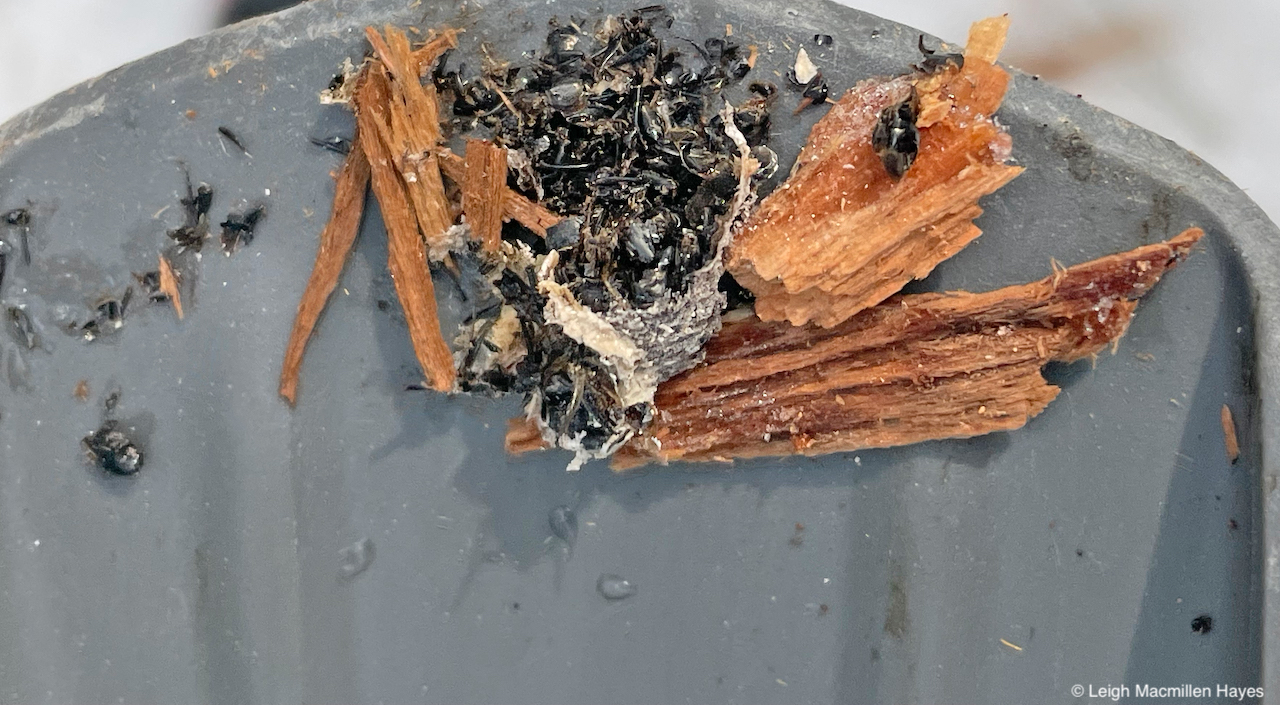
Their scat is made up of the Carpenter Ant exoskeletons, and some wood fiber, and white uric acid.

If you haven’t looked for this, I highly encourage you to do so. Any scat is fun to encounter because it helps us determine who passed this way, but there’s something extra special about seeing those body parts and knowing better the critter’s diet.

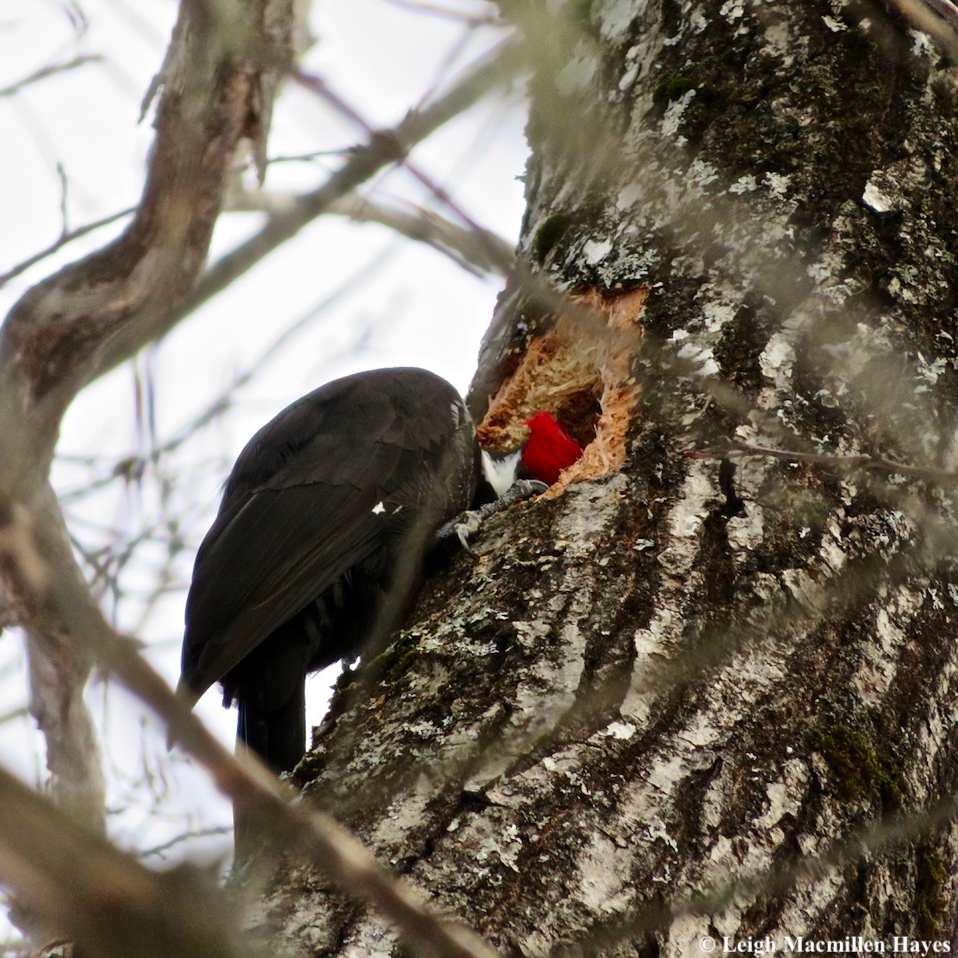
Pileated Woodpeckers excavate from any spot on a tree, including at the base, so if you see large woodpecker holes there, you’ll know the creator. The cool thing is that they use their long tail feathers as the third leg on a tripod in order to stay steady while smacking their beaks into a tree.

Don’t worry, their brains don’t get rattled. While it was long believed that they had a shock absorber to protect their heads, new research states this: “Their heads and beaks essentially act like a stiff hammer, striking and stopping in unison.” You can read more here: New Study Shakes Up Long-held Belief on Woodpecker Hammering.
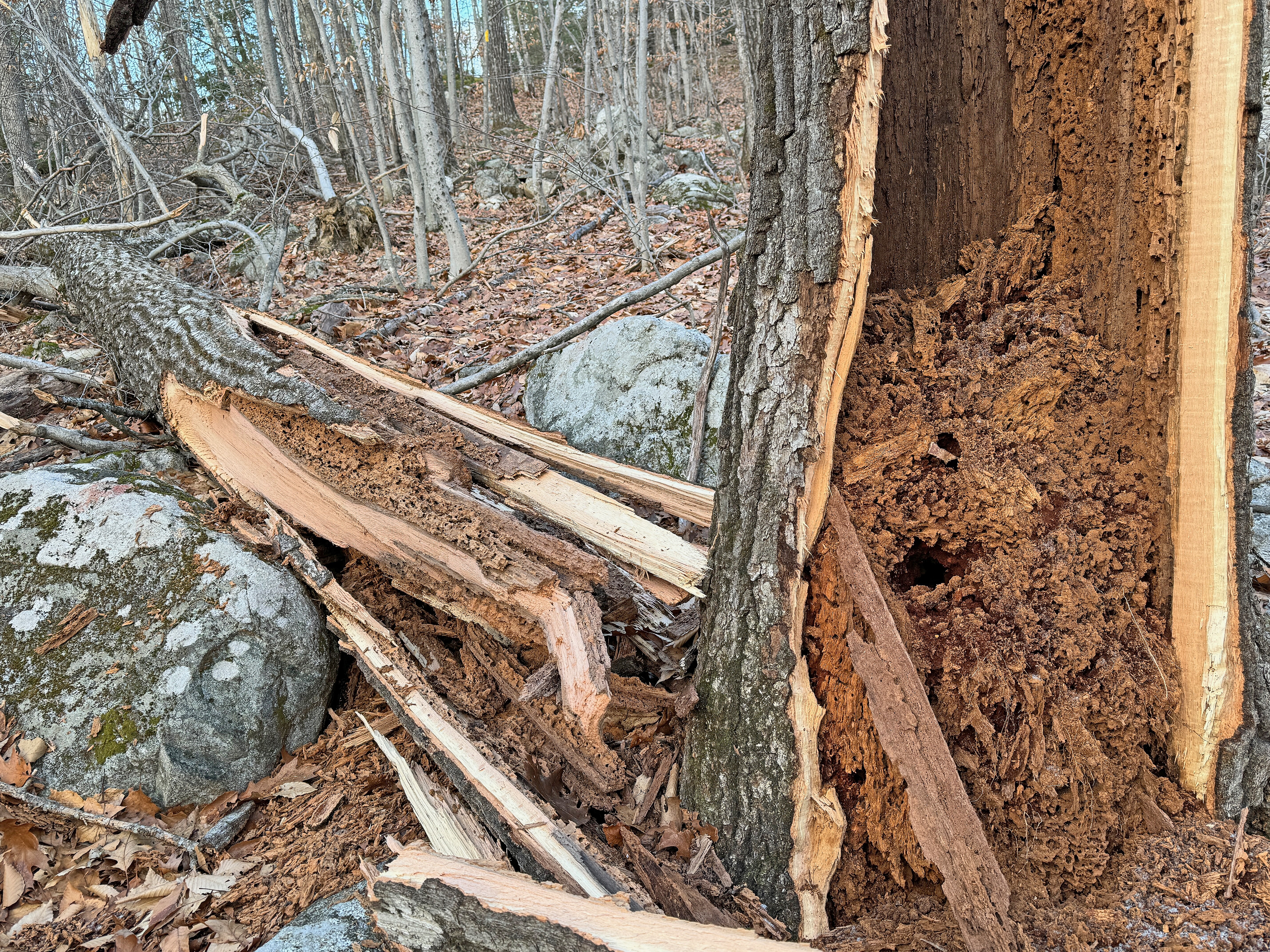
So I stated earlier that not all trees are dead, until they are like this one, even though the Carpenter Ants have set up their own woodworking shop. The heartwood, at the center of the tree is deadwood and its pipelines that served as the xylem and phloem, servicing the tree with water, minerals, (xy rhymes with high pulling these up from the roots), and sugars (phlo rhymes with low, pulling sugars down from the leaves), become clogged with resins and that’s where the ants take up residence. A storm knocked this particular tree over on Burnt Meadow Mountain where My Guy and I hiked about a month ago. It was so overcome with the ants that the core could no longer support the tree.
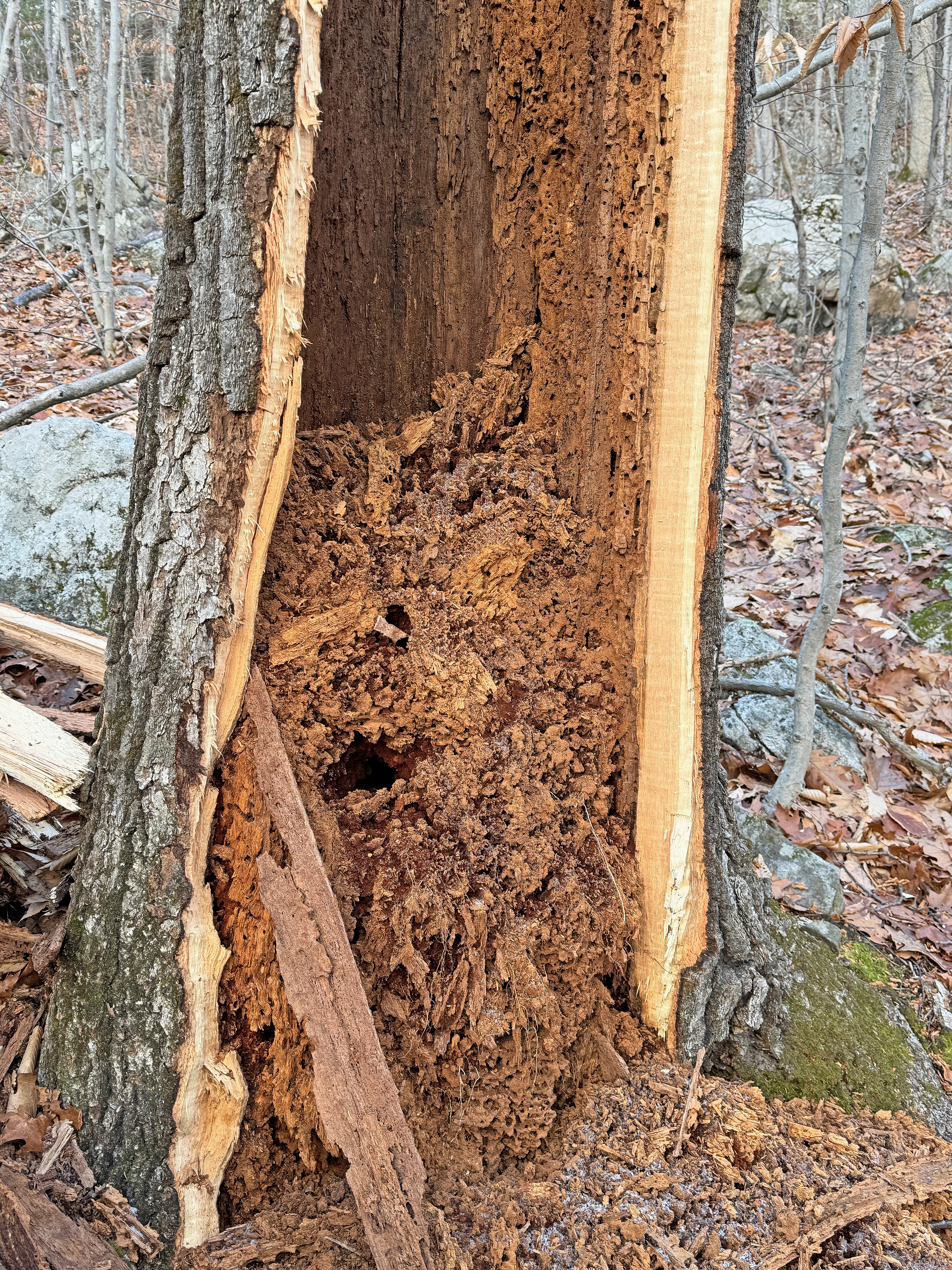
If you look closely, you can see the galleries or tunnels the ants had created. That’s a lot of ants and a lot of work.

My woodpecker seems to be hanging out in a small part of its territory these days. A Pileated Woodpecker’s territory can reach up to 200 acres, and there’s certainly more than that available to him here (the red mustache indicates this is a male), but he appears to have found his pantry closer to our home.
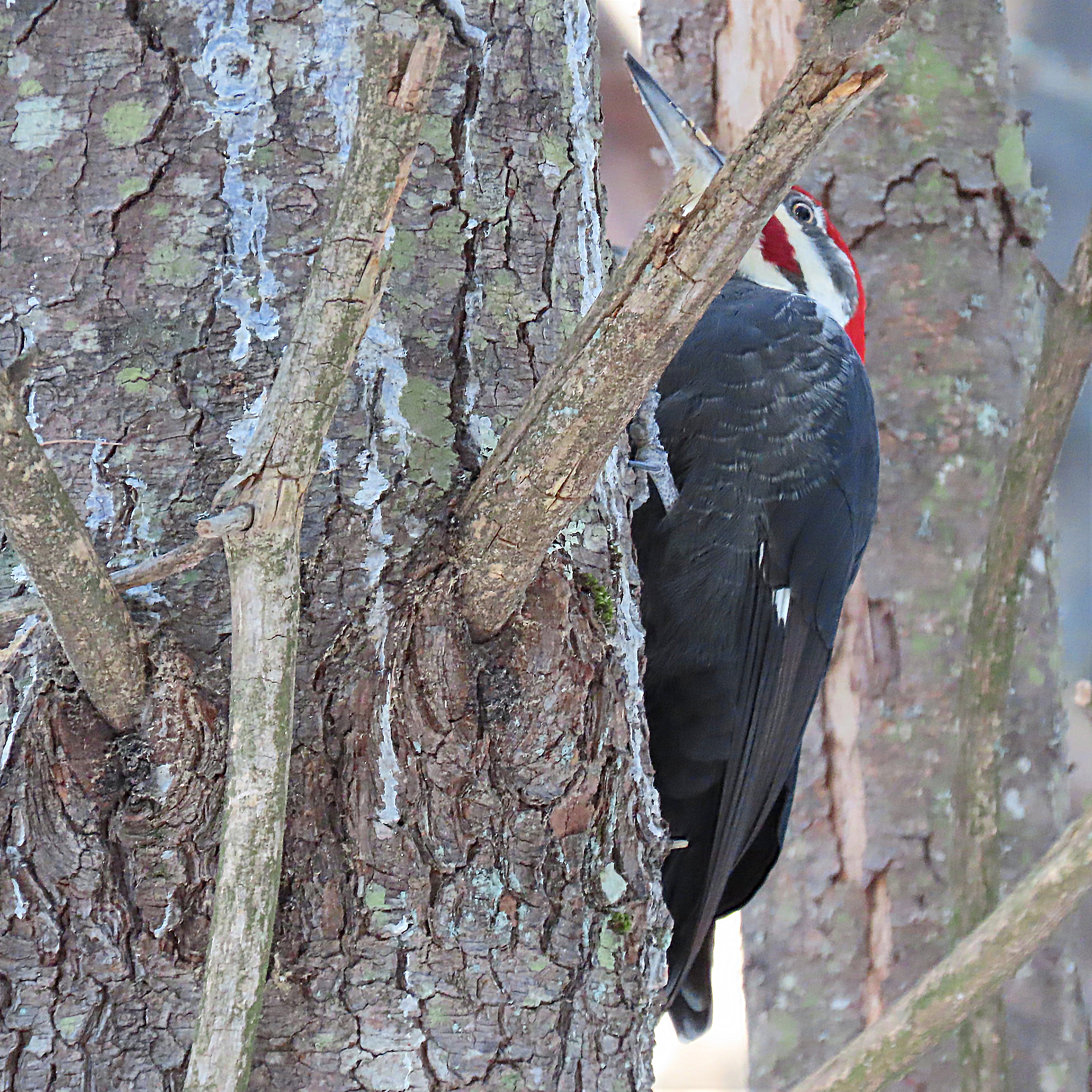
I don’t mind because it means I get to witness him on a more intimate basis.
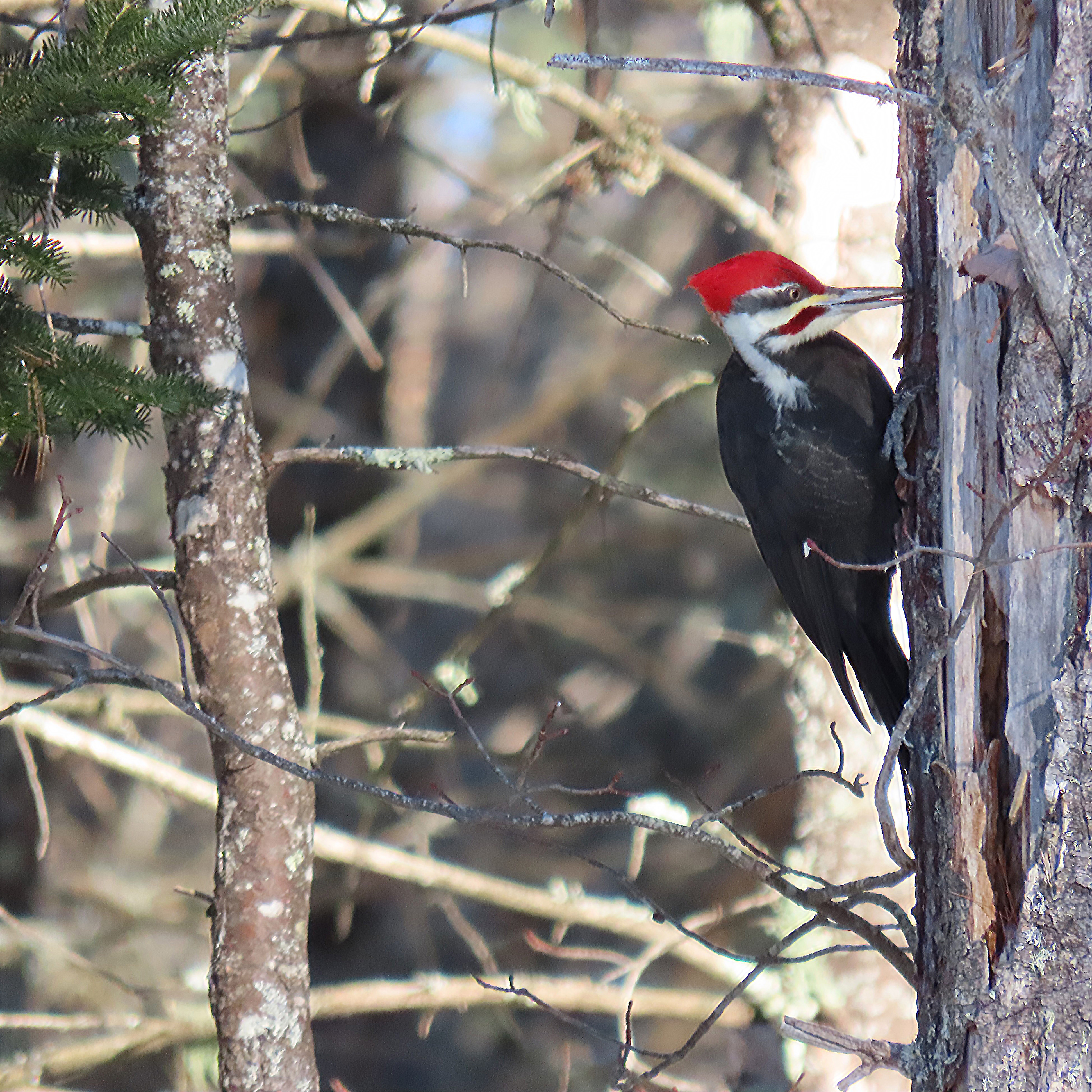
Pileated Woodpecker works. Indeed.
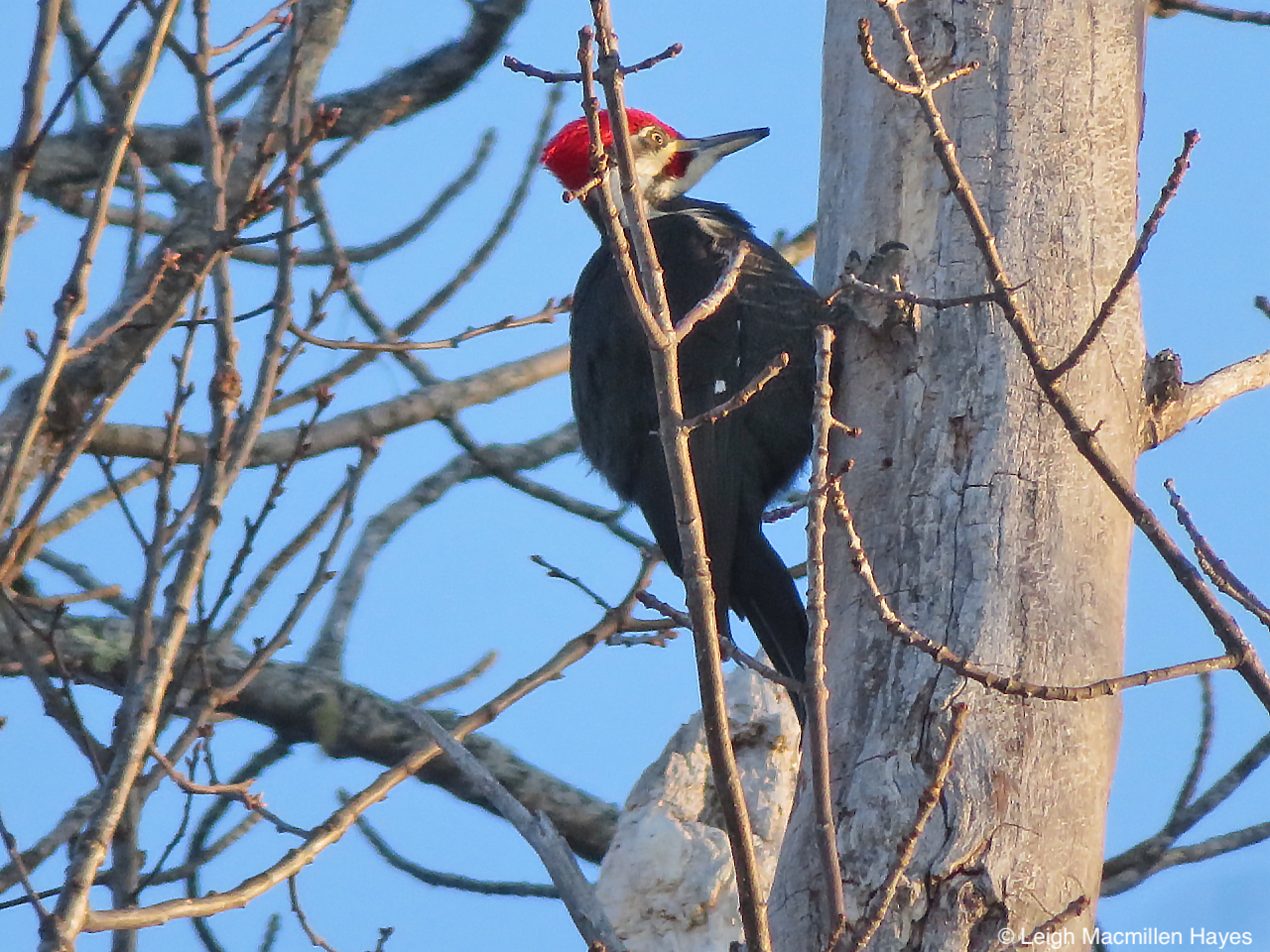
Dear Mr. Pileated

Dear Mr. Pileated,

I’ve been meaning to thank you for serving as our morning rooster all these years. In a couple of months, as the days dawn earlier than on the cusp of this vernal equinox, I know my guy will curse your call, but I admire your tenacity to return morning after morning and practice your drum roll on a snag by the stone wall closest to our bedroom.

Your sounding board of choice resonates with each strike of your beak and I’m sure the volley of taps, sounding like someone is rapping on the back door, can be heard at least a half mile away.

What is amazing to me is that you have the ability to tap at all. But I’ve learned that your tongue actually wraps around your skull, thus dissipating and directing the energy around the brain. Plus, you have a sponge-like bone positioned in the fore and back of your skull to absorb much of the force from the repeated impact of constantly hammering against wood. 

After several rounds of repetition, you take a break and stretch your neck away from the snag . . .

and sway your head . . .

in a 45˚ arc, a movement known as a bill wave. It seems to serve two purposes: as an announcement of your territory to another of your kind; or a message to the one you are trying to woo with hopes she’ll accept a date.

Of course, in the mix of all this action, you also make time to preen. After all, should a mistress fly in, you need to look handsome–an easy task on your part.

I’ve read that your territory ranges from 150 – 200 acres and give thanks that we live in an area that satisfies your needs and those of your kin.

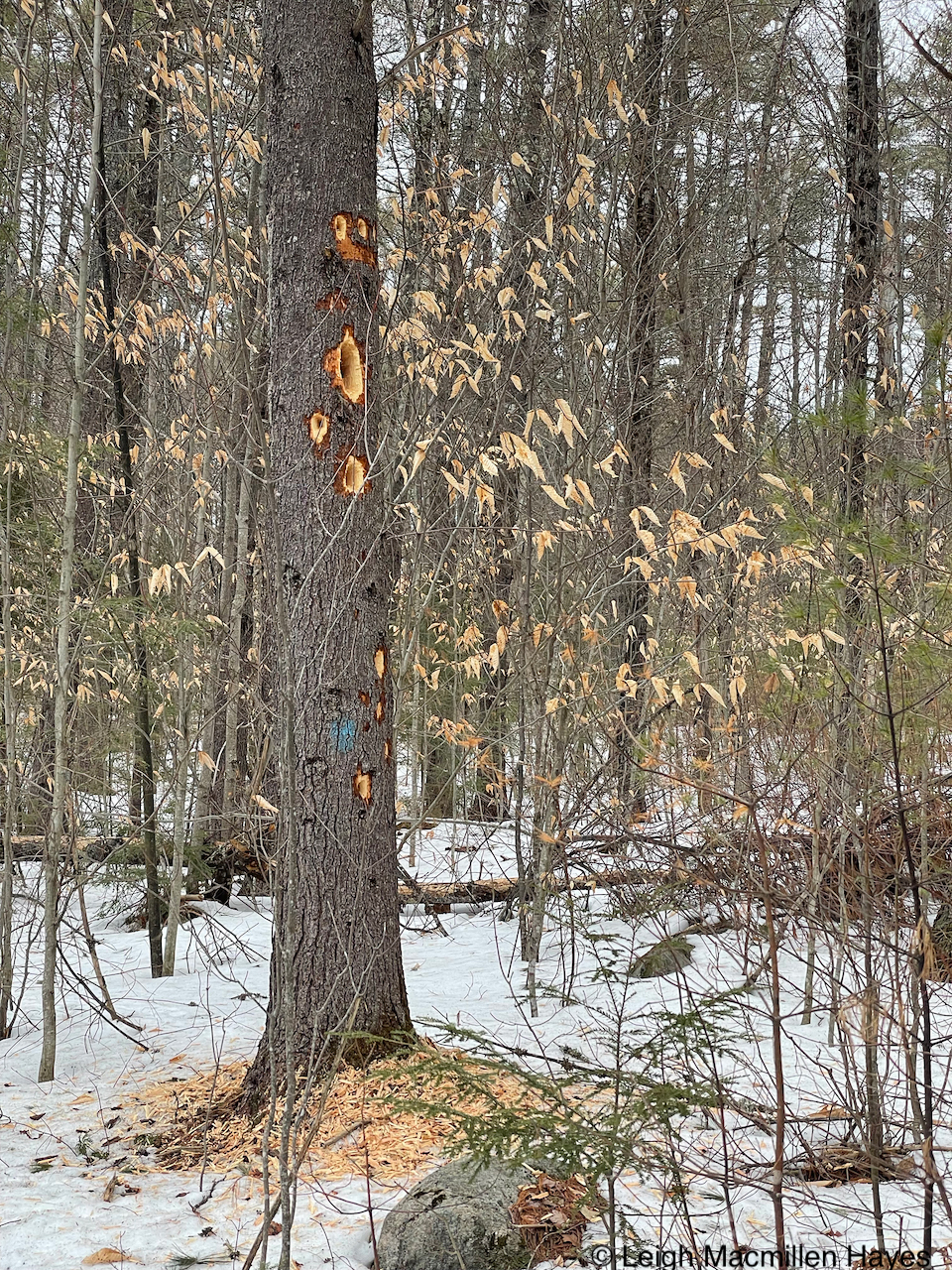
In winter, your feeding trees are easy to spot, either by the oblong holes chiseled into the tree trunks . . .

or piles of wood chips at the base of a tree, providing a contrast with the snow.

I love it when you even rework a hole you’d started when the tree was standing. So many don’t realize that it’s not unlike you to use your tail as a third leg like a stool and stand on the ground to seek the goodness within.

When the opportunity to watch you work presents itself, I take it and stand silently below while you chip away.

What I can’t see is your method of feeding, as you pursue the tunnels of carpenter ants and snag them with your long, barbed tongue covered as it is with a sticky solution that works rather like tacky glue.

BUT, one of my great joys, as some know, is searching among the chips you’ve excavated to discover if your feeding efforts were successful. Yes, Mr. Pileated, I actually feel well rewarded when I discover packets of scat you defecated. While we humans get rid of waste nitrogen as urea in our urine, which is diluted with water, I have come to realize that you cannot fly with a full bladder and therefore must dispose of uric acid, plus the indigestible parts of your meals in combination via the cloaca or vent located under your tail. Knowing this helps me locate your scat because I first look for the white coating, which is the uric acid, and then I spy the exoskeletons of the ants that you feed upon in winter located inside the cylinder.

Sometimes, your scat doesn’t make it all the way to the ground, but rather lands on a branch below your foraging site.

Of course, it’s great fun when others are present, to whip out my scat shovel and scoop some up so they may take a closer look.

I did that just yesterday with a group of students, some of whom fully embraced the experience, which also gladdened my heart.

Another thing I love to spot as a result of your foraging efforts, sir, is the winter coloration of sap that flows from Eastern White Pine trees you’ve excavated. In warmer weather, the sap is amber in color, but there must be some winter chemistry that I do not understand, which turns it shades of violet and blue.

Oh so many shades of blue. And once blue, it doesn’t seem to regain the amber hue, at least from what I’ve seen. But then again, somewhere in this world, there’s one that does. Or many more than one.

Noticing the droplets of fresh sap yesterday, I decided to take a closer look, and spied not only spring tails stuck to its sticky surface, but also a small winter crane fly that will be forever suspended . . . unless something comes along for a snack.

When I checked this morning, it was still stuck in place.

As I complete this letter to you, Mr. Pileated, I once again want to express my appreciation for your part in this world, for creating nesting sites that others, such as small songbirds, may use, and how you help the trees in the forest by contributing to their decomposition, for as much as some think that you and your kin are killing the trees, the trees are already dying due to insect infestations, and your work will eventually help them fall to the ground, add nutrients to replace what they had used, and provide a nursery upon which other trees may grown.

And I want my readers to know that your bill waving has paid off for this morning as I watched and listened to you, in a quick turn you flew off giving your Woody Woodpecker call as you sailed away and in flew your date. She landed on the same snag you always use, gave a few taps of her own, preened for a moment or two, and then she also turned and headed in the direction you had taken, and I can only hope that the two of you have been foraging together ever since.

Oh, and that if there are any offspring from this relationship, you’ll name your first born for me.

Sincerely yours,

wondermyway.com

P.S. BP, this post is dedicated to you. Hugs from your non-hugging friend.