A Day of Firsts

This has never happened before. Then again, there’s a first for everything.
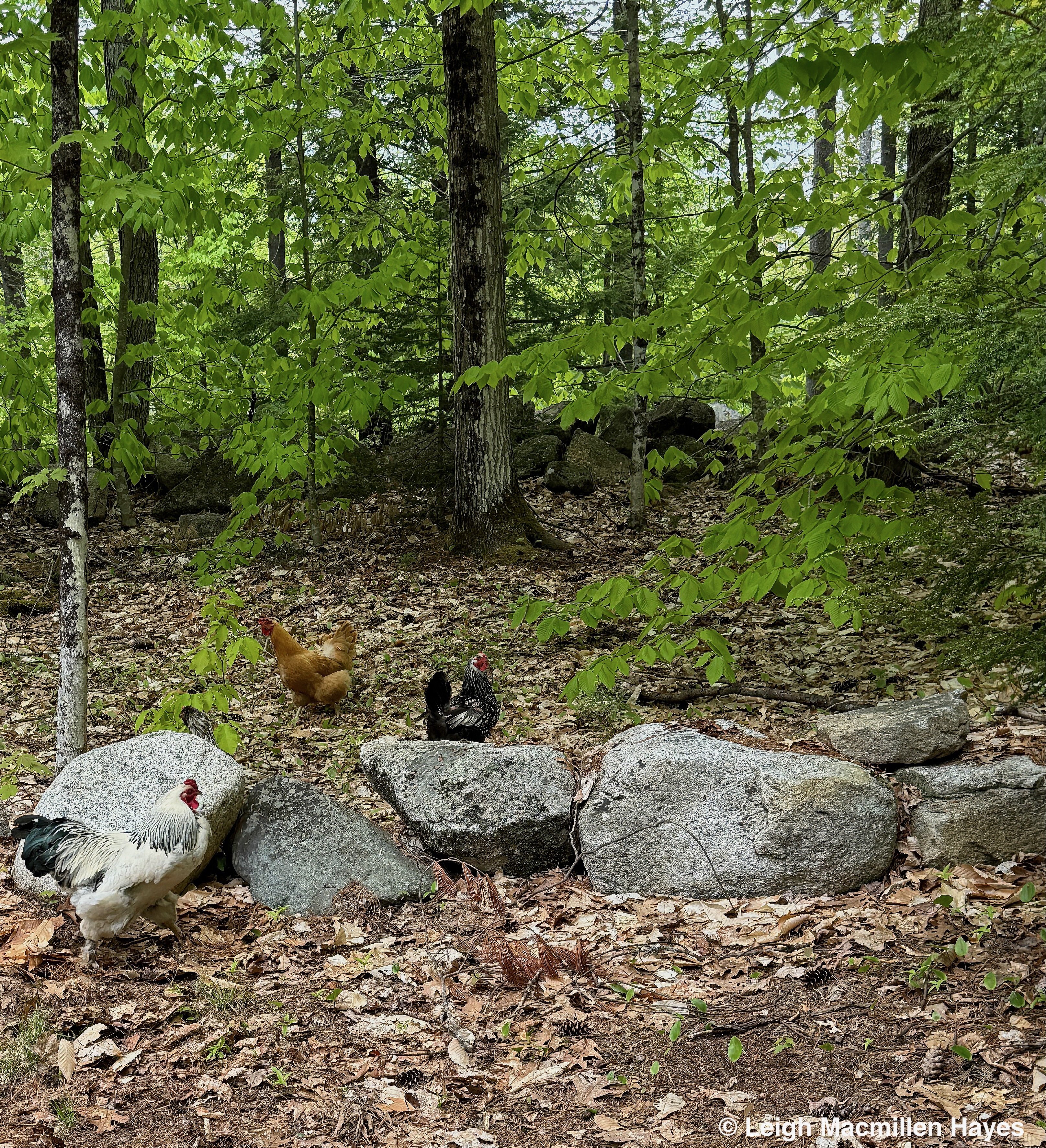
My Guy and I have been hiking together for the last 38 years, and in all that time, never, ever have we been greeted by neighborhood chickens, with one rooster even sending us off to the tune of his cock-a-doodle-do.

The past is always present and just after the send off, we paused by the homestead foundation, possibly that of A.H. Evans, which is located within feet of the trail’s head. And it appears that if this did belong to A.H., he was the head of a large family for it’s a huge foundation.

The barn foundation was also impressive and we could sense the work that went into such a creation.

And based on the configuration of rocks and boulders between the house, outbuildings and barn, all were once attached.

Again, assuming all of this belonged to A.H., I did discover a 1916 document that suggested he grew rutabagas: “A. H. Evans, Fryeburg, raised 90 bushels rutabagas in 1-8 of an acre.”

At some point in time, the land also must have served as a saw mill close to what is now a small stream, but may have been more of a brook in the past, there’s a pile of saw dust that hikers must climb. This is not uncommon in Maine woods. And it’s forever soft underfoot, however many years later.
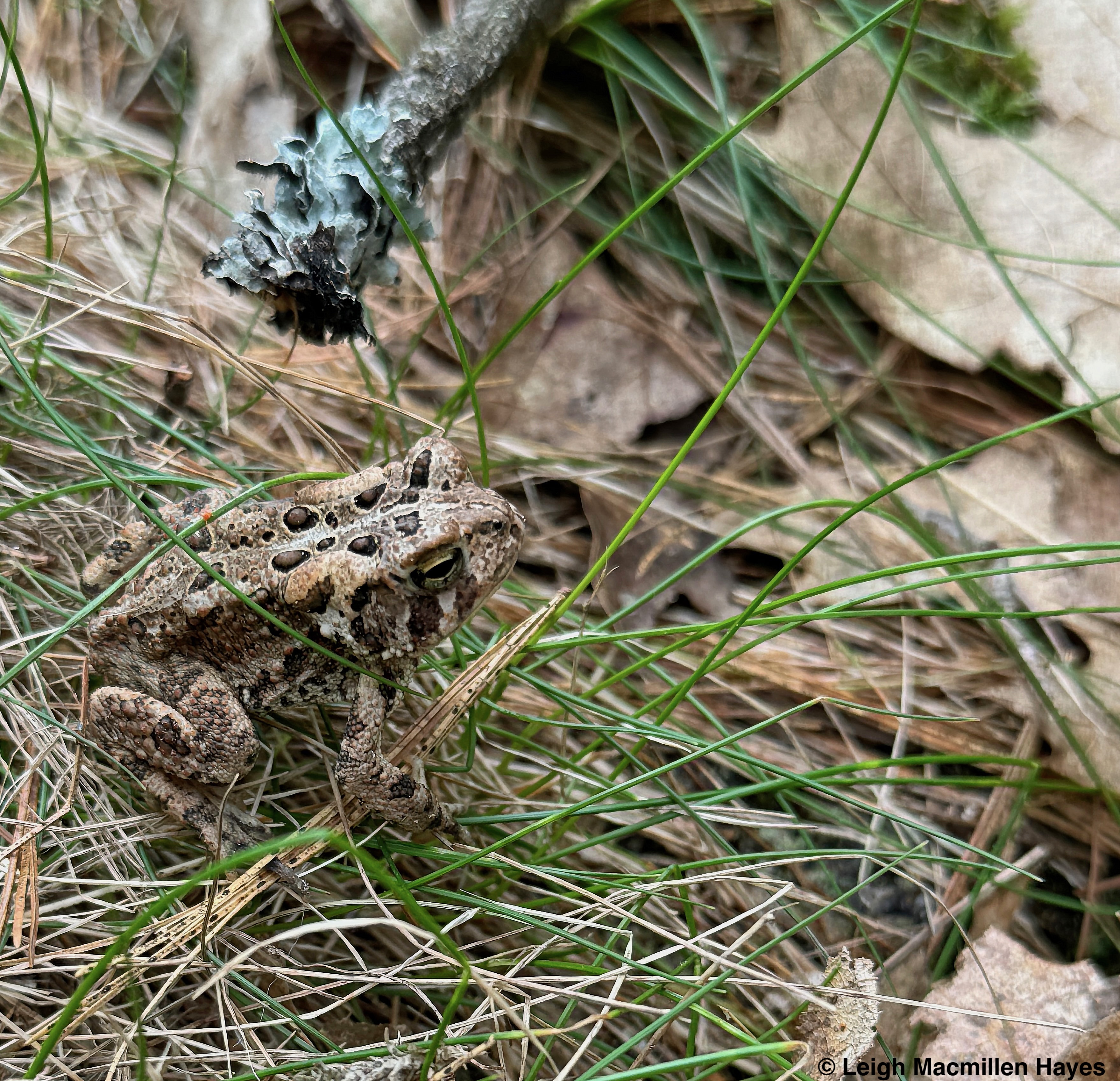
We spotted a few Painted Trilliums, and lots of Sessile-leafed Bellwort, and other flowers waiting to come, and a Chipmunk peeking out from a rocky ledge, and mosses, and lichens, and so much more, (oh, and a few Black Flies, but again, not bad in the scheme of things), but this was the first American Toad of the year for us. Toads can remain absolutely still, a smart adaptation as they blend into the scenery.

It’s about two miles to the summit, which isn’t all that high, but it’s the perfect quick hike (okay, remember who I was hiking with) for an afternoon. And at said summit, we stood for a few moments as we gazed upon the ridgeline of our hometown mountain–Pleasant by name.
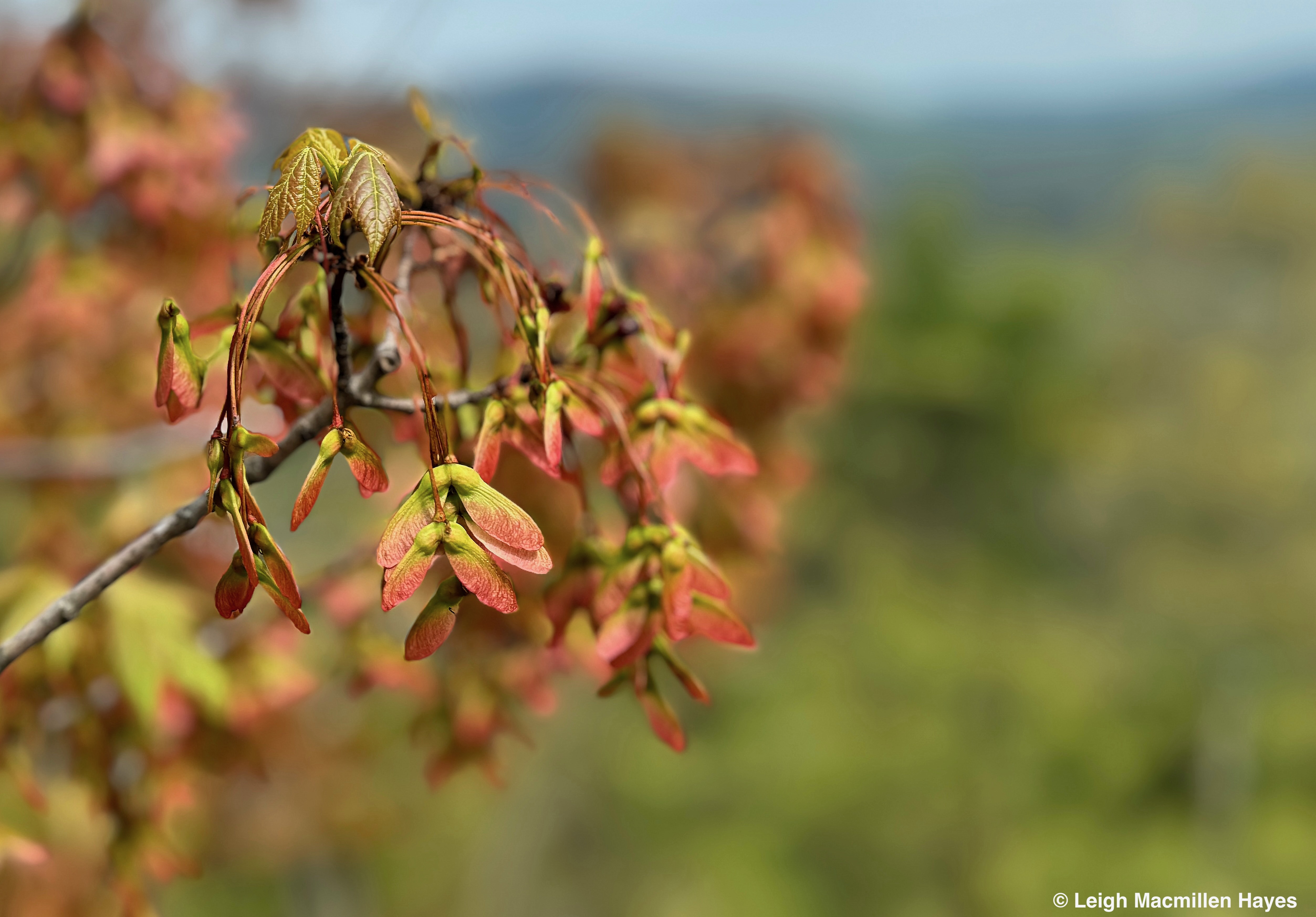
And at the summit, a Red Maple showed off its gifts to the future in the form of an abundance of samaras. Well, I see them as gifts. Given that we have an abundance of Sugar Maple seedlings growing in our yard doesn’t exactly thrill MG.

As we started to walk back along the trail, I spotted something we’d both missed on the way up. Wild Columbine. In flower. The. Most. Spectacular. Flower. That structure. Those colors.

And because we took a different path down, Striped Maple showed off its own set of flowers, limeade green in hue. I chuckled later when I commented on how the Beech leaves gave the trail such a summery look, and MG mentioned that he had even spotted toilet paper. It took me a second, during which I searched for a roll of white, before I realized he was referring to Nature’s Toilet Paper, for so large are the leaves of Striped Maples, and soft, and not poisonous, so you know they are safe to use. Not that we often encounter Poison Ivy in the woods, but it could happen.
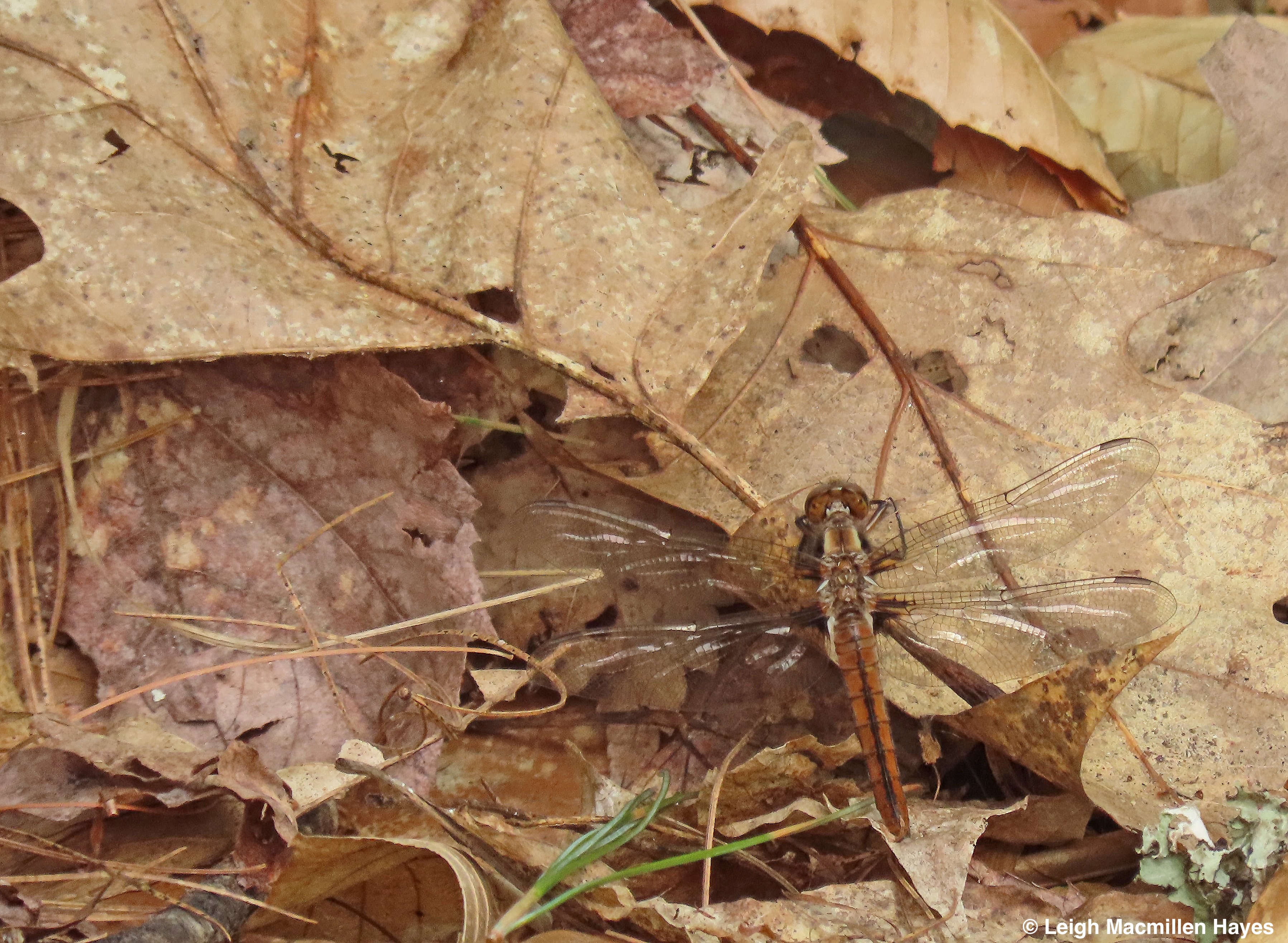
Back at the trailhead, the chickens weren’t there to congratulate us for a safe return, but we encountered probably the best finds of the day–several immature Chalk-fronted Skimmer Dragonflies. Let this next season begin.

Indeed, this was a day of firsts.

Odonata Chronicles: First Edition

Somehow the words my high school Spanish and Latin teacher, Mr. Cretella, wrote in my yearbook have always stayed with me: “Never lose your desire to learn.” Indeed. That said, in Latin 1 during my senior year, if I couldn’t remember the answer, I substituted a Spanish term. I don’t remember how he reacted to that–probably with a groan on the outside and a smile within.

And so, my friends, please join me as I continue to learn about Odonatas, aka dragonflies and damselflies , those winged insects we all love to celebrate because they eat those that bug us the most, including blackflies and mosquitoes. Hmmmm, what about ticks?

Periodically, over the course of the summer my intention is to share some information and/or story with you about these predatory fliers. I may not always be correct, but hey, that’s how I learn, and I hope you’ll wondermyway for the journey.

One distinction I want to make is that mature dragonflies always have their wings spread out whether in flight or perching, while damselfly wings are together over their backs when perching (except for the Spreadwing family of damsels).

With 468 North American Species of Odonates at this time (new discoveries are always being made), Maine is home to 160 species.

One thing I want to point out about dragonflies is that the abdomen consists of ten segments. That will become important for identification purposes.

I thought we’d begin with the dragonflies known as Skimmers.

Skimmers, like the Four-Spotted Skimmer above, are the most ubiquitous dragonflies and range in size from small to large. They tend to have stocky bodies and spend much of their time perching on the ground and other flat substrates near muddy ponds and stream.

Chalk-fronted Corporal Skimmers are active May through July.

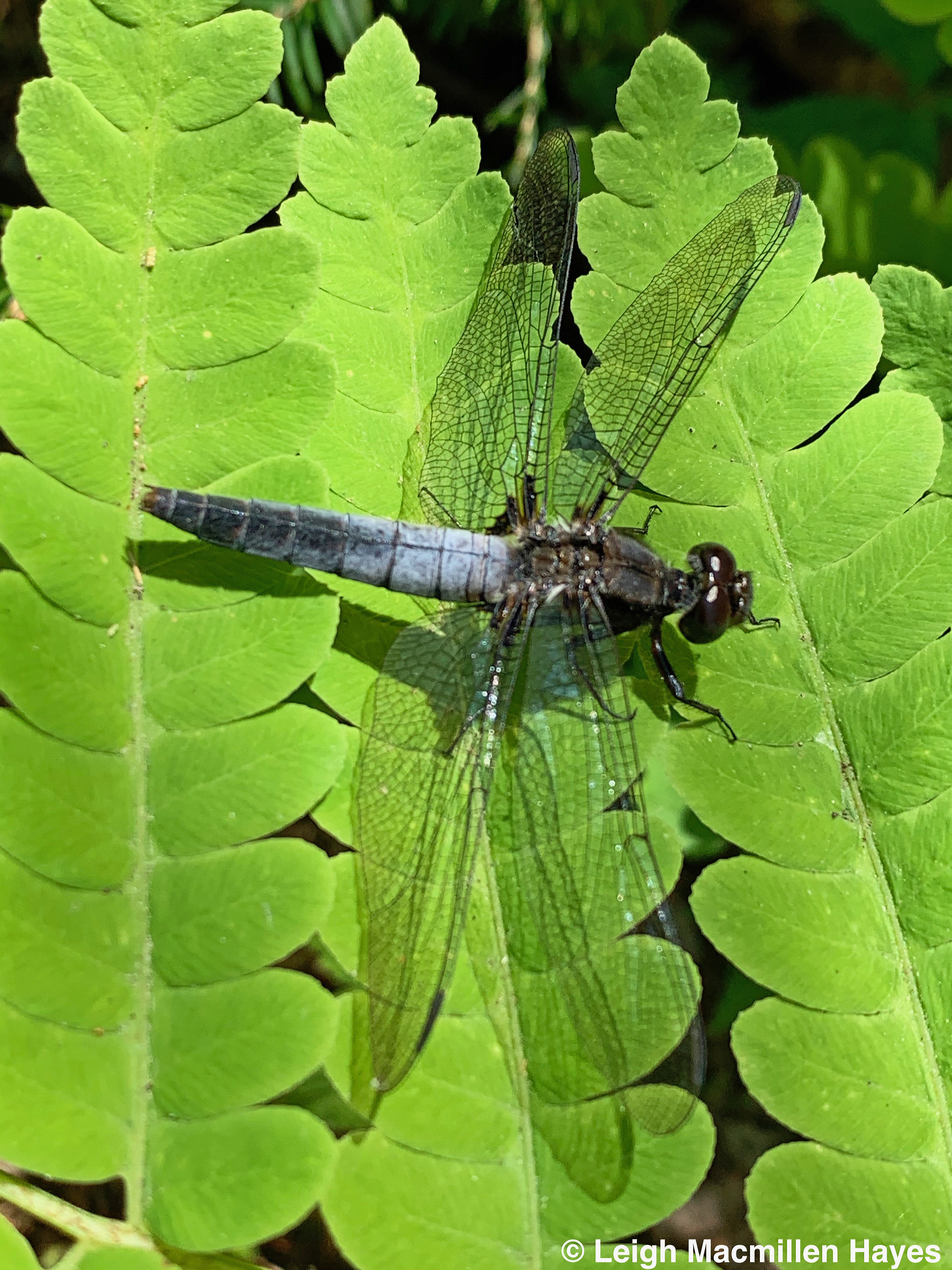
This chunky northern male skimmer has dark markings at the base of his otherwise clear wings. His hind wing patches are triangular, and the forewing patches are smaller or non-existent.

He has dark brown eyes and a black face. Notice the whitish/grayish/bluish stripes on his thorax–those are his “corporal” stripes.

The first half of abdomen is the same color and the rest of it is black.

Chalk-fronted Corporals tend to be in dense populations. Often, as I walk along a woodland path or beside a pond, these dragonflies lead the way, flying a few feet ahead, stopping on a rock or something else ahead of me and then as I approach, moving ahead again.

This baker’s dozen I spotted on a rock beside a small mountain pond.

The Female Chalk-fronted Corporal Skimmer’s eyes are brown and face tan. But where his thorax was whitish gray, her’s is brown. 

Her abdomen, however, is like his.

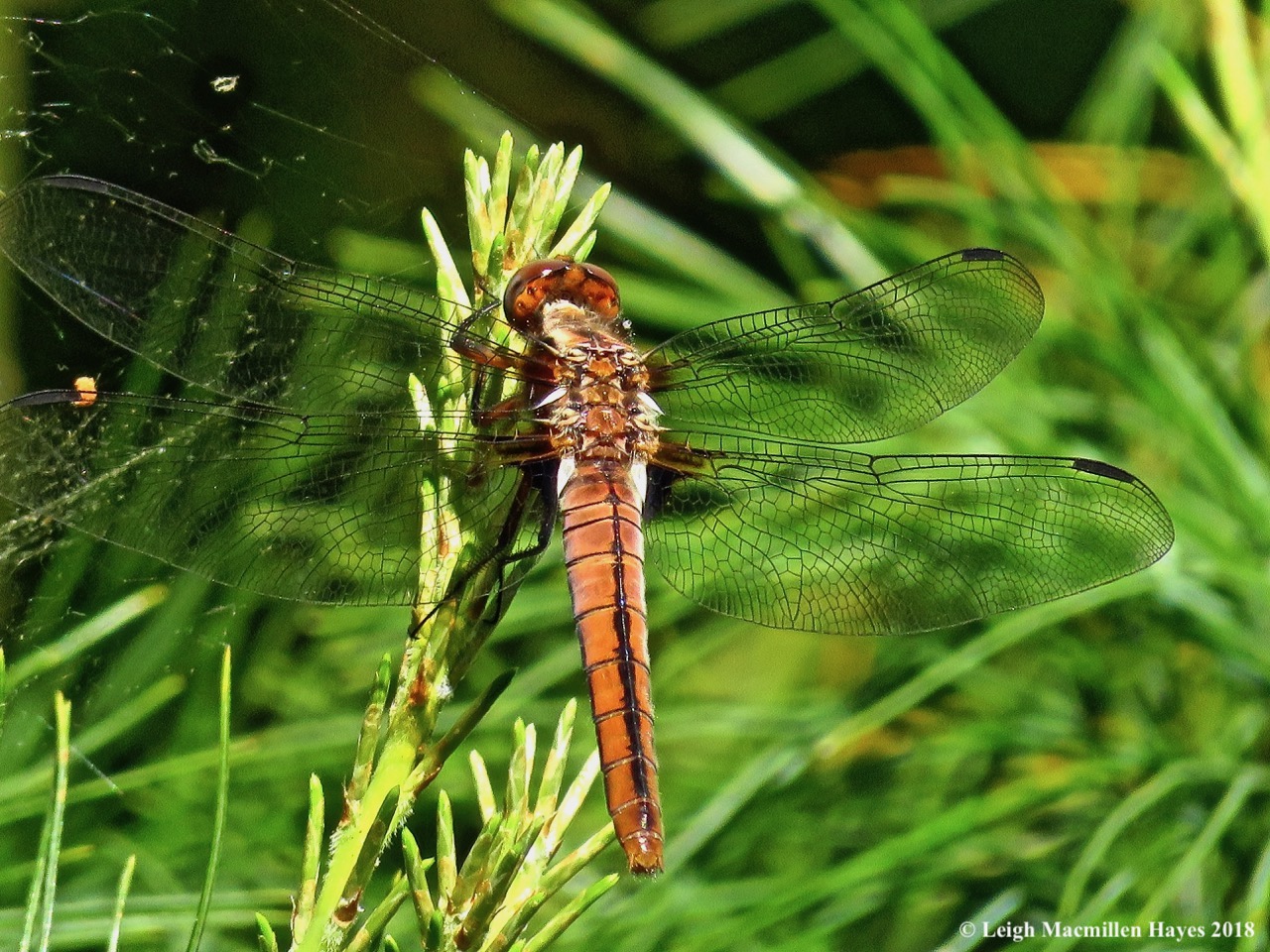
Would you have guess that this was an immature form of the same? Just when you thought you nailed the Chalk-fronted Corporals. The immature features a lovely orangey brown with a black strip down the middle. The immature stage last for about two weeks in any species.

Active June through August, Slaty Blue Skimmers are about two in length.

The mature male is entirely blue except for black face and brown eyes. I typically find them flying and perching beside lakes and ponds.

Notice how he doesn’t have the patches at the base of his wings like the Corporals did.

Like most species, the female Slaty Blue has a look all her own with a brown thorax highlighted with yellowish-tan stripes. Her abdomen has a dark brown to black stripe down the top with a yellowish-tan stripe along the sides. 

She’ll darken with age to a uniform brown or gray color and her eyes will become red-brown. Immature of both sexes resemble a young female, just to confuse you more.

Much smaller in size at about 1.2 inches as compared to a two-inch Slaty Blue are the Calico Pennants, active May through August.

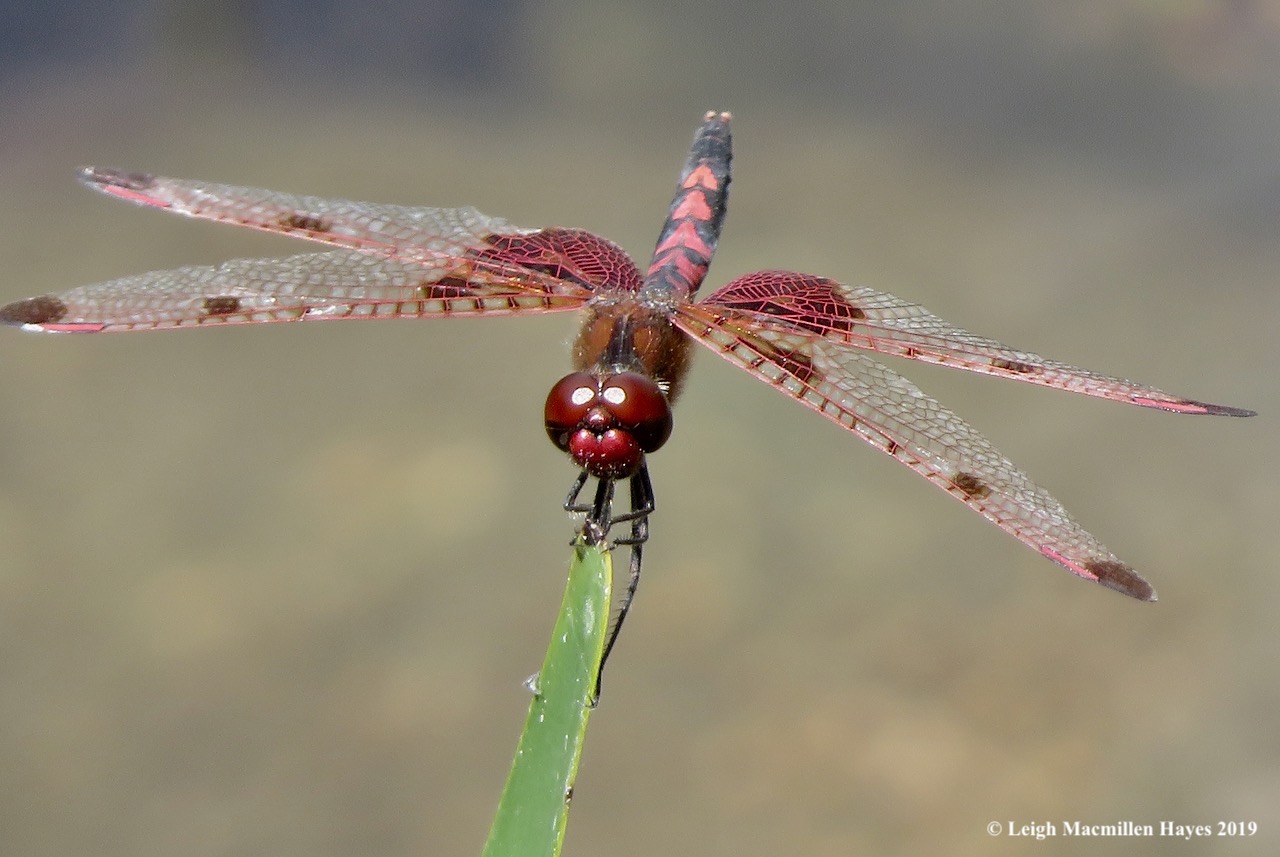
The male has red heart-shaped spots on abdomen segments 4 to 7 (remember, all dragonflies have 10 abdominal segments so you need to start at the base below the thorax and begin counting from there.)

All four wings have a small dark patch at the wing tips. And the hindwings have a large, mottled dark patch at the base which reminds me of stained glass.

The stigma, on the leading edge of each wing toward the wingtip, and the face are red. 

His claspers at the end of the abdomen are also reddish.

The female is the same as her male counterpart, but her spots and stigma are yellow. Again, it’s that stained glass effect that captures my attention.

From May through September you might spot an Eastern Pondhawk Skimmer near a lake or pond.

The entire thorax and abdomen of a Male Eastern Pondhawk Skimmer are powder blue; and his claspers at the tip of the abdomen are white.

Often found perching on lily pads, his face is green and eyes blue.

The female Eastern Pondhawk Skimmer is bright green with black markings. Her green thorax is unstriped.

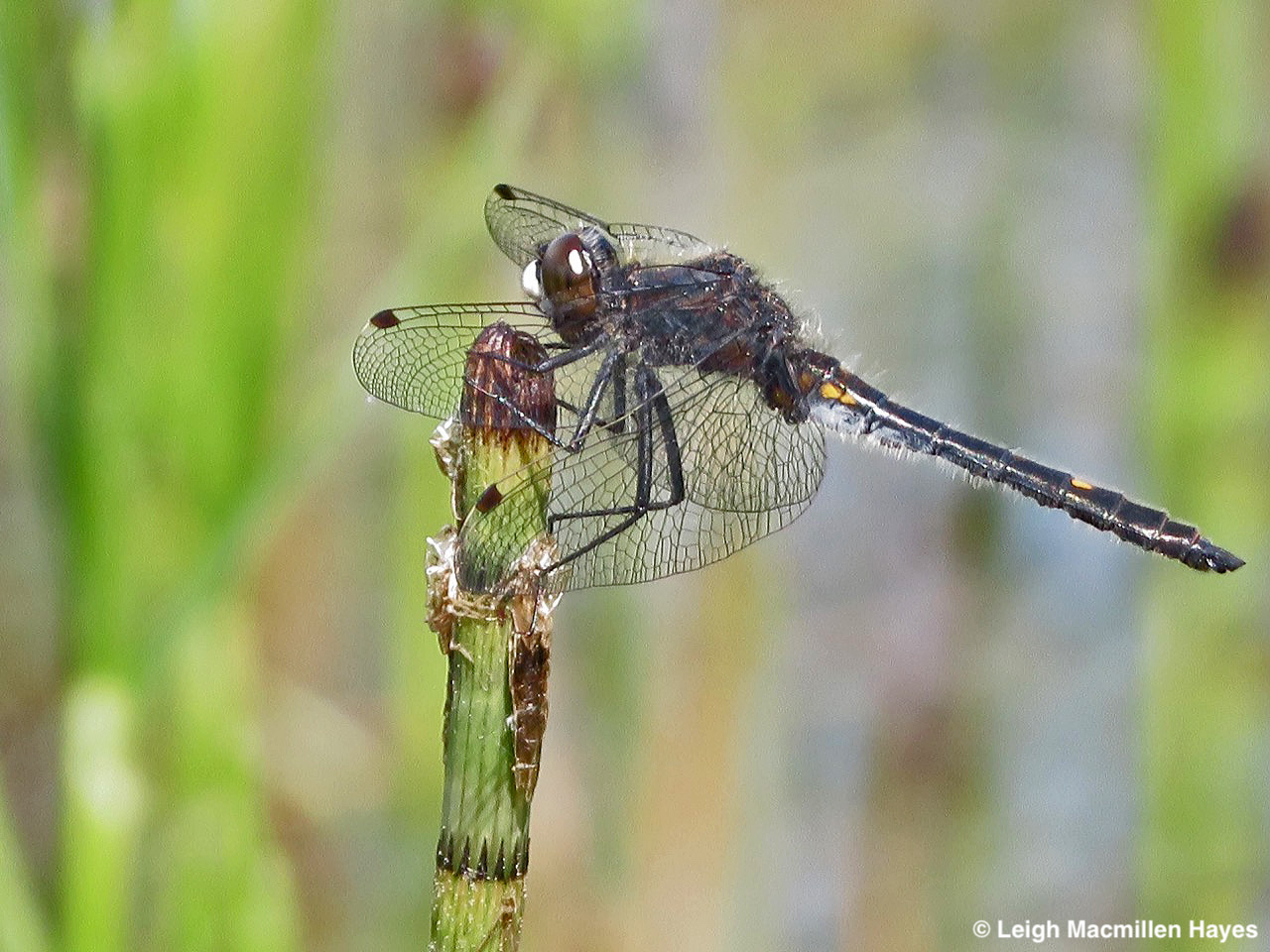
In flight from May through August, the Dot-tailed Whiteface male is an easy one to identify in the field. First, there’s that white face. But wait. Some other dragonflies also have white faces, so don’t stop there. While his eyes are brown, his body is black overall, but he has a conspicuous yellow spot on segment 7.

You might not recognize his mate as being a Dot-tailed because, well, she has lots of dots. Her abdomen is yellow at the base and then large dots on segments 3 through 6, with a smaller one on segment 7. She also has along the sides of her abdomen.

There are more to share just in the Skimmer family, but for the first edition of Odonata Chronicles, we’ll leave it at that. Five species with so much variation is a lot to digest.

Hunting the Common

I knew when I headed out this morning that there was one member of the Odonata family that I wanted to meet. But . . . where oh where to find her.

Her habitat includes muddy-bottomed ponds, lakes, and streams, as well as disturbed areas. Hmmm. That should make the quest easy.

With that in mind, I first stopped beside a muddy-bottomed pond that flows into a brook, which at its start more resembles a stream. It is there that Slaty Blue Skimmer and I got reacquainted after so many months have passed since our last encounter.

He reminds me that dragonflies belong to the suborder Anisoptera, which means “different wings” since their hindwing differ in size and shape from the forewings. Those differences may be subtle, but they are there.

How common are you? Very, but not the one you seek.

As I watched Slaty Blue come and go, defending his piece of the shoreline from his family members, I suddenly spied something under the Winterberry leaves: a newly emerged skimmer resting while its wings dried.

And then one shrub over a Racket-tailed Emerald, with neon green eyes paused longer than I expected. (This one is for you, Kate Mansfield Griffith–it doesn’t have the full green body of the Eastern Pondhawk that walked down your Connecticut driveway today, but the eyes were a good match of color, don’t you think?)

How common are you? Very, but not the one you seek.

Upon a Pickerel Weed in the water I notice a favorite of mine, this one also recently emerged and drying its wings before taking flight: a female Calico Pennant Skimmer. For some who have been watching, you’ll be happy to know that there were males about, but they were busy and didn’t wish to pose for a photo shoot.

How common are you? Very, but not the one you seek.

Old friends, like Kate who was one of my first playmates and even if we can’t spend time together we can still share moments of wonder like we did as kids, make themselves known such as this male Chalk-fronted Corporal. I’ve described it before as being kid-like in behavior because its kind love to play leap frog and land three feet ahead of me with each step I take.

How common are you? Very, but not the one you seek.

I soon leave the pond behind and find myself walking with intention along a woodland pathway and into an old log landing located near another brook. Guess who greets me? Yes, another Chalk-fronted Corporal, this one a female.

How common are you? Very, but not the one you seek.

As I continue to look, one with whom I struck up a conversation last summer flew in and snatched a moth before settleing on leaves to partake of the meal. Meet my friend: Black Shouldered Spinyleg, a clubtail so named for its black shoulders and spiny hind legs.

How common are you? Very, but not the one you seek.

Next, a Spangled Skimmer with black and white stigma on its wings took me by surprise and I vowed to remember it for no other has the dual-colored stigmas.

How common are you? Very, but not the one you seek.

In the shadows I spotted another I’m getting to know this year, the Four-spotted Skimmer. This dragonfly was stunning, but I found it amusing that its common name refers to tiny spots when so much more could have been honed in upon for a descriptor.

How common are you? Very, but not the one you seek.

I was about ready to head for the hills when another dragonfly caught my attention. Okay, so that’s a bit of an understatement as so many more than I’ve shared made themselves known to me and I stood still and watched how they moved, where they rested, and how big their territory was.

How common are you? Very, and I AM the one you seek.

I wanted to find this female Common Whitetail Skimmer because she hardly seemed like an every-day dragonfly to me. Those zigzag stripes on her abdomen. The way each segment stood out more 3-D than most. And those three black patches upon each wing. Words fail to describe her beauty.

How common are you? Very and yet . . . not at all.

I set out to hunt for the common and along the way I met others equally common, but in the end the one I sought was hardly common at all . . . despite her common name.