The May Flower Whisperer

In rain or shine, as May gives way toward June, My Guy and I set off to hike a few local trails.

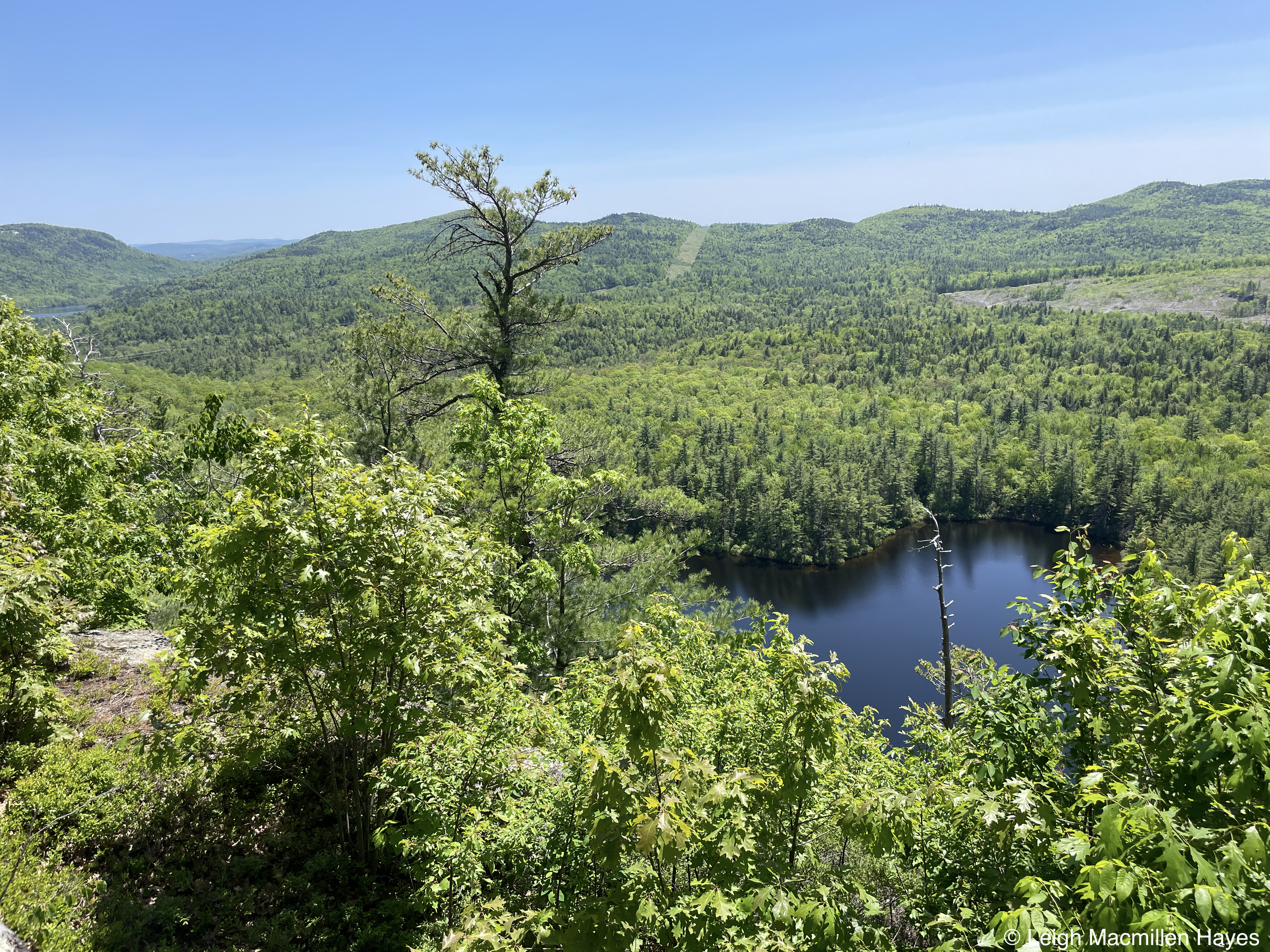
It’s not whether we have a view . . .

or not . . .

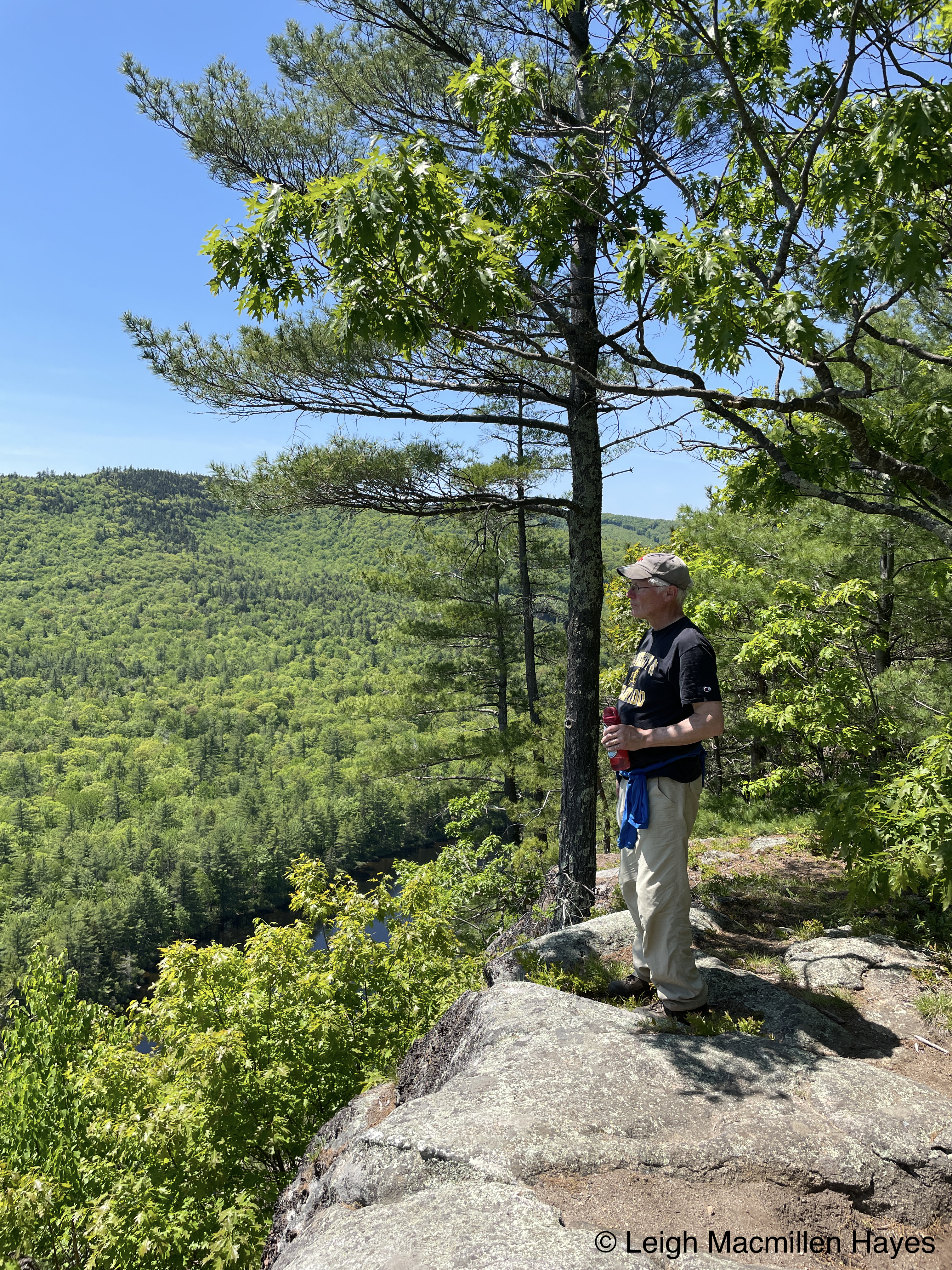
or if we have to stand beside lunch rock rather than sit (well, he sat, I didn’t) . . .

or even the challenges the trail chooses to offer, like crossing a well-mudded beaver dam that is rather tricky . . .

and spying the well-mudded lodge where the local residents were probably relaxing after a long night’s work,

but rather, the sights at our feet that drew our attention, such as the Black Chokeberries pink anthers and delicate petals enhanced by raindrops.

Scrambled-egg Slime Mold (aka Dog-vomit Slime Mold) showed off its intricate structure that looked more like a bunch of worms swarming together upon a decaying log.
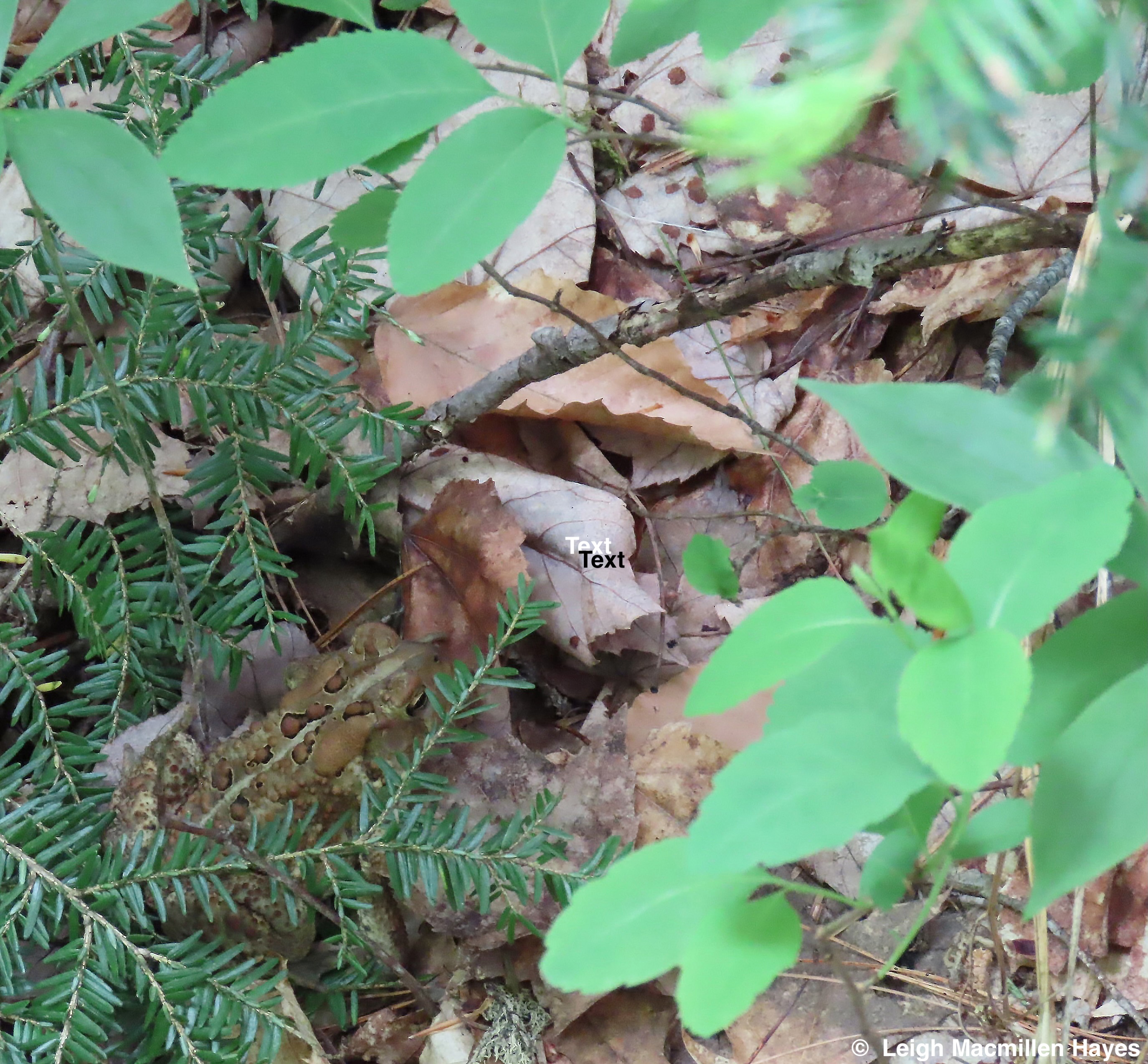
Because we were always looking down, an American Toad, so certain it was invisible for so camouflaged was it, wasn’t. Invisible that is.
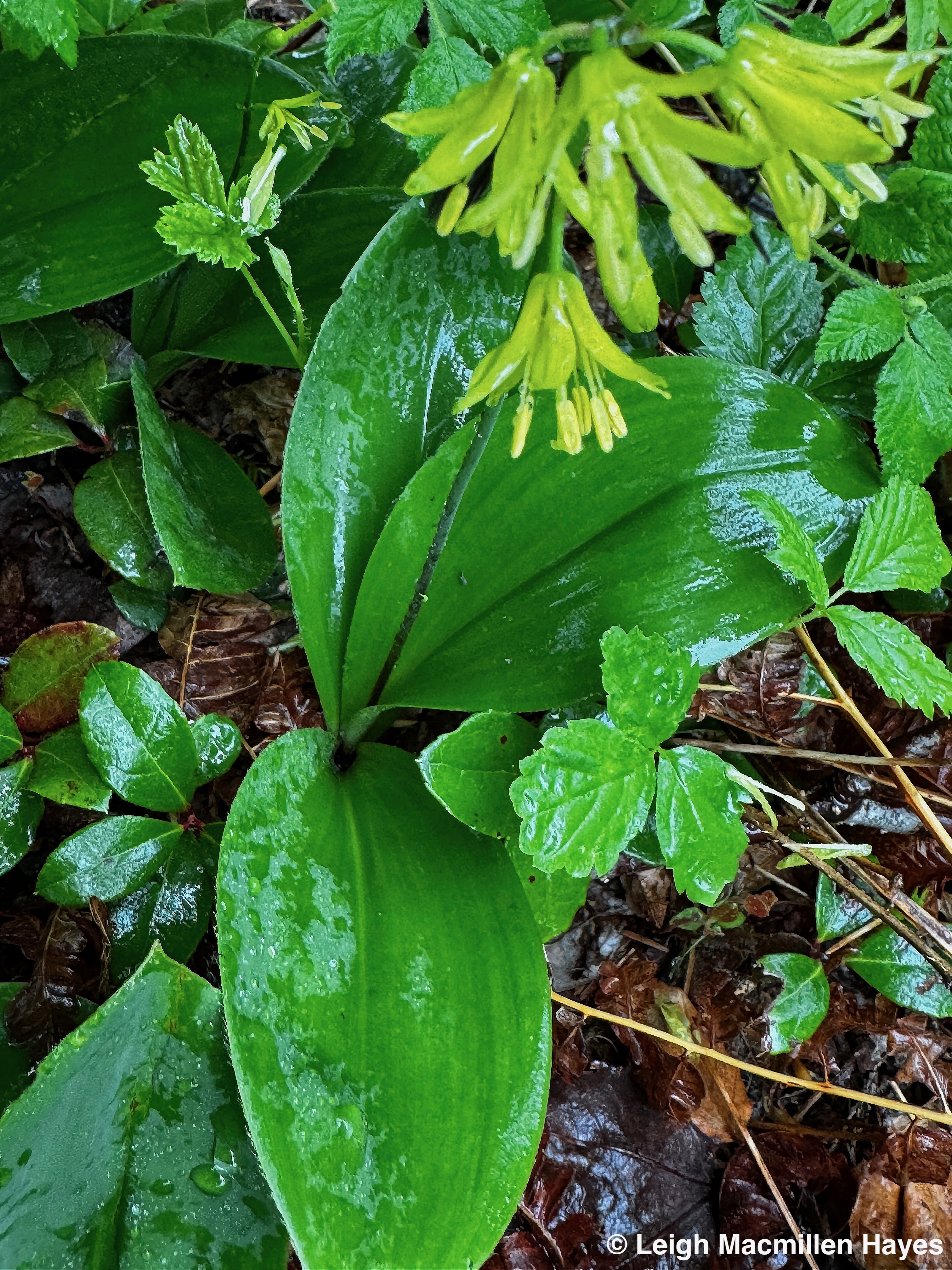
Plentiful were the Blue Bead Lilies, with their anthers hanging long awaiting pollination before rising in fruit forms that will soon look like . . . blue beads.
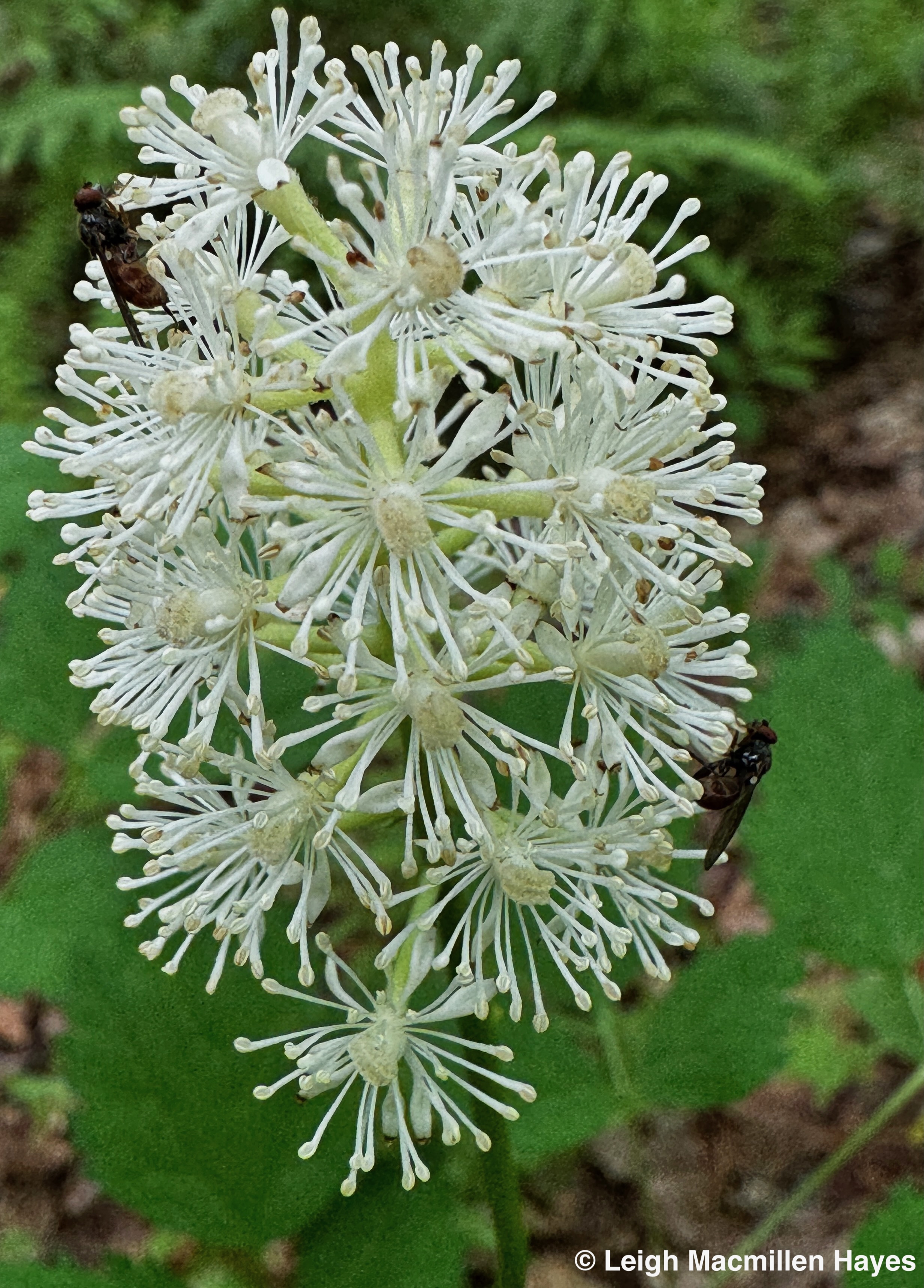
In several spots along one of the trails, White Baneberry, aka Doll’s Eye, so named because its fruit form resembles such, showed of its firework display and the insects were attracted.

And a carpet of Bunchberries, those with six leaves rather than four, asked that their floral displays be acknowledged.

Not to be overlooked, Wild Geranium’s runway lines upon each petal functioned as the nectar guides they were intended and the pollinators rejoiced.

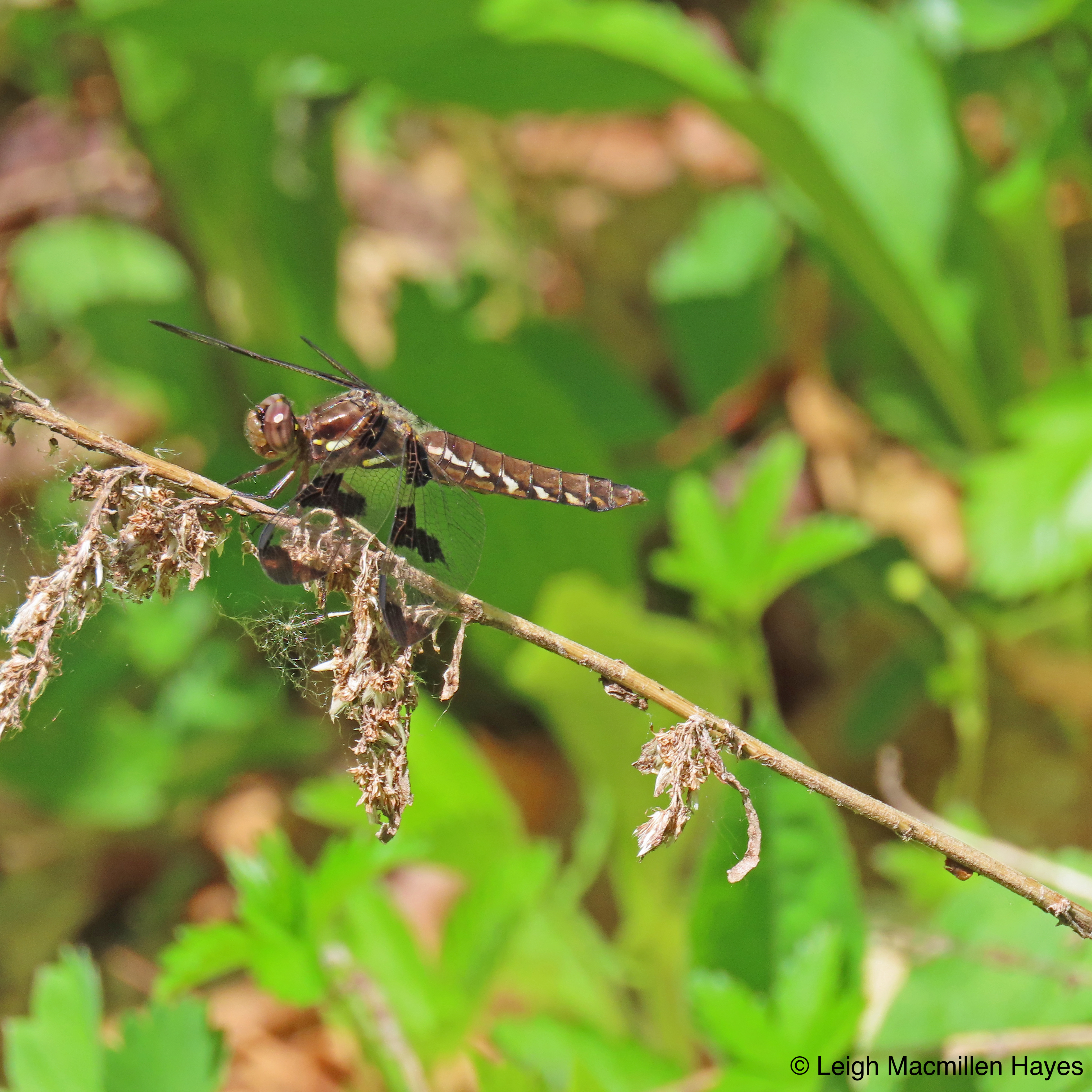
I, too, rejoiced, for on the first rainy day, May 27, 2024, the trail we hiked, which is known by locals for its mosquito population, wasn’t at all buggy; but on our May 30, 2024, hike, our faces were constantly buzzed, though nary a bite, making me think they were all males. We kept an eye out for dragonflies and finally made their acquaintance, including with this Common Whitetail Skimmer, that hardly looked common.

The real reason, however, for our hikes this week was greed. Yes. Greed. You may know My Guy suffers from Blueberry Greed in the summer, but spring brings out another type and he takes on the mission to locate and count Lady’s-slippers. And he always wants more.

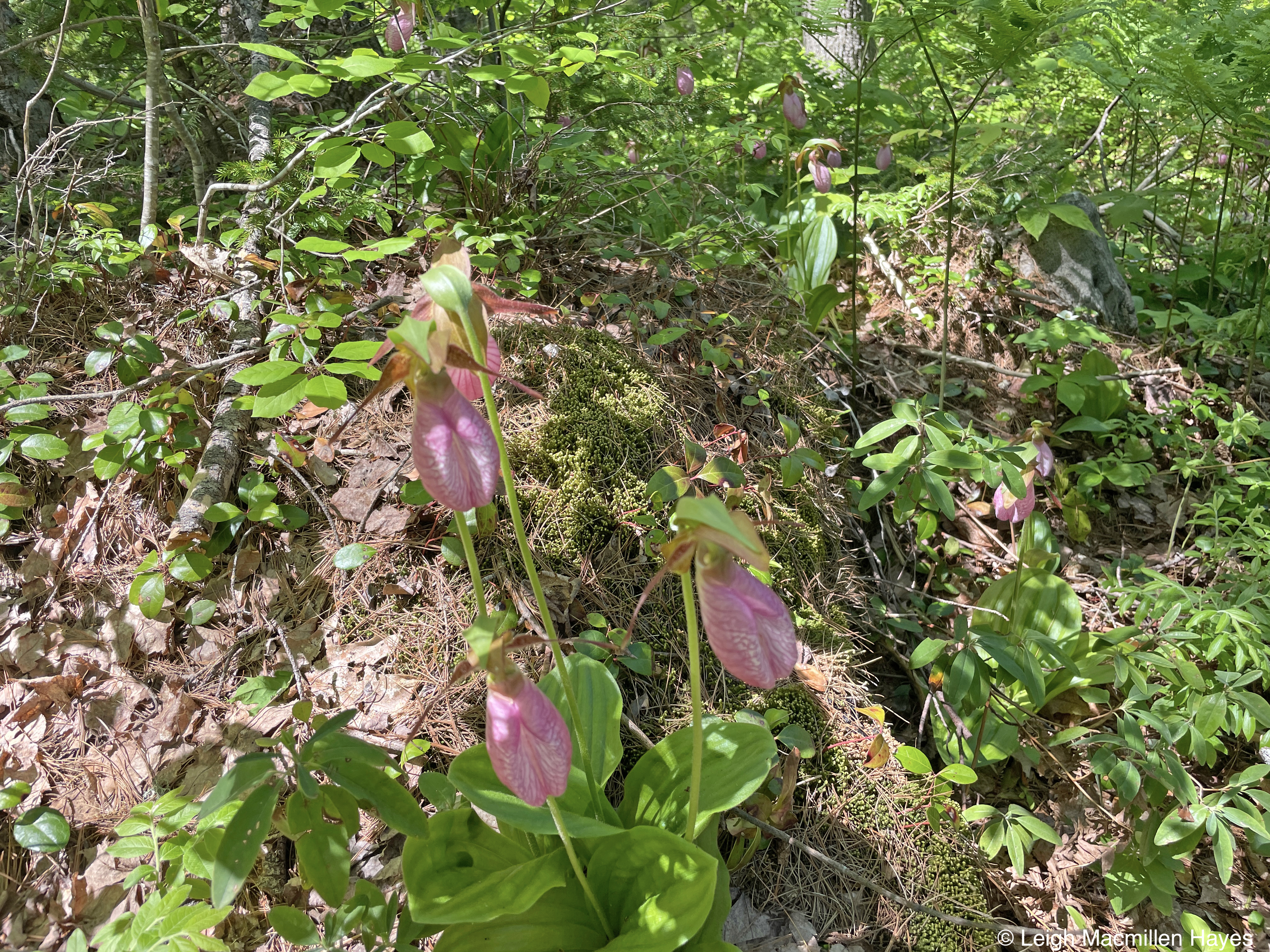
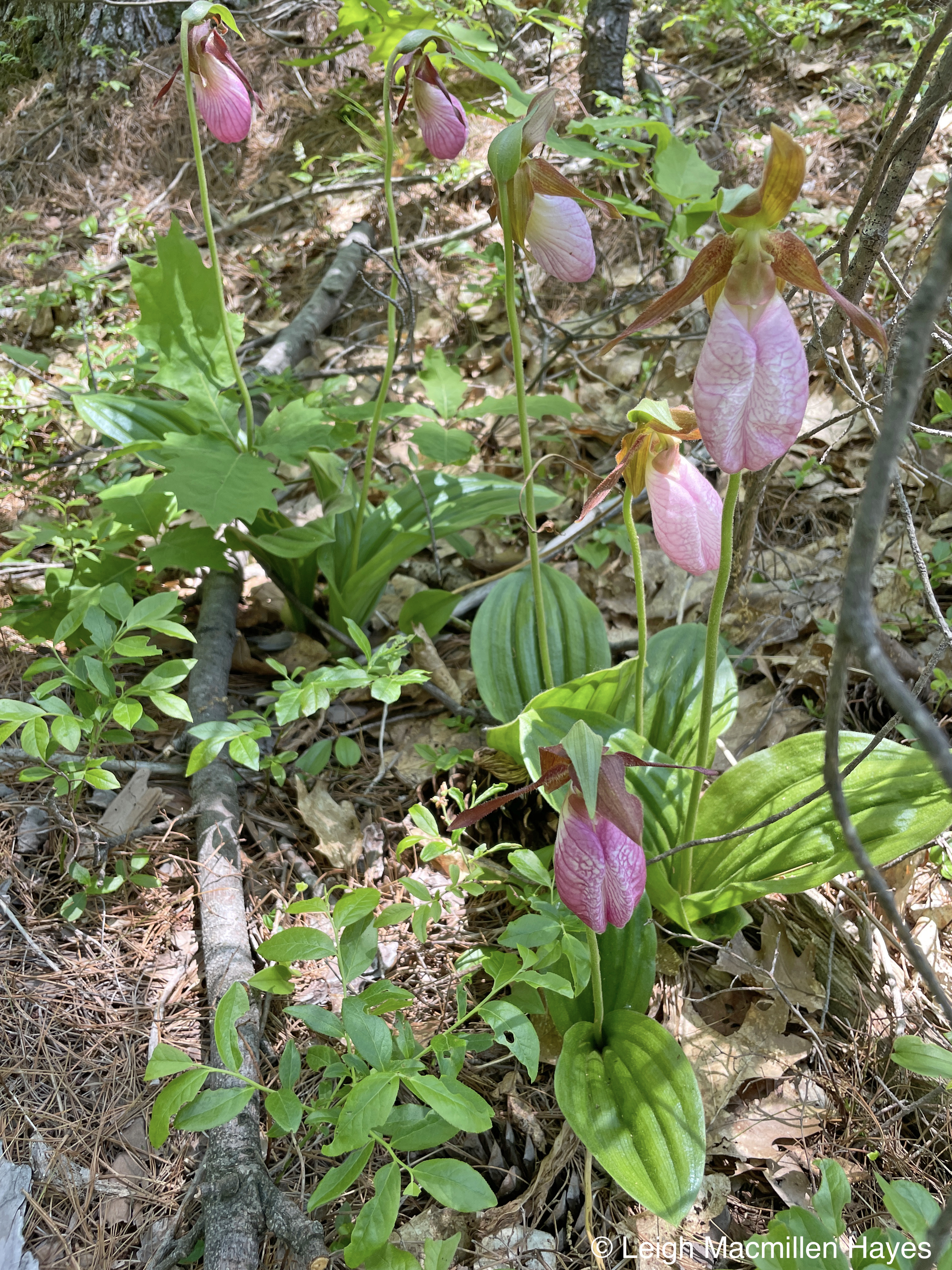
It may sound like an easy task because some are proud to stand straight and tall and can be seen easily from the trail.

But some, like the American Toad, like to hide. We, however, are persistent in our survey.

We found pinks of many hues, and their white variants.
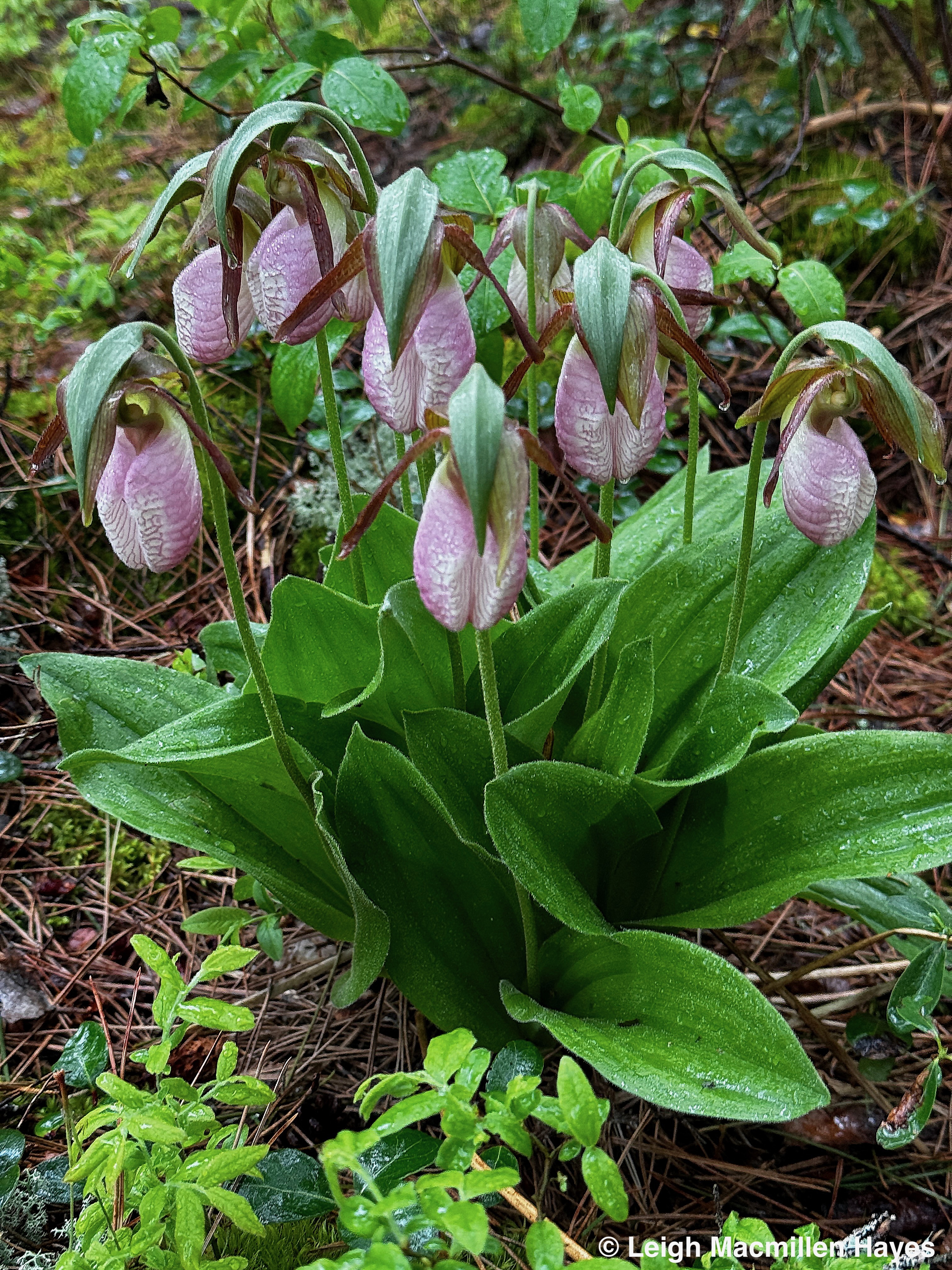
And no spring feels right without a visit to My Guy’s favorite bouquet.

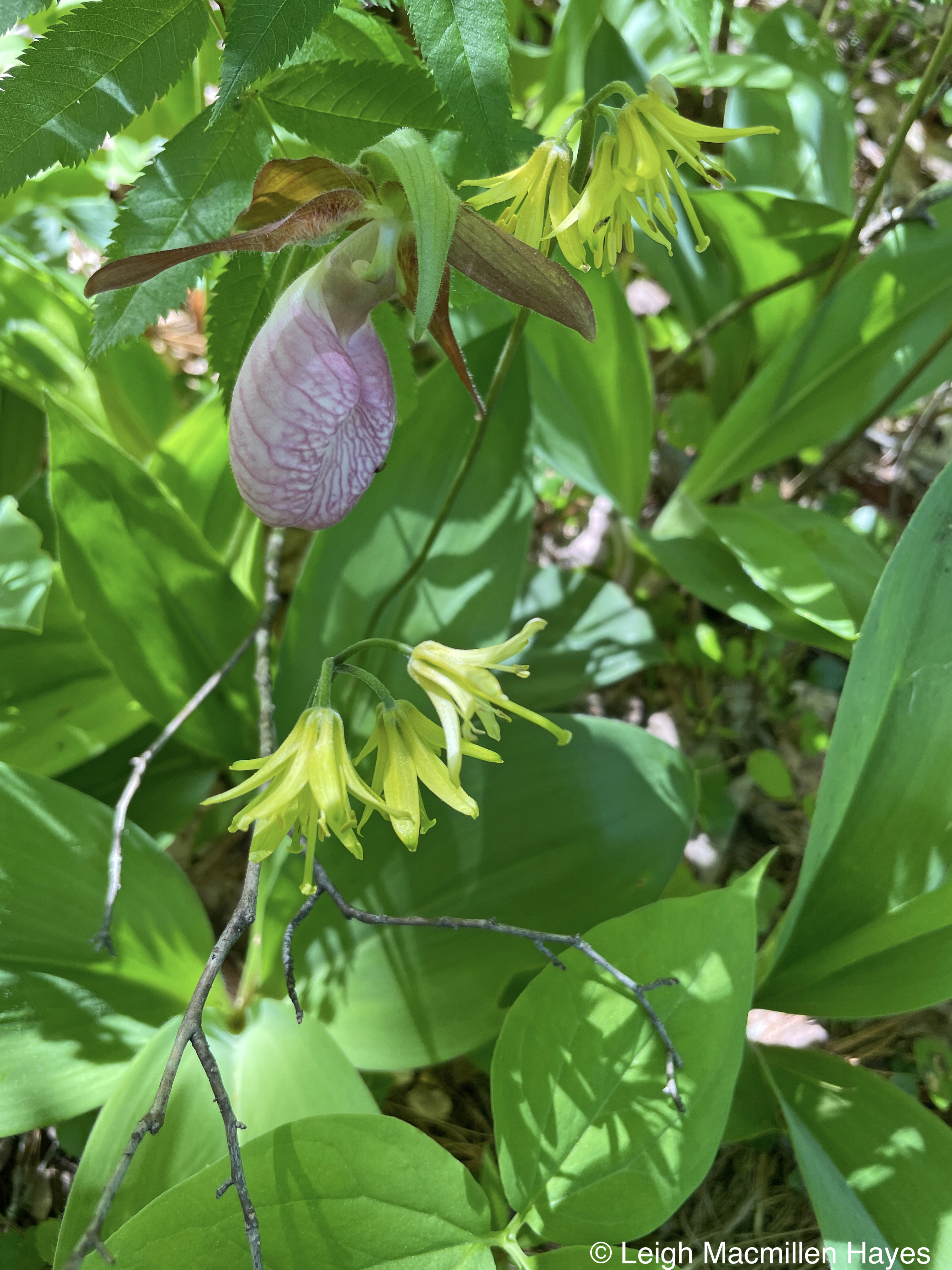
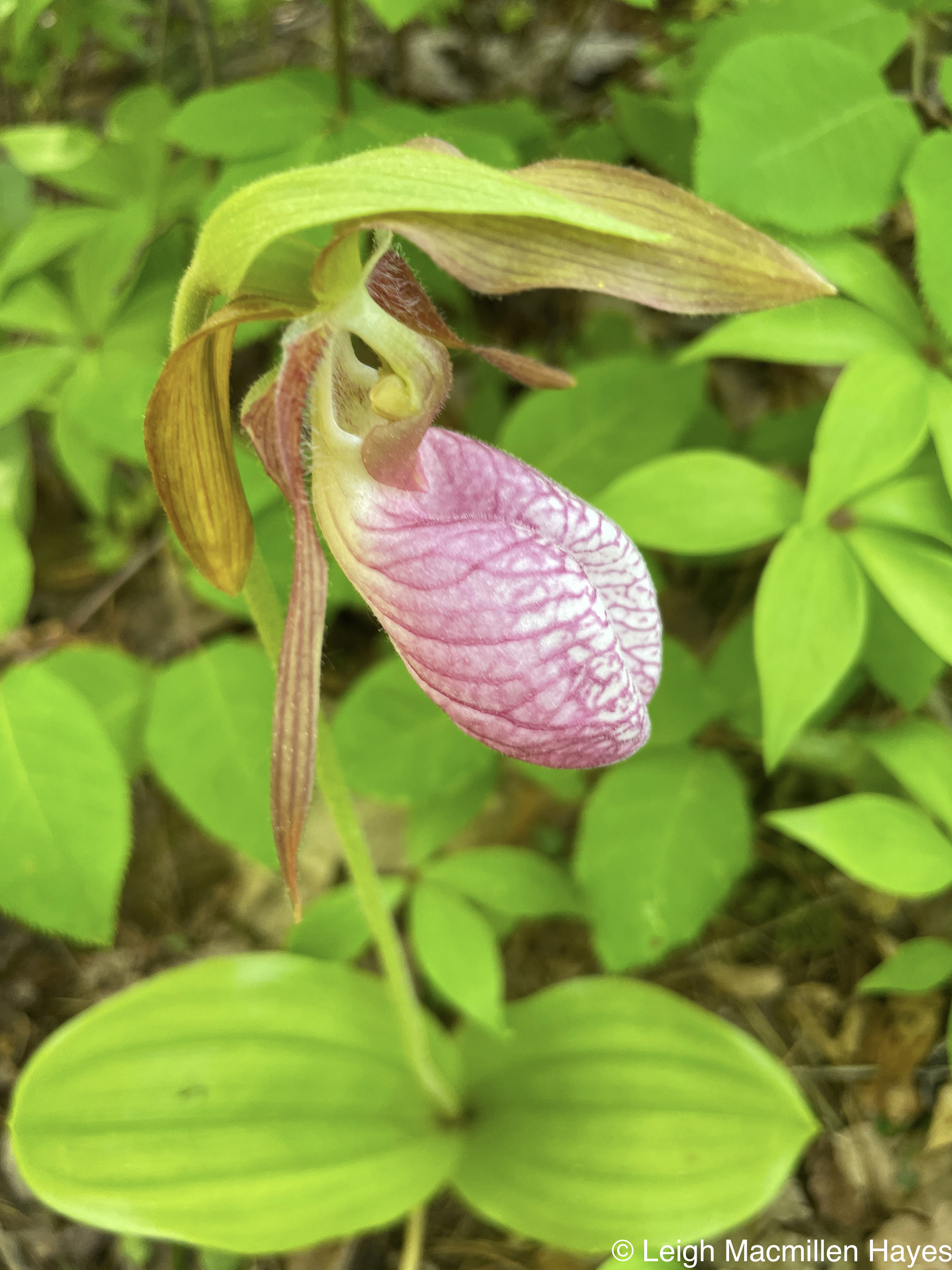
Lady’s-slipper pollination is a curious thing. Bees are lured in by the guide lines to a slit in the front petal, the slipper-like pouch, or flower’s labellum. Once inside, the bee cannot exit the way it entered because the petal structure turns inward.

The exit is at the top of the slipper, but to reach it, the bee must move through a hairy interior and rub against the flower’s stigma, depositing any pollen it may have carried in and brushing against the pollen mass called the pollenia before flying out.

Some bees get frustrated with the dilemma of discovering there is no nectar and the task of finding the exit and instead chew their way out, which seems to be what happened to this flower.

One flower in all that we found, did present as if it had been pollinated, for rather than the downward pose, the slipper was almost parallel to the ground and beginning to deflate.

Twice we came upon last year’s capsule, which is a rare treat for so few are actually pollinated because the bees learn not to bother. Fortunately, one woody capsule contains thousands upon thousands of seeds, which are released when the woody structure splits its seams.

Near the end of yesterday’s hike, the sun finally brightened the sky and forest, and we weren’t the only ones to enjoy it for a gartersnake basked beside the trail and helped us spot another flower to add to our count.

And on Monday’s hike we had another special sighting: an Ovenbird’s nest that I spotted because I saw the parent fly up through vegetation beside the trail as we approached.

We covered a lot of miles, hiked slower than My Guy’s normal pace, and kept reminding ourselves of the numbers so we didn’t lose track, but rain and mosquitoes didn’t hold us back.

Lady’s-slippers have a symbiotic relationship with fungi. A fungus helps break the seed and allows it to obtain nutrients and energy from organic matter in the soil, while the plant, once established, gives nutrients back through its roots. It takes anywhere from 3 – 7 years for the seed to develop underground and then may take another ten years of presenting as two pleated leaves, before a flower is produced. That means that by the time it first flowers, the plant might be 17 years old. So please, please, please, enjoy them the way we do. In their natural state.

Our count (which include last week’s visit to Wolfe’s Neck Woods State Park):

Wolfe's Neck
2022: 411
2023: 324
2024: 475

Albany Mountain
2020: 150
2021: 47
2022: 266
2023: 274
2024: 364

Overset Mountain and Sanborn River Trail:
2022: 286
2023: 351
2024: 598!!!!!!!!!! (You know who wanted to make it to 600, but came up just shy)

Grand Total this year: 1,437.

I'm not sure we are done and I know everyone is seeing them everywhere, which is a glorious thing. Now I'm wondering if all of last year's rain showers meant more fungi for My Guy's May Flowers.
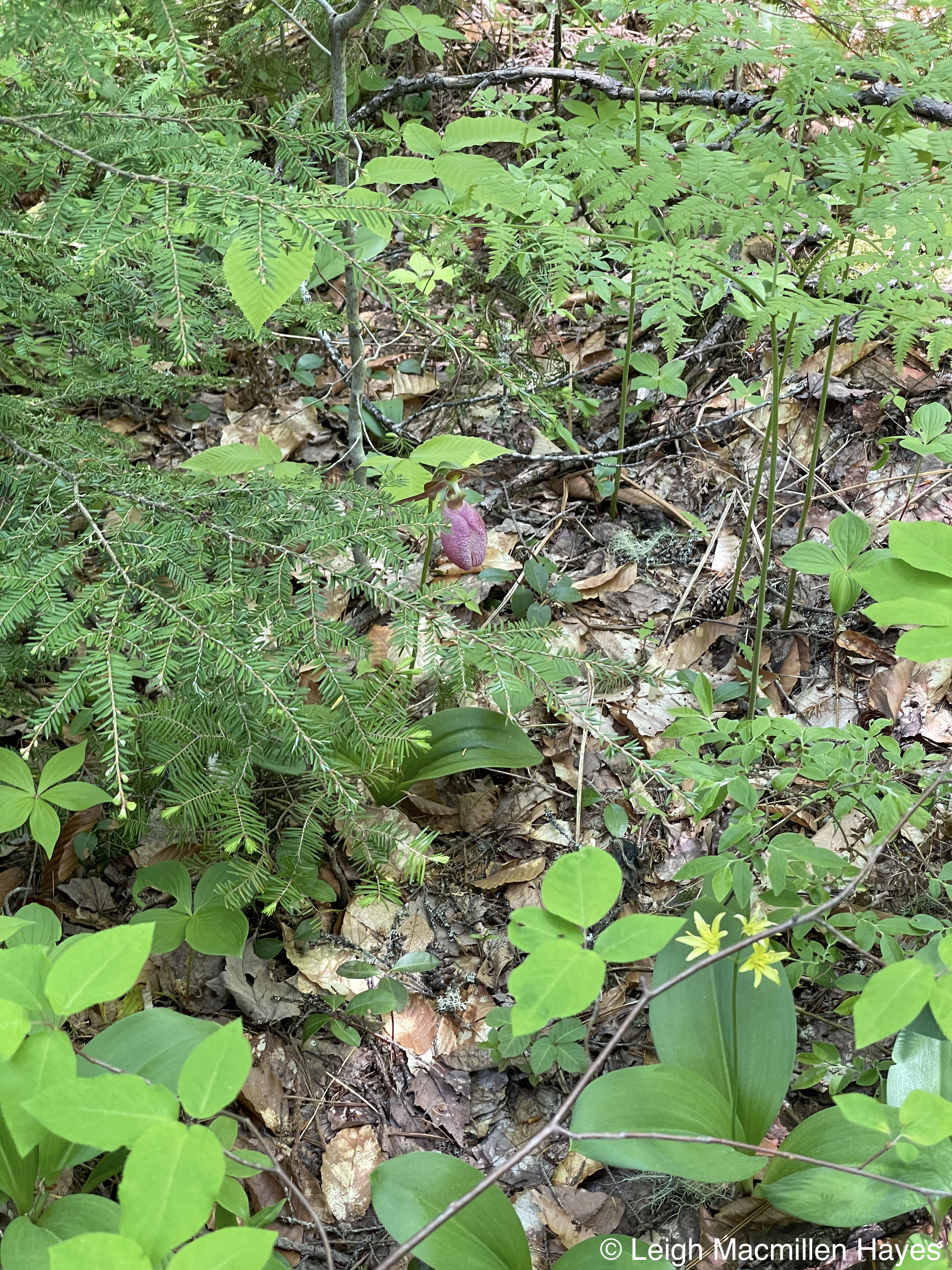
Honoring the Lady’s Slippers

It’s become a tradition for us to spend Memorial Day or at least a day during this weekend searching for one of My Guy’s favorite blooms. I don’t even remember how the count began, but now he cannot not count them.

What we’ve learned over the years is that they like a variety of habitats. from dark forests to bogs, and even mountain tops. And they like to hide. So we must really don our Lady’s Slipper eyes (just as I’ve been donning my dragonfly eyes lately) and look for them.

I mean . . . really hide.

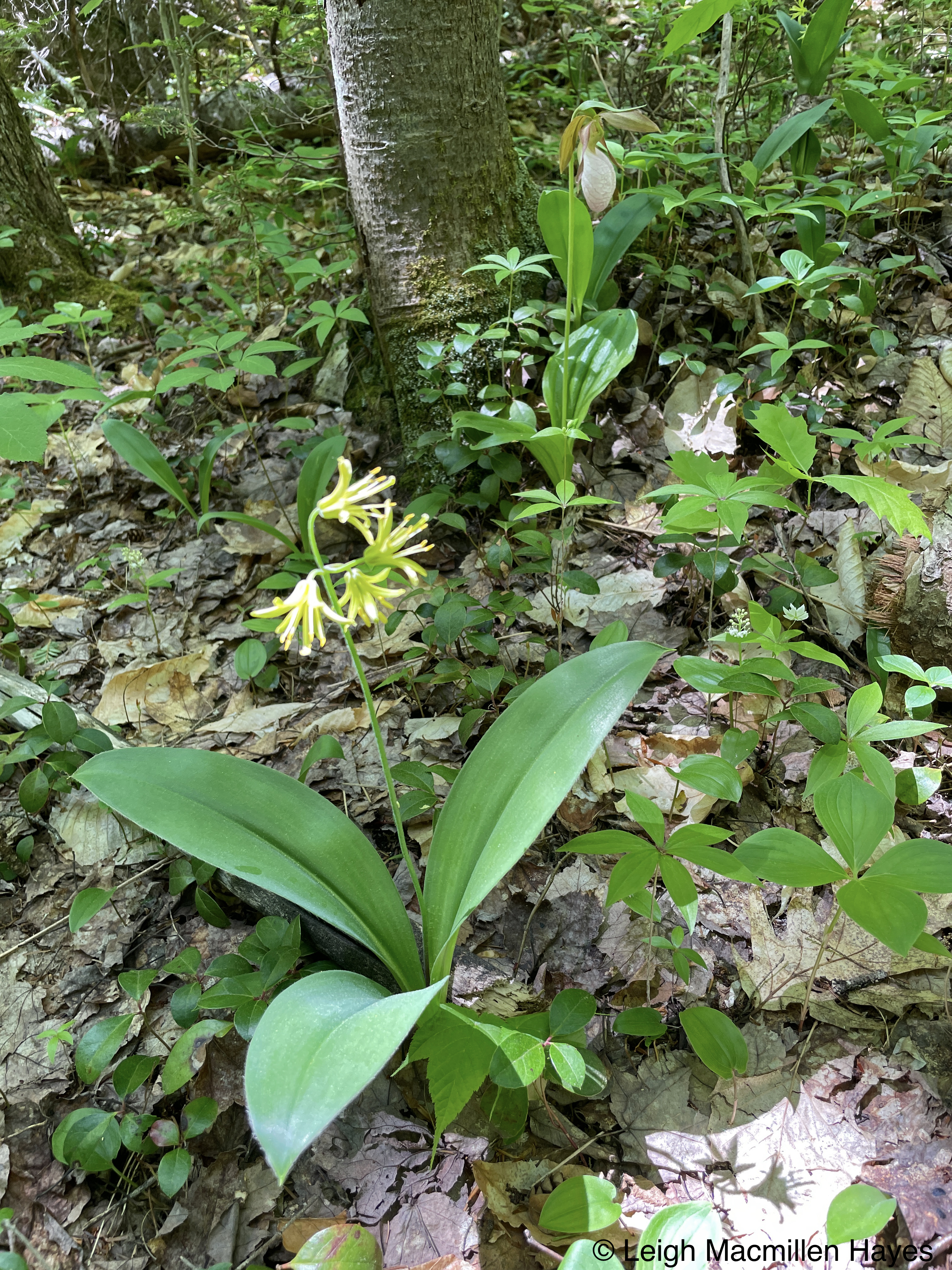
It’s acidic soil that they are rather fond of, just like Yellow Clintonia, the beacons of many a forest trail. But while Clintonia seems to bloom anywhere and everywhere, Lady’s Slipper need Rhizoctonia fungi in order to grow and show off a blossom. According to Jack Sanders, author of The Secrets of Wildflowers, “Unlike most seeds, the minute and dustlike Lady’s Slipper seeds contain no food to allow them to grow. However, the outside of the seed is susceptible to attack by Rhizoctonia fungi, which digest the outer cells. If things balance out just right, the inner cells escape digestion and absorb some of the nutrients the fungus obtained from the soil. Not until this happens can the seed germinate and begin growing . . . The symbiosis with the fungus doesn’t end there. In order for the infant corm (or ‘proto-corm’) to obtain minerals and other soil foods, it must use the ‘go-between’ services of Rhizoctonia fungi. The fungi, in turn, take from the seedling Lady’s Slipper foods that are photosynthetically manufactured. These sensitive and complex relationships make native orchids of all kinds relatively uncommon . . . What’s more, in the wild, it takes from 10 to 17 years for a Lady’s Slipper seed to become a mature plant capable of blooming.

So here’s the thing. Yellow Clintonia and Pink Lady’s Slipper flowers look nothing alike. But their leaves–that’s a different story and when there are no flowers to confirm, one like me, must slow down and notice the features. Do you see what I mean? Clintonias are members of the Lily Family, with six lily-like tepals (segment of the outer whorl in a flower that has no differentiation between petals and sepals). And their leaves can be folded in half with the inner vein forming the fold line.

Lady’s Slippers, on the other hand, are orchids. The flower is a moccasin-shaped, inflated pouch, but also two lateral petals that twist outward. And the leaves–take a look. Remember folding paper in an accordion-like manner to create fans, or tissue paper to create flowers? That’s what Lady’s Slipper leaves look like to me. Multiple pleats.

Lest you think nature didn’t distract us, there was a male swallowtail puddling in a wet seep that we had to pause and admire.

And we certainly didn’t want Indian Cucumber Root, in the same lily subfamily as Clintonia, to think we were ignoring it for it has just begun to offer its unique flower to the world.

But our real focus, of course, were the slippers, even those decorated in white, which is a form of the pink.

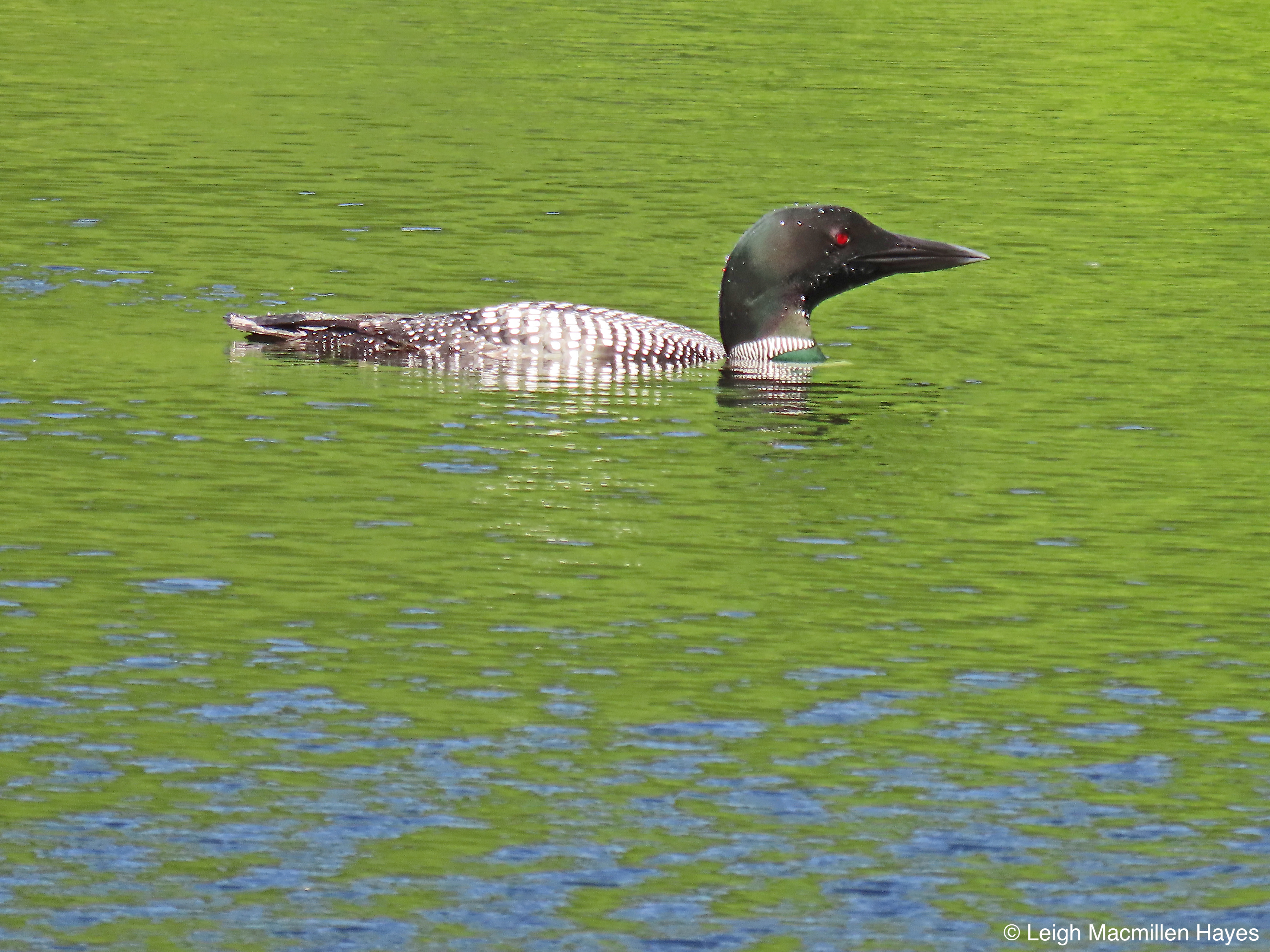
Until, that is, the Common Loons begged to be noticed and so we did.

A few miles into the hike, we reached one of My Guy’s favorite spots. Just the other day I heard him describe it as a field of Lady’s Slippers. I’m pretty sure he was thinking football field. I happen to think it’s closer to the size of my office. But, it does produce about fifty flowers each year.
While he was meticulously counting those fifty, a Bald-faced Aerial Yellowjacket flew in and started chewing some wood. My attention was indeed diverted.

Heading to the summit, we didn’t find as many, but still they were there and we paused to admire this grouping. I wonder if there was a nurselog below them that offered the right growing conditions and thus the line.

At the summit, after finishing dessert (we’d eaten our sandwiches below by the pond), someone had to survey his kingdom.

It’s always worth a look.

We found some more as we descended and then followed a different trail out, where another lady made herself known.

Meet a female Common Whitetail Skimmer dragonfly, who is hardly common with her tail markings, and spots on her wings.

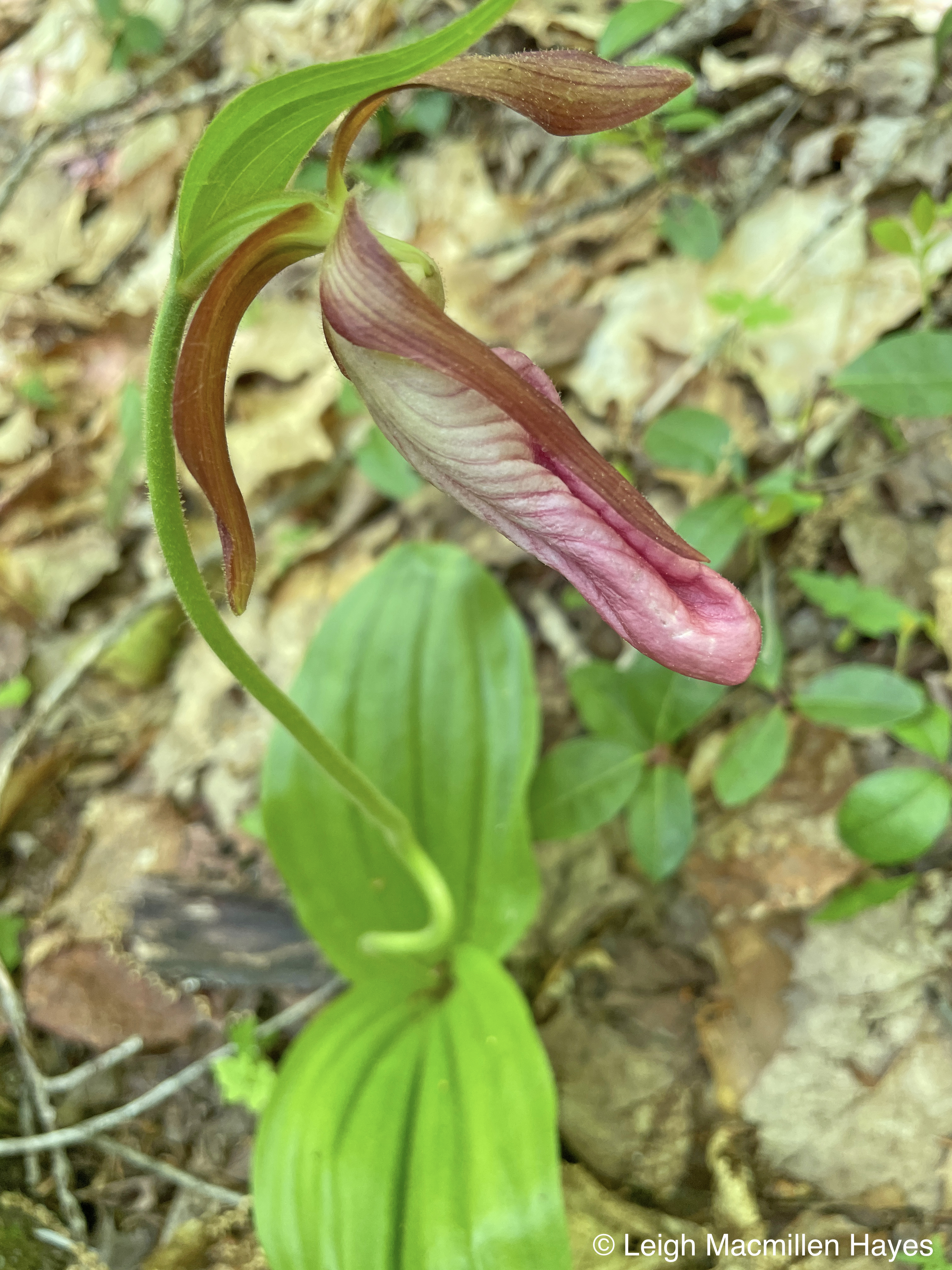
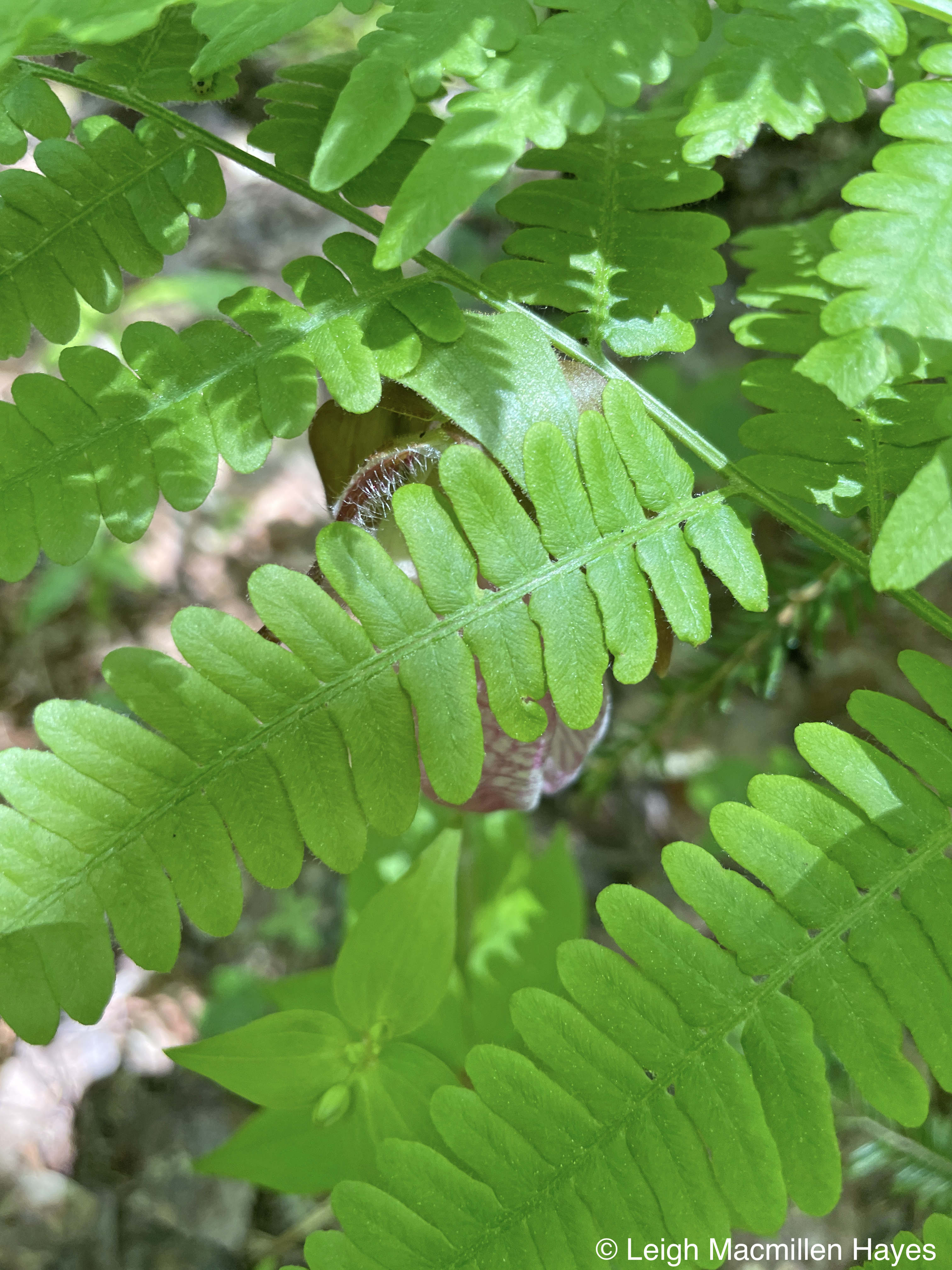
We were almost finished when we spotted this Lady’s Slipper blowing in the breeze. Note the curve in the stem, and the closed moccasin.

I don’t know if removing the leaf will help the flower to fully develop, but it made me think of today, Memorial Day, and the fact that so many have in the past and do presently work so that we can enjoy the freedom of going for a hike in the woods–thank you to all who have served our country, past, present, and future, including our dads, uncles, cousins, and friends.

The question remains: How many Lady’s Slippers did we honor on this Mondate? 351. And those were only the ones we could spot from the trail. I’m sure we missed some. Can you imagine how many more might be out there.

Stocking My Wonders

My fingers reach in, wondering what marvel I might pull out of the wool sock, one I knitted when my guy and I first tied the knot so many moons ago.

Of course I shouldn’t be surprised that the first thing my fingers grasp is a dragonfly, this being a Common Whitetail male in the Skimmer Family, with those broad crossbands on the wings and black streaks at the base of each.

Calling it “common” strikes me as such an understatement and I’m thrilled when I next pull out an immature male of the same species. I mean, look at those wing markings. And the spots along the sides of the abdomen segments. And the difference in color from immature to mature. Surely, next it will be a female that falls into my hands.

It is quite a shock, however, to realize it is fur that tickles my hand, and voila, out of the sock comes a Red Fox. A Red Fox who settles for Black-oil Sunflower Seeds, not quite the next best thing to capturing a squirrel.

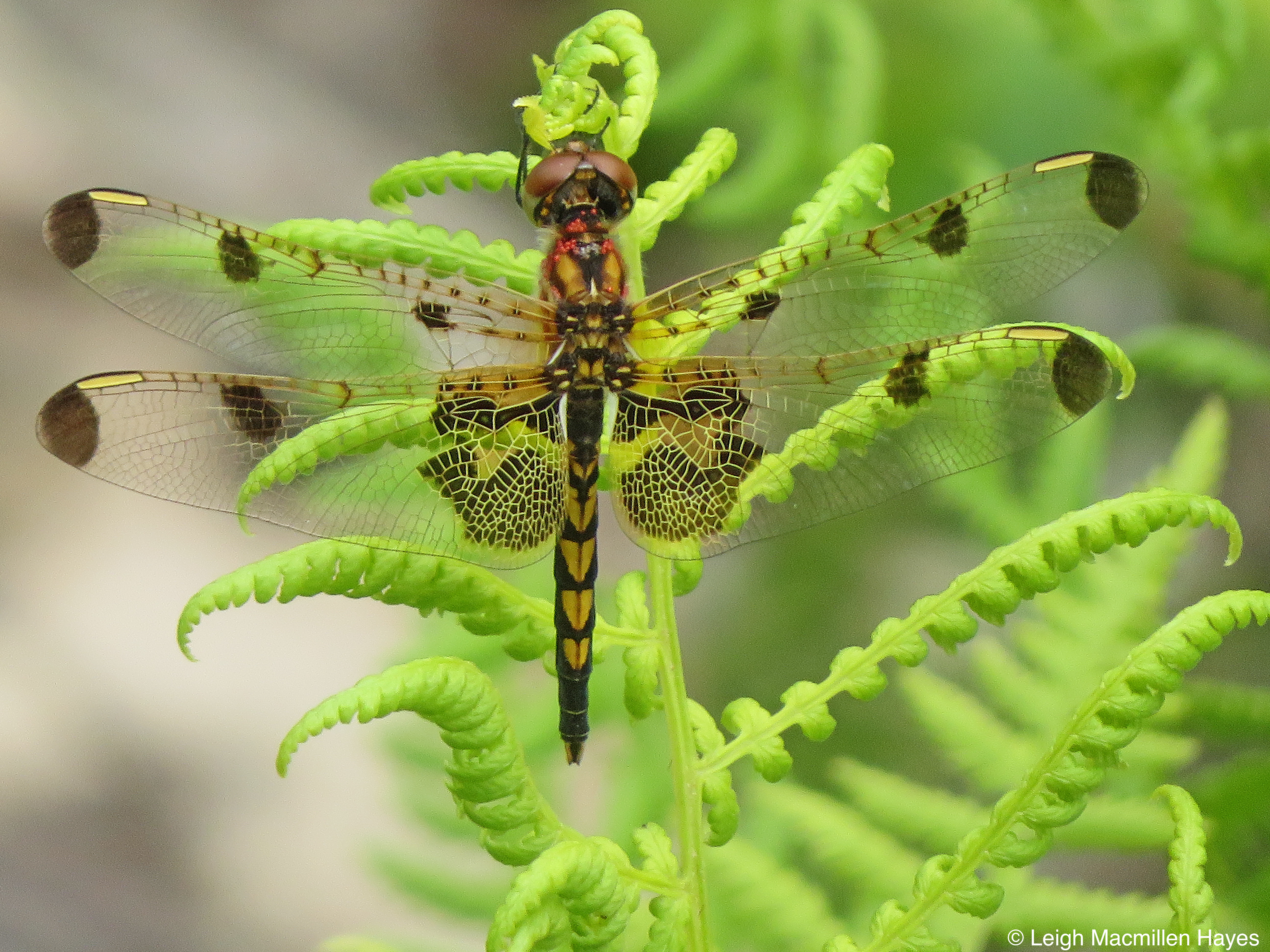
When I next reach in, I am sure I’ll pull out a female Common Whitetail, but . . . instead it is a much smaller, and even more extravagantly decorated female Calico Pennant Skimmer. The same family, but this is one of my favorite species (please don’t be offended Whitetails, I really do think you are more special than common), with those heart-shaped markings along its abdomen segments and basal wing coloration reminding me of a stained-glass window, which seemed apropos for today’s celebration.

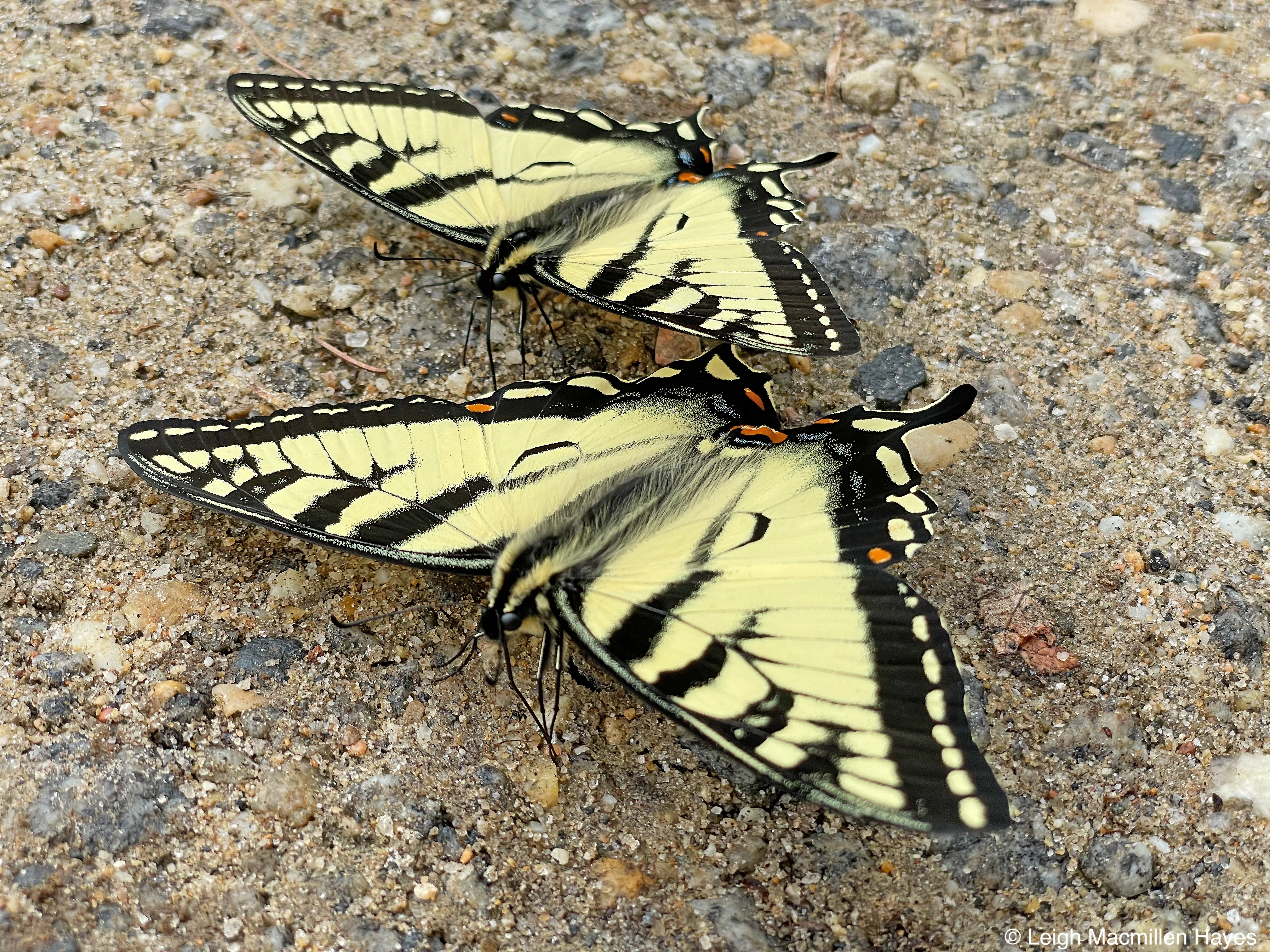
And then there are two with similar colors and equally delicate, puddling as is their habit, these Eastern Swallowtail Butterflies sticking their proboscis seeking nutrients from the gravel road. The chemical make-up of the site is key, for the butterflies are looking for something specific: salt (sodium) and minerals

Most puddlers are males, who ingest the salts, minerals and amino acids that the source provides, especially after it has rained. They store these nutrients in their sperm so that when the time comes to mate, the male passes these goodies as a nuptial gift along to the female. This gives the female an extra boost, which she then passes along to her eggs. It’s an important gift because eggs that receive the extra nutrients have a greater chance of success than those that do not.

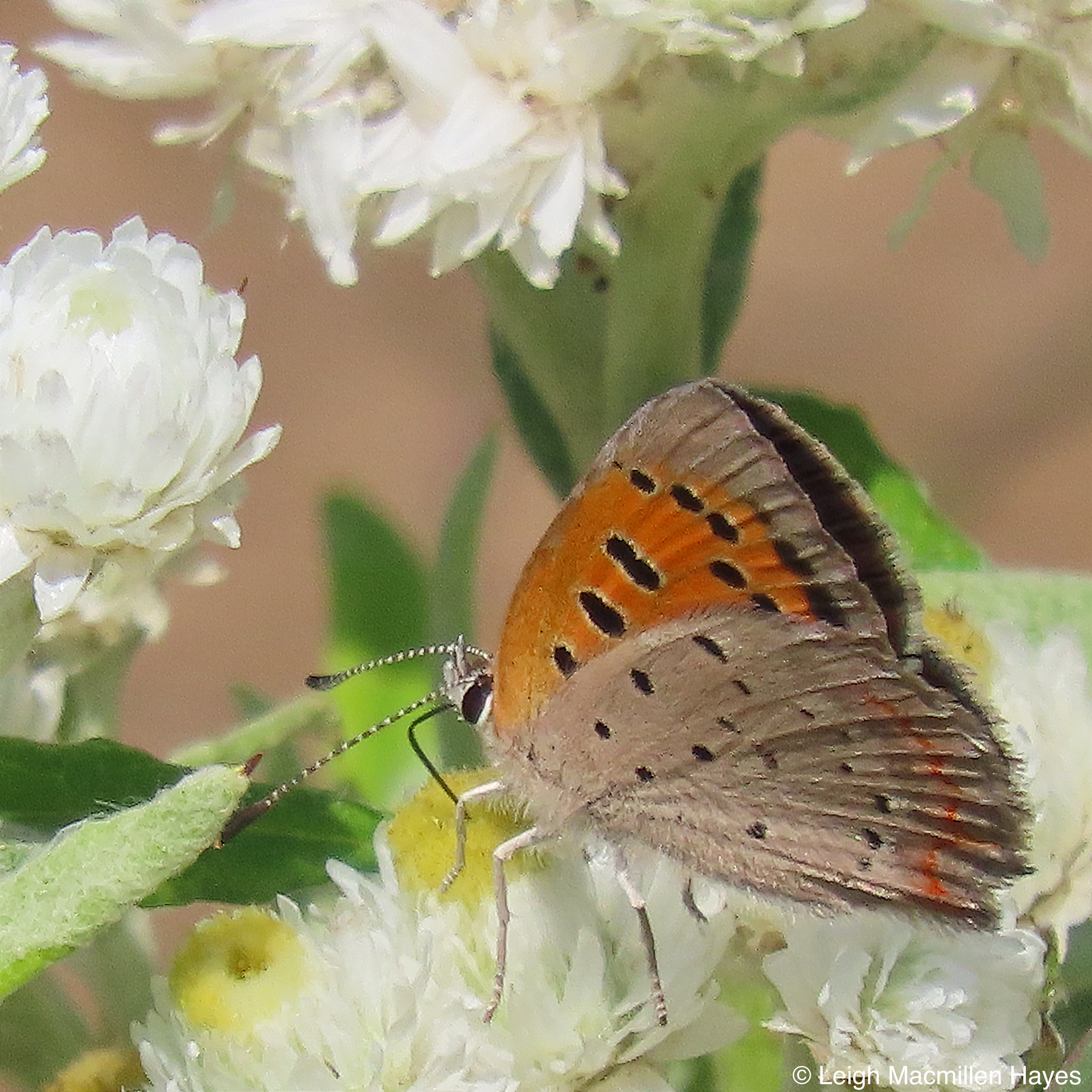
Back into the sock do I dip, this time finding a Little Copper Butterfly seeking pollen and nectar upon Pearly Everlasting flowerheads. Little Coppers, tiny as the name suggests, thrive in areas disturbed by either human activity or natural events and it seems almost an oxymoron to think that as teeny and delicate as they are, they are right at home in waste places.

Once again, there is a significant change between the Little Copper and the next species that my hands discover. “Who cooks for you? Who cooks for you all?” hoots the Barred Owl much to my delight. Only two nights ago I heard it calling out the back door, so to find it in the sock is a treasure indeed.

Almost immediately after, a Muskrat swims out of the sock, moving quickly toward me with its rat-like tail acting like a rudder in the rear. I love its questioning look as we meet each other for the first time.

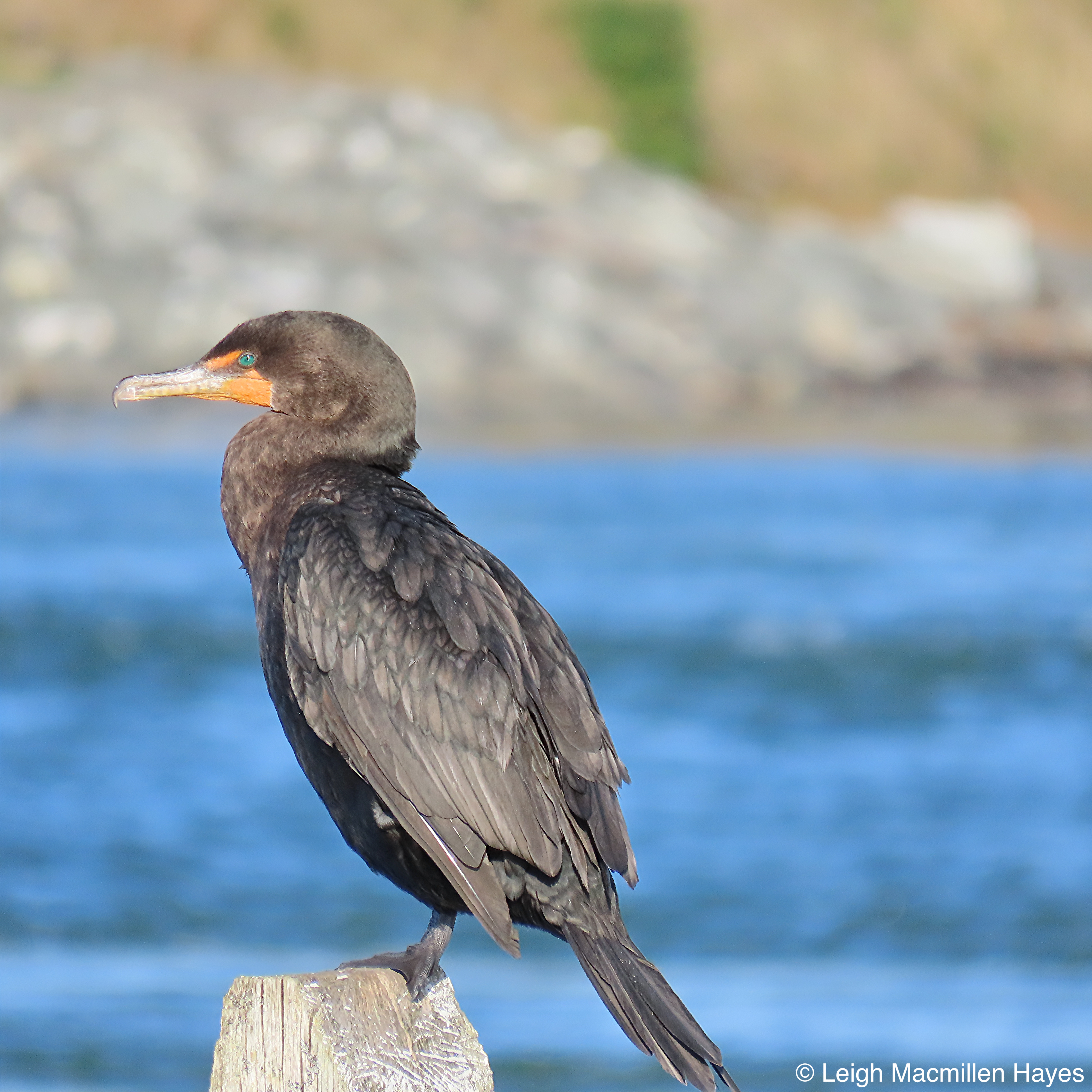
Enough fluff about the Muskrat. It is a feathered friend. who next pops up out of the sock. One of the most amazing things to me about this gift is the color of its eyes and how they reflect the sky above and water below.

Still pulling from the leg of the sock, this Gray Seal floats forth, as if on the incoming tide. Sometimes called “horseheads,” because of their long snouts, Gray Seals scientific name, Halichoerus grypus, literally means “hooked-nose sea pig.”

Not the prettiest of names, not the prettiest of species, but I am still excited to realize this one is my own to keep.

Suddenly, there seems to be a theme to the gifts, and a life on or in the water makes sense. The next item in the sock is one we think of as nature’s engineer, and though not everyone is thrilled with their prowess at felling trees, building dams and lodges, and changing waterways for their own benefit, it’s good to realize that they also benefit other species in the process, including humans. This particular Beaver is active during the day because hikers like my guy and me keep ruining its dam as we cross over it to access a trail.

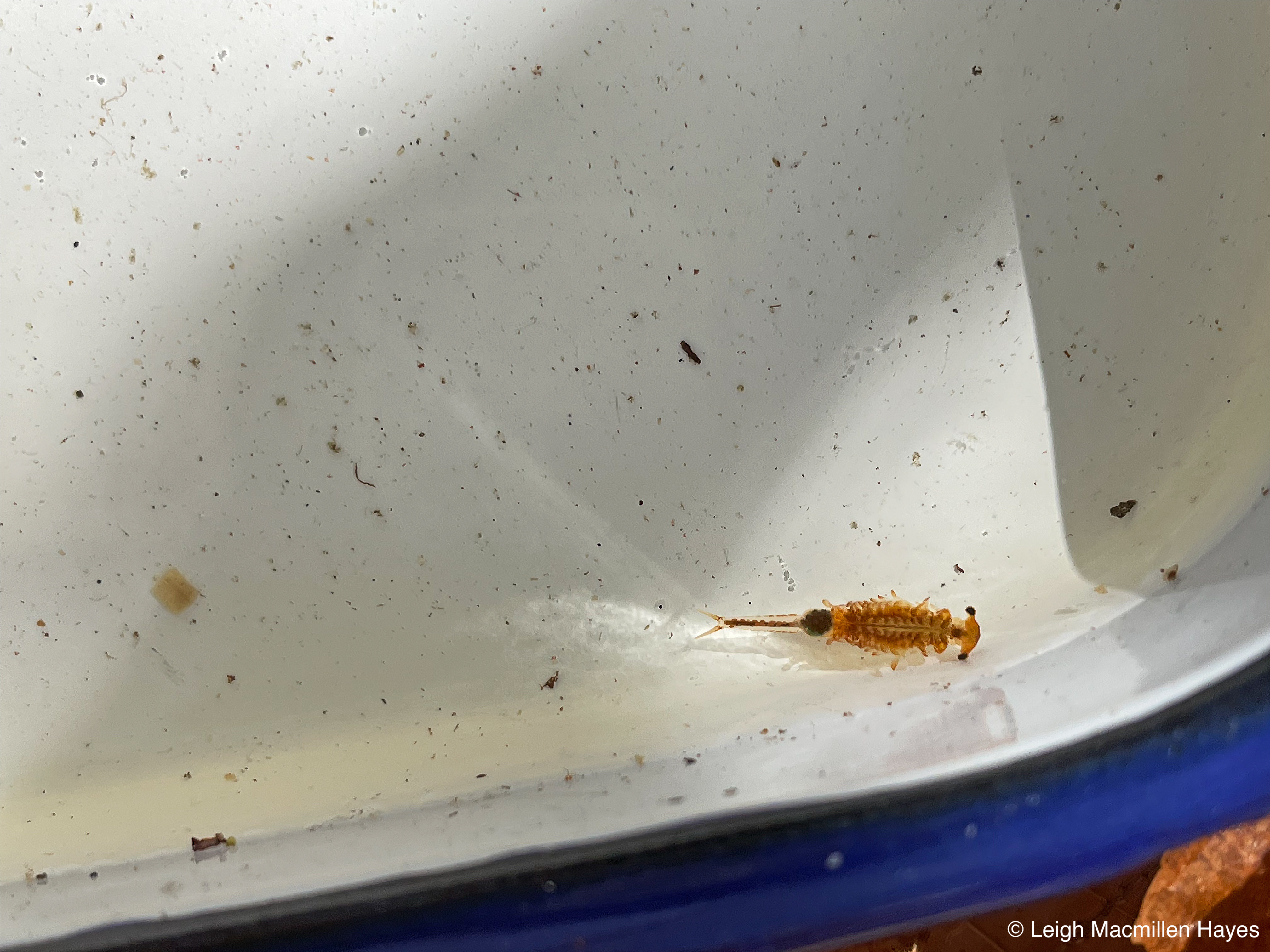
Still on the water theme, but much diminished in size, is a female Fairy Shrimp. Just sighting one such species is enough to make its vernal pool habitat significant. The way to identify a female is to look for her two dark brood sacs that are positioned just under her legs or appendages.

So here’s the thing. Fairy Shrimp have a short life span, but . . . their eggs must dry out and freeze before they can respond to environmental cues such as reflooding to hatch.

The eggs, known as cysts, can remain dormant for years, and only a small portion of cysts hatch each year, thus leaving plenty more for the future. And temperature plays a key role in hatching.

I’m beginning to realize how much I am enjoying the variety hidden within this sock, and the next gift turns out to be a Blinded Sphinx moth, a species one doesn’t ofter encounter during the day. Or at all, for it’s a night flyer. But those markings and folds, and the overall design. Oh my.

With the next item I choose, I am reminded that one must look for anomalies in the landscape. And so I do. It is the horizontal line of the back that gives away the fact that I am starring at a White-tail Deer. Otherwise, I might think that the legs are sapling trunks and the face maybe a few bleached beech leaves.

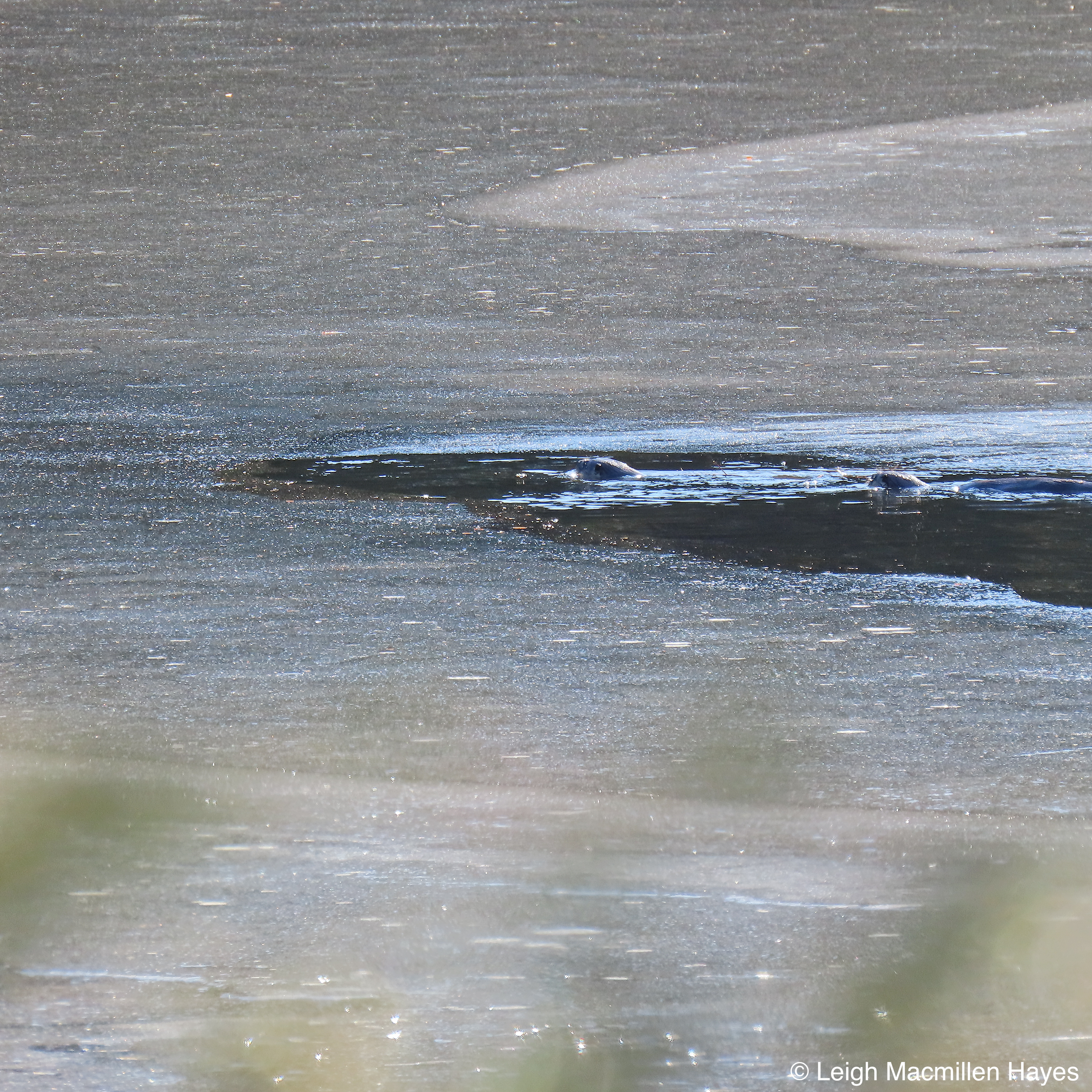
My next surprise–comes as a trio. And I might not even realize they are there if I hadn’t heard them first–chattering to each other as they swim and play and fish and sometimes sit on the ice before slipping quickly back into the water in what can only be known as River Otter delight.

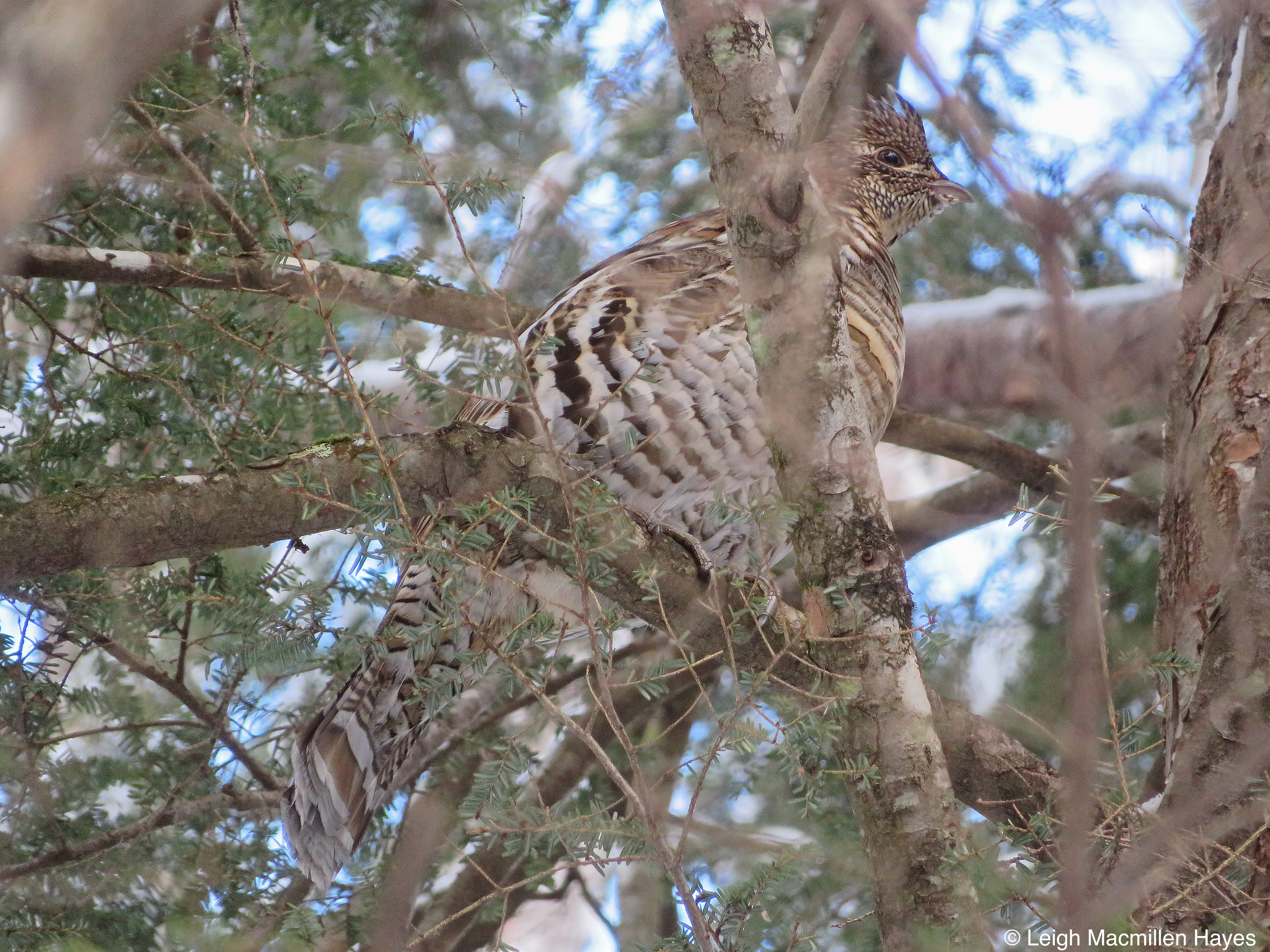
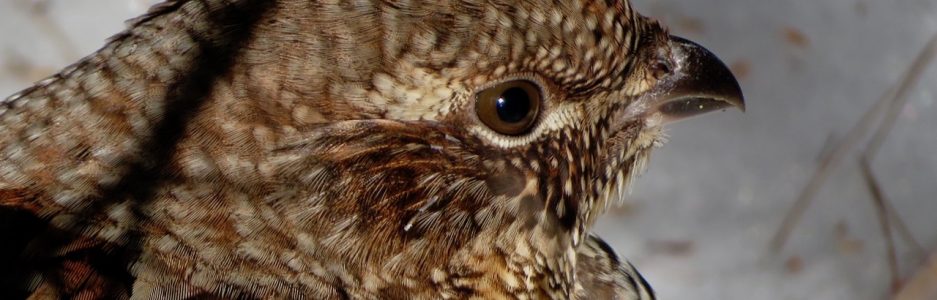
Once again, I suspect I know what I’ll pull out next, only to be surprised to discover that it is not a prickly friend, but rather a feathered one who roosts high up in a tree–this being a Ruffed Grouse.

But the prickly one doesn’t disappoint, and makes its own appearance in a different tree and place.

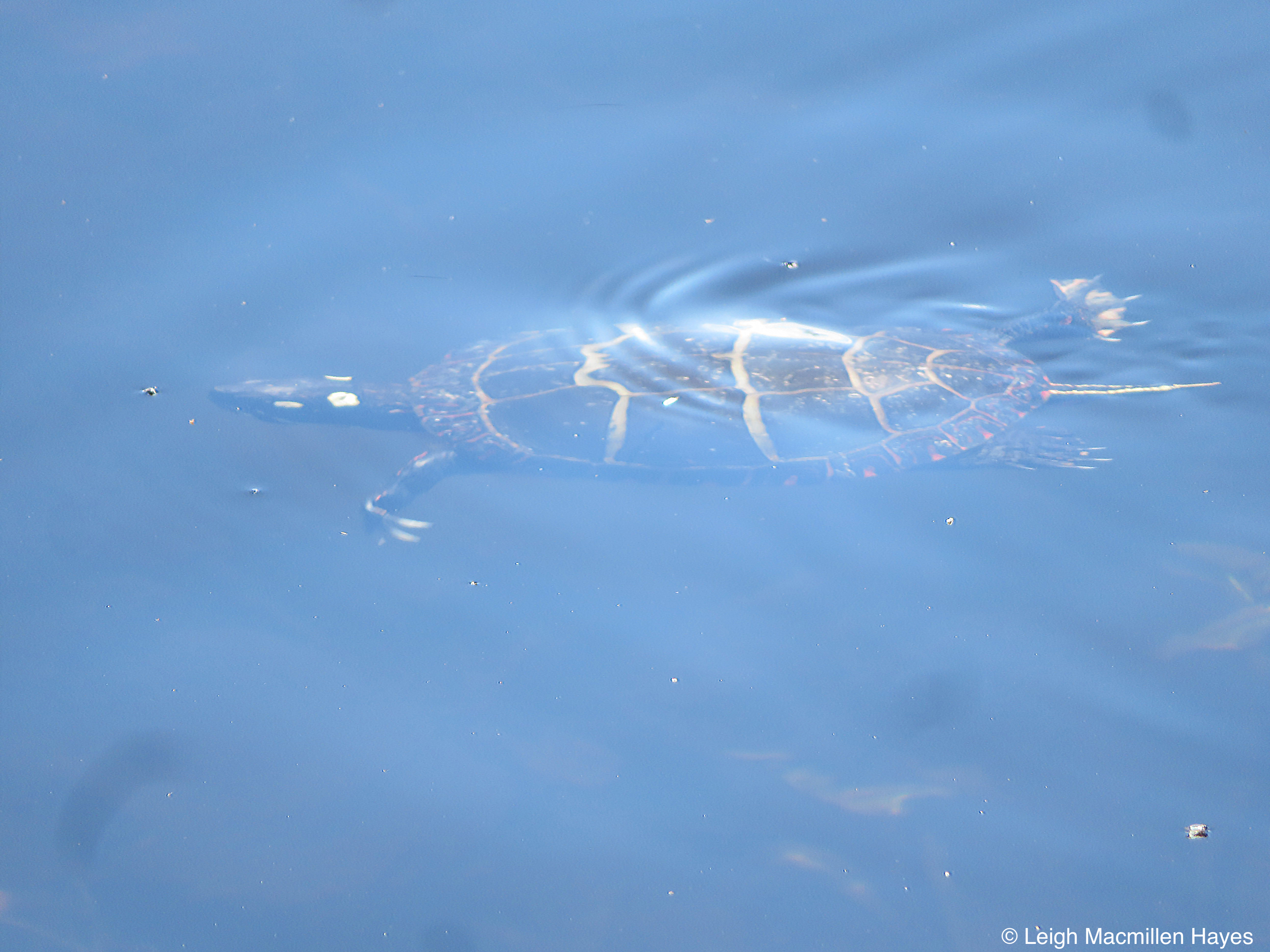
That is to be followed by another I often spot basking in the sun with friends, but it is great fun to spot a Painted Turtle swimming below the water’s surface of a shallow pond.

The water theme begins to appear again, maybe because the one who filled the sock knows I spend a lot of time peering into the depths, and sometimes I’m rewarded with sightings such as this of tadpoles forming into their mature frog beings.

And then there is another that requires a stretch of my neck as it stretches its neck to feed its young high up in a nest.

Having regurgitated a meal, the mature Great Blue Heron stays with its young a wee bit longer before heading off to replenish the pantry.

No sock of mine would be complete without a couple of canoodlers, he atop her. Water striders can walk on the surface because they have very fine hairs on the undersides of their legs that trap air and repel water, a technique called superhydrophobic. They move so quickly because what they are doing is more like rowing, vigorously rowing, creating little swirls in the surface that help propel them forward.

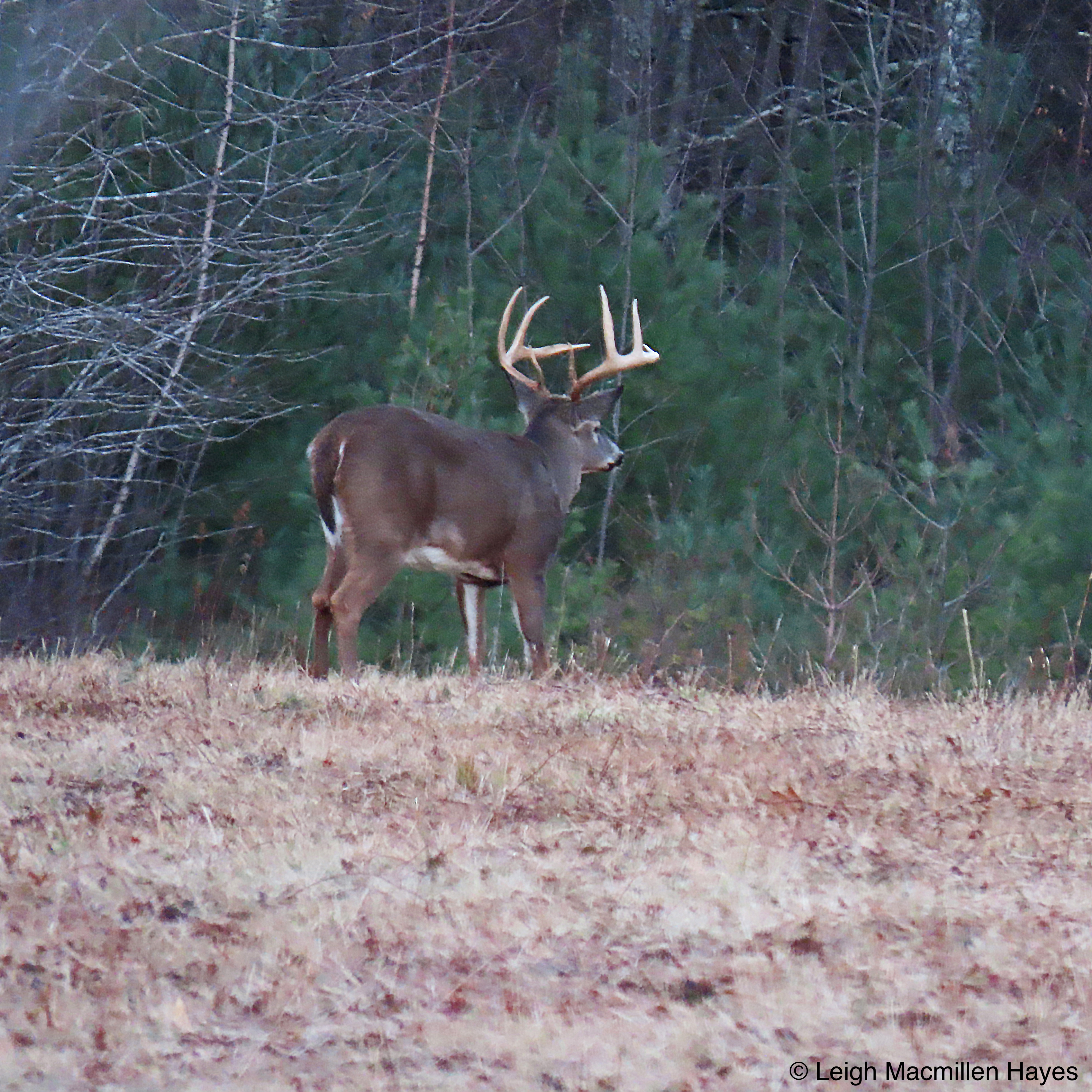
When I slip my hand down into what feels like the toe of the sock, I pull out the largest gift of all and a totally unexpected sighting–a buck. Actually, there are two, but this was the larger and definitely mightier. I feel blessed to have received such a gift. In fact, to have received all of these gifts. To have been present for these presents.

It’s actually toeless, this wonder-filled stocking of mine. And could go on forever. But I’ll pause here and rejoin my family. I do, however, wish you all warmth and peace and electrical power and good health this holiday season.

Cheers.

Hunting the Common

I knew when I headed out this morning that there was one member of the Odonata family that I wanted to meet. But . . . where oh where to find her.

Her habitat includes muddy-bottomed ponds, lakes, and streams, as well as disturbed areas. Hmmm. That should make the quest easy.

With that in mind, I first stopped beside a muddy-bottomed pond that flows into a brook, which at its start more resembles a stream. It is there that Slaty Blue Skimmer and I got reacquainted after so many months have passed since our last encounter.

He reminds me that dragonflies belong to the suborder Anisoptera, which means “different wings” since their hindwing differ in size and shape from the forewings. Those differences may be subtle, but they are there.

How common are you? Very, but not the one you seek.

As I watched Slaty Blue come and go, defending his piece of the shoreline from his family members, I suddenly spied something under the Winterberry leaves: a newly emerged skimmer resting while its wings dried.

And then one shrub over a Racket-tailed Emerald, with neon green eyes paused longer than I expected. (This one is for you, Kate Mansfield Griffith–it doesn’t have the full green body of the Eastern Pondhawk that walked down your Connecticut driveway today, but the eyes were a good match of color, don’t you think?)

How common are you? Very, but not the one you seek.

Upon a Pickerel Weed in the water I notice a favorite of mine, this one also recently emerged and drying its wings before taking flight: a female Calico Pennant Skimmer. For some who have been watching, you’ll be happy to know that there were males about, but they were busy and didn’t wish to pose for a photo shoot.

How common are you? Very, but not the one you seek.

Old friends, like Kate who was one of my first playmates and even if we can’t spend time together we can still share moments of wonder like we did as kids, make themselves known such as this male Chalk-fronted Corporal. I’ve described it before as being kid-like in behavior because its kind love to play leap frog and land three feet ahead of me with each step I take.

How common are you? Very, but not the one you seek.

I soon leave the pond behind and find myself walking with intention along a woodland pathway and into an old log landing located near another brook. Guess who greets me? Yes, another Chalk-fronted Corporal, this one a female.

How common are you? Very, but not the one you seek.

As I continue to look, one with whom I struck up a conversation last summer flew in and snatched a moth before settleing on leaves to partake of the meal. Meet my friend: Black Shouldered Spinyleg, a clubtail so named for its black shoulders and spiny hind legs.

How common are you? Very, but not the one you seek.

Next, a Spangled Skimmer with black and white stigma on its wings took me by surprise and I vowed to remember it for no other has the dual-colored stigmas.

How common are you? Very, but not the one you seek.

In the shadows I spotted another I’m getting to know this year, the Four-spotted Skimmer. This dragonfly was stunning, but I found it amusing that its common name refers to tiny spots when so much more could have been honed in upon for a descriptor.

How common are you? Very, but not the one you seek.

I was about ready to head for the hills when another dragonfly caught my attention. Okay, so that’s a bit of an understatement as so many more than I’ve shared made themselves known to me and I stood still and watched how they moved, where they rested, and how big their territory was.

How common are you? Very, and I AM the one you seek.

I wanted to find this female Common Whitetail Skimmer because she hardly seemed like an every-day dragonfly to me. Those zigzag stripes on her abdomen. The way each segment stood out more 3-D than most. And those three black patches upon each wing. Words fail to describe her beauty.

How common are you? Very and yet . . . not at all.

I set out to hunt for the common and along the way I met others equally common, but in the end the one I sought was hardly common at all . . . despite her common name.