Picture this: It’s 1888. You’re in a train car on what was once the Portland and Ogdensburg Railway (P&0), but is now leased by Maine Central (MEC) and renamed the Mountain Division Trail. You are making the journey from the White Mountains of New Hampshire to Portland, Maine, with a brief stop in Fryeburg, Maine.
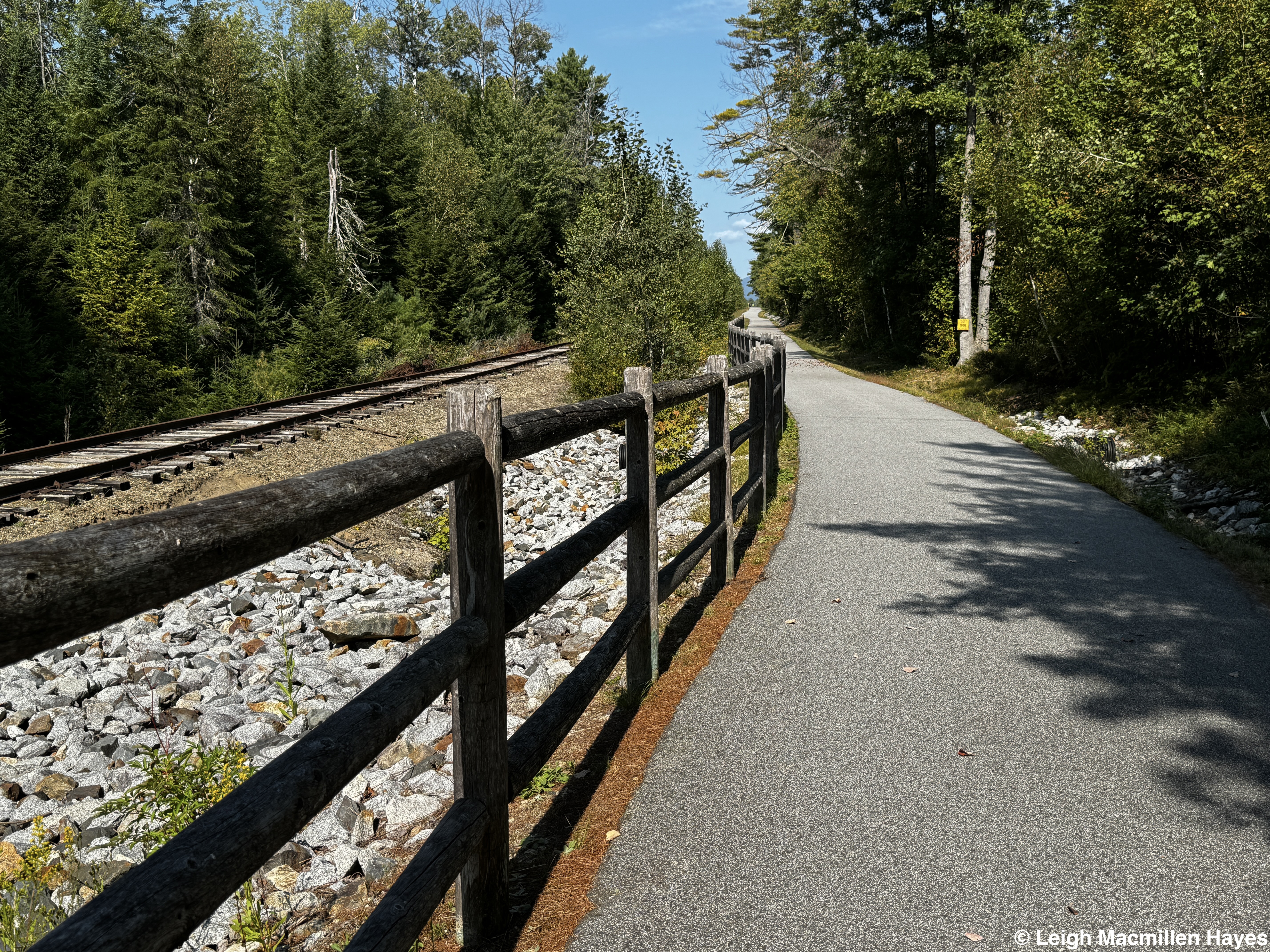
Off the train you hop, and suddenly you find yourself wandering down the Mountain Division Trail in the year 2024. Only, it’s not the rail bed that you walk upon, but rather a paved path beside the tracks.
And you give thanks, because this is the season of doing such, though really we should do so every day, for the Mountain Division Alliance, formed in 1994, out of concern that the rail right of way would be lost. MEC had sold the line to Guilford Transportation in 1981, about twenty plus years after the demise of passenger service. About seven years later, freight service also ended.
In 1994, The Mountain Division Alliance, under the direction of Alix Hopkins, Director of Portland Trails, “brought people together from over 20 groups. Out of this group came the vision for a rail with trail connecting the nine communities [Portland, Westbrook, Windham, Gorham, Standish/Steep Falls, Baldwin, Hiram, Brownfield, and Fryeburg] along the rail corridor from Portland to Fryeburg.”
The Alliance was started to “convince the State of Maine to purchase the rail bed right-of-way. The vision that a bicycle and pedestrian trail could be built along the rail line connecting Fryeburg to Portland came about at this time [1994],” wrote Dave Kinsman, former president of the Mountain Division Alliance in an article published by The Brownfield Newsletter.
So back to going for a wander down the trail. I did such this afternoon, and it’s a path I love to follow at any time of year, because it offers such diversity so I hope you’ll not hop right back on the train just yet, but instead wander with me.

Some may see it as the land of dried up weeds and some trees, but oh my. There’s so much to see.
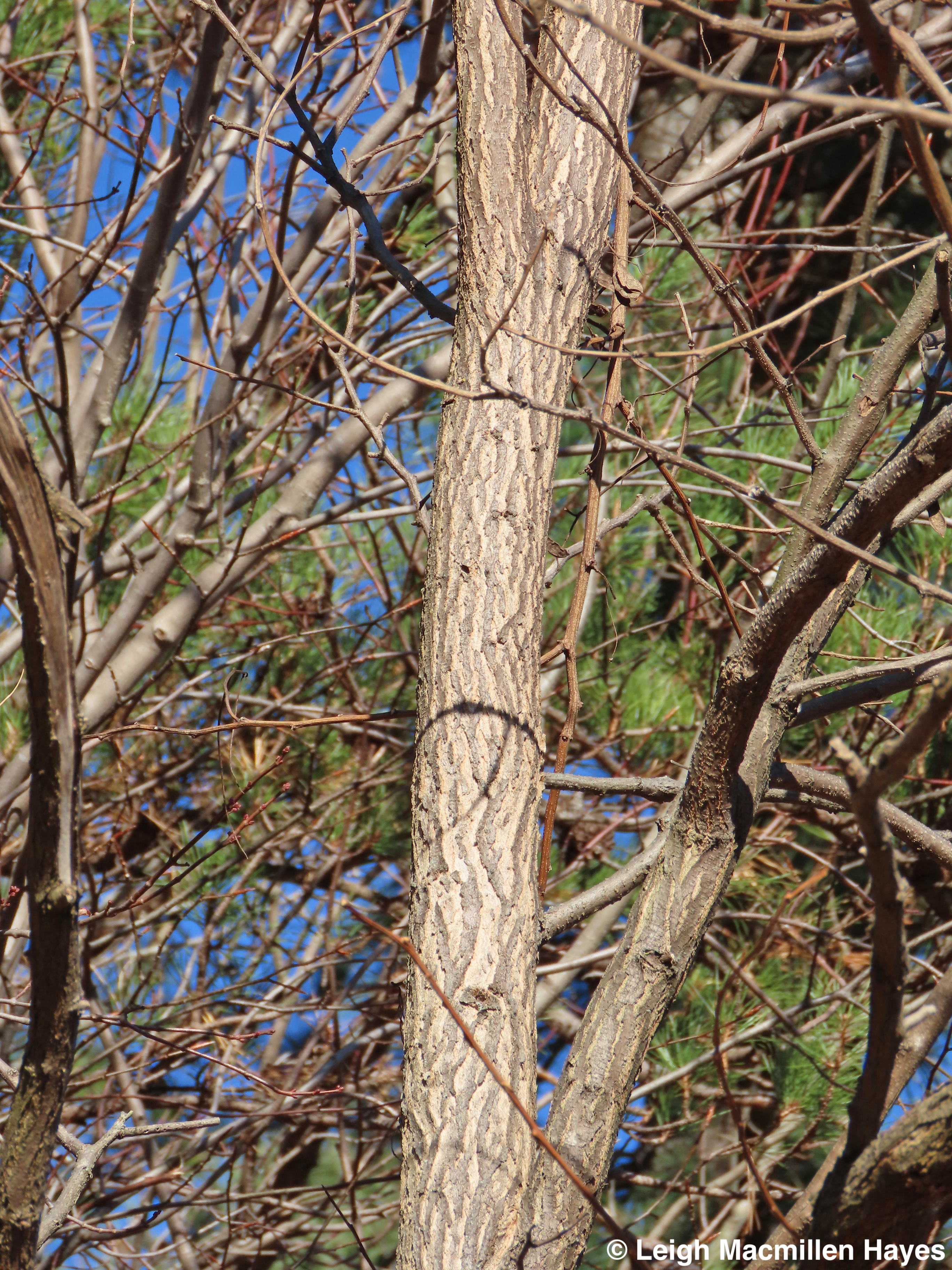
For starters, Black Locust trees, with their two-toned braided bark.

Dangling from the locust twigs are the “pea” pods that contain “bean-shaped” seeds ready to add another generation to the landscape.

And then there are the oaks, this being the blocky bark of White Oak, which is always a treat for because I have to travel to locate it.
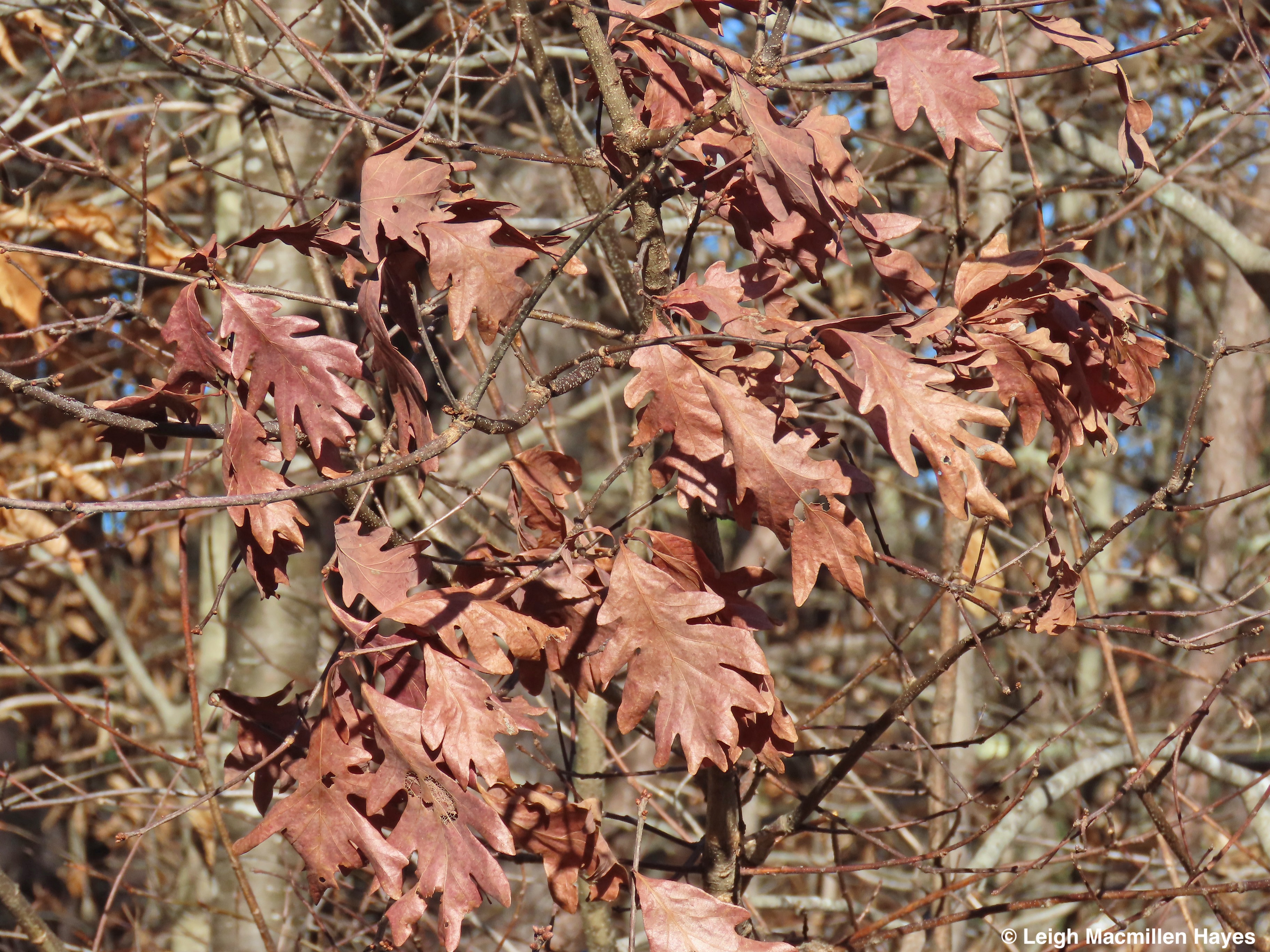
I’ve said it before and I’m sure I’ll say it again, but I LOVE White Oak leaves in their autumn/winter presentation. While they look like mittens with a thousand thumbs, it’s the salmony color and way that they dry on the twig as if they were caught in an awkward dance move that really captures me. Maybe because I can relate to those awkward movements, having never had a sense of rhythm.

Behold also, the White Oak’s cousin, Northern Red Oak, with its raised ridges offering ski slopes for those who dare, accentuated by the red in the furrows.
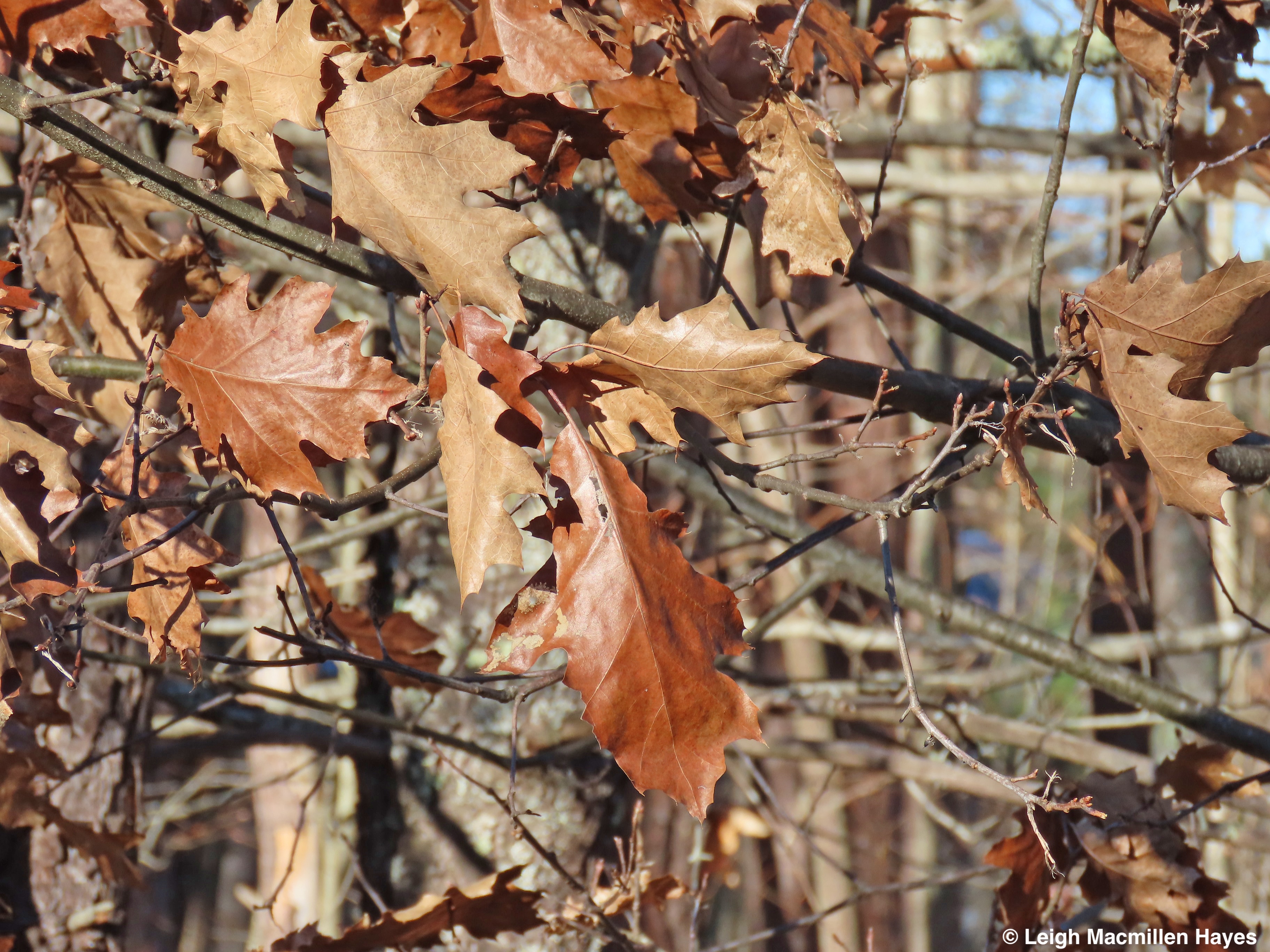
It’s like a perfect classroom along the Mountain Division Trail because the bristly lobed leaves of the Red Oak are so shiny in their shade of mahogany.
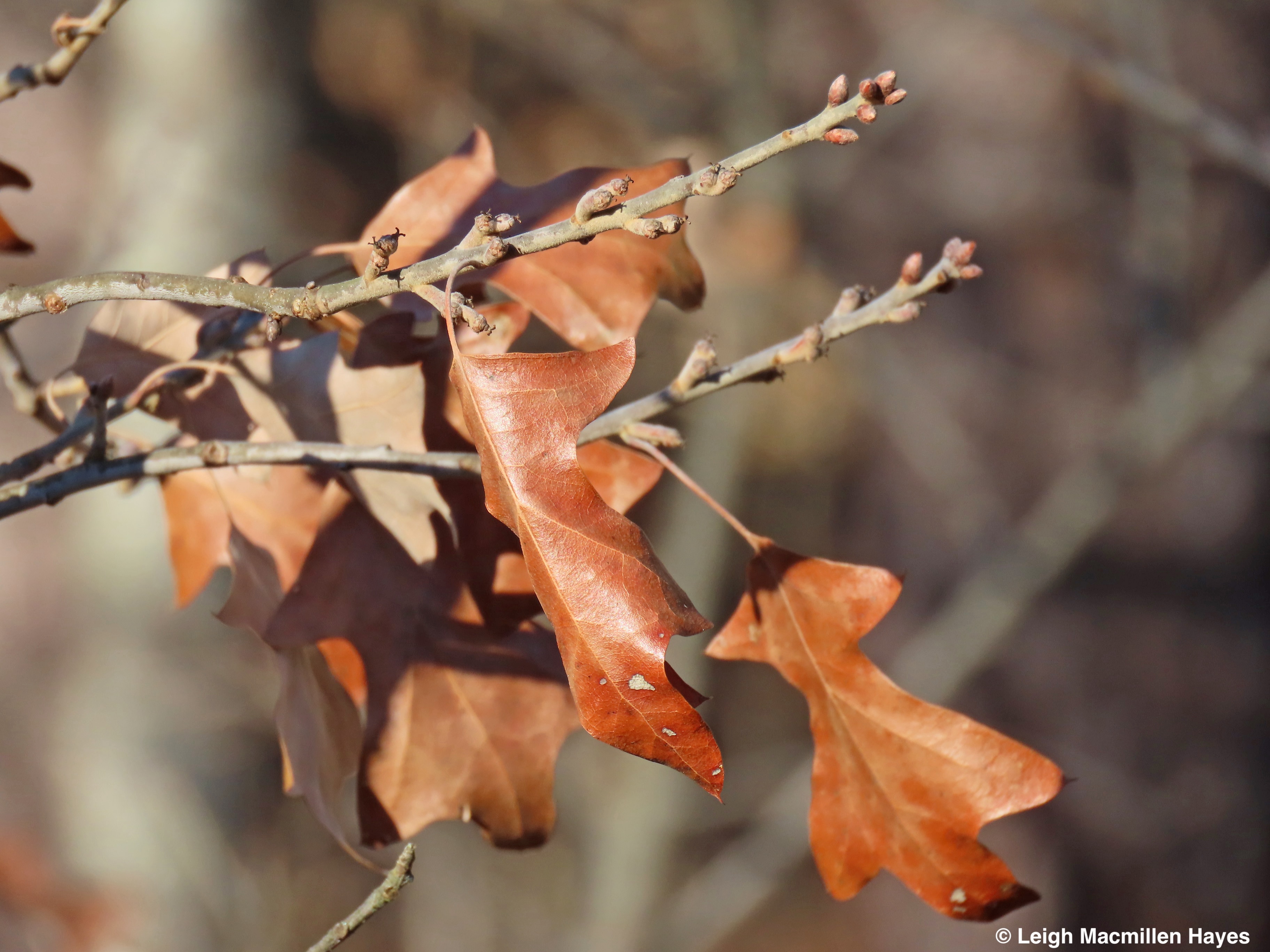
And not to be left out in this lesson: Bear Oak (aka Scrub Oak), growing in a more shrubby manner than the other two. It’s the leaves of this species that remind me who I’m meeting–notice how the second set of lobes from the stem are larger than any of the others.
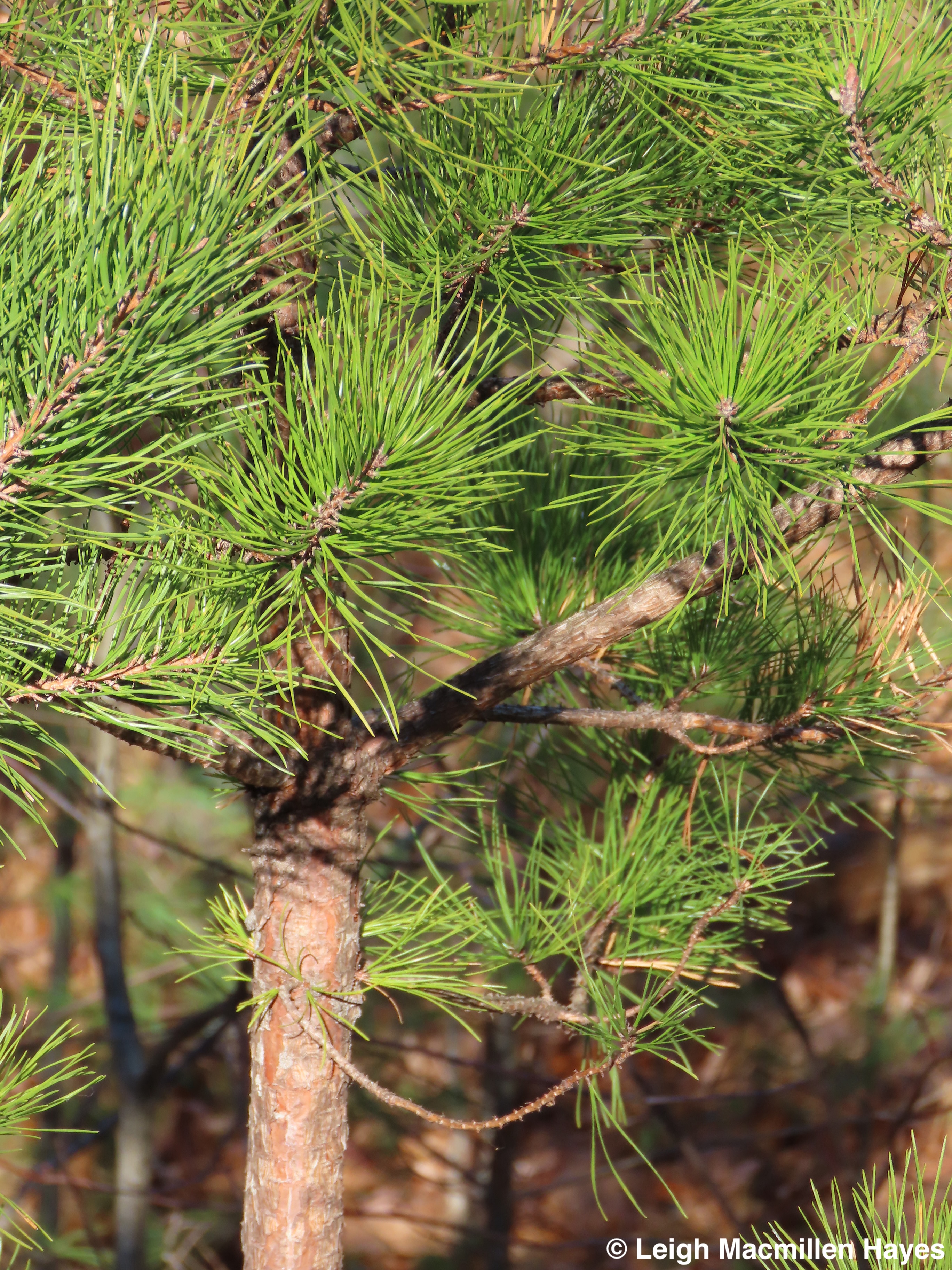
In the mix of deciduous or broad-leafed trees are plenty of conifers, including those we encounter often in this neck of the woods from White Pines to Eastern Hemlocks, and Spruce and Balsam Fir. But . . . there are a couple of standouts along the Mountain Division Trail such as this one with three needles in each bundle.
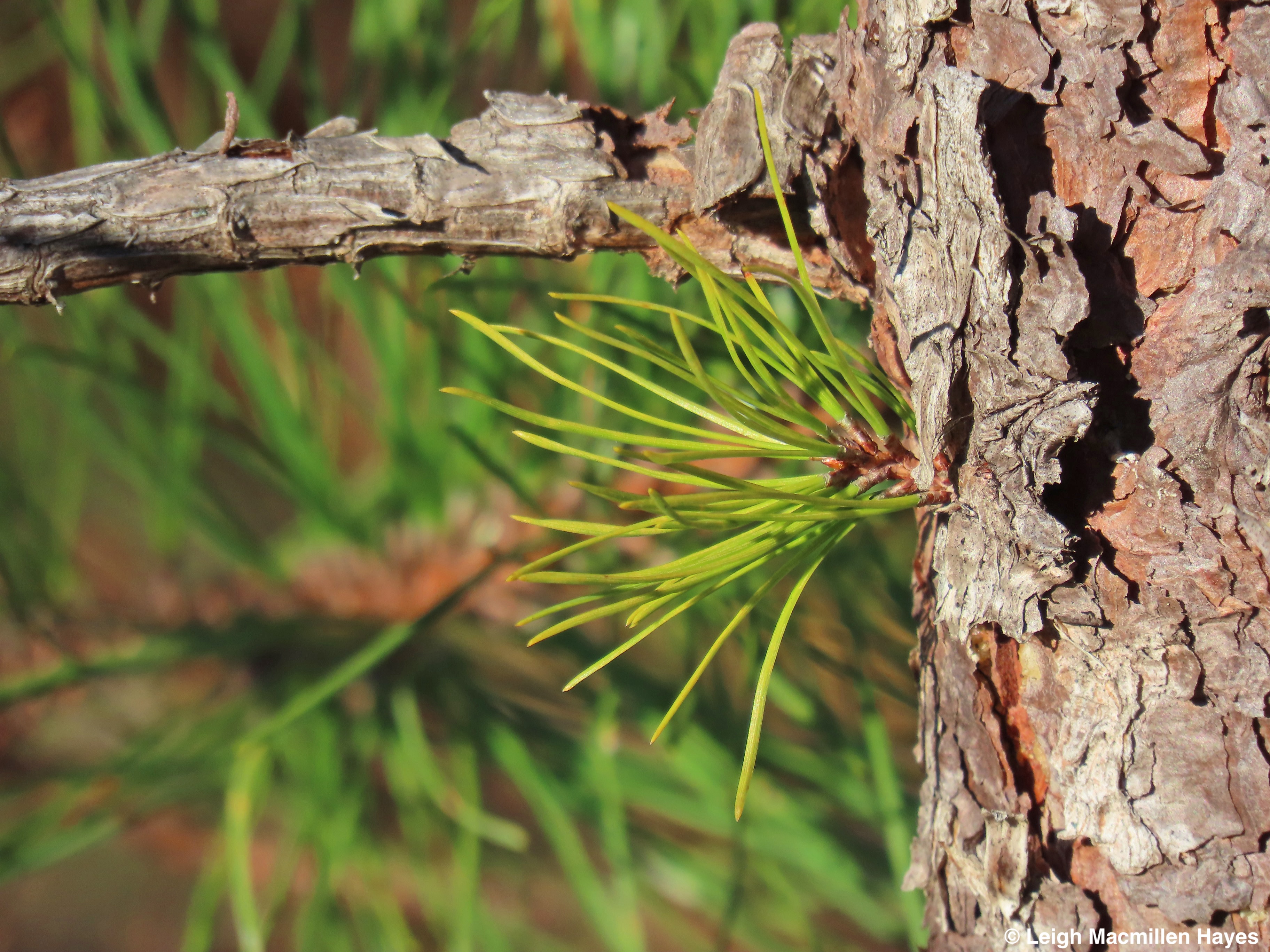
It’s those bundles of three, and the fact that occasionally a clump of needles grows directly out of the bark rather than on a twig that provide the clues for this species: Pitch Pine, three strikes and you are out. Get it? Baseball–pitch–three needles/bundle. I wish I could take credit for coming up with that mnemonic.
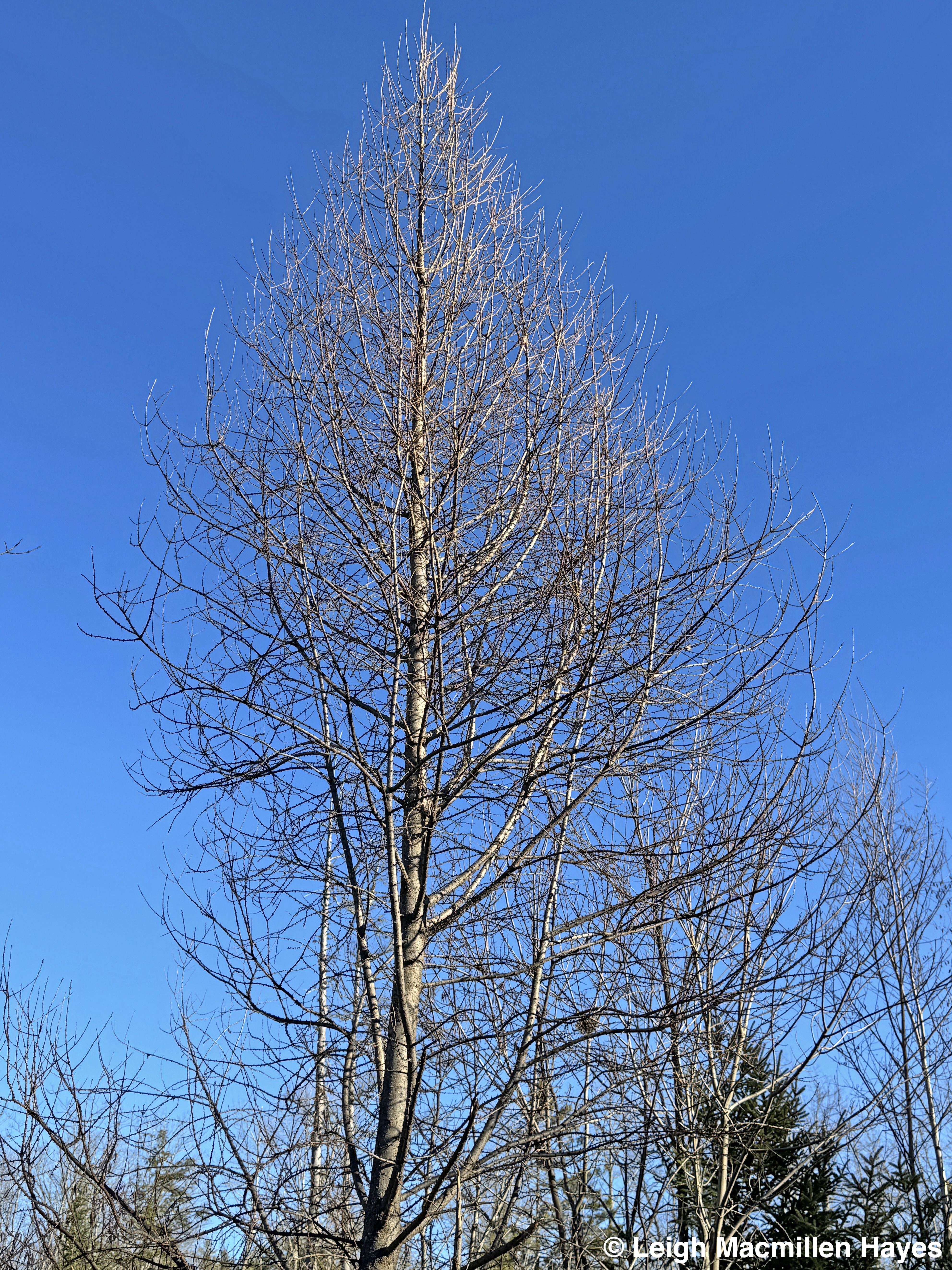
I promised more than one interesting conifer and tada. Only thing is, all the other conifers retain their leaves (needles) throughout the winter, thus giving them the name of Evergreens because they are forever green, even when they are shedding some needles.
This pyramid-shaped tree is the only deciduous conifer in Maine: the Tamarack (Larch and Hackmatack being its other common names).

Tamarack’s needles turn a golden yellow in autumn, and eventually all fall off. But, it’s a cone-bearing tree, thus it’s a conifer.

Picking up speed now, along the rail grows Great Fox-tail Grass, and its name seems a great descriptor.

Then there’s the Sweet Fern, which isn’t actually a fern for it has a woody stem, but what I love most about it in fall and winter is the way its leaves curl, each doing its own thing.
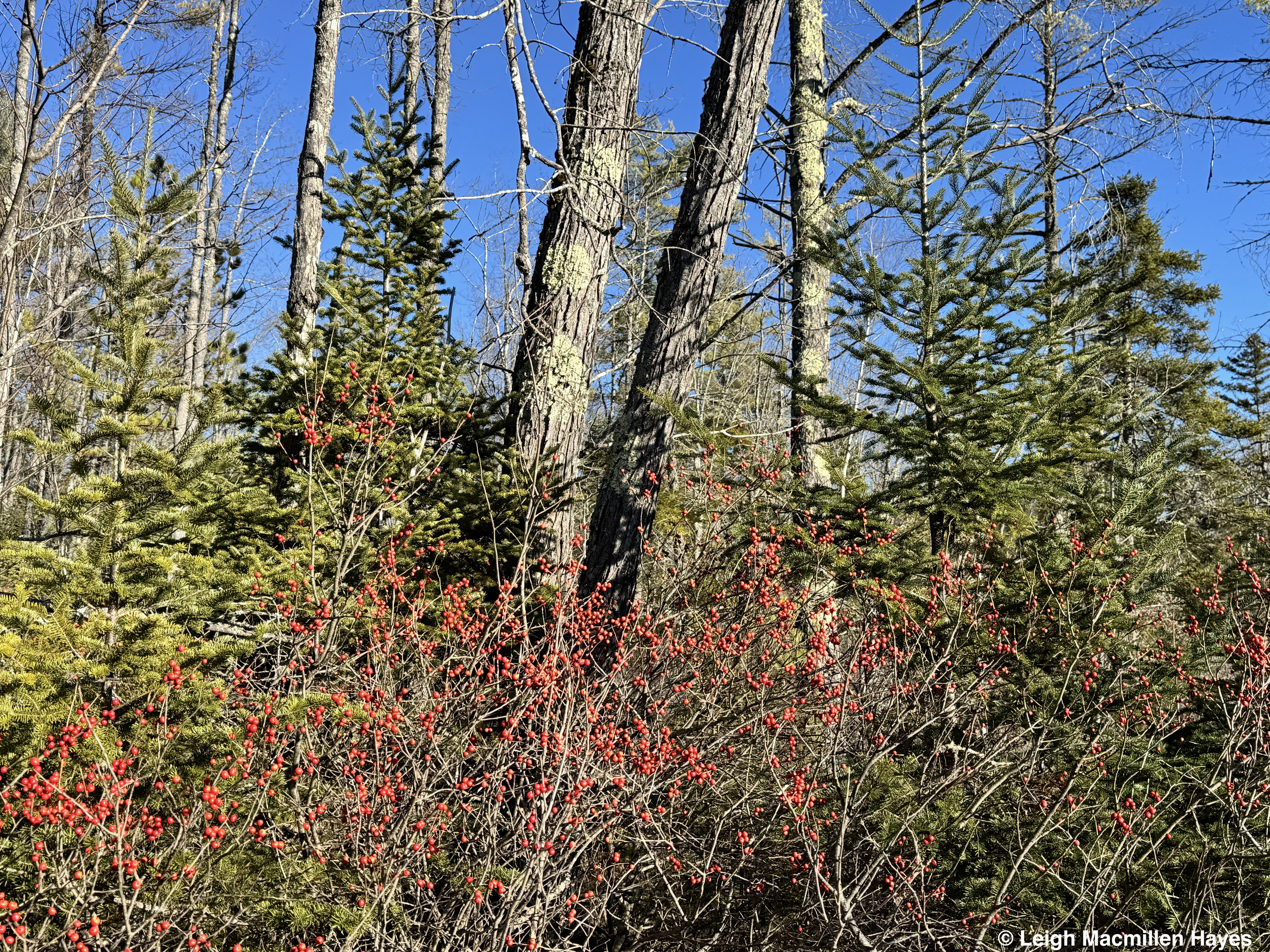
In a wetland, for the habitats vary along the way, Winterberry is now showing off its brilliant red berries. And the Robins are thrilled as are many other birds seeking fruit at this time of year.

Mullein, tall as it stands, has already spread many of its seeds as evidenced by the open pods.

And the same is true for the even taller Evening Primrose.
It’s the fruiting structures of both of these plants that make them beautiful standouts as winter weeds.
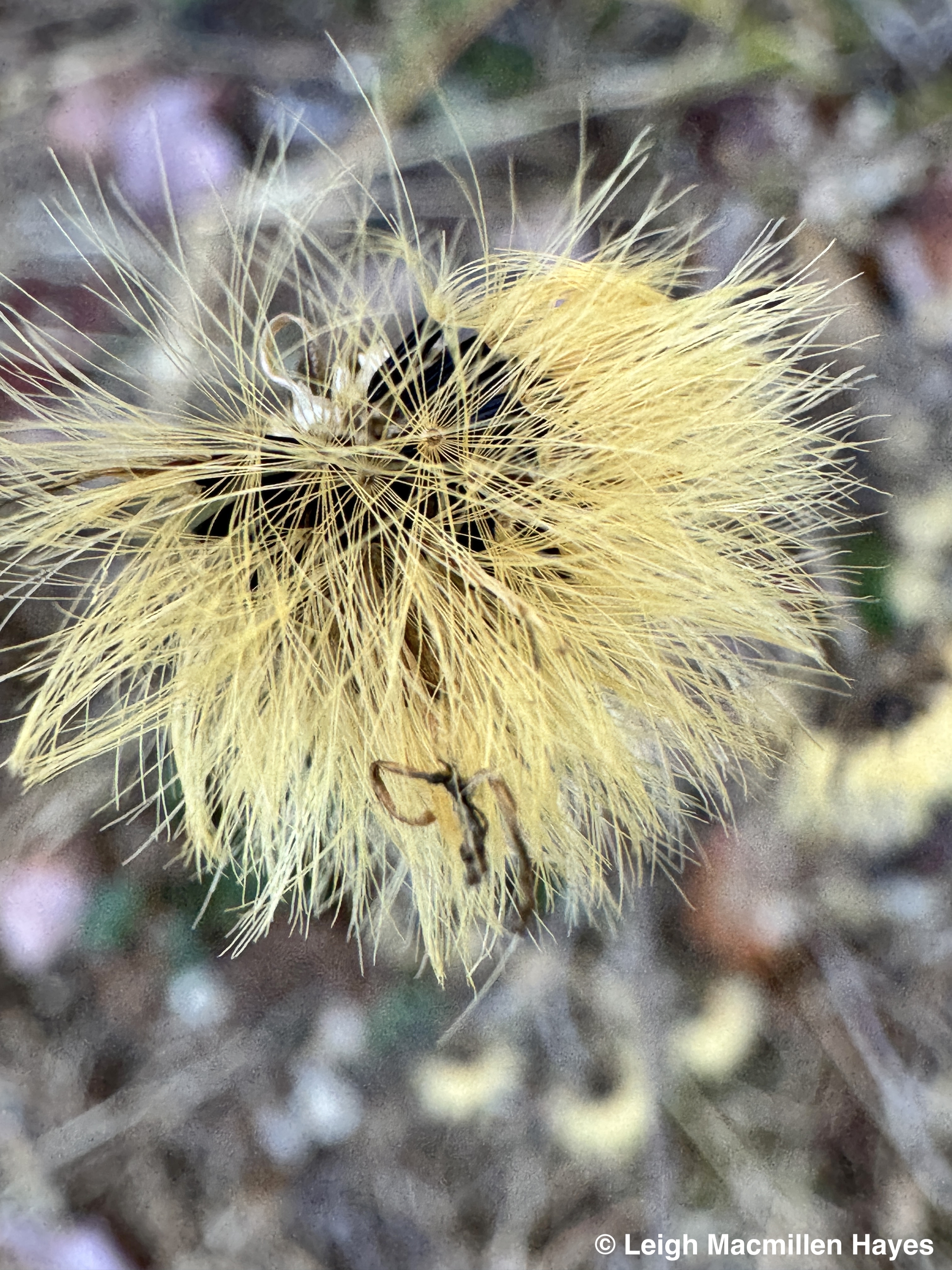
Aster seeds are slowly taking their own leave, one hairy parachute at a time.
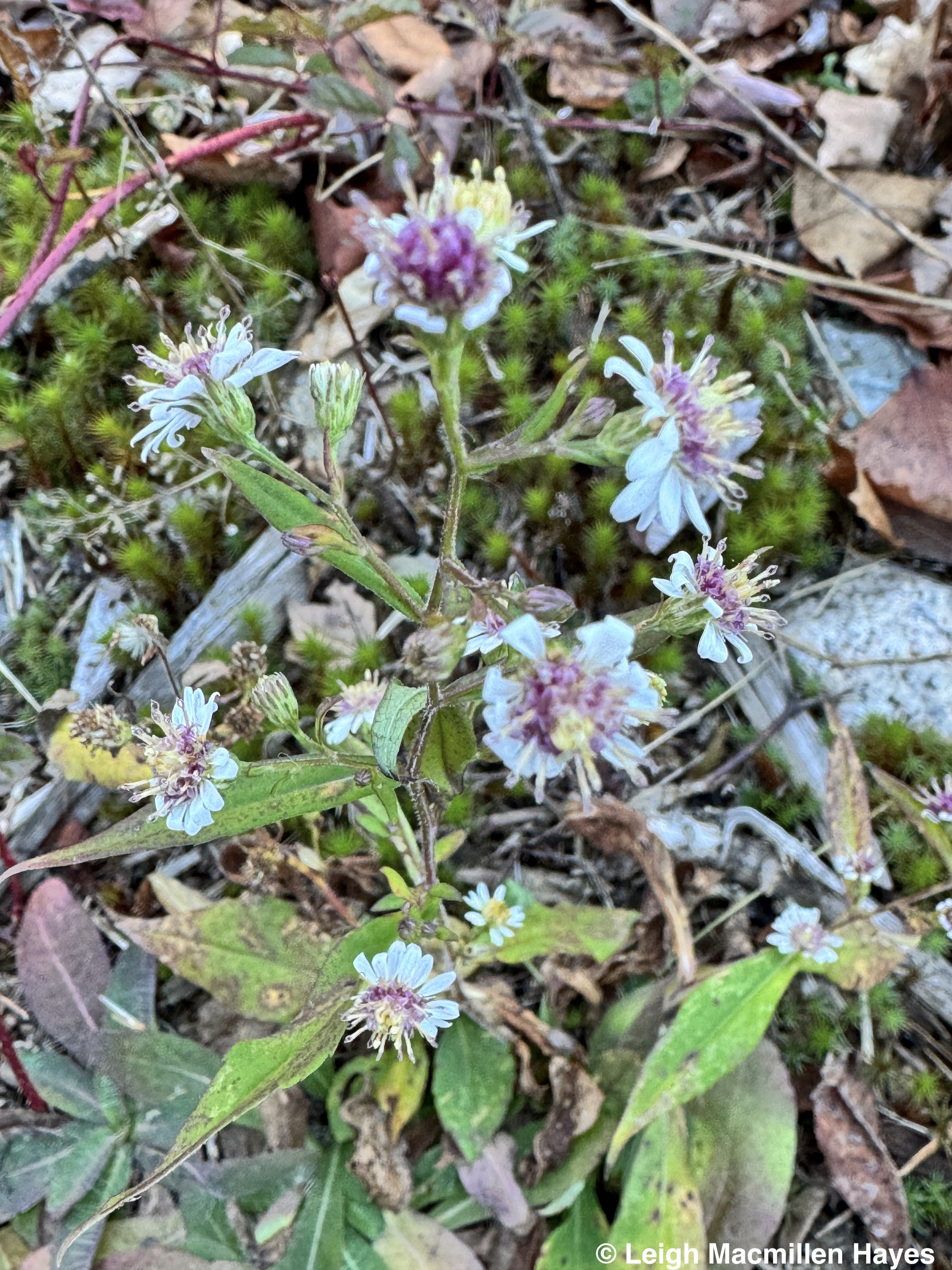
But here’s the thing. Not all Asters have gone to seed and I was surprised to find several Calico Asters still flowering. Given that the past few days have been quite brisk, this didn’t make sense.

But the same was true for Yarrow.

And I saw a bunch of Blue-stemmed Goldenrods still blooming. While the Asters and Goldenrods flower late in the season, perhaps I shouldn’t have been surprised, except that this past weekend’s wild rain and wind, and temps that felt more like November than we’ve experienced lately, made me question what I was seeing.

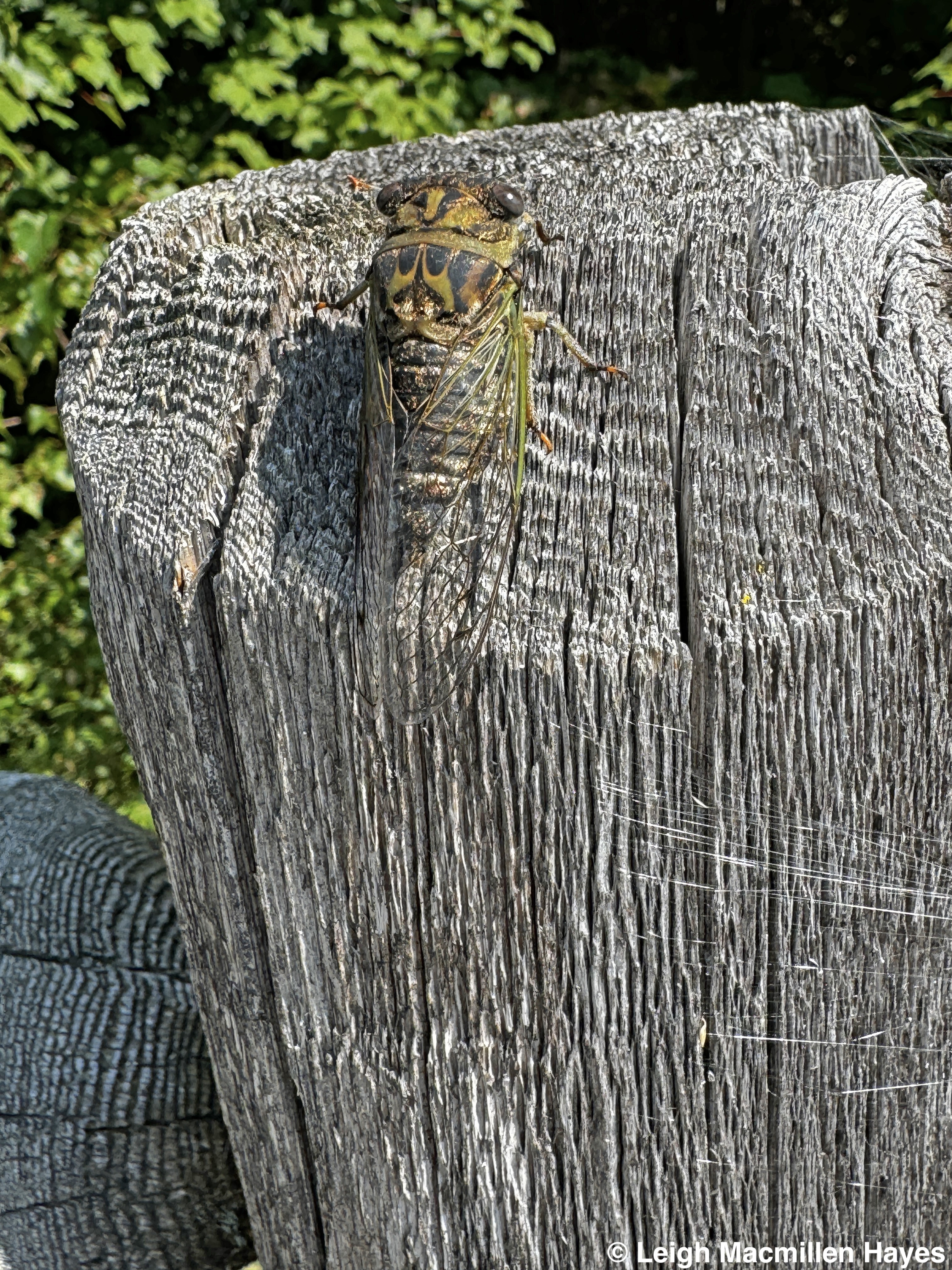
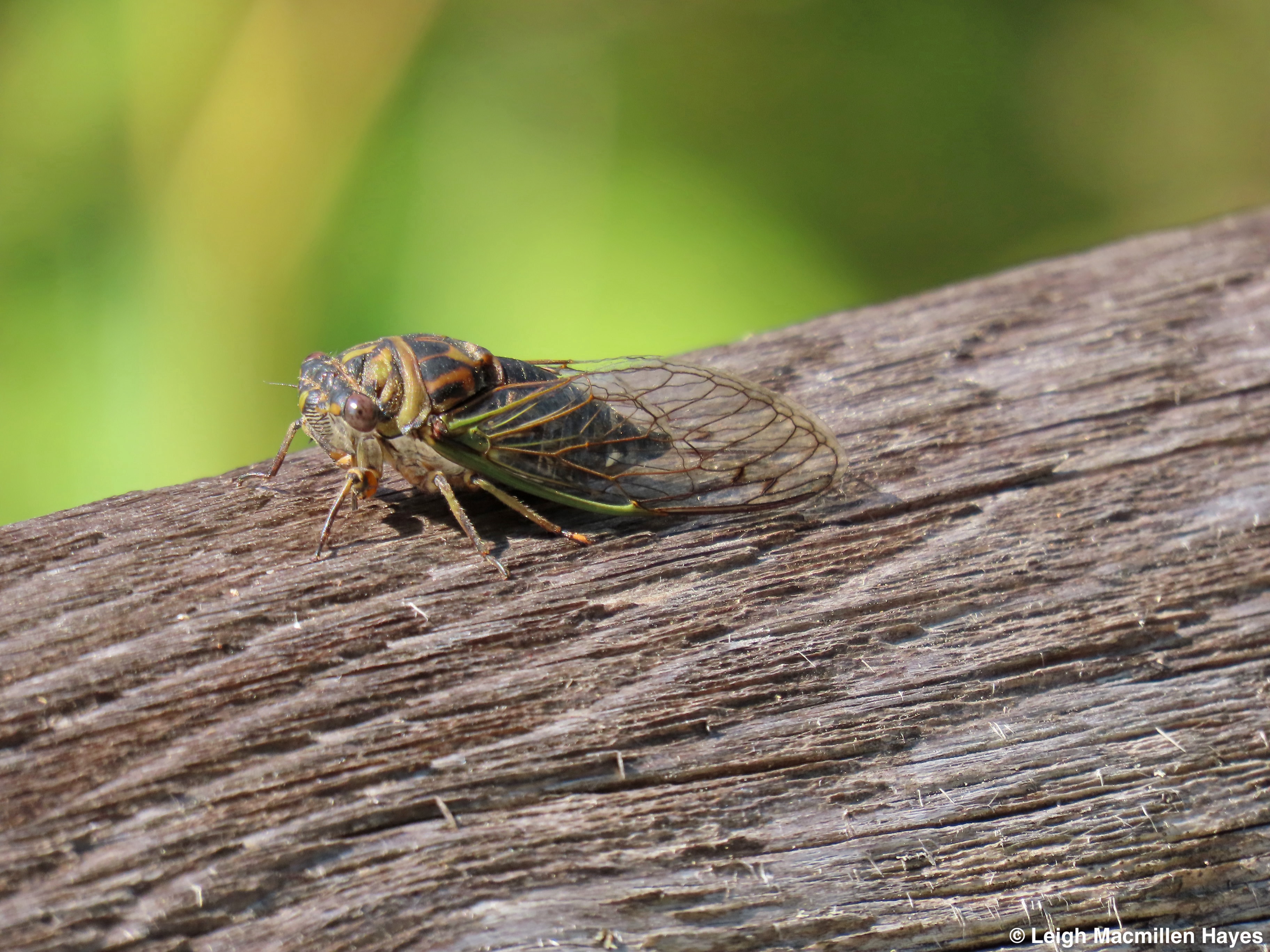
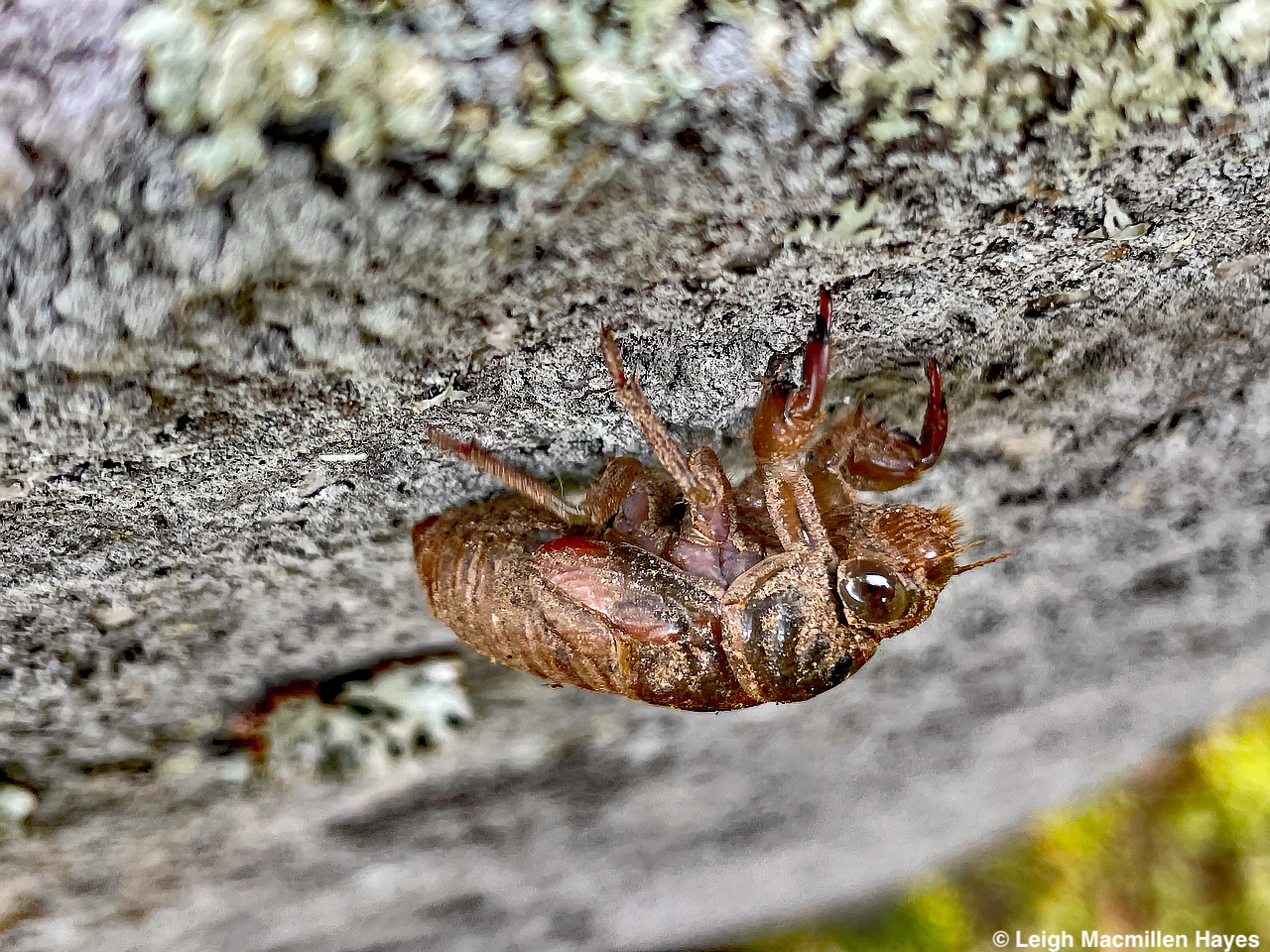
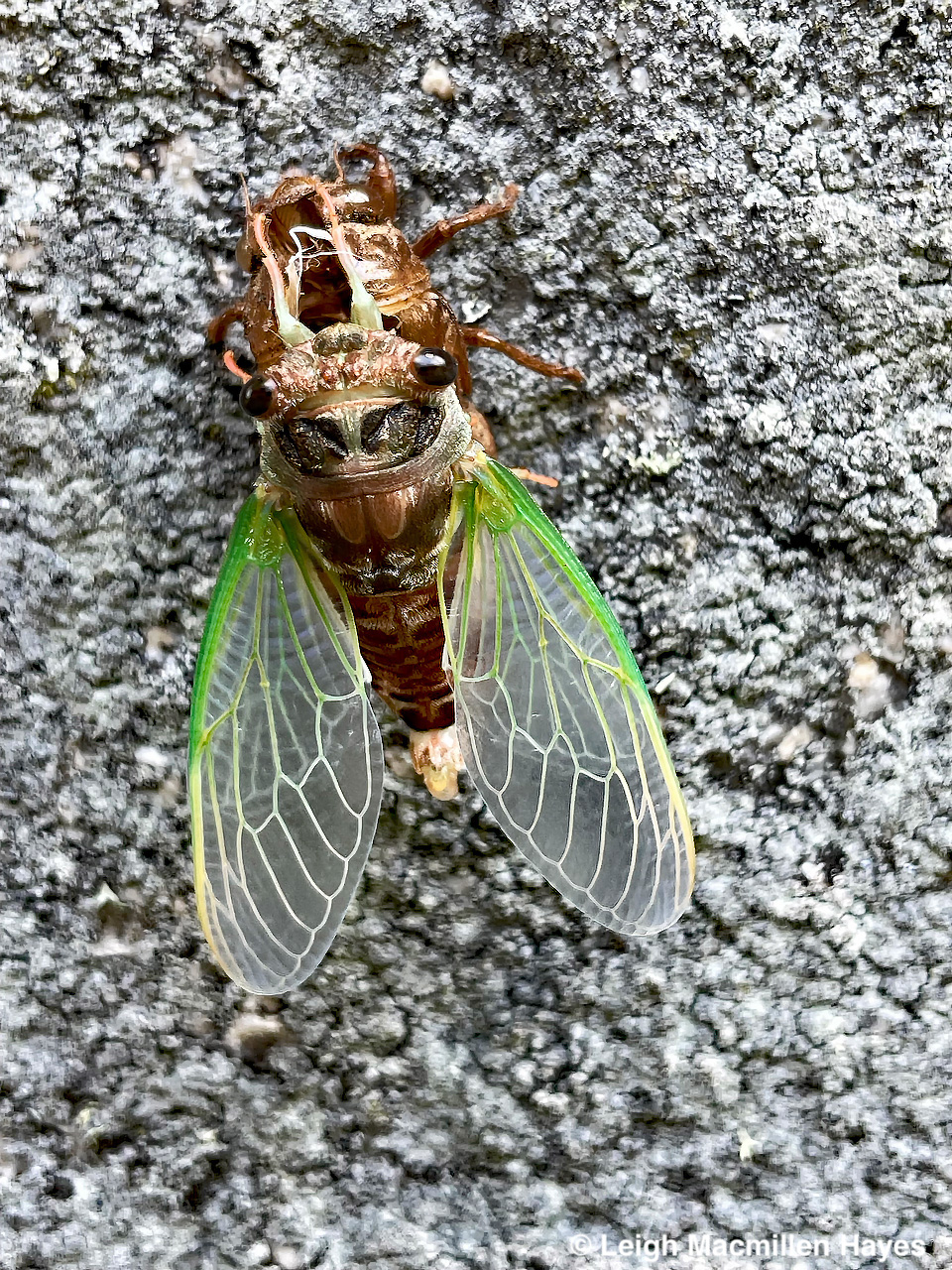
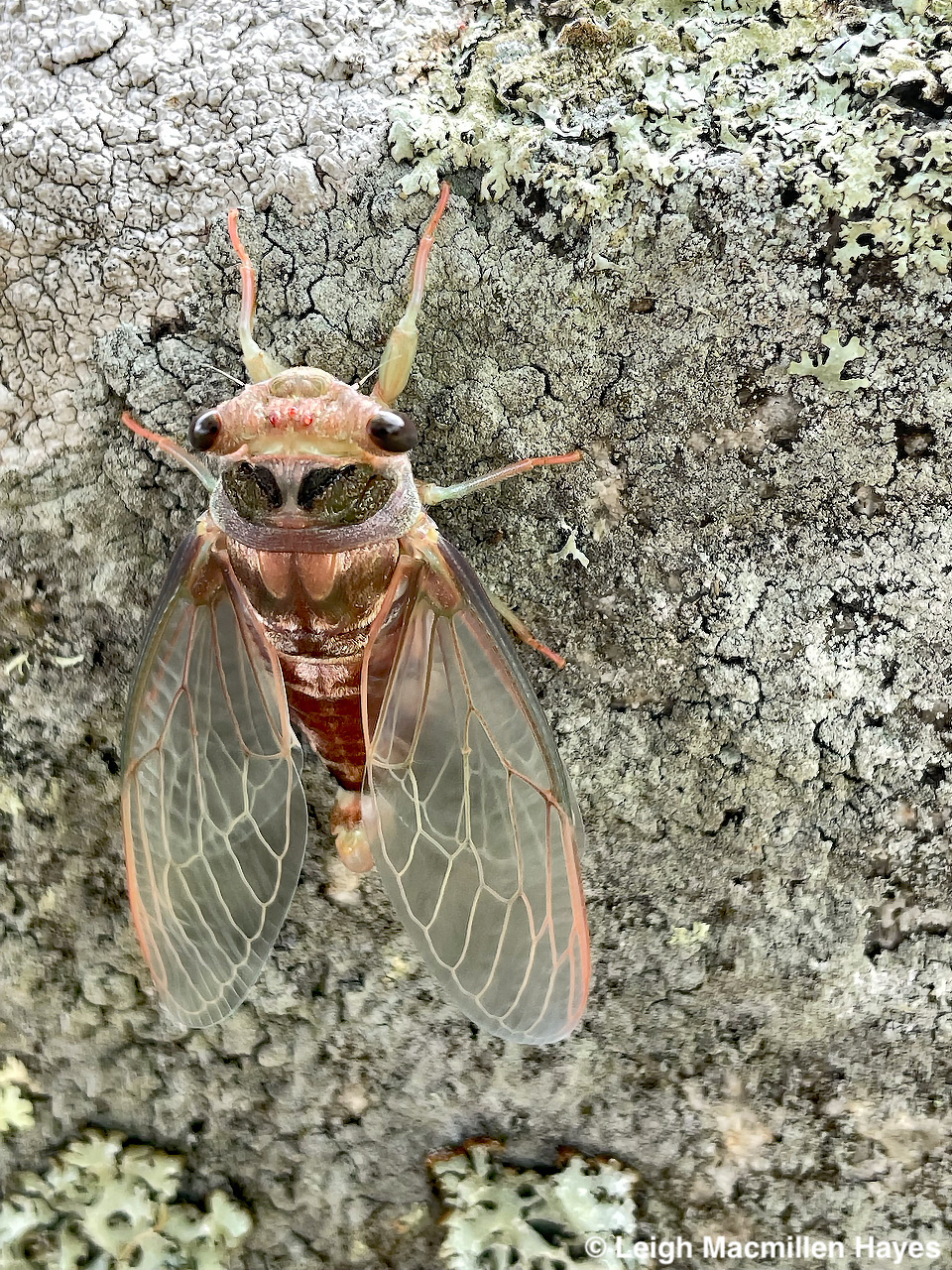
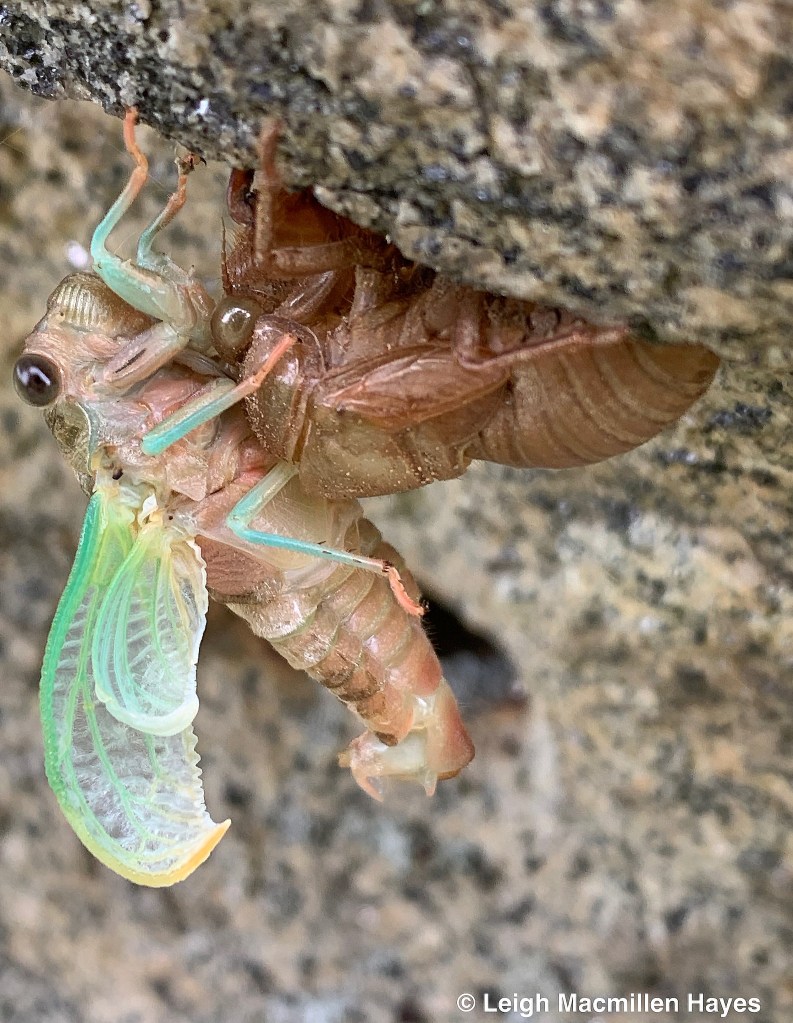
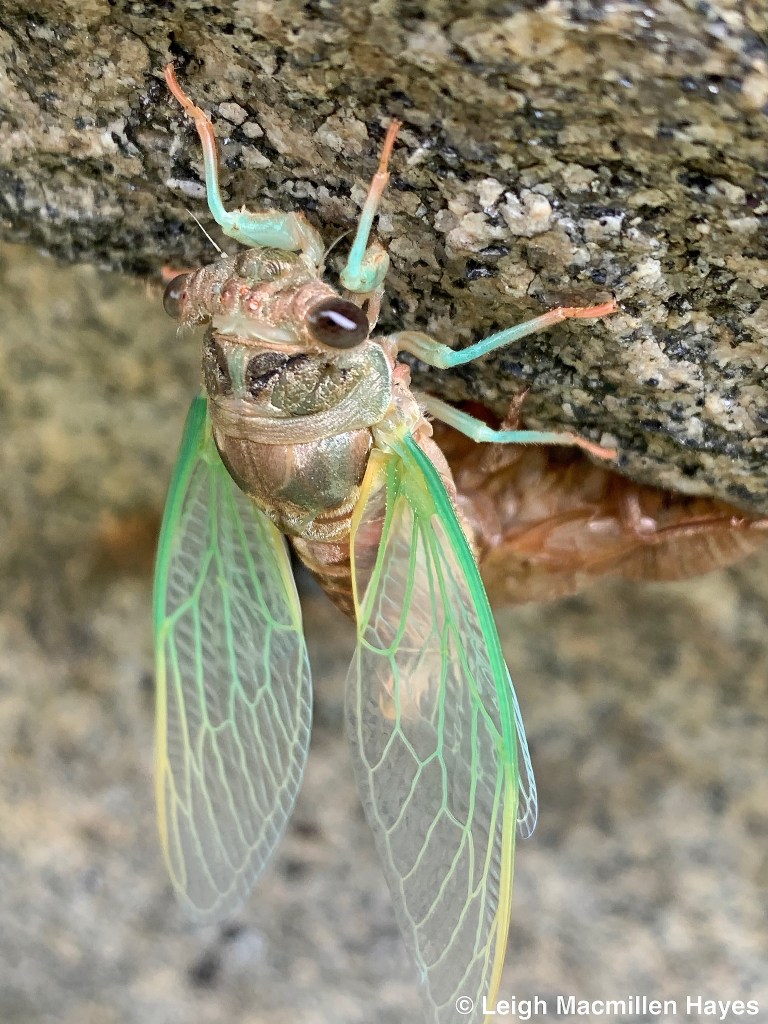
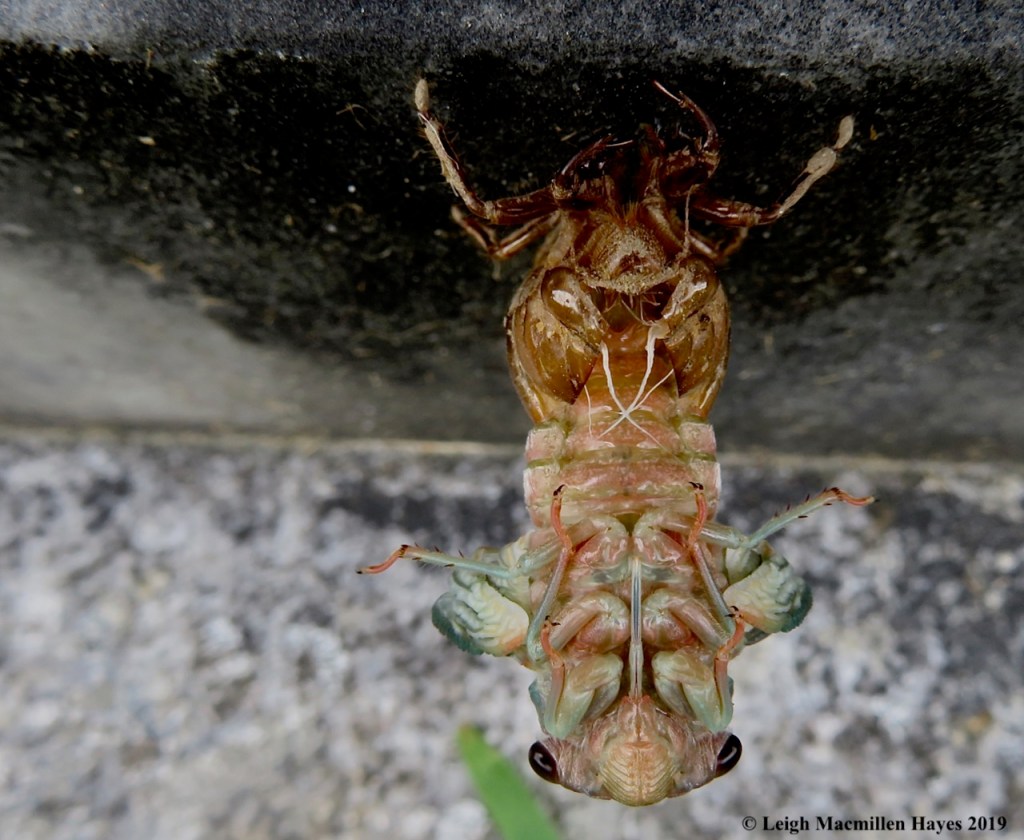
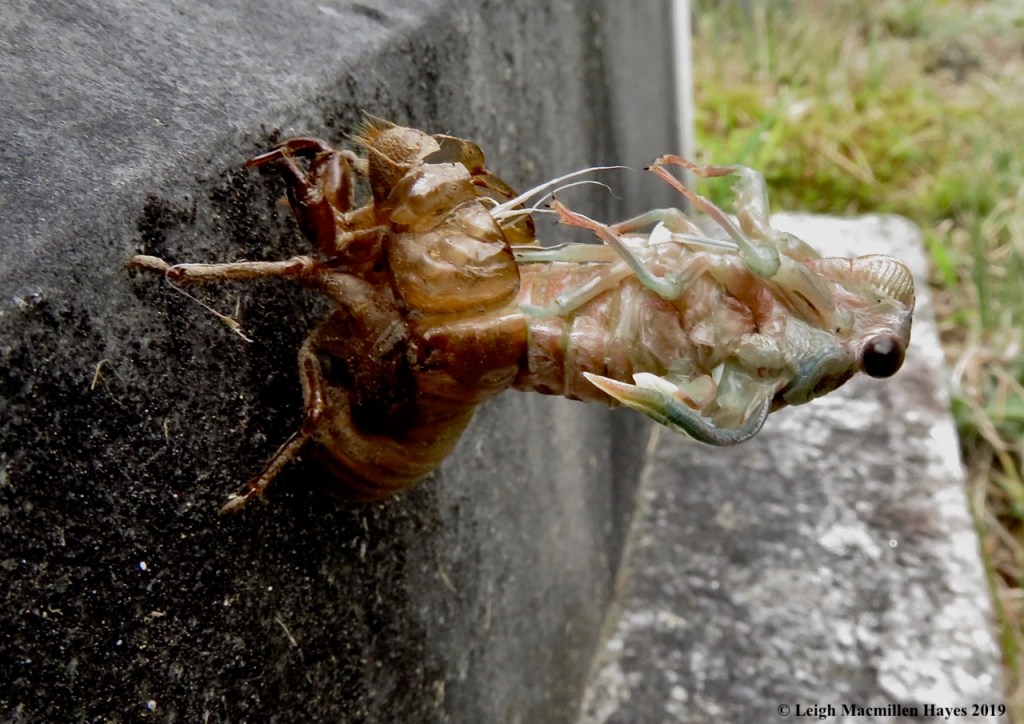
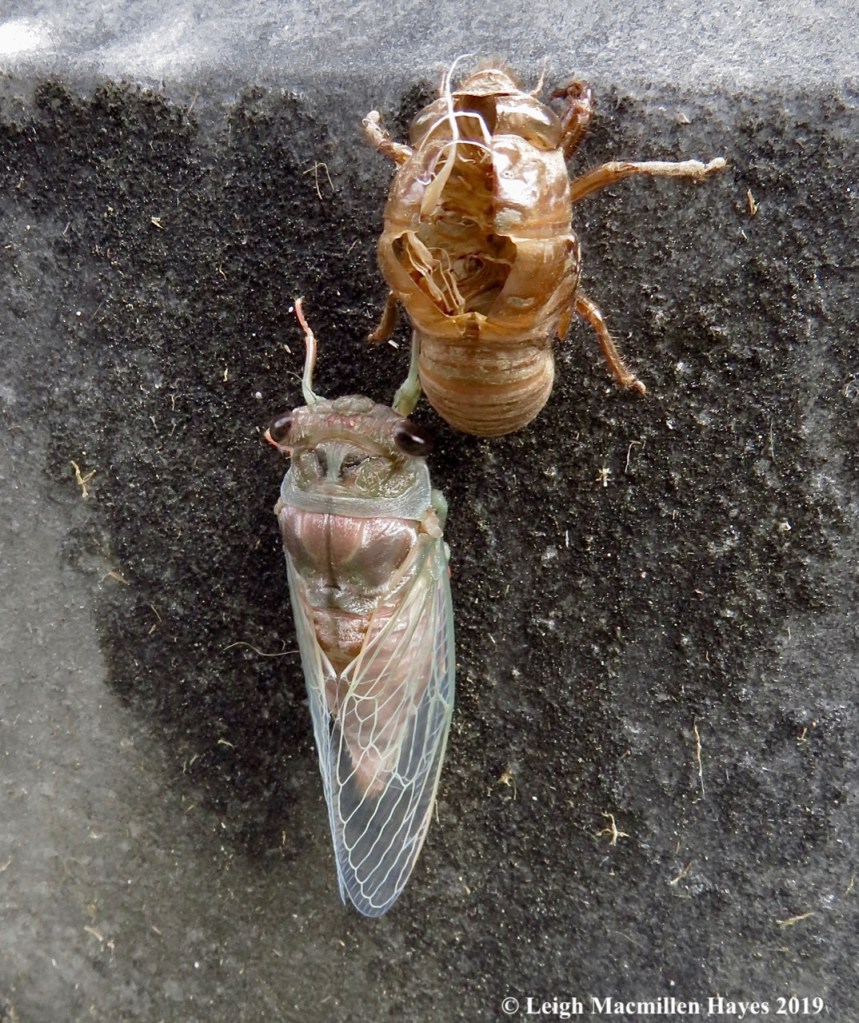
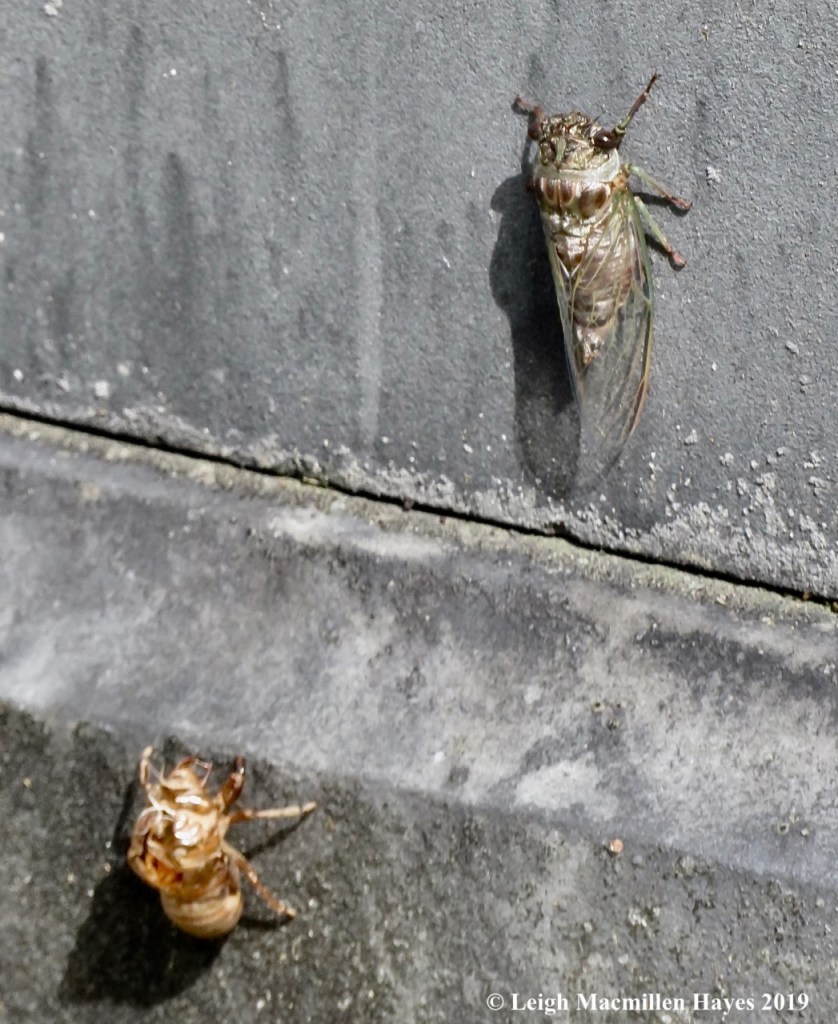
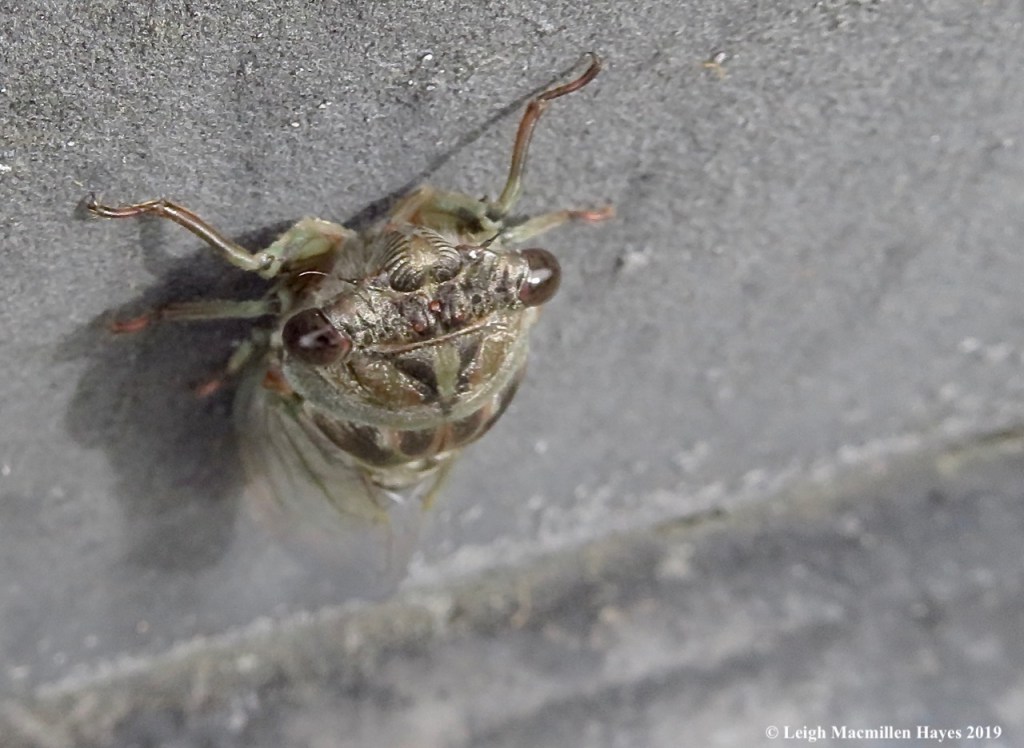
I was thrilled as I approached the airport end of the trail to find a few Dog-day Cicada exoskeletons still clinging to the underside of the fence railings. My, what large lobster-like claws you have, the better to dig yourself out of the ground when you are ready to emerge from your root-sap-sucking days to form wings, and fly away, and find a mate.

Because my imaginary train had let me off at Porter Road in Fryeburg, about halfway between the two ends of this four-mile route, I wandered and wondered for about two miles toward the airport end, located just beyond the mileage sign.

Portland: 47 miles away.
But it’s not all rail trail . . . yet.

As I looked across Rte 5, I imagined what will happen next. “A twelve-member Mountain Division Rail Use Advisory Council was created in June 2021 to study and review the 31 miles of state-owned, inactive rail line in order to make recommendations for its future use. Frequent meetings occurred . . . at which the civil engineering consulting firm, HNTB, ‘presented feasibility studies for future rail, rail with trail, and interim trail/bikeway use options and economic benefits. It was determined that restoring rail use would cost $60,000,000. For rail with trail, the cost would be $148,300,000. Removing the rails and building a trail until rail, which would keep the rail bed intact so the trail could return to rail if needed, wold cost $19,800,000. The final vote was 11 – 1 in favor of Trail Until Rail . . . After thirty years of work and thanks to the efforts of so many people, on July 6, 2023, Maine Governor Janet Mills signed LD404 into law, authorizing MaineDOT [Department of Transportation] to remove the railroad tracks and construct a 31-mile, multi-use trail until rail on the Mountain Division Rail Line between Fryeburg and Standish . . . Trail Until Rail means that this will be an interim trail because it can be pulled up and the tracks restored to rail should the return of train operations be economically viable. As stated on the alliance’s website: ‘Most major rail corridors are federally protected in perpetuity (that’s forever!). If the tracks ever need to go back in for train service, they will.'” ~ from my article Trail Until Rail: Mountain Division Trail Expansion in published Lake Living, Fall 2024, vol. 17, no. 2.

I turned around by Route 5 and followed the rail with trail back to my truck. Though I’m a hiker, wanderer in the woods by nature, the Mountain Division trail always amazes me with all that it has to offer and today was no different.

If all goes as intended, this 31-mile rail until trail project will be broken into six segments and within two years work will get underway to connect the airport end to this spot by the intersection on Route 160 in Brownfield.
Thanks for taking the time to travel with me today.
Thanks also to Terry Egan, vice president of the Mountain Division Alliance, and Andrew Walton, secretary of the organization, for walking a section of the trail with me several months ago and sharing their stories and visions of this asset to our area.



























 wondermyway