A Glimmer In Their Eyes

It’s been a rainy week. It’s been a sunny week. And sometimes it’s been both simultaneously.

Despite the weather, I’ve spent many hours tramping through the woods as is my custom, sometimes with others, including a large middle school class, and sometimes alone. Most of the tramps found me near or beside water–after all, this is the Lakes Region of Maine.

On one such, almost a week ago, this fly and its brothers and sisters landed repeatedly on our outerwear. Turns out there is a reason for this. It’s known as the Friendly Fly for its habit of landing on people no matter how often it is brushed away. It won’t bite, but if your skin is exposed, it may try to sip at salts and tickle a bit.

Here’s the best news about the Friendly Fly. While it doesn’t bite us, it is known to parasitize Tent Caterpillars such as this one found in the same neighborhood. Going forward, I will honor each Friendly Fly I meet. Now if only we could find something that would do the same to Brown Tail and Spongy Moth larvae.
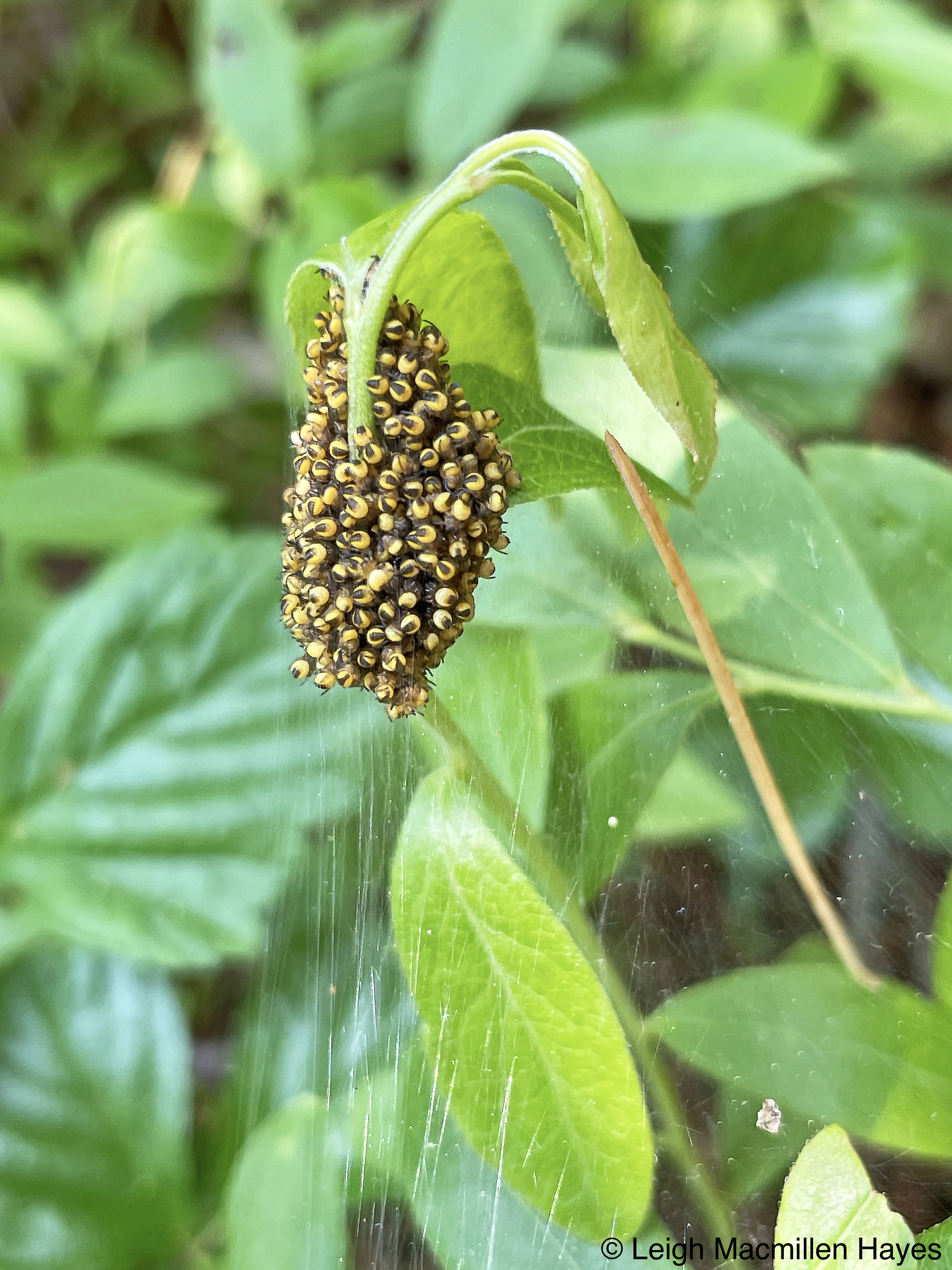
In the same neck of the woods, what appeared to be a flower, turned into a hundred or more spiderlings of the Cross Orb-weaver family. Notice all their guide lines. Such a clever construction.

When disturbed by accident, they didn’t leave the cluster, but did scamper on those guidelines for a minute or two before reassembling. I’ve read that they stay together much like so many others–there’s protection in numbers. During this stage of their lives, they feed on their egg yolks. I’ll take mine sunny-side-up.

And finally, in that same place, we spent a few moments with an immature male Belted Whiteface Skimmer dragonfly so identified by its yellow thorax and the yellow base to the black abdomen. As it matures, the abdomen will turn brown and then red.
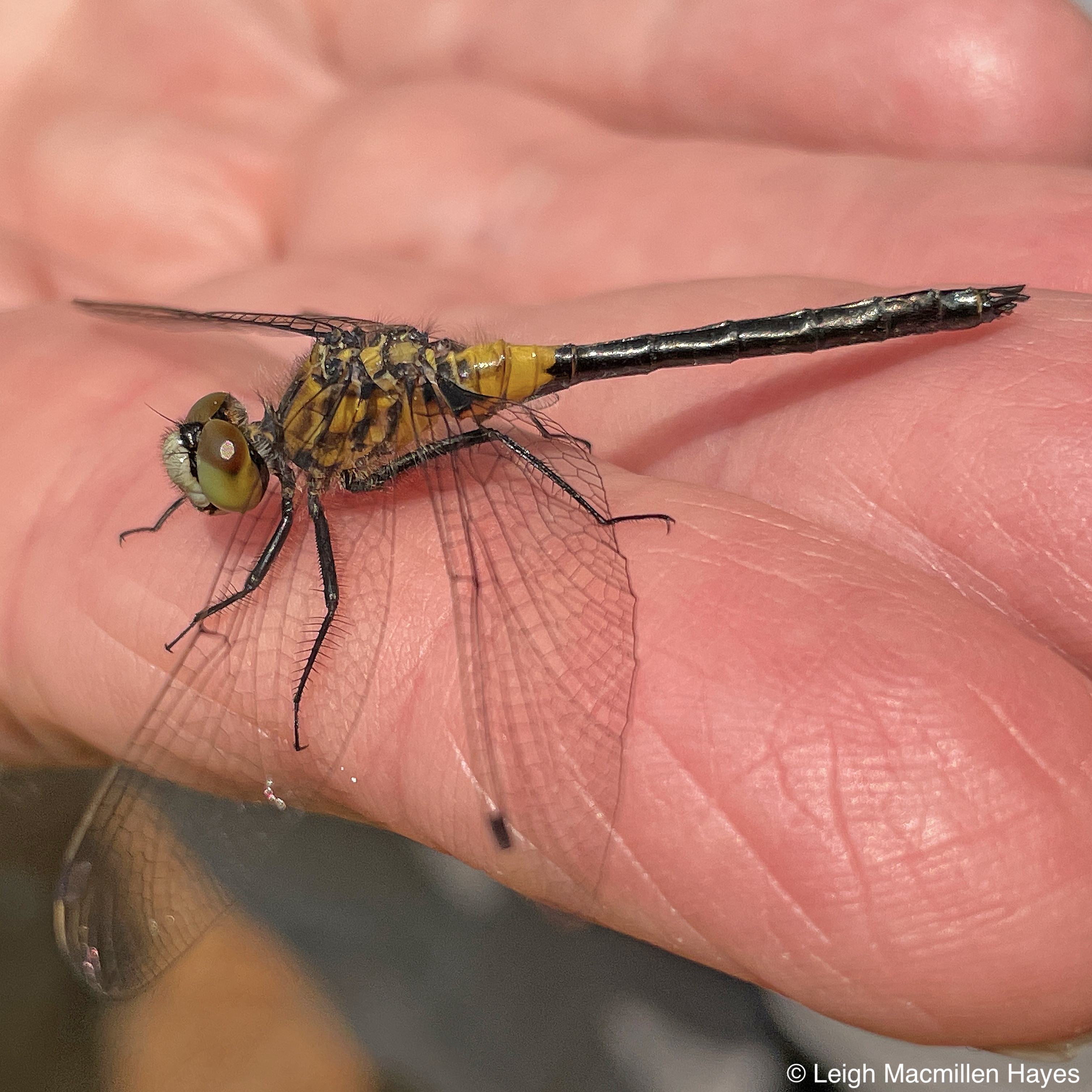
And just look at that white face. Can you even get a sense of some of the 30,000 lenses of the compound eye in the light spot? Dragonflies have incredible eyesight–they can see up and down and all around with almost 360˚ vision.

I have to say I think it was because of the damp, cold weather that this particular one decided to crawl upon my extended finger and allowed me to pass it on to another. We provided a wee bit of warmth.

Another white faced skimmer encountered in a different place was what’s known as a Dot-tailed Whiteface. At just over an inch in length, it’s a small dragonfly, but that dot is the giveaway, which makes it easy to ID in the field.

There seemed to be a theme–that of the white face variety. This one is known as a Crimson-ringed Whiteface.

One of my favorite skimmers is the Chalk-fronted Corporal, who earned its name for the corporal stripes on its thorax. And maybe it’s the old teacher in my blood that appreciates good old chalk. The fun thing about this species is that it’s usually found in groups, and you might not see them until you take a step and then they fly three steps forward, repeating this behavior throughout your entire journey in their neighborhood. They are also great posers.
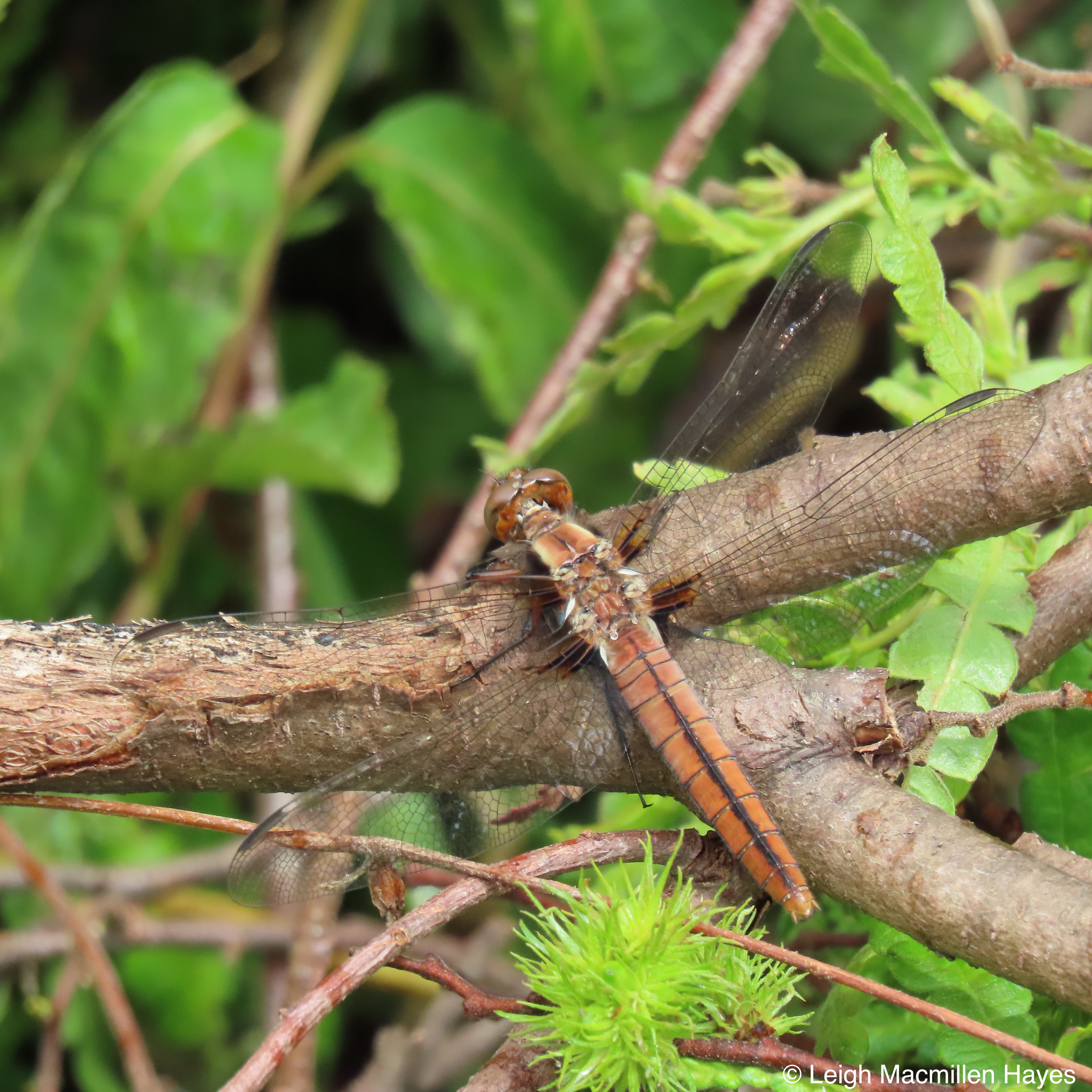
Immature Chalk-fronted Corporals such as this one are also abundant and seem to be circulating in every trailhead parking lot. They blend in well with their surroundings, so once again, I don’t spot them until they fly.

The next skimmer is a personal favorite. But the question is, can you find it? I have to say that I knew I’d taken its photo, but when I was reviewing the shots, I wondered why I’d taken this one of some vegetation and missed the female Eastern Pondhawk for so camouflaged is she.
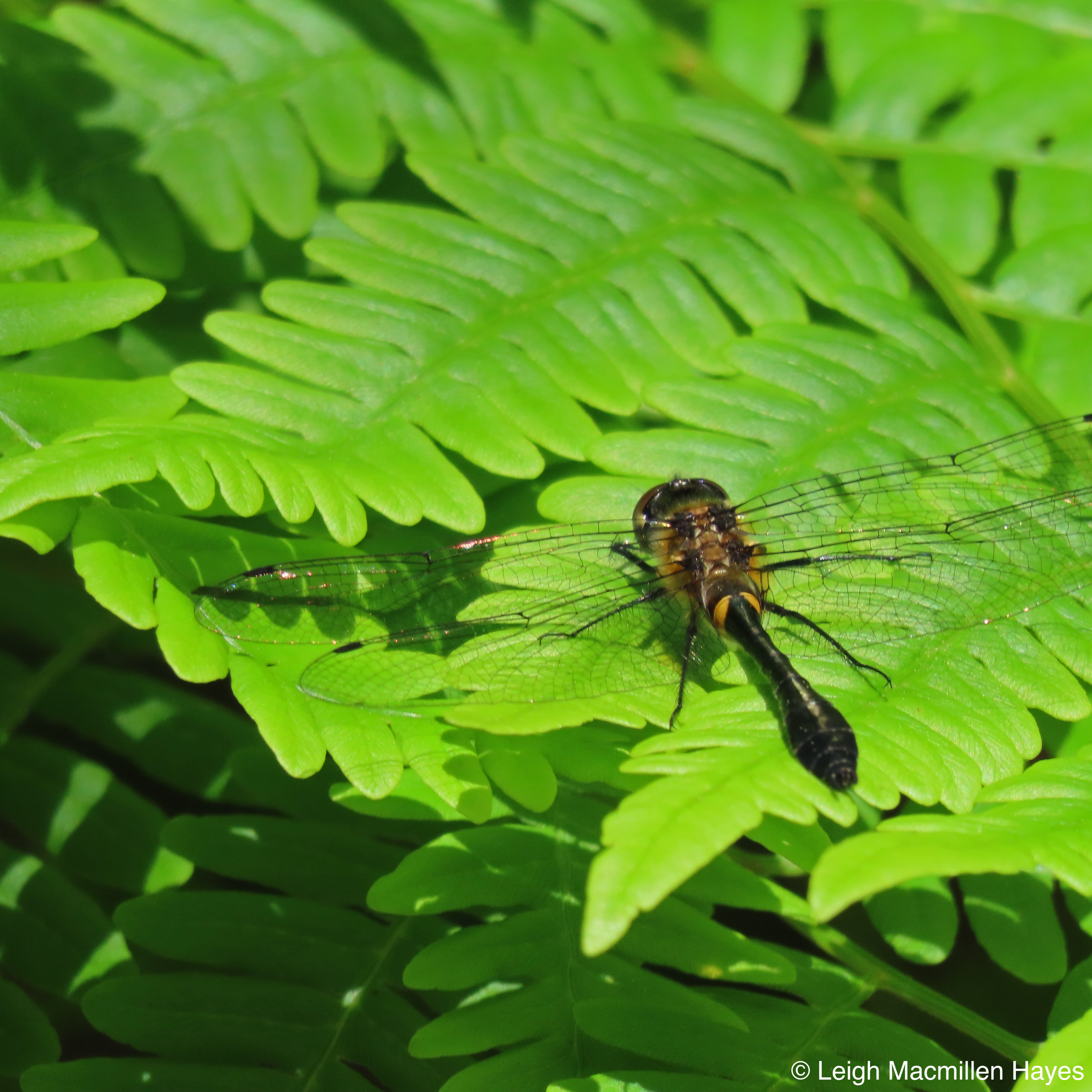
In another space I encountered a Racket-tailed Emerald. Look at that club-shaped abdomen. And fancy mirror-imaged yellow spots ringing the third abdominal segment.

Though I have no problem with dragonflies garnering so much of my attention during flying season, damsels also like to be noticed like this female Ebony Jewelwing. Her lighter colored black wings and white stigma at the tip give away her gender. But it’s the iridescent blue and green eyes and body that always make my heart skip a beat.
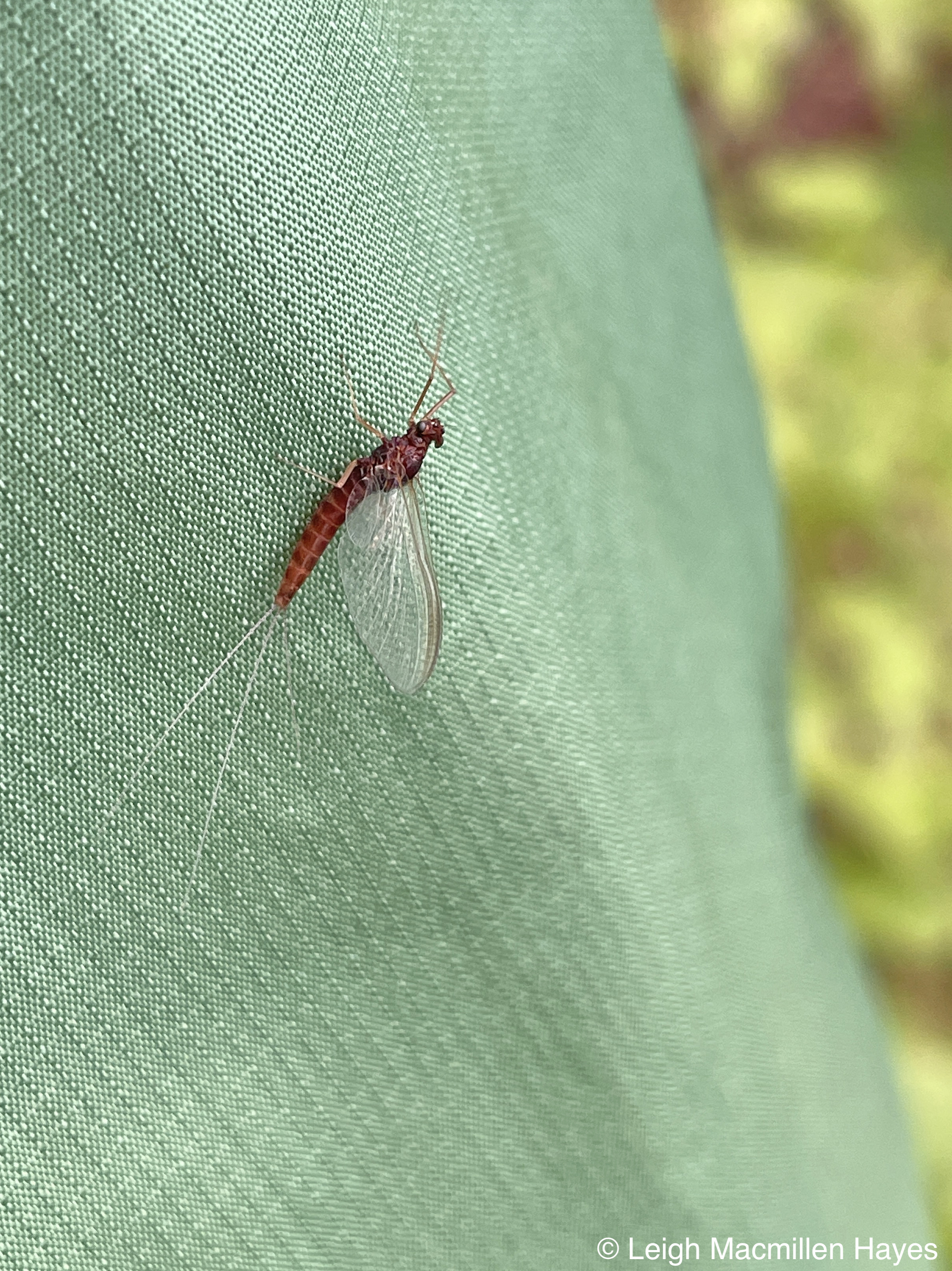
Another teenager also asked to be noticed–in the form of a sub-imago Mayfly with cloudy wings indicating its age. Had my friend stood there for the rest of the day and into the night, she might have seen it molt from this form to its final as an imago or adult.

In the midst of all these finds, and because of the rain, I returned to the vernal pool behind our house and found that the water was quite high. Usually, by June 9th the pool has dried up. But not this year. It is teeming with Wood Frog tadpoles and I suspect Spotted Salamanders for so many were the egg masses. Things are a-changing within those bodies, and I think this will be the year so many finally hop or crawl away. I’ve had my eye on this pool for thirty years, and this is a first.
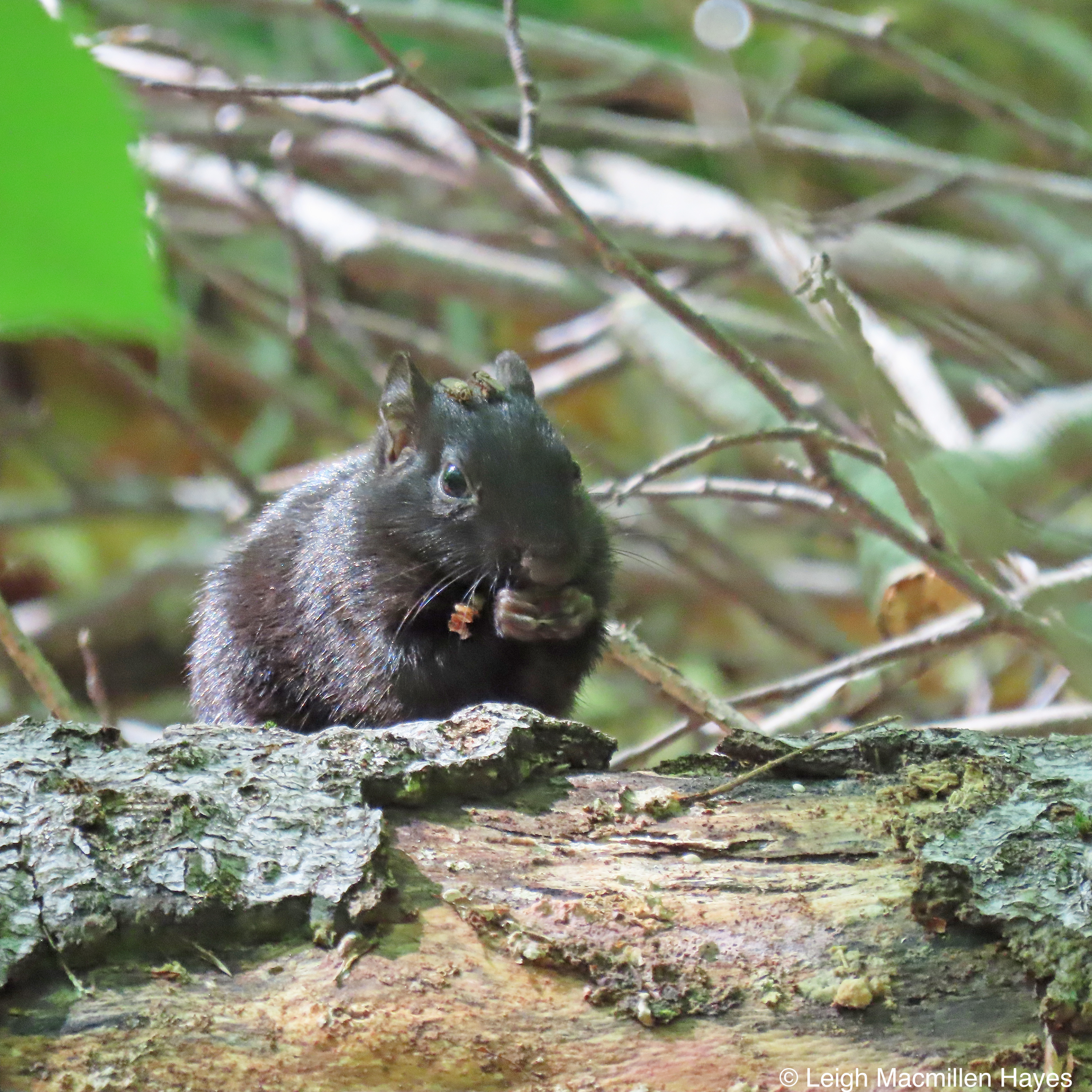
Finally, I have to share with you another I recently met and first reported in Stars Among Us. As a friend and I watched this afternoon, it dined on vegetation, stuffing its cheeks, while flies dined between its ears.

They didn’t seem to bother it as much as the mosquitoes bugged us, but still it clasped its little hands together.

Maybe it recognized the glimmer in our eyes as we watched it with joy, just as we recognized the glimmer in the eyes of all we met from the Friendly Fly to the dragonflies to the damselfly, Mayfly, Wood Frogs, and yes, the Black Chipmunk itself.

More rain and sun are in the forecast for this coming week. I wonder what we’ll see next.
Understanding the Blues

Our Sunday became our Mondate and rather than hike, we went for a paddle in the tandem kayak. It was a long but fruitful paddle, though that fruit differed depending on perspective.

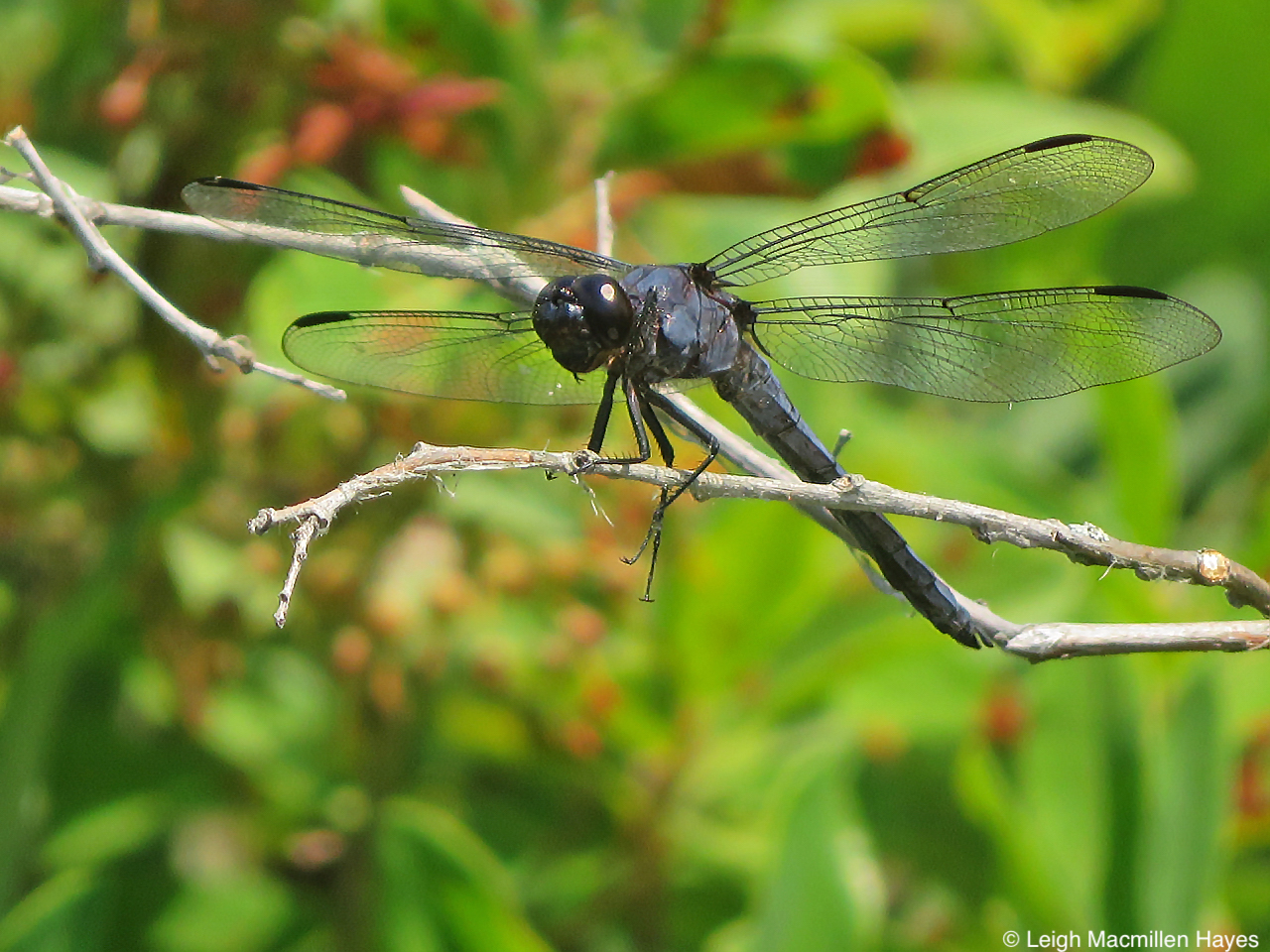
My blues began with the sighting of many Slaty Blue Skimmers with their burgundy brown heads, gorgeous slate blue bodies and aggressive personality once a competitor appears on the scene. A male will perch for moments on end, but when another male enters his territory, he as owner of that particular line of shorefront, zips into action, circling the intruder before giving chase. And then, as if nothing has happened, he returns to the same perch. And sits for moments on end until the next intrusion occurs.

A smaller, but equally aggressive skimmer is the Blue Dasher, who will take off after any dragonfly featuring blue pruinosity. Pruinescence is the frosted or dusty-looking coating on top of a surface and in the case of the dragonflies, some feature this as they mature.

And then there was the Bumblebee and Silver-spotted Skipper to watch as they gathered pollen and nectar from Pickerelweed, which in my mind its lilac coloration counts in the blue category.

Because we were in shallow water, there was an abundance of Swamp Spreadwing Damselflies flying and perching, their wings spread as the name suggests, much like a dragonfly, but their slender bodies and dumbbell-style eyes proving they are Zygopteras (damselflies) rather than Anisopteras (dragonflies).

While its thorax and abdomen are metallic green, its those blue-green eyes that spoke to me.

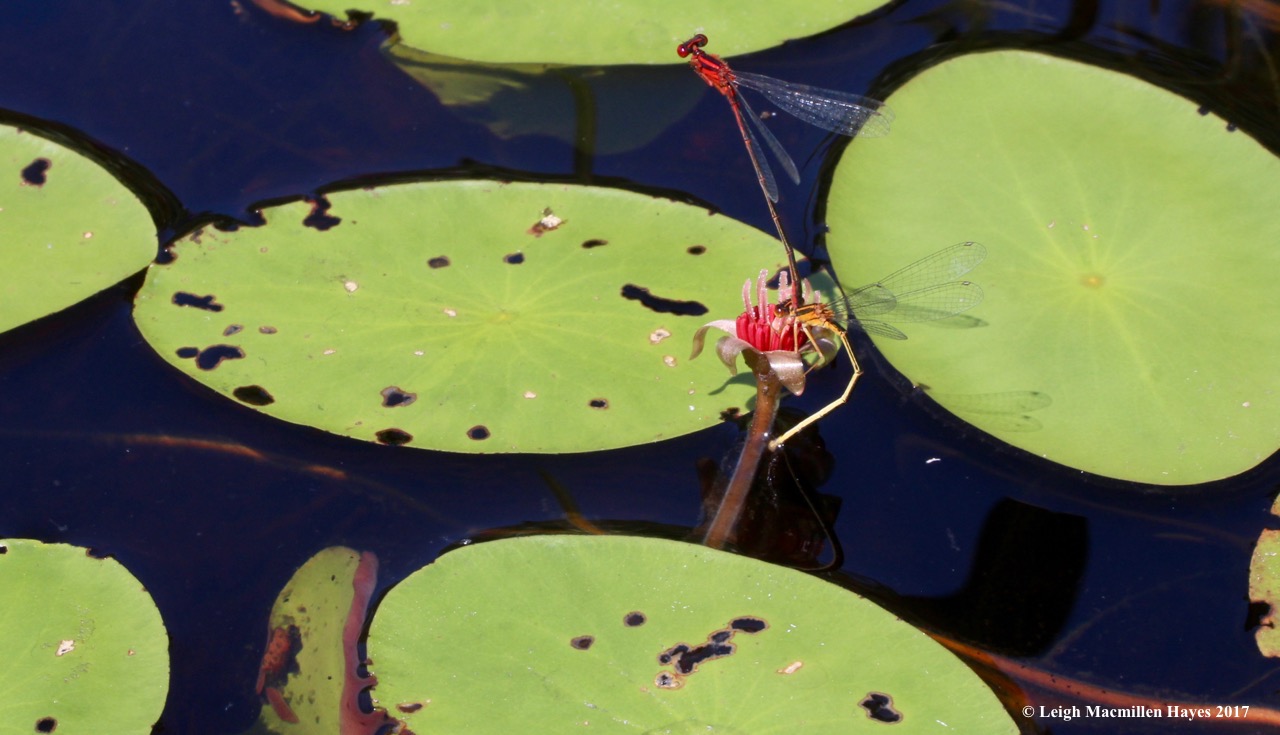
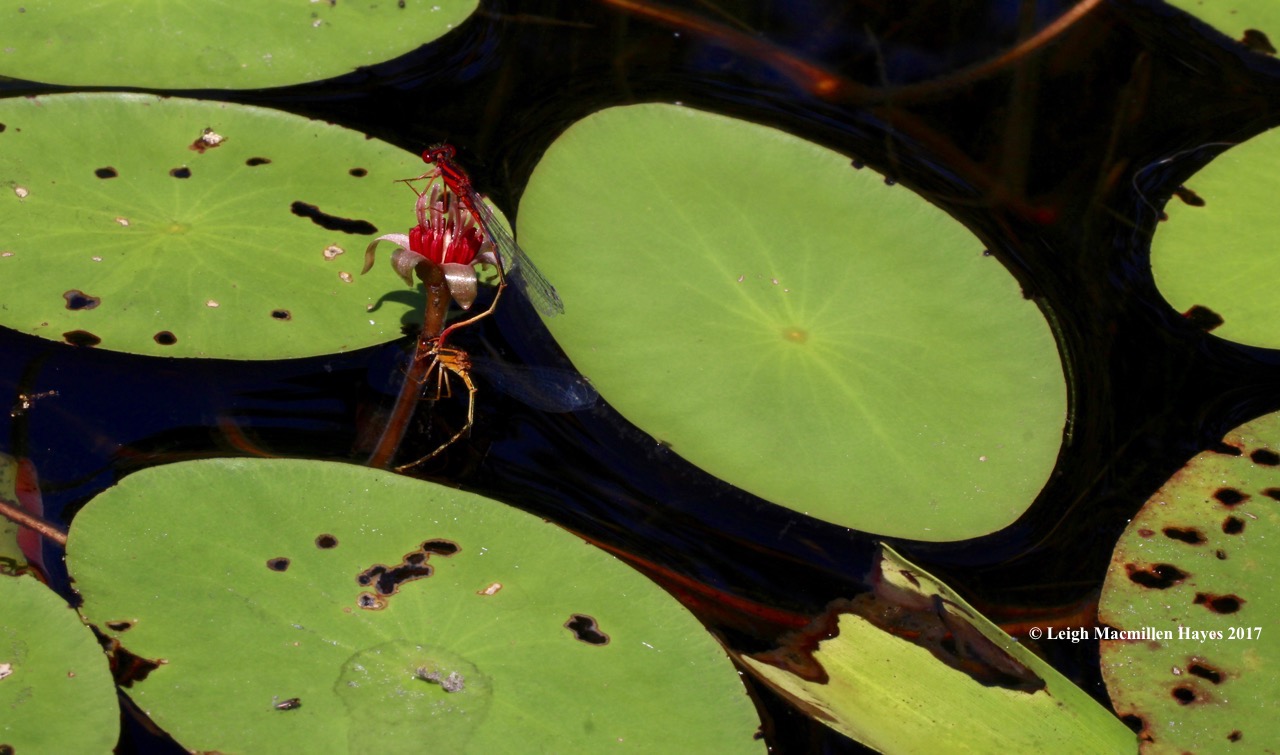
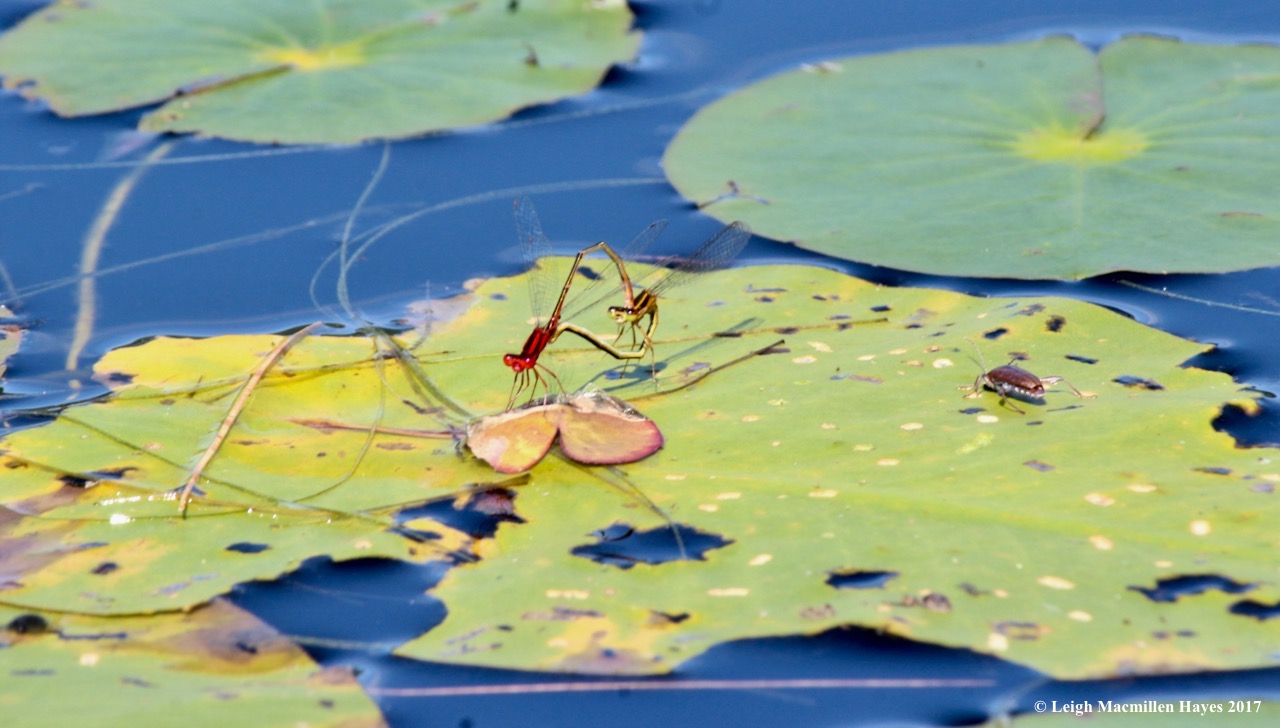
The more I looked, the more I realized that I need to spend time getting to know the damselflies a wee bit better. I knew that these two in their typical canoodling wheel position were bluets, but it took some study at home to determine that they were Familiar Bluets. And upon reading about them, I learned that copulation lasts about twenty minutes and then they remain together in tandem as she tests sites to lay eggs. She actually goes underwater to lay her eggs upon stems while he releases her and waits, hoping to reattach before moving to a new egg-laying site, though she doesn’t always allow him to do such.

The Skimming Bluet was my next great find, but again, I didn’t know its name at the time. This is one of only two species of bluets where the abdomen terminates with black appendages below segments 8 and 9, which are blue. The other is the Turquoise Bluet, which prefers a stream habitat. Here’s hoping I remember that fact.
While the American Bluets, the largest and most numerous genus of damselflies, are named for their bright blue coloration, not all have this color pattern. Some bluets are actually orange, red, yellow, green or black.

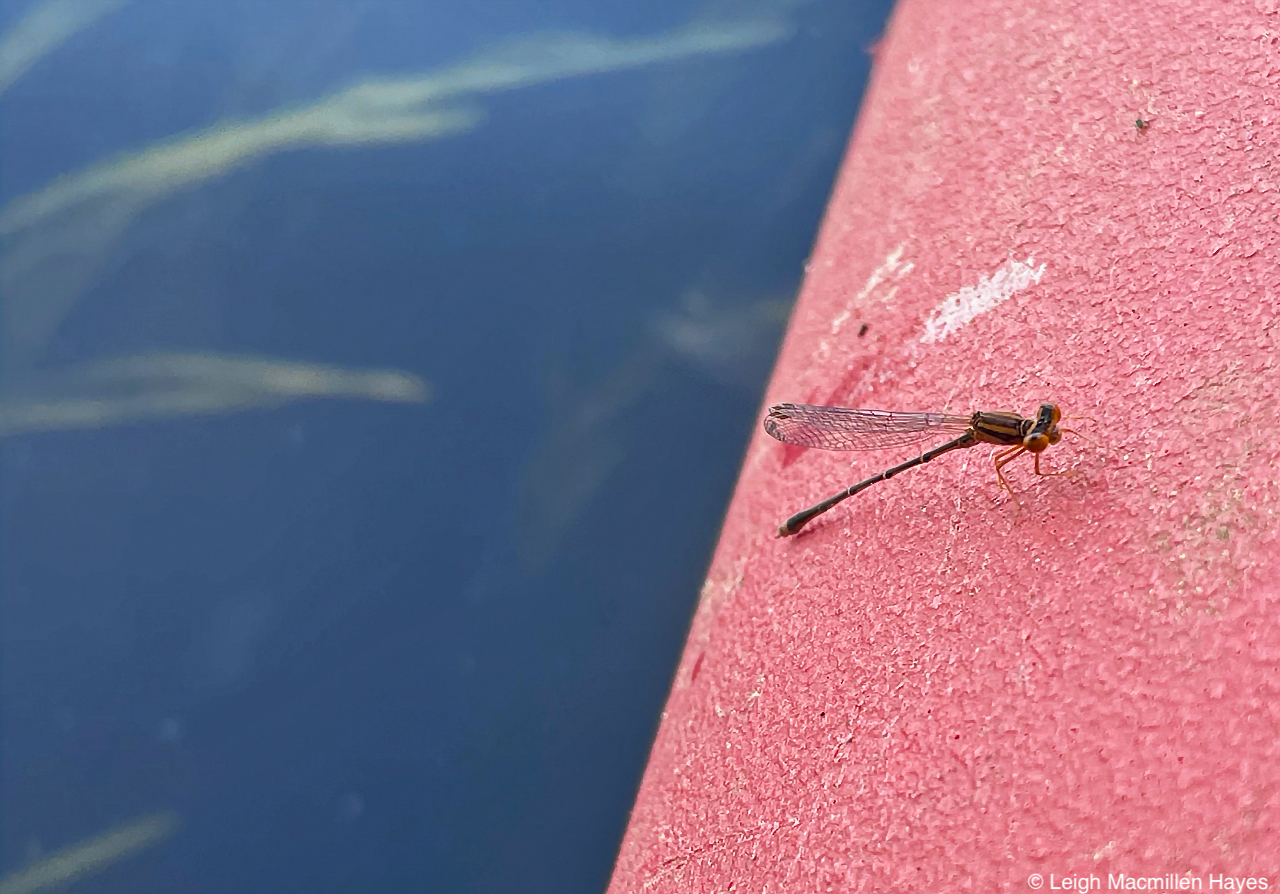
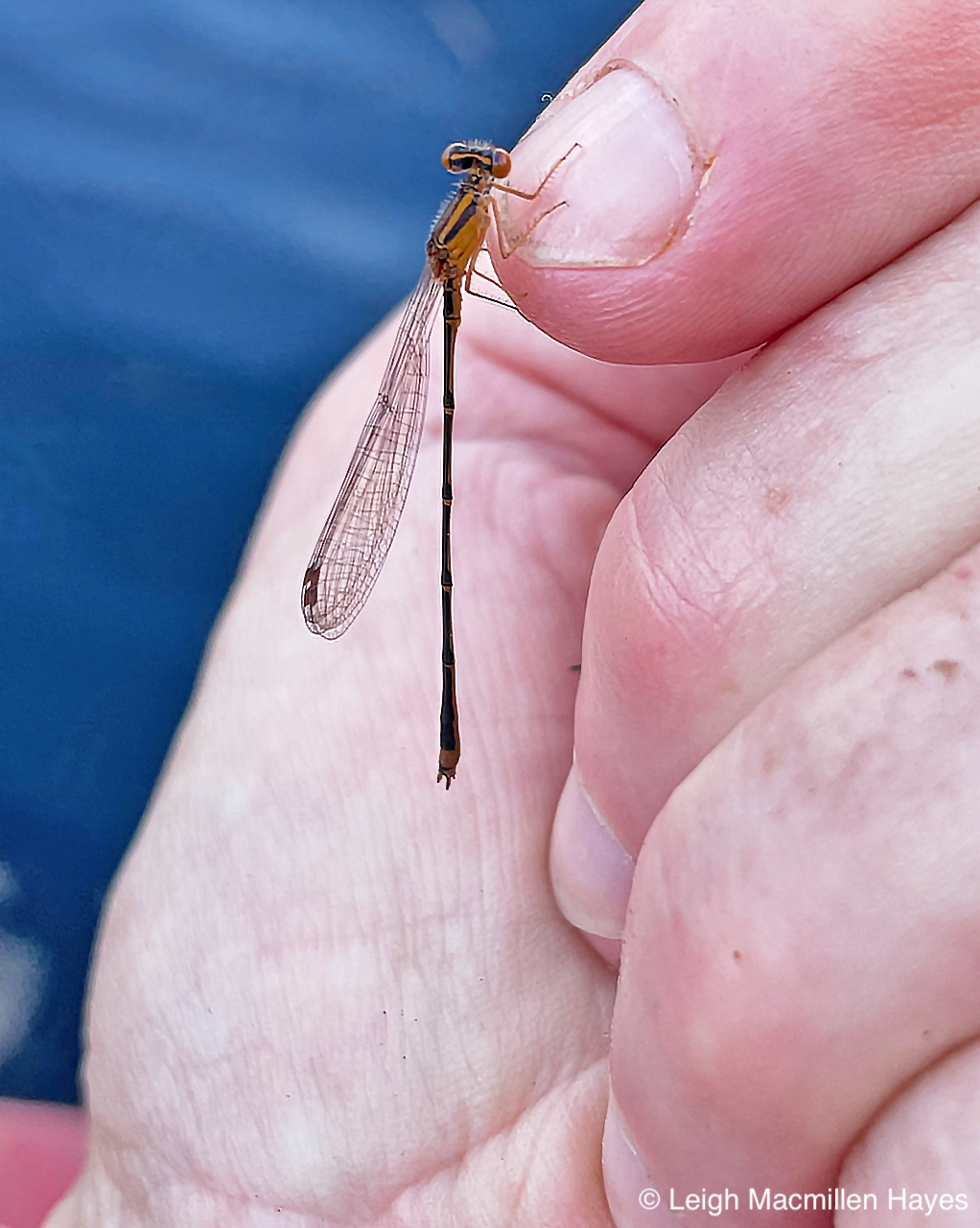
The Orange Blue actually begins life as a pale blue damselfly, but gradually turns orange like this one that landed on the kayak. It stayed perfectly still for quite a while, so I thought I’d channel my inner damselfly whisperer self and offer it a finger. This works for some dragonflies, but I can’t recall a damsel ever taking a ride until this one climbed aboard much to my delight.

We spent a long time getting to know each other. I was quite taken with the orange occipital bar that connected its two eyespots and had a bit of a chevron shape.

I’m sure it found something about me to admire as well. As we looked at each other, in flew one of many Deerflies. I still have a few welts to attest to their abundance. My great hope was that the damselfly would decide to do me a favor and eat the Deerfly.

Granted, the Deerfly was quite robust. And eventually flew off without the Orange Bluet giving it any notice, which should have been a bit of foreshadowing I didn’t know how to read at the moment.

Twice I put O.B. back on the boat and the second time was as we started for home. He seemed a bit sluggish.

As we moved around a bend and the wind picked up he took cover and slipped down out of the breeze. Eventually, he dropped onto my leg, and I’m sad to say, died. Damselflies have a short lifespan–living between two and four weeks. I was sad to say goodbye, but trust that he had done his duty and I’ll meet future generations of the bluet that in adulthood isn’t blue. Given that, however, he is easy to ID in the field.

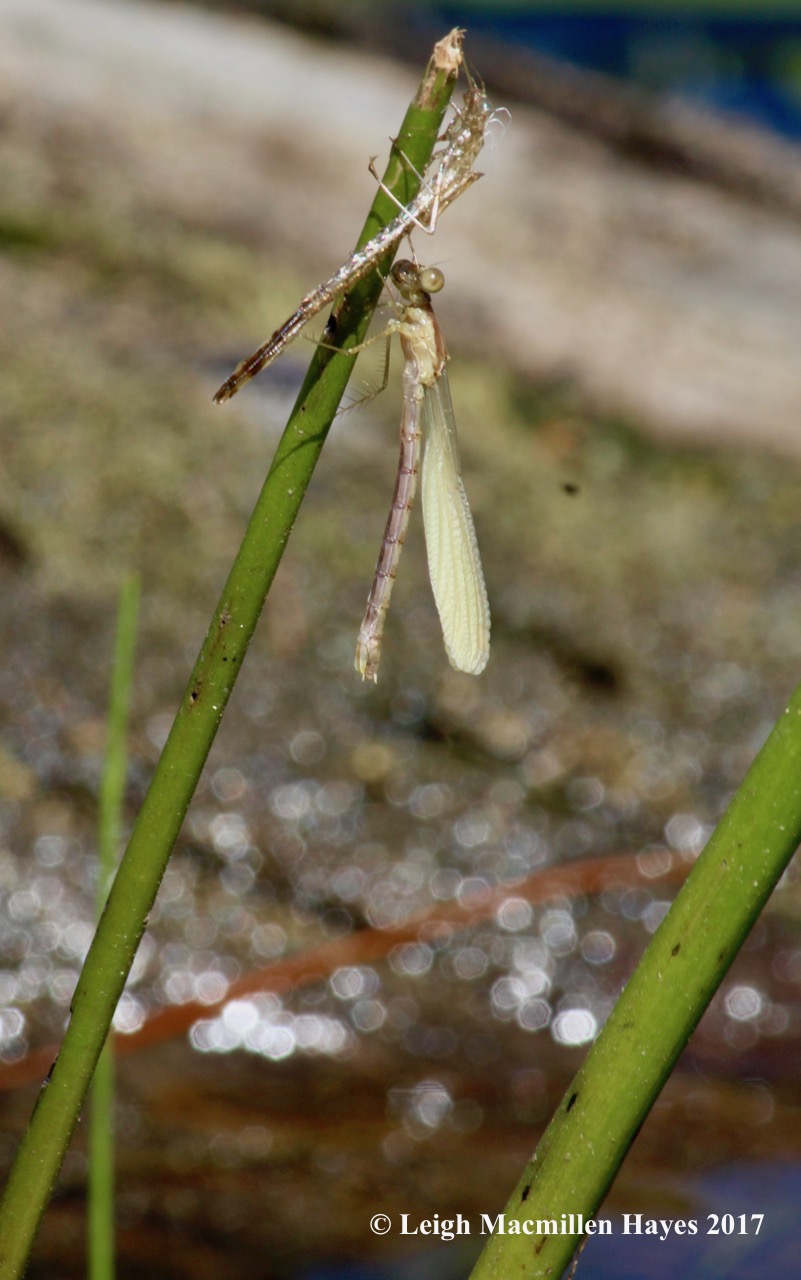
And as luck would have it, a few minutes later I spotted a newly-emerged damselfly waiting for its wings to dry and pumping its bug blood back into its body. Life circles about in the aquatic world.

As for my guy, he often departed the kayak ferry and went in search of his own favorite shade of blue. He found some favorite bushes missing due to the fact that the local beavers built a new home and needed construction materials. But still, he found plenty and left plenty for others, including the birds and other critters who eat blueberries.

We were together, but each understood blue in our own manner. It was a perfect Sunday Mondate.

Embracing Quiet

If you are like me, you spend too much time racing from one moment to the next during this fleeting season of summer. With that in mind, I chose to slow down today.

m-stump islands

I know of few better places to do that than among the stump islands in the Upper Basin of Moose Pond. It’s been my place since I moved to Maine over thirty years ago.

Once upon a time, this was timberland–albeit prior to impoundment. A log sluiceway was built at the Denmark end in 1792 by Cyrus Ingalls, thus turning pastureland into the Lower Basin, so he could float logs to a nearby mill. In 1824, a more substantial dam was created and the height of that dam was raised by William Haynes in 1872 to create the current impoundment. While the Middle Basin of the nine-mile “pond” may be the largest at over 900 acres, its the 300-plus-acre Upper and Lower Basins that I like best to explore. And because the Upper is right out my summertime back door, I spend the most time there.

m-painted turtle

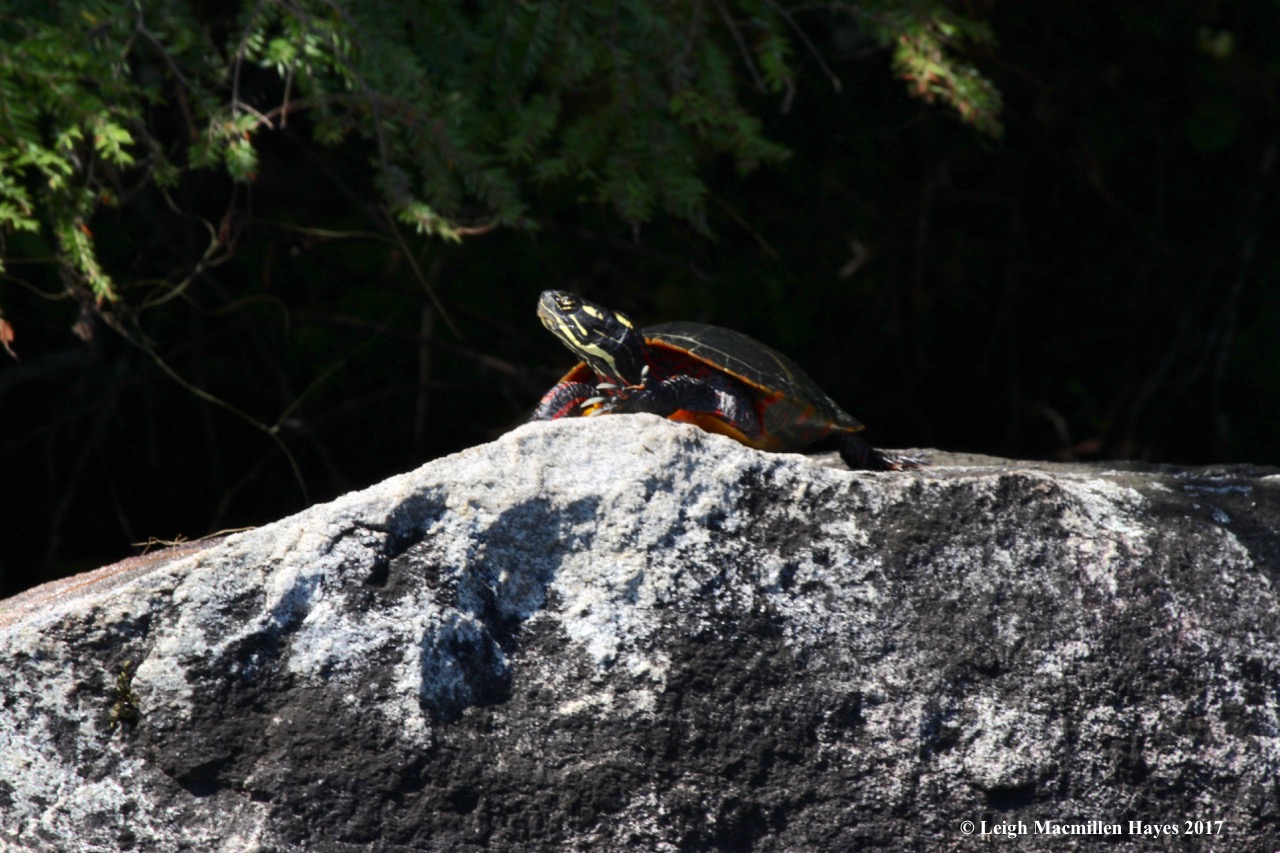
As I moved slowly, I greeted old friends like this painted turtle and even had the opportunity to pet a snapping turtle, so close to my kayak was it, but I paddled on.

m-newly emerged damsel 2

Actually, I didn’t paddle much once I reached the islands and stumps. Instead, I floated. And noticed. Before my eyes newly emerged damselflies pumped fluid into their bodies and wings, while their shed exuviae sat empty.

A family of three passed by in a canoe and I asked if they wanted to see something cool. When I told them about the damselfly, the father asked what a damselfly was and I told the family about its size and wing formation. They knew about dragons but had never heard of damsels. And didn’t want to stop and look. The mother commented on how magical it all was, but the father was eager to move on. I was sad for the son’s sake. He missed the real magic.

m-emerging damsel 3

Returning to my quiet mode, I found another, waiting as they all do, for the transformation to be completed. Do you see that the wings are not yet clear? I decided my presence was important, for I was keeping predators at bay.

m-orange bluet male

And then . . .

m-orange bluet 3

and then I met a new friend. An orange bluet–this being the male. I wanted to name him the Halloween damsel, but my field guide told me differently.

m-water shield and orange bluets 2

I kept waiting for him to meet her

m-orange bluets on water shield 1

and finally he did–

m-orange bluets mating

completing the wheel of damselfly love.

m-water shield 4

Because of the orange bluets, I also met the watershield flowers in their moment of glory. The flowers are described as being dull purple and inconspicuous. I found them to be various shades from mauve to muted red and lovely in presentation on day one of their life cycle.

According the US Forest Service Website, “On the first day the bud emerges above the water. Sepals and petals open and bend downward. Although stamens and pistils are present in each flower, on the first day of blooming, only the pistils emerge. Stalks of the pistils lengthen and spread outward over the petals. At night, the flower stalk bends and the flowers submerge beneath the water. On the second day, flowers emerge from the water again, but with the pistils retracted. The stamen stalks are lengthened and the anthers open. In this way flowers are cross-pollinated (Osborn and Schneider).

m-water shield old

Hardly dull, certainly unique. Even on day two.

m-newly emerged Hudsonian whiteface

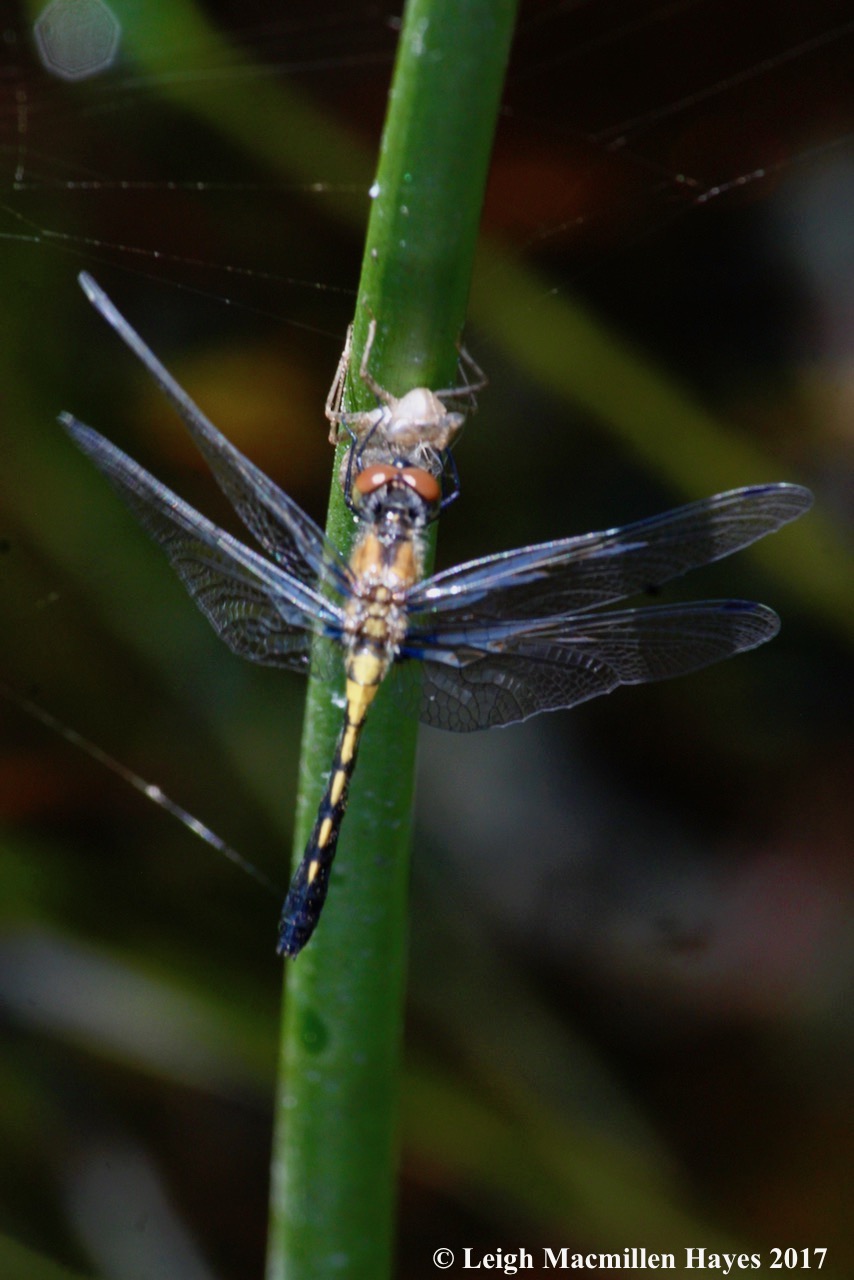
Today, I also met a new dragonfly. And thought that I did it a favor, but I may not have. You see, when we first met, I noticed a web all around this immature Hudsonian whiteface (or so I think it is). With my paddle, I removed the web to free the dragonfly. But, um, it flew off and that’s when I realized it was several hours old and still drying its wings. Do you see how shiny they are? And the exuviae to which it clung prior to my “helping” hand? It’s best to leave nature alone. If it had been caught in the web, then good for the spider.

m-cotton grass 1

Speaking of spiders, I found some cotton grass gone to seed . . .

m-cotton grass with spider 2

and when I moved to photograph it with the sun behind me, I noticed what looked to be a camouflaged crab spider hiding in wait.

m-beaver lodge 1

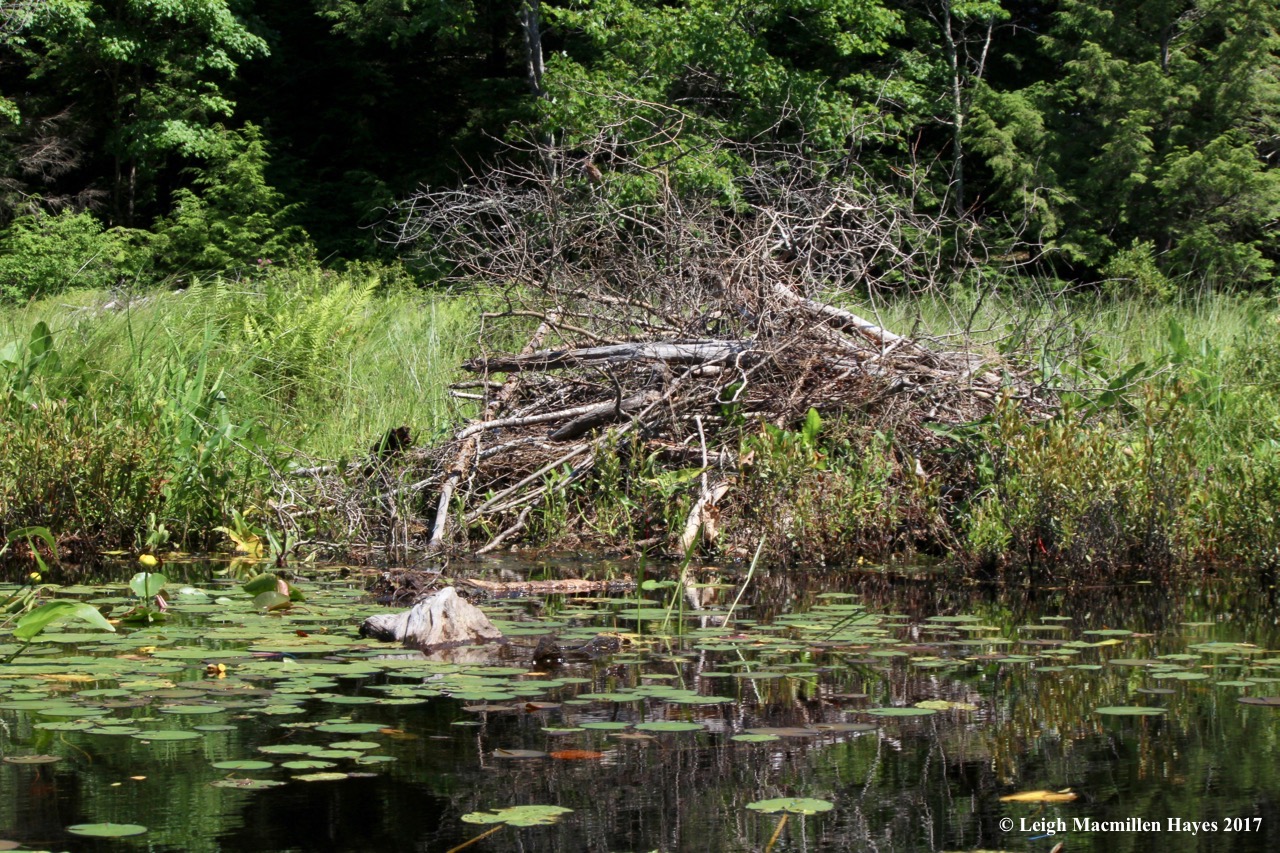
Among the stumps, I’ve seen numerous beaver lodges over the years and know from the saplings they cut down on our property, that at least a few are active.

m-beaver scent mound 1

Today a recently visited scent mound added to that knowledge. Beavers pull aquatic plants and mud up from the bottom of the pond and create these mounds. They then secrete castoreum from castor glands beneath their tails to mark territory, deter predators, and say, “Hey baby, wanna check out my sticks?”

m-meadowsweet

The island flowers also grabbed my attention, including the fluffy heads of meadowsweet and . . .

m-grasspink orchid

grass-pink orchids now waning.

m-sweet-scented water lily

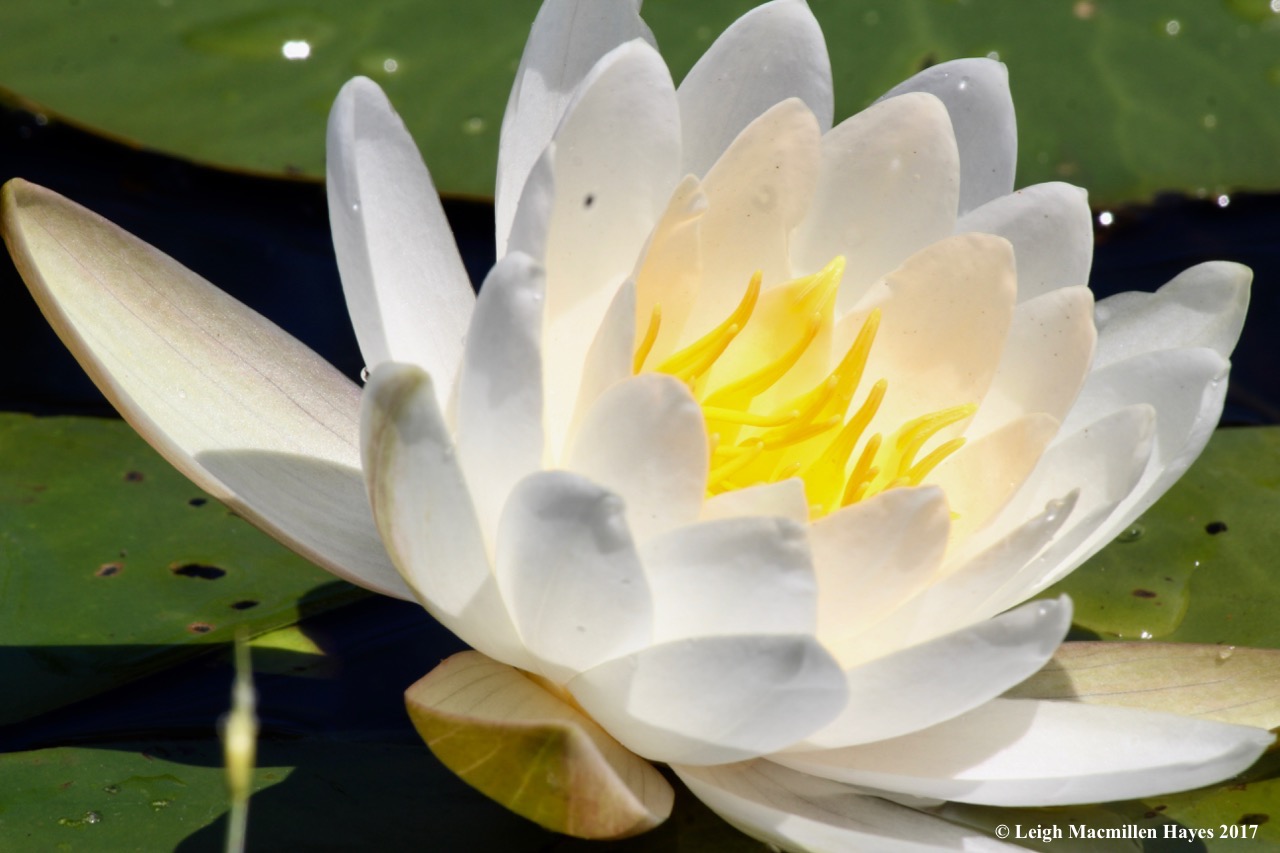
But . . . besides the dragons and damsels, I really went to see the aquatic flowers, like the sweet-scented water lily,

m-spatterdock

spatterdock,

m-pickerel weed 3

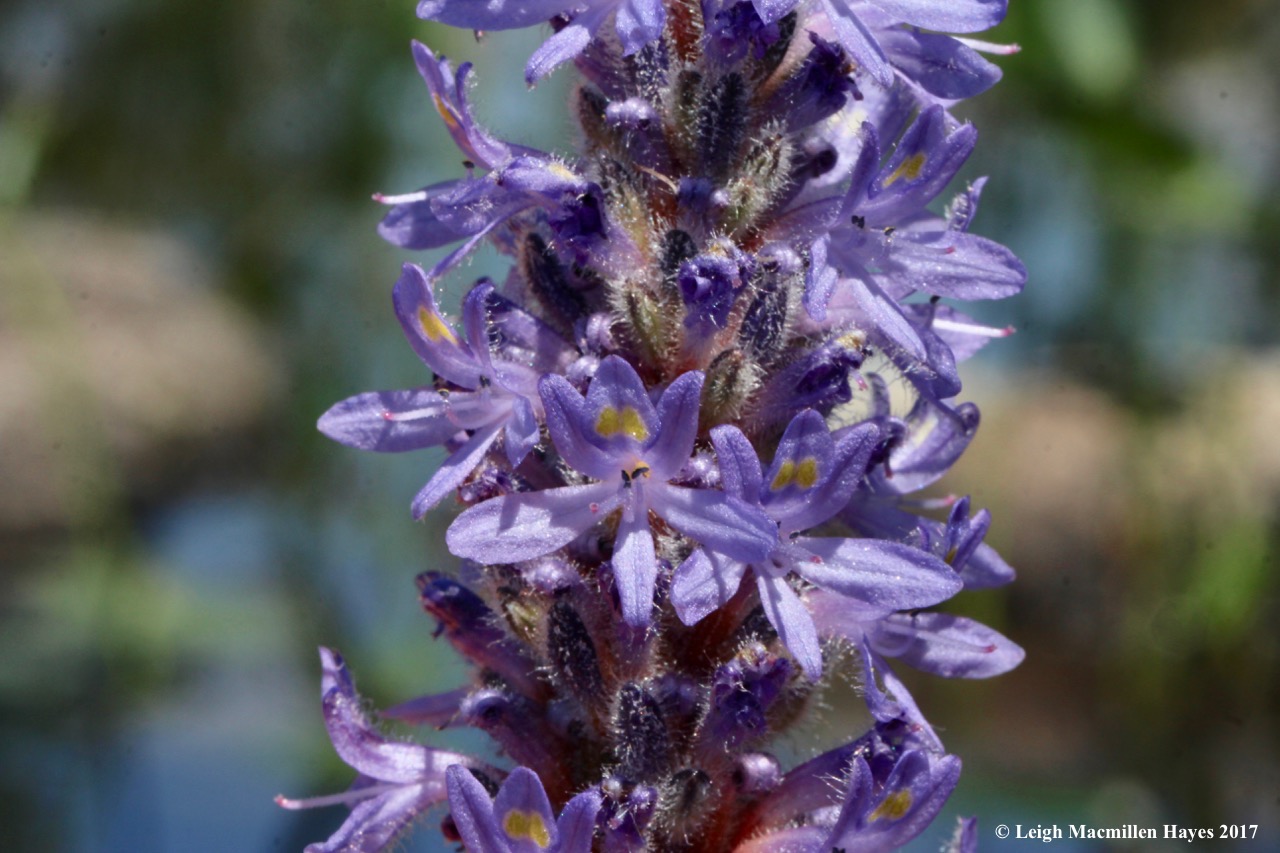
and one of my favs–pickerelweed.

m-pickerel weed

I love it for all its fine hairs and the way the flowers spiral up the stalk.

m-pickerel 2

I also love the coloration with two yellow dots on the upper lip providing a guide to the nectar it offers.

m-white face on leatherleaf 1

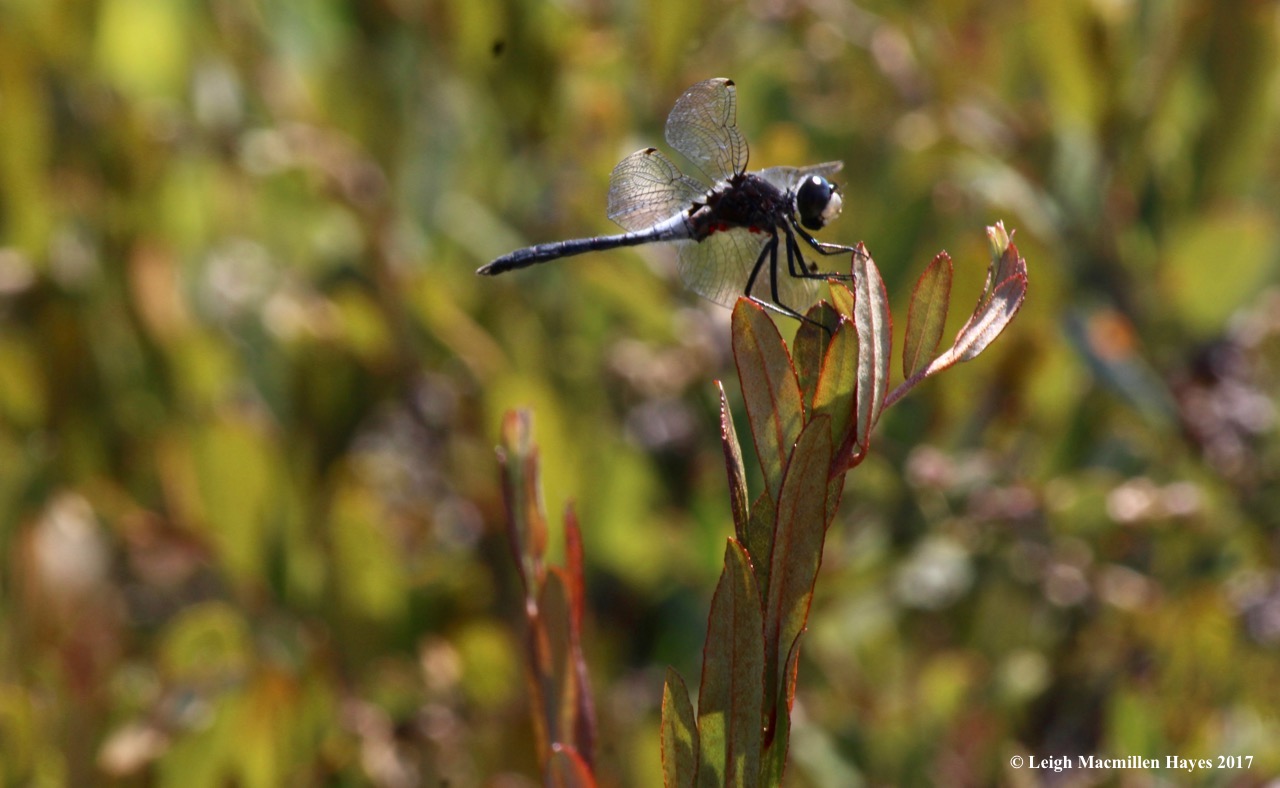
While I looked, another white-faced dragonfly, small in stature, kept following me. Finally, it paused on a leatherleaf shrub.

m-spatulate-leaved sundews with flower 2

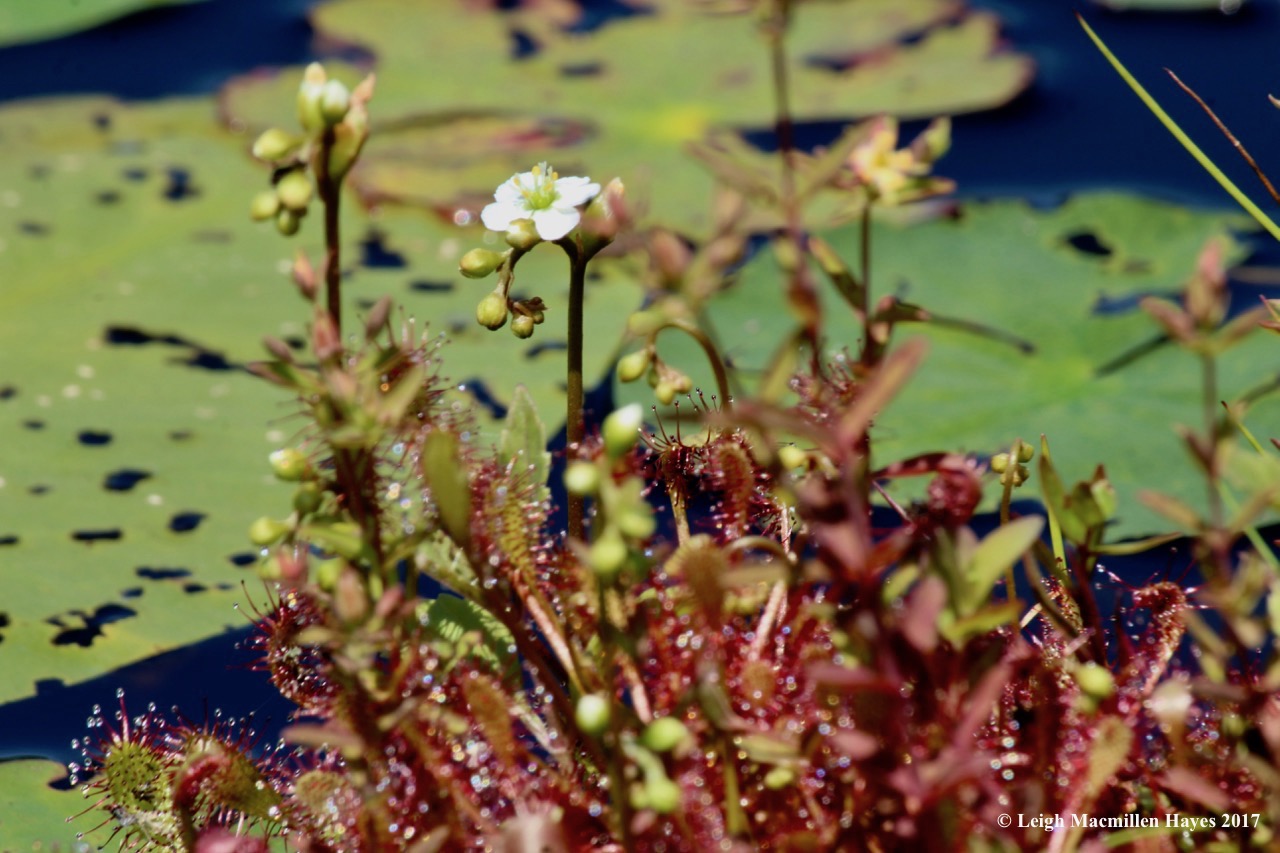
And I paused beside the spatulate-leaved sundews.

m-spatulate--leaved sundew flower

I was about a week early, but one was in flower, with promises of plenty more to come.

m-pitcher plant 1

As I looked at the sundews, I realized that I’d never seen a pitcher plant in this place. As should happen, I was proven wrong, though I never would have noticed it if it didn’t have such a tall flower since its leaves were hidden by a mass of vegetation.

m-pitcher flower

Damselflies, dragonflies, and carnivorous plants–its an eat or be eaten world out there on the pond.

Bullfrogs bellowed from the edges, green frogs plinked, and fish splashed. I listened to Eastern kingbirds’ wingbeats as they dropped to the water to snatch insects, and red-winged blackbirds delightful conk-la-rees. I startled a great blue heron, the first I’ve seen on the pond all summer, and it flew off. In the midst of all the natural sounds and sights around me, I embraced the quiet on my four-hour paddle/float. And as Robert Frost might say, “That has made all the difference.”