Winter Inventory

We live on the edge. The edge of a small town in western Maine. The edge of a neighbor’s field. The edge of a vast forest.

Our property only encompasses six acres, but it’s six acres that I love to explore and it’s been my outdoor classroom for a long time.

And so today, I invite you along to take a look; if you are a regular, you may have already met the friends I’m about to introduce, but their actions keep me on my toes, much like the deer who crisscross our yard on a regular basis.
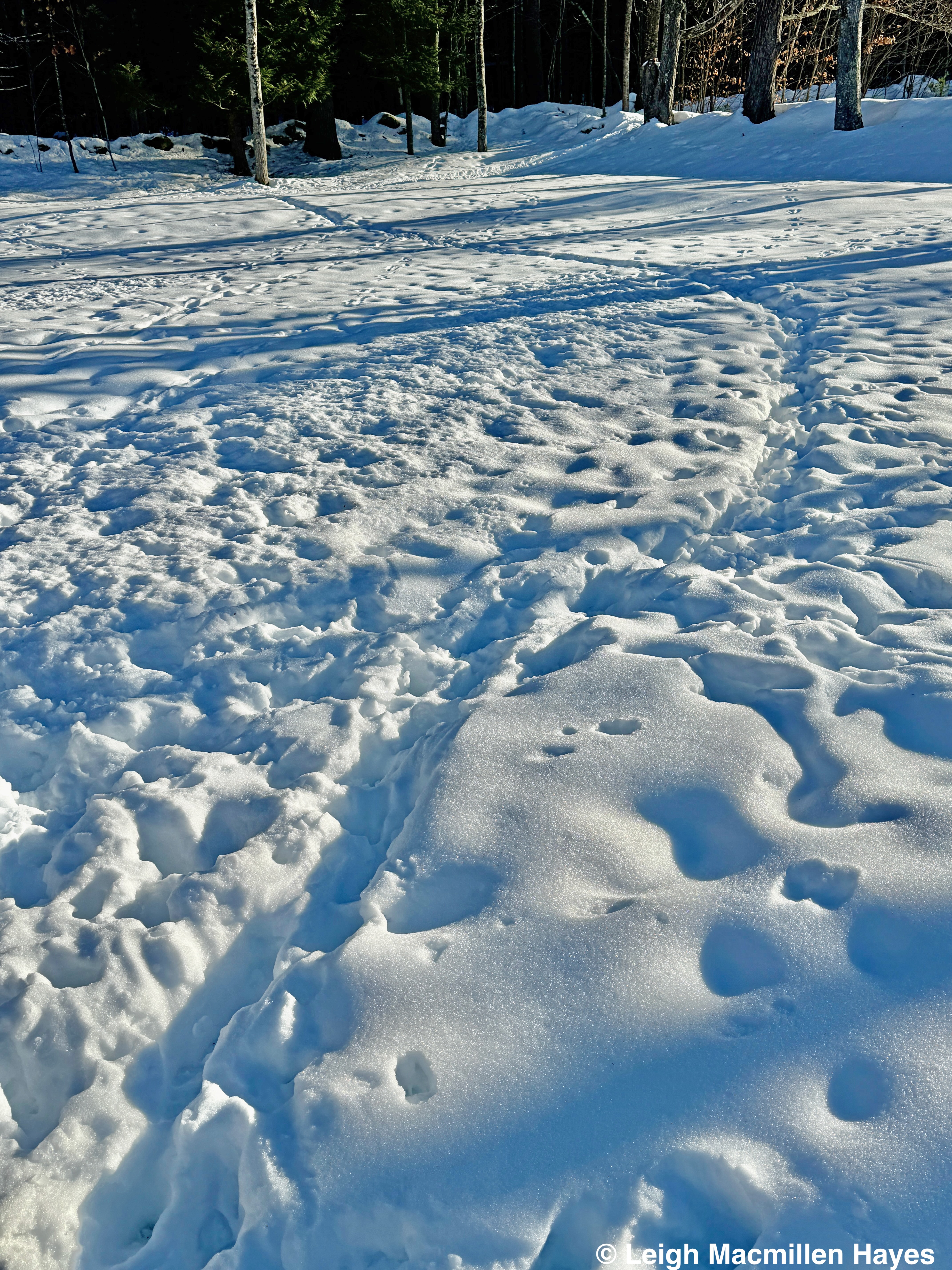
Though the acorn crop was abundant in our area, the deer make several trips day and night to consume sunflower seeds and corn and they’ve worn a path (deer run) making it easier to travel. They don’t always follow it, as you can see, but do so enough that it’s much like my snowshoe trails.

The yard is full of tracks, for besides the deer, there are gray and red squirrels who also frequent the feeders, an occasional red fox that I’ve yet to see this winter, and our neighbors’ dogs and cats. Everyone has a place at this table.

Of course, the deer run does lead to another species they love to munch on, the needles of a Balsam Fir. They frequently pause here before climbing over the stone wall into our wood lot.

And so I paused too. And discovered yet another cache and midden created by one of our local Red Squirrels. I’m in awe because until yesterday, I wasn’t aware of this one and I can see it from the desk where I’m writing right now. And to top it off, yesterday was the first day since I filled the feeders at the beginning of December that I saw a Red Squirrel chasing the Gray Squirrels away.

I, too, climbed over the wall and look who I met. Always on alert and often either skittering along the ground or a stone wall, or chastising me from its branch of choice, Red doesn’t realize that I’m a fan.

Next, I ventured over to the old cow path, bordered as it is by two walls, and checked on the cache and midden situation that’s become so familiar to me.

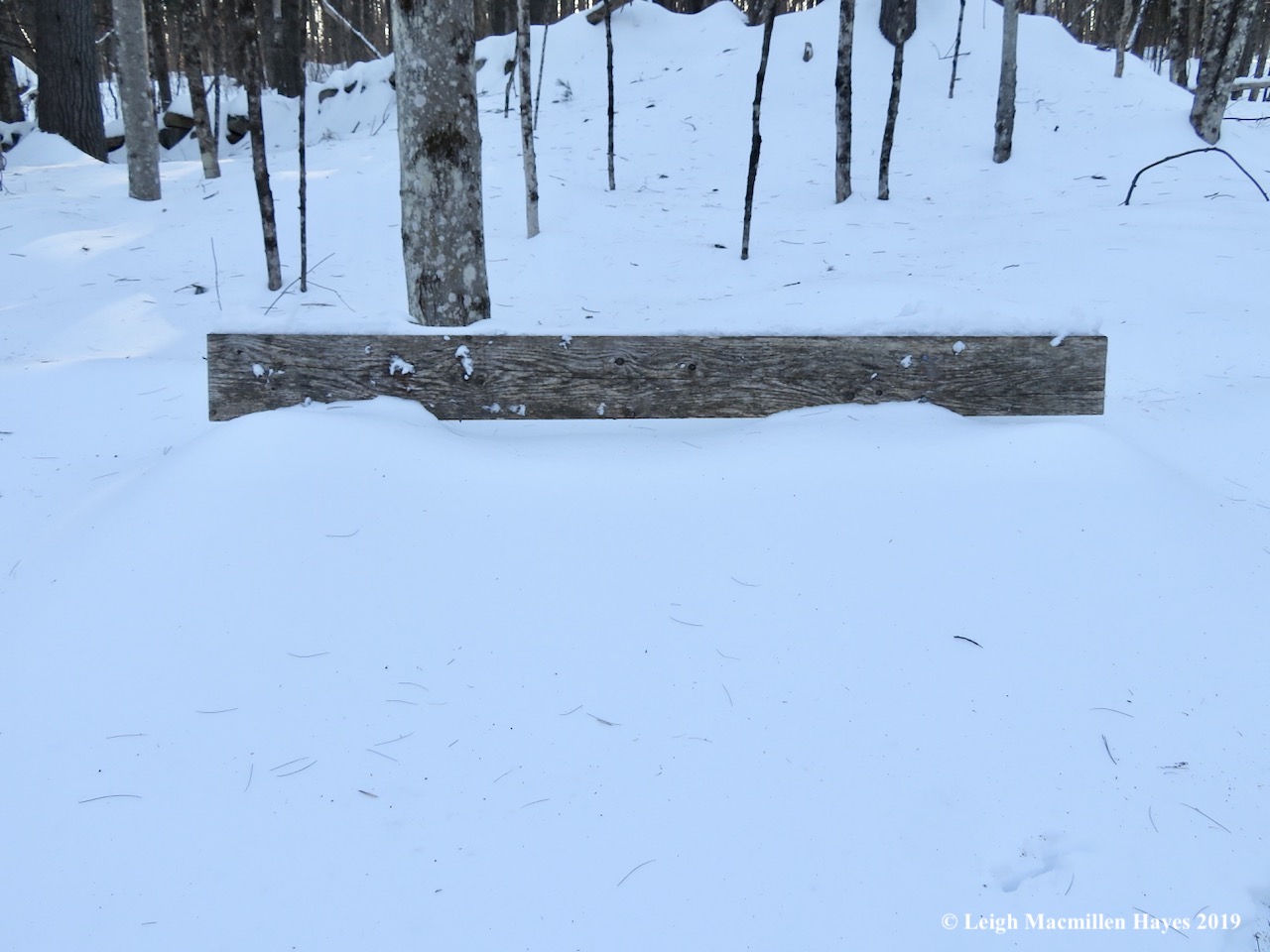
The cache or storage pantry of pine cones is located under the mound of snow the black arrow points toward. At last measurement as recordered in The Forever Student, Naturally, the pile was a foot high. As you can see if you look closely at the tops of the stones behind the snow-covered pile, you’ll spy several middens. So my question is this and I’ll have to wait until the snow melts to answer it: Are all of the cones the squirrel is consuming (well, seeds actually, for the midden is the pile of discarded scales that protect the seeds, plus the cob or core left at the end) coming from under the rocks, where I’m sure there was more storage space, or the bottom of the pile, because Red Squirrels do tunnel? I can’t wait to realize the answer in another month or so.

The pine tree beside the cache also provides a grand dining spot.
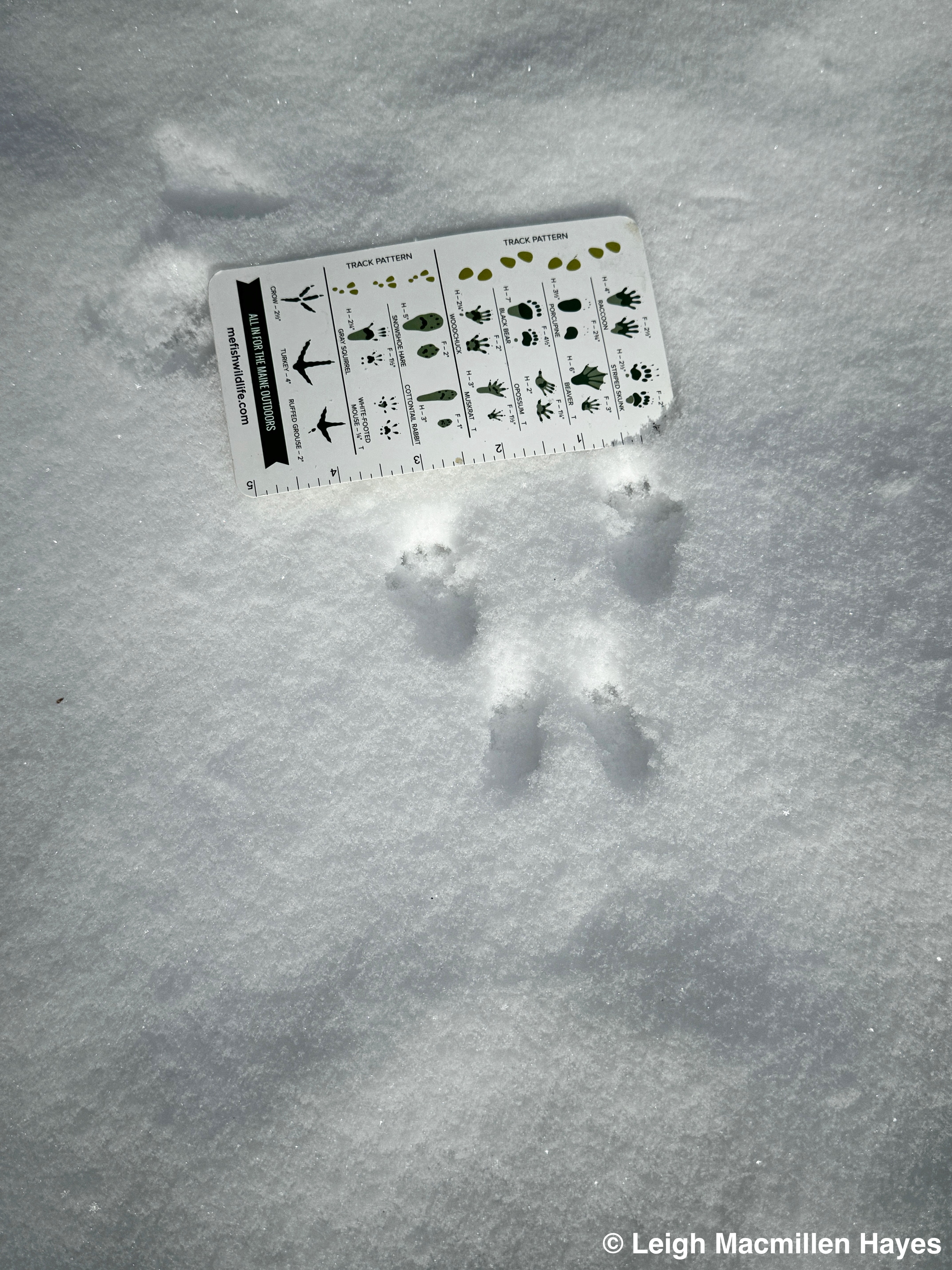
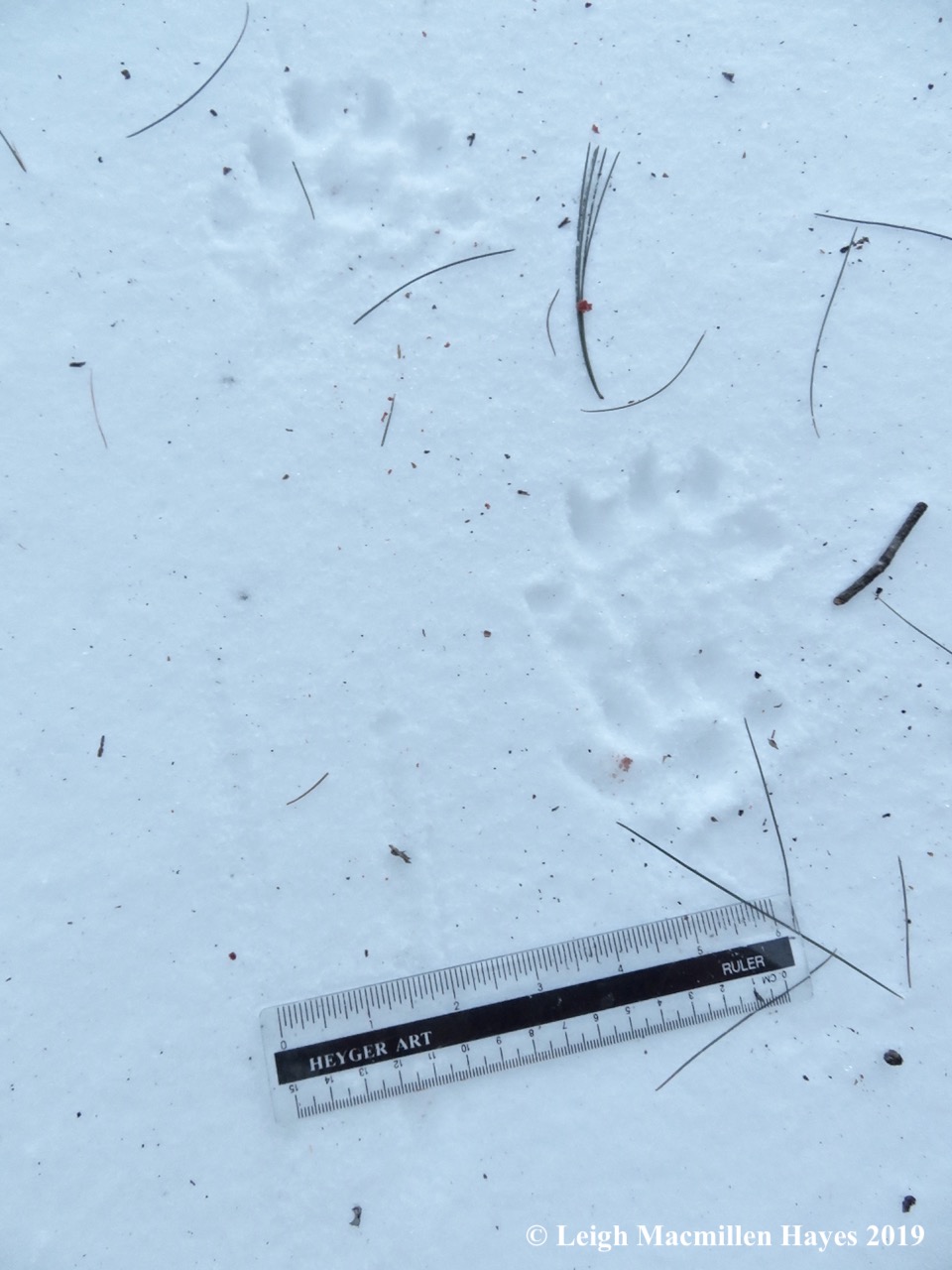
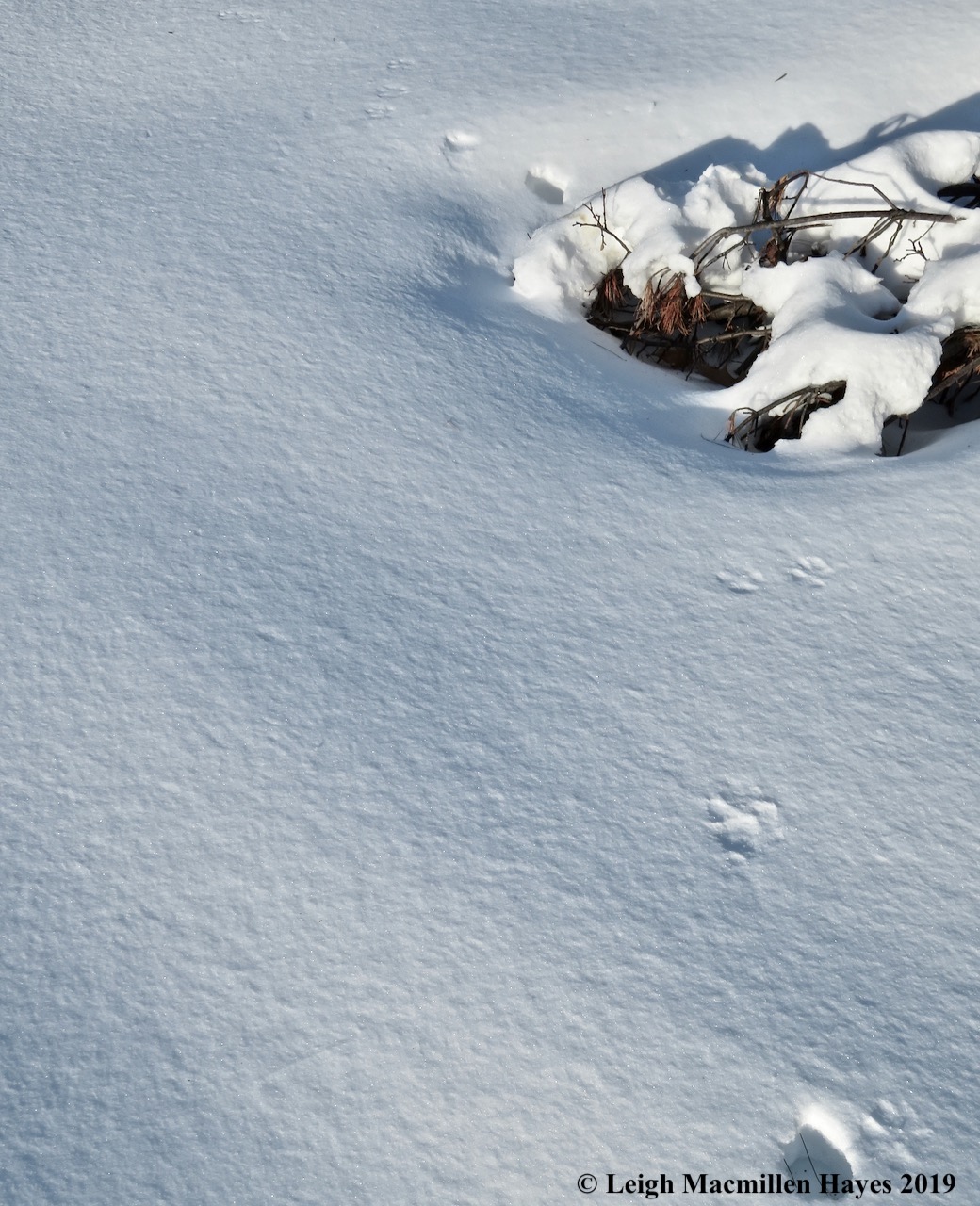
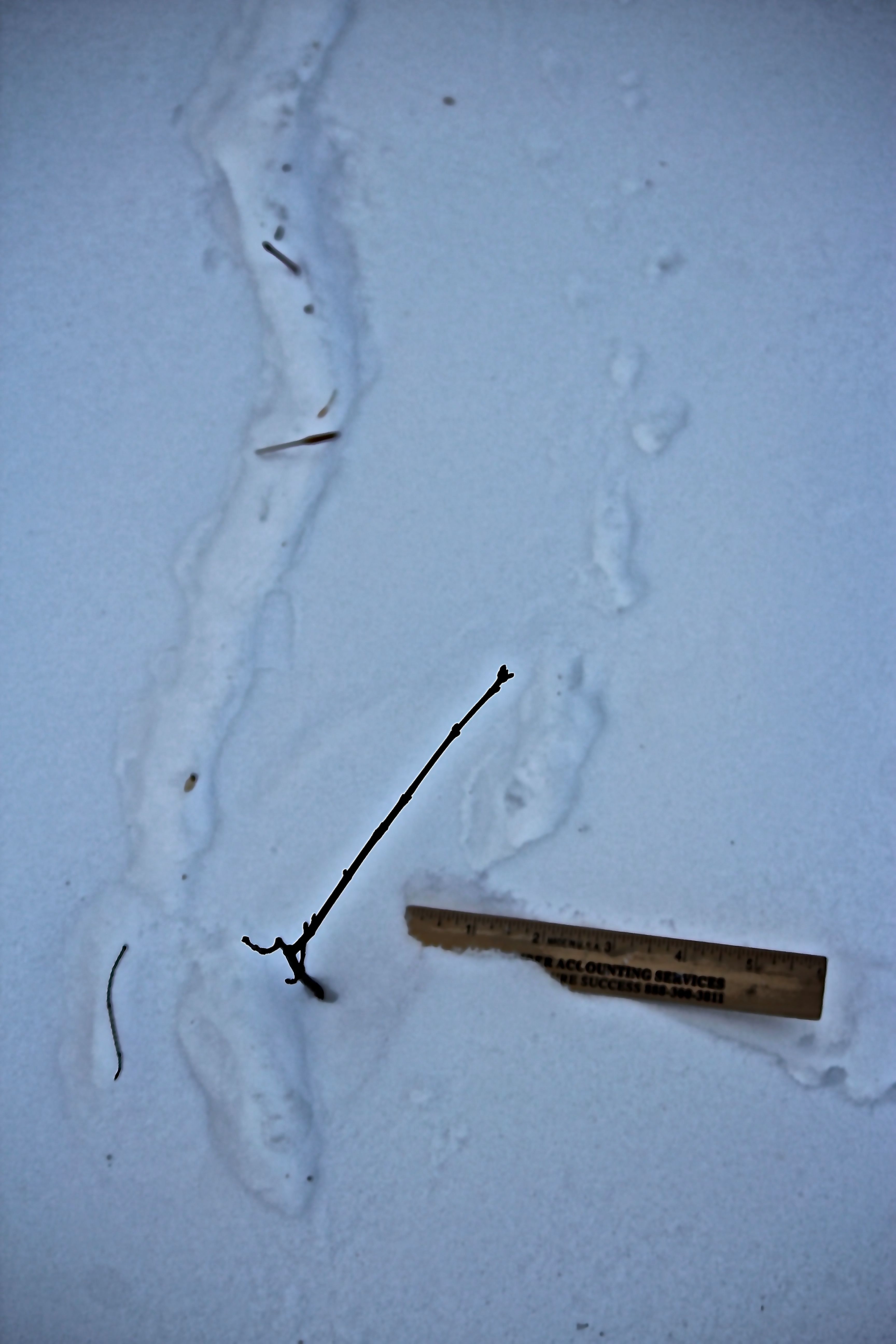
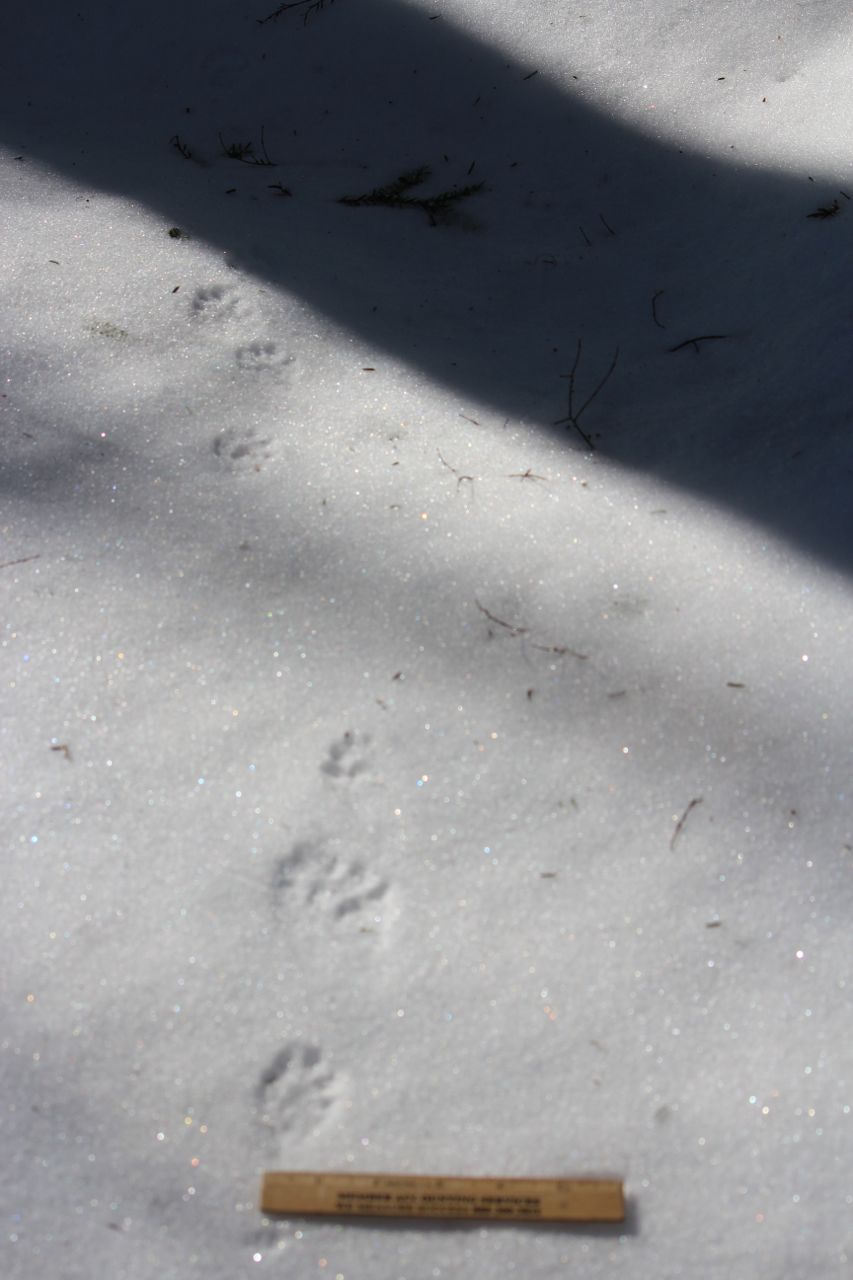
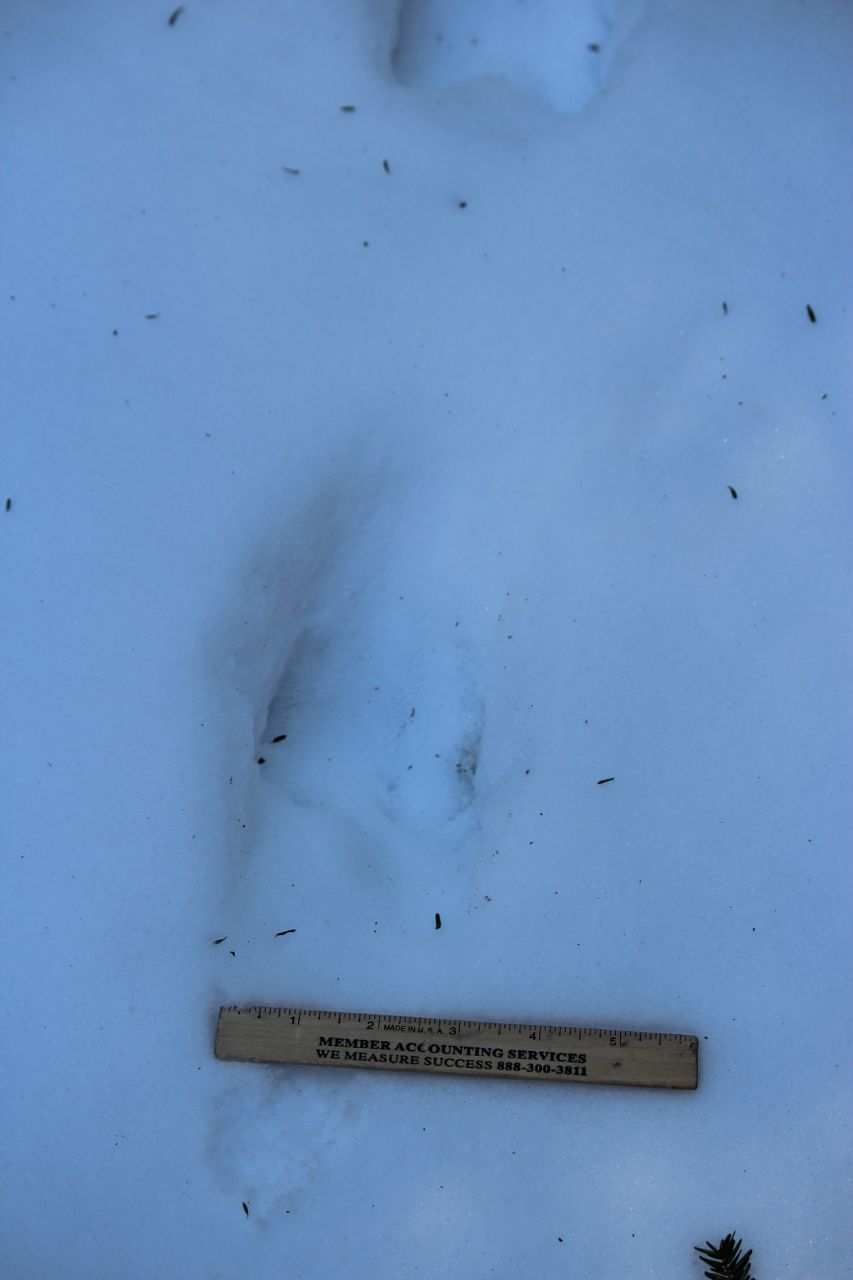
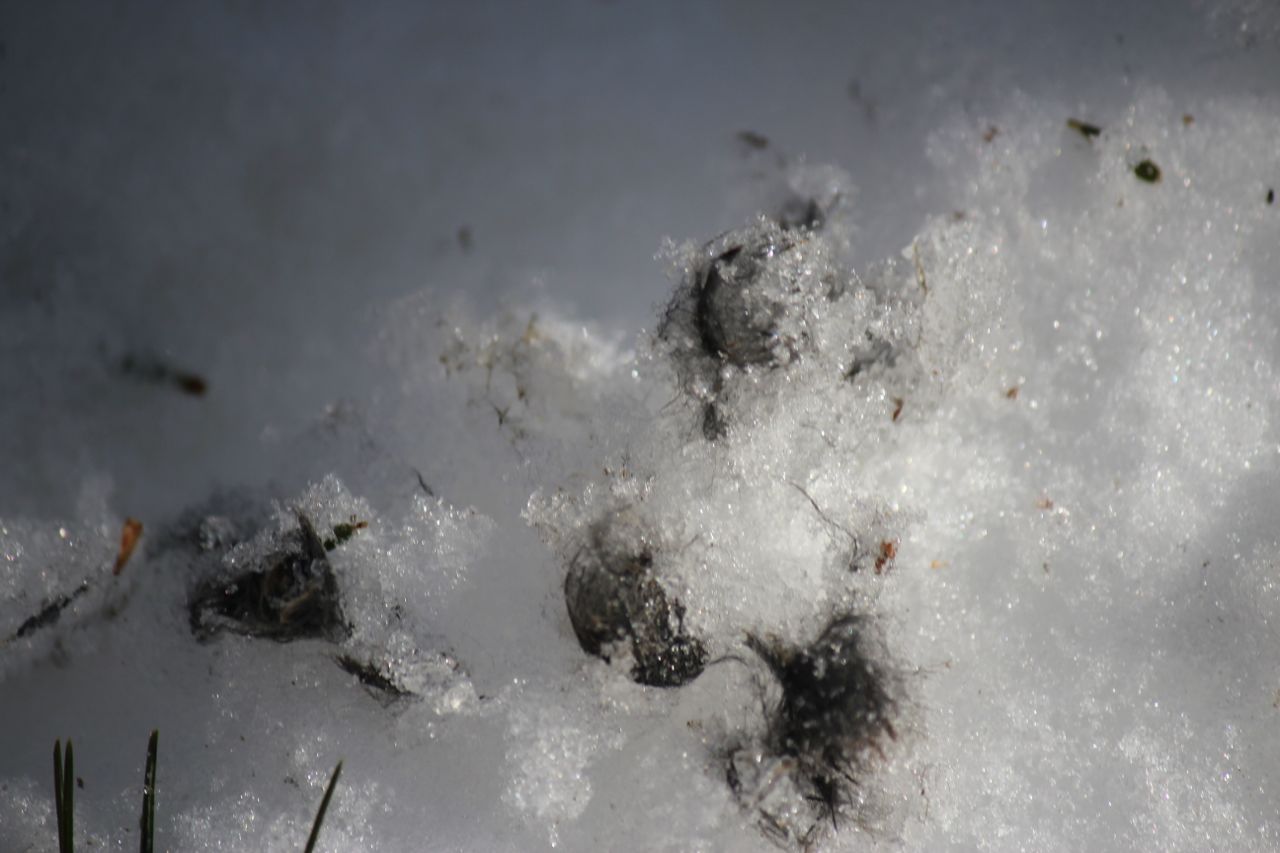
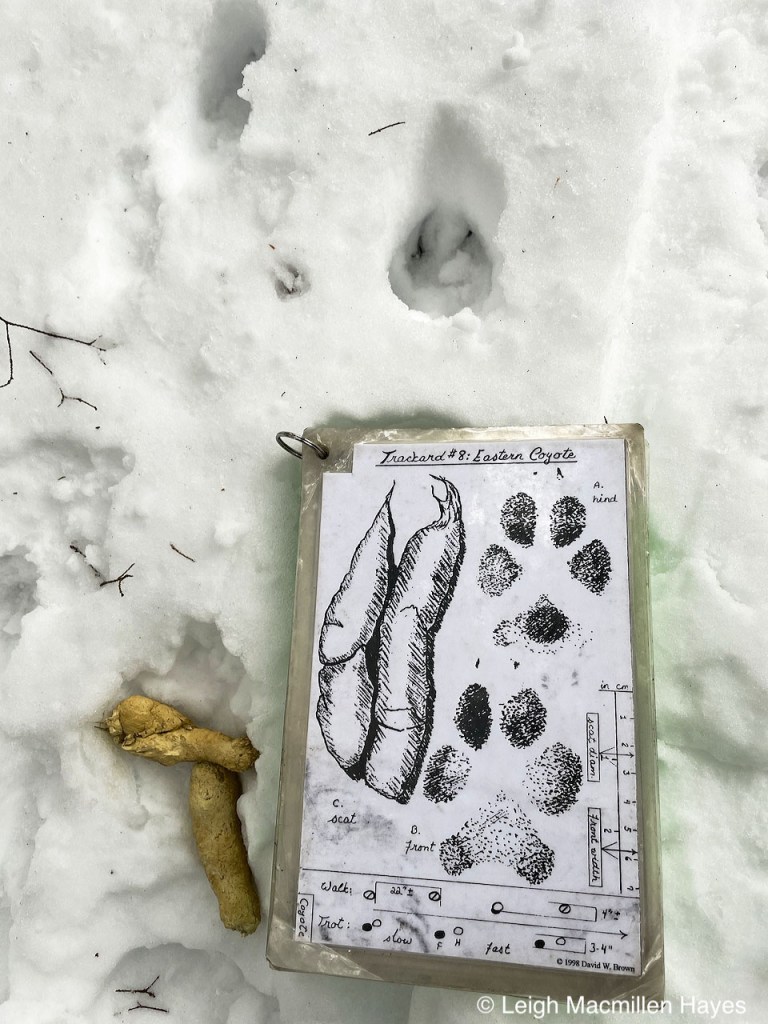
About an inch of snow fell overnight, so when I went into the woods this morning, I found fresh Red Squirrel prints, with the straddle or track width being the typical three inches. It was a bit nippy with the wind chill, so I didn’t get the card placed exactly as it should have been, but you get the idea. Its big feet in front are actually this hopper/leaper’s hind feet.

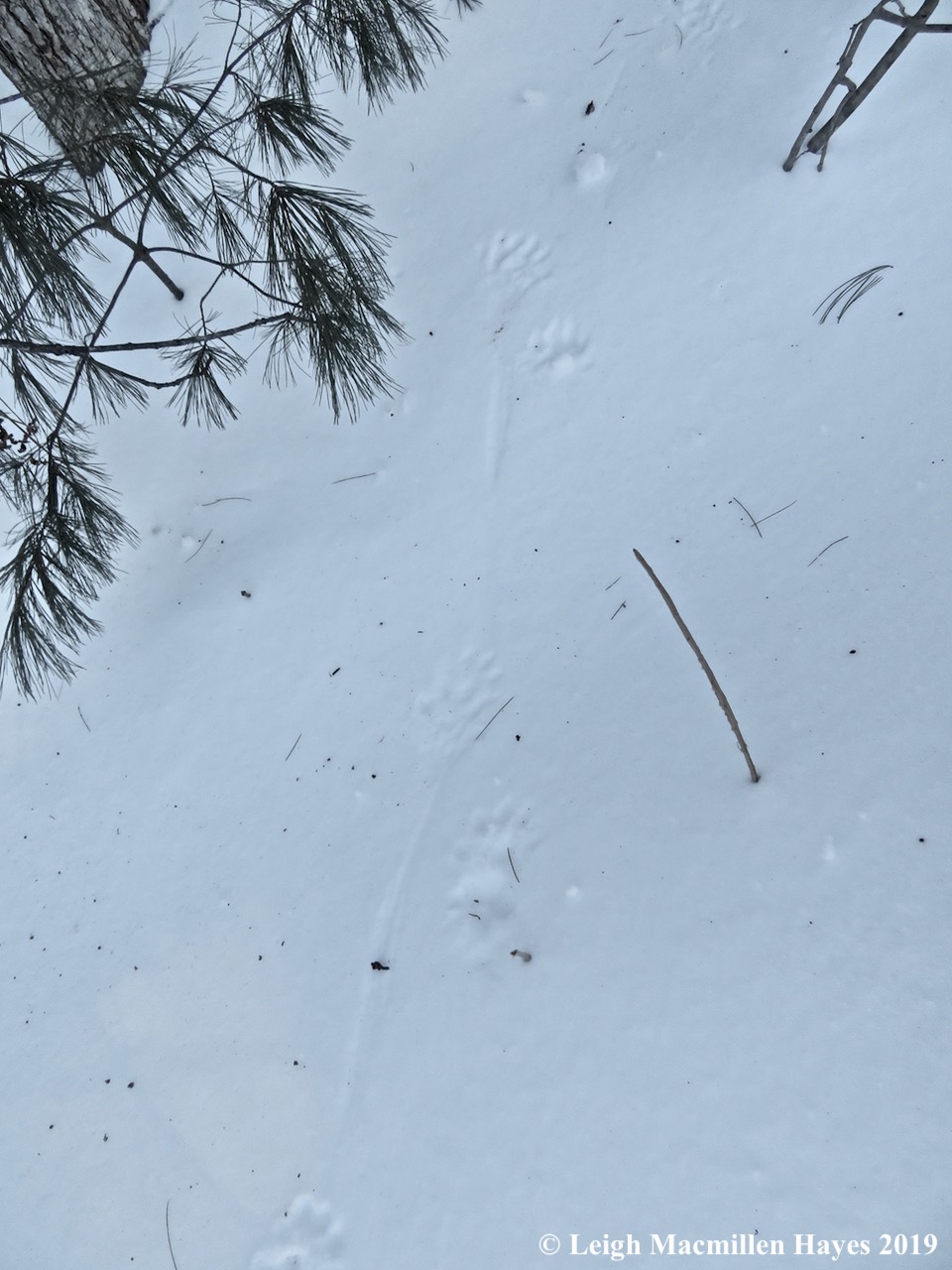
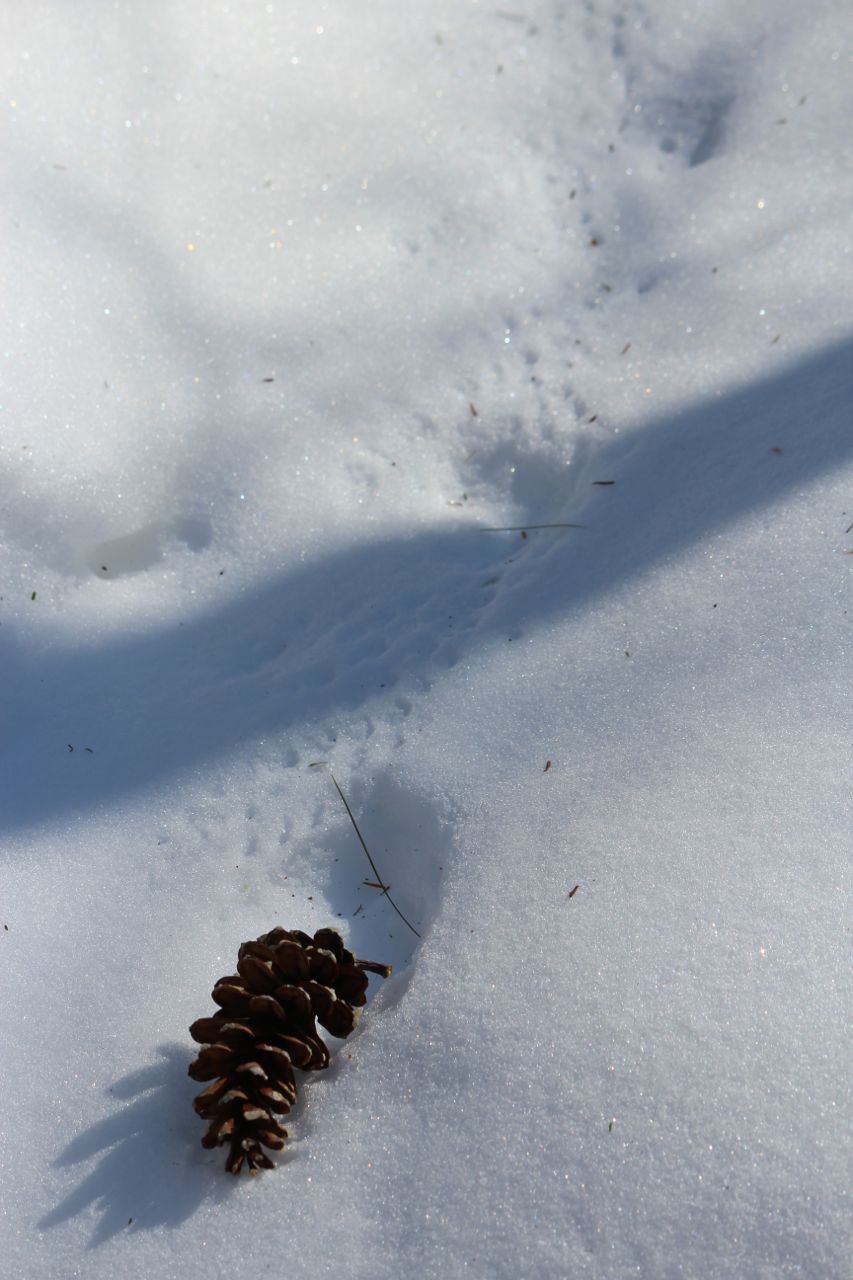
Okay, so I did risk the freeze for a minute because I spotted the set of four prints behind the first set I’d photographed and realized not only how close together the four were, but also the length of the leap from one spot to the next: My mitten and wrist holder are 19.5 inches in length and they didn’t cover the length of this motion–perhaps an attempt to quickly reach safety in the other wall or up a tree.

That action was on the eastern end of the path, but there’s more to see as I head west.

A few days ago, and probably because the night temperatures were more moderate, a family of rascals crossed from the other side of the wall and onto the path. By the baby fingers of the front foot, I know they were Raccoons.

As waddlers, Raccoons have their own pattern that is easy to recognize once you get it into your head. They don’t travel this way all the time, but most often I find their prints, with a front foot (baby hand) of one side and hind foot (a bit longer print) of the other side juxtaposed on opposite diagonals. If you look at the black lines I placed before each set of two prints I hope you’ll see what I mean. And notice the keys. It’s all I had in my pocket that day and I wanted something for perspective. I really didn’t expect to find the raccoon tracks.

I went back home and grabbed a tracking card to set on the ground. If you’ll look closely, you’ll note that it’s more than one animal, but all the same family. I followed them across the wood lot, over another stone wall, and into the field where they split up into four individuals before heading off in to the neighbor’s woods on the far side.

Back to the cow path I did return and this time it was a scene just off the path that drew my attention. Our Pileated Woodpecker has been active as evidenced by all the wood chips on the ground. That means one thing to me. Time to look for scat.

And I wasn’t disappointed. Check out that cornucopia stuffed chock full with insect body parts that the bird couldn’t digest.
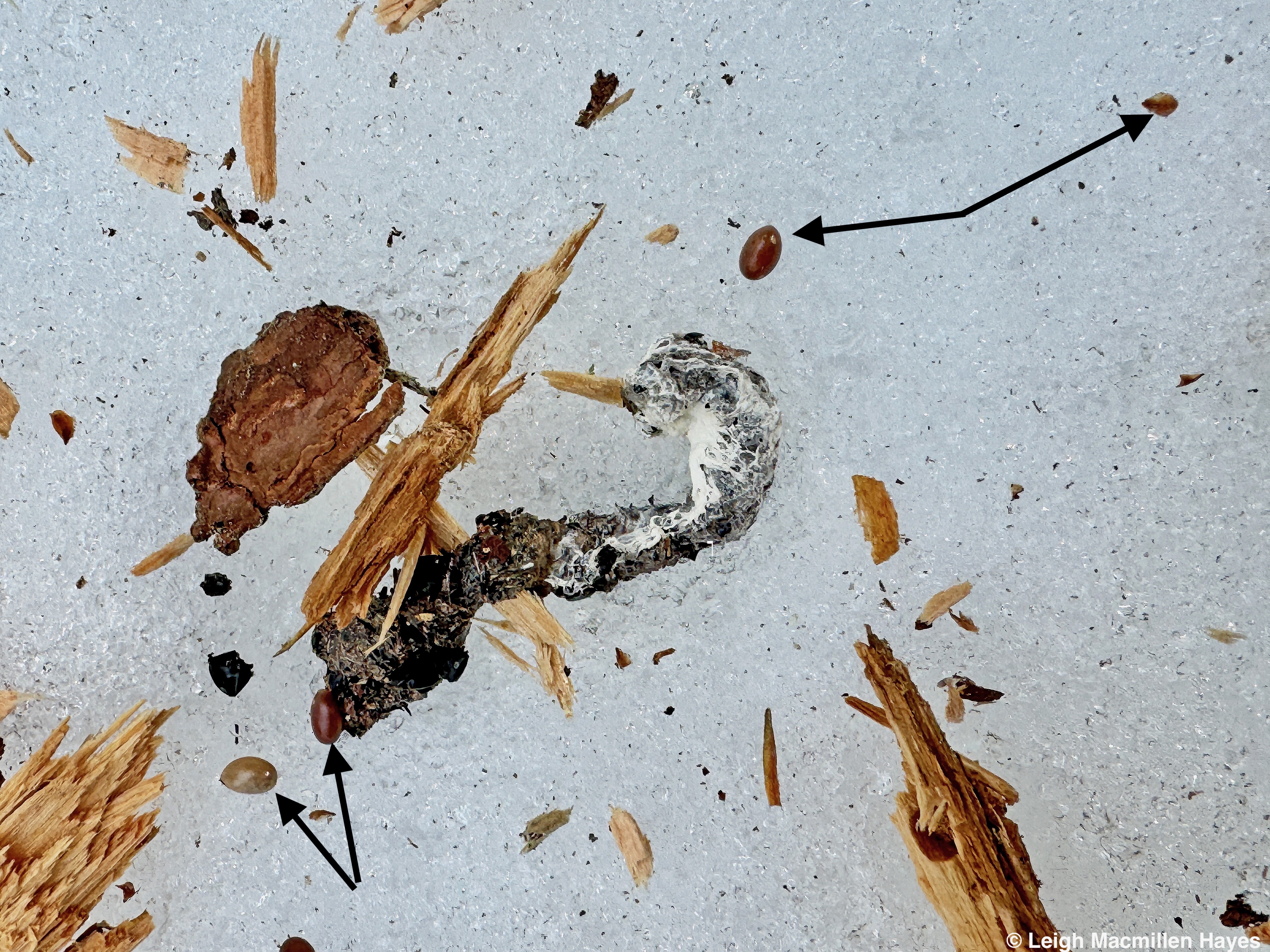
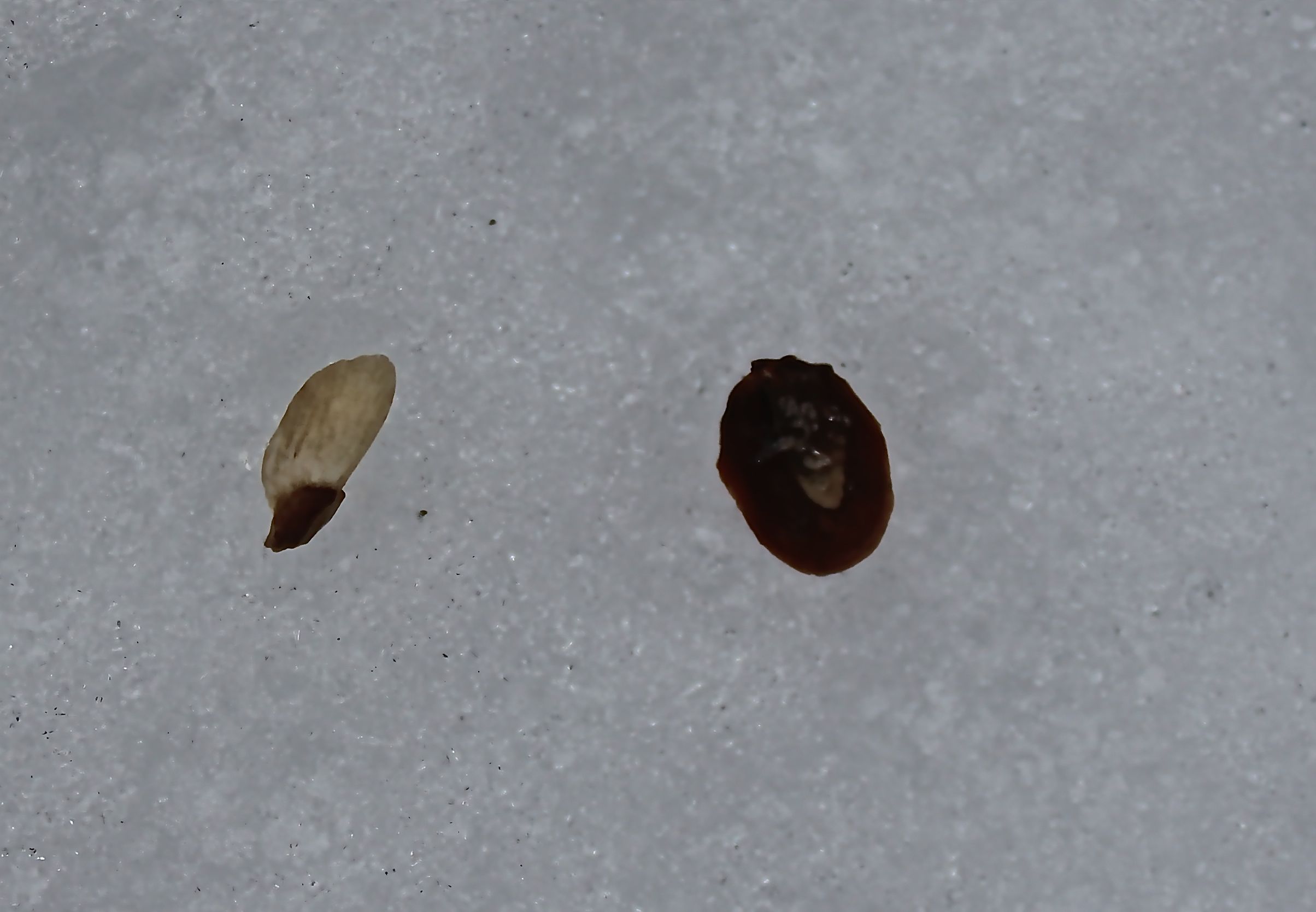
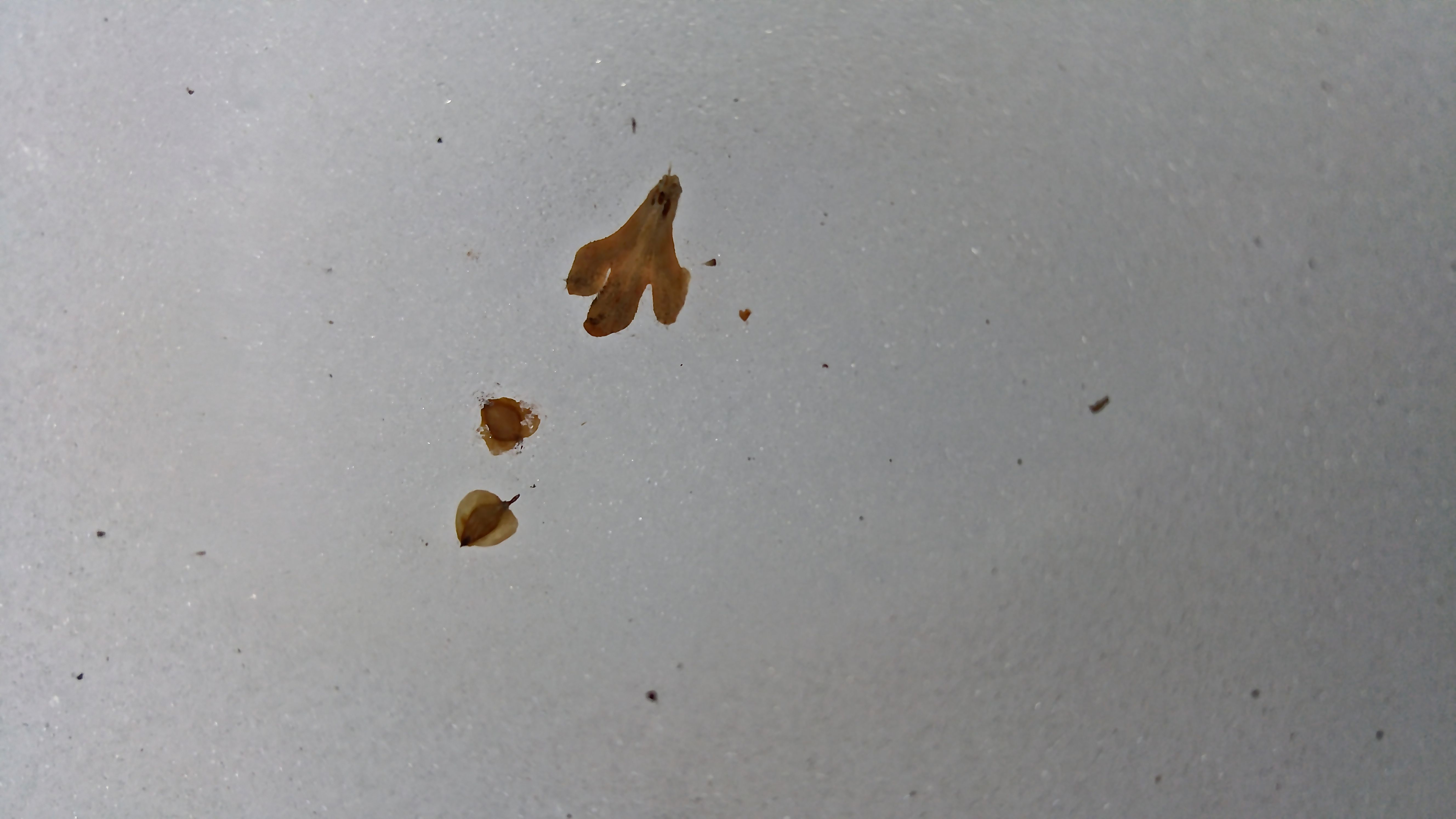
Finding this is always like opening a Christmas present. The thrill never ends. But, curious spot here. Seeds. Staghorn Sumac seeds.

And on the pine tree and at its base, I found more of the Staghorn Sumac in bird droppings, a completely different form from the Carpenter Ant droppings.

Both followed me home! The Carpenter Ant scat is very fragile.

The sumac, being fleshier, held together better. Under the microscope I noted that there were some ant body parts mixed in with the sumac.

Here’s a closer look at one of the legs of a Carpenter Ant–notice the long “thorny” thing, which is the tibial spur located at the base of the tibia.

And an exoskeleton plus another leg. With lots of wood fiber in the mix. Lots of nutrients and fibers mean scat findings for me.

A power line bisects our property and I have a love/hate relationship with it. I do love that it looks like we could walk north to Mount Washington. But my destination was to the trees on the western (left-hand side), where we own at least one more acre enclosed by stone walls.

About half of that acreage is a combo of hemlocks and firs fighting for sun. In the end, the hemlocks will rule the world, but the firs are trying to compete.
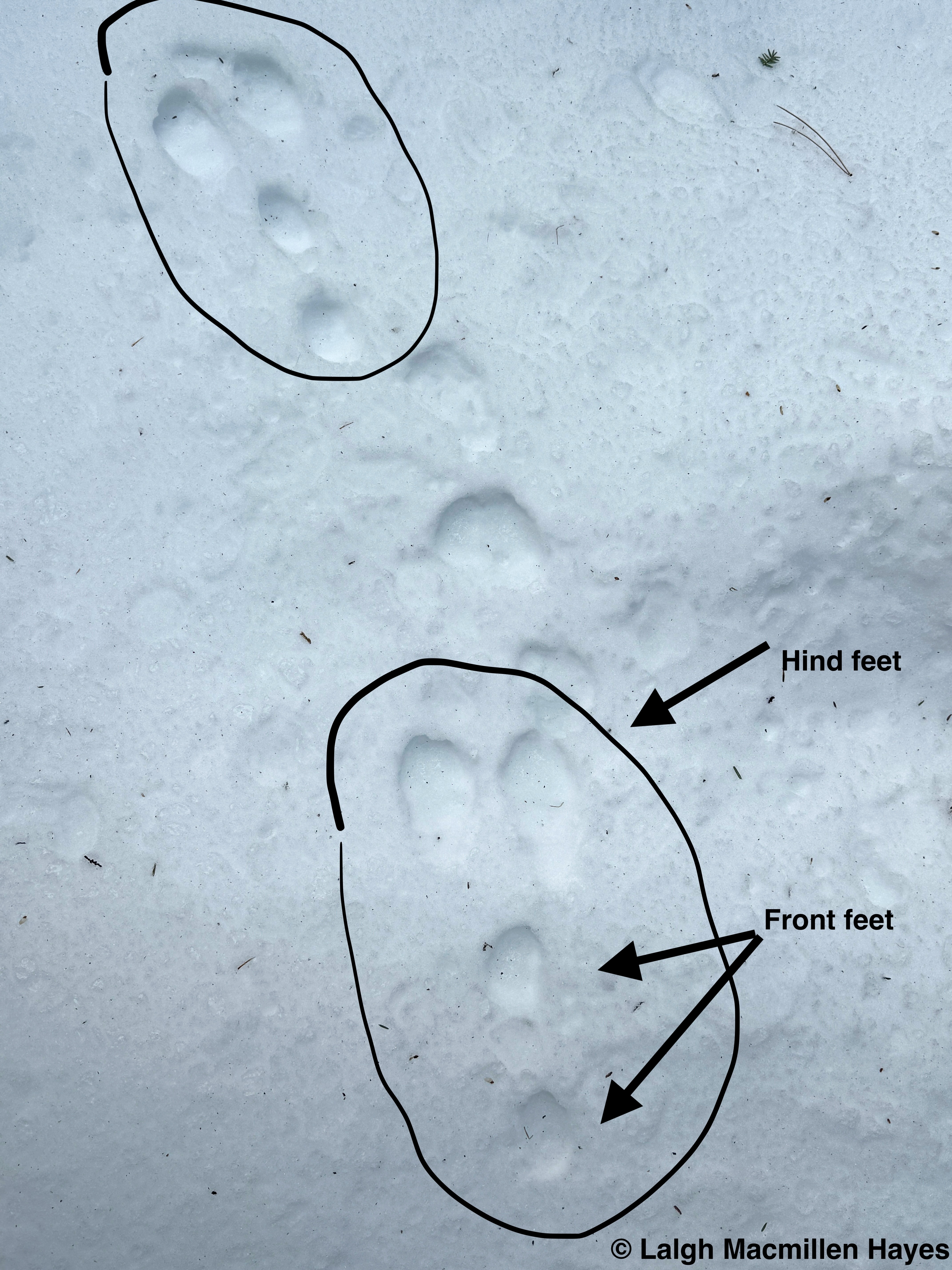
It is here that I discovered Snowshoe Hare tracks and my heart smiled again. There’s not much on this portion of our land for the hares to dine upon, such is the landscape when the trees block undergrowth. But on either side of the walls, there’s plenty available to them in areas that have seen timber cuts within the last twenty years.

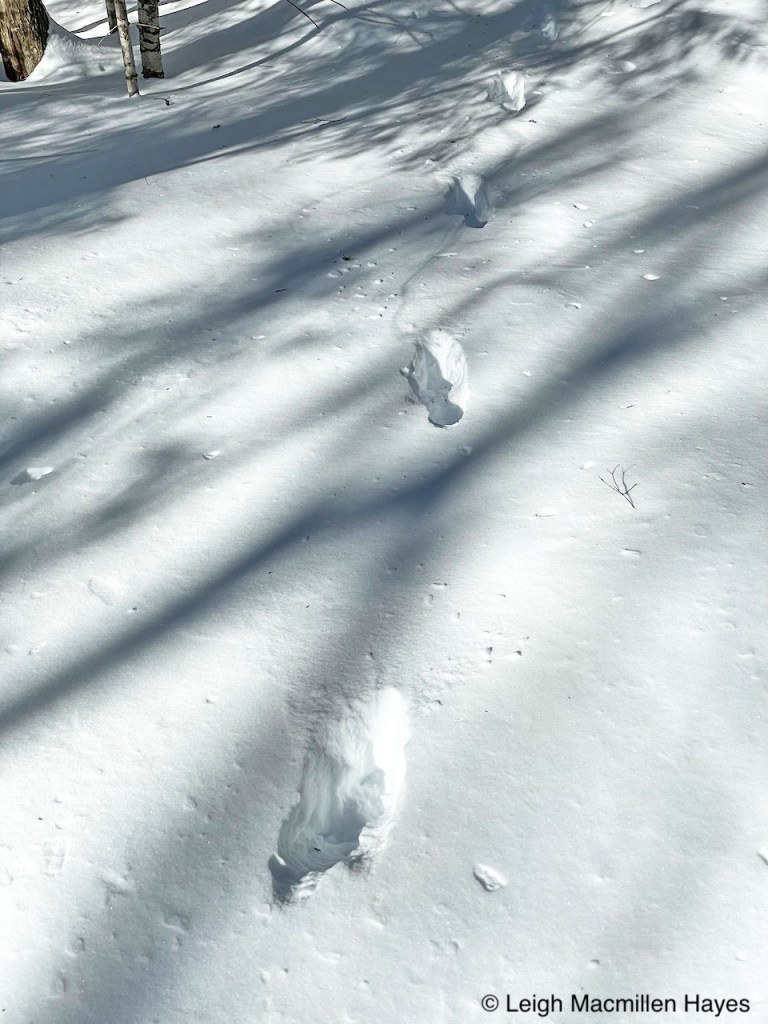
Here’s the thing about hare prints–as hoppers, the smaller front feet land first and often, but not always, on a diagonal. The much larger hind feet swing past where the front feet had been as the mammal moves forward, and thus appear to land in front when you look at the overall pattern. And my favorite part of this set of four footprints: the overall shape, which to me looks like a snow lobster with the front feet forming the tail and hind feet the claws. Do you see it?
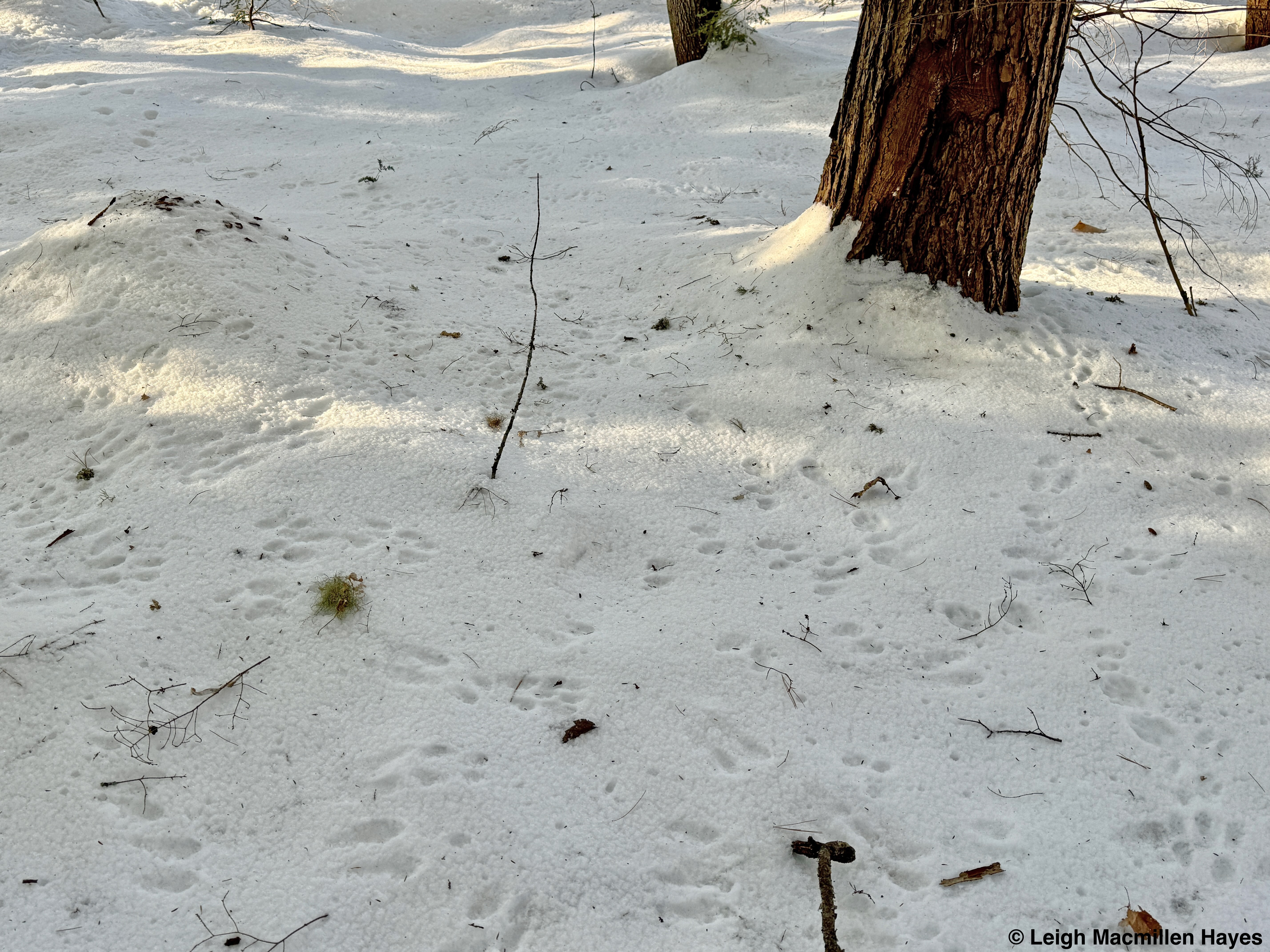
This neighborhood on the other side of the power line also supports a Red Squirrel who in true squirrel tradition travels this way and that.
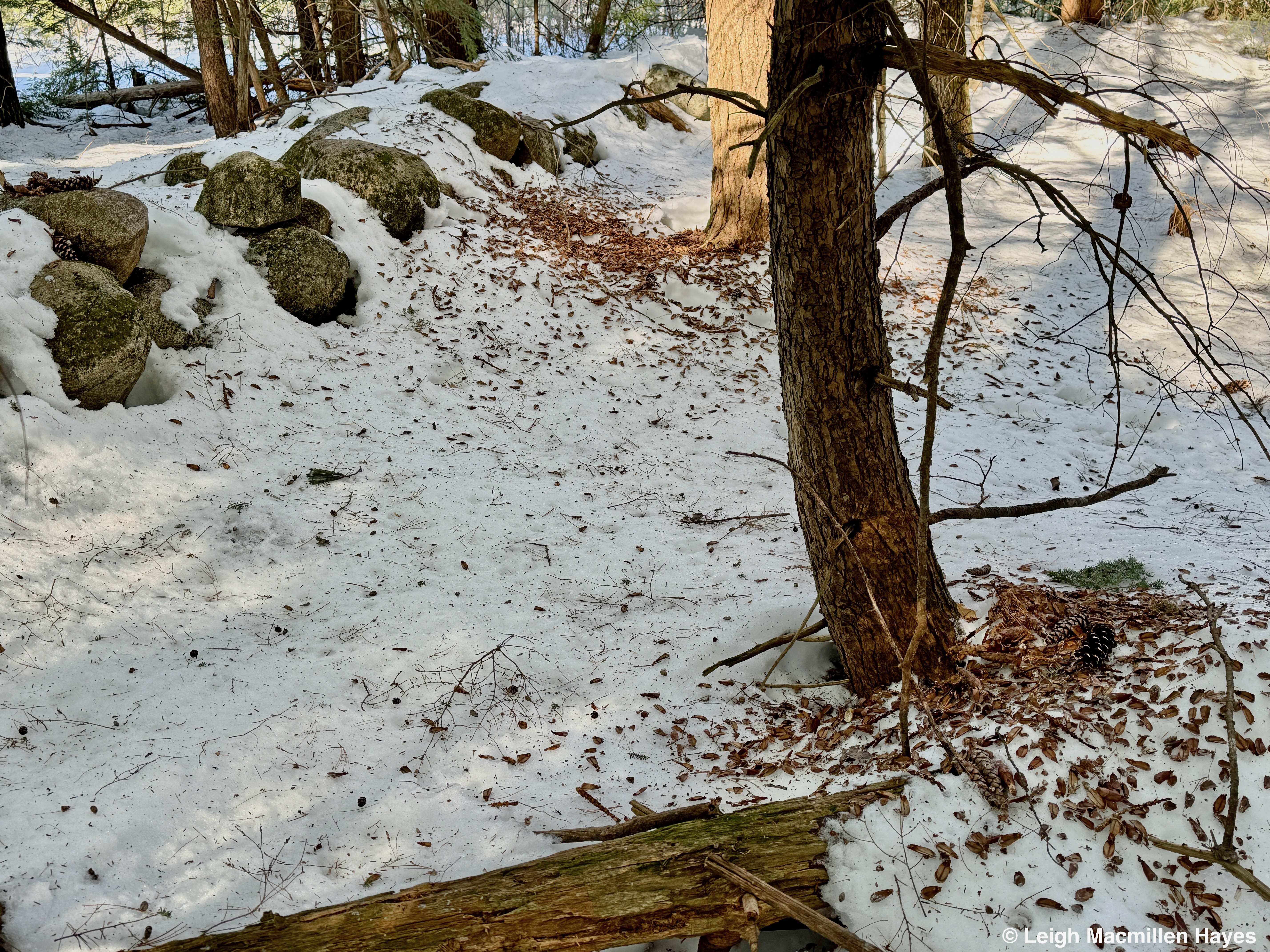
And like its relative on the other side, it took time to cache a bunch of cones and now feasts upon its supply.
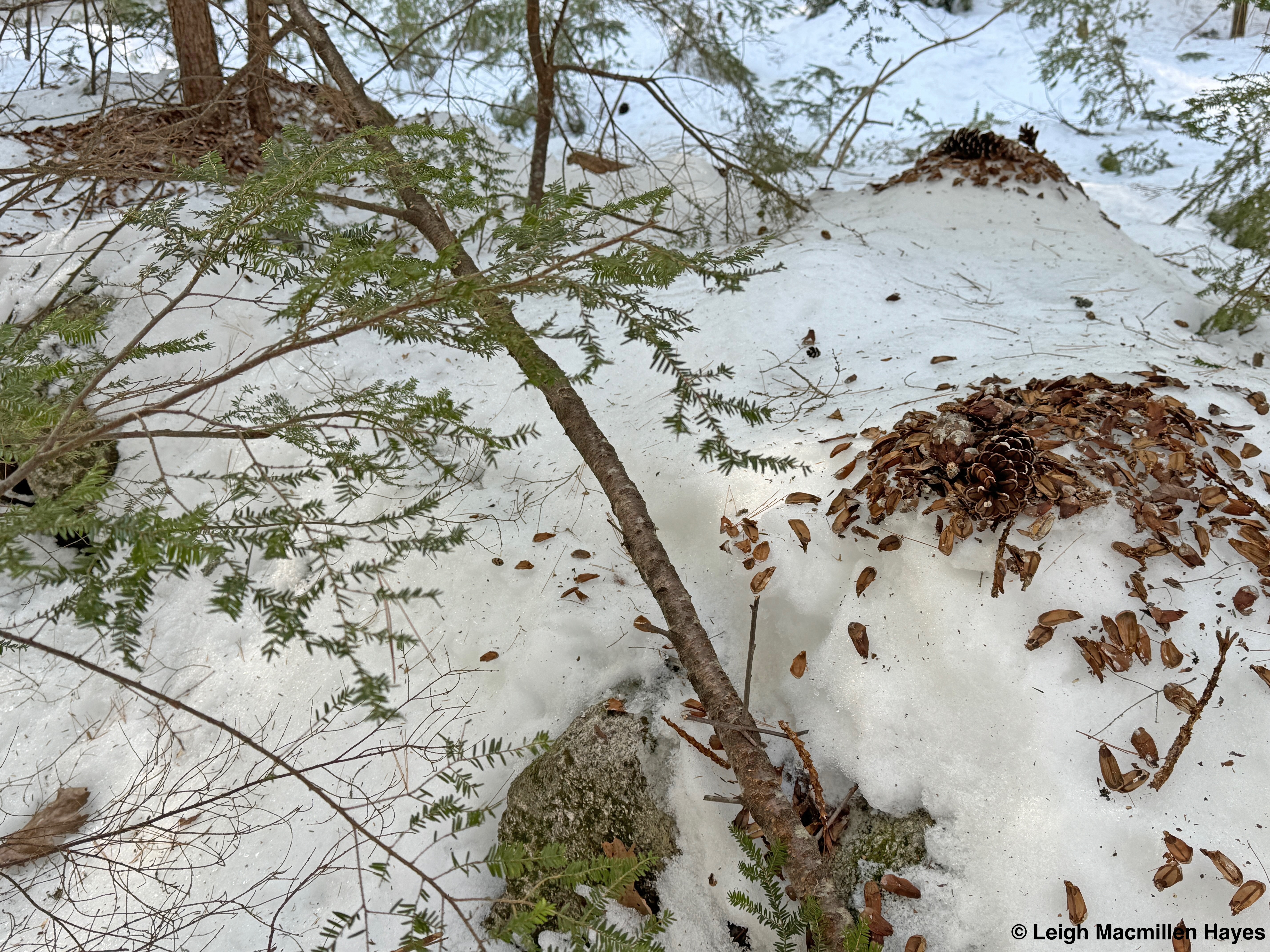
And leaves its garbage for nature to recycle. Notice how the middens are often located on high spots such as the rocks along the wall–the better to be in a spot where you can see who or what might be approaching. Even those on the ground below trees mean that the squirrel probably did most of its dining from a branch above, and then let the trash fall.
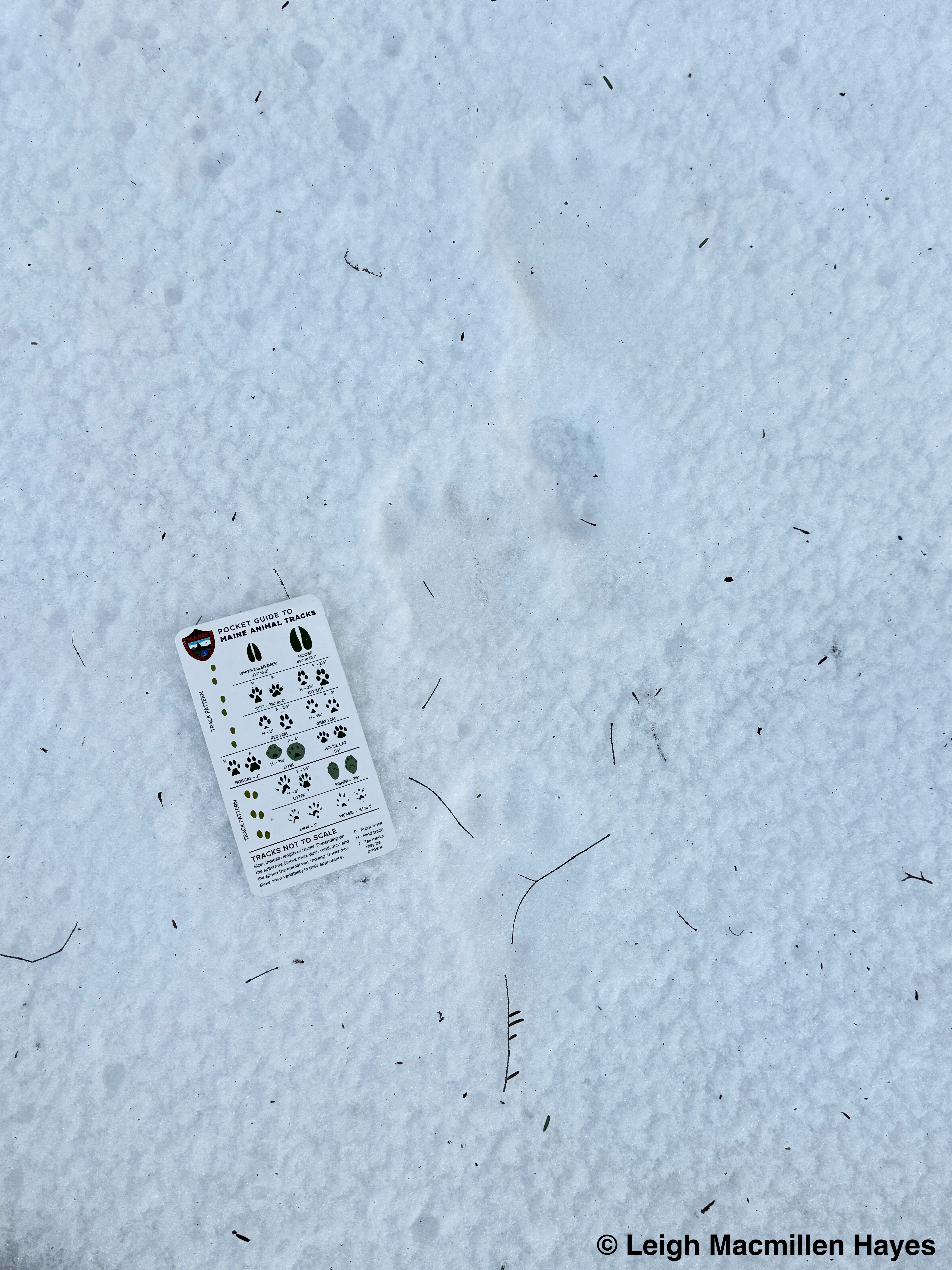
What could a squirrel possibly fear in these woods? Besides coyotes and foxes and bobcats, oh my, think Fisher such as the one that left these tracks in the squirrel’s territory. As far as I could tell, the Fisher (and it’s not a cat, it’s a member of the weasel family) was only passing through, probably on its way to hunt down the hare. Though a squirrel would make a fine meal, as well.

Heading back across the power line, cases stood out on the White Pine saplings at the start of the cow path. The cases consisted of clusters of needles bound together. This is the work of the larval form of a Pine Tube Moth, Argyrotaenia pinatubana. What typically happens is that the caterpillar uses between ten and twenty needles to form a tube or hollow tunnel.

The caterpillars move up and down their silk-lined tunnels to feed on needles at the tip until they are ready to overwinter.

The moth will emerge in April, when I’ll need to pay attention again. Two generations occur each year and those that overwinter are the second generation.
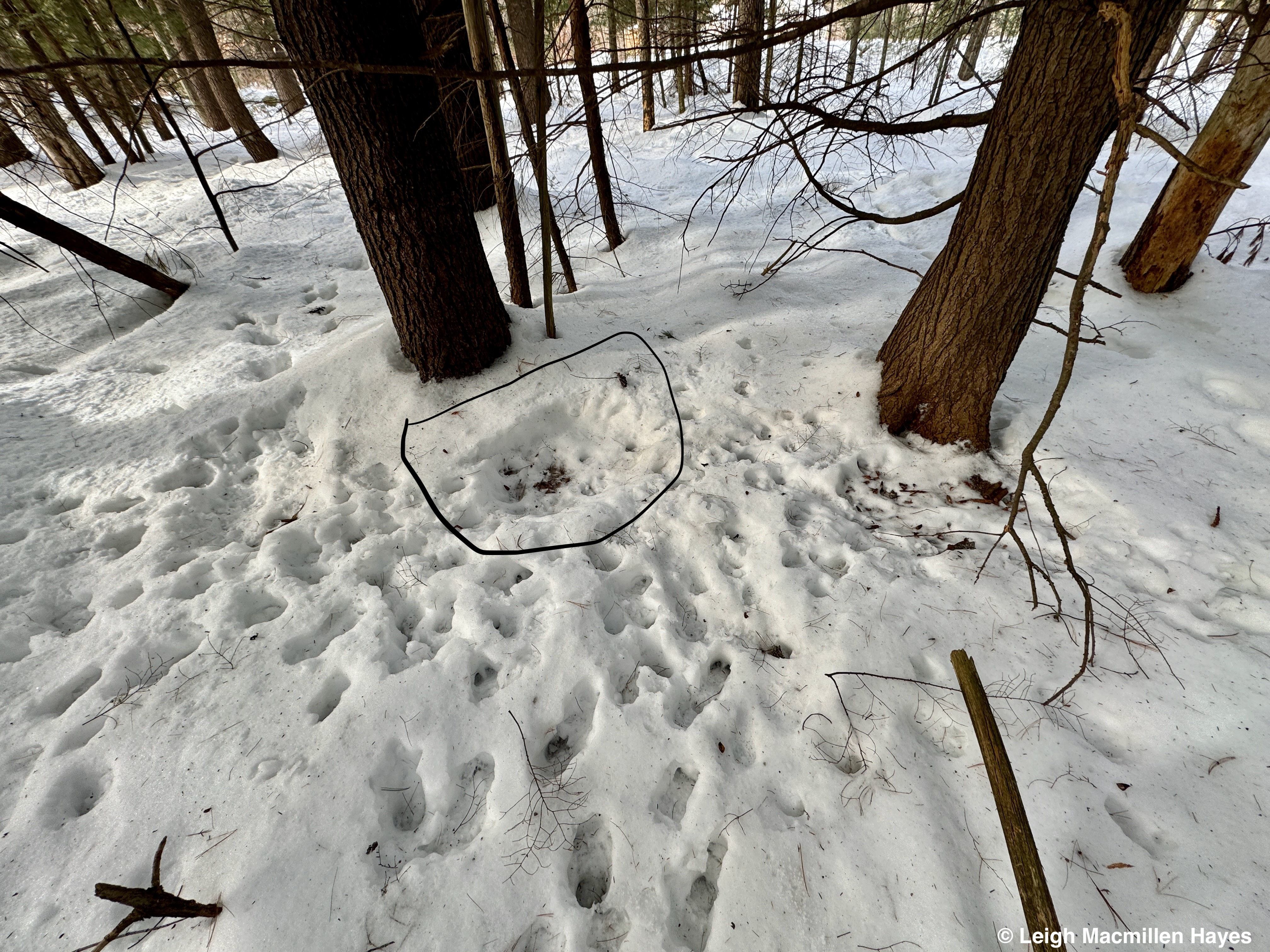
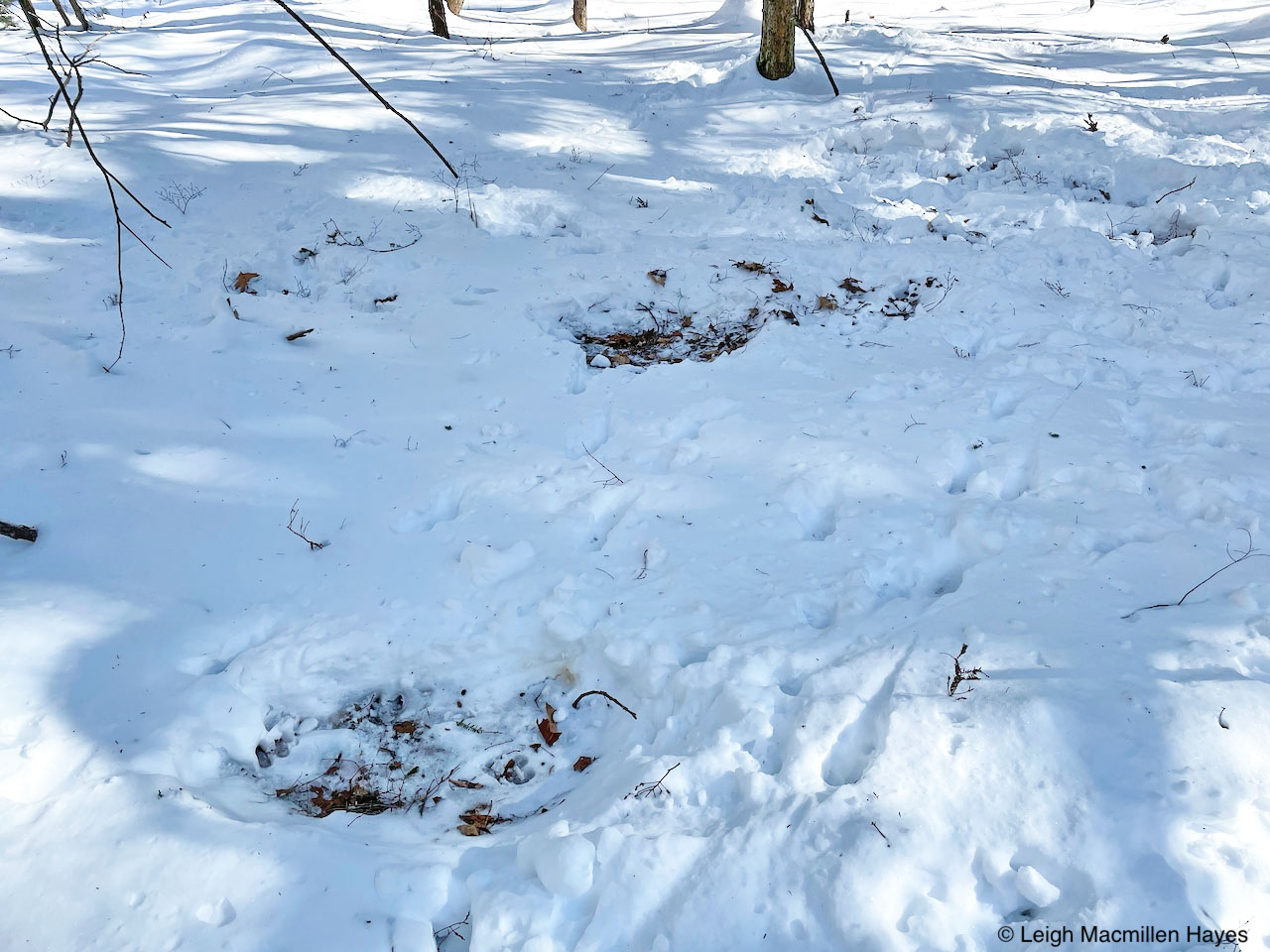
Walking home via a different path in our woods, I spot deer beds. At least a half dozen spread out under the pines and hemlocks, the spot where the evergreens keep heavy amounts of snow from reaching the forest floor, thus making it easier for the animals to move.

Finally back home, there’s one more member of our family to mention–a porcupine. This may be my friend Bandit, but I haven’t actually seen him in a while so I can’t be certain.
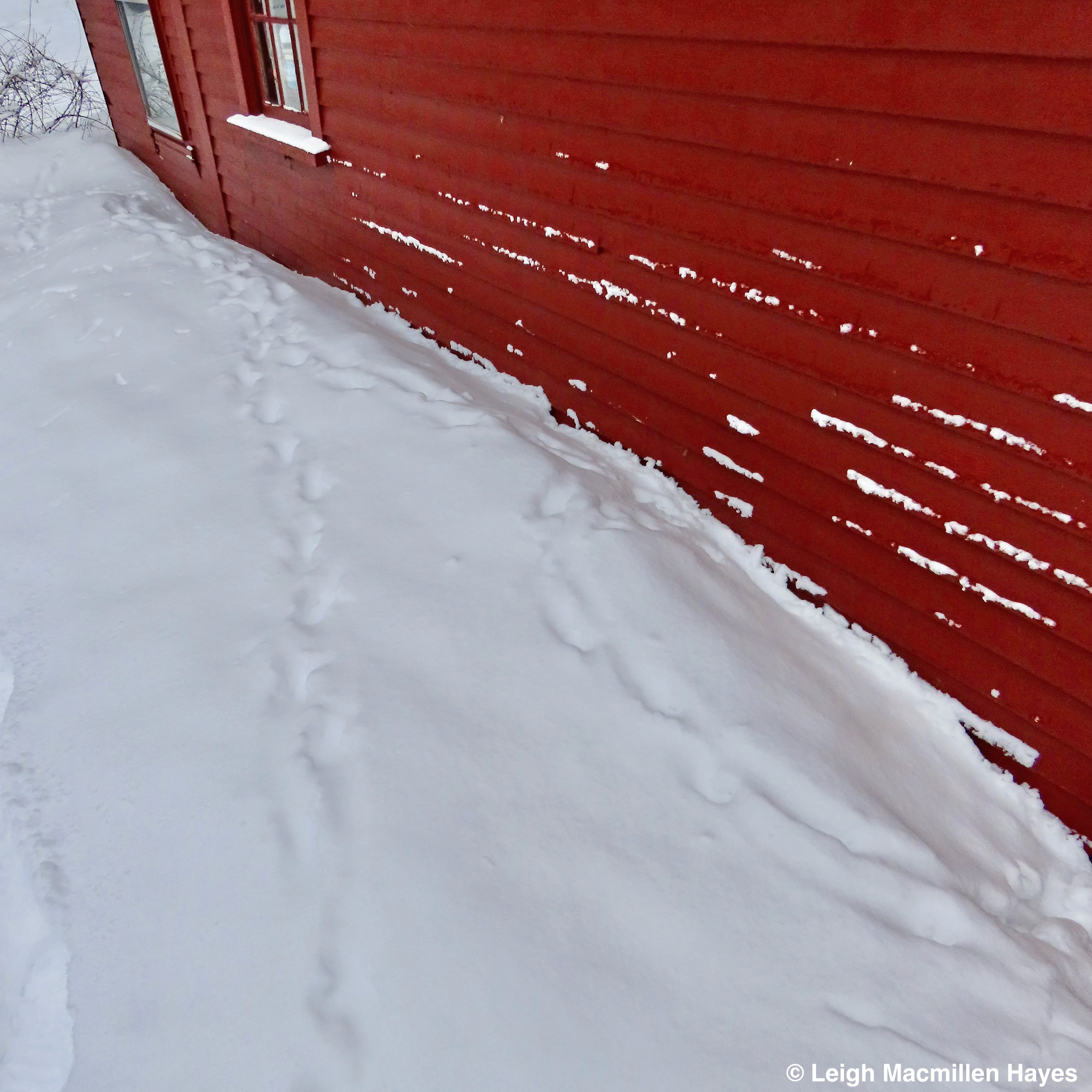
The porcupine did check out a tiny hole under the barn, but we don’t think it actually stayed there. Will it return. Probably, as the barn has long hosted this species; along with other small critters.

That’s a lot for now and at last I’m done counting the stock for our winter inventory. There’s more out there, but this is certainly enough to make me realize that they don’t live in our woods, but rather, we humbly reside in theirs.

Scouts on the Hunt

The morning began as Tuesdays do in my current world, with a visit to a Greater Lovell Land Trust property accompanied by a group of curious naturalists we know as docents who love to do deep dives on every little thing that we encounter and in the midst we share a brain. A collective brain is the only kind to have, in my opinion, because we each bring different knowledge or questions to the plate.

And so it was when we first encountered what could have been a hair ball of sorts and then discovered this hair-filled scat about a yard beyond. And near it another “hair ball.” Based on size and structure we determined the scat belonged to a bobcat, and thought that the hair balls made sense as maybe the cat had to cough up some of the hair of the mammal consumed. What did it eat? Well, we know both snowshoe hare and deer frequent this place and so it could have been either.

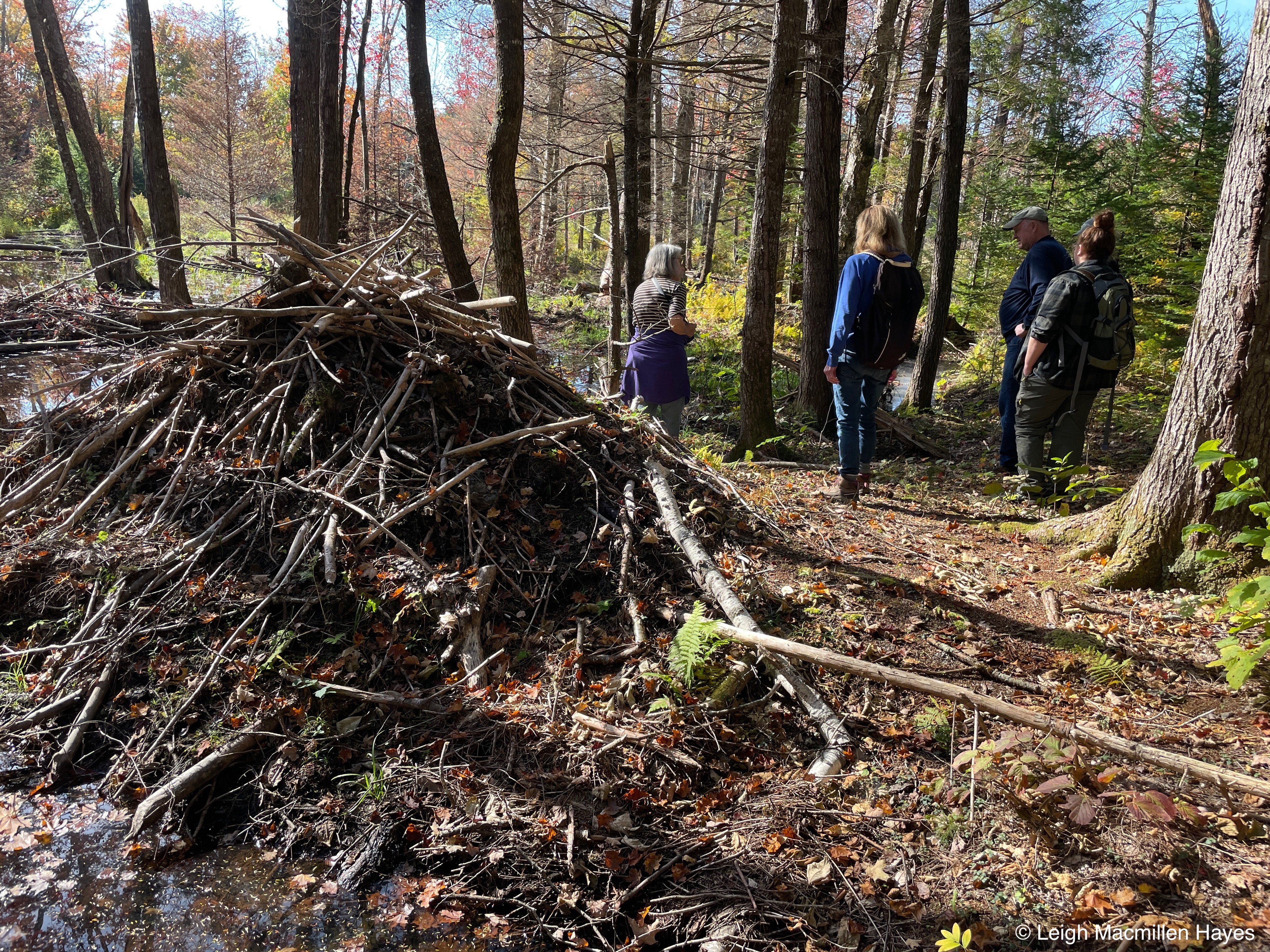
A little further down the trail we reached a beaver lodge that some of us had seen under construction in August 2022, and gathered game camera photos over the course of time, and spotted all kinds of sign of activity each time we visited, until that is, May. When it rained. And rained. And rained. In a torrential manner. And the dam the beavers had built was breached. And they disappeared. And we know not their fate.

But the beauty of a beaver pond is that once breached, change happens and other critters take advantage of the space and there’s so much possibility and we can’t wait to watch how this space, one in which we could walk prior to August 2022, will evolve and other flora and fauna may move in until another beaver family takes up residence and changes it again.

About an hour or so after departing, a call came. Well, really, it was a typed message. But as my morning peeps know, shout, “Kill site,” and no matter what I might be focused upon, I’ll come running.

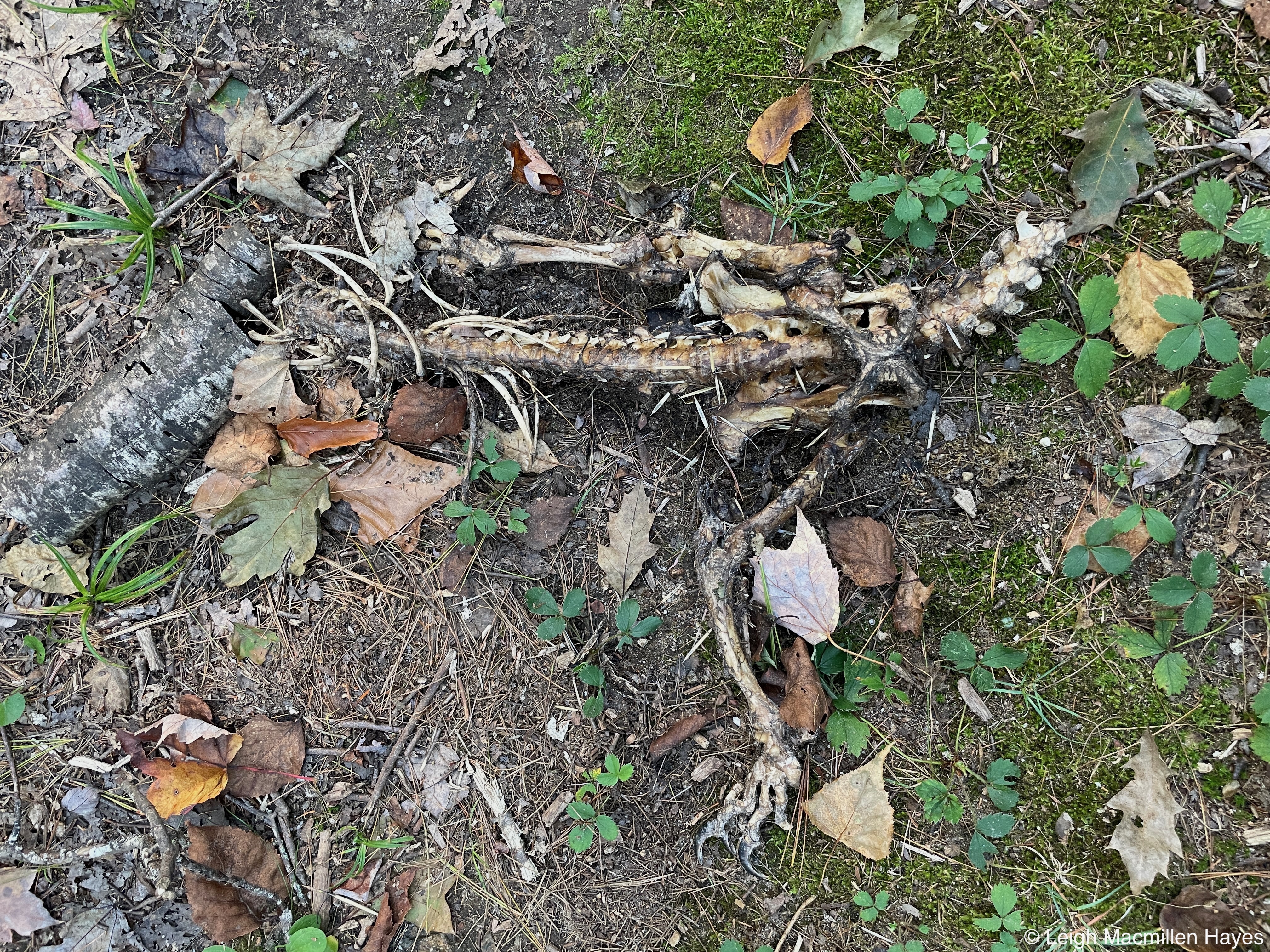
The message included a few photos of a mammal skeleton and a thought that it might be a beaver that had become the meal because it was located close to another beaver pond. Beaver ponds are plentiful in the landscape of western Maine.

After a few messages back and forth, the writer and I agreed to meet and walk to this site. Take a look. The meal this skeleton became had been consumed months ago, I suspect in the winter, given how much was missing, including the head. And even after any hide and meat had been eaten, the bones continue to provide calcium for rodents seeking such.

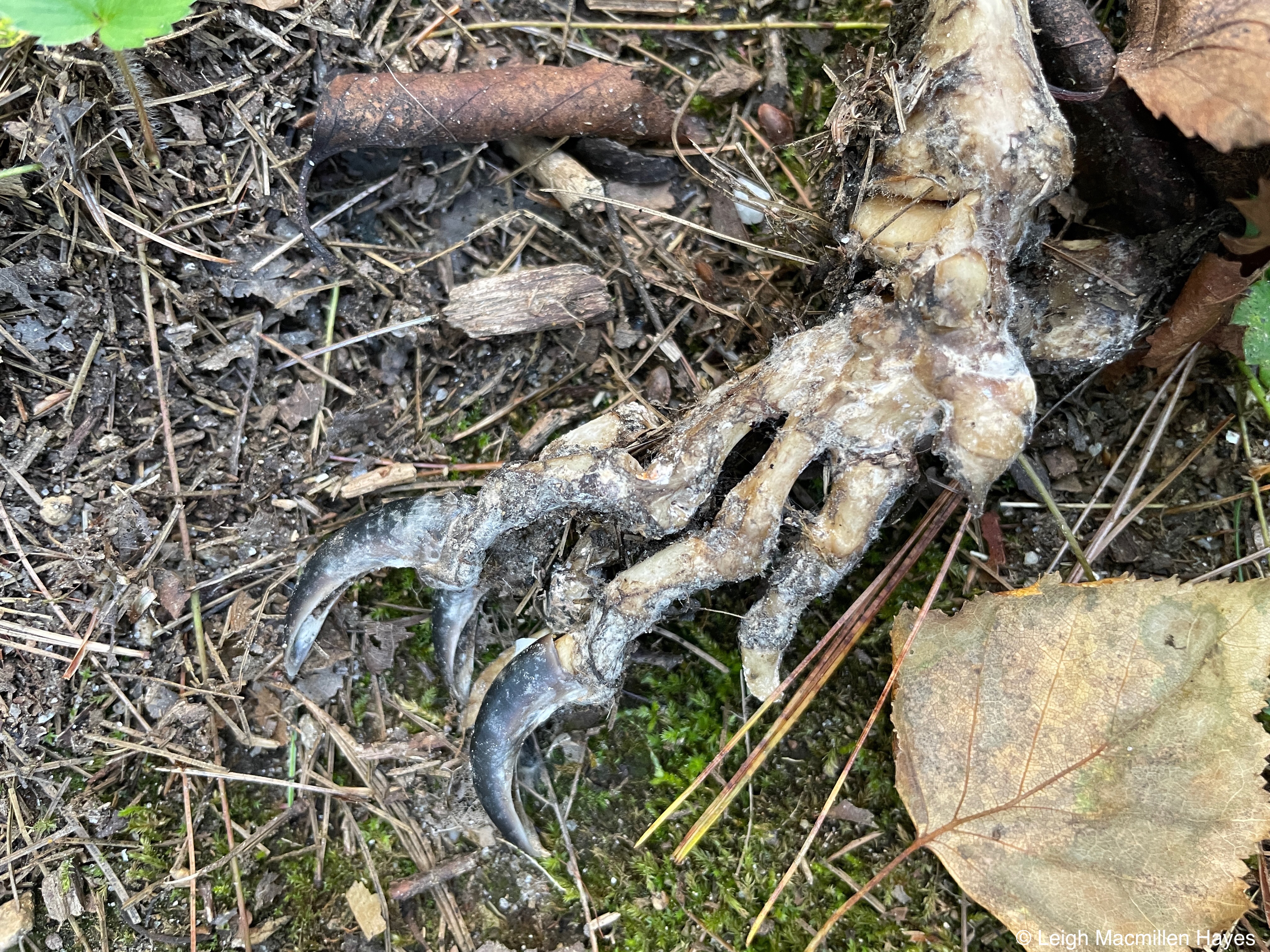
Since my guide suspected beaver, I knew I had to slow my brain down and assess the evidence. My, what long toe nails. And though some were broken, it seemed obvious to me that they were all oriented to the front of the foot. Plus, there was no evidence of webbing.

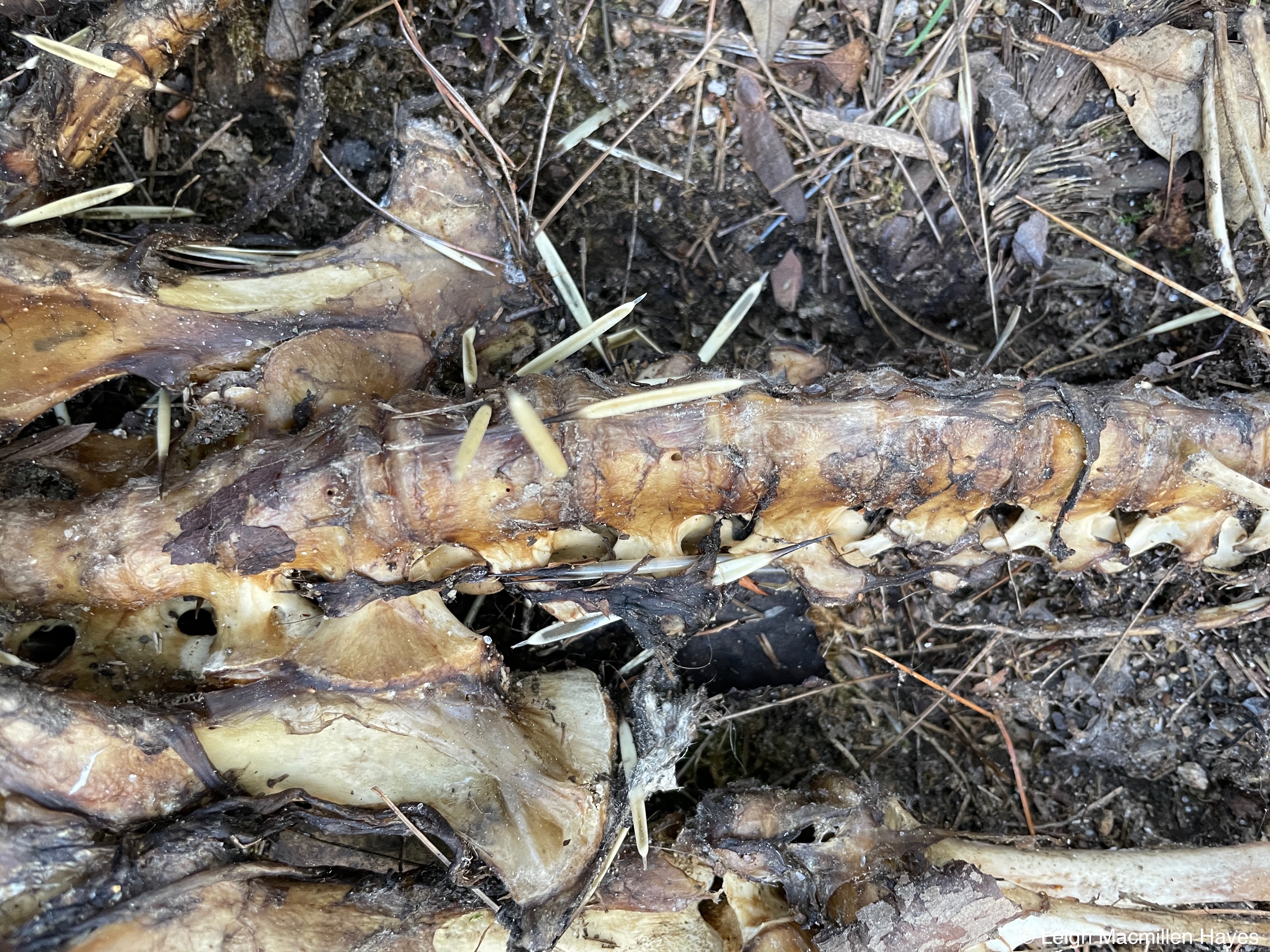
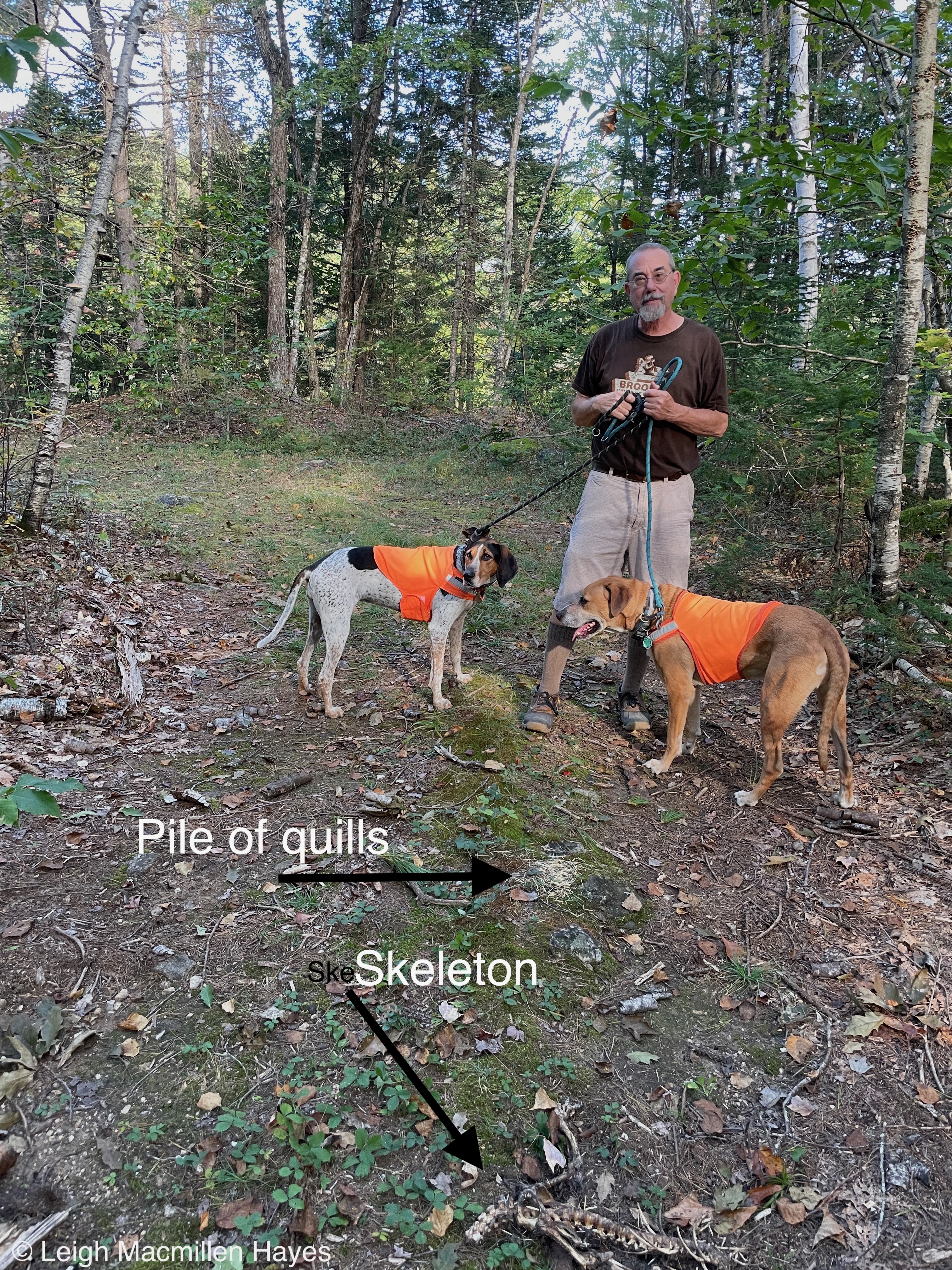
A bigger clue was observed with a closer look. Barbed quills sticking into the spine. I pulled one out and we examined it.

And about a foot away, a pile of quills, with vegetation growing through them adding to the age of the kill site.

And hiding there also, as if stuck into the ground, a quilled tail.

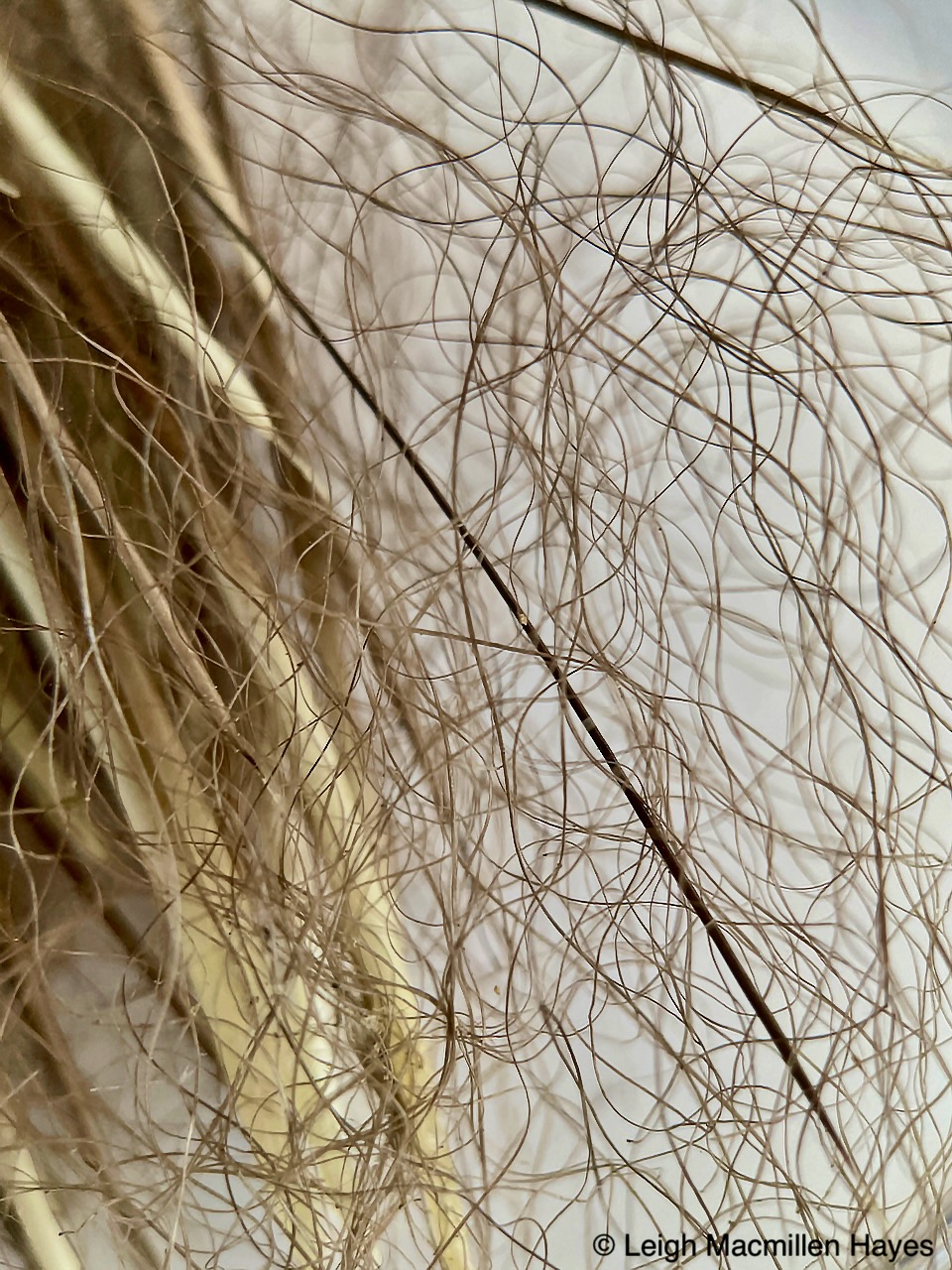
Did you know that porcupines have a variety of hair? For winter insulation, they have dark, wooly underfur. In addition, there are long guard hairs, short, soft bristles on the tail’s underside, stout whiskers, and then there are those pesky quills.

They aren’t pesky to the porcupine; just us and our pets and any animal that might choose to or accidentally encounter a porcupine.

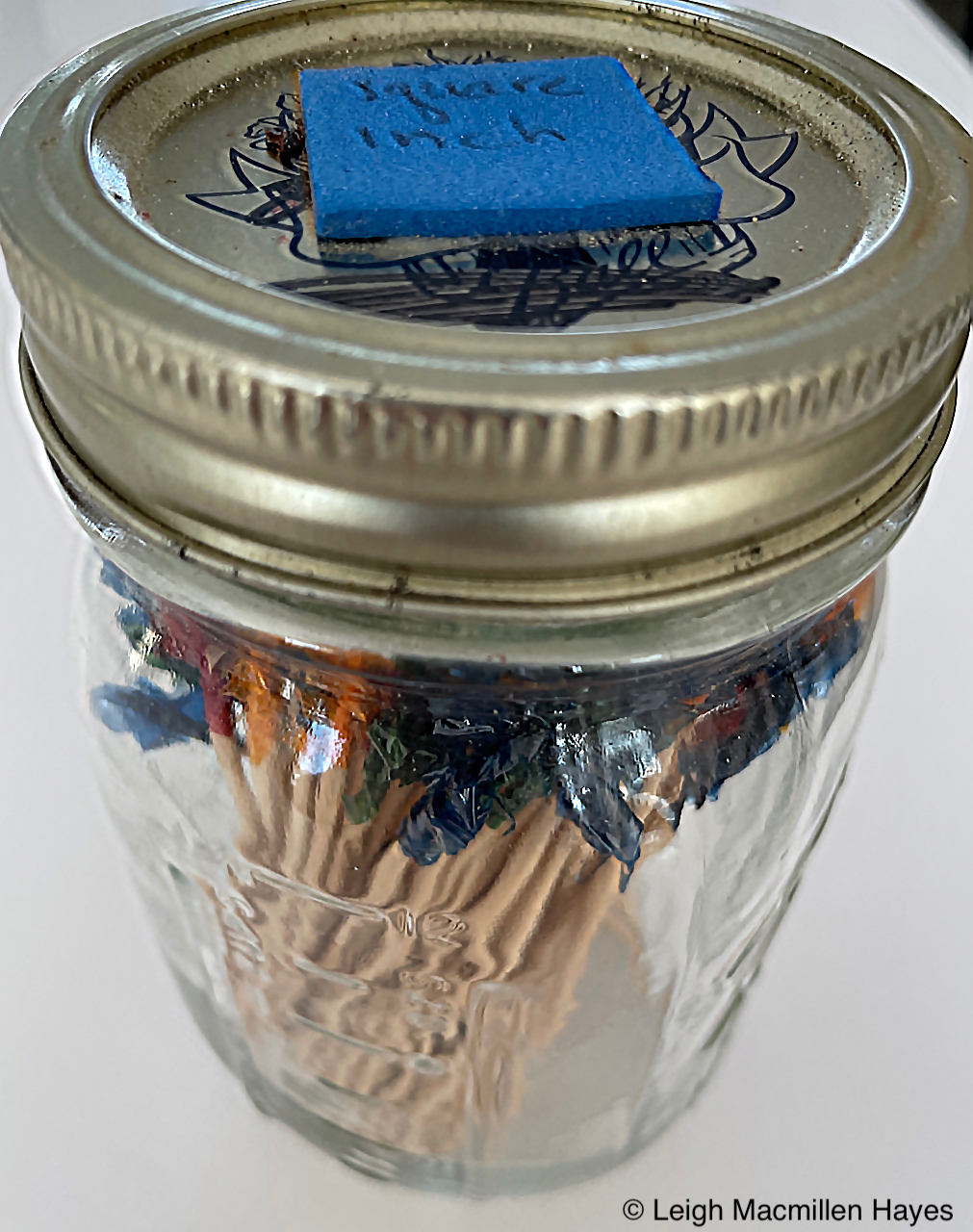
Overall, a porcupine sports about 30,000 quills, and within one square inch on its back, you might count up to one hundred, as demonstrated by my jar of toothpicks.

The quills are 1 – 4 inches in length and lined with a foam-like material composed of many tiny air cells, thus their round, hollow look. There are no quills on the porcupine’s face, belly, or inside its legs.

Look at that nose. Soft hair indeed. As is the stomach. A fisher, which is a member of the weasal family and not a cat, will attack the porcupine’s face repeatedly.

Fishers and bobcats also have been known to flip a porcupine onto its back and then go for the belly. That doesn’t mean that they don’t get quilled, for in moments of danger, the porcupine instinctively raises its quills and positions itself with its back facing the predator, showcasing its formidable defensive strategy. but the predator does get a meal.

This dinner had long ago been consumed as I said. But was it a fisher or a bobcat who scored this meal? We’ll never know, but I give great thanks to Dixie and Red and their best friend Lee, for being such great scouts and sharing the results of their hunt with me.

Found a kill site? Give me a shout and I’ll come running.

Quill You Be Mine?

It’s not even Valentine’s Day and already I’m thinking of love. Don’t tell My Guy, but this is love of a different sort. And the story all began while tracking with friends earlier this week.

Just as we were about to finish up the program, we spotted the signs of a resident rodent, including downed hemlock twigs and then a den. The den did not entirely make sense due to its placement in what seemed like a wet area, but we decided the critter must have found a dry place above the moisture, for indeed there was scat.

Once spotted, I knew I needed to return, for almost nothing makes me happier than to spot sign left behind by this mammal.

And so I did yesterday afternoon and while taking a different route to the den, I noticed the sashay of said critter as it had waddled through fluffy snow.

Next, I did what I do, and followed the tracks in a different direction than originally intended. And that’s when I saw these, the resident’s name carved on several wooden shingles. It’s an agile critter given that the shingles were posted all the way to the tip top of these pole trees.

Can you read it? Porcupine Lives Here is the inscription engraved on the tree. Actually, it’s a sign of winter feeding for porcupines, like beavers and deer, seek the cambium layer as one of their food sources. Each line shows where the porcupine’s incisors came together as it scraped away to obtain a meal.

And just beyond those pole trees, I spotted a hole that I suspected could only be one thing. A den with tracks leading in and out and the required pee, for such is this mammal’s habit.

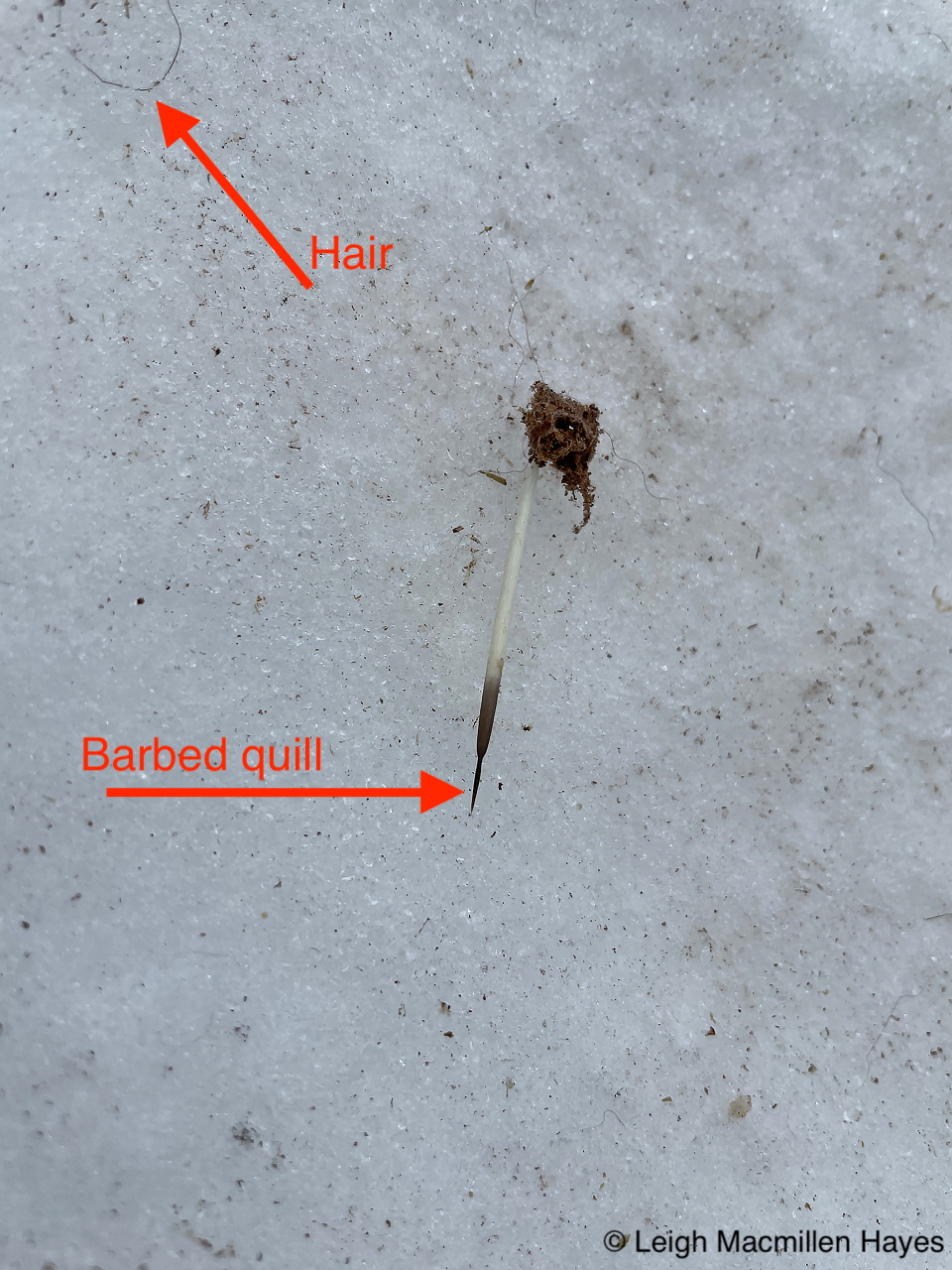
A closer look at the dooryard and I spotted a barbed quill and hair. Actually, quills are a modified form of hair.

Did you know that porcupines have a variety of hair? For winter insulation, they have dark, wooly underfur. In addition, there are long guard hairs, short, soft bristles on the tail’s underside, stout whiskers, and then there are those pesky quills.

They aren’t pesky to the porcupine; just us and our pets and any animal that might choose to or accidentally encounter a porcupine.

The quills are 1 – 4 inches in length and lined with a foam-like material composed of many tiny air cells, thus their round, hollow look. There are no quills on the porcupine’s face, belly, or inside its legs.

But on the upper portion of its head, down its back and along the top of its tail, oh my. Within one square inch, there are approximately one hundred quills.

All told, there are over 30,000 quills. But who is counting. Not me. Though I did count these fancy toothpicks, 100 in all, to represent the quills in a square inch.

Despite the myth, porcupines cannot throw their quills. Because the quills are loosely attached, they dislodge easily on contact and stick into a victim’s flesh. And because they are barbed, they are difficult to remove. Talk about a formidable defense!

Returning to the den, which was located within a hollowed tree, I knew the porcupine had visited within the last twenty-four hours but wasn’t so sure it was home at the hour I stopped by.

As I often say, “Scat happens.” And in the case of a porcupine, it happens a LOT! One porcupine evacuates 75 – 200 scats a day. And though this happens as it dines, most of the scat is deposited in the den. Why? Warm insulation on a night as cold as tonight will be with temperatures already in the negatives and wind chills expected to reach -45˚? Or a detractor for predators–do they get a whiff and realize its one they don’t want to visit?

I’m not sure, but this is an example of a winter scat–fibrous from that woody diet of bark and twigs. It’s comma shaped. And often there is a groove down the inside curve.

By spring, it may come as linked pieces, much like a necklace, for grass fibers from a change in diet help create the connection.

Having discovered this den, I decided to follow the tracks, which indicated the mammal had traveled in two directions. Where would it lead me?

Within a tenth or two of a mile, I realized I’d snowshoed back to the spot my fellow trackers and I had discovered two days prior. You can see our snowshoe tracks. But since our visit, the porcupine had happened along, climbed over the downed log and peed.

Did you know that pee plays an important role in a porcupine’s courting ritual. These critters are solitary most of the year, but between September and November they seek a mate. The male, in a bid to woe a female, often approaches and sprays her with his urine. Are you feeling the love? She apparently does, for if she likes the scent of his urine, they might rub noses, or walk on their hind feet before canoodling begins.

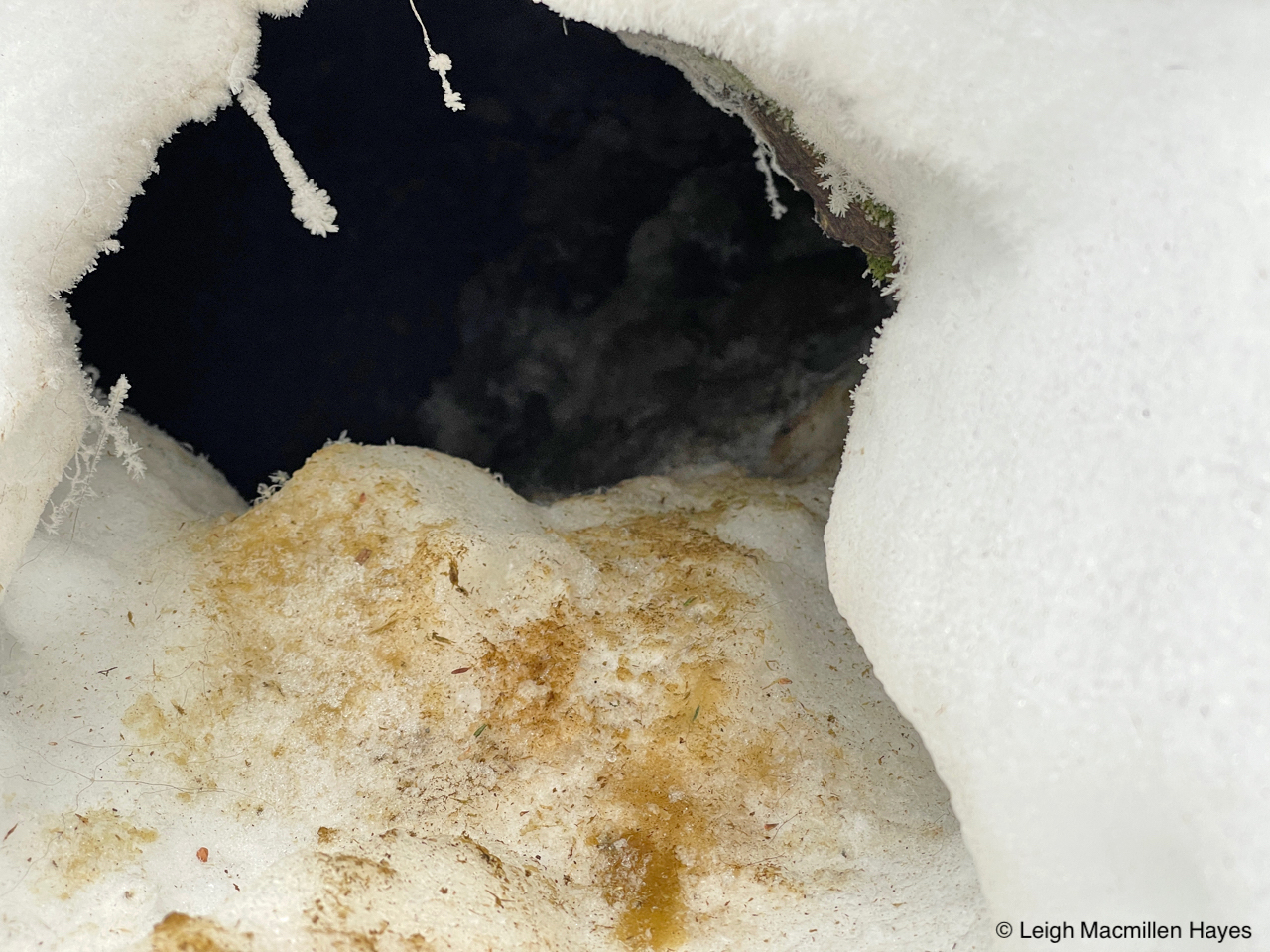
Right above the peed-upon log was the entrance to the den and by the sight of the pigpen approach, browner even that it had been previously, I knew this really was active. The soiled snow is from the porcupine walking across its scat to exit the den.

Unfortunately, I couldn’t get the camera lighting right, but believe me that this one is full of scat as well. And I suspect, though I couldn’t see it, that a porcupine was sleeping somewhere in there, with its tail facing the entrance just in case a predator happened along.

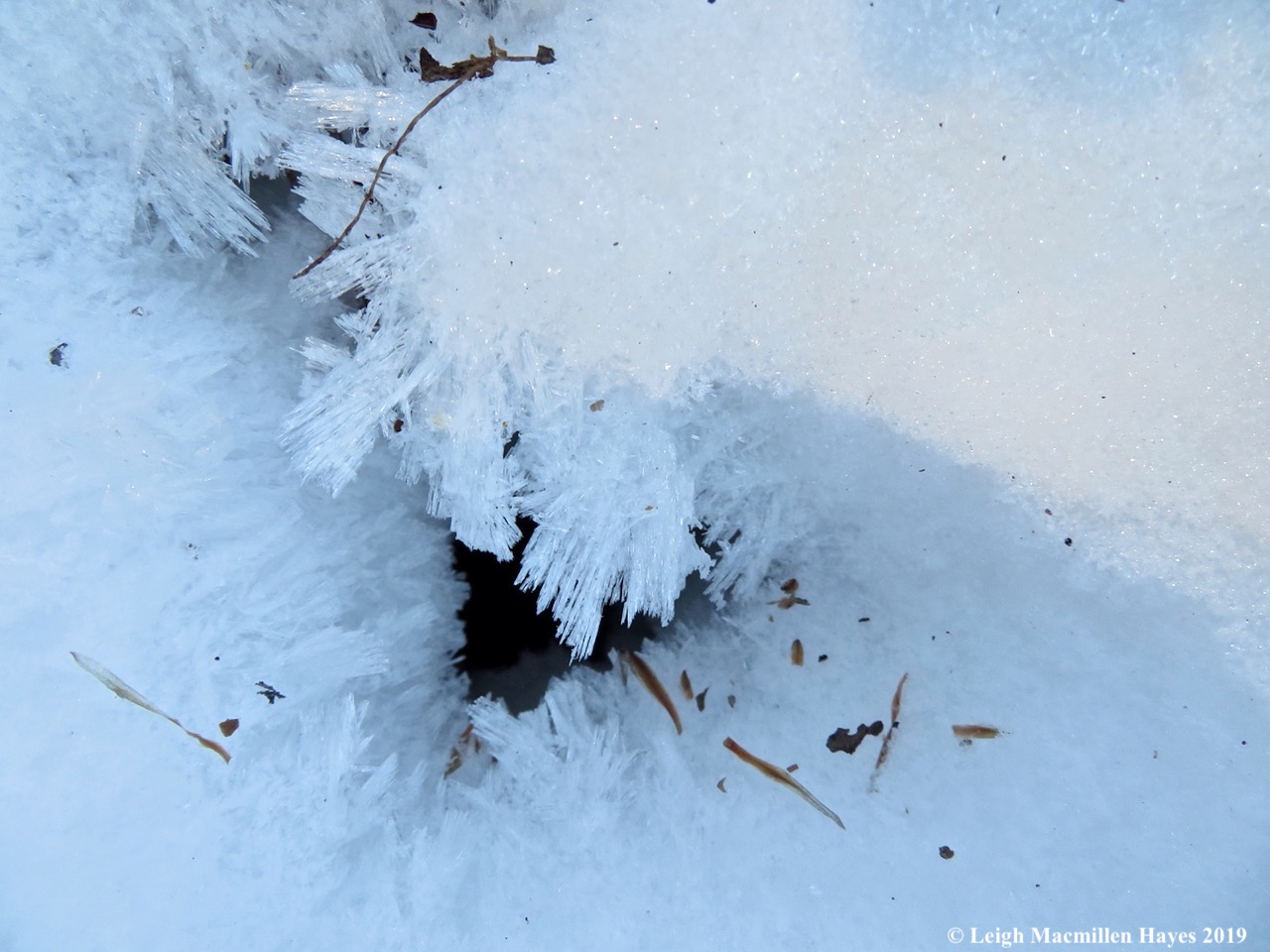
Another indicator of a resident in the house–hoar frost created by breath on a cold winter day.

Right above the den I discovered the tracks of another–enemy number one in a porcupine’s world view. A fisher will kill a porcupine with repeated bites to the face and head.

Coyotes have also been known to work in pairs to maneuver a porcupine onto its back, thus going for the belly, where the hair is wooly.

So the curious story to me was that the fisher passed through after the porcupine was already back in the den, but it didn’t approach the den. Perhaps it had hoped to find the porcupine out in the open and didn’t want to face a tail lashing if it stuck its nose into the house.

Since the pervious visit, there were also more hemlock twigs on the ground and lots more evidence of scat-dirty feet and pee.

Because a porcupine is a rodent, and a large one at that, only exceeded by a beaver in size, it has prominent top and bottom incisors and twig nips are at a 45˚ angle. Can you also spot the scat and hair?

The winter diet consists of needles and bark–favorite trees being hemlock, birch, beech, aspen, elm, oak, willow, fir, and pine.

In spring and summer, a porcupine seeks out grasses and other green plants. And then in the fall, it looks for acorns, tearing into them in a rather messy manner.

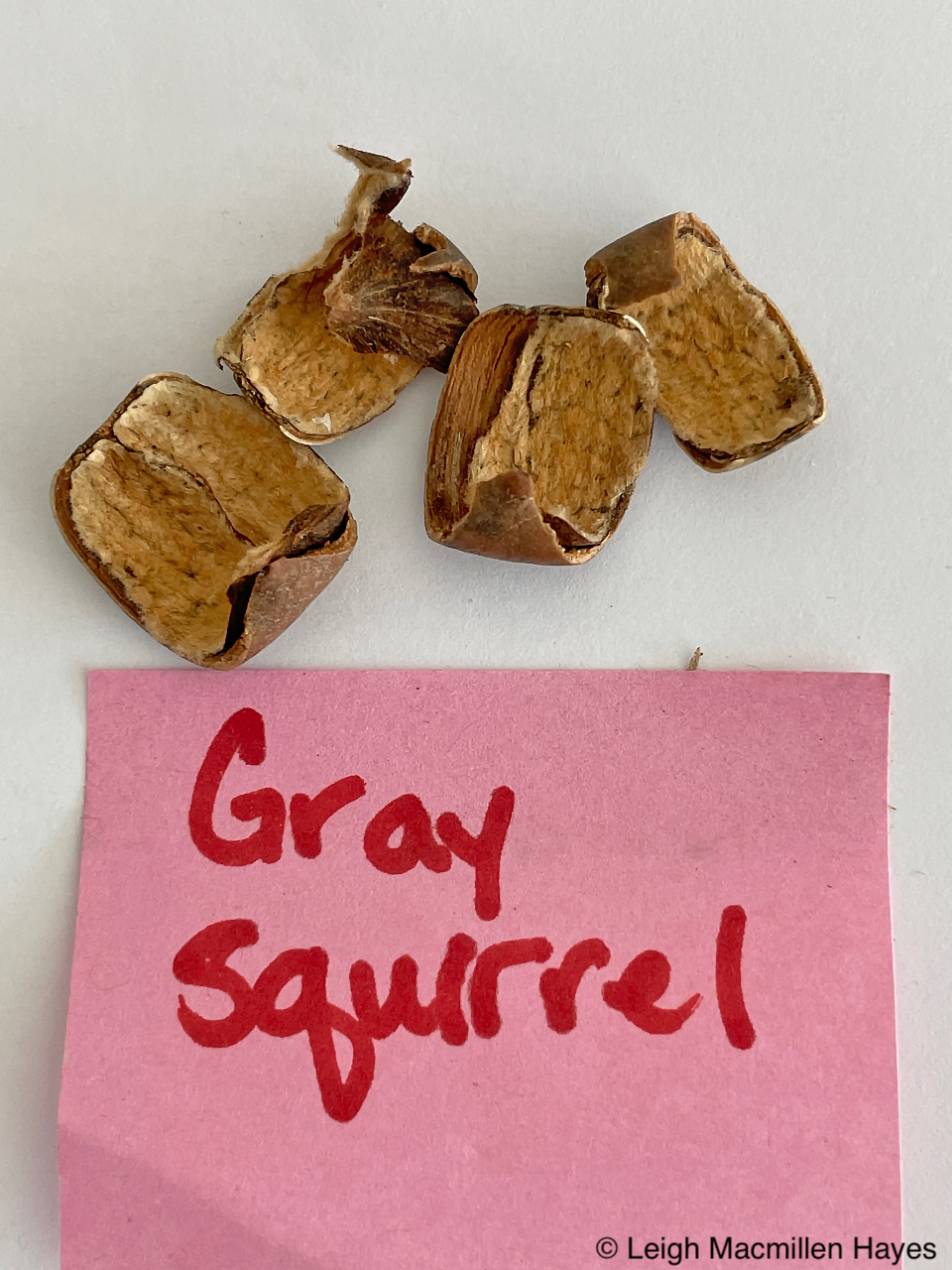
In fact, a squirrel’s midden of opened acorns shows that it cuts the hard shell into much neater strips.

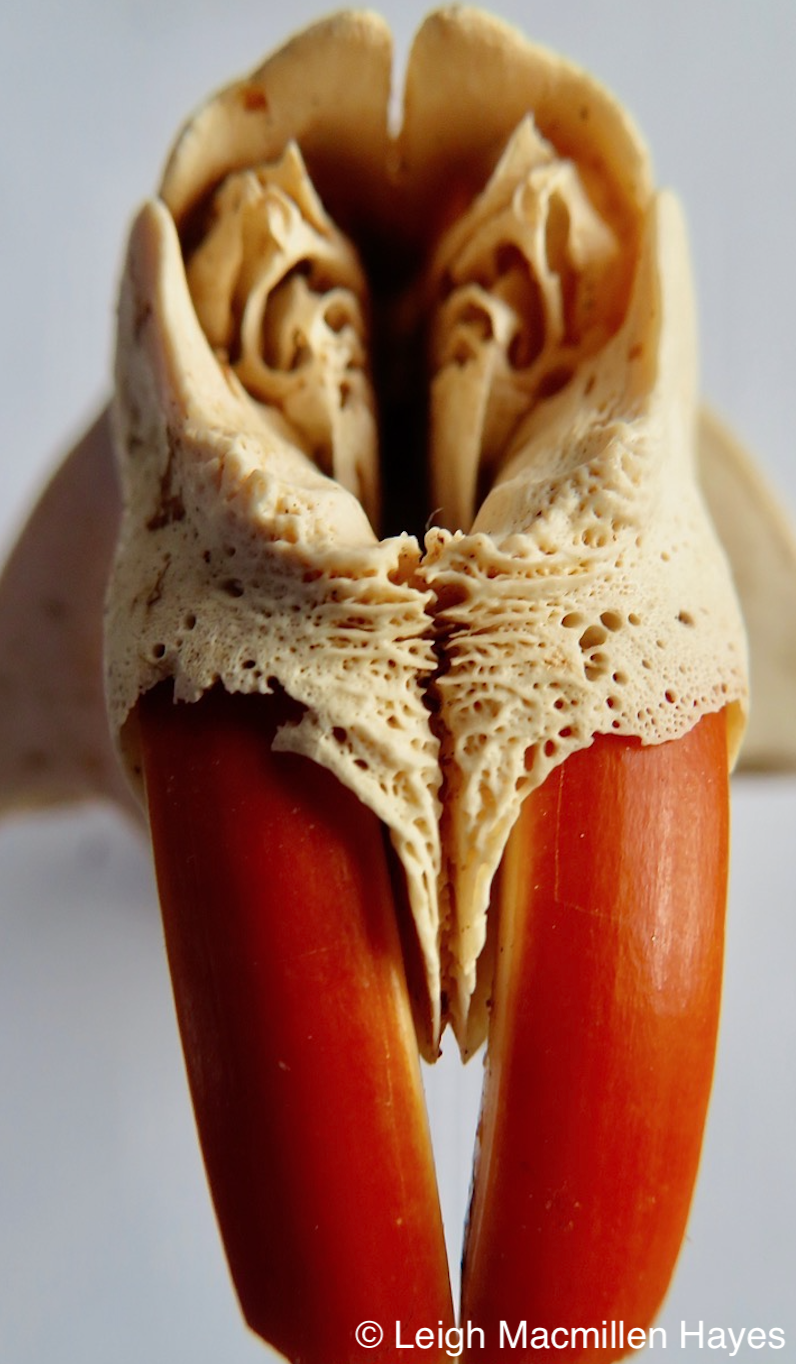
A porcupine’s cheek tooth pattern consists of one premolar and 3 molars on each side top and bottom. As you can see, the cheek teeth are modified for grinding since they are strict herbivores.

It’s those prominent incisors that are to be admired. A porcupine uses its large two front teeth for gnawing off bites of food. The incisors continue to grow throughout the porcupine’s life at a rate of twelve inches/year, and the constant gnawing keeps them worn down to the perfect size.

I did not actually see a porcupine yesterday, despite my best hopes, but sometimes it happens when I’m not looking intentionally so there may be a sequel to this story.

A porcupine has poor eyesight, so I’m not sure if it ever actually sees me when it’s up in a tree, especially if I’m standing sorta still, but it does have a good sense of hearing and smell, so I’m sure its aware of my presence. And the tail always faces the trunk in case I decide to climb up–it’s a great defense mechanism–having the tail at the ready to thwart a predator.

I will end this long story with a drawing by a dear friend and fellow naturalist, 8-year-old Aurora. She’s done her homework and I hope one day soon she’ll be able to answer the question: Quill You Be Mine? with a yes!

Tree Spirit Mondate

Four days ago I happened upon a set of fresh coyote tracks, which didn’t surprise me for I’d seen so many of the same in that particular area all winter. But it was the color of scat left beside one print that stymied me.

I wanted to know what had been on the menu for breakfast. Noting hair as a component, I wondered: red squirrel? Didn’t think so. Red fox? Maybe. White-tailed deer? A possibility.

What to do? Backtrack the track, of course. Which worked well for a bit, until I realized it was going to lead me up a hill and across the street and snow was falling and I needed to head home. But . . . despite the fact that the prints would get filled in by the flakes, I promised myself a return venture in search of the main course. And I was pretty sure I could convince my guy to make the journey with me.

The moment we stepped onto the trail, I chuckled for even if I hadn’t known that some friends who had seen the photo I’d posted of the scat and prints had gone in search of the same meal over the weekend, I would have known by their tracks left behind where they had traveled. Well, especially his. Pretty cool when you can look at snowshoe tracks and identify the gender, don’t you think? But I know the pattern of Tom’s wooden snowshoes and can spot them in an instant. Paula’s are more generic, but he followed her wherever they went except for a few times when they split up like a fox or coyote would do when trying to surround prey (or figure out the maker of the prints as Tom and Paula had done), the imprint of his shoes covering hers both on and off trail.

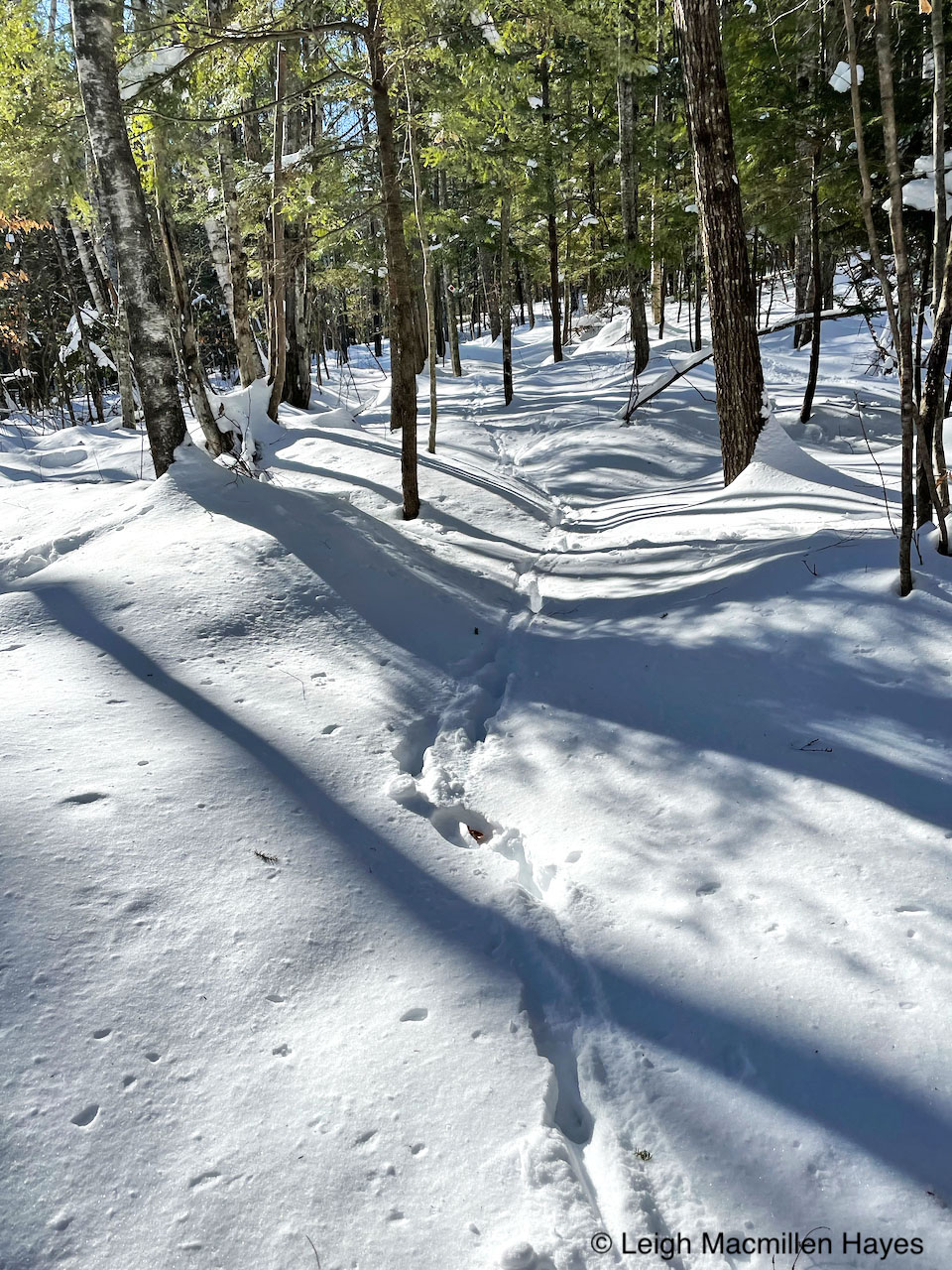
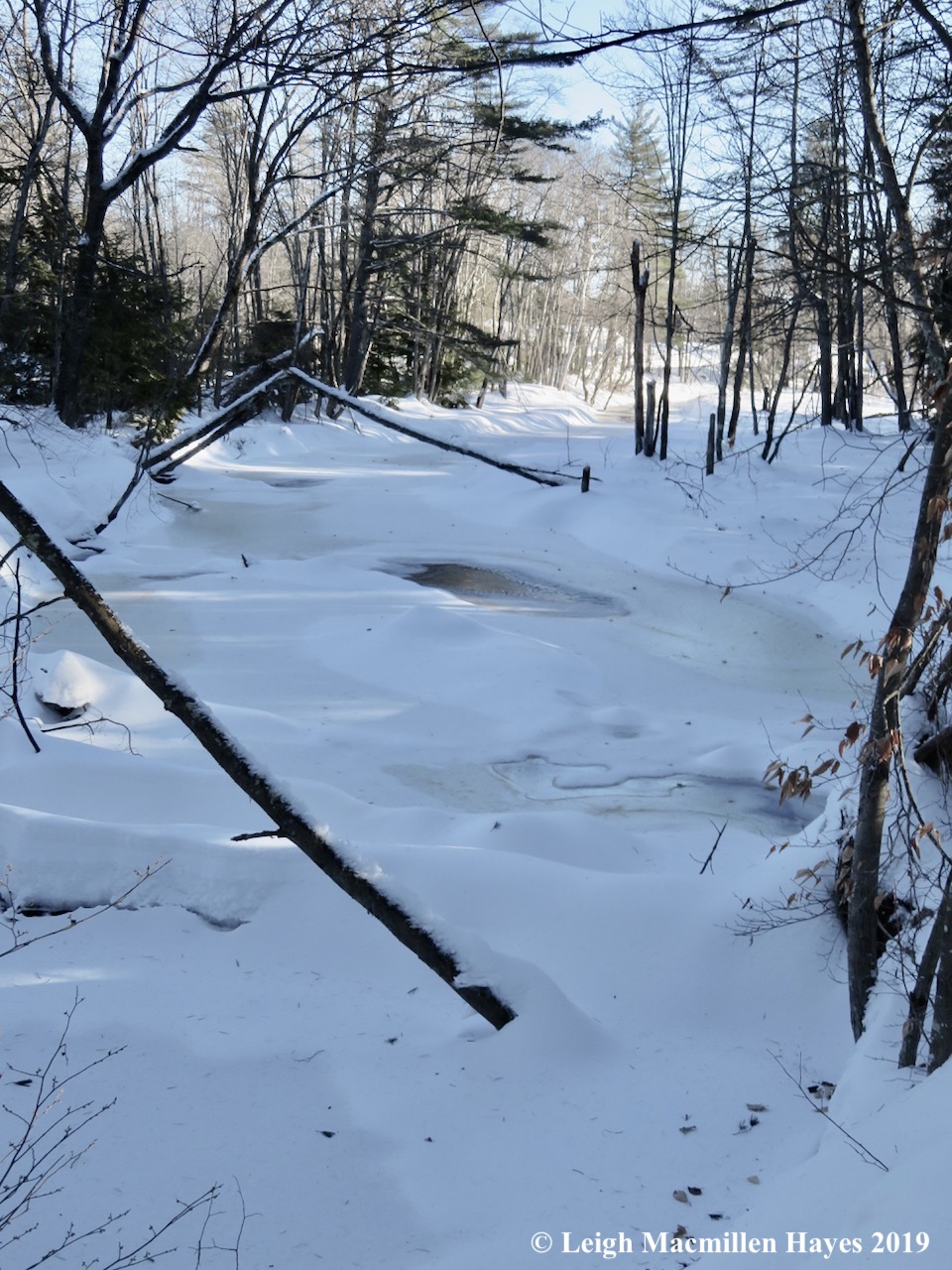
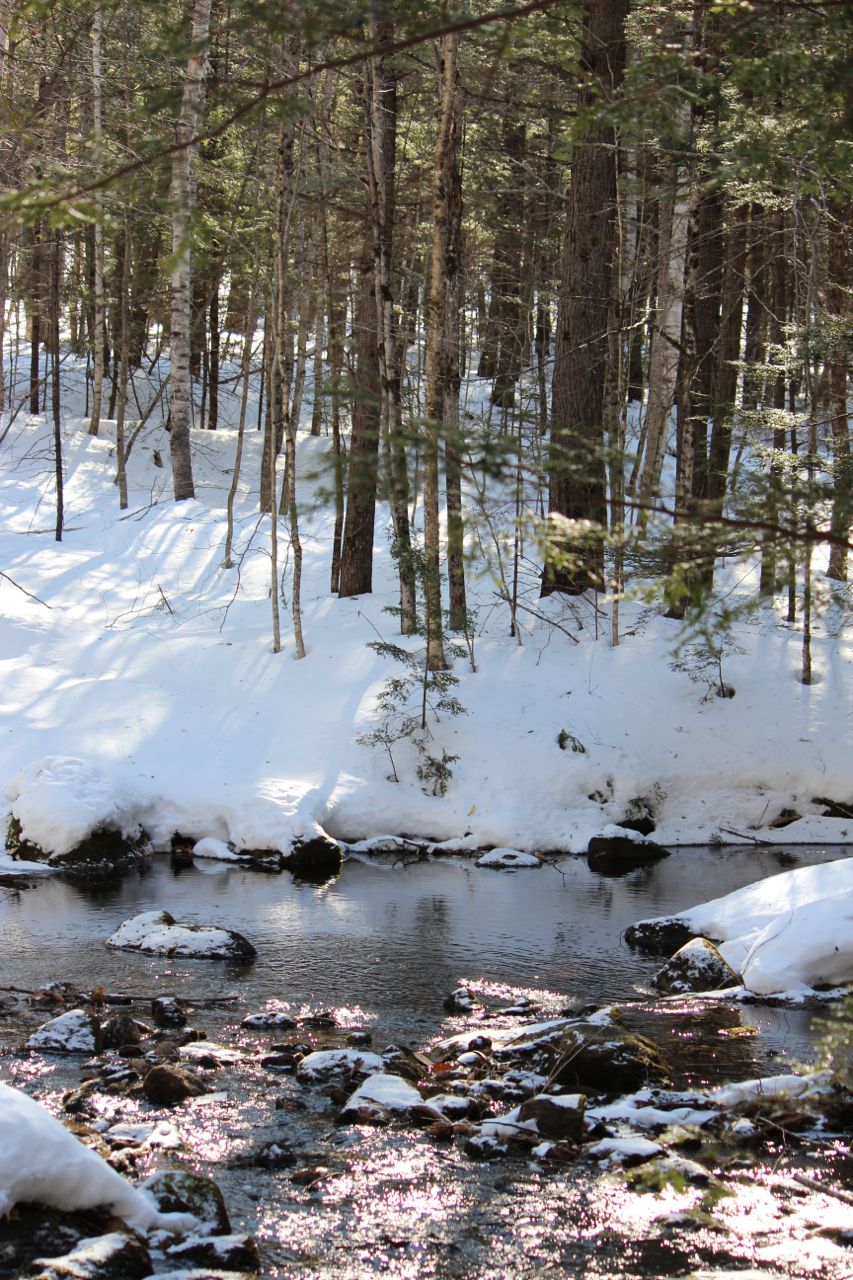
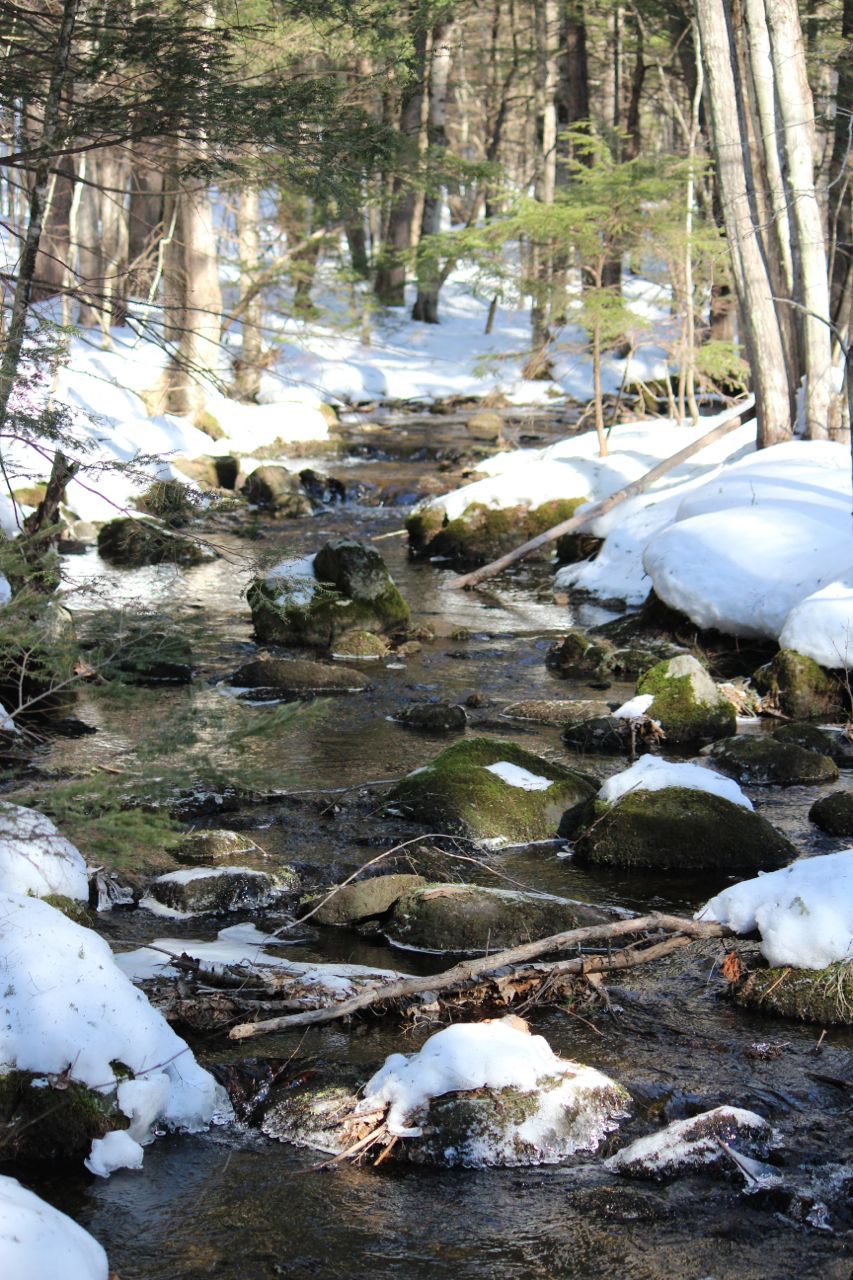
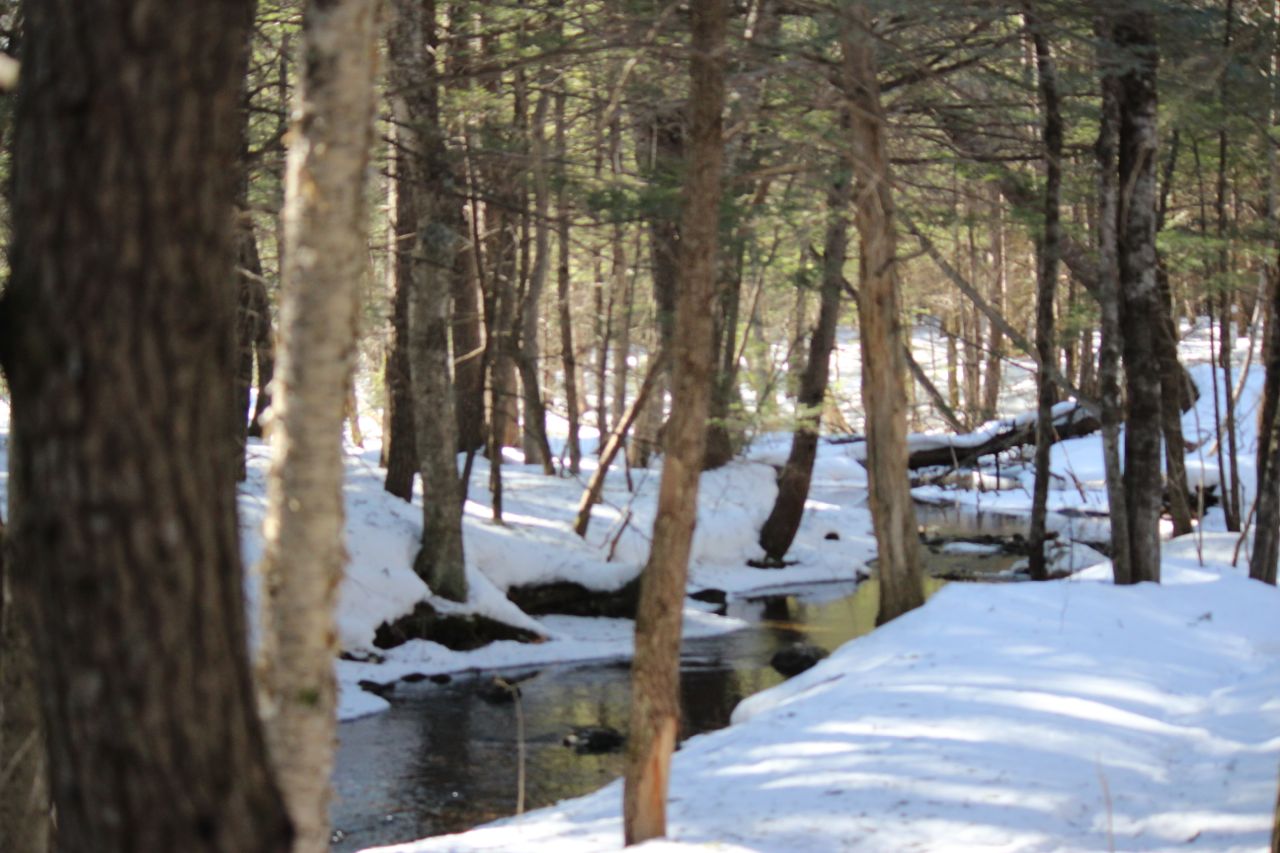
Their journey and ours followed a certain brook where noon sunshine gleamed upon the snow and ice as the water flowed forth.

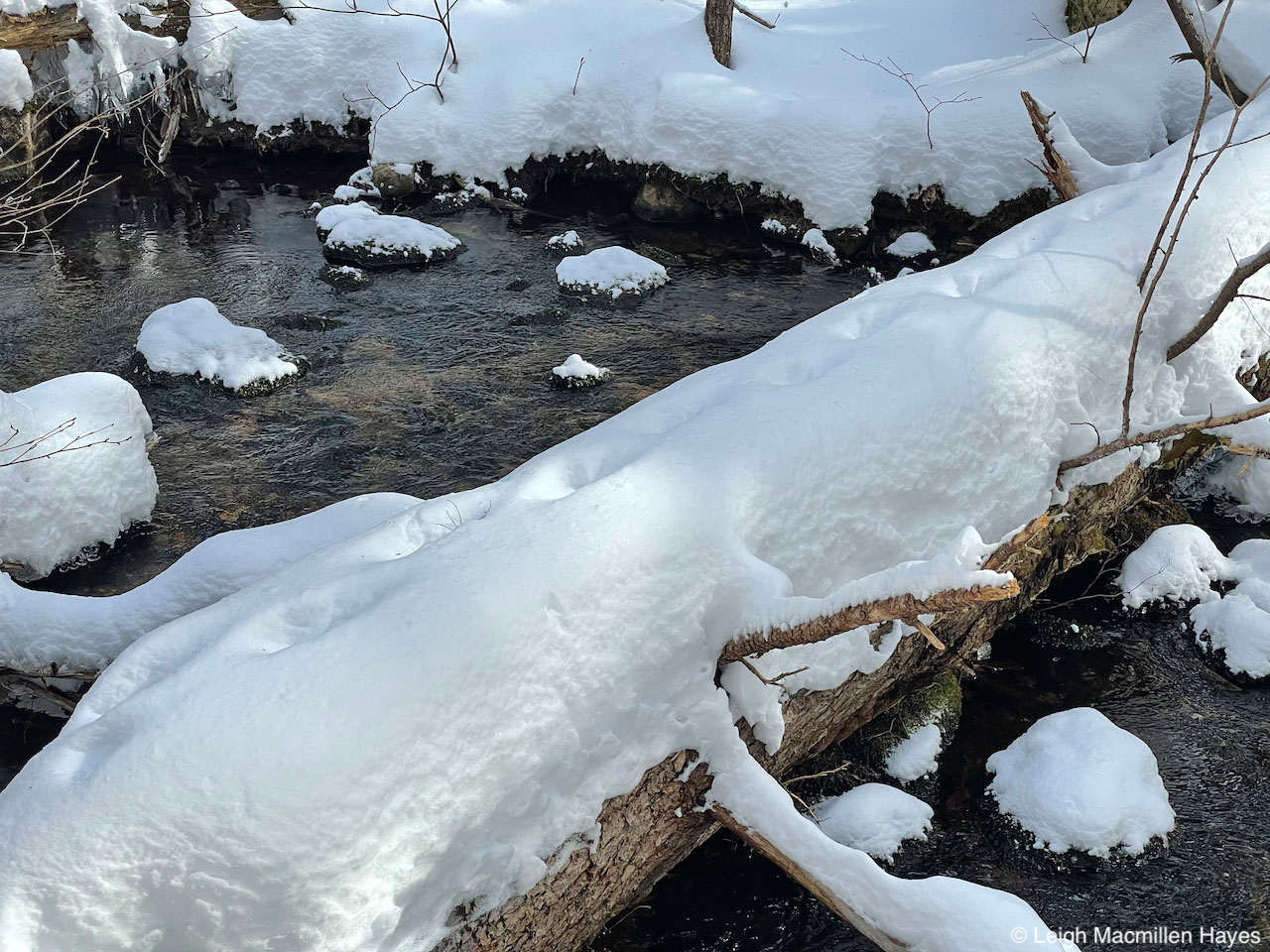
In a spot where two weeks prior I’d noted bobcat tracks crossing the brook via a log, there were fresher tracks today, though not so fresh to determine feline or canine.

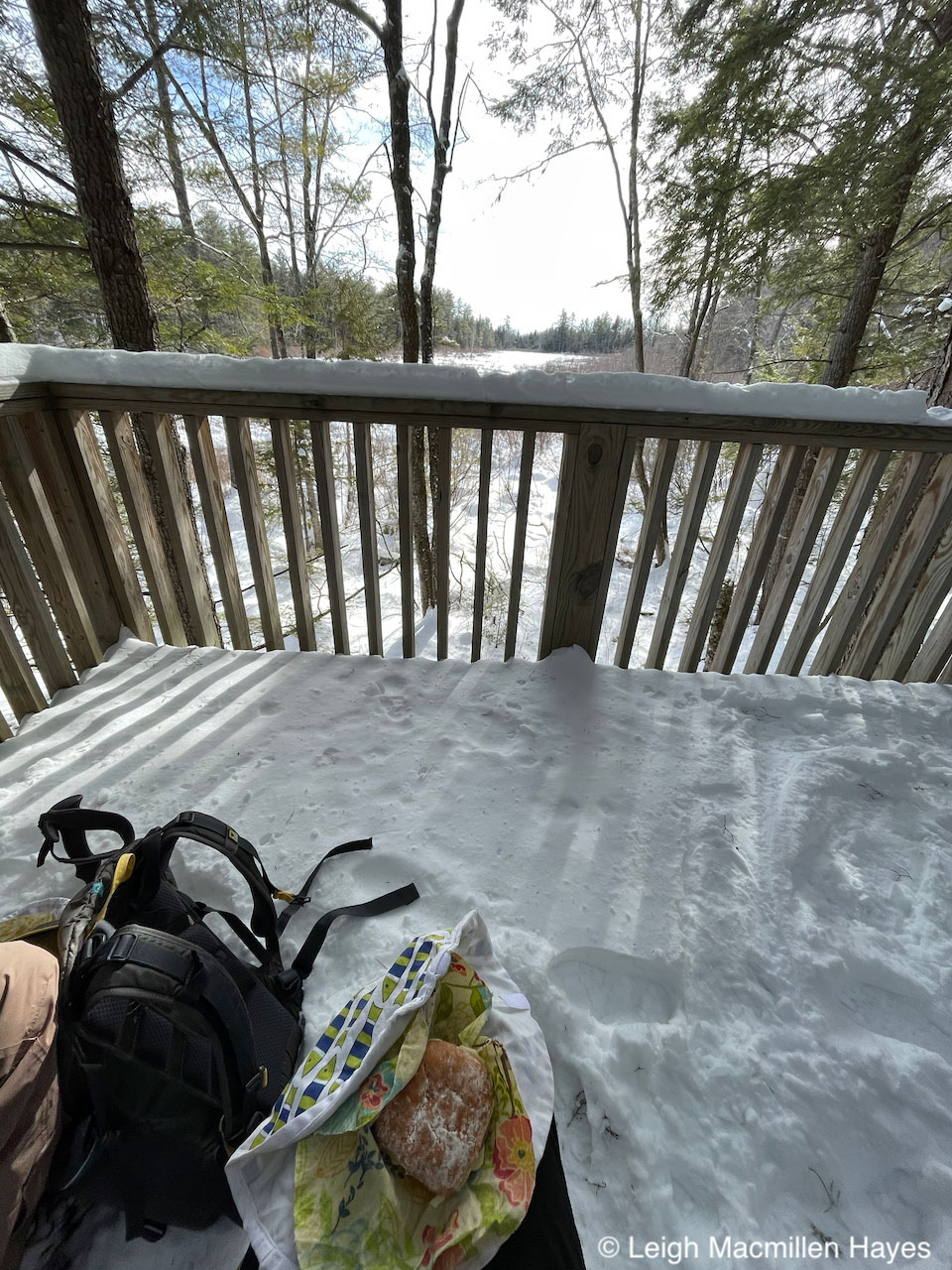
Eventually, because we were close to the spot where I’d first made my discovery, and it was time for a meal of our own, my guy and I climbed up the stairs to a treehouse and sat down to dine.

We unwrapped our sandwiches while taking in the view of a bog beyond. Maybe as we ate we’d spy some action in the bog beyond. Maybe we wouldn’t. We didn’t.

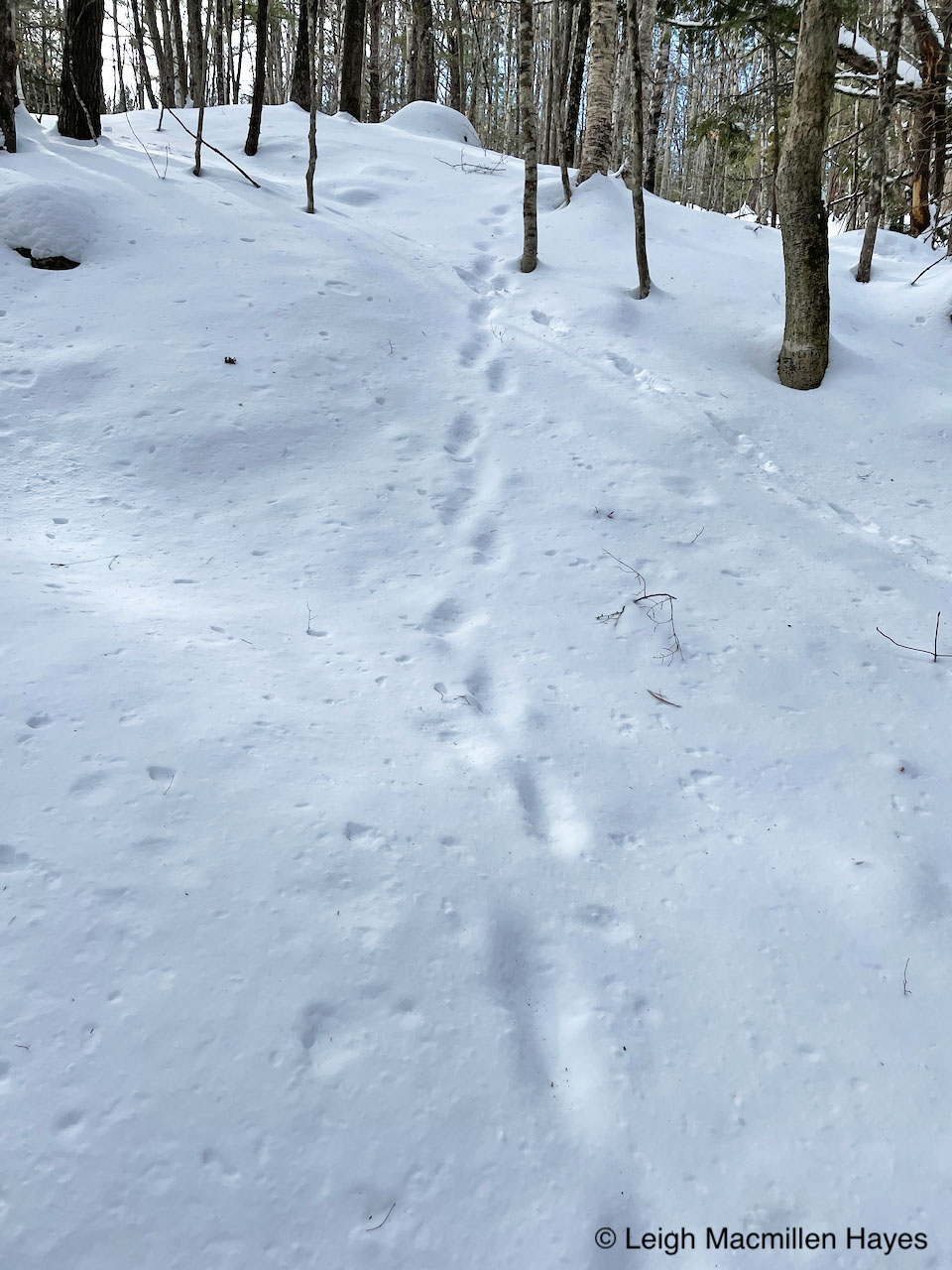
Finally, we were ready to pick up where I’d left off on backtracking the coyote four days ago. Because of snow over the weekend, the prints were filled in, but still the pattern was visible, making them easy to follow. We could see that in the more recent past, a fisher had crossed over the track in search of a meal of its own.

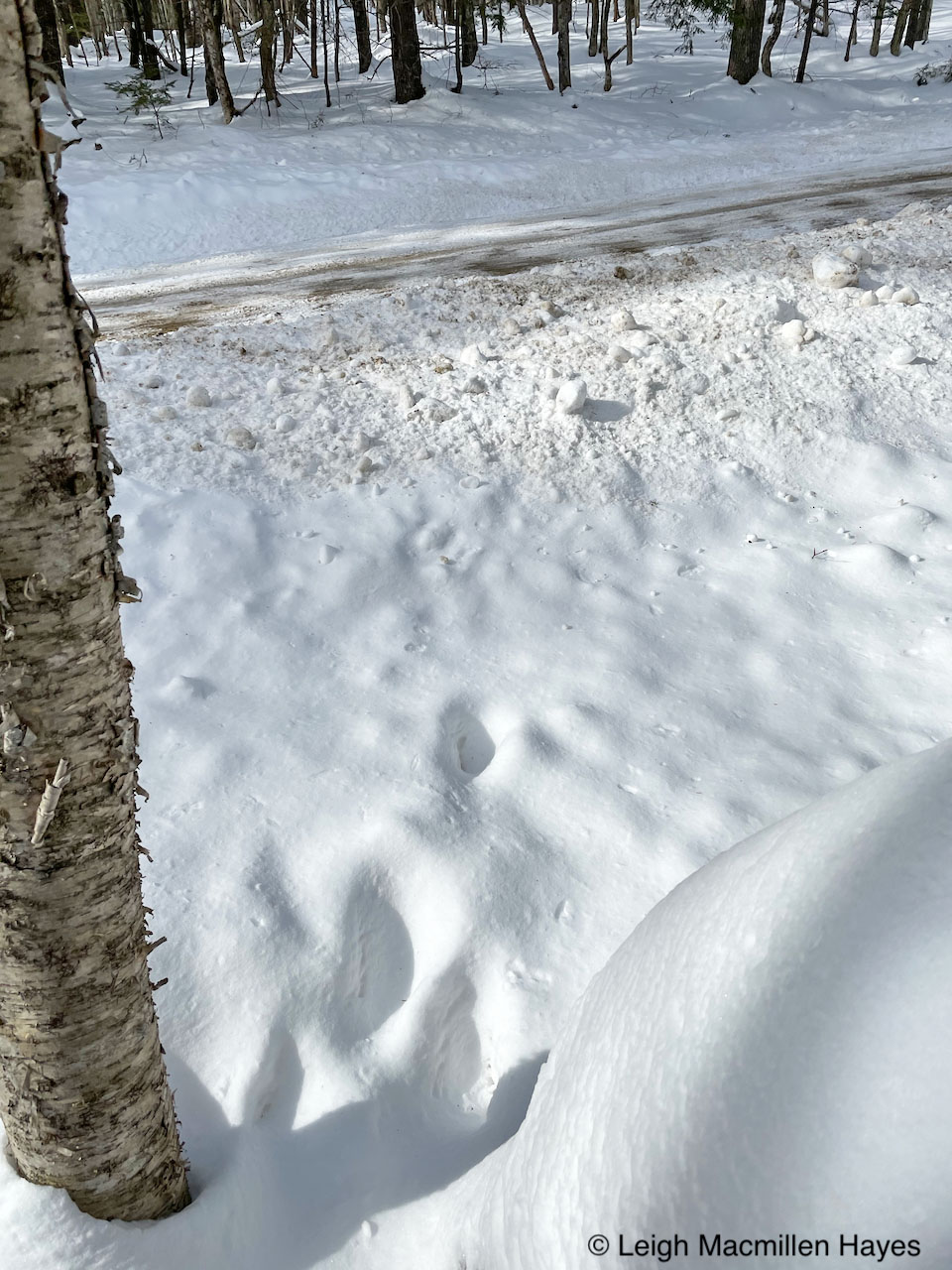
The coyote tracks took us uphill, and eventually forced us to cross the road upon which we’d parked.

Crossing over, we followed them until they led to an area near a stream and again fisher prints entered the mix and we suspected something of importance had happened here, but couldn’t be sure what, and beyond this point the fisher went one way and the coyote crossed onto a private property and we decided we needed to give up the hunt. Drats.

In the midst of it all, however, deer tracks led the way. And so we followed those to see where they might lead.

And bingo. A feeding area where the disturbed snow indicated the deer had been seeking acorns.

Not only was it a feeding area, but also where the ungulates had bedded down, such as this youngster. Can you see its head, rounded back and legs tucked beneath?

We found at least seven beds in this spot and actually another bunch in a second spot later in our journey and gave thanks to know that the land through which we ventured is a deer yard.

A deer yard frequented by predators including the coyote we’d tracked earlier and this fisher.

Eventually, we made tracks upon a different trail for though I was there in search of someone’s meal source, my guy had a destination in mind.

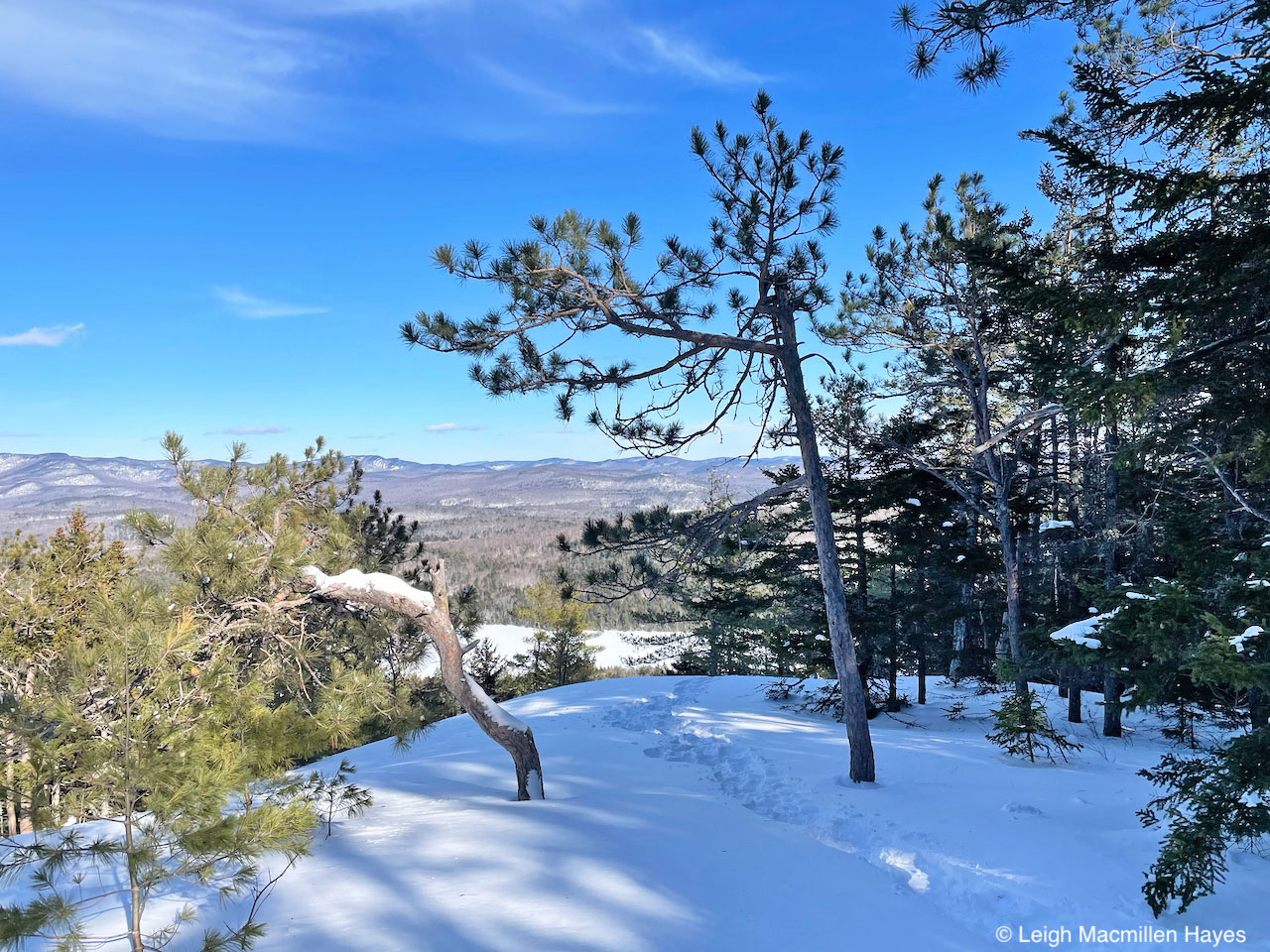
Upward we climbed upon rock ledges hidden beneath snow.

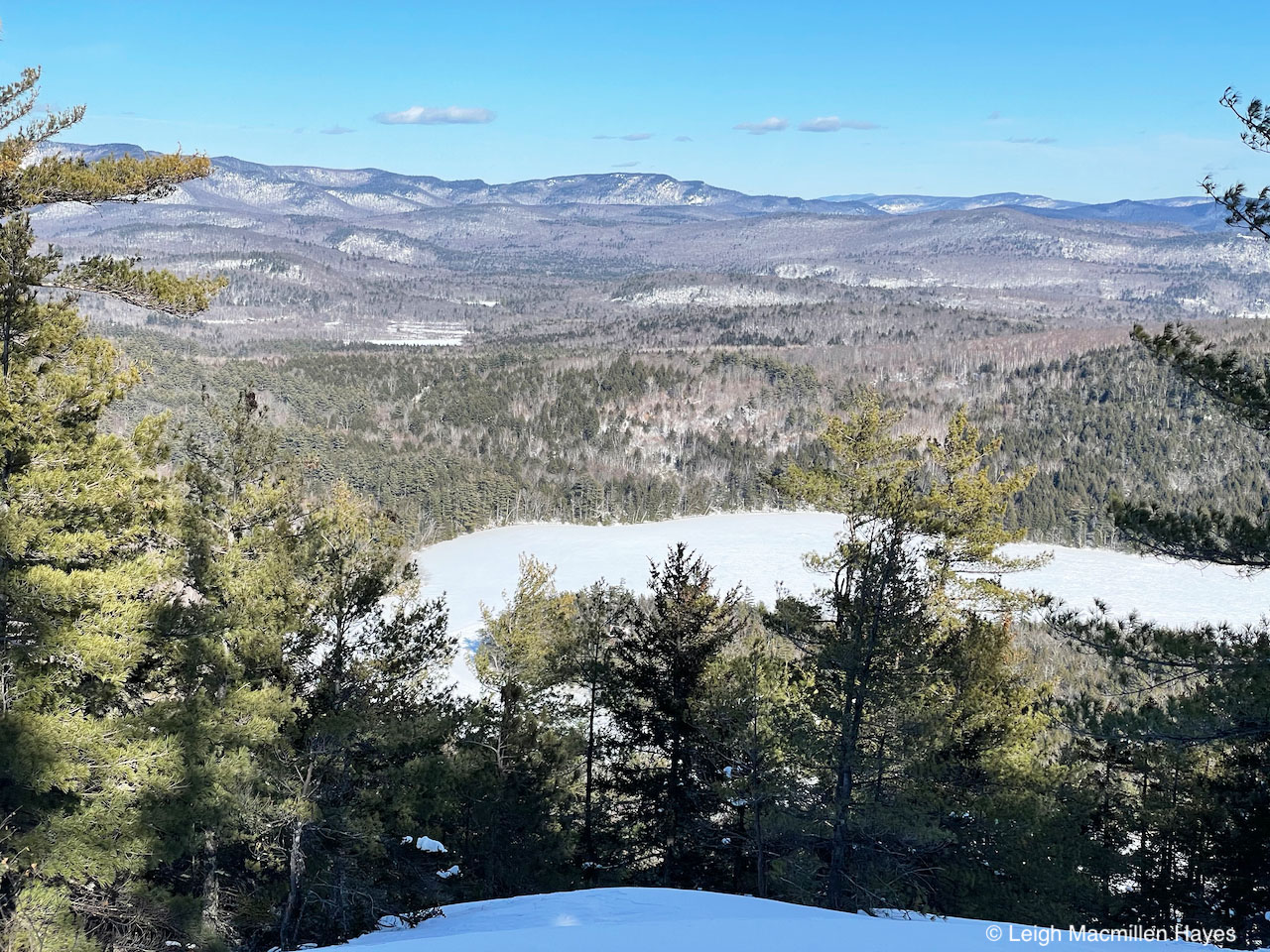
A look back revealed the mountains beyond and horseshoe-shaped pond below.

It was there that white and red pines showed off their bonsai form among brothers and sisters who grew straight and tall.

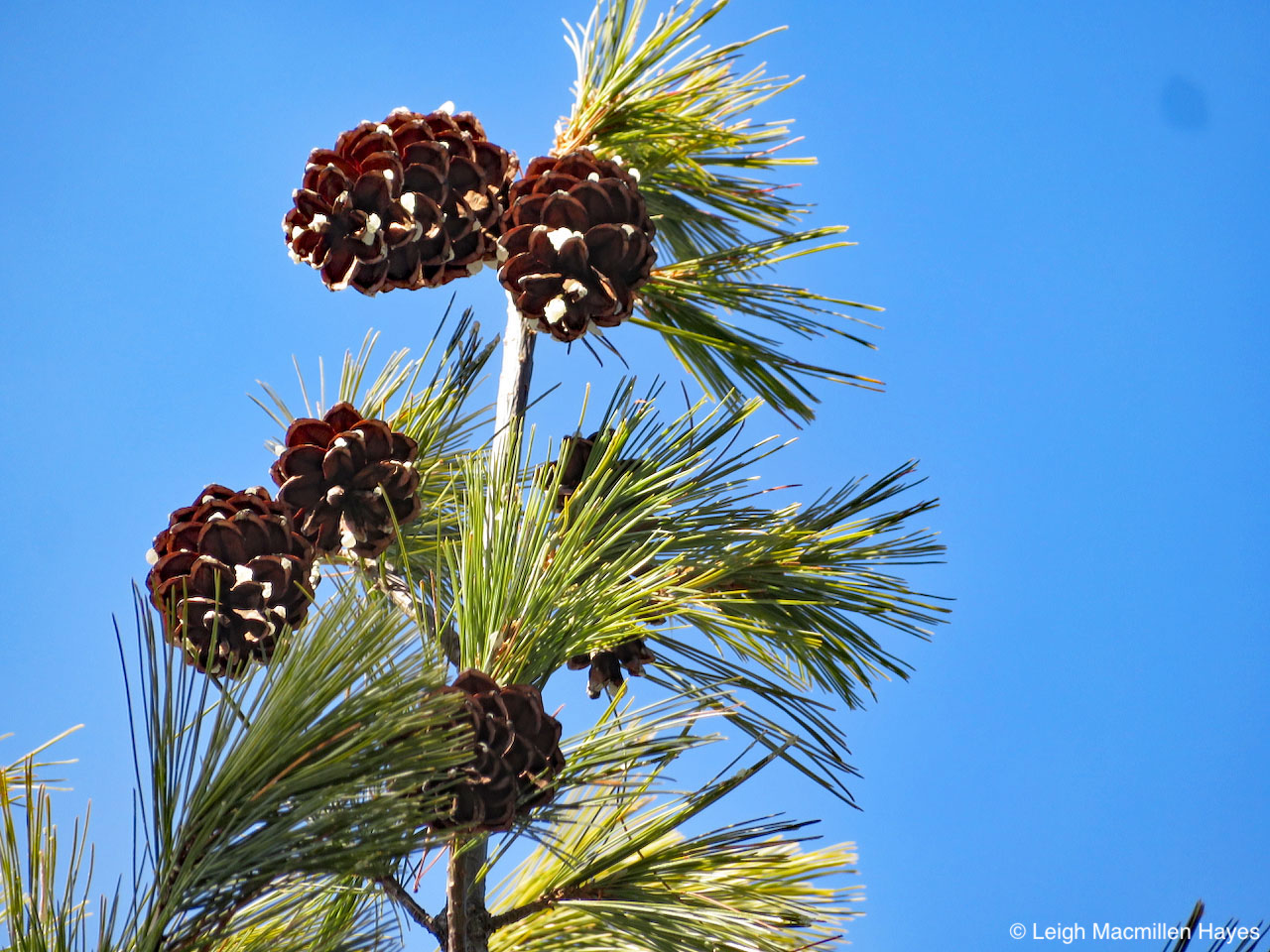
Cones galore presented themselves as we reached the summit, such as these upon a red pine.

High upon the White Pines the same.

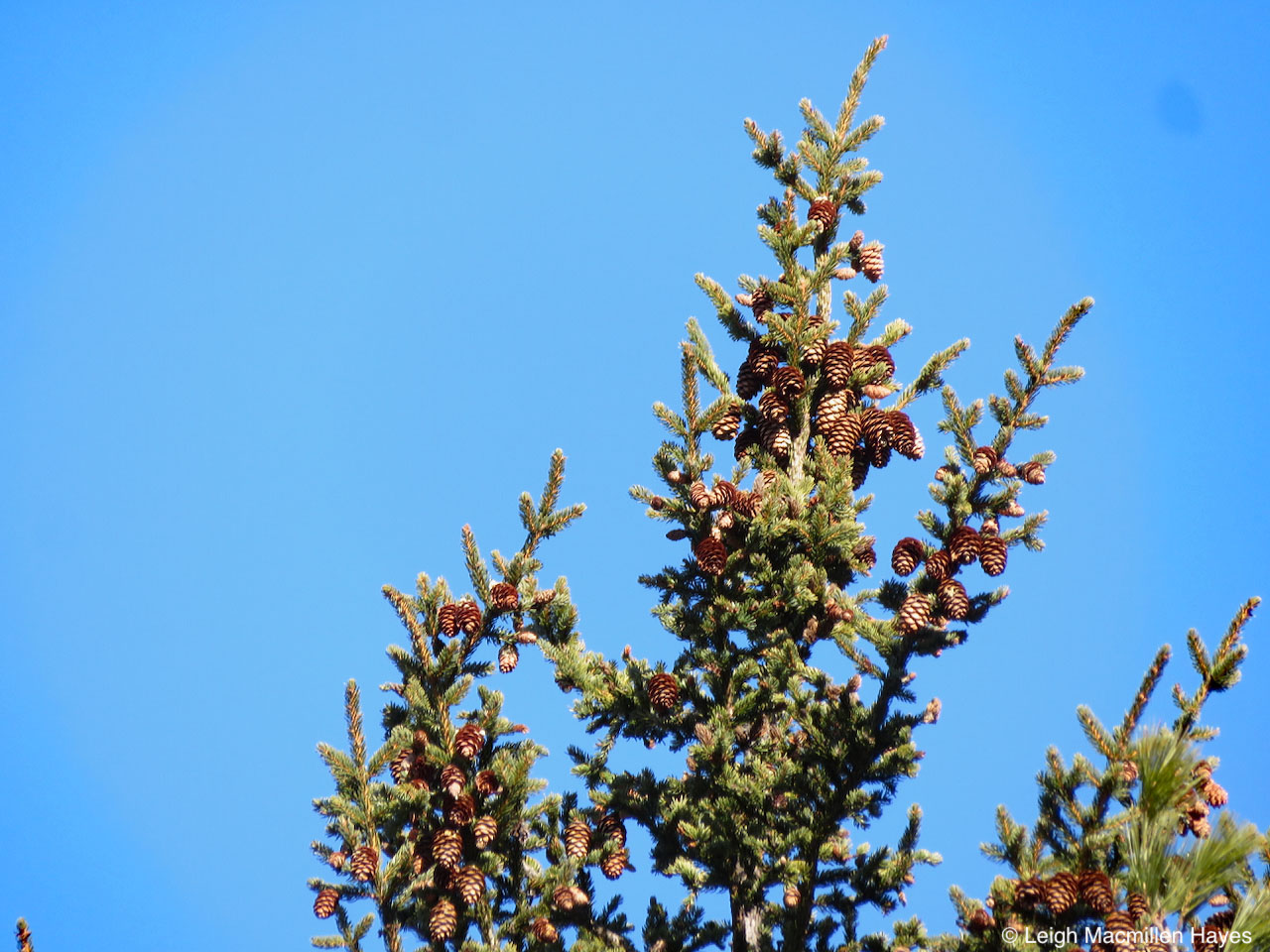
And the spruce trees didn’t want to be left out of the offerings.

We could hear the sweet chirps of birds and finally focused in on our feathered friends, puffed up as this chickadee was in response to the chilly wind. Four or five layers kept us warm, while the birds depended upon air they could trap within their feathers to feel the same way.

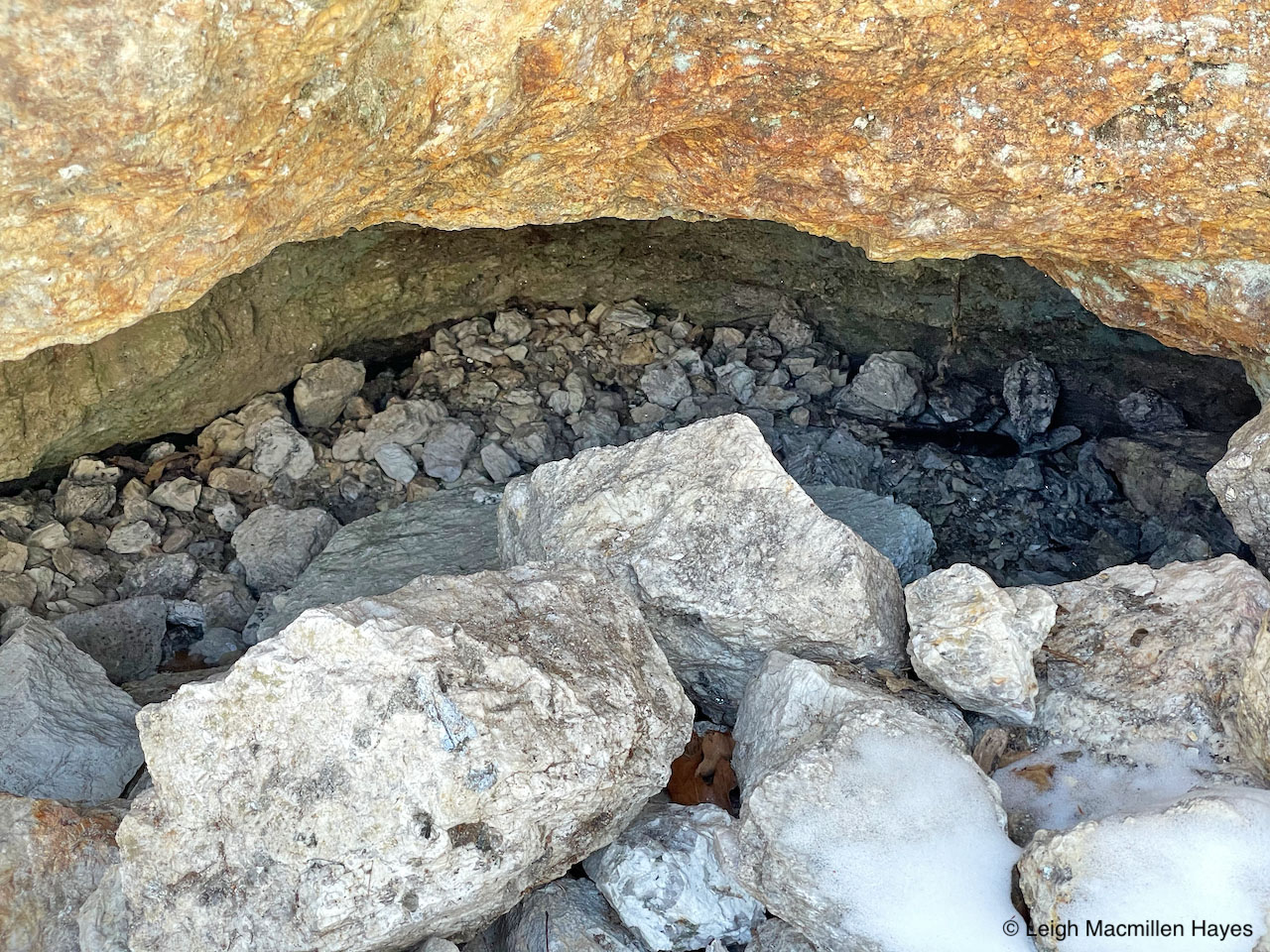
At last we reached an old mine and peeked within, thinking perhaps a critter or two had taken advantage of a cave to take refuge. If that was the case, we weren’t cognizant of it.

But we did enjoy the layers and reflections and colors of the mica, quartz, and feldspar for which this spot is known.

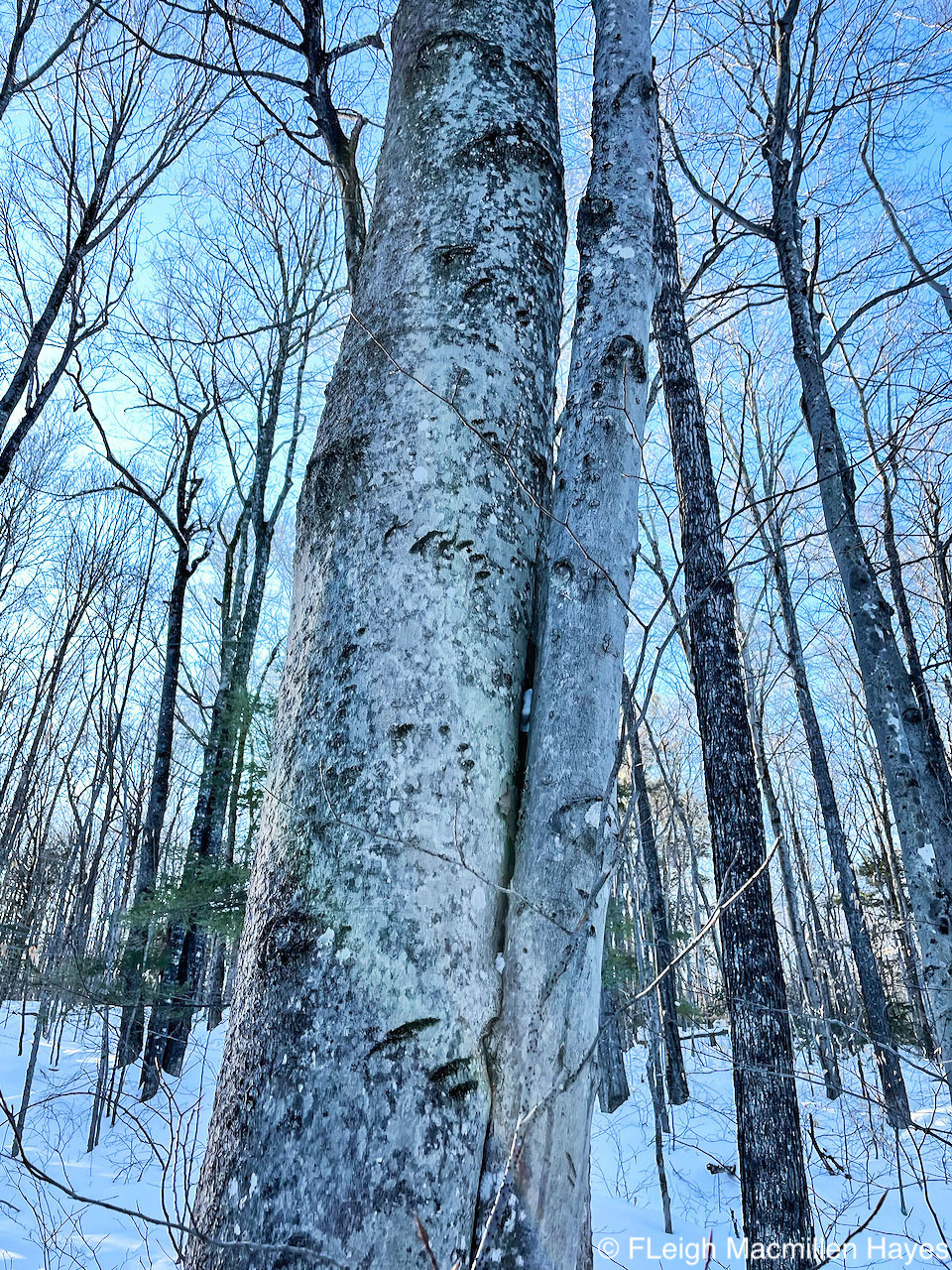
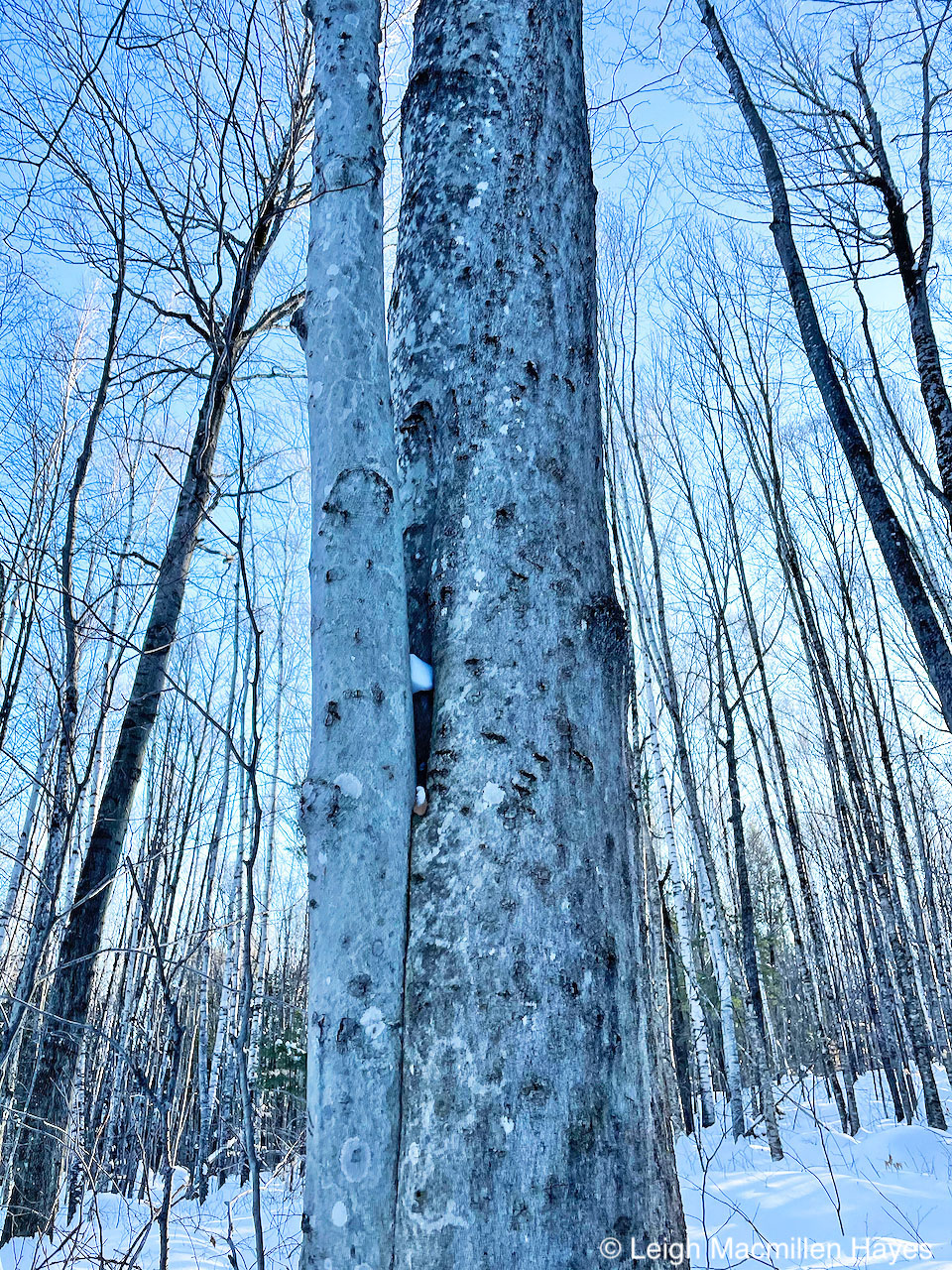
Eventually it was bear trees that captured our attention. Imagine this–your right paws grasping the beech as you climb in search of its nutritious nuts.

Simultaneously, of course, your left paws did the same as you shimmied up the trunk of the tree.

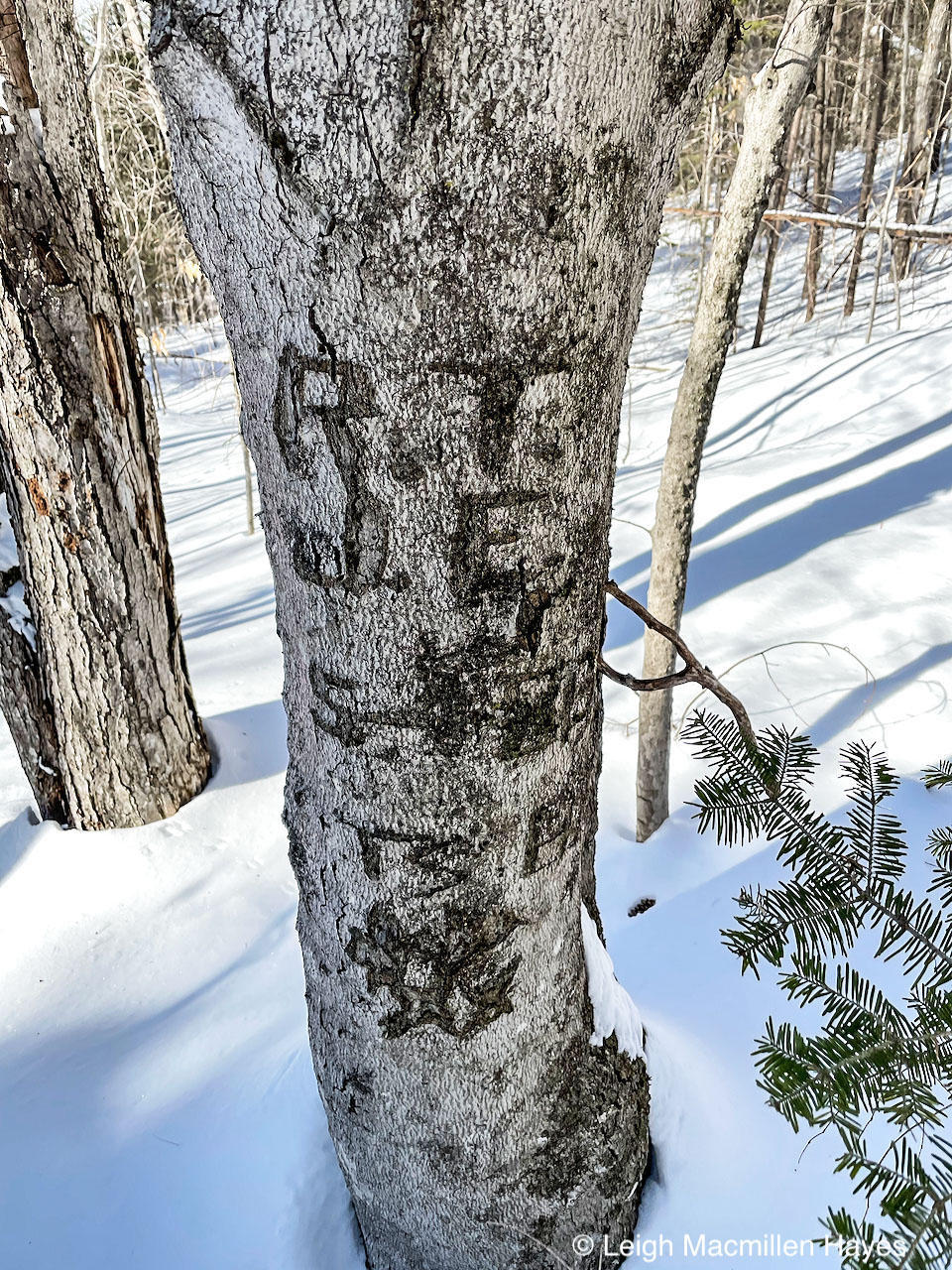
Some bears chose to leave their signatures with claw marks, while others preferred to leave their initials behind.

Either way, the bears had visited. As had fishers, deer, coyotes, foxes, bobcats, mice, squirrels, birds, and who knows how many others. Oh, and Tom and Paula–whose tracks twisted and turned like the mammals they followed.
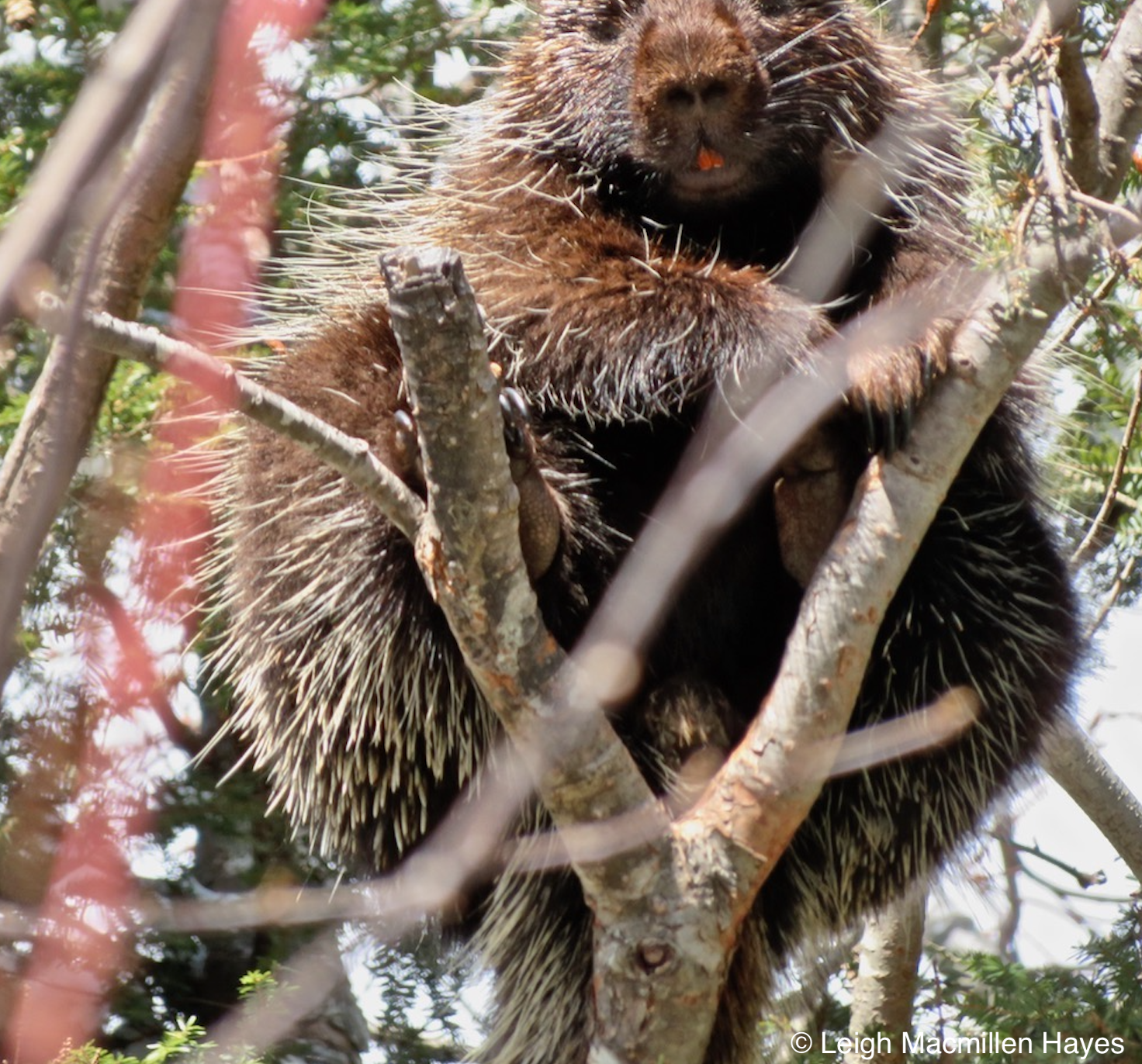
The tree spirit knows as we learned on this Mondate. And he shows it in his heart which is filled with hope within colored green for all that has passed this way and all that is yet to come. The fact that we didn’t discover what the coyote ate didn’t matter. What mattered more is that this is a place for all to be and become.

Winter Wild Out My Door

Winter Storm Harper left its mark in the form of snow and wind upon our little spot in the universe.

And I was certain that any tracks I might encounter in the woods would have been erased by dervishes that whirled across the field yesterday, overnight, and into today.

Consequently, it was a pleasant surprise to discover porcupine tracks leading to and fro our barn and woodlot in their typical pigeon-toed pattern.

As delighted as I was, I was equally dispirited as I noticed that the tips of my favorite hemlock had been nipped to oblivion.

But, the porcupine had moved on from that tree, crossed over a stonewall, and visited several other trees in our woodlot, as noted by the downed twigs that decorated the snow’s surface. Like the tracks, the twigs were freshly cut in the past twenty-four hours or less actually.

Of course, I couldn’t overlook the woody commas amid the debris, much as they break up a sentence such as this, that added to the list of evidence that a porcupine had been present. Some call them scat.

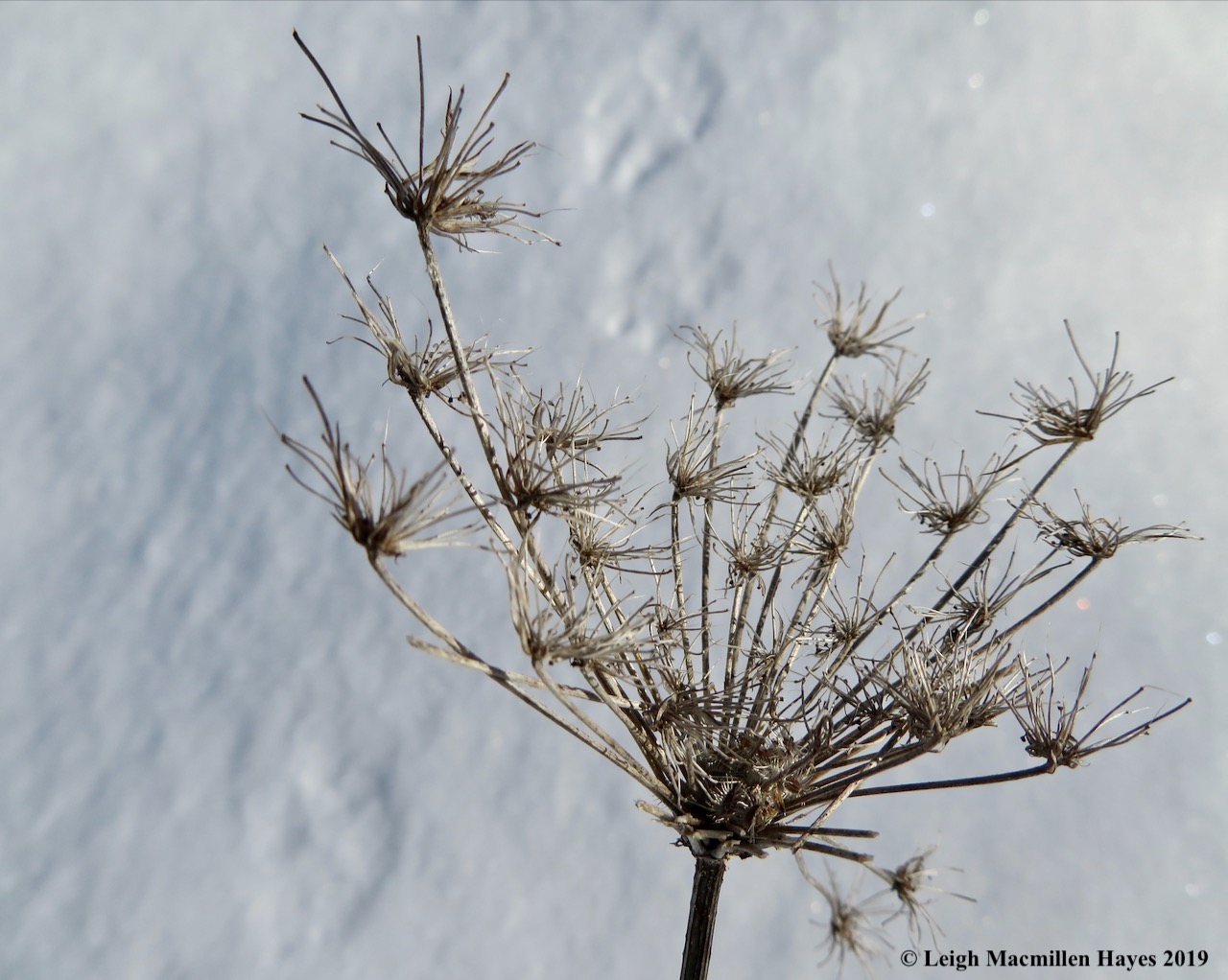
And then, as I continued onward, I followed the tracks of two others that frequent our yard. Even as I delighted in the winter structure of a Queen Anne’s Lace florescent, did I notice the red fox prints on the snow below.

The tracks led me to Stevens Brook, which has a journey of its own to trace.

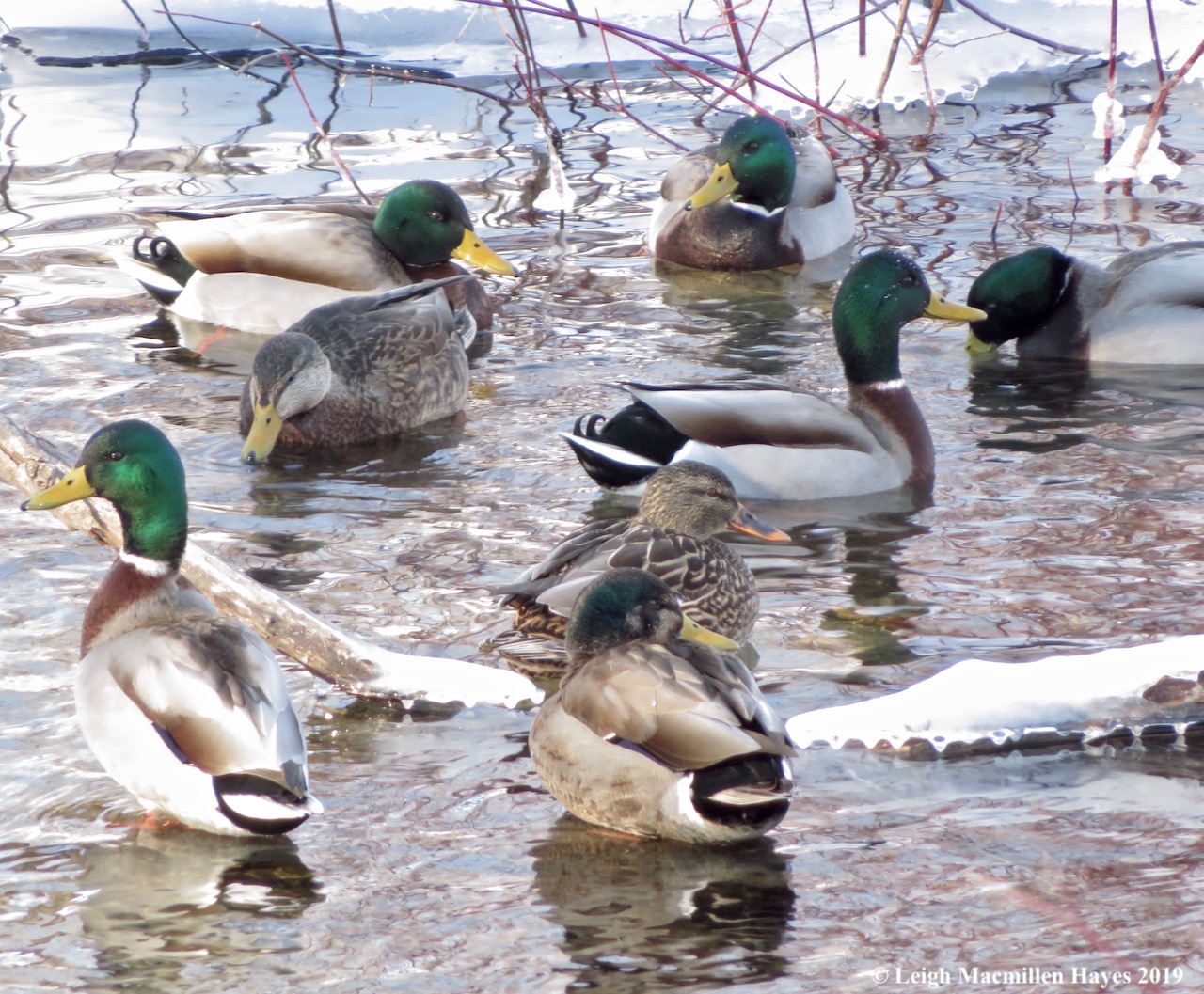
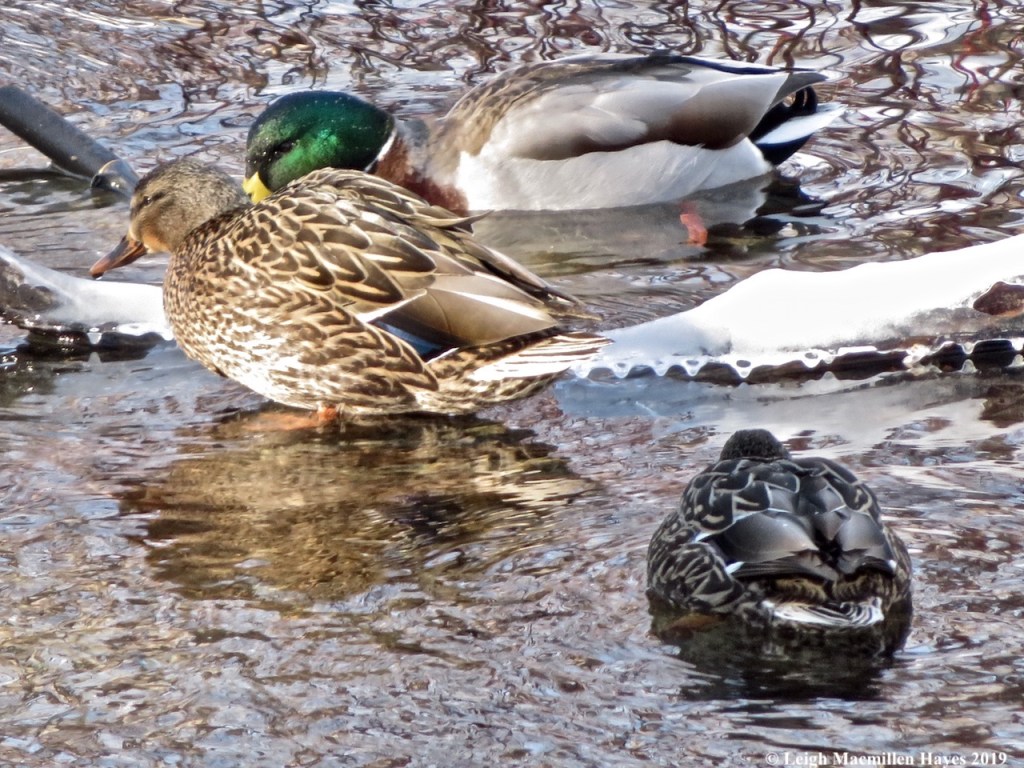
I went to look because I felt the need to add a bit of color to this wintry day and knew that the local congregation of Mallards would contribute not only that, but sound as well.

And then, as I snowshoed beside the trail that follows the brook, I began to notice tracks made by another–this one a member of the weasel family with tear-drop shaped toes of five on each foot.

The more I followed it, the more I realized it had walked and then loped and appeared to drag something along the way.

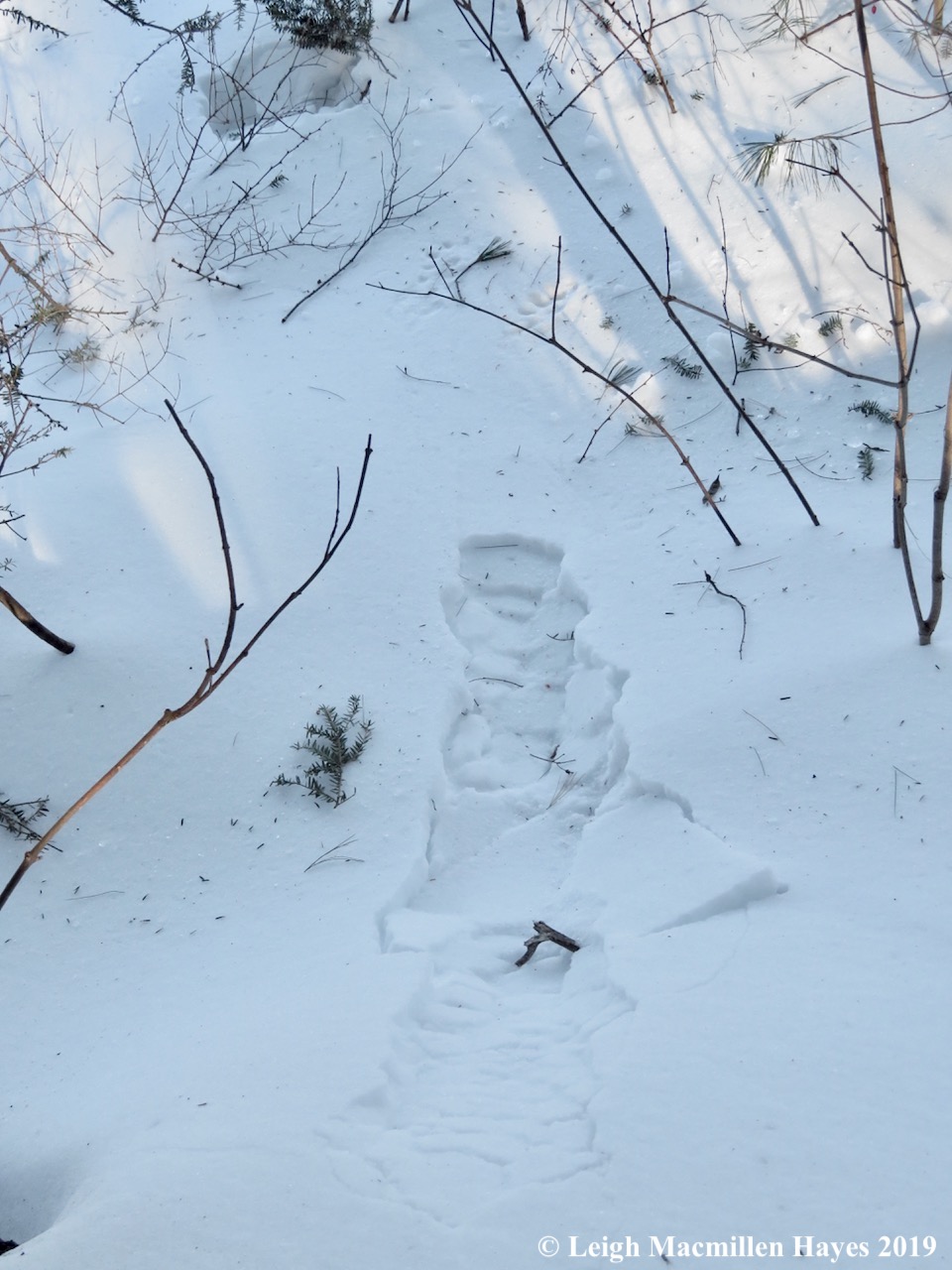
Sometimes it chose to slide on the downhills.
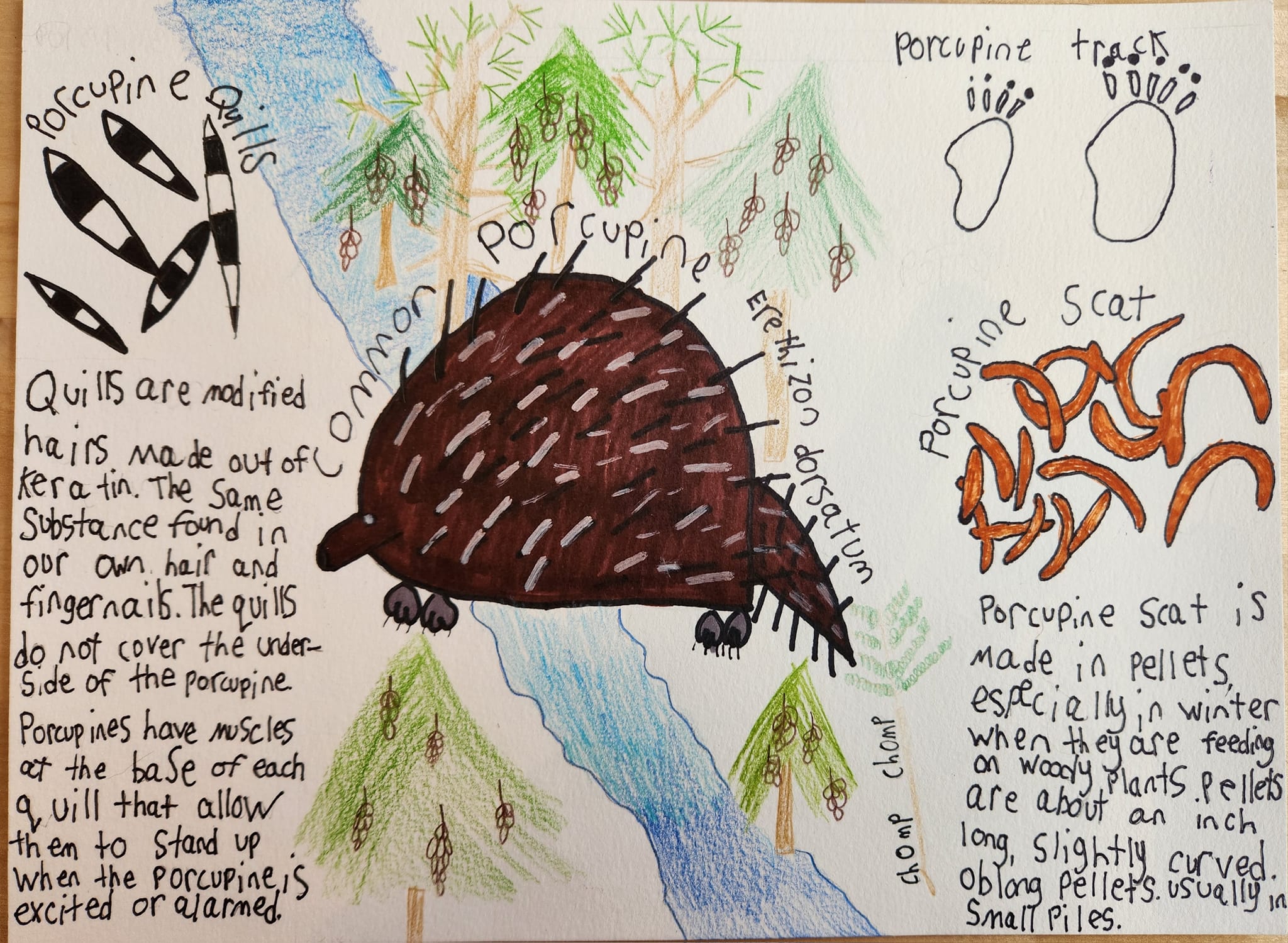
And equally left an impression as it journeyed up and over a stonewall.
Meanwhile, within the wall, I surmised another of a different species quivered as silently as possible so as not to attract attention, with the hope of creating hoar frost for another day.

Wherever I went, the weasel had also trekked. And frequently I noticed signs of blood as if something had been dragged and the life dripped out of it.

In some places the frozen vital fluid bespoke a meal perhaps waiting to be cached–the perfect sacrifice of one to nurture another.

So few were the tracks of mankind on the virgin snow and so abundant the weasel.

Soon I found myself beside another brook, this one named Willet, and I glanced about expecting to see evidence of action, but instead found ice and snow and shadows disappearing into the bend.

And then . . . upon the edge of the brook’s high bank, a sudden turn my weasel had made, choosing to not slide downward.

A bit further along, I was following its tracks again when I spied fresh woody debris upon the snow’s surface and knew that a pileated had been at work this day.

Rounding the tree, I discovered a series of holes made over a series of days or weeks or years.
From the woodpecker tree, it took a few minutes, but again I found the tracks of one very busy fisher. I never did find any kill sites, but suspected that it had a cache somewhere and let its fresh groceries dangle from its mouth as it carried them back to the pantry.

Making my way toward home, I didn’t need to rest, but had I intended upon such, it wouldn’t have been at the bench for so deep was the snow.

That was okay, for my movement kept me warm and I knew that I’d soon be stripping off my winter layers once I reached our kitchen. But first, there was a pasture to pass through, and while I seemed to have left the fisher behind, I came upon the tracks of the two red foxes I’d met earlier.


In typical red fox behavior, one of them had paused at the tip of a downed tree and urinated. One of these days perhaps it will finally get lucky.

In the meantime, I felt lucky for I’d seen the prints and tracks of so many on this day when I wondered if I’d see any–including those of the Mallards beside Stevens Brook.

And of all the winter wild out my door, today the ducks were my favorite because I not only got to watch them for a while, but I also appreciated the colorful display they added to the landscape.

My Need To Get A Life

About two weeks ago a friend and I exchanged e-mails about mammal tracks we’d spotted that day. His big find was plenty of bobcat tracks at Bald Pate Preserve, while mine was mink tracks by Sucker Brook in Lovell. And that’s when he commented, “We need to get a life.” ;-)

Yup. So today I did just that. With a friend in tow, I revisited the Red Tail Trail off Hurricane Mountain Road in North Conway. Our mission was to move slowly through the landscape in search of signs of nature in winter.

Oh my. Such a boring task. What could there possibly be to see? Everything is brown and gray and ever so drab.

mouse

From the start, mouse tracks show the suicide mission these little guys make each night as they scramble this way and that in search of food . . . and cover. Mice are nocturnal bounders who travel above ground for long  distances–risky behavior since they are tasty treats for most predators. White-footed and deer mice have similar-sized feet and bodies, so their prints are difficult to distinguish from each other. Their print pattern reminds me of that made by squirrels, only in miniature and their long tails often leave drag marks in the center.
vole 4vole 3

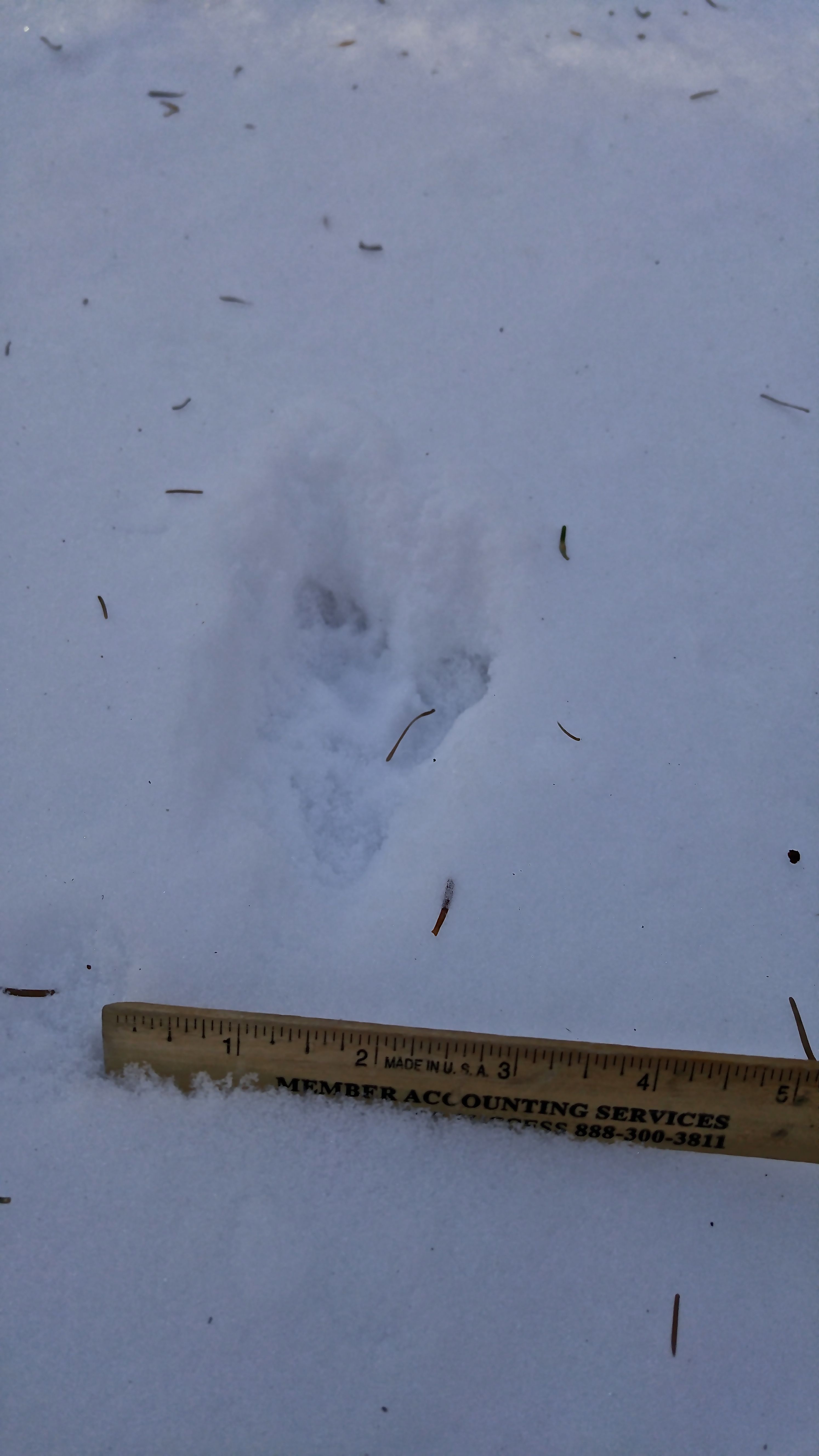
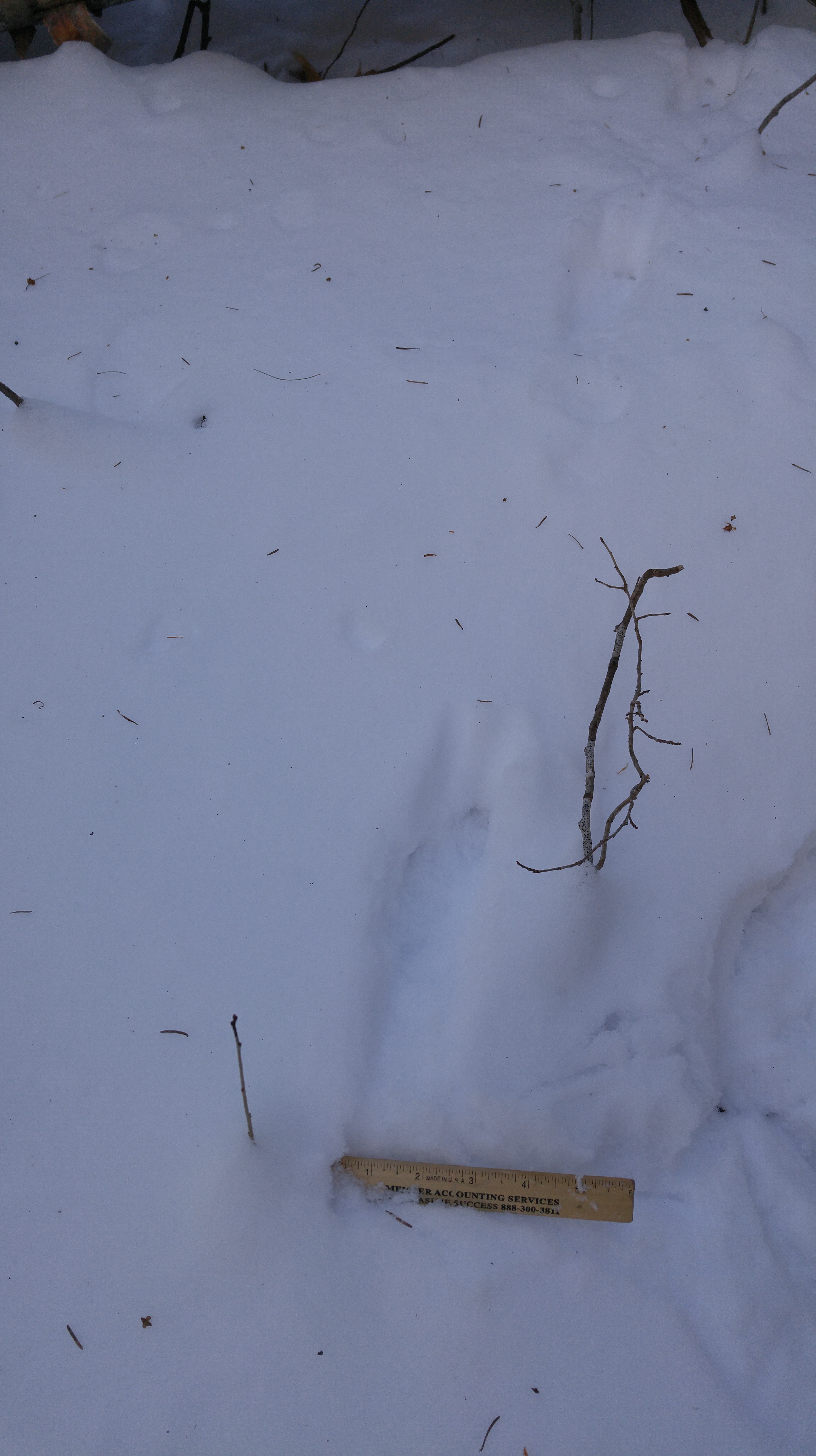
Here’s another favorite meal for many predators–evidence that a vole lives nearby. We were in an old logging area when we found this. While a vole is similar in size to the white-footed and deer mice, its tail doesn’t show in the track. Plus, two other things stood out to us. The tunnel in the first photo is typical vole behavior. While we received 6 inches of snow in western Maine on Tuesday, North Conway only has about two inches on top of ice. Voles are shy of sky space, so tunneling is one of their behaviors. With ice below the snow, this tunnel was exposed and reminded us of spring when vole tunnels become visible in melting snow. The other behavior of this little brown thing (LBT) that is different from its cousins, the other LBTs like mice and shrews, is the zig zag or alternating pattern when it walks. Voles vary their walking pattern, but they don’t bound like the others. The pattern is visible for a few steps above the ruler.

mink 1Mink 2

And who might those predators be? We found the diagonal pattern typical to the weasel family. We thought that this one was a mink, but now that I’m in my cozy den, I’m questioning our ID. It may have been a short or long-tailed weasel. (1/15/16: Changed my mind back to mink. My ruler kept sliding, but the measurements we took, and we took several, clearly indicated mink, so that’s my story and I’m sticking with it.)

weasel 2

Further up the trail, we were more certain that this one was a weasel, though, again, short or long-tailed is the question. Suffice it to say–weasel.

Fisher 1  Fisher pattern

And still another family member–only a bit larger in size. Notice the tear-drop shaped toes. And the loping pattern. A fisher had recently crossed the trail. We followed its tracks for a bit and then bushwhacked back. On our return we came across a second set of fisher tracks. And then, as we backtracked beside our own snowshoe prints, we realized they’d traveled together and then split apart–perhaps hoping to find some good chow.

Kearsarge River

As we moved beside and away from the river, we also saw deer, snowshoe hare, coyote and fox tracks.

Winding our way up through the switchbacks, one other critter left a calling card.

wing

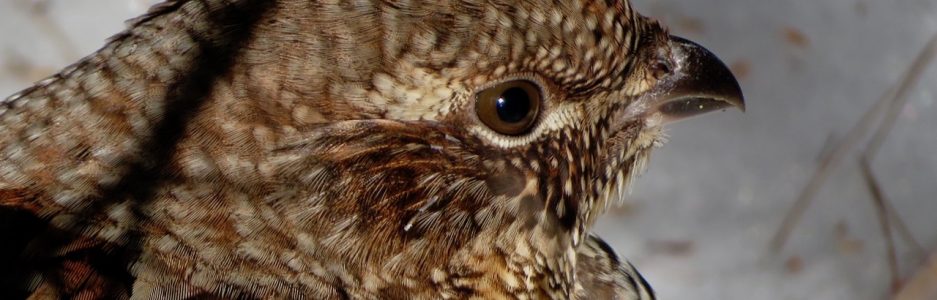
Based on the behavior, I want to say it’s a ruffed grouse. I must admit that we didn’t follow the tracks, but grouse are also tunnelers and there’s a bit of a tunnel here. Usually I find their scat.  By now, you are probably thinking that I really do need to get a life.

ground litter

hemlock seed and scale

yellow birch

We laughed about how we used to not even notice everything on the ground–dismissing it as  tree litter. Ah, litter it is. But more specifically, we were in the land of hemlocks and birch trees. Hemlock cones, cone scales and winged seeds (samaras) are part of the array. And the yellow birch catkins have released their fleurs-de-lis scales and seeds as well.

beech scale 3

One of the things we weren’t thrilled to discover–the white, wooly and waxy coating that the beech scale insects secrete to cover themselves. Oy vey. This beech tree doesn’t stand a chance.

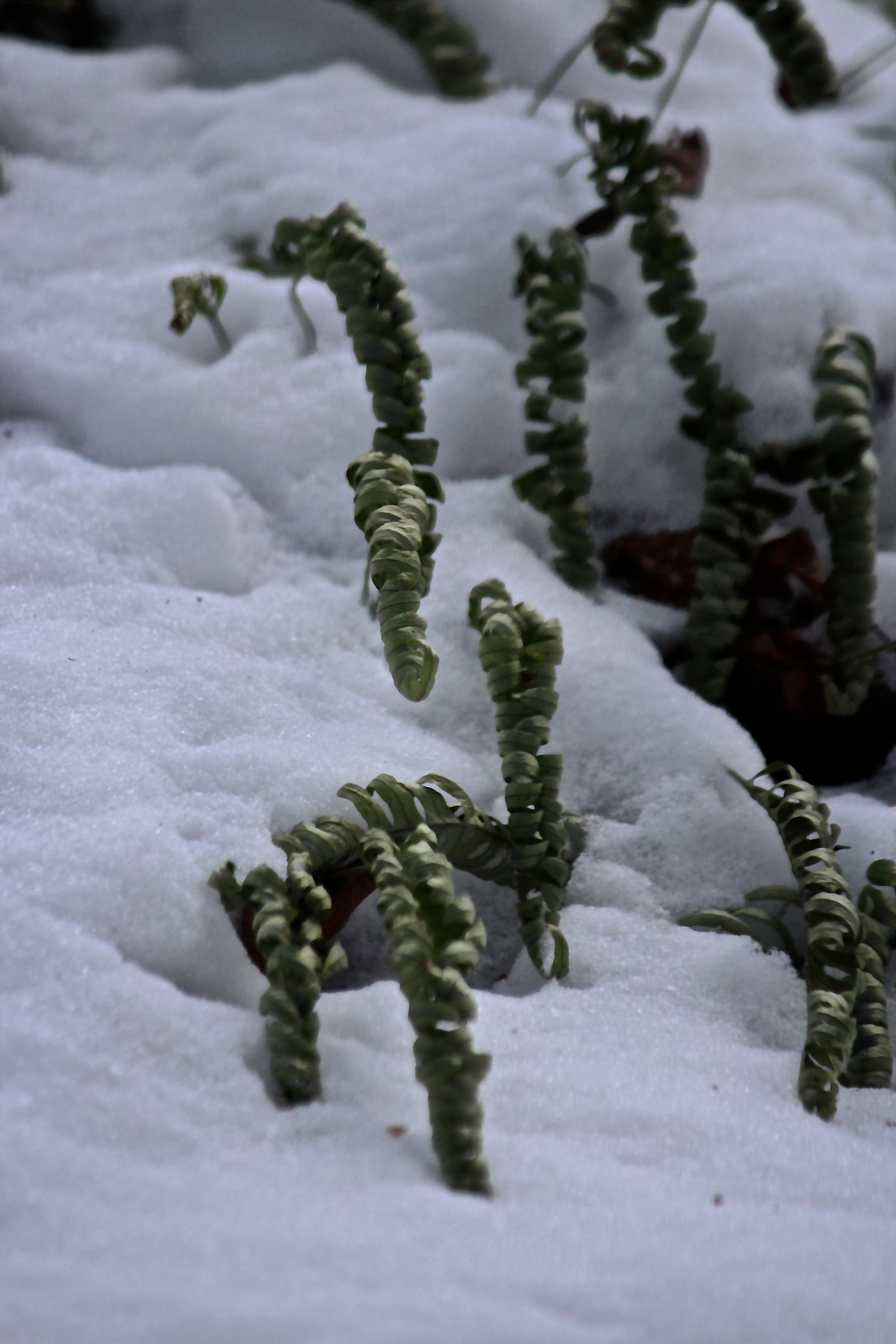
polypody frozen

So back to happier thoughts, including the polypody that let us know it was time to head home and curl up by a warm fire–the temp was in the low teens.

ice skirt

Even the river rocks wore several layers.

artist 3

artist conk

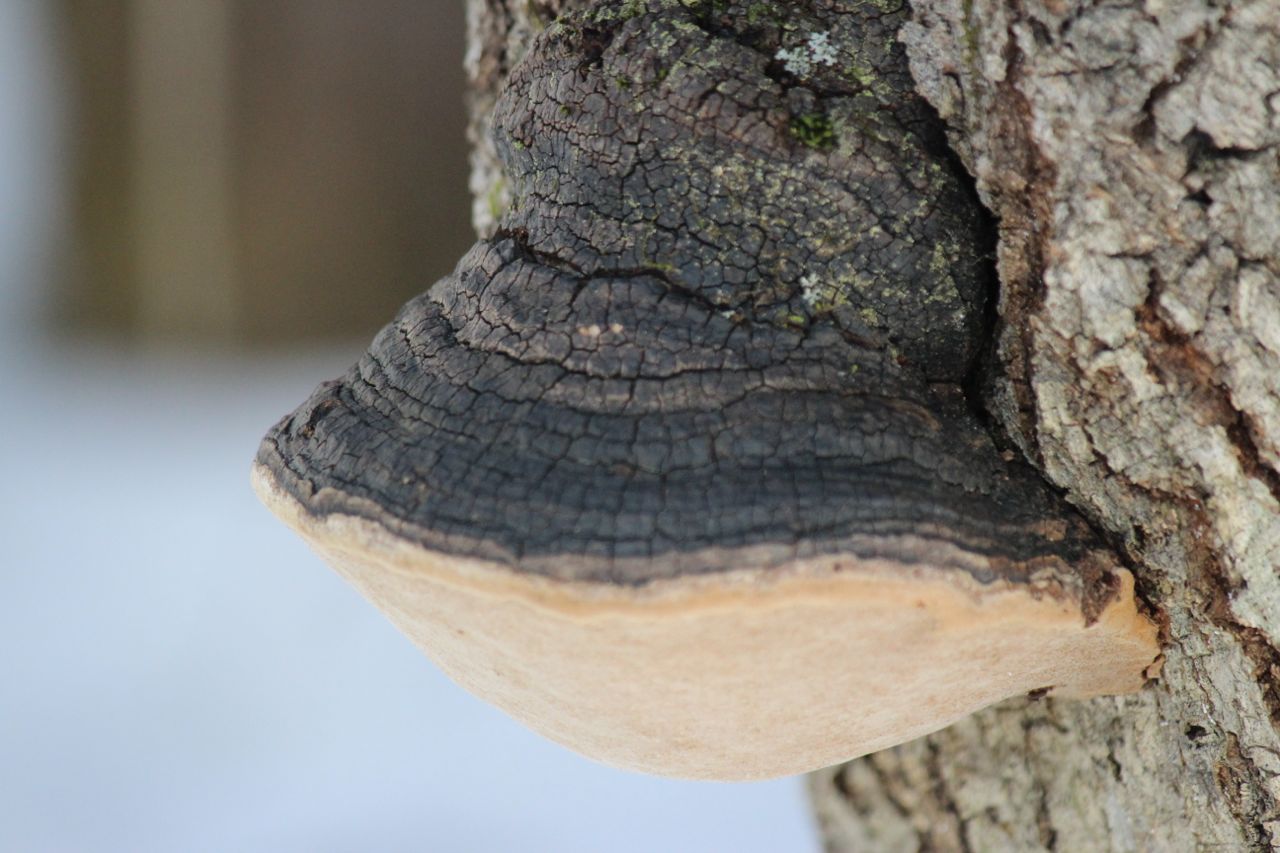
Just before we arrived at my truck, we stopped to admire this mighty fine artist conk. It will still be there on Saturday–join me and the wonderful folks from the Upper Saco Valley Land Trust for a walk on the trail–weather permitting. I’m not so sure it will actually happen this week given the forecast.

No matter. These were only a few of our finds. There’s so much to see and wonder about and every time I visit, I’m in awe of this special place. And thankful for the life I’ve got.

Mustelids, Oh My!

kiosk sign

This morning I drove to the Wilson Wing Moose Pond Bog Preserve on Sucker Brook in Lovell. This is a Greater Lovell Land Trust property.

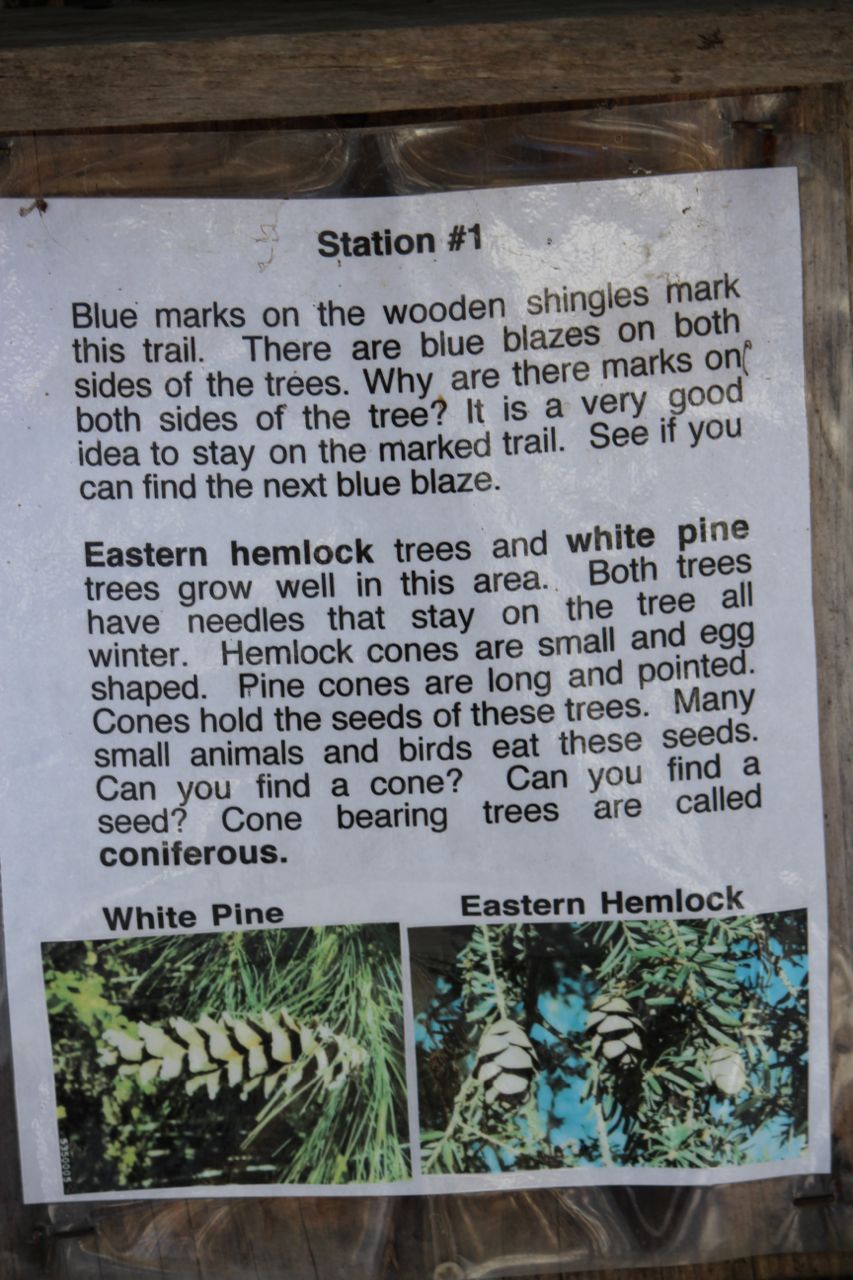
Station !

My mission was to photograph the eight station signs along the nature walk so another docent and I can spend some time this spring updating them.

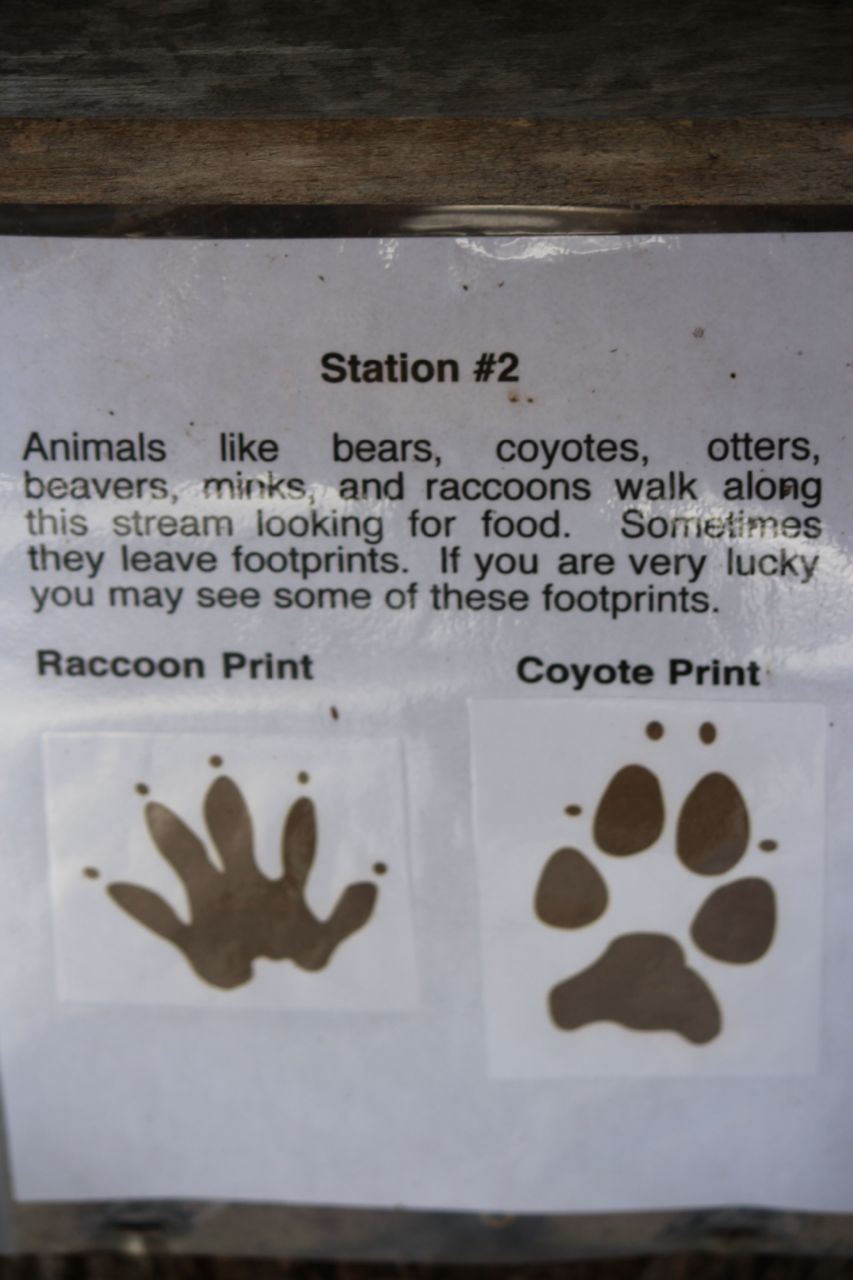
station 2:a

Before I even reached Station 2, I realized I had a bad case of NDD. Nature Distraction Disorder. OK, so I think I just coined a new term and acronym, but maybe I heard it somewhere else and had it tucked away in my mind. (NawDee for short?–corny joke alert and I might be the only one who gets it) Anyway, what it boiled down to was what you see on this sign and then some.

Fisher

Fisher tracks were all along the brook and through the woods. I’m almost certain these are fisher. I was beginning to question my “I’m always 100% correct when alone” statement. These were quite fresh.

mink1mink slide

Mink tracks and slides were also visible, especially in and out of Sucker Brook.

otter

And then I found these. River Otter.

Silent and graceful are the weasels. From them I should learn so many lessons as they move about quietly observing and discerning what is important. I always think of them as fun loving with all the sliding some of them, like the mink and otter, do. But . . . they are carnivores who have to consume a lot of food to keep warm in the winter.

hole activity

This hole was one of several that I saw. It was across the brook, so I don’t know who entered here. Perhaps they all checked it out. Or maybe it’s a sleeping space for these nocturnal animals.

little brown thing hair

And I found what remained of hair from a little brown thing–either a deer mouse or white-footed mouse. There were tracks leading up to it, but it’s difficult to discern the difference between the two. Who had dinner here? The fisher, I believe.

pinecone tracks

It wasn’t only mammal tracks that I found. Look at the trail left behind by this pinecone.

morning lightbrook 1brook 2

The morning light was beautiful–the beginning of a crisp, clear day.

water and ice 2

Movement frozen in time. water and ice 3

tranquility

And then the brook calms down. Chickadees sing their cheeseburger song while white-breasted nuthatches call, “Yank, yank,” over and over again.

platform

Finally I reached the platform–a hidden oasis that encourages us all to take time to pause and wonder.

bog

And search the brook and bog for signs of wildlife. One of these days, I’m going to see a moose. I think I heard a river otter here either last summer or the previous one. And I’ve been on owl prowls to this very location–occasionally even heard them respond to our calls.

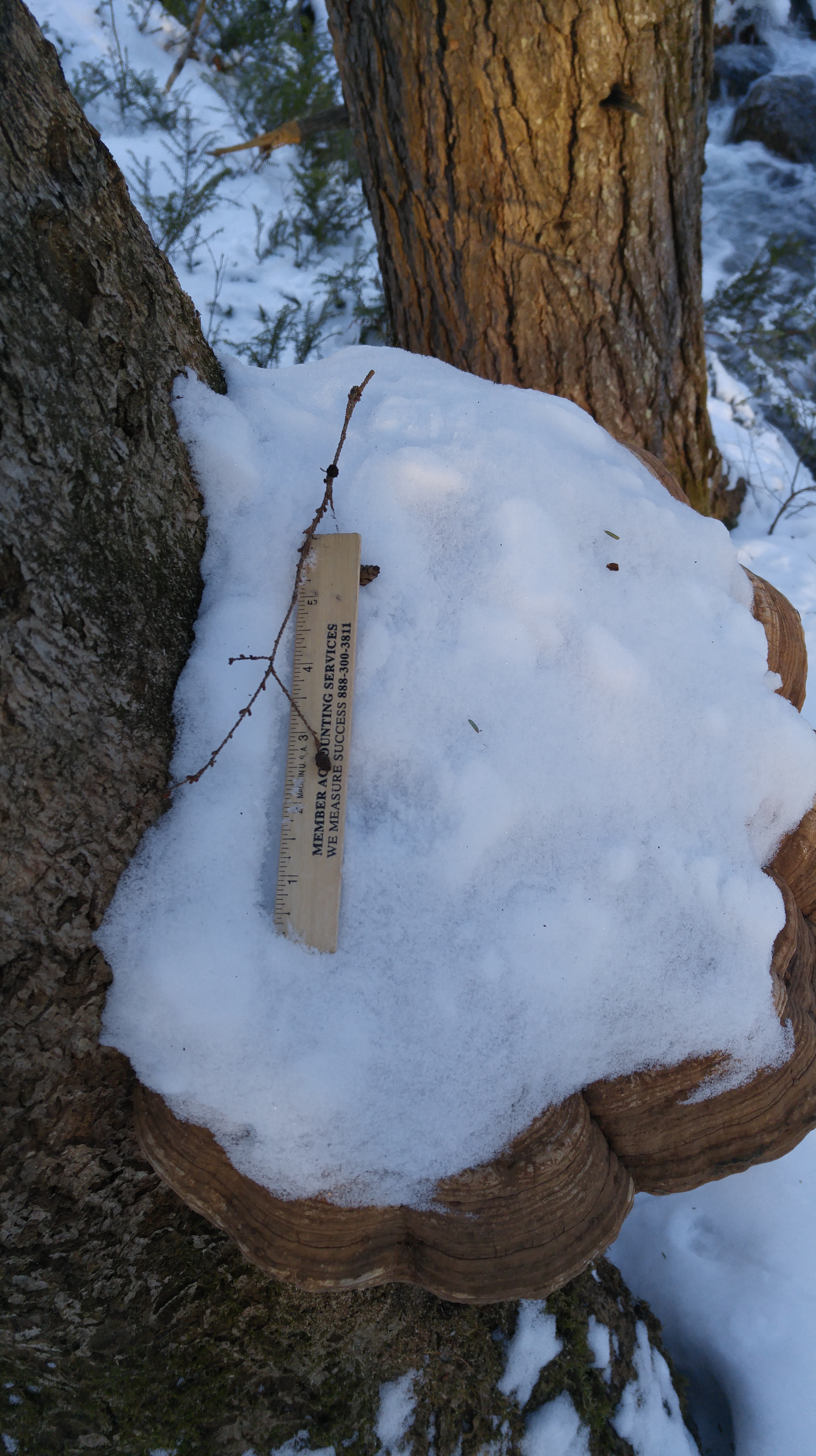
false tinderhoof

Now for some other fun stuff I saw along the way–false tinder polypore. I love that I can now identify this one by its hoof-like appearance on top, but also the way the pore surface angles down toward the tree’s bark. And it’s a perennial, growing taller with the years. I sound so smart, but I’m only just beginning to understand woody fungi. Only a very wee bit.

Some signs that spring is around the corner . . .

wintergreen

Wintergreen appearing where the snow is melting. You may know it as Checkerberry and Tea Berry. We used to chew teaberry gum when we were kids. You can purchase it at Zeb’s General Store in North Conway, New Hampshire. Today, however, the wintergreen extract is produced synthetically.

Hobblebush 2Hobblebush

Hobblebush! While most of the buds we see in the winter landscape have scales to protect them from the weather, hobblebush buds are naked. How do they survive? They are hairy–maybe that helps. I can’t help but wonder. I do know that it won’t be too long before the flat heads of flowers the size of my hands will bloom.

One last thing to share about today’s wander. I thought I was seeing the tracks of this true hibernator and then I saw the real McCoy.

chipmunk

Actually, I saw two of them. It may snow tomorrow, but methinks spring will make  an appearance this year.

Thanks for wondering along beside me on today’s wander. I hope you enjoyed it as much as I did.