Eyes on the World About Us

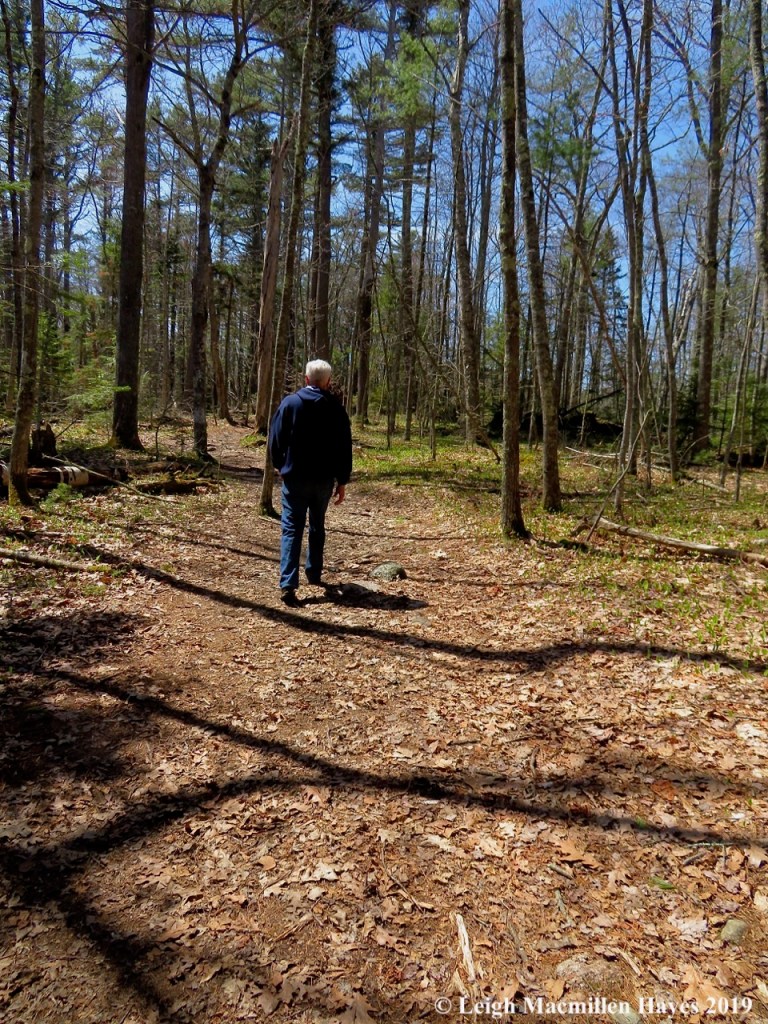
Sometimes we hike with a purpose, My Guy and I. And on those days, he actually slows his pace down.

And opens his eyes wide, much like the Red Squirrel–ever on the alert.

Was it the Fringed Polygala, aka Gay Wings he sought? No, but I certainly did. Those petal-like wings are actually sepals. Two of the petals are fused into a tubular structure, thus giving this plant a “bird-of-paradise” form. The fringe at the end of a third petal or keel below invites all to enter.

Don’t they look like birds in flight? Being a spring ephemeral, these delicate blooms will only last a few more weeks and then I’ll confuse their leaves with those of Wintergreen, but My Guy was rather oblivious to all of this.

Was it the Dandelions he sought? No, he scuffs at those. But the Flower Fly and I–we were two of a kind for this incredible display. Notice how each ray is notched at the tip like teeth. Those five “teeth” represent a tube-shaped floret. Fully open, the bloom is a composite of numerous florets.

Was it the Wolf’s Milk Slime he sought? No, I’m not sure he even spotted them for though we were moving at a slower than normal pace, one of us was even slower than the other. I couldn’t help it. I cannot resist this slime mold.

It was apropos that I should spot it on this trail and by the end you’ll understand why.

And so I did what I always have to do when I spot Wolf’s Milk. Picked up a stick. And poked one of the fruiting bodies. I could actually feel my peeps’ presence in the moment because they would have been doing the same, and maybe even taking a video as the salmony-pink paste inside oozed out.

As the mold matures, the paste actually turns into the spores and when we poke it later in the season, a puff of gray exits the ball. No, they are not puffballs, but they are the next best thing.

Was it the Painted Trillium he sought? No, but for once he did actually count them. I’ll let you know the total at the end.

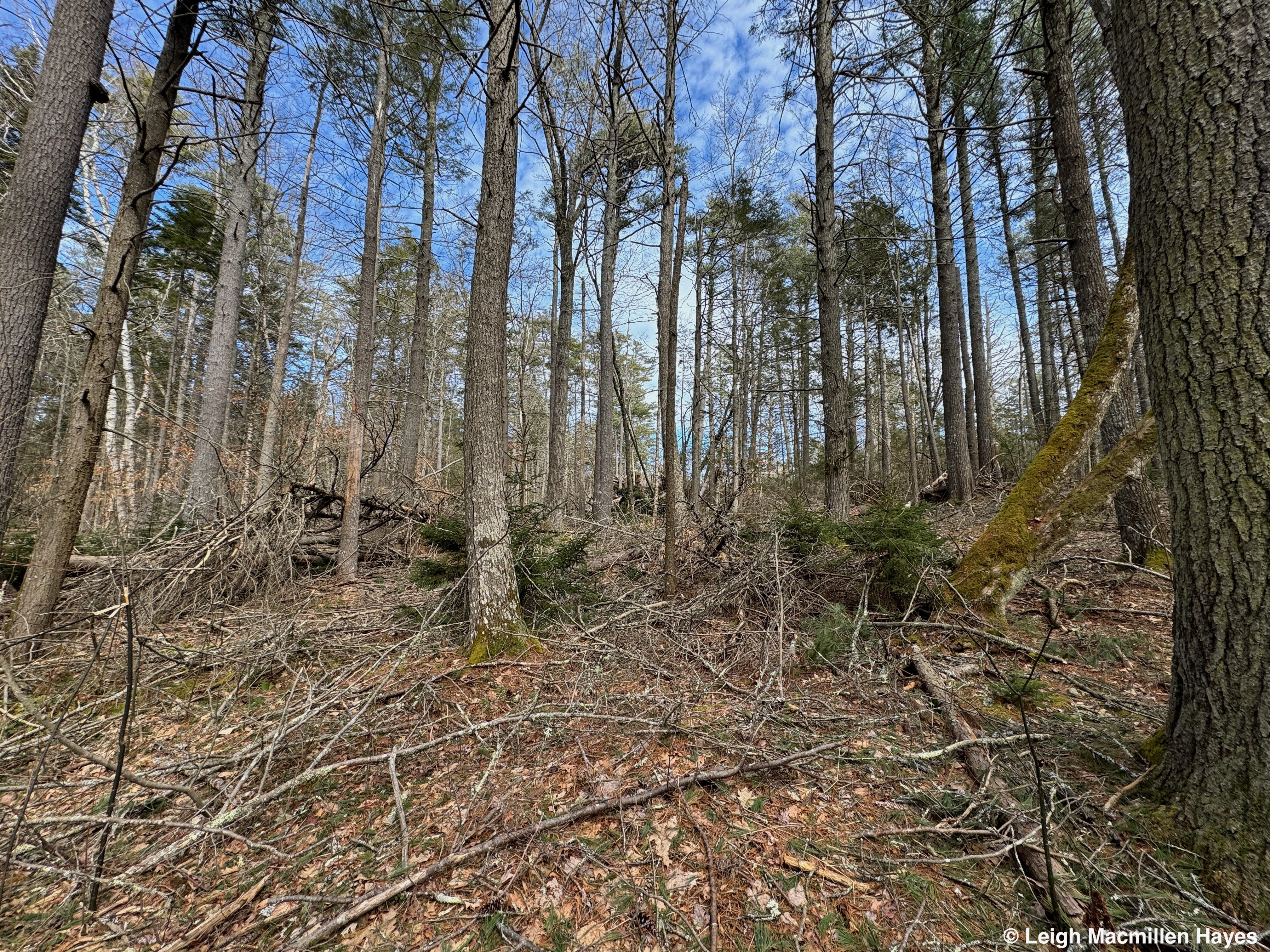
Was it the number of blowdowns, he sought? No, but those were incredibly abundant, many occurring over the course of the past eight months. And actually, they were a hinderance to what he did seek.

Was it the Pink Lady’s Slippers he sought? BINGO! I do not know why, but My Guy loves to count them and especially to find displays like this. And I love that he loves this.

White Lady’s Slippers are a variation of Pink, and so they were included in the count.

We honored the very last one before we headed back to the truck–this being #475.

Yes, 475 Lady’s Slippers.

At this same locale in 2023: 324.

And in 2022: 411.

The thing we did notice this year, we were a week earlier than usual, and many of the flowers hadn’t completely opened. Note to ourselves: don’t be so impatient next year because we really love seeing them in full color.

And we do know we missed some because of the blow-downs, but hey, we still did well.

Number of Painted Trillium: 2. My Guy usually refuses to count them, but we didn’t spot one until we were almost done, so he figured he could. And then the second one appeared.

I couldn’t help but smile.

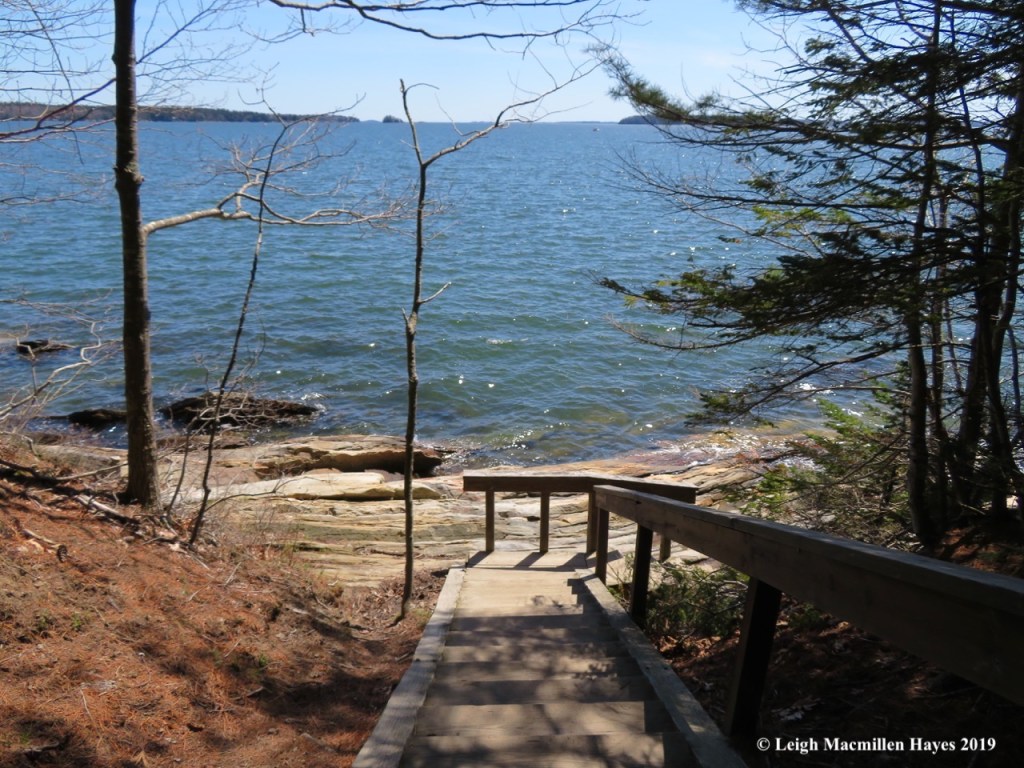
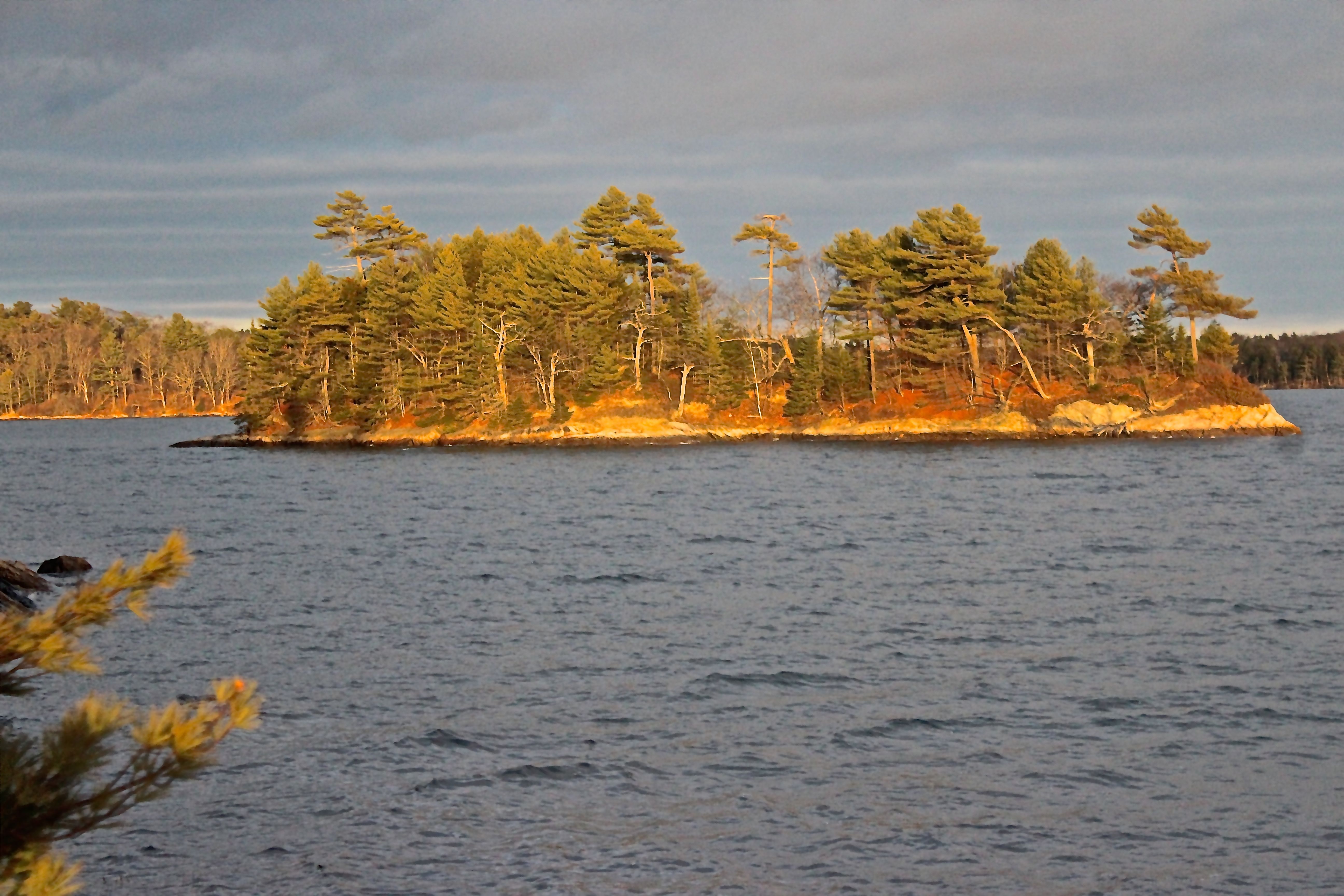
Where were we? By this photo some of you may now know our location. In front of us was Googins Island, as viewed from the rocky coast at Wolfe’s Neck Woods State Park in Freeport, Maine.

Now do you understand why I said the Wolf’s Milk Slime Mold was located in the right place?

And Googins Island has long been home to this Osprey nest, where the expectant parents had their eyes on the world about them. Just as we had.

Eyeing the Ladies

We were in the area. It’s spring. (Until Wednesday that is, when winter is scheduled to return, and here’s the latest from the National Weather Service out of Gray, Maine:

…WINTER STORM WATCH IN EFFECT FROM WEDNESDAY AFTERNOON THROUGH
LATE THURSDAY NIGHT…

  • WHAT…Heavy snow possible. Total snow accumulations greater than
    18 inches possible. Winds could gust as high as 55 mph.
  • WHERE…Portions of south central, southwest, and western Maine.

And so we headed to Wolfe’s Neck State Park this afternoon cuze we kinda have a love affair with this place in Freeport, Maine.

It’s a place where the forest meets the sea, or at least Casco Bay, and so it brings our two loves together and always gives us a chance to refill the innermost recesses of our lungs with salt air, while still enjoying the woodland trails.

What immediately became clear, however, was the extent of damage the coast has endured this past year due to intense storms. Erosion was evident in so many places. Sadly.

The landscape was also ransacked by the force of the wind. Trees were uprooted–some falling south, others, east, a few west, and even north. We could almost feel the harsher than normal gusts even though we weren’t present for any of these episodes.

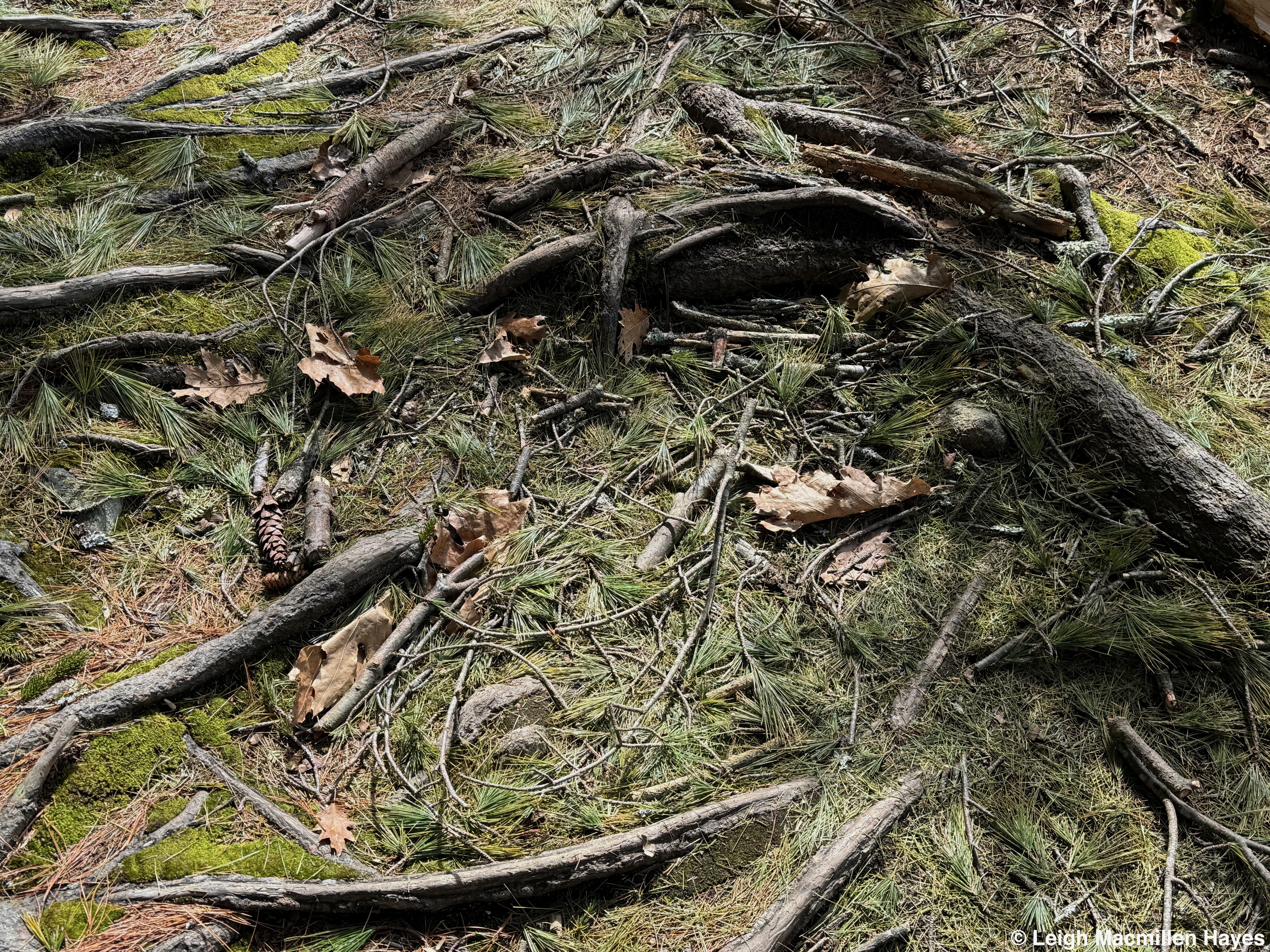
And the trails are scattered with pine twigs and needles, which though they soften each footstep, really just bring the destruction closer to our eyes and minds.

There were some, however, or perhaps many, who took advantage of the uprooted trees as great places to think they were hiding from us–the great predators that we are.

Those who work for the park have had a lot of work “cut” out for them and they’ve cleared tree after tree from blocking the trail and our kudos to them.

In almost five miles of hiking trails, we only found a few obstacles, this one being the most difficult to conquer. And really, it wasn’t that difficult, but more inconvenient. And we know that they’ll take care of it soon. They probably just need to give their chainsaws and muscles a brief break. Really. I cannot explain the amount of devastation. It happens every year, but I don’t think we’ve ever seen it to this extent.

But there were other things to notice, such as this Red Squirrel midden that must have been an incredible cache back in the fall, and I wished I’d seen it then.

And the sweet buds of Trailing Arbutus waiting to make their 2024 debut.

But our best sight of the day: Lady’s Slippers in bloom. Oh my. Everything is early this year, but we definitely didn’t expect to find these friends so soon.

Eyeing the ladies is something My Guy loves to do.

Oh, we found a few seed capsules along the way.

And we did see these flowers . . . on the kiosk.

But the photo I took of a Lady’s Slipper dates back to last spring. I hope I gotcha for a moment.

Happy April Fools Day 2024!

LOVE ME, love me: Wolfe’s Neck Woods State Park

It had been four years since we last visited Wolfe’s Neck Woods State Park and that venture took place at the end of November. We must have been Christmas shopping. Today, we were in search of a bug-repellant shirt for me (Spring shopping) and so our journey took us to Freeport. Not being a shopper, it was a quick in and out of the store and then onto Wolfe’s Neck Road.

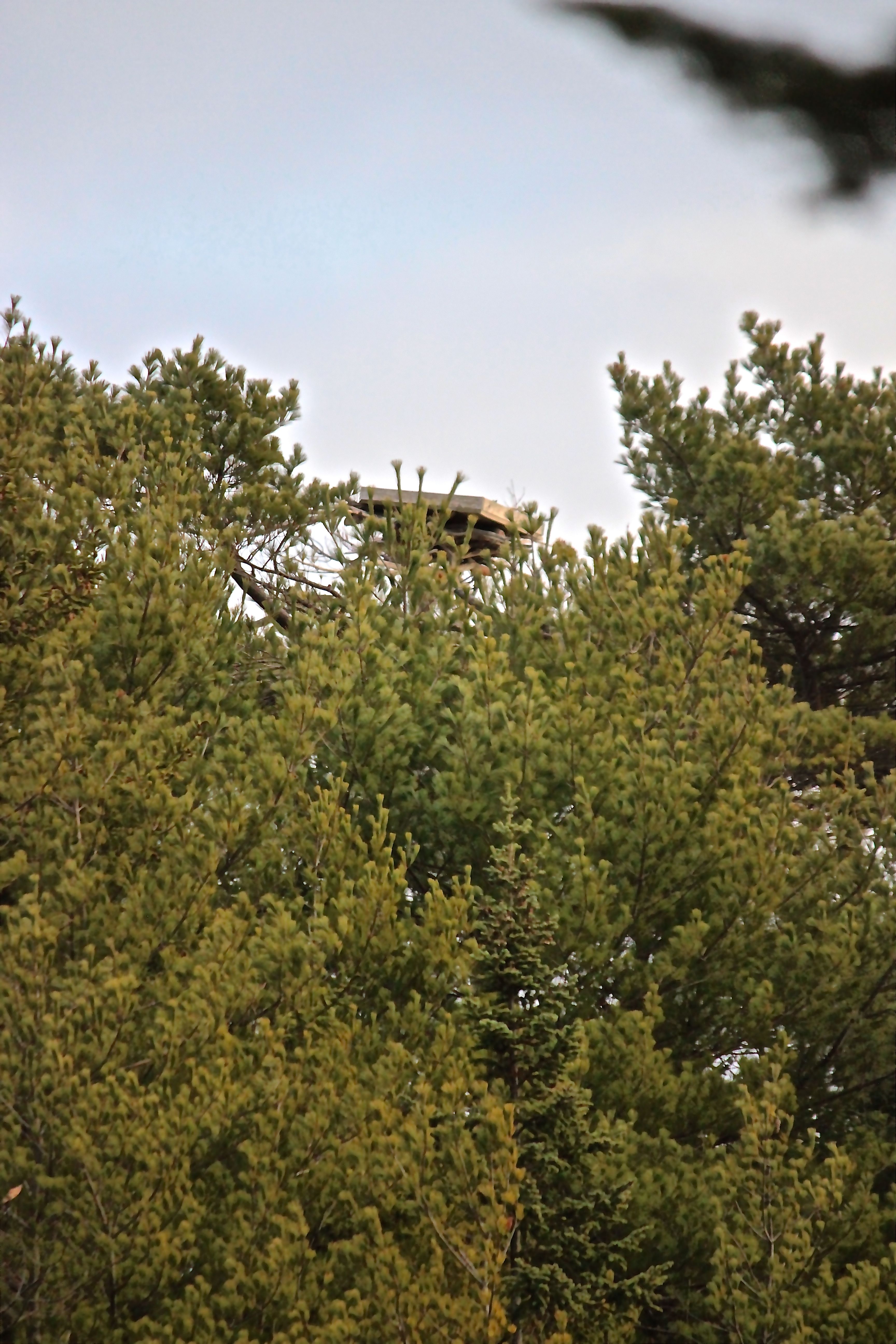
There’s a 4.4 mile network of trails in this 200-acre park gifted to the State in 1969 by Mr. and Mrs. Lawrence M.C. Smith of Freeport. One of the stand-out features is Googins Island where Osprey have been entertaining visitors for years as they raise their young on a huge platform nest they’ve built high up in a pine. Can you see it?

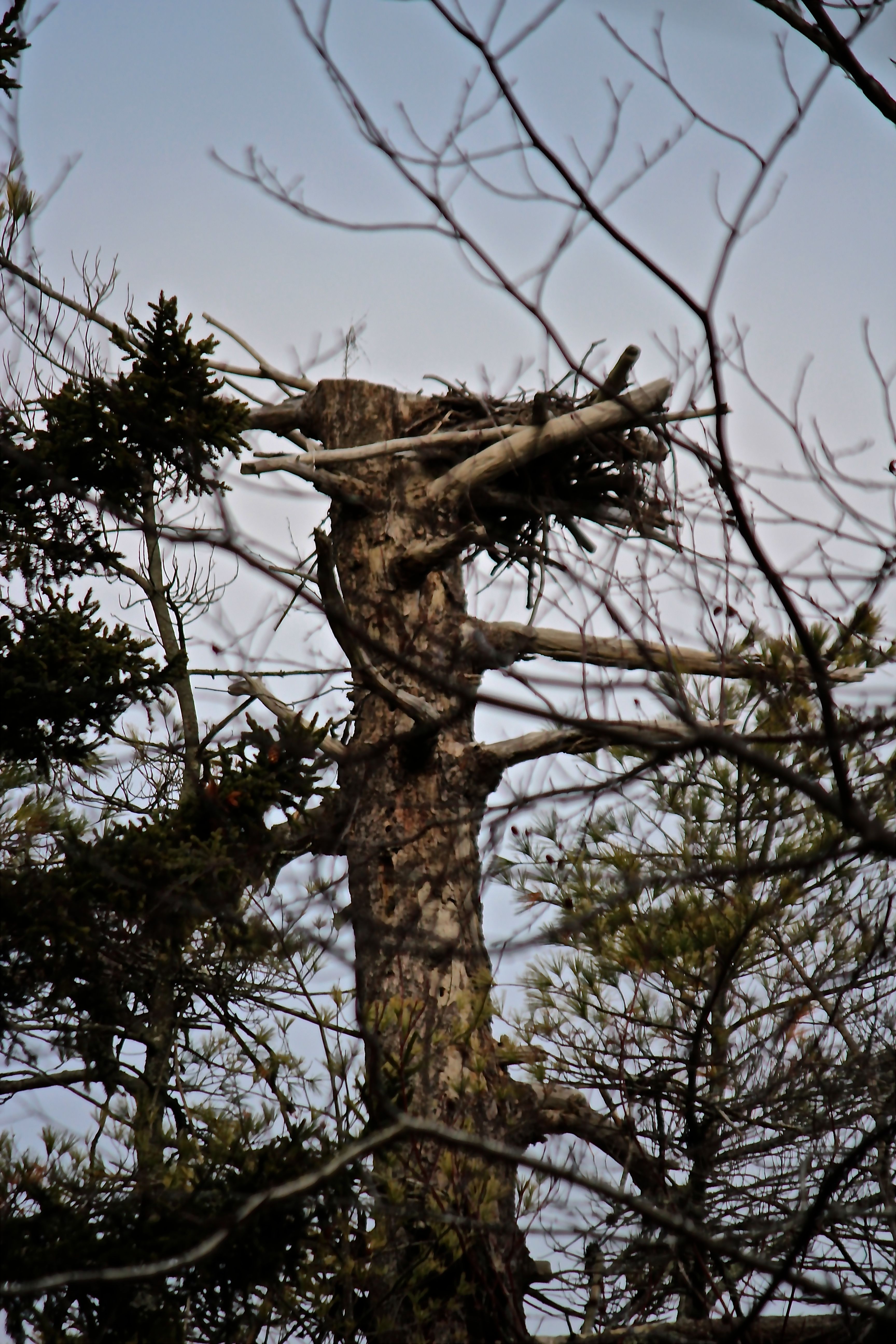
Here’s a closer view–and I assume (never assume) that Momma was the one sitting on eggs. The nest has been added to each year and though I have no idea of its actual size, Osprey nests can reach 10–13 feet in depth and 3–6 feet in diameter. The depth of this one appeared to be a few feet, but the diameter was substantial.

We followed the trails and enjoyed journeys to the water where we could take in the views of Casco Bay and its islands.

And before our feet, the mix of granite pegmatite and metamorphic rock. As much as my mom always loved to walk along a beach, she was equally enchanted by the rocky coast of Maine and whenever I encounter it, I feel her presence.

I know mom would have appreciated the artistic rendition of waves created by the water and mimicked by the rock.

Again and then again, the trail was interrupted by a set of wooden steps that led us back to the water’s edge.

It was there that we spied the Common Eiders as they floated and fished.

And . . . the first Dandelion blossom of the season–for us, at least. In my modest opinion, Dandelions are under-appreciated and that fact was driven home when my guy asked, “You’re photographing a dandelion?” Yep. Check out each golden ray of sunshine with its five “teeth” representing a petal that forms a single floret. Yes, each petal is a floret. Therefore, the bloom is a composite of numerous florets. And notice how each stigma splits in two and curls. What’s not to love. Oh yeah, and though we didn’t witness it today, the pollinators love them. (SO don’t pull up the dandelions in your yard!)
The thing about Dandelions is that they leaf out first and then flower, while their cousins, Coltsfoot, which we also found along the trail, flower first and leaf out later. The wonder of it all.

Our journey took us across stepping stones,

along park-like paths (because we were in a park, after all), over roots and rocks, with ups and downs, and even a couple of bog bridges.

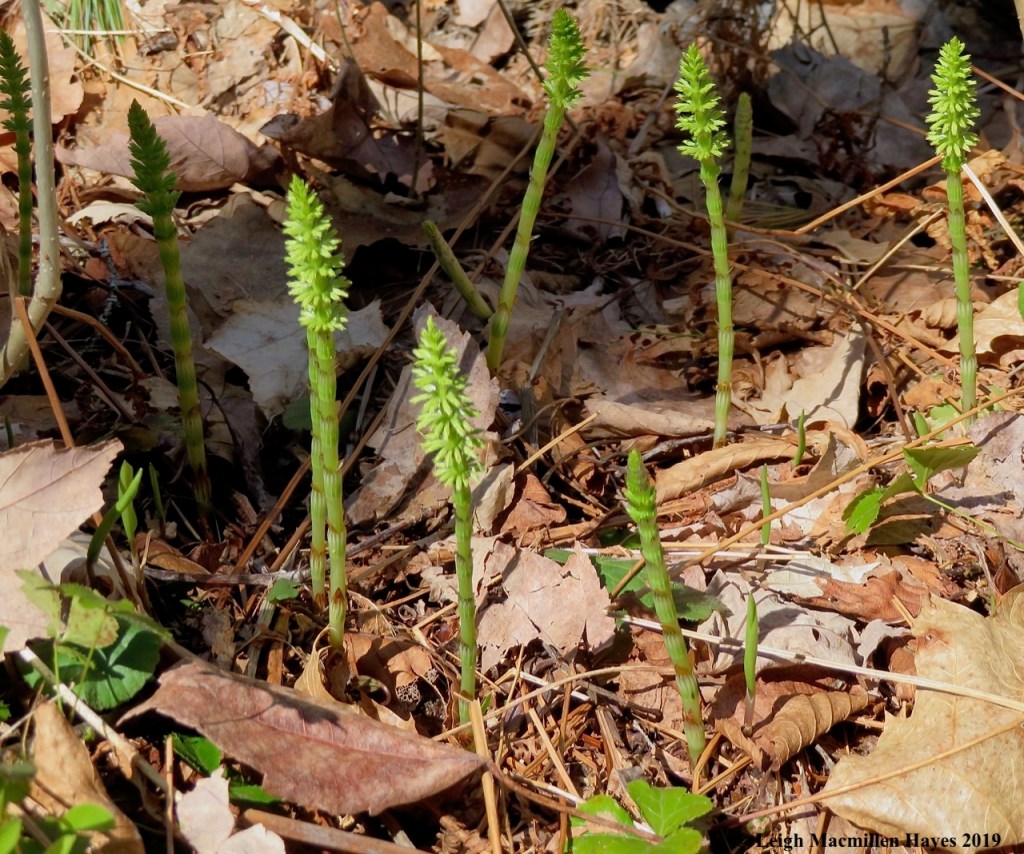
The sights along the way included patches of Equisetum, a living fossil. These vascular plants reproduce by spores rather than seeds and dominated the understory of late Paleozoic forests. Just imagine.

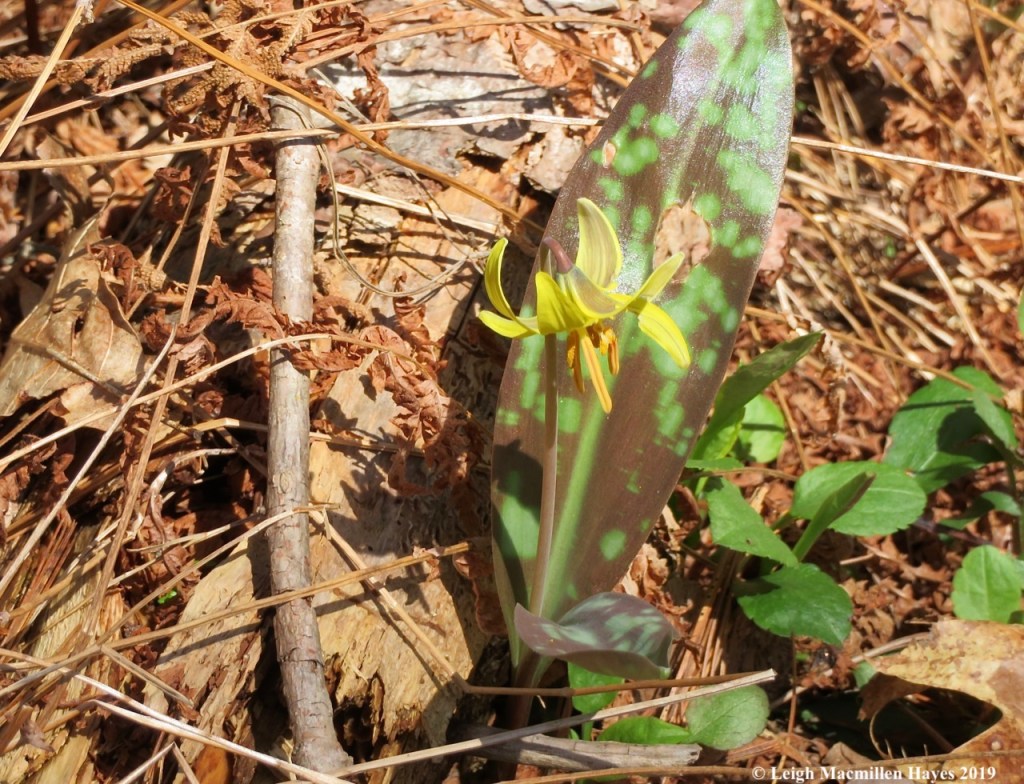
While that was a treat, one of my favorite surprises was the patch of Trout Lilies that decorated the forest floor. It’s one I don’t encounter often, but because of its maroon-mottled leaves that remind some of brown or brook trout, I’ve remembered it each time we’ve met.

The nodding flower that could have been a lantern in the forest with its petals and sepals bent backward, exposed six brown stamens hanging low.

And then, and then, one of my all-time favorites in any season, a Hobblebush, showed off its May glory in new leaves and flowers. Those in our western Maine woods aren’t as advanced yet, but trust that I am watching.

Our journey was quick for we had another commitment, but still . . . we made some wonderful discoveries and especially loved the opportunity to see the Osprey on its nest.

The second in our LOVE ME, love me series had come to an end. Wolfe’s Neck Woods State Park. ✓ Two down, 32 to go!

Mast Landing Mondate

What should you do when you come to a fork in the road . . . and a mailbox?

2-mailbox in the woods

Why open the mailbox, of course, enter the date and your names on the notebook stored within, and then follow the trail to the left. If all goes well, a couple of hours later you’ll emerge via the trail on the right. With lots of zigs and zags along the way, that is.

3-foundation

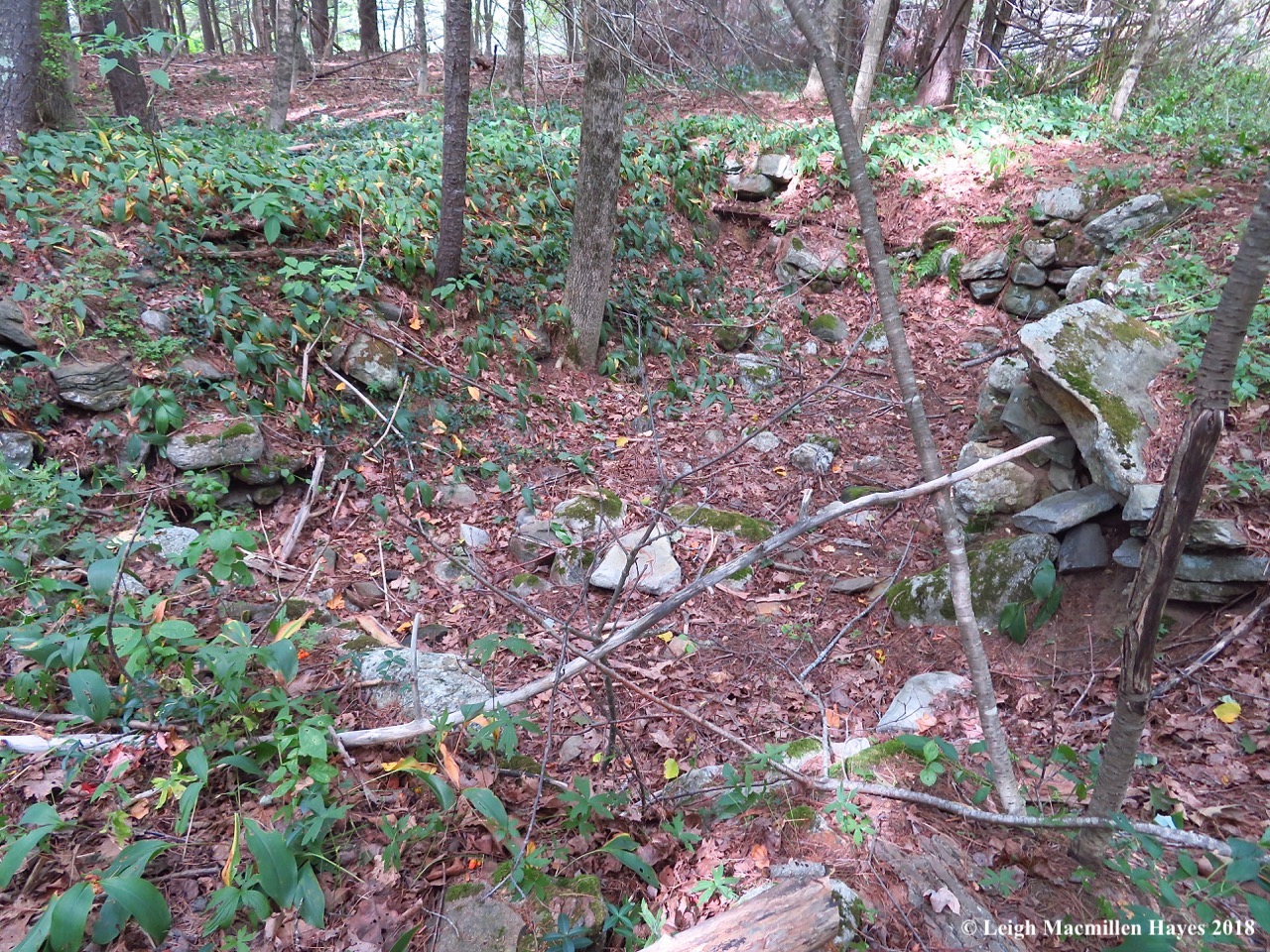
The story of this place dated back to the 1700s when the massive white pines that once grew there were harvested for the British navy. A dam was built and mills as well. In fact, at one time there were four mills, including a saw mill, textile mill, and two grist mills, plus a woodworking shop. We spied a foundation just off the trail, but didn’t know its part in the story.

5-lily of the valley surrounding foundation

Surrounding the foundation in abundance, however, were lily of the valley plants, their fruits taking on their fall hue. And I imagined the lady of the house tending her garden.

4-black-capped chickadee egg?

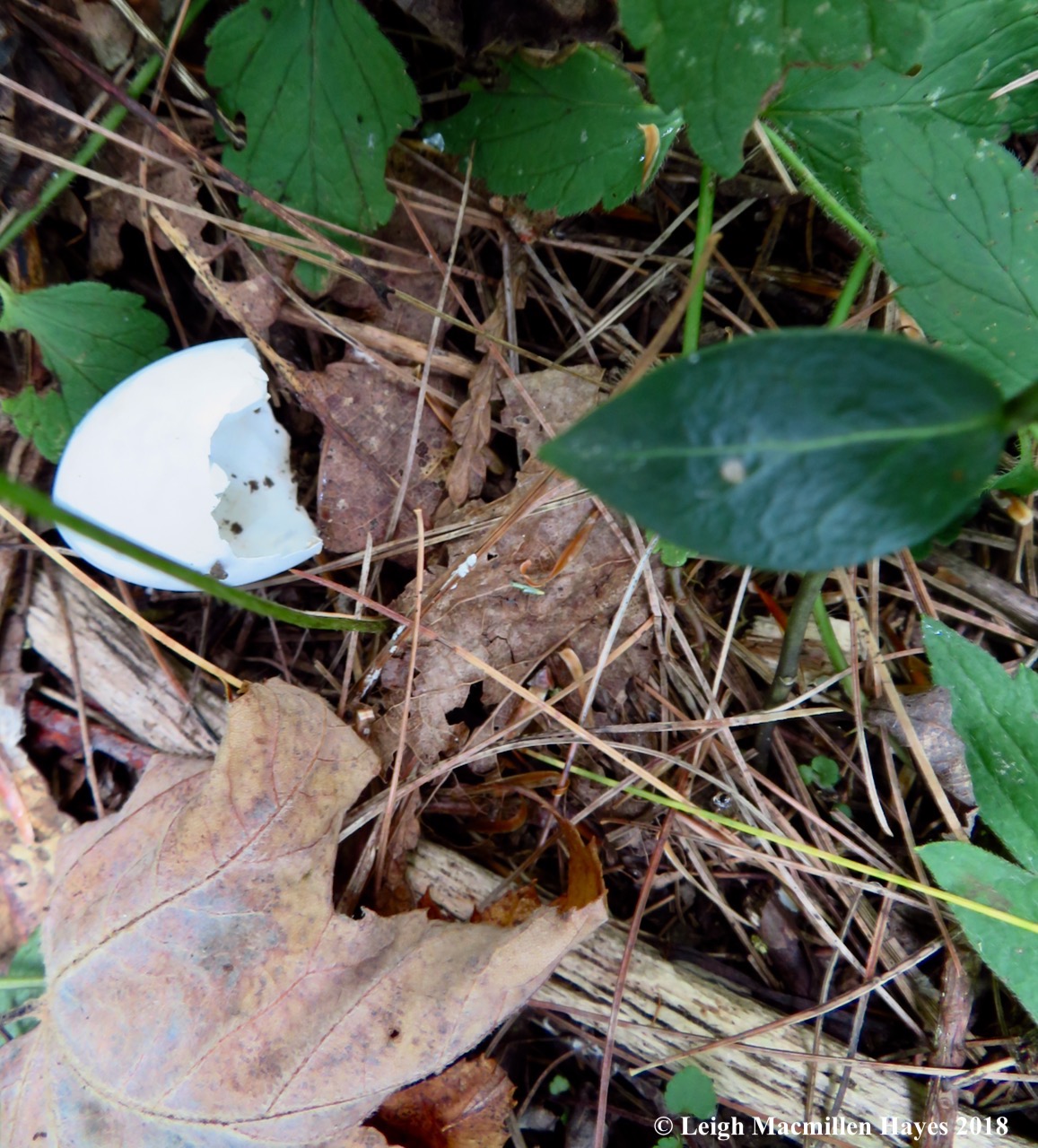
Though the homesteaders were no longer in residence, we found evidence that others called this place home–possibly a black-capped chickadee egg.

3a-old vechicle

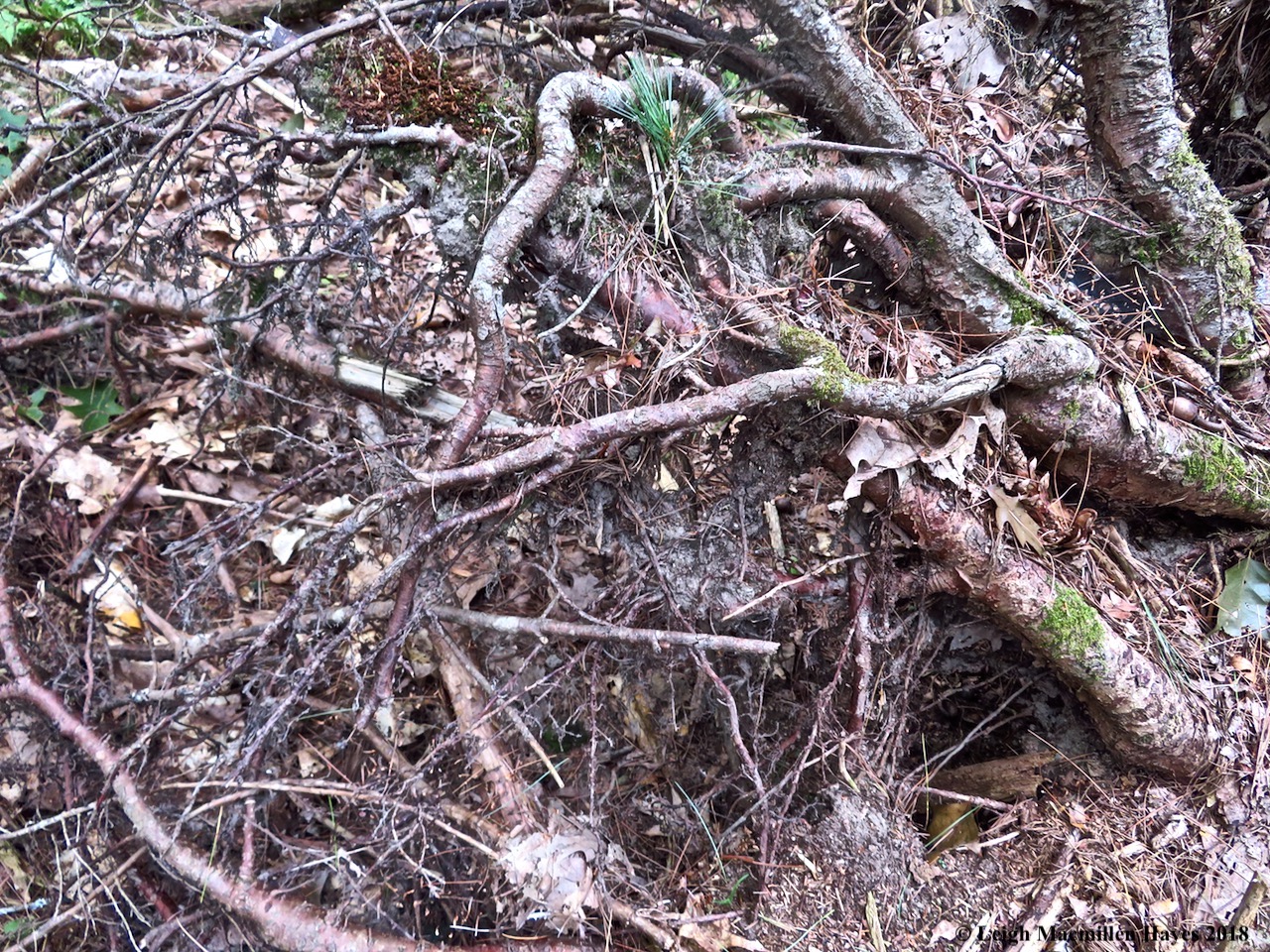
A little further on, we found another artifact dating to an earlier time. Much earlier given its structure and how buried it was. This had once been farmland before the forest grew up again.

6-climbing under blow down

It wasn’t far into our journey, however, that we began to notice something about this land–it had been hit over and over again by windstorms, all blowing from the east, which made sense given that we were less than a mile from the ocean. We found ourselves stepping over, crawling under . . .

7-walking through blowdown

walking between . . .

8-destruction everywhere

and starring in awe at all of the destruction. It was nothing like we encounter in western Maine, and we began to feel trail snobbish.

9-uprooted

But . . . uprooted trees do offer interesting art forms from above . . .

10-underrooted

and directly below. Think of it as nature’s stained glass window.

10a-bark beetle tunnel art

There was other artwork to admire, including those zigzaggy tunnels created by bark beetles. They must dance to their own tunes as they mine their way across the cambium layer.

10b-artist conks

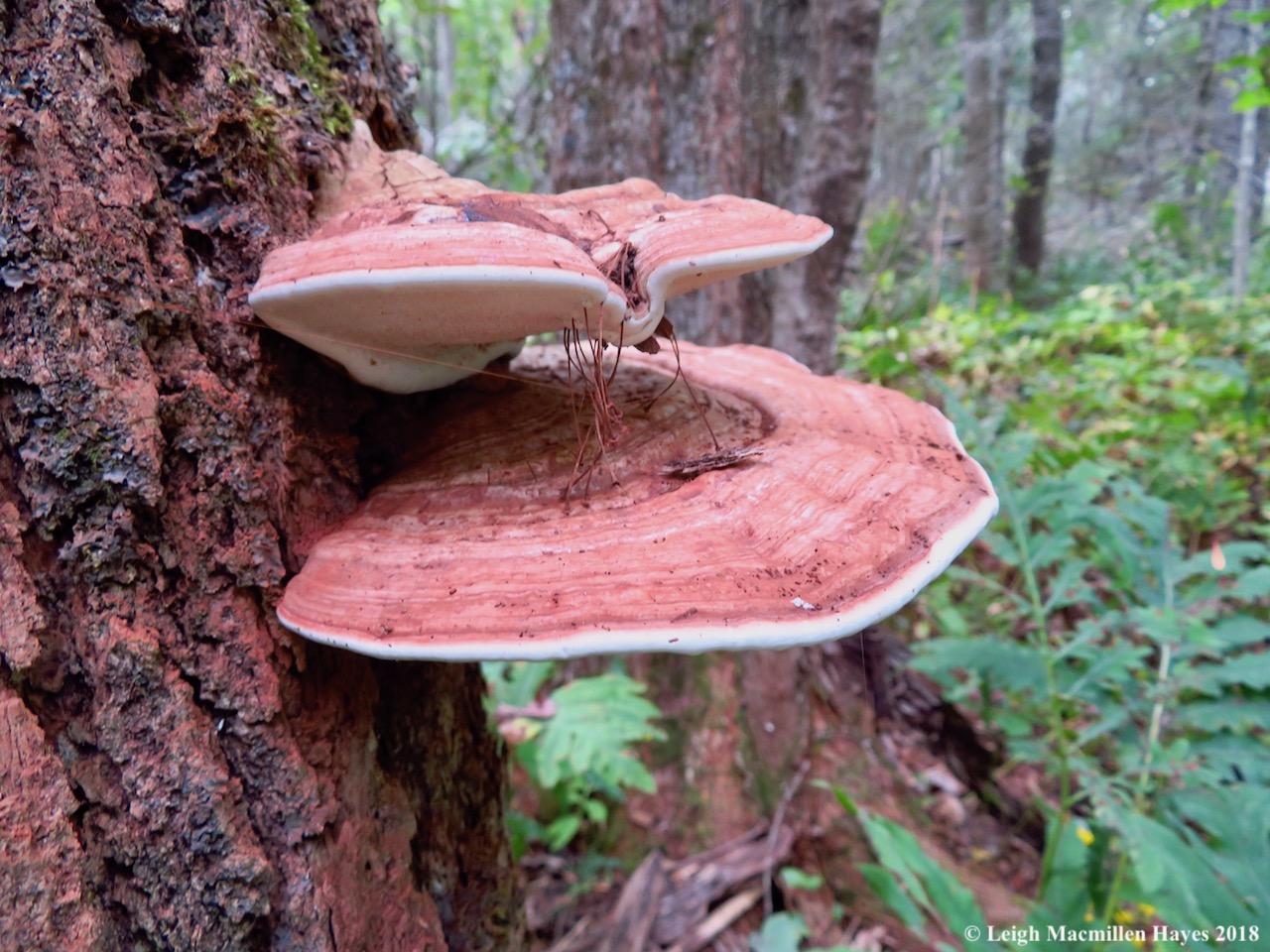
On the same tree we also found fine specimens of artist conk fungi. How apropos.

12-education building

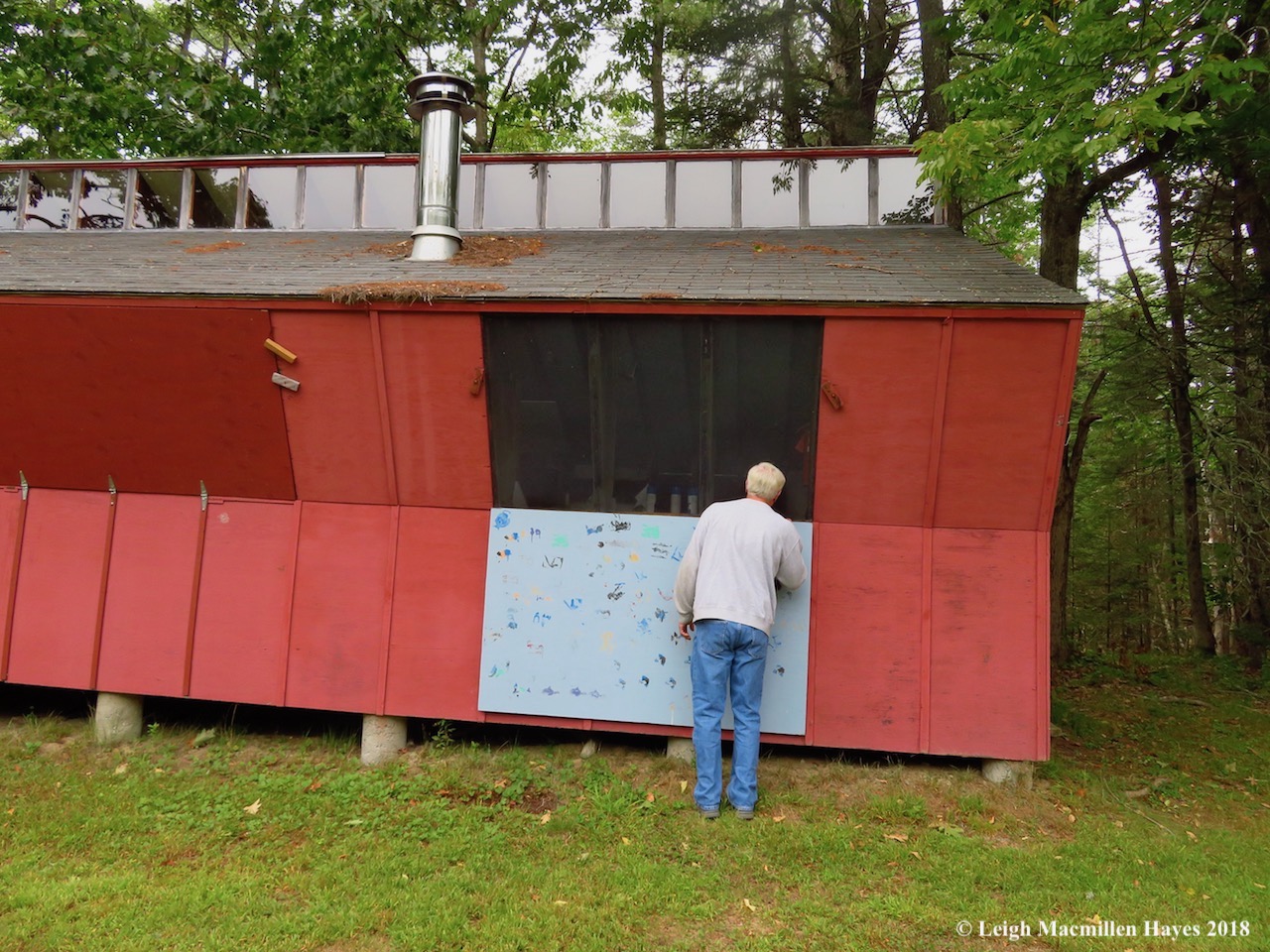
Soon we came to a modern structure. A peek through the window and we knew we’d reached an education center, where cubbies lined a wall, and posters no longer quite secure rolled from the points at which they’d been tacked.

14-tick check

My favorite was a painting on the outside. Tick Check!

15-apple tree

Because the land had been farmed, apple trees danced in their forward leaning forms.

16-apple

And gave forth fruit among the maze of branches.

17-apples on ground

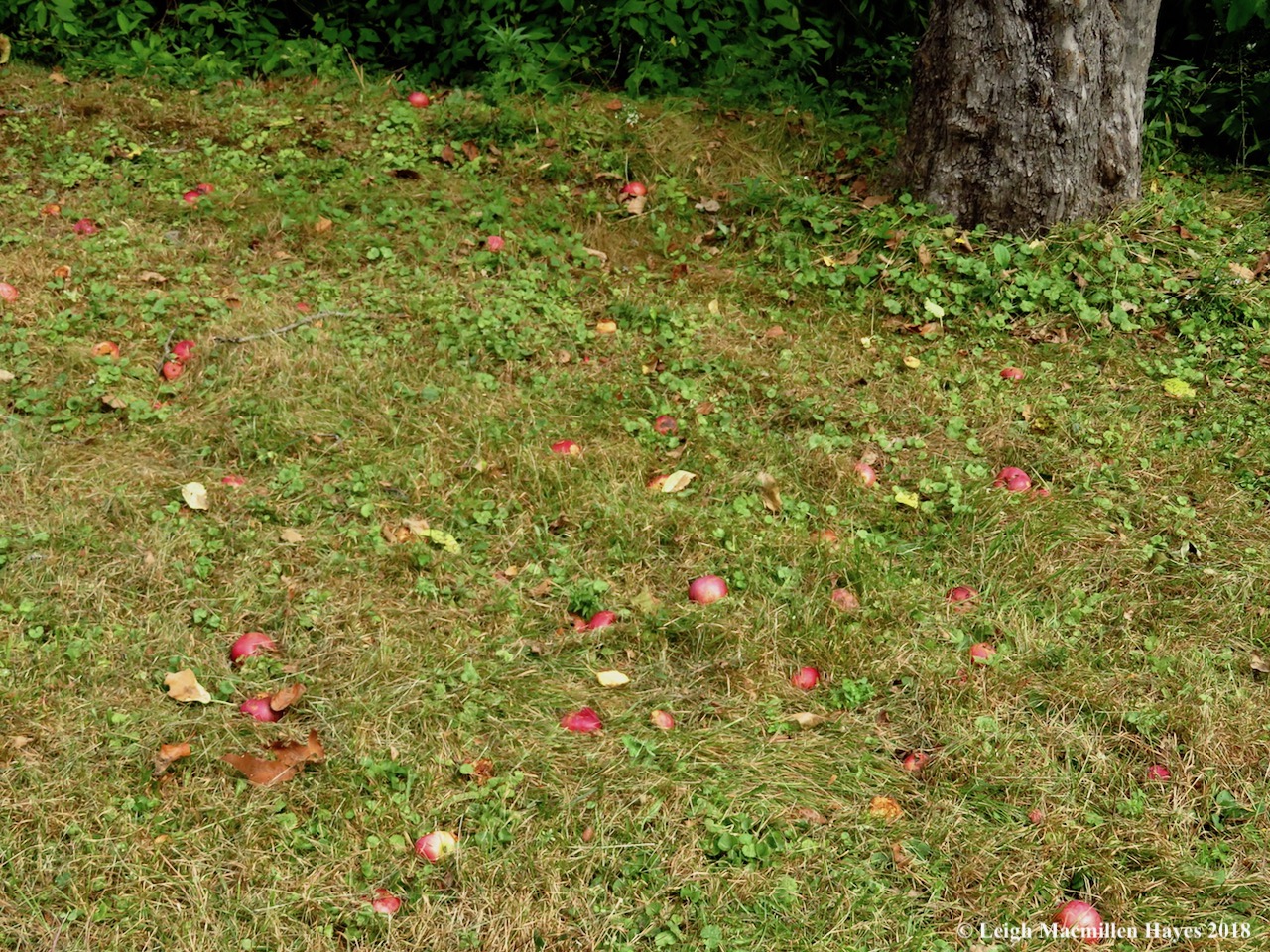
Some trees were more prolific producers than others.

18-eating an apple

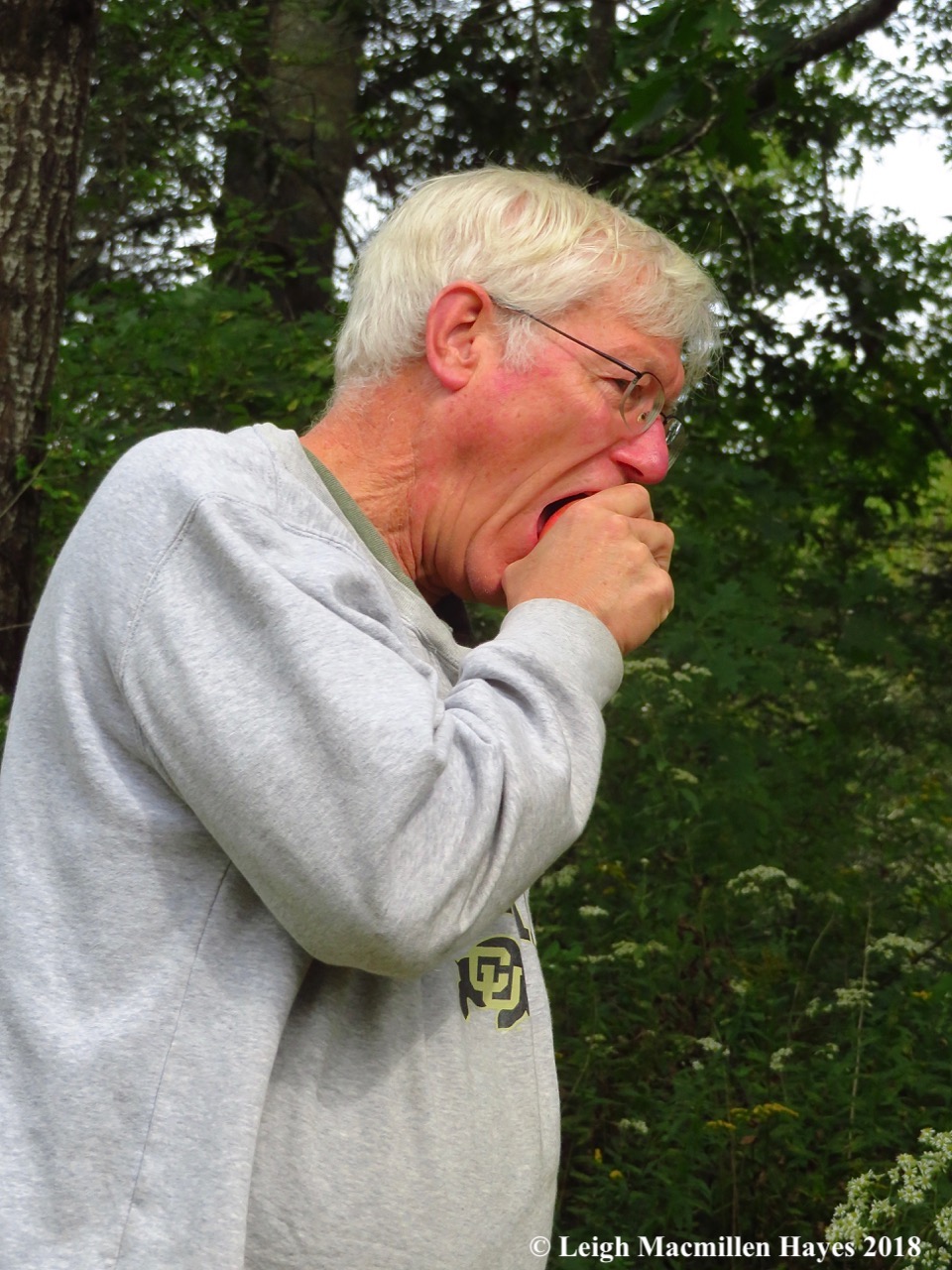
And according to my guy, the offerings were delicious.

18-silky dogwood fruit

There were other fruits to admire, including the wedgewood blue of silky dogwood.

18a-hobblebush fruits

And the green turning red, red turning blue, purplish, blue and almost raisin-like fruits of hobblebush.

19-Norway Maple samara

Even the Norway maple showed off its seeds in samara form.

22-more asters

The asters added delightful touches of color to the rather drab landscape.

11-Nephrotoma eucera, tiger crane fly

And among them, insects such as a tiger crane fly, enhanced the scene.

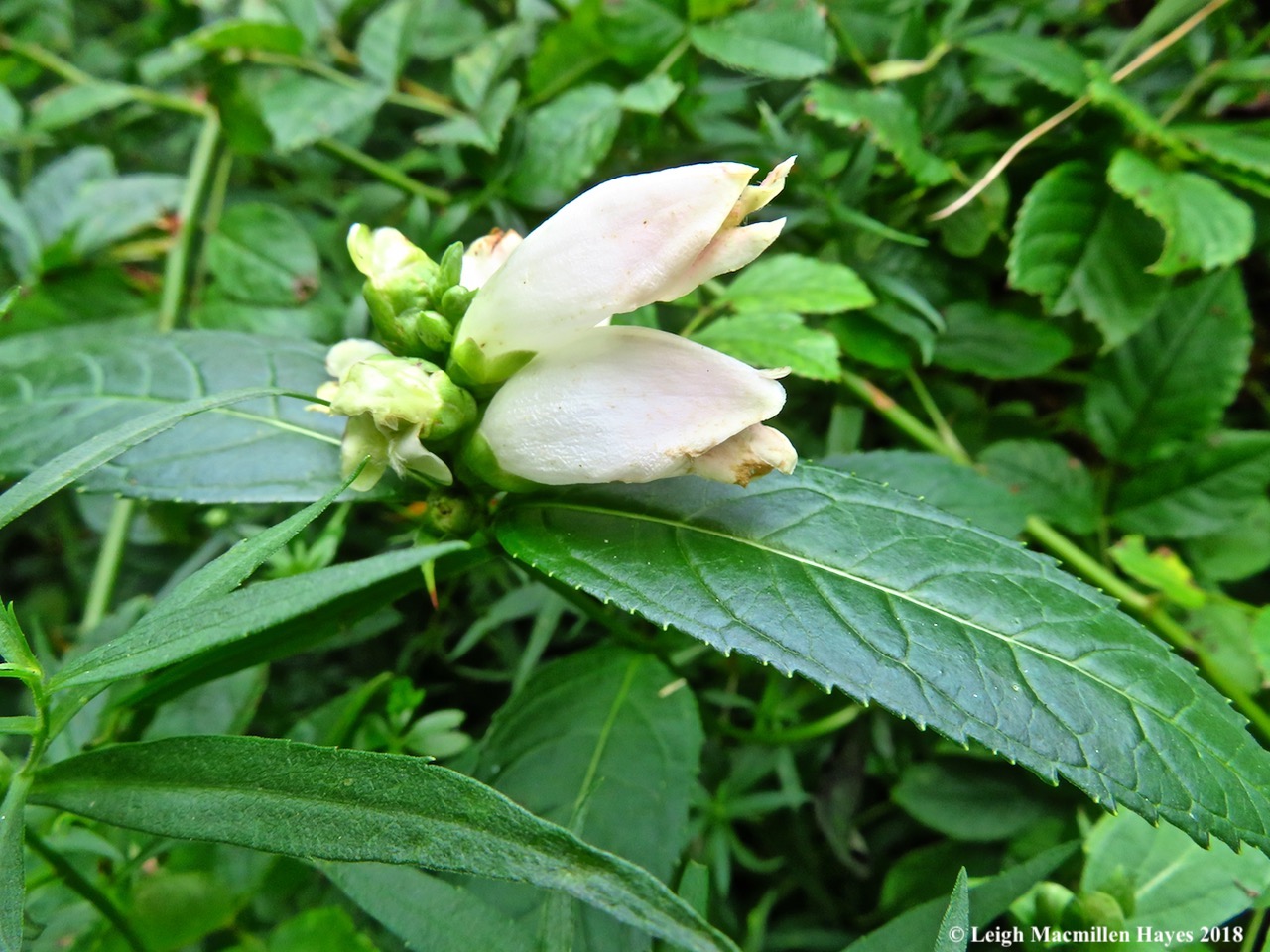
23-turtlehead

We found turtlehead,

24-false solomon's seal

false Solomon seal in its fruit form,

25-beach rose

and beach roses showing their bright florescence.

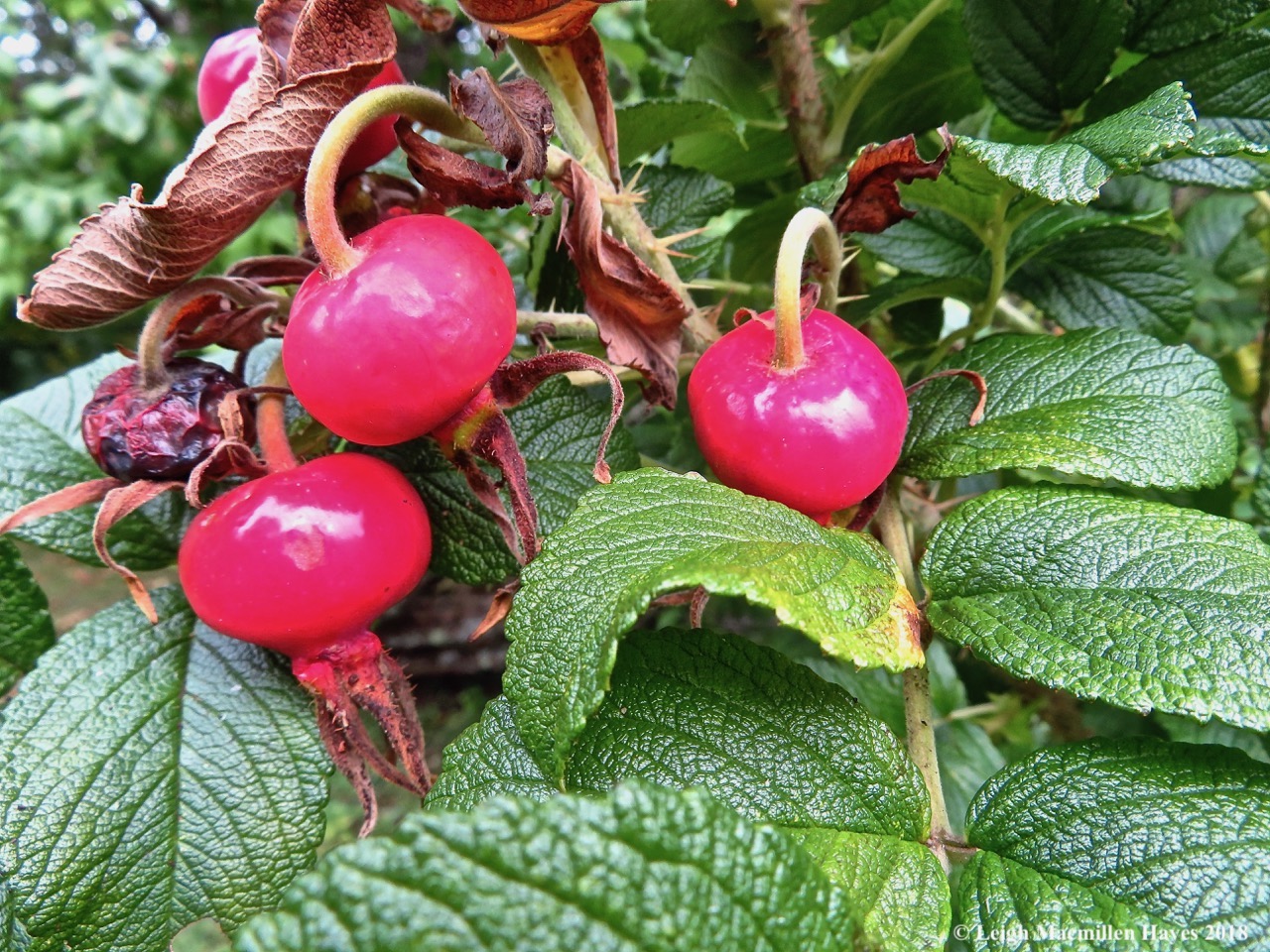
26-rose hips

And where there were roses, there were rose hips and I was reminded of my father who couldn’t walk past a rose bush on our travels from our cottage in Harbor View, Clinton, CT, to town via the town beach, without sampling such.

27-dam

Eventually today, after a few backtracks, for we occasionally got fake lost and with all the downed trees, every trail began to look the same, we found the dam.

29-dam breached

It had been breached long ago, and according to the property’s history, the mills were “destroyed by fire in the early 1860s, and not rebuilt.”

29-old mill structures

We could see some evidence through the woods, but weren’t in a major gotta-see-more mode I guess, which isn’t really our way, but today it was.

j30-below the dam--low tide

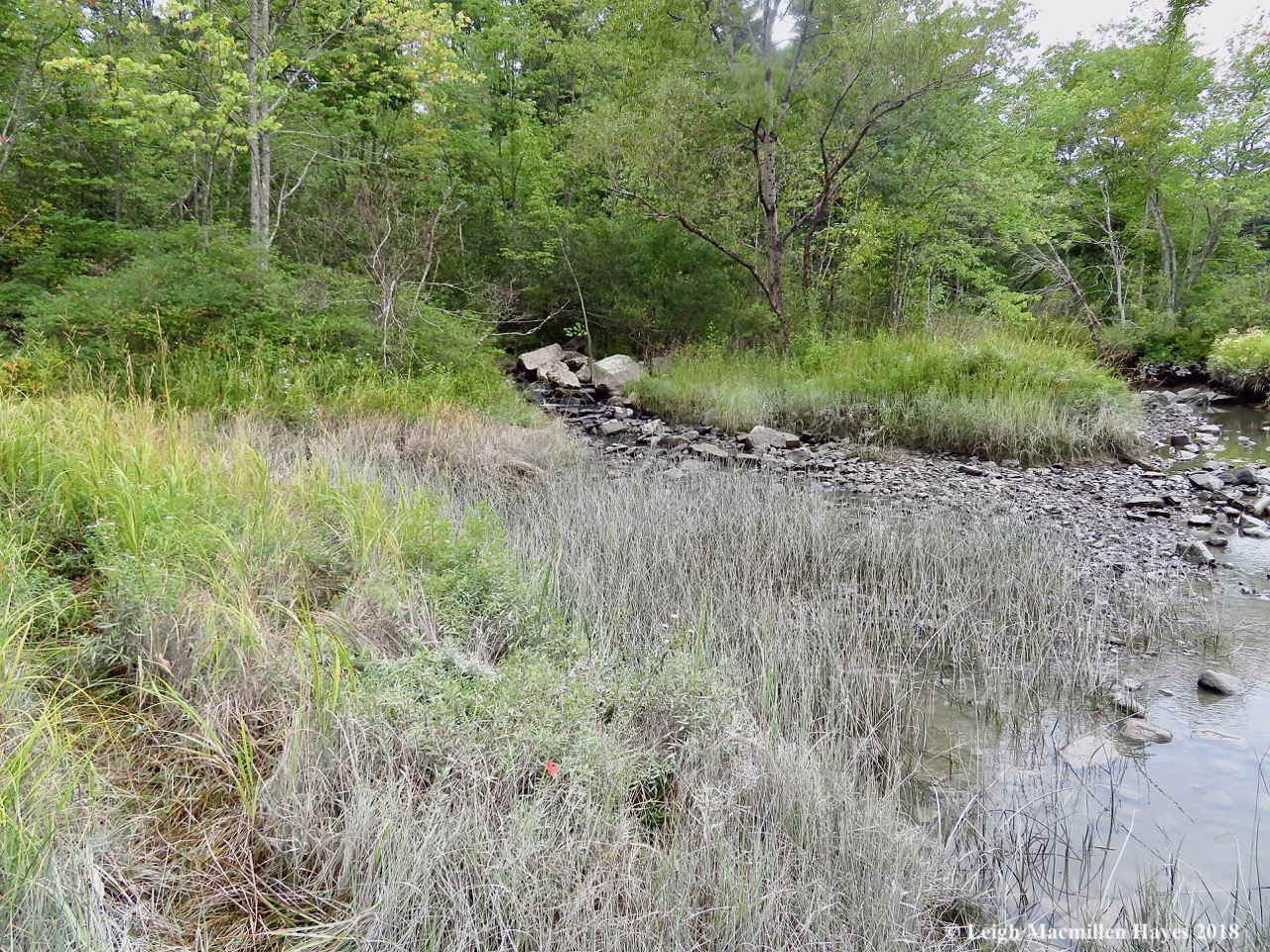
Down below, the mill stream became the Haraseekeet River if we understood correctly. It was low tide in the estuary. And smelled to me like the mud flats in Clinton Harbor and I was transported to my childhood for a moment.

31-caretakers house

On our way out, we passed by the caretaker’s house, built in 1795 by mill master Abner Dennison. Sadly, it looked like it needed some care taking.

32-head start on Halloween

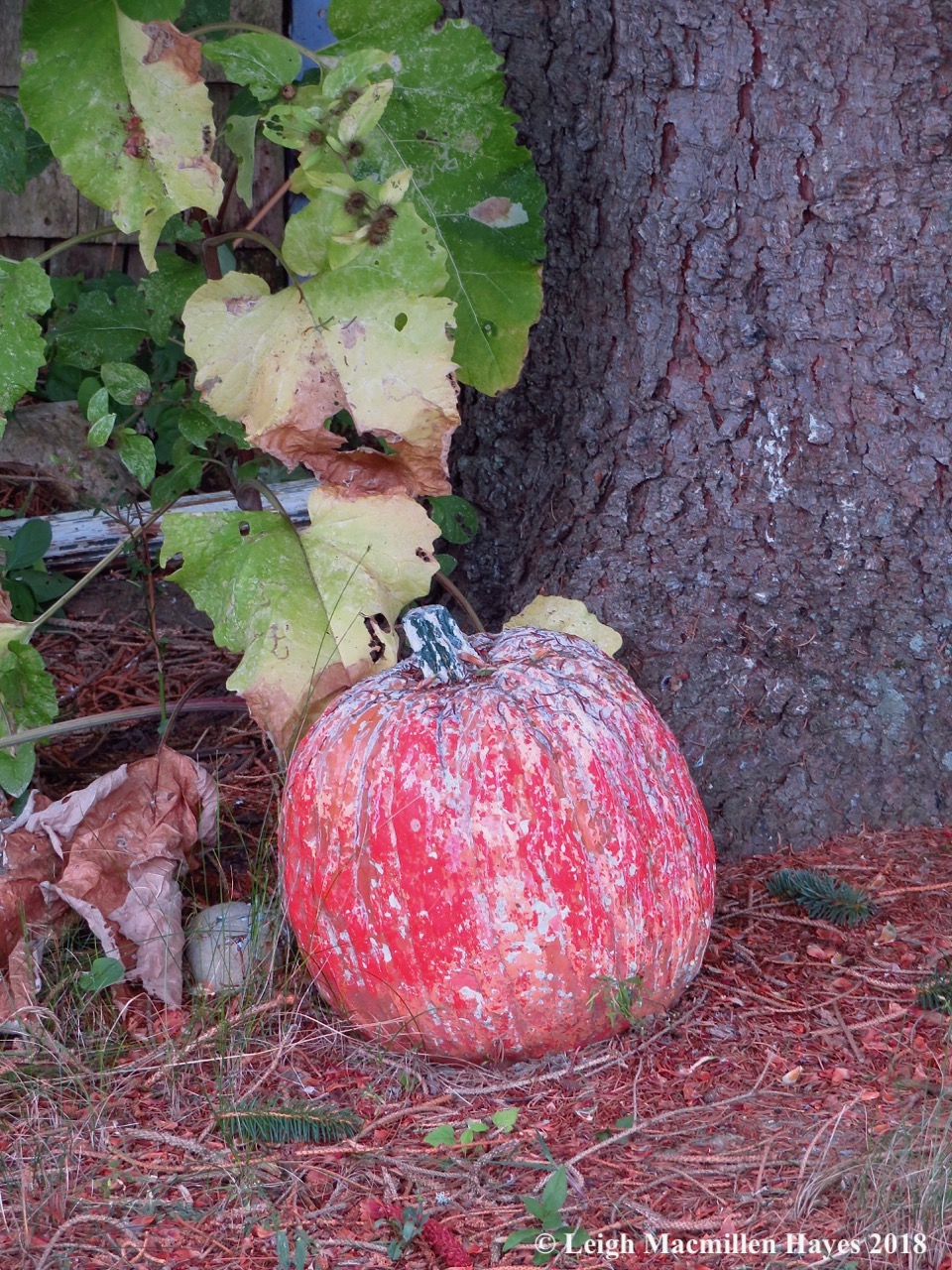
Nonetheless, it was decorated for the upcoming season.

34-tree spirits

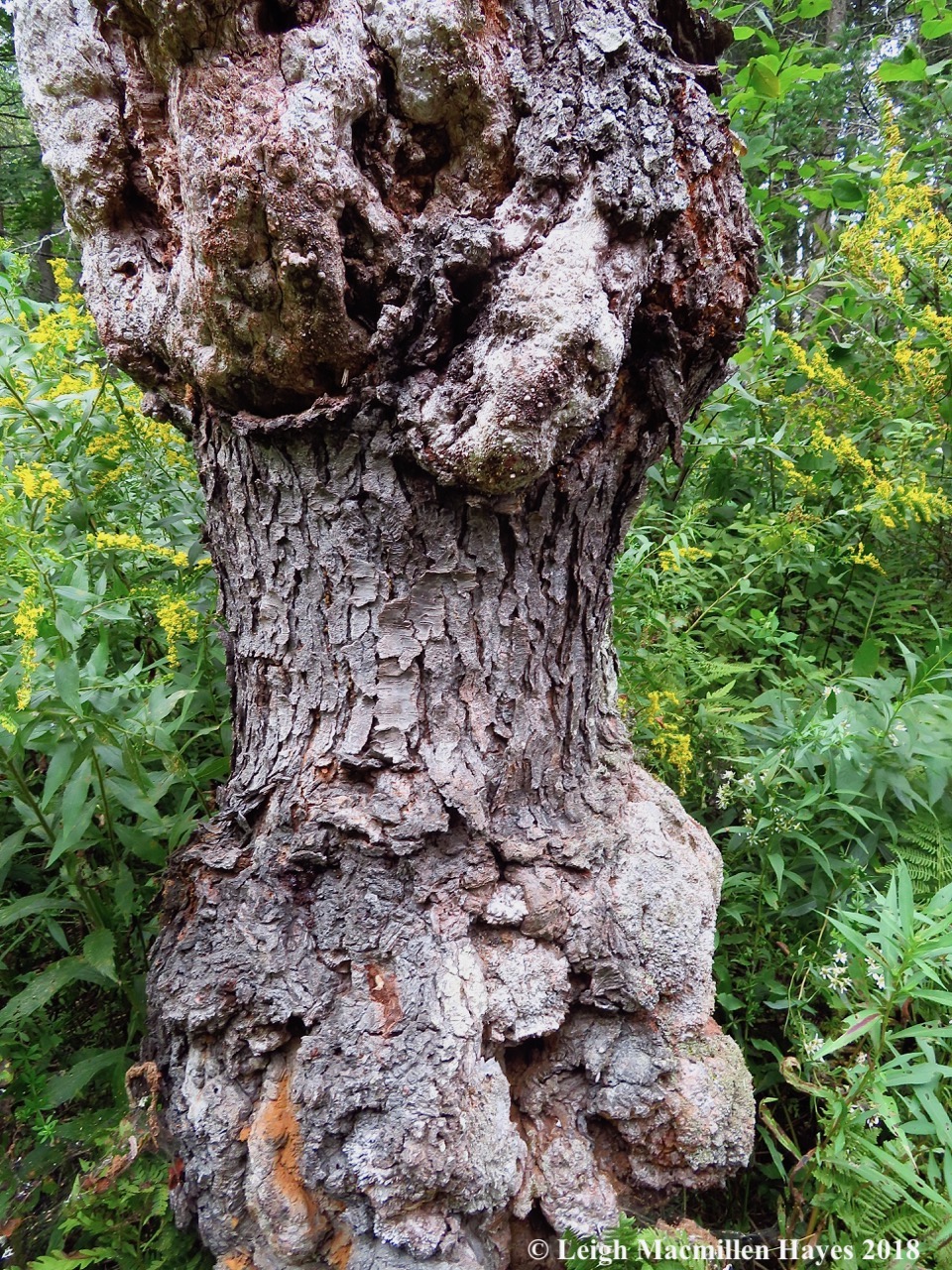
At the end of our journey, we decided that the trails were not our favorite given all the blowdowns and a stagnant Mill Brook that seemed like an oxymoron, but we’d still found plenty of delightful sights. And tried not to make too many contrary comments for the tree spirits kept many eyes on us.

35-tree gnomes

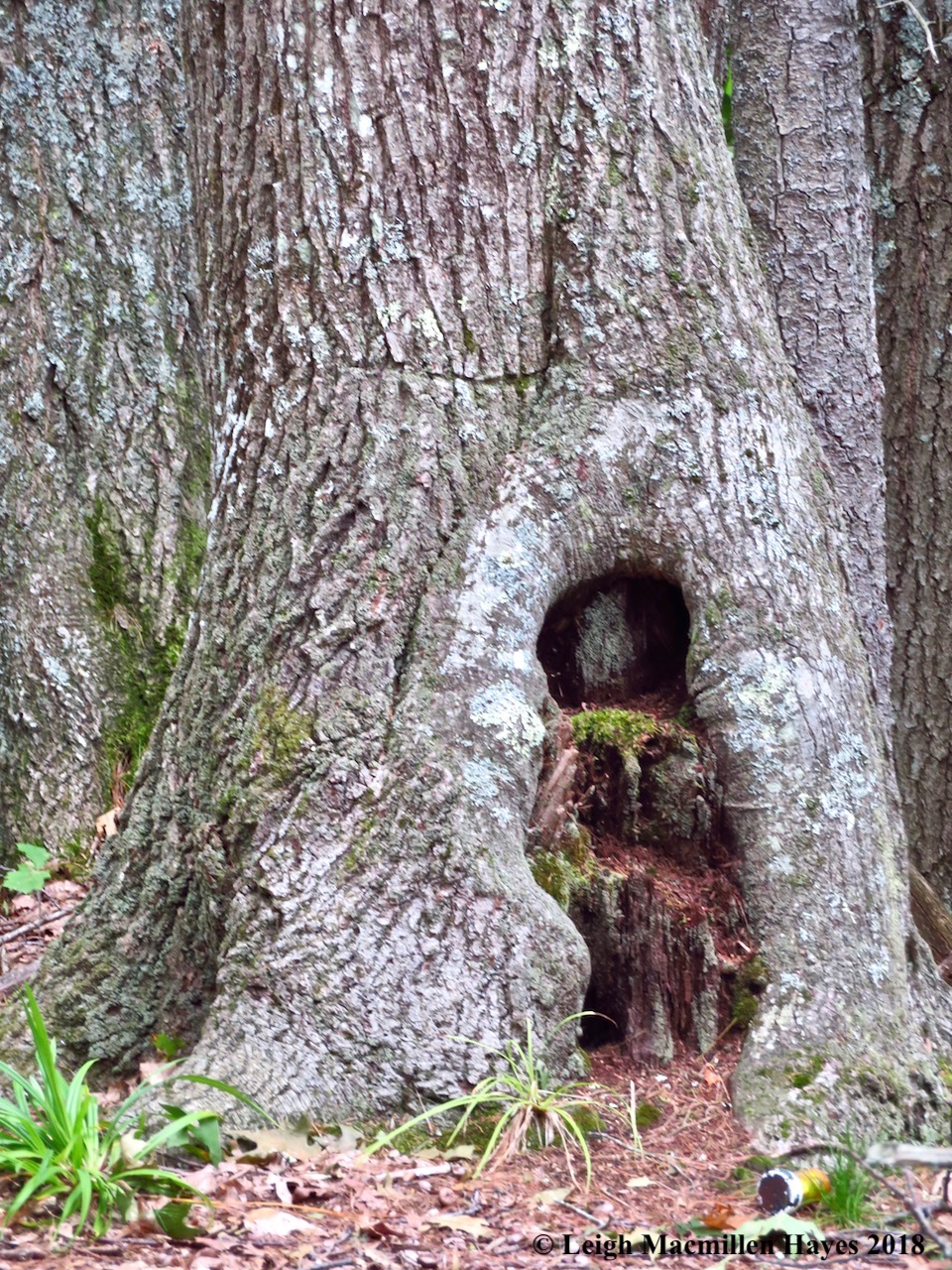
And listened from their gnome homes.

On this Mondate, we whispered that we probably don’t need to return to Maine Audubon’s Mast Landing, but we didn’t want them to hear us.


Mondate By the Bay

After lunch at Gritty McDuff’s in Freeport (haddock sandwiches and a brew–no PB & J today), my guy and I found our way to Wolfe’s Neck Woods State Park on Casco Bay. So, here’s the good, but scary part. We’ve been there before, but not in a long while–and neither of us had any recollection of it. That means today’s visit was like going there for the first time all over again. (Our dementia is setting in.)

map

Trails follow the coast and circle back to the Harraseeket River, passing through a variation of natural communities. We trekked over all but the North  Loop before we ran out of time. Actually, we finished up a wee bit after the park was officially closed for the night and were glad to find the gate still open.

red oak

By the forest floor, it was easy to name the predominate hardwood trees in any given area from Northern Red Oak to

beech leaves

American Beech to

big tooth aspen leaves

Big-tooth Aspen. Spruce, hemlock, pine and fir also fill this more than 200-acre forest given to the State in 1969 by Mr. and Mrs. Lawrence M.C. Smith.

down the trail

Sometimes the path was packed dirt that made for easy walking.

stone pathway

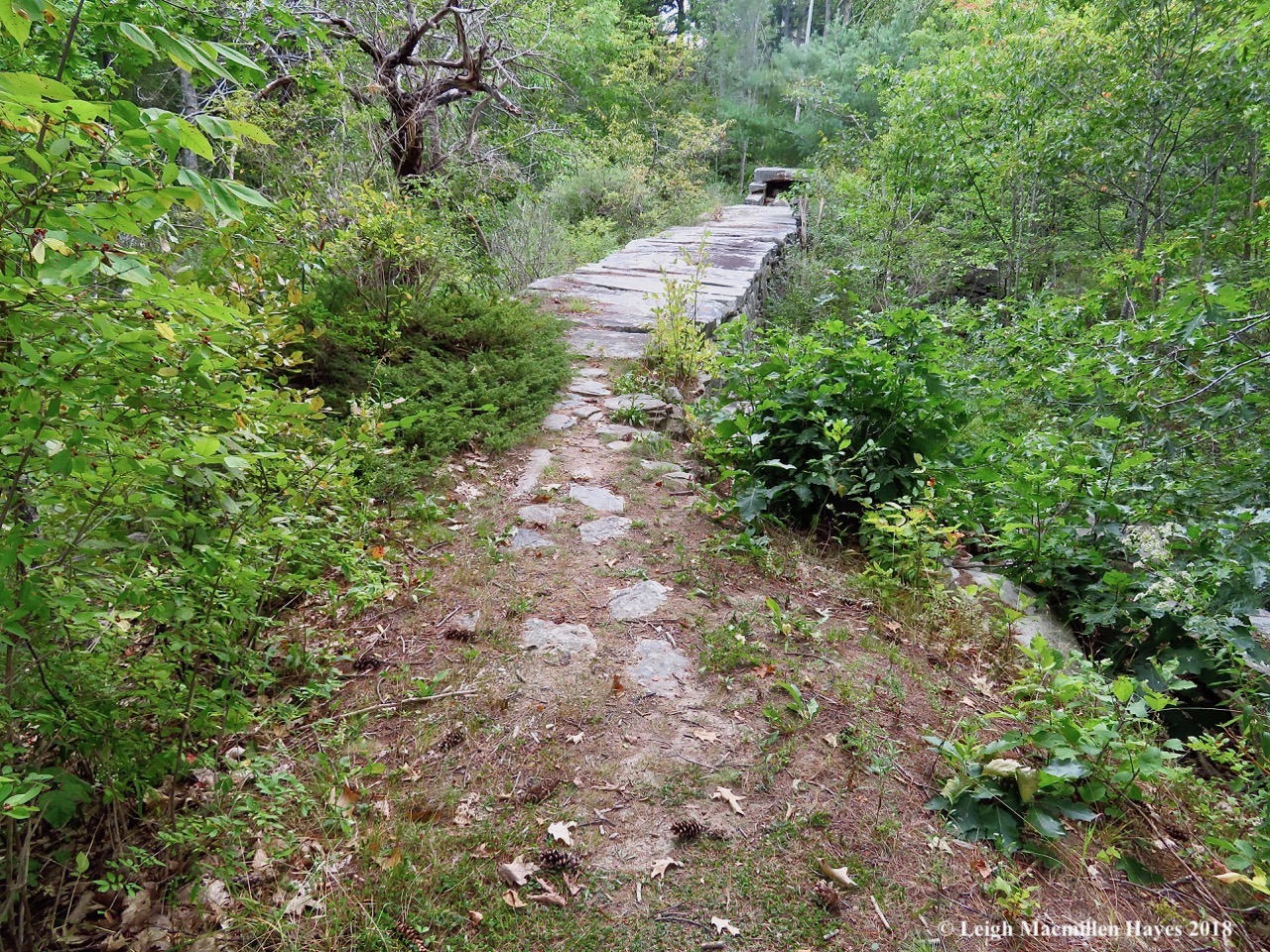
In other places, a stone pathway had been carefully laid out before us.

roots

And no woodland trail is complete without an array of roots and rocks.

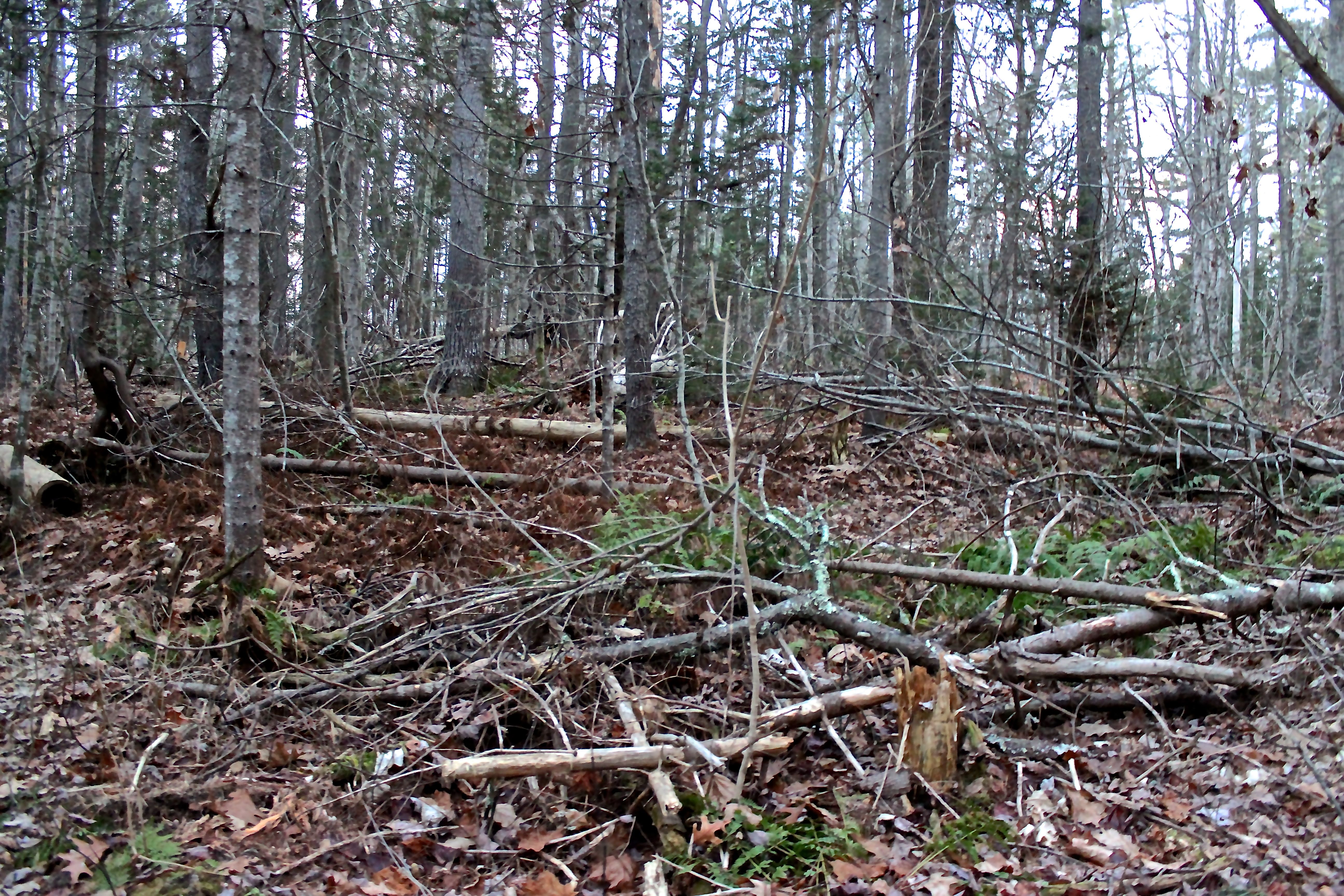
blow downs

One of the noticeable features of this location is the number of uprooted trees.

blow down dominoes

The wind enjoyed a serious game of tic, tac, toe, three in a row or dominoes with this event. Here’s hoping that no one planned a picnic that day.

blow down every which way

And in other spots, it looked like the gale force winds of both summer and winter beat upon the landscape.

curves

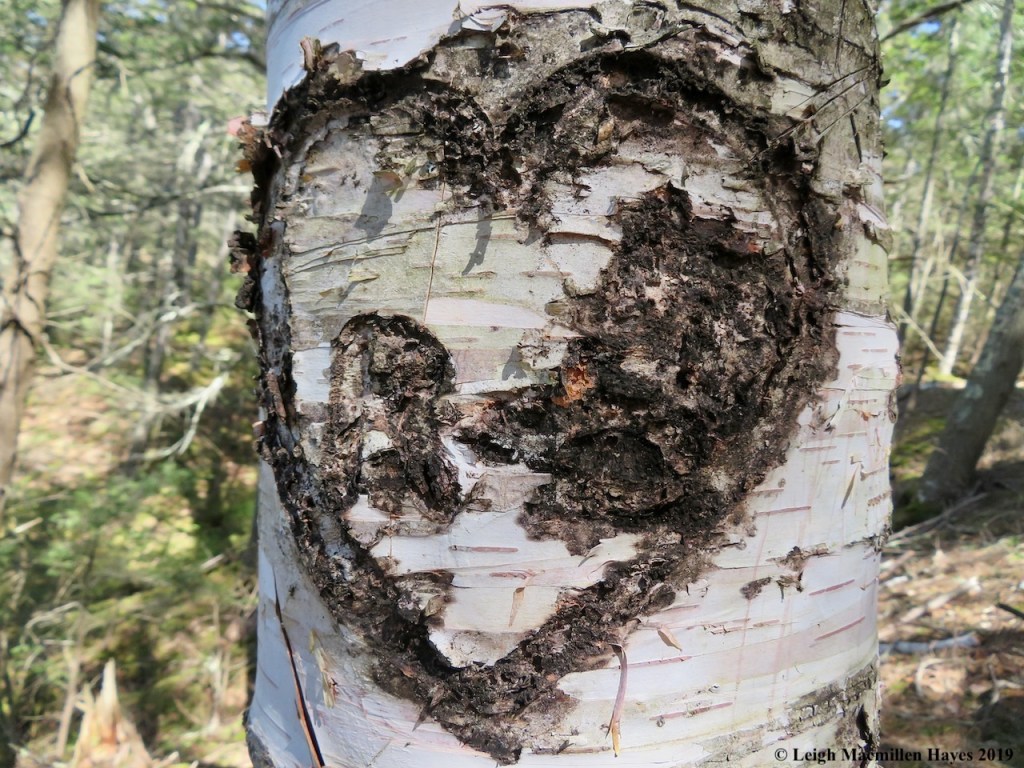
Always on the lookout for interesting sites, my eye was drawn to the wavy inner bark of this old birch. It could be locks of Rapunzel’s hair. Of course, I also see a mermaid swimming in the slightly darker wood. Isn’t that what a naturalist is supposed to see?

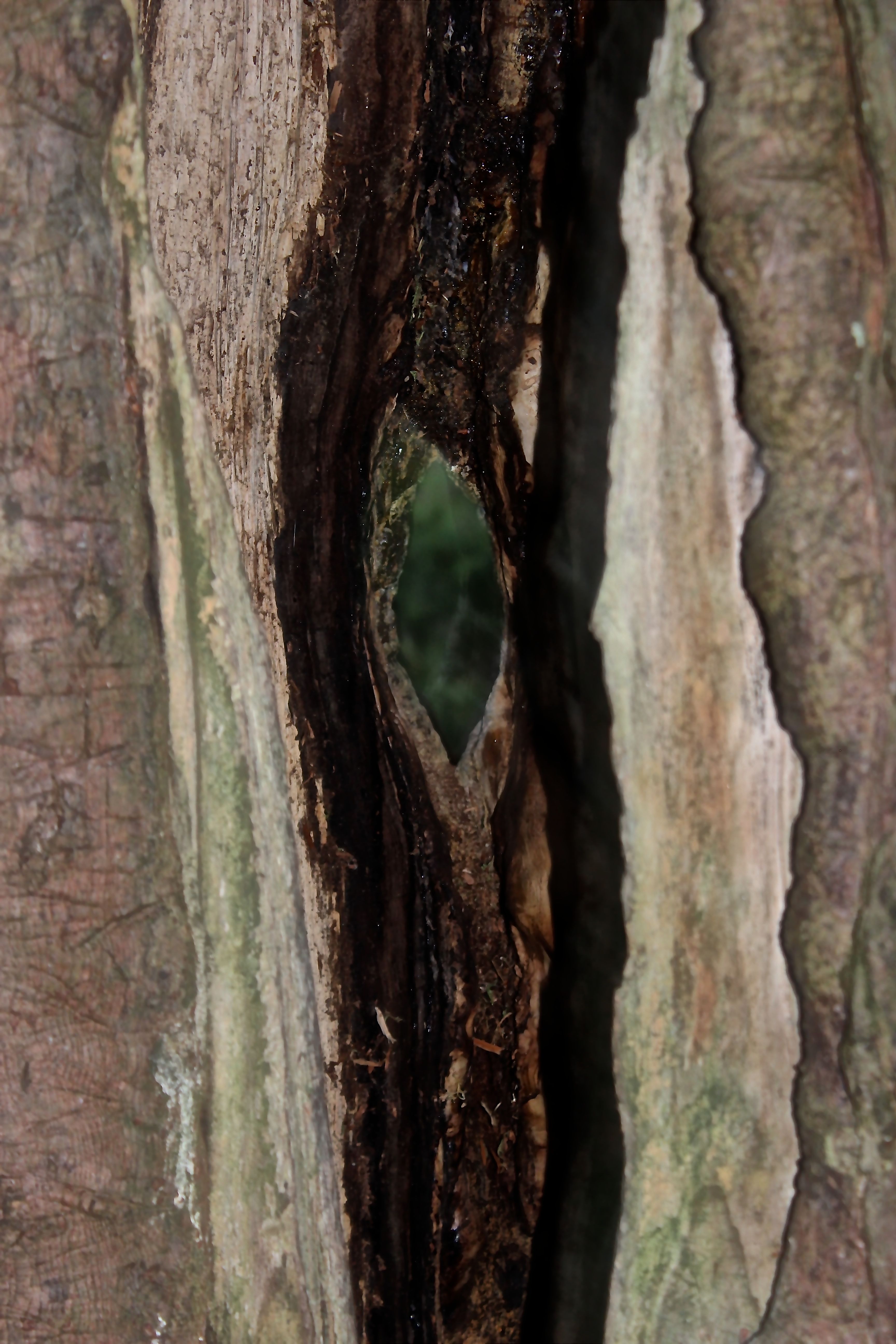
eye in the tree

And then there was the hemlock-green sideways-turned eye–taking a different view of the world.

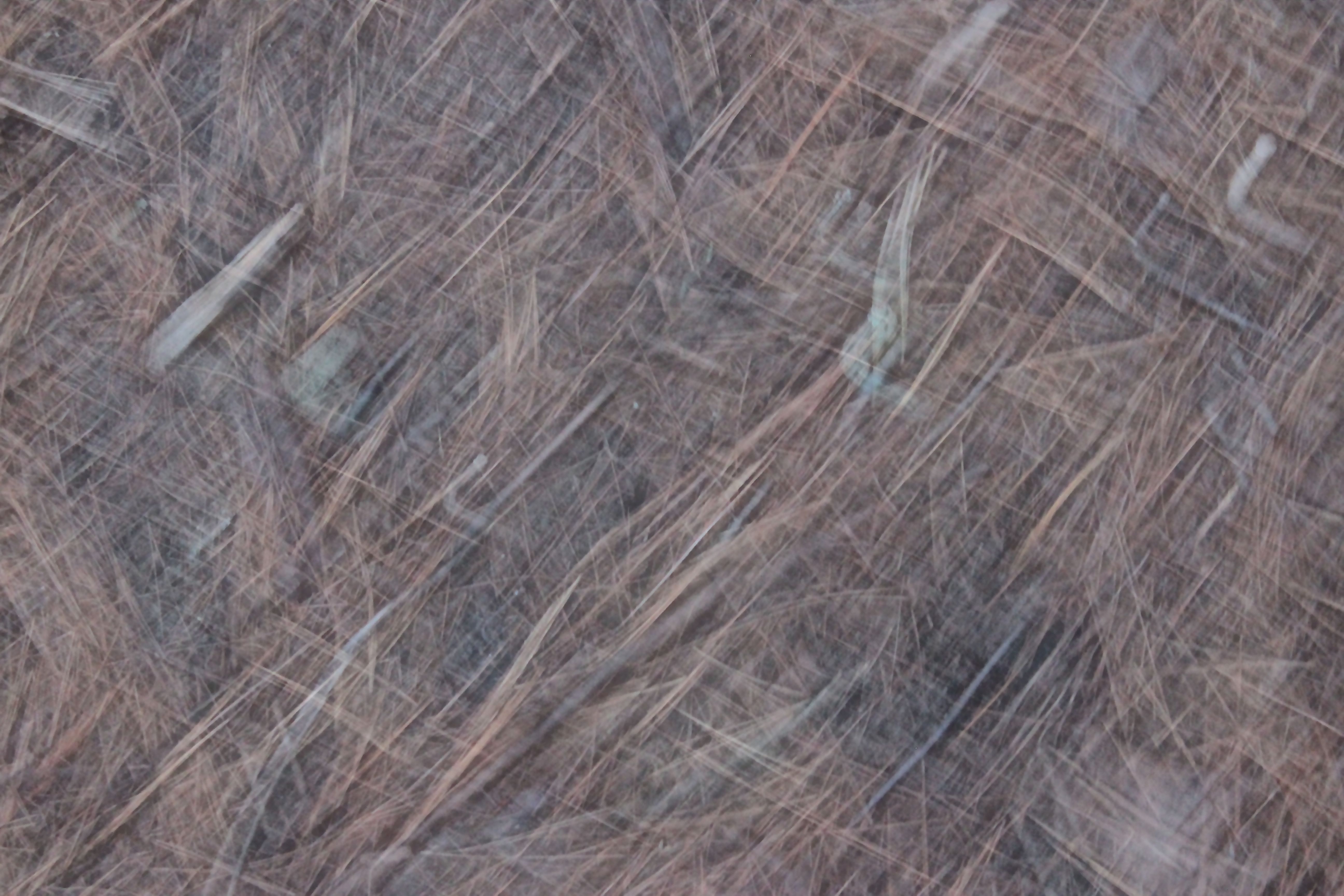
pine needles

While I’m sharing some interesting shots, I thought I’d include this one–of pine needles. It was getting dark and I chose the wrong setting, but I like the artsy texture of it–tweed-like in appearance.

seeing red

And the most interesting of all. My guy–he could pass for the invisible man.

Casco Bay Islands

Of course, we were beside Casco Bay, so we spent time exploring the coast line as well.

islands floating in distance

My knowledge of the island names is less than limited, but it did appear that those in the distance were floating on water–a mirage.

Goggins Island

As part of the park, Goggins Island is an Osprey sanctuary. Though I respect that, I do have to wonder about the human impact on the bird’s mating season. We’ve seen Ospreys build nests atop telephone poles over highways and bike paths with successful births despite the continuous noise and disturbance. But . . . a sanctuary certainly provides an extra layer of protection.

osprey platform

We could only spot one cock-eyed nesting platform on the island–with no nest on it.

Osprey nest 1

We did spy a bird-made nest on the mainland, and rather close to the trail. Just saying.

Googins in sunlight

All nests are abandoned now as the birds flew to South America in September–with plans to return next year to this golden paradise where they’ll mate again. Ospreys are monogamous and repeatedly use the same nest site. That’s the amazing piece to me.

rocky coast

The rocky coast of Maine includes the lighter colored granite pegmatites and darker metamorphic rocks with their repetitive flattened layering.

islands--lines in the rock, sea and sky

I found it intriguing how each layer before us mimicked the next–from the rocks to the ocean waves to the islands to the clouds in the sky.

late afternoon light

And then it was time to bid adieu. The setting sun where the forest meets the bay–Casco Bay. On. A. Mondate.