Vernal Pool 1: Oh Baby(ies)

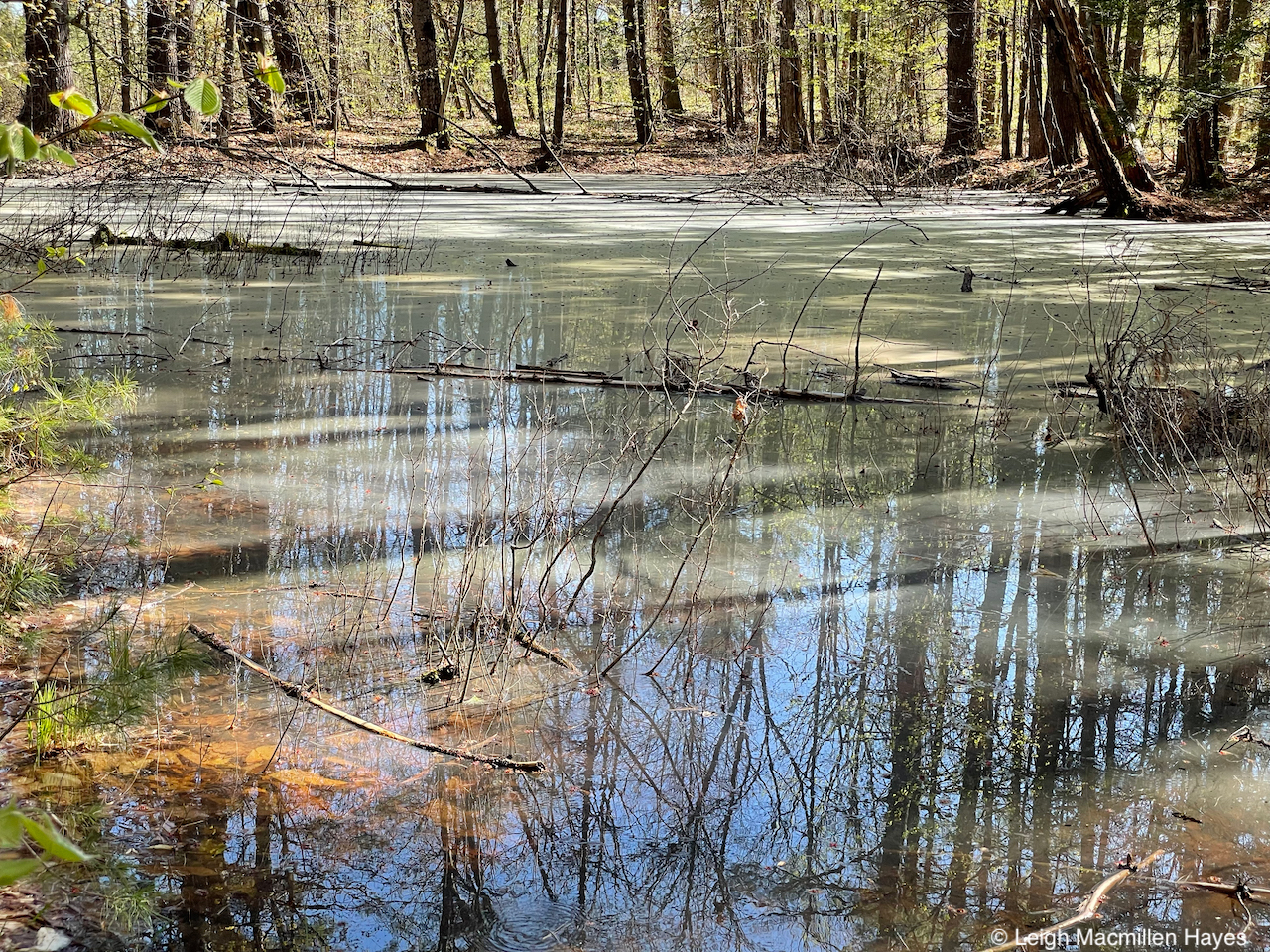
Once the snow and ice began to melt, I started making almost daily visits to “My” vernal pool, located about a quarter of a mile from our house, and only a hop, skip, and jump, well maybe a few hops, skips, and jumps, from the cowpath, and more importantly, on neighbors’ property.

I met the neighbors for the first time last November when I spotted them walking their dog through their woods as I looked for any insects on trees. They were breaking branches to create a sorta trail, and I encouraged them to walk the cowpath instead because it’s flat and I try to keep it cleared of downed branches.

It was upon our second encounter when they did actually use the cowpath (and have done so regularly since though our paths haven’t crossed in months) that I asked them if they knew about the vernal pool. They did not. The dog was a rescue and they’d only had her for a few months and she was the reason they were out walking in the woods.

Being my blunt self, I did ask that they not bring their dog to the vernal pool in the spring and explained about the Wood Frogs and Spotted Salamanders who use it as a breeding pond. Yeegads. But they didn’t take it to be rude, and instead told me that they think they have another vernal pool elsewhere on their land, closer to their house. Then they invited me to walk in their woods and explore anytime. Um, I thanked them and admitted that I’ve been doing that for years; I just don’t go close to the house.
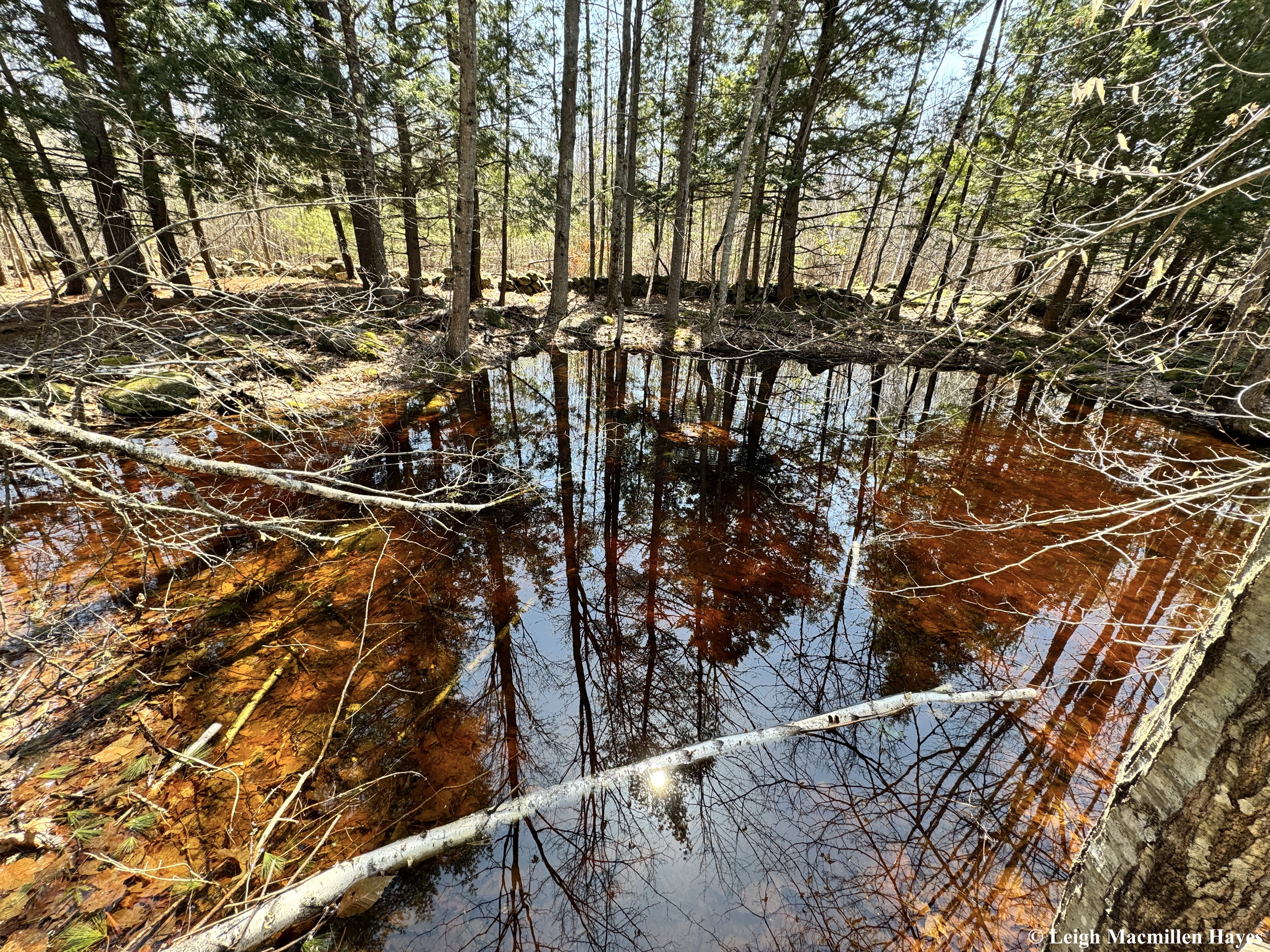
At last, about two weeks ago, the ice went out. But . . . there was no action. It was cold and seemed to snow every other day and the ground was still frozen and the breeders just weren’t ready. I waited.
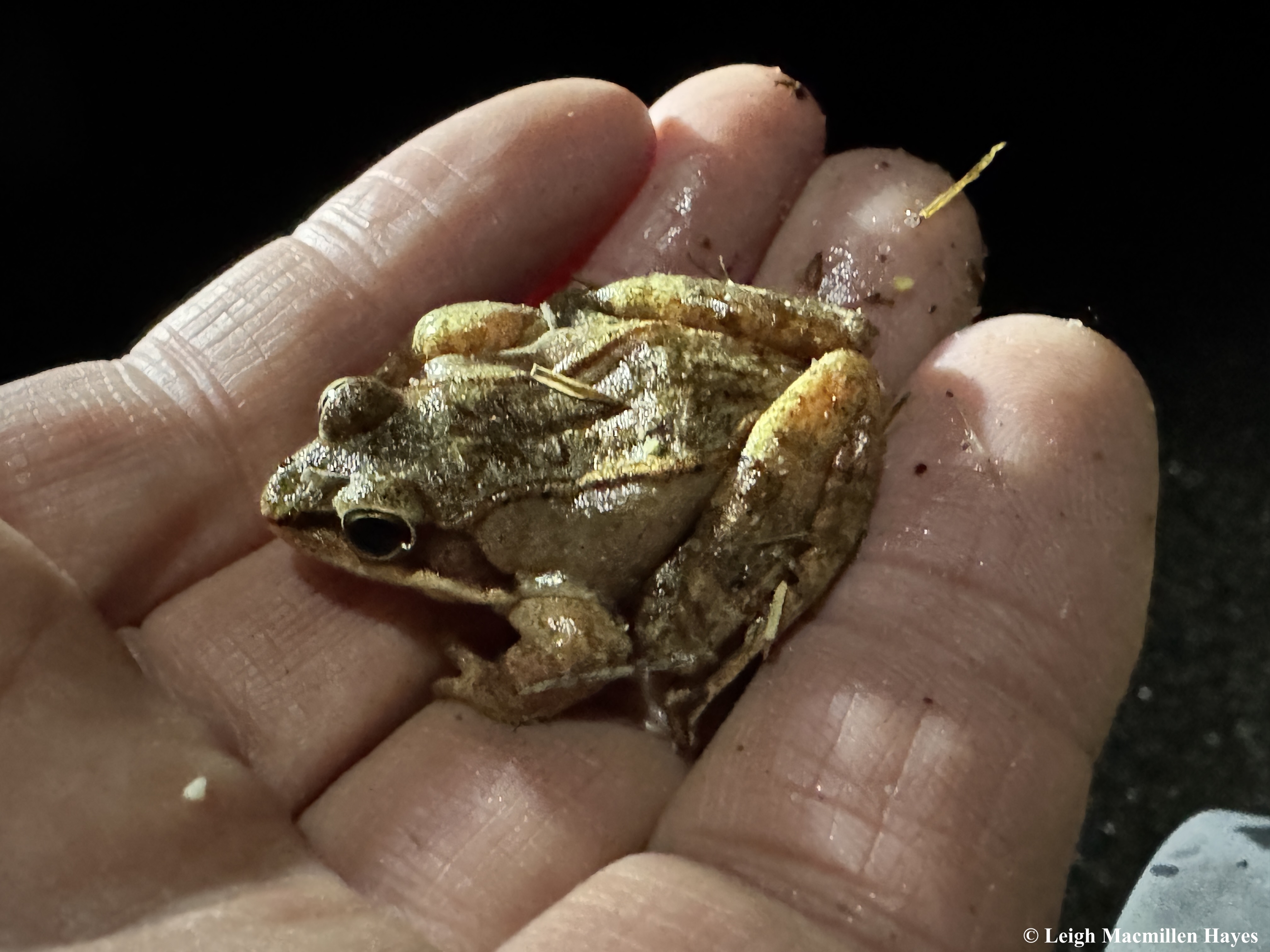
Finally, on Sunday, April 13, 2025, we had some rain, and our local Big Night celebration was announced via text and email messages. Big Night is that night(s) when it’s been raining in the afternoon and evening and the roads are wet, and volunteers head out to locations close to home to help amphibians cross the road without getting smooshed. Or help most of them.

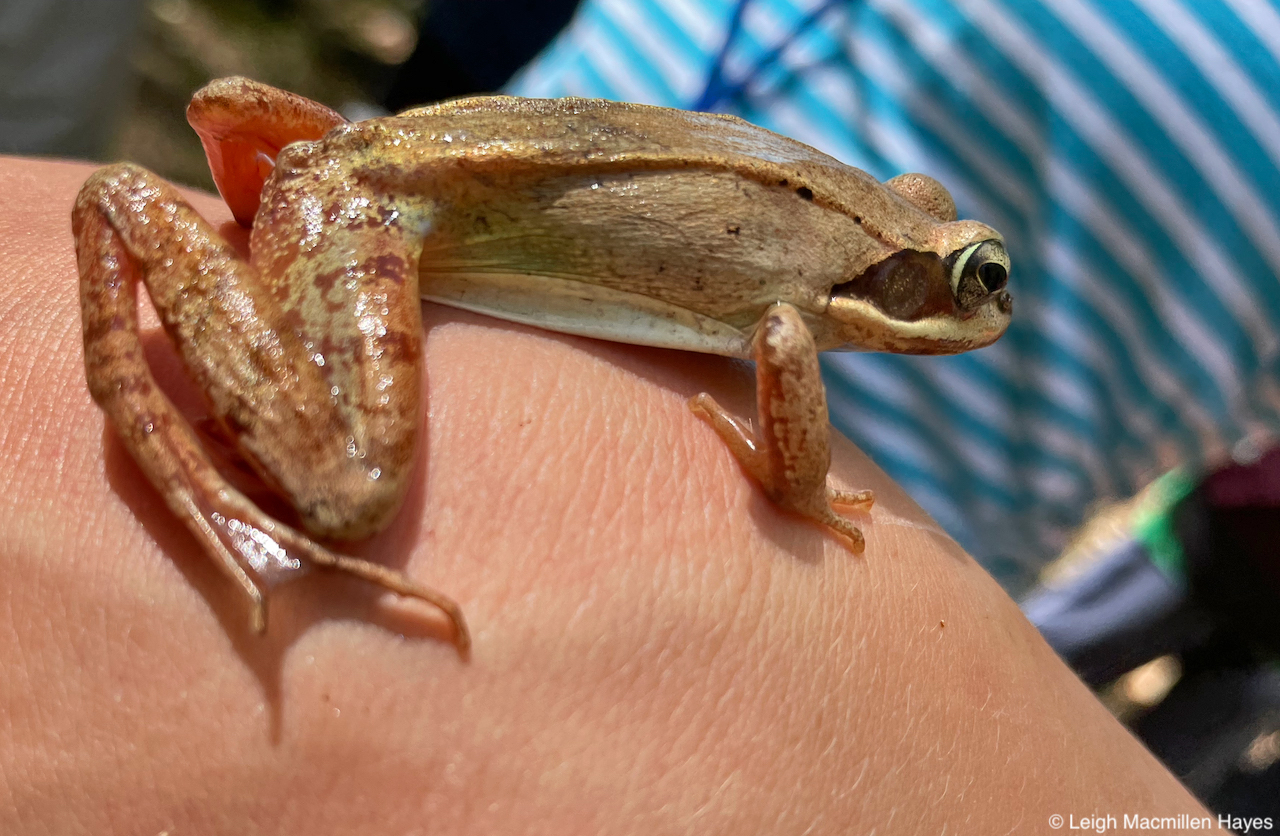
We didn’t hear any Wood Frogs or Spring Peepers as we approached the pool of our attention that night (not “My” vernal pool, which is thankfully not near a road), so we weren’t sure if we’d see any action. And others south and east of us had been posting for a week that they’d only found one or two frogs during any given rain event. Still, we went. And were glad we did because we helped a total of 158 Wood Frogs (including the one pictured above) and Peepers that night. There were still a few smooshed, but as always, we reminded ourselves that they become food for other critters.
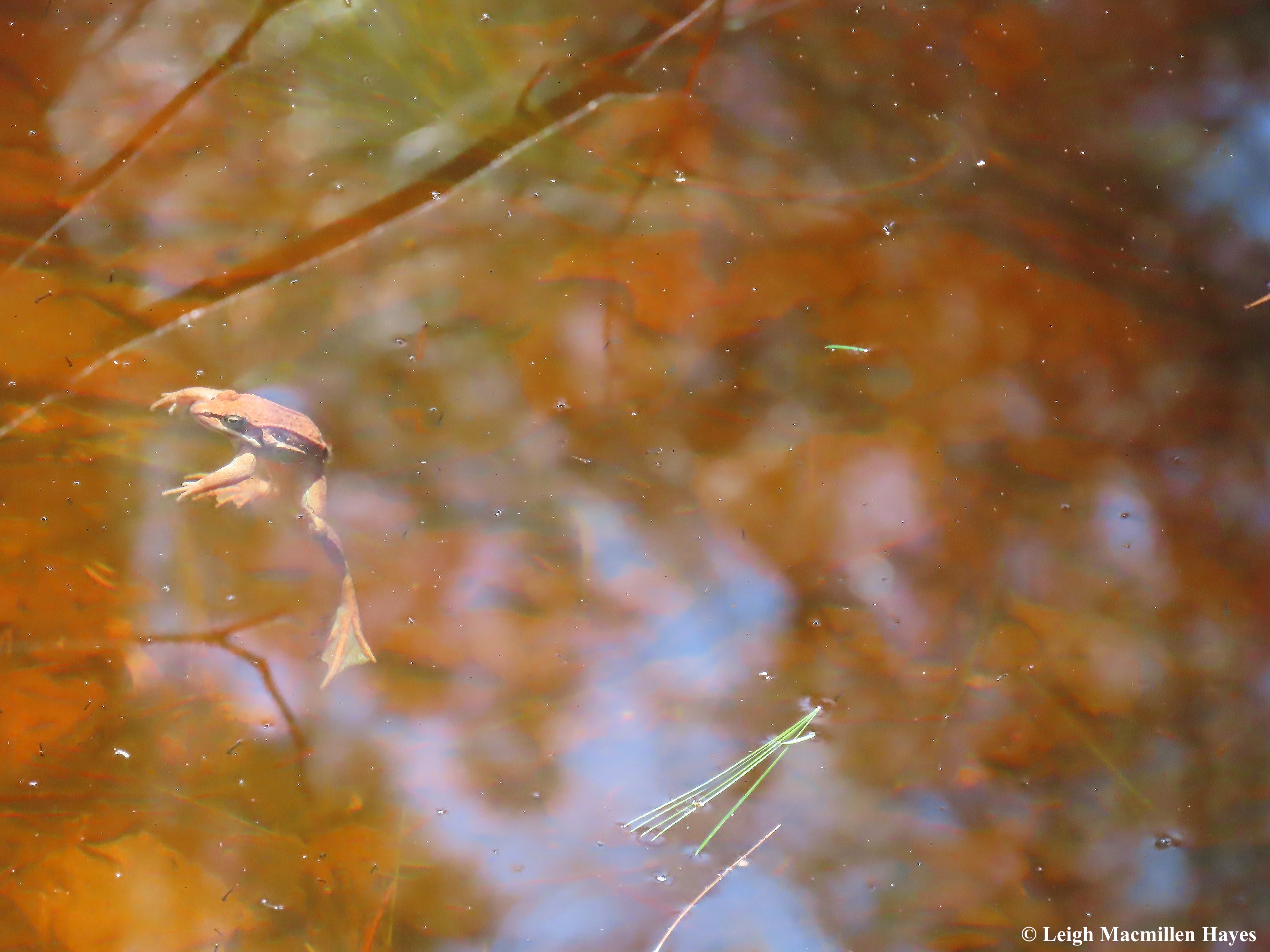
Given that success, the next afternoon I visited “My” pool and heard not a peep upon my approach. But I did what I do, and stood as still as possible upon a rock at the edge, and within a few minutes this male Wood Frog surfaced.
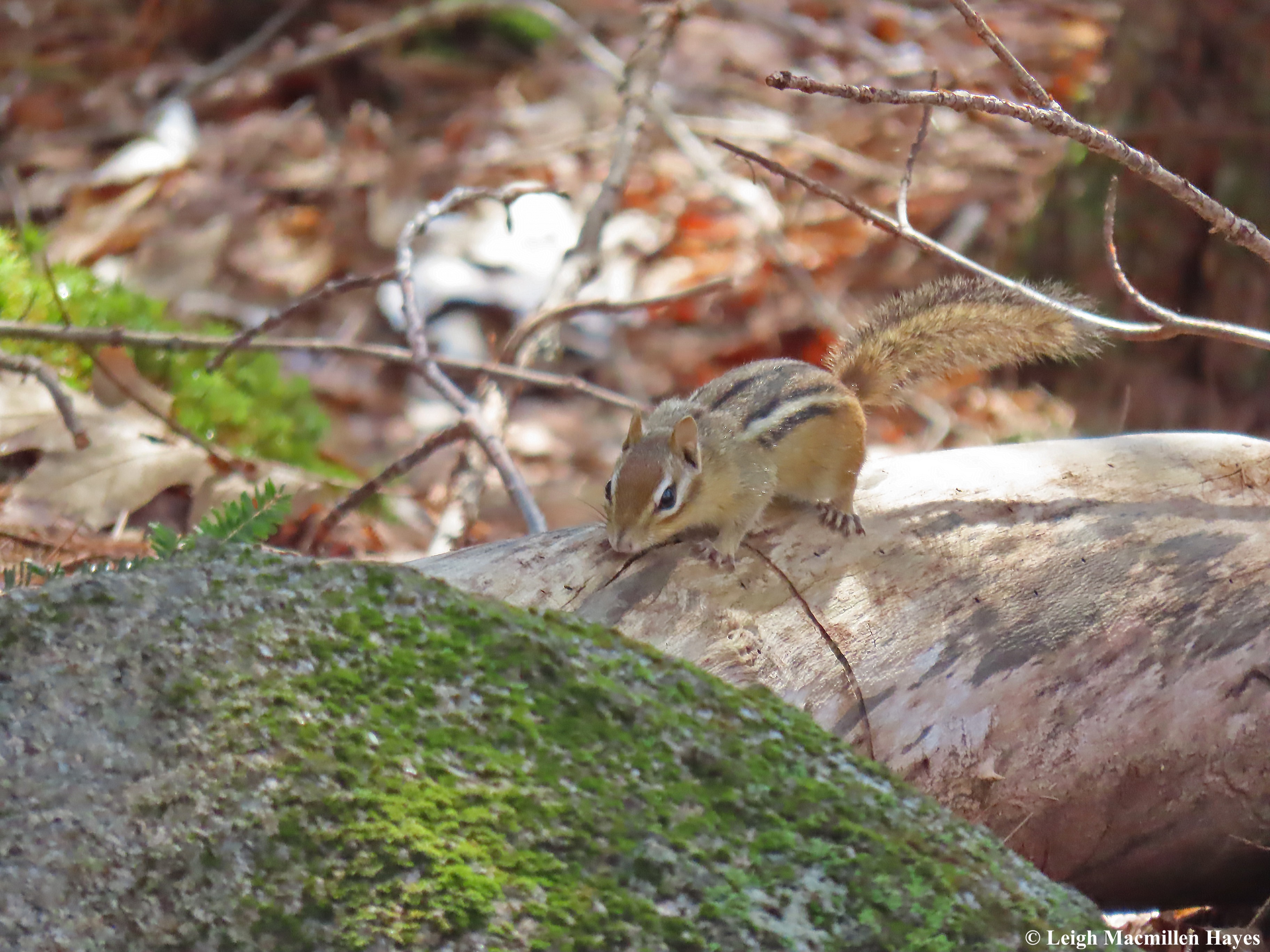
And I decided that this year I am going to try to be more present at the pool and try to get to know all who venture in and around it, including Chippy, on an eternal search for seeds to stuff into his cheeks.

Mid-morning Tuesday found me making my way to the pool again and this time, I could hear the “Wruck, Wruck” calls of the male Wood Frogs as I approached. Spring has finally sprung. Oh, and the crocuses have finally bloomed. Beaked Hazelnuts with their tiny yet exquisite magenta flowers as well.

And then, my first peek into the pool, and there it was, a Wood Frog egg mass about the size of a wiffle ball and I wondered if it had been there on Monday and I just hadn’t seen it.

As always, I stood still, and as always, it took the frogs a few minutes to surface, but suddenly they were everywhere, and probably wishing, if frogs can do such a thing, that I would leave so they could begin their mating chorus again.

But I stayed. And wondered. Why is it that a Gray Squirrel, like the Chipmunk, can scamper about and rustle the leaves and make all kinds of noise and the frogs continue to float upon the surface, but the minute I flinch, they dive to the bottom and hide under leaves for minutes on end?
I did decide to change positions after a bit of enjoying the sight of so many frogs, because I wanted to see if there were any egg masses at the western end of the pool, but discovered none.

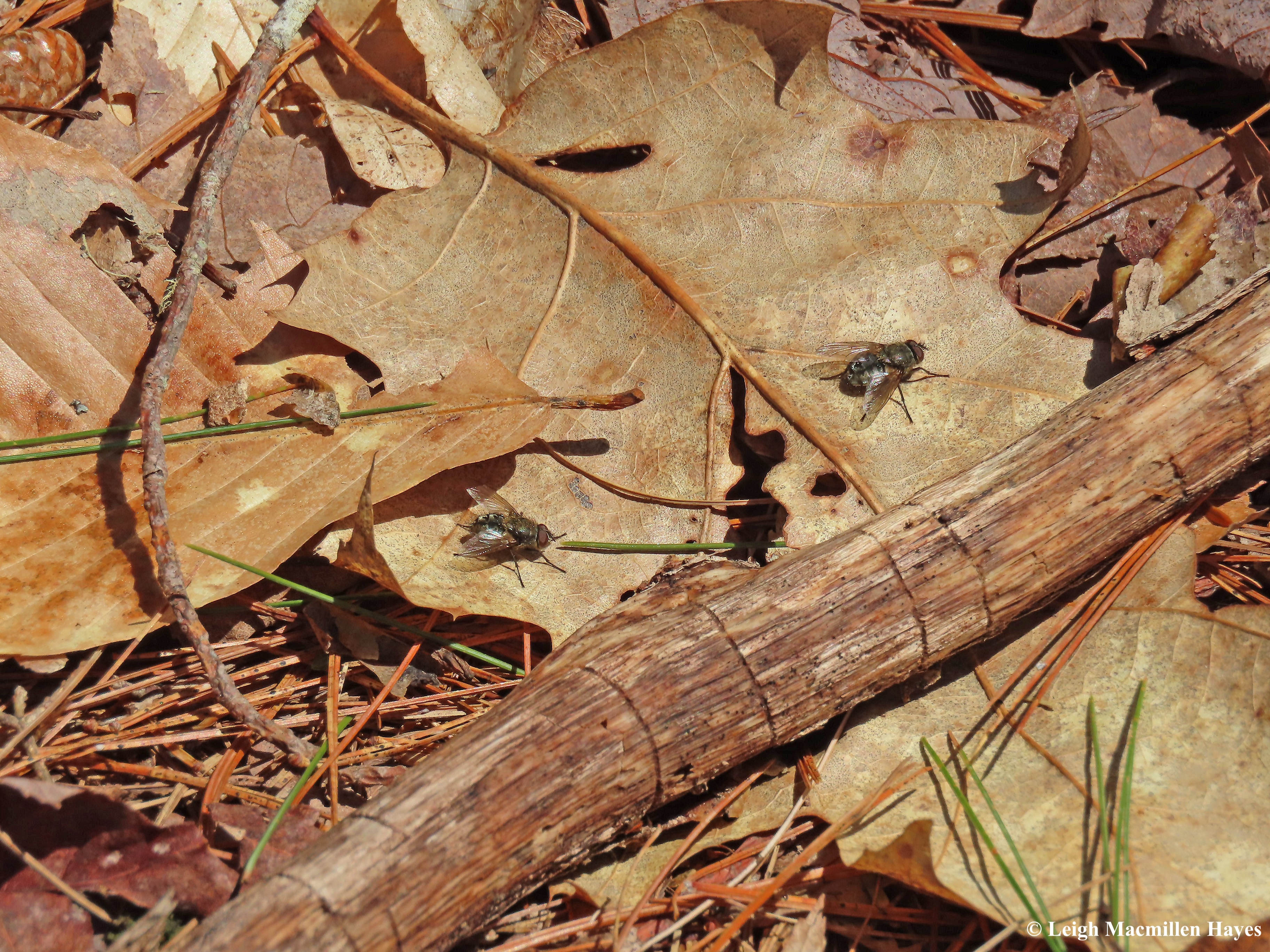
I did spy a bunch of Cluster Flies by the edge of the water.

And in the water, I watched Mosquitoes larvae wiggle about and a Predaceous Diving Beetle lift its butt to the surface to fill the air bubble located under its wings or elytra.

And then the Beetle surprised me and after swimming under the small log, it climbed onto it and gave me a whole different perspective for I never think about them as fliers, but they have strong wings and can do such, especially if the pool they are in dries up and they need to get to another pool. Apparently they are also attracted to lights, another reason not to keep outdoor lights on all night.

My morning visit came to an end when the frog nearest to me dove down and hid under the leaf cover. Well, sorta hid. Do you see it?
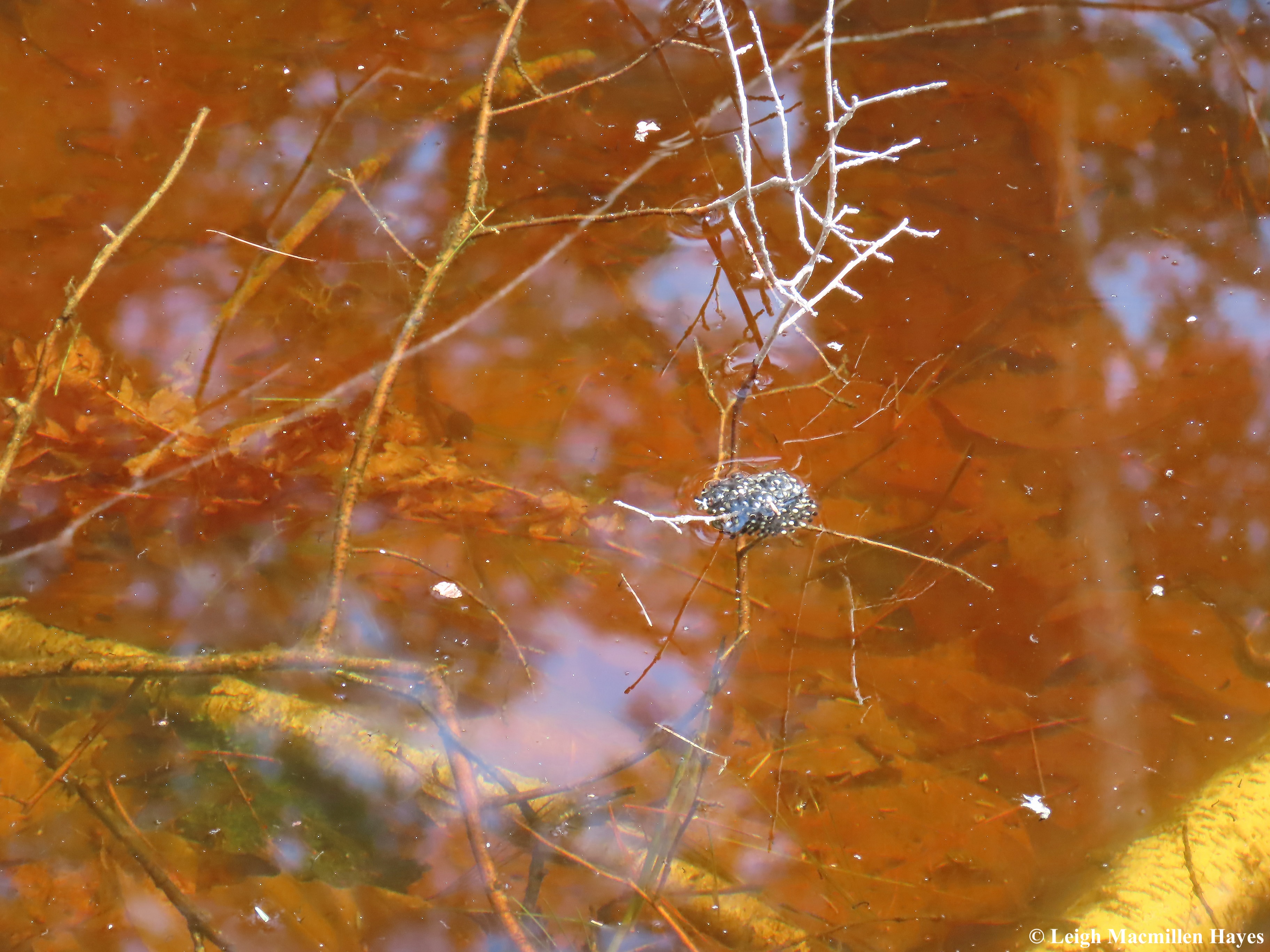
I was so taken with the pool, that I returned again in the afternoon. And this time I spotted something I’d missed in the morning. A more recently deposited egg mass. I suspect it had been there for at least a few hours because it was already bigger than a quarter, which is the size they are at first.
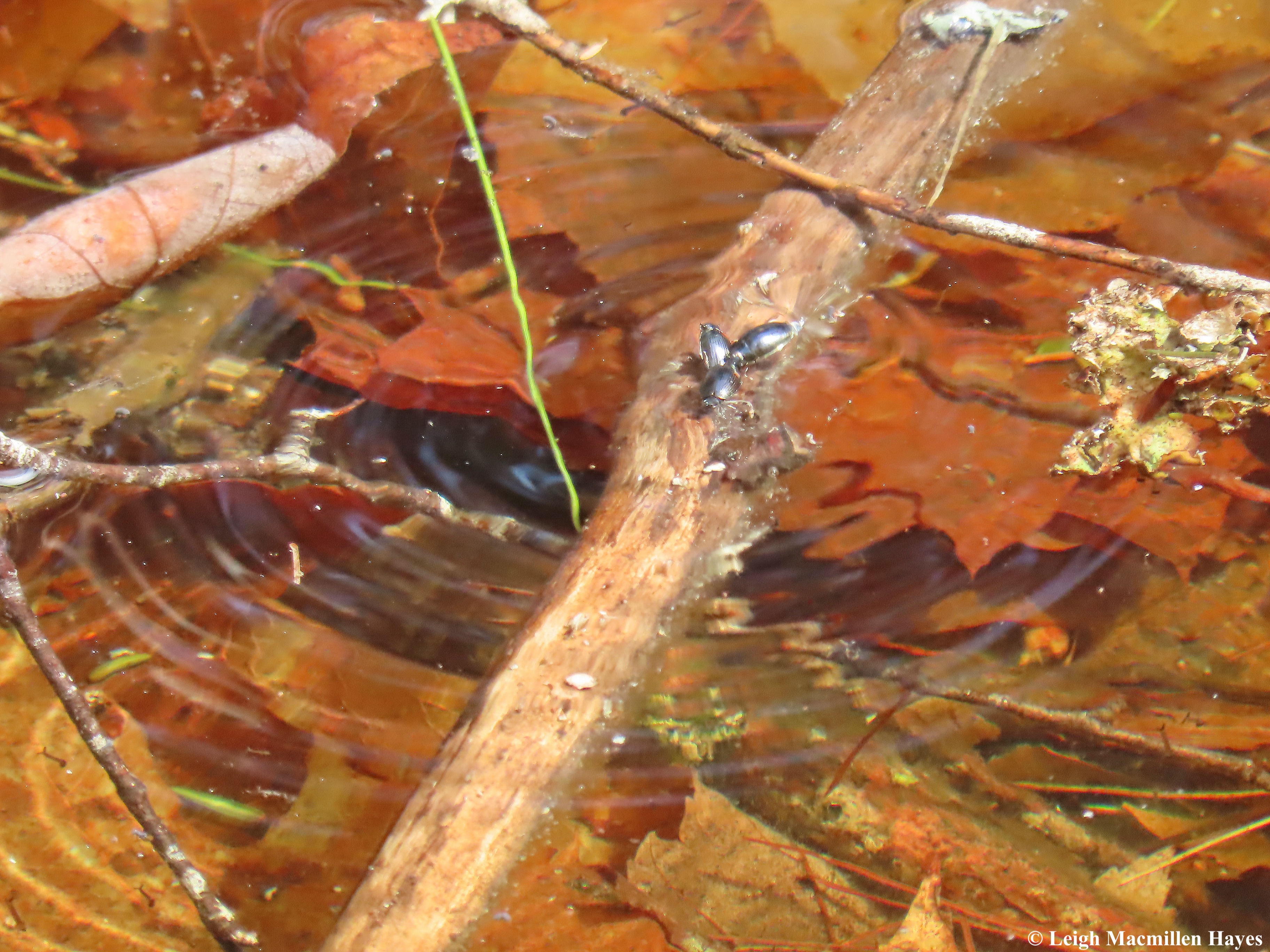
During this visit, I also spotted Whirligig Beetles gyrating around each other in breakneck speed, creating ripples everywhere.

And male Wood Frogs ever on the look out for a date.

In fact, so anxious were they that sometimes one male tried to grasp another, but the one underneath quickly squealed and swam away.

Then I spotted another old friend or its relative and wondered if the Long-jawed Orb Weaver that had created a perfect web between branches over the water was one that I’d photographed on the snow this past winter. Probably not. But a woman can dream.

Later in the afternoon on Tuesday it began to rain and while the storm didn’t last too long, it was enough to wet the roads and again the word went out for Big Night #2. This time there were a few Spotted Salamanders on the move as well.

The next photo may disturb you, so you may want to skip over it.
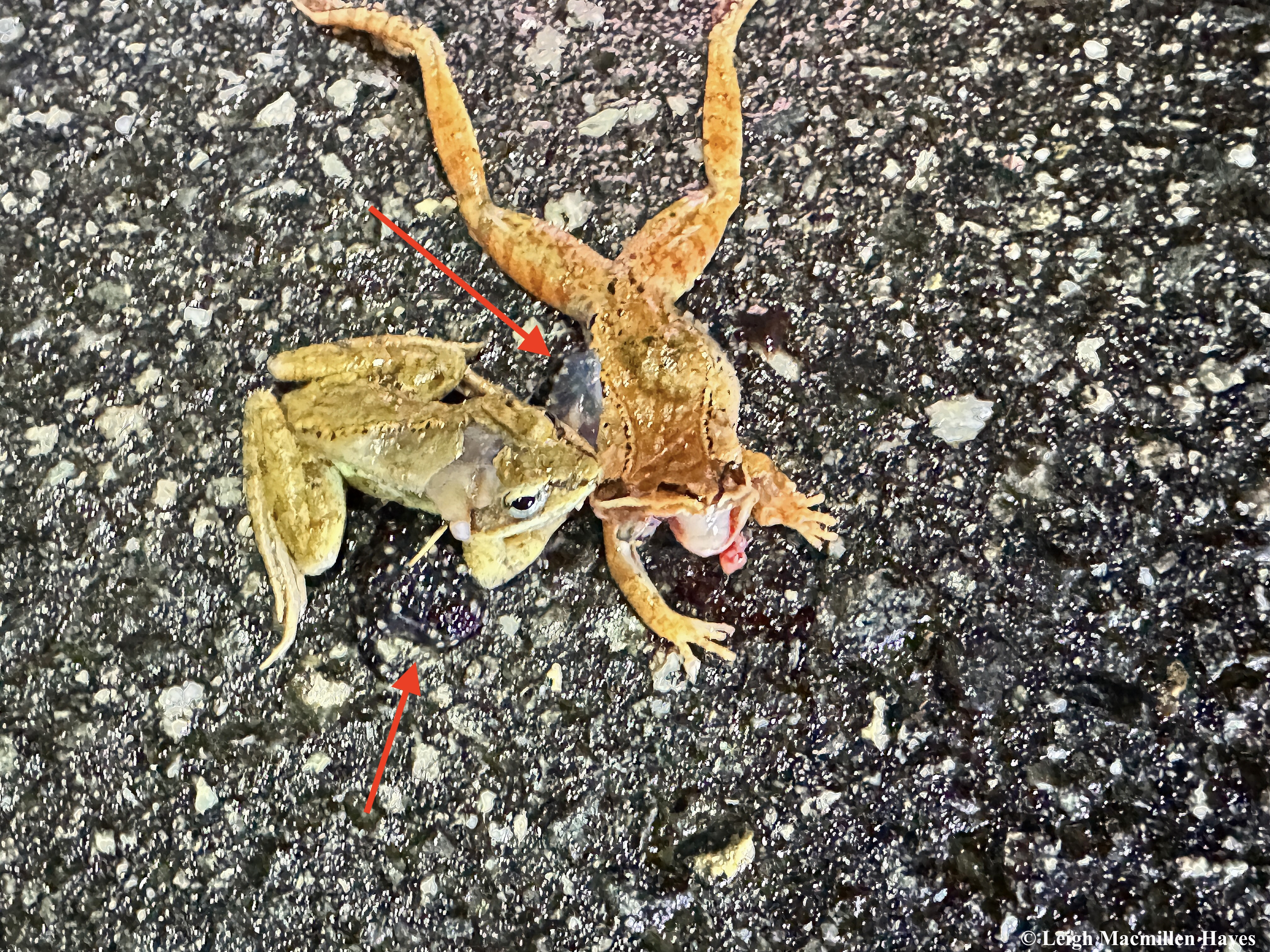
I included this picture of two squished female Wood Frogs because this is what happens when we drive by vernal pools and other wetlands on rainy nights. And I added the arrows to show the egg sacs that had popped out as the tires drove over these ladies.

We let out a communal groan as we heard the pop, and then made this discovery, trying to ease the moment by reminding ourselves that they would become food for others, but still . . . reinforcing the reason why we’ve been celebrating Big Night(s) on this local road for at least 25 years of organized events and I suspect many more before that.

All told for saves on Tuesday night: 836 live Wood Frogs, Spring Peepers, Spotted Salamanders, plus at least one Green Frog and one Eastern Newt.

That was a BIG night! And many thanks to Dawn and Maggie for organizing it.

And from the sound of the “Wrucks” on Wednesday, which was louder than the day before, I knew the ladies had returned to “My” pool as well. And the guys were feeling successful.

Within a minute of standing there, I looked down and spotted a couple embraced in what is known as Wood Frog amplexus, the smaller and darker male being on top with his forelegs wrapped around her, just above her enlarged belly.

She seemed to be in full control as she moved about the twigs, looking for a good location to deposit her eggs.
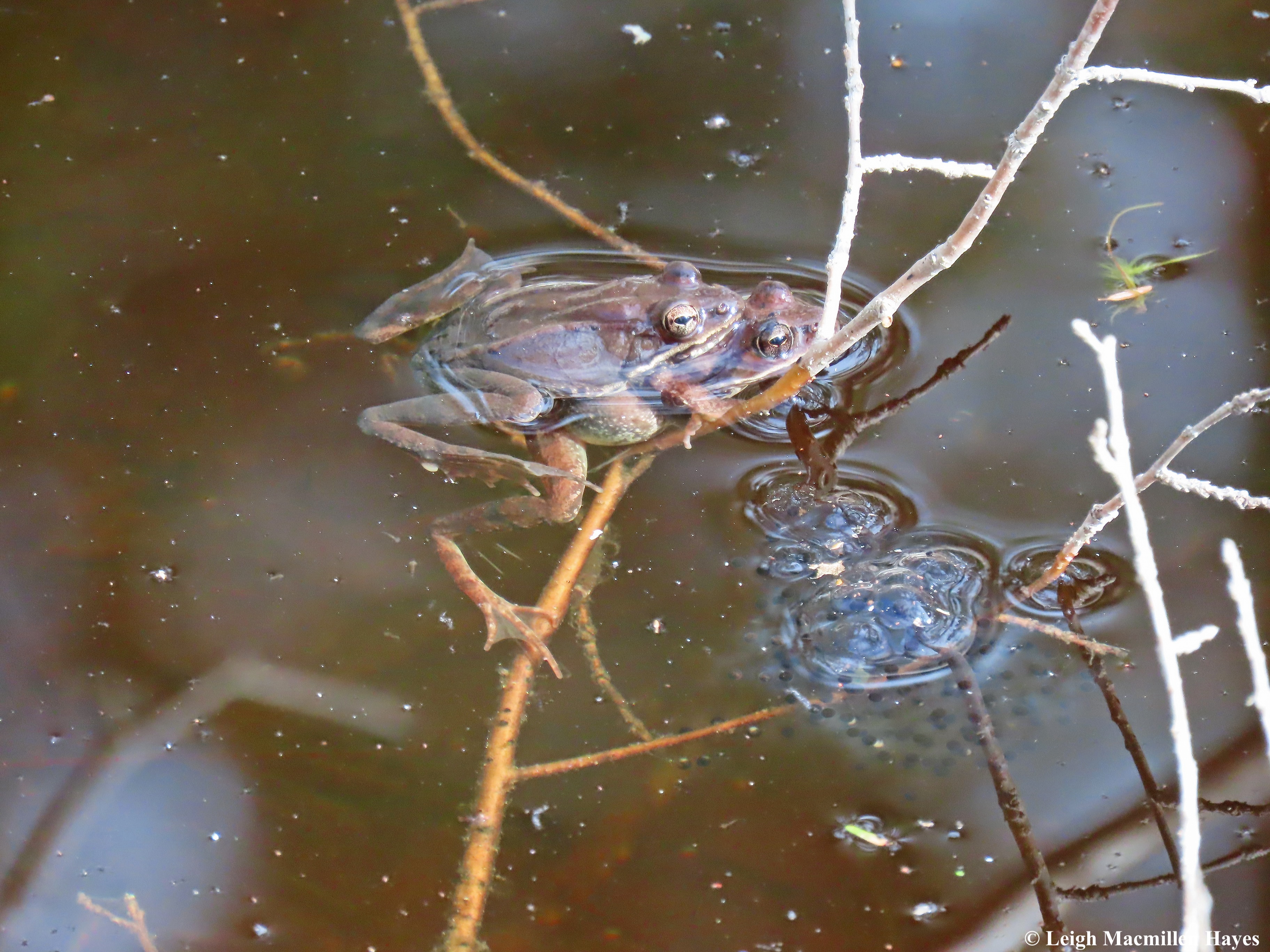
I thought the first spot was perfect because it was located near another egg mass and Wood Frogs tend to deposit their eggs in communal colonies, the better to avoid predation–especially if yours are among the first and are surrounding by other egg masses, and therefore protected.
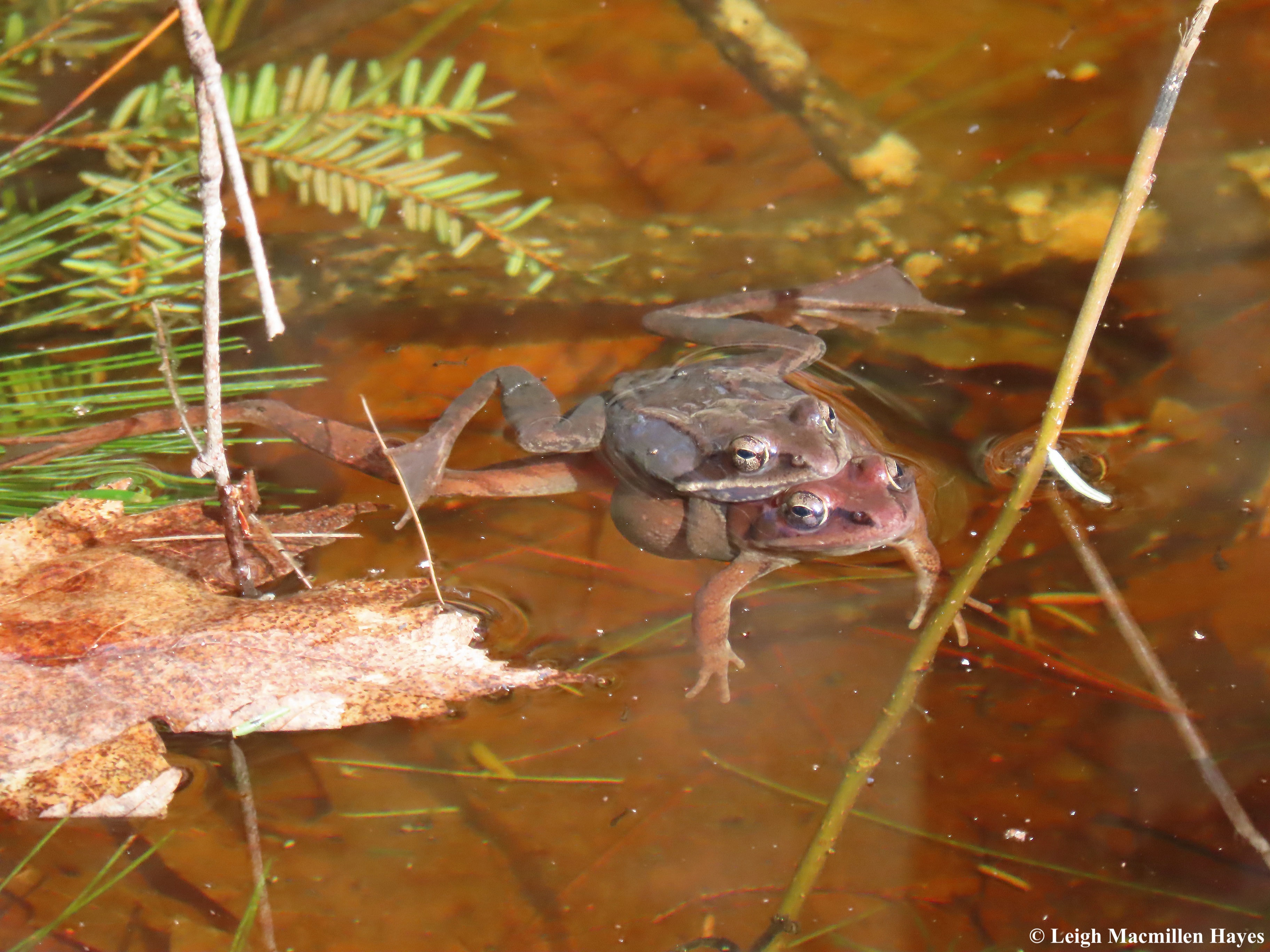
Scanning the pool, I spotted another couple and decided that going forward they need names, so this is Couple 2.

Meanwhile, Couple 1 continued to move about the same set of twigs.
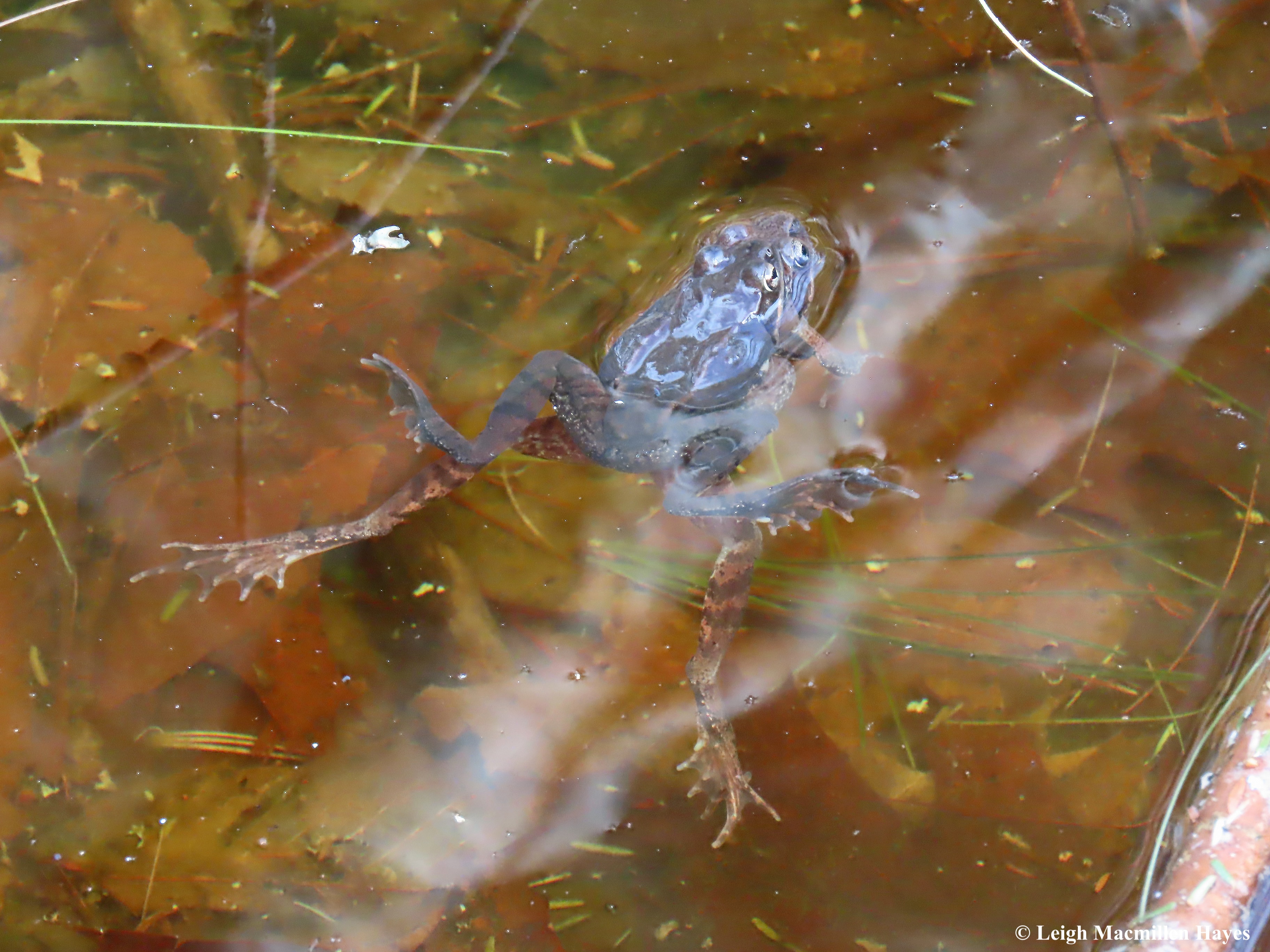
And then near my rock, Couple 3 appeared.

There were also lone males, and because it was breezy, no one seemed to mind my presence. In fact, a couple of males in the western corner even “Wrucked” a few times.
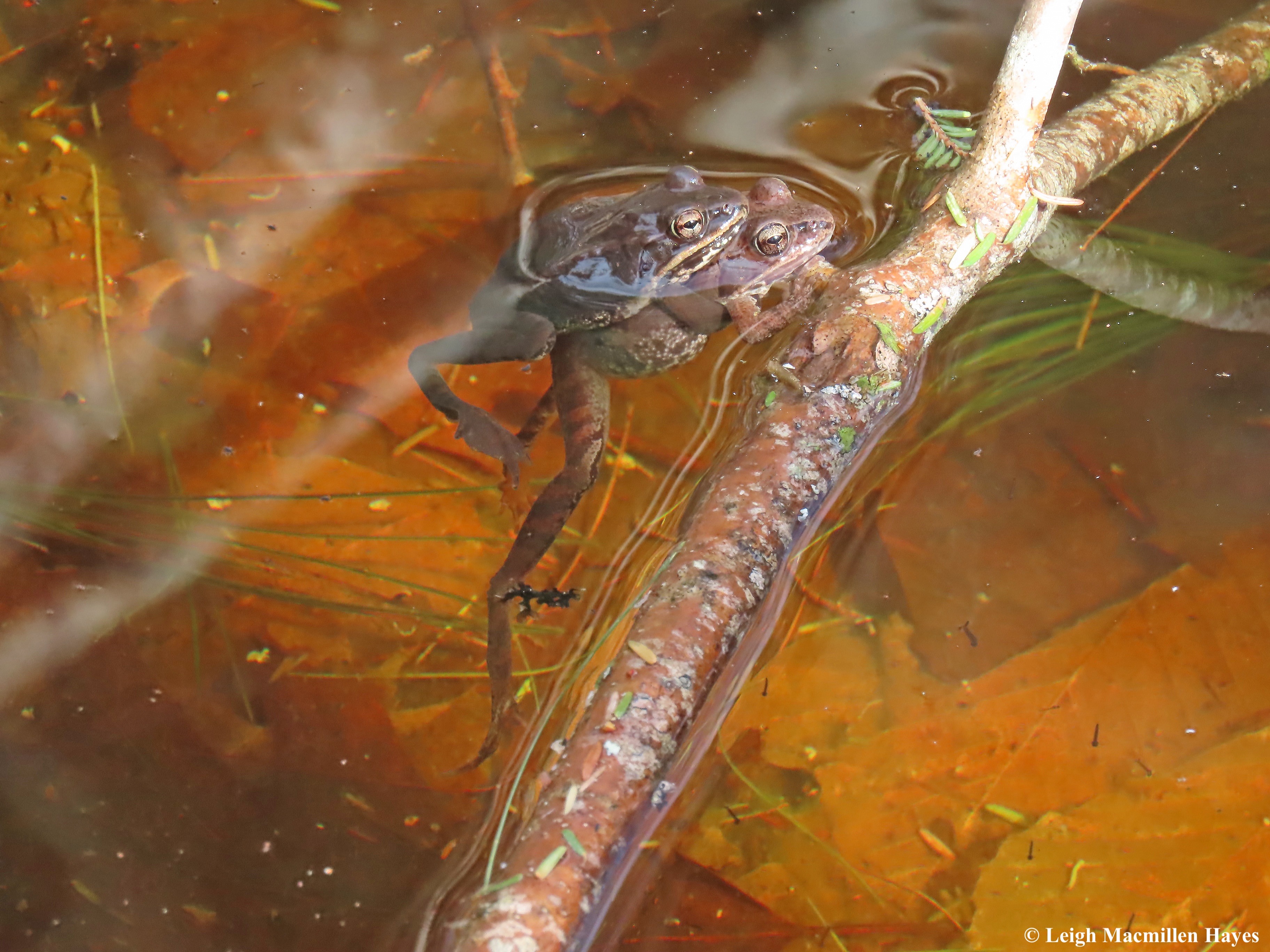
Couple 2 found a larger branch and hung out there.

But Couple 1, they were on the move again.

This time testing a different set of twigs. All I could do was wonder exactly what she was looking for. What made a prime location prime?
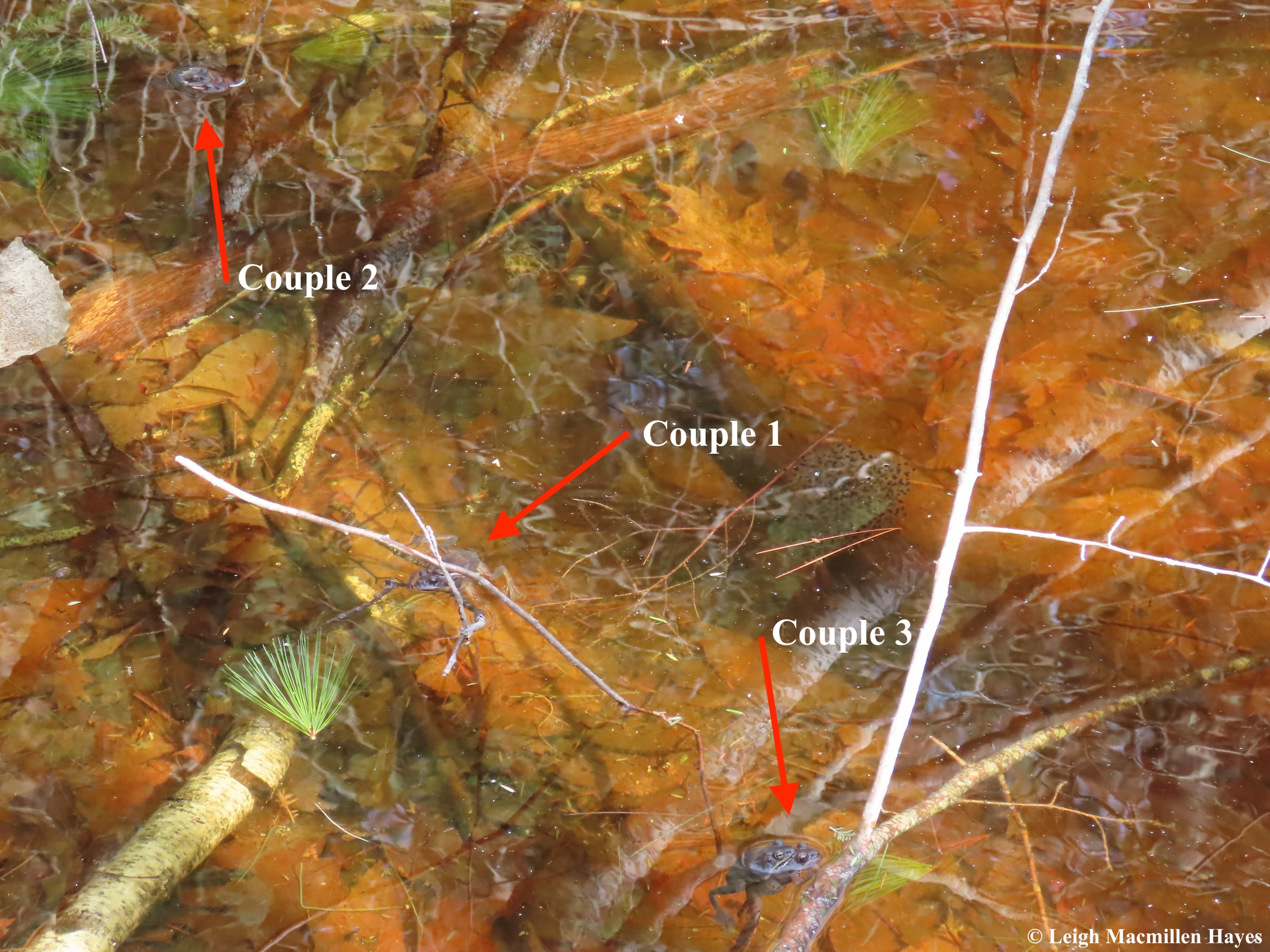
I don’t have the answer and probably never will, but still couldn’t believe my good fortune to have all three couples right there by my feet.

And then . . . and then Couple 1 swam off and disappeared under a recently fallen tree and I thought, “That’s a good place because there are so many branches to choose from,” but at the same time I was disappointed because I figured I’d never see the rest of the story.

Until . . . they swam back out and approached the twig of their first choice.
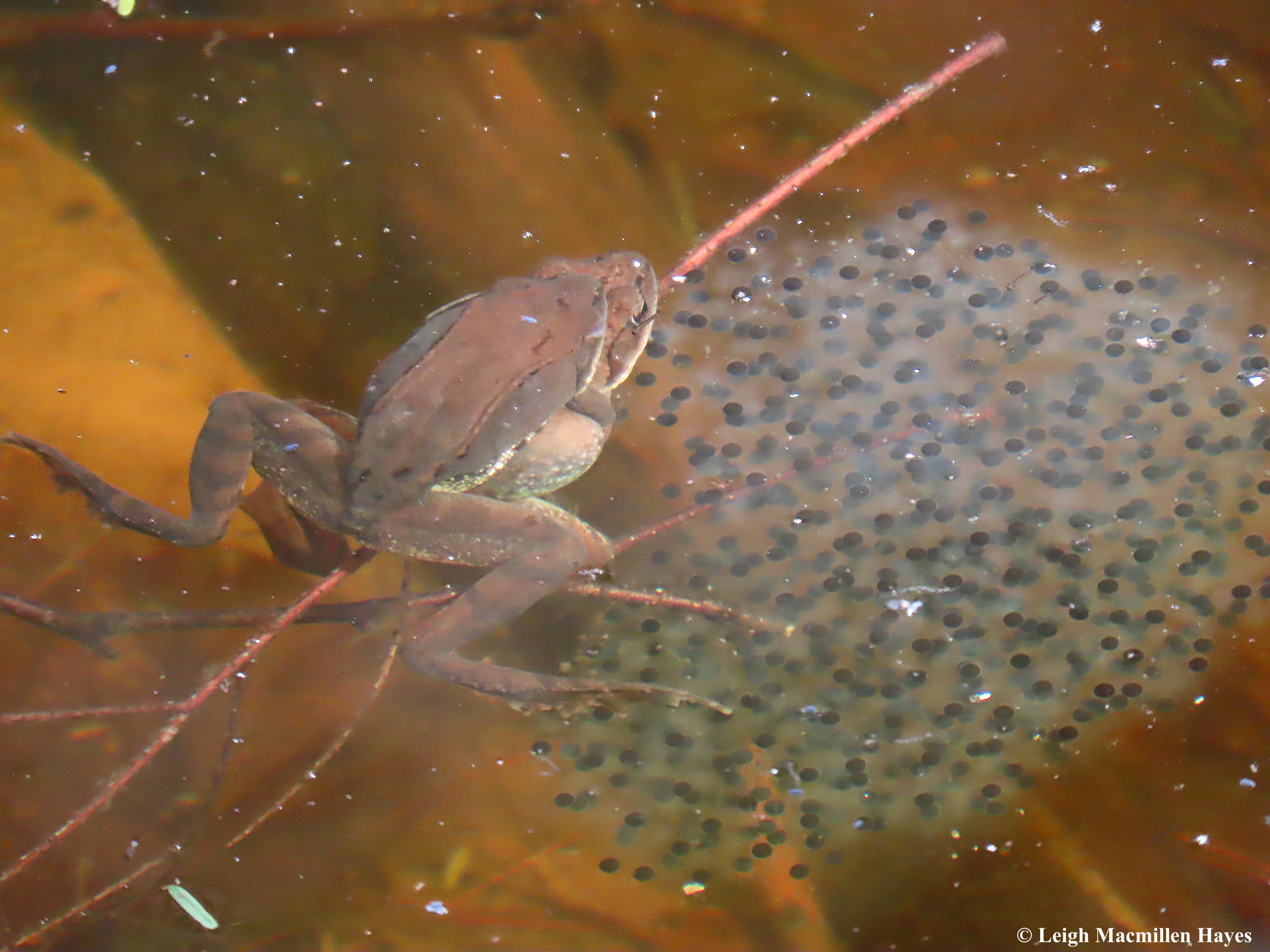
And seemed to be making a move to settle upon it.

Only they didn’t. Instead, they swam to another twig that they’d tried earlier; one that had no other egg masses.
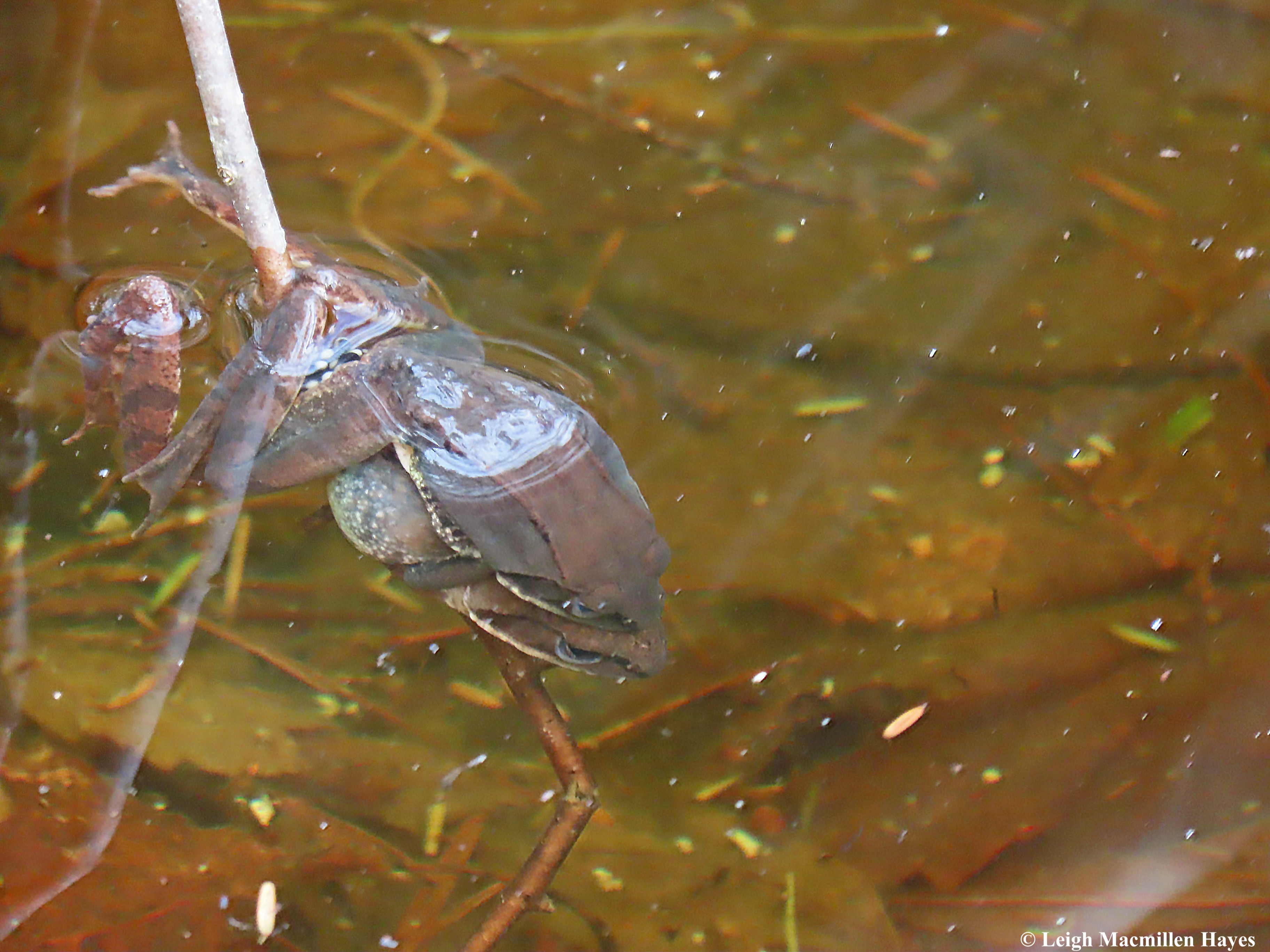
And suddenly, right before my eyes, she began to lay eggs, which he fertilized externally. Can you see the black and white dots between their hind legs?

I could not believe I was finally witnessing this amazing moment. Magic in the making.

My body was stiff from standing so still, but it was so worth the effort.
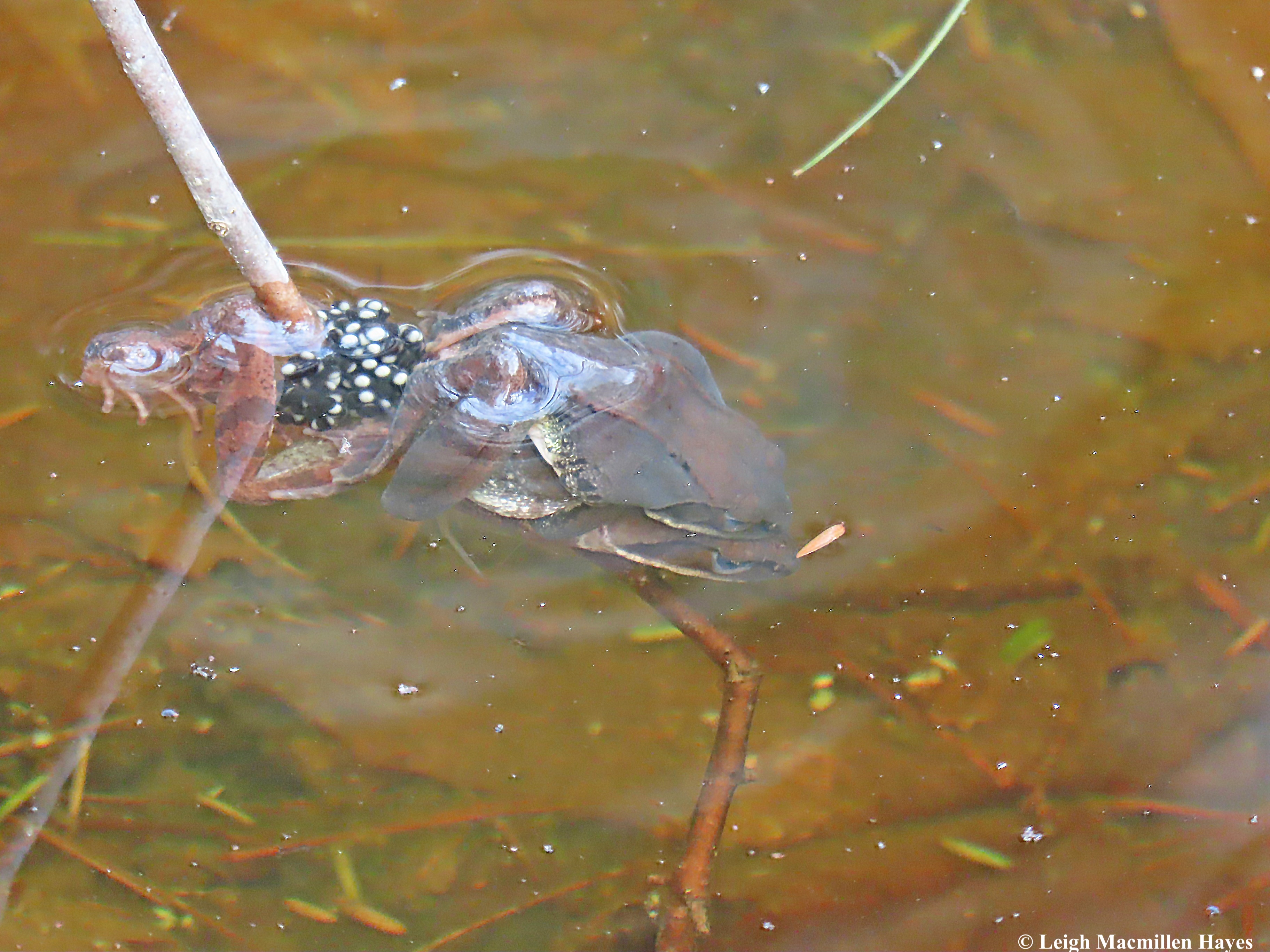
With her hind legs, and I may be wrong about this, she appeared to be wrapping the mass around the stick so it would be well attached.

The eggs are black and white, the Pied Pattern, the top of the egg being dark so predators from above may not see it because it more closely matches the dark leaves and muck on the floor of the pool, and white on the bottom so that predators within the pool will think it’s just sky.

So, as luck would have it, and I was feeling super lucky and grateful for the opportunity to observe, my camera battery died. And the back-up battery was at home. (Note to self: carry it in my pocket.)

I pulled out the next best thing and shot this photo with my iPhone. He eventually moved off of her, but not too far away, probably exhausted from all the effort. And she remained below the quarter-size egg mass for a few more minutes.

As for the other two couples, one disappeared under the fallen tree and the other went under the leaves below my rock, perhaps seeking privacy.

Finally, I took my leave. With a huge smile on my face.

Oh Baby(ies), I know your parents will leave the pool soon, but I’ll be there to watch over you. Maybe not daily, but frequently for as long as the pool holds water, being ephemeral as it is.

Marching into the Vernal Pool

I’ve lived in Maine for just shy of 40 years and can barely recall the month of March going out like a lamb, as the saying goes.

It’s certainly true that once again this year the ending of the month is more lion-like with an overnight and morning snowstorm, with freezing rain on the horizon for tonight and tomorrow, followed by a warm-up and rain on Monday.

That all said, March snow doesn’t last long.

But still . . . it has me dreaming. Remember, I LOVE winter, but am as ready for spring as the next person.

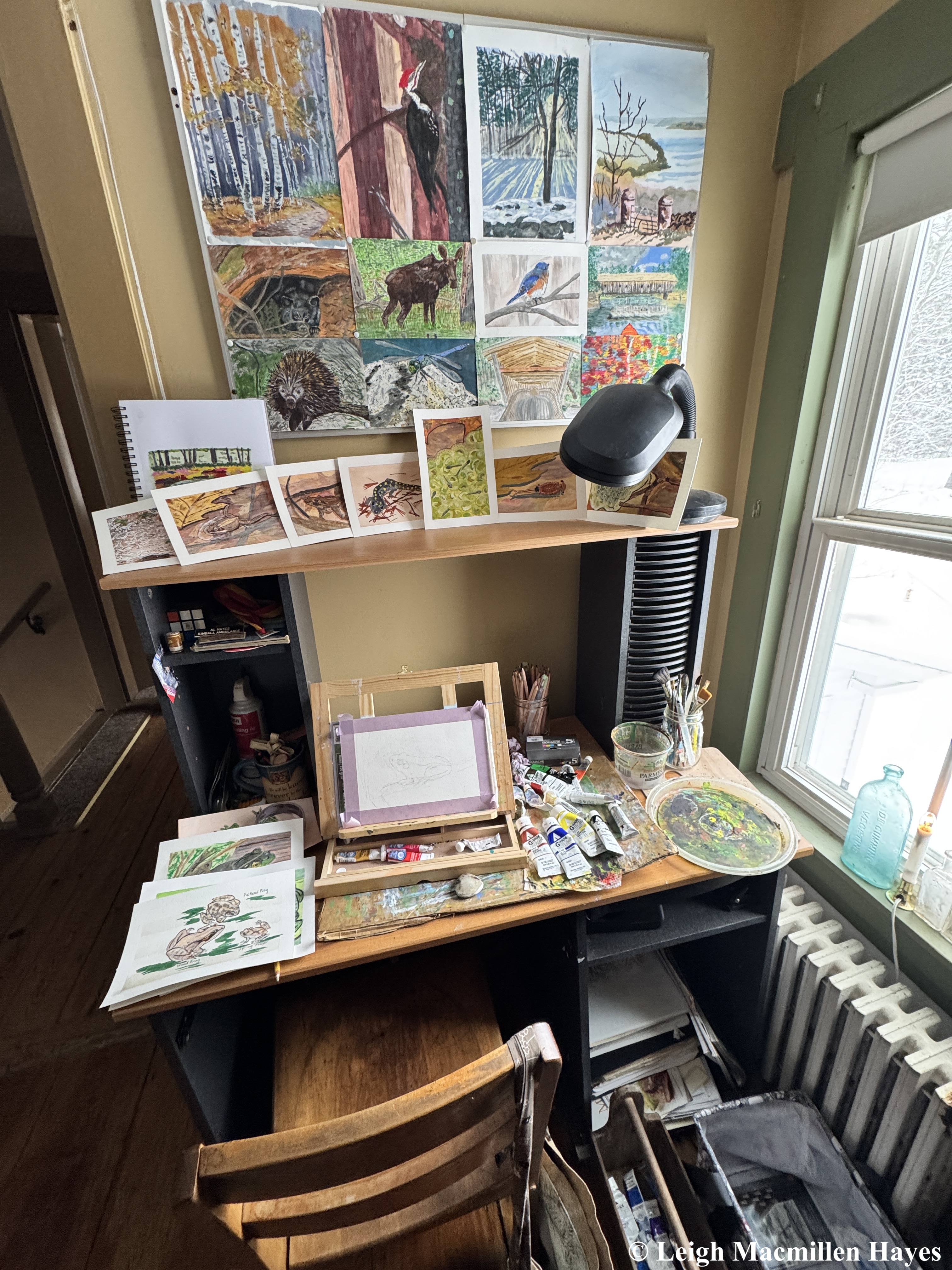
And so I spent much of today (when not shoveling, which really didn’t take long) holed up in my wee studio where I’ve been working on a vernal pool series of paintings.

The idea for this post actually came to me in a dream last night–why not turn those paintings into a blog post. Why not?

Because, it’s scary to share creative works with the world. But, I am probably my own worst critic. My instructor, Jessie, always reminds me to put my inner critic into a box, place the cover on top, and get to work. And besides, by sharing here, I can hide behind the screen. She wants those of us in her class to host an art show, but I refuse to do that. It’s much more comfortable for me this way.

I’ve only been painting since last May, but let’s not let that be an excuse. The thing is, working with gouache paints means I can easily edit, much like writing. And believe me, I have. My motto has always been that there’s no such thing as a final draft–whether it be an article for a magazine or a work of art.

Have you noticed that I’m procrastinating? And putting all of my excuses out there.

It’s snowing again.

All right, I’m almost ready. But here’s the other thing–in sharing these with you, may you be inspired to do something you never imagined and discover that the time you spend doing such is most enjoyable and it’s easy to get “lost” and just plain have fun and decide that even though the “end product” isn’t exactly what you first set out to create, it’s still half decent and you had the most delightful time sitting quietly as is my custom, doing just that: creating.

And now . . . for a look back as a way to look forward to a vernal pool as it emerges from winter or early spring, or mud season, or almost spring but still winter, or whatever season this is.

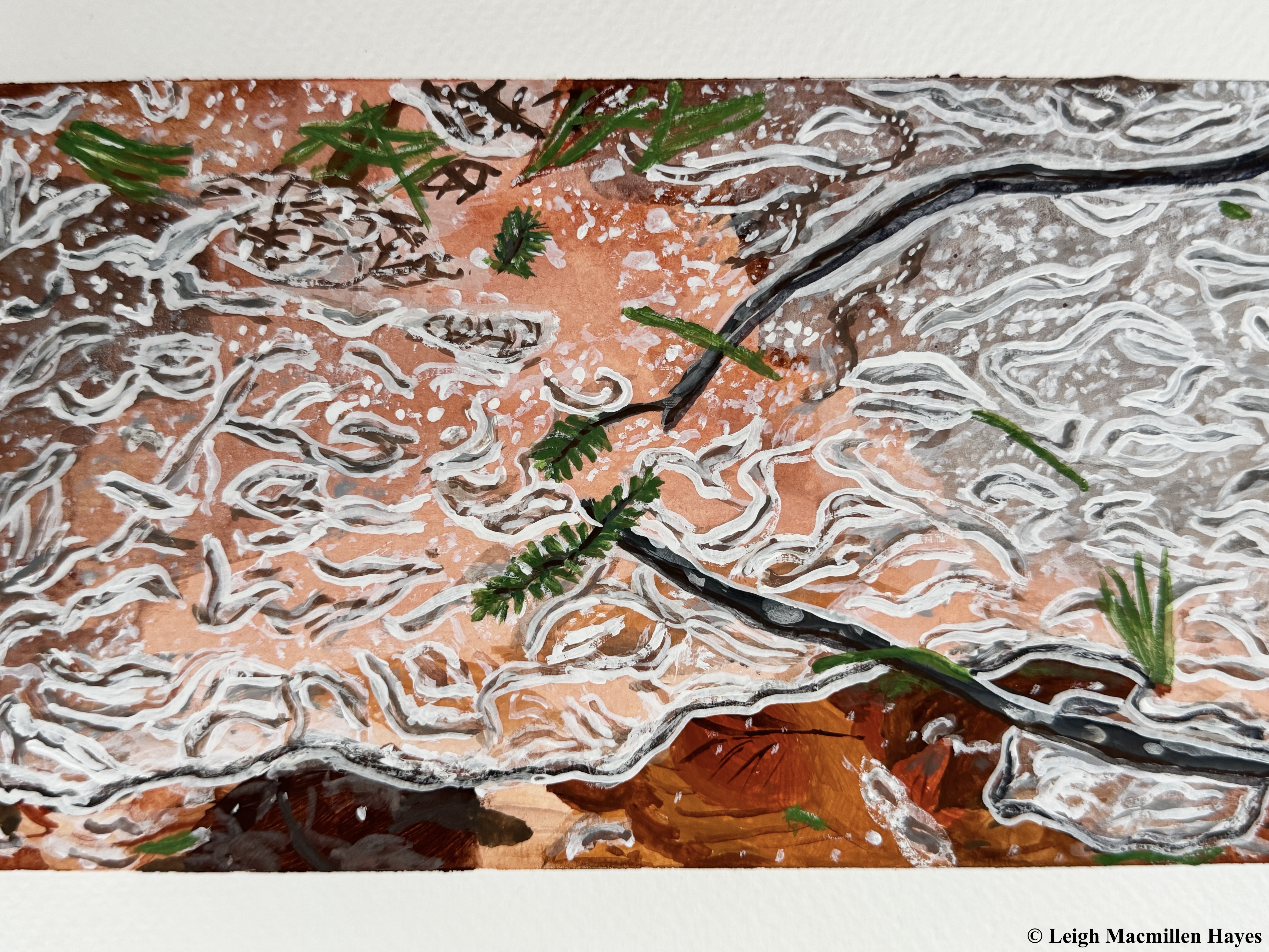
Pine and hemlock needles and branches from winter storms coat the ice as it slowly begins to melt along the edge of the pool, providing a glimpse of the sunken leaves below, where life awaits.

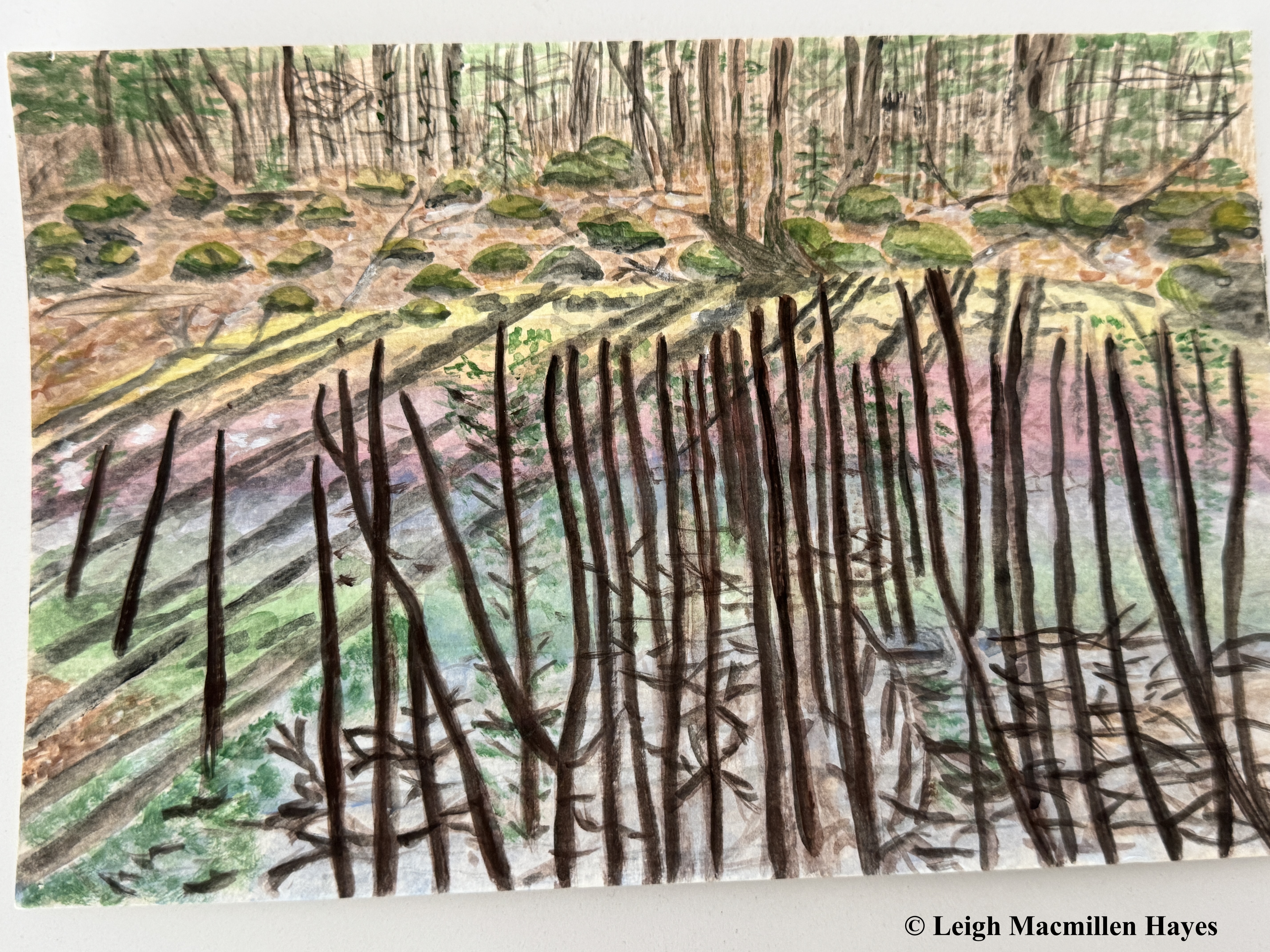
Once the ice finally melts, barren trees offer a reflection that speaks to winter, but there’s hope in their buds.

And no sooner has the ice gone out, when upon my approach I hear “Wruck, wruck,” and know that the Wood Frogs have returned to their natal breeding grounds. At first, they dive as soon as they hear me approach. But I stand still, sometimes for up to fifteen minutes, and ever so slowly, one by one, they rise to the surface and float.

It’s the lucky male who has the best “Wruck, wruck,” that finds a mate. He clasps her with his forelegs and as she begins to deposit eggs, he fertilizes them externally.

I return a couple of days later, in the late afternoon, and can’t believe my good luck. The pool is coated in pollen and the sun hits it in such a way that I see a rainbow of colors and love how the tree reflections are in two orientations upon still water.

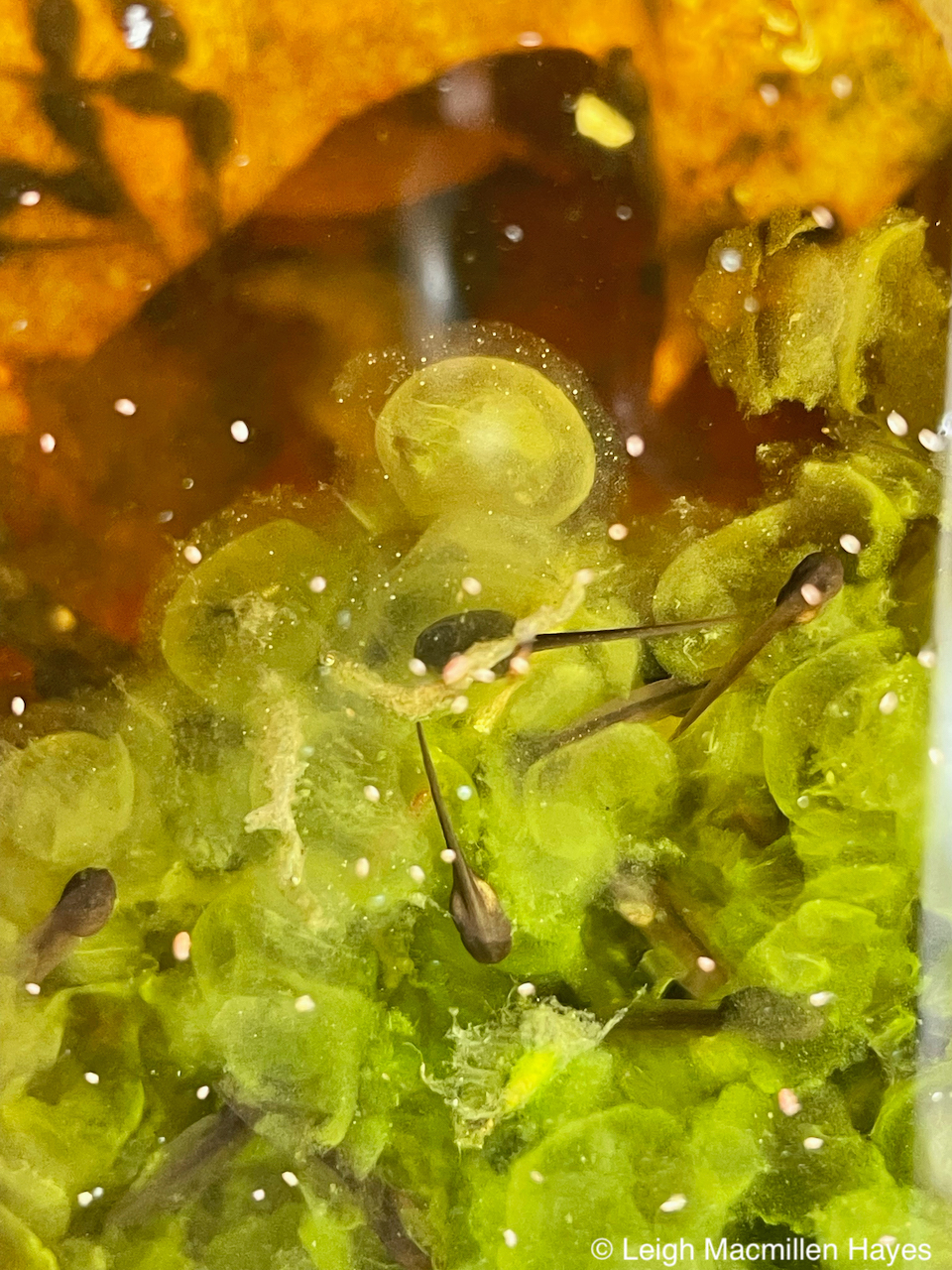
A few weeks later, looking deep into the pool, which isn’t really all that deep, I notice blobs of eggs clustered together in a mass that has a tapioca-like shape to it and notice little life forms moving about in the shape of tadpoles. I feel like a proud momma. The thing is, the Wood Frogs mate, she lays eggs he’s fertilized and within two weeks, the parents are long gone, back to their woodland setting. And so I do feel protective parent–or maybe foster parent–keeping watch and celebrating achievements.

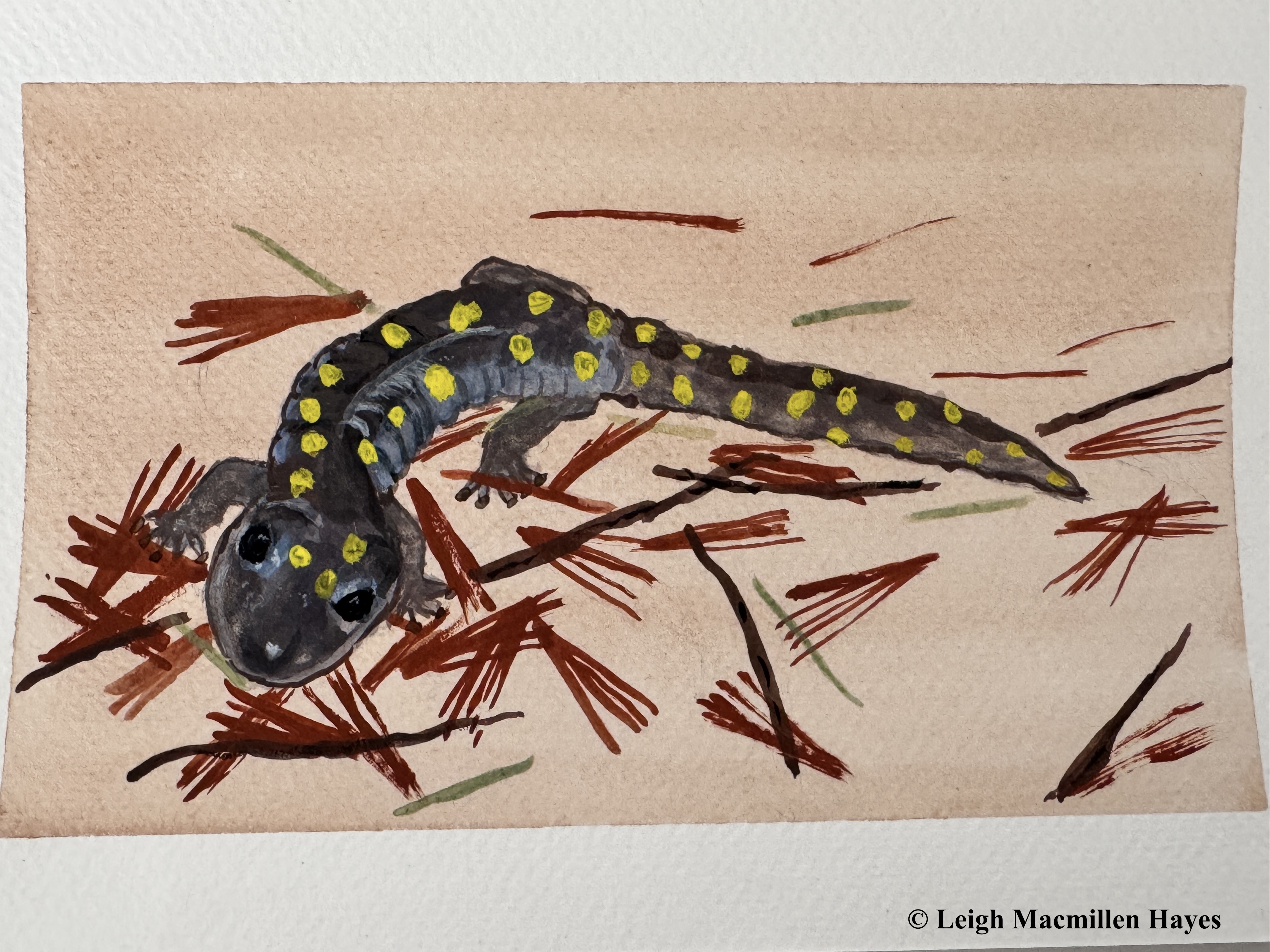
Another life form who uses the pool as a natal breeding spot is the spotted salamander and though I tend to mostly spy them on Big Night, I can tell by egg masses left behind that they have visited.

Their egg masses are a wee bit different from the Wood Frog masses, in that they have a gelatinous coating around the entire grouping, so they don’t look so tapioca-like. Mosquito larvae, tumblers at this stage, also wiggle about in the water.

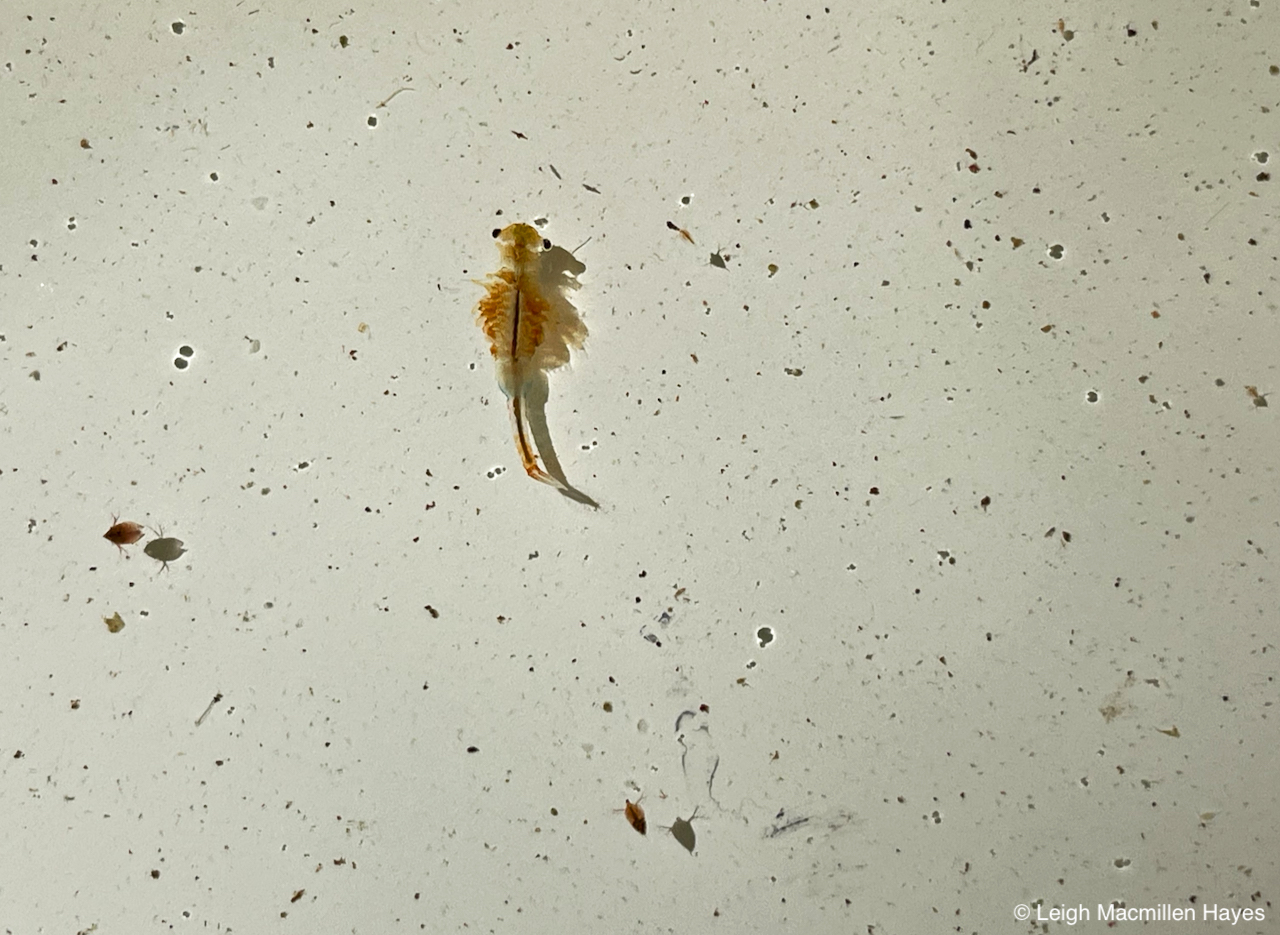
And if I’m lucky, though this has never happened at the pool behind our house, I might see a fairy shrimp or dozens.

So here’s the thing: 40 Wood Frog egg masses make a pool significant; OR 20 Spotted Salamander egg masses; OR 10 Blue Spotted or Jefferson Salamander egg masses; OR a single, yes one, Fairy Shrimp. And this one is a female, as noted by the sac of dark eggs she carries.

Fairy Shrimp are cool because in order for eggs to be viable, the pool must dry out. And they can survive being dry for multiple years. And in any given year, not all eggs will hatch, thus saving some in the bank for another year or ten.

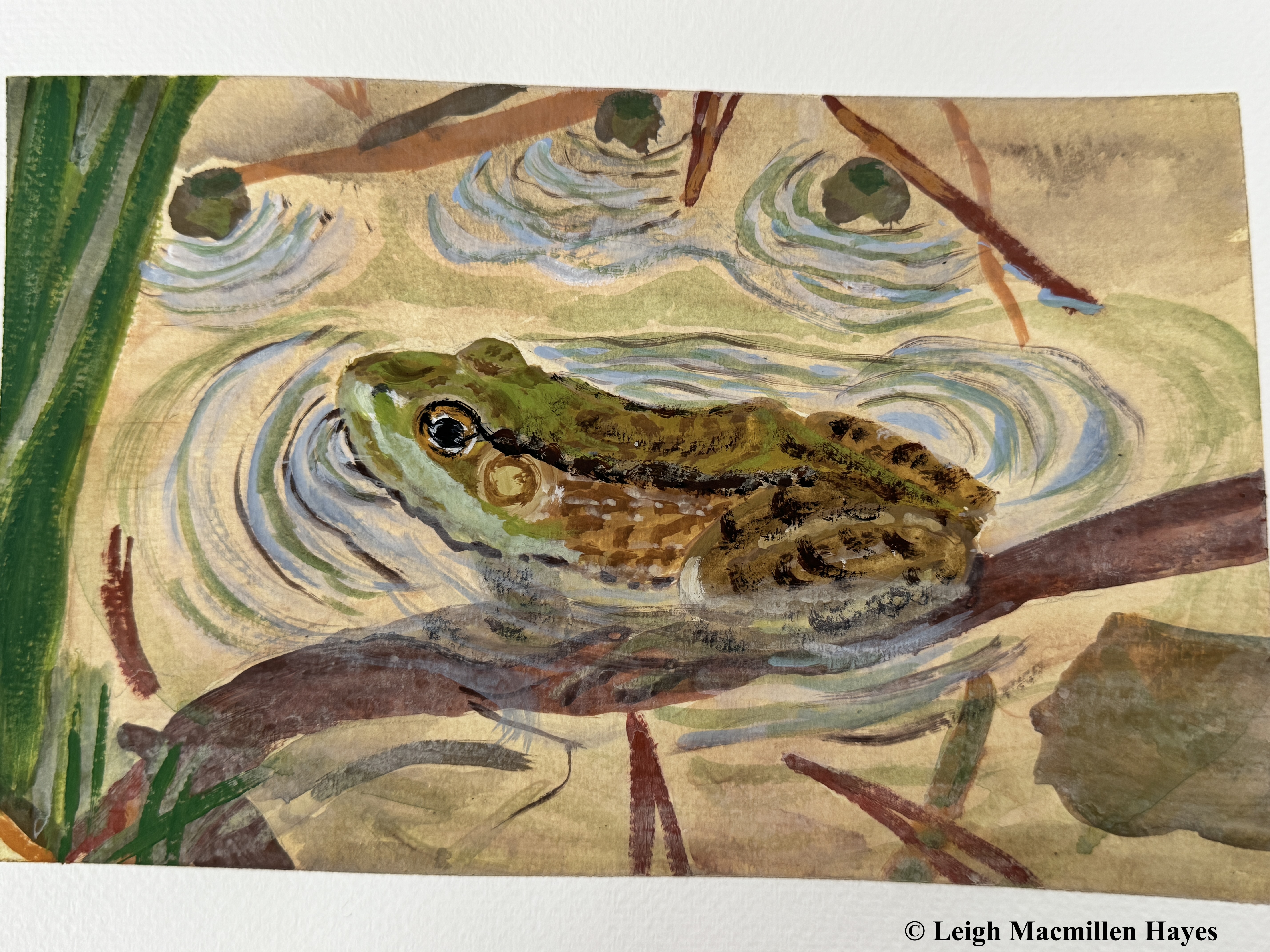
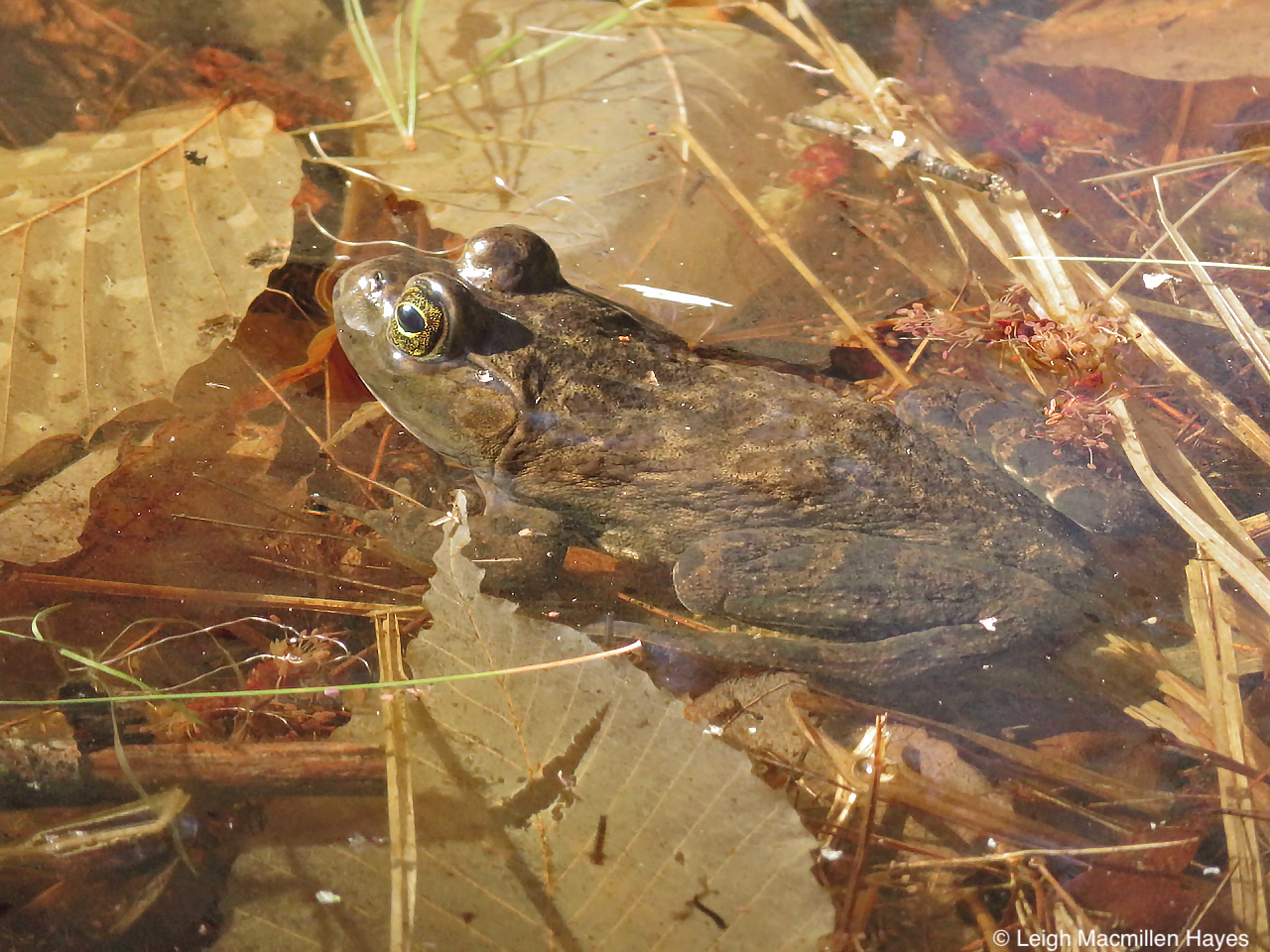
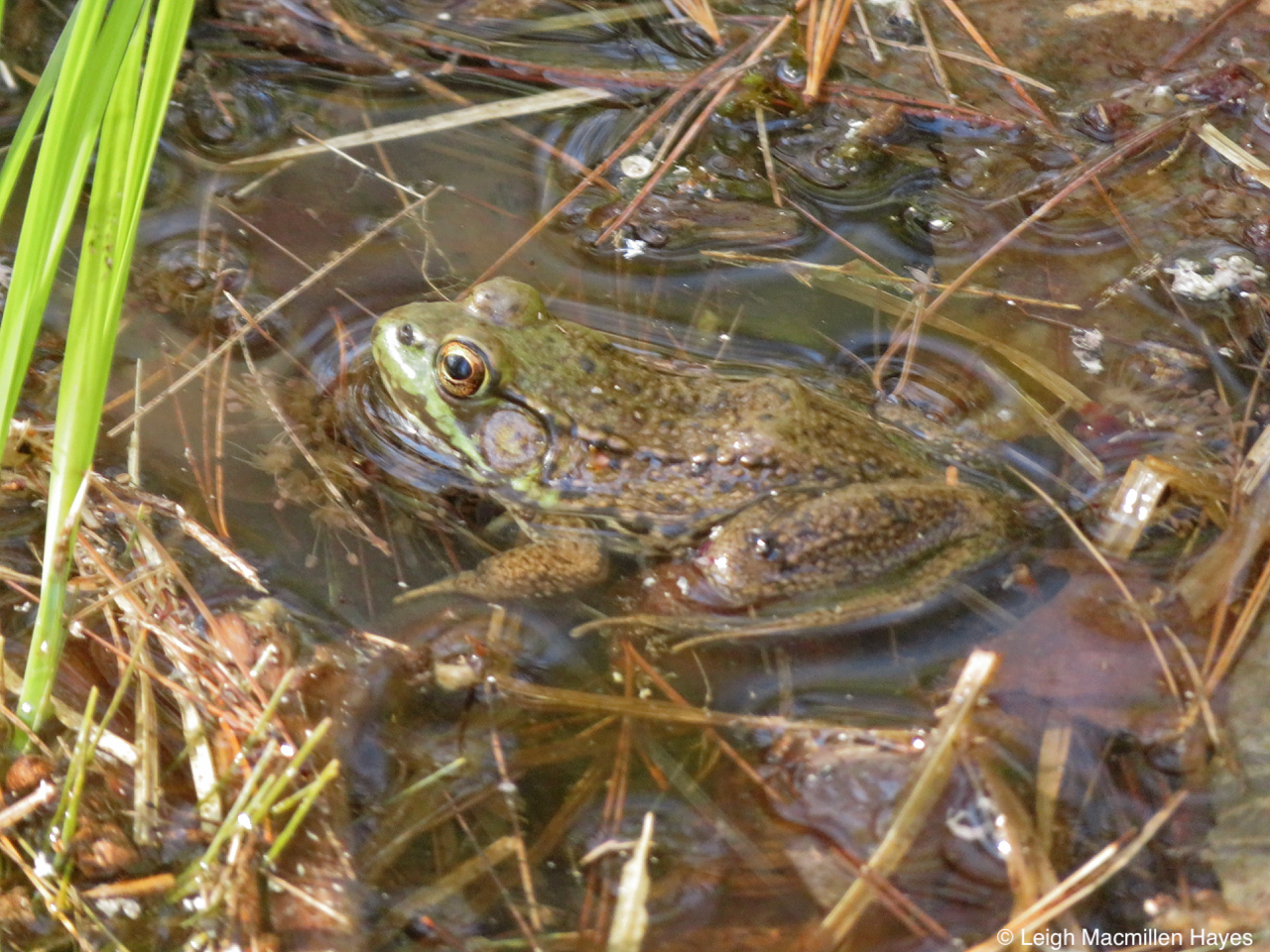
Hanging out by the pool, Green Frogs are always willing to dine on whatever is available. So the Green Frog has dorsal lateral folds (or bumps) along either side of its back that start behind the eyes.

The Bullfrog differs in that the line behind the eye circles around the tympanum (ear drum) and ends.

Here’s the other thing to remember: Males have tympanums larger than their eyes; females are smaller or equal to eye size.

And I like to think of this painting as a Frog-ersation.

This week I actually framed two paintings to send to friends, the Bullfrog being one of them.

There. I did it. Survived the art show.

As I bring this to a close, I realize there’s one more painting I should add to the collection, but I’ll save it to paint another day.

Thank you for marching into the vernal pool with me. I hope you are glad you did.

As The Vernal Pool Turns

If you follow me either virtually or in reality, you know that during April and May I spend a lot of time beside vernal pools. And this year is no different. Thankfully, I also get to take others along on the journey, from school children to their parents, and members of the public, plus colleague naturalists in the form of Greater Lovell Land Trust’s volunteer docents.

And so it’s been that this particular pool on a land trust property has received tons of attention this year. We’ve always known it to be special because it’s home to Fairy Shrimp, which just the occurrence of one makes it significant by State of Maine standards.

Vernal pools provide essential breeding habitat for certain species of wildlife, including salamanders and some frogs species. At the same time, juvenile and adult amphibians associated with such a pool provide an important food source for small carnivores as well as large game species. Many of these amphibians are pool specific in that they must return to their natal vernal pool to breed, thus making them and the surrounding habitat important and the loss of such would lead to loss of local amphibians, a decrease in biodiversity, and a decline in food available to others who inhabit the surrounding natural community.

Upon visiting this past week, the pool had taken on a new sheen, appearing at first glance to resemble ice. But it was much too warm for that to be the case.

Floating upon the pool’s surface were male Red Maple flowers, the oval items at the ends of slender, threadlike stalks the pollen producing anthers dangling on their filaments and the release of said pollen the cause of the ice-like presentation.

So the exciting thing about this particular pool is that though It has long been a breeding ground for Fairy Shrimp (and mosquito larvae), this year we spotted more of the former than ever swimming along on their backs as they filtered the water and sought a mate.

Though the pollen on the pool may give it a look of being polluted, the presence of Fairy Shrimp actually serve as an indicator of good water quality.

Where a month ago we were scooping up hundreds of these tiny crustaceans, this past week we found only a few, which served as one sign that this is a pool in transition. Their life cycle isn’t long, but if you checked in recently with the post entitled Peering Into the Pool, you’ll have learned a cool fact or two about their existence.

Back to now. Wood Frog tadpoles had suddenly emerged and their egg masses began to disintegrate, though still adding a source of food in the symbiotic relationship with an algal form.

Mosquito larvae and pupae, though still present, were not as prevalent, given that their flying, biting form had begun to hatch.

And then there was another change to note. And it’s a major change in my book of these habitats. Large Bullfrogs had taken up residence.

The wee bit smaller but similar Green Frogs had as well.

How does one decipher between a Bullfrog and Green Frog? First, as you approach a pool and you hear a squeal as a frog jumps from the edge into the water, you know that Green Frogs are in the midst.

And if you finally get to spy one, look for the line behind the eye. If it follows along both edges of the frog’s back, called dorsal lateral folds, it’s a Green Frog.

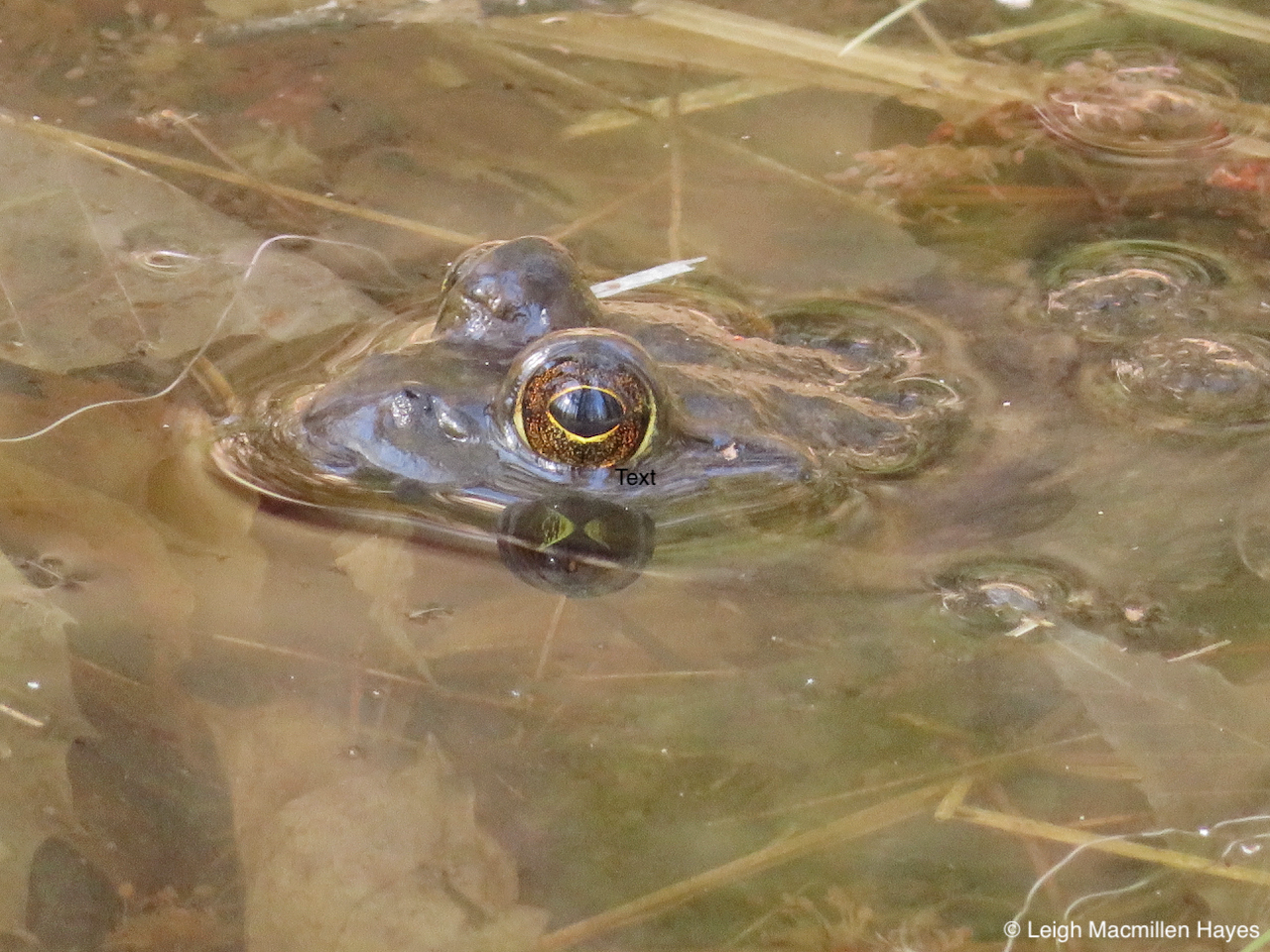
If, however, the line extends from the back of the eye and wraps around the round disk, or tympanum membrane (think ear), it’s a Bullfrog.

Also, Bullfrogs don’t leap away quite a suddenly as Green Frogs. In fact, they can stay quite still for hours on end.

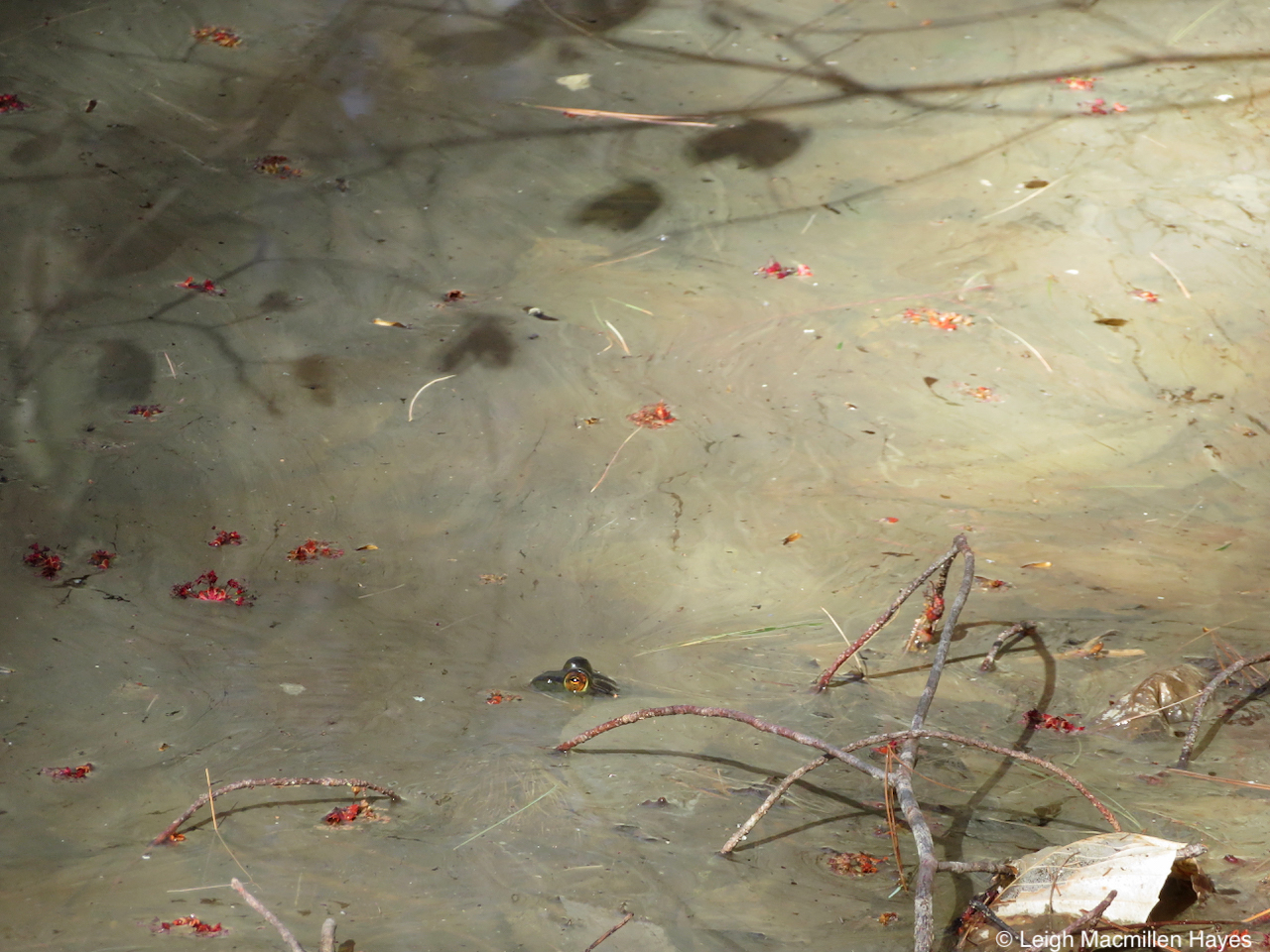
Once human eyes adjust to the surroundings, shadows may pretend to be frogs, but they aren’t. The real deal, however, lurks at the surface, often only its eyes making its presence known.

Hemlock needles and maple flowers decorate it, and much to my surprise don’t frustrate it. Though some frogs may seem super sensitive to us, they also exhibit a patience not to be matched as they sit and wait.

Oh, did I mention that they were everywhere? Literally.

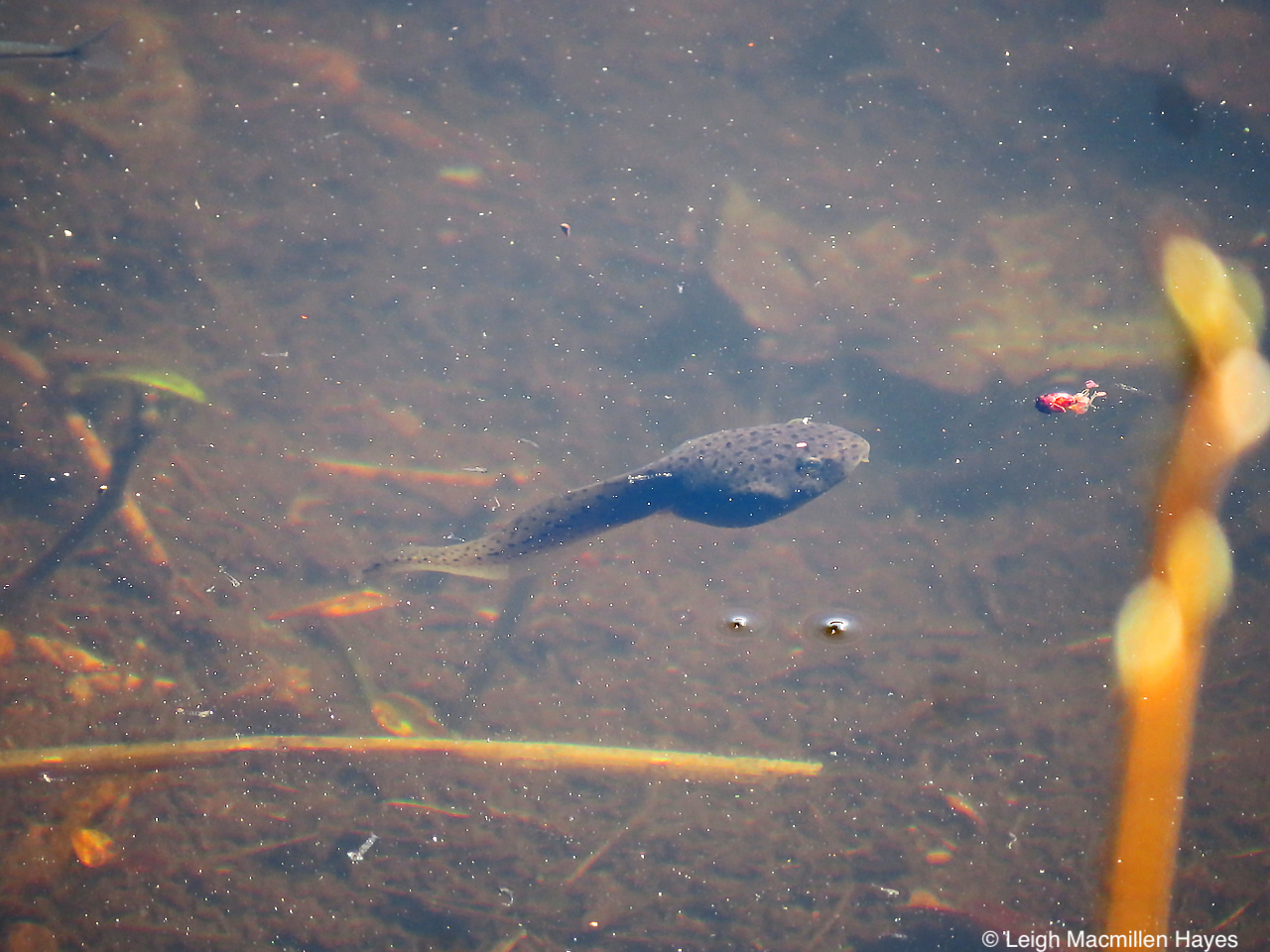
The thing is. these two frog species weren’t in the pool to breed like the Wood Frogs had been. They, after all, need a permanent water source because their tadpoles take two years at a minimum to morph into adults and a vernal pool that dries up each year would not be suitable. This tadpole was spied at a nearby pond, indicating that perhaps the Bullfrog came from that source to the vernal pool.

So what were the Bullfrogs and Green Frogs doing at the pool? Predating all that live within. Remember what I said earlier, that vernal pools provide food for small and large predators. These would be on the smaller size, though not the smallest.

Perhaps that’s why we weren’t seeing as many Fairy Shrimp this past week. And given the prevalence of these two frogs, who knows what will hop or crawl out of the pool, but we suspect some Wood Frogs and Spotted Salamanders will make it to adulthood so that they can carry on the tradition of returning to their natal pools to breed.

The thing about visiting a pool such as this with the younger set is that they are bound to make exciting finds. And so one did, locating a Spring Peeper swimming about.

And in the surrounding uplands, another found a Pickerel Frog. We could hear their snoring chorus, so this discovery wasn’t unexpected. But still it was special.

How to tell a Pickerel Frog from a Leopard Frog (the latter a species I’ve only seen a few times): by the spots on its back. The Pickerel’s spots are more symmetrical than the randomness of a Leopard’s and the Pickerel’s spots are outlined while a Leopard’s are not.

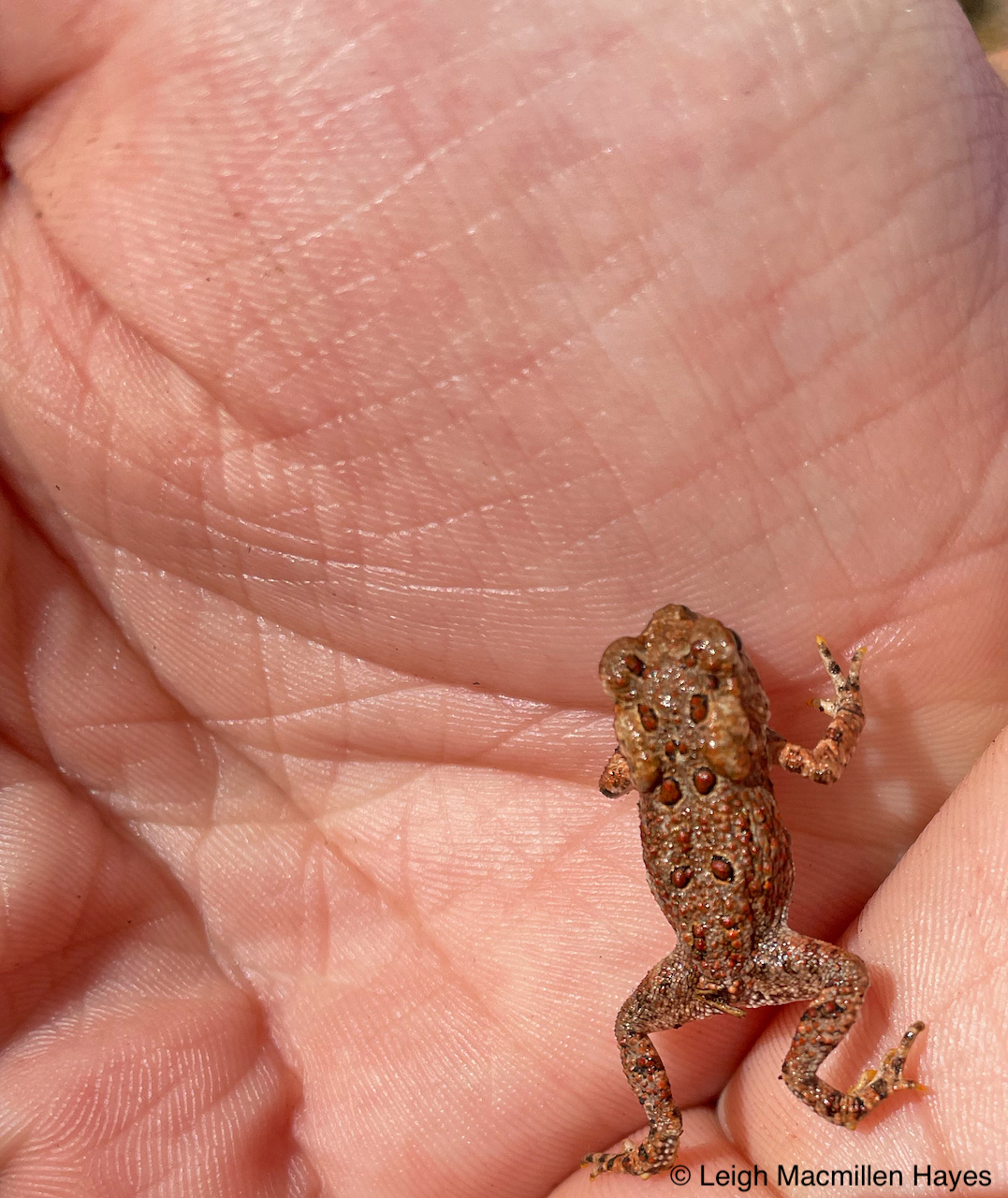
And then there was this teeny, tiny American Toad covered with warts and suddenly the ground was hopping with these wee creatures and Spring Peepers and one had to be careful where one stepped.

The final find of the week, an adult Wood Frog with its robber mask making for a sure ID. This one was a poser.

As the vernal pool turns, so do its inhabitants and I give great thanks for the opportunity to learn from it and share it with so many others who add to the lessons.

Dedication: This one is for Nancy Hogan Posey cuze I was going to write about something completely different today and your question turned the page to this one. Thank you.