Spiders and Insects: And More New Learnings

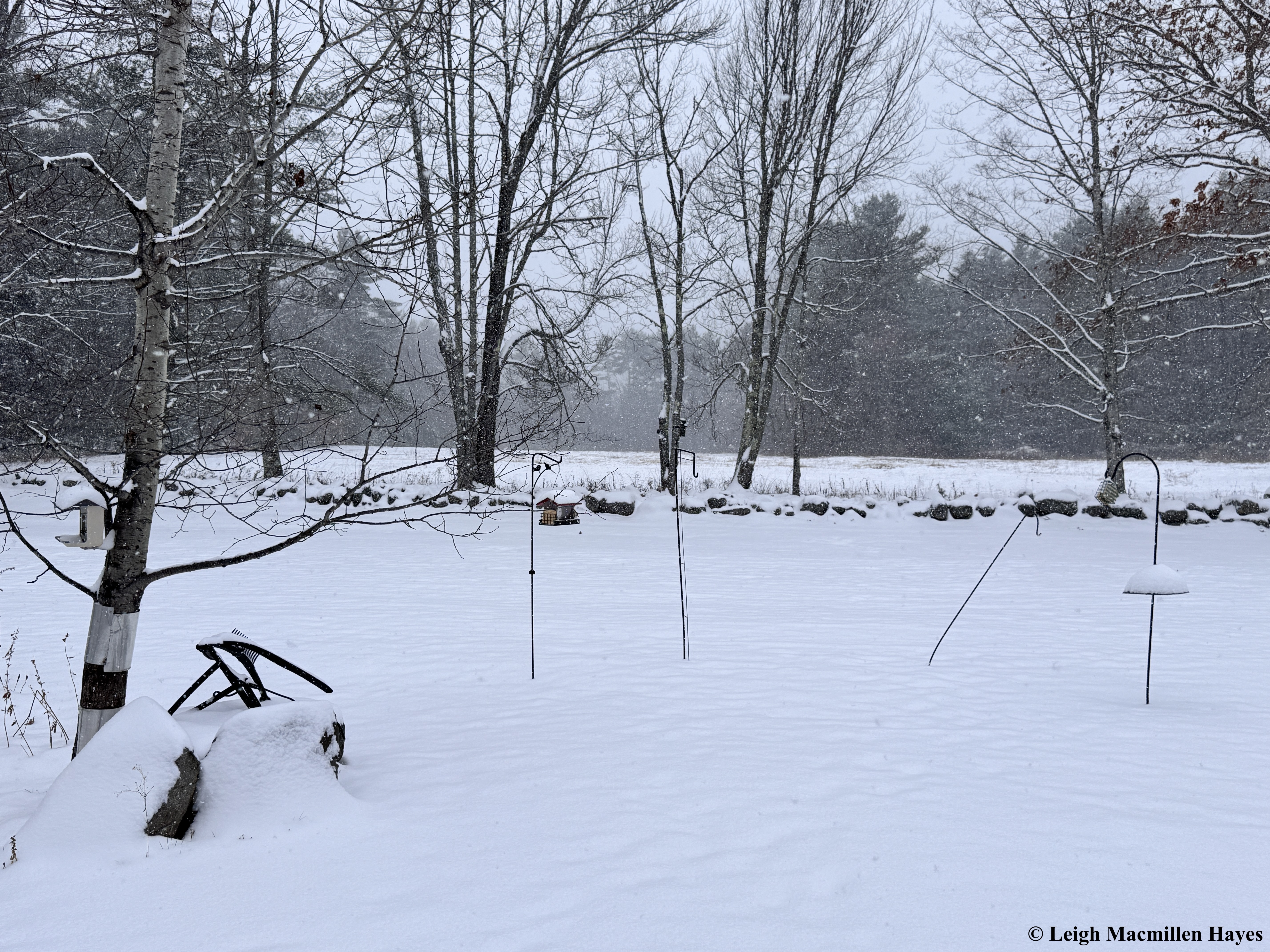
After today’s snow ended and another inch or two had accumulated atop our already winter wonderland world, I donned my boots and cameras and headed out the back door, not really sure where I’d wander. I assumed my findings would be few because the precipitation had just stopped.

Except that is, for the snow pack growing deeper!

But . . . I was almost immediately pleasantly surprised, for there was a Winter Crane Fly, small in size with gangly legs looking rather like an oversized mosquito. As an adult, however, it doesn’t have mouth parts, for its only plan is to mate. And it only lives for a short period of time, maybe a week or two.

Why then, do all of this in the winter? Today’s temp was 21˚F, and the touch of snow even colder–I know this because I felt it several times as I placed my rulered card down for photo calls. Perhaps because there aren’t many predators at this time of year?

What I couldn’t help but notice was the stained-glass window look of its two wings, for this is one of the True Flies (Diptera–two wings), and my mind returned to Reverend Annette’s sermon about hope and joy at St. Peter’s Episcopal Church this morning and my brain and heart were smiling at this find and joy filled my whole being. We don’t have stained-glass windows in our church, but rather they offer a look at the ever-changing natural world beyond the building’s walls. A world that includes this incredible creature that has been on Earth for a time longer than my brain can comprehend.

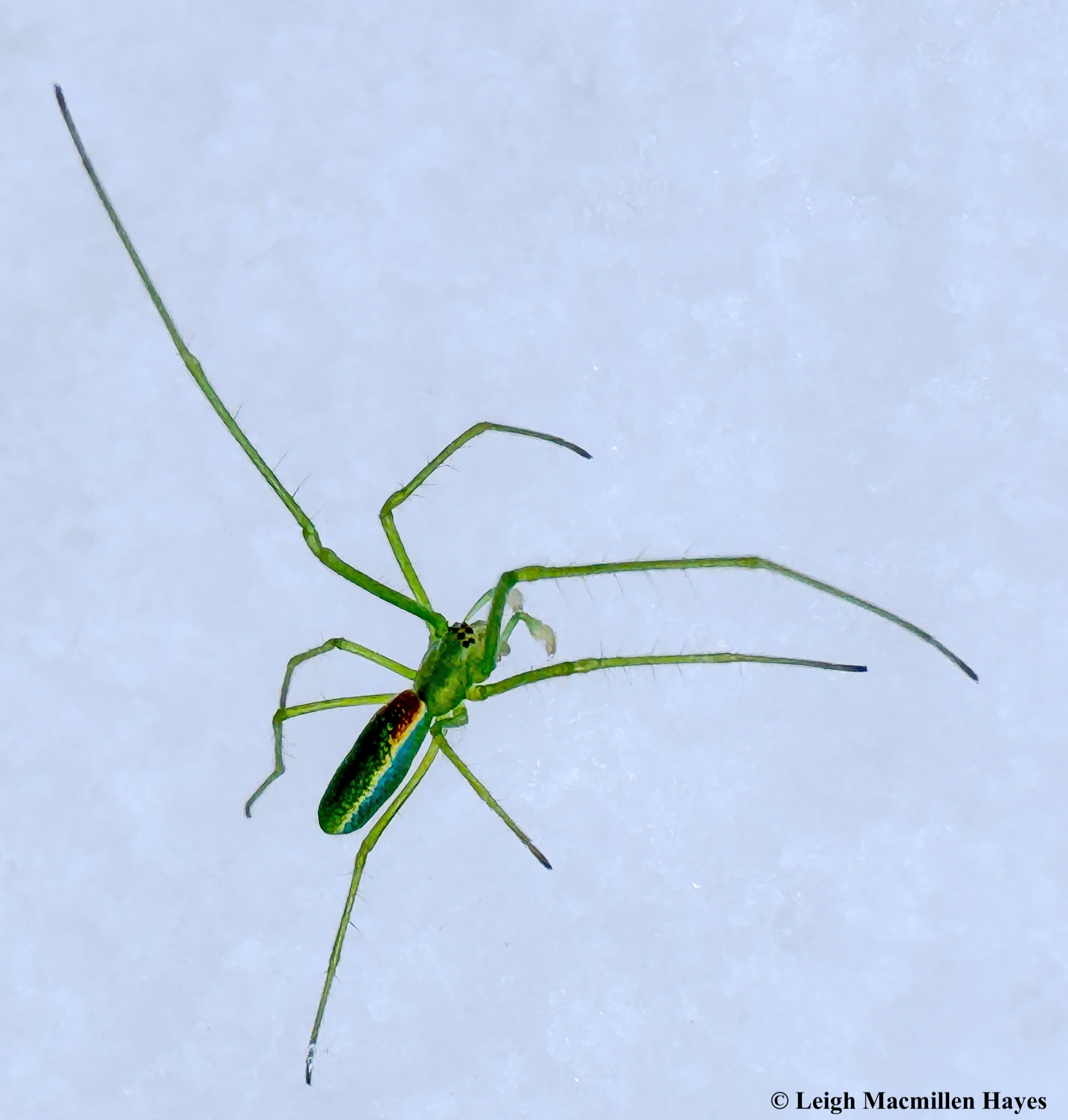
And then the spiders began to appear, Long-jawed Orbweavers and a few others, and each and every one was on the move.

What I have learned over the past week or two is that those spiders who do venture across the snow will curl up and rest on the really frigid days, and come back to life when it warms up a wee bit. Amazing.

Well, a short clarification, for some will revive, but others truly will freeze–probably due to -14˚F mornings. I know this because I took a “dead” one home on a “warmer” day and was surprised to discover it moving the next day, but three others that I found curled up after that really cold night did not come back to life.

I did try to count the spiders today, but couldn’t keep track, so many did I spot. My journey wasn’t far, but their journey . . .

slow, with each step . . .

seeming to be intentionally chosen.

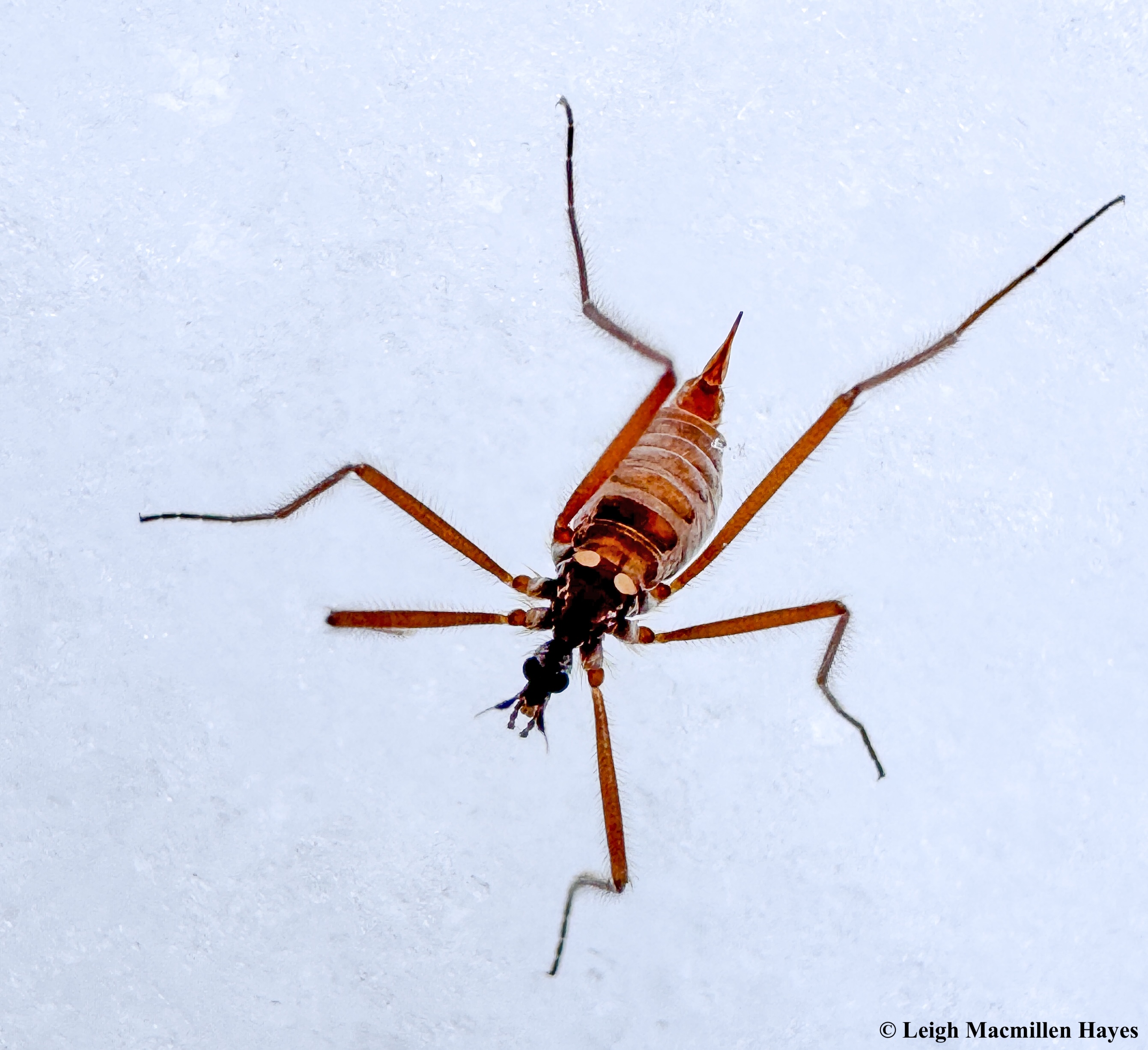
And then I began to see other friends, like this female Snow Fly, also a member of the Crane Fly Family.

Along my chosen path, I found at least a half dozen females and only one male.

Her movements were a bit faster than that of the spiders.

What amazed me was this particular Snow Fly, for it had self-amputated not one, but two legs and it’s only December.

My hope for her is that she’ll find a mate sooner rather than later because I fear if the weather we’ve been experiencing (it feels like an old-fashioned December) continues for much longer, she won’t have any legs left. Despite her loss of limbs, she still moved rather efficiently as she scurried across the snow.

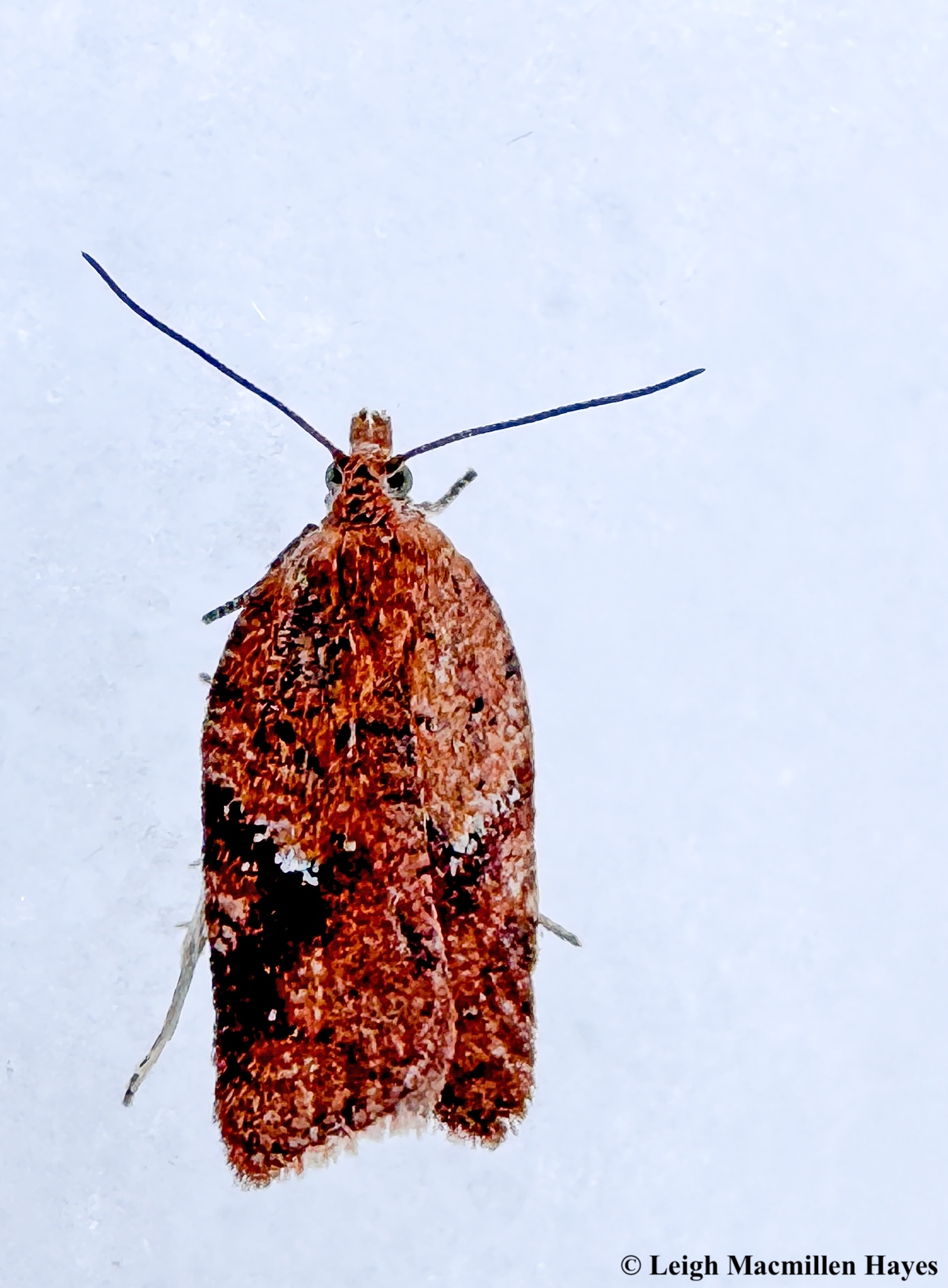
And then . . . and then . . . I met another surprising member of the winter landscape. Again, a teeny, tiny member, but because I was looking down, its coloration and shape were anomalies that captured my attention and for a few minutes became my whole world.

What a dress indeed did this Acleris Braunana Leafroller Moth wear–take a look at the pattern, and those colors, and the fringe.

As I learned when I returned home, it’s not unusual for this species also to make an appearance on a “warm” winter day. Like the other insects and spiders, Glycerol, that natural anti-freeze compound that lowers the temperature at which their tissues will freeze, plays an important role for winter survival.  

Of those critters that I filmed moving this afternoon, the Leafroller was the slowest, but I didn’t film the Winter Crane Fly because though those I saw were alive, they barely moved.

As my journey drew to a close, I was smiling both inside and out, for one reason, because I feel like I come alive when it’s cold out, and two, because I had so many surprises and learnings just because I was looking.

Looking down, that is. Can you imagine all that I missed by not looking up?

There’s so much to see, even in the “drab” winter landscape and my hope for you is that you’ll find joy in making new discoveries and learning along the way.

Spiders and Insects: A Winter Love Story

Lest you think that I spend the colder months forgetting about six and eight-legged members of the natural world, rest assured that I do not. That said, this has been an incredible week of spotting these little members of the ecosystem that often go overlooked as people tramp through the snow.

About eight inches of snow fell a week ago and in the middle of the storm, I did what I love to do. I headed out to explore in our woods. Have you ever stepped outside and listened on a snowy day? Really listened? It’s magical. The world’s sounds are muffled, except for the soft hush of falling snow.

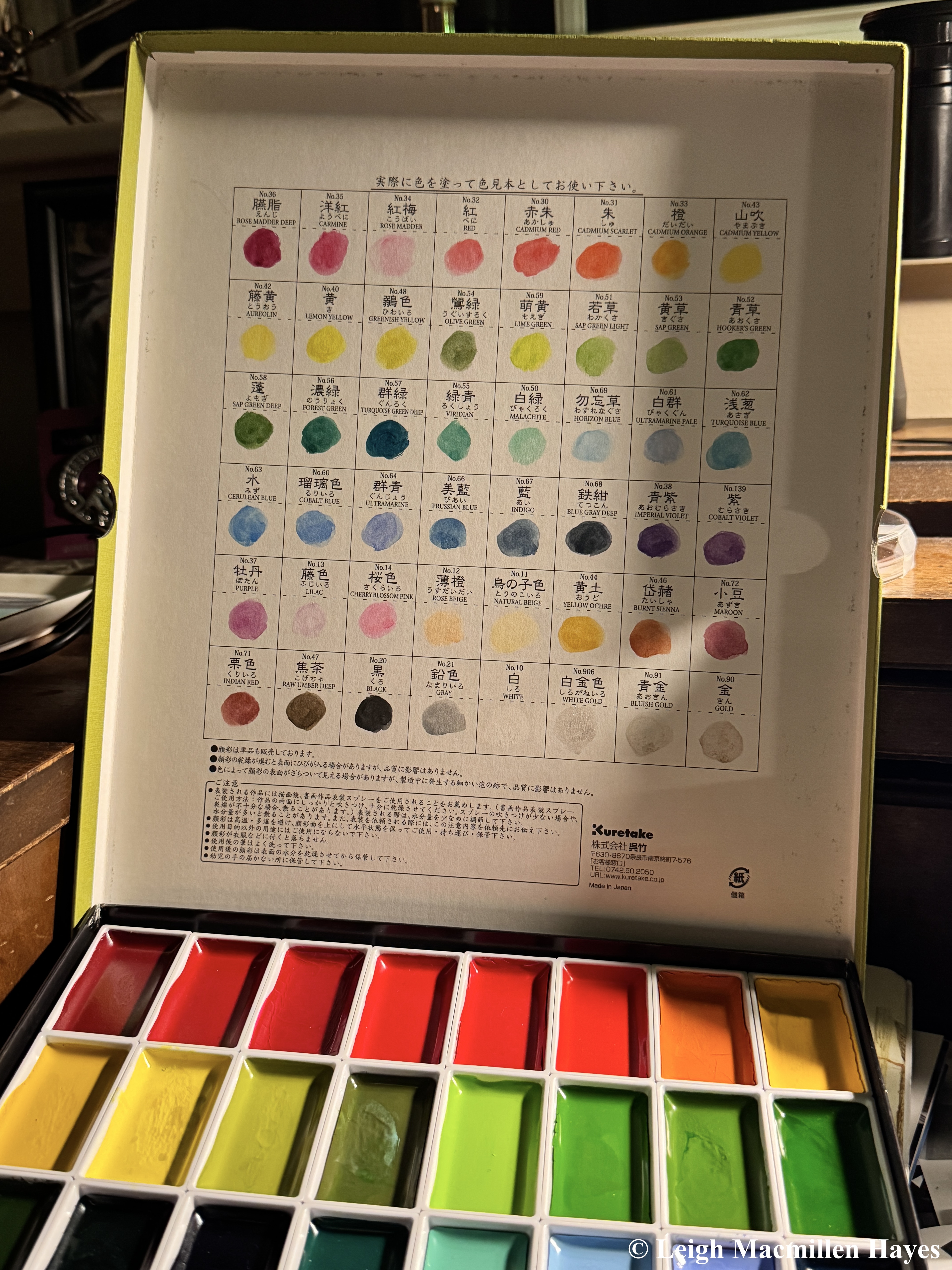
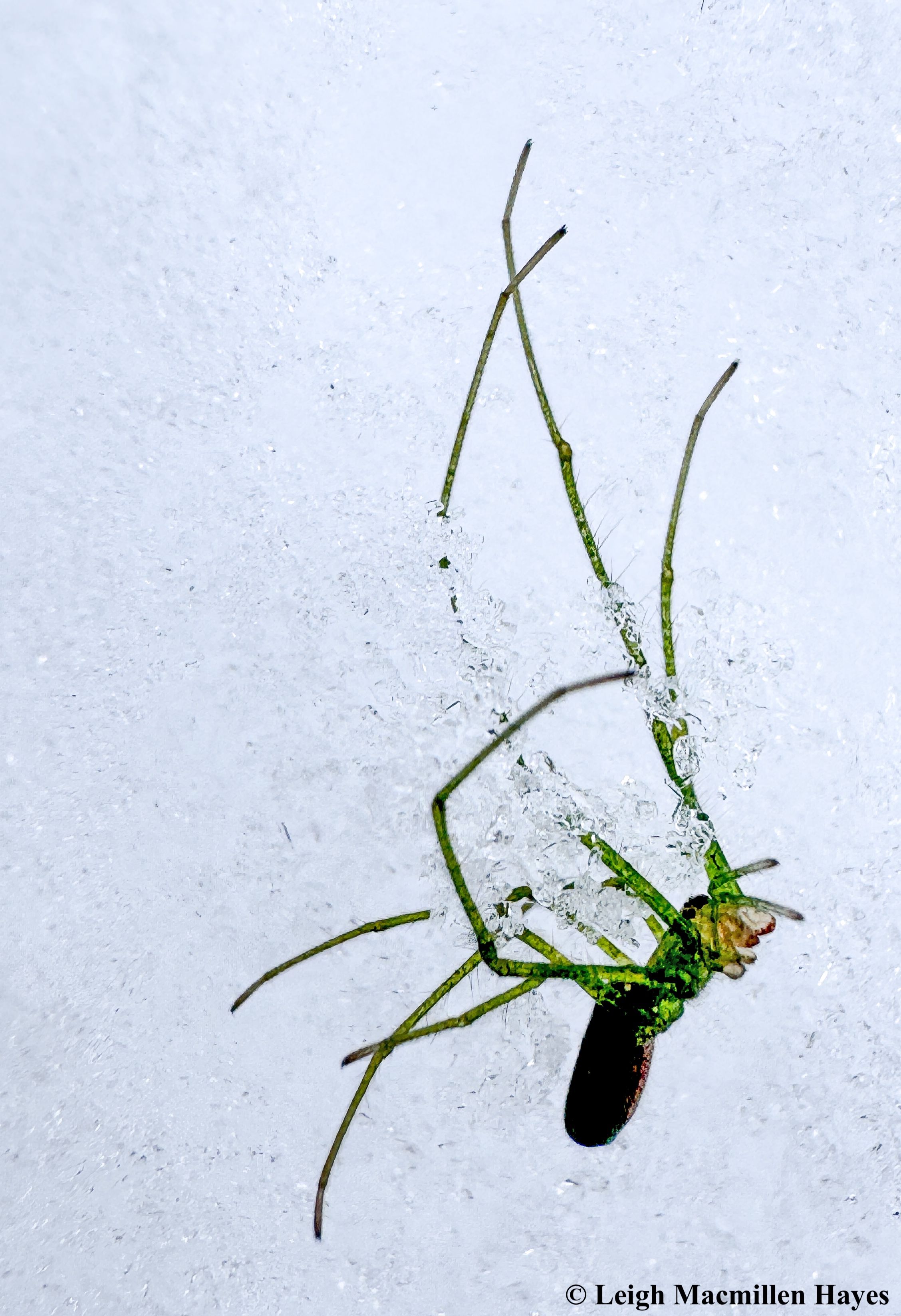
It was while standing still and appreciating the quietness that I first began to notice these most beautiful creatures. I was compelled to check the coloration against a watercolor set gifted to me by a dear old friend. The legs of this Long-jawed Orbweaver are Sap Green Deep. Its head and abdomen: Raw Umber Deep, Greenish Yellow, and Turquoise Green Deep; and its pedipalps, those leg-like appendages near the mouth that look like boxing gloves: White Gold.

Of course, Crayola would have completely different, and certainly more creative names for the same colors.

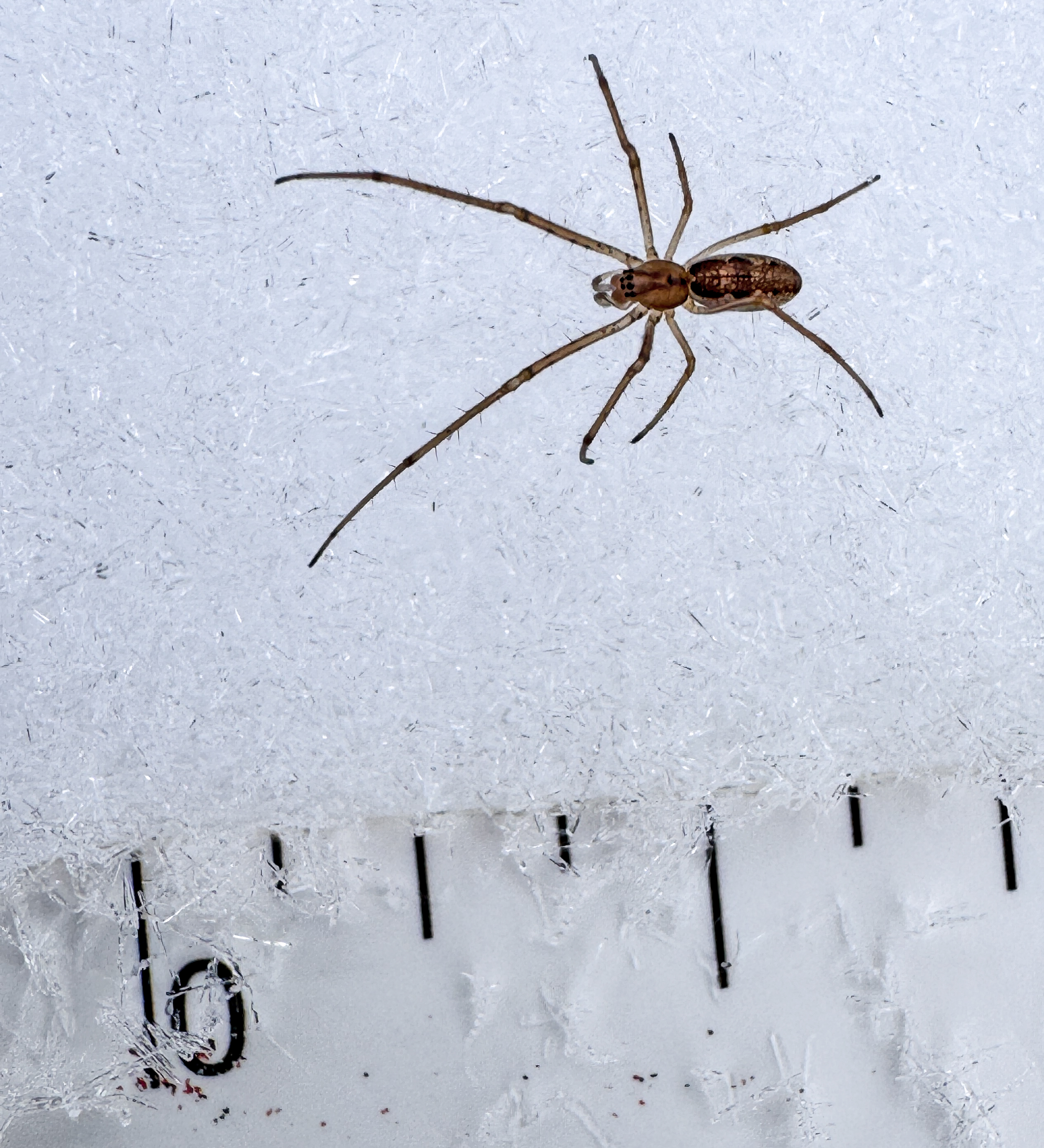
Long-jawed Orb Weavers are also known as Stretch Spiders for their ability to spread their long, hairy legs out–two in front and two behind, when resting on a twig and blend in so well, that sometimes it is impossible to see them. Unless they are on snow, of course. And then their metallic coloration may catch your attention. Mind you, they are small.

What I can’t figure out is why they are walking on the snow on these cold days, given that their meal of choice is in the subnivean layer between the ground and snow–that being the Springtails, aka Snow Fleas, those little dots of pepper that perform circus acts as they jump around in our boot prints on warm winter days. I have yet to see any Springtails on the snow.

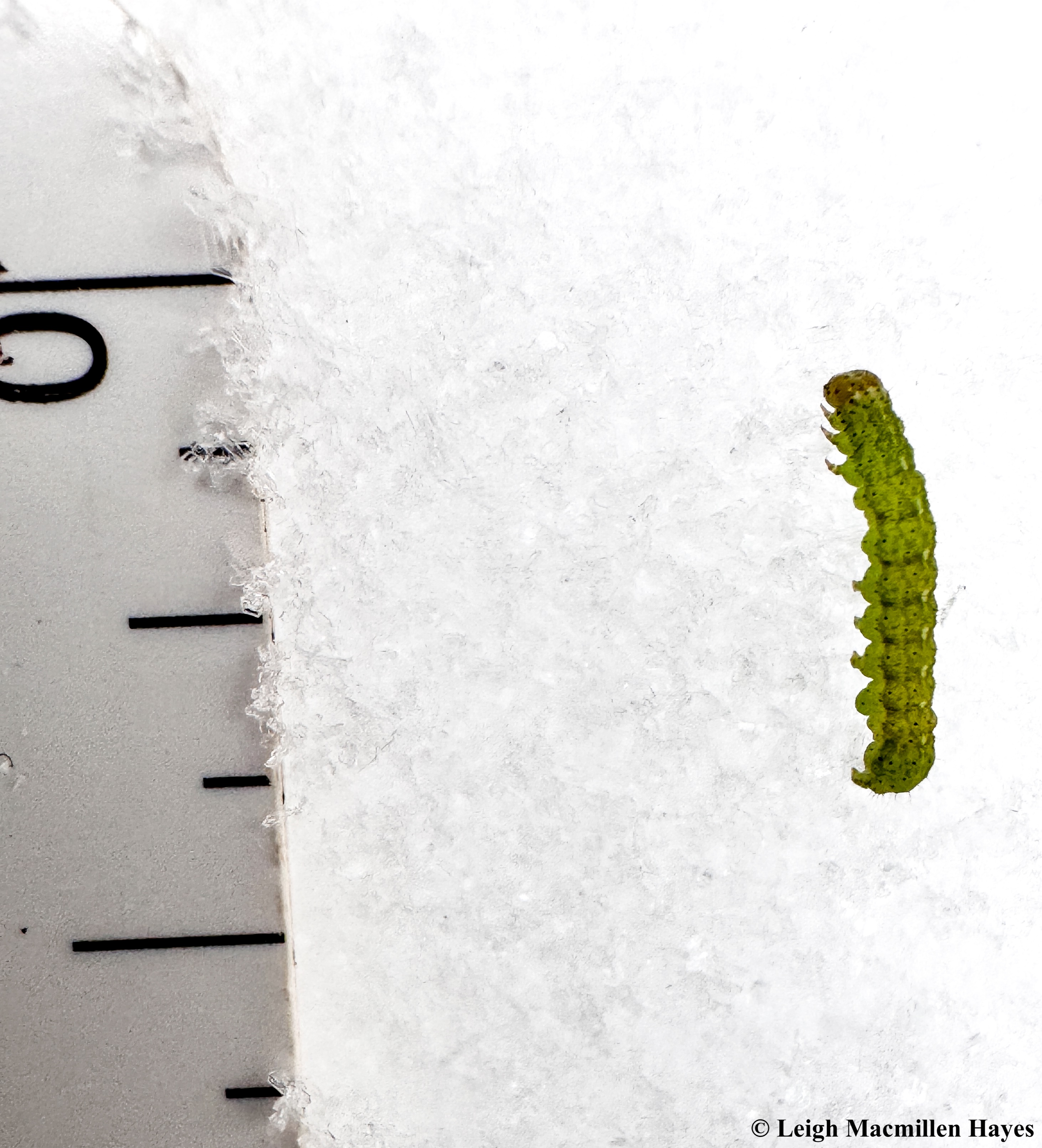
A few more steps and I discovered this Cutworm Caterpillar. Near this green one I also found a brown variation. While they may come to the surface on warmer days, I was surprised to find these Snow Worms when the temperature was in the low teens.

Apparently posing for the paparazzi is not in their DNA. And so I moved on.

And discovered another Long-jawed, this one being hues of brown. I’ve been thinking about these spiders all week, and actually for many years, because there are days when I can go for a walk in the woods and see one every ten feet or less. Frigid days even, which has been the case this past week.

The question is: how does a tiny critter with such a fragile looking body and legs survive in these temps? I’ve read that some spider species can lower their bodies’ freezing point by producing a cryoprotectant, Glycerol, a natural anti-freeze compound that lowers the temperature at which their tissues will freeze.  

But . . . another question arises: What happens when that antifreeze no longer seems to work?

Answer: They curl up and die.

Or do they?

You see, I’d picked one spider up and held it in my hands for a few minutes in hopes of reviving it. And met no success.

The next day I picked up another and placed it in a Petri Dish, thinking I would look at it under the microscope.

A day later, and it was walking around inside the container.

Absolutely amazing to this wonderer.

And consequently, a few more have traveled home in my pocket and I’m wondering if they’ll revive as well in the warmth of our home. If so, what does that mean? That they can go dormant atop the snow in freezing temps, and thaw and become active when the sun warms them up? I guess my biggest question is this: Why are they on top of the snow, anyway, when it’s much warmer under it and that’s where their food source can be found.

There’s another critter I’ve been encountering quite a bit this past week and it looks rather ferocious.

But don’t judge a book by its cover as the old adage goes. While some look robust, like this one, others are small and slender. Again, I’ve read this, but not observed it: they don’t eat, but may sip snow. The main goal of the adults who are active in winter is to mate.

Who is this critter? A Snow Fly, a flightless Crane Fly.

They lack wings, but do have a set of halteres, those knob-shaped organs that help with stability.

This is a female Snow Fly, the gender being determined by the abdominal appendages. Notice hers is upward curving and tapered to a point.

Do you notice anything else about her? As in how many legs she has?

This robust male’s abdomen appendages are much blunter and pincer-like in shape.

Hmmm, again I ask, how many legs has he?

While the Snow Fly in the first photo I shared sported the typical six legs of an insect (as opposed to eight legs for a spider), the last three have only five. This is due to another amazing winter adaptation:
Snow Flies can self-amputate freezing legs to prevent ice from spreading to organs within their body.

What? We say all the time, “Nature is amazing!” It truly is astounding.

I watched as this male made his way down a brink of snow on only five legs.

He was quick and rather nimble.

As he approached the leaf below, I realized why it is difficult to spot these adults before the snow falls, for then they are well camouflaged in the leaf litter, just as the Orb Weaver spiders are camouflaged on their tree species of choice, their colors blending in and stretched out shapes making them look like the twigs upon which they pose.

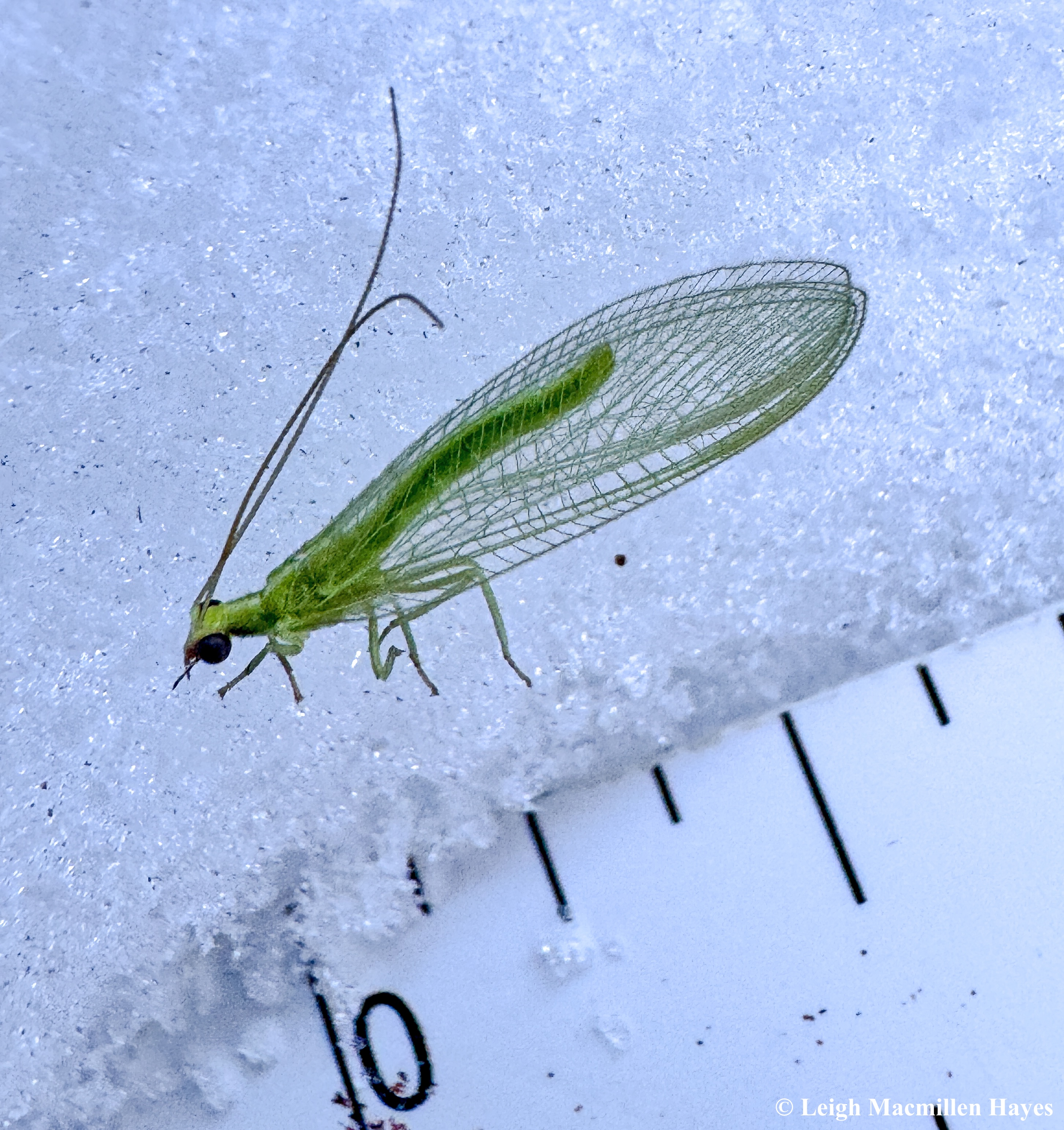
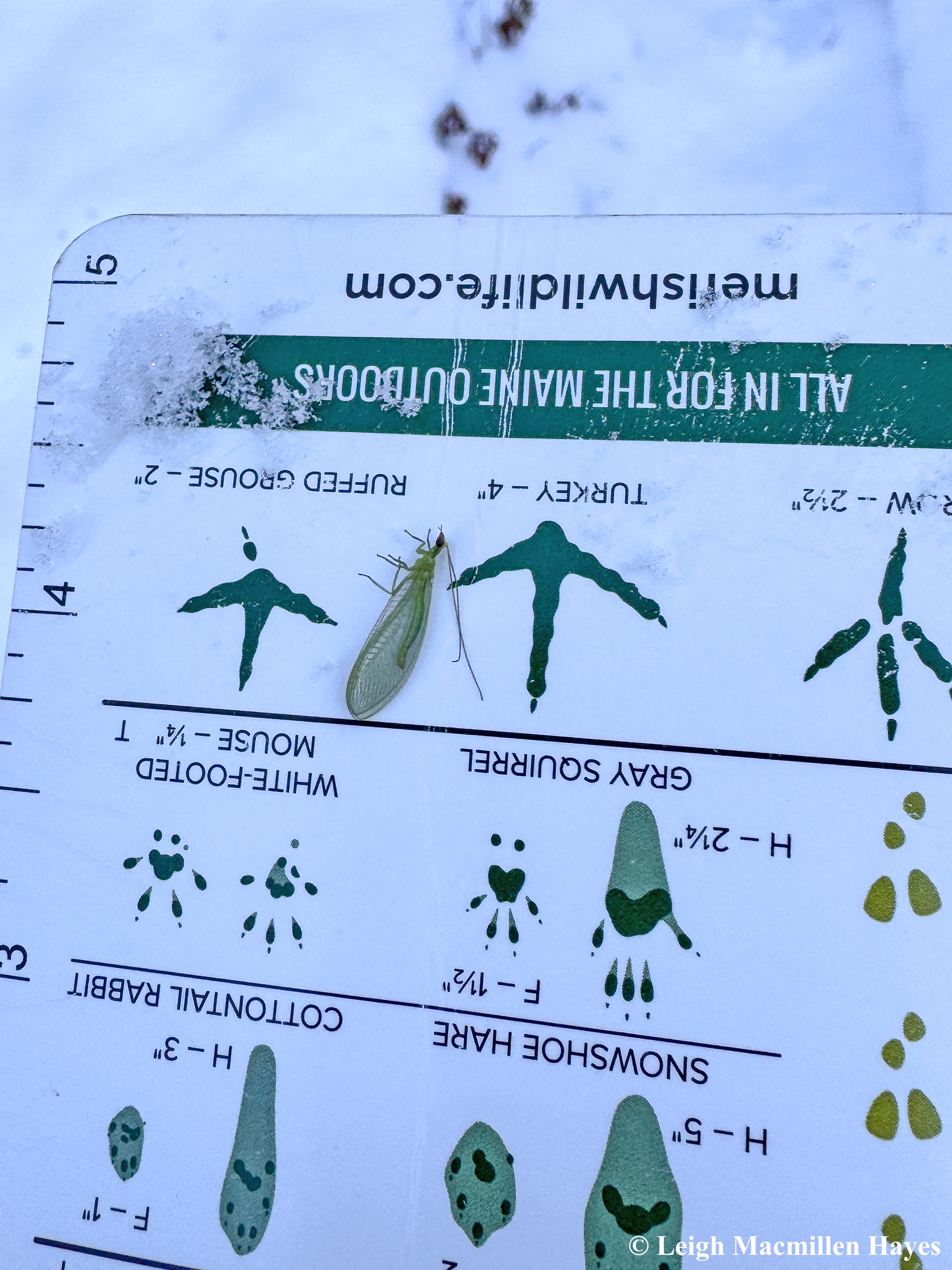
One last critter to share with you is a Green Lace Wing, who completely surprised me. I’m used to seeing them in the field during the summer months, and found this one on the trail just around the corner from the field yesterday.

Adults can overwinter behind bark and may come out on warmer days, but the temperature was 19˚F.

I didn’t have anything to carry it home in, so I scooped its fragile body up onto my little tracking card and carried it home, protecting it from being blown off by the wind. Unlike the spider, however, it didn’t revive once inside.

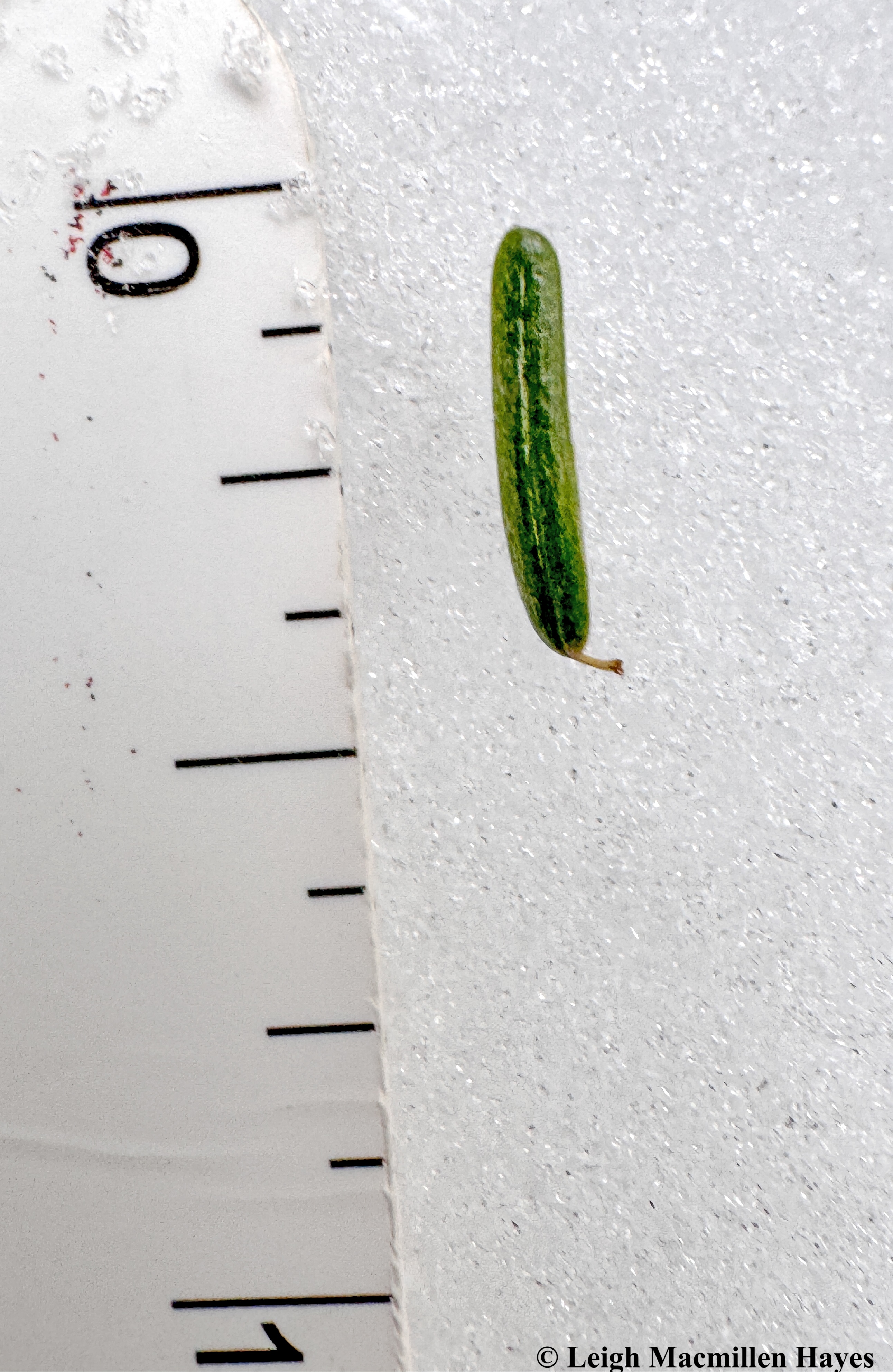
If you are so inclined to look down during a snowy tramp, don’t be fooled by some of the litter, such as Hemlock Needles with their short petioles, pretending to be green abdomens.

Or Birch Seeds that look like miniature butterflies.

I do hope you will venture out and search for these friends. They have a place in the ecosystem and provide us with one more reason to get outside and observe and stand in awe and try to learn no matter what the temperature is.

Spiders and Insects: A winter love story. For me, at least.

CBC: Everything Counts

December 27, 2024. 8:15am. 5˚. Blue sky. No wind.

The perfect day to count birds for Maine Audubon’s Annual Christmas Bird Count.

Focus area: Sweden Circle, Maine.

Super focus area: Pondicherry Park and Highland Research Forest, both located in Bridgton, Maine.

Partner in counting: Dawn Wood.

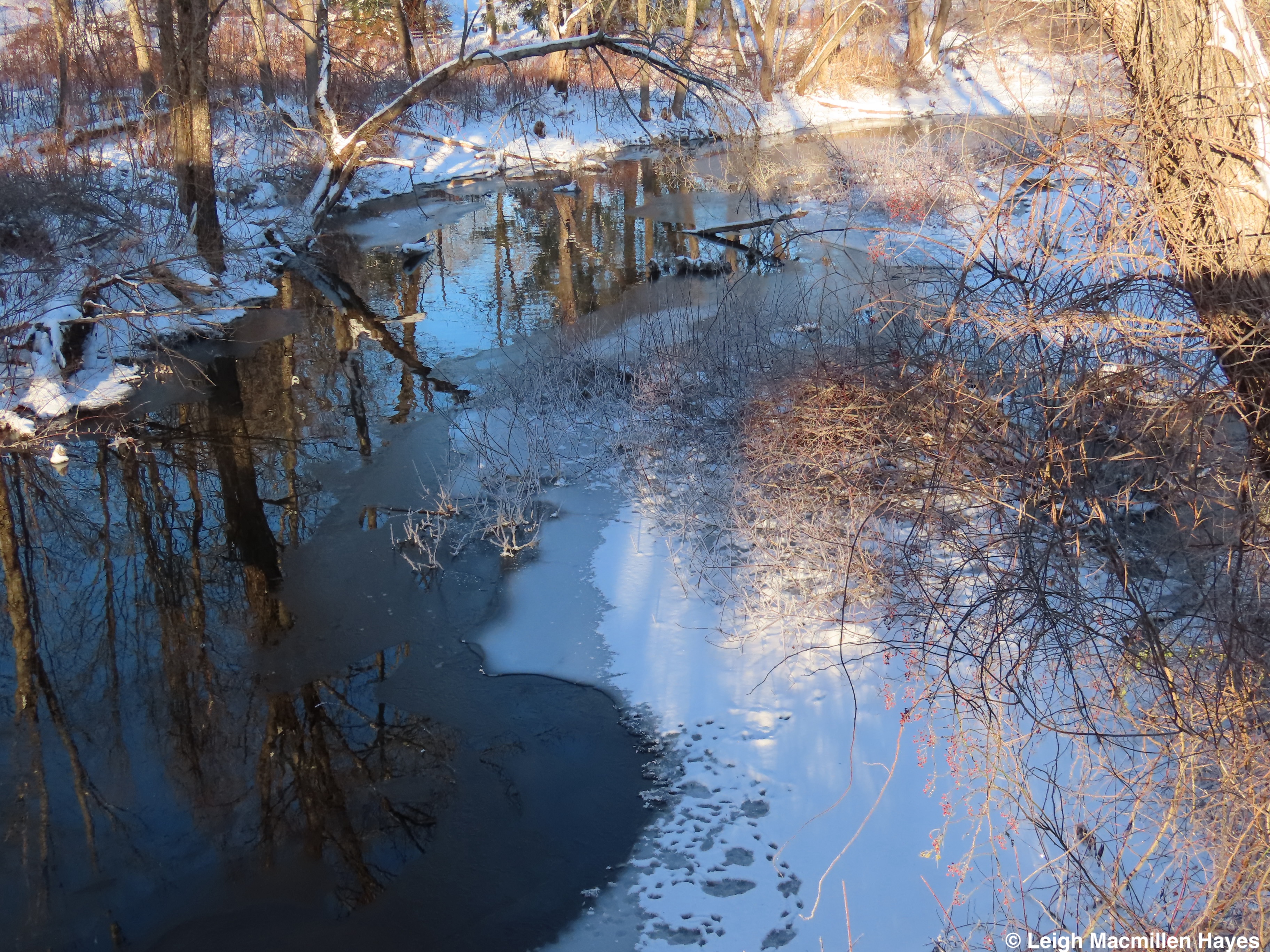
The Christmas lights on Bob Dunning Memorial Bridge in Pondicherry Park rather said it all for so coated were they with ice crystals when we arrived this brisk morning. Fortunately, though, we knew it was going to be as cold as it was and had dressed appropriately.

And really, there is nothing more beautiful than the world beside water on such a morning for everything was coated like the candle and the world was transformed into a glistening display.

Just a few days prior, when I’d walked in the park, I had noted that Stevens Brook was almost completely frozen and feared we wouldn’t even see ducks on today’s count. But . . . wind a couple of days ago had done its own deed and opened things up.

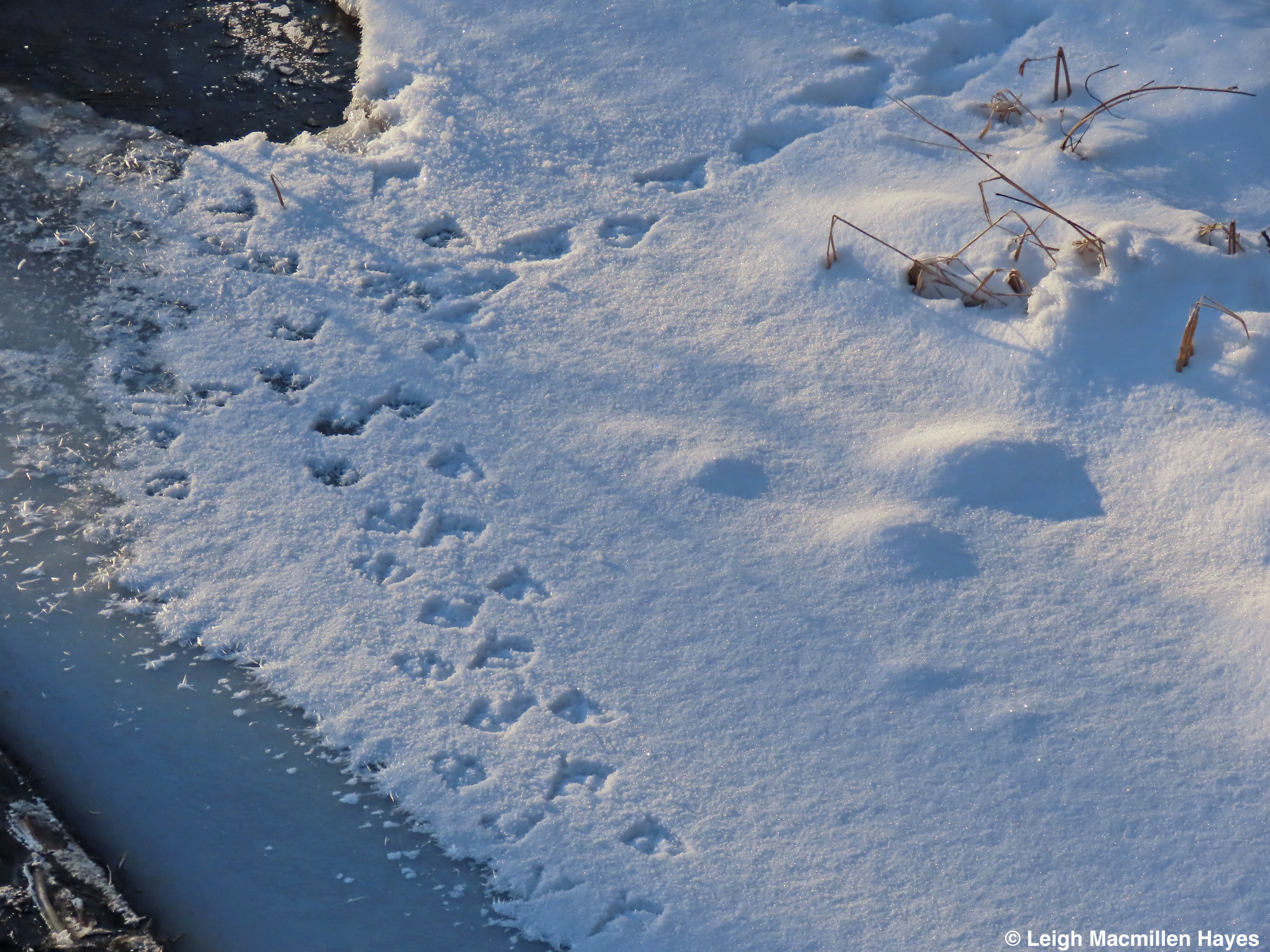
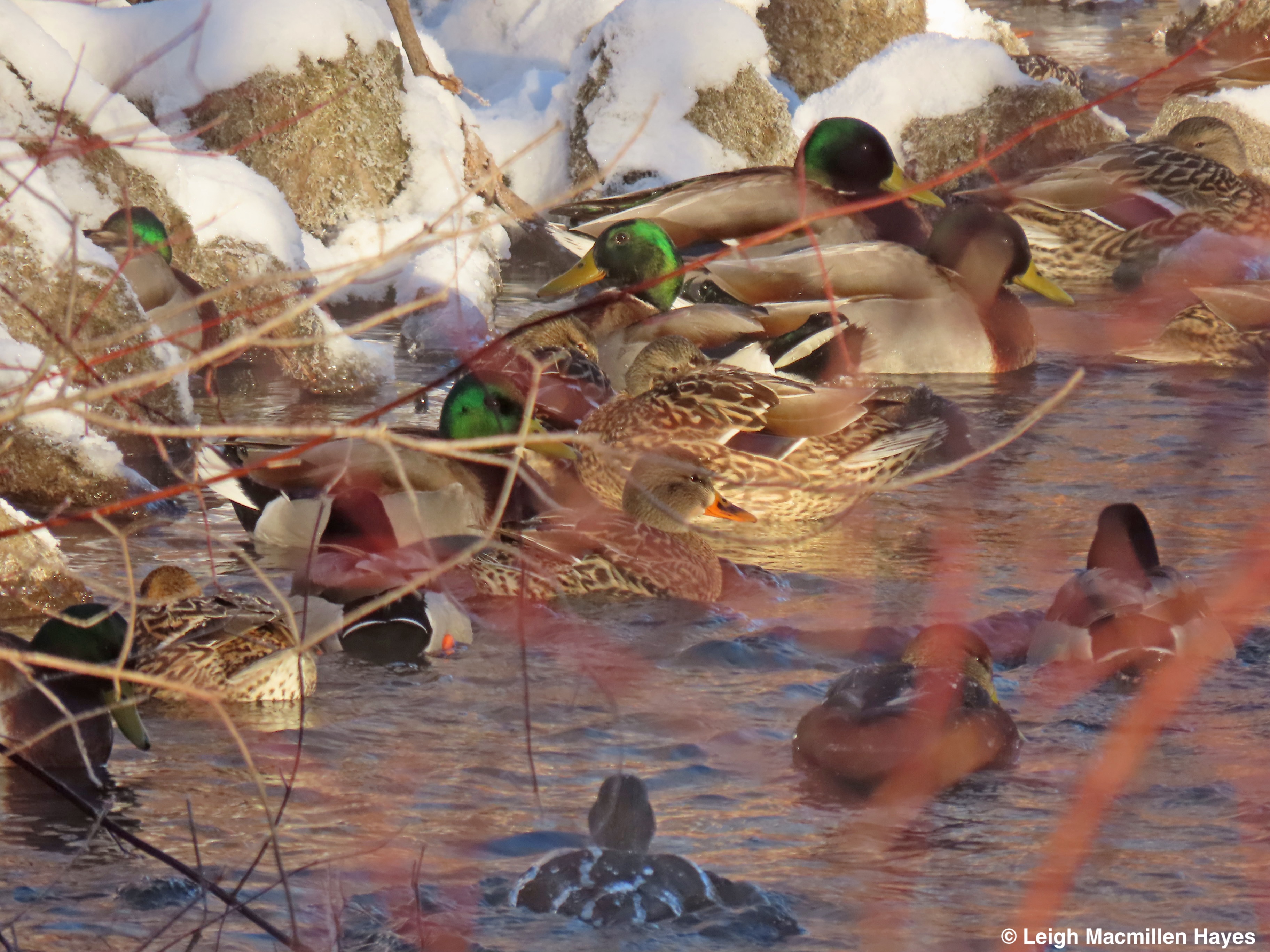
And much to our delight, we spotted duck tracks along the edge at about the same time that we heard a few Mallards quack in their Mallardy way that sounds much like a laugh.

And then we spotted more ducks and had to walk around a building to get a closer look. And count. And count again. And eventually decided on 100 as a number to represent the ducks as best we could for there were so many and they were in constant motion and some flew in in the midst of our efforts.

Half of birding is listening and it was the “Peter, Peter,” call that told us to look for the Tufted Titmouse.

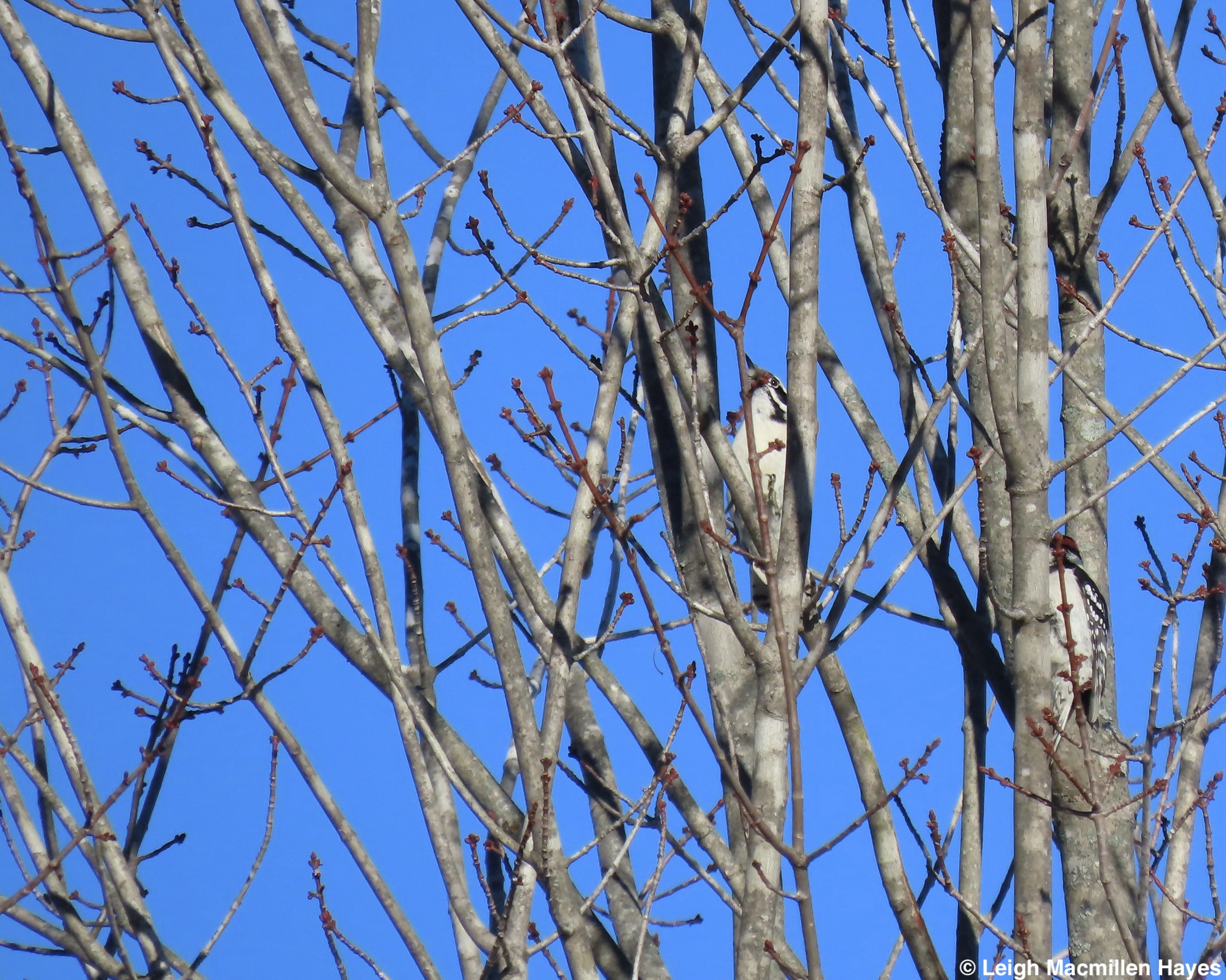
We also spotted two Hairy Wookpeckers playing a game, or so it seemed, as one would fly to a branch, the other would follow, and then the first would move again and on it went with them trying to mimic the branches between their flying sprints.

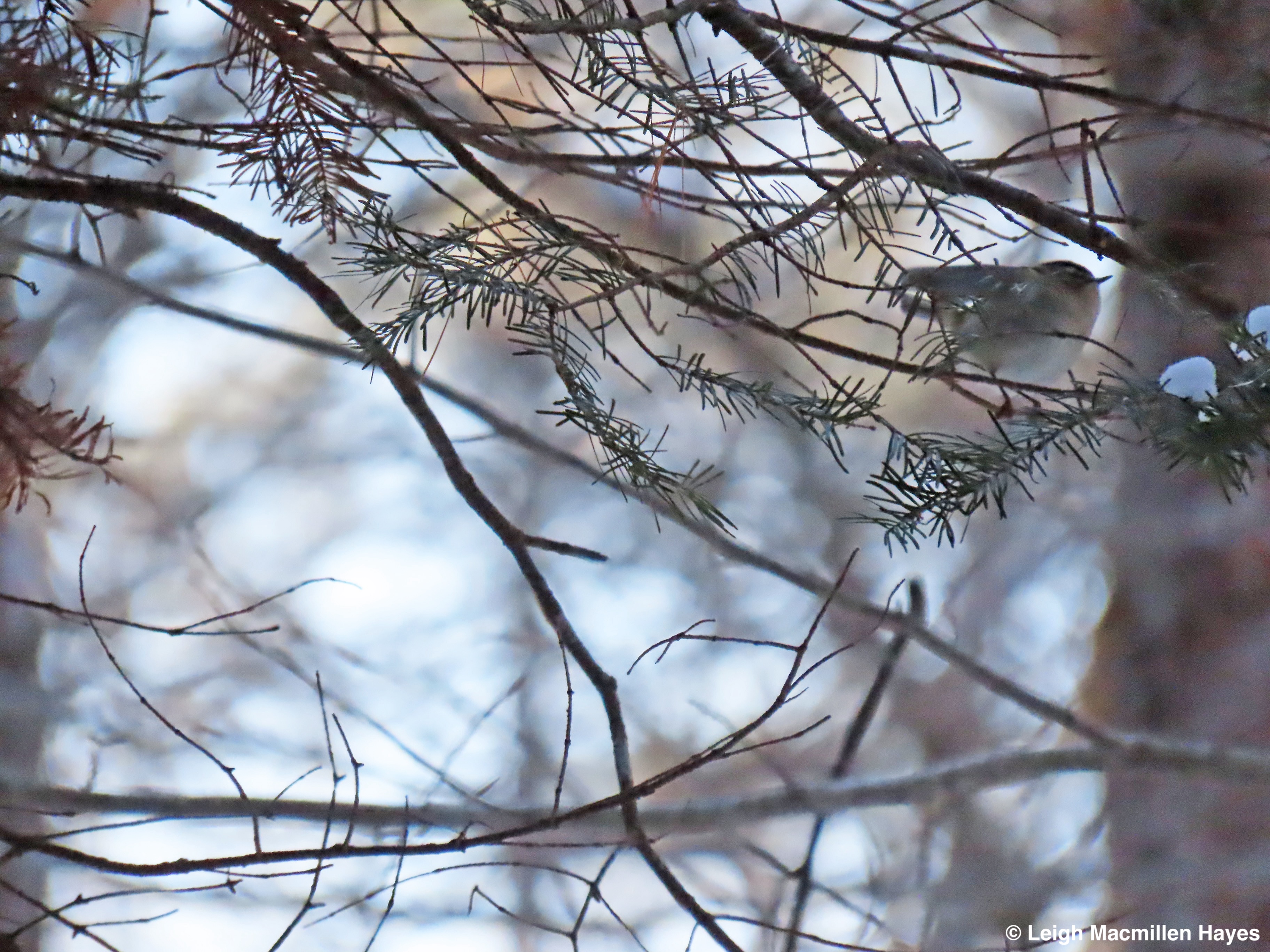
And talk about moving, we saw five Golden-crowned Kinglets, who performed their own acrobatic moves for us, which made them difficult to photograph for they were never still. That’s the thing about photographing birds–“And then it flew,” we’ve often been heard to say once we spot one.

As we moved along the trails, another site garnered our attention: wing prints. Dawn measured the wing span–36 inches. A bit too short for a Barred Owl, but it was still our best guess. And there was plenty of food available either atop the snow or just below in the form of mice and voles. We’ll never know who actually left these impressions or if a meal was part of the deal, but that’s okay because sometimes mysteries can’t be solved and that’s what keeps us going.
We did wonder if we could add such a sighting to our bird count, but since we couldn’t name the species, thought better of it.

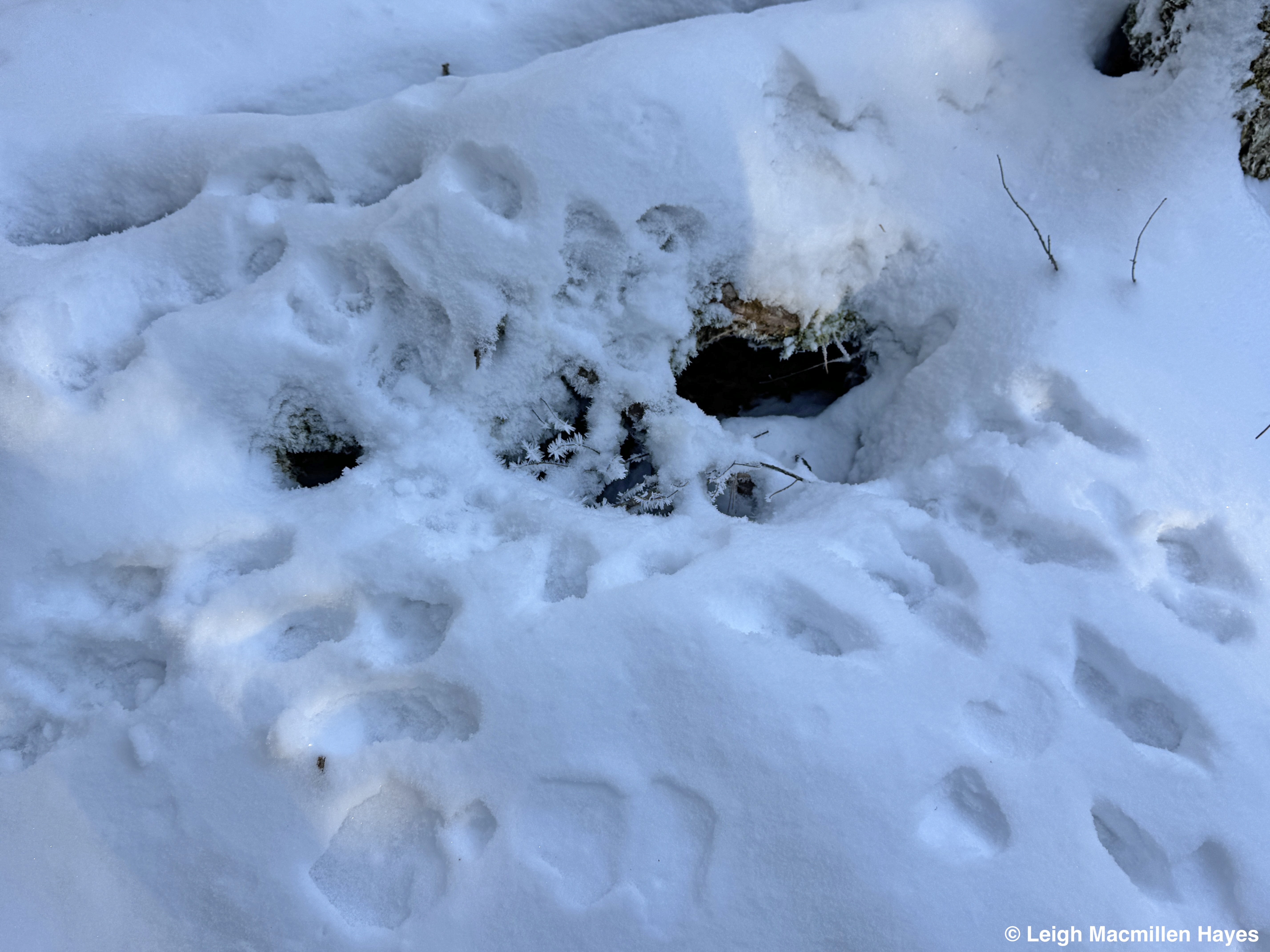
In another area, we noted no birds, but plenty of fox tracks and even faintly sniffed the skunky scent of Red Fox. It seemed very curious about some holes so we went in for a closer look.

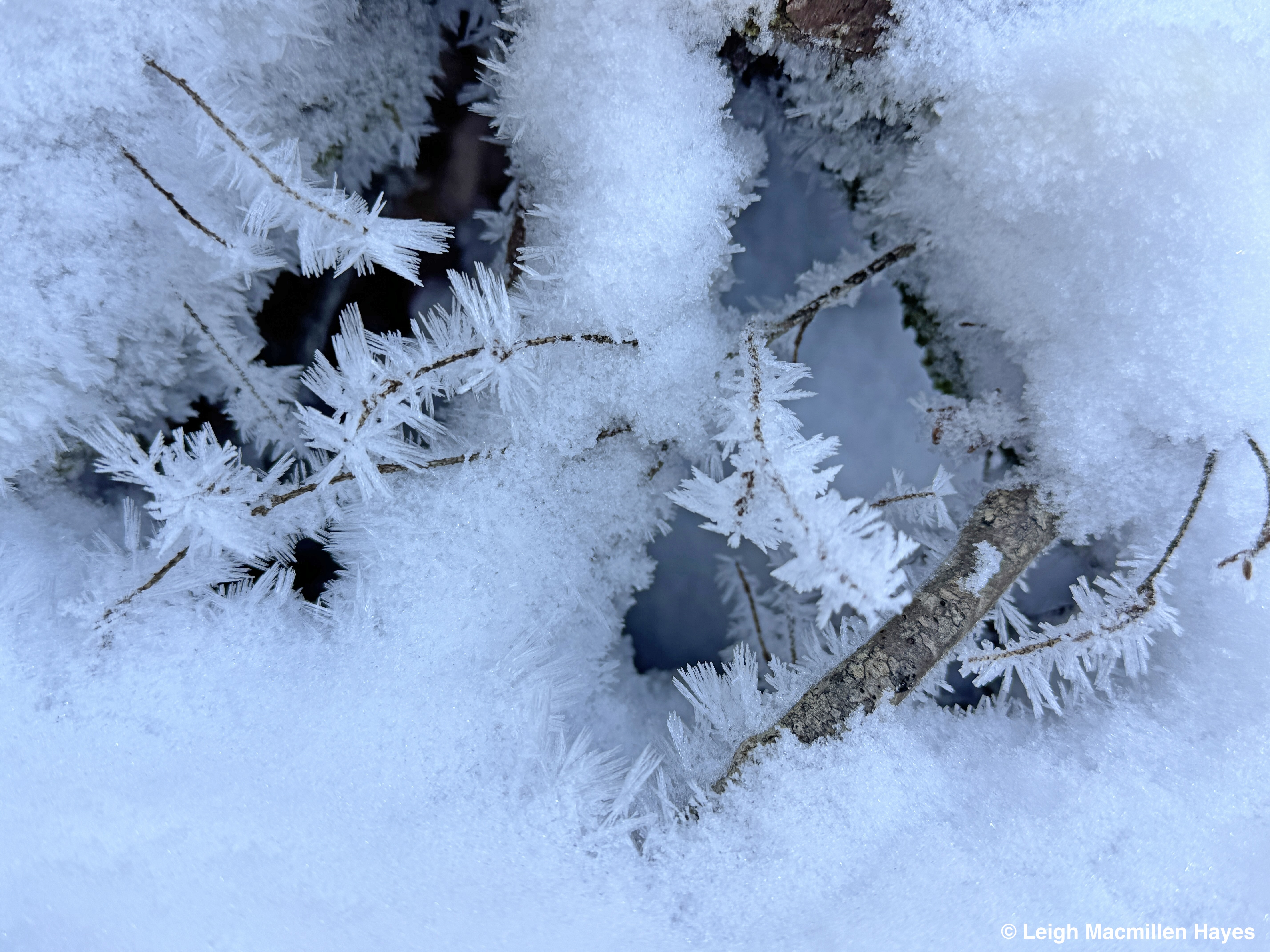
The best we saw–ice needles indicating one of two things: a critter surviving and breathing in the holes; or moisture below rising and freezing. We decided to stick to the first story and knew that we were one hundred percent correct because when no one else is around, we can think what we wish.

Another set of prints tricked us for a few minutes. Our first thought when we spotted the sashay look of the track was a Porcupine. Especially since we had just been talking about one that resides somewhere in my woods. But the prints within the track didn’t strike me as porky. And then we realized it wasn’t really a trough, but rather had a ridge in the middle. And it was skinnier than a porky trough would be.

What else could it be? And had we seen this sort of track before? And then it hit us: A Ruffed Grouse! Another bird sighting without the sight of the bird. Again, it didn’t count, but it was a great lesson as we ease into this year’s tracking season.

Before we left the park, we were in an area where I often see and hear lots of bird activity and today there was absolutely none. And then a Bald Eagle flew out of a tree. I wasn’t quick enough to focus the camera, but we both will hold that shot in our minds’ eyes.

After completing our survey of Pondicherry Park, we drove north to Highland Research Forest, and not far into the property began to spot Snowshoe Hare tracks. These are the snow lobsters of the North Woods for so do the set of four feet look when arranged perfectly, which doesn’t happen with each hop. But, if you look at the set of four prints in the bottom-most impression, you’ll see the two smaller front feet that landed on an angle thus forming the lobster’s tail, with the hind feet swinging around and landing in front of them to form the claws.

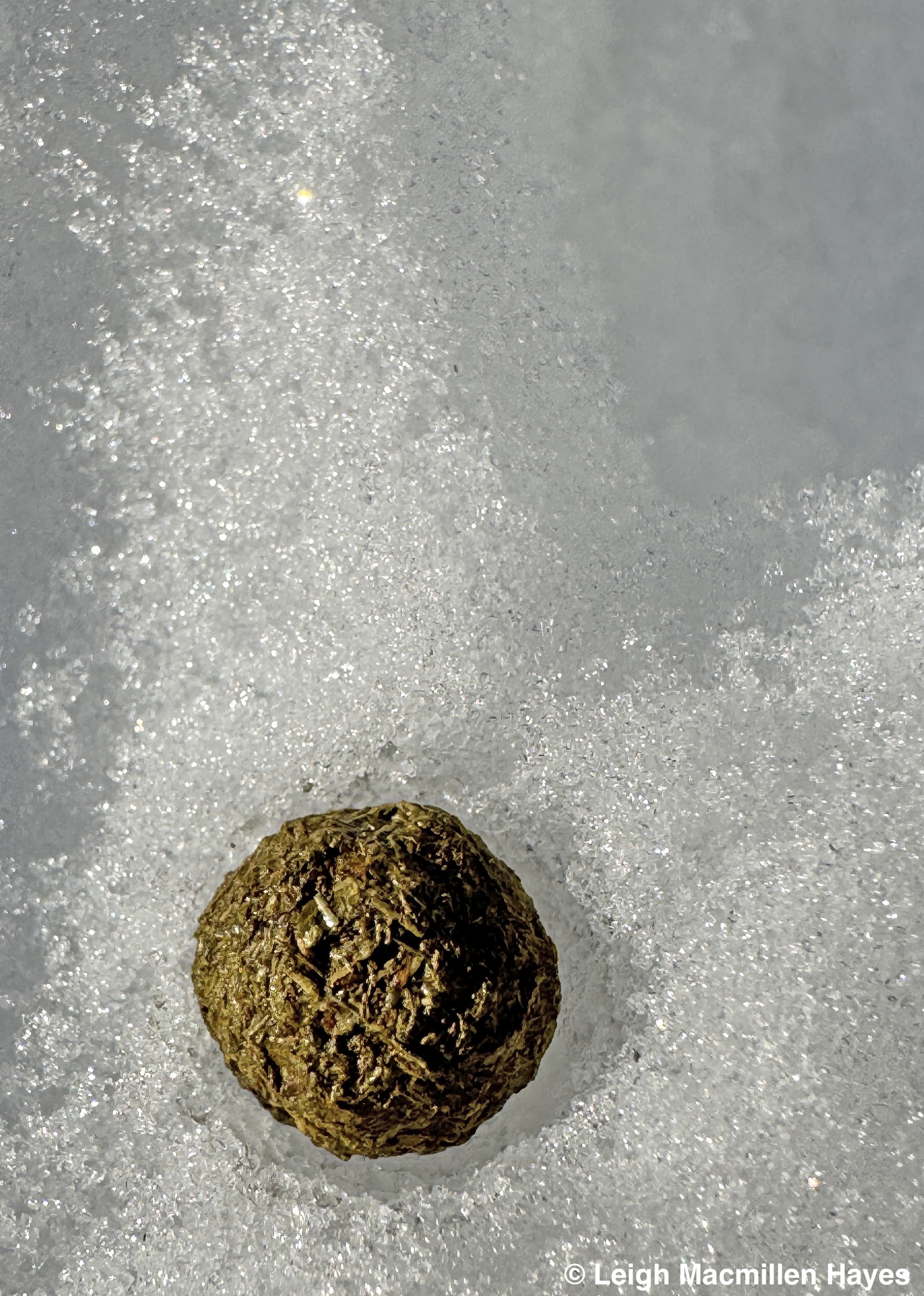
And where there are Snowshoe Hare tracks, there is scat.

Malt Ball-sized scat full of plant fiber, as it should be.

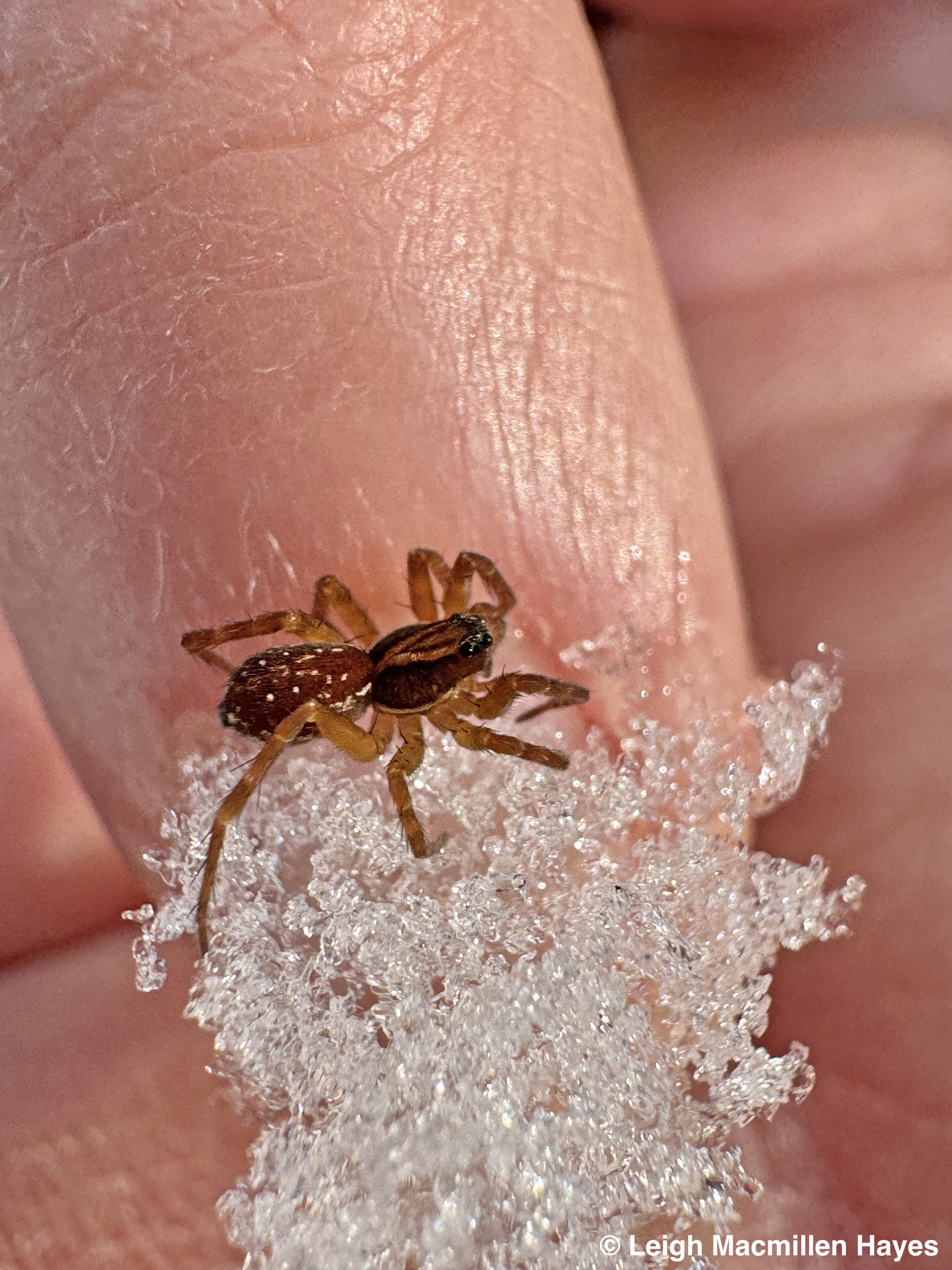
And when one is looking and listening intently, one sees all kinds of things. Yesterday, while hiking along a trail near our home with My Guy, we began to count Long-jawed Orb Weaver Spiders walking on the snow, proving not all spiders are dormant in the winter. That made sense for yesterday afternoon as the temperature was above freezing, but today’s temp was colder and though it eventually reached 32˚ by the time we finished, it was still in the 20˚s when we began to spot this behavior.

I assume the spiders are able to lower their bodies’ freezing point by producing a cryoprotectant, a glycerol anti-freeze compound that prevents them from freezing. An amazing adaptation.

Going in for a closer look, check out those hairy legs! And the long pedipalps used in reproduction; they are also tactile and function like insect antennae.

It’s funny how once you notice one thing, your attention is attracted to another, and such was the case that as we hunted for spiders, we spotted a caterpillar, that didn’t seem to be alive and can only trust that it was blown off a twig.

Like the park, Highland Research Forest is located beside a wetland and a lake, with lots of waterways in between. And like the park, the frost offered artwork, each crystal unique.

Since we were there to scan the wetland for birds but came up empty handed, we were forced to observe the newest beaver lodge in town. We didn’t walk out to it, because of course, tracking was not our official business of the day, but we suspect based on the mud and resent log additions, that it continues to be inhabited.

We really were birding. Honest. It’s just that this property usually has less activity of the avian sort than the other and today was no different. And then we realized that a year ago we said we’d start here in the morning and may be be honored with more sightings, but in the planning stages forgot, so have promised ourselves that next year we will begin our birding adventure at Highland Research Forest and then go to Pondicherry.

But tracks. Oh my. We saw tracks. Which brought up another discussion. Two years ago Dawn assisted me in leading a Senior College tracking expedition on this property. I chose it because I knew it to offer many tracks of a variety of mammal flavors. And that year, we walked a loop trail and finally found signs when we were about two tenths of a mile from the starting point: a Deer rub on a tree; and one or two sets of Snowshoe Hare tracks.

Today, however, while bird activity was almost non-existent, the mammal activity was overwhelming. Including these Fisher prints. (Note to the wise: Fishers are in the weasel family and not the cat family, so they are Fishers and not Fisher Cats.)

And on a high spot near the trail in the midst of the Fisher track: another sign post. Fisher urine. Apparently he was marking his territory with a mere dribble here and another dribble there.

Reaching Carsley Brook, we paused on a bridge, again in hopes of hearing a few peeps. There was an occasional Black-capped Chickadee and a White-breasted Nuthatch, but few others making their presence known.

That said, there were other presents to honor, again two other members of the weasel family: an Ermine and a Mink. The giveaways, track width and foot orientation on a diagonal.

Moving away from the brook, we again found bird sign in the form of . . . Turkey prints. But again, though birdy they were, they couldn’t count toward the bird count.

Pausing as we did frequently to make sure we didn’t miss anything in the bird department, we spotted others flying from twigs. Well, maybe not flying yet. But certainly dangling. As is their habit in the winter. The first was the cocoon of a Promethea Moth, which will fly in the future.

And a few feet farther along the trail, that of a Polyphemus Moth.

Both are attached to the twigs with an incredible reinforcement of silk, and reminded me of how my friend Marita recently reinforced the “idiot strings” on my mittens so they can dangle from my wrists when I take them off to jot down notes or take a photograph.

We also found another spider to admire.

And a kazillion mouse tracks showing their keen interest in risky night-time missions.

Just before we finished, and while we were searching the trees for a Woodpecker, an anomaly caught my attention and I realized I was starring at a Barred Owl. Unfortunately, it flew off before I had a chance to focus the camera on it, but like the Bald Eagle earlier in the day, it was a thrill.

Oh, and did I mention the Great Horned Owl that we spotted this morning as it kept watch in the exact spot we saw the Eagle? It’s amazing the Bald Eagle didn’t take it out, but this bird seems to lay claim to the area for it sits in the same spot day after day.

At the end of our Christmas Bird Count today, these were our findings:

Distance covered: 5.8 miles

Time of travel by foot: 6 hours

Mallards: 100

Downy Woodpeckers: 5

Hairy Woodpeckers: 3

Pileated Woodpecker: 1

Blue Jay: 5

American Crow: 10

Black-capped Chickadee: 17

Tufted Titmouse: 3

Red-breasted Nuthatch: 1

White-breasted Nuthatch: 9

Golden-crowned Kinglet: 5

Dark-eyed Junco: 2

Bald Eagle: 1

Barred Owl: 1

Long-jawed Orb Weaver Spiders (12/27/24): 14; (12/26/24 with My Guy): 94

Caterpillar: 1

Moth Cocoons: 2

Tracks: a zillion including Ruffed Grouse and Turkey.

Surely the bird tracks count for something as everything counts.