My Little World

Between our six acre plot of land and our neighbors’ field, which is probably about three or four acres, I feel like we live in a special place. Oh, I know I’m not alone and so many others have their own special places. What I’m most grateful for, however, is the ability to enjoy it by wandering and wondering on an almost daily basis and getting to know it intimately. That said, there are always surprises and perhaps that’s what makes it extra special in my eyes.
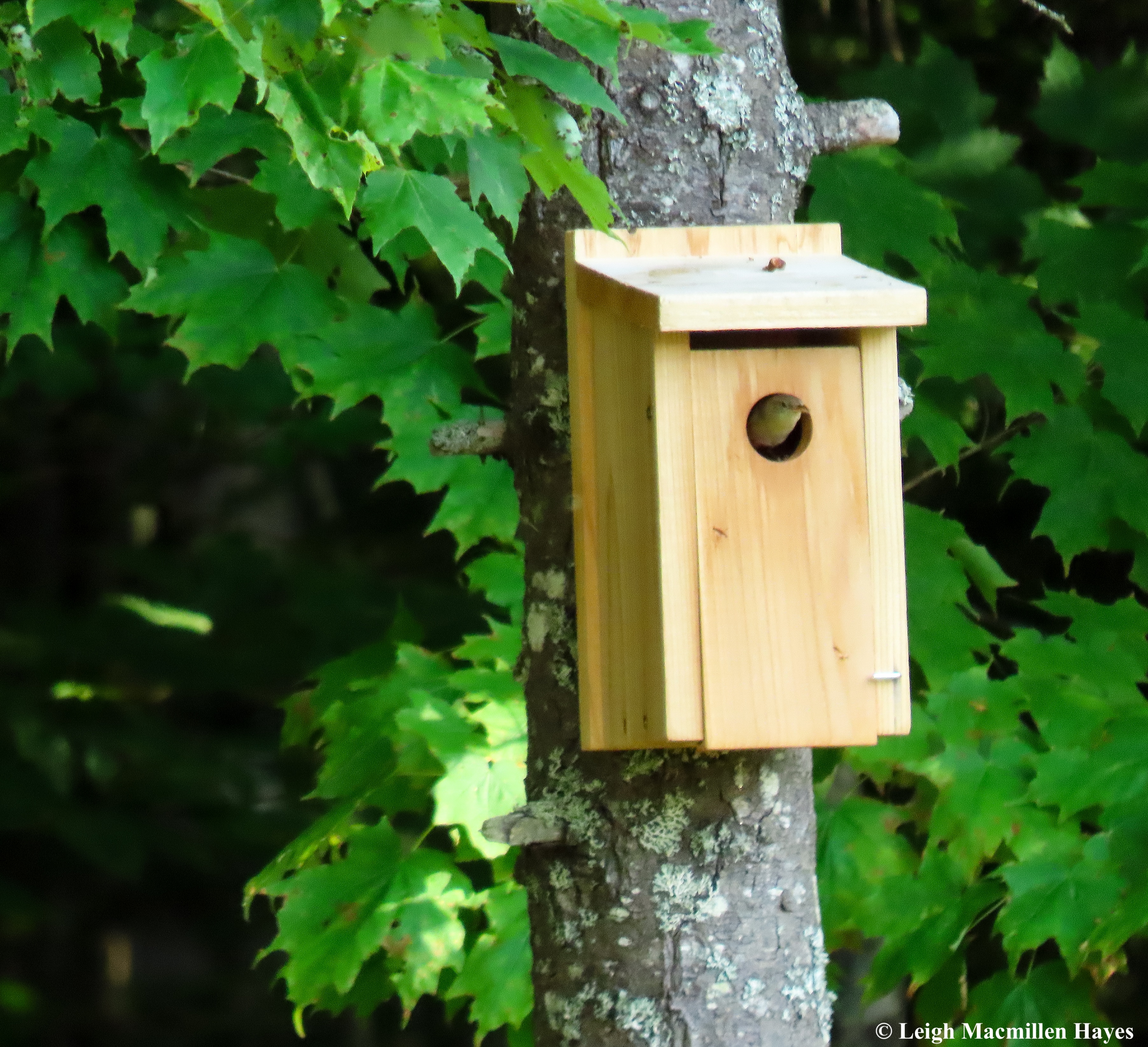
One day recently, after spotting no activity for about two months at the Bluebird Box My Guy had nailed to a tree along one of the stonewalls, I noticed activity. In the form of a House Wren.

For hours, sticks were picked up and brought to the box, the better to build a platform for the nest cup to rest upon. Sometimes they were too big. At least to my untrained mind.

But a little finagling this way and that; I admired such perseverance. And knowledge.
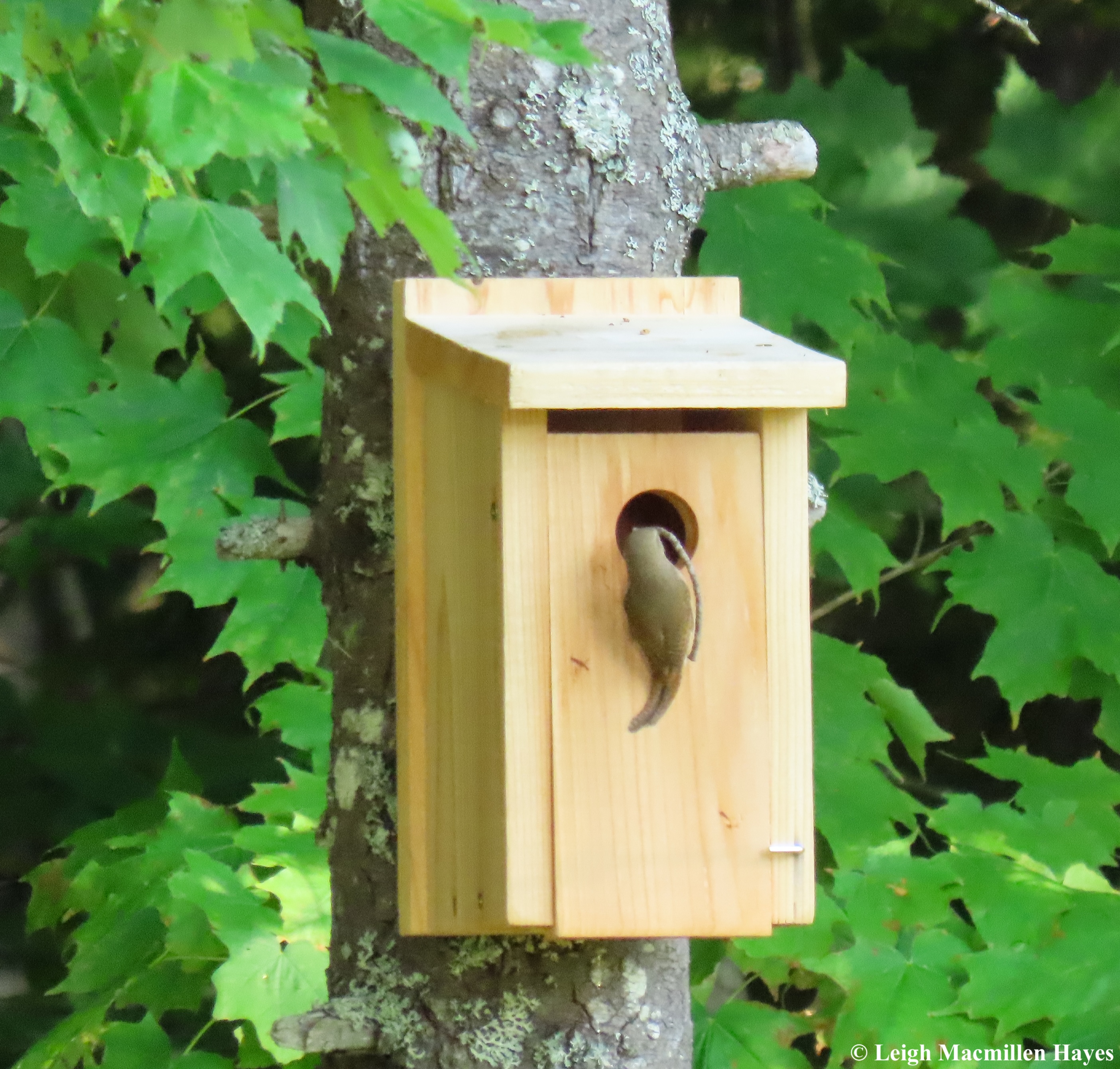
Tada, in that stick did go to join the others. With many more to come.
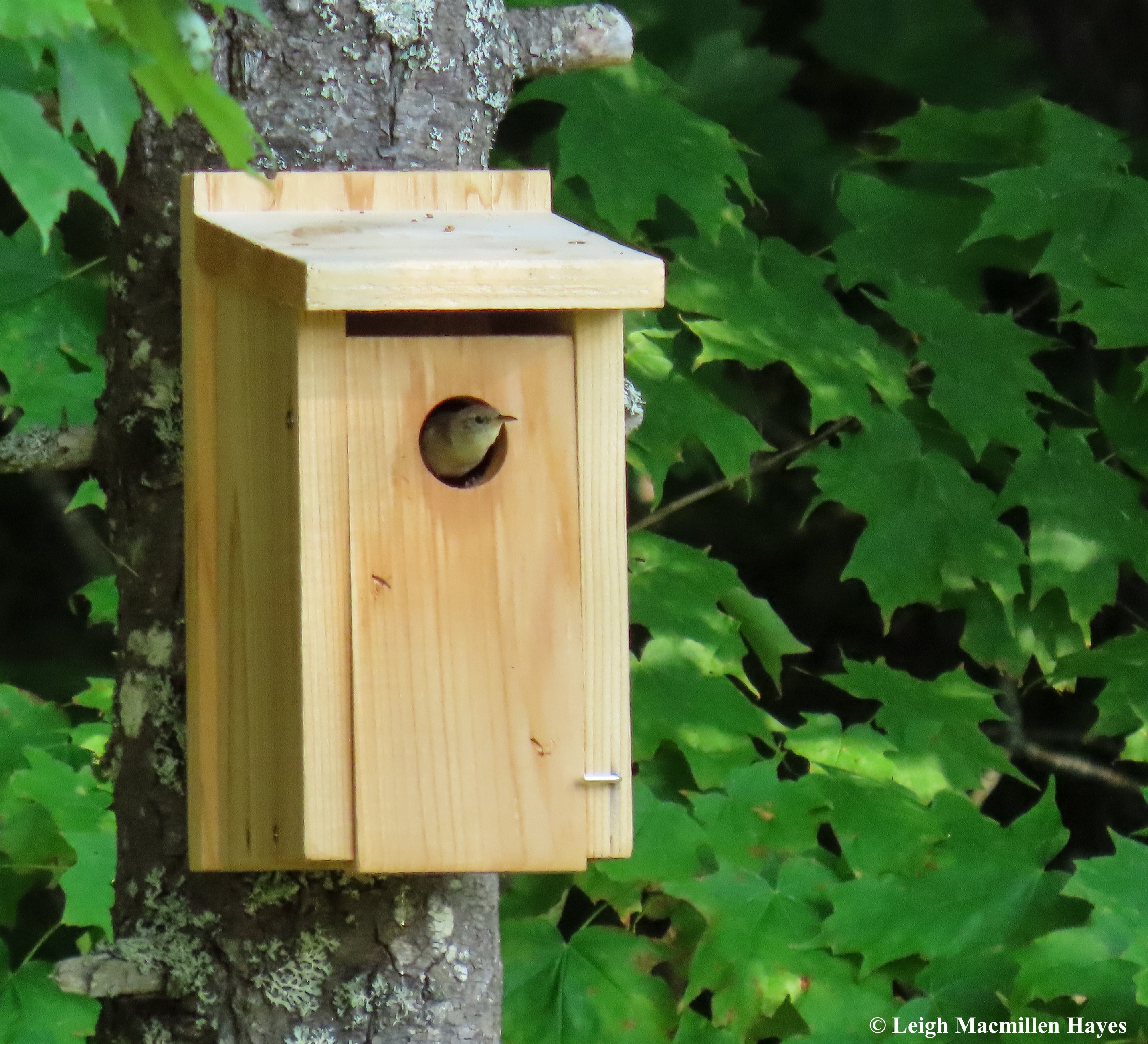
For two days, the Wren worked in the same manner. And then. Nothing. Being a Male Wren, it was just being a Male Wren . . . filling a possible site here and probably in other boxes near the field, as well as in tree cavities and she chose a different piece of real estate to set up housekeeping.

To say I’m disappointed is an understatement, but it’s the Wren Way. And I’m only a guest here.

I love being a guest here because I see all sorts of Natives make themselves known, including this youngster who followed in the footsteps of its parents, crossing the yard at an angle. Fortunately, the backdoor often serves as a screen so I can photograph many of the species with whom we share this land and not disturb them.

That same “screen” helped me capture a shot of an immature Red-bellied Woodpecker, who has the slightest hint of his parents’ crimson red upon his head. He stops by at least once a day, but is always in motion. And never stays long.
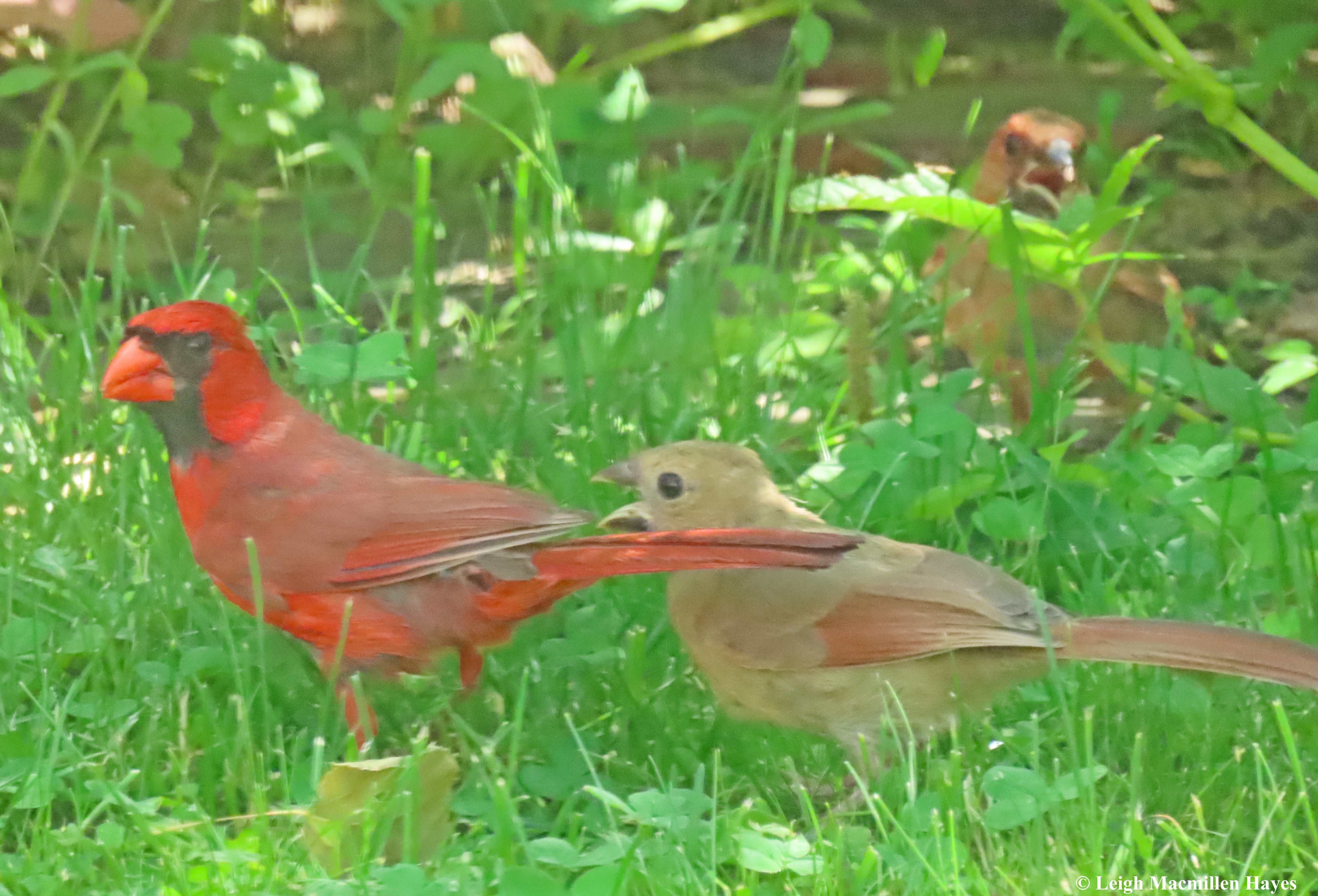
The Cardinals also bring their young to visit on a regular occasion, and sometimes the young’uns even come on their own. Watching them reminds me that many wild parents are amazing caregivers. Beavers and White-tailed Deer and Moose and Coyotes are among those who stay together as a family unit for a year or more. But not all are the same, like the frogs and salamanders who lay eggs and then leave the vernal pool.

What I have to wonder is how does this all work–why do some stay with their young and others abandon them?

Speaking of young’uns a wee bit more, as I headed up to the field, I met a recently fledged Robin, its breast all speckled. Though the Robins are constant backyard visitors, it wasn’t till I wandered about the yard that I found their nest.

And now I regret that I didn’t realize its position earlier, for I would have enjoyed keeping an eye on it.

As I said, the field belongs to our neighbors and I’m eternally grateful that they mow a path meant for them and their dogs, but I’m allowed to trespass by climbing over one of our stonewalls . . . and I do. Daily. Sometimes several times a day.

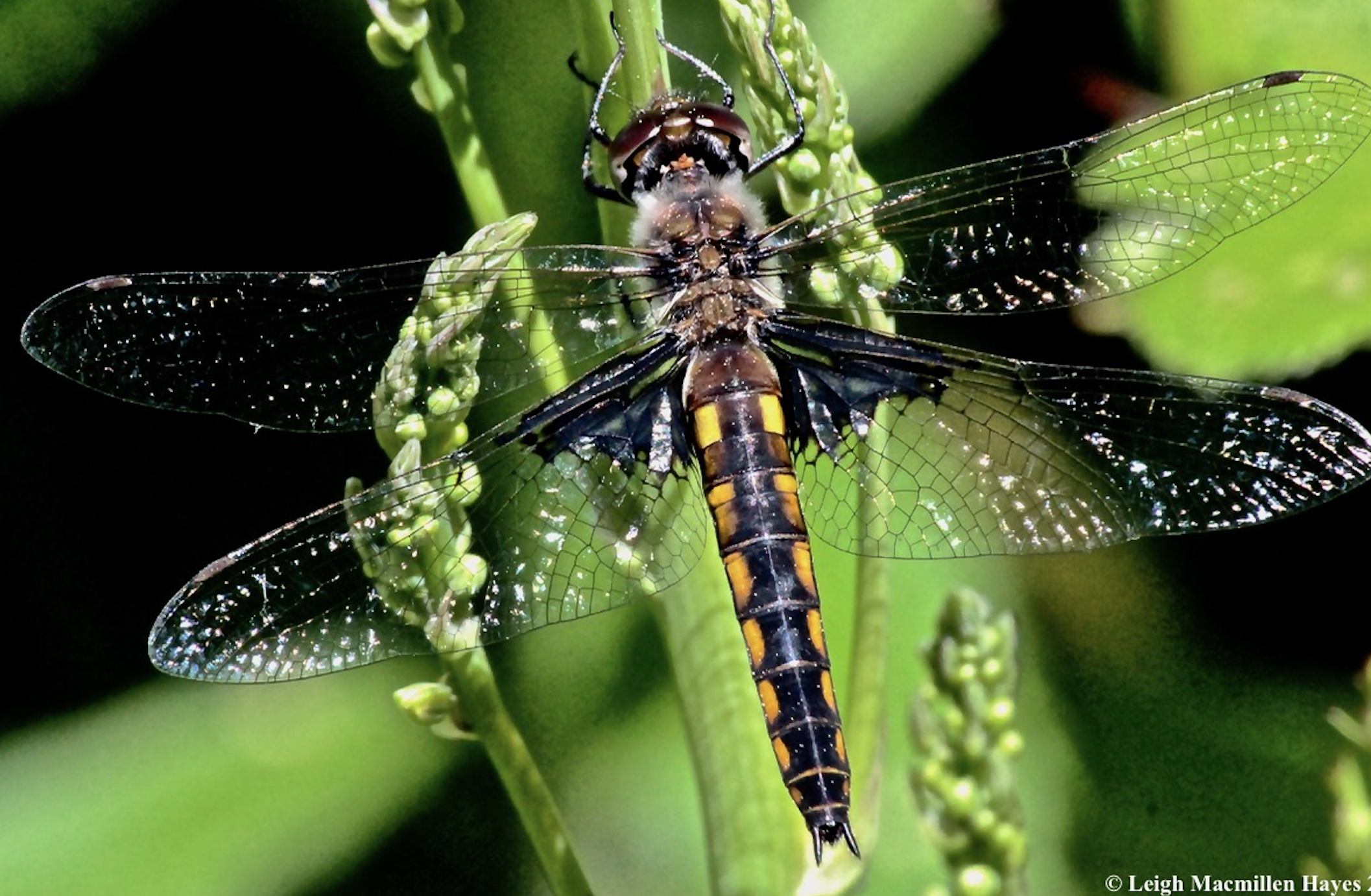
It’s a place that serves as one of my classrooms and I’m always amazed at who I meet there, including this Frosted Whiteface Skimmer Dragonfly. The yellow and black thorax and base of the abdomen, indicate this is a female. And though you can’t see her white face, she has yellow spots on the thorax segments 4 to 7, with 7 being very small.
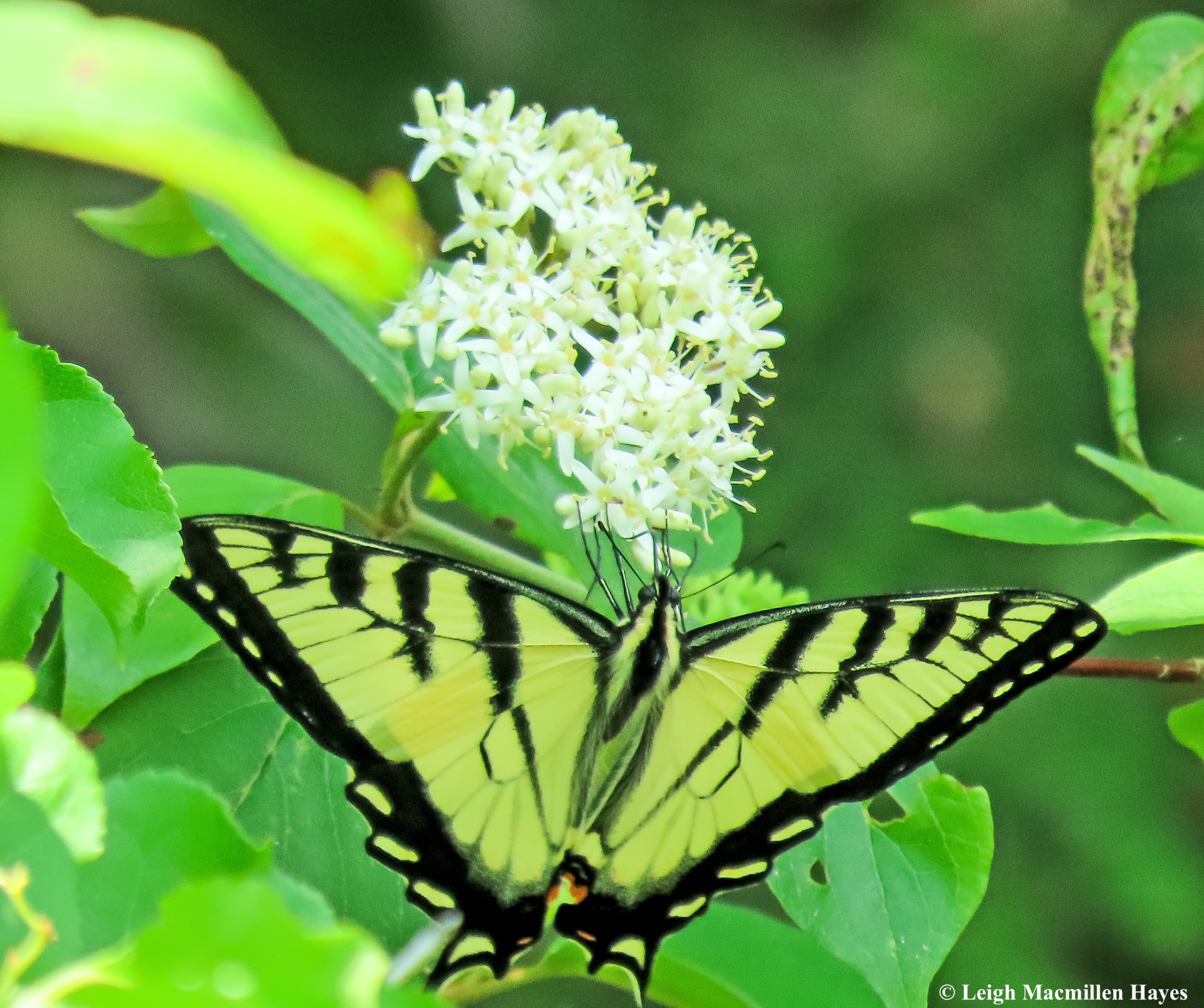
The most abundant butterfly of the season so far is the Tiger Swallowtail, and this one took advantage of the flowering Dogwoods at the top of the field.

Everywhere, there were Calico Pennants, one of my favorites (one out of a million), this being the female with her yellow markings.

While My Guy practices Yoga several times a week, the dragonflies do so even more frequently, especially if its super hot, like today’s temp of 91˚ that felt like 96˚, or so the weather app told me.

The Calico’s handstand is actually an obelisk posture, with the abdomen pointing toward the sun in a manner meant to minimize the surface area exposed to solar radiation. Again, I am in awe.
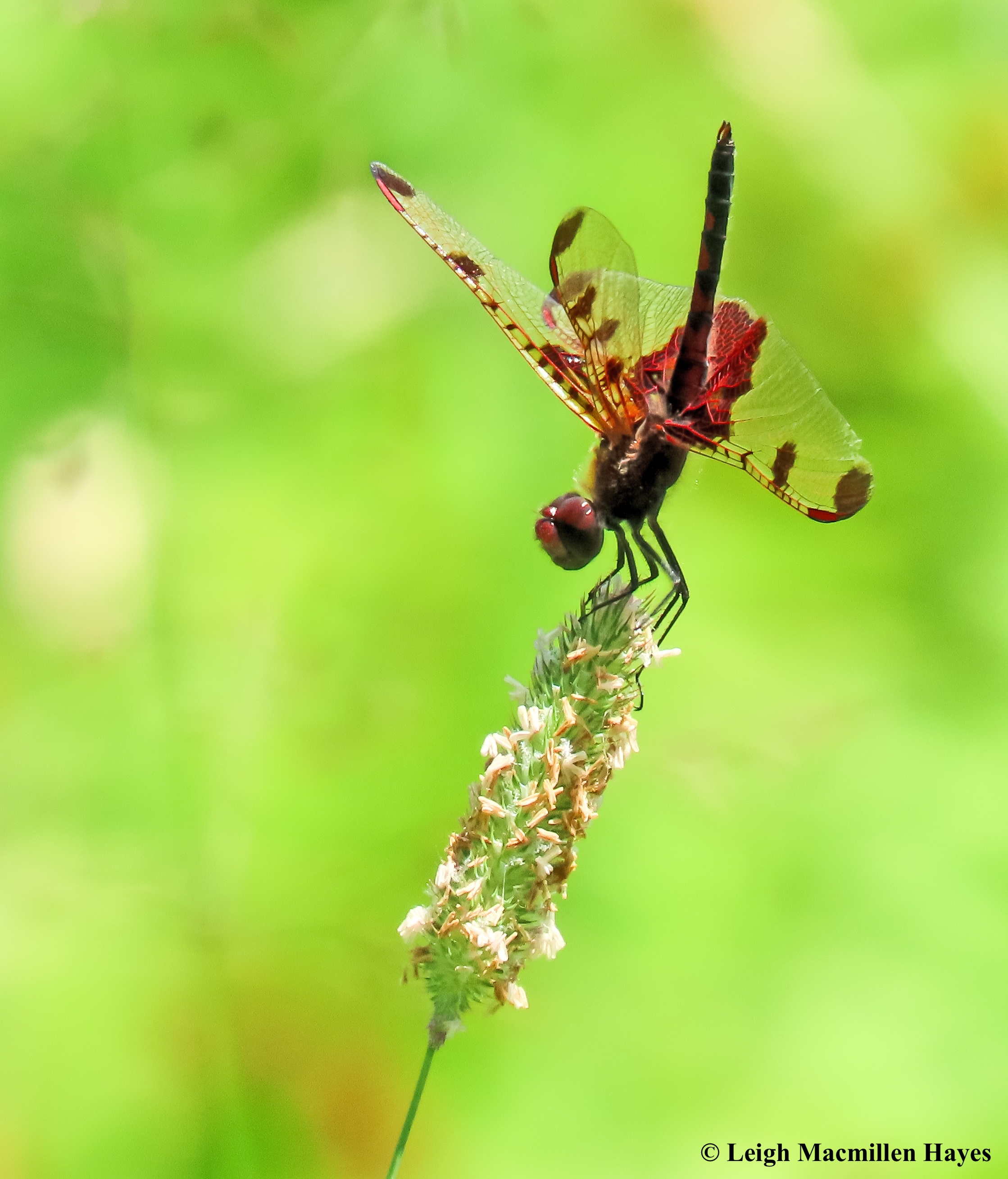
Calico’s male, bedecked in red, chose the same stance.

Back over the wall and into our yard, Oriental Beetles are making their presence known. What captures my attention is the texture of wings and thorax, and the hairy and spiky legs, and the funky antennae that look like handmade forks.

Apparently some mistake them for this, the Japanese Beetle, but though there are similarities in the wings and antennae, in my brain that’s it. These are not insects high on anyone’s list of favorites, but look at that iridescent green thorax and the hairy, dotted design on its abdomen.
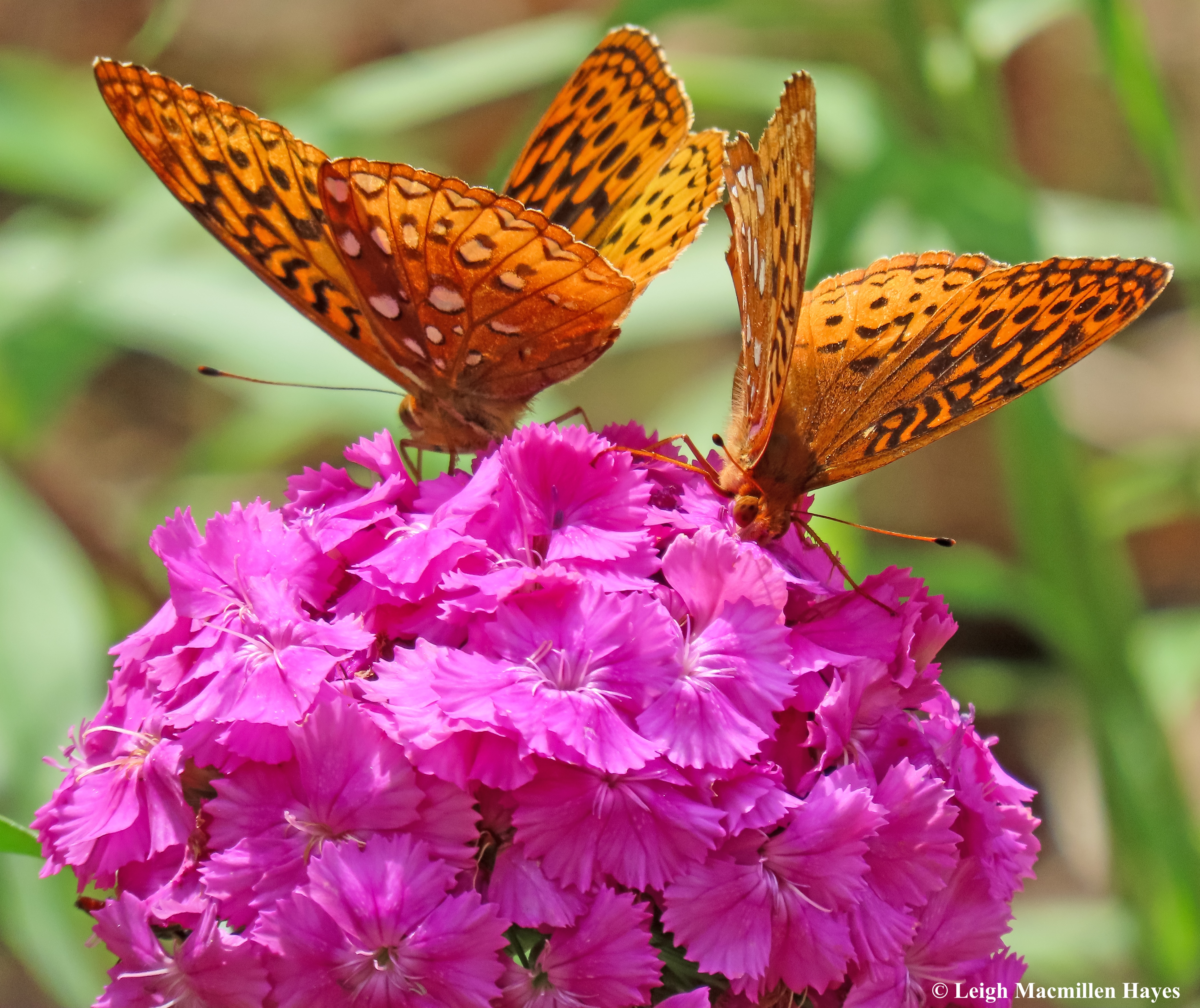
I also spent time circling my newest pollinator garden and among the frequent visitors are the Fritillary Butterflies.

I do, however, worry about some other visitors who keep dining on the flowers rather than pollinating them.

In the wee hours of the morning and all night long, Deer stop by to nibble. There are at least two does and two fawns, and so far the garden has enough to offer them, and the pollinators, and me. But I do worry.

Especially since via the Game Camera I discovered that a neighbor I thought had moved on is still around, and the end of the garden may be in the mouth of the Woodchuck. I hope not, but we’ll see what happens.
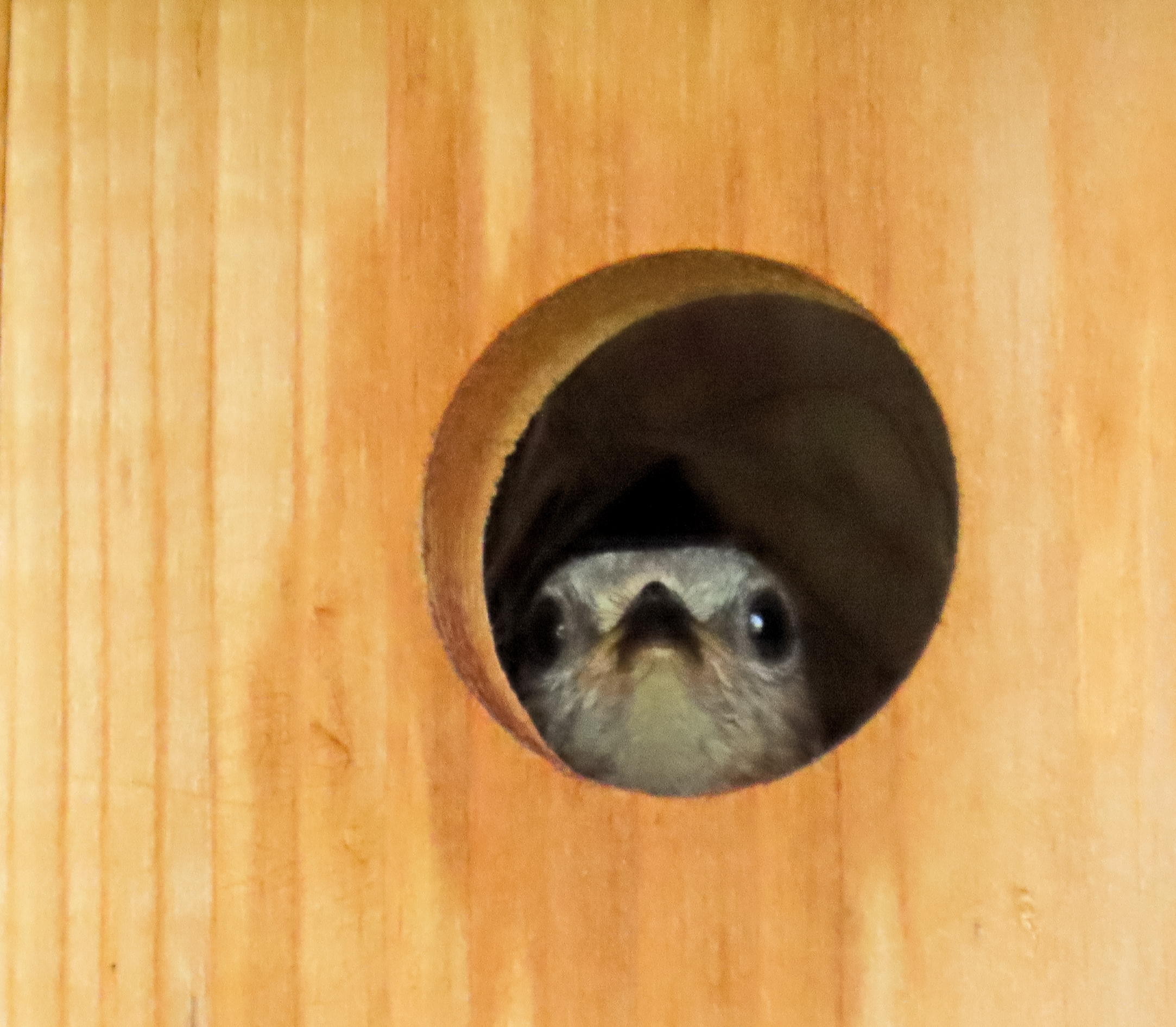
That said, there’s another new neighbor in the ‘hood. Remember the male Wren who worked so hard to fill the birdhouse with sticks? And then I didn’t see him at this spot again. A few days later I spotted a male Bluebird checking it out. And tada . . . a female is sitting on eggs, I do believe.

My little world. It may be small, but really, it’s huge. This is only a smattering of what happens here daily and nightly and I feel so honored to be granted the opportunity to keep an eye on it all. It so enhances my life to spend time wandering and wondering upon these acres.

I hope you have a little world to explore and get to know intimately.
Dragons of the Future

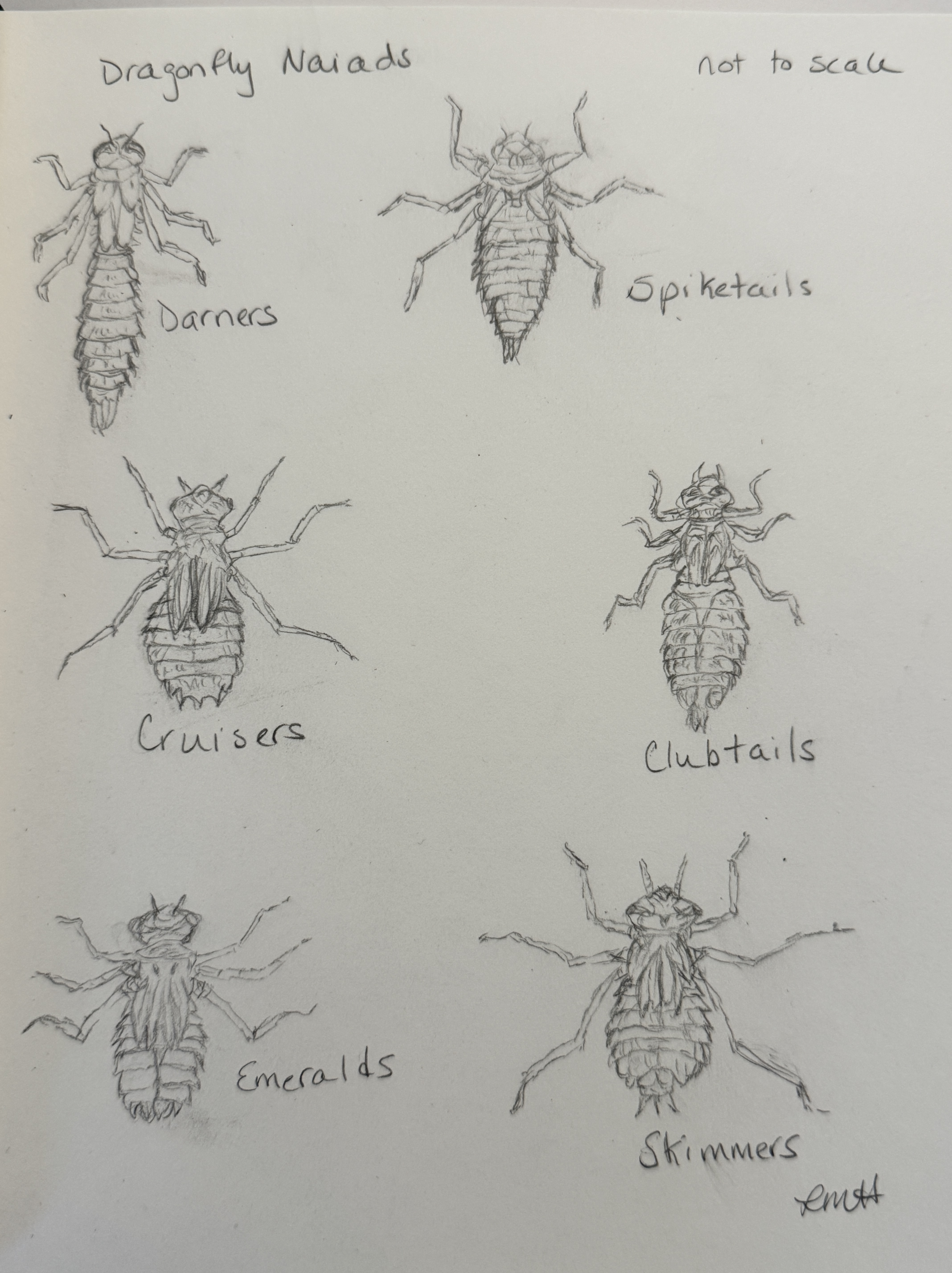
Spring is actually a combination of many seasons, beginning with winter that doesn’t want to let go, followed by mud, and then road-repair, with bug quickly taking form following several days of rain, and soon to come, my favorite of all–dragonfly season.

And so I thought I’d take some time to honor friends I’ve met in the past and try to get to know them better . . .

With my pencil first. Sketching is such a wonderful way to slow one’s self down and try to capture the essence of the object. Thankfully, with pencil and a good eraser, changes can be made and believe me, I have, and will continue to edit these.

Darner Naiad

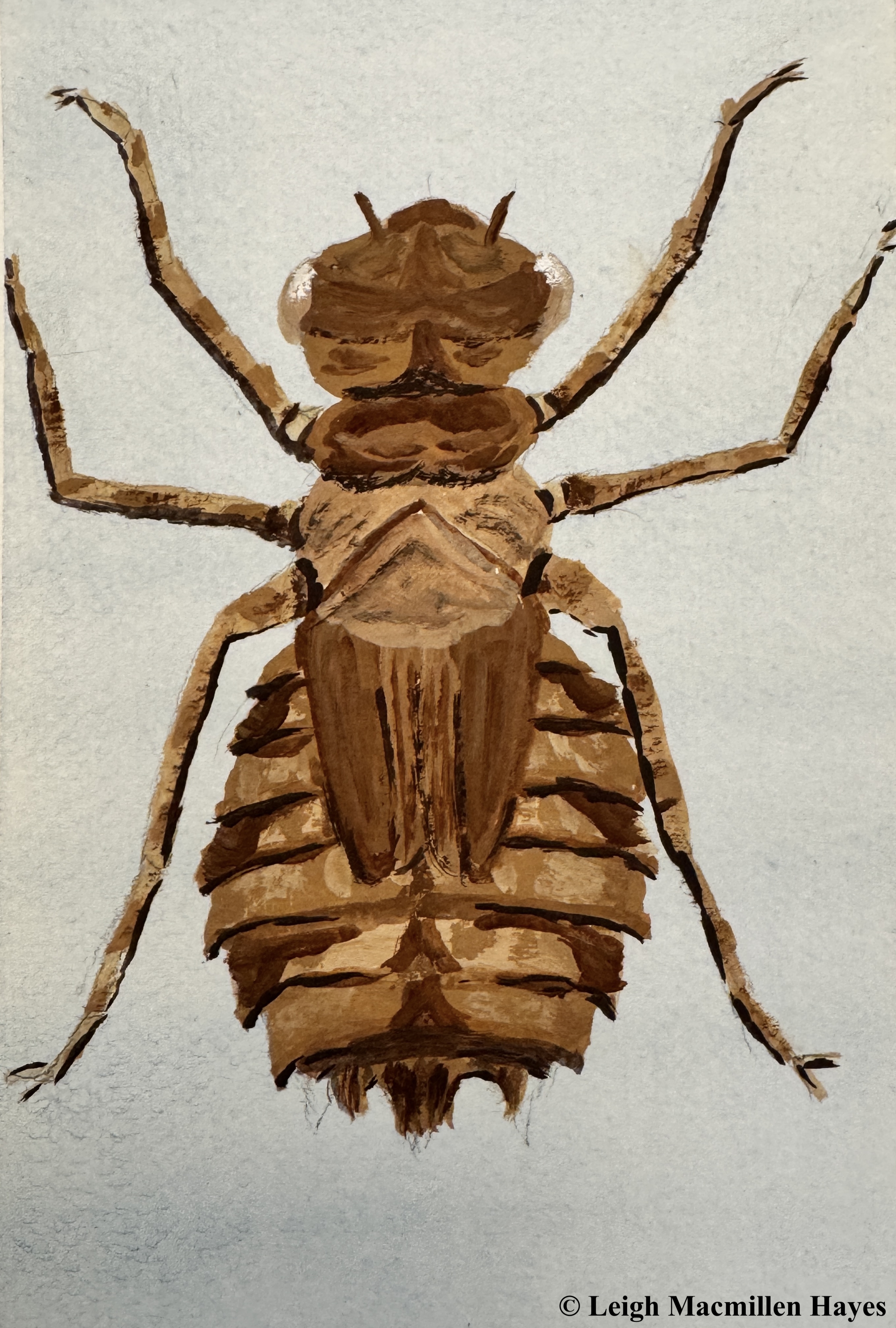
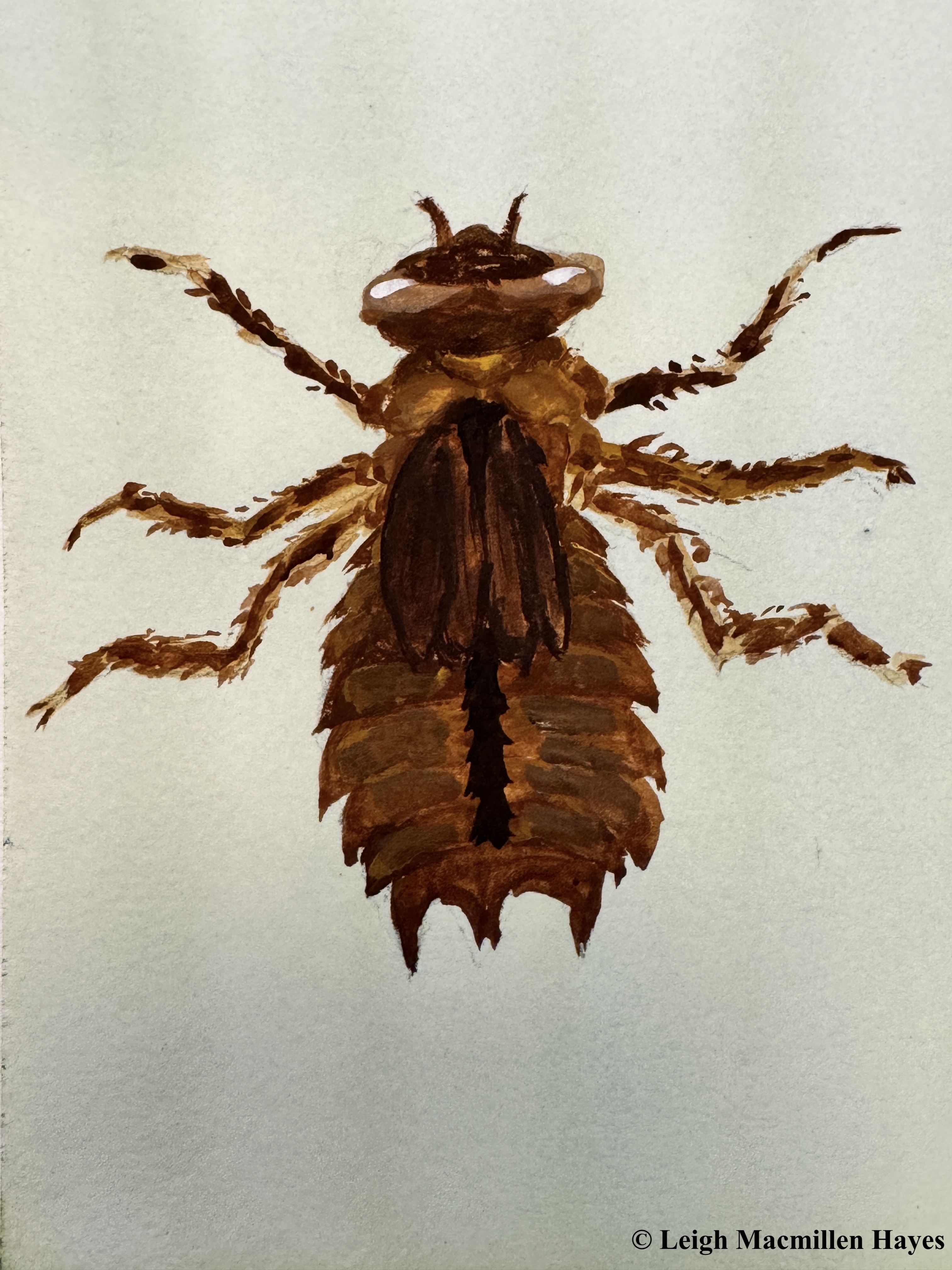
And then I decided to take it one step further–by painting the Naiads (larval form) of six dragonfly families.

One of the incredible wonders of this world is that the aquatic form of dragonflies become terrestrial and we anticipate and celebrate their emergence every spring, knowing that BUG season won’t last too much longer. Well, in some places. Right Jenn?

Usually, they begin to emerge by the end of May and then it’s an ongoing process, with some waiting until late summer or early fall to transition from one world to the next.

This is a Black-tipped Darner that I met in the fall a few years ago when it was barely alive. It was on the grass by the outlet of Deer Hill Bog in Stow, Maine, which is a typical habitat for this species, though it isn’t common.

Stream Cruiser Naiad

After painting the Cruiser Naiad, I thought I’d use the iNaturalist APP: SEEK on it and bingo, SEEK identified it as a Stream Cruiser. All the rest came up as dragonfly/damselfly, so at least AI knew I was painting insects, but I was excited that it could reach the species with this one.

When immature, Stream Cruisers remind me of Oreo cookies, or maybe an Ice Box cake, which is actually rather funny because a few days after my birthday last year, I was the surprise recipient of an Ice Box cake. Thank you, Deb!

There are not a lot of cruisers in the Cruiser family, and as far as I can tell, this and the Swift River Cruiser are the only two found in New England.

Emerald Naiad

Okay, so I tried to show the hairy body of the Emerald Naiad. If you’ve ever looked through a loupe or hand lens, you’ll know that the whole world is hairy!

Most Emeralds have greenish eyes and this Kennedy’s Emerald is no exception. In his field guide, Dragonflies of the North Woods, Kurt Mead writes, “Named for Dr. Clarence Kennedy, a professor at Ohio State University and a pioneering odonatologist.

Also in the Emerald family are the Baskettail dragonflies, this one being a COMMON Baskettail. I’ve commented before on the word “common,” and probably will again, but seriously, do you see anything common about this intricately-designed specimen?

Spiketail Naiad

So, um, I drew and painted this Spiketail Naiad, but to my knowledge, I’ve never encountered a Spiketail. I guess that should be one of my goals for the upcoming season. And I’m sure that having said that, I will start receiving photos of such from friends who have spent time with the adult members of this family.

Clubtail Naiad

Clubtails, however, I do know and meet often. They are so named because most adults have clubbed abdomens.

One of the ones I meet most frequently is the Lancet Clubtail–who loves to greet me on our dock or accompany me for a kayak ride. Do you see how the end of the tail is more club-shaped?

I will say that I often have to slow my brain down to differentiate between a Lancet, Dusky, and Ashy Clubtail.

I would be remiss if I didn’t mention the biggest Clubtail of all: Meet the Dragonhunter. Yes, he has a clubbed tail. But also yes, as his name implies, he eats other dragonflies. Oh, there are plenty of other things on his menu, but at up to 3.5 inches in length, this big guy may also eat butterflies and even other Dragonhunters!

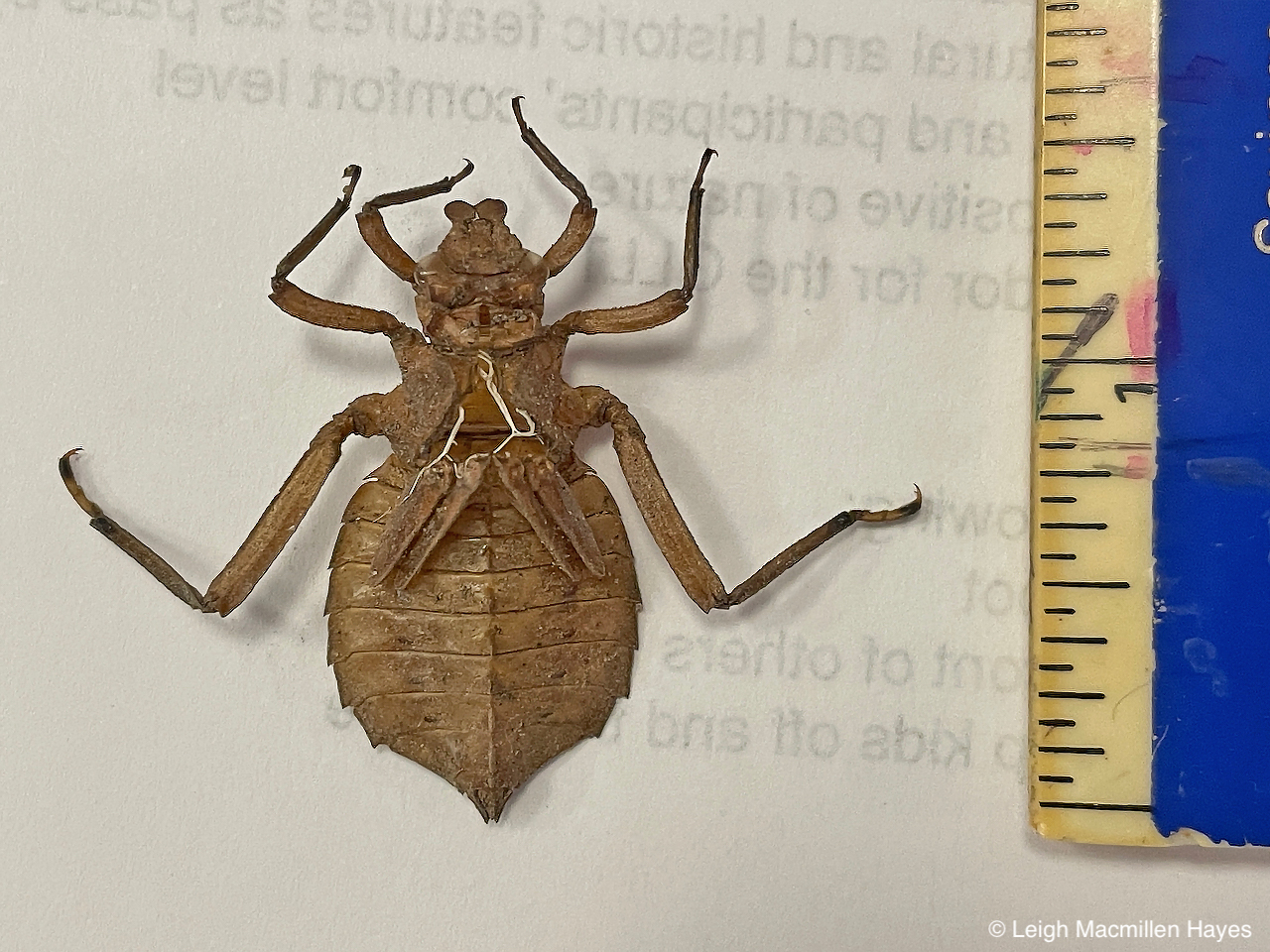
I would also be remiss if I didn’t share this photo of a Dragonhunter exuvia, which Dennis Paulson, author of  Dragonflies and Damselflies of the East describes as “wide, flat larva that resembles a wood chip.” The legs alone speak to its strength; formidable in the water and out.

And this is just a reminder to self that though I sketched and painted one form of a dragonfly naiad for six species, some may have other shapes. It’s the cerci at the tip of the abdomen that becomes key for identification to family.

Skimmer Naiad

My final painting completed this afternoon is that of a Skimmer Naiad. This is the largest family of dragonflies and every ID book includes a thick section for skimmers.

That seems apropos because not only are there a lot of family members, but their abdomens are also quite thick or chunky.

Pictured above is a male Calico Pennant Skimmer. His counterpart has all the same markings, but where you see red, she sports yellow. And soon, a pair of cousins will fly before the Calico Pennants. The cousins are the Hudsonian Whitefaces. Their abdomens are similar, but they have clear wings and as the name suggests, white faces.

That being said, I again have to slow myself down when I spot a Hudsonian because I often mistake it for a Calico at first glance.

I share thousands of photos (and probably have shared at least a million over the last ten years) of Skimmers, but thought I’d keep it simple and end with this one–a male Spangled Skimmer. Note the white stigmas on his wings. That I am aware, no other dragonfly has these white stigmas.

Thanks for stopping by to check on my current Naiad collection.

Naiads are the dragonflies of the future.

And the future is close at hand.

I can’t wait for spring 2025 to debut her dragonfly season.

Bugmania

Each spring and summer I find myself basking in insect awe. 
In my Book of Shoulds, everyone should behold these masters of land and air who all have the same body plan: Head. Thorax. Abdomen. 
Let's start with the Sedge Darner's head.
That "face"--oh my--yellow-green mouth parts below darker bluish-green eyes. 
And a T-spot just below the eyes and thin black crossline lower down on the face.
What a treat to meet this handsome guy.
And then there's the contrast of Halloween colors on the Great Golden Digger Wasp.
Take a look at its thorax connected to the head. 
It actually consists of three segments, the prothorax, mesothorax, and metathorax,
each supporting a pair of legs.
It's hard to tell, but the front wings are attached to the prothorax, with the hind to the metathorax.
Meanwhile, upon another flower there's a view of the abdomen, the beginning of which is quite skinny on this Thread-waisted Wasp. How does that body function? 
This female Blue Dasher offers a perfect stance to truly see the head, thorax, and abdomen.
When trying to identify insects, coloration is important, as well as shape and placement.
Compound eyes provide complex vision with thousands of tiny lens creating an entire scene.
Compared to a dragonfly's eyes, those on a butterfly like this Painted Lady are much smaller,
but her clubbed antennae are much longer. 
Antennae are actually segmented sensory organs that function differently for each group of insects. 
They may be used for smell, taste, touch, air motion, or maybe even vibrations.
In the case of the freshly emerged Dog-day Cicada, the antennae are short, but the eyes bulge from the sides. 
And that camouflage coloration will be useful as this insect disappears into the treetops singing raspy love songs in an attempt to attract a mate, while trying not to be eaten by a predator. 
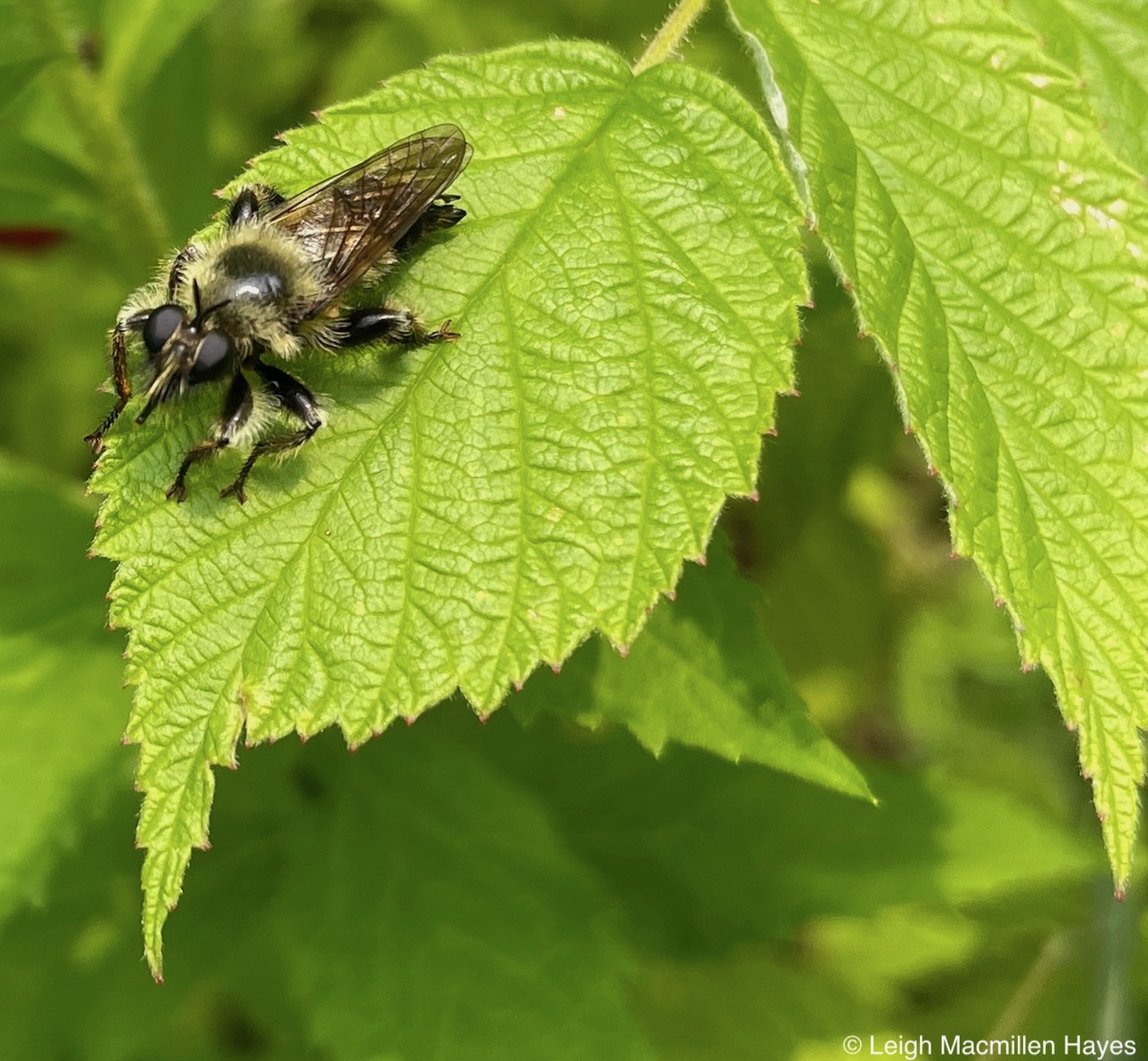
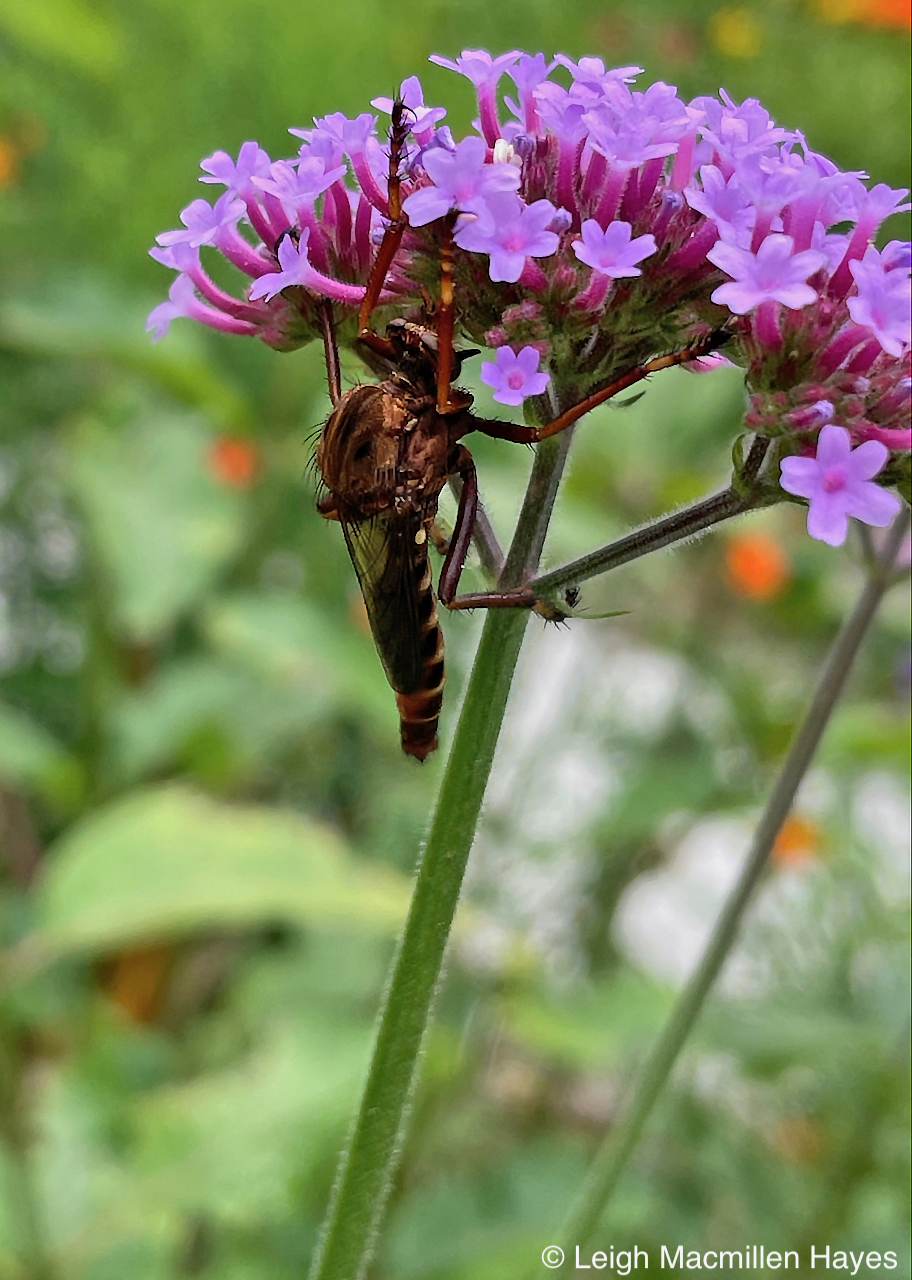
Behold next the Robber Fly, this particular species with such a hairy body that it mimics a bee.
Its proboscis, or mouthpart is rather beak-like, the easier to consume insects. 
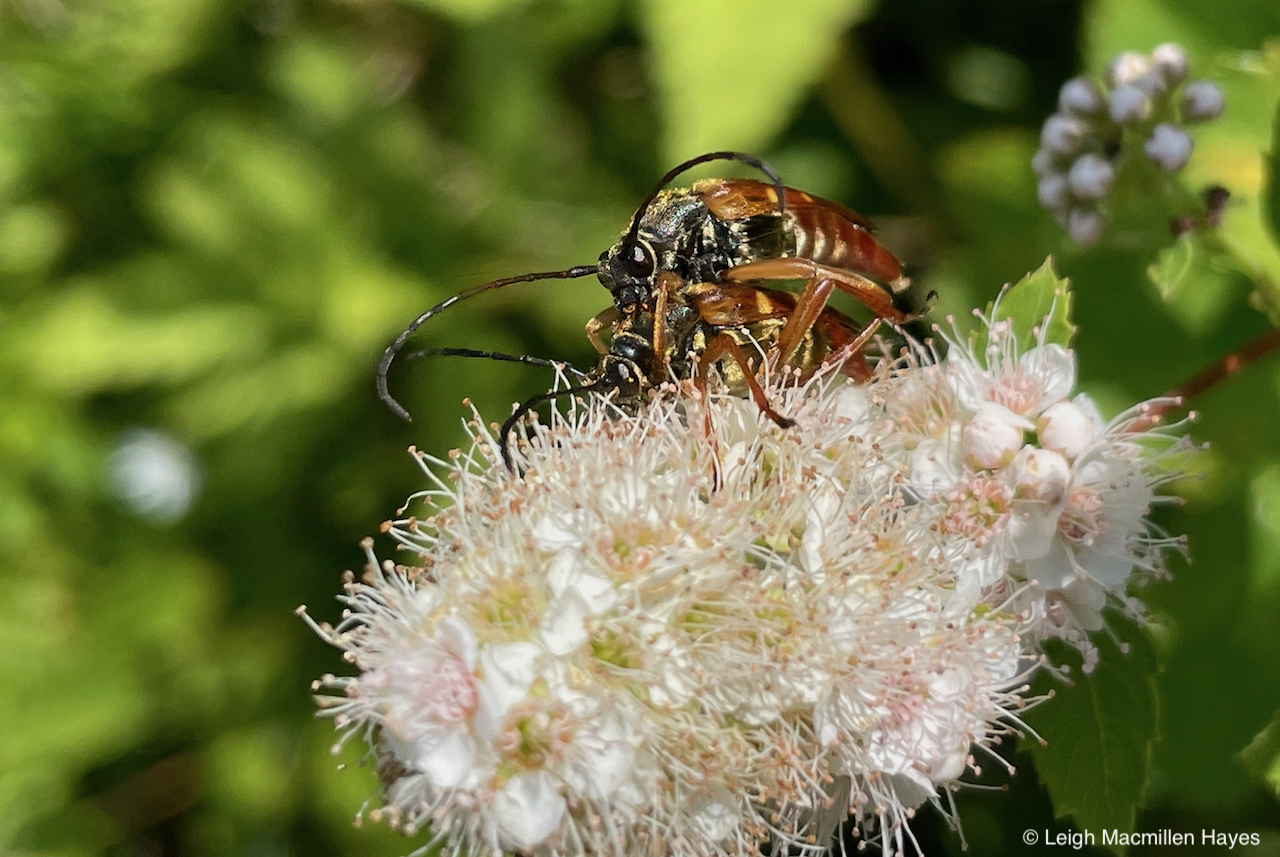
The Goldenrod Soldier Beetle can spend a long time actively pursuing pollen on one plant, as has been my experience in its presence. It's a similar body structure as a firefly, but the legs strike me as being much longer. 
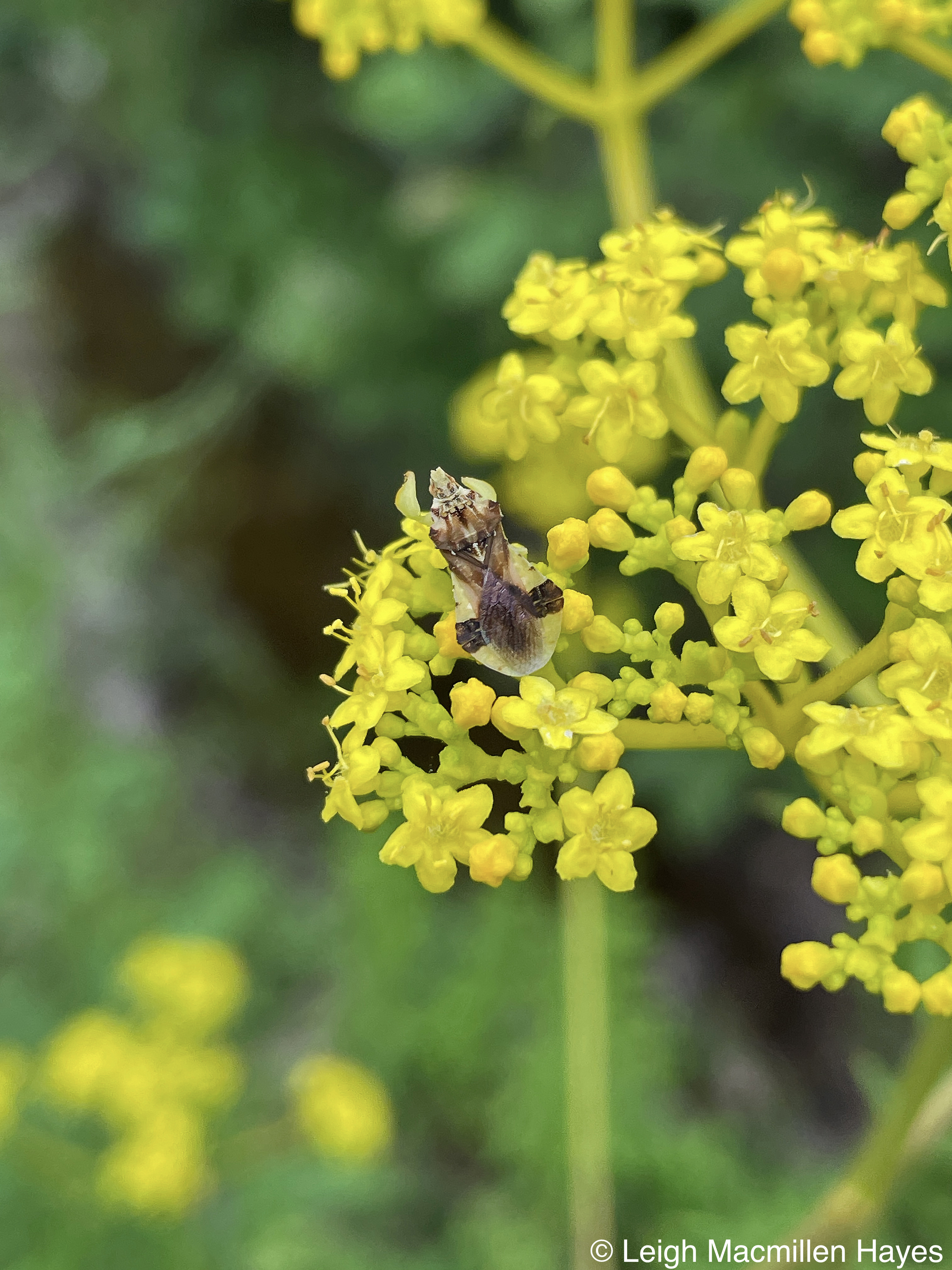
While I was focused on this Bumblebee seeking nectar with its tongue, an Ambush Bug lay in wait, hoping for a big, hairy meal of its own liking. It didn't succeed this time, but one of these days I'll spot the leftovers of an Ambush Bug's dinner. 
The first Monarch of the season, at least for me, was sipping from a Marigold with its super long straw-like proboscis. I've noted them before, but notice again the club-shaped antennae, a feature of a butterfly, unlike the feathery antennae of a moth. 
The Silver-spotted Skipper is another butterfly, albeit much smaller than the Monarch. For such a small one, its eyes are huge and proboscis equally long, as it reached deep into the Wild Bergamot. 
The Dog-day Cicada pictured earlier gave me a unique opportunity to look at its underside as it perched upon a broken stem. Do you see the zebra-striped design below its eyes and above its legs? That's the start of its mouthpart, which is tucked against its body until its decides to dine. Moments after this photo was taken, the Cicada made its first flight ascending high into the treetops.
The Great Black Wasp with its iridescent blue wings, offers a prime example of the amazing construction of insect legs. Insect legs have moveable joints between some segments. 
So here's how the song goes: 
The pretarsus (toe-like with one or two small hooked claws) is connected to the tarsus (foot-like), 
the tarsus is connected to the tibia (longest part of leg), 
the tibia is connected to the femur (largest and thickest), 
the femur is connected to the trochanter (kinda like a hip joint), 
the trochanter is connected to the coxa (joins body)
the coxa is connected to the body! 
Now shake dem insect bones! 
The fiercest looking legs are the lobster claws of the Ambush Bug, 
the better to snatch prey and hold it in position to suck its guts out. 
Another incredible insect feature: wings. 
Muscles that work the wings are attached to the thorax. 
But how do such scaly membranes provide the gift of flight for such a robust looking body? 
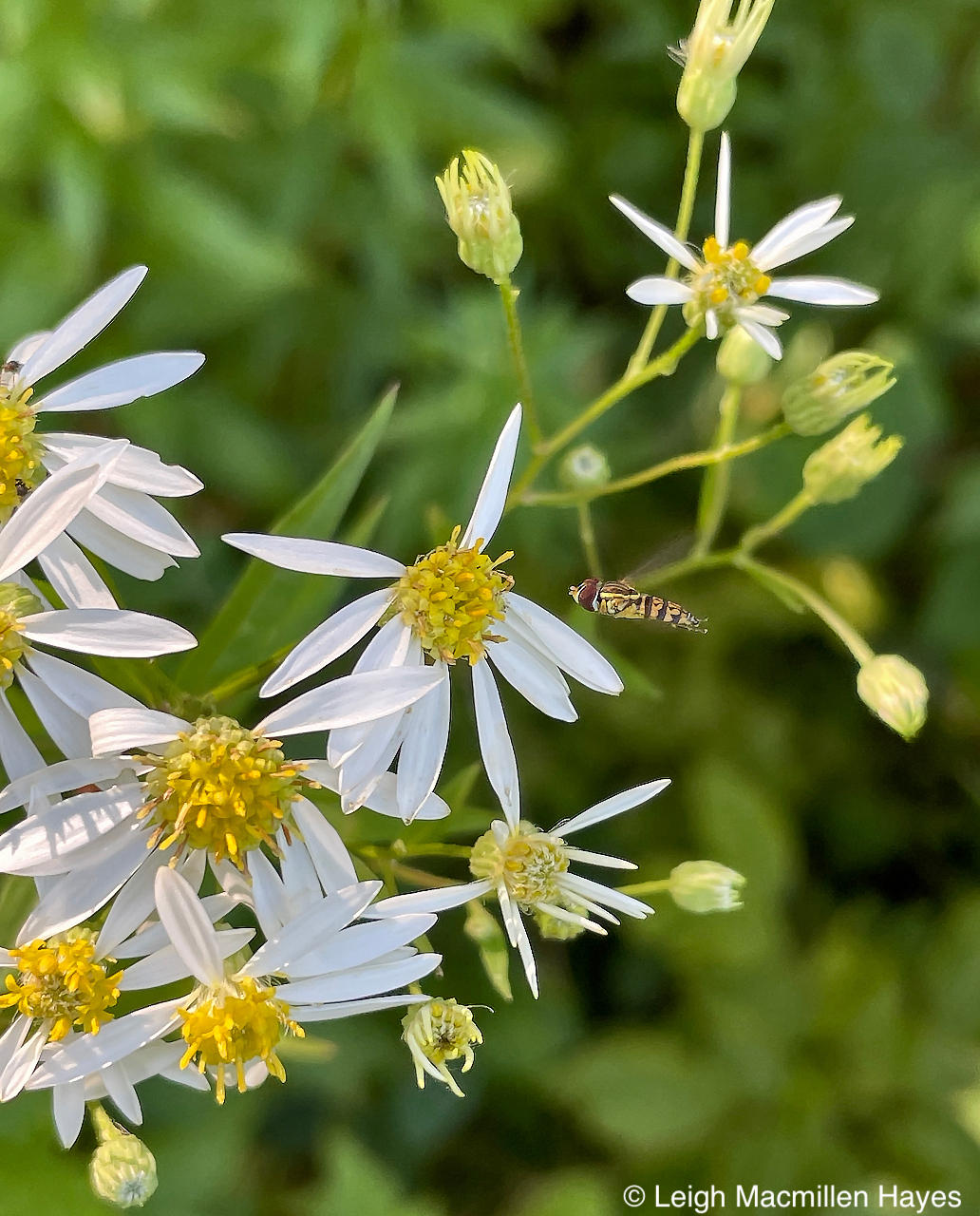
Even the much tinier Hover Fly is amazing as it flaps its wings so rapidly that they are almost invisible and can "hover" in place, much like a Hummingbird. 
In the end, it all comes down to investing in the future by canoodling upon the flowers that nourish you and you help pollinate. 
And then it's time to be like the Robber Fly and find a safe place that will protect you from the elements so you can  take a rest. As August continues into September, my hope for you is that you'll spend a few moments basking in insect awe and develop or continue to nourish your own form of Bugmania.