“Hightailing it Home” published in The Maine Natural History Observer

As some of you know, I not only have a soft spot in my heart for Dragonflies and Cicadas and Beavers and Otters, but also my prickliest friends, Porcupines. And recently I’ve been looking for our neighborhood rodents, which my neighbor sees when she lets her dogs out at night, but they’ve alluded me.

I do keep finding some evidence of their whereabouts, at least where they’ve ventured at night, but have yet to locate a den this winter or even spot a Porcupine waddling through the woods or sleeping on a branch.

That may be our fault. We’re in the process of saving our barn and have closed up any entrances Porky has used for the last 30+ years and probably longer than that, and tore down an attached shed and we’re having it rebuilt, so except for that one night he spent in the barn loft due to our stupidity of not shutting a trap door, I’m afraid we’ve evicted him. But there is more than one Porcupine in this neighborhood and today I wandered several miles into the woods beyond our land, and came up short-handed.

That said, I did spot three deer as I headed out along our cowpath. Do you see them?

We spent at least five minutes together before I decided it was cold and I need to get my mittens back on and keep moving.

Switching gears, I submitted an article about Porcupines to the Maine Natural History Observer for their first issue of 2025 and was tickled once again to have it accepted.
According to their website: Maine Natural History Observatory’s mission is to improve the understanding of natural resources in Maine by compiling historic information and implementing inventory and monitoring efforts of Maine’s natural history.

The Observatory specializes in collecting, interpreting, and maintaining datasets crucial for understanding changes in Maine’s plant and wildlife populations. We are committed to filling data gaps for Maine’s least understood species and creating a legacy of data for use in nature conservation, land use policy decisions, and expanding scientific knowledge.

Specifically, our mission is to:

  • Compile and publish summaries of Maine’s natural history
  • Coordinate local and regional inventory and monitoring efforts of Maine’s flora, fauna, and habitats
  • Facilitate cooperation and exchange of information among organizations, agencies, and individuals conducting natural history research in Maine or caring for natural history collections
  • Engage in other activities related to the advancement of scientific knowledge and education of the public regarding the flora, fauna, and habitats of Maine.
“Hightailing it Home” is about an adventure I had with a Porcupine in February 2024, and again, it was deep in the woods behind our home.
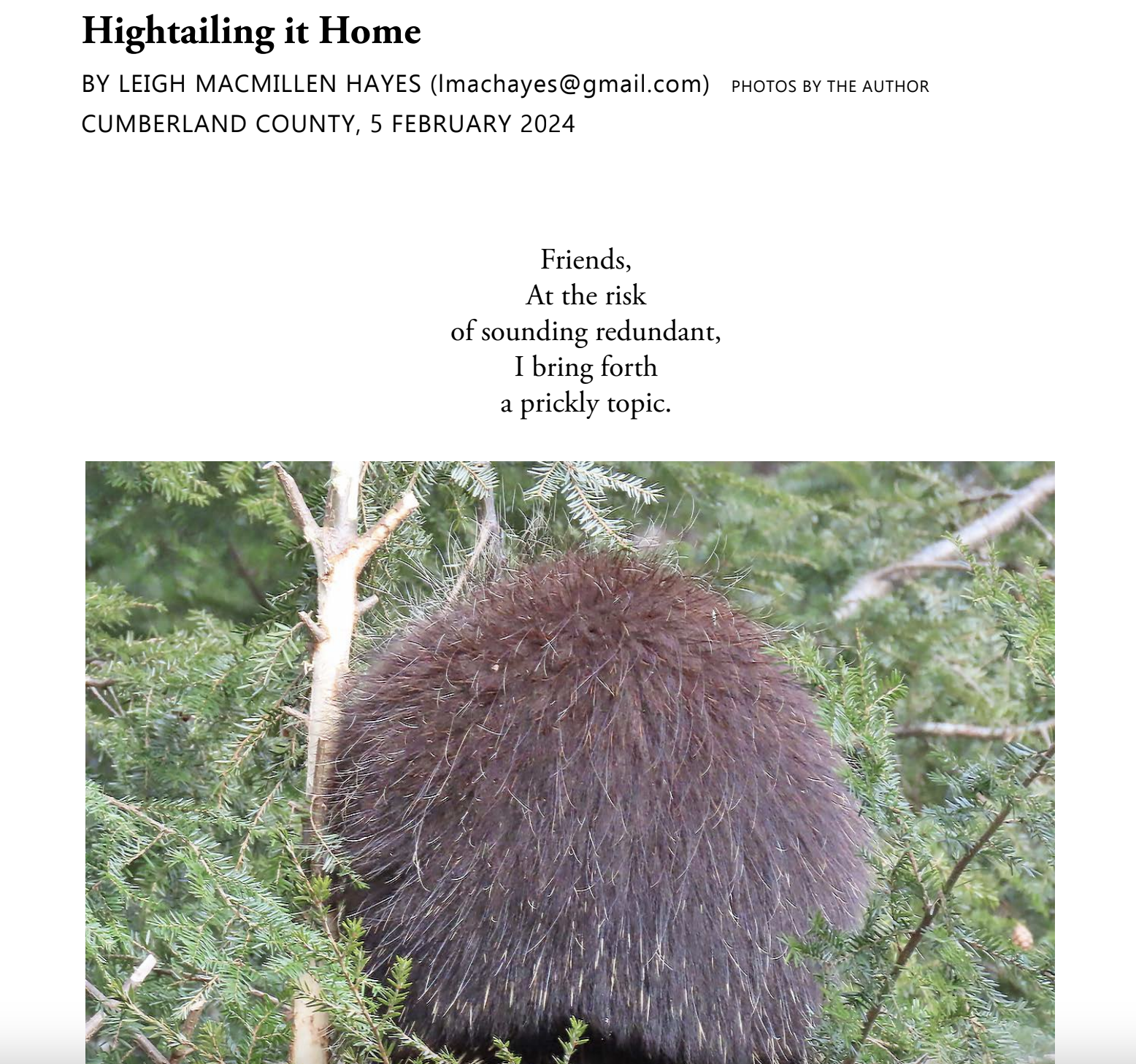
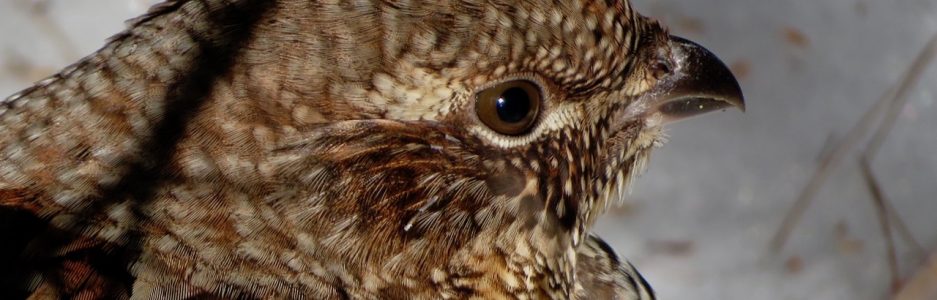
This is the back view that I first encountered that day, before the Porcupine realized I was being a nosy neighbor.

And I’ve included this portion of a page just cuze I love my Porky friends. Look at all those quills! Over 30,000 of them. And yet, his face is so soft, as is his belly.

Apparently I’ve made that love known, for my ten-year old friend and fellow naturalist and artist created a tree cookie ornament for my birthday.
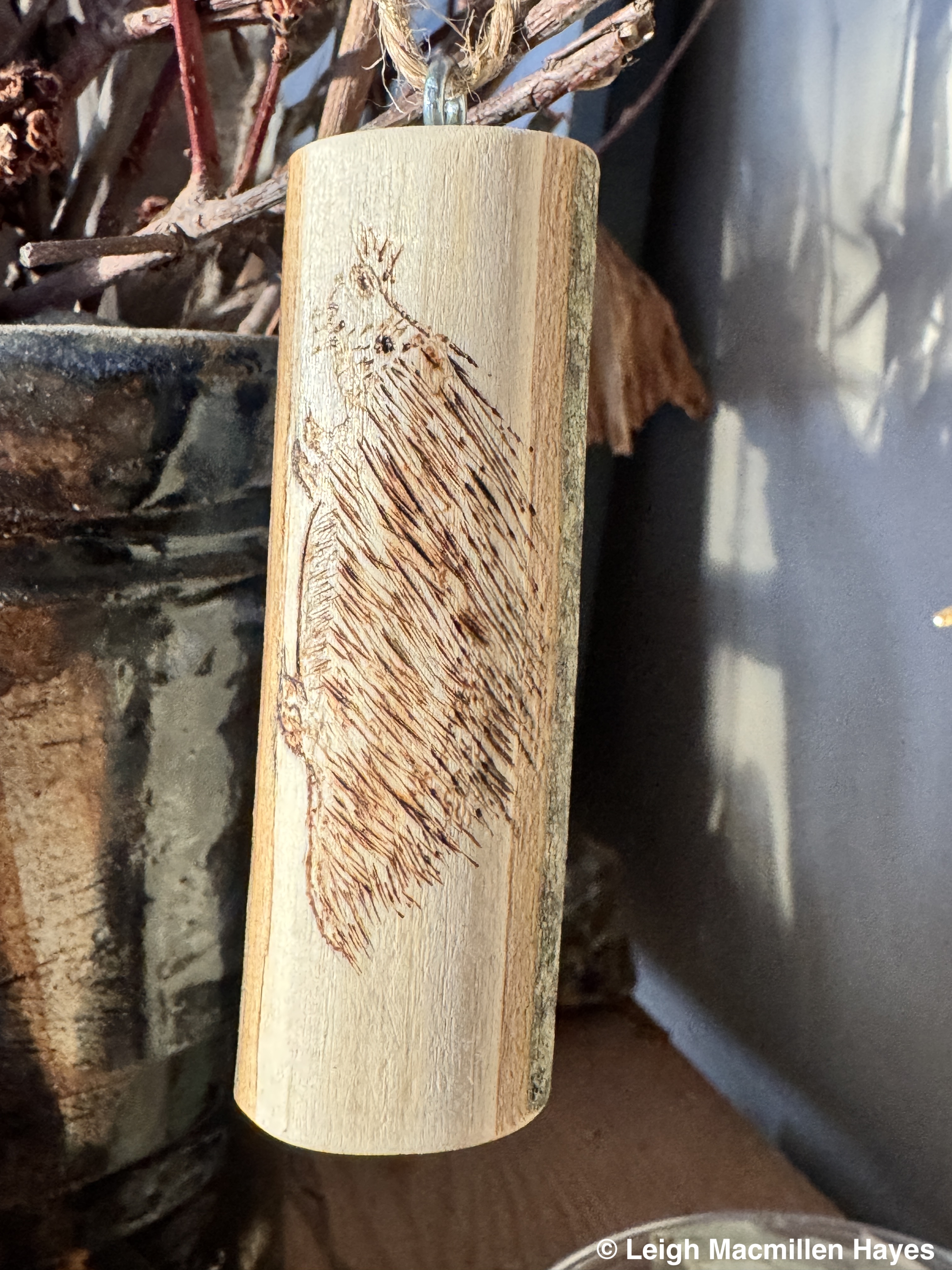
And my Cousin Bob did the same for Christmas. Both ornaments did hang from our tree, but now they are on display in my study.

Okay, back to the MNHObserver 2025, Issue 1, here’s a link: Maine Natural History Observer.

You’ll find “Hightailing it Home” on page 36.

There are some really interesting articles, including one about Maine weather in February 1958!! Perfect for an evening read on another frigid night.

Thank you, Maine Natural History Observer, and especially to Celeste Mittelhauser, Outreach Coordinator.

Here’s to future adventures with Porky and so many forms of fauna and flora who continue to teach me. I sure hope I get to hightail it home following a sighting in the near future.

Lake Living & Maine Natural History Observatory

Two. Two publications this week. I’m always excited when the first appears on a local store shelf, but to have a featured article in the second as well (for the third time) is equally thrilling. Also scary. Why? Cuze once you put yourself out there you are out there and there are others out there just waiting to let you know how you erred. And if you know me, I err a lot. But it’s actually a good thing because it’s a humbling reminder that I’m not perfect. Thank goodness. That said, you don’t need to remind me–just sayin’.

So, take a gander and I hope you enjoy the reads. My two articles for Lake Living magazine are the first two in this issue.

The first is about the Bridgton and Saco River Railroad Museum that six young men are working to develop in Bridgton to commemorate the Narrow Gauge Railroad. I won’t give away any more of the story, but my hats go off to these guys and their passion and all of their efforts to make a dream come true.

My second article is about TimberNook Western Maine, a program set up to encourage kids to get outside and play. For hours. With varied age groups. Sometimes during school hours. Because play, and especially deep play, which it takes a bit of time to enter, are a critical part of growing up and interacting with others and the natural world. I have to say that before I sat in on a couple of sessions, I wasn’t so sure about this program–I mean, I’ve spent the last however many years playing with kids in nature, but teaching them about nature along the way, and this program is set up to let kids learn without too much adult intervention. And after watching the action and talking with kids and adults, I am now a huge fan of TimberNook and hope to sit in on more sessions, maybe as a volunteer.

There’s so much more in the magazine ranging from an article by Perri Black about birth and death; another by Laurie LaMountain about dock lights invented by the guys at Great Northern Docks; plus an appreciation of laundry by Suzanne Richards; book reviews from our friends at Bridgton Books; and some summer recipes by Perri. And the list of things to do and places to go–locally, of course.

It’s all right here, just a click away: https://www.lakelivingmaine.com/

Switching gears, I submitted an article about Dog-day Cicadas to the Maine Natural History Observer and was tickled to have it accepted.

According to their website: Maine Natural History Observatory’s mission is to improve the understanding of natural resources in Maine by compiling historic information and implementing inventory and monitoring efforts of Maine’s natural history.

The Observatory specializes in collecting, interpreting, and maintaining datasets crucial for understanding changes in Maine’s plant and wildlife populations. We are committed to filling data gaps for Maine’s least understood species and creating a legacy of data for use in nature conservation, land use policy decisions, and expanding scientific knowledge.

Specifically, our mission is to:

  • Compile and publish summaries of Maine’s natural history
  • Coordinate local and regional inventory and monitoring efforts of Maine’s flora, fauna, and habitats
  • Facilitate cooperation and exchange of information among organizations, agencies, and individuals conducting natural history research in Maine or caring for natural history collections
  • Engage in other activities related to the advancement of scientific knowledge and education of the public regarding the flora, fauna, and habitats of Maine.

As some of you know, one of my favorite summer activities is to watch Dog-day Cicadas emerge from their underground life and watch as they shed old skin for new before flying up into tree tops to sing love songs. I know of a couple of local cemeteries where I can usually watch the action and it’s even better when I can introduce someone else to the experience. But, not everyone can join me so in this article, I hope it feels like you are along for the journey.

It looks something like this:

You can read the entire article and a variety of others by clicking on the link: Maine Natural History Observer

Lots of cool stuff to read about. And if you do live locally, Lake Living is on a store shelf near you–up and down the Rte 302 corridor, plus north to Norway and Bethel, and south to at least Cornish.

Grab a copy and don’t forget to support our advertisers. They are the ones who pay so that you can pick up a free copy of the magazine. There’s one advertiser in particular that is close to my heart and I’d love to have you support. ;-)

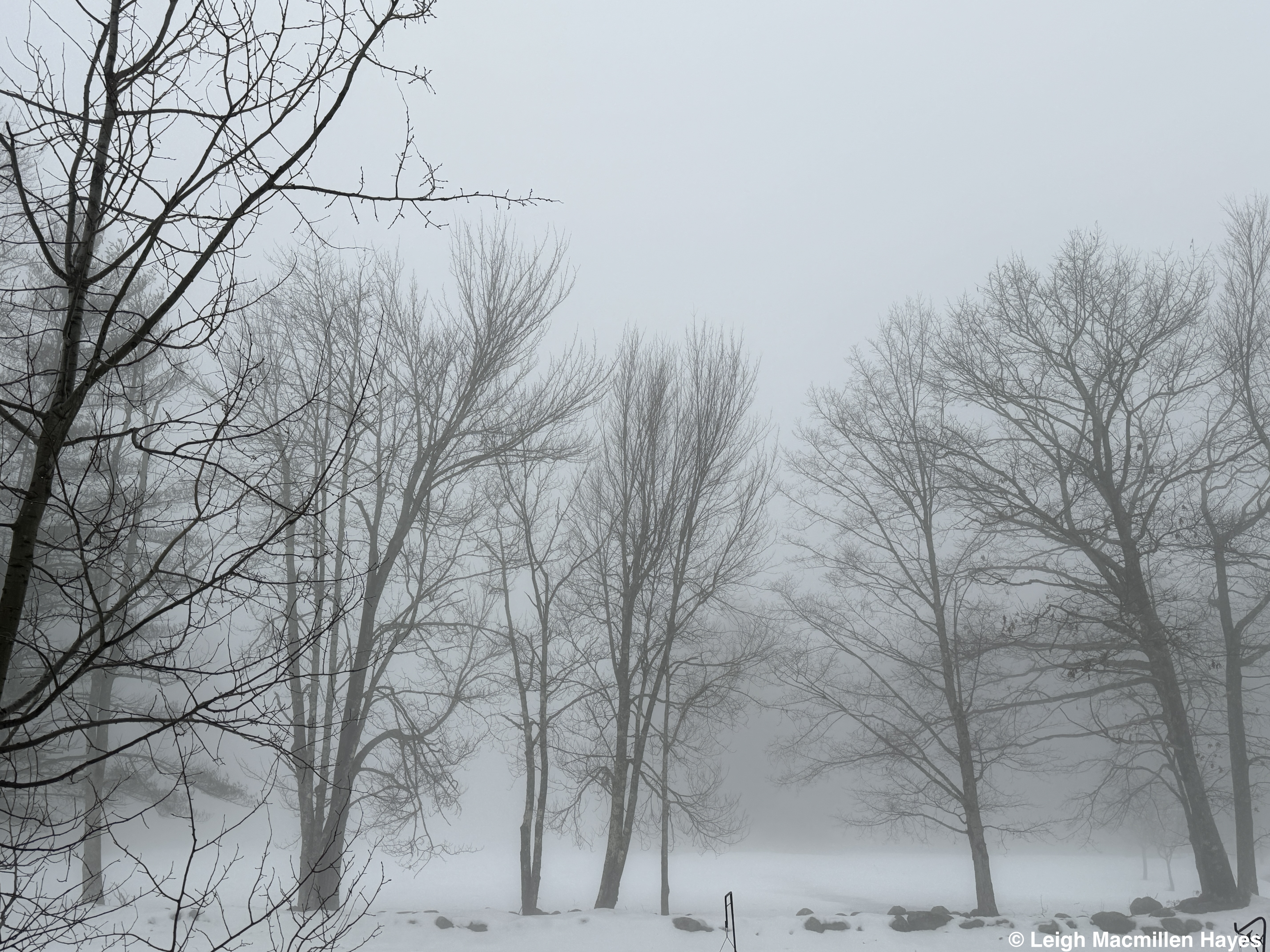
A Taste of Summer on a Foggy Day

I’m kinda excited because I found the guts the other day to submit an article to the Maine Natural History Observer (MNHO) for publication this spring, and received notification this afternoon that it was accepted and will appear in the next issue. It’s about vernal pools. That’s all I’m going to tell you. But the timing seemed right.

On this snow-eating fog kind of day, it was news most welcome.

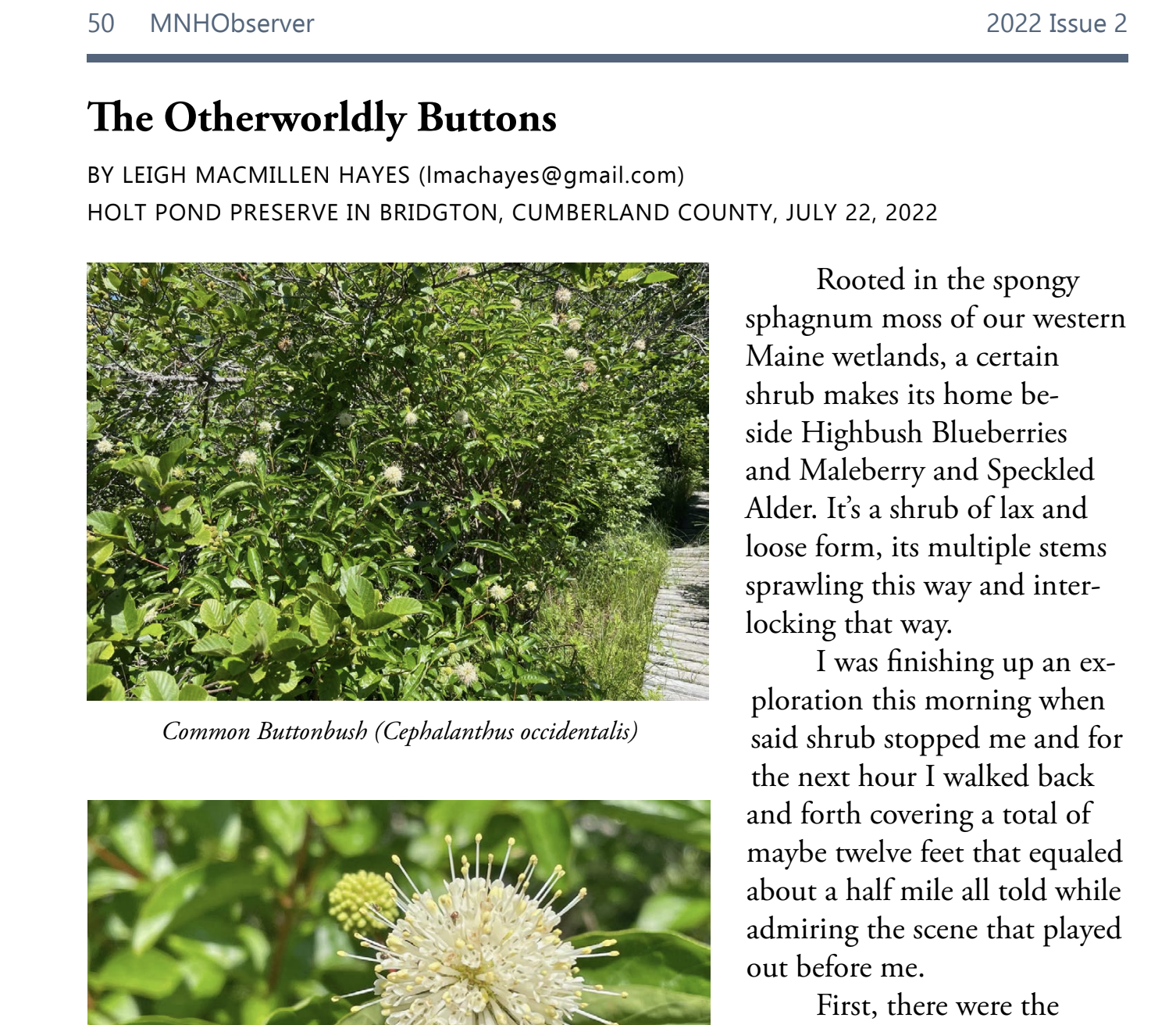
Two years ago I also found the courage to send in an article and was again surprised that it was accepted for publication. That one was about an afternoon I spent with a Buttonbush at Lakes Environmental Association’s Holt Pond Preserve and all the insect activity the shrub supported.

There was one error in the article (well, probably more than one) and it’s an insect ID. See if you can figure out which one. I actually had corrected it in my blog post, but somehow it slipped past my editing when I hit send to MNHObserver. Humbling to say the least.

Anyway, here’s a link to the 2022 publication and you’ll find my article, entitled “The Otherwordly Buttons” on pages 50 – 53. Plus there are other great article to read.

Winter’s not over yet, at least I’d like to think that is true, but even when it does come to a close, there’s so much more awaiting careful observation and I can’t wait to see what I shall see.