Lake Living Magazine: fall/winter 2019

For the past few years, we’ve either produced a limited winter issue or no issue at all of Lake Living magazine because those who purchase ads have been wary about spending money during those lean months. And it’s ads that support this free magazine. Everyone wants to be written about, but . . .

After some back and forth discussion with editor/publisher Laurie LaMountain, we decided to produce a fall/winter issue that would encompass the usual “at home” features of the fall magazine, but also include the book reviews written by the Pam and Justin Ward, plus their employees, Sue and Perri, of Bridgton Books, that typically appear in the winter issue.

Tada. Click on the link above and you can view the magazine in its entirety.

Laurie tackled four topics, while I worked on three ideas. Hers include “The Big Idea” about a Maine inventor, “Maine Dwelling” about a guy who flips houses locally, and “A Good Keeper” about winter squashes.

Her most interesting article, however, is one that everyone should read–whether you are a male or female. Don’t let the theme of it scare you. Entitled “Fierce Girls,” and yes that is Laurie in the photo, it’s about WOMEN. And more specifically . . . men-o-pause. When she proposed it, I was curious but not certain it would work. You have to read it.

My articles all ended up with a Lovell theme–probably because I spent most of the summer in Lovell and it was always on my mind.

The first is entitled “Resurrecting the Past,” about the Harriman Barn that Robin Taylor-Chiarello (board member of the National Council on White House History and associate member of the American Institute of Architects) lovingly restored with the help of Timberframer J. Scott Campbell of Maine Mountain Post and Beam in Fryeburg and Builder Bryce Thurston of Lovell.

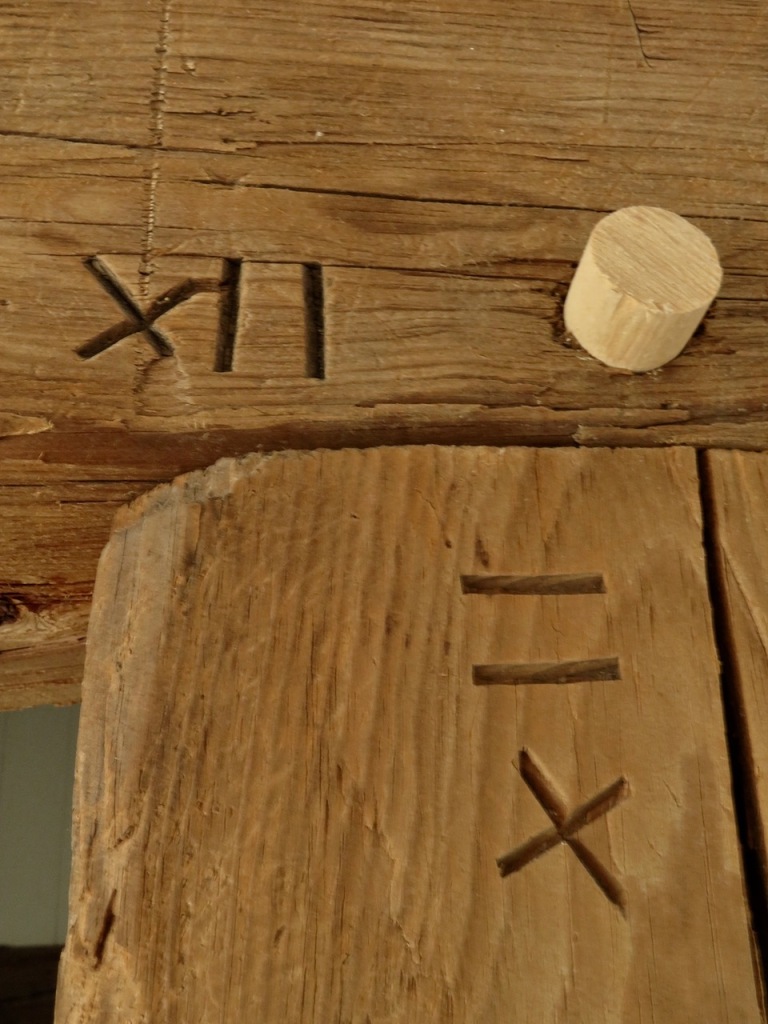
The marriage marks above were chiseled into the beams when the barn was built in the early 1800s. Scott used his own system as he pulled the timber frame down, and then reassembled it on a different site a couple of years later, but the early marks are still visible.

My second article is about two couples who chose to move north rather than south in retirement. Rather than snowbirds, as we fondly refer to those who spend six months in warmer climes, they are birdsofsnow. Okay, so I made that term up, but really, it does describe them.

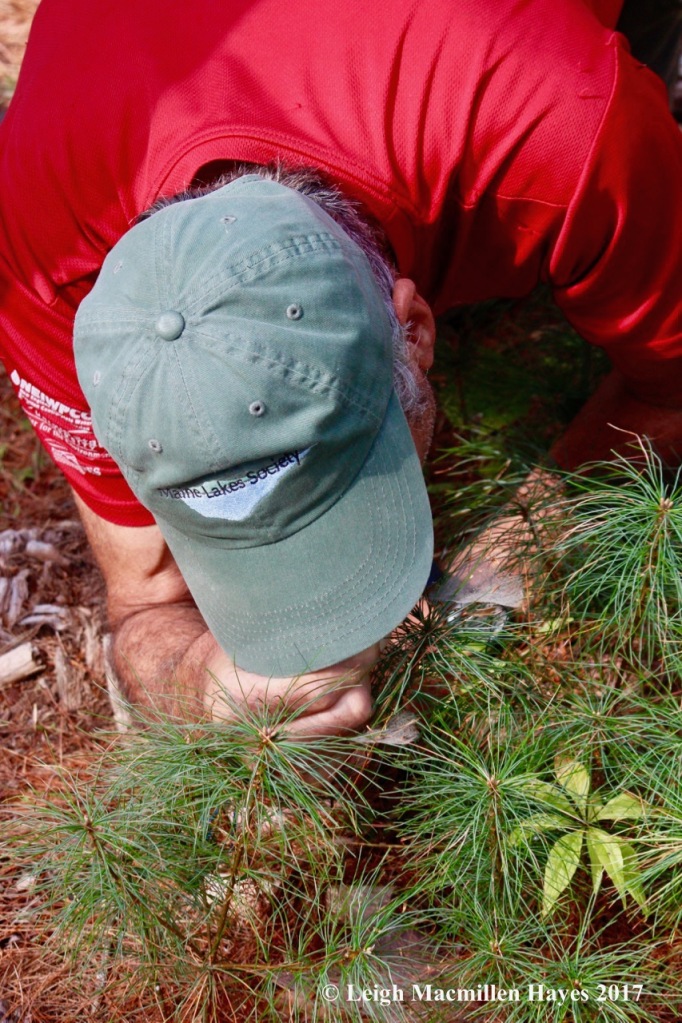
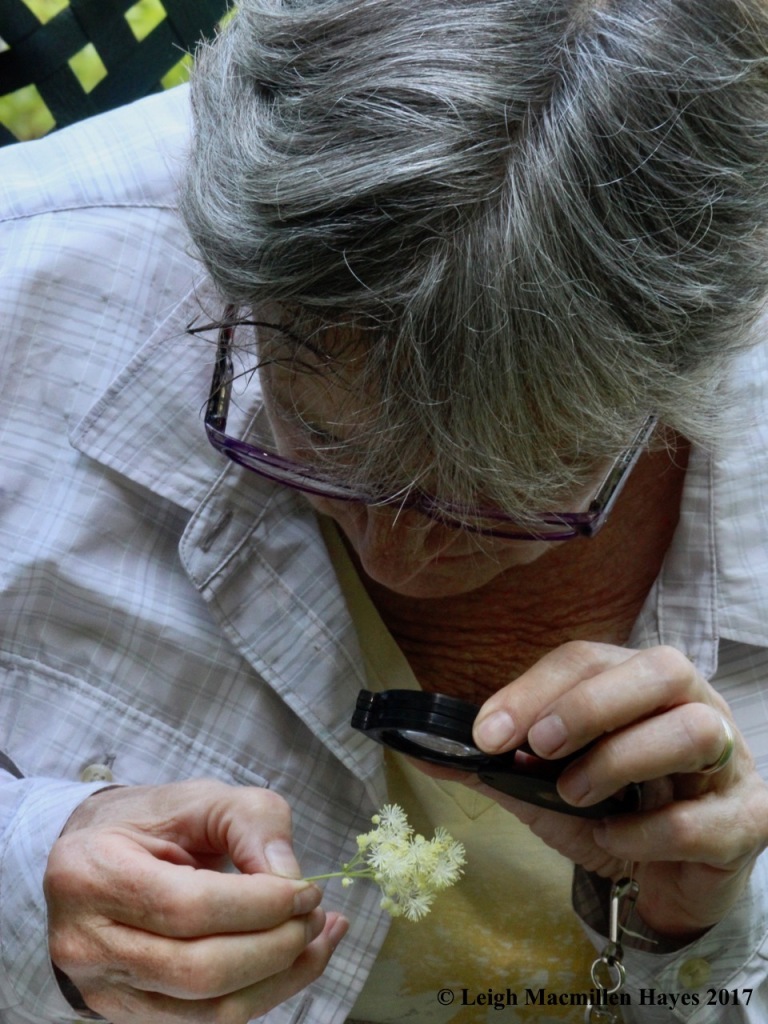
In their retirement, they’ve discovered ways to get involved in their communities and that has made all the difference. Heinrich Wurm fills his days with environmental activities, especially as related to Kezar Lake Watershed Association or Greater Lovell Land Trust. Here, he’s studying a spider web. And that’s only part of his local involvement.

Linda, Heinrich’s wife, is a docent with Greater Lovell Land Trust, where she also enjoys looking at the finer details of the natural world.

But one of her main fortes is sharing those details with youth, whether they be her own grandchildren, or kids involved in GLLT-sponsored events, like those in the after-school Trailblazers.

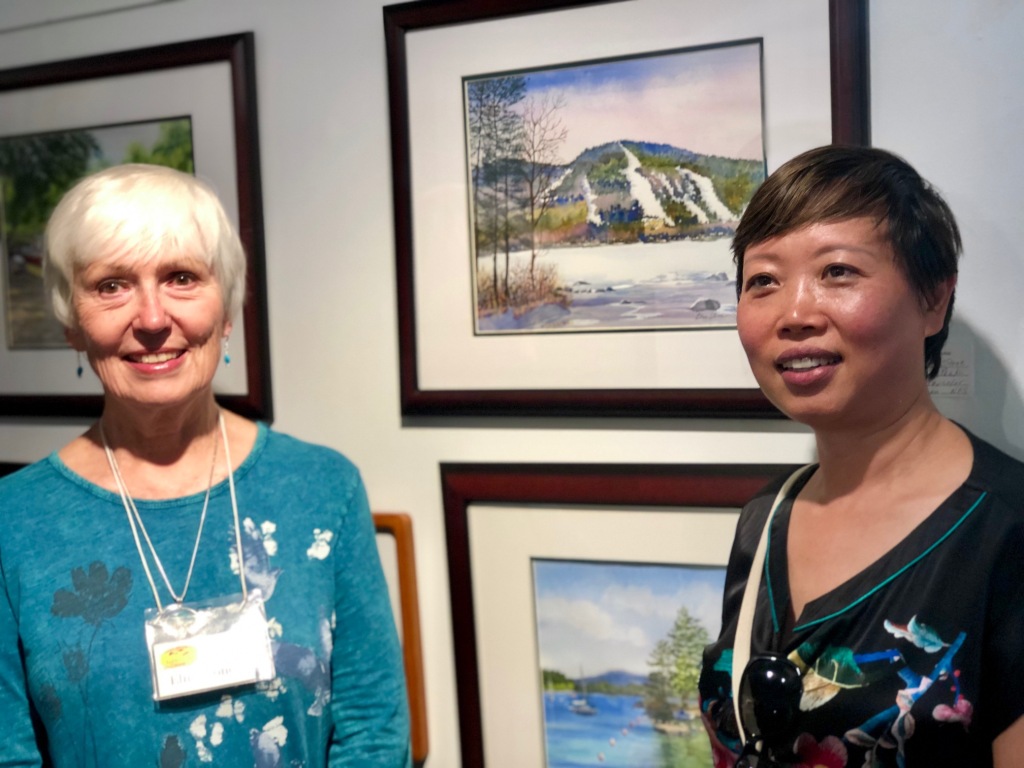
For Elna Stone, retirement gave her an opportunity to pursue her artistic talent and painting local landscapes has consumed much of her time. On the left, she poses beside a painting of Shawnee Peak Ski Area at Pleasant Mountain that she donated to a fundraiser for Gallery 302 in Bridgton. For years, Elna created calendars of local scenes that were sold as a fundraiser for St. Peter’s Episcopal Church.

Helping others either via the St. Peter’s or Bridgton Hospital
Cafe has long been a passion for the Stones. Even cleaning windows at church can offer Tom a sense of satisfaction.

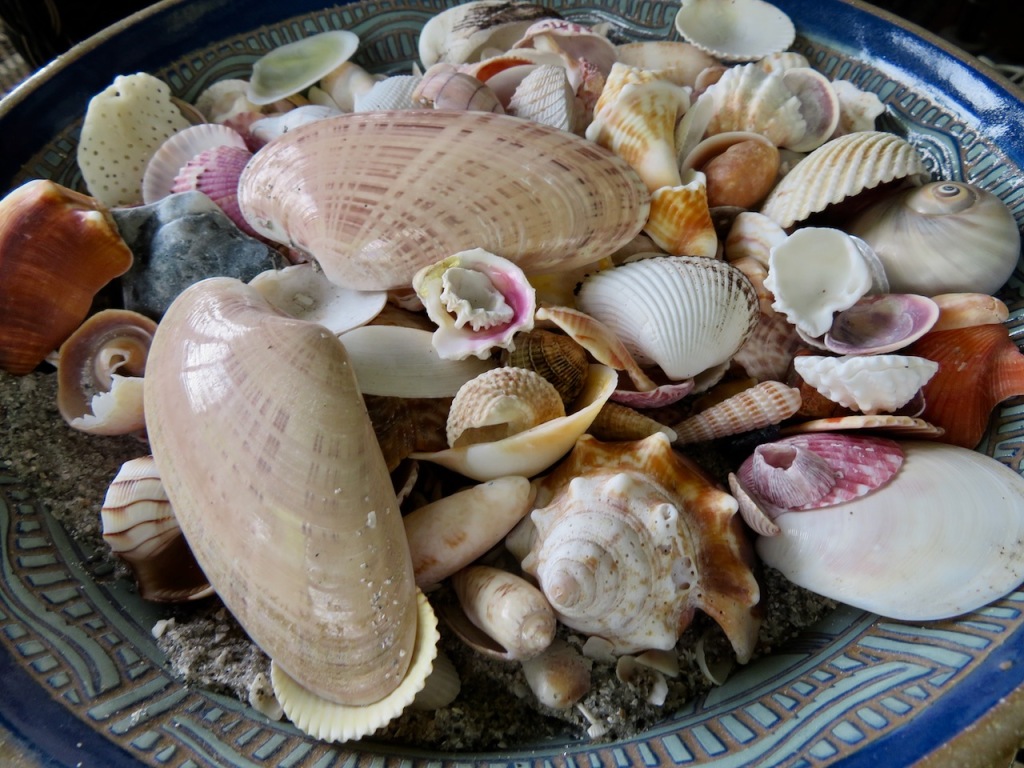
In the end, though they all love the life they’ve created in Maine, they admit there are some downfalls. One is that the winters seem to get longer each year. Linda Wurm has found a way to overcome that: a bowl of shells to gaze upon from time to time.

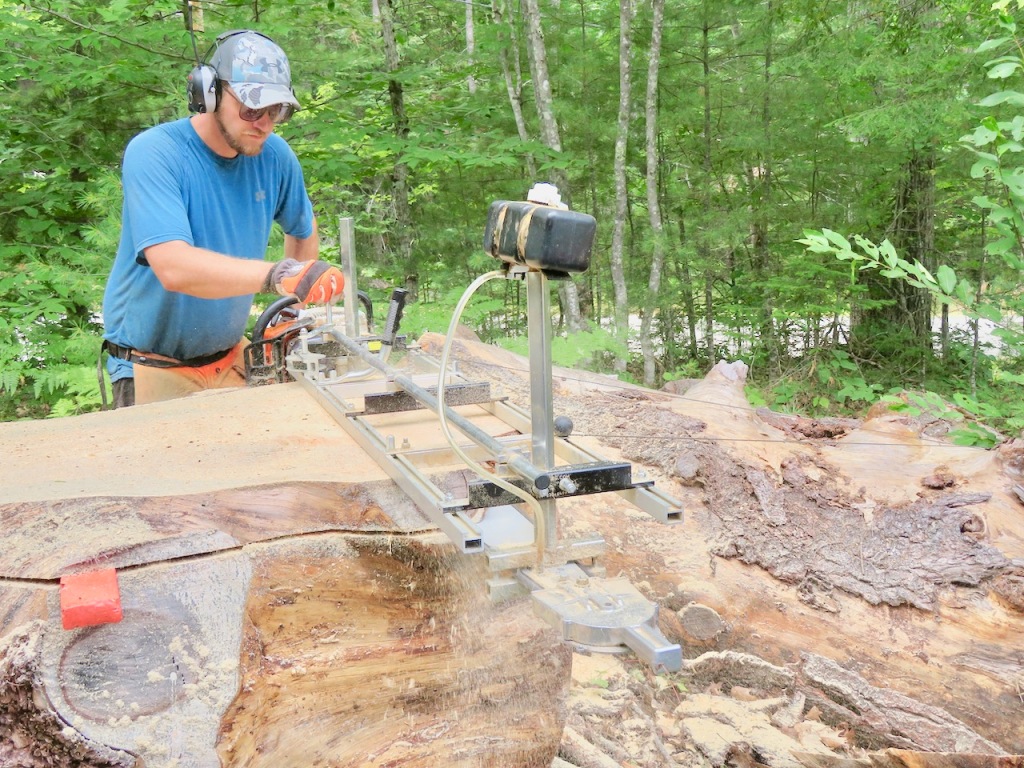
And then there’s my final article. It’s about three entrepreneurial men. They each bring a different talent to the . . . table. Literally. Eli Hutchins of Hutch’s Property and Tree chops the tree down.

Brent Legere of Lovell Box Company and Western Maine Slab Works cuts it into live-edge slabs.

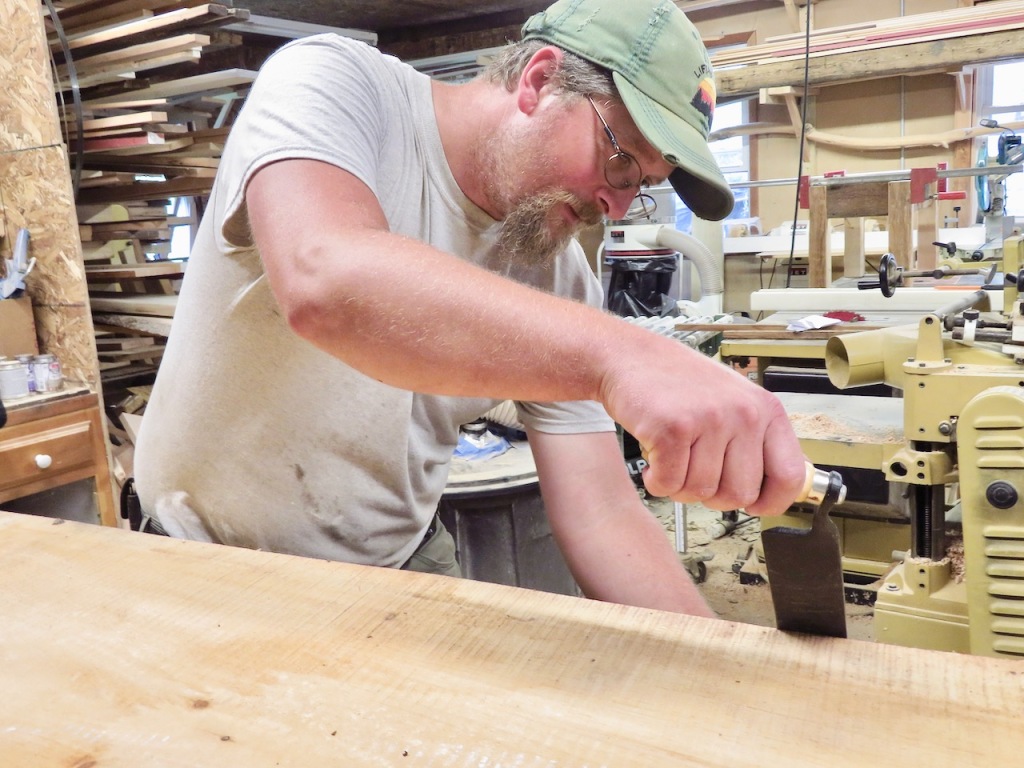
And Eugene Jordan of Jordan Custom Carpentry, Inc, turns it into a beautiful piece of furniture. You can read all about it in “A Tree Falls in Lovell.”

So, yeah. Brew a pot of tea, curl up in your favorite chair, and enjoy this issue of Lake Living magazine.

Oh, and please support the advertisers, including my guy, so we can keep doing what we love to do: learn about the many talented people in this area. I am constantly amazed. I hope you will be as well.

Scavenger Hunt at Kezar River Reserve

As I walked along the trails of the Greater Lovell Land Trust’s Kezar River Reserve on Route 5 across from the Wicked Good Store today and thought about the fact that the Storybook Trail featuring Pond by Jim LaMarche will come down in another week or so, a brainstorm struck me. Why not create a scavenger hunt that you can download on your Smartphone and look for as you walk along the trail? Why not, indeed.

Give yourself 1 point for every successful find. Subtract 2 points for any that you miss. At the end, a special prize awaits all who complete the hunt.

So, let’s get started. The route will take us from the kiosk to the beginning of the orange-blazed trail on the left (currently this part of the loop is the Storybook Trail). Look up and down and see if you can locate an example of each of these items.

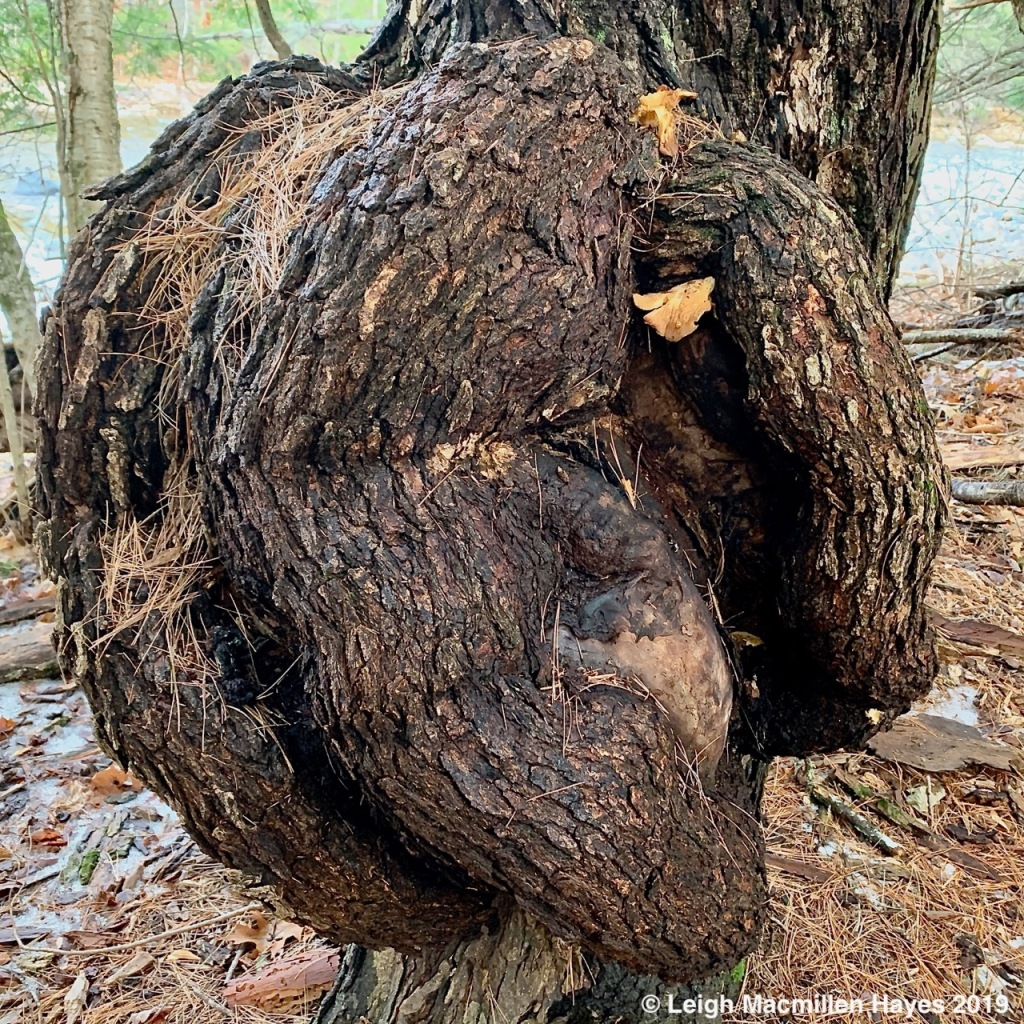
With Halloween just around the corner, the witches must find their brooms–in this case: Witch’s Broom (a deformity caused by anything from mites, aphids, and nematodes to fungi, viruses, and bacterial organisms.)

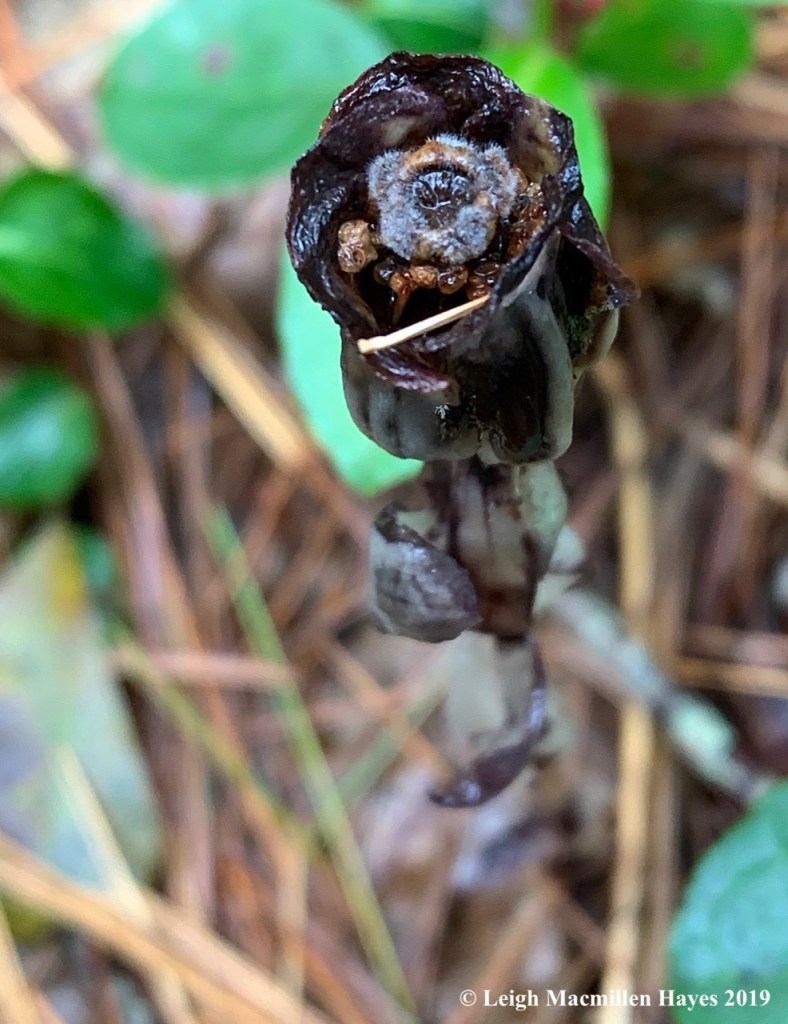
When the flower of this translucent plant turns upright, it has been fertilized and a woody capsule containing its seeds will form: Indian Pipe.

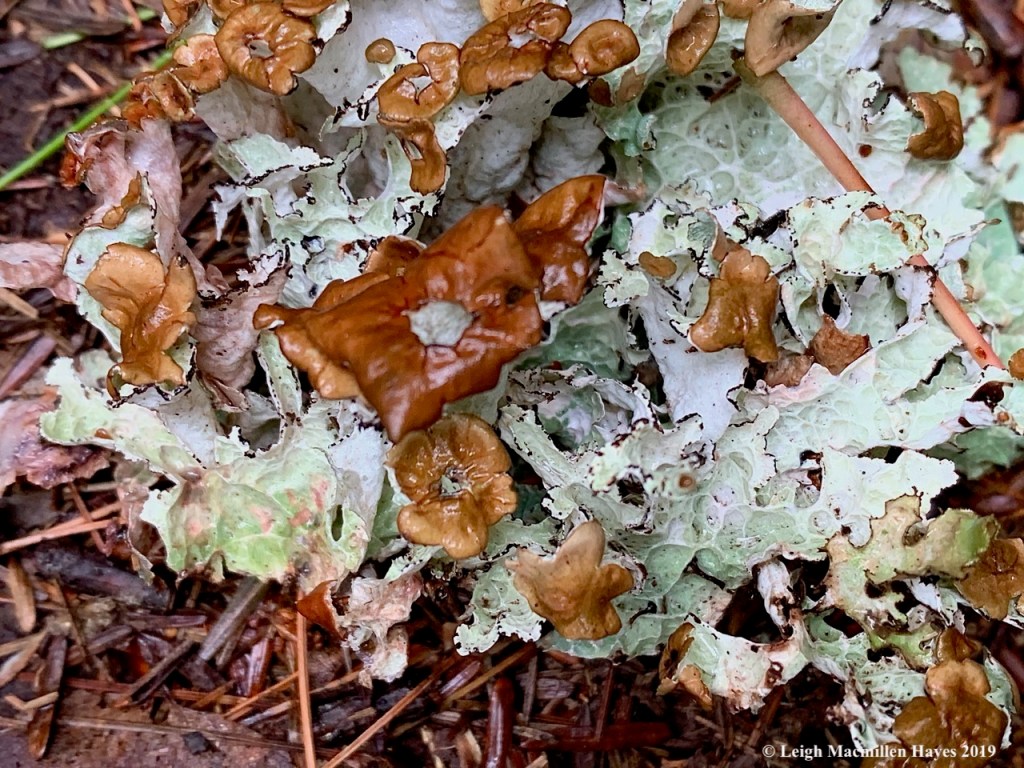
Decorating the ground, this leafy foliage with its brown fruiting structures is soft and pliable when wet, but crisp when dry: Wrinkle Lichen.

Though this tree has vertical strips of dark gray to black ridges that intersect like ski trails on a mountain, the inner bark in the furrows provide its name: Northern Red Oak.

This plant may lack flashy flowers and height, but the berries are worth noting. Tiny white blooms occur in pairs and both flowers must be pollinated to produce a single viable fruit. After fertilization, the two flowers’ ovaries fuse and mature into a solitary scarlet berry: Partridge-berry.

In case you haven’t heard, the sky has been falling in loud KERPLUNKS for several weeks. Look for this structure upon the forest floor: the cap of a Northern Red Oak Acorn.

How to make an acorn cap whistle (and drive the world crazy with the shrill sound).

1. Position the cap so the inside faces you. 

2. Place your thumb knuckles over the acorn in a V shape, with a triangle of the cap showing between your thumbs.

3. Put your upper lip on top of your knuckles. Position your lips so that when you blow no, air will escape out of your bottom lip.

4. Blow through your top lip right into the triangle that you made in step 3. 

5. Watch your friends and family run for cover. 

So move on to quieter things and look for another foliose (leafy structure) lichen you should be able to identify even as you ride down the road because its common form is easy to spot: a Shield Lichen.

Actually, by now you should have reached the road to the boat launch. Turn left and head downhill. Your next treasure will be located closer to the water because it likes damp feet.

While most trees and shrubs bloomed months ago, this species is only just displaying its ribbony yellow flower: Witch Hazel.

And if you find the right shrub, you may notice some twirled ribbons hanging from it–each bears a wish written by the GLLT’s After-school Trailblazers last year. We fondly refer to it as Wish Hazel.

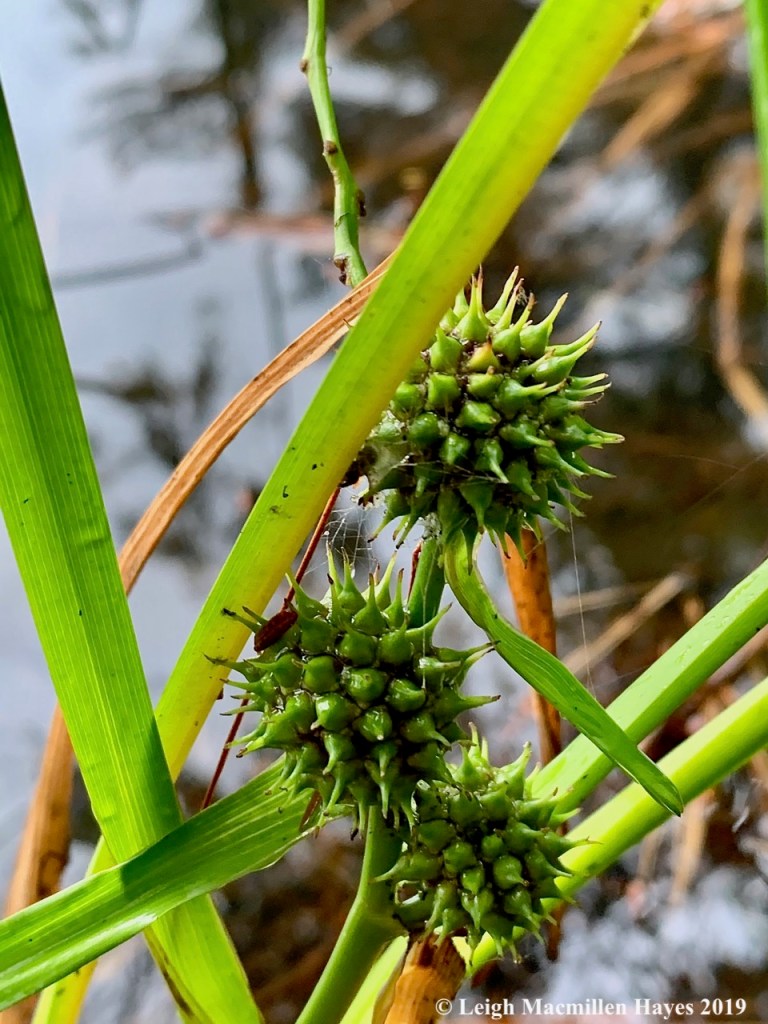
Another who loves water also grows here and is actually a member of the Cattail family. Notice its beaked fruits and the spider web connecting all parts: American Bur-weed.

As you walk back up the road to the second and longer section of the orange-blazed trail on your left, look at the foliage by your feet, set before you like a colorful tapestry. Can you locate the tree where these two species met: Red Maple on Paper Birch bark?

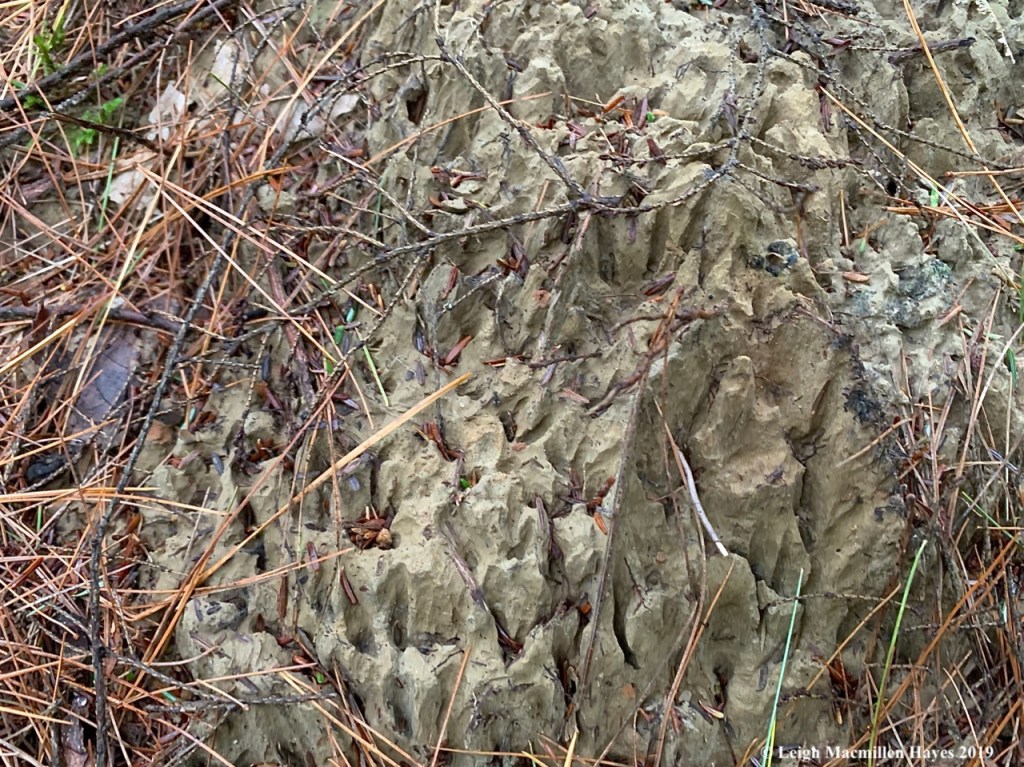
Once on the trail again, look down at your feet and eventually you’ll find a castle under the pine needles–why this funny formation? Rather than me telling you what it is, I’ll let you tell me what happened here. Five extra points if you can explain it.

A certain insect attaches its 5/8-inch cocoon lengthwise on a tree branch. After overwintering last year, the flying insect emerged in the spring as evidenced by the hole at the left end. Look for these and if you see one that is capped, you’ll know that the insect is pupating inside: Sawfly Cocoon.

This one is my favorite and I always conjure up an image of it when I want to remember which trees rot from the outside in. The answer is conifers for they heartwood is not porous and does contain resins that are toxic to insects. But . . . this tree is a wee bit different than its relatives for its bark is the most rot resistant. It’s long been a shell of itself, but is starting to fall apart at last: Eastern Hemlock.

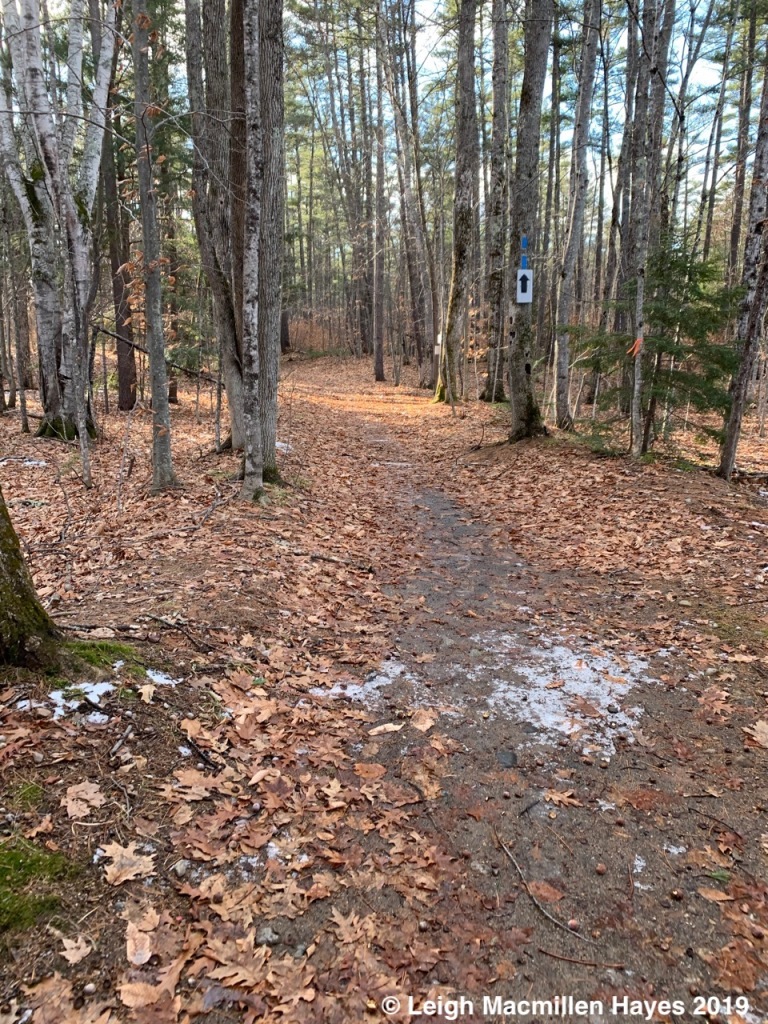
As you continue on, pay attention to the orange blazes. Can you find the diamond and arrow that decorate this tree? Five extra points if you can identify the tree species upon which they are nailed.

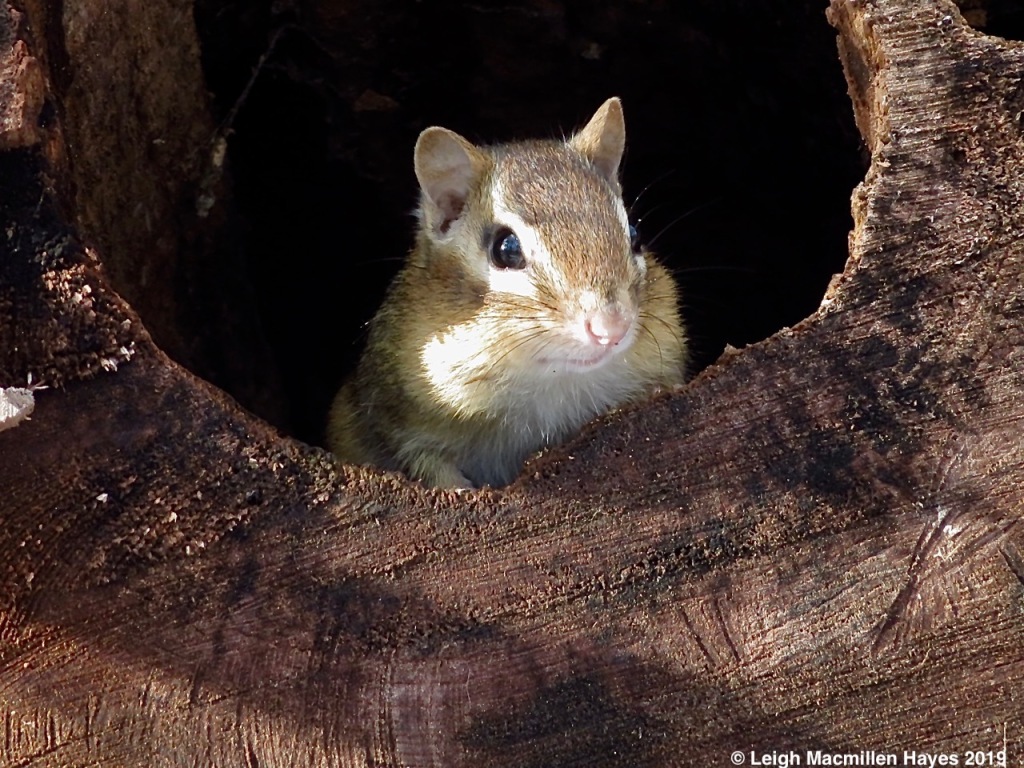
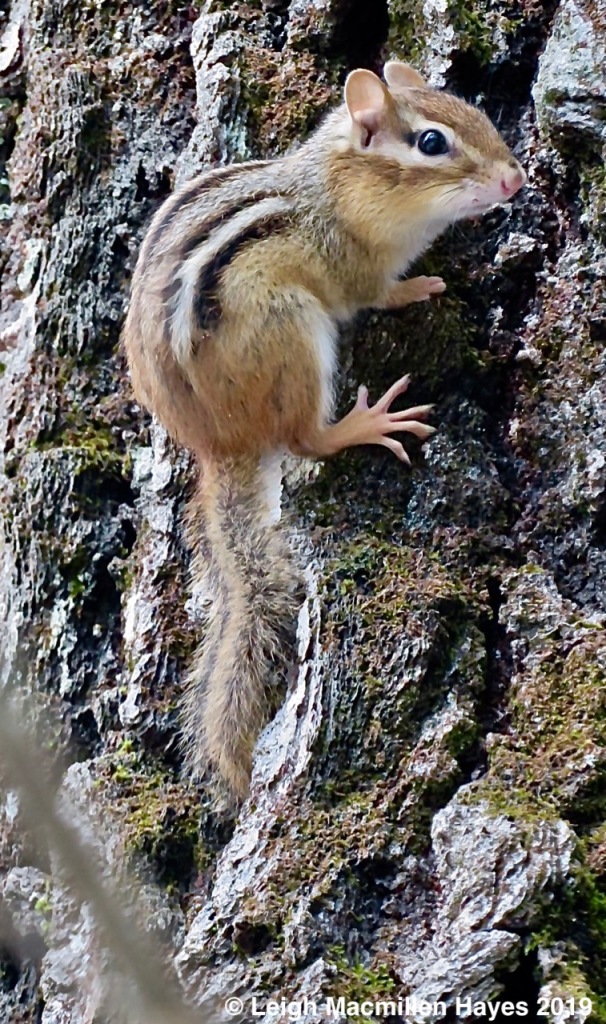
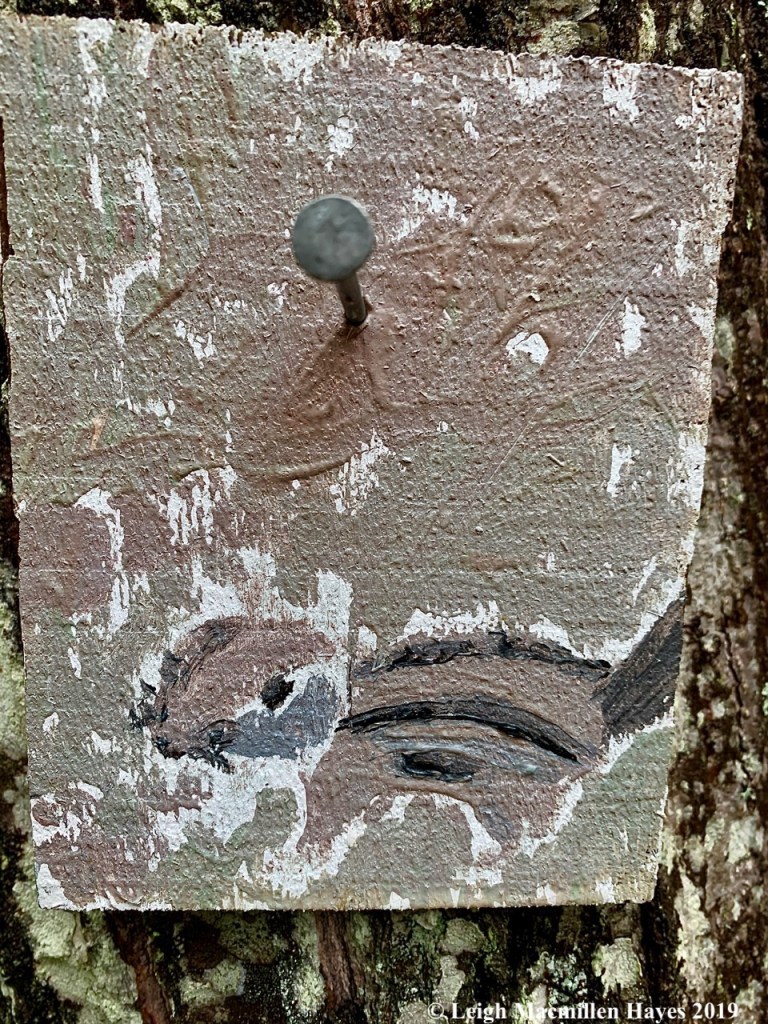
Maybe you’ll see the real deal or another critter as you make your way along the trail. But if not, there’s always this fine artwork: Eastern Chipmunk.

And then nature’s classroom opens up and beckons you to touch and practice some dramatic role playing.

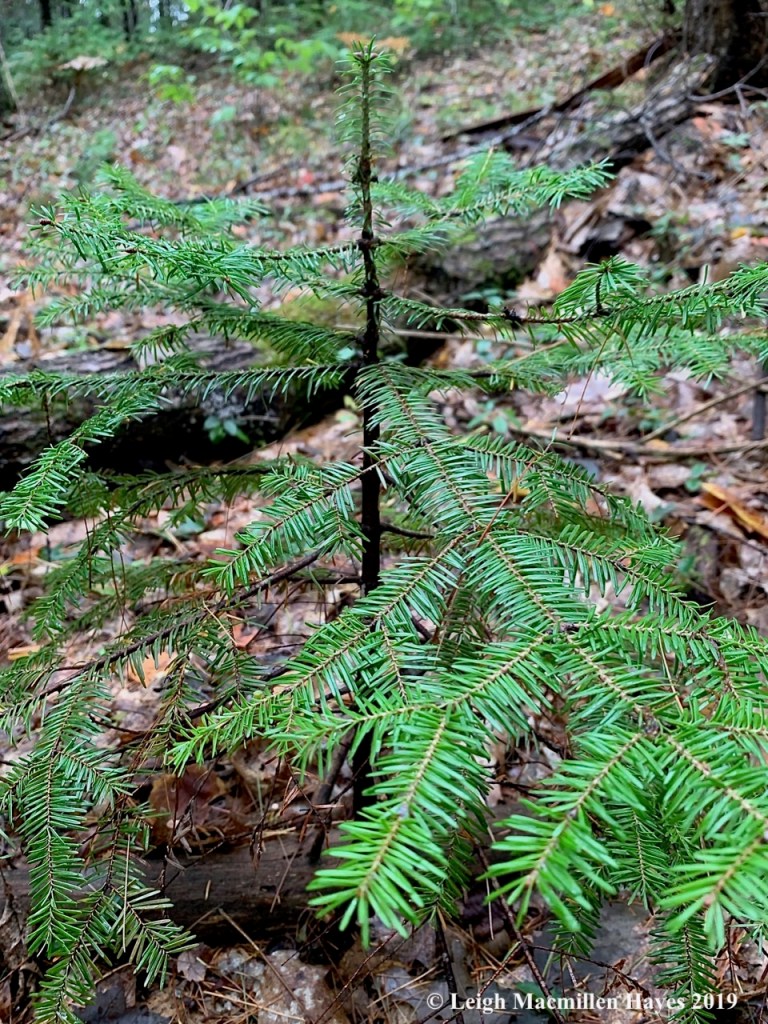
Greet each type of evergreen with a handshake as you get to know it better. Does it feel like you’re touching spikes? Can you take a needle off and roll it in your hand? Does the needle have four sides? If you answered yes to all, you’ve found a spiky Spruce.

Did you notice with the spruce that each needle grew singly from the twig? This one is similar. And both stand up straight and tall as if they were in the military. Can you roll the needle in your hand? If not, then you’ve met: Balsam Fir.

Be like a balsam and stand up straight–believe me, it will help you remember who you are greeting the next time you meet.

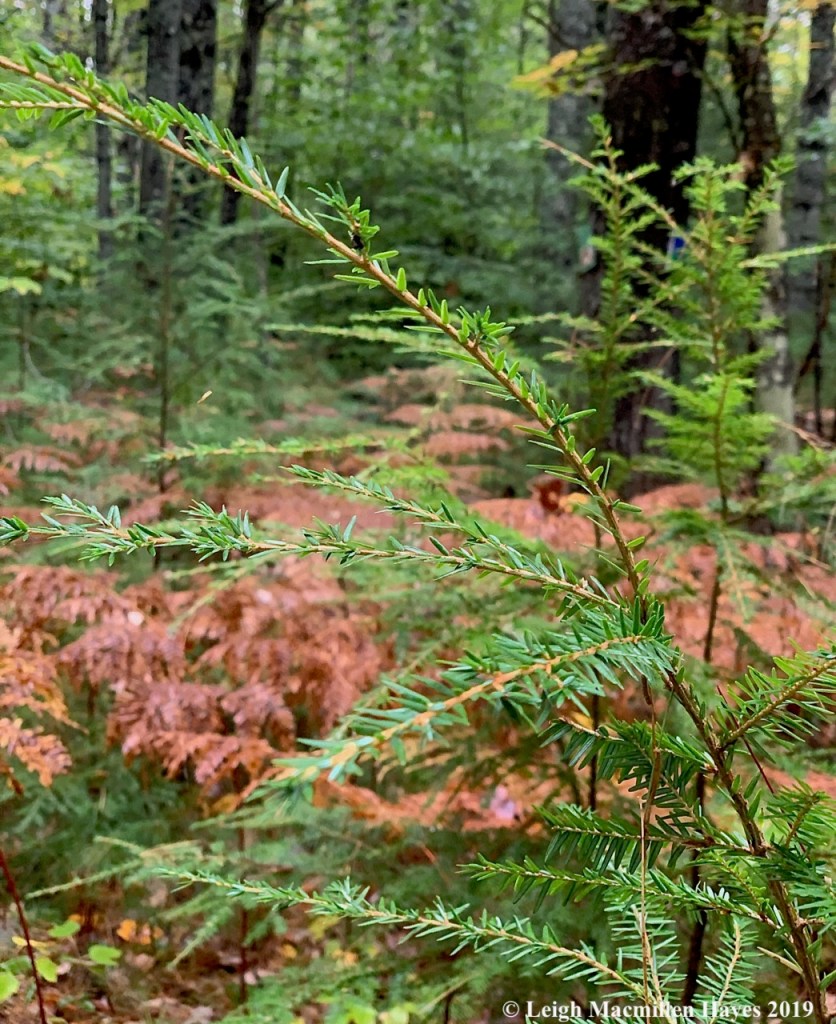
A third who also holds its needles in singular fashion, provides a lacier look than the other two evergreens. Again, shake its hand. Can you roll the needles or are they flat? Does the terminal leader stand up straight like the spruce and fir, or does it bend over as if in a dancing motion? Raise a hand high and lean it over the top of your head: be like an Eastern Hemlock.

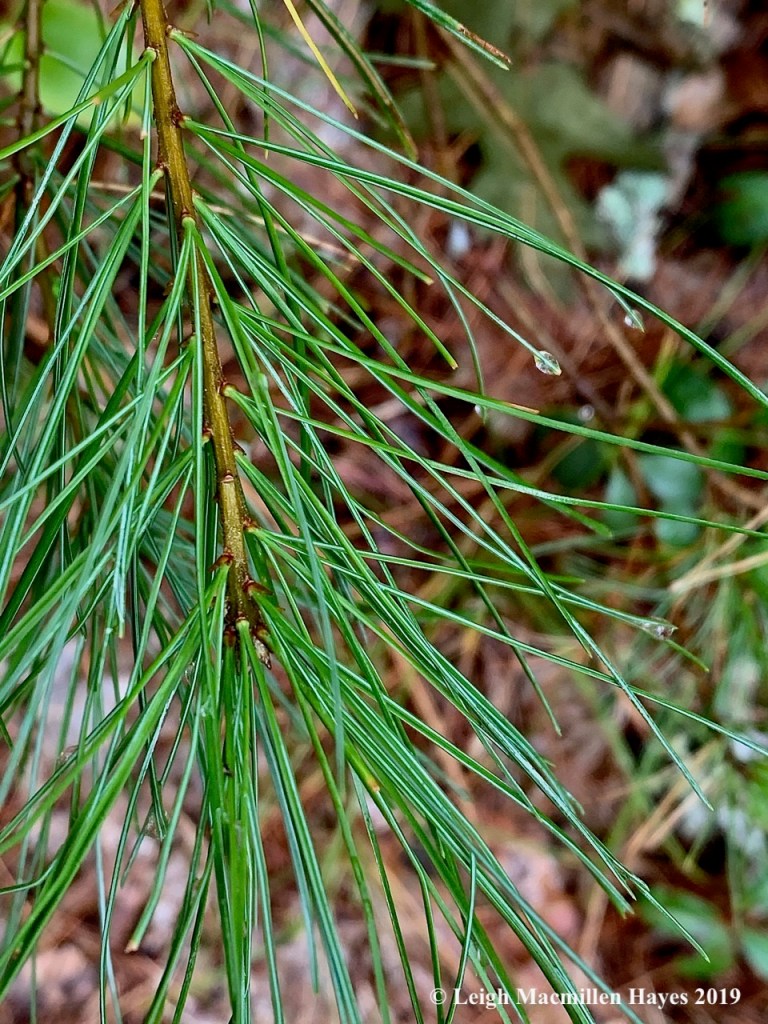
Two other conifers that call the Kezar River Reserve home feature needles in bundles. The first has flexible needles in a bunches of five, which you can use to spell two words; W-H-I-T-E or M-A-I-N-E for it is the state tree of Maine: Eastern White Pine.

Another way to remember this tree is to stick out your arms for its branches grow in whorls, one whorl/year; and shake your five fingers at the end of your branches.

The second has much stiffer and longer needles in bundles of two, which don’t spell its name of three letters: Red Pine.

Take a needle off and snap it in half.

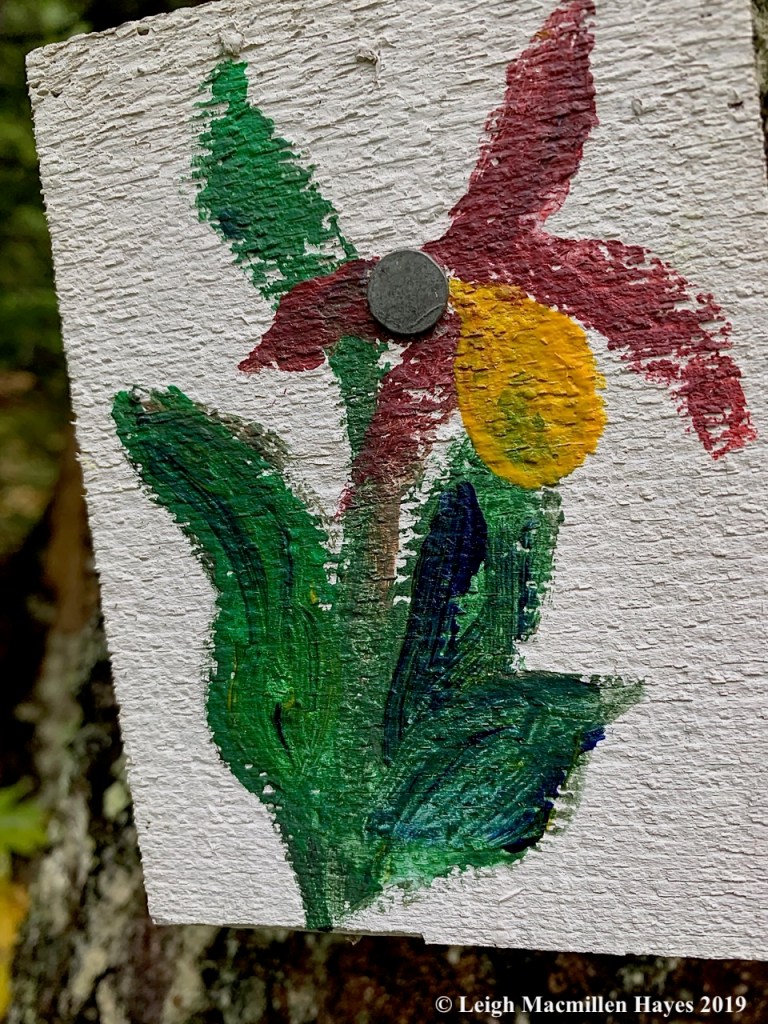
You’re nearing the end of the trail and the last item on your hunt. Did you pass by this flower that is perennially in bloom–at least in this painting created by a local student about ten years ago. You probably noticed that the paintings decorate the entire trail system. They are all sweet and some require more interpretation than others.

And though this flower doesn’t bloom here, we do have it on or near another trail at a different GLLT property–Yellow Lady’s Slipper.

Remember, it was 1 point for each correct find. And minus 2 for any you missed. But plus 5 for a couple of items. If you found them all, you should have a total of 31.

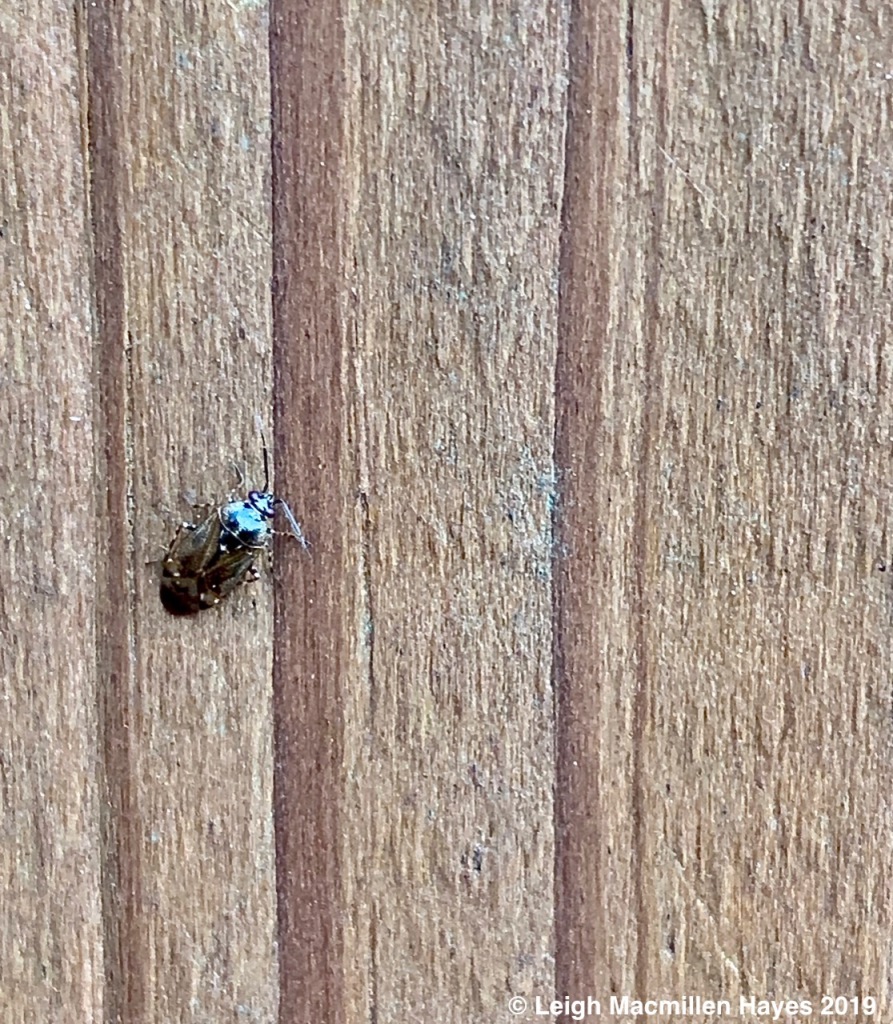
If you need a bonus worth 5 points, look for an interesting insect marching about on leaves, the ground, or tree bark. I found one today: a Green Assassin Bug.

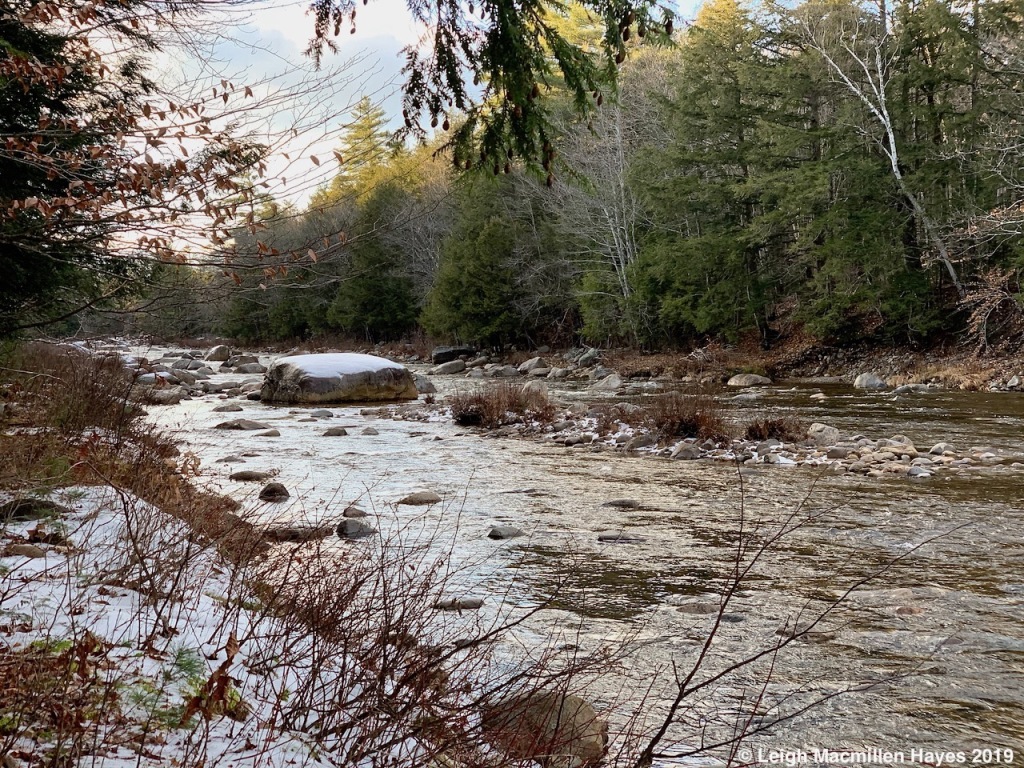
By now, you should have completed the Scavenger Hunt and reached the road to the boat launch again. Rather than turning left toward your car parked by the kiosk, turn right and head back down to the bench overlooking Kezar River to receive your prize.

Drum roll please . . . as winner of the Scavenger Hunt at Kezar River Reserve, you have earned bragging rights and a chance to sit by the river and take in the view. It’s a lovely place to spend a few moments or hours. Congratulations.

OK, so you already know what the prize will be, but still, head on out there and see what you might discover along the path. And let me know how you did.

Seeking Red Mondate

When I invited my guy to join me in a wetland today to mark out a trail, I truly expected him to hem and haw about going. And then when we got there, I thought he’d want to rush through the process and be done with it.

But perhaps it was the setting that slowed him down. I know that it always slows me down.

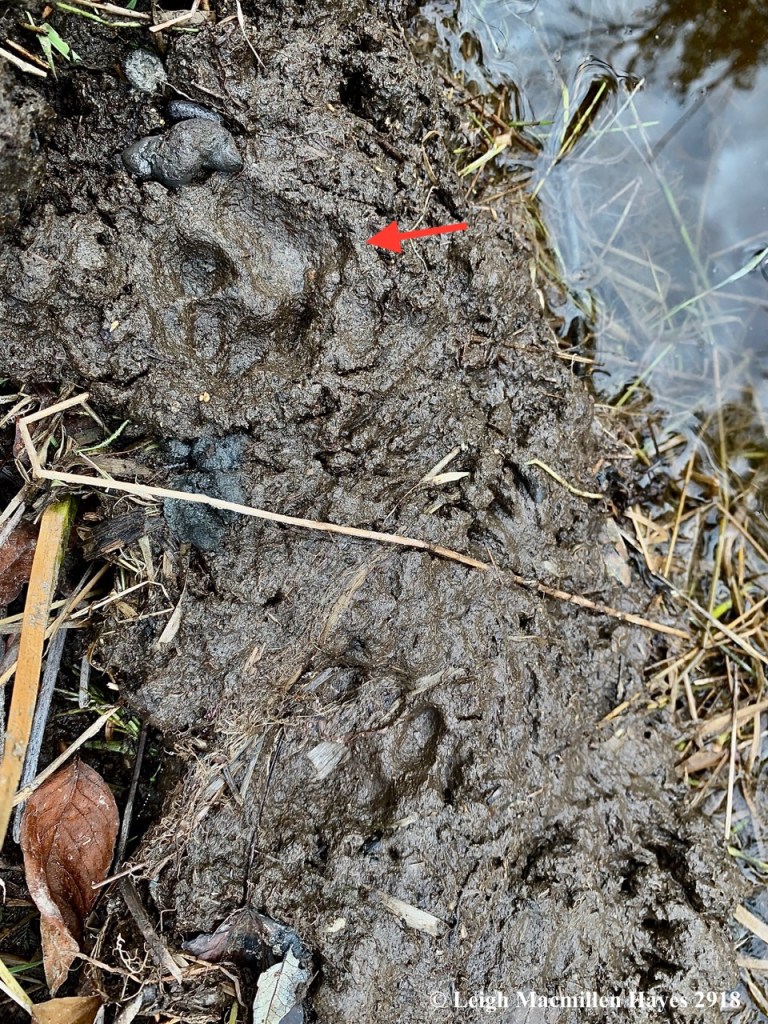
It’s a place where over and over again I’m surprised to discover that others have come before. Last year, it was bear prints that stopped me in my tracks. Today, bobcat. The print is upside down in the photo, but do you see the pad, C-shaped ridge and four toes heading toward you? Notice that the two front toes are a bit asymmetrical. Ah mud. It’s as good as snow. Though I can’t wait to go tracking in snow.

Another reason that this place slows me down is all that it has to offer. The Winterberries were a major part of our stumbling movement, but still they made me smile even though I had to untwist each foot as I tried to step over, around, and through their woody stems.

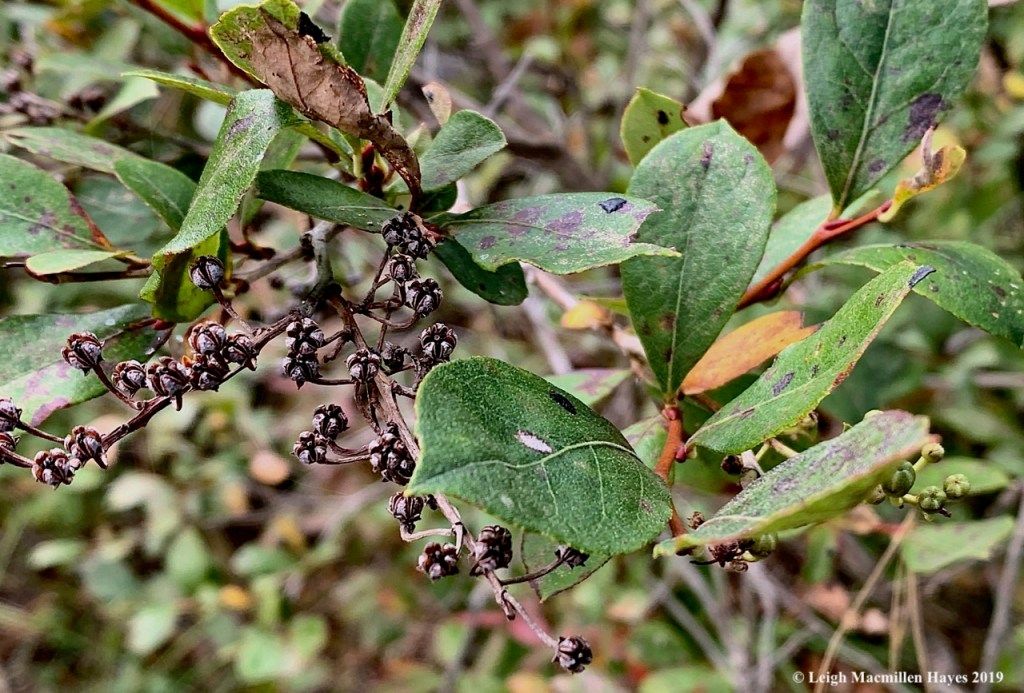
Among the mix in the shrub layer was Maleberry, its woody fruits of last year displaying shades of brown, while the newer fruits were tinged green.

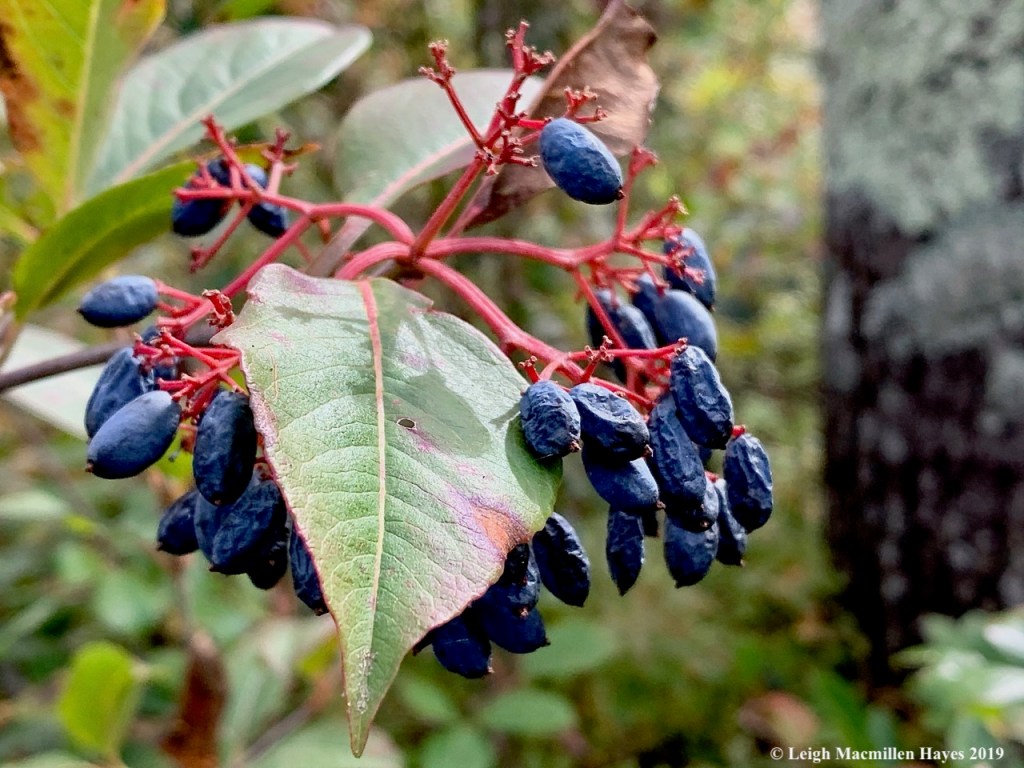
And then there was the Nannyberry with its oval shaped fruits so blue upon red stems, and . . .

Withe-rod just a wee bit different shape that always makes me question my identification.

Rhodora also showed off its woody structure of last year embraced by this year’s softer fruiting form.

But what we really sought were little gems of red hiding among sedges in a different herbaceous layer.

I totally didn’t expect my guy to develop cranberry greed quite the way he has a penchant for blueberries, but he did. And he also rejoiced in eating the tart berries right off the stem. Even he commented that the little balls of red were like the blue-gold he usually sought during the summer.

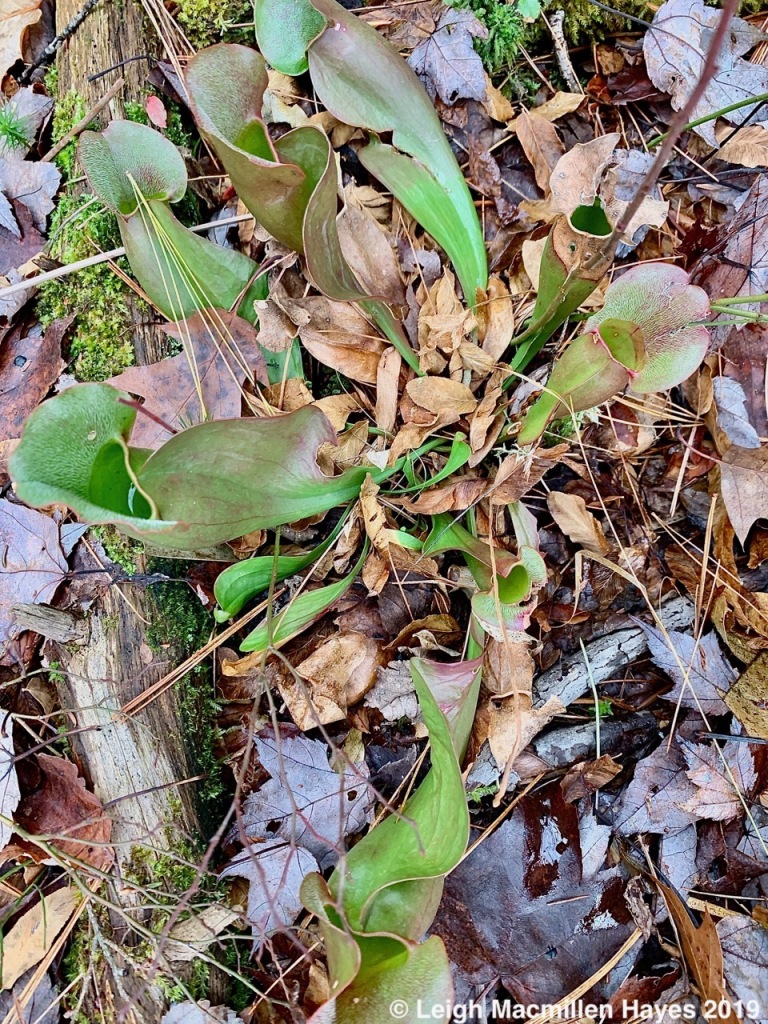
Seriously, it got to the point where I gave up picking, and cranberries are much more my thing than blueberries. And I began to focus on other shades of red, like those that the Pitcher Plants loved to display.

The pattern on the Pitcher leaves always makes me think of the Tree of Life. But . . . equally astonishing are the hairs that coat each pitcher. If you rub your fingers down into the urn-like leaf, you can feel the hairs and gain a better understanding of them creating a landing strip for insects. The true test, however, comes when you dare to escape this carnivorous plant. Can you climb out of the leaf? The way out is sticky and rough and by tracing a finger upward, its suddenly obvious why insects can’t find their way out.

Equally unique, the flower structure that remains, waiting to share its 300+ seeds to the future. For now, it reminds me of a windmill on the turn.

My guy wasn’t as taken with the Pitcher Plant as I was. And he certainly didn’t care about the fact that a Funnel Weaver spider had recently taken up home among the plants urn-like leaves. But me . . . I was totally wowed. Why did a spider that likes to wait in its funnel tunnel until something landed on the net it had created, use a carnivorous plant as its home base? Did it have an agreement with the plant? I’ll bring you food if you don’t see me as food? And was that dark V-shape on the web a leg of one devoured?

With no spider in sight, I knew I’d have to let my questions go, but still . . . it was a mosaic web worth appreciating.

The Pitcher Plant grew on the edge . . . of an Arrowhead wetland . . .

growing beside a Sphagnum Moss peat bog.

And as I walked among it all, I felt the bog quake below my feet.

The pom-pom mosses were responsible for the environment in which we travelled . . . and for its inhabitants.

And because of the Sphagnum the cranberries grew. Abundantly.

Our movement continued as my guy wanted to find as many little red balls of tart glory as ever. And in the midst, the natural community came to focus on Devil’s Beggarstick.

Notice the spines along the seed’s structure.

The beggars chose to stick indeed. Volunteers. They hoped we’d move them on to another place, but we chose to pull each one off . . . Not an easy task.

At last it was time for us to take our leave. And so we found our way out as we’d come in, but felt like crowned royalty for all the finds we’d made, so many of them featuring a shade of red.

In the end, a look back was a look forward. We sought red and so should you—head to your favorite cranberry bog as soon as possible for the fruits await your foraging efforts. And wherever you go, don’t share the location with others. It’s much more fun to have a secret spot as you seek red.

Emergence


Oh dragonfly, oh dragonfly
In your infancy, you laboriously 
climbed upon a slender stem.
Ever
so
slowly
seams split.
Soft and squishy, you spilled forth into this sunlit world.
Perched upon your former self, wispy strings recalled aquatic breaths. 
Moments slipped
into an hour. 
Your body of velvet pulsed as blood pumped into cloudy wings.
Standing guard watching you, I noted preparations for first flight. 
Eyes bulging
you chose
a spot
of viewpoint vantage.
Colors changing, 
you gained 
the markings
 of generations past.
Wings drying 
you offered
a reflection 
of stained glass.
Beyond understanding
you flew 
a dance
of darting restlessness.

Odonata, Odonata,
You have known 
both worlds. 
First playing 
beneath the surface.
Then in a manner 
so brave,
climbing skyward
to ride summer’s breeze
on gossamer wings.
Forever in awe 
of your transformation
from aquatic nymph 
to winged adult, 
I can only imagine
the wonder of
 emergence.

Because of the Monarchs

There’s a place here in western Maine that I frequent on hot summer days. Oh heck, there are many places I frequent, but this one is extra special and it doesn’t involve a hike. In fact, from my perspective, there’s only a short distance of a road that consumes hour after hour of my time. But always, it’s time well spent.

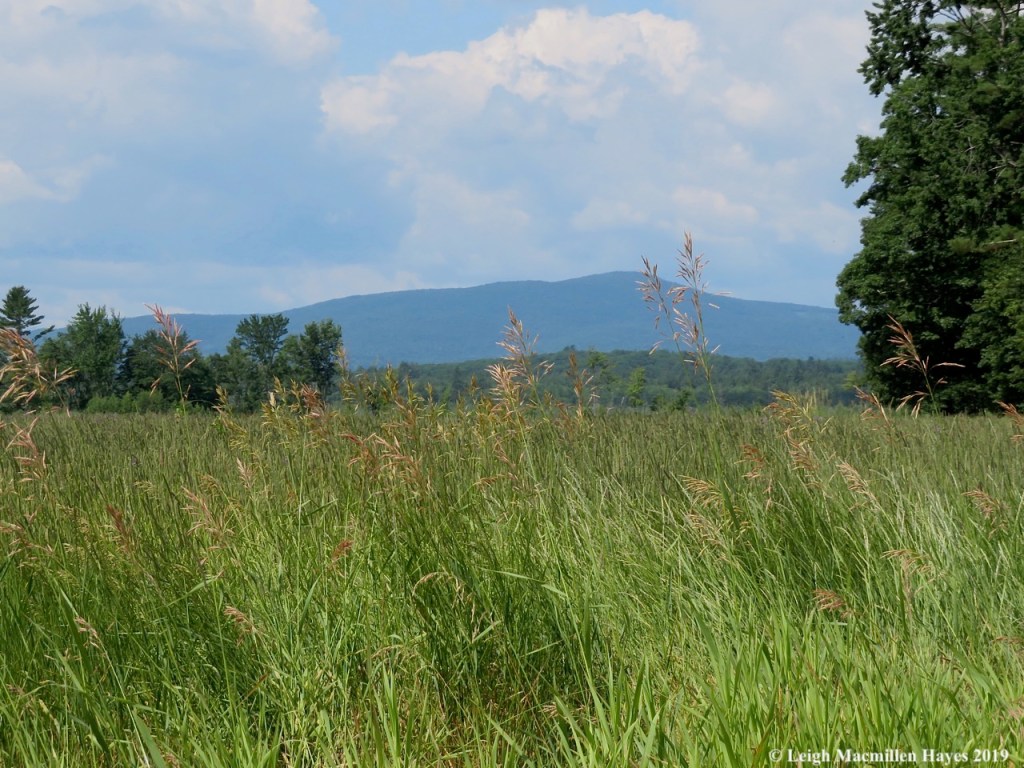
The road is dirt and crosses through a hay field that has yet to be cut. Smack dab in the center stands a beautiful Elm and though I’m not sure the Bluebirds nest there, I do know that they at least rest upon its mighty branches for I watched them fly down and disappear into the wildflowers and grasses below and then zoom back up into the tree a few minutes later, their wings of iridescent blue mesmerizing me during flight.

As the Bluebirds flew back and forth to the tree, so I walked back and forth below it. And back and forth again. And again. I have no idea how many times I turned or how often I muttered, “One more time and then I’ll leave.”

But . . . because I stayed I had the good fortune to spend some time admiring a Twelve-spotted Skimmer Dragonfly. In true character, it paused for long periods of time, flew off for a moment or two, and then returned to the same perch. And I gave thanks.

The only other dragonfly I saw was also a skimmer, but about half the size of the Twelve-spotted. At about one inch in length, the female White-faced Meadowhawk also paused for long breaks. And I was equally grateful.

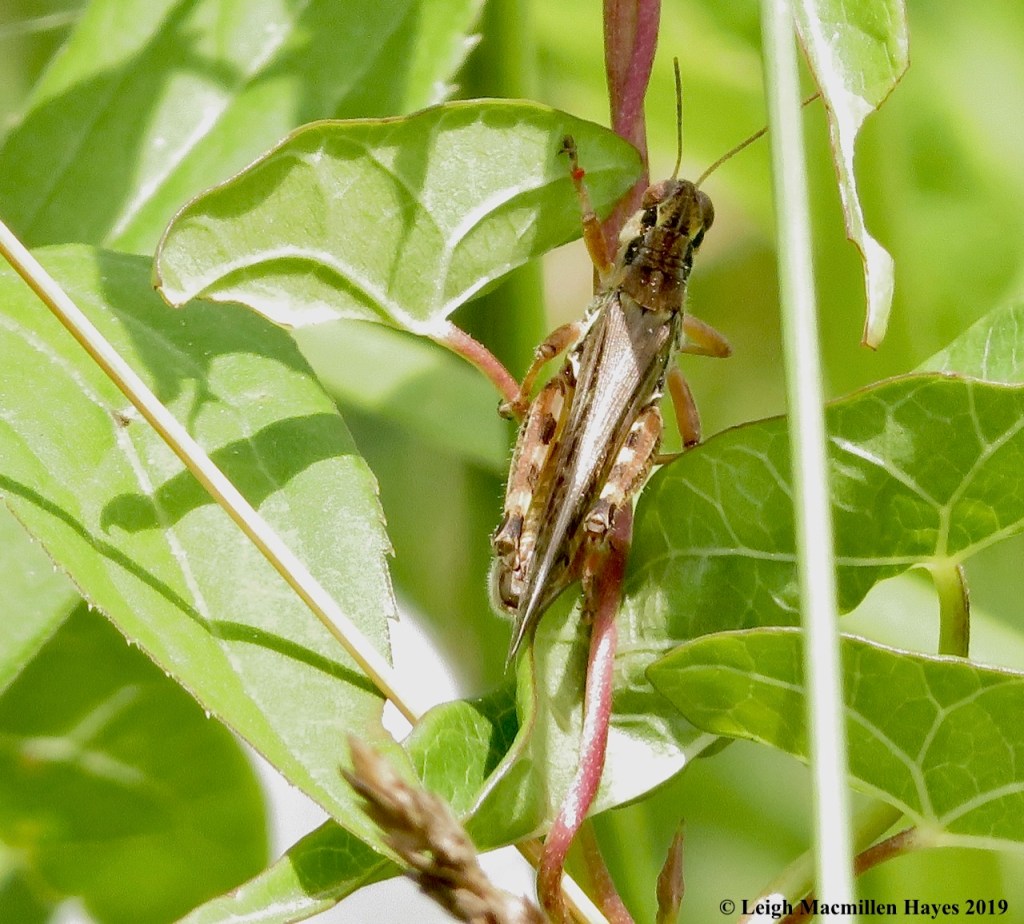
With each step, grasshoppers did what they do–scattered from the dirt road to nearby stems. By the dozens. Providing constant motion and sound.

But then . . . I found two who chose a different activity to entertain themselves and ensure that there will be future generations of grasshoppers in the field.

Aren’t they amazing? And I don’t mean in their canoodling, but rather their design.

My pacing included frequent stops to check out the visitors upon the flowers as well. The Steeplebush appeared to offer a feast to any who chose to stop by.

Because the grass was so high beyond the flowers at the edge of the road, I didn’t realize at first that I wasn’t alone. Twice I was startled because I’d startled another. Both times it was a deer that I didn’t see until they ran off. Do you see the white flag of the tail as one bounded toward the woods?

There was more movement in the grasses and among the flowers. It was accompanied by sound. Looking for stalks moving at odds with the slight breeze, I finally spied the creator of the “Cheap” that resounded almost constantly. A Common Yellowthroat Warbler hopped from one plant to another, possibly seeking a meal to share with youngsters relaxing in a distant tree.

Curiously, a different sound could be heard from the other side of the road, where a male and female frequently took flight before settling down for a bit.

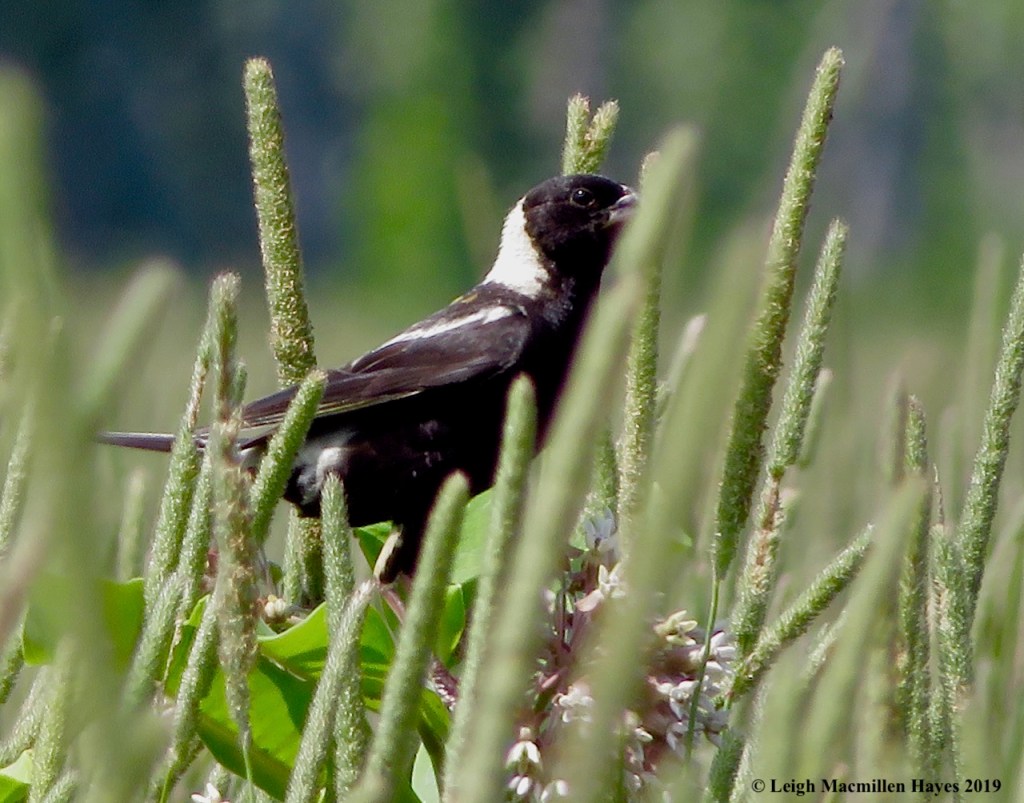
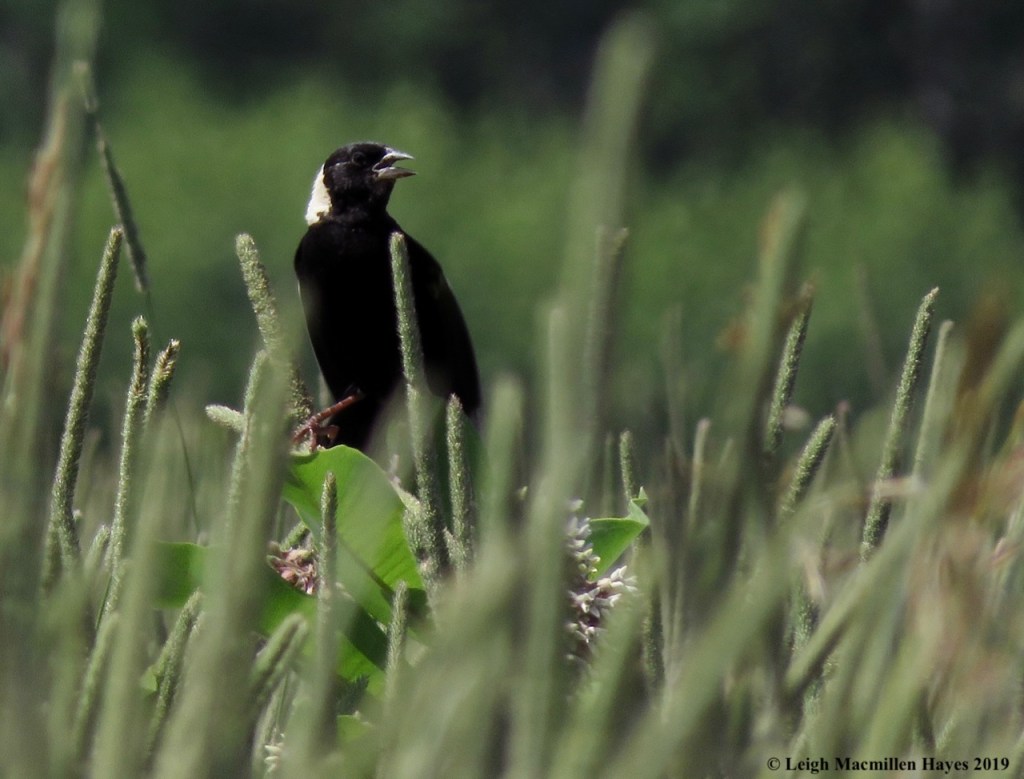
The Bobolink’s song hit notes both low and high, offering a serenade that bubbled forth in a rather bouncy and most pleasant warble.

Every which way I looked, something different presented itself. Some I knew, but others I met for perhaps the first time, such as this large bee fly. I’ve since learned that they are also commonly known as humbleflies, and I found that curious given that with the banded abdomen and patterned wings and overall large size, it hardly seemed humble.

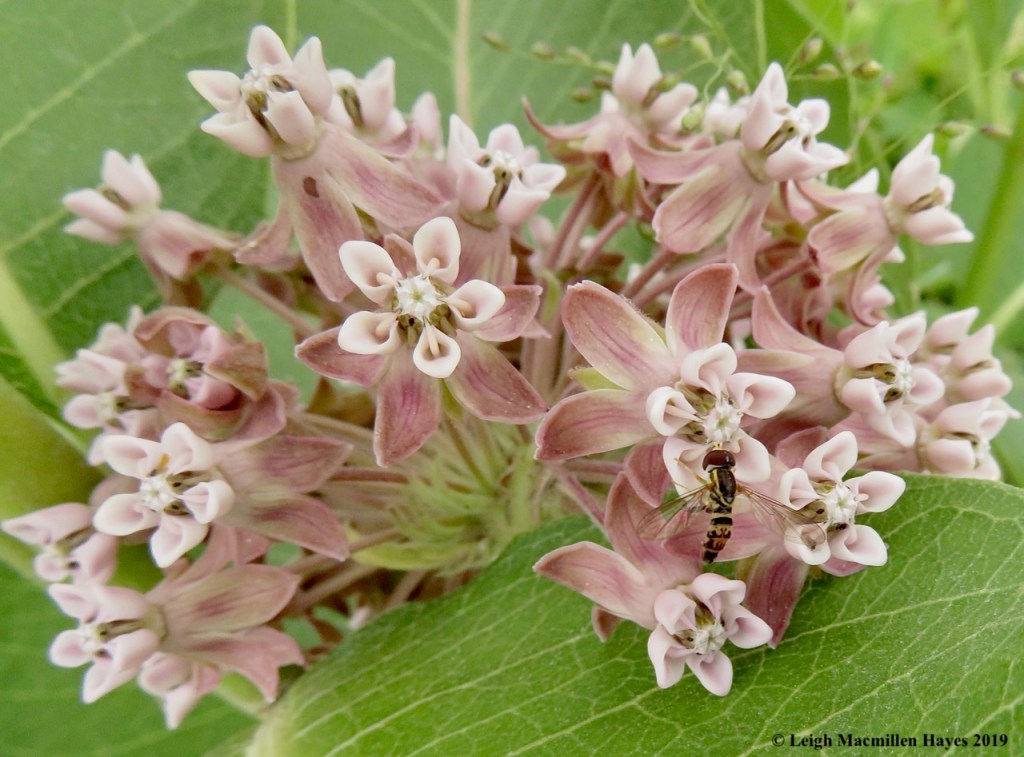
What I’d really gone to check on, however, were the Milkweed plants and their visitors. I wasn’t disappointed for there were both big and little Milkweed beetles.

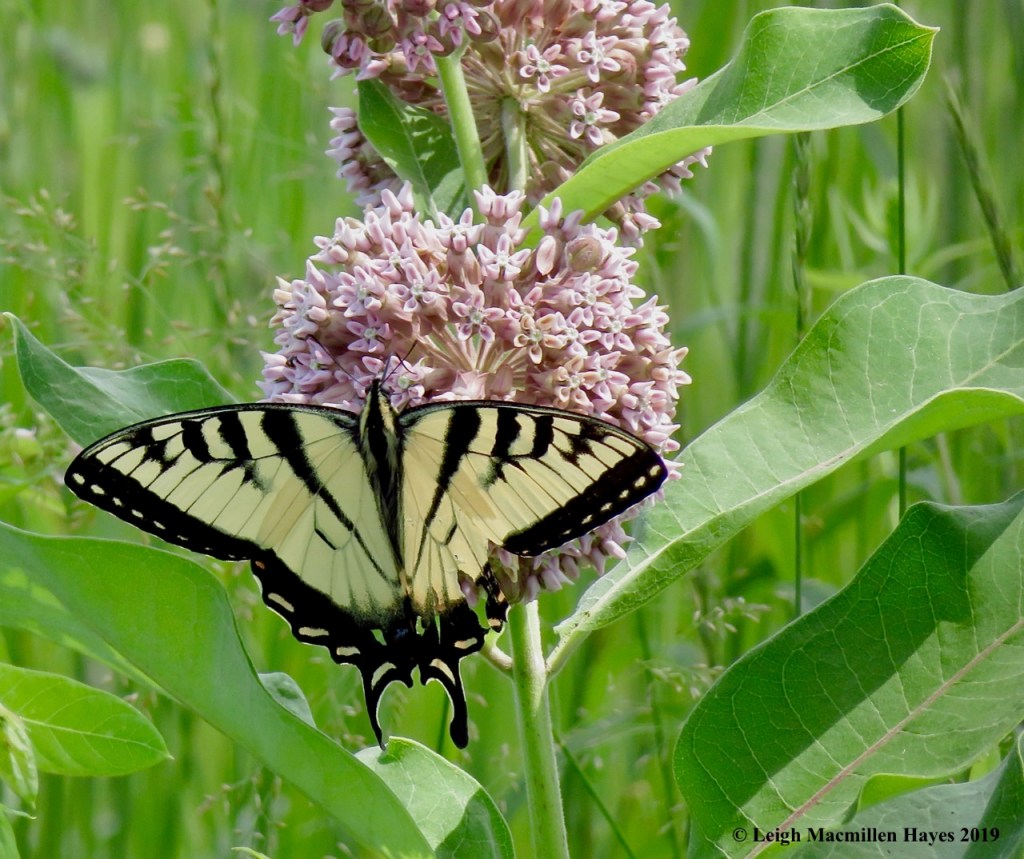
And Tiger Swallowtails seeking nourishment. This one needed all the nourishment it could get to continue its flight and avoid the birds and other predators. Do you see its tattered wing?

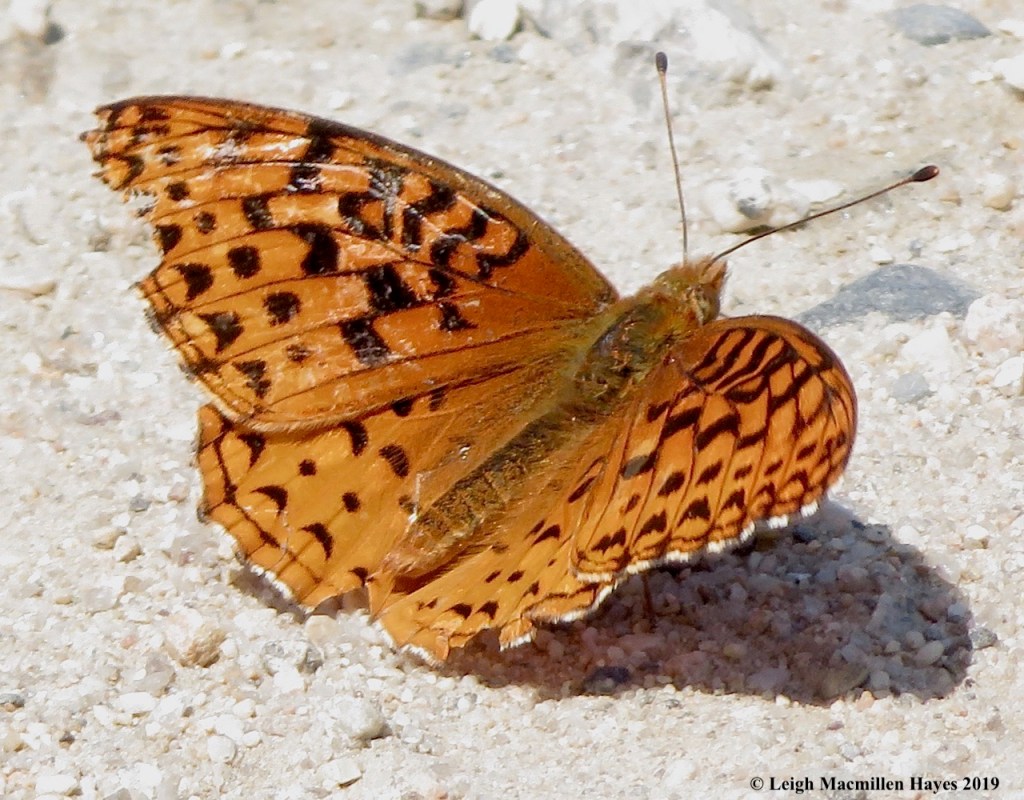
Some, like the Fritillary, chose the road for nutrition and did what butterflies often do.

It puddled. To puddle means to extend your mouthparts and probe the dusty road in search of nutrients. There is no actual puddle involved, but there may be raindrops or in this case, morning dew that help the butterflies extract minerals to share with their gals.

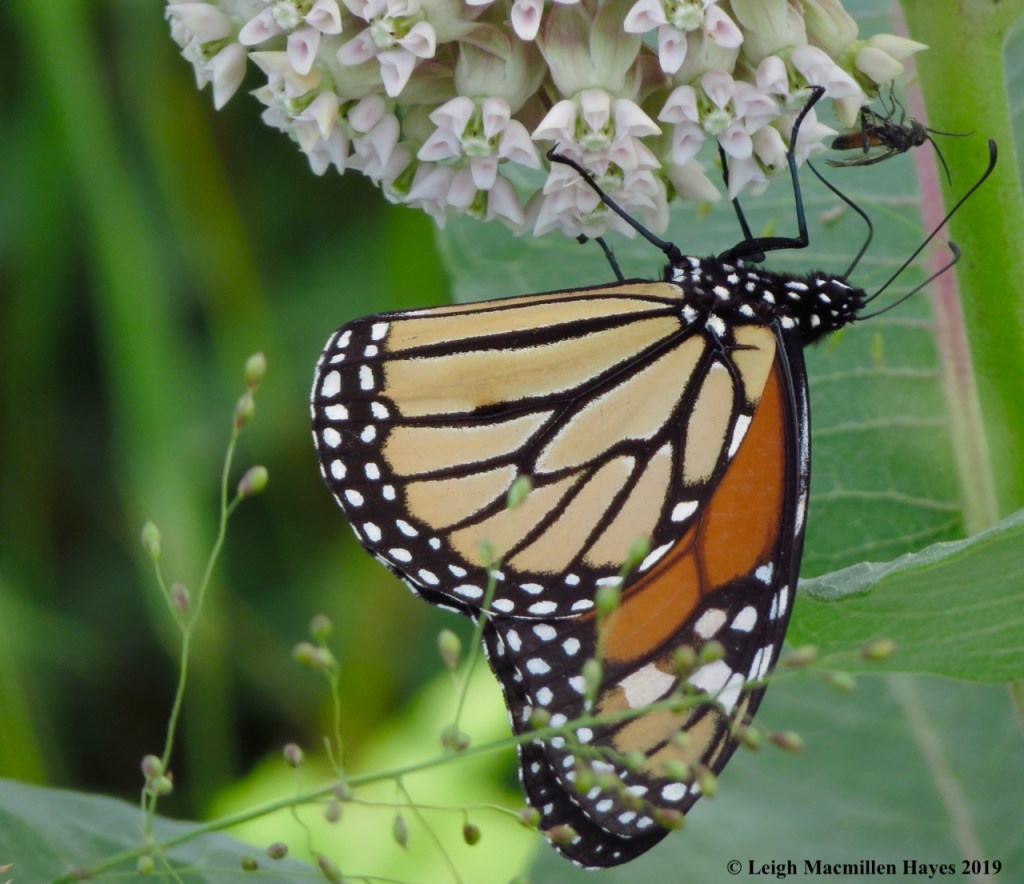
What I’d really gone to see, however, were the Monarchs. And I wasn’t disappointed for a few fluttered about and occasionally landed, much to my delight.

At last, my “One more time and then I’ll leave” utterance became reality and I drove off. And then . . . there was one more sight to behold. I stopped the truck and watched as a fawn bounded in its awkward fawn manner.

Because of the Monarchs . . . I experienced a wonder-filled morning.

Walking Among Mysteries

We knew not what to expect when we met this morning. My intention was to visit a structure of unknown use, then follow a trail for a bit before going off trail and mapping some stone walls. Curiosity would be the name of the game and friends Pam and Bob were ready for the adventure when I pulled into the trailhead parking lot.

We traveled rather quickly to our first destination, pausing briefly to admire only a few distractions along the way–if you can believe that.

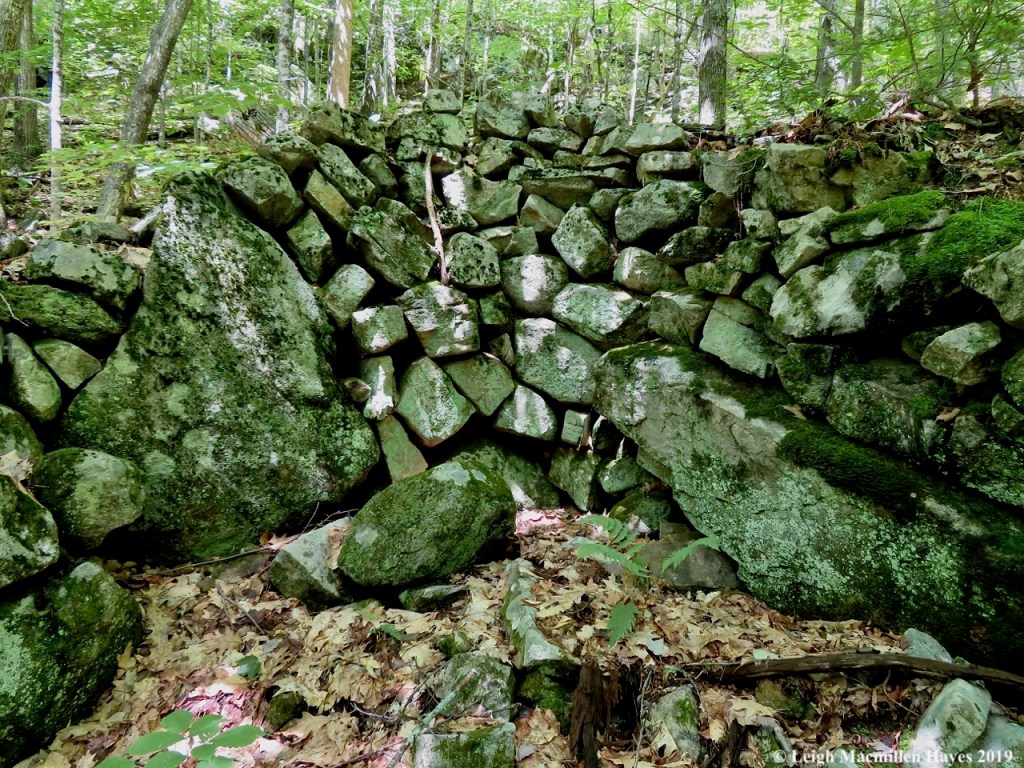
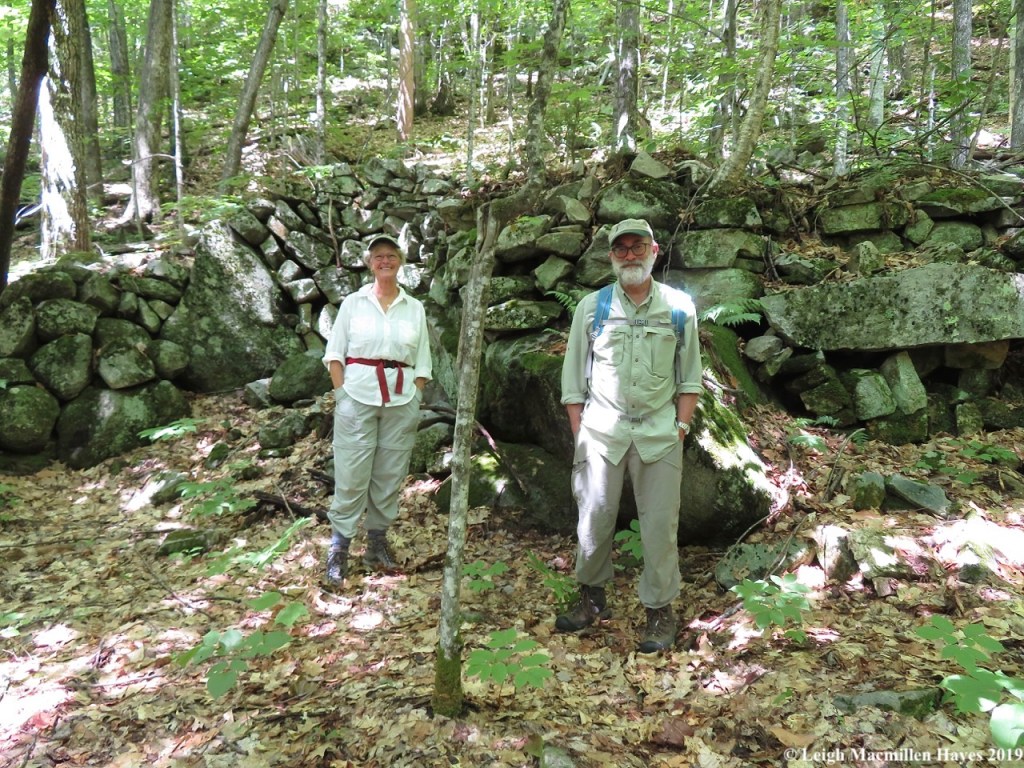
It’s a stone structure on the back side of Amos Mountain. Three years ago we visited this site with Dr. Rob Sanford, a University of Southern Maine professor and author of Reading Rural Landscapes. At that time we came away with so many questions about this structure located on a mountainside so far from any foundations. Today, we still had the same questions and then some.

Who built it? What was it used for? Was there a hearth? Did it have a roof? Was it ever fully enclosed? Was there originally a front wall? Could it be that it extended into the earth behind it? Was it colonial? Pre-colonial?

Why only one piece of split granite when it sits below an old quarry?

And then there’s the left-hand side: Large boulders used in situ and smaller rocks fit together. One part of the “room” curved. For what purpose?

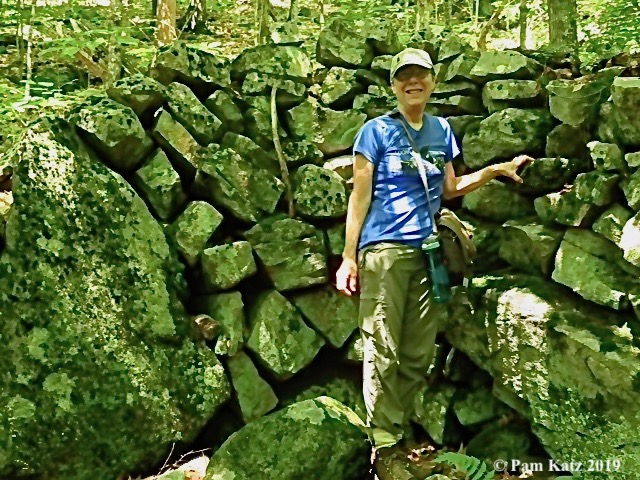
Pam and Bob stood in the center to provide some perspective.

And then I climbed upon fallen rocks to show height.

We walked away still speculating on the possibilities, knowing that we weren’t too far from a stone foundation that belonged to George Washington and Mary Ann McCallister beginning in the mid-1850s and believed the structure to be upon their “Lot.”

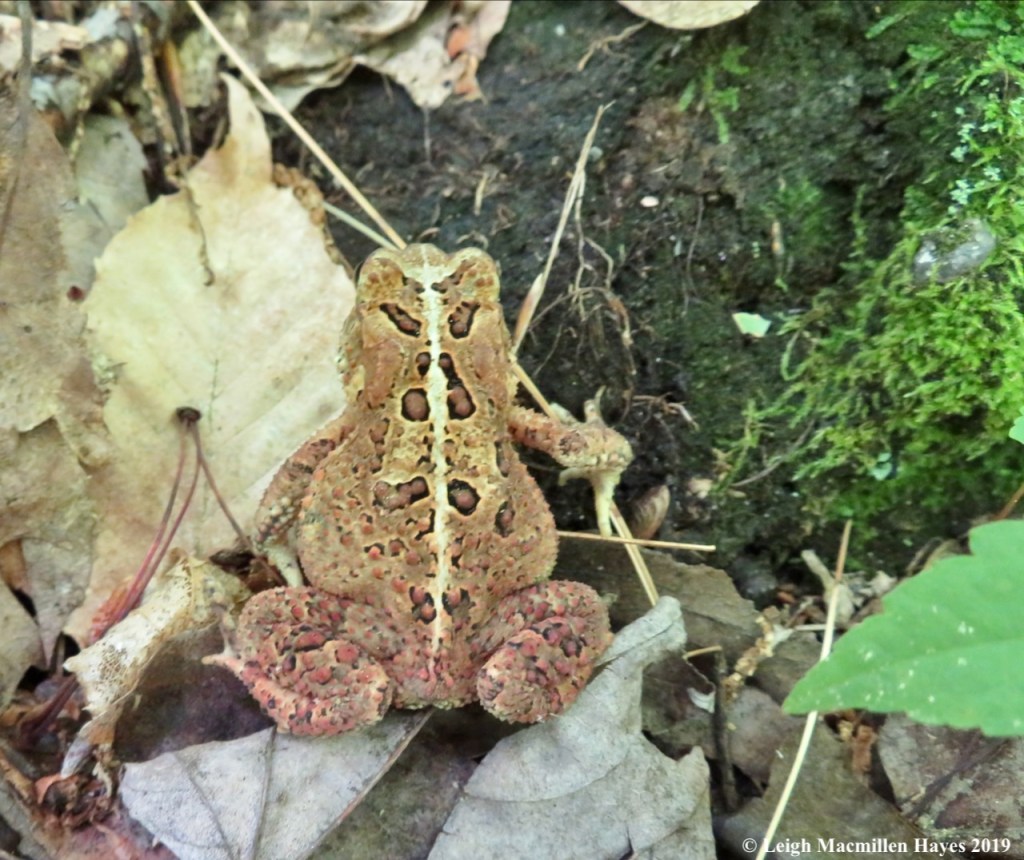
As we continued along the trail, we spied several toads and a couple of frogs. Their movement gave them away initially, but then they stayed still, and their camouflage colorations sometimes made us look twice to locate the creator of ferns in motion.

At last we crossed over a stonewall that we assumed was a boundary between the McAllister property and that of Amos Andrews. It was the walls that we wanted to follow as there are many and our hope was to mark them on GPS and gain a better understanding of what seems like a rather random lay out.

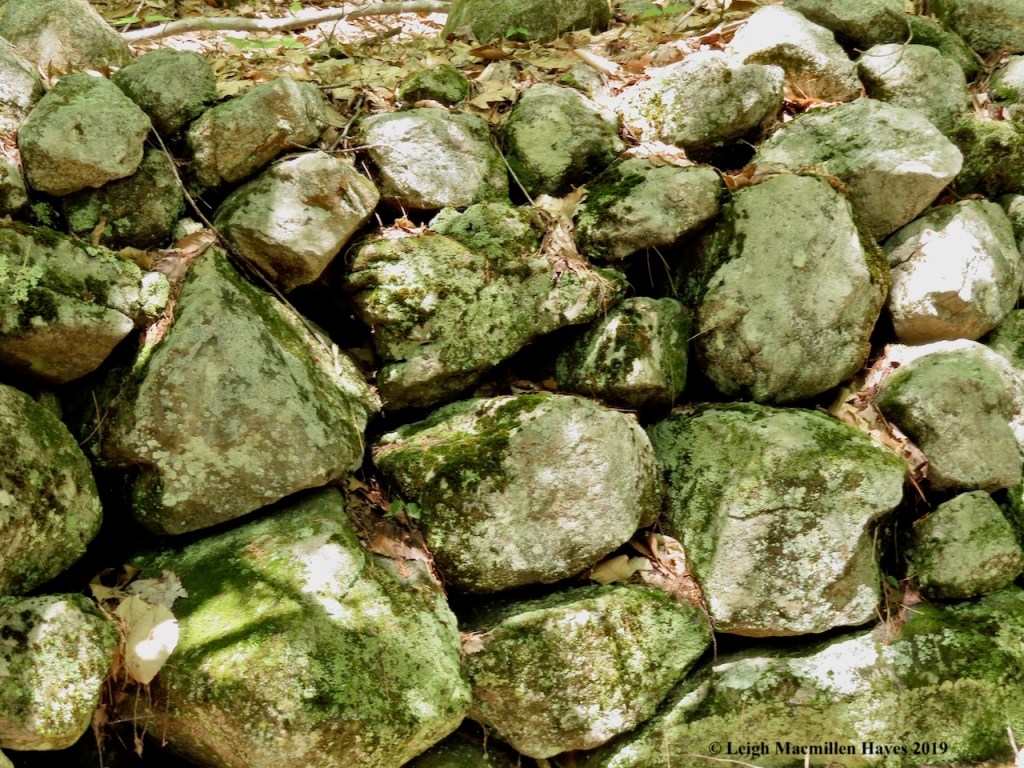
The walls stand stalwart, though some sections more ragged than others. Fallen trees, roots, frost, weather, critters and humans have added to their demise, yet they are still beautiful, with mosses and lichens offering striking contrasts to the granite. Specks of shiny mica, feldspar and quartz add to the display.

The fact that they are still here is a sign of their endurance . . . and their perseverance. And the perseverance of those who built them.

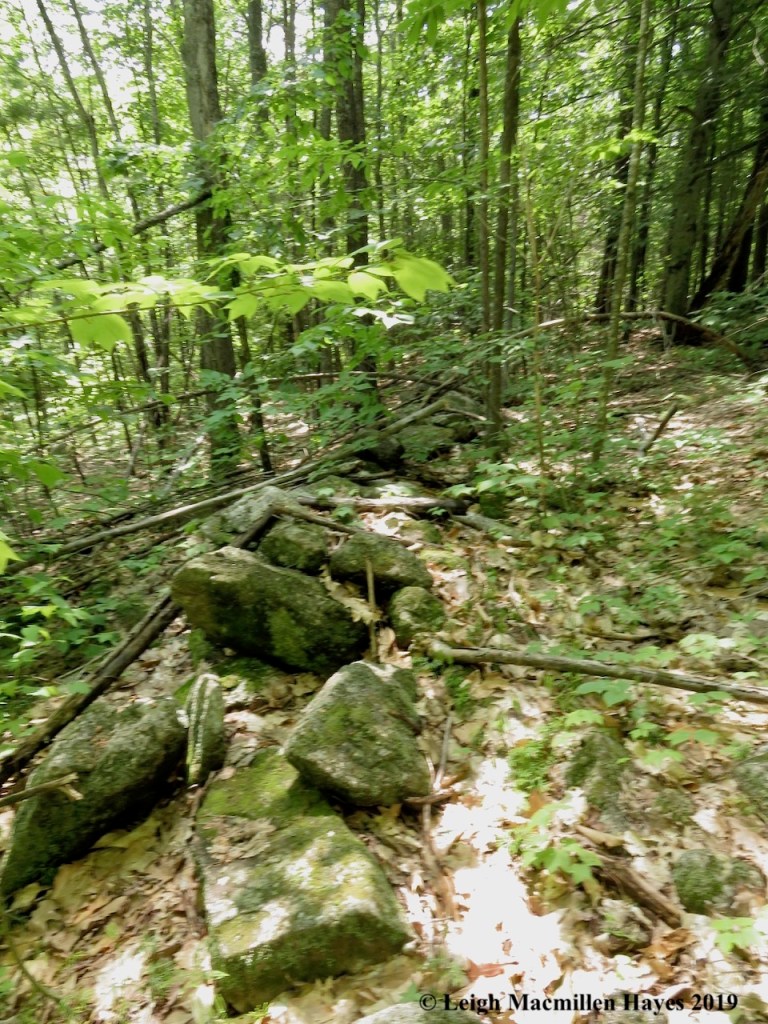
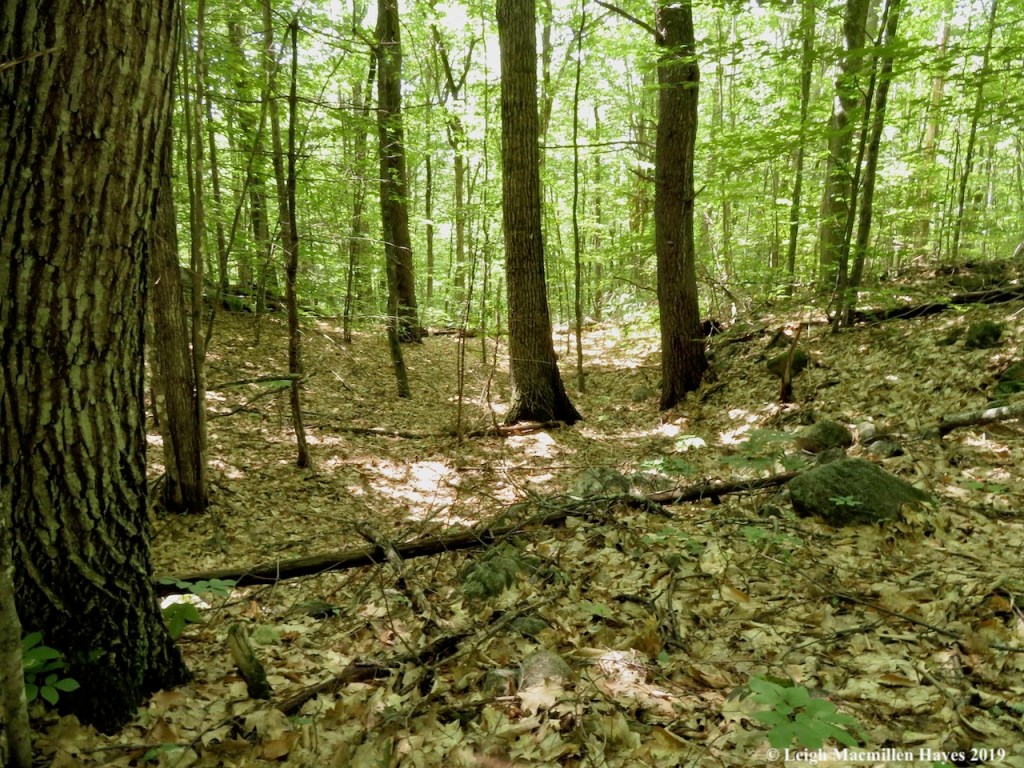
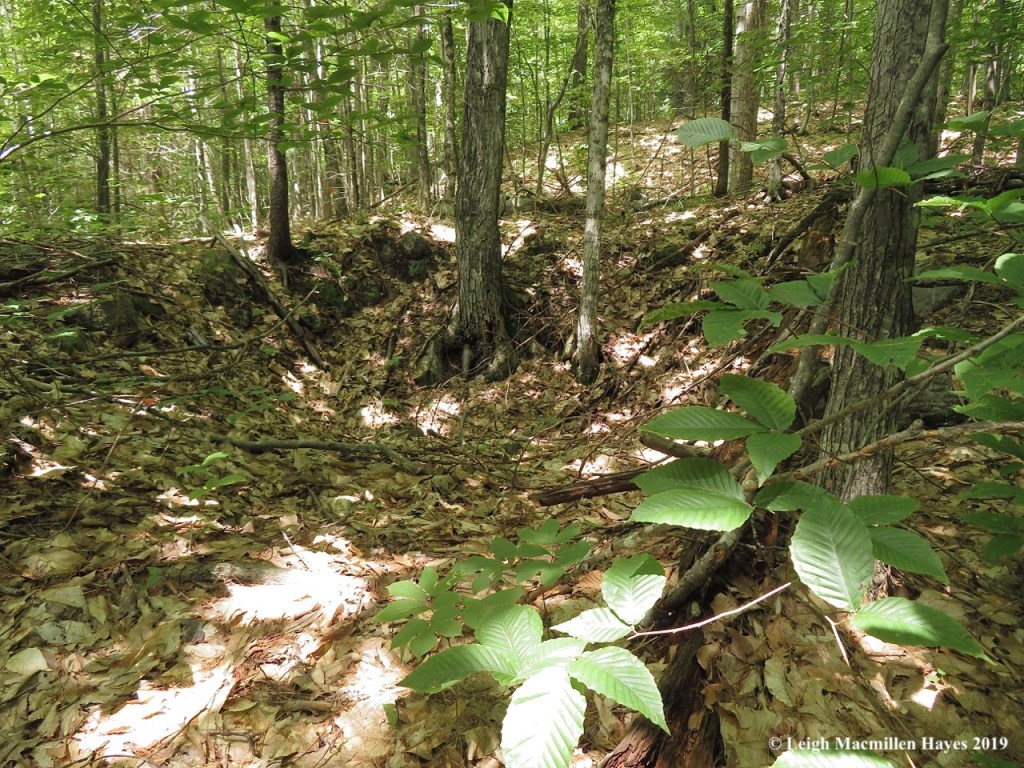
But the fashion of these particular walls has stymied us for years. As we stood and looked down the mountain from near the Amos Andrews foundation, we realized that the land was terraced in a rather narrow area. And so we began to follow one wall (perspective isn’t so great in this photo) across, walk down the retaining wall on the right edge and at the next wall follow it across to the left. We did this over and over again and now I wish I’d counted our crossings, but there were at least eight.

Mind you, all were located below the small root cellar that served as Amos Andrews’ home on and off again beginning in 1843.

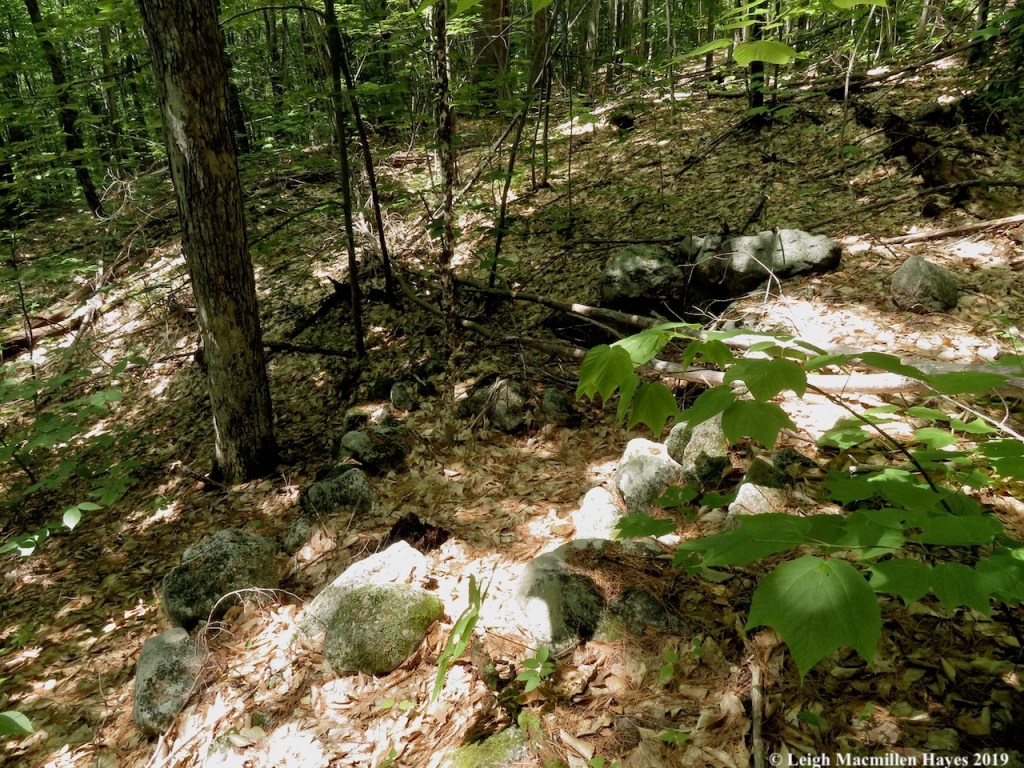
And below one of the terraced walls just beyond his cellar hole, there was a stoned off rectangle by the edge. Did it once serve as a foundation for a shed?

Had Amos or someone prior to him tried to carve out a slice of land, build a house, and clear the terraced area for a garden?

It seems the land of western Maine had been forested prior to the 1700s and there was plenty of timber to build. A generation or two later, when so much timber had been harvested to create fields for tillage and pasture, the landscape changed drastically, exposing the ground to the freezing forces of nature. Plowing also helped bring stones to the surface. The later generation of farmers soon had their number one crop to deal with–stone potatoes as they called them. These needed to be removed or they’d bend and break the blade of the oxen-drawn plowing rake. Summer meant time to pick the stones and make piles that would be moved by sled to the wall in winter months. Had the land been burned even before those settlers arrived? That would have created the same scenario, with smaller rocks finding their way to the surface during the spring thaw.

As it was, we found one pile after another of baseball and basketball size stones dotting the landscape. Stone removal became a family affair for many. Like a spelling or quilting bee, sometimes stone bees were held to remove the granite from the ground. Working radially, piles were made as an area was cleared. Stone boats pulled by oxen transported the piles of stones to their final resting place where they were woven into a wall.

Occasionally, however, we discovered smaller stones upon boulders. Were they grave markers? Or perhaps spiritual markers?

There were double-wide stone walls with big stones on the outside and little stones between, indicating that the land around had been used for planting. But why hadn’t all the piles been added to the center of these walls? That’s what had us thinking this was perhaps Pre-colonial in nature.

Pasture walls also stood tall, their structure of a single stature. I may be making this up because I’ve had an affinity with turtles since I was a young child and own quite a collection even to this day, but I see a turtle configured in this wall. Planned or coincidence?

My turtle’s head is the large blocky rock in the midst of the other stones, but I may actually be seeing one turtle upon another. Do you see the marginal scutes arching over the head? Am I seeing things that are not there? Overthinking as my guy would suggest?

I didn’t have to overthink when I spotted this woody specimen–last year’s Pine Sap with its many flowered stalk turned to capsules still standing tall.

And a foot or so away, its cousin, Indian Pipe also showing off the woody capsules of last year’s flowers, though singular on each stalk.

As we continued to follow the walls, other things made themselves known. I do have to admit that we paused and pondered several examples of this plant because of its three-leaved presentation. Leaves of three, leave them be–especially if two leaves are opposite each other and have short petioles and the leader is attached between them by a longer petiole. But, when we finally found one in flower we were almost certain we weren’t looking at Poison Ivy. I suggested Tick-Trefoil and low and behold, I was correct. For once.

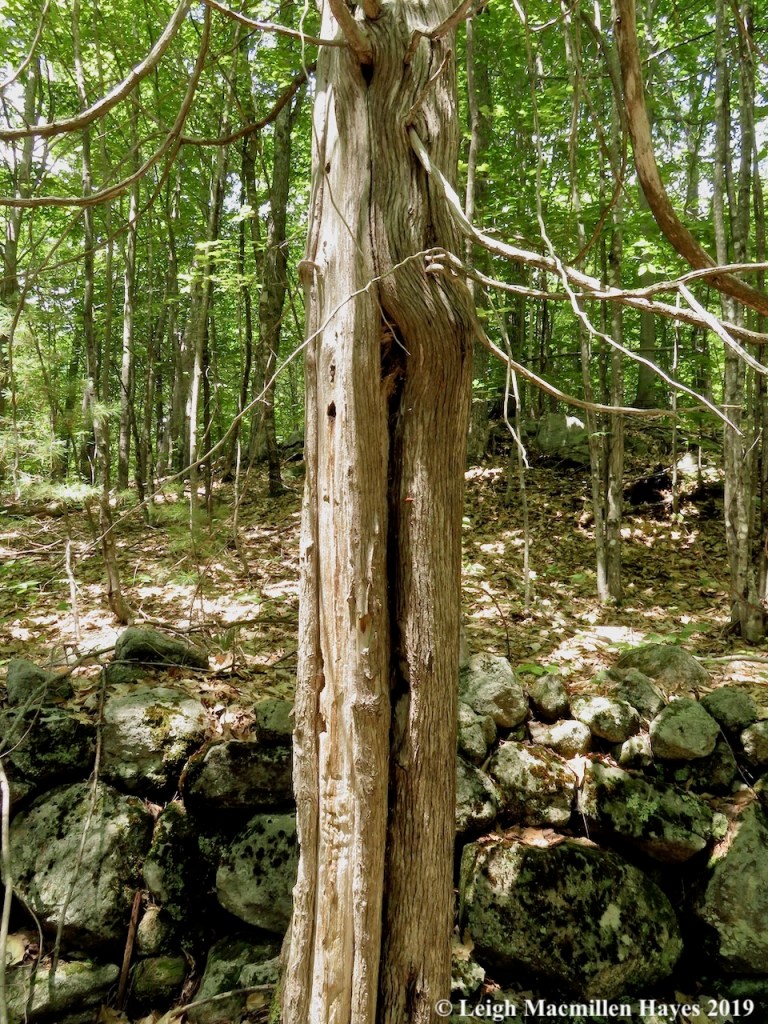
Our journey wandering the walls soon found us back on what may have been a cow or sheep path and it was there that we noted a cedar tree. Looking at it straight on, one might expect it to be dead. But a gaze skyward indicated otherwise. Still, the question remained–why here?

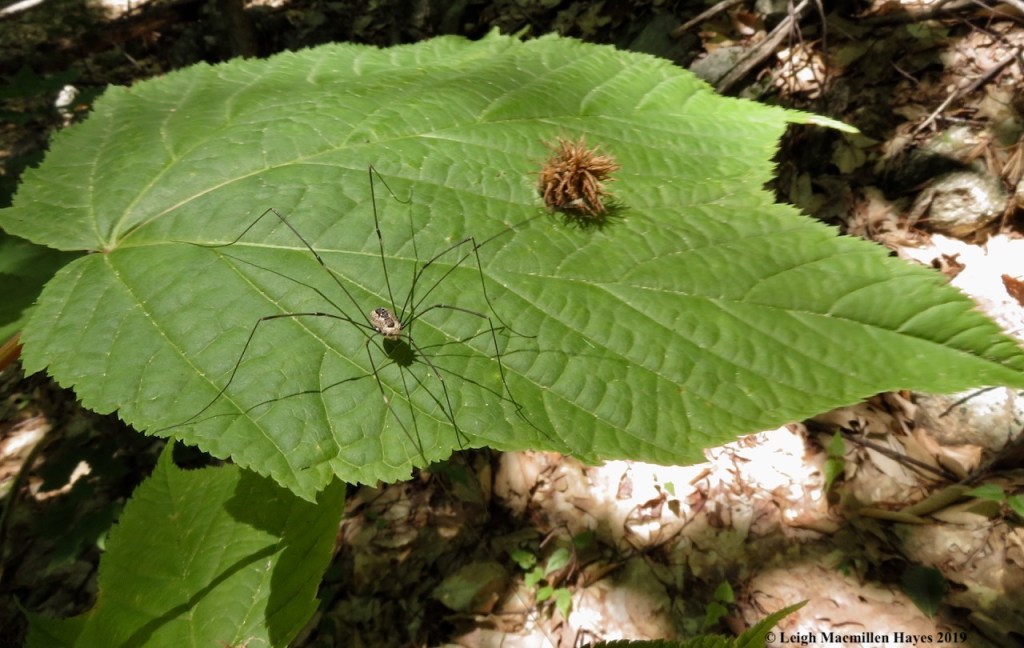
A Harvestman Spider may have thought the same as it reached out to a Beech Nut. After all, the two were located upon a Striped Maple leaf.

Onward we walked, making a choice of which way to travel each time we encountered an intersection of walls. This one had a zigzag look to it and we thought about the reputation Amos Andrews had with a preference for alcohol. But . . . did Amos build all or any of these walls?

We continued to ponder that question even as we came upon a stump that practically shouted its name all these years after being cut, for the property we were on had eventually been owned by Diamond Match, a timber company. Do you see the mossy star shape atop the stump? And the sapling growing out of it? The star is actually a whorl–of White Pine branches for such is their form of growth. And the sapling–a White Pine.

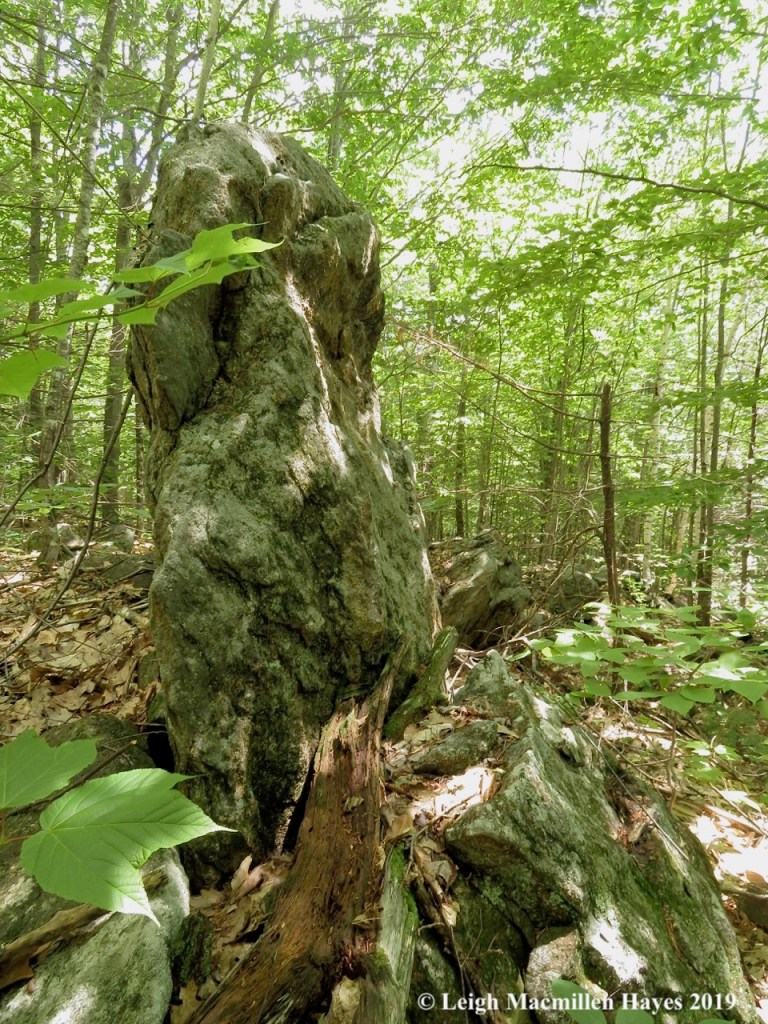
And then . . . and then . . . something the three of us hadn’t encountered before. A large, rather narrow boulder standing upright.

Behind it, smaller rocks supported its stance.

The stone marked the start of another stone wall. And across from it a second wall, as if a road or path ran between the two and Bob stood in their midst adding coordinates to his GPS.

We chuckled to think that the stone was the beginning of Amos’ driveway and he’d had Andrews written upon it. According to local lore, he had a bit of a curmudgeon reputation, so we couldn’t imagine him wanting people to stop by. The road downhill eventually petered out so we didn’t figure out its purpose. Yet.

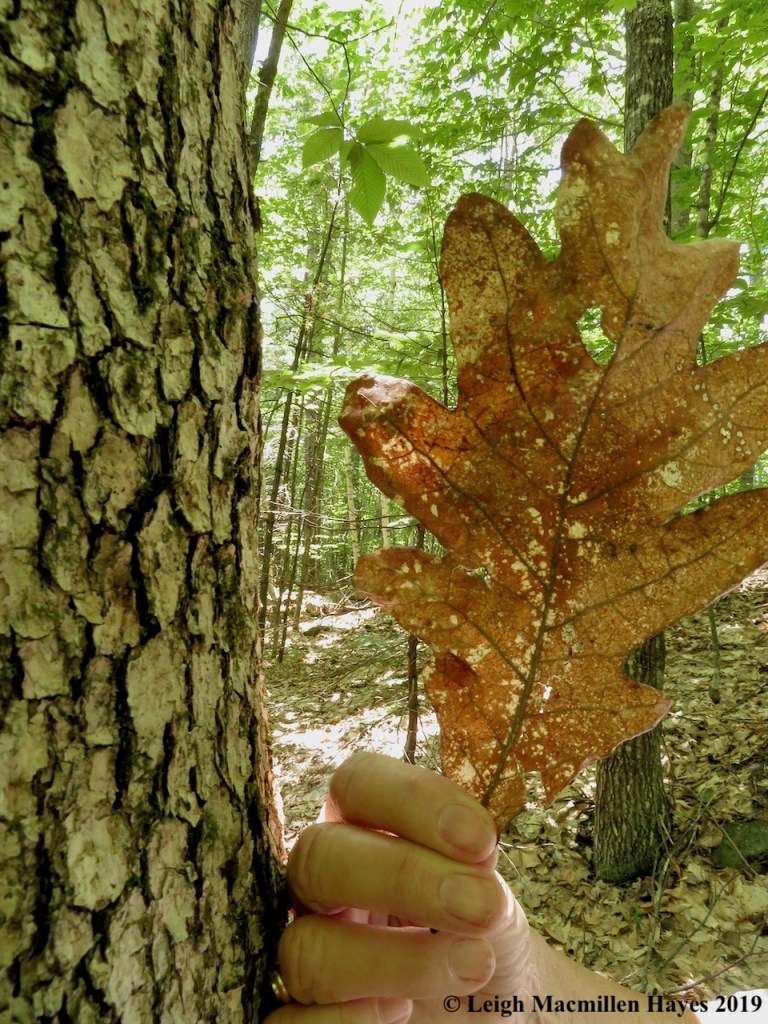
In the neighborhood we also found trees that excited us–for until ten months ago we didn’t think that any White Oaks existed in Lovell. But today we found one after another, much like the piles of stones. With the nickname “stave oak,” it made sense that they should be here since its wood was integral in making barrels and we know that such for products like rum were once built upon this property.

Trees of varying ages grow quite close to Amos Andrews’ homestead.

Also growing in the area was Marginal Wood Fern, its stipe or stalk below the blade covered with brown scales and fronds blue-green in color, which is often a give-away clue that it’s a wood fern.

We know how it got its name–for the round sori located on the margins of the underside of the pinnules or leaflets. Based on their grayish-blue color, they hadn’t yet matured. But why are some sori such as these covered with that smooth kidney-shaped indusium? What aren’t all sori on all ferns so covered?

So many questions. So many mysteries.

As curious as we are about the answers, I think we’ll be a wee bit disappointed if we are ever able to tell the complete story of the stone structure and the upright stone and all the walls between.

Walking among mysteries keeps us on our toes–forever asking questions and seeking answers.

Rookery and Beyond

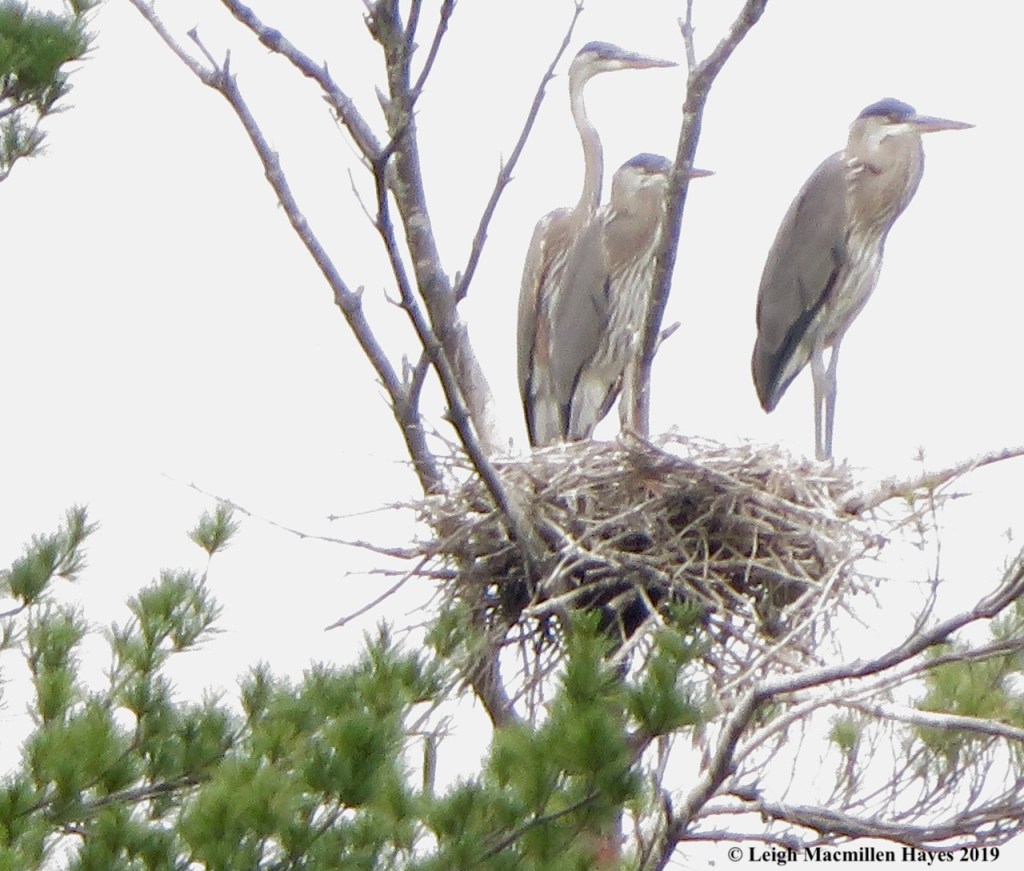
It’s a difficult sound to describe, rather primordial in nature. Maybe it’s a duck’s quack? Or a dog’s bark? Or some combination of the two. And yet, all is quiet and then the noise erupts suddenly from one nest as a parent flies in, a meal in the oven about to be regurgitated.

It’s a scene that plays out at individual nests for a while before all become quiet again as if lunch has ended and the kids should take time for a nap. But until such time, the neighbors in the high rise next door watch enviously as their playmates are fed.

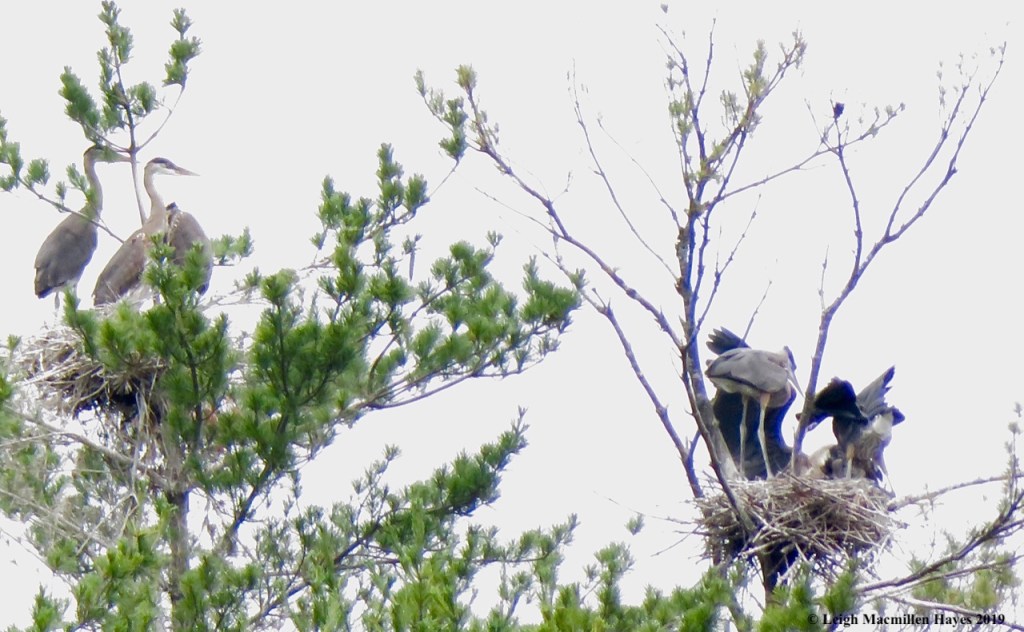
Just down the block one of the tweens, for suddenly after about a month of life they are such, flexes his wings as he stands out on a branch. It’s a tradition as old as time–tweens and teens going out on a limb to show their capability to survive in the world. The question remains, however: when will he reach the right age to get a license?

As the tween to the right finishes flexing, the one in the center lets a shiver pass through his body. Is it a pre-flex motion? His other sibling watches and wonders what it’s all about. Perhaps he’s trying to prove something?

Meanwhile, because I stood beside a river with a friend so I could count Great Blue Heron nests, active nests, young, young in nests, fledglings, and adults, we also began to notice other life that surrounded us like a Kingbird who posed for moments on end.

Constantly, however, my eye was drawn to the tiptop of the White Pines, where I began to realize there were more and more birds than my first count because many were feeling their oats and testing their individuality.

Other birds added to the rhythm as we listened for and shared with each other the location of the song makers in our midst.

And then, and then . . . a male Belted Kingfisher pause smack dab in front of us, his tuft of head feathers earning him the “Wicked Cool Dad” award in the neighborhood.

He looked right at us and made dorky dad comments that left us exclaiming with delight.

Meanwhile, back at the rookery, some of the tweens continued to wait in the most patient manner. They muttered hardly a word. We did have to wonder how such big birds could fit in those nest of twigs. The nests were large in bird terms, but the birds were even larger. At last it was time for us to depart, and we left the young in their quiet mode.

My journey continued on the other side of the river. It was there that I spotted Robber Flies in that age-old act of mating.

And a moth I believe to be known as a Virginian Tiger Moth or Woolybear Moth clinging.

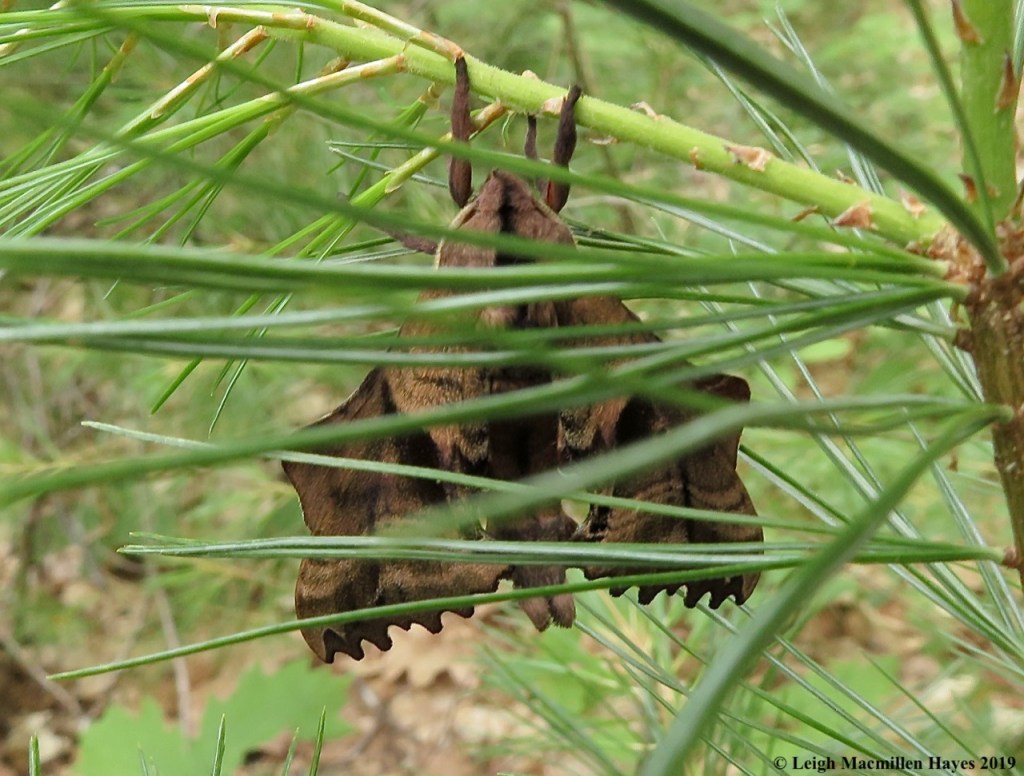
But perhaps my favorite of all, that I found because we chose today to check on the rookery, was the Sphinx moth holding onto a pine sapling. At first I thought it was a dead leaf caught on the twig.

Behold the wonder of the rookery and beyond.

Wonders of the Bog

My wish was granted. I had hoped to have the bog to myself, and except for three cars that passed by headed east and two headed west, which I could only hear and not see from my stance in front of the “blind,” not a soul disturbed my solitude.

That’s not completely true. Many souls actually disturbed the peace from low-pitched bellows to squeaks and whistles and croaks and splashes. But . . . they were all to be expected in such a place as this.

I new I’d made the right decision to visit when I spied a shed snake skin on the path to the front of the blind. Just maybe I’d get lucky and see one.

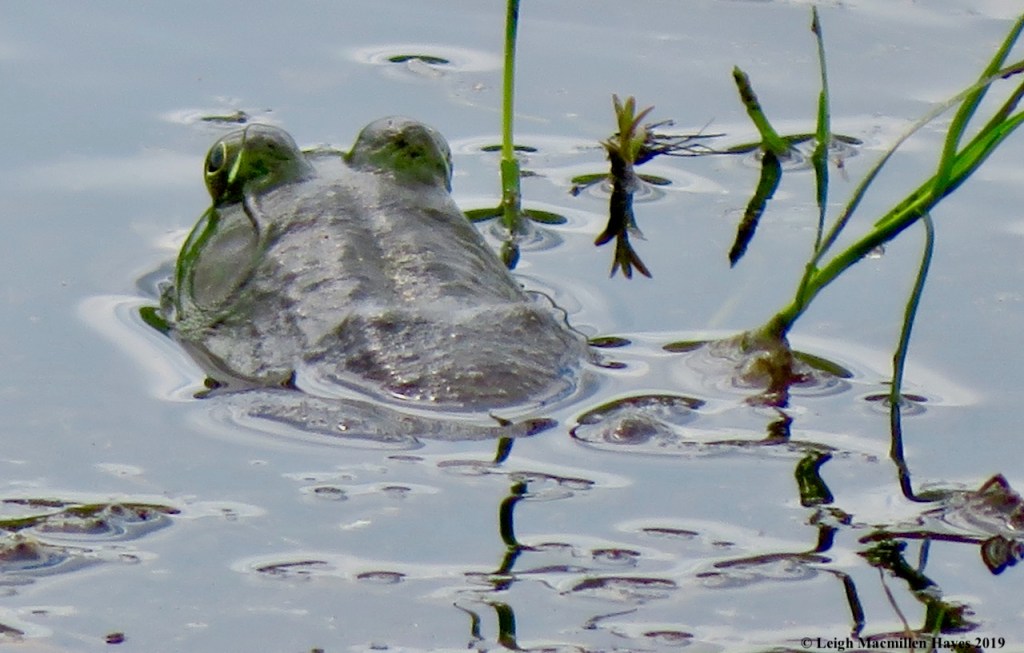
At last I found a spot from which to channel my inner bullfrog and watch for the next insect to snatch . . . though in my case it was to snap a photo.

And I didn’t join the chorus of GA-DUNK, GA-DUNK, GA-DUNK, GA-dunk, GA-dunk, ga-dunk, ga-dunk each time it rose and fell, beginning in one corner of the bog and eventually extending all the way around.

My other thought was that perhaps I should be like a sapling and then I might encourage a dragonfly to land upon me.

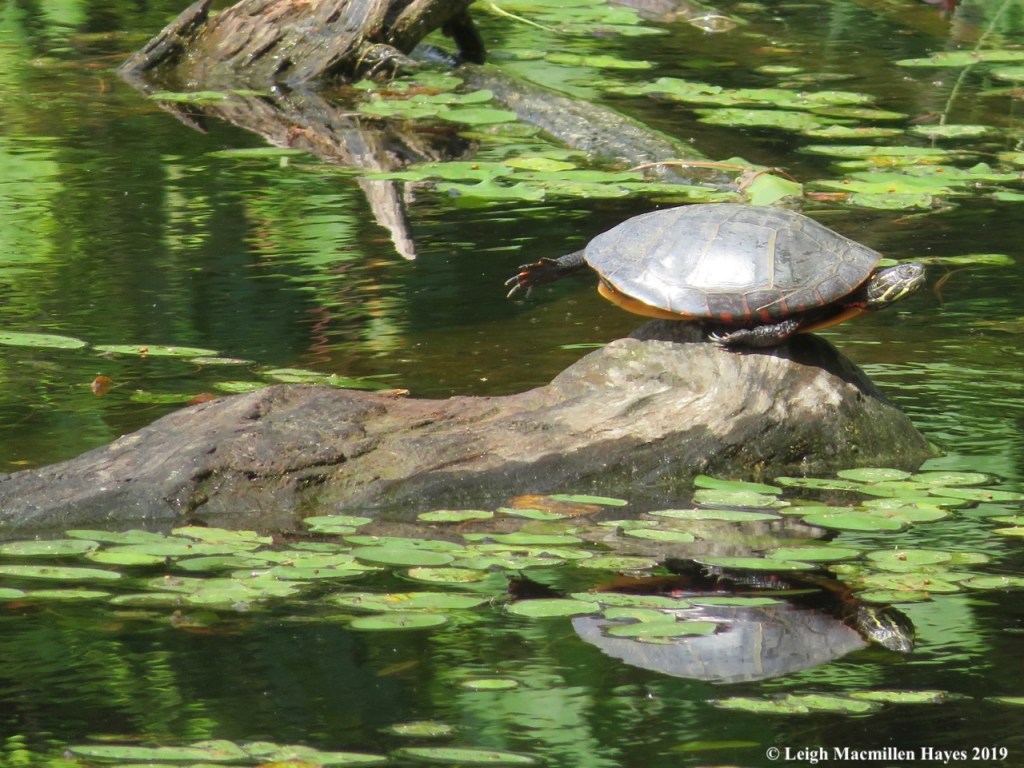
It was a good thought, but I wasn’t sure it would work. Instead, I began to slowly scan the area to see what I might see–and the painted turtles didn’t let me down. Can’t you just hear the one in the front tell the other to stop following her?

From water to foliage, everywhere every minute there was something new to focus on and I rejoiced with the sighting of my first Slaty Skimmer of the season. He’s an easy one to ID with his body entirely blue, enhanced by those dark brown eyes and black face. And then there’s that long black stigma toward the tip of his wings. A handsome guy indeed.

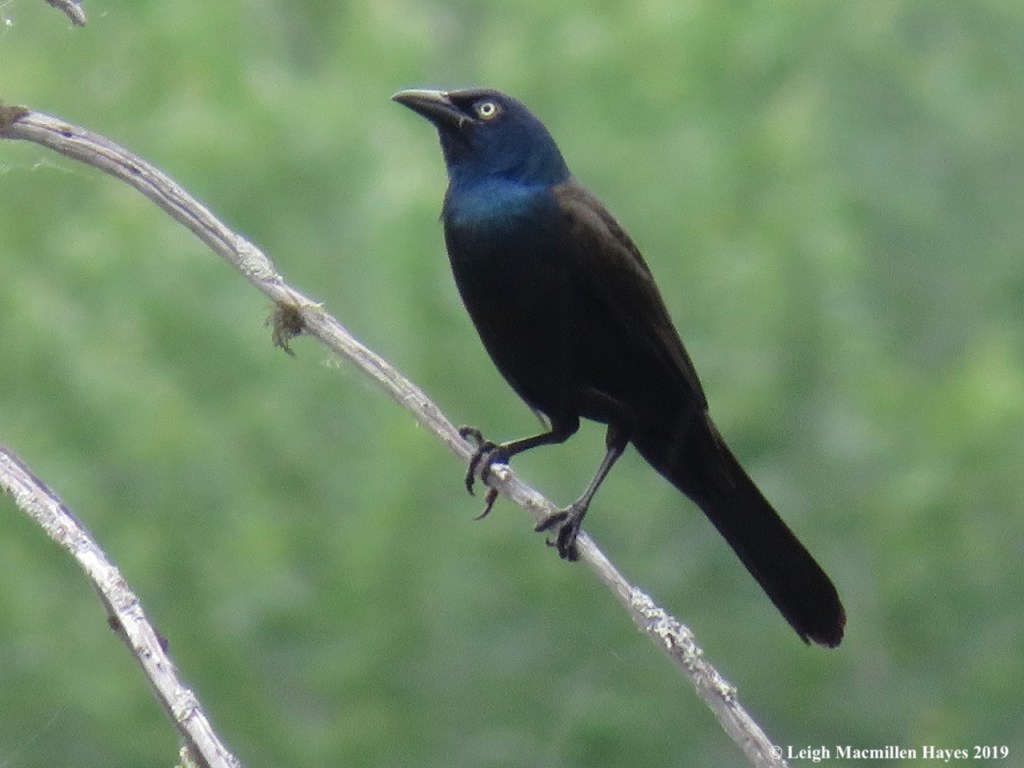
Another handsome guy was the Common Grackle with his seed-eating bill so big and thick. And that iridescent bluish head accenting the bright yellow eye. The Tree Swallows were too quick for me, but they frequently chased the Grackles and I suspected there was a swallow nest in one of the dead snags in the water.

My pose as a sapling seemed to be working for the Corporal kept landing right at my roots. There were so many and they all zipped about before taking breaks such as this.

Meanwhile, on another log another turtle basked, soaking up the warmth of the sun’s rays on this delightful morning.

Not every log served as a sunbather’s lounge chair, but they all had something of interest upon them, such as the Round-leaved Sundew bouquet, its flowers not yet in bloom, but standing tall and curled like crosiers.

Also scanning the stumps and any small hummock were the Grackles as they sought their next meal. Typically, they are seedeaters, but the insects, spiders, frogs, and salamanders of this place can also provide tasty morsels.

With my legs as the sapling’s trunk, finally the Corporal did land.

And if that wasn’t exciting enough, then I spotted a turtle in a surfing pose ;-).

Actually, according to Mary Holland, author of Naturally Curious, “Being cold-blooded, or ectothermic, they need this external source of heat to warm their body, but the UV light also regulates their metabolism and breeding as well as helps produce Vitamin D3, which is essential for the health of their bones as well as their internal organs.

Basking can also help relieve aquatic turtles of ectoparasites. Leeches are a blood-sucking ectoparasite that can cause anemia in reptiles. Drying out in the sun causes the leeches to shrivel up and die. Algae on basking aquatic turtles can also dry out and fall off, allowing the shells to retain their aerodynamic nature.”

While the turtles took care of themselves, the Grackles had other business at hand. If you look carefully at the right hand side of the snag, on the burl you may see tail feathers sticking out. Each time a Grackle entered, it had food in its mouth. And a few seconds later when it departed, it had fecal matter which it deposited in the water. I couldn’t hear the babes calling for food among the din of all the other sounds in the bog, but it soon became obvious that they lived within.

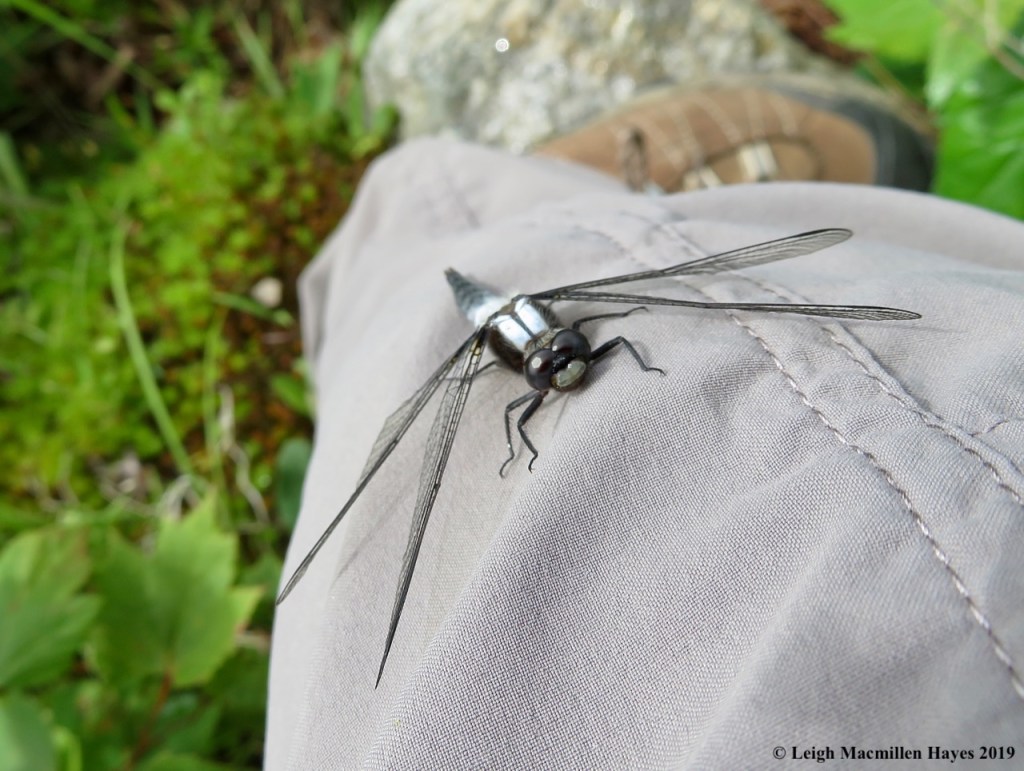
As for my own tree-like stature, it worked. All morning the dragonflies landed on my pants, shirt or hat and their wingbeats reminded me of Hummingbirds as they flew onto or off quickly, always in competition with others.

And then, one blessed me by landing as soon as I stuck my limb out. He looked at me in as much a curious way as I looked at him.

The wonders of the bog. Deer Hill Bog.

Thanks to the Hare

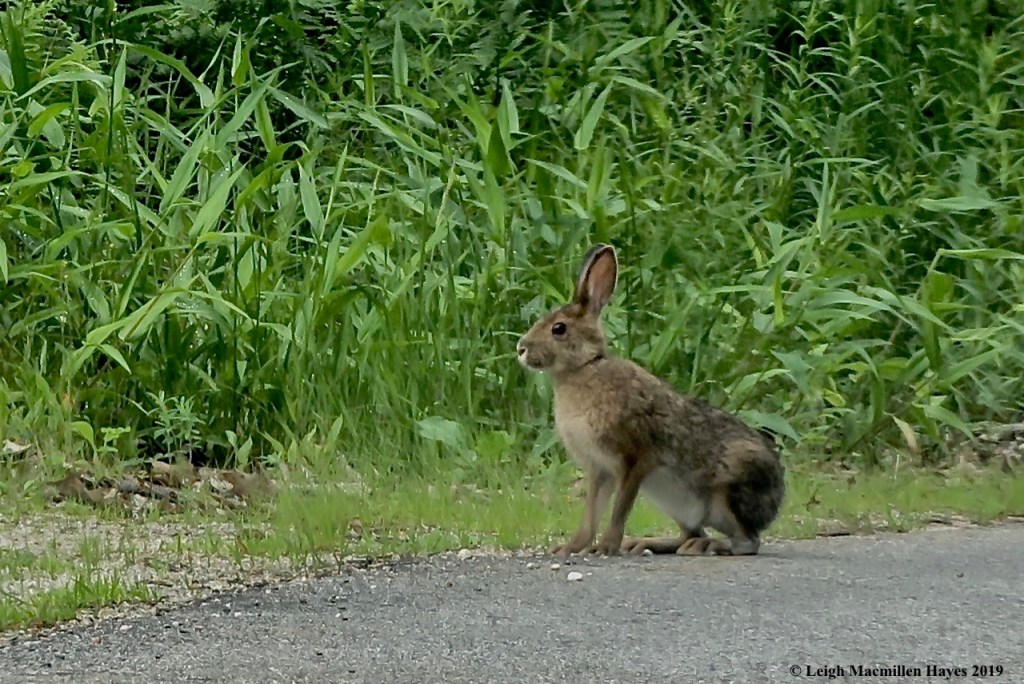
I should have known it would be this kind of a day when I spotted a Snowshoe Hare on the road. It’s a rare spot for me, though all winter long I see their tracks and scat. Only occasionally do I get to glimpse one and even then, it’s just that . . . a glimpse.

But today was different. As I drove to a Greater Lovell Land Trust property, movement on the pavement slowed me down. To. A. Stop. Not wanting to scare it, I took a photo from behind the windshield and then watched as it hopped on the road for a couple of minutes and then off into the grass.

My destination was just around the corner where the Sundews grow. Carnivorous Round-leaved Sundews. Check out the glistening droplets at the ends of the hair-like tendrils that extend from each round leaf. The droplets are actually quite sticky. Just like a spider sensing a bug on its web, the tendrils detect the presence of prey and then curl inward, thus trapping the victim.

The whole leaf will eventually wrap around an insect and in the process of digesting it, the plant will absorb the bug’s nutrients. Can you see the action in process of the lower leaf on the left?

Sundews tend to grow in areas that lack sufficient nutrients, so this is the plant’s way of supplementing its diet. And if that isn’t enough–it’s just plain beautiful.

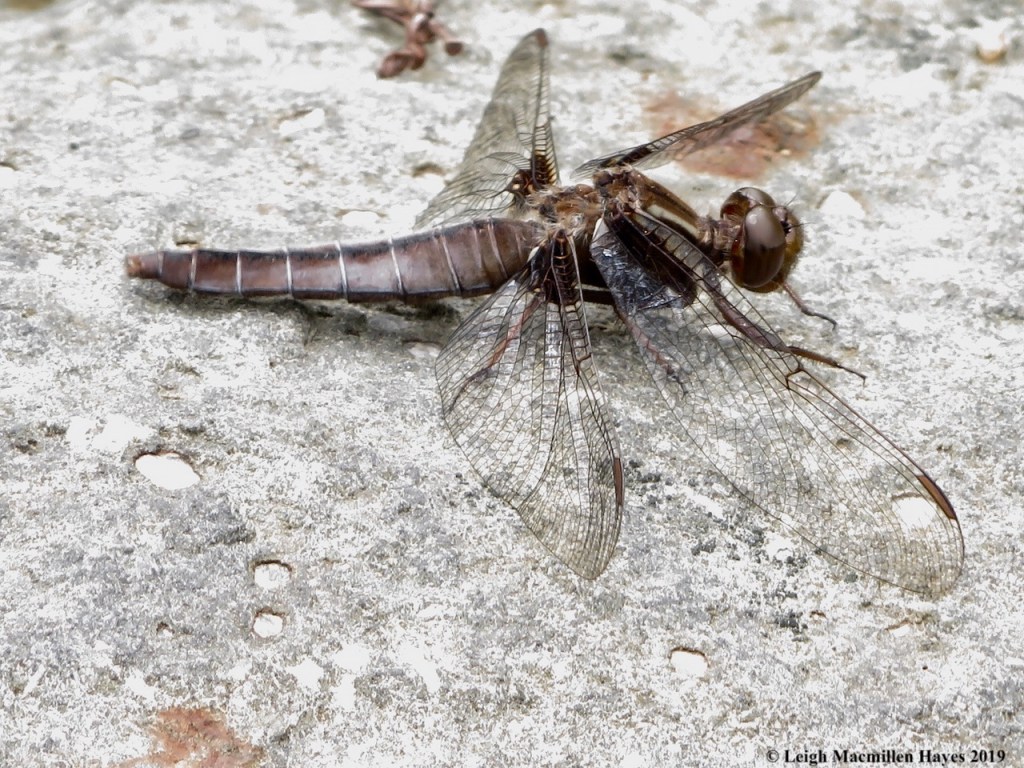
When I first ventured onto this wildlife refuge with others for a morning of trail clearing, the sky was overcast and mosquitoes plentiful. But . . . the sun eventually burned through the clouds and with that, some of my favorite over-sized, prehistoric looking insects did fly. Thankfully, they also paused so I could admire their structures, colors, and habits. This member of the Odonata family loves to skim across the land at low level and pause on rocks or leaves. Sometimes I feel like I’m walking with them for such is their behavior to lift off from one rock as I approach and settle on the next just a few feet ahead. That is, until I approach that one and then they move on to the next. Over and over again. Of course, all the time they’re hunting for a meal.

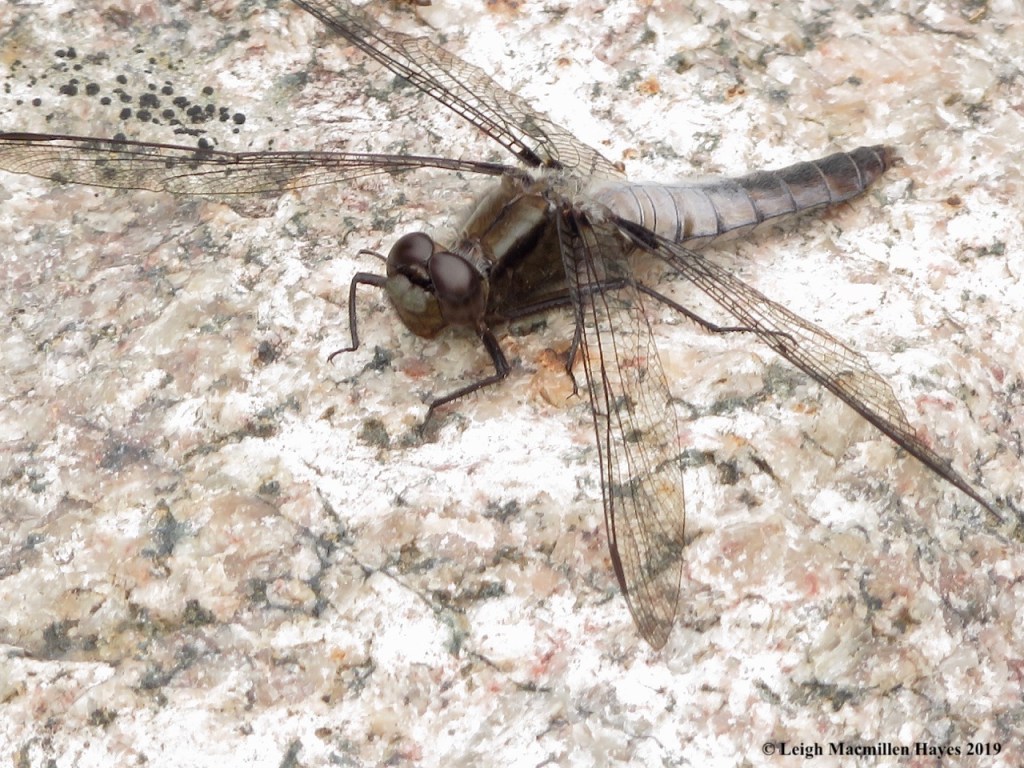
The two photographs above are of the same species and same gender. Both are females of the Chalk-fronted Corporal sort. But notice the cloudier abdomen of the second. There’s just a bit of the grayness in the first photo. So here’s a word to stick under your hat and remember: Pruinescence–meaning a “frosted or dusty looking coating on top of a surface.” The female’s abdomen turns chalky gray with pruinosity. In my under-educated brain, I’d say the second is older than the first for her pruinose markings are more obvious.

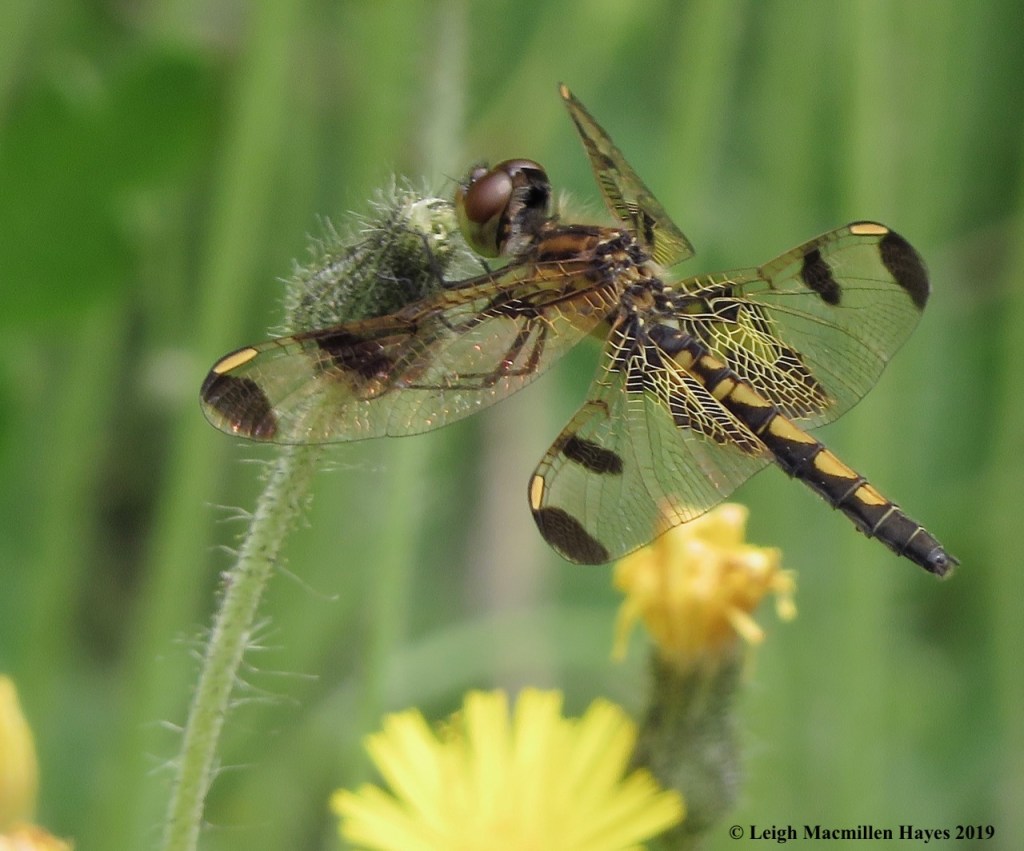
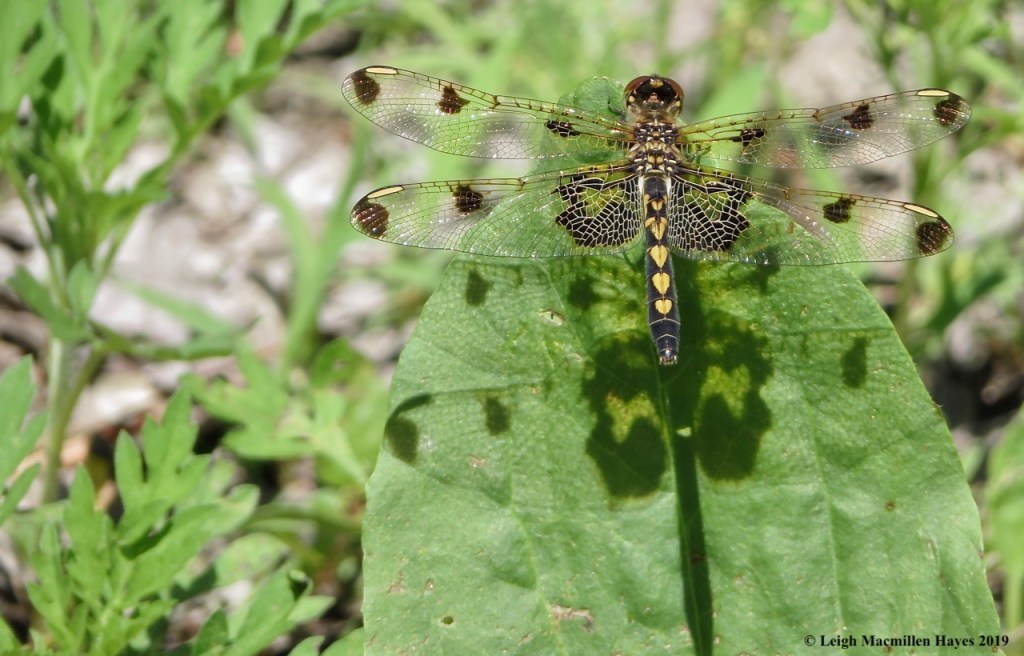
I was standing in the middle of a former log landing when I began to notice the insects. It’s an area where forest succession is slowly occurring and may need to be addressed. But for now, the wildflowers include Yellow Hawkweeds. And because their resting position is different from the Corporals, upon the flowers perched Calico Pennants. The first I saw was a male, so identified by the red markings on its abdomen.

In many male/female contrasts, be it dragonflies, damselflies, or even birds, the female is in no way as attractive as the male. But for the Calicos, both are worth celebrating. Check out those wings–their basal patches like stained glass windows.

It wasn’t just dragonflies that visited the field, for as I said it’s a land once stripped of vegetation that now plays hosts to flowers and shrubs and saplings all competing for space. And Syrphid flies also competed, their focus not on other insects, but rather pollen and nectar.

Equally stained-glass like are the wings. And notice the hair on its body. The natural world is incredibly hairy. Looks rather like a bee, doesn’t it? I was fooled, but my entomologist friend Anthony corrected me–thankfully.

Notice the lack of pollen baskets on those big funky hind legs, lack of antenna with “elbows,” and the shape of the eyes. Similar to a bumblebee, yes, but with subtle differences.

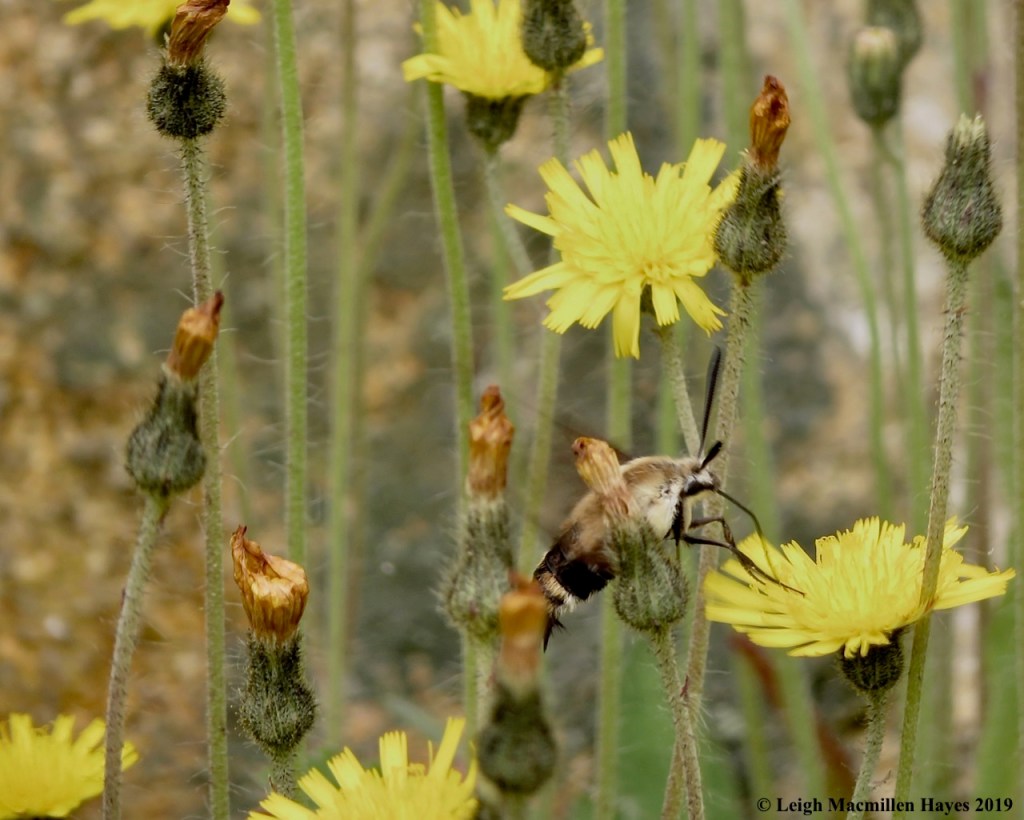
Other visitors who sampled the goods in a much faster manner included Hummingbird Clearwing Moths. The wings of this one pumped so quickly that it appeared wingless. If you look closely, you may see the comb-like structure of its antennae, which helps to differentiate moths from butterflies with their club-like antennae.

I had been feeling rather blessed for all I’d seen to this point and then an old friend made itself known. This dragonfly is one that I know I’ll eventually photograph on my hand or leg this summer and it honors me with those landings for I feel like a Dragonfly Whisperer in those moments. Today we were merely getting reacquainted. And instead of landing on me, it let me photograph its face. Take a look and wonder.

And then look at the abdomen of the same dragonfly: a Lancet Clubtail. By its bluish gray eyes that remind me of my own, and narrow yellow daggers on each segment of its abdomen, I hope you’ll recognize it going forward should you have the opportunity to meet.

Butterflies were also among the visitors of the field, including a Tiger Swallowtail with a tale to tell of how it lost a part of its tail.

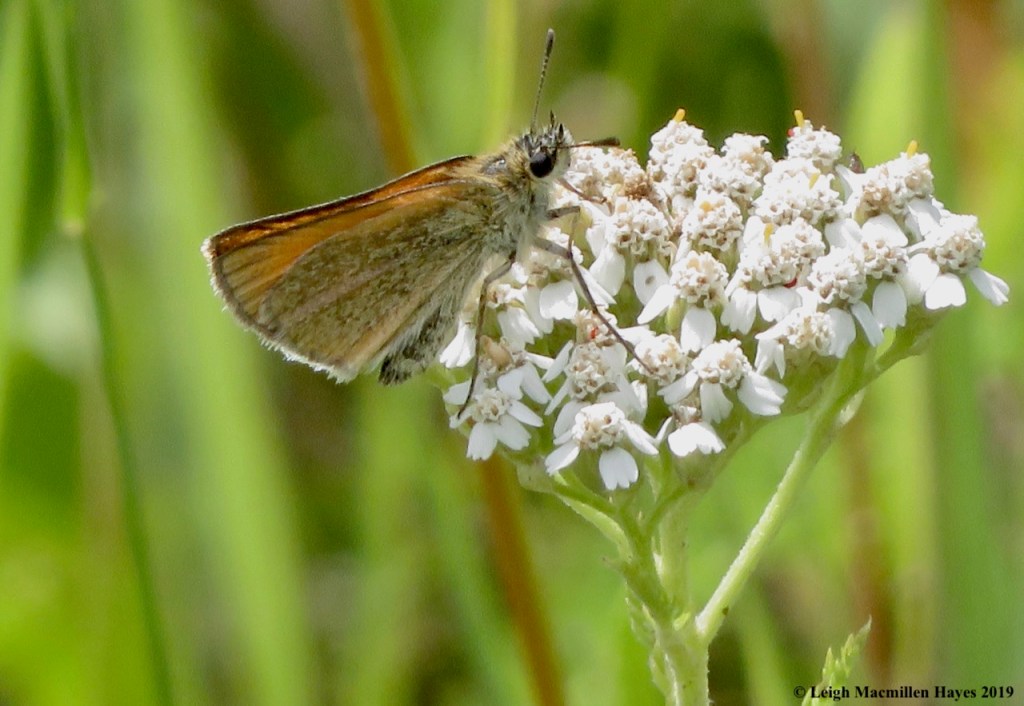
And then I spotted a skipper or two moving just a wee bit slower than the Hummingbird Clearwing Moth. My what big eyes you have.

As I slowly made my way back up the trail, it was the Kennedy’s Emerald, named for Dr. Clarence Kennedy, a renowned Ohio State University professor and odonatologist that asked to be noticed. I knew we’d met before when I realized it had two downward-arched yellow spots on the first two segments of its otherwise dark abdomen. The yellow coloration indicated it was a female.

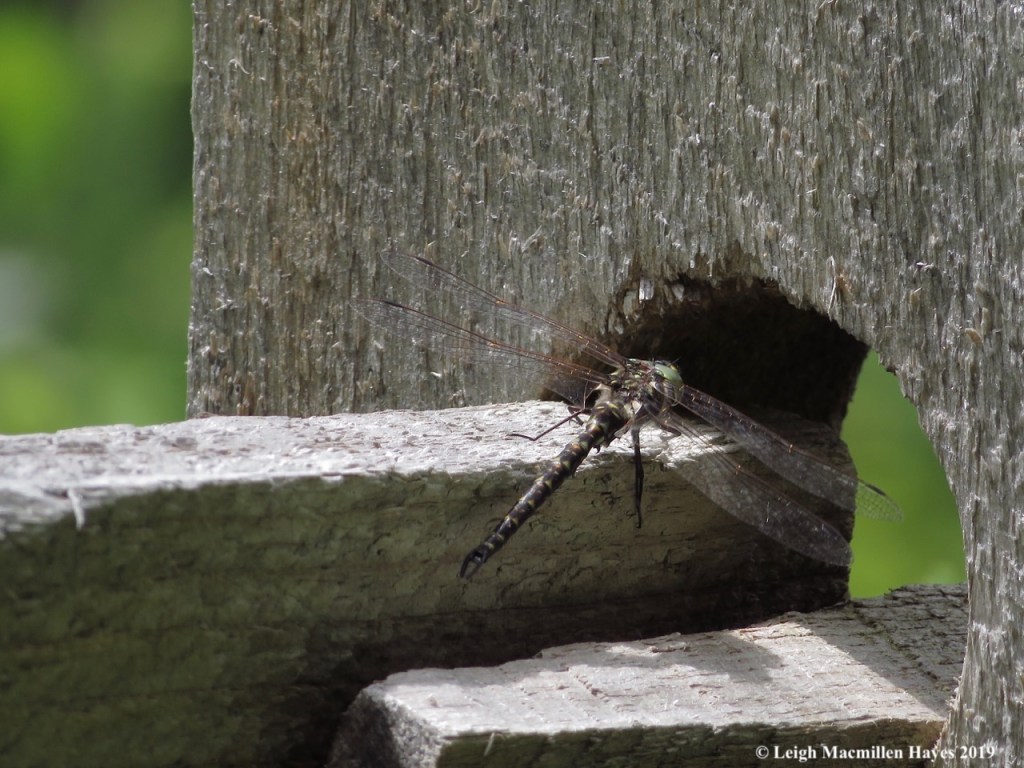
Then I watched a most curious thing as I stood by a fence that stands beside a short portion of the trail. Do you see the dragonfly crawling along the fence?

It seemed to be on a mission that I couldn’t understand.

Perhaps it had its sight on an insect I couldn’t spy.

For a few minutes it posed and gave me time to at least decide it was a darner, though I keep changing my mind about which one. But notice its markings. The venation of its wings was rather fine compared to so many, yet the markings on its abdomen were well defined. Oh, and do you see the paddle-like claspers–used to hold the female’s head during mating? And then it flew off.

My heart was filled by all that I’d been seeing. And then . . . in flew another that seemed to top the rest. A Twelve-spotted Skimmer. Count each one on all four wings–twelve dark spots. Crazy beautiful. And to think that I always used to think dragonflies were dragonflies and they were wonderful because they consume mosquitoes and make our woodland hikes so much more bearable. But like ferns that I always thought were all the same, they are not. Slowly I’m learning them by their names and give thanks for every moment I get to spend in their presence.

What’s not to wonder about and love–notice the yellow hearts on the female Calico Pennants abdomen. And her reflection on the leaf below.

I knew that hare brought me good tidings. And will be forever grateful.

Lake Living magazine: Summer 2019

I’m always excited to share the latest issue of Lake Living magazine with you. Here ’tis: https://issuu.com/lakelivingmaine/docs/ll.summer.19.web

As Laurie comments in her editor’s note, a theme emerged while we brainstormed article ideas. You’ll have to read this from cover to cover to get the full effect.

My first contribution: “The Maine Event” about four local wedding or retreat venues–each one with a unique twist. Even if you aren’t planning a grand event, it’s still fun to peek into the places and meet the people who make the magic magical.

A second contribution: “Summer Living,” which is a listing of what’s happening in the lakes region of Maine this summer. There are several shout-outs throughout this section, including one for our local land trusts and LEA as we collaborate to bring history alive through a series of walks along our trails.

And my final contribution: “You Get What You Give.” This is probably my favorite for this issue because, well, I won’t tell you why. You have to read it. And figure out. Let’s just say I was completely moved by the experience.

Laurie has written about a new venture for a young couple in “A Passion for Play,” cuze Becca and Scott, plus their son Parker, do love to do that. Especially on our lakes and ponds, as well as mountains.

She also wrote about a local farmer who does more than that–something about music and feet in “Geof’s Farm Pedals.” Another gotta read.

And her final piece is about Cannabased Wellness, aka “The Back Room at Nectar.”

Then there are the book reviews a la Justin, Pam, Sue, and Perri of Bridgton Books.

Plus all the colorful ads. If you do live locally, please let the advertisers know that you saw their ad in Lake Living. It helps with ad sales, which are key because the magazine is free to you.

Finally, I just LOVE the cover–thanks to Mary Jewett’s fine photography. It makes me grin every time I look at it.

Lake Living magazine: Summer 2019 is upon us now. ;-)

Walking with Dragons

As I drove down the dirt road into Brownfield Bog today, I began to notice ruts on the side where previous vehicles had gotten stuck in the mud. And then I came to a puddle the looked rather deep and to its right were several rocks that I didn’t feel like scraping the truck against to avoid the water. That’s when I decided I’d be much better off backing up and parking at the beginning of the road. Besides, I knew if I walked I’d have more chance to see what the road and bog had to offer. But . . . back up on that curvy narrow road–for a quarter mile or more? Yup. Thankfully, no one drove in or out and somehow I managed to get myself out of that predicament.

I knew I’d made the right choice when I was greeted by an immature Chalk-fronted Corporal. First it was one, then two, and then so many more. And the mosquitoes and black flies? Oh, they were there, but not in abundance.

Also helping patrol the roadway was a Spring Peeper, the X on its back giving reference to its scientific name: Pseudacris crucifer–the latter meaning cross-bearer. Notice his size–about as big as a maple samara.

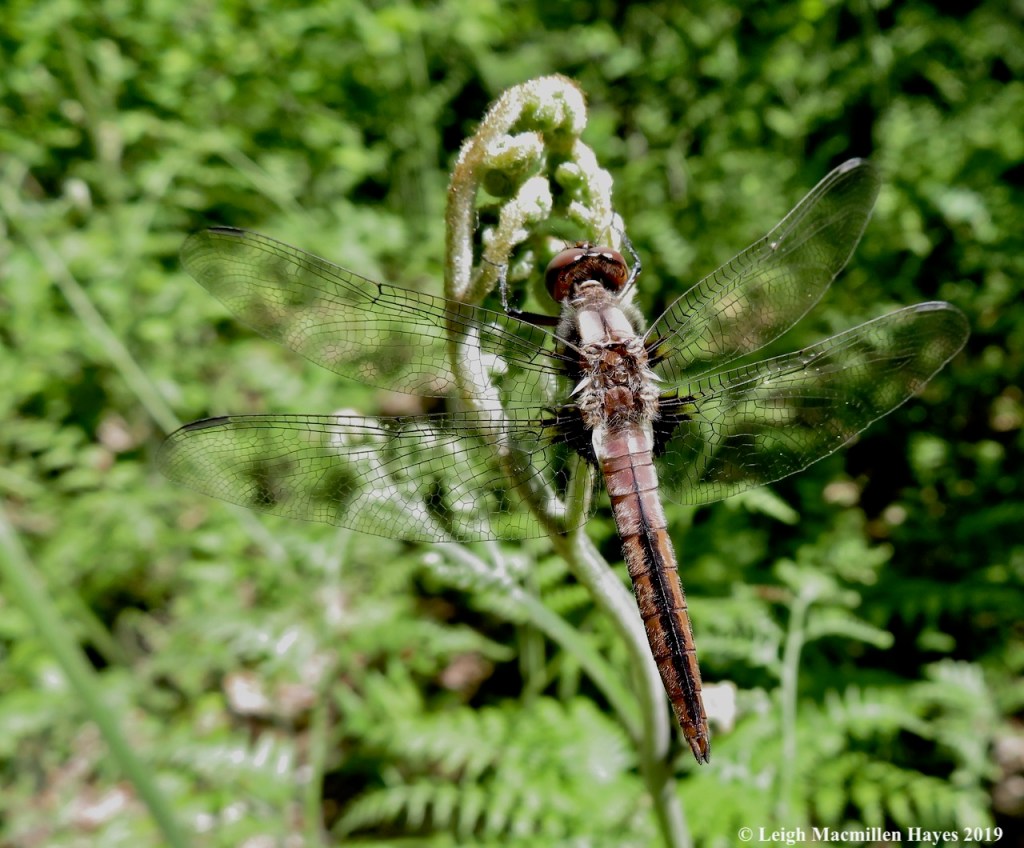
A more mature female Chalk-fronted Corporal perched upon an emerging Bracken Fern was my next point of focus. She’s larger and darker than her young counterparts, her corporal stripes on the thorax marked in gray.

And then there was a June Beetle, also maple samara in length with its thorax and abdomen robust.

My own eyes kept getting larger and larger for every step I took I felt like there was someone new to meet. Practicing ID was helped a bit as I’ve begun to recognize certain traits of the different species. Of course, each year I need a refresher course. By the green eyes, I knew this one was in the Emerald family, and with its green and brown thorax, black abdomen with a narrow pale ring between segments 2 and 3, and the fact that the abdomen is narrow to start and finish with a widening in between, I decided it was an American Emerald.

Reaching the bog at last, I was glad I’d worn my Muck boots, for the water flowed across the cobbled road and in several places it was at least five inches deep.

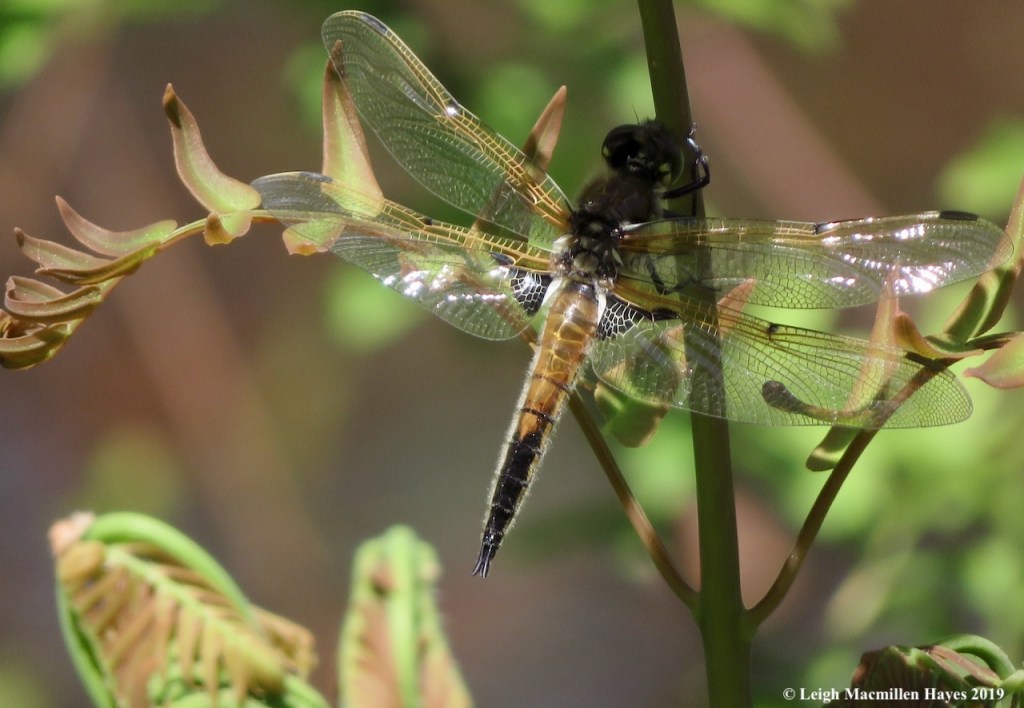
Within one puddle floated a dragonfly exuvia, its structure no longer necessary. I will forever be in awe about how these insects begin life in an aquatic nymph form, climb up vegetation or rocks or trees and emerge as winged insects.

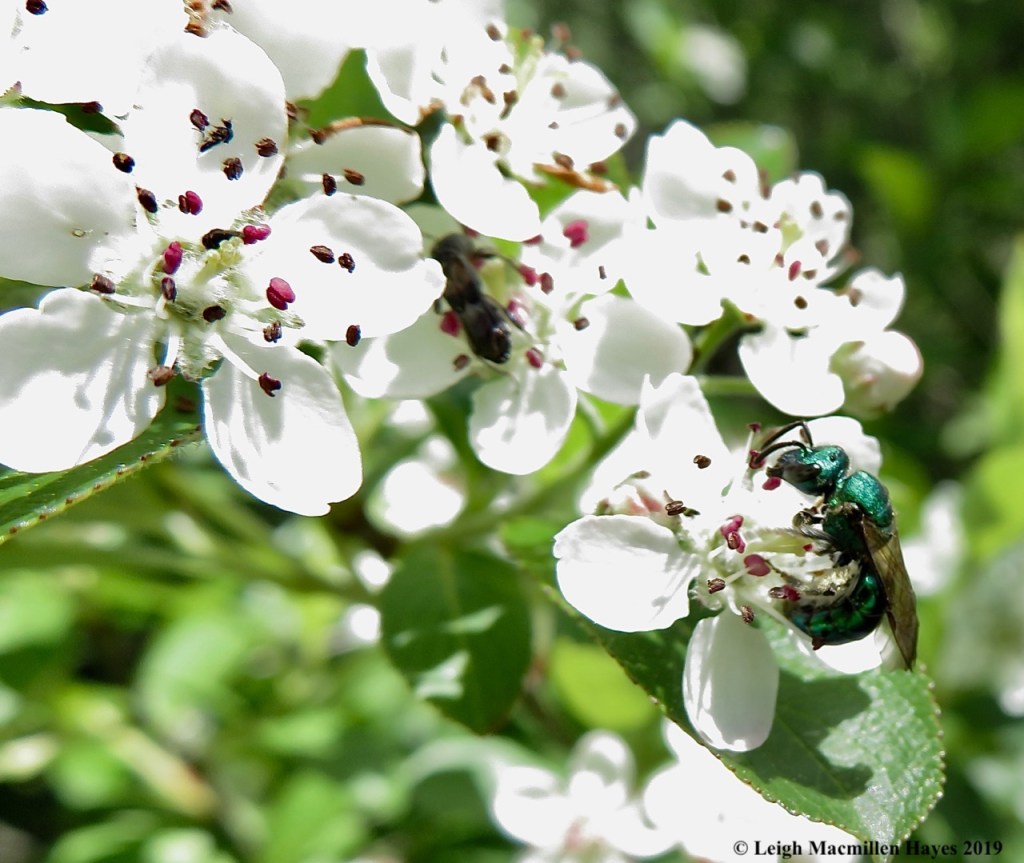
As I continued to admire them, there were others to note as well, like the metallic green Orchid Sweat Bee pollinating the Black Chokeberry flowers.

The next flyer to greet me had a white face that you can’t quite see. By the yellow markings on her abdomen, I think I’ve identified her correctly as a Frosted Whiteface.

Birds were also abundant by their song and calls, though actually seeing them was more difficult since the trees have leafed out. But . . . a Yellow-bellied Sapsucker did pause and pose.

Again, shadows blocked the face of this species, but the wings and abdomen were far more worthy of attention as it clung to a Royal Fern. In fact, with so much gold, I felt like I was greeting a noble one. The Four-spotted Skimmer is actually quite small, yet stocky. The four spots refer to the black nodus and stigma (Huh? nodus: located midway between the leading edge of each wing where there is a shallow notch; stigma: located toward the wingtips). But notice also that the amber bar at the base of its wings and black basal patch on the hind wings–giving it an almost stained glass look.

By now, you must be wondering if I was really at the bog for I’ve hardly shown any pictures of it. Yes, I was. And alone was I. When I first arrived by the water’s edge, I noted two vehicles that had braved the road and as I stood looking out at the old course of the Saco River, I heard a couple of voices which confirmed my suspicion that they’d gone kayaking. But other than that, I had the place to myself. Well, sorta.

Me and all the friends I was getting reacquainted with as I walked along. The name for this one will seem quite obvious: White-faced Meadowhawk, its eyes green and brown.

Nearby a pair of Eastern Kingbirds, perched, then flew, enjoying such a veritable feast of insects spread out before them.

I worried for my other winged friends, including the female Bluet damselfly.

And the Common Baskettail. How long will they survive?

I also wondered about reproduction for I saw so many, many female Chalk-fronted Corporals, but not a male in sight. Until, at last, before I left the bog, I spied one.

And for a long time we studied each other. Have you ever realized how hairy dragonflies are?

The Brownfield Bog (Major Gregory Sanborn Wildlife Management Area) can put the brain on nature overload as all senses are called into action. But today, because with every step I took at least fifty dragonflies flew, they drew my focus and I gave thanks to them for reteaching me about their idiosyncrasies, as well as eating the smaller insects so I came away with only a few love bites behind my ears.

Walking with dragons. As life should be. In western Maine.
Heaven on Heath

When Alanna Doughty, of Lakes Environmental Association fame, and I pulled into the parking lot of Saco Heath this morning, we had no idea what to expect. It is described as the southern-most coalesced domed bog in Maine. I have to admit, I need to learn so much more to understand the real meaning of that. According to The Nature Conservancy, for this is one of their preserves, “the heath formed when two adjacent ponds filled with decaying plant material called peat. Eventually, the two ponds filled completely and grew together to form a raised coalesced bog, where the surface of the peat is perched above the level of the groundwater.”

Our first steps found us walking through a forested bog rich with wetland plants including Cinnamon and Royal Ferns.

And then we entered the peatland through the pearly gates.

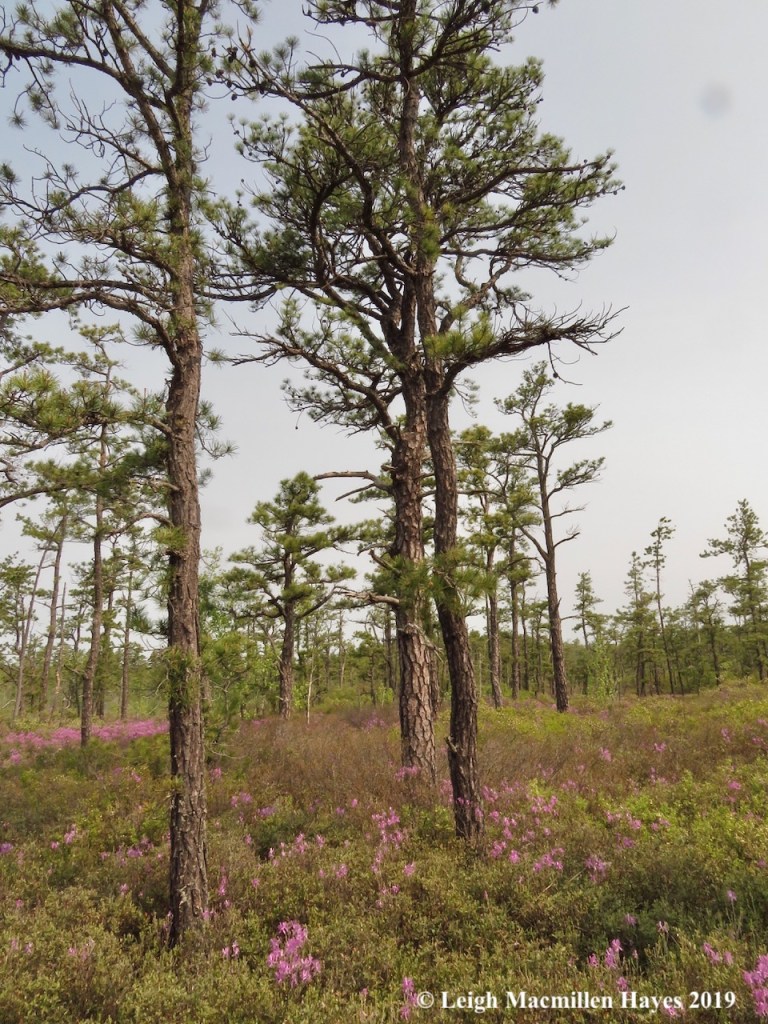
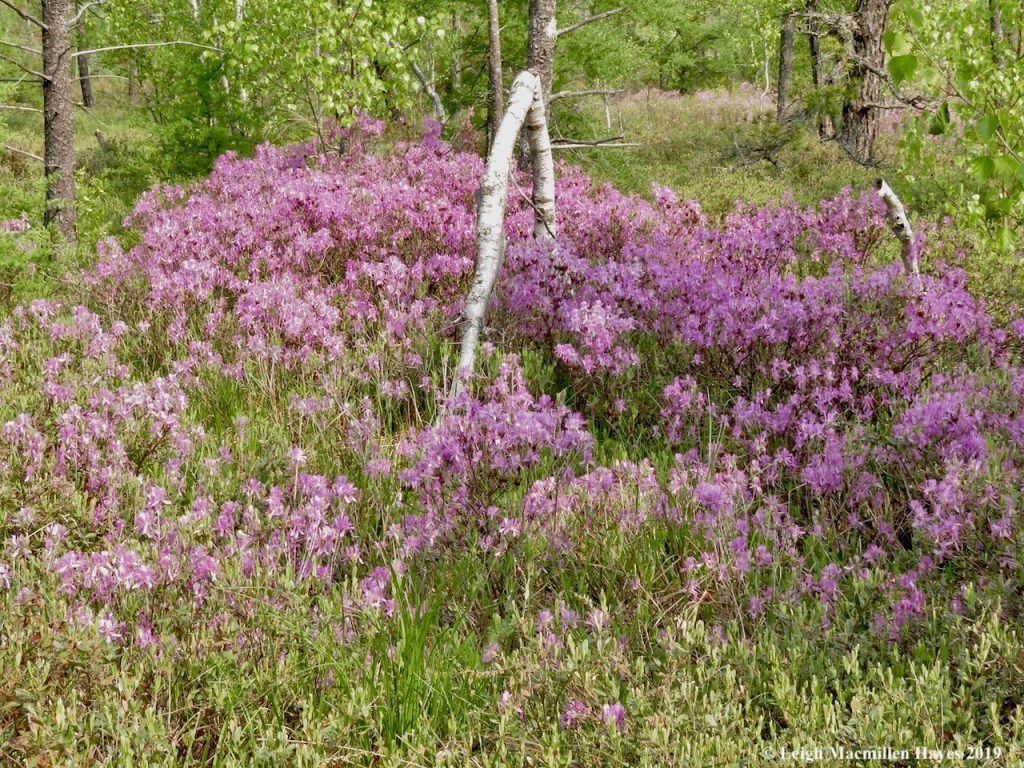
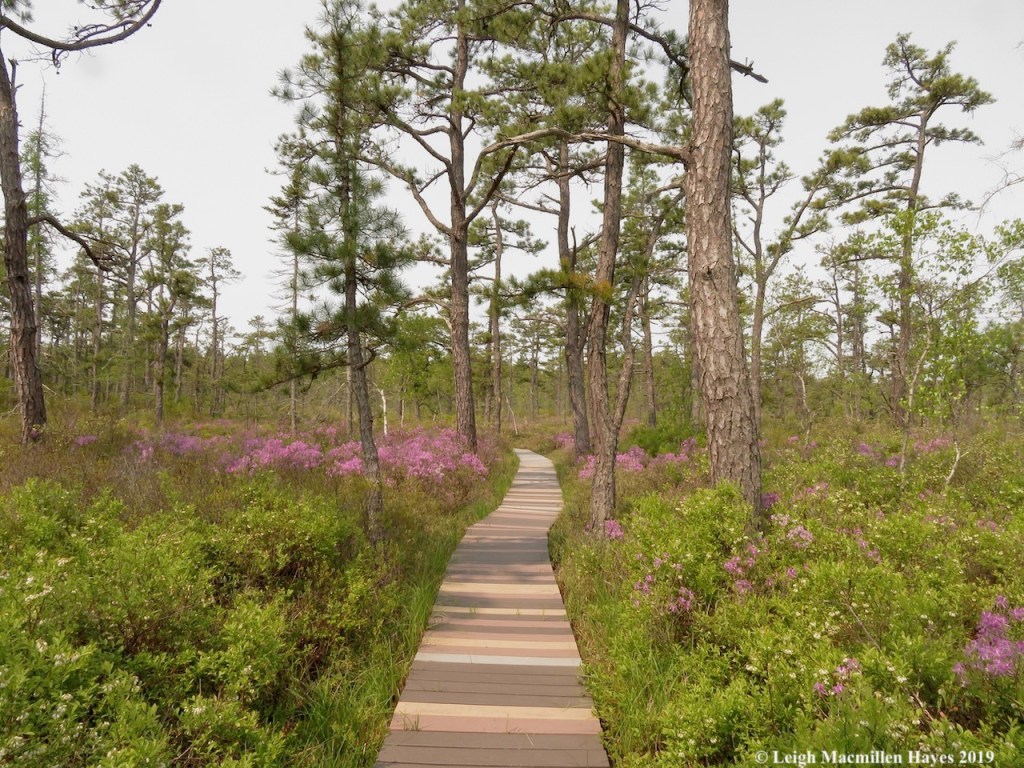
It was a place where one could disappear for a few lifetimes and eventually emerge completely preserved. With Pitch Pines and Black Spruce towering above, the colors gave us our first pause for the Rhodora was in full bloom and neither of us could remember ever seeing so much of it before.

As it was, we seemed to have been transported into a still-life painting of spring where even the toppled Gray Birch might have been intentionally placed for such a contrast it provided.

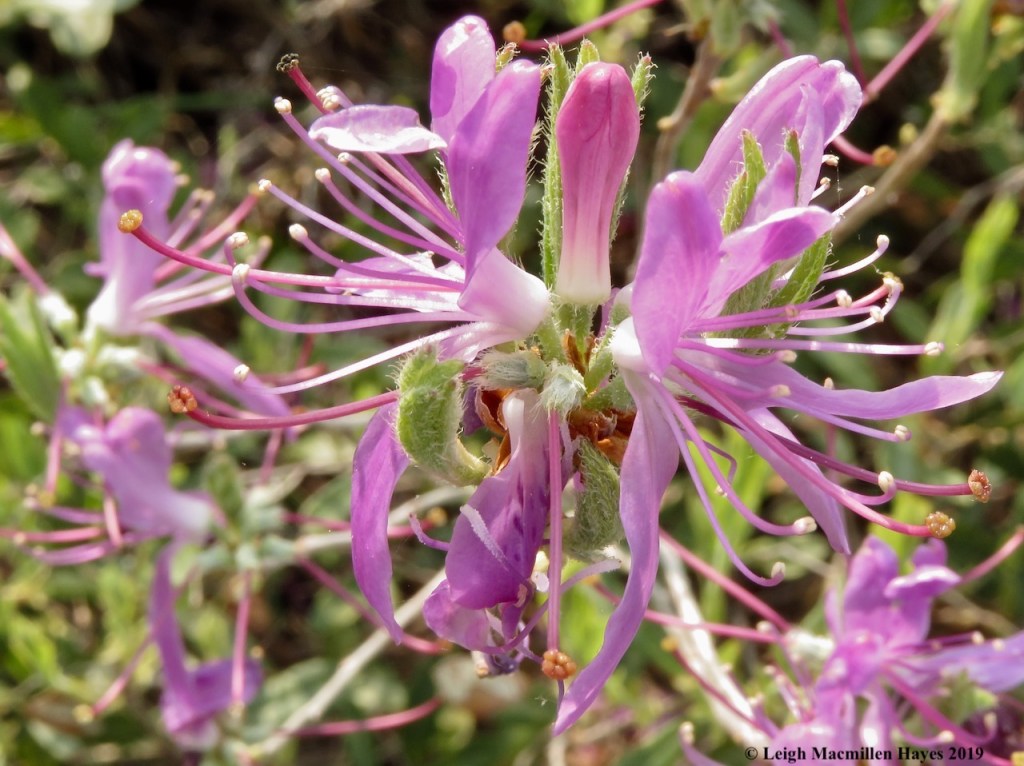
Taking a closer look, it was suddenly obvious that life was not still at all and the flower drew our eyes in and out and in and out again with all of its lines.

We even found a few with brand new hairy leaves complementing the presentation.

This was a place where old friends live and greeting them again with a friendly handshake seemed only natural.

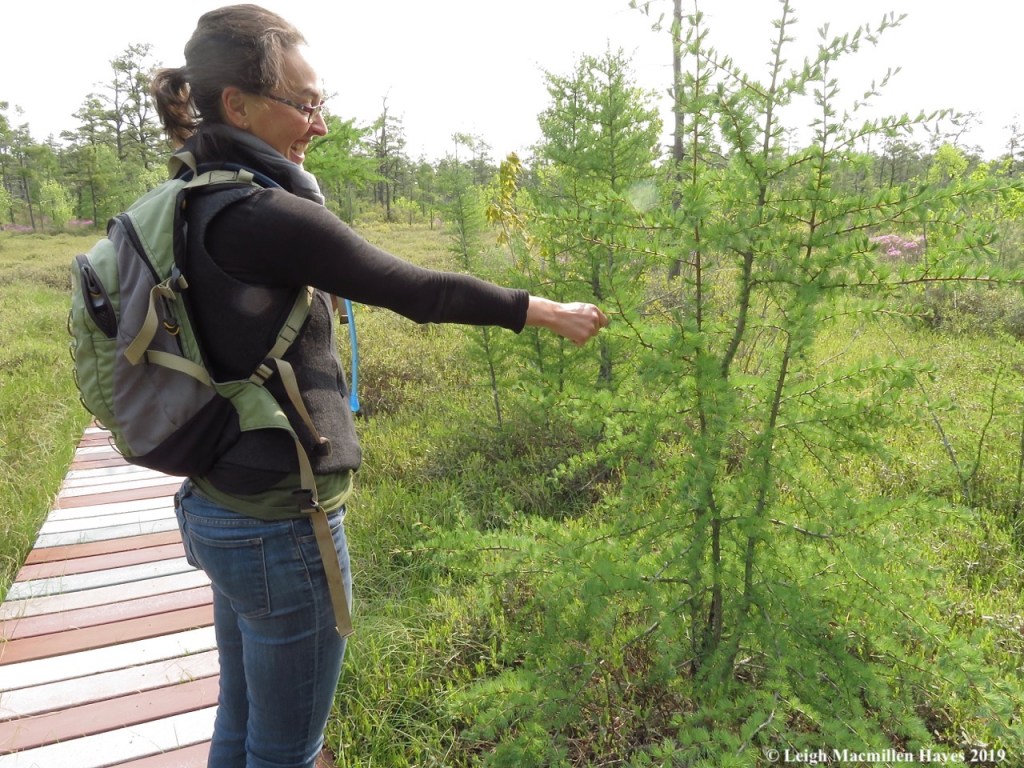
The Tamarack’s needles so soft and bright green graced the tree with a feathery appearance.

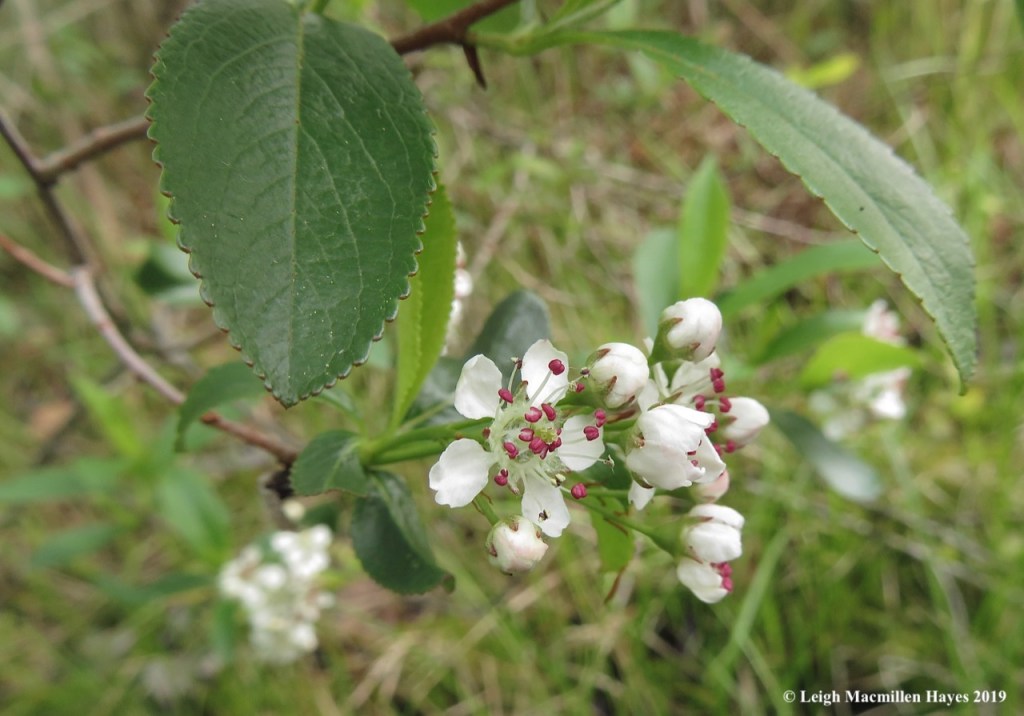
The flowers of the Black Chokeberry gave us pause for a few minutes for we had to get our shrub eyes adjusted to the brightness that surrounded us.

We weren’t the only ones with large eyes noticing all the goodness in our midst.

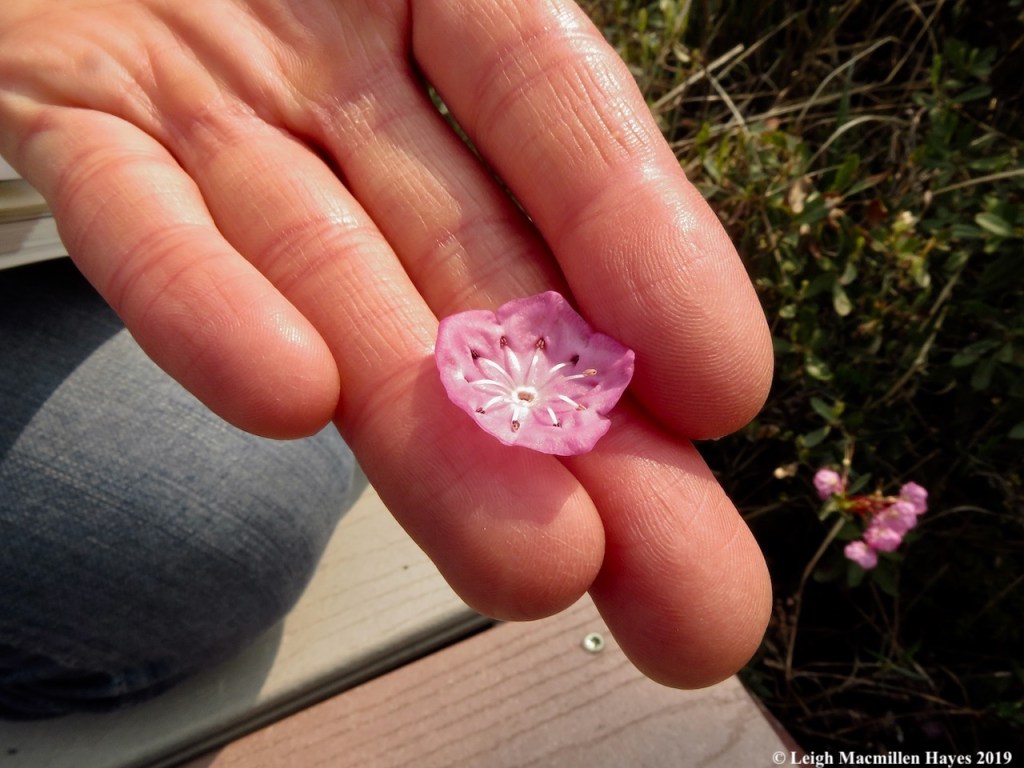
Being in a heath, members of the heath family made their presence known, such as the Bog Laurel. Some of the flowers had fallen to the sphagnum moss floor below the boardwalk, so we sat down to take a closer look at the flower, its petals fused into a shallow, five-lobed bowl. The interior of the bowl was interrupted by ten indentations where the pollen-bearing anthers snuggled as if in individual pockets. Each awaited a pollinator to trigger the spring-like tension and thus get showered with pollen. We may have unintentionally aided in sharing the goodness.

Because we were looking and trying to gain a better understanding, Alanna ran her fingers down the Bog Laurel’s stem, reveling in the recognition of the longitudinal ridges between each pair of leaves. From one set of leaves to the next, the ridge orientation and next set of leaves shifted 90˚. In the land of wonder, we were definitely wallowing in awe.

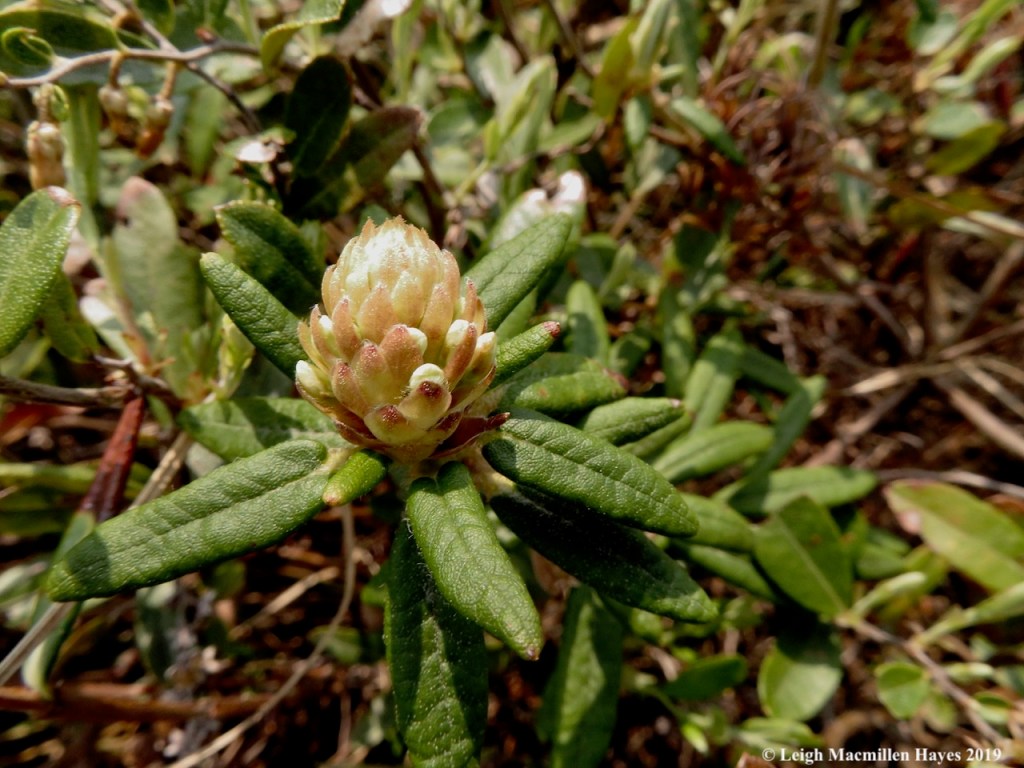
Another member of the heath family stumped us for a few minutes until it reminded us that its “pineapple” form atop the rhododendrum-like leaves was not the fruit, but rather the start of the flower.

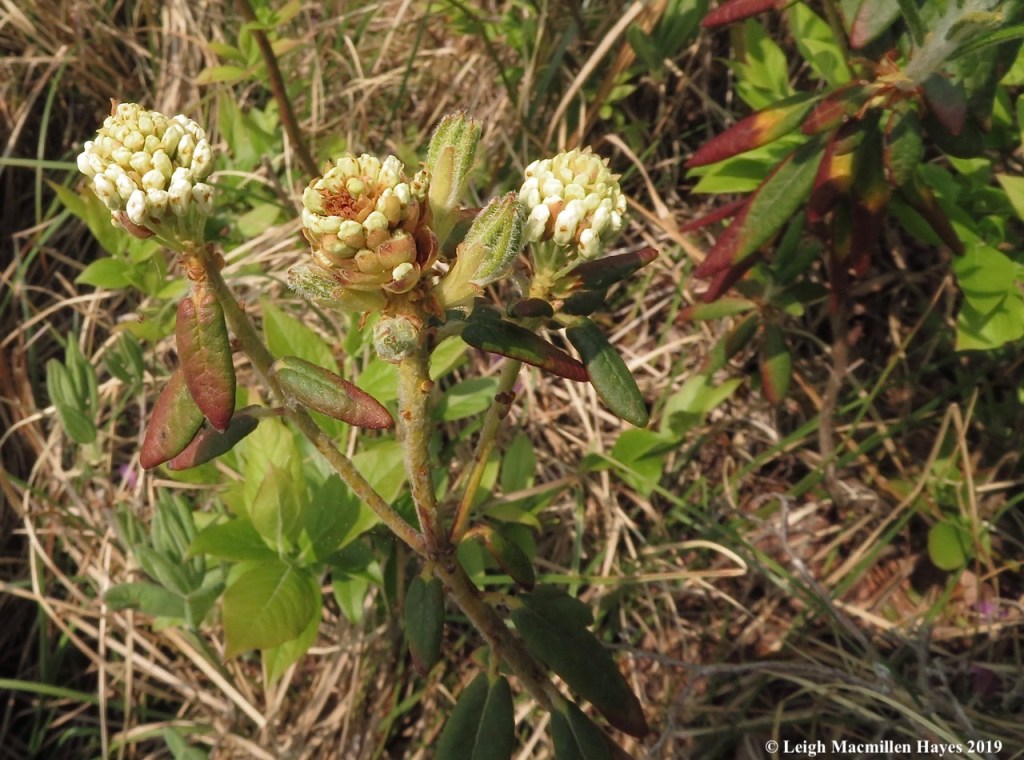
It was a few plants later, that we noticed the flowers beginning to burst.

While we watched, a male Painted Lady paused atop one of the laurels as if it was a pedestal, the better place from which to possibly entice a mate.

Shortly thereafter we made a new acquaintance. By its shiny, parallel-veined leaves we thought we knew it, but then we spied the tiny white flowers. We know False Solomon’s Seal, but join us in greeting Three-leaved False Solomon’s Seal. Ronald B. Davis writes in Bog & Fens, “In bogs, it commonly occurs on a peat moss mat at the transition between a mineorotrophic black-spruce wooded area and a more open ombrotrophic area.”

Indeed, I have a lot to learn, but the natural community was transitioning again.

And within the transition zone, we met another new friend: Mountain Holly. In retrospect, we may have met in a past life, but it’s always good to spend some time getting reacquainted with the finer details such as the tiny flowers at the end of long, fine petioles.

At the end of the boardwalk, the trail loops around through a forest of pines and oaks.

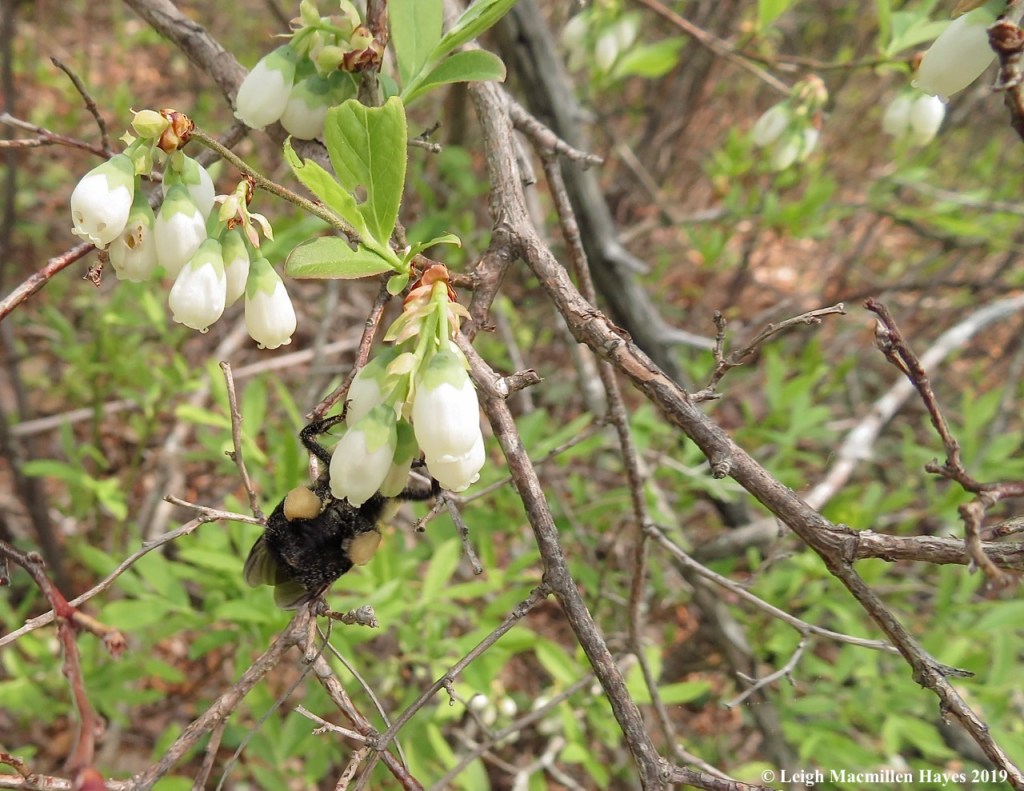
At the shrub level, Bumblebees acted as bell ringers while they flew from one flower of the Highbush Blueberry to the next, making sure that all were in tune.

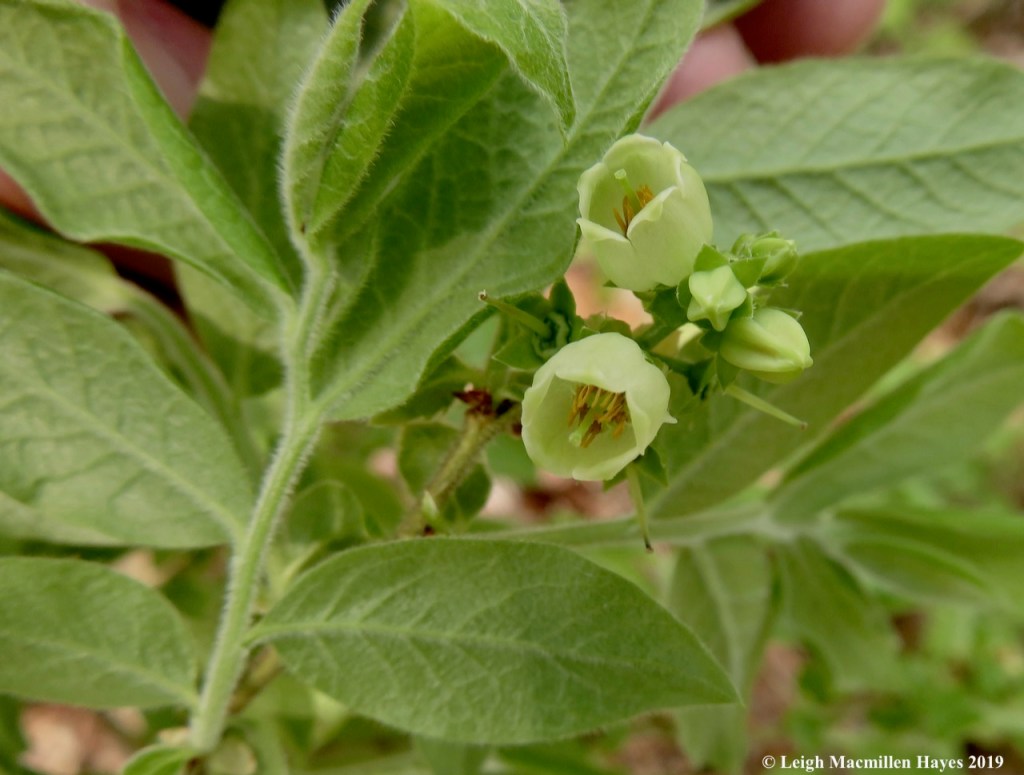
It was in this same neighborhood that we met another for the first time. Velvet-leaved Blueberry’s leaves and stems were as soft as any robe an angel might wear.

Below, her bell-shaped skirts dangled.

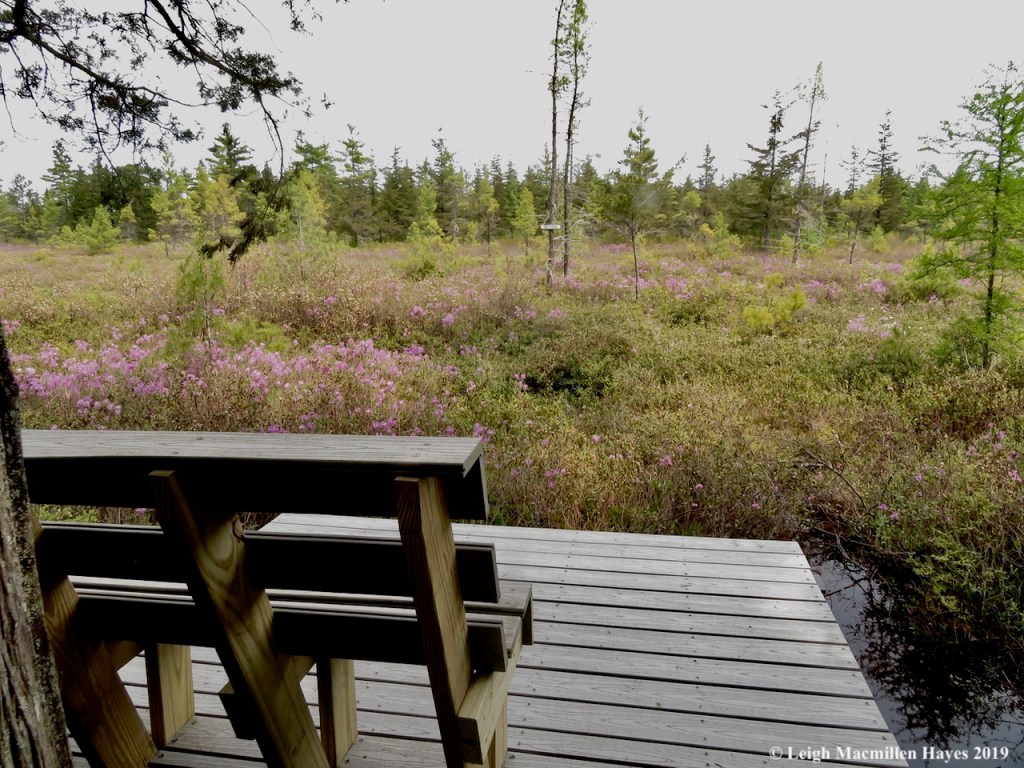
A surprise along the loop trail was a spur to an outlook where a sturdy bench offered time for contemplation and meditation.

Several signs beyond our reach warned us not to step off the platform and into the bog, but . . . it was soooo tempting. And weren’t we in the garden?

As we stood and wondered about what we might be missing, we spied several Pitcher Plants with their urn-like leaves.

And directly behind the bench stood one of the rare species for which this place is known: Atlantic White Cedar

Though we never did see the Hessel’s Hairstreak Butterfly, another rare species associated with Atlantic White Cedar, we honored the tree by taking a closer look at its foliage.

And then it was time to return back across the boardwalk, upon which we immediately noticed a huge Pitcher Plant we’d missed on our previous pass. In its center the bulbous red flowers posed as cranberries.

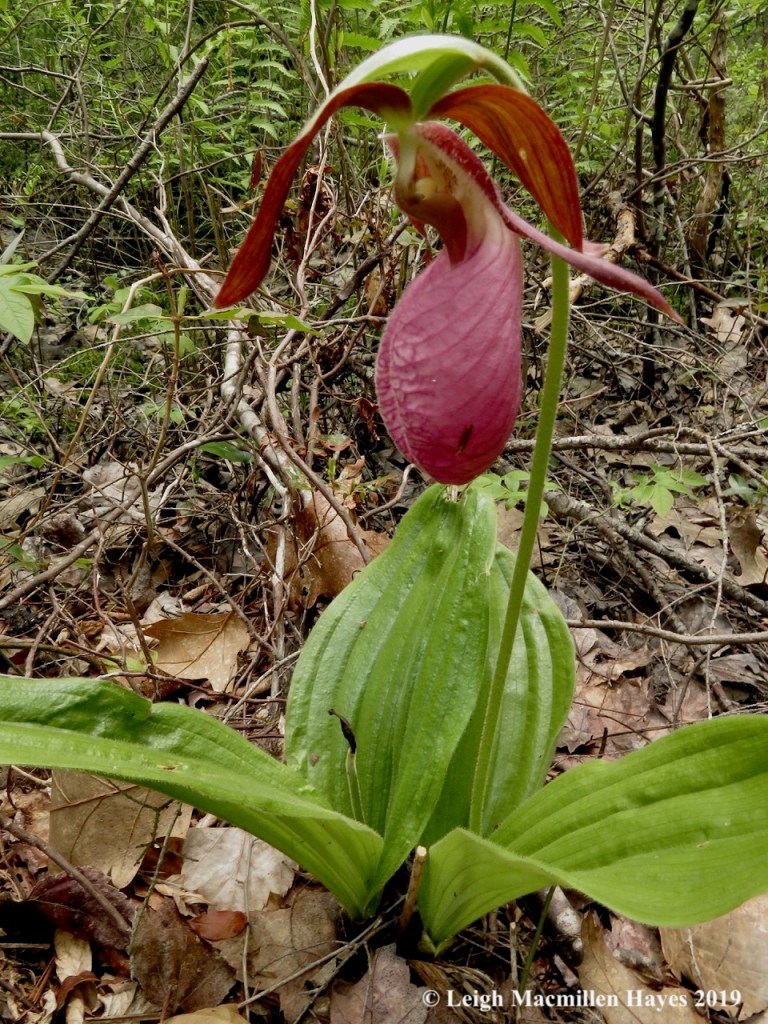
We also spotted a couple of Pink Lady’s Slippers in bloom that we’d previously walked past, giving thanks that we’d had to follow the same route and because of that made some new observations.

At the end of our time we knew we’d visited a very special place that allowed us to come to a better understanding of old friends and make new acquaintances. It certainly felt like we’d spent the morning at Heaven on Heath.

Bluebird, Bluebird, Through My Focus

It rained. The sun came it. Rain drops continued to fall. Until they didn’t. Then the temperature rose to a degree we haven’t seen in over eight months here in western Maine. And we melted.

But, with the heat wave came some new visitors, including this male Baltimore Oriole, so named because his coloration resembled the coat-of-arms of Lord Baltimore.

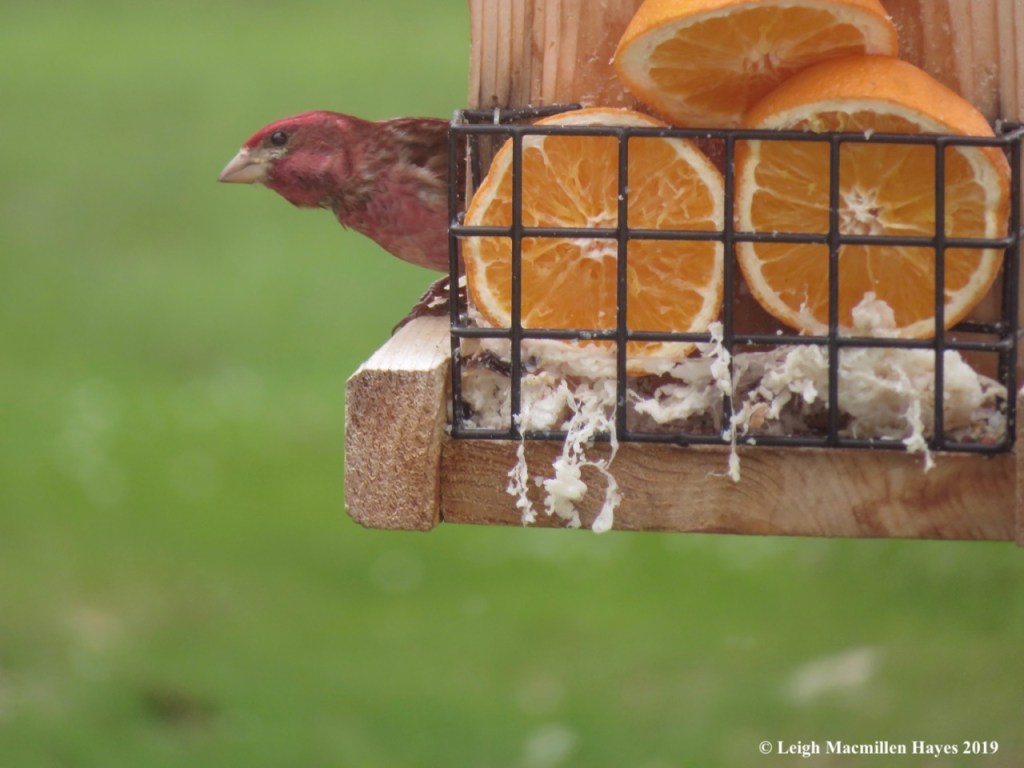
The funny thing about Lord Oriole: he’d stopped by a few days ago when I had a sturdy chunk of suet in the feeder. After seeing him, I immediately added orange slices to the offering in hopes of enticing him to return.

And so when he did this morning, I marveled at the fact that he ignored the oranges and chose instead a small bite of the suet.

Adding more color to the yard was a male House Finch. He tarried not long for his gal paused in the lilac bush and then flew past and he followed in hot pursuit.

But I gave thanks to the finch for as I looked for him to return, I noticed movement on the outer edge of the garden below the back deck. Shuffling about the dried leaves looking to glean a meal was a Common Yellowthroat. My very own Common Yellowthroat. Certainly another reason to rejoice.

There was more rejoicing to be done for I eventually found my way to the vernal pool. I realized I’ve been avoiding it lately, ever fearful after discovering a few dead frogs that life had taken a turn for the worse within that small body of water.

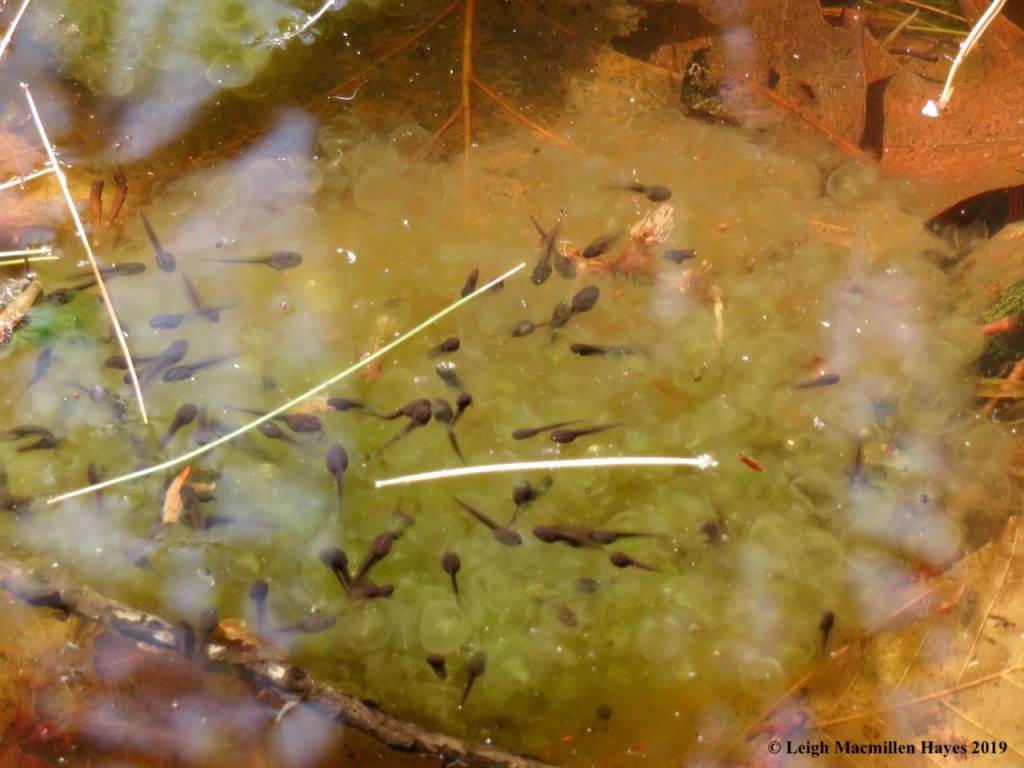
But the surprise was all mine when I discovered recently hatched tadpoles resting atop an egg mass. The green color is an algae with which they share a symbiotic relationship. The algae colonize the egg mass and produces oxygen. Being symbiotic, it’s a two-way street and the algae benefits from the eggs by gaining carbon dioxide produced by the embryos. The carbon dioxide is needed for the photosynthetic process. For a few days after hatching, the tadpoles feed on the alga.

Salamander embryos within their own gelatinous also took on that greenish hue due to the same symbiotic alga. My heart was filled with joy for there were numerous masses within the pool, most of them spotted salamander. And now I can only hope that the pool stays wet enough for them to mature and crawl out as their parents did.

Leaving the pool behind, I wandered toward home, but a familiar call beckoned. It took a few minutes for me to locate the creator, but eventually I saw him.

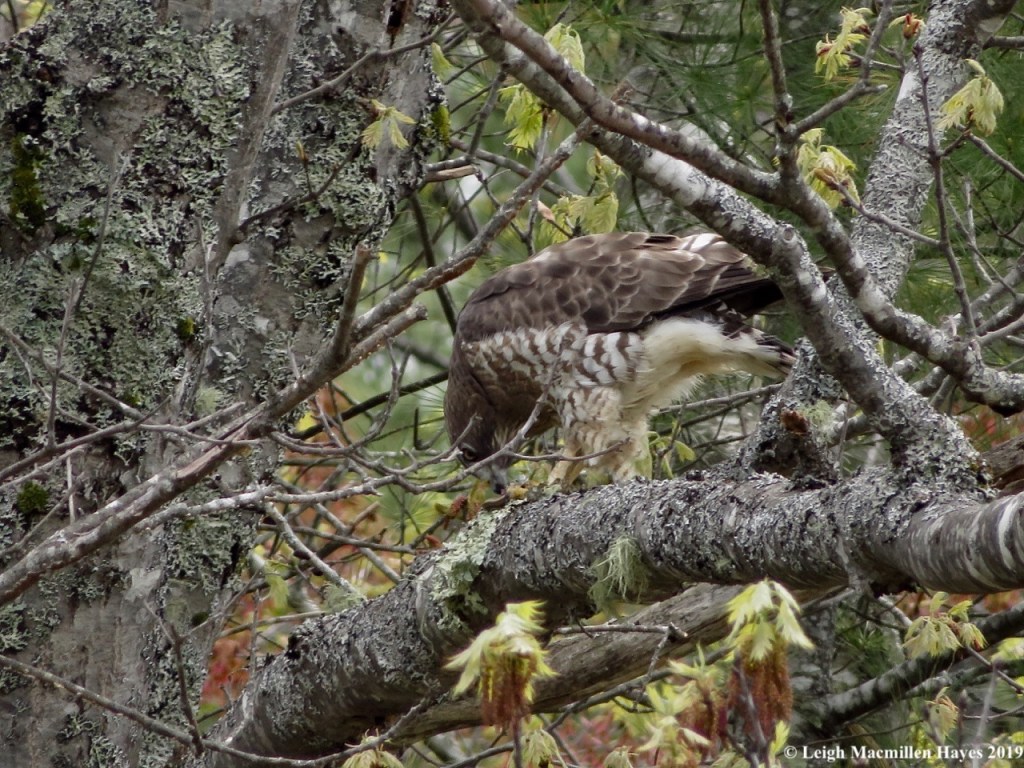
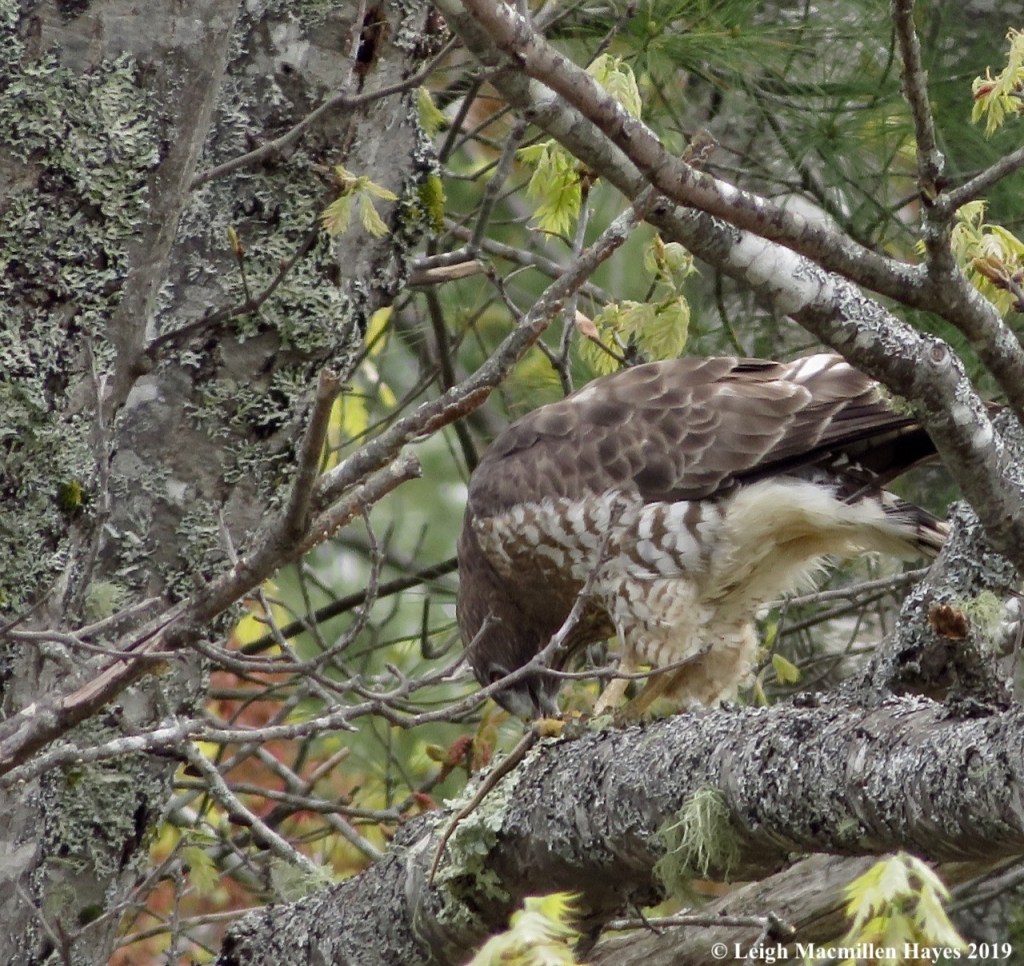
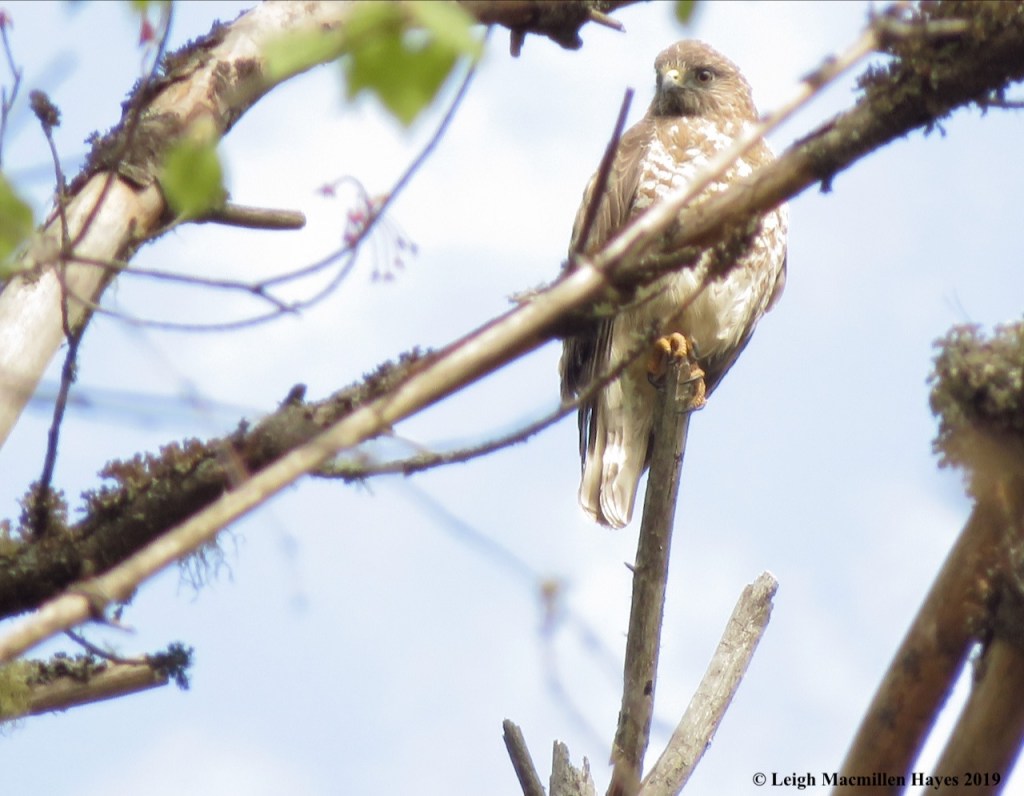
On a sturdy branch parallel to the ground, the Broad-winged Hawk did dine. He also frequently announced his presence with his high-pitched voice.

As a true carnivore, he’s known to eat reptiles, amphibians, birds, small mammals and even large insects. From my stance, I thought I saw a long tail that didn’t seem right for a vole. Instead, I wondered if it was a snake. I kept expecting to be greeted by one beside the vernal pool and the hawk wasn’t all that far away. I suppose that means that if the salamanders and frogs are able to crawl and leap out of the water, they’d better find good hiding places because this guy and a possible mate have been soaring above for a couple of weeks and probably have a nest nearby.

In the end, it seemed that whatever his meal was, it was lip-licking good. Upon finishing it, he flew south while I trudged across the field to the east. But I suspect our paths will cross again going forward.

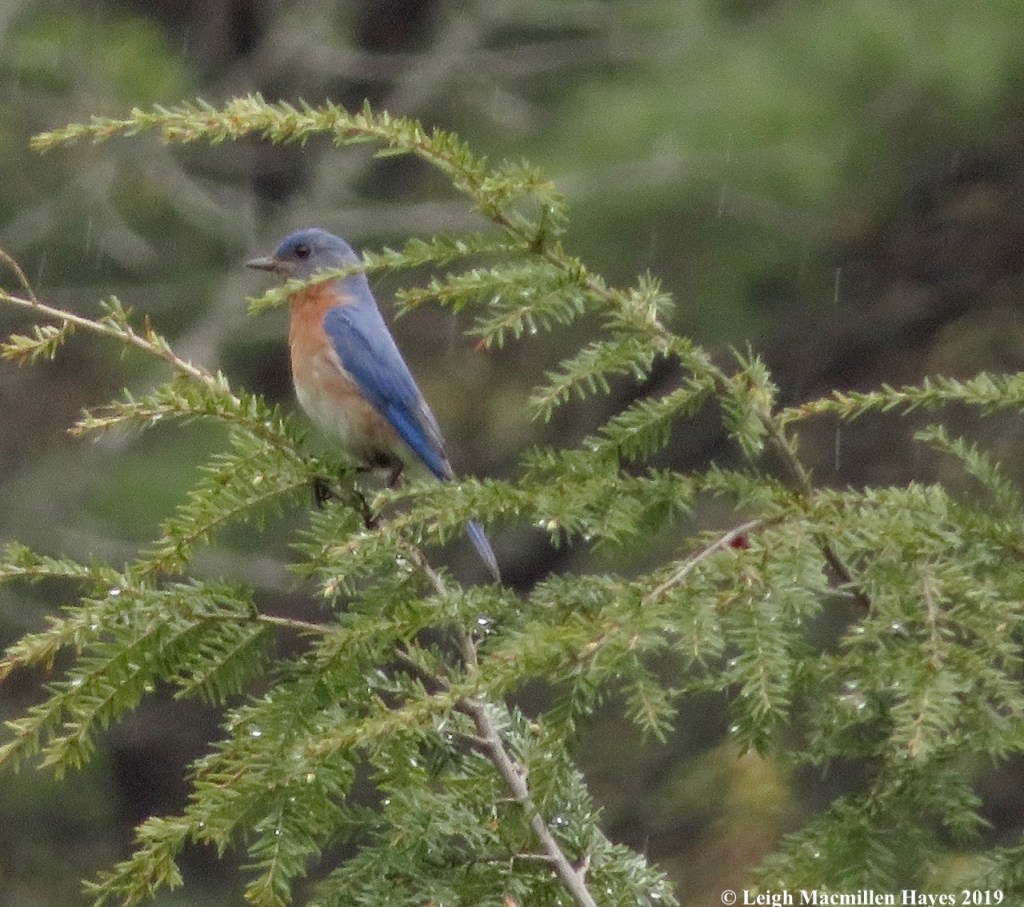
All of those finds were spectacular, but . . . one of the best parts of the day–watching Eastern Bluebirds in the yard. I first spied the male in this morning’s rain.

And then late this afternoon, I was surprised to discover that they were both here, the she and the he. For the most part, they stayed out by the stone wall, perched on branches above before flying down to catch a meal.

Then they flew closer to the house and landed atop the feeders where I don’t have any mealy worms that are much to their liking. I hadn’t even planned to still have the feeders out, but with each new day bringing new visitors, I’ve delayed taking them in for the season. That is, until a Black Bear arrives.

But no Black Bears yet. (Just wait, one will probably show up overnight or tomorrow.)

And so . . . Bluebird, Bluebird, through my focus. Thanks for taping me on the shoulder. ;-) And sharing this day with me.

Book of May: Identifying Ferns the Easy Way

I love it when people recommend books to me and even more when I discover the the recommendation is spot on. Thus was the case when at the Maine Master Naturalist Board Retreat last month, Beth Longcope suggested Identifying Ferns the Easy Way by Lynn Levine. She’s also the creator of Mammal Tracks and Scat, a life-size tracking guide that I don’t use as often as David Brown’s Trackards. And she has authored several other books.

Book of May

But it’s this newly-released little guide that will find its way into my pack on a regular basis this spring and summer. Within the 74 pages of the 4.5 x 6.5-inch book are simplified explanations with illustrations.

Levine begins with general information about how to use the guide, general tips, and how to observe ferns. Under general tips, I especially appreciated the second: “Ferns that usually grow in clusters will sometimes grow alone.” The key “read-between-the-lines” takeaway is that if we just go by what most books say or people tell us, we’ll become totally confused when we meet an oddball choosing to strike out on its own. Not all ferns have read the books. And that goes for any and all species. It’s best to familiarize ourselves with the various species so that when one does behave in a different manner, we recognize it for what it is.

I also appreciate tip #4, but you’ll have to purchase the book to understand why. ;-)

Being thorough with her topic in such a short space, she includes information about the ancient history of ferns bringing them from past to present structures. Their unique reproductive system is also discussed with the life cycle illustrated by Briony Morrow-Cribbs.

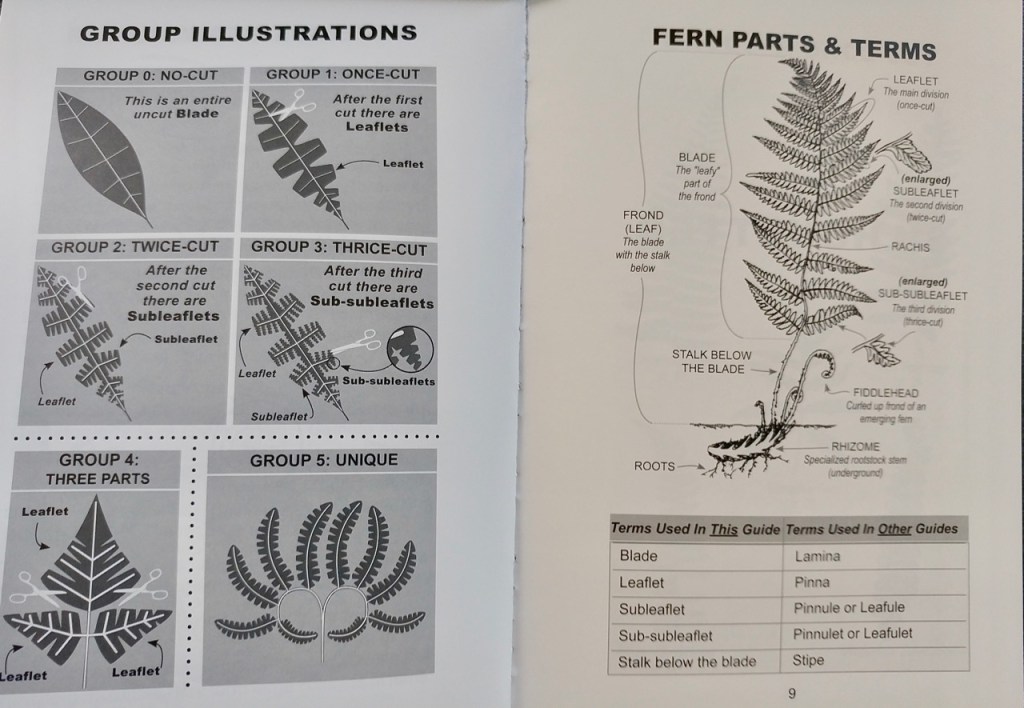
And then, the nitty gritty part of the book. First, she shows how ferns are grouped as once-cut, twice-cut, thrice-cut (I’ve always loved that word: thrice), three parts, and unique. Another sketch, as you can see, illustrates the parts of the blade and defines the terms. I appreciate that at the bottom of page 9, Levine compares the terms she uses with those used by others, aka Leaflet/Pinna.

For those who are visual learners like me, on pages 11-17 are silhouettes for each group of ferns based on their cut type. That becomes valuable information for once you recognize the type of cut, you can simply go to the group pages devoted to it. For instance, Group 1 covers once-cut ferns on pages 18-27. All are denoted by a staggered black tab on the edge of the page, therefore making each group a quick find.

Group One begins with Christmas Fern. For each fern within a category, the reader will find a two-page description with illustrations. The description includes the Common Name, Scientific Name, Where it Grows, Tips for Identification, species it Can be Confused With, and Interesting Notes.

From these, I noted some different ways to consider the fern and picked up some new ID tips to share with others. I did find it funny that what I long ago learned was either Santa in his sleigh or the toe of a Christmas stocking, Levine refers to as an ear on the leaflet/pinna.

Right now, Christmas Fern fiddleheads have sprung forth in the center of the evergreen blades and they are mighty scaly.

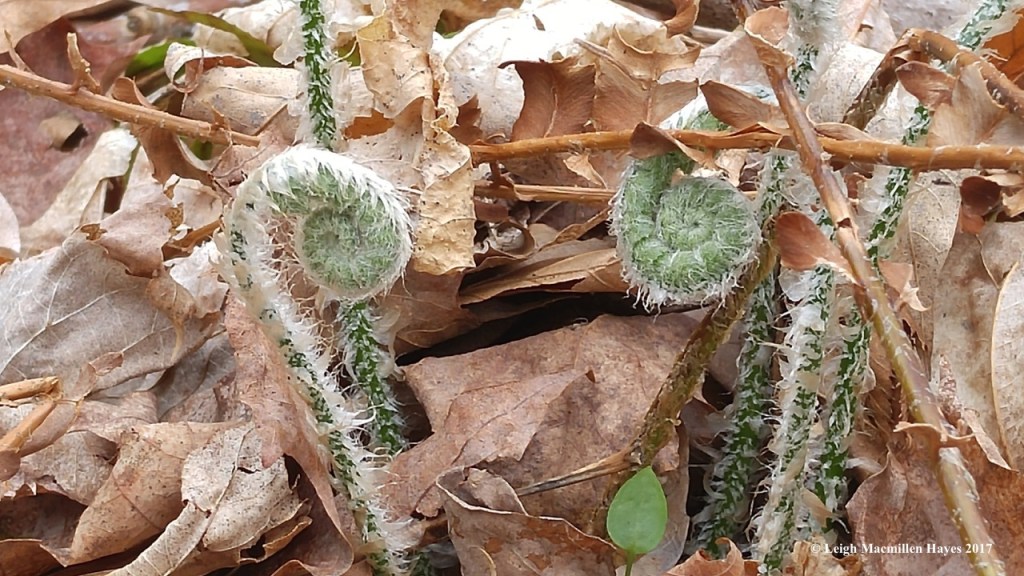
Fiddlehead is the term used to describe the crozier shape (like a Bishop’s crozier) of an emerging frond. And not all fiddleheads are created edible. In fact, I know of only one that is. This is not the one. But do note those mighty hairy scales.

Another Group 1 species, Maidenhair Spleenwort. In her tips for ID, I love this line: “Leaflet pairs are opposite each other (like a bow tie).” This isn’t a species I typically encounter in western Maine. In fact, this photo was taken in the Glendalough monastic settlement founded by St. Kevin in the sixth century–in the Wicklow Mountains of Ireland.

Under “Interesting Notes” for Rock Polypody, Levine clears up the meaning of the name for me, for though I knew that poly means “many” and pod refers to “foot,” I didn’t understand why the fern should be named thus. “Rock Polypody has many ‘feet’ connecting one fern to the next by their roots.” Now I can’t wait to revisit them.

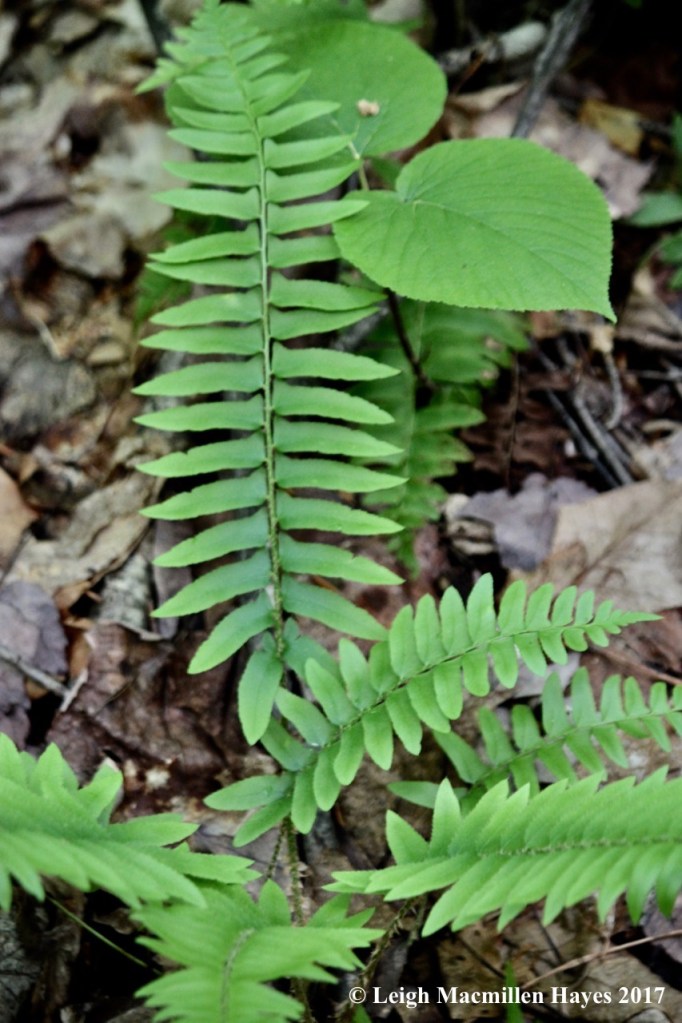
I chuckled when I read under her tips that Sensitive Ferns grow in large colonies. Indeed.

They are so named because with the slightest bit of cold they turn brown. Levine says it’s sensitive to the first frost, but I’ve noticed it turns brown in mid-August if not sooner, when the nights have that wonderful chill, but we haven’t yet had a frost.

Group 2A are those ferns that are twice-cut and form a vase-like cluster. The first in the group, Cinnamon Fern, like all others, is slowly unfurling and if you head outdoors you might see the splendid display.

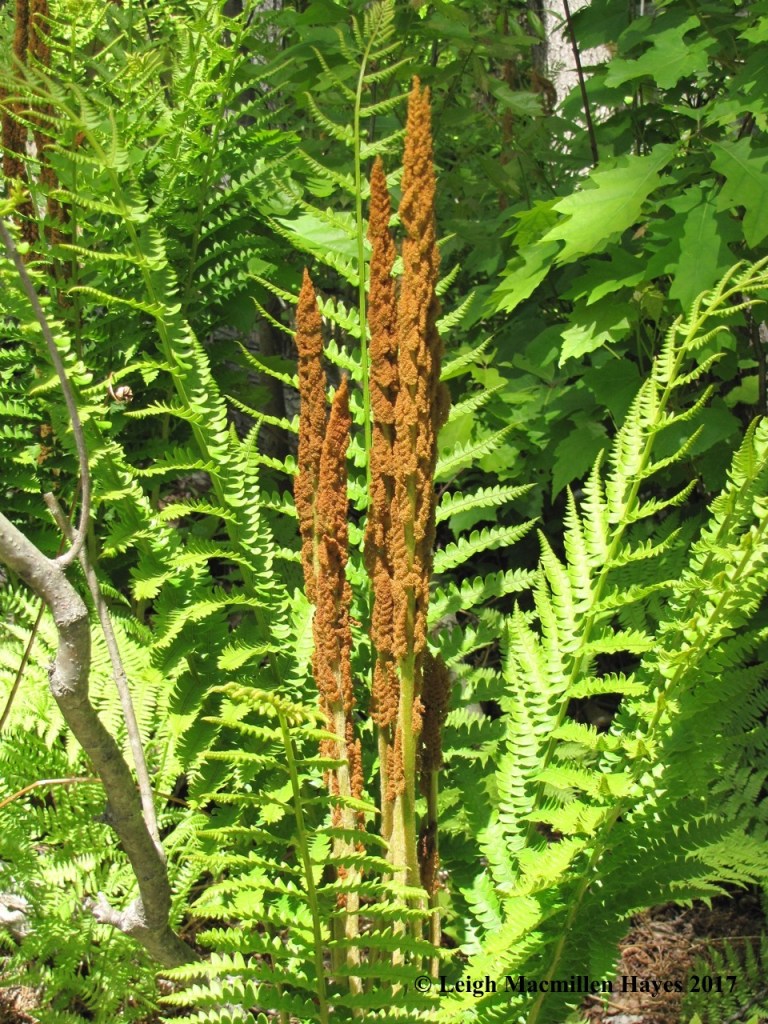
Soon, the cinnamon-colored fertile stalks will be visible in the center of the plant formation. But, once they have done their duty and dried up for the season, you really have to look to locate the fertile frond. And Cinnamon Fern can be easily mistaken for Interrupted Fern.

But as Levine reminds us, the give-away is on the back of the leaflet/pinna. By the center rachis, that main part of the frond to which all leaflet/pinna are attached, do you see the wooly tufts? In this neck of the woods, those only occur on the backside of Cinnamon Ferns.

Its cousin, Interrupted is best identified also by its fertile fronds, with the interruptions occurring in the middle of the blade. Levine sees them as butterflies when they first emerge and face upward. You’ll hear that pass through my lips going forth.

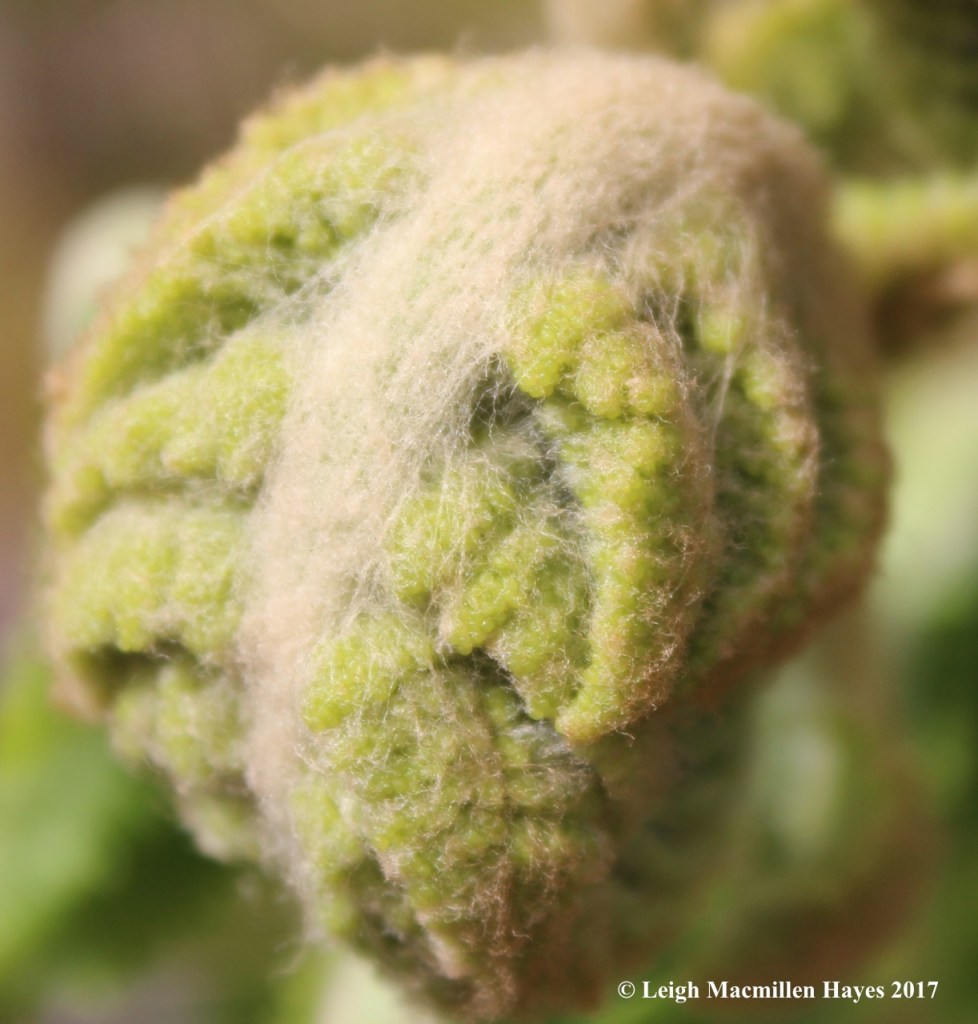
Here’s the thing with Cinnamon and Interrupted Ferns in their fiddlehead form. They are both covered in a veil of hair. But at least you know it’s one or the other and once they unfurl, the determination becomes easier.

Levine’s tips for IDing Marginal Wood Fern included a note about the subleaflet/pinnule’s wavy appearance making us think it might be thrice-cut. She makes the point, however, that it belongs in Group 2 because they “are not cut deep enough.”

Do note the spores dotting the margin of the backside.

At last, she comes to Ostrich Fern. This is the one edible fiddlehead that I know of in our area. Notice how bright green it is? And the lack of scales? There’s another clue that you may or may not see in this photo, but it’s also important for ID if you plan to dine for the stalk is deeply grooved. Deeply. Always double-check.

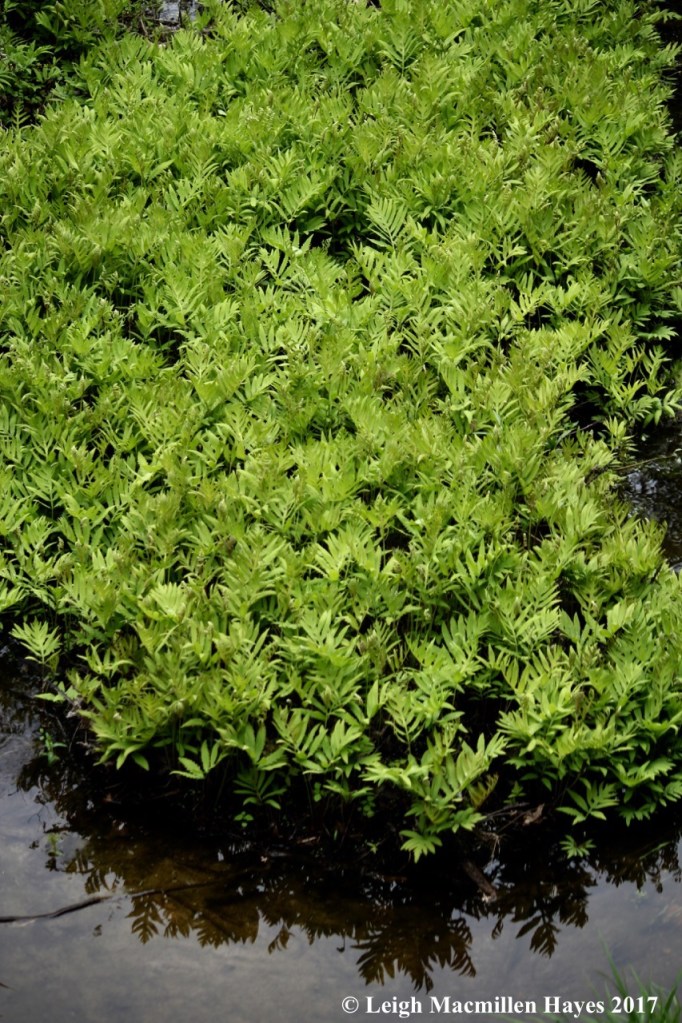
The vase-like form of Group 2A is especially evident in this display of Ostrich Fern, but there is an intruder. Can you name it?

Like Levine states, the “fertile frond may remain standing during the winter.” I took this photo last spring.

Group 2A ends with one of my favorites: Royal Fern. She describes it as having an “airy appearance.” I like that. And again, she uses that bow tie description.

It’s the location of the spore cases that give this fern its name. Curiously, though she says the cluster appears at the tip, she doesn’t mention that they are like a crown on top of a head.

I did find it interesting to note in her “Interesting Notes” that “Roots are a source of fiber (osmundine) that is sometimes used as a growing medium for orchids.”

Group 2B are those ferns that are twice-cut but do not grow in vase-like clusters. Such is the case for the Beech Fern, so named according to Levine because it is common where Beech trees grow. Another thing to pay attention to going forward.

All together, there are seven ferns described in this group.

Group 3 are those that are thrice-cut. Did I mention that I’ve always loved that word: thrice. Say it thrice times. Thrice. Thrice. Thrice.

Lady Ferns are part of this group and their scaliness can be referred to as hairy legs. They also have spore cases on the underside of the leaflet/pinna that remind us of eyebrows.

What I liked about Levine’s description is the following: “Fronds grow in asymmetrical clusters, but it sometimes grows in small groups of just 2 or 3 fronds.”

Group 3 includes five different ferns.

Group 4 consists of those ferns with a blade divided into three parts. The tallest among them is Bracken Fern. If you look closely, you may see a young friend of mine hiding under one.

With this species Levine issues a word of caution about the consumption of Bracken Fern fiddleheads: Don’t eat them. Buy her book and on page 62 you can read why.

While the Bracken Fern grows 3 – 5 feet, most of the other members of Group 4 are rather diminutive in stature, such as the grape ferns. I do love that she notes how the sterile blades range from being finely cut to less finely cut. The illustration on page 65 helps clarify that. You’ll have to buy the book. ;-)

A species not included because it’s not all that common in the Northeast, at least in the woods, or rather associated wetlands I frequent, is the Virginia Chain Fern. It looks very similar to Cinnamon Fern, but . . . while Cinnamon has a separate fertile frond that forms in the spring and then withers, Chain Fern’s sporangia are oblong and on the underside. I’ve seen this at Lake Environmental Association’s Highland Research Forest and Holt Pond Preserve. That being said, you do have to get wet feet.

So, I hope I’ve convinced you to buy this book. It includes the twelve most common ferns of Maine: Christmas, Polypody, Sensitive, Cinnamon, Interrupted, Marginal, Royal, Beech, Hayscented, Lady, Evergreen, and Brachen, plus a variety of others, most of which we do stumble upon either often or less frequently depending upon habitat.

My favorite local bookstore, Bridgton Books, was not able to get a copy of the Book of May: Identifying Ferns the Easy Way, so I ordered via Amazon on Tuesday and it arrived today.

Identifying Ferns the Easy Way by Lynn Levine, illustrated by Briony Morrow-Cribbs, Heartwood Press, 2019.

Lessons from Muskrats and Beavers

Cousins they are, but the semi-aquatic rodents are often confused. Muskrats and Beavers are easiest to identify by their tails, but those aren’t always visible when they are swimming. Typically, a Muskrat’s whole body is visible as it swims, its long, skinny tail sticking out behind. With a Beaver, though its tail is wide, flat, and paddle-shaped, it’s usually only the large wedge-shaped head that we spy.

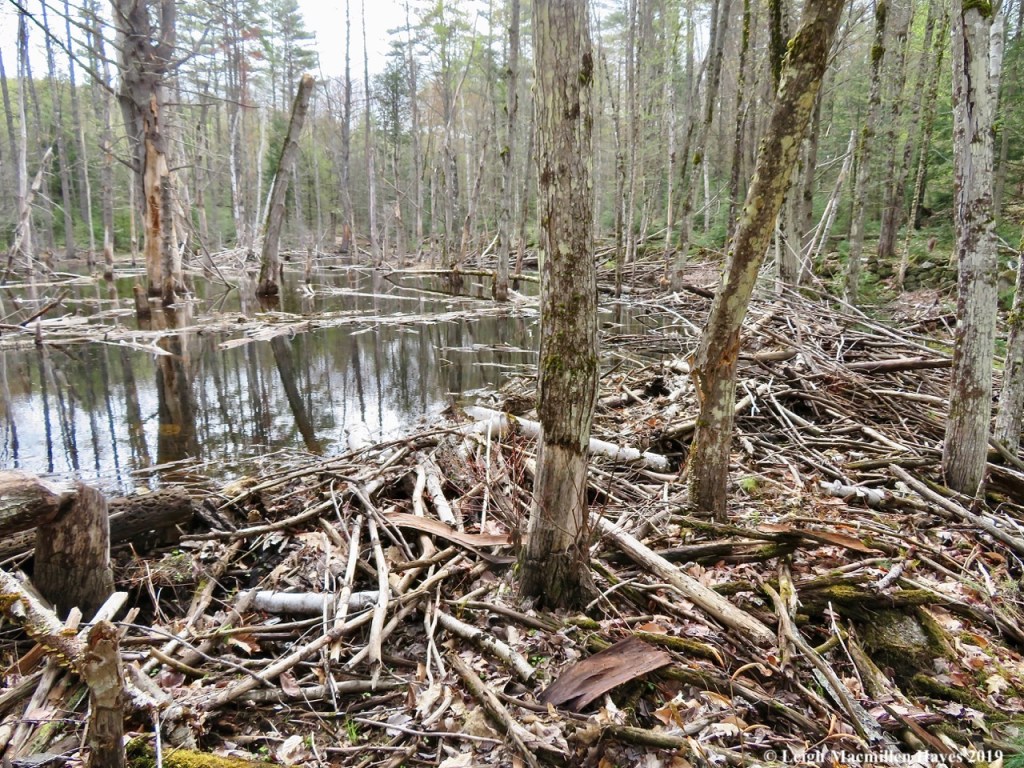
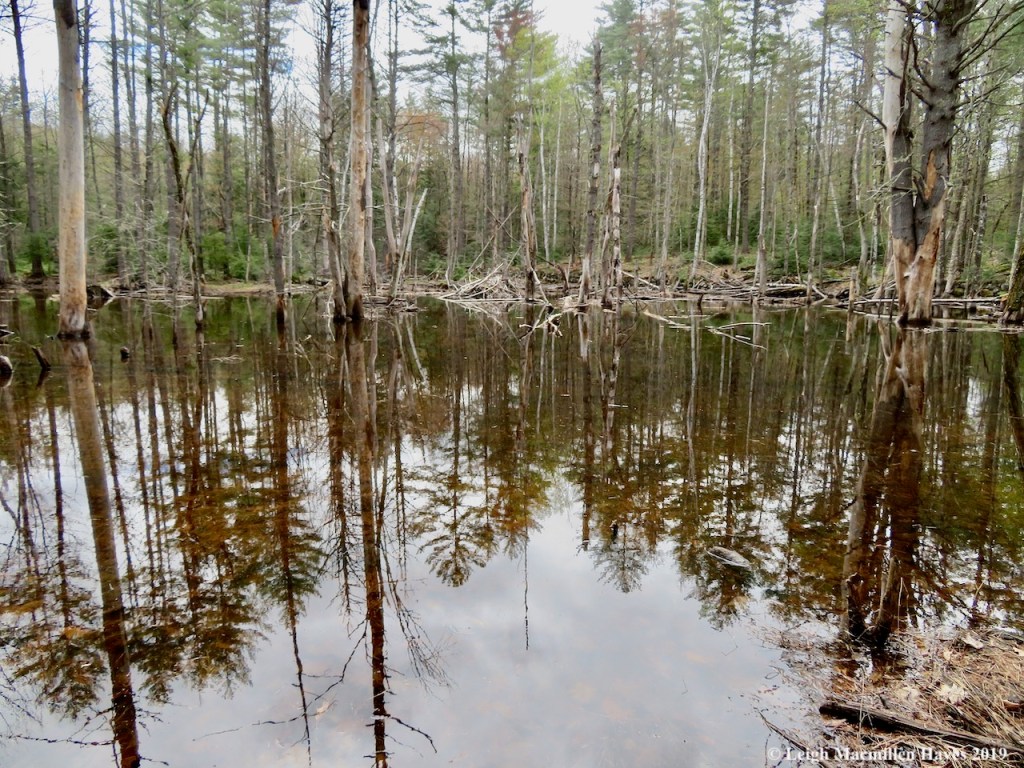
Today, I had the good fortune to search a friend’s property for both. My journey began at an old beaver pond that’s been devoid of water in recent years, but this year’s snowmelt and rain water have filled the space where an old, yet substantial dam does stand. The curious thing about the dam is that the Beavers built it just above an old man-made dam, or did they? I had to wonder: who came first?

For close to an hour I stood and reflected . . . on the reflections before me and past memories of times spent observing this space. All the while I hoped to see two Muskrats my friend had observed mating last week, but they were a no show.

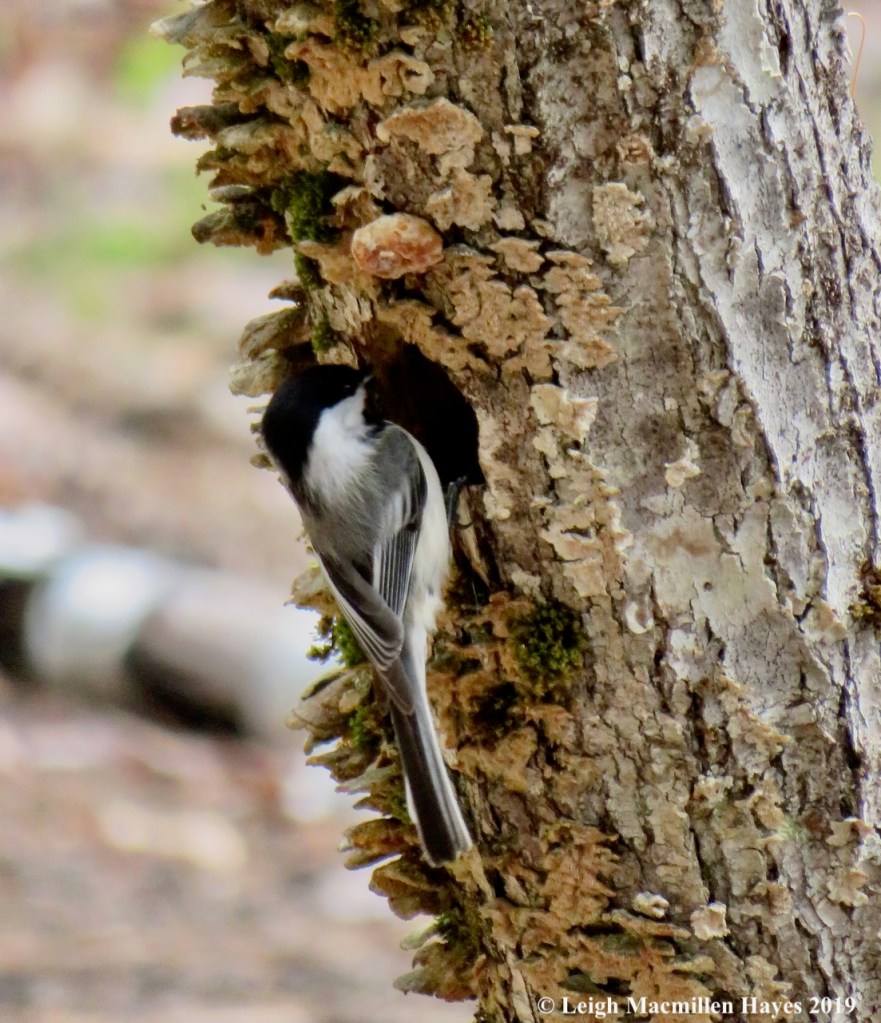
About twenty-five feet to the left, however, I did note a well-worn hole in a tree.

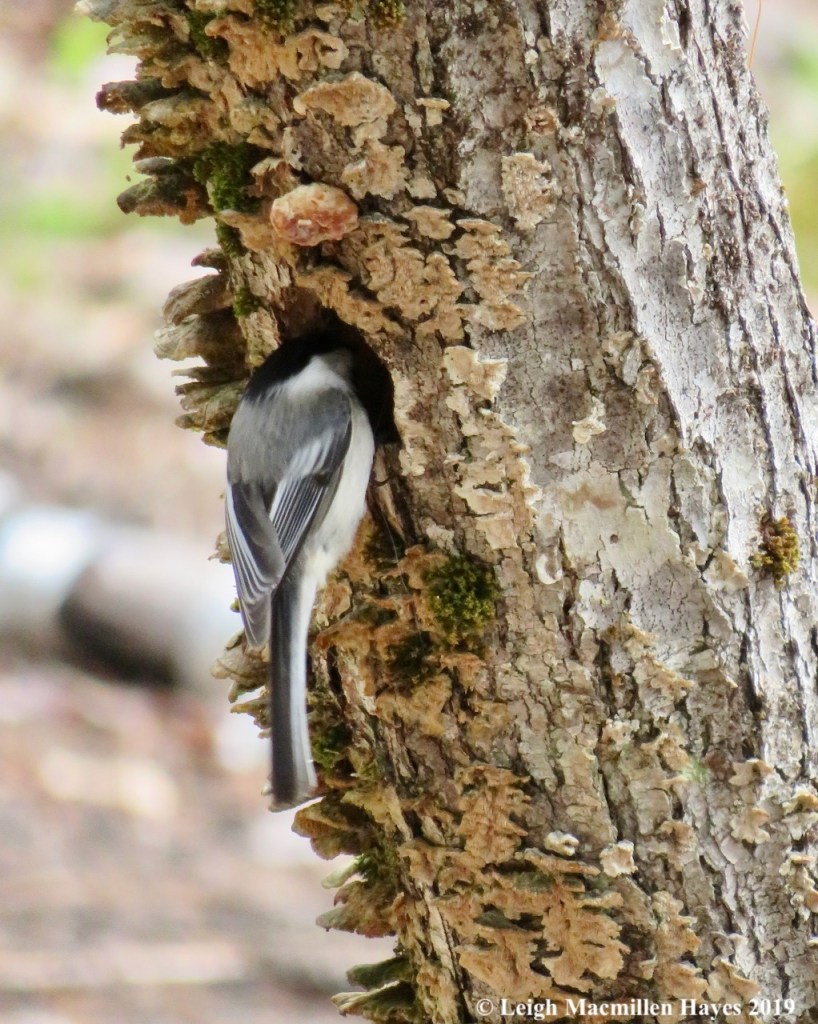
It must have been a flash of action that first drew my attention to it and so in between moments of Muskrat surveillance, I turned my attention to the snag where a Chickadee did pause.

All the while “Hey sweetie, sweetie” Chickadee songs reverberated through the woodland, and then . . . the bird slipped into the hole and a minute or two later flew out. Hey Sweetie, indeed.

When I finally pulled myself away from the beaver pond, my sense of disappointment for not spying the Muskrats thankfully displaced by the thrill of seeing the Chickadee nest snag, I started to hear a certain high-pitched whistle. I looked and looked but couldn’t locate the whistler, though I did spy a nest in the lower third of the canopy.

And then . . . movement caught my attention and it settled on a snag. A Broad-winged Hawk stayed high, but let me know that this was its territory and I was an intruder.

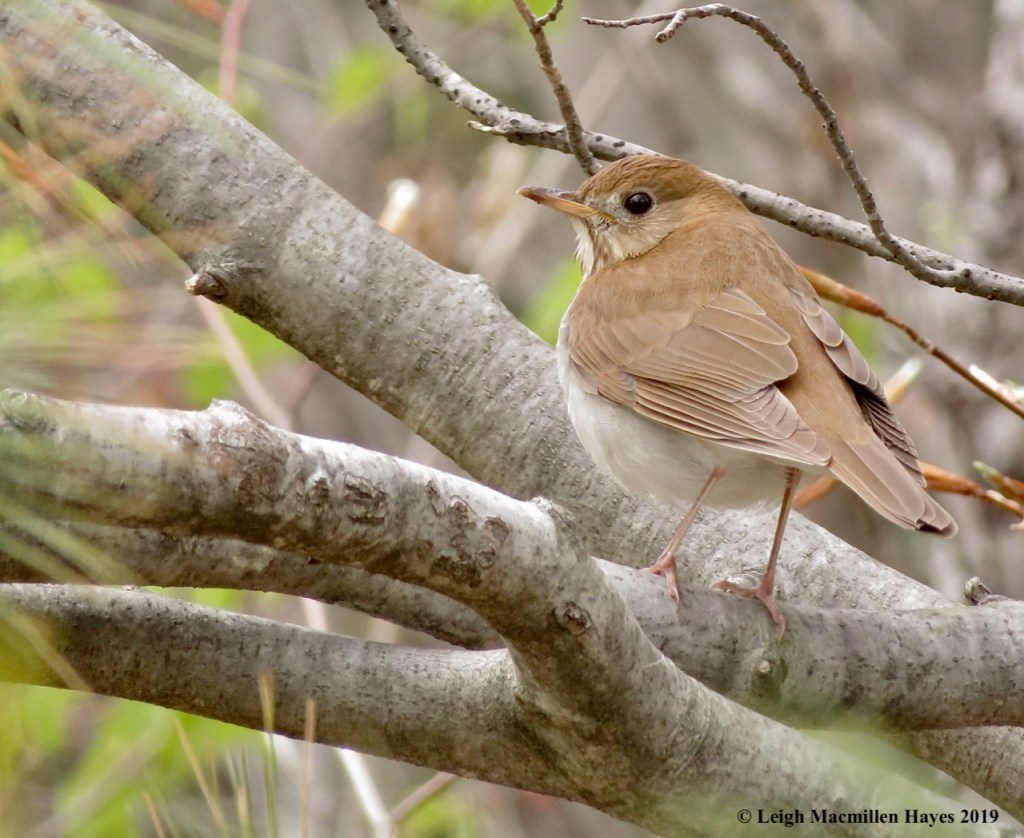
Not too much further along, it was movement rather than song that drew my attention. I knew I was looking at a thrush, and suspected a Hermit Thrush, but I’ve been wrong before. If you know better, please teach me. What I did note was the eye ring and smudges of brown on the lower breast. Again, I’m open to interpretation.

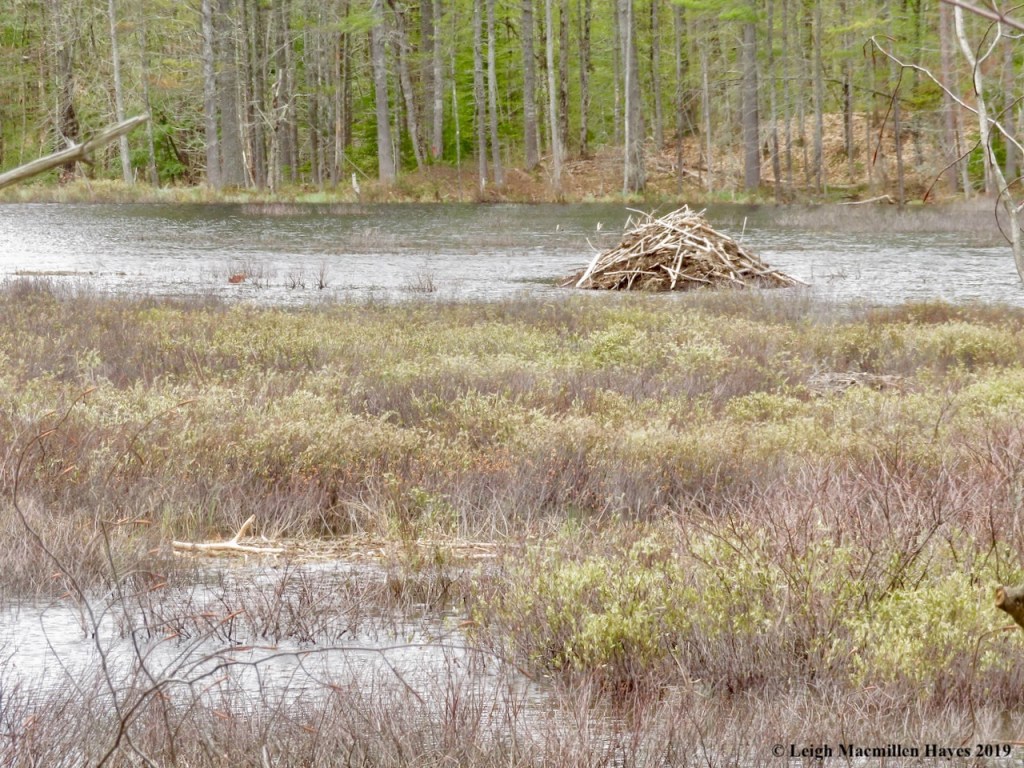
Eventually I reached another beaver pond of sorts.

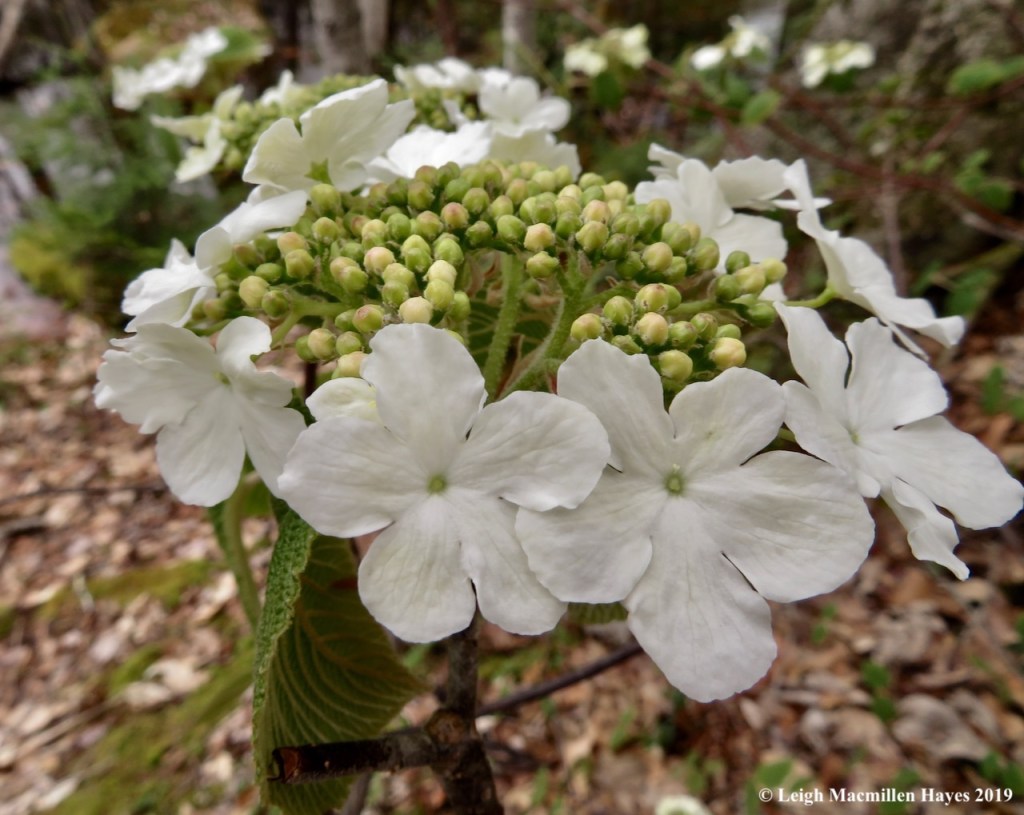
There, the Hobblebush bouquet shown its sweet face. In reality, it’s an inflorescence or lacy cluster of tiny fertile flowers surrounded by a halo of showy, yet sterile bracts. Those larger, sterile flowers attract insects while the tiny fertile flowers do all the work of seed production. Nature has its way.

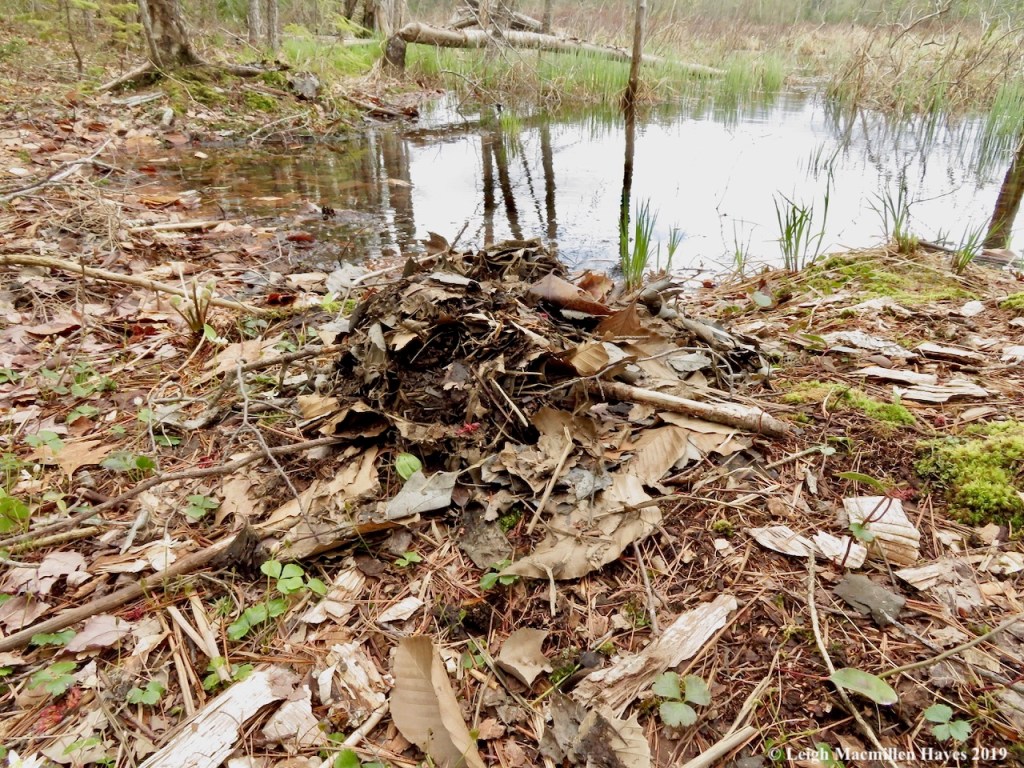
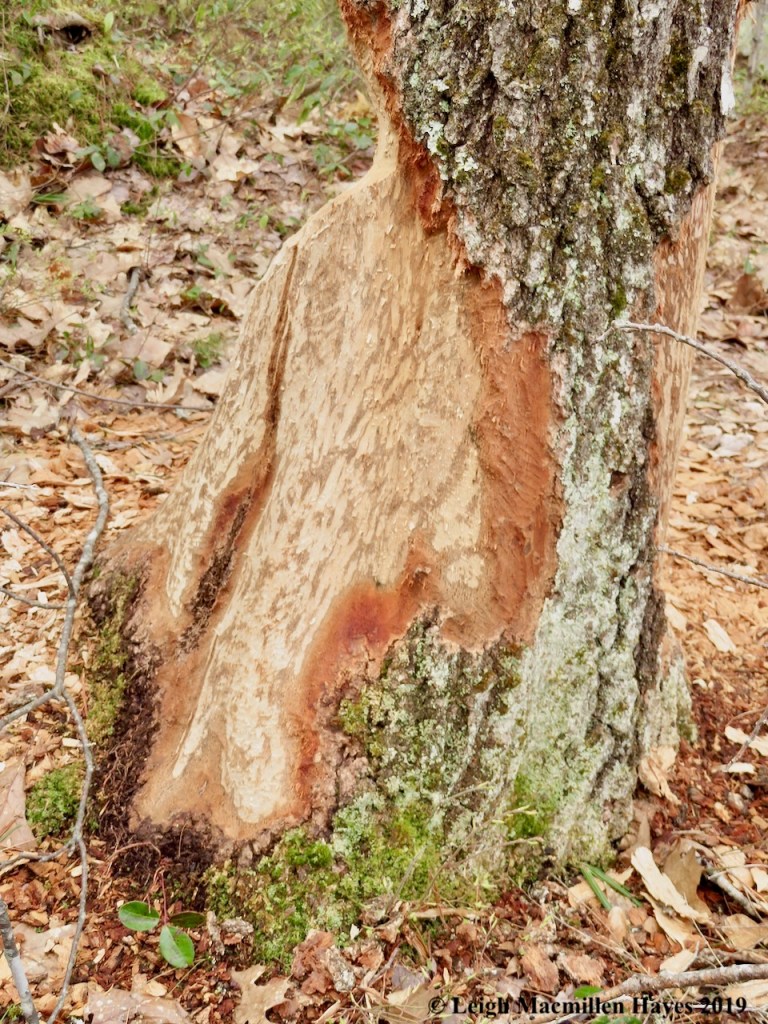
And so do the Beavers. As I moved along the wetland, I noted numerous scent mounds and knew that somewhere out there the rodents were active and making their claim on the place.

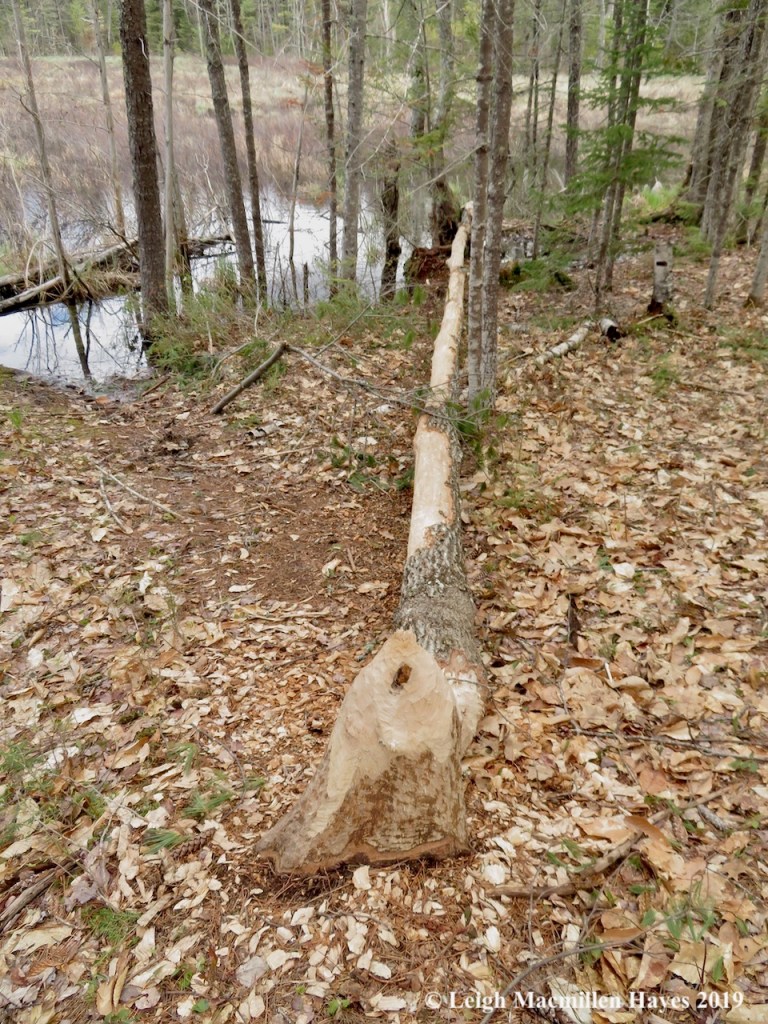
Everywhere, their works old . . .

and new . . .

and new again were on display.

In the water, a raft of winter chew sticks provided another indication that the lodge had been active.

But even more evident were the birds, their songs and calls filling the air space.

My favorites were the Yellow-rumped Warblers that flew from tree to tree along the water’s edge.

That yellow. White throat. Black mask. And black and white stripes. What’s not to love?

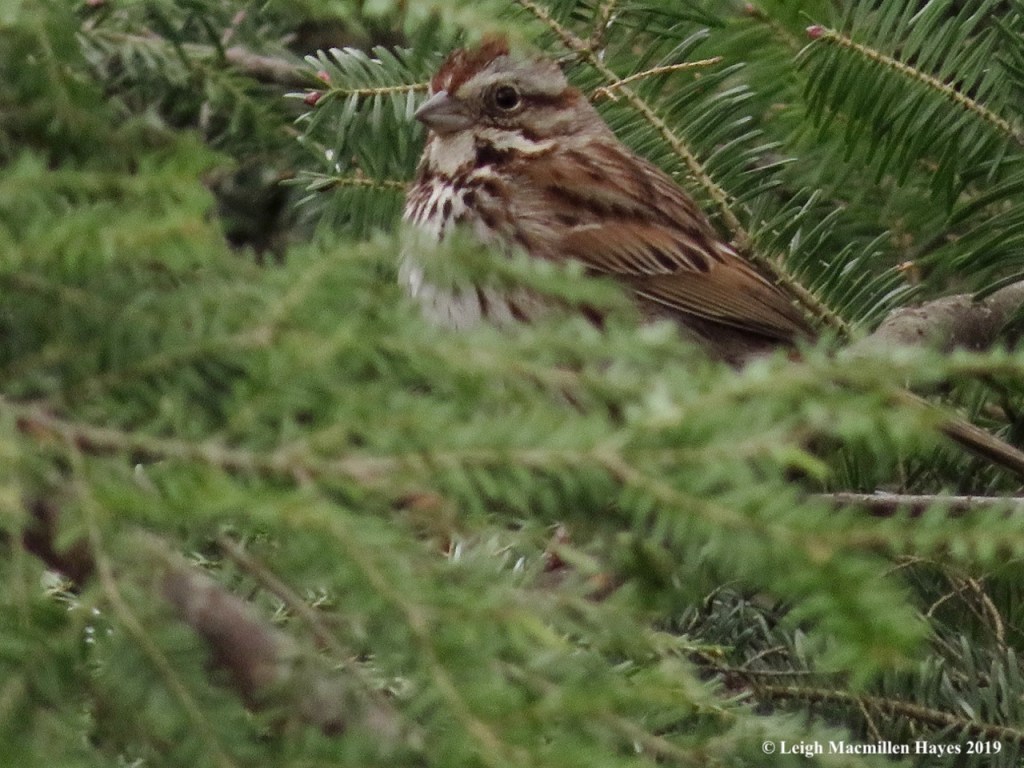
As I walked out, a Song Sparrow didn’t sing for me, but I loved its contrasting colors among deciduous needles.

And finally a Veery.

So, I went in search of two Muskrats and the Beavers. Perhaps I was too late in the morning to see them. But because of them I was treated to a variety of birds and appreciated the opportunity to spend some time with them and learn a little more about their habitats and habits.

My gracious thanks to M.Y. for the opportunity yet again. I have to admit that I covet your property.

Bear to Beer: Bishop Cardinal to Lord Hill

Our destination sounded rather regal; as if we’d be paying our respects to Bishop Cardinal and Lord Hill. And indeed we did.

We also paid our respects to telephone poles. Well, actually only certain ones. They had to have a certain look–as if a Black Bear had backed into the pole and turned its head around at an angle and bit the wood with its upper and lower canine teeth thus leaving nearly horizontal marks that look like a dot and dash. In the process, the aluminum numbers had to be a bit mangled in order to receive our attention. This particular pole was right by the trailhead and so after examining it, we headed up the blue trail at the Greater Lovell Land Trust’s Bishop Cardinal Reserve on Horseshoe Pond Road in Lovell.

Along the way, we examined every American Beech we saw, but actually passed by a spot where we know there are several with the marks we sought. If you go, look for the blue dot on the white arrow and hike in at a diagonal from there.

Our hope today was to find other bear claw trees we’d missed previously and so we kept going off trail in search. Turning onto the red trail, we continued to check. Sometimes it’s the shape of the tree’s crown that makes us wonder.

We have learned that we can’t dismiss any bark without walking all the way around and bingo–we had a new-to-us bear claw tree.

I don’t know why it is, but those marks make our hearts sing. Perhaps it’s the knowledge of the wildness of it all and the fact that we share this place with such intelligent beings.

Whatever it is, we decided that rather than creating waypoints for each tree we found, we’d try to remember the location by using other landmarks such as a certain waterbar that was intended to divert snowmelt and rain from washing out the trail. When you reach that certain waterbar on the red trail, turn left and walk in about twenty yards. If you don’t find our tree, perhaps you’ll discover another.

Continuing up the trail, we did note a few other favorites off to the right.

Sometimes, in my mind’s eye, I could just see the movement of the climber.

With one such tree, the marks were lower than most and I wondered if it was a younger bear. Of course, we have no idea how long ago those marks were left behind. Mary Holland suggests a way to age them that we haven’t tried yet. And we didn’t look for fresh marks. Really, we need to be better sleuths going forward.

In case you are wondering, occasionally we noted other points of interest, such as the burst of beech buds, their spring green leaves all hairy and soft, which is actually quite a contrast to the papery feel they eventually acquire.

Here and there, the cheerful display of Round-leaved Violets brightened the path.

And drone flies, with their bigger than life eyes, posed. Any black flies? Yes, a few, but not biting . . . yet.

We were almost to the old shack site, if you know where I mean, when our journey off trail revealed another fine specimen. Again, the claw marks were on the backside since we approached from the trail. Always, always, always circle about and you might be surprised.

Eventually, we reached the intersection with the trail to Lord Hill and continued our surveillance as we continued our hike.

Once we turned right onto the Conant Trail, we did find one tree with marks long ago made . . . by some bears with either an extreme understanding of relationships, or more likely, a few who weren’t all that intelligent after all.

At last, the trail opened onto the ledges overlooking Horseshoe Pond and it was there that we sat down on the warm granite as a nippy breeze flowed across. Enjoying the view of Horseshoe Pond below and the mountains beyond, we ate lunch.

We also toasted a few others with a Honey of a Beer brewed by Lee of another spelling! Dubbel Trouble was double delicious. Thank you, Lee Fraitag. ;-) Our toast was also doubled for we gave thanks to Paula and Tom Hughes, who live just below on the pond. Tomorrow we’ll enjoy a Mother’s Day Brunch at the Old Saco Inn courtesy of the Hugheses. ;-)

Clink. Clink.

After enjoying lunch rock we journeyed up to the Lord Hill Mine.

According to mindat.org, Lord Hill Mine was “a former rare mineral specimen quarry. Briefly worked in episodes in the mid-20th century for feldspar. Originally a mineral collector’s site in the late 1870s. Opened by Nathan Perry and Edgar D. Andrews in the early 1880s. Originally called Harndon Hill, but the named changed in a complex change of names about 1917. Operated solely by Nathan Perry by 1882. Operated for massive topaz for educational mineral collections in the 1970’s by Col. Joseph Pollack of Harrison, Maine. The locality is the type locality for hamlinite, now regarded as a synonym for goyazite. Granite pegmatite. Oxford pegmatite field. Local rocks include Carboniferous alkali feldspar granite (muscovite accessory mineral).

We spotted several people busy digging for their fortunes and decided to let them. They either were so tuned in to their work that they didn’t hear us or they chose not to. No matter. After a quick look about, we quietly followed the mine trail down–our own focus still on the trees.

And at the point where the National Forest abuts the Greater Lovell Land Trust’s property, we turned back onto the land trust’s loop trail. We’d come up from the left, so turned right to continue our descent.

And yes, we found one more bear tree. Somewhere along the way, I lost track of the number of new finds. But, we trusted that for all we found, there were so many more we must have missed. And then some.

Back on Horseshoe Pond Road, we turned left and checked all the telephone poles along the edge, examining each for bear hair because we’ve seen it stuck on them before. Today, no hair.

So why do the bears pay attention to telephone poles? Think of it as a combo backscratcher and messageboard. Pretend I’m a young male, ready and available. Wanna go out for a date tonight? Give me a call.

Despite the lack of hair, because we were looking, we found a Mayfly. That in itself, was another reason to celebrate.

Bishop Cardinal and Lord Hill. We thank you both. Black Bears, we thank you. Lee, we thank you. Paula and Tom, we thank you. (Happy Mother’s Day, Paula) All are regal indeed.

Bear to beer possibilities: Bishops Cardinal Reserve and Lord Hill Mine.

Significant Fairies

We’d made promises in the recent past that fell flat. With that in mind, when the Greater Lovell Land Trust’s Nature Explorers, a homeschool group led by Docent Juli, gathered this morning, she was smart and stuck to the life cycles of potential sightings like frogs rather than possibilities.

The group that gathered was large–24 in all with a mix of moms and their children.

Of course, being kids, they were immediately attracted to the water below the mill site at Heald Pond. But after letting them explore for a few minutes, a light whistle pulled them all together again.

At the nearby vernal pool, everyone quickly learned what larval mosquitoes looked like as they watched them somersault through the water column. A few complaints were expressed about future bites, but that was redirected to the fact that mosquitoes feed birds and dragonflies, and in their larval form, other aquatic insects.

Pond dipping became the morning habit and at first, it was only the mosquito larvae that made it into the containers.

But, that led to a quick lesson on the biting insects’ life cycle–one of many teachable moments that snuck into the morning fun.

Oh yes, those larval mosquitoes also feed amphibians and thanks to Juli’s son Aidan for finding a large Green Frog. Notice the ear disc, aka tympanum, that is located behind its eye. Given its size as being bigger than the eye, this was a male. And notice the dorsal lateral ridge or fold that extends from behind the eye down the side of its back (there’s one on either side)–that’s a clue that this is a Green Frog and not a Bull Frog, for the latter’s ridge circles around the tympanum.

As the morning went on, it turned out that today was Aidan’s day to shine for he was also the first to find a Fairy Shrimp.

A what? Yes, a Fairy Shrimp. Do you see that delicate orangish body in the middle of the tray? It’s a mini crustacean that lives only in vernal pools.

The kids all got caught up in the thrill of such a find and within minutes became pros at recognizing them.

And so the dipping continued.

Moms also got caught up in the dipping experience.

And they also found cool stuff, like Kim’s Fishfly. We kept expecting it to eat the mosquito larvae, but it seemed that they preferred to nudge it in a way we didn’t understand.

While Kim focused on her new friend, the kids were also making new friends, testing their balance, getting rather wet and muddy, and having a blast as they sought more Fairy Shrimp.

Their pan began to fill up with one, two, three, four, five and even a few more.

And then other species were discovered, including aquatic beetles and a Phantom Midge.

We’d come in hopes of at least finding Wood Frog and Spotted Salamander egg masses, which the kids quickly recognized. By the time we were ready to leave a few hours later, some of the boys had discovered the best way to spot the masses was from the crow’s nest.

But in the end, our most significant find was the Fairy Shrimp. You see, on a public walk a couple of weeks ago, when we’d promised folks such a sighting, we came up short. But today . . . they made their presence known. And with the find of just one Fairy Shrimp, the vernal pool became a significant one as recognized by the State of Maine.

A hearty thanks to Juli for leading and the moms and their kids for attending. It was such a joy to watch everyone interacting and engaging. I only wish I could have been a Fishfly on the wall at suppertime as they shared their finds of the day with other family members.

LOVE ME, love me: Wolfe’s Neck Woods State Park

It had been four years since we last visited Wolfe’s Neck Woods State Park and that venture took place at the end of November. We must have been Christmas shopping. Today, we were in search of a bug-repellant shirt for me (Spring shopping) and so our journey took us to Freeport. Not being a shopper, it was a quick in and out of the store and then onto Wolfe’s Neck Road.

There’s a 4.4 mile network of trails in this 200-acre park gifted to the State in 1969 by Mr. and Mrs. Lawrence M.C. Smith of Freeport. One of the stand-out features is Googins Island where Osprey have been entertaining visitors for years as they raise their young on a huge platform nest they’ve built high up in a pine. Can you see it?

Here’s a closer view–and I assume (never assume) that Momma was the one sitting on eggs. The nest has been added to each year and though I have no idea of its actual size, Osprey nests can reach 10–13 feet in depth and 3–6 feet in diameter. The depth of this one appeared to be a few feet, but the diameter was substantial.

We followed the trails and enjoyed journeys to the water where we could take in the views of Casco Bay and its islands.

And before our feet, the mix of granite pegmatite and metamorphic rock. As much as my mom always loved to walk along a beach, she was equally enchanted by the rocky coast of Maine and whenever I encounter it, I feel her presence.

I know mom would have appreciated the artistic rendition of waves created by the water and mimicked by the rock.

Again and then again, the trail was interrupted by a set of wooden steps that led us back to the water’s edge.

It was there that we spied the Common Eiders as they floated and fished.

And . . . the first Dandelion blossom of the season–for us, at least. In my modest opinion, Dandelions are under-appreciated and that fact was driven home when my guy asked, “You’re photographing a dandelion?” Yep. Check out each golden ray of sunshine with its five “teeth” representing a petal that forms a single floret. Yes, each petal is a floret. Therefore, the bloom is a composite of numerous florets. And notice how each stigma splits in two and curls. What’s not to love. Oh yeah, and though we didn’t witness it today, the pollinators love them. (SO don’t pull up the dandelions in your yard!)

The thing about Dandelions is that they leaf out first and then flower, while their cousins, Coltsfoot, which we also found along the trail, flower first and leaf out later. The wonder of it all.

Our journey took us across stepping stones,

along park-like paths (because we were in a park, after all), over roots and rocks, with ups and downs, and even a couple of bog bridges.

The sights along the way included patches of Equisetum, a living fossil. These vascular plants reproduce by spores rather than seeds and dominated the understory of late Paleozoic forests. Just imagine.

While that was a treat, one of my favorite surprises was the patch of Trout Lilies that decorated the forest floor. It’s one I don’t encounter often, but because of its maroon-mottled leaves that remind some of brown or brook trout, I’ve remembered it each time we’ve met.

The nodding flower that could have been a lantern in the forest with its petals and sepals bent backward, exposed six brown stamens hanging low.

And then, and then, one of my all-time favorites in any season, a Hobblebush, showed off its May glory in new leaves and flowers. Those in our western Maine woods aren’t as advanced yet, but trust that I am watching.

Our journey was quick for we had another commitment, but still . . . we made some wonderful discoveries and especially loved the opportunity to see the Osprey on its nest.

The second in our LOVE ME, love me series had come to an end. Wolfe’s Neck Woods State Park. ✓ Two down, 32 to go!

Cinco de Mayo Maine-style

When Pam asked at the end of our slow tour today what my favorite finds were, I named at least five.

First, there was the Painted Turtle that I spotted on Kezar Lake Road as I drove toward the Greater Lovell Land Trust’s Long Meadow Brook Reserve. After I pulled over and approached him, he did what turtles do and retreated into his shell. Though he wasn’t feeling it, I was in celebration mode, for he represented my first turtle of the season. And I helped him cross the road.

I felt safe calling him a he for males have long fingernails. Can you see him peeking out at me in a not too pleased manner? Can’t say I blame him, but our time together was brief and soon he wandered his way while I wandered mine.

And then, another reason for celebration–Coltsfoot in bloom. I know it’s invasive, but its sunny face and scaly purplish stem that predate its leaves offer a first hint of the season’s promises of colors to come.

Coltsfoot is known by some as Filius ante patrem (the son before the father), because the bright yellow star-like flowers appear and wither before its broad, green leaves are produced.

The next sight to be considered: a small spider that, like the painted turtle, continuously eluded our focus by quickly moving to the opposite side of the beech twig. Can you spy it?

And then there were those tree buds bursting forth with life ready to unfold from within. We were offered a few early glimpses of the future and rejoiced at each sample.

At last we reached Long Meadow Brook, for which the reserve is named. And stood and looked and listened and waited and absorbed. Oh, Pam absorbed some water in her boots thanks to a leak. But she didn’t let that stop her and we each enjoyed the opportunity to let this place soak through our pores for moments that turned into a string of minutes and suddenly an hour had passed.

At long last, we pulled away and began a bushwhack through the woods beside the brook.

In so doing, we found more to celebrate, like a red squirrel refectory upon a rock and we suspected a large hole below the tree trunk and boulder had served as the larder.

Continuing on, we saw mats of black upon moss by another tree and almost wrote it off as perhaps a fungi we hadn’t met before.

But. It. Moved. As we watched, we realized the constant motion was created by springtails writhing en masse. To say it wasn’t creepy would be lying. Likewise we were fascinated and leaned in closer to watch the swarm upon the moss.

Resting nearby, perhaps having just gorged on some of those tiny little morsels, was another reason for celebration–a spring peeper. We spotted two, but heard a hundred million more, each adding its song to the symphony that arose from the wetland. And suddenly, an interval of silence would interrupt the music, and then one male would peep, and the rest would join in again until they arrived at the next rest symbol upon their sheet music.

Others added their own notes to the orchestra, including a couple of White-throated Sparrows that trilled in our midst.

Near the end of our journey, we reached a point where we could see that there was still some snow on the the Bald Face Mountains in Evans Notch, but we spotted a dragonfly and honored Trailing Arbutus flowers and rejoiced. Though our celebration didn’t have a Mexican theme, we still had at least cinco reasons to give thanks from the Painted Turtle to Coltsfoot to Bud Bursts to Squirrel Larders to Creepy Collembola to Spring Peepers to White-throated Sparrows. Really, it was more a Siete de Mayo on this Cinco de Mayo–Maine-style.