Basking in the Sights

“This won’t take us long,” My Guy said moments after we launched our kayaks onto a small pond in New Hampshire.

“Oh, I think I can make it last a while,” I replied.

I knew there were Pitcher Plants to look for and I could see by the color of the trees on the far shore that there were wetlands to explore and there was the potential for so much more in this very quiet spot.

A friend who kayaks here often had told me where to park and some of the things to look for along the way. What was most impressive from the start is that there were flower pots on the dam and by the kiosk. Well tended, at that.

And a rather large Little Free Library, where one can take a book or share a book.

I unlatched the door and it even smelled like a library. What’s not to love?!

But, we’d ventured there to paddle.
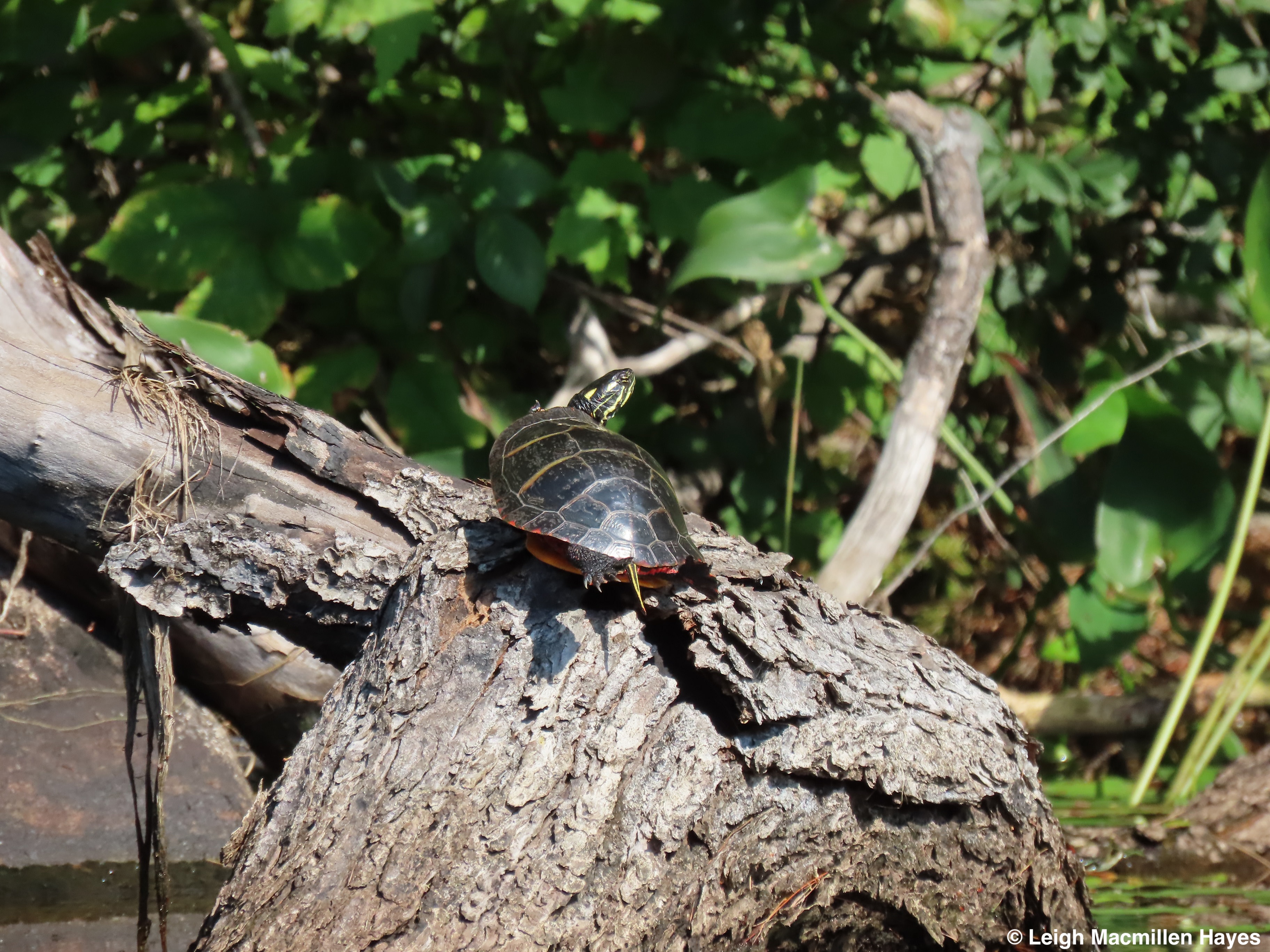
Or better yet, to dawdle. To be like the Painted Turtle and enjoy the sunshine of a perfect September day.
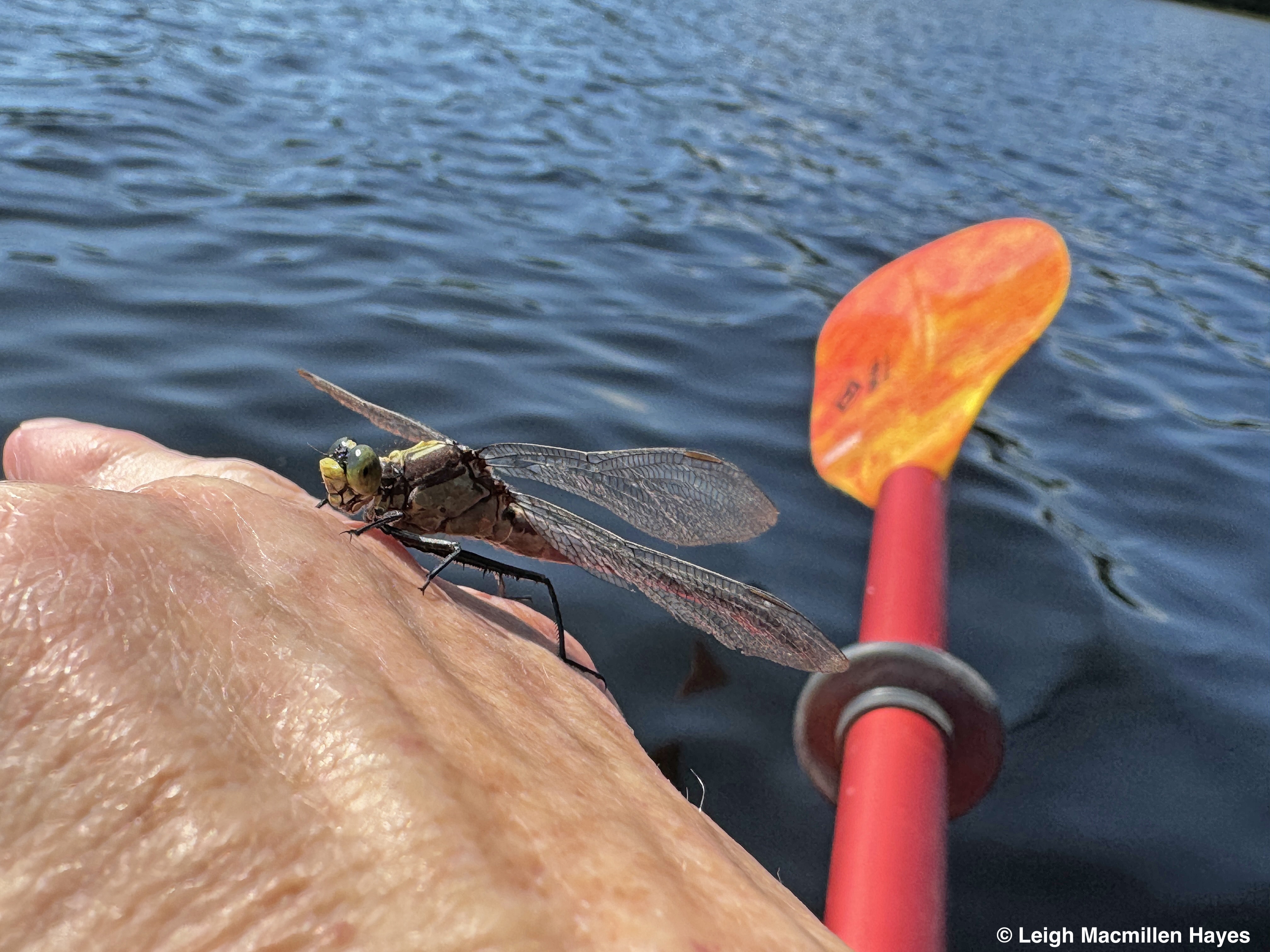
And then one of my favorite things happened. A dragonfly in the clubtail family landed on my knee and I coaxed it onto my hand for a better look. It was perfectly content to be there. Which made me think of a darner on another day on another pond this past week that I rescued as it flailed in the water. The moment I picked that darner up, it tried to take a nip out of my finger and was frantic, even when I set it on the edge of the boat. I wanted to give it a chance to dry its wings. It wanted only to fly. And so it did with wings still wet and back into the water it landed, slipping under a lily pad. I rescued it again and this time it didn’t bite and it did sit for another minute or two upon the boat, but not long enough for me to get a good look at its colors and patterns for identification, or to snap a photo and then suddenly it flew and I can only hope survived.

My new friend, however, allowed me to move him from my hand to the boat, the better to take a look.

This one didn’t speak its name immediately, until I looked at its spiny back legs. As a Black-shouldered Spinyleg it is commonly known, and it’s in the clubtail family, but I’m not exactly convinced that the shoulders are actually ebony in hue. To me, they seem to be chocolate brown.

Another characteristic is the thorax pattern: two long ovals on either side with a yellowish I-shaped mark in between them. 
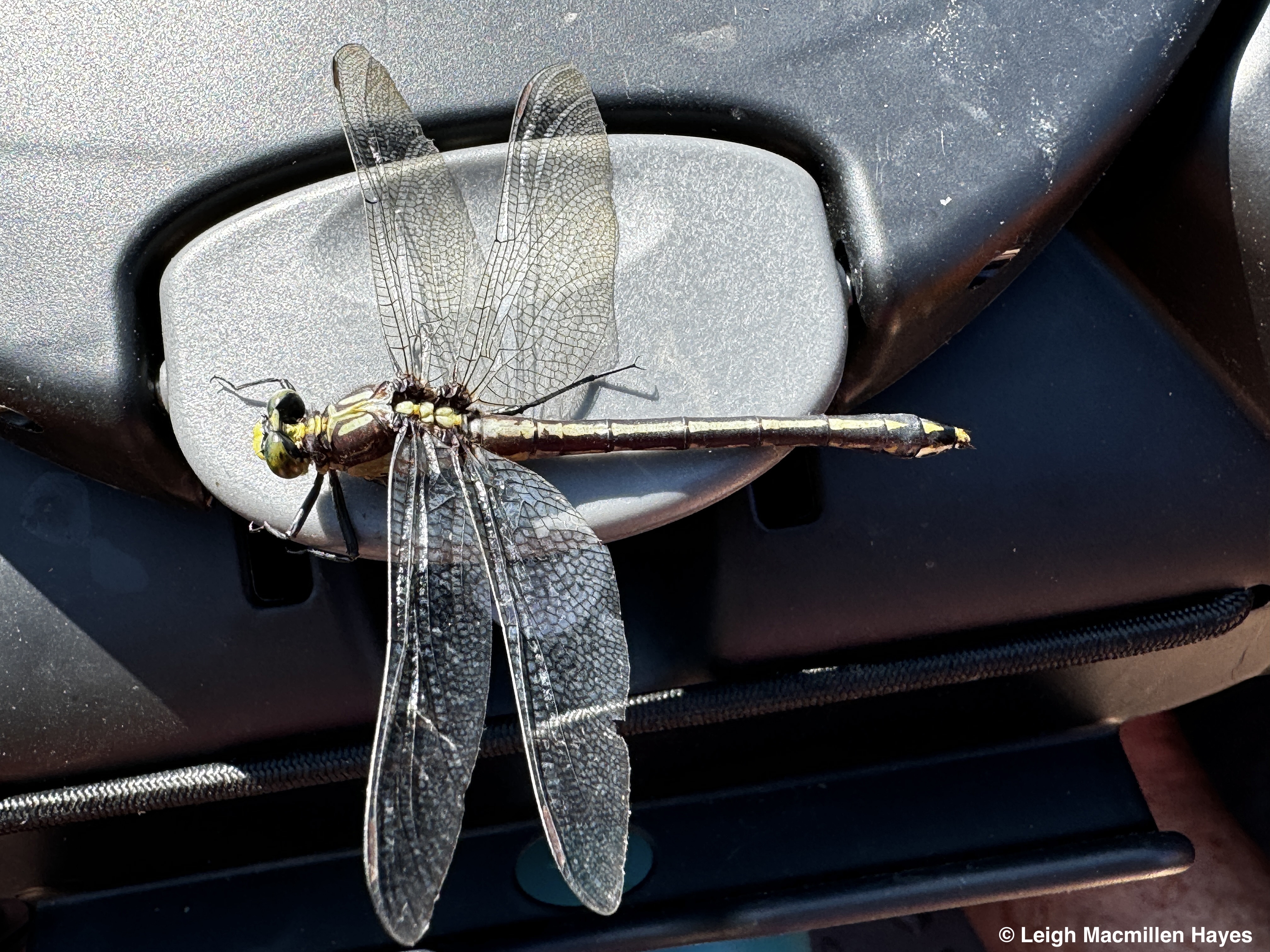
It was the pattern on the abdomen that also helped me confirm ID, with the yellow stripes on each segment becoming triangular shaped on segments 8 and 9, while the final segment, #10, was almost completely coated with splash of yellow.
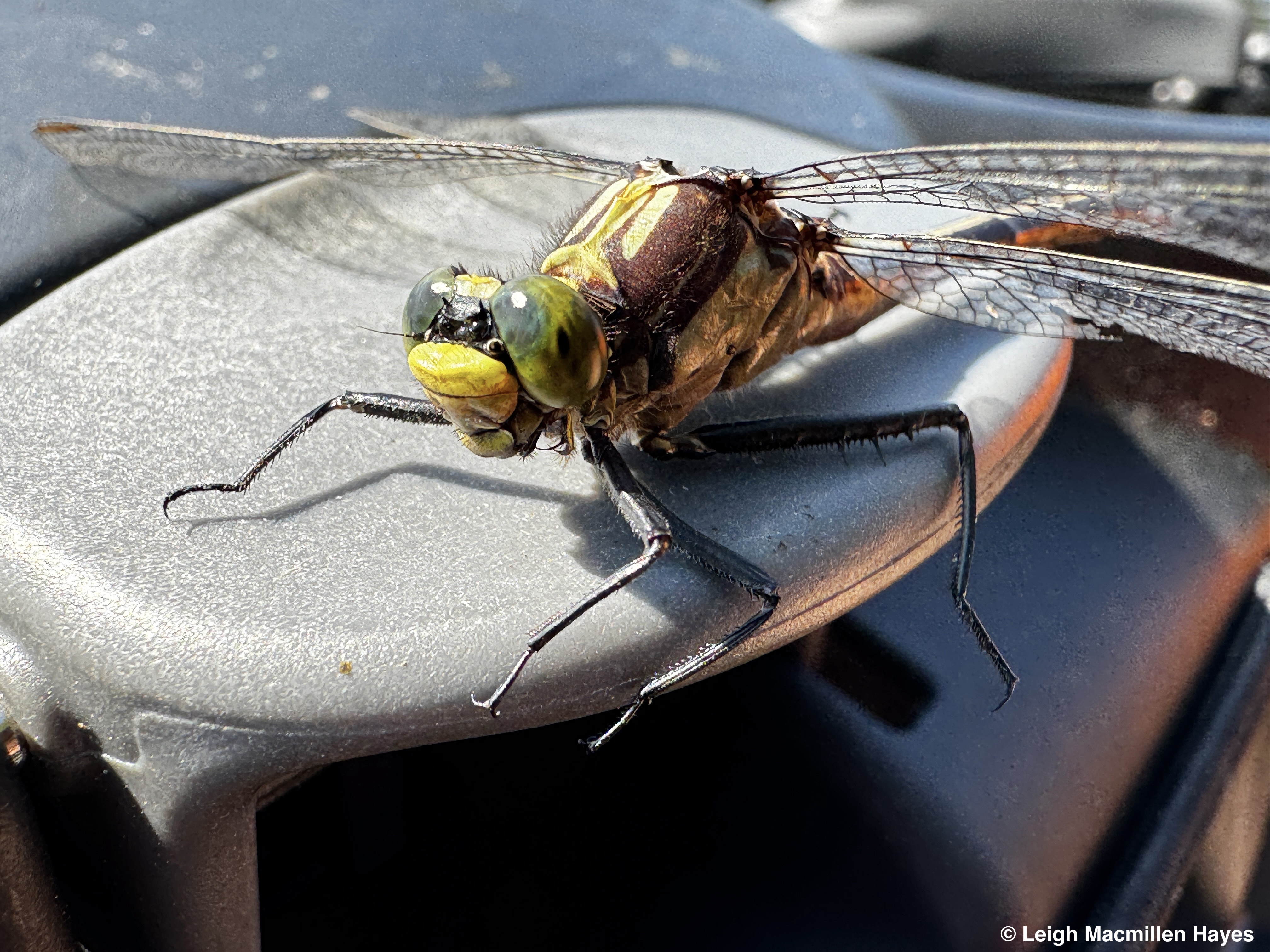
With each minute that passed I fell more and more in love as my new friend let me enter its personal space. Such big eyes–compound as they are. But then there are the ocelli, or three small black “eyes” located on top of the head–to us they look like three little bumps, but according to the field guides in my own library, they “may serve to measure light intensity.”

And all those body hairs. They work like sensors–detecting odors, temperature, humidity, and most likely wind direction.

If you have a loupe or magnifying lens, I encourage you to look at insects and plants–it’s a hairy world out there.
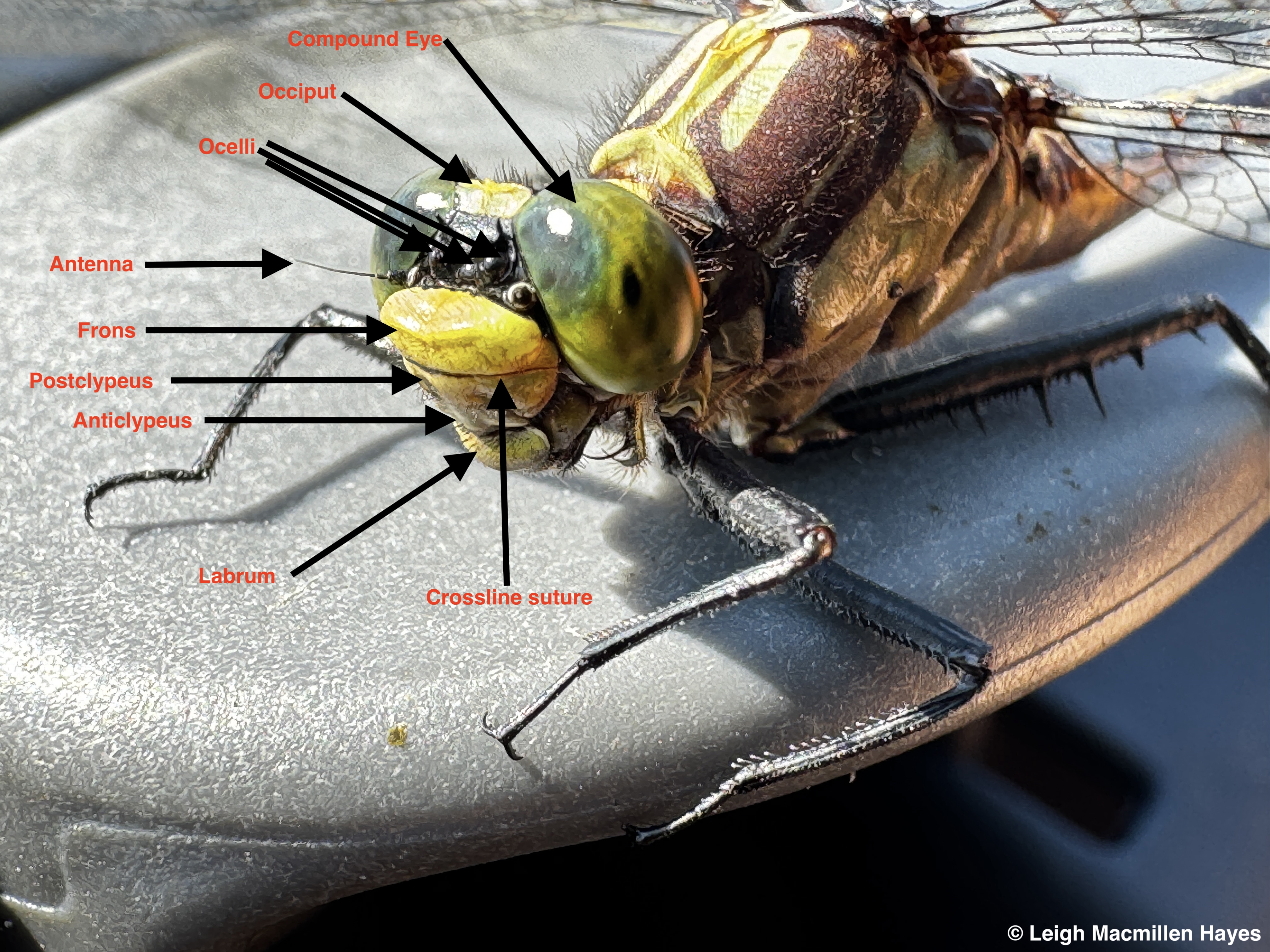
Let’s take a closer look at that face. It’s rather other-worldly in structure. Two dragonfly families feature eyes that don’t touch each other along any margin: Clubtails and Petaltails. I’m not sure I’ve ever met a Petaltail, so that already narrows it down for me when trying to figure out the species.

Beginning with the large compound eyes, we’ll work our way down. But first, can you imagine seeing the world through 30,000 lenses or facets? I’m happy to have moved on from progressive lenses (three lenses) that threw me off, especially when hiking or walking down stairs. 30,000?!!! A dragonfly certainly has no excuse for not seeing even the tiniest of insects on the move.

And notice how the eye is two toned, the darker being above.

Between the eyes is a plate called the occiput, which covers the upper part of the head. You might also notice, though I didn’t label them, that there are occipital horns.

Below that is the triangle of ocelli, or three tiny and simple eyes as compared to the two compound eyes. These may measure light intensity.

And then there are two antennas, perhaps for measuring wind speed. All of this and we haven’t reached the face yet.

Ah, the dragonfly face–beauty is definitely in the eye of the beholder.

Dragonfly faces consist of plates and the upper plate is the frons. In some species there are certain dark shapes or lines that help with ID. Not on this one, however.

Below the frons a crossline suture is a seam that separates the frons from the postclypeus, an upper plate that we might think of as the upper lip.

And below it, the anticlypeus, a lower plate located about where our tongue might be on a human face.

Finally, the labrum, or lower lip, and below that the mandibles, not labeled.

Such complexity for an insect that spends months to a few years as an aquatic naiad, growing through several molts, and then crawls out of the water and slowly ecloses upon vegetation, pumping insect blood into its wings and body, before flying off to control the airways and the insects who bug us. And within two months of emerging from the water, it’s life cycle comes to an end.

And to think this one simply landed on my knee and now you have all this information to digest. Don’t worry, there will be a quiz at the end.
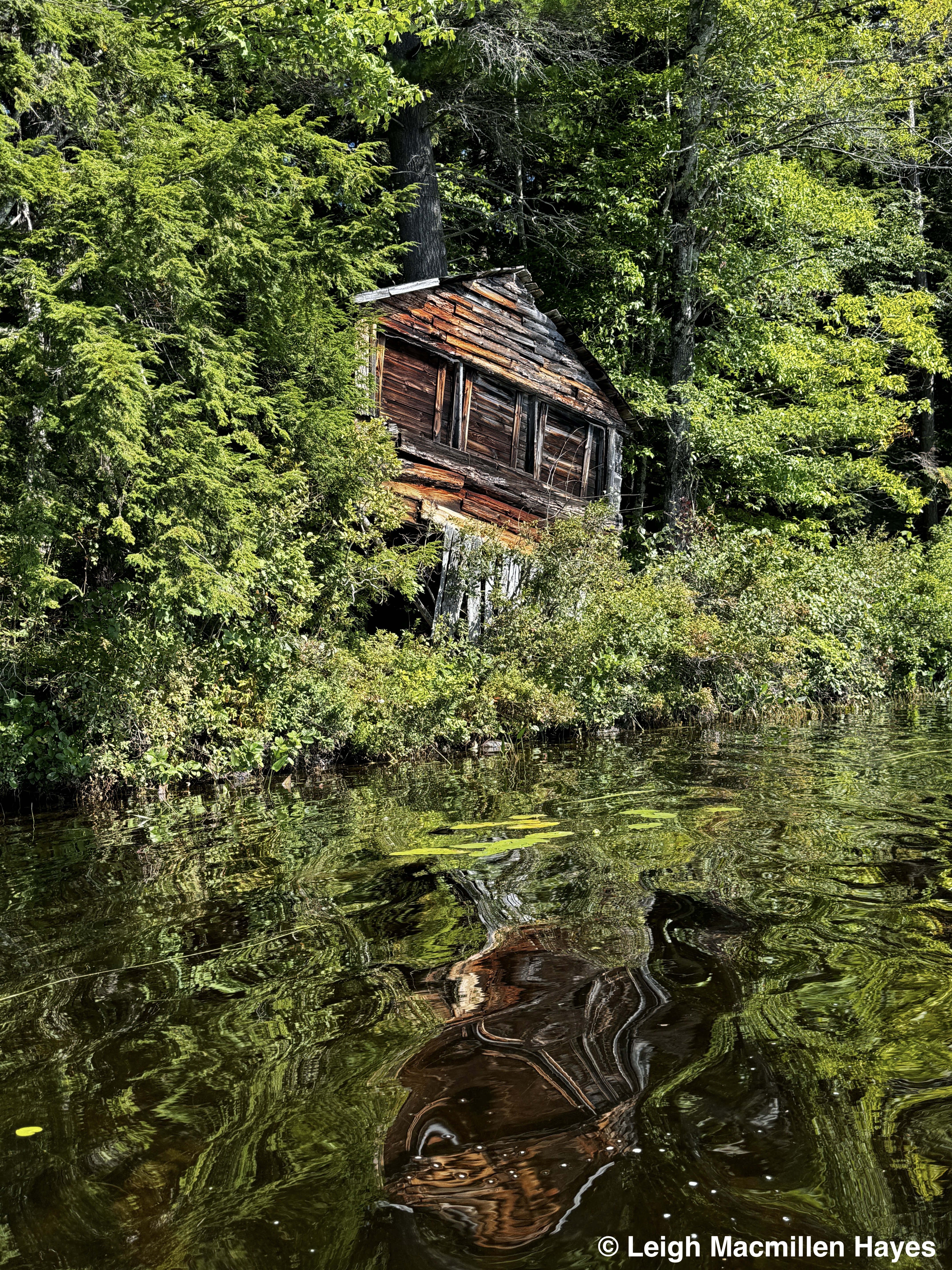
Suddenly, the dragonfly flew off. And my focus returned to the pond. If you’ve paddled here, then you know that we hadn’t gone far as we’d only reached the third of the crooked houses.

My Guy was ready to purchase one and fix it up. I just want to paint this scene when I have time for so beautiful was it despite its lack of TLC and the reflection was equally delightful as lines were interrupted by the water’s current.

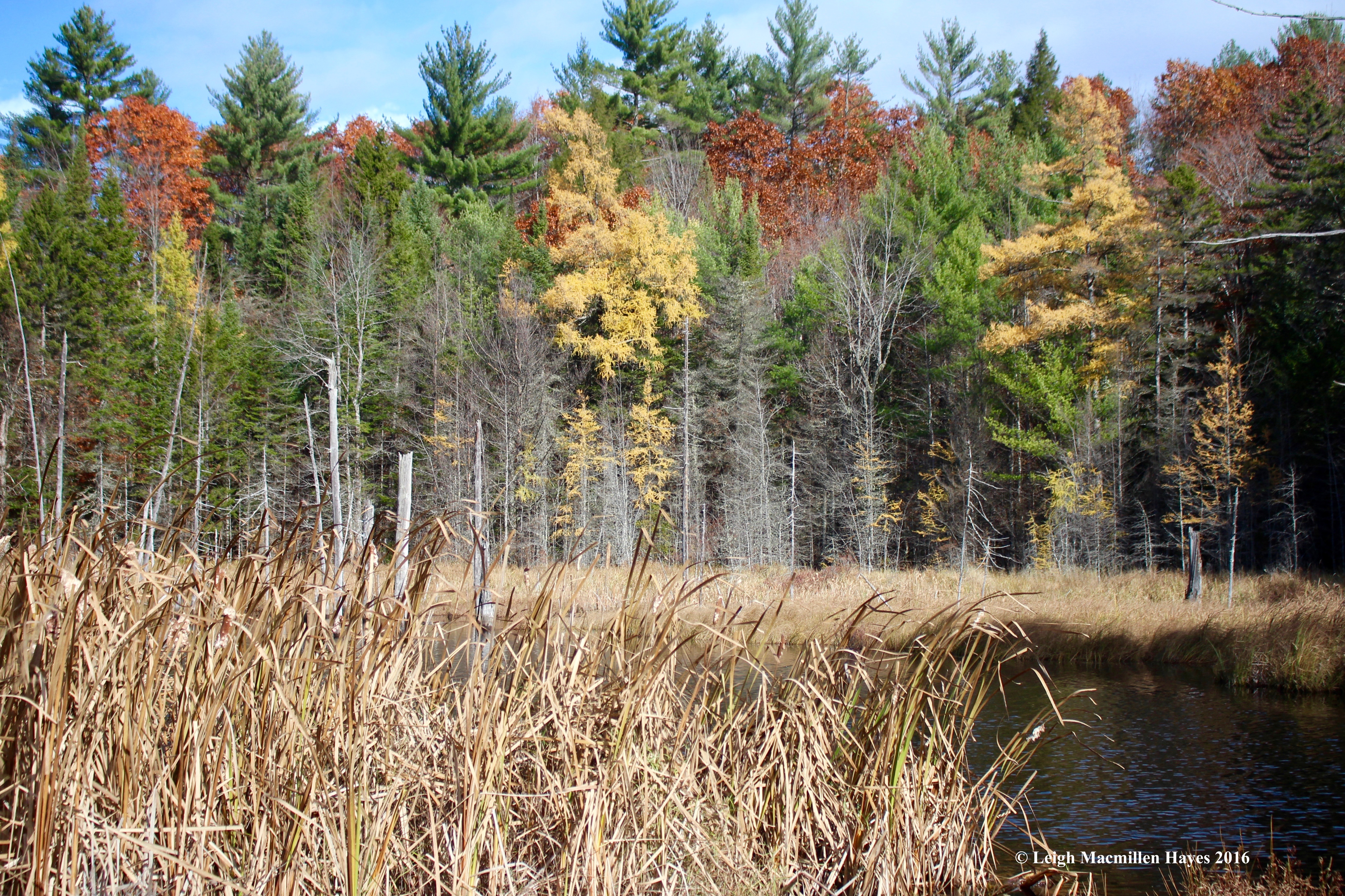
At last we reached the opposite end of the pond from which we’d begun our journey and the colorful leaves of the Swamp Maples told me we were in a different sort of wetland.

The layers. From Pickerel Weed leaves to grasses and sedges, including Cotton Sedge, to the Swamp Maples, actually being Red Maples with very wet feet which are among the first to turn as fall approaches and days shorten, to a backdrop of deciduous and conifers.
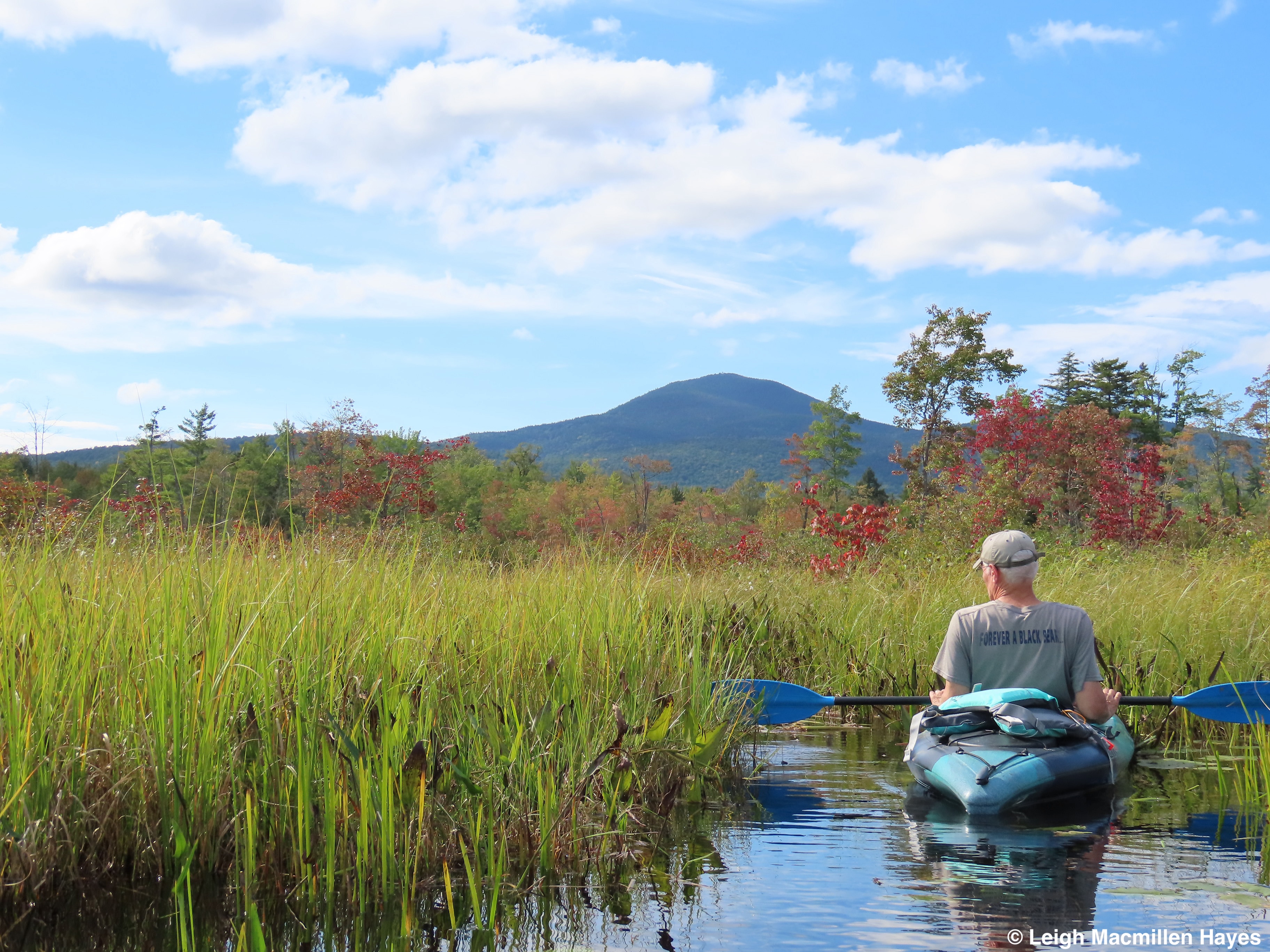
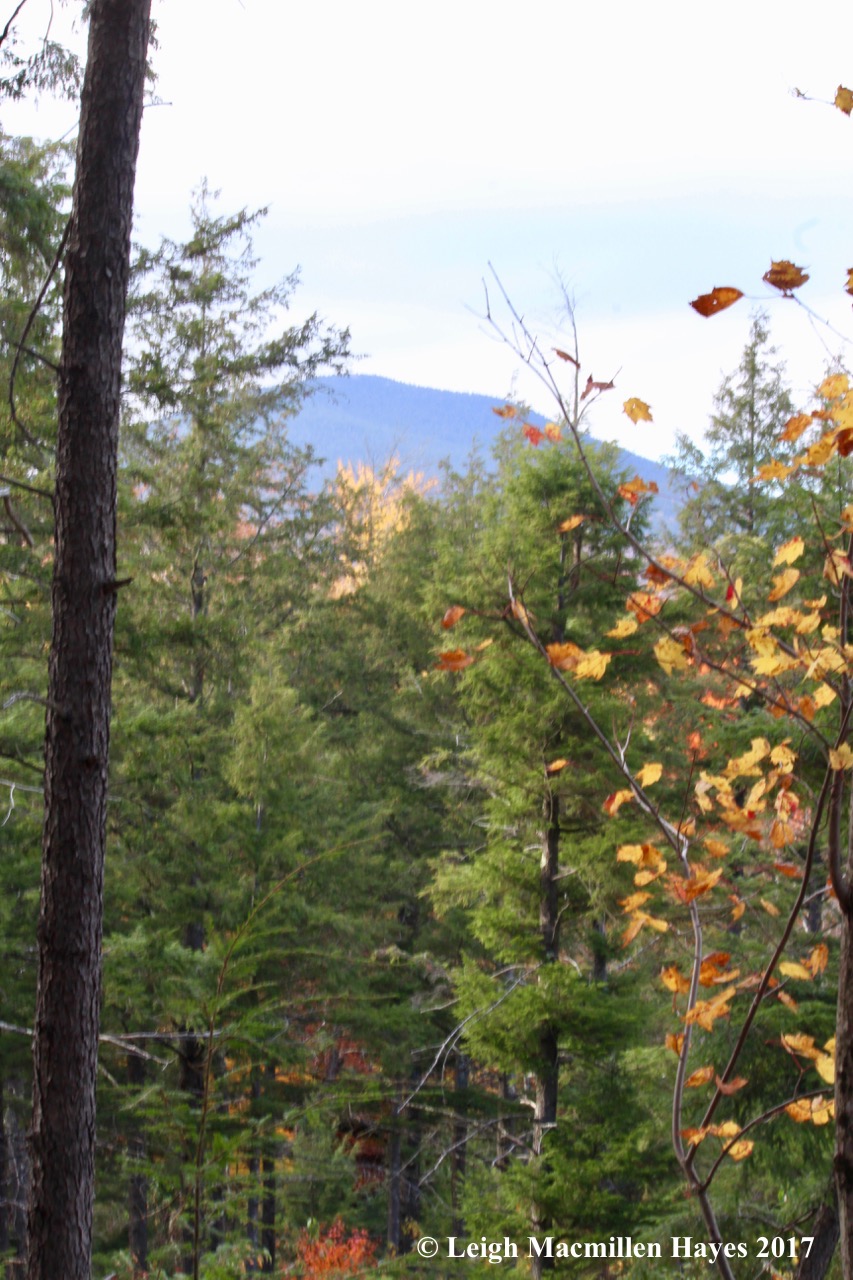
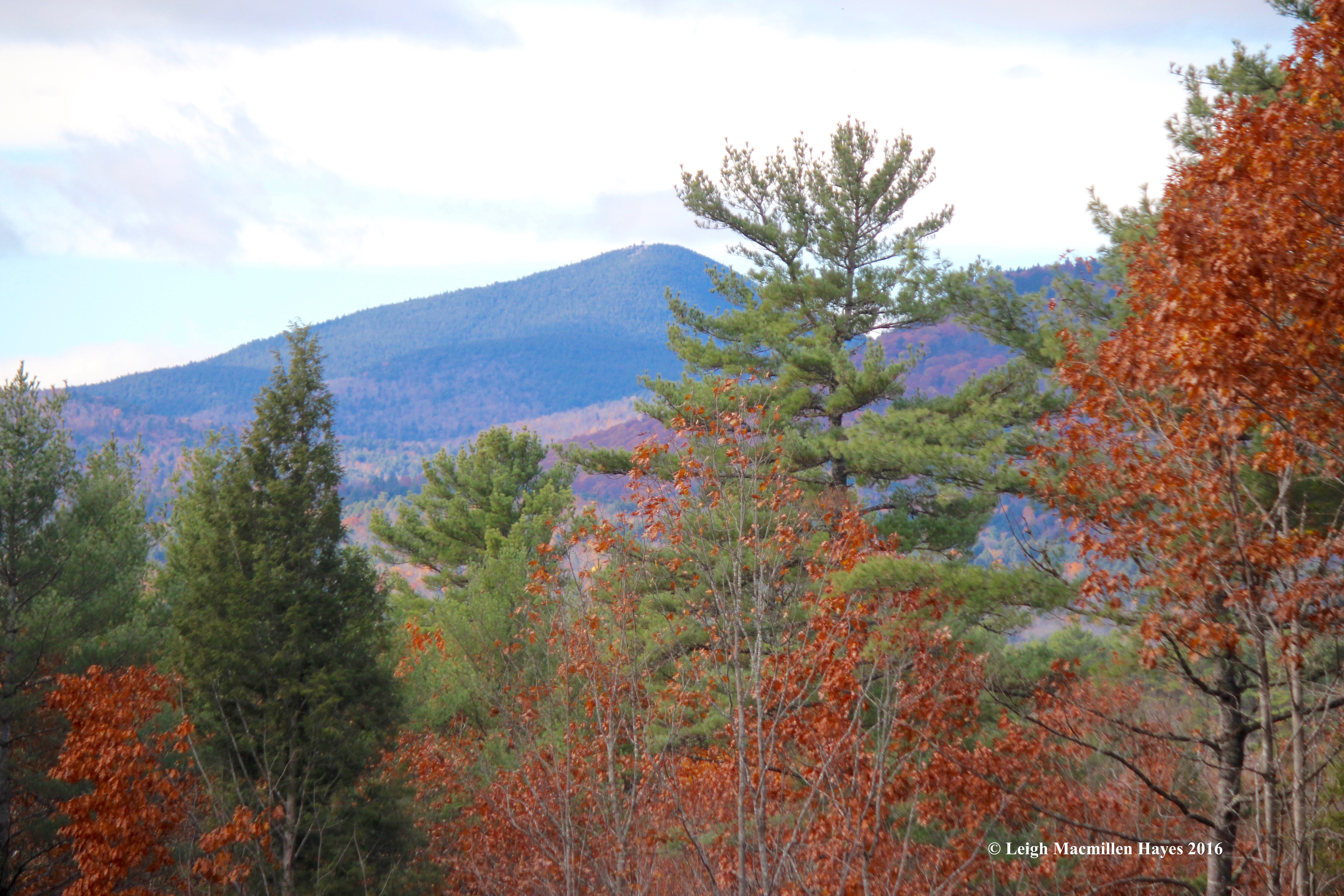
Just the colors made me happy as I followed My Guy who followed a brook as far as we could until the growth was too thick and we could hear water flowing over what was probably a beaver dam ahead. And so we turned around, but first honored Mount Kearsarge North, the pyramid mountain in the distance.

I extended the telescopic lens on my camera farther than I should have, but I wanted to see the fire tower at the summit of Kearsarge. It was incentive enough for us to decide to hike there again soon.

As we continued our clockwise journey around the perimeter of the pond, I was on a hunt–for those Pitcher Plants I’d been promised. But what caught my eye in the meantime was the late afternoon sun glowing on bowl and doily spider webs. And a beaver lodge in the background.
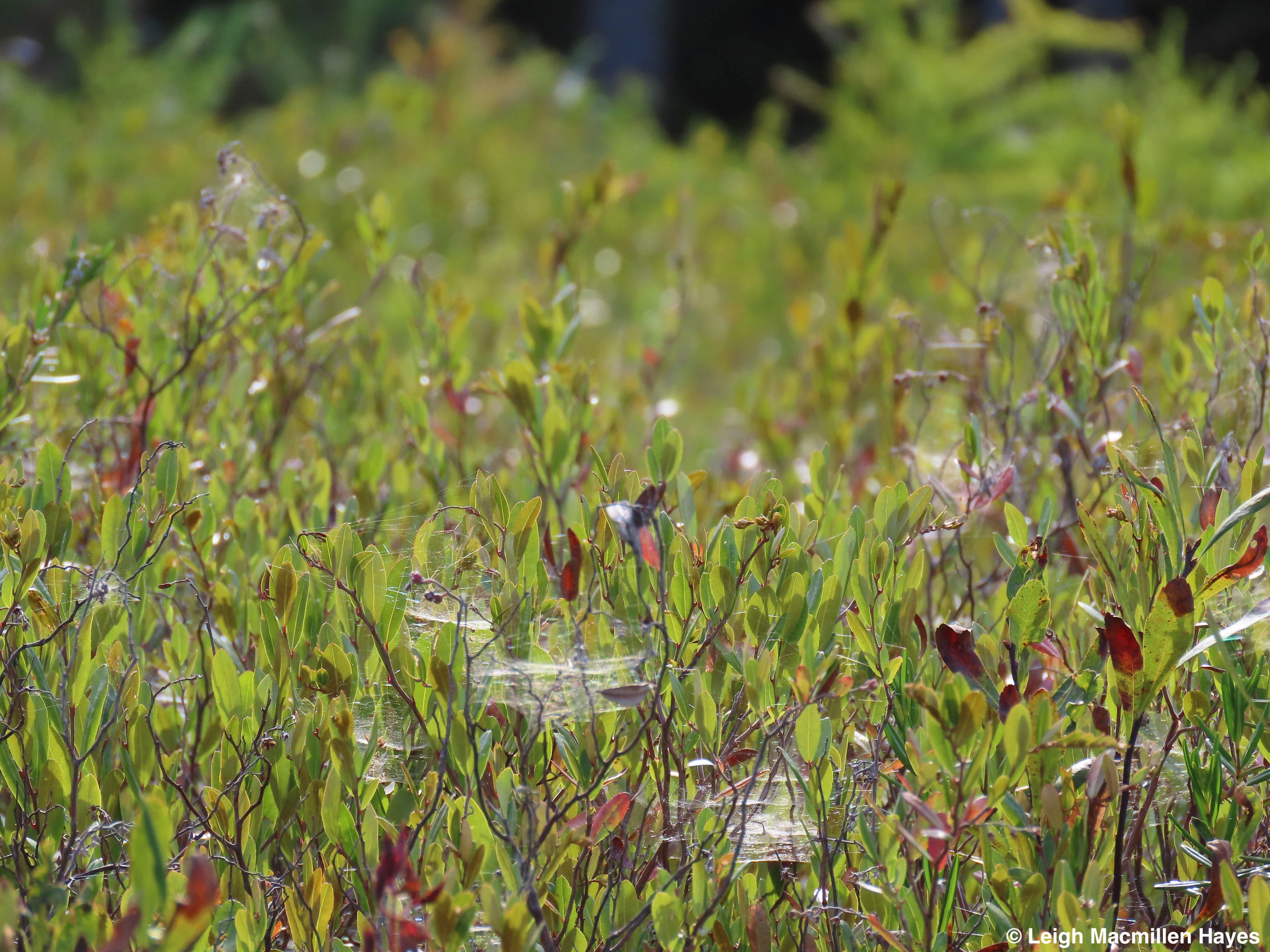
It always amazes me to find so many of the same type of spider webs in any one area. The spiders who wove these are rather small, but their web is incredibly complex.
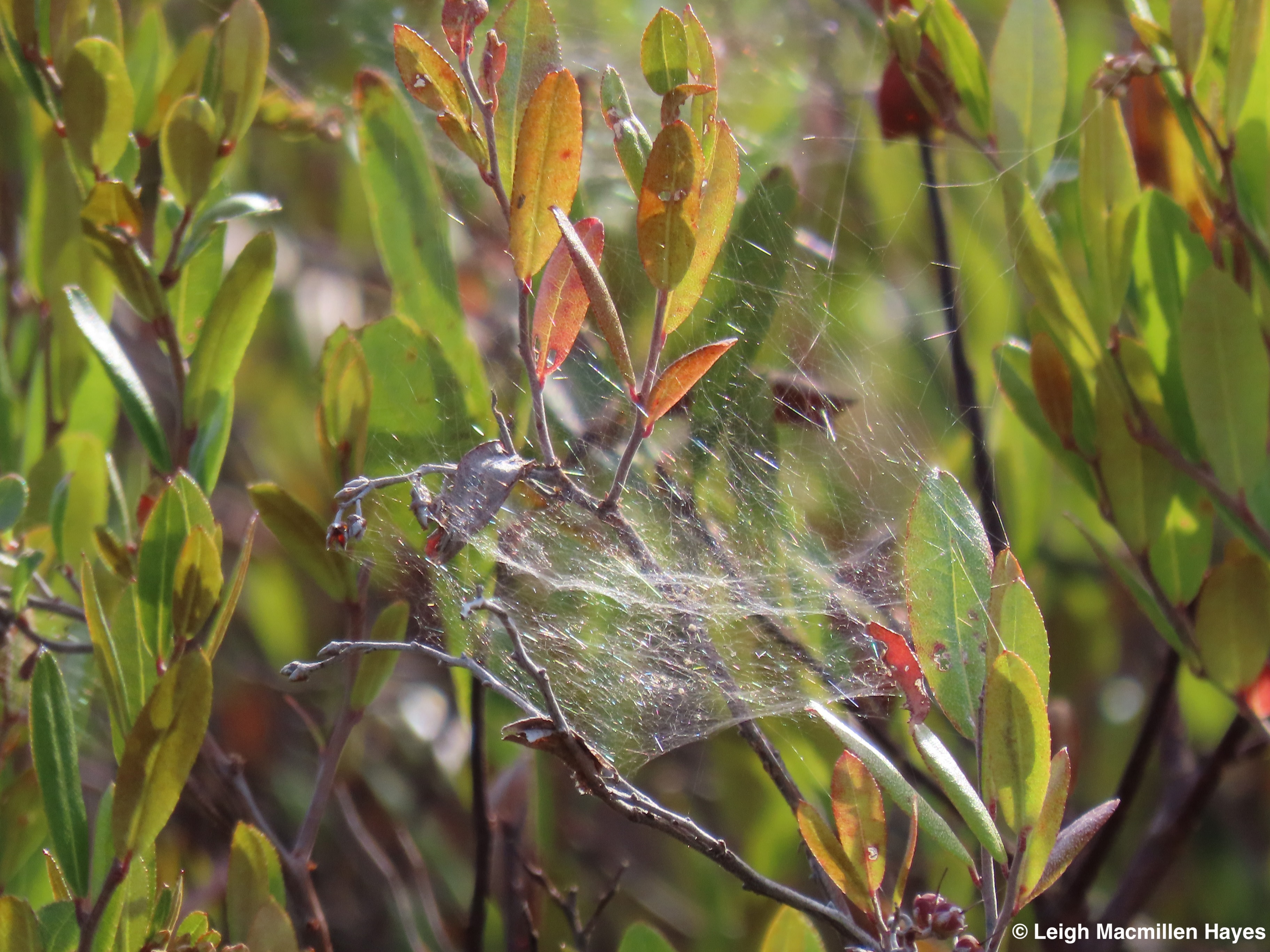
They weave a sheet web system consisting of an inverted dome or “bowl,” suspended above a horizontal sheet web, or “doily,” hence its common name. And then they wait for a meal to announce itself. Should the meal fall through the bowl, the doily serves as a safety net, thus the spider makes sure to not miss a bite.
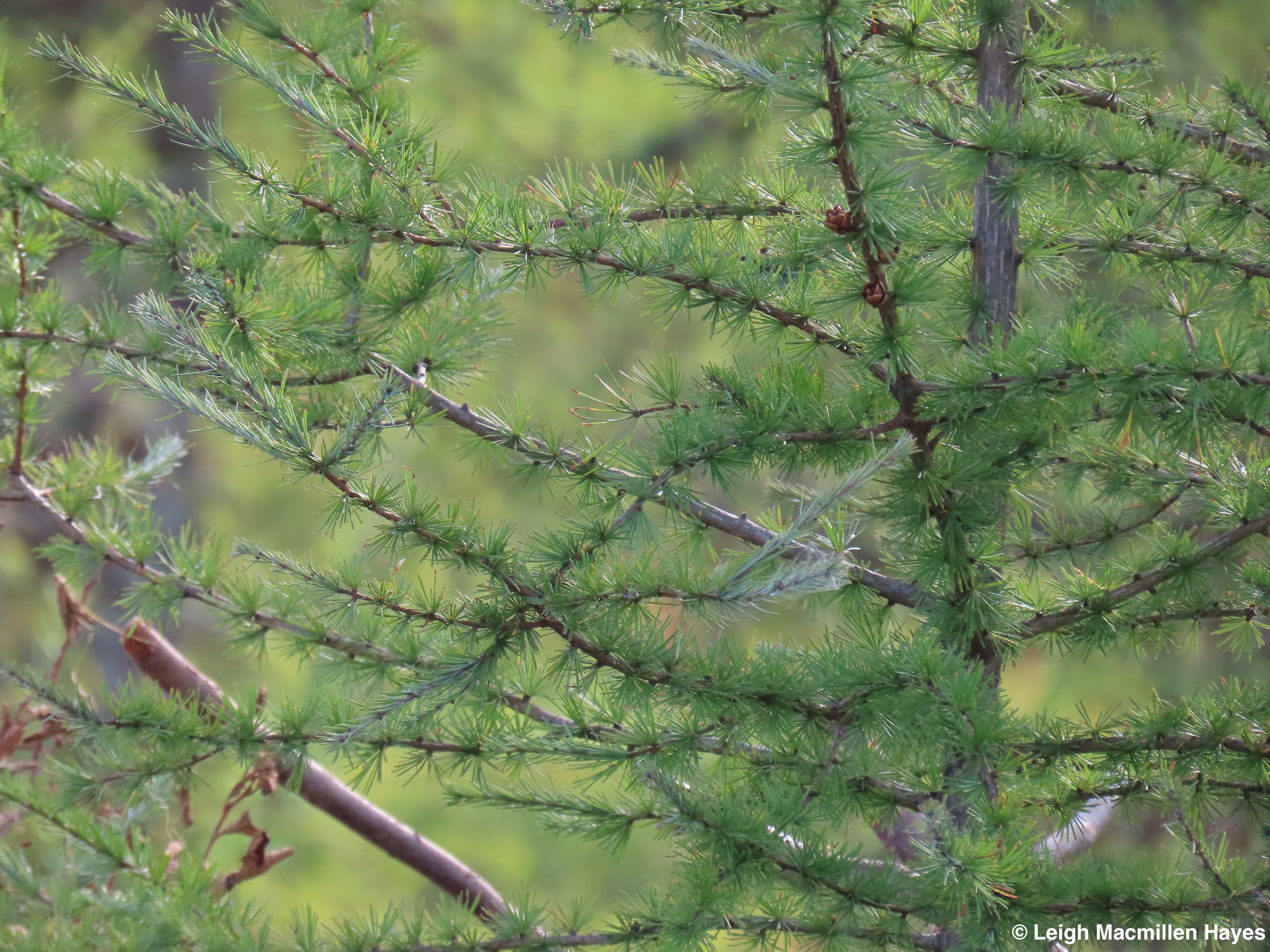
Before turning my boat to follow the shoreline again and continue my PP quest, I realized that a Tamarack grew upon the lodge. And there were several others nearby. I love these trees because they aren’t every day sights. And because they are kinda like me–beings that can’t make up their minds. Thus, they are deciduous conifers, meaning they are cone bearers who shed their needles (leaves), unlike other cone bearers in our neck of the woods who are evergreen.

I had only turned a wee bit when two structures standing above other plants caught my attention and I knew my quest had come to an end. Pitcher Plant flowers.

And below them the pitchers (leaves) for which they were named. That ruby red rim. The tree-of-life venation. And downward facing hairs. “Here little insects. Come check me out. I have a special drink I made just for you.”

At the base of the Pitcher Plant grew Sphagnum Moss and Leatherleaf, and . . . Sundews! Round-leaved Sundews–another carnivorous plant like the Pitchers. It’s a plant eats insect world out there.

As we rounded a bend nearing the end of our journey, a flock of Canada Geese honked and cackled.

And suddenly lifted off. My Guy counted 30.

At last we approached the launch site, but truth be told it took us about twenty more minutes to go the short distance because there were so many more turtles to spot. Do you see the second one in this photo?

And one climbing atop another as is their habit since turtles are ecothermic and the sun’s rays help raise their body temperature. So if your brother is on top of the log, why not climb on top of him to get even closer to the sun?

I spotted twelve in all, and love that the one on the right upon this log waved–as if to wish us farewell, for really, it was time for us to leave.

So we did, but first we gave a quiet thanks to our friend, Pam K., for recommending this delightful pond and telling me about a few of its highlights.

And I did promise a quiz, so here ’tis. Can you name at least one part of this dragonfly’s face? And can you name the species? Don’t worry if you don’t get all of the parts–that’s why I write a blog–so I can go back and remind myself.

Basking in the sights. That’s what we did much the same way the turtles basked in the sun.

Oh, and that line that the journey wouldn’t take us long–ahem. It was at least a two and a half hour tour. After all, it’s a wonder-filled world out there.
Spring Erupts–Sort of

Two days ago the thermometer climbed to 68˚ and old records were broken. But then, as it does in New England, we had a low of 15˚ this morning. And now it is sleeting.

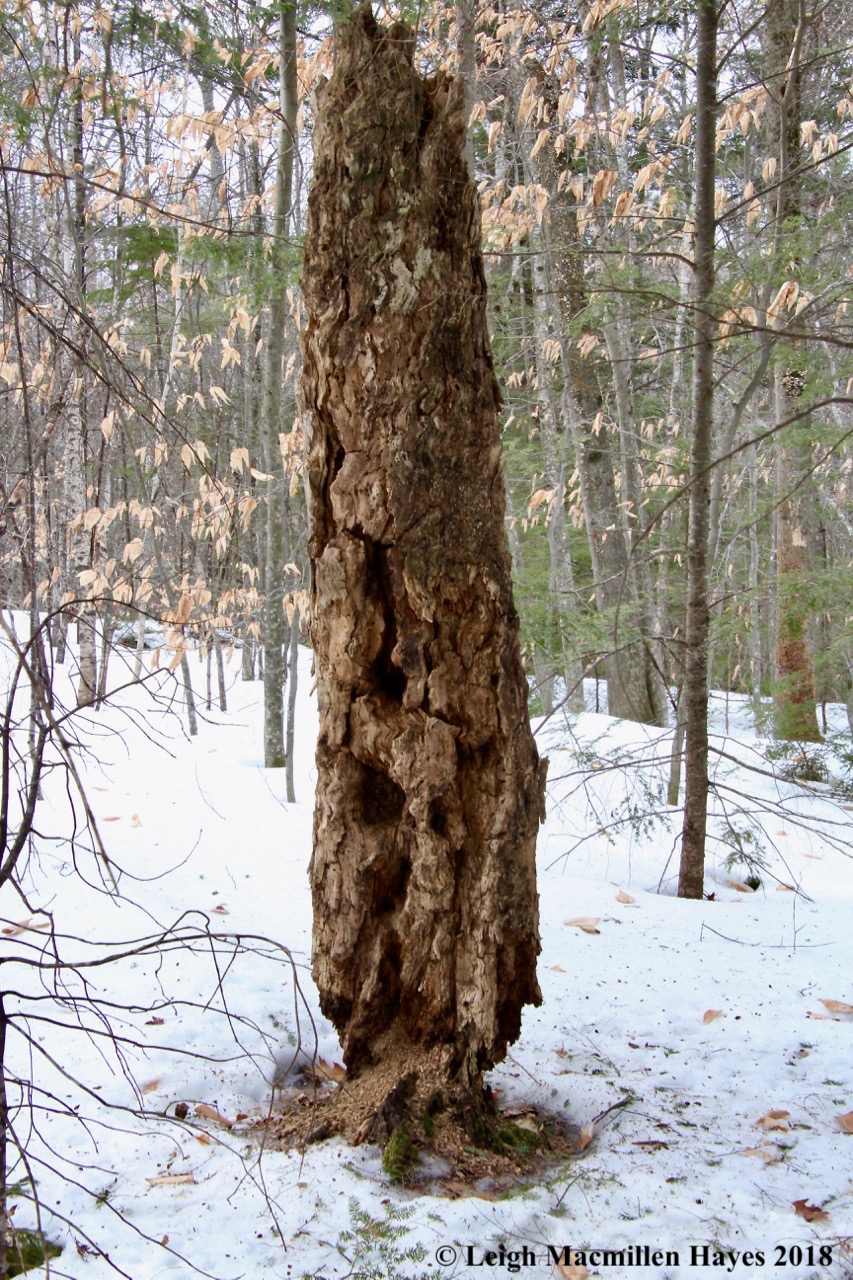
w-beech snag in complete decay

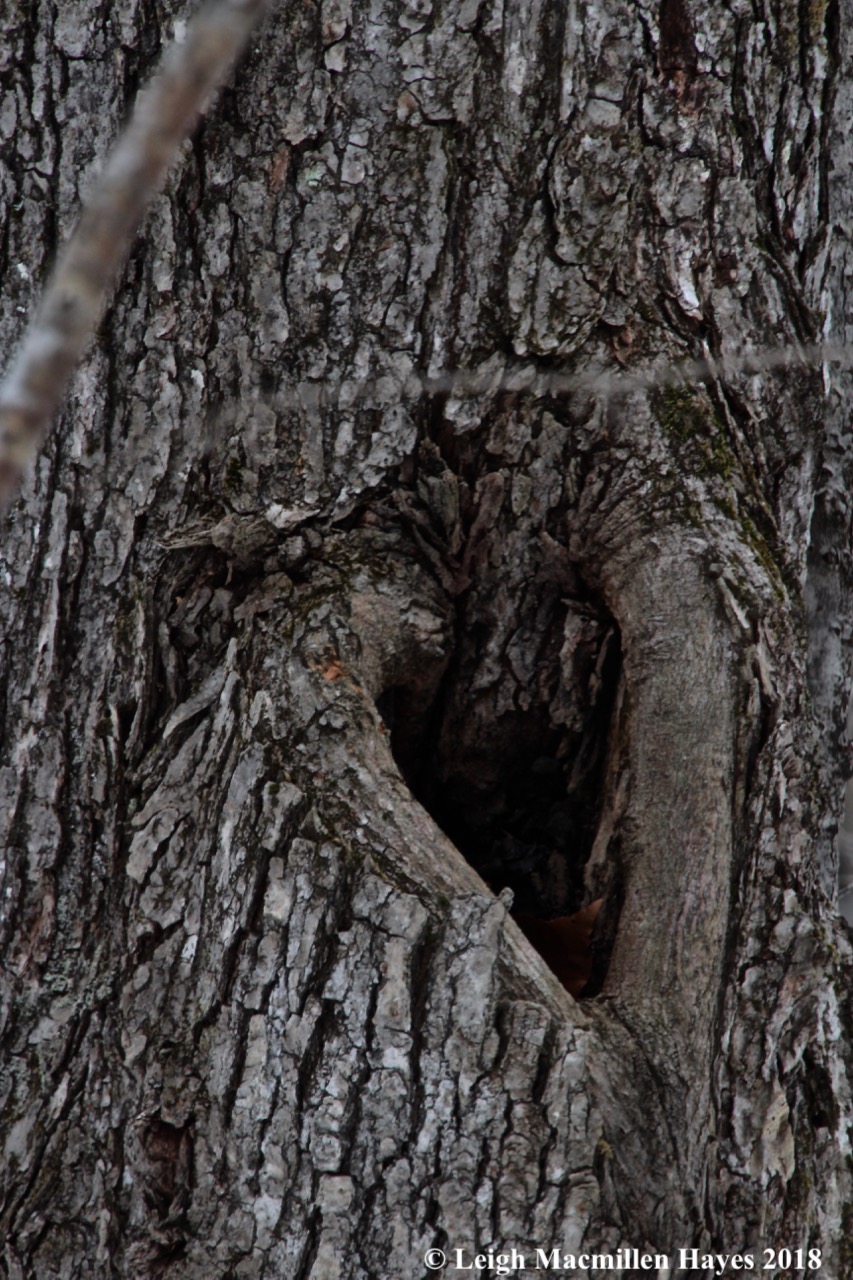
Before the sleet began, however, I decided to do a loop hike at the Greater Lovell Land Trust’s Heald and Bradley Ponds Reserve, beginning from the Gallie Trail and climbing up the Hemlock Trail to the summit of Whiting Hill, with a return via the Red Trail back to the Gallie. It’s a perennial favorite that always has some different things to offer, including the skeletal remains of a beech snag. I think what intrigued me most, besides the pileated woodpecker holes, were the lines of the wood, curved in nature.

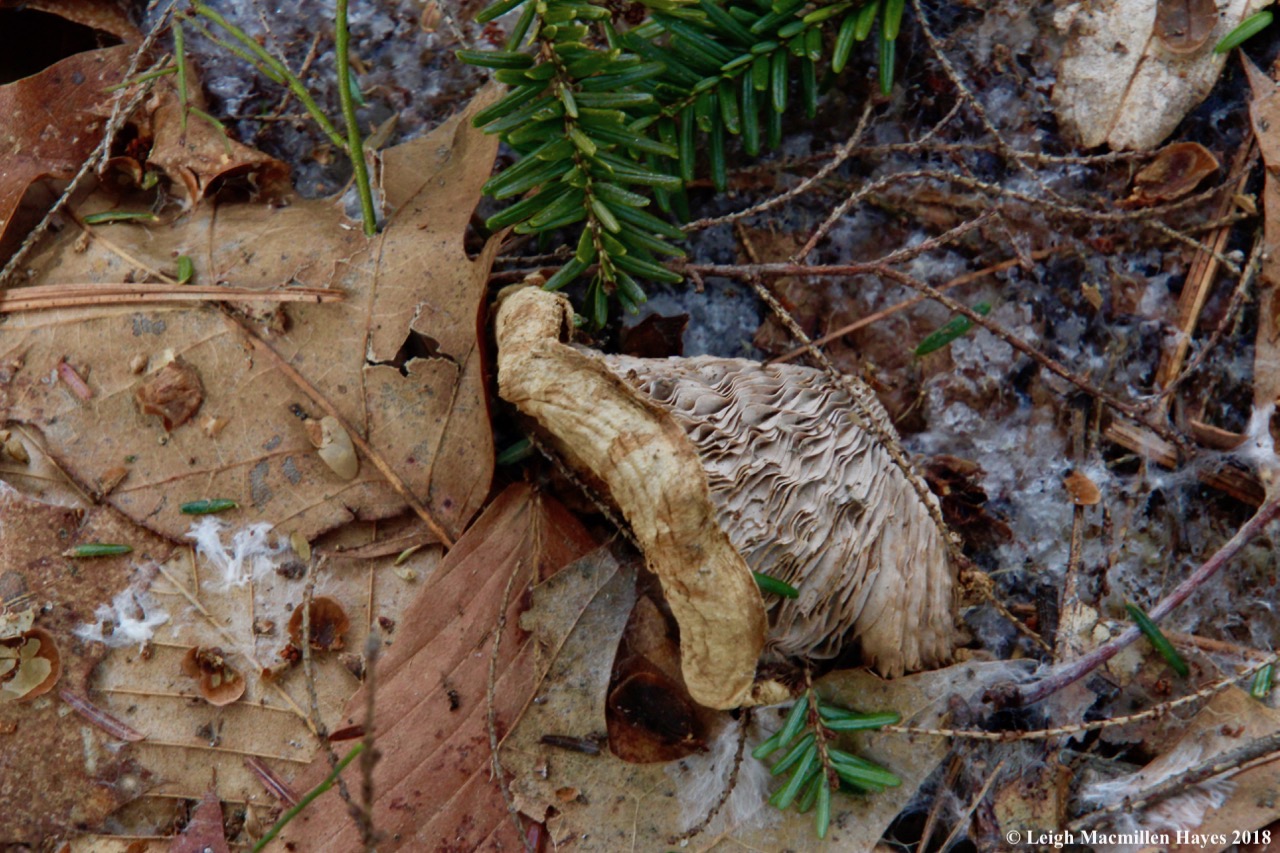
w-Lactarius deterrimus (orange latex milk cap)?

Similarly curved were the gills of a decaying Orange Latex Milk Cap (Lactarius deterrimus)–at least that’s what I think it was–found beneath a hemlock.

w-bear 1

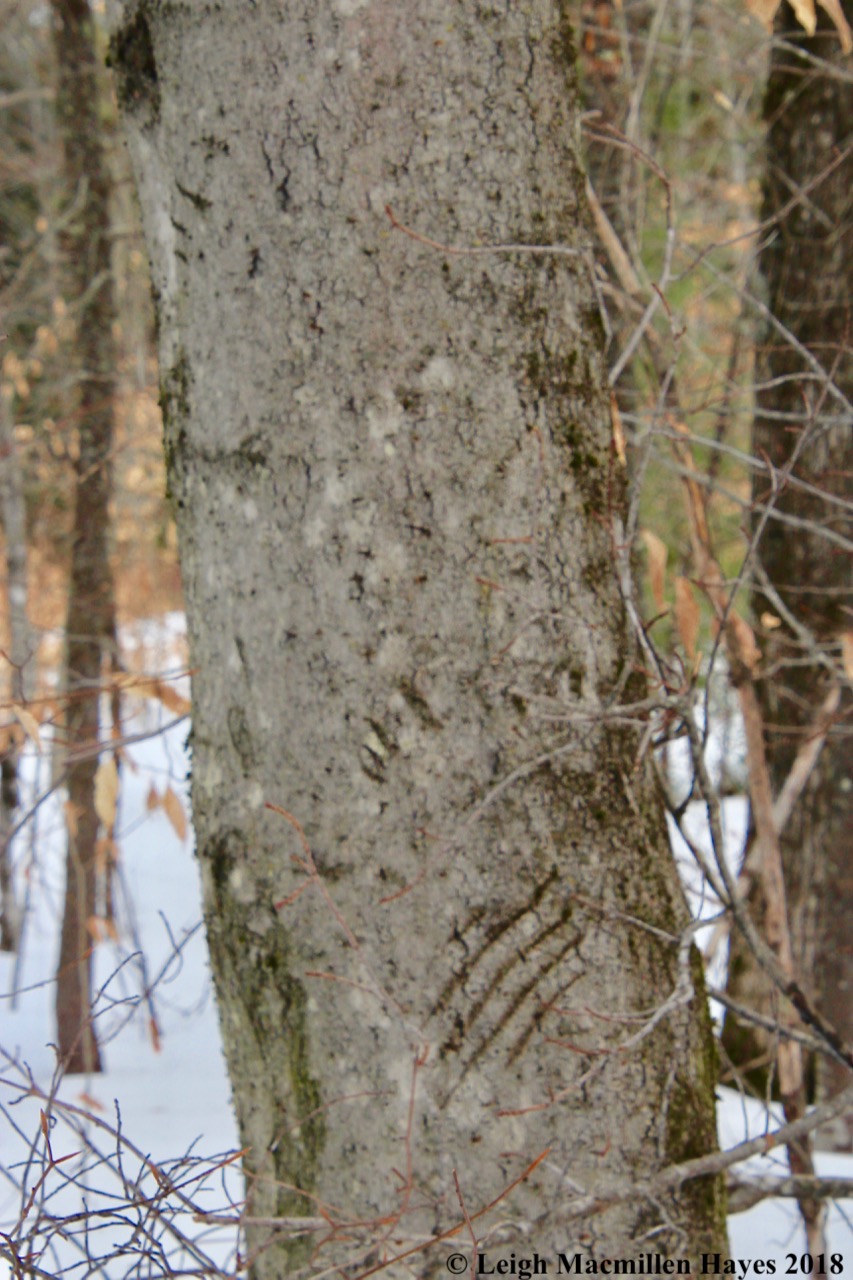
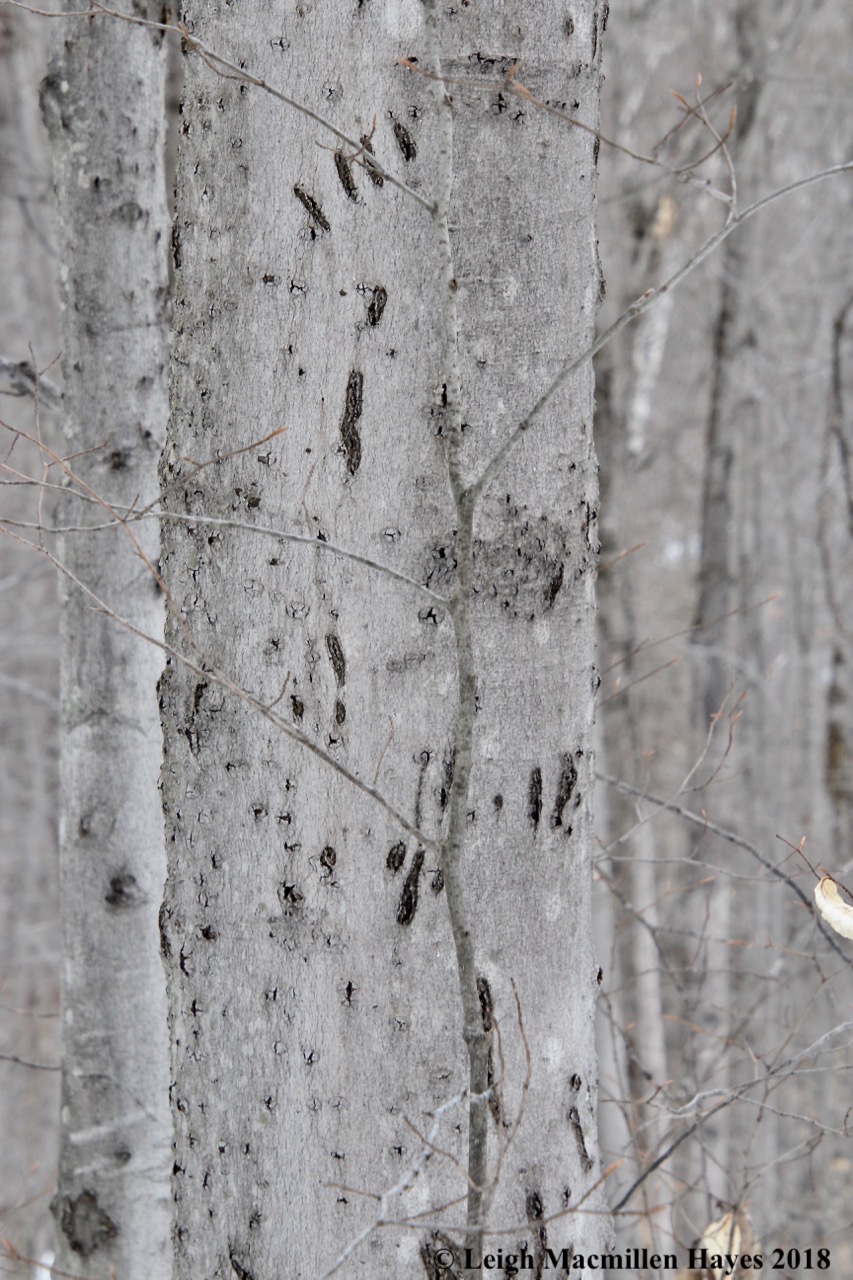
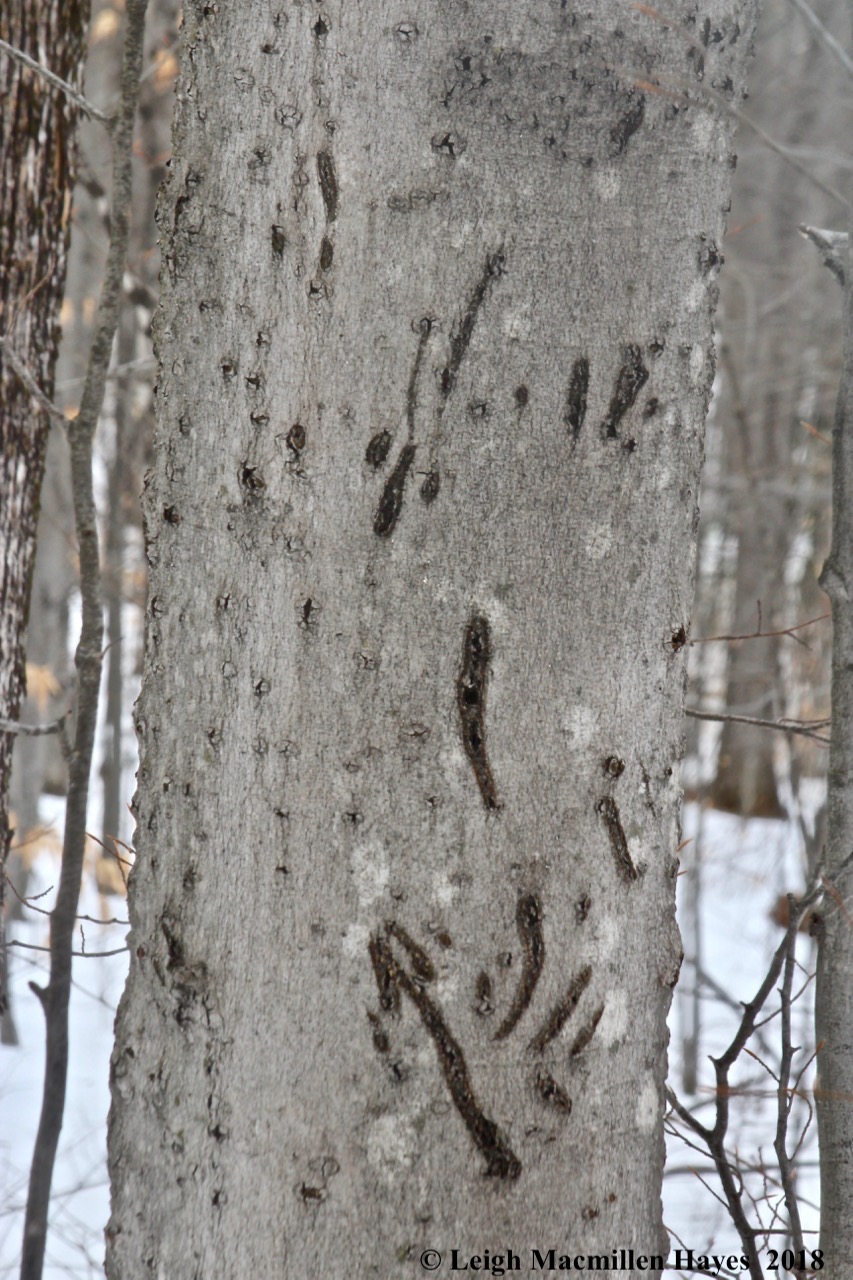
Part of my love for the Hemlock Trail can be found among the beech trees that also grow there and it is my habit to admire the lines that decorate them as well.

w-bear 2

No matter how many times I visit, I’m filled with awe.

w-bear 3

And wonder.

w-bear 4

For the black bears that left their signatures behind.

w-paper birch bark 2

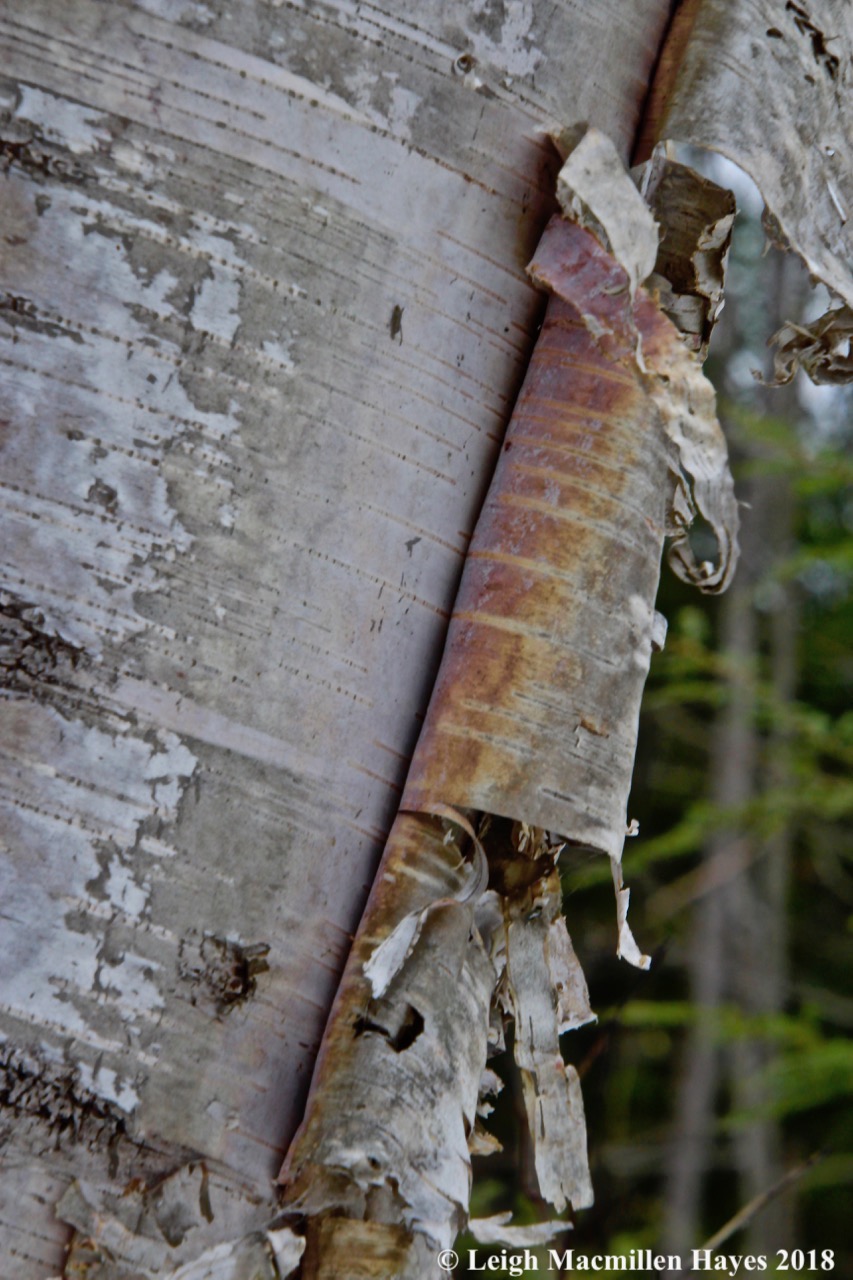
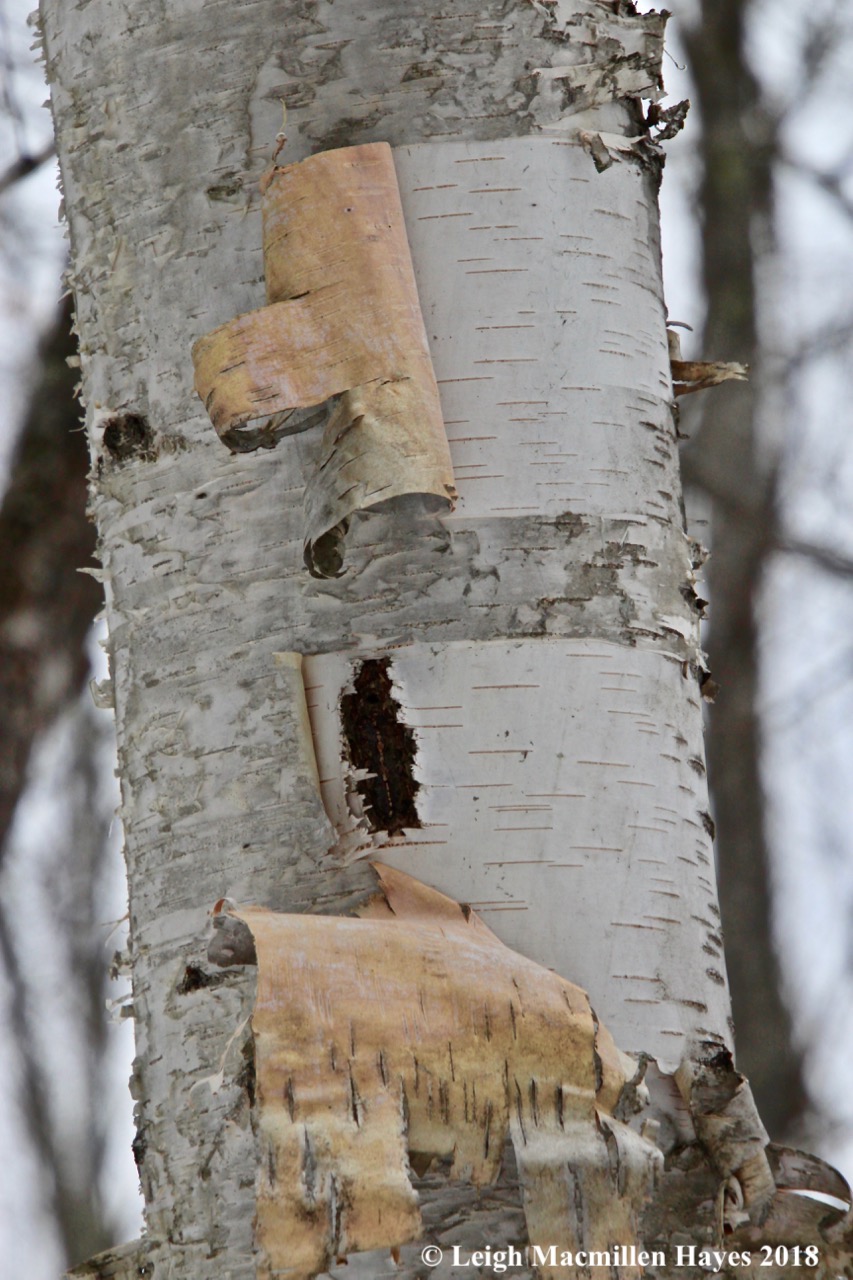
Other trees also gave me pause, for though some know them as white, I prefer to call them paper birch. The curled-back bark offered hues of a different color reminiscent of a sunrise in the midst of a graying day. As my mother was fond of saying, “Red sky in the morning, sailors take warning.” Today was a day to heed said warning.

w-paper birch bark 1

Others bespoke a setting sun.

w-paper birch bark--stitchwork

And not to go unnoticed, more bark from another paper birch that had fallen to the ground. It too, offered subtle pink hues, but it was the stitchery created by former lenticels (the tree’s pores) that drew my eye. They reminded me of a million zippers waiting to reveal hidden secrets.

w-yellow birch bark

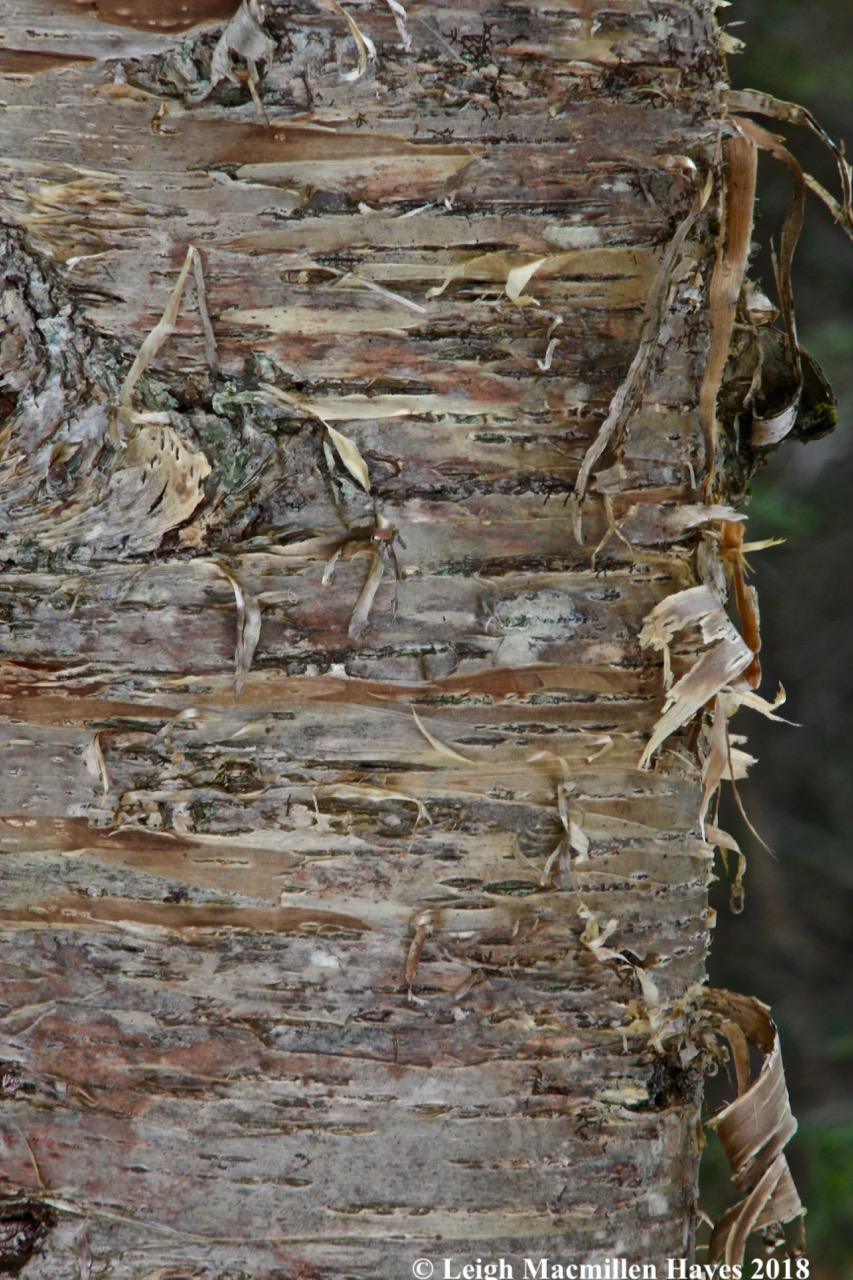
And then there was the yellow birch–with its ribbony bark shedding its own light on the world.

w-wintergreen

Around the base of some trees, the snow had melted and wintergreen plants showed off their transitional colors–winter magenta giving way to summer green.

w-bench over Heald Pond

At last I reached the summit and headed to the east side first, where Heald Pond was visible through the bare trees.

w-Mollisia cinerea--gray cap?

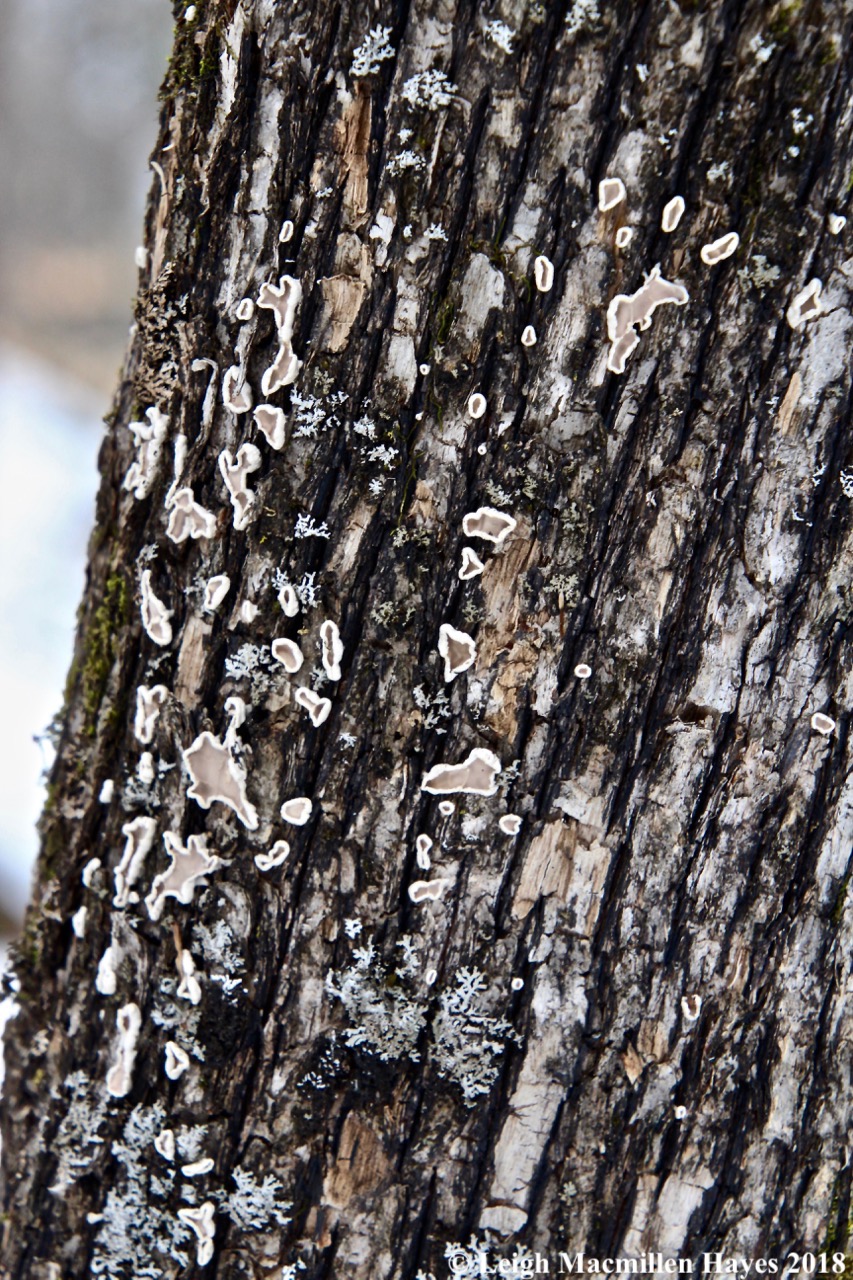
Nearby, still another tree invited a closer look. I love the bark of hophornbeams, but this one sported a growth I wasn’t familiar with until I checked Lawrence Millman’s Fascinating Fungi of New England upon my return home. In the world of mushrooms my knowledge is enough to be dangerous, but I trust my fungi friends will weigh in if I’m wrong on the ID. I’m going out on a limb and calling this one Gray Cup (Mollisia cinerea), for it seemed to match Millman’s description: “With luck, you might find several hundred of these stalkless ascos . . . each fruiting body will be more or less cup or saucer-shaped, but wavy or irregular in age.” And he describes their habitat as scattered or densely crowded under hardwood logs. Well, these weren’t under a log, so that made me question my ID, but they certainly seemed to match the rest of the description and hophornbeam is among the hardest of the hardwoods.

w-hophornbeam

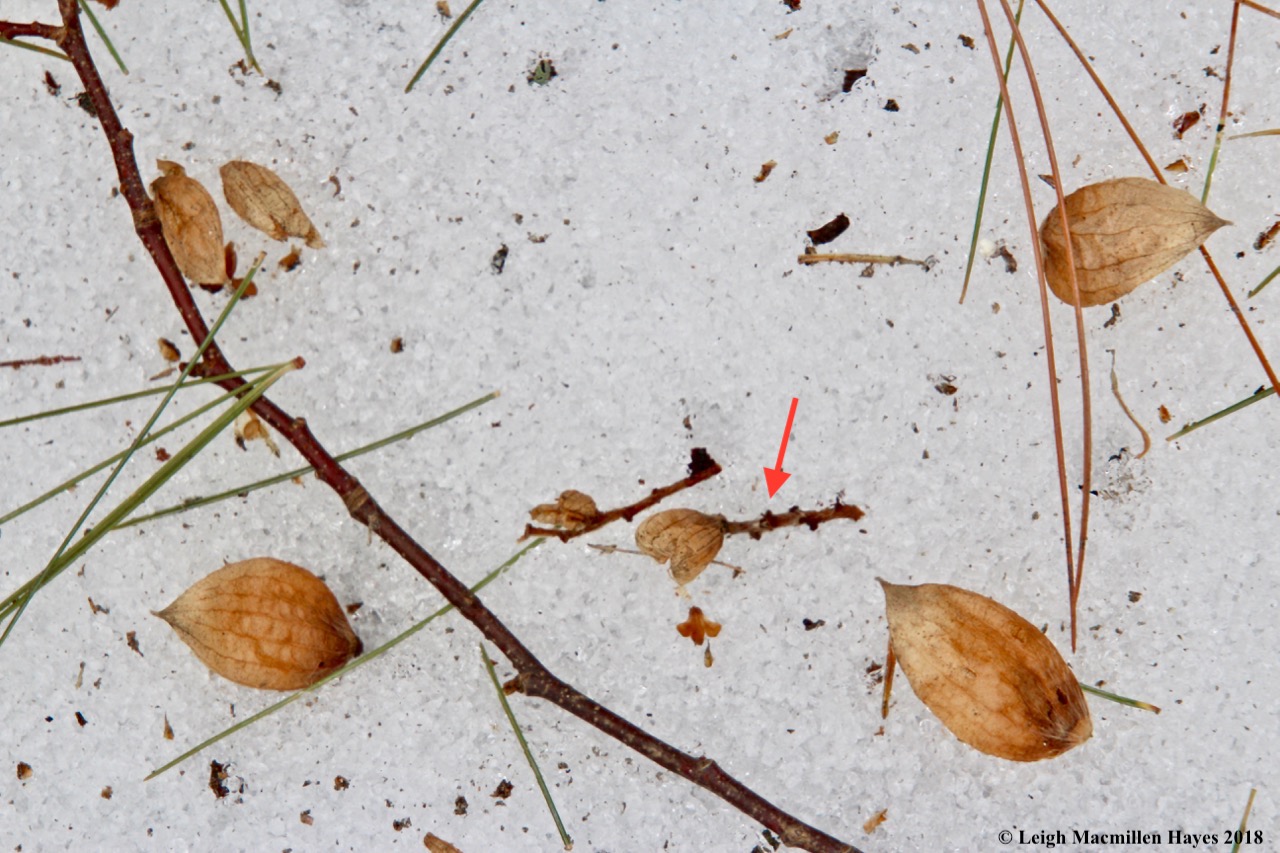
Below another hornbeam I found the ground scattered with little fruits.

w-hophornbeam hops

The common name for the tree derived from those fruits, which when attached to their twig (the arrow points to such) are so arranged that they look like hops. As they fall, each little bladder that contains a single seed separates from the group in hopes of finding the right spot to grow into the future.

w-vole tunnels

As I moved toward the western outlook, half tunnels in the snow let me know that the vole community had been active. It probably still is . . . maybe.

w-Whiting Hill view toward Kearsarge

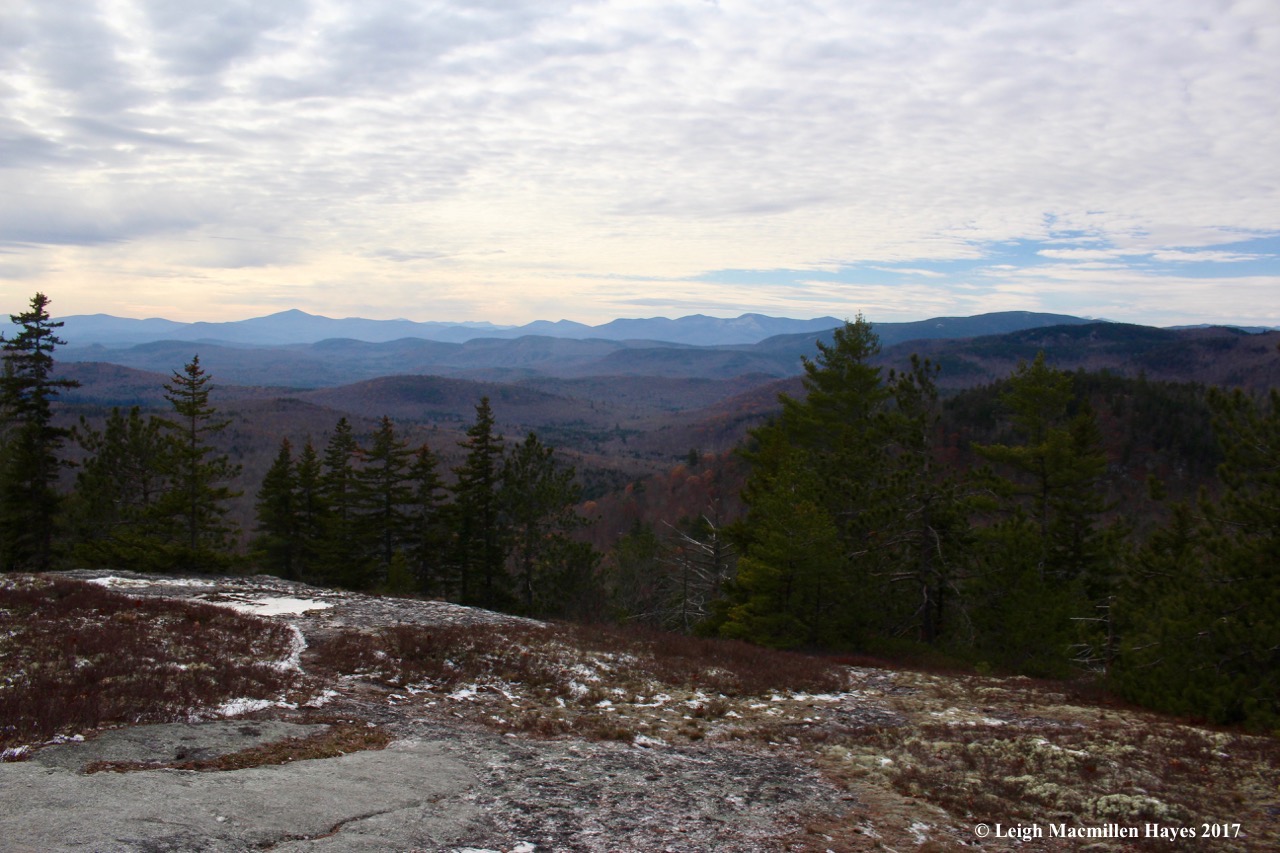
And then, the view to the west, which encompasses Kezar Lake, Mount Kearsarge and the Whites. The scene changed a bit last October when a windstorm just before Halloween toppled a dead white pine . . . and the cairn that marked the summit.

w-asters in snow

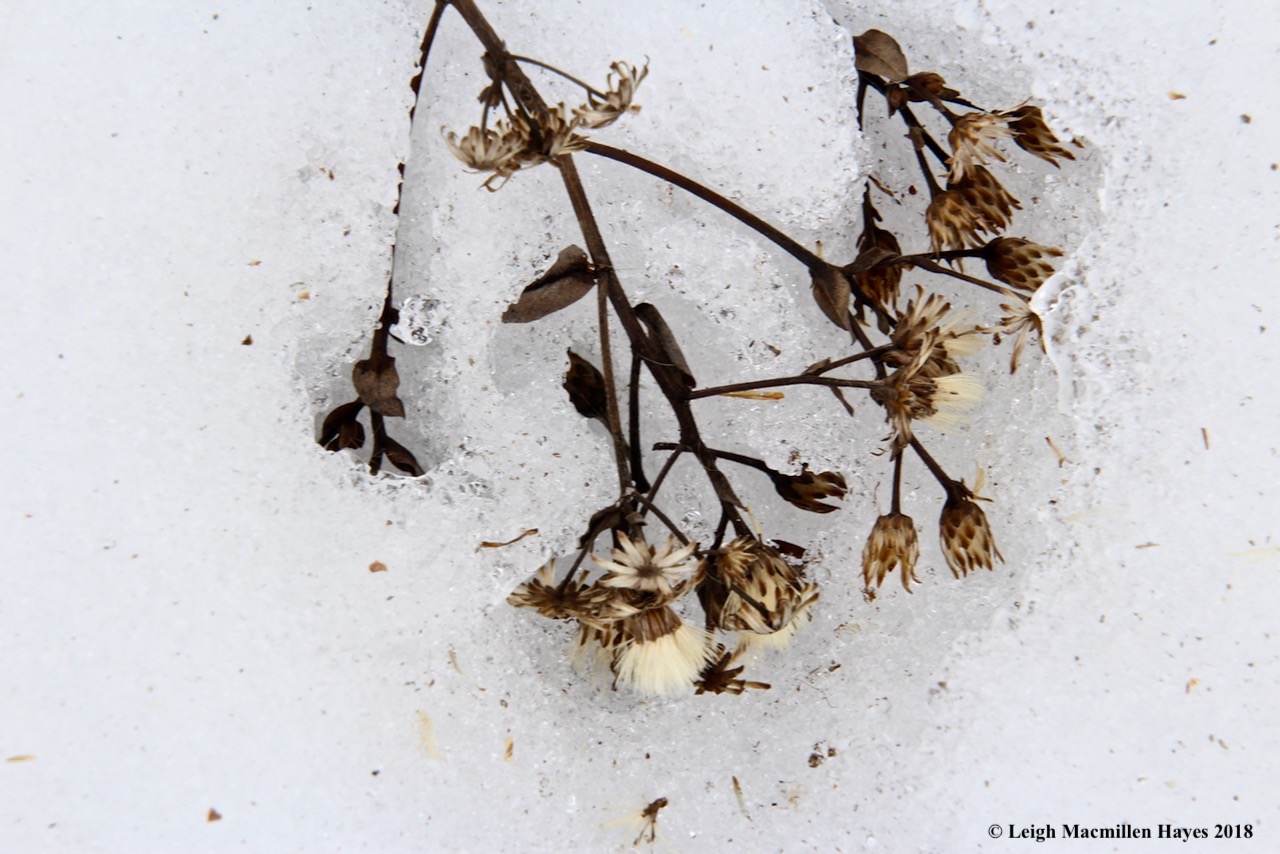
While there, I looked around for evidence of the wild columbine that will bloom in a few months, but found only asters hugging the snow.

I stayed for a few minutes, but the wind had picked up and so I finally turned to head back down.

w-white pine blue sap

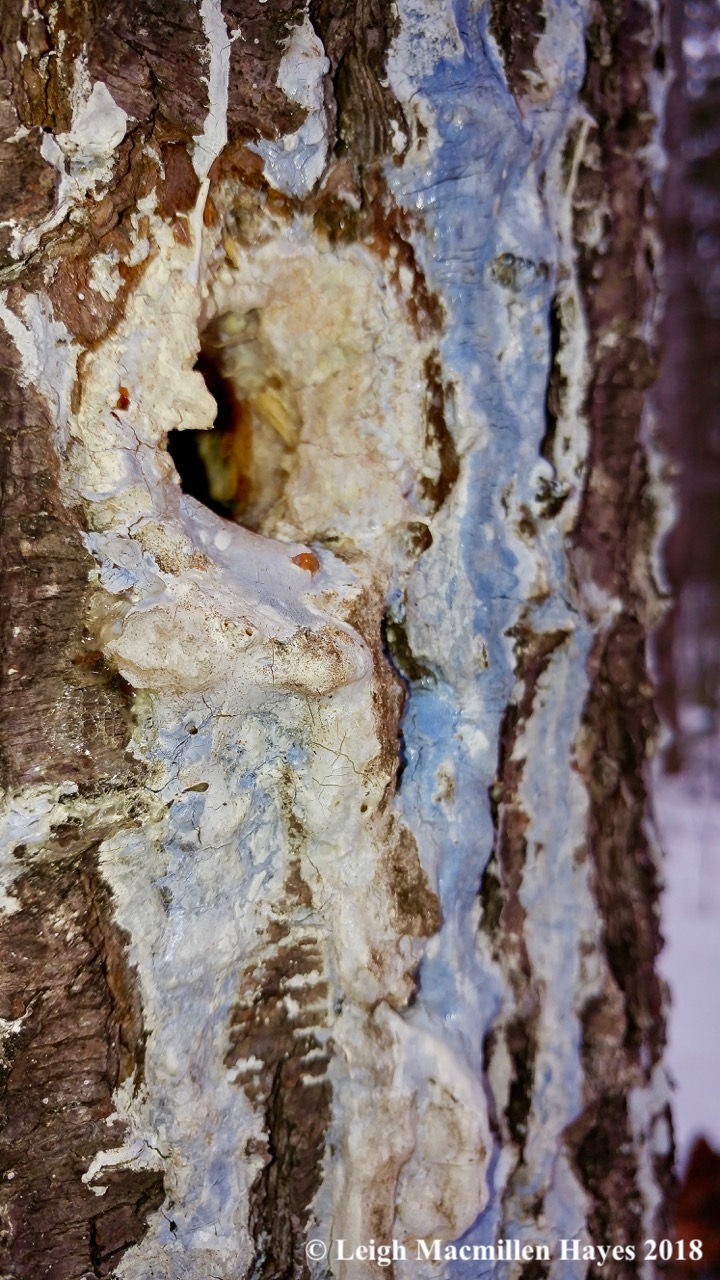
For a short link, I followed the same path until I turned right onto the Red Trail. Just prior to that I realized I’d missed a sight on my way up–the blue sap that bled from a white pine. I’ve seen it often over my years of noticing, but have no idea why the color blue, which was really almost periwinkle. In this case, the sap flowed because a pileated woodpecker had been hard at work.

w-pileated scat

And that meant I had to look–and wasn’t disappointed. Woodpecker scat. It was so well packed, that I pulled out my hand lens and got down on my knees for a closer examination. I practically kissed it but can say for certain that insect parts were layered within.

w-heart

A few minutes later, the trail split and as I said earlier, I followed the Red Trail to descend. I had only gone a wee bit when I heard a barred owl call, “Who cooks for you? Who cooks for you all?” It was noon, after all, so it seemed totally appropriate. The call came from somewhere near the summit and I had to wonder if I’d made the mistake of not looking up quite enough, so taken was I with the hops and the view to the west. Perhaps that vole had provided a meal. And then I heard a response somewhere quite possibly along the Hemlock Trail by which I’d ascended. For about five minutes they called back and forth and I thought of the irony, for months ago I’d scheduled an Owl Prowl for this evening, but had cancelled it this morning due to the weather forecast. That decision was the right one, but perhaps the prowl should have been scheduled for an earlier time. No matter–what’s not to love about hearing an owl hoot at any time of day or night? Especially if one happens to be standing near a tree sporting a heart.

w-lunch bench

Continuing down, another critter made me scan the forest constantly for I saw bobcat tracks and smelled a musky cat odor that I’ve previously associated with this trail. But . . . all I saw were gray and red squirrels scampering from tree to tree and signs of lunch consumed on benches.

w-chipmunk

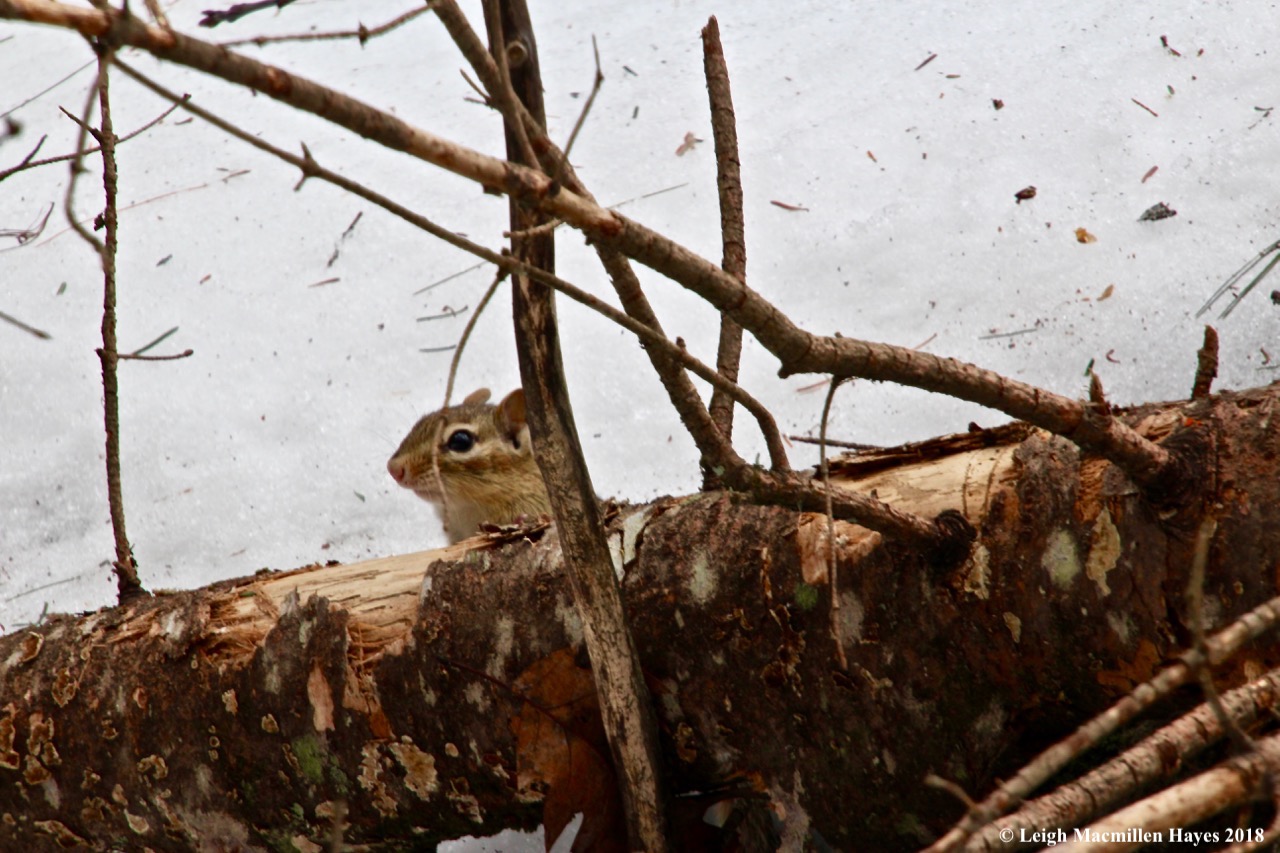
At the bottom, I switched back and forth between the Gallie and Homestead Trails. It was along the Homestead that another sign of spring’s advent being around the corner showed its face as a chipmunk darted in and out of a hole in a stonewall and watched me from the safety of a fallen tree.

w-foundation filled with chunks of ice

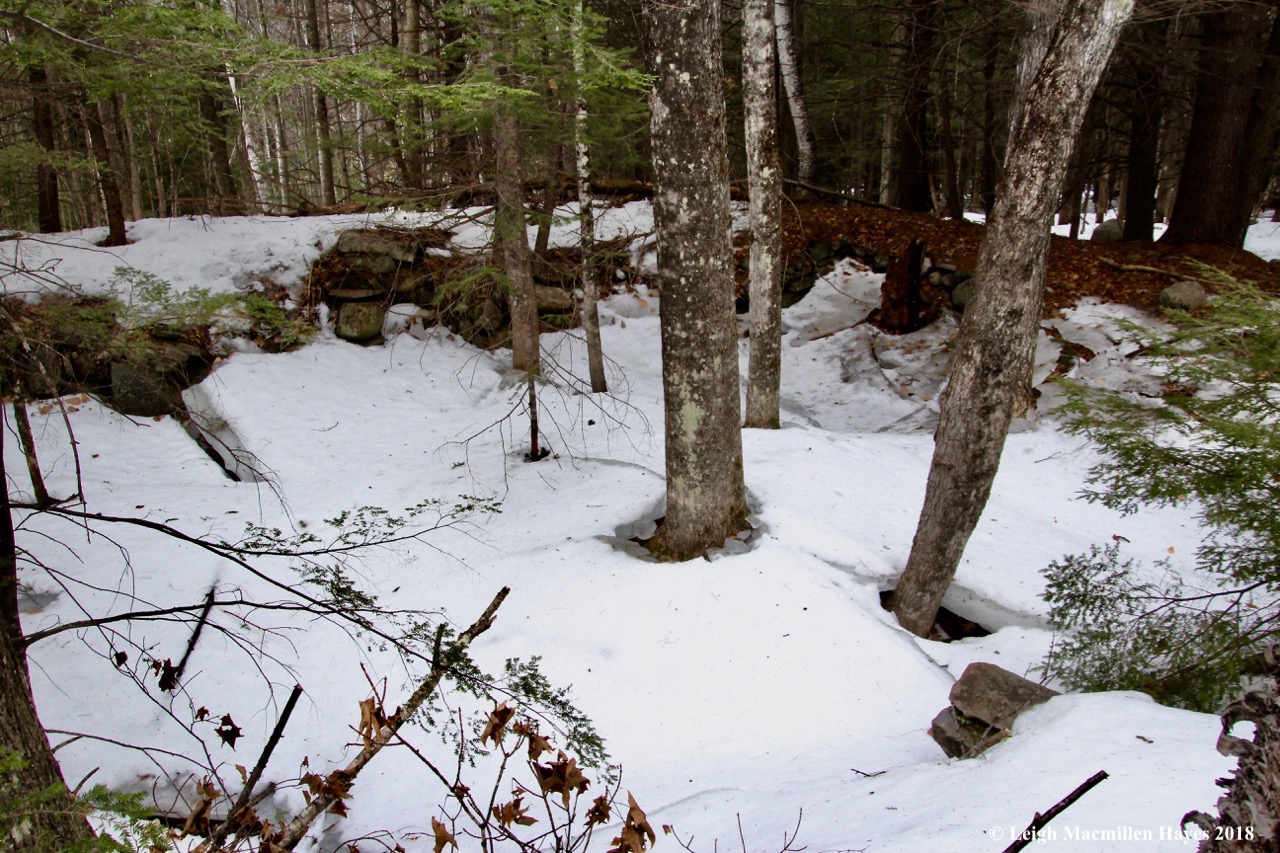
Because I was there, I decided to pay a visit to the McAllister family spirits and told them of my great finds. Of course, what I shared was nothing new to them for they’ve been keeping an eye and ear on this property since the mid 1800s.

w-foundation 2

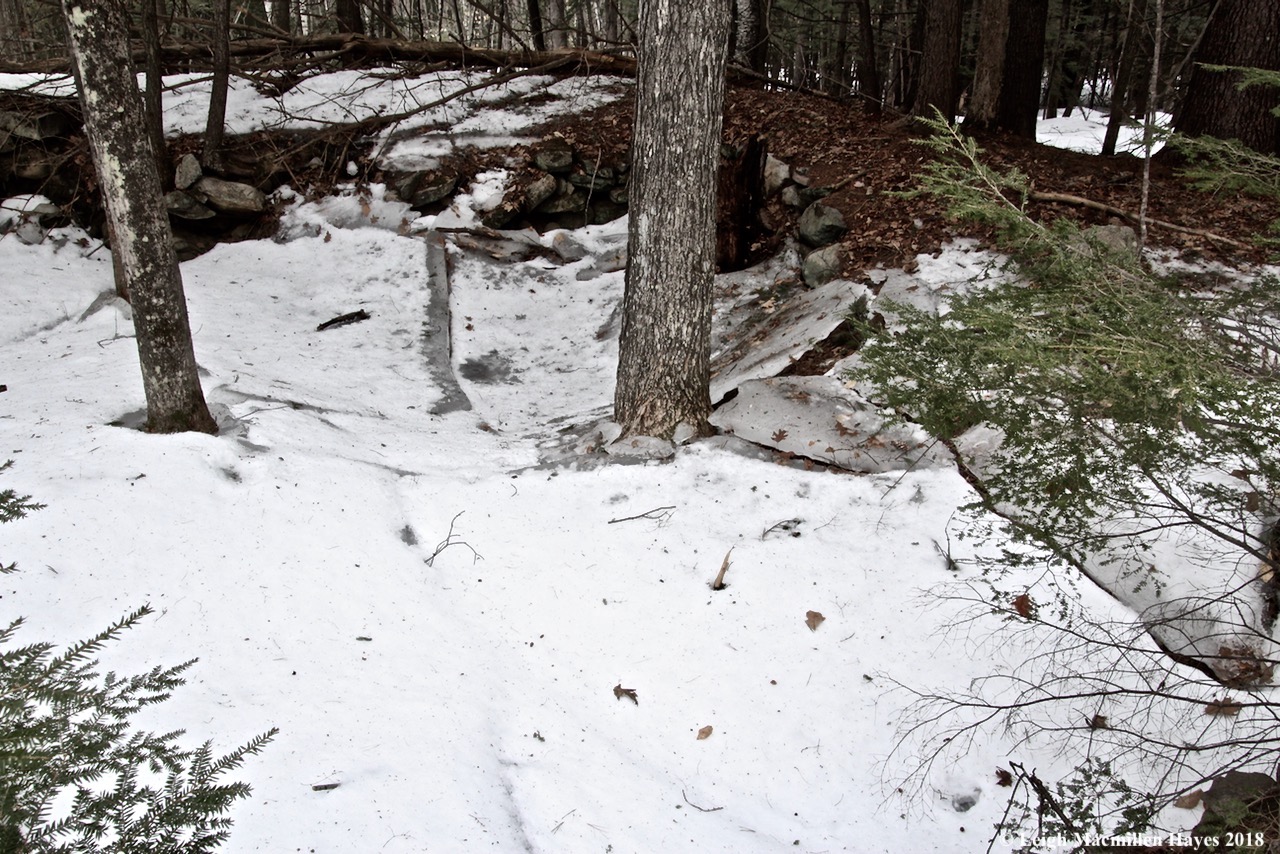
I also let them know that I was impressed they’d stacked up on ice blocks in the root cellar–certainly their produce had remained fresh throughout the season.

w-spring 1

I was almost back to my truck when I detoured by a certain yellow birch. All along I’d been walking on tracks others had made, so packed was the snow. And even when I went off trail, which was frequently, I didn’t sink. But . . . up to my knees I went as I approached my final destination–the light colored sand in the middle of  the water.

w-spring 2

It was well worth the wee challenge to get to it for the action of bubbles and sand flowing like lava was ever mesmerizing. At last I’d reached a spring that erupts in all seasons.


Firsties

A week ago, I joined friends Marita and Marguerite Wiser for a hike up Albany Mountain from Crocker Pond Road. At the summit, we searched for a loop leading off from the left that I’d been told about, but couldn’t find it. There were cairns leading to the right, but we didn’t see any to the left.

a1-trail sign

And so today, my guy and I headed back up the mountain with a quest in mind–to find the loop. For you see, this week when I again questioned the friend who’d told me about the summit loop, I was assured it was there and we just needed to follow the cairns to the left.

a2-ice on beaver pond

Not far along the trail, we reached the old beaver pond, which was open water last weekend, but coated in a thin layer of ice today. A first for us this season.

a3-dam crossing

We crossed the old beaver dam, made a wee bit easier because of the freeze.

a4-3 in 1 trees

And then we began climbing. Suddenly, I spied a red pine. A lone red pine. A red pine worth inspecting, for I suspected this was bear territory and thought perhaps the tree would show evidence of a past climb since it was the only red pine in the immediate area–bears like something different like a lone red pine. There were no signs of claw marks, but we did wonder about the resources shared by the pine, red maple and beech–a trinity of brethren in these mixed woods.

a5-ice

Moving upward, like all streams this month, water flowed with passion and because of the sudden drop in temperature this past week, ice formed upon obstacles. We slipped off the trail to admire its every rendition.

a6-more ice

Each coated twig offered its own fluid art.

a8-ice spirit

But my favorite of all was the ice spirit who watched over all as his beard grew long.

a9-ice needles

Back on the trail, conditions changed as well and ice needles crackled under our feet, adding to the crunch of dried beech and maple leaves.

am1

We weren’t far along, when we spied snow–another sight that made my heart sing on this brisk November day.

a10-SNOW

For us, it was the first snow of the season and we hope it bespoke the future.

a11-snow on the leaves

The higher we climbed, the more snow we saw, though really, it was only a dusting. But still–we rejoiced.

a12-new steps

Eventually we came upon some new trail work. Actually, last weekend, we’d chatted with the creator of such steps; and on our trip down, I’d asked him about the summit loop because we hadn’t found it. He said there was no such thing. But my friend insisted on such when I told her this info.

a13-climbing higher

On we climbed, reaching bald granite where sometimes conditions were slick. I’d brought my microspikes, but the trail wasn’t difficult and I never did pull them out of the pack. Still–better to be safe than sorry.

a14-Summit sign

At 1.5 miles, we reached the junction. And headed upward to the summit.

a19-ledge 1 view

About one tenth of a mile along, we turned right and followed a spur trail out to a ledge where the view west offered a backdrop featuring the White Mountains.

a16-first ledge and my guy

We suspected the summit loop may have taken off from this point, so my guy went on a reconnaissance mission to the left–to no avail.

a20-Mt Washington

But we did enjoy the view–including the summit of Mount Washington.

am3

Then we went in search of the mountain sage. Given the condition of its glasses, however, we suspected it was feeling a bit bedraggled from the recent wind. Or maybe it had tried to find the loop as well and was just plain tired from coming up short.

a21-lunch rock view

On to Albany Mountain summit we marched. And then we sat on a clear spot upon the granite to dine on . . . none other than the famous PB&J sandwiches (mine with butter, of course). Our view was framed by red pines and spruces.

a23-red pine needles

As it should, the red pines exhibited the look of chimney sweep brushes.

a22-red pine

One bent over, its leader long influenced by the northerly winds.

a23-spruce

Even a spruce known for its spire-like stance had performed the wind dance.

am4

After lunch, we poked around to the left, in search of cairns for the said loop . . . and found none.

am5

There were cairns to the right, however, which the Wisers and I had followed for a short distance last weekend. Today, we decided to see where they led. Cairns gave way to flagging.

am6

And flagging gave way to more cairns.

a24--views of balds from other trail

Meanwhile, the trail gave way to more views–of the Baldfaces.

a25-crossing the ledges

The trail seemed to circle around to the left, but then it turned right. Eventually, we met two young men and asked them if we were on the loop. We learned they’d spent the day exploring the top and knew of no loop, but informed us that we were on a spur. Funny thing is, they were from Texas and Wisconsin.

a26-view toward Pleasant Mtn

And they were right. About a half mile later, we reached the end of the cairns and the end of the spur and another panoramic view–with Keewaydin Lake in the foreground and our beloved Pleasant Mountain in the back.

am7

Again Mount Kearsarge greeted us with its pyramid formation and we stood for a while watching a bald eagle circle below us.

a27-foundation at trailhead

Our trip down the mountain passed quickly for it was my guy that I followed and within 45 minutes we were at the trailhead. Run much? While he went to the kiosk to double-check the map, I spied a foundation I’d previously missed. Who lived here? Was it the Crockers for whom the road was named?

a30a-Crocker Pond

Back in the truck, and because I was driving, we drove to the end of the road and I hopped out to look at Crocker Pond, which was partially coated in ice.

a28-Crocker Pond--backwards C

But it was a backwards reflection that really gave me pause for the birch trees seemed to spell the pond’s initials–backwards and upside down of course. CP. Humor me here. ;-)
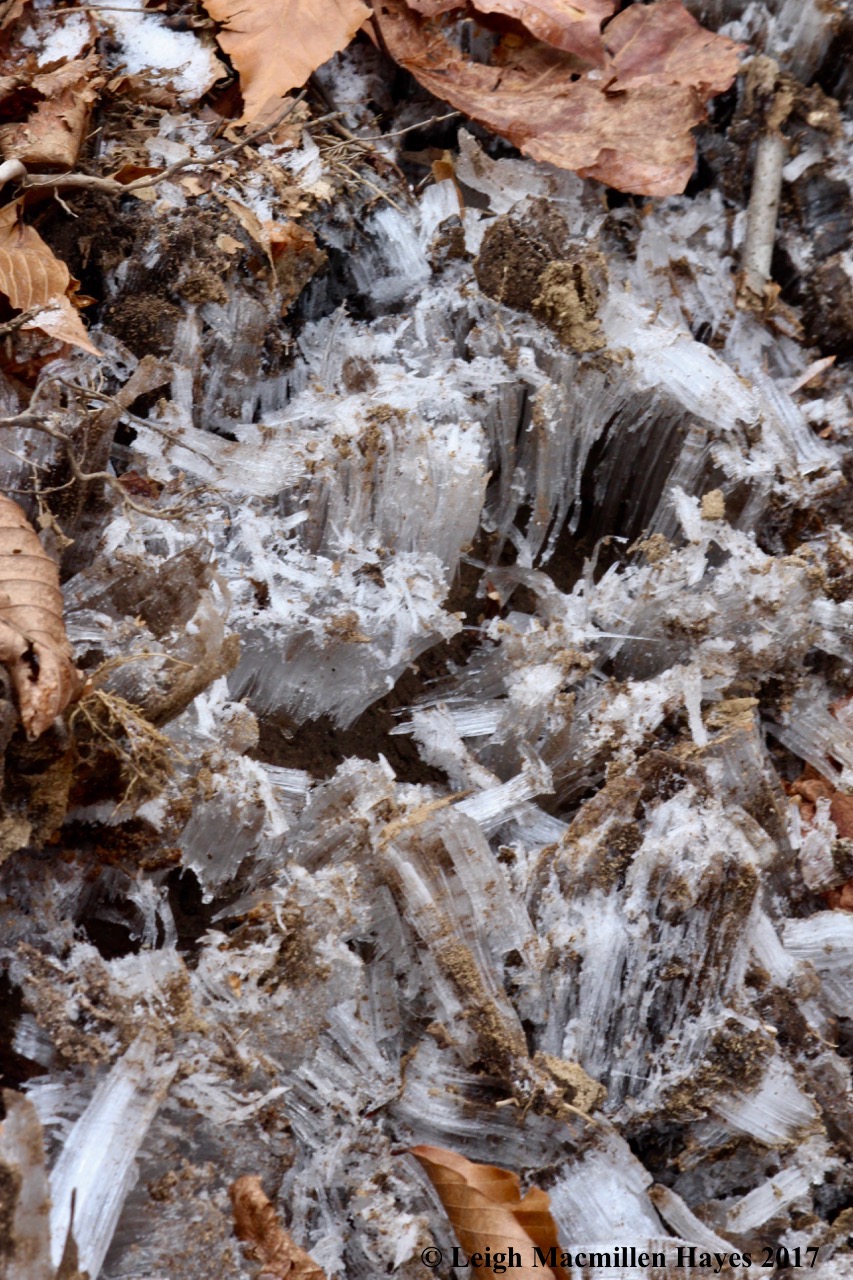
a35-Patte Marsh

And then I drove down another forest road to Patte Marsh, which was almost completely covered in ice.

a32-dam at Patte Marsh

Its formations were varied below the dam.

a31-sky reflection and ice

But my favorite of all was upon the pond, where the sky was reflected on a wee bit of open water and ice that reminded me of the eagle in flight.

We didn’t find what we’d gone in search of and may just have to try again (oh darn), but it was a day of firsties for us–first ice-covered ponds, first snow, first time on the second spur trail. Definitely a first rate day for a hike.

P.S. Thanks for continuing to stick with me. Please feel free to tell your family and friends about wondermyway. And encourage them to click the “follow” button. I’d appreciate it if you’d help me increase my readership. You never know what you’ll read here because I never know what I’ll write. Even when I think I know, I don’t. The end result is always a wander and definitely a wonder.


Marathon Mondate

As he’s done every year for the past however many, my guy is training for the Moose Pond Half Marathon, a race around Moose Pond in Bridgton and Denmark that supports the Shawnee Peak Adaptive Ski Program. The race is only two weeks away and so this morning he headed off to run ten miles. And afterward, he said he felt like he could have run the additional 3.1 miles that would complete the race. That being said, we headed west to join our friends, Pam and Bob, on a hike at a new preserve in New Hampshire.

The plan was to meet at the trailhead near Hurricane Mountain Road on the Chatham/Conway town line. We knew the road, but not the spot, and were racing to get there, so of course I drove right by. But . . . I spied Pam sitting in their car in the parking lot and probably burned some rubber as I came to a screeching halt and then quickly put the truck into reverse. Fortunately, my guy didn’t get whiplash. It’s a back road, so not well traveled, thus I could drive backwards for a hundred feet or more without any problem–thus is the way ’round these parts. And one of the reasons we love it so.

m-sign 1

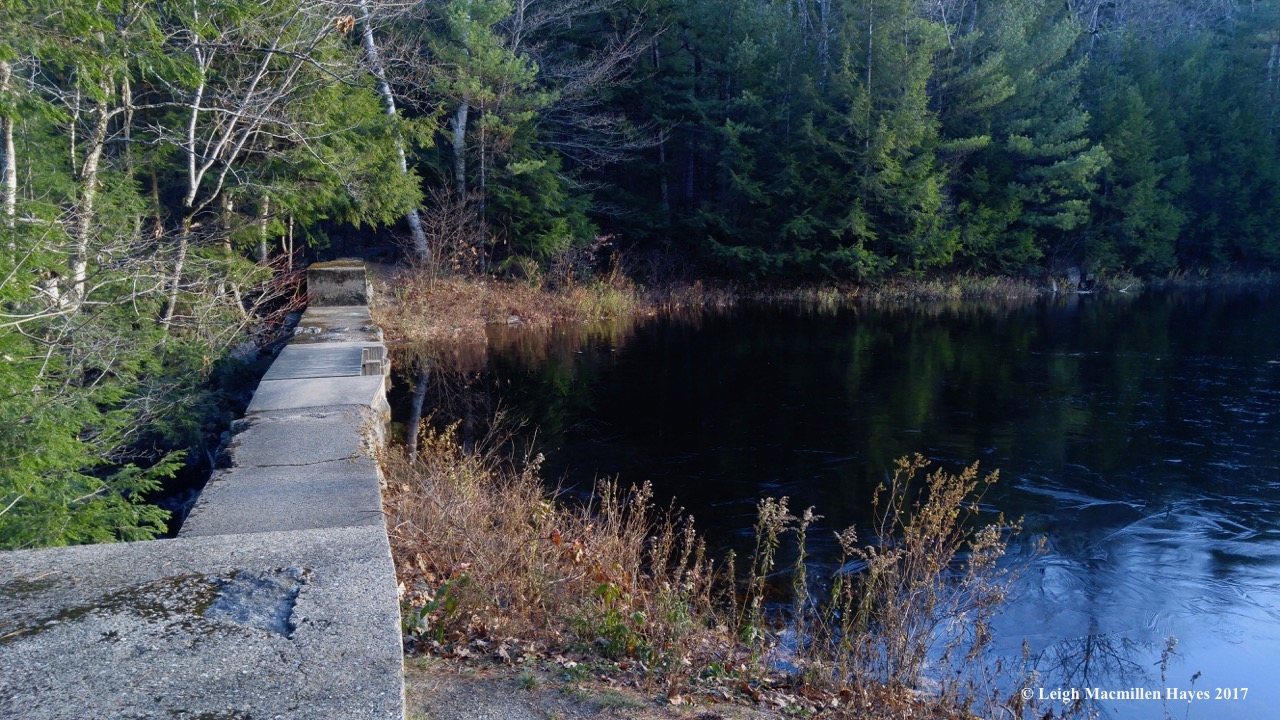
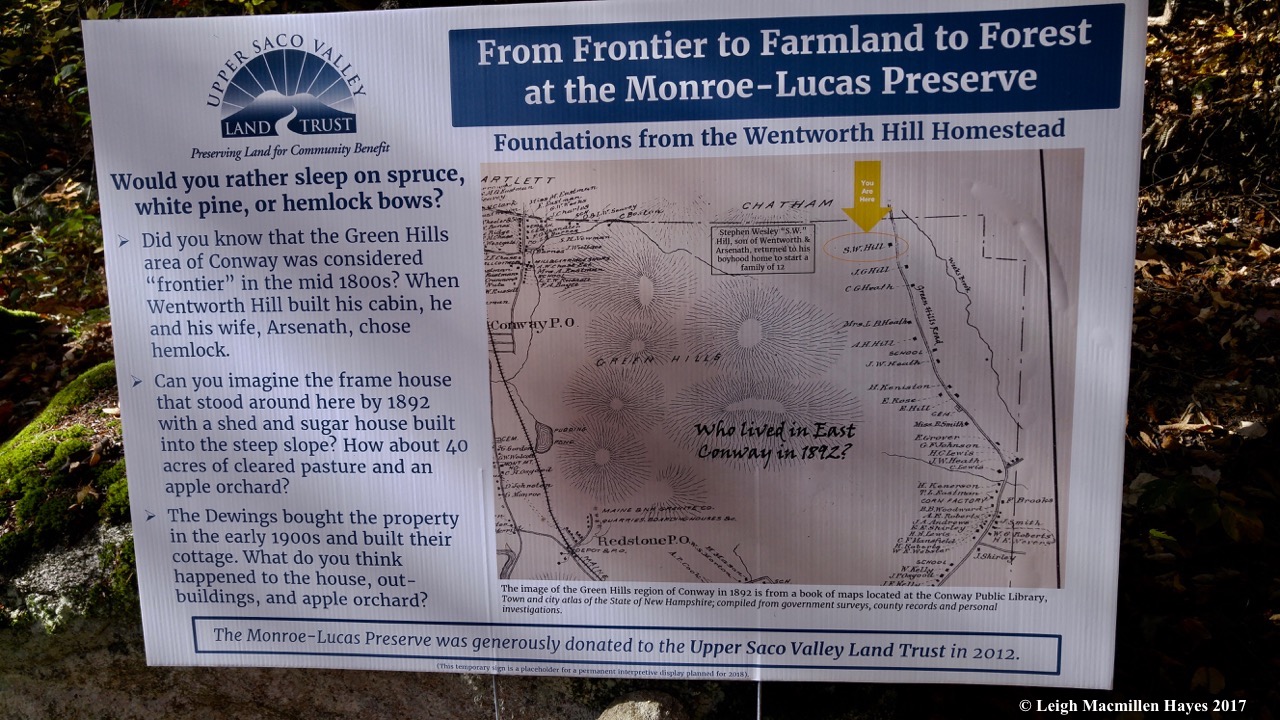
Another is that local land trusts preserve land for the benefit of the species who call this place home, both flora and fauna–and for us so that we, too, may benefit from time spent tramping along trails, making discoveries and forging friendships. The preserve we visited today isn’t quite open, but Pam said she’d heard they plan to open on November 4th. There were no signs on the kiosk or trail maps, but we quickly learned that none were necessary for the route was easy to follow. We were at the Monroe-Lucas Preserve, a 62-acre property donated to the Upper Saco Valley Land Trust.

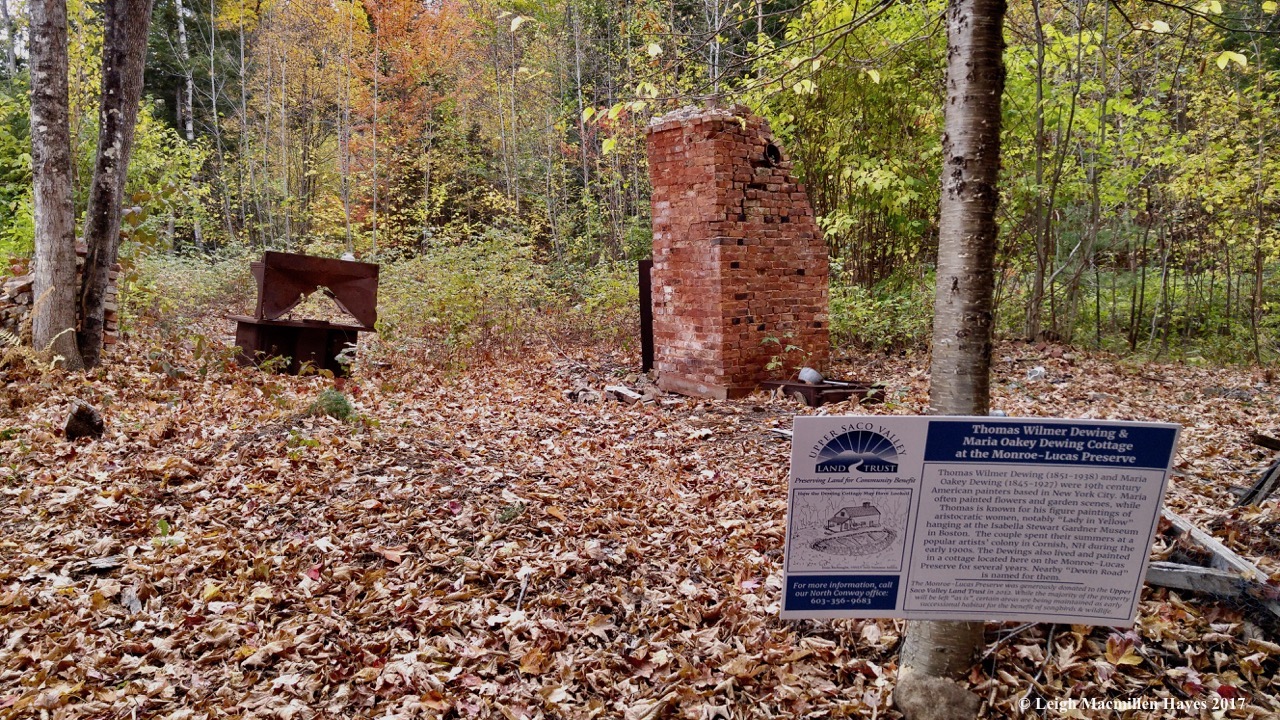
According to their website: “The land was given to USVLT by Barrett Lucas in honor of his wife, the late Leita Monroe Lucas. Leita’s family has deep roots in East Conway and Redstone, and her father, Ernest “Red” Monroe, also wanted to see the land preserved. Adjacent to the Conway Common Lands State Forest, The Nature Conservancy’s Green Hills Preserve, and the White Mountain National Forest, this parcel builds on an existing network of preserved land, and has wonderful opportunities for future trail development and increased public access. A branch of Weeks Brook also runs through the property, and the property lies within USVLT’s ‘Green Hills’ focus area. The site is also remarkable as the one-time summer residence of the American Impressionist painter Thomas Wilmer Dewing, and his fellow painter and wife, Maria Oakey Dewing. Their cottage, built in the late 1800s, fell into disrepair in the mid-1900s. Now only the chimney remains onsite.”

m-puff ball fungi 1

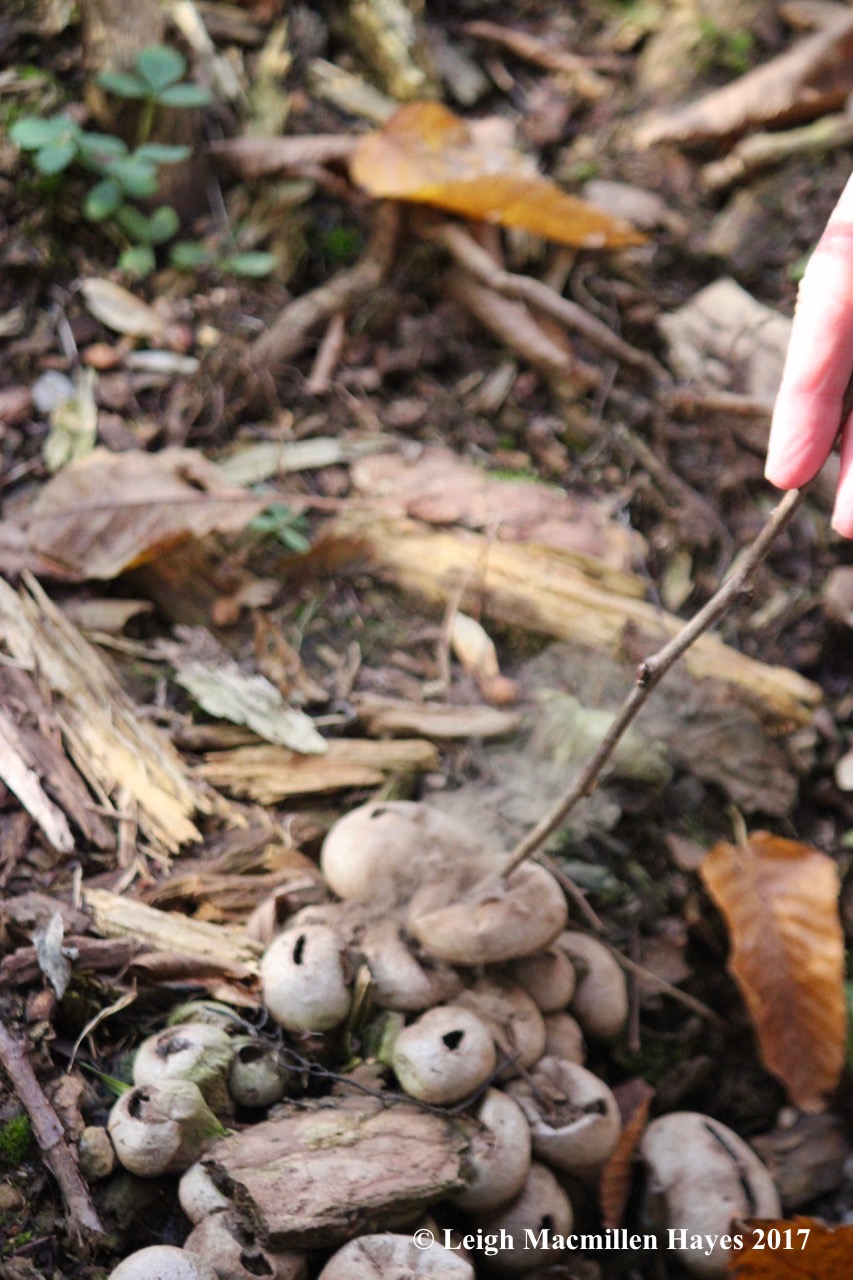
With Pam in the lead, we started up the trail and within minutes the fun began. She spotted a large patch of puff balls begging to be poked. The spores wafted up and away with hopes of finding the perfect place to grow nearby. We assume they will be successful, for within a fifteen foot area, we found patch after patch and knew we weren’t the first to encourage their spores to blow in the breeze.

m-bobcat print

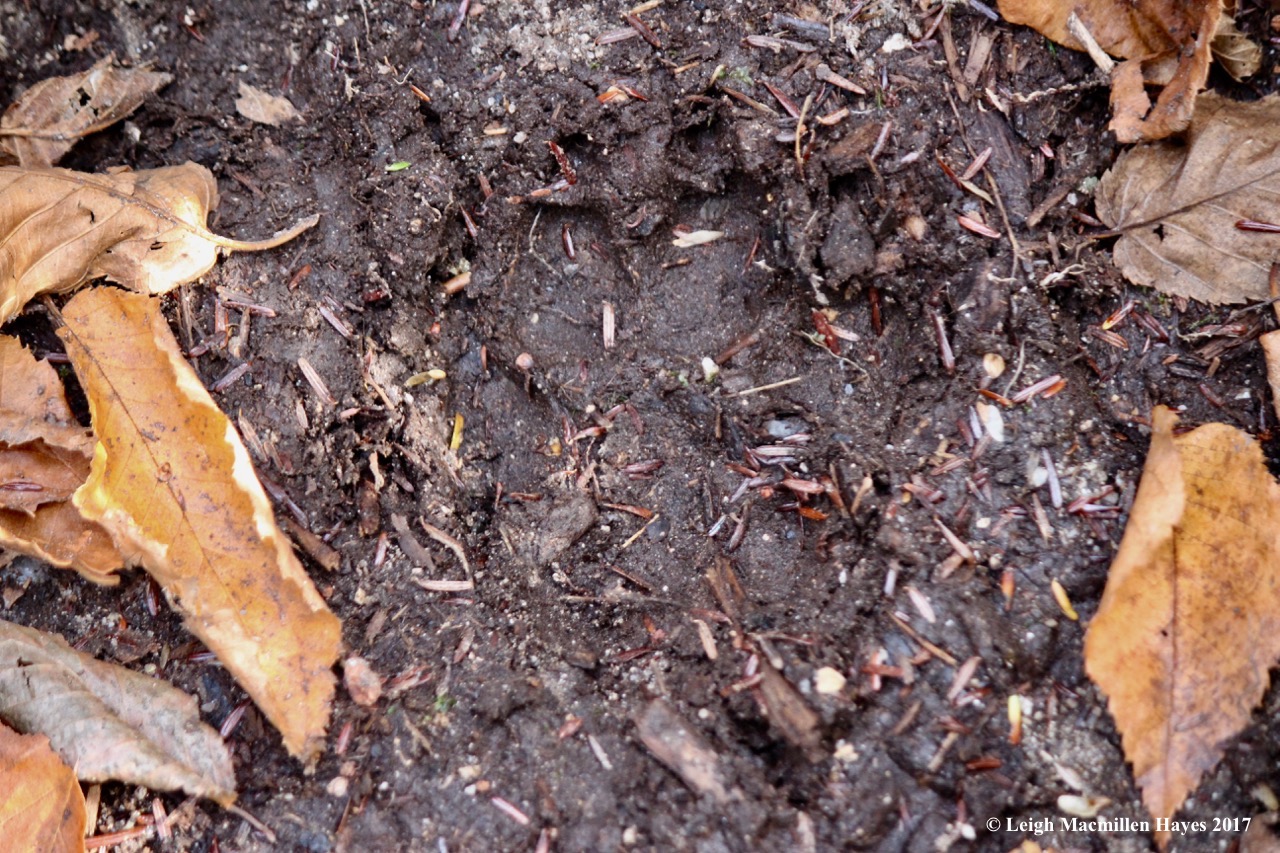
And then Pam began to spy prints in the mud. First, a moose. Then this bobcat–if you look closely, as we did, you may see the hind pad matted down; above that a raised ridge in the form of a C for cat; and four large toes, the two in the center being asymmetrical. Because it was a muddy substrate, we even saw nail marks, especially above the two center toes. Five feet further, we found deer prints. And so we rejoiced in the foresight of the Monroe-Lucas family to protect this land.

m-Weeks brook flowing 1

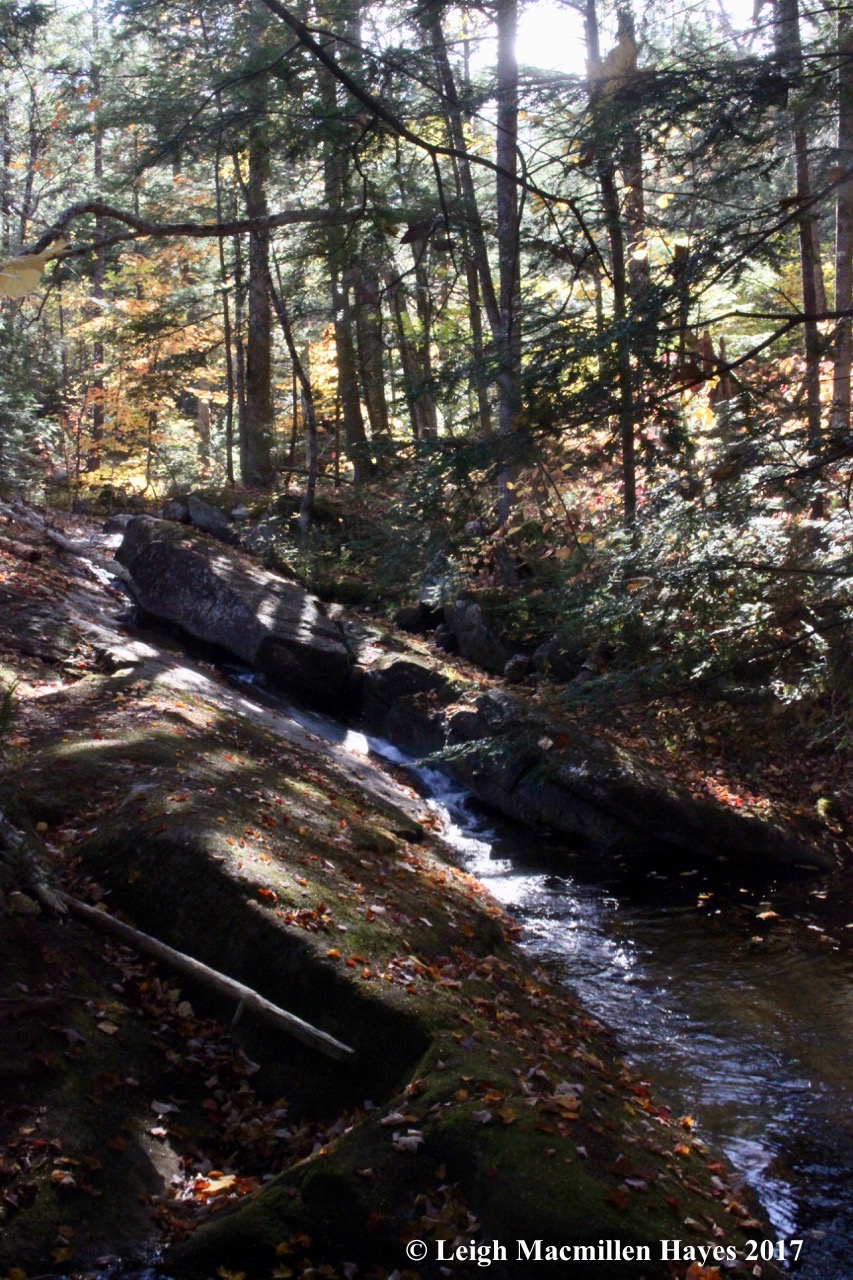
A bit further on, we heard the brook before we saw it–a branch of Weeks Brook that borders the property. We all stood beside and let it mesmerize us.

m-weeks brook 1c

We thought about its forceful action each spring and the eons it took to carve into the rocks along its banks.

m-weeks brook baths

We shared visions of a summer day spent sliding down its smooth channels and slipping into the pools below.

m-weeks brook between the rocks

And we marveled at the way it split the granite above . . .

m-weeks brook between 3

and flowed between the shelves.

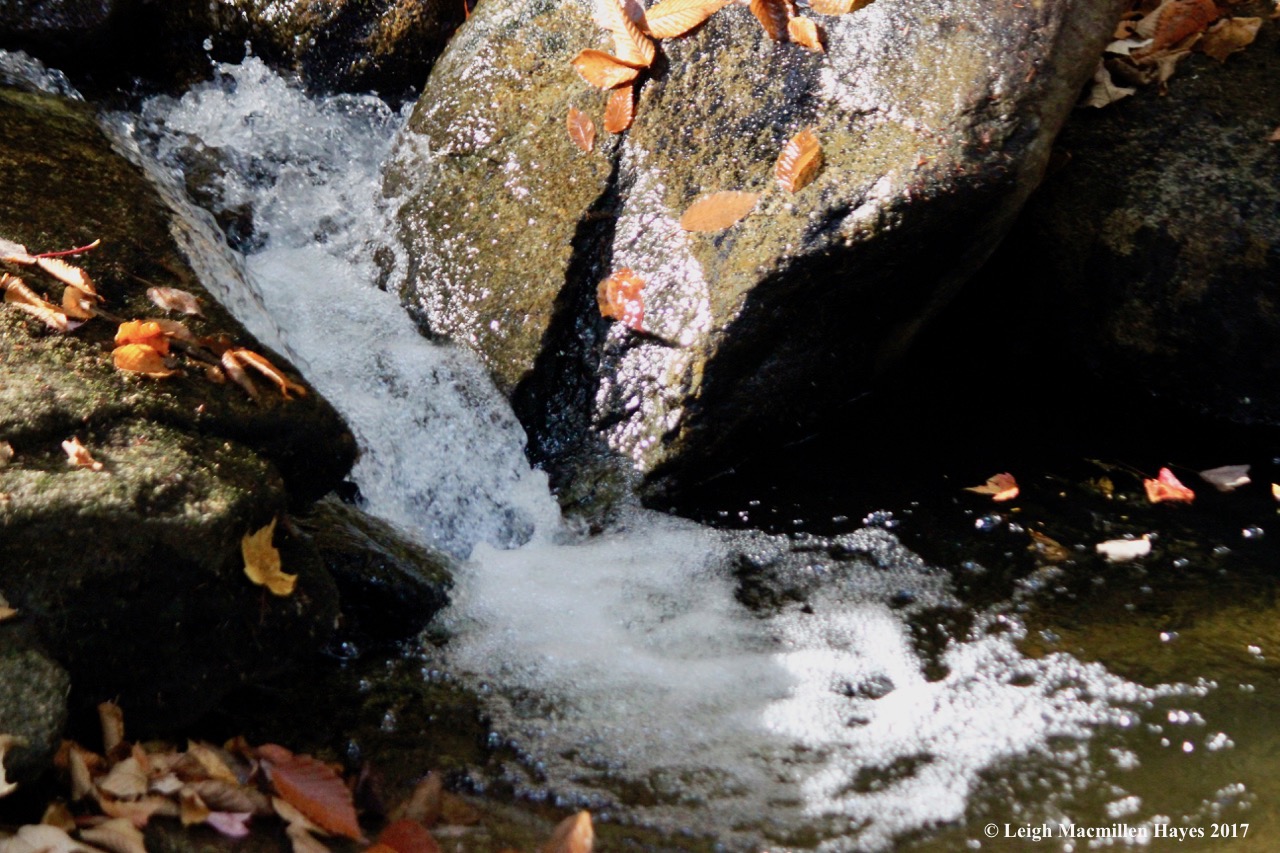
m-weeks brook bubbles

All the while, it raced to the finish line and we could only assume it made good time.

m-hobblebush flower?

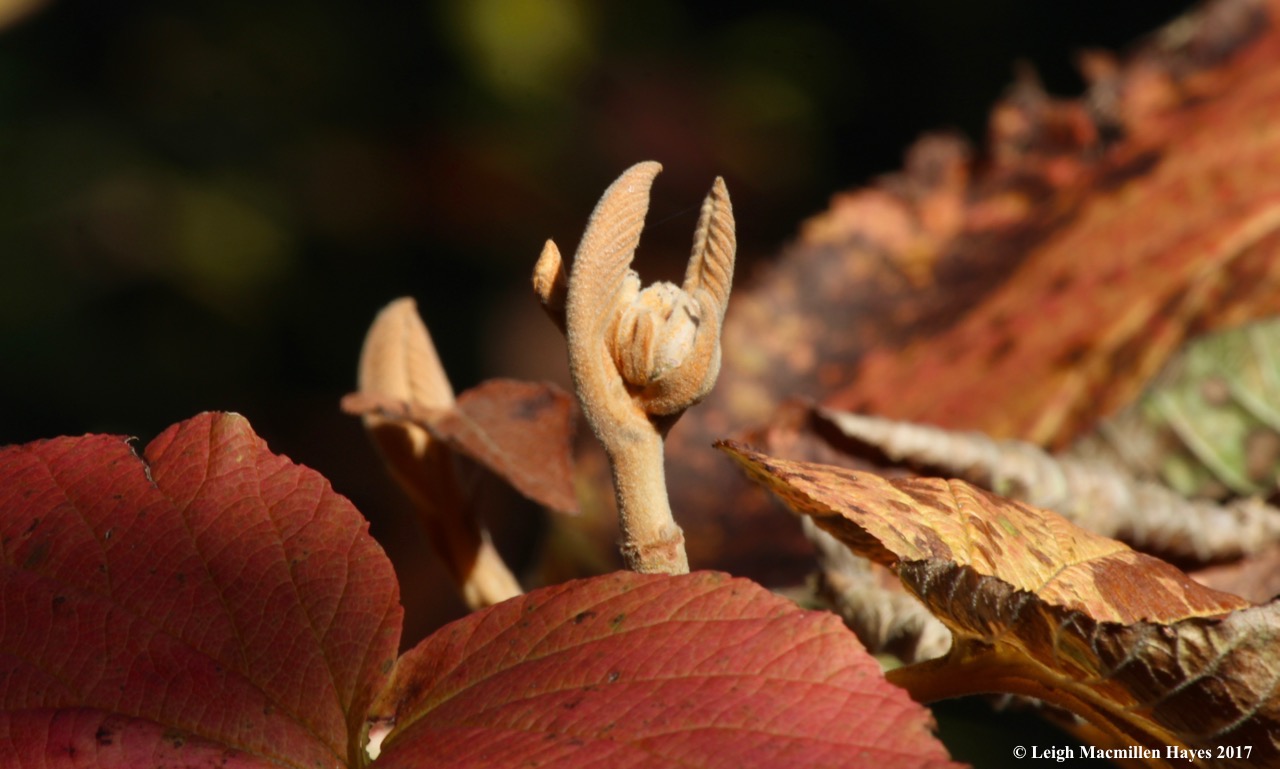
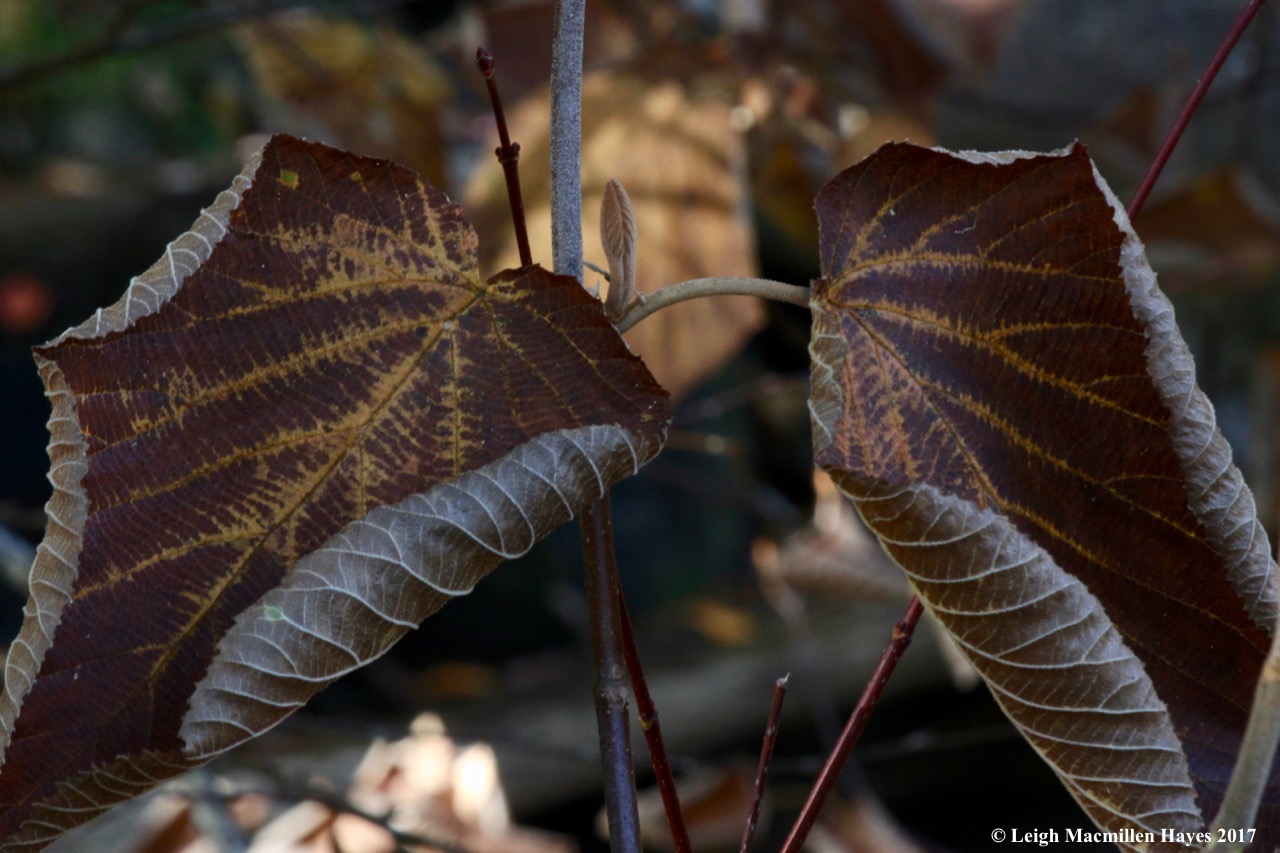
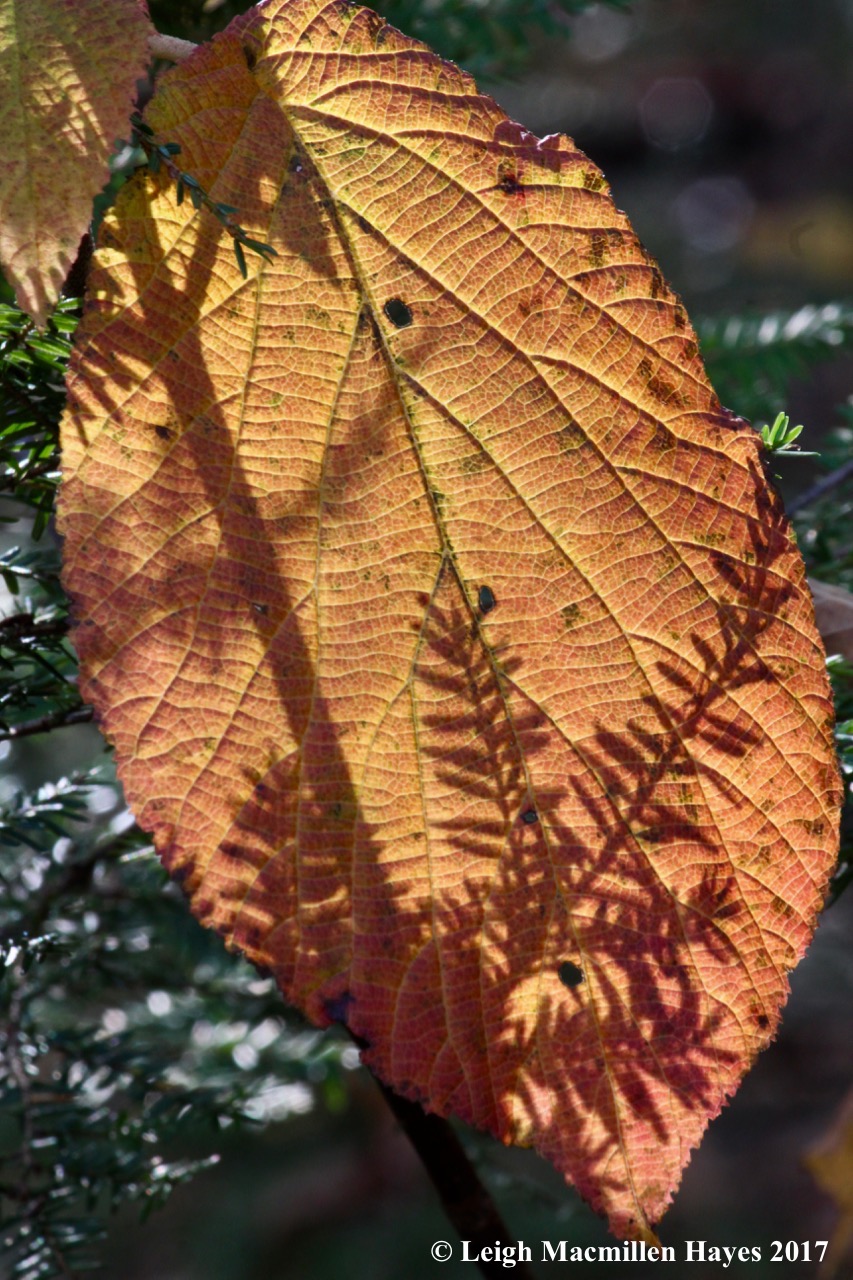
It was beside the brook where the hobblebush grew prolifically and offered a myriad of colors among their leaves and clasping or clapping hands among their buds. Because we were looking, we noticed one flower forming into its globe shape as it usually does in late winter. Was it confused?

m-hobblebush new leaf

And on another, a new leaf.

m-hobblebush 2

Fortunately, most behaved as they should and gave us an autumnal display worth celebrating.

m-hobblebush:hemlock shadows

One even added some shadow play.

m-mount kearsarge

Eventually, we turned away from the brook and followed the trail down. A peak through the trees and we could see Mount Kearsarge across the way.

m-slime mold 1

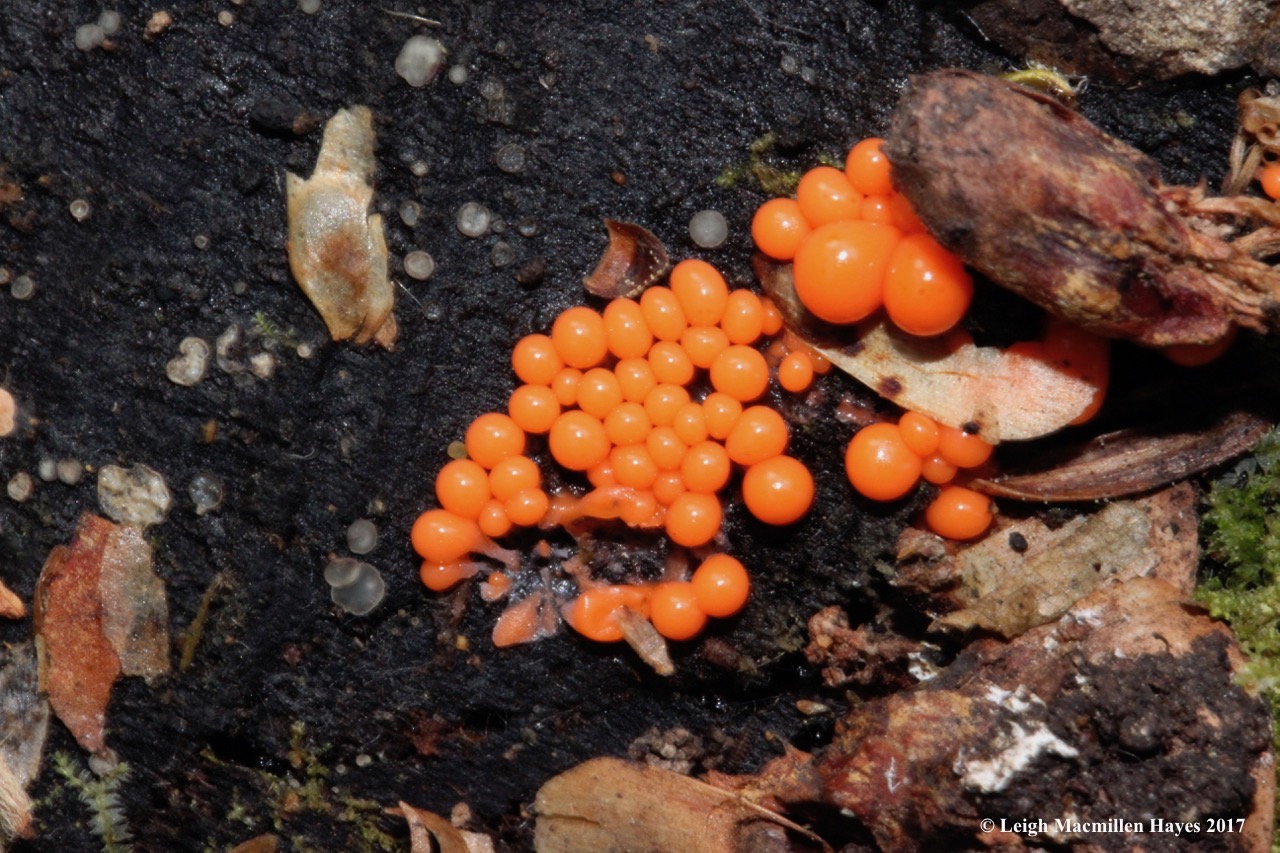
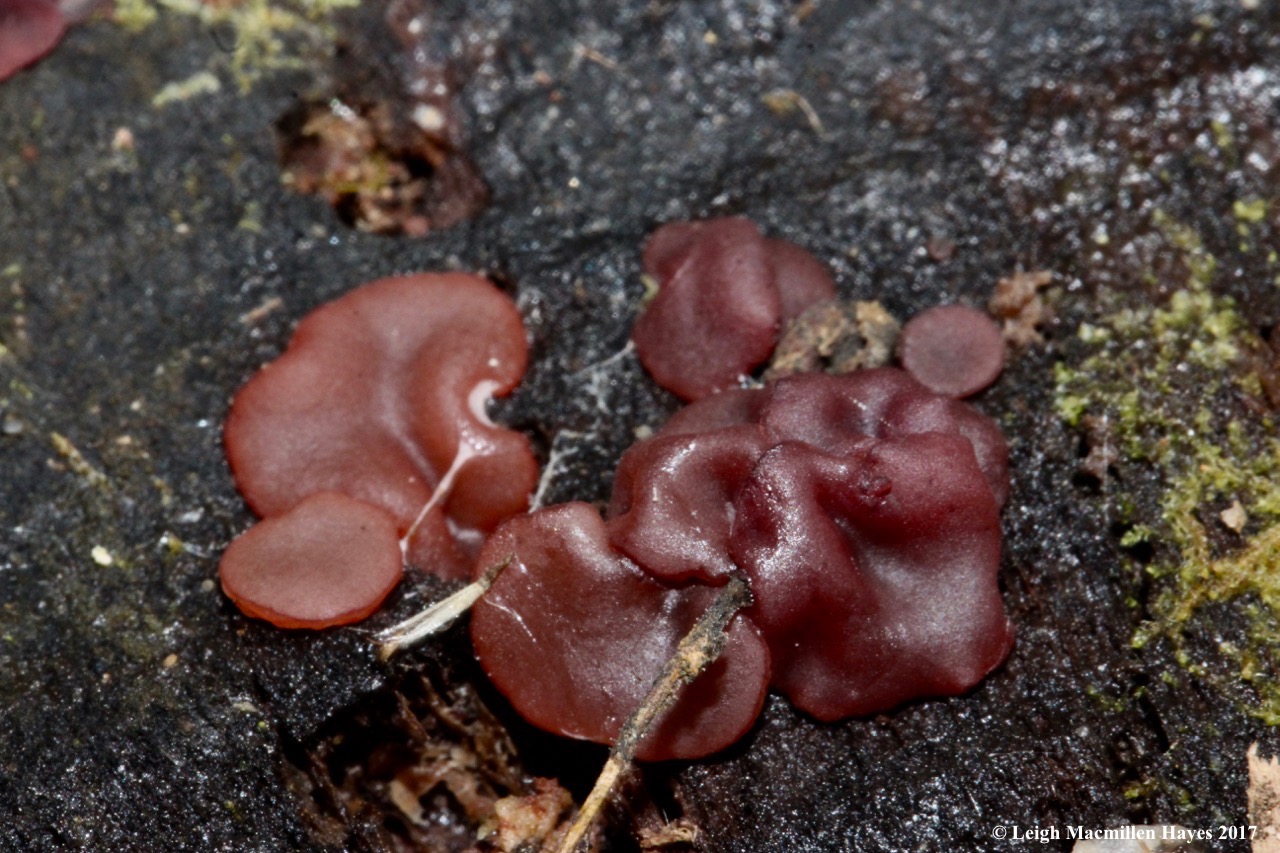
On a tree stump, we found a couple of fascinating fungi including a slime mold all decked out for Halloween.

m-jelly fungi

And on the same stump, a display of jelly ear fungi.

m-old moose scat

Around the corner was more evidence of moose traffic, though since it was moss-covered, we decided it was a couple of years old. None of us could ever recall seeing moss grow on moose scat before, but it made perfect sense that it would be a suitable substrate. I did wonder how they’d categorize that on a moss ID key–grows on rock, tree, ground, moose scat?

m-pippsisewa

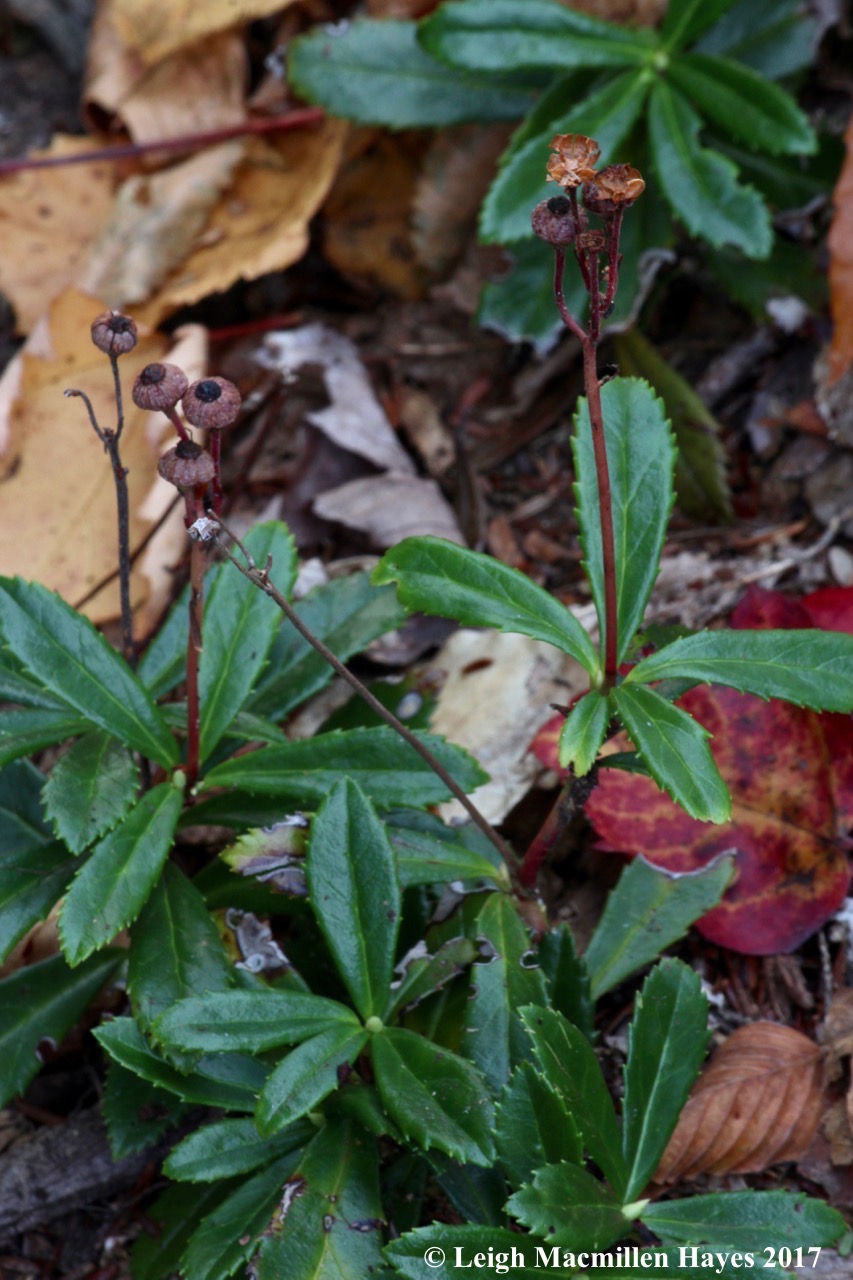
Our moments of awe weren’t over yet. We sent up three cheers for the pipsissewa and its seedpods (Bob, did you take one?),

m-red-belted polypore

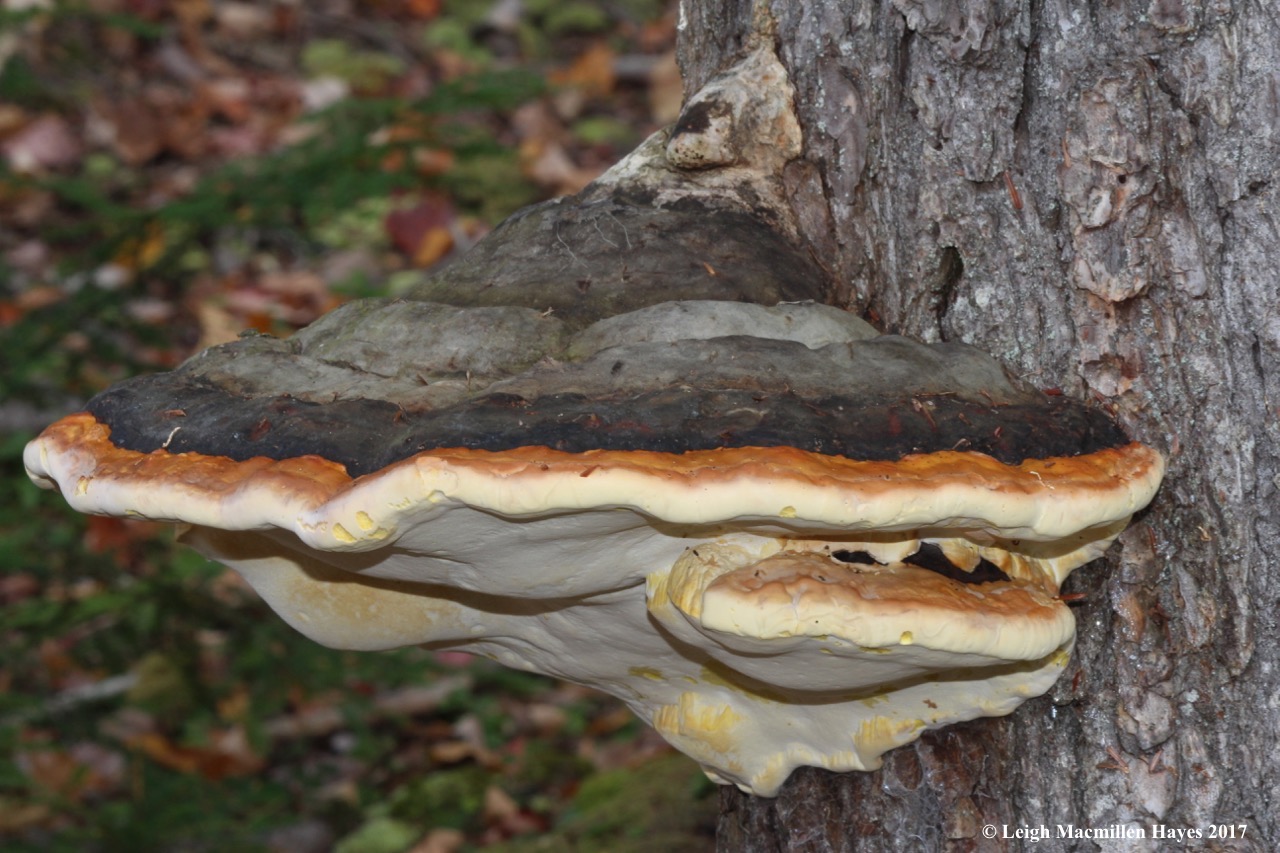
and red-belted polypore.
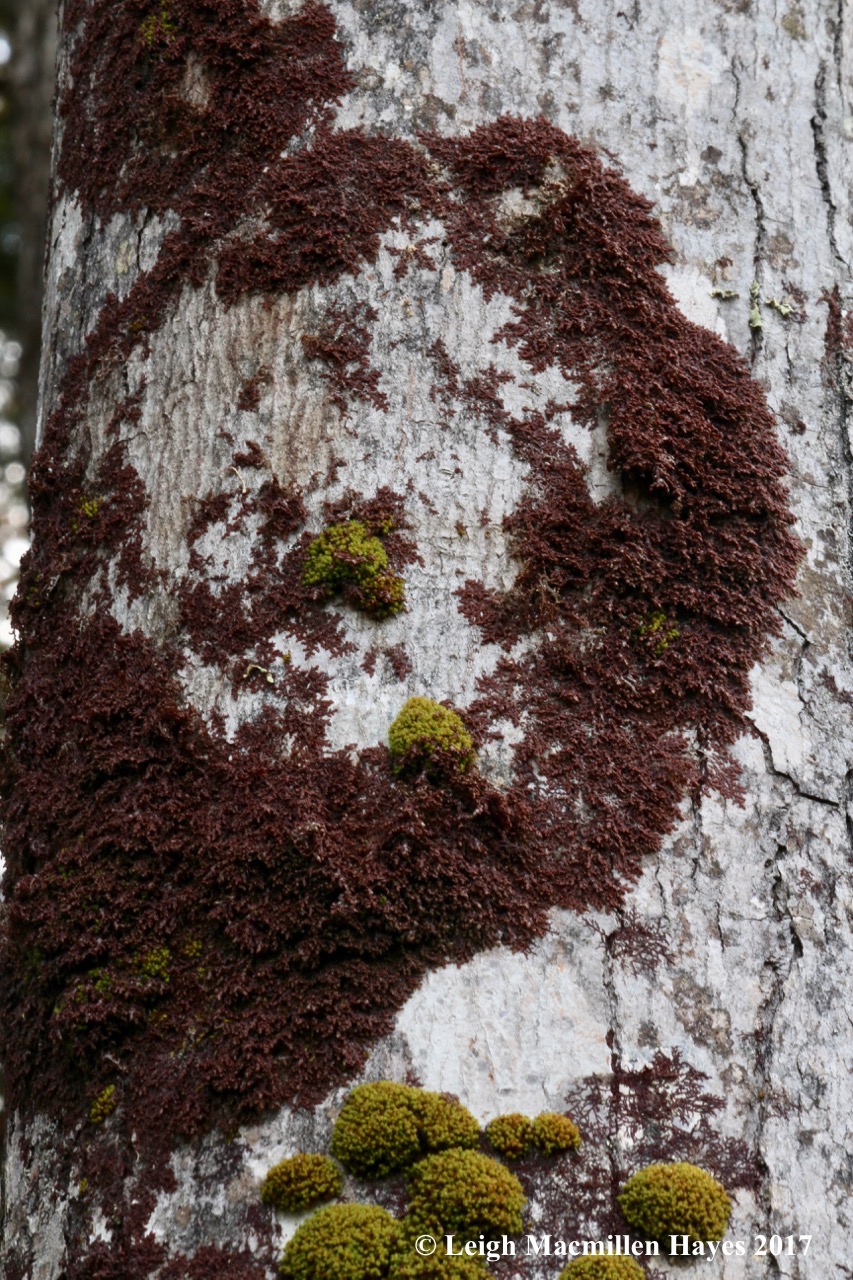
m-frullania 2

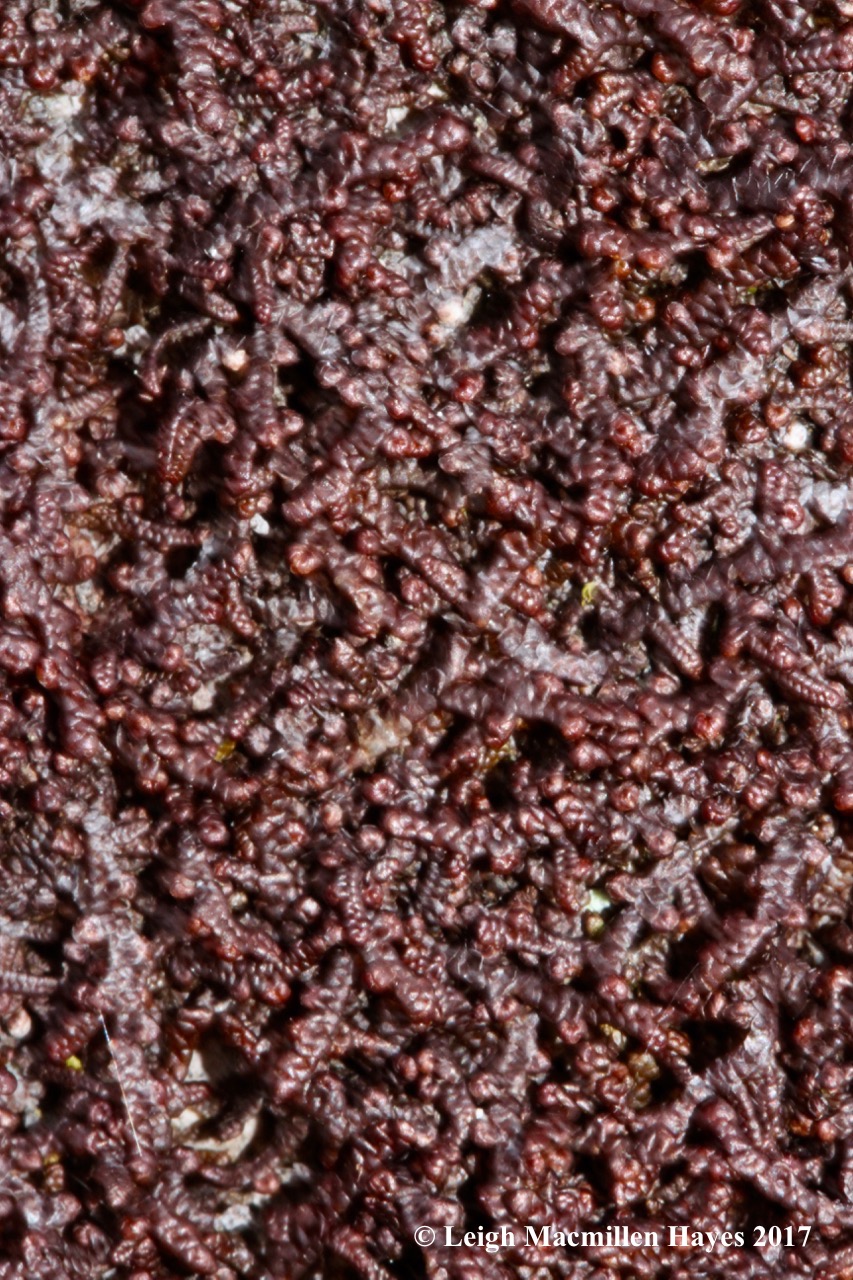
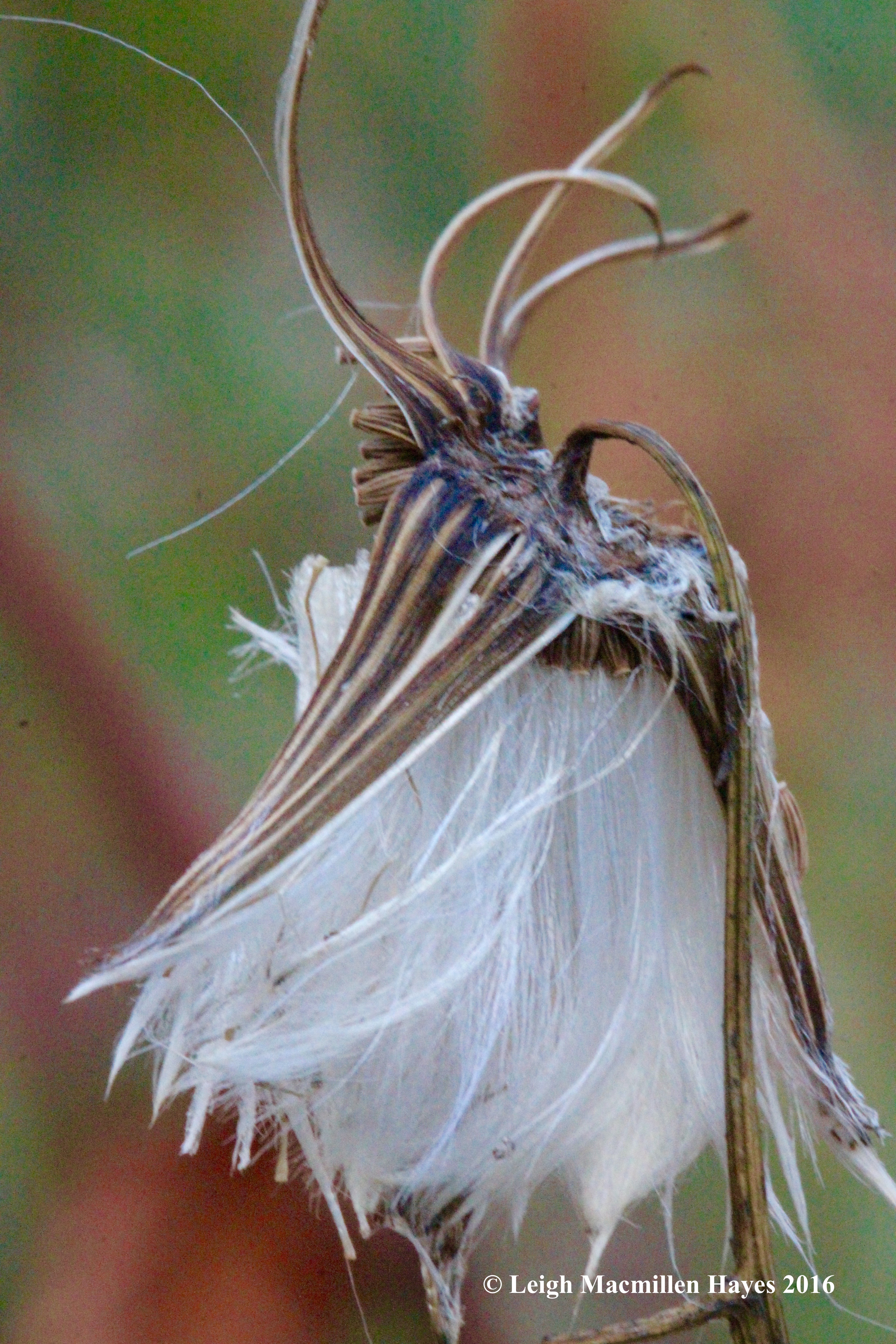
And then Bob spied the frullania. The smaller, spider-webby display in the lower right hand corner is Frullania eboracensis, a liverwort with no common name. But the larger mass is known as Frullania asagrayana, so named for a botanist and natural history professor at Harvard University from 1842-1873–Asa Gray.
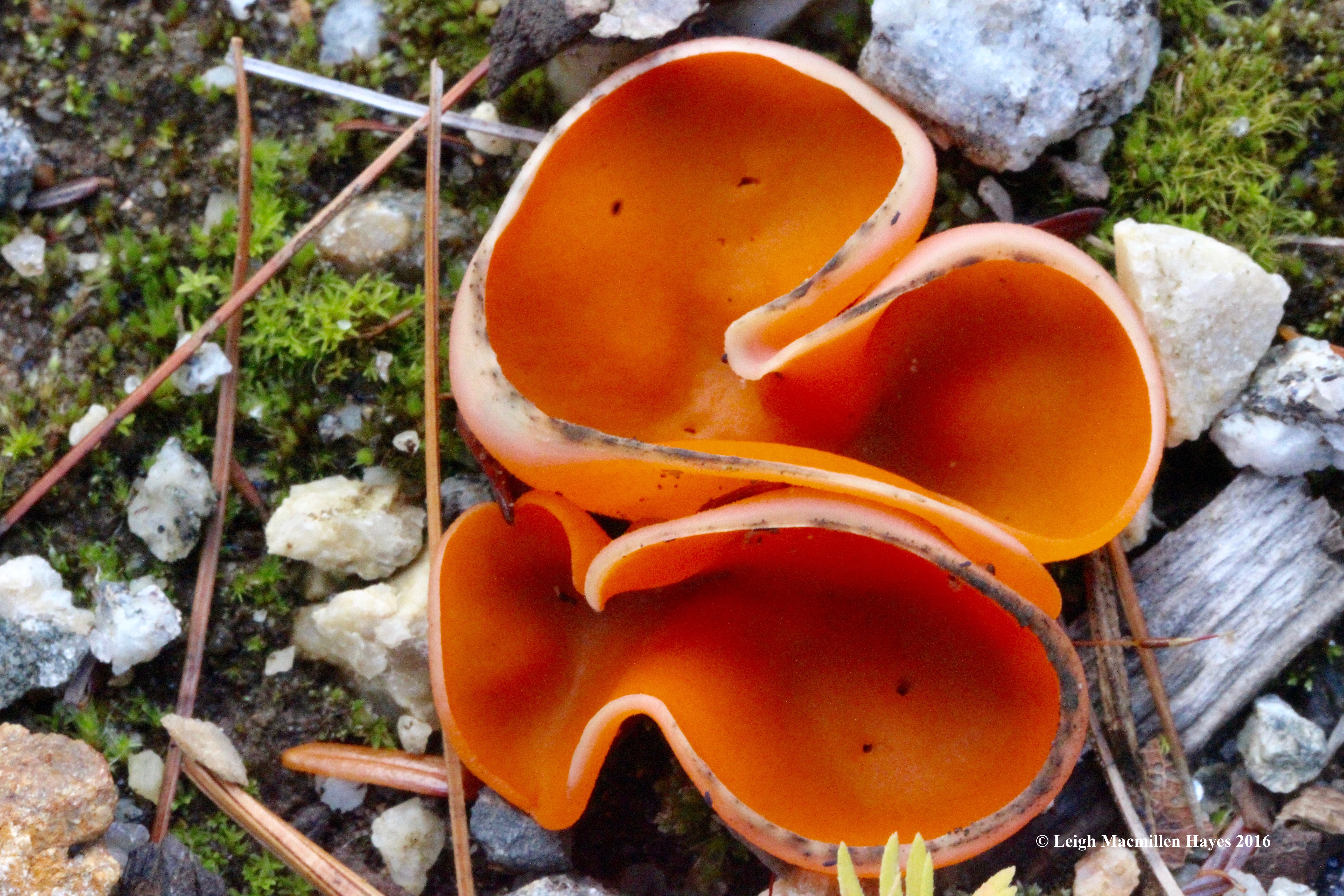
m-frullania

We all went in for a closer look at its worm-like leafy structure.

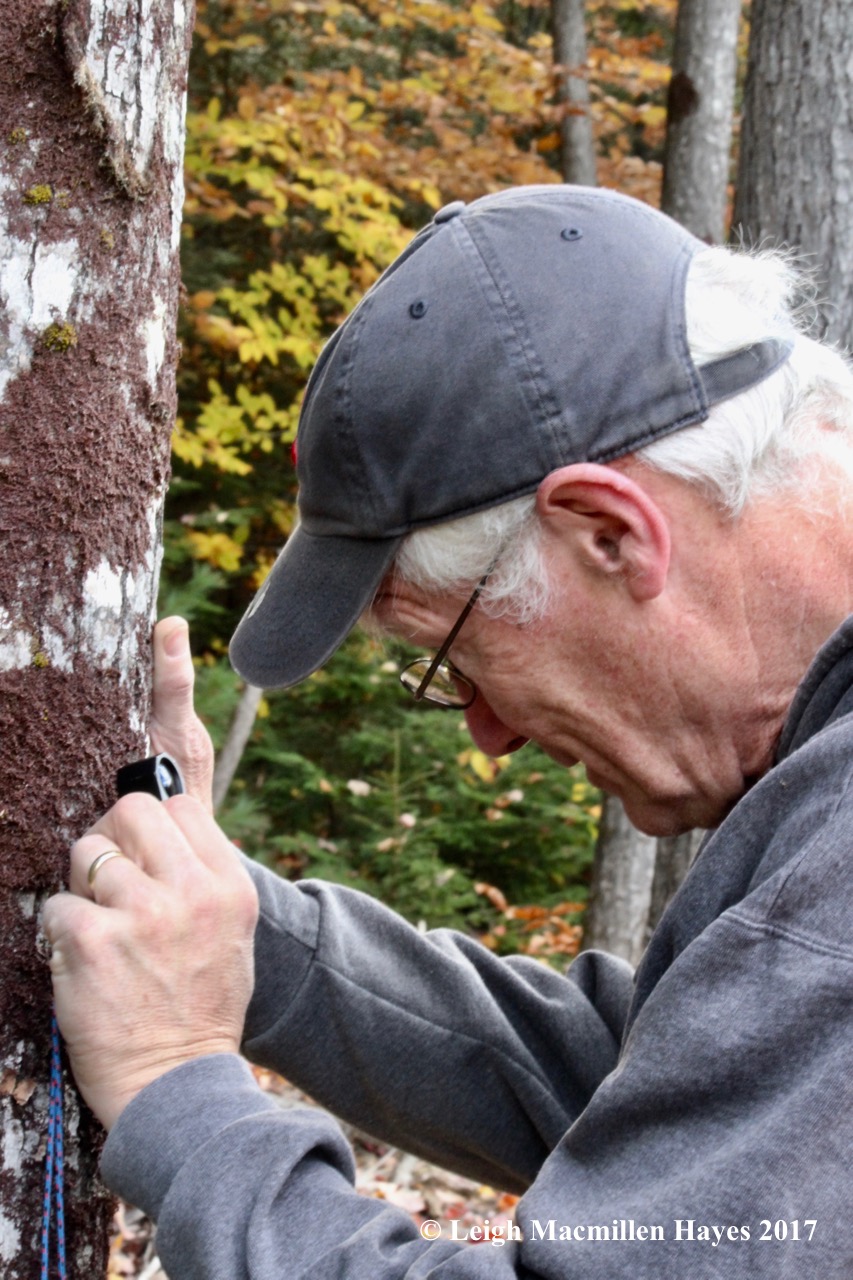
m-frullania and muy guy

Even my guy got into the act, much to his reluctance. And he was certain he didn’t need a lesson on how to use a hand lens. Thankfully, he doesn’t read these blog posts, so I can get away with this. Shhhh.

m-uprooted pine 1

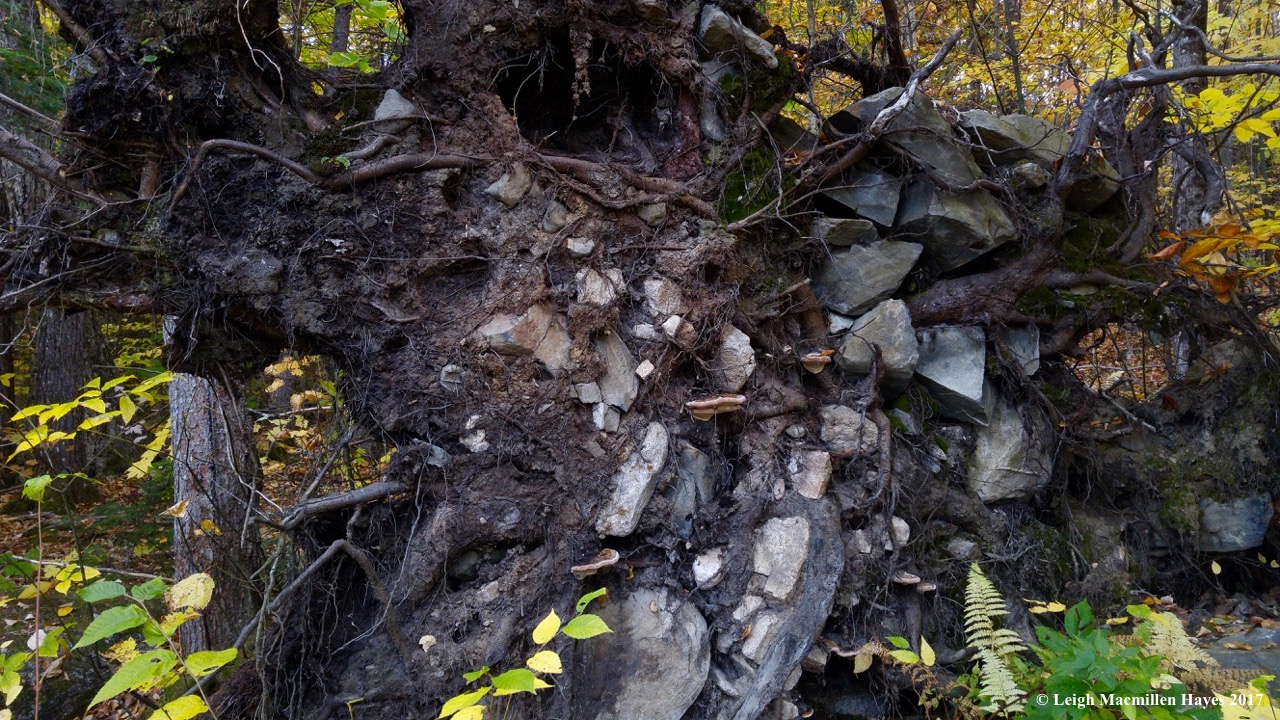
Around the next bend, for the trail has enough S curves to make the descent easy, we came upon a white pine long since uprooted. Did anyone hear the crash?

m-uprooted picture frames

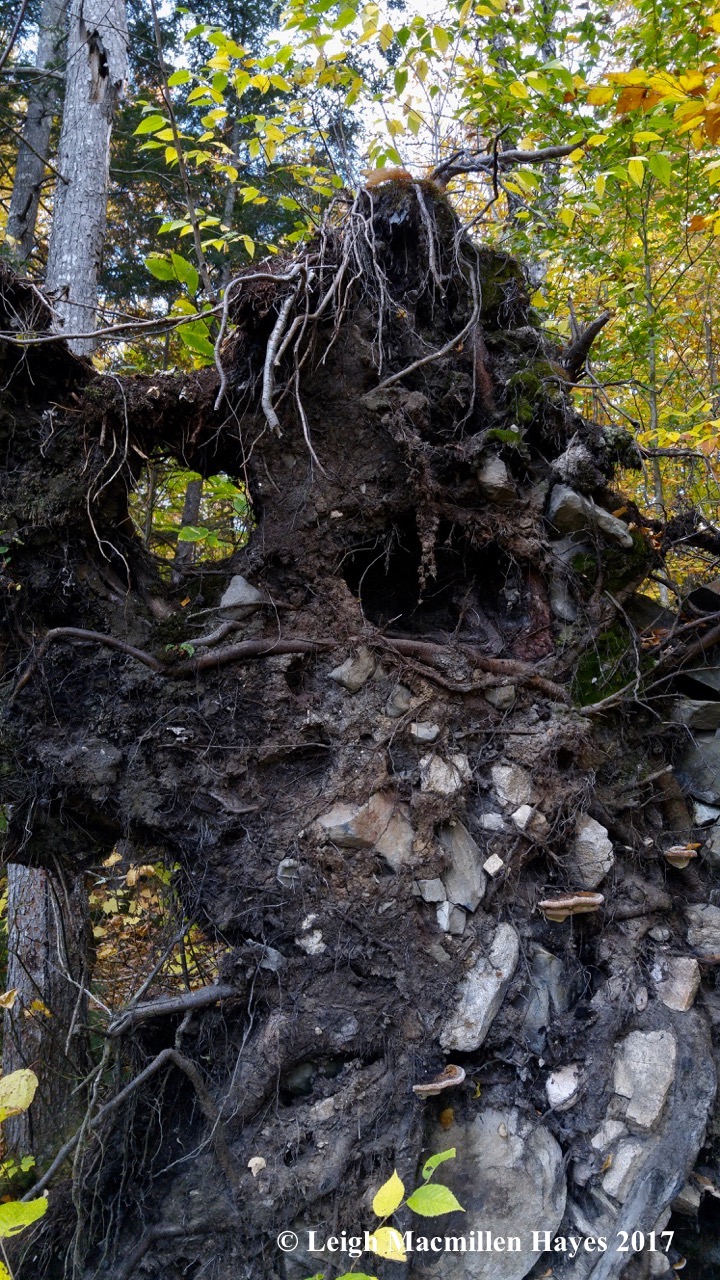
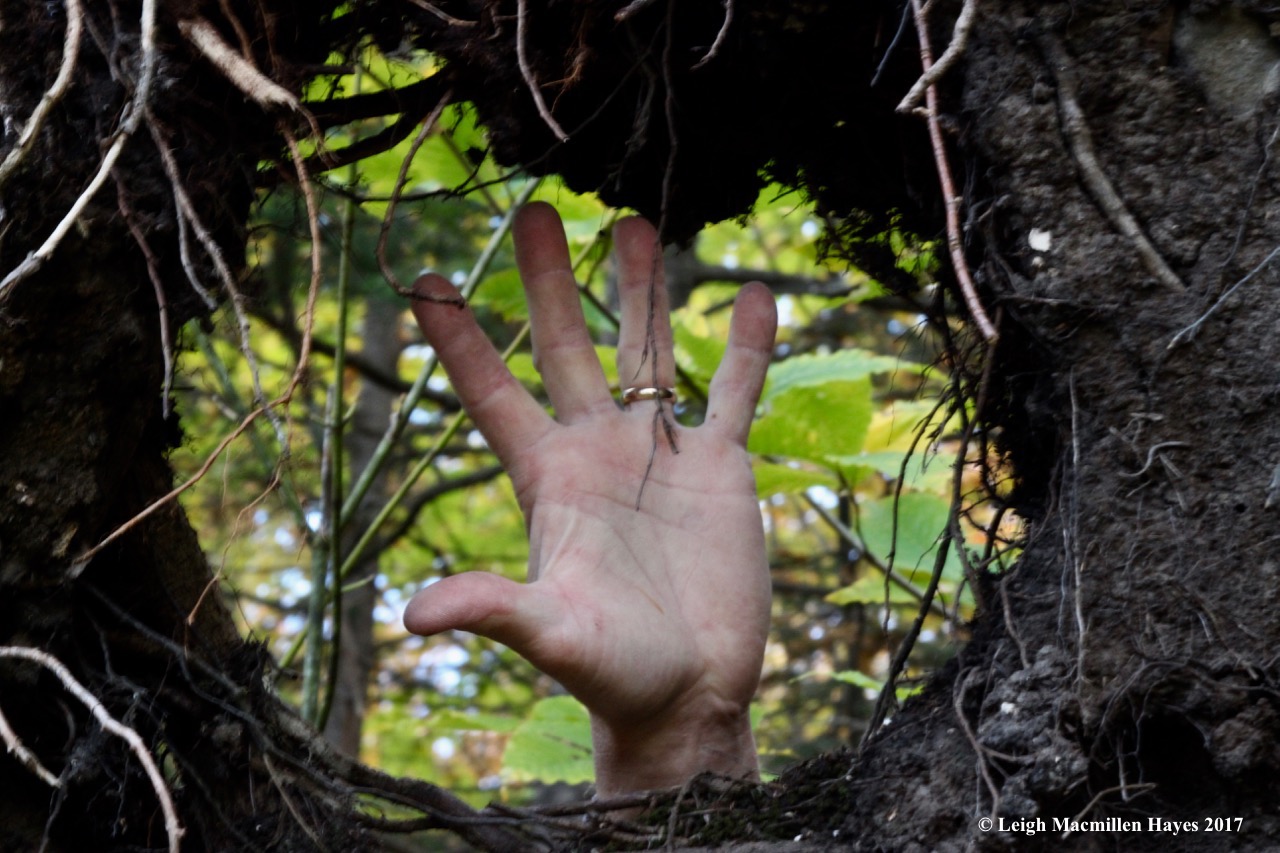
It offered a wonderful view–of more red-belted polypores, the root system and rocks, plus several windows on the world beyond.

m-photo frame hand

If you go, watch out . . . Thing of The Addams Family, might be lurking about.

m-Pam holding a huge striped maple leaf, Bob photobombing

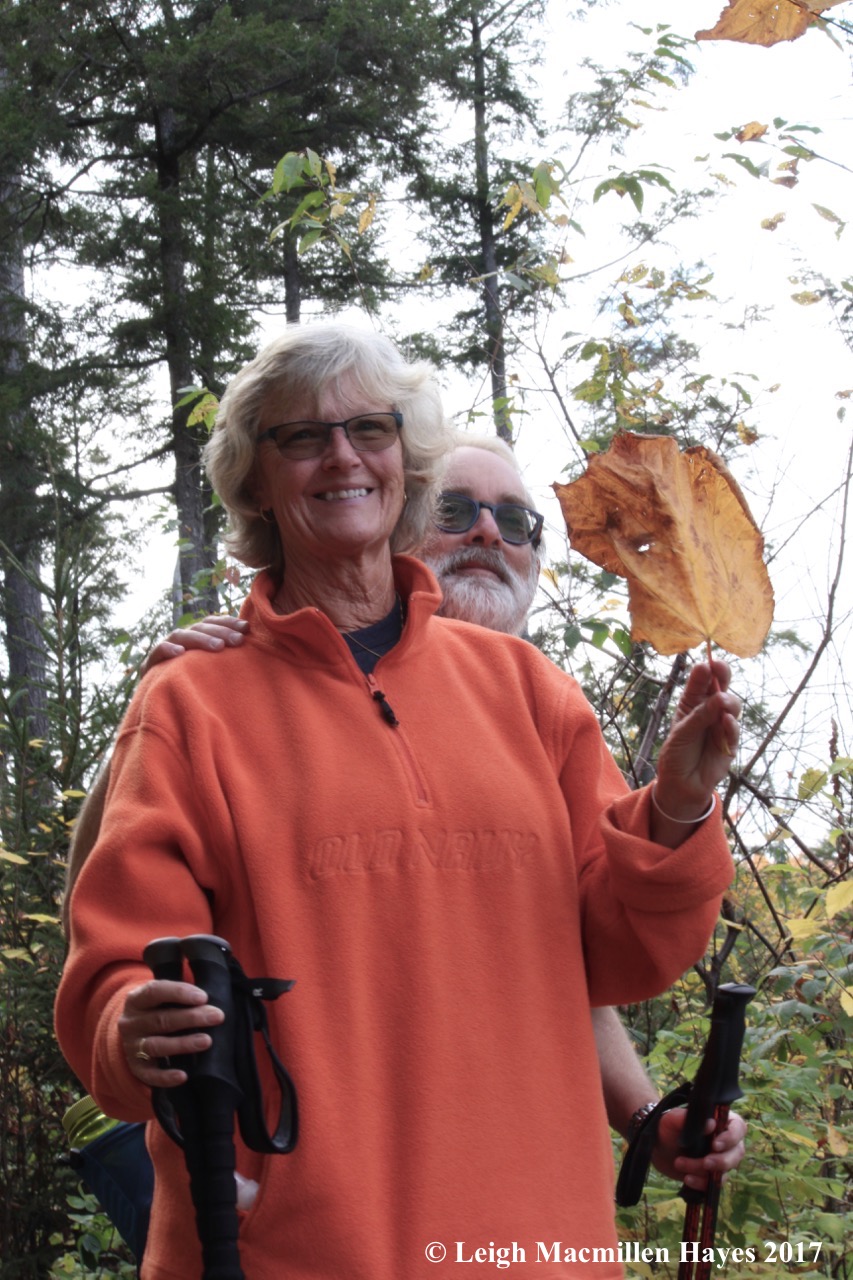
Continuing on, we moved out of the hemlock and pine grove and back into the land of the broadleaves, including one with the broadest of them all–a huge striped maple leaf that Pam spotted; and Bob made sure to photo bomb the Kodak moment.

m-cottage sign 2

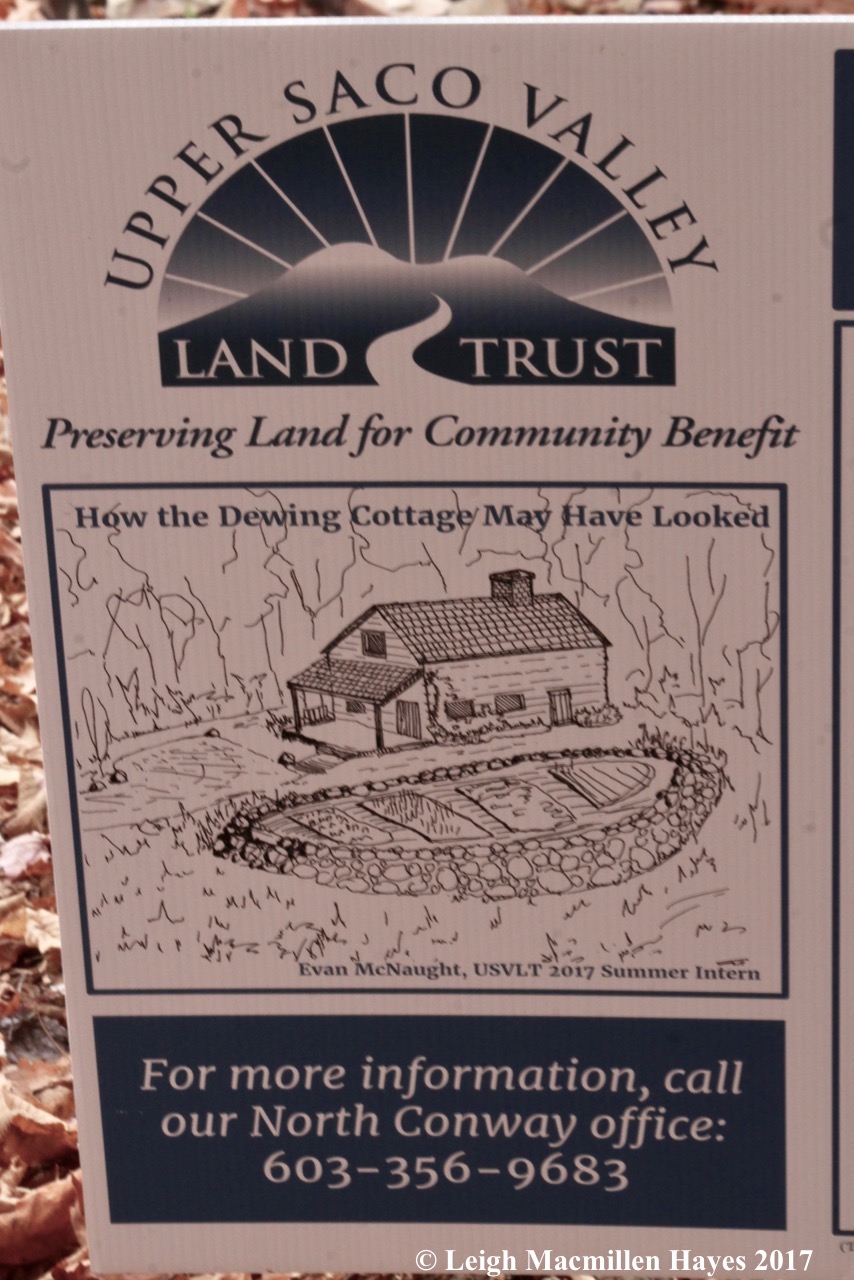
And then, as the trail evened out, we crossed a narrow gangplank to the location of the original cottage. According to a sign posted there, “Thomas Wilmer Dewing (1851-1938) and Maria Oakey Dewing (1845-1927) were 19th century American painters based in New York City. Maria often painted flowers and garden scenes, while Thomas is known for his figure paintings of aristocratic women, notably ‘Lady in Yellow’ hanging at the Isabella Steward Gardner Museum in Boston. The couple spent their summers at a popular artists’ colony in Cornish, NH, during the early 1900s. The Dewings also lived and painted in a cottage located here on the Monroe-Lucas Preserve for several years.

m-site of Dewing cottage 1

All that’s left is the chimney.

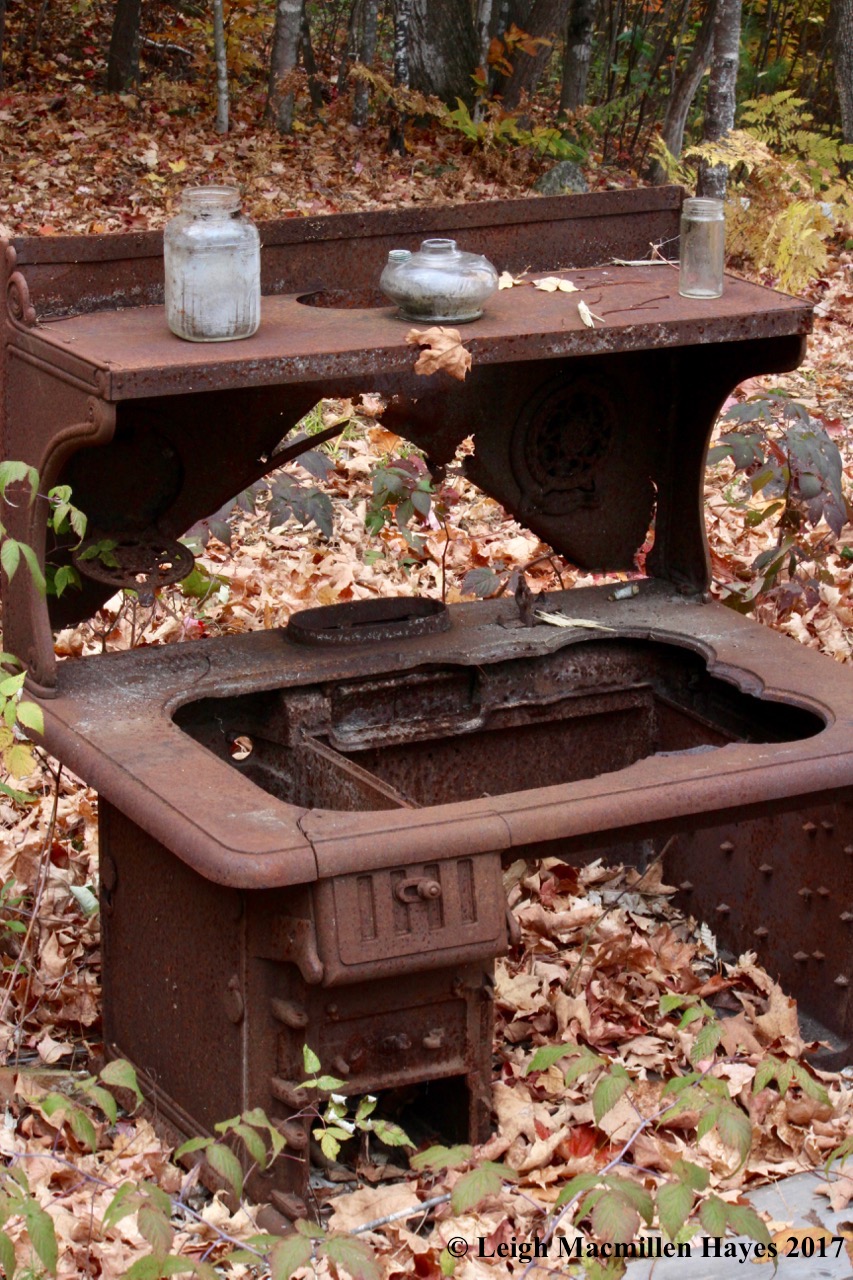
m-cottage stove

And some artifacts.

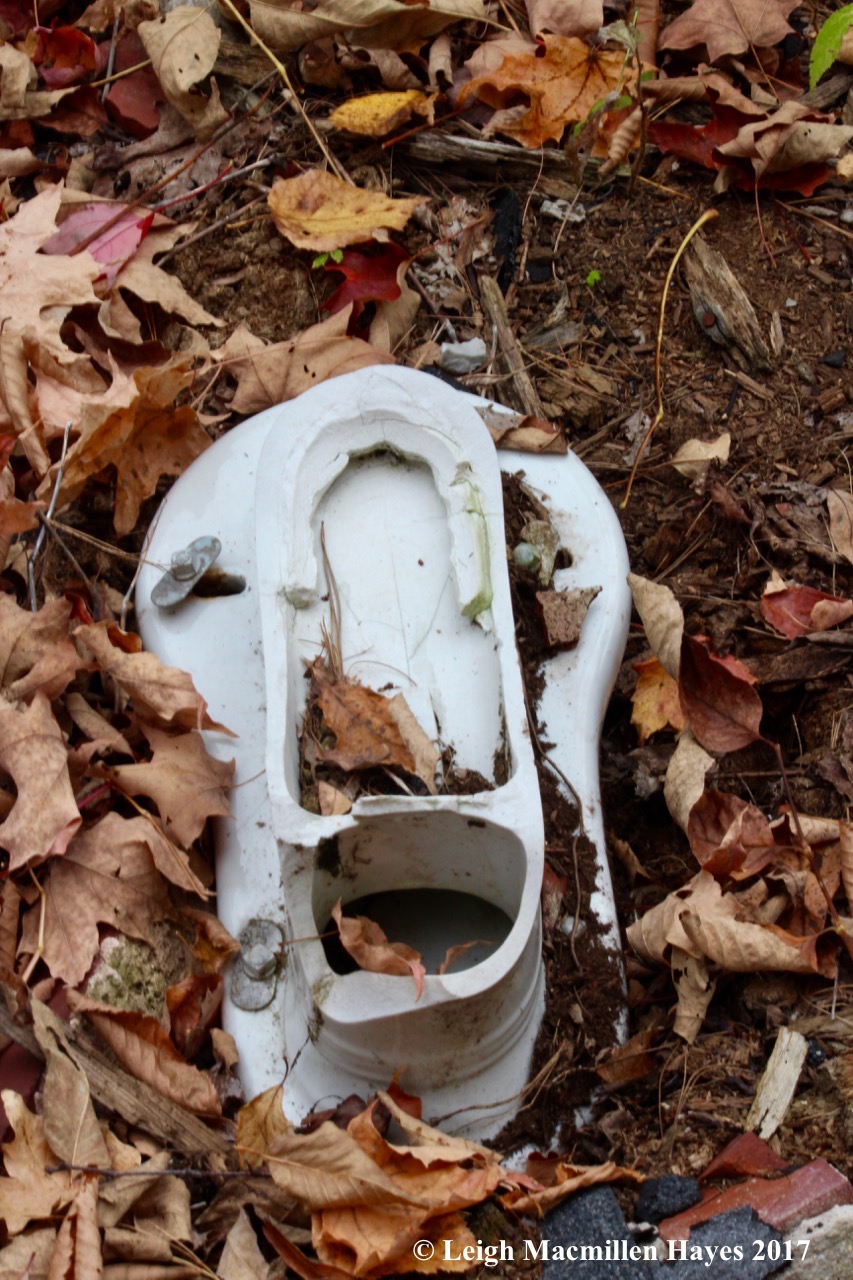
m-toilet

Including the john.

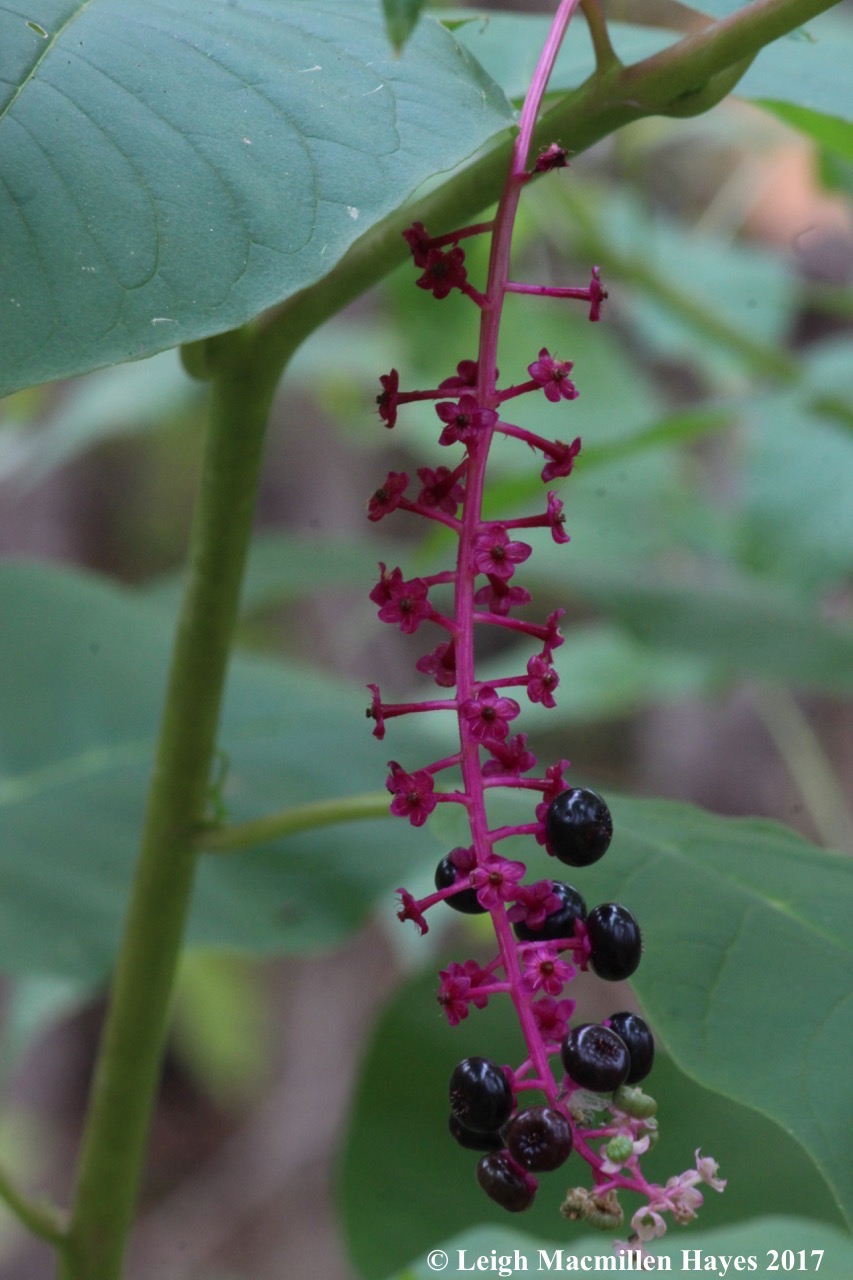
m-pokeweed

Our final view was a pokeweed still in flower and fruit. Again, we wondered about its timing, while appreciating its offering.

With that, we were back at the parking lot, where Bob informed us that our distance was just over a mile and time two hours–hardly record breaking. And hardly a “quickest to the destination hike” for my guy, but he kept finding stumps to sit upon as we gazed more intently on our surroundings; I think he secretly appreciated our slow pace and the opportunity to rest his legs.

If you want support his effort to raise funds for the Shawnee Peak Adaptive Ski Program, stop by and see him. Any and all donations are most welcome.

The Way of the Land at Long Meadow Brook Reserve

Last month the Greater Lovell Land Trust purchased a new property along Long Meadow Brook that further develops the wildlife corridor. A couple of weeks ago I first visited it with GLLT’s Executive Director Tom Henderson and a number of the land trust’s volunteer docents. As we left the property, Tom said to me, “I didn’t oversell this, did I, when I said this will become one of the docents’ favorite properties.” Indeed.

And so I couldn’t wait to get back there myself to spend a few hours exploring the almost one-hundred-acre reserve.

l-mullein-flower-2

Because the land was last logged by the previous owner in 2014, it’s in the early succession stage of regrowth.

l-mullein-flower-3

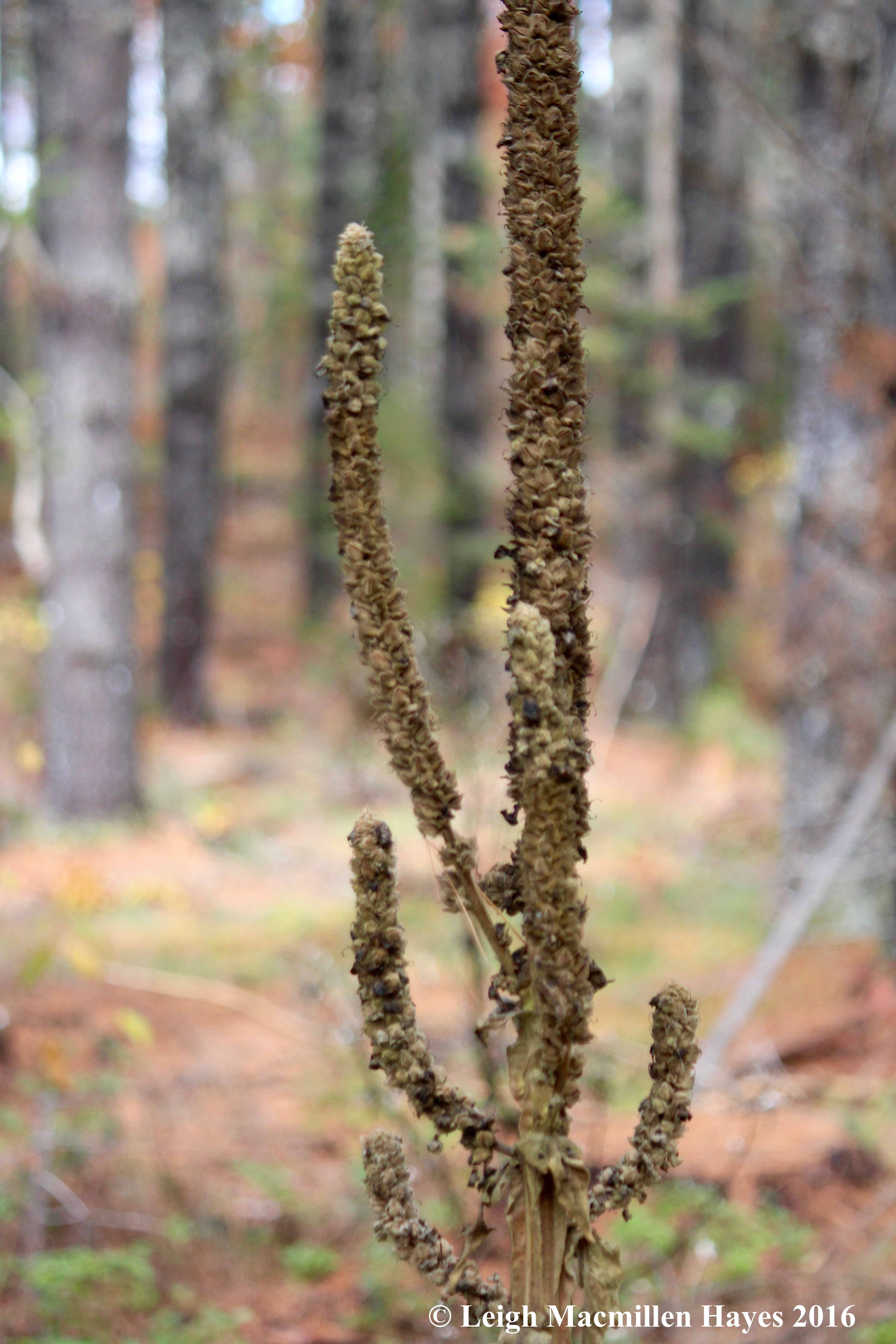
And so, it’s a place where those who like disturbed places tend to grow, such as the common mullein. What surprised me most was that I found a few still offering blooms.

l-mullein-cactus

Of course, it reminded me that I was in the great West–WESTern Maine, that is–with its occasional cacti-like form.

l-seeds-holidng-on

Scattered throughout are also the seedheads of white lettuce, waiting for release in lampshade-like formation.

l-orange-peel-fungi

Orange-peel fungi fruited prolifically in the gravel logging road.

l-future-parking-lot

That was all before I even reached the future parking lot, which had served as the log landing a few years ago. Already, sweet ferns and berry bushes have made themselves known.

l-sweet-fern-colors

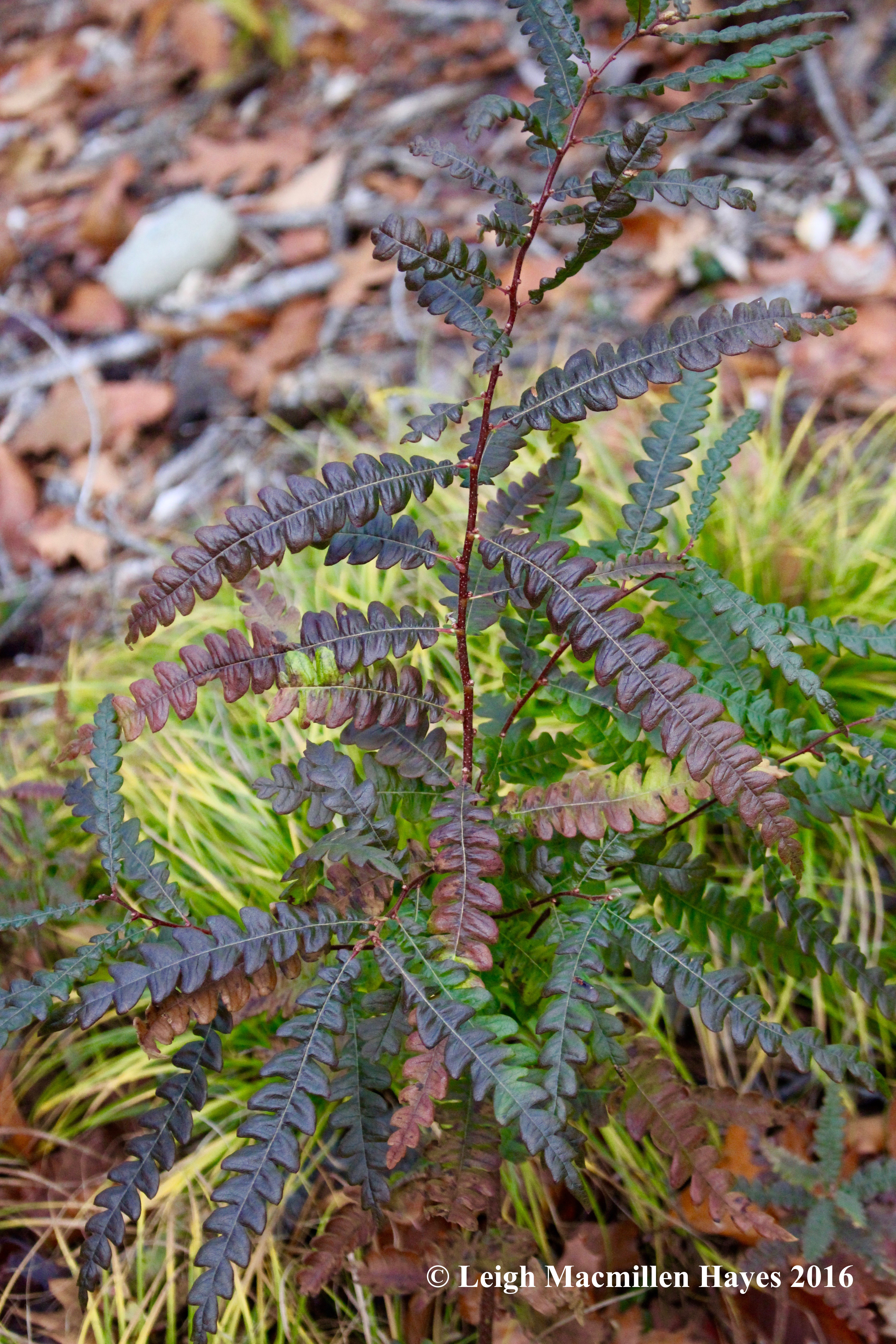
The leaves of sweet fern, which is really a shrub rather than a fern, exhibited their version of autumn hues.

l-trail-marker

If you go, I encourage you to look for the blue ribbons that indicate where a future trail will be placed. It’s a loop trail that summer interns Hannah and Aidan laid out and leads to two focal features.

l-stonewall-double-to-single

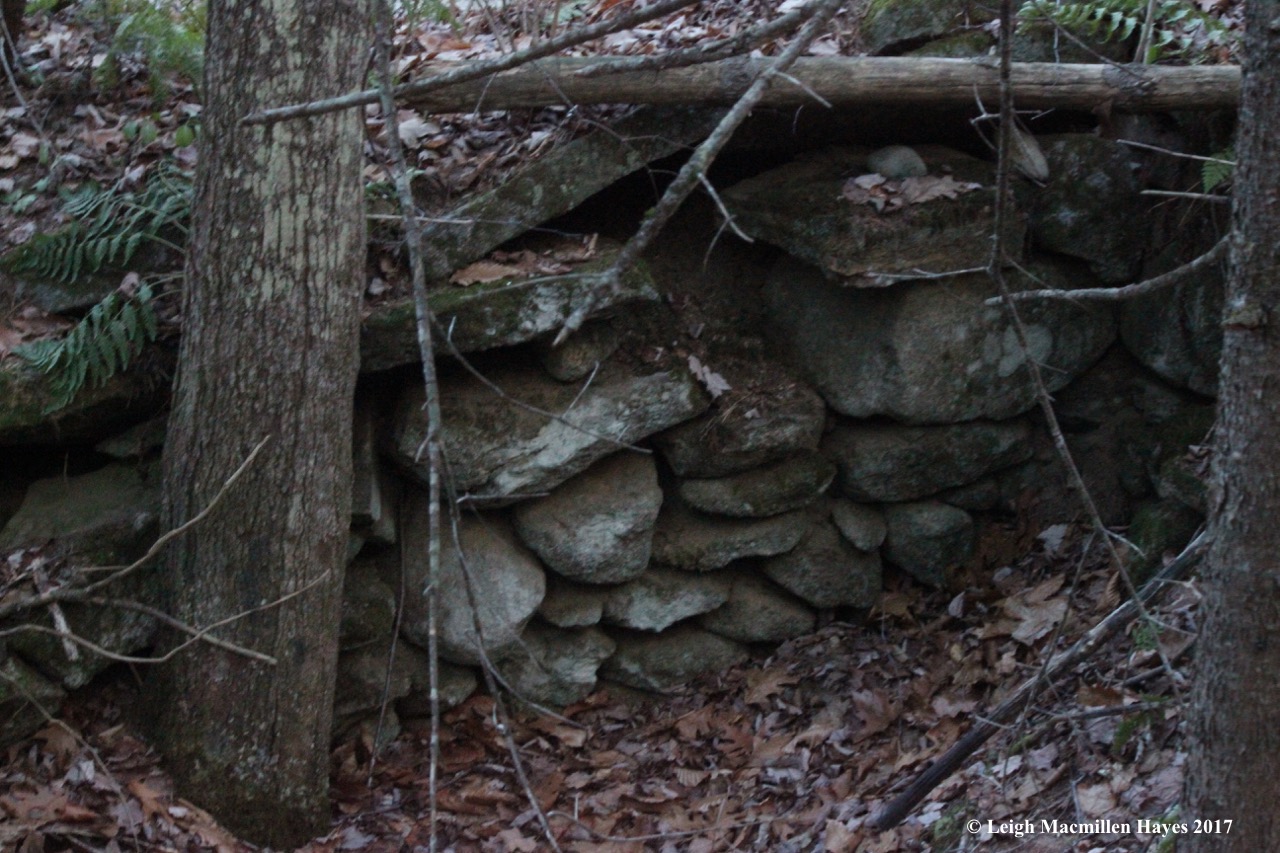
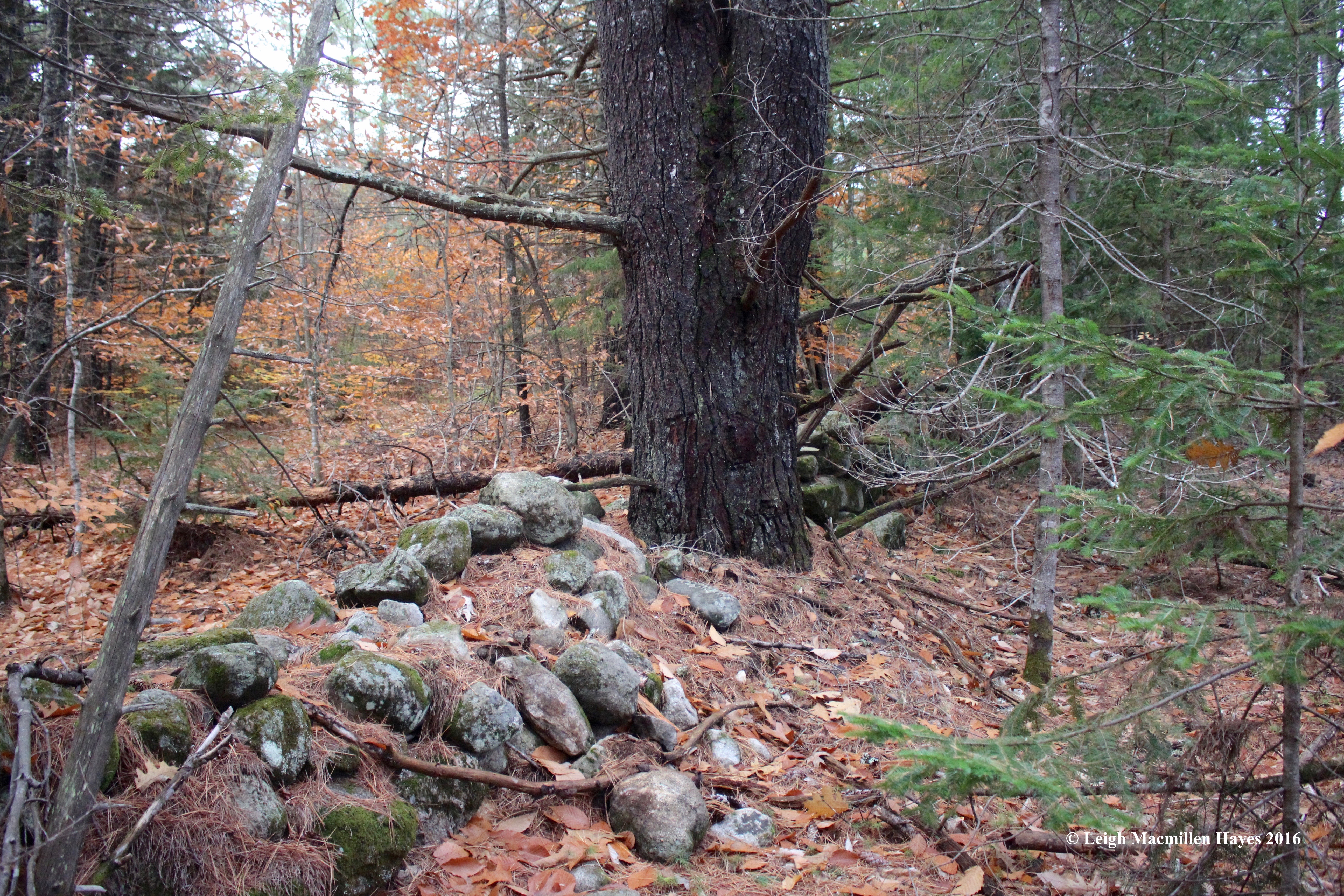
The trail nears a neighboring property, which just happens to also be under conservation easement thanks to the foresight of its owners. I stepped off the blue flag trail and started to follow the wall for a bit–noticing that soon it changed from a double (garden or plowed land) wall to a single wall. A large pasture pine grew at the change-over point.

l-stonewall-barbed-wire-1

And where the wall switched to single formation, barbed wire indicated its former use a pasture boundary. And white pine scales indicated its current use–as a red squirrel’s dining room table.

l-forest-succession-2

After moving away from the wall, I noticed the mountains in the offing and ferns and young trees already filling in the empty spaces.

l-kearsarge

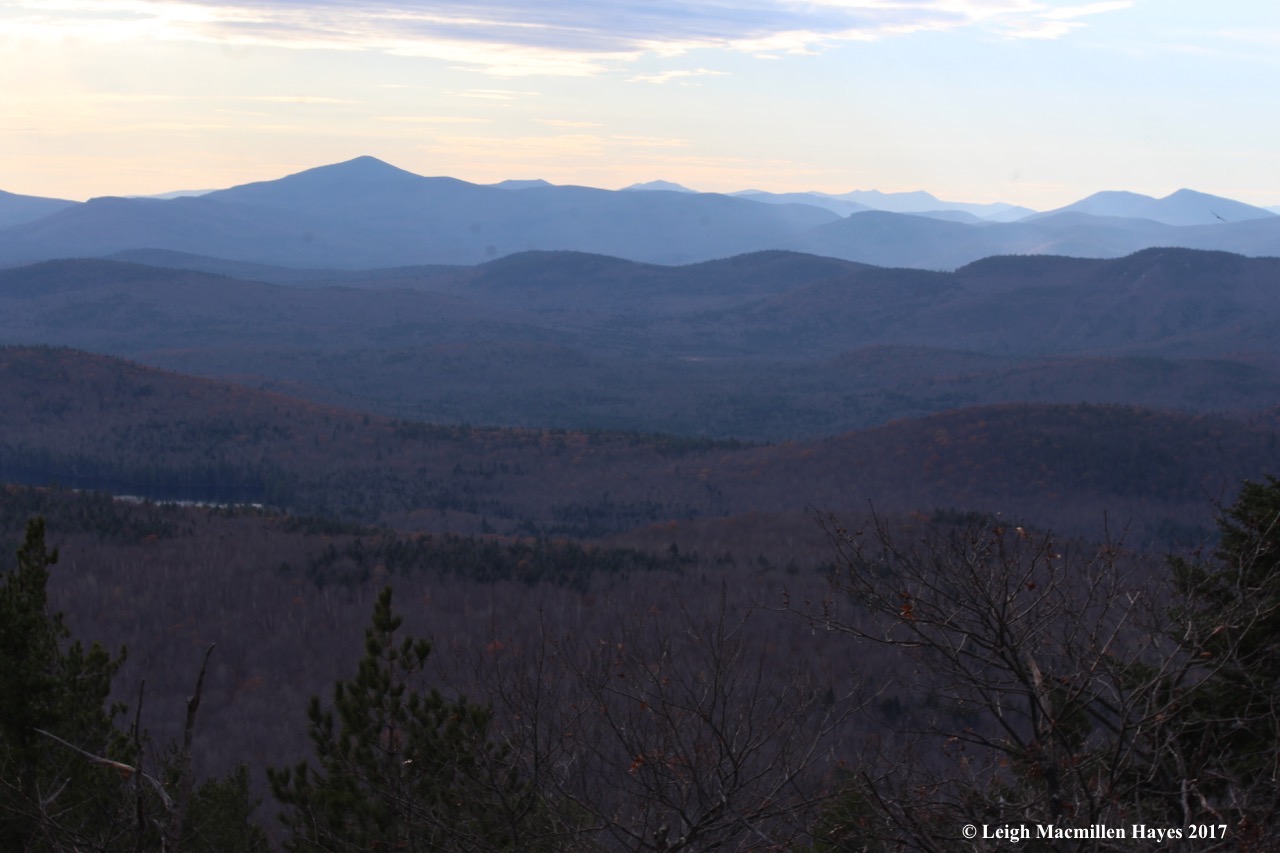
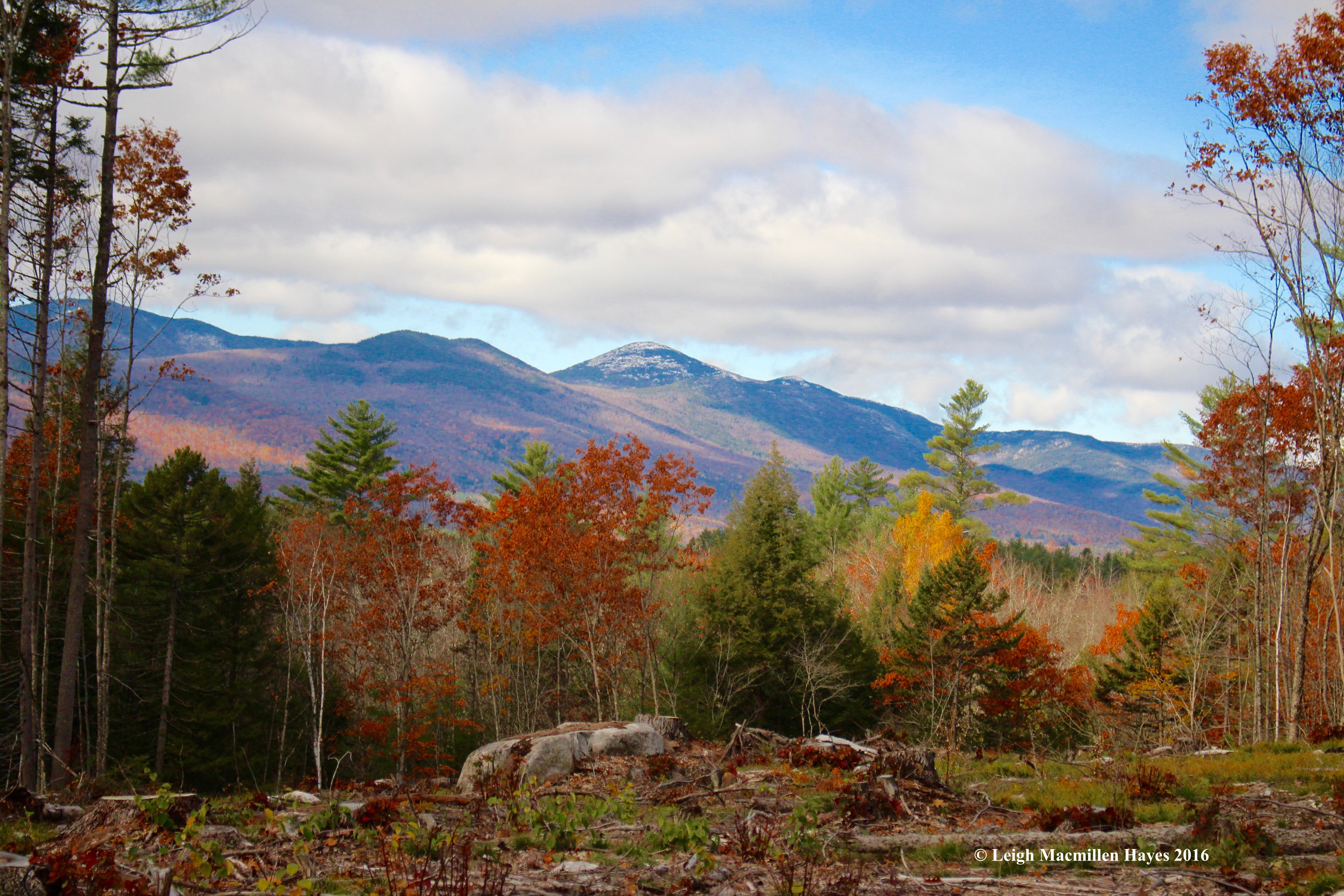
One of my favorite mountains to climb stood tall in the backdrop–Mount Kearsarge.

l-forest-succession-1

My bearings were off a bit, but I knew where the eastern boundary was as I moved across this opening.

l-pitch-pine-bark-1

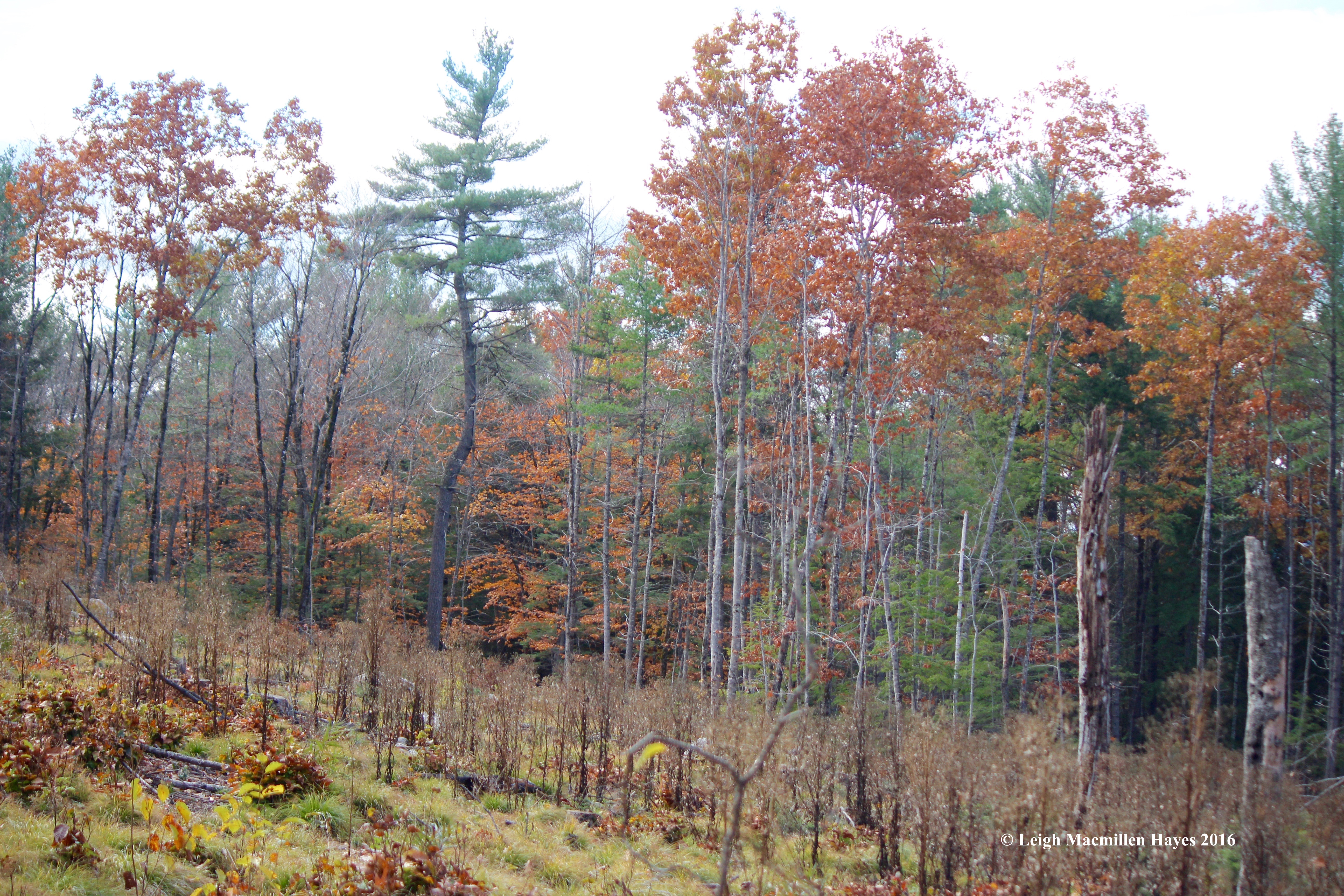
Walking along the back edge, my tree passion was ignited yet again.

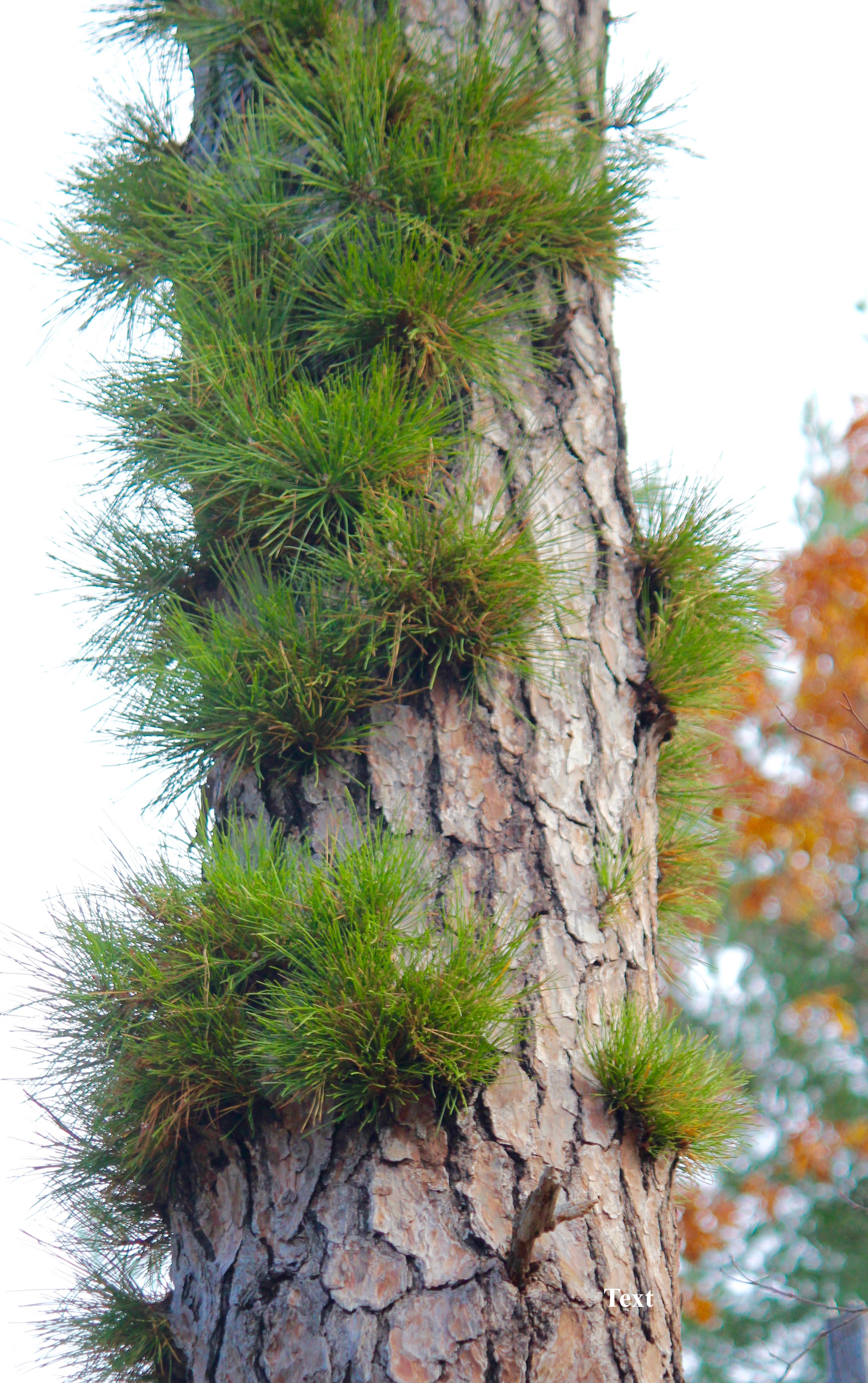
l-pitch-pine-1

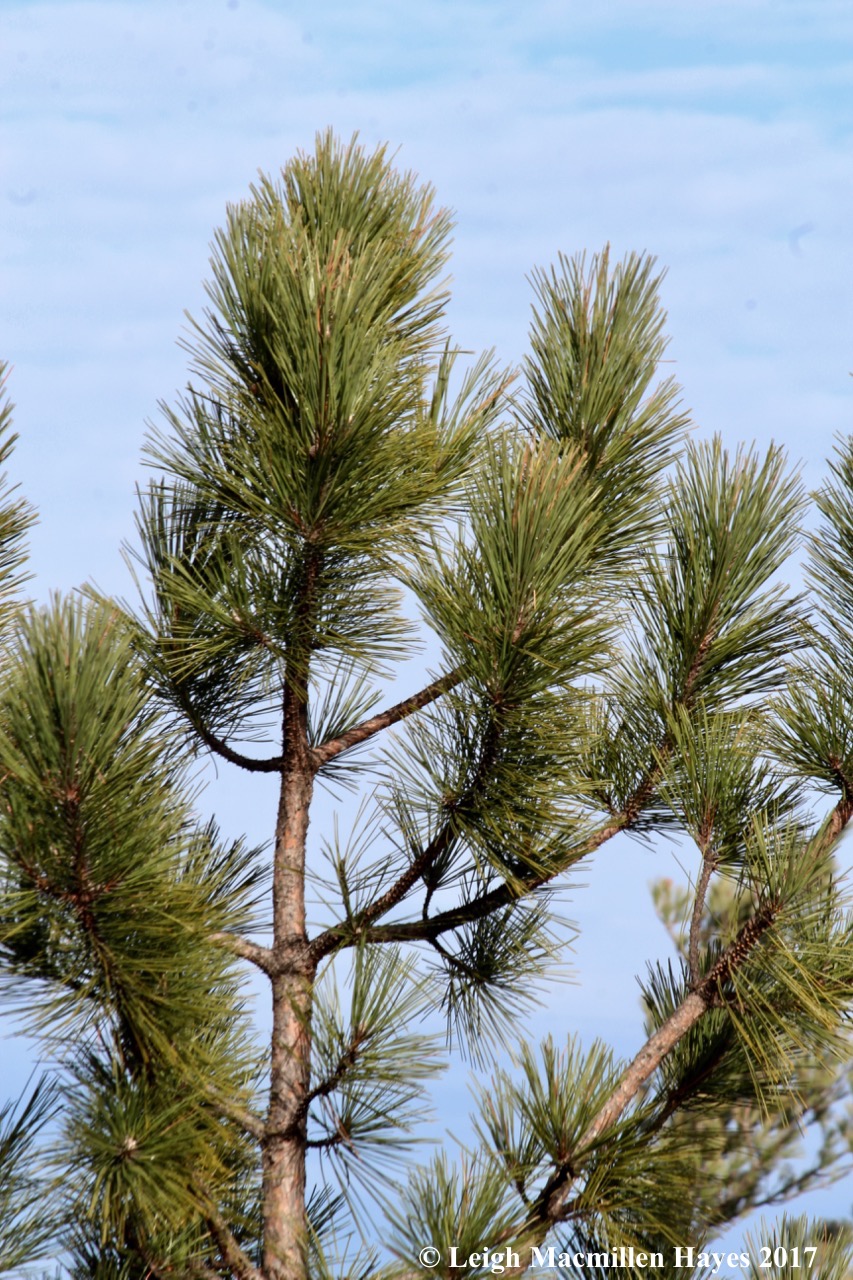
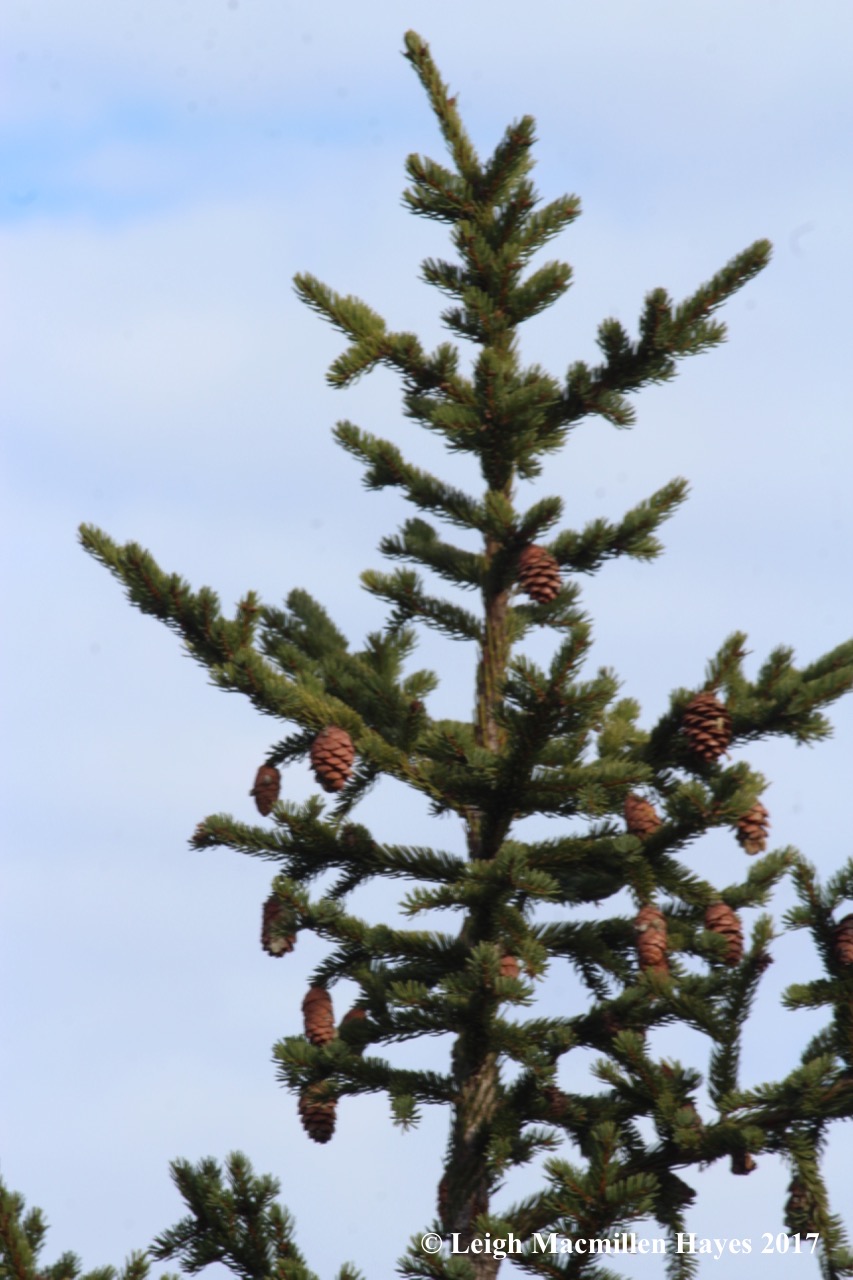
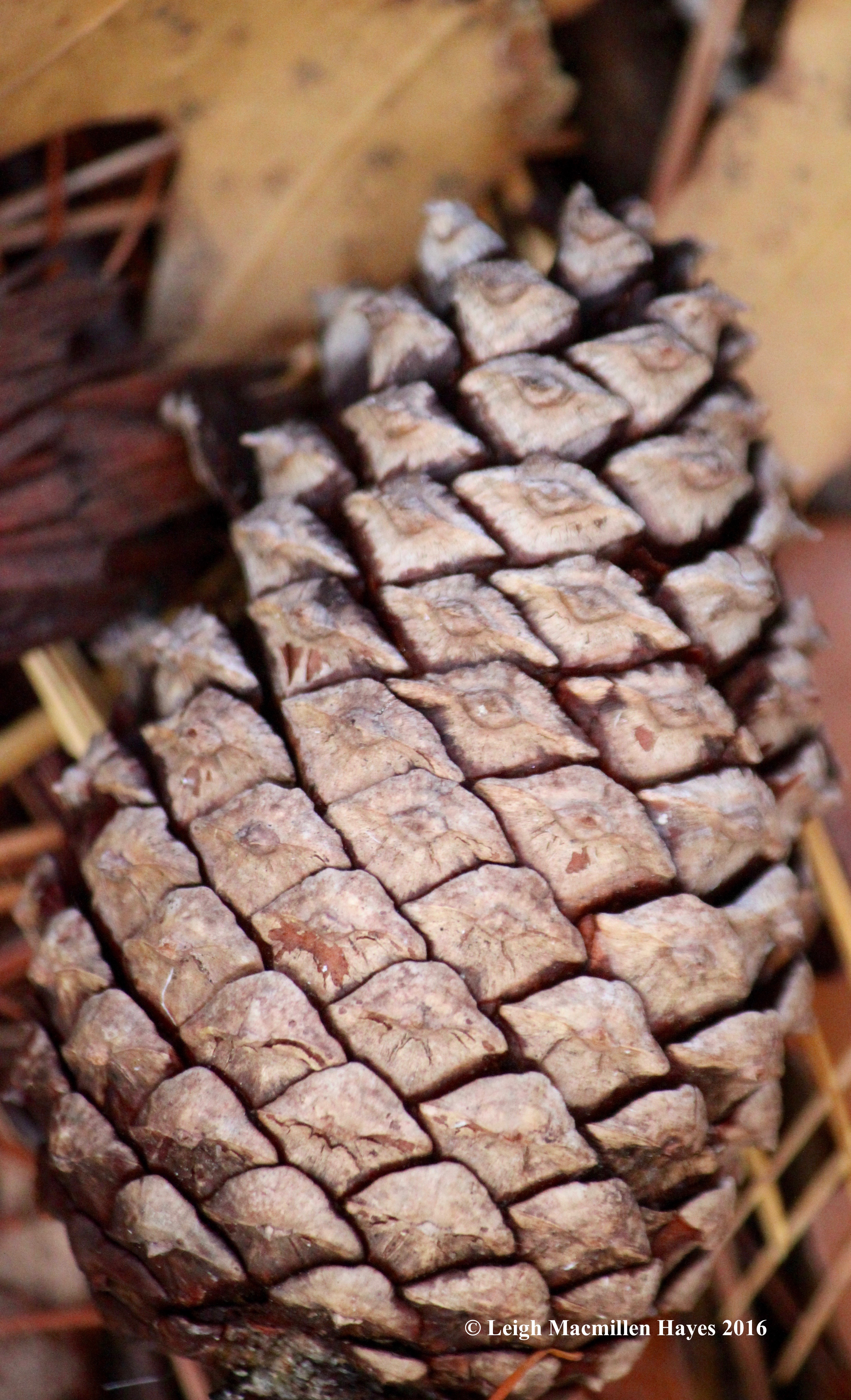
Several pitch pines grow in this space. While the bark is similar to that of red pines, it’s platier (is that a word?). And the tufts of needles that grow along the trunk were a dead give-away.

l-pitch-pine-cone

l-pitchpine-needles

But . . . I always quiz myself and so I looked around. And right below the trees, pitch pine cones and the triple needle bundles common to this species.

l-wintergreen-berries

It was here that I discovered wintergreen growing by the base of a tree stump. What made me wonder was the amount of fruit on each plant. Yes, wintergreen grows prolifically in all of western Maine, but I can’t recall ever seeing so many little red globes dangling below the leaves.

l-marshy-1

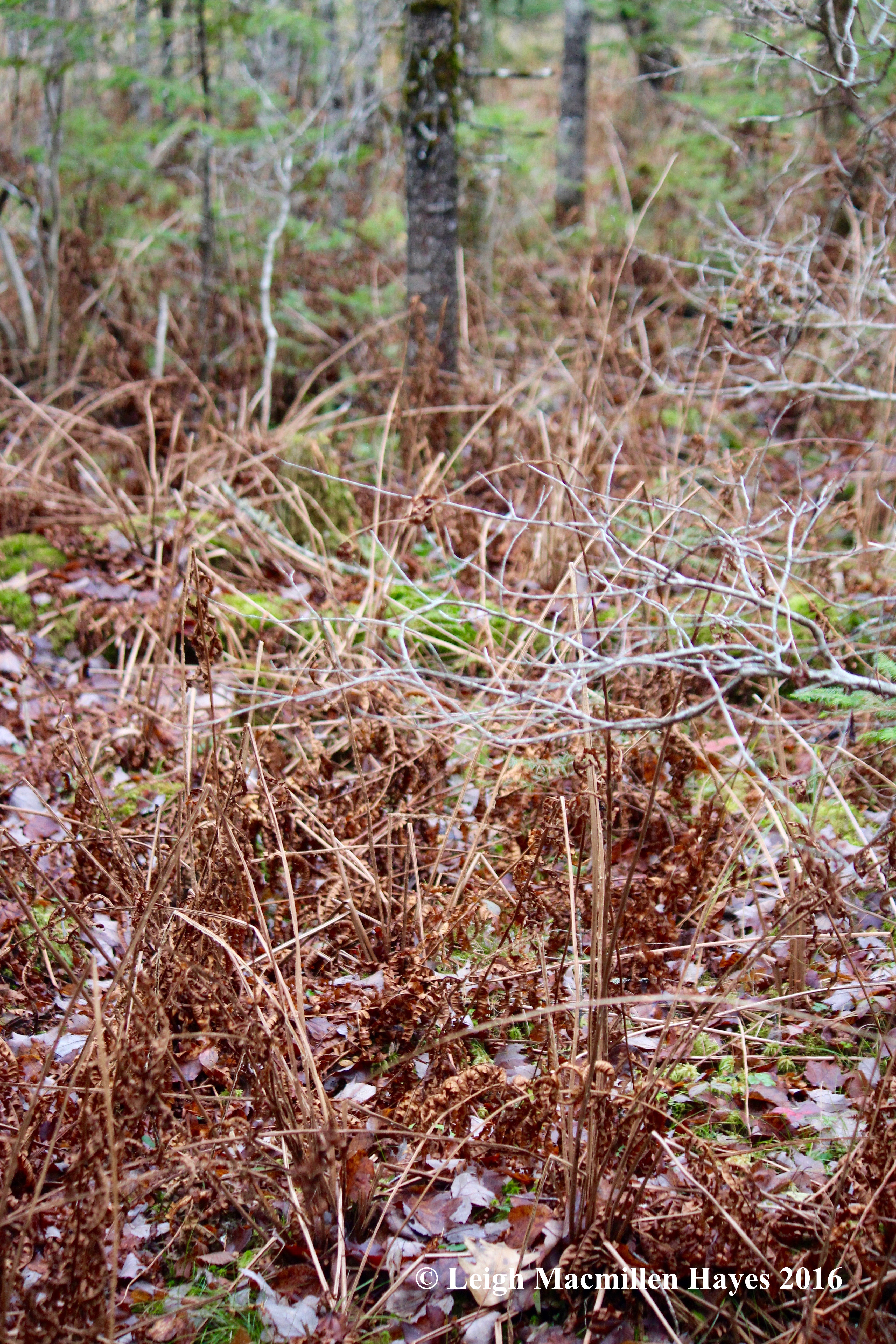
From my half-circle around the opening, I wasn’t positive about my whereabouts and so decided to follow the land downhill because it looked like there may be an opening below. A few minutes later, I realized I was in a marshy spot where the cinnamon ferns grew. And the earth beneath my feet was rather spongy and damp.

l-beaver-lodge

I reached what I thought was the meadow I sought–only to realize that I was looking at a beaver lodge. I knew that beaver lodge, but from a different perspective–the neighbors’ property.

l-first-marsh

And then something else caught my attention.

l-marsh-tamaracks

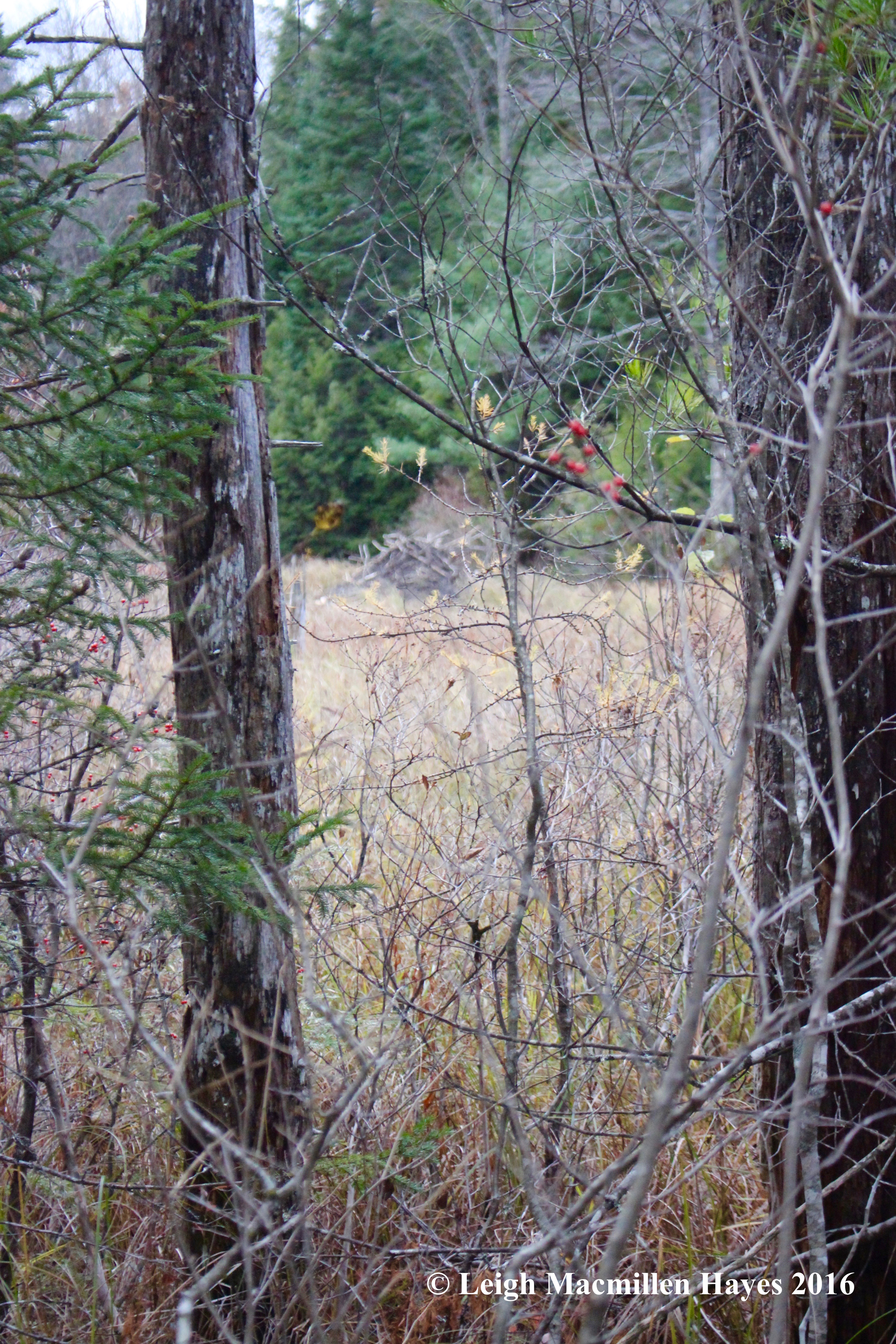
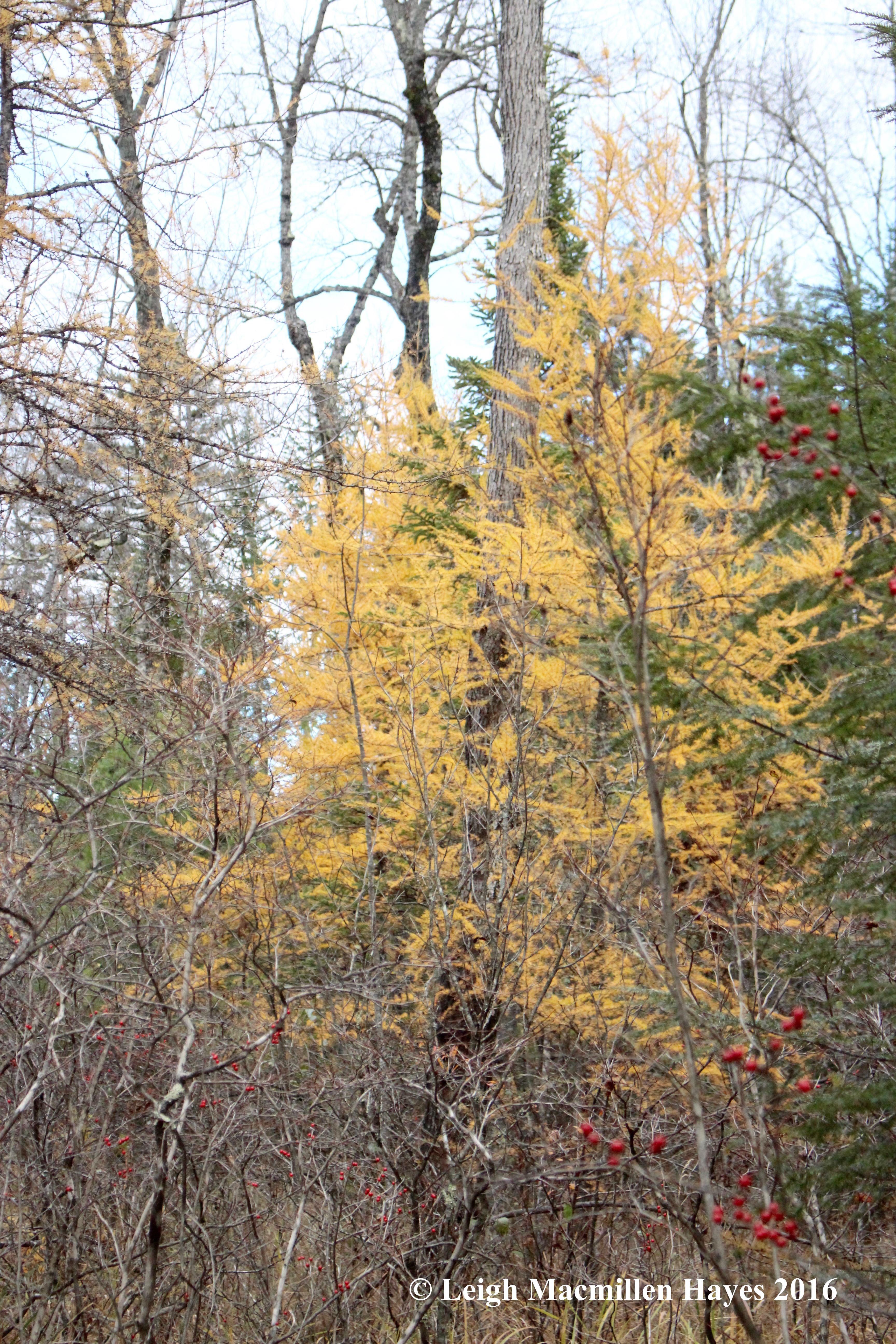
Tamarack (aka larch) trees–our only deciduous conifers, which had turned a golden yellow as is their autumn habit.

l-tamarack-2

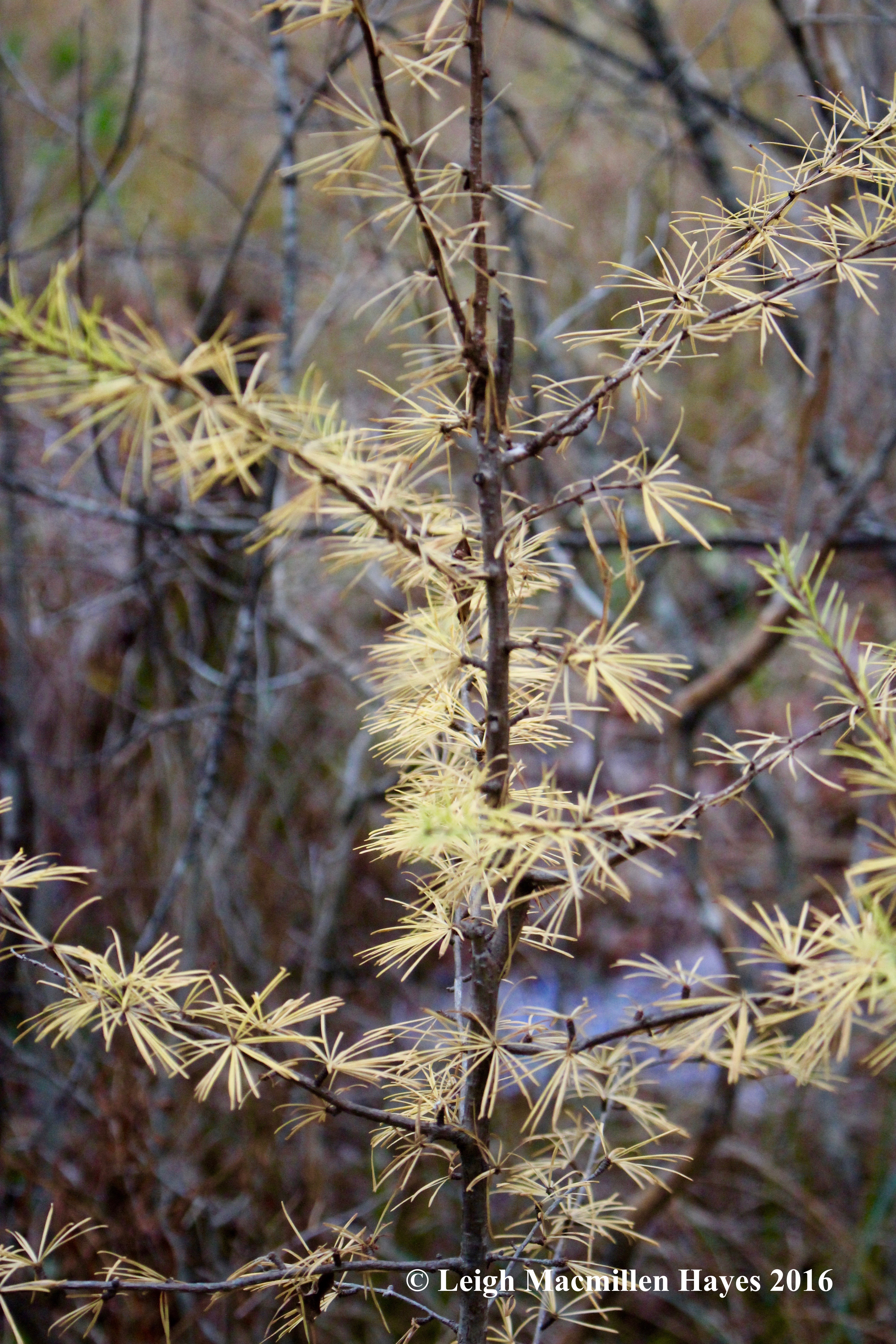
The spray of tamarack needles reminded me of witch hazel flowers, which also grow on this property. But soon, the former will drop, leaving only their barrel-like stems as a reminder of their presence.

l-maple-leaf-viburnum

I left that spot, retraced my steps and headed to the north on a cross-country bushwhack, where the mauve colored maple-leaf viburnum grew.

l-turkeys

I saw lots of mammal sign and even a few birds, including turkeys who are loving the fact that this is a mast year for acorns.

l-trail-to-meadow

At last I emerged onto the trail I remembered and headed downhill again.

l-meadow-brook-2

And then . . . I was rewarded for my efforts. Long Meadow Brook and the mountains beyond provided a WOW moment.

l-meadow-east

I looked to the east for a few minutes.

l-meadow-layers

And then turned west again, where the layers and colors spoke of diversity.

l-meadow-snags

Even the dead snags added beauty.

l-cat-n-nine-tails

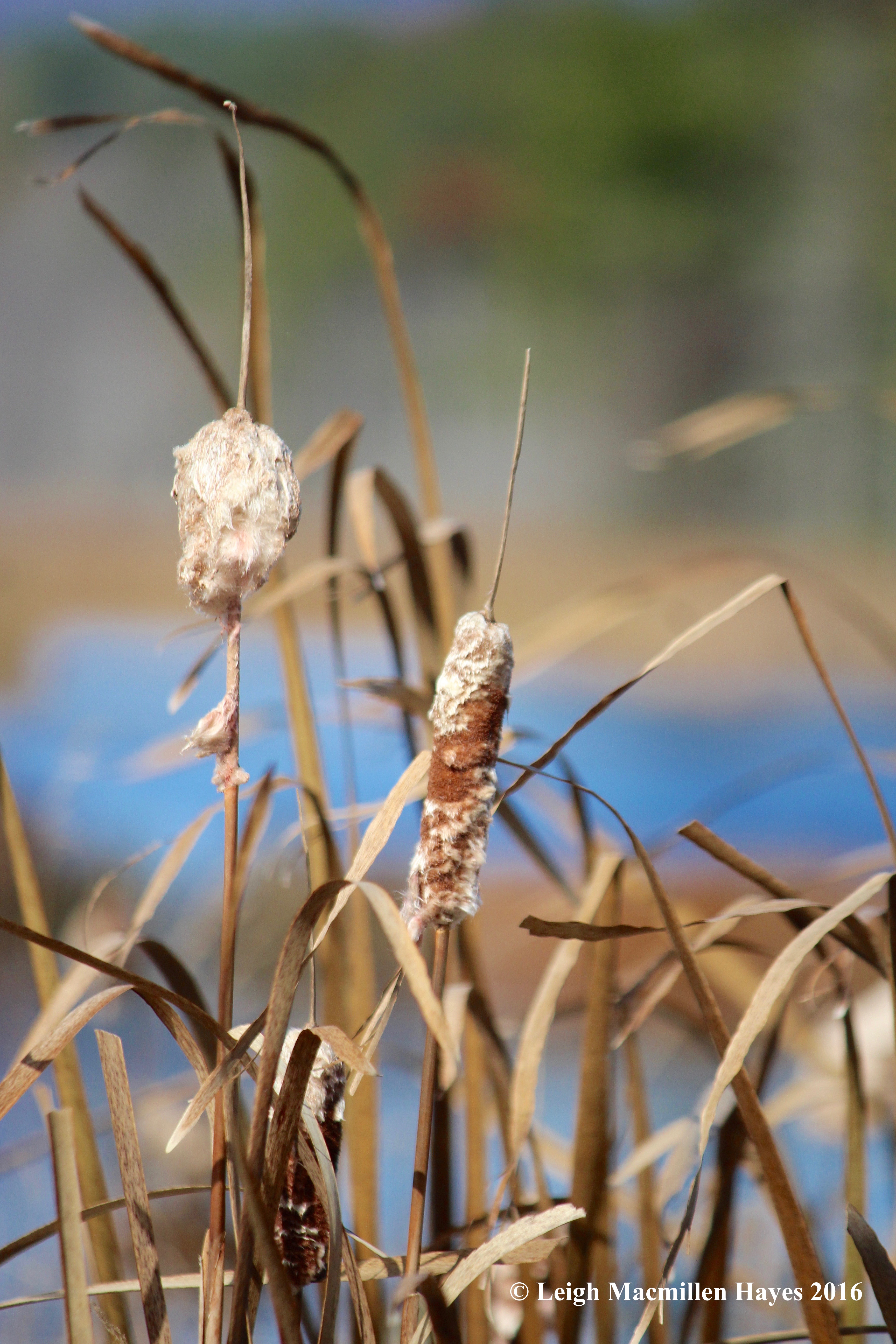
Cat-in-nine tails added to the view and I noted others who like wet feet including steeplebush, meadowsweet and bulrushes growing along the old beaver dam. It’s also a place for a variety of evergreen species–hemlock, white pine, balsam fir, red spruce and tamaracks. Future teaching moments await.

l-hobble-2

My intention to stick to the trail was soon thwarted when I spied hobblebush.

l-hobble-bud1

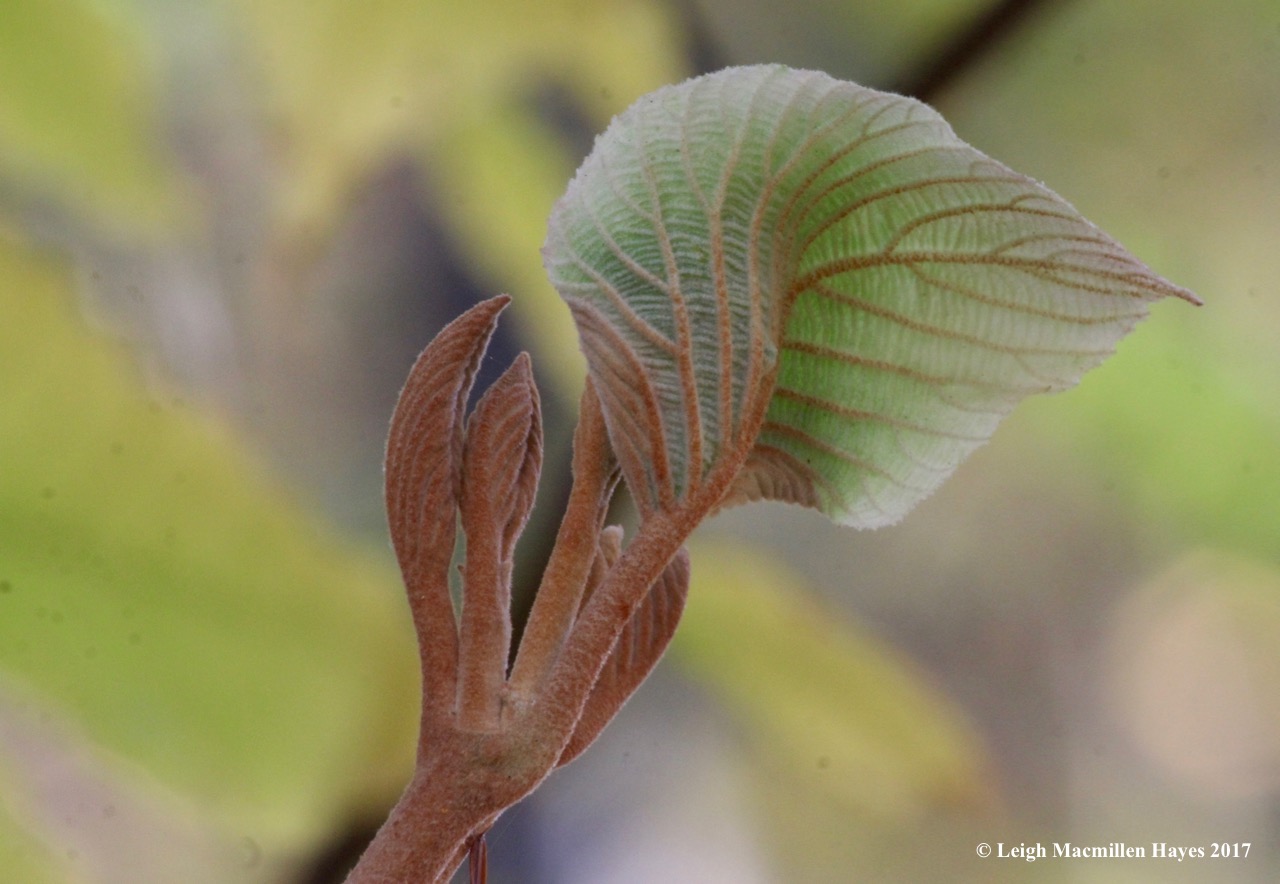
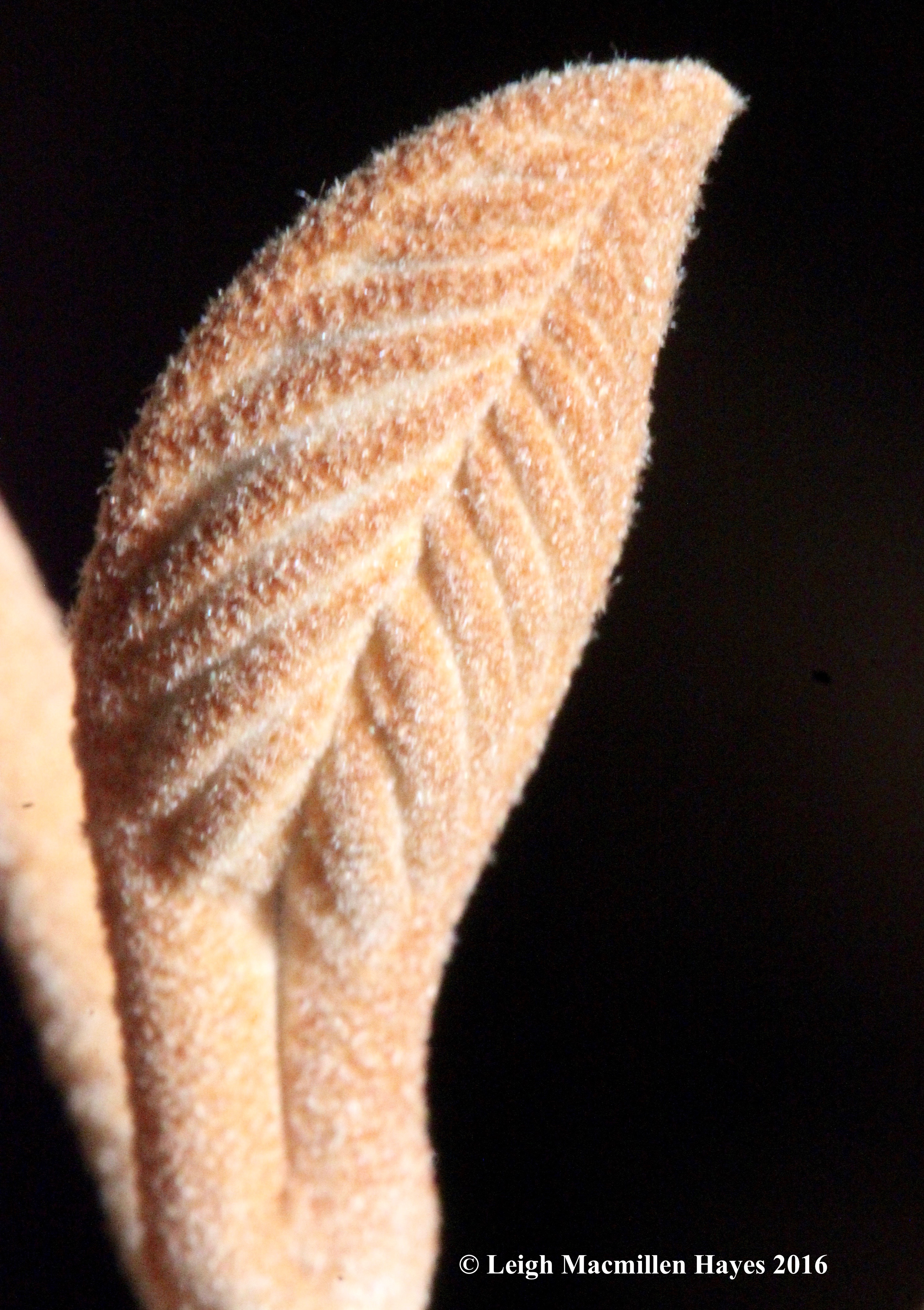
Like all trees and shrubs, the future was already encased in a bud–in this case a bud we refer to as naked because it doesn’t have the waxy coating of most others. Methinks its furry presentation offers the same protection from winter’s cold.

l-back-of-hobblebush-leaf

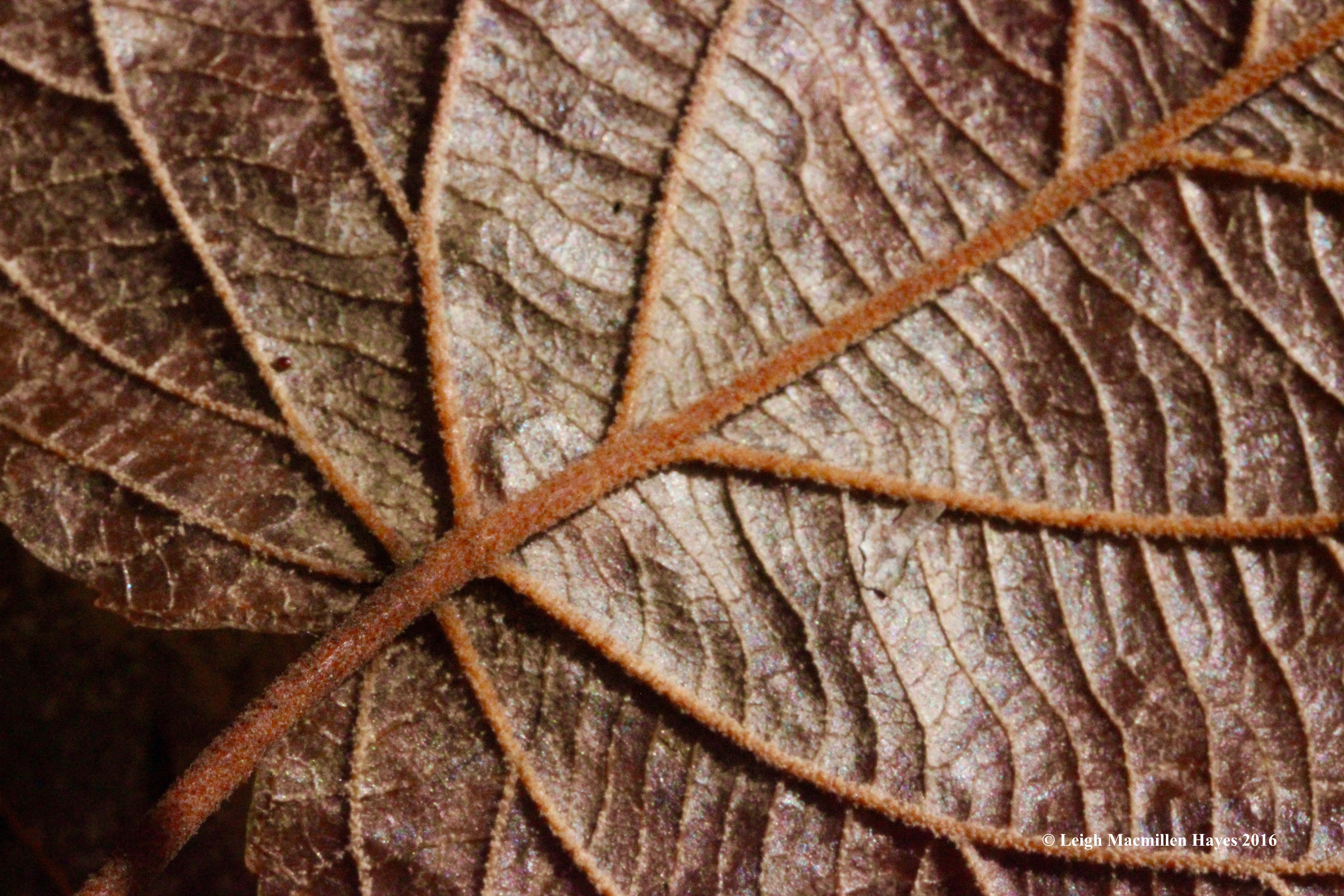
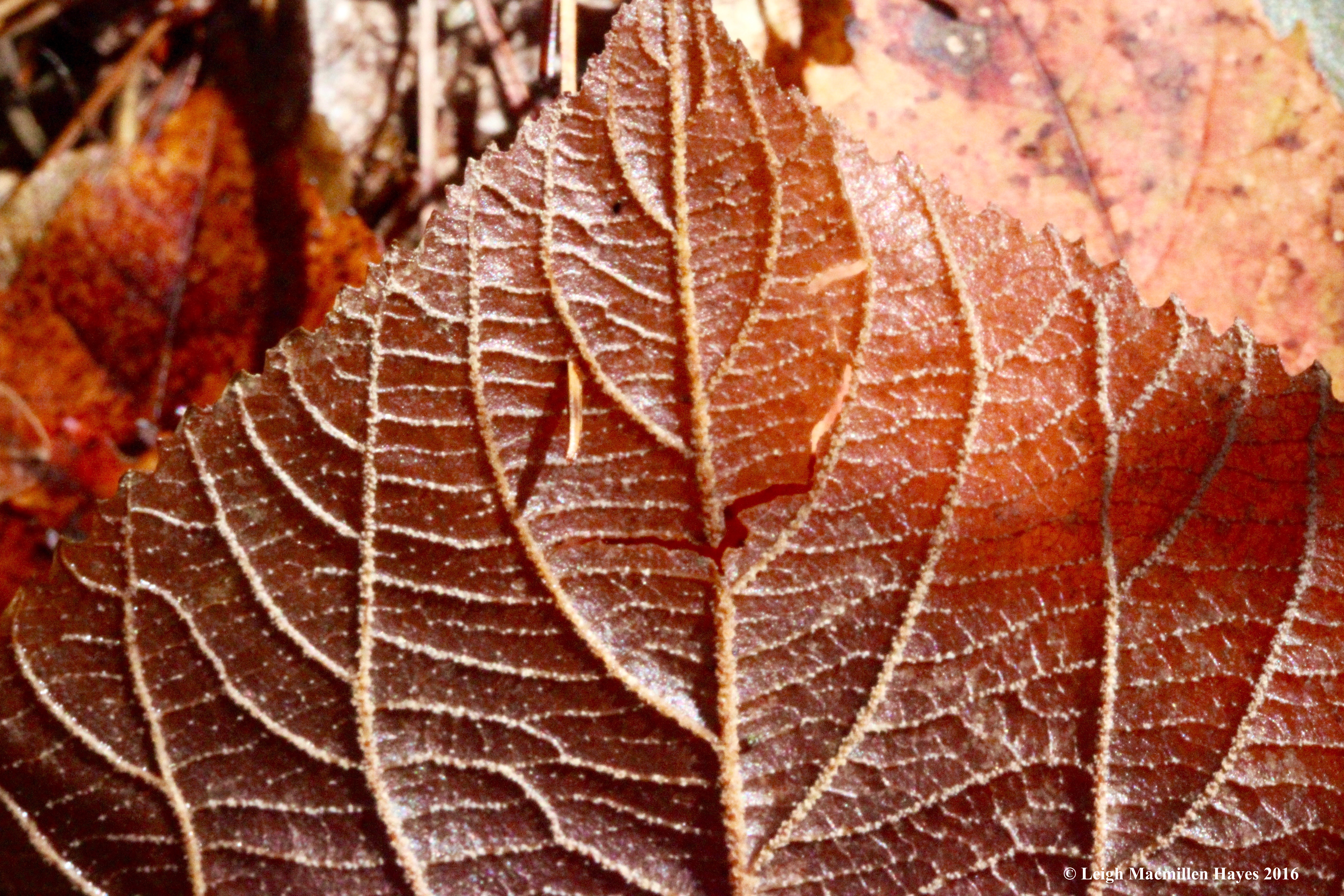
And as I studied the back side of fallen leaves, I paid attention to the venation–reminiscent of the bud’s pattern.

l-hobble-leaves-2

In the glow of sunlight, I felt like I’d found the pot of gold.

l-meadowhawk-2

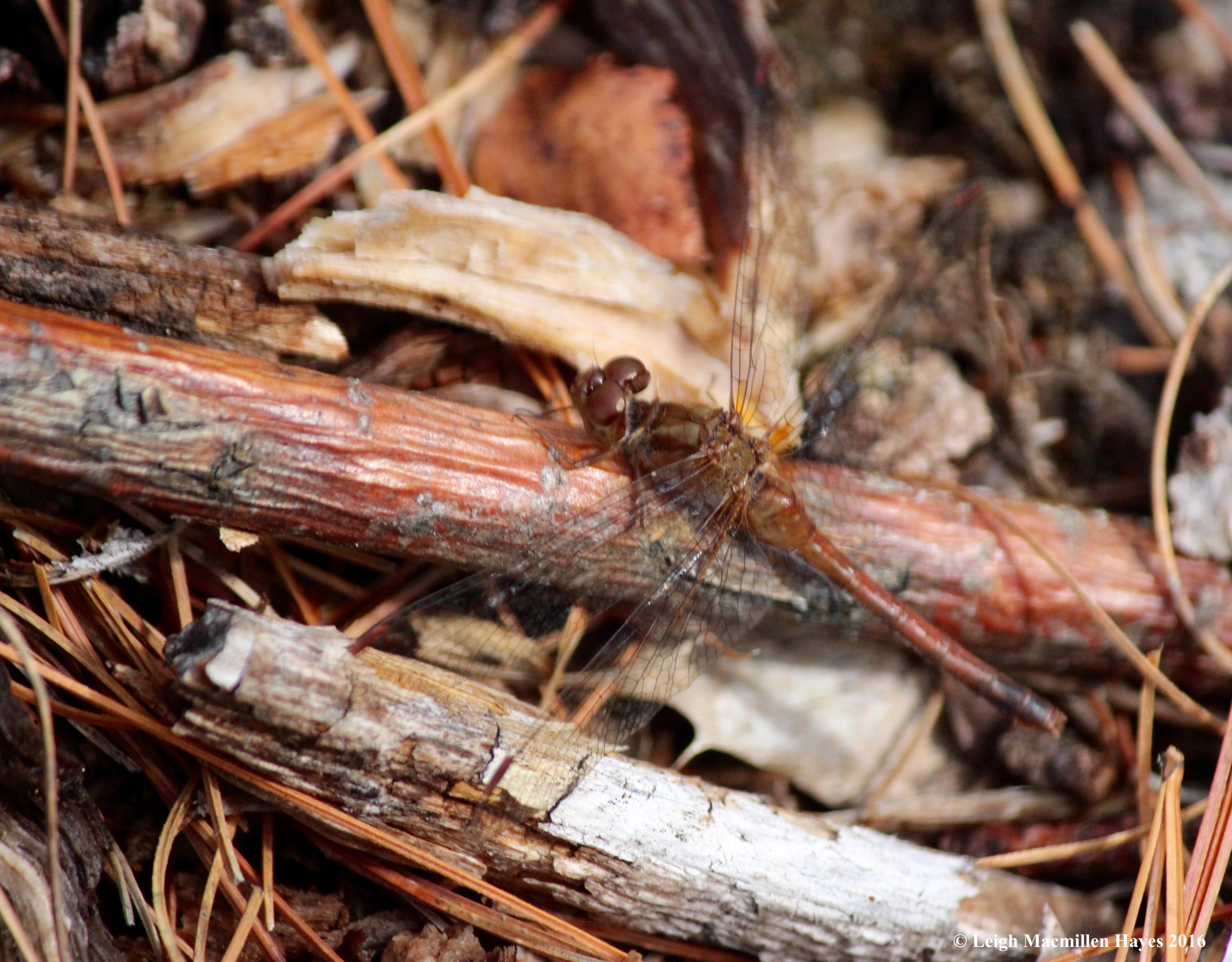
A short time later I reached the second opening that Hannah and Aidan’s trail encompasses. And what to my wondering eyes should appear–a meadowhawk dragonfly.

l-snow-on-balds-1

It provided a sharp contrast to snow on the Baldface Mountains.

l-secod-opening-2

It was at this six-acre opening that I poked around for a while longer. And watched a goshawk fly to a pine tree with something dangling from its talons. Did I take a photo? No, of course not. I was too mesmerized to focus my camera. But sometimes, the photo doesn’t matter. Being there in the moment does.

I’m thankful for such opportunities made possible by organizations such as the Greater Lovell Land Trust. I know that ultimately this property is for the mammals that travel through and I saw plenty of evidence that they use this place. But then again, I’m a mammal who also appreciates the land bridges created and opportunity to observe the connectivity. I spent the day getting to know the way of the land at Long Meadow Brook Reserve–and can’t wait to return.