Easter 2025: An Interwoven Weekend Celebration

Hindsight being what it is in offering 20:20 vision, maybe I shouldn’t be surprised at how this weekend played out, but going forth without expectation always offers the best of the best.

The weekend began on Good Friday, when after completing some errands, I wandered along a local trail for far longer than I intended, and in fact, had to pull myself away to get home in time to attend a Taize service at church.

Walking alone gave me time to reflect on the past and be present in the moment.

And that’s when I spotted my first Painted Turtle of the season, who offered a reflection all its own.

I still have some of the man-made Turtles I collected as a kid, but love when the real deal presents itself. And by traveling alone, I wasn’t making much noise, and so the Turtle didn’t suddenly plop into the water and disappear.

Along the same trail I nearly stepped upon another Painted Turtle, who immediately pulled its head into the shell, as only this species can do. It was in a spot where cobblestones cover a culvert, and I decided I should help it cross to the other side.

But first, I insisted that it pause for a selfie. Based on the length of its nails, being on the shorter side, and flat bottom shell (plastron) as opposed to the concave bottom of a male, I decided this was a female.

And a beautiful female at that–in color and pattern and texture. Amazing.

It took her a few seconds to decide the world was still a safe place, but once she started to move, it was a quick journey to the water before she swam out of my life, and I wished her well while giving thanks for our short time together.

Once I cued in on there being turtles in this place, I quickly realized they were everywhere. I counted eight on one semi-submerged log. And in this photo there are two.

Can you locate the second one?

And then I had another surprise, and this was the main reason I probably overstayed my welcome.

At first I thought it was a beaver, until I looked at its thick rounded tail and knew I was in the presence of a Muskrat.

Usually Muskrats disappear in my presence, but I think again, because I was willing to stand still and be as quiet as possible, this one did not dart off.

It did, however, dine in places where I came to appreciate its camouflage coloration.

Other times it was in the open so I could better watch as it munched on vegetation, holding the plant matter with both small front “hands.”

As I finally walked back to my truck, I stopped one last time, to admire the buds of Trailing Arbutus, on the cusp of blooming.
And then on Holy Saturday, My Guy and I returned to the same trail system because when I’d first arrived on Friday I ran into a former colleague who mentioned an adjacent trail and I wanted to explore it.

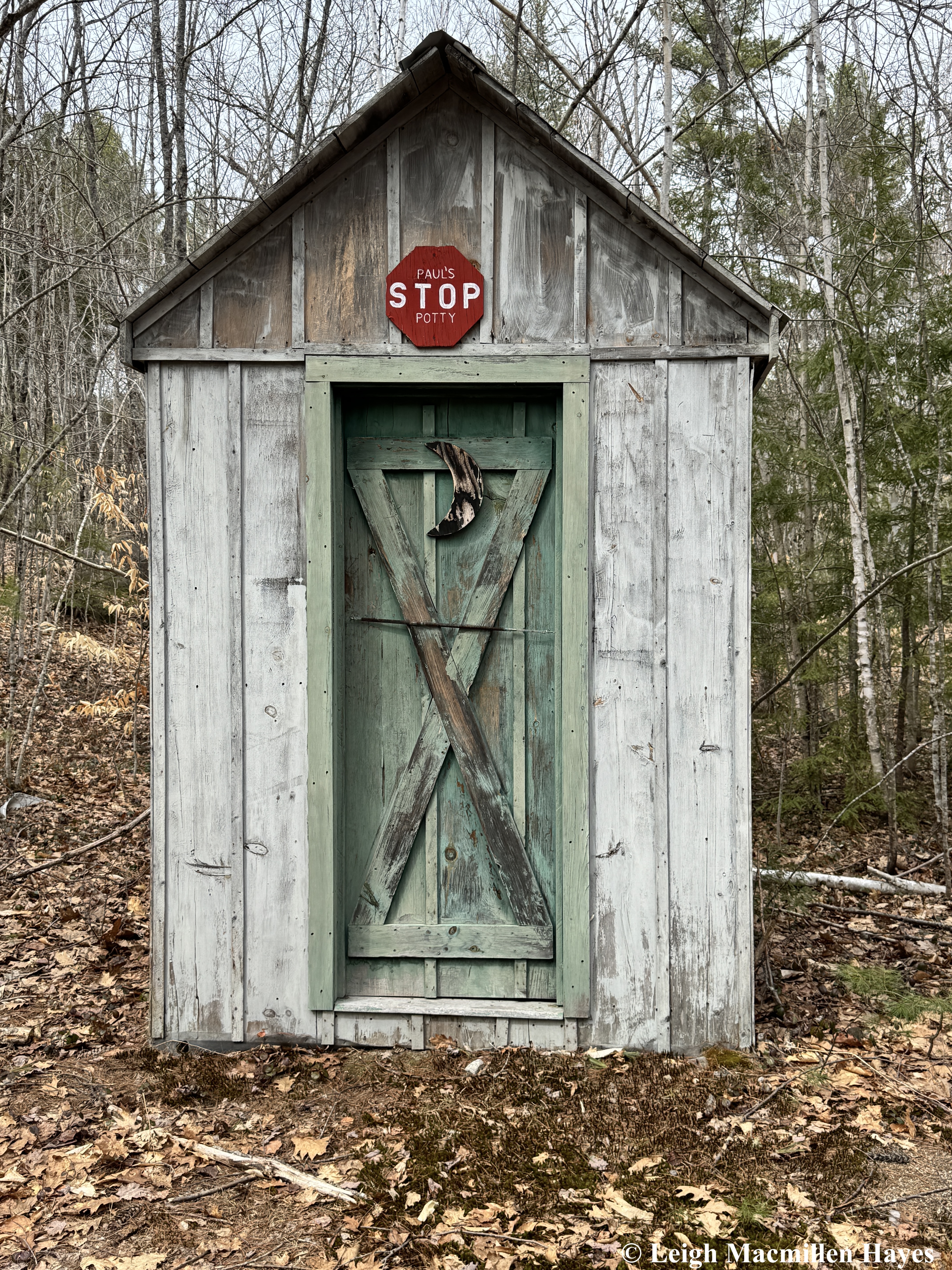
It’s actually part of the snowmobile system, and if you know where this privy is located, then you know where we were. Together we covered a lot of ground (as in 9 miles) and got a better understanding of the area and local ponds and wetlands near the privy.

But even better than that– (remember yesterday’s buds ready to burst?) another first for the season that again seemed apropos for the weekend: the first blossoms of Trailing Arbutus. So sweet and tender and fragrant.

Maybe instead of being known commonly as a Mayflower, this year it should be an Easter Flower.

On Easter, we had a late start for adventure and actually, we chose Plan B for our hiking destination because of the time–since we’d attended church in the morning and then dined at a local restaurant with three generations of our family, minus our two sons, their gals, and a nephew and his gal.

At the summit we did what we always do and waved to some friends who have a summer place on the pond before our eyes. And expressed our sorrow that they won’t be heading north this year. We can only hope that future plans include a return trip.

The wind was wild and brisk, but we took time to also admire the beauty of another pond and Sebago Lake in the distance and shouted, “Happy Easter, Alleluia!”

Eventually, we had to backtrack along another trail upon which we’d started our hike, and though we love loops, I also like it when we follow the same trail back because sometimes you see different things you missed.

Such was the case.

It had been a few years since we’d followed this trail named for a local brook, but it wasn’t until the return trip that I spotted this Scouring Rush. Again, it’s a case of structure and form and color and design and texture. The stem reminds me of an accordion and the top a cone. Or even Cancer Root. Just wow!

And then today found us exploring yesterday’s intended Plan A, where we circled a river for about 2 miles, enjoying the sounds as the water flowed and splashed and sounded so life giving–as it should because it is.
Our chosen spot for today’s lunch was upon steps after we crossed the river to head to a connector trail.

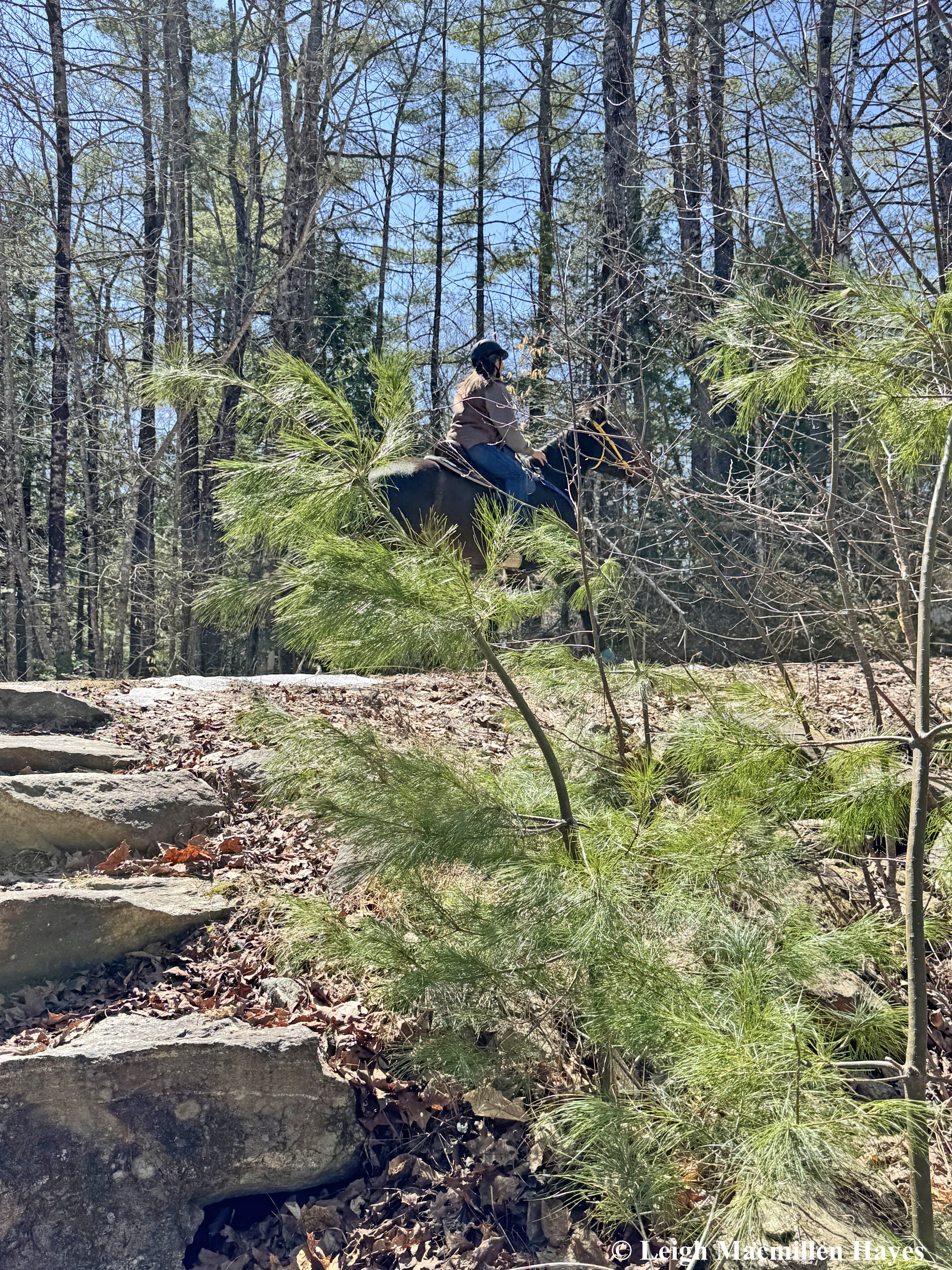
And it was there that we had a most pleasant surprise: a woman rode past on horseback. I only wish I’d been quicker to snap the photo.

Our other surprise in this spot was the knowledge that this past winter a Ruffed Grouse had roosted overnight right here based on the pile of scat it left behind–which is its habit.

My Guy sat upon the rock above and I cautioned him about setting down his water bottle or sandwich.

And in a super sunny spot nearby, the first False Hellebore leaves of the season, at least for me, showed off their bright green and pleated presentation.

After crossing the connector trail we reached a pond with the mountain of our destination serving as the backdrop. I love it that often, even if there is a breeze, and slight it was today, this pond offers the most glorious reflection.
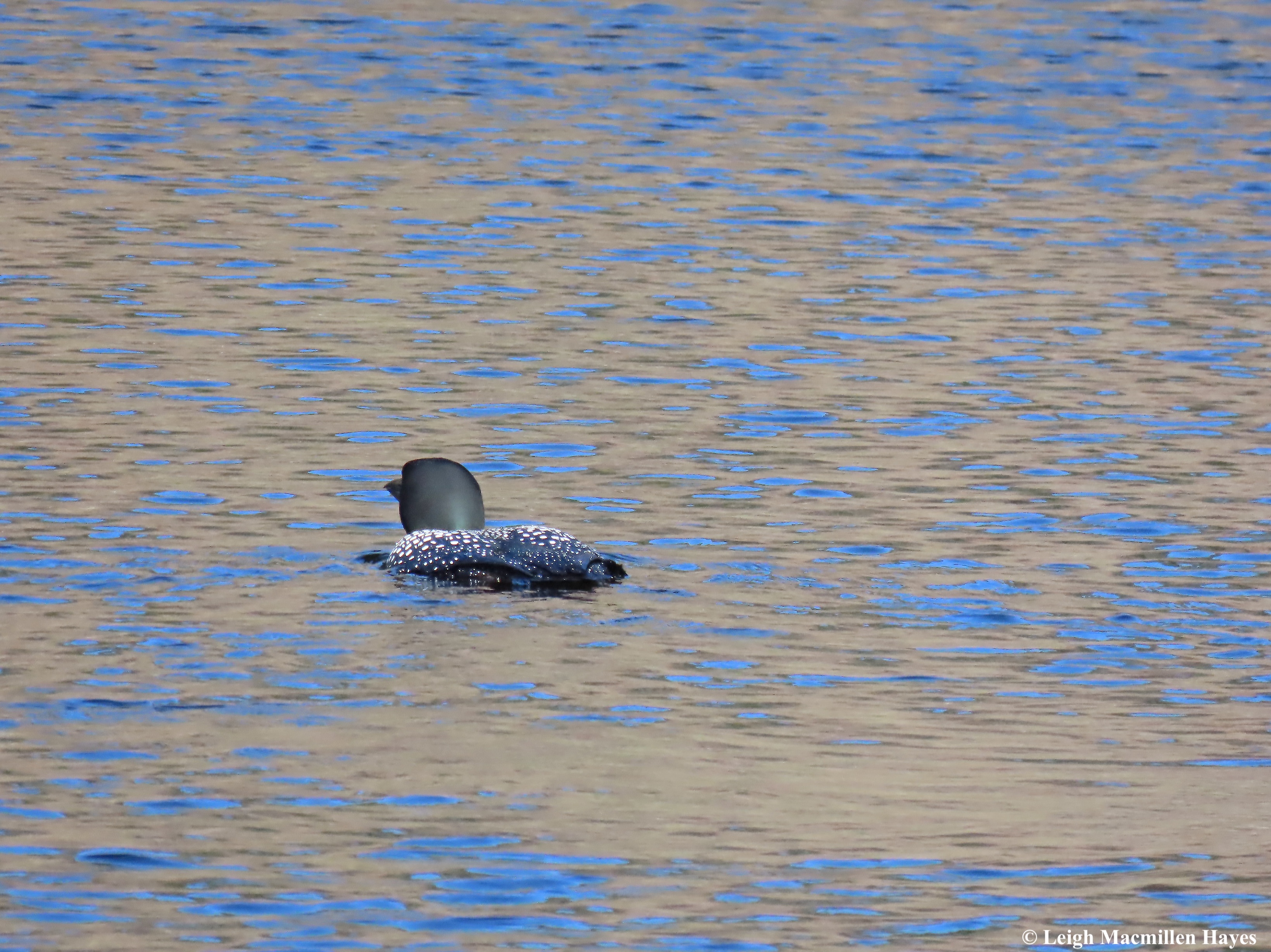
While we paused, we spotted two people fishing, but also another who had the same finned meal in mind, a Common Loon. We didn’t see another, and if memory serves me right, it’s rare that we’ve seen a pair on this pond.

I can only hope memory doesn’t serve me right this time.

Within the shallow depths there were also huge Bullfrog tadpoles and teeny tiny minnows. And probably so much more, but I didn’t look any closer.

Another fun find reminded us that we will return to these trails in another month for the Lady’s Slippers that call to My Guy will make their usual request for a count.

Finding the capsule is so rare considering that there are hundreds of Lady’s Slippers that bloom just along the trail, yet we only spotted two of these structures, which would have contained thousands of dust-like seeds that dispersed through the split sides.
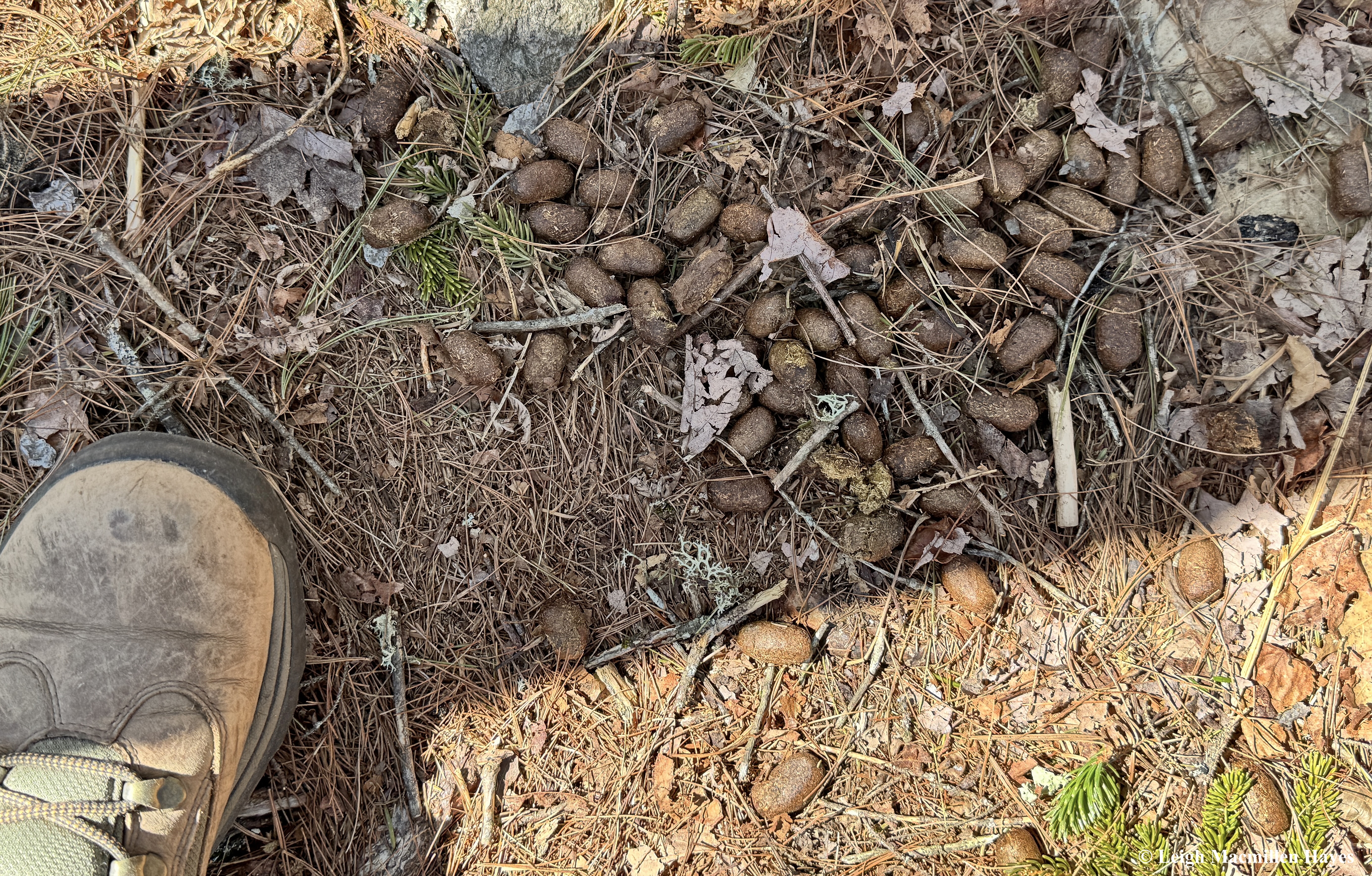
Similar in shape to the capsule, but of a completely different origin, we found two piles of Moose scat–deposited possibly two winters ago based on its formation and the dried leaves and other debris that had landed upon it.

As we continued along the trail beside the pond before climbing up, we knew to look to the ledges for a rare sighting. It’s up there, but you may not see it until I share the next photo with you.

Do you see the cross? How apropos for Easter Monday.

The question remains for us: How did it get there? Or is it a natural formation? We know that we would not have the heart to climb down to that spot and install it, but perhaps others did.

Actually, we don’t want to know how it got there. It’s enough for us that it is. And persists.

And even more important today, the fact that we didn’t get here on Easter, but instead hiked this way on Easter Monday, the day Pope Francis died, one who cared about those marginalized and the Earth. All of Creation matters.

Our time at the summit of the mountain was brief because we needed to get home for My Guy had another event. But it’s never lost on us that the shape of the main basin of the pond is a heart.

Back at the truck, we celebrated the weekend with a treat from Fly Away Farm.

And gave thanks for how all that we saw and heard and experienced this weekend seemed to be interwoven into a beautiful Easter tapestry.

Happy Easter 2025!
The Beaver’s Tale

Once upon a time . . . no wait. This isn’t a fairy tale.

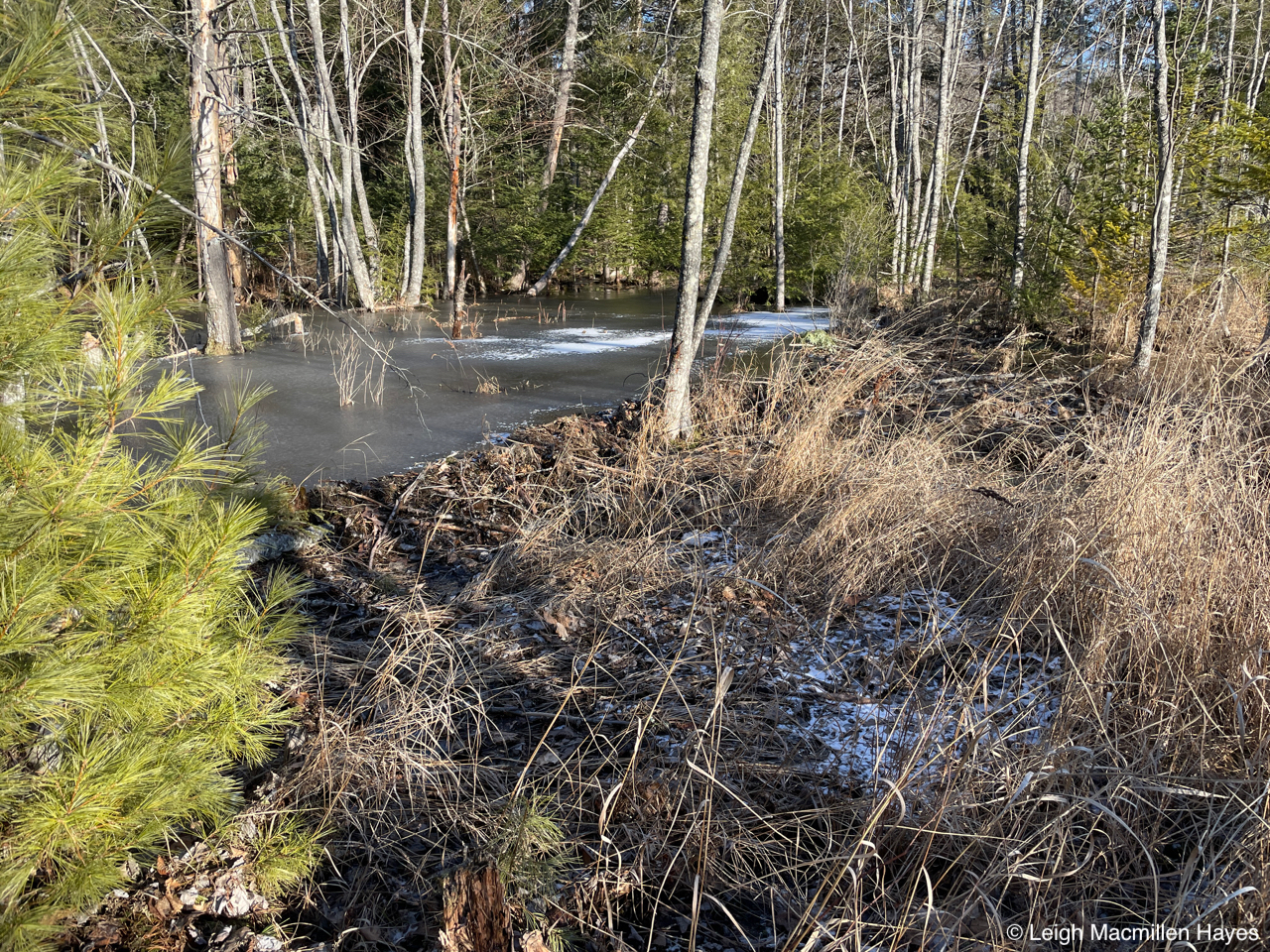
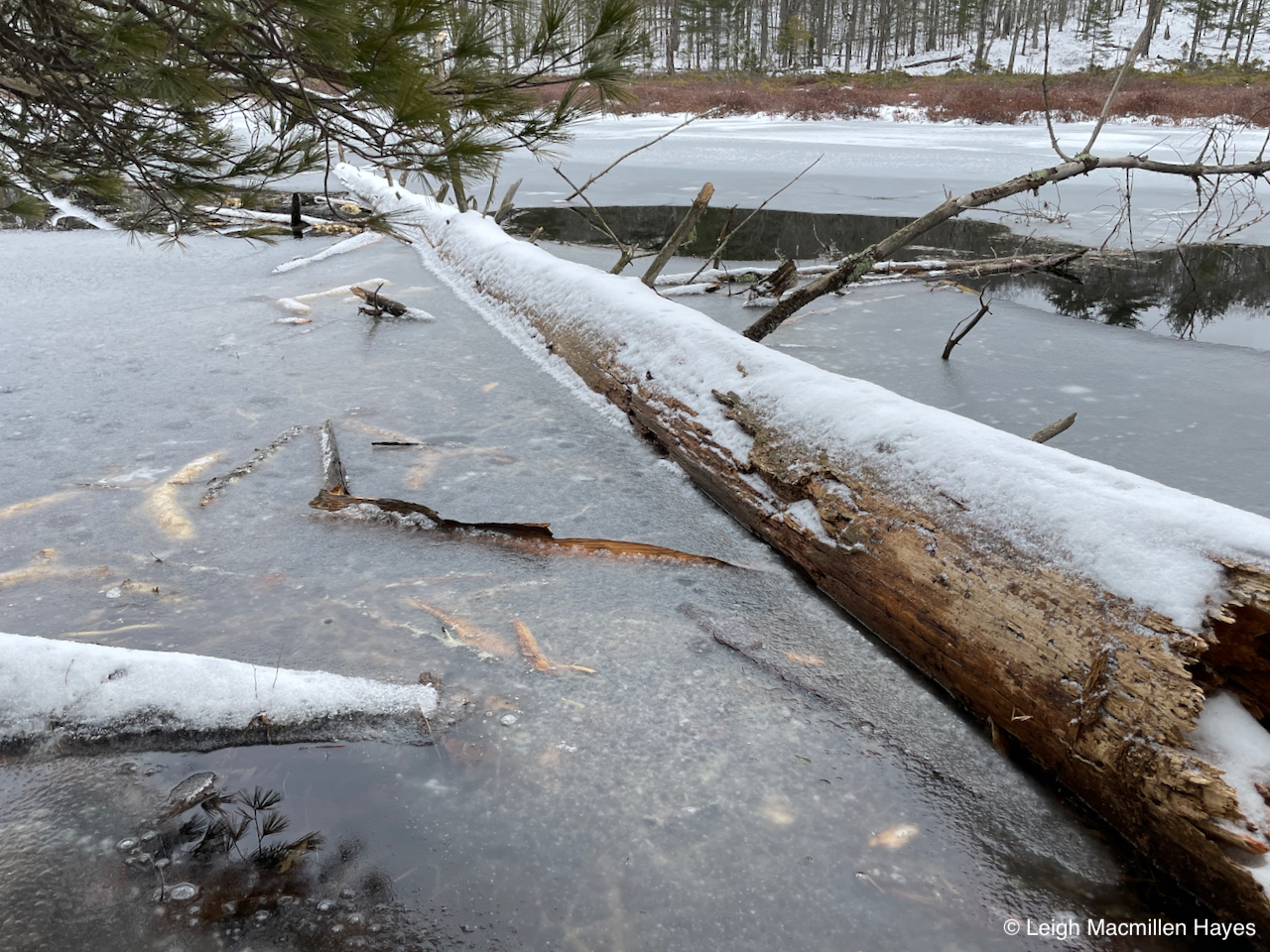
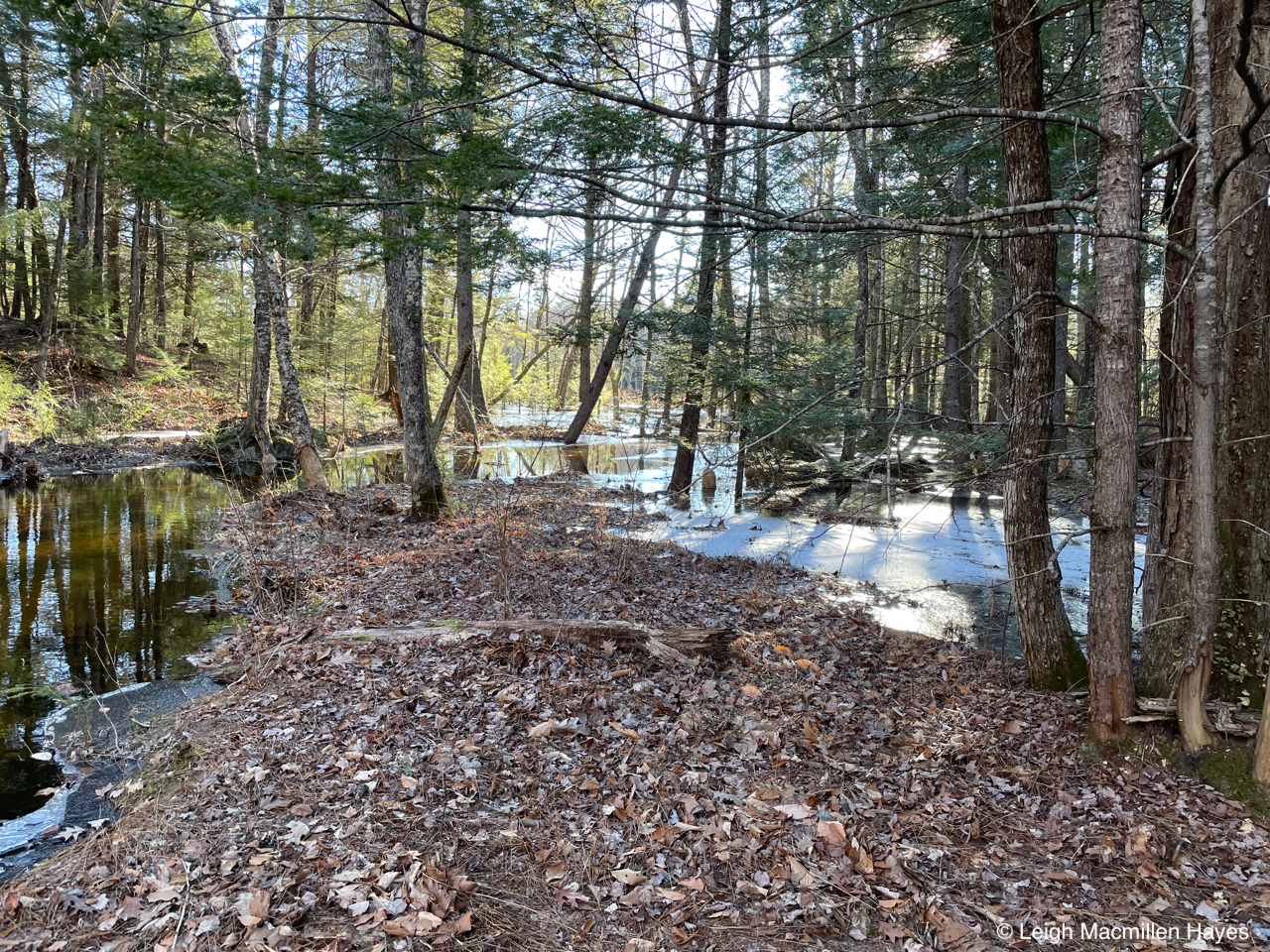
Rather, it’s about changes in the landscape that one might observe, such as a brook suddenly overspilling its banks as was the case in this location upon a December visit. We’d had rain, but that much?

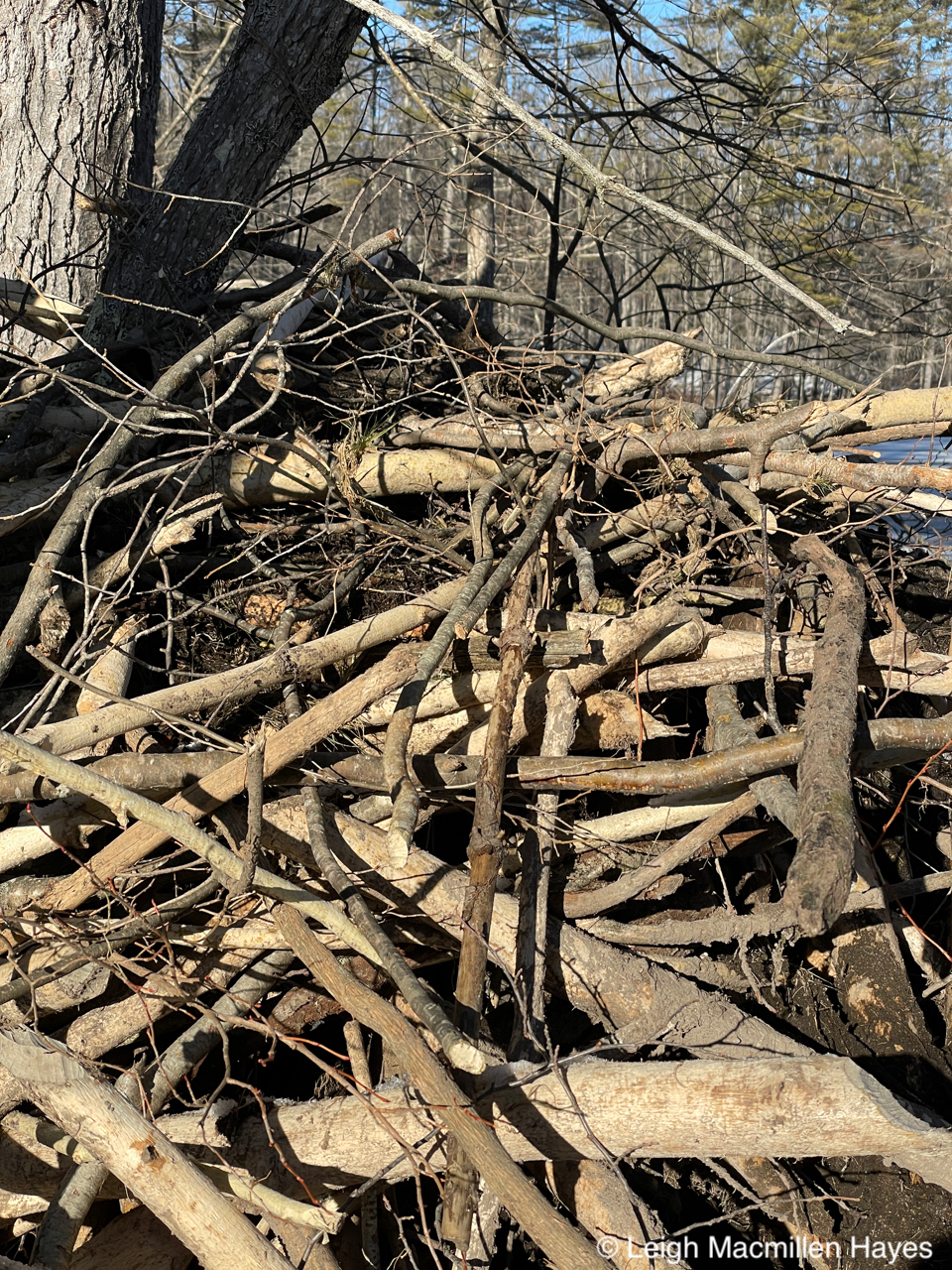
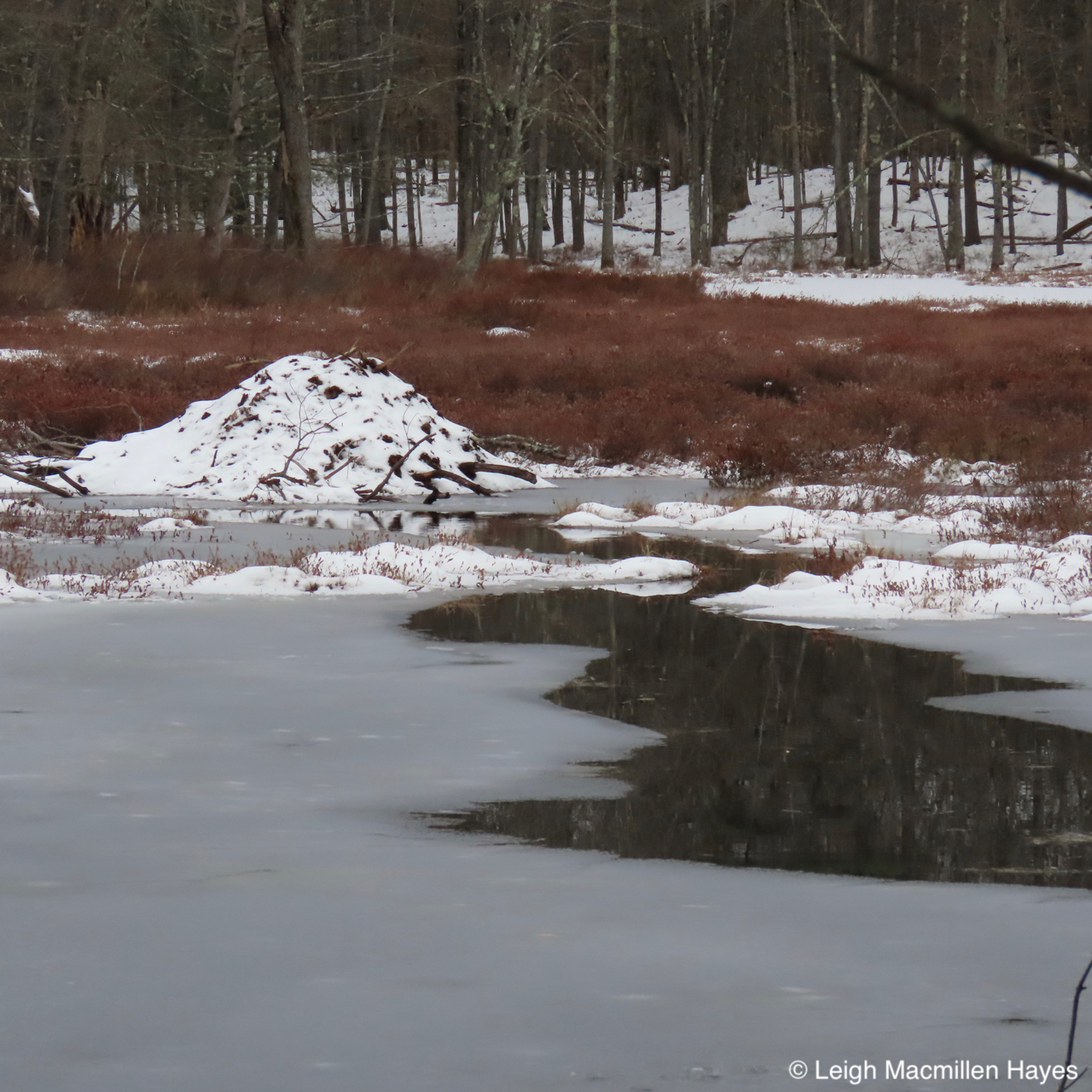
It wasn’t long before a friend and I spotted the reason for the high water. Some new residents had moved into the area and built a lodge of sticks. Unlike the story of the three little pigs, one of whom built a house of sticks that the big bad wolf came in and blew down, the makers of this structure took special care to make it solid and strong and weatherproof. Yes, a beaver or two or six had taken up residence with the intention of spending the winter. Beaver families usually consist of a monogamous couple, plus their two-year-old (almost adult) kids, and yearlings. Mating occurs in the water during the winter and kits are born inside the lodge in the spring.

In order to move into the lodge, a dam needed to be constructed as well. If you look closely, you’ll see that above it there was a bit of an infinity pool with the ice at level with the dam, while below it some water flowed at a much lower level. Though we couldn’t walk along the ice to measure the length of the dam, it was quite long. and made of sticks and leaves and mud. Typically, the family works on this project by creating a ridge of mud and probably the herbaceous plants of the meadow, and then they use the mud and sticks to stabilize it. Maintenance is a constant as water or other critters or humans have a way of breaching the dam.

We, too, build dams to serve similar purposes, such as this one originally constructed to operate a saw mill. Hmmm.

Getting back to the lodge: it also needs nightly work as long as conditions allow and this has been a winter of despair for those of us who love cold temperatures and snow and even ice if it’s in the right place, like on a pond or lake and not in the driveway.

Take a look at how the beaver is holding the small twig.

A beaver’s dental formula is this: 2 incisors on top, 2 incisors on bottom, 0 canines on top, 0 canines on bottom, 2 premolars on top, 2 premolars on bottom (that look like molars), 6 molars on top and 6 molars on bottom, for a total of 20 teeth. Recently, I was able to sketch the upper part of the skull of an older family member, who’d lost some of its molars.

These large, semi-aquatic rodents are gnawers like their relatives. To that end, their incisors are highly specialized for chewing through really, really tough things and they grow continually throughout the critter’s life.

And like all rodents, the front surface of their incisors is coated in enamel reinforced with iron (hence the orange color), which makes it resistant to wear and tear from gnawing. When the chisel-like teeth chew and fell trees, the much softer white dentine layer (the section behind the enamel) is ground down quicker than the enamel, thus creating a sharp chisel surface.

But to me the coolest aspect is that their lips close behind the incisors, thus permitting them to gnaw and carry sticks underwater without choking.

And bingo, you can see the stick being carried in that gap between the incisors and molars. Food sticks become lodge or dam sticks once their nutritional value has been consumed: a true plan of repurposing.

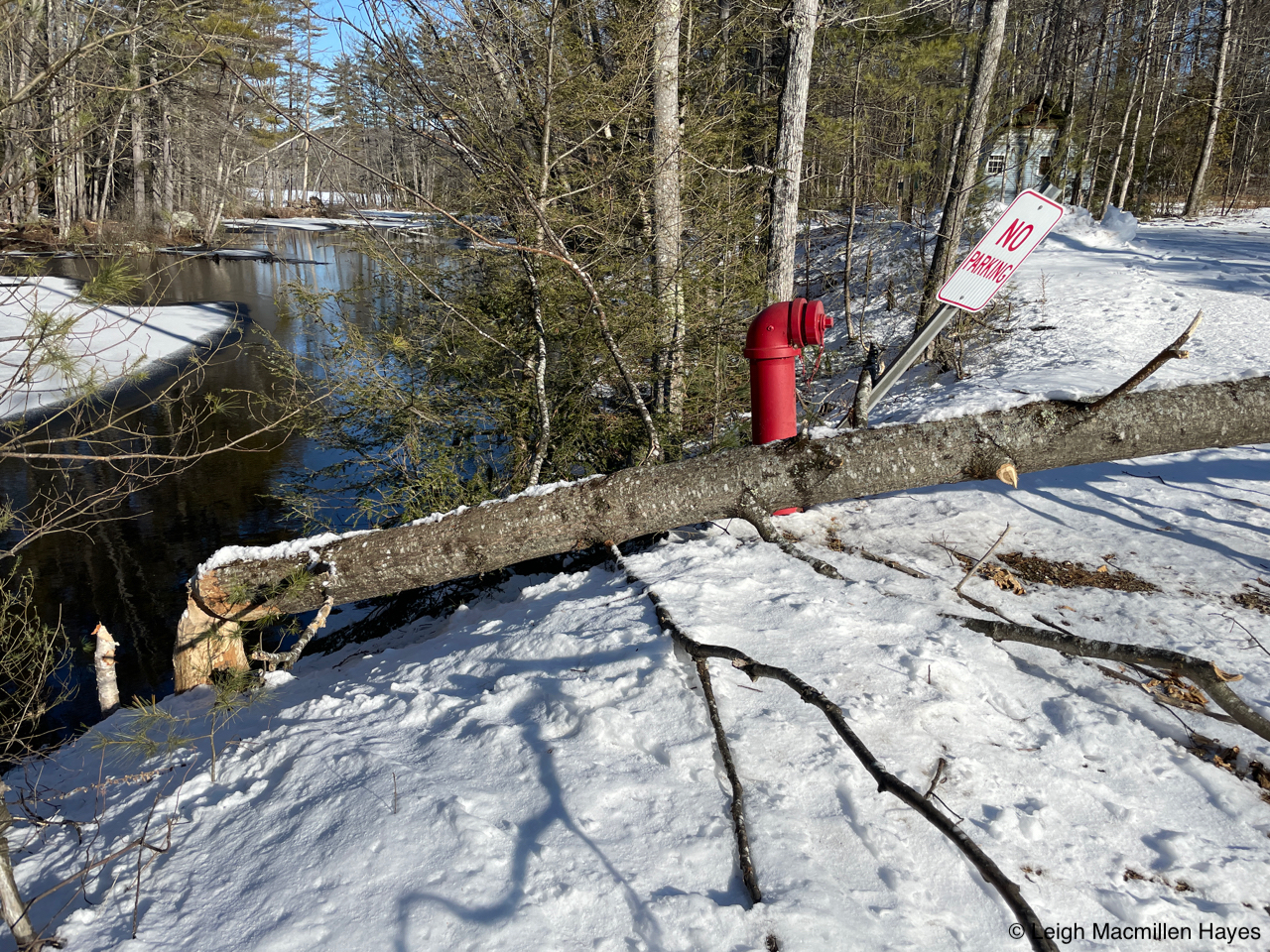
As it turns out, that wasn’t the only beaver family at work in town. This next family, however, chose to park their tree in a spot the fire department lay claim to for filling a water tank. But . . . reading is not on a beaver’s talent list.

In this other place, so many trees have been felled, but not all have fallen as intended, getting hung up on other trees instead. Not wanting to anthropomorphize, but I have to wonder what expletives flash through a beaver’s brain when trees don’t hit the ground as planned.

As strict herbivores, a beaver’s diet varies with changes in the season. During spring and summer, they are drawn to waterlilies, algae, grasses, sedges, herbs, ferns, shrub leaves and shoots. By late summer, however, tree cutting begins as they gradually change their dietary habits from herbaceous to woody materials. Twigs, roots, bark and especially inner bark become the source of nutrition. Aspen, birch, alder, and willow are favored species, but beavers will cut almost anything including conifers.

Imagine this. A beaver cocks its head to the side as it gnaws, thus the consistent angle of the half inch groove as the upper and lower incisors come together.

Likewise, porcupines gnaw, but their incisors are much narrower and the pattern more random.

So, the question remains. Where were the parking lot beavers living? In the past, a family has inhabited the northern most reaches of this pond, but in this case, they had built a lodge on a point not far from the southern end.

The top of the lodge is the only section not covered with mud, for it serves as a “smoke stack” of sorts, a place for beaver breath to escape. Visit a lodge on a cold winter day and you might observe the vapors rising.

And then it was on to another locale, where beavers have inhabited the same lodge for a number of years. When beavers choose to live in a pond or lake or sometimes even a river, there’s no need to build a dam for the water is usually deep enough for their underwater movement.

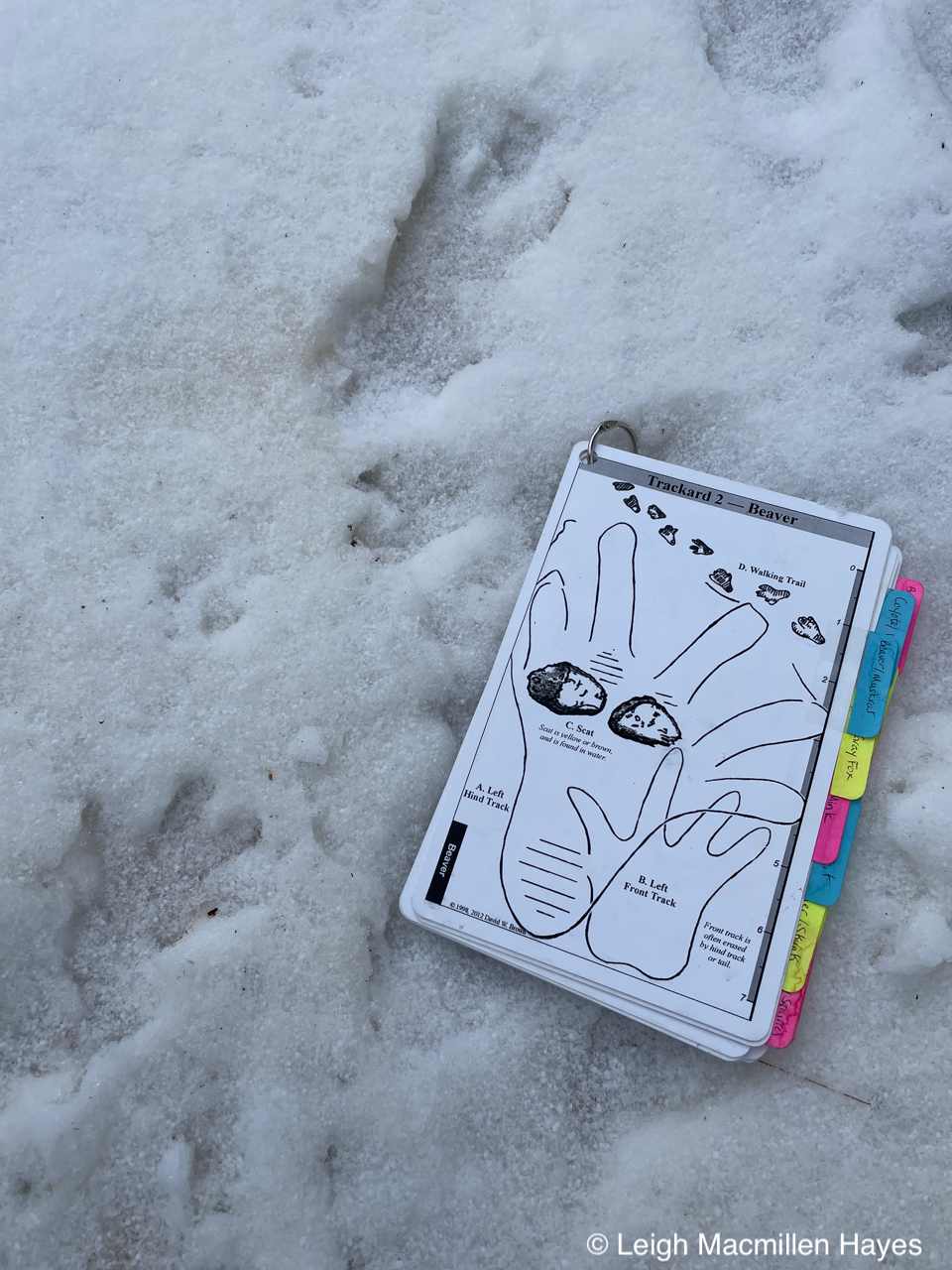
I often tell people that beaver prints are a rare find because they are either wiped over by the tail or by trees being hauled to the water. Once in a while, however, I’m proven wrong and the sleety snow on a recent day awarded just the right conditions for the webbed feet to be observed.

Tree work and broken ice added to the story of the critters’ journey to and fro the pond. While quite adept at time spent in the water, they are rather clumsy on land and most of their work is within a hundred feet of the edge.

Winter food is cached close by the lodge entrance so that they can swim under the ice to retrieve a stick. A beaver’s ears and nose have a valve that closes when it is submerged and they can stay underwater for up to fifteen minutes. Back at the lodge, there is a raised chamber surrounded by a moat that leads to the entrance tunnel. It’s upon the raised area that they dine, and groom, and even give birth.

At this particular pond, My Guy and I noted two lodges connected by an open channel between. Given the number of tail slaps that announced our presence near both lodges, we thought perhaps both were active and inhabited by the same family.

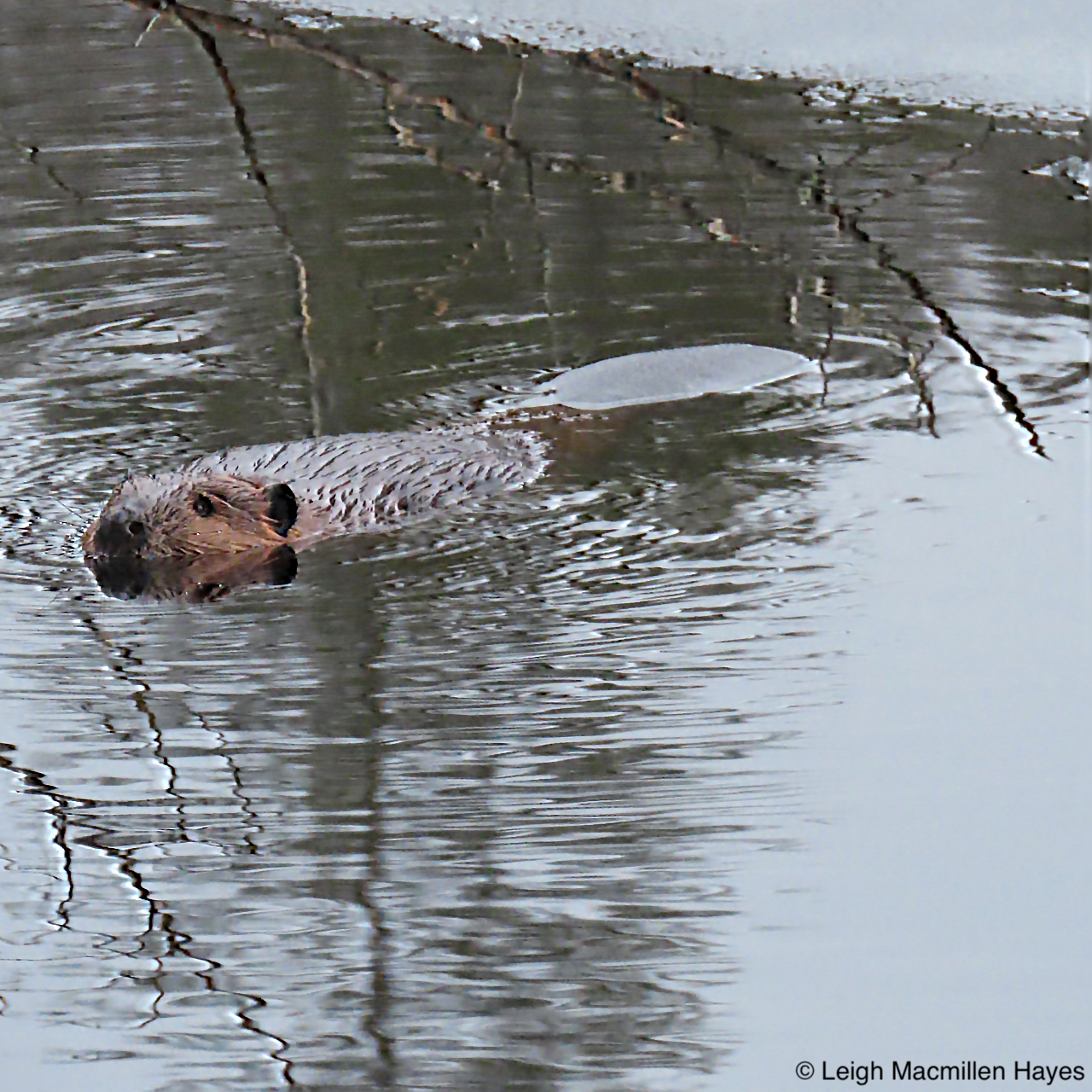
And then, and then . . . finally, we spotted a beaver that spotted us. We kept expecting it to slap the water with its tail in a manner of warning so other family members would seek deeper water or cover. Instead, it swam past us.

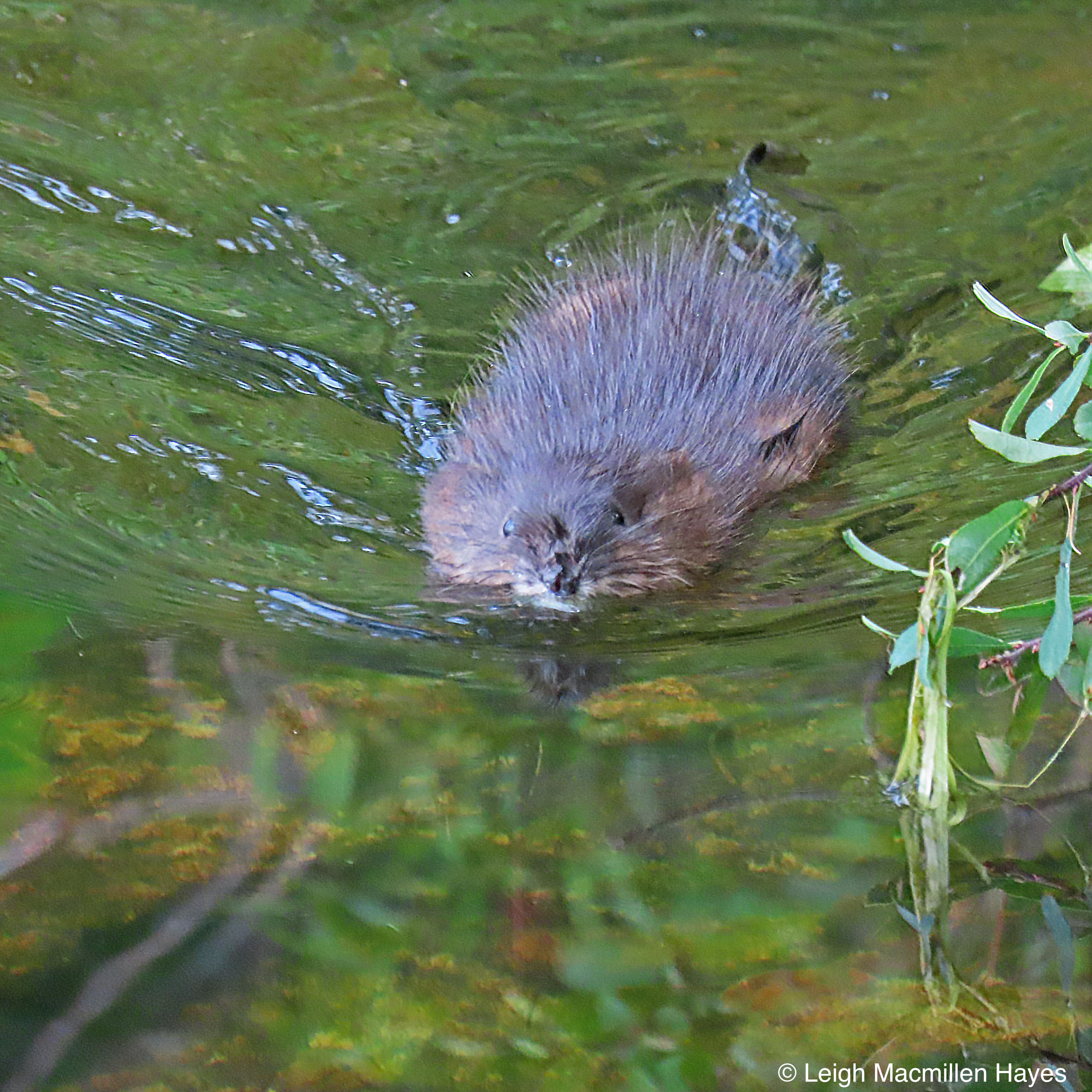
The thing is that a rodent relative, namely the muskrat, exhibits many similarities, but also differences, including a skinny, snake-like tail.

The beaver’s tail is a source of wonder. While its furry body consists of long, shiny guard hairs covering dense and softer hair that traps air and helps protect the critter from the cold, the tail is broad and flat and scaly. It’s used for a variety of reasons including stability when standing upright on land (think tripod), as a rudder for propulsion in water, as fat storage and thermal regulation, and how we are most familiar, as a warning device.

A beaver’s tale indeed.

Stocking My Wonders

My fingers reach in, wondering what marvel I might pull out of the wool sock, one I knitted when my guy and I first tied the knot so many moons ago.

Of course I shouldn’t be surprised that the first thing my fingers grasp is a dragonfly, this being a Common Whitetail male in the Skimmer Family, with those broad crossbands on the wings and black streaks at the base of each.

Calling it “common” strikes me as such an understatement and I’m thrilled when I next pull out an immature male of the same species. I mean, look at those wing markings. And the spots along the sides of the abdomen segments. And the difference in color from immature to mature. Surely, next it will be a female that falls into my hands.

It is quite a shock, however, to realize it is fur that tickles my hand, and voila, out of the sock comes a Red Fox. A Red Fox who settles for Black-oil Sunflower Seeds, not quite the next best thing to capturing a squirrel.

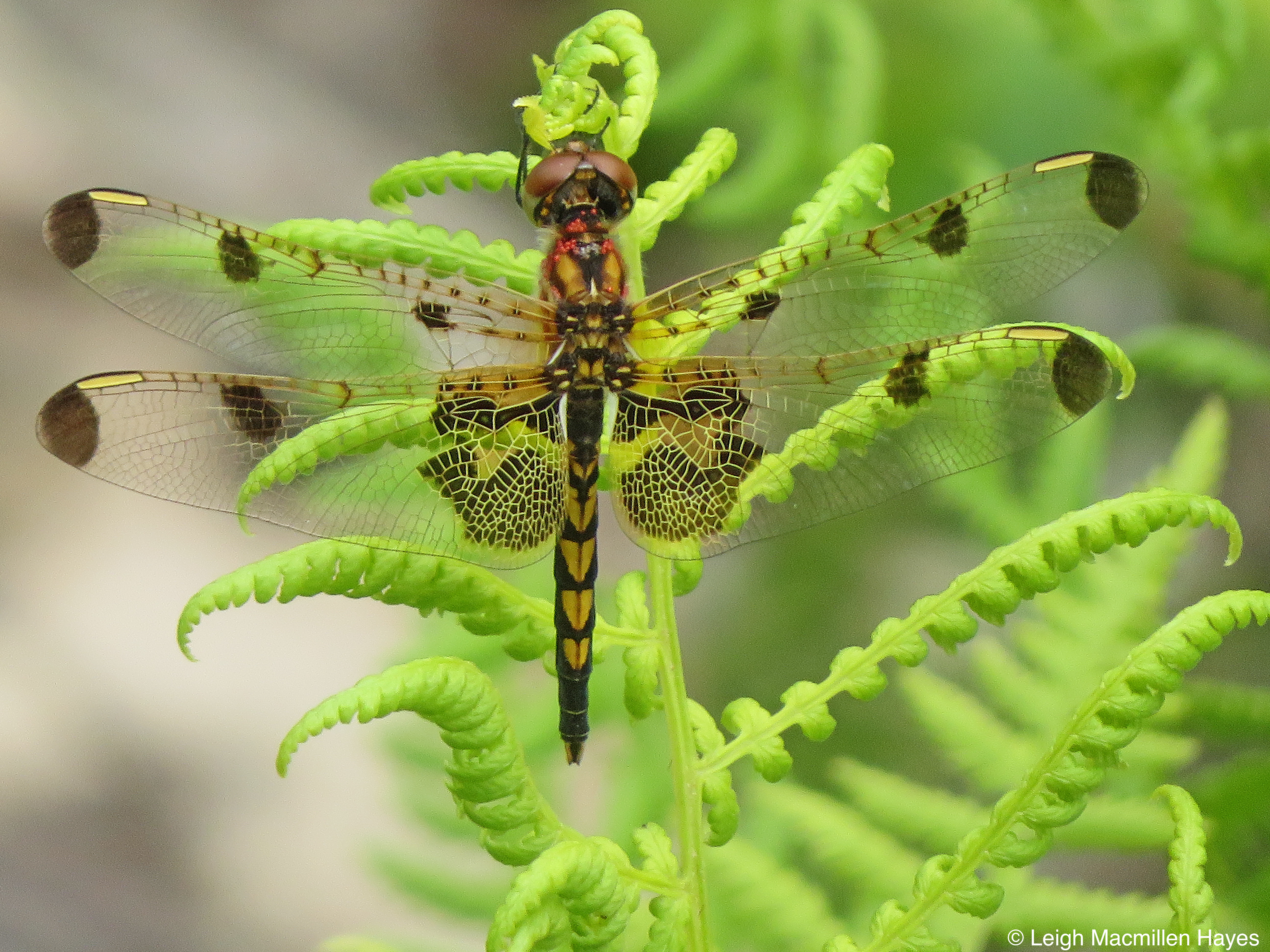
When I next reach in, I am sure I’ll pull out a female Common Whitetail, but . . . instead it is a much smaller, and even more extravagantly decorated female Calico Pennant Skimmer. The same family, but this is one of my favorite species (please don’t be offended Whitetails, I really do think you are more special than common), with those heart-shaped markings along its abdomen segments and basal wing coloration reminding me of a stained-glass window, which seemed apropos for today’s celebration.

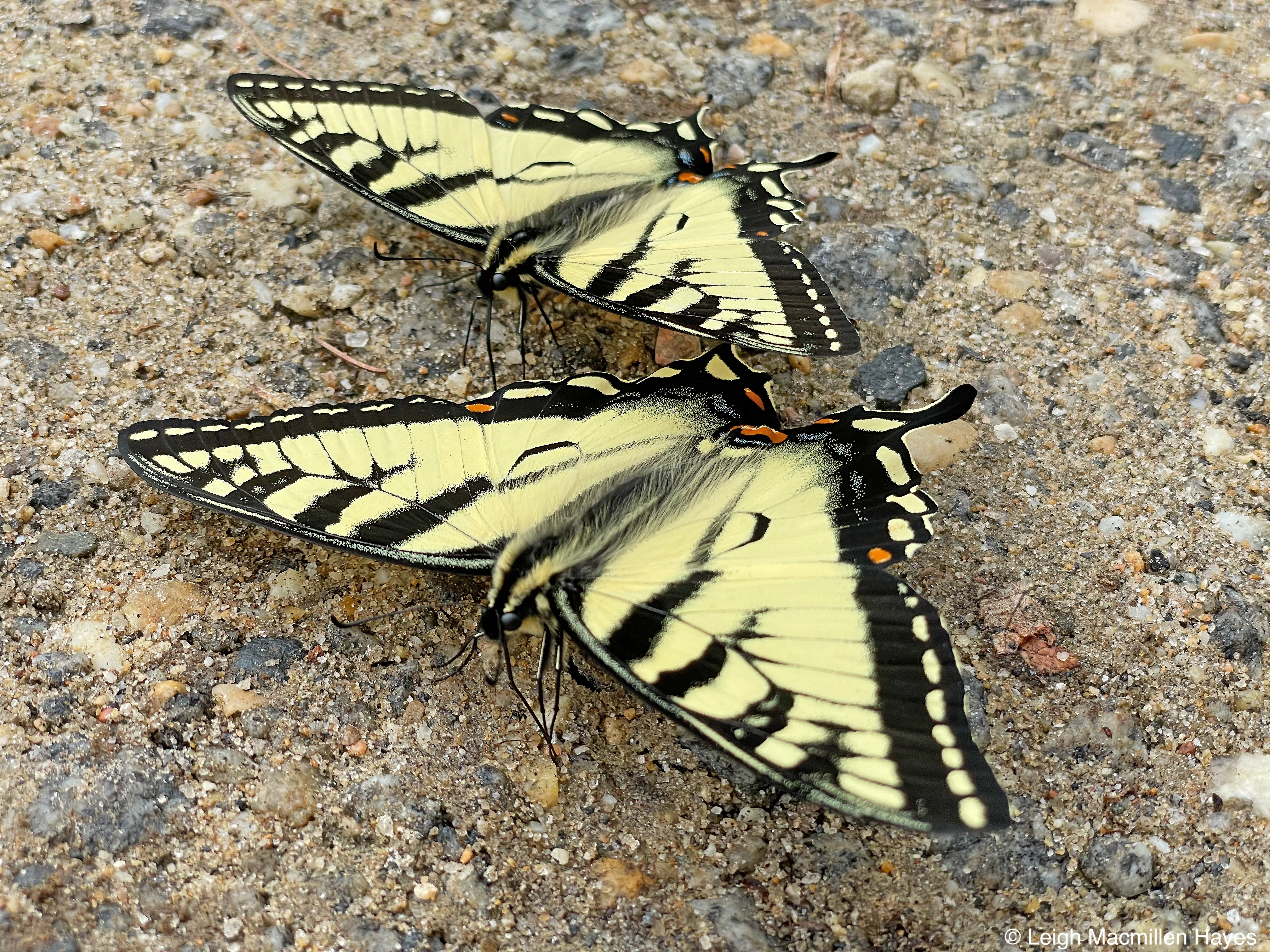
And then there are two with similar colors and equally delicate, puddling as is their habit, these Eastern Swallowtail Butterflies sticking their proboscis seeking nutrients from the gravel road. The chemical make-up of the site is key, for the butterflies are looking for something specific: salt (sodium) and minerals

Most puddlers are males, who ingest the salts, minerals and amino acids that the source provides, especially after it has rained. They store these nutrients in their sperm so that when the time comes to mate, the male passes these goodies as a nuptial gift along to the female. This gives the female an extra boost, which she then passes along to her eggs. It’s an important gift because eggs that receive the extra nutrients have a greater chance of success than those that do not.

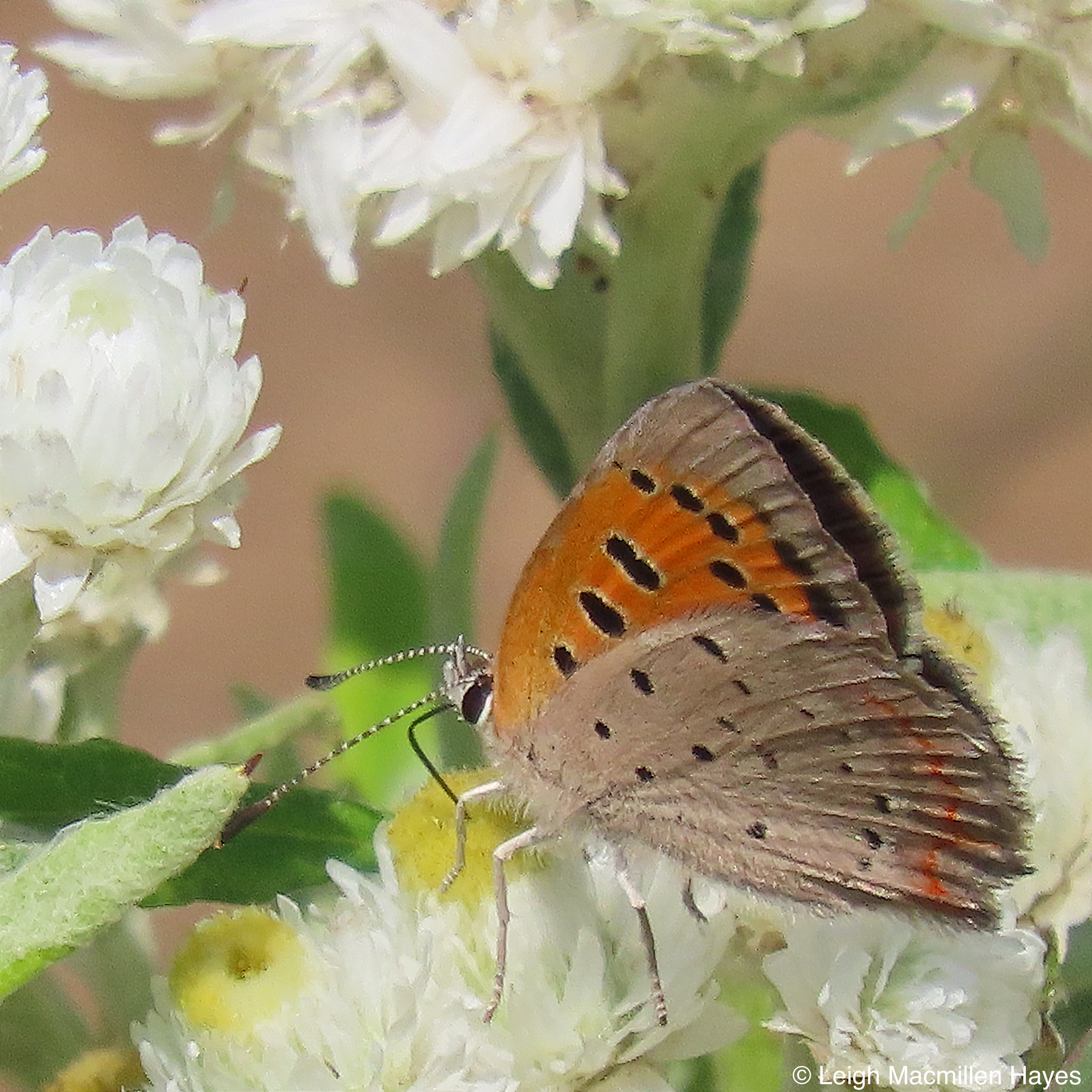
Back into the sock do I dip, this time finding a Little Copper Butterfly seeking pollen and nectar upon Pearly Everlasting flowerheads. Little Coppers, tiny as the name suggests, thrive in areas disturbed by either human activity or natural events and it seems almost an oxymoron to think that as teeny and delicate as they are, they are right at home in waste places.

Once again, there is a significant change between the Little Copper and the next species that my hands discover. “Who cooks for you? Who cooks for you all?” hoots the Barred Owl much to my delight. Only two nights ago I heard it calling out the back door, so to find it in the sock is a treasure indeed.

Almost immediately after, a Muskrat swims out of the sock, moving quickly toward me with its rat-like tail acting like a rudder in the rear. I love its questioning look as we meet each other for the first time.

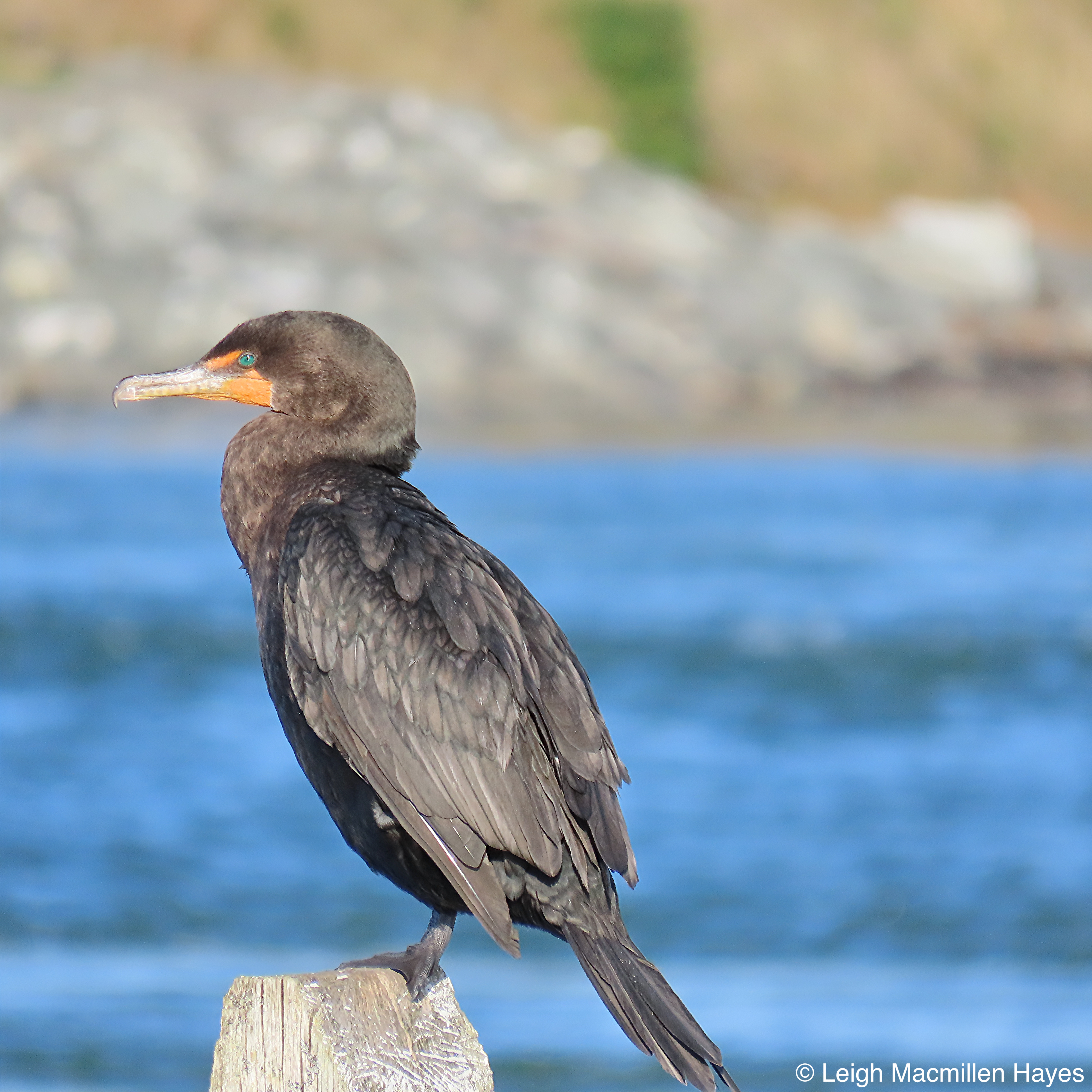
Enough fluff about the Muskrat. It is a feathered friend. who next pops up out of the sock. One of the most amazing things to me about this gift is the color of its eyes and how they reflect the sky above and water below.

Still pulling from the leg of the sock, this Gray Seal floats forth, as if on the incoming tide. Sometimes called “horseheads,” because of their long snouts, Gray Seals scientific name, Halichoerus grypus, literally means “hooked-nose sea pig.”

Not the prettiest of names, not the prettiest of species, but I am still excited to realize this one is my own to keep.

Suddenly, there seems to be a theme to the gifts, and a life on or in the water makes sense. The next item in the sock is one we think of as nature’s engineer, and though not everyone is thrilled with their prowess at felling trees, building dams and lodges, and changing waterways for their own benefit, it’s good to realize that they also benefit other species in the process, including humans. This particular Beaver is active during the day because hikers like my guy and me keep ruining its dam as we cross over it to access a trail.

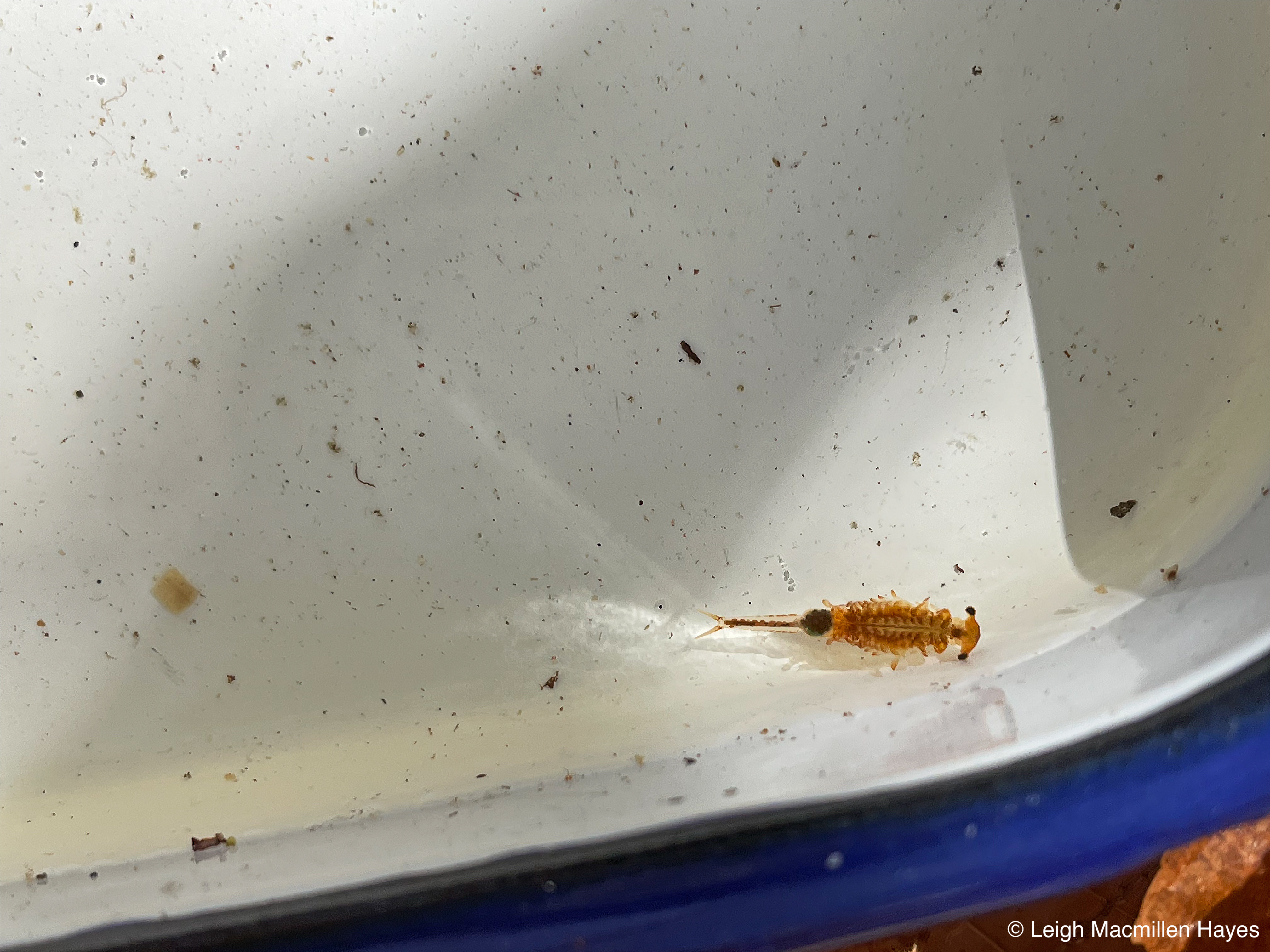
Still on the water theme, but much diminished in size, is a female Fairy Shrimp. Just sighting one such species is enough to make its vernal pool habitat significant. The way to identify a female is to look for her two dark brood sacs that are positioned just under her legs or appendages.

So here’s the thing. Fairy Shrimp have a short life span, but . . . their eggs must dry out and freeze before they can respond to environmental cues such as reflooding to hatch.

The eggs, known as cysts, can remain dormant for years, and only a small portion of cysts hatch each year, thus leaving plenty more for the future. And temperature plays a key role in hatching.

I’m beginning to realize how much I am enjoying the variety hidden within this sock, and the next gift turns out to be a Blinded Sphinx moth, a species one doesn’t ofter encounter during the day. Or at all, for it’s a night flyer. But those markings and folds, and the overall design. Oh my.

With the next item I choose, I am reminded that one must look for anomalies in the landscape. And so I do. It is the horizontal line of the back that gives away the fact that I am starring at a White-tail Deer. Otherwise, I might think that the legs are sapling trunks and the face maybe a few bleached beech leaves.

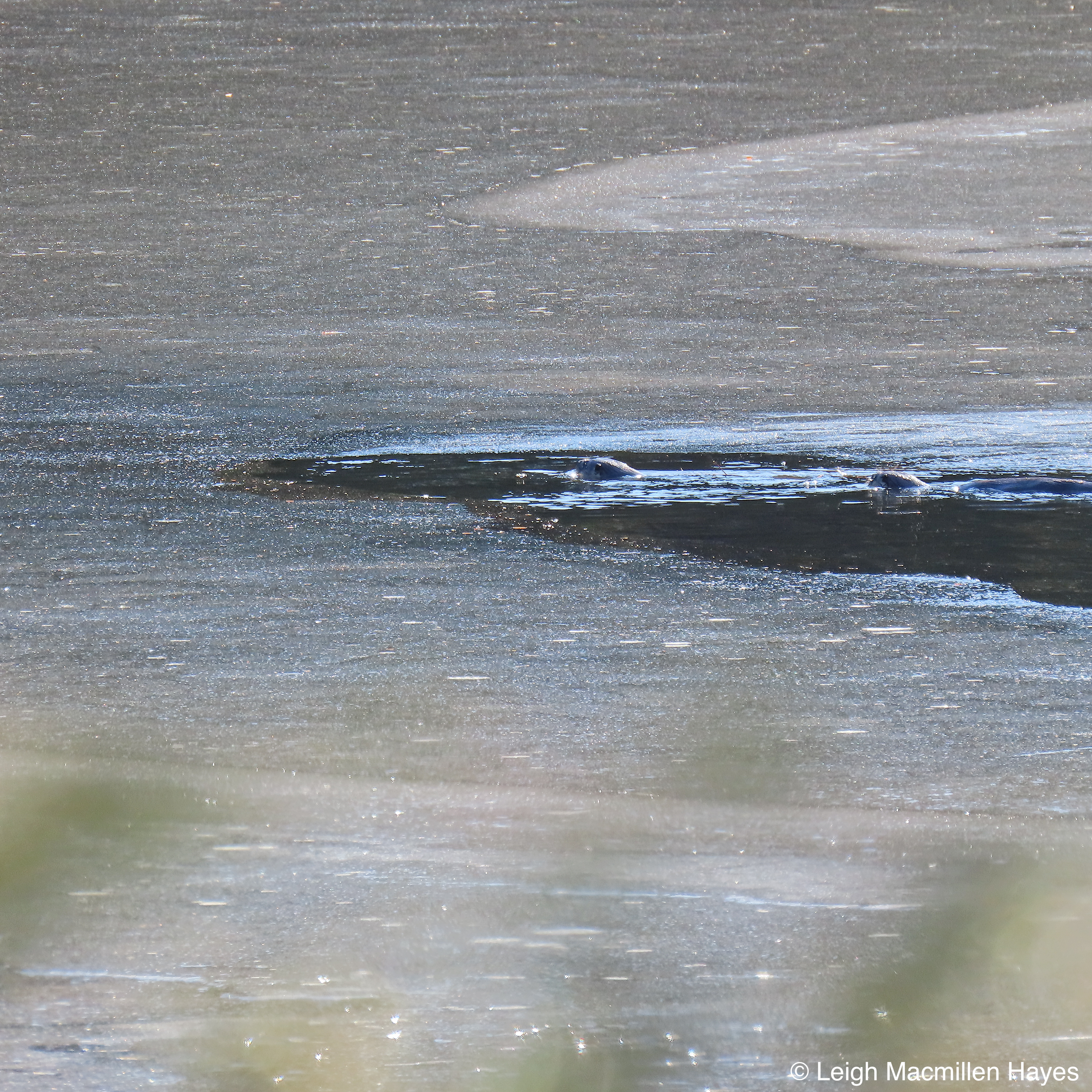
My next surprise–comes as a trio. And I might not even realize they are there if I hadn’t heard them first–chattering to each other as they swim and play and fish and sometimes sit on the ice before slipping quickly back into the water in what can only be known as River Otter delight.

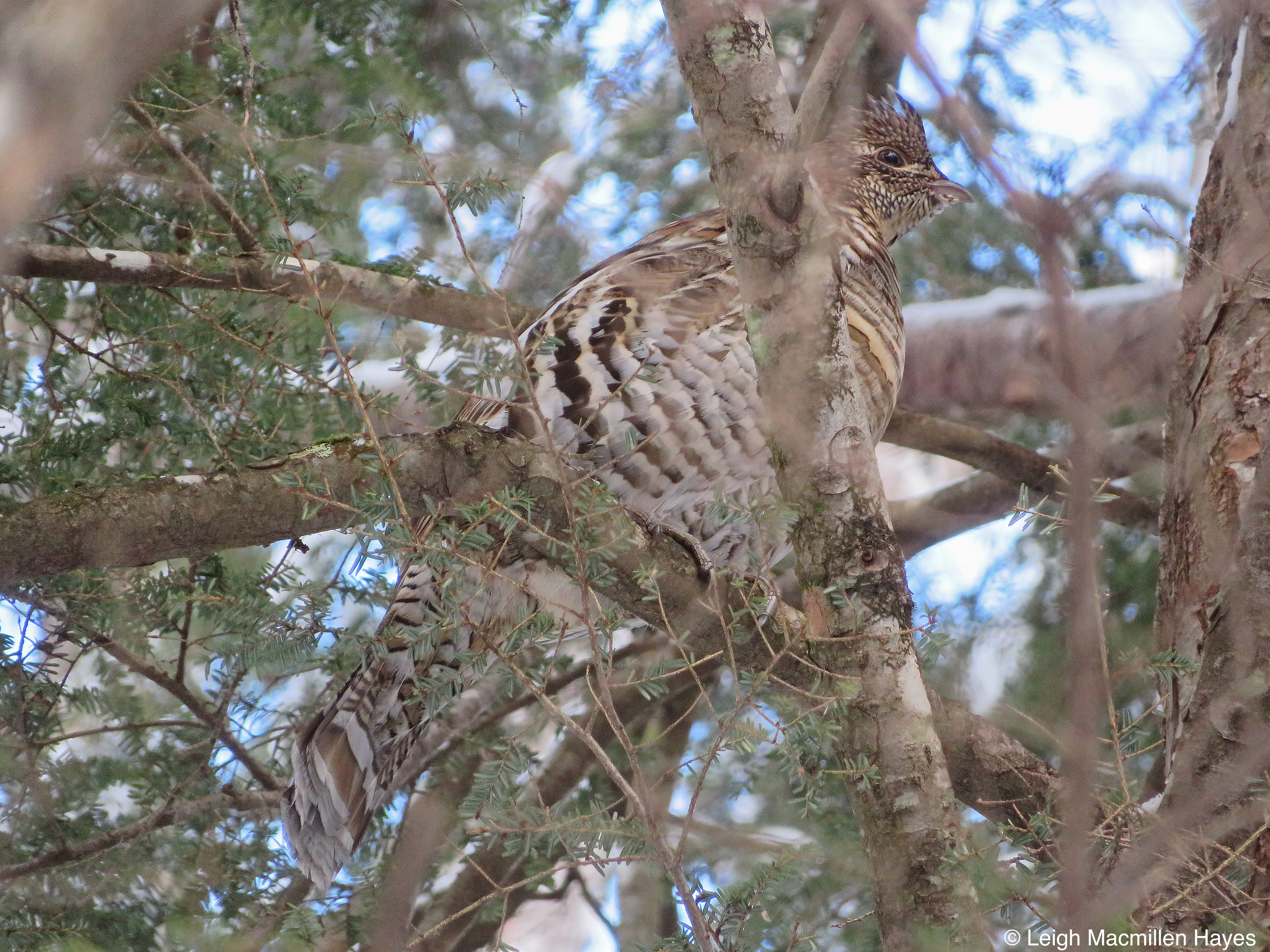
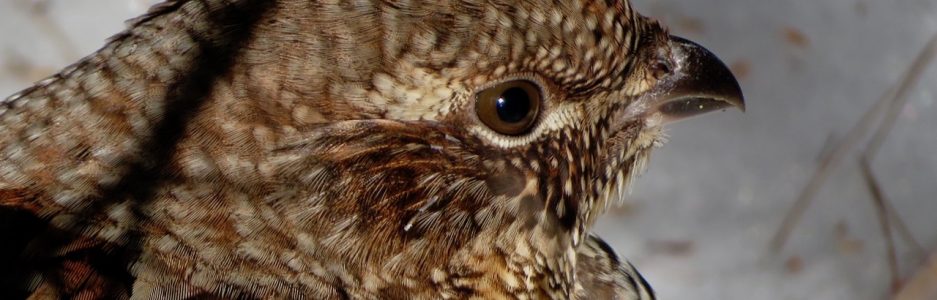
Once again, I suspect I know what I’ll pull out next, only to be surprised to discover that it is not a prickly friend, but rather a feathered one who roosts high up in a tree–this being a Ruffed Grouse.

But the prickly one doesn’t disappoint, and makes its own appearance in a different tree and place.

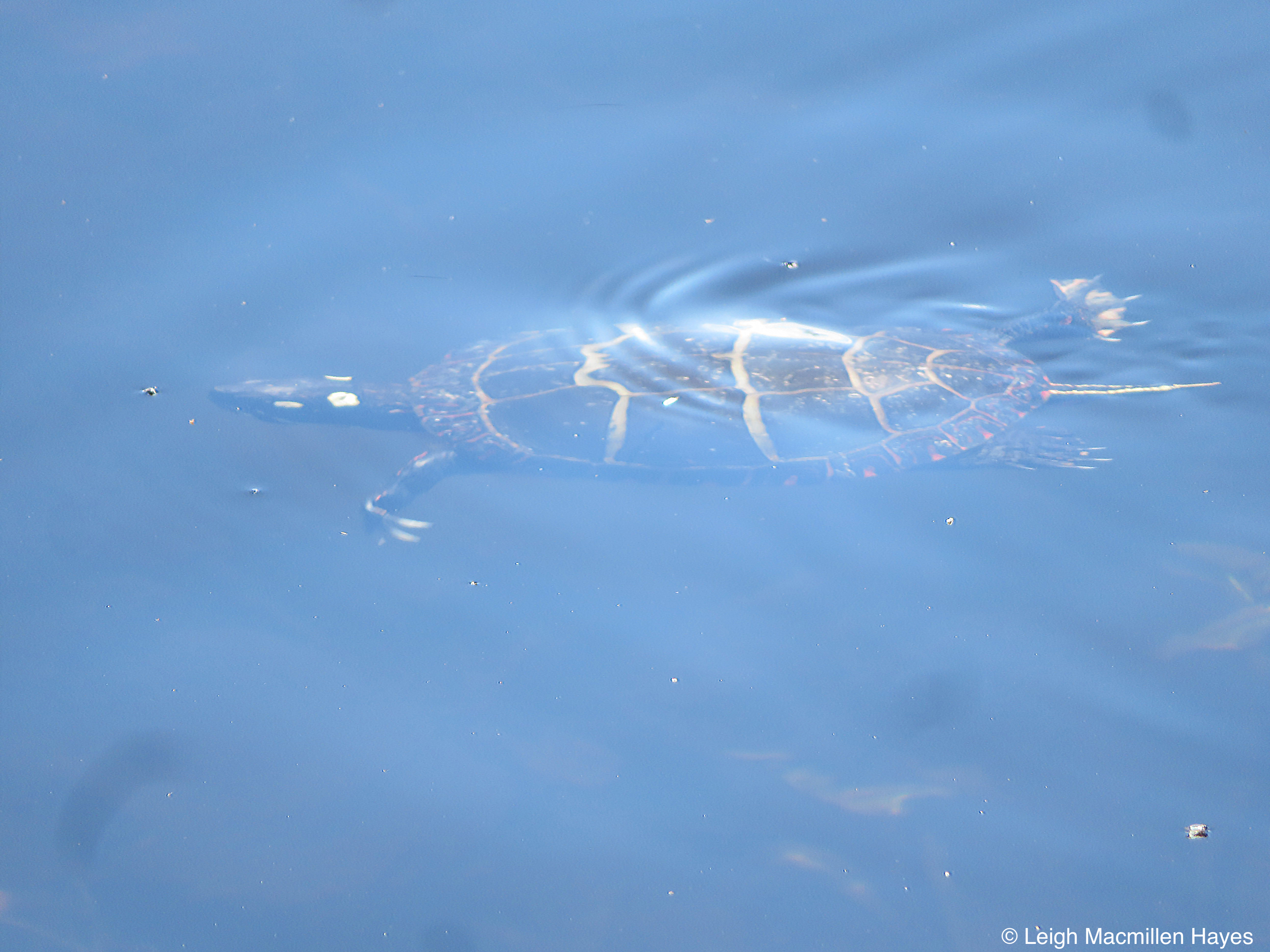
That is to be followed by another I often spot basking in the sun with friends, but it is great fun to spot a Painted Turtle swimming below the water’s surface of a shallow pond.

The water theme begins to appear again, maybe because the one who filled the sock knows I spend a lot of time peering into the depths, and sometimes I’m rewarded with sightings such as this of tadpoles forming into their mature frog beings.

And then there is another that requires a stretch of my neck as it stretches its neck to feed its young high up in a nest.

Having regurgitated a meal, the mature Great Blue Heron stays with its young a wee bit longer before heading off to replenish the pantry.

No sock of mine would be complete without a couple of canoodlers, he atop her. Water striders can walk on the surface because they have very fine hairs on the undersides of their legs that trap air and repel water, a technique called superhydrophobic. They move so quickly because what they are doing is more like rowing, vigorously rowing, creating little swirls in the surface that help propel them forward.

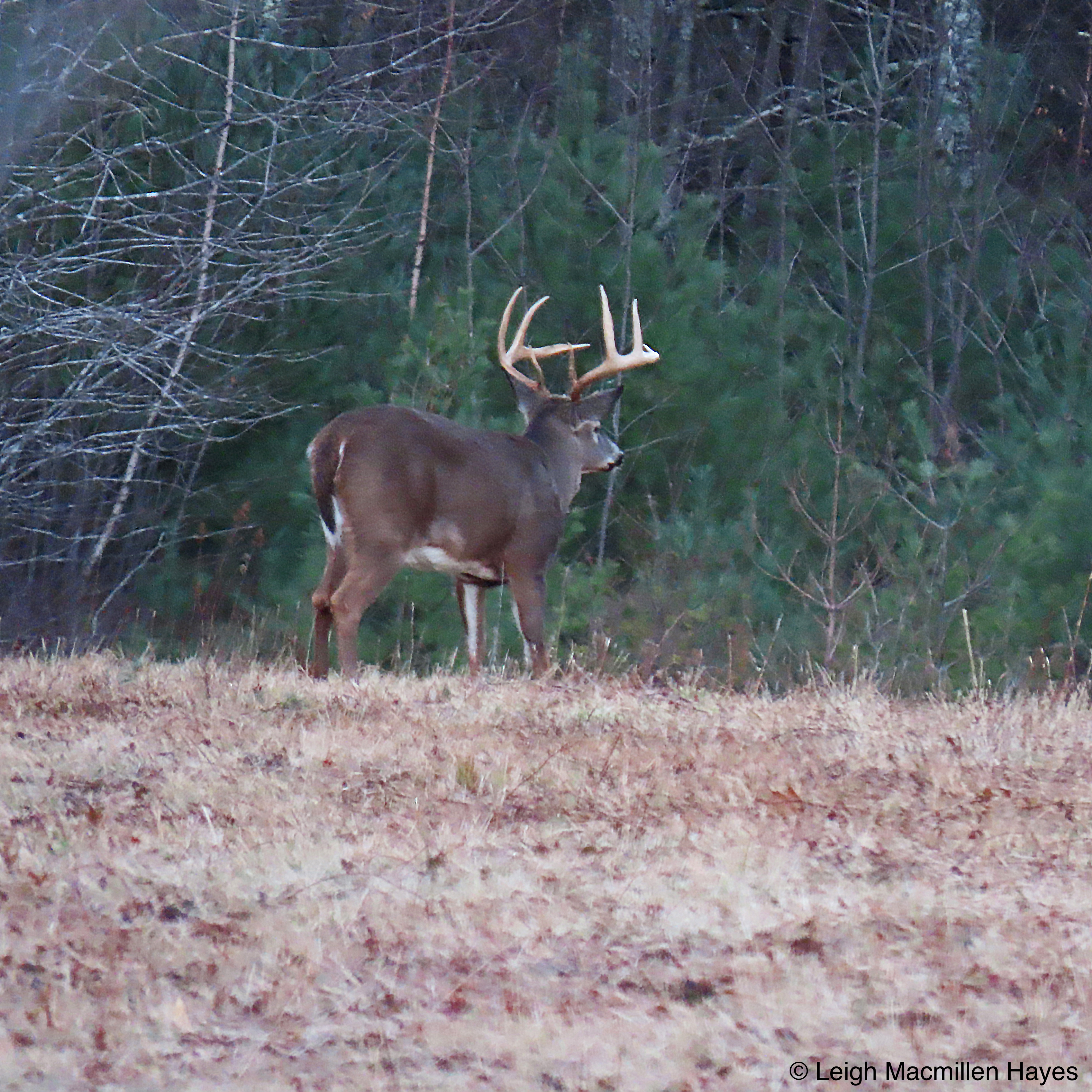
When I slip my hand down into what feels like the toe of the sock, I pull out the largest gift of all and a totally unexpected sighting–a buck. Actually, there are two, but this was the larger and definitely mightier. I feel blessed to have received such a gift. In fact, to have received all of these gifts. To have been present for these presents.

It’s actually toeless, this wonder-filled stocking of mine. And could go on forever. But I’ll pause here and rejoin my family. I do, however, wish you all warmth and peace and electrical power and good health this holiday season.

Cheers.