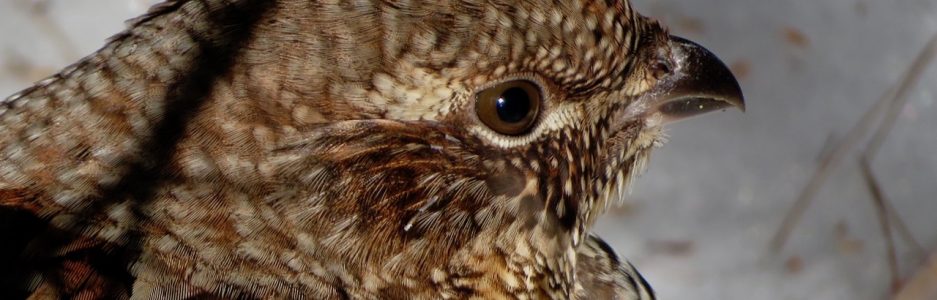
Summer Fauna among the Flora

As spring bid adieu and summer waved hello, I found myself wandering and wondering with others and alone and stopping in my tracks repeatedly, which is kinda what I do all the time I guess you could say, but suddenly this week there were a few special events that called for attention.

The first was Momma Snapping Turtle that I spotted beside a trail as I co-led a walk with Dawn Wood for Loon Echo Land Trust. Thanks to the magic of a camera lens, it may appear that we were close, but believe me, we all realized the sensitivity of the situation as this mother was digging in the dirt and laying eggs right before our eyes and we were transfixed–from a distance. There were fourteen of us and we tried to stand quietly and watch and ask questions and after about ten minutes decided it was time to come up with Plan B and reroute ourselves so that we wouldn’t stress her out.

In another place a day later, it was a Painted Turtle upon which I focused and gave thanks that it didn’t consider plopping back into the water as they often do when we so much as breathe. From the spot where I stood, I think this was also a female, given the shorter nails, but I couldn’t say for sure because tail length and plastron (bottom shell) orientation are also key to ID. The male has a longer tail and a more concave or indented plastron, while the female’s is more convex or flatter.

That said, when I spotted this one, I knew its gender immediately, for like the Momma Snapper, this Momma Painted was also in the process of laying eggs. She pulled her head into her shell the moment I spied her.

In the few moments we spent together, however, she ever so gradually extended her head.

But I felt like she was keeping a wary eye on me. And very much wanted me to move along.

And so I did.
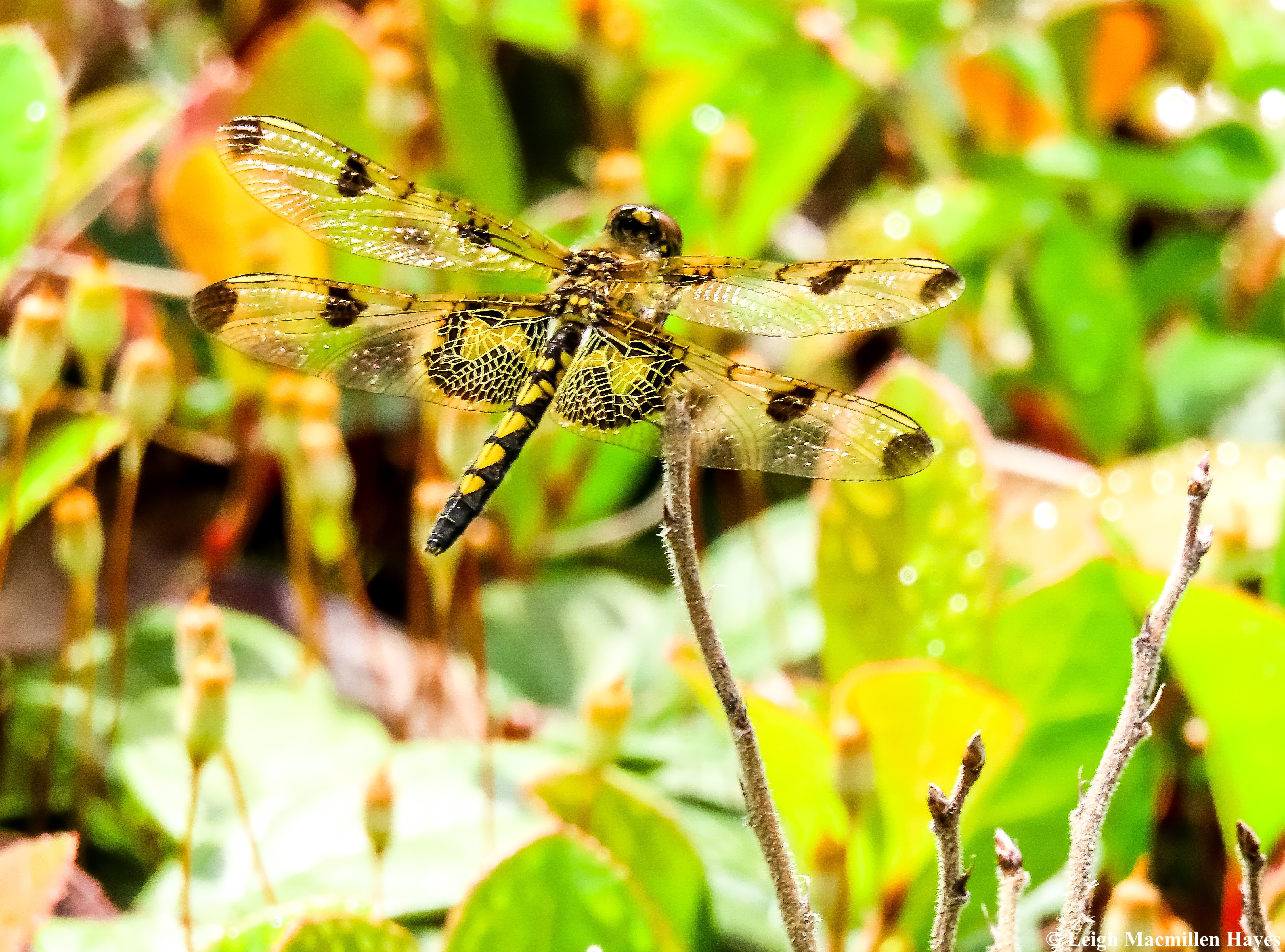
And then it was the insects that begged for attention, this being a female Calico Pennant Skimmer Dragonfly. Her coloration is yellow, while his is red. One of the things I love about perching dragonflies such as the Skimmer family, is that within their territory, they return to the same perches over and over again–flying off to capture food or defend said location, but usually back to the same twig or flower or one close by, making it easy to spend some time with them.

The Clubtail family is the same, this being a Lancet. These dragonflies often land on our dock or our kayaks and spend some time with us.
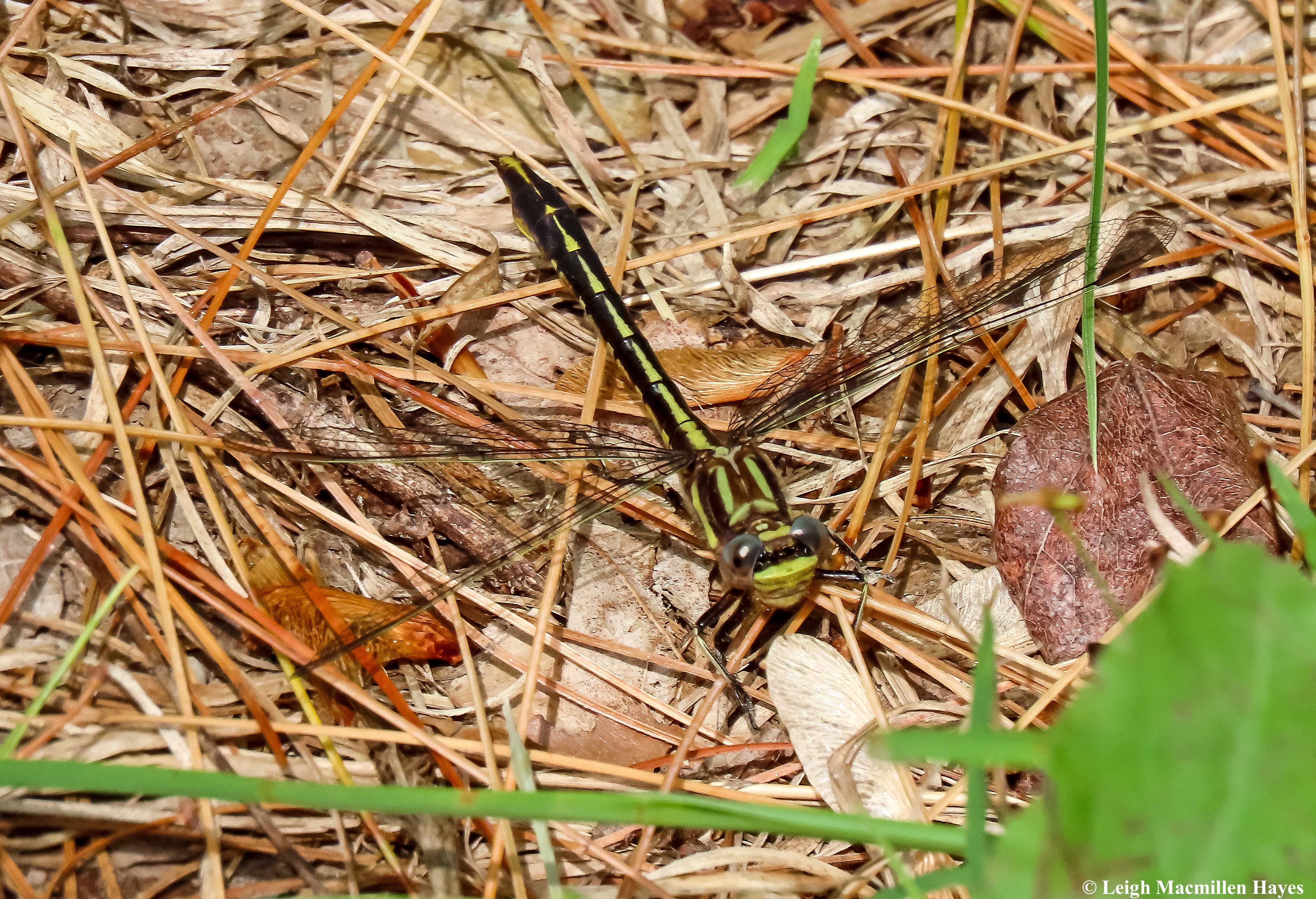
I swear they are as curious about us as we are about them. But maybe again, they are checking out our predator abilities. I much prefer letting them be the predators as they munch on Mosquitoes and Deer Flies and make time in the woods or on the water so much more comfortable.

And then there are those who seek nectar and Meadow Hawkweeds are a valuable resource right now for Flower Flies and Bees and Wasps and Butterflies like this little Northern Crescent. Last summer I spent a lot of time with this species in my neighbor’s field and was thrilled to realize that as long as there was food available during the fall in the source of Goldenrods and Asters, they were present.

One of the most abundant butterflies this year has to be the Tiger Swallowtail. Canadian and Eastern, and probably hybrids in the mix, they are everywhere. Everywhere. Adding grace in their flutter-bys and color to the landscape. As well as serving as pollinators.

Dropping drastically back down in size, my attention was also drawn to the Long Dash Skipper Butterfly. According to the comprehensive field guide, Butterflies of Maine and the Canadian Maritime Provinces, by PhillipG. deMaynadier et al, “The Long Dash is named for the conspicuous stigma on the male forewing. Found on forewings of most other small, orange and brown skippers in our region, a stigma is a specialized patch of scales that emits pheromones used during courtship. In the Long Dash, the stigma is surrounded by black scales, making it appear larger than it really is.” Thus, this would be a male Long Dash Skipper upon one of its favorite flowers, Red Clover. But from the book, I’ve learned I should also look for it upon Cow Vetch, Common Milkweed, Spreading Dogbane, hawkweeds, Ox-eye Daisy, and knapweeds.

Keeping pace with me despite its much shorter legs, the Six-spotted Tiger Beetles, which I love for the iridescent green, practically ran ahead, reminding of Chalk-fronted Corporal Dragonflies who insist upon flying five feet in front, waiting till I almost catch up, and then flying another five feet ahead, over and over and over again. The only time I’ve seen the Six-spotted Tigers slow down is when they are canoodling. But even then, they are on the move.

Another insect, which is much slower, may have significant value in our landscape. If I’m correct with the ID, and I’m waiting for iNaturalist to confirm, this is Atanycolus cappaerti, a parasitic wasp. I can only hope that my ID is correct, because . . . according to Cornell University’s College of Agriculture and Life Sciences, A.cappaerti “attack [Emerald Ash Borer larvae] at rates high enough to be considered significant for biological control. While studies are still ongoing, the use of the native parasitoid A. cappaerti for augmentative biological control would be desirable from an environmental perspective as it is already established and has a niche in the ecosystem.” That’s in Michigan. But maybe in Maine as well? Please let it be so. This past winter we all noticed that EAB had spread significantly in our area.
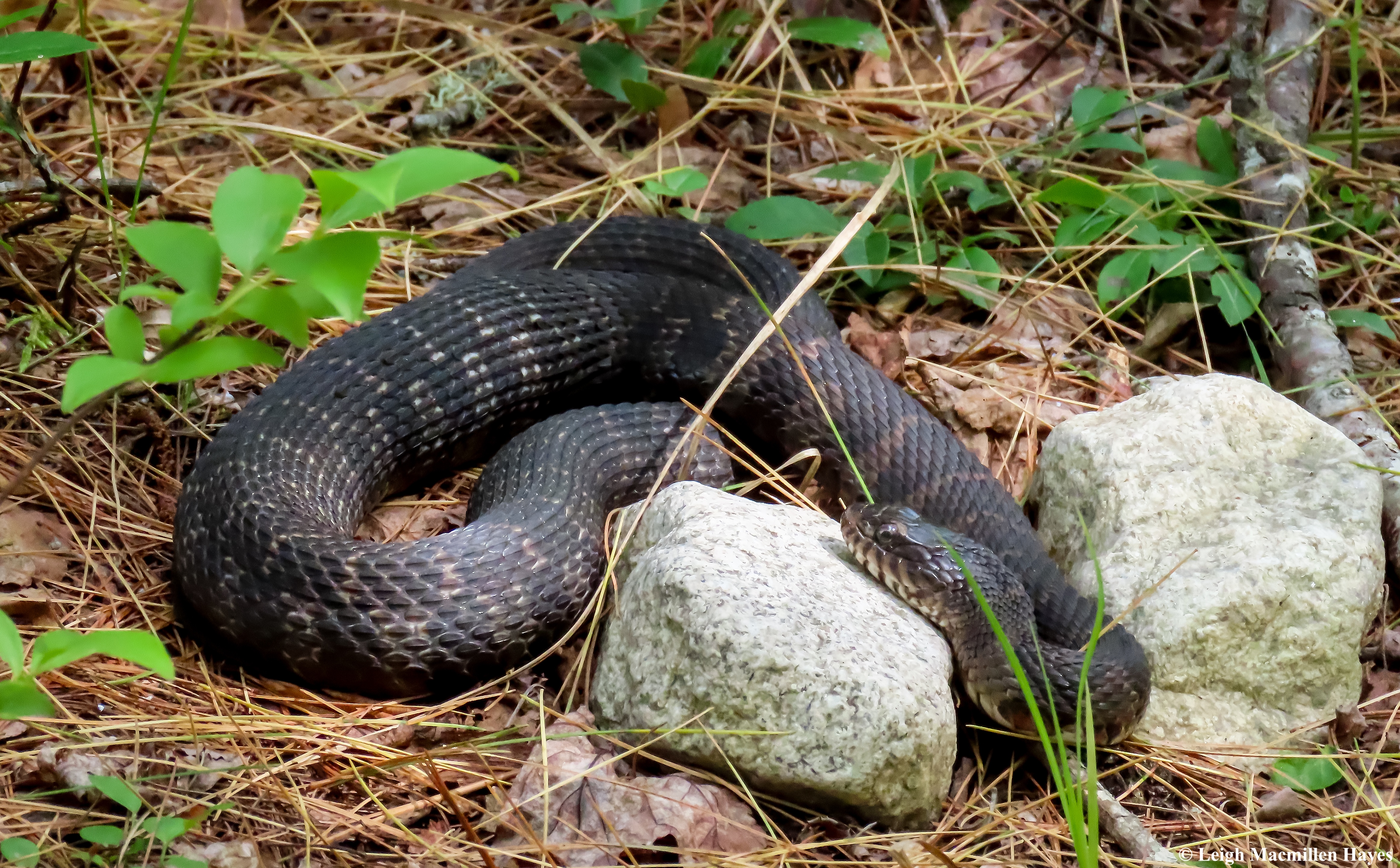
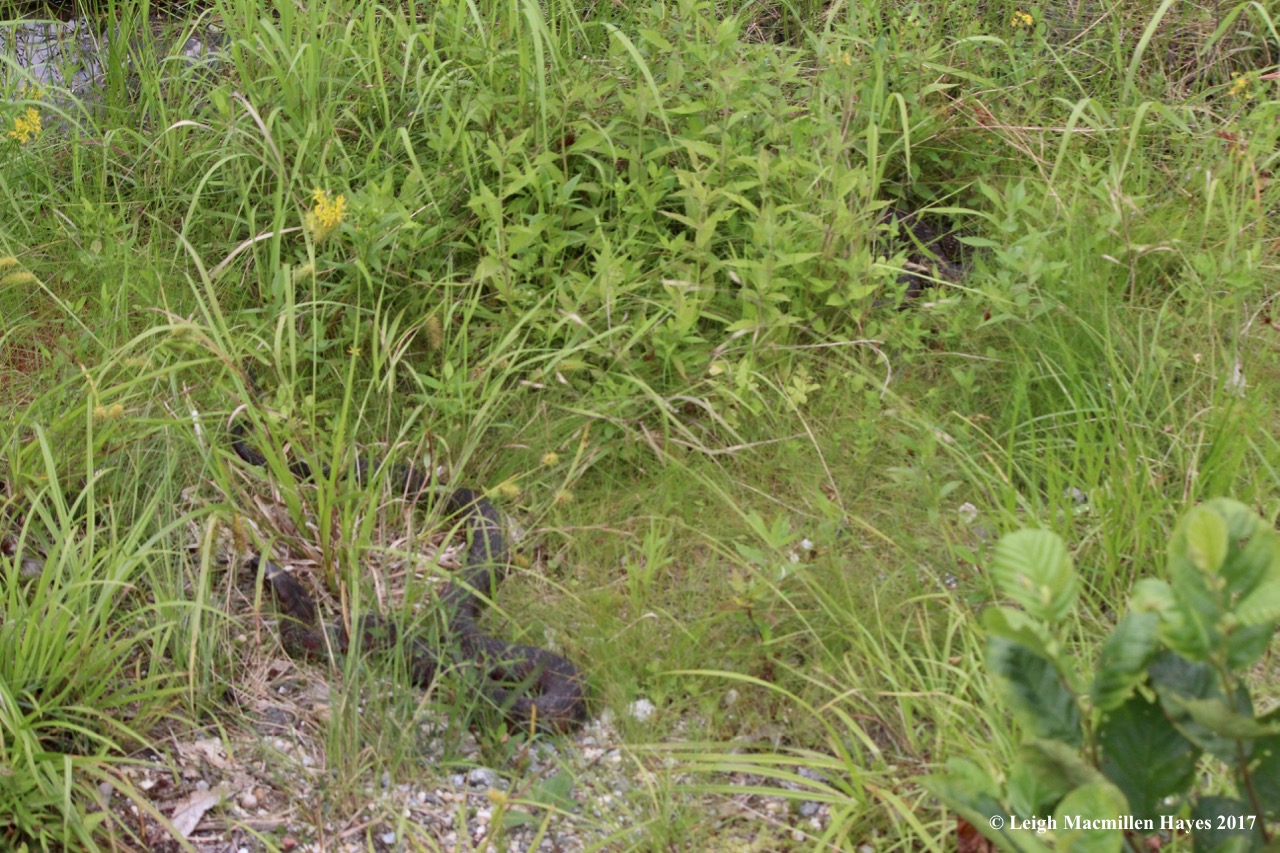
Basking just down the trail from the wasp was a Northern Water Snake who didn’t seem to mind my presence, and I tried not to mind its either.

He was aware of me, and I say he because in the Northern Water Snake world, the male is smaller than the female, and this one wasn’t really all that big, but still . . . a wee bit intimidating. Of course, it did nothing to make me feel that way, so the intimidation was all in my mind. Instead, he let me take a few photos and pass by without a confrontation, as is always the case. I remember once stepping out of a canoe and practically landing on one, who stayed put. And another time, realizing that one was basking in Maleberry shrubs at the edge of a pond as a few of us paddled by within mere inches–or so it seemed.
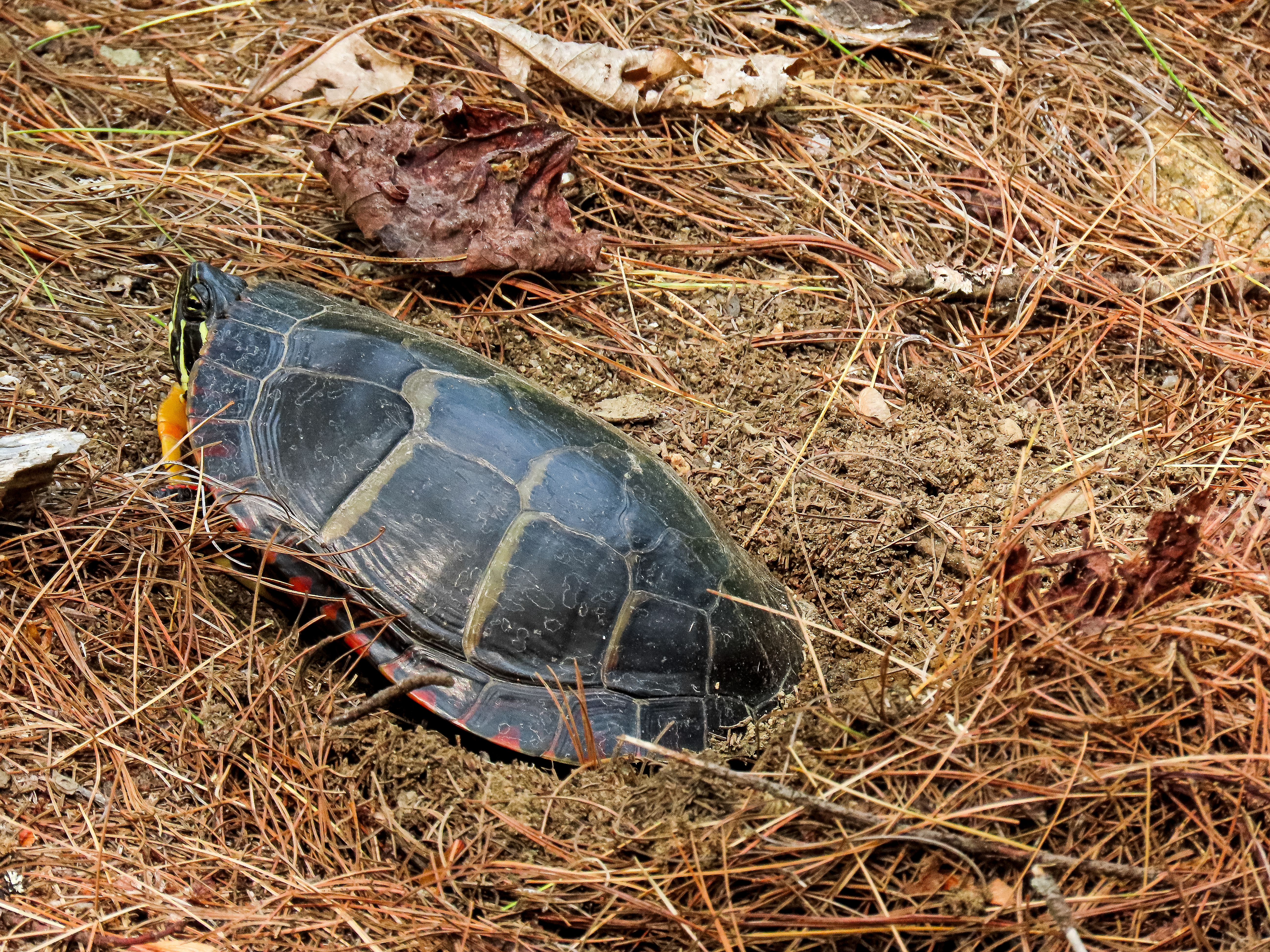
As spring gave way to summer this past week, I think one of the things that stood out most to me was sighting the turtles laying eggs. Though they don’t hatch at exactly the same time, it will take about two to three months for the eggs to incubate. Of course, temperature has much to do with that. But my experience in the past is that about the autumnal equinox we may see baby turtles crawling out of small holes, if not sooner. And if predators don’t get to them first. There’s always that risk.

I do love winter, but summer fauna among all the flora–so much life happening right before our eyes–its like an explosion of color and form and pattern and texture and sound. And it’s only the beginning. I can’t wait to see what the rest of the season has in store for us.
In the Middle of the Bubble

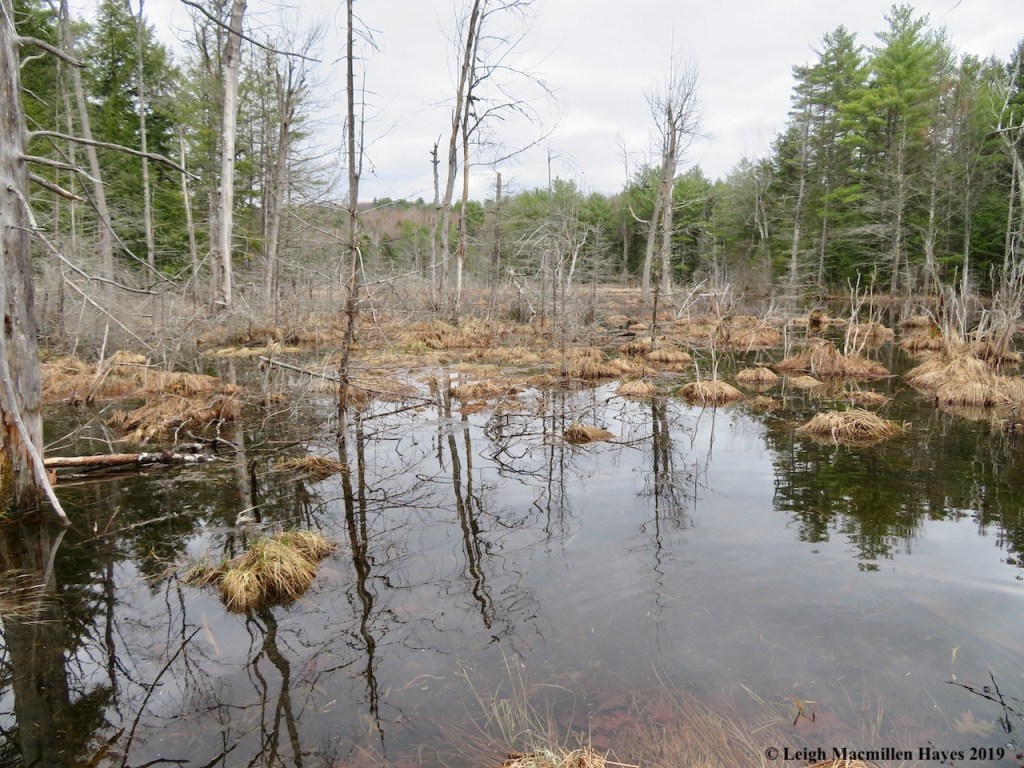
We were going to go. We weren’t going to go. In the end, we each took a break from work and met at Lakes Environmental Association’s Highland Lake Research Forest.

Alanna said we could get away with calling it work because we were, after all, conducting research–on where the vernal pools were located. And so we listened and followed our ears as we bushwhacked through the woods. Peeps and wrucks and trills filled the air and we beelined their way. Suddenly we emerged beside the Red Maple Swamp.

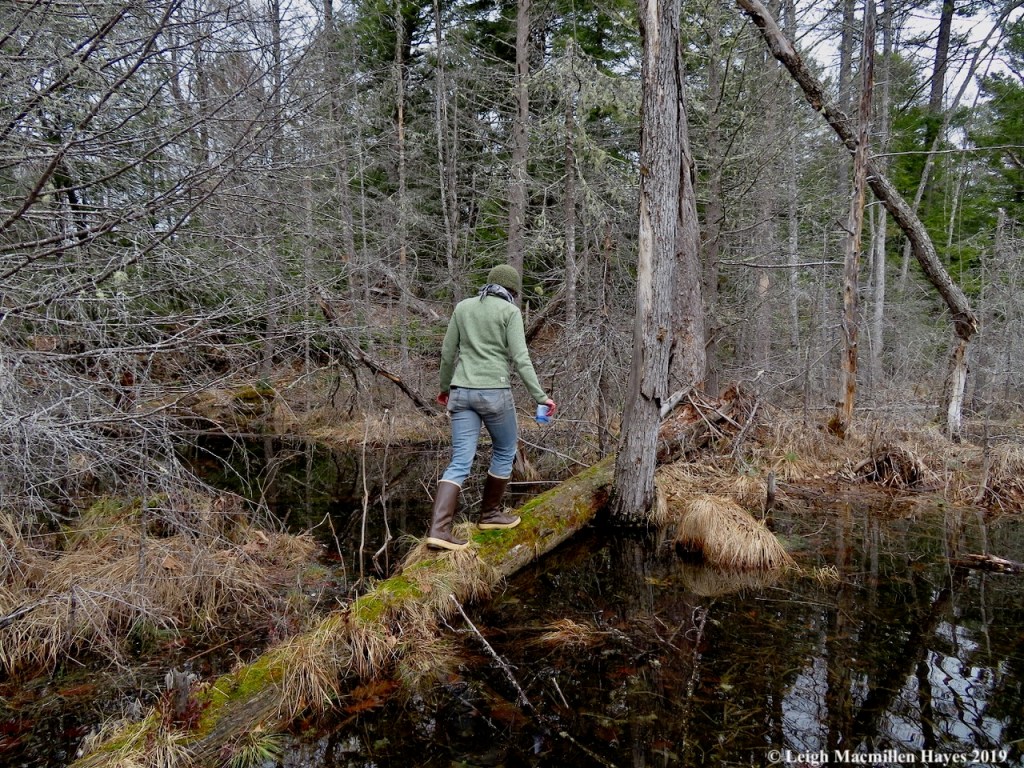
Of course, the symphony cut off upon our arrival, and so after sitting and standing still for a few minutes, we decided to step into the water and search for egg masses. Maybe it was the lighting. Maybe we didn’t look hard enough, though Alanna did find at least one Wood Frog mass after she crossed over a log.

While she was still on the other side, I headed back up onto the land, and a few feet from the water I was stopped in my tracks by a large snake.

Its mouth gaped in a fashion that could almost have been a smile. For a few minutes I watched and the mouth never closed. That’s when I realized that it was dead.

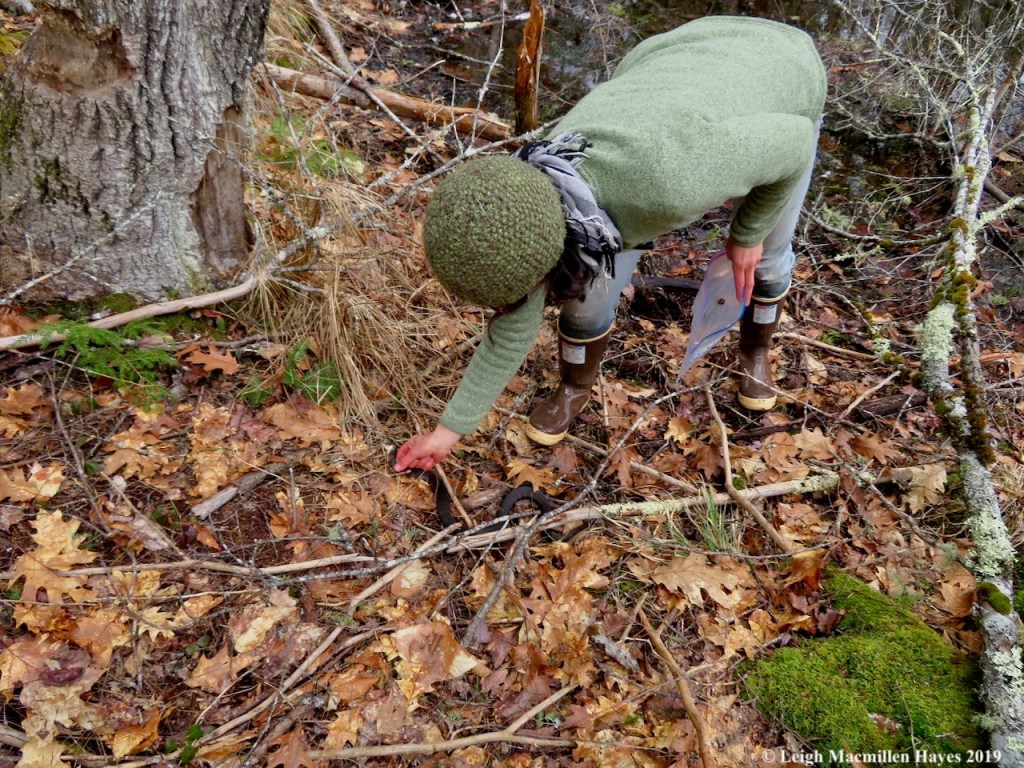
As Alanna made her way back to see it, she found a deep hole and one of her boots filled with water. Being the person she is, she got out of the muck, emptied it, and . . .

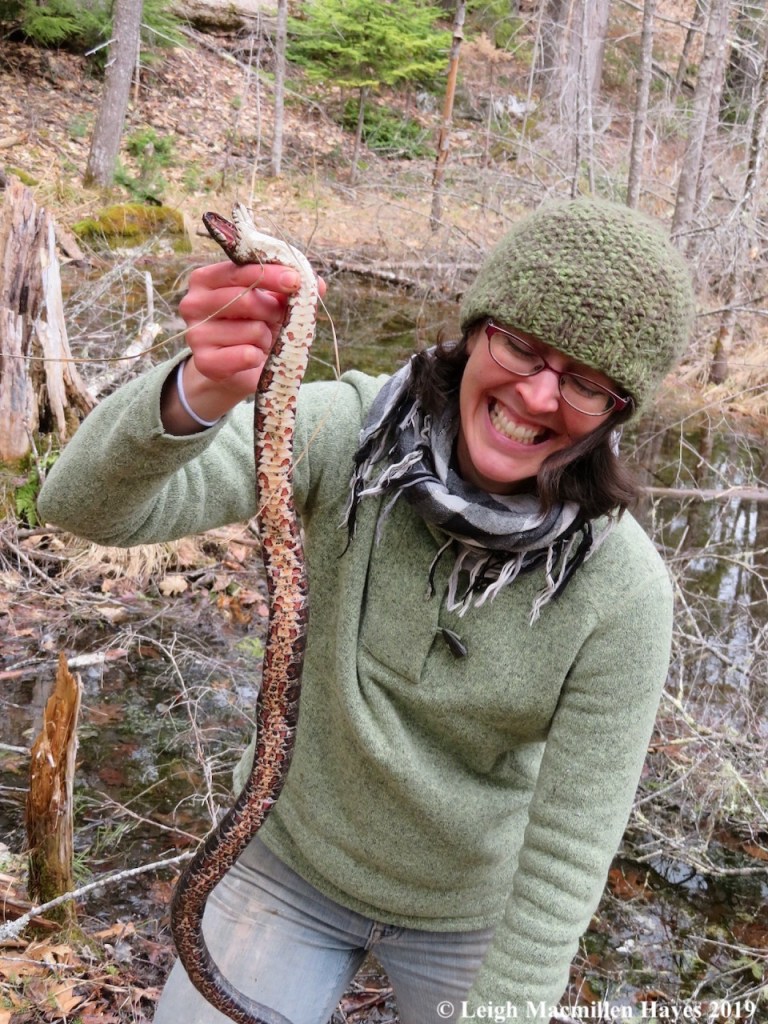
despite the fact that we were both intrigued and a wee bit freaked out about the snake, she picked it up. If you’ve never seen a Northern Water Snake, they are big. And what if it wasn’t really dead, though we were sure that it was. But what if it wasn’t?

It dangled from her hands as over and over again she said, “I can’t believe I’m holding a snake.” Her grinning grimace echoed those words.

Because she’s a collector of fine things like scat, she had brought along a bag and so into it went the snake. Still, she continued to repeat, “I can believe I’m holding a snake.”

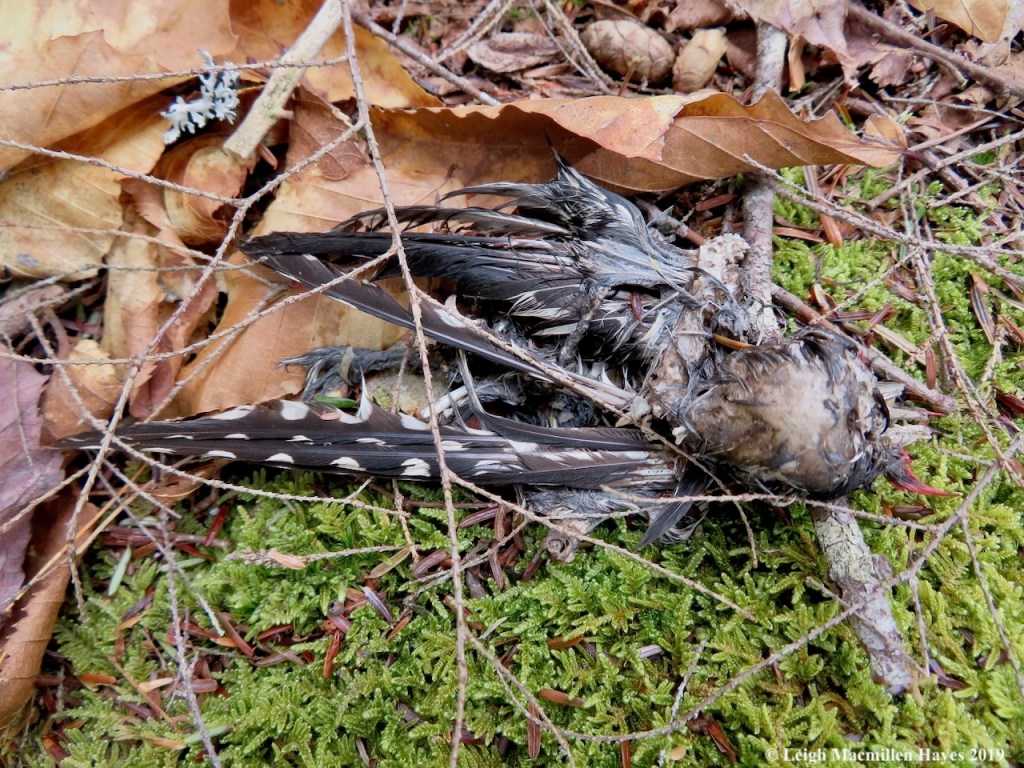
Just a few feet away, we found another kill site. A woodpecker had met its demise.

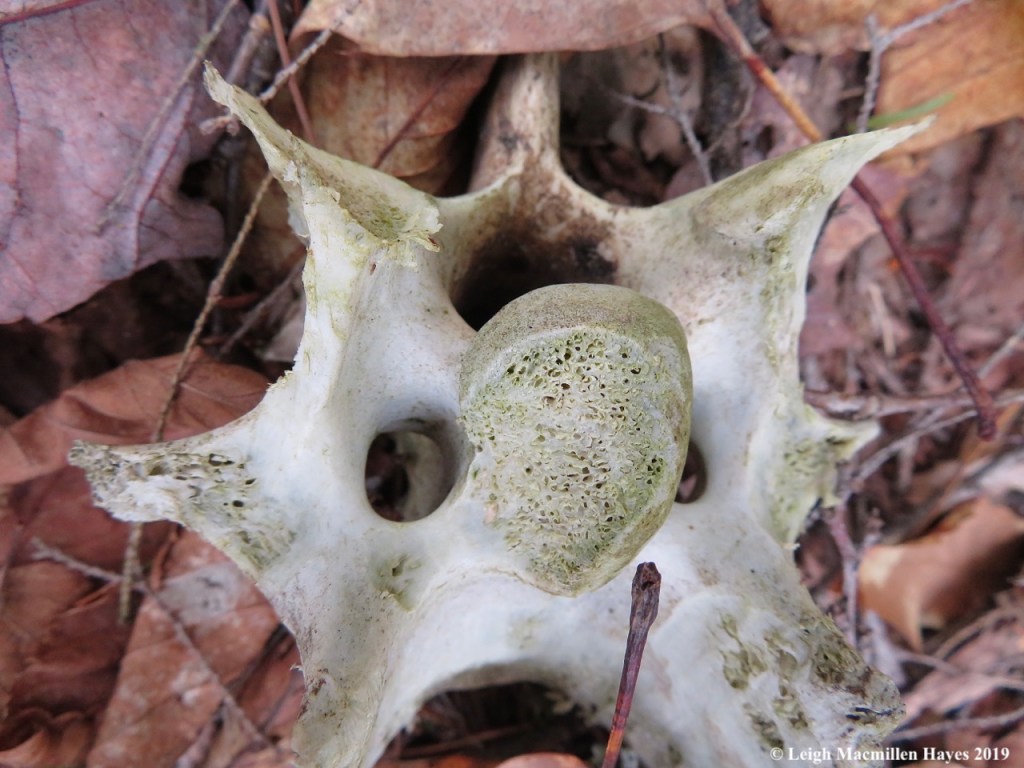
And only feet from that–a deer vertebrae. It became clear that life happens by the swamp; and nearby was an owl pellet filled with bones. We doubted the owl had anything to do with the deer, but what about the snake and bird? Maybe it wasn’t the owl, but some other bird of prey. Why hadn’t the snake been consumed? Or the bird plucked? As usual, more questions than answers. At last we decide to move on because we heard a wetland chorus calling our names on the other side of the next hill.

I followed Alanna until she stopped abruptly. In her path about twenty or thirty feet from the water, another water snake. This one even bigger. And . . . alive. The sun’s rays weren’t strong, but we suspected it was trying to get warm. For a few minutes we stood and watched and then finally decided we could walk by without a problem. And we did. That being said, every step we took after that included a search just in case more snakes lurked about.

The amphibian calls drew us to the area where a river flows through the swamp.

It was there that we found more signs of life including Canada Geese,

Red-winged Blackbirds,

and rather recent beaver works. At that point, Alanna had to depart, but I stayed for about an hour longer and wandered along the edge of the wetland.

My finds continued for where I looked for frogs by a coppiced tree, instead I found a tussock moth caterpillar frozen in time. It had remained attached firmly to the twig all winter because I suspected it had been parasitized by a mummy wasp.

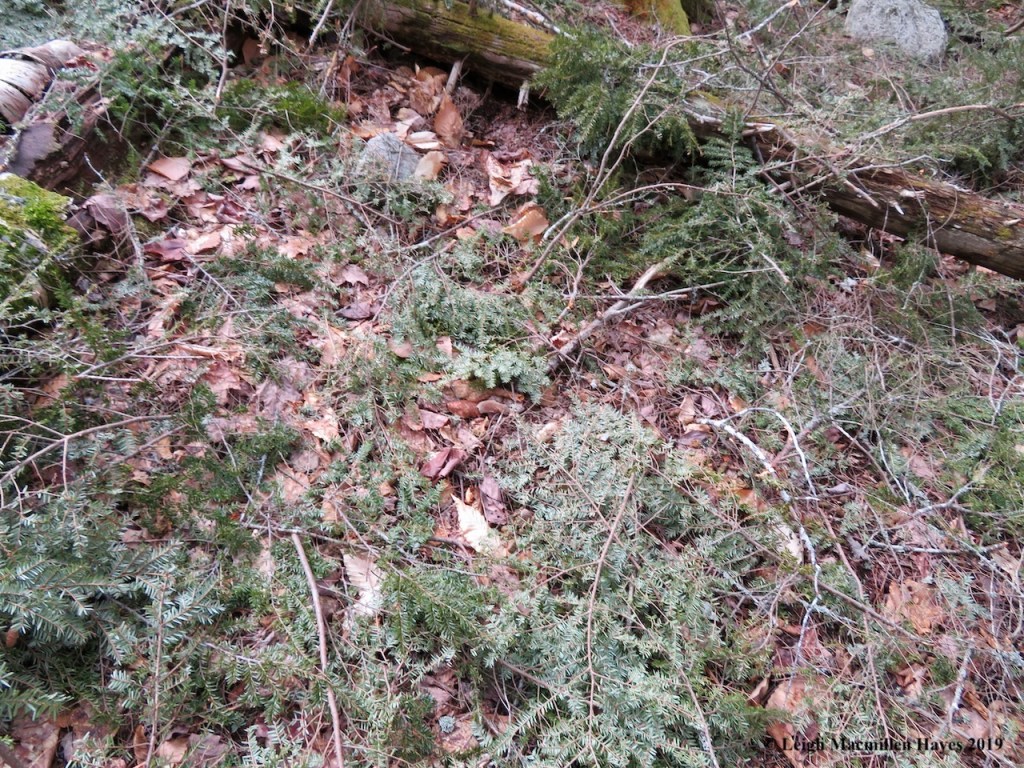
And then it was uphill toward a rocky ledge that I tromped because the ground was carpeted with hemlock twigs. I knew who had cut and dropped them, and wondered if I might spy a den.

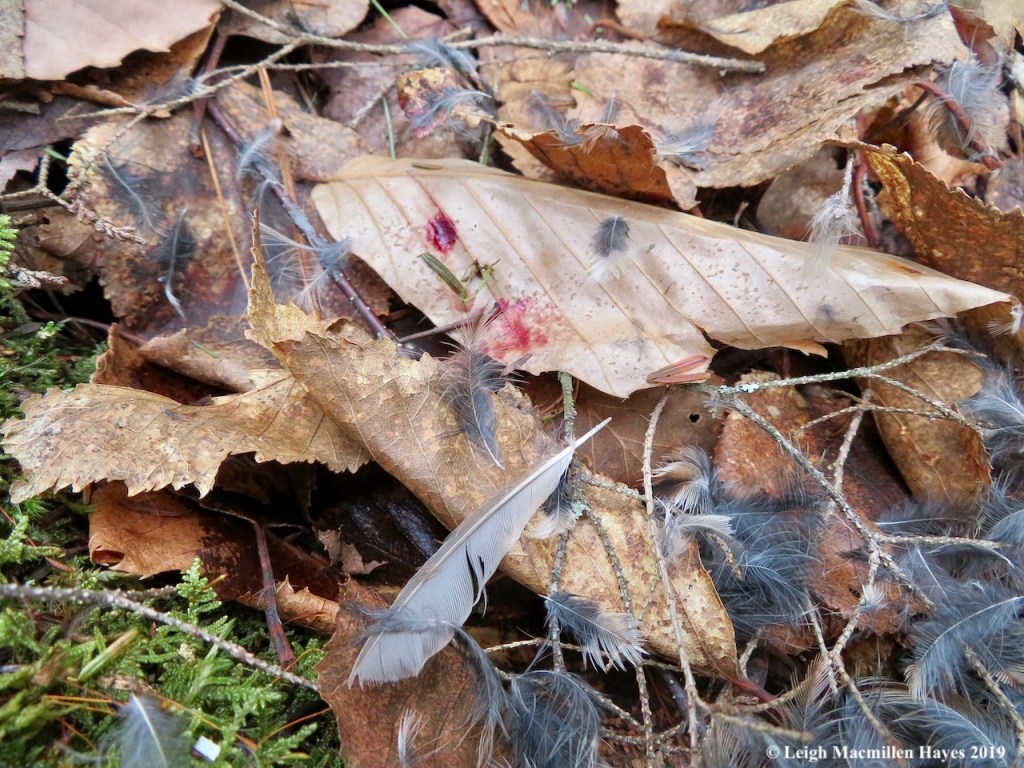
Where I thought there was a den below, I was wrong. But . . . atop the downed tree was another kill site. This time it looked like a Junco had been the source of food.

And on a leaf, the bird’s blood stains.

Not far from the feathers and blood, I did find what I was looking for–a porcupine den and its telltale pile of scat flowing forth.

Murder and mayhem you might think. But death is part of the web of life, which also sustains us.

Today, Alanna and I went seeking egg masses and instead found ourselves surrounded by so many other things. It all made me realize I am only one tiny speck in the middle of the bubble.

Lichen Everything We See

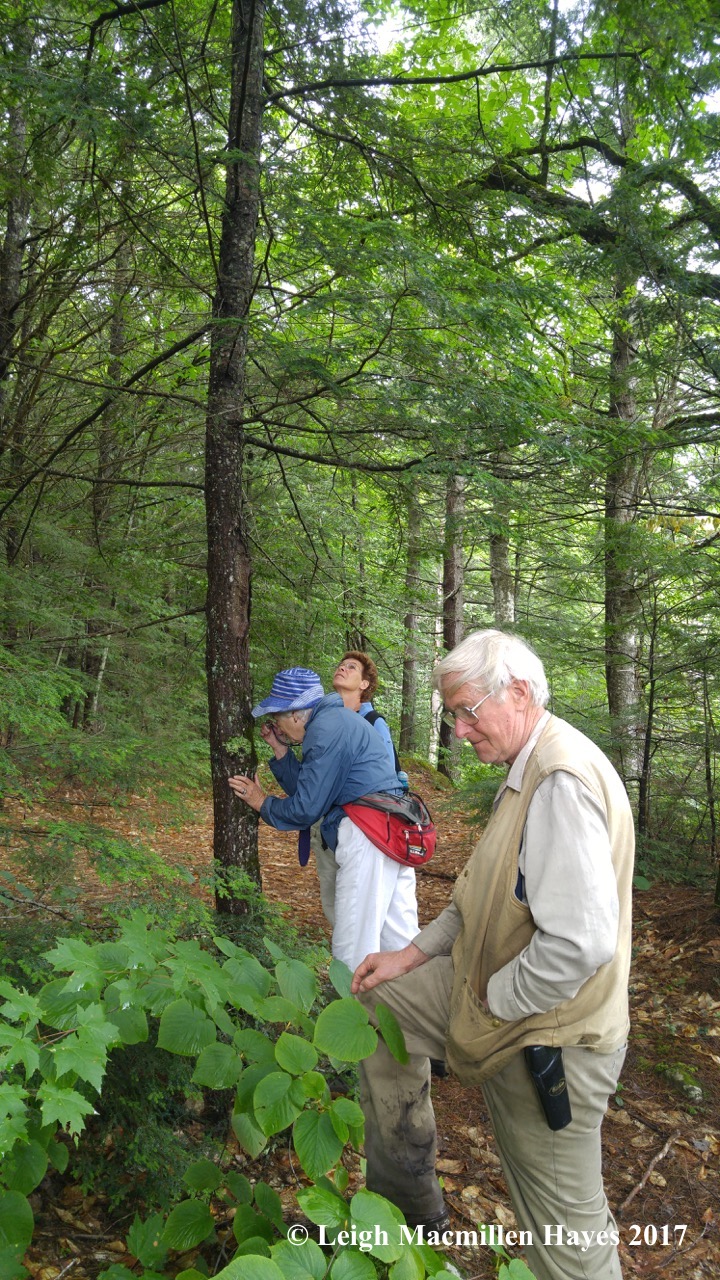
The Tuesday morning Greater Lovell Land Trust docent tramps don’t typically have a theme–we just like to explore a property together to see what it has to offer and learn from each other. But this morning I tried to invoke one–lichens–since we recently had Maine Master Naturalist Jeff Pengel present a talk on the topic and a few days later he led a walk for us.
w-on the trail (1)

I’m happy to say, we are who we are and within minutes we found ourselves easily distracted.

w-many fruited pelt lichen

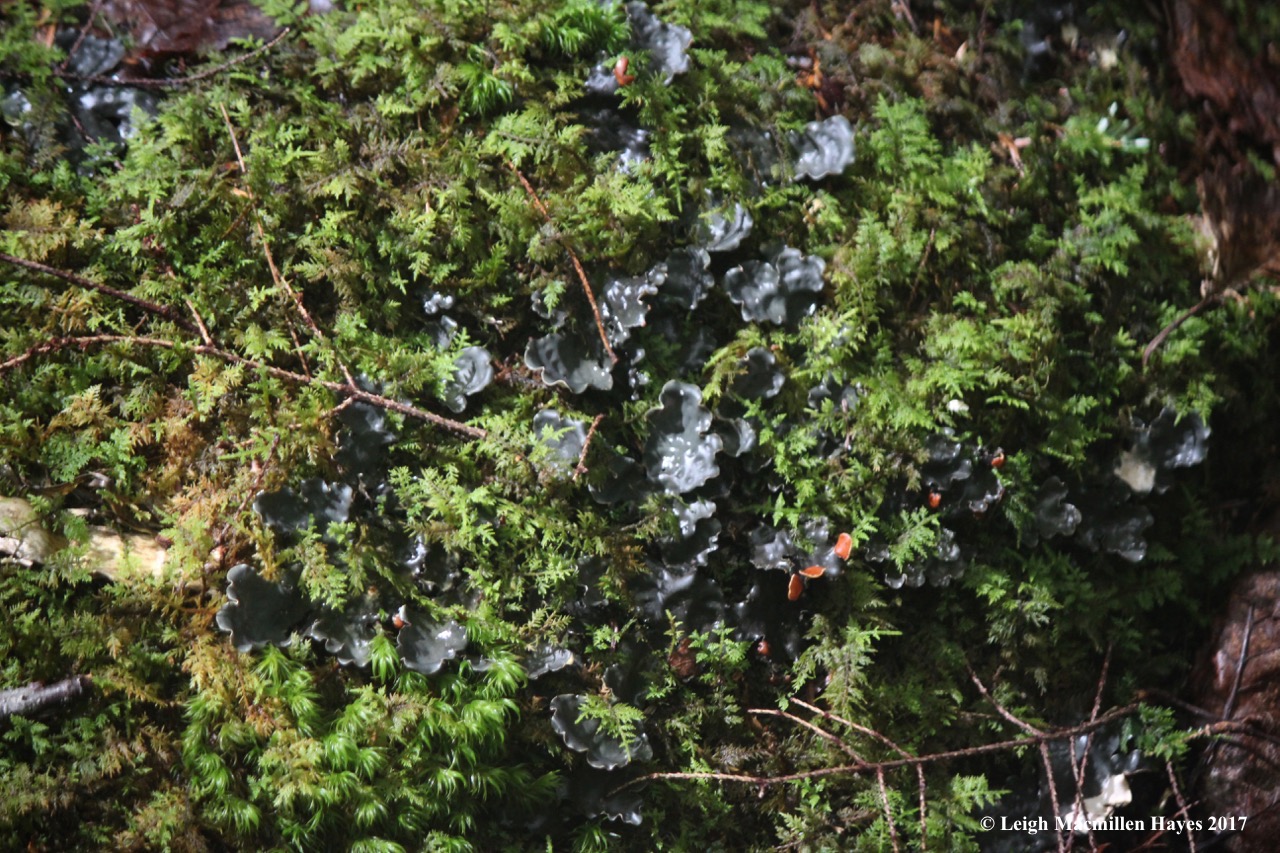
We did spot a variety of lichens and talked about their forms and substrates. The youngest among us at age 5 found this pelt lichen growing among the mosses.

w-Wes

In fact, he spotted it just after he’d jumped off what he deemed Jockey Cap, a rock that represented the 600-foot ledge that overlooks neighboring Fryeburg. We welcome his keen eyes and those of his siblings, for they see things we overlook and have a natural curiosity. (Don’t you just want to pinch those cheeks?)

w-green stain fruiting

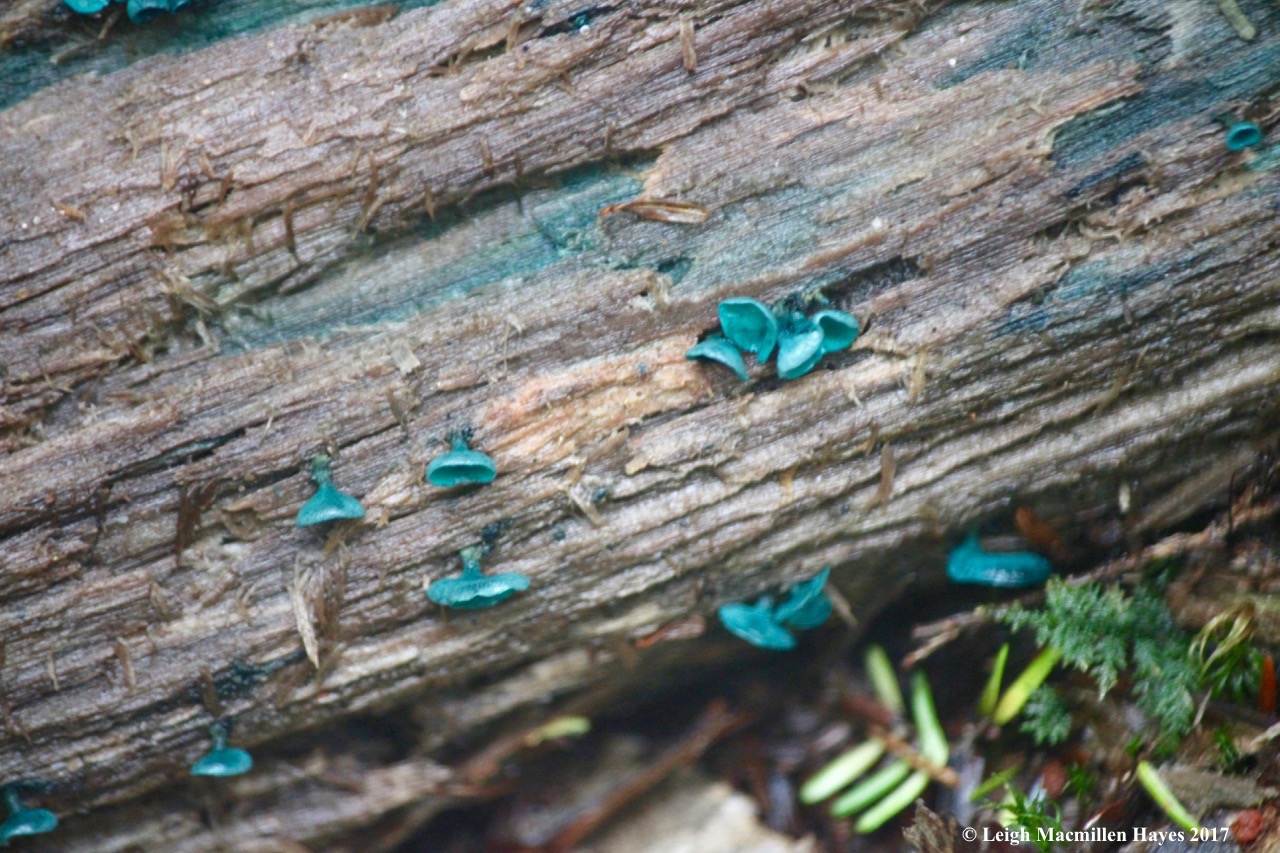
In fact, his oldest brother was the first to spot this fungi, the turquoise fruiting bodies of green stain fungi that I used to think was a remnant trail blaze. The fruits are minute but the color spectacular.

w-scaly vase chanterelle

And so our eyes began to focus on other fungi, the fruiting bodies of which are a result of all the rain we’ve received. Another great find today–scaly vase chanterelles. Our British docent, who is a fungi aficionado, reminded us, “It’s veys here, but back home I’d say vahz.”

w-ant pupa in heart shape

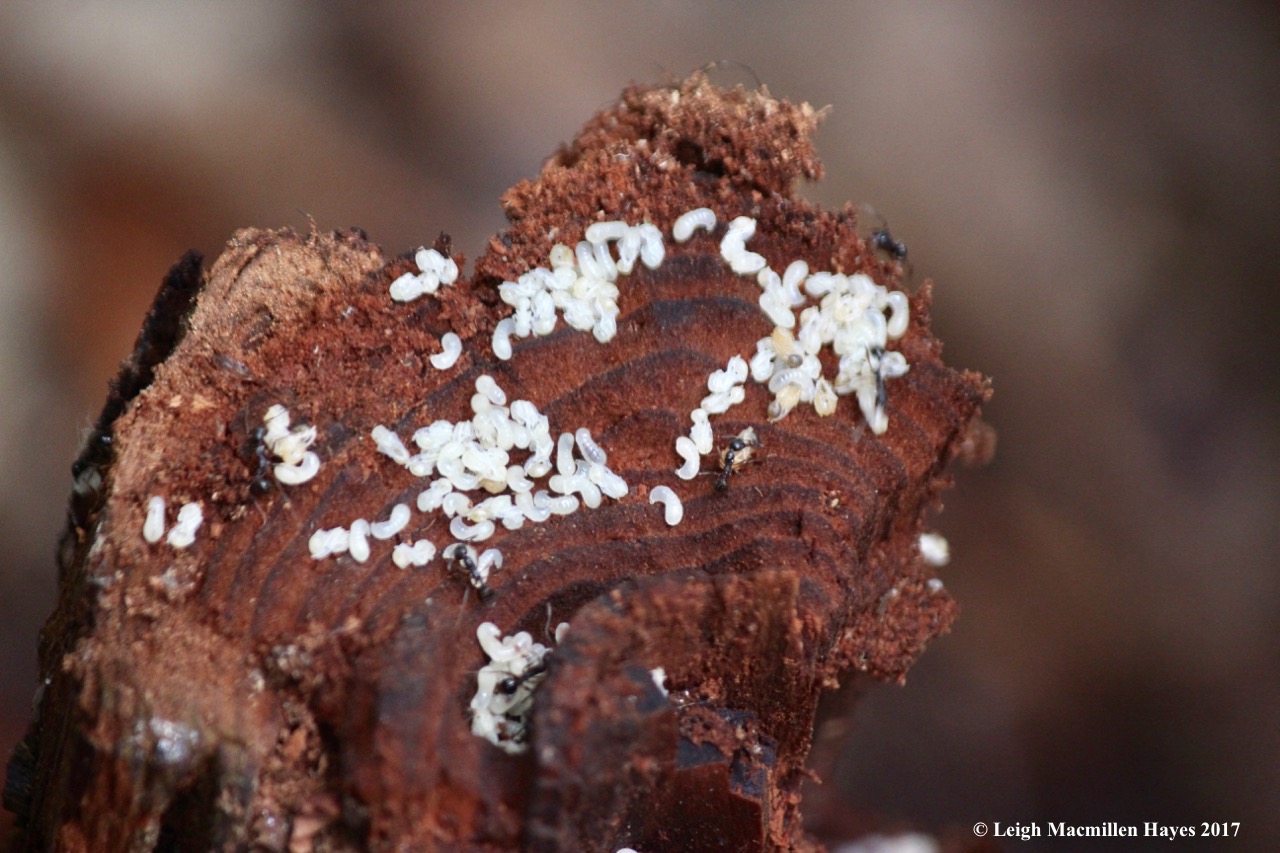
And then there was the heart that we had to love. One of our group had stumbled by a tree stump and some bark slipped off. Beneath it, the adults in an ant colony quickly went to work, moving their pupa to a safer location and we watched for a few minutes as they worked–the heart slowly losing form.

w-interns and young naturalists 2

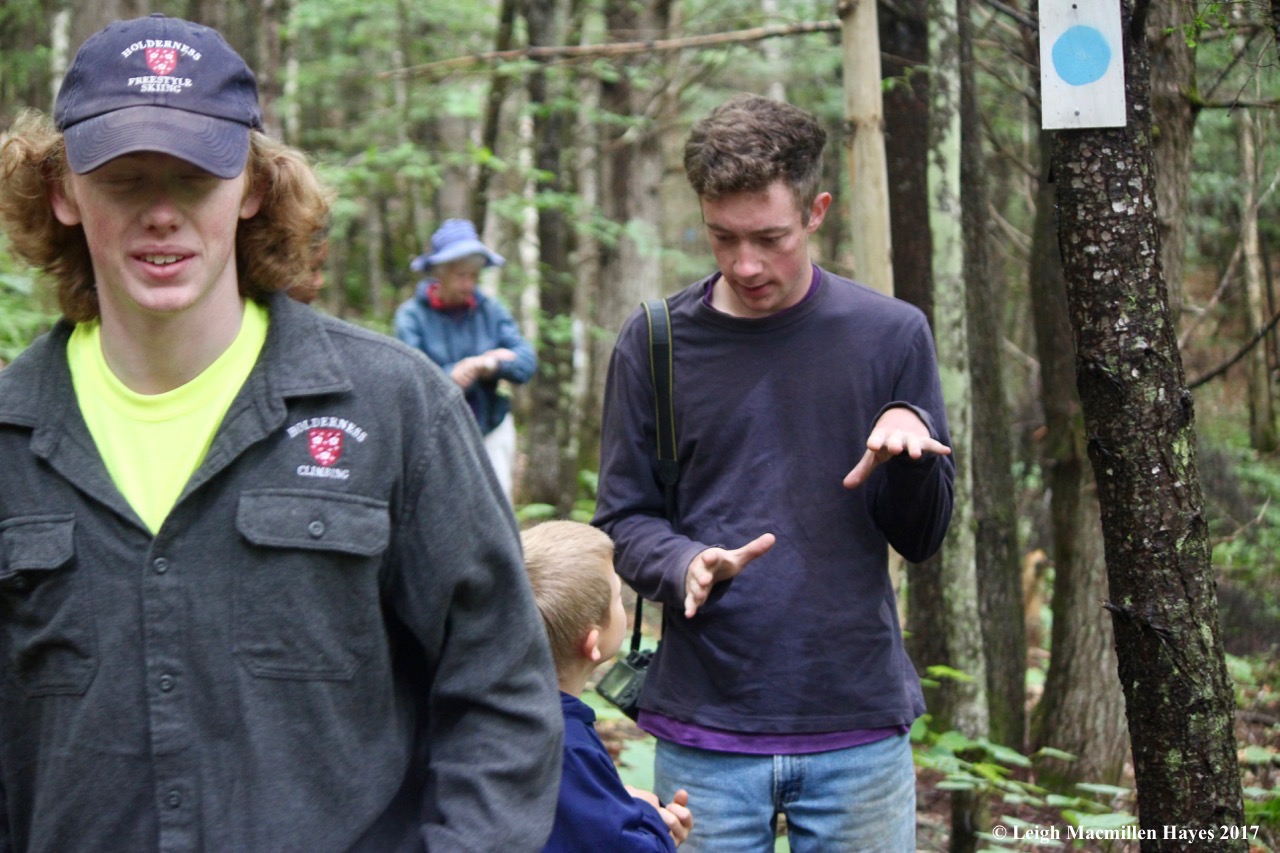
All along the way, our interns took time to explain things to the younger set.

w-interns and young naturalists 1

And the younger set took time to practice what they knew,

w-poking a balsam blister

such as the fact that if you pop a balsam blister, the resin will ooze out. And your fingers may stick together. But it will smell like Christmas.

w-docents 1b (1)

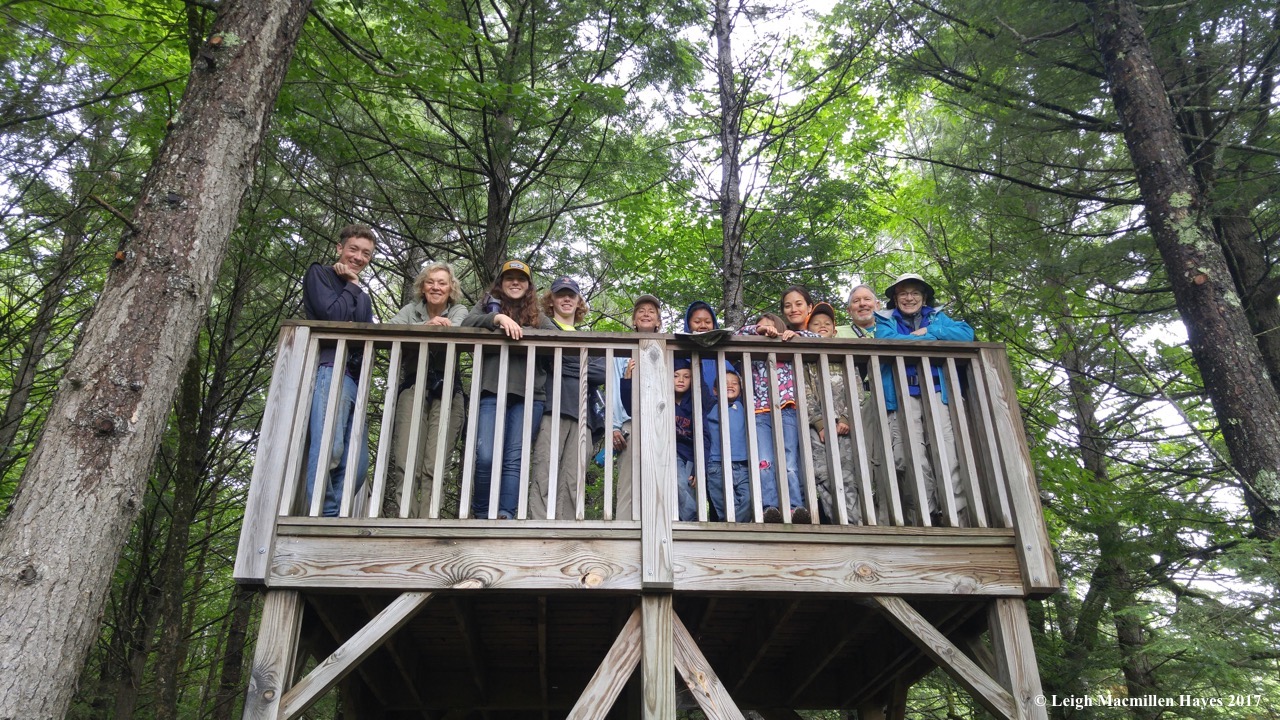
It took us almost two hours to walk less than a mile and climb the “eagle nest” overlooking Wilson Wing Moose Pond Bog.

w-docents 3 (1)

A few stayed below and made more discoveries.

w-pipsissewa

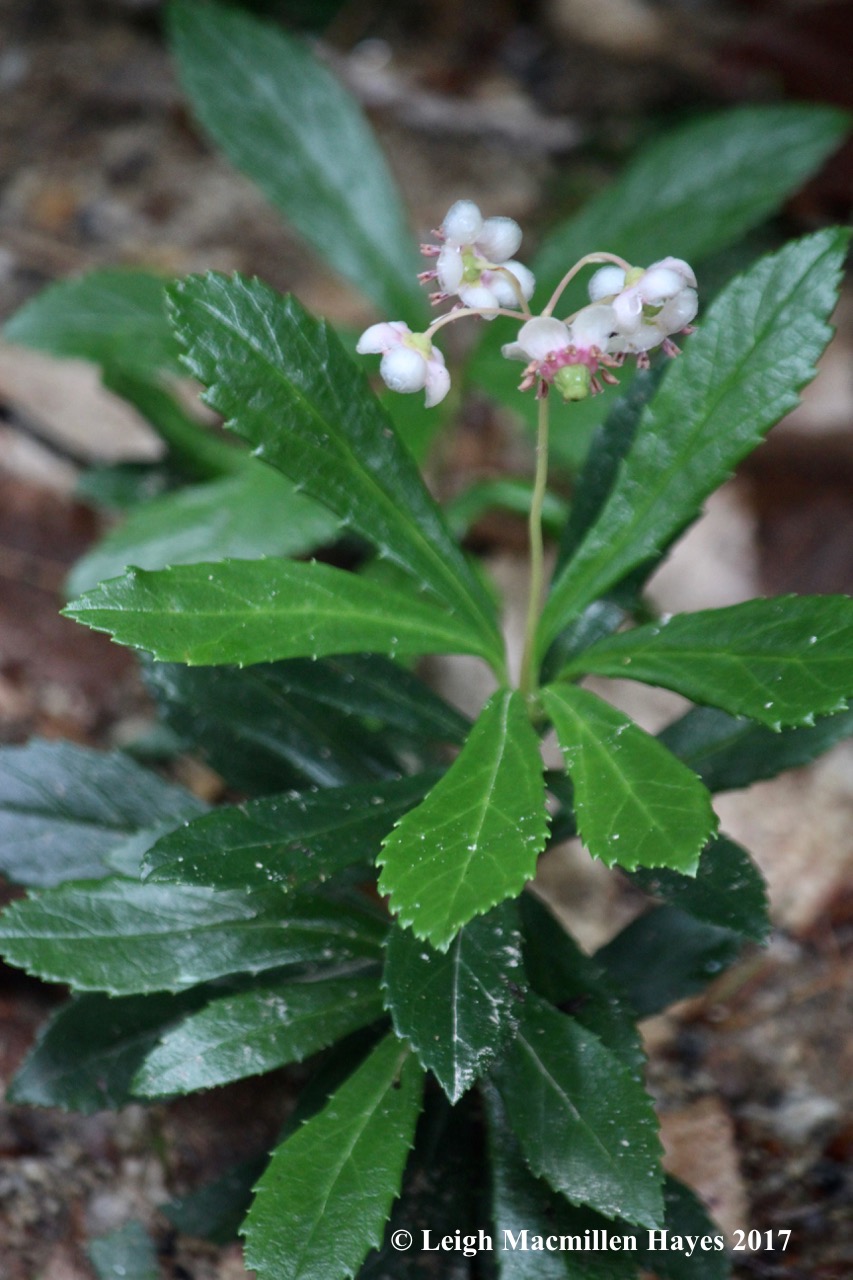
We finally reached Horseshoe Pond Road, turned right and slowly made our way back to the kiosk where we’d parked. But still, we stopped periodically and took in the sights, including the pipsissewa in bloom.

w-spider

And a spider that was dangling when first spotted by one, but on the dirt road when we all gathered round. Check out the design on its legs.

w-lungwort

After all but one had left, she and I chatted over our brown bag lunches and then ventured across the street to the Bishops Cardinal Reserve in preparation for tomorrow’s  Lovell Rec Summer Camp Nature Hike. We offer two hikes–one for the younger set and another for the older kids, who wish we’d talk less and walk more. We can take a hint and so we do that for them. But still, there are cool things to see. We determined some fine stopping points today for the mammal theme, but the lungwort lichen also called out with its bright green coloration after yesterday’s rain.

w-Horseshoe Pond

Once we’d completed our reconnaissance mission, I decided to stop down the road at the Horseshoe Pond boat launch, ever in search of dragon and damselflies.

w-pickerel weed

It wasn’t warm or sunny enough, so I didn’t spy any of the odonatas.

w-pickerel and hoverfly 2

But I did notice hoverflies nectaring the pickerelweed flowers.

w-green frog

And a young green frog jumped into the water upon my approach. As I stood and looked at it, I heard rustling behind me.

w-snake 8

And in the grass, I spied the creator.

w-snake 9

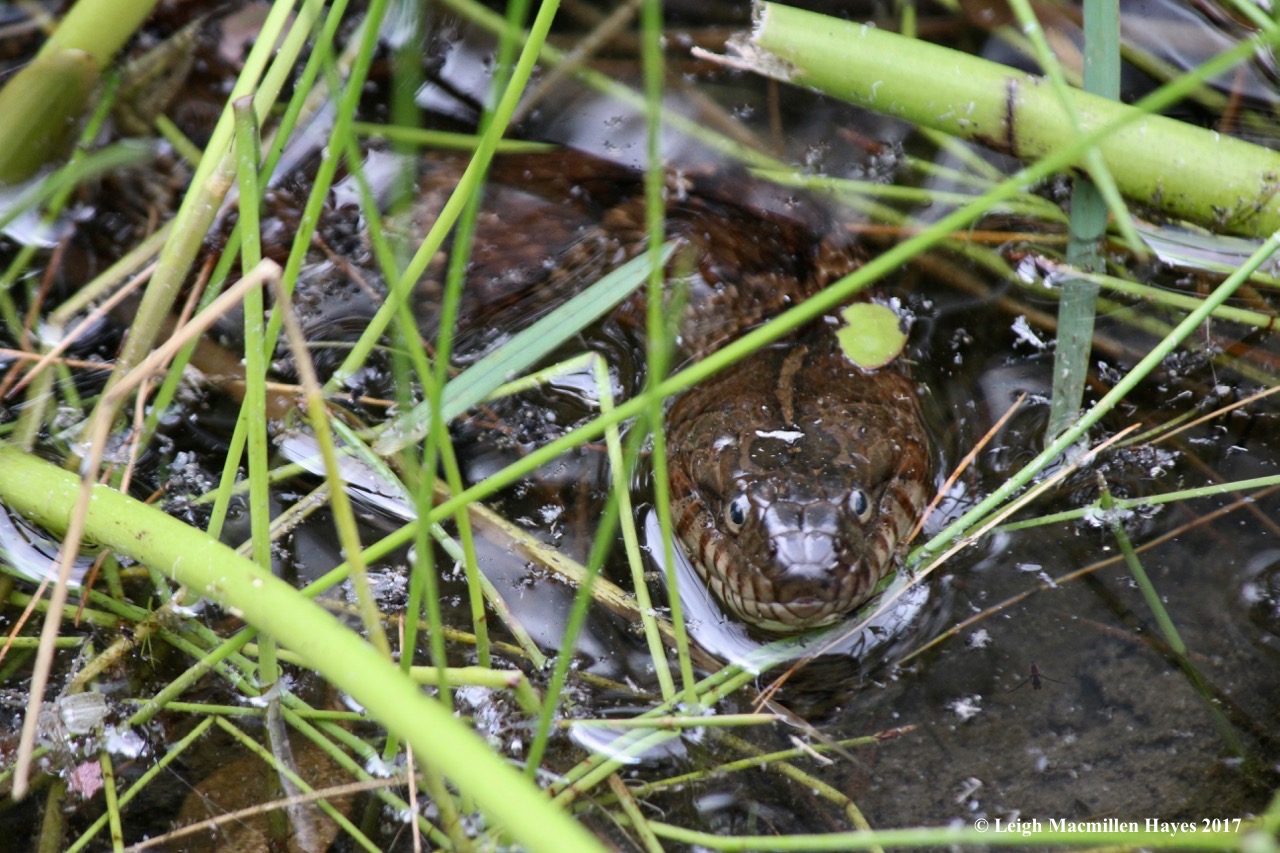
Notice how thick its body was and the keels or ridges on its scales. Plus the coloration–dark brown to gray with reddish brown and even black splotches.

w-snake 1

It held its head up as if searching for me and I could see a variation of color on its neck.

w-snake 3

And then I moved again while it stayed still–the better to see it with.

w-snake 6

That’s when I realized that what I thought was a six-foot-long snake . . .

w-snake 4

turned into two three-foot-long Northern water snakes. Two? Why? They are known to be solitary. And mating season has since passed.

A few minutes later, a vehicle approached on the road above and slowed down. The driver reached out and grabbed a few blueberries from a high-bush shrub. We exchanged greetings and he told me he was stopping by for his daily dose on his way home from work. I asked if he’d seen the snakes, for I recalled seeing one in the same spot a year ago. As he jumped out of his jeep, he told me he’s caught water snakes in the pond while fishing, but he hadn’t seem them by the boat launch. And then . . . he said he wanted to pick one up and in a flash he did just that, catching one by its tail as the other quickly slithered into the water. I was a bit taken aback but the snake danced with such rhythm and force that he had to let go.

w-snake 11

It dropped into the water where we could admire its colors even more.

w-snake 12

And then it swung around–not necessarily to say hello. We noted a small frog nearby and commented on how still green frogs can be.

w-snake 13

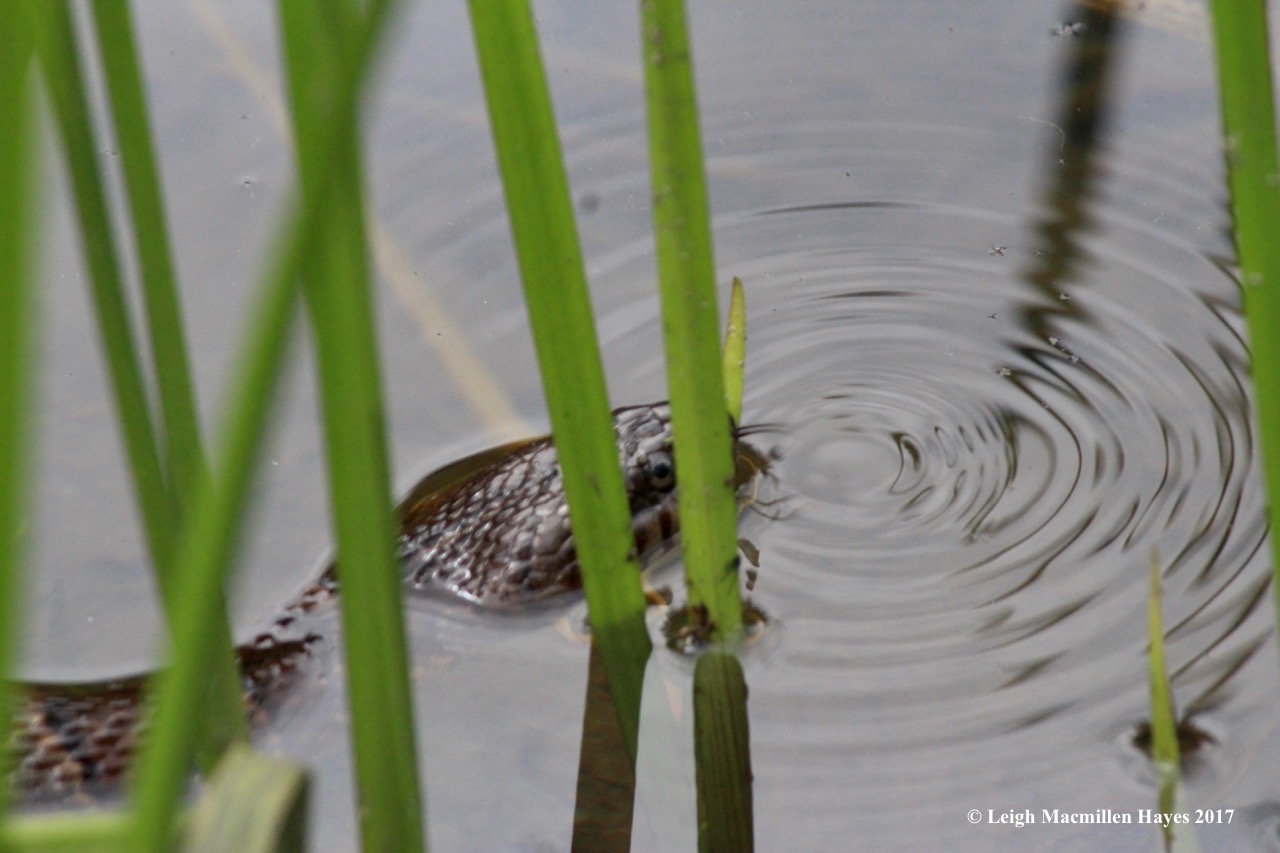
Eventually, the snake moved off, all the while its forked tongue dashing in and out . . .

w-snake 14

and in and out some more as it snacked on insects.

So much for a lichen walk–instead, as always, everything spied on today’s adventure was worth liking.