It began in spurts,
The rain that is.
Starting with some drops on Tuesday,
Followed by a few more on Wednesday.
But today, much to our delight,
we awoke to the drumming of droplets
upon our metal roof,
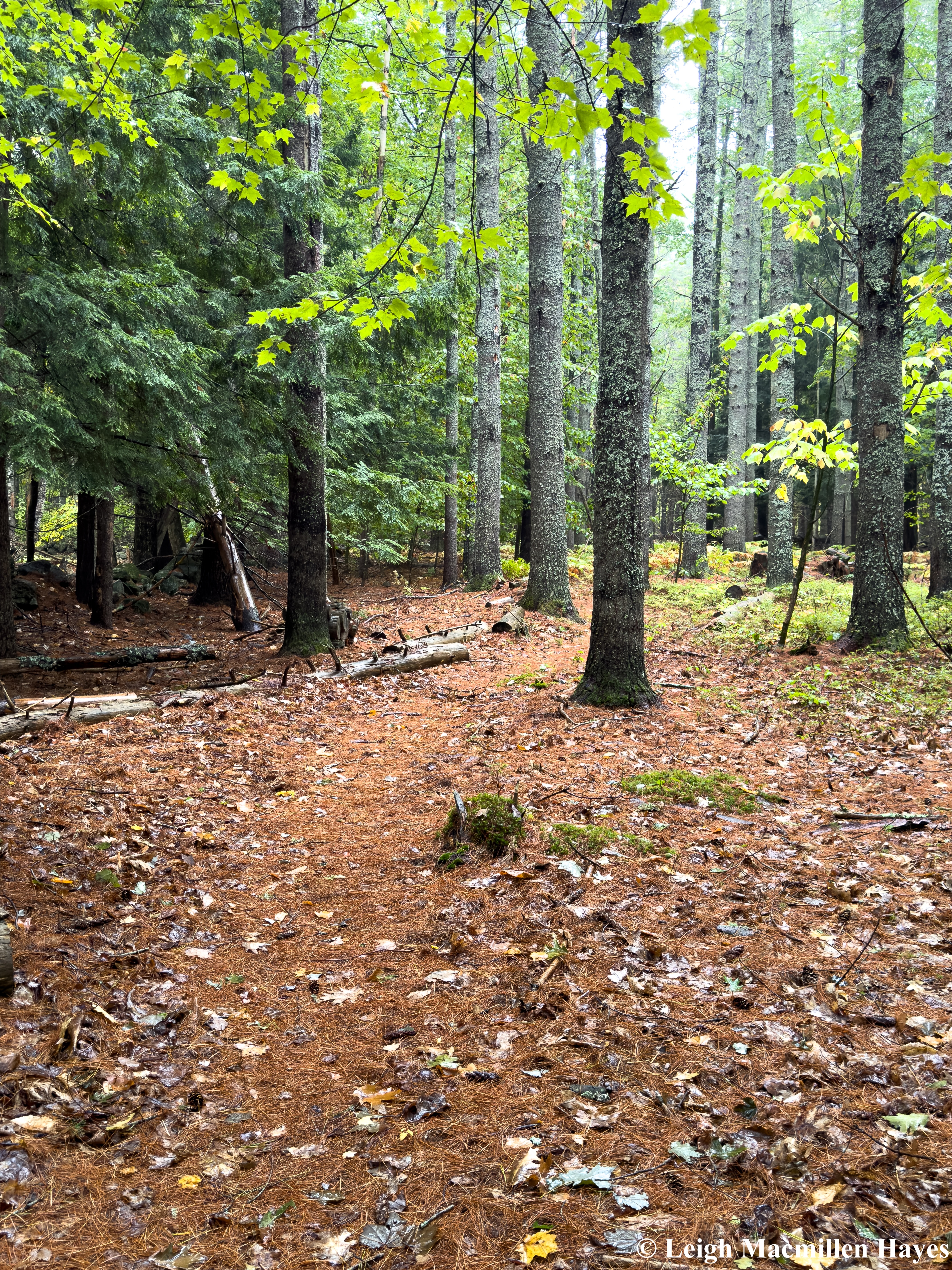
and I couldn't resist heading into the woods.
One Jack, or rather Jill-in-the-Pulpit,
lay down its sweet head
upon the wet ground
as if to kiss the moisture gathered there.
In a boggy section,
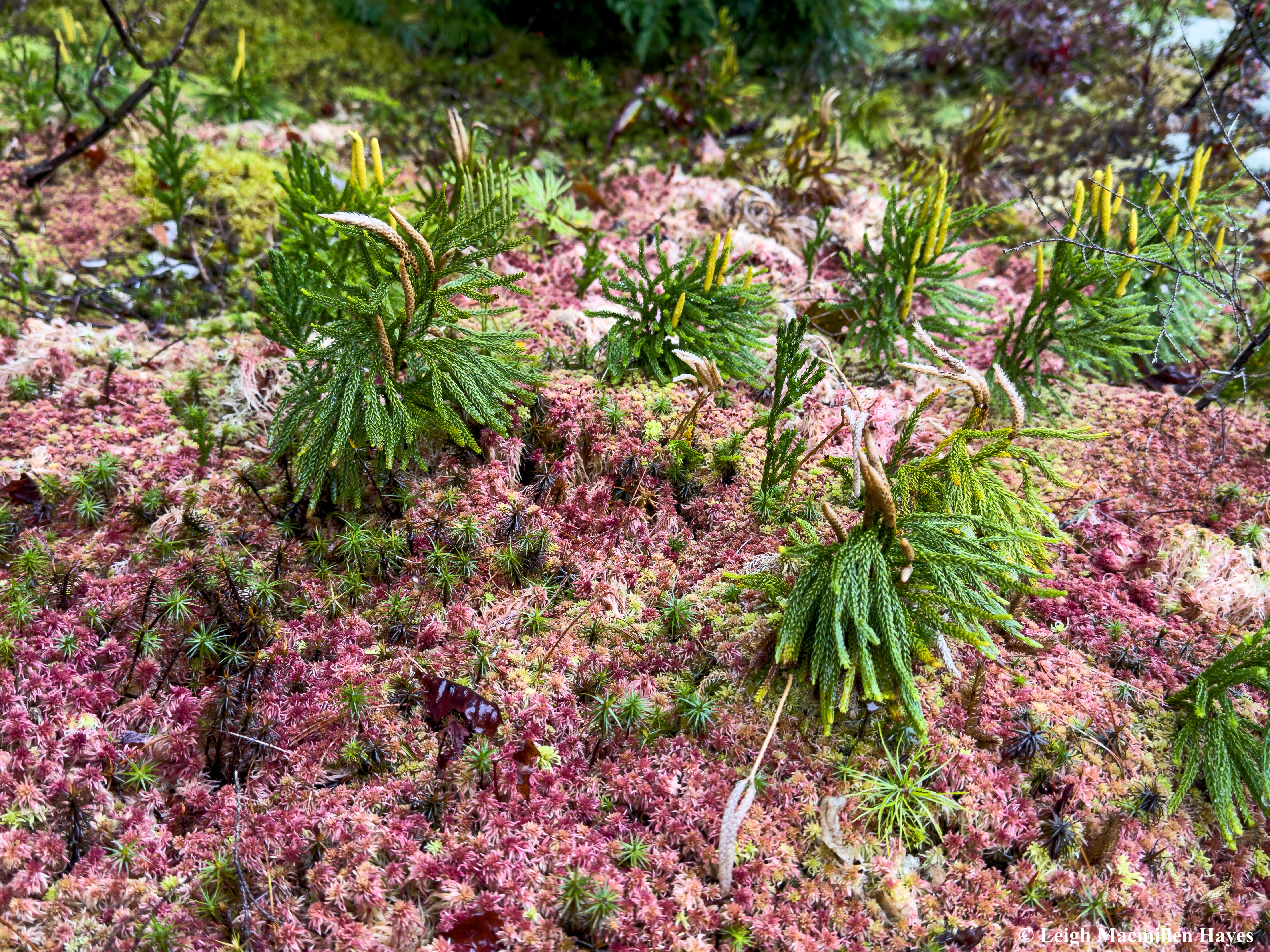
it made the Hickey's Tree Clubmosses
suddenly stand out in contrast
to the pink and green sphagnum below.
And upon every surface,
or so it seemed,
raindrops gathered,
sometimes hesitating for a moment.
Other droplets
enhanced guidelines
and supporting threads
of a spider's web.
Because it was raining,
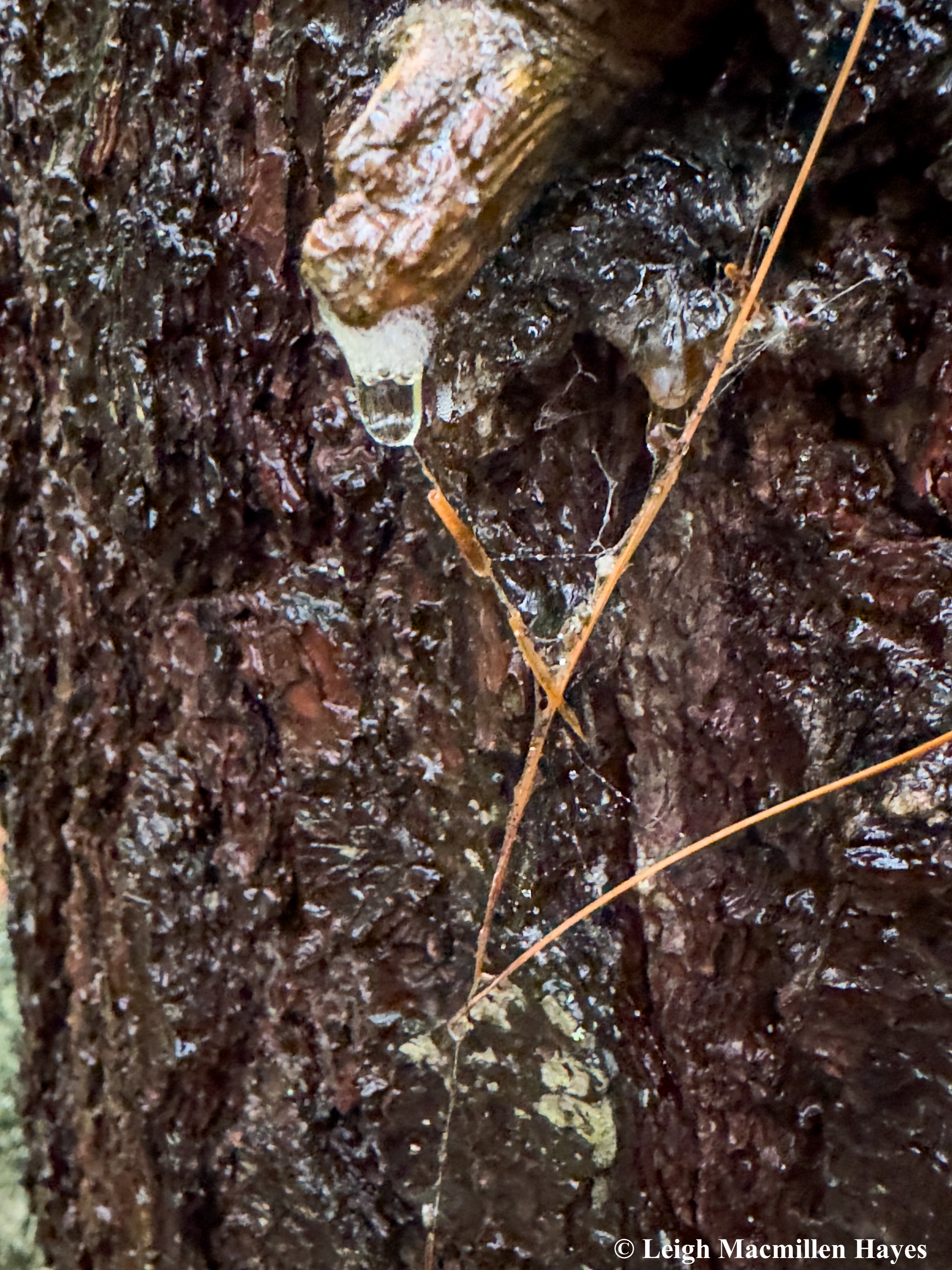
I decided to play and poked a stick
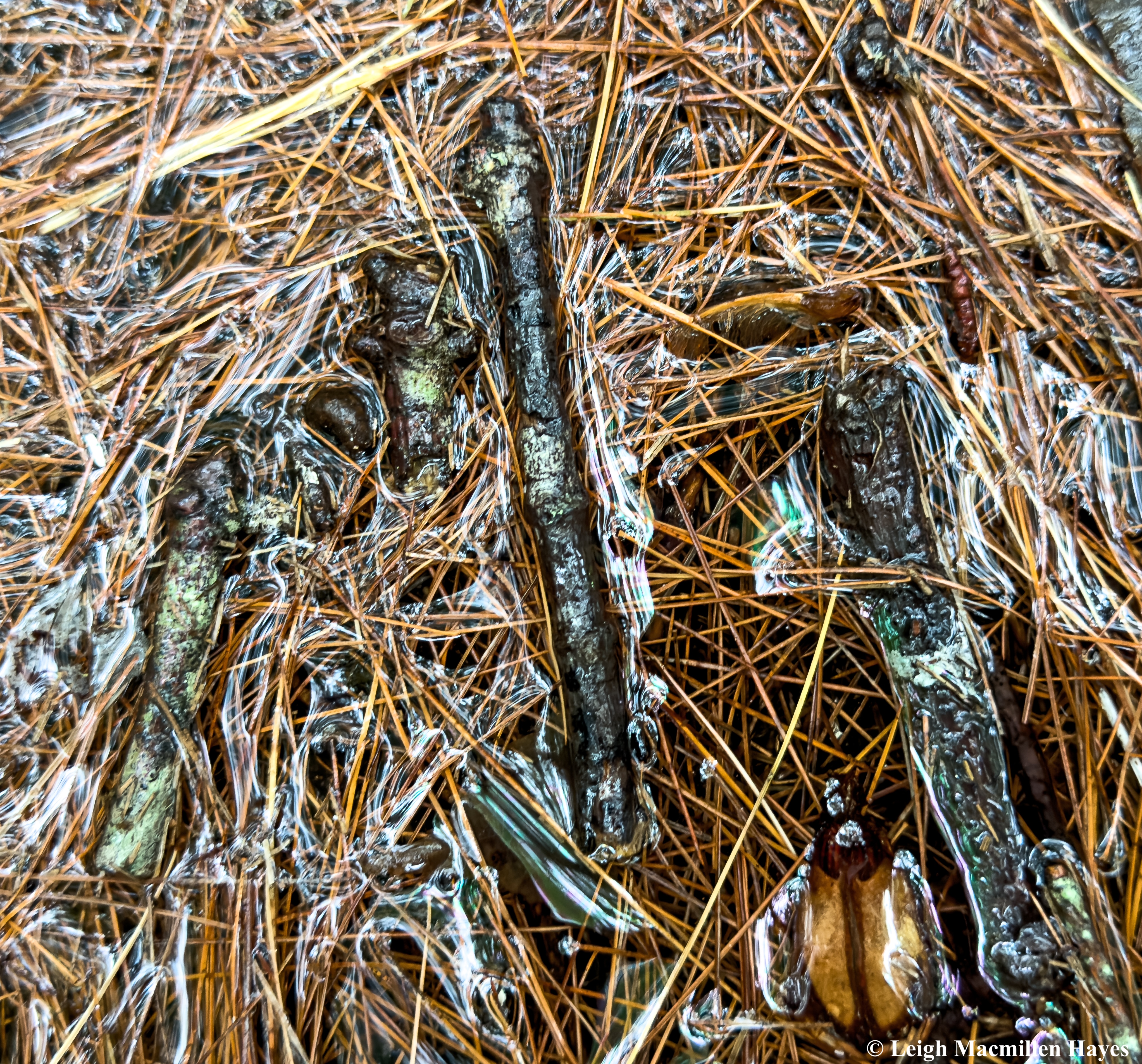
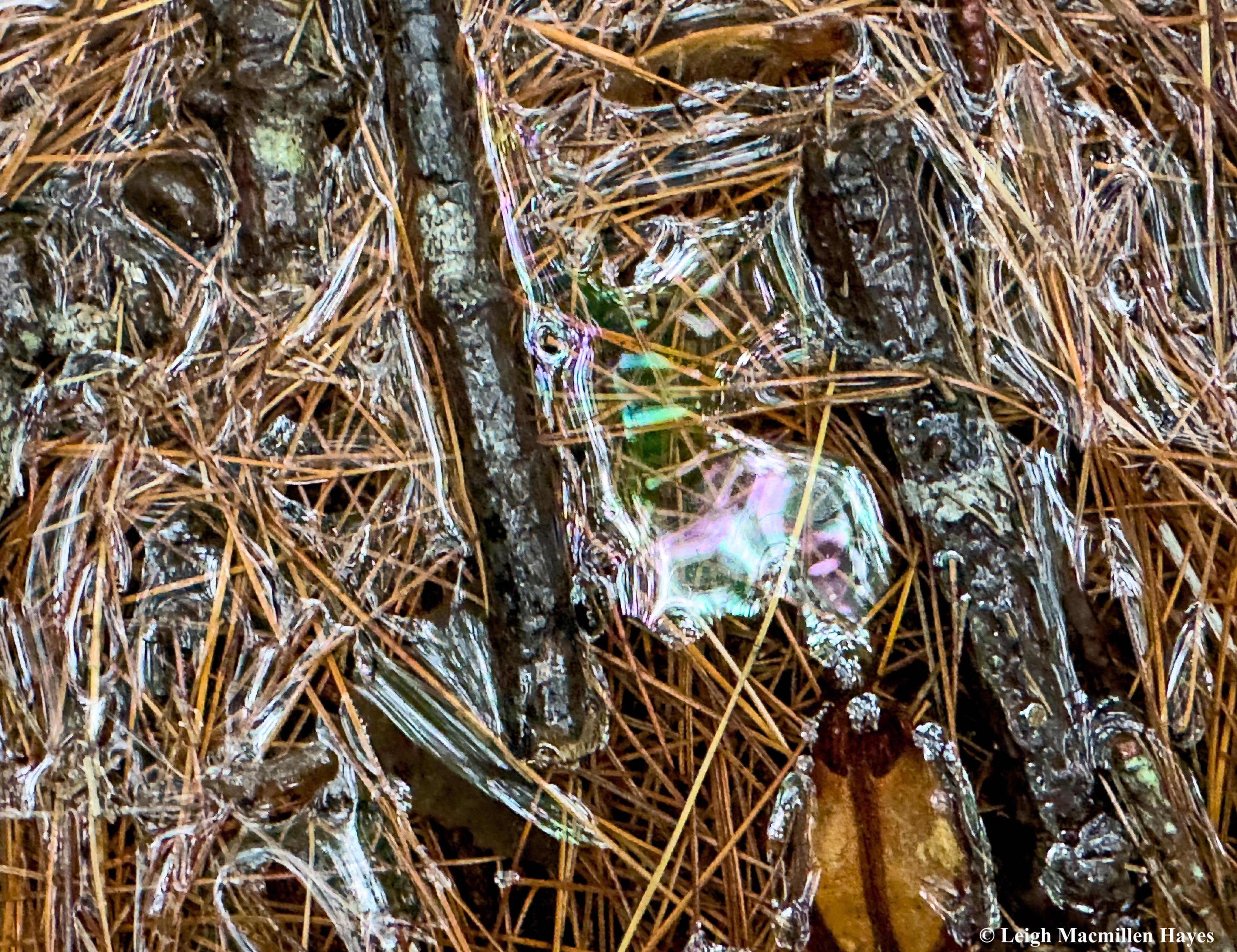
into the resin blister of a Balsam Fir,
then placed it in a tiny puddle.
My sense of wonder
was well rewarded
as the essential oils
created ever-changing rainbows.
But my real intention
for heading outside so early
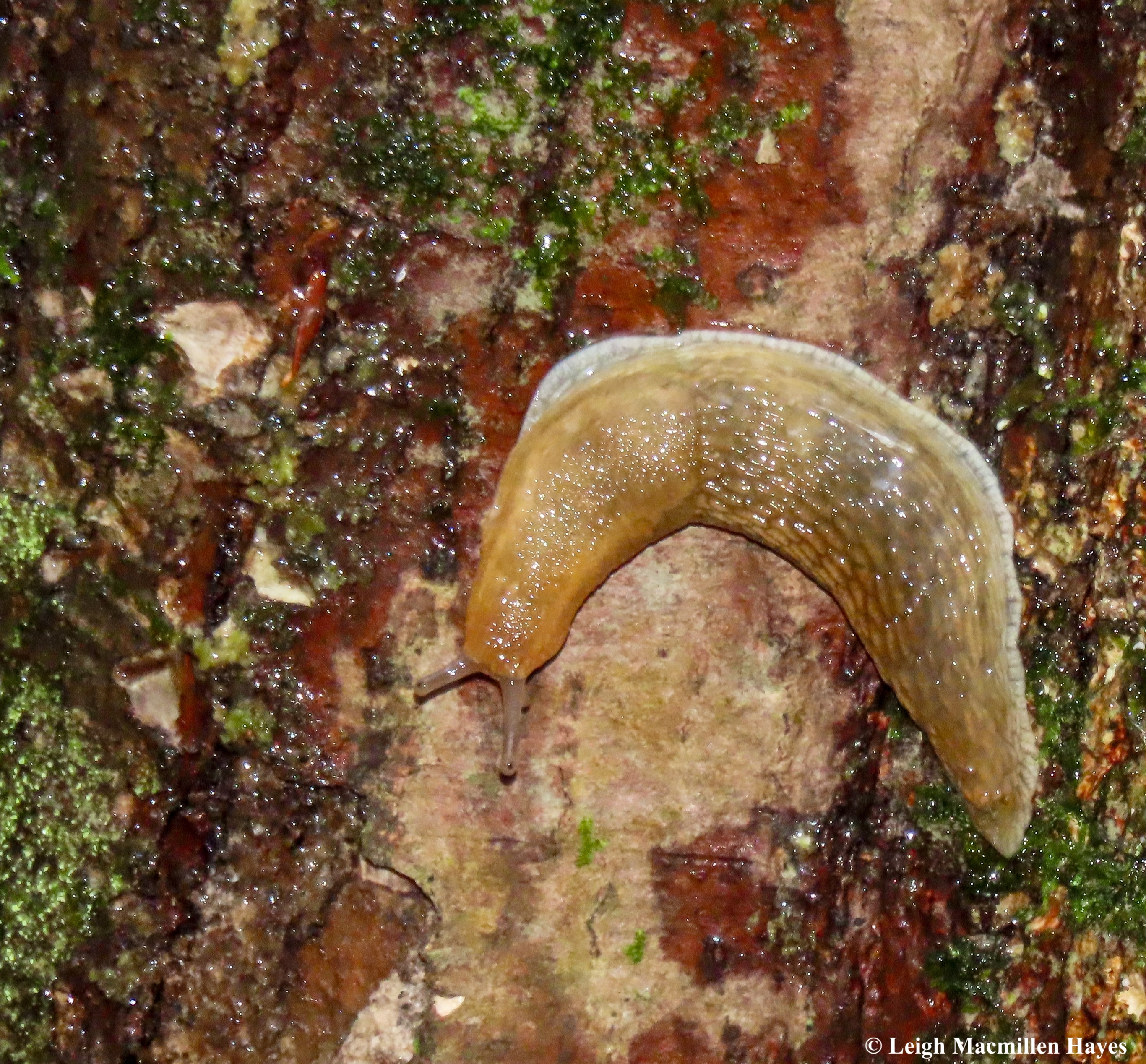
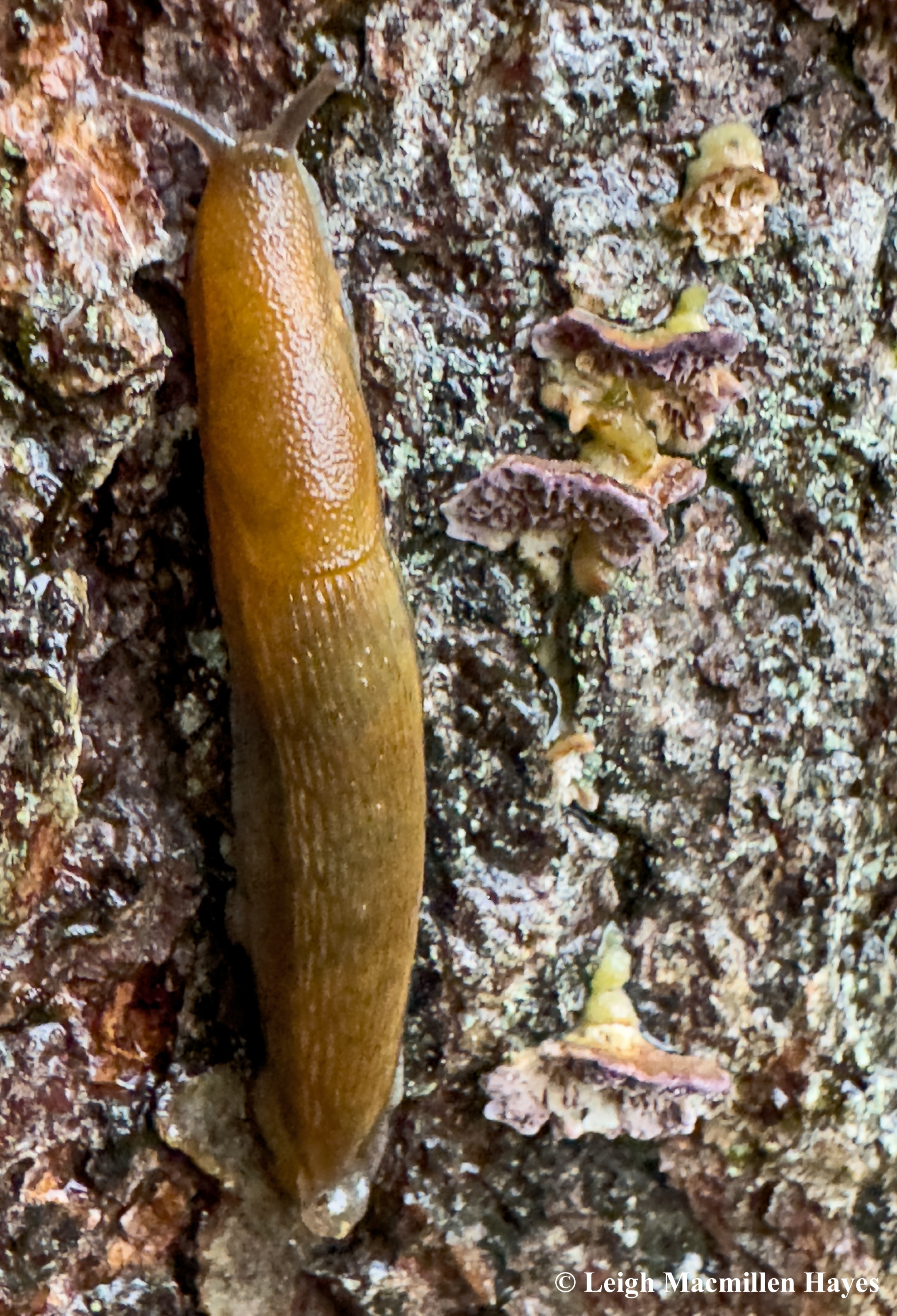
was to search for slugs
who haven't had an easy summer.
I was rewarded
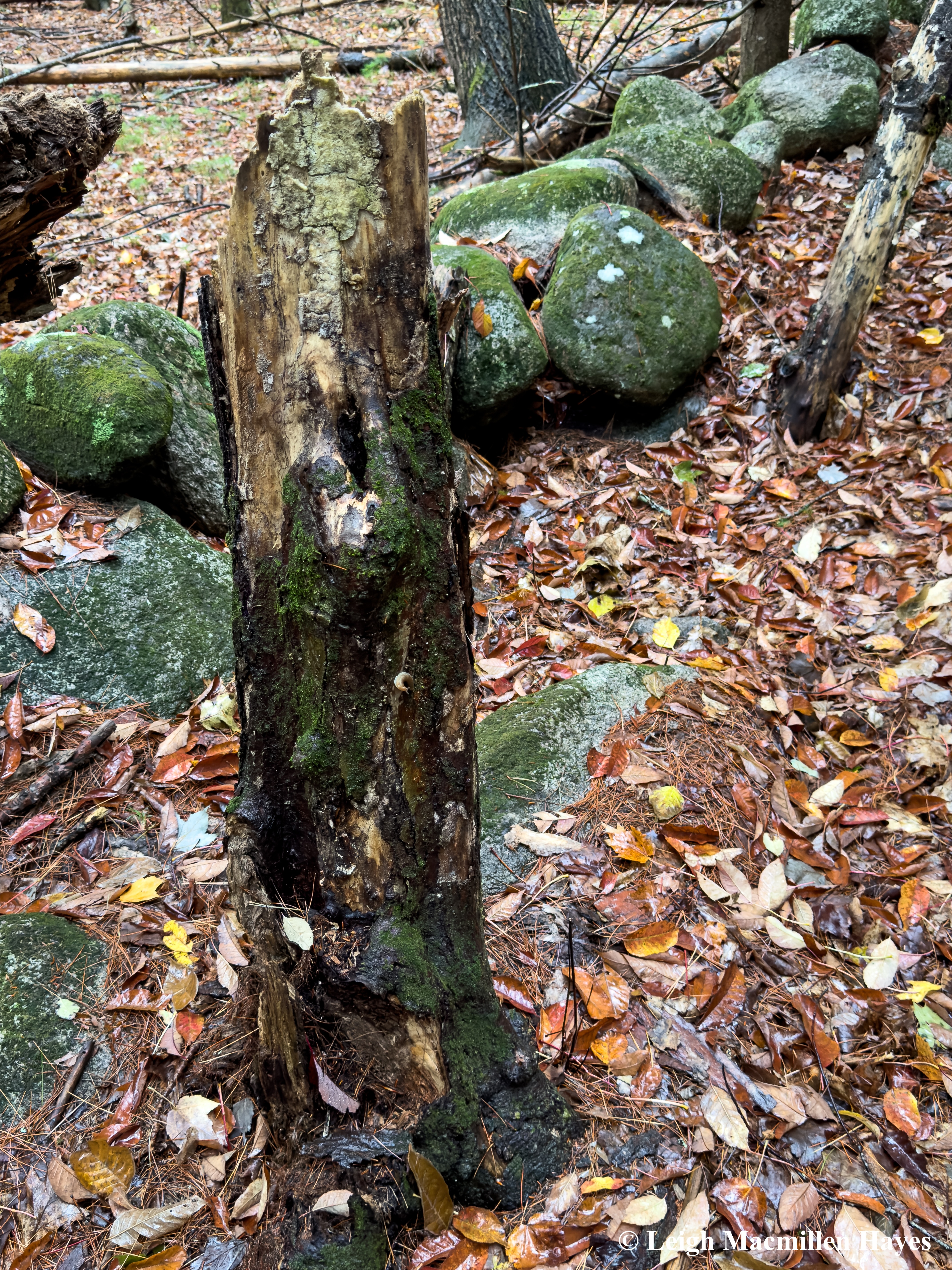
when upon a snag,
I found a Western Dusky
dining on smaller organisms than I could spot.
My other intention was to hunt for suds
and though I found some in the morning,
the pounding rather than pitter-pattering rain of the late afternoon
provided many an example.
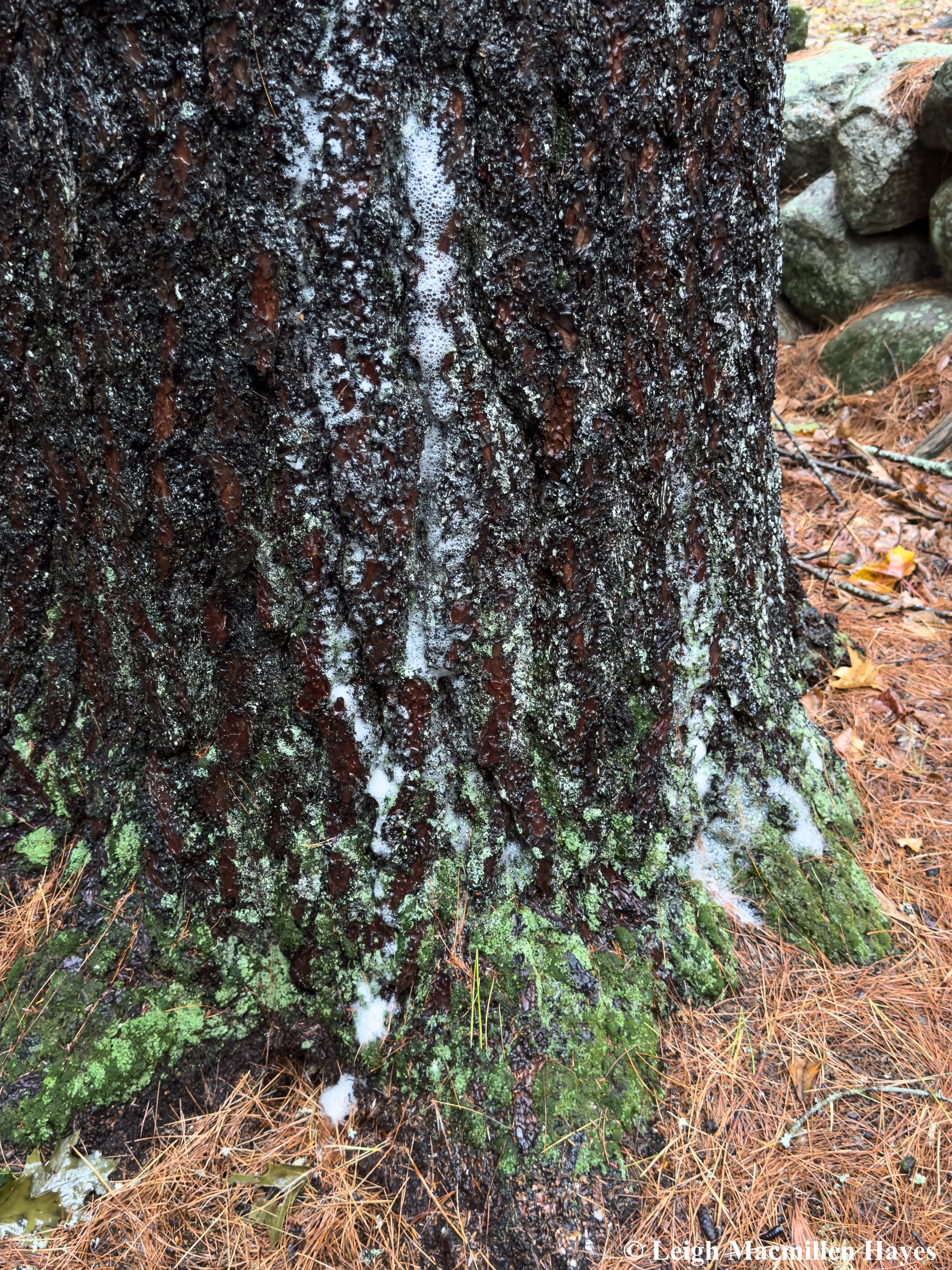
As the droplets dripped toward the base,
dissolving chemicals on the bark,
the surface tension changed,
and with the turbulence came air, thus forming foam.
It's all a matter
of one drop at a time,
but when the rain is heavy,
those drops form and release quickly.
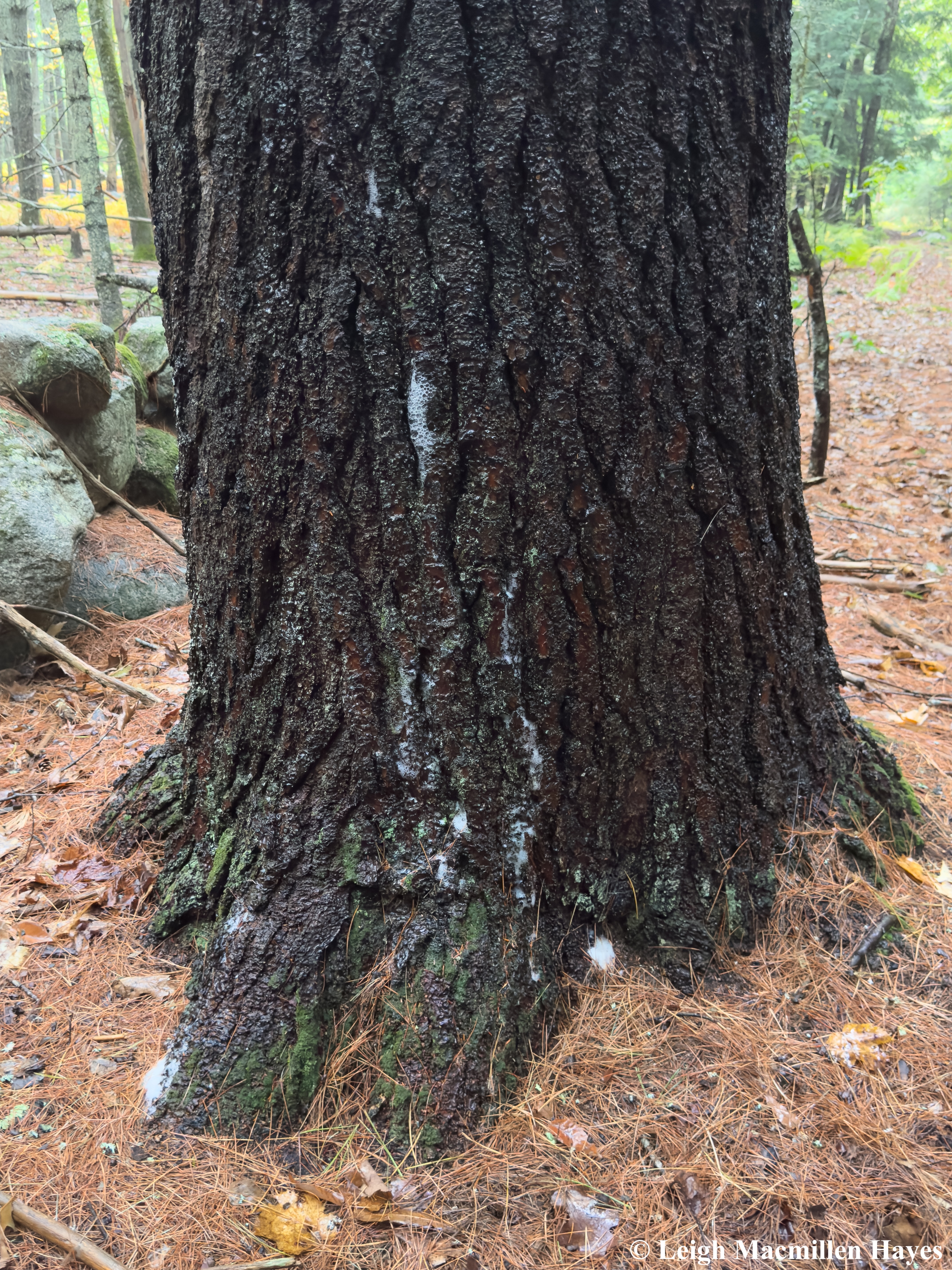
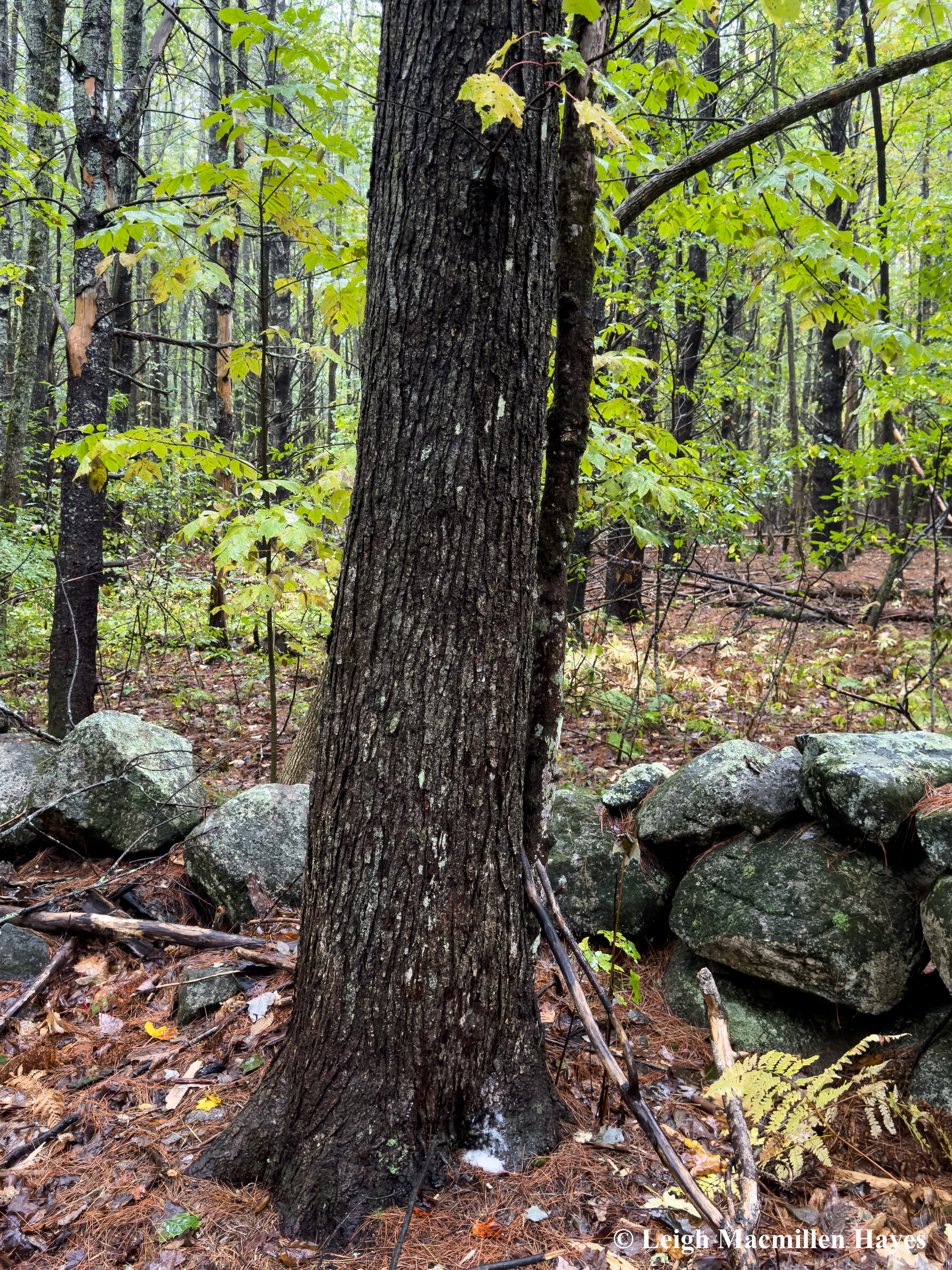
Upon one of the older White Pines
between the stonewall and old cow path,
I found lots of pine soap,
on the eastern side.
The same was true on the western side,
and as I now sit inside all cozy and dry,
it is pouring out there and I suspect almost every tree
has a base like this.
It's easy to think
that only pines offer the suds,
But I've learned from observation,
That others do the same, like this Red Maple.
And much to my pleasant surprise,
I found a gathering of suds,
within an old Pileated Woodpecker hole,
on one of my favorite trees.
I like to think of it
as the Stairway to Heaven Tree,
for such do its branches remind me,
as if I could climb them into the sky.
Because I was looking,
I discovered an insect,
this being a Hemlock Looper Moth,
taking refuge upon a trunk.
When I originally headed out the door this morning,
and told My Guy I was going on a search for Slugs,
he said, "Who is this person I married?"
And we both chuckled.
All told I only found three.
Nevertheless, I know these three
and many other critters and humans
join me in praising the rain.
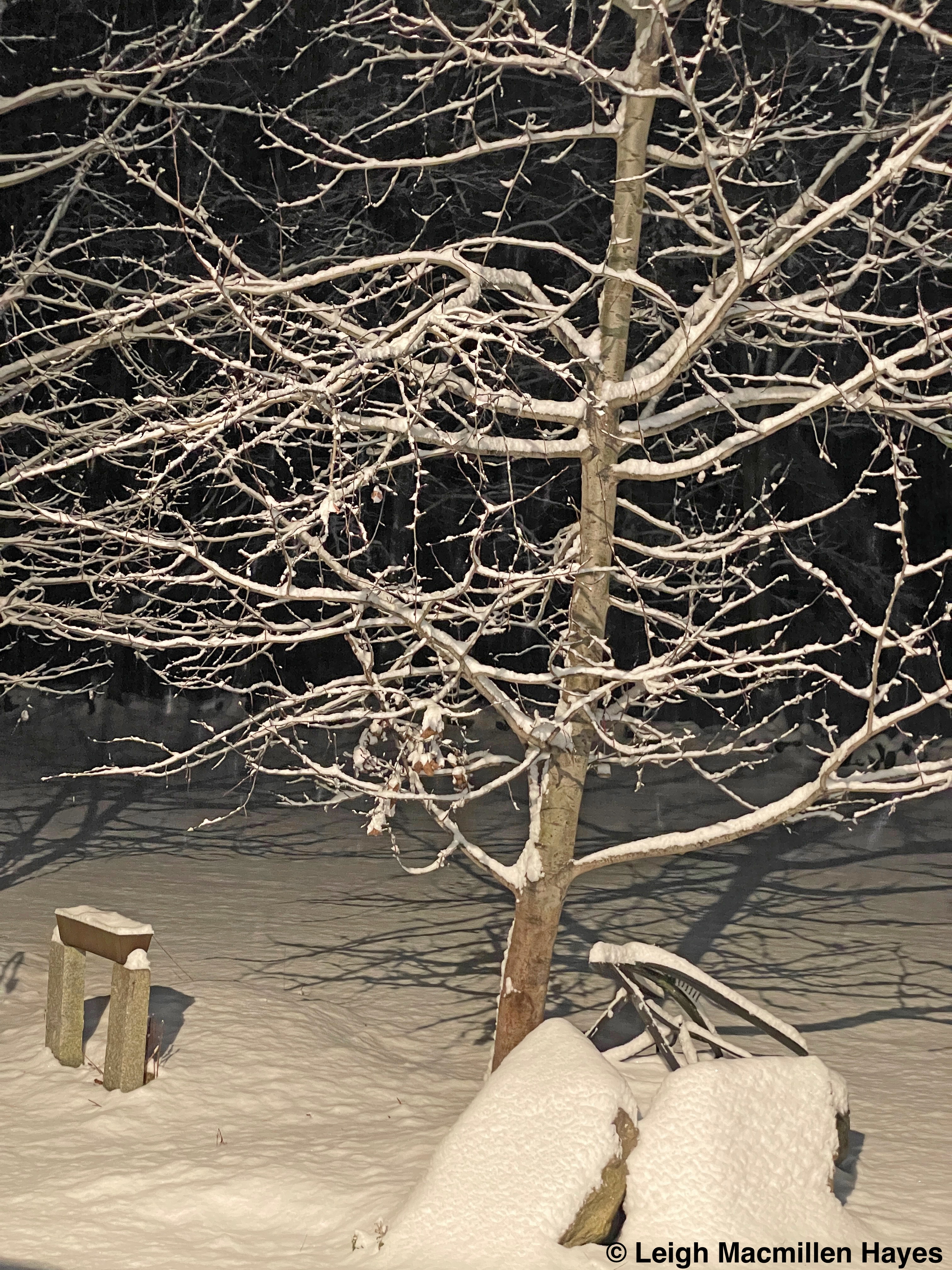
Those who know me know how excited I was to wake to snow. So excited in fact, that I awoke early, saw that certain glow in the sky through the window above our bed, and jumped up, not wanting to miss the day dawning.
At just before 6am, I turned on an outside light for a minute and opened the door to receive the quiet that the flakes created.
It snowed for a couple more hours before turning to rain and by the time I shoveled the driveway it was heavy cement.
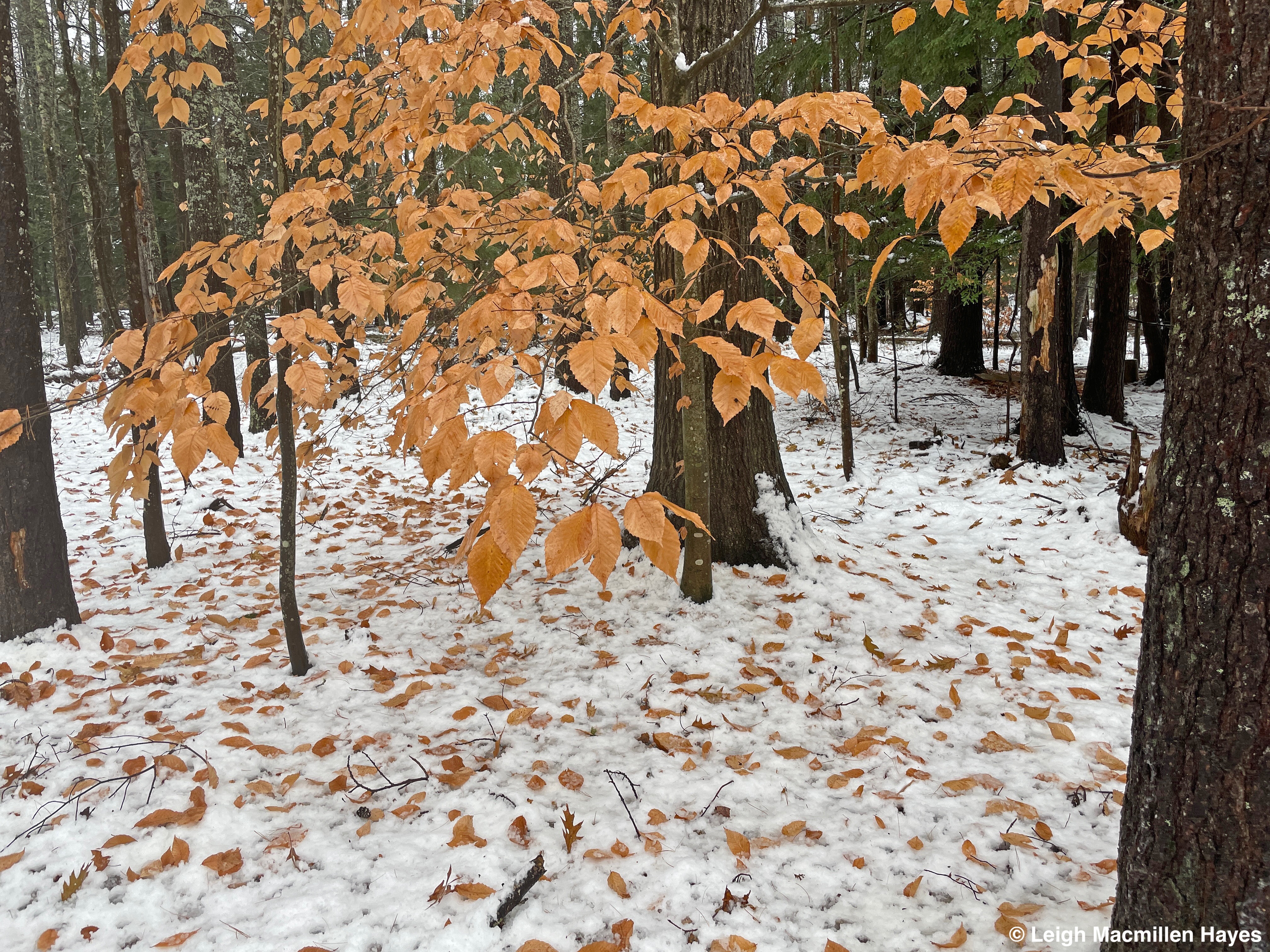
But still the world glowed. Especially the beech trees that are like spots of sunlight on a gloomy gray day.
Into the woods, I trudged, though I didn’t plan to go far because I suspected hunters would be as excited since they could more easily track deer, so decked out in blaze orange as I was, I stayed in our woodlot, with the intention of checking on my friend, Red. His caches have grown this past week, so I knew he had food in the pantry.
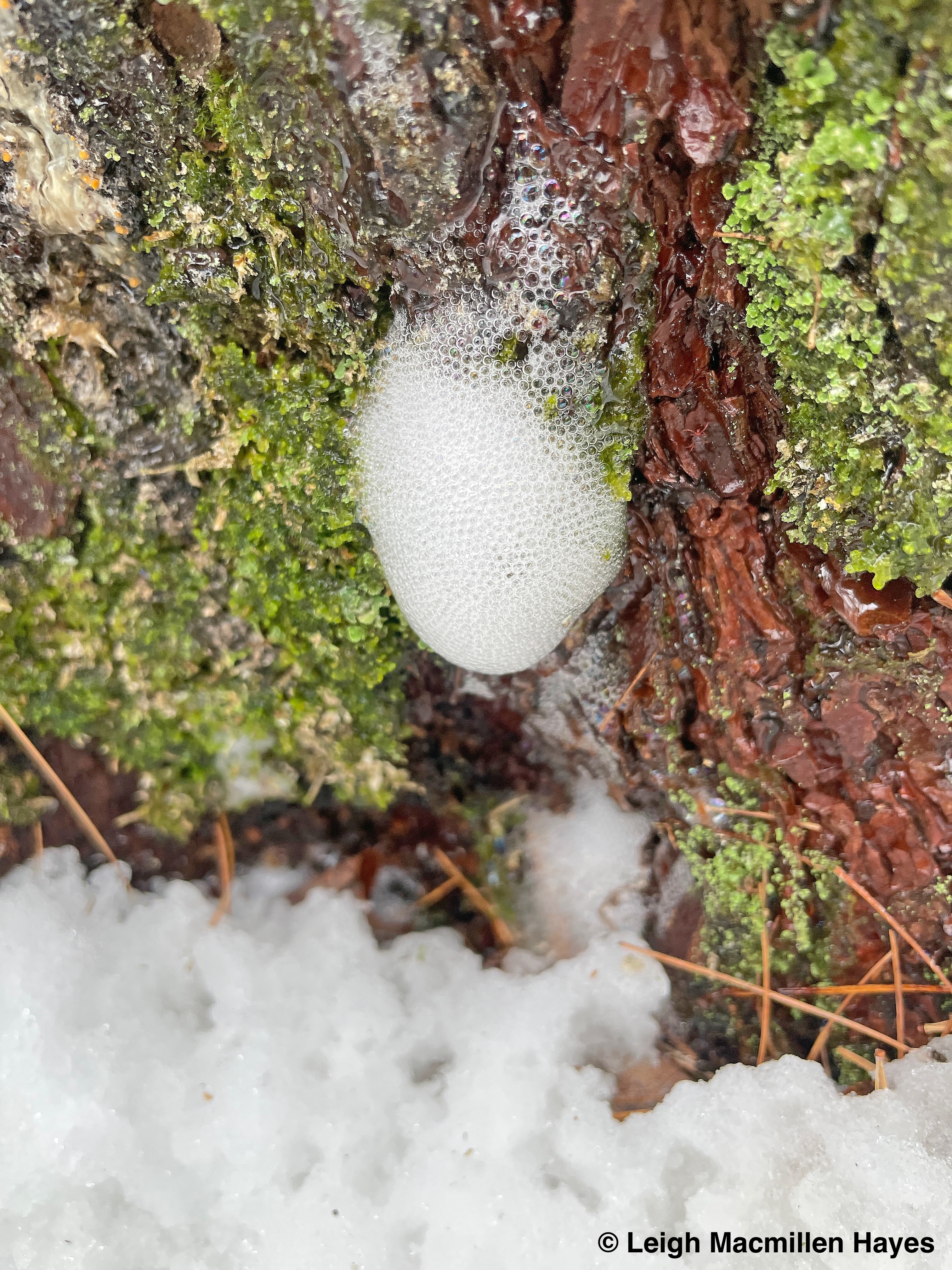
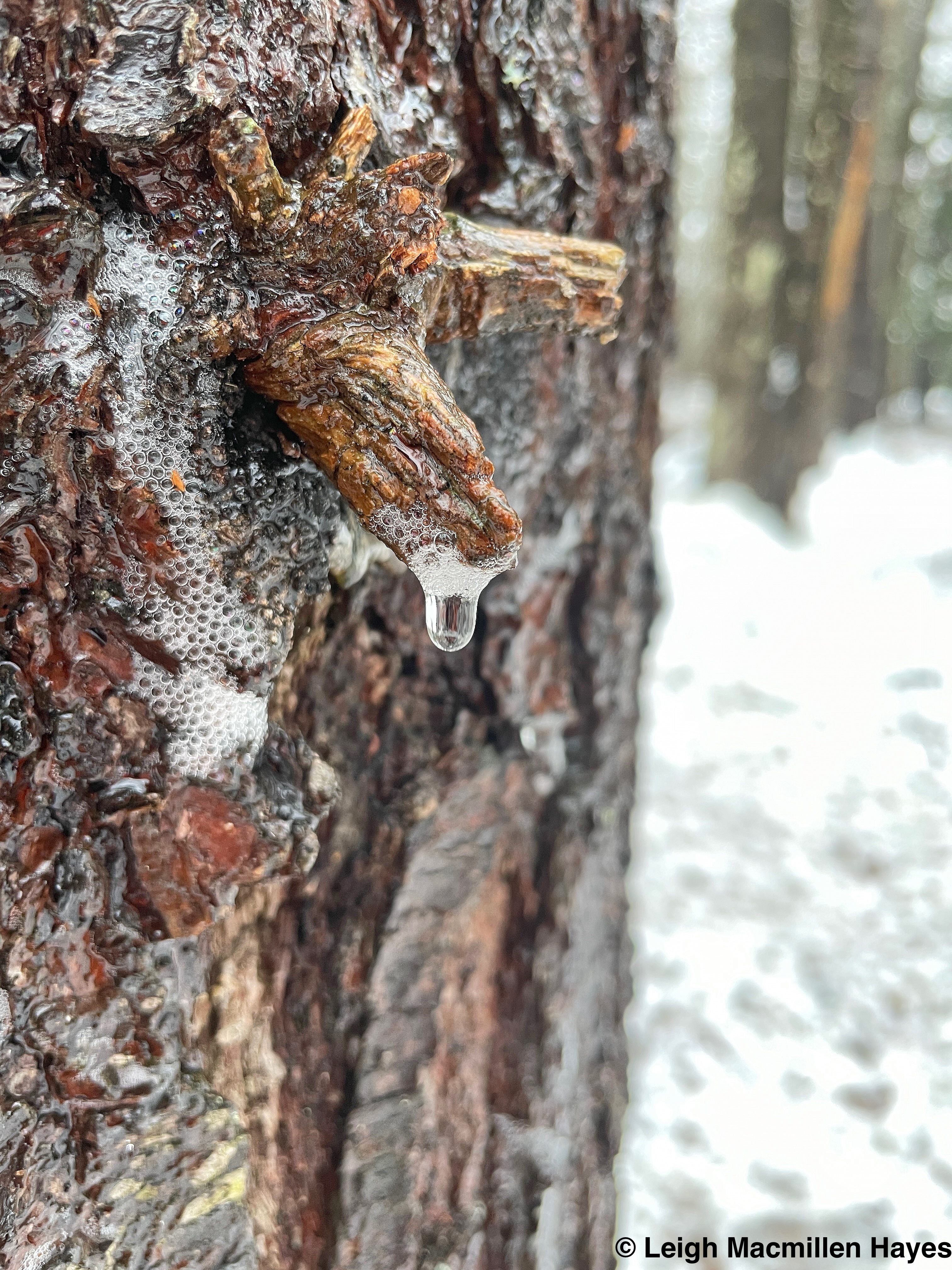
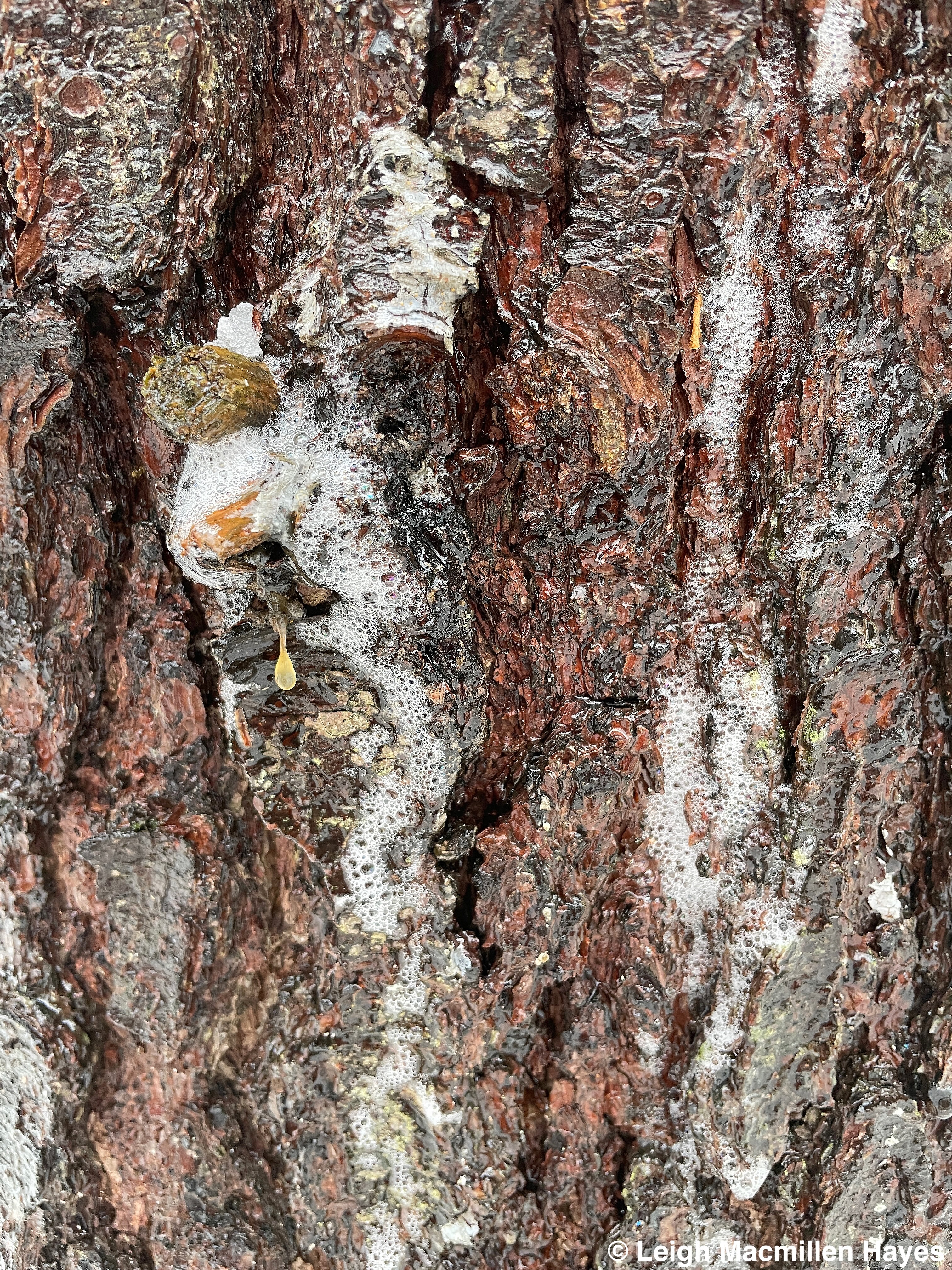
What I didn’t expect to spy along the way was this: White Pines foaming at the mouth! What really occurred: sap salts and acids that had accumulated on the bark’s surface mixed together in the dripping snow and formed soapy suds or pine soap.
Pine soap on the tree and snow disturbed by plops of falling snow at the base of the tree offered a contrast of textures.
Much as I’m mesmerized by fire, I’m equally mesmerized by water, and especially in the form of droplets. I’m actually surprised I eventually dragged myself home.
But first, I had to watch the droplet elongate.
And eventually (which was only seconds later), fall free. Although, was it really a free fall?
I suppose it was, but it landed on another section of the bark and continued the process of mixing with the sap salts and acids.
The other cool thing about the pine soap–its hexagonal forms–worth a natural engineering wonder.
As it turned out, it wasn’t just the pine soap that was flowing down the bark. Some trees had started peeing. Do trees really pee? It’s actually sap and I think given the temp, that rather matched a March day, sap was flowing, giving the melting snow a yellowish tint.
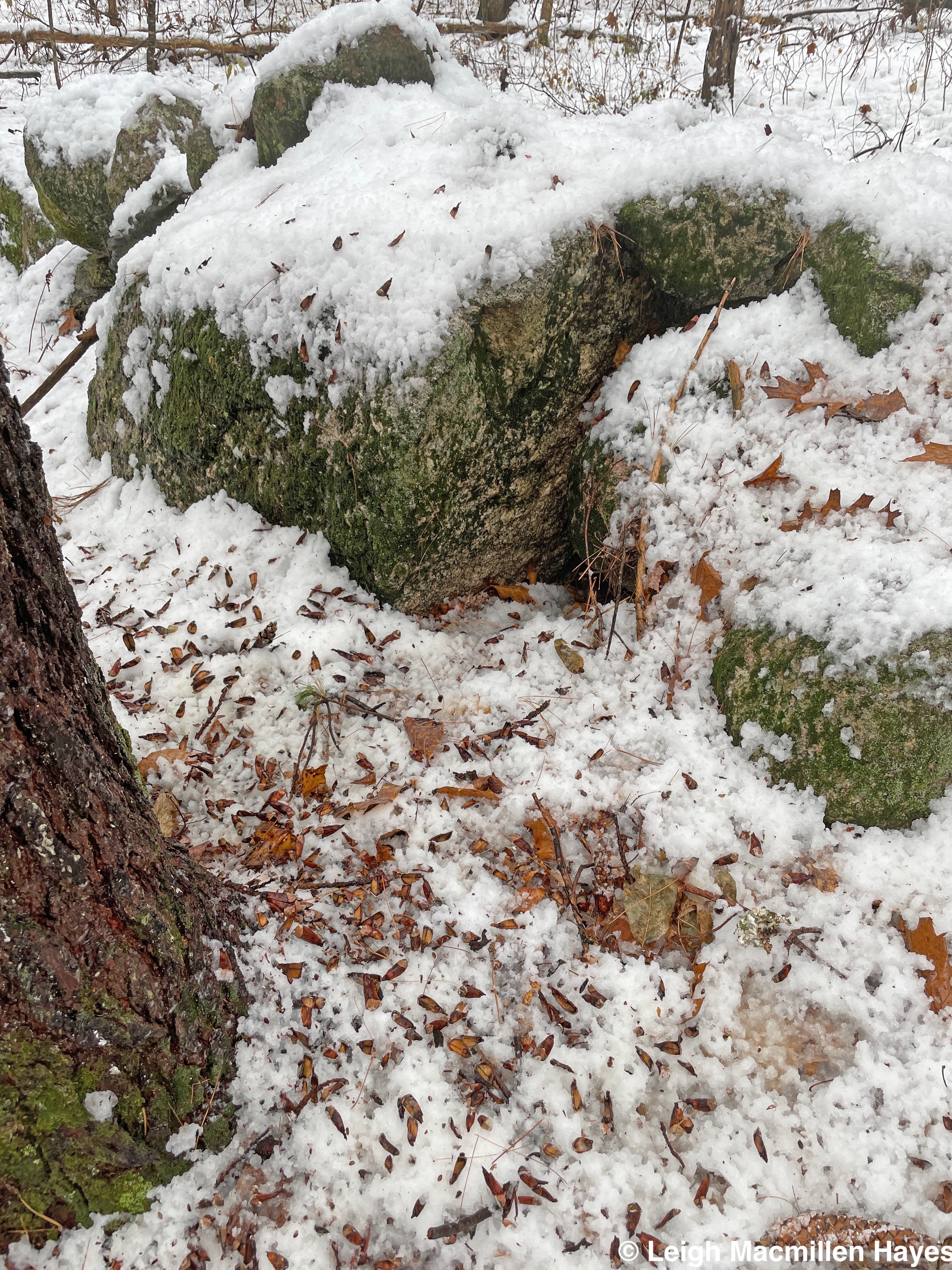
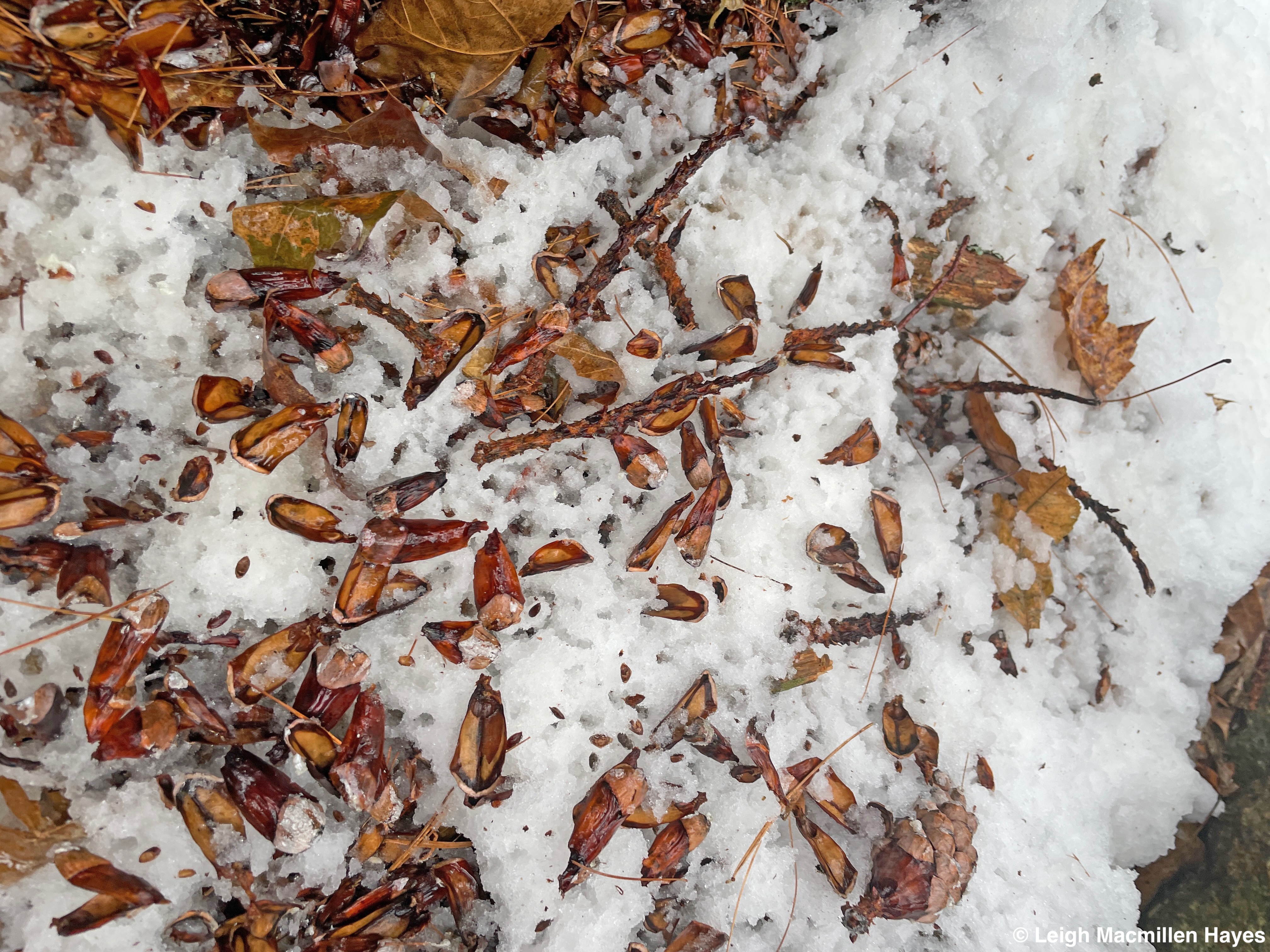
Eventually I reached my friend Red’s favorite hangouts and though the snow conditions had deteriorated from the point of view of a mammal tracker, he’d left plenty of sign on top of the white surface to tell me he had dined.
A lot. But then again, every scale on the cone protects two tiny seeds and one needs to eat a lot to attain nourishment from them. That’s why he has to create caches or piles of cones to last throughout the winter.
I didn’t actually see Red today, and surmised that he’d decided to make an early day of it and was probably snuggled in somewhere under the wall, using the snow and leaves as insulation. I know from watching 315 15-second game camera videos a few Christmases ago, that Red Squirrels rise with the sun, follow much the same routine all day long, eating pine seeds, dropping scales, leaving behind the cobs, dashing along to the next cache, returning to the first, dining again and repeating this activity over and over again during the course of the day, before disappearing about a half hour before sunset. Each day. Every day.
On this eve of Thanksgiving 2023, I recall some sketches I did in 2019 at a workshop at Hewnoaks Artist Residency in Lovell, Maine. The presenter offered us a variety of materials to work with as we saw fit. My fascination with squirrels and pine cones is not new and that day I chose to sketch one in three stages and then highlight the scales of the opened cone with pieces of mica.
In the end, I give thanks for being present for today’s discoveries of pine soap inspired by snow, and tree pee (that reminded me of yellow topaz), knowing full well that not every moment is as bright and shiny as muscovite mica. And snow does melt. But here’s hoping more will fall. And I’ll head out the door and be present again. And again.
May you also have plenty of reasons to give thanks.
Rainy days that turn into sunny days are the best days of spring. And today was one such. That meant, of course, that I needed to visit one of my favorite wet spots.
Along the way, because it was raining, I noticed the White Pines were foaming at the mouth! What really occurred: sap salts and acids that had accumulated on the bark’s surface mixed together in the rain and formed soapy suds. The rainbow colors and hexagonal forms–worth a natural engineering wonder.
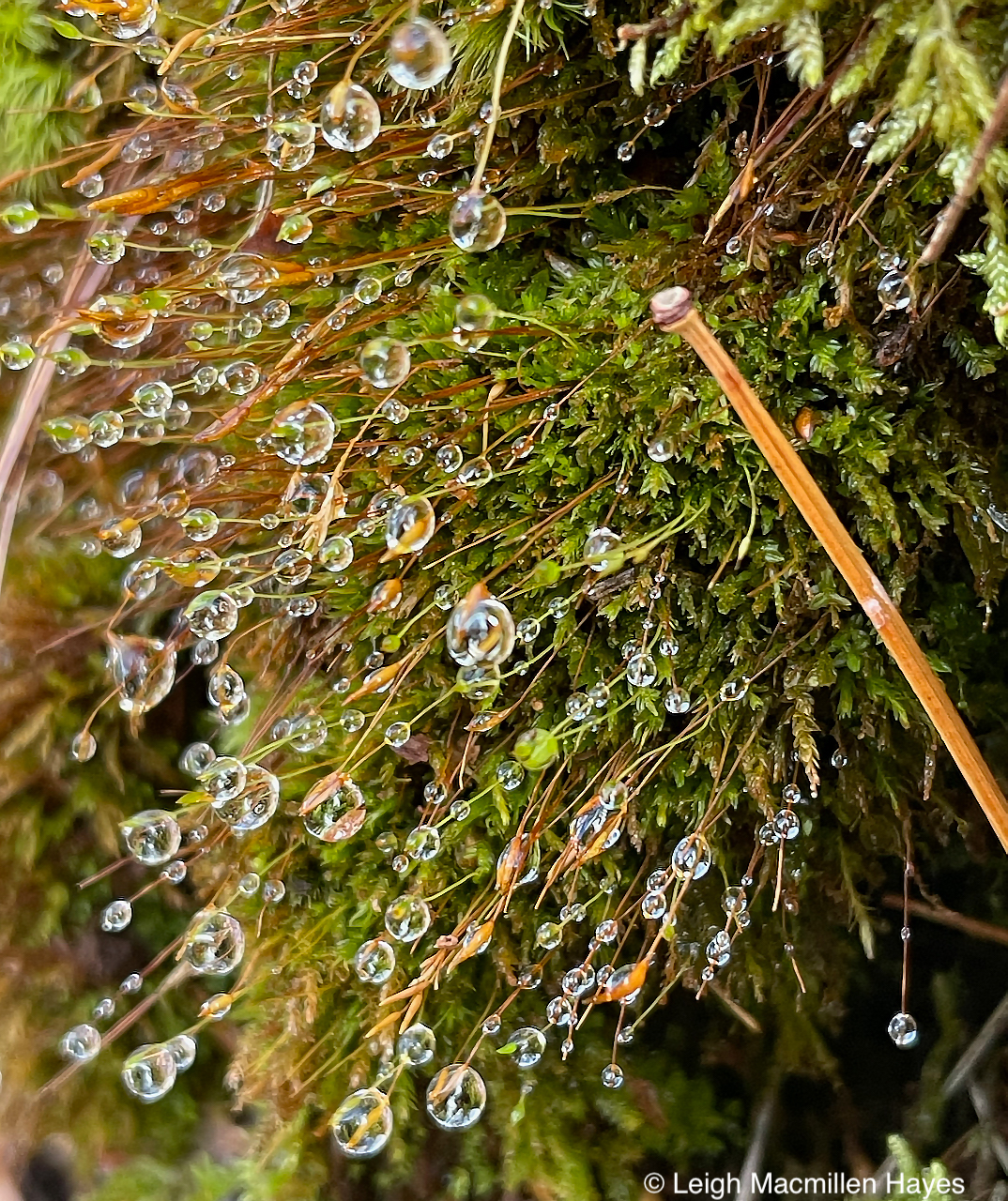
And upon a moss covered tree stump . . . a million more tiny bubbles dangling from reproductive capsules creating a hint of the future.
At the pool, one might say raindrops distorted the reflections captured on the surface. Or perhaps they enhanced it with a design that was ever evolving.
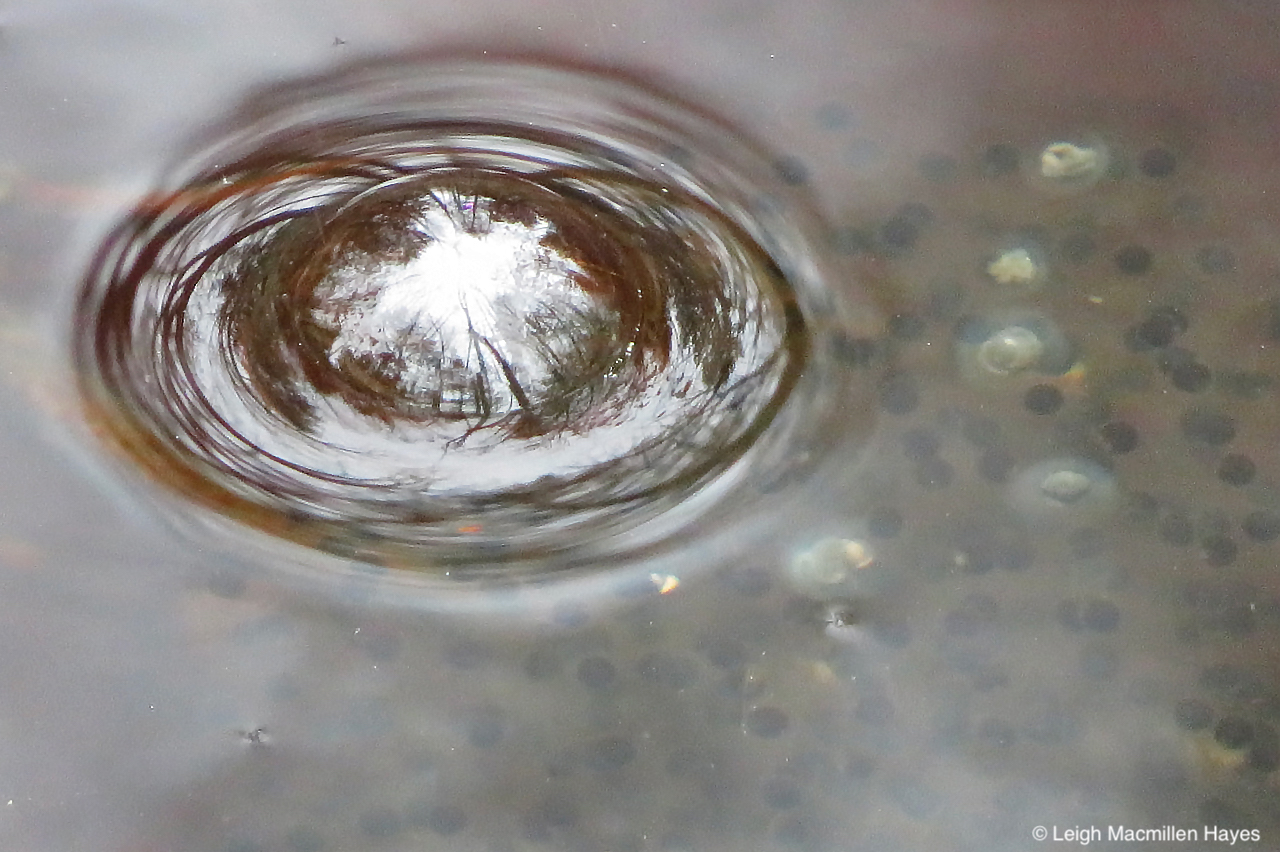
Bubbles kept forming as the raindrops fell . . . and then they’d burst. Just prior to their disappearance, however, they mirrored the canopy above the pool.
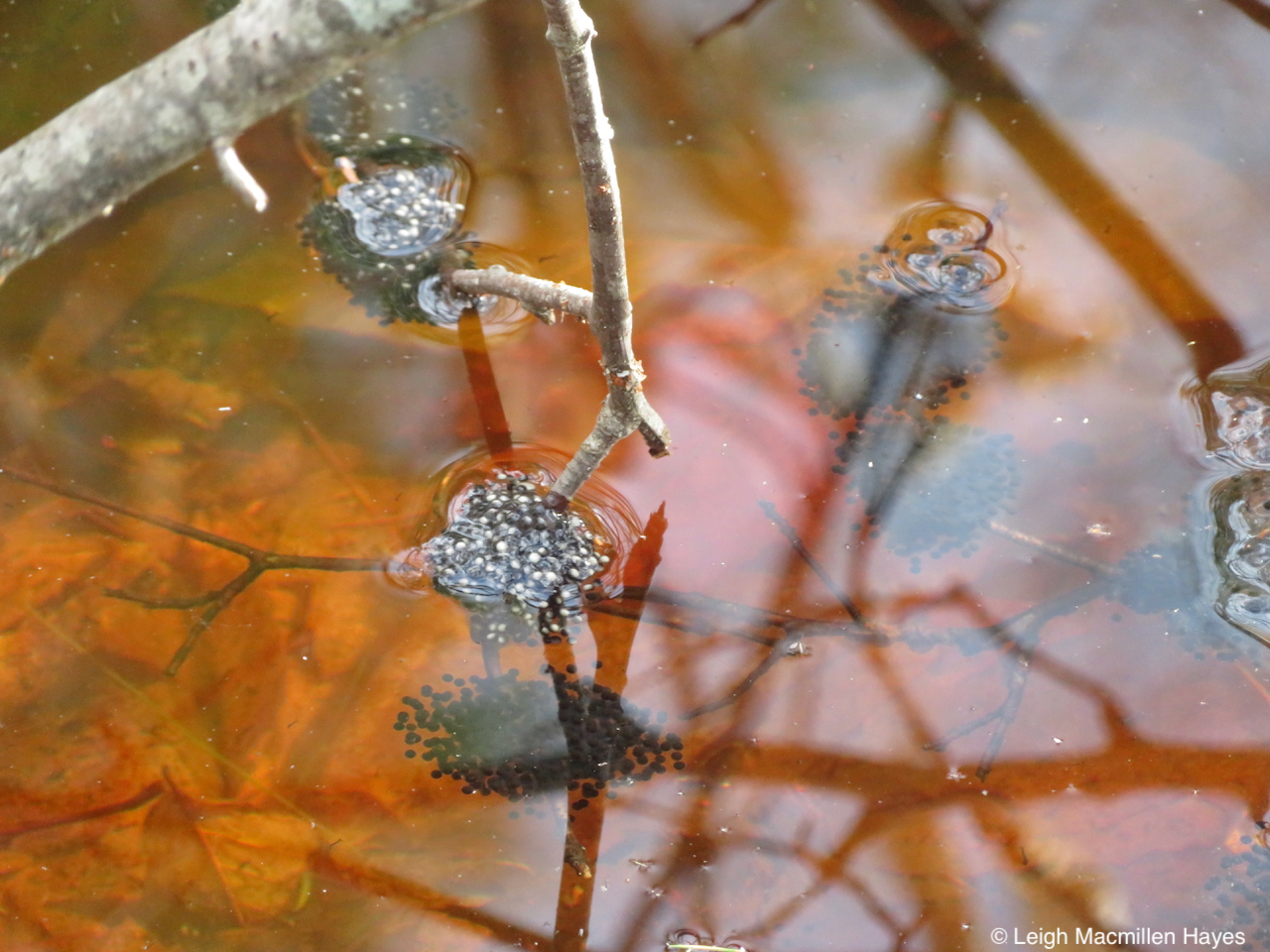
Oh, and do you spy what I spied? Wood Frog eggs . . . tadpoles in the making. But all the while that I stood there, and it was a while as the rain fell, not a frog did I spot.
As the skies cleared late in the afternoon, again I headed to the pool. Click on the arrow above and you should hear what I heard. A chorus of wrucks.
Of course, once I stood beside the pool, the frogs had all disappeared. But, with a bit of sun shining, I suddenly could see that in the last week numerous egg masses had been laid in communal style, as is the Wood Frog manner.
Some even exhibited the green hue indicating that mutualistic symbiosis, or a relationship between algae and developing embryos, was already underway. Shallow, ephemeral ponds such as this one, experience severe oxygen depletion during periods of high sunlight and warmth. The algae provides oxygen for the tadpoles, allowing them to survive longer and grow larger before metamorphosis, while the algae receive carbon dioxide from the tadpoles, which aids algal growth.
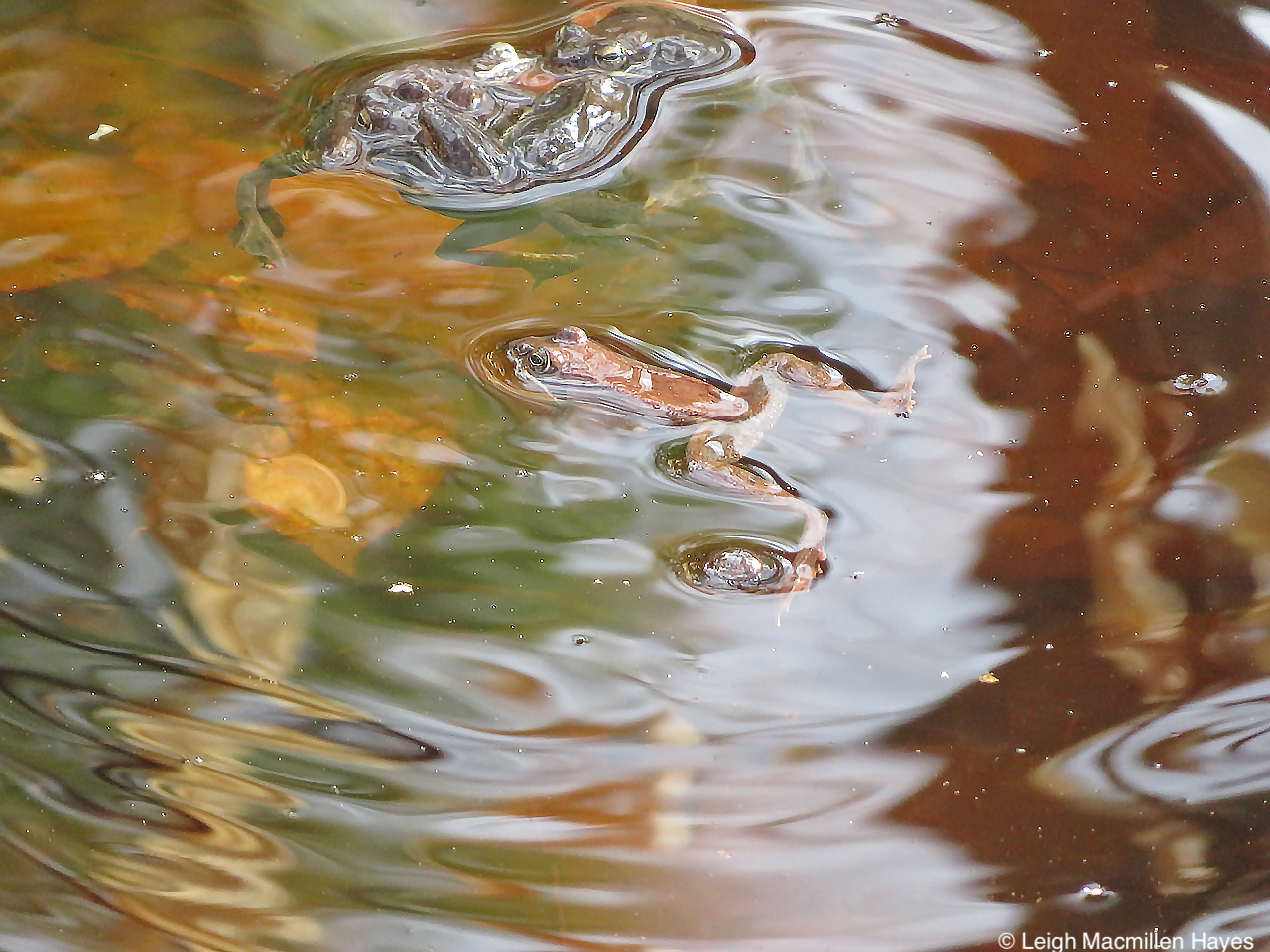
And then, ever so slowly, frogs silently floated to the surface, and waited . . . for that special woman to happen along. The fact that I had happened along, didn’t turn out to be special enough and so most were silent rather than wrucking as they waited . . . for me to disappear.
And then . . . and then the water began to boil. It took me a moment to realize what I was witnessing.
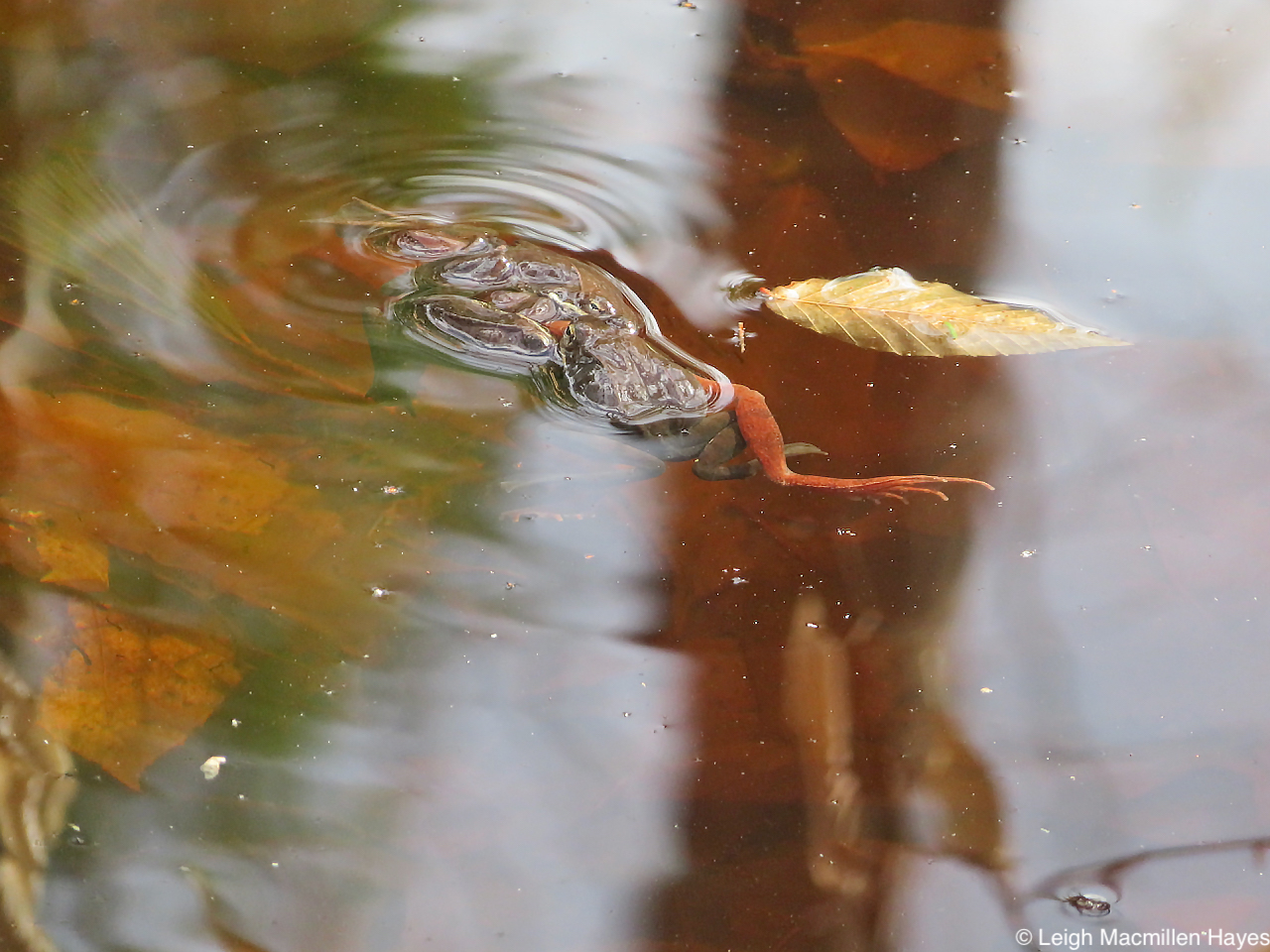
That moment expanded into about ten minutes as several male frogs tried to outwit each other and grab one female in amplexus.
She occasionally chirped her discontent, but that didn’t stop the good old boys from trying to do their thing.
Around and around they went, this threesome or foursome or fivesome, for it seemed to be an ever evolving grouping.
Her swollen belly betold the fact that she had eggs that needed to be fertilized, but which of these Romeos would win the right to externally fertilize her bounty?
They tumbled and tussled. She chirped. They tumbled and tussled some more.
They calmed down for a moment, but still no decision had been made.
And then, if you click on the arrow above and listen, you’ll hear what the frogs and I heard . . . as a Barred Owl called its “Who Cooks For You?” phrase several times. The frogs split up and I’ll never know which of the best wrucks one, but I suspect one of them finally succeeded in its quest to sire the next generation.
Dedication: This post is for Patti and Kate and Billy and Rob (Howie) and Johnny, in honor of your mom, Bobbie, who passed from this world to the next today. At the sight of each bubble that the day offered, it seemed another memory popped up. And I’m pretty sure we are all living proof that eating her raw Congo Bar dough adds years to ones life. Virtual hugs to all of you. And Tommy too.
Early spring, that time of transition when it feels as if the world has slowed down, is one of my favorite times of the year. Oh, besides all my other favorite times that is–like tracking time and dragonfly time and stalking insect time and . . . and . . . and.
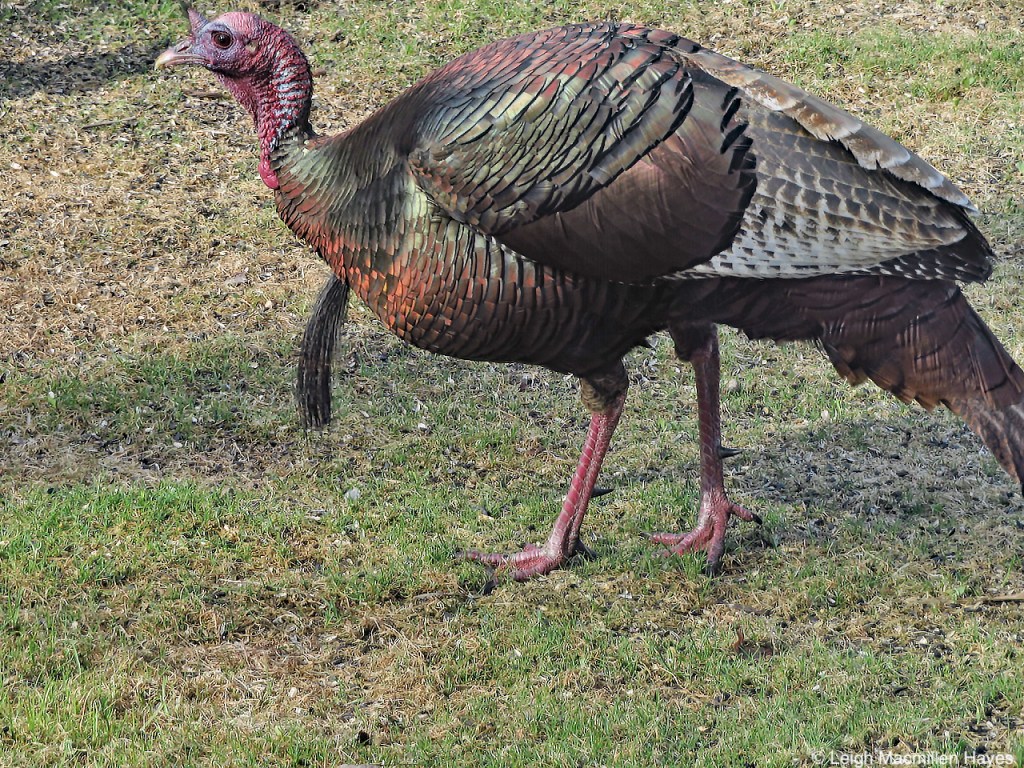
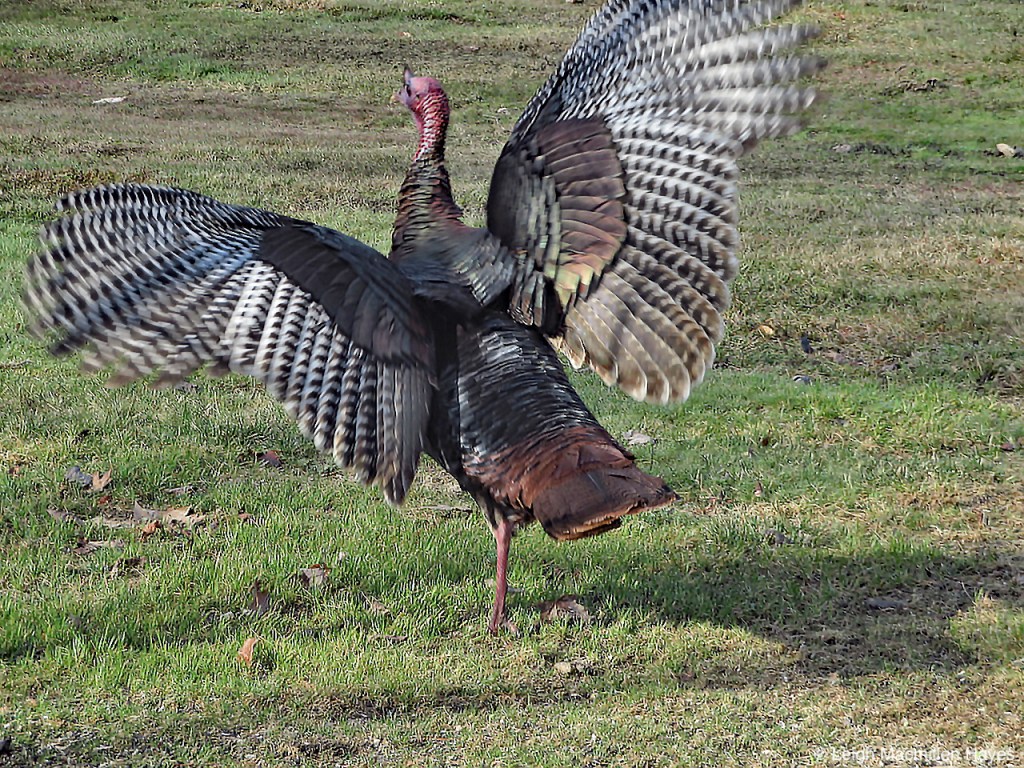
These days it seems my day often begins with a certain male visitor.
No, it’s not my guy, but another handsome fellow named Jake. At least I think that’s his name, based on the length of his beard, short conical spurs on the backs of his legs, and light red and blue head, which would be much brighter for his elder named Tom. It doesn’t matter for in the morning sunlight he gleams and makes me realize that he embodies every color of the rainbow.
We typically spend a few minutes together before he departs and I know that means it’s time for me to do the same.
And so this week it’s been to vernal pools and rivers that I’ve explored, sometimes with others and other times alone. Dipping containers into the water is part of the fun topped off by identifying the find based on its idiosyncrasies such as the larval form of a Predacious Diving Beetle who is known to wait for prey such as tadpoles or other insects to pass by and then grab the victim with pincers before injecting adigestive juice into the meal, thus killing and partially digesting it until its tenderized tissues can be extracted and consumed by this fierce predator.
To ensure there will be more of these little water tigers, I discover two adults canoodling.
For a while they stay nearly in one spot, all the while flaying their hairy yet powerful back legs about in the act.
In its adult form, the beetle backs up to the water’s surface and captures air under the elytra, or firm front pair of wings where the spiracles or respiratory openings are located. (Think external pores) The challenge is to carry enough air to breath, but not too much that might cause them to sink. That said, I frequently watch them surface and then swim off after an oxygen grab, but storing that air for at least ten minutes serves them well while mating for they certainly don’t have a plan to rise for a refill.
If you’ve never watched a pair of Predacious Diving Beetles mate, this is worth the eleven-second clip. It was a first for me, and what a frenzied time it was.
Ah, but there are other things to look at in a pool and so I pull myself away from the canoodlers and begin to focus on the result of some other interaction, this being egg masses of Spotted Salamanders. One evening in the past week, a male Spotted Salamander deposited spermatophores that look like tiny pieces of cauliflower on the pool floor. A few nights later a female picked up sperm from the small structures and internally fertilized her eggs, which she later attached to the small branch in the water. If you look closely, you might see the gelatinous matrix that surrounds the mass.
Likewise, Wood Frog egg masses have also been deposited and their overall structure reminds me of tapioca. In no time at all, the embryos began to develop, but it will still be about three weeks before the larval tadpoles hatch.
Because I was looking, I had the good fortune this week of spying another tiny, but significant critter swimming upside down as is its manner–a fairy shrimp. Fairy shrimp don’t feed on the embryos but rather filter algae and plankton with eleven pairs of appendages, which they also use for swimming and breathing.
Similar to the Predacious Diving Beetle, in order to digest food, a Fairy Shrimp produces a thick, glue-like substance to mix with a meal. My awe with Fairy Shrimp remains in the fact that after a female produces broods of hardy eggs called cysts, they lay dormant once the pool dries up and don’t hatch until it rains again the following spring or even years later.
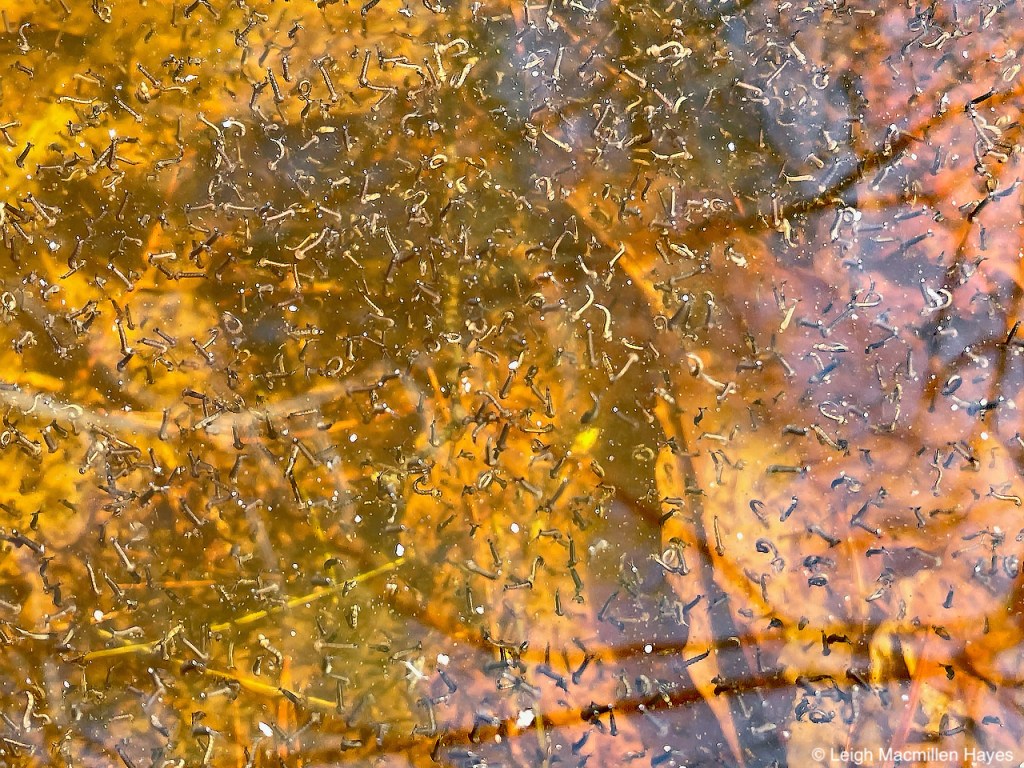
I could spend hours searching for Fairy Shrimp and other insects and in fact, do even marvel at the Mosquito wrigglers as they flip and flop their way around.
You, too, may watch them by clicking on this short video. And remember–they eventually become great bird and insect food.
By now, I suppose it’s time to honor other more beautiful sights of spring, including my favorite first flower of the season, the tiny spray of magenta styles at the tip of Beaked Hazelnut flowers waiting for some action from the male catkins.
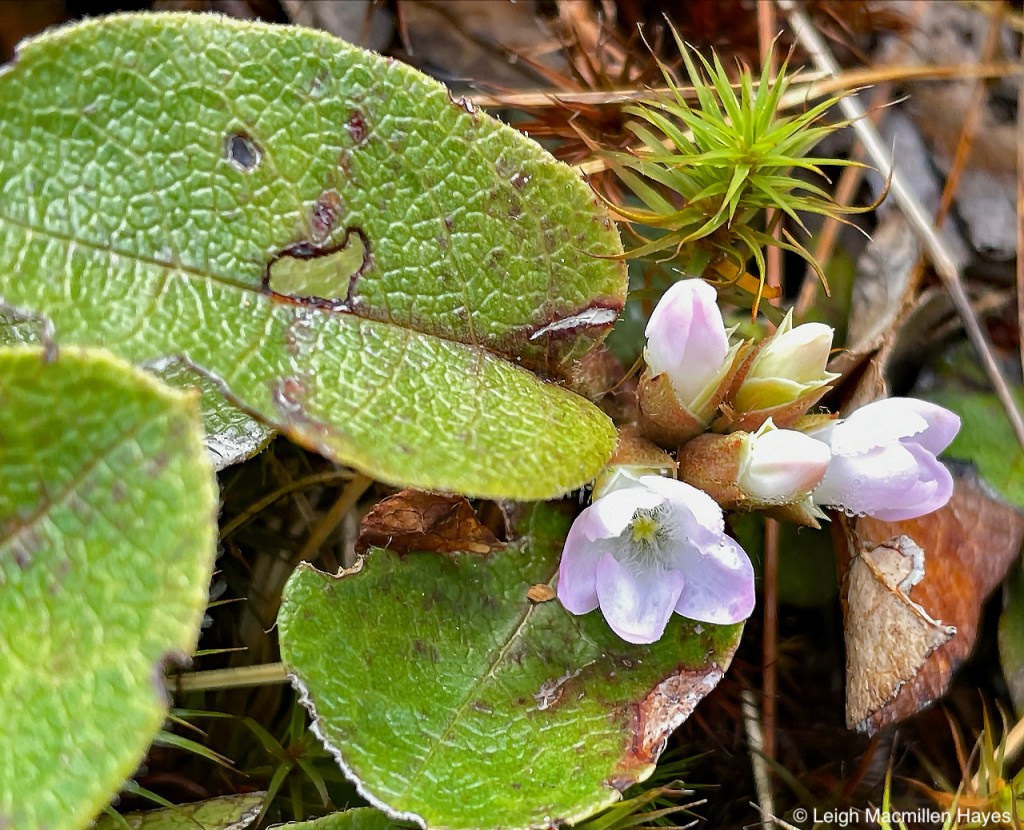
And yesterday’s most delightful surprise, the first blooms of Trailing Arbutus on the forest floor. Known as Mayflowers, they usually open in April. Just to confuse us.
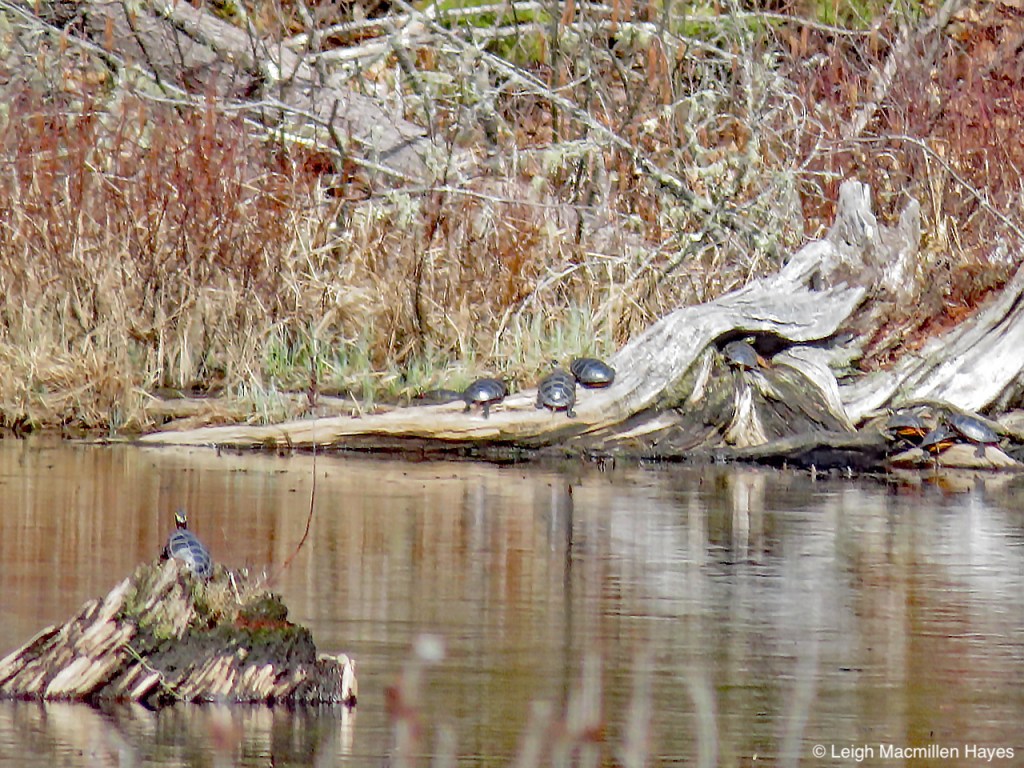
Standing for a while beside a river rather than a pool, another of my favorite sites was an abundance of Painted Turtles basking. No, they aren’t sunbathing to get a tan, but rather to raise their internal body temperature. Being cold-blooded, their body temperature is determined solely by the temperature of the surrounding environment.
In the same neighborhood a pair of Belted Kingfishers could be heard rattling as they do in flight and then seen preening and it seems that love is not only in the water, but in the air as well.
Likewise, a Song Sparrow or two or three trilled their lovely notes to announce their intentions to any who would listen.
And then today dawned–and with it a spring snowstorm graced this part of the world and all who live here, like this Sheep Laurel with buds still tiny.
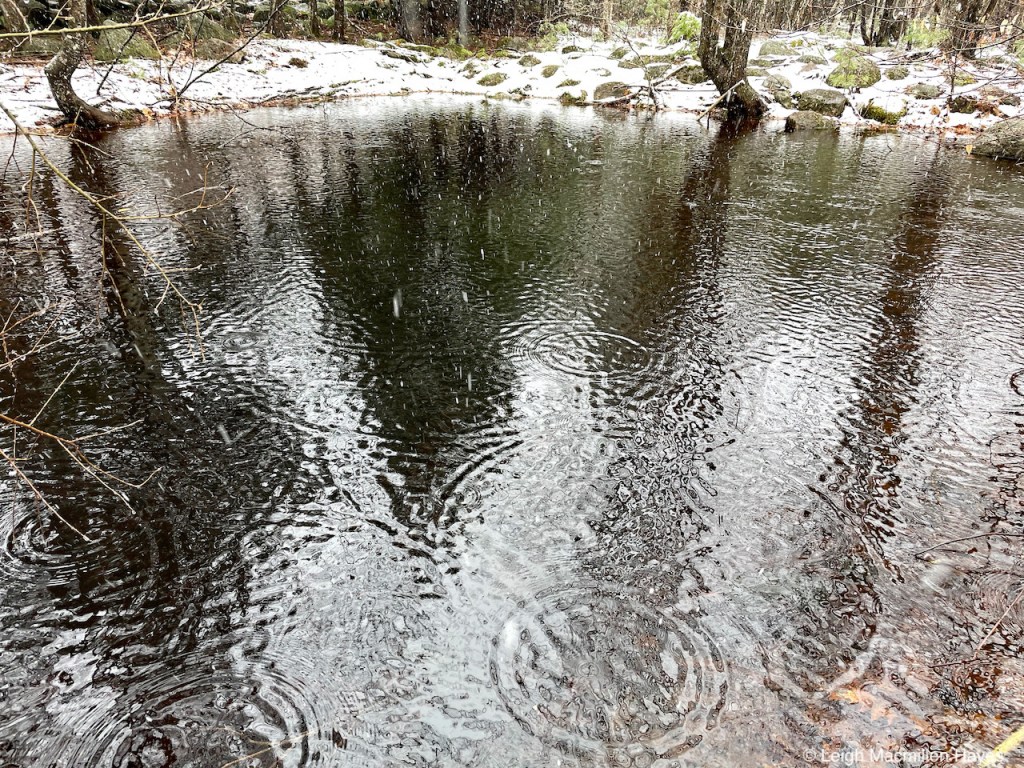
Back to the pool went I, where the only action seemed to be snow striking its surface and creating rippled patterns in constant flux.
Some of the snow drops were so large that bubbles reflecting the canopy above formed. Under water, I couldn’t see any action and finally turned toward home, trusting all the swimming critters were tucked under the leaves in an attempt to avoid the rawness of the day.
There was one more stop to make, however, before I headed in. On December 1st, 2020, upon this very same tree, I watched slugs for the last time last year as documented in a post entitled “My Heart Pines.” It was a squirrel midden that had attracted me to the tree, but so much more did it have to offer on that day.
Today, as I searched for slugs, I was equally surprised for just as I found last year, once again the froth that forms on pines as the result of a chemical interaction when rain drops pick up oils and air in the bark furrows bubbles through that oily film and the end result is pine soap never ceases to amaze me. Even in snow, I learned, it can occur. Plus there was a subtle rainbow of colors.
Ah, but it certainly didn’t match the colors Jake displayed.
Today’s snowfall will melt by tomorrow and only be a memory of that year it snowed on April 16. We’ve had much bigger April storms than this one turned out to be and henceforth Jake and I will walk with a spring in our steps.

























 wondermyway