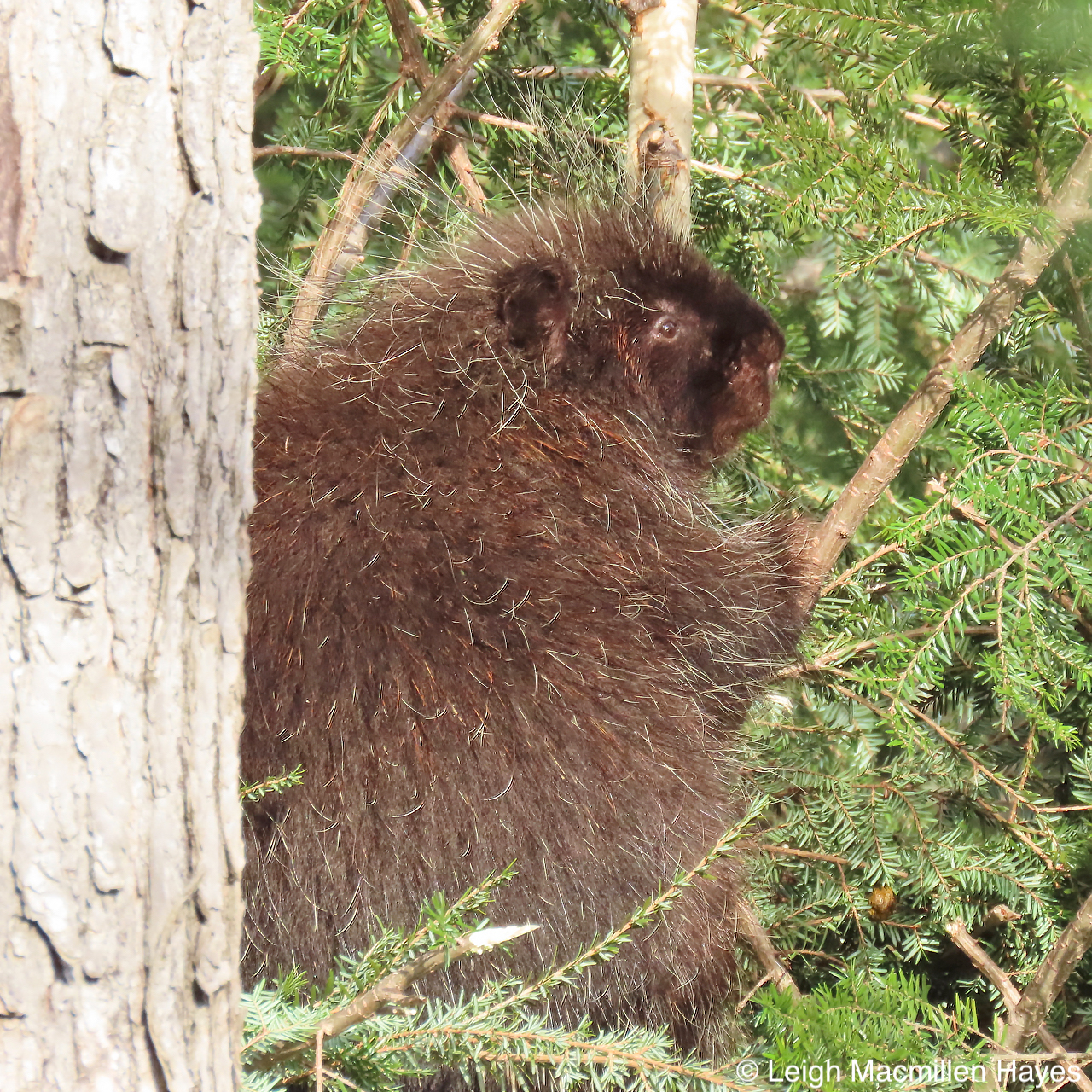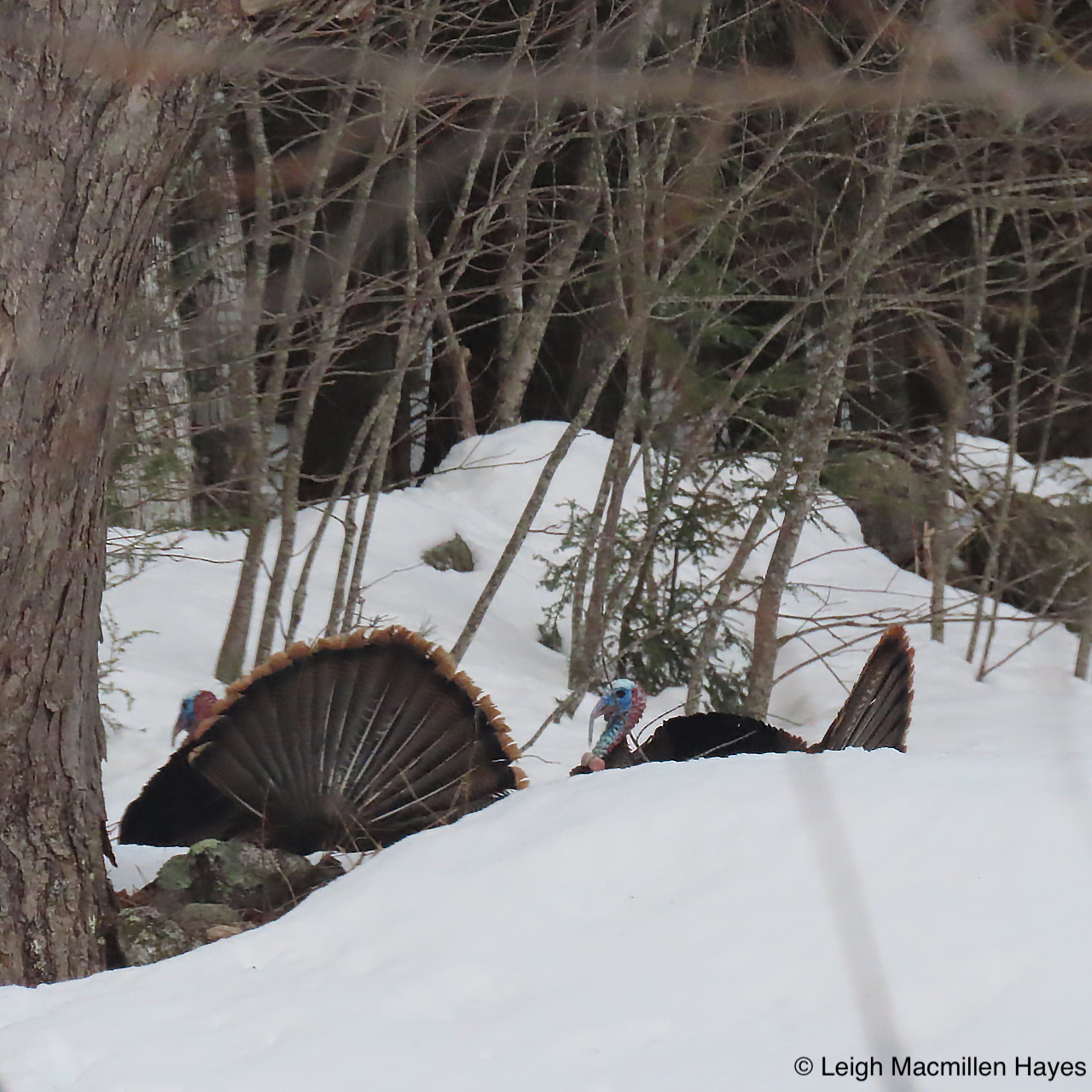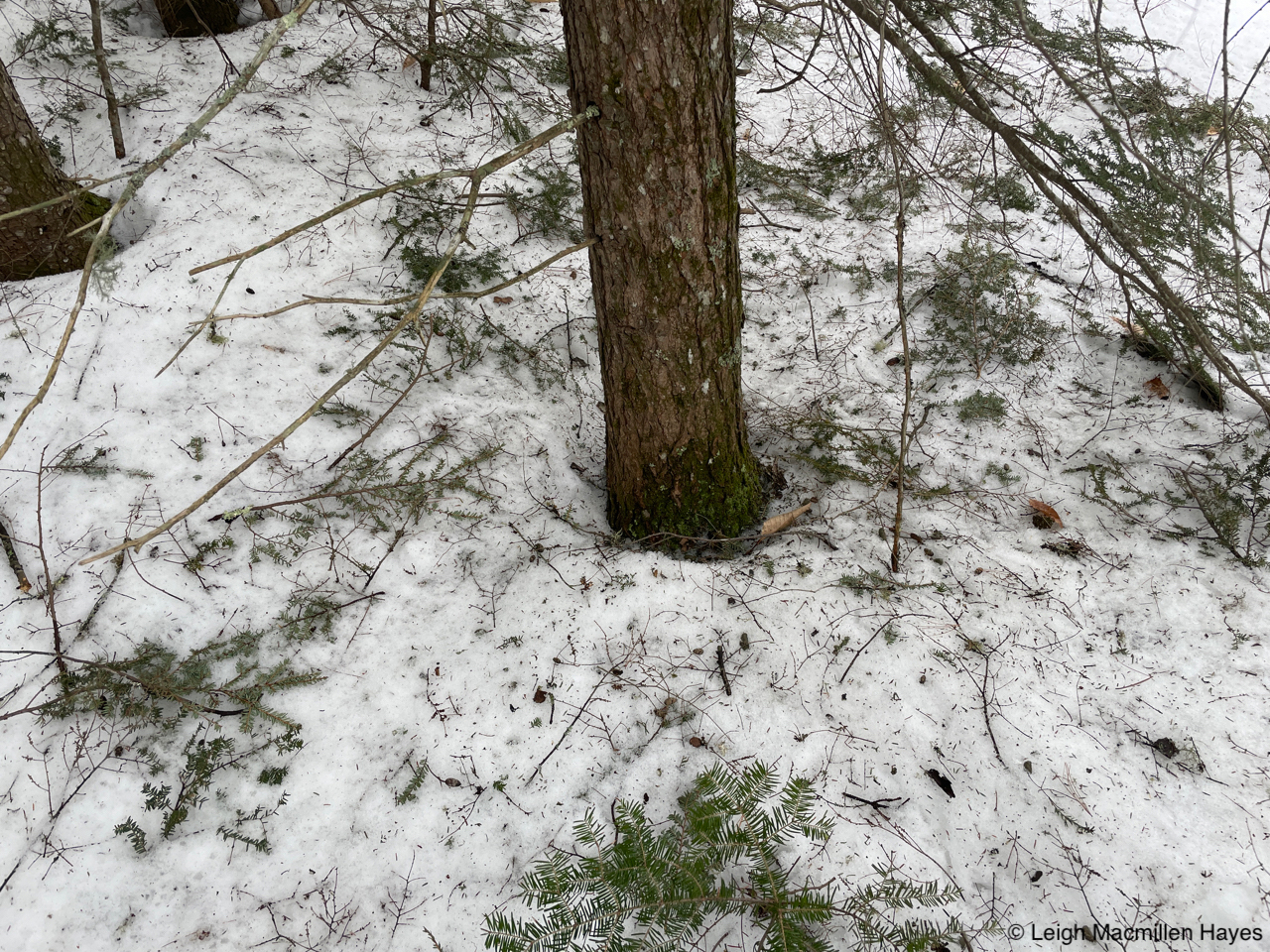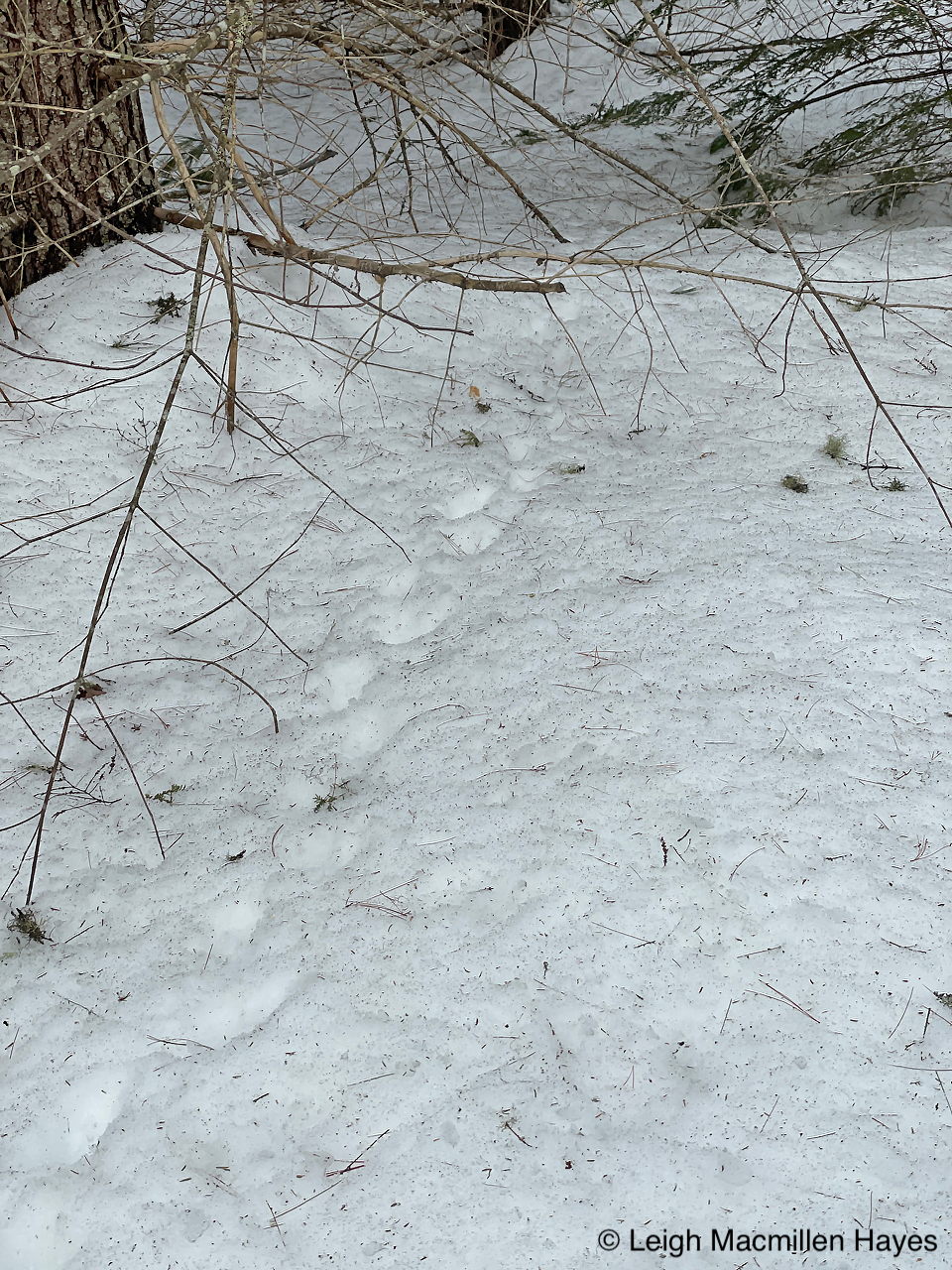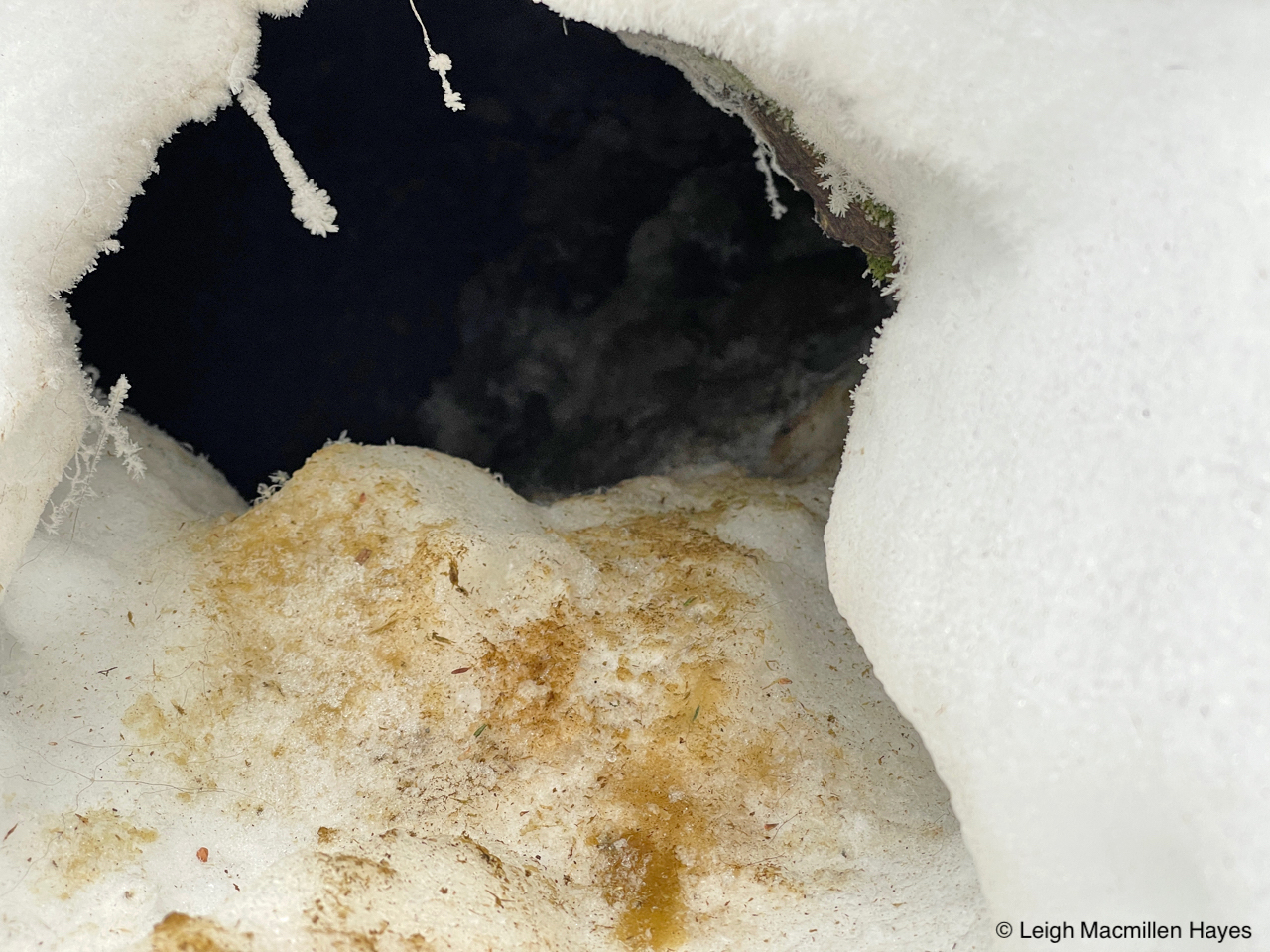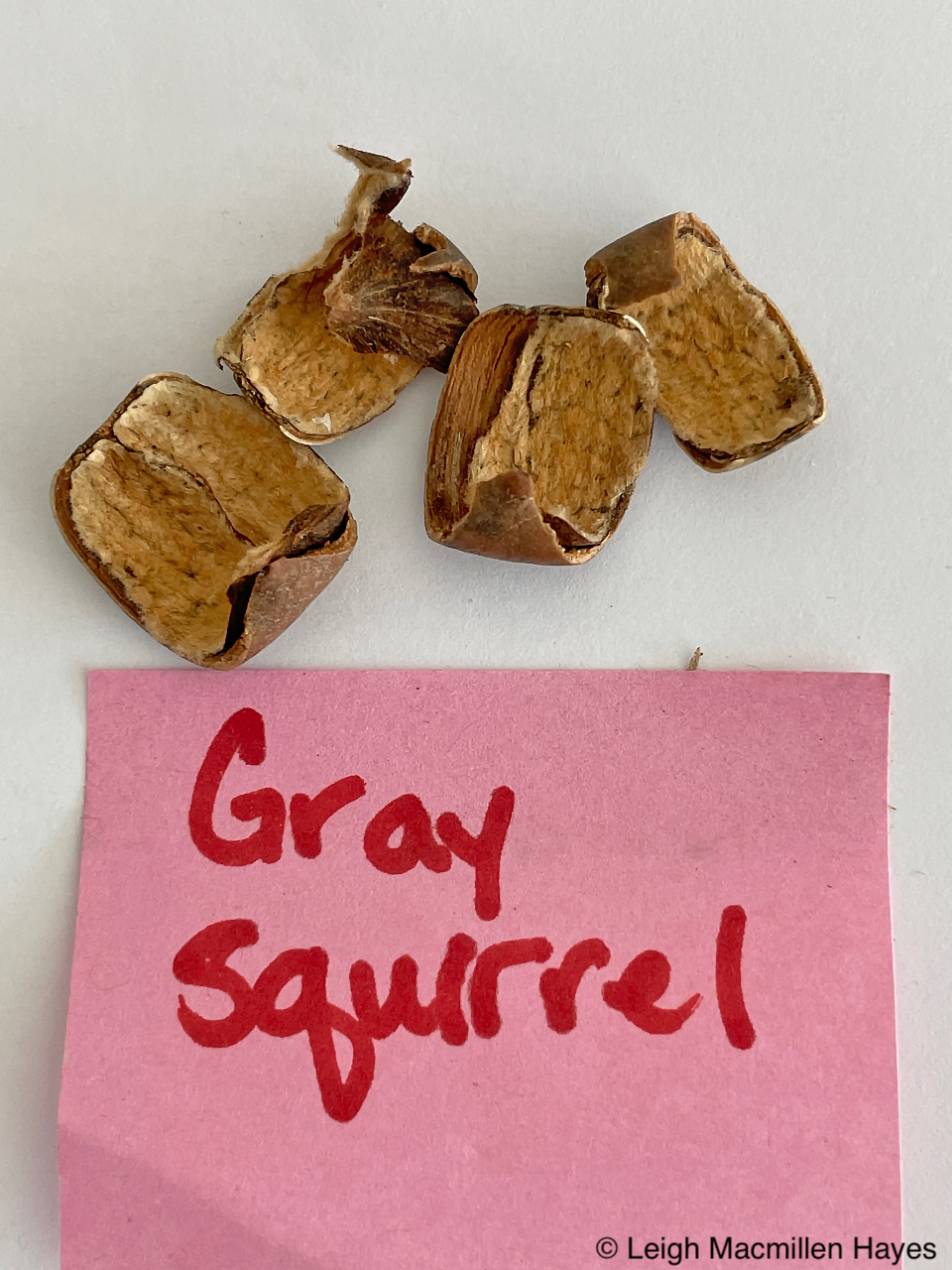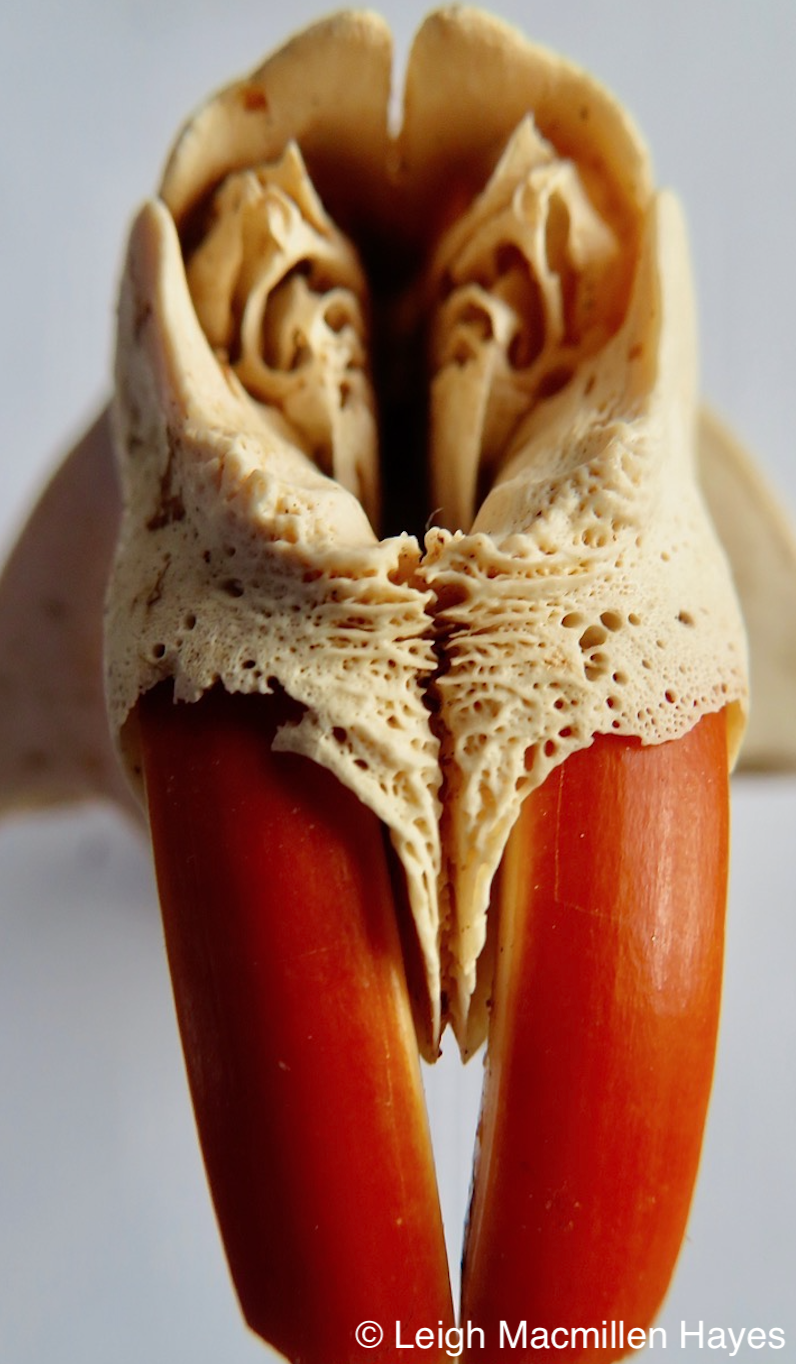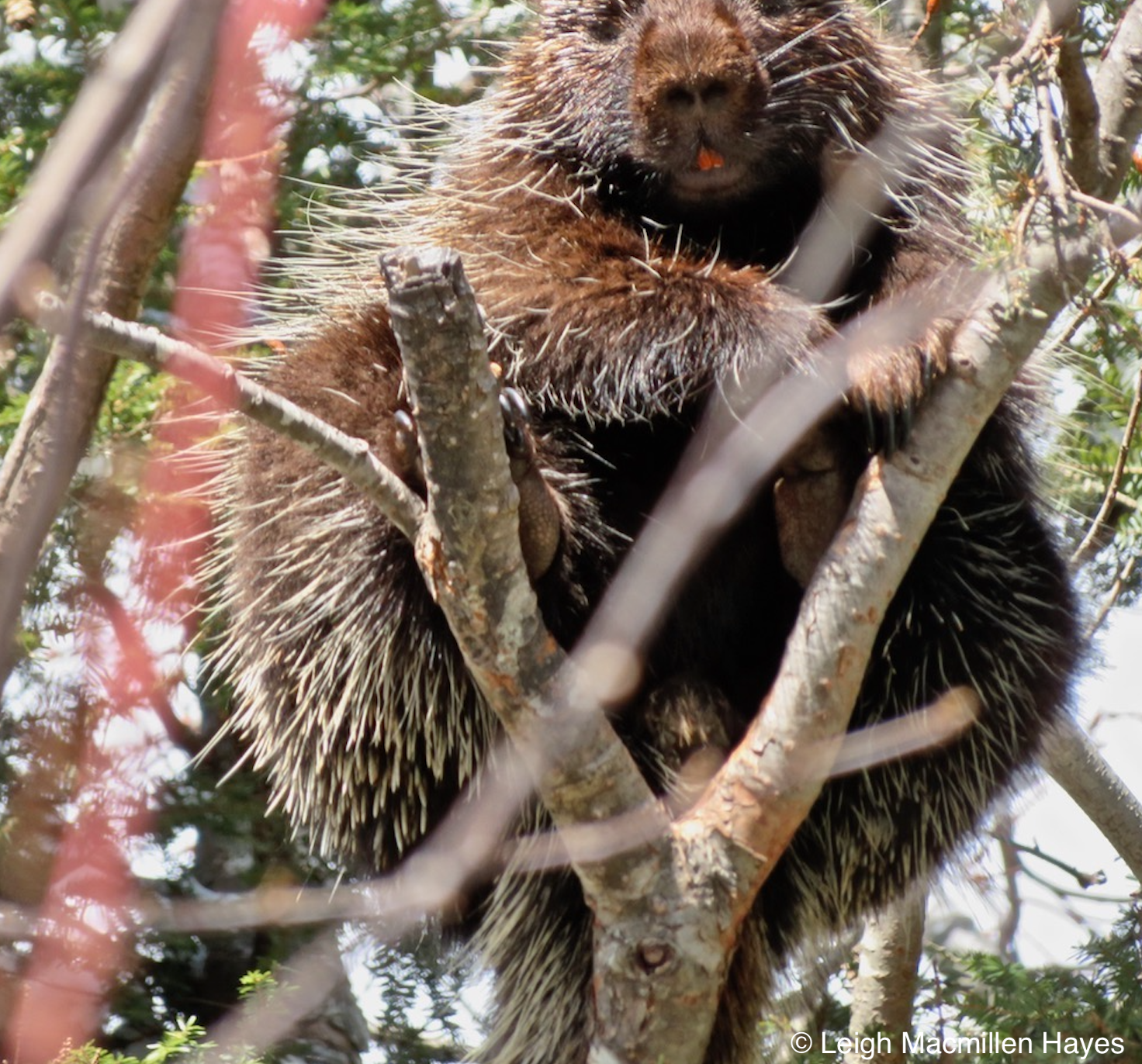
Because of the Monarch

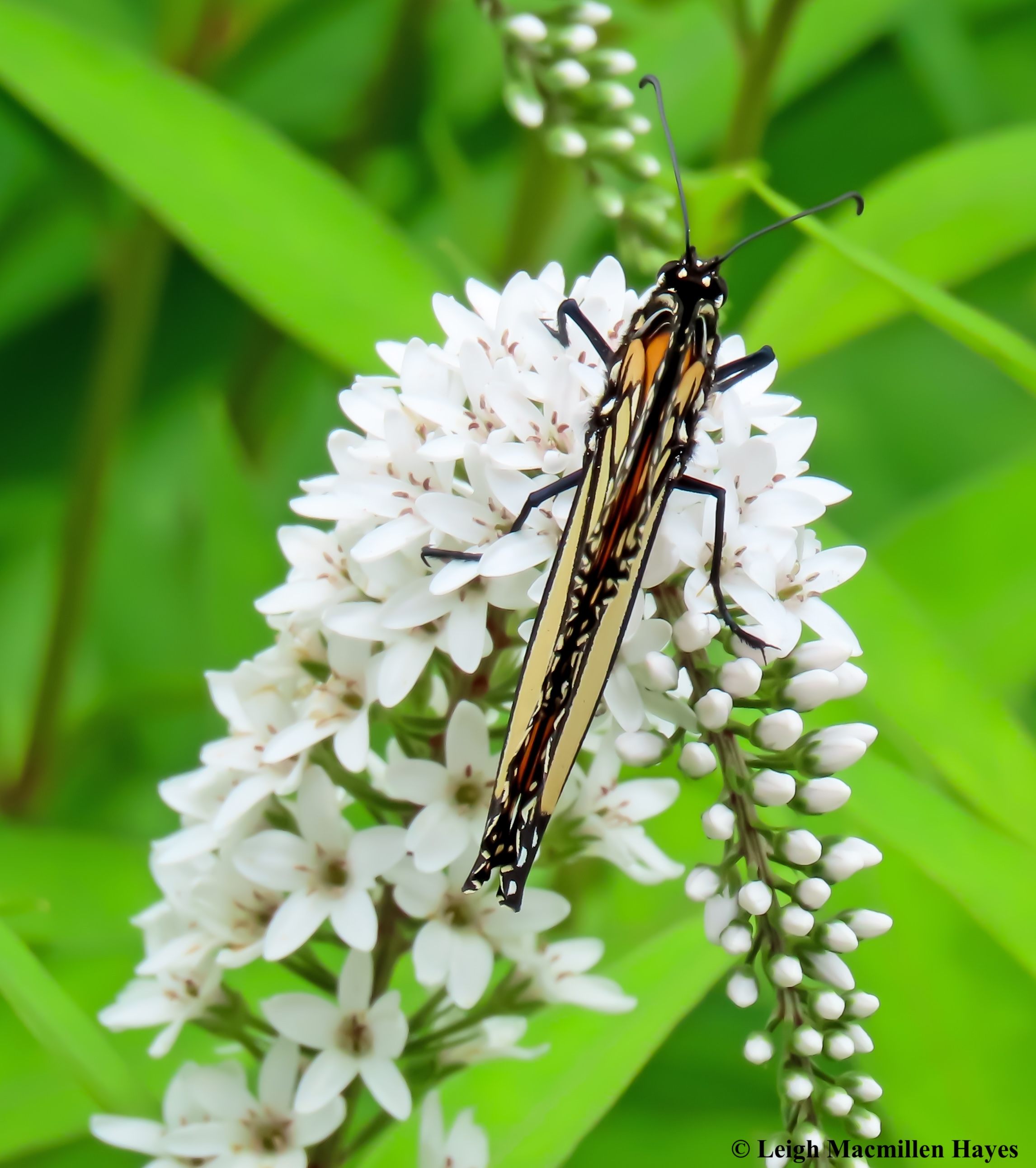
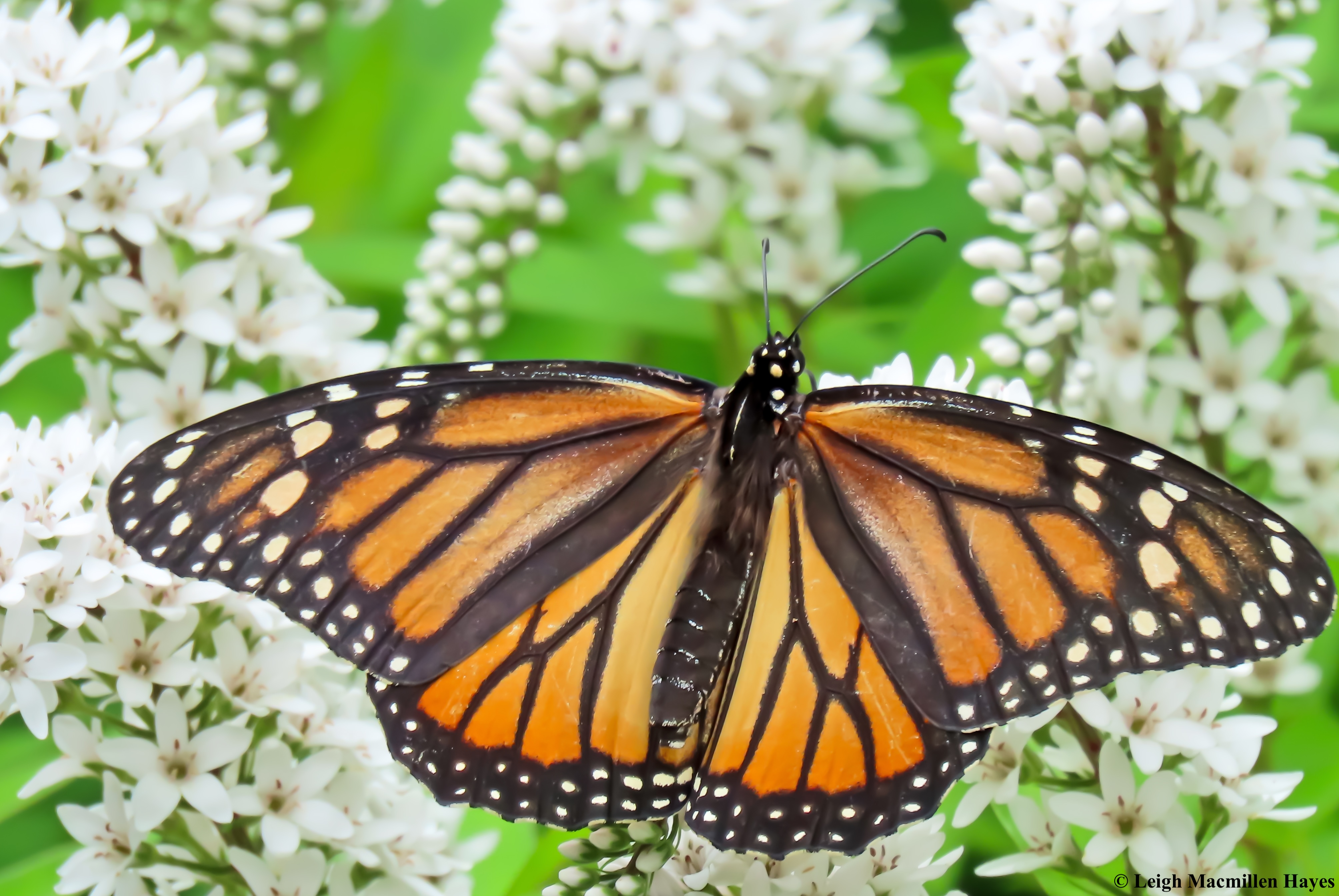
Just as a couple of friends and I were finishing a walk this morning, we spotted a Monarch Butterfly. One gal commented that it seemed too early, but I mentioned people have been posting pictures of them for the last couple of weeks. For all of us, that was the first of this season.

Back at home, I decided to do one of my favorite summer activities and stalk the gardens. Mind you, my gardens are not at all organized; they are rather like me–messy yet a wee bit colorful. I call them cottage gardens, but even those are probably not as random as these.

That said, they attract and provide for all kinds, including the Robber Flies who hide and wait and wait and hide.

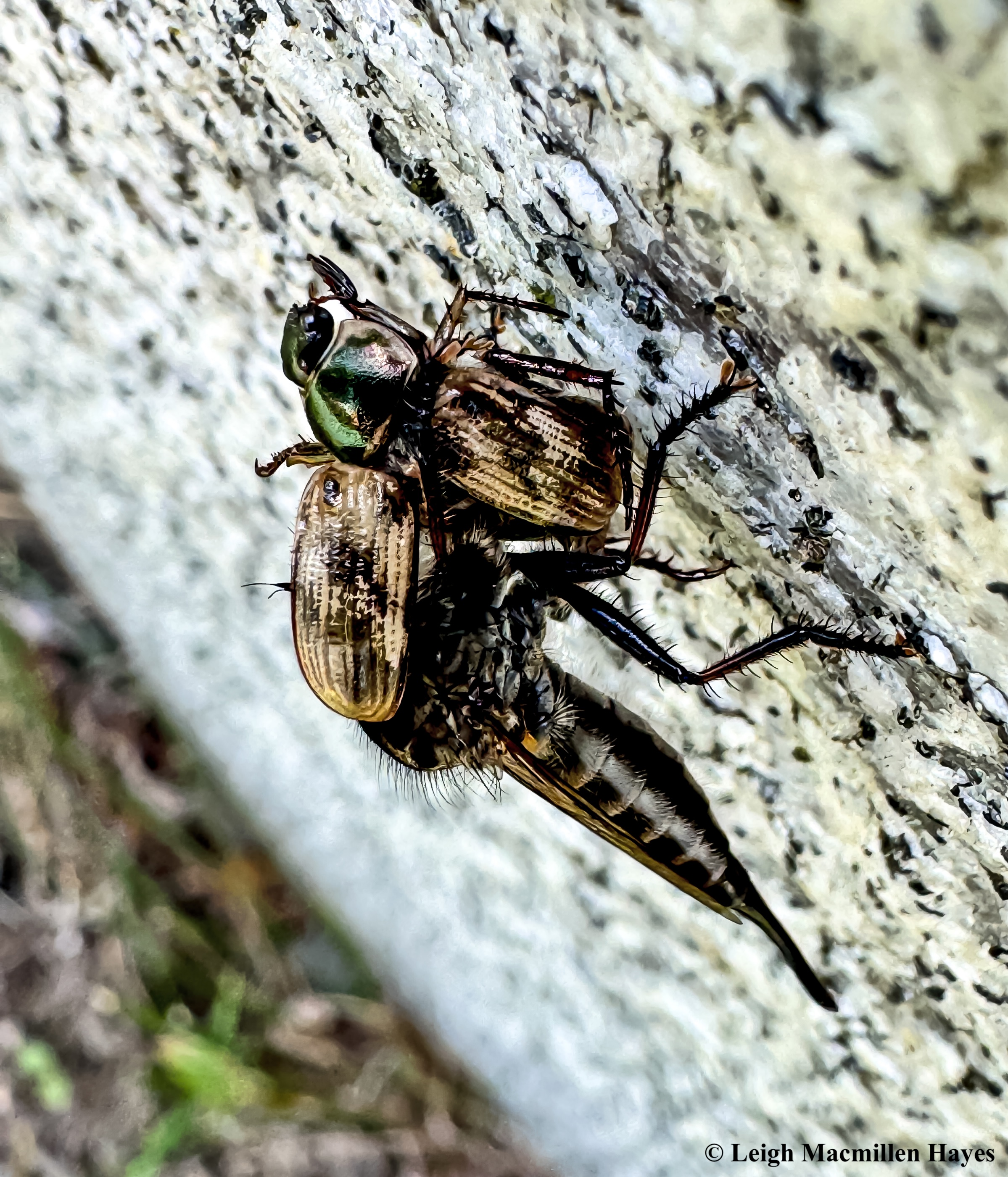
Until a meal, such as an Oriental Beetle, enters the scene. I unfortunately missed the drama of the catch, but love that the Robber Fly was so focused on its meal that it stayed extremely still upon the granite post as it dined. As for the beetle, I was grateful for the fly because such beetles are garden pests.

In case you aren’t familiar with an Oriental Beetle, it’s similar in size to a Japanese Beetle, but as you can see, is much more drab in color. Those antennae, however, are fabulous and make me think that beetles with such are carrying around a set of forks, the better to create a salad.

Above the Robber Fly, a Silver-Spotted Skipper flitted between the Gooseneck Loosestrife that has taken over the driveway garden, and Hostas that are now blooming, seeking nectar wherever it was available.

Skippers are in the butterfly family and have you ever thought about how hairy they can be. Actually, I’m pretty sure the entire natural world is hairy.

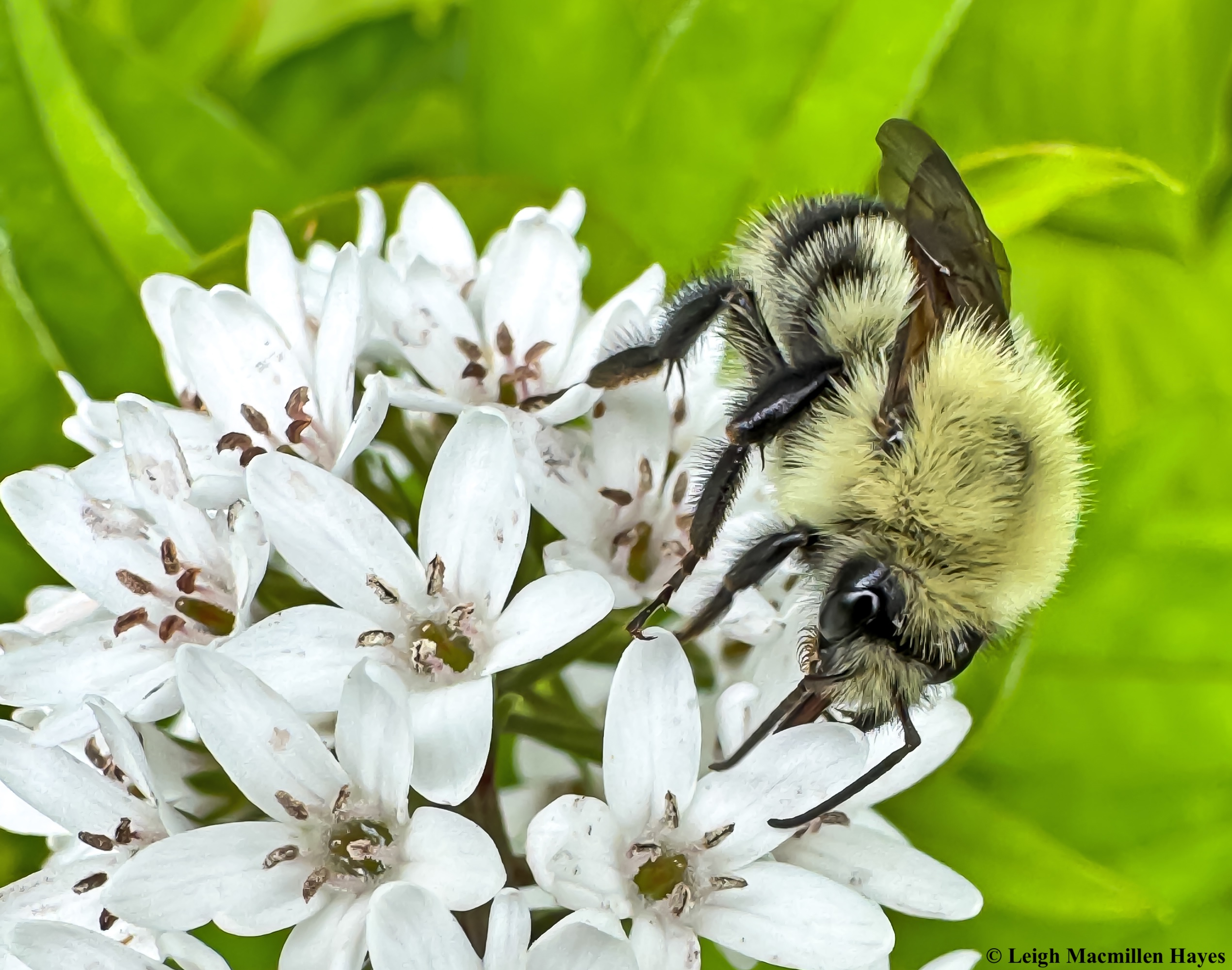
Speaking of hair, its certainly true for the Common Eastern Bumble Bee, who stuck his red tongue into the plant’s nectary.

I’ve seen only a couple of Honey Bees so far this summer, but the gardens are full of Bumble Bees, as is the field beyond, and that makes me so happy.

And if you are worried about these critters stinging–they can and will if annoyed. But I’ve learned to be calm and quiet and they let me get into their space. If they don’t want me there, they simple take to flight and circle me or charge at me, but I know that is a warning and I need to slowly move away and give them their space.

Two-spotted Bumble Bees are also abundant. Notice his beard. And the yellow bands on his abdomen.

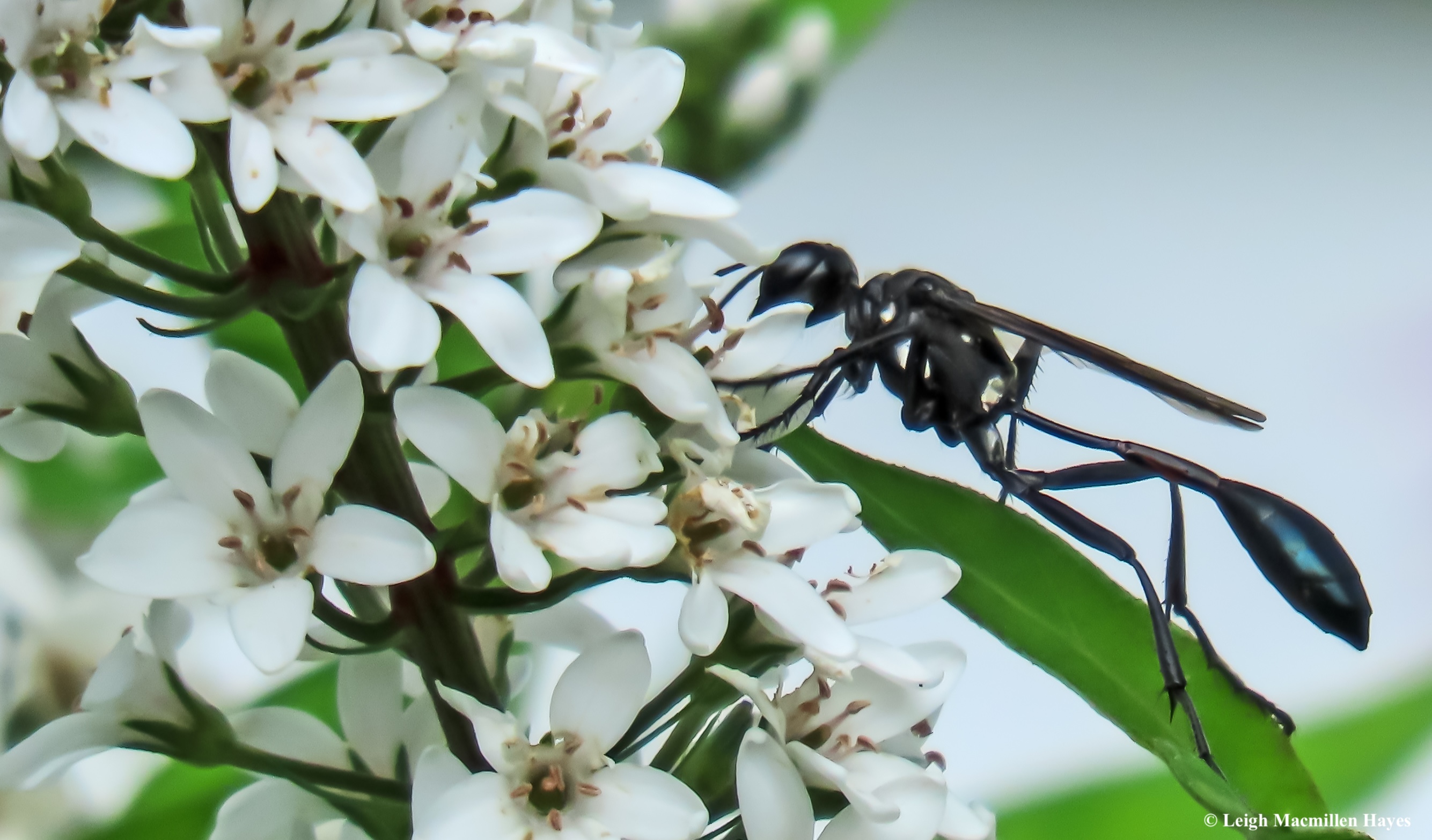
Also enjoying the offerings was a Gold-marked Thread-waisted Wasp, the first sighting of this species for me this year. Though in hind sight, I do think I spotted one dragging a dead spider across the patio the other day and suspected it was on its way to a nest to feed some young.

In another garden, I encountered a new-to-me moth doing its own wonderful job of pollination on an Ox-eyed Daisy. This is a Grapeleaf Skeletonizer Moth. Yeegads. What a name for such a lovely creature who held its wings straight out and flat the entire time I watched it. We do have grape leaves along a stonewall near the garden. And it also likes a relative of grapes, Virginia Creeper, and that too colonizes the wall.

One preferring not to be seen, was this little Crab Spider. I love that it has created a hiding spot by “sewing” the daisy petals together. And now it waits. Actually, by now, I’m sure it has had several meals and treats since I spotted it several hours ago.

And I would be remiss if I didn’t give time to the female Blue Dasher. I’ve seen her guy in the field, but she liked hanging out on the old Digitalis stalk. It was quite gnatty today, given the humidity, and I was hoping she’d make a meal or two, but I’m not sure that happened.

Instead, she spent her time in the obelisk posture, standing on her “hands” and sticking her abdomen up toward the sun to prevent overheating.

All of those creatures I saw because about an hour after arriving home from my walk, I saw a flash of orange out the window and realized that we too had a Monarch. It alluded me at first, but then I spotted it.

I remember when our 30-something sons were young, the Monarchs covered flowering shrubs with their presence. And now, sadly, we celebrate one.

I can only hope that as the summer progresses, this butterfly finds a mate, canoodles, and produces many more. I can only hope.

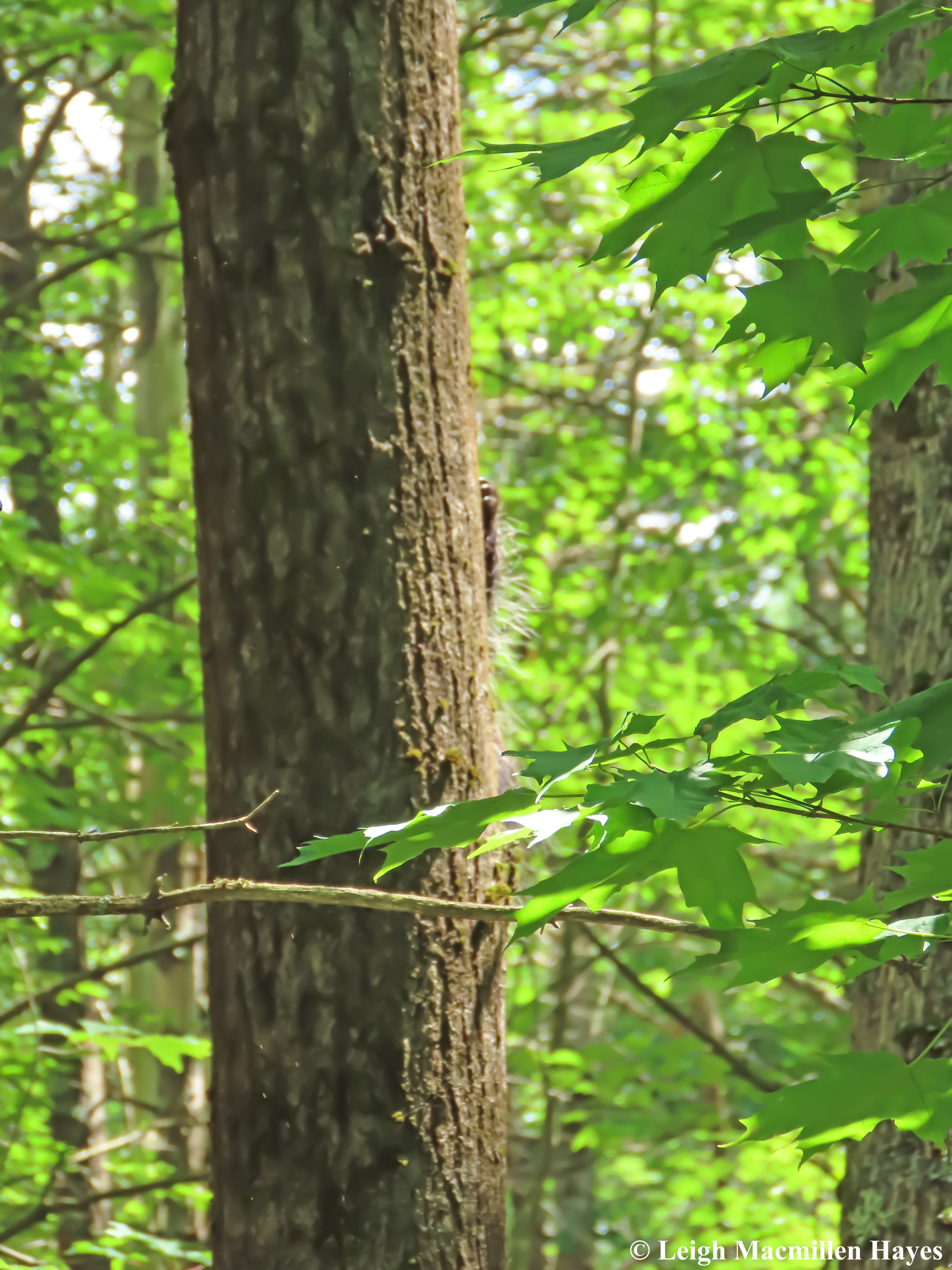
But . . . because of the Monarch drawing me back outdoors, when I was by one garden and had my back to our woods, I heard a scratching noise that didn’t sound normal.

Fully expecting it to be a squirrel, I turned around to peek. And was totally surprised by what I saw.

Oh, how I love it when that happens. Go without expectations. And be fully surprised.

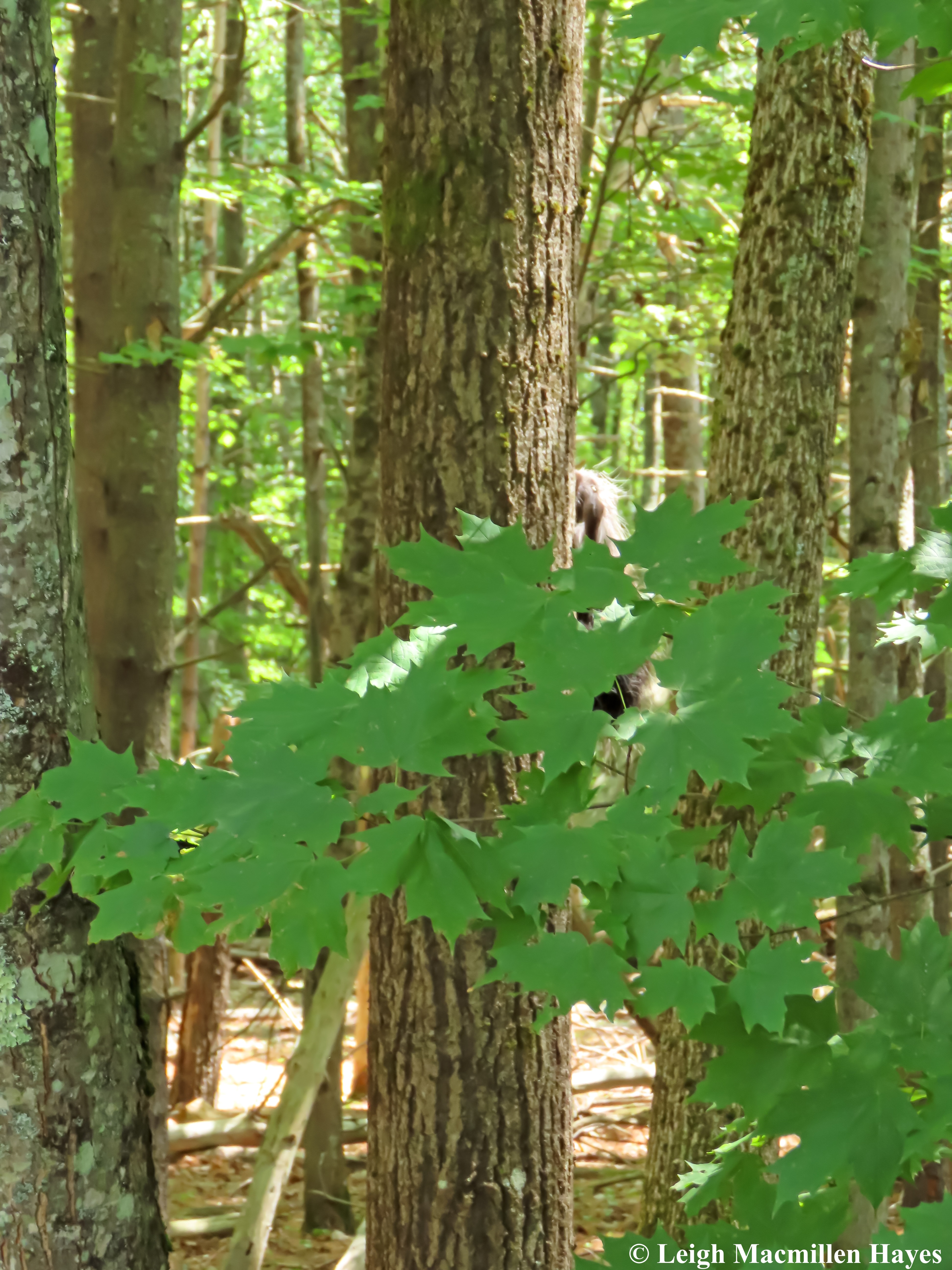
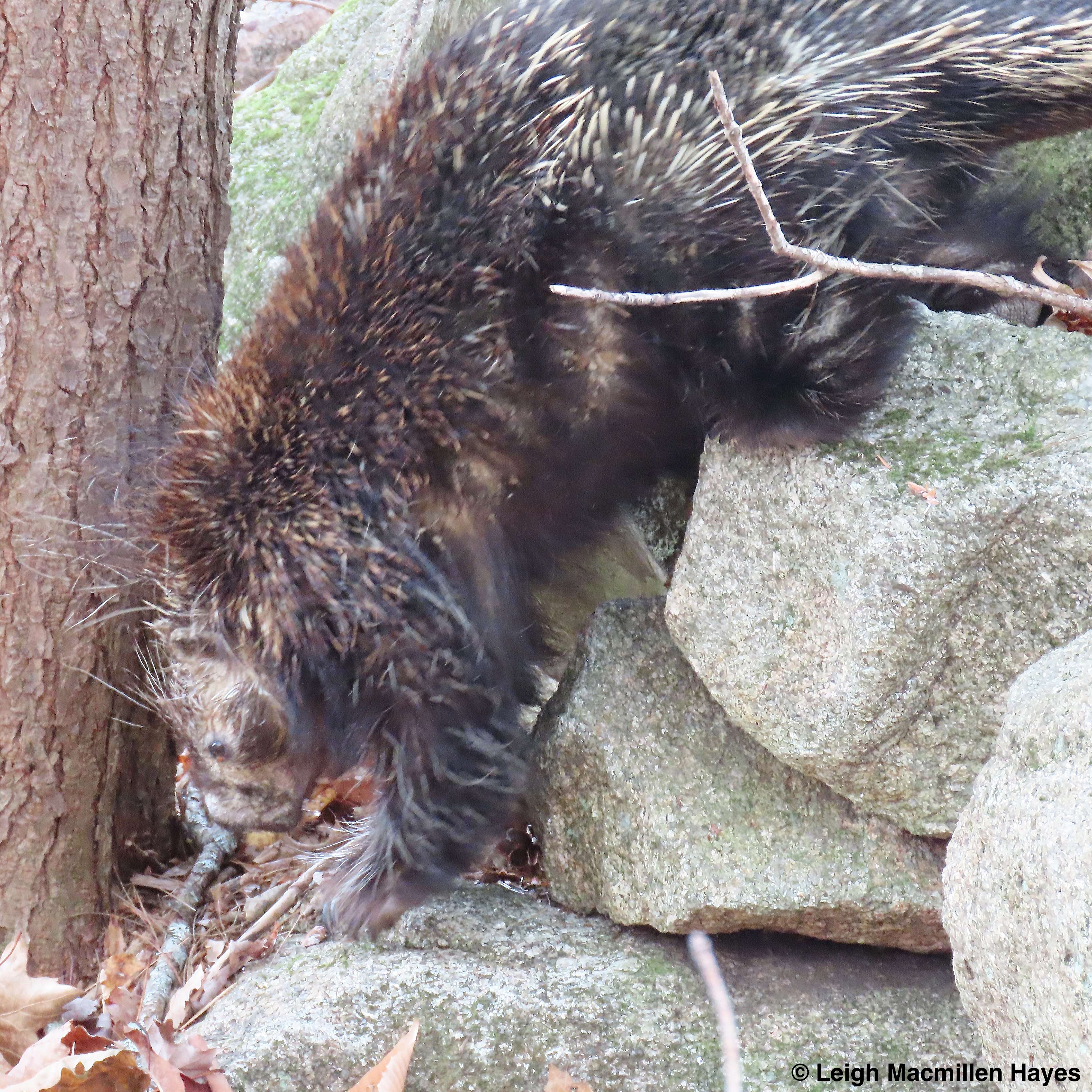
As it crawled backwards down the tree, my heart sang.

One of my favorite critters was descending.

I did wonder, however, which way he would go once he reached the ground.

I had nothing to fear, for he headed toward another of the stonewalls that encompass our land.

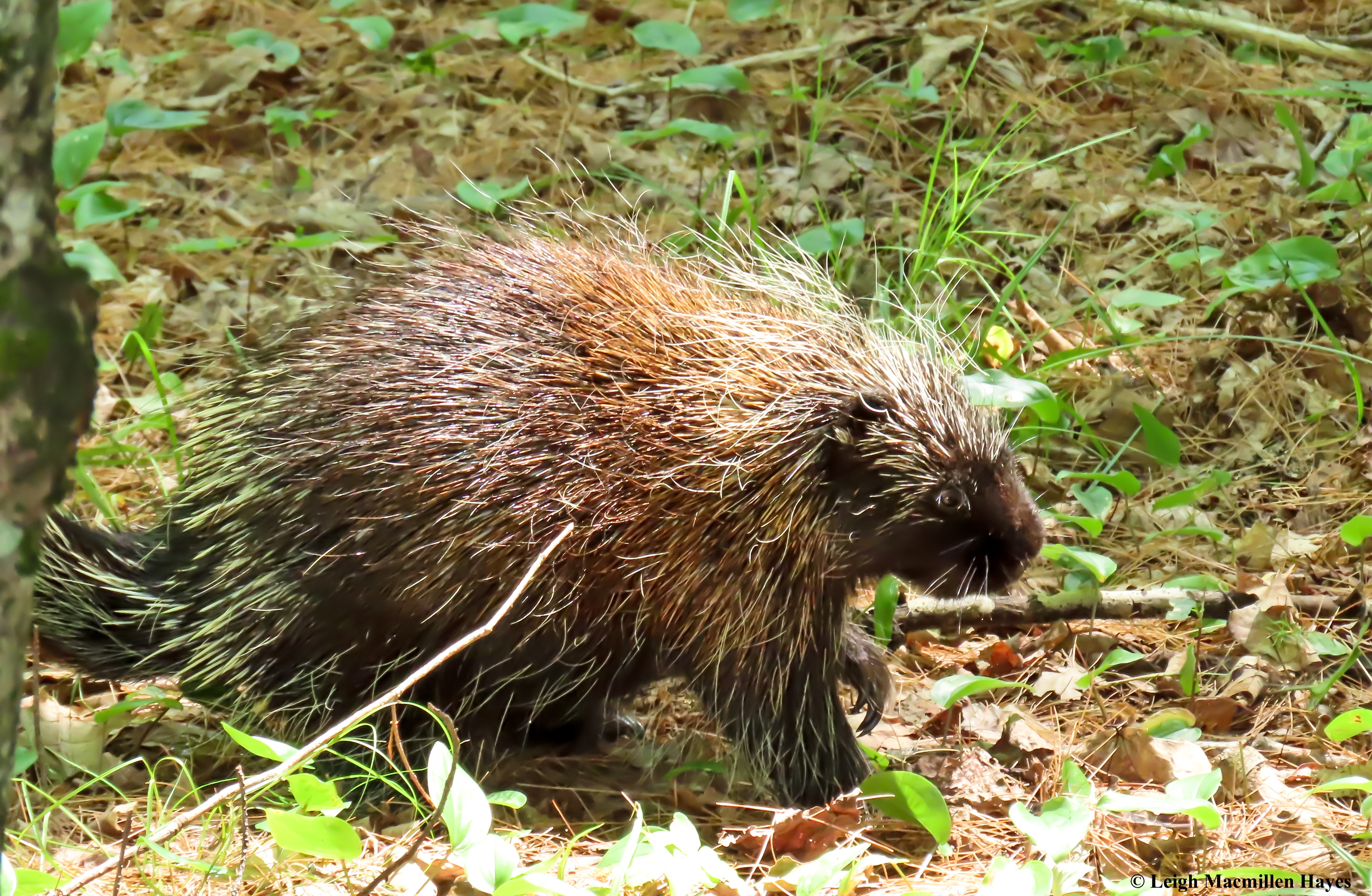
He wasn’t aware of me, for the quills on this Porcupine’s back were not raised. Apparently I didn’t smell all that sweaty after all, for their sight and hearing are not great, but they do have a sense of odors, hard to believe given how much the scat that surrounds their dens stinks.

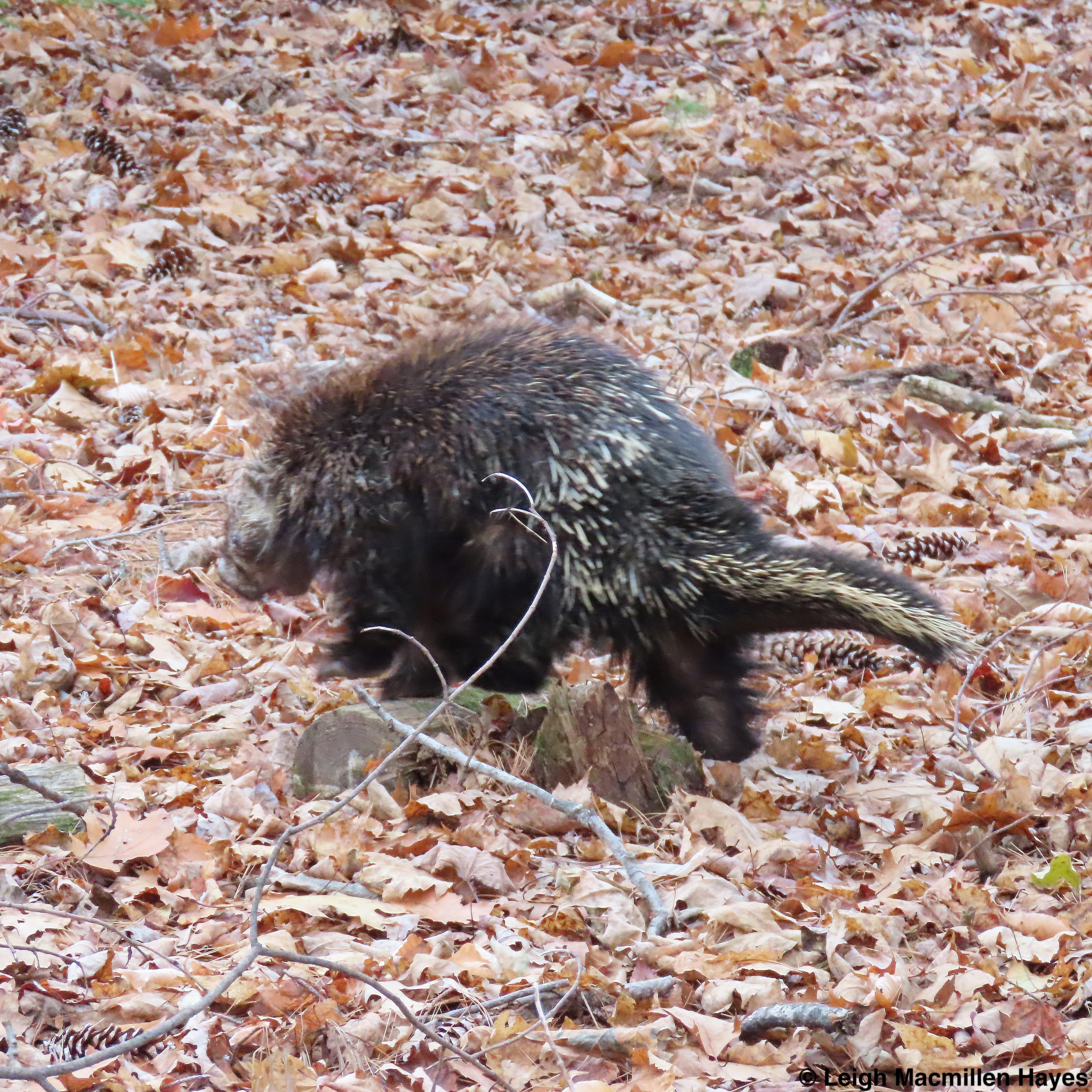
As he waddled over the stonewall and onto the trail I’ve created in the woods, I gave thanks for the butterfly.

Because of the Monarch . . .

Deciphering the Porcupine Dance

When I least expect it, the Universe speaks. And suddenly all makes sense. Well, not all, but a few things become clearer and my understanding of the natural world grows.

So it was early this week when I walked down a forested road and met tracks well worth pondering.

To set the stage, we’d had a 5 – 6 inch snowstorm Friday night into Saturday, followed by some melting, and then rain and freezing rain on Sunday, and fog and rain on Monday. A smorgasbord of spring weather.

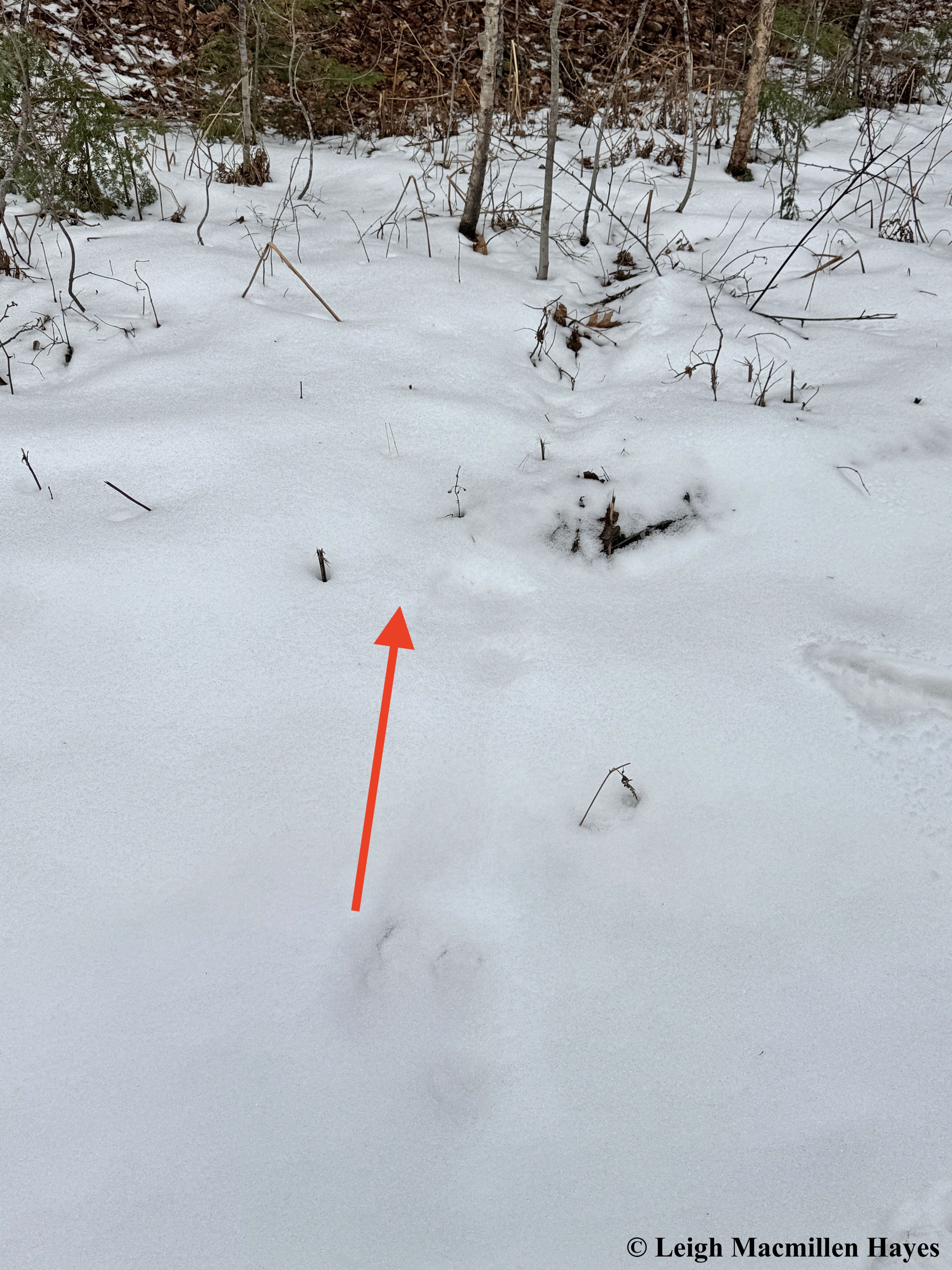
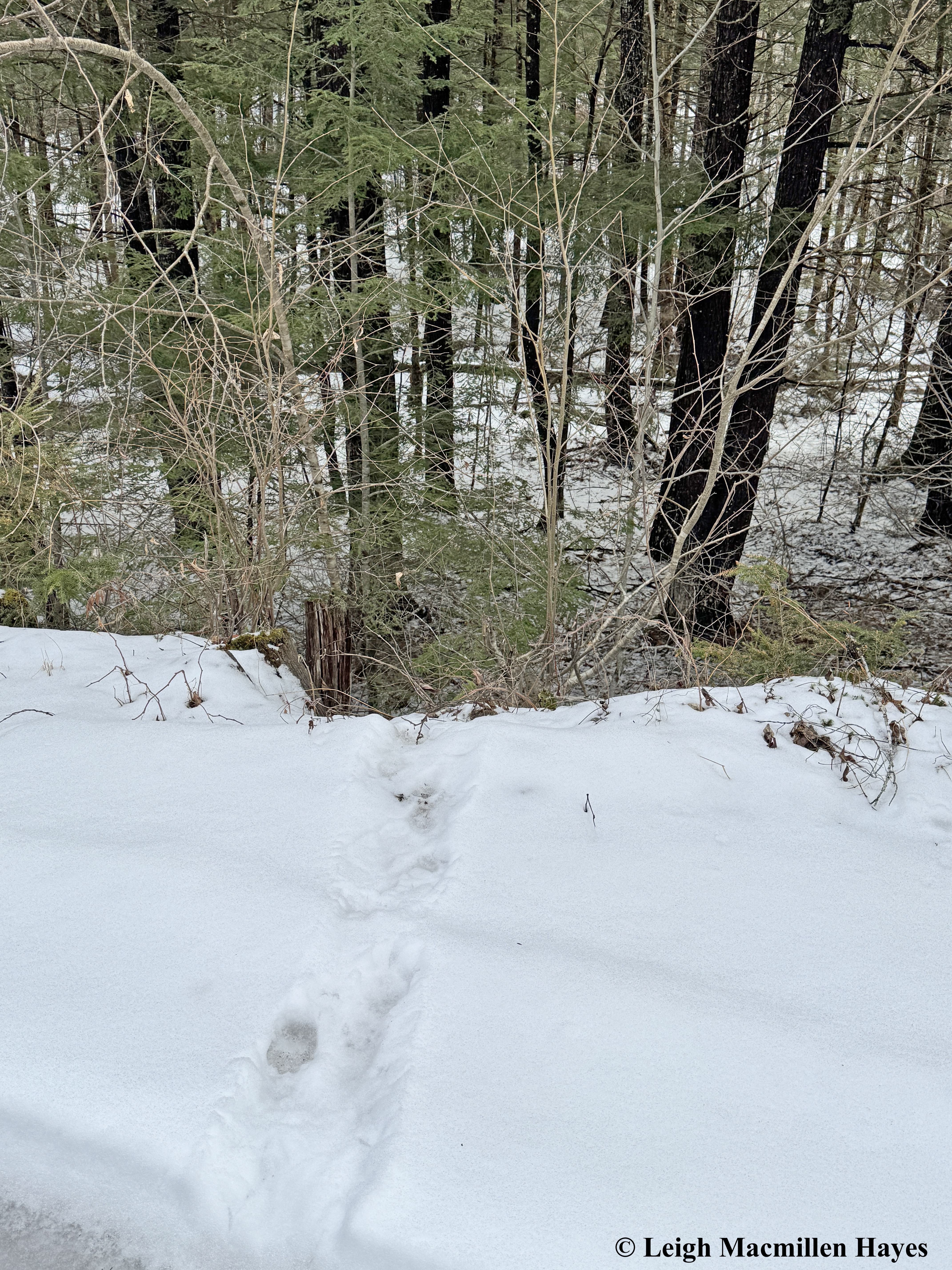
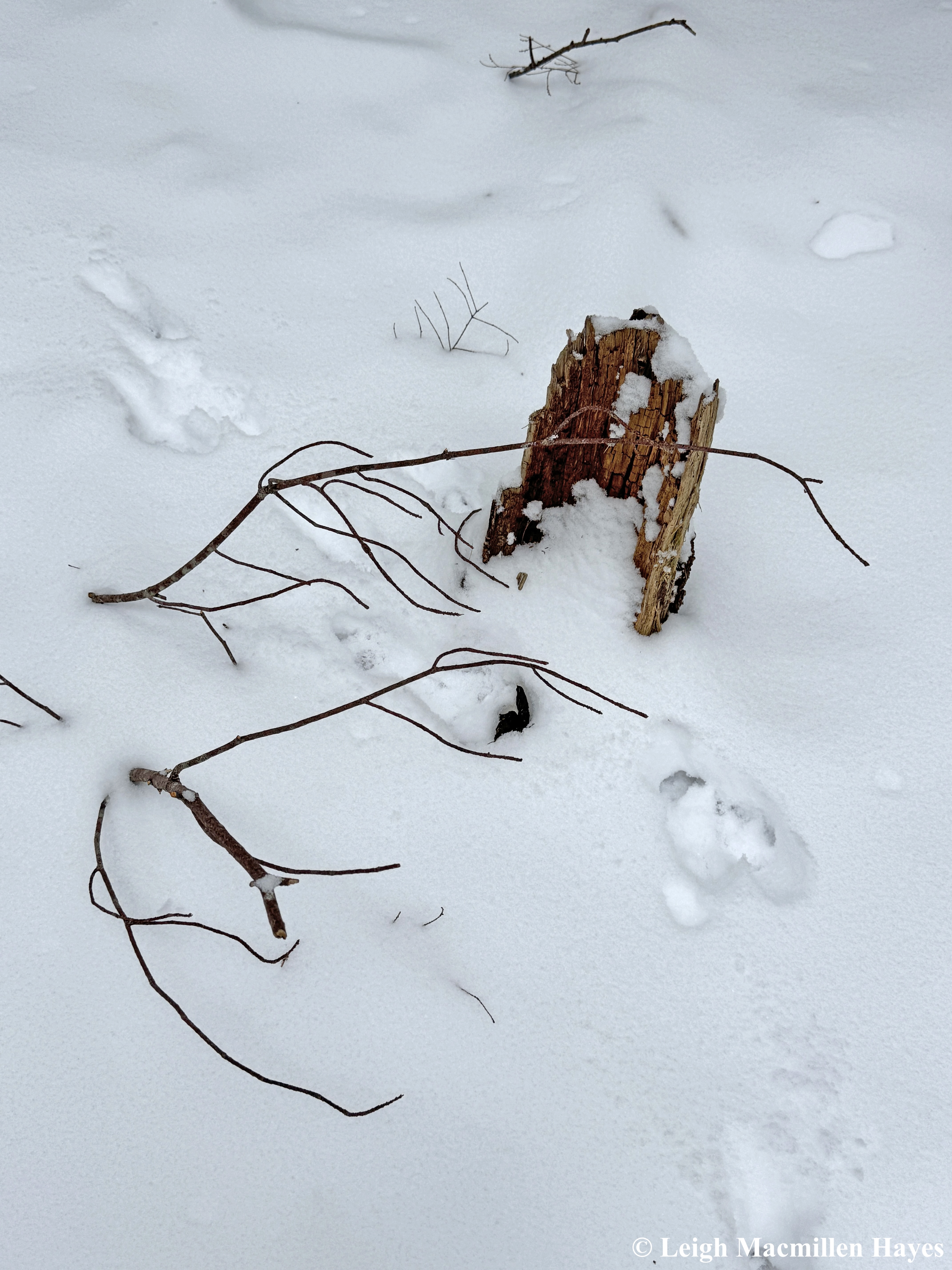
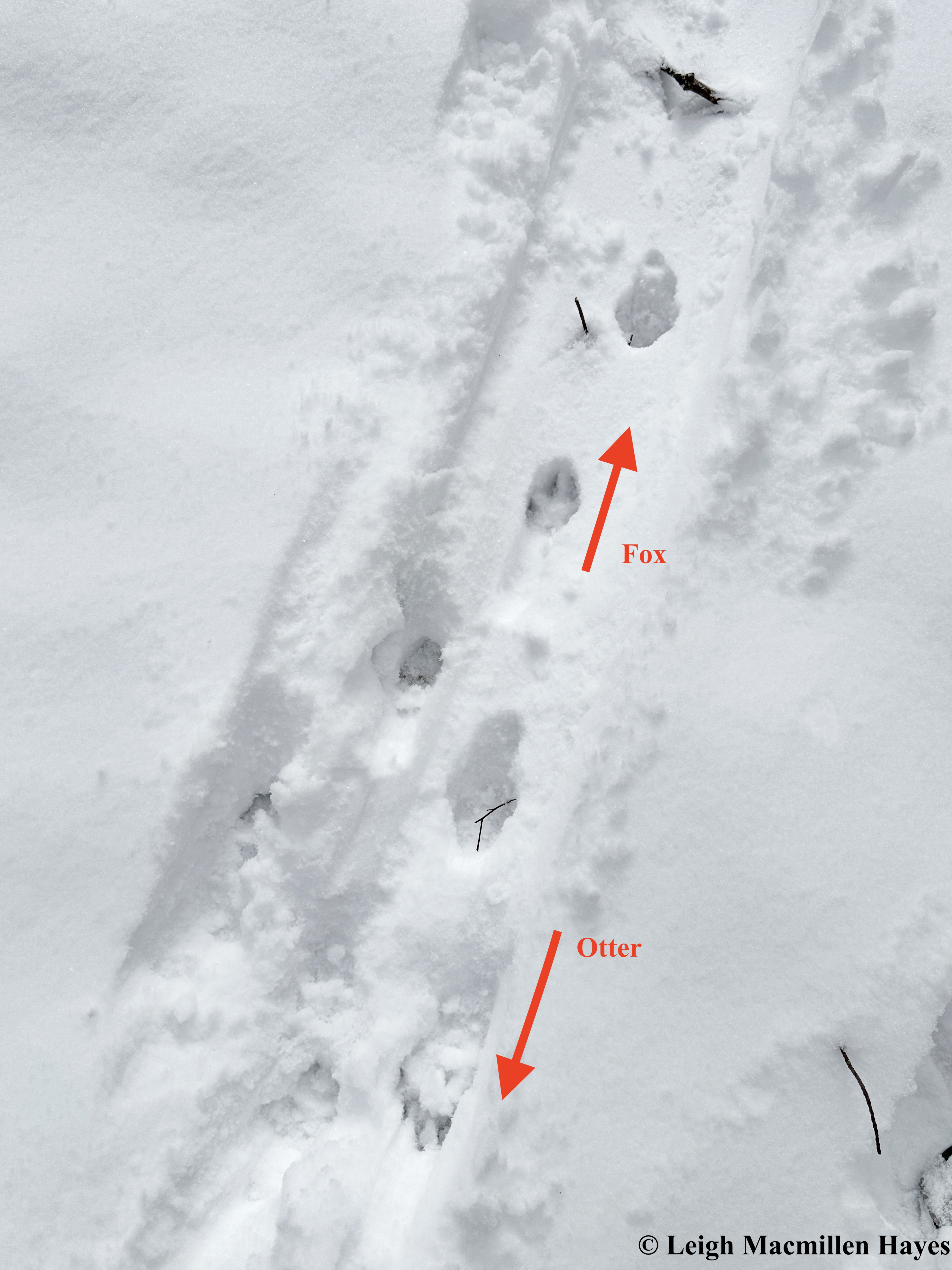
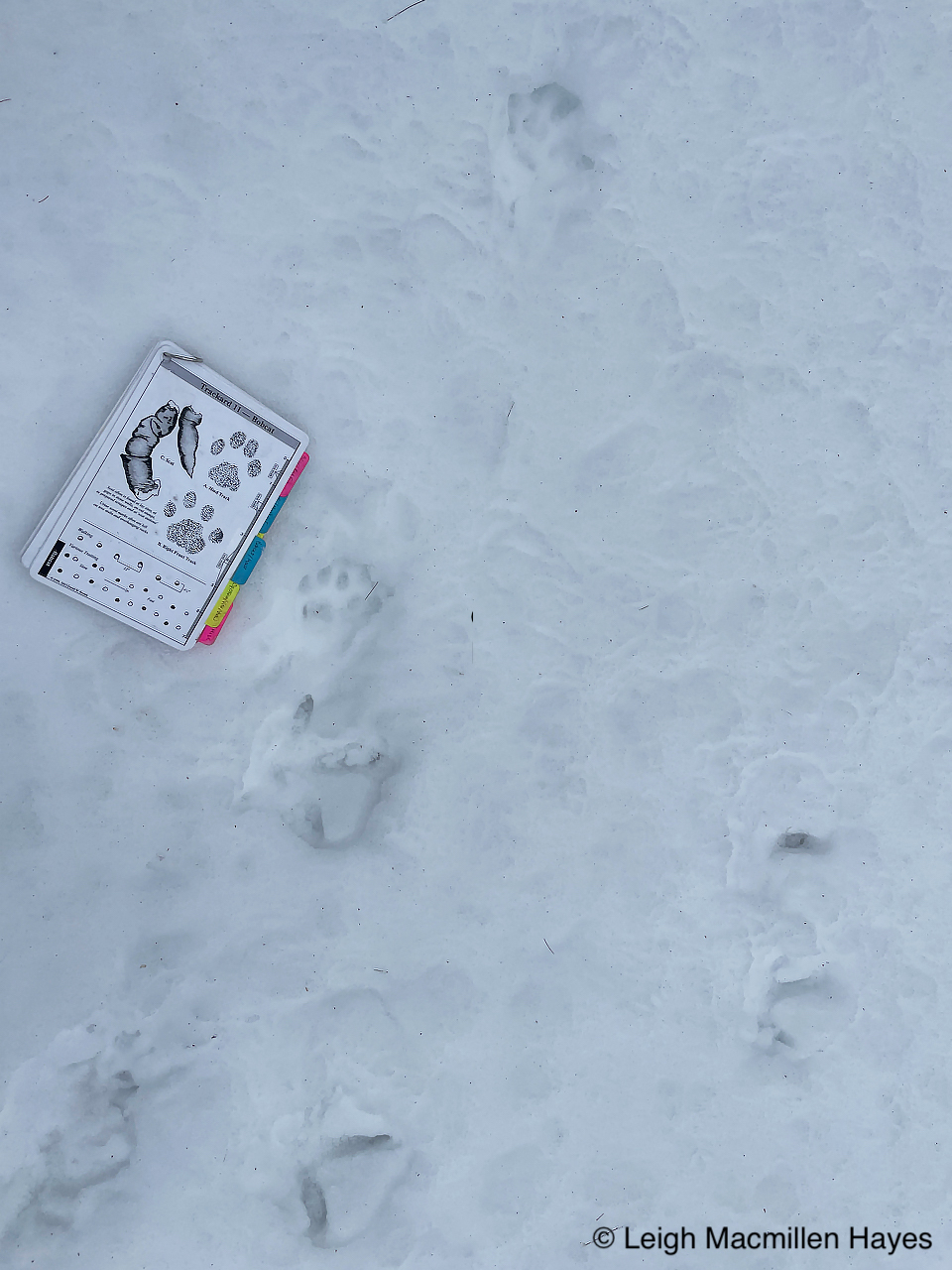
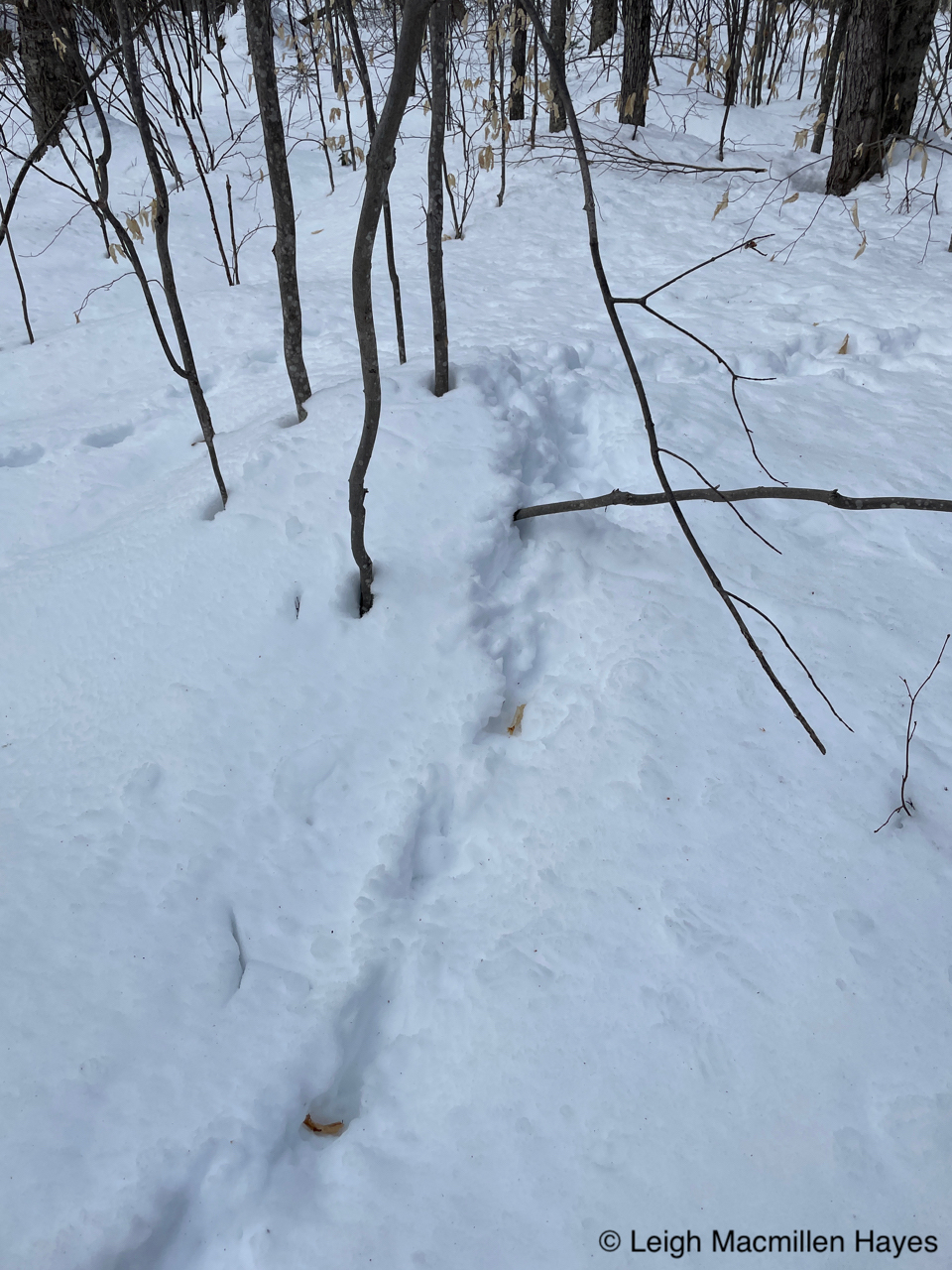
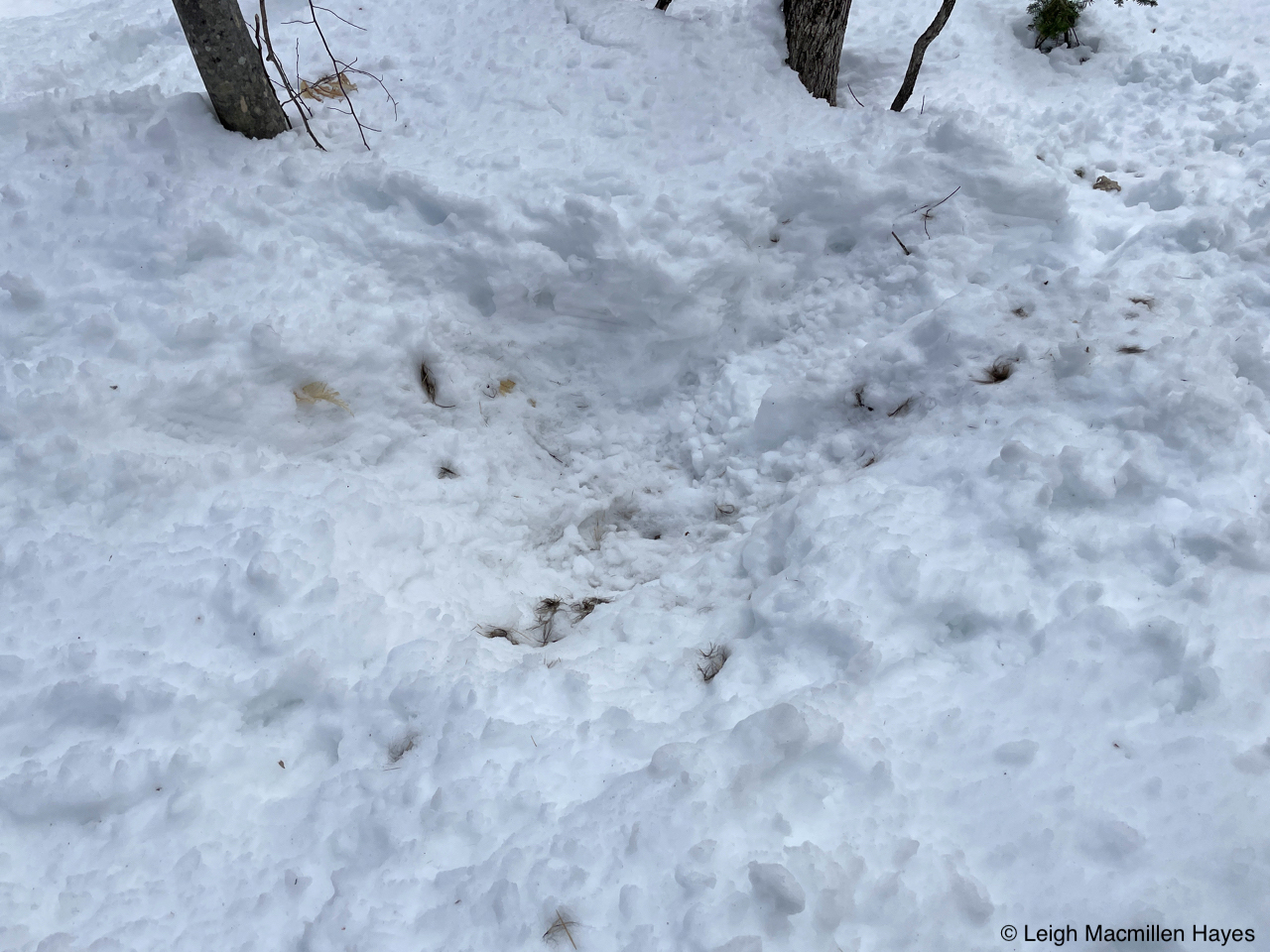
As I walked along, I noticed some disturbance in the snow and when I reached it, I noted that there were two disturbed sites almost parallel in orientation.

And my heart gladdened, for I immediately recognized these as representing the travels of a River Otter, or two or three. What’s more, they had been made over the course of at least two days.

The bounding slide on the left was first and probably occurred early Saturday as it still snowed. Such was the bound and slide so filled in, yet still representational.

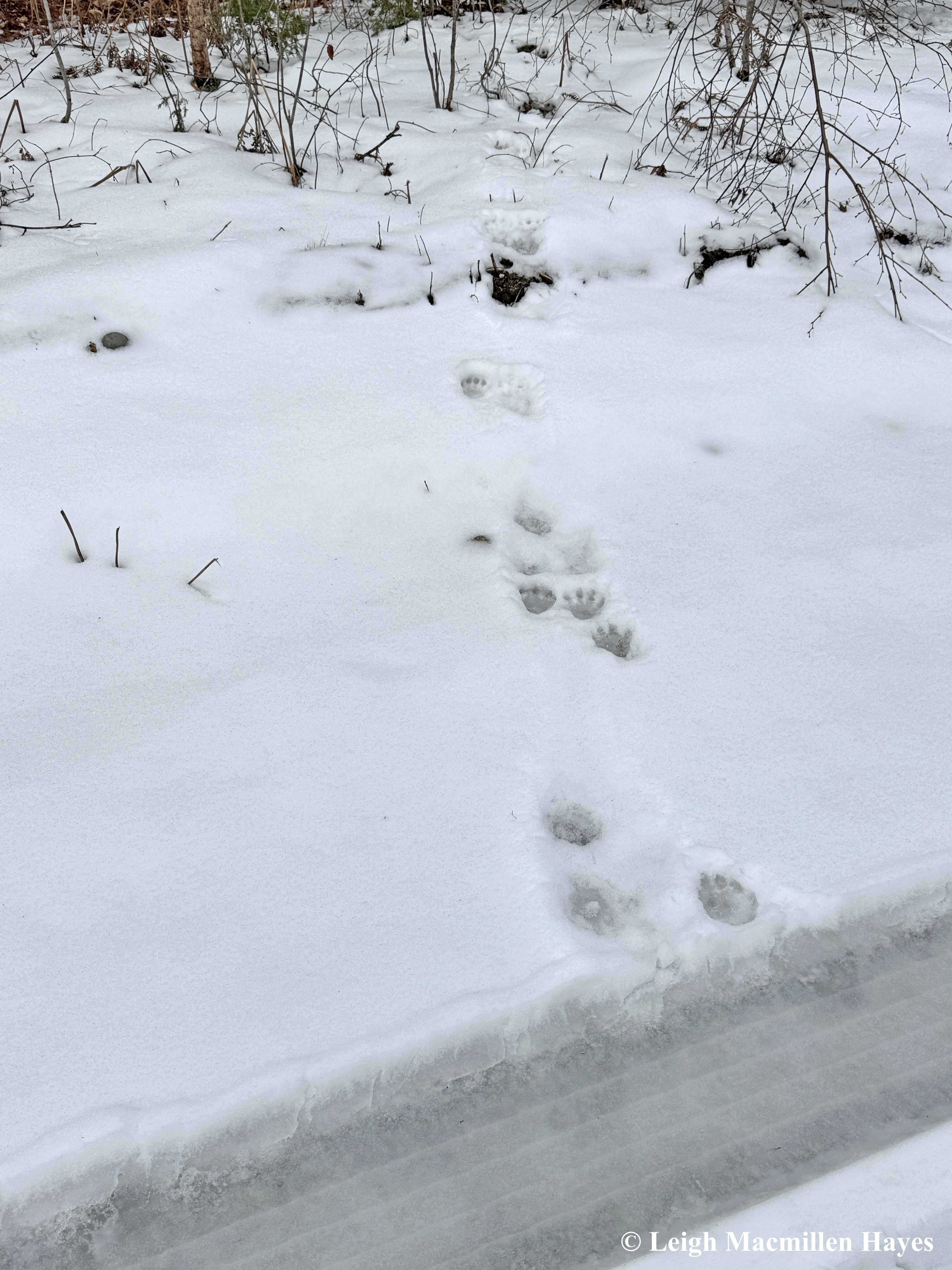
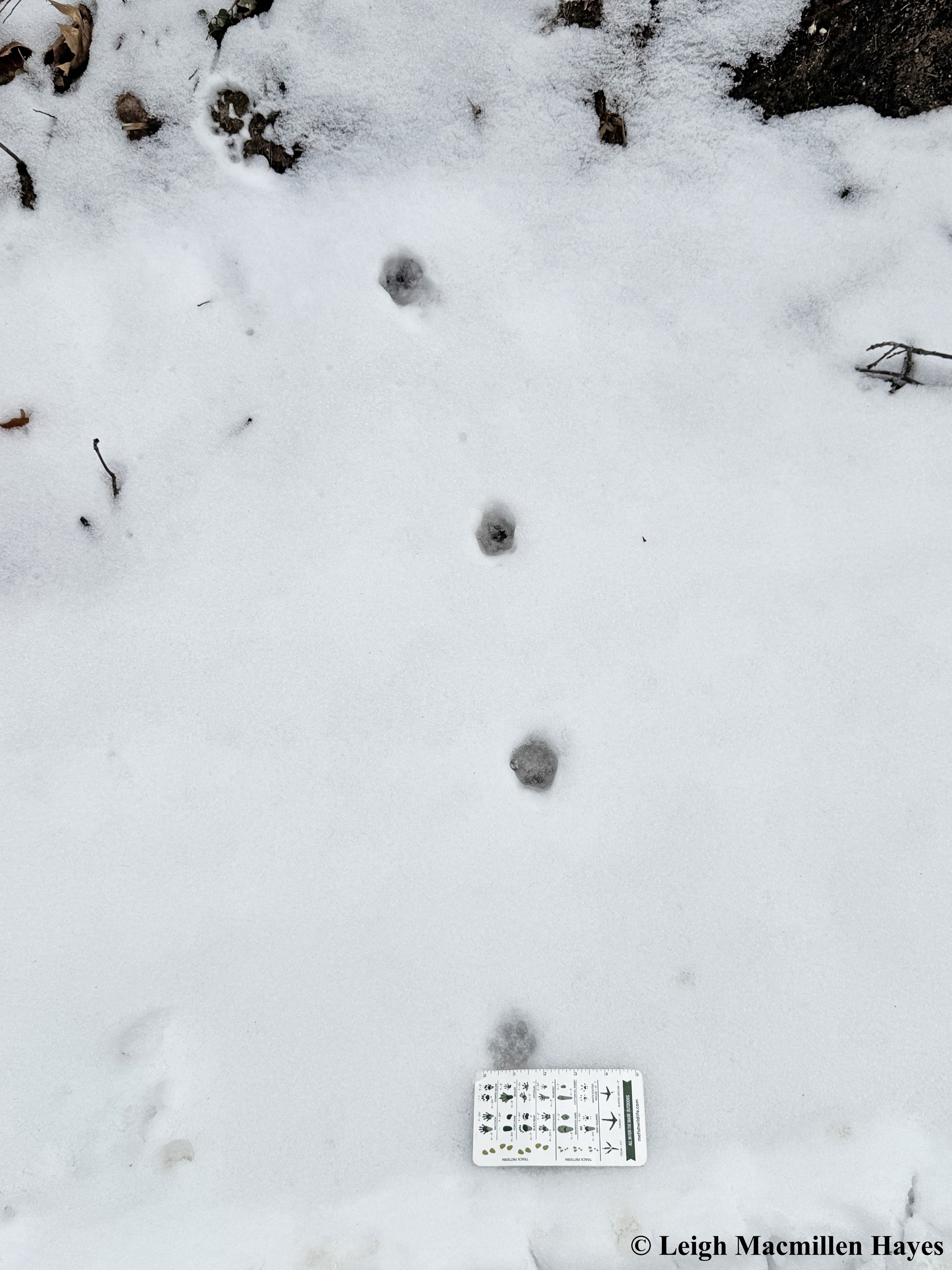
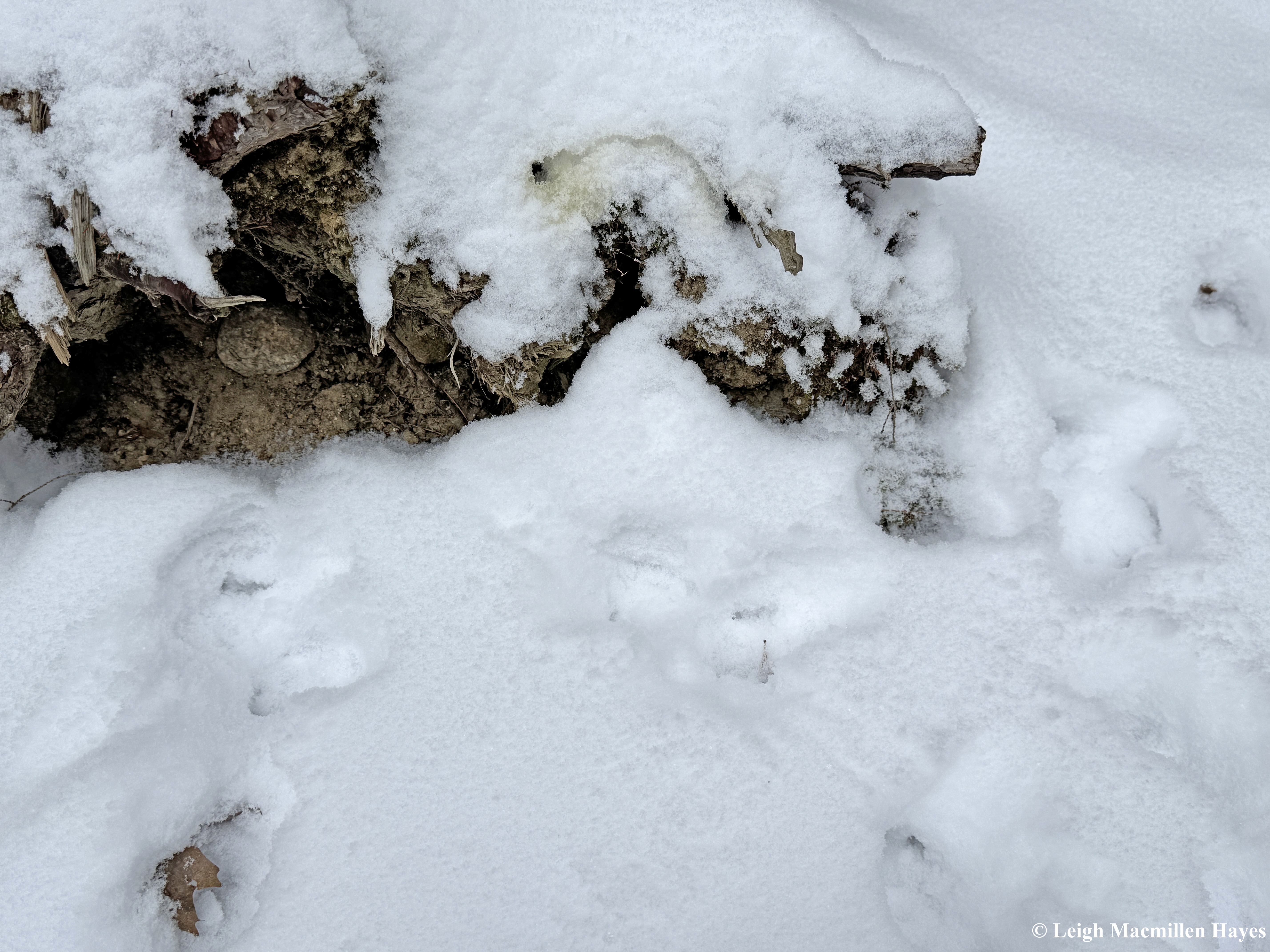
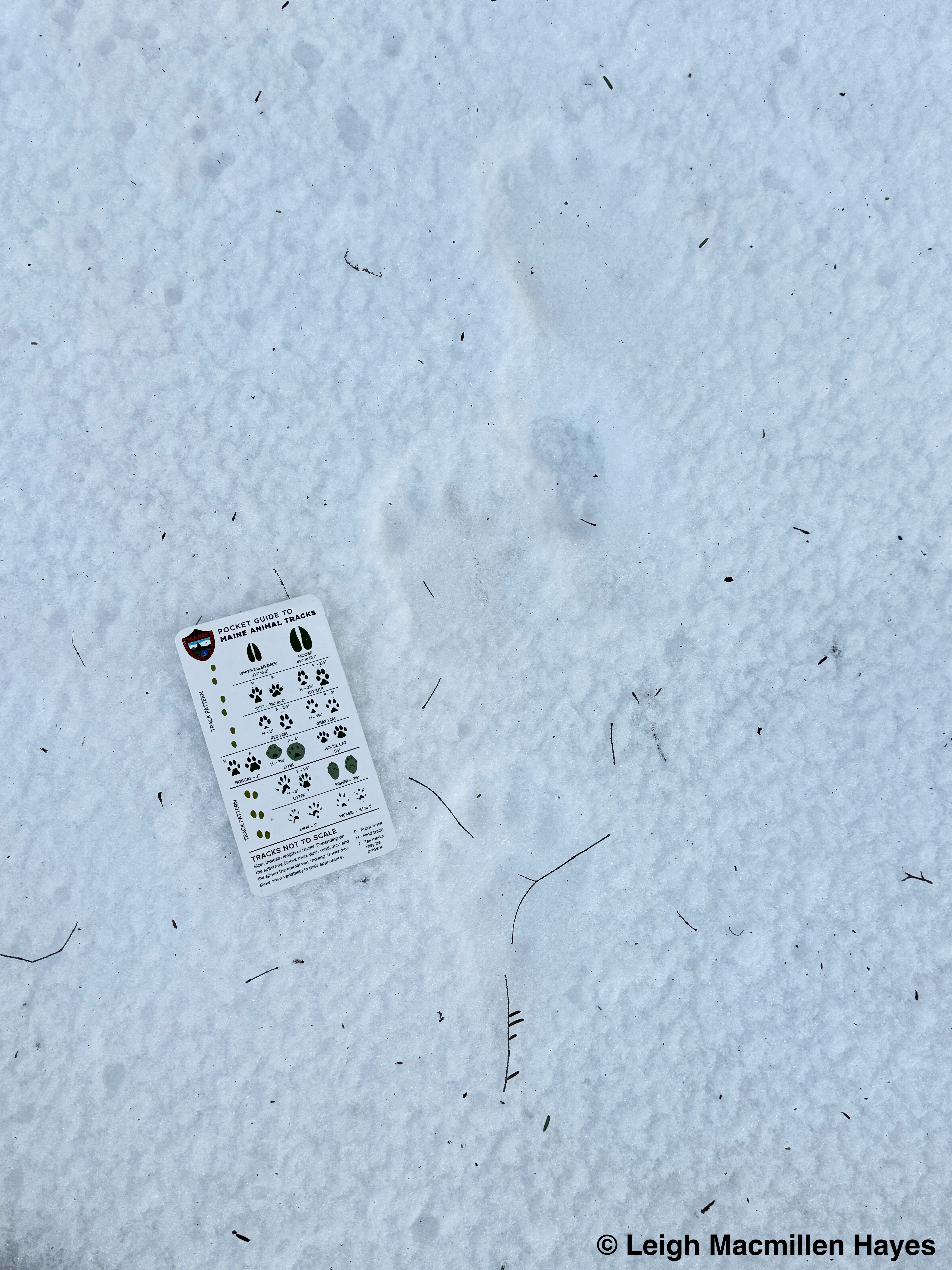
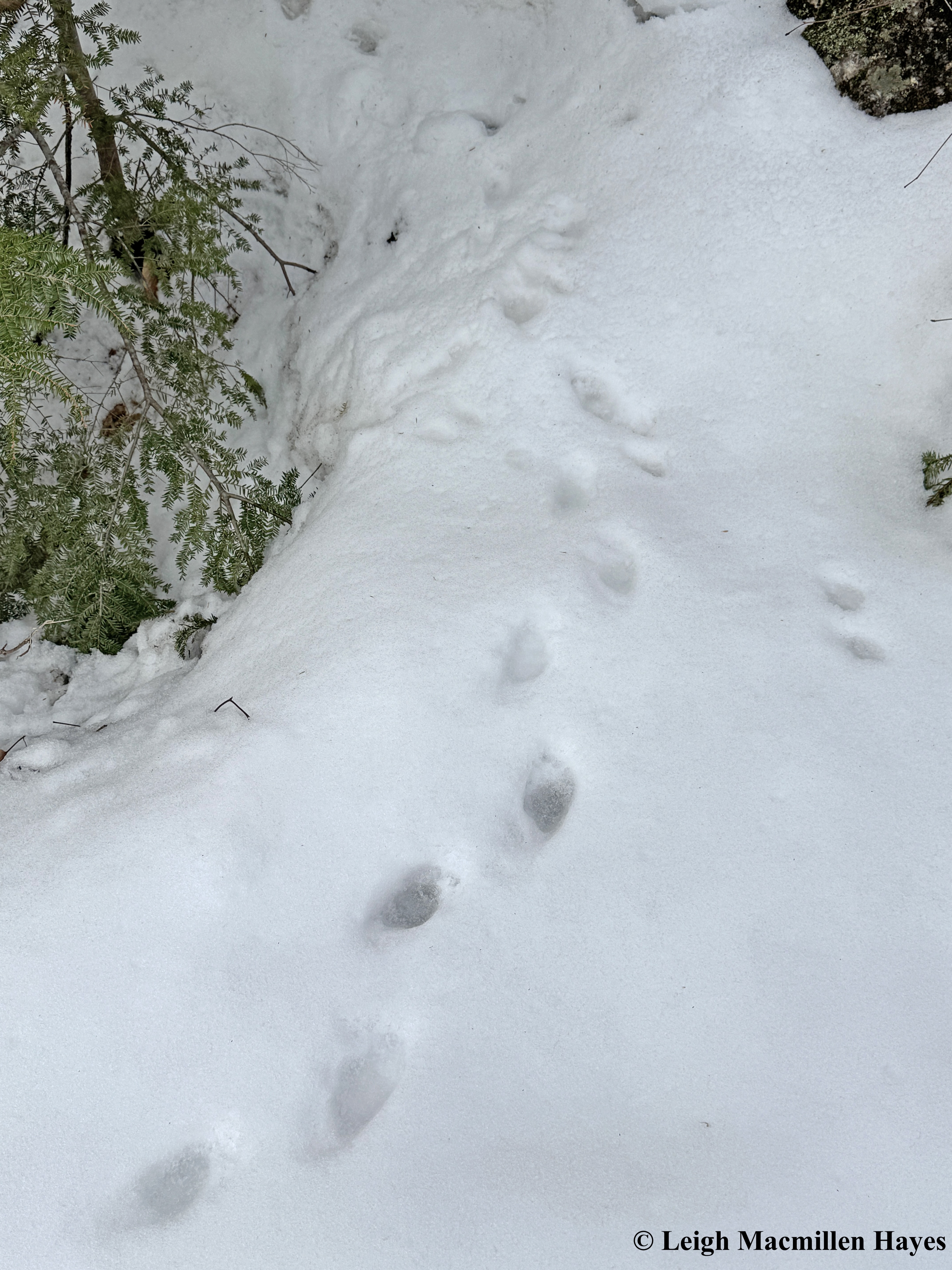
Do you see the diagonal orientation of pairs of prints in the above photos of the second set of tracks? And the five toes–tear-drop shaped as they were?

These prints were much clearer and appeared to have been made Monday.

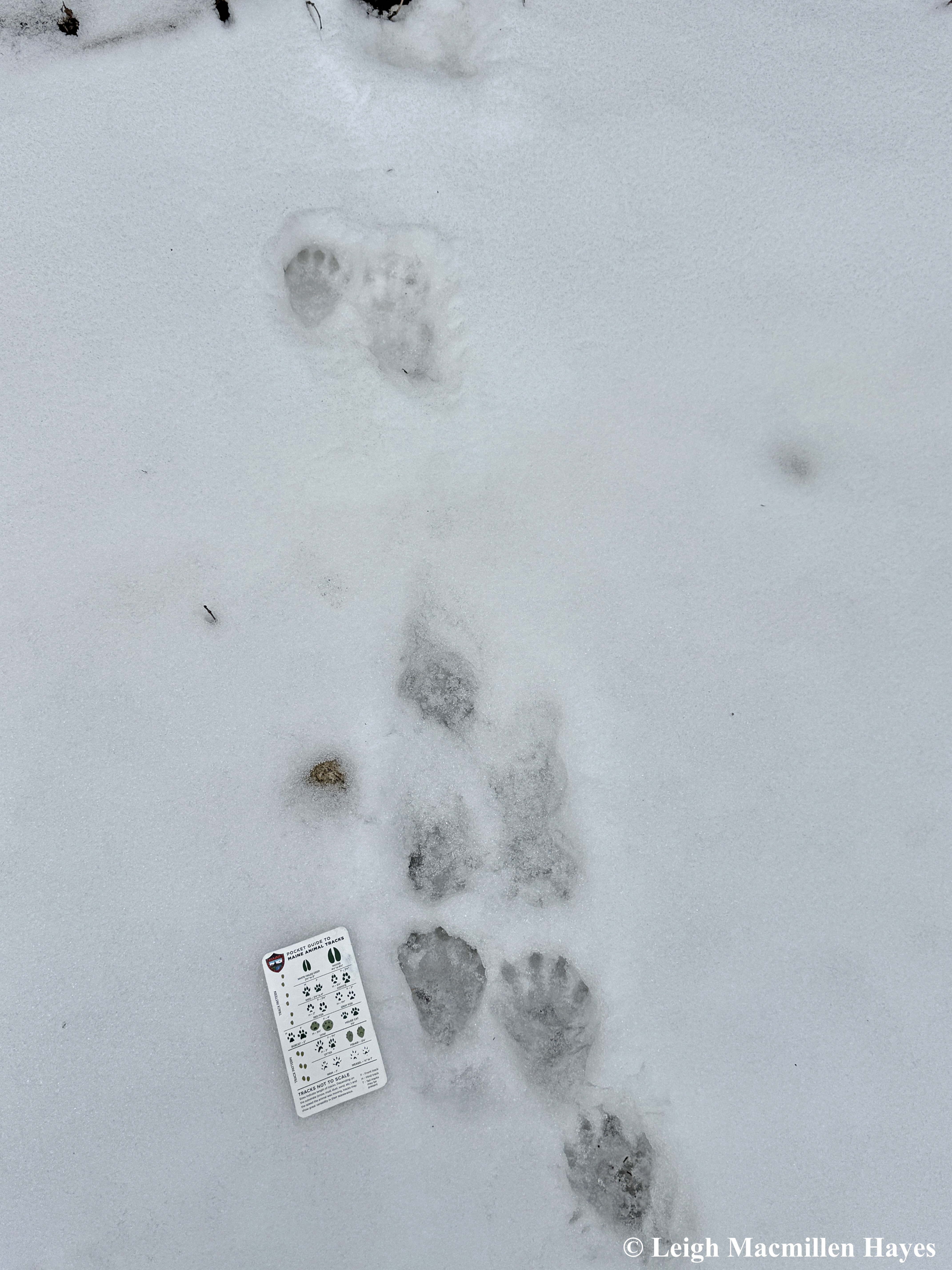
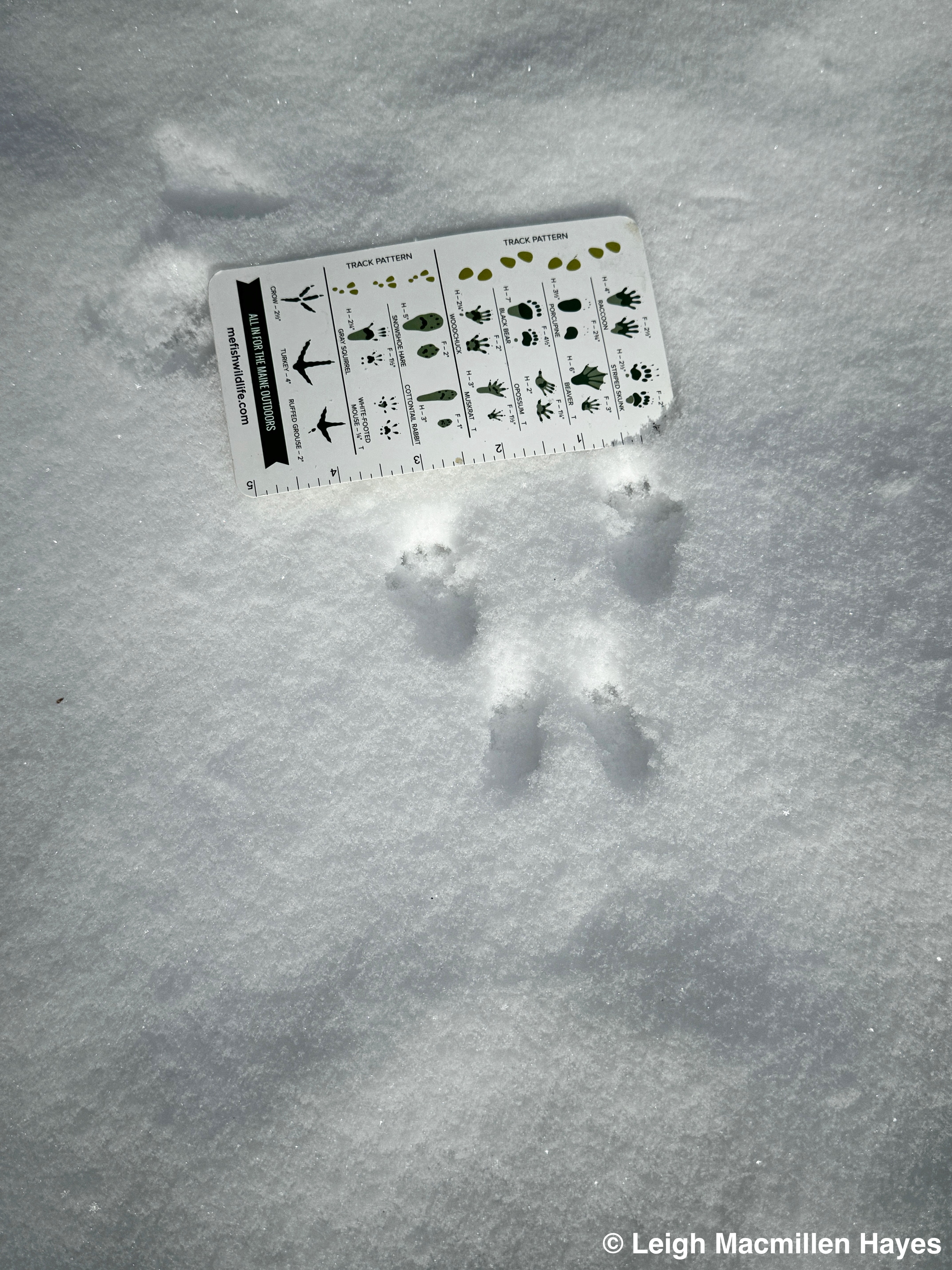
Because I was traveling light, I only had my Maine IF&W card in my pocket to offer a sense of size. But a closer look revealed that this particular trail included the Otter(s) moving in opposite directions, again at different times due to the clarity or non-clarity of the prints.

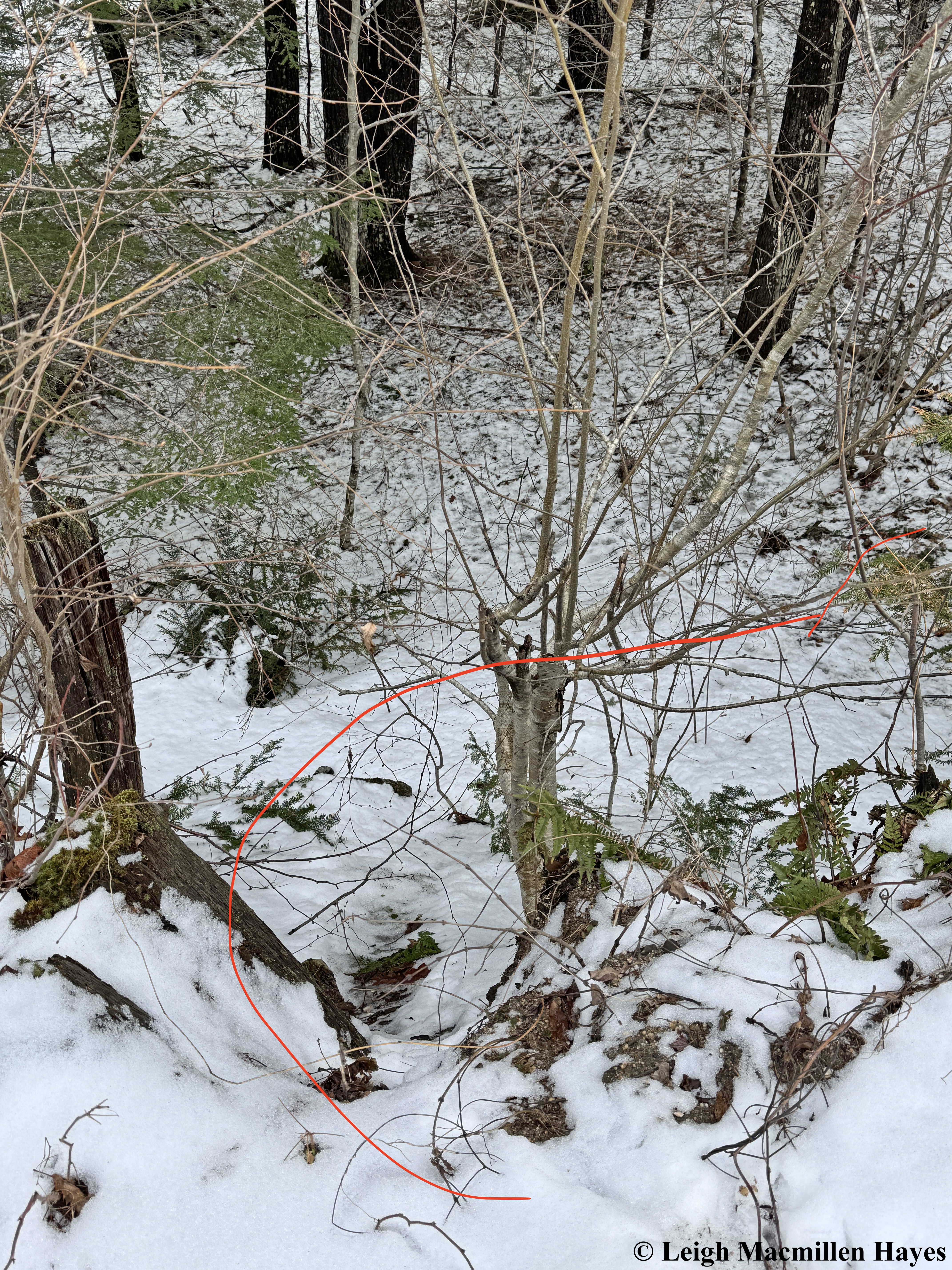
I looked across the road upon which I walked and saw that the bounders had come up and gone down to a stream via a very steep embankment. “Yeehaw!” I could almost hear them shout.

It was a rather circuitous route to the water, but that’s the way of an Otter. Why do straight when you can move in any direction you choose.

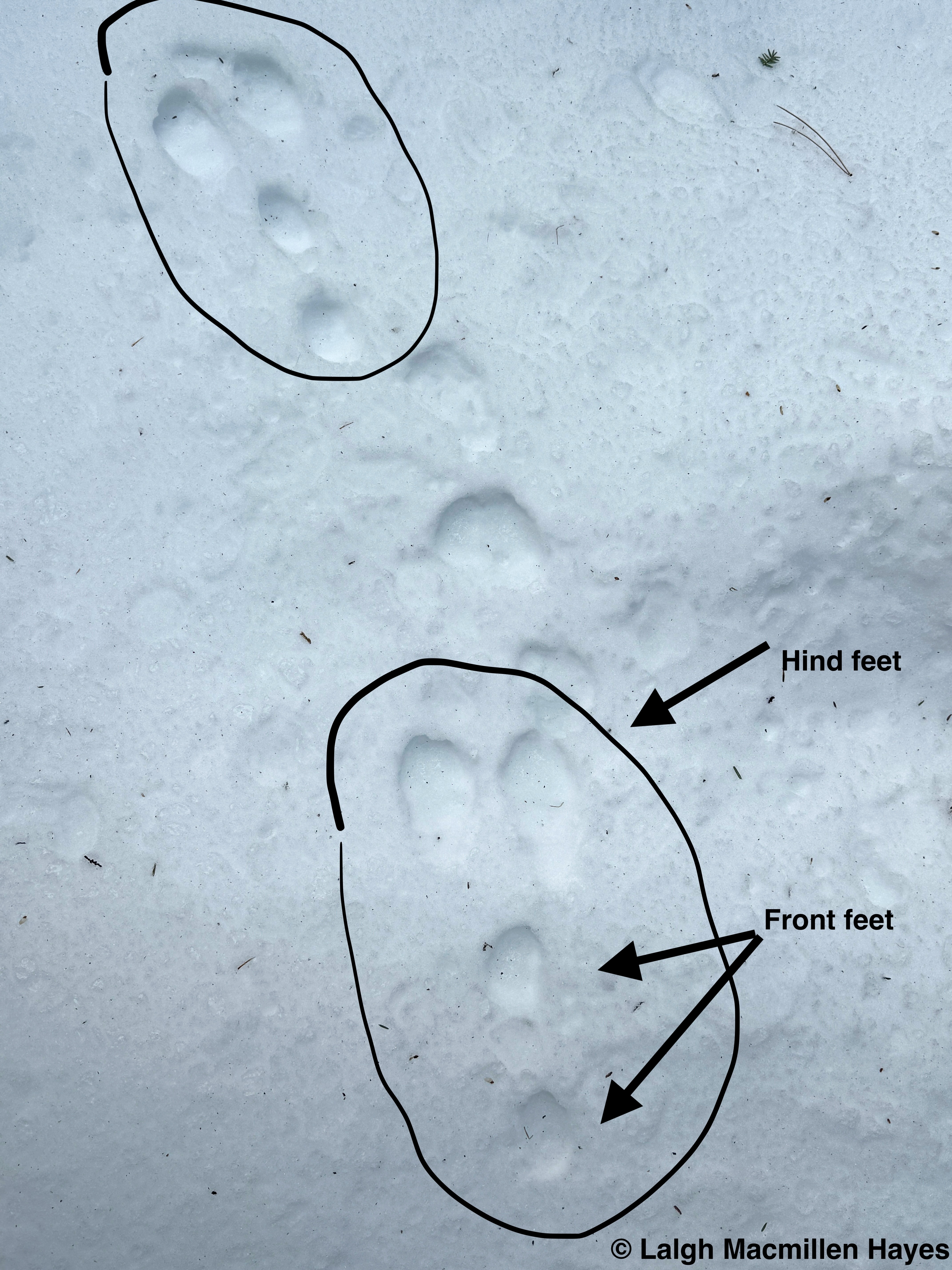
Eventually I moved on, and the next beauty to share a sign of its presence in these woods was a Snow Lobster, aka Snowshoe Hare. Remember, the two feet at the top of the photo are actually the hind feet, while the two behind, that form the lobster tail, are the front feet–as the hind feet swing around the front and land as this hopper leaps forward.

The snow conditions were such that the impressions were rather wide.

But not as wide as those I’d seen the day before. My, what big feet you have–indeed.

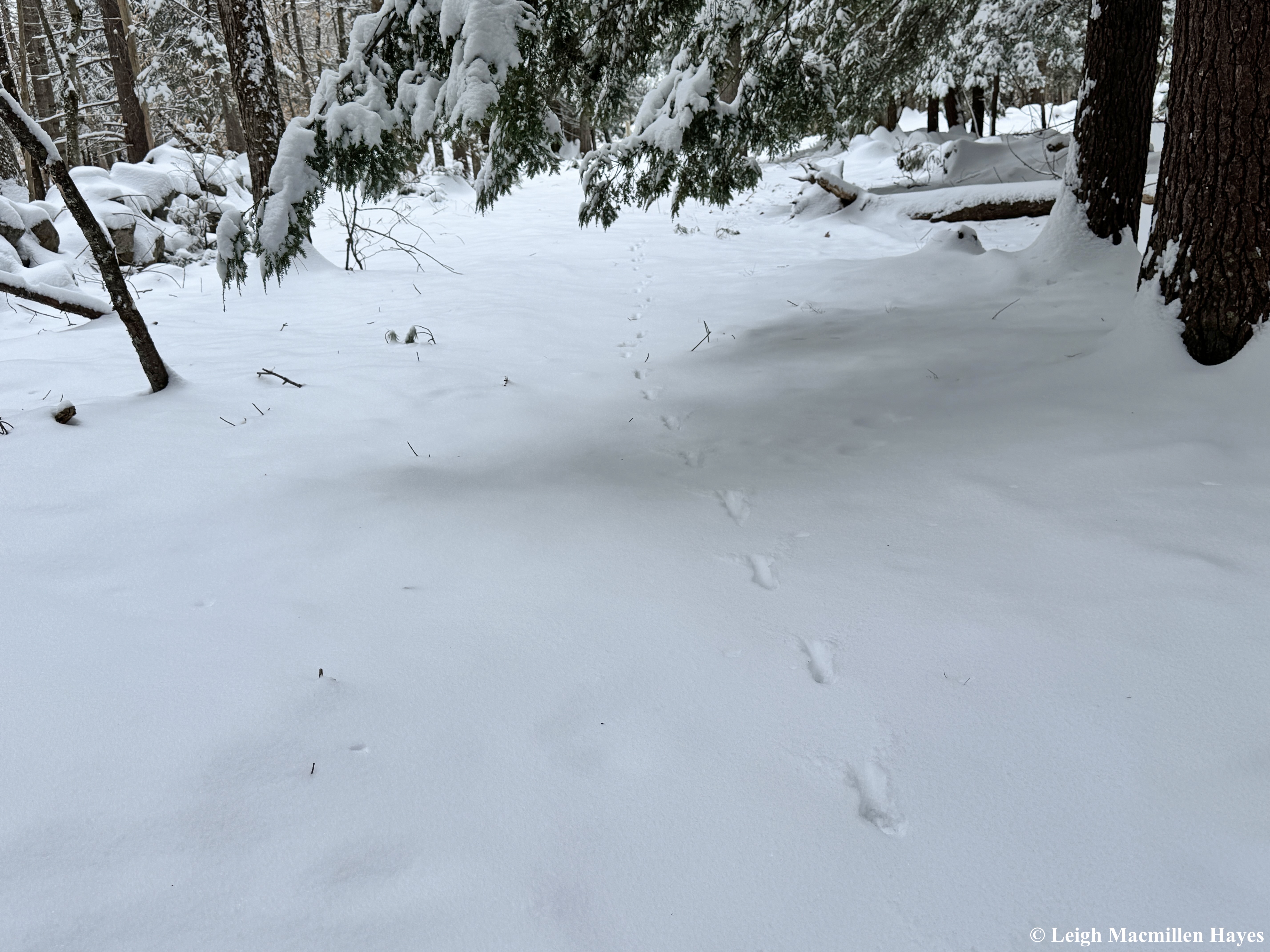
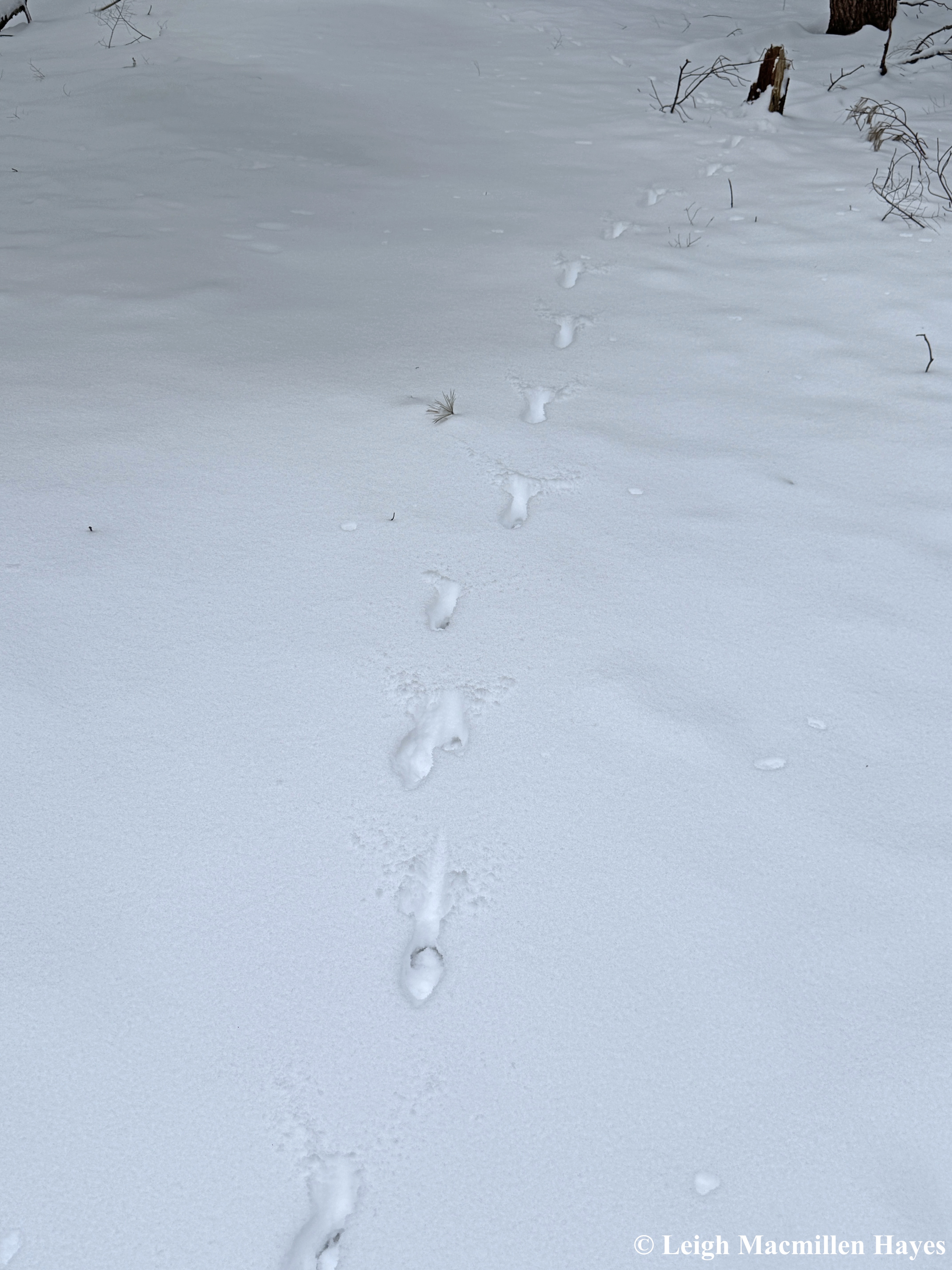
Continuing on, I began to notice the tracks of others who had passed this way, and the first clue to identification was the manner of movement–this being a rather straight line with a hint of a zigzag down the middle of the road. This was the track of a Red Fox.

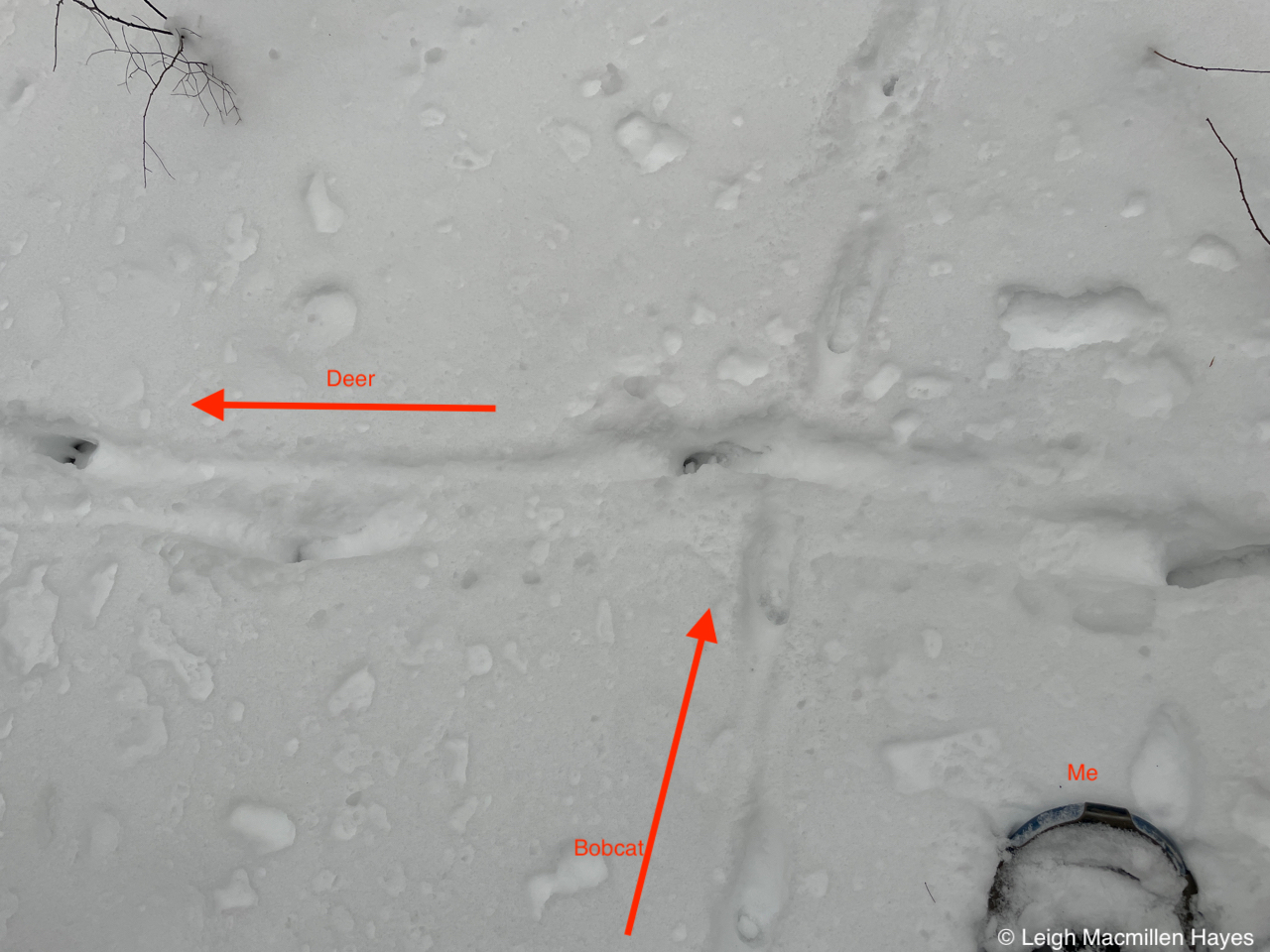
And soon a Bobcat appeared. Well, it didn’t actually appear, but its track did.

Some prints were almost perfect–with a lead toe, much like our middle finger, and the C ridge between toes and heel pad.

That’s not all, There were more sets of prints oriented on the diagonal. Think back to the River Otter, who is in the Weasel family. This small critter is a member of the same family, but these are the prints of a Mink.

By this time I was feeling really rich. Especially since I didn’t expect to find so many different species in this space I walk frequently.

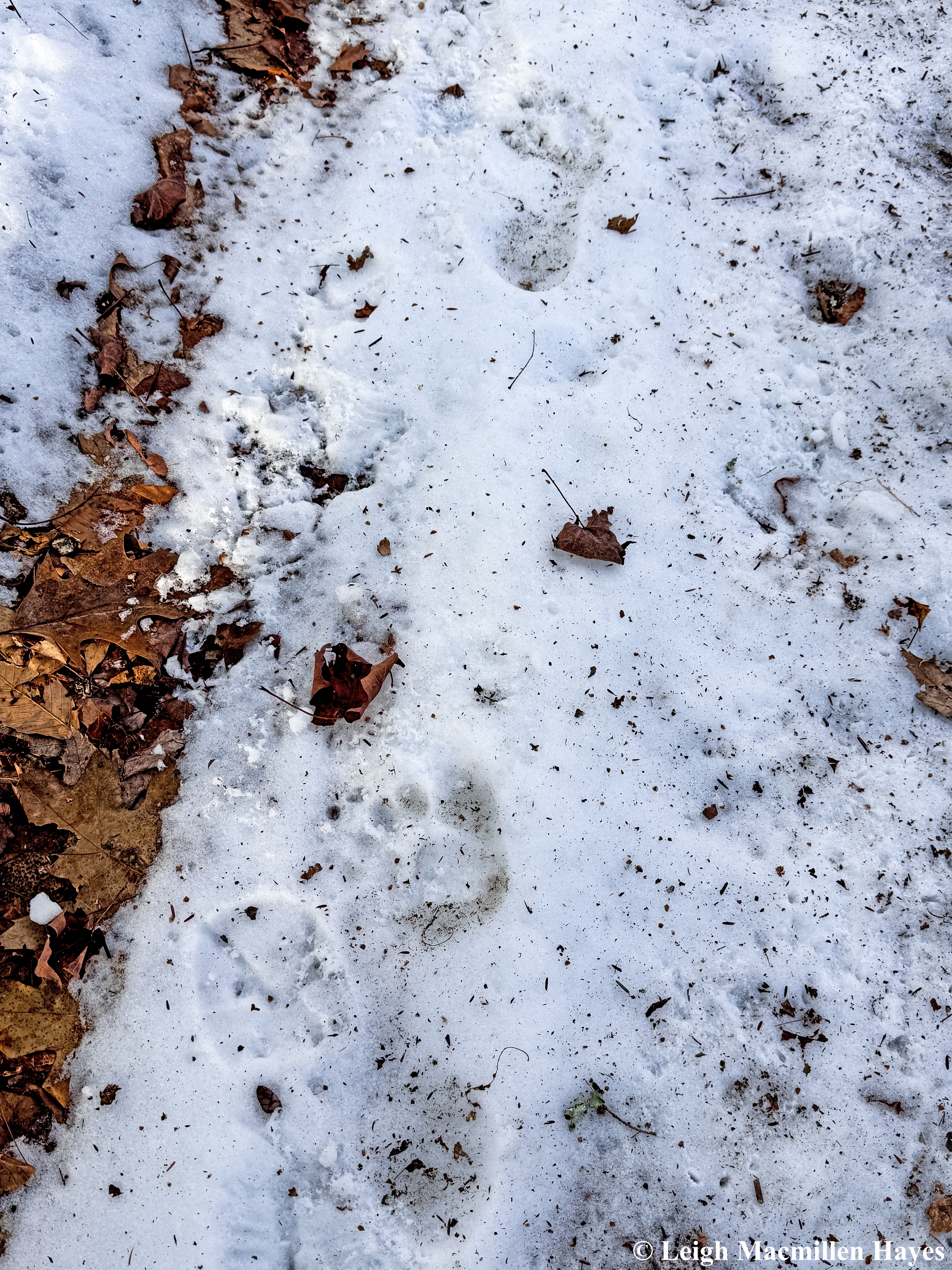
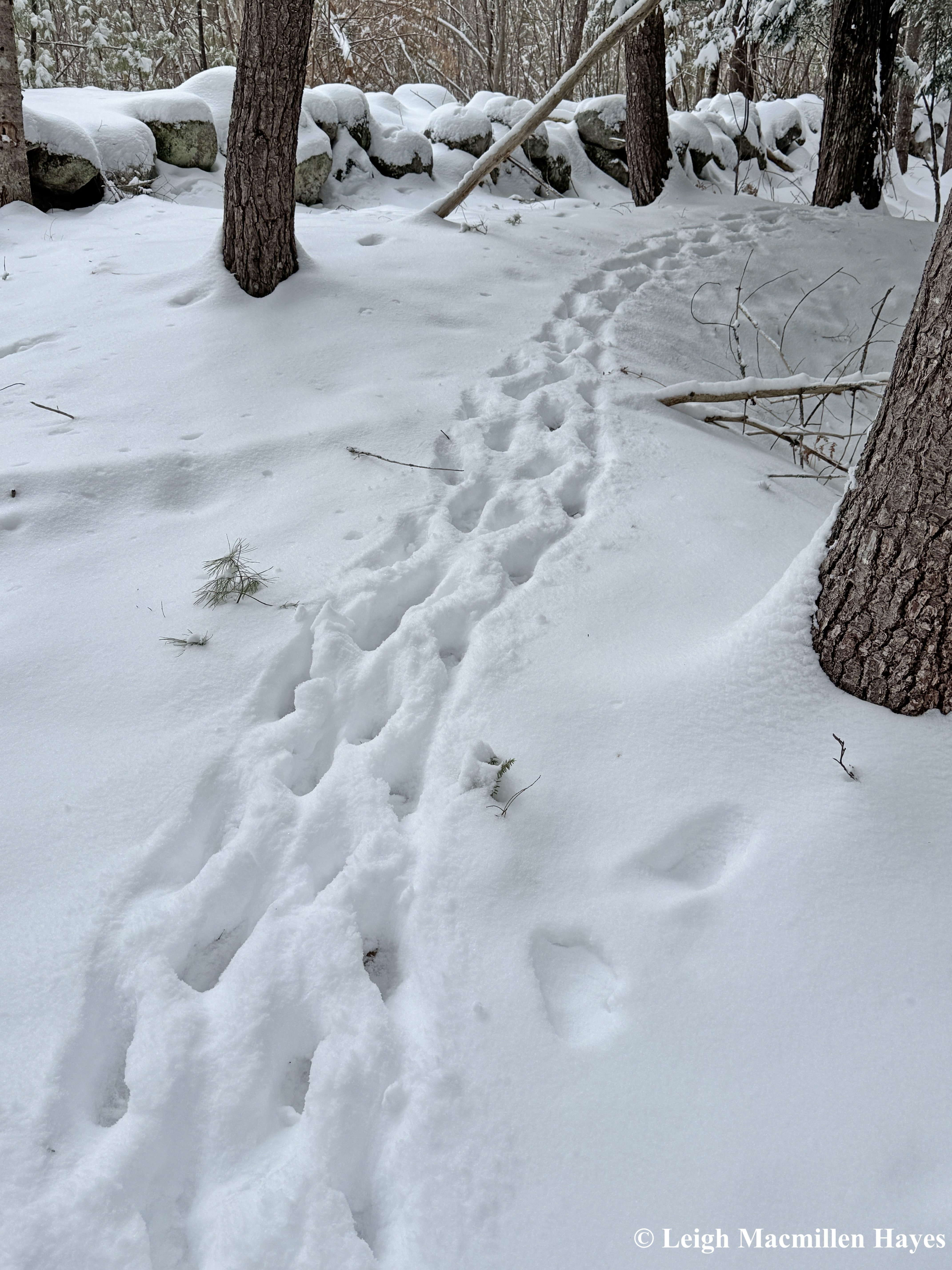
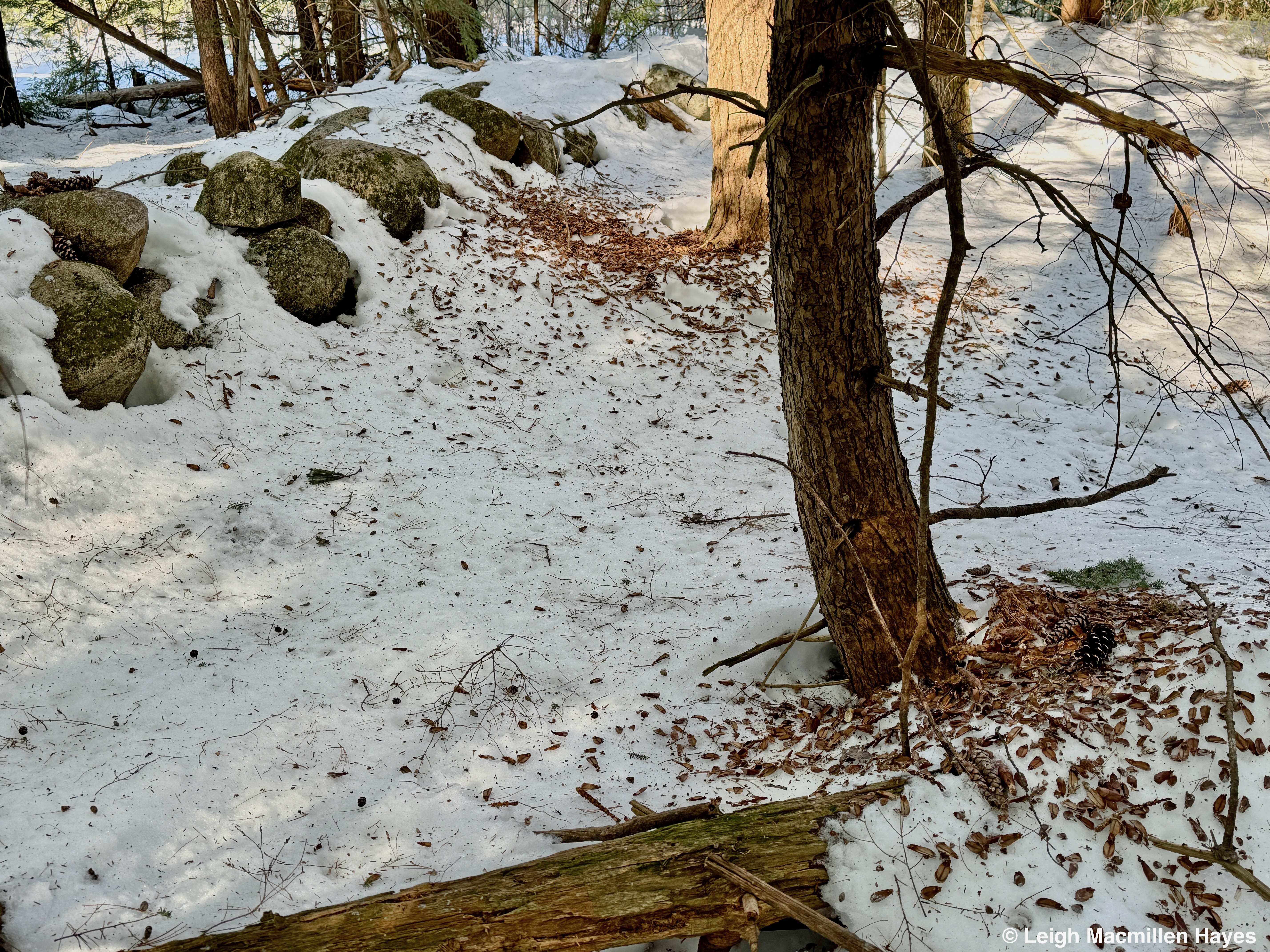
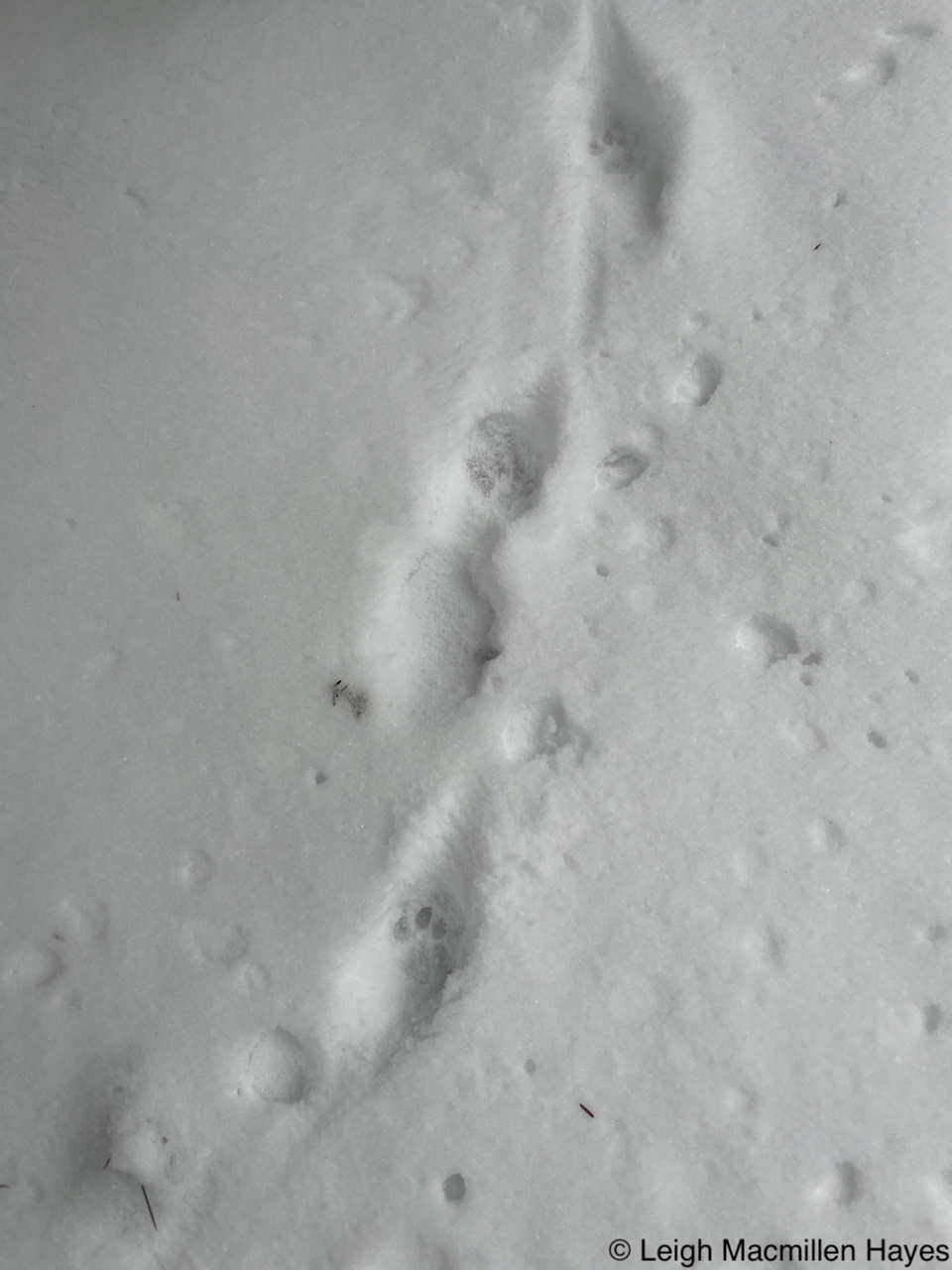
And then I met an old friend, the one and only pigeon-toed Porcupine. Actually, if you look closely at this photo, you might note the Mink bounding over Porky’s path, only actually, I think the Mink passed this way first. And it’s not a known predator of the quilled one.

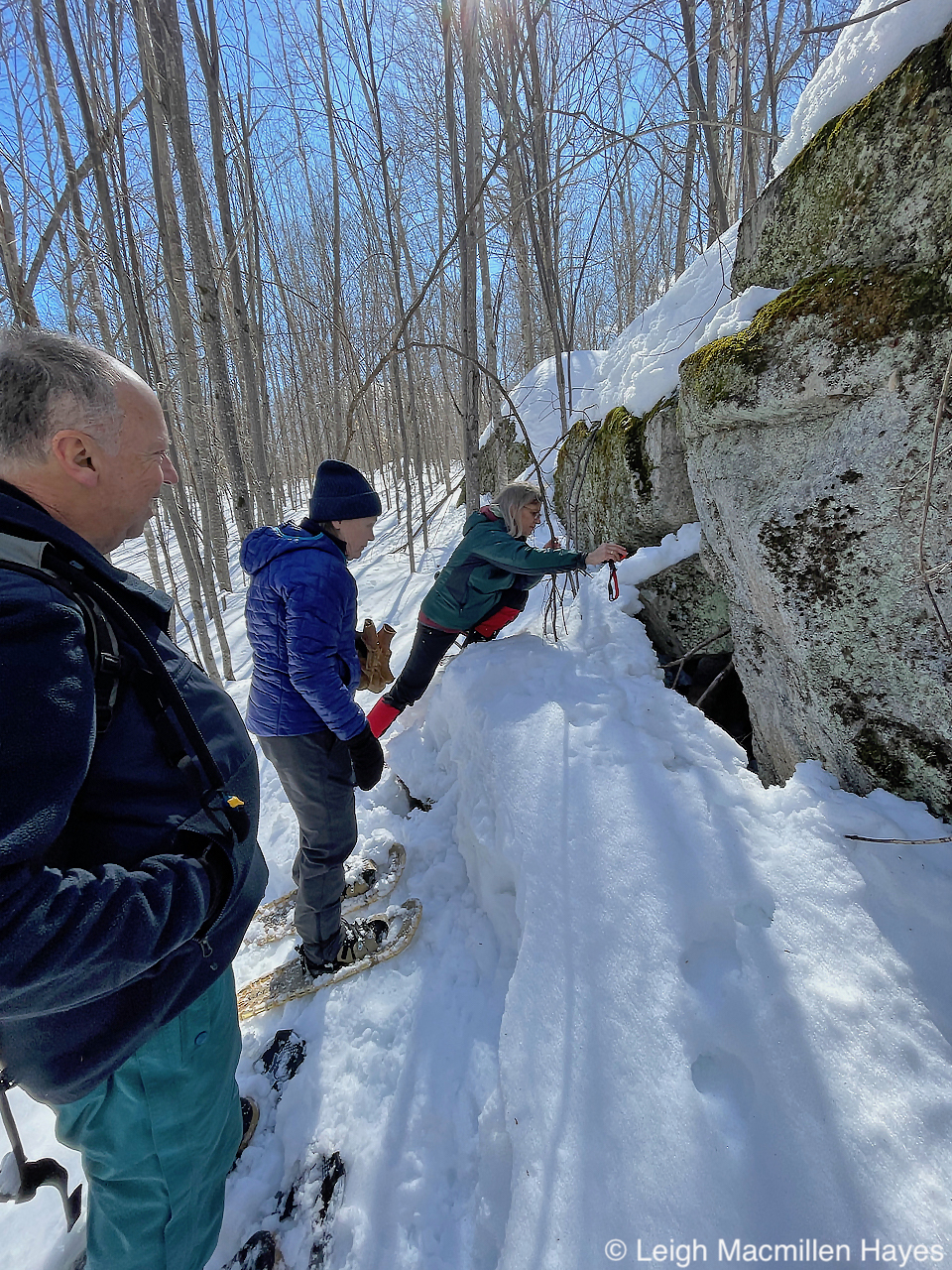
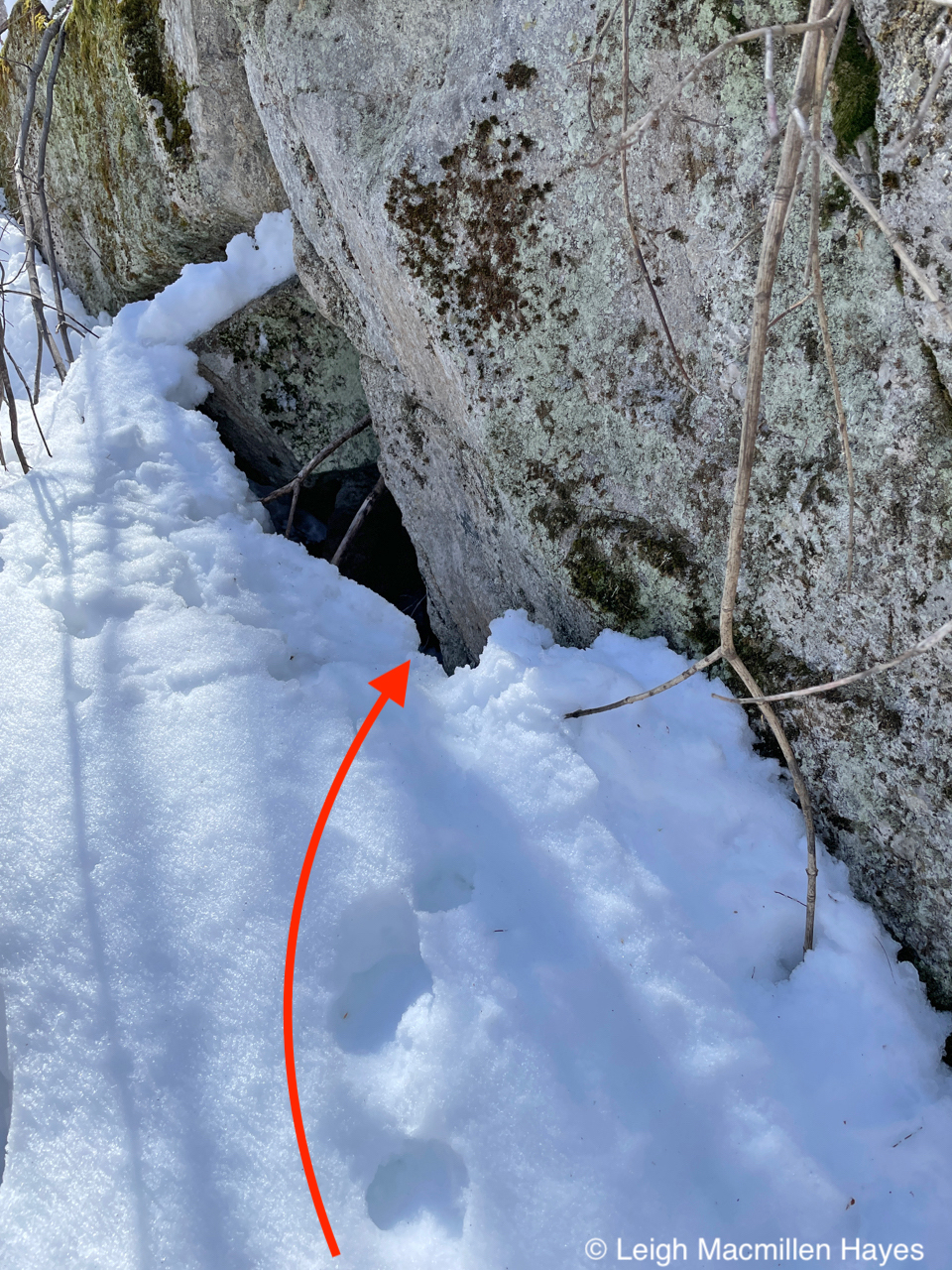
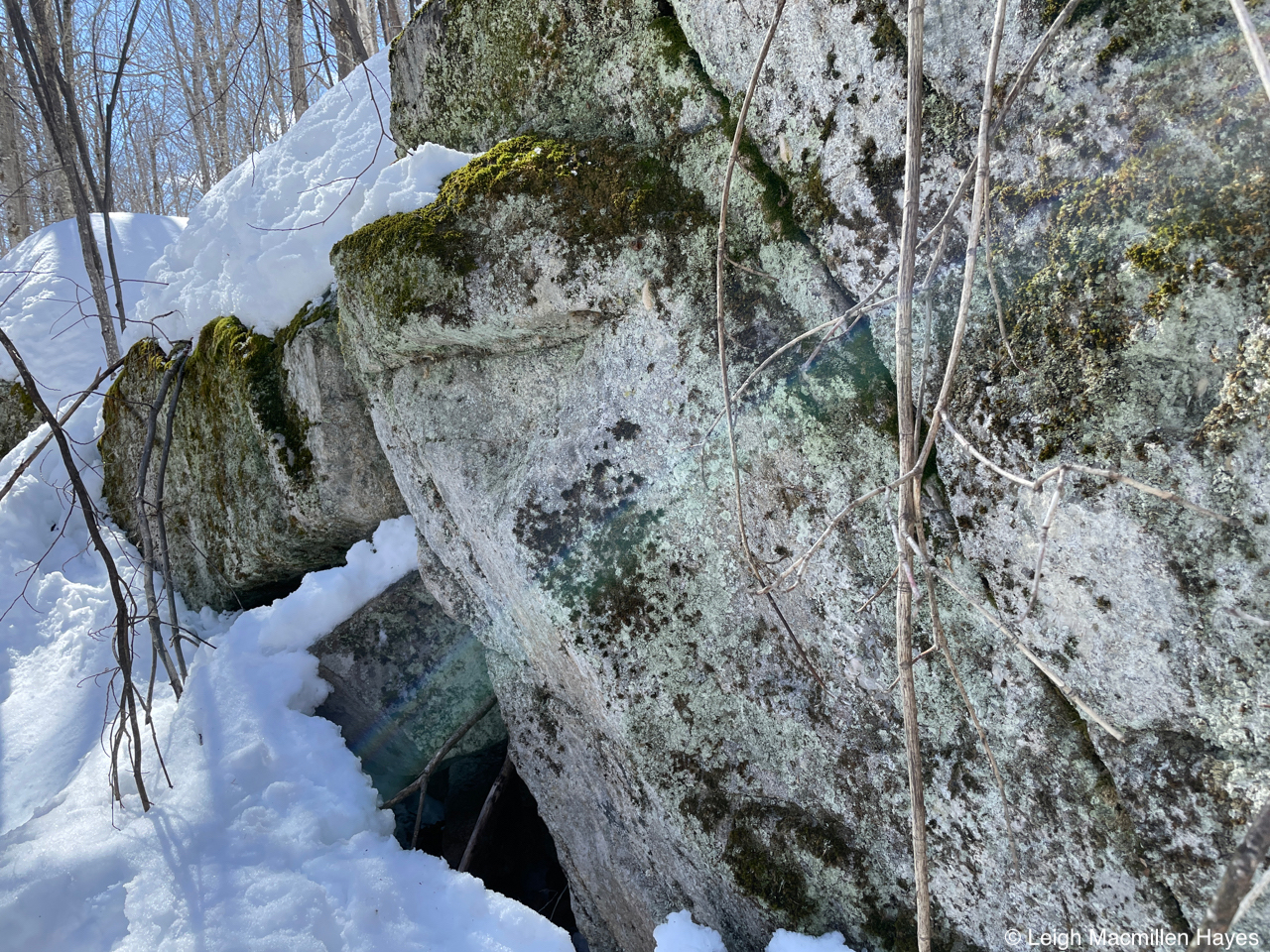
I didn’t venture off trail to locate Porky’s den, but I knew it was among the boulders just beyond where I stood for I could see its tracks moving back and forth between them and suspect there is more than one home site in this locale.

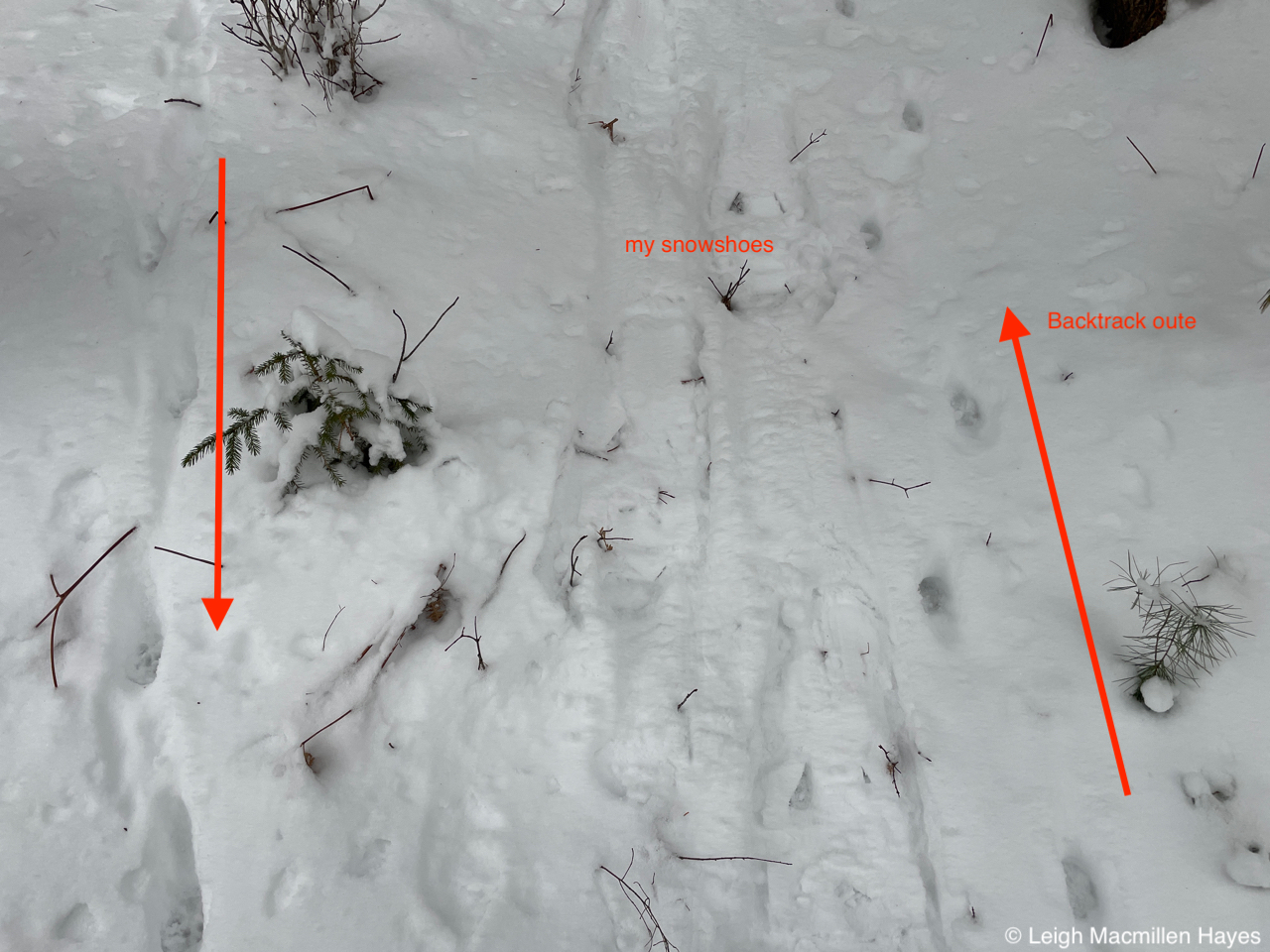
As I moved on, I followed Porky’s path along the road for a while, before he moved off into the woods, toward what I assume to be its feeding site.

That said, you should note another critter also passing this way–another perfect walker, this one being a Coyote.

And then, and then, the creme de la creme:

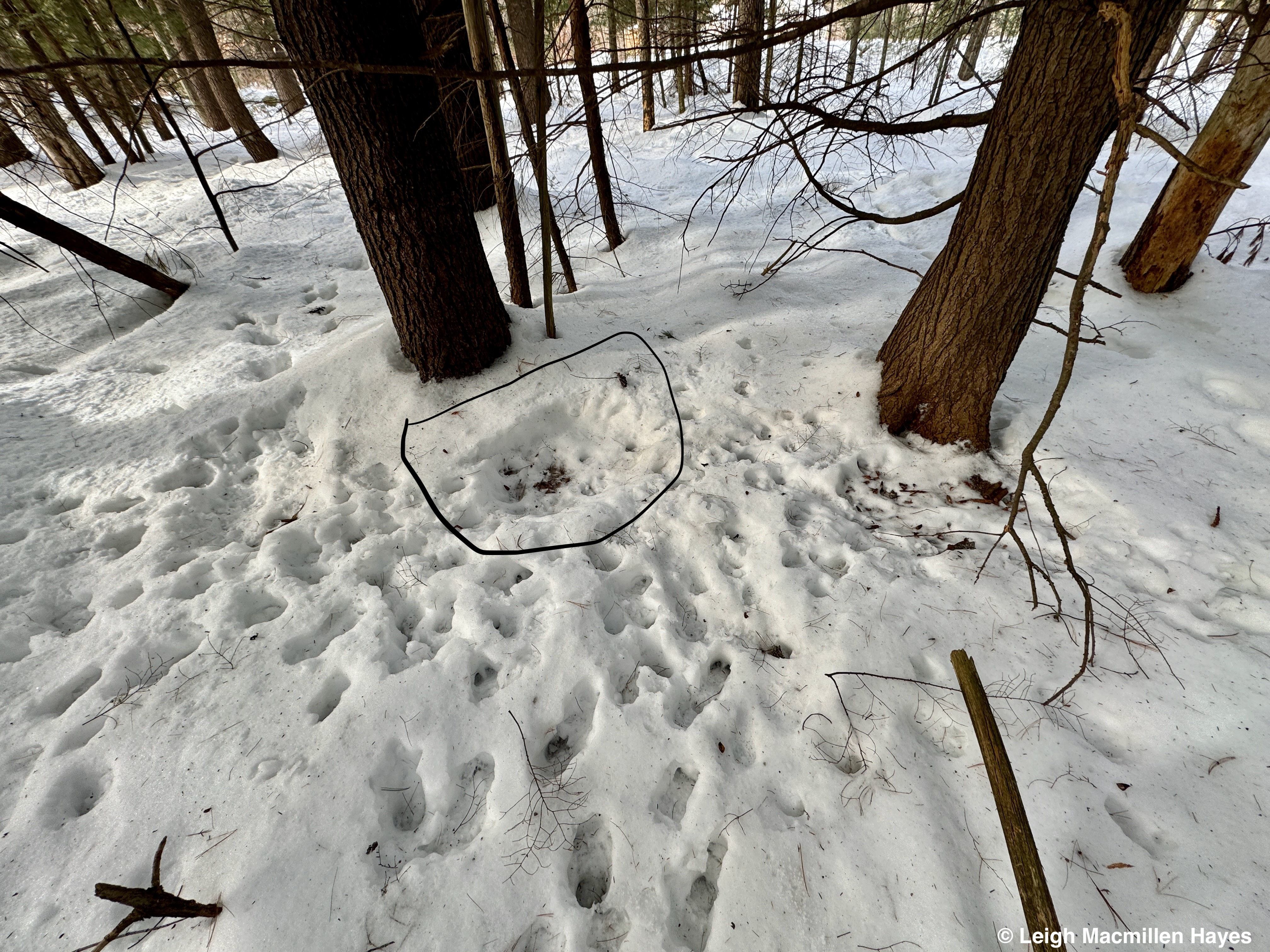
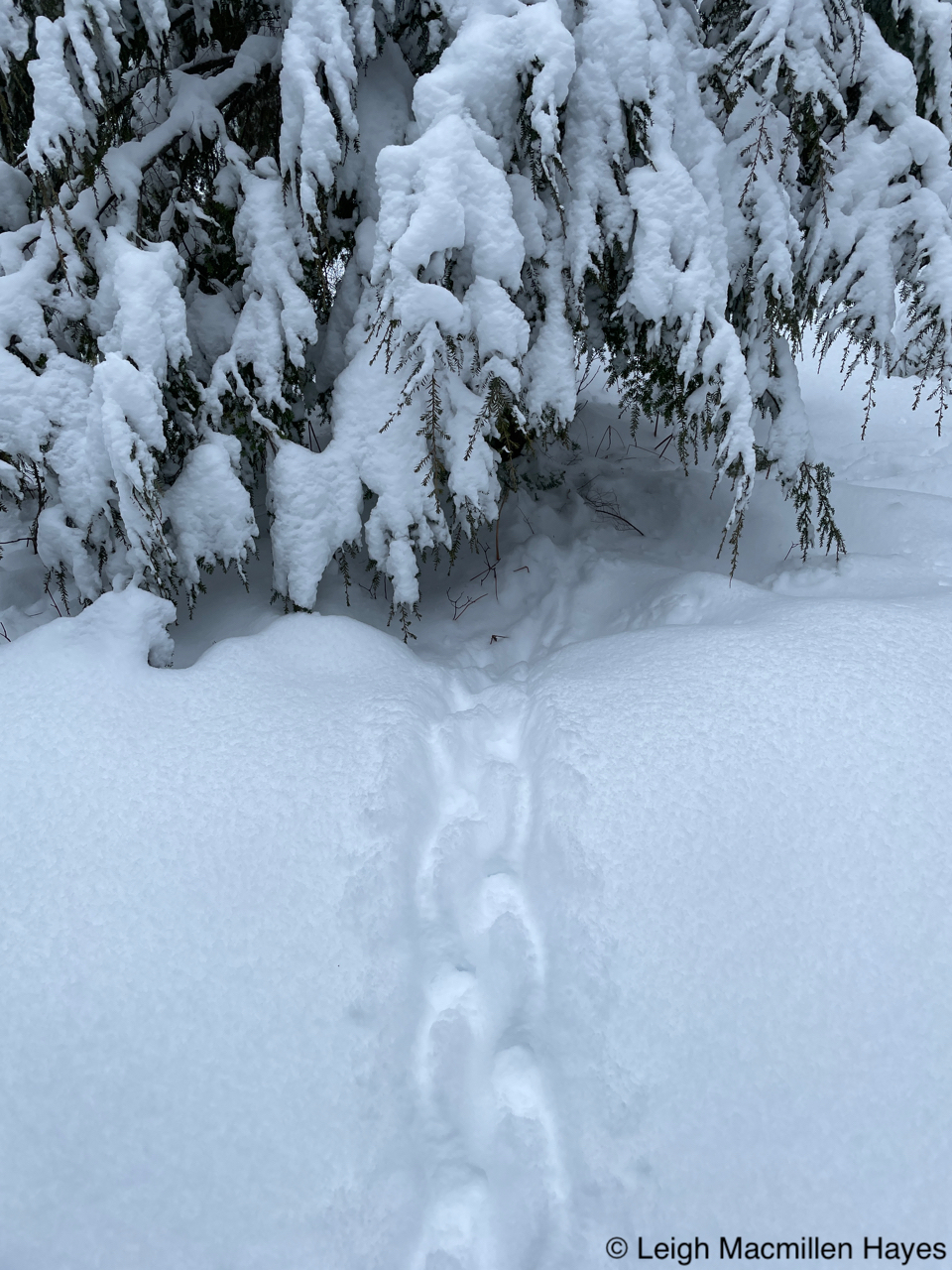
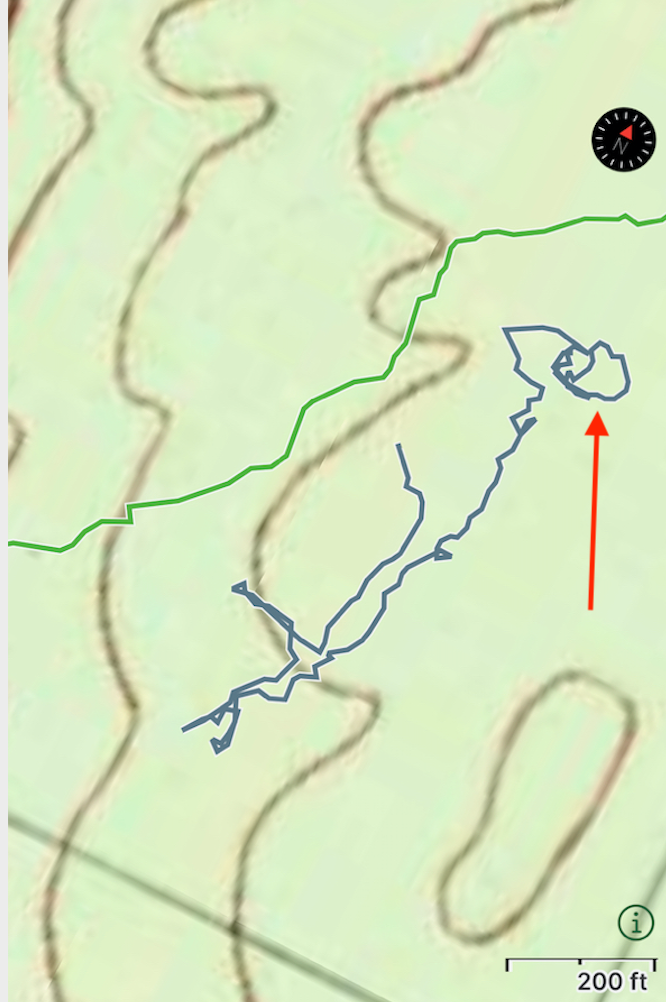
A do-si-do dance, all the moves worked out, with a promenade forward and then a turn around several times until the Porcupine ended back at the spot where it began these fancy steps.

I knew at once what this represented and though I shared this video only a couple of weeks ago, upon seeing the fancy footwork in the snow, I knew exactly how to interpret it.

The video is from my game camera and after you click on the arrow, you can watch the prickly critter do a do-si-do dance before climbing a tree. This is the reaction to a predator in the area.

In both situations, it was the same cast of characters who could serve as a predator: Red Fox, Coyote, and Bobcat. Of all of them, the Bobcat would be of most concern. The largest concern would be a weasel whose tracks I did not spot–a Fisher.

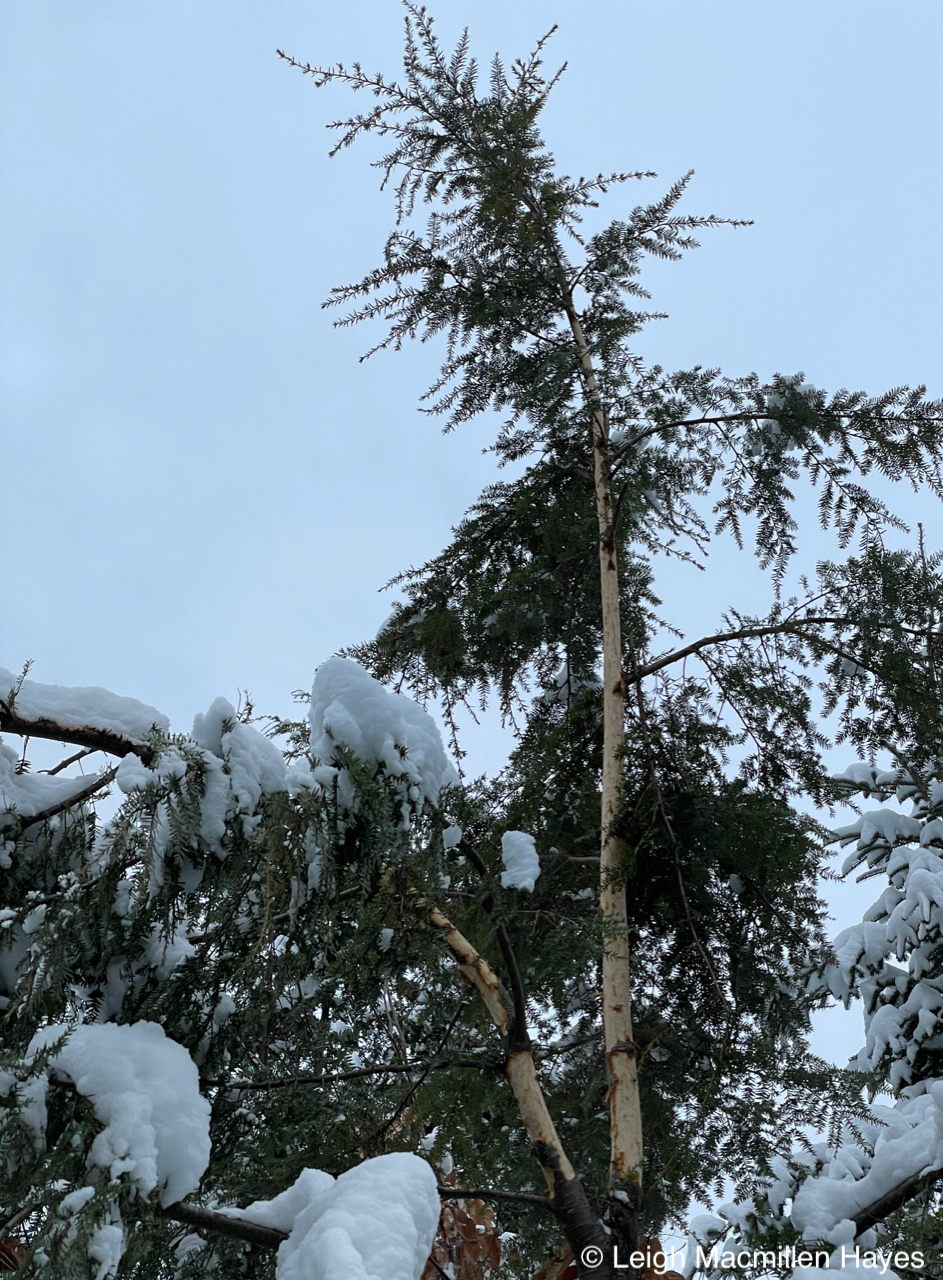
The circular route that my prickly friend took gave it an opportunity to show off the quills on its back–a warning telling others to stay away. For the time being they did.

And I gave great thanks for the opportunity to see signs of so many critters, but especially to decipher the Porcupine dance. Just like that, it all began to make sense.

The Exclamation Point

The crossover from winter to spring is actually emulating the same from autumn to winter with fluctuating temperatures and snow. But still there is so much to see if you can get outside.

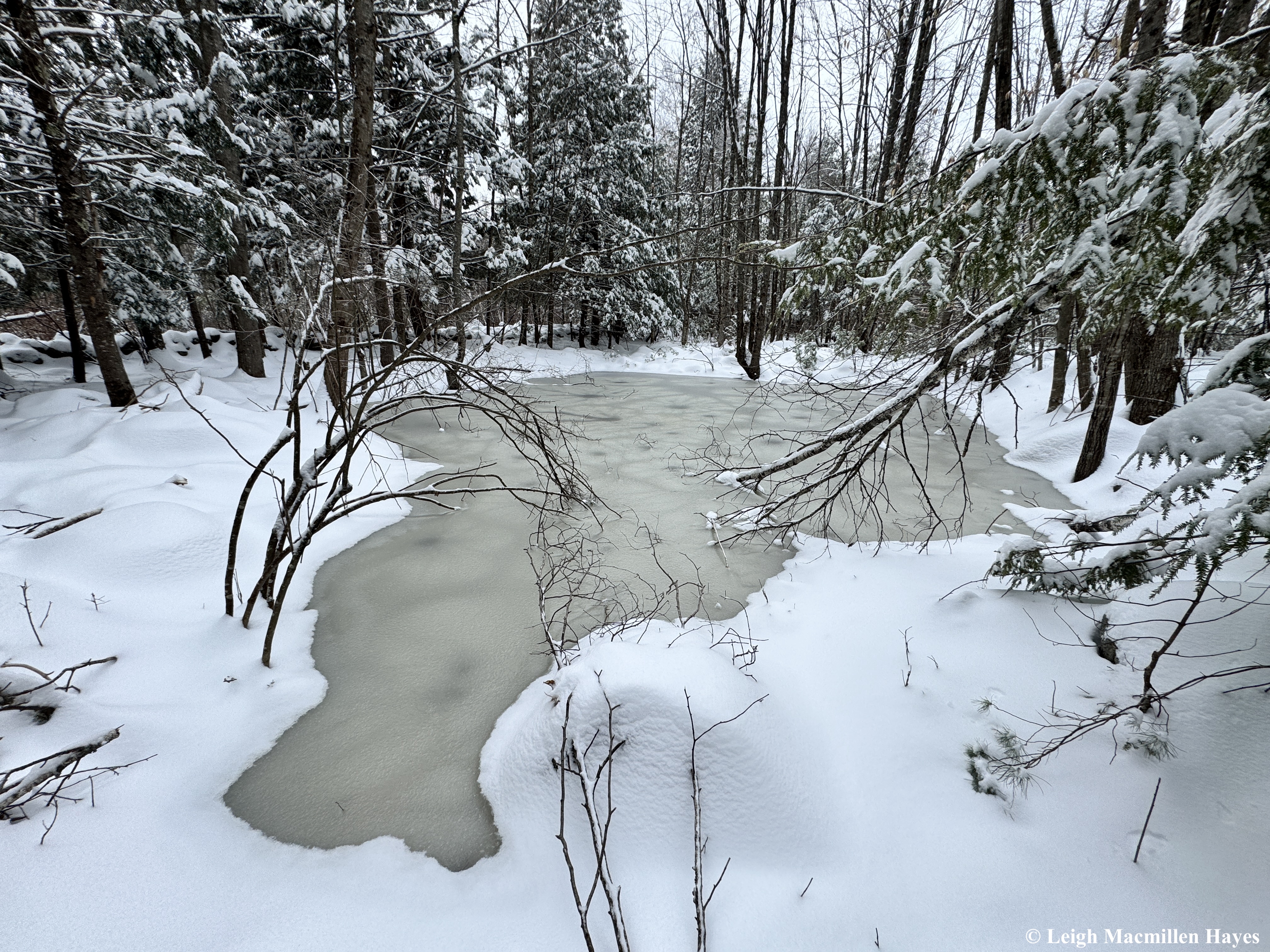
Yesterday, My Guy and I paid a visit to “our”vernal pool (located on a neighbor’s back forty) and noted that it was still ice covered. That said, I know I’ll start making almost daily visits because any time now the ice will begin to melt and tada, the action will start to happen.

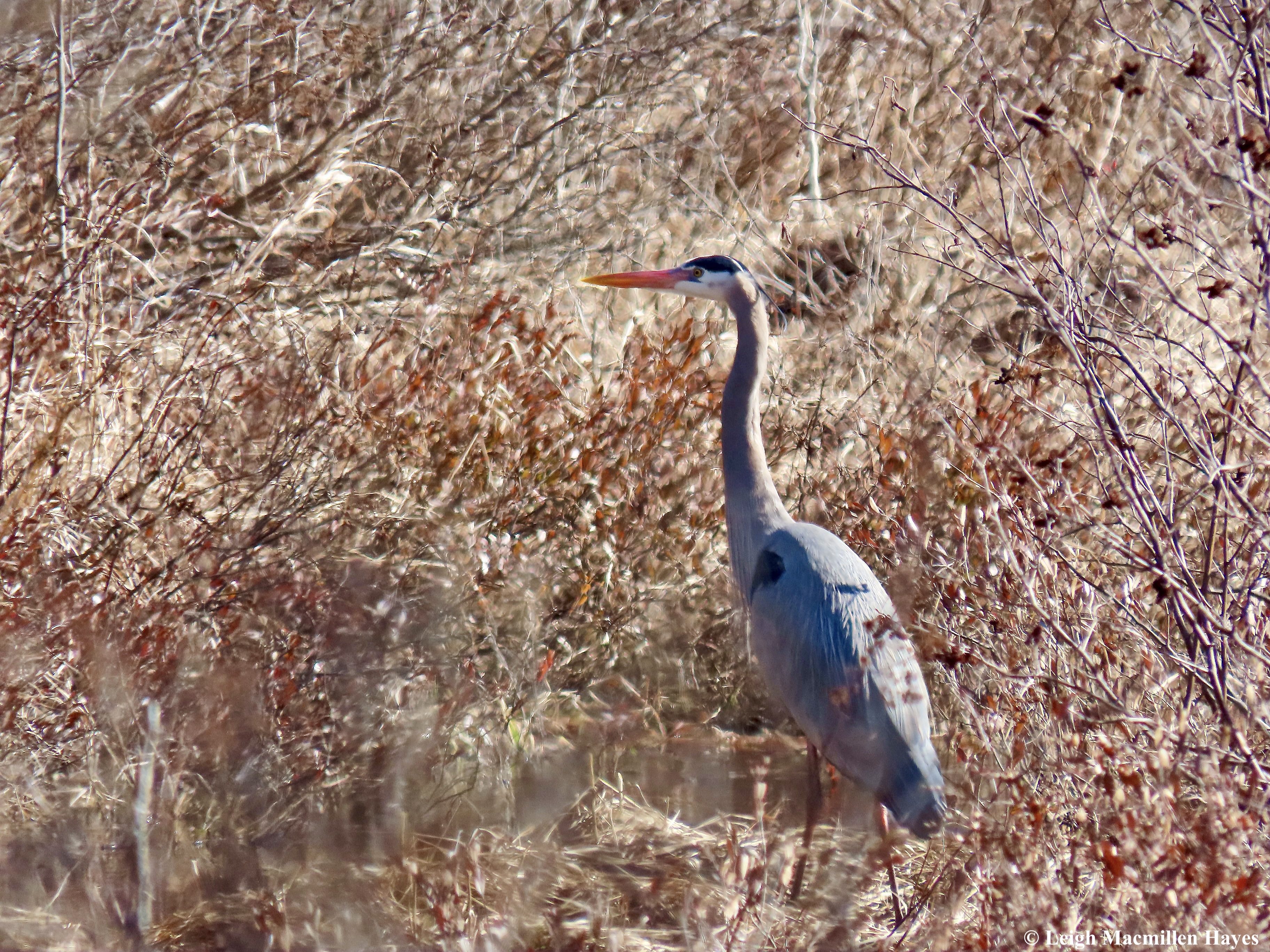
The day before, we’d walked a local trail that still had areas of snow here and there, but were delighted to spot our first Great Blue Heron of 2025, which was apropos as this morning I received an email from the state biologist asking if I’m still willing to monitor three rookeries as I have done for the past 15 years. YES!

And the day before that, while hiking another trail in a different town where there was almost no snow, we had a quick sighting of an Anglewing Butterfly that I couldn’t name to species because it flew off before I could spot the markings on the underside of its wings.

Now those sightings seem like only memories and how could they have possibly occurred given that five inches of snow accumulated quickly yesterday.

But early this morning, the snow turned out to be a tracker’s delight, for fresh tracks showed details providing names for the creators who passed this way.

And so along our cowpath (where cows haven’t walked in years), I followed the Red Fox, wondering where it might lead me.

I knew I should have backtracked it so as not to put pressure on it, but knowing and doing are two different things.

If I had backtracked it, I might have discovered the source of its scat left in such a location beside a tree stump, that I thought it was a boundary marker the Fox had deposited.

And it may well have been, but I suspect there was other important information given off by the scat such as the fox’s gender, age, and health, for a few steps later it left a sign and scent of its availability in the form of skunky-smelling pee. I thought mating season had come to an end, but apparently I thought wrong and the fox knows best.

We stayed together for a bit, though there were a few downed trees I chose to walk over or around, rather than under like the fox did. When it reached the stonewall between our land and the neighbor’s field, I decided to turn around and head toward the vernal pool instead to perform my daily check.

The transformation from yesterday to today should not have amazed me–My Guy and I walked in sleet and then snow yesterday, but still . . . the vernal pool seemed like a whole other place–almost like December 25th rather than March 25th.

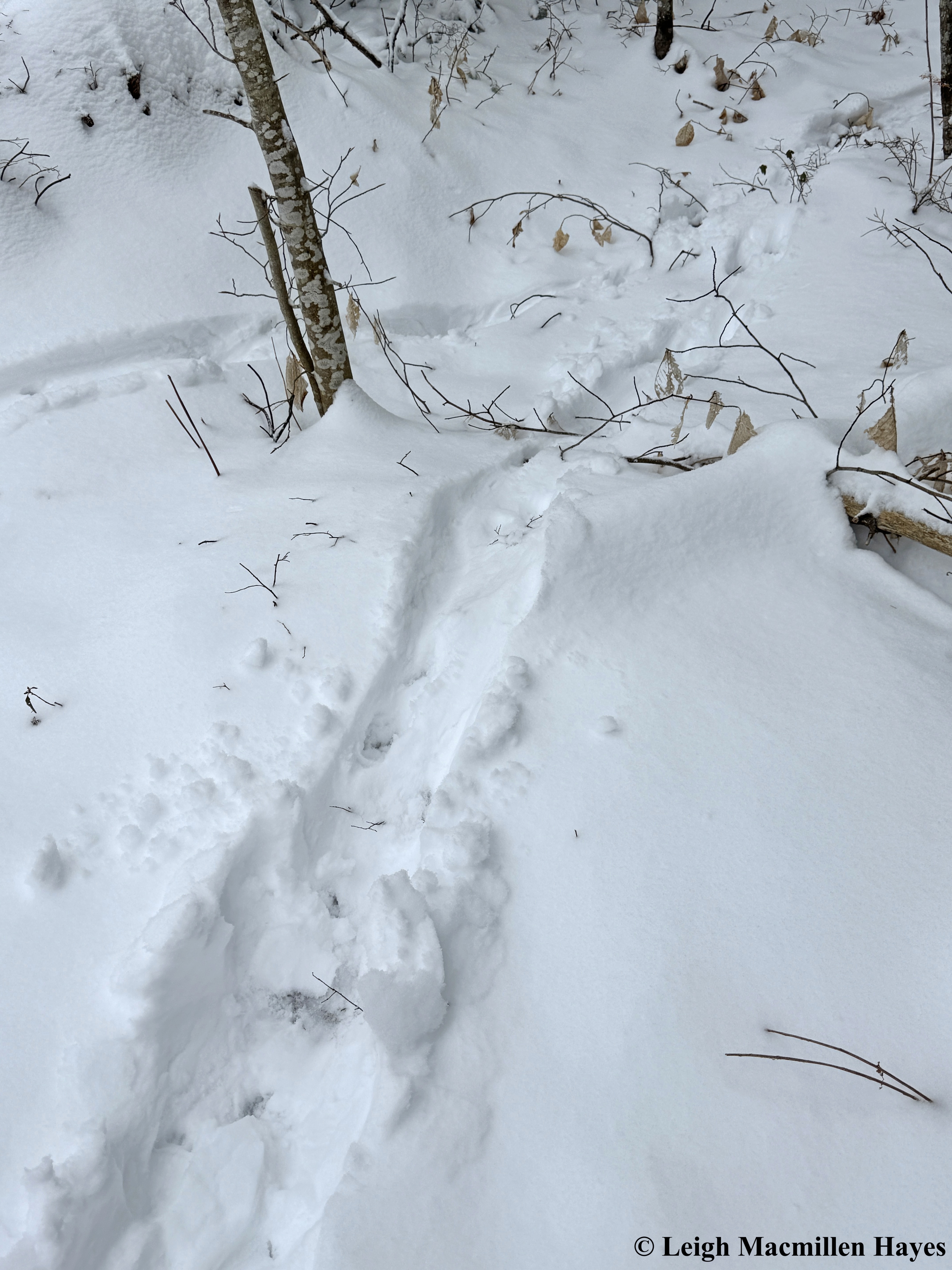
To the left of the pool I noticed tracks that I’ve seen frequently here and beside the cowpath and knew that the resident Porcupine had been out and back overnight. I love the sashay of its track pattern and will miss seeing that when the snow does finally melt.

I followed Porky’s track to a Hemlock and noted that it had climbed up and down. I know about where its den is because I followed its tracks a few weeks ago over a couple of stonewalls and then into the yard of a neighbor around the corner, but decided to not locate the actual spot cuze it might seem a bit odd that I was looking for such.

Can you imagine seeing this woman show up in your backyard because she wants to know where the Porcupine she displaced this winter is now denning?

On my way out today, I did grab the game camera because I fully expected to see the Red Fox on it. For some reason, it alluded the camera, but I did find a couple of Porky videos. The first was taken about a week ago and I encourage you to watch the ten-second demonstration of the mammal’s behavior.

Not only do Porcupines sashay, but they have other dance moves as well, and I only wish I’d seen these in snow, but if I ever do, I’ll have a better understanding of interpreting them.

This behavior is one of self-defense–as Porcupines don’t see or hear very well, but it must have sensed danger. The camera didn’t pick up on a predator, but those erect quills being flashed all around indicate something loomed in the night.

I’d love to call it a dance of joy, but know better. It was meant to be an intimidating dance. If a predator should get close, Porky could lash out with those 30,000 quills, which are easily detached and can become embedded in the skin of the attacker. Definitely not a dance of joy from the predator’s point of view.

A couple of days later, Porky was all business as he headed toward home, leading me to believe he felt no threat in that moment.

Here’s the thing. His den is the same den of the Porky by the vernal pool and I know he has sampled several trees poolside, as well as several trees cowpath-side, so I assume it is the same animal.

I left the pool behind and walked down the driveway of a local business and then slipped into a park where I again met Foxy Loxy on the move.

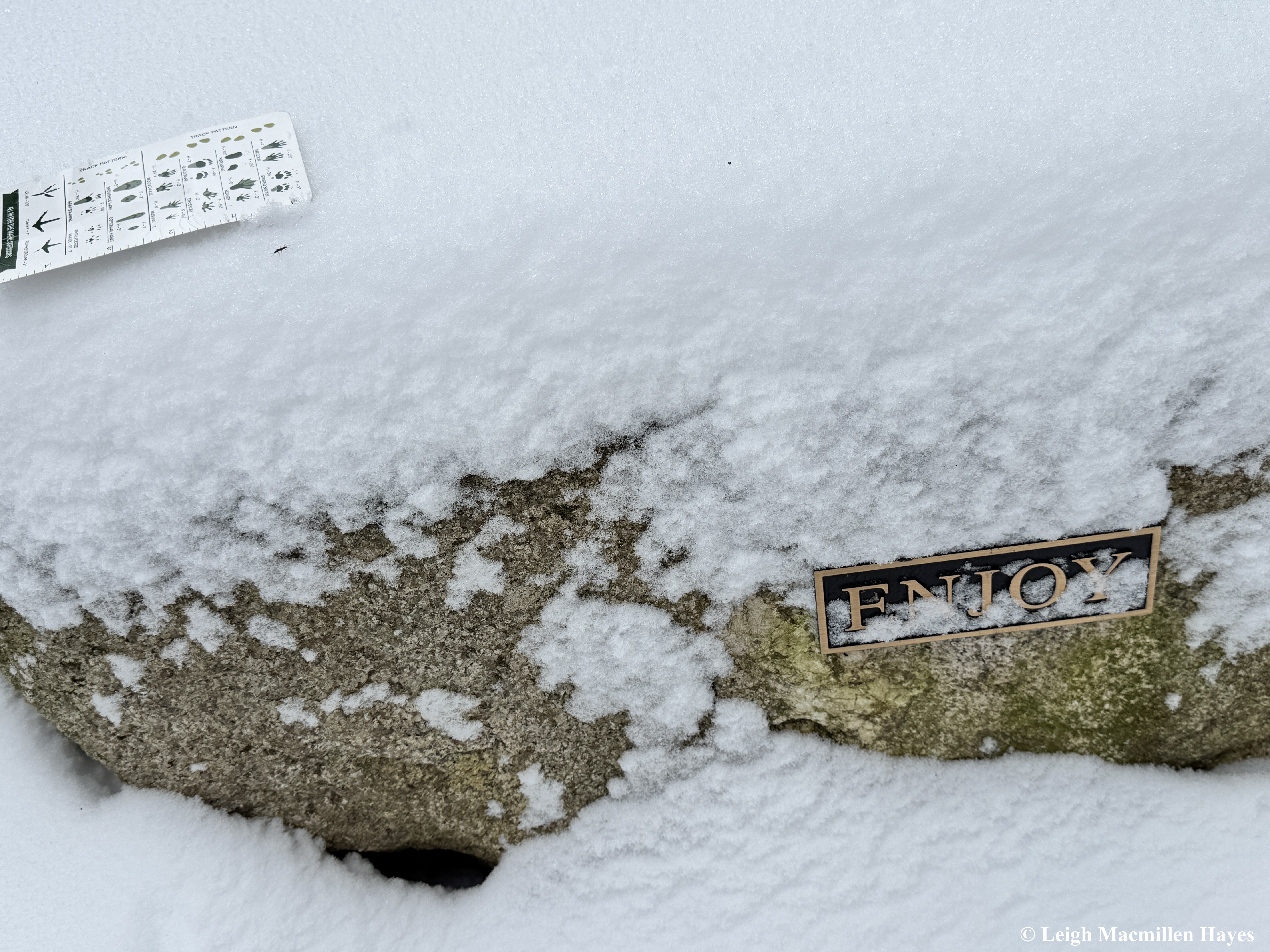
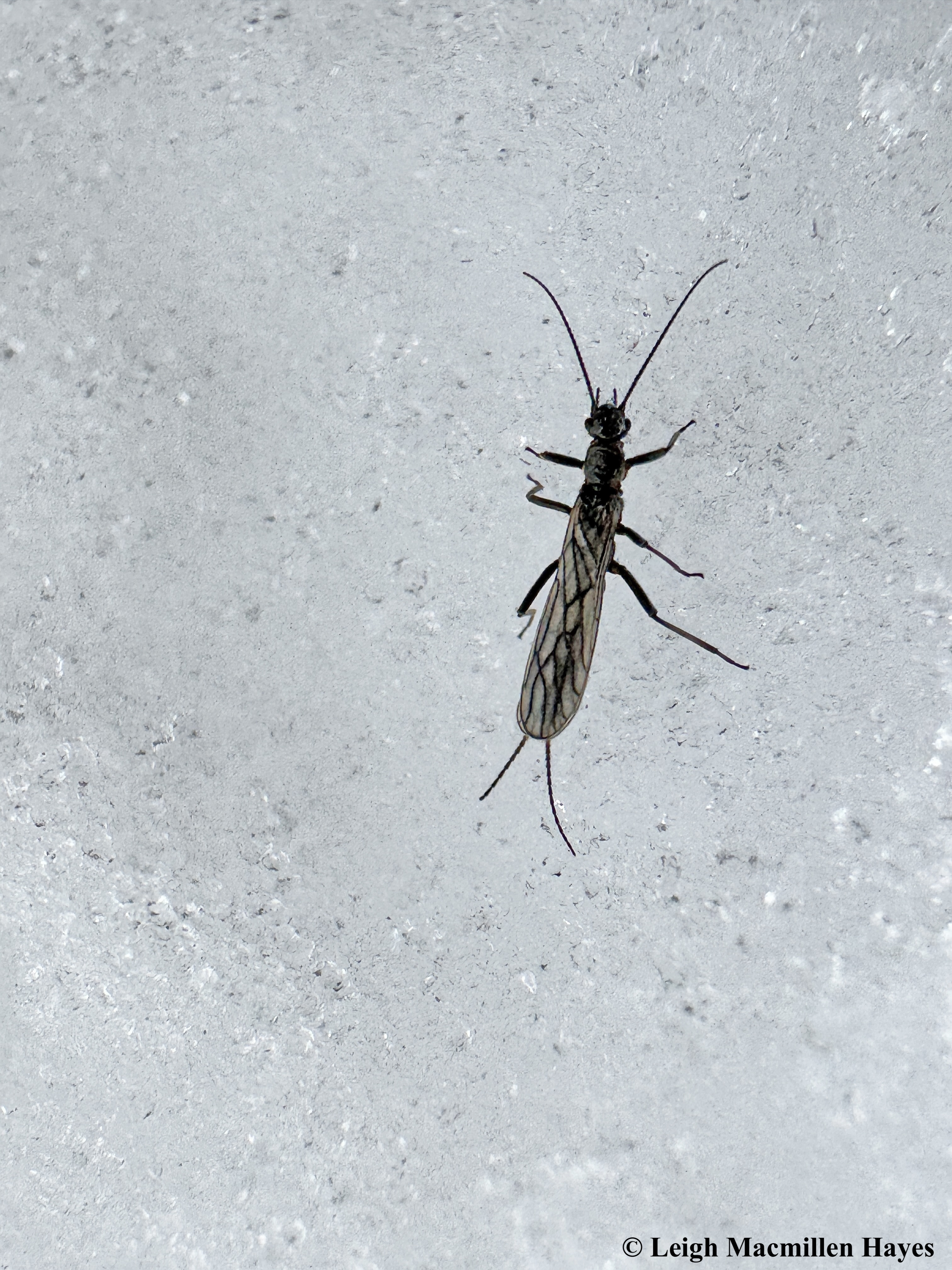
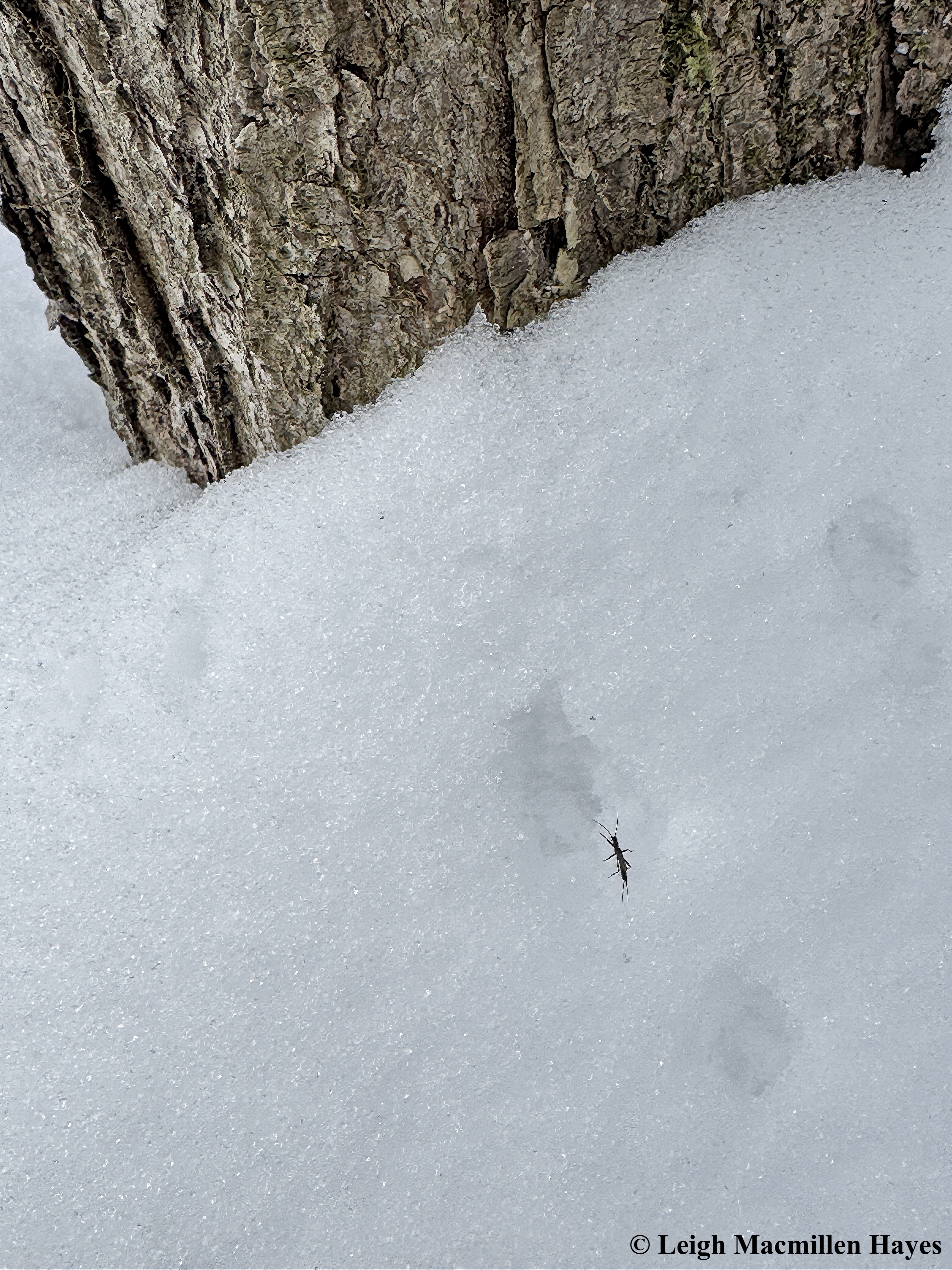
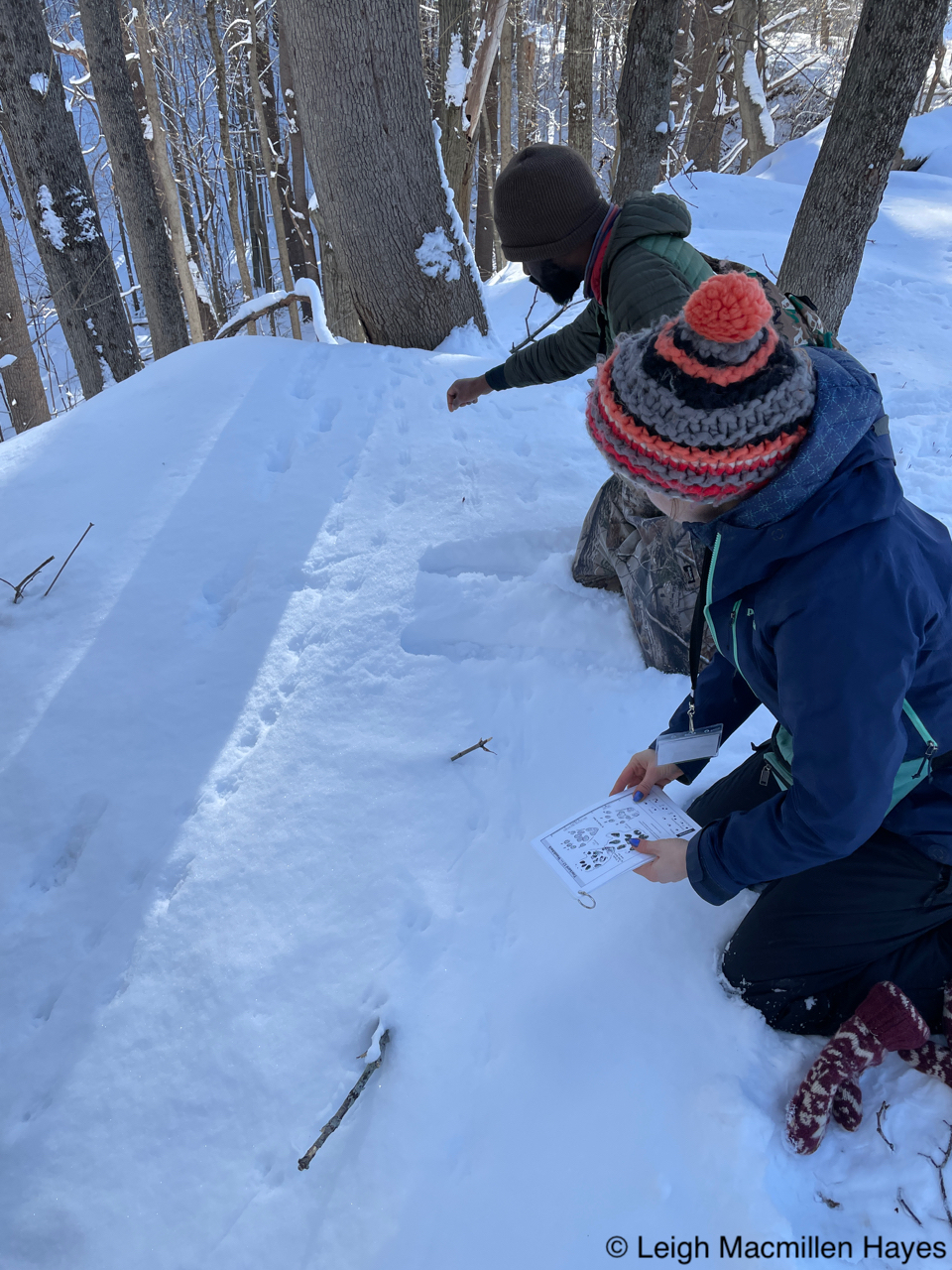
He wasn’t the only one moving, either. Do you see the tiny black mark by my tracking card?

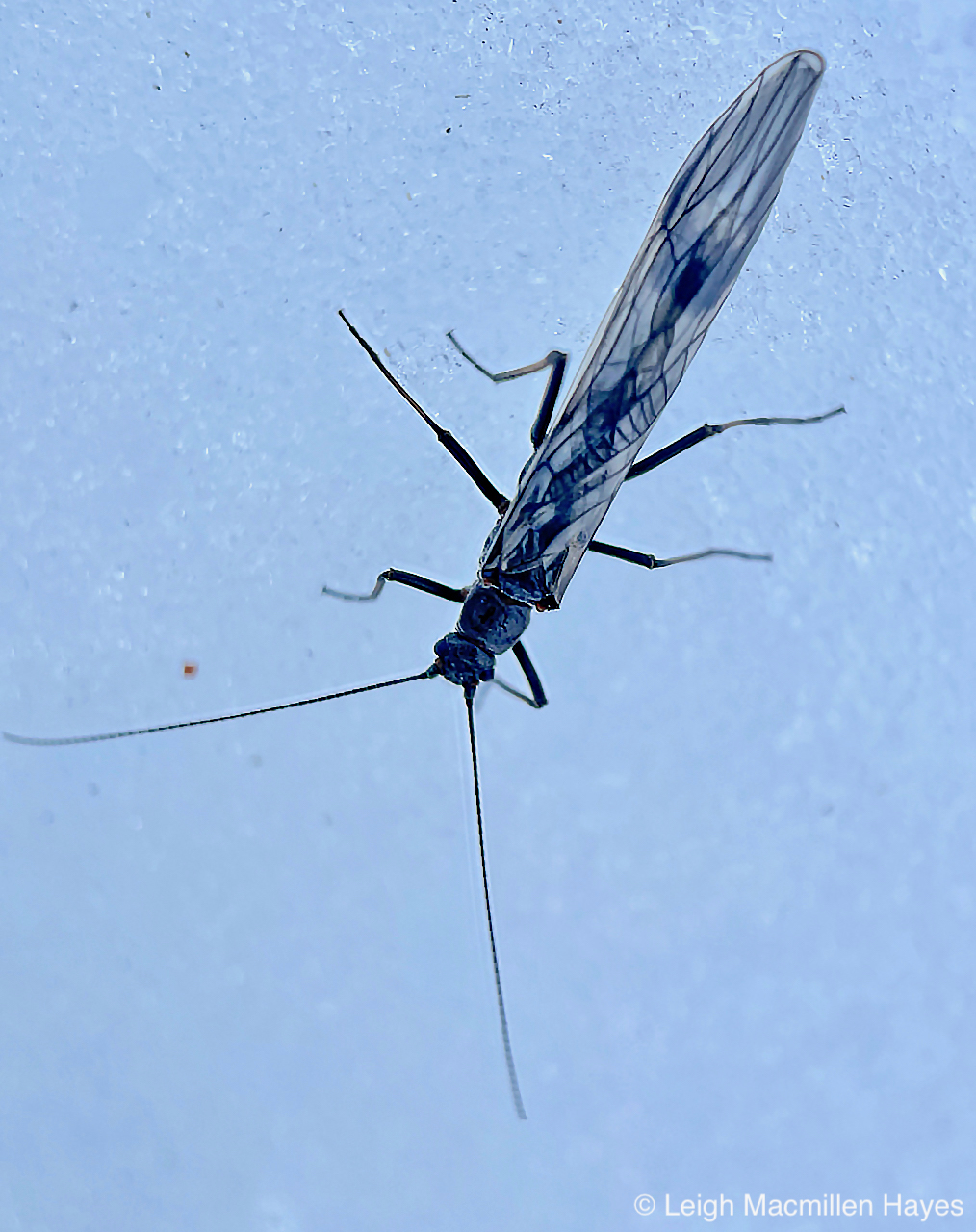
Winter Stoneflies were having a heyday this morning. It always excites me to see them because their nymphs require healthy, clean water and so to live in a area where these tiny insects are abundant means we are among the fortunate.

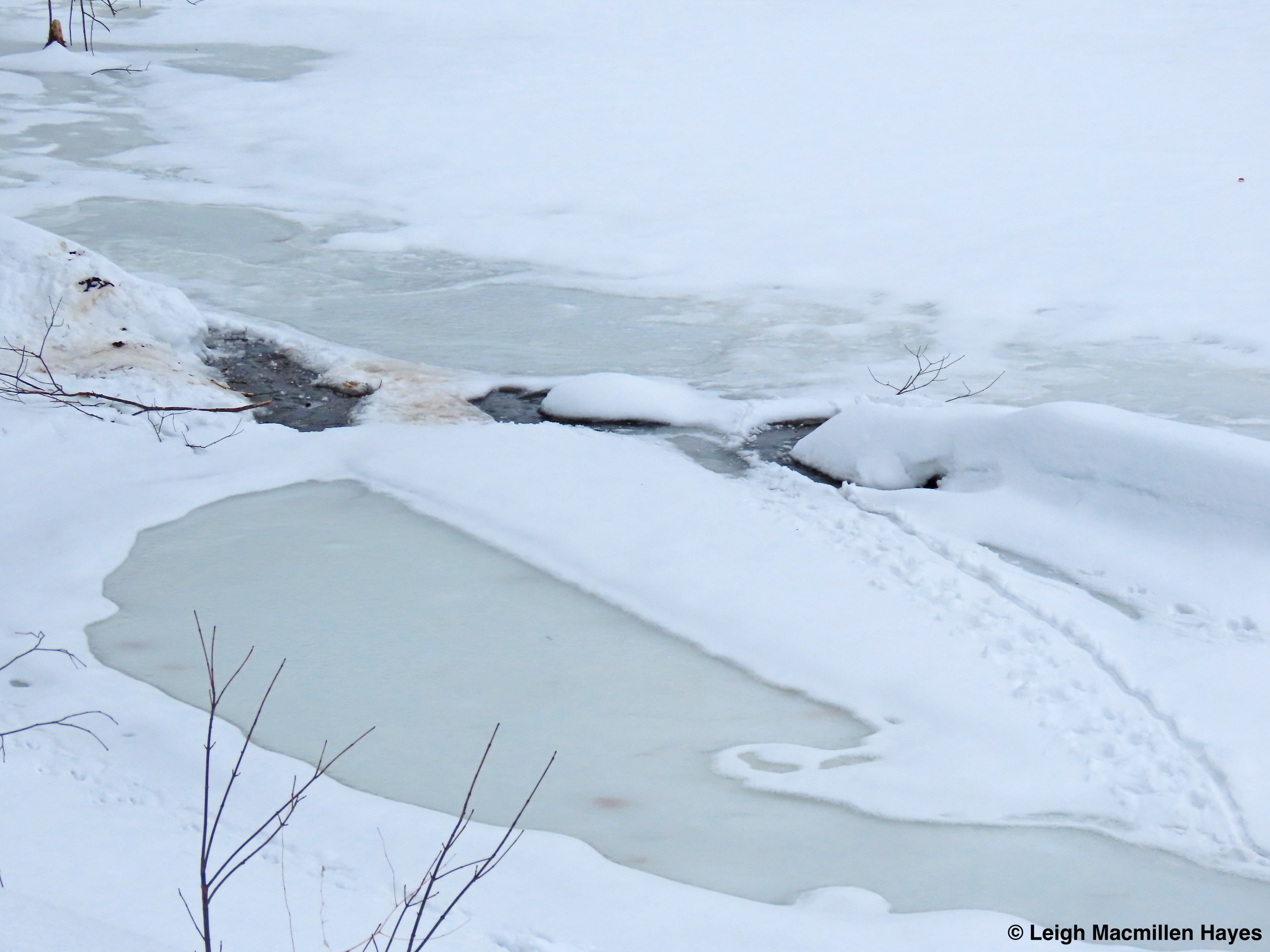
How fortunate? Super! For my next great find was . . . drum roll, please . . . an Otter slide. My heart be still.

I’ve seen their slides in this very spot before, but it’s been quite a few years. Of course, I had to follow the path that they took, which was really a bushwhack, given that they crossed the path we humans have created.

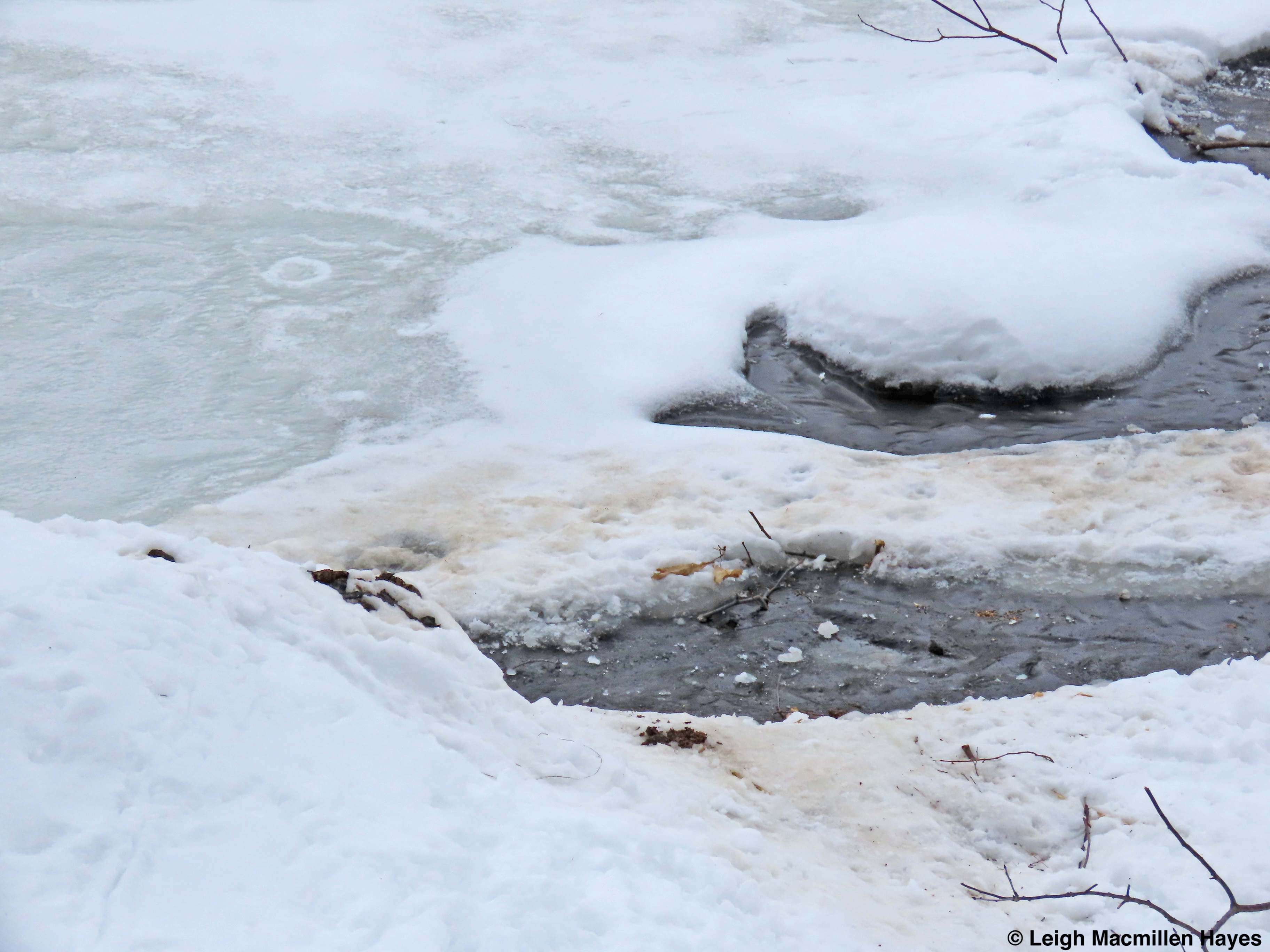
This is the spot where the Otter came out of the brook and bounded up the hill. I assume it was one, but sometimes they travel in family units and follow the same route so what looks like one could be two. Foxes do the same.

Speaking of that, do you see a set of tracks coming in from the east to meet the Otter? Or at least sniff around and wonder where it went? Those belong to the Red Fox.

The same Red Fox who traveled through our woods? Possibly.

And this is the spot where the Otter slid back into the water.

Fortunately the Otter didn’t meet its fate by becoming a meal for the Red Fox. Yet.

I moved on from that spot, but it seemed no matter where I went the Red Fox had been there before me.

And always searching. Food is a strong motivator.

So is finding a mate. More urine and this time there were two foxes, so I wonder if he found a she.

And I’m wondering how many Gray Squirrels who frequent our bird feeders will become meals for kits. The squirrels are well fed; I can attest to that.

I felt like life couldn’t get much better, and then others made their presence known, like the Long-jawed Orb Weaver,

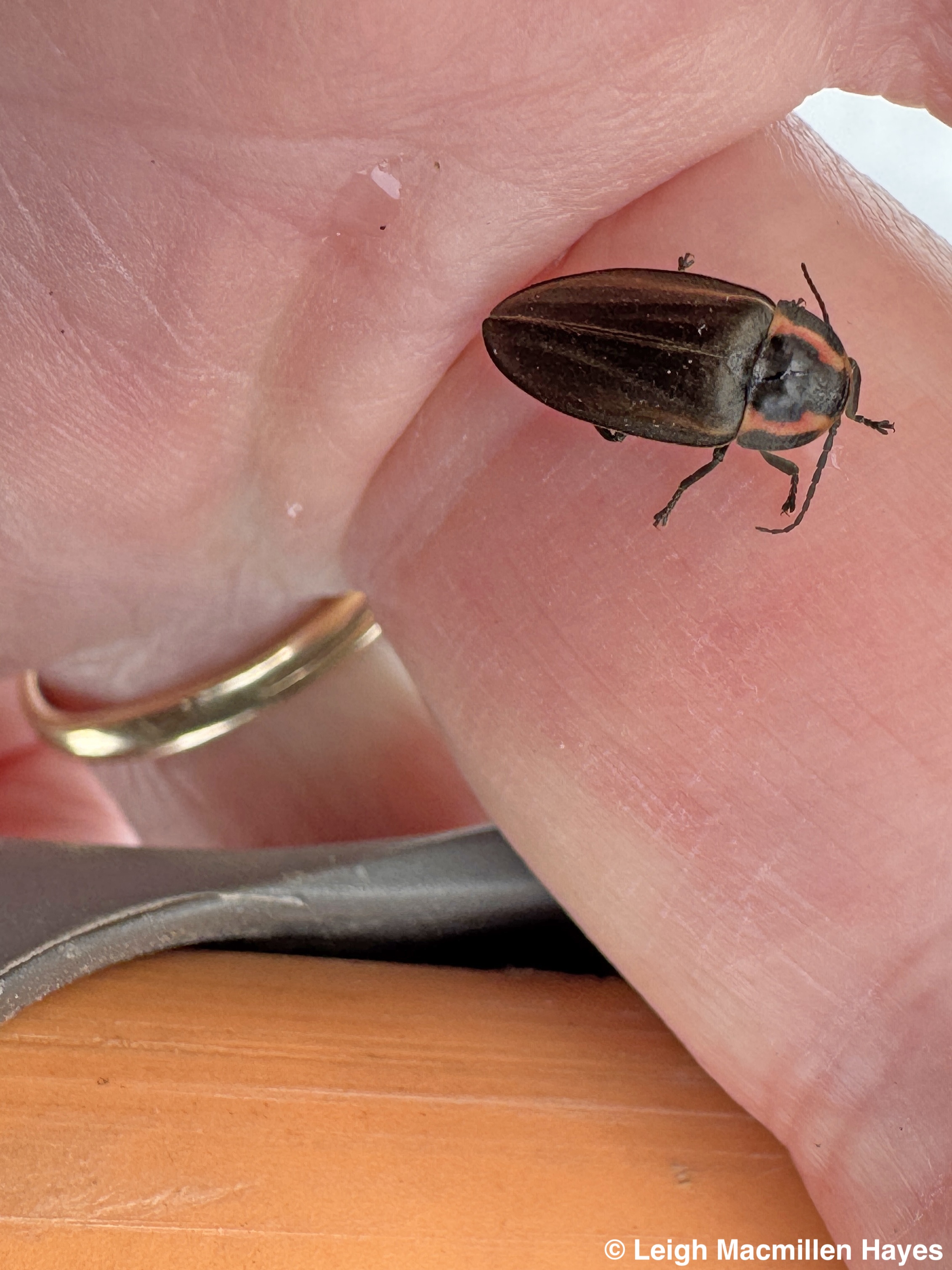
Winter Firefly,

and another robust spider.

As for those suddenly ubiquitous Stoneflies . . . I kept looking for one that had actually reached a tree and was at last successful.

Until it wasn’t, and I wanted to say (and actually did), “Hey Bub, you took a wrong turn. You’ll never find a mate if you don’t reach that tree trunk.”

Of course, there are many more trees in the forest and perhaps something didn’t seem quite right about this one.

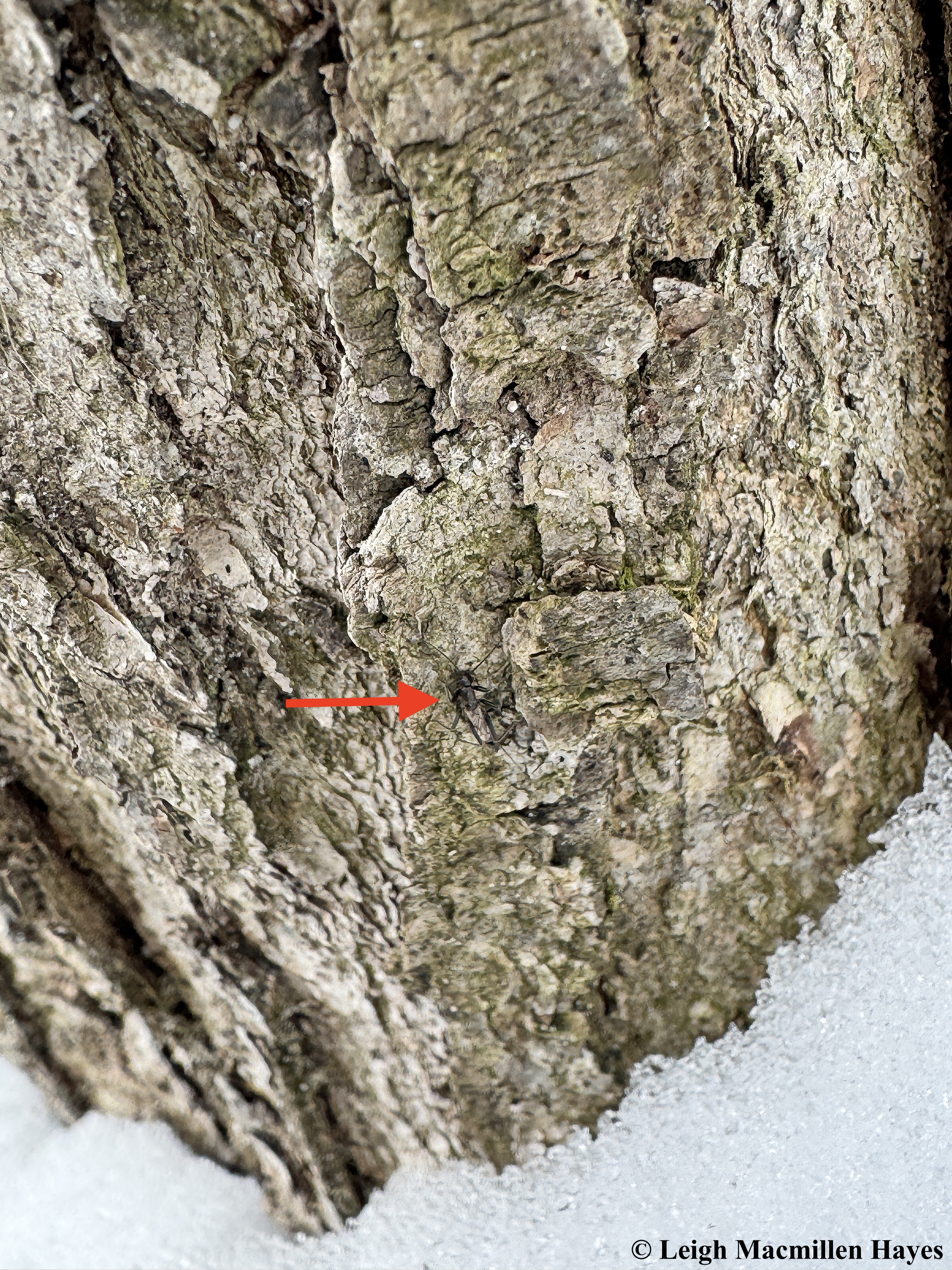
Until it did. And the Stonefly started to climb up onto the bark.

Do you see it?

How about now? It’s definitely a Where’s Waldo moment.

Does the arrow help?

With his abdomen, he’ll create a drum beat only she can hear, and I left him to it in hopes that he was successful.

As I turned around, I met a young mother and her two-year old son out for a nature hike and so I introduced them to the Stoneflies. The tot was thrilled and he kept locating others. We chatted for a few minutes and then it was time to part and he turned to me, smiled, and said, “Goodbye,” and then blew me a kiss. His mother was as surprised as I was. I blew a kiss back to him.

There was so much out there to make my day today, and that kiss was the final seal.

It brought me back around to the Anglewing Butterfly. On Saturday I couldn’t tell My Guy if it was an Eastern Comma or a Question Mark, both species that as adults overwinter behind bark.

This is a Comma, where as the Question Mark would have this same line, plus an additional dot making it look like a QM.

My Guy’s comment, “For you, it doesn’t really matter. They are all Exclamation Points.”

YES! And today was full of Exclamation Points. I’m forever grateful.

P.S. As I headed home a couple of hours later, the temperature had risen and snow plops were falling from trees and the conditions for tracking had significantly deteriorated.

The Tale of Two Tails

We call ourselves the Trail Snails–a group of St. Peter’s Episcopal Church parishioners always accompanied by various non-parishioners who like to crawl at a snail’s pace.

Each week I try to find a different location, thinking fairly flat for locomotion and with natural elements that will bring out their sense of wonder. The first isn’t always easy, especially given the amount of snow and ice we’ve had this winter; but the second is a cinch since there’s so much to wonder about in our little corner of the world. When we started these walks in the fall, I did not expect that we’d continue weekly throughout the winter. But we have.

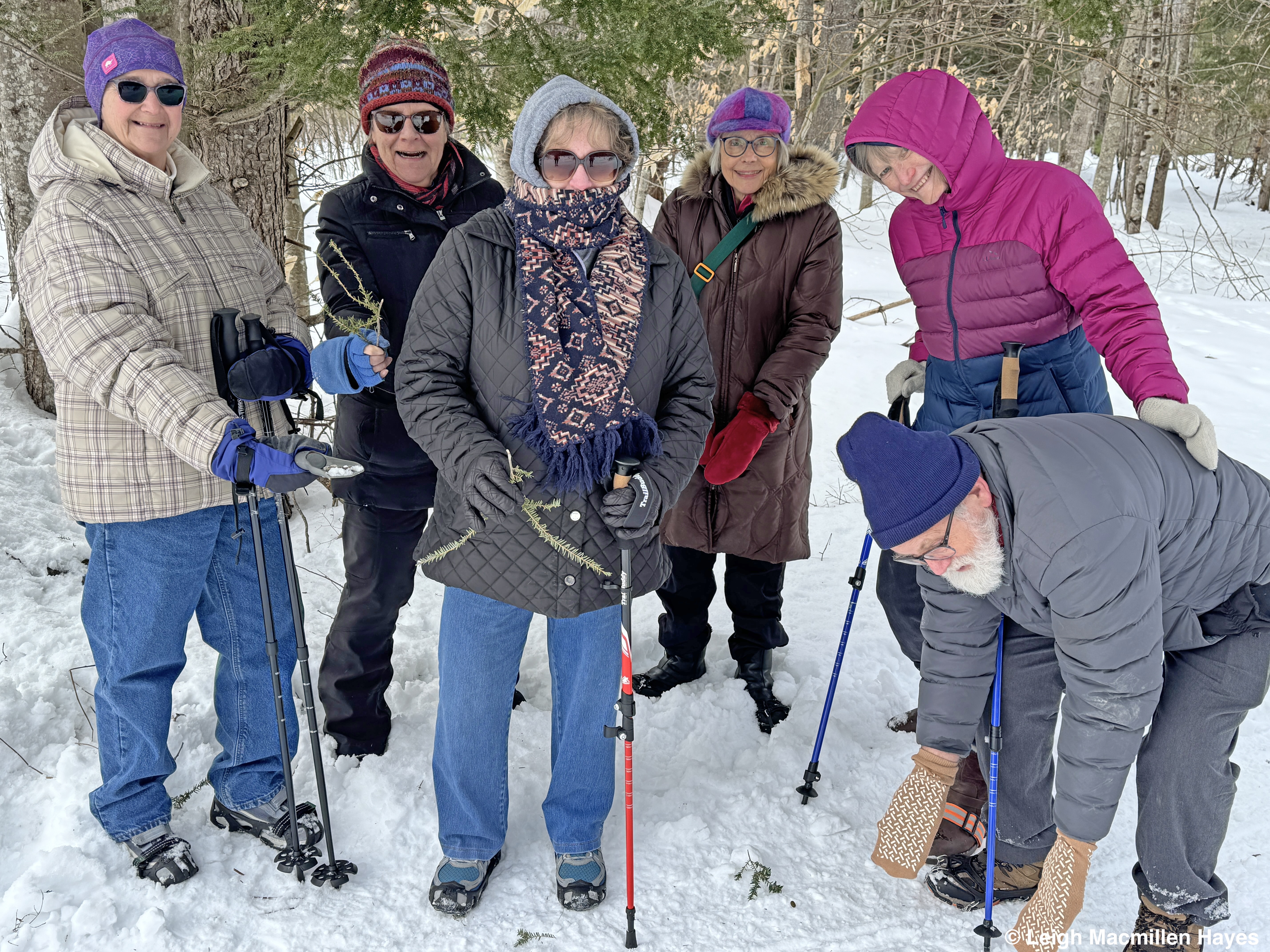
And so today six people (parishioners and non) joined me at my house to head out to the well-packed snowmobile trail. Of course, it wasn’t as well packed for the first thirty feet and that proved a bit challenging because we all wore some variation of micro-spikes rather than snowshoes, but they all persevered.

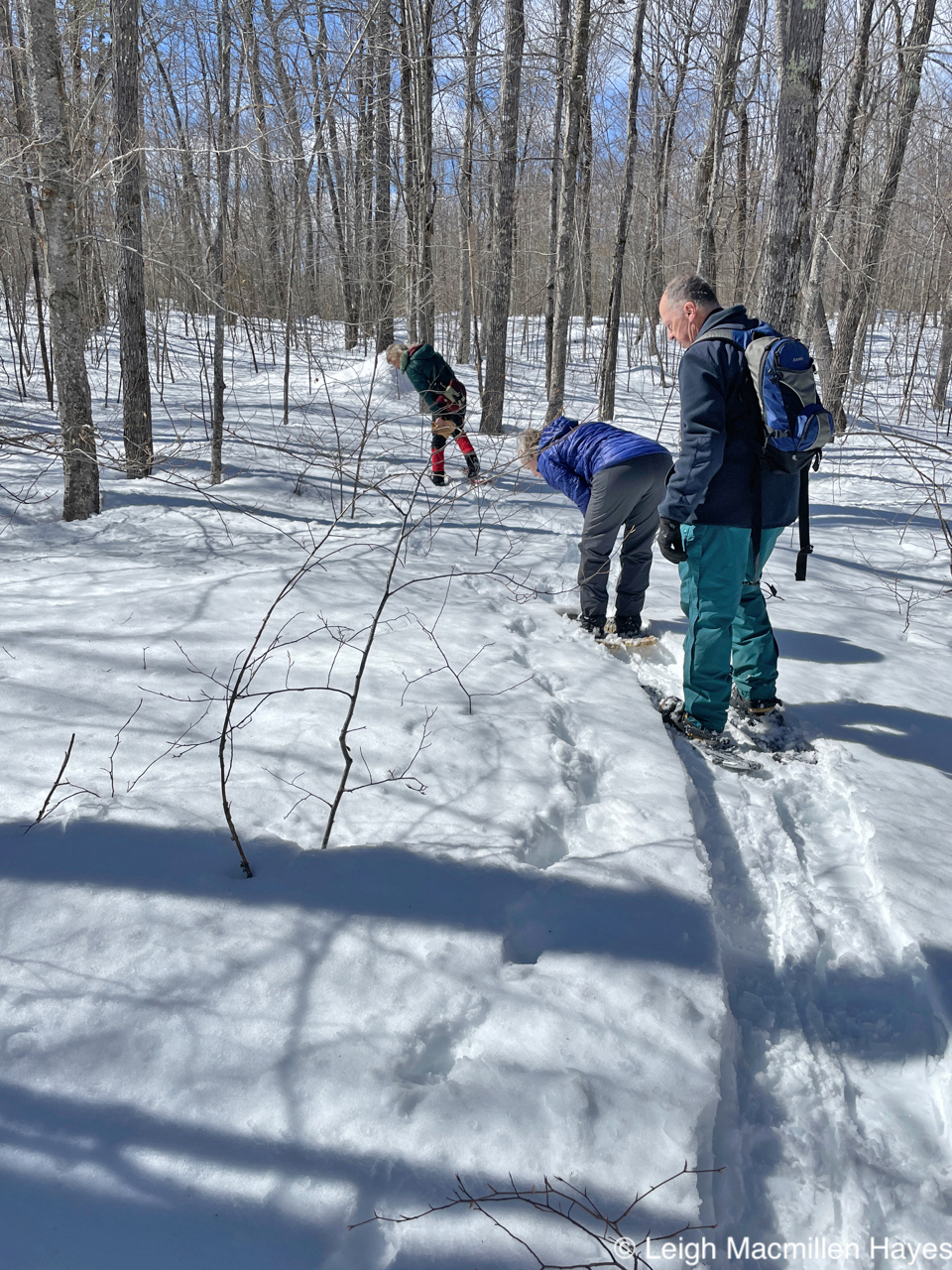
Once on the main trail, I showed them Porcupine tracks and then asked them to find the next set of such. It only took a minute for one to spot the pattern. While we looked at them and I shared some fun facts, I looked around and realized I was standing in the middle of recent Porky activity. Not only were there fresh tracks, but also scat and twigs cut at the traditional 45˚ angle, with buds and needles missing. We looked up into the tree, but fortunately no one was at home.

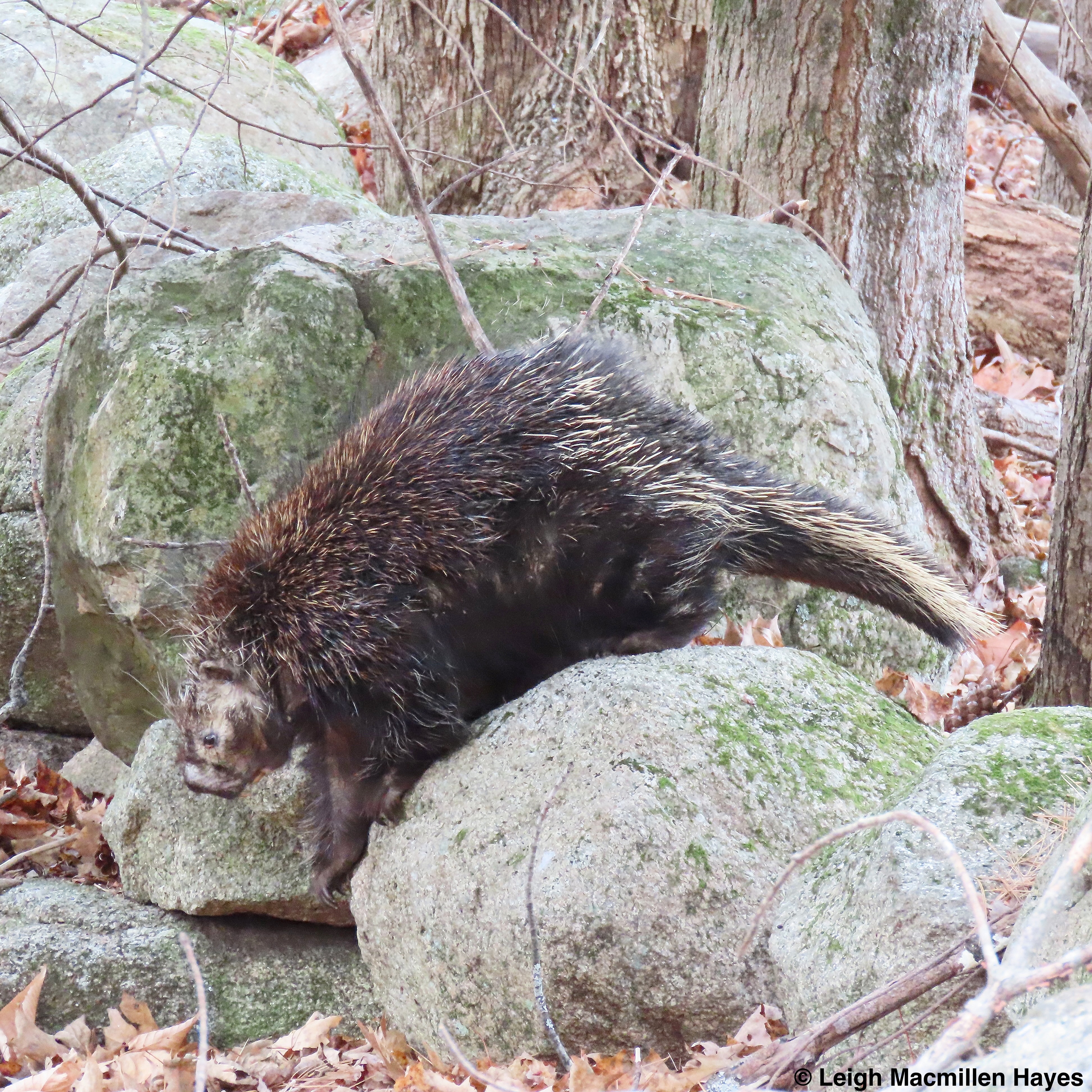
I think I know this Porcupine because he’s a frequent visitor to the Hemlocks in our woods and the neighbors’.

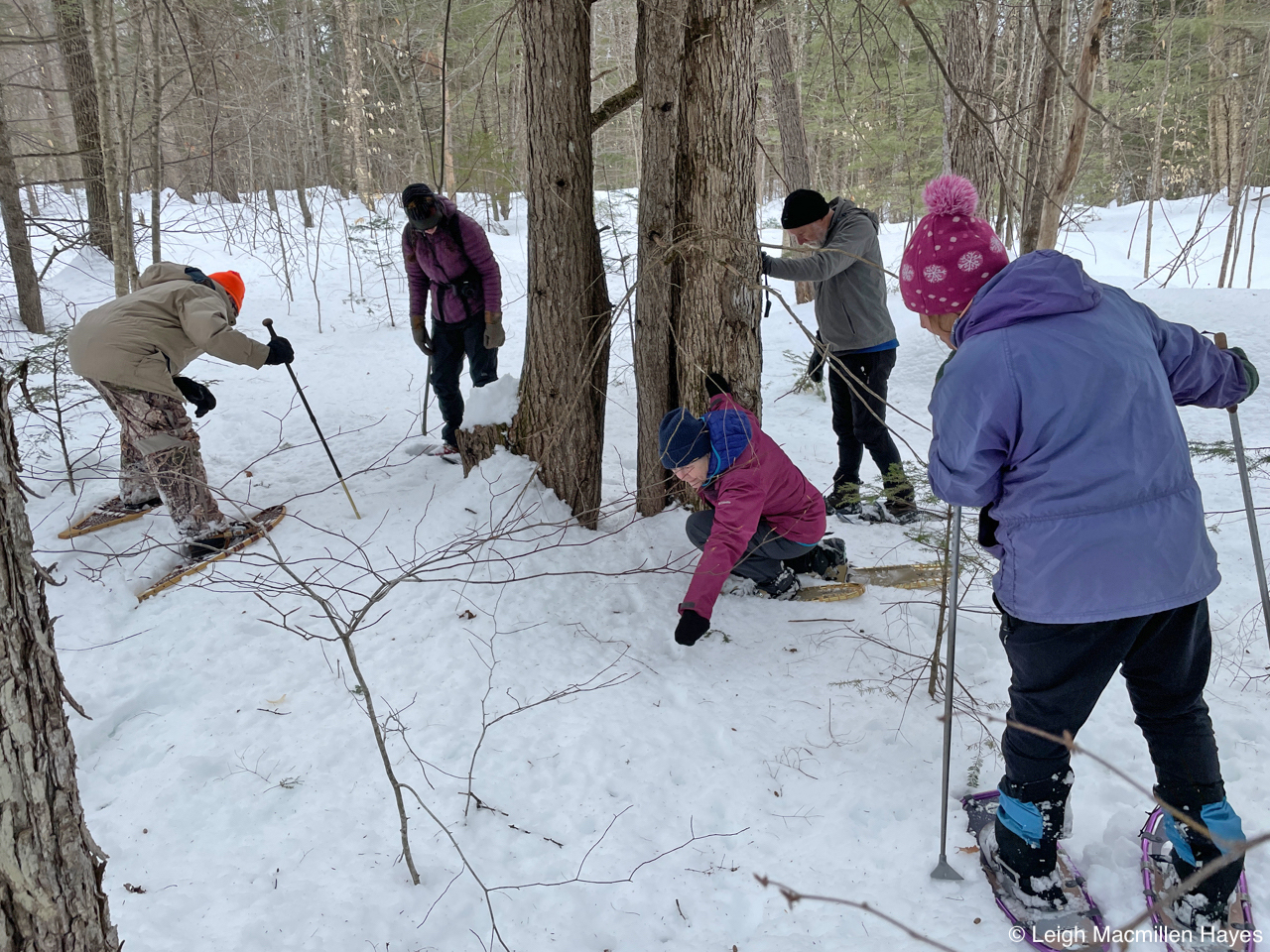
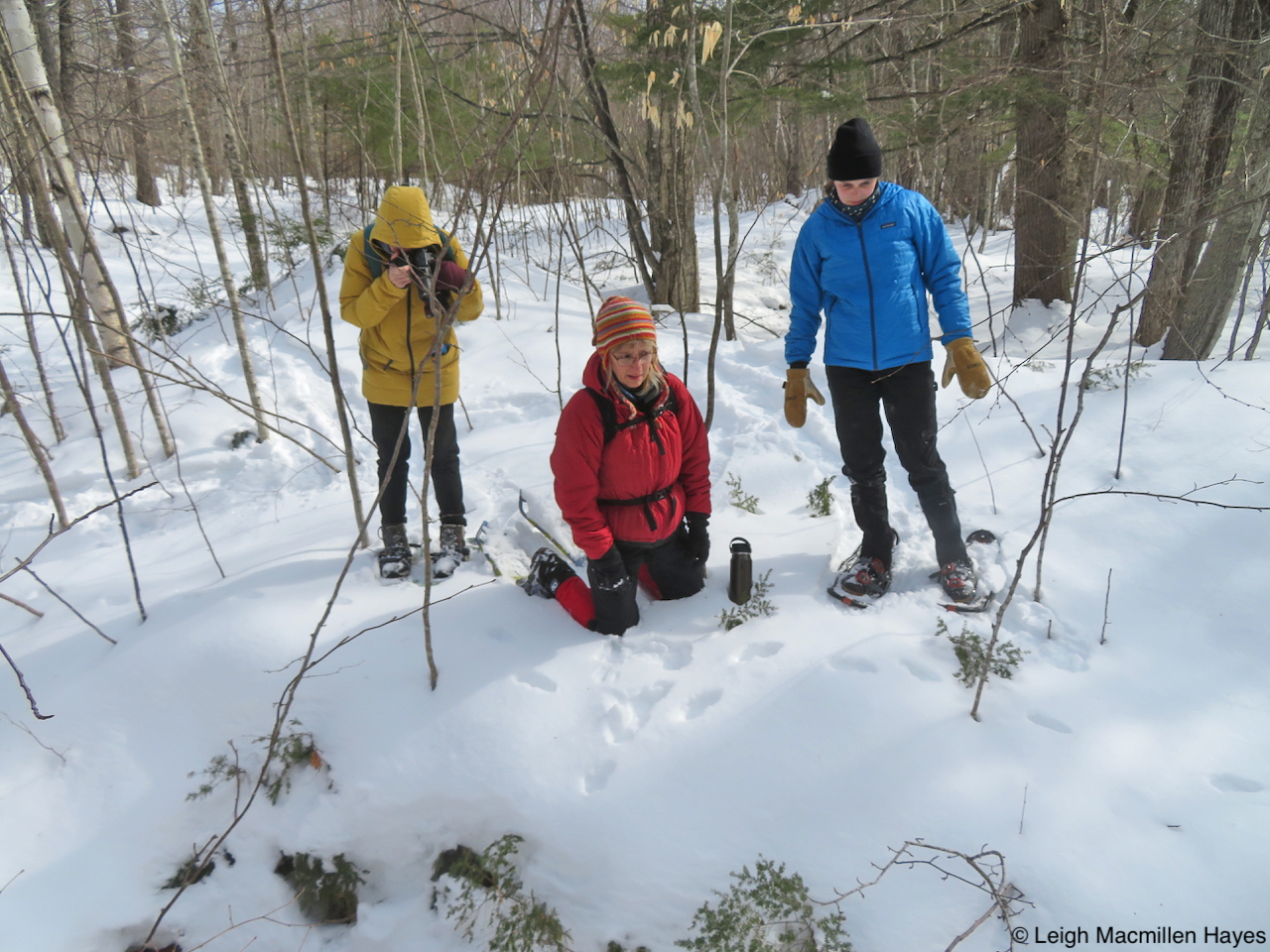
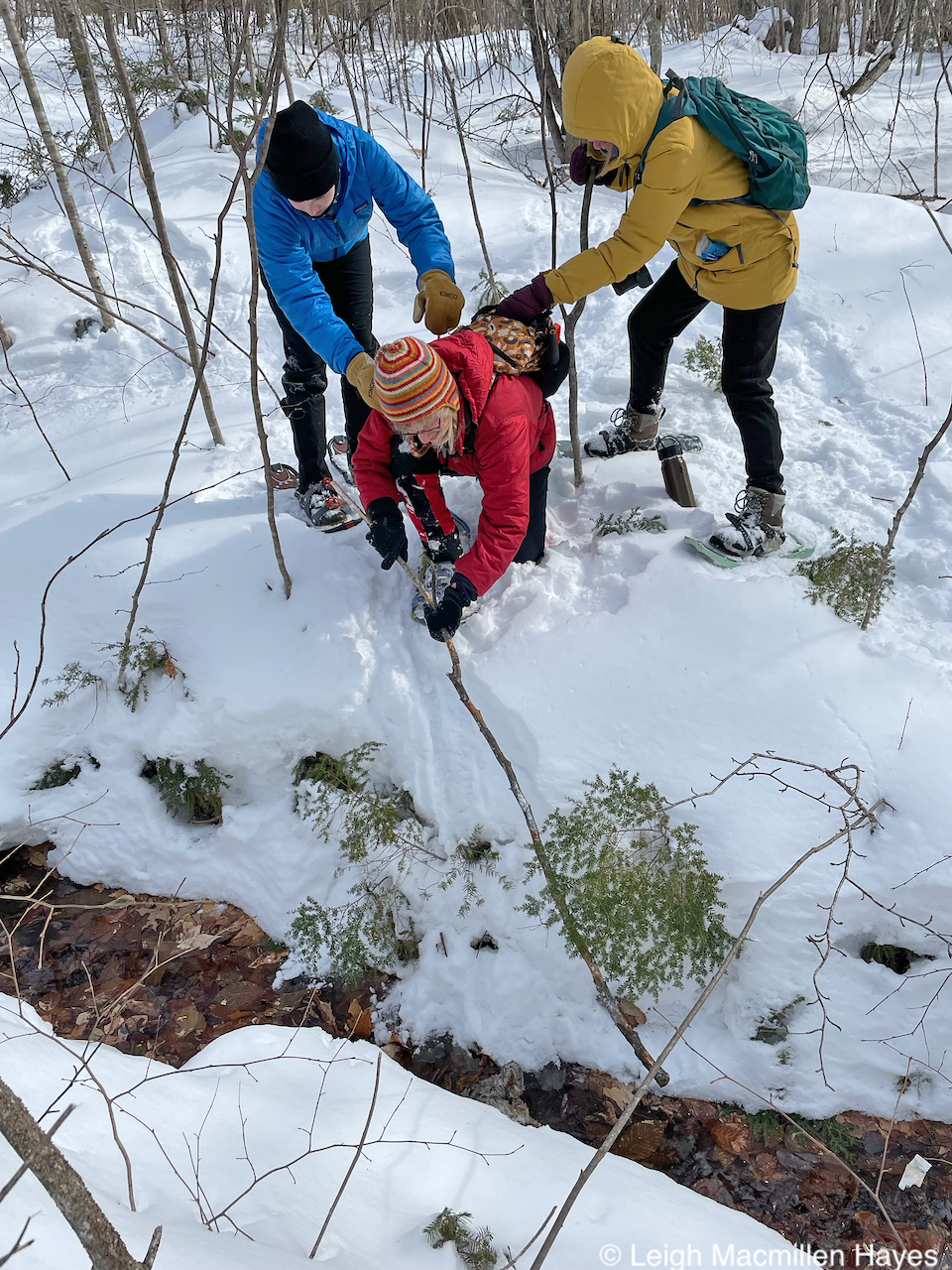
When I asked the group to share the findings and become a Porcupine, they did so, though I think they think I’m a wee bit crazy. Maybe I am. Anyway, Left to right: Nancy holding some scat on my scat shovel, Marion and another Nancy with twigs, Marcia smiling about it all, and Gary wearing my Porcupine socks to show how the feet are like sandpaper to gripe a tree as they climb, while his wife Julia was there for moral support and to help him up if need be.

We paused at many other spots along the way, including looking at the silk a Pine Tube Caterpillar uses to construct its tube.

And admire a perfectly round display of Lungwort, a foliose lichen consisting of a fungus and a green algal partner living together in a symbiotic relationship with a cyanobacterium.

Had I brought water, I would have poured some on it to show off how green it quickly gets since the alga would have kicked into action to provide food for the fungal structure.

Lungwort is sensitive to air pollution and habitat loss, so spotting it is always a treat and reminds us of why we love living here in western Maine.

We also looked at buds on an Ash to figure out which species and I told them about the Emerald Ash Borer and showed photos of what blonding looks like.

It turns out what we were looking at was a White Ash–hairless buds that dip into the upside-down, C-shaped leaf scar.

And then there were the Winter Fireflies that we found still as could be on the snow. I picked one up in the scat shovel and thought it must be dead.

That is . . . until we noticed its antennae began to move.

And then it started to walk. Last we knew, I’d left it and its kin on their favorite tree, a Sugar Maple, with hopes that as the temps warmed today and will continue to do so going forward, the insects will survive.

Just before reaching our driveway at the end of our walk, we also saw a Winter Cranefly, but moments after I scooped it up in my scat shovel, it flew. At least most everyone got to see it.

As Trail Snails, we walked not quite a mile and a half in two hours, but saw so much, and I was especially jazzed by the new Porcupine evidence. I think they were as well. Maybe not jazzed, but curious.

And in our time together we saw only three snowmobiles. While it was brought up that those on the machines miss all that we were seeing, I did explain that My Guy often comes back from a ride and tells me of the wildlife he and friends sighted. There I am being so quiet and not seeing any, but somehow despite the machine he spies so much more.

And then this afternoon, I picked up a friend and drove to another section of the local snowmobile system. We walked and talked and talked and talked some more, catching up because despite retirement we are both incredibly busy. In a good way. Doing things we love to do.

As we walked, I kept pointing out Porcupine tracks and if we’d had snowshoes on, I might have convinced her to look for the feeding trees and den sights, but we chose to begin with micro-spikes and quickly ditched those since the snow conditions on the well-packed trail were just right.

We also paused to listen to a Barred Owl and tried to spot it to no avail.

And then, near water, we spied tracks of a different sort. And scat. And mud. And not quite open water.

The scat was from Otters. And I really wanted to take a closer look, but didn’t trust the trail down, despite it being well traveled.

What I now realize I didn’t take a photo of were tree marks in the snow, which in the moment I surmised were twigs blowing down toward the water.

I noted that the track continued across the road upon which we walked and so I suggested we take a look and see if we could note anything about the Otters’ behavior.

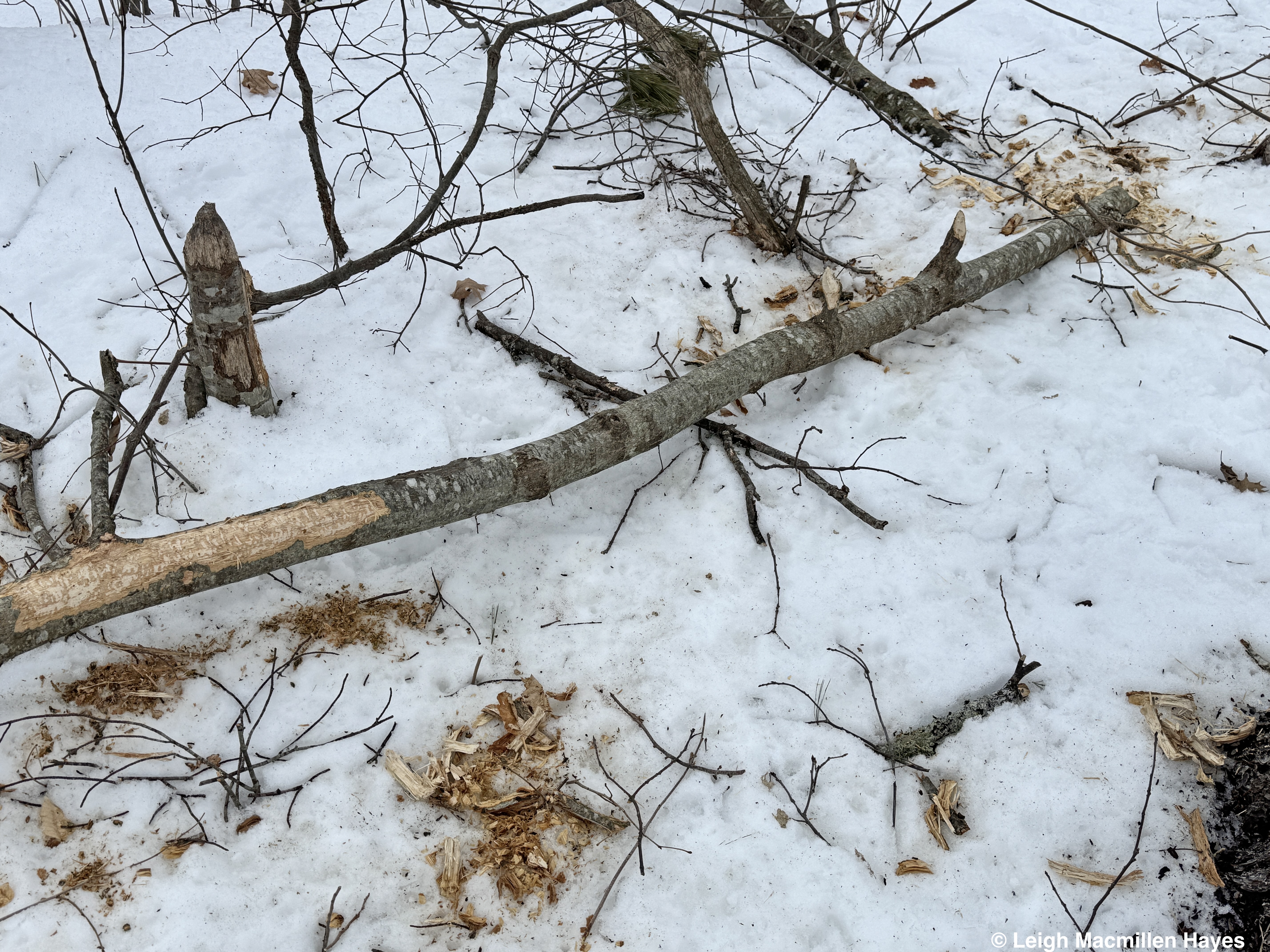
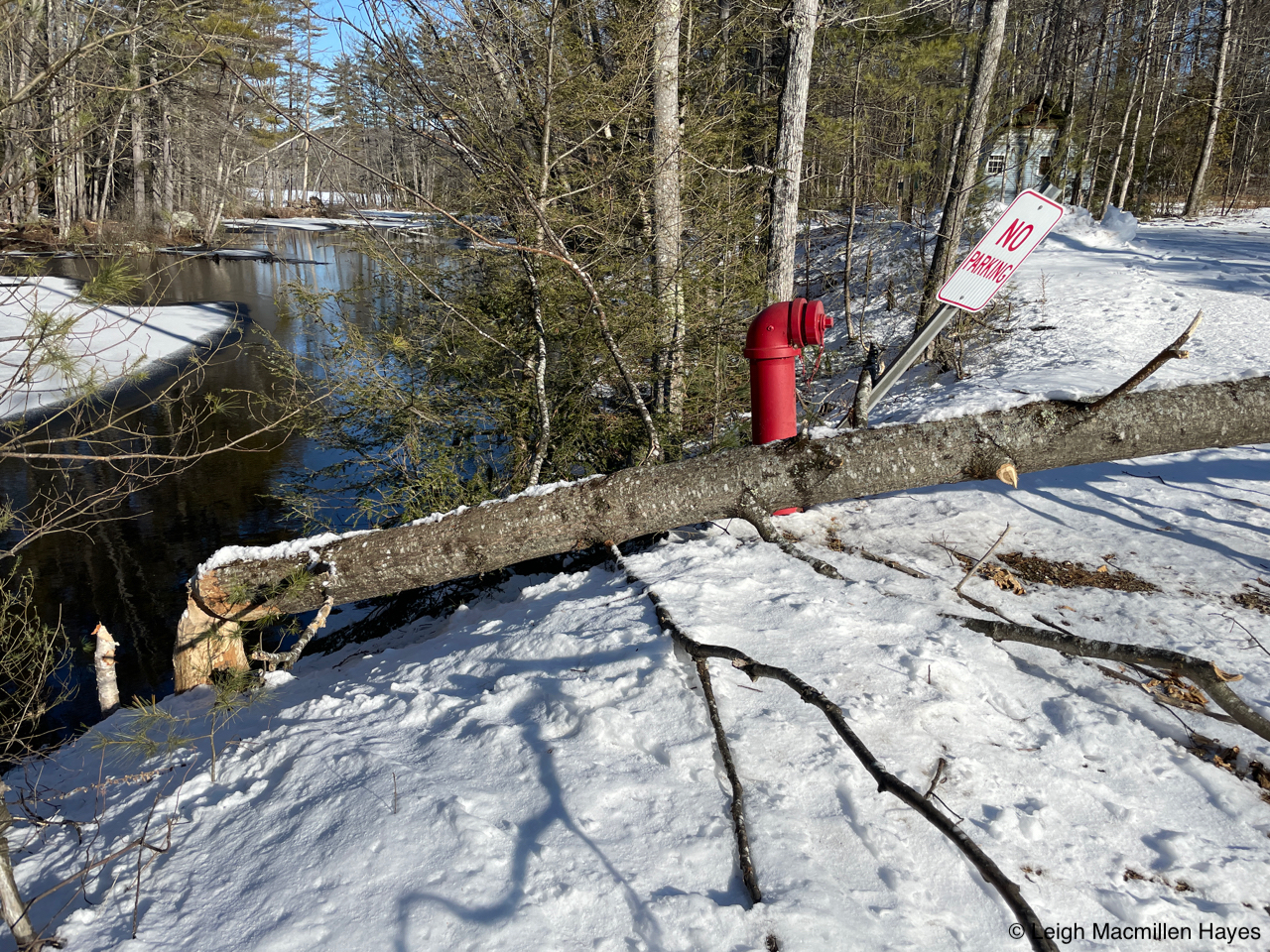
We certainly did not note anything about such, but instead discovered fresh Beaver works. And suddenly the indentations left by the twigs made sense–Beavers dragging tree branches down to the water to take back to their lodge or winter food raft.

Maybe like some people that I’ve heard are looking for more firewood right now to stay warm the rest of the winter, the Beavers didn’t realize everything would stay frozen as long as it has and so they needed to replenish the pantry.

Shortly after that, at about the 2.5 mile mark from our journey’s beginning, we turned around and started to walk back. And then something stopped us in our tracks. It took me a few moments to say, “Look,” and grab my camera and I feared this something would slip out of sight before I did so.

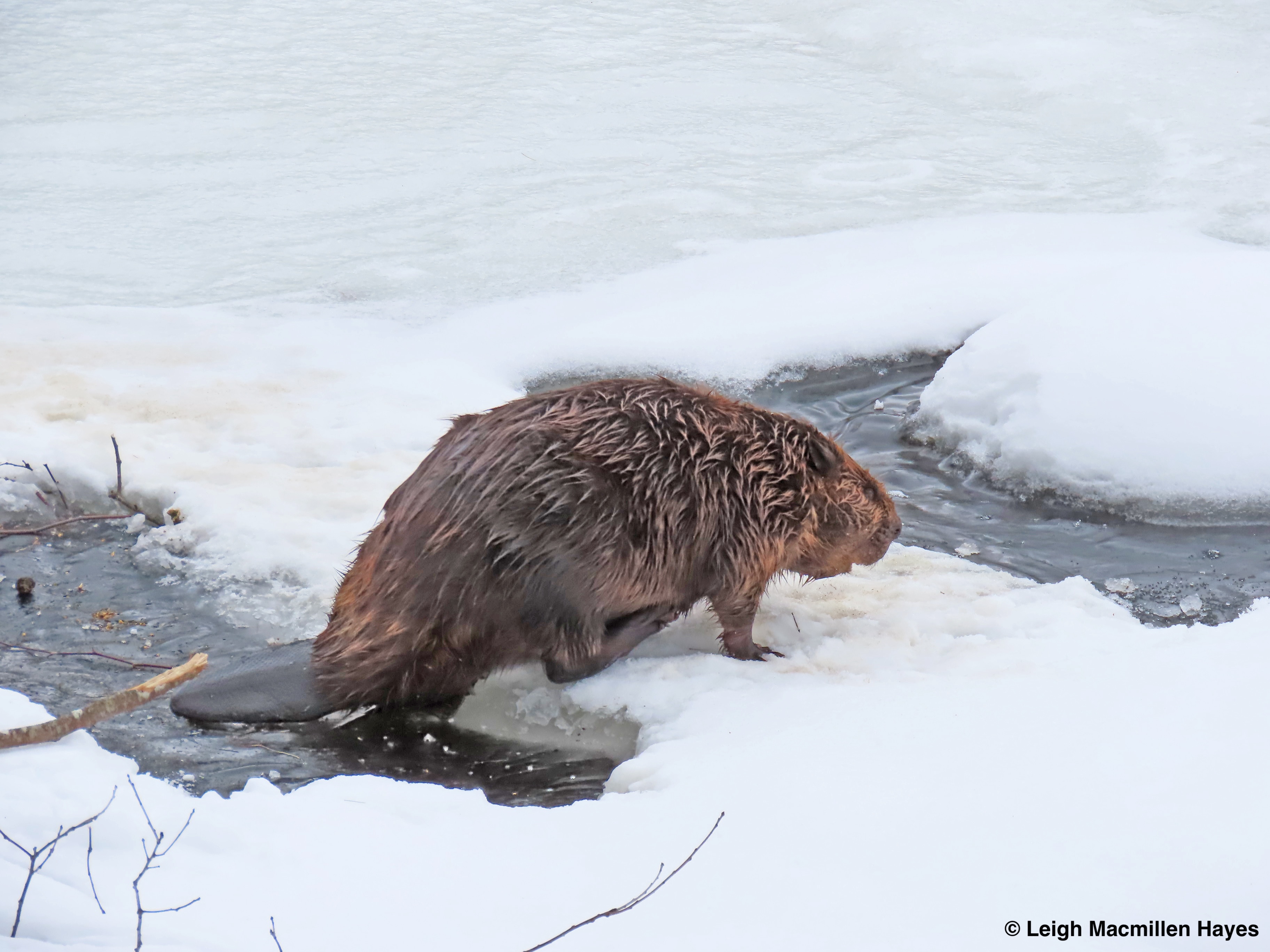
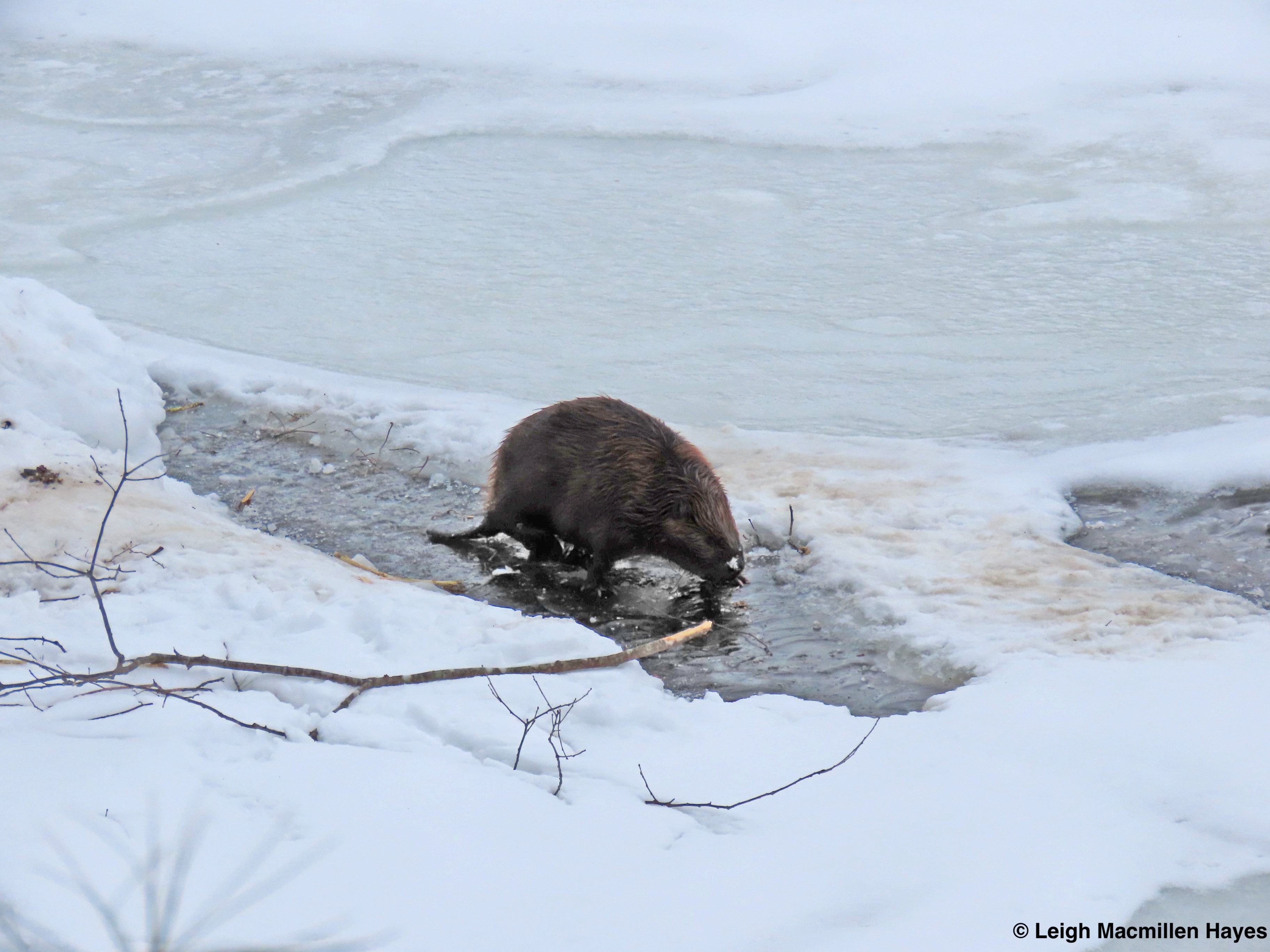
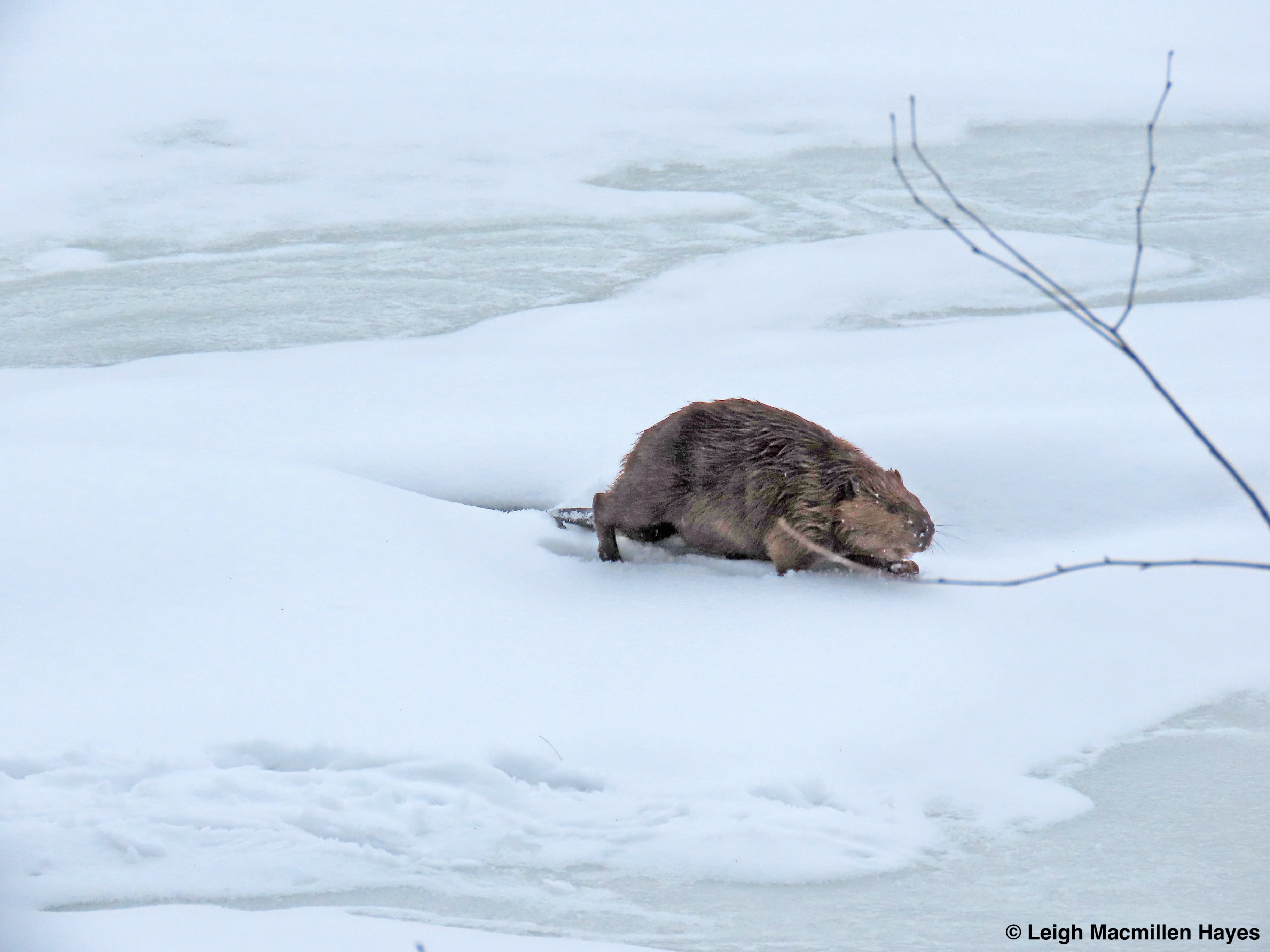
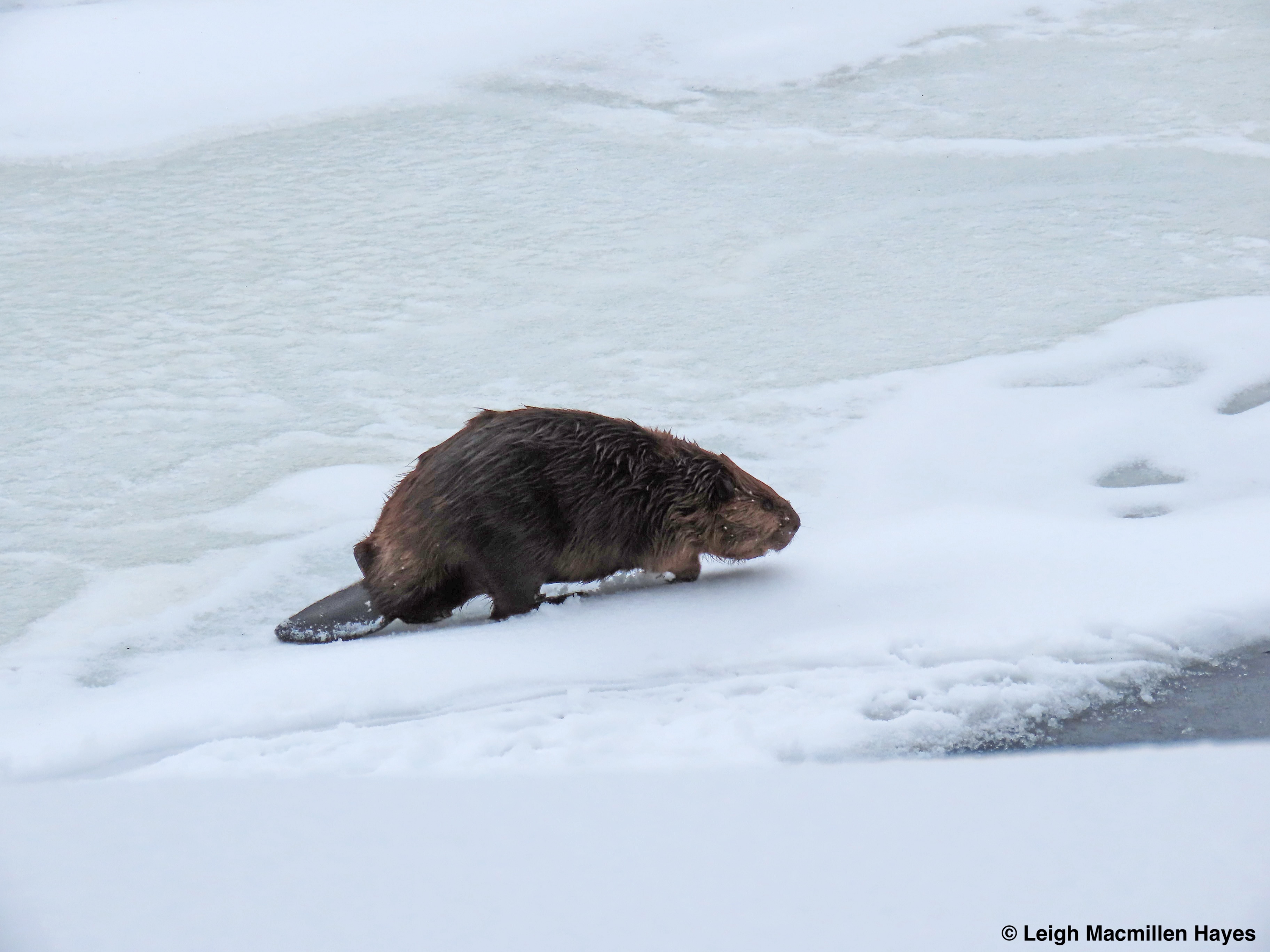
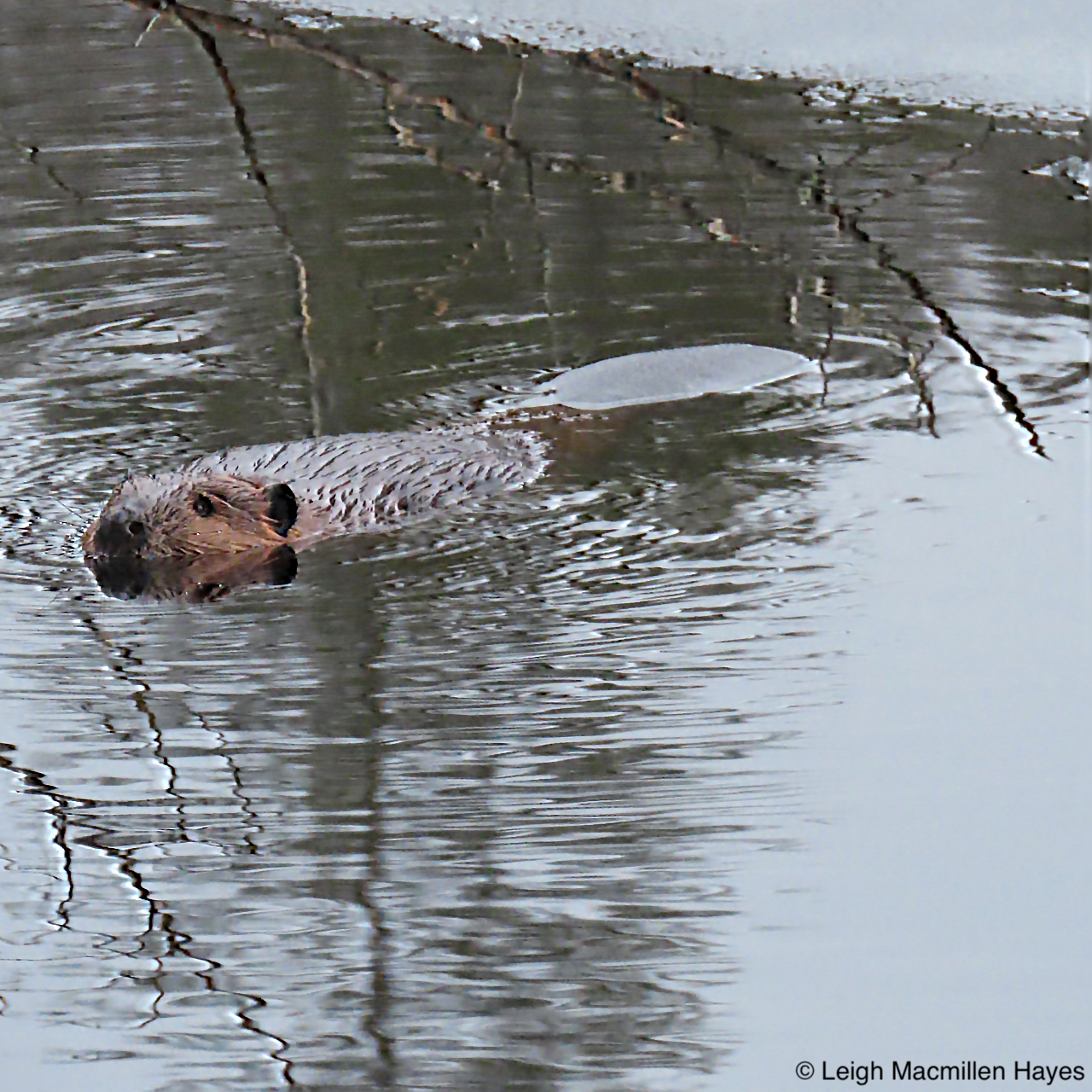
The Beaver must have come up the hill to cross the road to go grocery shopping by the trees he’d previously cut down, and then spotted us and we watched it waddle down its well packed trail toward the ice.

We thought our time together would end in a second as it slipped into the water, but then we realized it was looking for an open hole.

And scratching the snow and ice, even to the point of getting snow on its face.

It kept trying and we kept watching.

Still no luck for the Beaver, while we felt we were having all the luck in the world.

Traveling on land is such a vulnerable activity for Beavers and I could only hope that the Otter scat in this very spot where we stood above the water was the result of the Otter eating something else and not making a meal of a Beaver kit. Because really, they both can take advantage of the same hole in the ice.

We also wondered where the lodge might be but the bank’s edge was too steep for us to note if it was nearby.

And then, just like that, the Beaver found open water and this was the last we saw of it before it made its escape.

We knew we were blessed, Marita and I. And gave great thanks for hearing the Barred Owl, spying Otter Scat, and spending a few minutes with a Beaver.

What a day, from a Porcupine’s Tale to a Beaver’s, two mammals with tails of grand importance–the former being for defense and stability on a tree limb, and the latter for a rudder, as well as stability like a tripod when cutting down a tree, and fat storage as well.

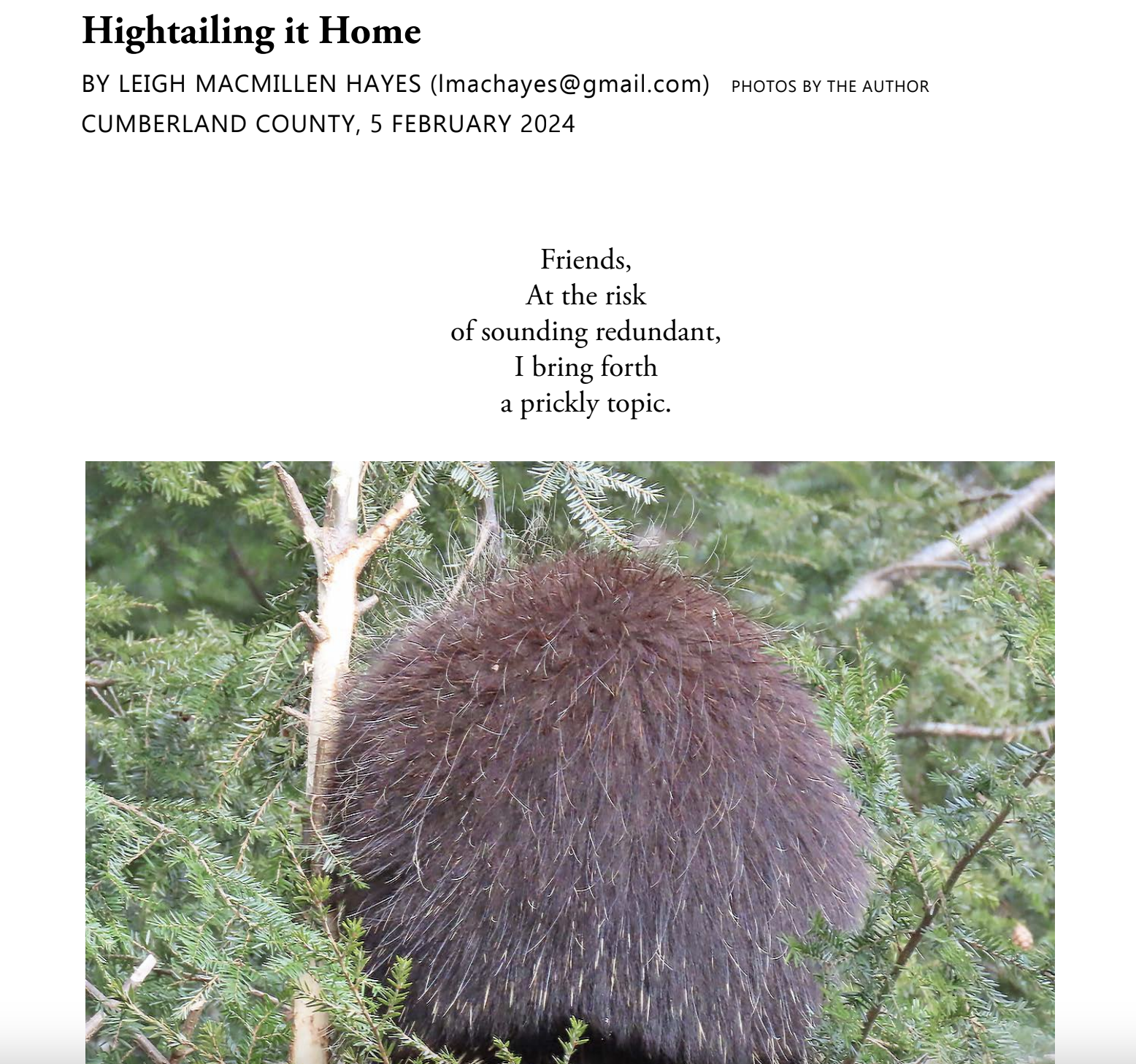
“Hightailing it Home” published in The Maine Natural History Observer

As some of you know, I not only have a soft spot in my heart for Dragonflies and Cicadas and Beavers and Otters, but also my prickliest friends, Porcupines. And recently I’ve been looking for our neighborhood rodents, which my neighbor sees when she lets her dogs out at night, but they’ve alluded me.

I do keep finding some evidence of their whereabouts, at least where they’ve ventured at night, but have yet to locate a den this winter or even spot a Porcupine waddling through the woods or sleeping on a branch.

That may be our fault. We’re in the process of saving our barn and have closed up any entrances Porky has used for the last 30+ years and probably longer than that, and tore down an attached shed and we’re having it rebuilt, so except for that one night he spent in the barn loft due to our stupidity of not shutting a trap door, I’m afraid we’ve evicted him. But there is more than one Porcupine in this neighborhood and today I wandered several miles into the woods beyond our land, and came up short-handed.

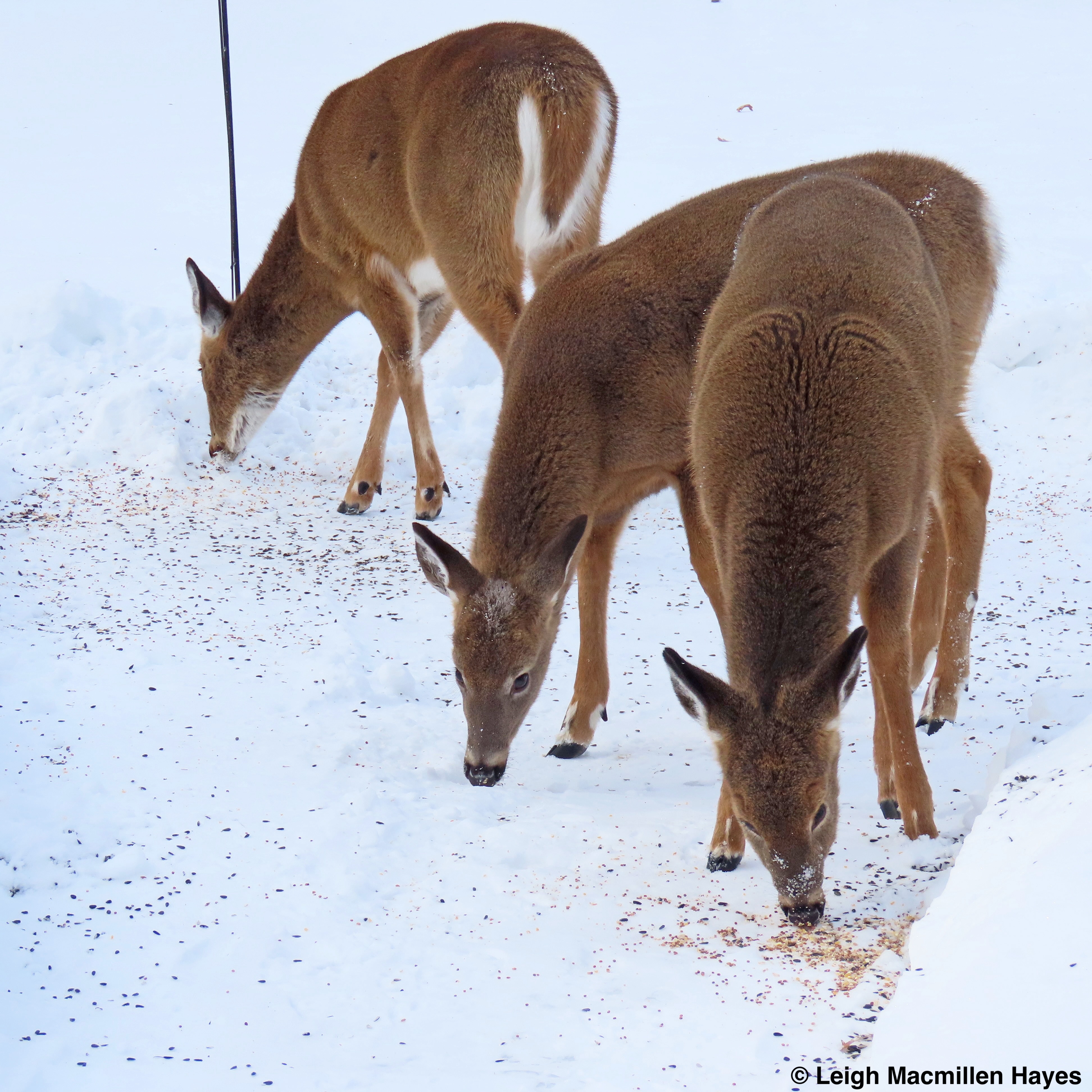
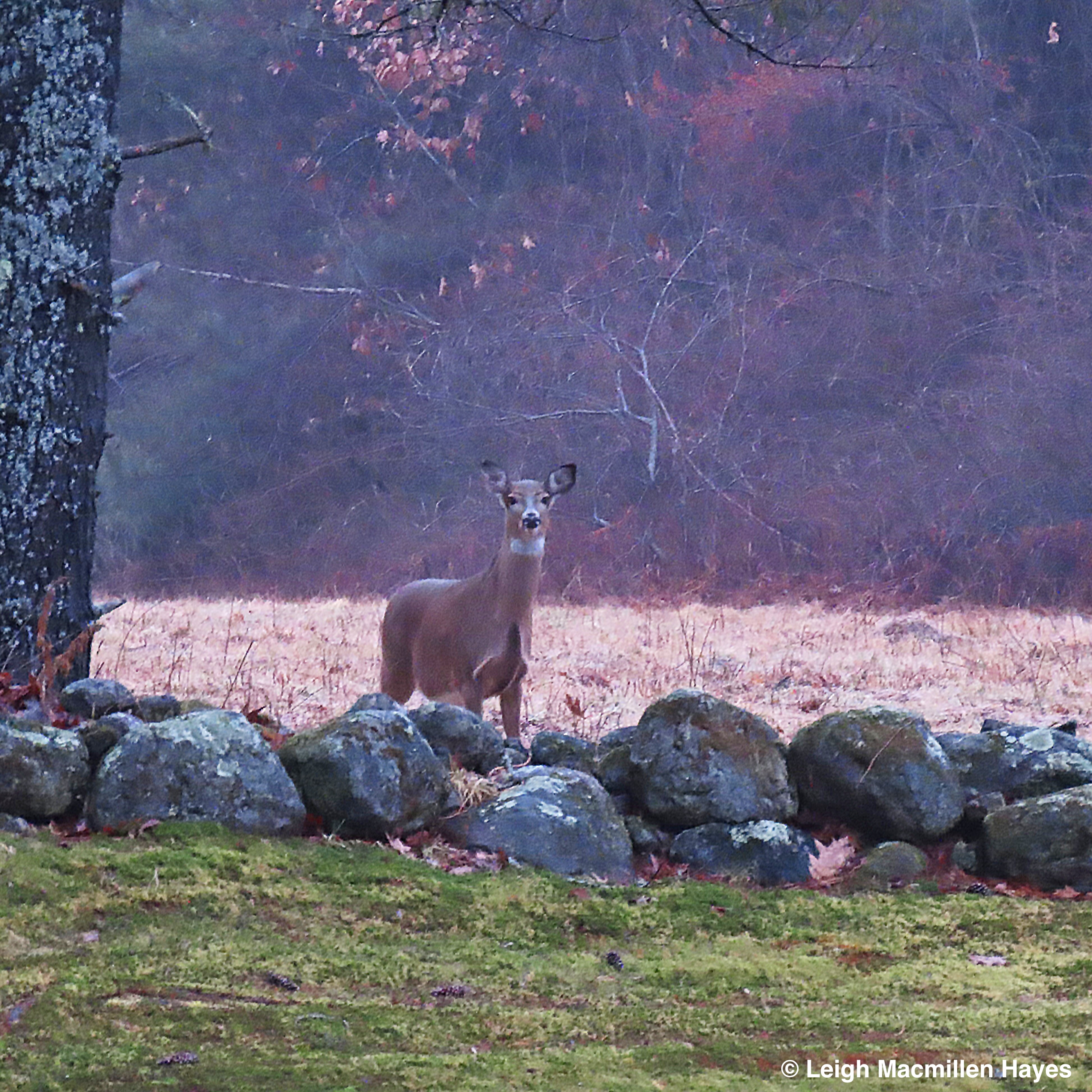
That said, I did spot three deer as I headed out along our cowpath. Do you see them?

We spent at least five minutes together before I decided it was cold and I need to get my mittens back on and keep moving.

Switching gears, I submitted an article about Porcupines to the Maine Natural History Observer for their first issue of 2025 and was tickled once again to have it accepted.

According to their website: Maine Natural History Observatory’s mission is to improve the understanding of natural resources in Maine by compiling historic information and implementing inventory and monitoring efforts of Maine’s natural history.

The Observatory specializes in collecting, interpreting, and maintaining datasets crucial for understanding changes in Maine’s plant and wildlife populations. We are committed to filling data gaps for Maine’s least understood species and creating a legacy of data for use in nature conservation, land use policy decisions, and expanding scientific knowledge.

Specifically, our mission is to:

  • Compile and publish summaries of Maine’s natural history
  • Coordinate local and regional inventory and monitoring efforts of Maine’s flora, fauna, and habitats
  • Facilitate cooperation and exchange of information among organizations, agencies, and individuals conducting natural history research in Maine or caring for natural history collections
  • Engage in other activities related to the advancement of scientific knowledge and education of the public regarding the flora, fauna, and habitats of Maine.

“Hightailing it Home” is about an adventure I had with a Porcupine in February 2024, and again, it was deep in the woods behind our home.

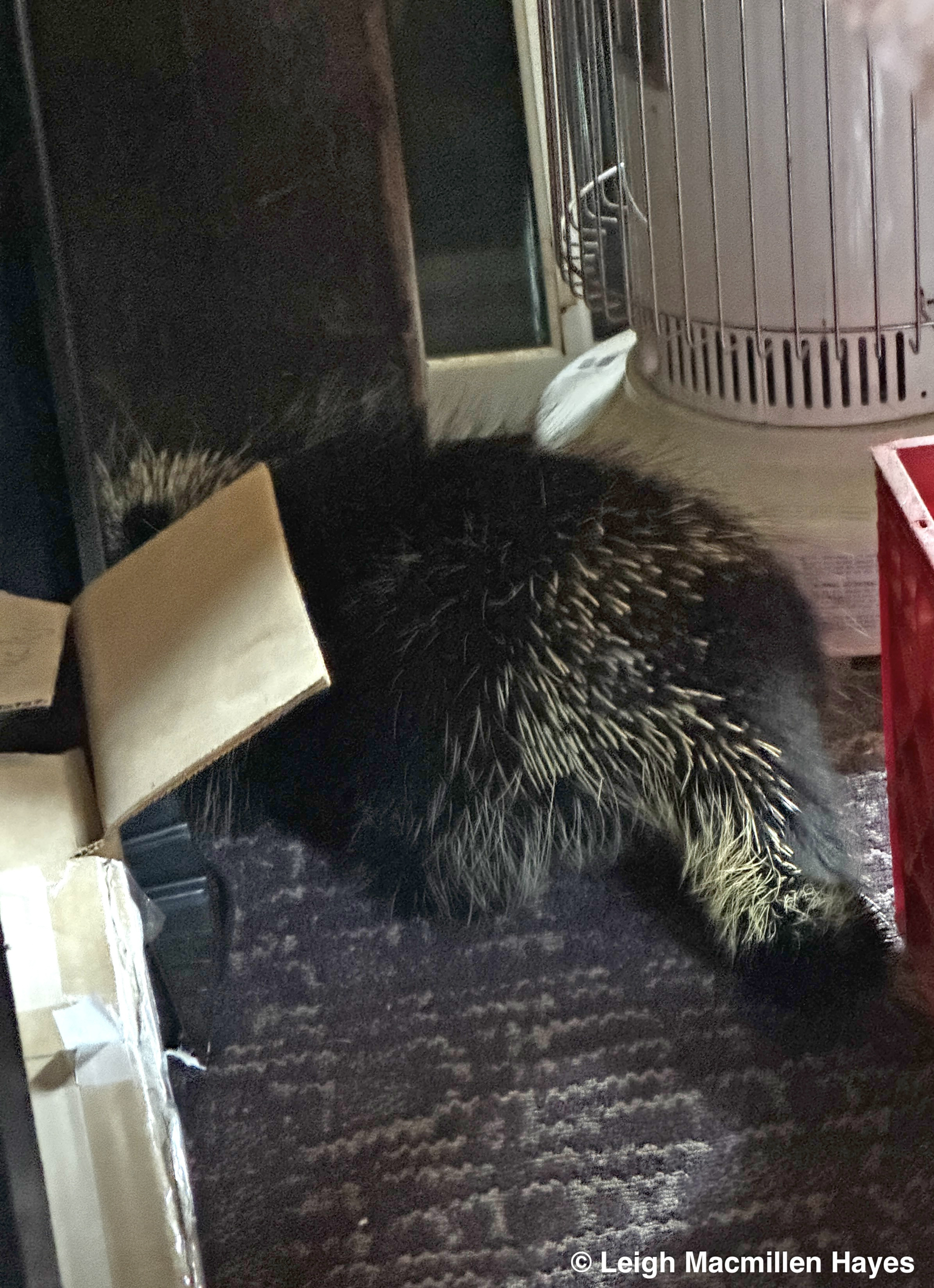
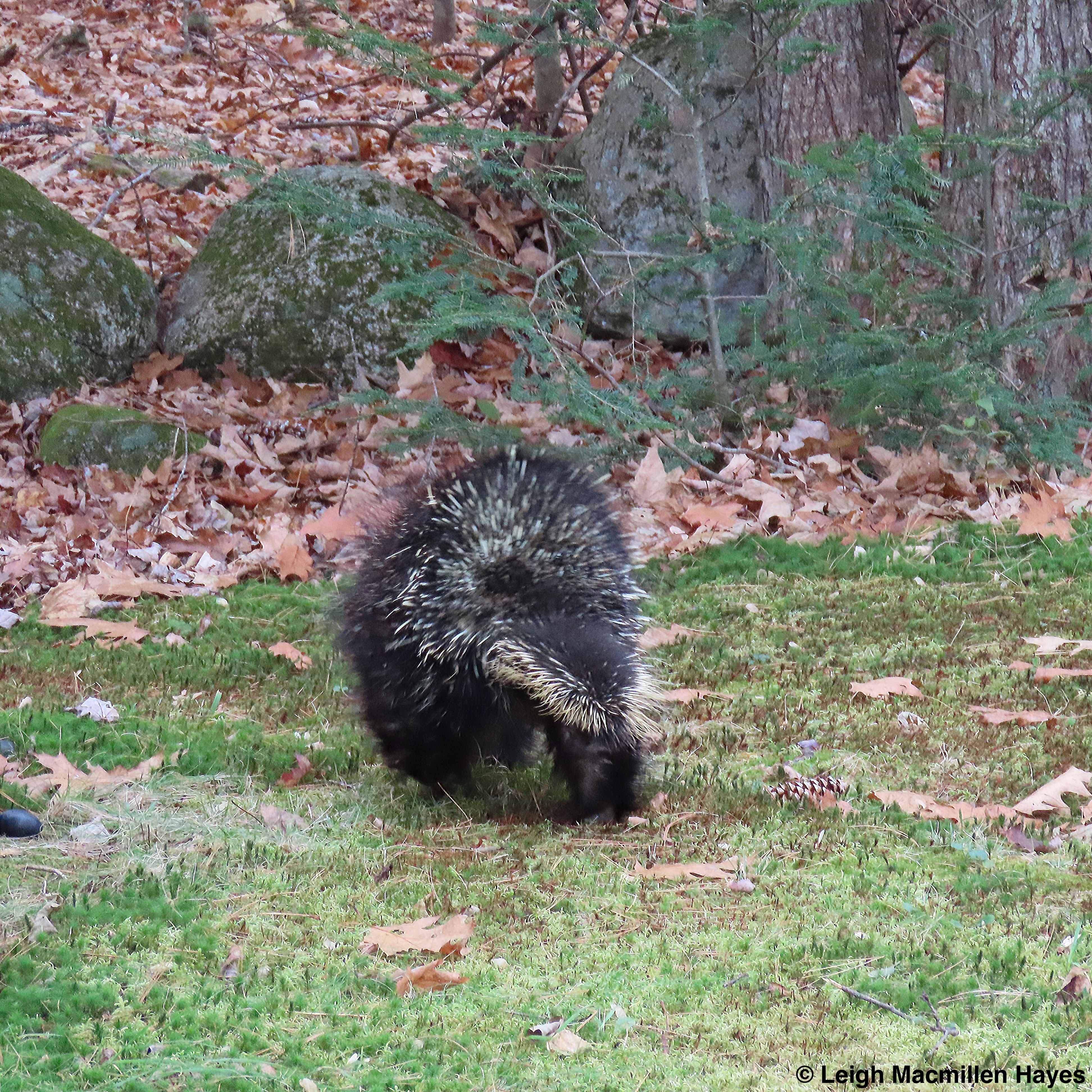
This is the back view that I first encountered that day, before the Porcupine realized I was being a nosy neighbor.

And I’ve included this portion of a page just cuze I love my Porky friends. Look at all those quills! Over 30,000 of them. And yet, his face is so soft, as is his belly.

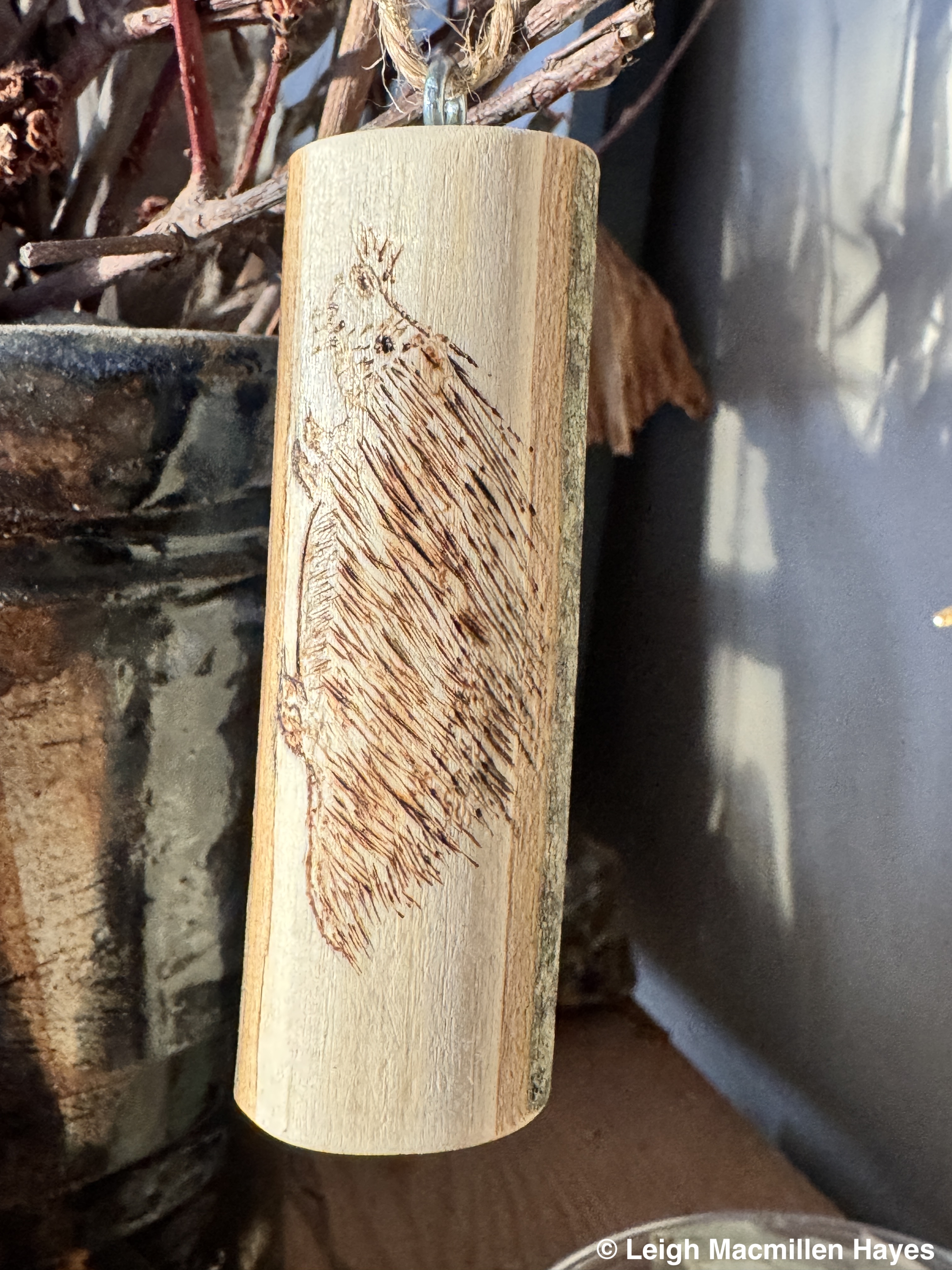
Apparently I’ve made that love known, for my ten-year old friend and fellow naturalist and artist created a tree cookie ornament for my birthday.

And my Cousin Bob did the same for Christmas. Both ornaments did hang from our tree, but now they are on display in my study.

Okay, back to the MNHObserver 2025, Issue 1, here’s a link: Maine Natural History Observer.

You’ll find “Hightailing it Home” on page 36.

There are some really interesting articles, including one about Maine weather in February 1958!! Perfect for an evening read on another frigid night.

Thank you, Maine Natural History Observer, and especially to Celeste Mittelhauser, Outreach Coordinator.

Here’s to future adventures with Porky and so many forms of fauna and flora who continue to teach me. I sure hope I get to hightail it home following a sighting in the near future.

The Inside Out Porcupine

This story begins at about 5:10am on November 5th. I awoke to a noise that immediately became plural–and the ruckus sounded like it was taking place in the barn that is attached to our old farmhouse. For about fifteen minutes things shifted and banged and dropped, and then all was silent. My Guy slept through it all.

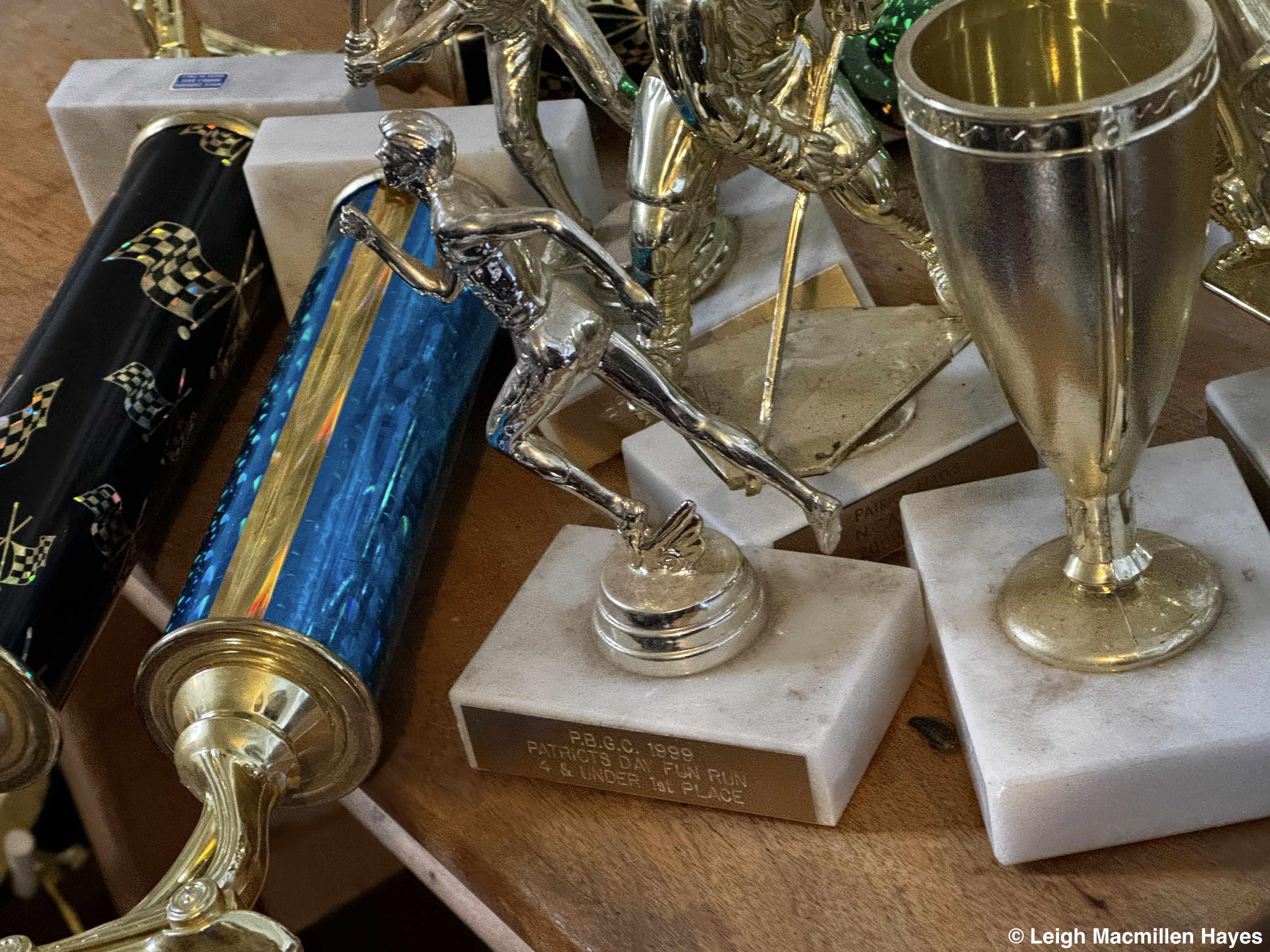
At lunch time, however, he did as I asked, and climbed to the hay loft to find out what had happened. And that’s when he discovered that I really did hear things dropping, for the myriad trophies our sons “earned” years ago for soccer, and peewee football, and golf, and baseball, and basketball, and hockey, and Pinewood Derbies, and who knows what else, were astray.

I’m going to digress for a minute or two, but really, it was the more creative trophies they received that I like the best like these from Boy Scout Cake Bakes.

And this one for being the king of Nordic Ski Team ski waxing.

Now back to the barn: As My Guy poked around, and there’s a lot of stuff up there right now because we’ve torn up the floor boards on the first level in anticipation of saving the structure and making it safe to park a vehicle in there again, he made a discovery and quickly sent me a photo because I wasn’t home.

A porcupine was snoozing under the Air Hockey table!

We set a trap that I hoped the critter would evade. And it did. My Guy also made quite a lot of noise the next day and saw Porky move from under the table to below a chair. And then he couldn’t find it.

Checking on the situation again a day or so later, we discovered Porky had indeed done some work–beginning with chewing the window and sill.

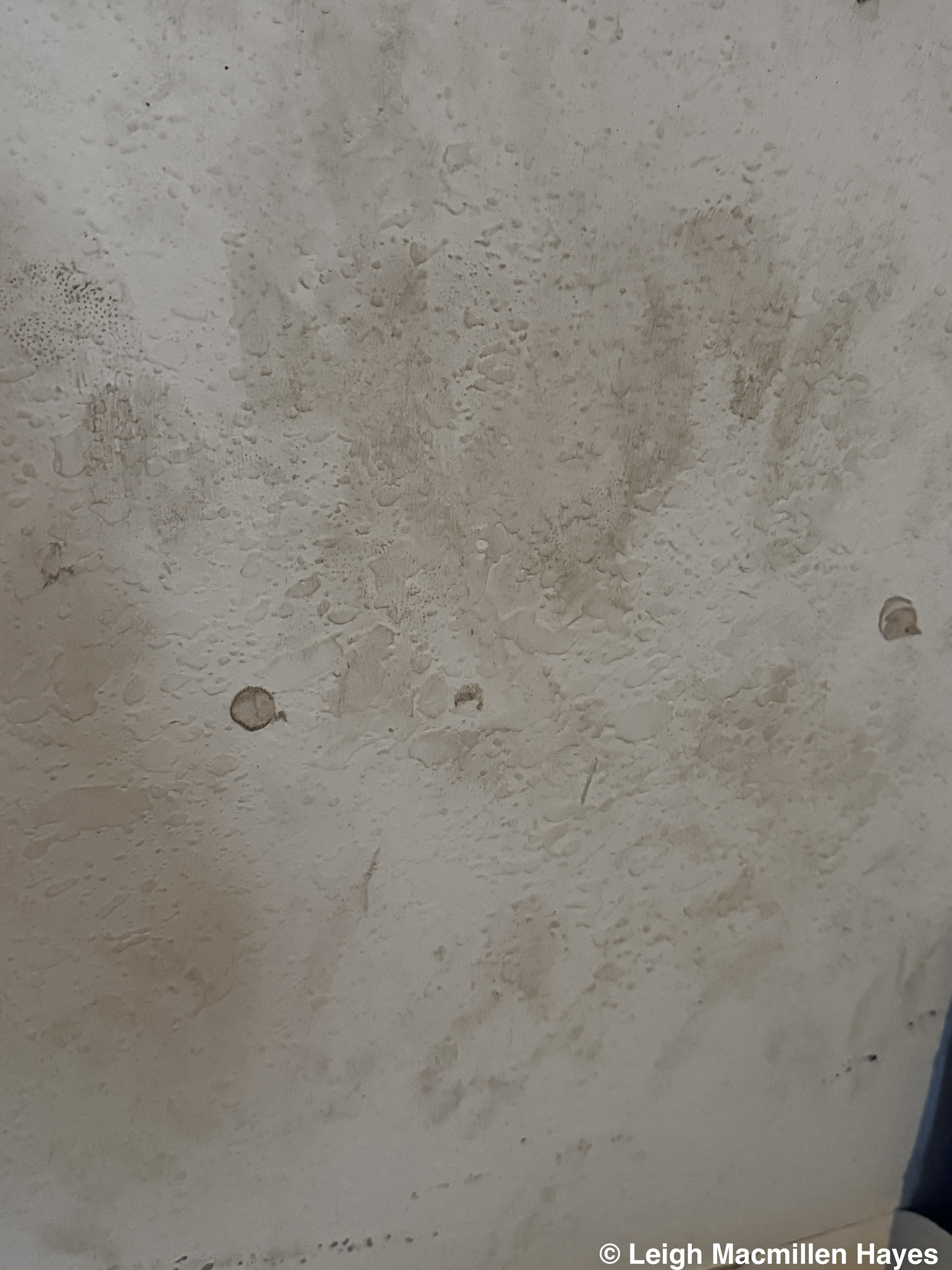
And he left signs of his adventures, including muddyish footprints on the wall below the window.

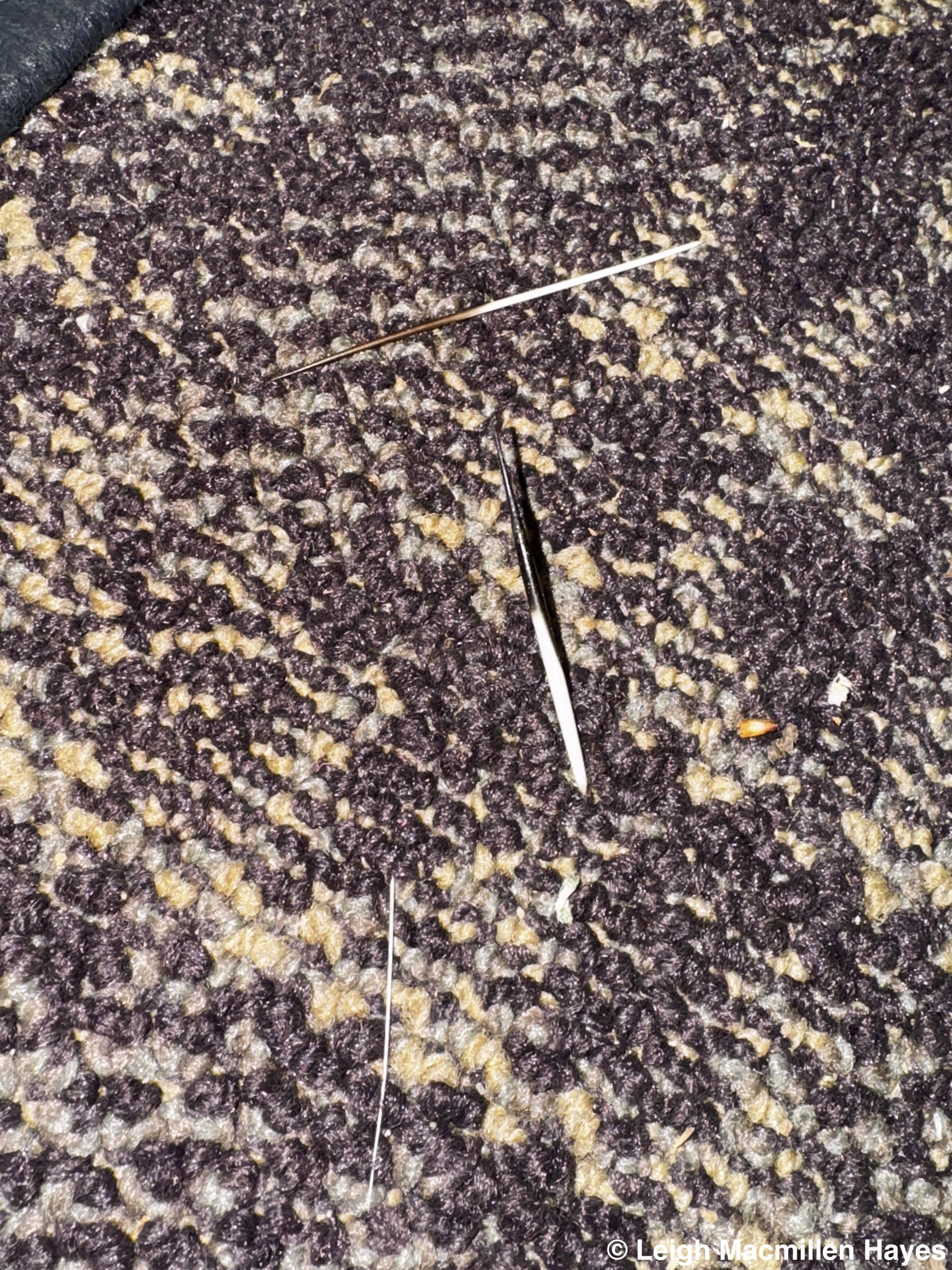
And quills scattered about, some even sticking into the rug originally placed because this had been a Rec Room back in the day when our sons were young. Right now it’s a Wreck Room!

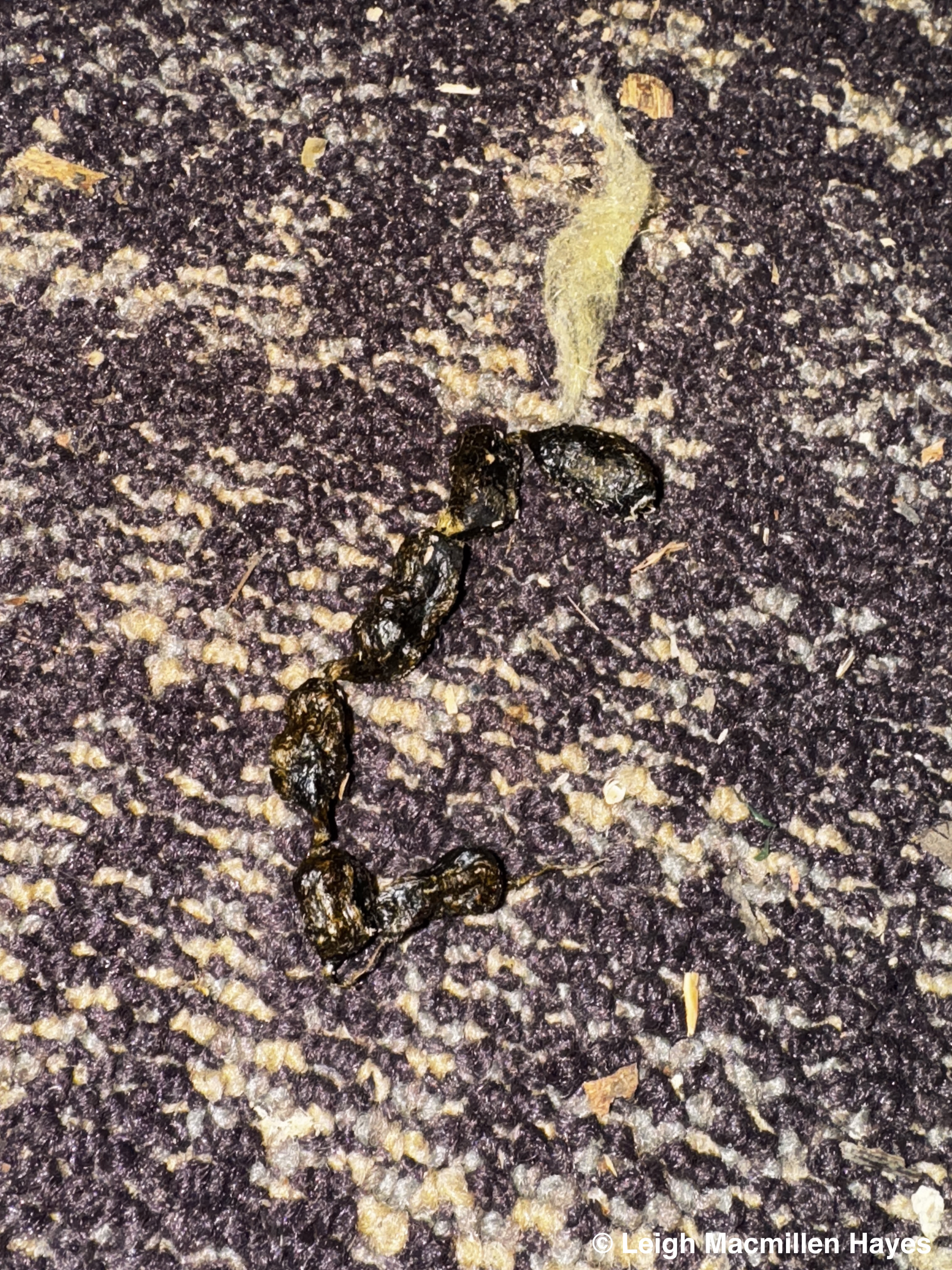
Was there scat? Yes, but not nearly as much as expected, and I could track his movements.

Today, I was out there looking for more evidence. So . . . I have a rather extensive collection of tree cookies and twigs and even some branches–all for teaching purposes, including this particular piece of a sapling I’d carried down a mountain because it was in the way on a trail, but deserved to be saved for it features a moose scrape.

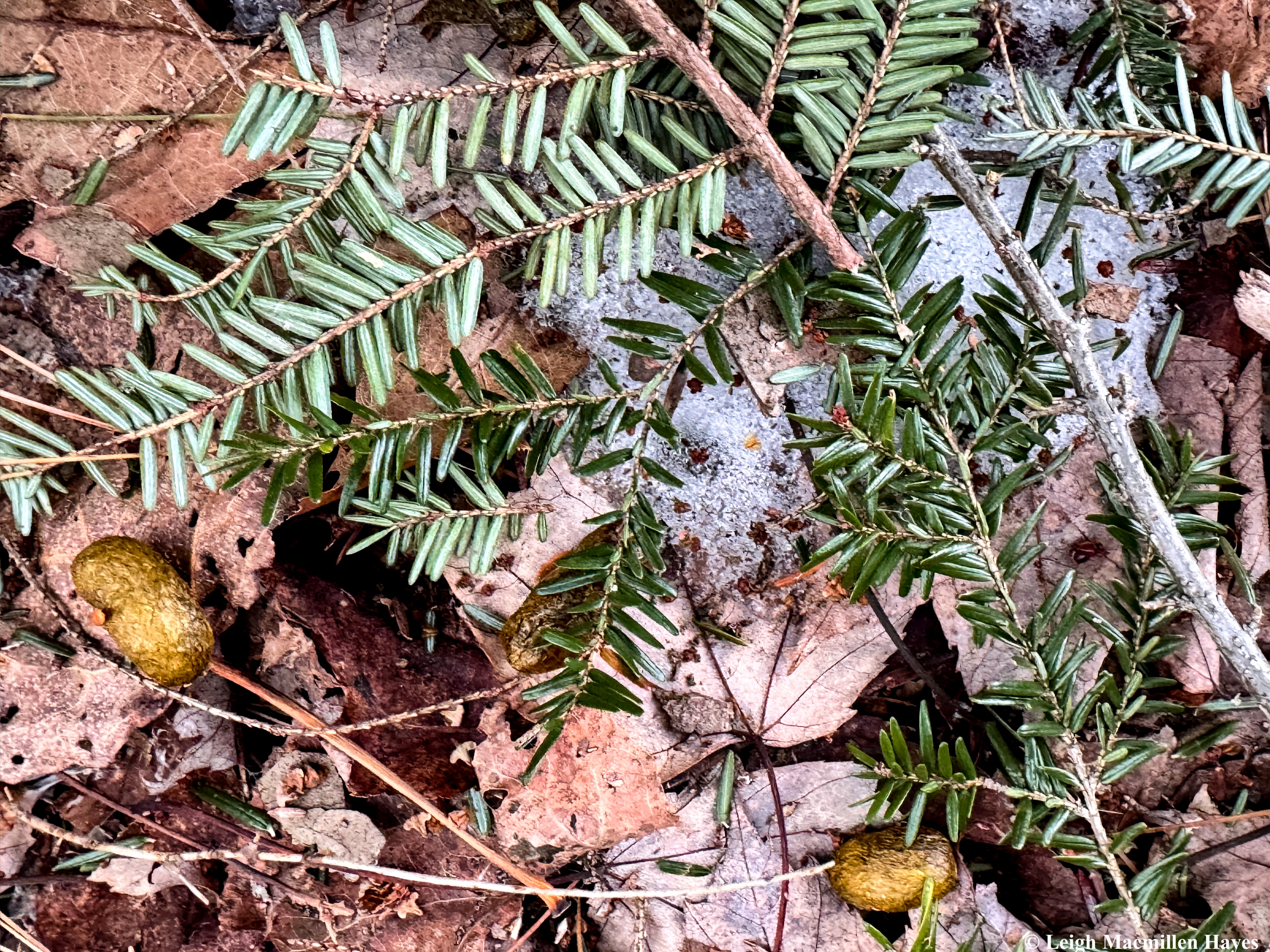
But even better than that, this afternoon I noted some wood chips and scat below it and realized Porky had taken some samples.

I love how I can get a sense of the size of his teeth with the work that he did.

And I’m surprised but happy to announce that he didn’t touch any of the other samples stored up there.

I decided to follow his trail and found a few scat specimens on the stairs, and others along beams that are right now uncovered given the first floor changes planned for later this week.

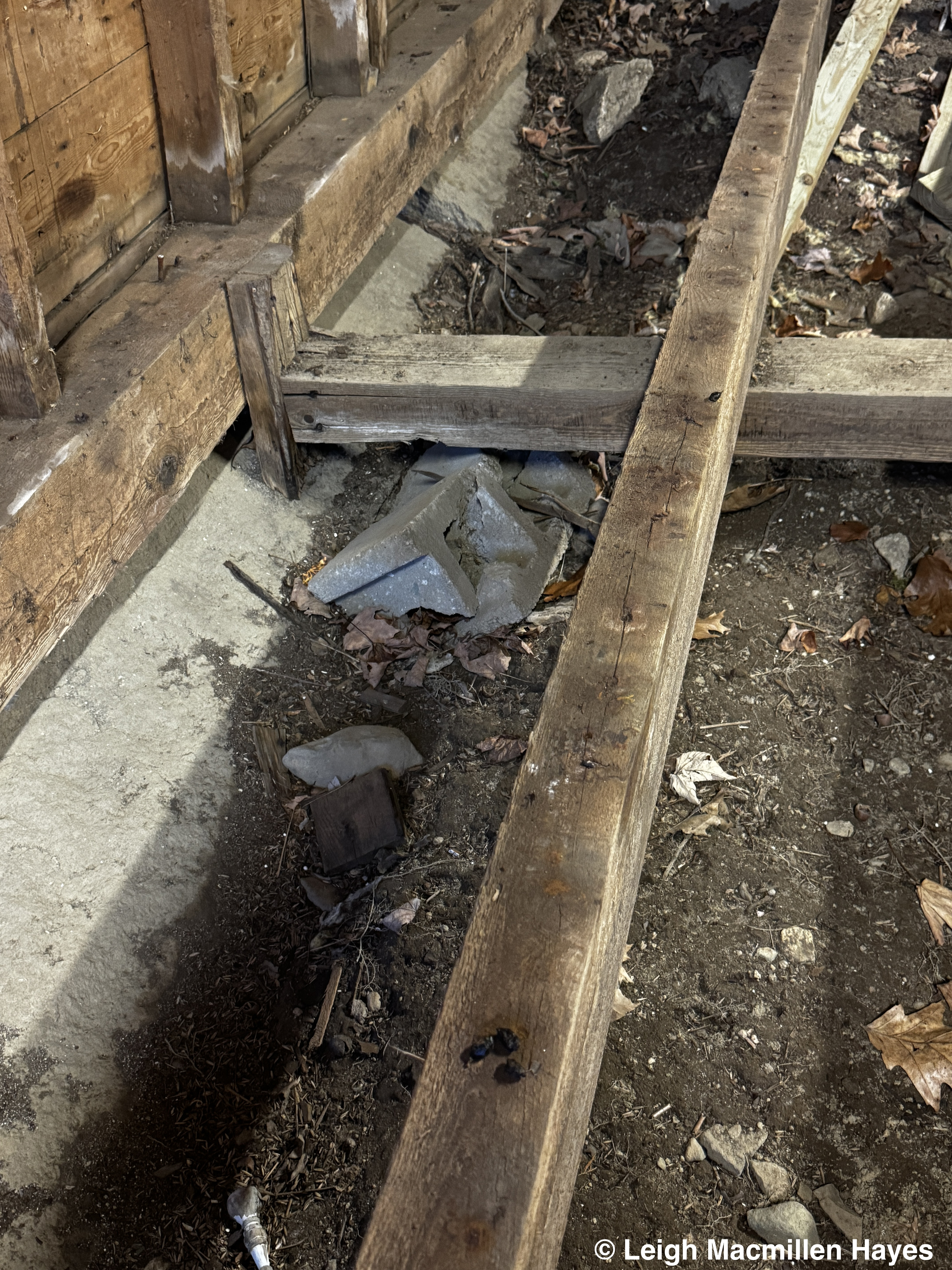
The question I haven’t answered yet and I suspect its because leaves have blown in and covered any evidence: which entrance did he use?

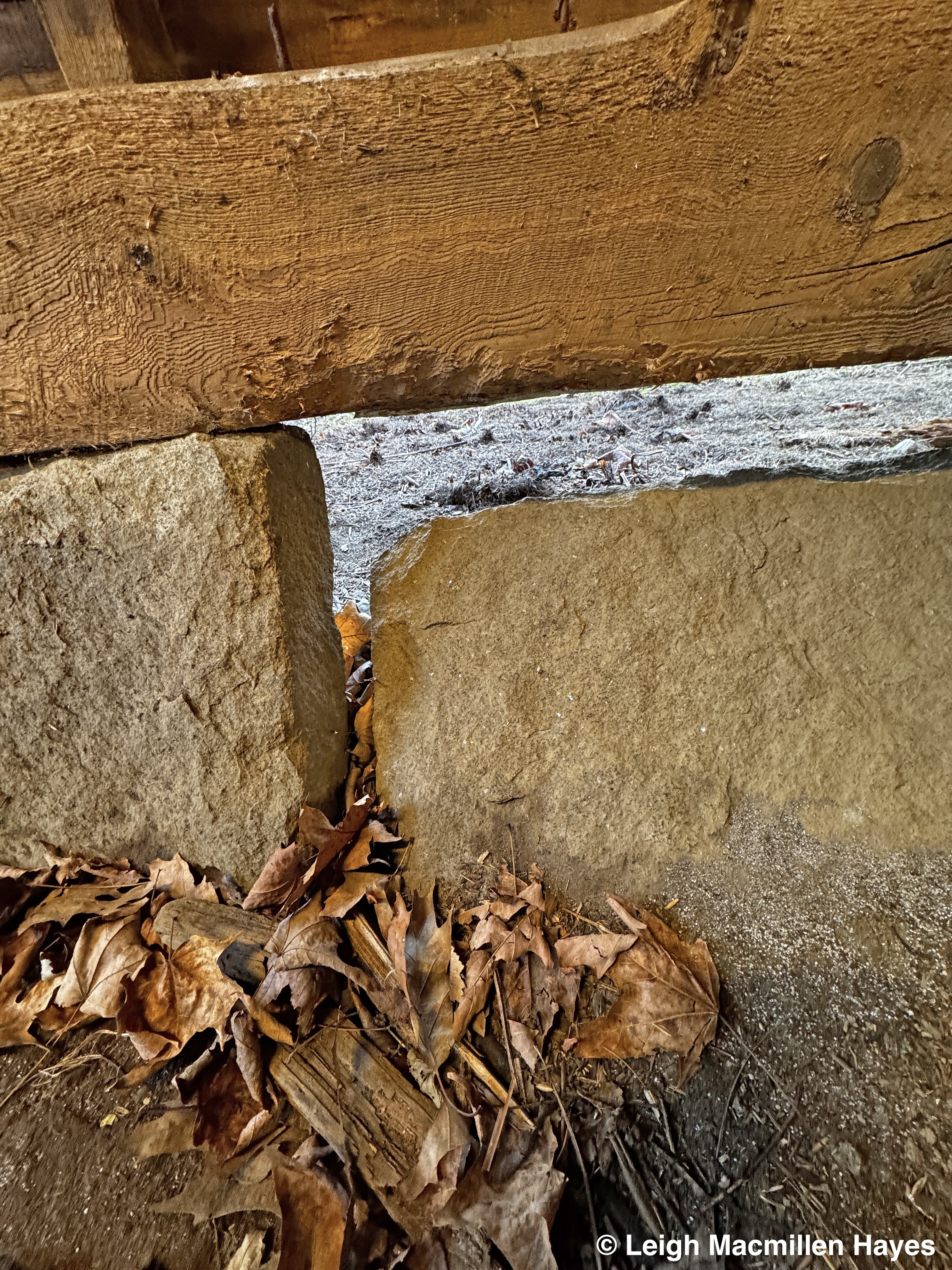
This is one he’s used for the past several winters. Okay, truth be told, we’ve owned this property for over 30 years and have housed a porcupine (and raccoons and woodchucks and opossums and anyone else) for all of those years. They used to have a different entrance, but we made some changes four years ago that forced them to find a new way into their abode.

If you look at the bottom of the beam, you can see where Porky has worked in the past to enlarge this hole over the split granite.

And just last year, he started another between the barn and an attached shed.

With all those years of co-existing, I was sure we’d find far more damage when we removed the floor boards. But . . . we did not. What we did find: Eight, yes eight, suet feeders that had disappeared over the years and I always suspected the raccoons had taken them under the barn because I couldn’t locate them in the yard, field, or woods.

All I can think is that Porky was sated when he entered and didn’t need to gnaw on the wood.

The funny thing about the latest Porky adventure, is that it could have been prevented if we’d thought to close the trap door at the top of the stairs. It took us a day or two to realize this and I feared that Porky would stay up there forever, given that he had plenty of wood to eat and a rather snug place to sleep with the only predators being us.

That said, the trap door does get closed now. And there is no new evidence of a visitation by my favorite rodent. And we didn’t trap him afterall. And he’s still in the woods somewhere. And I can’t wait to meet him–just outside, not in.

And when I do, I’ll be curious to see if it’s my old friend Bandit, for he and I met behind the barn last November and I’ve since honored him with a painting.

Here’s hoping the Inside Out Porcupine stays outside going forward. I’ll be looking for him.

Porcupine, Snakes, and Bears, Oh My!

Disclaimer: there may be some not so pleasant photos in this post. I apologize. BUT, what you will see is a fact of life.

Do I have your attention now?

Our afternoon began so innocently as we hiked along a well-traveled trail at Hawk Mountain in Waterford, Maine, where Goldenrods and Asters shown the way.

I knew I was in the right place the moment I saw a Black and Yellow Spider for I have spent the last two months enjoying their presence in our neighbors’ field and though they are beginning to decline in number as summer heads toward fall, a few are still on the hunt and packaging meals such as you see here.

Also like home, the presence of butterflies. Granted, we were only twenty minutes from home, so spotting Monarchs nectaring wasn’t a surprise. It was a delight, really.

And an American Painted Lady, her two eyespots on the hind wing as opposed to four smaller spots on the same wing of a Painted Lady, pasued on some bramble branches.

A Red Admiral also decorated the scene, even if it did appear to have a bit of attitude given its stance.

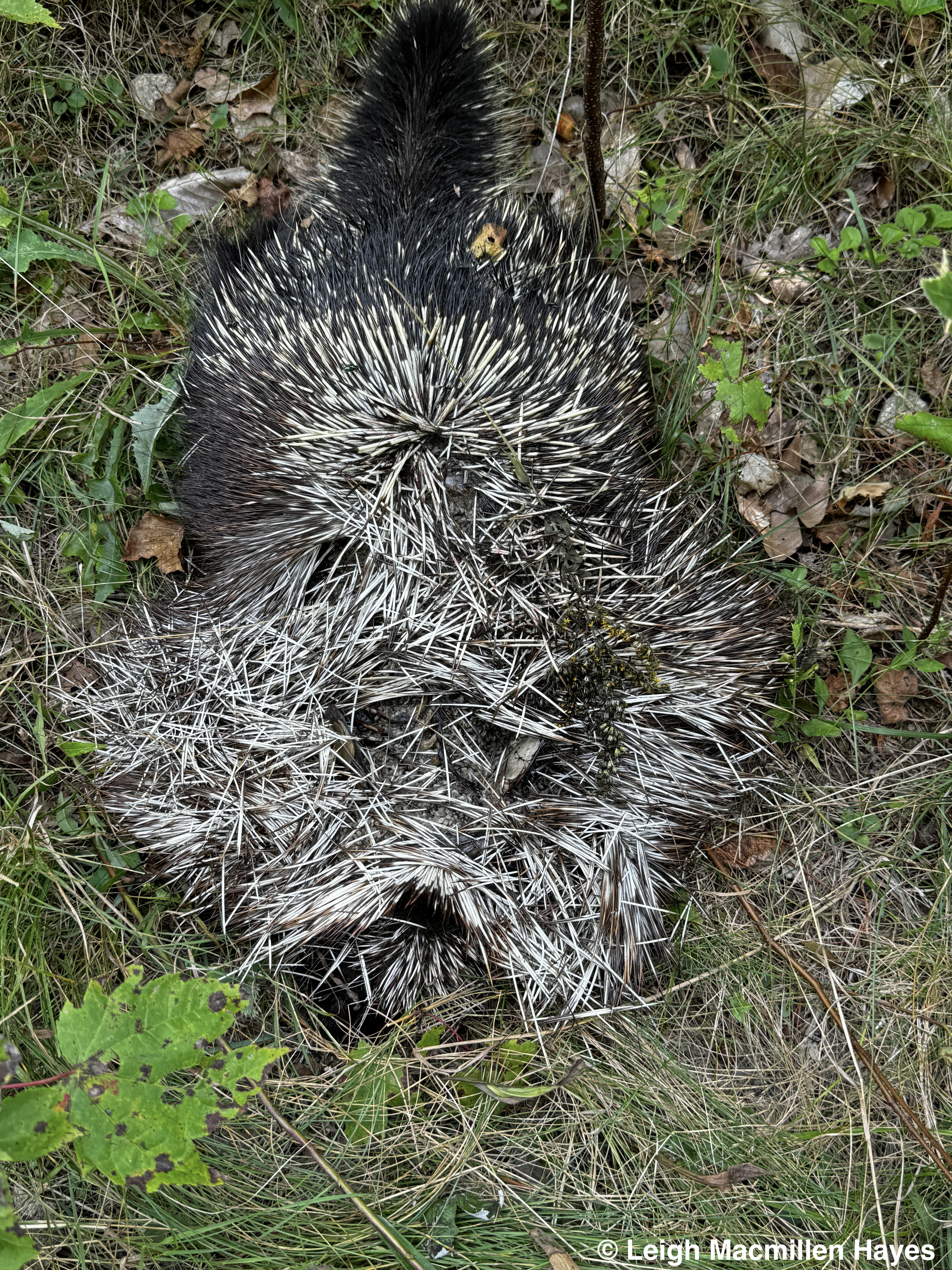
And then . . . and then I saw the body of a dead porcupine. It didn’t smell. But the Common Green Bottle Flies (in the Blow Fly family) that made their fly buzzing sounds around it indicated it had been dead for a bit. Some of you know that I love a such a wildlife mystery–and the opportunity to try to figure out what happened. BUT, the story doesn’t always piece together as neatly as I’d like.

First, there appeared to be three wounds on the animal’s back. Large openings. As if from a very hungry predator. And a brave one? Fishers are the porcupine’s main predator and they are known to attack the others face and belly, where the hair is soft as compared to the 30,000 barbed quills on its back. And a fisher and others would then visit the carcass repeatedly to dine. That hadn’t happened in this case. Instead, the animal died on its stomach. And other mammals didn’t take a repast from the offering. Did a domestic dog do the duty? If so, it must have had a head full of quills.

As for those metallic green flies, their maggots squirmed inside each large wound. By the hundreds. Maybe thousands. I wasn’t about to count. In his book, Insects of New England and New York, Tom Murray explains, “Blow flies are often associated with decaying organic matter, particularly carcasses and other sources of rotting meat and feces. In fact, they can figure prominently in forensic entomology, aiding in determining time of death.”

Murray adds, “This might sound like the dark ages, but cultures of sterile maggots of green bottle flies are sometimes used in hospitals to clean up deep wounds and infections that otherwise are difficult to treat. They only eat dead tissue, and secrete an antibiotic, preventing further infection. In nature, the normal food source is carrion.”

Maggots. A source of wonder! Who knew? Well, obviously doctors and scientists and Tom Murray!

There was one other thing to look at on the carcass, besides those three-toned quills and the soft curly hairs in the mix. The sole. Look how pebbly it is! The better for climbing trees, my friend. Think of non-slip socks with those little white treads. Porcupines don’t need to wear socks. Maybe they were the inspiration for such. Ahh, this site just got even better!

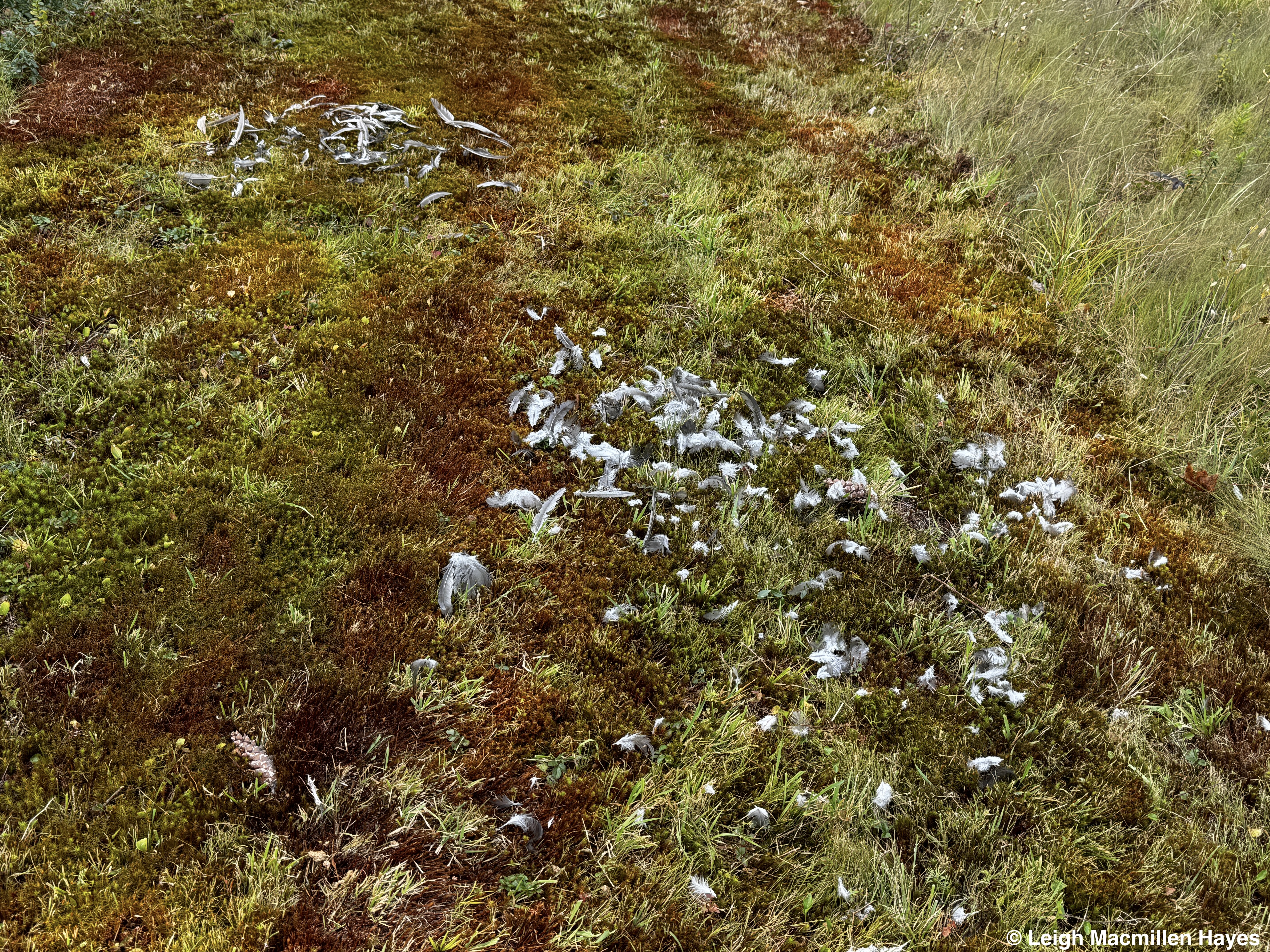
I still don’t know who the predator was but it took me back to what my neighbor and I discovered in her field yesterday. Two piles of feathers from the same bird.

The feathers appeared to have been plucked so I suspect a raptor did the deed, after all, they need to eat too. But what species died? We don’t know birds well enough to say. What was curious to us was that there was no blood. Nor any body parts. My neighbor’s dogs were onto a scent in the feathers, however, and we suspect that they had a better sense of either who the prey was or who needed a meal than we did.

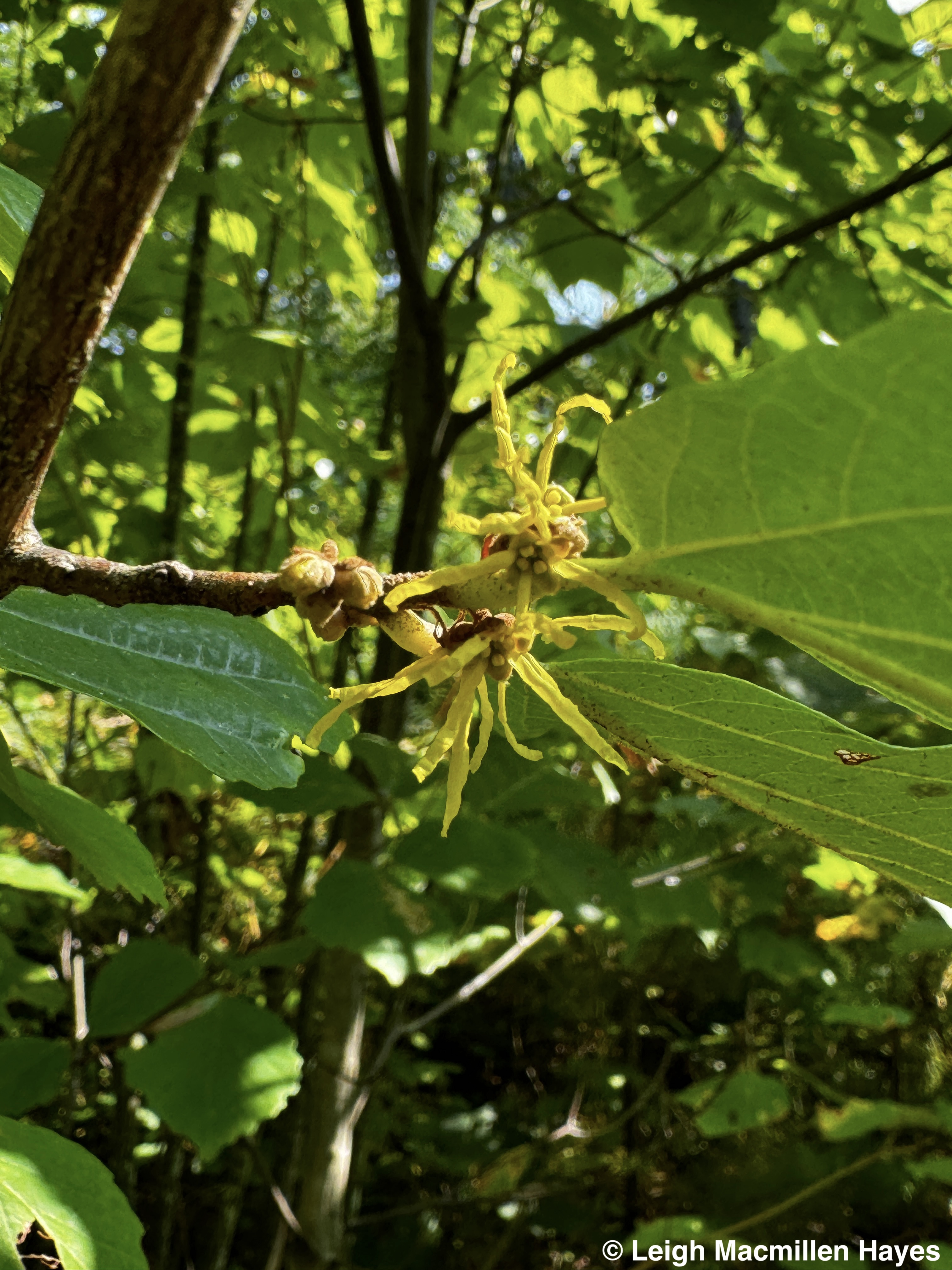
Returning to today’s trail, I spotted Witch Hazel in bloom, the first of the season for me to spy. This flower always makes me happy with it’s yellow ribbons haphazardly displayed.

And then I sawa Maple Leaf Viburnum, its leaves already their magenta color and so many berries still intact.

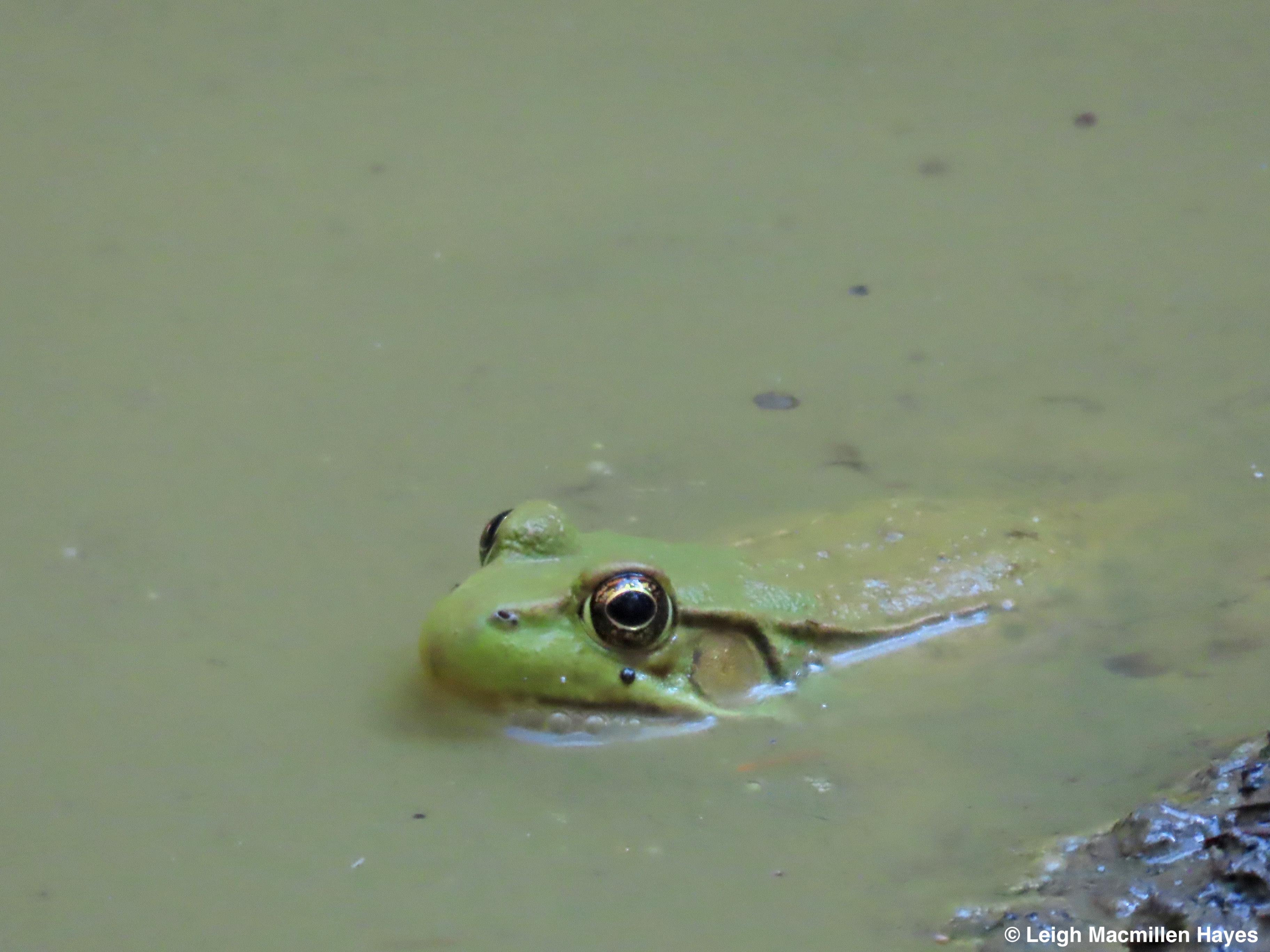
And a Green Frog in a mucky puddle as we approached the summit.

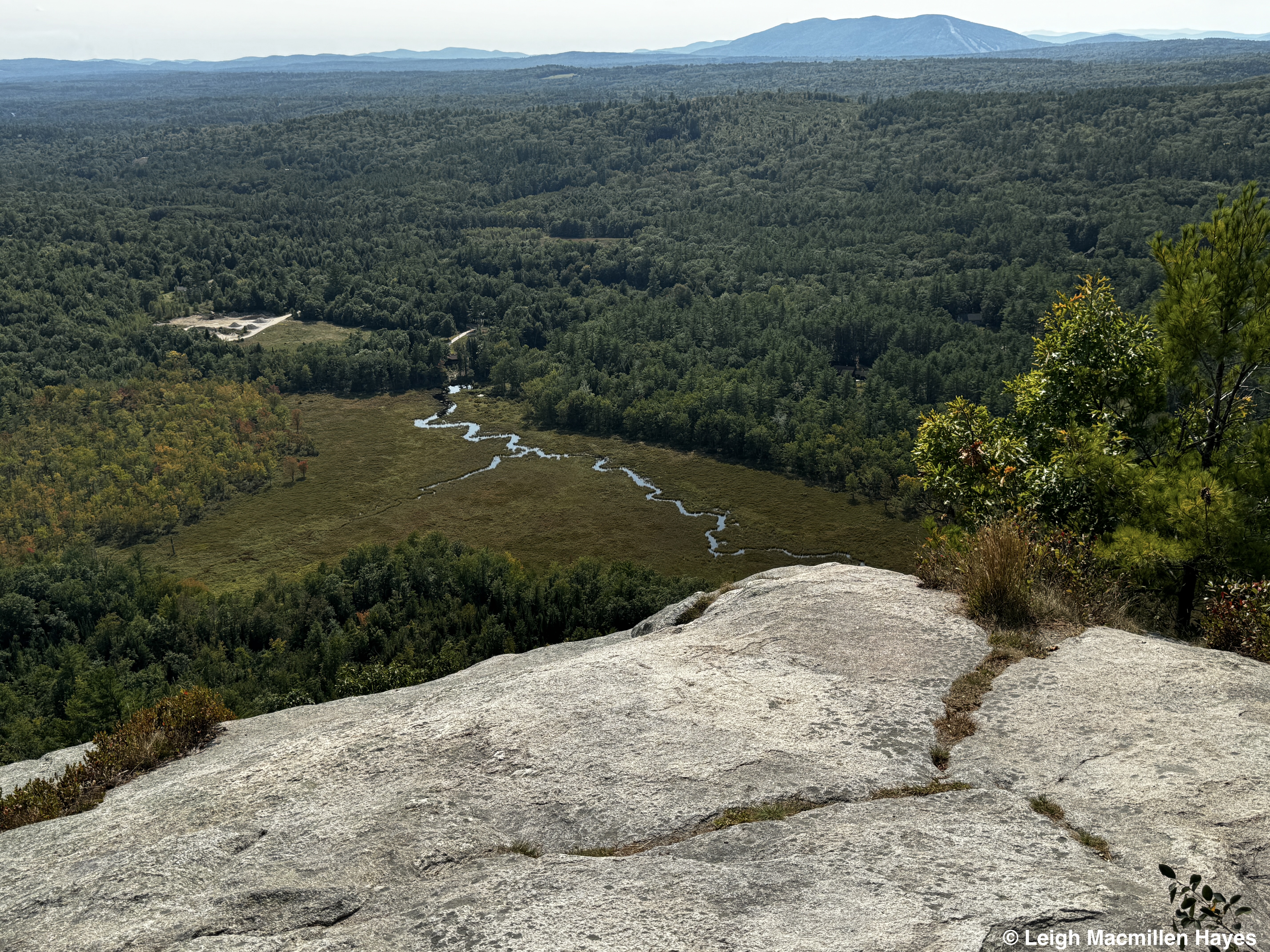
The view is always amazing, enhanced by the brook and wetland below and our beloved Pleasant Mountain in the distance. You can even see the ski area at the right or northern end.

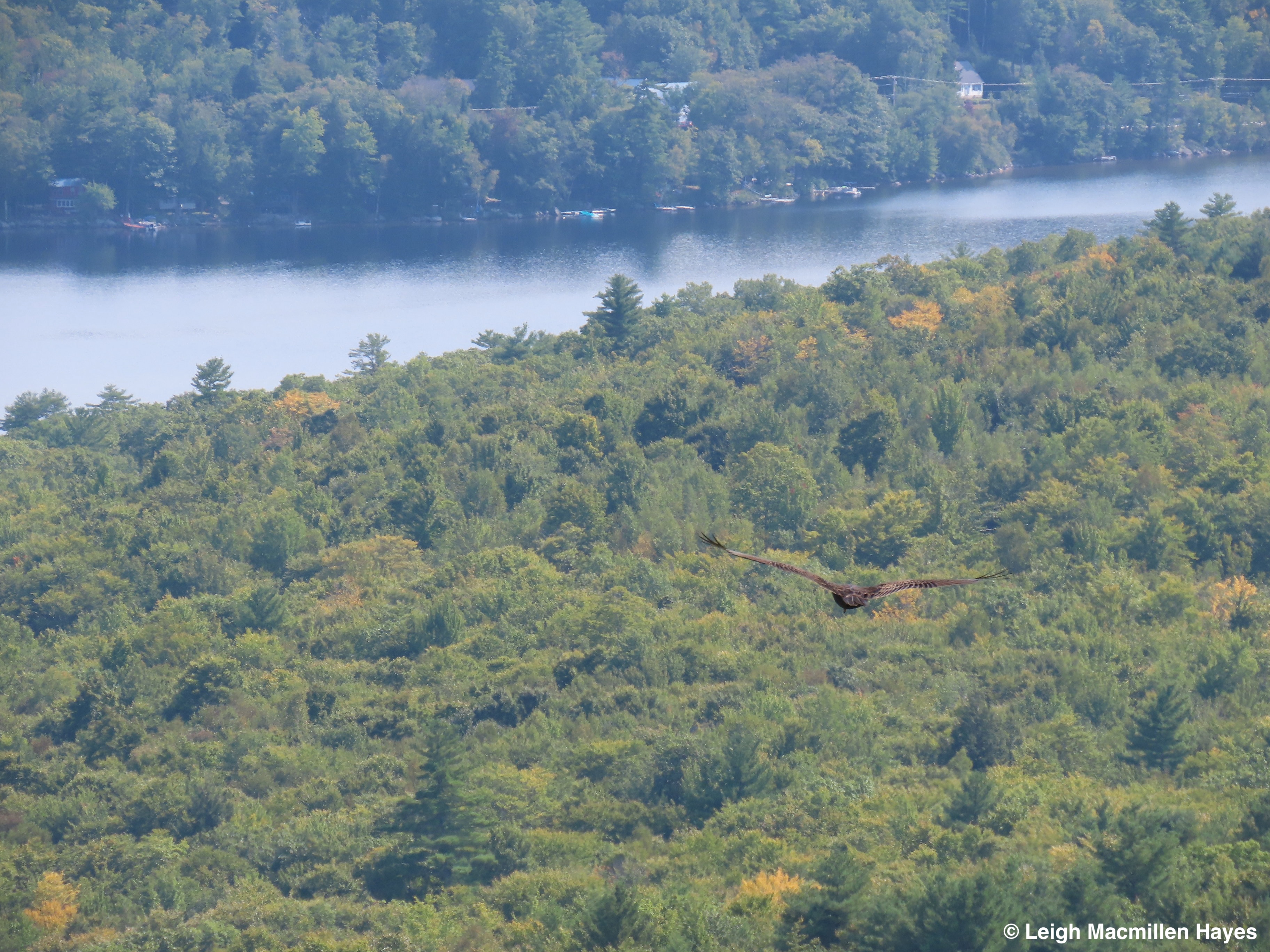
While we were out there I only captured a photo of one Turkey Vulture, but at least three road today’s thermals, gliding round and round.

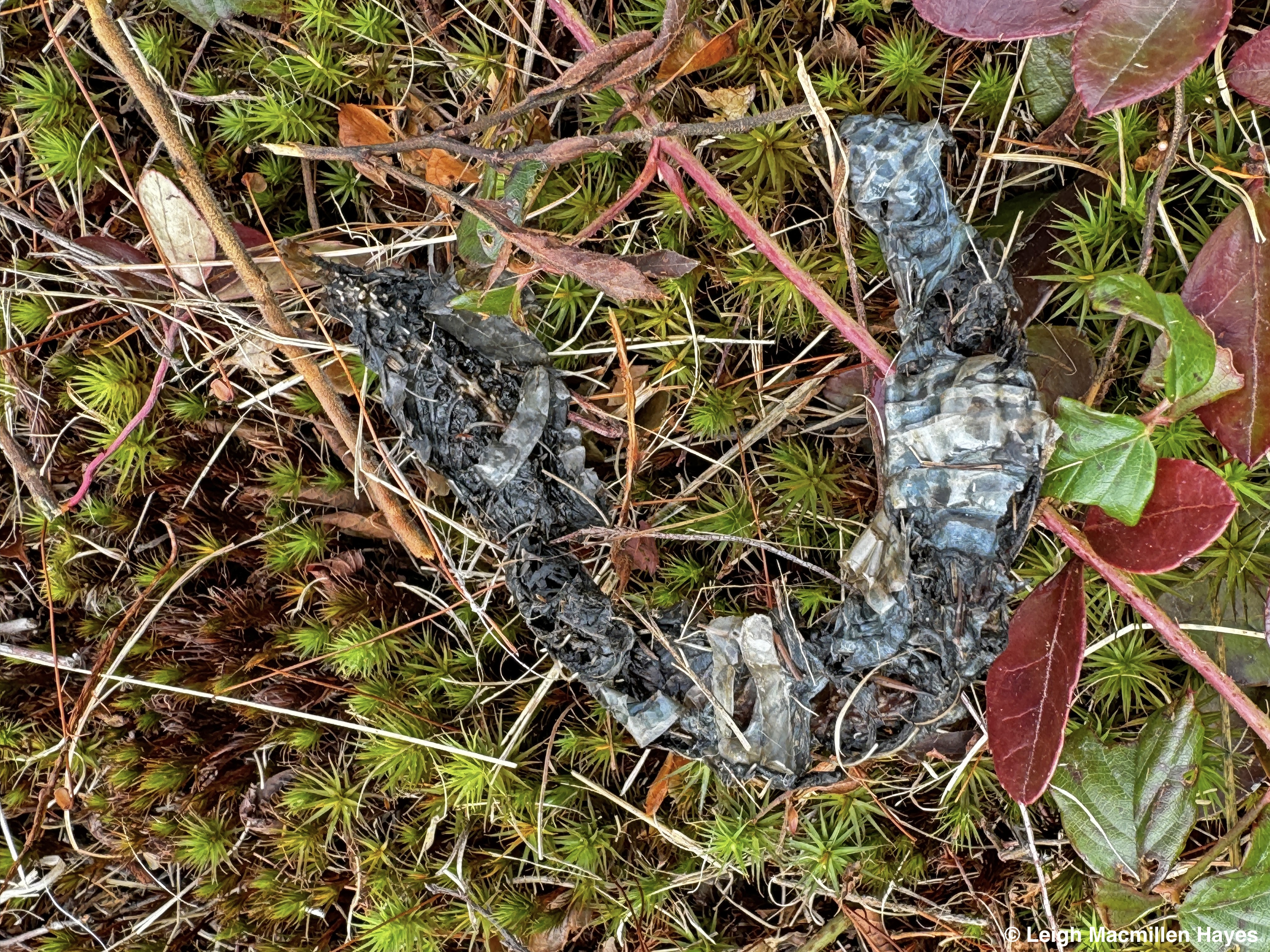
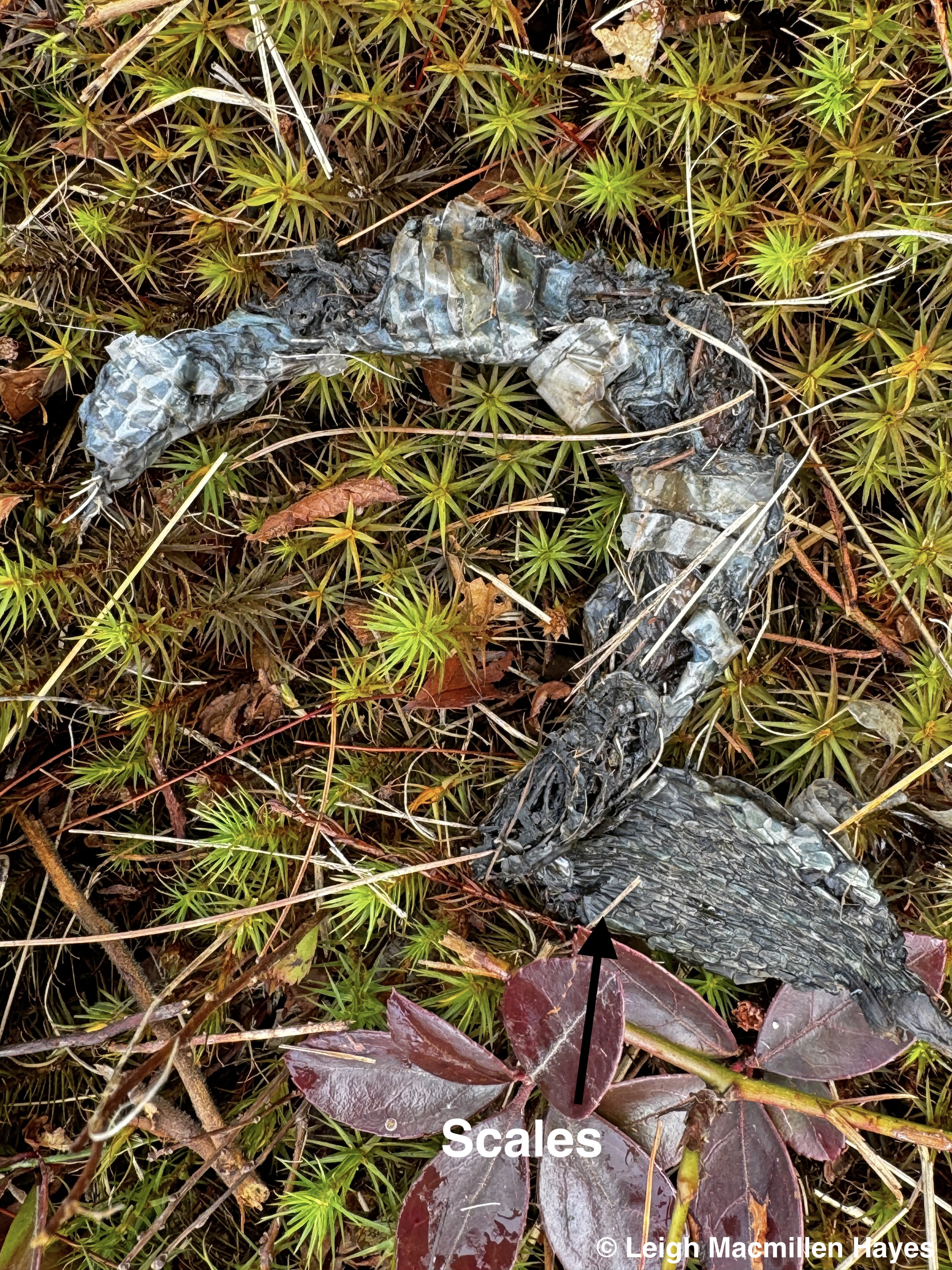
And on the way down a small Garter Snake tried to hide from us. It was about the size of a pencil. And reminded me of another site in the field at home that I spotted this morning.

My first thought. Scat. Of course. Until I took a closer look. A spine?

And then I flipped it over and spotted scales. Probably a much larger Garter Snake. If I took a closer look at the scale pattern I could be certain of this ID. Maybe tomorrow. If I can locate it again.

From Hawk Mountain we made a mad dash to Mount Tire’m and again at the summit, a view toward Pleasant, just from a somewhat different angle.

We were in a bit of a rush, but My Guy didn’t mind that I wanted to explore the erratic boulders in the woods behind the summit. I think everyone who climbs that mountain ends up at this spot. Rock Castle? Bat Cave? Bear Den?

We decided on the latter given that we spied a bear through the trees.

And so, I did what I always do here and channeled my inner bear.

Now really, this wasn’t such a gruesome post after all, right? But wow. Porcupine with maggots, snakes, and a human bear. Oh my!

Happy 9th Birthday, wondermyway!

Thank you to all who read and comment and share wondermyway.com. Some of you have followed my blog posts since the beginning, February 21, 2015. A few have joined the journey as recently as yesterday. I’m grateful for the presence of all of you in my life.

To mark this occasion, I thought I’d reflect upon those moments when my wonder gave me a glimpse of the “Thin Places” that I’ve experienced either by myself or in the company of others.

To quote my friend, Ev Lennon, “A Thin Place is a spot of beauty, loveliness, space–an example of the wideness and grandeur of Creation.”

I think of them as places that you don’t plan a trip to visit, but rather . . . stumble upon.

I had
the track of
a bobcat to thank,
for it showed me the way
to a special friend.
It was without expectation 
that we met
and spent at least
an hour together.
And then I realized
though its sight is not great,
it was aware of my presence
and I hightailed it home,
but I will always
celebrate time spent
with the Prickly Porcupine.
Something quite small
scurrying across the snow
captured my attention
and suddenly
there was a second
and a third
and then hundreds
of Winter Stoneflies.
All headed west from the brook
toward mature tree trunks
to beat their drum-like structures
against the bark
and announce their intentions to canoodle.
Though I could not hear
their percussion instruments,
I am grateful
to learn
with those who
march to the beat of a different drummer.
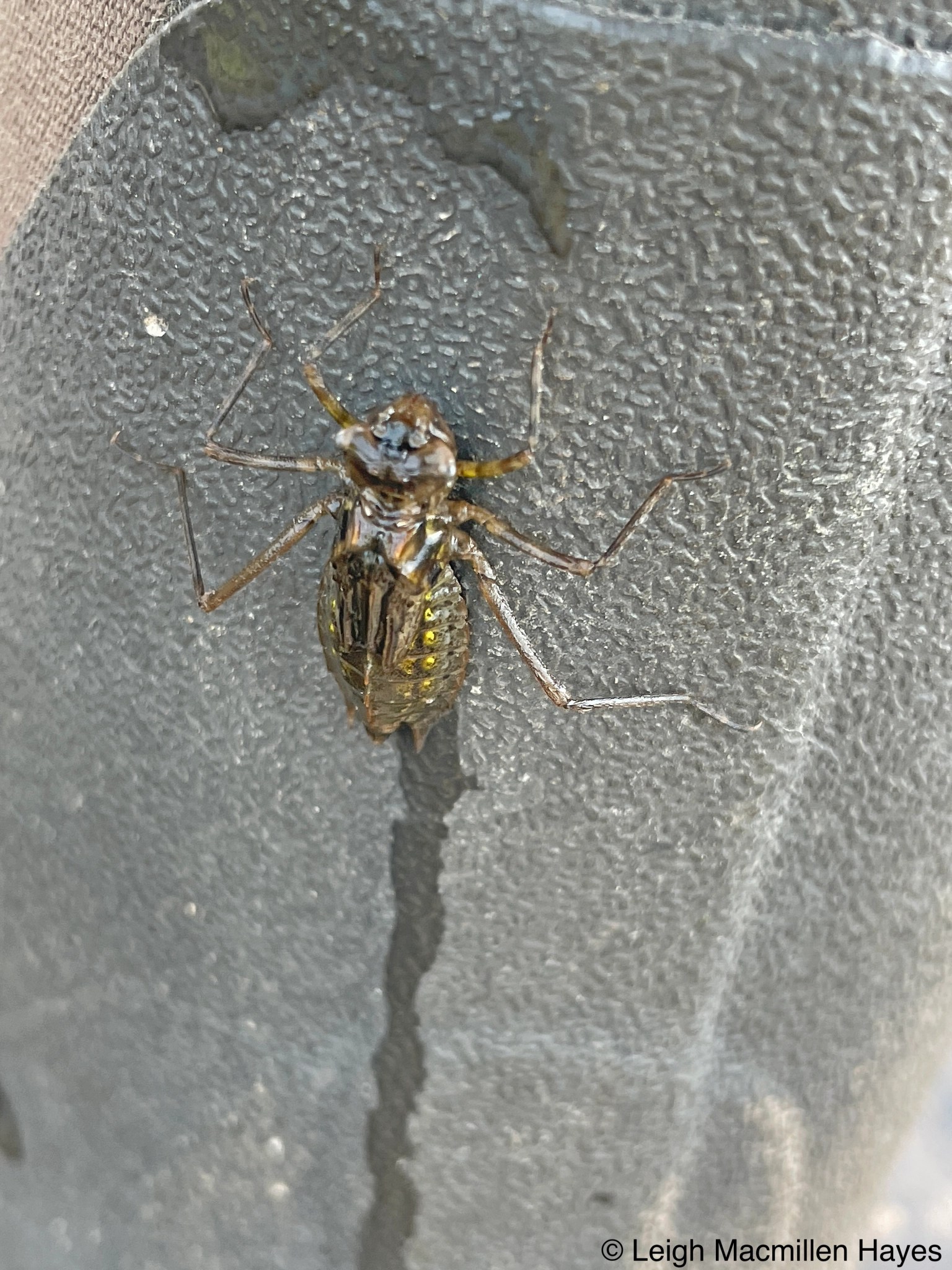
Standing beside quiet water,
I was honored
on more than one occasion
to have my boot and pant legs
considered the right substrate
upon which to transform
from aquatic predator
to teneral land prey
before becoming
a terrestrial flying predator.
It takes hours
for the dragonfly to emerge
and I can't think of a better way
to spend a spring day
than to stand witness
as the mystery unfolds
and I begin to
develop my dragonfly eyes
once again.
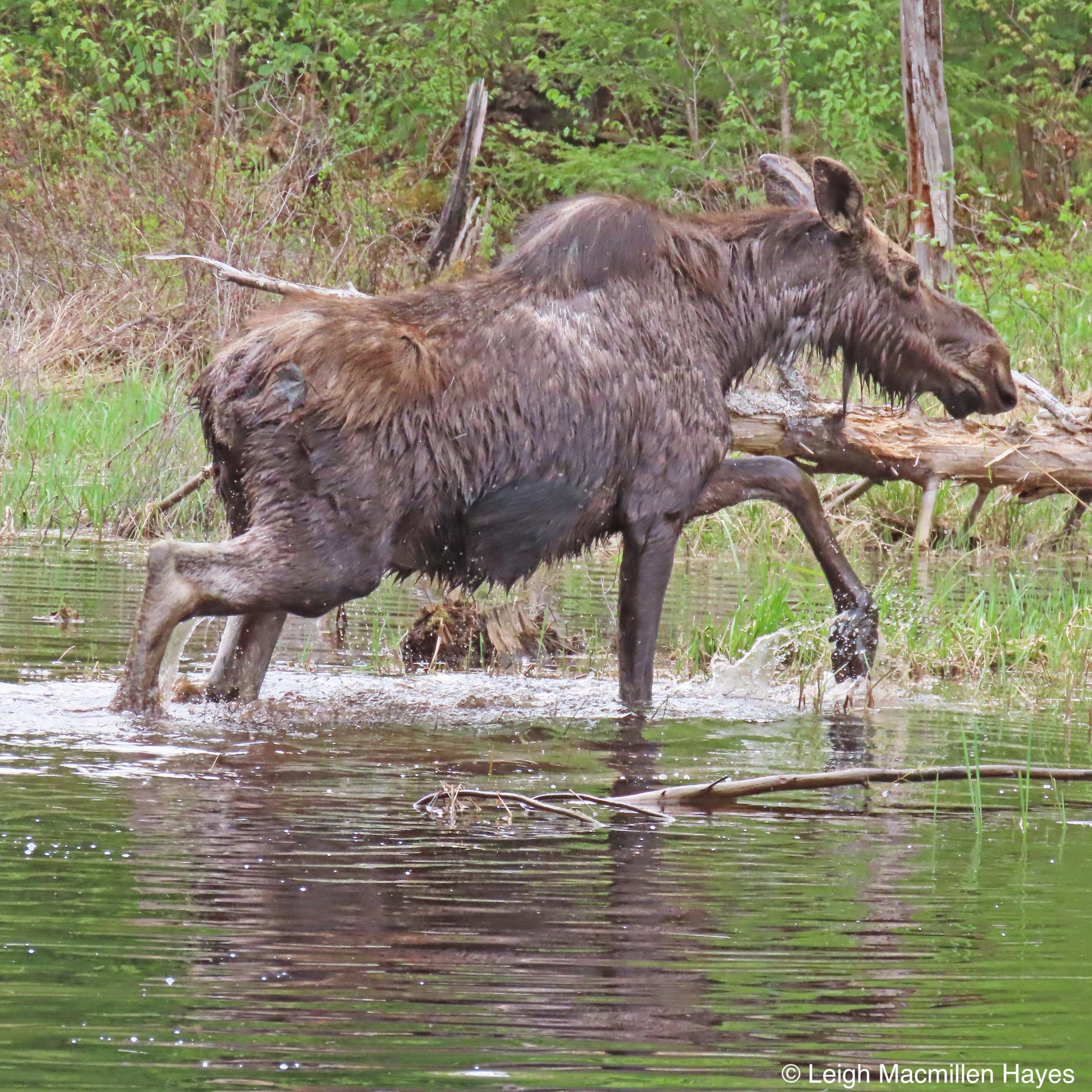
It took me a second 
to realize that I was
staring into the eyes
of a moose,
and another second
to silently alert My Guy
while grabbing my camera.
She tip-toed off
as we relished our time
spent in her presence
and at the end of the day
had this Final Count
on a Moosed-up Mondate:
Painted Trillium 59
Red Trillium 3
Cow Moose 1
One was certainly enough!
Some of the best hours
I spend outdoors
include scanning
Great Blue Heron rookeries
to count adults and chicks
and get lost in the
sights and sounds
of rich and diverse wetlands.
Fluffy little balls
pop up occasionally
in the nests and the
let their presence be known
as they squawk
feverishly for food.
And in the mix of it all
Nature Distraction
causes a diversion of attention
when one swimming by
is first mistaken for a Beaver
but reveals its tail
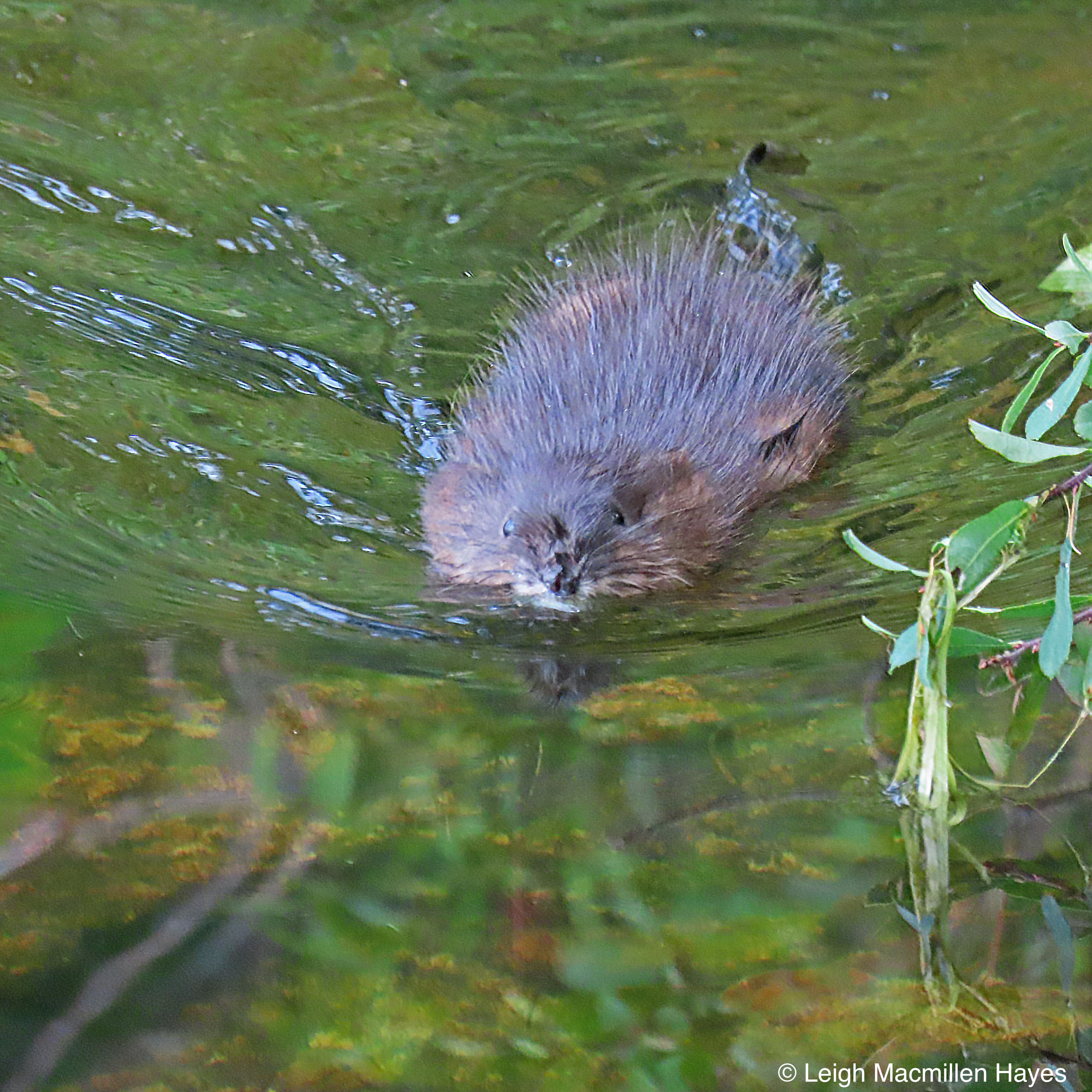
and morphs into a Muskrat.
I give thanks to the Herons for these moments.
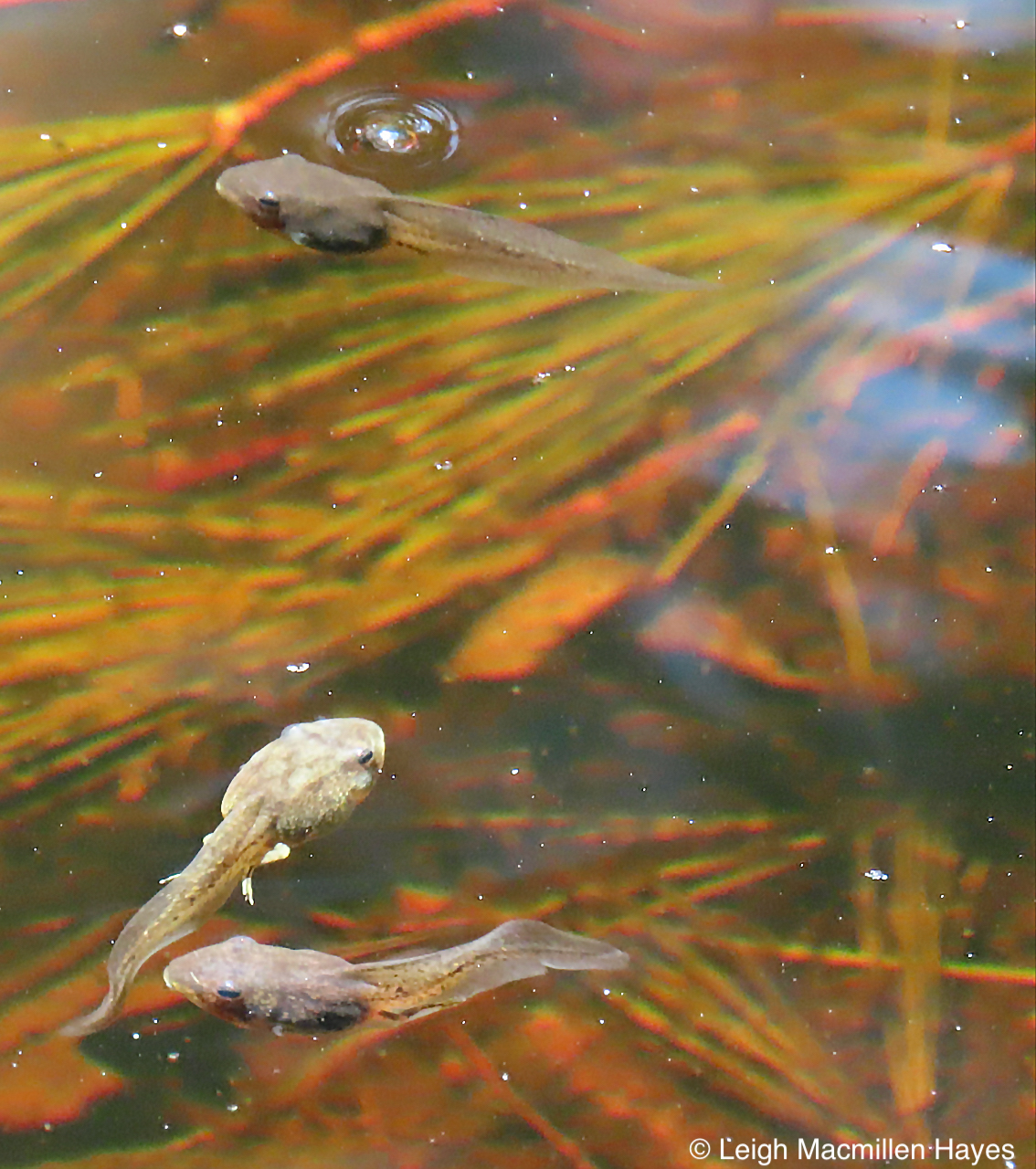
What began as a "Wruck, Wruck" love affair
continued
for longer than usual
and due to
a rainy spring and summer
I was treated to a surprise
in the form of developing frog legs.
In the midst of my visits
one day I heard
the insistent peeps
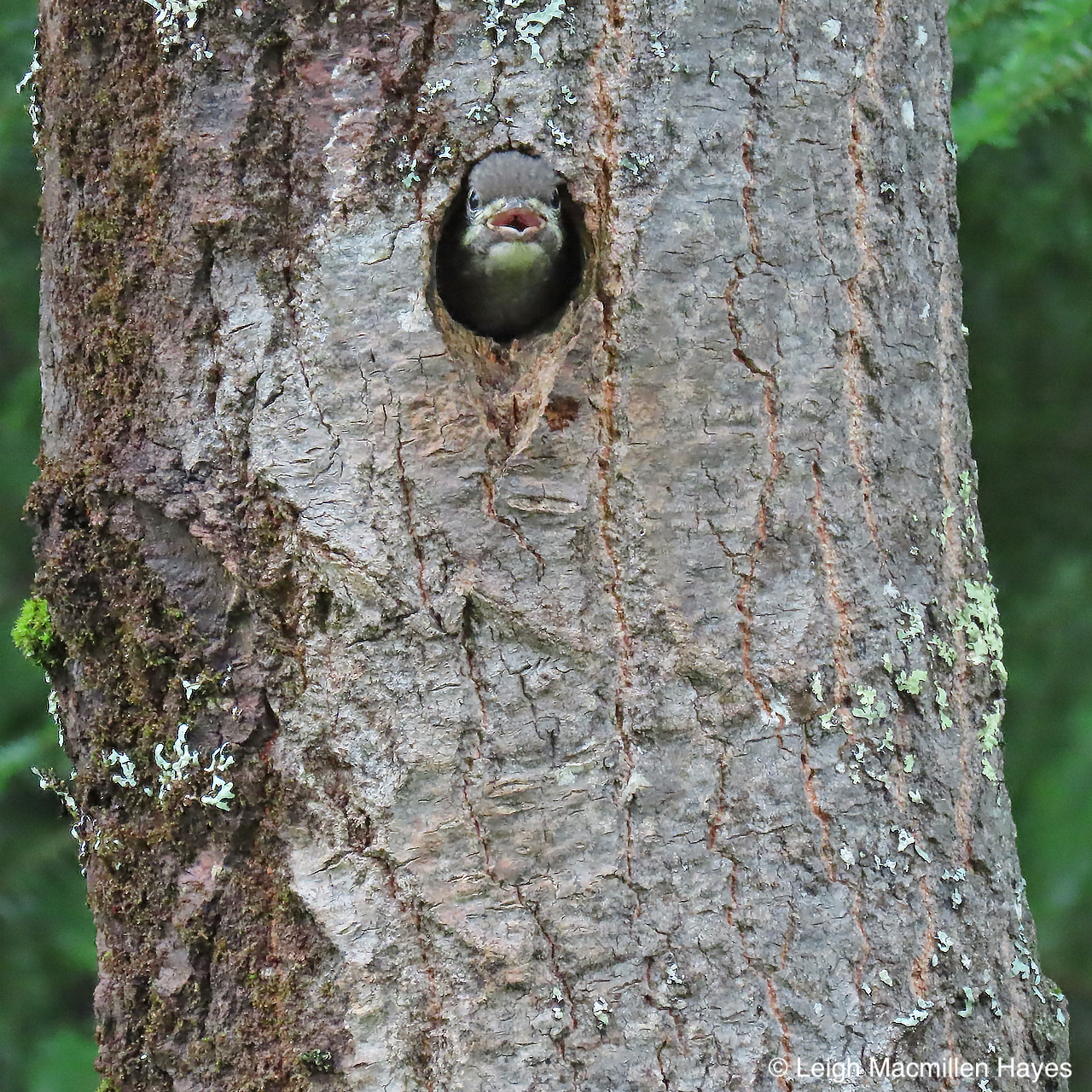
of Yellow-bellied Sapsucker chicks
demanding a meal on wings,
which their parents
repeatedly provided.
Walking home 
from the pool
another day,
I was honored
to spend about ten minutes
with a fawn,
each of us curious
about the other
until it occurred to me
that its mother
was probably nearby
waiting for me to move on,
so reluctantly I did,
but first gave thanks
that something is always happening
right outside my backdoor.
While admiring shrubs
that love wet feet,
I counted over
one hundred branches
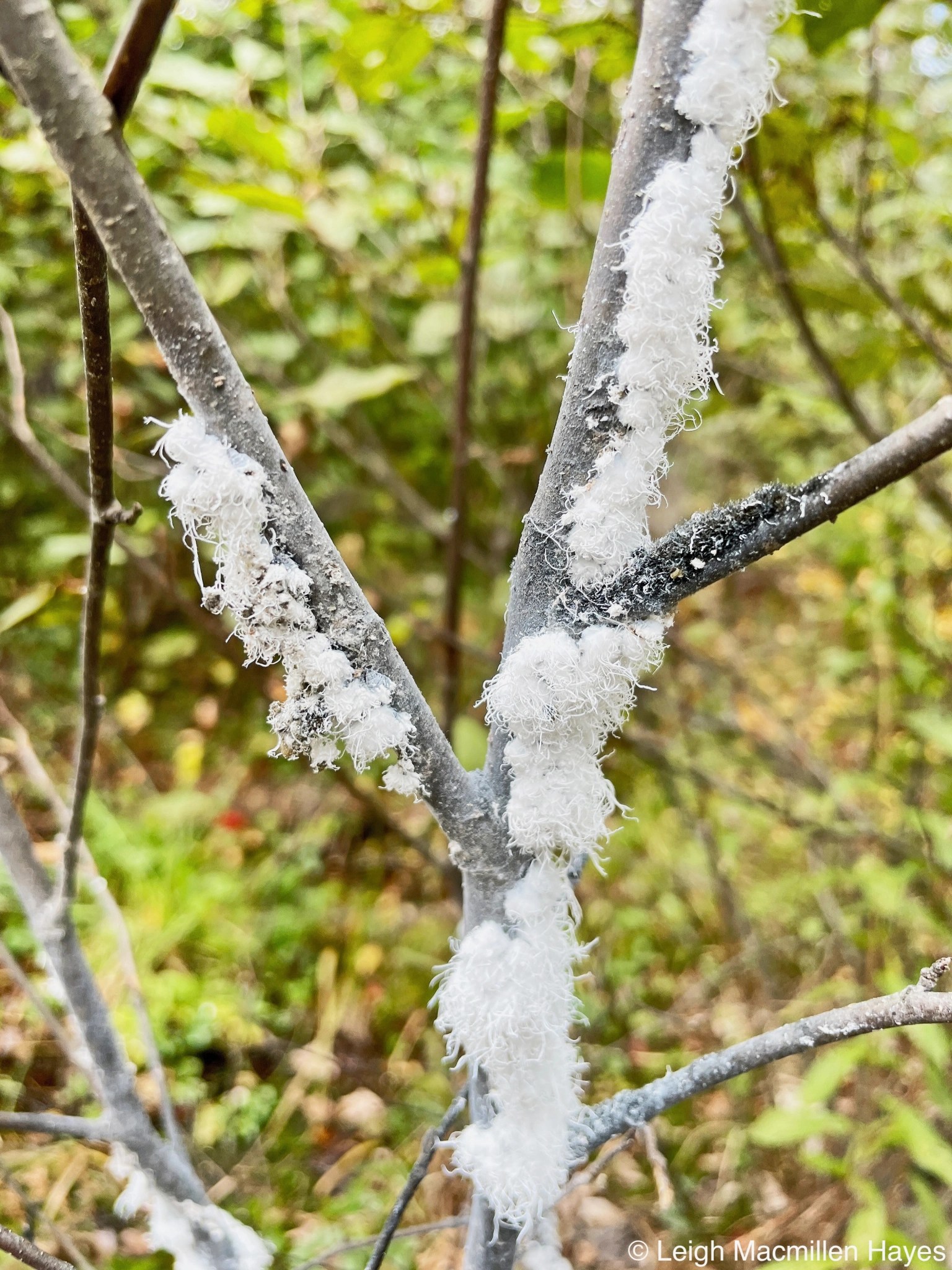
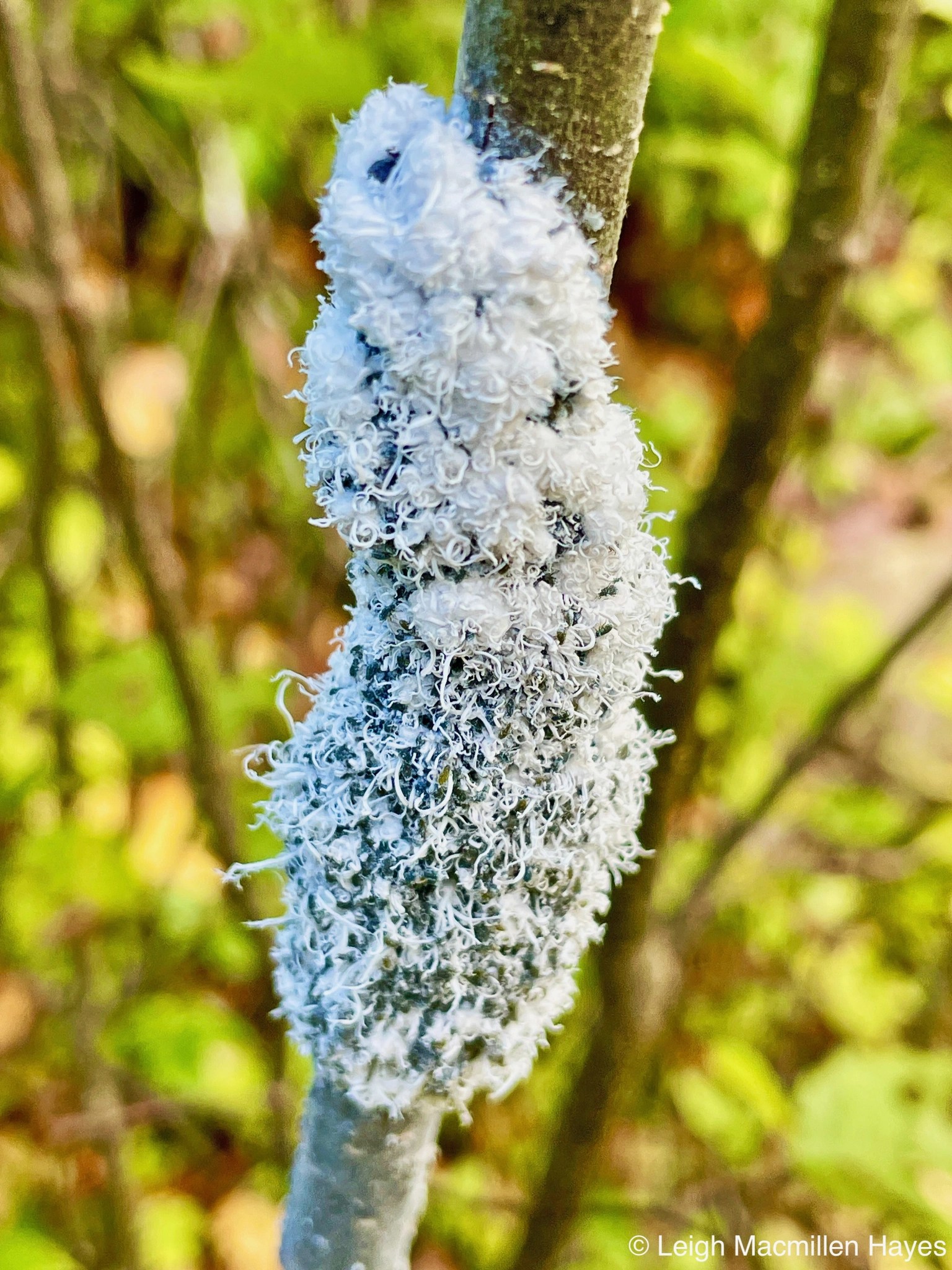
coated with white fluffy,
yet waxy ribbons.
Theirs is a communal yet complex life
as the Woolly Alder Aphids
suck sap from Speckled Alders.
Communal in that
so many clump together
in a great mass.
Complex because
one generation reproduces asexually
and the next sexually,
thus adding diversity
to the gene pool.
Along with the discovery
of coyote scat,
and Beech Aphid Poop Eater,
a fungus that consumes
the frass of the Aphids,
it was an omnivore, herbivore, insectivore kind of day.
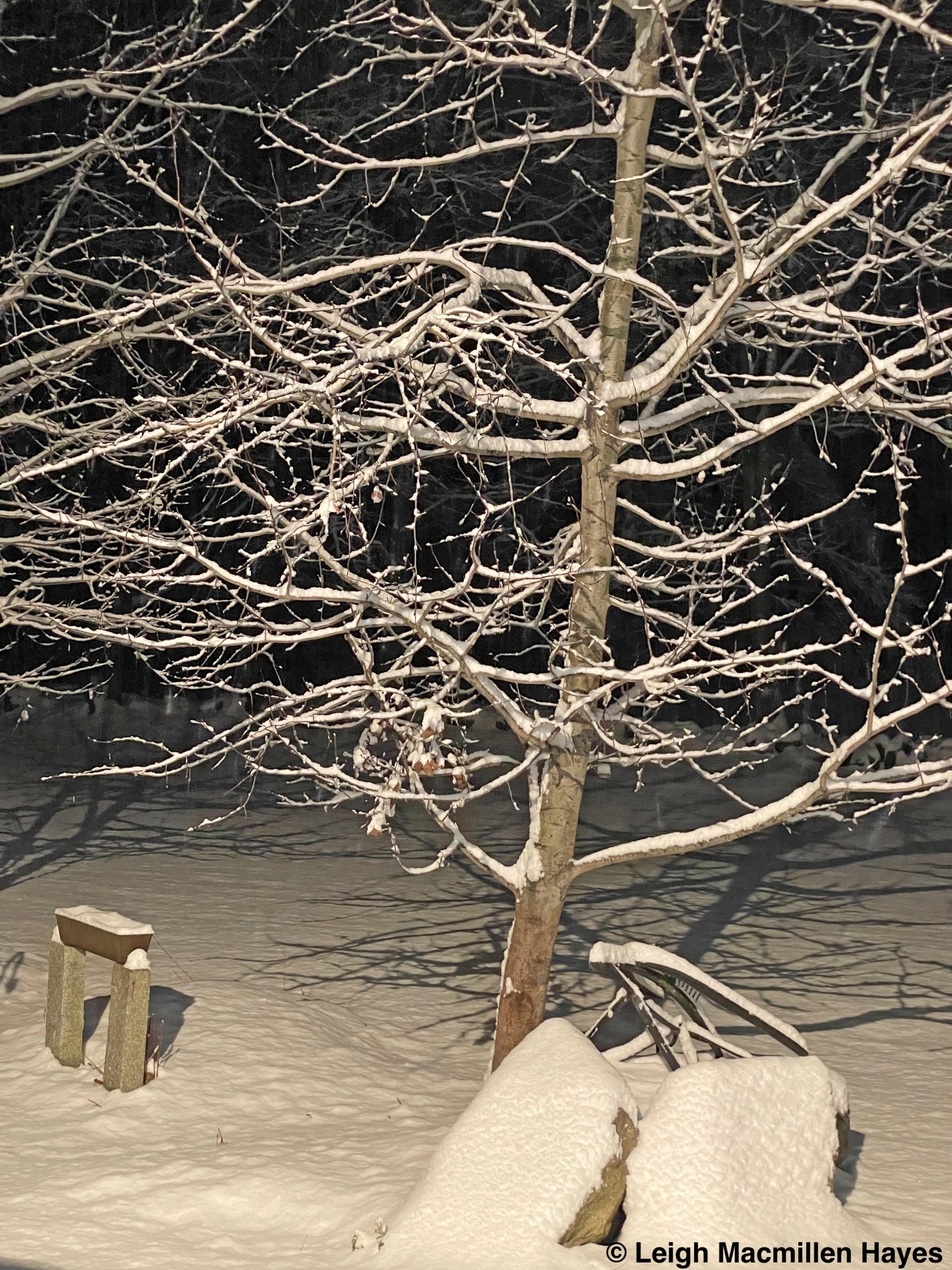
Awakening early, 
a certain glow
in the sky
pulled me from bed
and I raced downstairs
to open the door
and receive the quiet
that snowflakes create.
The snow eventually
turned to rain,
which equally mesmerized me
as I watched
droplets elongate
and quickly free fall,
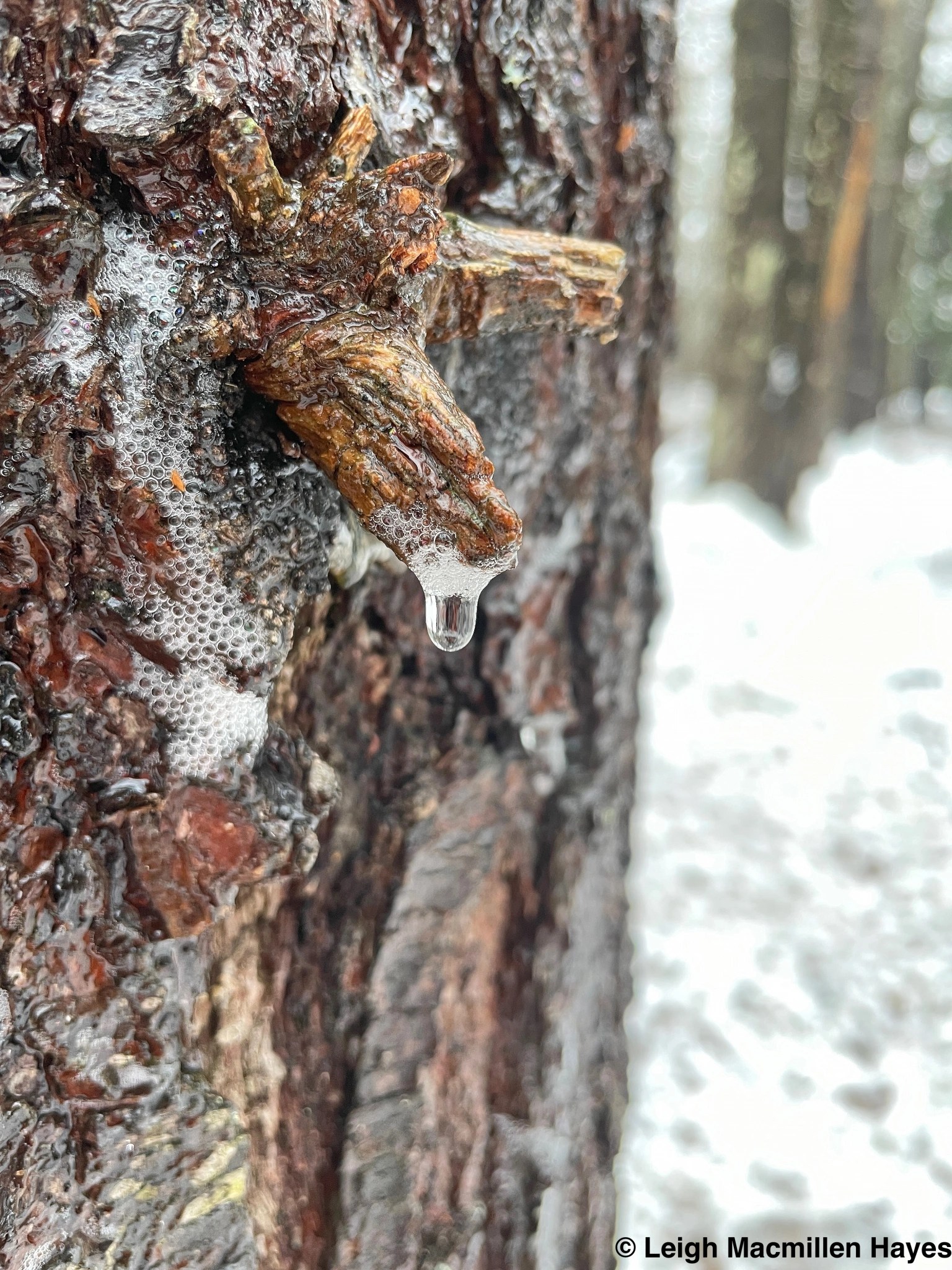
landing on bark below
in such a manner
that caused them
to mix with sap salts and acids.
The result was
White Pines foaming
in the form of
Pine Soap
with its hexagonal shapes:
worth a natural engineering wonder
and I gave thanks for being present.
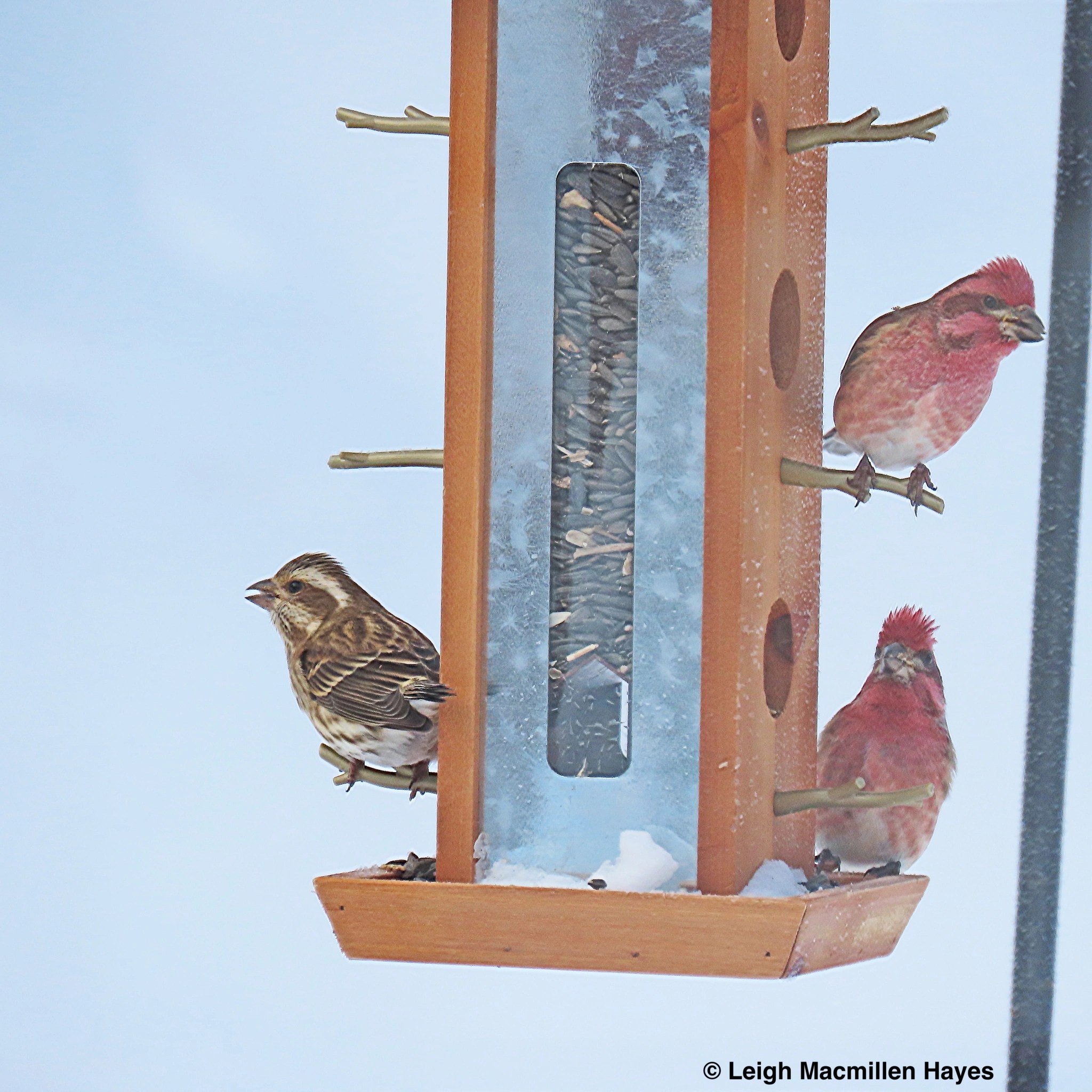
Occasionally, 
it's the action
outside the backdoor window
that keeps me standing sill
for hours on end,
as a variety of birds fly
in and out
of the feeding station,
such as these Purple Finches,
the males exhibiting
bad hair days.
Bird seed is not 
just for birds
as the squirrels prove daily.
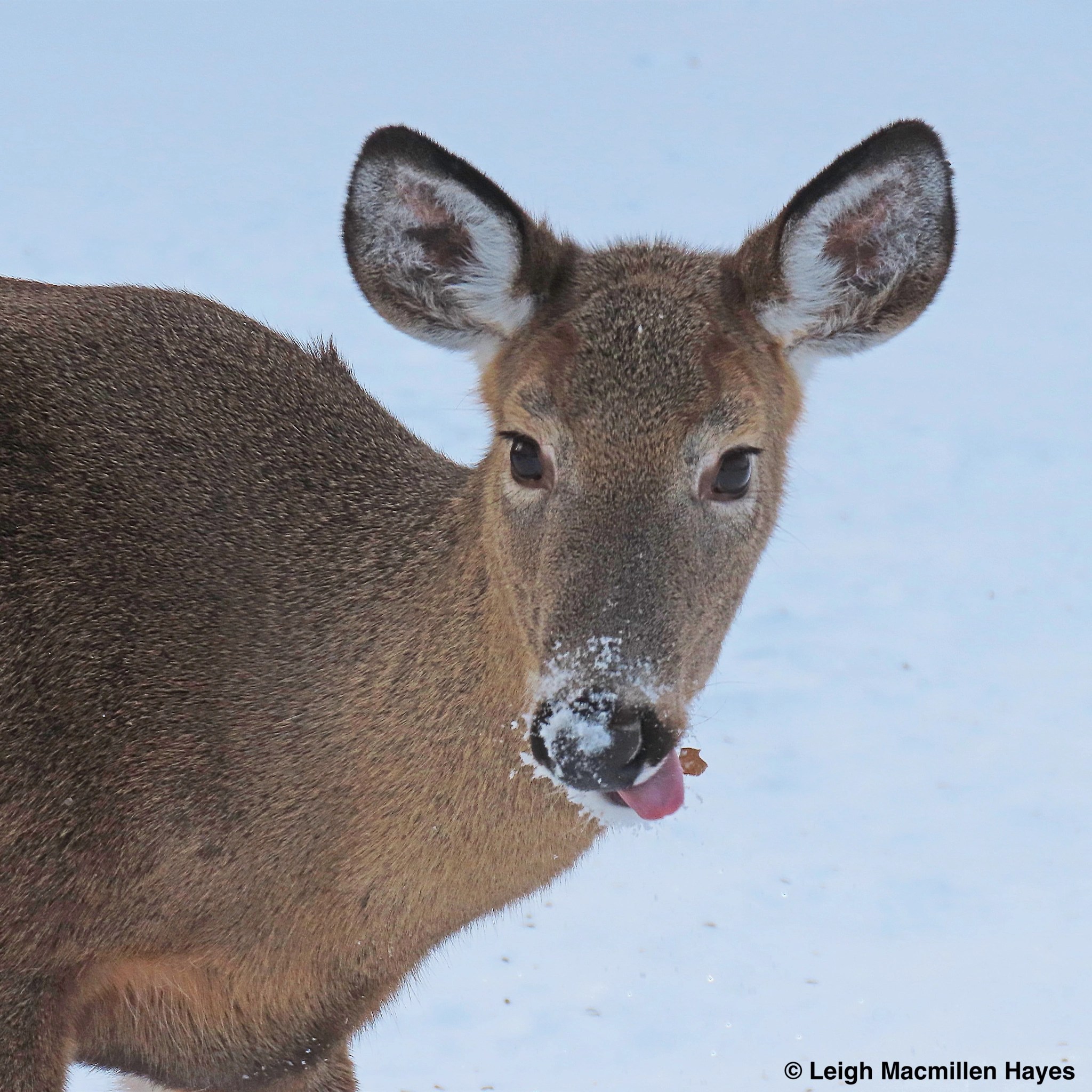
And White-tailed Deer
often make that
statement at night.
But this day was different
and they came
in the morning
using their tongues
to vacuum the seeds all up.
At the end of the day,
my favorite visitors
were the Bluebirds
for it was such a treat
to see them.
But it was the mammals
who made me realize
not every bird has feathers.
These are samples 
of the Thin Places
I've stumbled upon
this past year.

They are a
cause for celebration,
participation,
and possibility.
My mind slows down
and time seems infinite
as I become enveloped
in the mystery.

I give thanks
that each moment
is a gift
and I have witnessed
miracles unfolding
that did not
seek my attention,
but certainly captured it.

And I thank you again
for being
one of the many
to wander and wonder my way.
Winter Inventory

We live on the edge. The edge of a small town in western Maine. The edge of a neighbor’s field. The edge of a vast forest.

Our property only encompasses six acres, but it’s six acres that I love to explore and it’s been my outdoor classroom for a long time.

And so today, I invite you along to take a look; if you are a regular, you may have already met the friends I’m about to introduce, but their actions keep me on my toes, much like the deer who crisscross our yard on a regular basis.

Though the acorn crop was abundant in our area, the deer make several trips day and night to consume sunflower seeds and corn and they’ve worn a path (deer run) making it easier to travel. They don’t always follow it, as you can see, but do so enough that it’s much like my snowshoe trails.

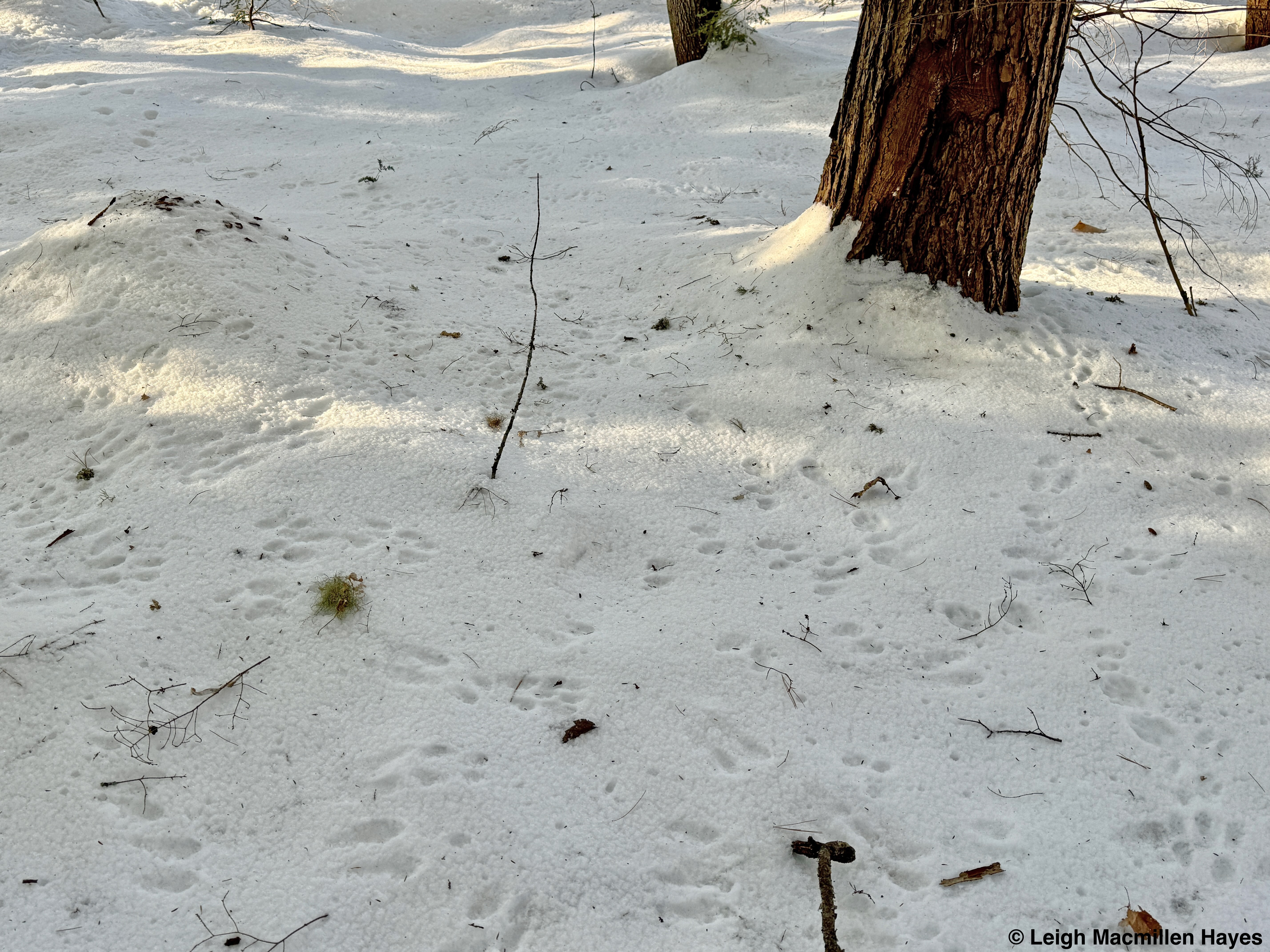
The yard is full of tracks, for besides the deer, there are gray and red squirrels who also frequent the feeders, an occasional red fox that I’ve yet to see this winter, and our neighbors’ dogs and cats. Everyone has a place at this table.

Of course, the deer run does lead to another species they love to munch on, the needles of a Balsam Fir. They frequently pause here before climbing over the stone wall into our wood lot.

And so I paused too. And discovered yet another cache and midden created by one of our local Red Squirrels. I’m in awe because until yesterday, I wasn’t aware of this one and I can see it from the desk where I’m writing right now. And to top it off, yesterday was the first day since I filled the feeders at the beginning of December that I saw a Red Squirrel chasing the Gray Squirrels away.

I, too, climbed over the wall and look who I met. Always on alert and often either skittering along the ground or a stone wall, or chastising me from its branch of choice, Red doesn’t realize that I’m a fan.

Next, I ventured over to the old cow path, bordered as it is by two walls, and checked on the cache and midden situation that’s become so familiar to me.

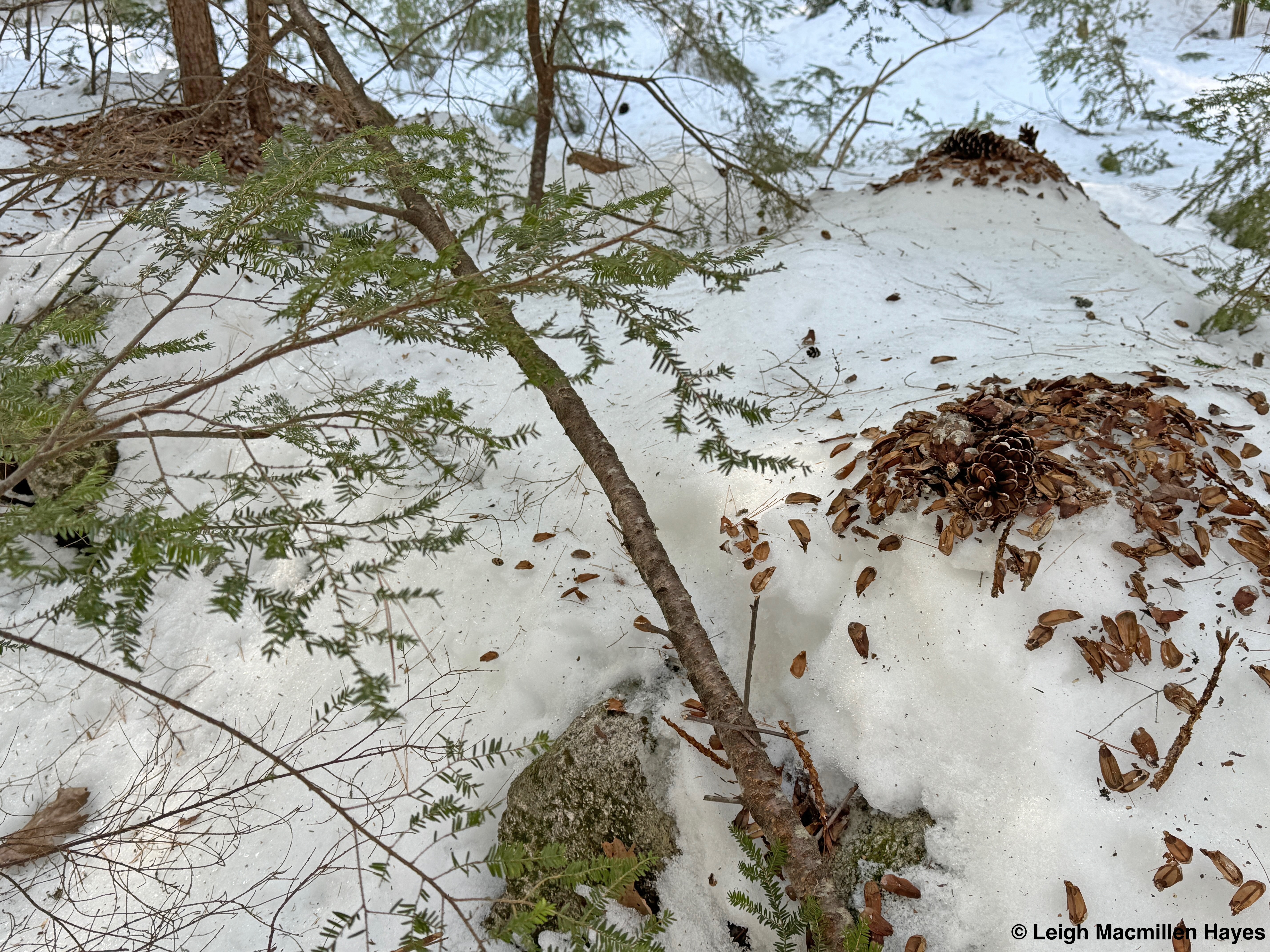
The cache or storage pantry of pine cones is located under the mound of snow the black arrow points toward. At last measurement as recordered in The Forever Student, Naturally, the pile was a foot high. As you can see if you look closely at the tops of the stones behind the snow-covered pile, you’ll spy several middens. So my question is this and I’ll have to wait until the snow melts to answer it: Are all of the cones the squirrel is consuming (well, seeds actually, for the midden is the pile of discarded scales that protect the seeds, plus the cob or core left at the end) coming from under the rocks, where I’m sure there was more storage space, or the bottom of the pile, because Red Squirrels do tunnel? I can’t wait to realize the answer in another month or so.

The pine tree beside the cache also provides a grand dining spot.

About an inch of snow fell overnight, so when I went into the woods this morning, I found fresh Red Squirrel prints, with the straddle or track width being the typical three inches. It was a bit nippy with the wind chill, so I didn’t get the card placed exactly as it should have been, but you get the idea. Its big feet in front are actually this hopper/leaper’s hind feet.

Okay, so I did risk the freeze for a minute because I spotted the set of four prints behind the first set I’d photographed and realized not only how close together the four were, but also the length of the leap from one spot to the next: My mitten and wrist holder are 19.5 inches in length and they didn’t cover the length of this motion–perhaps an attempt to quickly reach safety in the other wall or up a tree.

That action was on the eastern end of the path, but there’s more to see as I head west.

A few days ago, and probably because the night temperatures were more moderate, a family of rascals crossed from the other side of the wall and onto the path. By the baby fingers of the front foot, I know they were Raccoons.

As waddlers, Raccoons have their own pattern that is easy to recognize once you get it into your head. They don’t travel this way all the time, but most often I find their prints, with a front foot (baby hand) of one side and hind foot (a bit longer print) of the other side juxtaposed on opposite diagonals. If you look at the black lines I placed before each set of two prints I hope you’ll see what I mean. And notice the keys. It’s all I had in my pocket that day and I wanted something for perspective. I really didn’t expect to find the raccoon tracks.

I went back home and grabbed a tracking card to set on the ground. If you’ll look closely, you’ll note that it’s more than one animal, but all the same family. I followed them across the wood lot, over another stone wall, and into the field where they split up into four individuals before heading off in to the neighbor’s woods on the far side.

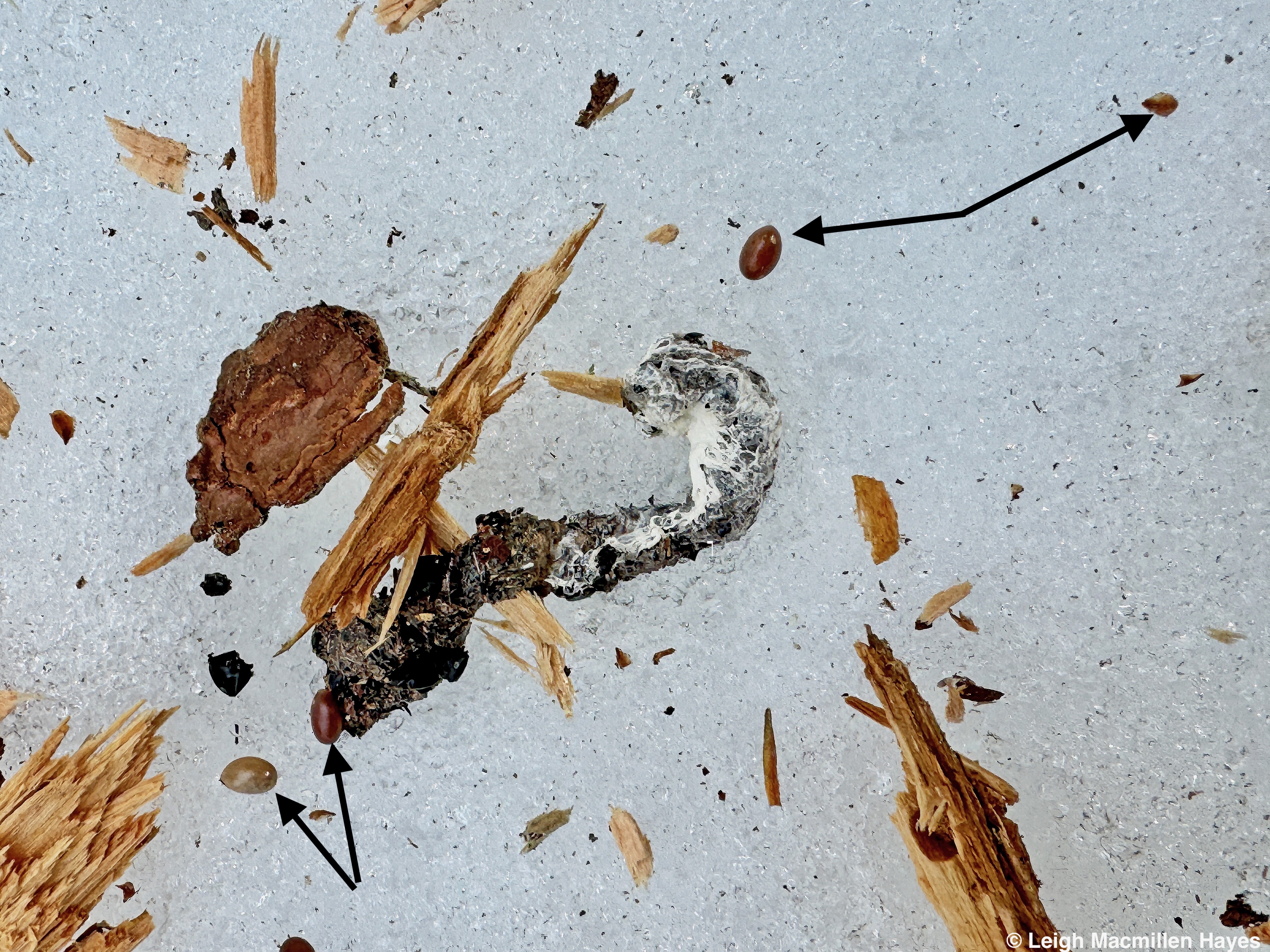
Back to the cow path I did return and this time it was a scene just off the path that drew my attention. Our Pileated Woodpecker has been active as evidenced by all the wood chips on the ground. That means one thing to me. Time to look for scat.

And I wasn’t disappointed. Check out that cornucopia stuffed chock full with insect body parts that the bird couldn’t digest.

Finding this is always like opening a Christmas present. The thrill never ends. But, curious spot here. Seeds. Staghorn Sumac seeds.

And on the pine tree and at its base, I found more of the Staghorn Sumac in bird droppings, a completely different form from the Carpenter Ant droppings.

Both followed me home! The Carpenter Ant scat is very fragile.

The sumac, being fleshier, held together better. Under the microscope I noted that there were some ant body parts mixed in with the sumac.

Here’s a closer look at one of the legs of a Carpenter Ant–notice the long “thorny” thing, which is the tibial spur located at the base of the tibia.

And an exoskeleton plus another leg. With lots of wood fiber in the mix. Lots of nutrients and fibers mean scat findings for me.

A power line bisects our property and I have a love/hate relationship with it. I do love that it looks like we could walk north to Mount Washington. But my destination was to the trees on the western (left-hand side), where we own at least one more acre enclosed by stone walls.

About half of that acreage is a combo of hemlocks and firs fighting for sun. In the end, the hemlocks will rule the world, but the firs are trying to compete.

It is here that I discovered Snowshoe Hare tracks and my heart smiled again. There’s not much on this portion of our land for the hares to dine upon, such is the landscape when the trees block undergrowth. But on either side of the walls, there’s plenty available to them in areas that have seen timber cuts within the last twenty years.

Here’s the thing about hare prints–as hoppers, the smaller front feet land first and often, but not always, on a diagonal. The much larger hind feet swing past where the front feet had been as the mammal moves forward, and thus appear to land in front when you look at the overall pattern. And my favorite part of this set of four footprints: the overall shape, which to me looks like a snow lobster with the front feet forming the tail and hind feet the claws. Do you see it?

This neighborhood on the other side of the power line also supports a Red Squirrel who in true squirrel tradition travels this way and that.

And like its relative on the other side, it took time to cache a bunch of cones and now feasts upon its supply.

And leaves its garbage for nature to recycle. Notice how the middens are often located on high spots such as the rocks along the wall–the better to be in a spot where you can see who or what might be approaching. Even those on the ground below trees mean that the squirrel probably did most of its dining from a branch above, and then let the trash fall.

What could a squirrel possibly fear in these woods? Besides coyotes and foxes and bobcats, oh my, think Fisher such as the one that left these tracks in the squirrel’s territory. As far as I could tell, the Fisher (and it’s not a cat, it’s a member of the weasel family) was only passing through, probably on its way to hunt down the hare. Though a squirrel would make a fine meal, as well.

Heading back across the power line, cases stood out on the White Pine saplings at the start of the cow path. The cases consisted of clusters of needles bound together. This is the work of the larval form of a Pine Tube Moth, Argyrotaenia pinatubana. What typically happens is that the caterpillar uses between ten and twenty needles to form a tube or hollow tunnel.

The caterpillars move up and down their silk-lined tunnels to feed on needles at the tip until they are ready to overwinter.

The moth will emerge in April, when I’ll need to pay attention again. Two generations occur each year and those that overwinter are the second generation.

Walking home via a different path in our woods, I spot deer beds. At least a half dozen spread out under the pines and hemlocks, the spot where the evergreens keep heavy amounts of snow from reaching the forest floor, thus making it easier for the animals to move.

Finally back home, there’s one more member of our family to mention–a porcupine. This may be my friend Bandit, but I haven’t actually seen him in a while so I can’t be certain.

The porcupine did check out a tiny hole under the barn, but we don’t think it actually stayed there. Will it return. Probably, as the barn has long hosted this species; along with other small critters.

That’s a lot for now and at last I’m done counting the stock for our winter inventory. There’s more out there, but this is certainly enough to make me realize that they don’t live in our woods, but rather, we humbly reside in theirs.

World Spinning Out of Control, Naturally

If it seems like the world is spinning out of control, that’s because it is . . . on so many levels in so many ways. Even some things I’ve witnessed of late in the great outdoors don’t make sense.

Two weeks ago I sent this email message to my friend, an incredible naturalist, hunter, forester, David Sears. Dave knows everything and has taught me so much over the years.

Here’s the message: “Daily we have three deer come into the yard because now that there is snow on the ground, they can’t get to the acorns so easily, but do love the sunflower seeds by the bird feeders. It’s a doe and two skippers. On Thursday I saw another doe with them. And then, as I was finishing up writing the tree blog, Becoming Tree Wise, late afternoon yesterday, I saw two by the feeders and two about 20 feet away. A doe and a skipper in each set. The doe farther away was licking the butt of the skipper. At least that’s what it looked like she was licking from my desk. For minutes on end. And then the other doe and skipper approached them and got quite close. The second doe nudged the first and the first jumped away, paused and then headed back over the stonewall and into the woods. The second doe and two skippers remained close to each other and then I noticed the second doe was bent over. I was trying not to move because even though I’m inside, they hear me and startle easily. I finally grabbed my binoculars and realized the doe was licking the underside of the skipper. I have never seen this before. Have you? Two does bathing a youngster? And at this time of year?”
Unfortunately I did not get a photo of the licking behavior because I didn’t want them to run off into the woods as I tried to understand what I was seeing.

Dave’s response matched my thoughts: “Seems strange at this age. Certainly groom them when young, but a little old now.”

Me: “And two doing the grooming?”

Dave: “Mother nature doing her thing.”

Me: “Yup. She doesn’t read our books.”

About a week or less later, I was on a reconnaissance mission with friend and fellow naturalist Dawn Wood at Loon Echo Land Trust’s Tiger Hill Community Forest in Sebago, Maine, when we spotted the sashay track a porcupine leaves in fluffy snow.

We tried to follow the track to locate either its feeding tree or den, but this porcupine provided an example of more strange behavior. Itacted like a dog, doing zoomies across the landscape. Literally, it walked in circles.

All over the place. Was it rabid? It certainly wasn’t seeking a date because it was too late for mating season. And we couldn’t find evidence that it was evading a predator.

We never did find the feeding tree or den site and wonder if we’ll see the same behavior when we return to the site this week.

On another recent day, I was with Dawn again, climbing Bald Pate Mountain in South Bridgton, when she spied this dead mouse upon a branch. White-footed or Deer Mouse I can’t say for certain.

Our immediate thought was that a Shrike had impaled it on a branch, but upon closer examination, it wasn’t impaled, but perhaps had been dropped by a predator. The question remains: Why didn’t the predator return to enjoy the meal. Or is it being saved for a later date? Perhaps it was letting any toxins leach out?

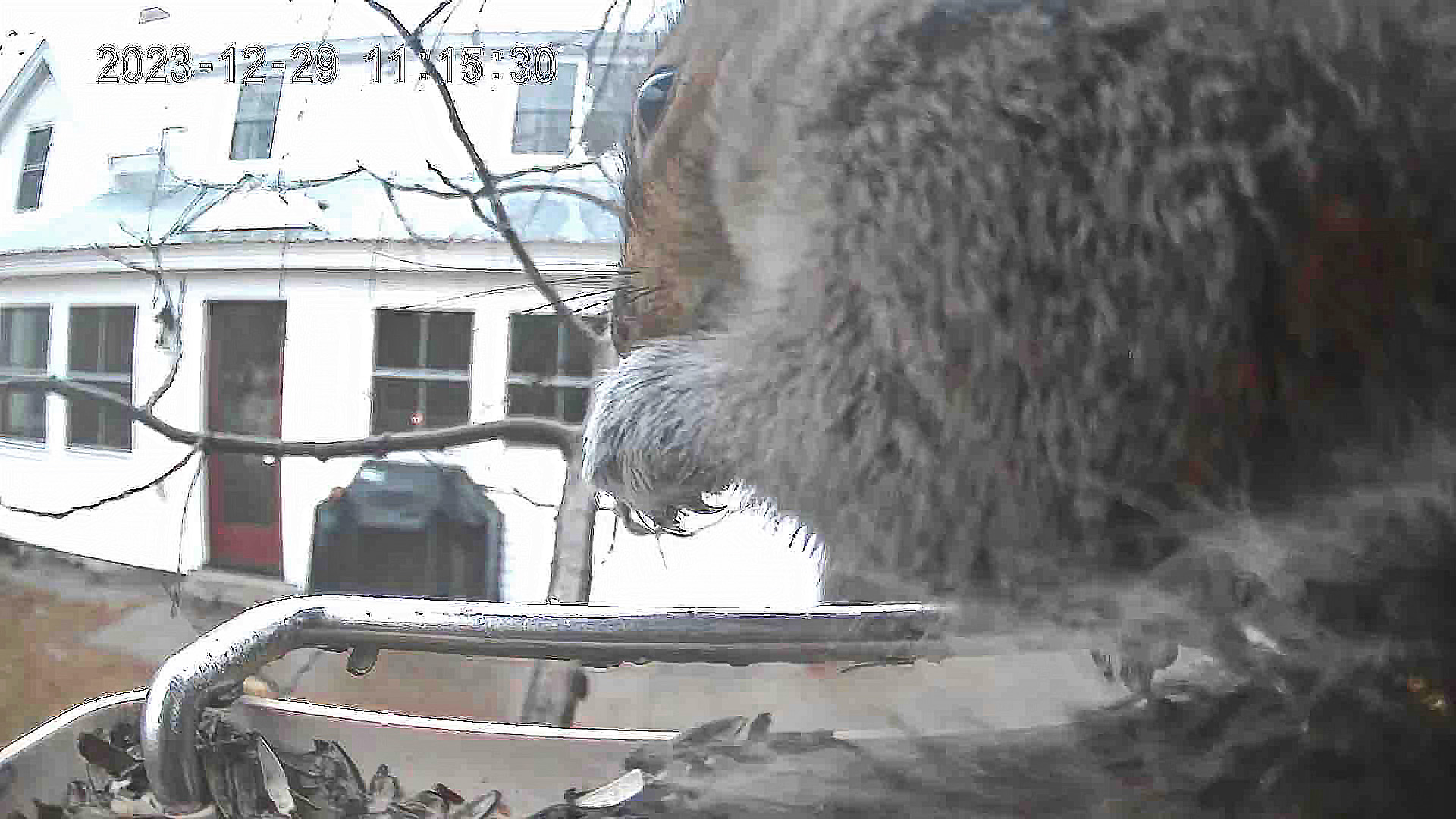
At the end of many days, I’m left looking for answers, much like this Gray Squirrel on the snow mound outside a kitchen window. Of course, the squirrel must have been wondering why I wasn’t supplying more bird seed for it to consume. This same critter actually jumped partway up the kitchen door a few times in what I assume to be protest.

As for me, I wonder how to make sense of scenes like these that I’ve shared and how to keep an open mind as the world continues to spin out of control.

The Forever Student, Naturally

This story begins . . . at the beginning. Okay. Early morning, not enough coffee, humor. Rather, this story begins at a bird feeder located about twenty feet from our back door.

Birds, like this Tufted Titmouse, frequent it, especially on rainy days, which seems to be the norm this December. In fact, this year. Sadly.

But, there’s another visitor, who thinks its a bird. If it had the membrane that stretches from the wrist of a front paw to the ankle of a rare paw, we could at least call it a Flying Squirrel. It does not. It just thinks its entitled to the bird feeder selection, despite the fact that I spread plenty of seed on the ground and have a dangling corn feeder intended for such uses.

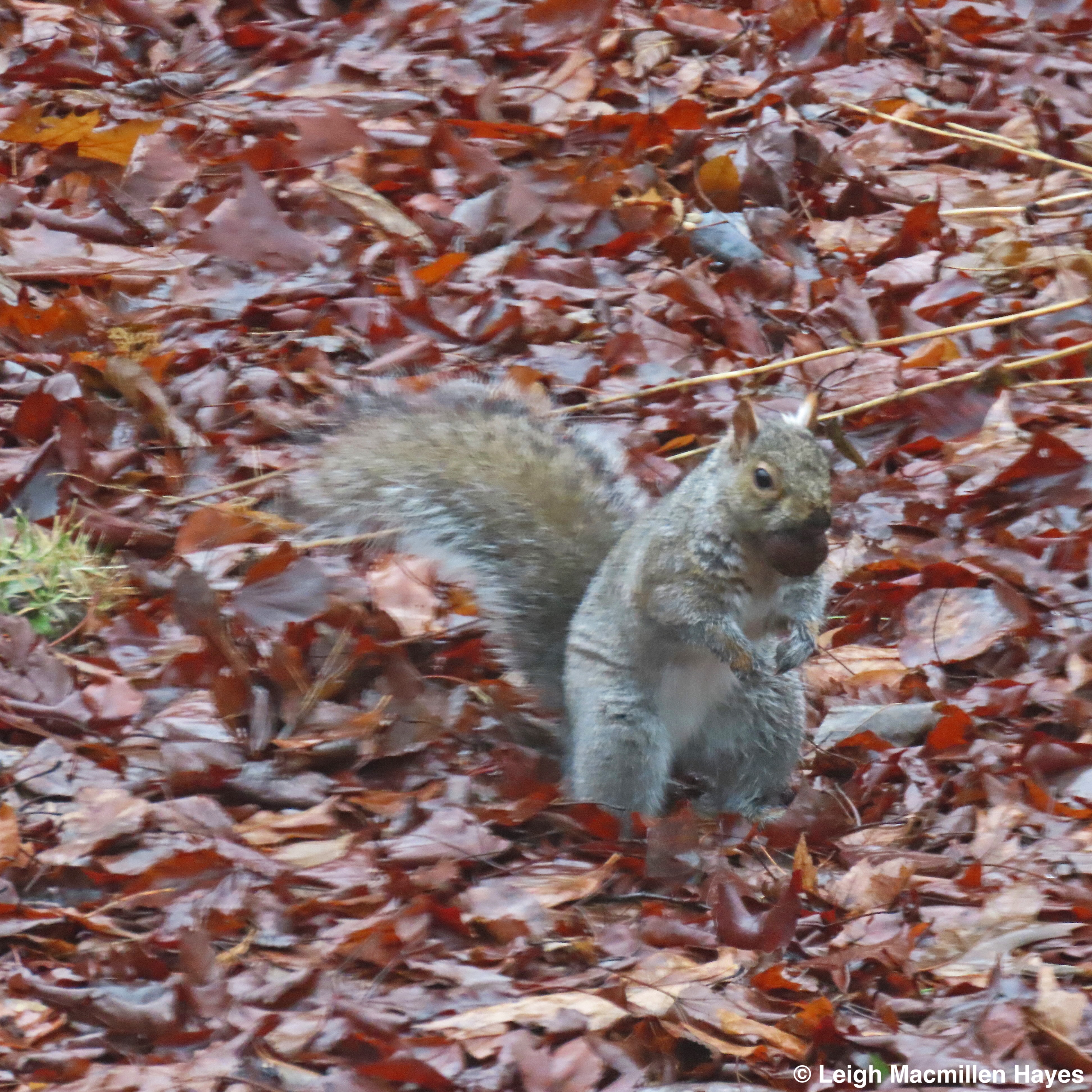
Eventually, it did resort to normal Gray Squirrel behavior and fetched an acorn, then frantically searched for a spot to cache it. And taught me a lesson.

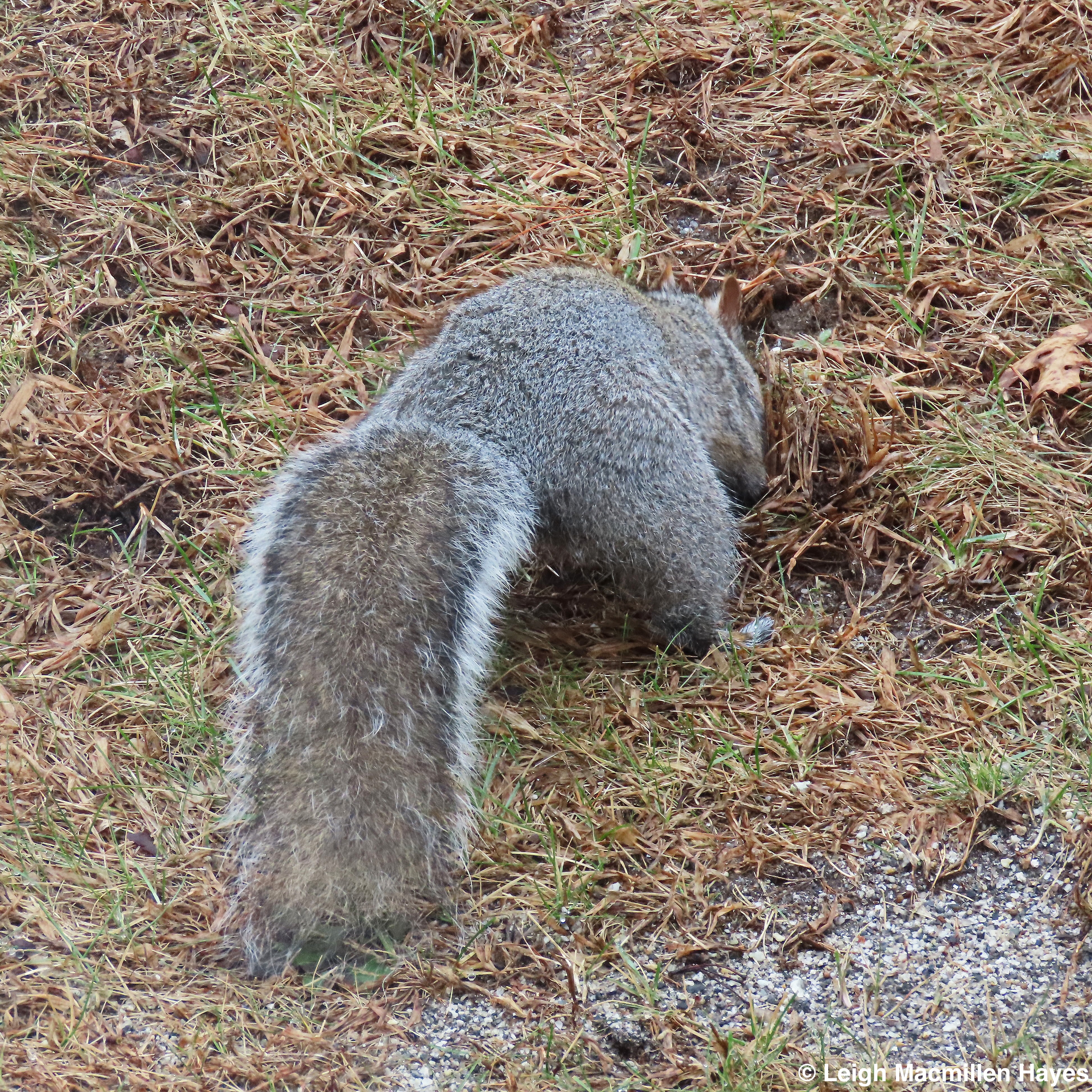
I realized I’ve never paid particular attention to a Gray Squirrel caching acorns, one here, one there, for future food sources, or a future oak sapling if not dined upon. I knew they did that. But what I didn’t realize is that much consideration goes into location of said single cache. The squirrel moved through two gardens, across the yard, and paused about three feet from the back door to dig, all the while holding the acorn between its lips.

And in the end, that wasn’t the right spot and so it moved on.

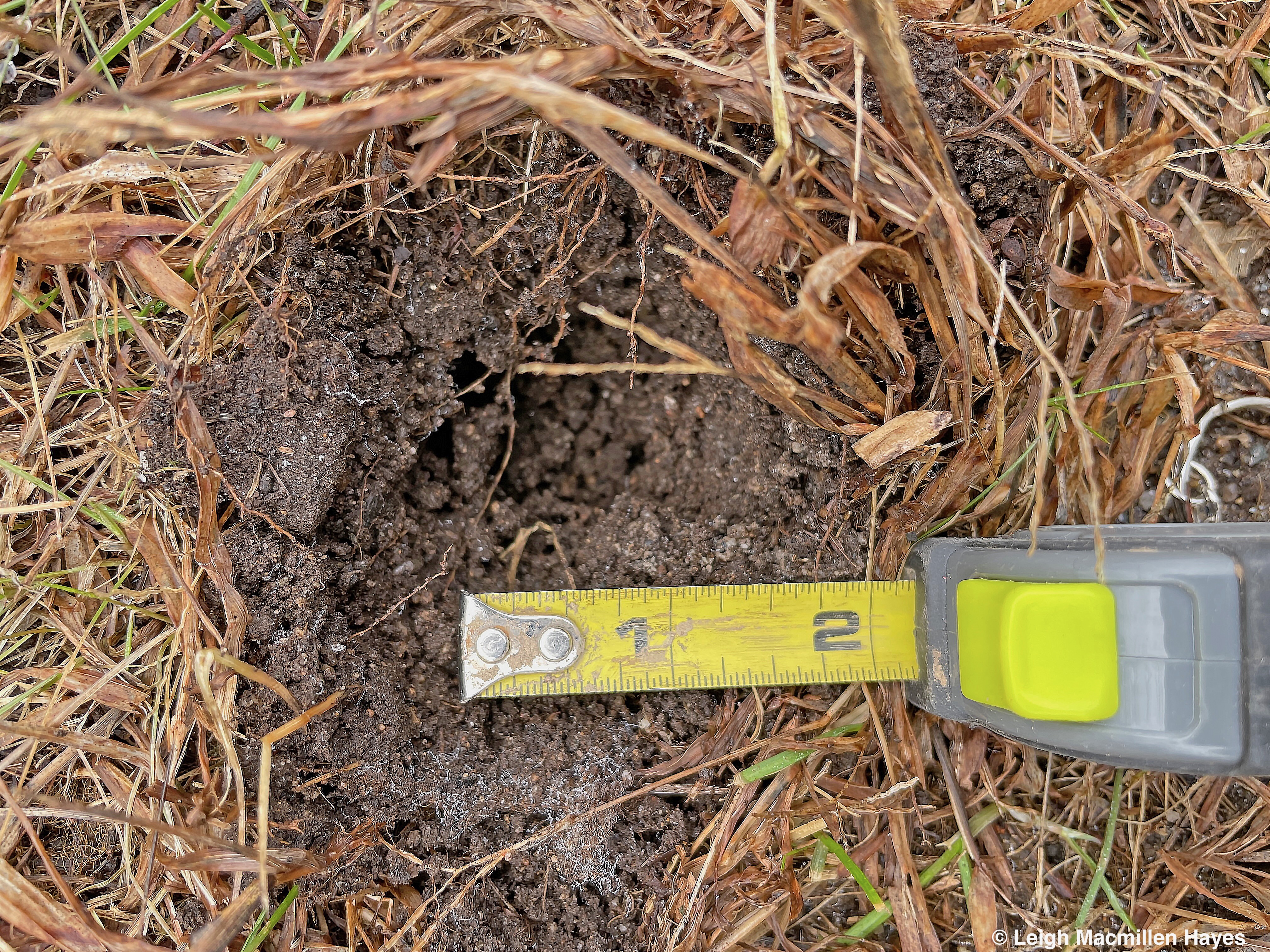
And I stepped out the door. The hole was just deep enough and wide enough for that single acorn, but the last I saw of the squirrel , it still hold the nut tight as it pranced along the stone wall and then into the field beyond. Funny thing is that when I returned home an hour or two or three later, there was a second hole excavated but equally empty. Why dig here twice and not make a deposit?

The Gray Squirrel’s activity inspired me to step into our woods and check on the activity of my friend Red. He doesn’t disappoint and each day that I visit I notice new middens (garbage piles of discarded cone scales) and new cones added to the cache (food cupboard).

My favorite cache is now a foot tall and the cool realization is that he doesn’t dine upon this pile. Like the Gray Squirrel burying his acorns for future consumption, Red is dining on plenty of pine cone seeds, but saving up for that day when we have so much snow (will that day ever come again?) that he has a food supply available and doesn’t have to tunnel through the white stuff in search of a meal. Considering how many pine cone seeds he must consume each day, I have to wonder how long this source will last and will it grow taller and wider in the coming weeks?

On the other side of the cow path, for that is where the tall pile is located, I realized he’s started another cache, this one located under some discarded garden fence left behind by previous owners of the land. It’s actually a great spot in my squirrely mind, for its beside the wall so he can easily access it from a dry spot within and the fencing and sticks and leaves have created a shelter.

Much to my delight, I spotted Red on a pine branch, a perfect high spot on which to dine and keep an eye on invaders of his domain, such as me. My presence, however, did not stop him from peeling each scale to seek the two seeds tucked close to the cob.

And as is the custom, its only the seeds that he cares about, scales discarded because their usefulness is no longer important.

The base of the tree shows just how many scales he’s discarded over the last few months as his midden contiunes to grow. Considering this year was a mast pinecone production year for Eastern White Pines in western Maine, this is one well fed squirrel.

Another tree that produced a mast crop is the Northern Red Oak and the abundance of acorns has been a food source for the squirrels, especially the Gray, Porcupines, and White-tailed Deer.

The tree behind our barn is massive, with a coppiced base and therefore three large trunks. Our sons once built a fort in that space between.

At about 4:15pm the day before, our youngest son, his gal, and I watched Bandit, the local porcupine come from the acorns to a puddle beside the herb garden and pause for about five minutes as he sipped from it. That was another first for me. And them as well. In fact, for his gal, just seeing a porcupine in the wild was a first.

Then he waddled off to the woods on the other side of the stone wall, and probably found an Eastern Hemlock upon which to dine for the night. I found a few trees with downed twigs, but none that cried out, “I’m Bandit’s food source,” so I suspect I need to expand my search on another day.

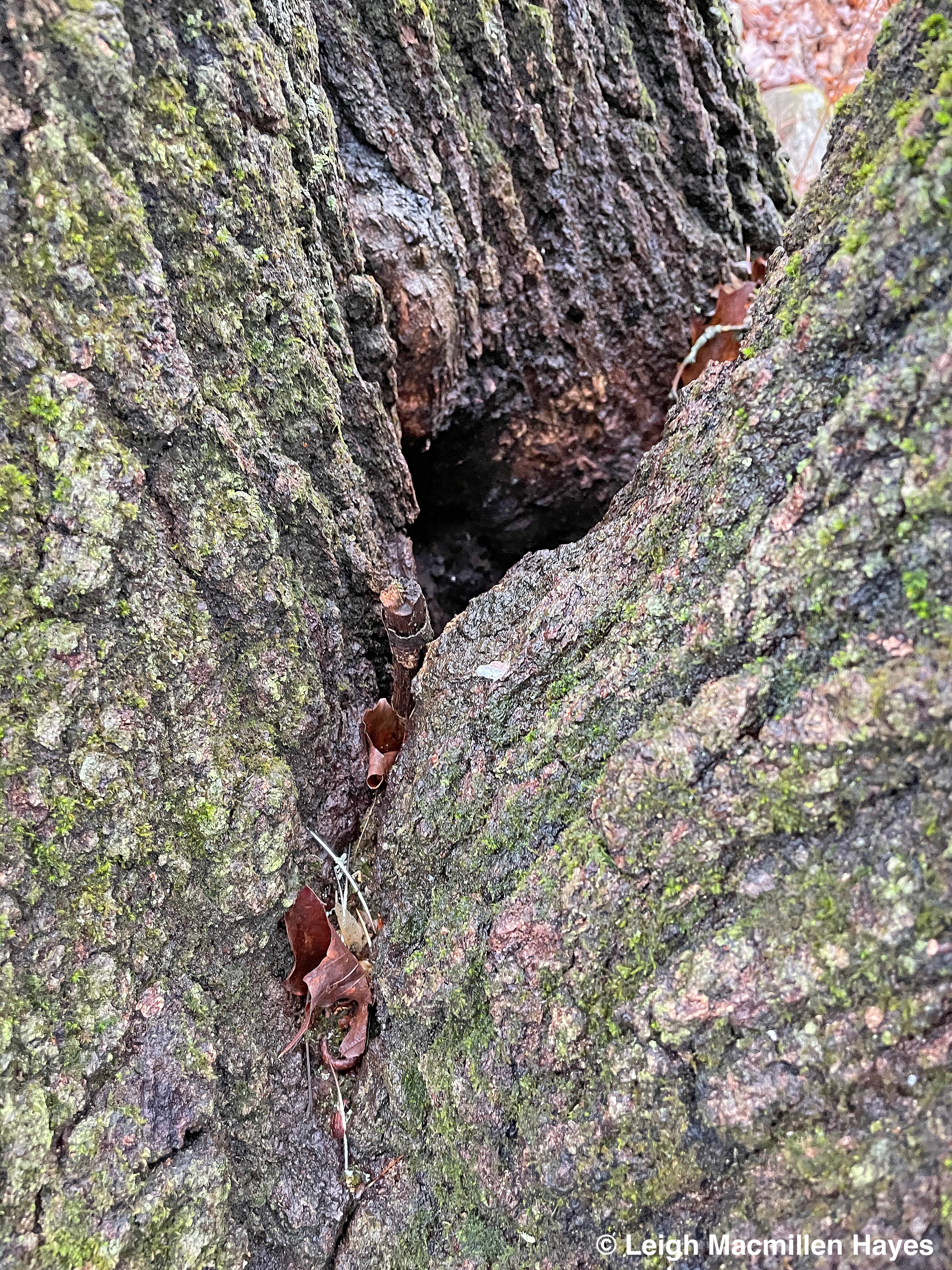
Instead, I made a different discovery. We know that Bandit has spent time under the barn, and he’s left tracks when we did have snow that led to a neighbor’s shed, but I have wondered about the old oak tree and the hollow within its three trunks And today, I spied evidence that he has inspected the hollow. Do you see it?

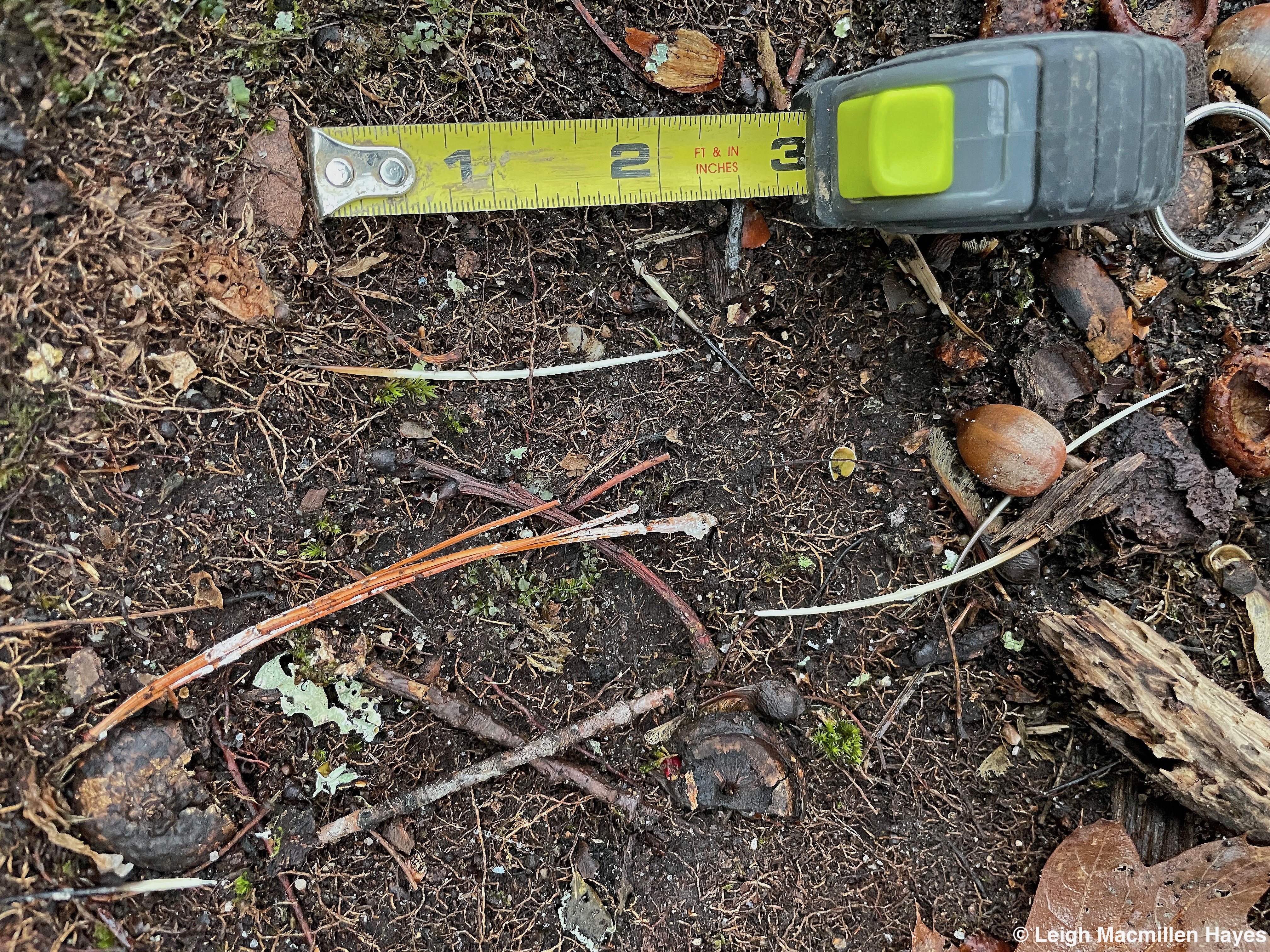
How about now? Quills! I found them on both sides of the trunk.

And on the ground below.

About two inches in length, and some were longer, I love how his brownish hue is similar to that of the bundle of dried pine needles.

The hollow is dark and deeper than my camera could see. The curious thing is that there is no scat. Yet. You can rest assured that I will keep an eye on this spot.

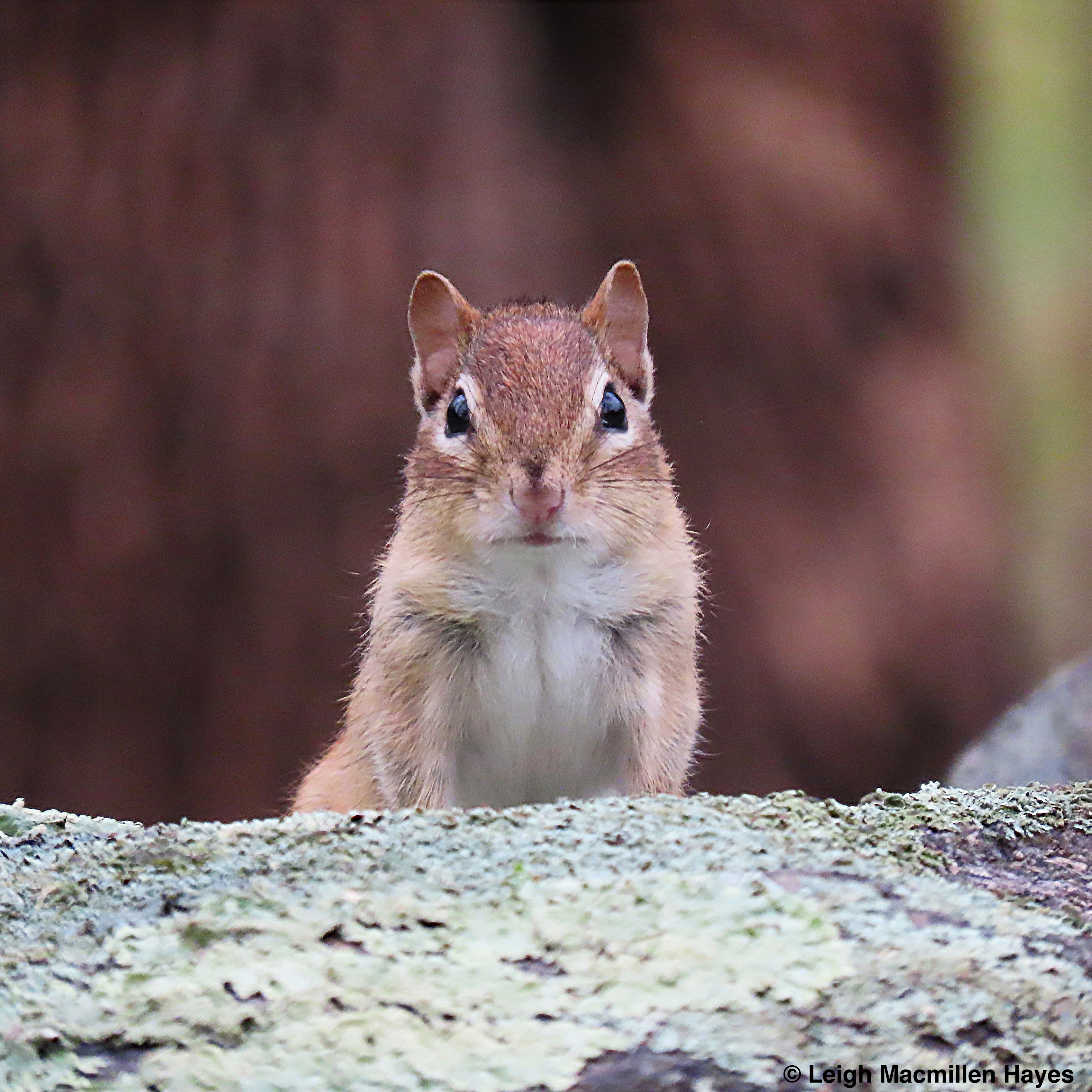
I decided to hang out not too far from the tree and barn as day turned to dusk in hopes of spotting Bandit emerging. Much to my surprise, an Eastern Chipmunk appeared on the wall behind the tree. Wait. What? Shouldn’t he be in torpor? Yup. But chipmunks will make an occasional appearance on warmer days and we’ve had way to many of them this year.

A doe and her two skippers also appeared and watched me from the edge of the field, or at least listened to my movements, which I tried to minimize as much as possible, but those ears were on high alert.

About a month ago, when we did have snow, I discovered blood beside her tracks on this side of the wall and knew that she was in estrus. A day later, I noticed a young buck in the field and by the way he kept his nose to the ground and moved frantically, I knew he was on a mission to find her. Did he? Is she with child? Only spring will tell.

In the meantime, her twin skippers are still with her. They ran off before I headed in, but I suspect it wasn’t long before they returned under the blanket of darkness and munched on a bunch of acorns.

Bandit never did appear during the time that I waited. Who knows? Maybe he had spent a night and day or two in the hemlock of his dining choice. I’ll continue to search for evidence of his activities because it’s what I most enjoy doing.

There’s always something wild going on outside our back door, rain or shine or snow or sleet, and I’m grateful for each lesson they take the time to teach me. I am a forever student, naturally.

Porcupine as Teacher

I walked up two stone steps beside one of our pollinator gardens this afternoon and when I looked up, which wasn’t really up, but rather a few feet ahead instead of at my feet, I was startled.

“Whoa!” I exclaimed.

My sudden companion didn’t even make a peep, which in hindsight is surprising, because its brethren are known to make some various squeaks in different occasions, but it did turn quickly so that its back was facing me, such is its defense weapon.

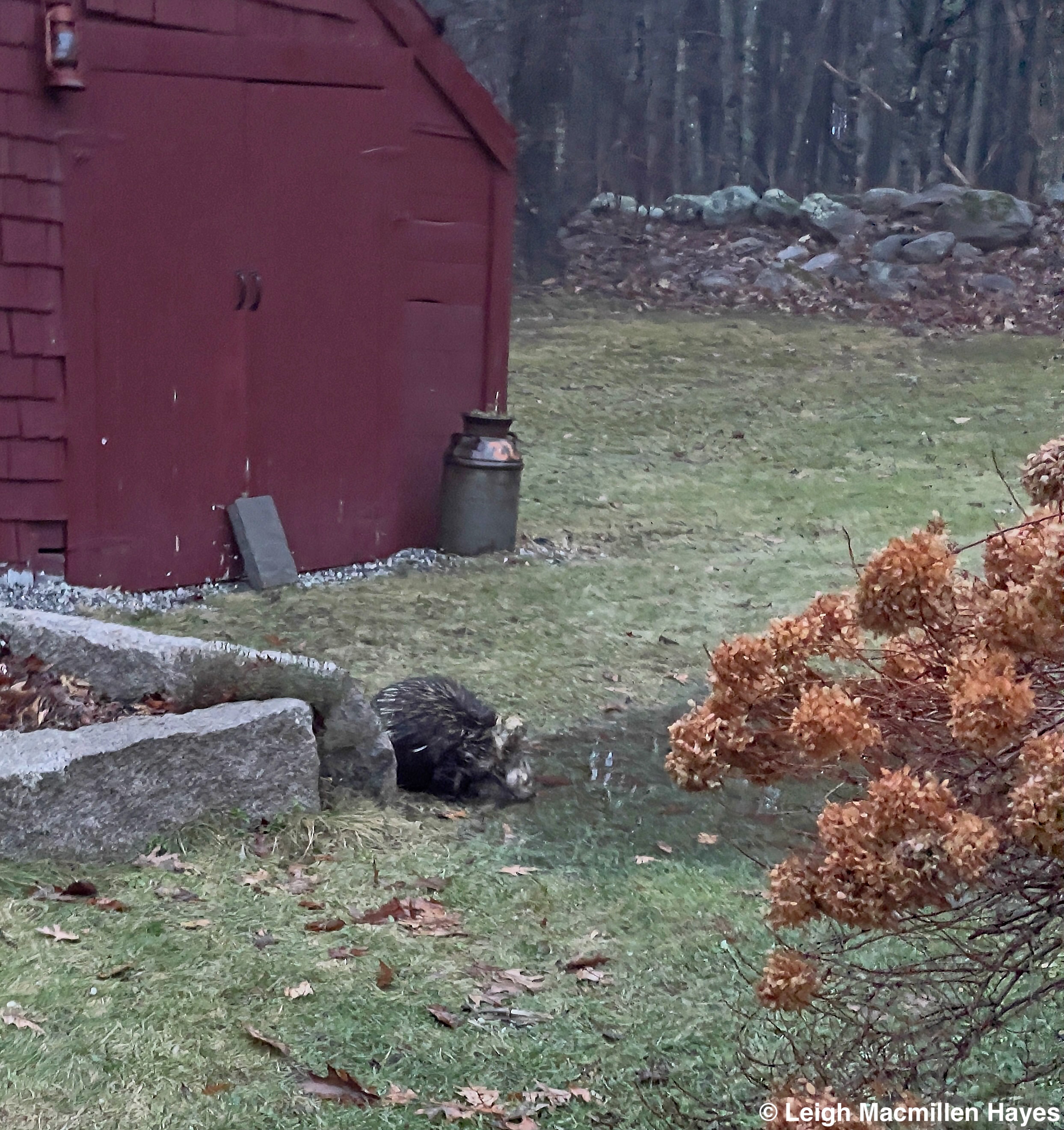
Yes, in the middle of the day I met a porcupine. If you are a frequent flyer on wondermyway.com, you know that I’m fascinated by these large quilled rodents. And their quills. And especially their scat!

By turning its tail toward me, my friend was ready to go on the defense should I try to get too close. Notice how the 30,000 quills on its back side were raised–a message to me that I should beware.

No, a Porcupine cannot send its quills aflying, but if I nudged it, which I chose not to do, the barbed hairs would have detached easily and I would have been screaming for help.

Instead, my friend decided to move away from me. And I decided to follow at a reasonable distance, giving it some space.

Our property is bordered again and again by stonewalls, some once used to mark boundaries, others to keep animals in or out, and still others served as garden walls, their double-wide structures the garbage pail for small stones that popped up each year during the spring thaw.

My friend had a single wall to conquer and that’s when today’s lesson began.

Actually, it was a few lessons. Maybe the first was noting the coloration of my buddy. We are used to variation in colors of our local Porcupines, but typically they are either black, or black with a lot of white, or brown. This guy seemed to bear the “coat of many colors,” embracing all of the above.

Not only that, he donned a white mask, the opposite of a Raccoon’s black mask. Today that mask earned him a name. From this day forward, he shall be known as Bandit.

The second lesson Bandit taught me is that because his sense of sight is not as prime as his sense of smell, once he was on the stonewall, he had a difficult time making the move down to the next stone.

I moved to the other side of the wall, and watched in awe as he raised his front legs in the air and stood upon his hind legs, rather bear-like in stance it seemed. Okay, so he even looks like a mini bear.

I began to realize that I sometimes channel my inner porky when I’m hiking down a trail. Going up is rather easy, despite the increase in elevation and sweat effort. But coming down. That’s a different story and I need to know where to place each foot. Especially in this autumn season when American Beech and Northern Red Oak leaves are slippery and hide obstacles.

Bandit continued to test his next move for a few minutes. Of course, some of that may have included my presence, and perhaps he was also sensing my odorous being. I have to admit that I hadn’t showered this morning, and for one who has a keen sense of smell, I was probably a bit of a mystery since I didn’t smell like a Fisher or a Bobcat. Those are a Porcupines finest predators–going for the soft hairs on his face or stomach.

Eventually Bandit took a step of faith. I know the feeling because I’ve done the same frequently on a hike and it brought to mind descending South Baldface in Evans Notch, and thinking that I couldn’t possibly lower my body from one ledge to the next, especially given that I couldn’t see a safe spot to place my foot. Or any spot, for that matter. I thought that perhaps I should just wait for a rescue mission, but My Guy did what he does and patiently waited and then talked me over the edge. Bandit talked himself over the edge and that worked for him.

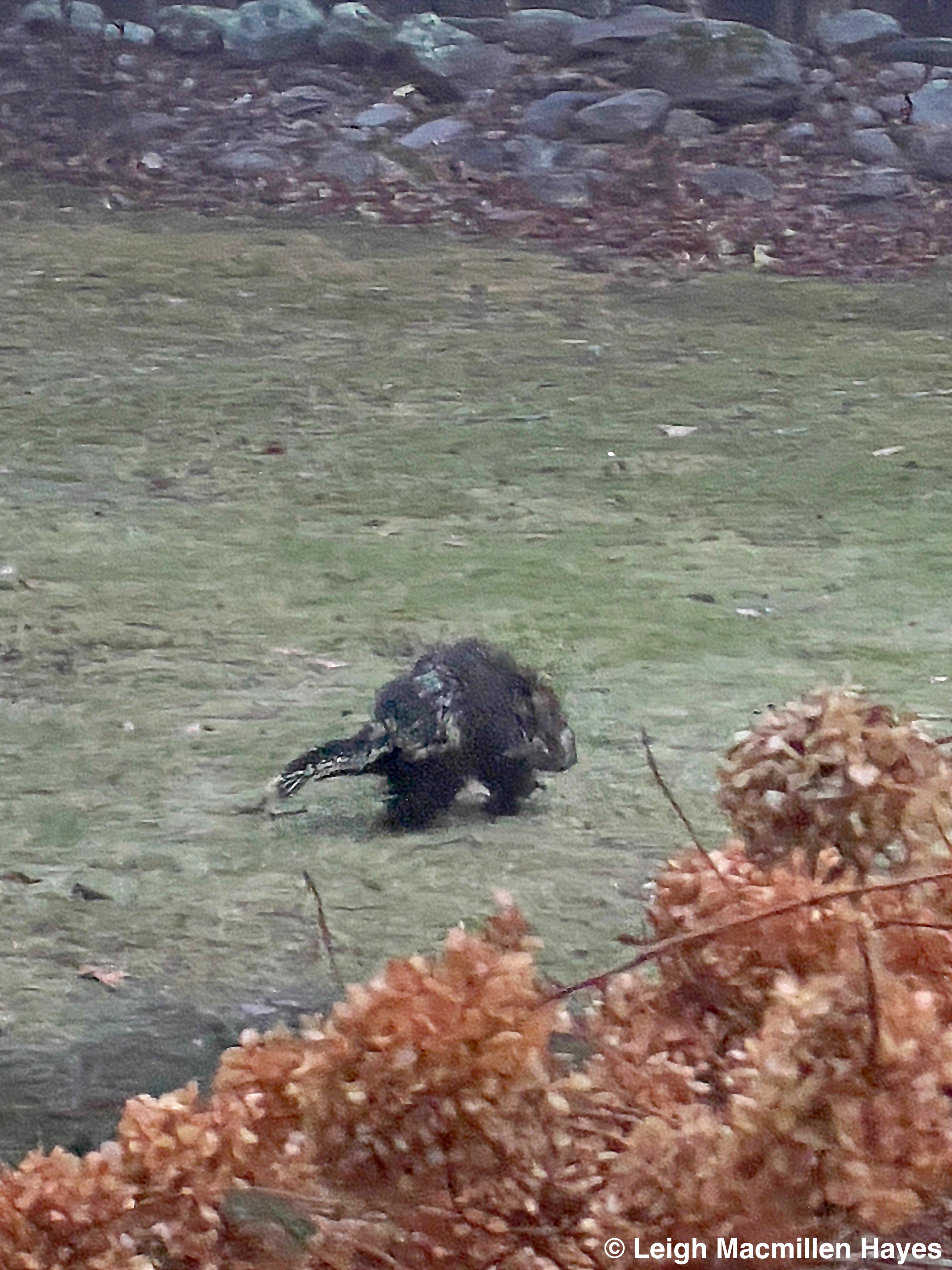
And then I watched him waddle through our woodlot, lifting first the legs on his left side, and then his right.

He traveled close to the stone wall that borders our land and our neighbor’s field and I worried he’d cross over and she’d let her dogs out and quills would fly. Well, not really fly, but you know what I mean.

Thankfully, she wasn’t home yet. And . . .

Bandit had a different idea. He started to climb an Eastern Hemlock on our side of the wall.

Higher and higher he climbed and I noted that like me, he much prefers going up to coming down.

Knowing that he was going up the trunk and would be looking for a place to settle down, and probably wouldn’t go anywhere else for the time being, I decided to leave him be for a bit and check on my friend Red.

I’ve actually been checking on Red frequently these past few weeks and today I noted that he’d finally started to really build up his caches in several places. Cold temperatures have triggered his need to grow the pantry.

And in the meantime, he needed to eat to maintain his stamina.

I also checked on the Northern Red Oak beside another stonewall behind our barn. I suspected that prior to our meeting, Bandit had been feasting upon the abundant acorn crop the tree had produced.

I scanned the acorns for scat, but haven’t turned up any sightings yet. That said, I’m sure it’s there and don’t worry. I’ll continue to search, because, after all, scat happens.

I also intend to keep an eye on a hollow within the tree, which in the past has served as a Raccoon’s retreat. Maybe this year Bandit will do some housekeeping in this place. Or under our barn. Or somewhere else, for the options are endless in our neck of the woods.

Finally, I headed out to the field on our neighbor’s side of the wall and up in the Eastern Hemlock spotted Bandit. Do you see him? I say “him” because males typically are the ones we spot during the day.

I’ve been waiting for such a sighting because it is the time for Porcupines to switch from a summer diet in a field or orchard to a winter diet of acorns and hemlock cones and buds.

Today I give great thanks once again for living in a place where I can spy wildlife frequently and always there is a lesson to be learned. Porcupine as teacher, as it should be.

Scouts on the Hunt

The morning began as Tuesdays do in my current world, with a visit to a Greater Lovell Land Trust property accompanied by a group of curious naturalists we know as docents who love to do deep dives on every little thing that we encounter and in the midst we share a brain. A collective brain is the only kind to have, in my opinion, because we each bring different knowledge or questions to the plate.

And so it was when we first encountered what could have been a hair ball of sorts and then discovered this hair-filled scat about a yard beyond. And near it another “hair ball.” Based on size and structure we determined the scat belonged to a bobcat, and thought that the hair balls made sense as maybe the cat had to cough up some of the hair of the mammal consumed. What did it eat? Well, we know both snowshoe hare and deer frequent this place and so it could have been either.

A little further down the trail we reached a beaver lodge that some of us had seen under construction in August 2022, and gathered game camera photos over the course of time, and spotted all kinds of sign of activity each time we visited, until that is, May. When it rained. And rained. And rained. In a torrential manner. And the dam the beavers had built was breached. And they disappeared. And we know not their fate.

But the beauty of a beaver pond is that once breached, change happens and other critters take advantage of the space and there’s so much possibility and we can’t wait to watch how this space, one in which we could walk prior to August 2022, will evolve and other flora and fauna may move in until another beaver family takes up residence and changes it again.

About an hour or so after departing, a call came. Well, really, it was a typed message. But as my morning peeps know, shout, “Kill site,” and no matter what I might be focused upon, I’ll come running.

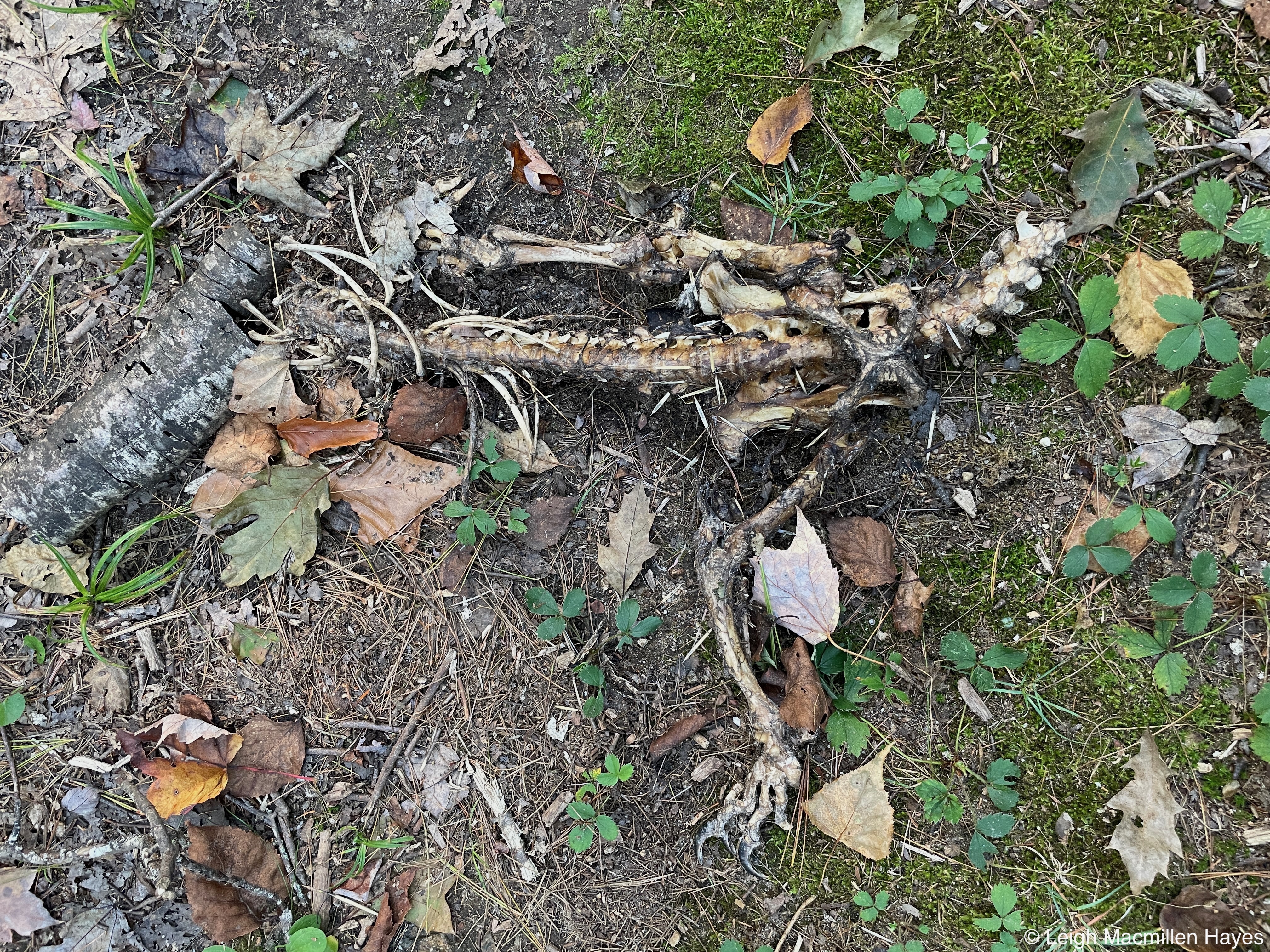
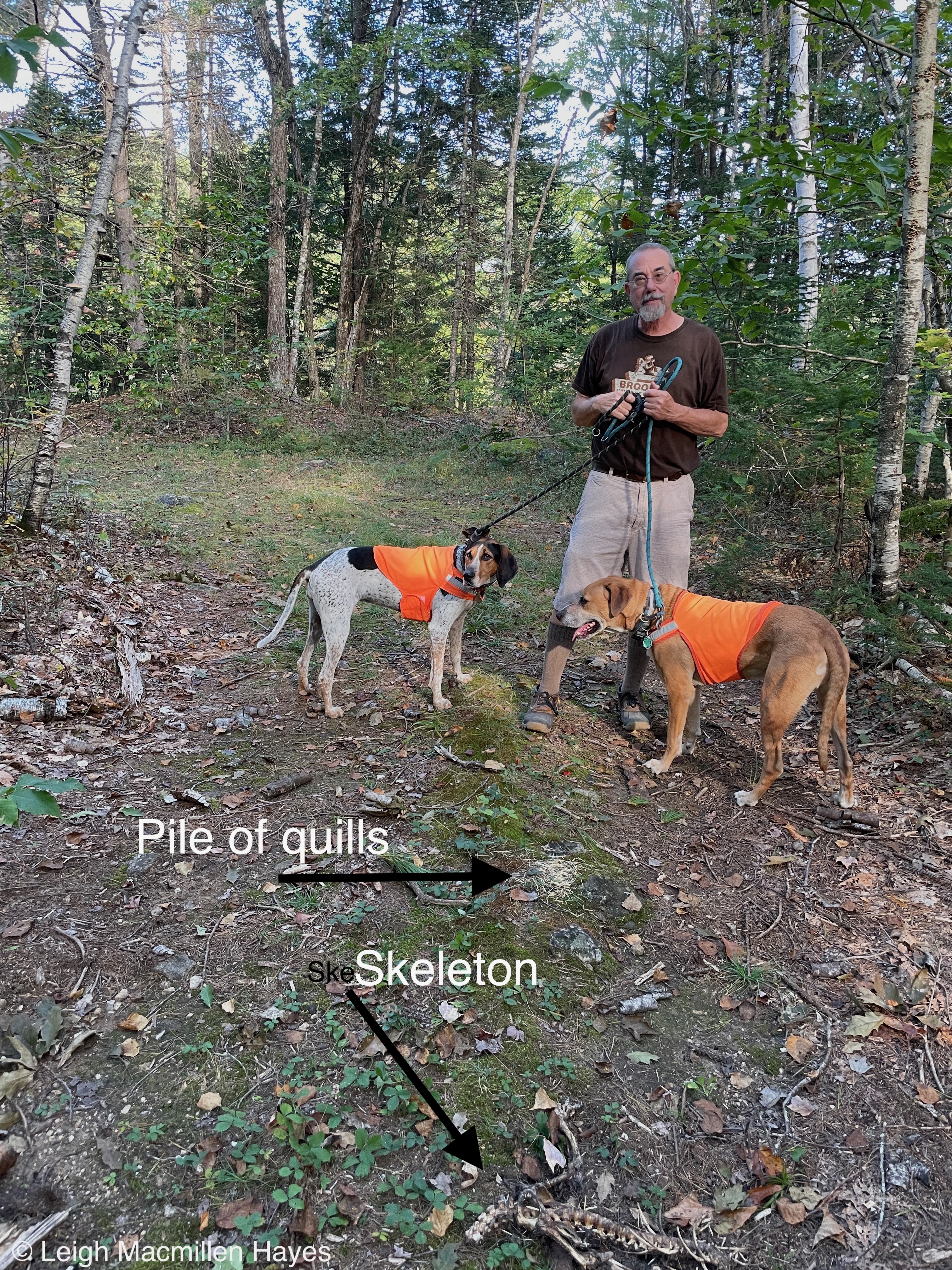
The message included a few photos of a mammal skeleton and a thought that it might be a beaver that had become the meal because it was located close to another beaver pond. Beaver ponds are plentiful in the landscape of western Maine.

After a few messages back and forth, the writer and I agreed to meet and walk to this site. Take a look. The meal this skeleton became had been consumed months ago, I suspect in the winter, given how much was missing, including the head. And even after any hide and meat had been eaten, the bones continue to provide calcium for rodents seeking such.

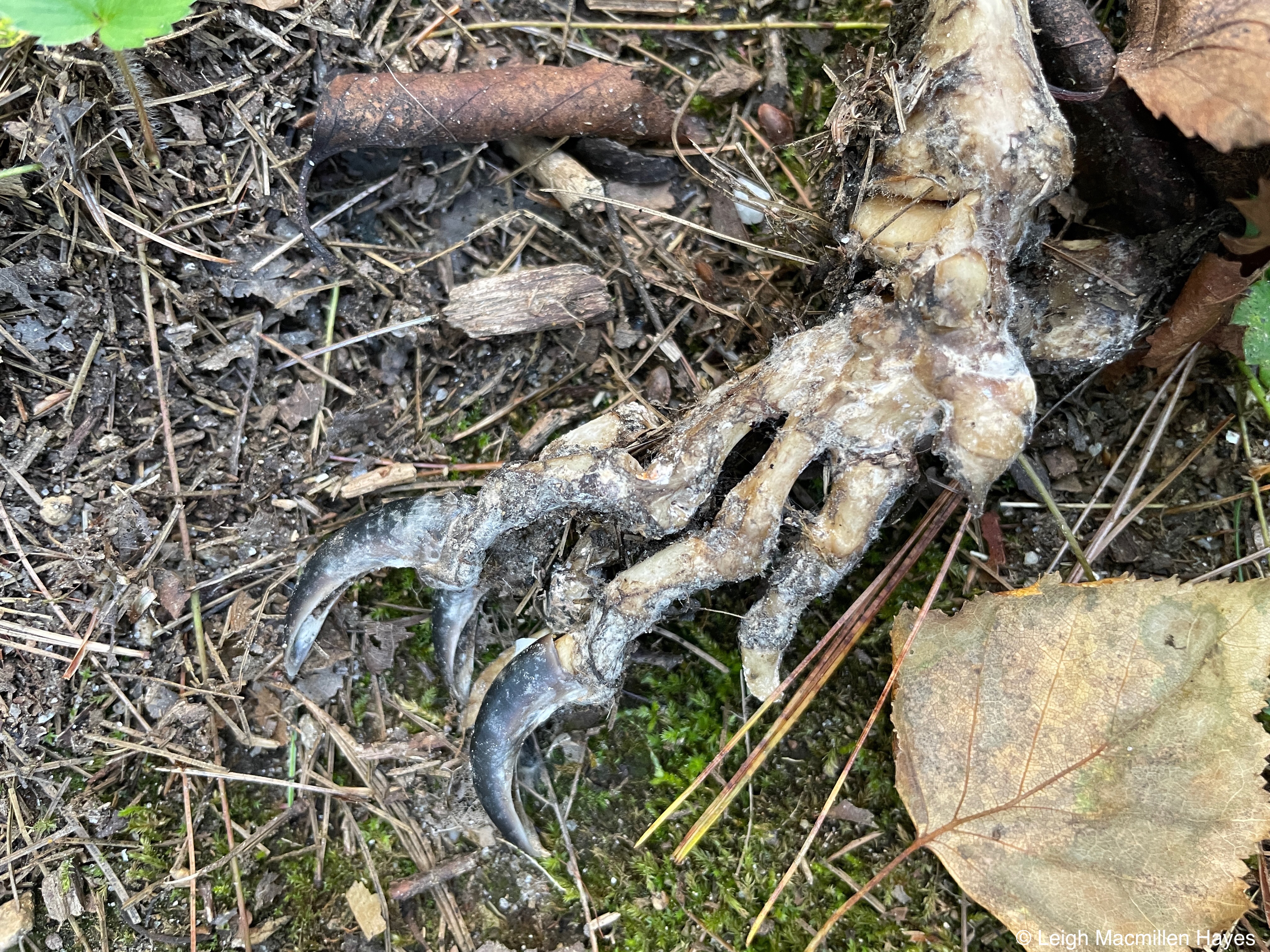
Since my guide suspected beaver, I knew I had to slow my brain down and assess the evidence. My, what long toe nails. And though some were broken, it seemed obvious to me that they were all oriented to the front of the foot. Plus, there was no evidence of webbing.

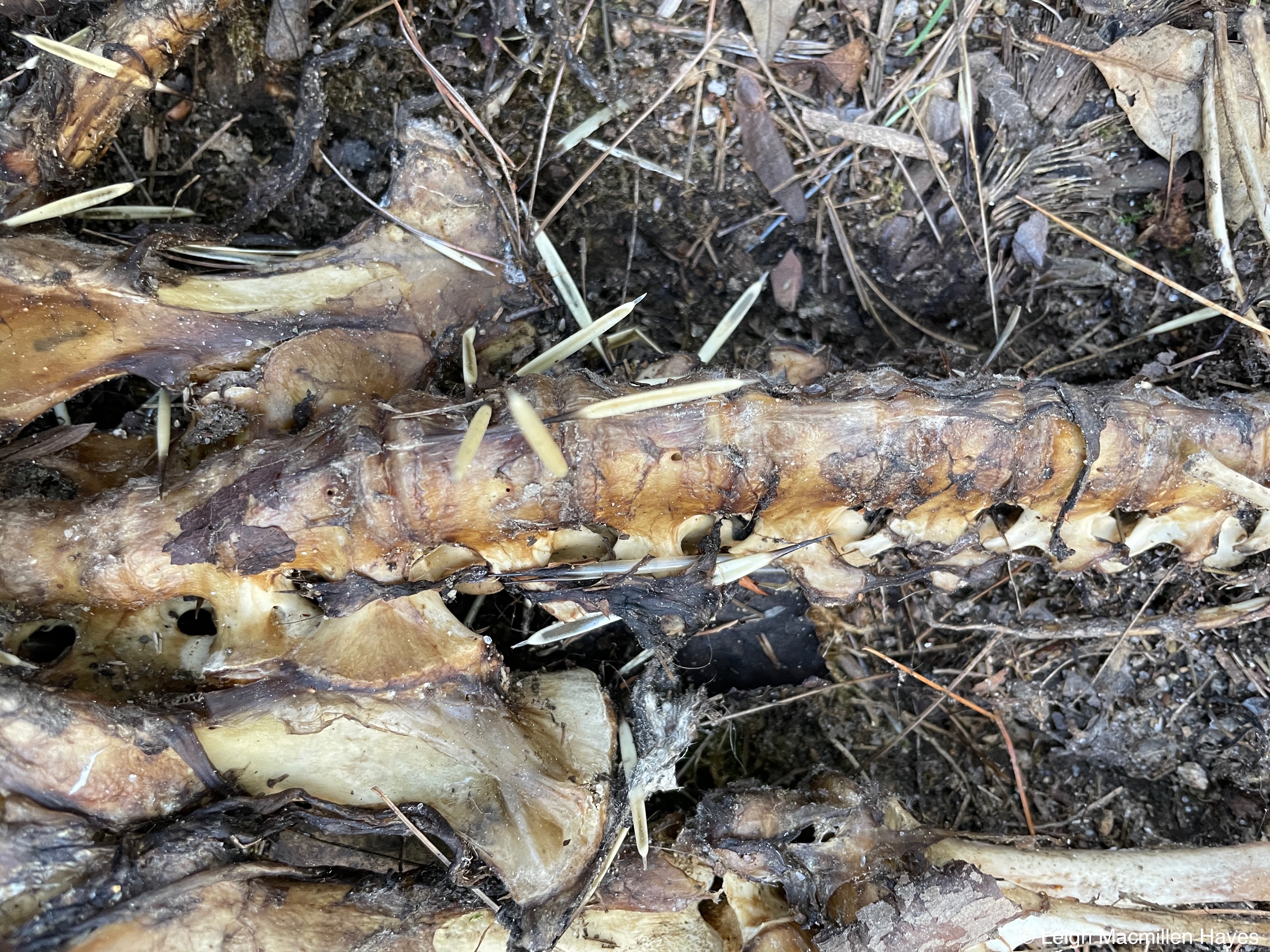
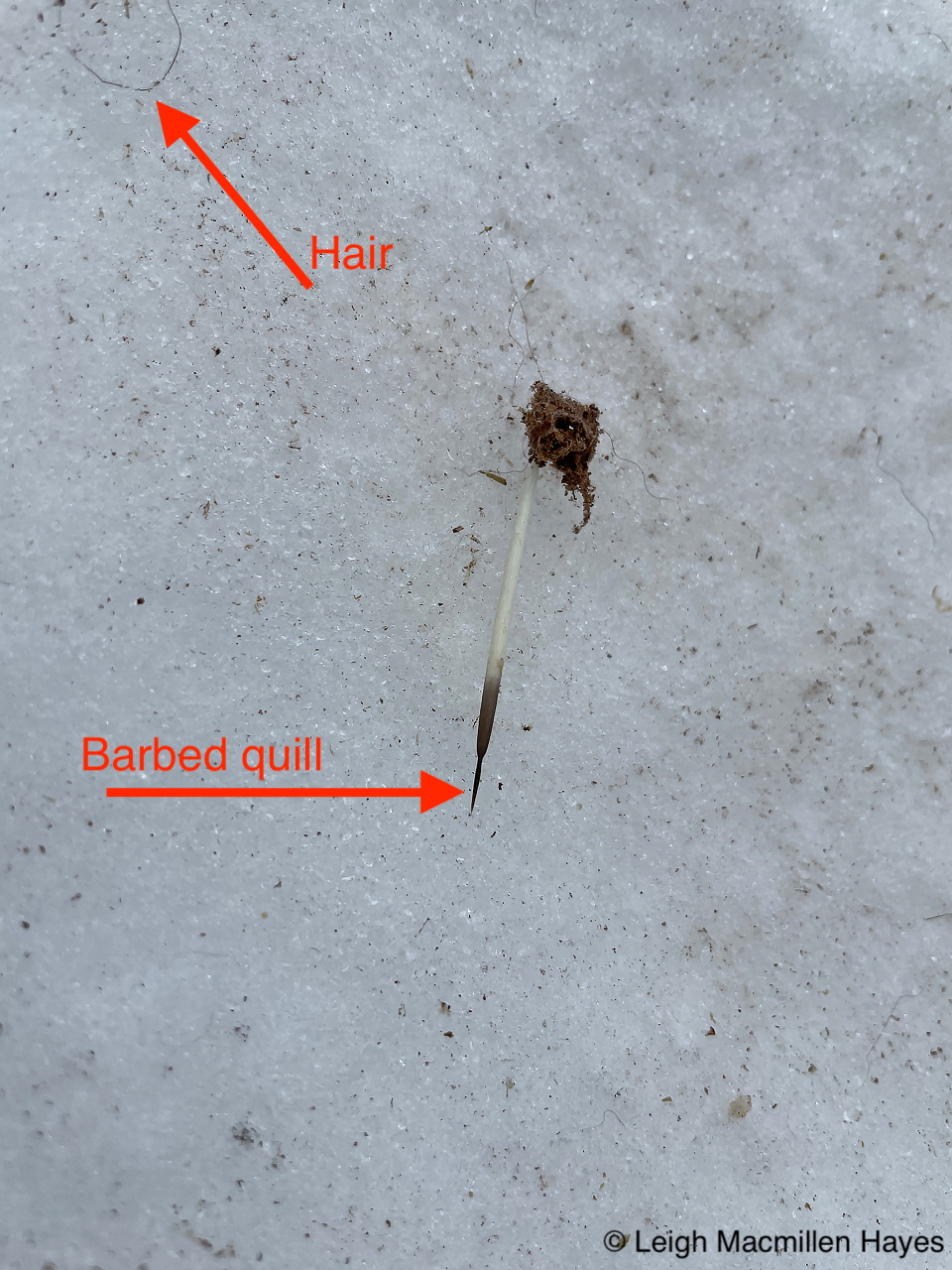
A bigger clue was observed with a closer look. Barbed quills sticking into the spine. I pulled one out and we examined it.

And about a foot away, a pile of quills, with vegetation growing through them adding to the age of the kill site.

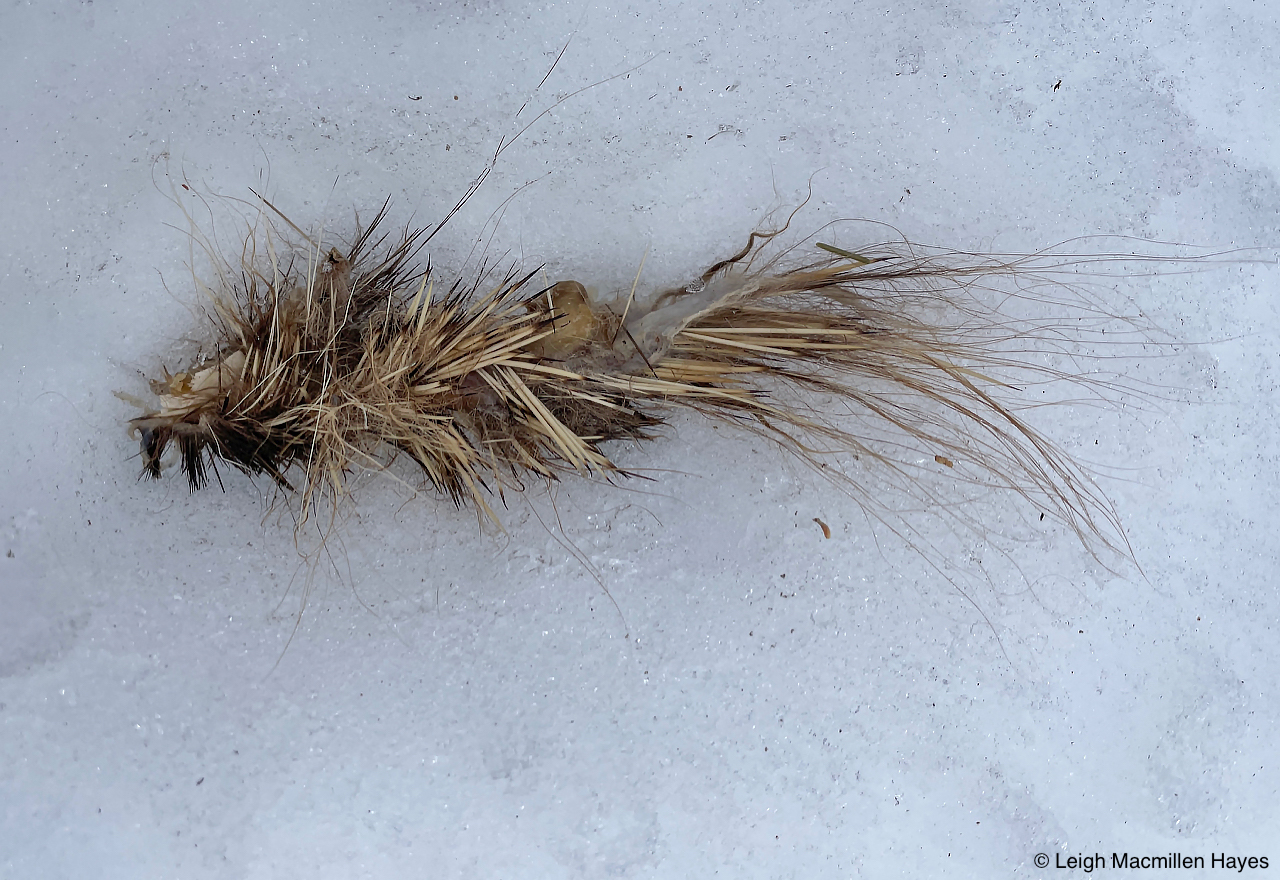
And hiding there also, as if stuck into the ground, a quilled tail.

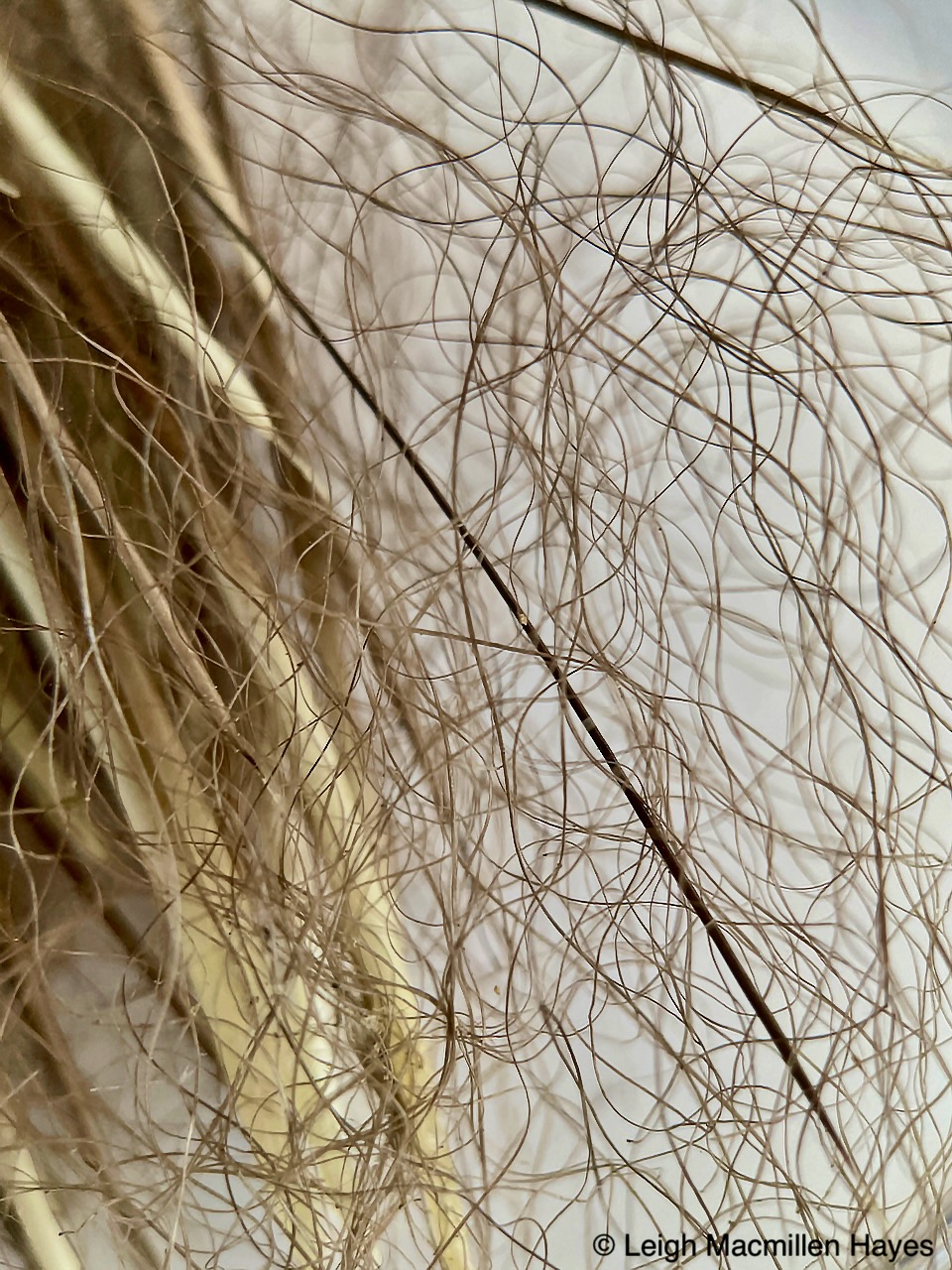
Did you know that porcupines have a variety of hair? For winter insulation, they have dark, wooly underfur. In addition, there are long guard hairs, short, soft bristles on the tail’s underside, stout whiskers, and then there are those pesky quills.

They aren’t pesky to the porcupine; just us and our pets and any animal that might choose to or accidentally encounter a porcupine.

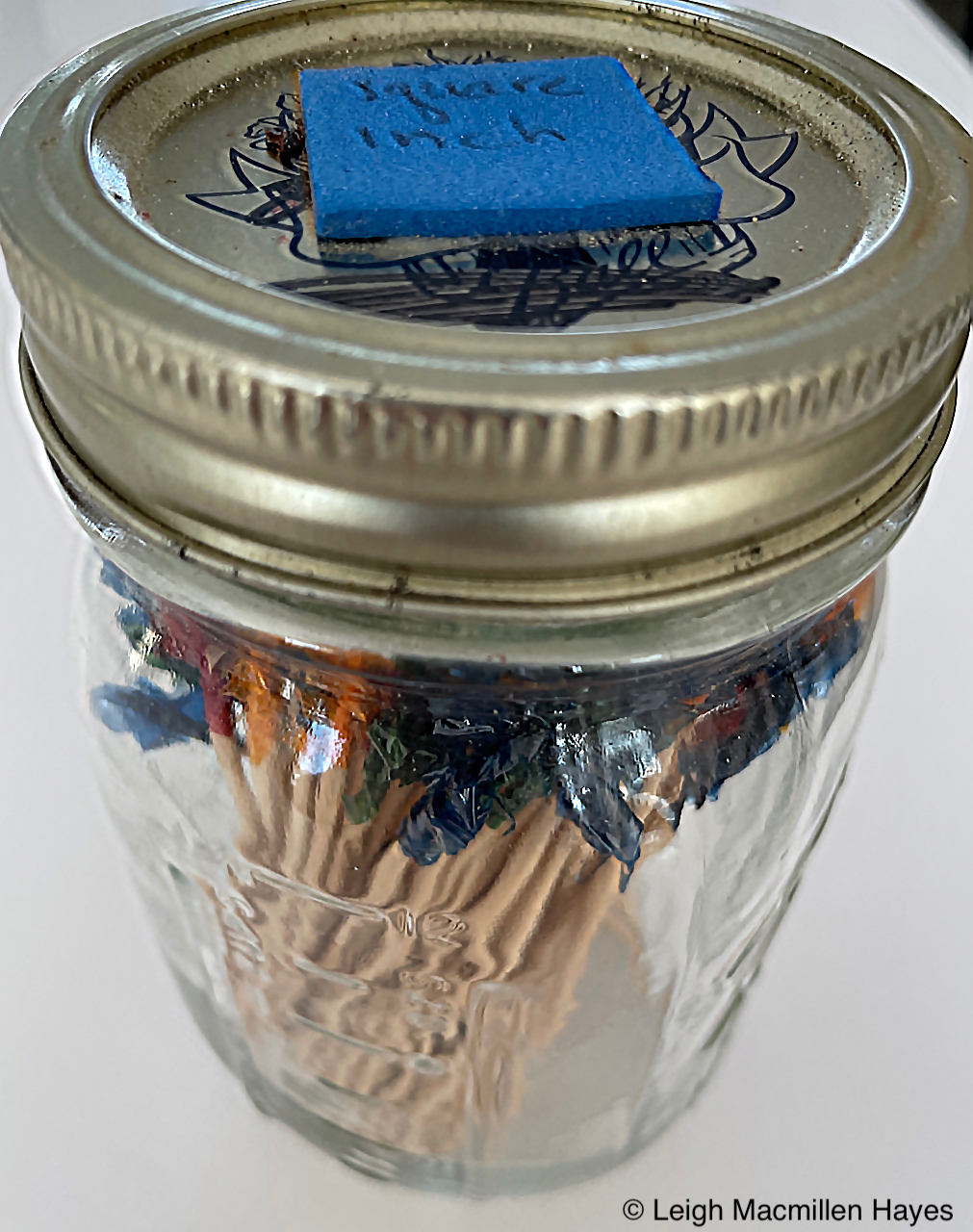
Overall, a porcupine sports about 30,000 quills, and within one square inch on its back, you might count up to one hundred, as demonstrated by my jar of toothpicks.

The quills are 1 – 4 inches in length and lined with a foam-like material composed of many tiny air cells, thus their round, hollow look. There are no quills on the porcupine’s face, belly, or inside its legs.

Look at that nose. Soft hair indeed. As is the stomach. A fisher, which is a member of the weasal family and not a cat, will attack the porcupine’s face repeatedly.

Fishers and bobcats also have been known to flip a porcupine onto its back and then go for the belly. That doesn’t mean that they don’t get quilled, for in moments of danger, the porcupine instinctively raises its quills and positions itself with its back facing the predator, showcasing its formidable defensive strategy. but the predator does get a meal.

This dinner had long ago been consumed as I said. But was it a fisher or a bobcat who scored this meal? We’ll never know, but I give great thanks to Dixie and Red and their best friend Lee, for being such great scouts and sharing the results of their hunt with me.

Found a kill site? Give me a shout and I’ll come running.

The Luck Of The . . .

Any day spent outside is a day well spent and such was my case on this Saint Paddy’s Day.

I first followed the oversized bird prints of some Turkeys, which led to . . .

Tom in full display . . .

As he strutted before a few ladies, which led to . . .

Total nonchalance on the part of the ladies as they passed by, which led to . . .

Tom and his brother, Tom, giving chase, which led to . . .

the realization that a Bobcat had crossed the Turkey trail, which led to . . .

a tree with branches scattered on the snow below, which led to . . .

taking a closer look to make sure the twigs were snipped at a 45˚ angle, which led to . . .

following a familiar and fresh trail of pigeon-toed prints, which led to . . .

a sign carved into the cambium layer of a Beech tree, indicating a certain mammal lives near here, which led to . . .

an open door with more signage on either side announcing the resident, which led to . . .

a peek inside and today’s great discovery of a Porcupine at home, which led to . . .

the realization that though St. Patrick is the patron saint of Ireland, which My Guy celebrates, he was born in Scotland and thus today’s finds were due to the Luck of the Scottish.

Oh, and check out that fine pile of scat the Porcupine is sitting upon.

The Tail of Two Days

On March 7, a group of us known as Greater Lovell Land Trust’s Tuesday Trackers, headed off into the woods at a local reserve in search of what tracks we might find. We’d barely started (and could still see where we’d parked our vehicles, which is always our joke because we’ve been known to spend three hours exploring and only cover a quarter mile) when we happened upon the tracks of a Wild Turkey. It was a fun quiz because the bird had post-holed in the deep snow and we had to pay attention to not only the pattern of the trail it left behind, but also the characteristics of individual prints. Once determining this was a heavy, three-toed critter, we knew the identity of the track maker.

Deer tracks also drew our attention and we looked at the shape as well as the depth and finally found two cloven toes deep in the snow.

But then . . . our job became more difficult. By the size of the stride of the next mammal we followed, our measurements came up with a toe-to-toe length of 14 inches repeatedly. But the print looked like that of a critter with a much longer stride–20 – 22 inches typically. We followed it for a while, and kept looking for a perfect print, which wasn’t easy to find given that Saturday’s storm, followed by melting temperatures and lots of wind since then, created a lot of tree plops (aka ploppage in our group) and melt out so there were nothing clear to read.

At last we found one, and given the size of the print, which measured the same each time at about 2.5 inches, and the symmetry of the toes, plus the X between toes and metacarpal pad, we know were were following an Eastern Coyote.

Eventually we found a track that had a bit of a sashay to the pattern, but at times it looked like the Coyote had walked on top of it. We were a bit confused, until we found a sign that confirmed the sashayer–a piece of a Porcupine’s hide–with belly hairs and short quills.

It doesn’t take much to excite us and this indeed did.

But . . . what happened here?

Our time together was drawing to a close, so rather than pursue more action, we chose to hike out, making a plan for a few of us to return today.

Special thanks to Mark and Sue, who drove all the way from Farmingdale, Maine, to join us, plus some of our regulars: Jessie, Tom and Paula, Dawn, and Sarah.

Bee-lining in on the trail this morning, Pam, Dawn, Sarah and Steve, joined me for the reconnaissance mission. We began by measuring the depth of hole where it appeared a coyote had dug at the spot where we recovered the hide piece yesterday. Total depth, a foot.

A little digging produced nothing else much to our disappointment. We were looking for body parts. Or blood.

Finally, we moved from yesterday’s ending point forward–backtracking the Coyote or so we thought, as we followed the Porcupine’s sashay, that had melted out even more in the last 22 hours. Suddenly, we had trails going in various directions.

Again, we questioned: Was it a Coyote or was it a Bobcat? And then we found this large depression filled with Porcupine hair and quills.

Again, the shovels came out, but we found only ice below the snow.

There was a calling card at the edge of the depression, however, and we knew that one of the predators was indeed a Bobcat, given the segmented scat. And if you think the white in some of the chunks is bone, we believe you would be wrong. It struck us as perhaps being the lining of an organ.

We moved beyond that site and found some tracks that also lead us to solidify the Bobcat ID. But . . . we began to wonder: Did the Bobcat cache the Porcupine and then return to dig it up? Did the Coyotes also come upon this pantry item and take advantage of the Bobcat’s food?

As we considered all of this, suddenly, in the not too far distance, we heard Coyotes calling. Did they have another meal that the Alpha pair were calling the youngsters to visit?

Eventually we made a decision to make our way back to where we’d gone off trail and see what might have happened on the north side. Again, we kept finding what we thought were Coyote, and then some prints that were Bobcat.

The Bobcat prints frequently led to buried rocks or stumps where it could pause and look out on the scene in hopes of finding more prey. The thing is, this has been a tough winter in some places such as Oxford County, Maine, because we’ve been through two summers of a major Spongy Moth outbreak and the trees had all they could do to put out a second set of leaves after the first set had been consumed. That means that there isn’t a lot of fruit in the forms of cones and beech nuts available, thus there aren’t a lot of rodents, a prime source of winter food for predators such as these.

For a while, we split up, each following a different trail, but quite often they came back together again. And so did we. And still. we were seeing the prints of both of our friends. Until, we realized, the Bobcat was traveling in one direction, and the Coyote in the opposite, one using the prints of the other for easier traveling, just like we had been able to beeline in on the tracks we’d made yesterday, saving energy, which is important when the snow is deep and food scarce. The Coyote sunk down more than the Bobcat, and the stride for both made sense.

We were just about done, but knew that our way back to the main trail was not a direct line, because there was a ledge in front of us that our friend the Bobcat had traveled upon and even left a bit of a trough from frequent use.

Instead, we traversed down and around the ledge and discovered what may be the Bobcat’s den.

The round prints led right into it.

And out again. We all took a turn peaking in, but it went deeper than we could see.

We did notice that there were several trails of Bobcat tracks leading up the slippery ledge to the lookout spot above.

At the end of this journey, it became obvious that this was the Tail of Two Days–for we were so happy to have shared the trail with so many others on Tuesday, but grateful to have returned today to check out more. And where we’d found the bigger depression with quills and hair and Bobcat scat, we also found another depression that contained this –the Porcupine’s tail.

How cool is that?

Quill You Be Mine?

It’s not even Valentine’s Day and already I’m thinking of love. Don’t tell My Guy, but this is love of a different sort. And the story all began while tracking with friends earlier this week.

Just as we were about to finish up the program, we spotted the signs of a resident rodent, including downed hemlock twigs and then a den. The den did not entirely make sense due to its placement in what seemed like a wet area, but we decided the critter must have found a dry place above the moisture, for indeed there was scat.

Once spotted, I knew I needed to return, for almost nothing makes me happier than to spot sign left behind by this mammal.

And so I did yesterday afternoon and while taking a different route to the den, I noticed the sashay of said critter as it had waddled through fluffy snow.

Next, I did what I do, and followed the tracks in a different direction than originally intended. And that’s when I saw these, the resident’s name carved on several wooden shingles. It’s an agile critter given that the shingles were posted all the way to the tip top of these pole trees.

Can you read it? Porcupine Lives Here is the inscription engraved on the tree. Actually, it’s a sign of winter feeding for porcupines, like beavers and deer, seek the cambium layer as one of their food sources. Each line shows where the porcupine’s incisors came together as it scraped away to obtain a meal.

And just beyond those pole trees, I spotted a hole that I suspected could only be one thing. A den with tracks leading in and out and the required pee, for such is this mammal’s habit.

A closer look at the dooryard and I spotted a barbed quill and hair. Actually, quills are a modified form of hair.

Did you know that porcupines have a variety of hair? For winter insulation, they have dark, wooly underfur. In addition, there are long guard hairs, short, soft bristles on the tail’s underside, stout whiskers, and then there are those pesky quills.

They aren’t pesky to the porcupine; just us and our pets and any animal that might choose to or accidentally encounter a porcupine.

The quills are 1 – 4 inches in length and lined with a foam-like material composed of many tiny air cells, thus their round, hollow look. There are no quills on the porcupine’s face, belly, or inside its legs.

But on the upper portion of its head, down its back and along the top of its tail, oh my. Within one square inch, there are approximately one hundred quills.

All told, there are over 30,000 quills. But who is counting. Not me. Though I did count these fancy toothpicks, 100 in all, to represent the quills in a square inch.

Despite the myth, porcupines cannot throw their quills. Because the quills are loosely attached, they dislodge easily on contact and stick into a victim’s flesh. And because they are barbed, they are difficult to remove. Talk about a formidable defense!

Returning to the den, which was located within a hollowed tree, I knew the porcupine had visited within the last twenty-four hours but wasn’t so sure it was home at the hour I stopped by.

As I often say, “Scat happens.” And in the case of a porcupine, it happens a LOT! One porcupine evacuates 75 – 200 scats a day. And though this happens as it dines, most of the scat is deposited in the den. Why? Warm insulation on a night as cold as tonight will be with temperatures already in the negatives and wind chills expected to reach -45˚? Or a detractor for predators–do they get a whiff and realize its one they don’t want to visit?

I’m not sure, but this is an example of a winter scat–fibrous from that woody diet of bark and twigs. It’s comma shaped. And often there is a groove down the inside curve.

By spring, it may come as linked pieces, much like a necklace, for grass fibers from a change in diet help create the connection.

Having discovered this den, I decided to follow the tracks, which indicated the mammal had traveled in two directions. Where would it lead me?

Within a tenth or two of a mile, I realized I’d snowshoed back to the spot my fellow trackers and I had discovered two days prior. You can see our snowshoe tracks. But since our visit, the porcupine had happened along, climbed over the downed log and peed.

Did you know that pee plays an important role in a porcupine’s courting ritual. These critters are solitary most of the year, but between September and November they seek a mate. The male, in a bid to woe a female, often approaches and sprays her with his urine. Are you feeling the love? She apparently does, for if she likes the scent of his urine, they might rub noses, or walk on their hind feet before canoodling begins.

Right above the peed-upon log was the entrance to the den and by the sight of the pigpen approach, browner even that it had been previously, I knew this really was active. The soiled snow is from the porcupine walking across its scat to exit the den.

Unfortunately, I couldn’t get the camera lighting right, but believe me that this one is full of scat as well. And I suspect, though I couldn’t see it, that a porcupine was sleeping somewhere in there, with its tail facing the entrance just in case a predator happened along.

Another indicator of a resident in the house–hoar frost created by breath on a cold winter day.

Right above the den I discovered the tracks of another–enemy number one in a porcupine’s world view. A fisher will kill a porcupine with repeated bites to the face and head.

Coyotes have also been known to work in pairs to maneuver a porcupine onto its back, thus going for the belly, where the hair is wooly.

So the curious story to me was that the fisher passed through after the porcupine was already back in the den, but it didn’t approach the den. Perhaps it had hoped to find the porcupine out in the open and didn’t want to face a tail lashing if it stuck its nose into the house.

Since the pervious visit, there were also more hemlock twigs on the ground and lots more evidence of scat-dirty feet and pee.

Because a porcupine is a rodent, and a large one at that, only exceeded by a beaver in size, it has prominent top and bottom incisors and twig nips are at a 45˚ angle. Can you also spot the scat and hair?

The winter diet consists of needles and bark–favorite trees being hemlock, birch, beech, aspen, elm, oak, willow, fir, and pine.

In spring and summer, a porcupine seeks out grasses and other green plants. And then in the fall, it looks for acorns, tearing into them in a rather messy manner.

In fact, a squirrel’s midden of opened acorns shows that it cuts the hard shell into much neater strips.

A porcupine’s cheek tooth pattern consists of one premolar and 3 molars on each side top and bottom. As you can see, the cheek teeth are modified for grinding since they are strict herbivores.

It’s those prominent incisors that are to be admired. A porcupine uses its large two front teeth for gnawing off bites of food. The incisors continue to grow throughout the porcupine’s life at a rate of twelve inches/year, and the constant gnawing keeps them worn down to the perfect size.

I did not actually see a porcupine yesterday, despite my best hopes, but sometimes it happens when I’m not looking intentionally so there may be a sequel to this story.

A porcupine has poor eyesight, so I’m not sure if it ever actually sees me when it’s up in a tree, especially if I’m standing sorta still, but it does have a good sense of hearing and smell, so I’m sure its aware of my presence. And the tail always faces the trunk in case I decide to climb up–it’s a great defense mechanism–having the tail at the ready to thwart a predator.

I will end this long story with a drawing by a dear friend and fellow naturalist, 8-year-old Aurora. She’s done her homework and I hope one day soon she’ll be able to answer the question: Quill You Be Mine? with a yes!

Tracking Glee

We finally have a decent amount of snow on the ground after Friday’s storm and another storm is expected to begin in a couple of hours. That meant it was time to don the snowshoes. And so I did. And headed into the woods behind our house.

Immediately I was greeted with nature’s art work, and seeing snowflakes dangle like this will always capture my fancy.

But that wasn’t all that captured said fancy, for at a point where I’d been dealing with trying not to fall into water since it’s quite a wetland out there, I suddenly spotted bobcat prints. And knew I had to follow them.

I hadn’t bothered with my tracking bag full of gear, but did think to stick this little card into my pocket for reference. Can you see the C-shaped ridge between the toe pads and metacarpal pad? And the lead toe–making the overall print asymmetrical. Take a look at your hand. It’s also asymmetrical with a lead finger.

The snow is such a depth that there was foot drag. I got thinking about what the bobcat was hunting for and had seen plenty of snowshoe hare and deer runs so knew there was food available. Where would this cat lead me, I wondered.

It was at that point, however, that I thought about a tracking lesson I taught to future Maine Master Naturalists yesterday–if the prints look fresh, backtrack rather than follow them forward, so you don’t put pressure on the animal. I heeded my own words and turned around.

Of course, there was more art work to spy, like this candy cane dangling from a branch.

In my backtrack exploration, I spotted where the bobcat had climbed over a fallen tree. There were other spots where it went under trees and I had to find a different way around.

Back on track, there were more intersections with deer and even mice. But all continued to live for the moment.

And then my journey led me to another I’ve been looking for all winter because usually I see so much evidence of this critter–a porcupine had sashayed through the snow over night.

I found what I think is its den, given the amount of scat, and a hole. And I’m just now making sense of the story. The hole was not large due to snow in front of it and the scat was a bit frosted. BUT . . . what might have happened is that as the day warmed up, snow fell from the limbs above and the porcupine will dig its way out–in fact, it probably already did about an hour ago, for they emerge during twilight.

I followed the tracks, which led to a hemlock tree where there were a couple of twigs below.

And the bark and cambium layer had been chewed on the main trunk and another branch above.

So at some point in my journey, while I was following the bobcat and off my regular trail, I decided to turn on my GPS until I knew where I was. What surprised me is the circle I made as I followed the porcupine’s trail. I need to make time to visit it again, for it seemed to be a new resident to this spot and there wasn’t any more evidence that it had dined in the area.

It took a few minutes, but eventually I found the bobcat tracks again. Only . . . this time I was following the cat forward. What?

They led me to a spot at the base of a tree where the bobcat took a break and must have curled up. And then it turned around.

And it suddenly became apparent to me: I’d followed the forward track on the left to the turnaround point and on the way back I noticed the backtrack trail I’d previously been following. I never did find the bobcat or the porcupine, but seeing evidence of their activity was enough and it was getting late so I followed an old logging road home.

There were still more baubles to spy, including this one upon a Red Maple that had provided food last winter in the form of buds–a fav of the deer.

And when I returned to our woods, I discovered that four deer had bedded down last night under a raised sleeping platform our youngest son had built about eleven years ago when he was in high school. Look for the smooth edges and you’ll realize each one is oriented in a bit of a different direction, the better to see that bobcat, or even the coyotes, whose tracks I also saw today.

Just for fun, I’ve added these photos of the MMNP students channeling their inner child–each mentor group was assigned a mammal. This group needed to become a bobcat and though you may not quite see it, the bobcat was walking in the zigzag pattern with the hind foot landing where the front foot had packed down the snow, thus each print representing two feet, and conserving energy. And those fingers on the bobcat’s head–ear tufts. Plus the “person” in the back was holding a mitten to serve as the bobcat’s tail.

There was a pigeon-toed porcupine as well that waddled through the snow.

And then it gnawed on the branches of a tree.

They had fun with the assignment. My hope is that these students will get a sense of the tracking glee that I feel every time I follow a trail. Even if I don’t get to see the critter, which is most of the time, just developing an understanding of their behavior makes me so happy.

The Beaver’s Tale

Once upon a time . . . no wait. This isn’t a fairy tale.

Rather, it’s about changes in the landscape that one might observe, such as a brook suddenly overspilling its banks as was the case in this location upon a December visit. We’d had rain, but that much?

It wasn’t long before a friend and I spotted the reason for the high water. Some new residents had moved into the area and built a lodge of sticks. Unlike the story of the three little pigs, one of whom built a house of sticks that the big bad wolf came in and blew down, the makers of this structure took special care to make it solid and strong and weatherproof. Yes, a beaver or two or six had taken up residence with the intention of spending the winter. Beaver families usually consist of a monogamous couple, plus their two-year-old (almost adult) kids, and yearlings. Mating occurs in the water during the winter and kits are born inside the lodge in the spring.

In order to move into the lodge, a dam needed to be constructed as well. If you look closely, you’ll see that above it there was a bit of an infinity pool with the ice at level with the dam, while below it some water flowed at a much lower level. Though we couldn’t walk along the ice to measure the length of the dam, it was quite long. and made of sticks and leaves and mud. Typically, the family works on this project by creating a ridge of mud and probably the herbaceous plants of the meadow, and then they use the mud and sticks to stabilize it. Maintenance is a constant as water or other critters or humans have a way of breaching the dam.

We, too, build dams to serve similar purposes, such as this one originally constructed to operate a saw mill. Hmmm.

Getting back to the lodge: it also needs nightly work as long as conditions allow and this has been a winter of despair for those of us who love cold temperatures and snow and even ice if it’s in the right place, like on a pond or lake and not in the driveway.

Take a look at how the beaver is holding the small twig.

A beaver’s dental formula is this: 2 incisors on top, 2 incisors on bottom, 0 canines on top, 0 canines on bottom, 2 premolars on top, 2 premolars on bottom (that look like molars), 6 molars on top and 6 molars on bottom, for a total of 20 teeth. Recently, I was able to sketch the upper part of the skull of an older family member, who’d lost some of its molars.

These large, semi-aquatic rodents are gnawers like their relatives. To that end, their incisors are highly specialized for chewing through really, really tough things and they grow continually throughout the critter’s life.

And like all rodents, the front surface of their incisors is coated in enamel reinforced with iron (hence the orange color), which makes it resistant to wear and tear from gnawing. When the chisel-like teeth chew and fell trees, the much softer white dentine layer (the section behind the enamel) is ground down quicker than the enamel, thus creating a sharp chisel surface.

But to me the coolest aspect is that their lips close behind the incisors, thus permitting them to gnaw and carry sticks underwater without choking.

And bingo, you can see the stick being carried in that gap between the incisors and molars. Food sticks become lodge or dam sticks once their nutritional value has been consumed: a true plan of repurposing.

As it turns out, that wasn’t the only beaver family at work in town. This next family, however, chose to park their tree in a spot the fire department lay claim to for filling a water tank. But . . . reading is not on a beaver’s talent list.

In this other place, so many trees have been felled, but not all have fallen as intended, getting hung up on other trees instead. Not wanting to anthropomorphize, but I have to wonder what expletives flash through a beaver’s brain when trees don’t hit the ground as planned.

As strict herbivores, a beaver’s diet varies with changes in the season. During spring and summer, they are drawn to waterlilies, algae, grasses, sedges, herbs, ferns, shrub leaves and shoots. By late summer, however, tree cutting begins as they gradually change their dietary habits from herbaceous to woody materials. Twigs, roots, bark and especially inner bark become the source of nutrition. Aspen, birch, alder, and willow are favored species, but beavers will cut almost anything including conifers.

Imagine this. A beaver cocks its head to the side as it gnaws, thus the consistent angle of the half inch groove as the upper and lower incisors come together.

Likewise, porcupines gnaw, but their incisors are much narrower and the pattern more random.

So, the question remains. Where were the parking lot beavers living? In the past, a family has inhabited the northern most reaches of this pond, but in this case, they had built a lodge on a point not far from the southern end.

The top of the lodge is the only section not covered with mud, for it serves as a “smoke stack” of sorts, a place for beaver breath to escape. Visit a lodge on a cold winter day and you might observe the vapors rising.

And then it was on to another locale, where beavers have inhabited the same lodge for a number of years. When beavers choose to live in a pond or lake or sometimes even a river, there’s no need to build a dam for the water is usually deep enough for their underwater movement.

I often tell people that beaver prints are a rare find because they are either wiped over by the tail or by trees being hauled to the water. Once in a while, however, I’m proven wrong and the sleety snow on a recent day awarded just the right conditions for the webbed feet to be observed.

Tree work and broken ice added to the story of the critters’ journey to and fro the pond. While quite adept at time spent in the water, they are rather clumsy on land and most of their work is within a hundred feet of the edge.

Winter food is cached close by the lodge entrance so that they can swim under the ice to retrieve a stick. A beaver’s ears and nose have a valve that closes when it is submerged and they can stay underwater for up to fifteen minutes. Back at the lodge, there is a raised chamber surrounded by a moat that leads to the entrance tunnel. It’s upon the raised area that they dine, and groom, and even give birth.

At this particular pond, My Guy and I noted two lodges connected by an open channel between. Given the number of tail slaps that announced our presence near both lodges, we thought perhaps both were active and inhabited by the same family.

And then, and then . . . finally, we spotted a beaver that spotted us. We kept expecting it to slap the water with its tail in a manner of warning so other family members would seek deeper water or cover. Instead, it swam past us.

The thing is that a rodent relative, namely the muskrat, exhibits many similarities, but also differences, including a skinny, snake-like tail.

The beaver’s tail is a source of wonder. While its furry body consists of long, shiny guard hairs covering dense and softer hair that traps air and helps protect the critter from the cold, the tail is broad and flat and scaly. It’s used for a variety of reasons including stability when standing upright on land (think tripod), as a rudder for propulsion in water, as fat storage and thermal regulation, and how we are most familiar, as a warning device.

A beaver’s tale indeed.

Where the Bobcat led us

When GLLT Tuesday Trackers meet at a property, we never know what animal sign we’ll need to interpret or what greater understanding we’ll gain. Today was no different and we had a few surprises along the way.
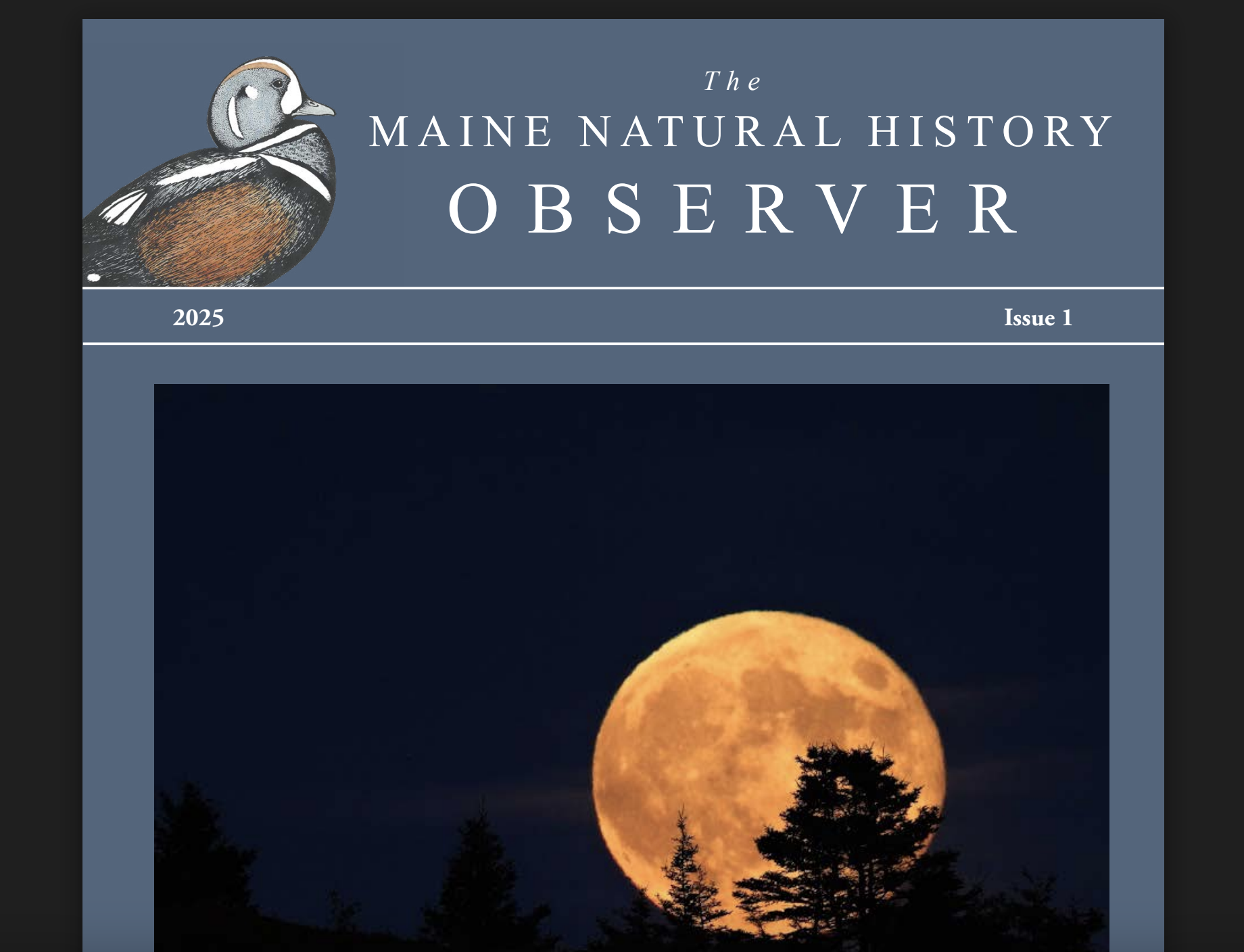
What we’ve all learned is that we need to take a bird’s eye view and consider where we are, whether it be forest or field or wetland, look at how the mammal is moving and what type of pattern it is creating as it moves, get down and count toes, look for nail marks and notice other idiosyncrasies, and then follow the trail for a ways, looking at the prints in different light, or under different trees. Often under hemlock trees we find the best prints because there’s not as much snow since the boughs hold it.

And so today’s adventure began with us following this particular animal and debating—do we see claw marks, is the overall shape round or oval, is there a lead toe, is the ridge creating a C on its side or an X between the toes and heel pad? It took some time, but we finally found a few prints that gave us confidence it was a bobcat we were following. So, where did the bobcat lead us?

Our first stop was along a stream where he walked beside the edge—about two or three feet above the open water for such is the snow height—but then paused for a moment and seemed to step down because he was curious about something. And so were these three, Pam, Dawn, and Emily, for they spied something in the water below.

From our position on the opposite bank, a few of us saw what we thought they were looking at. “It’s furry,” Dawn told us.

She wanted to go down into the water because it didn’t appear to be all that deep, but still that would have meant she’d be wet and so Emily hunted around and found a branch to use as a poker instead.

As Dawn wiggled the stick, all the time exclaiming that it was big, whatever it was, and trying to turn it over, Emily and Pam grabbed her to make sure she didn’t turn into an otter and slide down, though I suspected she would have laughed about the experience.

We all watched intently, making suggestions about the critter’s identity while Dawn continued to poke at it and move it. Mammal? Skull? Full body?

The coloration was definitely unique, but it is winter after all, so the freezing temperatures and fact that it was in water may have altered its appearance.

Those were our thoughts anyway, and we voiced our opinions, until . . . Dawn flipped it over and saw . . . a tag.

So hoping for a kill site where the bobcat may have dined, instead we found ourselves looking at . . . a stuffed owl.

Peter took Pippi’s hiking pole and aided Dawn in rescuing the sopping wet bird and if you look closely you may see water dripping from it.

Our chuckles must have rippled through the forest as we laughed at our great find. Mighty trackers are we. But . . . we think the bobcat was almost fooled as well. Almost.

The owl then flew from Peter’s hands to a perch and there it shall remain, or so we think.

For a few minutes we returned to and continued upon a logging road, and then the bobcat called for our attention again and so we did follow it. As I said to the group, normally I’d insist that we backtrack the animal so we don’t put stress on it, but the tracks were at least a day old.

This time the bobcat led us to a hemlock tree. Do you see the debris under the tree?

How about now? And stained snow by the trunk?

There were even little brown commas atop the snow that could easily be mistaken for hemlock cones. But rather, they were a form of scat.

Like us, the bobcat had been here, but for some reason he chose to pass by.

Whenever we spy downed hemlock branches, comma-shaped scat, and lots of urine at the base of a tree, we know to look up and so we did. High above sat a male porcupine. Males are known to stay in a tree during the day while females typically return to the den each morning and head back to the tree of dining choice at twilight. Here’s are two curious things: 1. the bobcat passed by—they will go after a porcupine, but perhaps this one was too high up. (Fishers are a porcupine’s #1 enemy.) 2. we looked all around and couldn’t find any porcupine tracks. If we had, we might have followed them to see if we could locate the den. But, since we couldn’t we came to the assumption that this porcupine has been up in the tree since at least our last major snowstorm on Friday, February 25.

Back on the bobcat’s trail we did go, being stymied occasionally because though we knew it was a bobcat, there were a few prints that resembled a deer and we came up with all kinds of stories about flying deer and other critters of our imaginations.

But always, we’d find a few classic prints and again feel 100% confident of our ID. Well, not ours, but the bobcat’s.

So where would it lead us next? To a spruce tree all covered with sap . . . and fur.

Some of the hair was dark and coarse.

In other spots it was redder and softer. After much debate, and noting that it was all up and down the tree from just above snow level to at eye sight and maybe a bit above, I think we all agreed it was a bear marking tree. Bears sometimes nip and bit trees and rub their backs on them and their hair gets stuck on splinters or in this case also sap.

According to North American Bear Center: “Favorite trees have little ground vegetation to prevent a bear from approaching them, and they often lean slightly toward the trail.  Look for hair caught in the bark or wood 2 to 5 feet high and look for bites 5½ to 6½ feet high.

The hair often bleaches to brown or blond after a few months but can still be distinguished as bear hair from its length and appearance.  Guard hairs are typically coarse and 3-4 inches long and have a narrow base that may be wavy.  Bears are shedding their winter fur when much of the marking is done in spring or early summer, so the bark may also catch underfur, which is thin, wavy and shorter.”

Two feet up made sense given the snow’s depth.

You’d think that would have been enough, but again we wondered: where will the bobcat lead us?

This time it was a snapped snag and we noticed he’d walked along the top of it.

And then one among us spotted this. Brown snow and more hair. We were sure it was a kill site. Yes, as trackers we really like kill sites because they are fun to interpret and we appreciate the energy passed from one animal to another via the predator/prey relationship.

For a few minutes we took turns walking around the site trying to take in everything presented to us, including some hair that had fallen into the snag’s hollow.

I think it was the two=toned hair that helped us figure this one out. Plus the fact that there was no blood. This was a spot where the bobcat sat down, thus the rather tamped down snow that had turned brown. The warmth of his body helped to flatten it and in so sitting, some of his hair, which is black and white, got stuck, similar to what we see in deer beds at this time of freezing and warming temps. The mammals are beginning to shed their winter coats and last week we had an unusually warm day so change is in the air.

We admired his hunting spot and balance beam. And then it was time for us to leave.

But those grins remained on our faces for we were grateful we’d taken the time to see where the bobcat might lead us at GLLT’s Charles Pond Reserve today.

Ever A Sense Of Wonder

I thought I was losing it. Wonder, that is. I’ve hiked or walked many miles, taken thousands of photos, but haven’t been overly wowed by much lately.

This weekend, though, that all changed.

Maybe it was the fact that a friend and I spent a bluebird, yet brisk Saturday snowshoeing many miles as we tracked a couple of local mammals.

There were porcupine dens to explore. Well, not actually crawl into because we didn’t know who might decide to crawl out. We discovered two new ones that were obviously in use, but visited this older stump dump and found no one at home. Why? It had all the makings of a nice condo. Lots of room available, hemlocks growing right out the back door, beside a field with other offerings for a summer diet. Don’t you just want to move in?

We did discover other abodes that showed signs of life with tracks leading to the inner chambers.

How many inner chambers was the next question. Atop this much larger stump dump we counted at least seven holes coated with hoar frost around the edges–leading us to believe someone was breathing within. Did that mean there were seven porcupines living in this den? Do you know what a group of porcupines who share the same winter den, but sleep in their own bedrooms, is called? A prickle of porcupines. Don’t you love that?

By the amount of tracks, we couldn’t tell how many actually lived there, but in the fresh layer of snow we did note that at least one had gone outside to eat the previous night for we followed its tracks for a bit.

It also had visited another den, and by the amount of scat, it was obvious that this wasn’t the first day in a new house.

The porcupines weren’t the only ones we were interested in. For miles and hours, we also tracked a bobcat who’d paid a visit the previous night. Would we find evidence of what it had eaten? A kill site where a prey was attacked? Scat?

We knew by the fact that the bobcat track was atop the turkey prints that this bird lived to see another day.

The same was true for the squirrels that managed to avoid being consumed by the predator overnight as they huddled somewhere close by. But the bobcat apparently didn’t catch a whiff of their scent, though the former did check out holes by stumps and snags.

Sometimes we noticed that the cat picked up speed and we were sure we’d find the reason.

And then . . . and then it would pause and we did too. When the bobcat led us back out to the road we’d traveled on, and crossed to the other side, we knew our time with it had come to an end but enjoyed the journey, though still had questions. Did we miss a kill/feeding site?

We had noted an abundance of food available, much of it in the form of the squirrel or hare. This is my snow lobster, as I’ve mentioned in the past and love how the front feet, being the smaller two prints, land on a diagonal and form the lobster’s tail, while as they lift up to leap forward, the hind feet land in such a way that they appear in the front of the set to form the lobster’s claws. And I’m reminded that for ground dwellers like the hare, the front two feet tend to land on a diagonal, while for tree dwellers like the squirrels, whose front feet also appear smaller and at the back of the set of prints, are most often parallel.

That was yesterday. Today dawned with a sleet storm. When I ventured out the back door this afternoon, I noticed again an abundance of hare prints, these the larger set in the photo while the smaller ones belong to a red squirrel. When I said an abundance of food, these are two of the many choices and this year the hare is everywhere. EVERYWHERE. I find it hopping through communities I’ve not seen it in the recent past. Certainly the bobcat of yesterday will or did find one–we just didn’t stumble upon it.

After spending so much time tracking, a favorite winter activity of mine, I finally turned my focus to trees, another passion. I was actually looking for insects, but fell for this solid droplet of balsam resin that looked rather like a bug. I would love to see the colors of the dribble repeated in yarn.

Then there was the ice that mimicked the shield lichen attached to a branch of the fir.

At last I did find an insect. Well, at least the left-behind structure of a sawfly–where it had pupated and then once ready to emerge, cut its perfect circular escape hatch. How to remember this insect: think of it as a circular saw-fly.

And attached atop the pupating case–what looked like another insect pupating. I don’t know if I’ll ever be able to name its species, but I thrilled in spotting it.

Bark is cool, but especially when you begin to notice all the idiosyncrasies of life upon it, such as the fruiting disks of a couple of crustose lichens, but one of my favs is the braid-like formation of the liverwort Frullania. It has brown leaves divided into two lobes. Liverworts are cool because they are flowerless and lack roots and reproduce via spores. Frullania is abundant upon bark, but unless you slow down and look, you may not ever spy its spiderwebby structure.

Speaking of spying, yesterday’s brilliant sun shone upon the hairy twigs of paper birch, another sight easy to overlook.

Today’s natural community found me tramping through an area where gray birch, with their bumpy, hairless twigs, grow.

How did these two members of the same family develop such differences? I think about that and how it is true of all in the natural world. Maybe the hairs don’t appear in exactly the same line-up and the bumps are more or less bumpy on another twig, but they all are variations on the same theme. Mammals are like that as well. And flowers. And ferns . . . and well, everything. We can learn to ID them because generally they share the same characteristics from one dandelion to the next. But . . . what about us? As humans, there are familial similarities, but very few of us look exactly like another. Though perhaps somewhere in the world we all have a twin we’ve yet to meet. Alas, I’ve rambled on enough.

It all boils down to the bush clover–a species my friend Pam and I first met at Brownfield Bog a couple of falls ago and recognized almost immediately when we discovered it in a field in Stow, Maine, before encountering our first porcupine condo yesterday. Today, she informed me in a text message that a year ago we met it in the same field, and we shared a chuckle that neither of us had a memory of that moment. Uh oh.

But I was reminded this morning that it’s important to go forth with a child-like attitude, finding awe in all that we see and encounter and I realized then that I’ve been too busy lately to slow down and really look.

Here’s hoping I can ever renew and enjoy that sense of wonder and that you can as well.