My Little World

Between our six acre plot of land and our neighbors’ field, which is probably about three or four acres, I feel like we live in a special place. Oh, I know I’m not alone and so many others have their own special places. What I’m most grateful for, however, is the ability to enjoy it by wandering and wondering on an almost daily basis and getting to know it intimately. That said, there are always surprises and perhaps that’s what makes it extra special in my eyes.
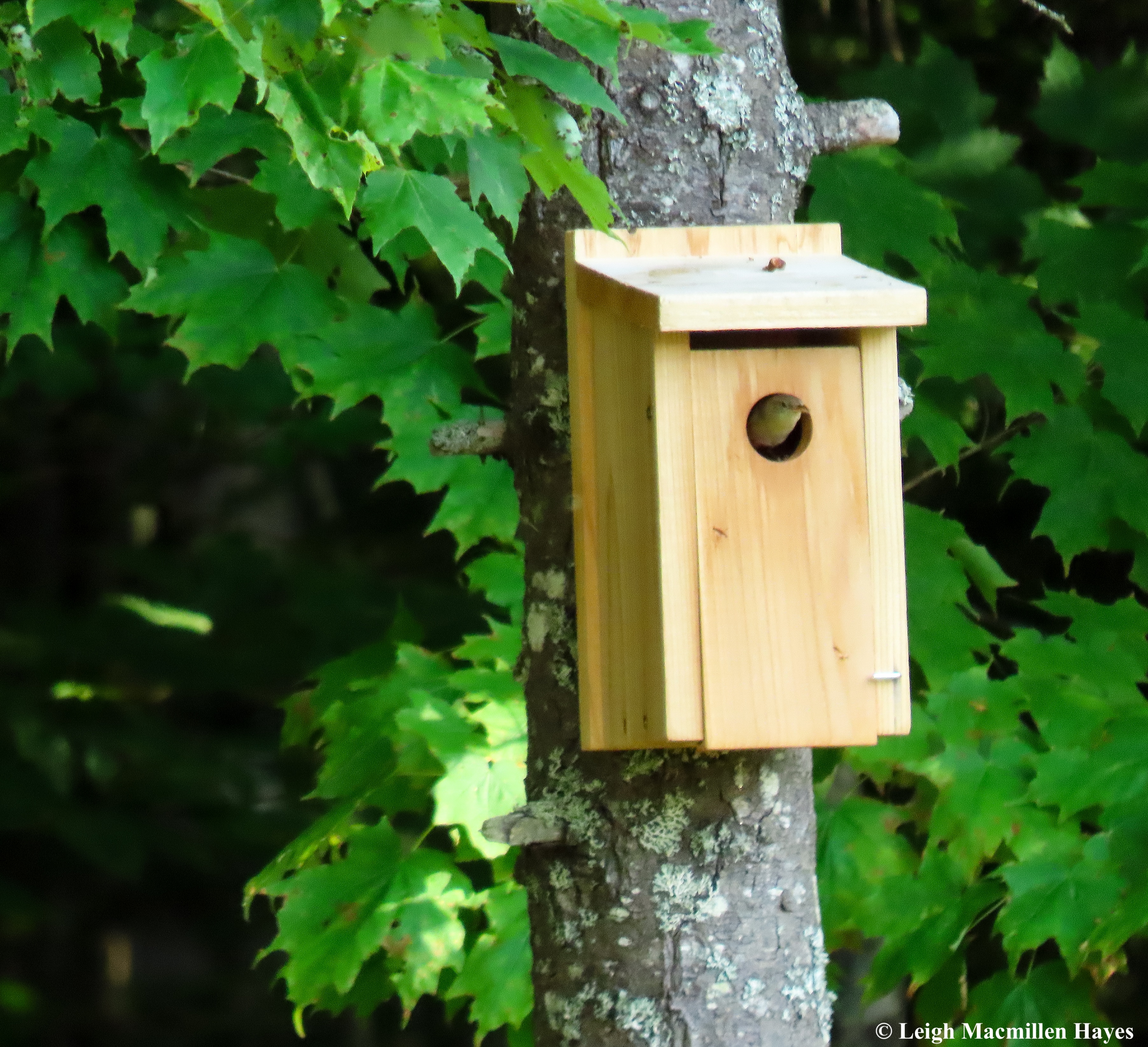
One day recently, after spotting no activity for about two months at the Bluebird Box My Guy had nailed to a tree along one of the stonewalls, I noticed activity. In the form of a House Wren.

For hours, sticks were picked up and brought to the box, the better to build a platform for the nest cup to rest upon. Sometimes they were too big. At least to my untrained mind.

But a little finagling this way and that; I admired such perseverance. And knowledge.
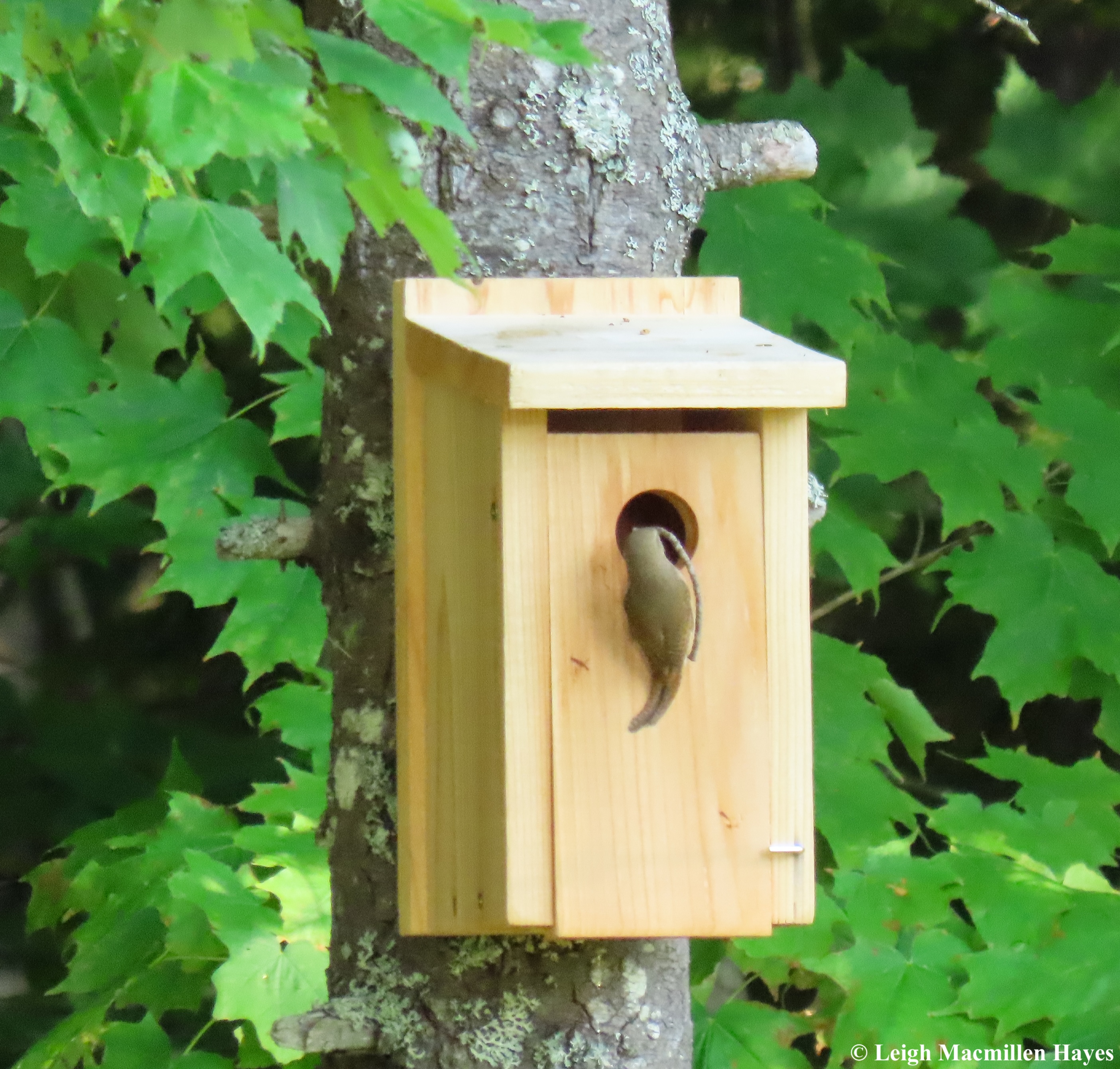
Tada, in that stick did go to join the others. With many more to come.
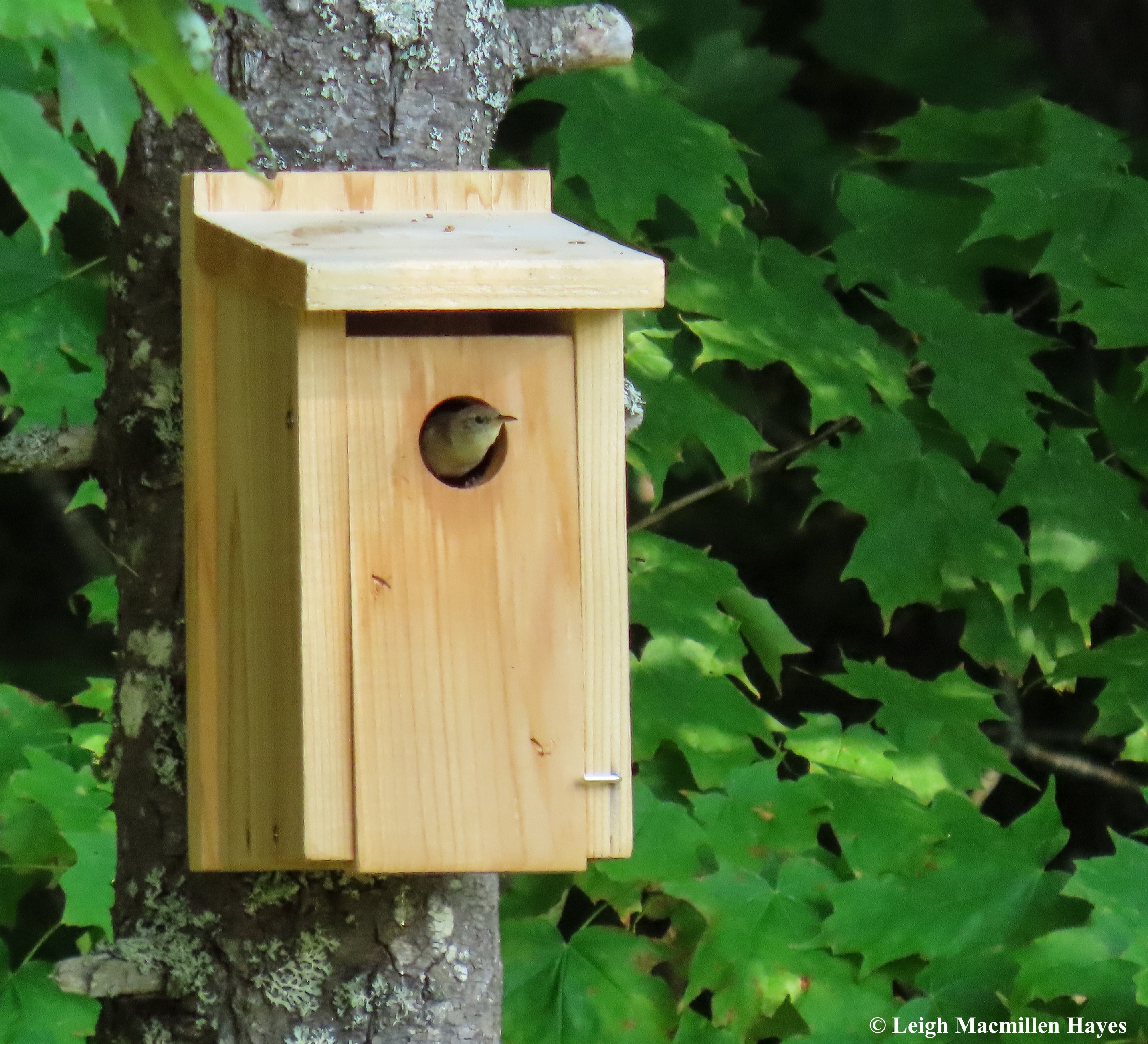
For two days, the Wren worked in the same manner. And then. Nothing. Being a Male Wren, it was just being a Male Wren . . . filling a possible site here and probably in other boxes near the field, as well as in tree cavities and she chose a different piece of real estate to set up housekeeping.

To say I’m disappointed is an understatement, but it’s the Wren Way. And I’m only a guest here.

I love being a guest here because I see all sorts of Natives make themselves known, including this youngster who followed in the footsteps of its parents, crossing the yard at an angle. Fortunately, the backdoor often serves as a screen so I can photograph many of the species with whom we share this land and not disturb them.

That same “screen” helped me capture a shot of an immature Red-bellied Woodpecker, who has the slightest hint of his parents’ crimson red upon his head. He stops by at least once a day, but is always in motion. And never stays long.
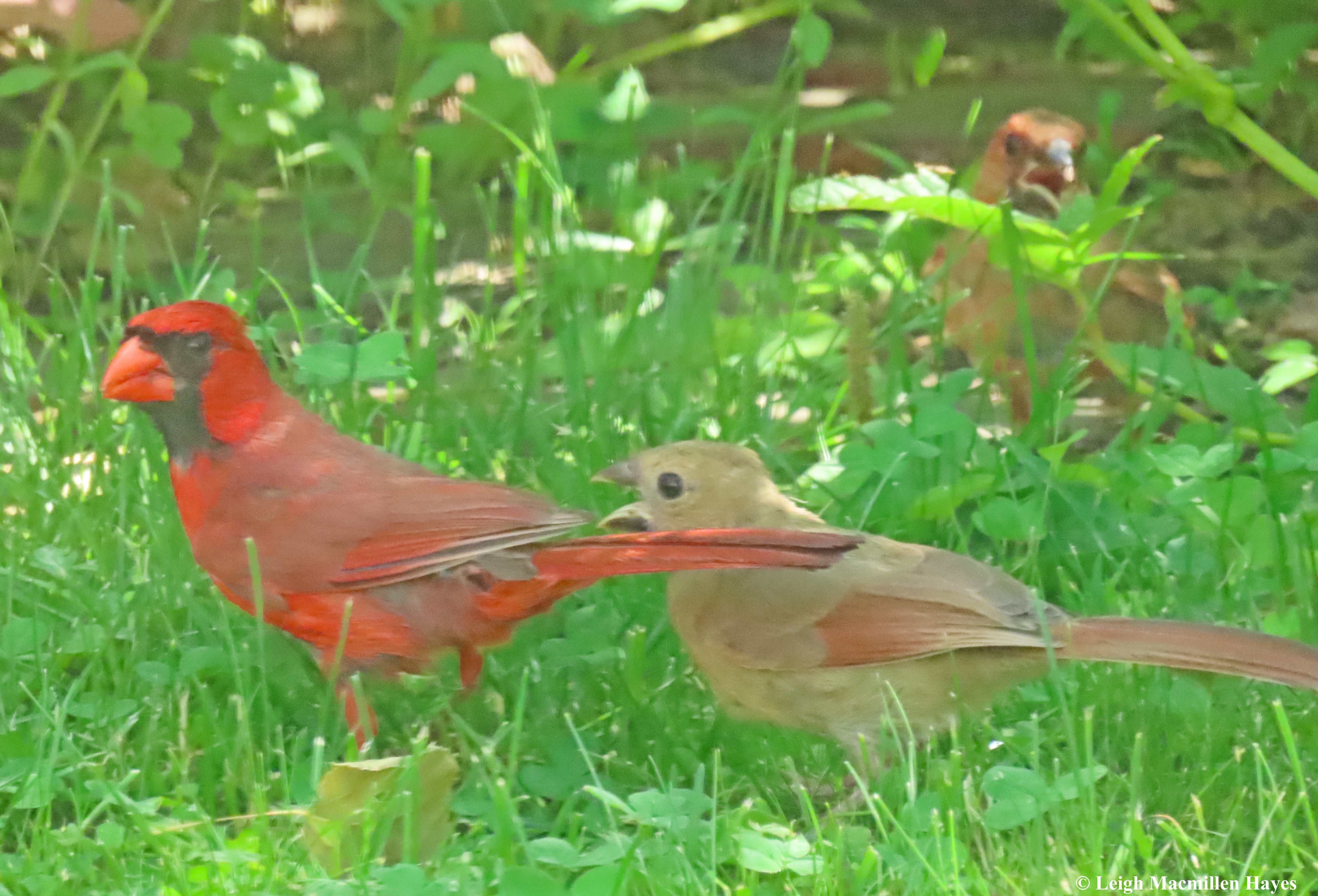
The Cardinals also bring their young to visit on a regular occasion, and sometimes the young’uns even come on their own. Watching them reminds me that many wild parents are amazing caregivers. Beavers and White-tailed Deer and Moose and Coyotes are among those who stay together as a family unit for a year or more. But not all are the same, like the frogs and salamanders who lay eggs and then leave the vernal pool.

What I have to wonder is how does this all work–why do some stay with their young and others abandon them?

Speaking of young’uns a wee bit more, as I headed up to the field, I met a recently fledged Robin, its breast all speckled. Though the Robins are constant backyard visitors, it wasn’t till I wandered about the yard that I found their nest.

And now I regret that I didn’t realize its position earlier, for I would have enjoyed keeping an eye on it.

As I said, the field belongs to our neighbors and I’m eternally grateful that they mow a path meant for them and their dogs, but I’m allowed to trespass by climbing over one of our stonewalls . . . and I do. Daily. Sometimes several times a day.

It’s a place that serves as one of my classrooms and I’m always amazed at who I meet there, including this Frosted Whiteface Skimmer Dragonfly. The yellow and black thorax and base of the abdomen, indicate this is a female. And though you can’t see her white face, she has yellow spots on the thorax segments 4 to 7, with 7 being very small.
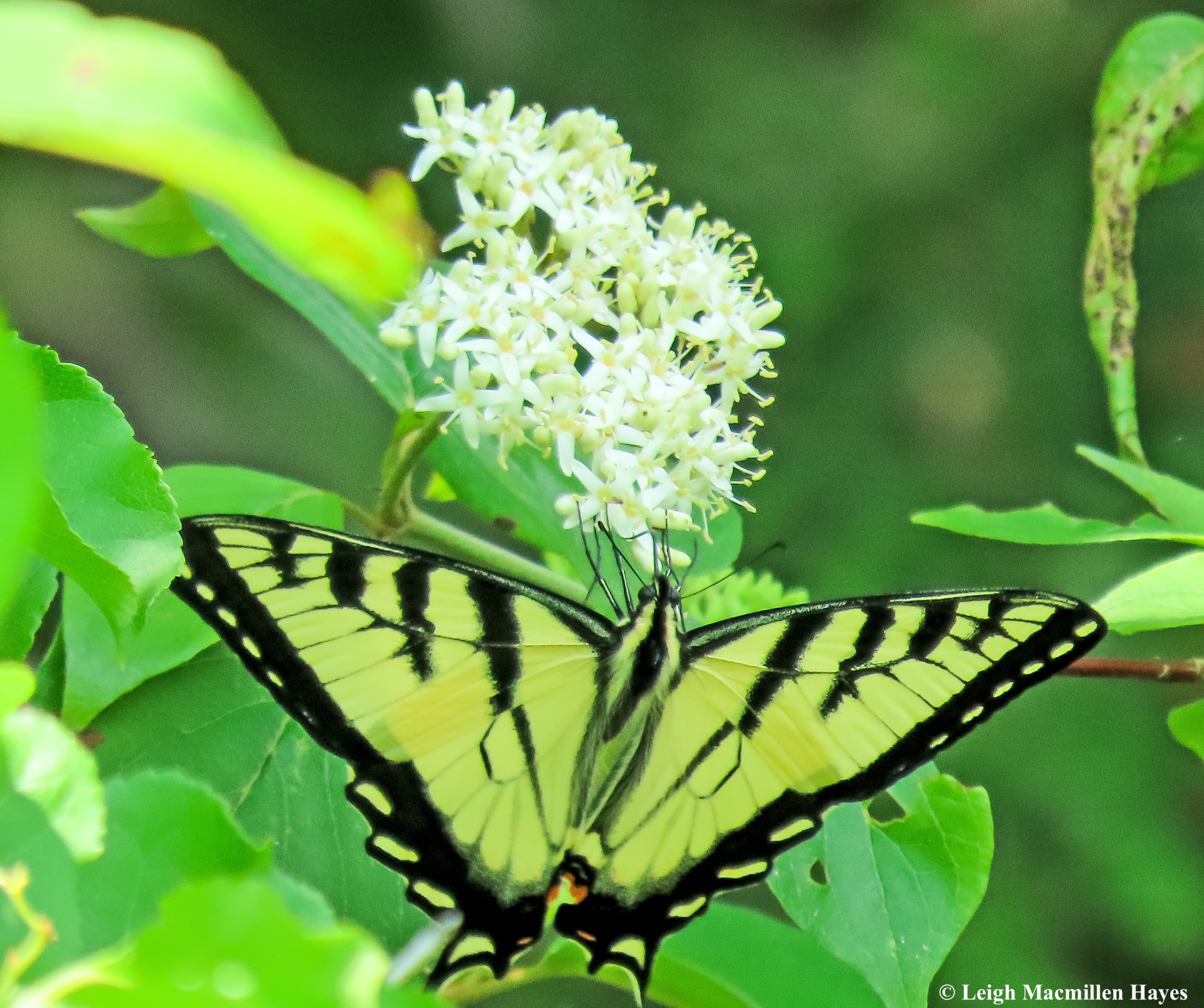
The most abundant butterfly of the season so far is the Tiger Swallowtail, and this one took advantage of the flowering Dogwoods at the top of the field.

Everywhere, there were Calico Pennants, one of my favorites (one out of a million), this being the female with her yellow markings.

While My Guy practices Yoga several times a week, the dragonflies do so even more frequently, especially if its super hot, like today’s temp of 91˚ that felt like 96˚, or so the weather app told me.

The Calico’s handstand is actually an obelisk posture, with the abdomen pointing toward the sun in a manner meant to minimize the surface area exposed to solar radiation. Again, I am in awe.
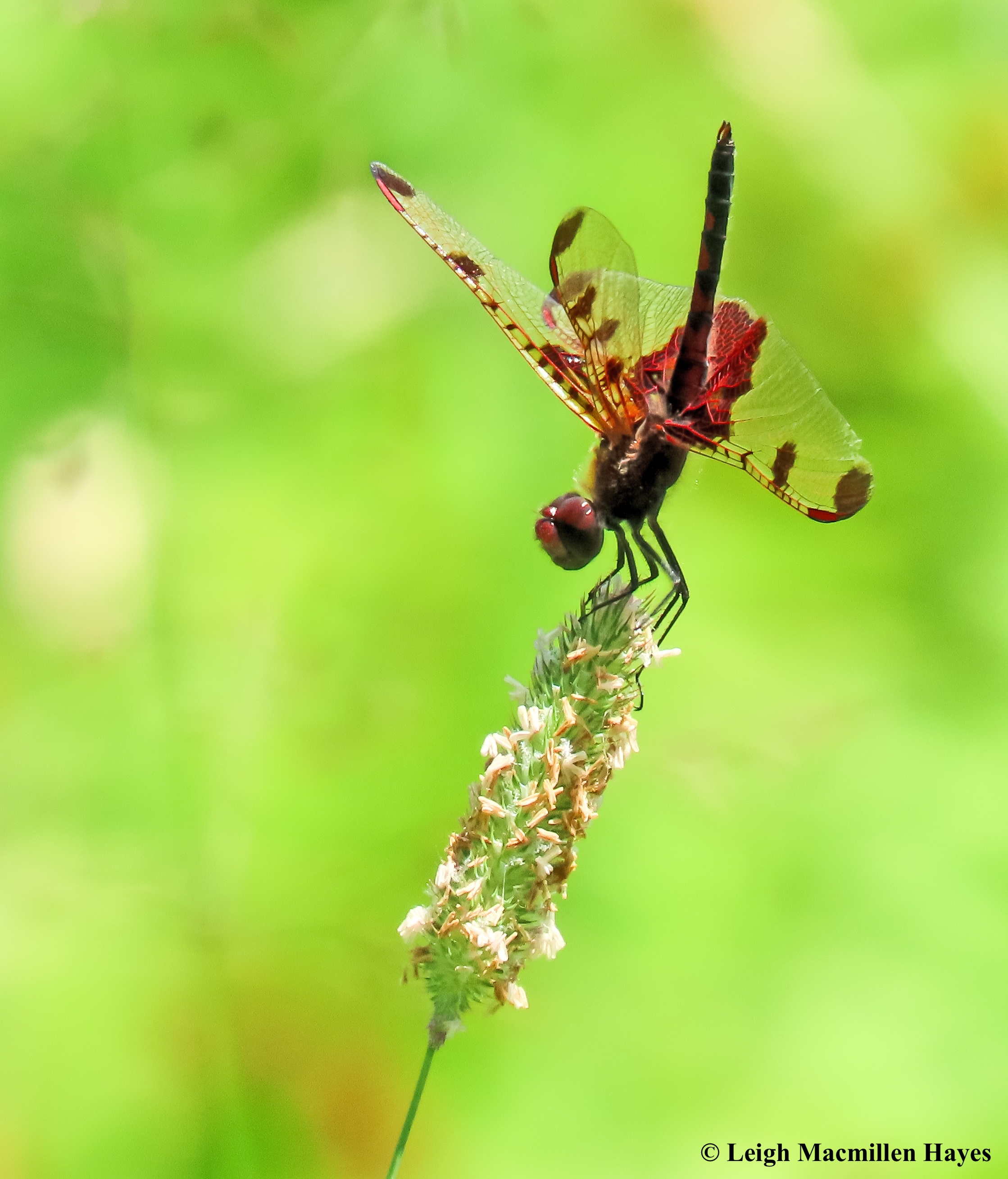
Calico’s male, bedecked in red, chose the same stance.

Back over the wall and into our yard, Oriental Beetles are making their presence known. What captures my attention is the texture of wings and thorax, and the hairy and spiky legs, and the funky antennae that look like handmade forks.

Apparently some mistake them for this, the Japanese Beetle, but though there are similarities in the wings and antennae, in my brain that’s it. These are not insects high on anyone’s list of favorites, but look at that iridescent green thorax and the hairy, dotted design on its abdomen.
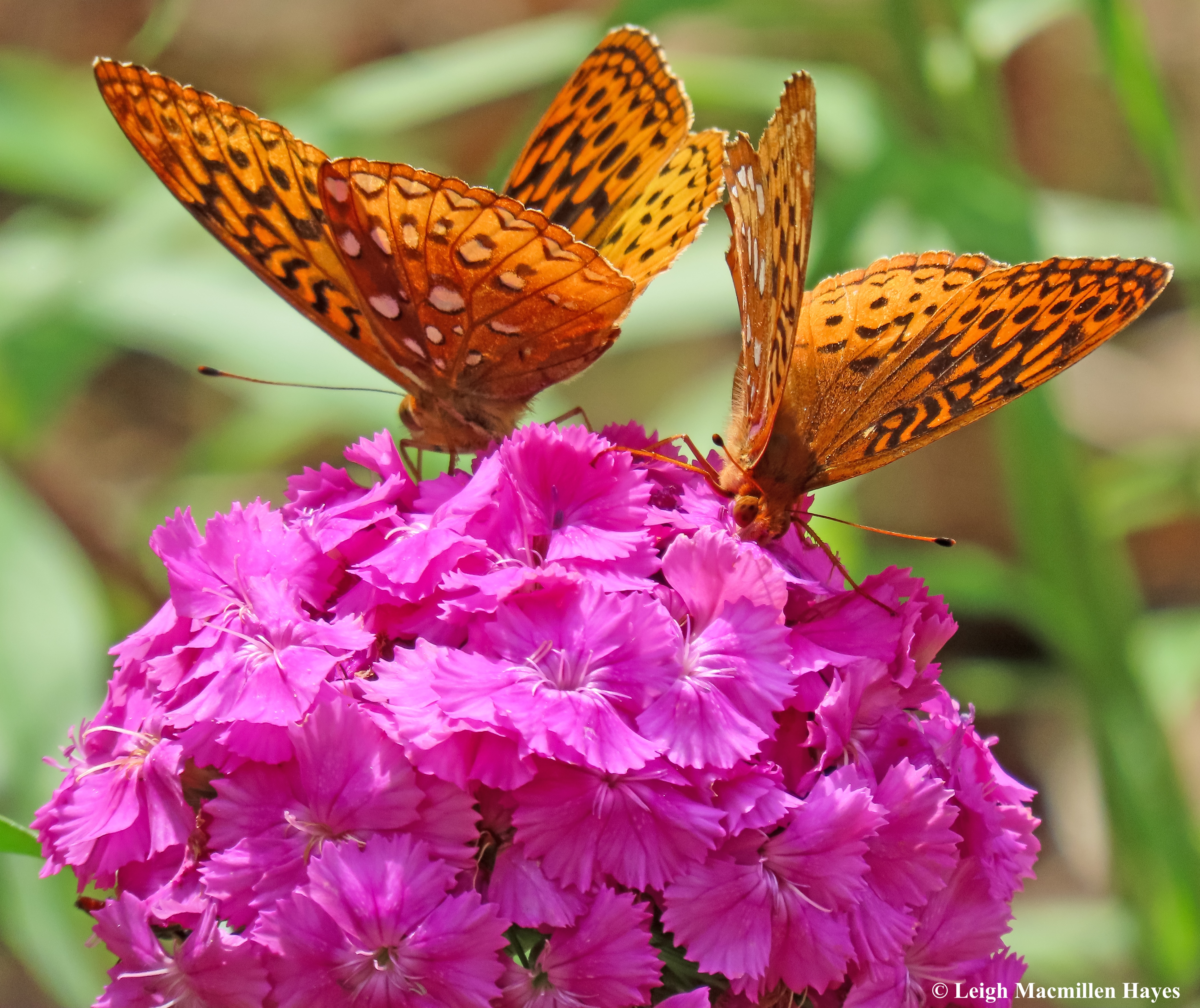
I also spent time circling my newest pollinator garden and among the frequent visitors are the Fritillary Butterflies.

I do, however, worry about some other visitors who keep dining on the flowers rather than pollinating them.

In the wee hours of the morning and all night long, Deer stop by to nibble. There are at least two does and two fawns, and so far the garden has enough to offer them, and the pollinators, and me. But I do worry.

Especially since via the Game Camera I discovered that a neighbor I thought had moved on is still around, and the end of the garden may be in the mouth of the Woodchuck. I hope not, but we’ll see what happens.
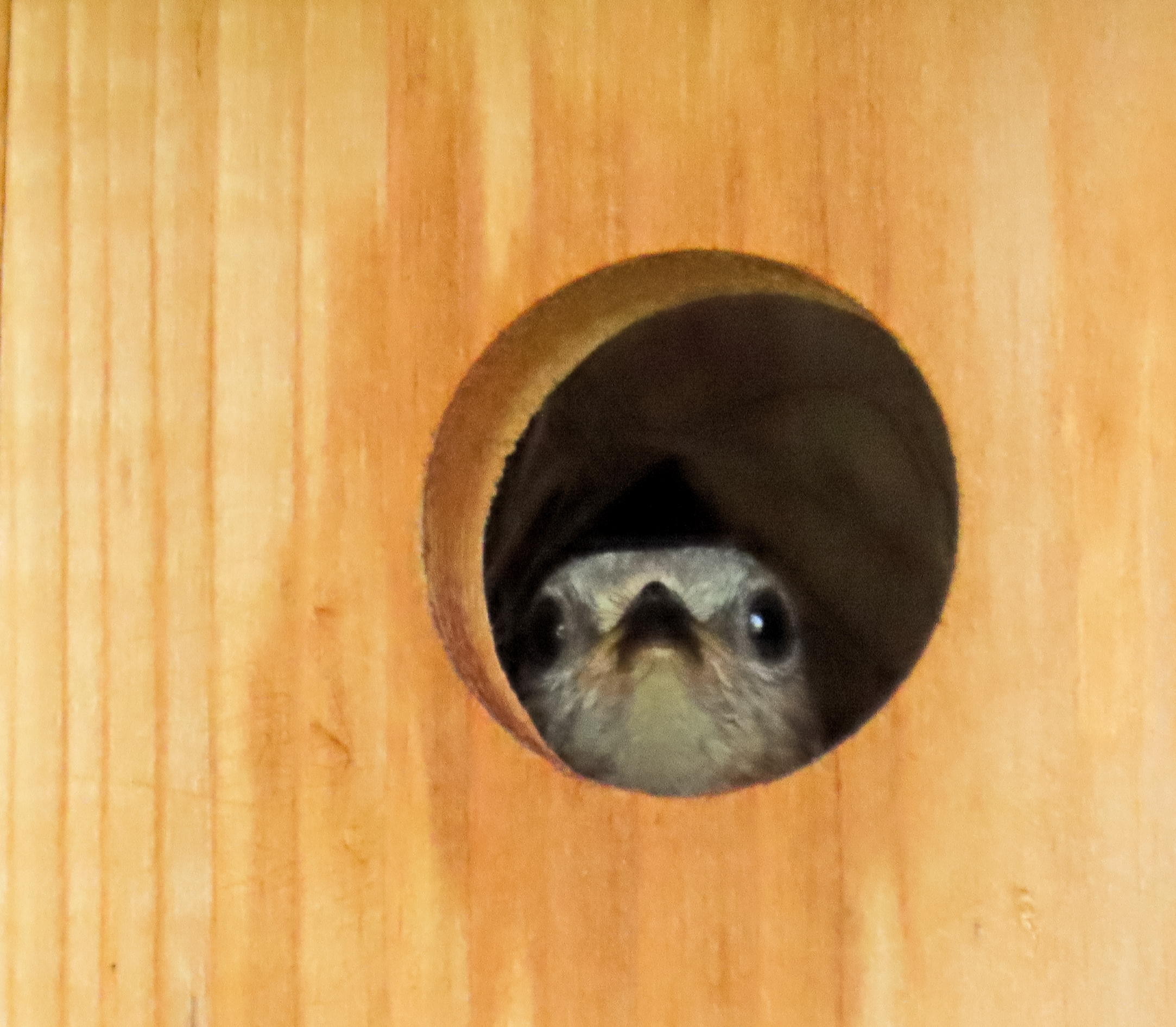
That said, there’s another new neighbor in the ‘hood. Remember the male Wren who worked so hard to fill the birdhouse with sticks? And then I didn’t see him at this spot again. A few days later I spotted a male Bluebird checking it out. And tada . . . a female is sitting on eggs, I do believe.

My little world. It may be small, but really, it’s huge. This is only a smattering of what happens here daily and nightly and I feel so honored to be granted the opportunity to keep an eye on it all. It so enhances my life to spend time wandering and wondering upon these acres.

I hope you have a little world to explore and get to know intimately.
Finding Food Is The Name of the Game

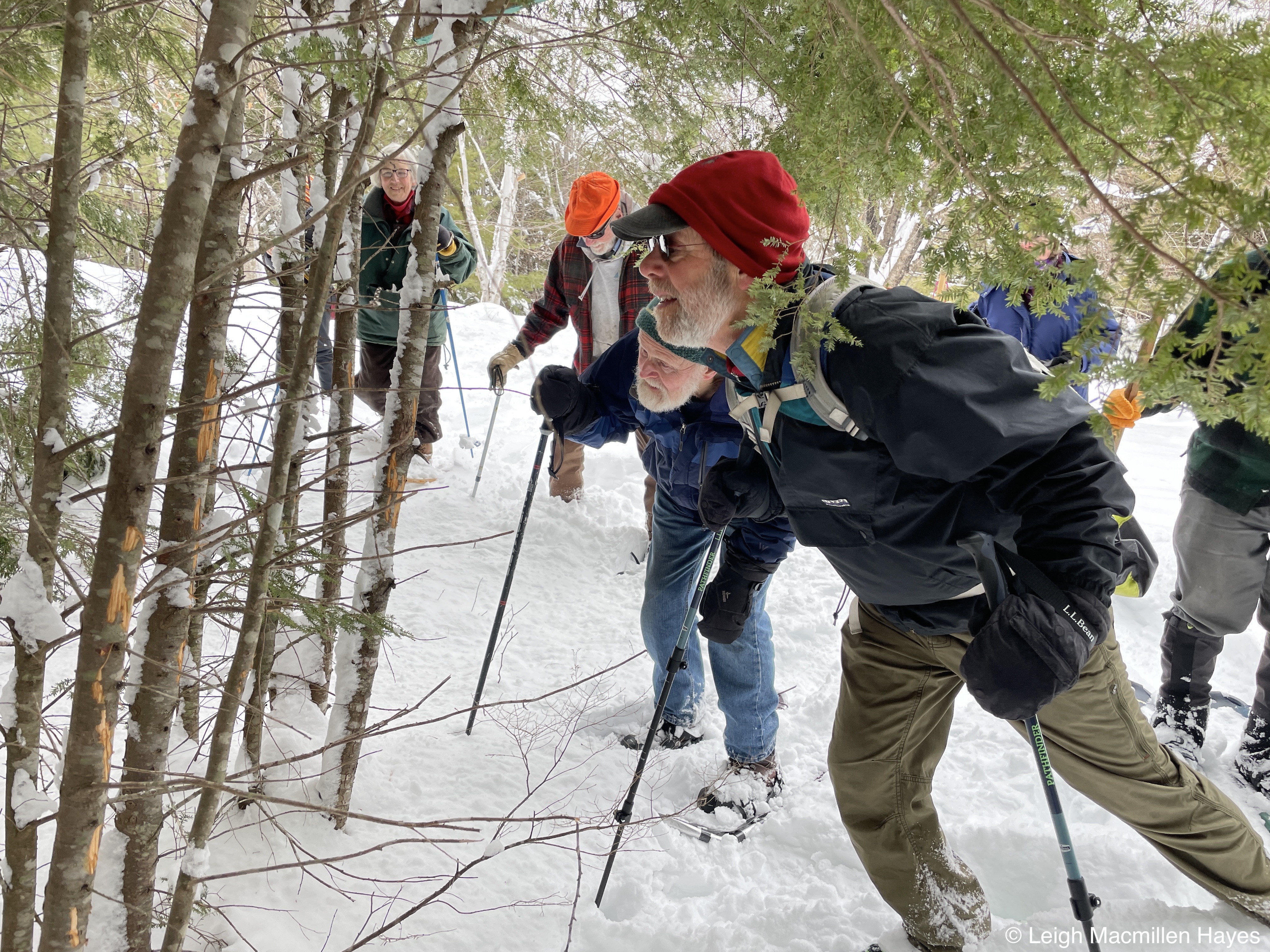
Winter finally arrived in western Maine this past week in the form of three snowstorms, the last ending with a coating of ice. Between storms, I’ve been teaching others the art of tracking mammals and birds through my work at Greater Lovell Land Trust, as well as a two-day class I taught for a local Senior College, and a day-long class for Maine Master Naturalists.

I love, love, love watching others experience joy as they begin to notice the nuances of print and patterns and scat and sign.

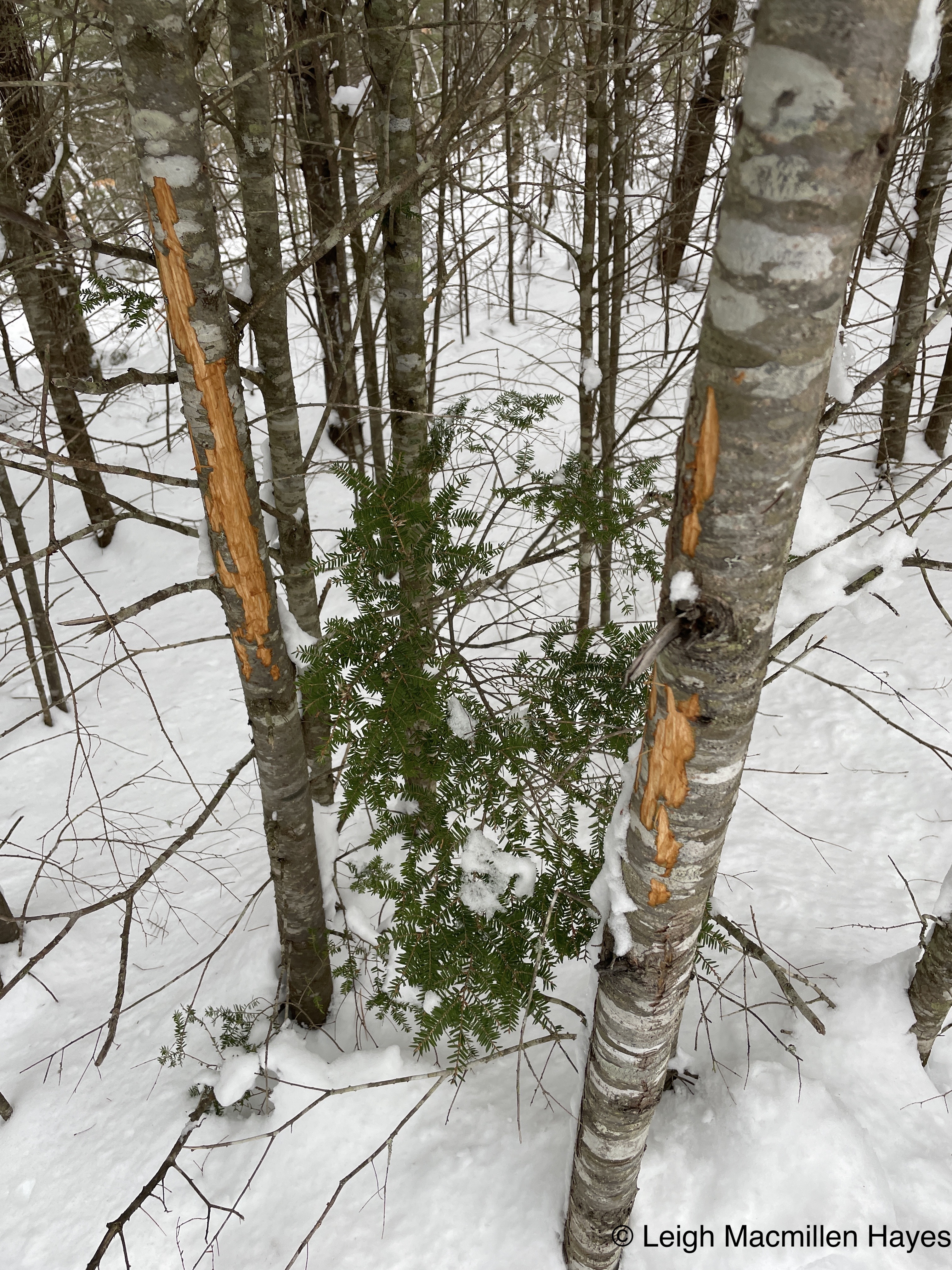
This being the work of a White-tail Deer who scraped its lower incisors up the bark of a tree to get at the cambium layer where the sugars and starches flow. The tags at the top of the scrape are a tell-tale sign because ungulates like deer and moose do not have upper incisors or canines, but rather a hard palate, and yank at the wood as they press their lower incisors against the palate to pull the bark off a tree–mostly Eastern Hemlock or Red Maple.

It wasn’t long after the Senior College outing on Wednesday that snowflakes announcing the third storm began to fly and one of our resident Red Squirrels stopped by to check out the offerings at the bird feeders.

This hearty sole is Ed and as you can see, he’s lost an eye–probably in a disagreement with a sibling, but that doesn’t stop him. He’s perfectly capable of finding food, seeking cover when necessary, and fighting off his brothers.

Ed wasn’t the only one out in the snow, for a male Downy Woodpecker made frequent trips to the suet feeder.

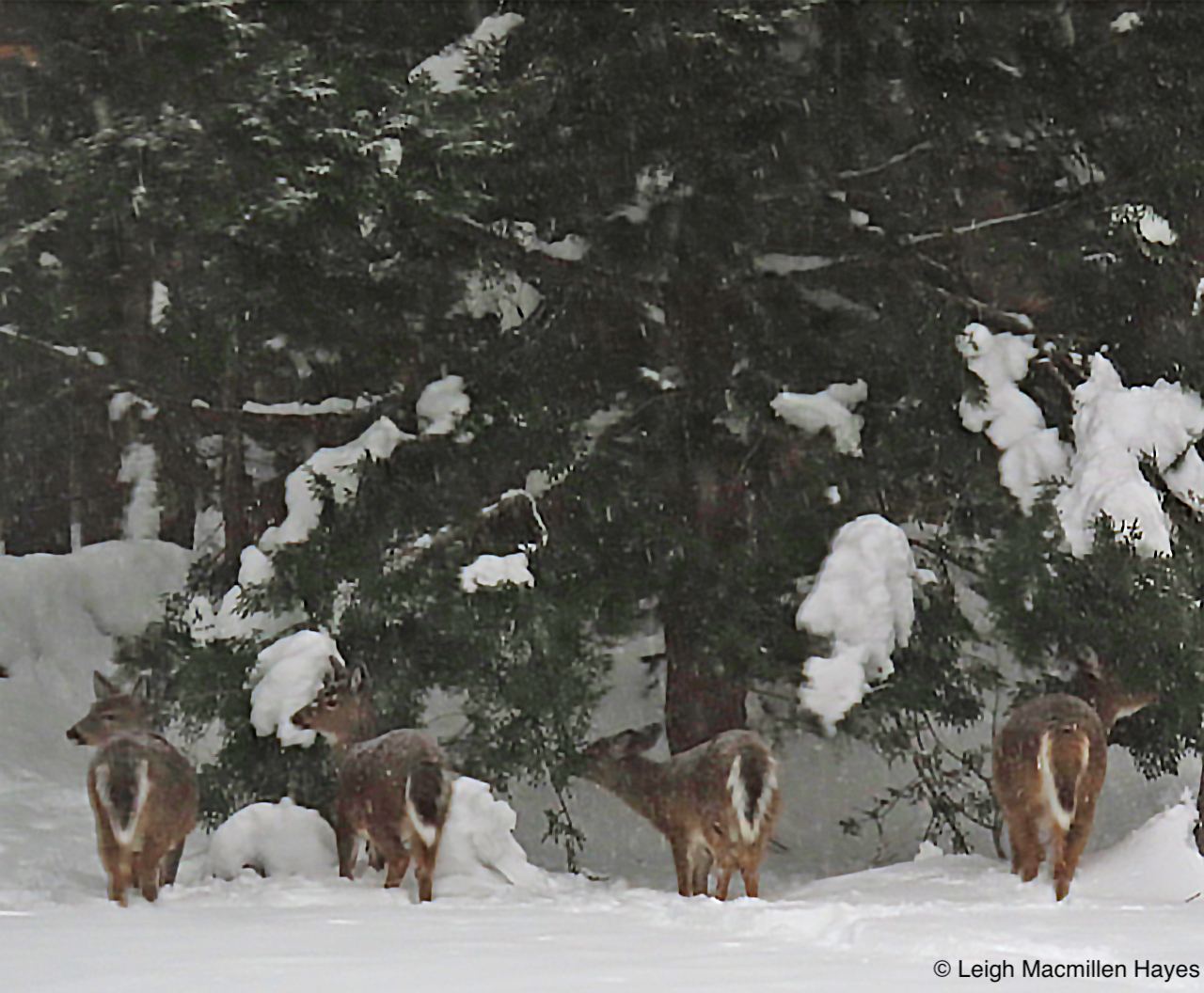
And then, just before twilight the Deer began to appear. The first walked to a Squirrel feeder I was gifted recently, with some peanut butter added to the corn as an enticement. She didn’t seem impressed. I thought that was weird because if you’ve ever made a bird feeder out of pinecones smothered with peanut butter and sunflower seeds, you might notice that the Deer lick everything off within hours of hanging the cones from a branch.

Following the arrival of the first Deer, a sibling came in with mom, but they too, were not impressed.

So the thing about watching the Deer, was that they provided a photographic lesson–beginning with the two cloven toes that form the heart-shape of the impression they leave in the snow–with the pointed end of the heart always indicating the direction of travel. And further up the foot are the dew claws, which sometimes show in a print. If you look at the two hind legs, you can see the dew claws just above the snow. I’ve been told that if the dew claws appear, then it is a buck. I’m not 100% convinced of that. I think it has more to do with snow conditions.

And sunflower seed is not their only form of nutrition, for one of the Hemlocks by the stonewall between our yard and woodlot offered some delectable needles full of vitamin C. Do the Deer know that?

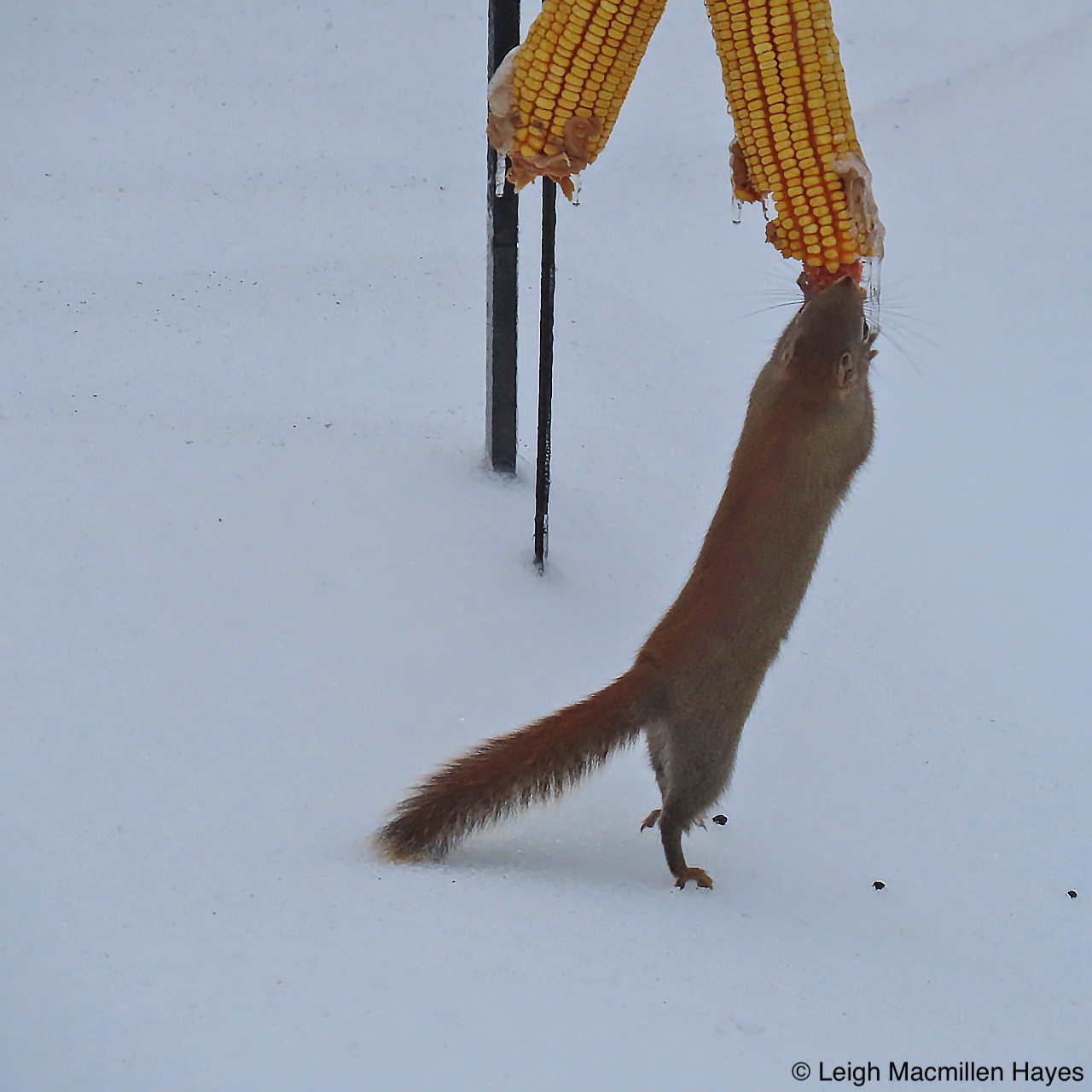
Following the storm, a coat of ice covered the tree branches and even the corn, but that didn’t stop Ed’s brother, Fred, from grabbing a kernel. Actually, the corn had originally been placed about two feet off the ground in an area we’d shoveled, but the snow had piled up again, making the meal easy to reach.

I spent yesterday shoveling what felt like cement. The first two storms offered a much fluffier take on snow consistency. Periodically, like Ted, another brother of Ed, I’d duck into the house. His home is a network of tunnels near the feeders, and so far it has provided good protection.

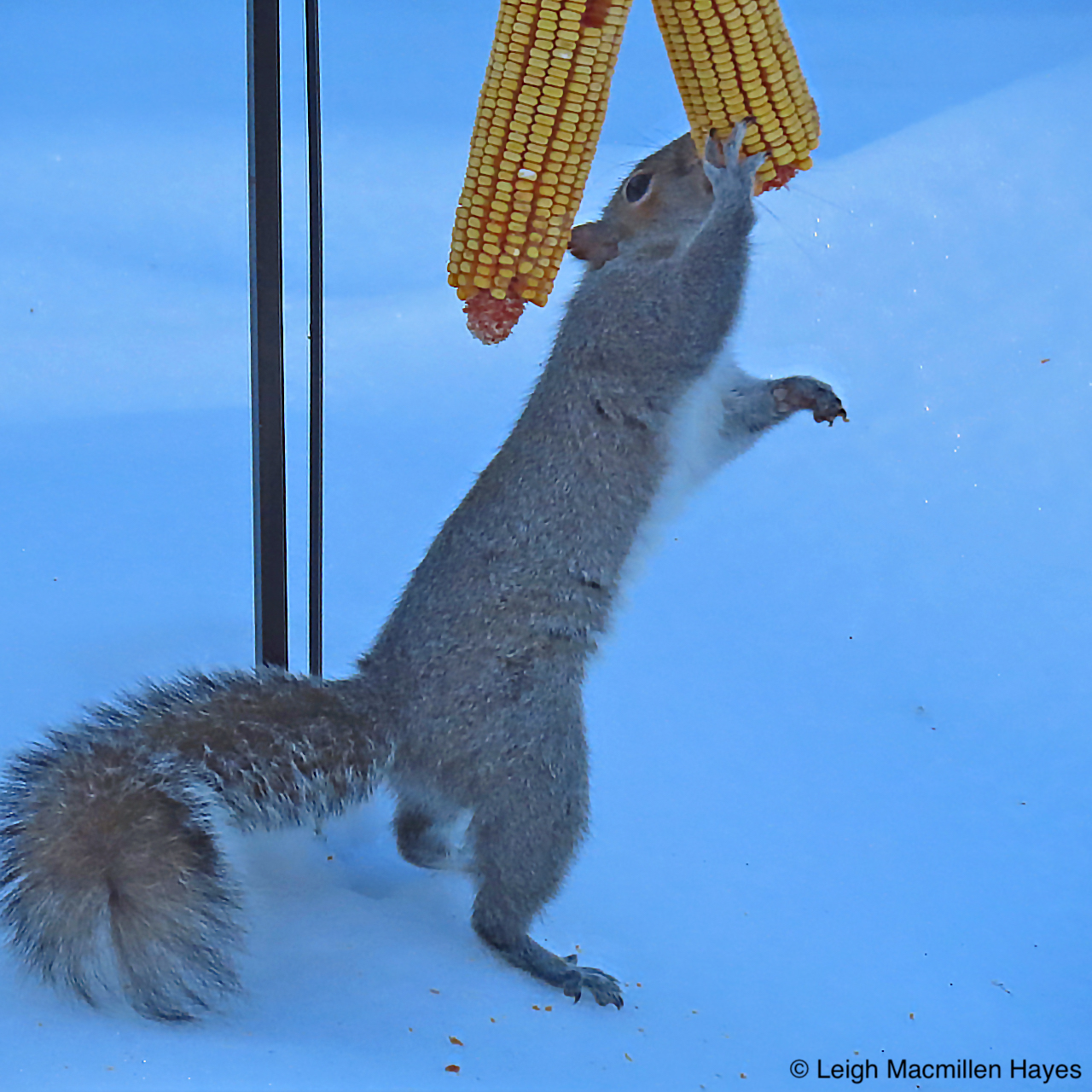
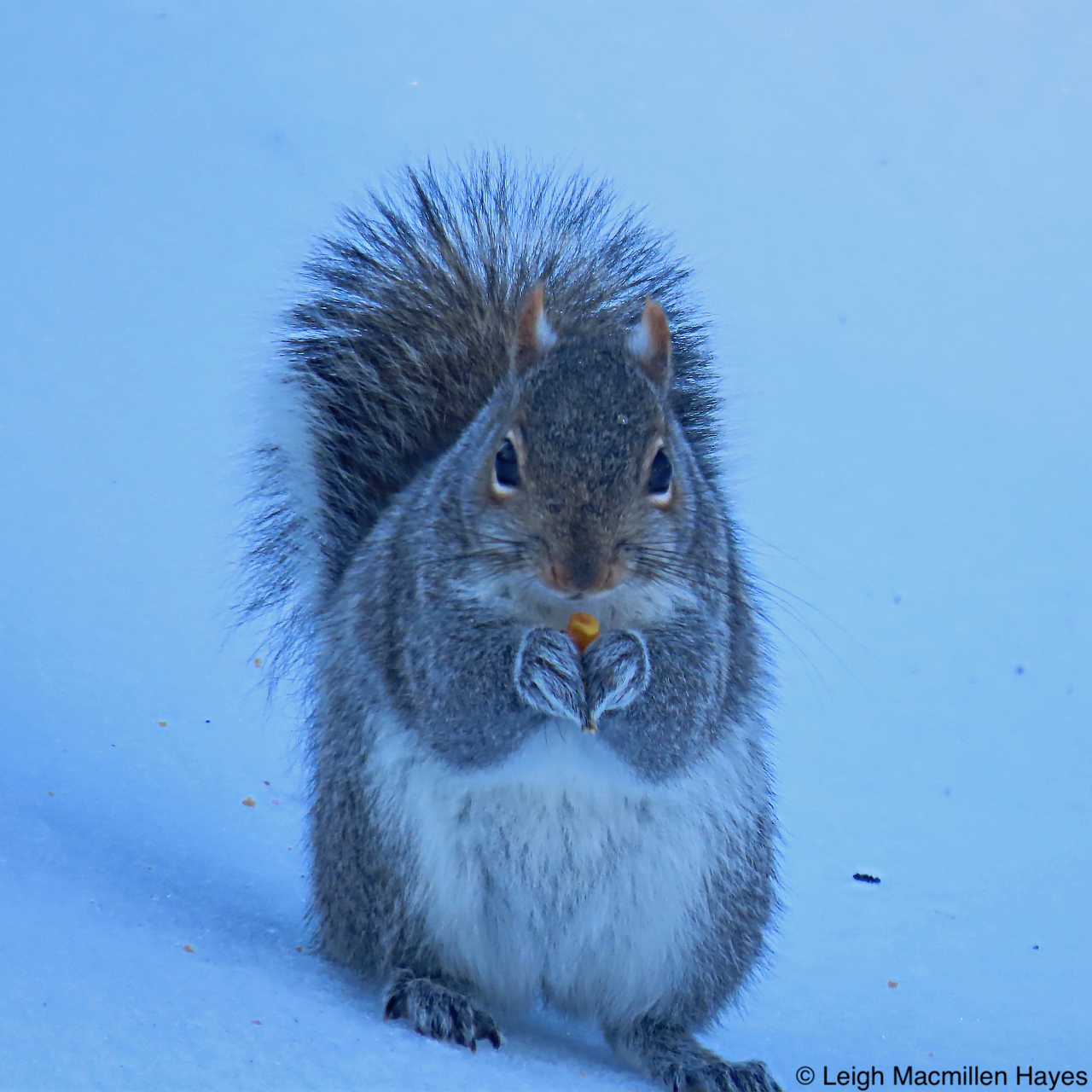
This morning dawned brighter, and a bit frosty to start. While Fred, Ted, and Ed, ate birdseed and chased each other round and round, a Gray Squirrel stopped by to get a handle on things.

The perfect meal was garnered.

As it turned out, today was a super busy day at the feeders, which Black-cap Chickadees and Nuthatches making frequent visits.

And the puffed up feathers of a male Downy bespoke the temp in the teens. Birds fluff up in the cold to trap as much air in their feathers as possible. The more trapped air, the warmer the bird.

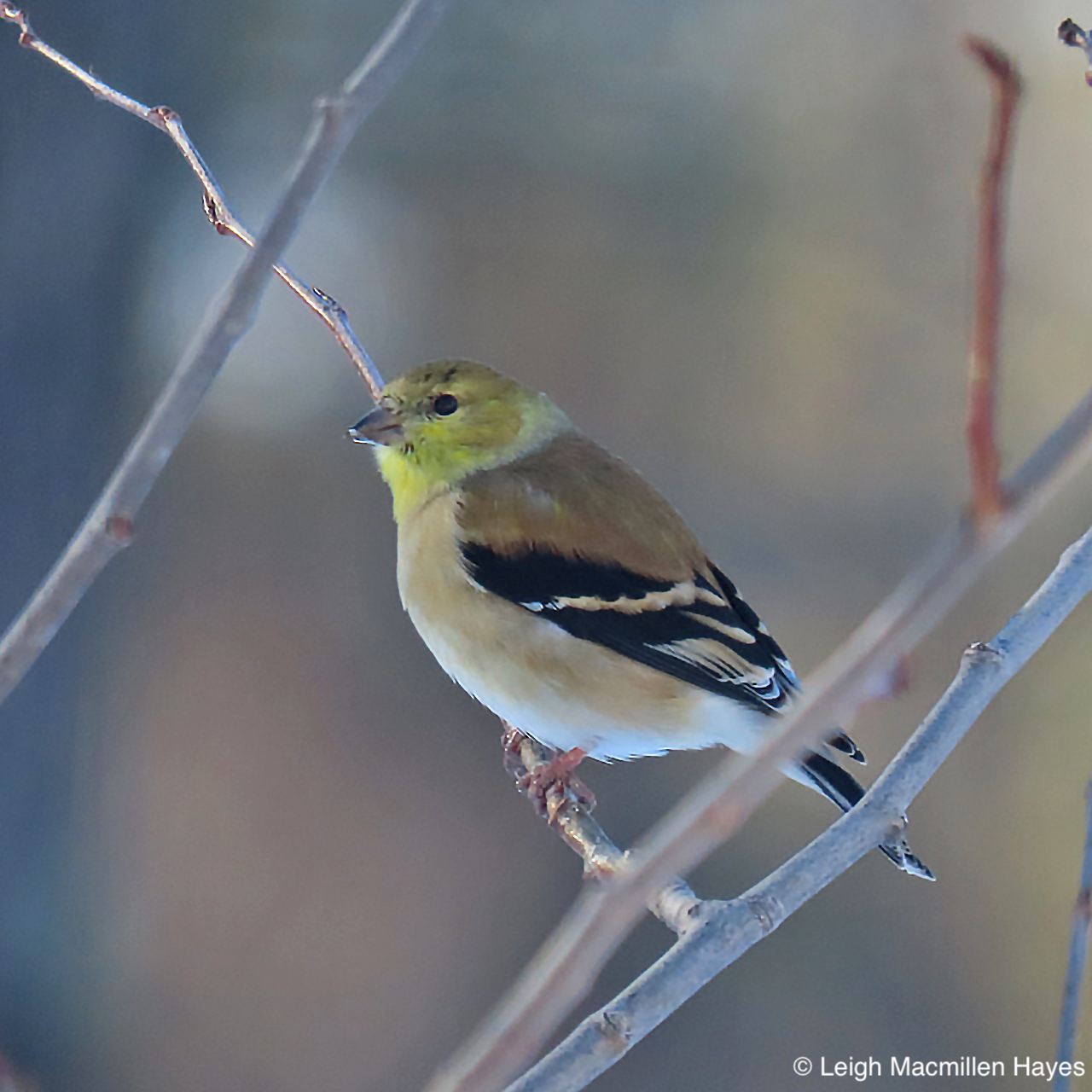
A couple of American Goldfinches were early morning visitors as well, and I love that unlike the Chickadees, Finches are much calmer and stay in one spot for a bit.

Probably my favorite visitor was a surprise for as I was watching the Hairy Woodpeckers, in flew a Red-bellied who worked at a chunk of suet and finally flew off with it.

When I finally headed outside this afternoon, donning my snowshoes to stay atop the 2.5+ feet of snow, I couldn’t believe that for the most part I could stay on top of it, for such was the crusty coating from yesterday’s rain finale. And with each step I took, I heard the crunch below–sounding much like breaking glass.

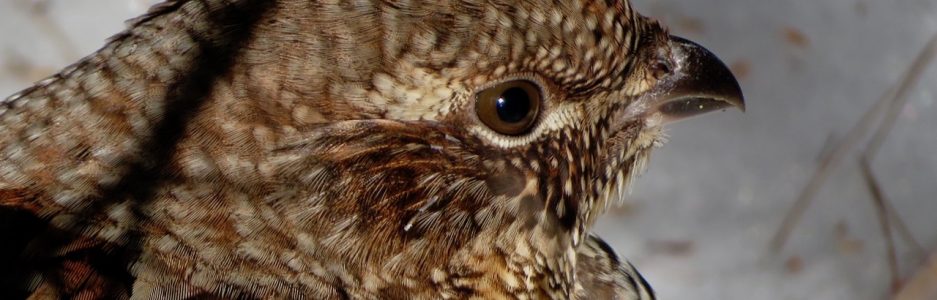
Much to my surprise, I found the track of a Ruffed Grouse, who did break through the snow.

Of course, it was no surprise to find the figure eight of a deer print, with the foot impression about two feet down. This is a difficult time of travel for them. And I suspect mine will be back by the feeders during the night looking for an easy meal.

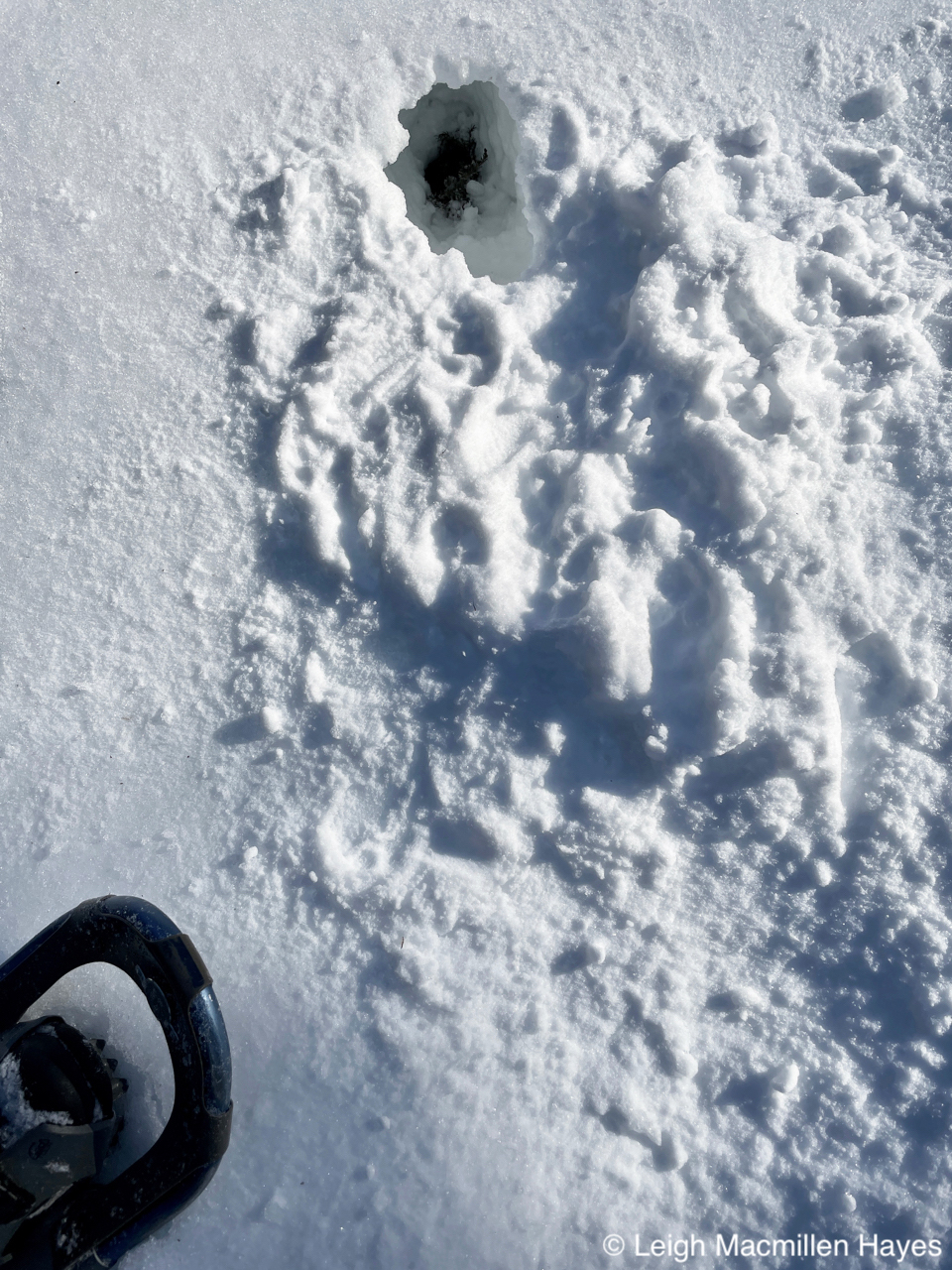
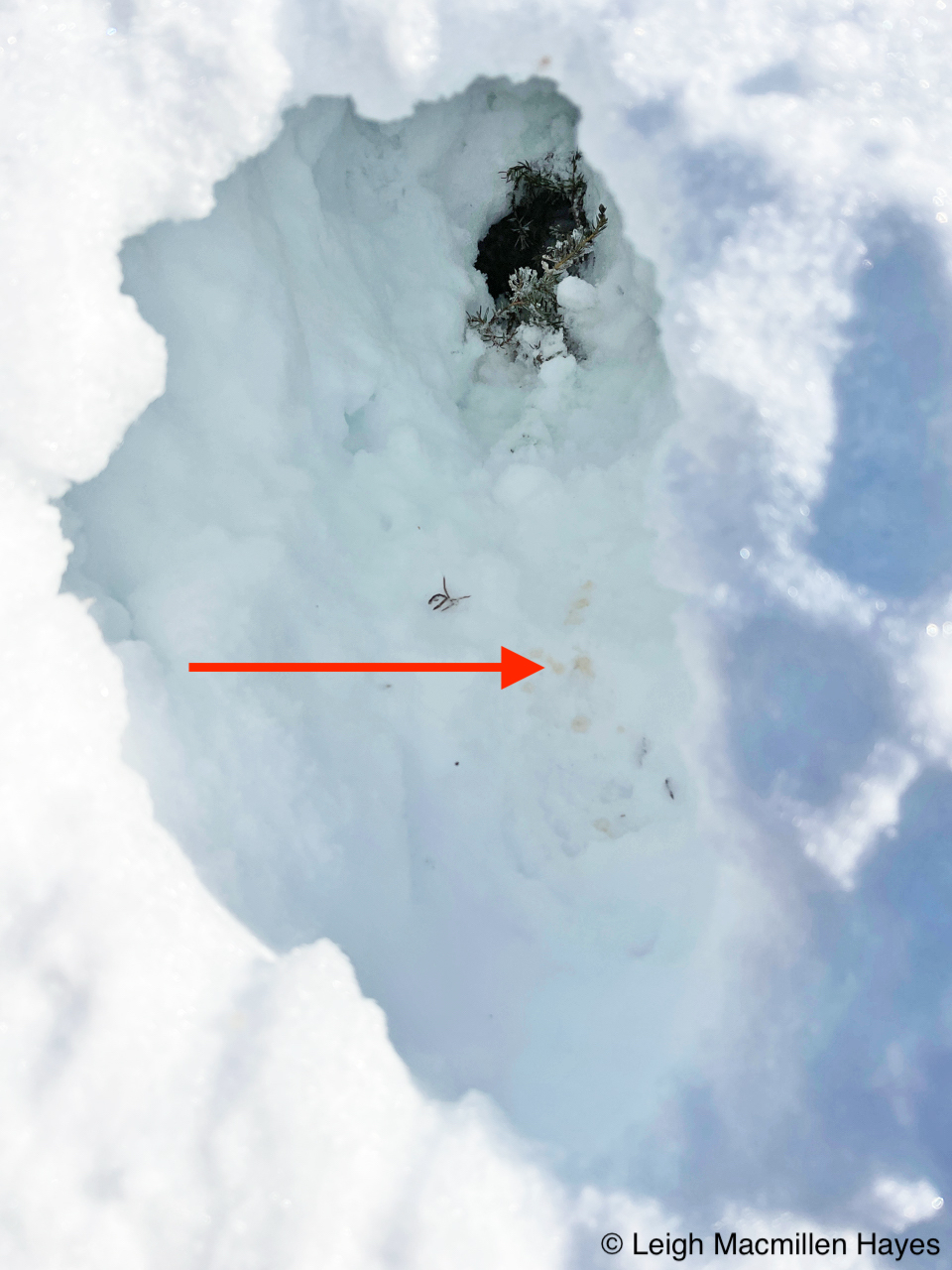
And then I discovered a disturbance that I had to investigate. A deep hole had been excavated.

A look at the size and X between the toe and metacarpal pads and I knew who had done the job: an Eastern Coyote.

What it consumed I could not say, but there were some drops and I wonder if they were blood that had darkened a bit as they aged. It’s funny, because I was so sure that I’d come upon a Ruffed Grouse’s snow cave and totally expected to see the bird’s scat in the hole. That was not the case at all, but I don’t know who the victim was that provided the Coyote with a meal. Or at least a snack.

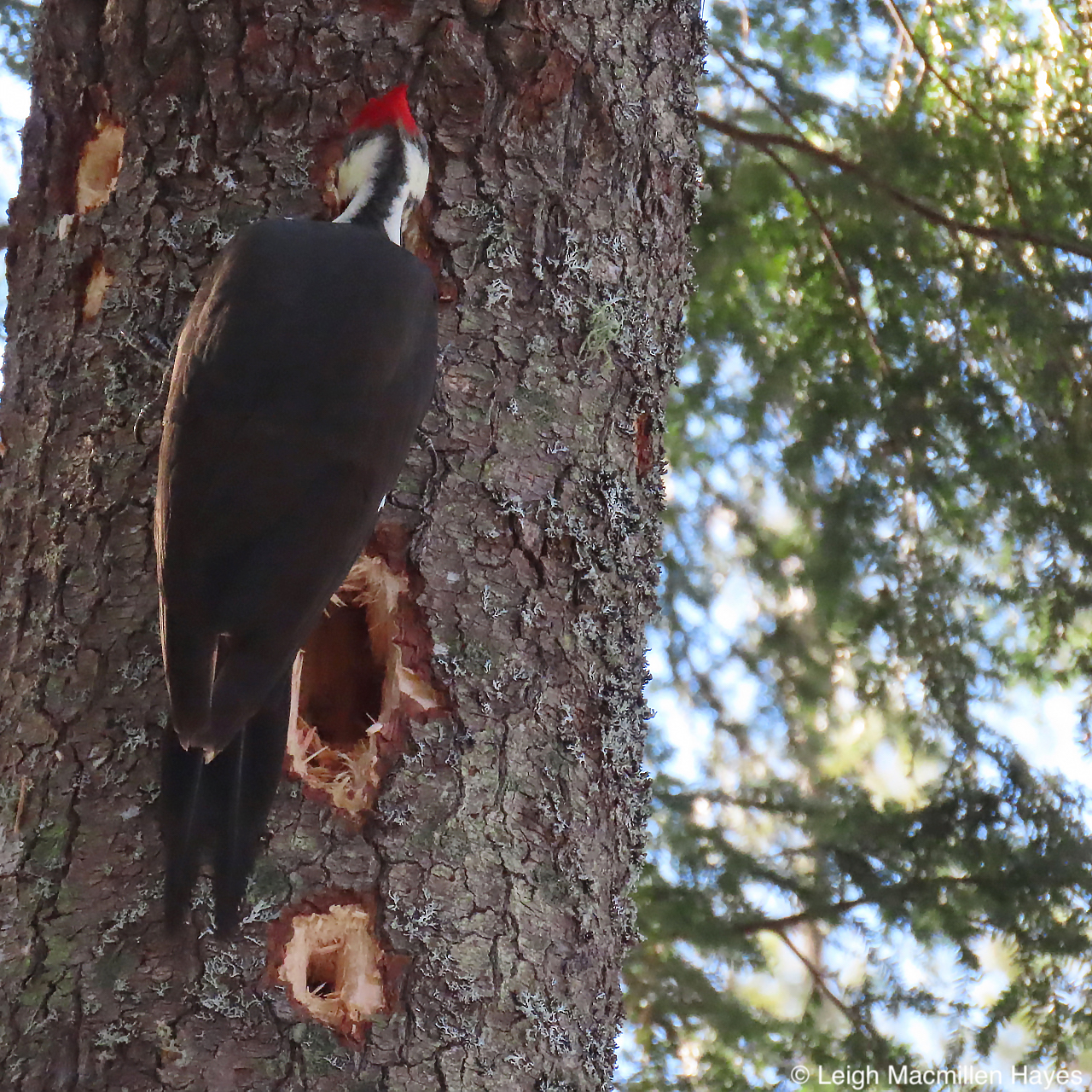
Back in our woods, I met an old friend who has graced these woods for years–or at least members of his family have done so.

He, too, was looking for food. And so intent upon his job was he, that I stood only about fifteen feet away while he worked.

I didn’t step under to check the scat because I didn’t want to scare him off, so I’m not sure if the Pileated Woodpecker’s needs were fulfilled, but given that he had worked on the tree for a while and some of the holes were quite deep, I suspect he had dined on his favorite meal of Carpenter Ants.

Finding food is the name of the game, though it’s hardly a game at all–especially when it’s cold, the snow is deep, and there’s a crust of ice atop it. And that’s just for the critters. Never mind people who have to deal with the elements on a daily and nightly basis.

Support your local food pantry,