Somehow we thought the rain wouldn’t fall upon our hike today, until it did. And so we sat in the truck for about 15-20 minutes, waiting for the drops to slow down, which they did.
The rain, however, enhanced everything. And as the sun came out, the water and warmth combined to create a Black Fly Festival, one which will last for several more weeks.
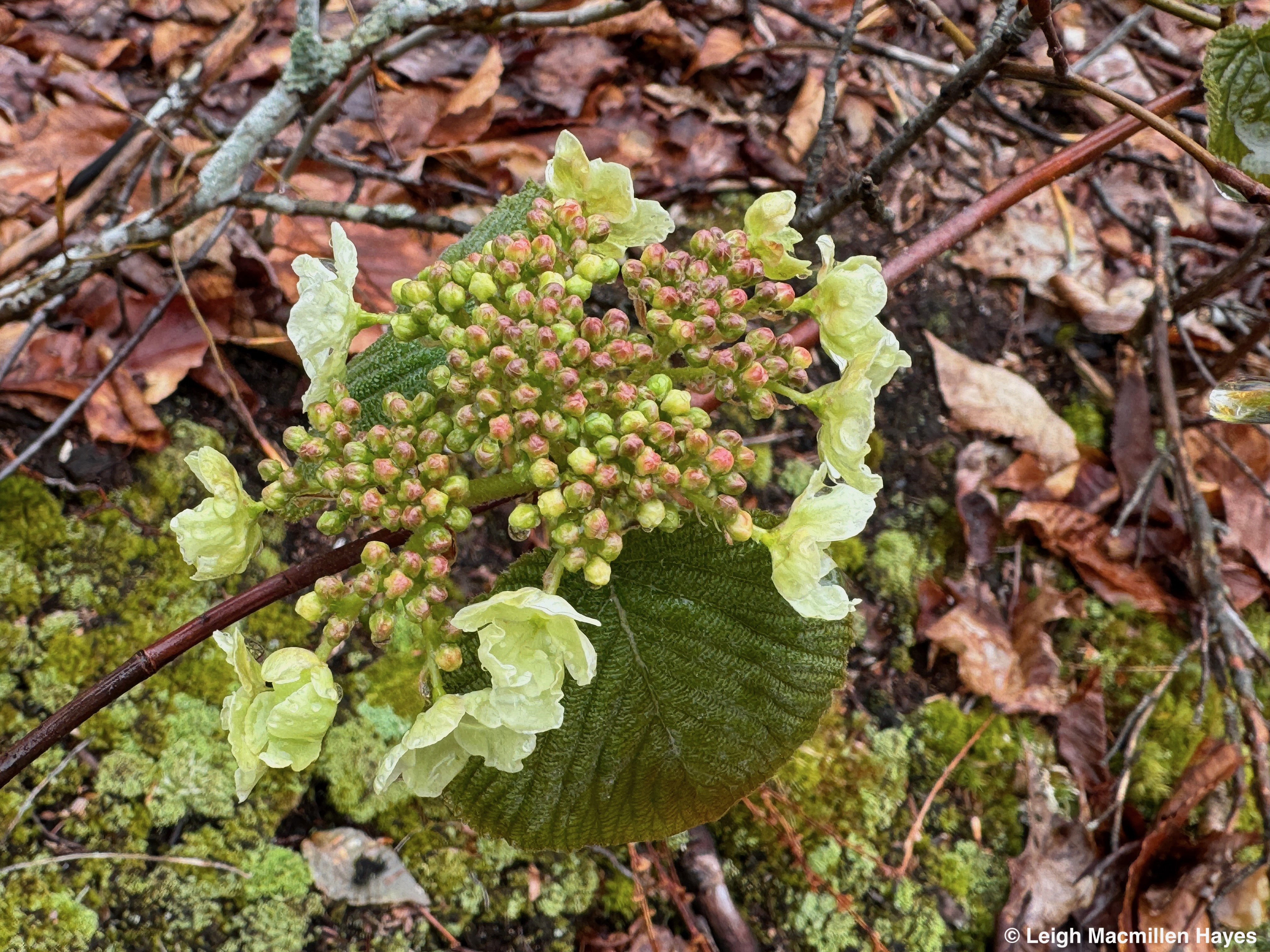
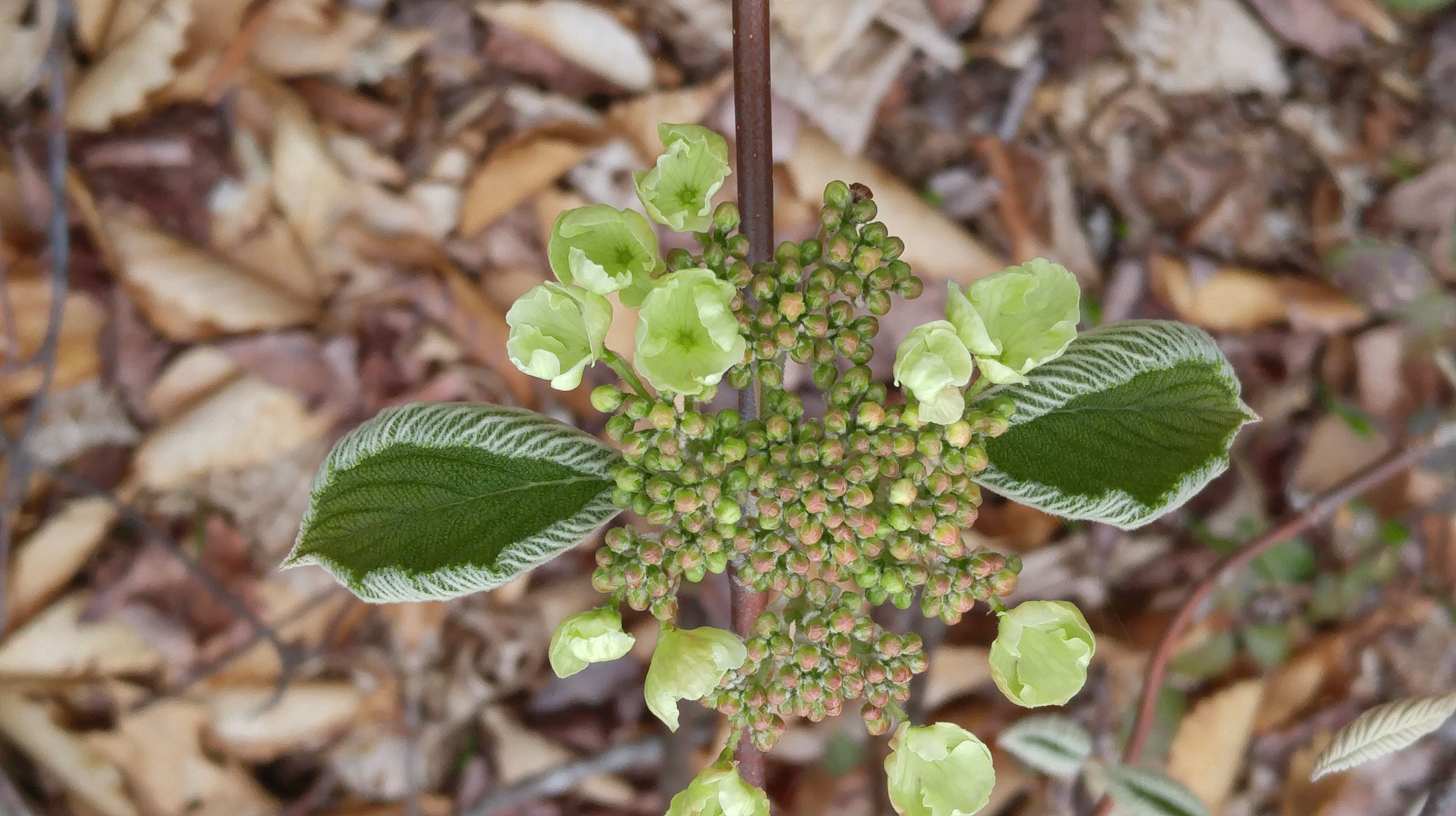
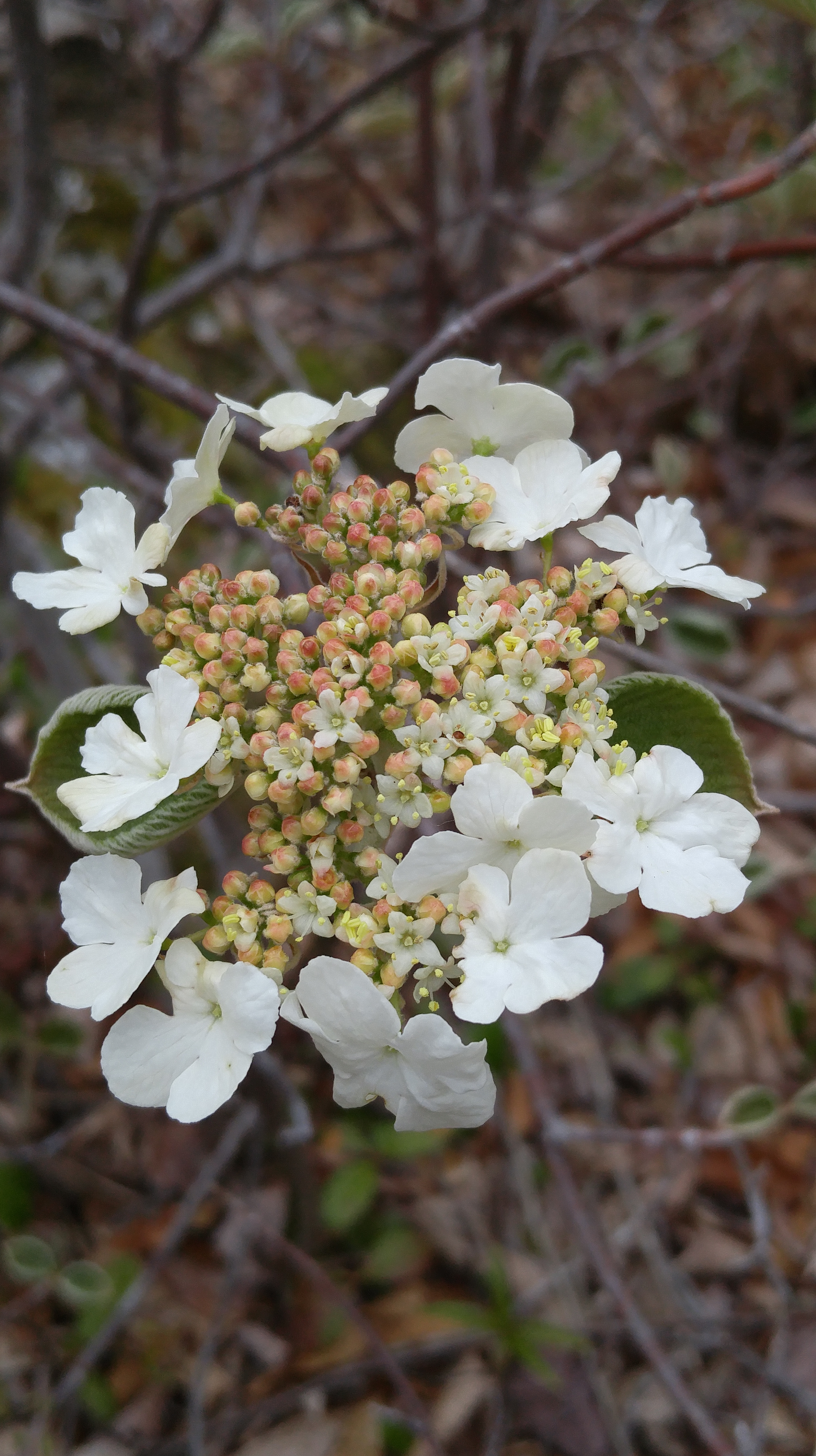
But, April/May showers do bring May flowers, and I sooo love the pastel colors that Hobblebush produces, its non-fertile showy flowers on the edge meant to entice insects to visit about a hundred tiny fertile flowers preparing to bloom in the center.
In wet seeps, Round-leaf Yellow Violets did show off their cheery faces, with violet-veined runways showing the way to the nectary, much like lights at an airfield that aid landings.
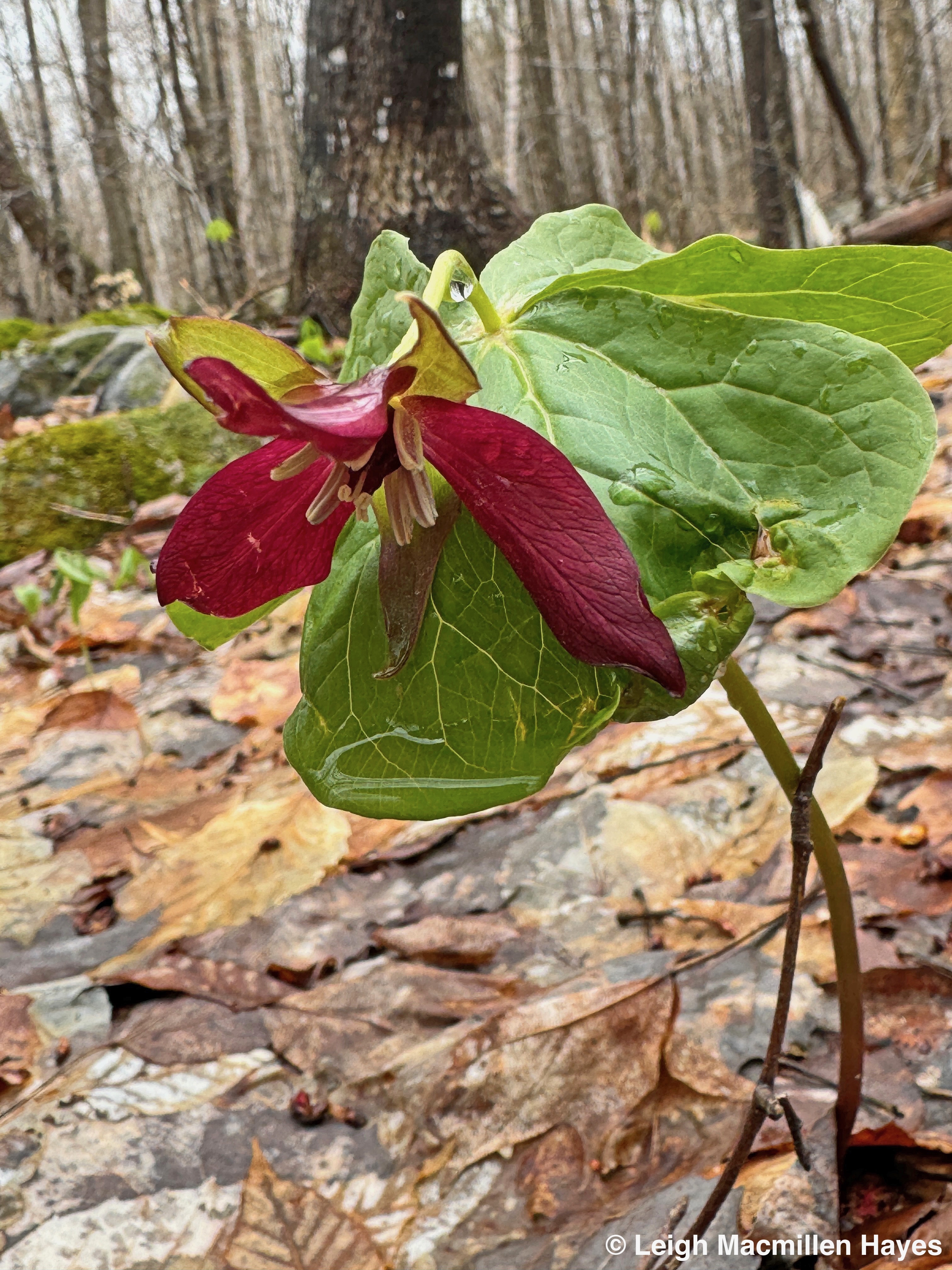
And fortunately My Guy didn’t question the fact that I was taking more photos of Red Trillium, for I’ve hardly reached the trillion I intend to take. Really though, in a few weeks our attention will turn toward his beloved Lady’s Slippers, and there are comparatively fewer trilliums than slippers in the forests through which we wander.
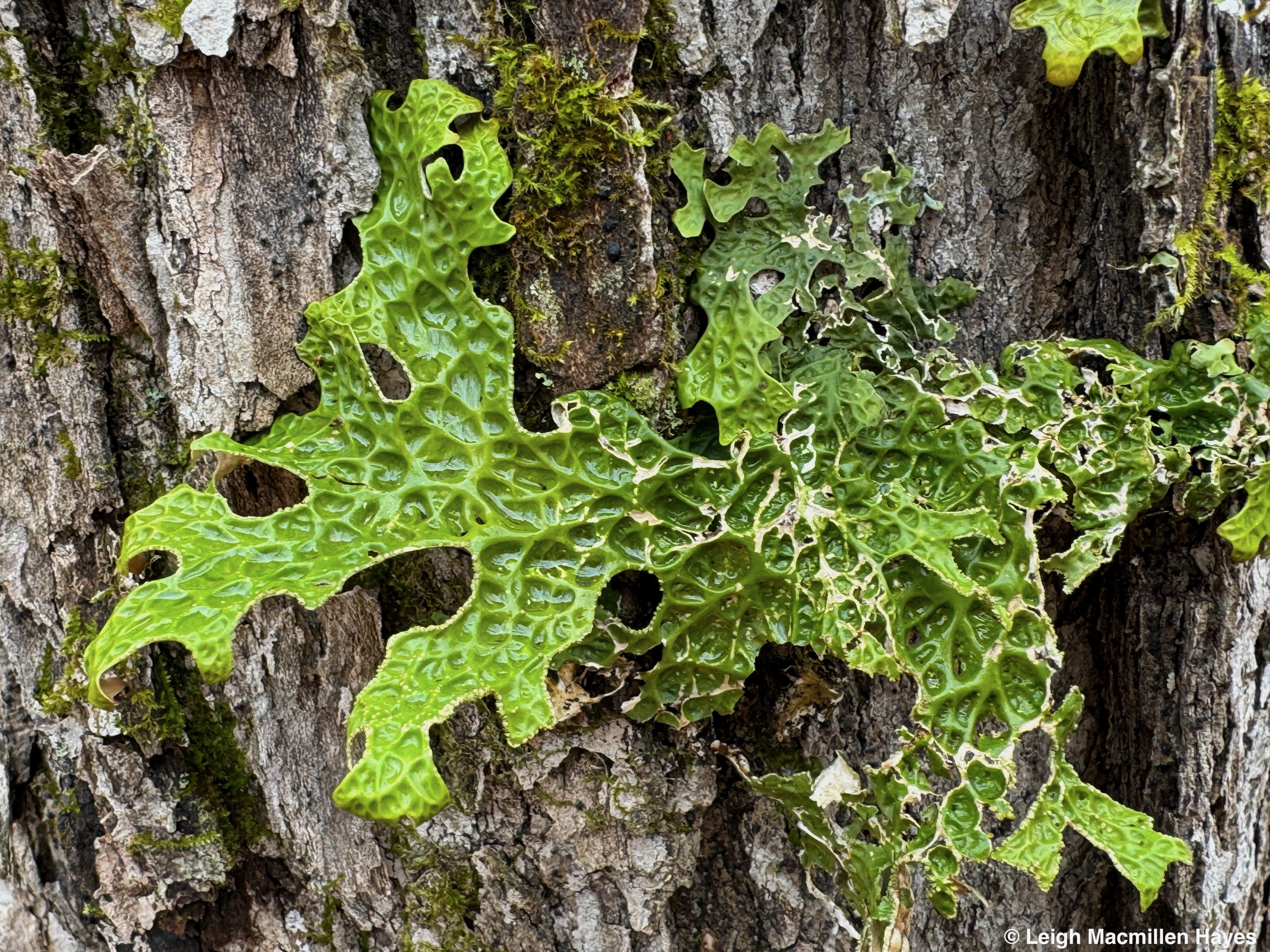
Because of the rain, Lungwort, a foliose lichen consisting of a fungus and a green algal partner living together in a symbiotic relationship with a cyanobacterium, showed off its greenliness since the alga had kicked into action to provide food for the fungal structure. It’s sensitive to air pollution and habitat loss, so spotting it is always a treat and reminds us of why we love living here in western Maine.
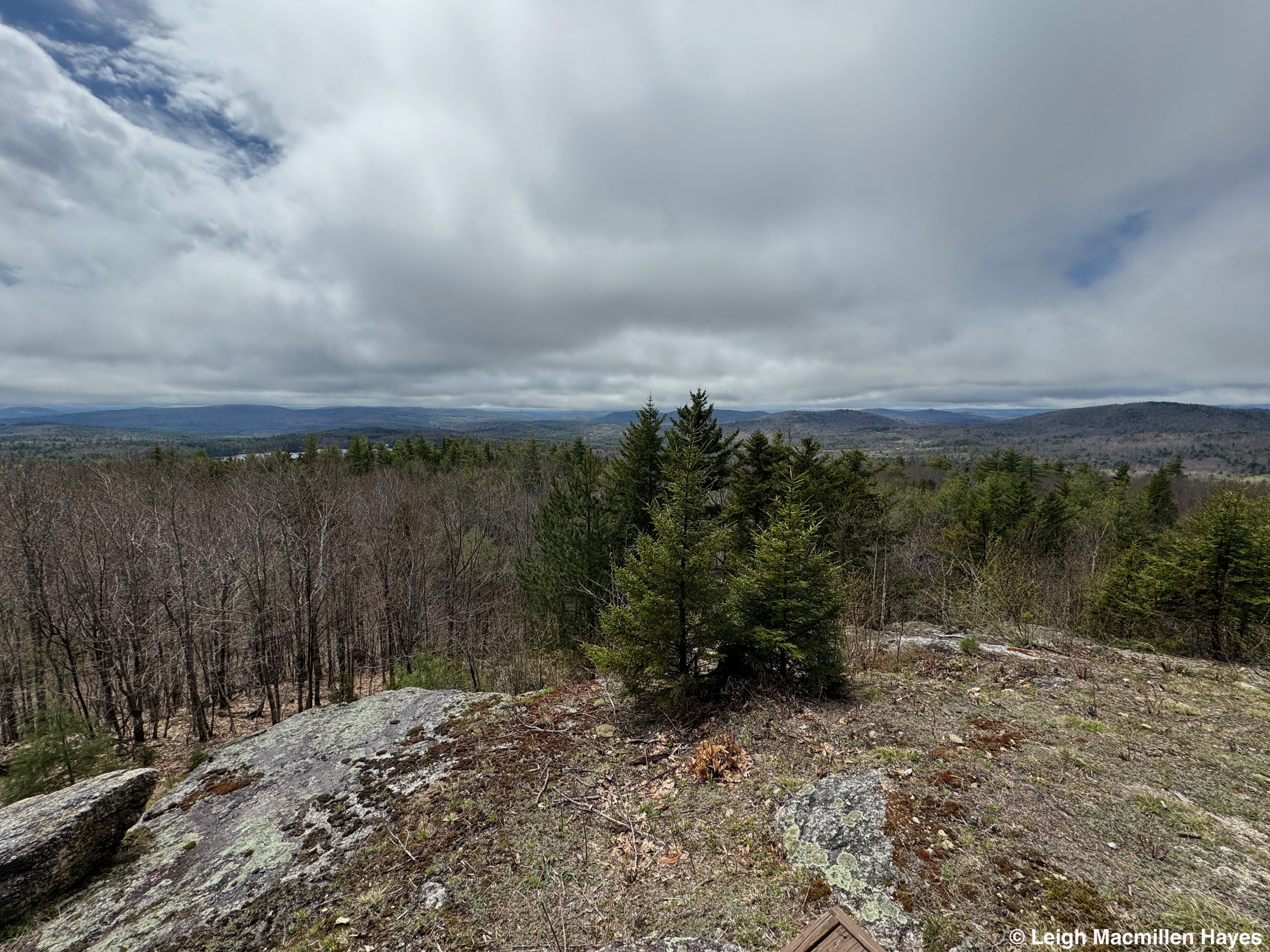
Below the summit, we paused to share lunch with the Black Flies and take in the view of the mountains, though many were obscured by the cloud cover.
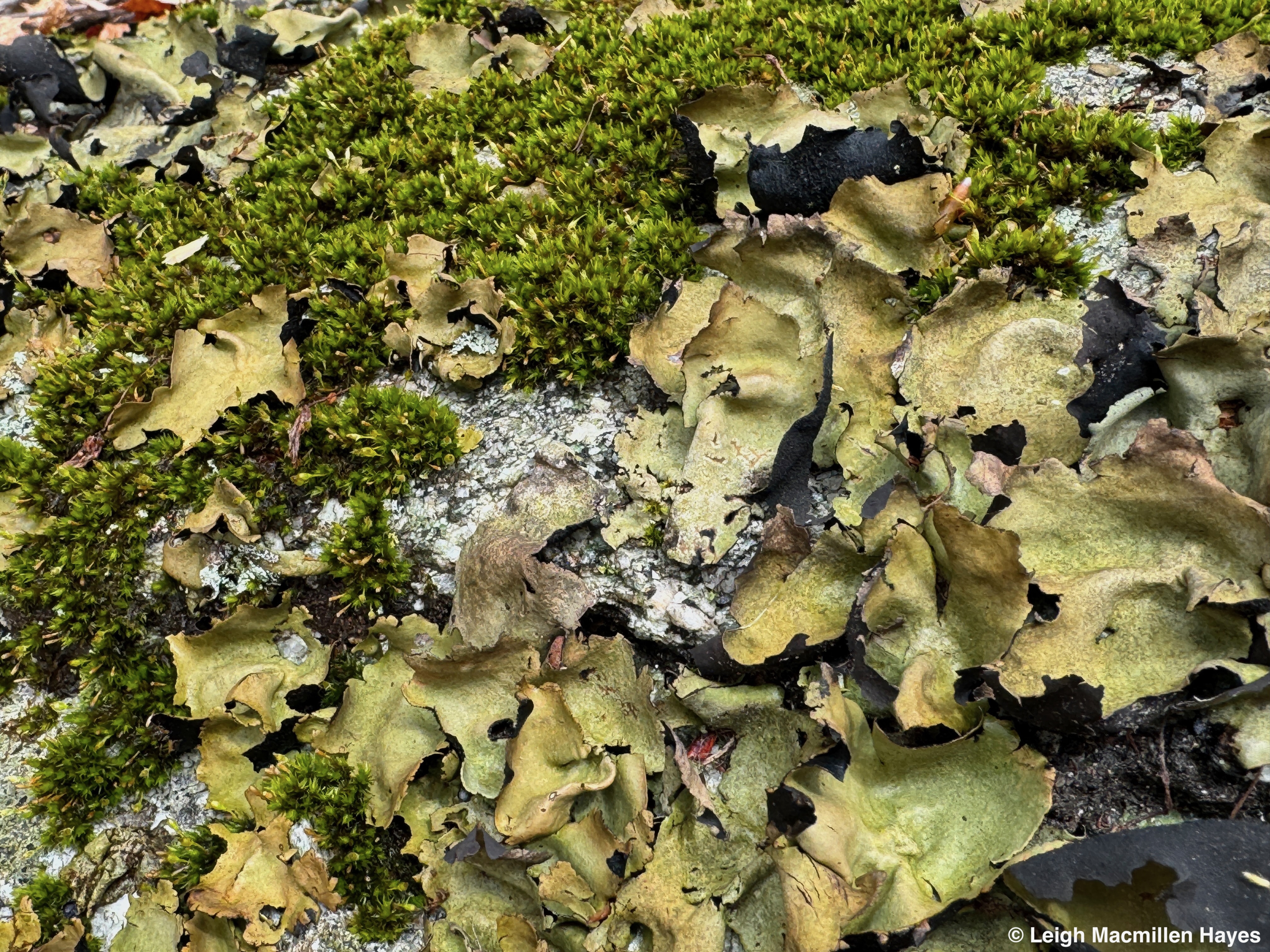
On our descent, there were more hues of green to add to the art palette in the form of the larger Rock Tripe, an umbilicate foliose lichen, and Rock Tuft Moss scattered in its midst.
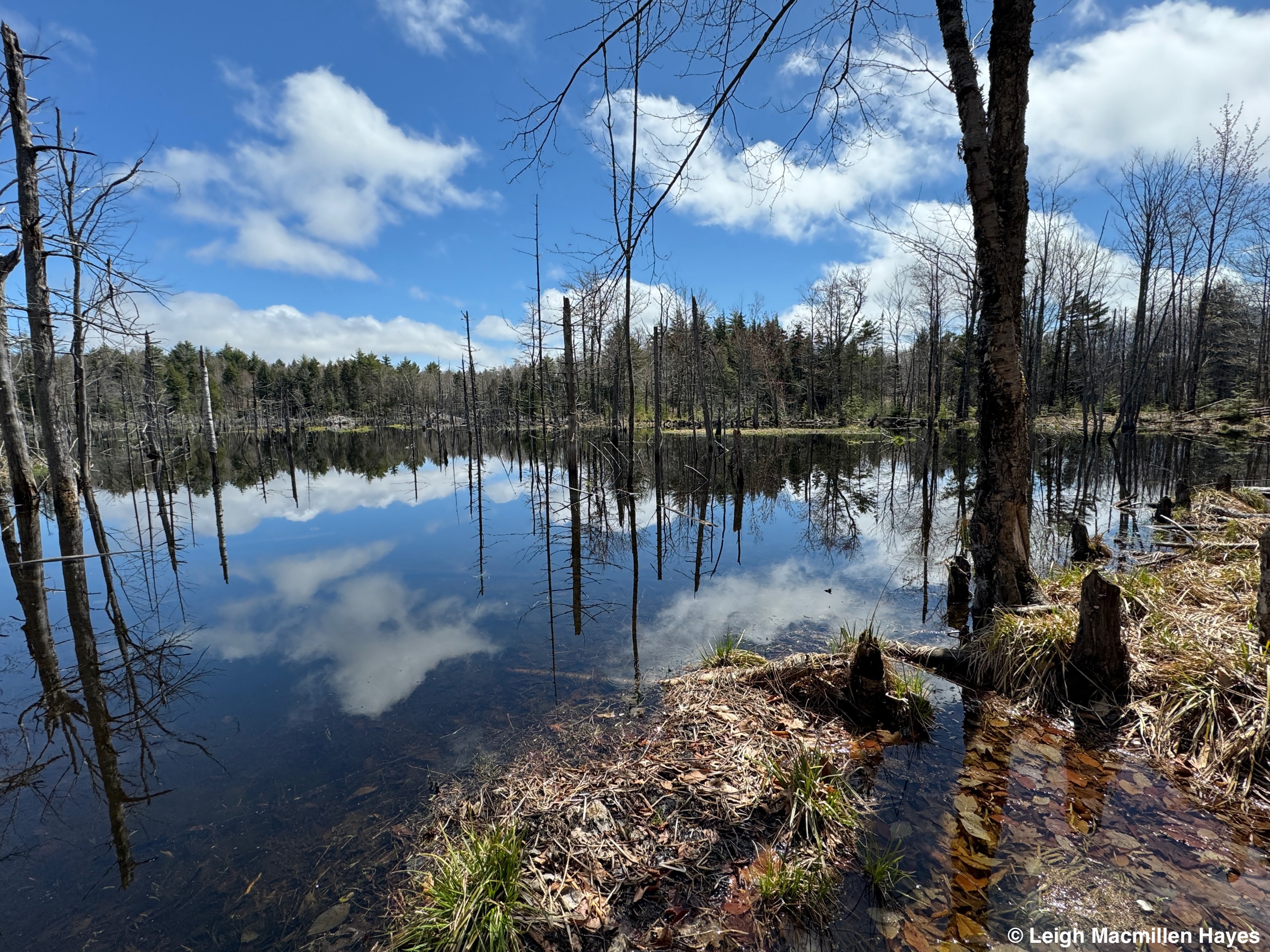
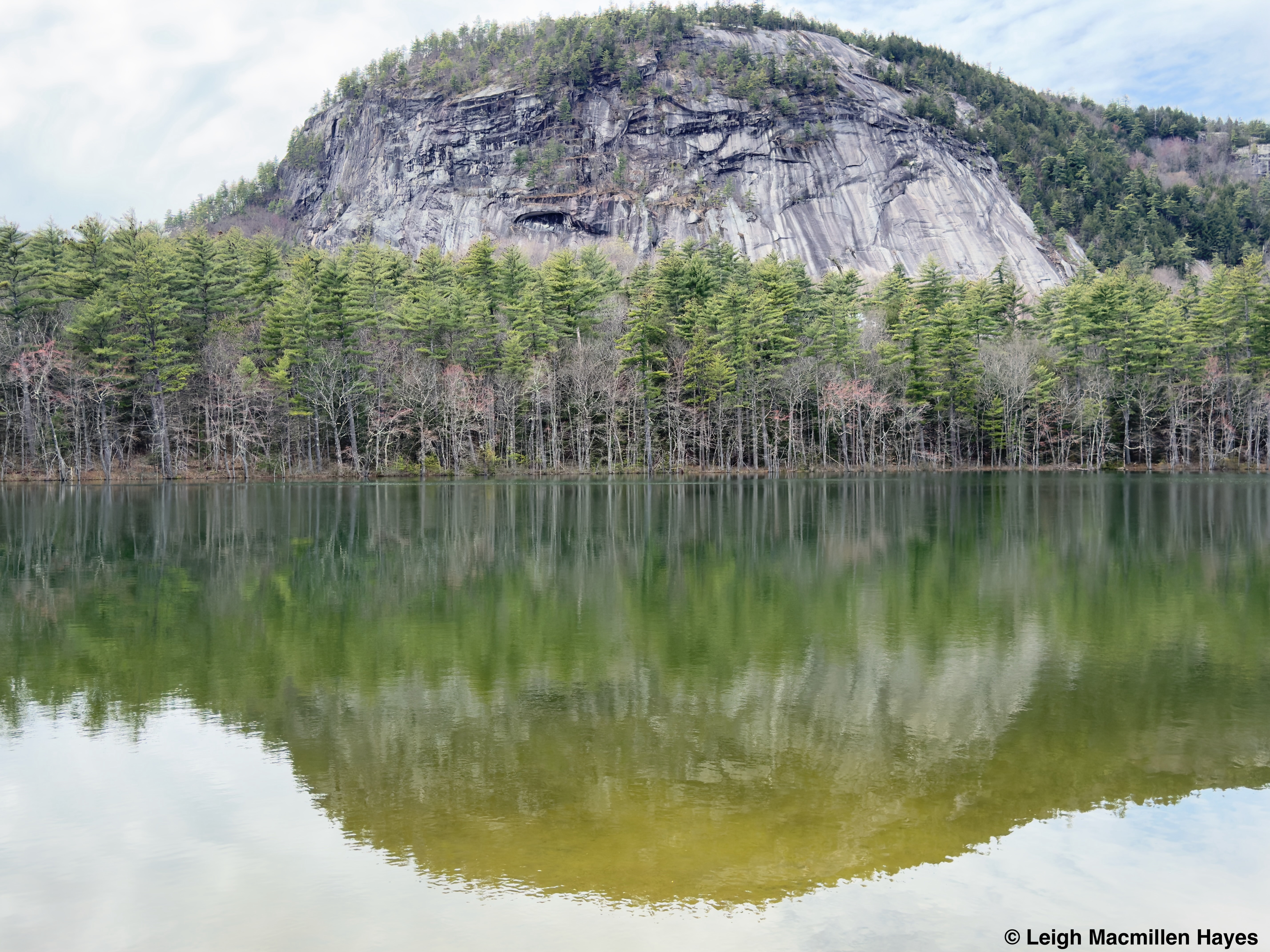
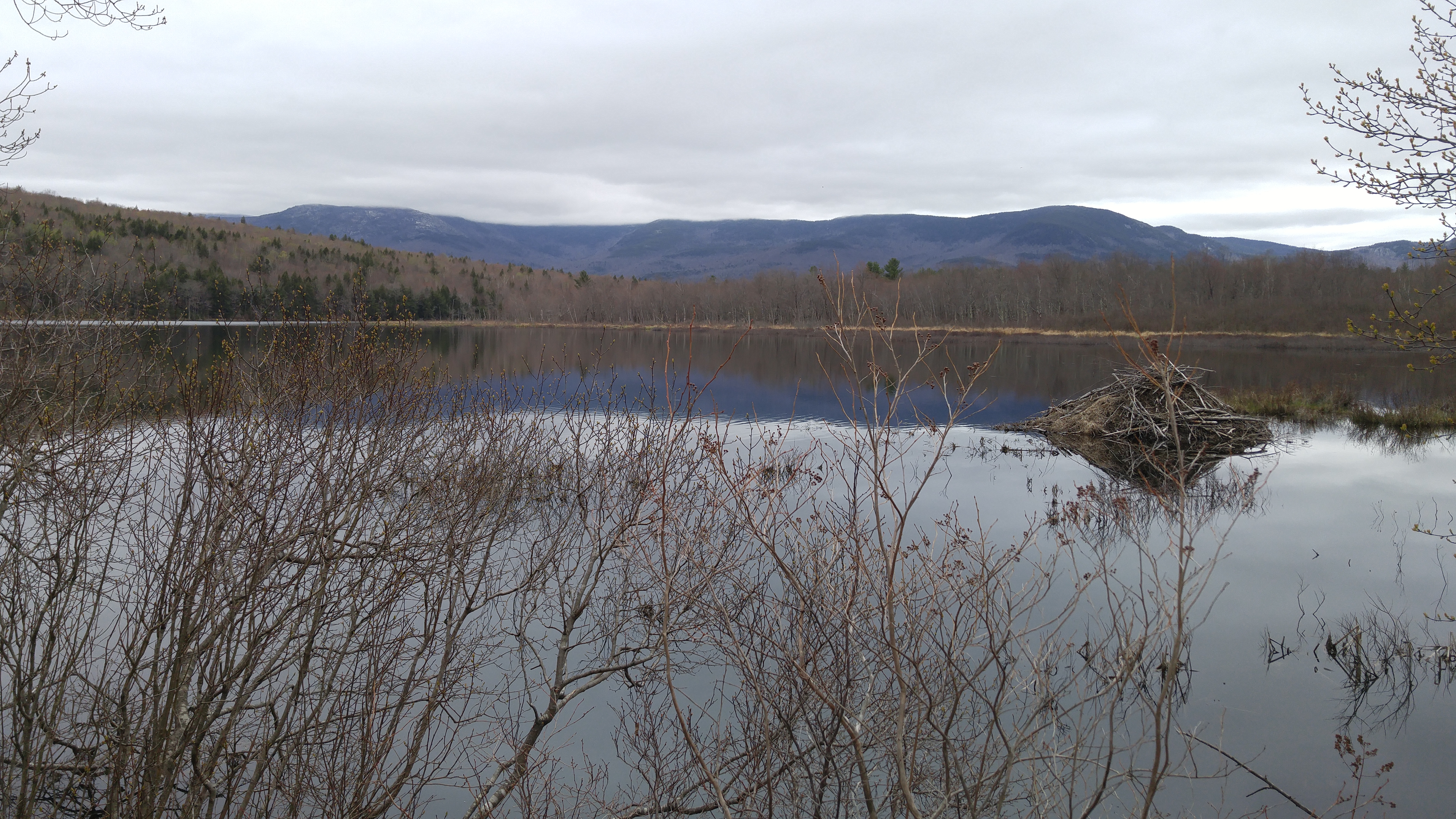
At a beaver pond, we noted several beaver lodges that looked abandoned and a long dam, but it was the reflection of the sky and clouds that also garnered our attention. The day had transformed as was visible both above and below.
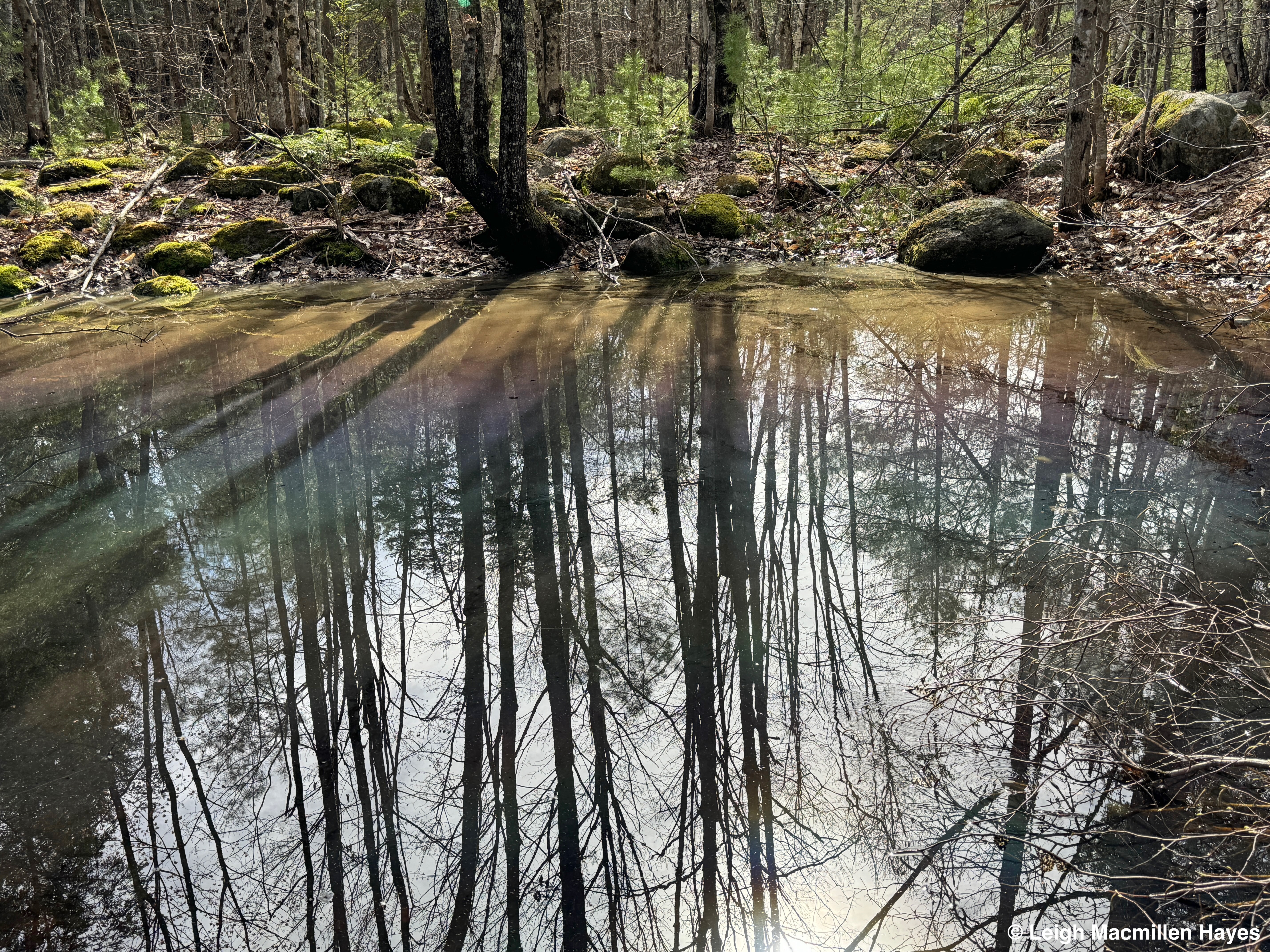
Back at home, I wandered out to the vernal pool to check on the activity. A few days ago I realized that tadpoles were beginning to emerge from egg masses, and today’s warmer weather brought even more into the picture, which in this case included both what I could see under water, as well as the reflection of trees and sky upon the water.
It was when I stopped looking into the depths, however, and focused upon the scene before me, that I realized I was seeing something I’ve never noticed before.
As I had approached the pool, I saw that it had a coating of Birch and Maple pollen and thought with a smile of a fourth grader spotting such last year and looking confused as he asked me if it was ice. No Daniel, it’s not ice. But his initial reaction made sense.
What I noticed today was that the pollen added a rainbow to the water’s surface as the sun got lower in the sky. Yellow by the far shore, orange, red, purple, blue, and green.
So, what caused this rainbow to appear? I’m a huge fan of taking a stick to a Balsam Fir blister to gather some resin and then tossing it into a puddle or still water to watch the natural resins or essential oils appear. Was that happening here?
Maybe this was from decaying vegetation and the sun being at the right angle?
Maybe it had something to do with the pollen as well as the sun’s angle?
I don’t know, but certainly it was fun that this day which began with rain, and showed off a variety of vibrant colors during our five-mile hike, should end somewhere under the rainbow.
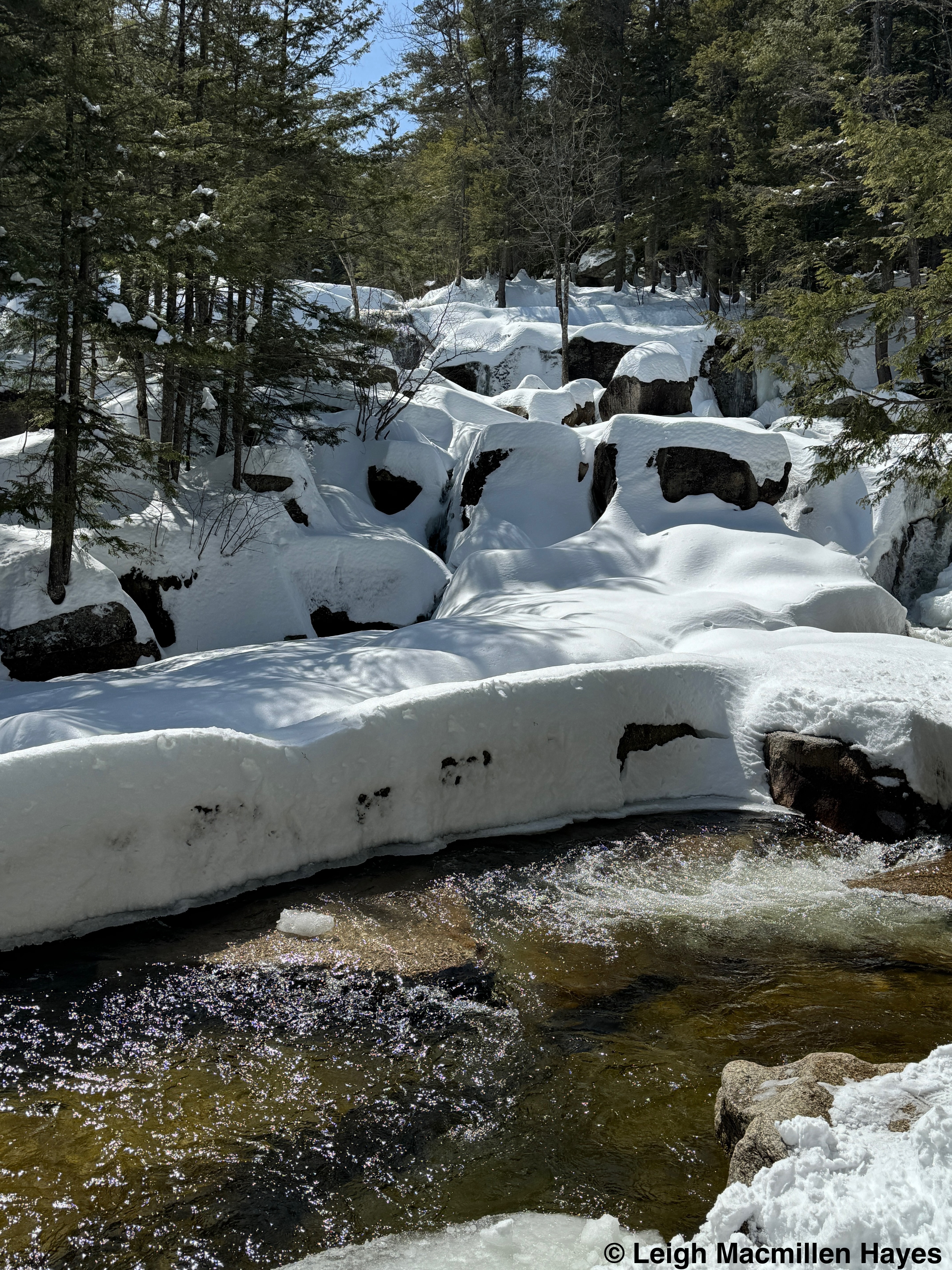
In case you are missing snow, I thought I’d bring you some today. But only because about a month ago, the day after Palm Sunday and a major snowstorm here in the north country, My Guy and I went to Diana’s Baths in Bartlett, New Hampshire, to hike.
It was the first of two storms in a matter of less than two weeks that dropped almost two feet of snow each and transformed Lucy Brook into a winter wonderland. Here’s a bit of history from northconwaynh.com: In the 1860s, after building a house and barn on the banks of the brook, George Lucy built a water wheel powered sawmill. In the 1890s, George built a 12-room boarding house for tourists to visit the site. In the 1930s Chester Lucy built a concrete dam with a water feed and turbine system to replace the water wheel used to power the sawmill. Both the rooming house and sawmill were eventually sold to the US Government and have become part of the National Forest land. Due to the deterioration, the buildings were eventually removed from the site in the 1960s. Remnants of the site can still be seen today including the old cellar holes and parts of the dam system, feed tube and turbine gears used to power the sawmill.
Today, it looked much more summer-like in appearance, but still so much water flows due to snow melt in the surrounding mountains, and it’s BRRRRR.
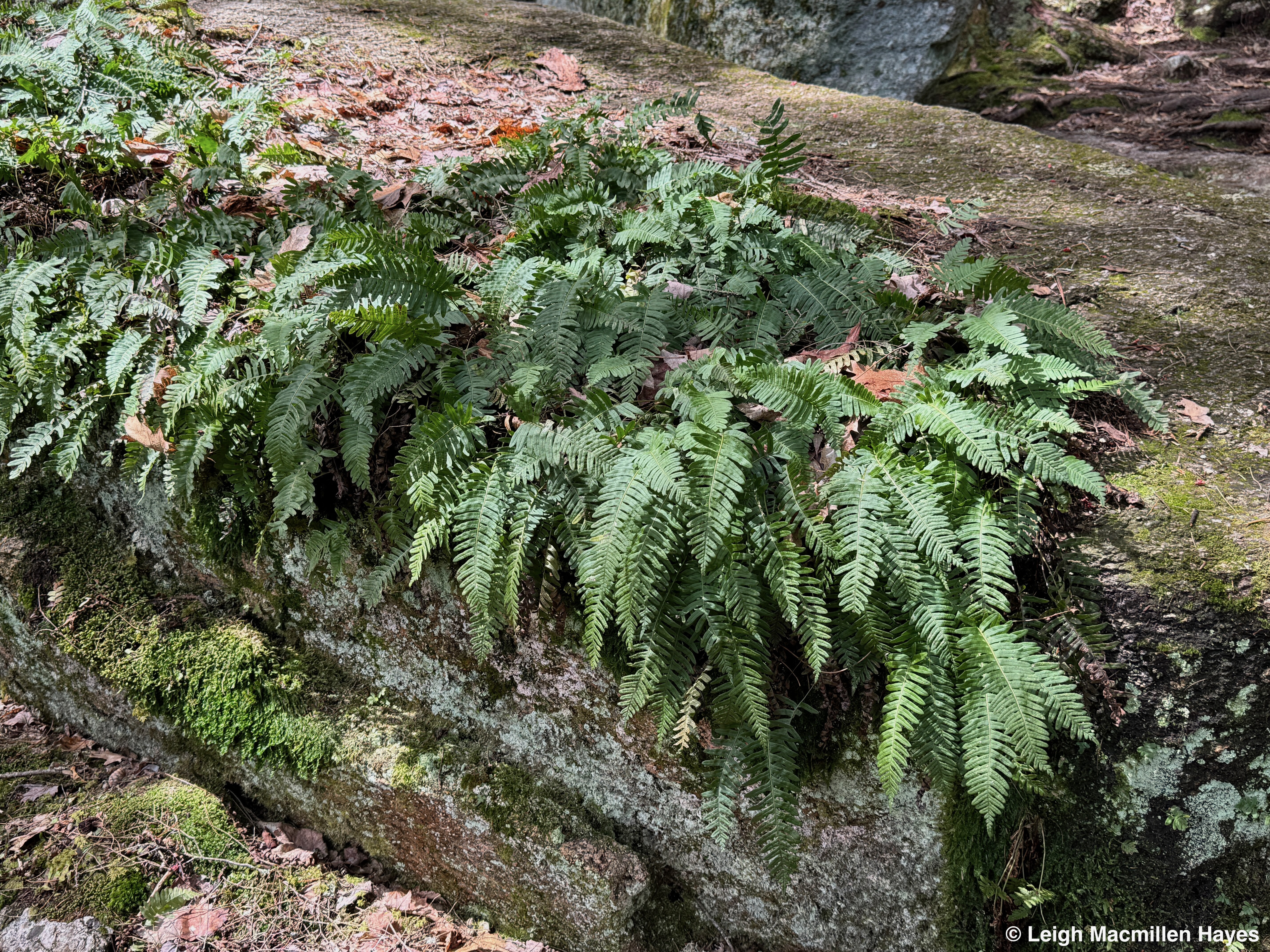
As we ventured forth, I spotted many a boulder experiencing the bad hair day of Common Polypody Fern and every once in a while try to teach My Guy a wee bit about a species. I tell him that someday he can co-lead a nature walk with me. He, of course, guffaws. But ask him what poly and pody mean and he may remember many and feet, for the fern fronds grow from creeping rhizomes.
Last year’s sori (group of spores) were still visible on the underside of some leaves. The sori located in rows on each side of the mid-vein, are circular, orangish brown and not covered by tissue (indusium).
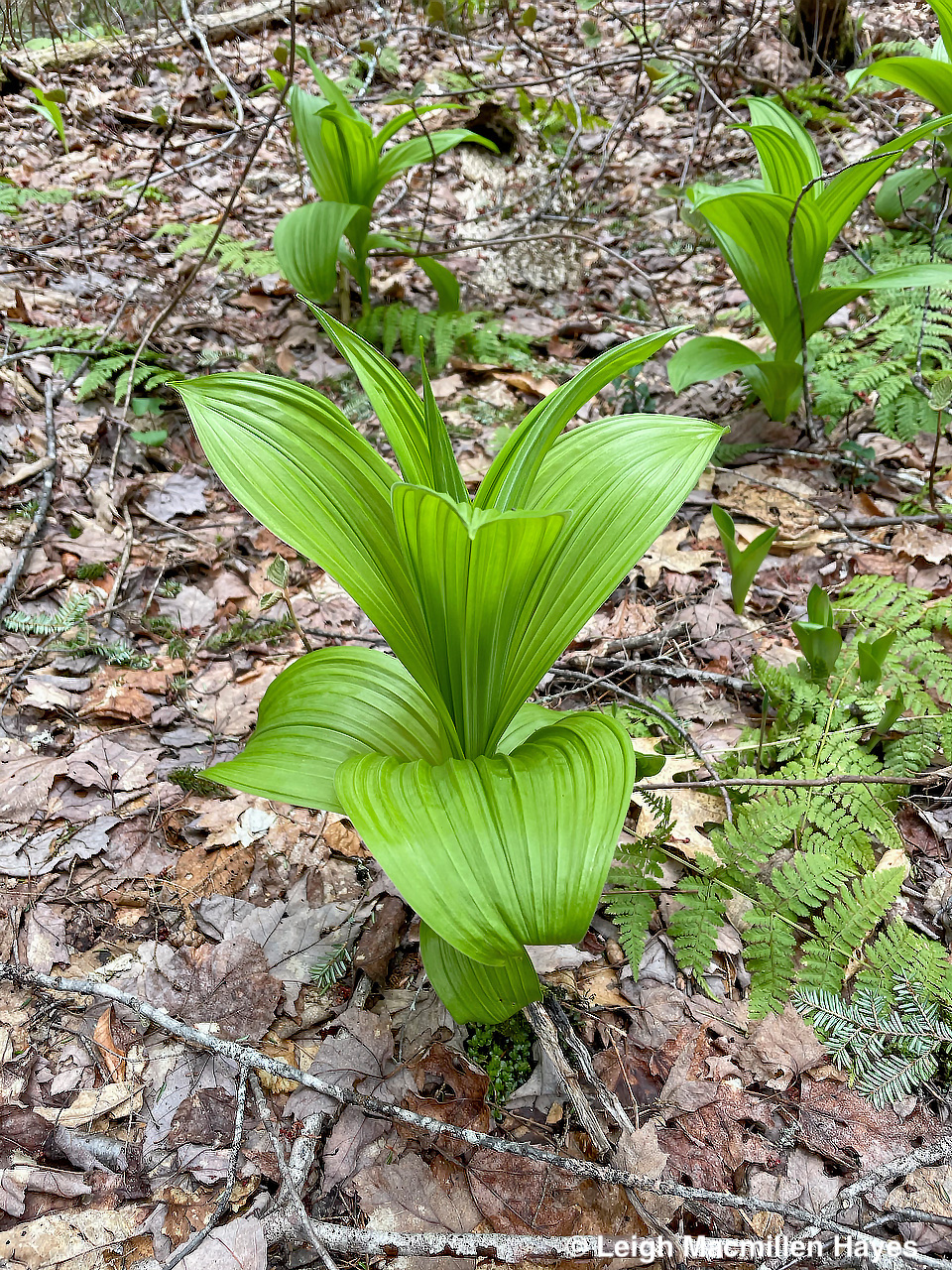
Because we were in a damp environment beside the brook, False Hellebore leaves, with their pleated presentation, brightened the morning. And held raindrops signifying yesterday’s weather.
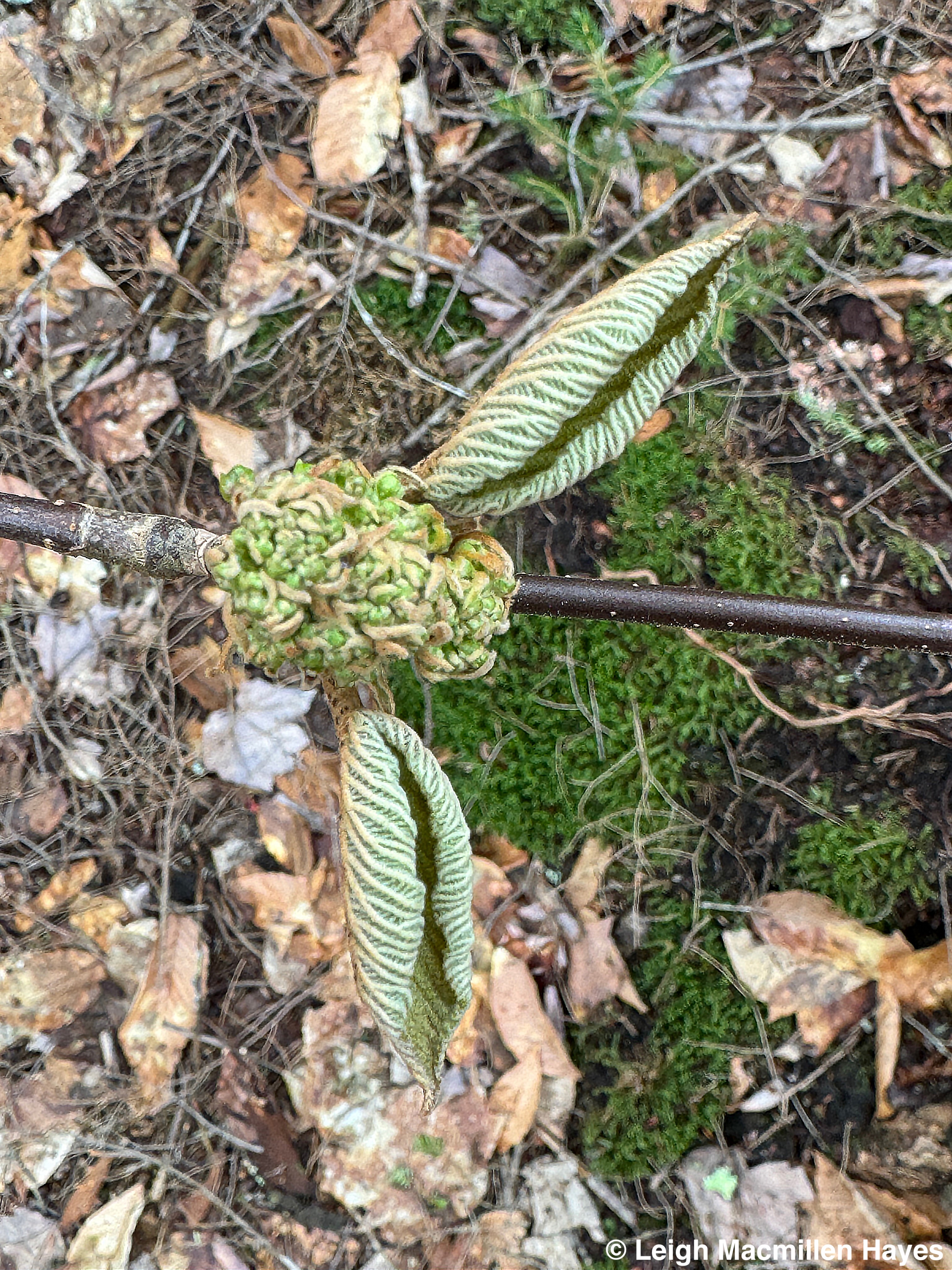
We also encountered numerous Hobblebush shrubs, some even featuring flowers preparing to open into what will be a fantastic display on another day. On this day, it was enough to see their accordion leaves beginning to unfurl, and those flowers presenting like a bunch of worms crawling over each other as if to say, “Me first. Me first.”
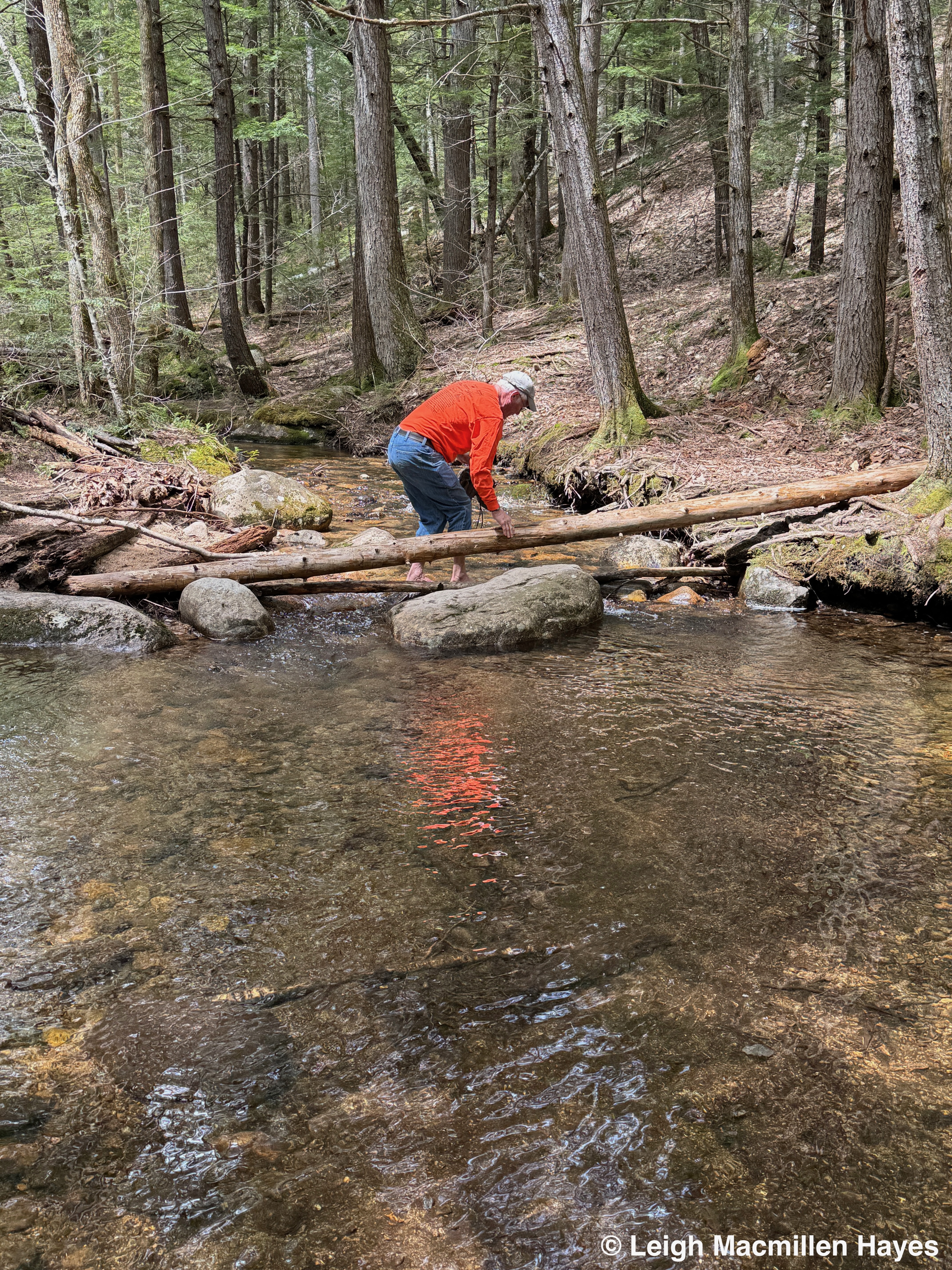
We crossed tributaries several times though we didn’t actually cross Lucy Brook as originally intended for the water was still too high for us to manage safely. But . . . we bushwhacked for a bit before sitting upon some tree roots to take a lunch break.
It was while My Guy sat there, that I poked around and discovered this–Wall Scalewort, a leafy liverwort. Liverworts differ from mosses in that the leaves are typically arranged in rows of two with a possible third row below, while moss leaves whorl around the stem. And most mosses have mid-ribs, which liverworts lack.
That said, the Wall Scalewort closely resembles Shingle Moss, which I spotted along this same tributary in March.
But a closer look today made me realize that I could see the leaf arrangement was succubous where the bottom edge was visible, as opposed to incubous. Succubous arrangement is like roof shingles that don’t let the rain in, while incubous leaves are arranged so the top edge is visible and do let the rain in. Thank you Sue Alix Williams in Mosses & Common Liverworts of the Northeast for that explanation.
Eventually we reached a turn-around point and came up with Plan B for the rest of today’s hike as we made our way out. While I was able to cross with my high leather hiking boots, My Guy chose to take his boots and socks off and watch his feet turn red from the chill. Thankfully, his better half, ahem, that would be me, had packed a towel because we suspected this could be the case.
Now you might find this as odd, but since our discovery of the new privies last month, we’ve been quite taken with the artwork completed by Kennett High School art students in 2023.
Unbeknownst to us at the time, the paintings were a perfect segue from one trail to another.
And so we drove down the road to Echo Lake State Park and tried to convince the warden that even though we live in Maine, our hometown is just over the border and we should be able to hike the trails for free as New Hampshire Seniors don’t have to pay. He kindly informed us that the park isn’t officially open yet, as so it was free, but if we return in a couple of weeks, it will cost us $4 each. Not bad in the scheme of things.
Before us stood White Horse Ledge, one of the trails we had considered if we’d been able to cross Lucy Brook from our earlier destination. We were green with envy as we looked across at it.
But about half way around the lake, we found a different trail to the summit and decided to follow it. That said, we found several trails to the summit and the first we chose led us astray as it eventually petered out.
Despite that, we were thrilled. Okay, maybe it was me rather than we. Semantics.
And so today I celebrated my first meeting of 2024 with Sessile-leaf Bellwort, aka Wild Oat. And where there was one, there were a million, the subtle yellow bell dangling quietly below.
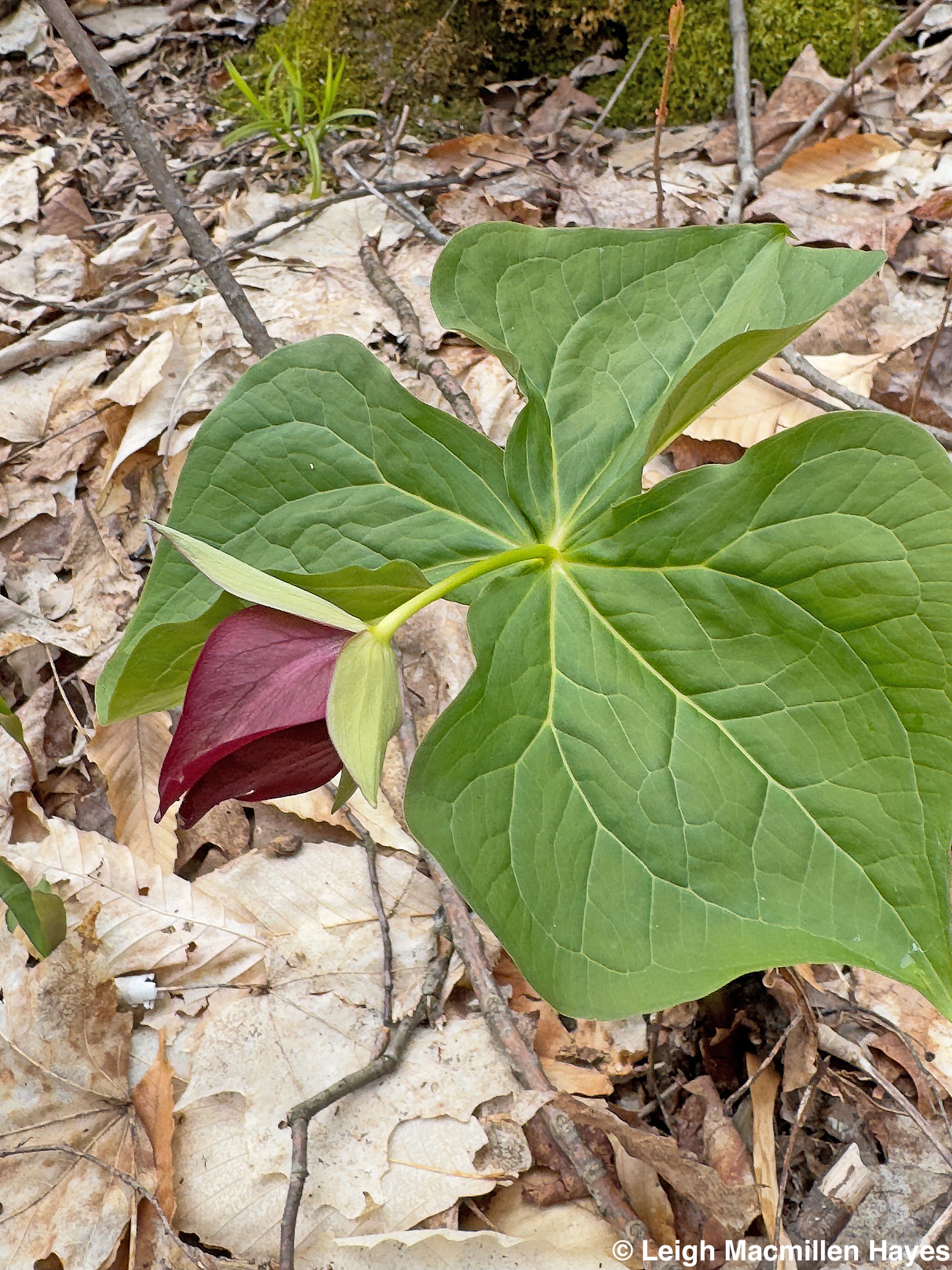
And then . . . and then, I spotted a Stinking Benjamin, or Red Trillium almost in flower.
And a few steps away . . . full flower mode. Trillium is a reference to the fact that the floral parts of the plant occur in threes: three leaves, three petals, three sepals.
Going forth, I’m sure I’ll honor a trillion trilliums, but these were the first and therefore the most special.
As we made our way back to a better trail, the leaves of Trout Lily caught my attention and then much to my delight I found two in flower. The leaves are maroon-mottled and the nodding flower features petals and sepals bent backwards to expose six brown stamens. This one is such a treat for me because I only meet it when I least expect to do so.
Once on the actual trail upon which we had to scramble to climb toward the ledgy summit, I spotted another that only grows in such habitats.
Take a look at the black arrow in the photo. That is one hairy stalk rising from a rosette of basal leaves.
This native perennial wildflower, Virginia Saxifrage, grows out of cracks in rock, and has been known as a rock breaker even though it doesn’t actually break rocks, but rather, likes to grow in those fractures. It’s such a sweet little flower that is easy to overlook.
From the ledges above, we had a great view of Echo Lake, and the mountains beyond, with Cranmore’s Ski Area showing the last of the melting snow.
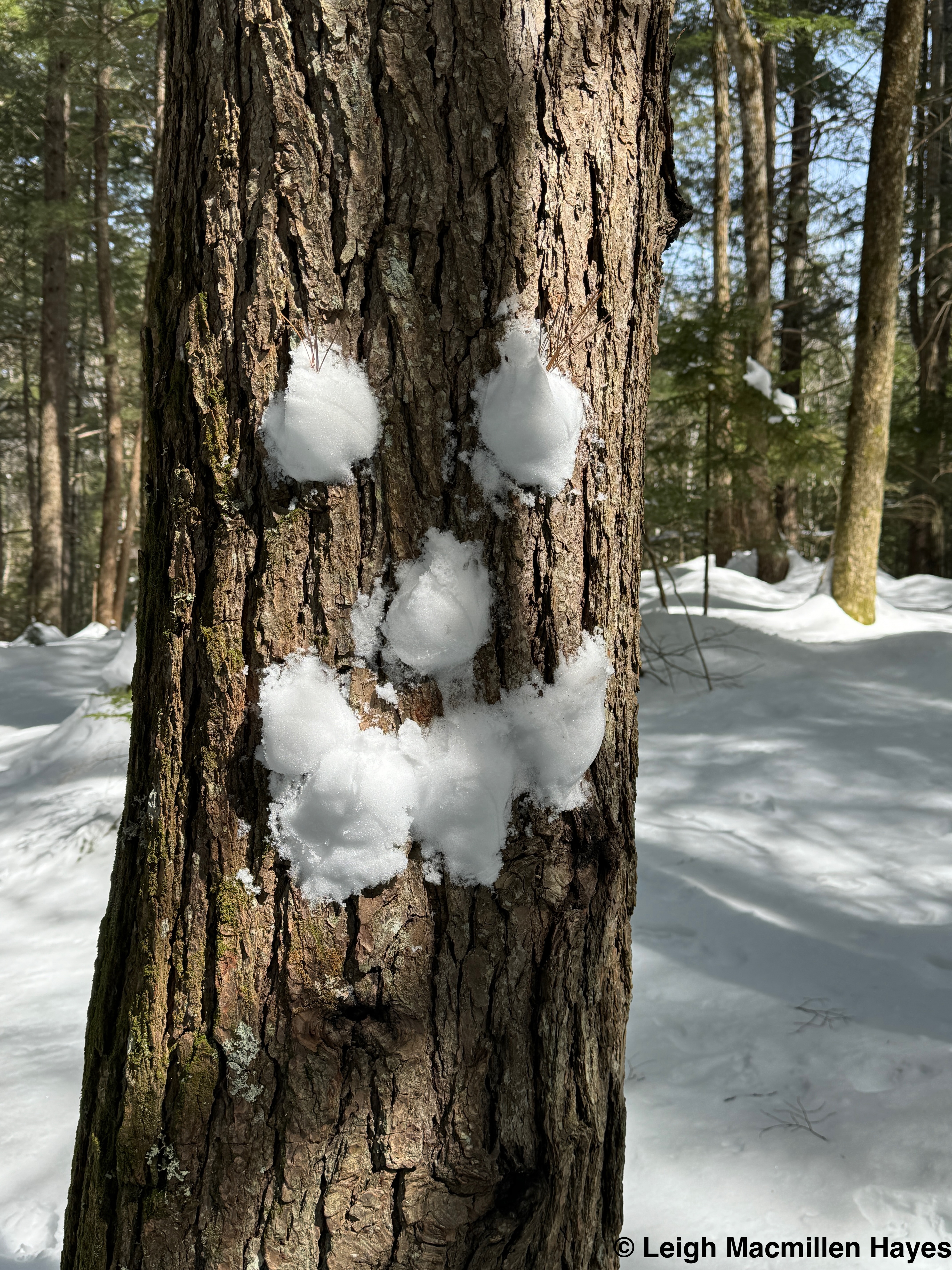
That brings me back to the snow of a month ago. I took it upon myself to figure out a way to make people smile.
And today, we did the same, though not with snow like this. But rather, with our actual smiles and friendly hellos as we greeted each hiker we met. Even if they weren’t smiling or making eye contact with us at first, we got them all to return the greeting and had some nice chats with a few.
I told My Guy that it kinda reminded me of our New York adventure last weekend, when I made it a point to try to make eye contact with each person we passed on the sidewalk or trail and to always leave them with a smile. A few actually looked at me and turned on a smile, which seemed to surprise them.
This was indeed a smile of a Mondate . . . on so many levels.
We’d hiked at least a mile and passed a few Trout Lily leaves but no flowers when I asked my guy to hunt for the little yellow beauties that delight me. And so he did.
And felt quite pleased when he pointed one out to me. Well, um, how should I tell him it’s a False Hellebore and not the lily I sought. But, it is a member of the lily family, so it was a win, and I can’t resist photographing the hellebore’s spiral stalks of pleated leaves so it was actually a win/win for both of us. We never did find a flowering Trout Lily.
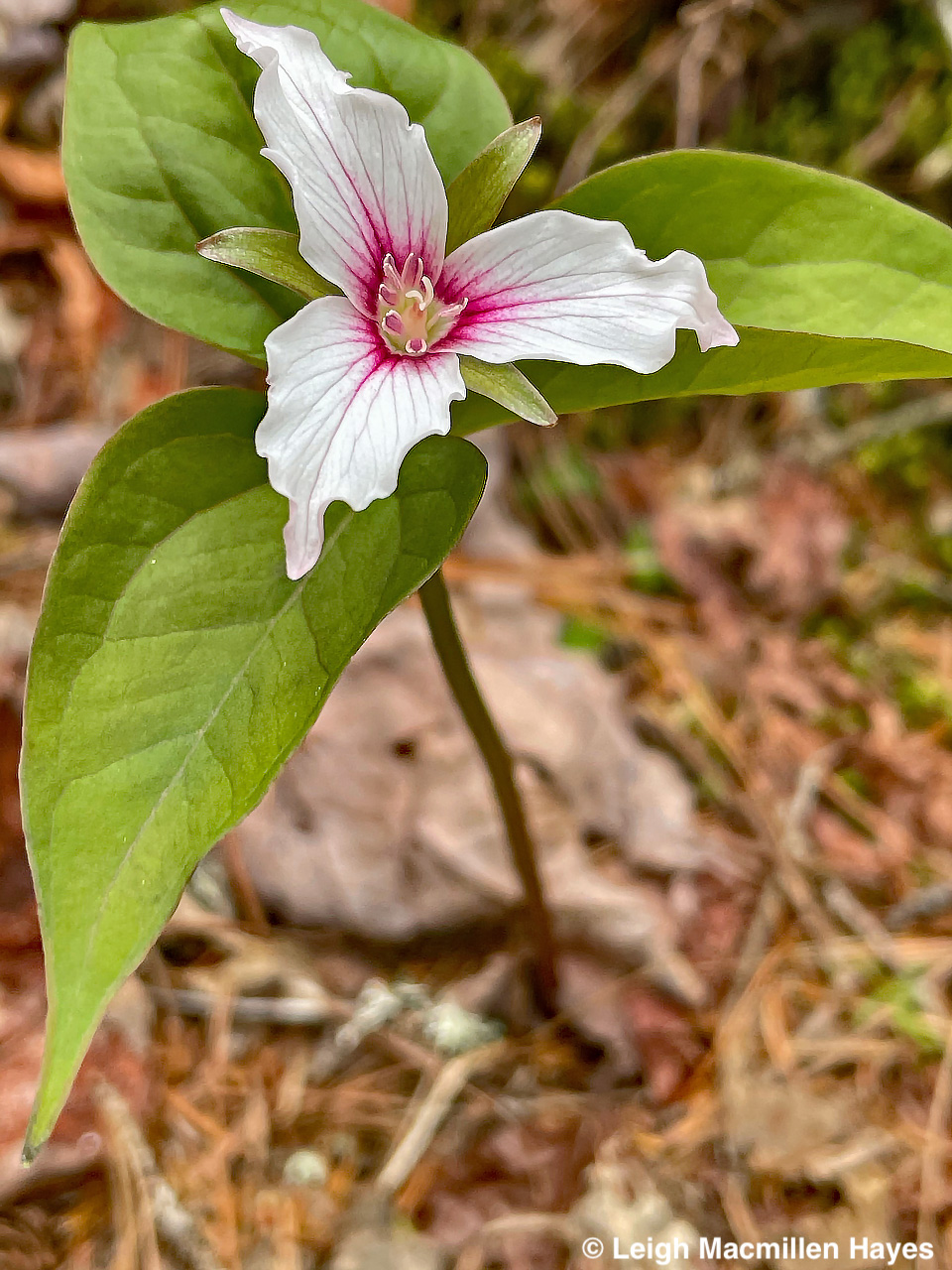
That was okay, because there were so many other flowers to honor and today marked the first day of this year that I spotted a Painted Trillium. Leaves of three (actually bracts), sepals of three, petals of three, but the best is the pinkish-reddish-purplish splotch at the base of the petals that acts as a pollinator guide.
Another pleasant surprise a few minutes later: American Fly Honeysuckle, its funnel-shaped yellow flowers tinged with a hint of purple dangling like a set of twins.
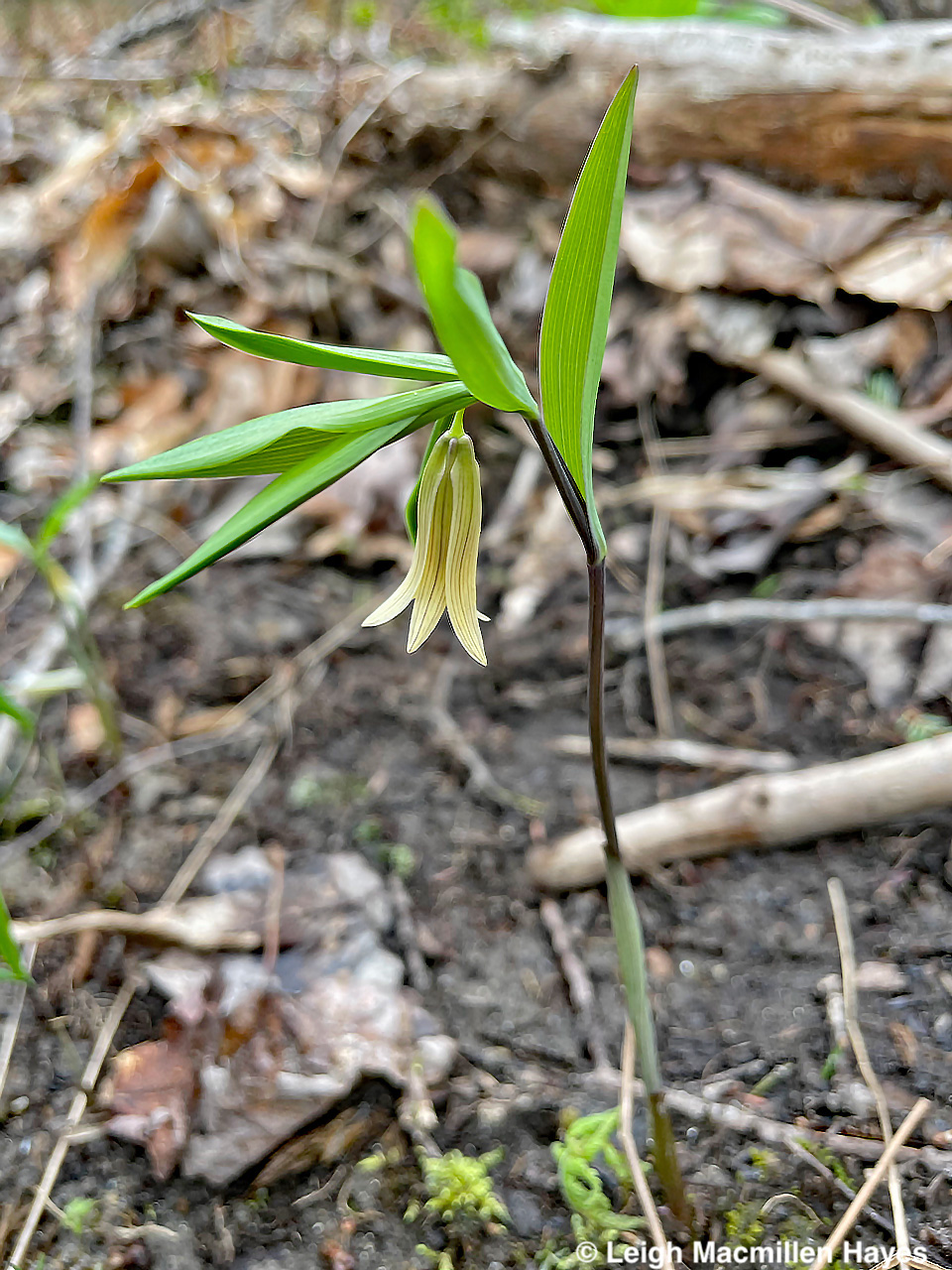
Also pale yellow in hue, but with petals that curve out slightly at the tip: Sessile-leaf Bellwort (aka Wild Oat). While most bell-shaped flowers are fused, these are not. And they are most subtle in appearance so you really have to focus to locate one. But chances are that once you find the first, your eyes will cue in on others.
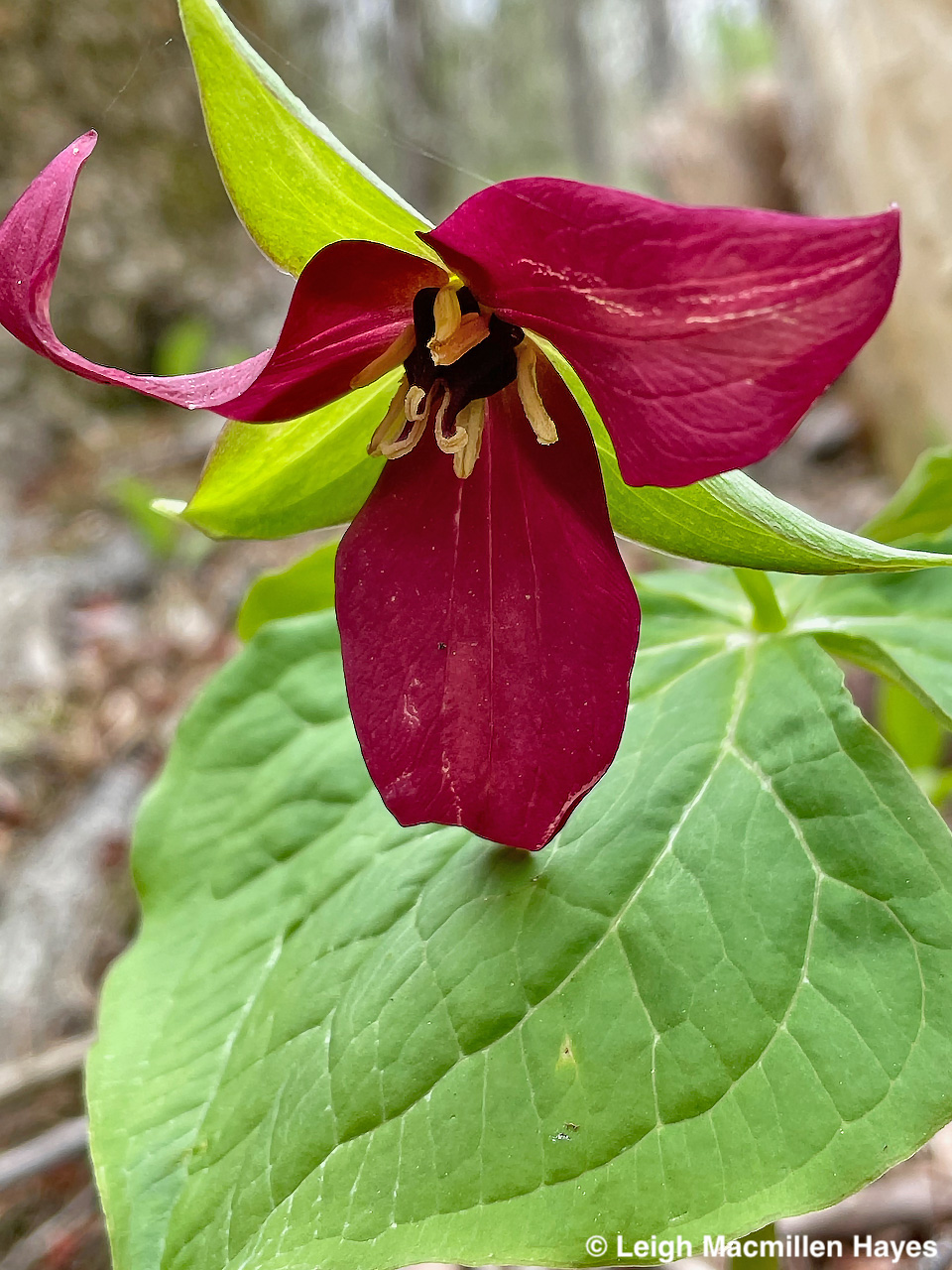
No gathering of flowers is complete without a touch of red, and though we found only one Red Trillium (aka Stinking Benjamin), it was enough for its rose-colored flower was well accented with egg-yolk yellow anthers.
Of course, we continued to find more Painted Trillium and no hike at this time of year is finished without my guy commenting on the trillion Trillium that I insist upon photographing. I assured him that I wouldn’t take pictures of each one today, but I surely would honor all of them and so as we continued and he somehow managed to walk by without noticing, I obnoxiously drew his attention to all.
The one flower whose name he did learn today was Hobblebush. I swear I’ve introduced them before, and surely I have, but today the name and the floral display clicked–perhaps because they decorated so much of the trail we traveled, and truly, I’m not sure that I’ve ever seen so many in flower in one place.
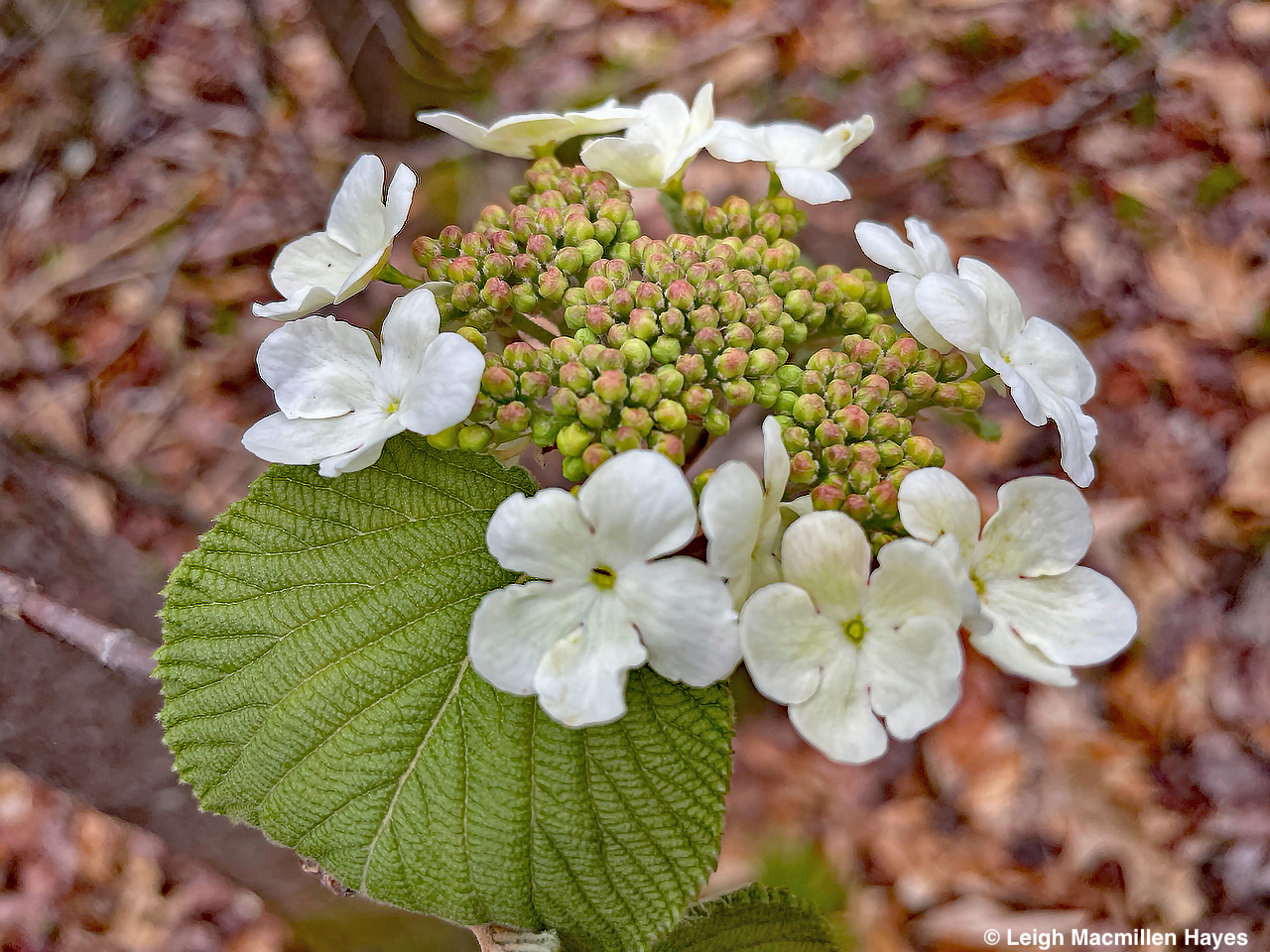
The flat-topped clusters of flowers have a lacy effect and contrast well with the accordian-veined leaves. The outer ring of sterile flowers are said to attract pollinators who will then focus on the tiny fertile watermelon tourmaline flowers in the center. My wonder is this: do the sterile flowers have a second use–perhaps to keep others away because they find no nectar or pollen and think the plant isn’t worth a further exploration?
As I explained to my guy, the reason for the common name is its straggly branches that often bend and take root, tripping or “hobbling” passers-by.
To not include Trailing Arbutus would be remiss on my part, for so many were still blooming along the trail. And after I paused to photograph this one and then caught up with my guy and explained my focus moment, he was quick to quip that I was the one trailing! Always . . . in his hiking book.
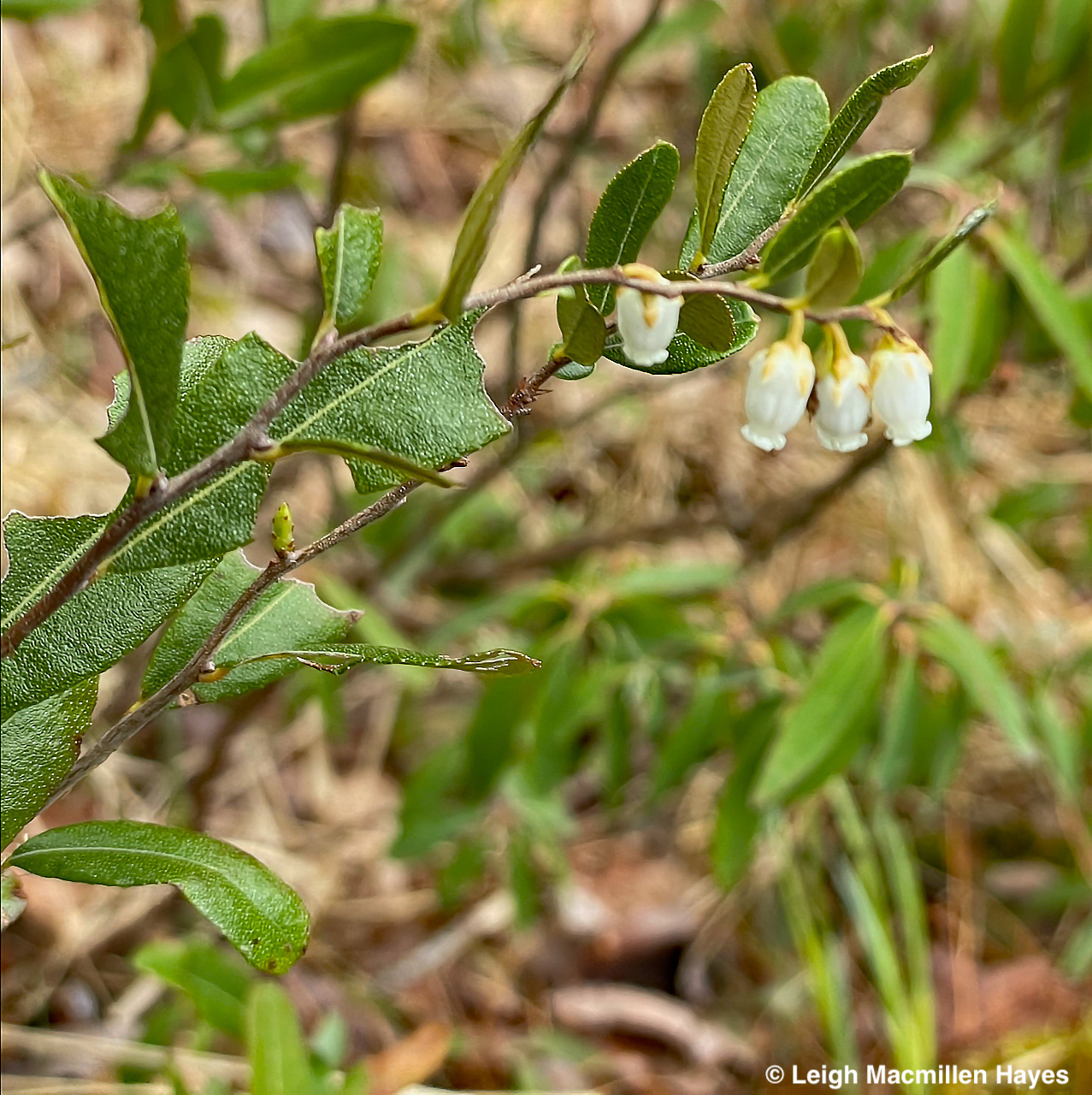
By water’s edge, where we sat upon an overturned canoe to dine on our sandwiches, I found a few examples of Leather-leaf in flower, its tiny nodding, urn-shaped, pearly white bells with crisp rolled upper lips, on a short stalk hanging all in a row rather like a line of laundry on the clothesline.
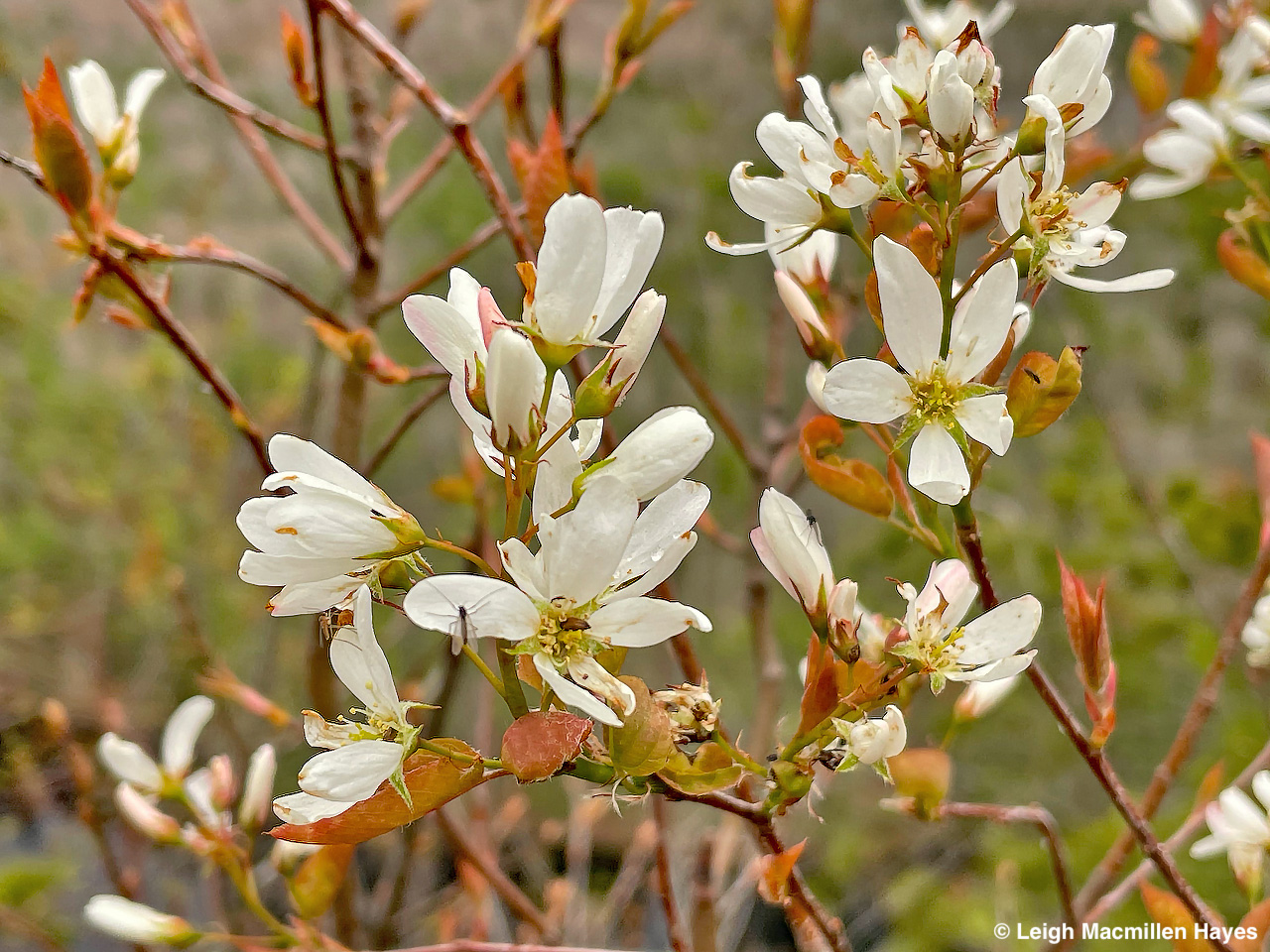
At the summit, it was Serviceberry, aka Shadbush, that announced its presence. Notice how the flowers have emerged before the leaves. Right now, mini-leaves are bronze-tinged, folded and half or less their mature size; eventually the leaves will become green and flat, with the upper surface smooth and the lower hairy just along the midrib but retaining a few hairs on the surface. Nothing like a bit of variation.
If you look closely, you’ll find at least one pollinator taking a pause as it was raining by this point in our hike, but another close gander may reveal a few others.
Again at the summit, and therefore closer to the sunlight that didn’t shine today, several urn-shaped white flowers with pinkish stripes, the petals fused and tips turned back, shouting that blueberry season is in the offing.
All of these we gathered in photographs as a bouquet to mark this Mondate.
There were a few other finds worth noting–like last year’s Lady’s Slipper capsule, the source of thousands of tiny seeds.
And the discovery of a few Morel mushrooms at the base of Northern Red Oak trees. That was another first find for me. I’m sure for my guy as well, though he hardly saw them ;-)
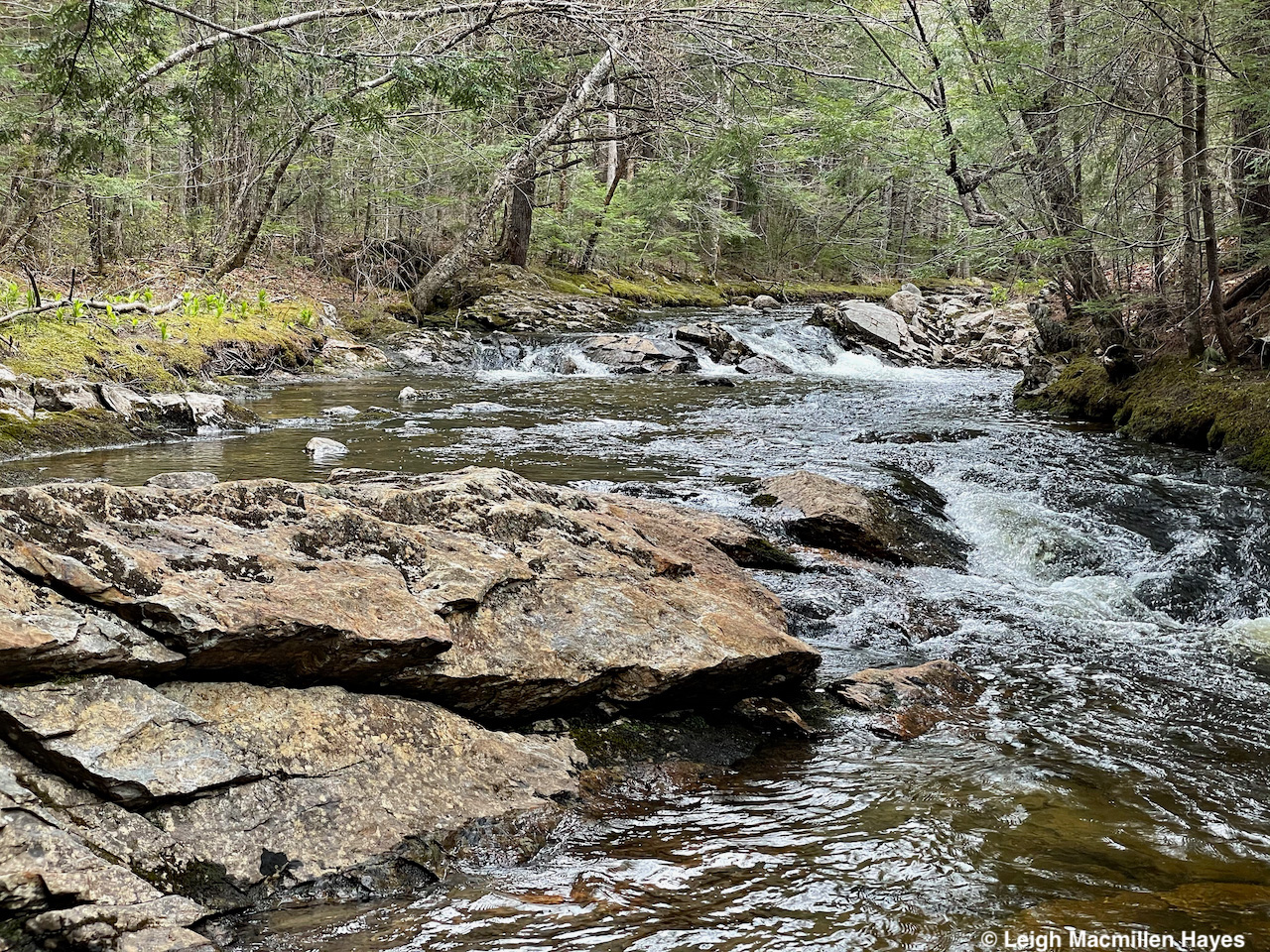
Our journey today found us hiking beside Sanborn River . . .
lunching on top of one of many overturned canoes beside Overset Pond . . .
enjoying the mirror image of the pond from a false summit on the mountain . . .
and taking in the entire scenario from the granite we stood upon to pond below, mountains beyond, and sky that reflected the ledge under our feet.
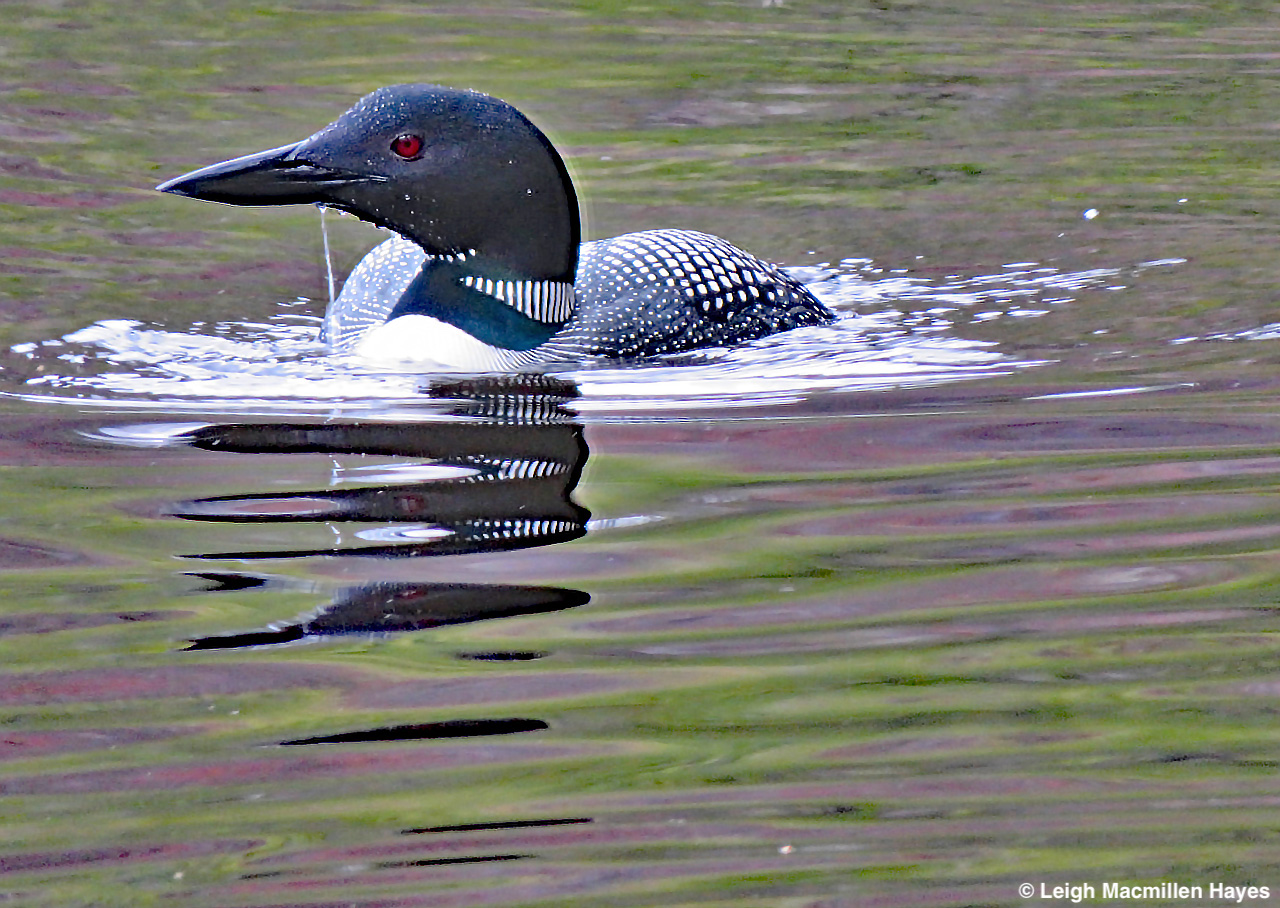
The flowers, the landscape, it was all worth the journey and we made plans to return in the near future. But the icing on the cake or pollen on the flowers was the pair of loons who entertained us from time to time in water so clear that we could see them swim underwater. Their re-emergence, however, was best and we enjoyed our time spent with them.
Overset Mountain and Sanborn River. A perennial favorite. A place to gather a bouquet without picking any flowers. A place to enjoy a variety of natural communities. A place to be native with the natives.
Thanks to Larry Stifler and Mary McFadden for allowing all of us to create an Overset Bouquet any day of the year.
Spring is so fleeting in Maine. Oh, I know, it lasts the usual three months and the beginning and ending overlap with its seasonal partners, but really . . . one must take time to pause and watch or you’ll miss the most amazing action that occurs in slow motion right outside the window–and beyond.
Jinny Mae and I drove beyond today to catch a glimpse of this most splendid season.
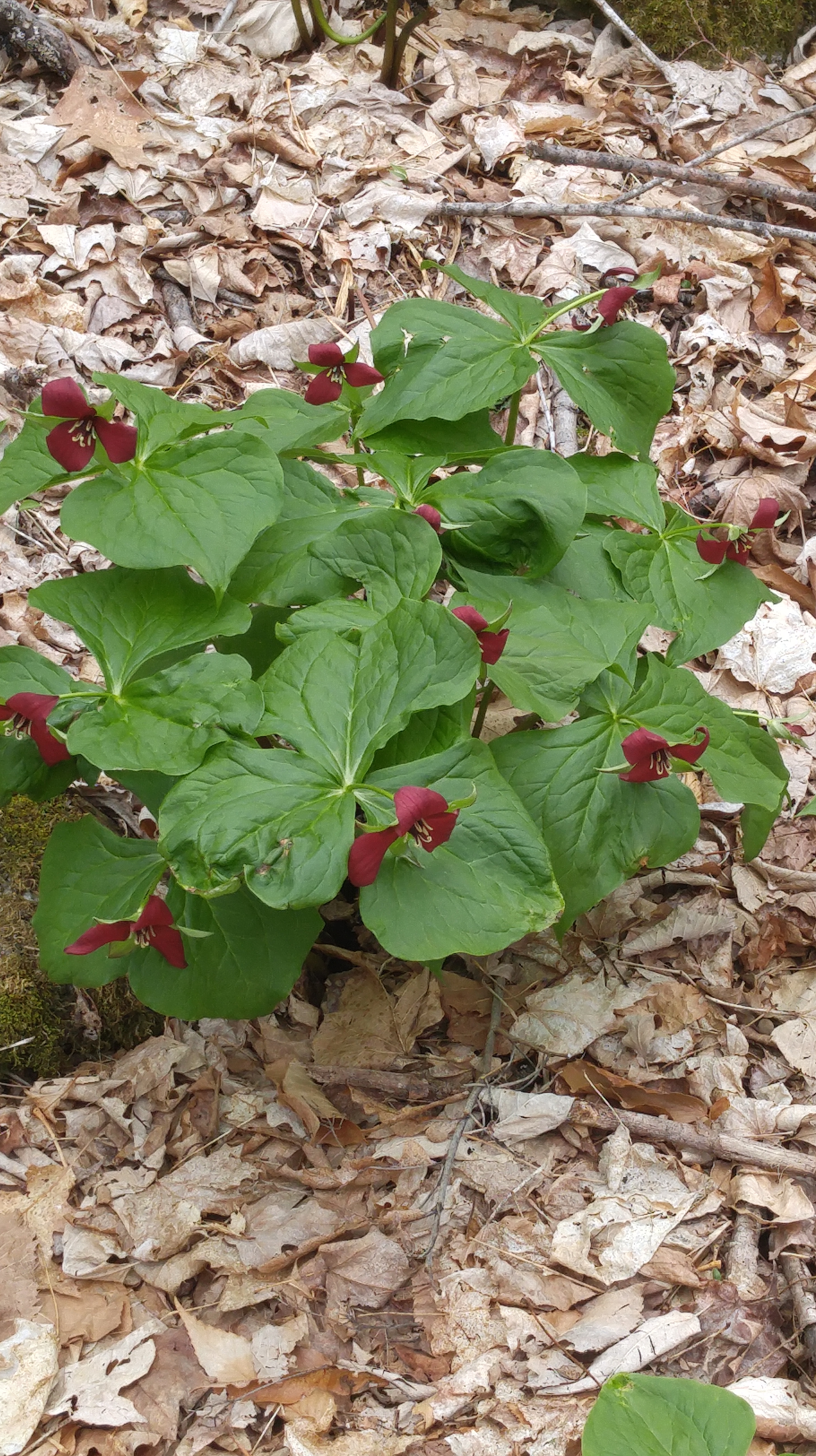
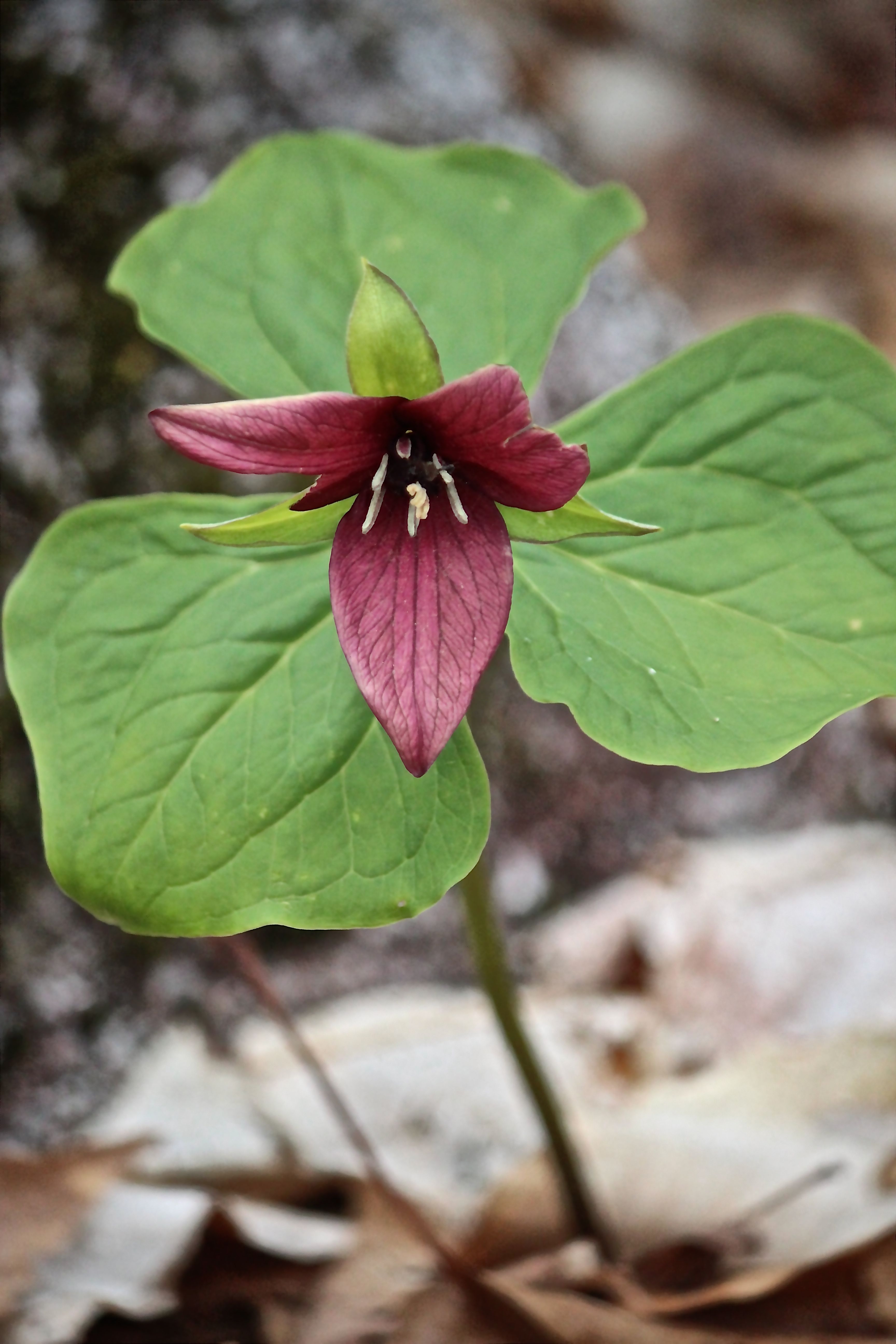
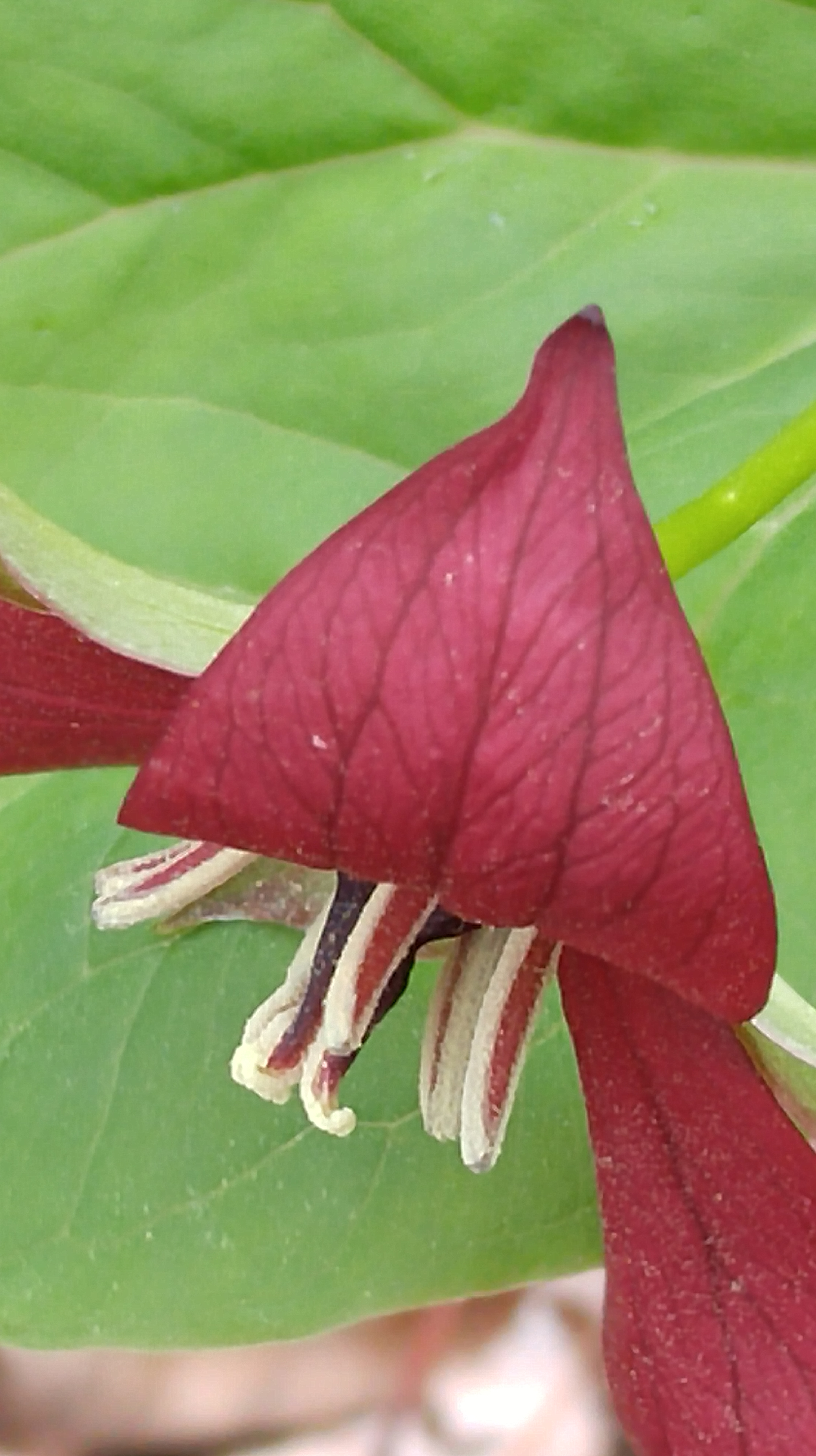
Among the offerings, red trillium also known as stinking Benjamin. The Benjamin part is from benzoin, a mid-16th century word derived from the French benjoin, that refers to “a fragrant gum resin obtained from a tropical tree of eastern Asia, used in medicines, perfumes, and incense.” It’s been tagged “stinking” because its nodding flower has an unpleasant odor. We didn’t bother to sniff. We were too busy being wowed by the fact that it surrounded us in great number.
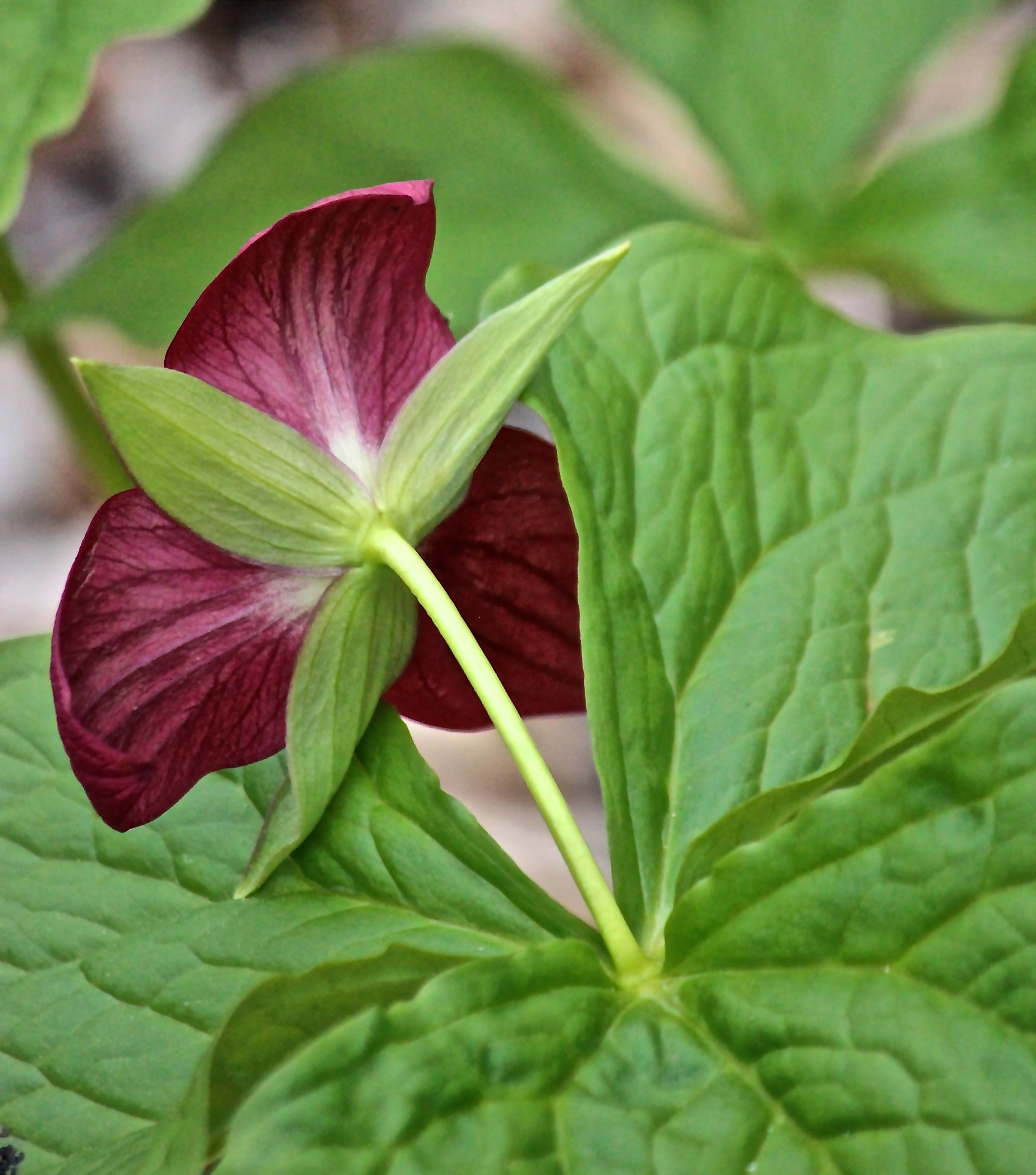
That smell, however, is of extreme importance. Along with the flashy coloration, the odor helps to attract pollinators–green flesh-flies that prefer to lay their eggs on rotting meat. Though this isn’t the perfect nursery, the flies assist the plant on the procreative end. And in this spot, stinking Benjamin rules, but I prefer to think of it as red trillium.
Even from the backside, its design is one to behold.
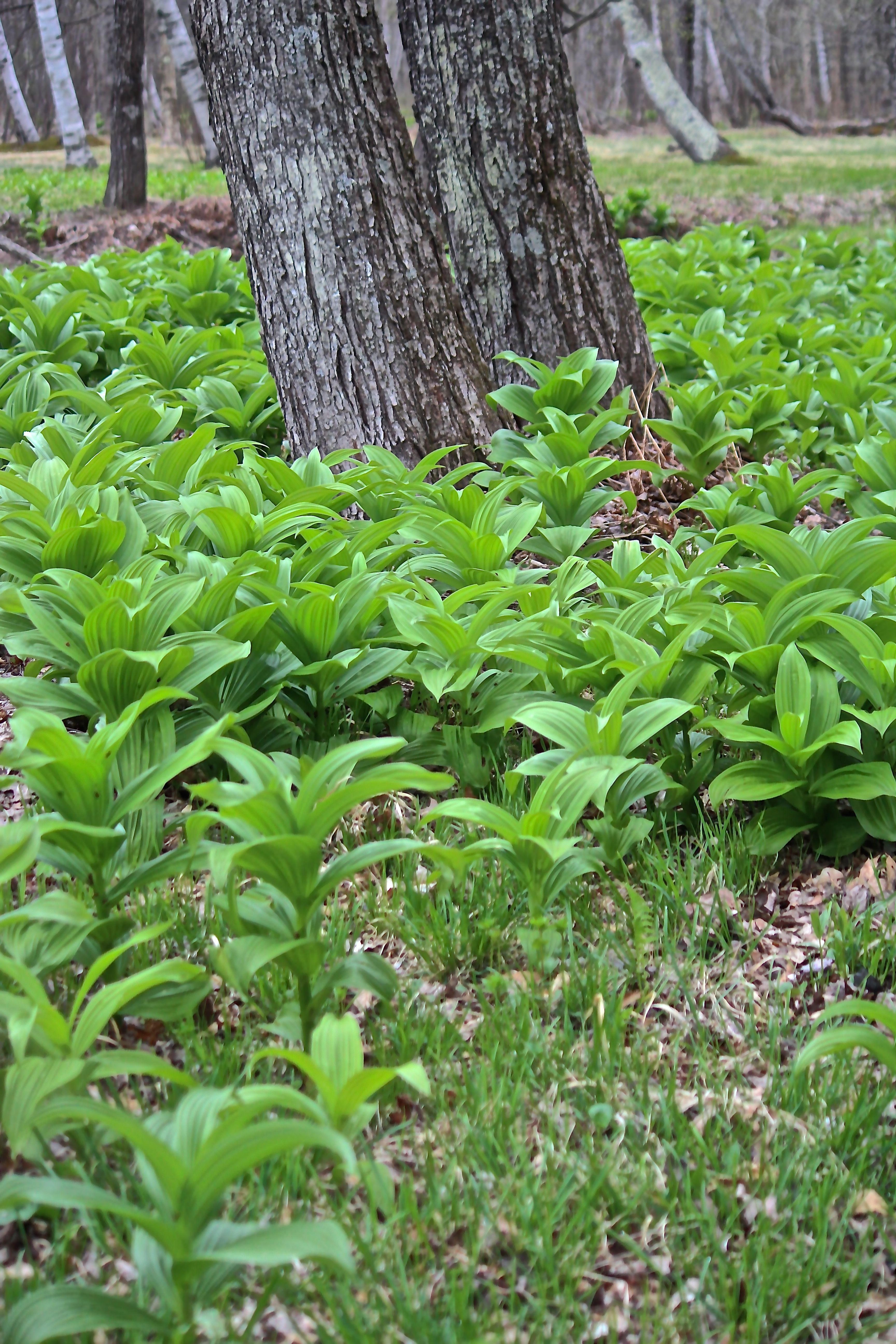
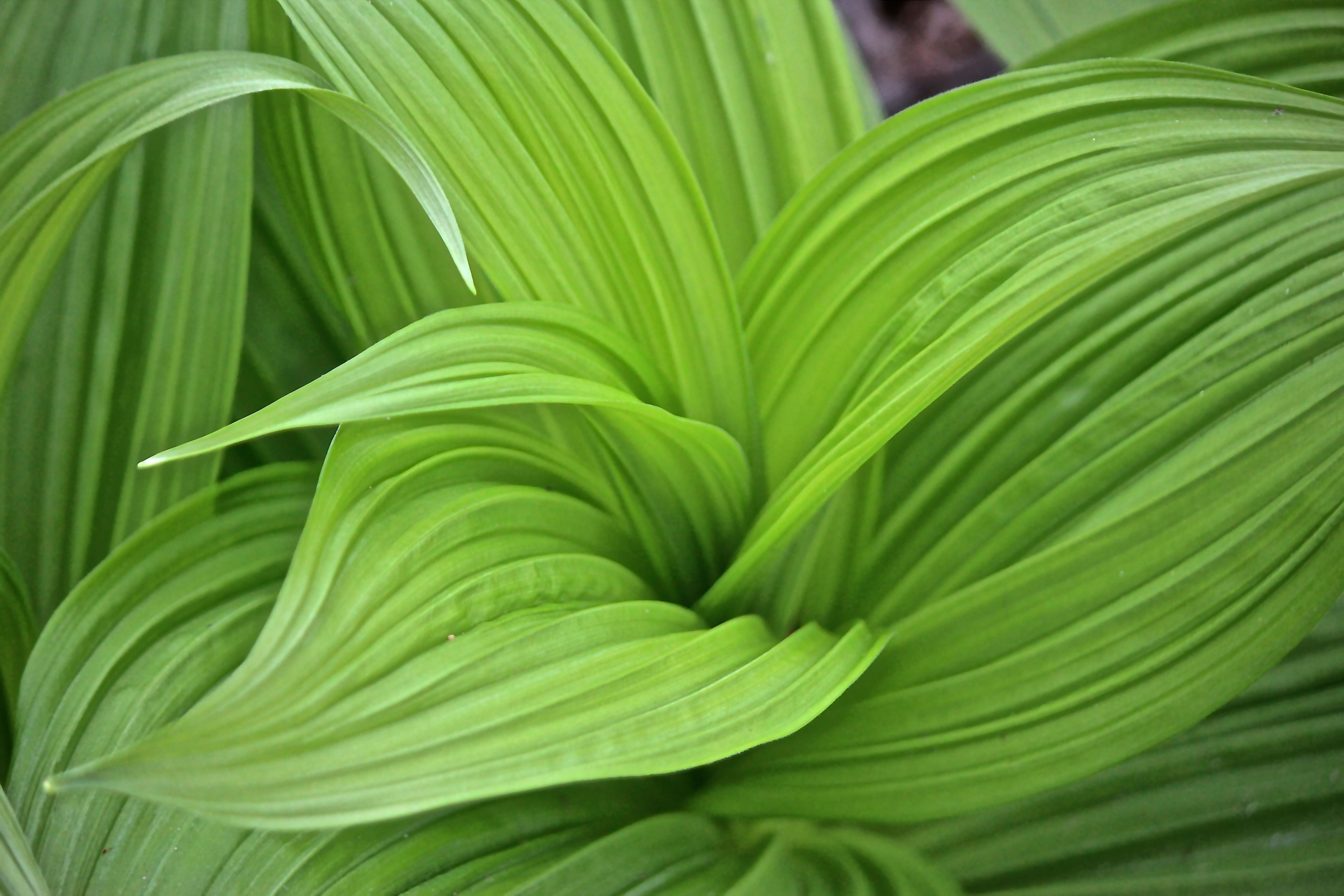
Equally abundant were the leafy structures of false hellebore.
I was mesmerized by its pattern.
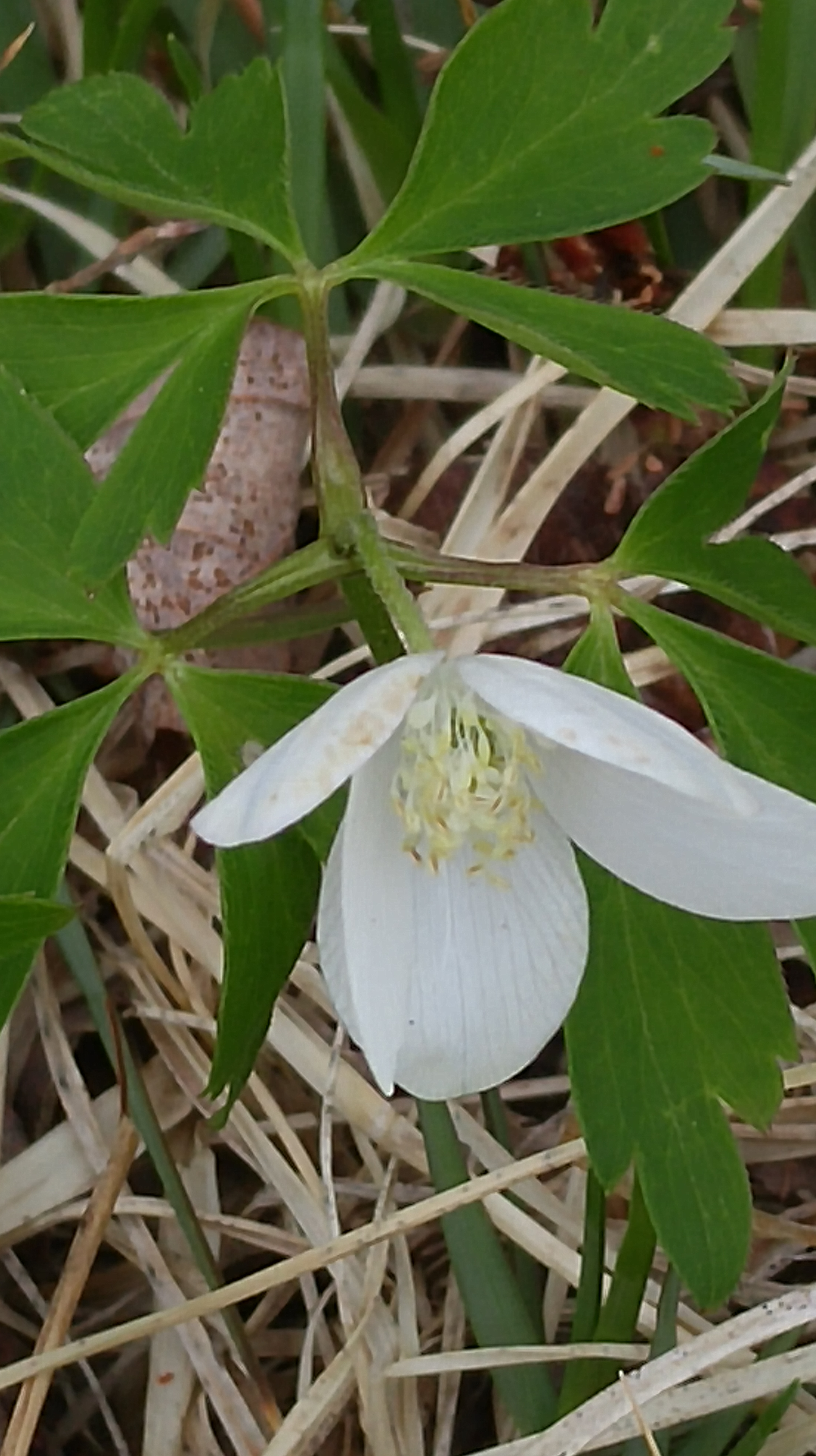
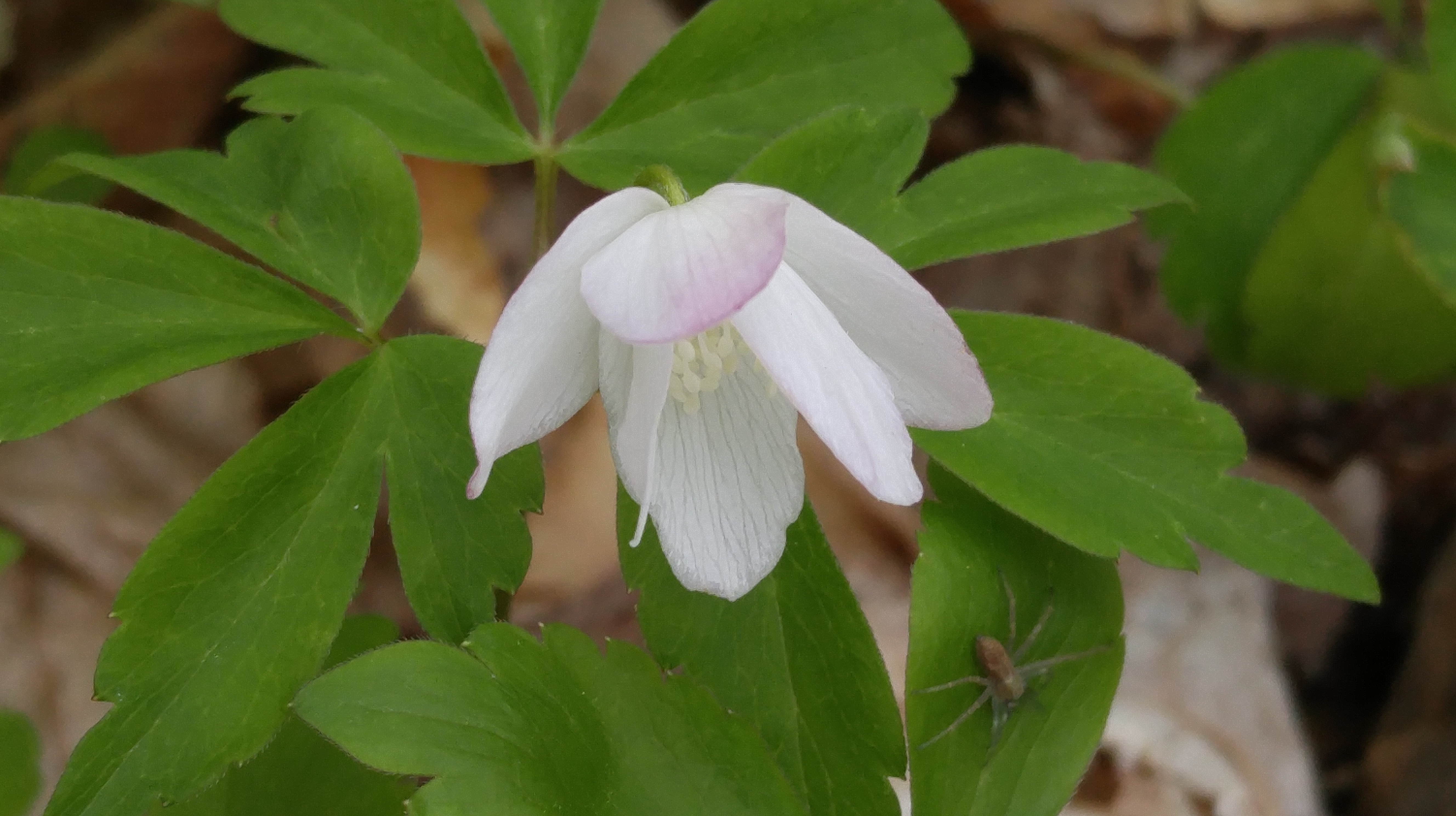
Unlike the trillium, wood anemones have little scent.
Their graceful heads drooped, perhaps because the day threatened rain.
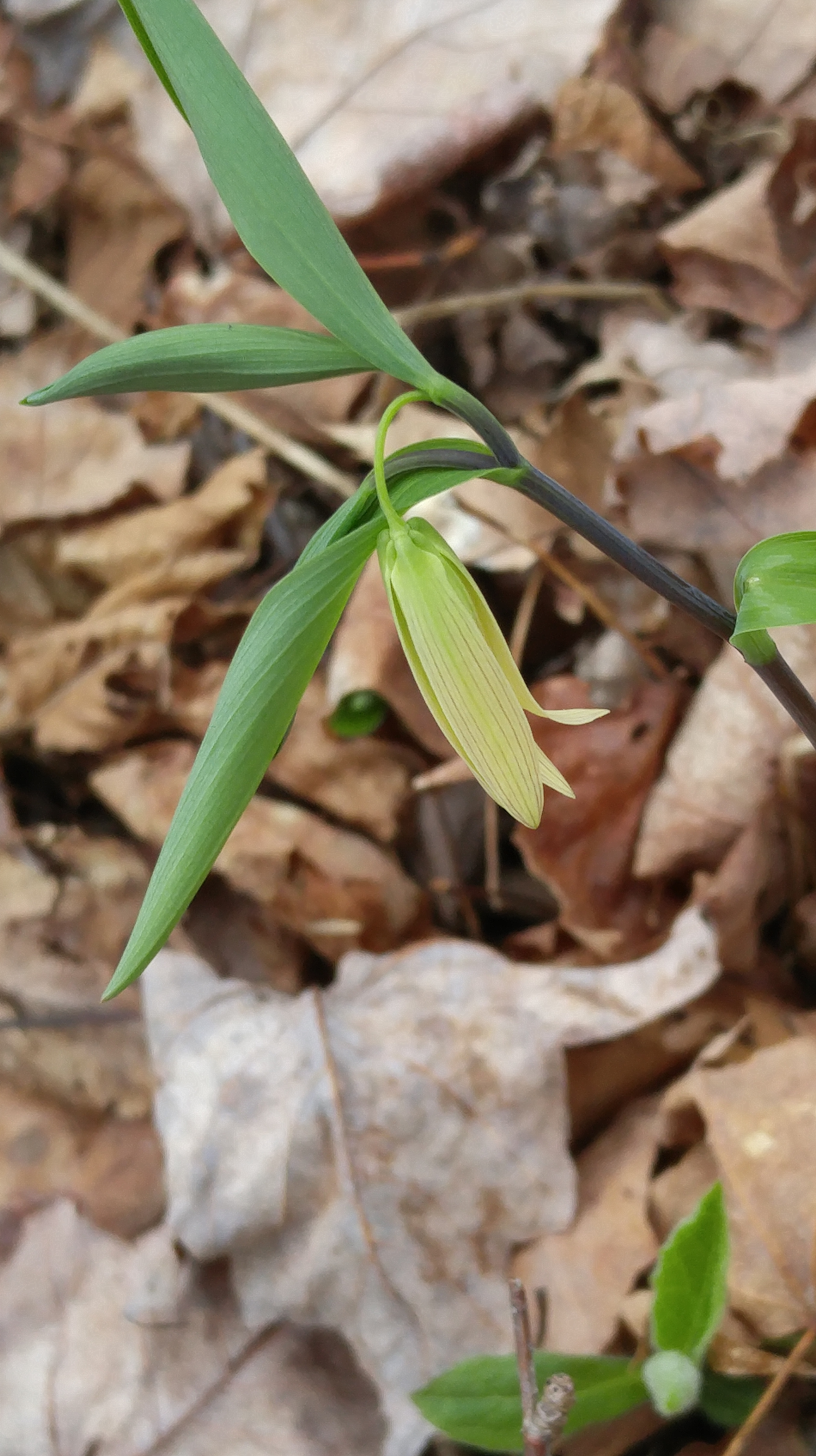
The offerings included sessile-leaved bellwort (aka wild oats),
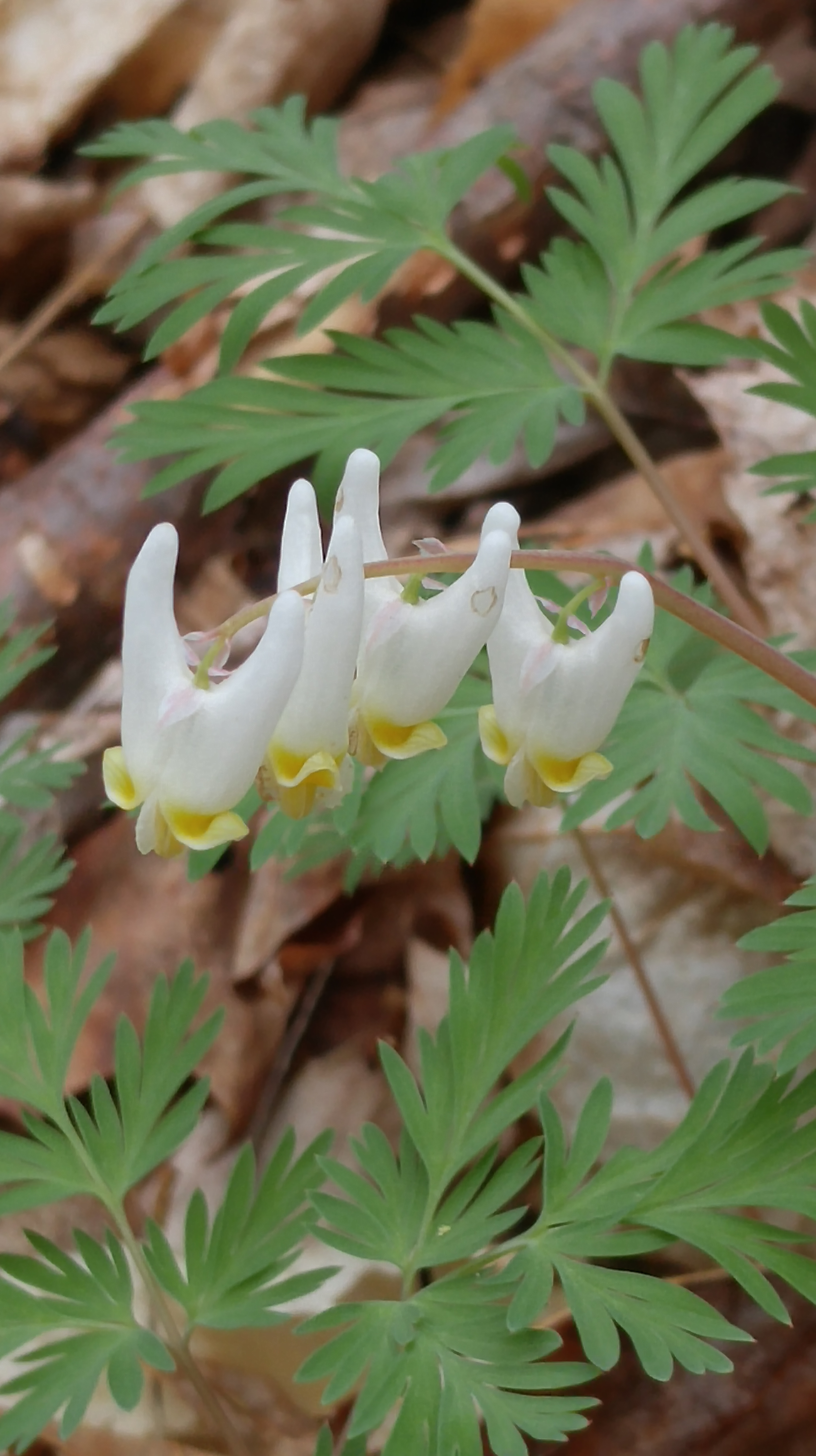
Dutchman’s breeches with leaves as interesting as their flowers,
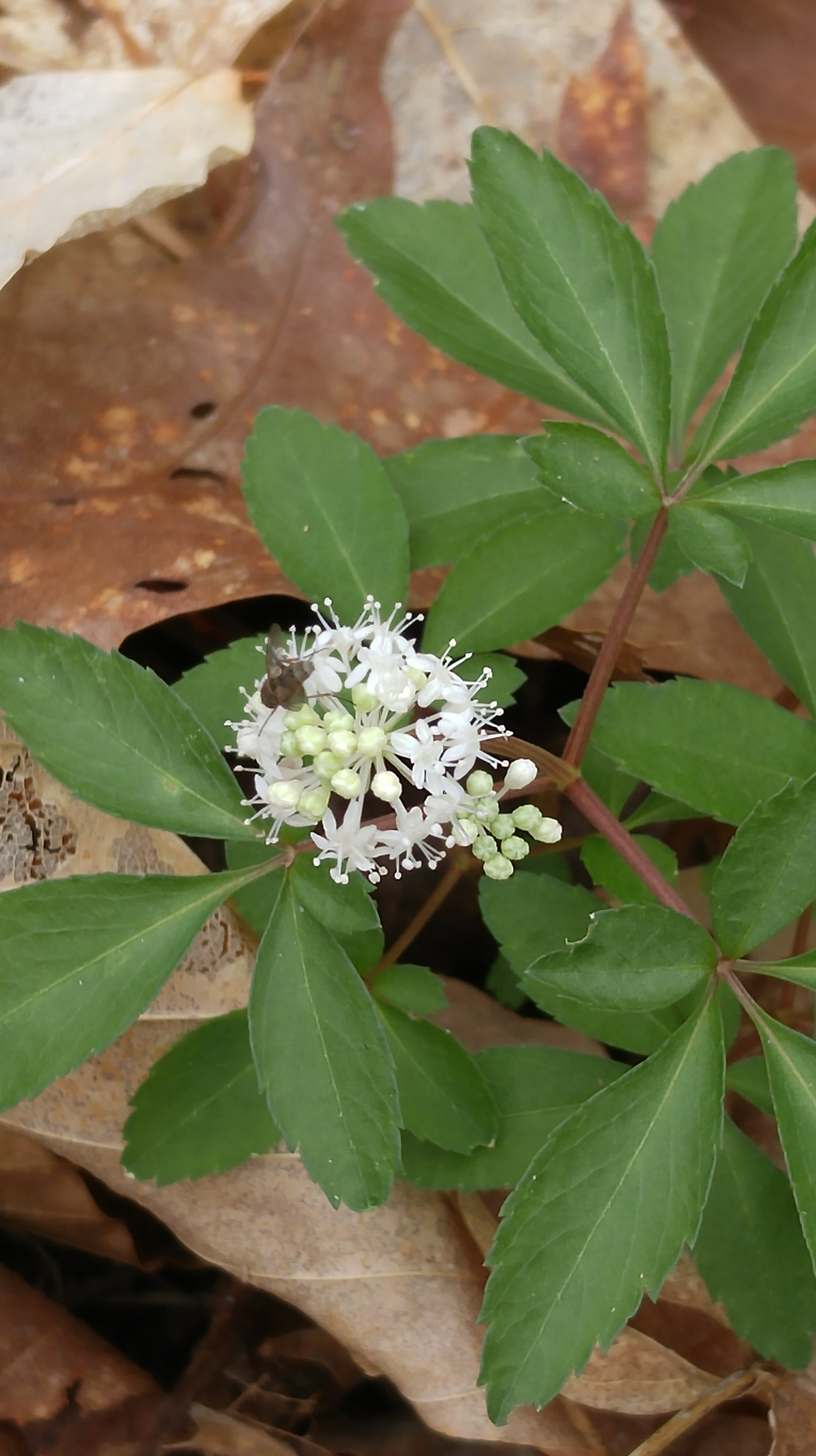
the delicate white flowers of dwarf ginseng,
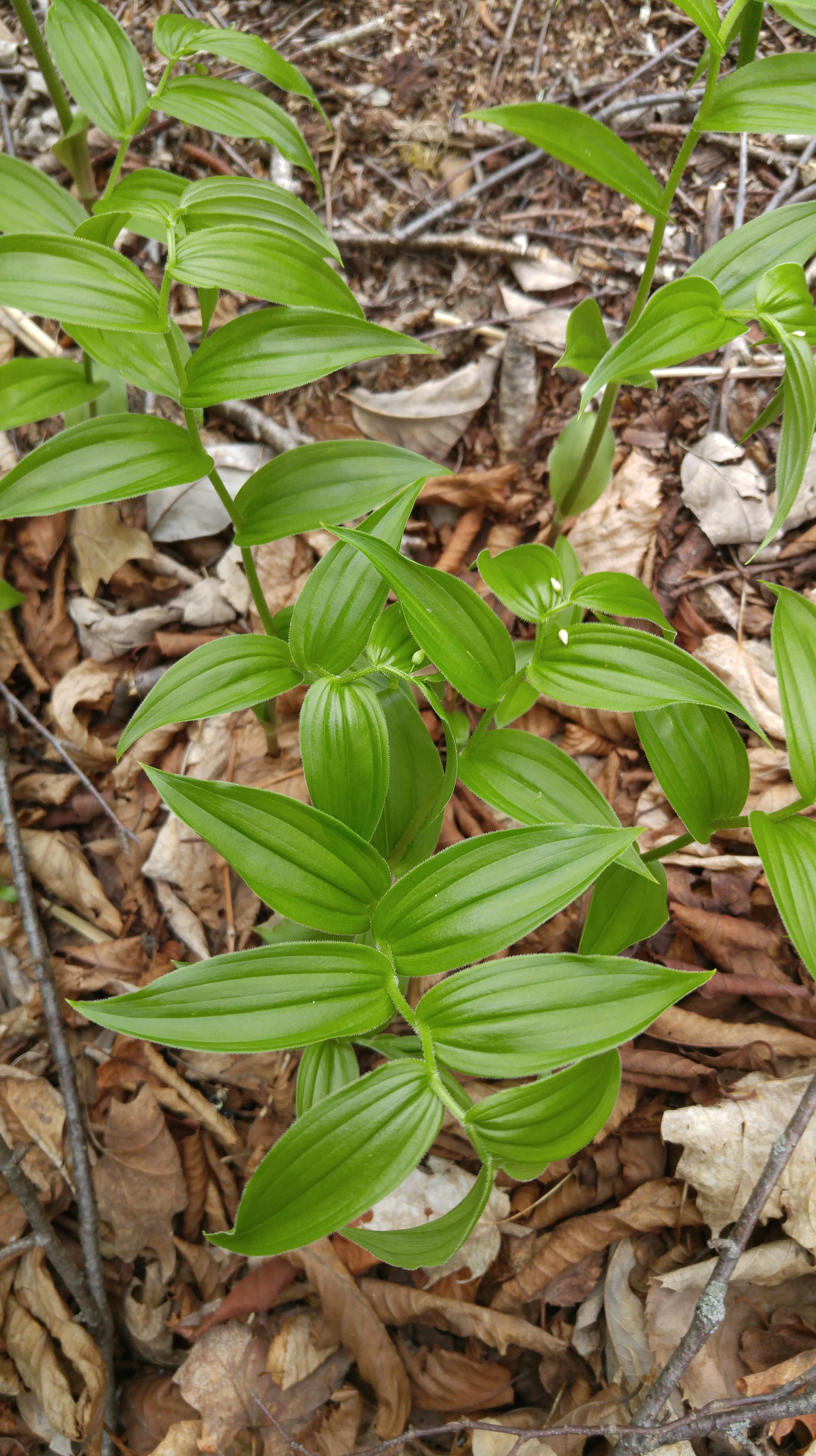
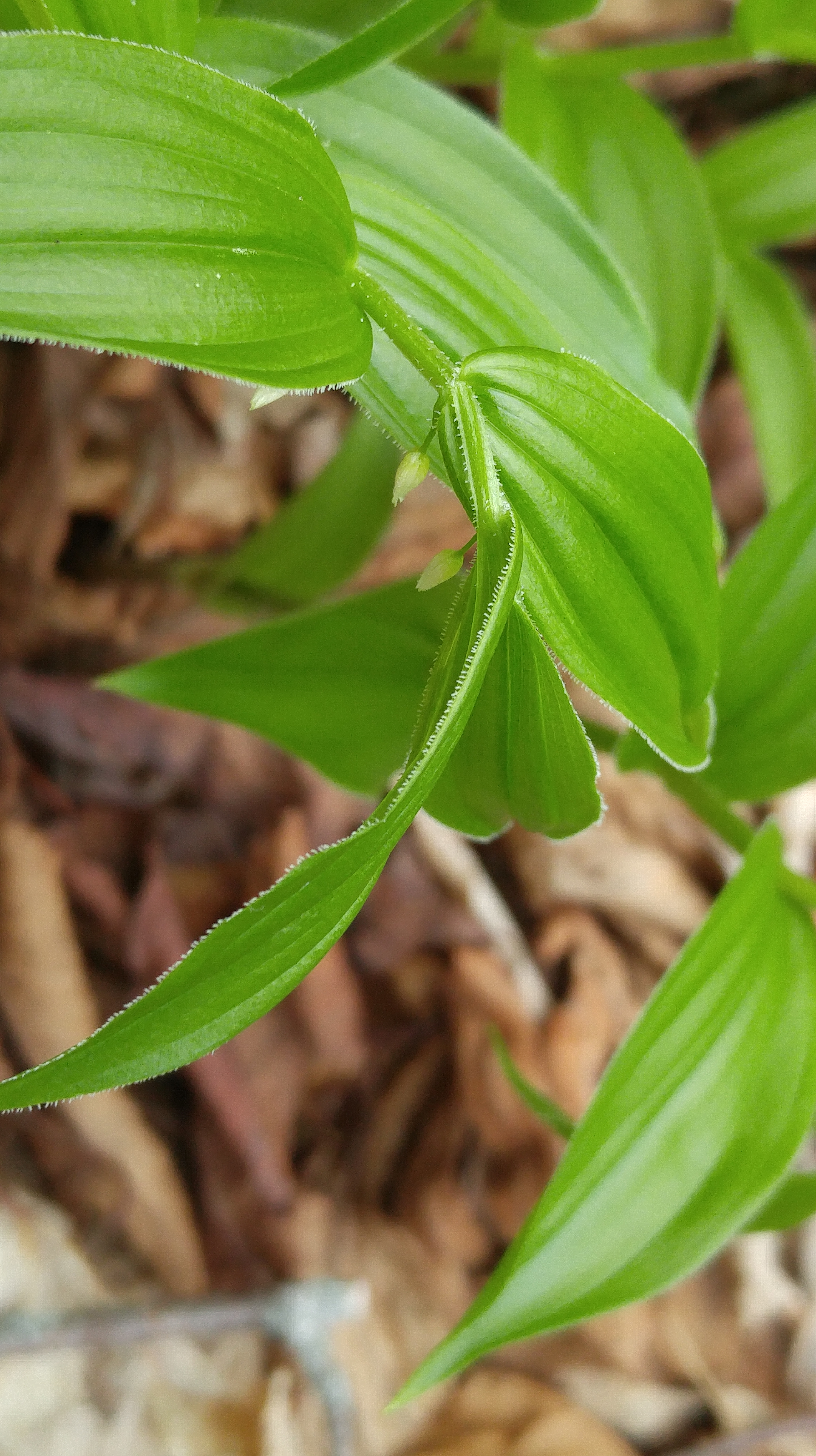
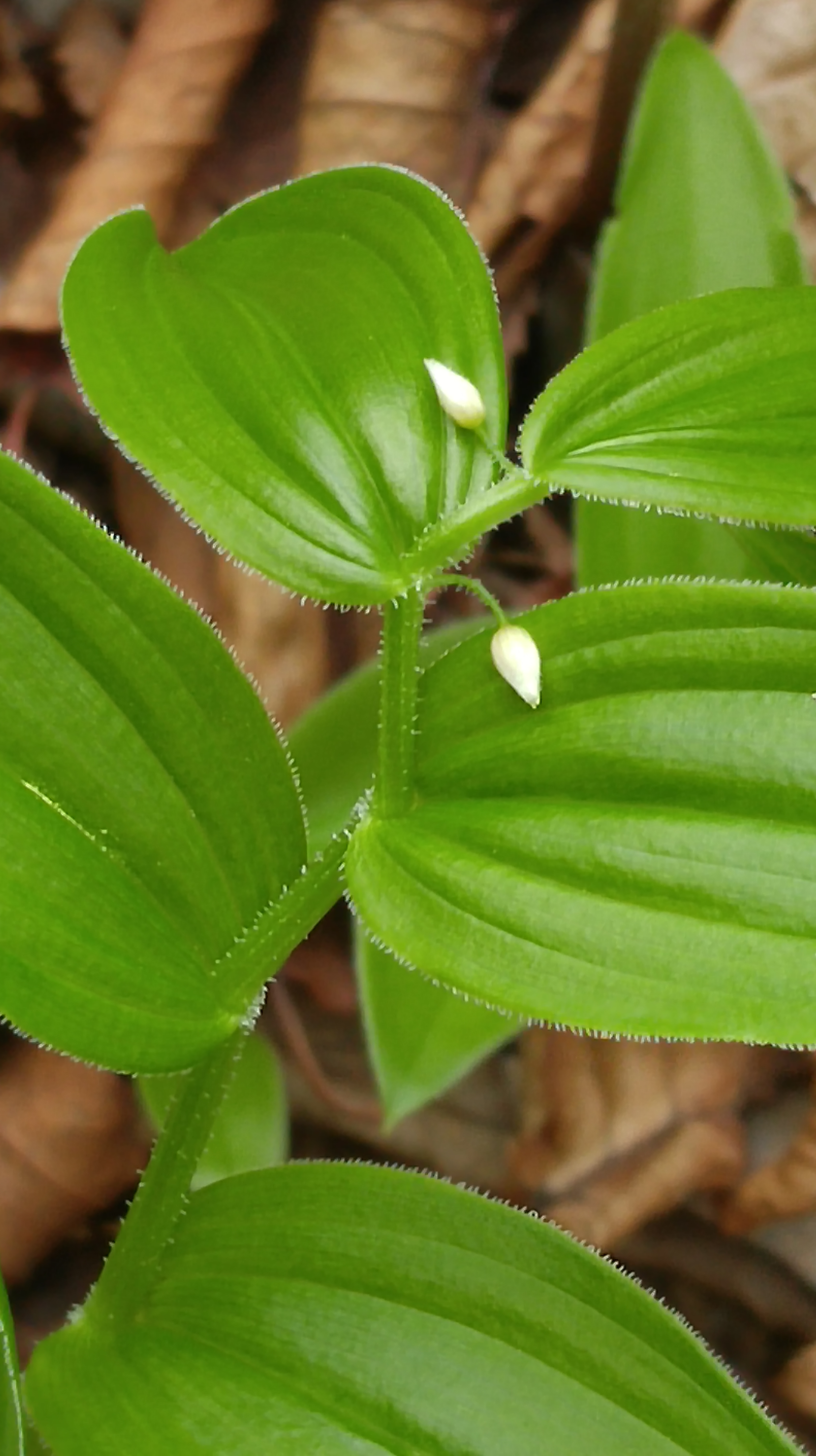
and zigzag pattern of clasping twisted stalk.
Its key features are minutely-toothed leaf margins, stalkless leaves that clasp the stem, and flowers dangling below.
The flowers hadn’t opened, but the closer we got, the more we appreciated its finer details.
Ever so slowly, as is the case in all things, hobblebush flowers began to bloom.
Outer sterile flowers form a ring around the delicate inner flowers that are fertile. Nature has a way of protecting its own.
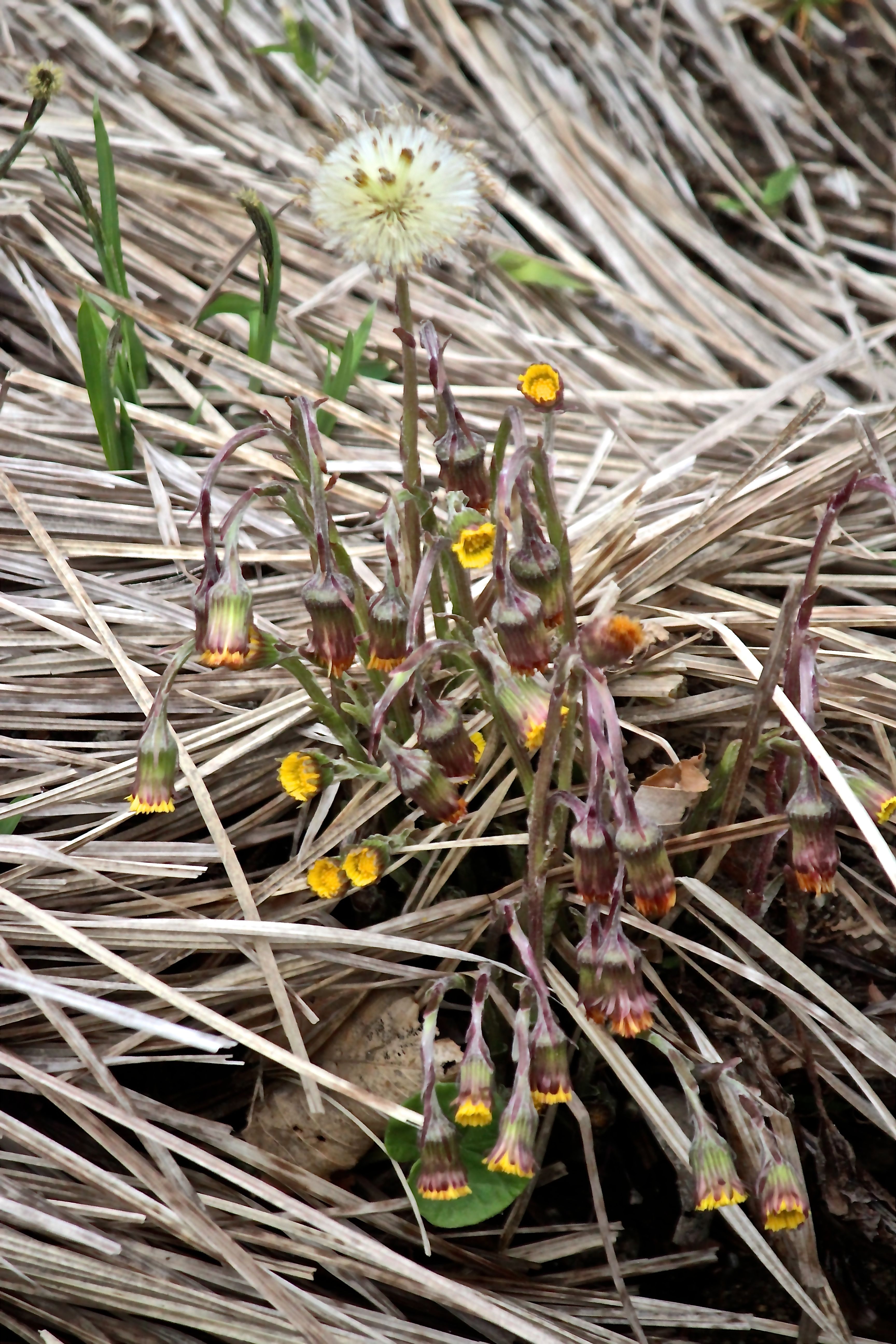
When we first spotted the fluff ball of seeds across the brook, we thought we were looking at dandelions. And then we saw the scaled stalks and lack of leaves. Coltsfoot it is.
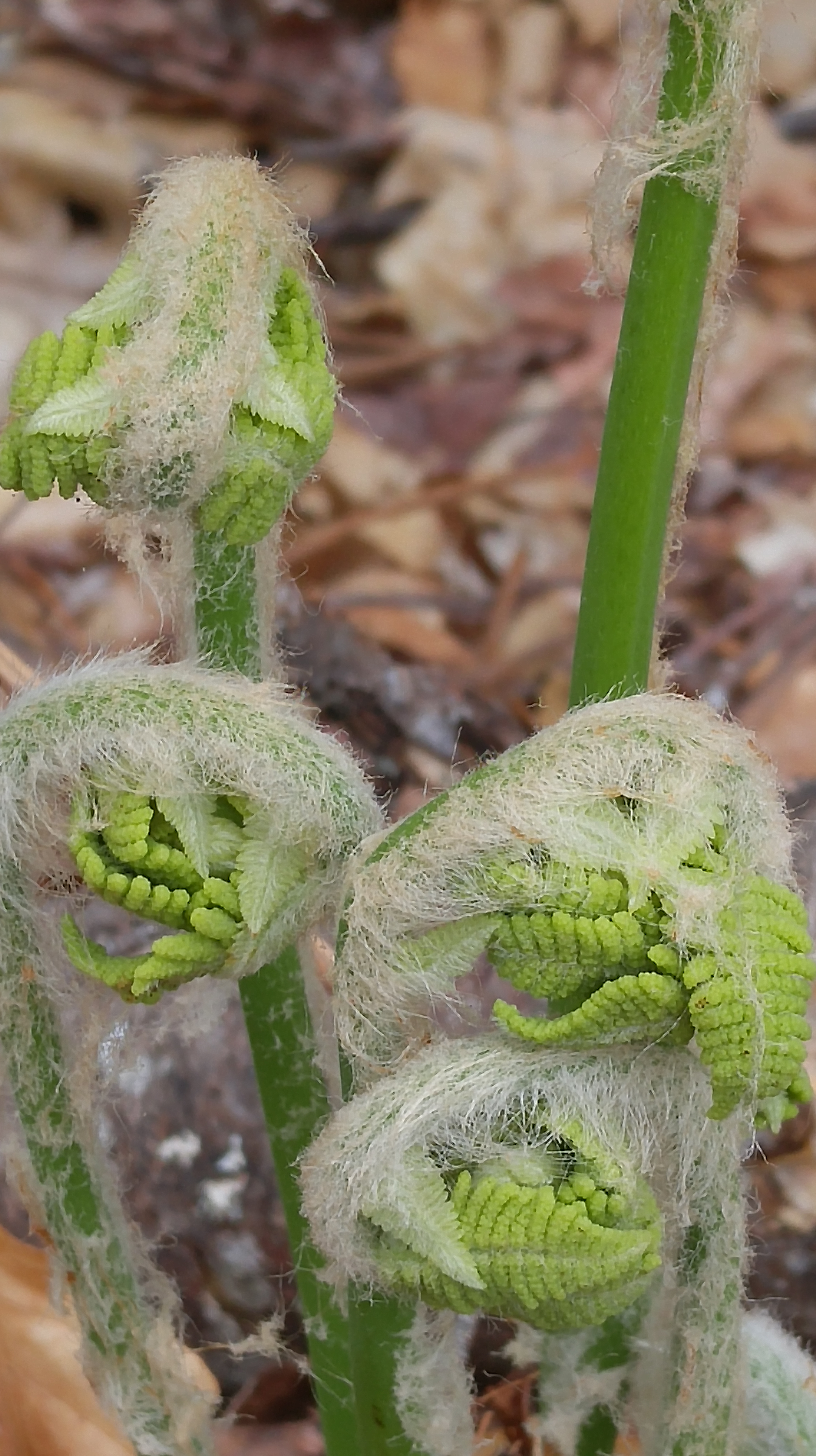
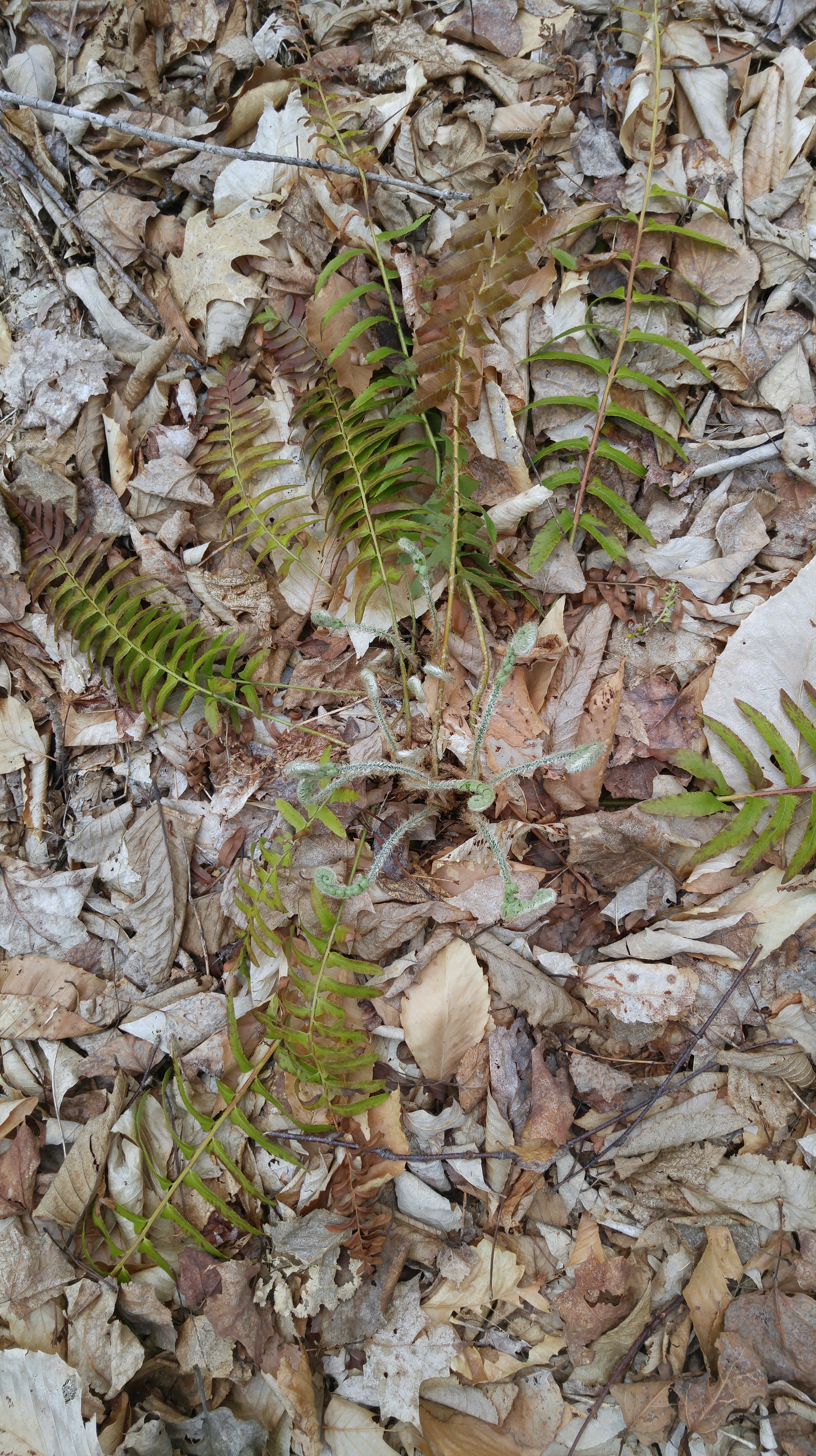
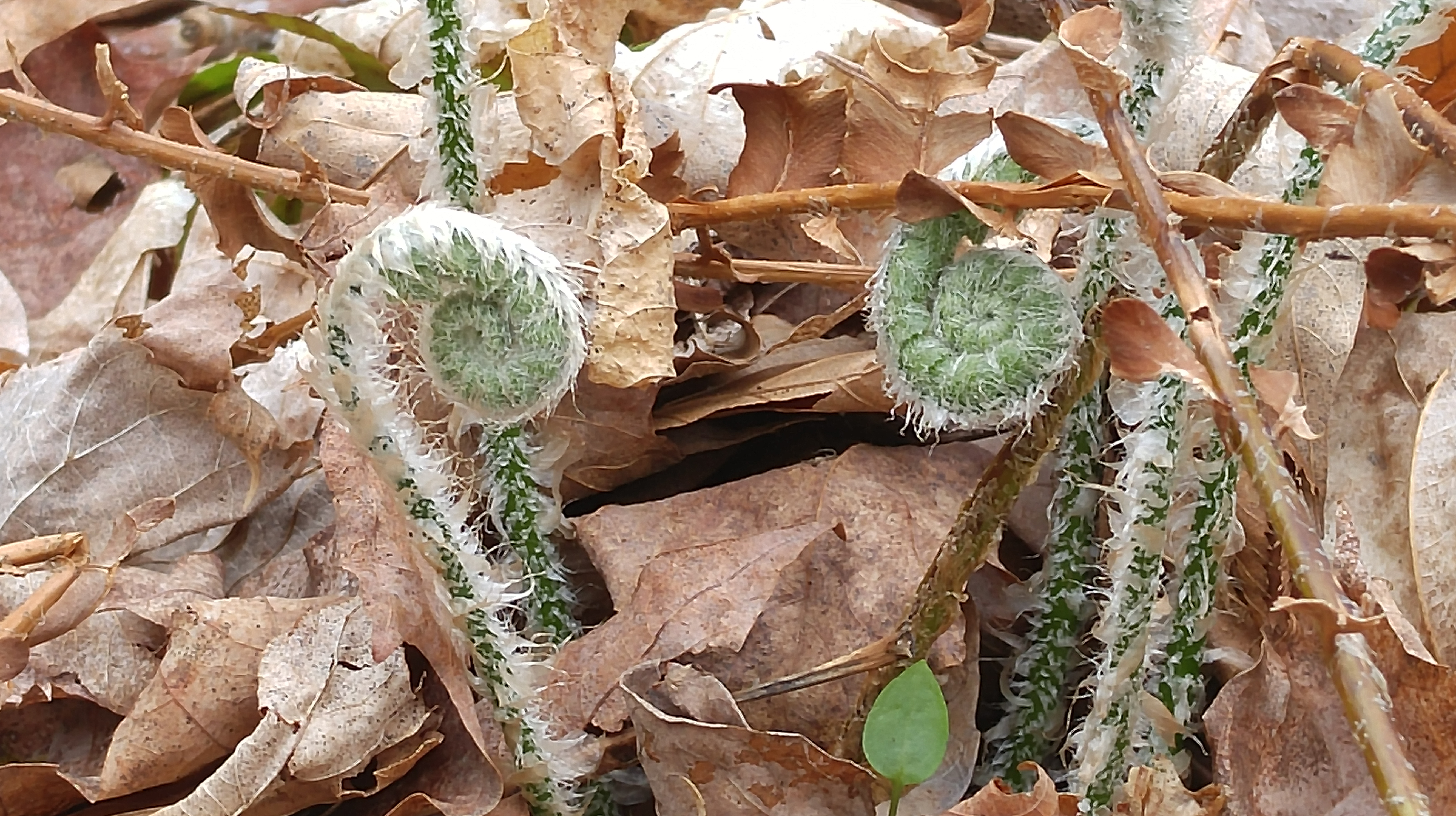
It wasn’t just the flowers that had us getting down on our hands and knees. There was the brownish wool covering of the cinnamon fern.
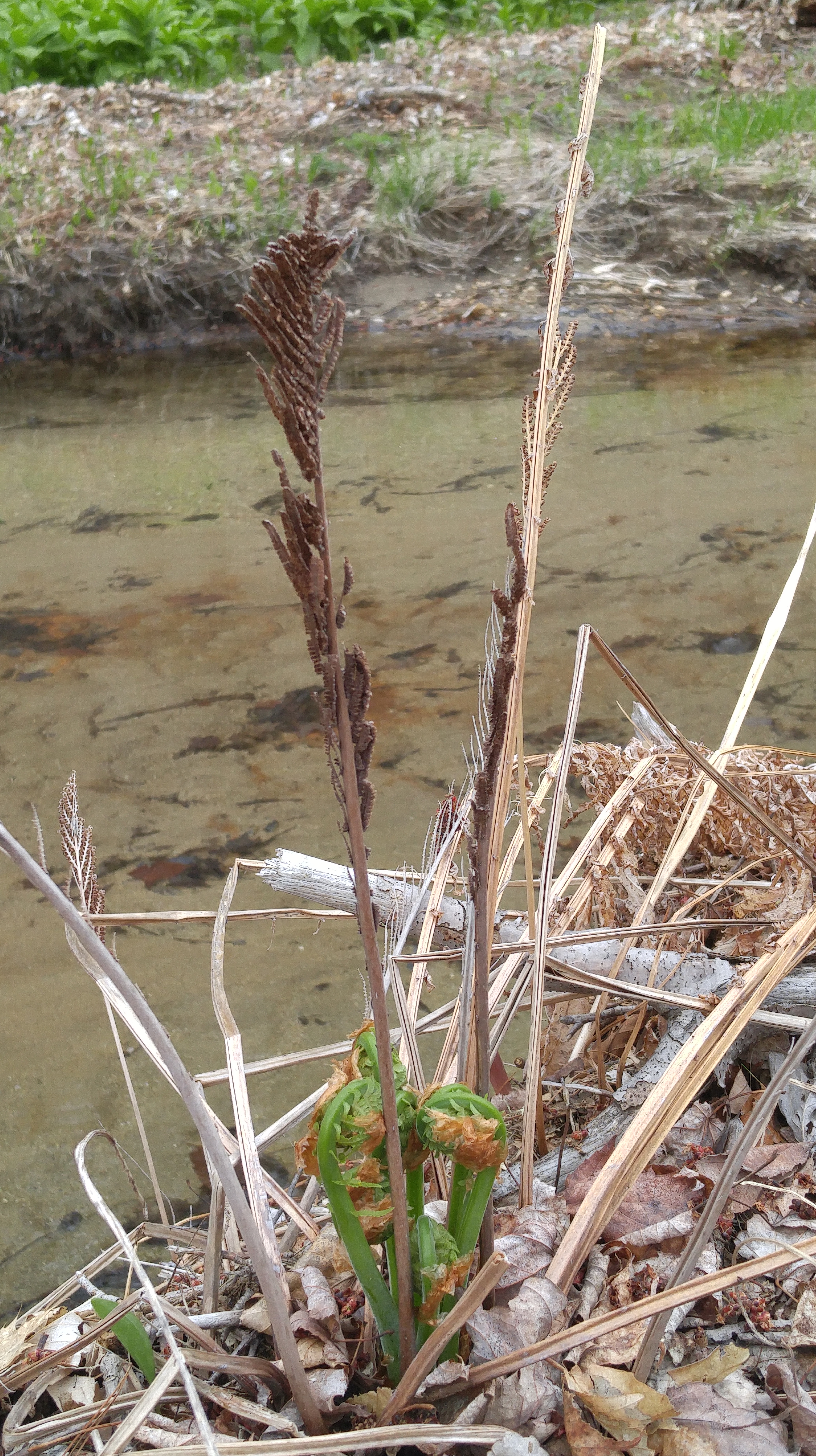
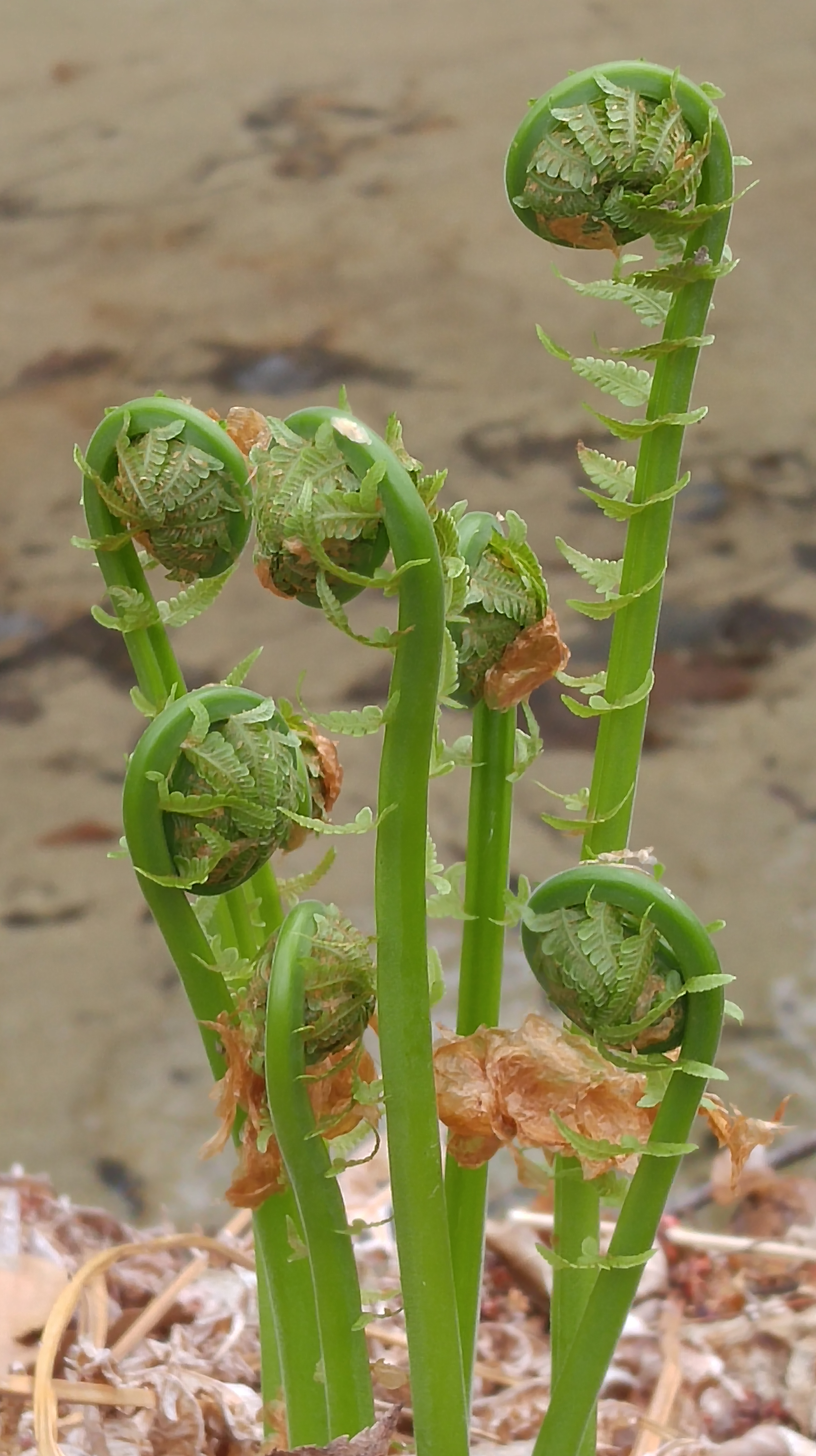
And the hairless ostrich fern
with its crook-shaped crosier, reminiscent of a bishop’s staff.
But my favorite today was one I’d never noticed before.
Oh, I know it’s a Christmas fern, but the tightly-wound, silvery-scaled crosiers were new to me. It was yet another chance for us to wonder how we could have missed something that’s been here all along.
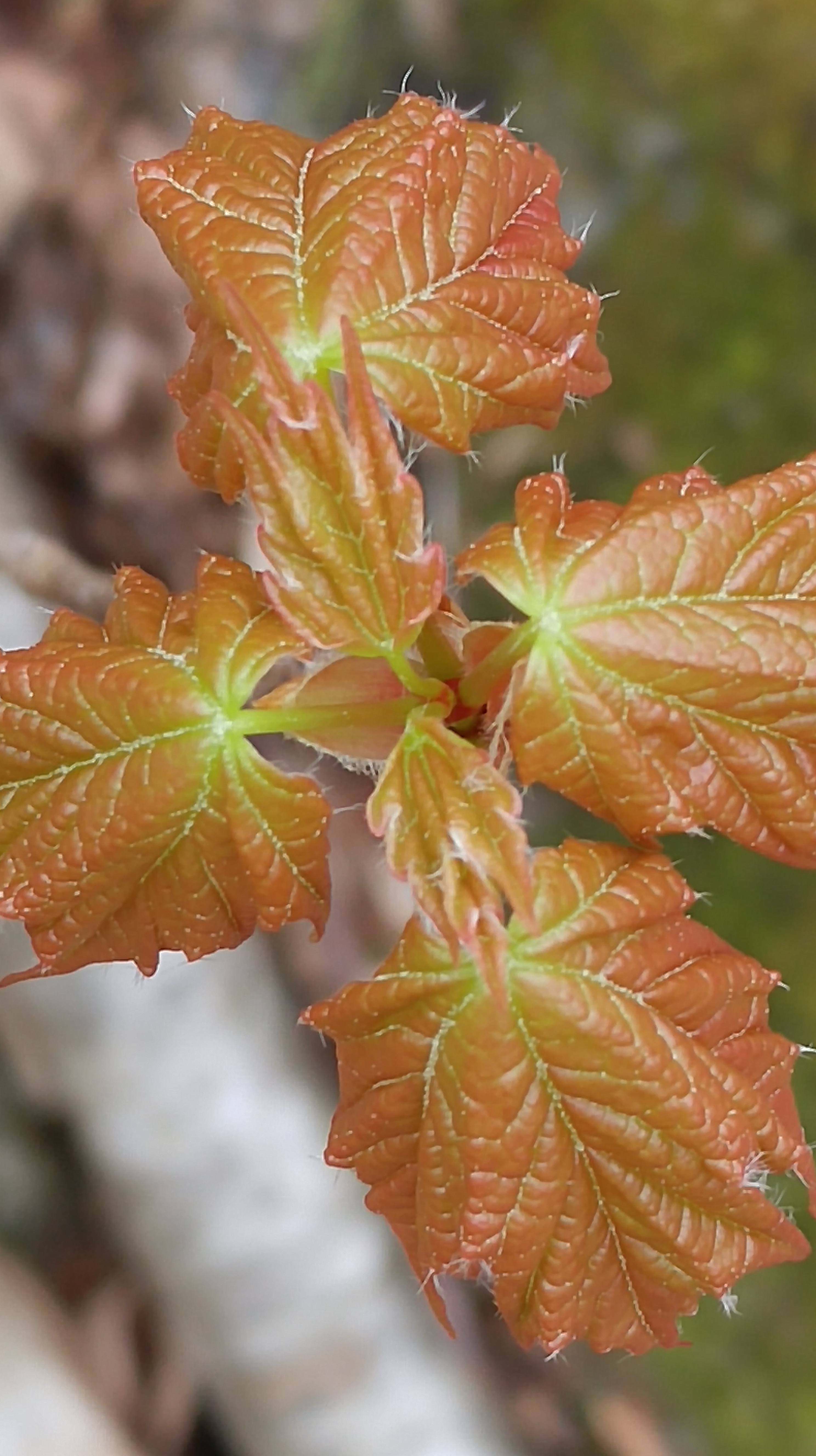
And then we looked up. Well, sort of up. Striped maple leaves slowly opened in the understory.
And have you ever noticed that young red maples are a tad hairy along the margin?
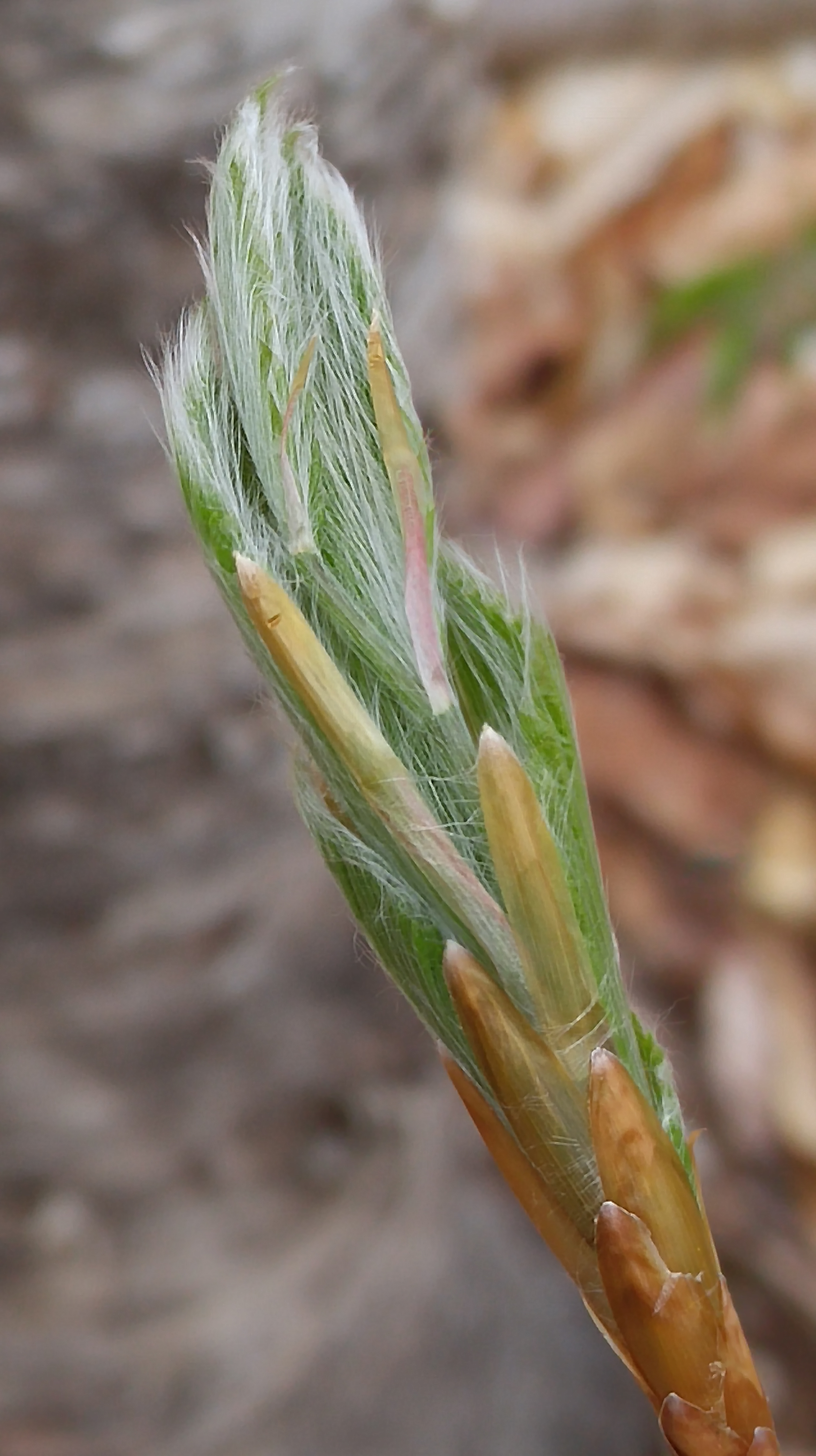
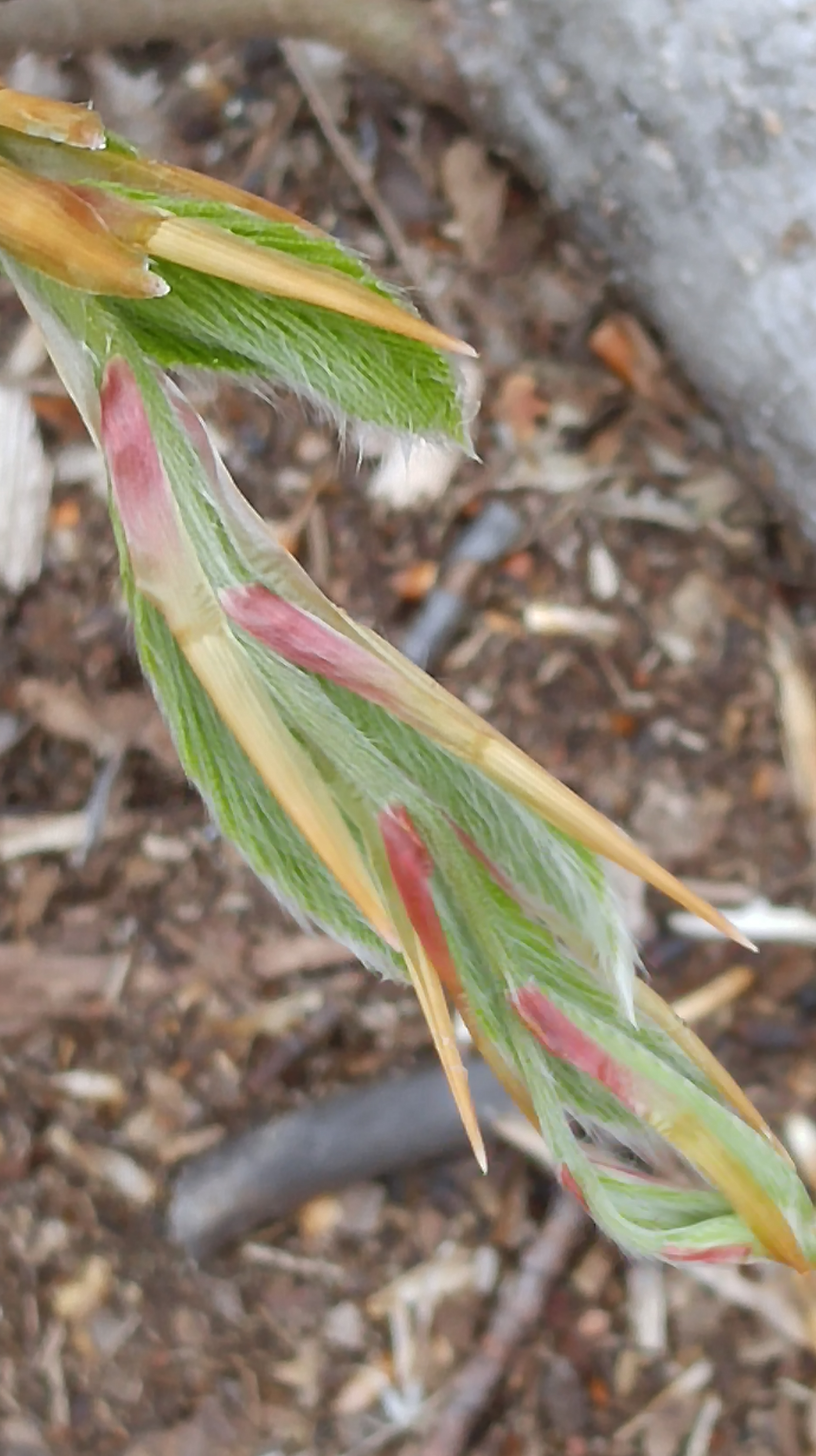
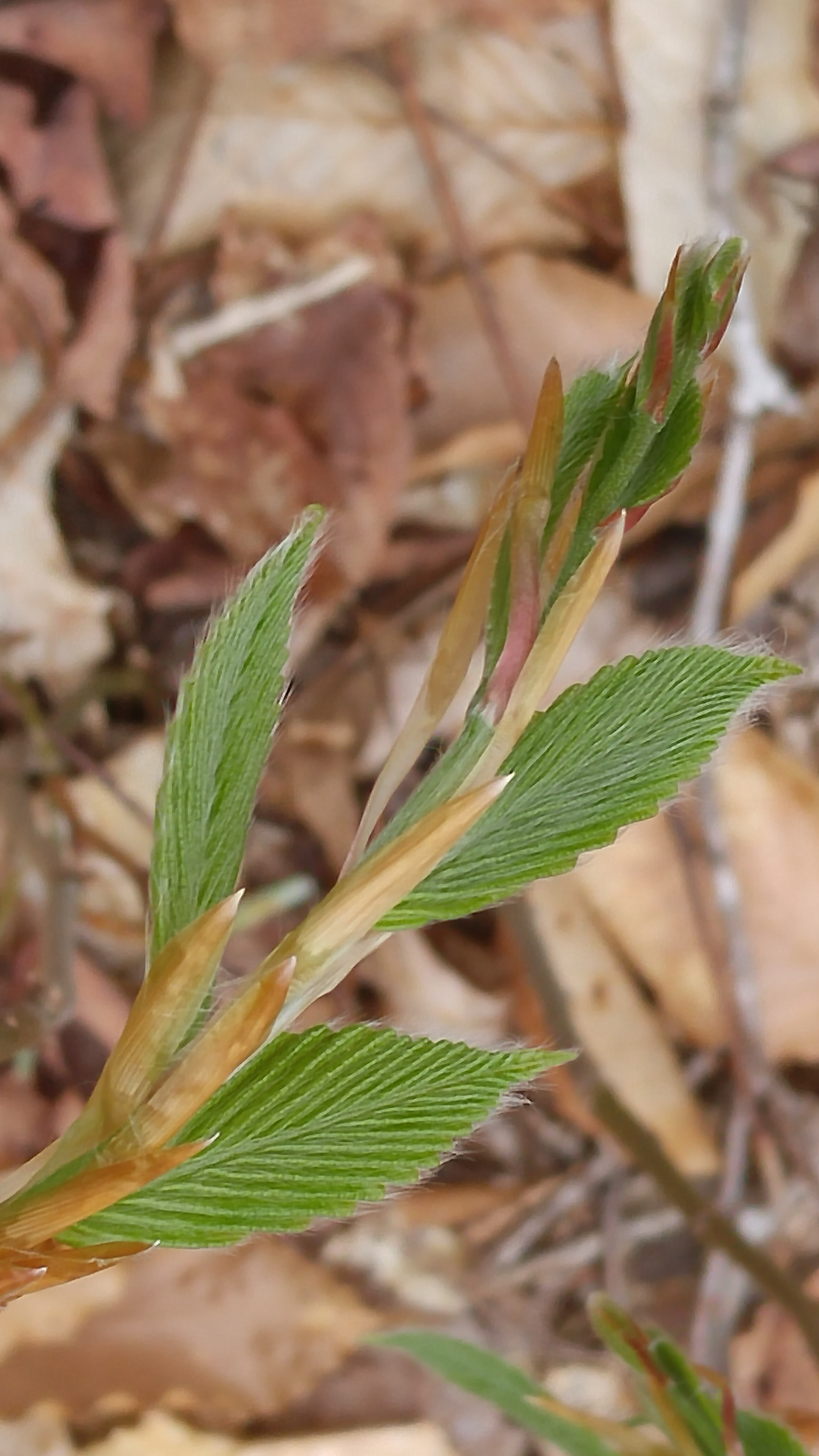
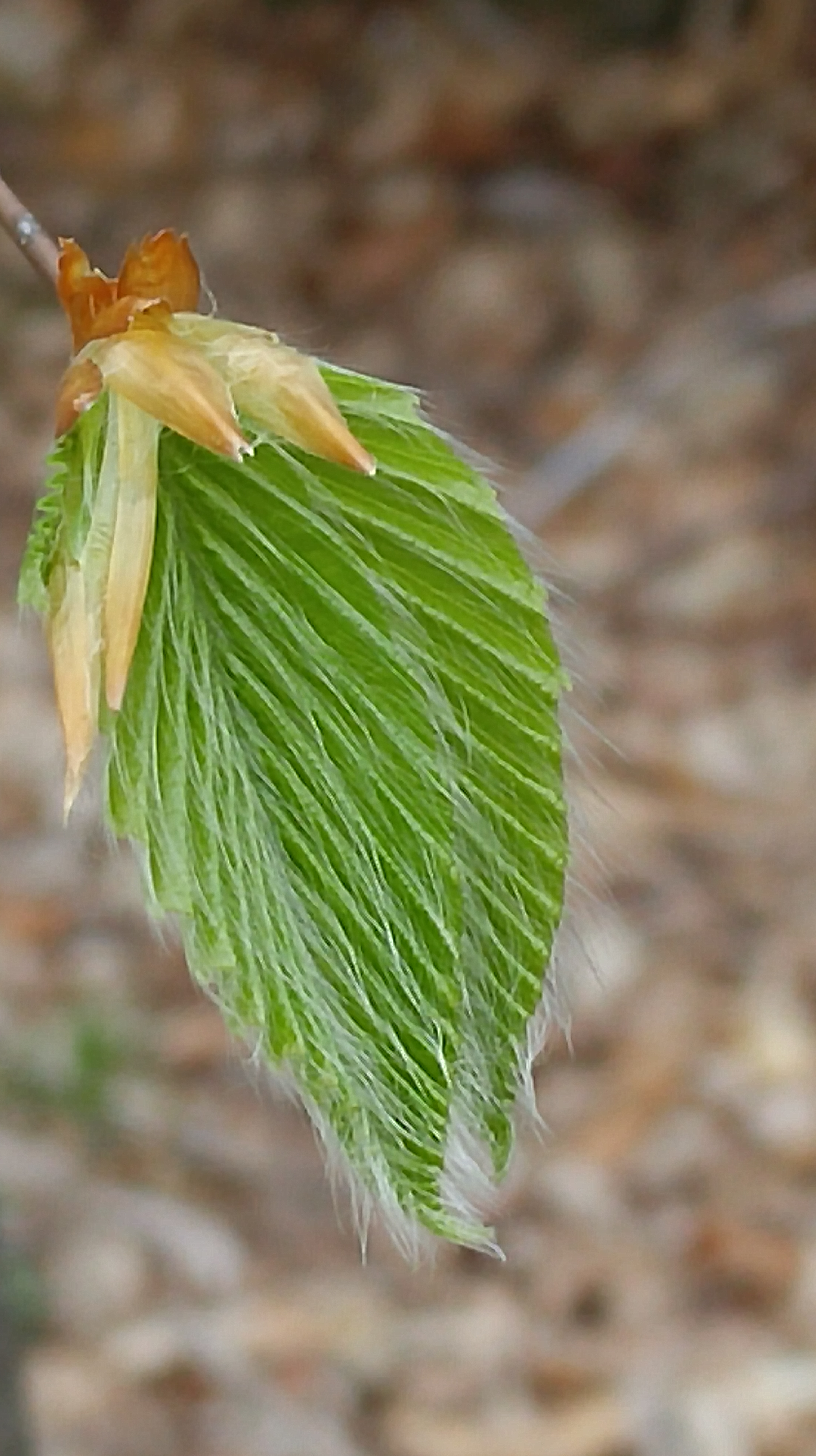
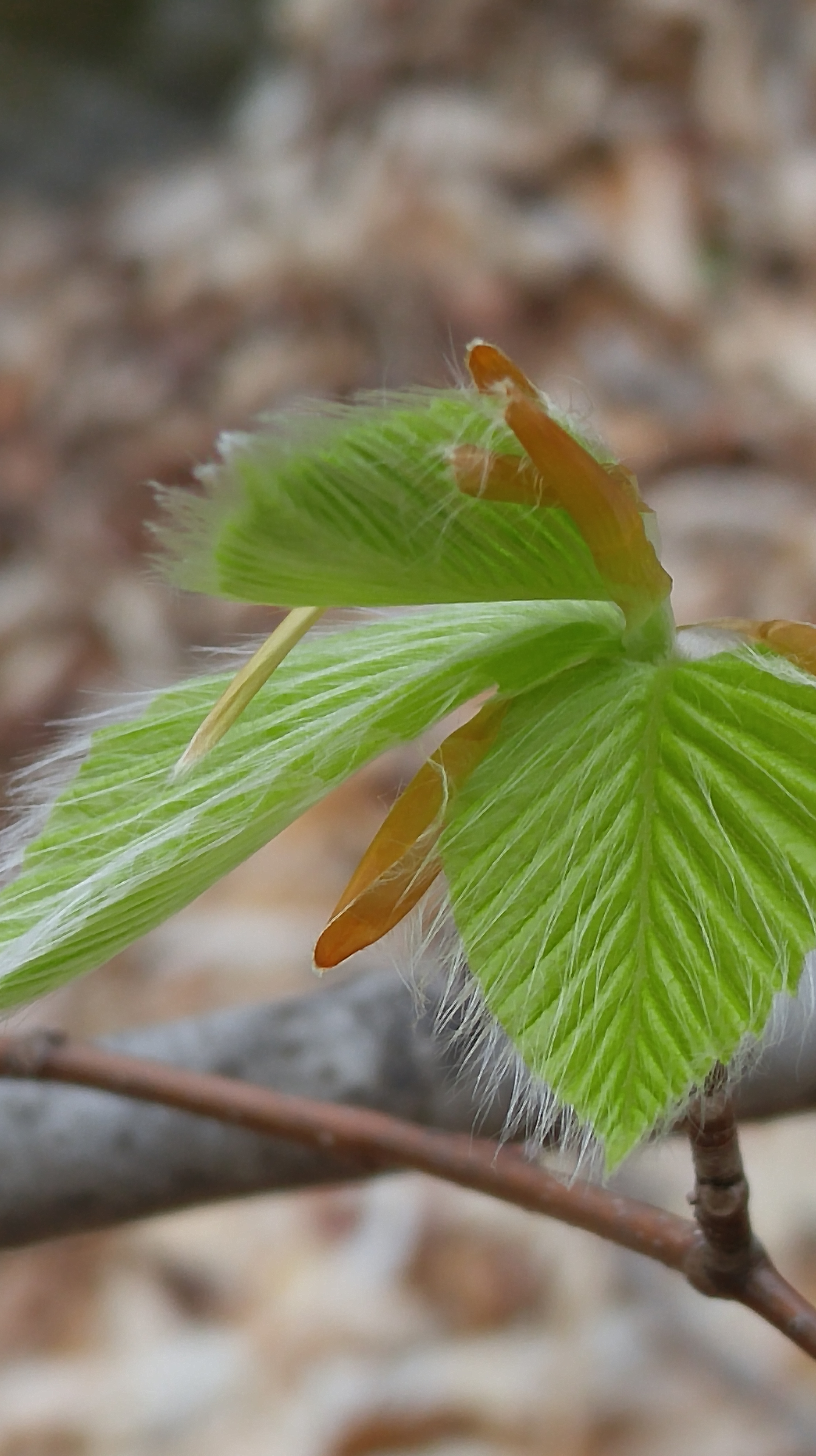
Even hairer, beech leaves.
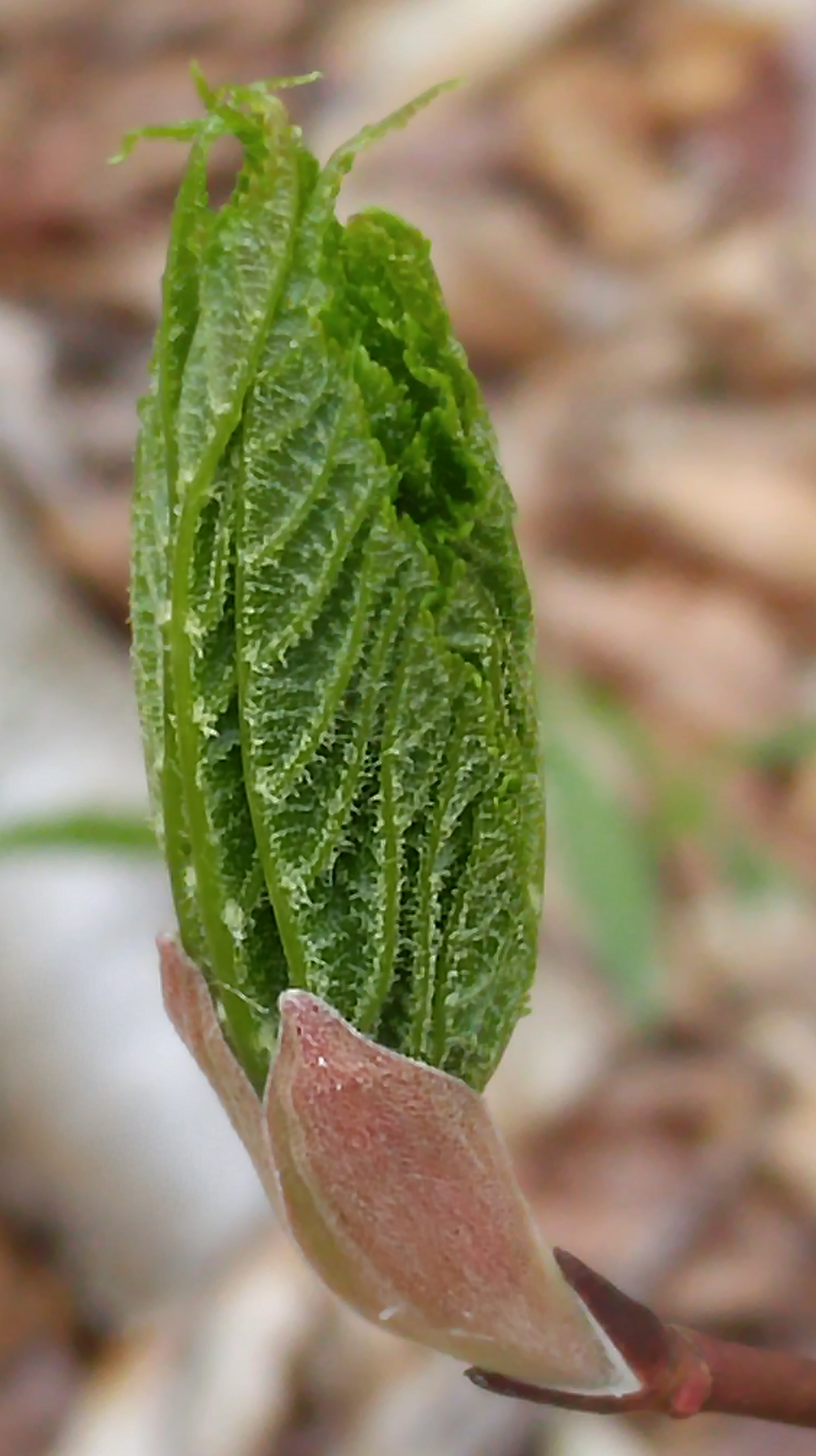
All winter long, bud scales enclosed leaves that are now slowly emerging.
They’re absolutely beautiful in their plaited and hairy state.
What leaves me wondering (ah, a pun), is the fact that these leaves are so hairy. It seems the hairs are intended to keep insects and others at bay.
And yet, it won’t be long before the insects discover that beech leaves make a good meal and home.
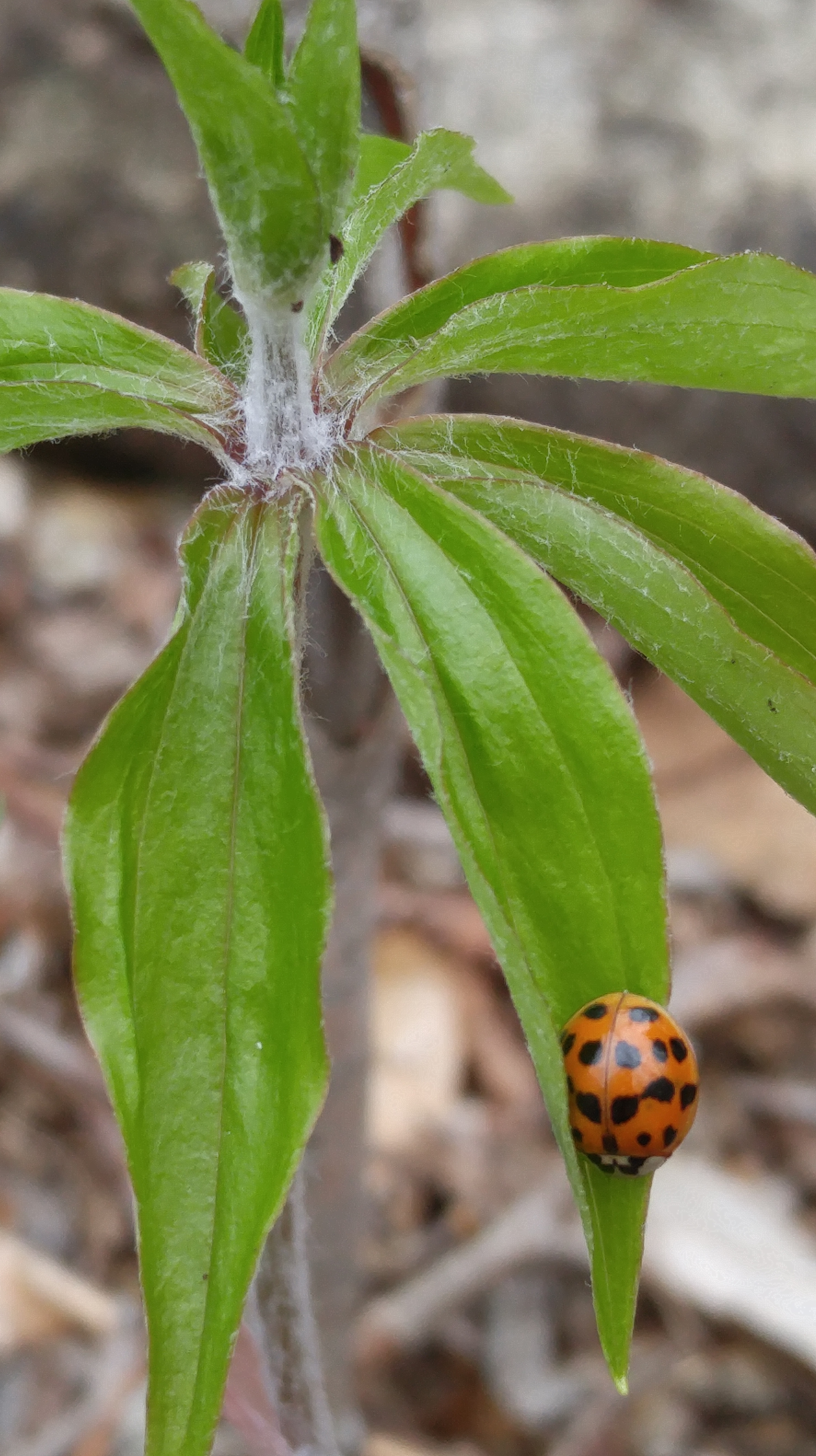
Speaking of insects, we found a ladybug presumably feeding on aphids–already. So why do ladybugs sport bright orange or red color and distinctive spots? To make them unappealing to predators. They can secrete a foul-tasting fluid from their leg joints–the coloring is therefore intended to shout out, “I taste awful.”
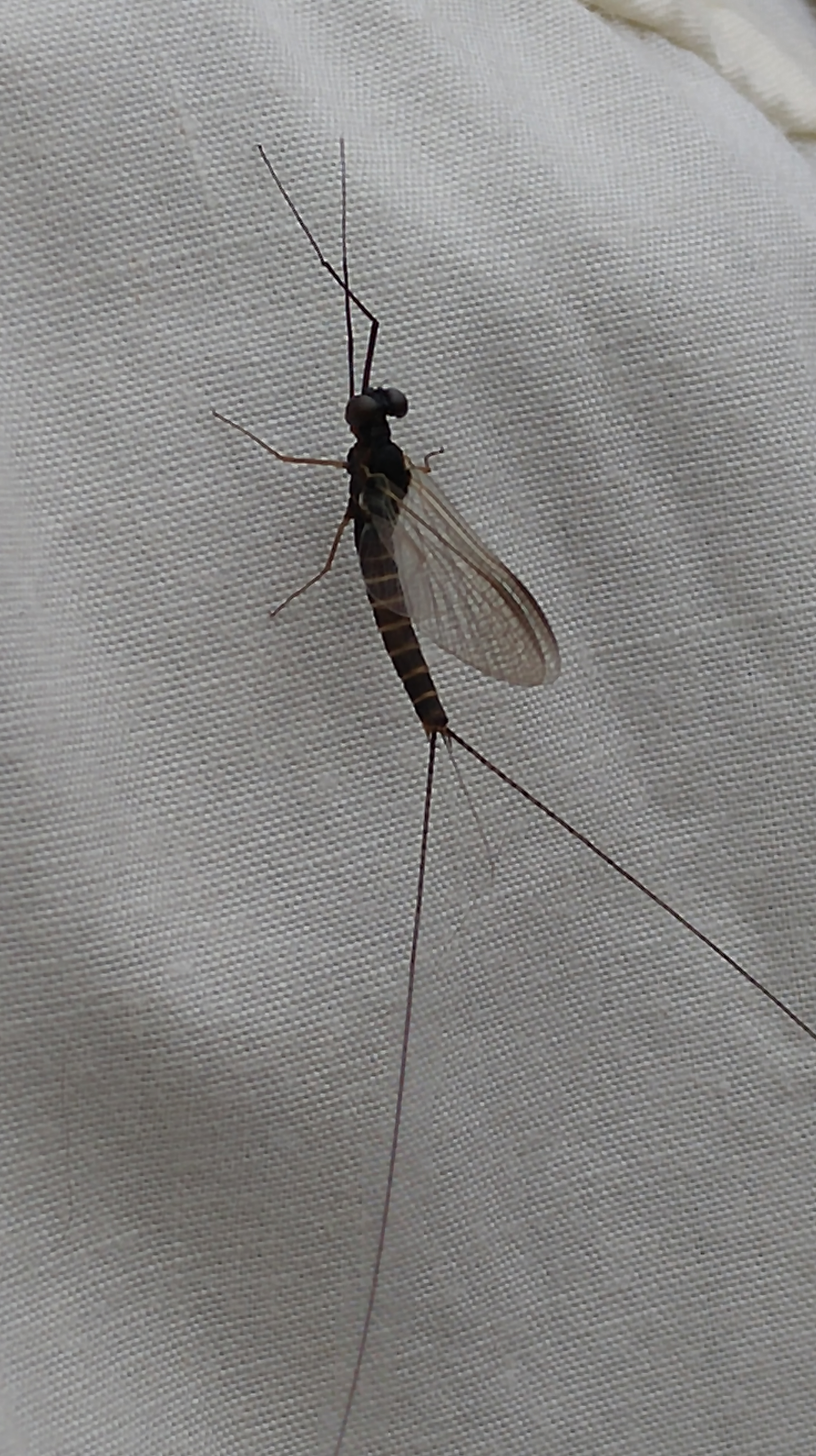
And Jinny Mae sported her own insect–a Mayfly, known to be more fleeting than spring, landed on her jacket. Oh, and did I mention the black flies? They swarmed our faces, but we practiced mind over matter.
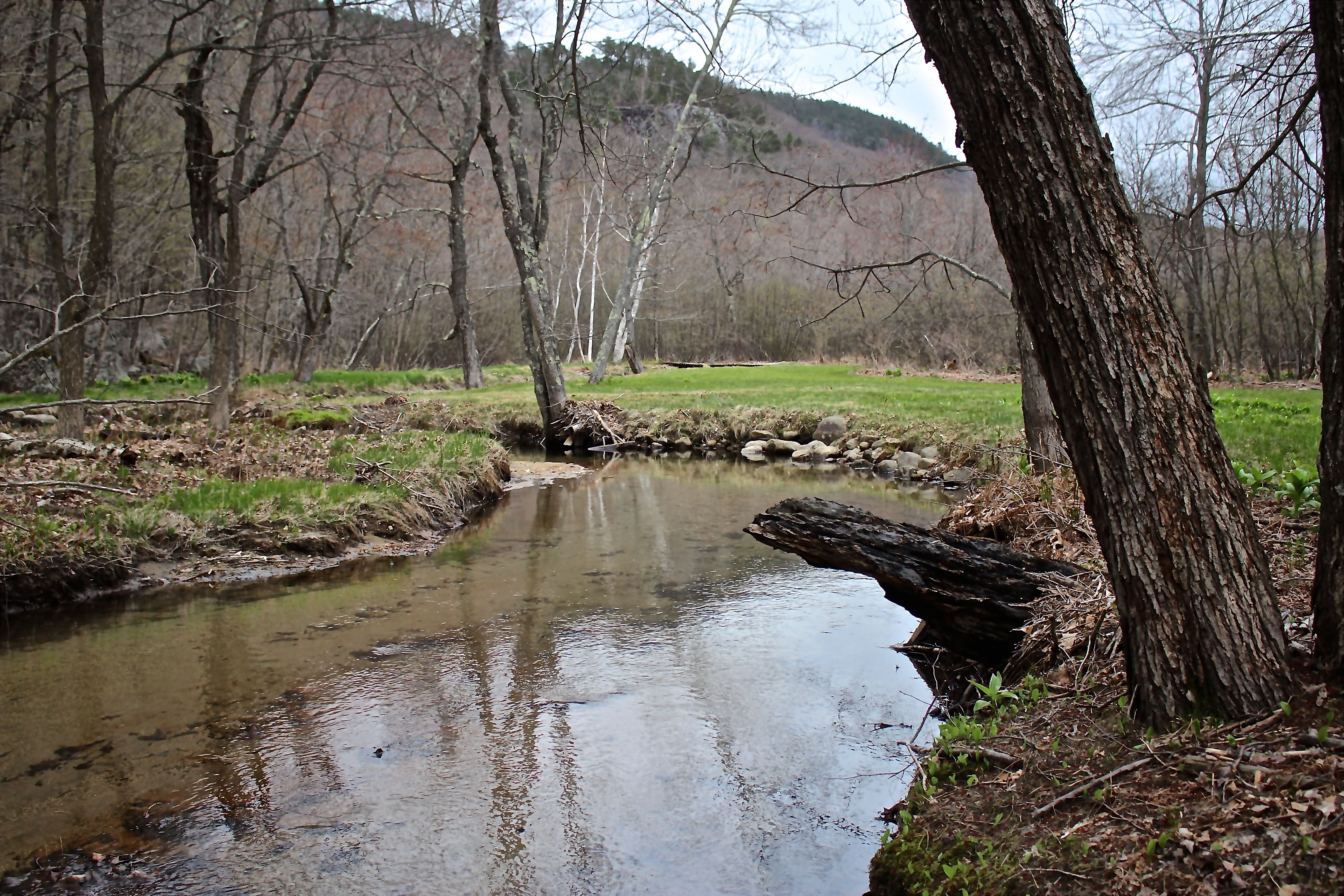
We were in one of the most beautiful places on Earth,
as evidenced by brook, pond and mountains beyond.
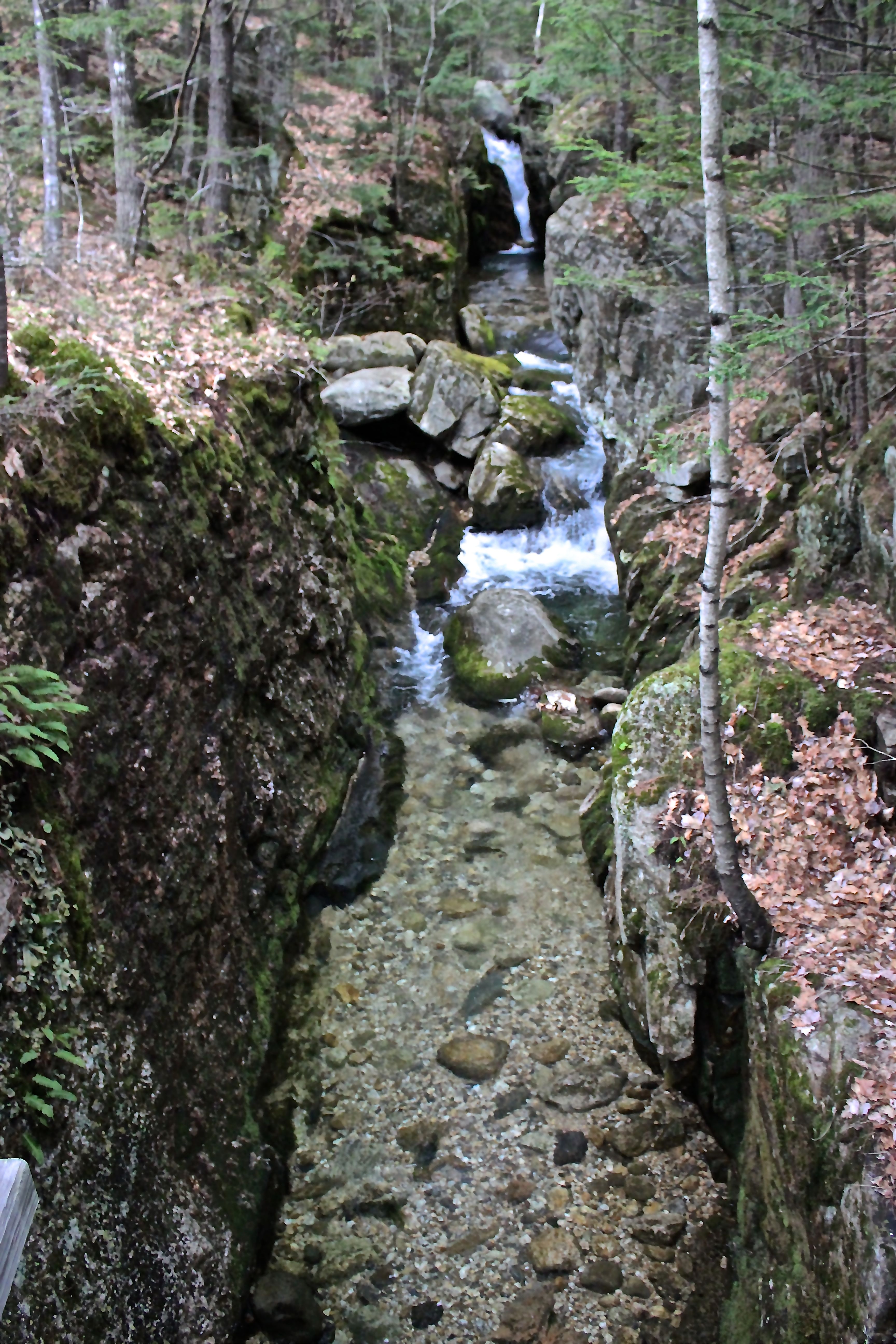
And then there was the gorge.
As we watched the water rush through, we gave thanks for a day spent moving in slo-mo to take in all that this fleeting season has to offer in its spring ephemerals.





















 wondermyway