It began in spurts,
The rain that is.
Starting with some drops on Tuesday,
Followed by a few more on Wednesday.
But today, much to our delight,
we awoke to the drumming of droplets
upon our metal roof,
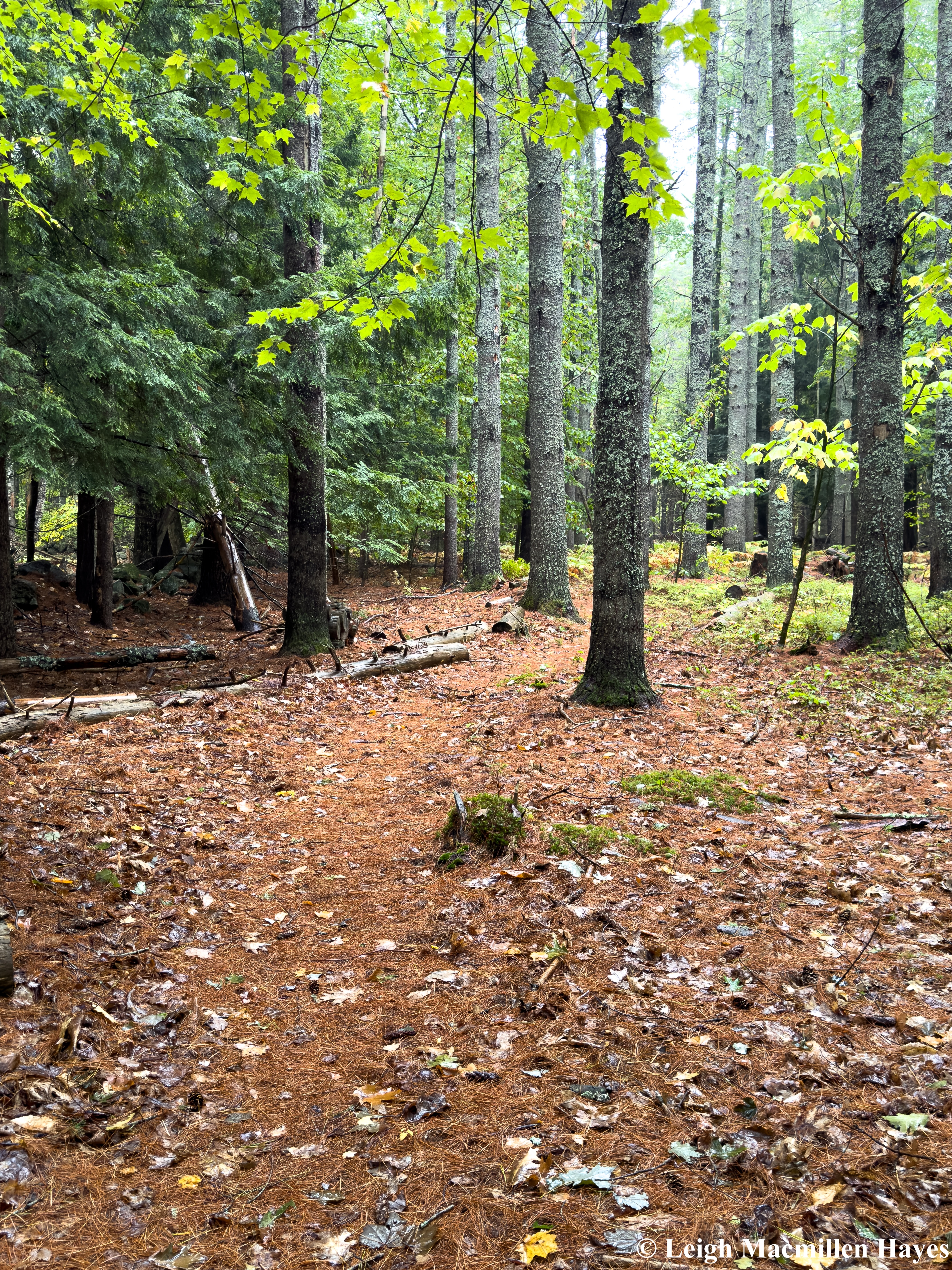
and I couldn't resist heading into the woods.
One Jack, or rather Jill-in-the-Pulpit,
lay down its sweet head
upon the wet ground
as if to kiss the moisture gathered there.
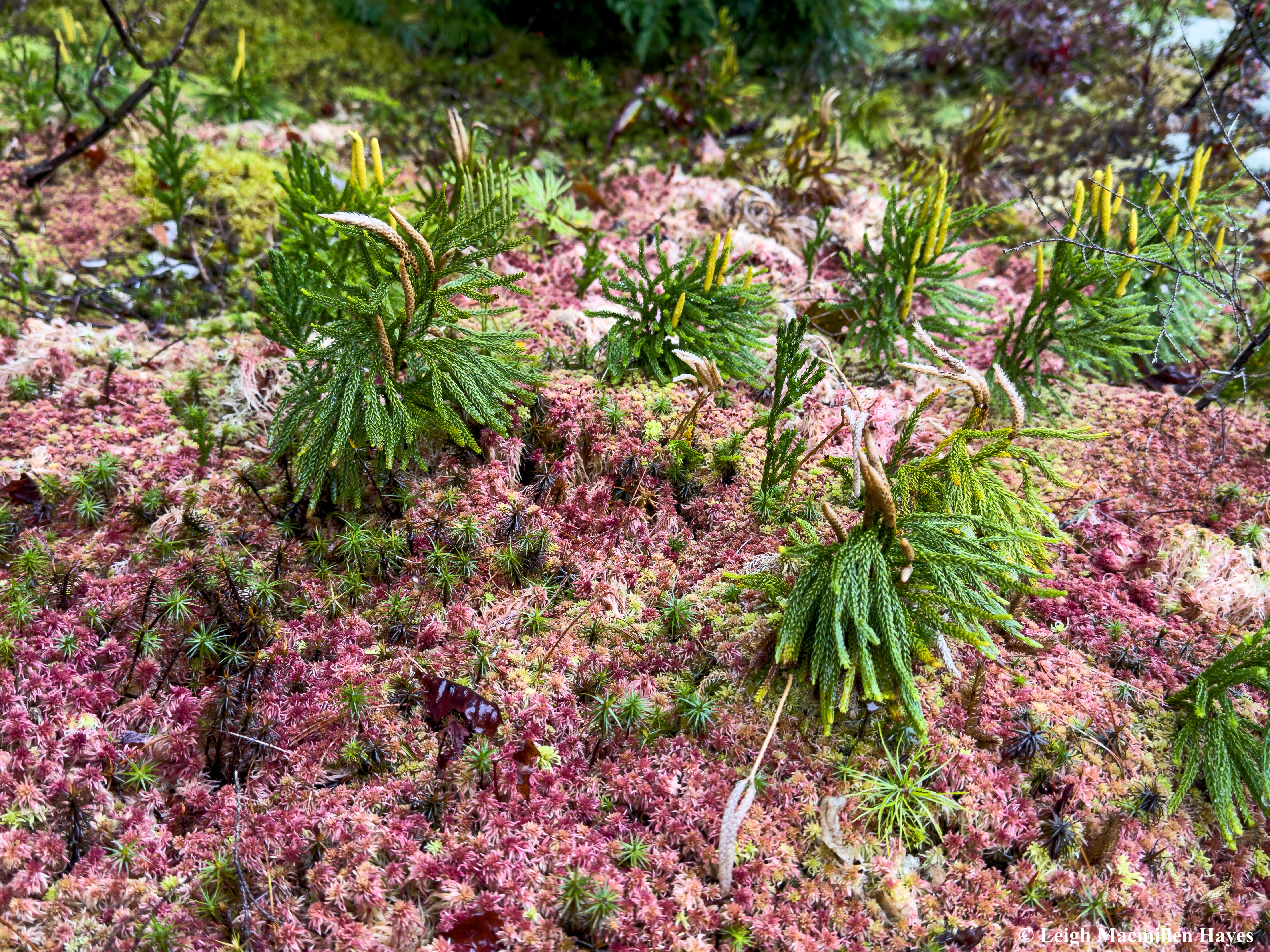
In a boggy section,
it made the Hickey's Tree Clubmosses
suddenly stand out in contrast
to the pink and green sphagnum below.
And upon every surface,
or so it seemed,
raindrops gathered,
sometimes hesitating for a moment.
Other droplets
enhanced guidelines
and supporting threads
of a spider's web.
Because it was raining,
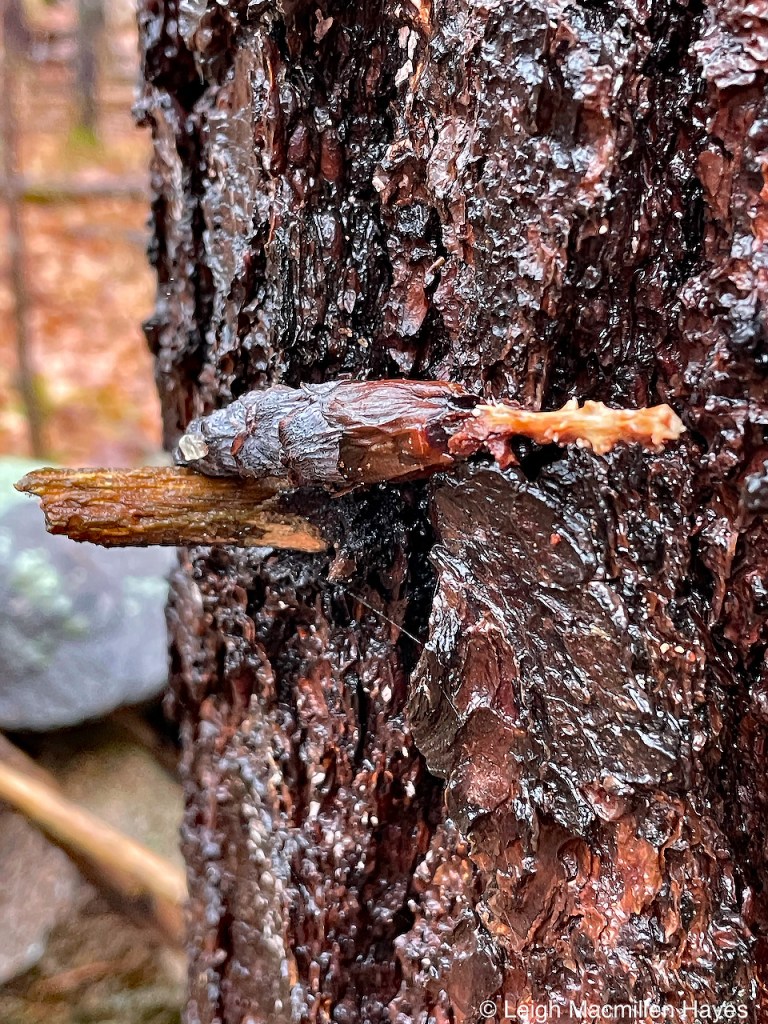
I decided to play and poked a stick
into the resin blister of a Balsam Fir,
then placed it in a tiny puddle.
My sense of wonder
was well rewarded
as the essential oils
created ever-changing rainbows.
But my real intention
for heading outside so early
was to search for slugs
who haven't had an easy summer.
I was rewarded
when upon a snag,
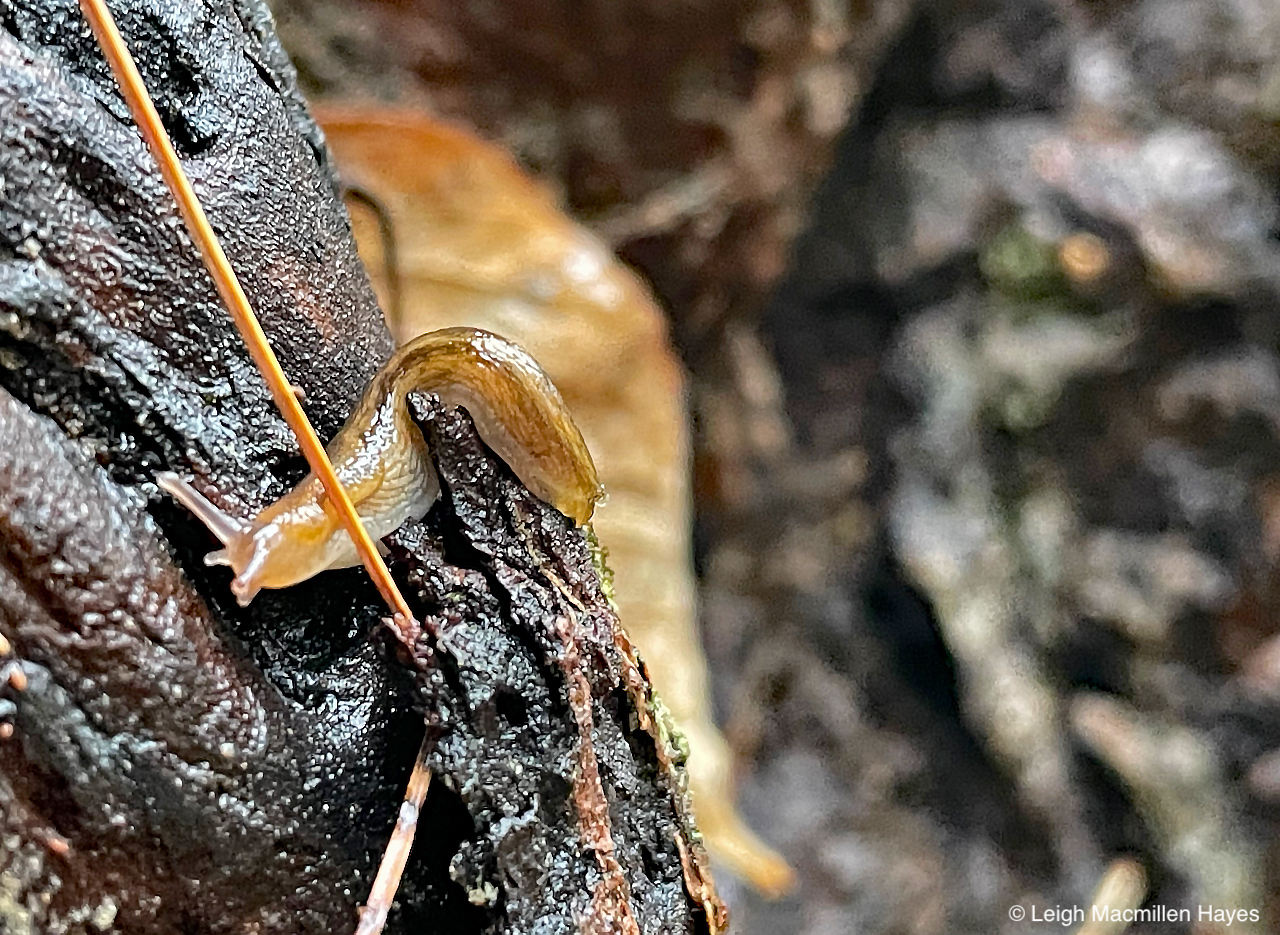
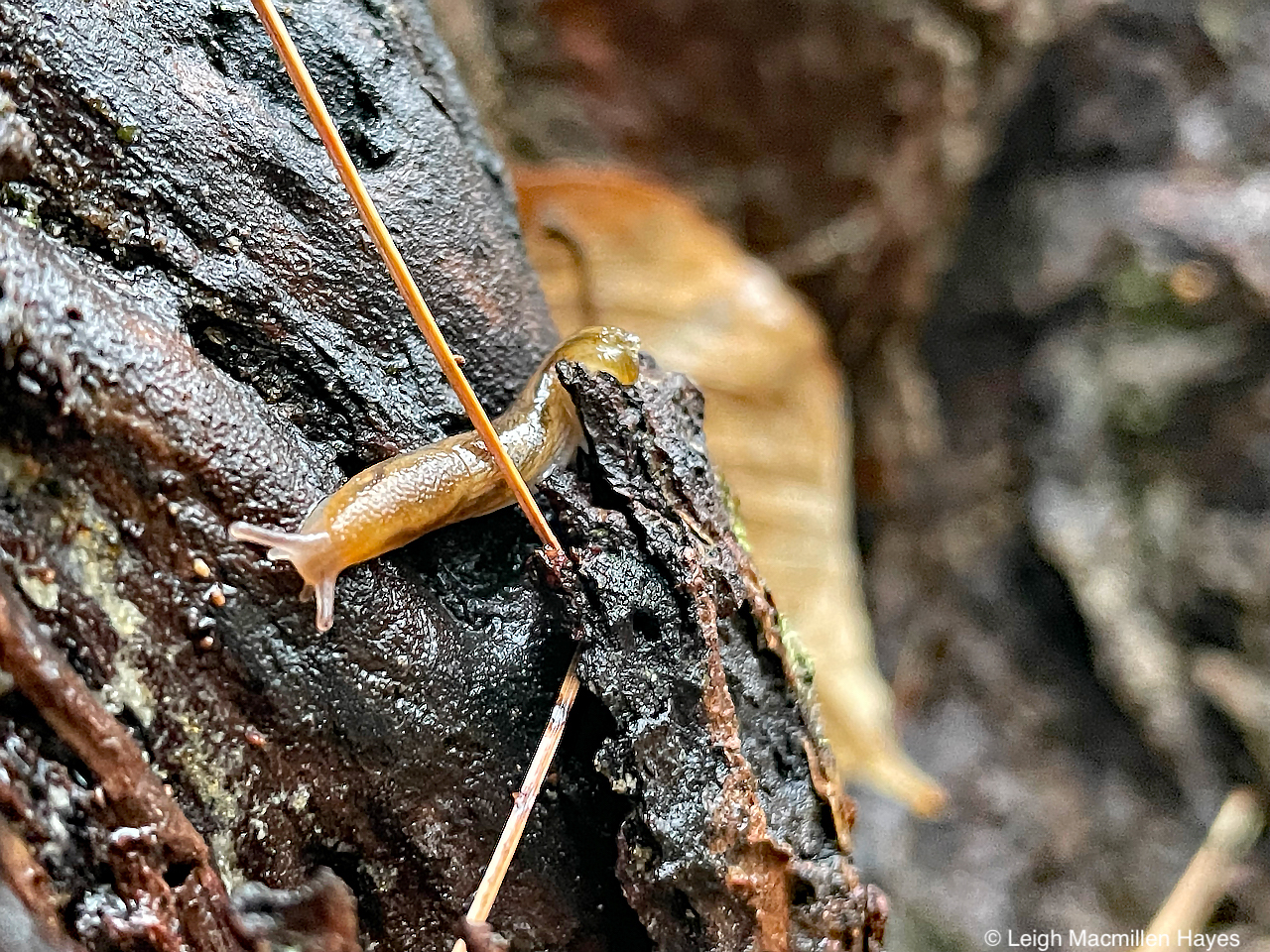
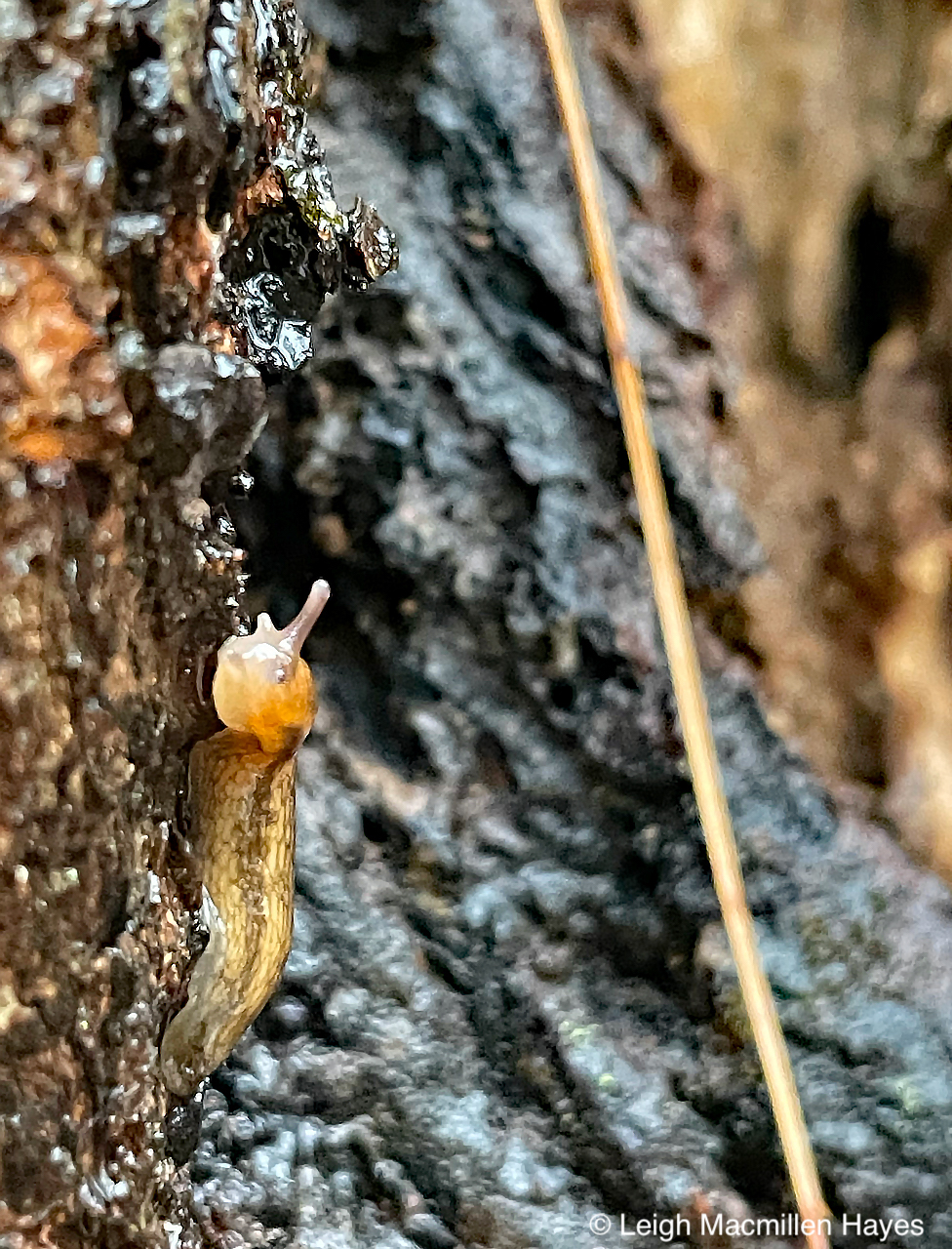
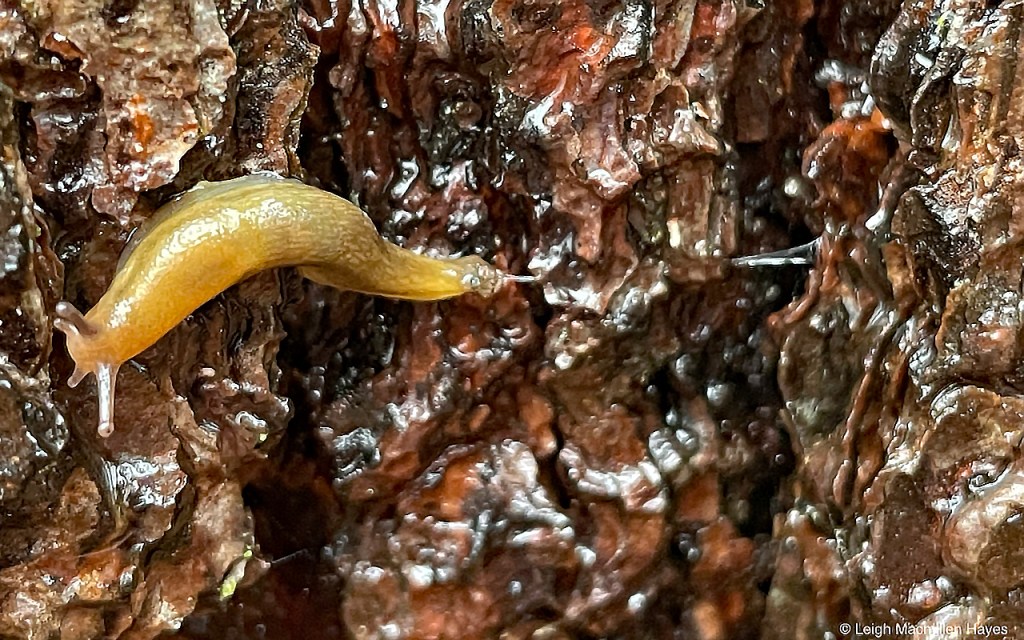
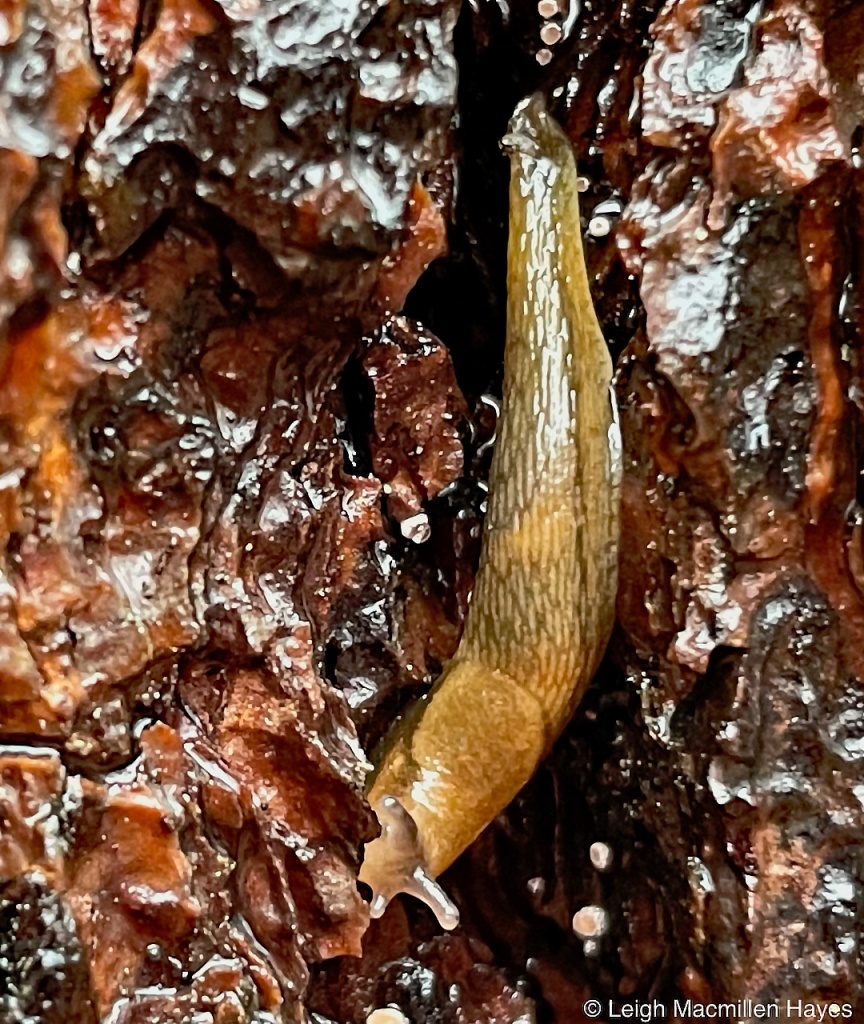
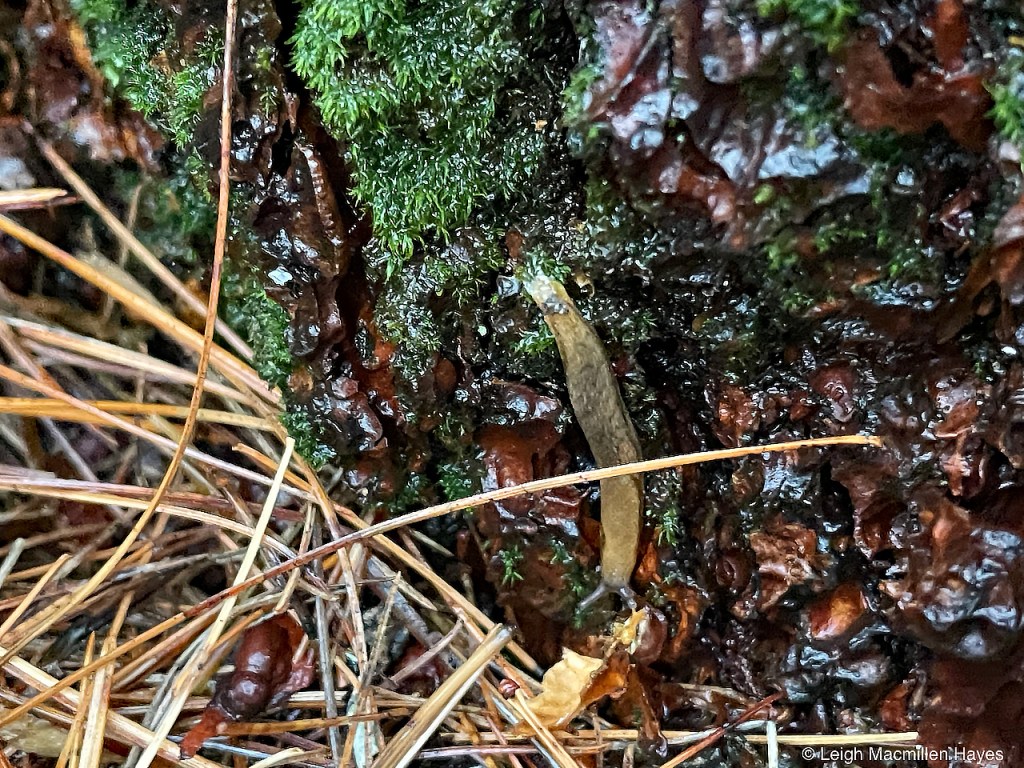
I found a Western Dusky
dining on smaller organisms than I could spot.
My other intention was to hunt for suds
and though I found some in the morning,
the pounding rather than pitter-pattering rain of the late afternoon
provided many an example.
As the droplets dripped toward the base,
dissolving chemicals on the bark,
the surface tension changed,
and with the turbulence came air, thus forming foam.
It's all a matter
of one drop at a time,
but when the rain is heavy,
those drops form and release quickly.
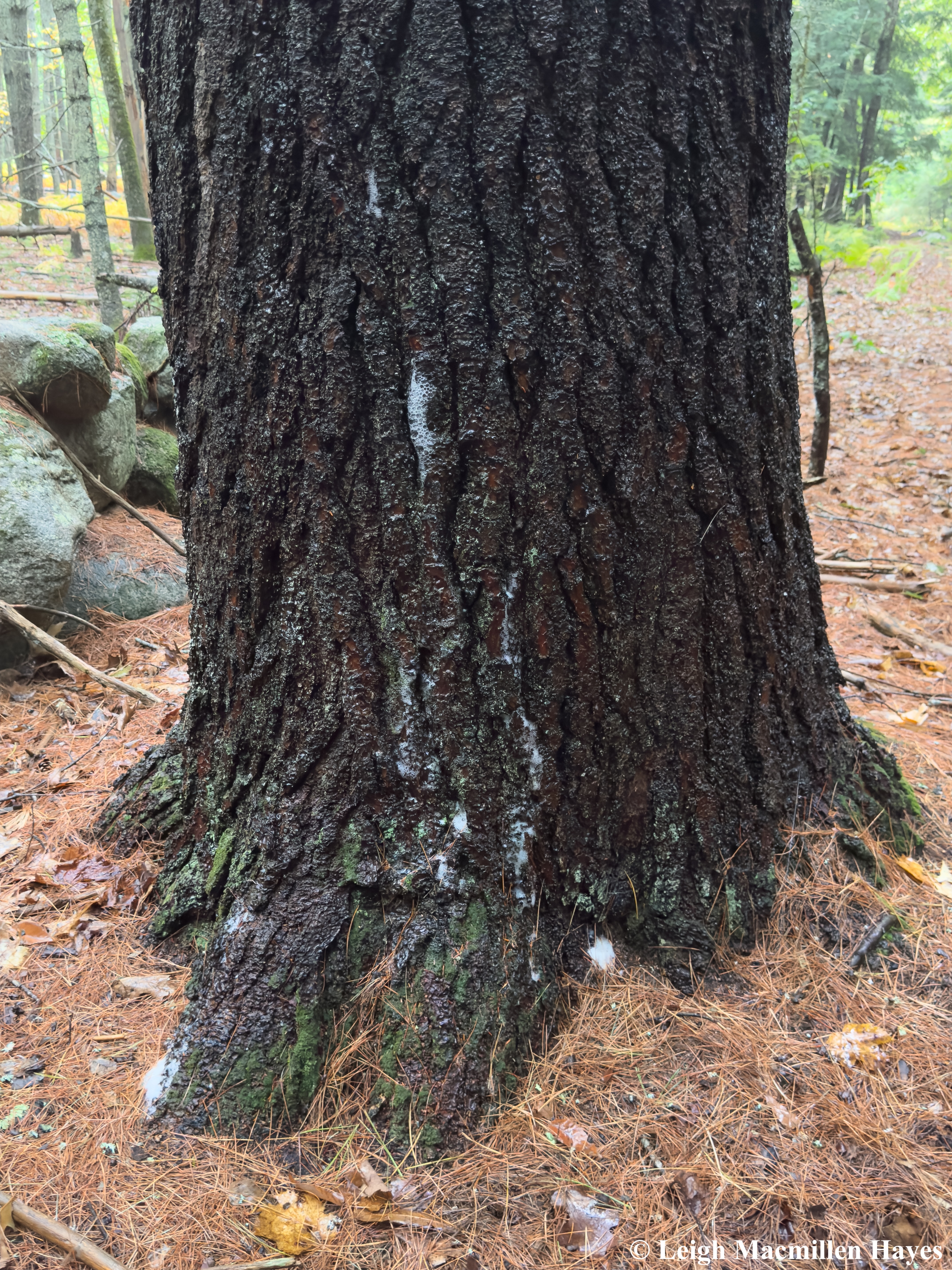
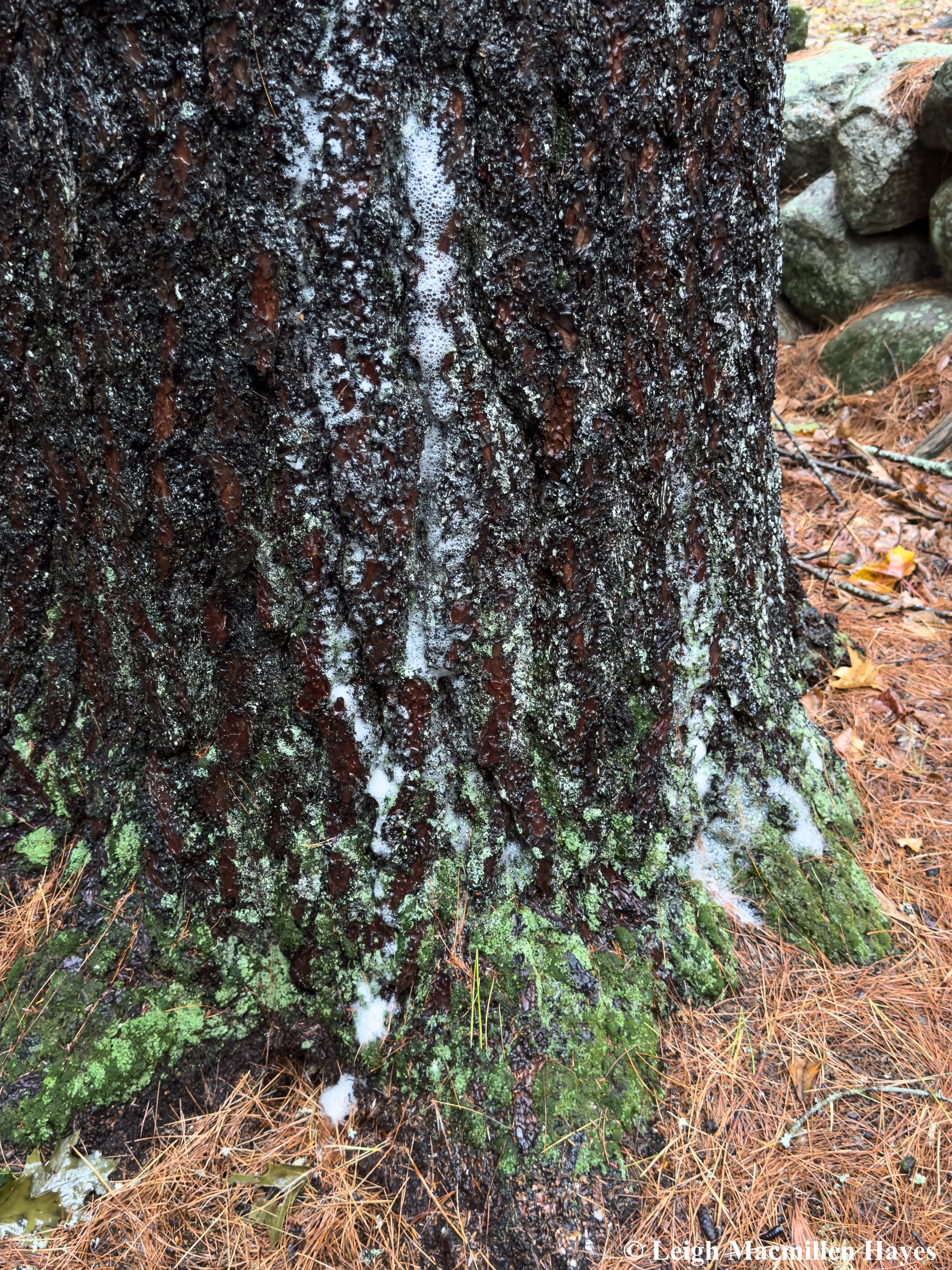
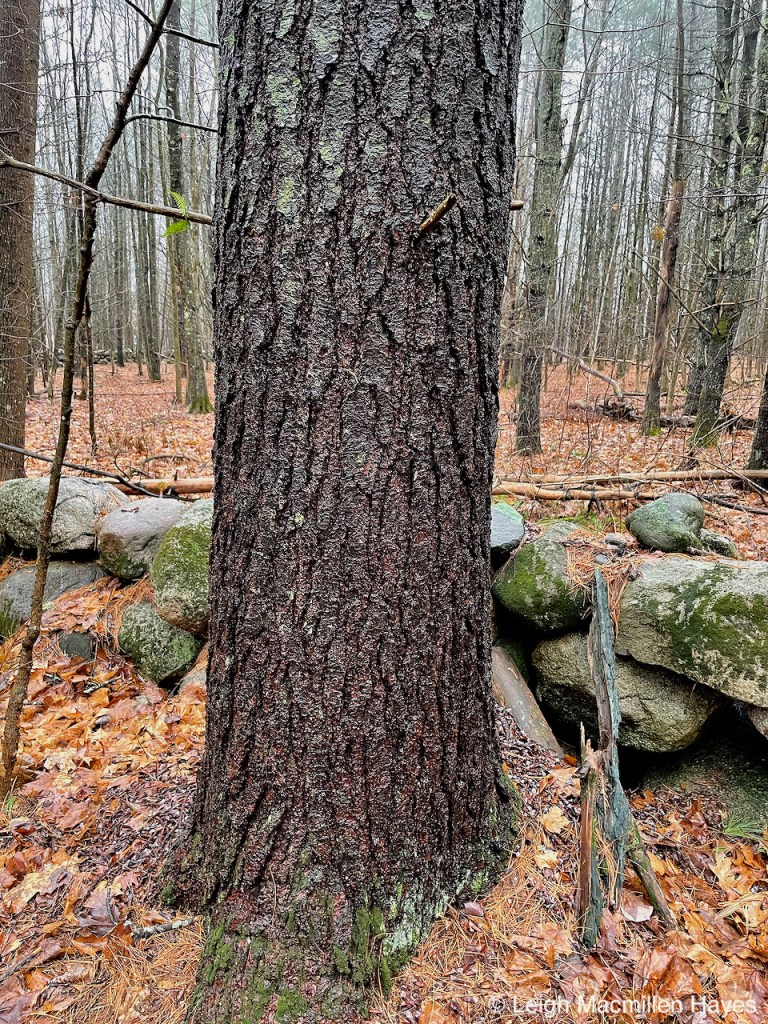
Upon one of the older White Pines
between the stonewall and old cow path,
I found lots of pine soap,
on the eastern side.
The same was true on the western side,
and as I now sit inside all cozy and dry,
it is pouring out there and I suspect almost every tree
has a base like this.
It's easy to think
that only pines offer the suds,
But I've learned from observation,
That others do the same, like this Red Maple.
And much to my pleasant surprise,
I found a gathering of suds,
within an old Pileated Woodpecker hole,
on one of my favorite trees.
I like to think of it
as the Stairway to Heaven Tree,
for such do its branches remind me,
as if I could climb them into the sky.
Because I was looking,
I discovered an insect,
this being a Hemlock Looper Moth,
taking refuge upon a trunk.
When I originally headed out the door this morning,
and told My Guy I was going on a search for Slugs,
he said, "Who is this person I married?"
And we both chuckled.
All told I only found three.
Nevertheless, I know these three
and many other critters and humans
join me in praising the rain.
One might think a rainy day is the perfect kind of day to sit inside, curl up in a chair with a good book, sip some tea, and maybe take a nap in the process. Of course, it is. But it’s an even better day to head out the door and into the woods. And so I did.
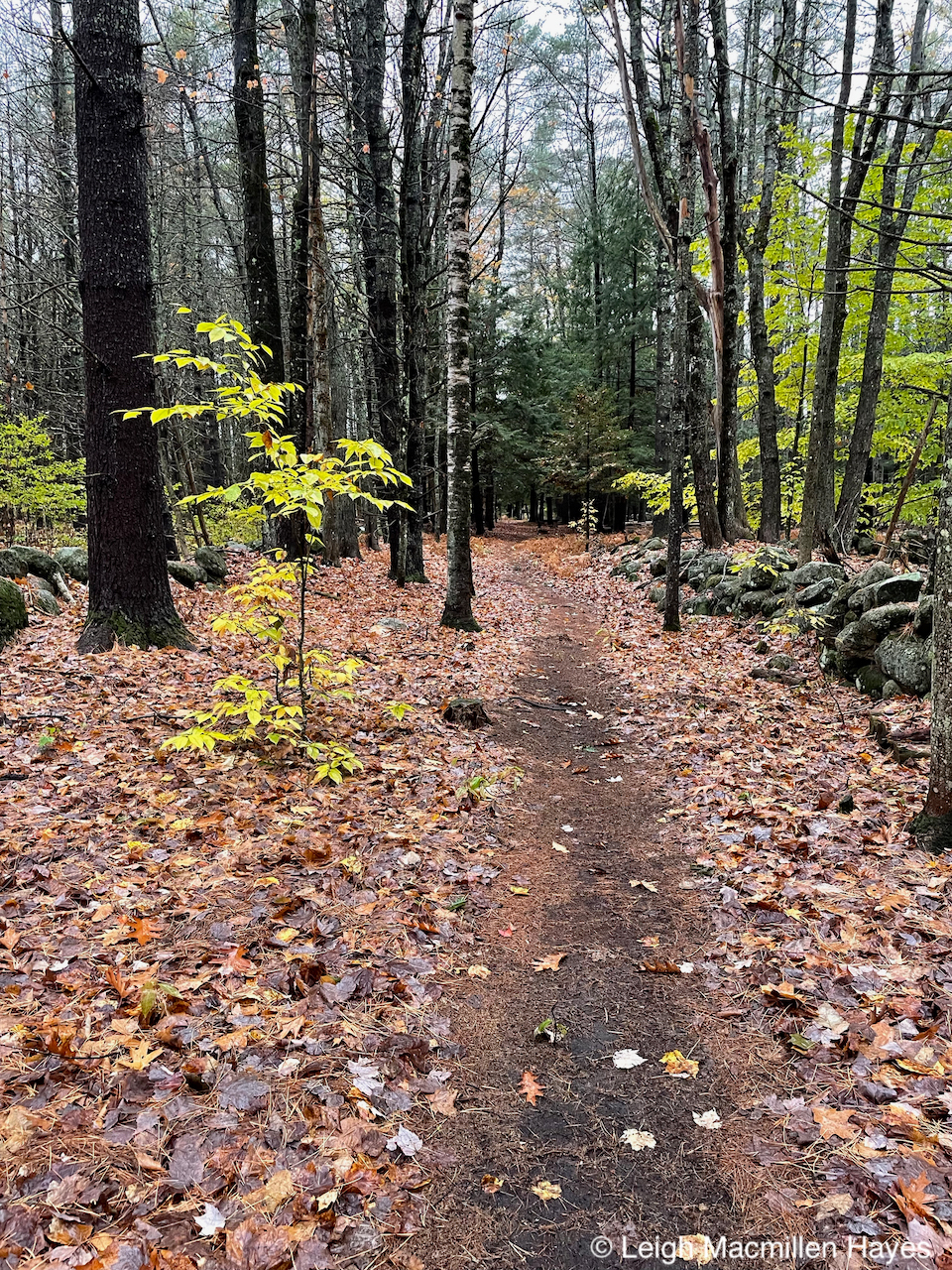
I learned an interesting thing in the process as I walked along our cow path searching the bark of one tree after another to see what I might see.
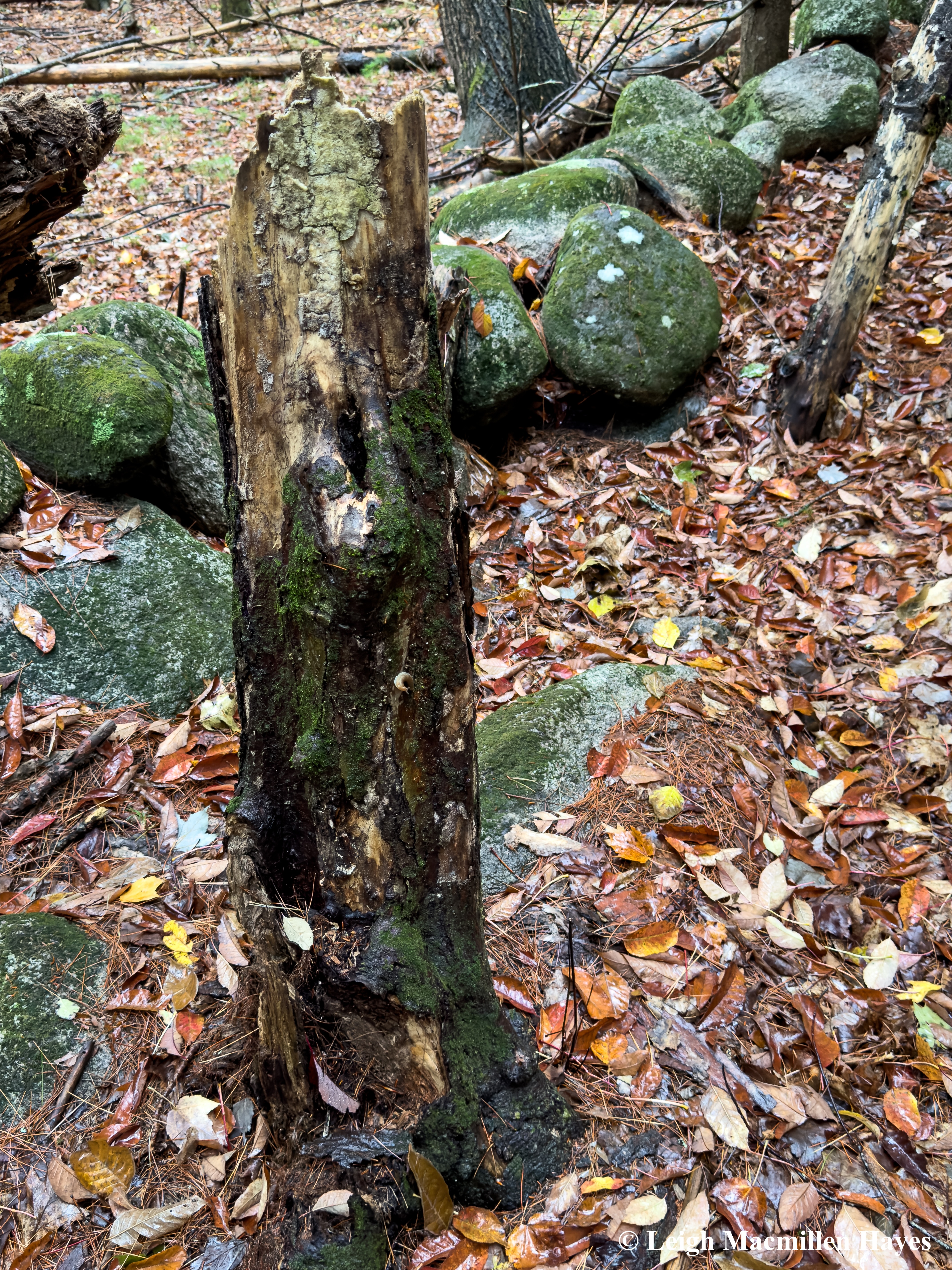
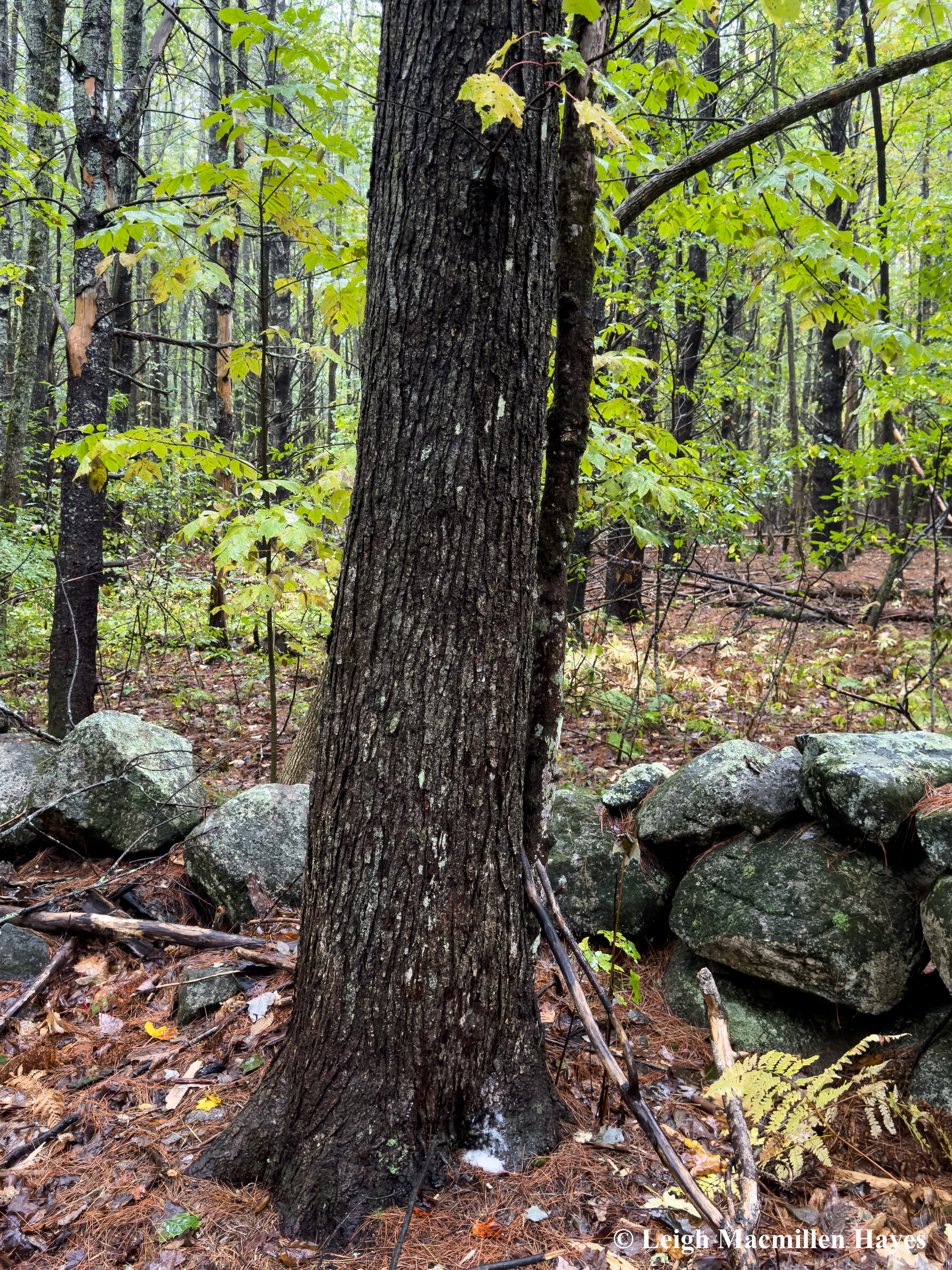
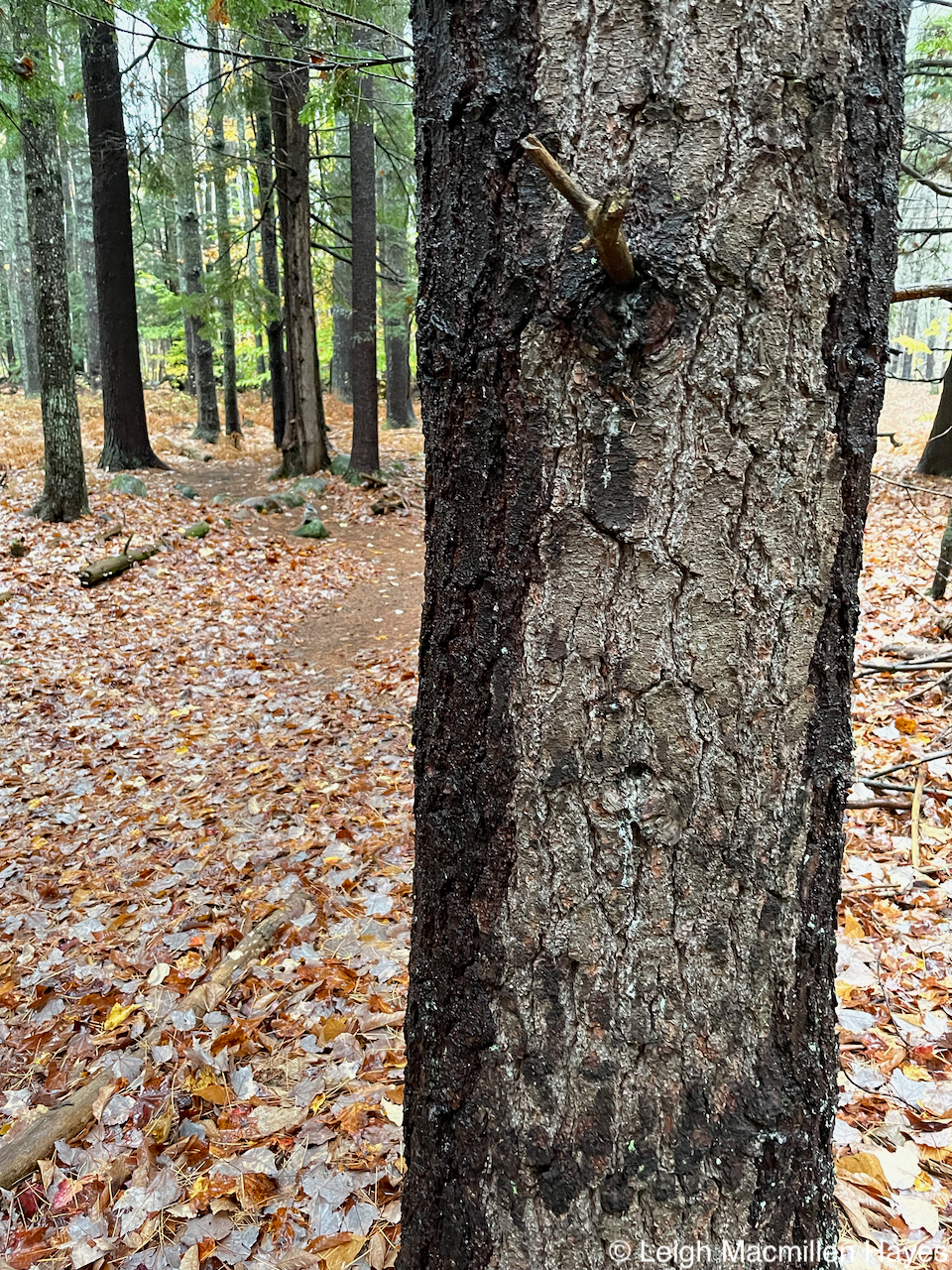
The back sides of the trees were fairly dry as indicated by the lighter gray color. That didn’t make sense until I realized that was the southwestern side and today’s storm is a good ole New England Nor’easter. I suspect as the wind increases tonight, all of the bark will get wet.
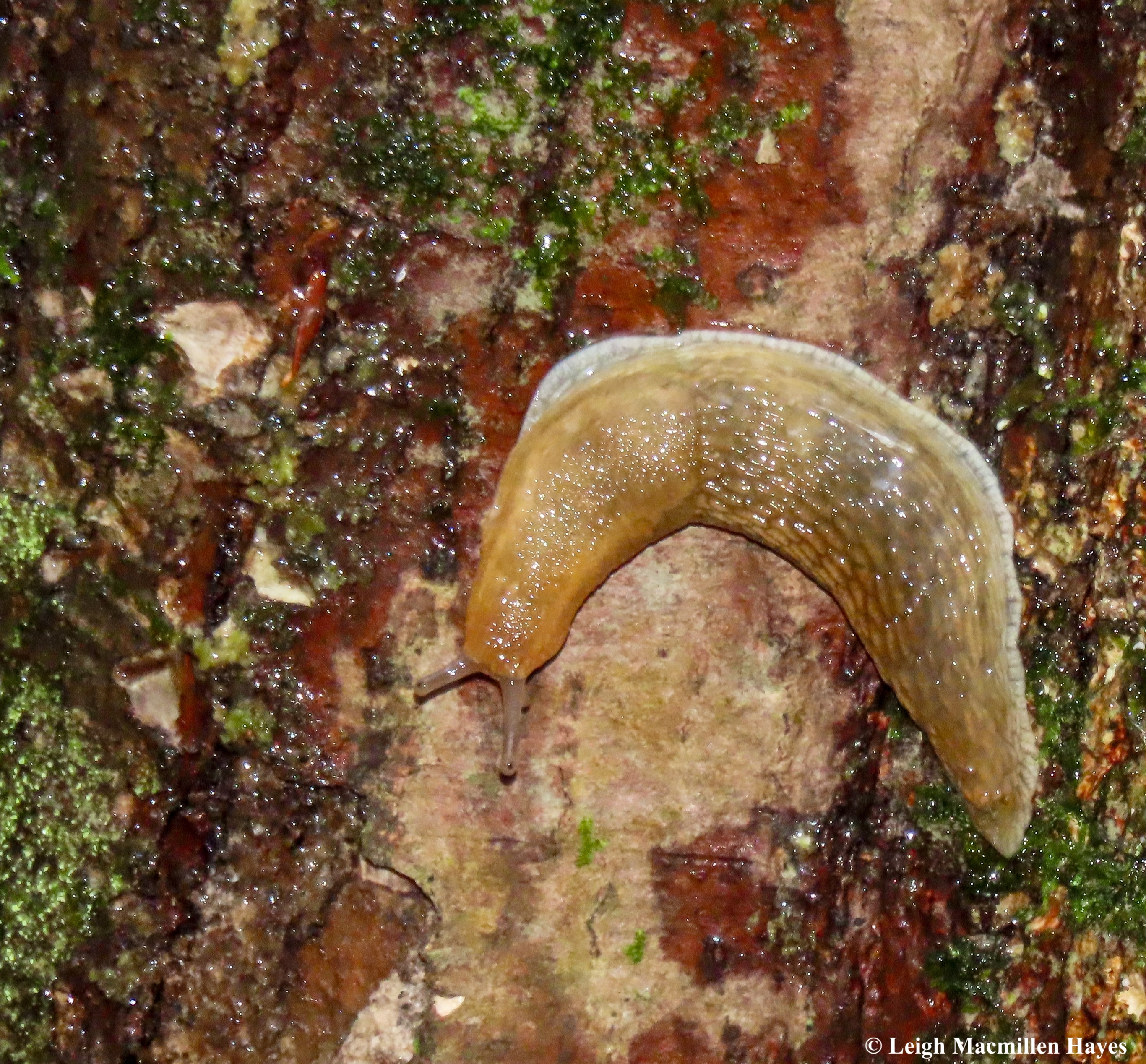
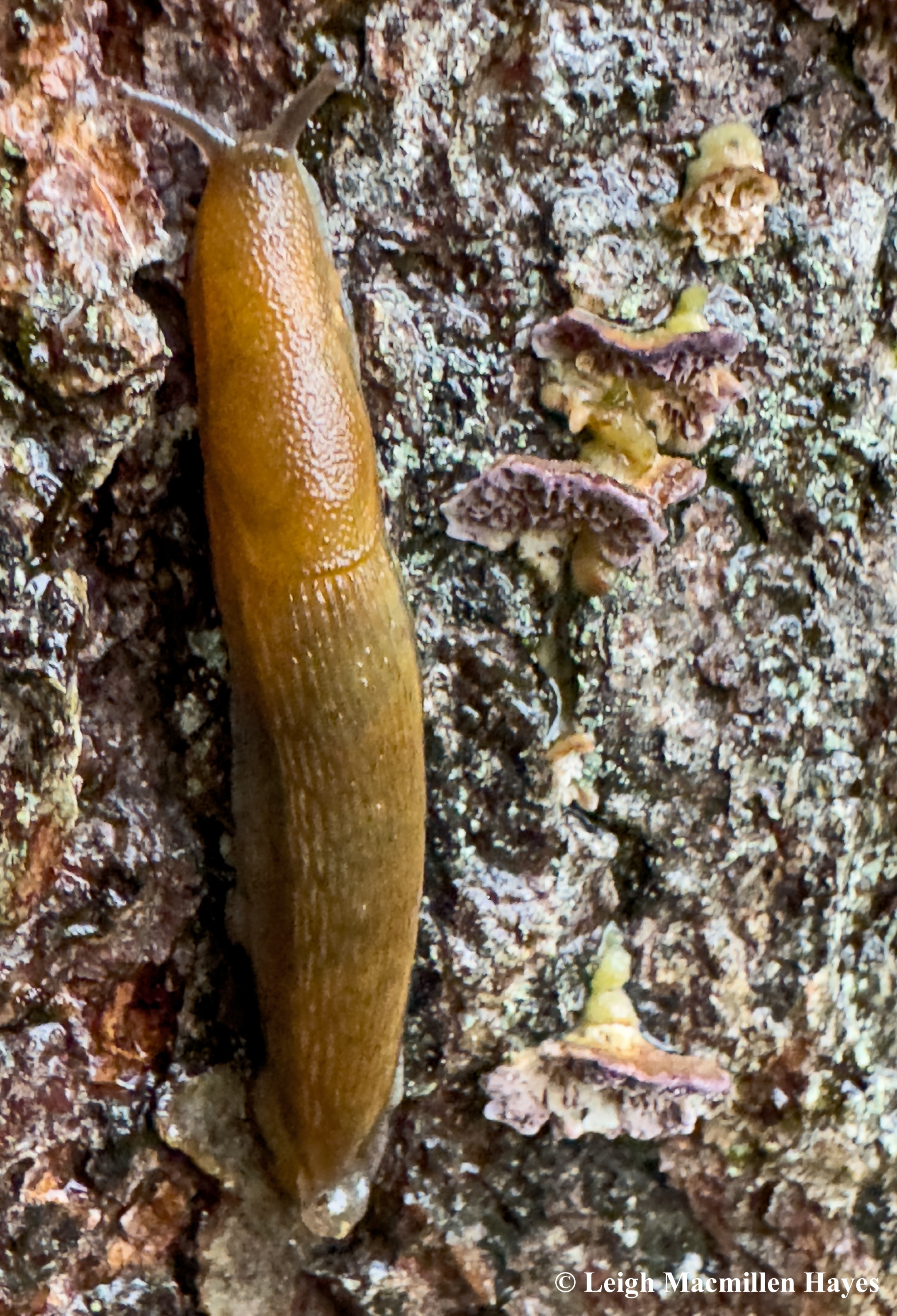
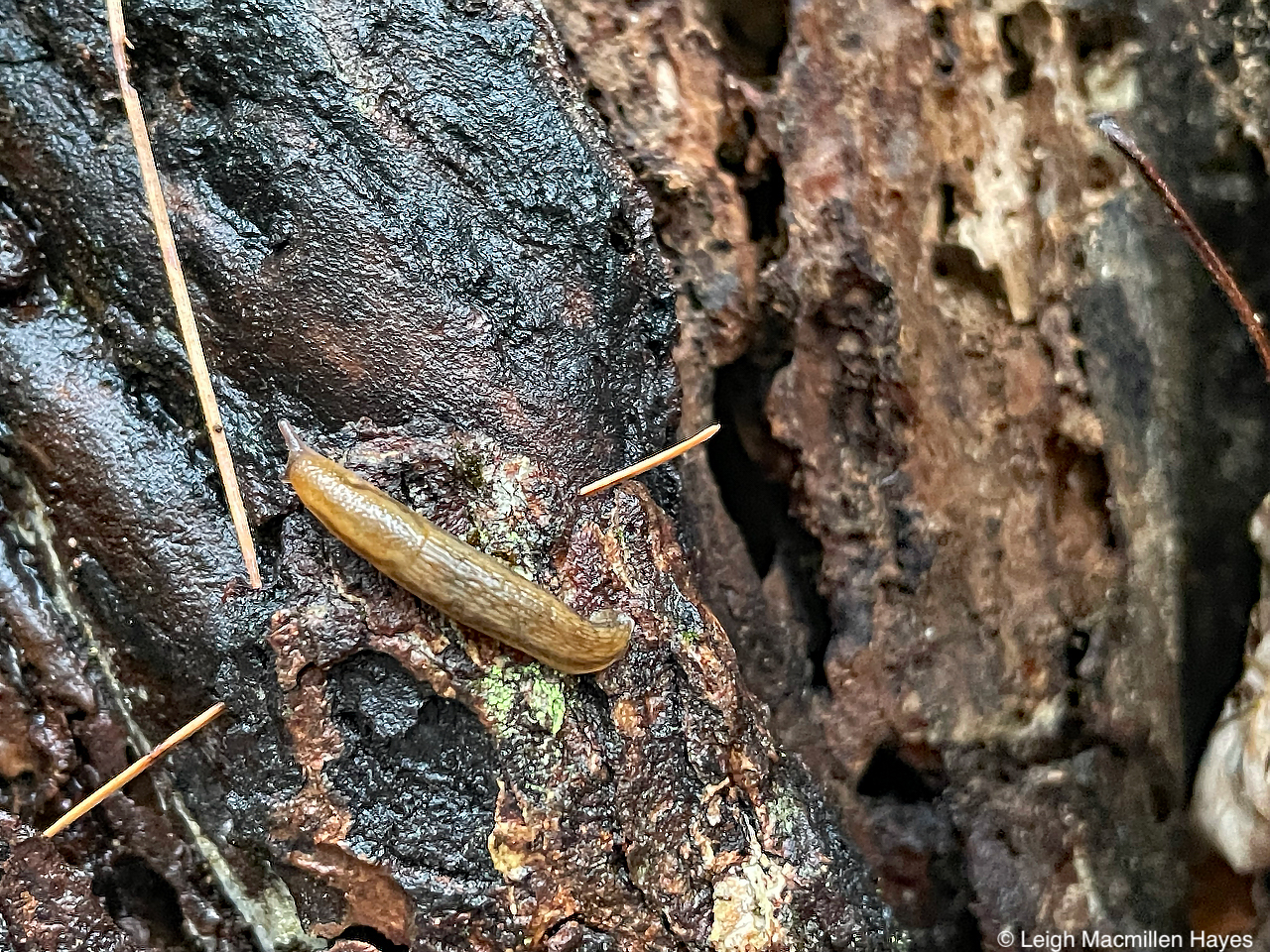
With that understanding, I continued my search and finally was rewarded with a sighting upon a Red Maple that had long ago suffered a wound. Yes, that slug was the object of my attention.
When not consuming a garden, I find slugs to be fascinating critters. Classified as gastropod mollusks, they are in the same category as snails. The main distinguishing factor is that a slug lacks the external hard shell of a snail. Mostly nocturnal, they tend to feed at night and have a preference for dark, cold, and moist hiding areas during the day so that their skins do not dry out. But on a rainy day–ahhh.
Watching one move requires patience. Being diverse feeders, their diet differs depending on their types. In general, some tend to feed on plant matter or fungi, while others are predators feeding on different small organisms. I suspected this one was finding small organisms to dine upon as it glided ever so slowly on its slimy ‘foot,’ a long sheath of muscle on the underside of its body. The muscular ‘foot’ constantly oozes a slippery mucus to aid movement, which is why slugs leave a slimy trail in their wake.
Finding one slug was certainly not enough, so I rolled a few logs. Did you know this? Slugs are hermaphrodites, meaning they are born with both sets of sex organs and are able to lay eggs after mating.
In optimal conditions, slugs may lay clear, jelly-like eggs every warmish month, which hatch into baby slugs after around two weeks.
I also checked many, many more trees as the raindrops increased in intensity.
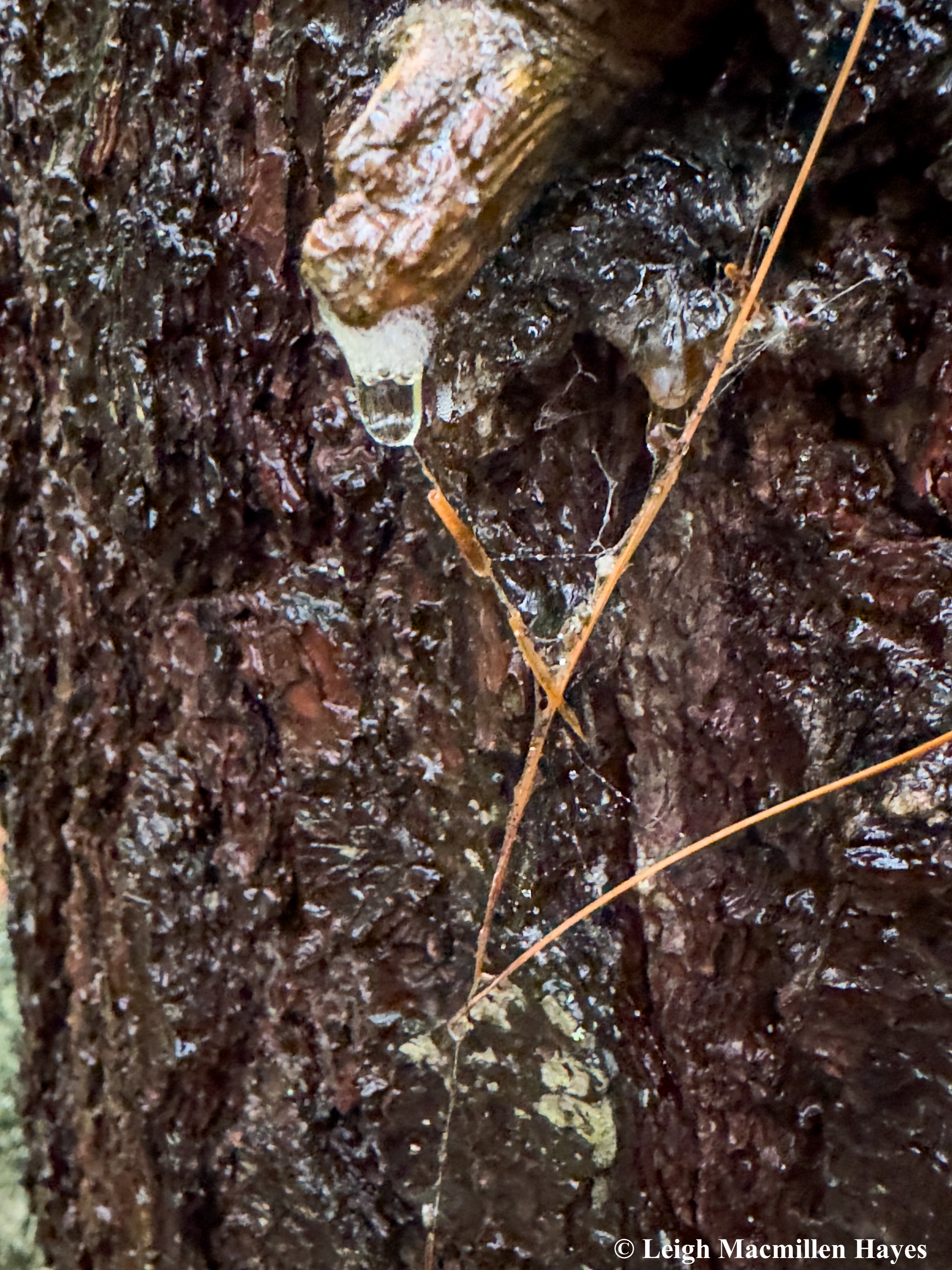
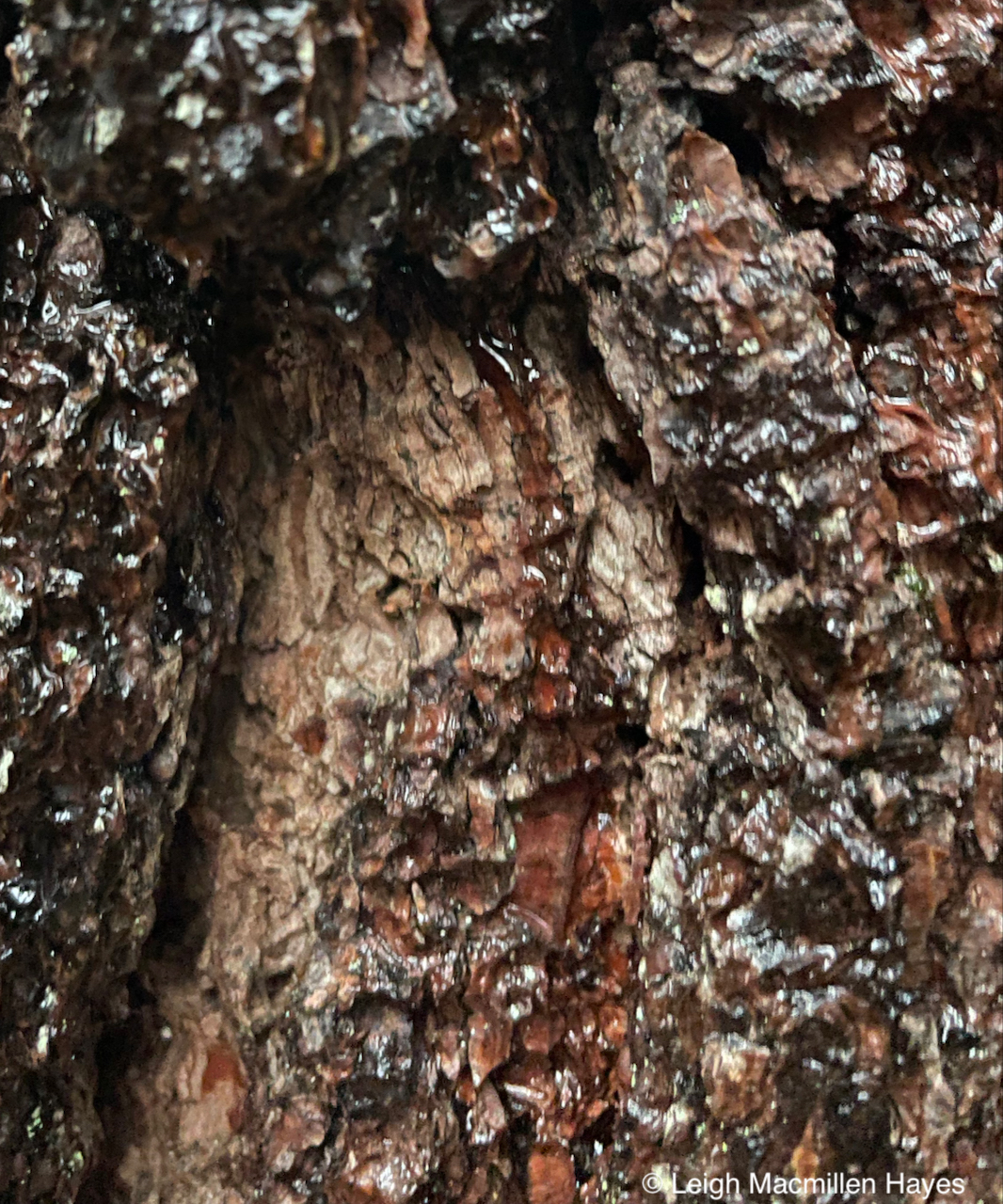
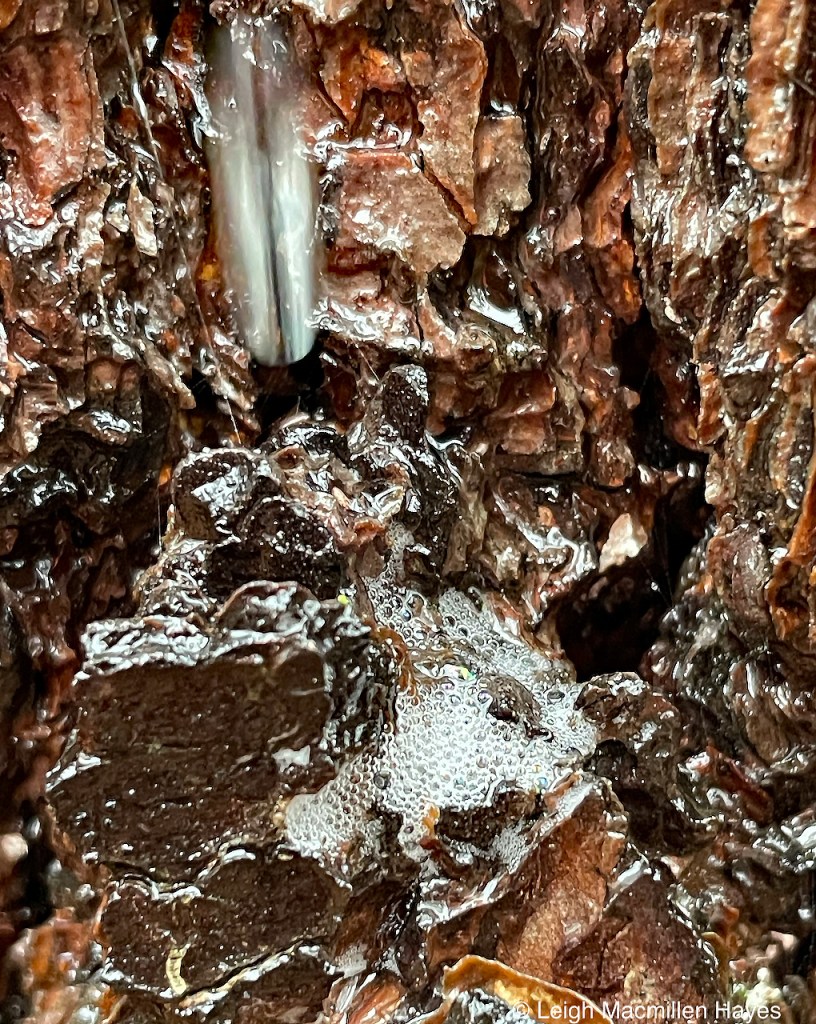
Unlike watching a slug’s movement, which can take such a long time, try capturing the travel route of a rain droplet. If you look closely, you might spy one about two inches down and two inches in on the upper left hand side of the tree.
Don’t blink or you might miss the action as the droplet falls. And just as quickly a new droplet forms.
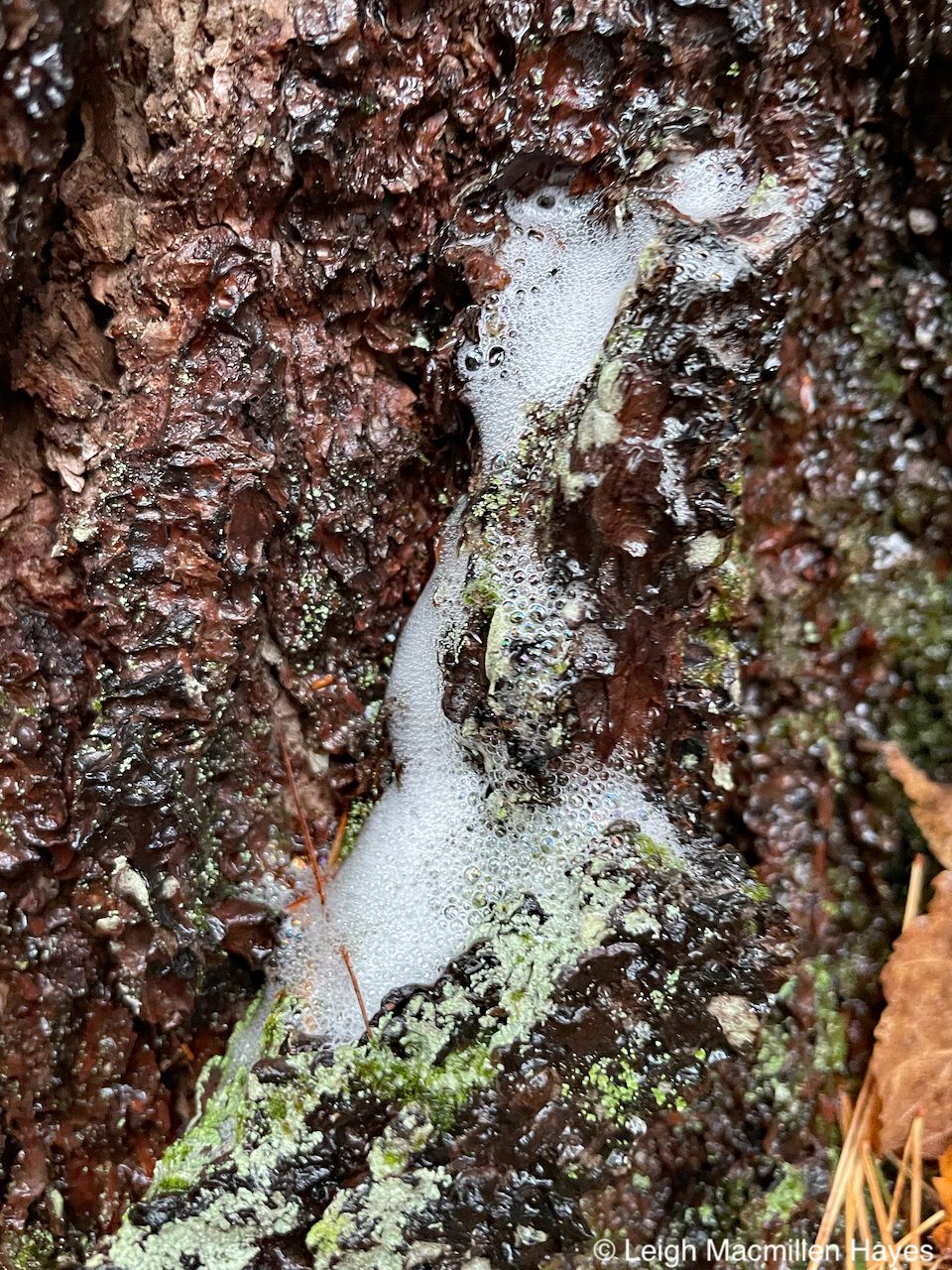
Where exactly did the drop land? Upon a pile of foam. Here’s how it works. As the rainwater flows down the trunk, it dissolves chemicals from the bark. In the process, it changes the surface tension of the water so that as the droplets drip toward the base of the tree, air is introduced due to the turbulence and foam forms because the surface tension is altered.
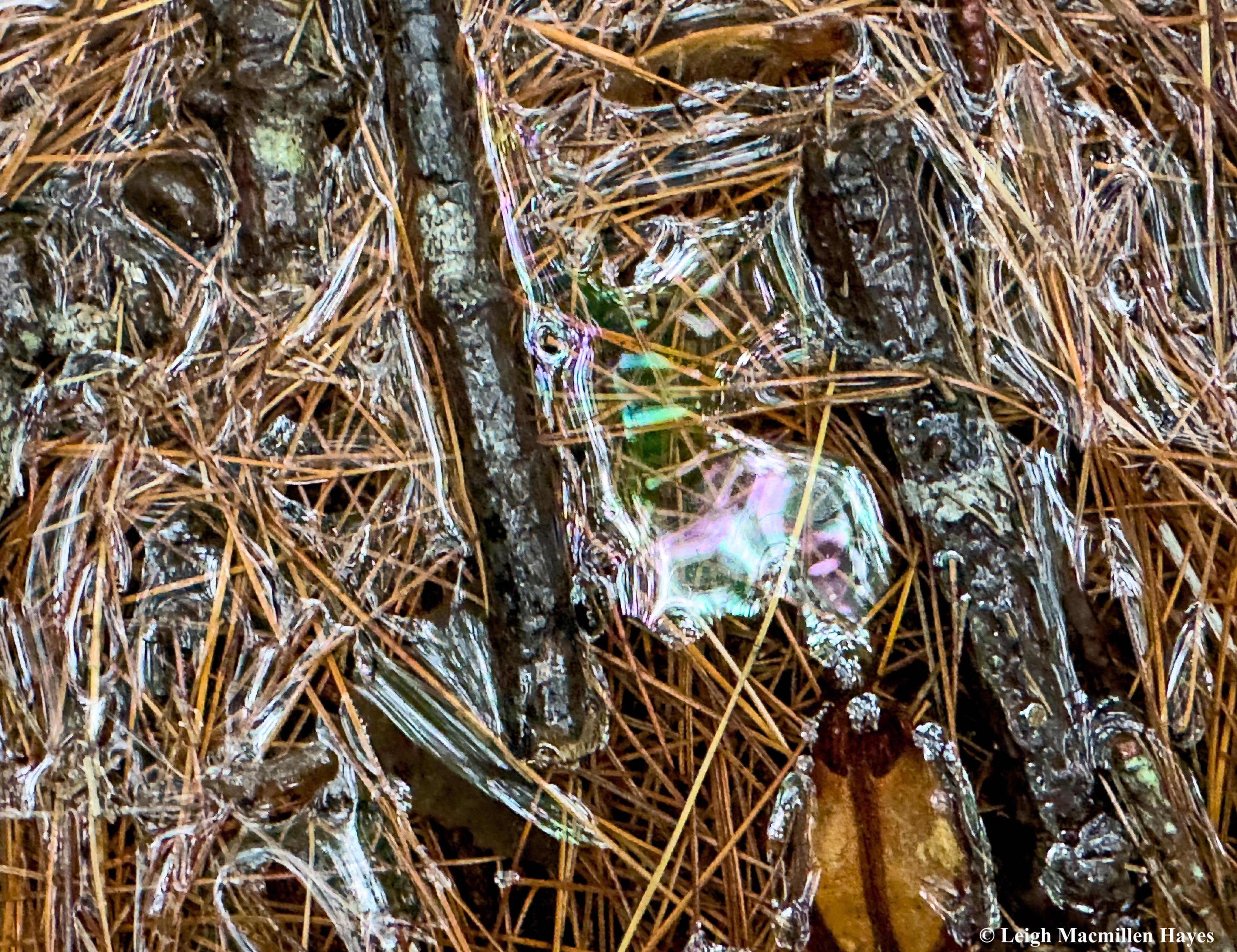
Before today, I knew that the foam formed on Eastern White Pines and it’s one of those things that drives me out the door on a rainy day, but I had also seen it on Northern Red Oaks. Today, however, my understanding increased. One of the take-aways was seeing the variety of shapes that form, such as this collective blob, .
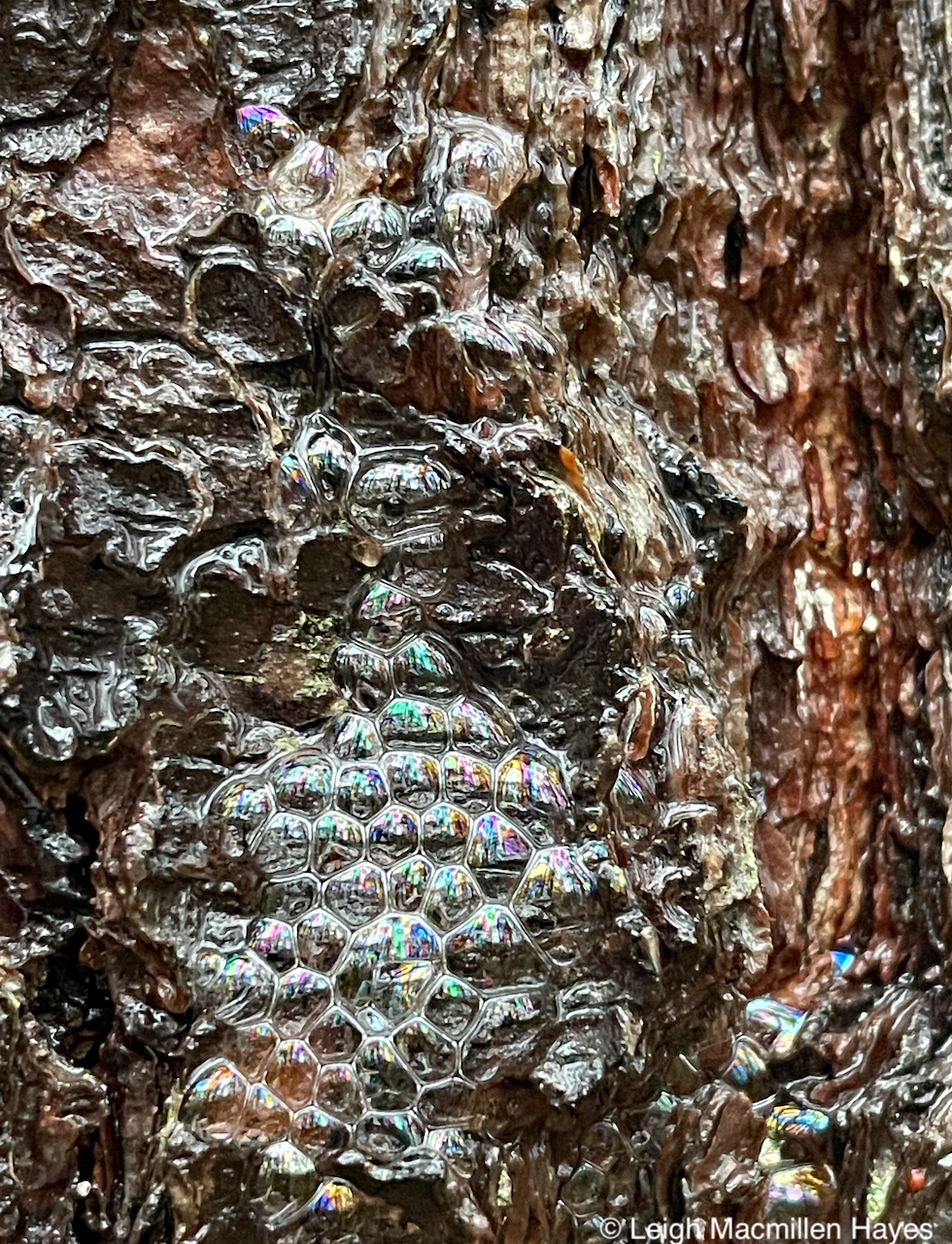
I found it on pine and oak, but also near the base of Eastern Hemlock and Red Maple. And of those various forms, my favorites were a much looser structure that reflected rainbow colors in an almost hexagonal prism.
This rainy day . . . of slugs (for I did find a second one so I can use the plural form, and my first had moved all of two inches when I returned to it an hour later) . . .
turned out to be also a day of suds, and for both I gave thanks.
Fourteen months ago I wrote Ode to Pinus Strobus, showing my respect for the mighty pines that inhabit our woods. Curiously, it was a rainy day then. And today dawned the same, though even more curiously, today we turned the calendar to December 1, yet the temperature rose to 57˚, like a summer day as we approach winter in western Maine.
Needing a fresh-air break mid-day, I ventured into our woodlot, where part of a fertile fern clinging to a dead tree branch about five feet above the ground garnered my attention. How did it end up on the tree, I wondered. Given that I’d been picking up branches from last night’s gale-force winds, I suspected it had somehow been torn from the rest of the frond and blew onto the branch. Maybe.
Below it, perched in a more stable manner, was a half eaten pine cone and this time my interpretation was much clearer for frequently I’ve been scolded by a Red Squirrel on this trail. He must have been dining on a branch above, out of danger’s way, and for some reason I don’t know, let the cone slip from his front paws where it fell and landed between a branch stub and piece of bark that was partly dislodged from the tree.
A glimpse at the base and I was 98% certain my story was correct for a large midden or refuse pile of cone scales and cobs removed by Red in order to consume two tiny seeds located inside each scale decorated the forest floor.
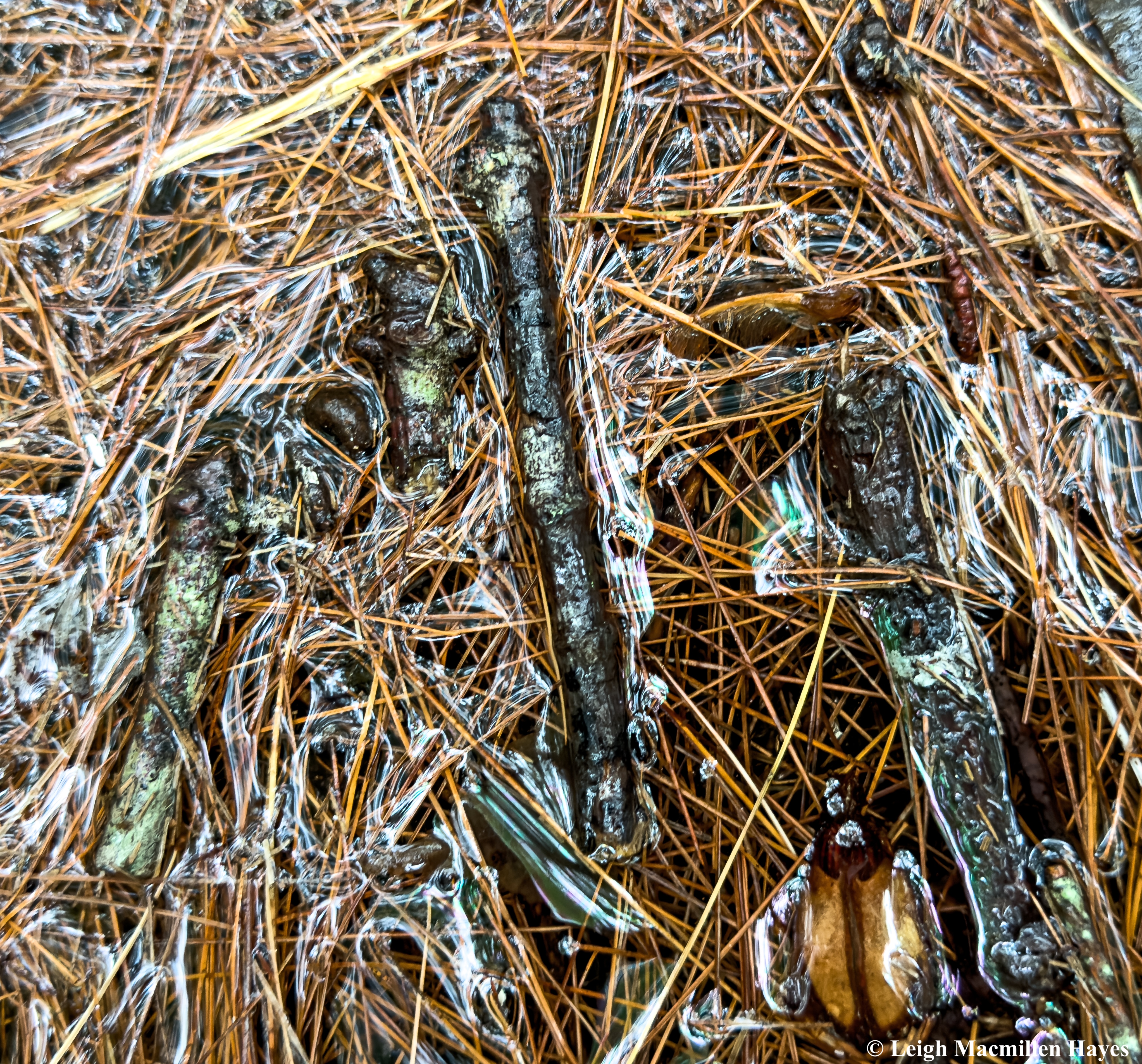
Because I circled the tree to further examine the midden, and because it was raining, I shouldn’t have been surprised by my next find, but the froth that forms on pines as the result of a chemical interaction when rain drops pick up oils and air in the bark furrows bubbles through that oily film and the end result is pine soap never ceases to amaze me. Plus I love the rainbow colors.
With great patience, I watched the drops drip onto the froth and realized that if I counted to twelve I might get to see a drop just before it let go.
And could almost capture its journey.
As if that wasn’t enough to make my day, I was stepping away from the tree when I discovered a hickory nut on the edge of the midden. One of the manners in which a Red Squirrel opens a hickory nut is to split it in half. Notice the grooves along the edge created by the squirrel’s incisors.
By this time, I was hungry and maybe a wee bit damp, and ready to follow the path home, but . . . a sudden look at the tree’s bark, and I spied life.
The life of a slug is interesting and not to be rushed. No longer was I.
For almost an hour I watched four slugs as they moved at their own slow pace into and out of the furrows of the pine. These terrestrial gastropods (gastro=stomach; pod=foot) create a layer of mucus that they secrete so that the “foot” under almost the entire length of their bodies can move rather smoothly.
Their heads include two sets of tentacles that they can retract (and grow back should they lose one). The upper tentacles are light sensitive and have eyespots at the tip of the stalks. They also use these to smell.
The lower tentacles are for feeling and tasting.
And then there’s the mouth, that funky-looking line to the left of the tentacles in this photo. The radula is a tongue-like organ covered with thousands of raspy tooth-like protrusions–the better to scrape or brush particles from the surface of a tree or plant.
Here’s another cool fact about snails; they are hermaphrodites, meaning each one has both male and female sex organs.
As my snails headed in each and every direction, I at last pulled away, though I did stop to examine other trees on my way home, but found nothing else to look at. ;-) Or at least, nothing else to report.
An hour or more later, I slipped out the door again, curious to check on the action upon that one pine. The fern had blown to the ground. The cone was still lodged between the branch stub and bark. The rain had slowed and froth diminished, though remnants of it remained. The hickory nut had disappeared. And I could only find one slug who was making its way to the safety of its underground habitat.
But . . . because I went back, I spotted an Assassin Bug.
For those who love to wander and wonder, I hope you’ll be still and have an experience similar to what this tree offered me today.
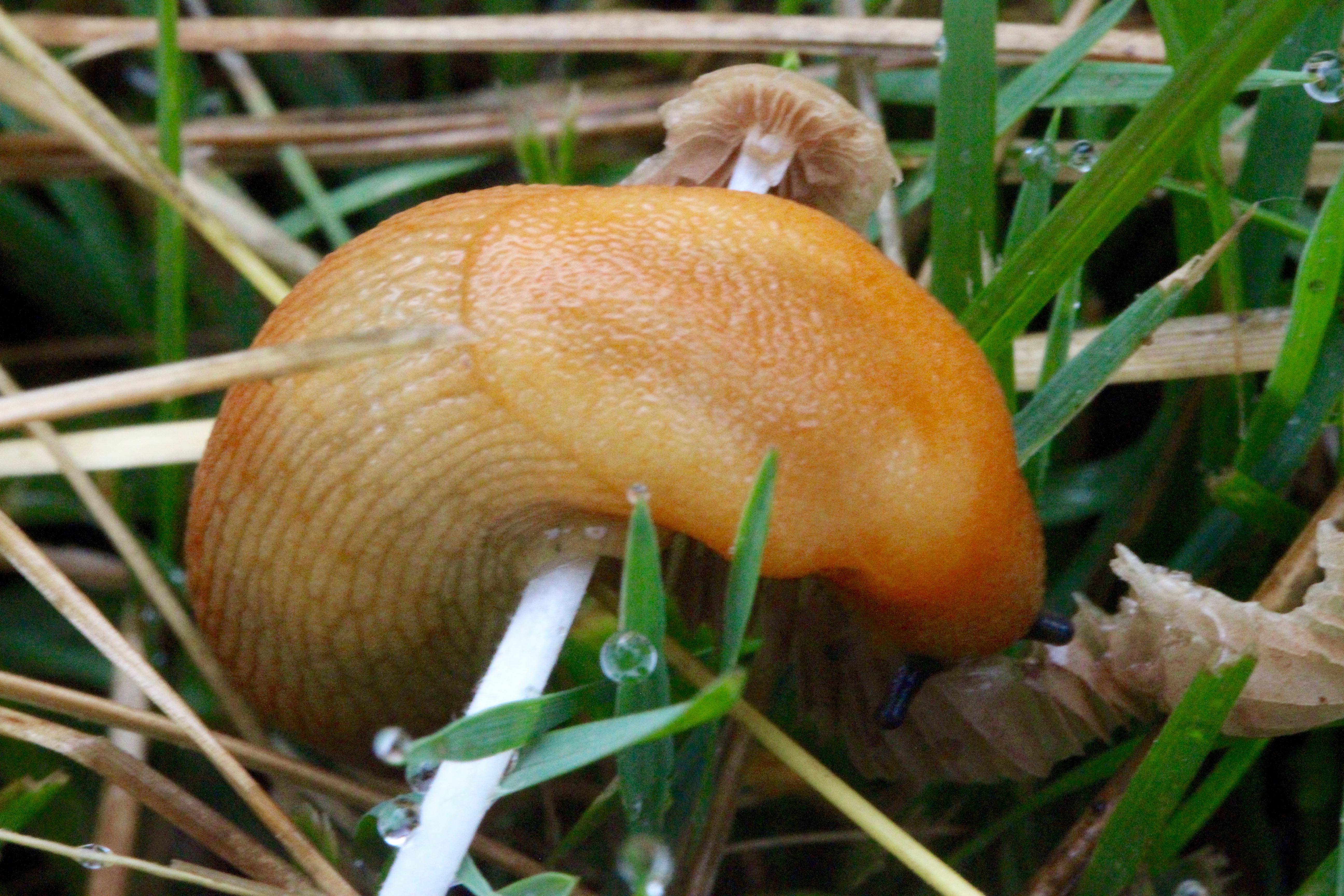
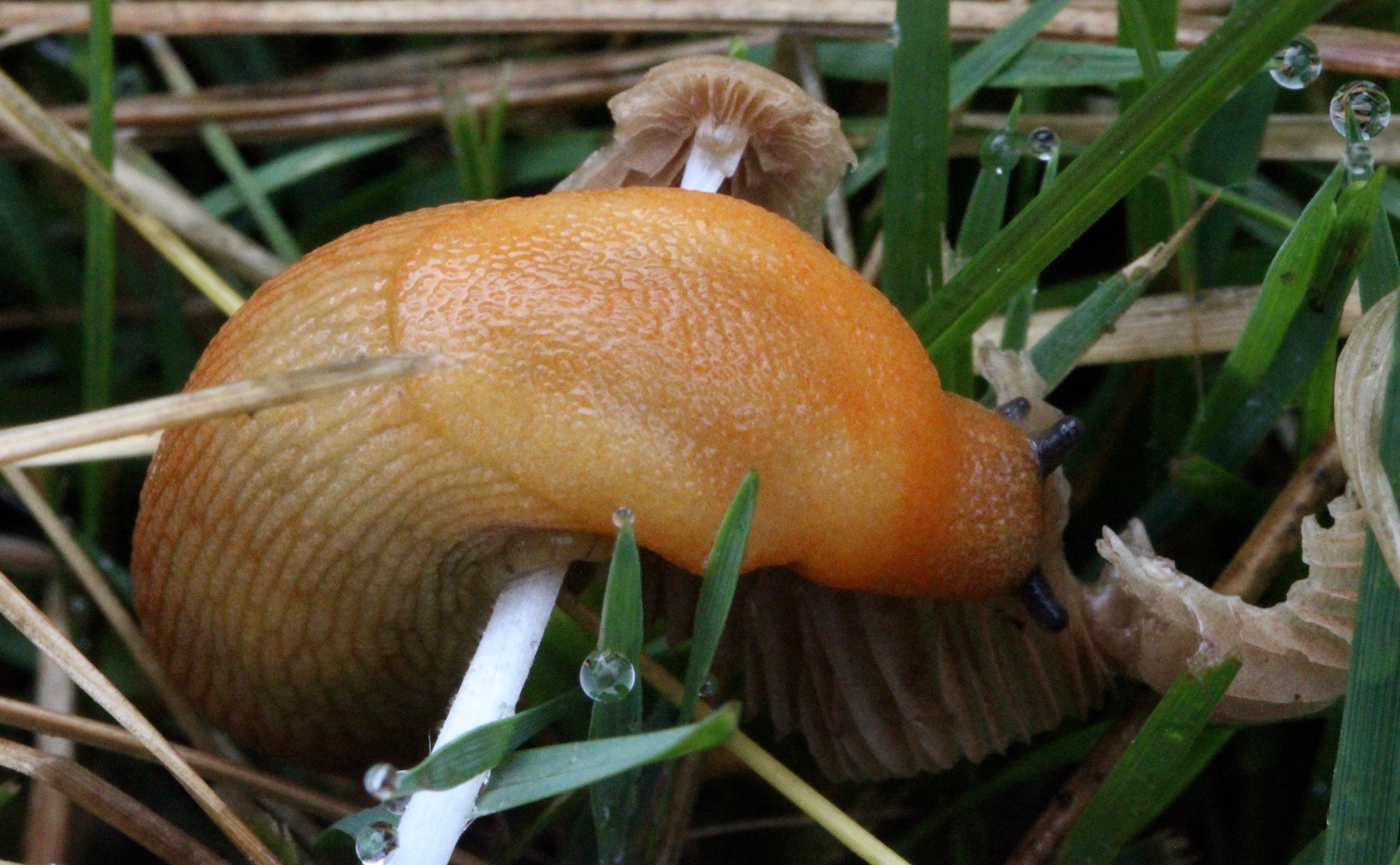
It’s not every day that someone shares time with a slug, but this morning that’s exactly what I did. It had poured until about 5:30am, so the conditions were prime.
Actually, I was hunting for a spring peeper that frequents one garden and the grasshoppers that live in another, when a spot of orange caught my attention. And so I bent down for a closer look.
A slug is like a snail without a shell, which makes it vulnerable to dehydration. That’s why we only see them foraging on rainy or cloudy days. I suppose we should think of slugs as weather predictors, much the same way common polypody indicates the temperature. Of course, if you look under leaf cover in the garden, you’ll surely find them as well, no matter what the weather is. Cool and damp conditions prevail in their world view.
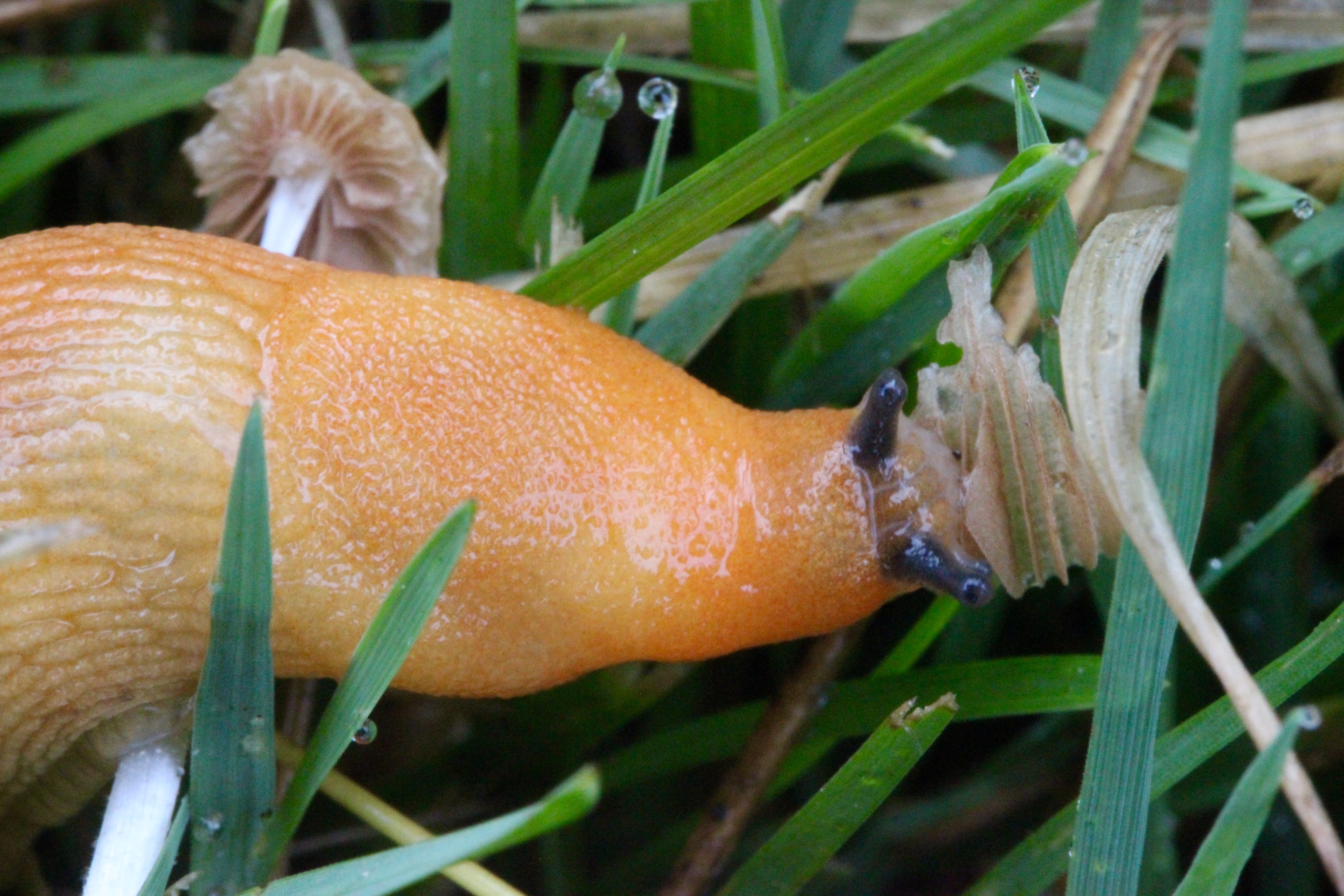
As Mr. Slug munched on a mushroom at my feet, I admired the pattern on his back and thought about my past experiences with slugs. I’ve licked their backs because I’d heard that they release a chemical which works like a natural anesthetic, thus providing a cure for toothaches. The numbness did last for a short period of time. That being said, my nursing friends encouraged me to stop because slugs may also carry parasites. And so I did.
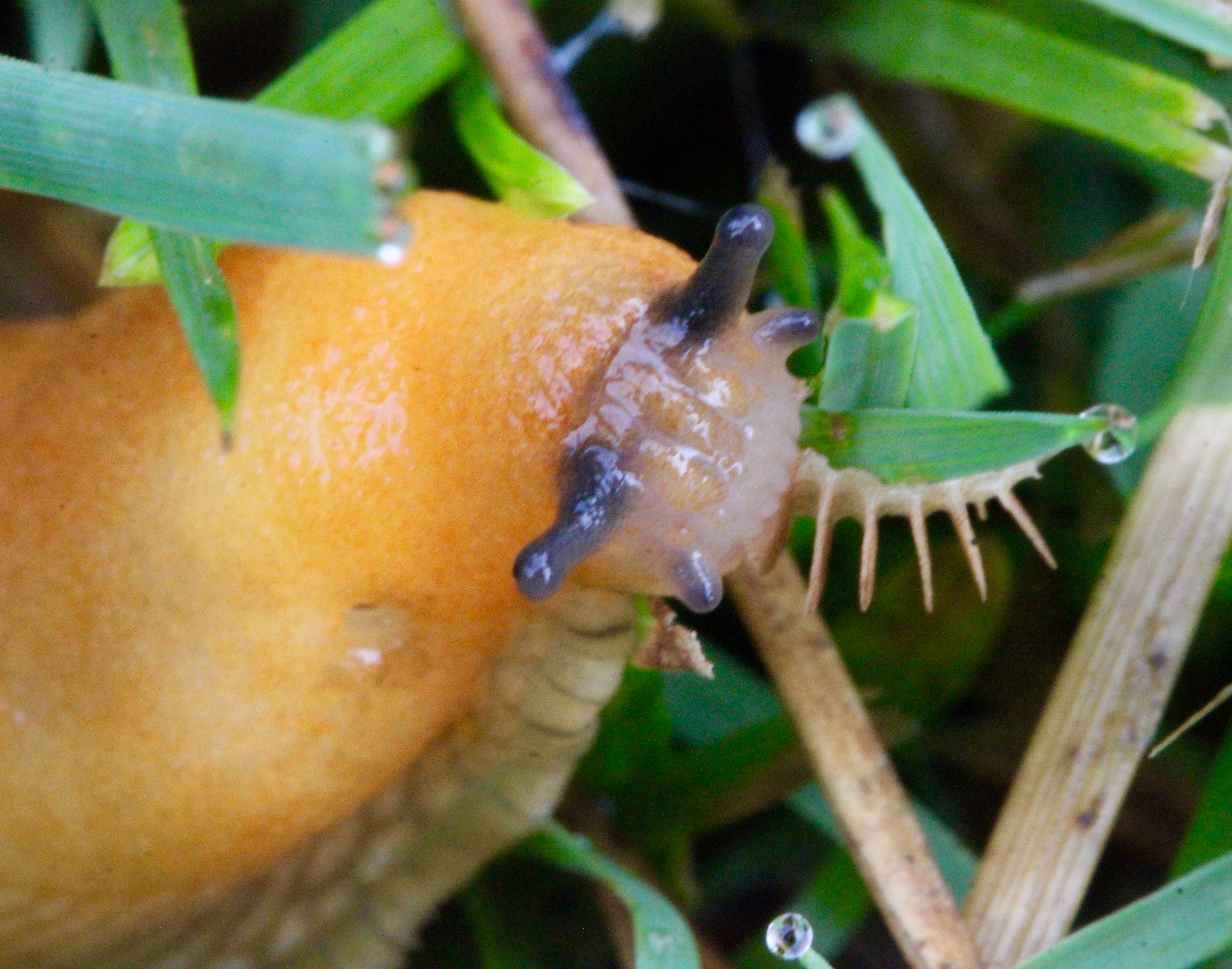
Since I was upclose and personal, I could see Mr. Slug’s two short antennae and even shorter eye stalks. Then there was his accordion-shaped mouth that he used to grasp and shred plant material. At first I thought he sucked it in, but as I watched, I could see the chewing motion.
Being a mollusk like a clam or oyster, one might think about sautéing slugs. Or not. Really, I’m surprised my parents never tried that. Dad always sacrificed some beer so Mom could pour it into a tin pan in the garden to attract slugs. It worked–better for her than the slugs who thought they’d found the holy grail only to instead meet their fate. A perfect marinade. Thank goodness Mom and Dad didn’t think of that. But really, though slugs do have a bad reputation because they eat plant material in our gardens, they also play an important role as decomposers–of fungi and lichens and dead insects and plant material, all of which they turn back into soil.
And here’s another curious thing about slugs–their mode of transportation. Remember their vulnerability to dehydration? Well, in order to move along they must create a slimy mucous. And so a chemical reaction occurs in their bodies causing them to secrete a sticky, slippery substance. That probably helps in keeping their predators, like toads and snakes and birds, at bay. Once they’ve moved on, it dries up.
This morning, after we’d spent about a half hour together, Mr. Slug decide it was time to move on–toward the garden. It’s raining again as the sun sets and he’s probably slip sliding away across the yard in search of another feast.
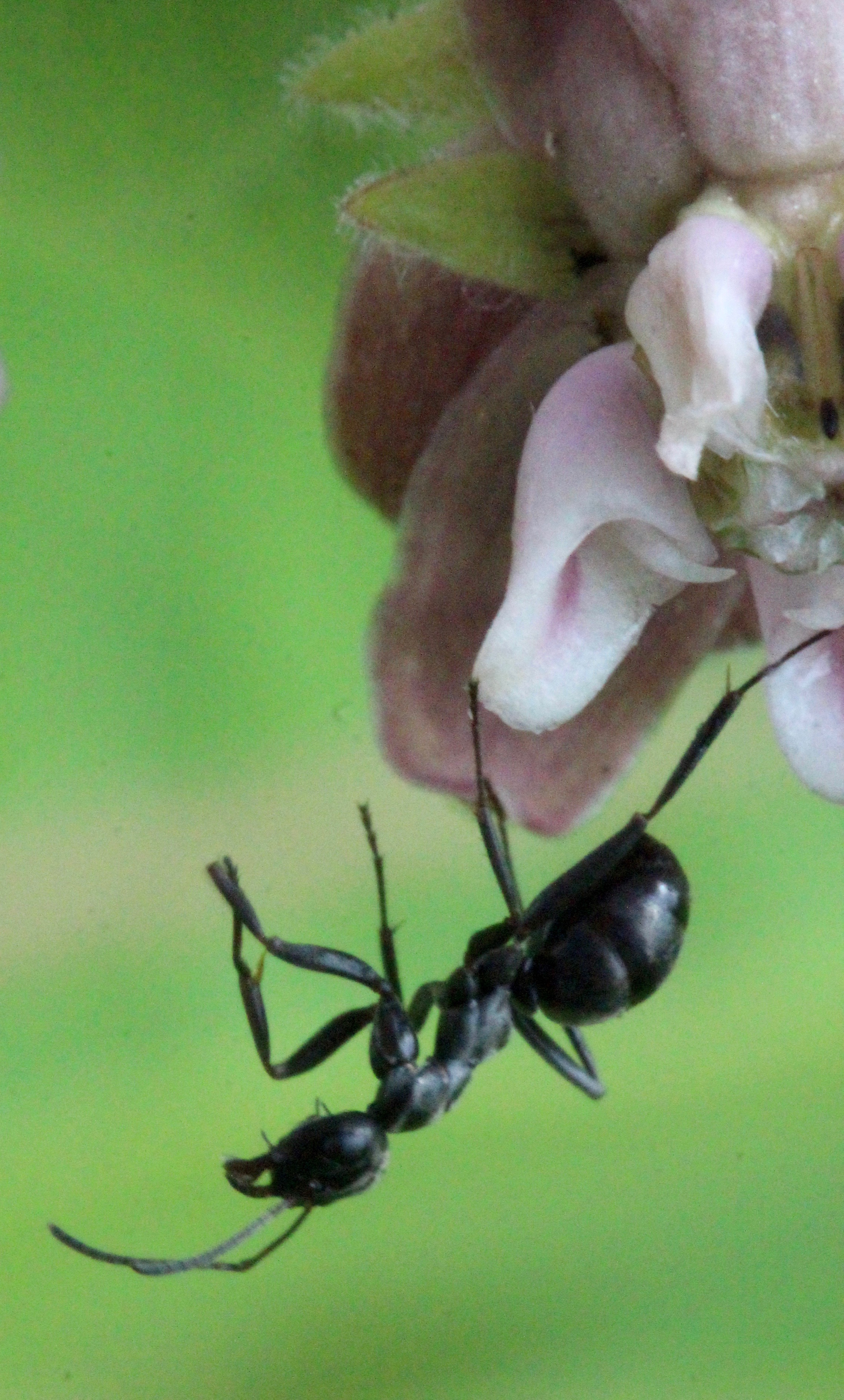
Because you stayed with me through my slug praise, dear reader, I thought you’d enjoy stopping by to wonder about a few pollinators like the ant that visited the milkweed. Did you know that insects get their feet caught in the sticky pollen sacs of the flower? They have to twist and turn as this one did while trying to get out. In the process, their feet get covered with pollen that they carry to the next flower.
Pollinators come in all shapes and sizes, but I found one who looks like it wears a Halloween costume on a daily basis.
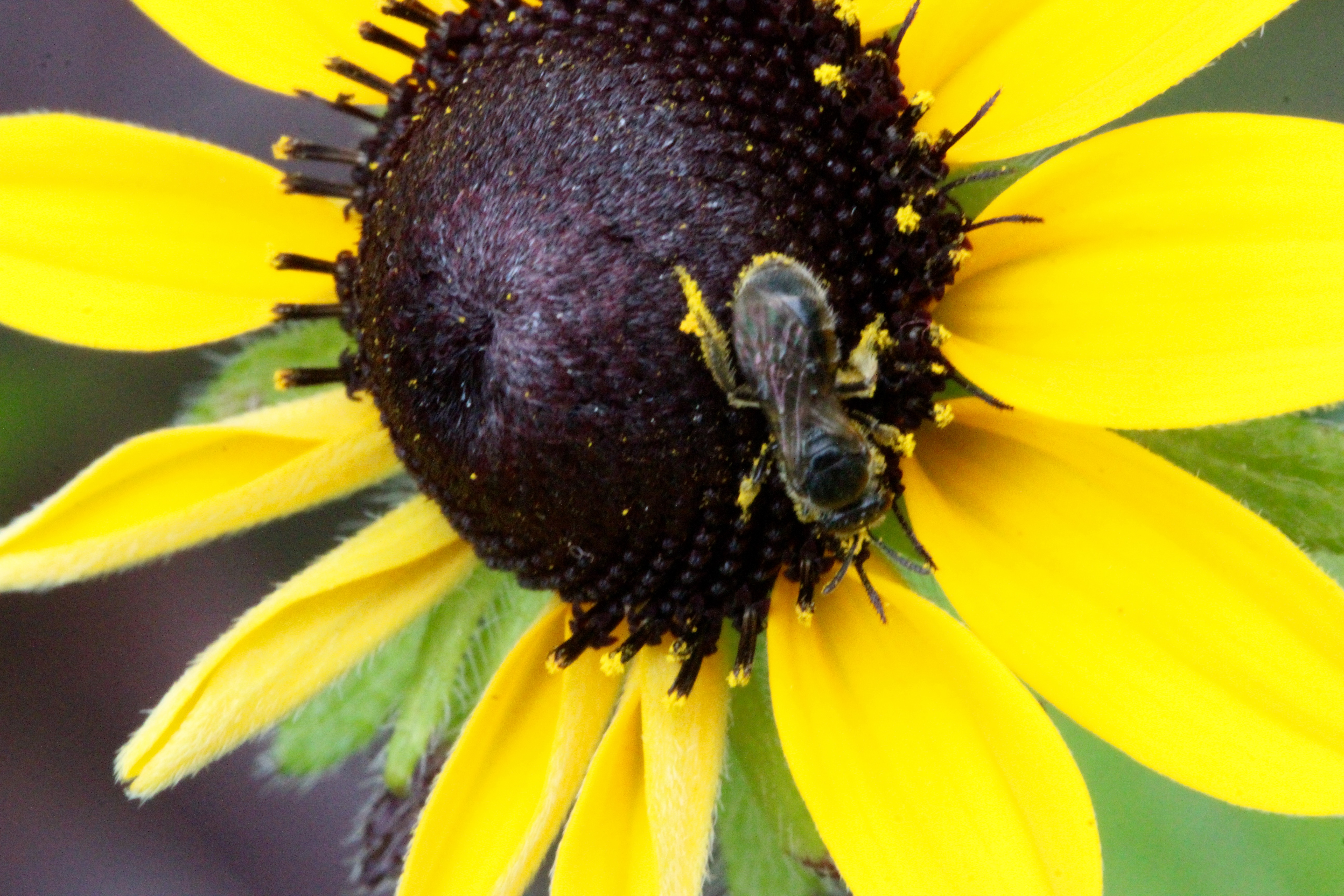
And this final pollinator of the day–loves to get totally immersed in its job.
I never did find the spring peeper today, and only one grasshopper, but my moments spent wandering and wondering were hardly sluggish.

























 wondermyway