The Ice Storm Cometh Again?

Having lived through the Ice Storm of 1998, when our boys were quite young and we had no power for nine days, today’s weather took me back to that time.
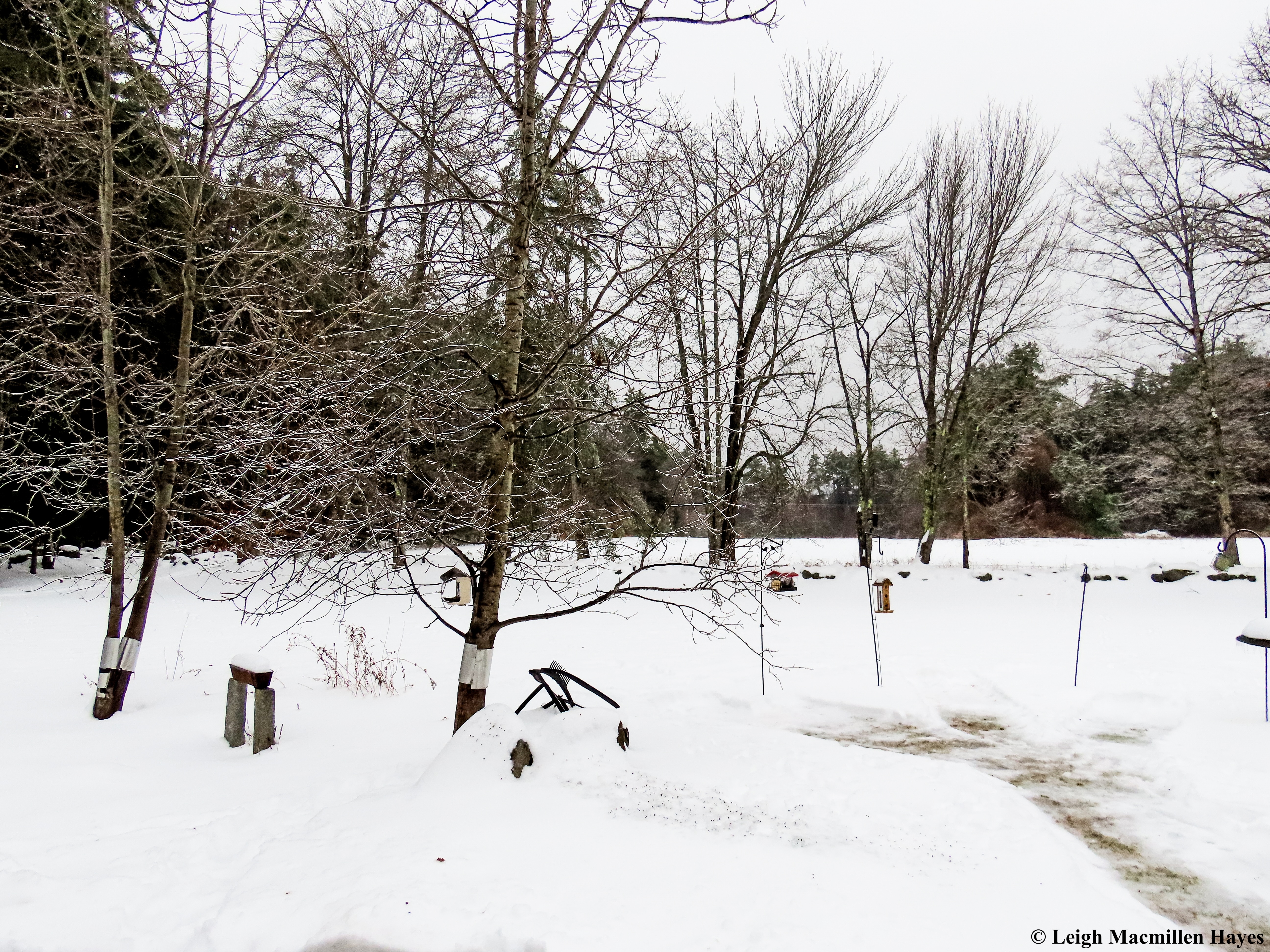
During the wee hours of this morning, sheets of snow slid off the barn and house roof and landed with a thump upon the ground. And then, when we finally arose we realized the driveway was an ice rink and everything was coated with a glaze.
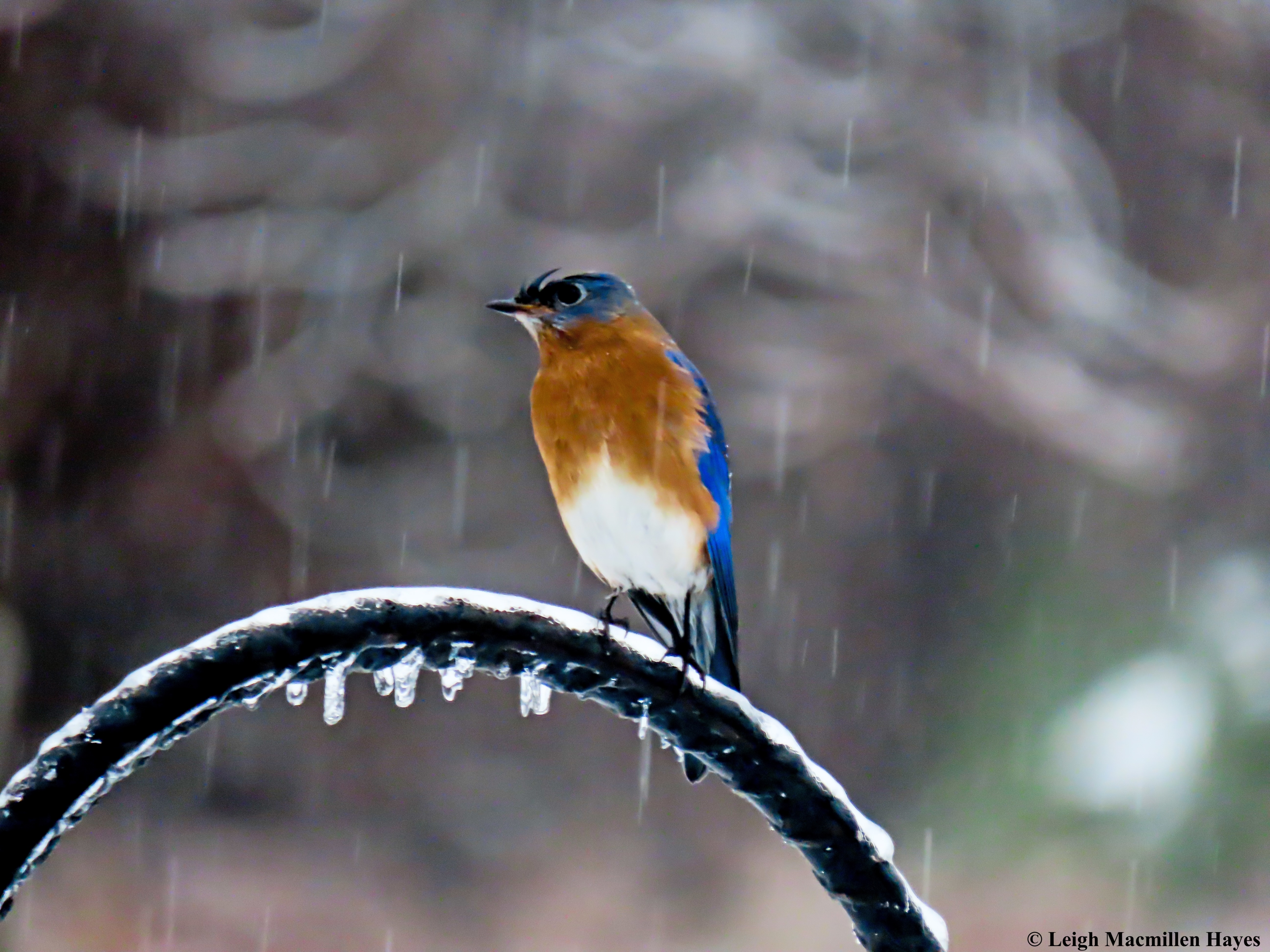
But as often happens when it rains or snows, the birds flew in and the feeders and ground were full of activity.

This male Bluebird, however, contemplated it all.
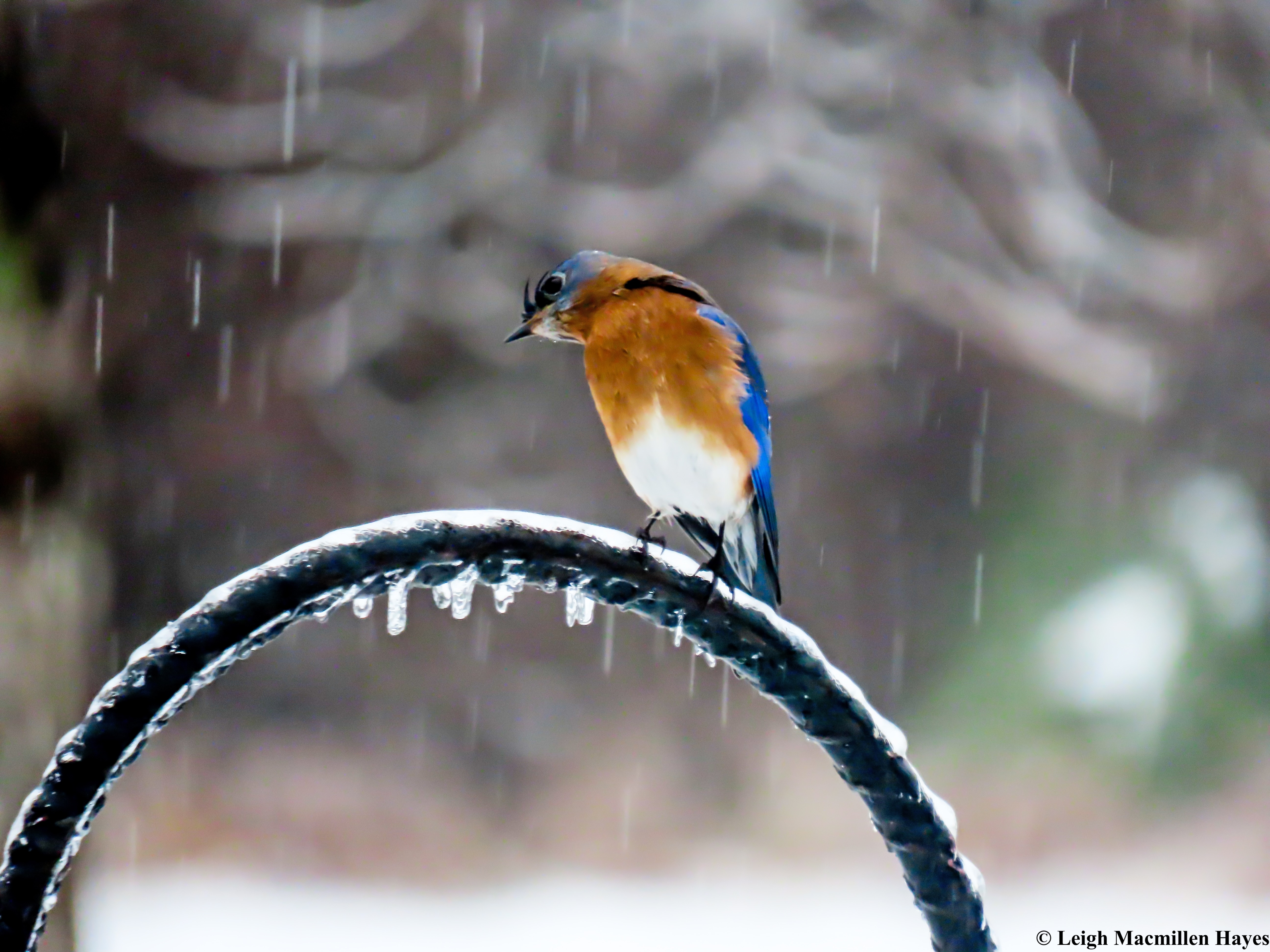
And then seemed to contemplate the situation even more, eyeing everyone below before deciding to fly to a suet feeder at last.
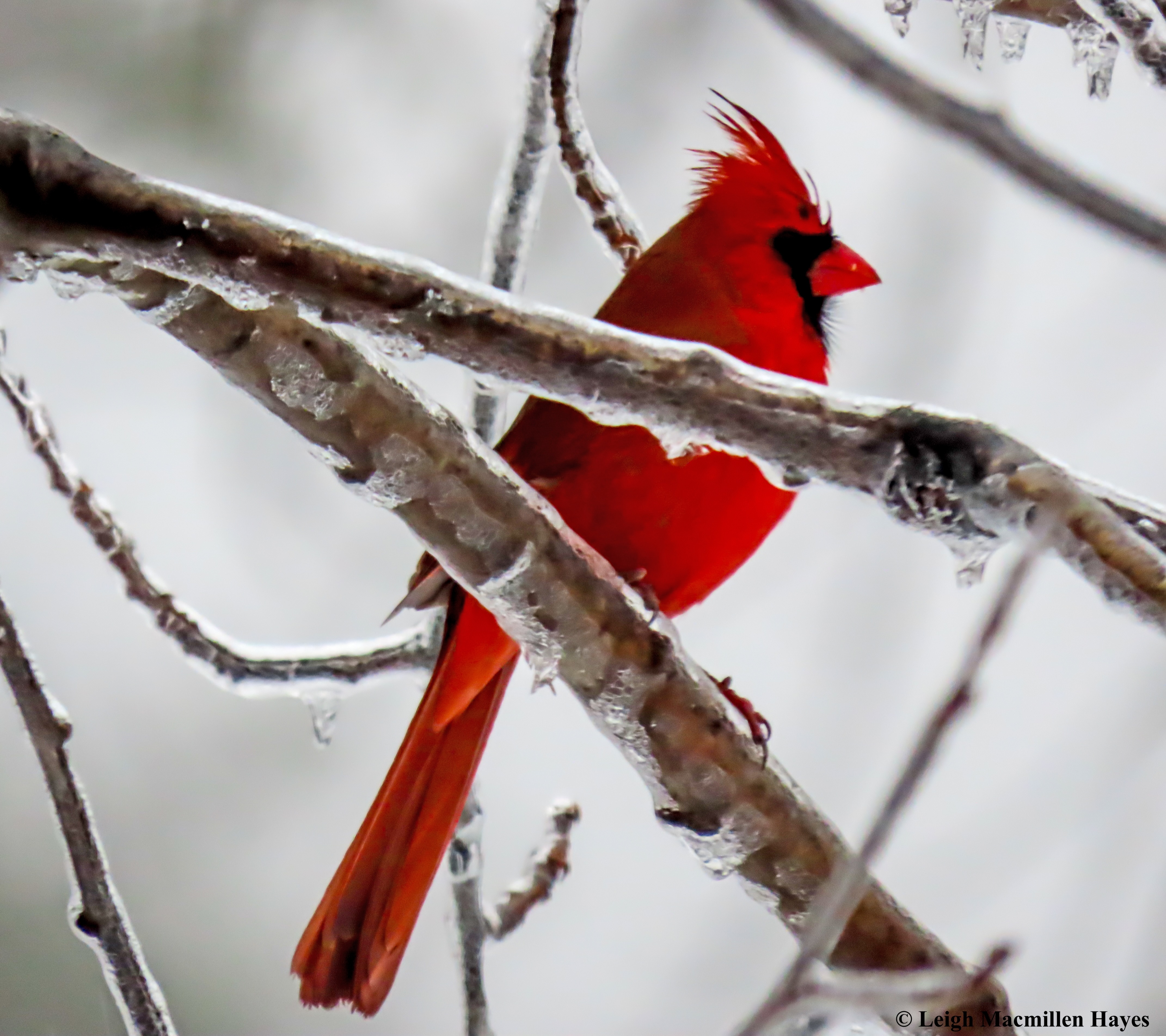
There were Chickadees, Tufted Titmice, Juncos, a Mourning Dove, Blue Jays, White Breasted Nuthatches, and this brilliant male Cardinal, all taking advantage of the feeding station from time to time throughout the morning and early afternoon.
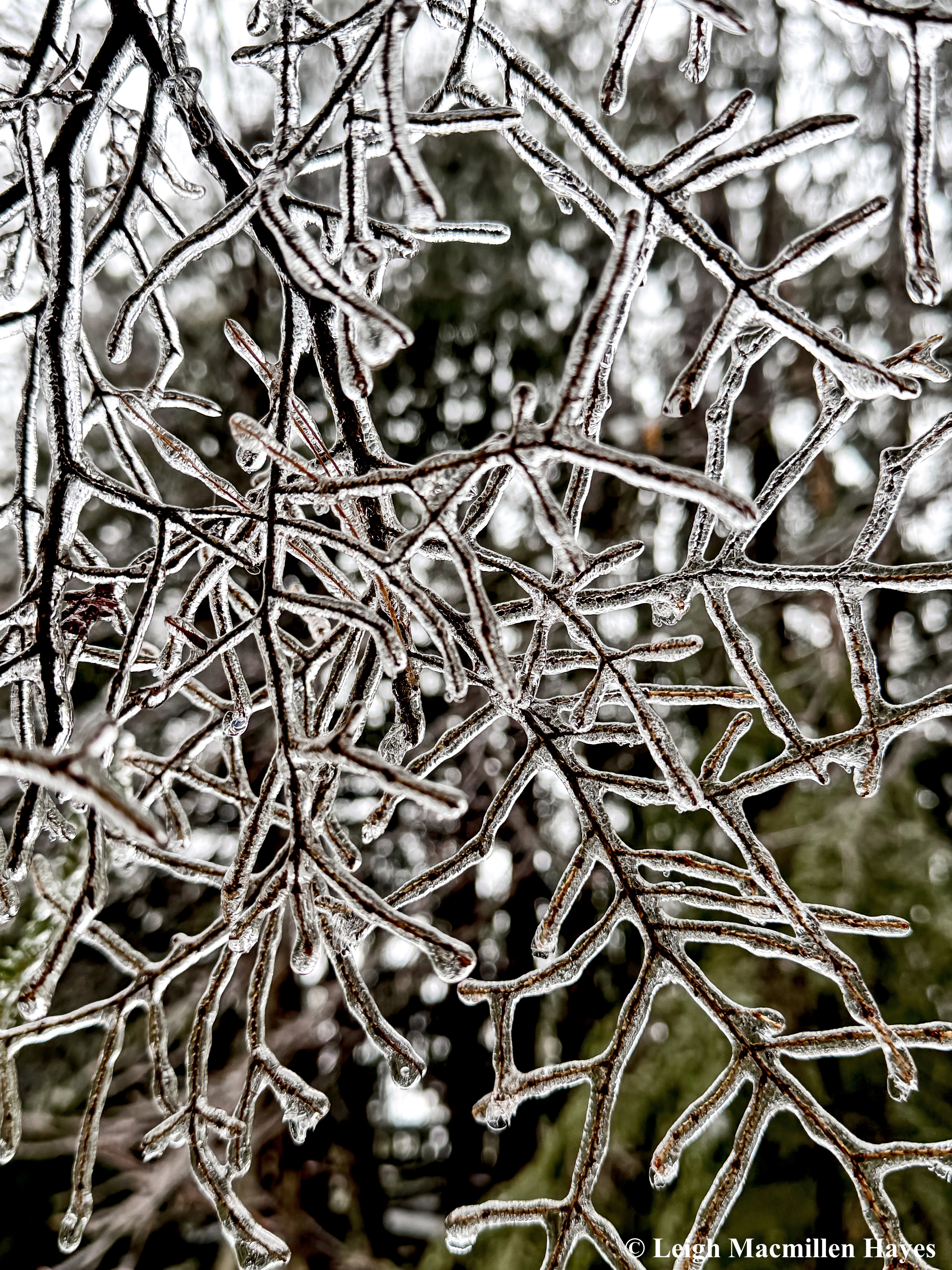
And by afternoon, I could stand staying inside no longer, and so donned my raincoat and Muck Boots and headed out.

Immediately, I was stunned by the beauty that surrounded me. Yes, it was raining. Yes, it was cold, but it’s been colder of late. But YES, it was a sight to behold and I felt at times as if I was looking through a stained glass window.
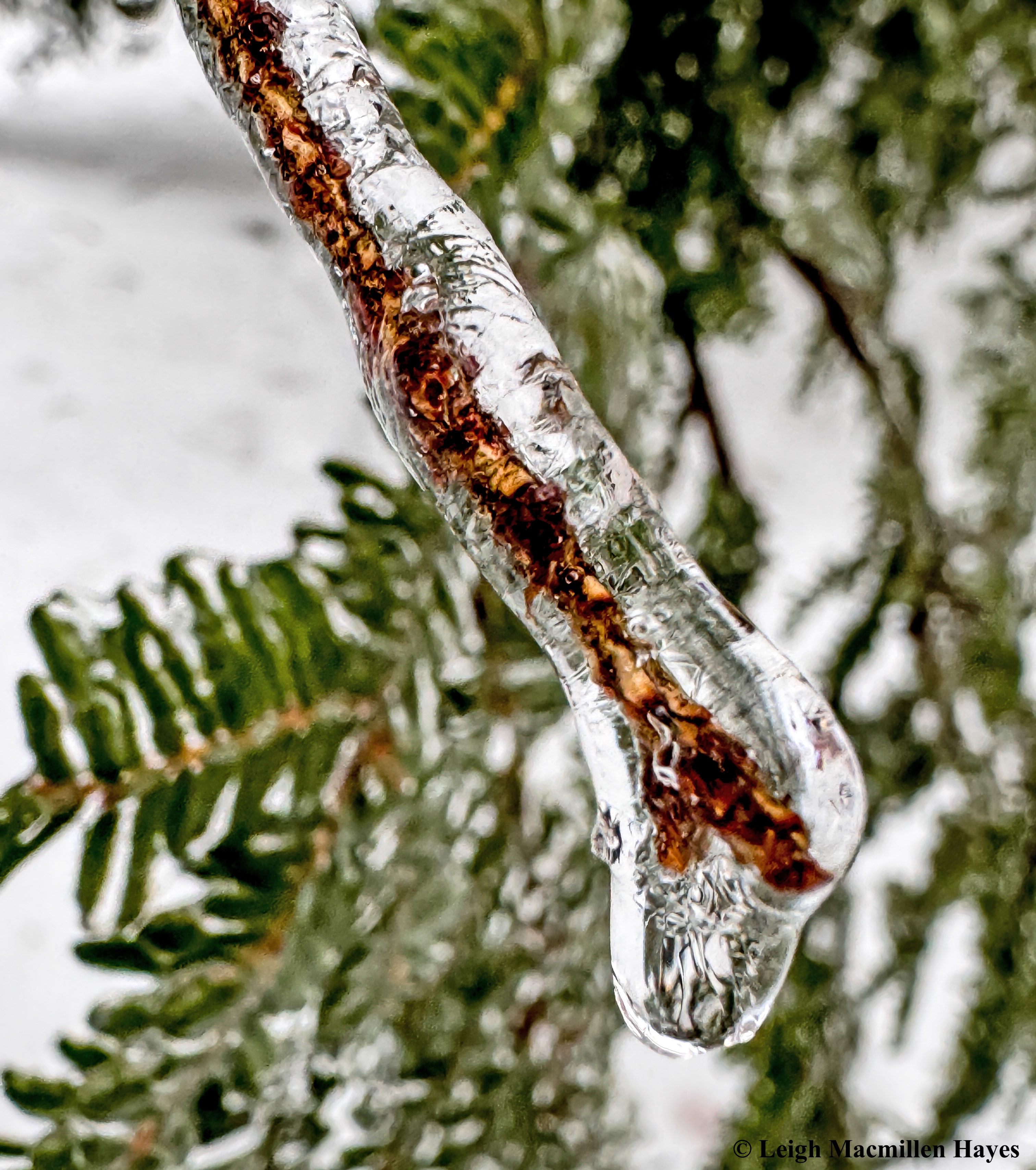
Everywhere, the world had been enclosed in a treatment of ice and I began to notice the unique shapes and sometimes reflections that were offered. And I knew I had to photograph them so that those of you who travel with my via your armchair may enjoy and notice and wonder without stepping outside.
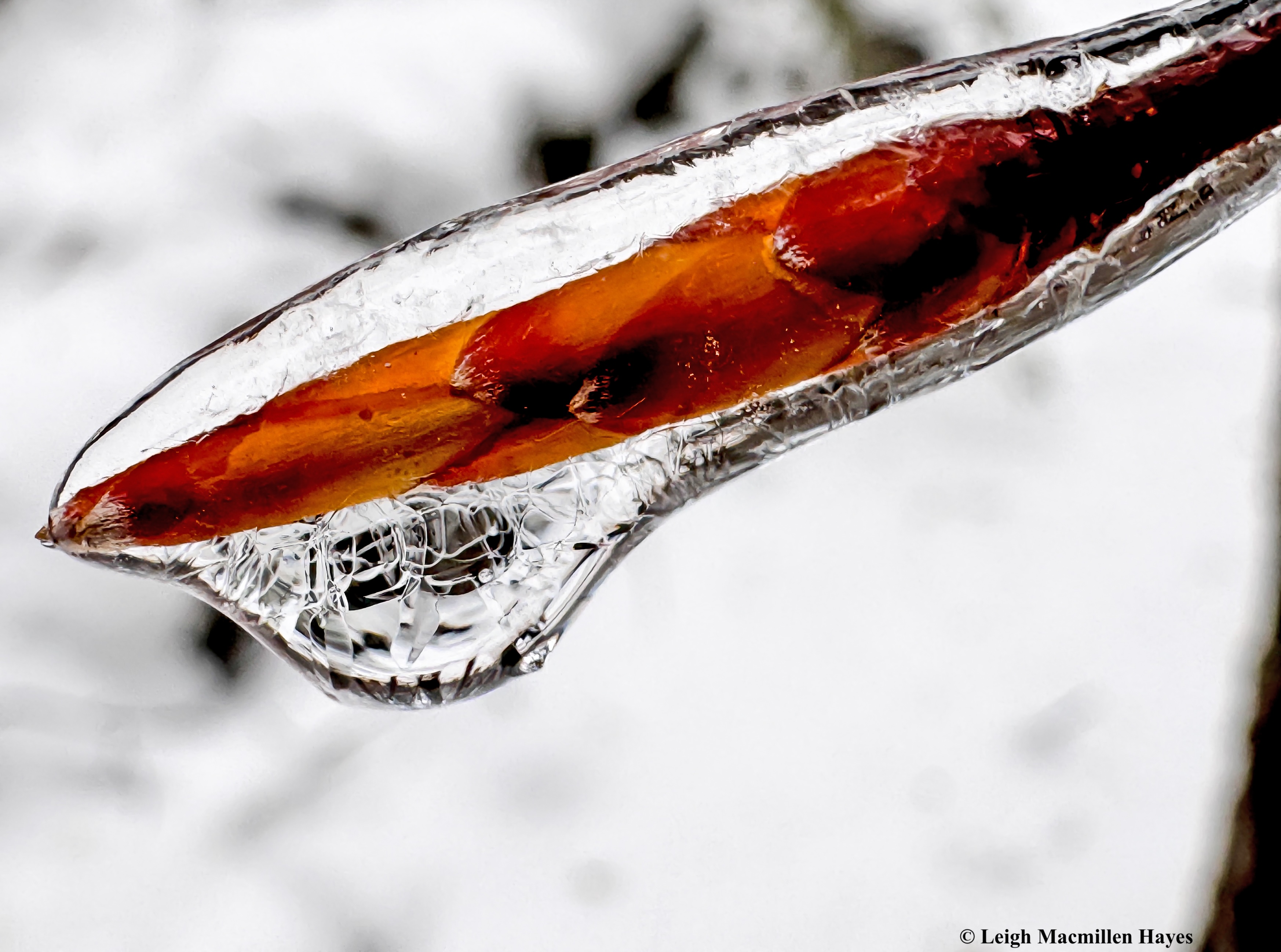
The Beech bud was fully encapsulated and just using that word makes me think how the ice must insulate and protect the bud just as the bud’s scales protect the leaves and branches growing within it. Encapsulate means within a protective shell and insulate means protect, so I think I may be on to something here.
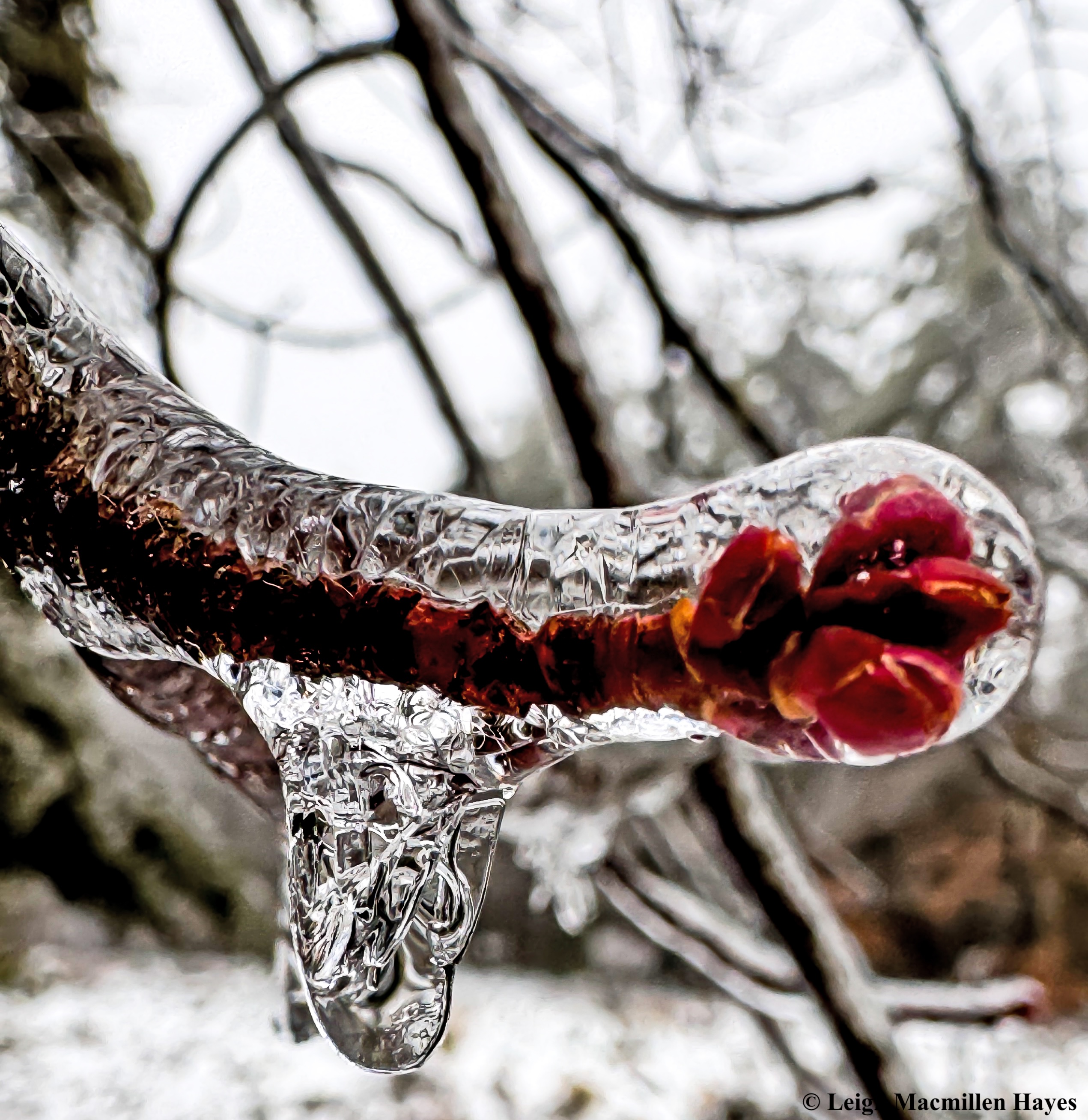
The Red Maple buds were equally coated, but notice the design of the ice on the upper part of the branch, as if the pattern matches the branch’s nooks and crannies where bud scars represent previous years of growth.

And then that tip where the ice is almost clear around the buds–and all I could think of was that it had formed a snow globe without any snow.

Not to be overlooked was that frozen drip below–so intricate, so artistic, so unique as no two drips are alike . . .
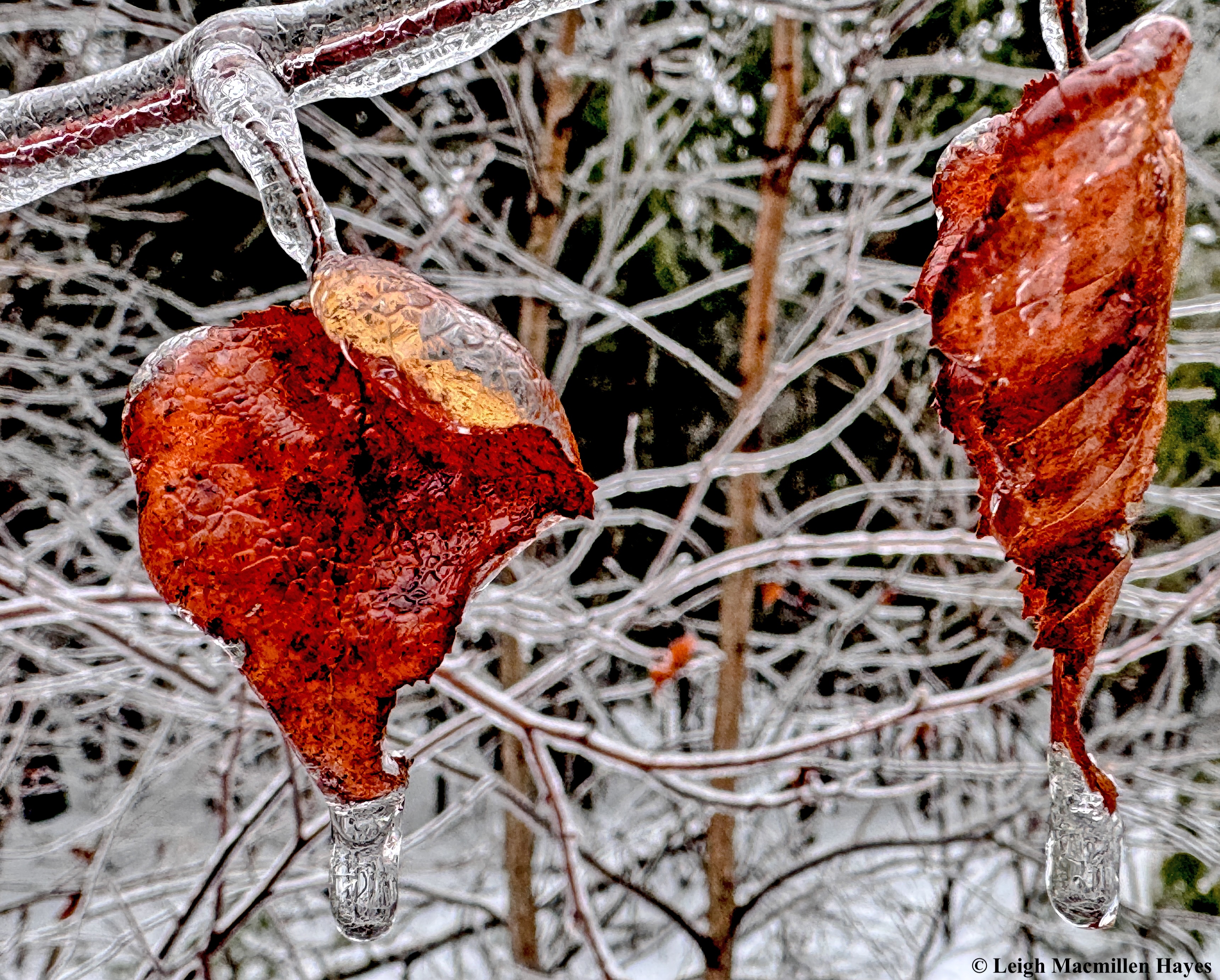
Even when they fall from matching leaves.
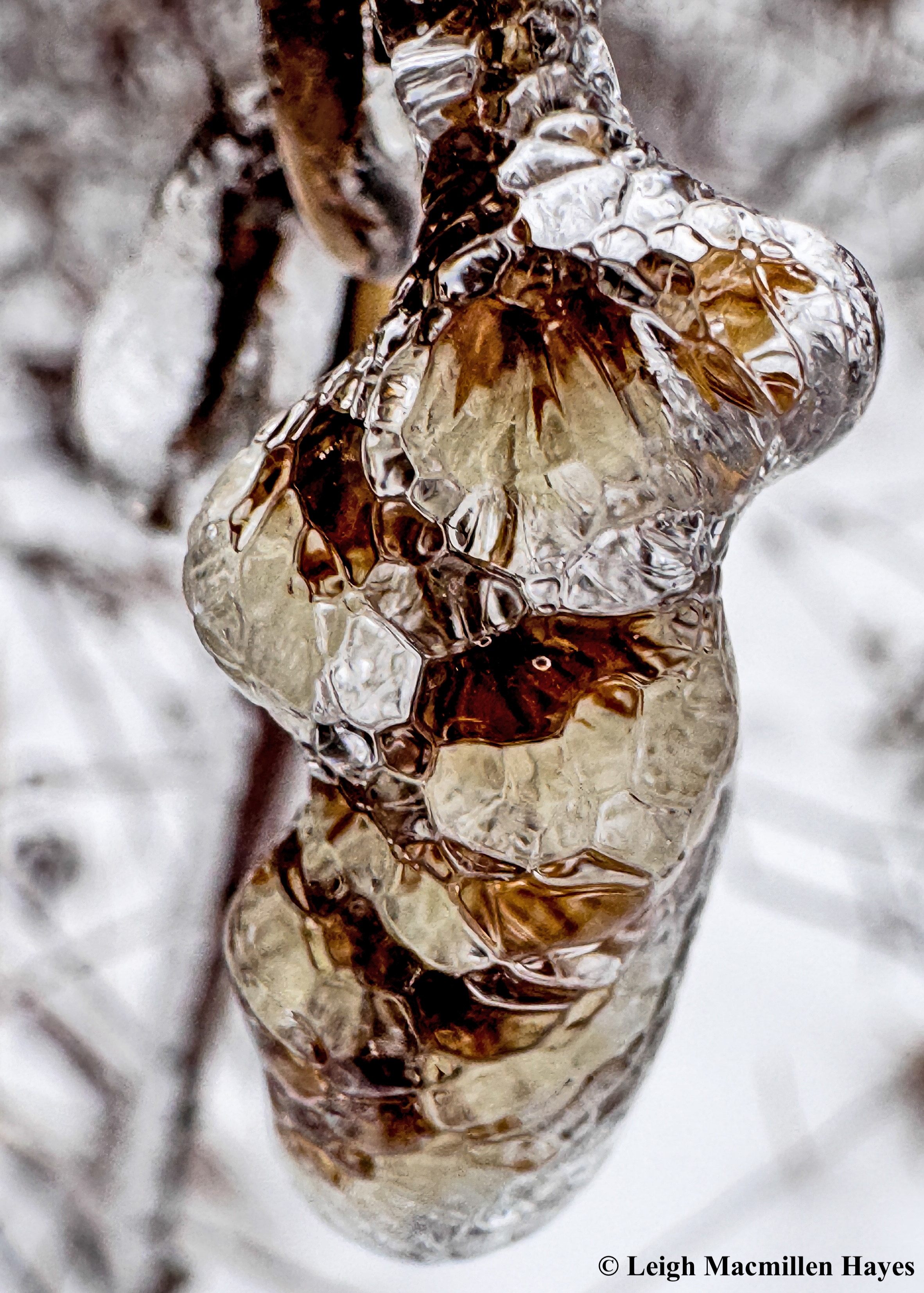
Aster seeds were not to be left out and again, the design struck me–hexagonal in shape due to the water molecules freezing. Amazing.
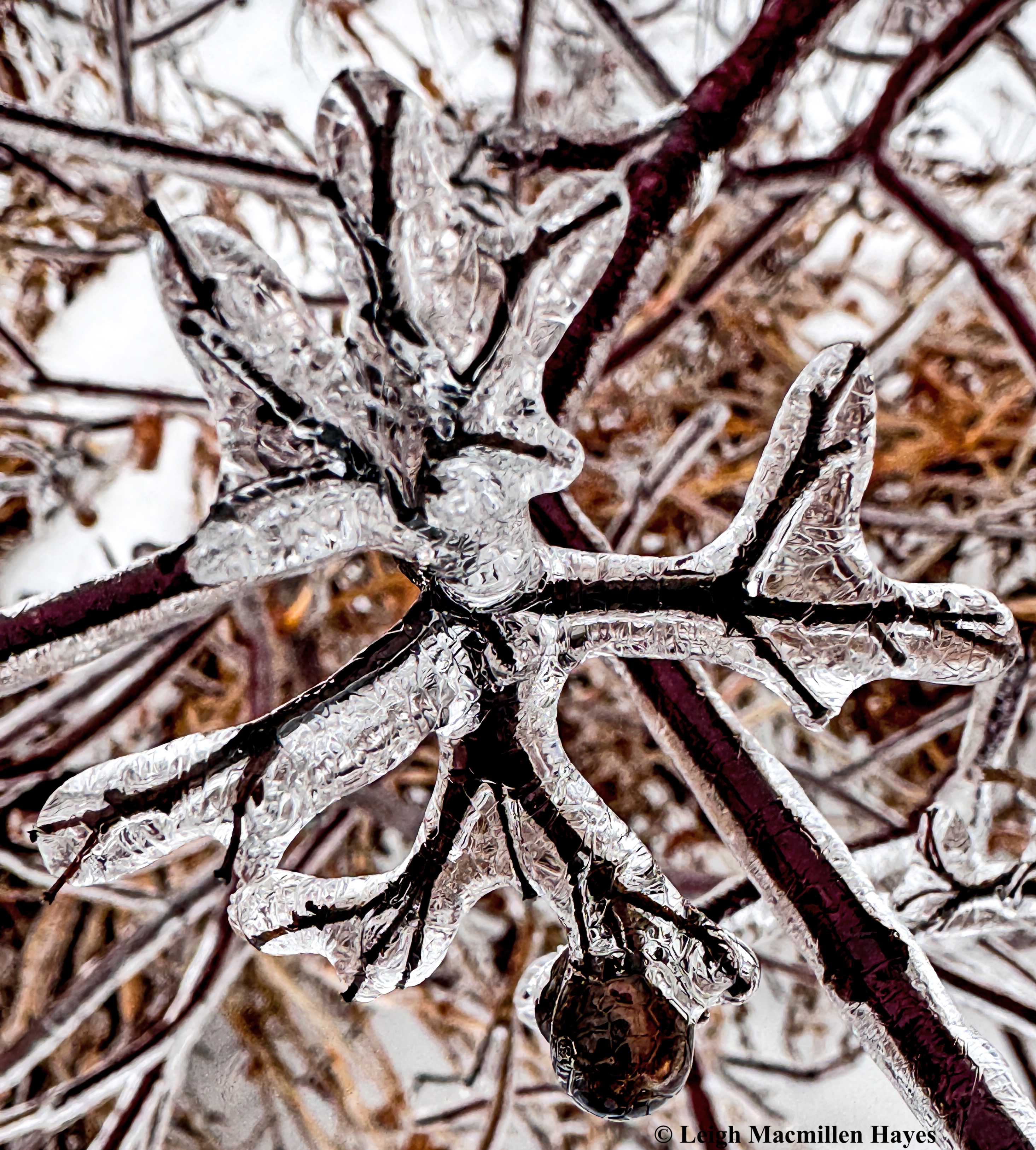
And a Flowering Dogwood, with a fruit or two still attached, turned into a star at eye level.
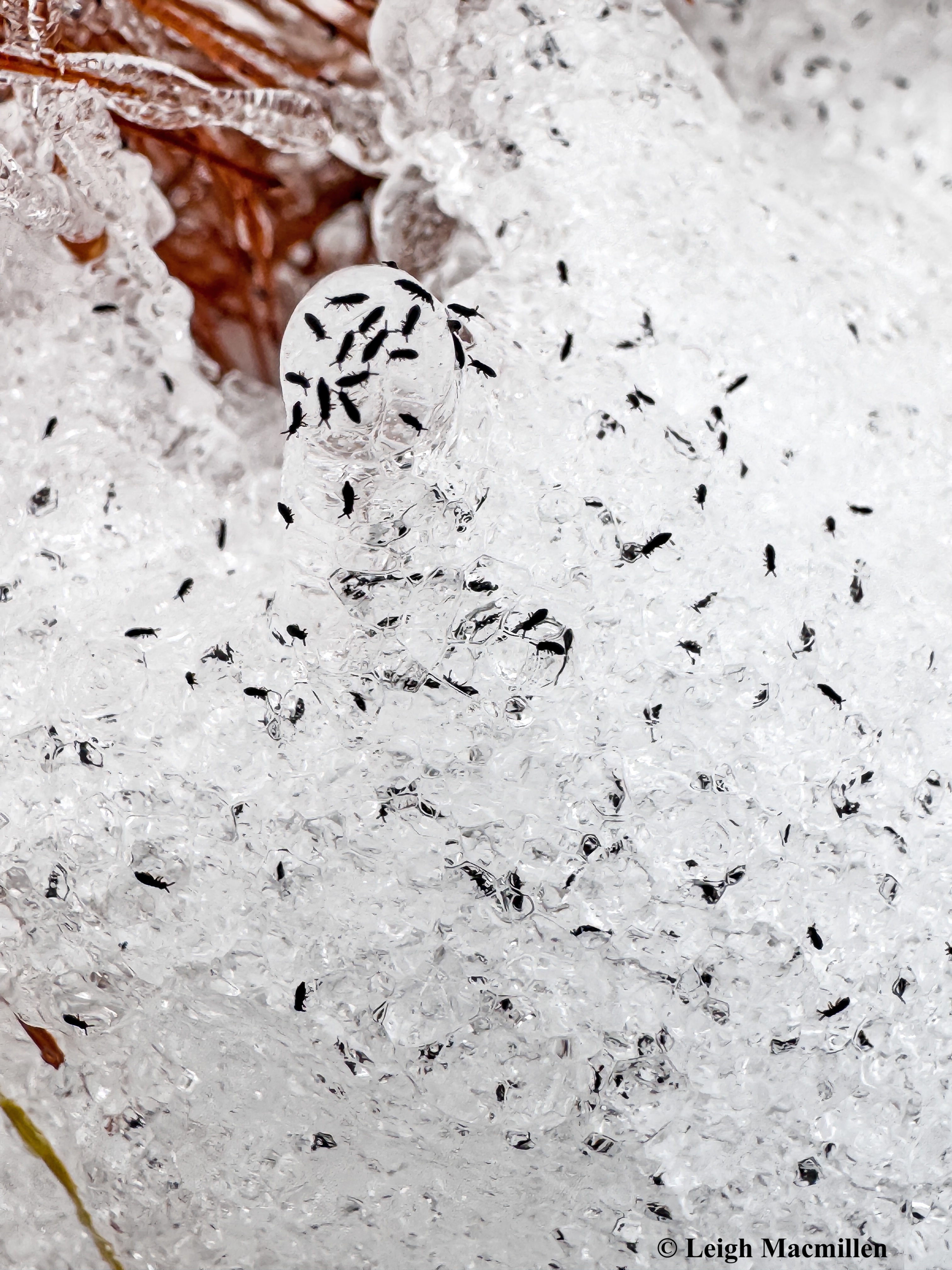
Of course, I searched all the time that I was out–looking for insects and spiders and the Springtails did not disappoint.

A friend asked me this morning if Springtails, aka Snow Fleas, which aren’t really fleas, will be exterminated if we have a sudden freeze, which we are supposed to have tonight. I reminded him that they inhabit the leaf litter in the subnivian layer most of the time and so as the temperature dips, to that they shall return and remain cozy beneath the snow.
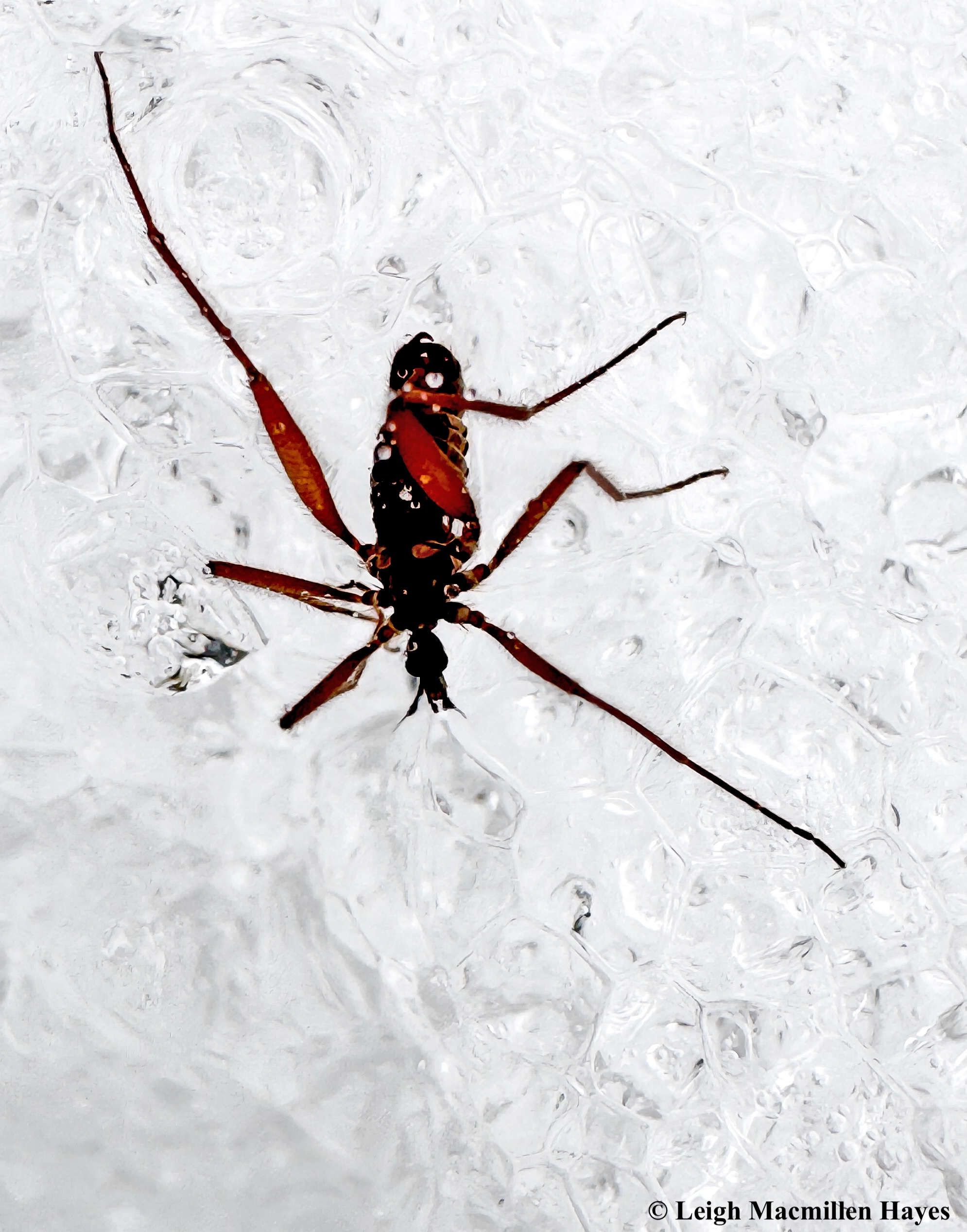
I also discovered a Snow Fly skeddadling across the crusty surface and suspect he had one thing on his mind: Where’s my mate-to-be? Where’s my mate-to-be?

I found her as well, but she was about a half mile from him.

For a brief second I thought maybe I should transport her back to him, but really, I didn’t know if he’d still be where I’d last seen him, or still available. And besides, I don’t need to interfere with nature (though occasionally I do) and I certainly don’t need to start a wondermyway insect matching site!

As for spiders, I spotted none today. But did see one Winter Fly that wasn’t feeling very photogenic.
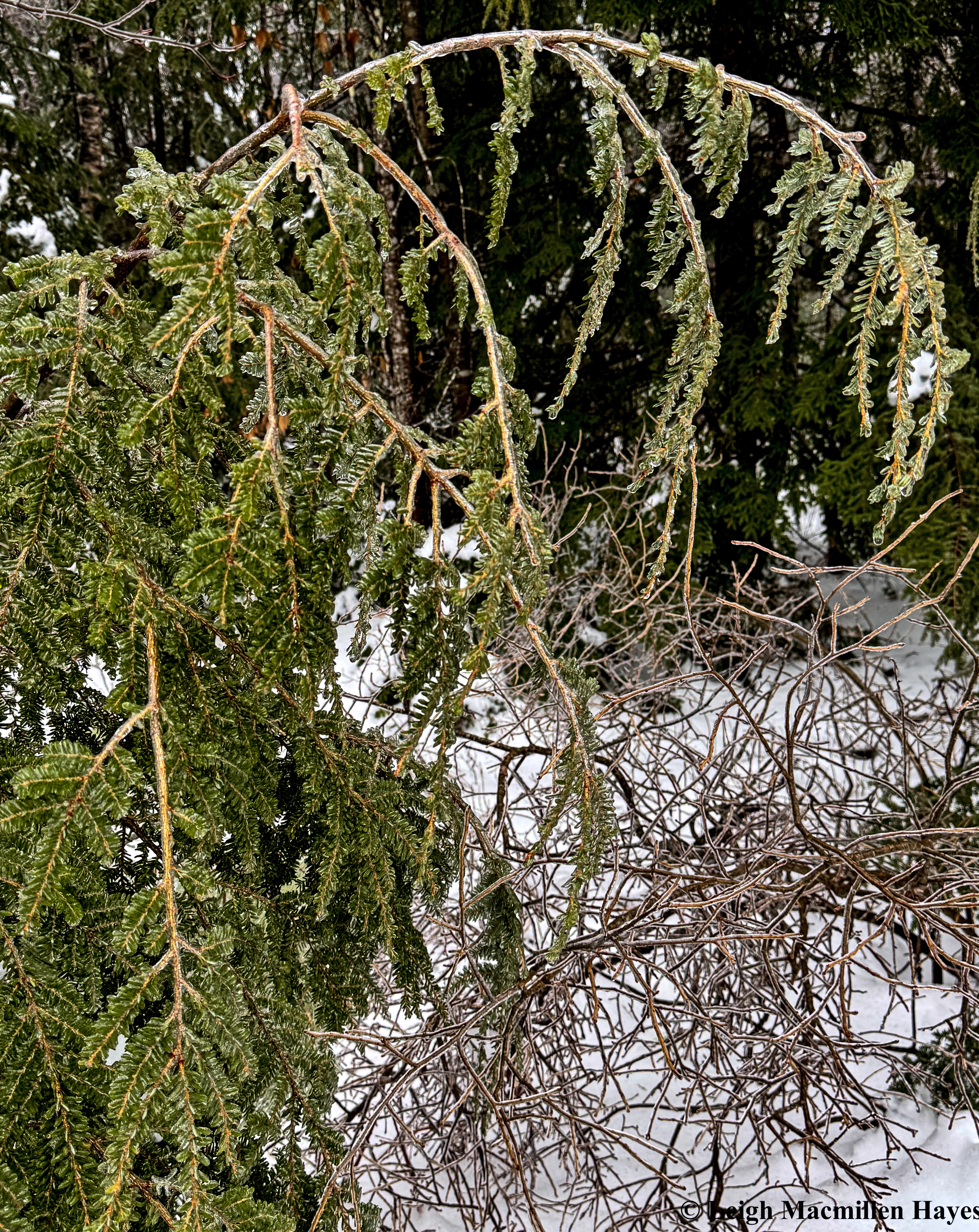
Everywhere I looked, the trees showed signs of the strain from the weight of the ice, as pretty as it was. This Hemlock sapling was doing what Hemlocks do and its lead branch was bending over as is their fashion, but in a more dramatic way than normal.
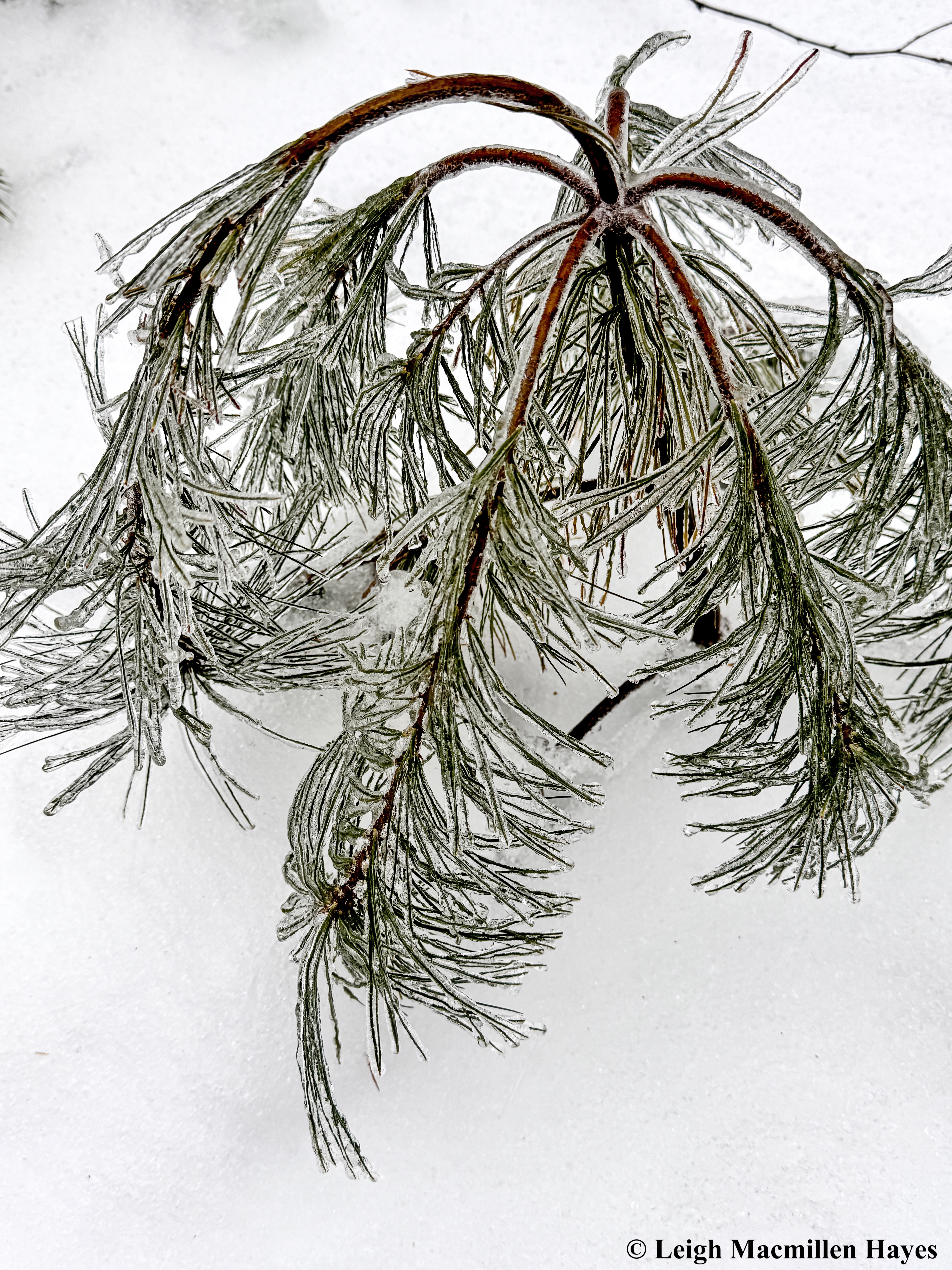
The White Pine Sapling was equally dramatic and its leader also tipped over, almost reaching the snow pack.
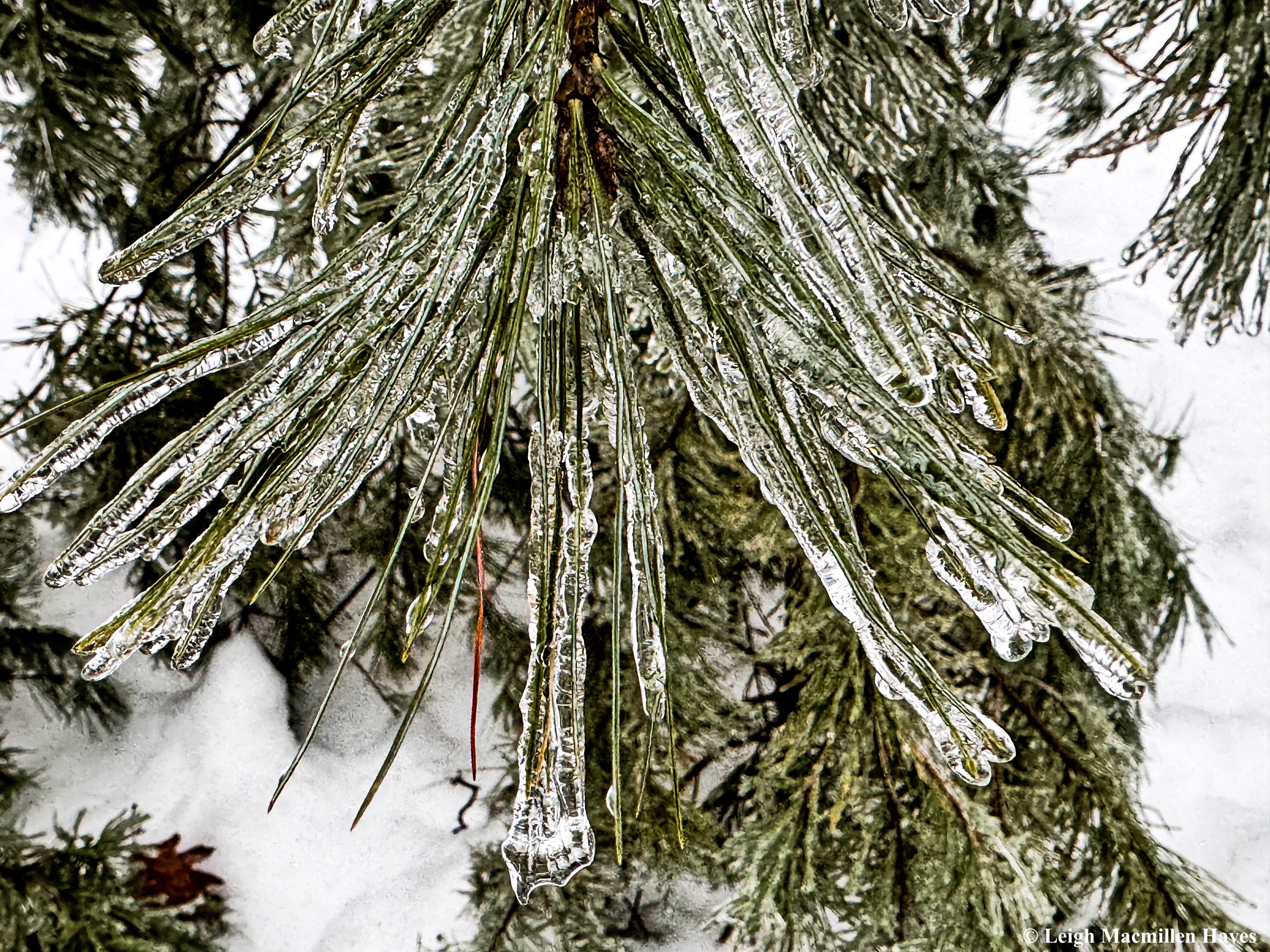
While looking at the Pines, I began to realize that not all ice is created equal, even though at first view that seems to be the case.
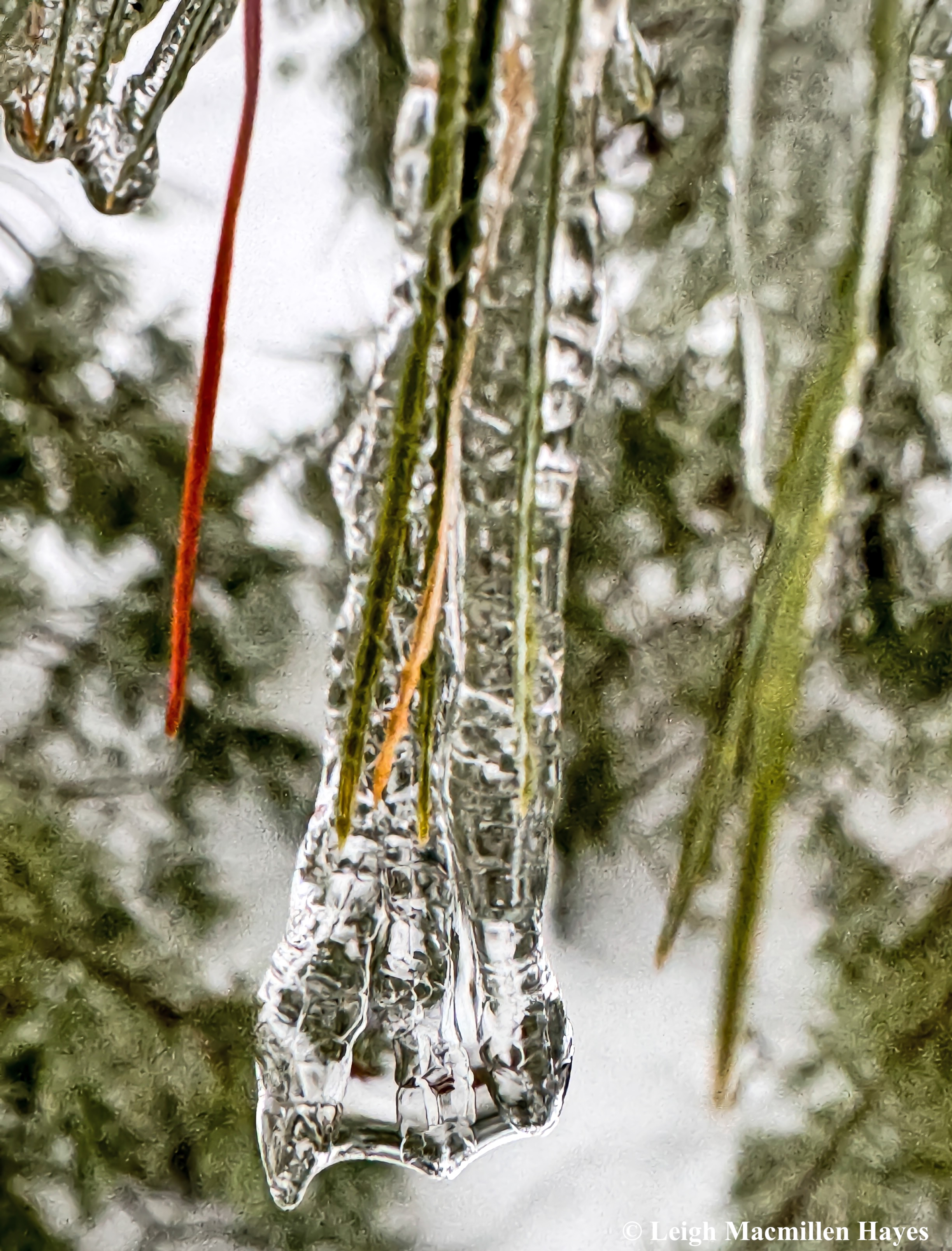
But then I zeroed in on this formation, which is in the middle of the prior photo. I wondered why it had such a wide spread at the bottom, almost resembling a foot, until I realized that the ice had encased the five needles in the typical White Pine bundle, but all five were a bit splayed.

At one point on today’s journey, this was my view. And I had to have faith that it still led to Mount Washington.

And in thinking of that, I thought of my friend Faith, who is celebrating her first birthday in Heaven today. She would not have liked the ice or cold, but I know she would have loved all the formations. And she was the first to follow wondermyway.com and was a frequent commenter.

This was the same view the day after Christmas. I always feel like I could walk to Mount Washington!
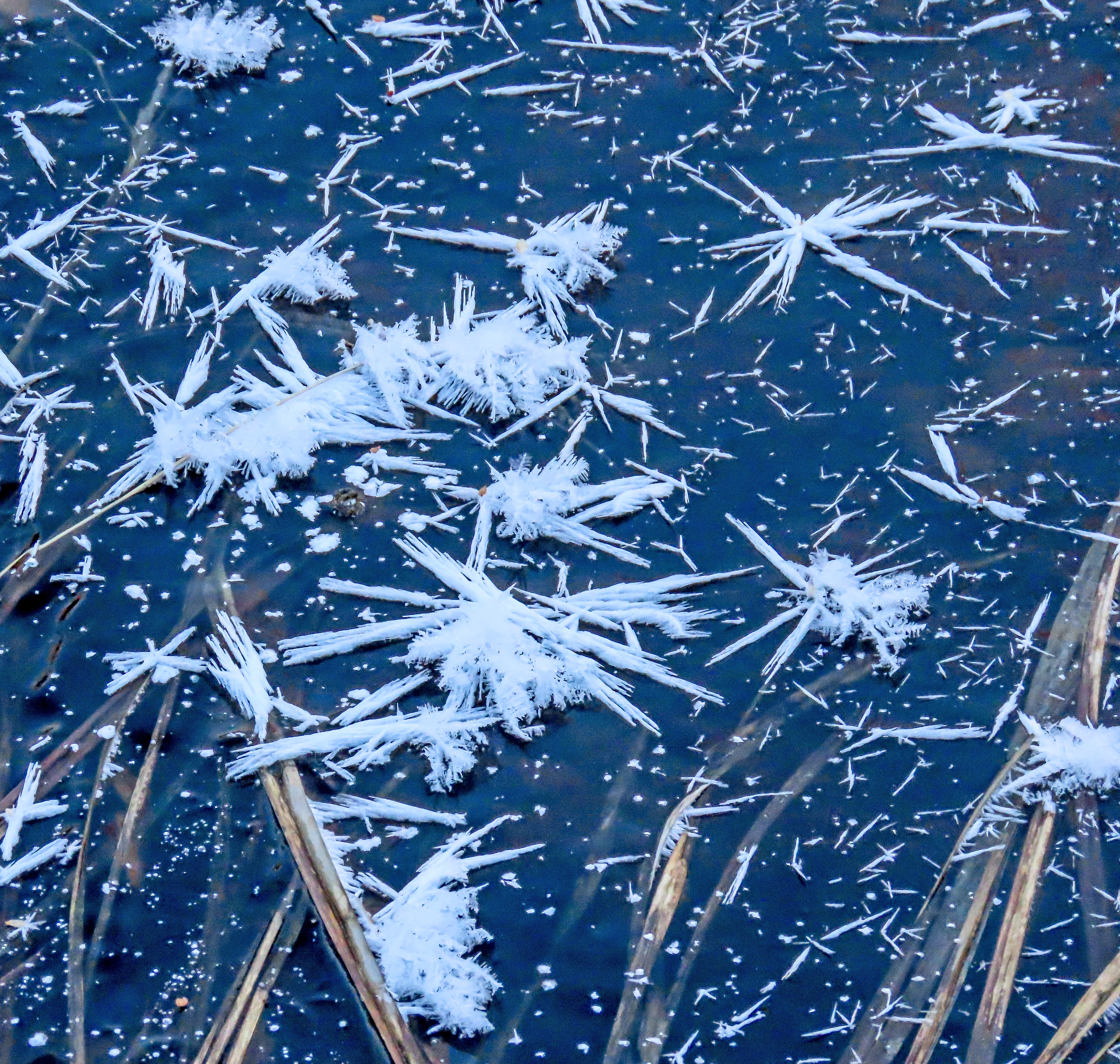
And these were yesterday’s ice formations–frost flowers.
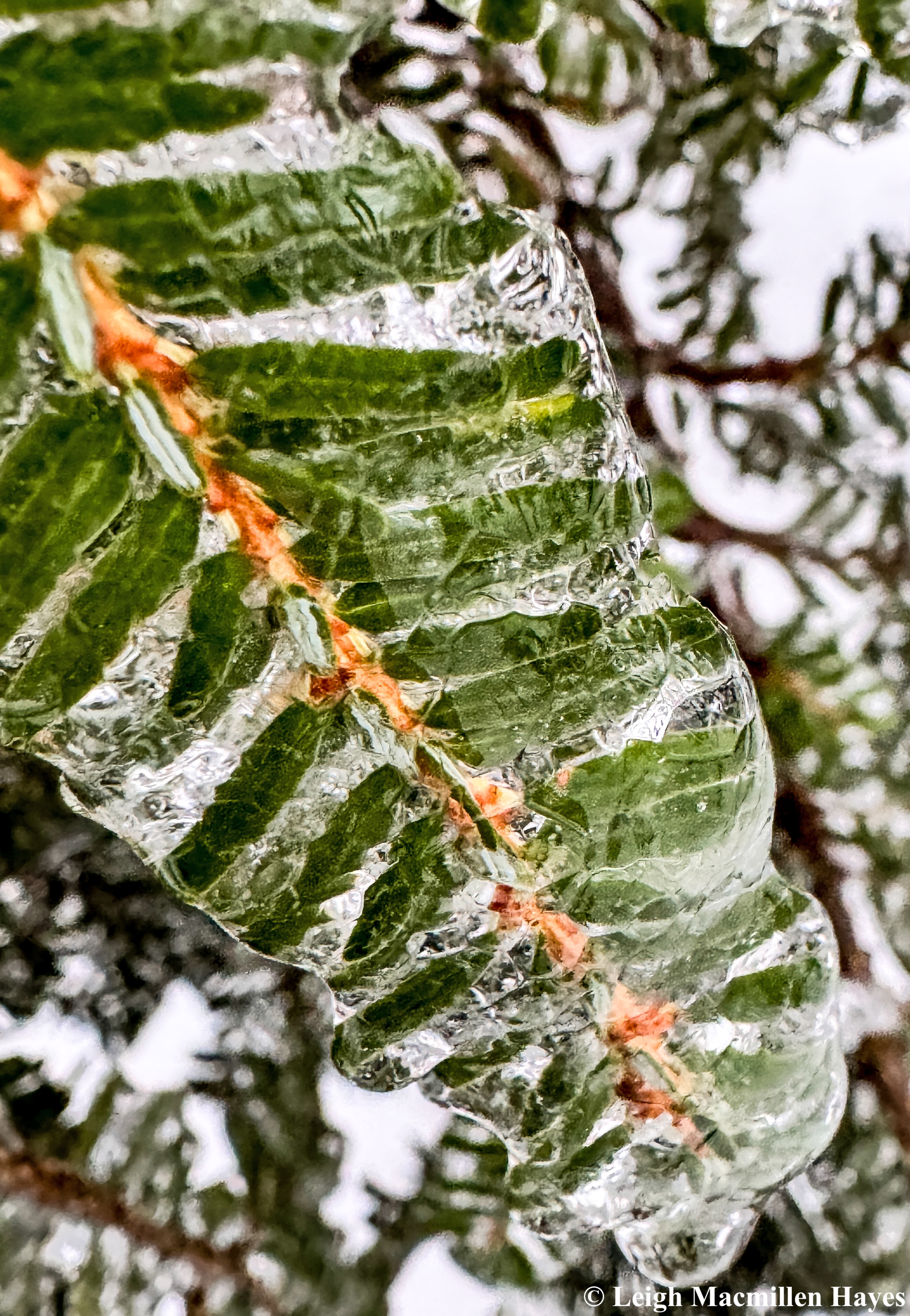
But today–it’s all about the glazing.

As for The Ice Storm Cometh Again?, on January 8, 2023, I wrote about the ’98 storm in The Ice Storm That Cameth. For some reason, a few photos are missing from that post, but go ahead and take a look.

The conditions seem prime today for a possible repeat performance. Everything remains coated in ice tonight, and the temperature, which reached into the 30˚s this afternoon, is about to take a sharp drop and the wind is going to pick up and ohhhhhh, I fear the Snap! Crackle! Pop! Crash! that we experienced back then.

Let’s hope my thinking is wrong.
Spiders and Insects: And More New Learnings

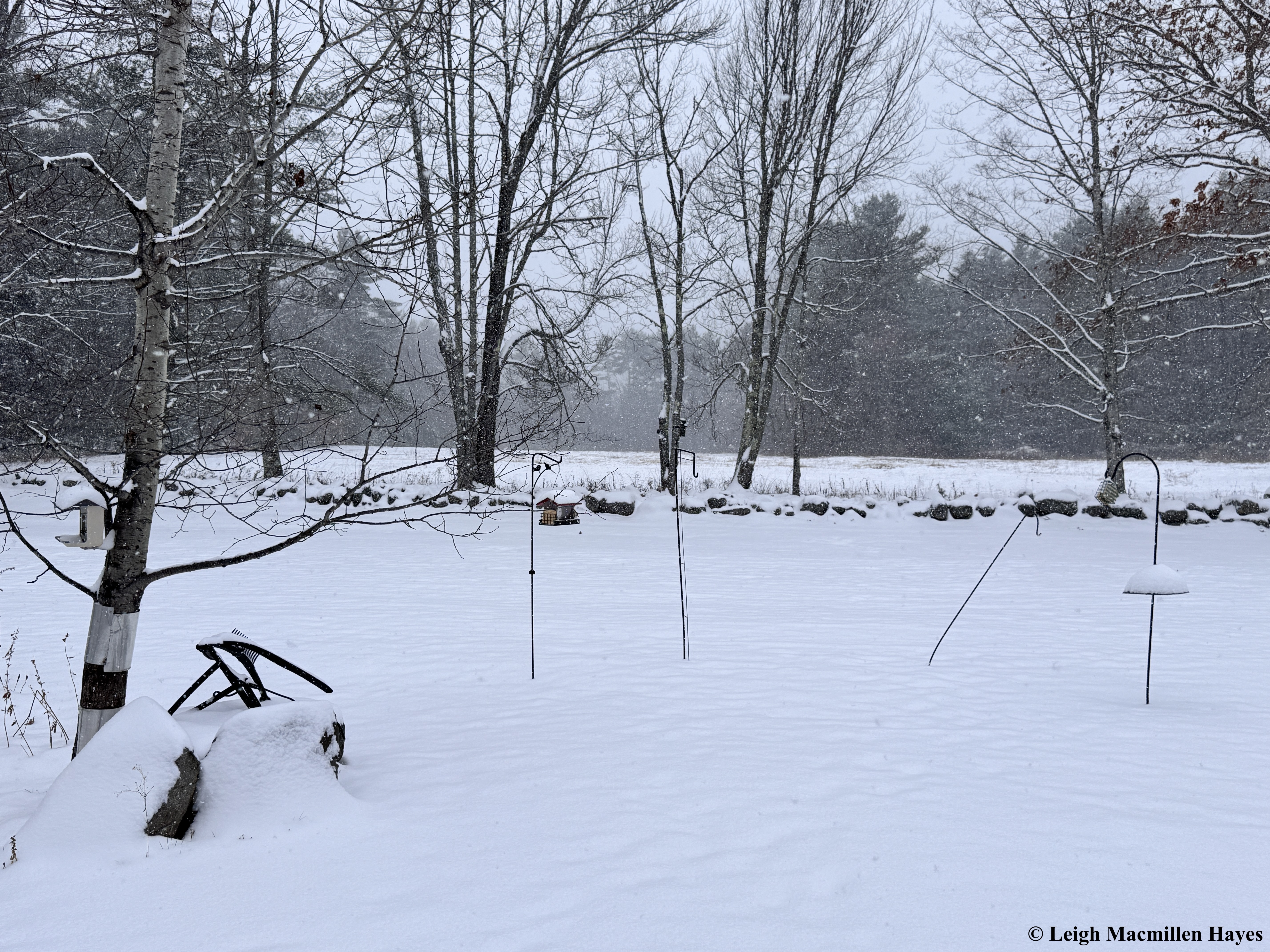
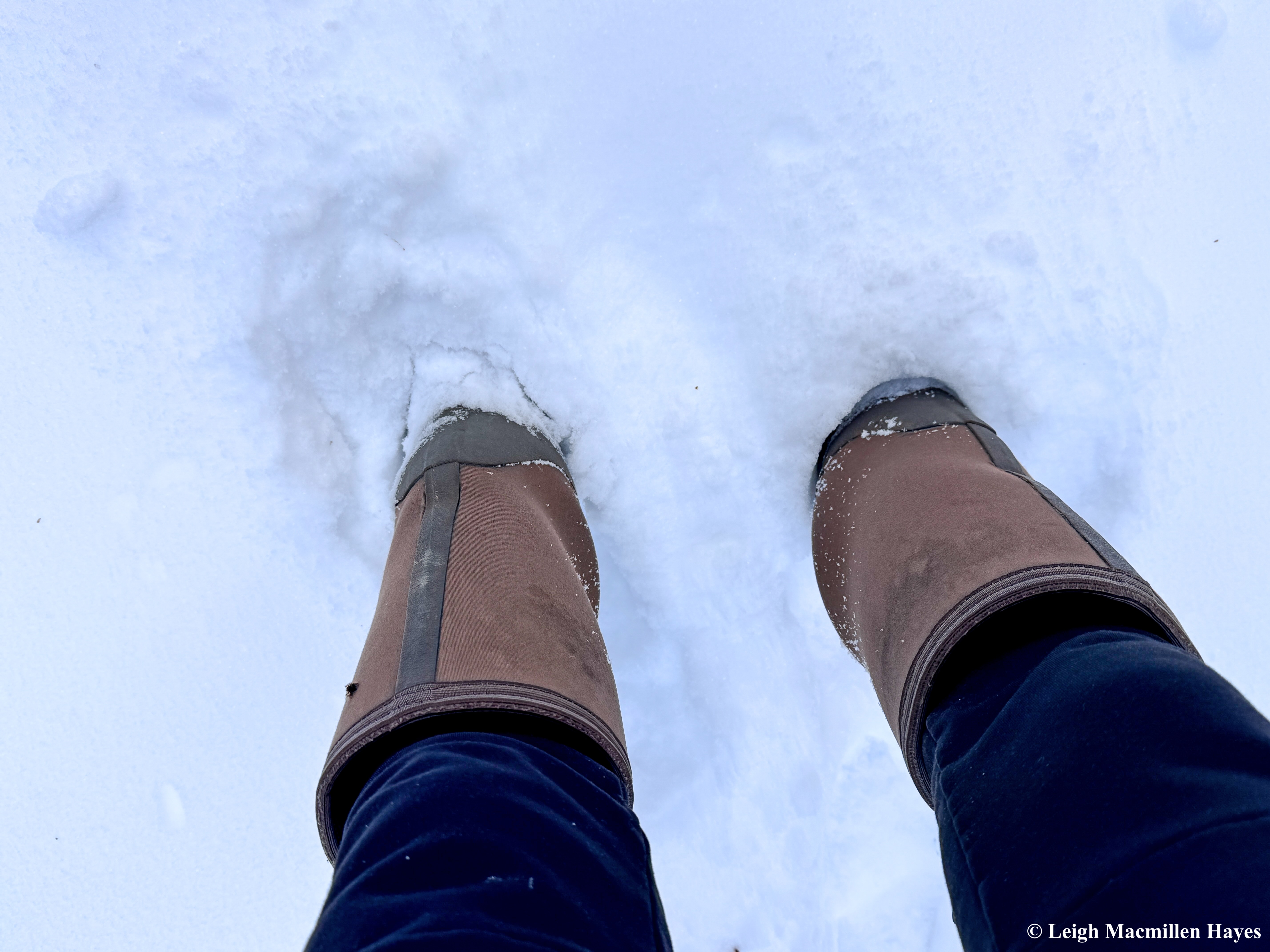
After today’s snow ended and another inch or two had accumulated atop our already winter wonderland world, I donned my boots and cameras and headed out the back door, not really sure where I’d wander. I assumed my findings would be few because the precipitation had just stopped.

Except that is, for the snow pack growing deeper!

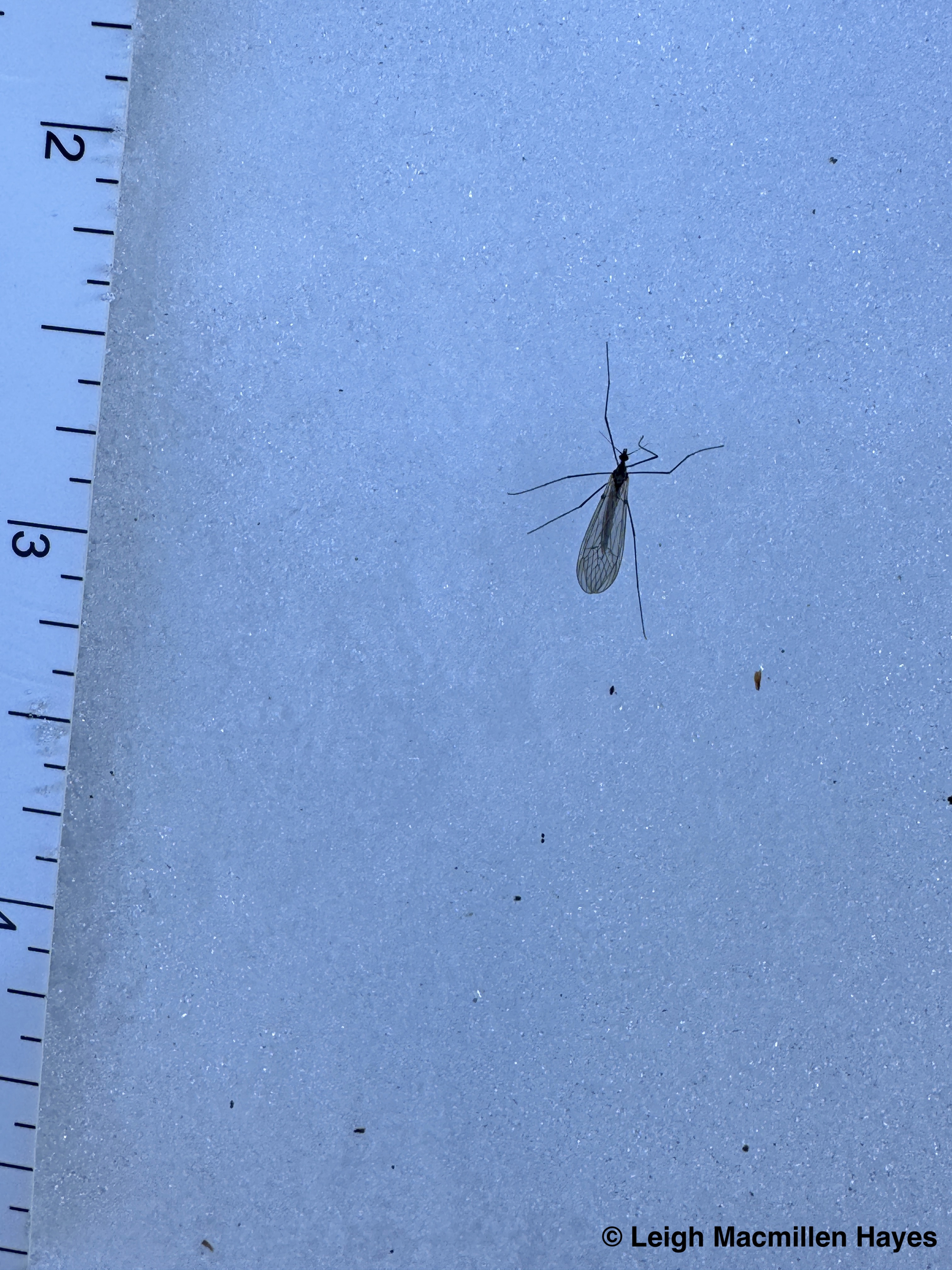
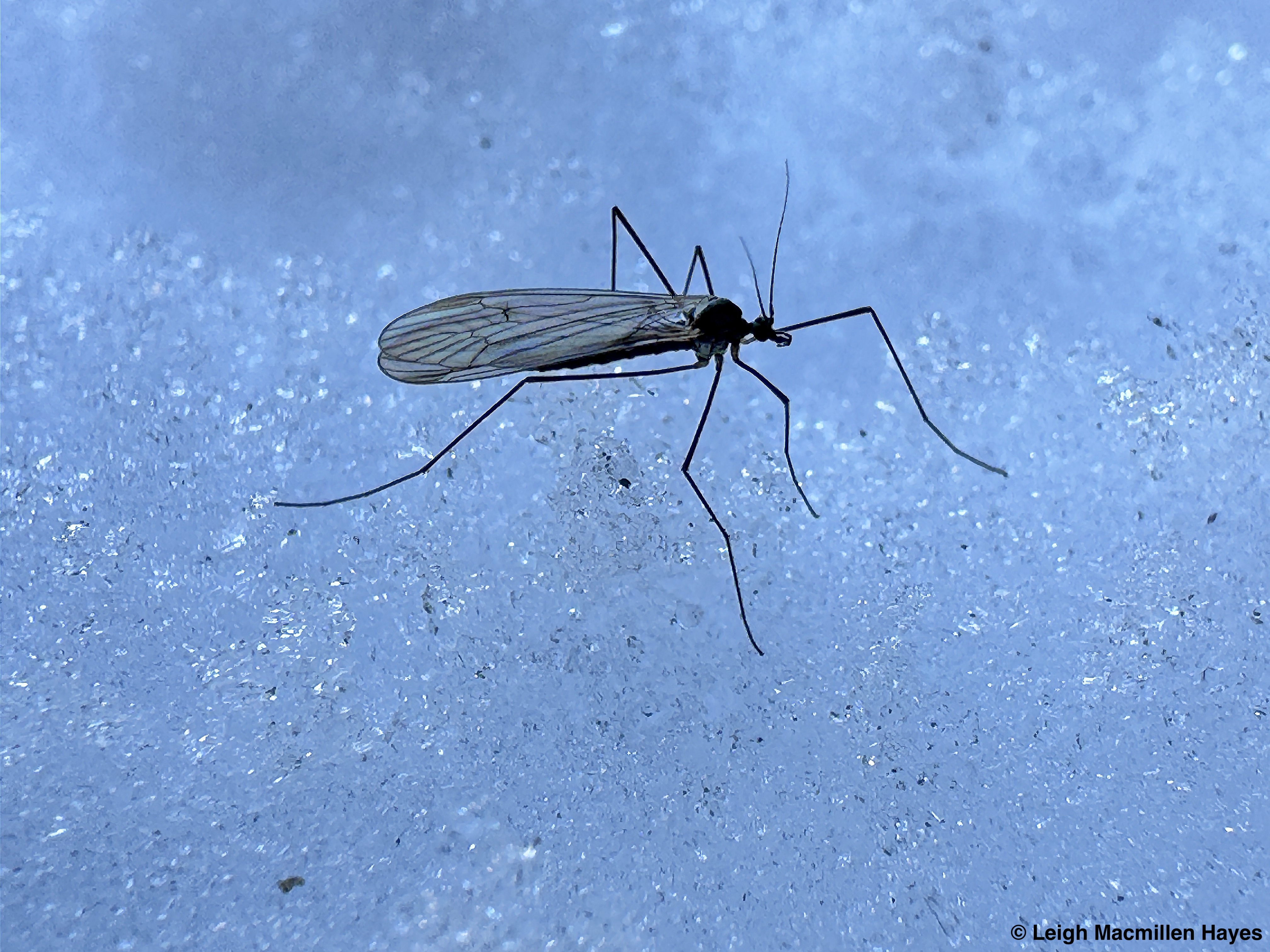
But . . . I was almost immediately pleasantly surprised, for there was a Winter Crane Fly, small in size with gangly legs looking rather like an oversized mosquito. As an adult, however, it doesn’t have mouth parts, for its only plan is to mate. And it only lives for a short period of time, maybe a week or two.

Why then, do all of this in the winter? Today’s temp was 21˚F, and the touch of snow even colder–I know this because I felt it several times as I placed my rulered card down for photo calls. Perhaps because there aren’t many predators at this time of year?

What I couldn’t help but notice was the stained-glass window look of its two wings, for this is one of the True Flies (Diptera–two wings), and my mind returned to Reverend Annette’s sermon about hope and joy at St. Peter’s Episcopal Church this morning and my brain and heart were smiling at this find and joy filled my whole being. We don’t have stained-glass windows in our church, but rather they offer a look at the ever-changing natural world beyond the building’s walls. A world that includes this incredible creature that has been on Earth for a time longer than my brain can comprehend.

And then the spiders began to appear, Long-jawed Orbweavers and a few others, and each and every one was on the move.

What I have learned over the past week or two is that those spiders who do venture across the snow will curl up and rest on the really frigid days, and come back to life when it warms up a wee bit. Amazing.
Well, a short clarification, for some will revive, but others truly will freeze–probably due to -14˚F mornings. I know this because I took a “dead” one home on a “warmer” day and was surprised to discover it moving the next day, but three others that I found curled up after that really cold night did not come back to life.
I did try to count the spiders today, but couldn’t keep track, so many did I spot. My journey wasn’t far, but their journey . . .

slow, with each step . . .

seeming to be intentionally chosen.

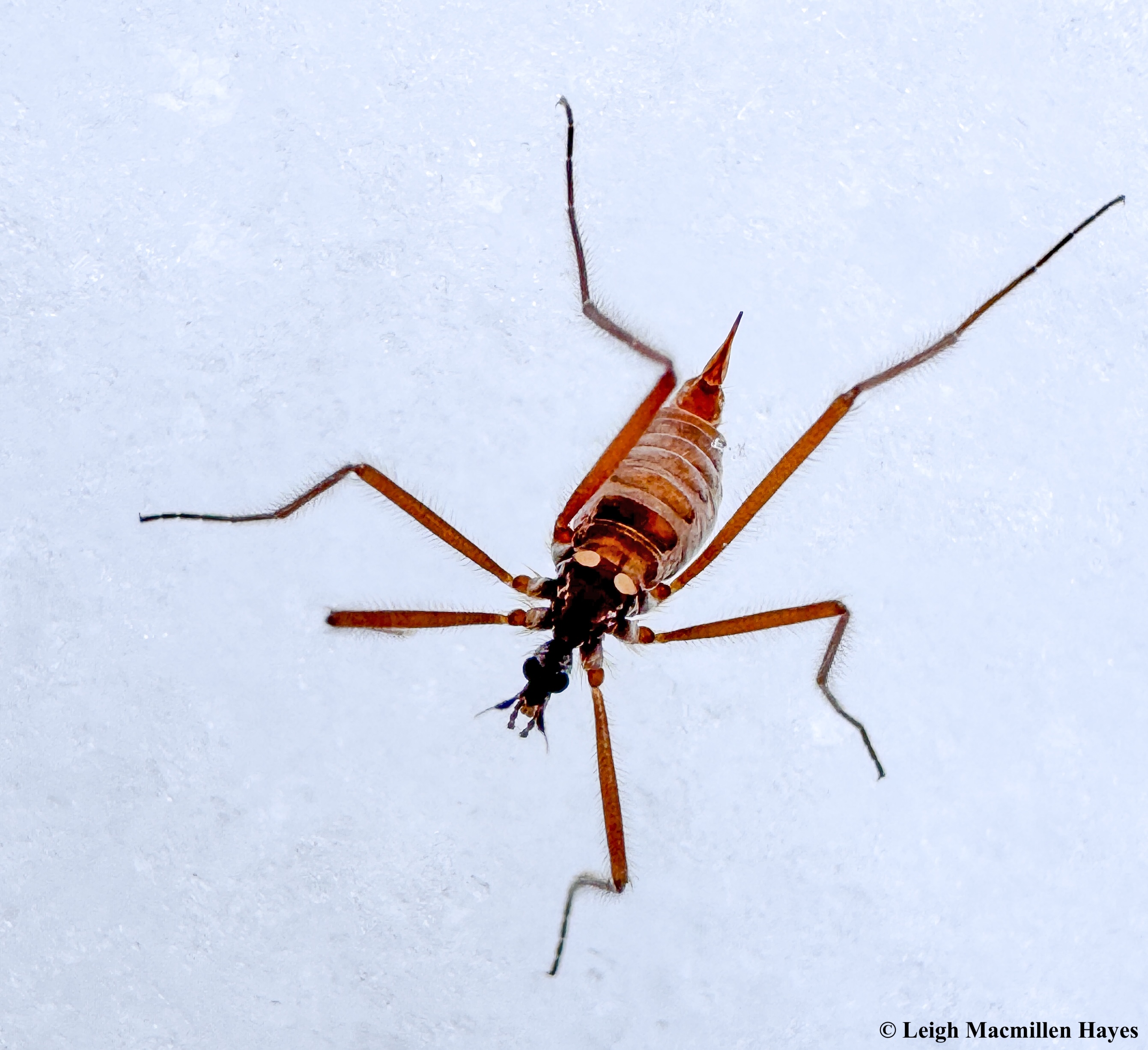
And then I began to see other friends, like this female Snow Fly, also a member of the Crane Fly Family.

Along my chosen path, I found at least a half dozen females and only one male.

Her movements were a bit faster than that of the spiders.

What amazed me was this particular Snow Fly, for it had self-amputated not one, but two legs and it’s only December.

My hope for her is that she’ll find a mate sooner rather than later because I fear if the weather we’ve been experiencing (it feels like an old-fashioned December) continues for much longer, she won’t have any legs left. Despite her loss of limbs, she still moved rather efficiently as she scurried across the snow.

And then . . . and then . . . I met another surprising member of the winter landscape. Again, a teeny, tiny member, but because I was looking down, its coloration and shape were anomalies that captured my attention and for a few minutes became my whole world.

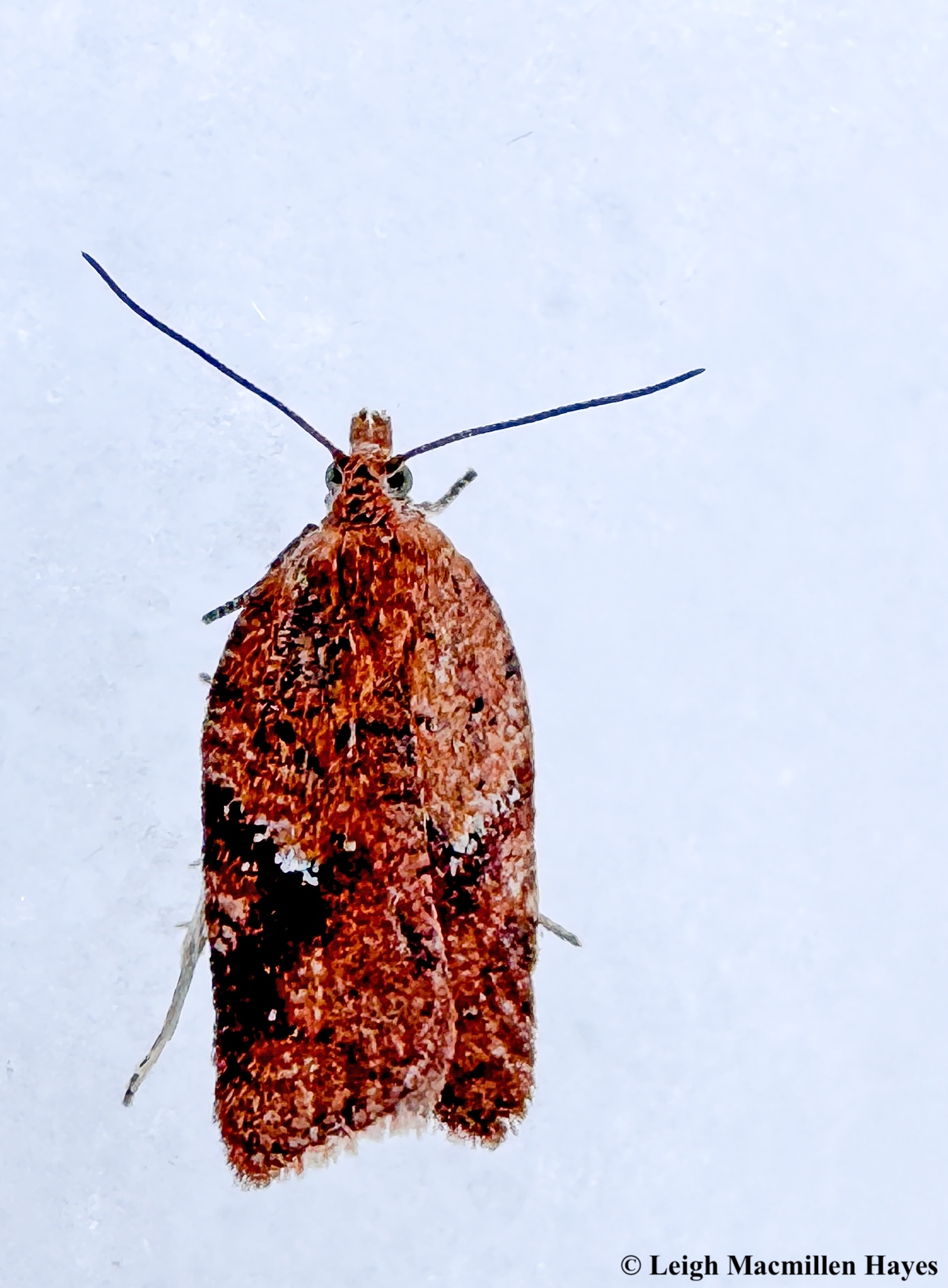
What a dress indeed did this Acleris Braunana Leafroller Moth wear–take a look at the pattern, and those colors, and the fringe.

As I learned when I returned home, it’s not unusual for this species also to make an appearance on a “warm” winter day. Like the other insects and spiders, Glycerol, that natural anti-freeze compound that lowers the temperature at which their tissues will freeze, plays an important role for winter survival.  

Of those critters that I filmed moving this afternoon, the Leafroller was the slowest, but I didn’t film the Winter Crane Fly because though those I saw were alive, they barely moved.

As my journey drew to a close, I was smiling both inside and out, for one reason, because I feel like I come alive when it’s cold out, and two, because I had so many surprises and learnings just because I was looking.

Looking down, that is. Can you imagine all that I missed by not looking up?

There’s so much to see, even in the “drab” winter landscape and my hope for you is that you’ll find joy in making new discoveries and learning along the way.

Spiders and Insects: A Winter Love Story

Lest you think that I spend the colder months forgetting about six and eight-legged members of the natural world, rest assured that I do not. That said, this has been an incredible week of spotting these little members of the ecosystem that often go overlooked as people tramp through the snow.

About eight inches of snow fell a week ago and in the middle of the storm, I did what I love to do. I headed out to explore in our woods. Have you ever stepped outside and listened on a snowy day? Really listened? It’s magical. The world’s sounds are muffled, except for the soft hush of falling snow.

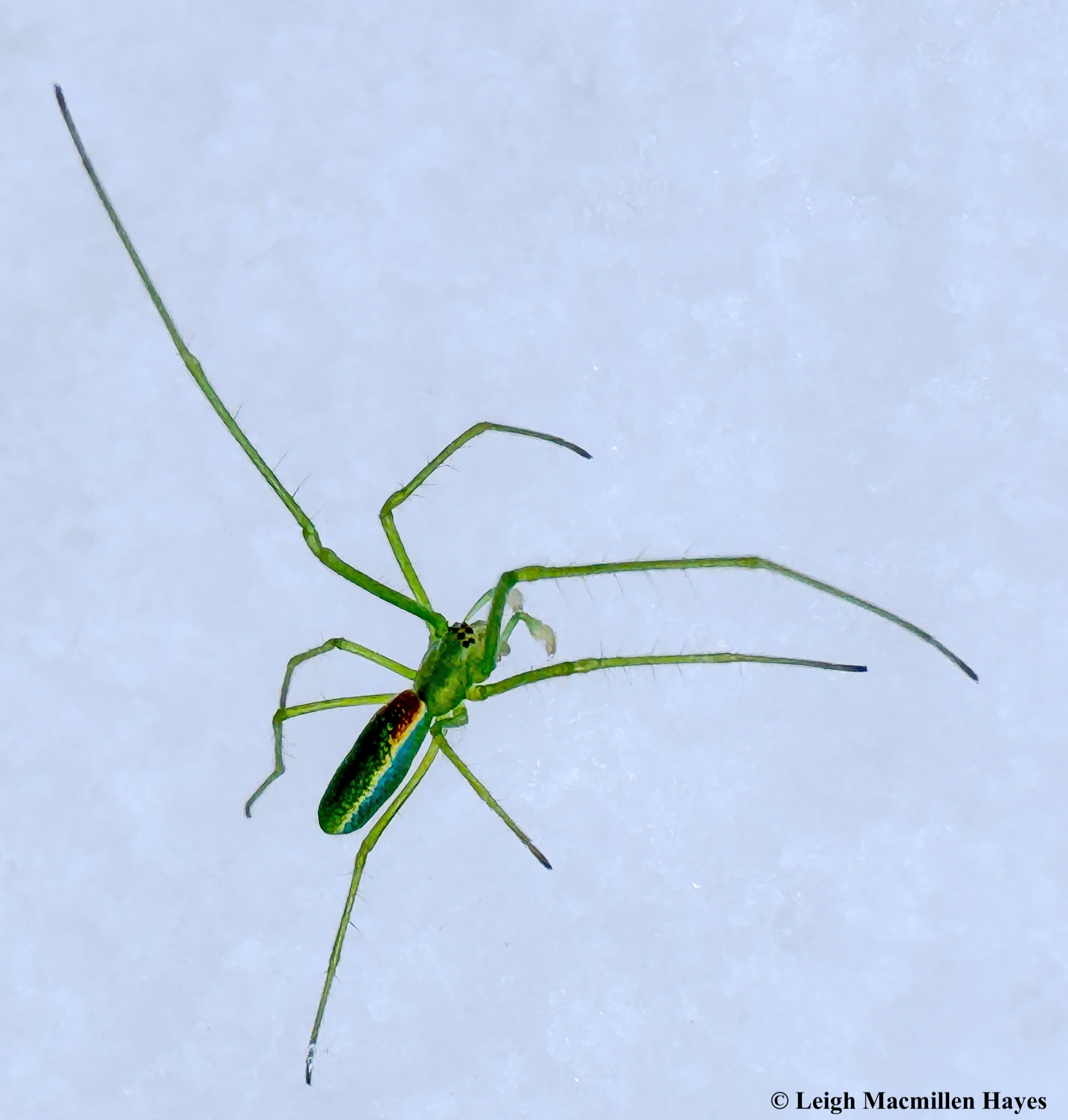
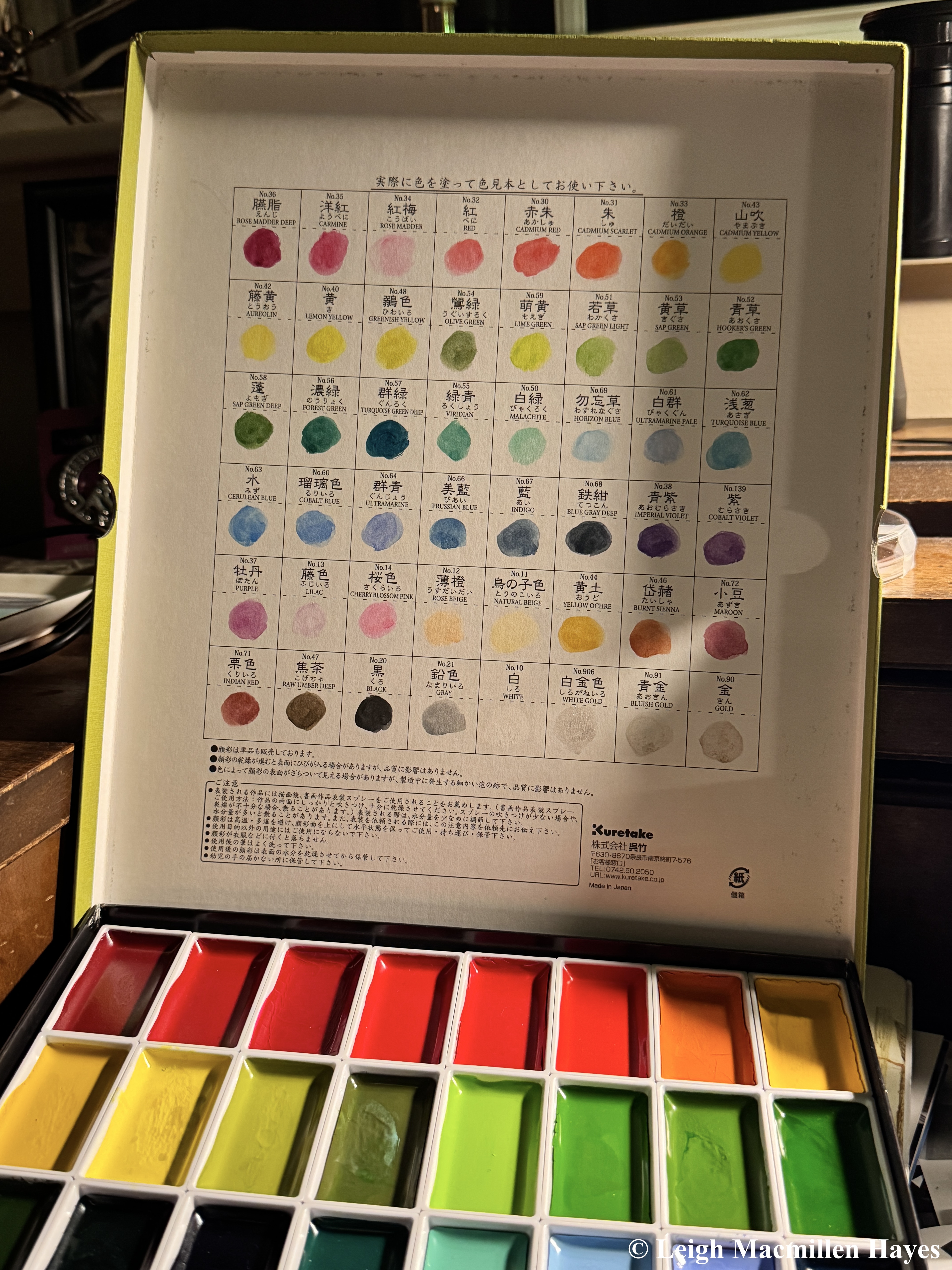
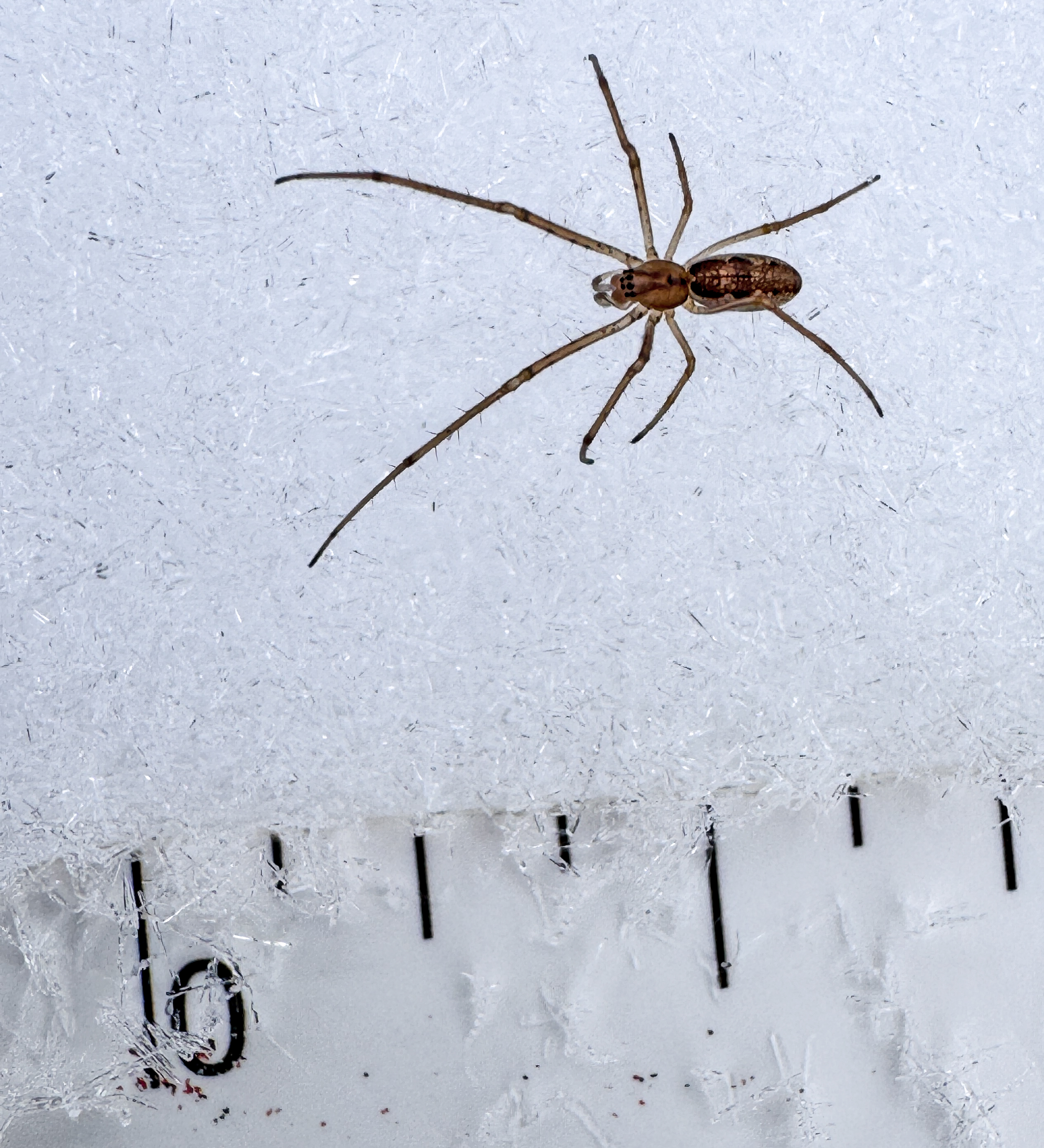
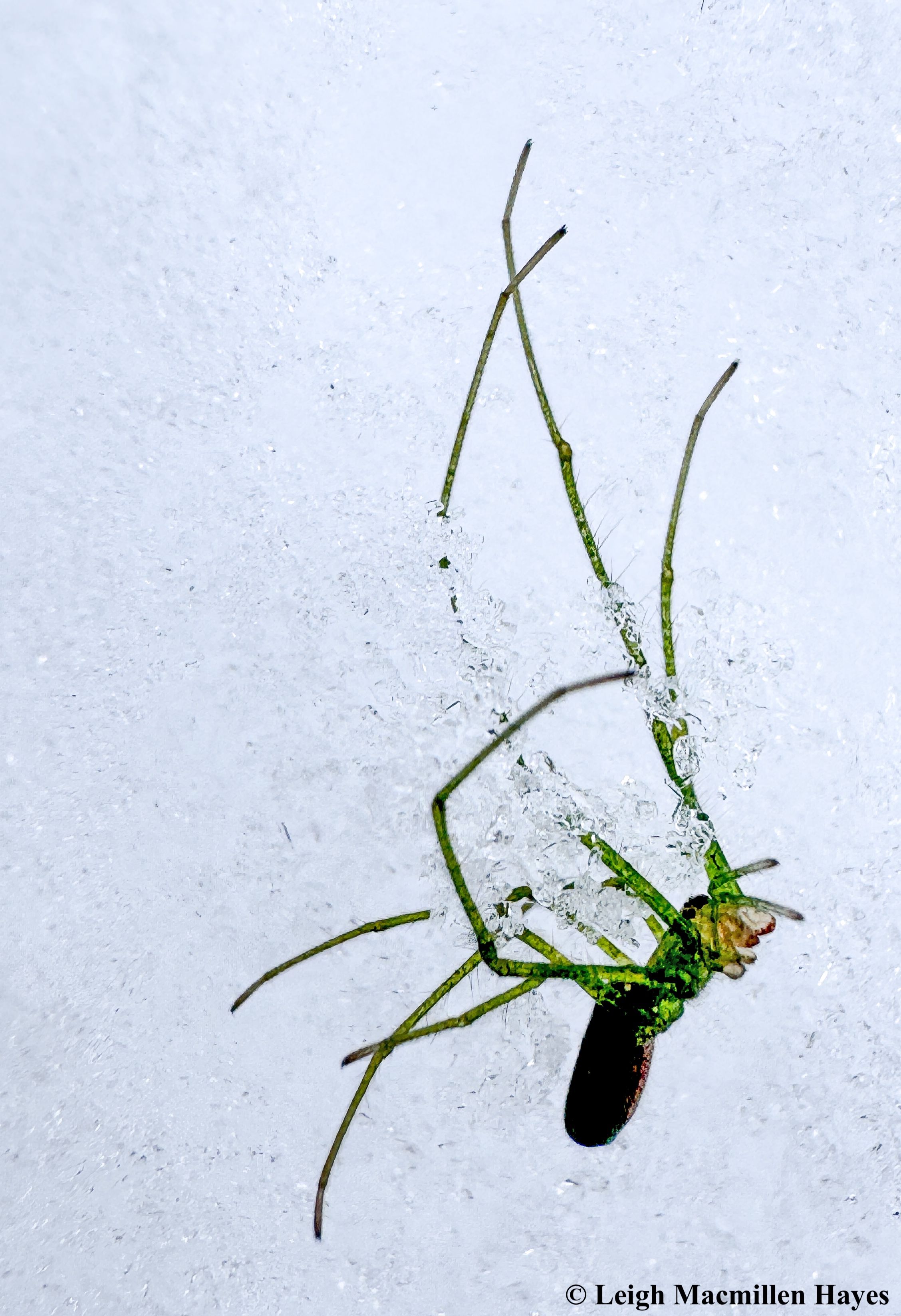
It was while standing still and appreciating the quietness that I first began to notice these most beautiful creatures. I was compelled to check the coloration against a watercolor set gifted to me by a dear old friend. The legs of this Long-jawed Orbweaver are Sap Green Deep. Its head and abdomen: Raw Umber Deep, Greenish Yellow, and Turquoise Green Deep; and its pedipalps, those leg-like appendages near the mouth that look like boxing gloves: White Gold.

Of course, Crayola would have completely different, and certainly more creative names for the same colors.

Long-jawed Orb Weavers are also known as Stretch Spiders for their ability to spread their long, hairy legs out–two in front and two behind, when resting on a twig and blend in so well, that sometimes it is impossible to see them. Unless they are on snow, of course. And then their metallic coloration may catch your attention. Mind you, they are small.

What I can’t figure out is why they are walking on the snow on these cold days, given that their meal of choice is in the subnivean layer between the ground and snow–that being the Springtails, aka Snow Fleas, those little dots of pepper that perform circus acts as they jump around in our boot prints on warm winter days. I have yet to see any Springtails on the snow.

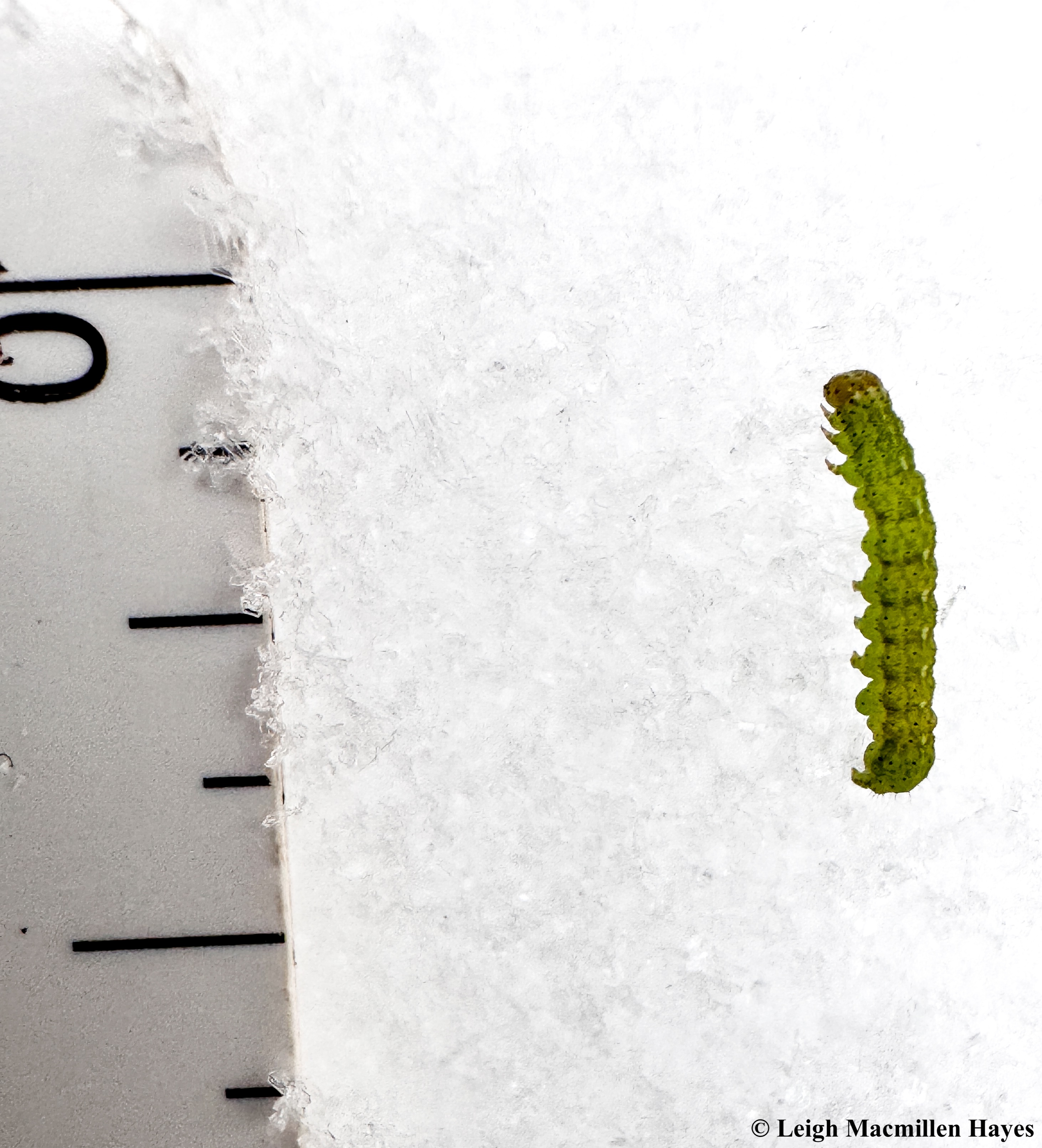
A few more steps and I discovered this Cutworm Caterpillar. Near this green one I also found a brown variation. While they may come to the surface on warmer days, I was surprised to find these Snow Worms when the temperature was in the low teens.

Apparently posing for the paparazzi is not in their DNA. And so I moved on.

And discovered another Long-jawed, this one being hues of brown. I’ve been thinking about these spiders all week, and actually for many years, because there are days when I can go for a walk in the woods and see one every ten feet or less. Frigid days even, which has been the case this past week.

The question is: how does a tiny critter with such a fragile looking body and legs survive in these temps? I’ve read that some spider species can lower their bodies’ freezing point by producing a cryoprotectant, Glycerol, a natural anti-freeze compound that lowers the temperature at which their tissues will freeze.  

But . . . another question arises: What happens when that antifreeze no longer seems to work?

Answer: They curl up and die.

Or do they?

You see, I’d picked one spider up and held it in my hands for a few minutes in hopes of reviving it. And met no success.

The next day I picked up another and placed it in a Petri Dish, thinking I would look at it under the microscope.

A day later, and it was walking around inside the container.

Absolutely amazing to this wonderer.

And consequently, a few more have traveled home in my pocket and I’m wondering if they’ll revive as well in the warmth of our home. If so, what does that mean? That they can go dormant atop the snow in freezing temps, and thaw and become active when the sun warms them up? I guess my biggest question is this: Why are they on top of the snow, anyway, when it’s much warmer under it and that’s where their food source can be found.

There’s another critter I’ve been encountering quite a bit this past week and it looks rather ferocious.

But don’t judge a book by its cover as the old adage goes. While some look robust, like this one, others are small and slender. Again, I’ve read this, but not observed it: they don’t eat, but may sip snow. The main goal of the adults who are active in winter is to mate.

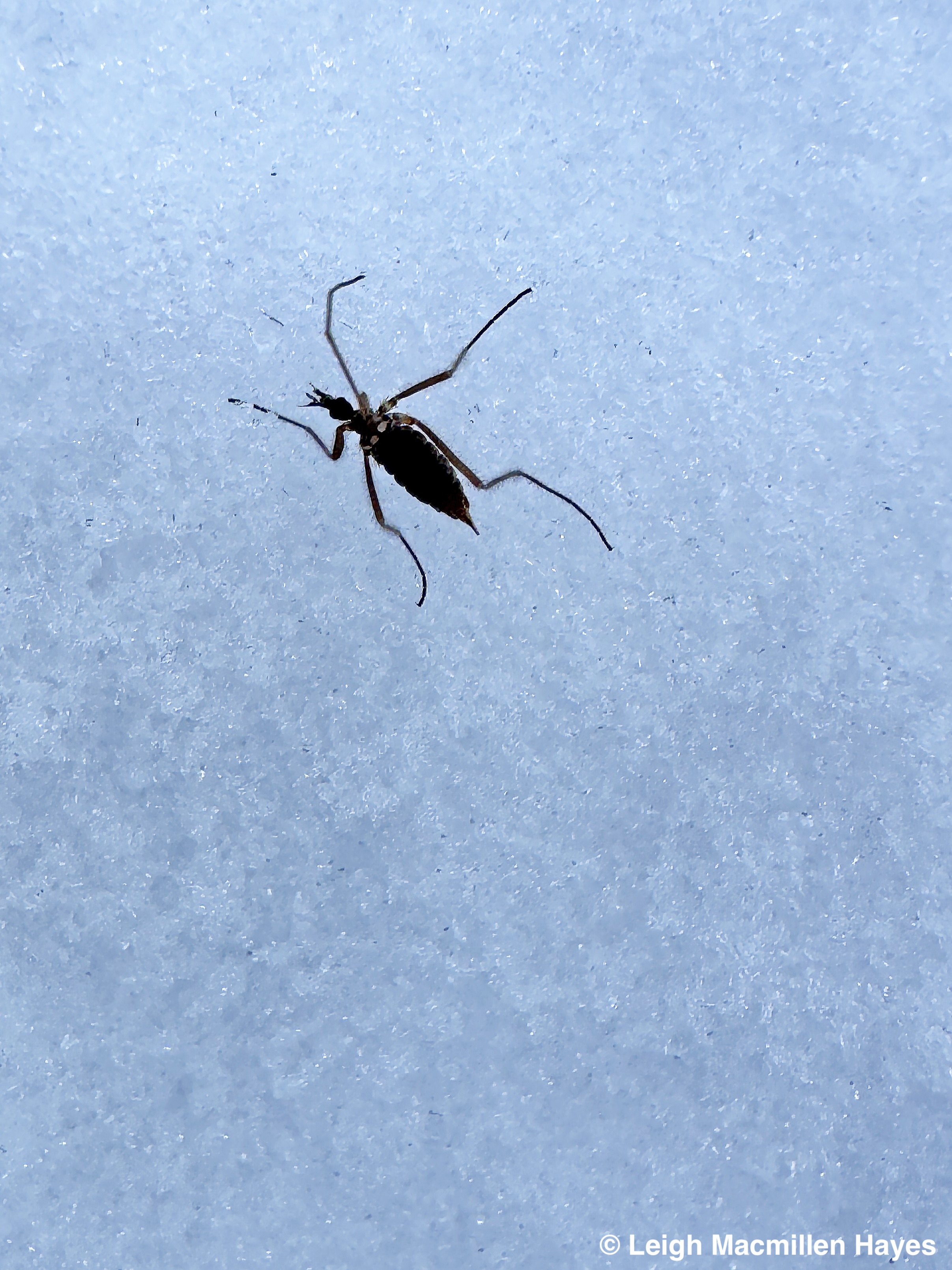
Who is this critter? A Snow Fly, a flightless Crane Fly.

They lack wings, but do have a set of halteres, those knob-shaped organs that help with stability.

This is a female Snow Fly, the gender being determined by the abdominal appendages. Notice hers is upward curving and tapered to a point.

Do you notice anything else about her? As in how many legs she has?

This robust male’s abdomen appendages are much blunter and pincer-like in shape.

Hmmm, again I ask, how many legs has he?

While the Snow Fly in the first photo I shared sported the typical six legs of an insect (as opposed to eight legs for a spider), the last three have only five. This is due to another amazing winter adaptation:
Snow Flies can self-amputate freezing legs to prevent ice from spreading to organs within their body.

What? We say all the time, “Nature is amazing!” It truly is astounding.

I watched as this male made his way down a brink of snow on only five legs.

He was quick and rather nimble.

As he approached the leaf below, I realized why it is difficult to spot these adults before the snow falls, for then they are well camouflaged in the leaf litter, just as the Orb Weaver spiders are camouflaged on their tree species of choice, their colors blending in and stretched out shapes making them look like the twigs upon which they pose.

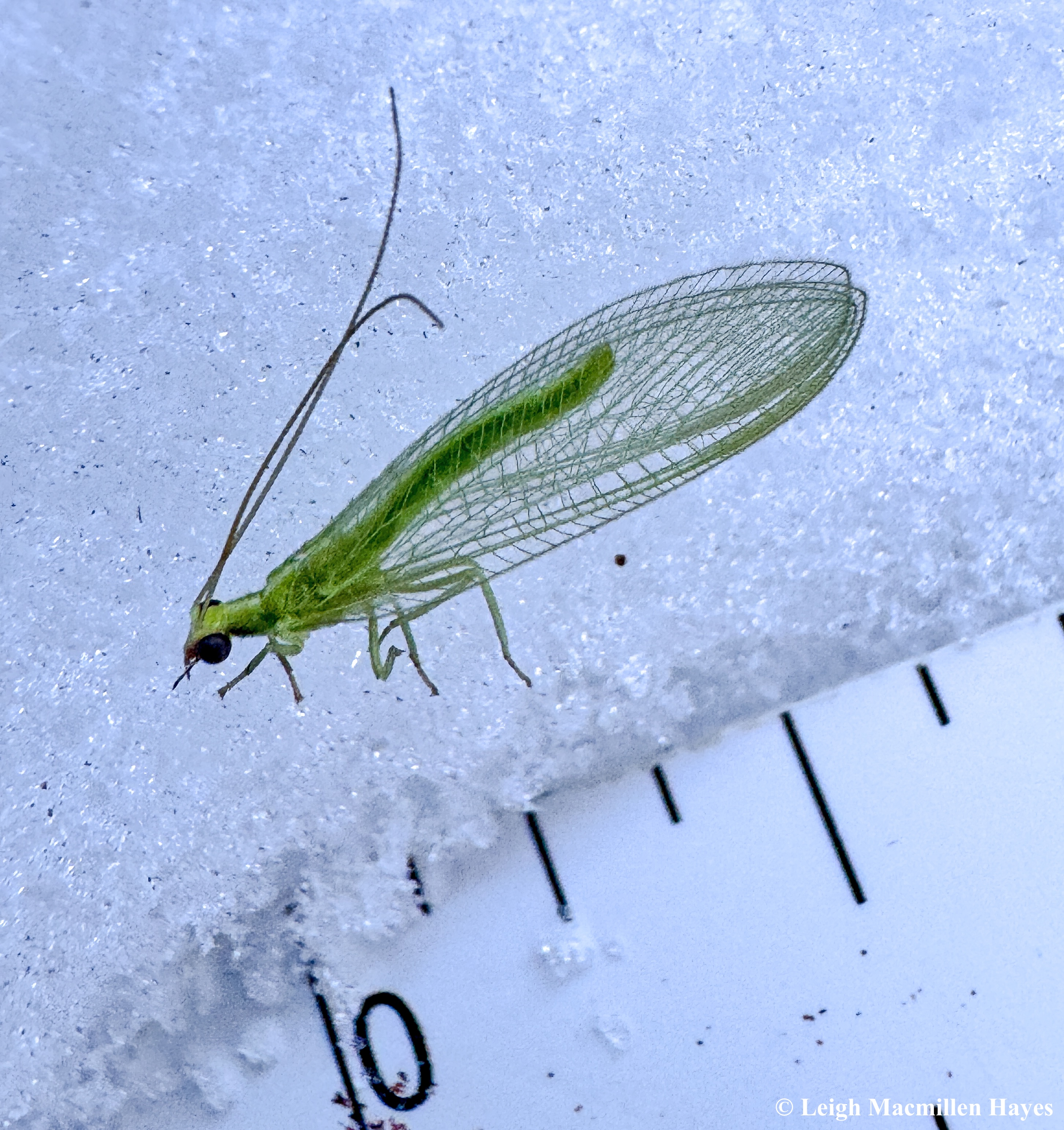
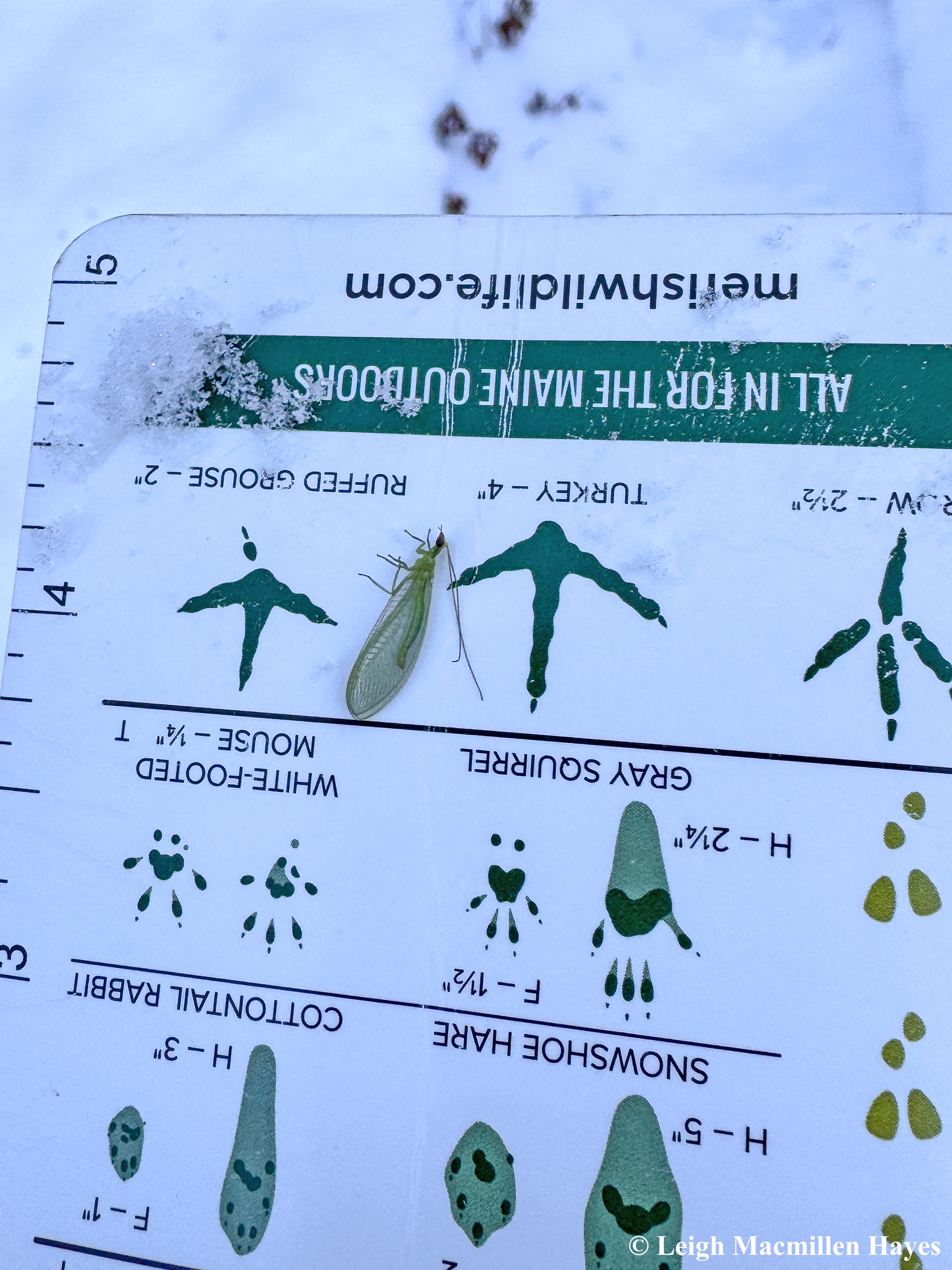
One last critter to share with you is a Green Lace Wing, who completely surprised me. I’m used to seeing them in the field during the summer months, and found this one on the trail just around the corner from the field yesterday.

Adults can overwinter behind bark and may come out on warmer days, but the temperature was 19˚F.

I didn’t have anything to carry it home in, so I scooped its fragile body up onto my little tracking card and carried it home, protecting it from being blown off by the wind. Unlike the spider, however, it didn’t revive once inside.

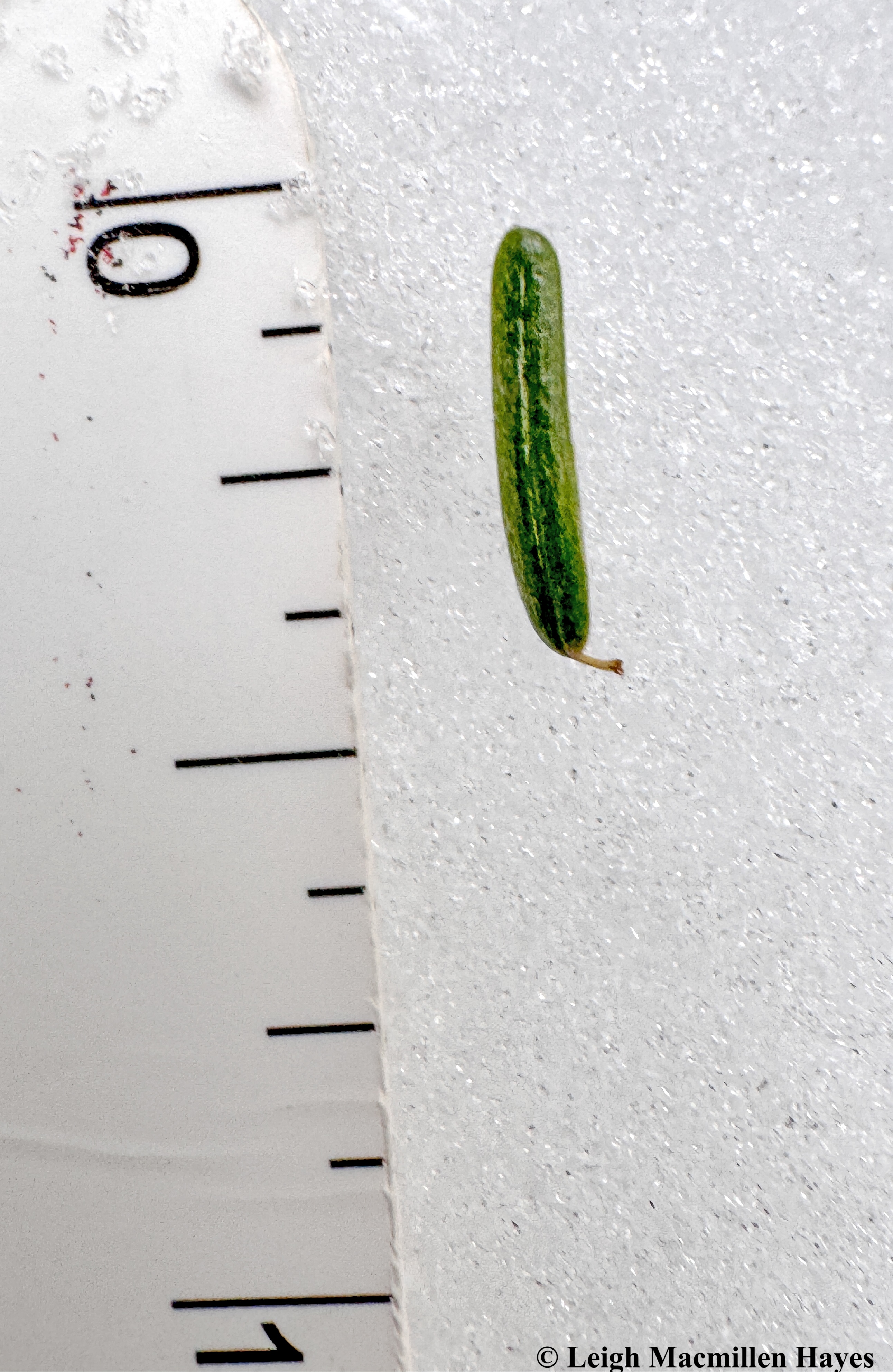
If you are so inclined to look down during a snowy tramp, don’t be fooled by some of the litter, such as Hemlock Needles with their short petioles, pretending to be green abdomens.

Or Birch Seeds that look like miniature butterflies.

I do hope you will venture out and search for these friends. They have a place in the ecosystem and provide us with one more reason to get outside and observe and stand in awe and try to learn no matter what the temperature is.

Spiders and Insects: A winter love story. For me, at least.

Giving Thanks for the Pileated Woodpecker

While most critters in the woods make their presence known only by signs left behind, there is at least one who is bold and loud and ever present in my neck of the woods. It often begins the day with a salute of drumming on a hollow snag to mark its territory just after the sun rises, and then I hear it or see it fly about our yard and woods and across the field beyond the stonewall throughout the day.

Every once in a while it honors me with a chance for a closer look. And so this afternoon, as I headed off into the woods to snip some twigs for an upcoming class that I’m teaching, I noticed some evidence that my friend had been present in the recent past.

It was the wood chips on the snow that served as his calling card. Well, his first card that is. By these, I knew he’d been chiseling the tree above, but always, when I spot this behavior I look for a second sign. And came up empty-handed. No scat.

While I was looking, however, I began to realize I could hear a familiar tap, tap, tapping from another tree.

And so I looked around, expecting to find one of his cousins, for the taps, though consistent, were not as loud as the drumming he uses to advertise his territory or announce his availability to a potential mate, but rather featured a softer rhythm.

Much to my delight, there he was, high up in a White Pine.

I was sure we wouldn’t get to spend too much time together, and so I wanted to focus on him as best I could. And that’s when I noticed the bark had been sloughed off the tree. My friend was hunting for bark beetles.

I decided to take my chances and move a few steps in order to get a clear picture, and still he stayed, though I thought our time might be over when he looked away from the tree.

Thankfully it wasn’t. Do you see all of the tunnels the beetles had carved where the bark had once been?

Oh, and how do I know it was a male? By the red mustache on his cheek. His lady does not have such a marking.

He turned back toward his work and I loved how it was obvious that his tail feathers formed the third leg of a tripod to provide support against the tree. When you have a head-banging job such as his, and only two legs, that third is important.

Eventually I pulled myself away and continued on my quest to locate certain tree species and snip just enough twig samples for each pair of students. Along the way, however, there were other things to notice like this recently deposited Bobcat scat offering a classic look at its hair-filled contents and sectioned presentation.

There are a million tracks in the woods right now since everything has been on the move following the last snowstorm, and the Foxes and Coyotes and Bobcats have been in dating mode, so it was no surprise to find Bobcat prints on top of other prints left behind.

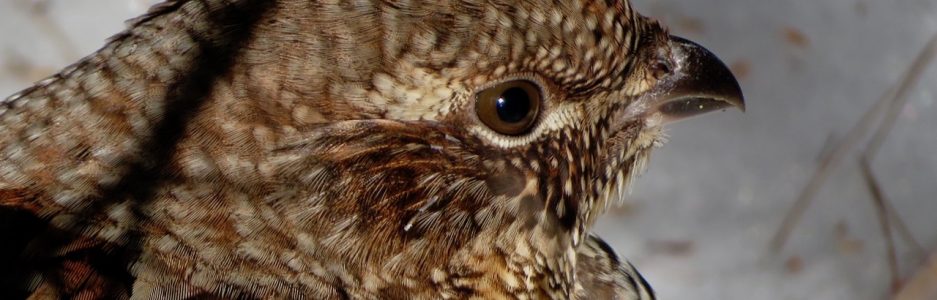
Besides all the mammal tracks, I found lots of evidence of Ruffed Grouse walking about as well. They always remind me of my friend ArGee, whom I met in 2018, and wrote about several times, including this post Nothing to Grouse About. I may never get to have the experience of spending some quality time with a Grouse again, but seeing the tracks of one so clearly defined always makes me smile.

Another who has become a constant companion this winter is the Winter Crane Fly. Like all Crane Flies, he’s not a mosquito, though he looks like an oversized one. Crane Flies have no mouth parts, therefore, they can’t seek your blood. It’s only job is to find a mate and breed.

They are called Crane Flies because of their long legs and beaks that long ago were thought to resemble a Sandhill or Whooping Crane.

So why fly in winter? Perhaps because your predators are few. And your chances of mating without being eaten better.

Sticking with the Crane Fly theme, in my recent post Mammal Tracking: It’s all about paying attention, I shared a photo of this fly, a Snow Fly.

Snow Flies have six legs, but if you look carefully, you’ll notice this one only had five. As for that missing leg, Snow Flies self-amputate so that ice doesn’t enter body. It’s a fighting chance to survive the frigid winter and this photo was taking on a very cold day. An incredible adaptation.

Fast forward to today, which felt almost like summer (in the 30˚s), and I spotted another, this one with all six legs still intact.

And those two yellowish bumps on its thorax? Halteres, or small club-shaped organs, that help provide information for wing-steering muscles of True Flies (Diptera). From The Snow Fly Project, I’ve learned that “Snow flies are distinctive in their appearance, with long, spindly legs. They lack wings but do possess halteres. It has been suggested that their lack of wings might have evolved due to exposure to cold temperatures and wind (Hackman, 1964; Byers, 1983; Novak et al., 2007).”

Eventually it was time to return to our woods where I noticed more works by my friend.

Below this tree, there was even more debris and by the number of holes, it was obvious that this was a much more bountiful tree than the first one that stopped me in my tracks. That is, if you are seeking insects.

And so, I had to bend down and take a closer look. It’s like a treasure hunt at the base of a tree and let’s me know if the bird was successful in dining or not.

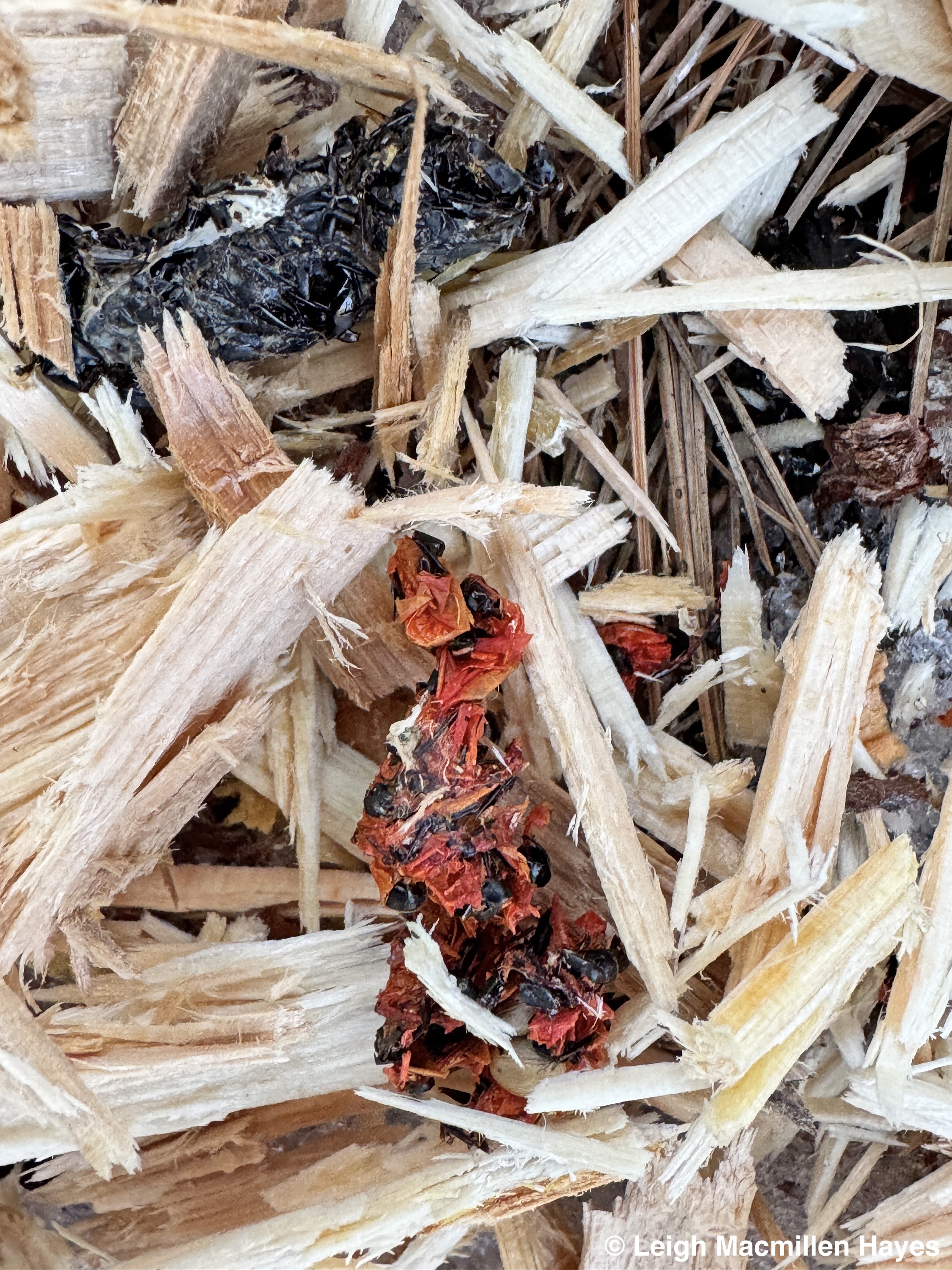
And I was well rewarded. All kinds of scat packages sat upon the wood chips and I knew that while the woodpecker found plenty of Carpenter Ants in the tree trunk, it had also recently dined on Bittersweet berries. As for the berries, well, um, Bittersweet does grow locally.

There was even some scat dripping off the tree! My heart be still.

As for Mr. Pileated, he’d moved on for the moment, but just before we’d parted ways earlier, he offered me a quick opportunity to spot his tongue between the upper and lower beak. Pileated Woodpeckers have sticky tongues, which they probe into the tunnels the delicious (to a woodpecker, that is) ants and other insects have created.

On this day, like so many others, I want to express my appreciation for the Pileated Woodpecker’s part in this world, for creating nesting sites that others, such as small songbirds, may use, and how he helps the trees in the forest by contributing to their decomposition, for as much as some think that these woodpeckers and their kin are killing the trees, the trees are already dying due to insect infestations, and the birds’ work will eventually help the trees fall to the ground, add nutrients to replace what they had used, and provide a nursery upon which other trees may grown.

Thank you, Pileated Woodpecker, and Bobcat, and Winter Crane Fly and Snow Fly. So many to honor.