Spiders and Insects: The Love Affair Continues

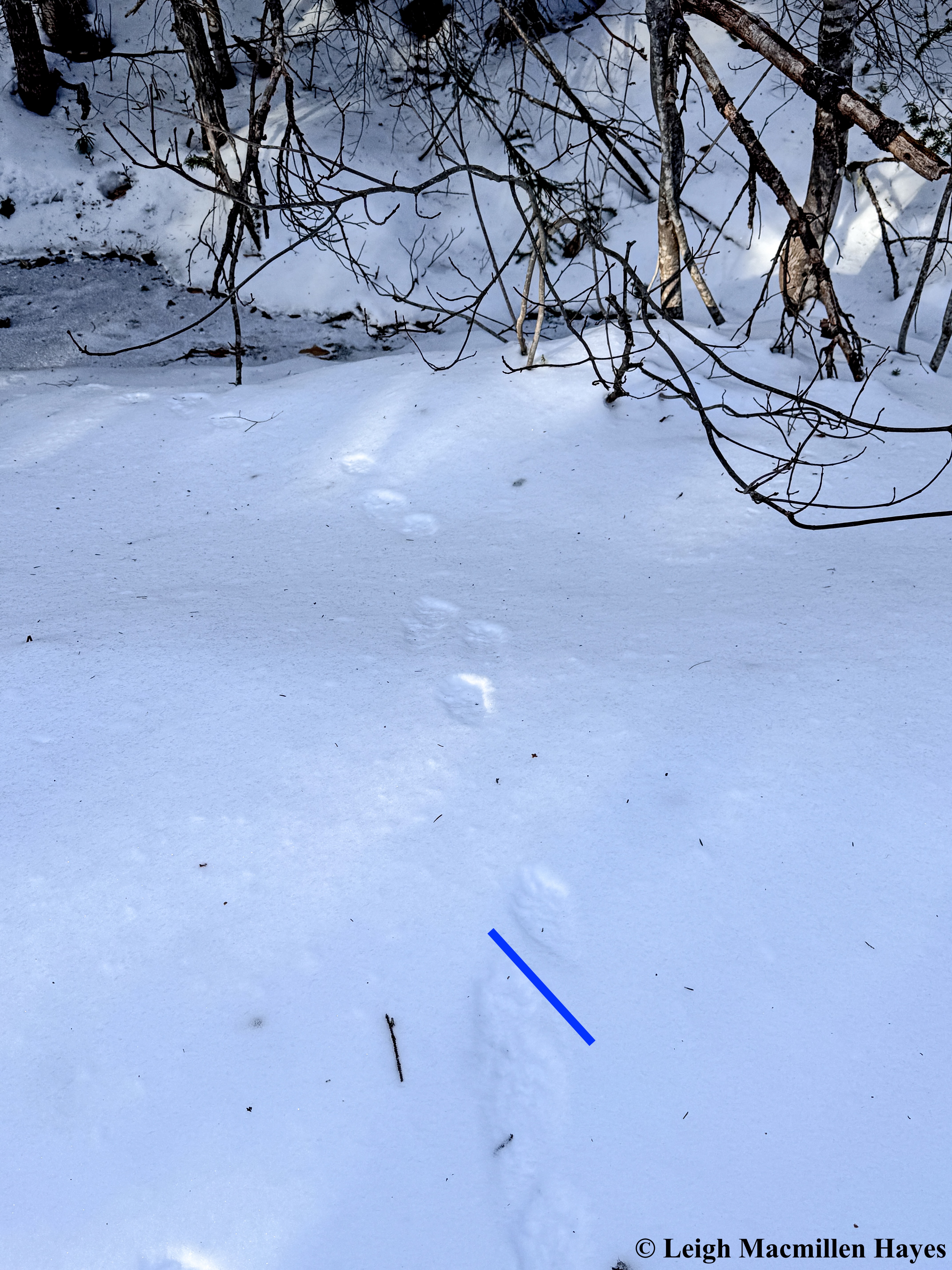
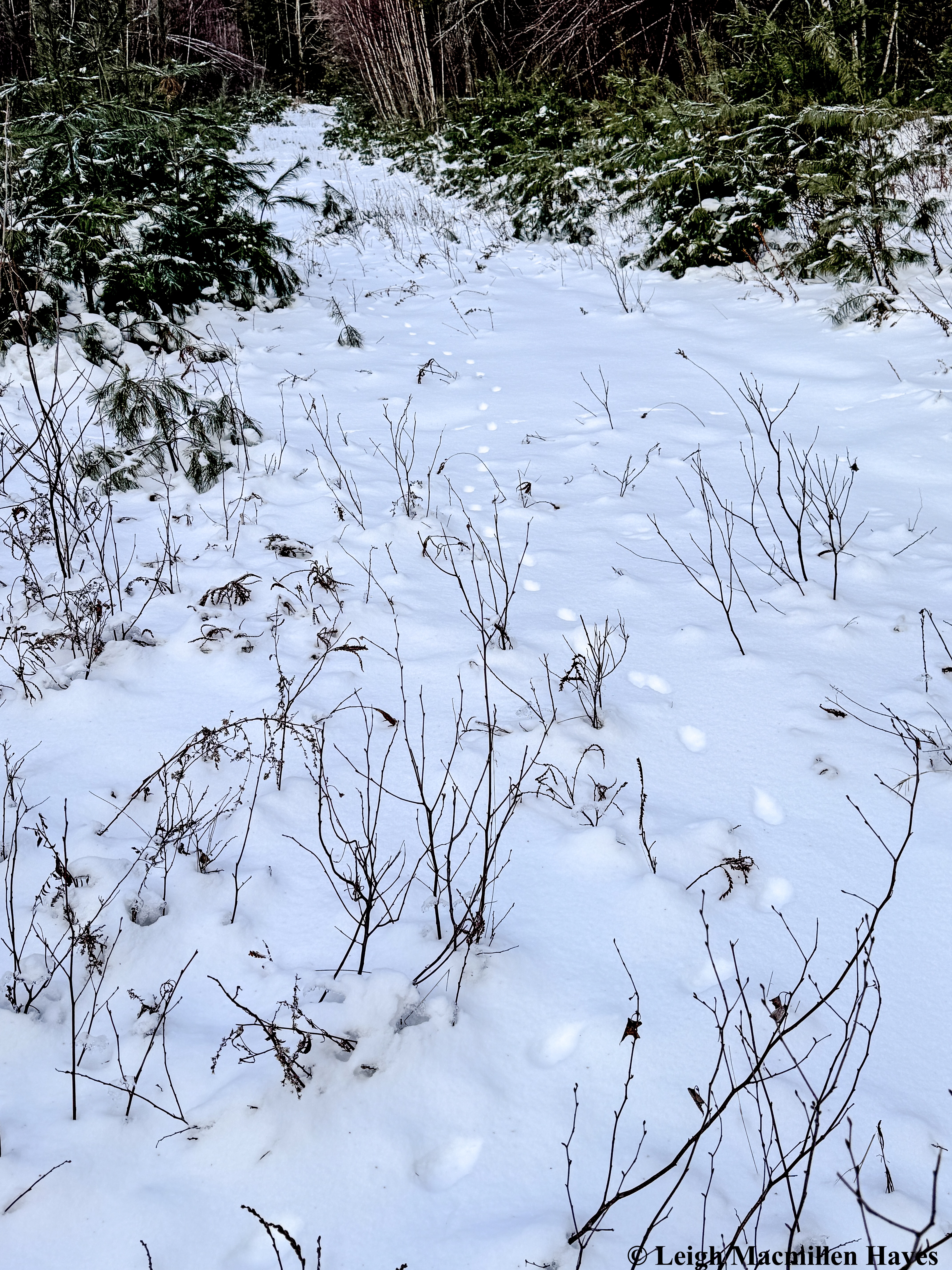
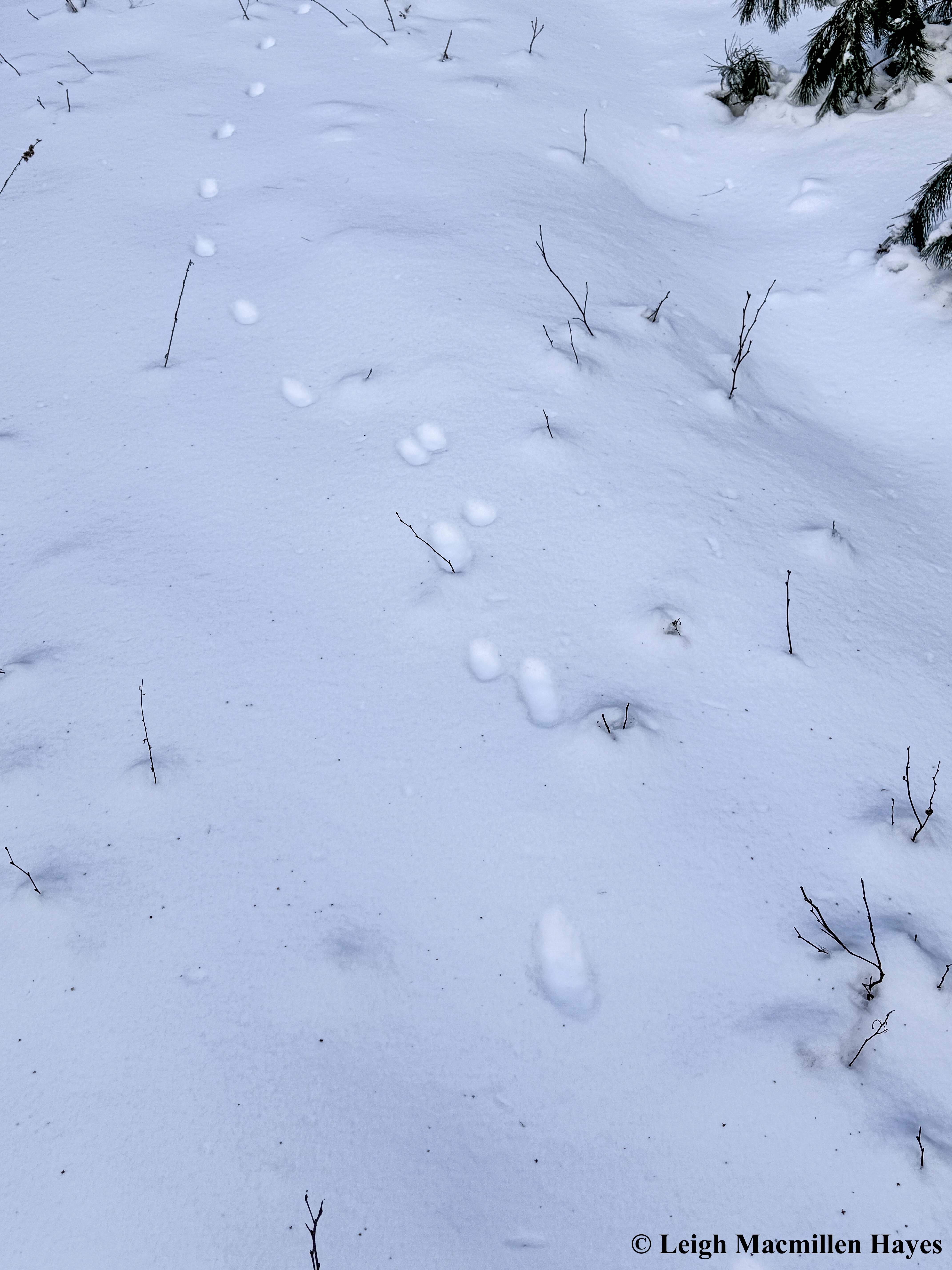
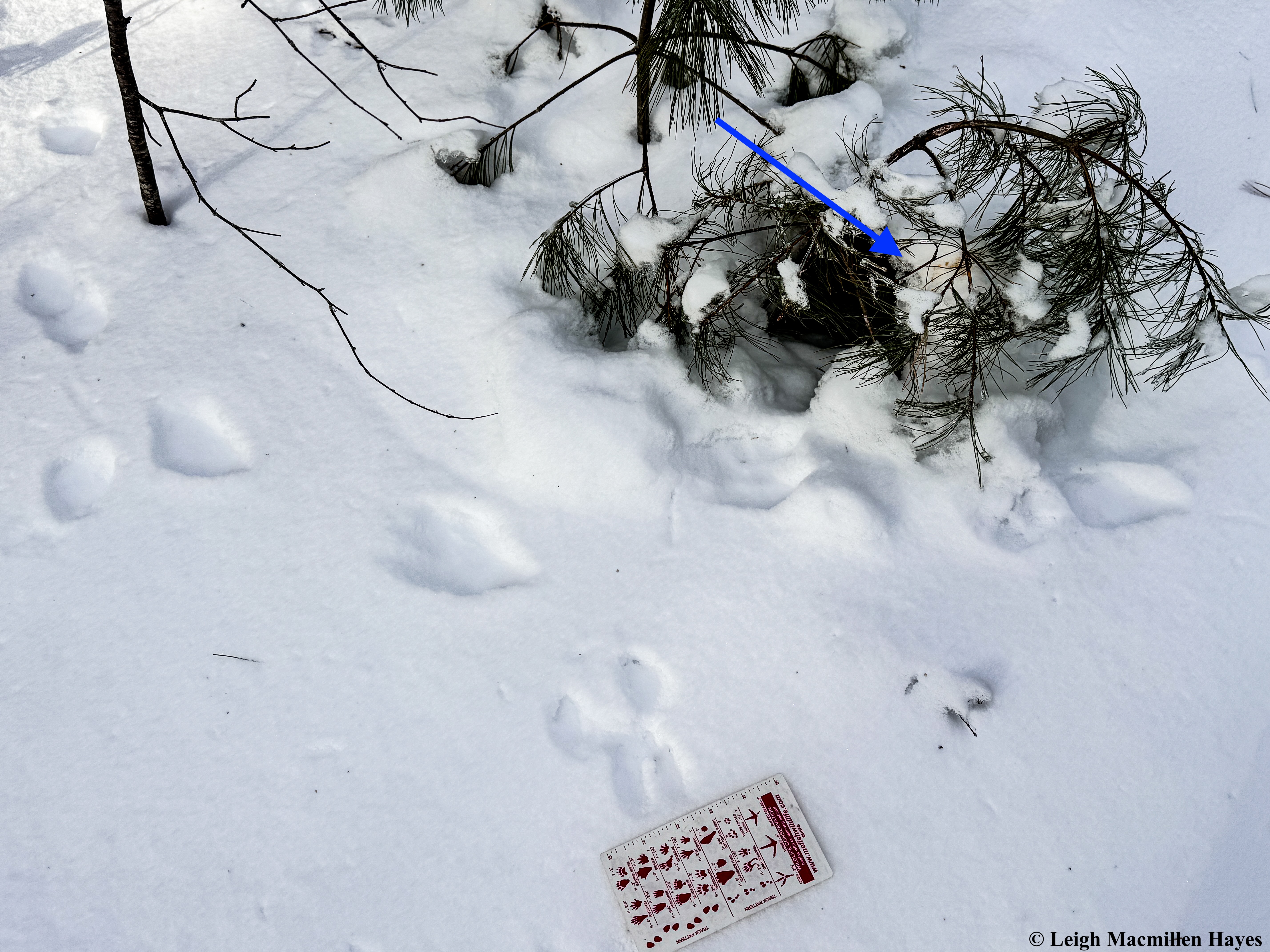
Given the incredible tracking right out the back door this afternoon, you would think that would be the focus of this post. I mean really, Red Fox duo, Coyote duo at least, Red and Gray Squirrels, Ermine, Bobcat, Snowshoe Hare, White-tailed Deer, and of course, Turkey and Ruffed Grouse.

But . . . I find myself returning to the topic that has fascinated me as much as the mammal and bird stories written on the snow . . . spiders and insects. And actually, it’s a story or two or three that have taken place over the last couple of weeks as I wandered through the woods that surround our home almost daily. It’s been a rare day that I didn’t meet one of these tiny beings. It seems that whether the temperature is in the single digits or 40˚s, they are out and about, even in rain and snow.

And the beauty of observing and learning about these champions of winter is that there are so few of them, I can actually retain their common names from one day to the next. That said, often there are surprises in the mix as I’ve reported in the past two episodes of Spiders and Insects. (See Spiders and Insects: A Winter Love Story and Spiders and Insects: And More New Learnings)
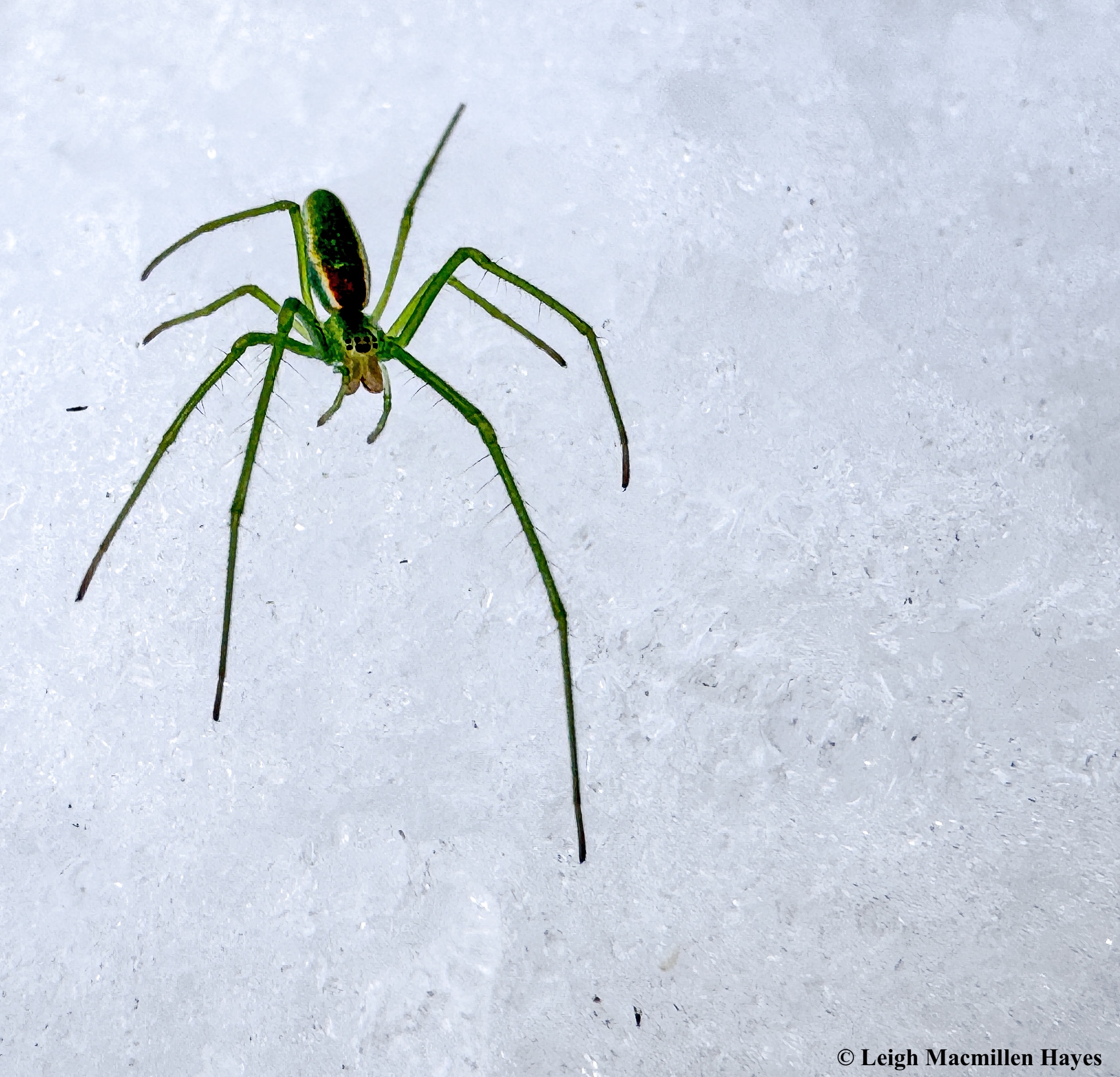
On a daily basis I continue to meet Long-jawed Orbweavers such as this green female. Though she looks huge, she’s less than a half inch in size. And check out those hairy legs.
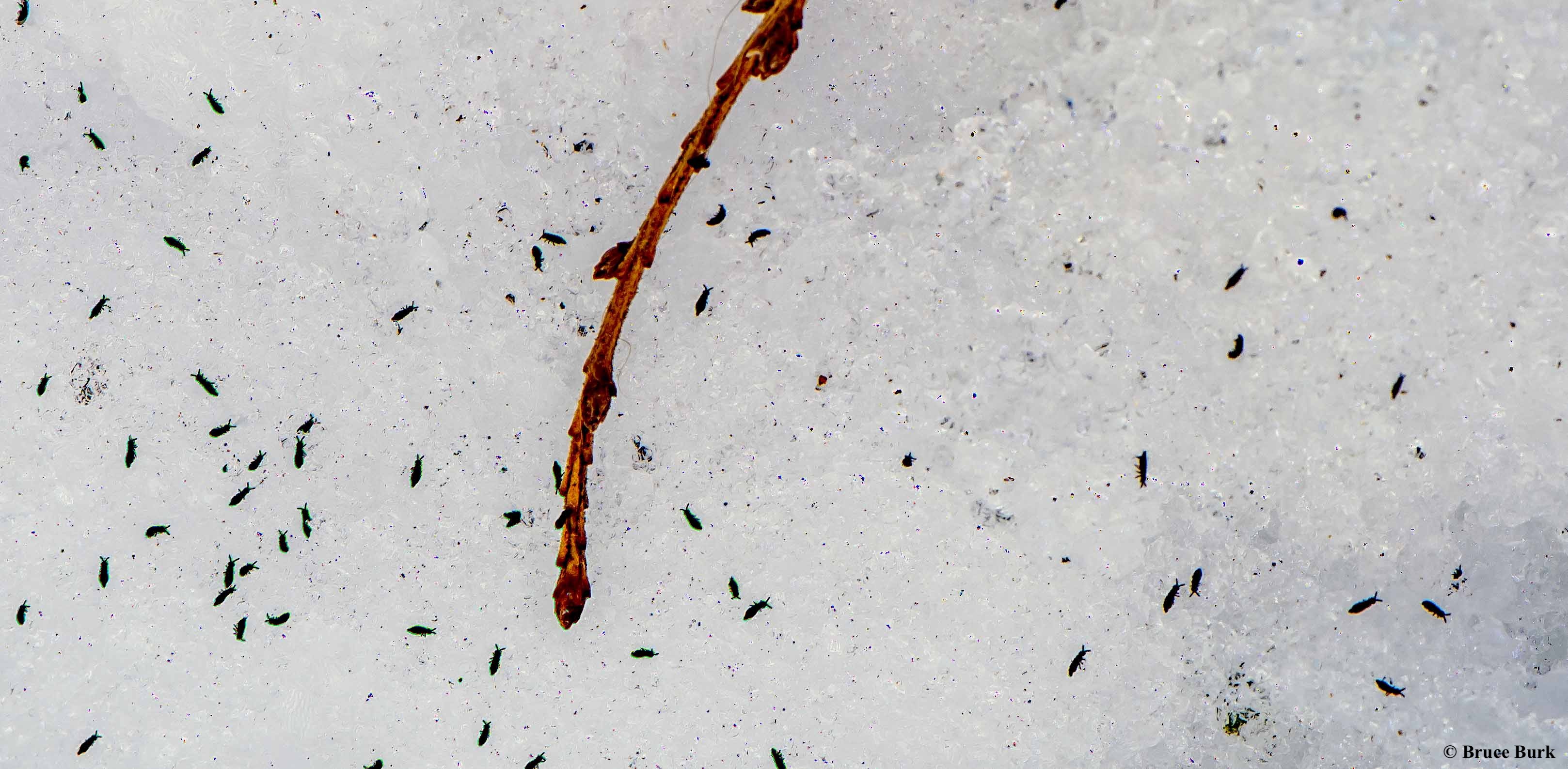
As my friend, Bruce, determined, the reason I see so many Orbweavers is because I live in a rather damp area, or perhaps I should say moist, it sounds so much more pleasant, where Snow Fleas (Collembola) are abundant and that is the spider’s main food source.
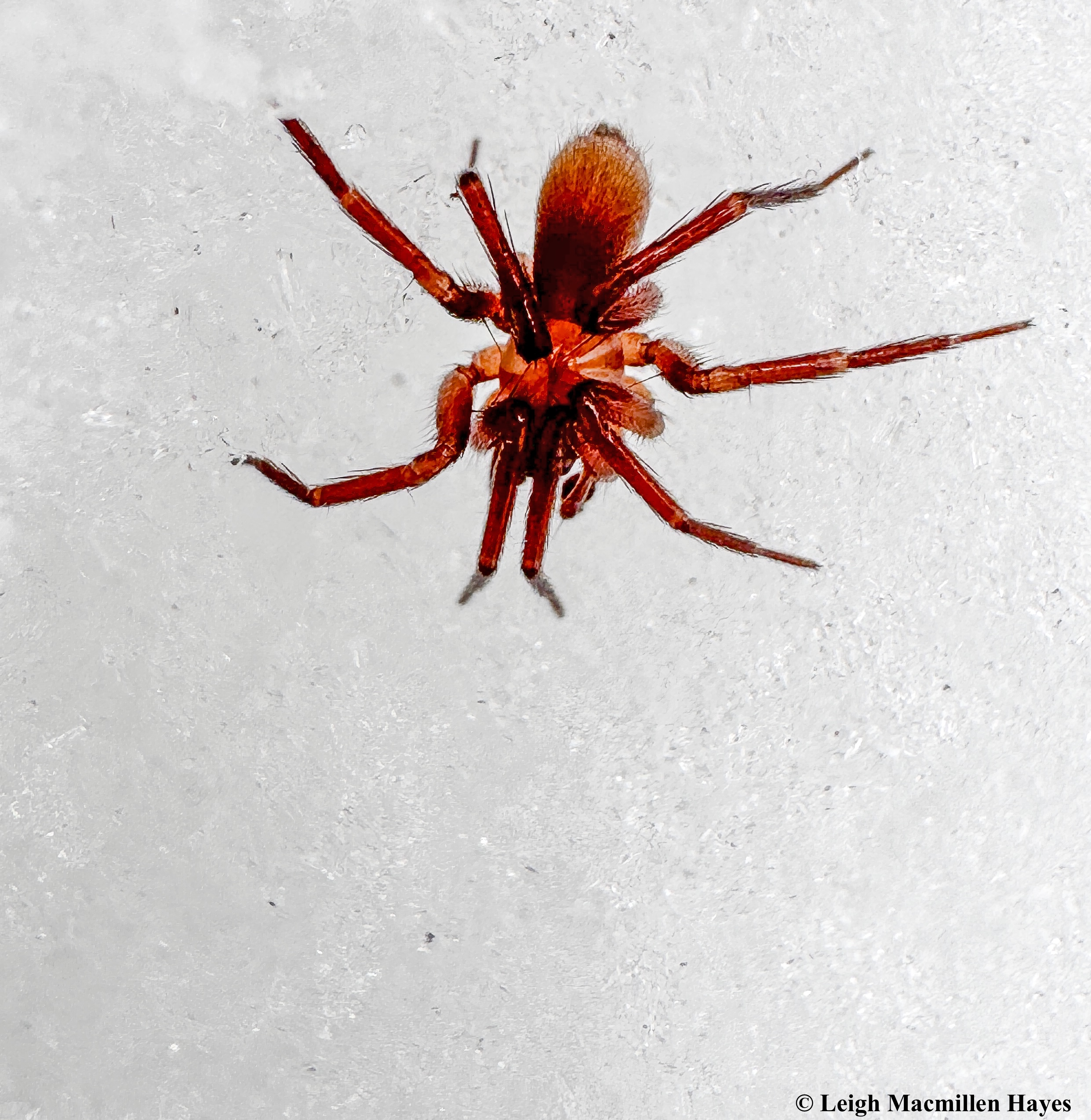
Today’s spider lesson was a bit different and it happened upon several occasions–as I went in for a closer look, unlike the Orbweavers, the ground spiders I met became coy and covered their heads, appearing to freeze in an attempt to possibly make me believe they were dead.

Of course, they can’t really make this decision, but rather are reacting by instinct–I was the predator and they the prey–not a role they usually assume.
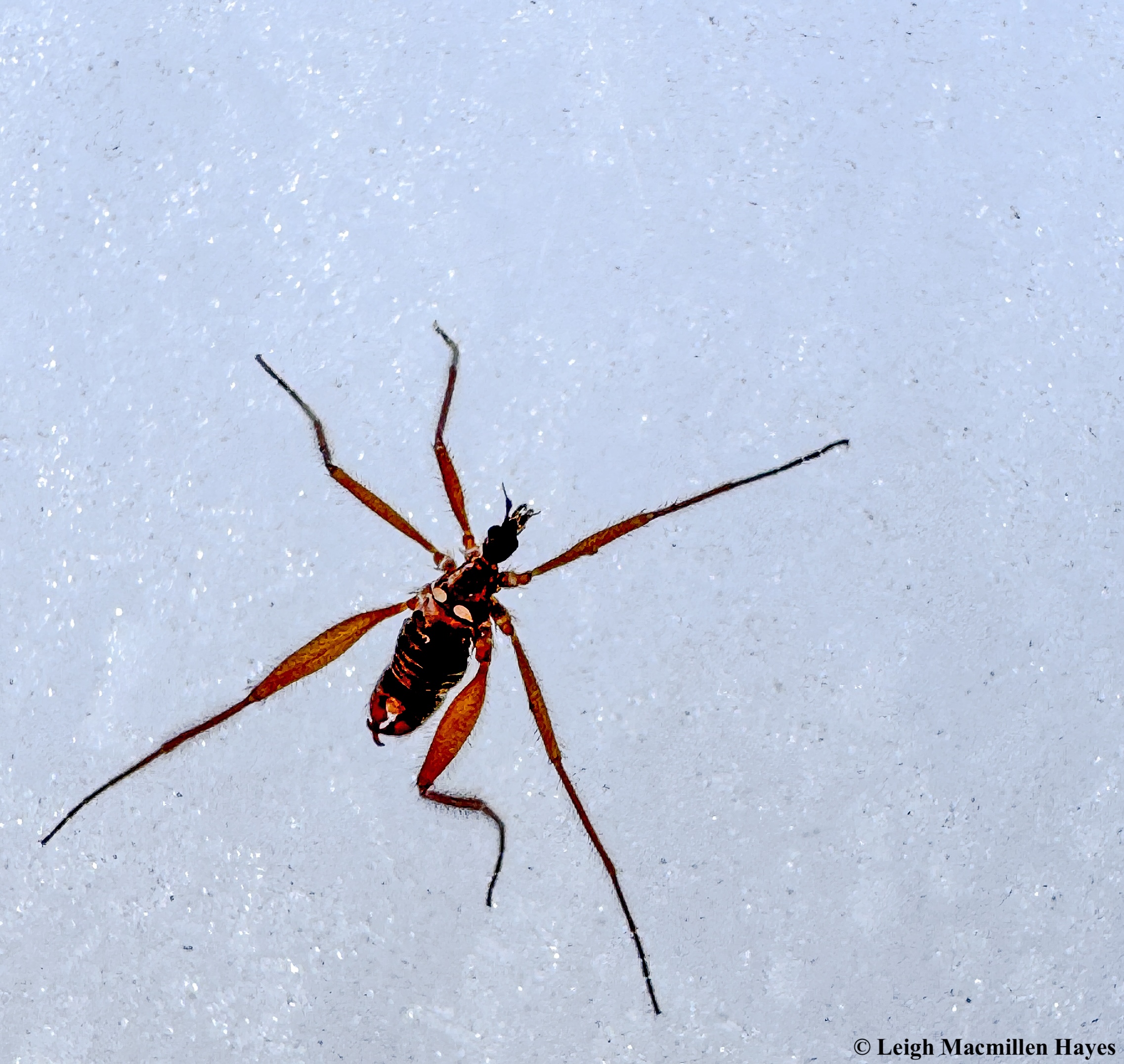
But this story is about more than the spiders, for one of my new favorite winter insects, the Snow Fly, a wingless Crane Fly, has a strong presence around these parts. This is a male, identified by its abdominal tips.
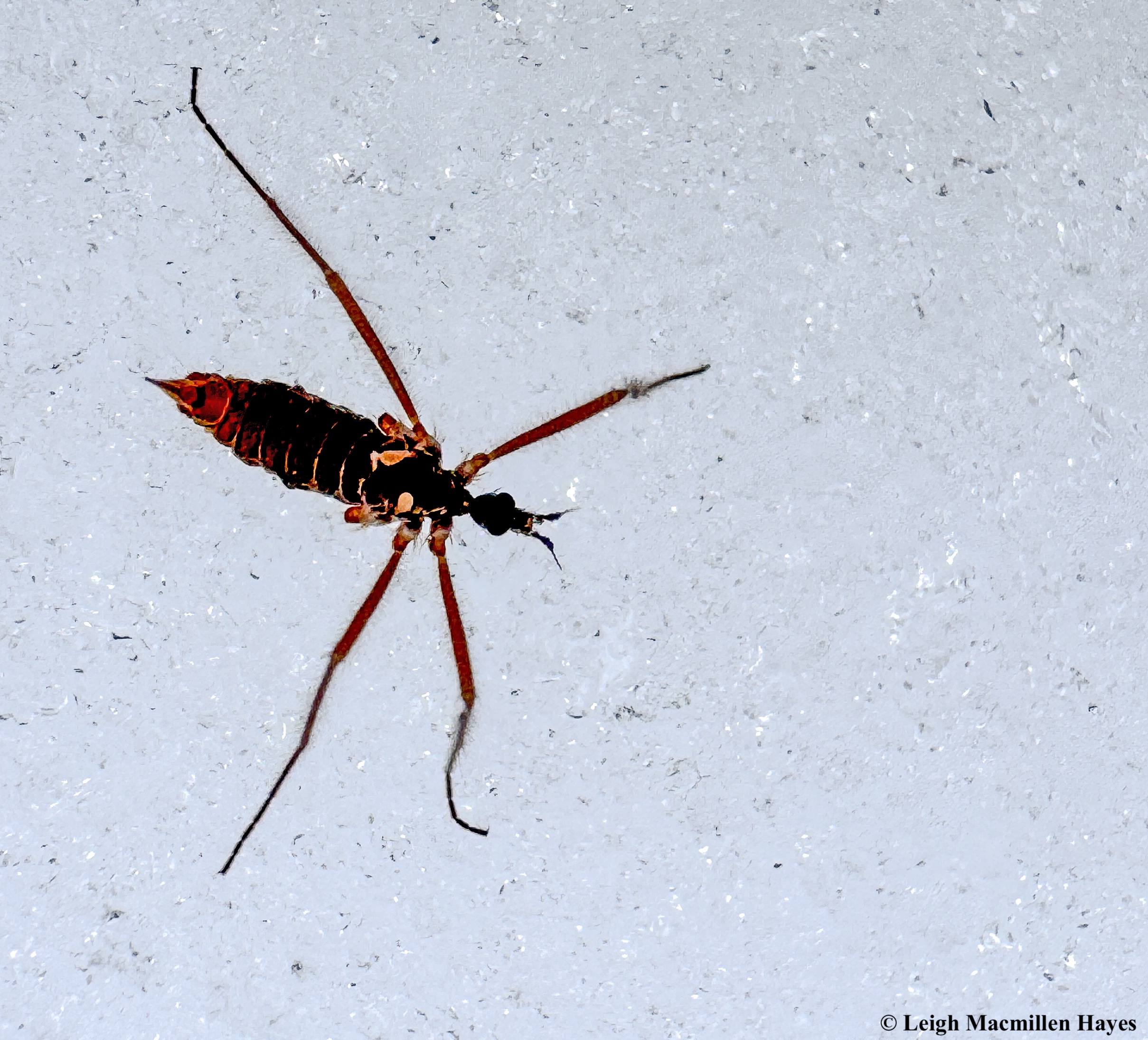
The long ovipositor identifies this one as a female.

But, there’s something curious going on here. I’ve said before that they self-amputate their legs if the temperature is too cold and they need to keep the freeze from reaching their organs.

Do you see that she has only four legs, the hind two missing?

From some research, I’ve discovered that as she and her kin walk across the snow, the cold surface causes water in the legs to freeze; in the process of crystallizing, heat is released in the leg’s tarsus (tip–think toes), thus signaling danger to neurons and a specialized muscle at the hip joint contracts forcefully until the leg snaps off! Can you imagine? All this to survive in a season to which you were created to exist.

With four legs, one can still navigate. I found another with two legs on one side and one on the other. He still had motion, but was slower and more awkward, and I feared for his future.
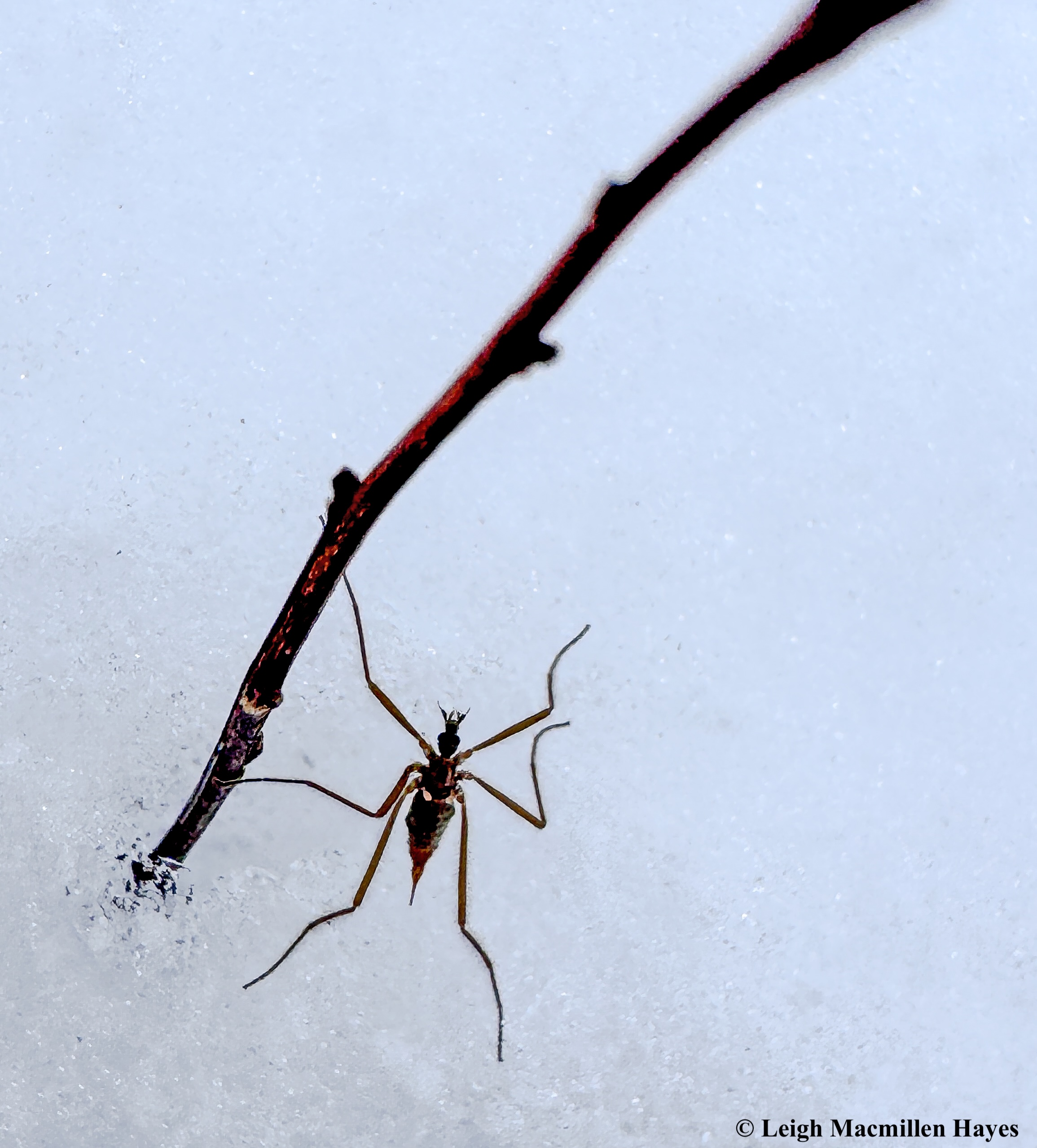
Another learning occurred these past two weeks. When I took the time to stand still, I noticed that sometimes the females walked (scrambled in some cases) to vegetation.
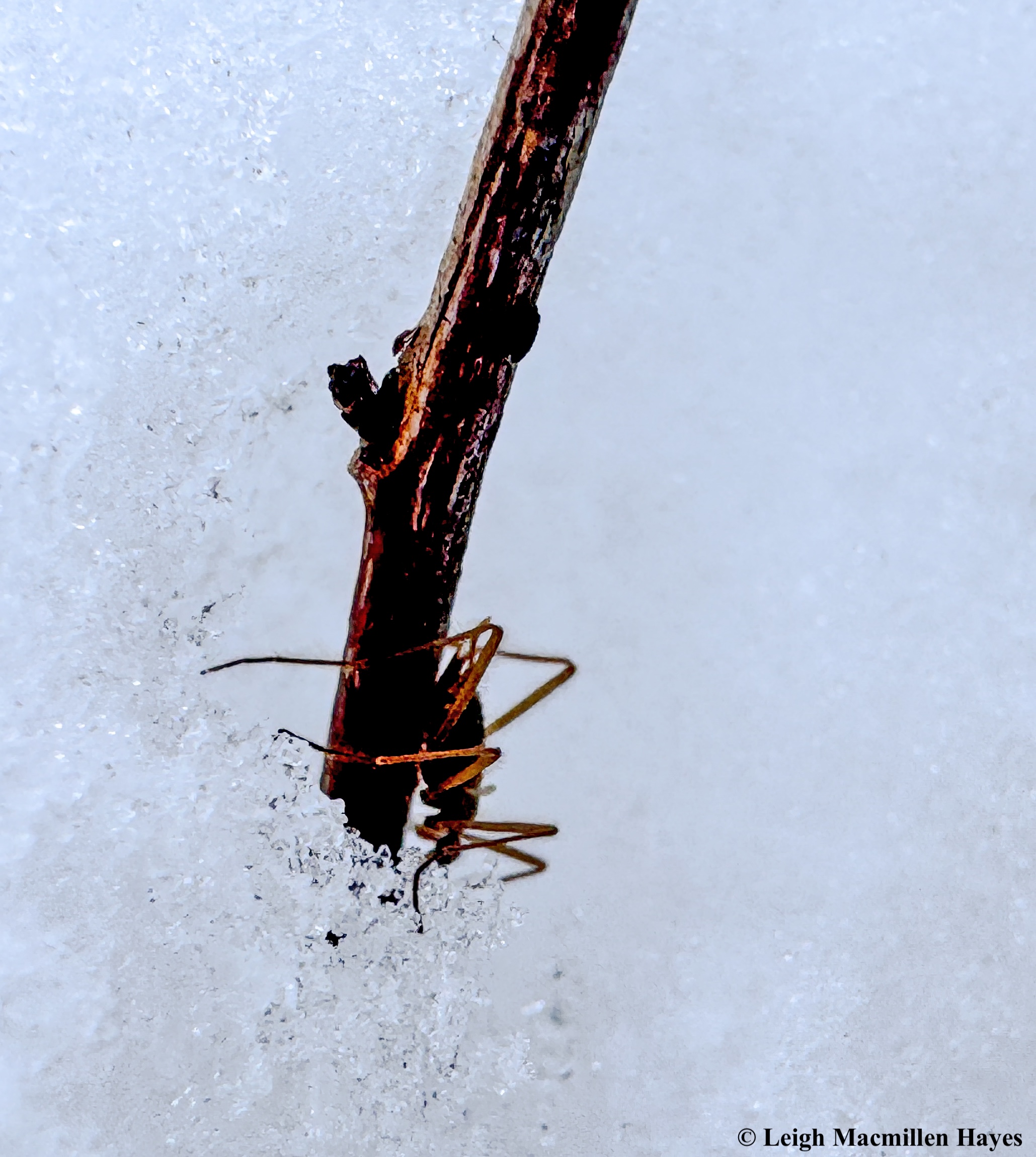
And then headed down a stem, and I imagined she was on her way to the subnivean layer between the ground and snow where perhaps she’d find a mate in that cavity.
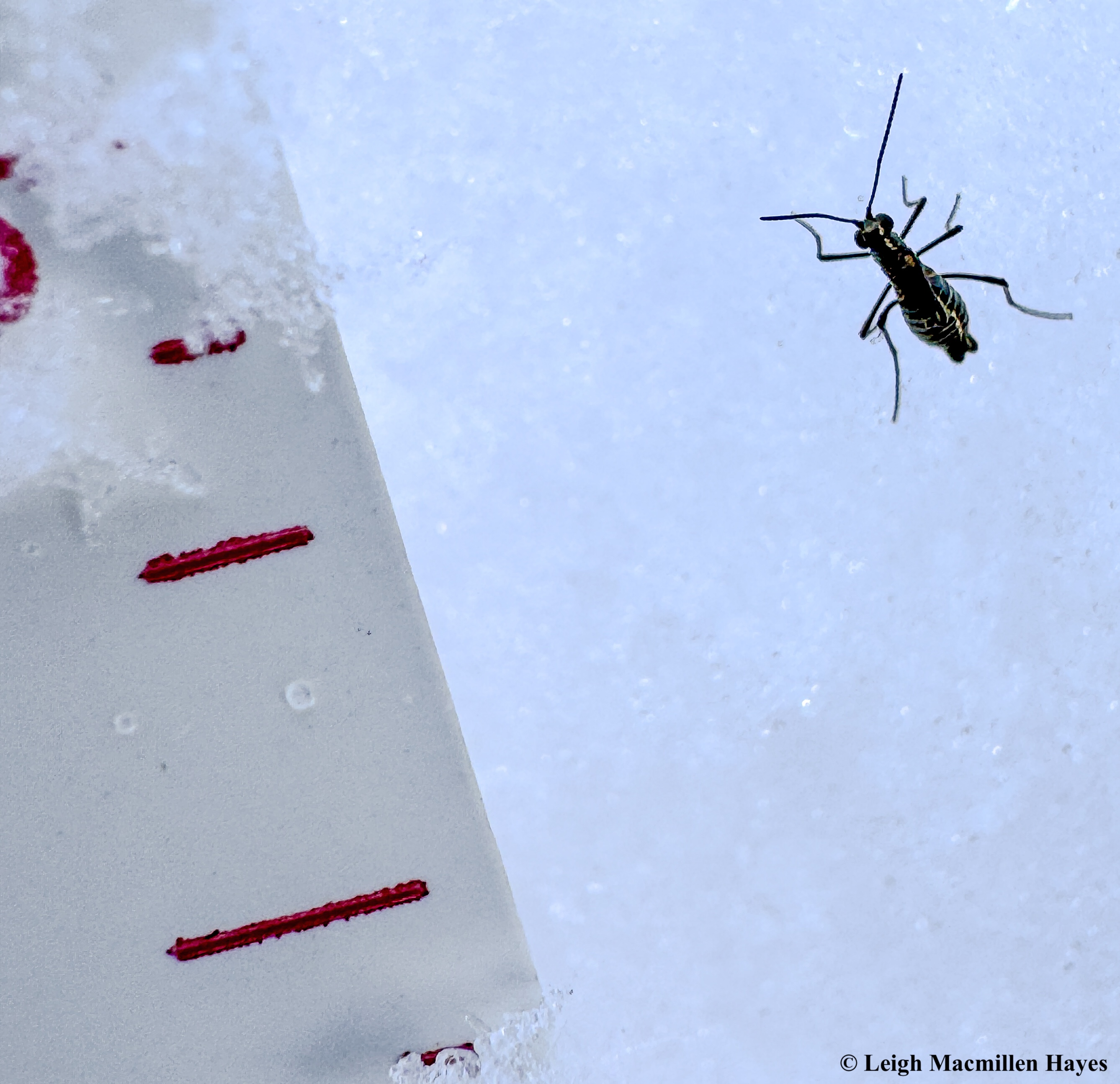
Not far from such activity I had the good grace to meet two more snow specialists: Snow Scorpionflies. How I ever spotted them, I’ll never know, for so small are they, but I’ve trained my eyes to notice anomalies, and sometimes its the slightest movement that draws my attention . . . and gladdens my heart.
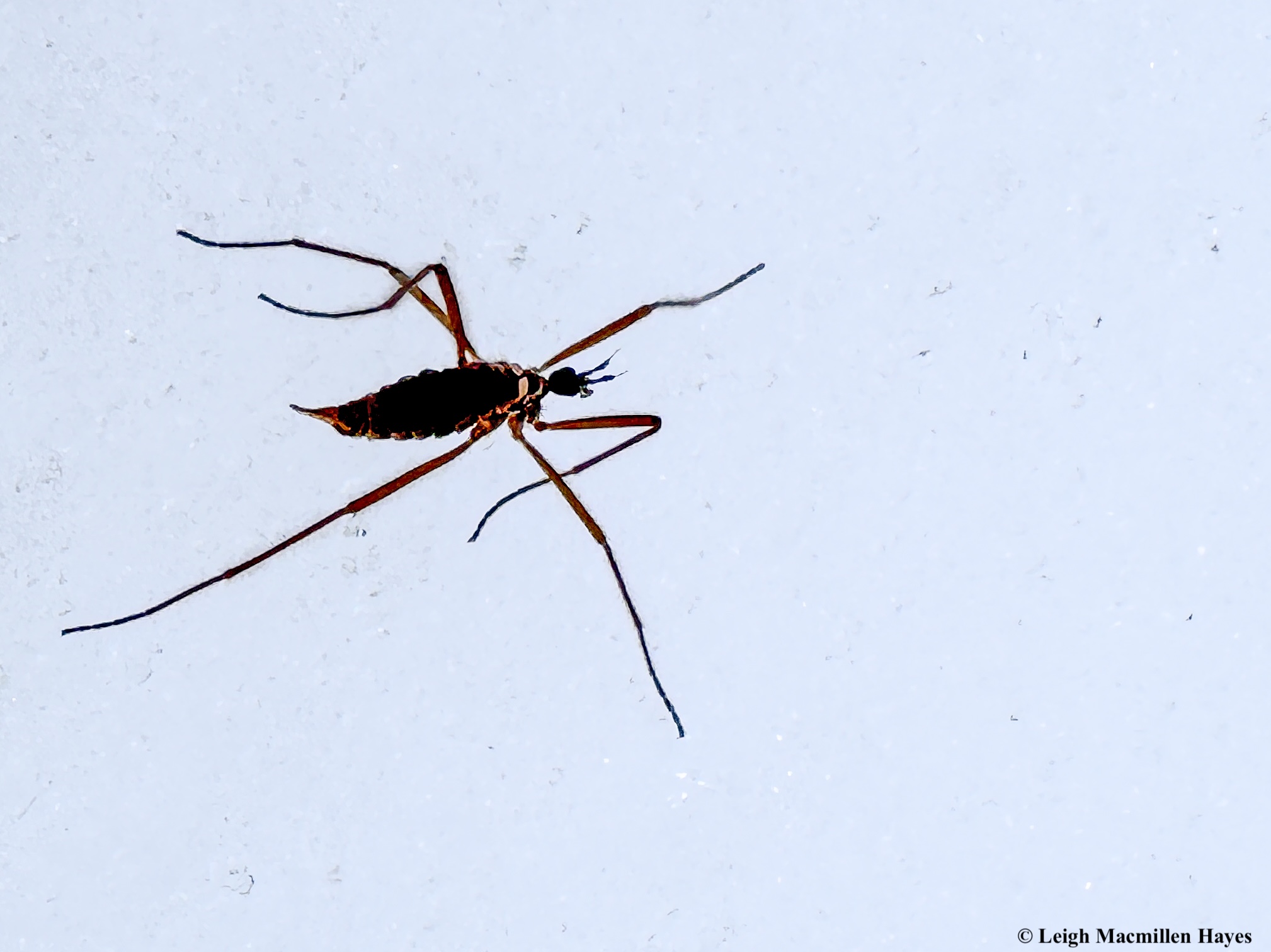
And then I met another female Snow Fly. When I first spotted her, she was on the edge of the woods but moving quickly. Curious, I decided to watch her to see where she might venture.

Much to my surprise, she crossed a main snowmobile trail that is at least six feet wide, and then continued.
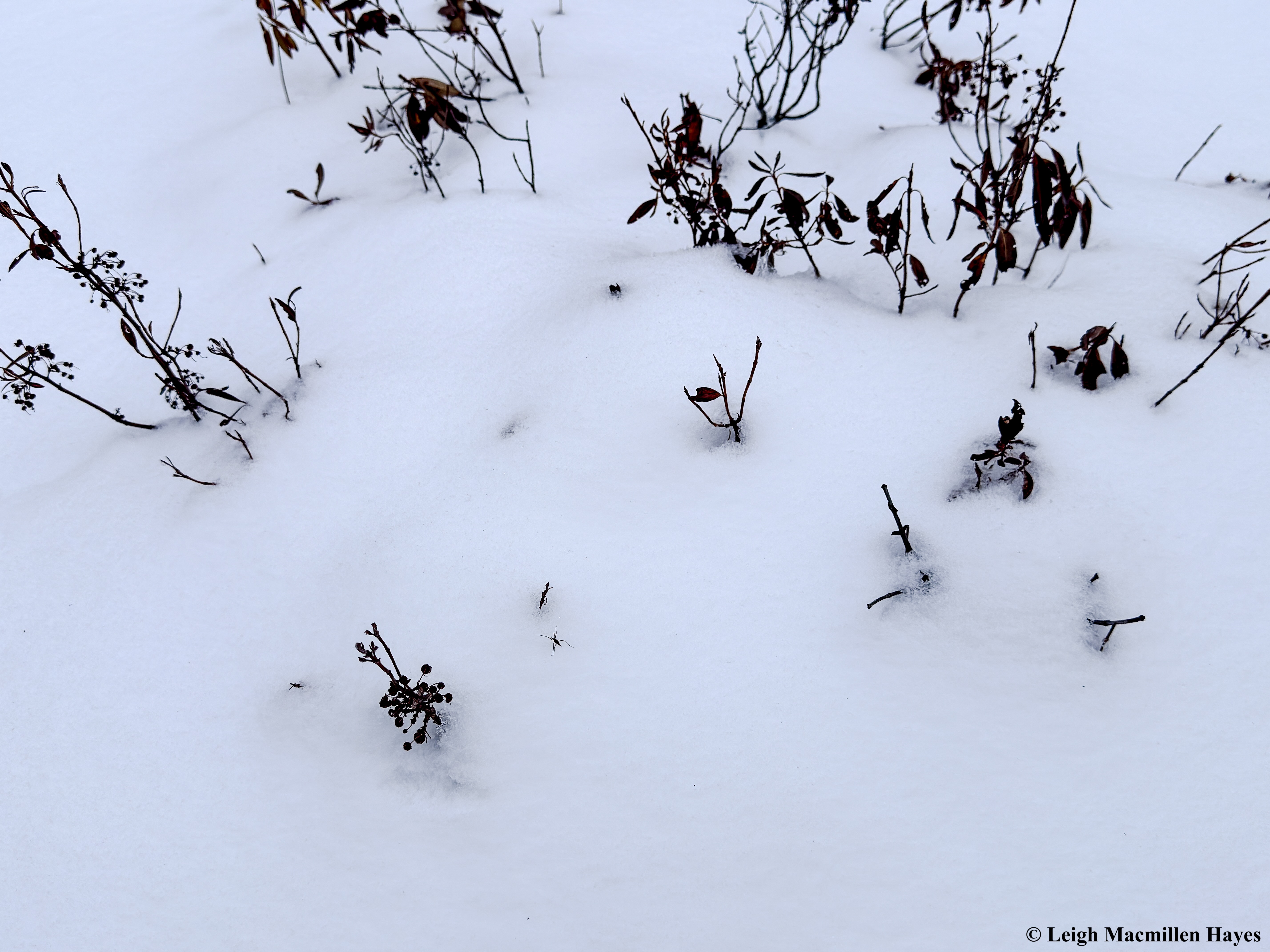
Do you see her? She’s in the midst of the Sheep Laurel that is sticking up above the snow.
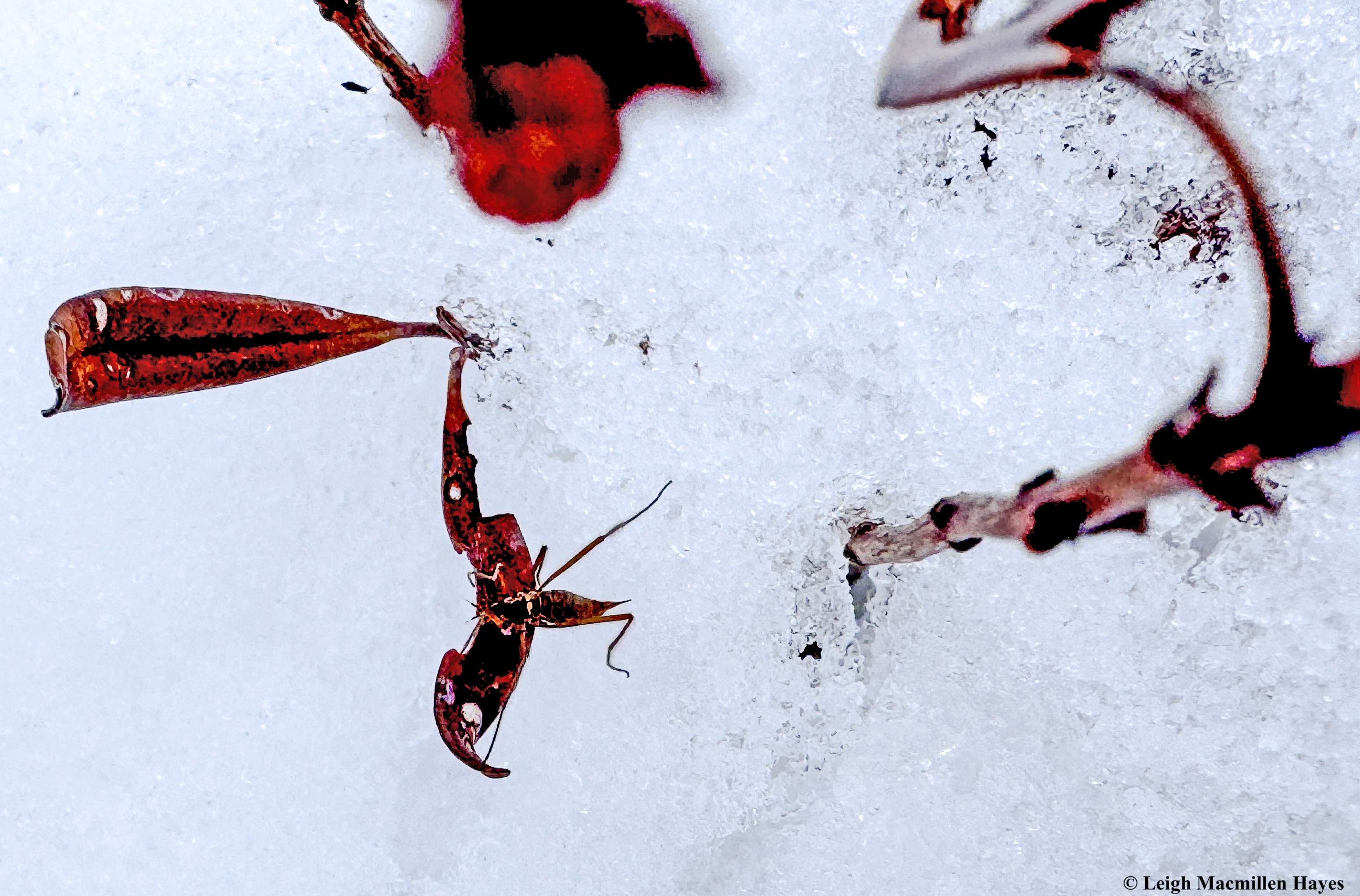
Eventually, she reached a leaf, and I had to really look to see her, for so well did she blend in to her surroundings. By this point, she was about fifteen feet from where we’d first met, and only a few minutes had passed.
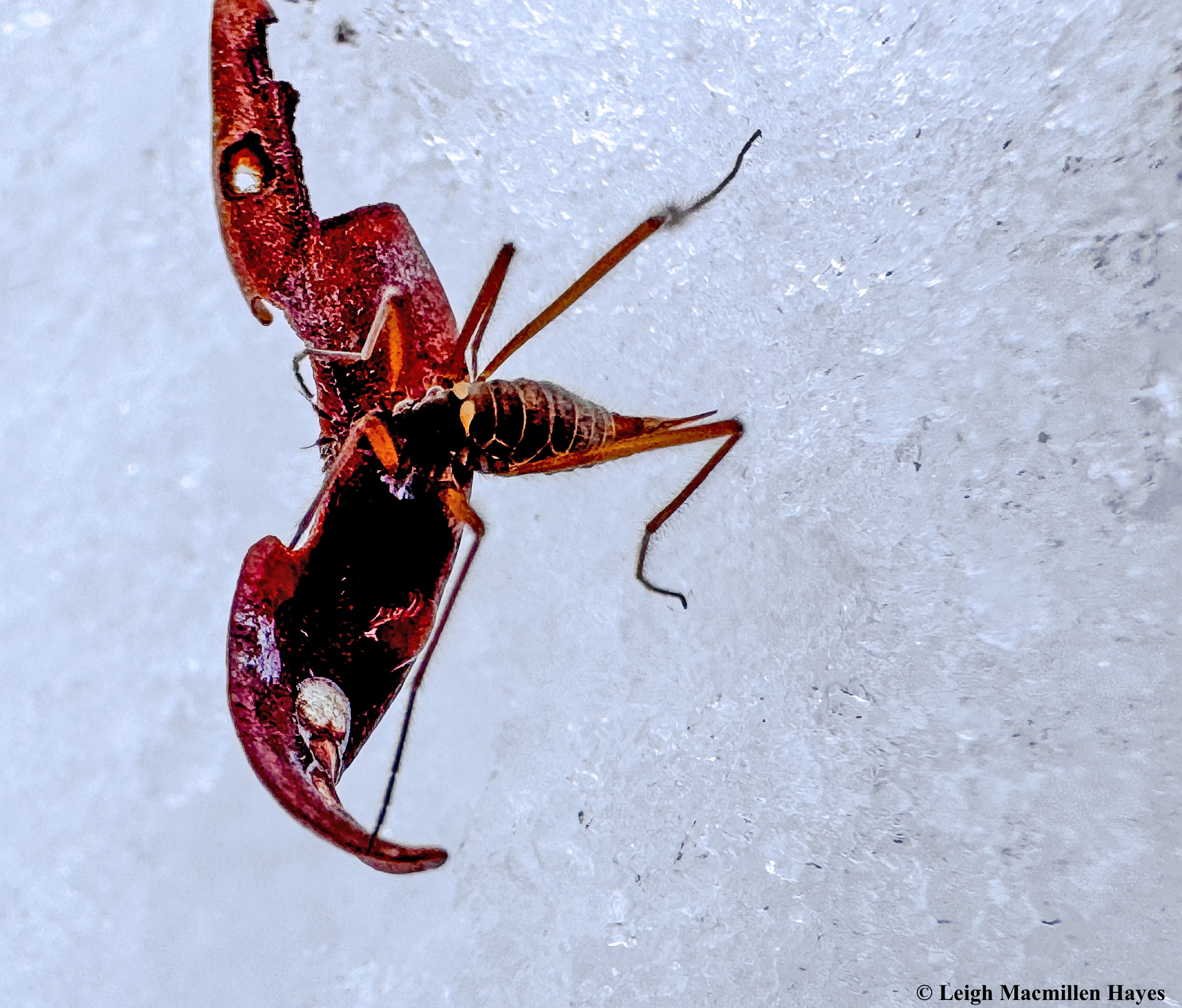
Why the midwinter journeys? From what I’ve read, it may be to avoid inbreeding–if you live in a group chamber below the snow’s surface, that doesn’t bode well for genetic diversity.

But if you venture forth, maybe you can find a guy from another family and hunker down with him. And if you want to avoid being observed by the local Paparazzi, or birds I suppose, find vegetation that matches your coloring. And then slip into the wedding chamber.
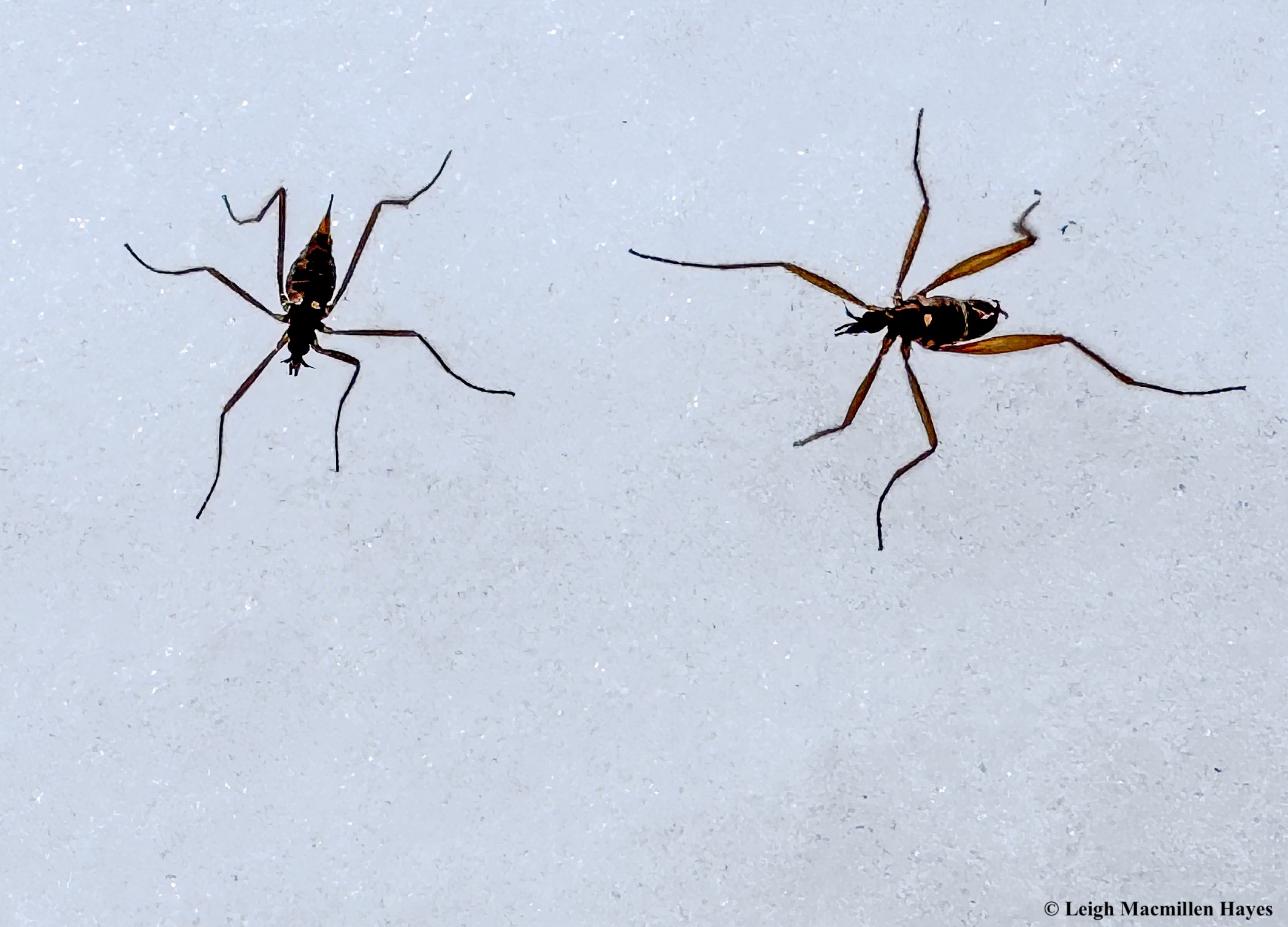
Okay, so I have to admit that I tried to be a matchmaker and brought a female atop my tracking card to meet a male about a half a mile away. Surely this was a pair that couldn’t resist the possibilities.

They took one look at each other and turned the other way, running as fast as their legs could carry them.

Matchmaker, matchmaker, don’t interfere!
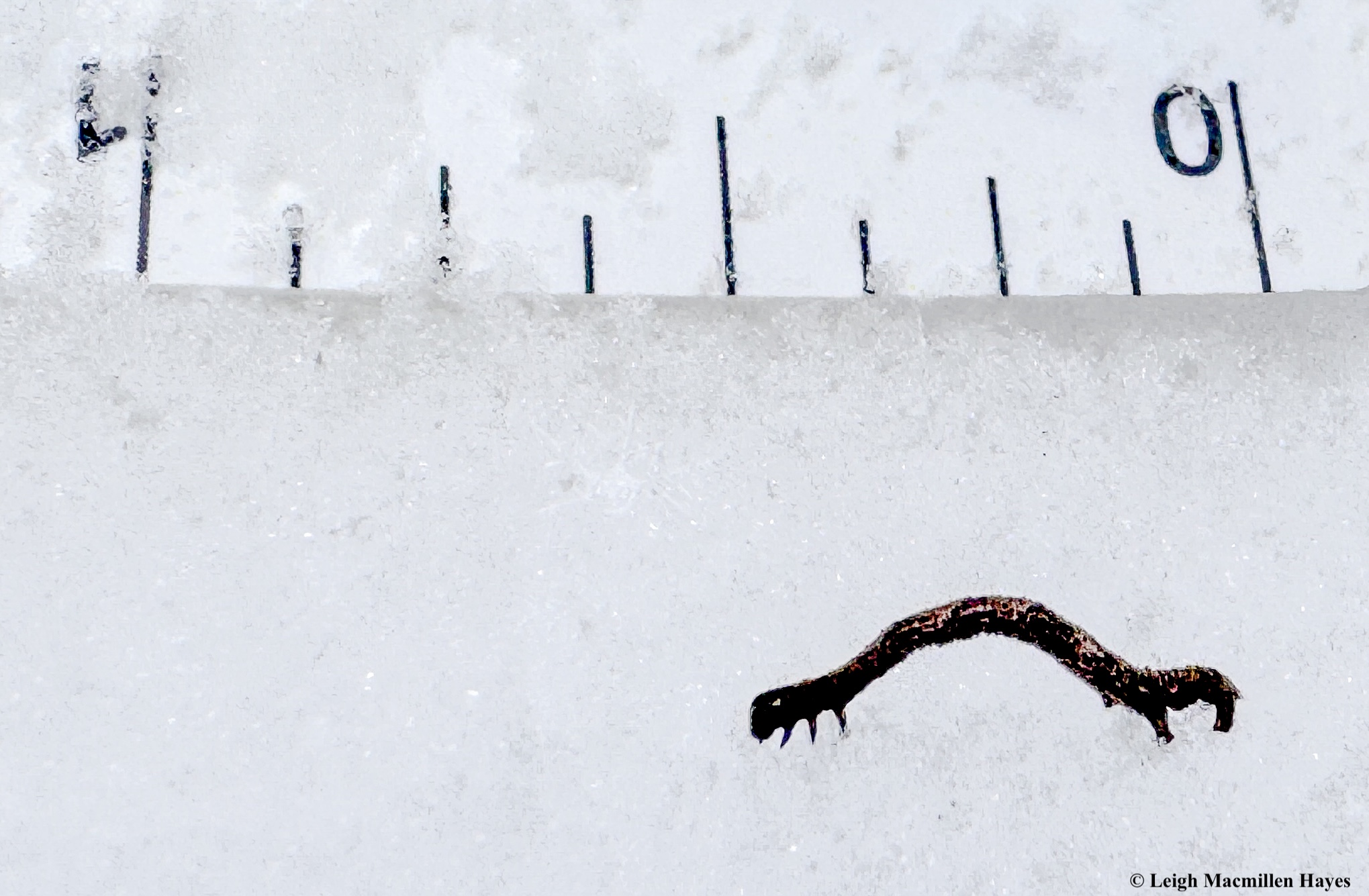
And as I said, each time I focus on the spiders and insects, which is almost every day, I am surprised by my findings. Today, it was two Inch Worms. Or more likely, Half Inch Worms.

Spiders and Insects: yes, the love affair does continue. It’s a whole other reason to be outside observing no matter the weather.
Finding My Way, Naturally

The older (and possibly wiser) I grow, the more gratitude I find in my heart for all those who have paved the path for me. Beginning with my parents, who first grounded us in the natural world, sending my siblings and me out to play and not giving us limits so we could go to places like City Mission and Lost Pond to ice skate in the winter, and follow the old trolley line to the town dump or in the opposite direction in the summer, and certainly disappearing behind the houses across the street from us and down to the brook any time of the year, as well as taking us on long walks in the woods and along the Connecticut shoreline and encouraging us to learn–always.

And then there have been so many others who have crossed my path and I dare not name them for fear of leaving some out, but knowing that there were those who were obvious teachers for me, and others who I didn’t realize were such at the time, but I still came away with lessons learned–to all of them I give my heartfelt thanks.

Some lessons have involved the big picture view of the world, no matter how cold the temperature and frigid the wind.

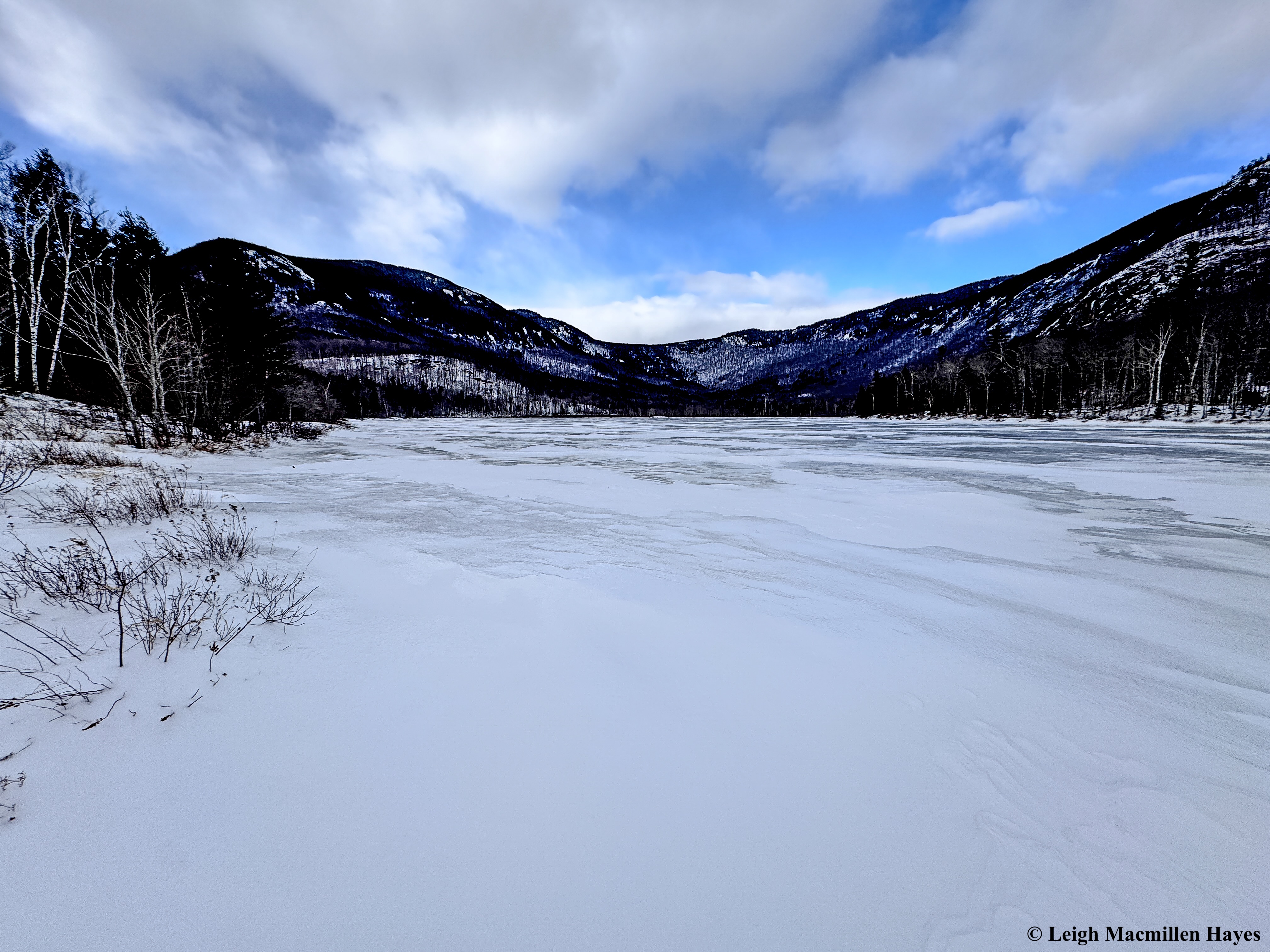
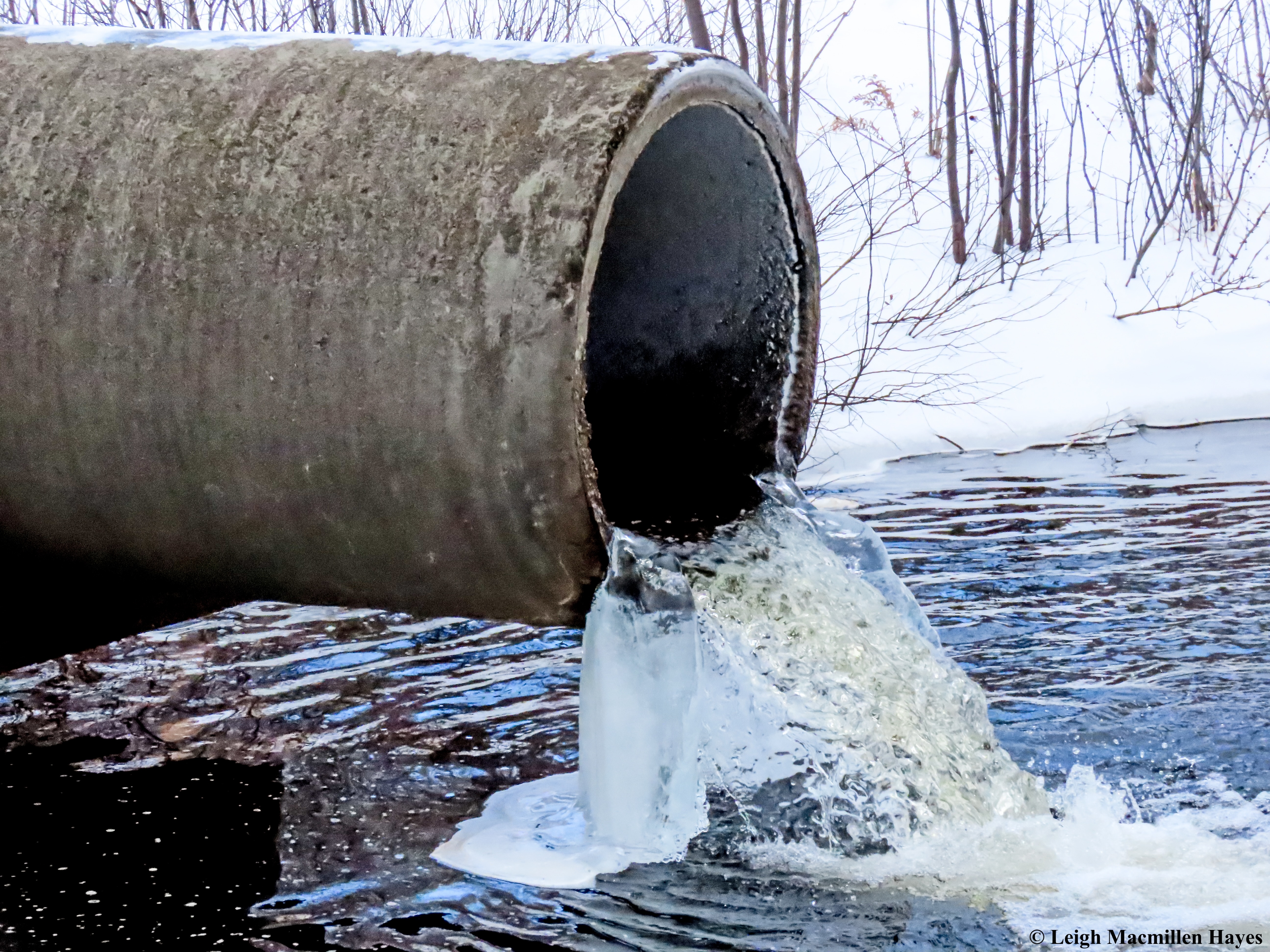
Other lessons have been much subtler, like realizing that ice forms in a perpendicular manner and fans out behind a culvert that spews water at the formation of a river.

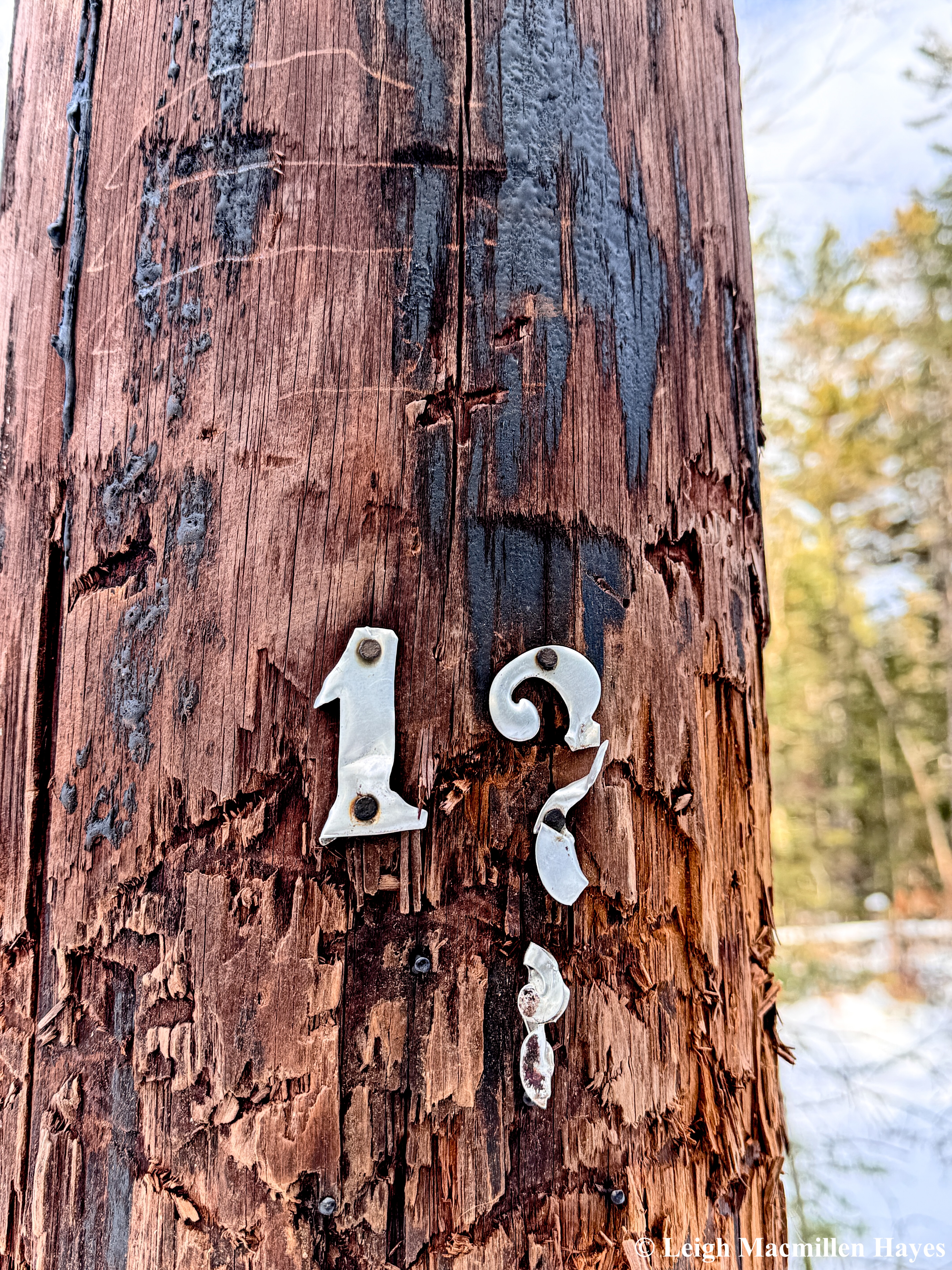
And then there have been reviews of old lessons, where the Black Bears leave no telephone pole untouched. The shiny numbers are invitations encouraging the bears to turn their heads and then pull upper incisors toward lower, mangling both the wood and metal.

And then to leave a signature scratch above this work of art.

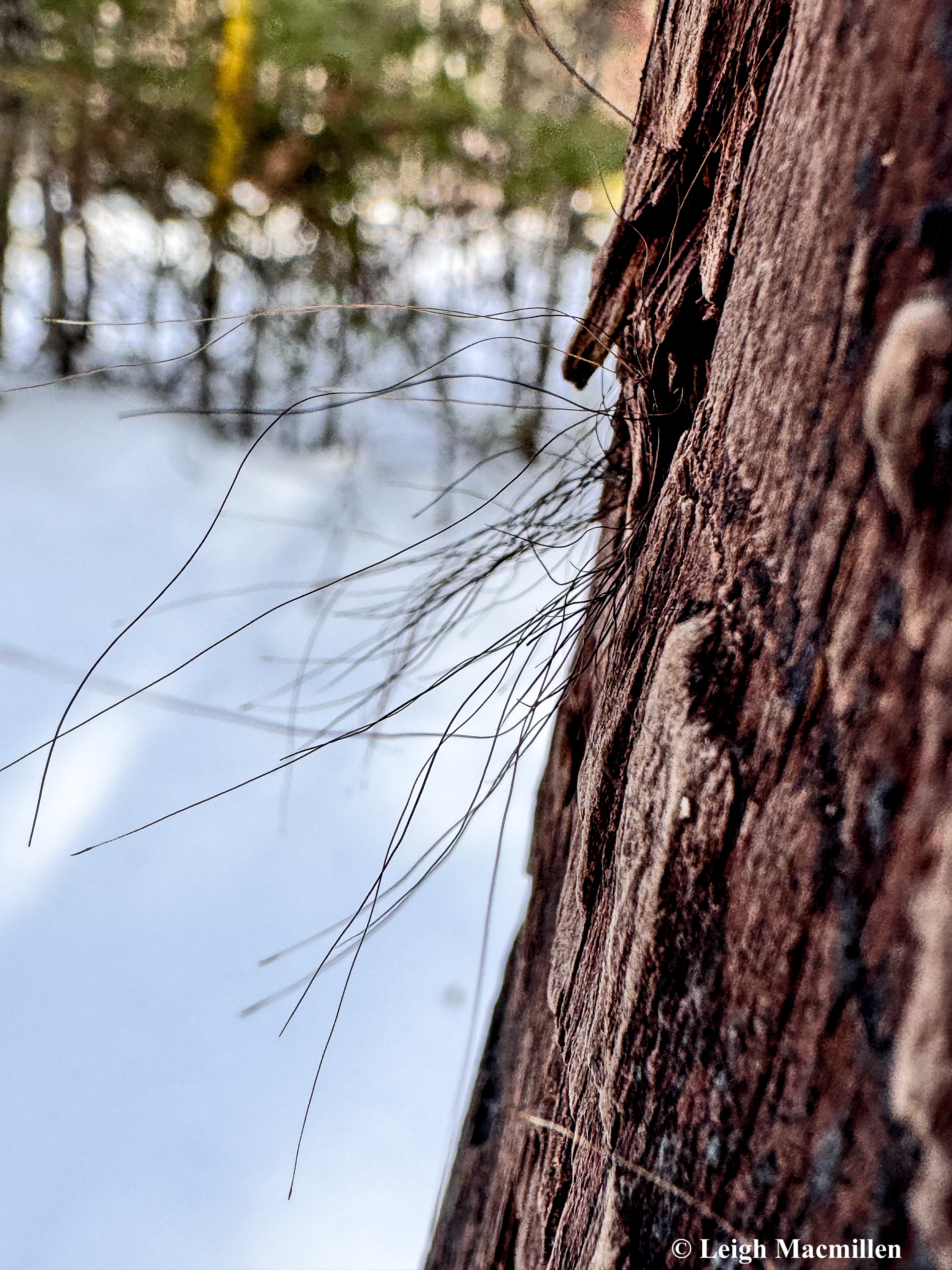
And in the midst of this action, to accidentally deposit a bit of hair on the mangled wood. (Please note that My Guy was surprised that I can still feel such glee looking at the same poles year in and year out, but I reminded him that each year I find changes, including hair on different poles and this year the scratch marks on several that I don’t recall seeing in the past or simply failed to notice. What’s not to love? )

There are other old lessons that are also worthy of review–especially as once the snow flies I begin to see them written everywhere I look.

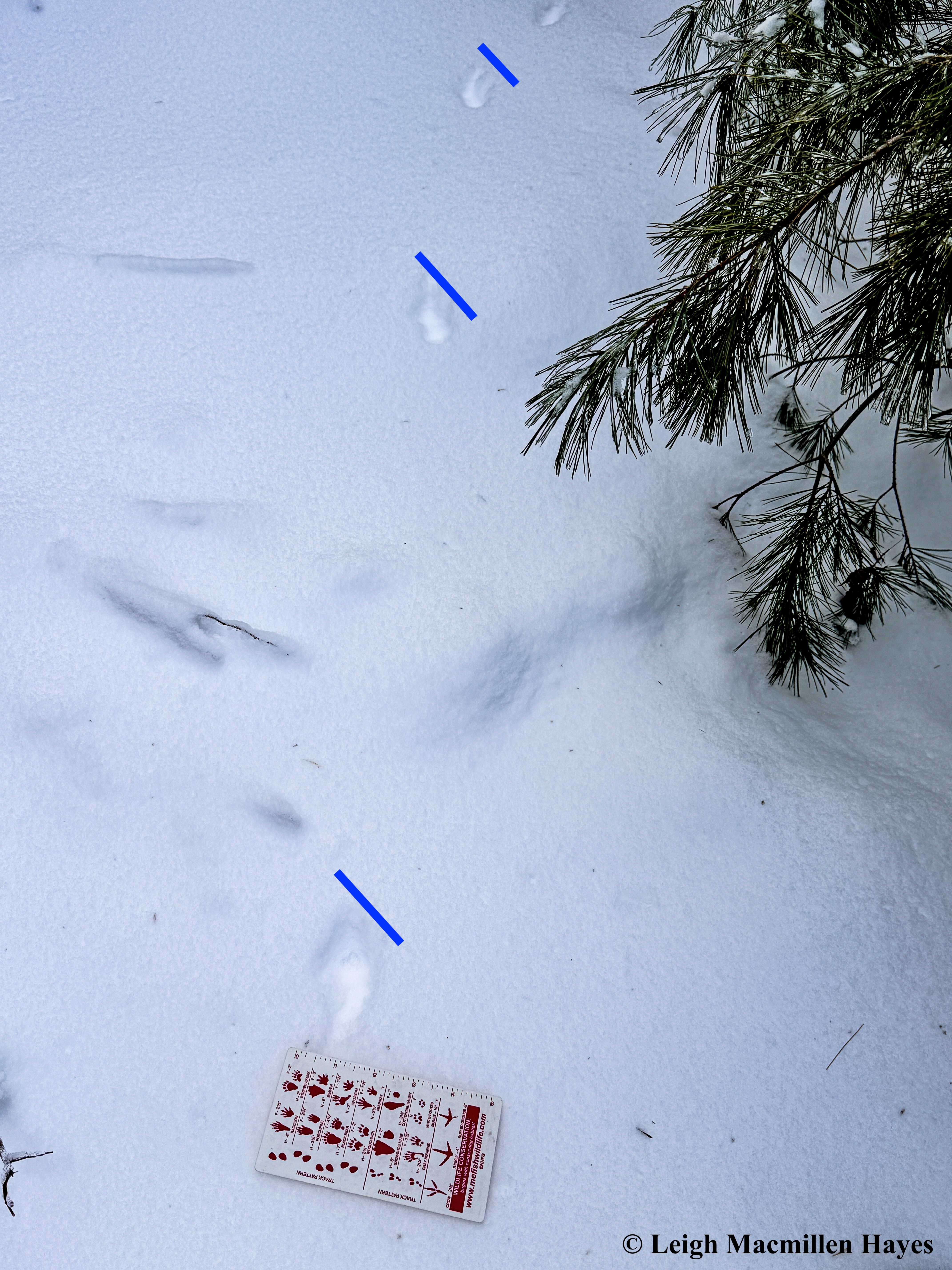
This one is the track of the Ermine or Short-tailed Weasel. I love how each set of prints represents four feet, the front two landing and then as this bounder’s hind feet begin to fall into place, the front feet lift off toward the next spot. One of the biggest give-aways to the creator is the diagonal orientation of each set of prints. Sometimes the diagonal changes, but it’s almost always present.

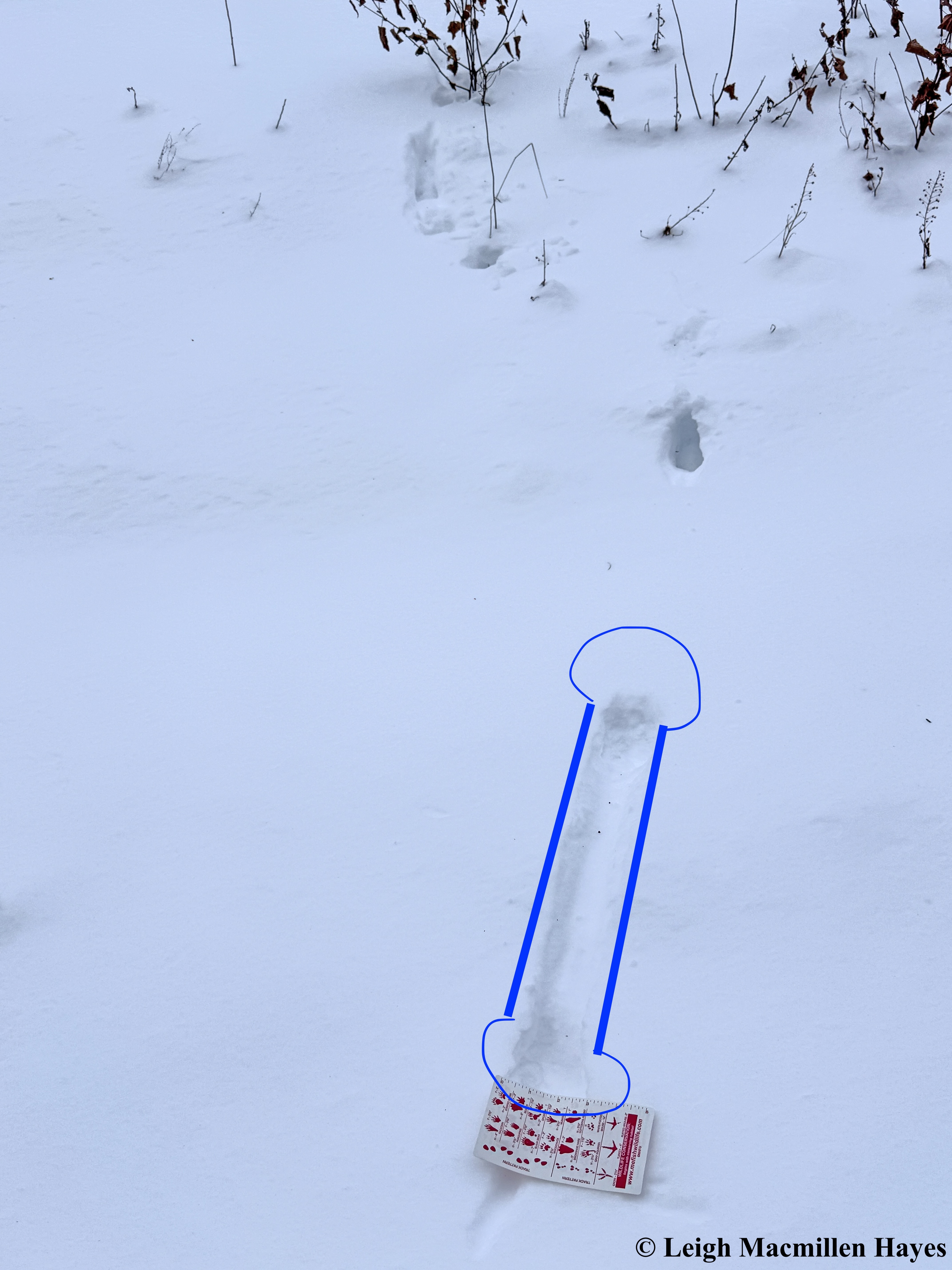
And just sometimes the same weasel decides to take it easy between sets of prints and goes for a quick slide, creating what is known to some as a Dog Bone and to others as a Dumbbell. I think it’s easy to see both once you know you recognize the behavior, but I can’t tell you how many years it took me to actually see this.

And then, along a wetland shoreline, another member of the weasel family reminded me that occasionally they like to slide much like a River Otter, but this being was a Mink!

And not to be left out of the scene, a Fisher (not a Fisher Cat–ah, but the hairs go up on the nape of my neck). The diagonal is there and though this was a quick shot and not all the details are visible, all Mustelids (weasels) have five toes and all are bounders.

Red Foxes also write lessons in the snow and I followed this one for quite a ways, finding a spot where it pounced, though I’m not sure it caught the intended meal because there was no evidence of a struggle.

While its overall trail was the zigzag of an animal that double packs a spot because the hind foot typically steps where the front foot had already been, sometimes the trail zags more than it zigs and I imagine he was looking for another food source.

Occasionally he changed his pace and I had to wonder why–did he smell or hear something that I couldn’t discern?

One thing I could easily discern–his territory marking. Fox urine! On a sapling. Skunk-like in odor. All classic during mating season, which we are in. Mind you, I learned this summer that Red Fox urine always smells skunky, but it’s even more so in the winter.

And I’m here to report that the Red Squirrel that crossed his path lived. For the moment anyway.

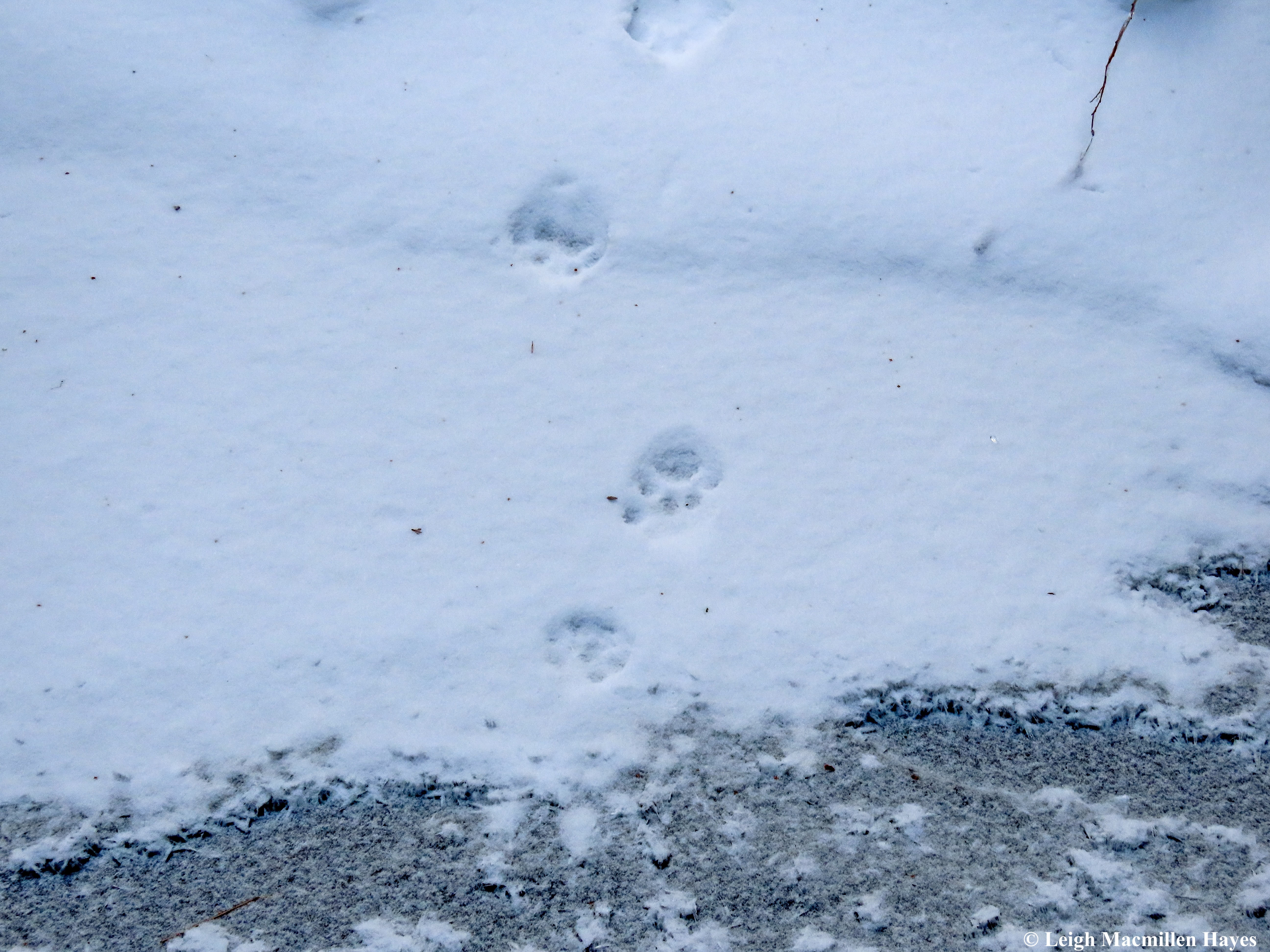
The final lesson of old, though hardly the final lesson, was the realization that some rather large prints were actually signals of two-way traffic. Do you see the upside down C in middle print? This is the neighborhood Bobcat crossing an ice bridge. But . . . which way is he walking?

Turns out in both directions. East and West. Packing the snow in one direction with both front and back feet and then following the same exact trail back. I remember the first time I saw this sort of behavior when I was looking for evidence of a Bobcat and a Coyote in a local watershed prior to offering a summer presentation to a lake association. It was about thirteen years ago and I think of it every time we hike the same trail at Five Kezar Ponds Reserve in Stoneham. First I knew I was following the Coyote and then I realized that a Bobcat had walked in the opposite direction on the Coyote’s prints. The same thing happened at Dan Charles Pond Reserve in Stow a few years ago. You can read about it in The Tail of Two Days.

Look carefully at the photo above. Do you see it? The better to reserve energy.

While I love reviewing old lessons because there’s always something new to observe or a better understanding of the animals behavior is gained, new lessons are even more exciting.

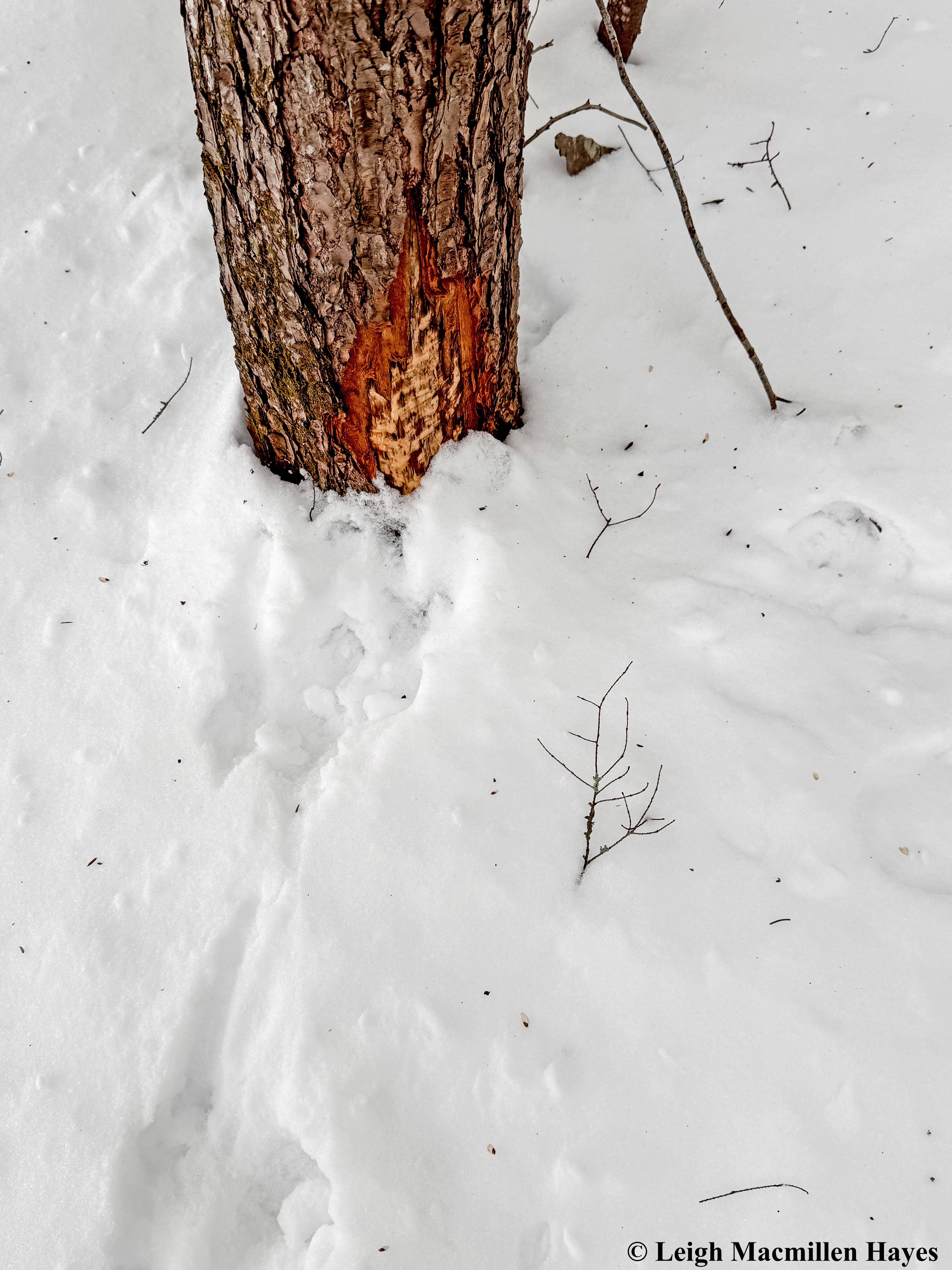
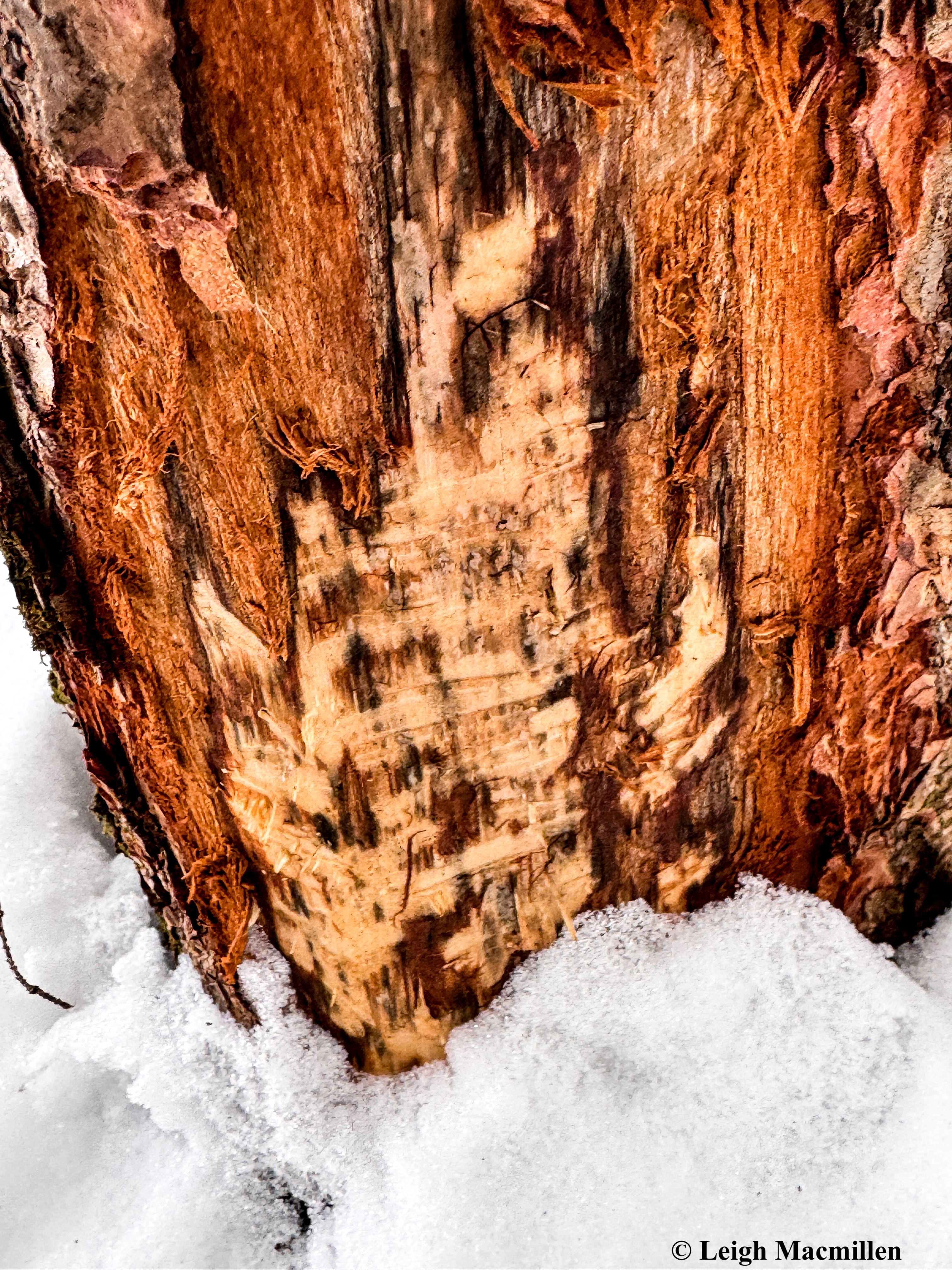
And tada, this is one. A Red Squirrel’s territorial mark.

The bark is nibbled and striped and a scent post is left behind letting others know who inhabits this particular area. This is the first I’ve found, but now that I’ve seen it, I can’t wait to locate more.

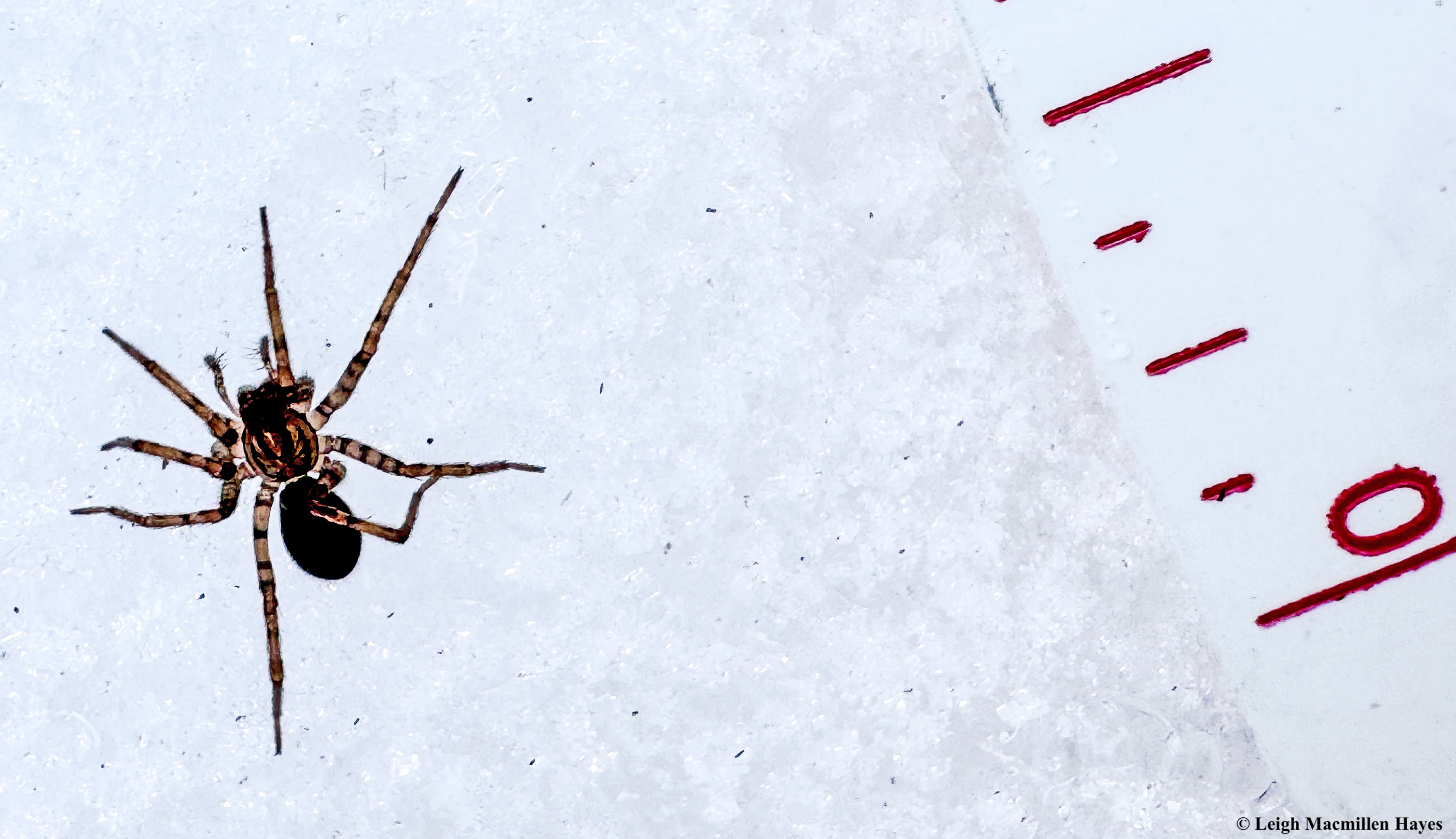
Another new lesson–discovering a Funnel Weaver Spider walking on the snow. Oh, I know that some spiders have Gylcerol that allows them to do this and I’ve seen sooo many, but a Funnel Weaver? Was it a bad decision? I’ll never know. So far, though, this is the only Funnel Weaver I’ve encountered this winter.

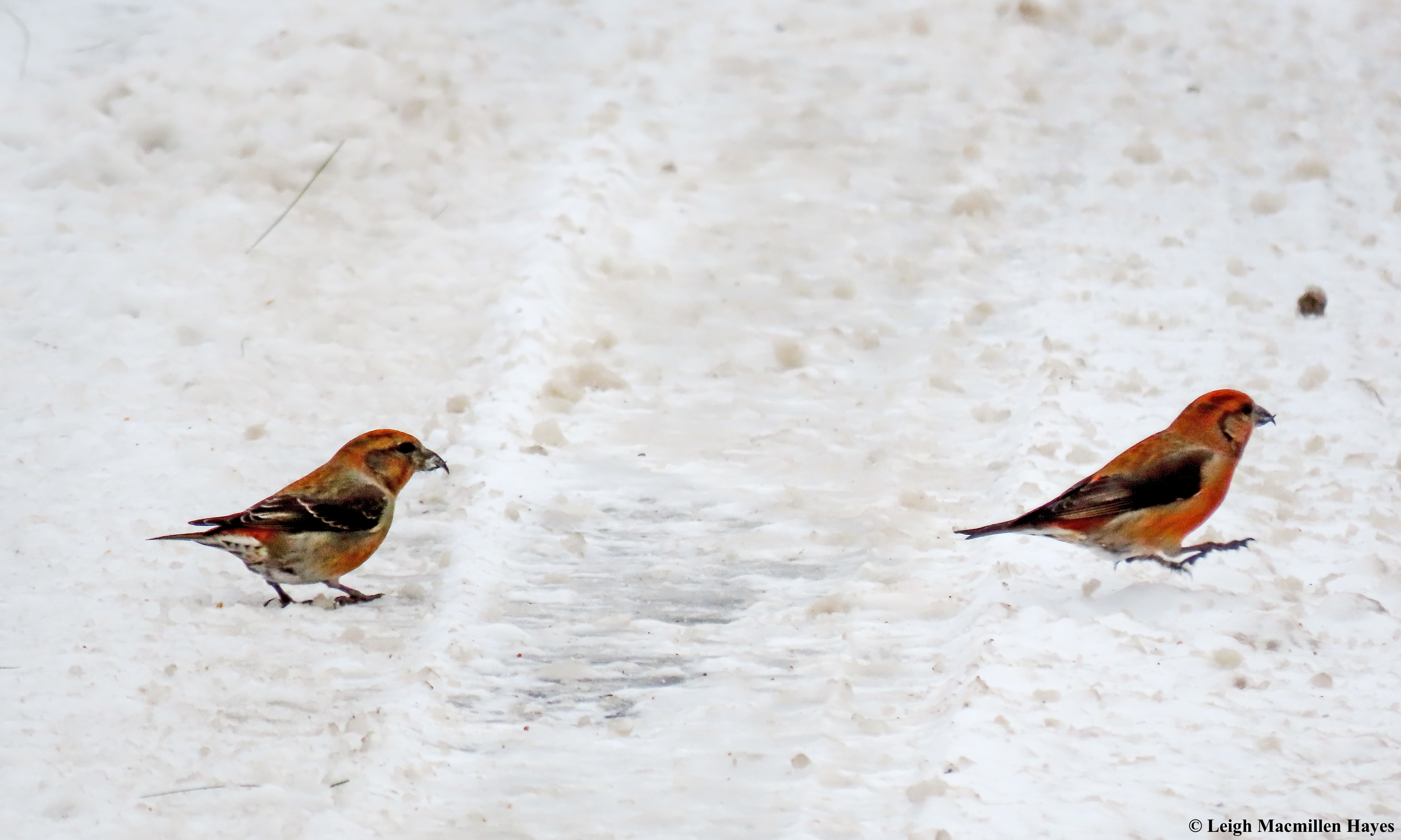
And then there have been sweet treats–not really lessons, though at some level everything is a lesson. But three times this past week I’ve spotted Red Crossbills–twice while participating in Maine Audubon’s Christmas Bird Count and once beside a local road where they’ve overwintered for years.

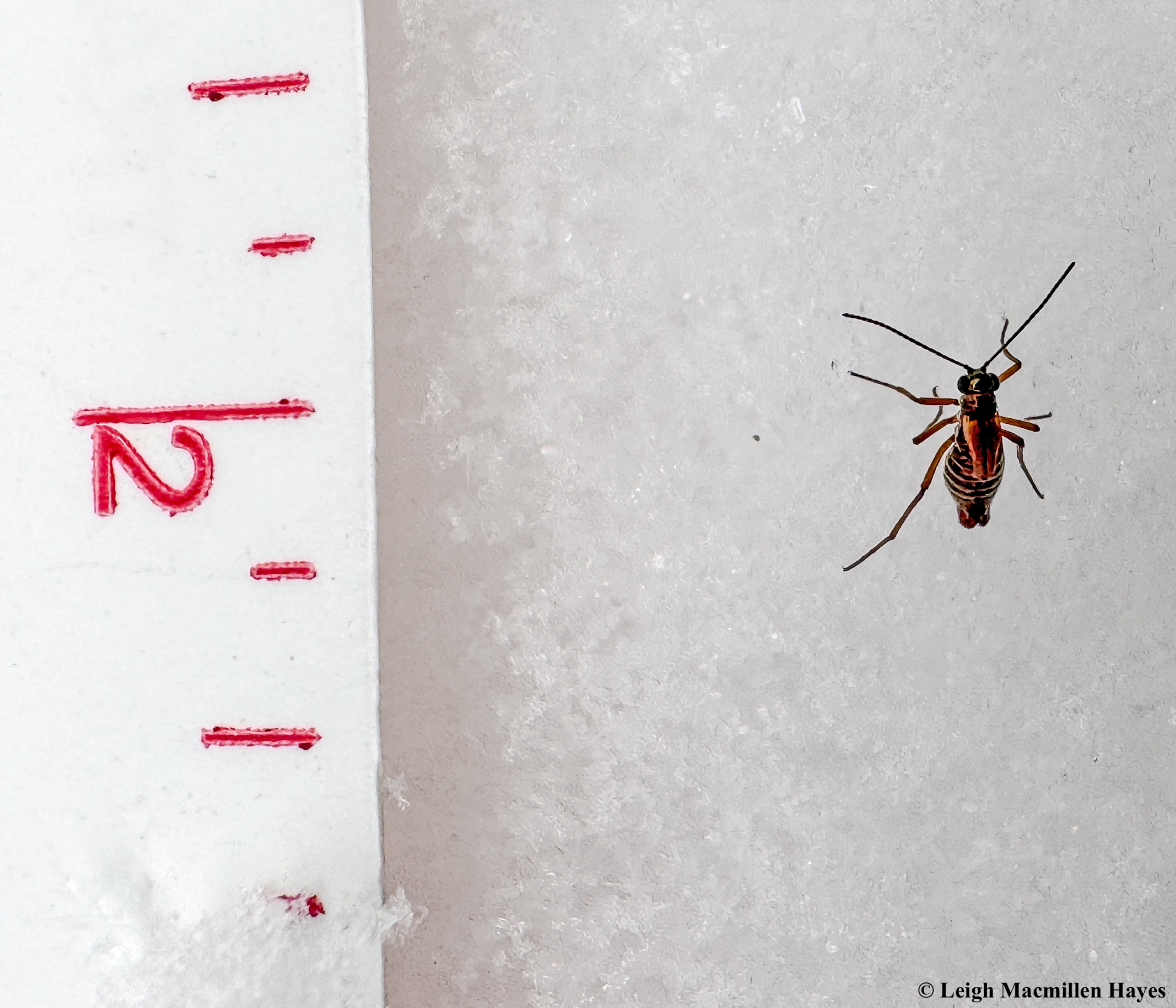
And . . . while the world view is important, sometimes it’s the teeny tiny things that need to be acknowledged–as in the case of this Snow Scorpionfly. I still can’t believe I spotted it. The snow was rather icy, so my ruler was sliding about, thus the positioning. But it’s there to give you a sense of this small insect’s size.

At the end of the day, or week, or hike, or blog post, my heart speaks a million words of gratitude to all of those who have helped me find my way, naturally.

I know I’m blessed.

I know how fortunate I am to have a curiosity about the natural world.

I know my desire to learn is a lifelong gift.

And I can only hope that in some small way, I can share my learnings with you.

Prehistoric Creatures of western Maine

I heard it before I saw it as I reached the summit of the Greater Lovell Land Trust’s Flat Hill this afternoon. The rhythmic tapping sounded as if a structure was being built and so I looked upward expecting to see a treehouse under construction. Scanning all the trees in the mixed forest, I saw only their crowns.

And then I smartened up and looked at the snow. Bingo! Fresh debris atop this week’s layers of snow from two storms and I had a better idea of the construction worker’s location.

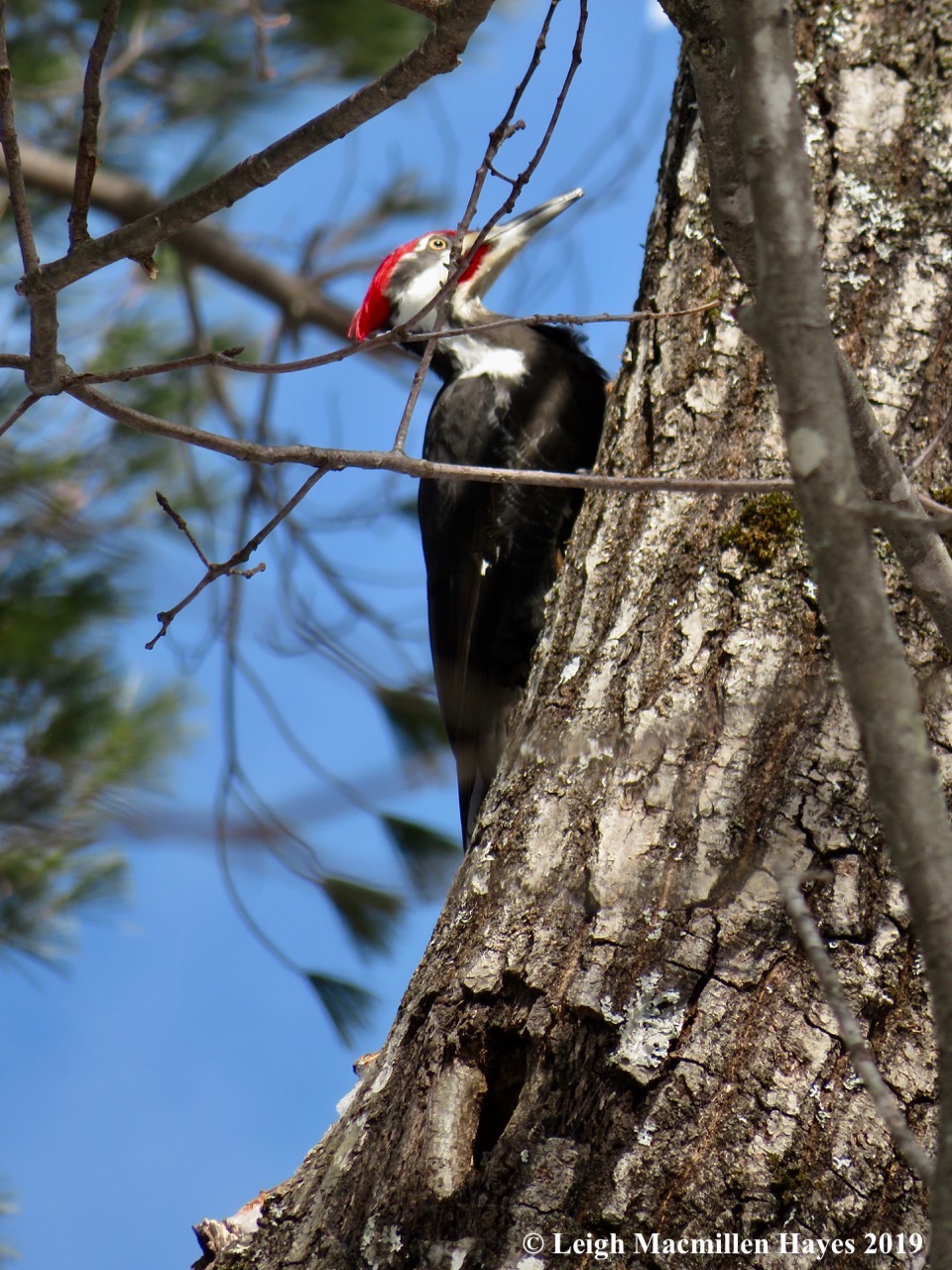
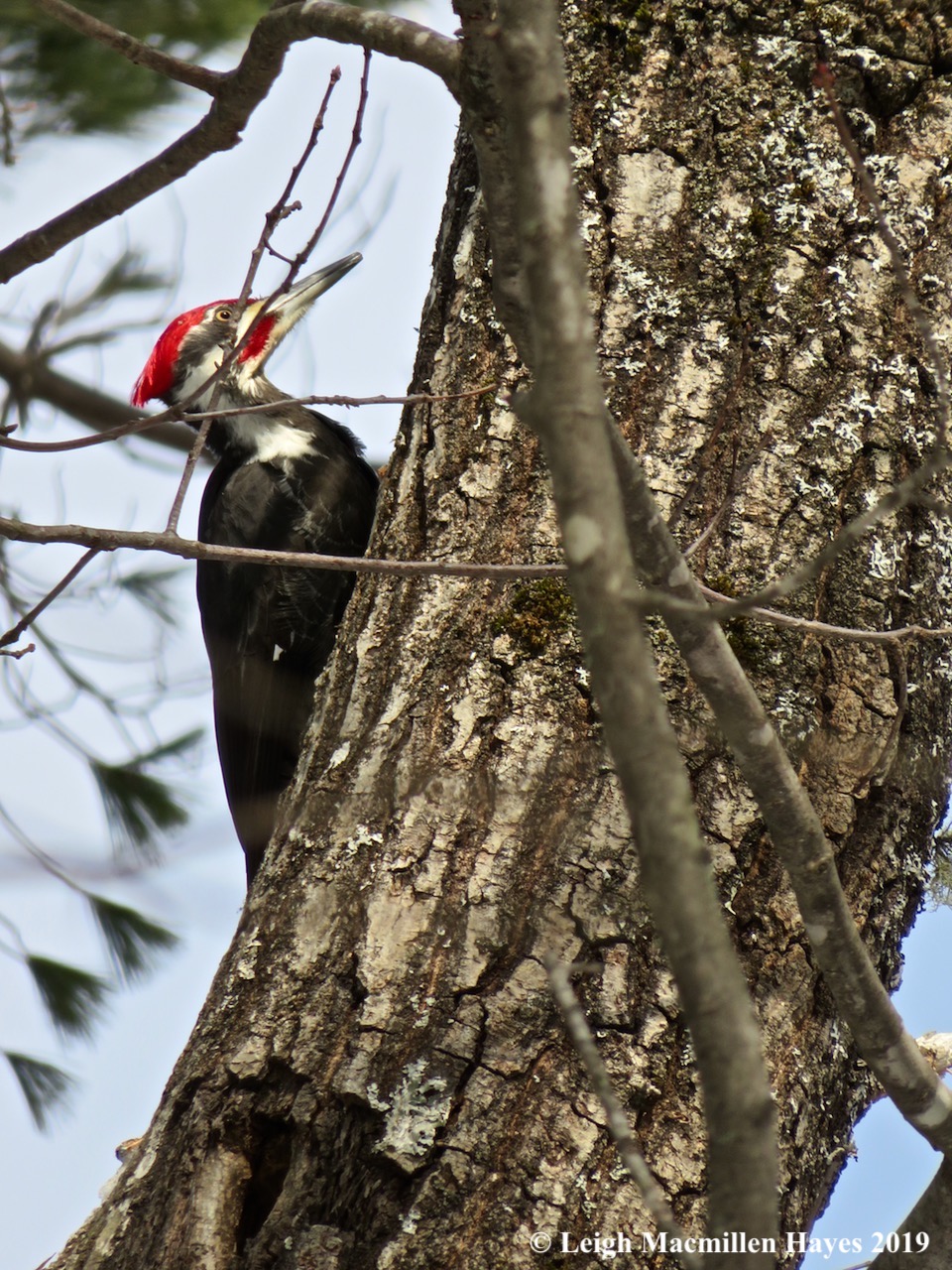
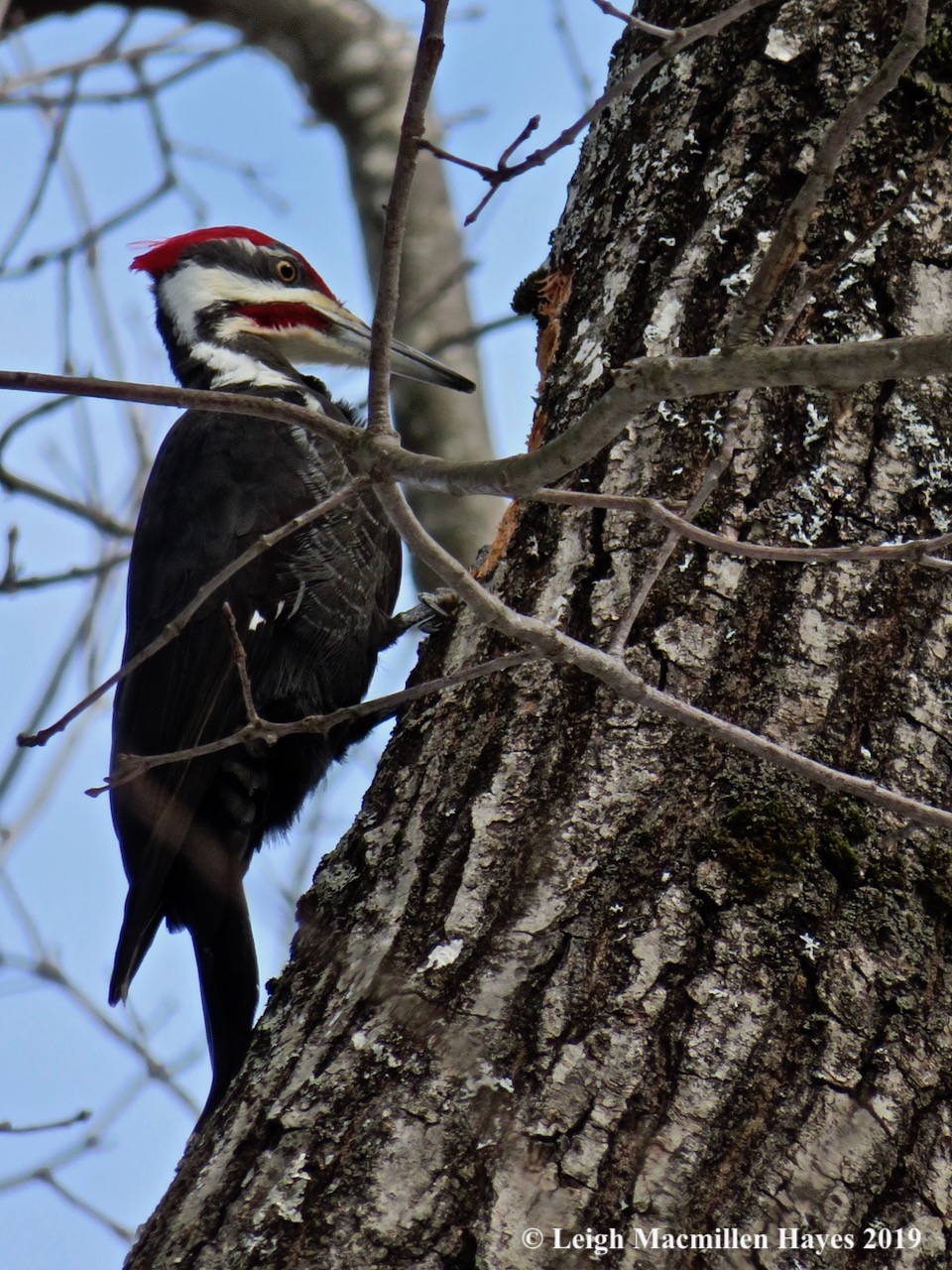
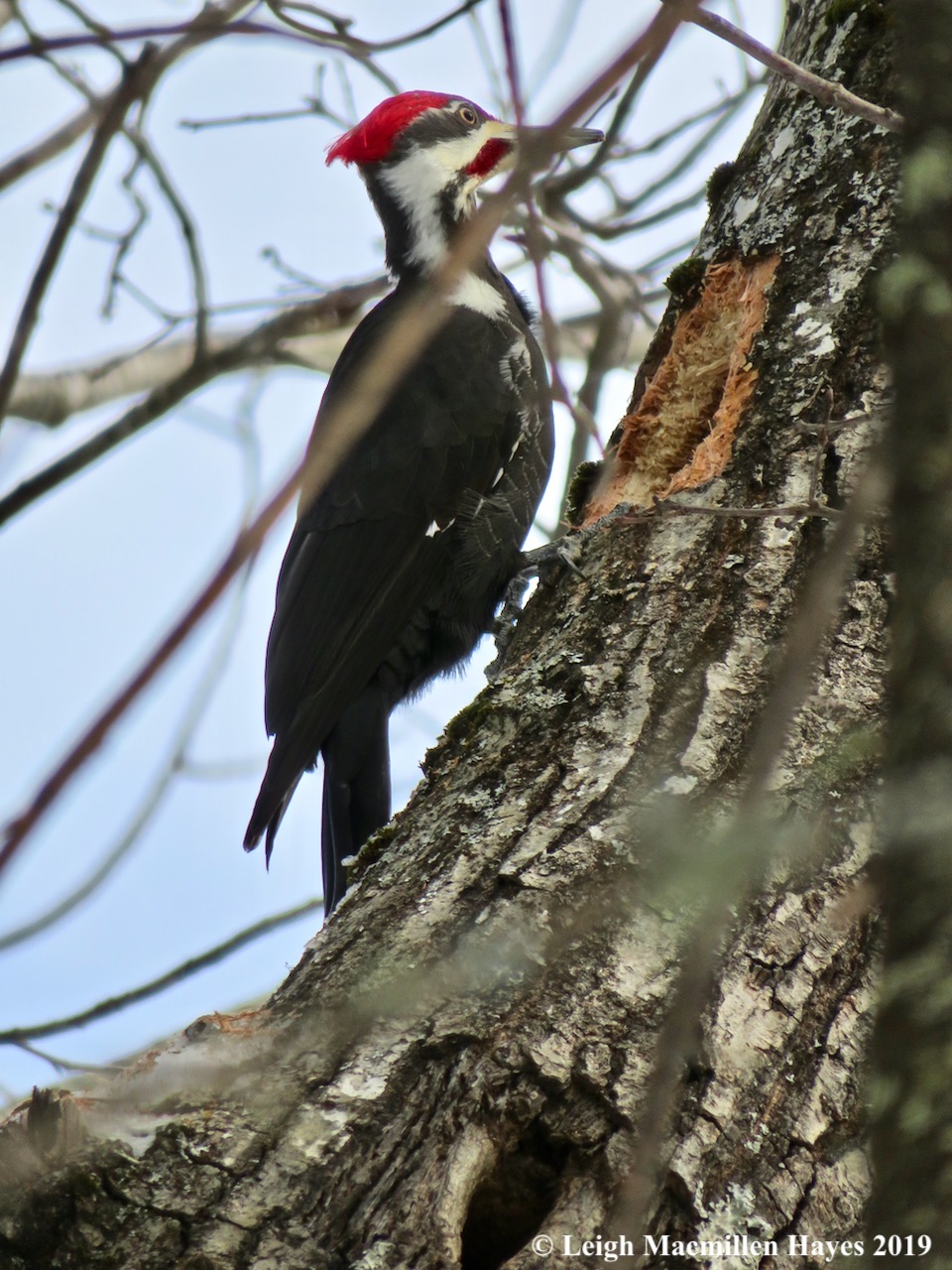
Sure enough, high up in a deteriorating yet live red oak stood the one with a crown all his own–brilliant red as it was in the afternoon sun. By the red mustache on its cheeks, I knew the pileated woodpecker was a he. Call him either PILL-ee-ated or PIE-lee-ated; the word means “crested.”

Sometimes, when these birds are intent on their work, I find I’m able to quietly move in a wee bit closer. Mind you, he was up quite high (at least 25 feet above me) and there were other trees between us. I hoped if he was aware of me that he knew I meant no harm. I just wanted to observe.

And so I did for a good while. Check out that chisel-like bill.

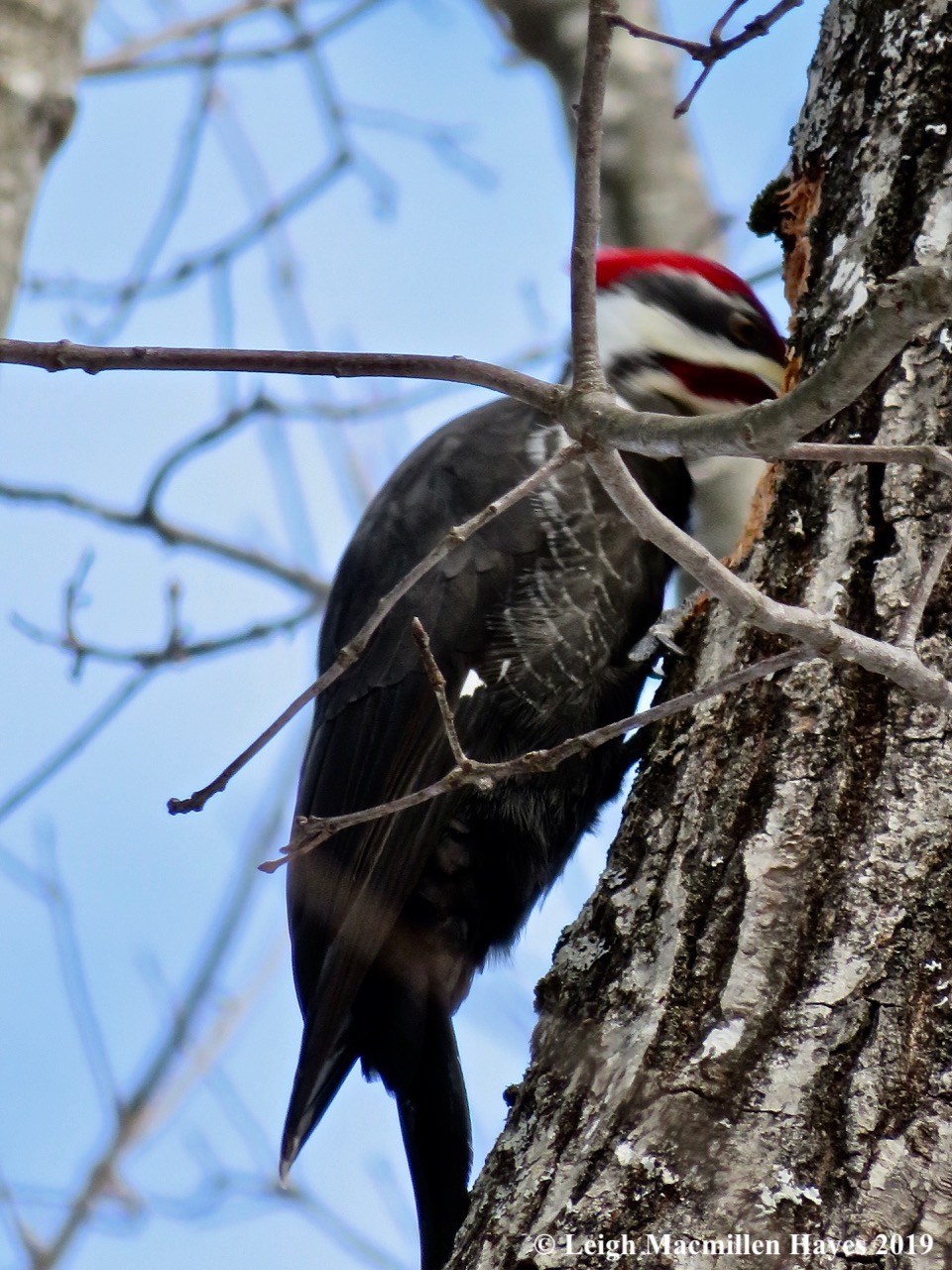
In a seemingly effortless manner, he pounded away. Did you know that a pileated can peck up to 12,000 times a day? Not all on the same tree, of course.

Thank goodness for extra-dense neck muscles and a compressible skull bone. Between hammering, this guy paused periodically. To admire his work? To check on the food supply? Or just to take a break?

Can you see one of his four-toed talons grip the edge of the excavation site?

One cool thing about woodpeckers is how they use their tail feathers for support–as if the third leg on a three-legged stool.

As I watched, I noted that Woody Woodpecker, a name I give all pileateds because their rattling call reminds me of the television cartoon I grew up with, kept digging a bit deeper.

And deeper still.

Then he’d take a break and turn his head away from the tree and I finally realized that the tree was at such an angle that to remove debris he needed to drop it below.

Eventually, he flew off and so I checked on the woodchips in hopes of finding scat filled with insect body parts. There was none. For all of his work gouging the oak, he didn’t seem to have found any carpenter ants or wood-boring beetles. Maybe that’s why he moved on. And so I did as well.

About halfway down the trail, I came upon a sight that might have delighted the woodpecker. I know I was thrilled.

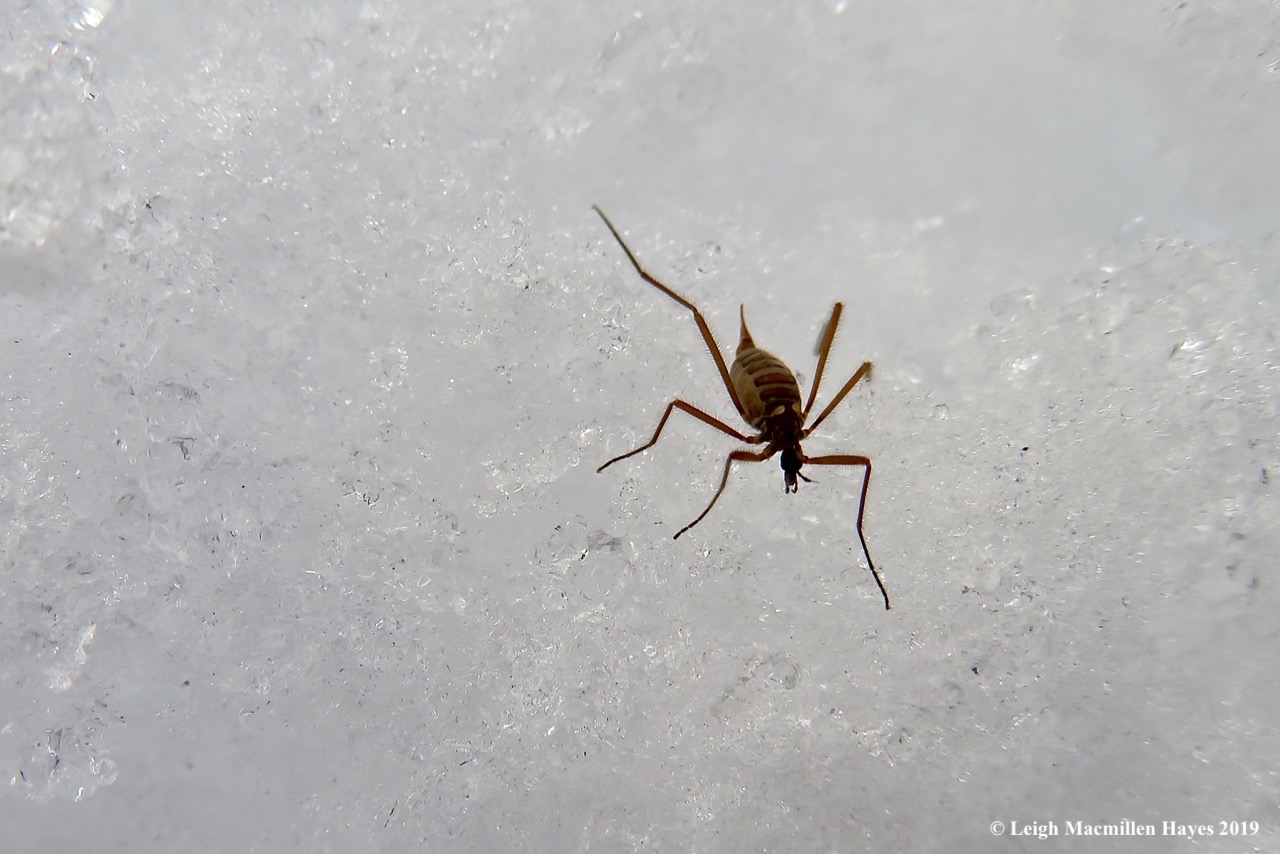
Within a few feet I spotted a second one. They were snow scorpionflies. Much like the fact that Flat Hill isn’t actually flat, nor can the snow scorpionflies fly!

On his website “Bug of the Week,” entomologist Dr. Michael J. Raupp explains, “They belong to a small order of insects known as Mecoptera. The “scorpion” moniker derives from the fact that males in this group have unusually large and upward curving genitalia that resemble the stinger of a scorpion. The “fly” part of the name comes from the fact many species of Mecoptera have wings and can, well, fly.”

To fly and not to fly. Predator and prey. Despite their extreme differences, both finds today certainly struck me as being prehistoric creatures of western Maine.