Marching into the Vernal Pool

I’ve lived in Maine for just shy of 40 years and can barely recall the month of March going out like a lamb, as the saying goes.

It’s certainly true that once again this year the ending of the month is more lion-like with an overnight and morning snowstorm, with freezing rain on the horizon for tonight and tomorrow, followed by a warm-up and rain on Monday.

That all said, March snow doesn’t last long.

But still . . . it has me dreaming. Remember, I LOVE winter, but am as ready for spring as the next person.
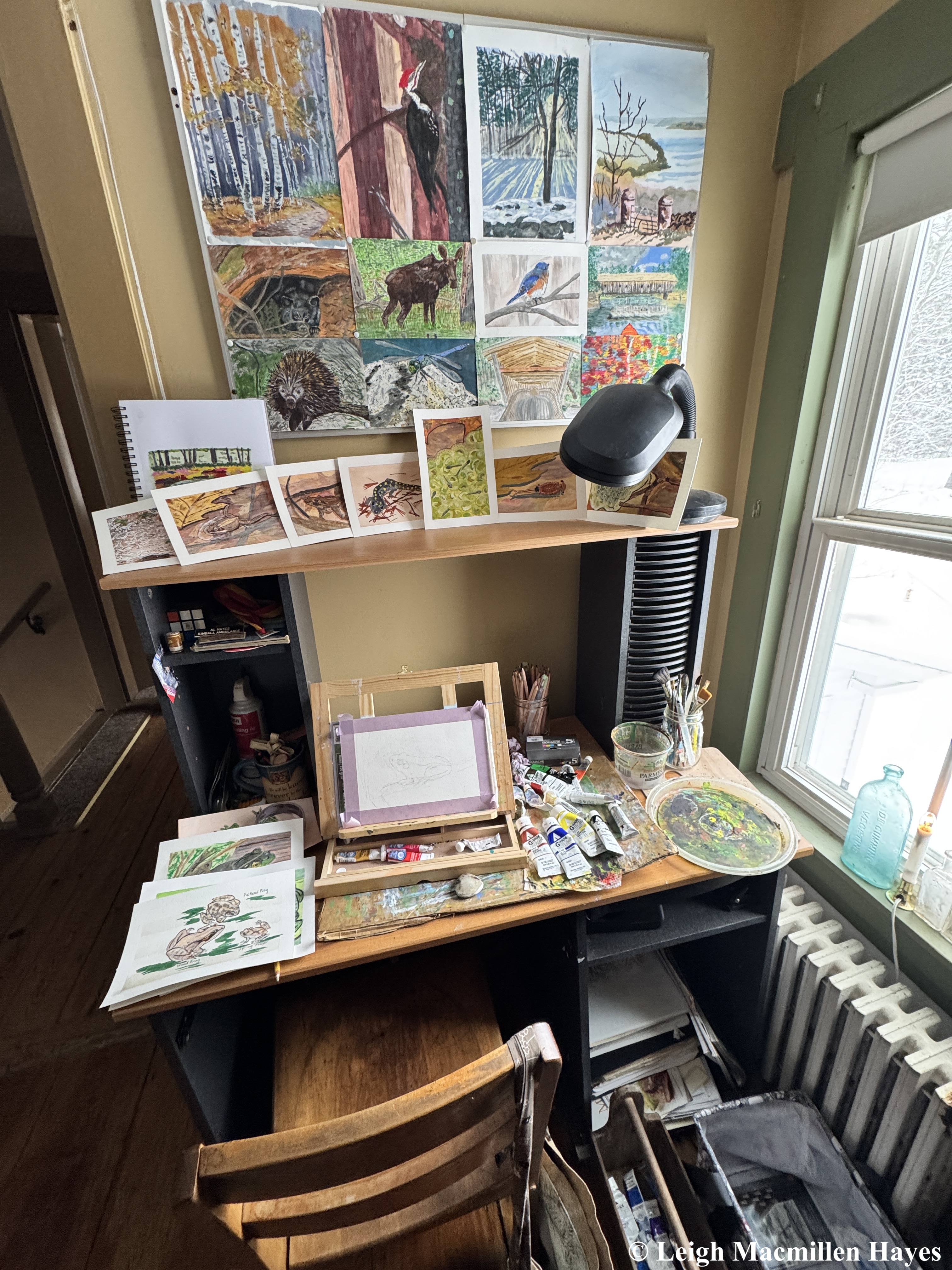
And so I spent much of today (when not shoveling, which really didn’t take long) holed up in my wee studio where I’ve been working on a vernal pool series of paintings.

The idea for this post actually came to me in a dream last night–why not turn those paintings into a blog post. Why not?

Because, it’s scary to share creative works with the world. But, I am probably my own worst critic. My instructor, Jessie, always reminds me to put my inner critic into a box, place the cover on top, and get to work. And besides, by sharing here, I can hide behind the screen. She wants those of us in her class to host an art show, but I refuse to do that. It’s much more comfortable for me this way.

I’ve only been painting since last May, but let’s not let that be an excuse. The thing is, working with gouache paints means I can easily edit, much like writing. And believe me, I have. My motto has always been that there’s no such thing as a final draft–whether it be an article for a magazine or a work of art.

Have you noticed that I’m procrastinating? And putting all of my excuses out there.

It’s snowing again.

All right, I’m almost ready. But here’s the other thing–in sharing these with you, may you be inspired to do something you never imagined and discover that the time you spend doing such is most enjoyable and it’s easy to get “lost” and just plain have fun and decide that even though the “end product” isn’t exactly what you first set out to create, it’s still half decent and you had the most delightful time sitting quietly as is my custom, doing just that: creating.

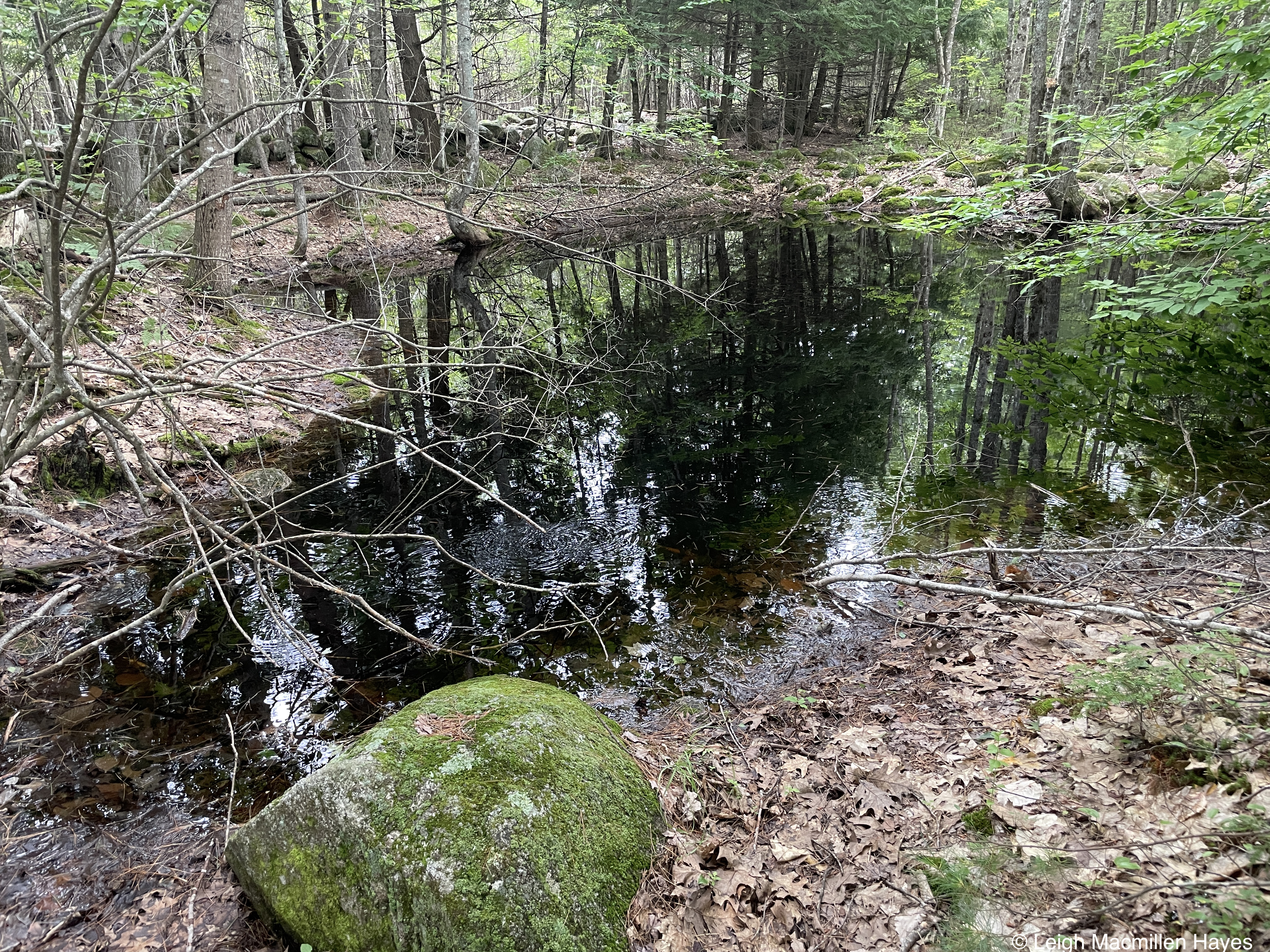
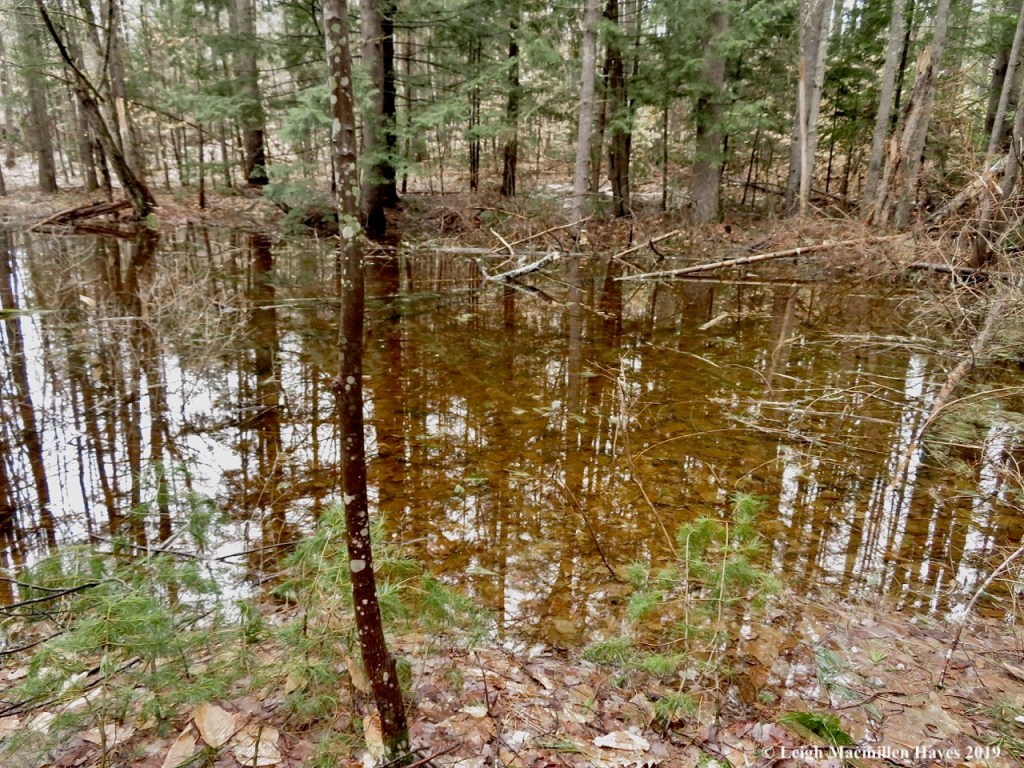
And now . . . for a look back as a way to look forward to a vernal pool as it emerges from winter or early spring, or mud season, or almost spring but still winter, or whatever season this is.
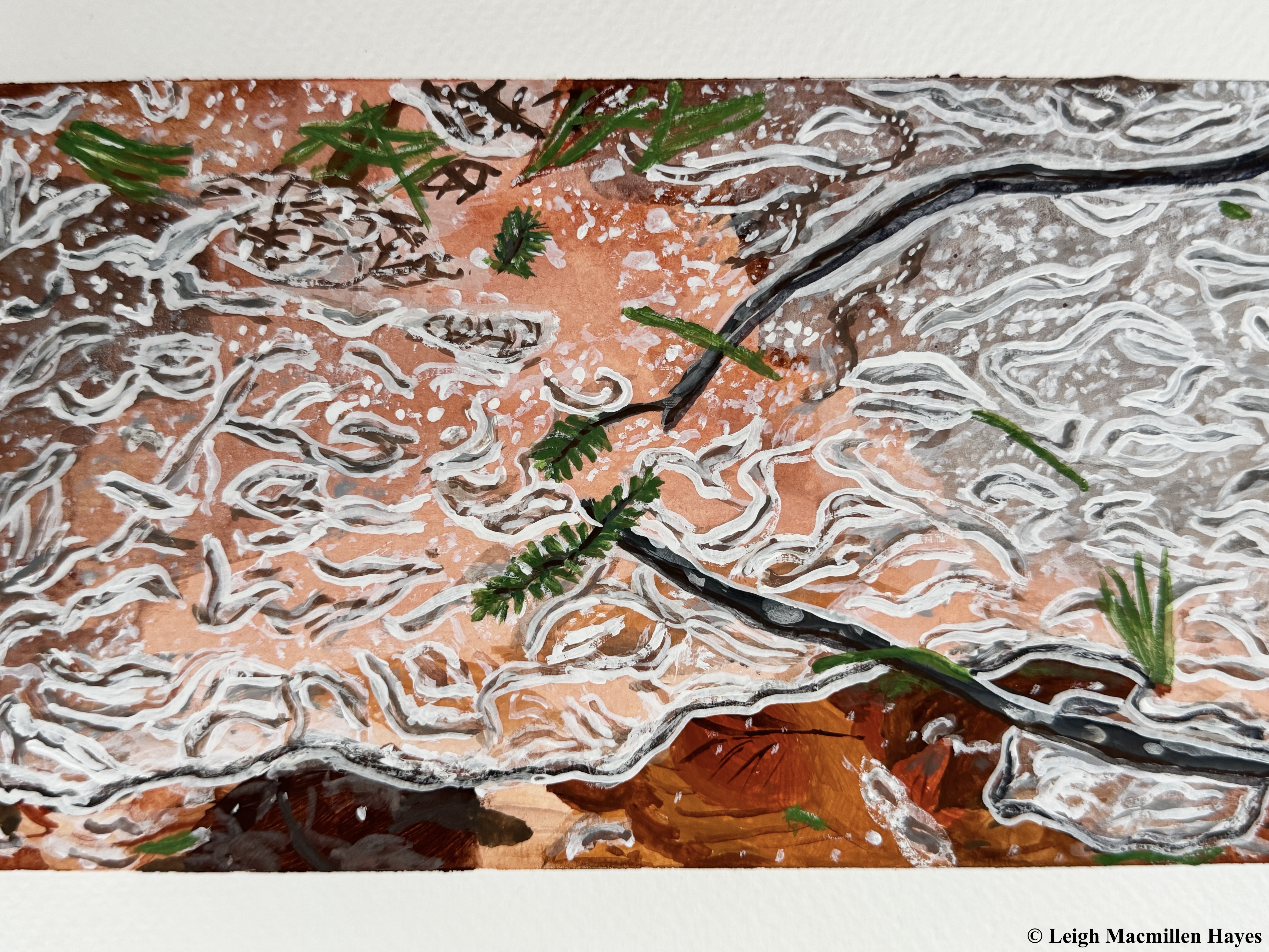
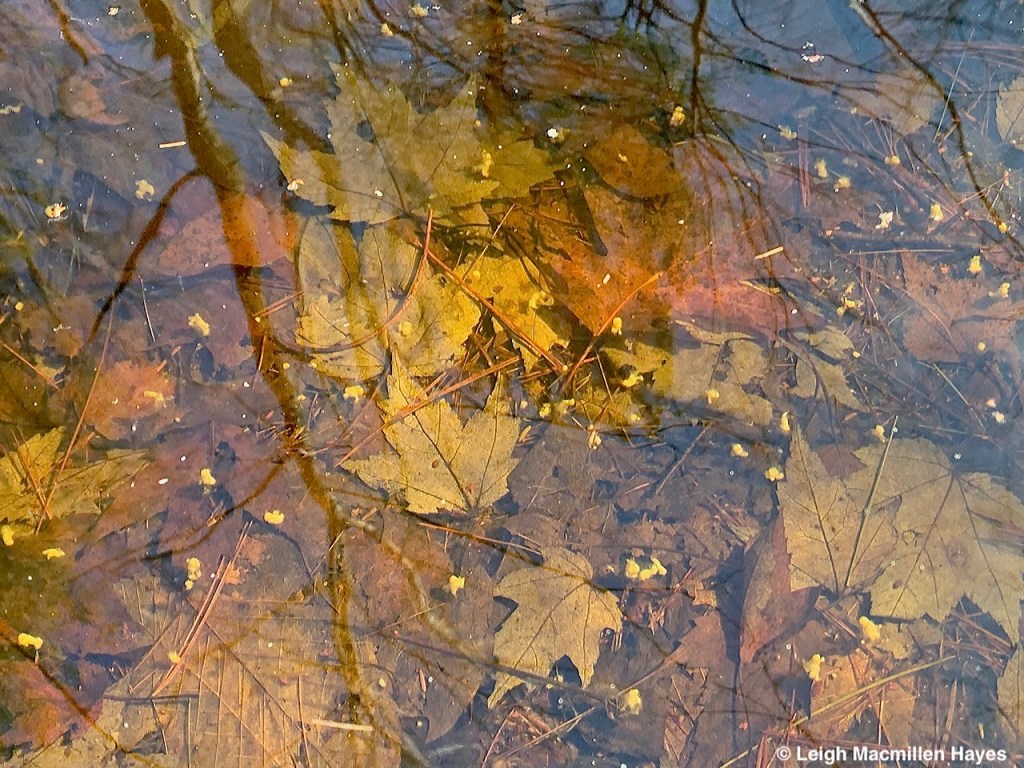
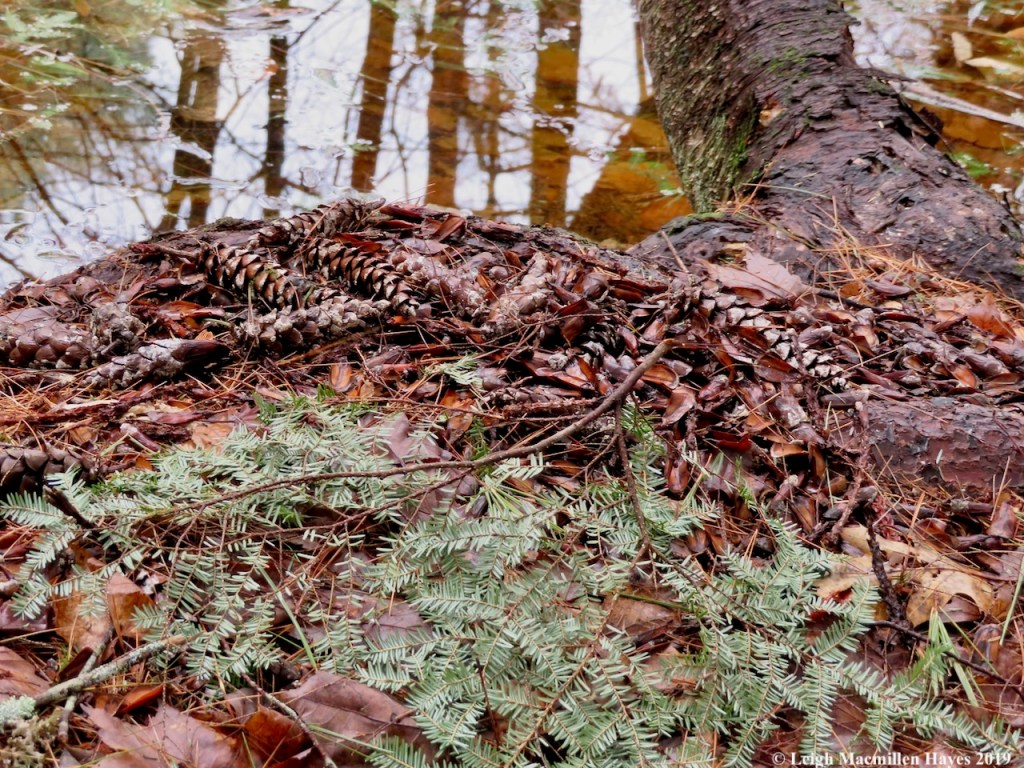
Pine and hemlock needles and branches from winter storms coat the ice as it slowly begins to melt along the edge of the pool, providing a glimpse of the sunken leaves below, where life awaits.

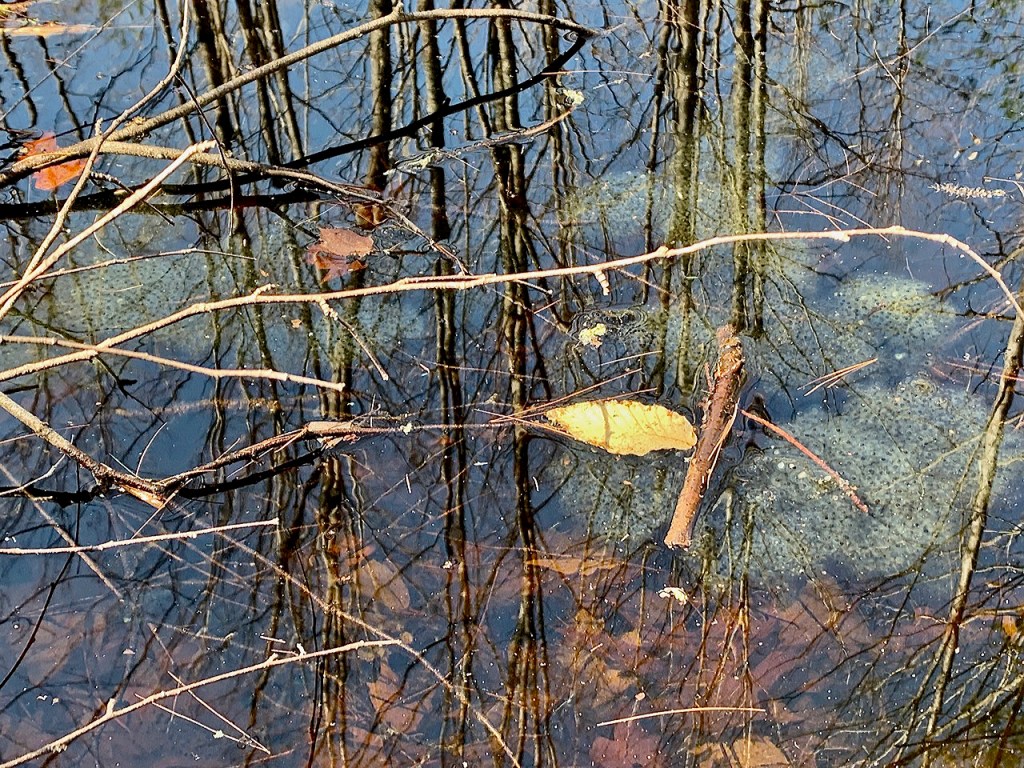
Once the ice finally melts, barren trees offer a reflection that speaks to winter, but there’s hope in their buds.

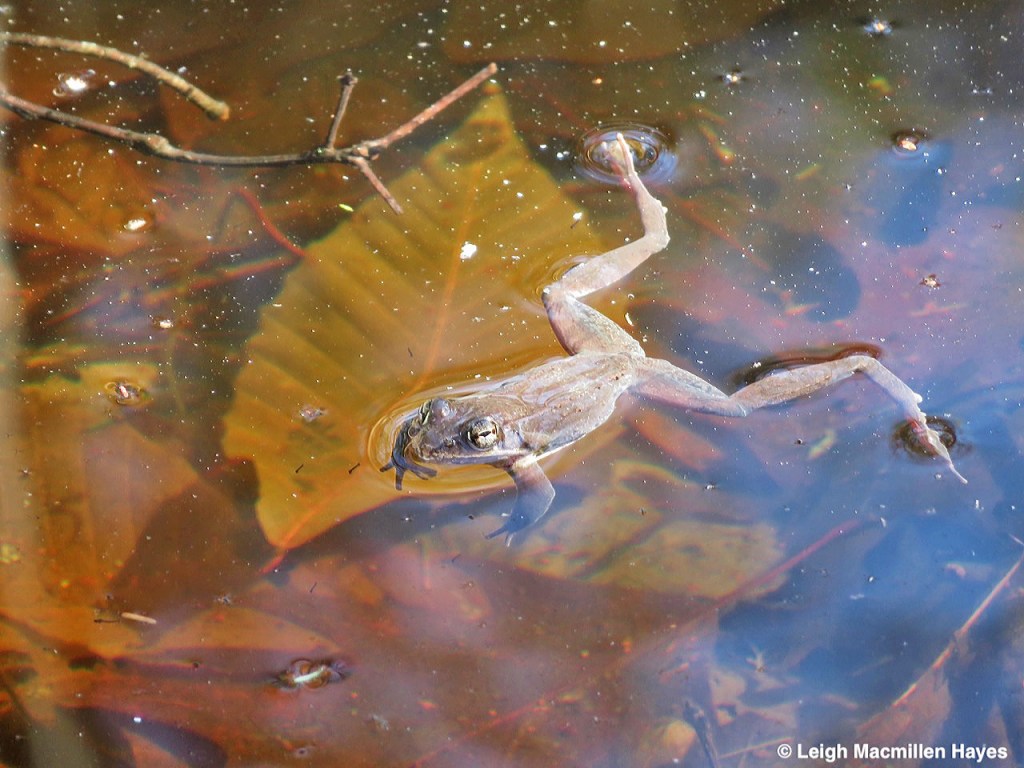
And no sooner has the ice gone out, when upon my approach I hear “Wruck, wruck,” and know that the Wood Frogs have returned to their natal breeding grounds. At first, they dive as soon as they hear me approach. But I stand still, sometimes for up to fifteen minutes, and ever so slowly, one by one, they rise to the surface and float.

It’s the lucky male who has the best “Wruck, wruck,” that finds a mate. He clasps her with his forelegs and as she begins to deposit eggs, he fertilizes them externally.
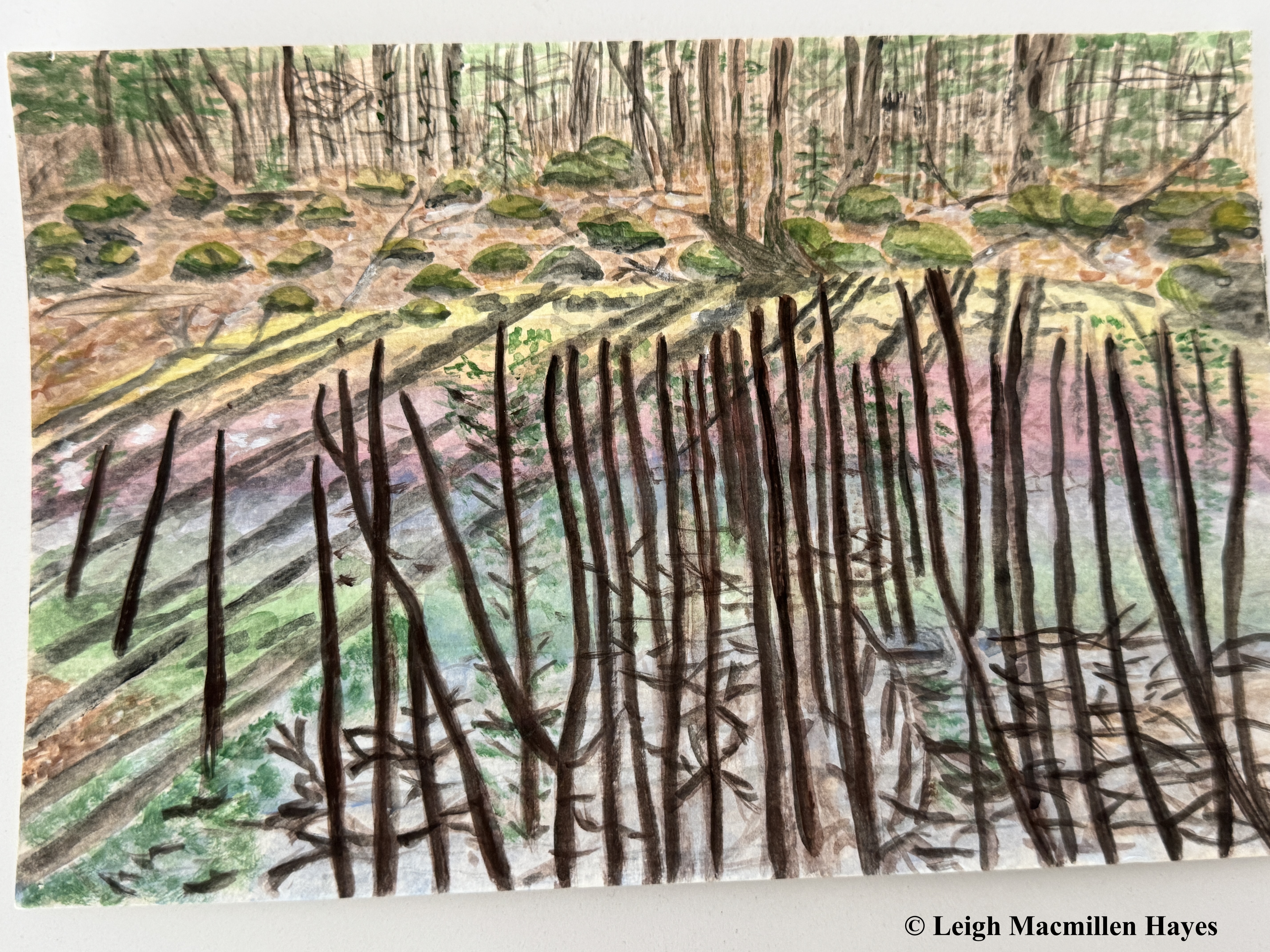
I return a couple of days later, in the late afternoon, and can’t believe my good luck. The pool is coated in pollen and the sun hits it in such a way that I see a rainbow of colors and love how the tree reflections are in two orientations upon still water.

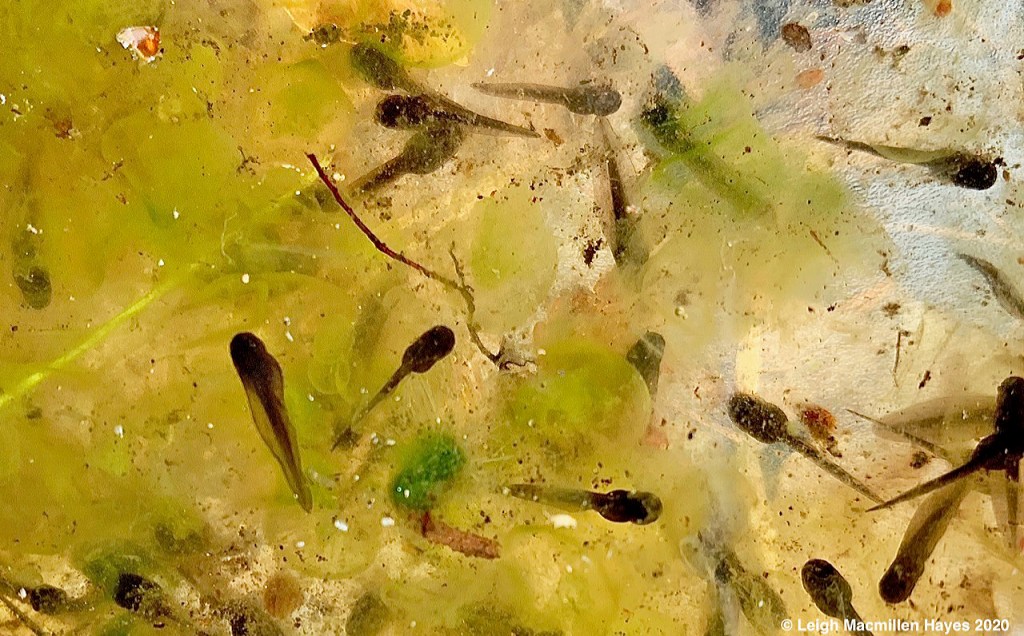
A few weeks later, looking deep into the pool, which isn’t really all that deep, I notice blobs of eggs clustered together in a mass that has a tapioca-like shape to it and notice little life forms moving about in the shape of tadpoles. I feel like a proud momma. The thing is, the Wood Frogs mate, she lays eggs he’s fertilized and within two weeks, the parents are long gone, back to their woodland setting. And so I do feel protective parent–or maybe foster parent–keeping watch and celebrating achievements.
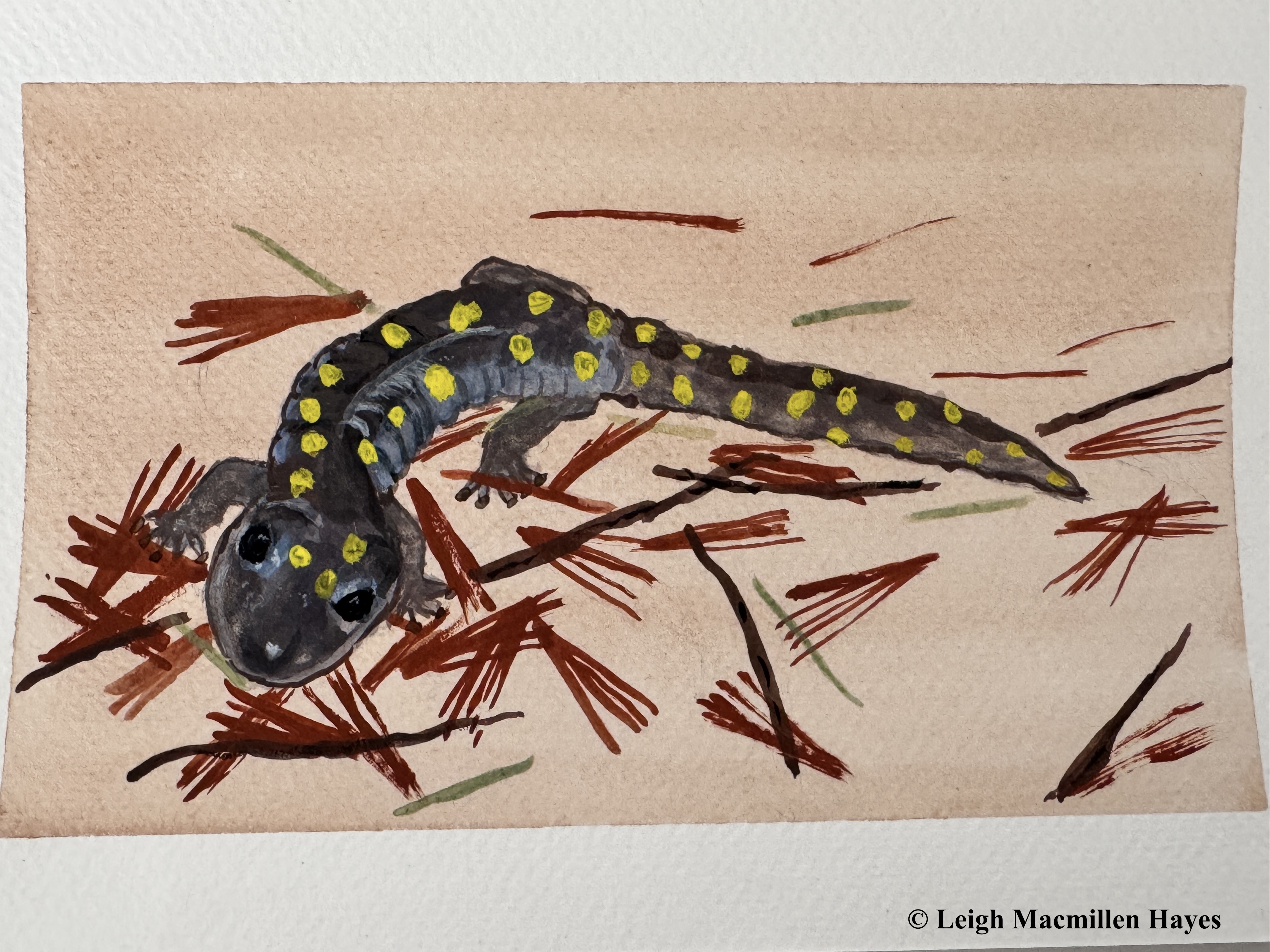
Another life form who uses the pool as a natal breeding spot is the spotted salamander and though I tend to mostly spy them on Big Night, I can tell by egg masses left behind that they have visited.

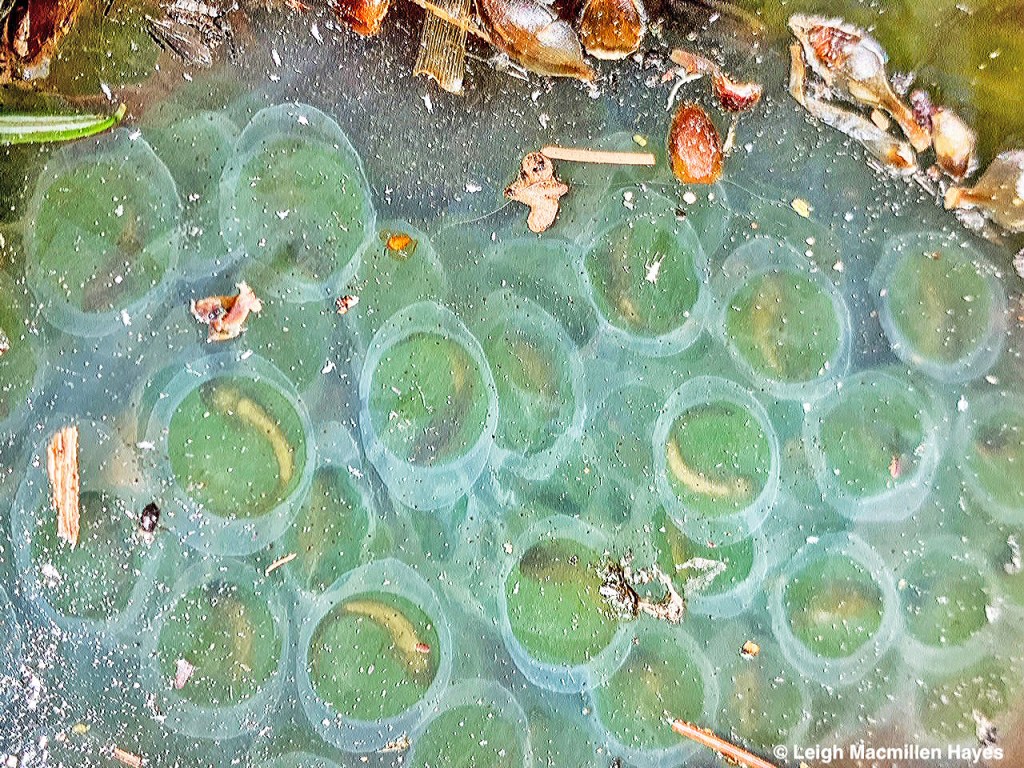
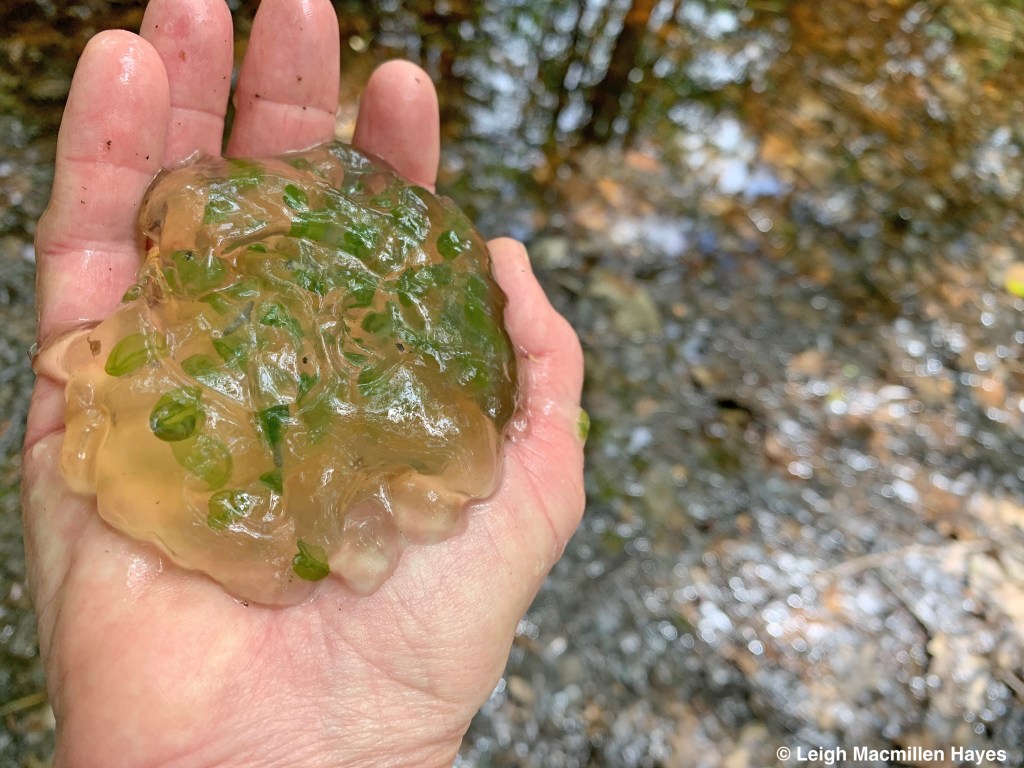
Their egg masses are a wee bit different from the Wood Frog masses, in that they have a gelatinous coating around the entire grouping, so they don’t look so tapioca-like. Mosquito larvae, tumblers at this stage, also wiggle about in the water.

And if I’m lucky, though this has never happened at the pool behind our house, I might see a fairy shrimp or dozens.

So here’s the thing: 40 Wood Frog egg masses make a pool significant; OR 20 Spotted Salamander egg masses; OR 10 Blue Spotted or Jefferson Salamander egg masses; OR a single, yes one, Fairy Shrimp. And this one is a female, as noted by the sac of dark eggs she carries.

Fairy Shrimp are cool because in order for eggs to be viable, the pool must dry out. And they can survive being dry for multiple years. And in any given year, not all eggs will hatch, thus saving some in the bank for another year or ten.
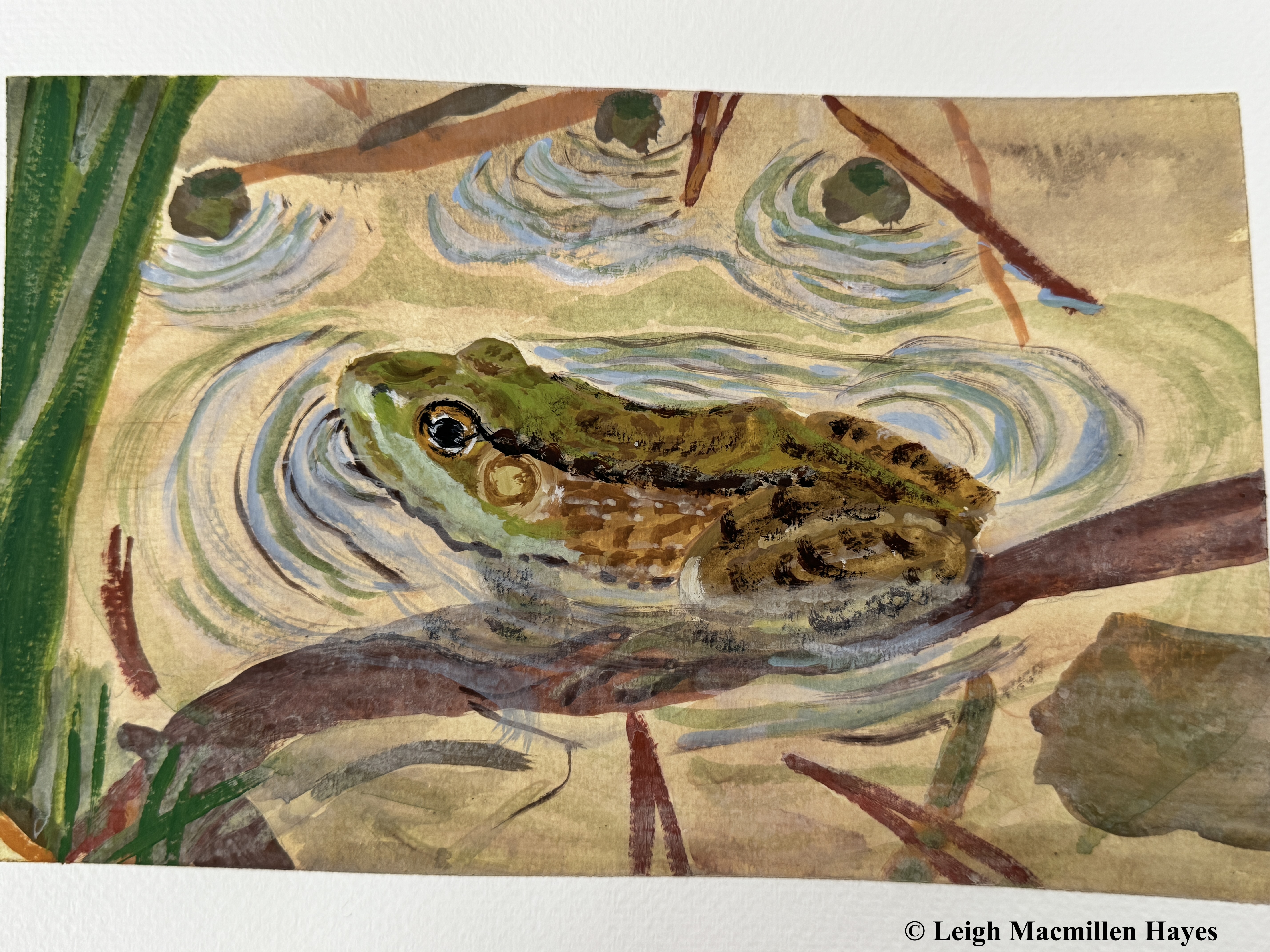
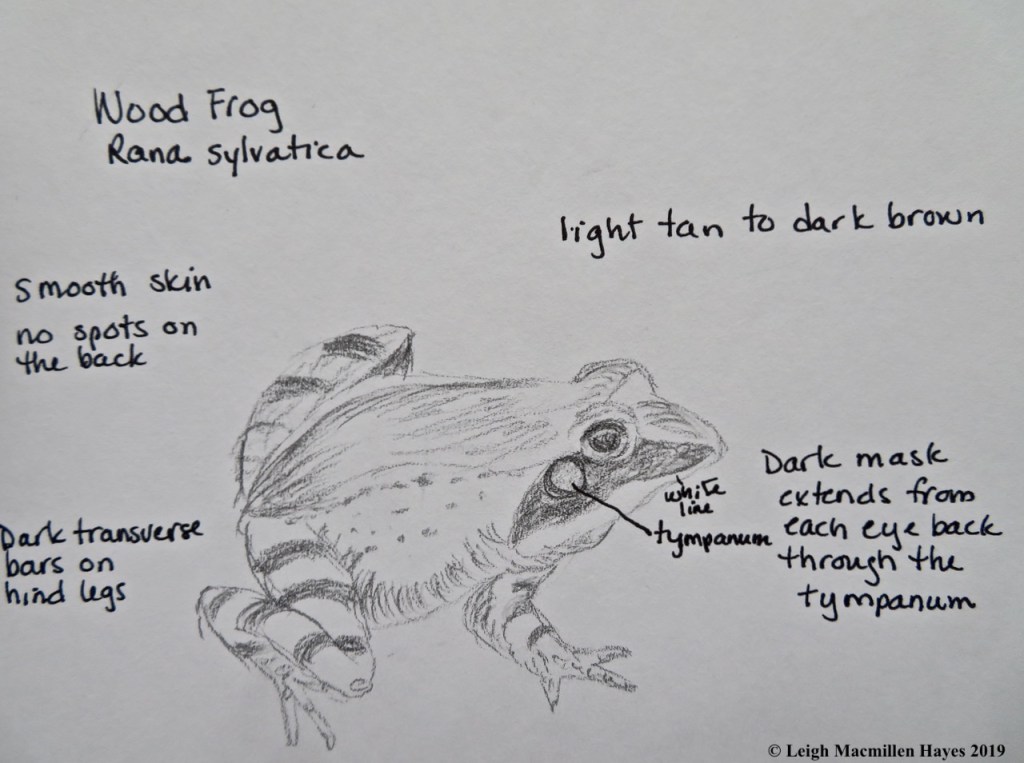
Hanging out by the pool, Green Frogs are always willing to dine on whatever is available. So the Green Frog has dorsal lateral folds (or bumps) along either side of its back that start behind the eyes.

The Bullfrog differs in that the line behind the eye circles around the tympanum (ear drum) and ends.

Here’s the other thing to remember: Males have tympanums larger than their eyes; females are smaller or equal to eye size.

And I like to think of this painting as a Frog-ersation.

This week I actually framed two paintings to send to friends, the Bullfrog being one of them.

There. I did it. Survived the art show.

As I bring this to a close, I realize there’s one more painting I should add to the collection, but I’ll save it to paint another day.

Thank you for marching into the vernal pool with me. I hope you are glad you did.

One Night, Two Nights, Three Nights…

It was a dark and dreary night. Repeat. It was a dark and dreary night. Repeat. It was a dark and dreary night.

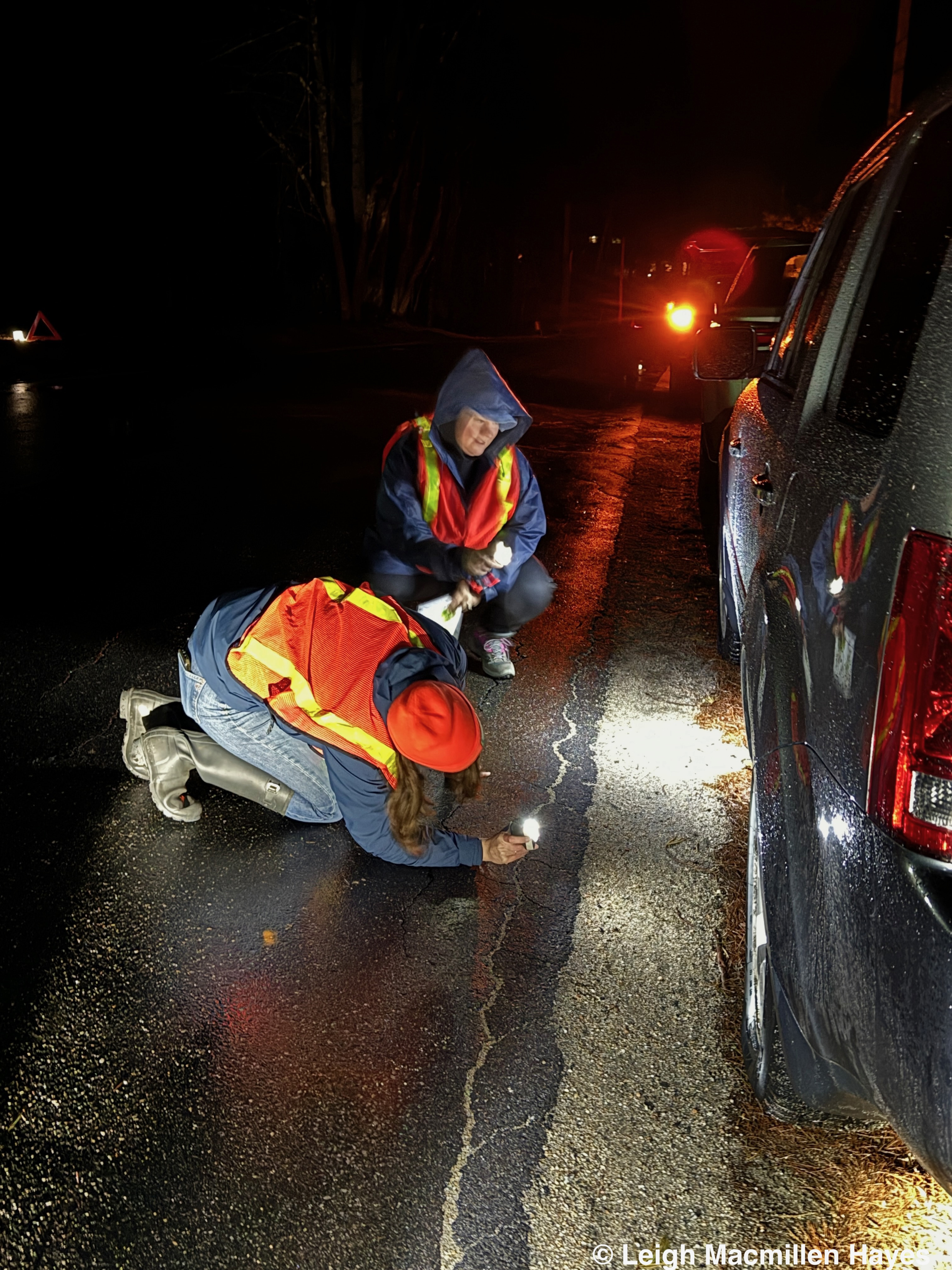
While most folks would choose to stay inside curled up by the fire while drinking a hot toddy, a number of intrepid community scientists ranging in age from 3 to 70+, donned rain gear (even waders) and reflective vests, cleansed hands of soap and moisturizer, grabbed flashlights and headlamps, and met at 7:30pm in the pre-determined locations.

Their mission each night was the same: Help us help frogs and salamanders cross the road to avoid getting squished by vehicles.

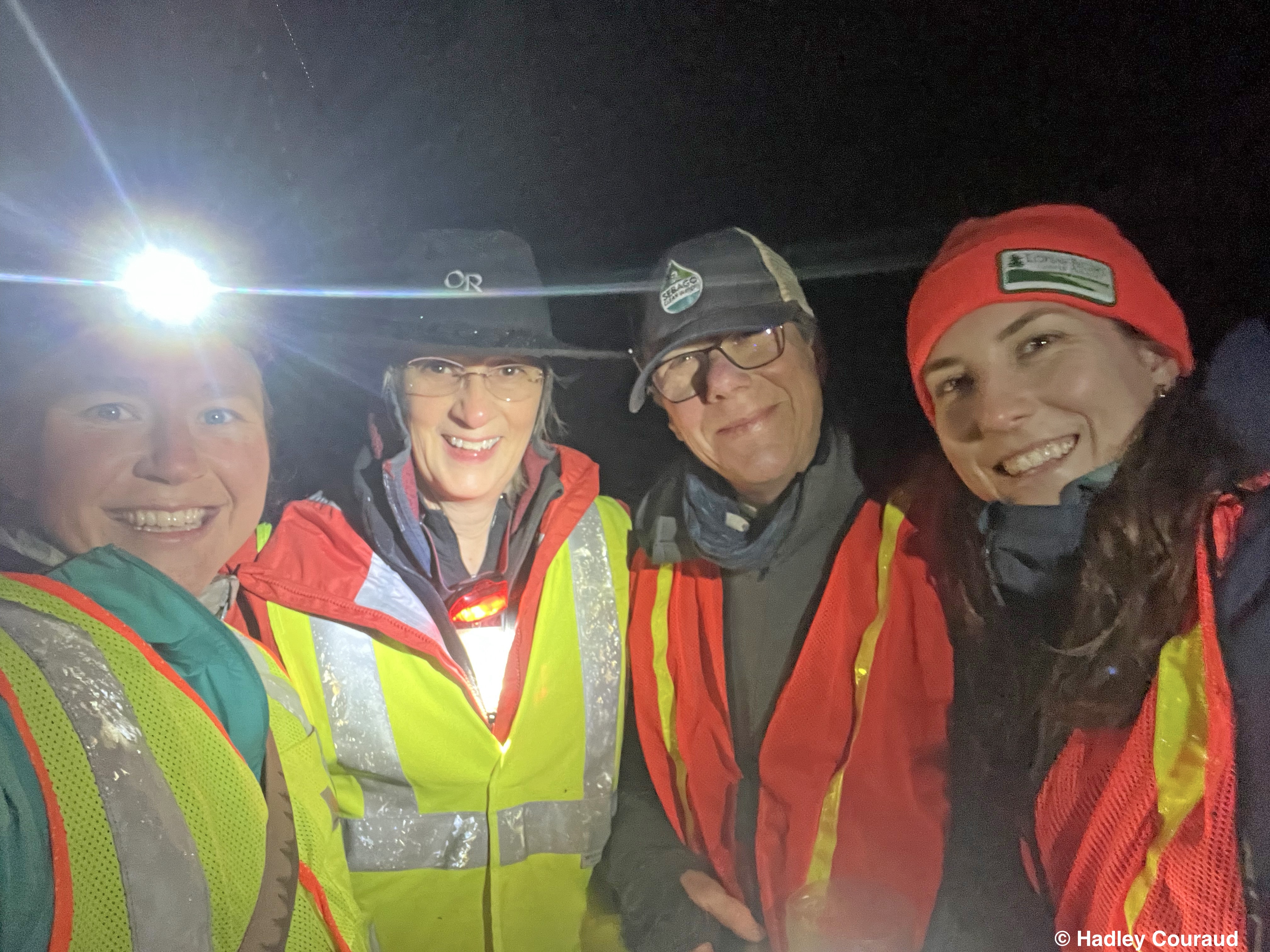
The names and ages of participants changed each night, but the leadership remained the same. As Maine Master Naturalists, Dawn Wood (who took the lead on organizing these events and recording data–a daunting task in the rain and dark and with people spread out and shouting numbers and species at her), Hadley Couraud, and I led the way, all three of us providing information about the different critters and their behavior as the evening progressed. All of this was under the umbrella (pun intended–though no one actually had an umbrella) of Loon Echo Land Trust in Bridgton, Maine. Thank you to Maggie Lynn for creating the sign-up forms, advertising the events, and keeping us posted.

The technique was easy. Once we reached the location of the vernal pool, to which amphibians return each year from their upland habitat, we started scanning the road with our lights. It’s amazing how the mica, small rocks, sticks, and lichens can fool us.

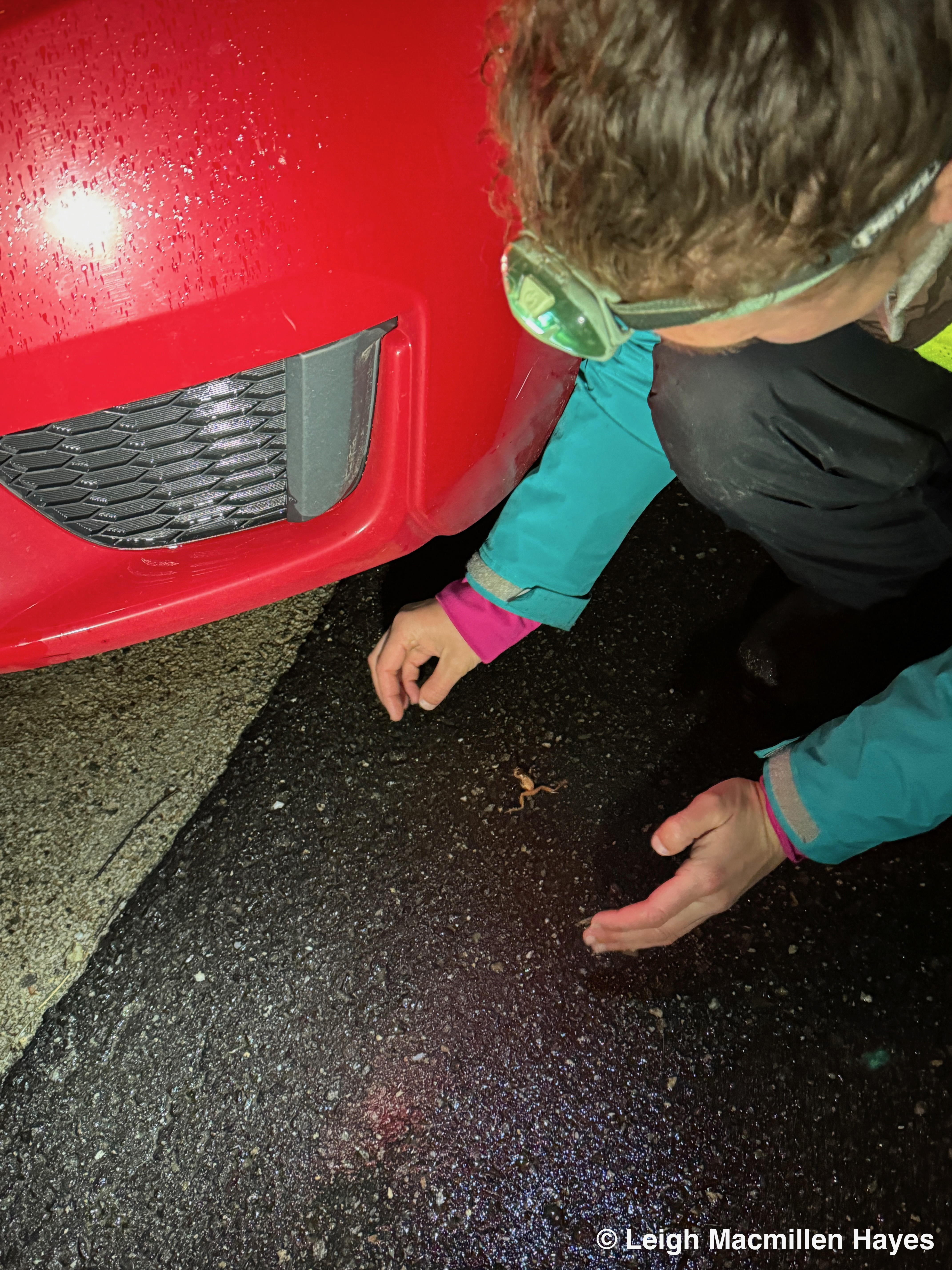
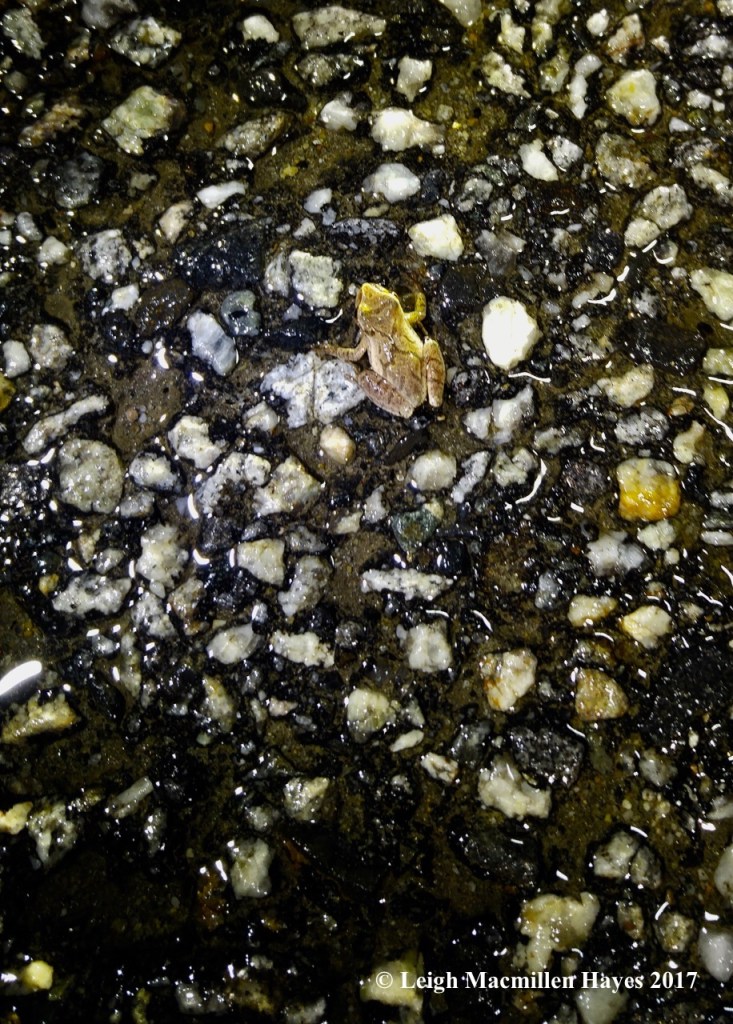
It’s equally amazing how much tiny Spring Peepers resemble small rocks. And how stone cold they are when we lift them up. And how they’d rather stay in our hands than return to the cold earth.

We always noted the direction in which they were headed and that’s the side of the road we took them to, even if it didn’t make sense to us. They knew what they were up to and we were there only to try to keep them alive so they could canoodle for a few nights before heading out of the pools and back to the forest.

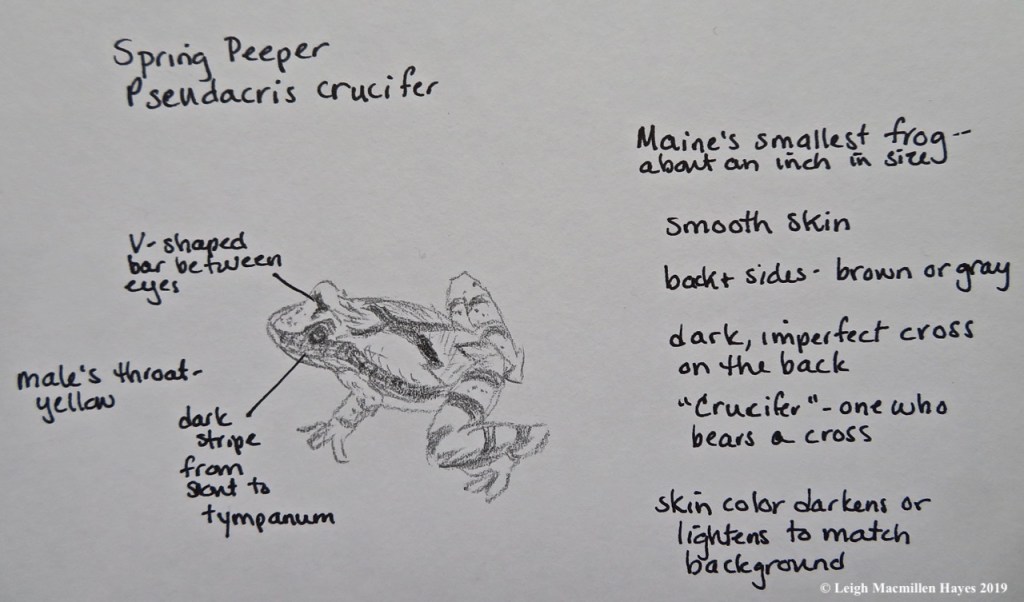
Meet a Spring Peeper up close and personal. Note those little toes, which are actually suction cups of a sort, the better to climb vegetation, especially at the edge of or in a wetland, and then to sing their high-pitched songs that announce the males intention of finding a date. Because of the toe pads, peepers were originally thought to be closely related to Tree Frogs but they have since been reassigned as chorus frogs in the genus Pseudacris, which comes from the Greek pseudes (false) and akris (locust) (think of our Dog Day Cicadas and their raspy love songs in the summer).

The species name, crucifer comes from the Latin cruces, meaning “cross,” so named for the dark X or cross on the frog’s back.

A really cool thing happened that first night. A teenager who lived in the neighborhood where we were scanning the road came out to ask what we were doing. And then he joined us, eager to learn as his family had recently moved here from out of state.

After a Spotted Salamander was saved, he ran home to get his camera and stayed until we finally departed. We had hoped he’d join us the next night at a different location, but wonder if he stayed home to help those on his road instead. Whether or not he did that, we loved his enthusiasm and desire to learn.

It soon became clear on the first night that we’d parked in the wrong spot, however right it may have seemed because we could get our vehicles off the road. As people started to leave, we all did a check underneath from all angles to make sure tires would not run over any critters by accident.

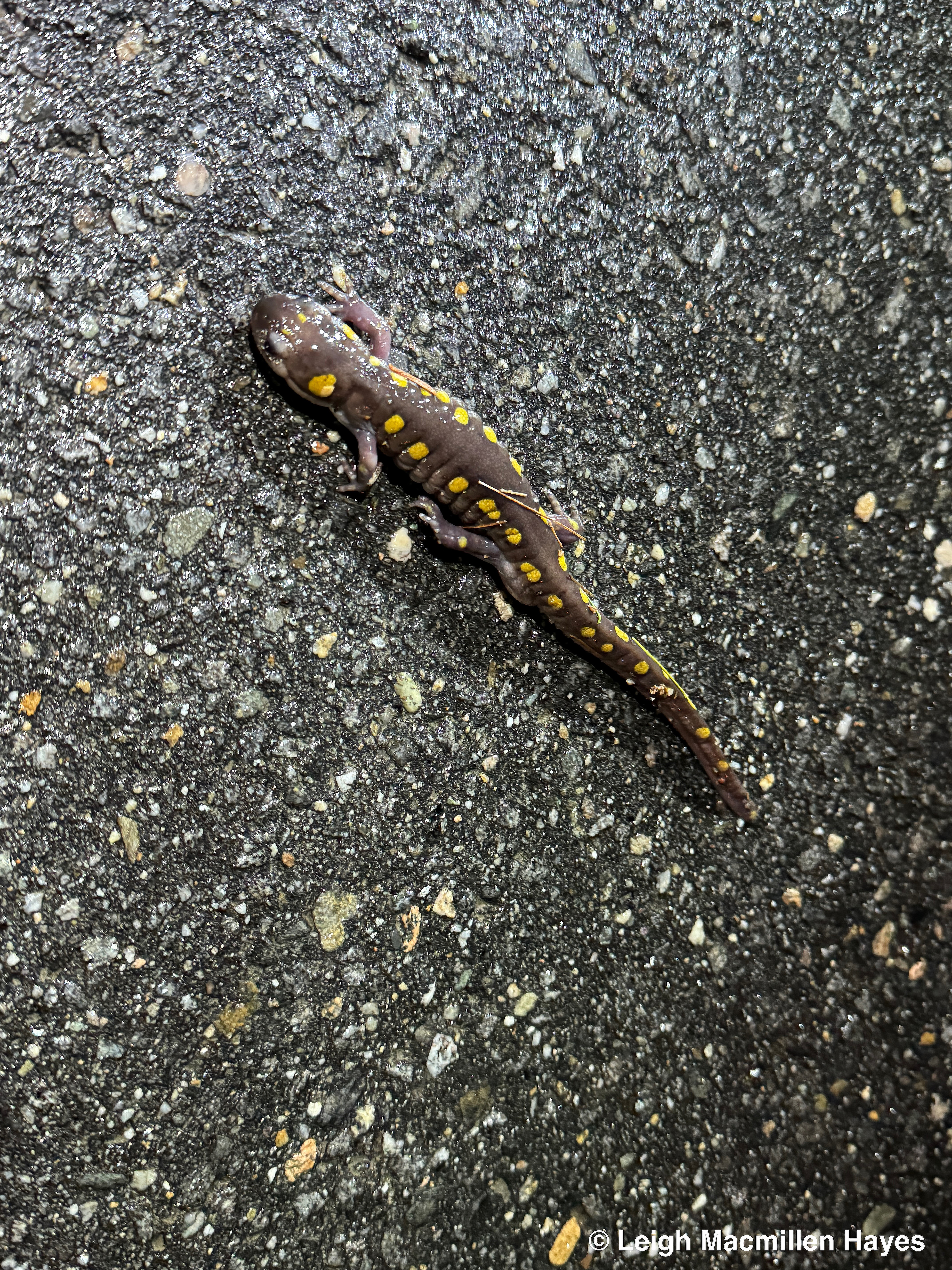
And sure enough . . . out crawled a Spotted Salamander. Of course, photo calls came first, and then help was offered to get to the other side.

Even teeny, tiny Spring Peepers had to be saved. And we all commented that we didn’t want to know if we did happen to drive over something. Added to that, we noted most of the vehicles only made it a few feet down the road, before the driver stopped and another amphibian was saved. That and the driving was rather erratic since everyone had gained a new understanding of how much action there is on a rainy night.

The second night found us in a different location that we actually walked about three quarters of a mile to reach, thus lowering our chances of hitting the critters right near the pool which is located directly beside the road, with a vast wetland on the other side of the street.

Wood Frogs, with their dark masks, typically headed toward the pool, where they’ll spend the next two weeks or so, singing for a mate, embracing her in a technique called amplexus, fertilizing her eggs, and trying again and again, until it’s time to hop out and head into the forest for the next 50 weeks.

Because it was dark, the Wood Frogs didn’t seem to mind our presence too much. Some still sang, or rather “wruck, wrucked” their love songs, and others floated in anticipation or chased each other in hopes of finding a female. We even noted a few egg masses clinging to branches, telling us this pool had been busy for a few days already.

Part of the fun in hosting such an event is sharing it with other people who might not typically head out the door after dark. And then seeing smiles on faces as they encountered the critters for the first time.

A cool find on this night was an Eastern Newt crawling across the road. Perhaps because the pool dries up each summer, this one had overwintered either in the wetland or even the upland before returning on this particular night. It felt like an unusual find on the road, though from what I’ve read, it’s not rare. I have seen many Red Efts, the juveniles of this species, their bodies squished by vehicle tires, on this very road in the fall.

Yet again, it was the Spring Peepers who garnered much of our attention.

And some Spotted Salamanders, though not as many as on the first night.

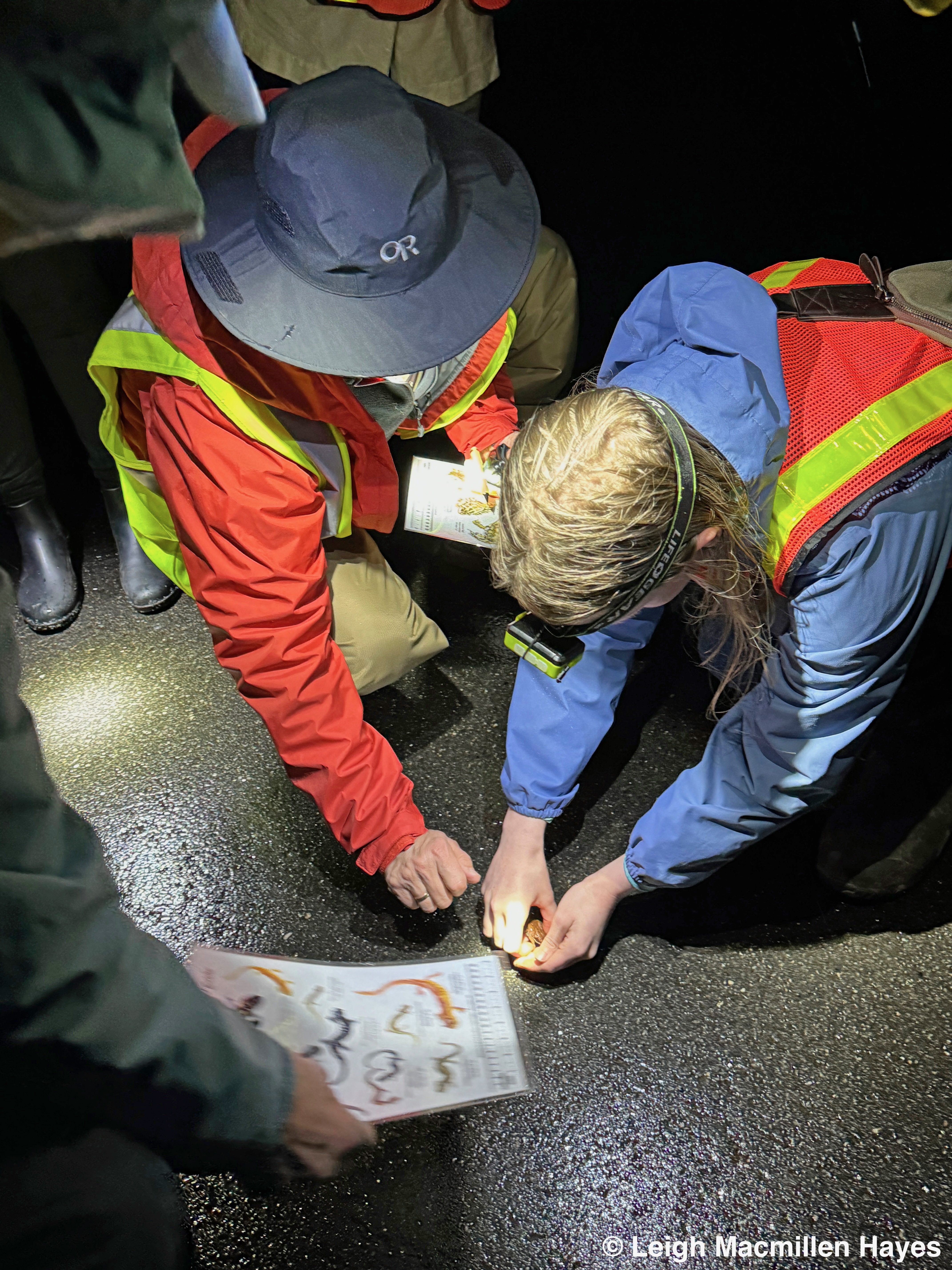
That said, we were thrilled with each find. And found an easy way to help them was to place the laminated ID card created by Maine Master Naturalist Michael Boardman under their bodies. Now don’t you think this guy is crawling onto the card in search of his ID?

As we prepared to walk back to our vehicles that night, Officer Hammond of the Bridgton Police Department happened along. No, he wasn’t going to arrest us for J-walking, though that’s essentially what we did. He was just stopping by because we’d ask Maggie to let the department know of our whereabouts in case anyone wondered what we were doing, but didn’t slow down to ask us. Traffic was high each of the nights. I’ve been doing this for about 22 years, and this year I felt like we had the most traffic. Most drivers were considerate when they saw the cones (courtesy of Hayes Ace Hardware) and vehicle flashers, plus our headlamps and flashlights. And we were all good at yelling “CAR” each time we saw approaching lights, but there were a few who were annoyed and one even had to lean on the horn after passing through the section of road we walked upon.

Night three was the warmest, with temps in the 50˚s and little to no rain. In fact, by the time we were heading home, the moon and stars were visible.

But still, the critters crossed and once again we showed new participants of all ages how to ID them and then help them cross the road.

On this final night, we had several teenagers along for the journey. Two of them had actually driven past us on the first night, slowed down, rolled down the window, and asked if we were okay. When we showed them a photo of a Spotted Salamander, they went home and signed up for a chance to help. Their enthusiasm was incredible.

We peered into the pool again and were amazed at the number of swelled Wood Frog egg masses in their communal cluster–as is the Wood Frog fashion. perhaps to take advantage of being warmer when crowded together, and thus evolve quicker. It’s the swelling that told us they’d been laid a few days before as initially their egg masses are maybe the size of a golf ball, but swell as they absorb water over the days to come.

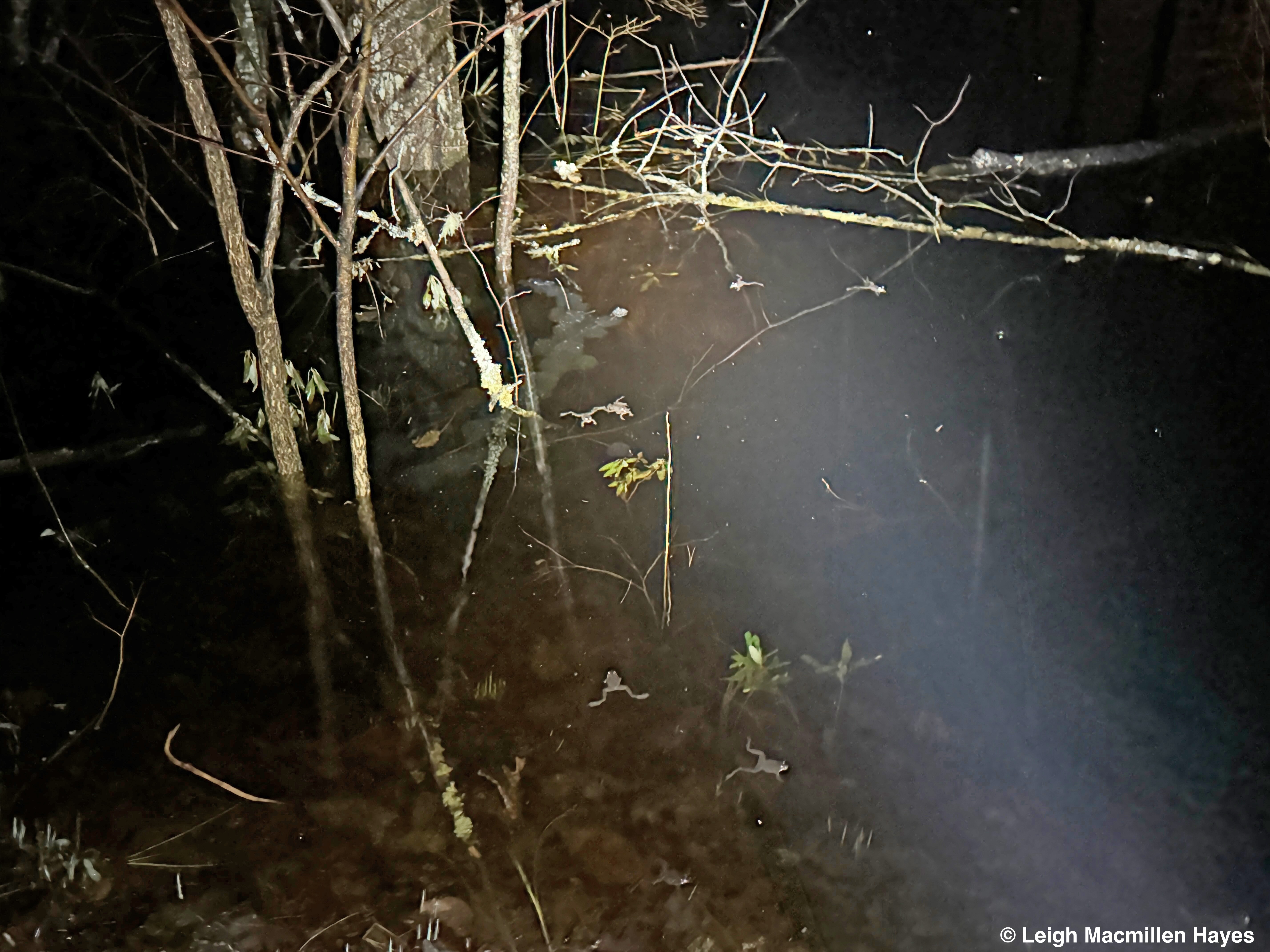
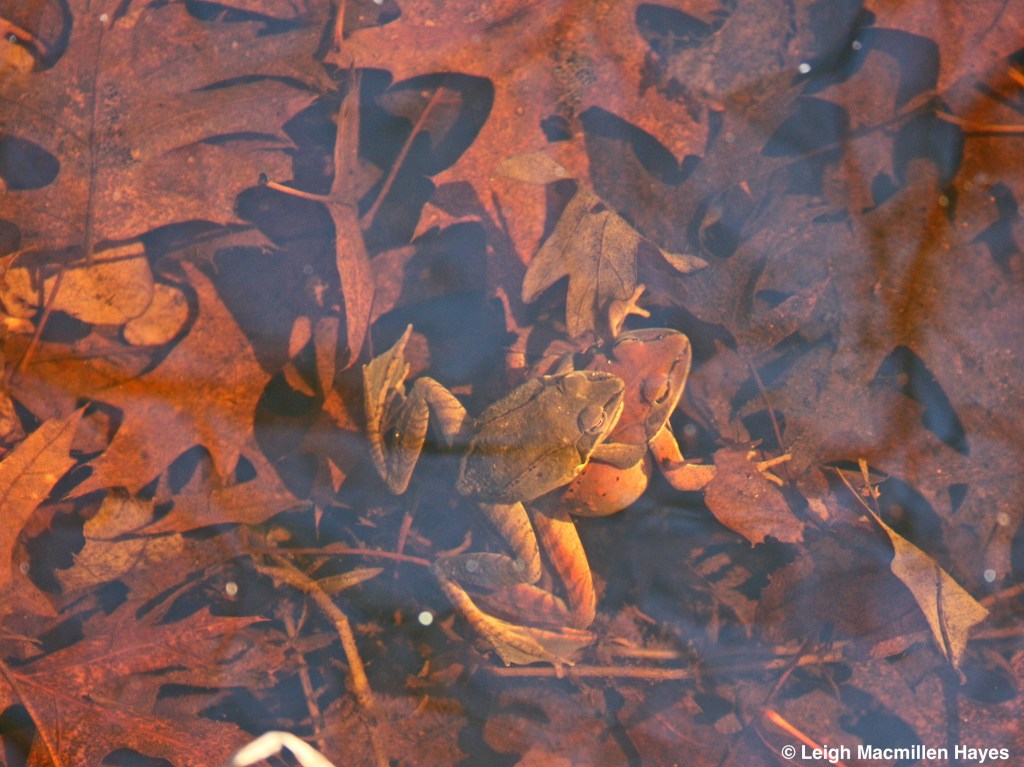
The action was constant and I encourage you to see how many frogs you can find in this photo. It’s almost like the Hidden Picture of Highlights magazine, or Where’s Waldo?

And twice we spotted Spotted Salamanders swimming in the pool, though I really wanted to see a “congress” of salamanders conducting their mating dance. One of these nights.

As we walked out on the third night, about ten feet from each other we spotted two sets of Wood Frogs in amplexus! They couldn’t even wait to find a room, or pool, for that matter!

We quickly, if awkwardly, helped them off the road because we heard that familiar “CAR!”

One night, two nights, three nights . . . turned into one incredible and extended BIG NIGHT migration.

Our results:

April 10, 2024
21 Spotted Salamanders
40 Spring Peepers

April 11, 2024
7 Spotted Salamanders
102 Spring Peepers
75 Wood Frogs
3 Red-backed Salamanders
1 Eastern Newt

April 12, 2024
13 Spotted Salamanders
268 Spring Peepers
62 Wood Frogs
4 Red-backed Salamanders
2 Green Frogs
1 Eastern Newt

For a grand total of 599 critters helped to the other side of the road. We saw a number of squished ones and had to constantly remind ourselves that they will become food for others.

Thank you to the 39 people who joined us during these three nights--you were incredible and we loved hearing stories of how you want to share this with other members of your family and you are already planning to join us next year.

To go out on a rainy night and help amphibians cross the road is special–for the critters and for us. Thank you to Hadley, Dawn, and Maggie–for being the cool swamp critters that you are! And for letting me be part of the club.

BIG NIGHT 2024–one for the books.

My Reawakening

In any given year, 
I've said good-bye
to you, 
my dear vernal pool 
in late May 
or early June. 
But this year 
of Twenty-twenty-three
has been like no other
as you've retained water
beyond your ephemeral season.
When upon July 14
I peered into 
your shallow depth,
I was greeted
with frog legs
growing upon tadpole bodies,
a sight not witnessed
in your waters 
ever before. 
In years past
miniature amphibians
had to mature quickly
or become scavenged tidbits
supplying energy
to insects and birds,
but this year, 
the Wood Frogs 
and Spotted Salamanders
who share birthrights
of your pool
took their time 
to metamorph.
As I stood quietly
beside you,
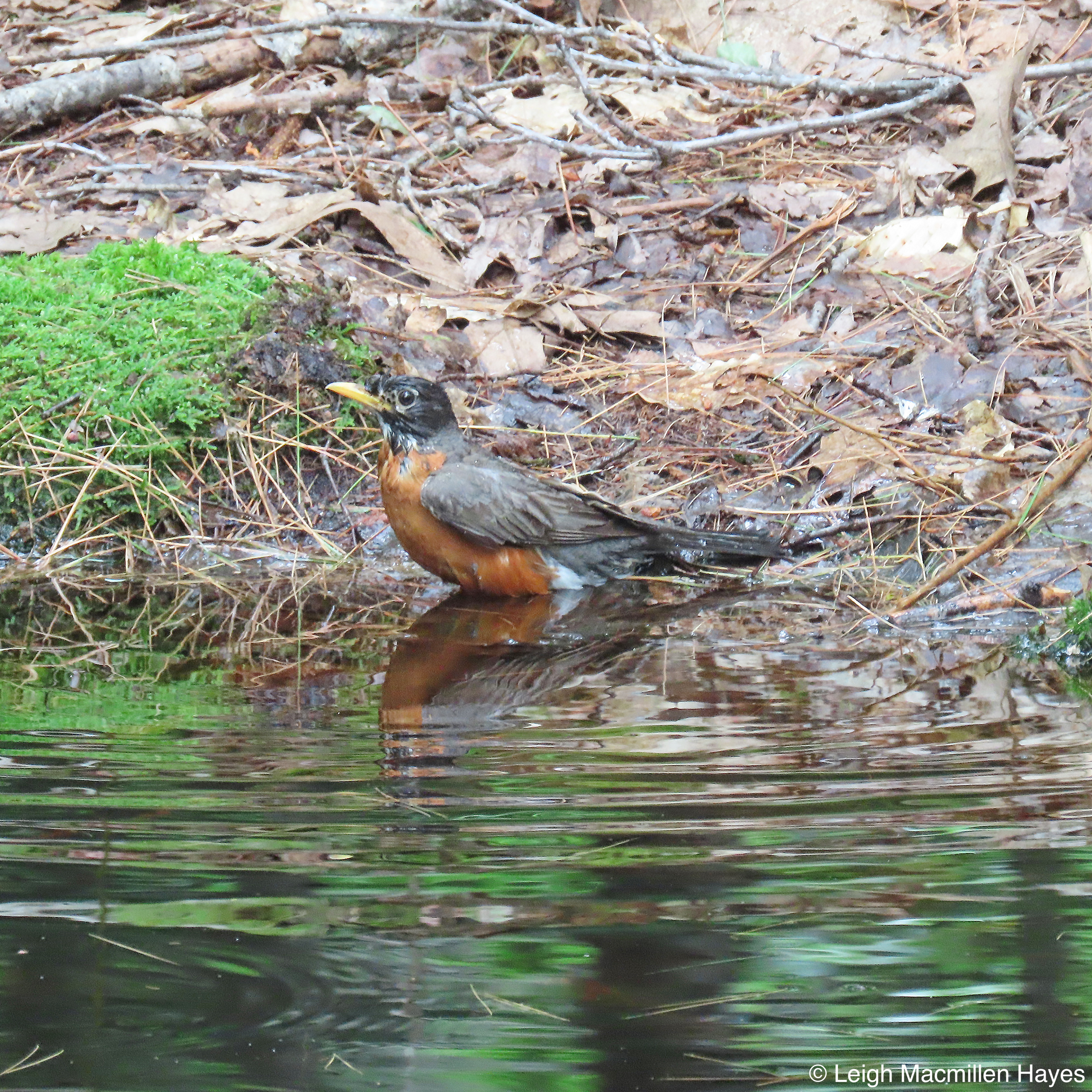
you invited an American Robin
to land on the opposite shore
and I could not believe
my good fortune 
to watch its behavior. 
Much to my amazement,
and despite my presence, 
for no matter how still 
I tried to be 
I still made noise,
the Robin
splished and splashed
in frantic birdbath form. 
It paused
and looked about . . . 
Then jumped in again
for a final rinse 
from your warm waters
before taking time 
to preen. 
Finally cleansed,
the bird posed
upon a moss carpet
and then 
we both took our leave
fully sated from your offerings
of that day. 
When next I visited you
on August 9,
wonder accompanied 
my approach
and I knew 
sudden movements
and resulting ripples
meant I would not be
disappointed. 
Below your surface,
I spied a live frog,
its hind legs formed 
and front feet developing. 
And there was another,
and another, 
and more legs,
and sometimes even
the tiny suction-cuppy toes
and my heart was full again.
I last made my way
down the cow path
to the trail
leading to you
on August 18
and again
the amount of water
you held in your grip
far exceeded
my expectations,
but other than 
Mosquitoes,
all was quiet. 
And then today dawned,
 and after listening 
to this morning's homily
about Celtic Thin Places
offered by Ev Lennon, 
I felt compelled
to pay you a visit again. 
On the way
I slowed my brain
by intentionally stepping
along the labyrinth path
I created a few years ago. 
And then . . . and then . . . 
as I approached you, 
my dear pool, 
a pile of Black Bear scat,
full of acorn and apple pieces
from a neighborhood forage,
sat smack dab 
in the middle of the trail. 
And so it was 
that as I reached you, 
surprise again overcame me,
for though you are shrinking
to your traditional 
early June size, 
you still exist
on this day, September 3. 
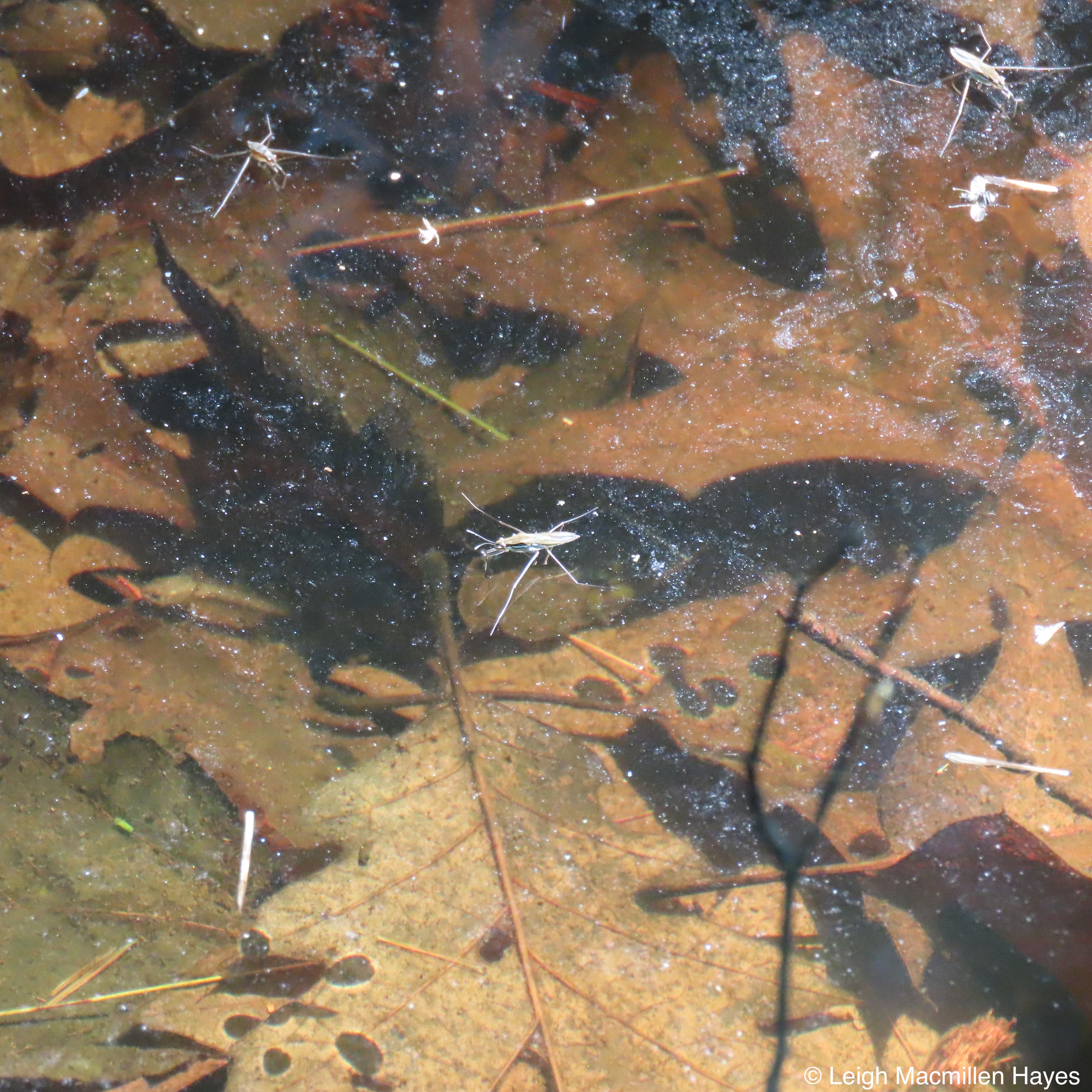
Small Water Striders skated
across your surface,
sometimes approaching others
who quickly
escaped any chance
for an embrace. 
As has been
my experience 
for the last month
you offered no evidence 
of Wood Frog or Spotted Salamanders
and I trust many 
hopped or crawled out
as is their manner. 
Green Frogs, however, 
squealed to announce 
their presence
before diving under 
the leafy bottom you offer, 
which makes a perfect hideout. 
When one frog resurfaced, 
we carried on a starring contest, 
until my attention
was drawn away. 
Ten feet from 
where I stood 
American Goldfinches 
poked the ground, 
foraging in the duff. 
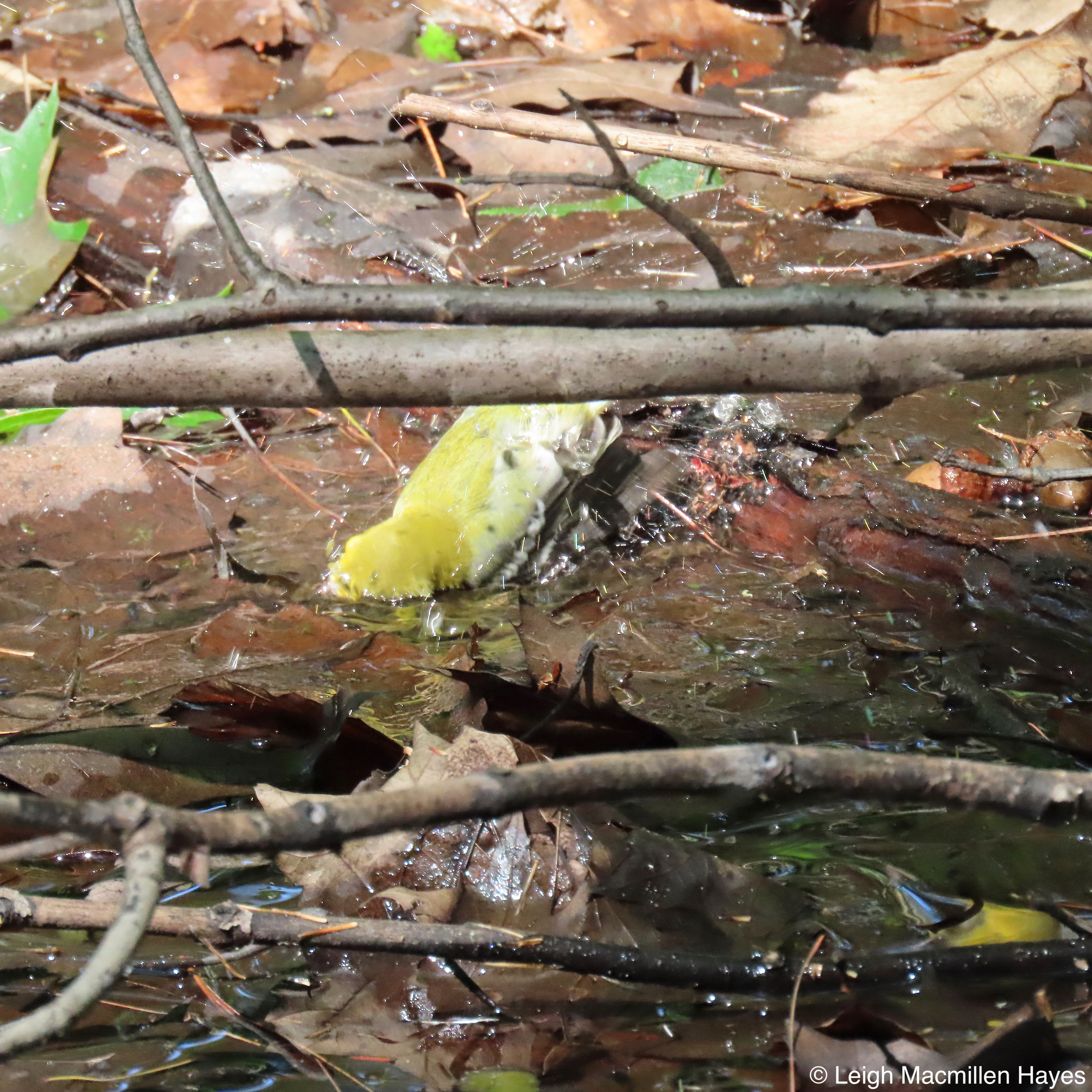
Then one took a bath, 
and suddenly it 
occurred to me
that this was 
the third time this summer
I've had the honor 
of watching birds 
make use of the watery offering
your pool provides,
even as it is now
a not-so-vernal puddle. 

Before I finally
pulled myself
away from you, 
I offered great thanks 
for all the lessons 
of life and love and even loss
that you have
taught me all these years. 

And thank you,
Ev, 
for being today's inspiration
and for reawakening 
my wonder, 
which occasionally goes dormant,
as the pool will soon do as well. 

As the VP Turns

This drama began in April when the ice started to go out. As always seems to be the case, it’s there one day and buddaboom, gone the next.

Official ice out is considered to be when you can navigate unimpeded from one end of a water body to the other. For this particular pool and its amphibian visitors that day was April 5 of this year.

Those who determined such were the wood frogs for on April 6, their “wruck, wruck” voices chorused . . .

until that is, I approached and then all went silent. This year, for the first in many, the W.F. Chorale had more voices than in the past for so many more had returned to the natal breeding ground than I can previously recall.

According to plan, dance cards were filled out and he, being much smaller than she, climbed atop to grasp her in what was known as amplexus.

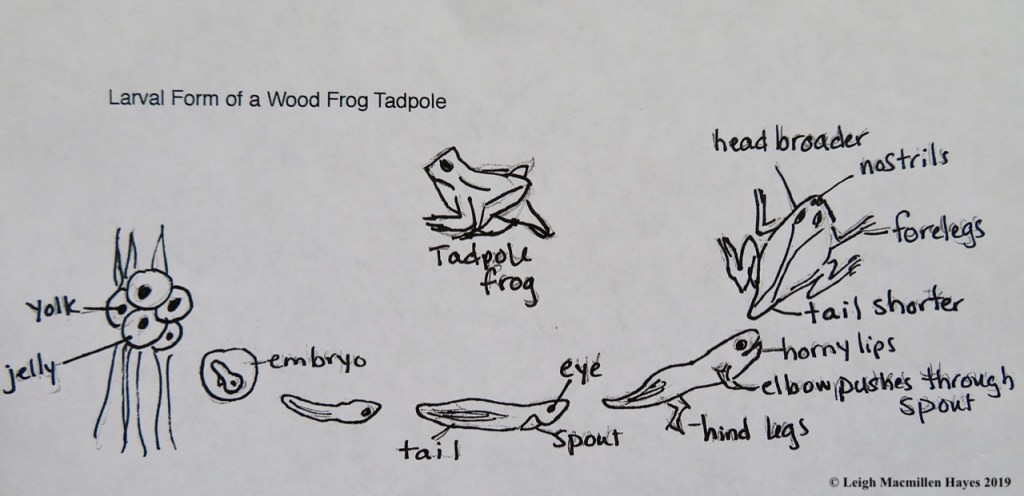
By the next morning egg masses had been attached to vegetation and bubbled forth at the surface much like a bowl of tapioca. Slowly they began to absorb water, expanding in size day by day.

As is their custom, the egg masses created a hub about the size of an extra large truck tire for such is the frogs habit of laying and attaching these in the same area, colonial in nature.

Within each orb, life began to take form.

Their life was constantly at risk for other hungry beings knew of their location and paused pool side to consider the choicest treat.

Thrown into the mix were rainy days, which occurred with more frequency at the start of the season, thus providing hope that the water level would remain high for the duration of the story.

Almost two weeks after the adult wood frogs had finished calling and exited the pool to return to their upland habitat, where they spend fifty weeks each year, spotted salamanders paid a visit and the males deposited cauliflower-shaped spermatophores upon which they encouraged their lady friends to dance.

As is their custom, he led her to one of these sperm packets and she picked it up through her cloaca, the opening amphibians use for breeding, egg-laying and waste. She then fertilized the eggs internally.

Where the wood frog egg masses consist of a bunch of individual eggs all gathered together in a bumpy matrix numbering up to 1,500/group, salamander masses are enclosed in a gelatinous coating and consist of 50 to 250 individual eggs.

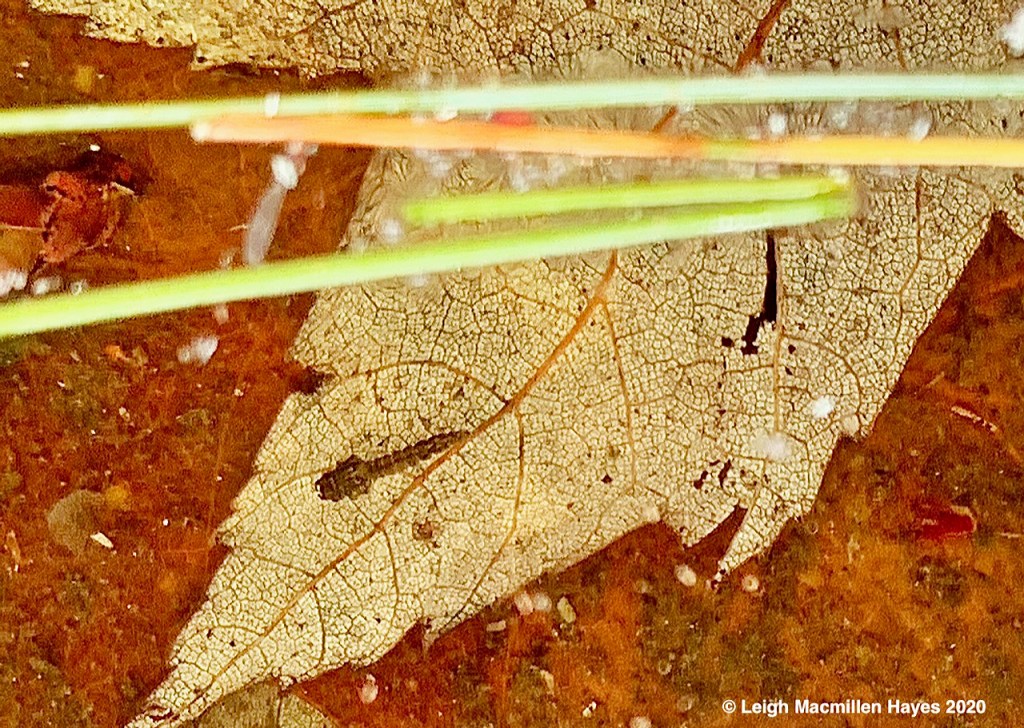
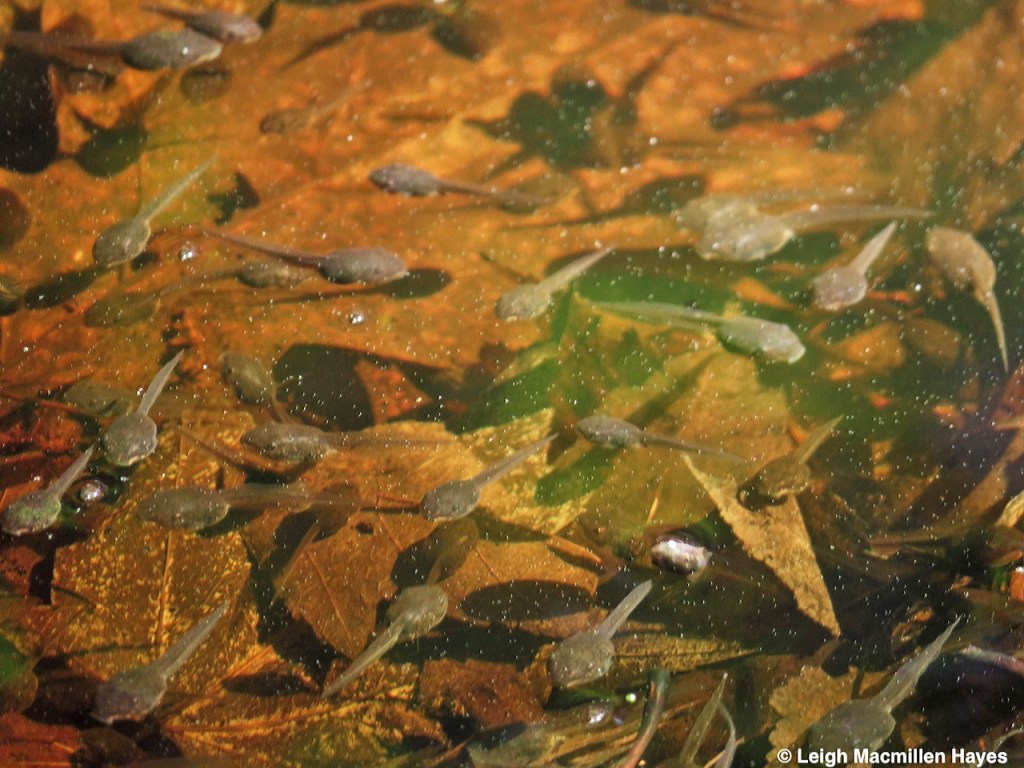
By the next week, tadpoles began to emerge and really it’s all about timing for a larval spotted salamander might feed on the larval frog, thus the latter are granted a brief reprieve in which to develop.

In the midst of it all, others also experience life in their larval form including mosquitoes who first wriggle through the water column and later tumble in their pupal form before hatching into their biting selves.

As the spotted salamander embryos grew . . .

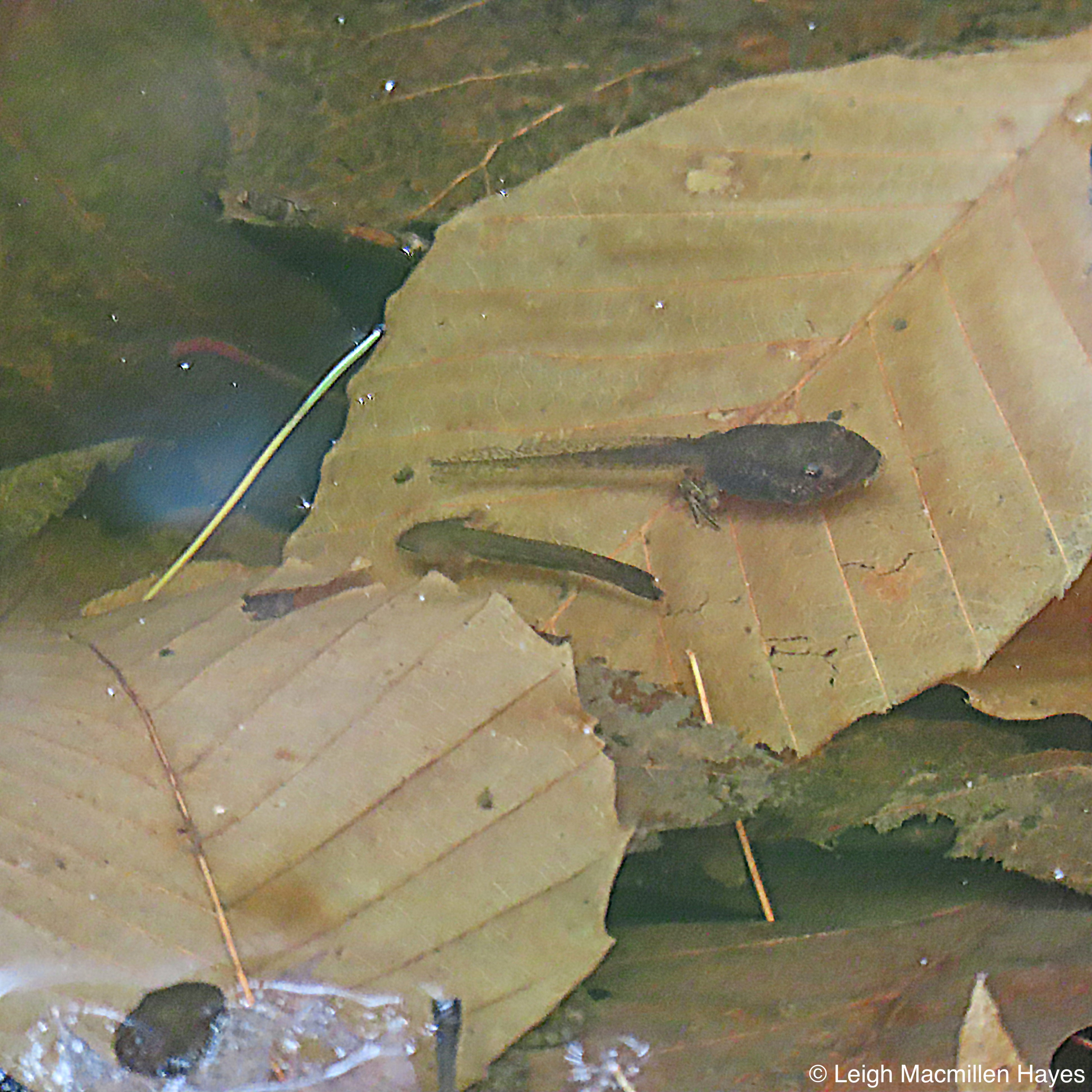
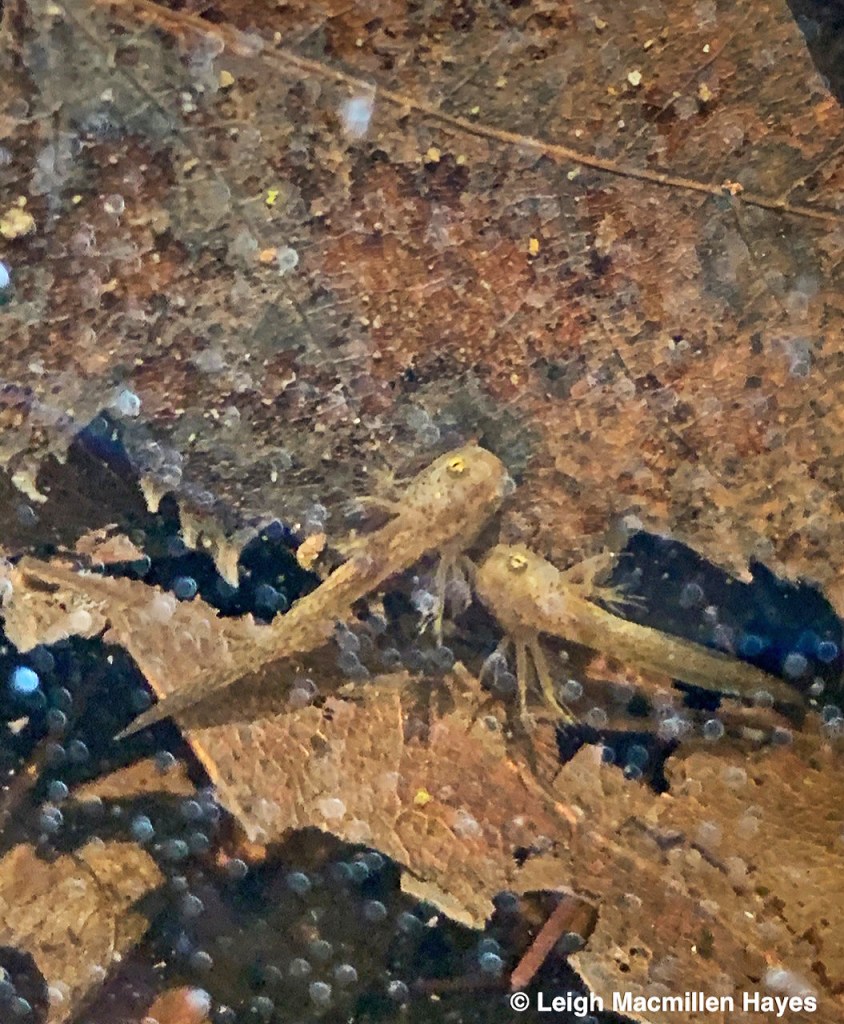
so did the tadpoles.

Within two weeks, the salamanders bodies begin to take shape in their individual homes.

And then a week later, they began to emerge much like their frog counterparts.

Seven weeks after the ice officially went out, the pond teemed with life of those hoping to mature into the future.

Metamorphosis continued as young ones began to take on their adult forms.

But still, there were those with whom which to contend . . . including the larval form of predacious diving beetles.

It’s not just the predators, either, that need to be acknowledged for once the April rains ended, the dry season started and the water level drastically declined leaving stranded egg masses on the edge.

As a hope-filled human, I tried to intervene and moved some to deeper water.

Meanwhile, there were no signs of any salamanders, but the wood frogs did grow.

And fed voraciously upon the green alga that has a symbiotic relationship with developing eggs in one of those “I’ll feed your stomach if you’ll feed mine” manners.

With each new day, the tadpoles took on their adult features. But . . . where were the salamanders?

By today, June 12, despite yesterday’s downpour, the water had diminished significantly and still I hadn’t spotted any of the gilled beings.

And then, I did. They were more leaf-like in color and thus harder to see, but they were there, though hardly as abundant as the tadpoles.

It finally began to make sense, the number of eggs within a mass and the number of egg masses. Really, this pool could be considered significant by state standards for there were more than 40 wood frog masses and more than 20 spotted salamander egg masses, either of those a number to be considered in its own right, but . . . the pool isn’t natural. It was dug long ago to serve the purposes of the farm that once was.

To produce so many progeny makes sense for despite the fact that it seemed to be teeming with life, its own life is short lived. How many will actually hop or crawl out before the pool dries up?

I suppose to that end, it also made sense that some resorted to cannibalism.
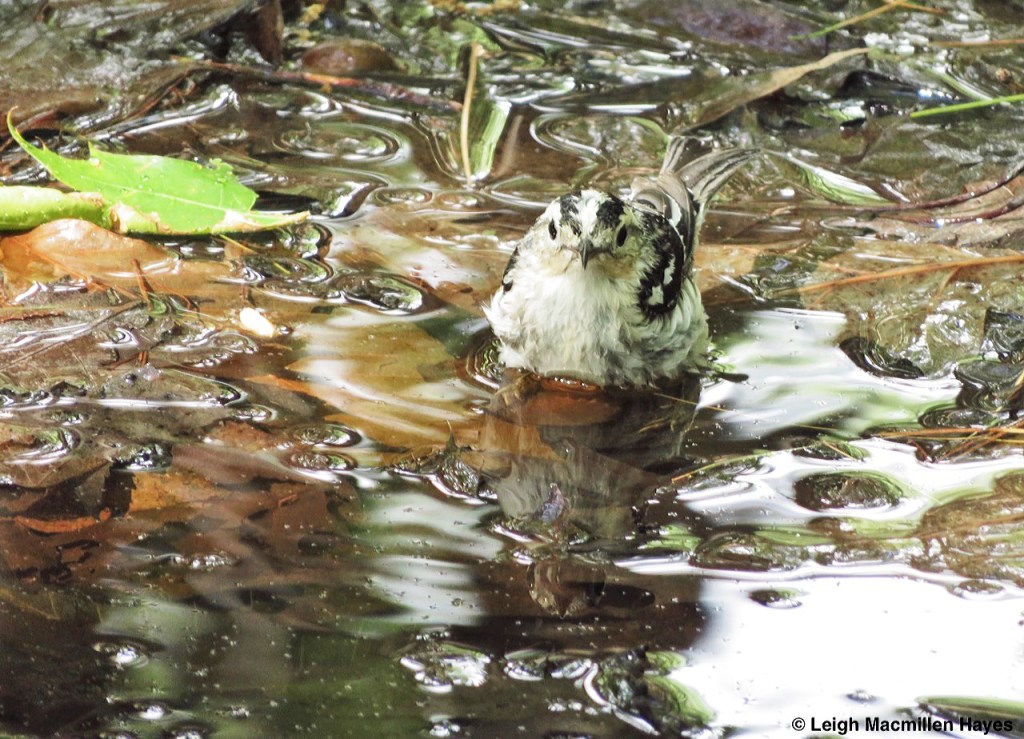
What lightened the moment was when a Black and White Warbler stopped by to take a bath.

Drama plays out constantly and I’ve only covered a few snapshots of it . . . as the vernal pool turns.

I’m in Frog Heaven

The ice went out on the vernal pool in our woods on April 5th and by the 6th the wood frogs were singing their love songs and egg masses had already been attached to fallen branches.

Once I spy such I become addicted to visiting the pool on a regular basis to keep an eye on the activity. As much as I’d love to bring some home, I know that that would interrupt the natural process and so I do the best I can by peering into the water.

One of my great finds early on turned out not to be as extraordinary as I first thought. What I thought were blue spotted salamander egg masses slowly morphed into wood frog masses. They were laid out like sheets on the floor of the pool rather than attached to sticks as is normally the case. But it didn’t all make sense as up to the point that I spotted those masses, I hadn’t seen any salamander spermatophores.

Daily visits to the pool garnered a better understanding and about two weeks later not only had the spotted salamanders left their deposits on the pool floor . . .

and the next day their eggs on sticks . . .

but the so-called blue-spotted suddenly began to look more like wood frog masses with tadpoles developing inside. Perhaps they were laid at the very edge of the pool by young wood frogs just getting the hang of the annual ritual.

With the help of my son who works for a film editing house in Manhattan, I’ve pulled all of this together into a video so even if you can’t get to a vernal pool, perhaps you can enjoy the magic of this place for a few minutes by clicking on the link and watching: Are You in Frog Heaven?

There’s so much more to come and I’ll do my best to keep an eye on the action.

In the meantime, why not create a Frog and Toad Chorus as you stay at home.

In the amphibian world, males sing as a means of attracting a mate and defending a territory.

Here’s how to conduct your own chorus: Assign a species to various family members who will imitate the sound as best they can. Have fun leading your gang as you control who “sings.” And then head outdoors to see if you can identify the species based on your knowledge of the songs they create.

Wood Frog: quacking duck or wruck, wruck in early spring

Spring Peeper: high-pitched peep-peep in early spring

American Toad: sustained trill lasting up to 30 seconds (from your lips or throat), early to late spring

Green Frog: throaty gunk! like banjo strings, late spring – early summer

American Bullfrog: deep, resonant rr-uum, or jug-o-rum, late spring – early summer

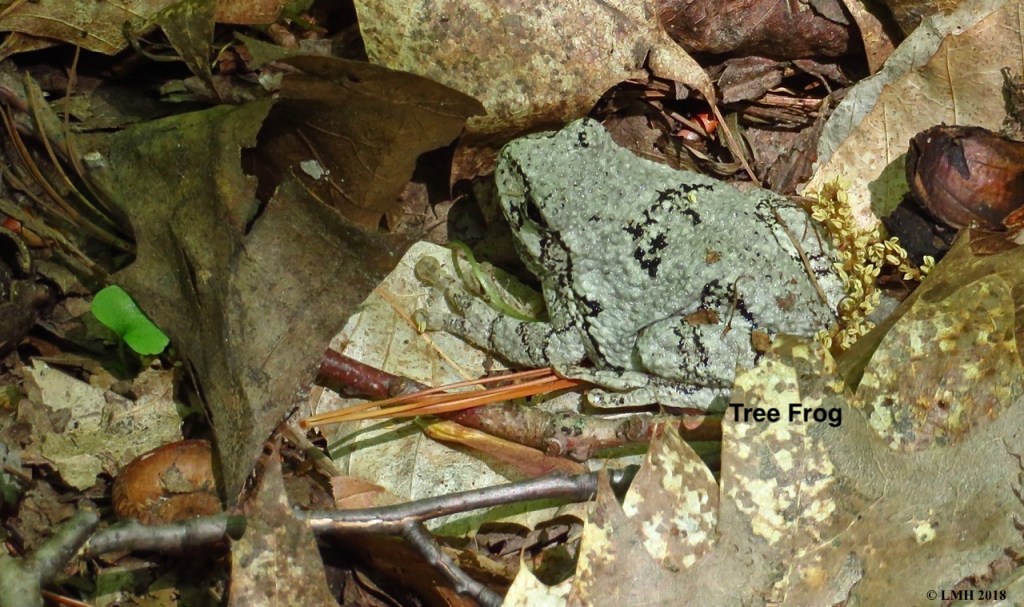
Gray Tree Frog: slow, musical bird-like trill lasting 2 or 3 seconds (use your lips or tongue), late spring – early summer

Are you in Frog Heaven? I know I am.

This Wild Place

There’s no music quite like the Wood Frog’s defiant chorus, sung when the ice is barely off the vernal pool and the ground still covered with patches of snow. Singing together, they sound like dozens of quaking ducks. Wood Frogs are often the first Maine frogs to break winter’s quiet, beating Spring Peepers by a few days or even a week.

Their vocal prowess extends to silence. Once we approach a vernal pool and they sense danger (perhaps through vibrations), they cut off their song altogether, as though timed by some unseen conductor. The purpose of all this calling is finding a mate, of course. Male Wood Frogs, once they’ve called in some unwitting females, can be tenacious in the extreme–even if their suitor happens to be the wrong species.

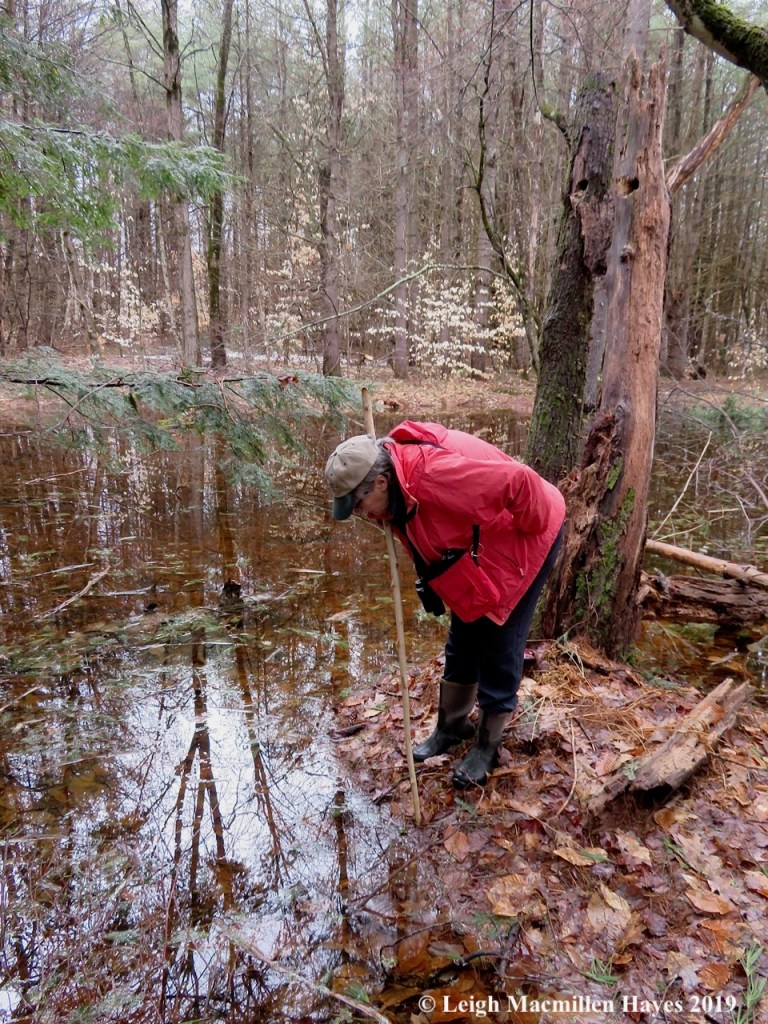
This morning, as Greater Lovell Land Trust Docent Linda Wurm and I approached a pool on the Heald and Bradley Ponds Reserve, the symphony was eerily still.

And so we began to circle around, our eyes scanning the watery surface for clumps of eggs. Our hope was to either see a male hug a female in an iron-lock grasp, forming the mating embrace called amplexus, or evidence of their date.

And we were rewarded. At least one female had laid eggs fertilized by a male. As is their habit, the female attached the mass to a twig and the tiny black embryo of each egg was surrounded by a perfectly round, clear envelope about one-third inch in diameter. These gelatinous blobs can consist of up to 1,500 individual eggs. Egg-mazing indeed.
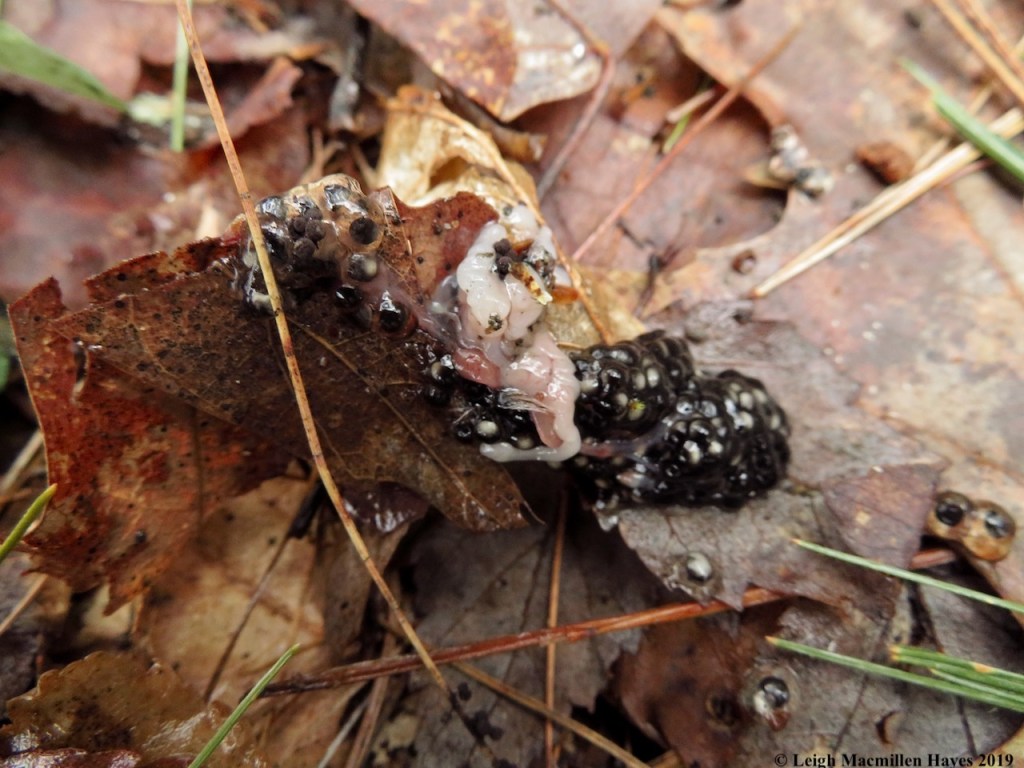
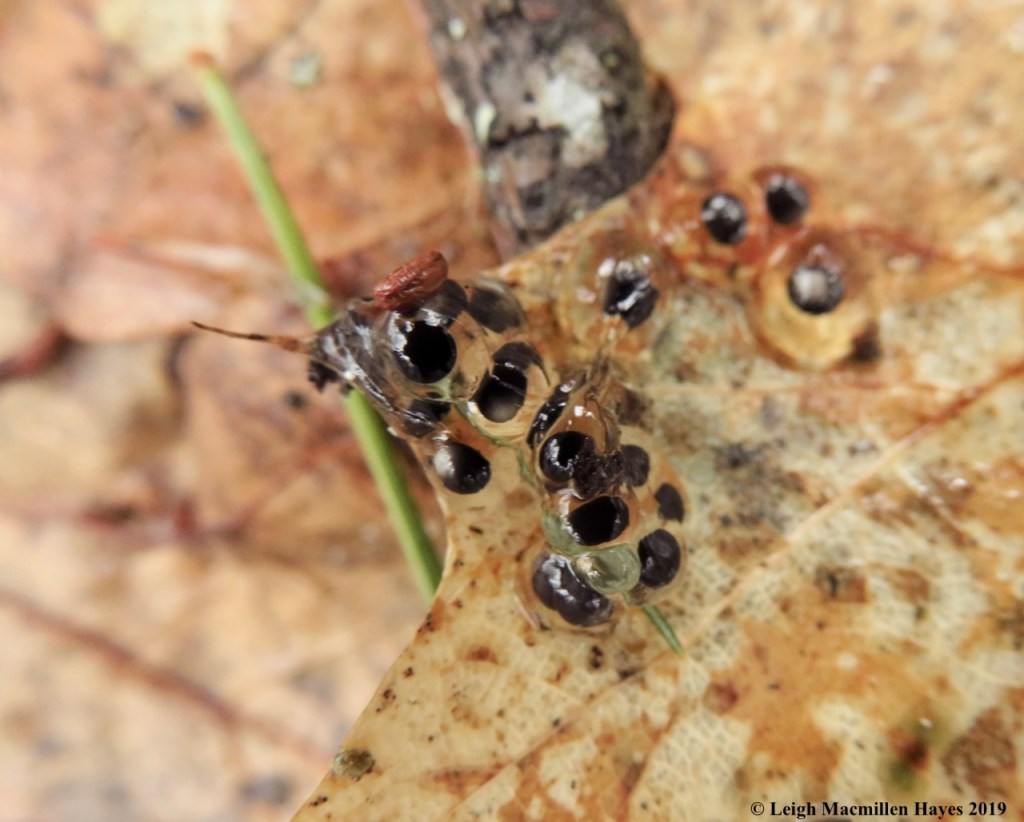
The embryos will hatch into small brownish-black tadpoles in a week or two, or longer given how chilly the water was today. As they grow, their rounded tail fins will become translucent–almost mottled with gold and blackish flecks.

Wood Frog tadpoles grow at varying rates depending on water temperature, tadpole density, and available food resources, but tend to develop within about two months to become adults. Unfortunately for them, but in the web of life good for others, tadpoles often succumb to cannibalism, especially to their larger relatives. They are also eaten by predacious diving beetles, salamanders, turtles, and birds.

We only found one, maybe two egg masses, but this pool isn’t known for many. What it is known for is its Fairy Shrimp population and I’m sorry to report that we found not a one. But, we did spy a few handsome hemlock varnish shelf fungi.

And by them some red squirrel middens that made us happy for we saw few of these all winter.

Right behind the fungi and midden, something else in the water caught our attention and Linda focused with a keen eye.

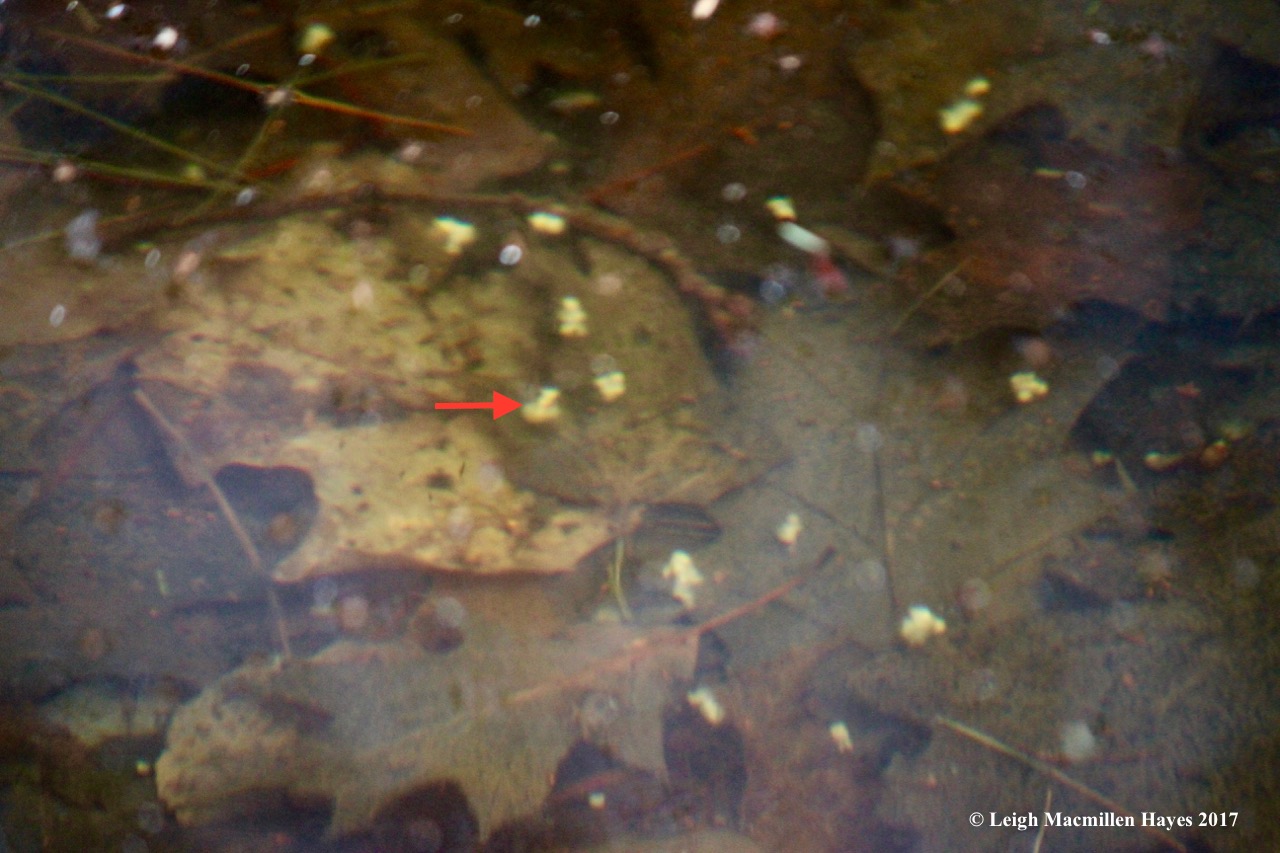
My photo wasn’t the clearest, but upon some leaves and twigs we spotted spermatophores left behind by male Spotted Salamanders. They remind me of cauliflower, their structures consisting of pedestals topped with sperm. Though we couldn’t see any milky masses of salamander eggs, we hope that on future visits we will.

Spotting a Spotted Salamander is a rare treat. With their bright yellow spots on a sleek, shiny black back, they are even more nocturnal and elusive than the Wood Frogs. They are actually mole salamanders and spend most of their time burrowed underground.

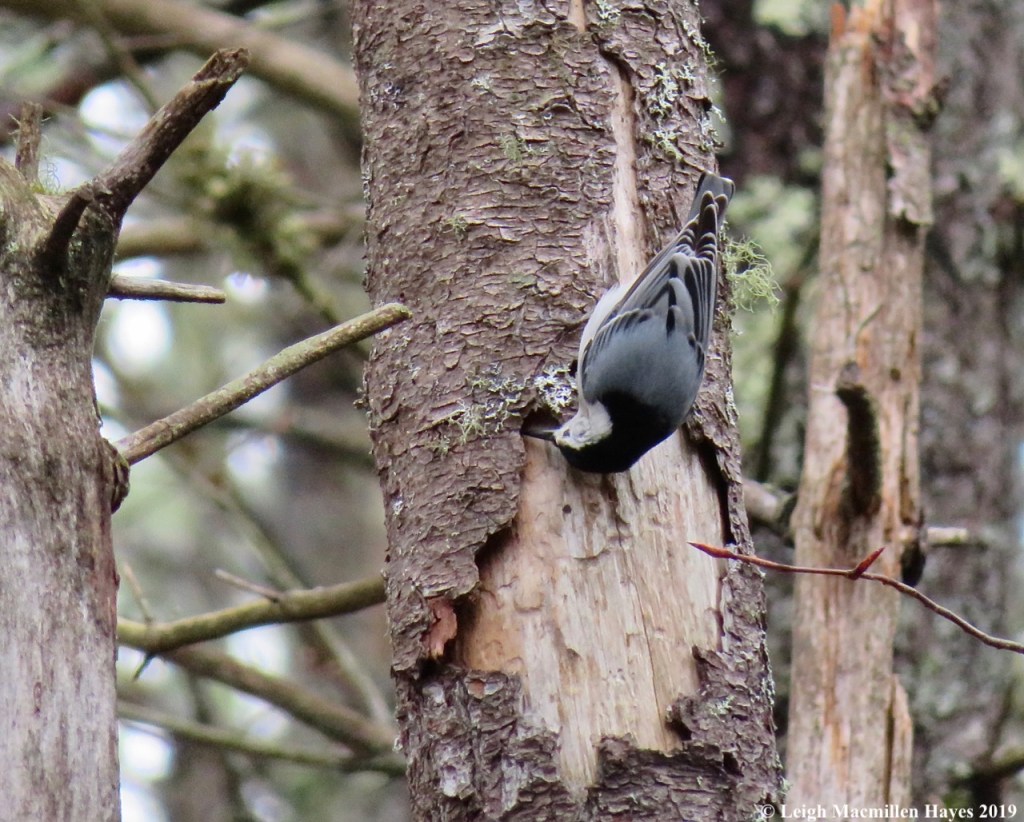
As we circled back around the pool, a White-breasted Nuthatch mimicked our searching eyes and probed under some bark, its long narrow beak seeking beetles.

Every few seconds it took a break and surveyed the world that included us.

We, too, surveyed the world, and suddenly at our feet we discovered eggs we’d not seen previously. What were they doing about a foot out of the water?

And to whom did they belong? At first I considered Pickerel Frog, but on closer examination I thought they might be Wood Frog.

And then Linda shifted one clump a wee bit with a stick and we found what may have been the entrails. Life happens in vernal pools and this one was no different. Had a predator stopped by? Perhaps a raccoon or skunk or chipmunk or raccoon? But, why didn’t it eat the eggs? Again, so many questions.

With the field microscope, we looked at the eggs again and were almost one hundred percent certain that they were Wood Frog.* We did place some of them back in the water, but wondered if they were viable.

For all the eggs that are laid, it’s hard to believe that only 10% will survive. But the truth is that most die before transforming into adults and leaving their pools. The reasons are varied: the ponds dry up; or they are hunted down by predators: or they die of diseases.

After a few hours, we pull ourselves away, grateful for the time to explore this wild place–full of life . . . and death.

*I’ve reached out to Dr. Rick Van de Poll about the eggs out of water–if, by chance, he responds, I’ll update this post so stay tuned.

And now from Rick:

Hi Leigh!

Fascinating find! Having just seen a few predated egg masses today I can definitively say they are spotted salamander eggs. The blackish coloration is likely imparted by the stomach acids of a raccoon, who apparently gorged and threw them back up, along with a few frog parts. Again, while its not too common to see this kind of things around vernal pools, it does make for for a pretty good ‘who-dunnit’!

Rick

May I Have This Dance?

Haha. If you know me well, you know I’d rather be a wall flower than step onto the dance floor. I easily managed to avoid all high school dances, except one prom. And then, barely danced at that, probably much to my date’s dismay. After that, so many moons ago, I don’t think I danced again until my wedding–at which time any dear friends in attendance watched with humor at my awkward movements. But today, I felt the rhythm surging through my body.

v-snow on trail

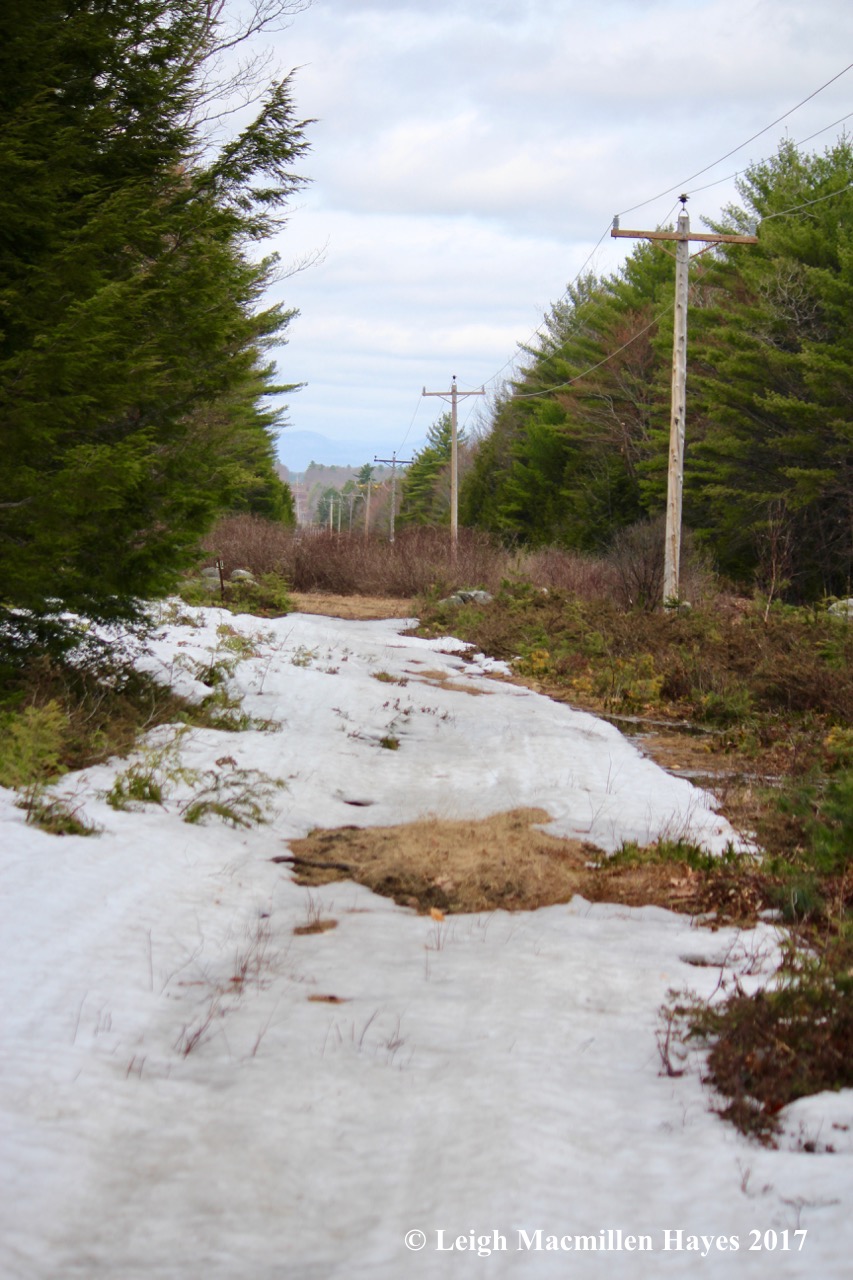
It all began on my way to the vernal pool. Perhaps it was really just a shiver as the breeze blew across the last of the snow, hard packed still along the snowmobile trail.

v-springtails 1

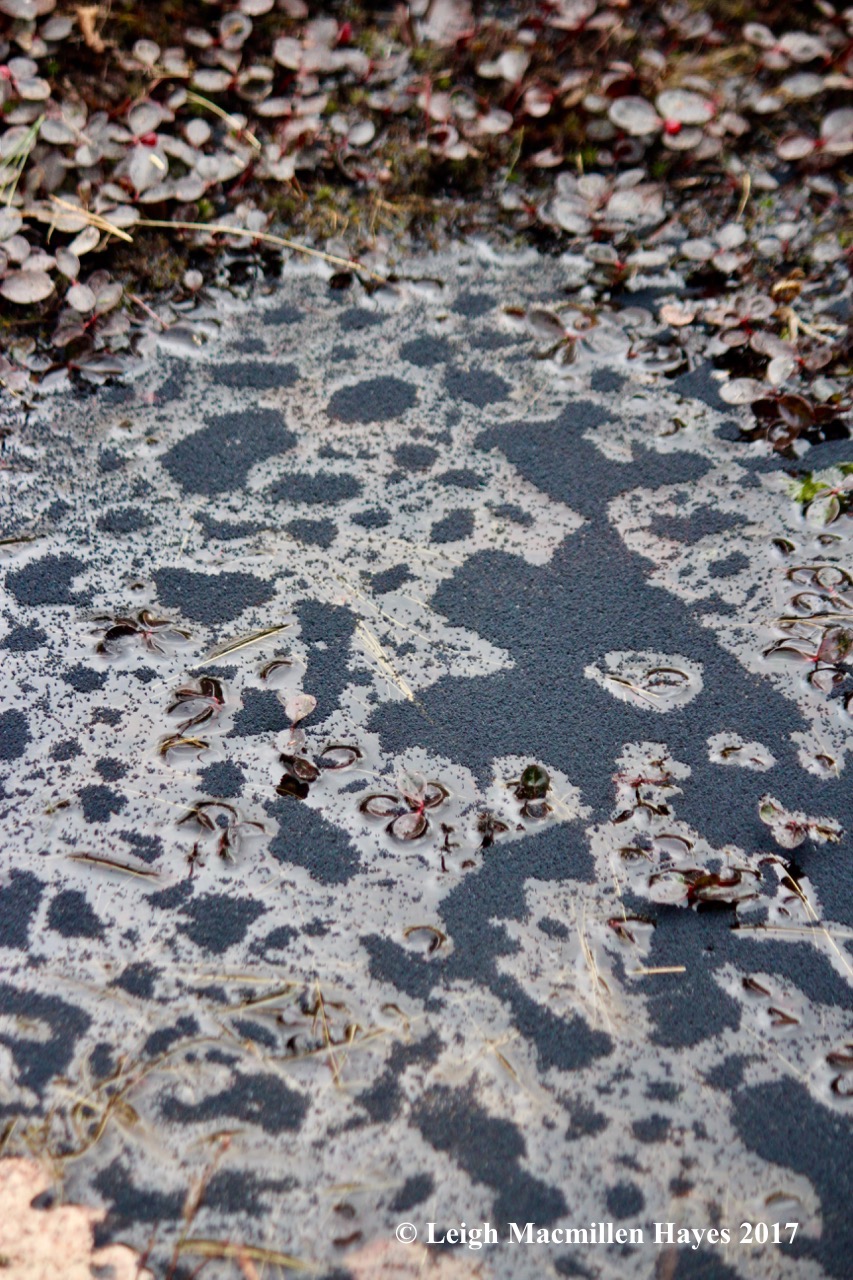
Or maybe it was the depression that held the snowmelt and was covered with an oil slick of sorts . . .

v-springtails 2

which turned out to be a million springtails bopping to their own tunes.

v-trailing arbutus 1

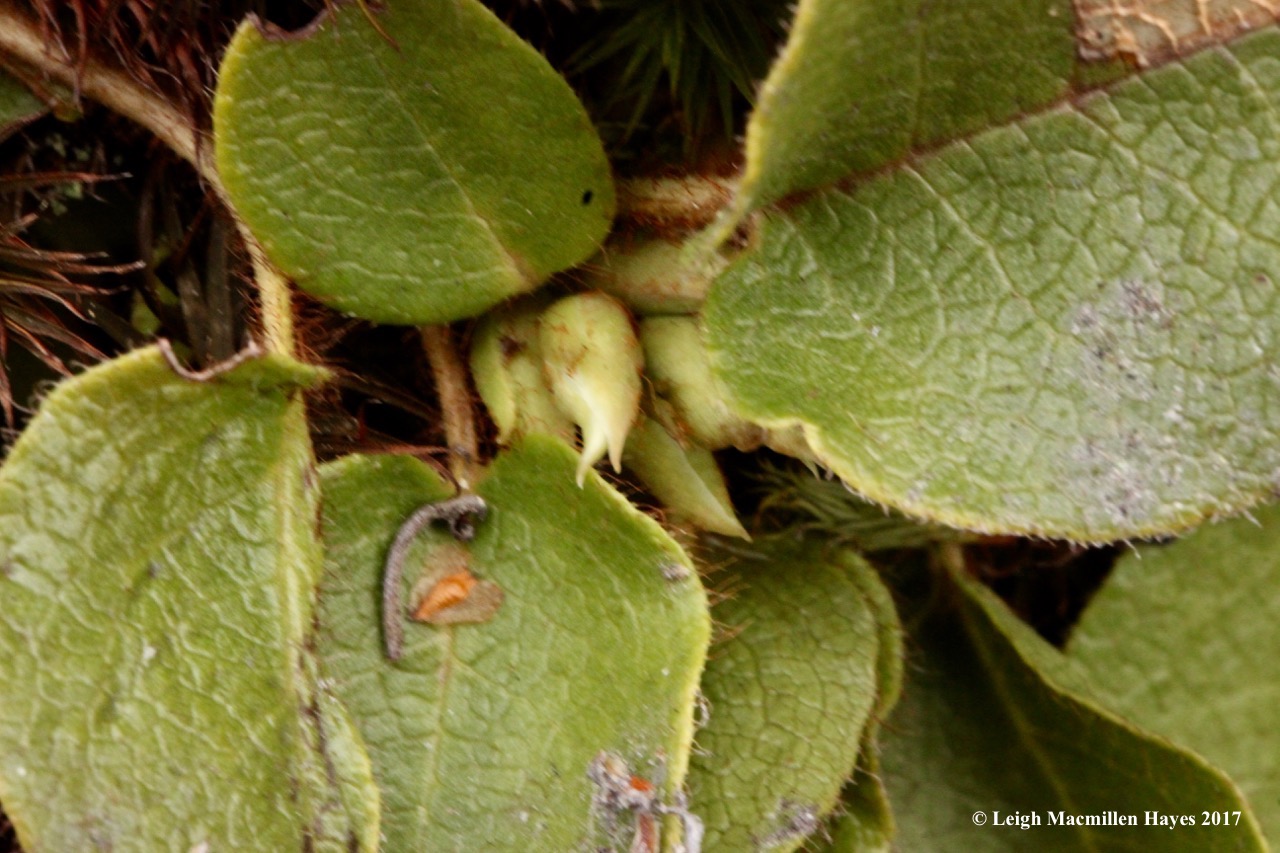
It could have been the sudden sight of so many trailing arbutus plants that got me going.

v-trailing arbutus 2

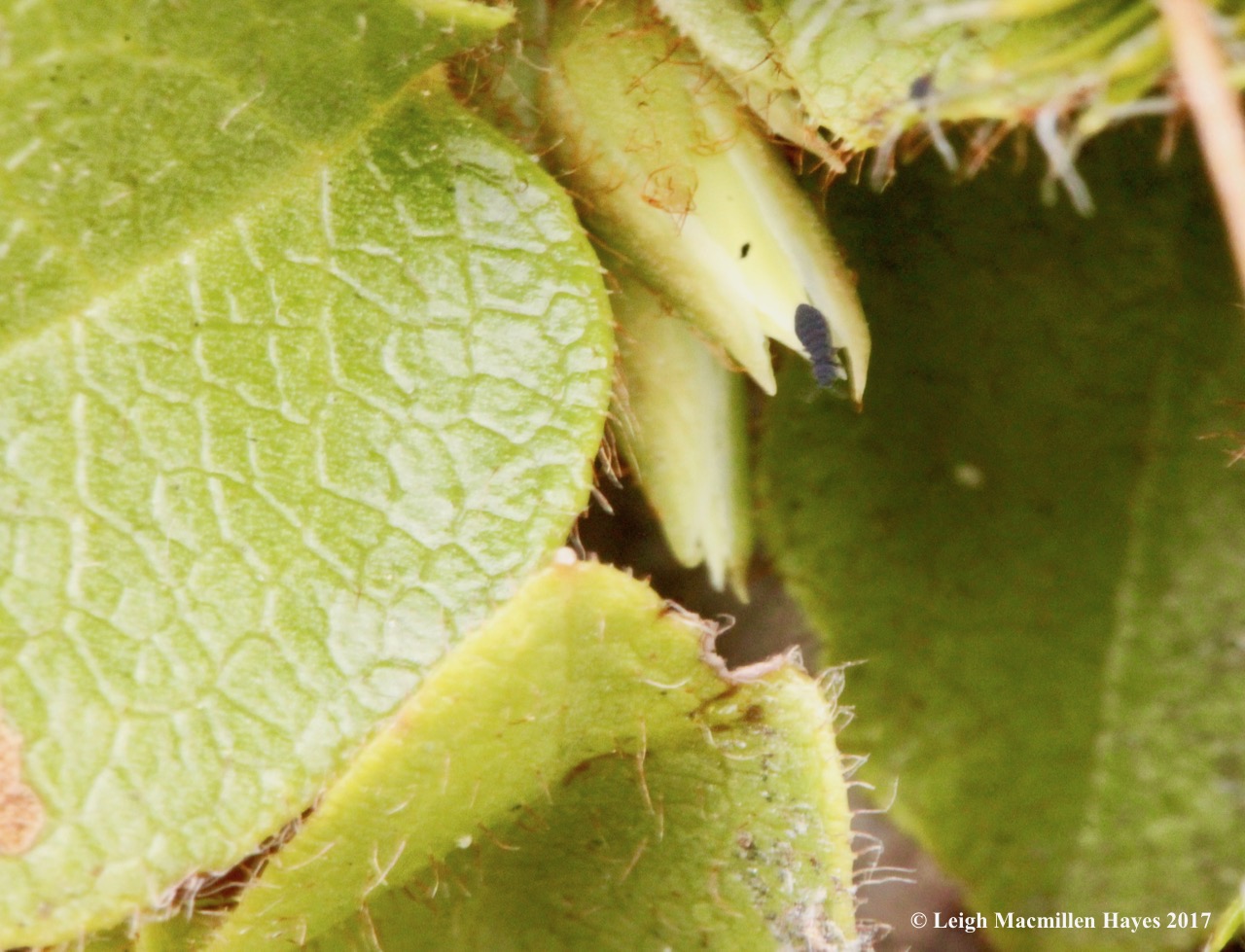
Certainly I wasn’t the only one excited by those flowers yet to be. (Do you see the springtail on the tip of the bud?)

v-vernal pool

Or it might have been the ever shrinking ice cover at the pool that made my feet tap.

v-vp edge opening

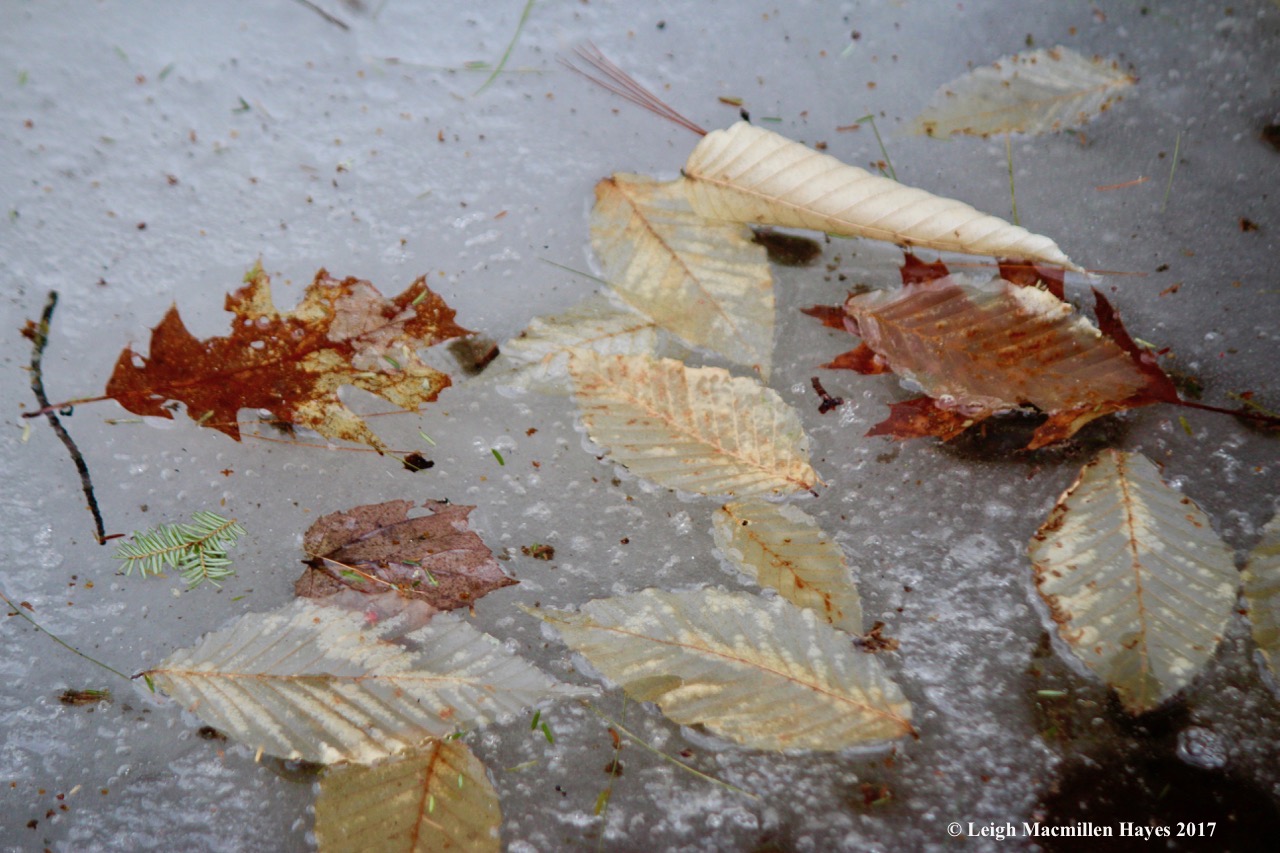
Perhaps it was the fallen beech leaves atop tree reflections that forced me to sway.

v-leaf offerings

Or the way the hemlock, oak, maple and beech leaves intermingled.

v-spermatophores

What I do know is that there was no stopping me once I spotted spotted salamander spermatophores atop leaves in several open sections–the sperm being located at the top of the cauliflower-shaped platforms.

v-frog 1

And then I saw something swim under some leaves that really got me rocking. Do you see the face of the wood frog, hiding as best it could?

v-fox scat beside vernal pool

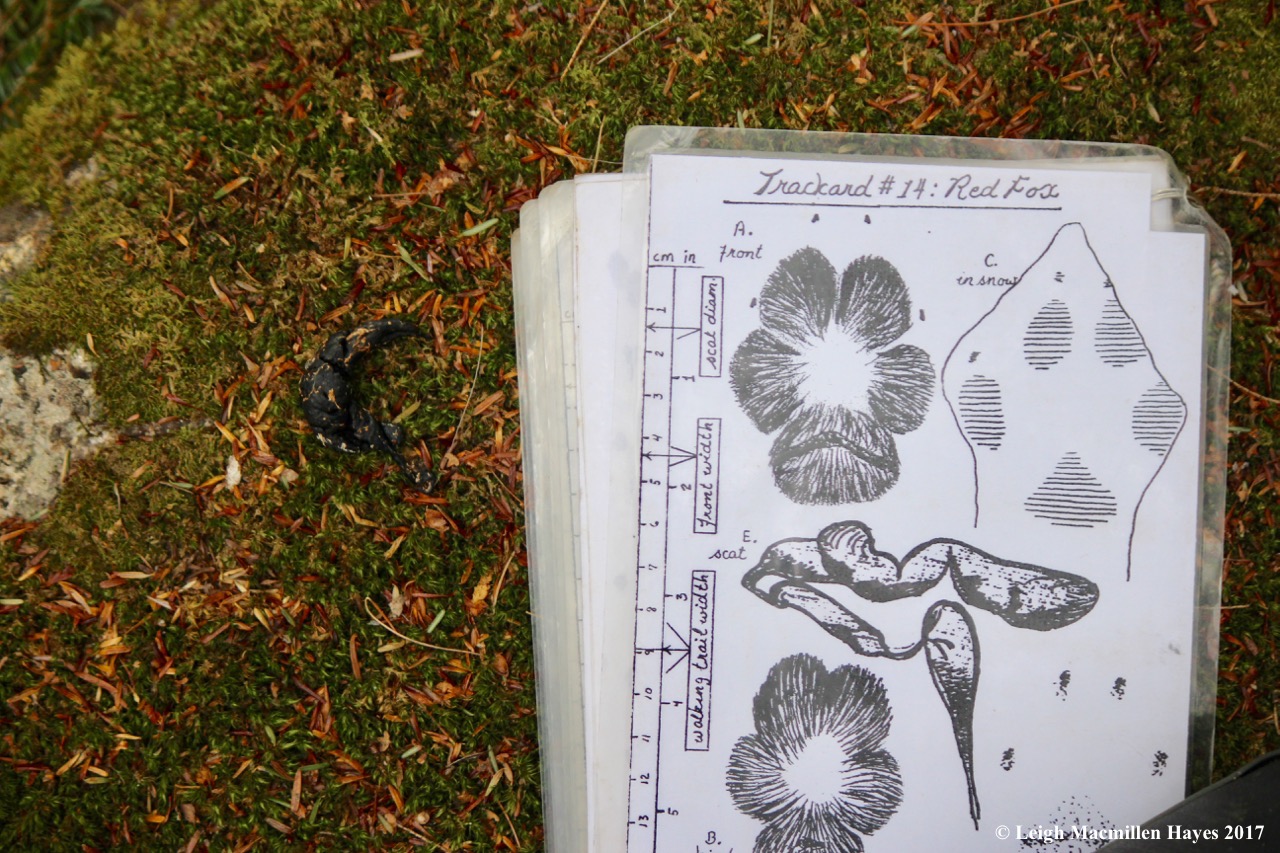
As I began to circle around the dance floor, I noticed an offering of scat that made me think a red fox had sashayed beside the pool.

v-sharp-shinned hawk feather?

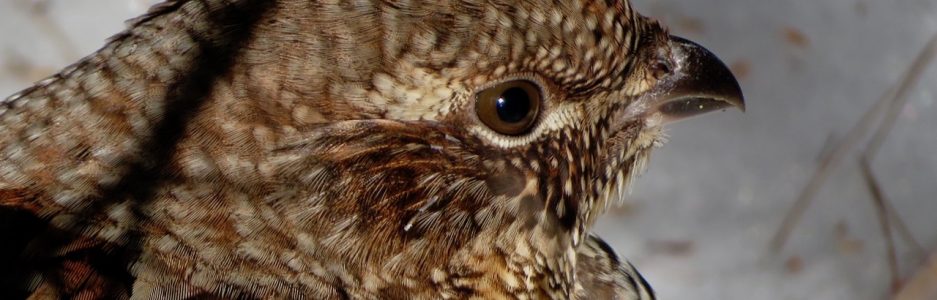
On my own sashay home, I discovered that there were other dancers in the midst–this one possibly a sharp-shinned hawk.

v-woodpecker feather

And after that a woodpecker.

v-junco feather?

And then a junco.

v-red maple flowers 1

Along the cowpath, the red maple flowers blushed as I might were I to get all gussied up in a flowing dress.

v-red maple flowers 2

Much the way a suitor might wink, so much has happened so quickly. Within the past week the snow melted almost entirely away and winter released its hold on me. Now I’m ready to groove with the choreography of spring’s rhythm. I hope you’ll join me on the dance floor.

May I have this dance?