Where The Moccasins Led Us

Rituals. We follow them. Some more than others.

For My Guy and me, there is one in particular that captures our attention beginning in mid-May.

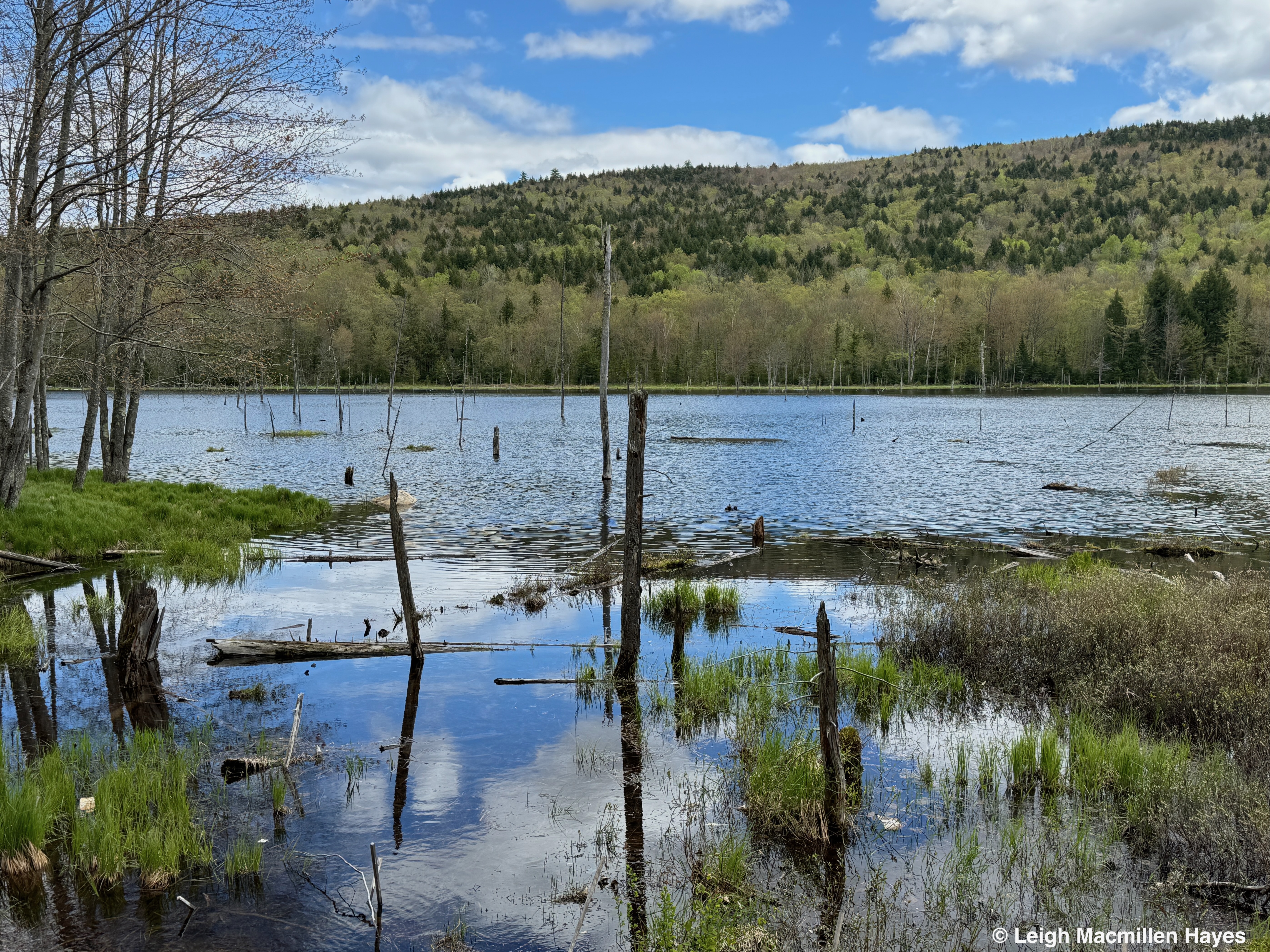
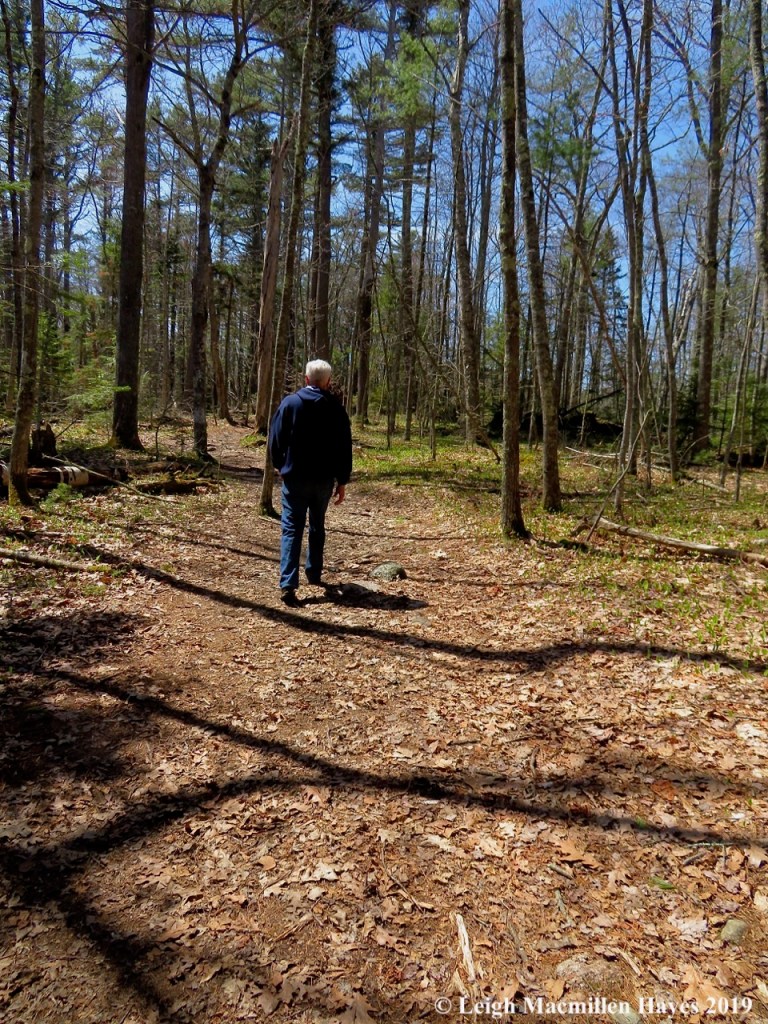
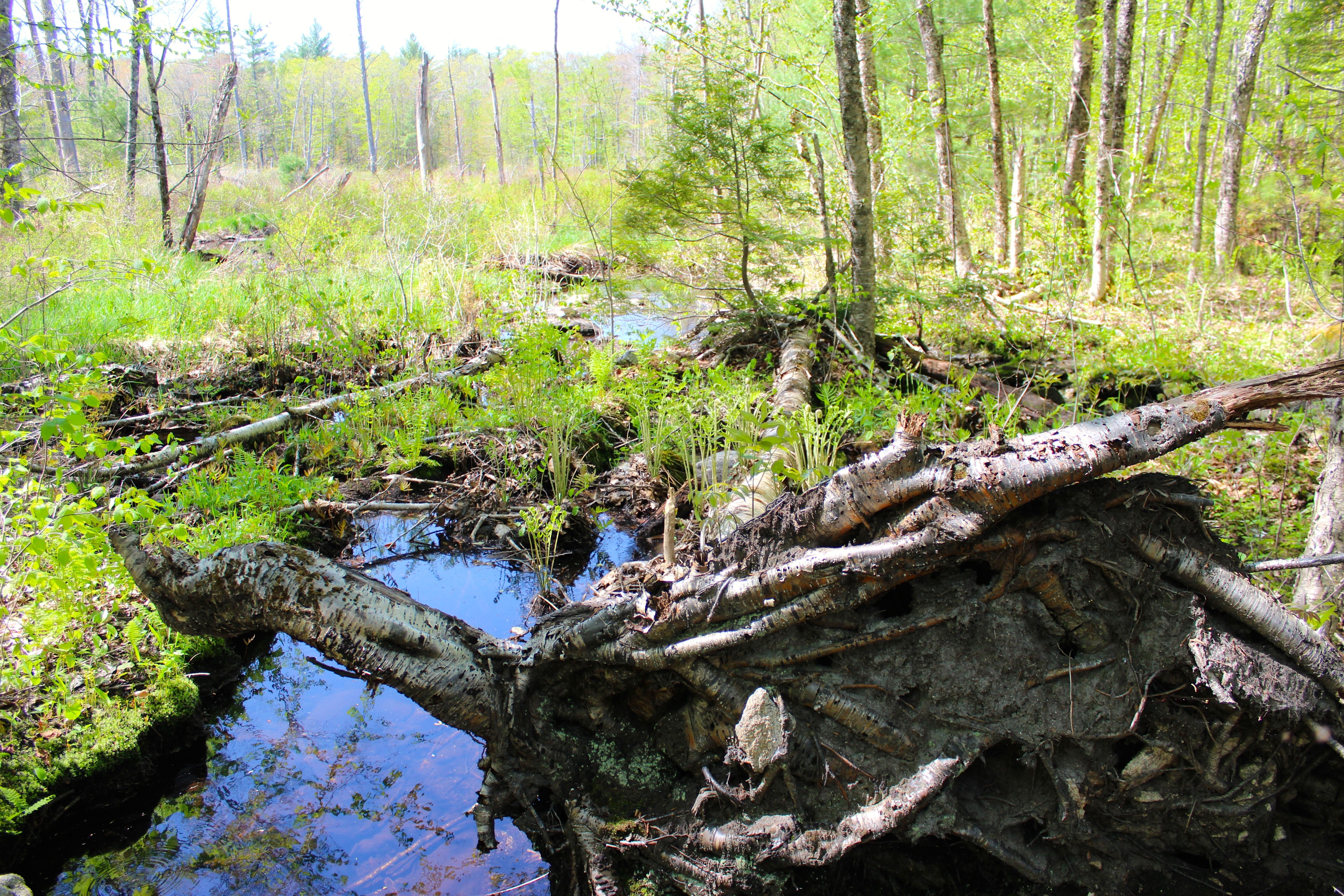
And so I follow him . . . across Beaver dams,
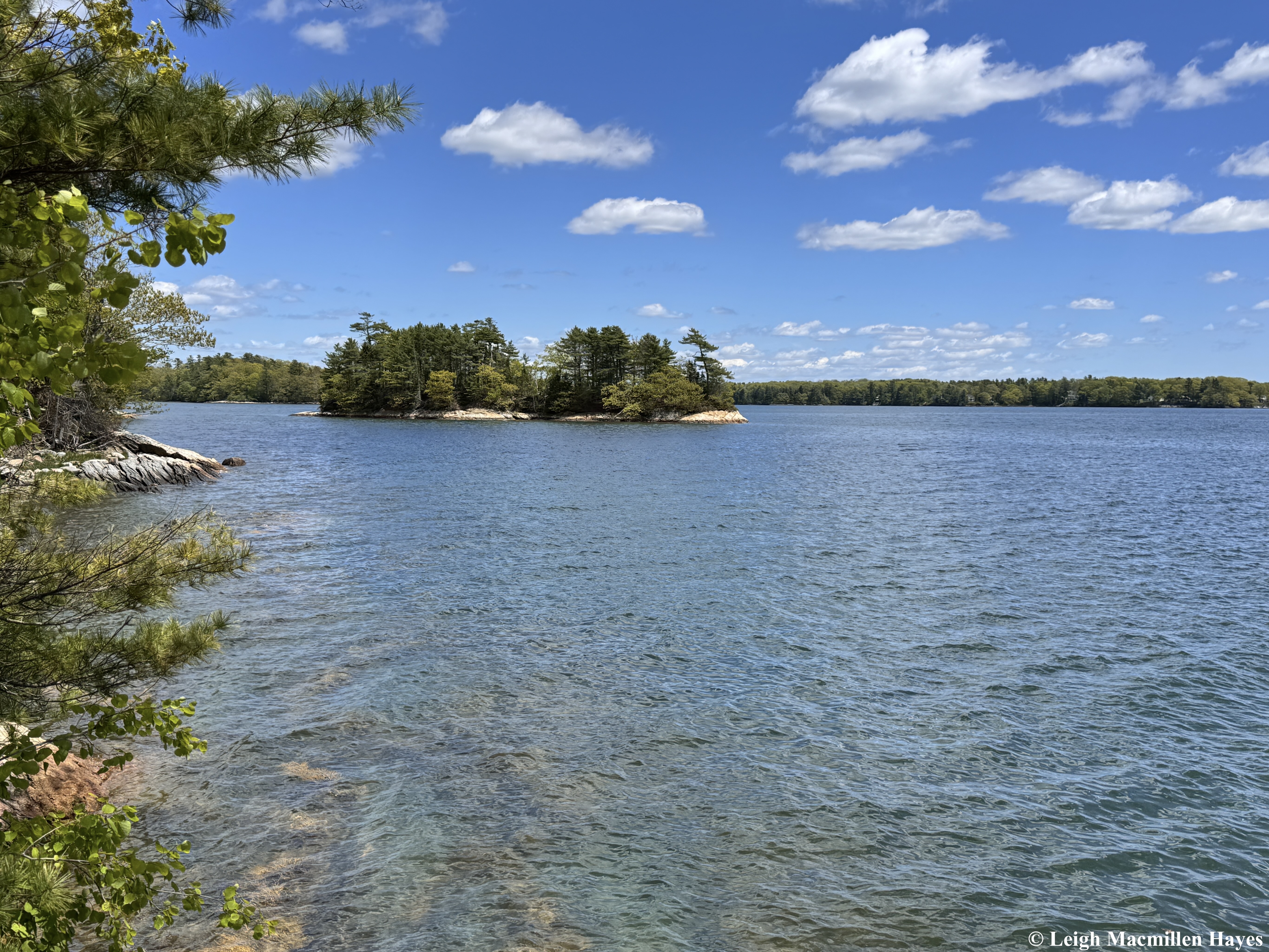
beside the Atlantic Ocean,
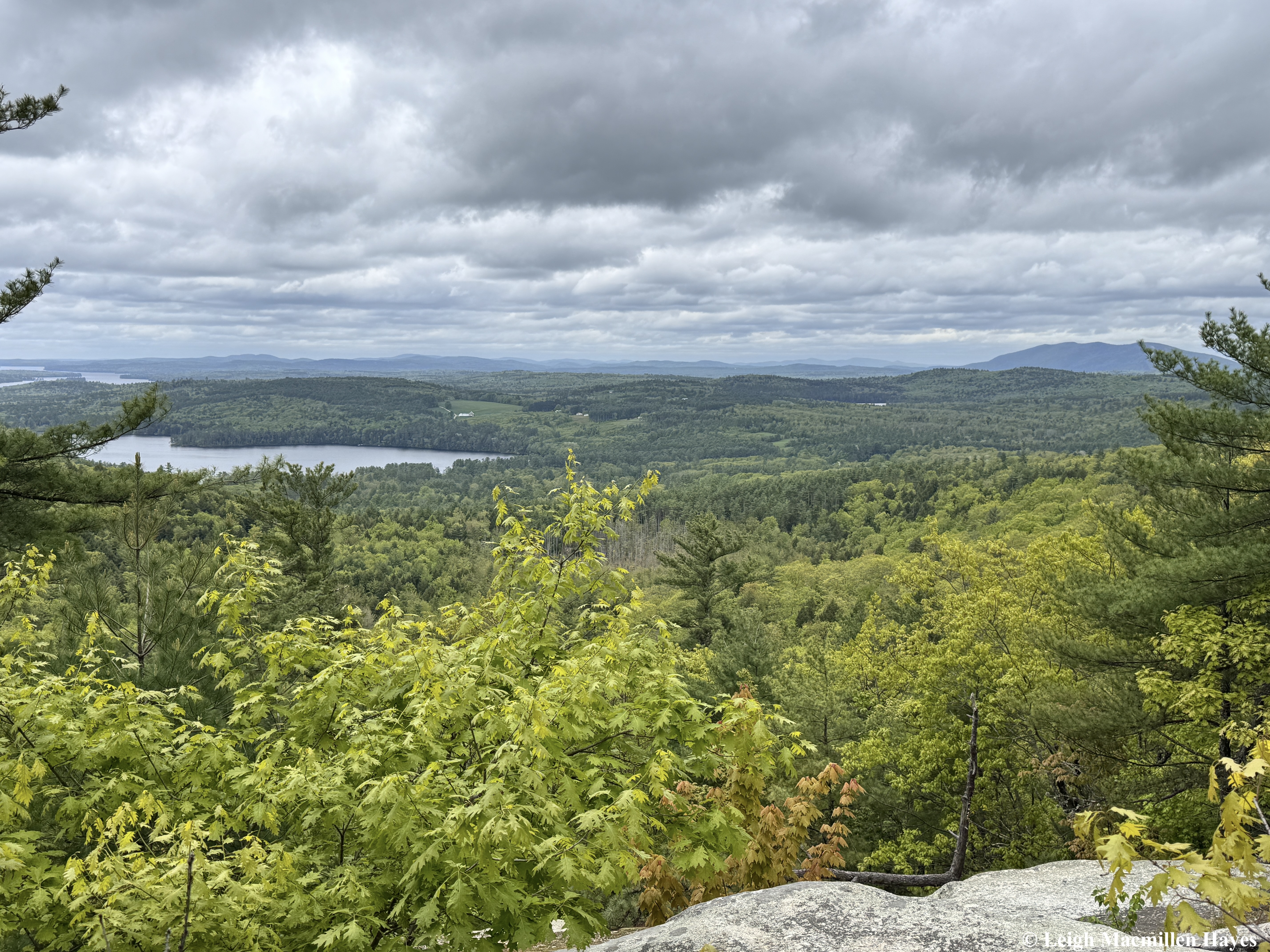
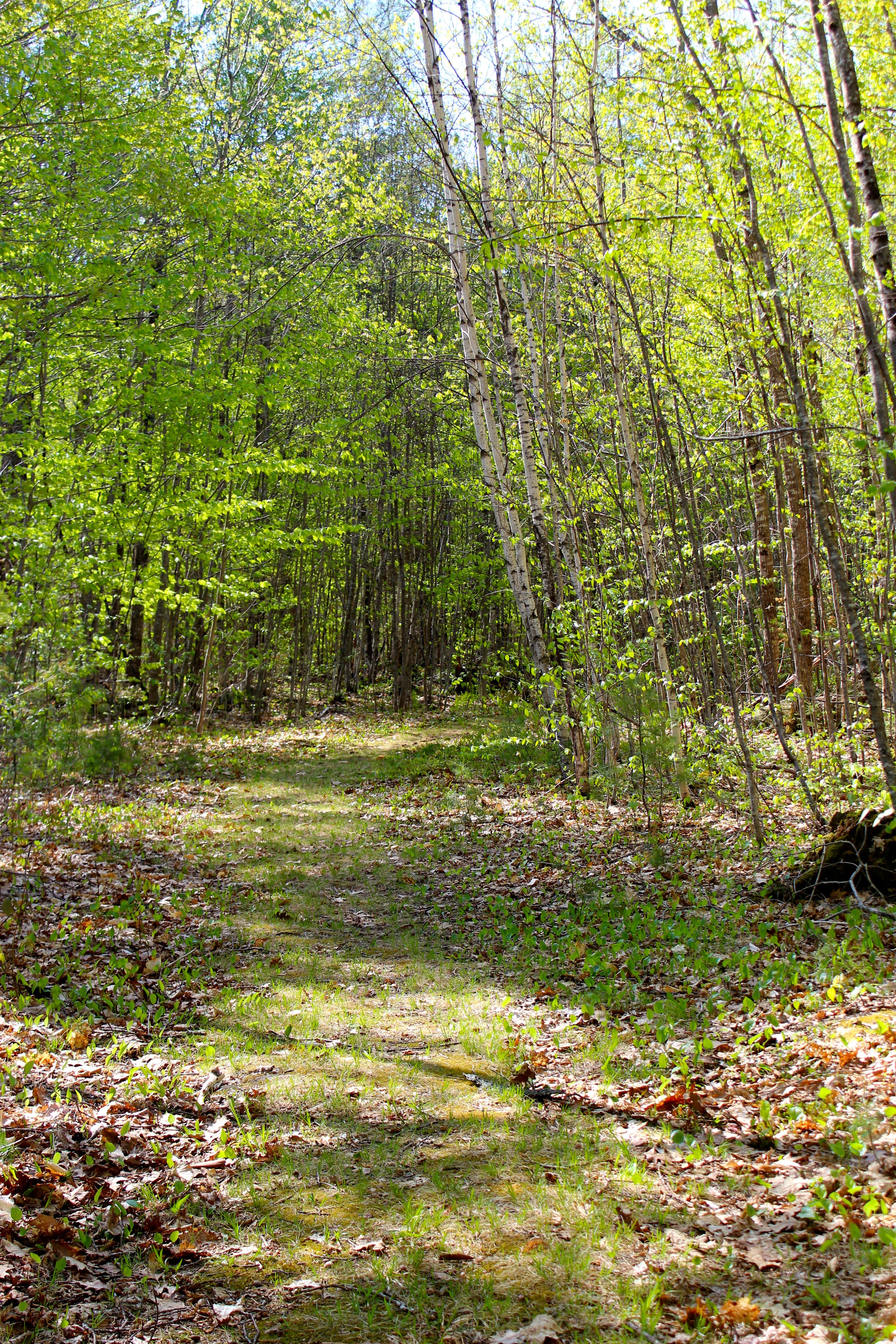
up mountain trails,

even on the hottest day so far with Canada wildfire smoke casting a haze.

This year it was more trails than usual that were included in our ritual and along the way we spotted Wild Columbine in bloom, growing as it does among the rocks, and always pleasing our senses with its brilliant colors and artistic nodding presentation.

Fringed Polygala, and how I love the way those two words roll of my tongue, also showed off, making its common name of Gaywings so apparent. Doesn’t it look like a Bird of Paradise coming in for a landing upon its very own leaves?

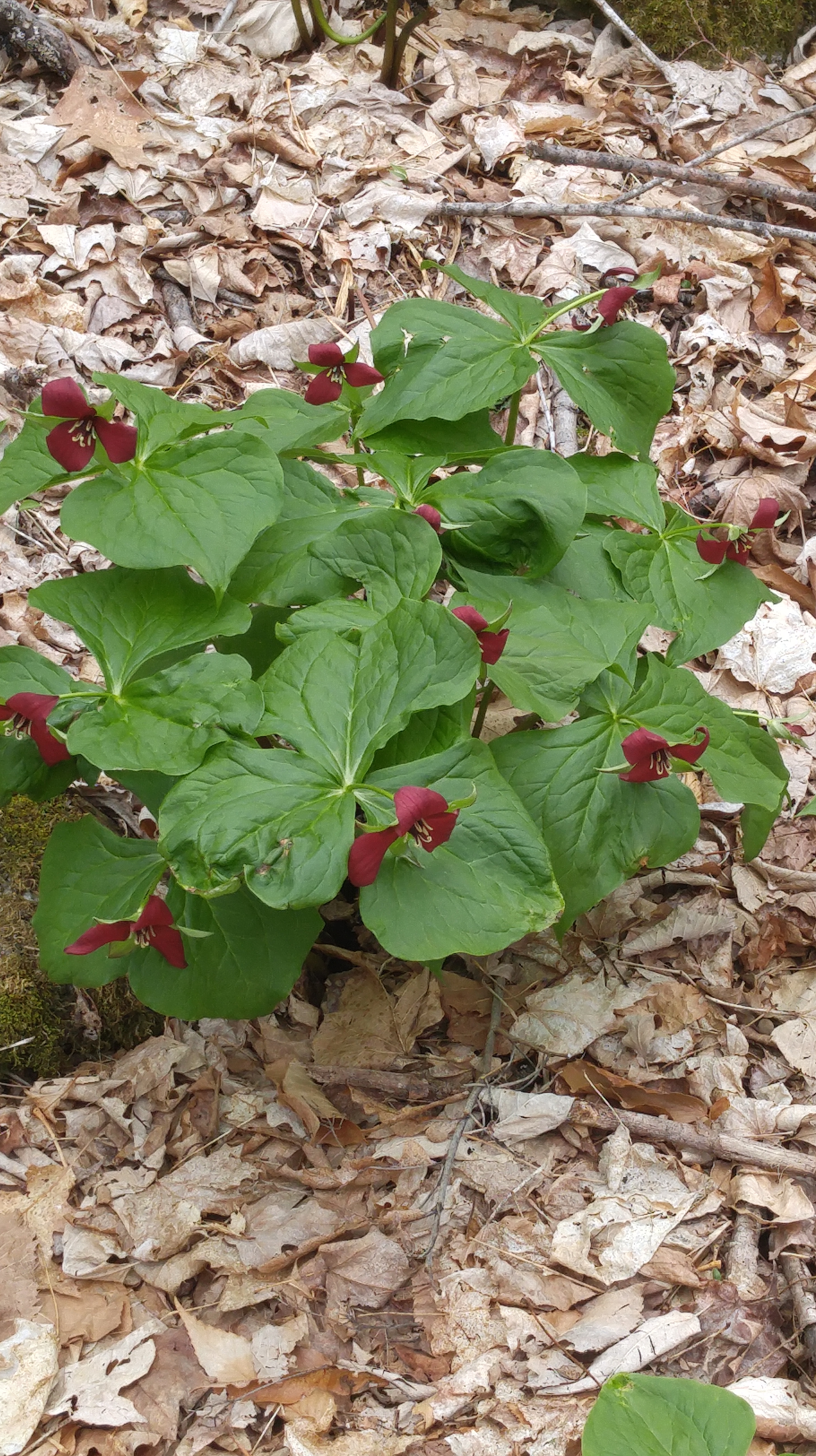
Upon one of our journeys we found a few Red Trilliums still in bloom, though it seemed late in the season for them. But as My Guy teases, I did what I do and added this photo to the other trillion I have of this plant. They all need to be honored, don’t they?
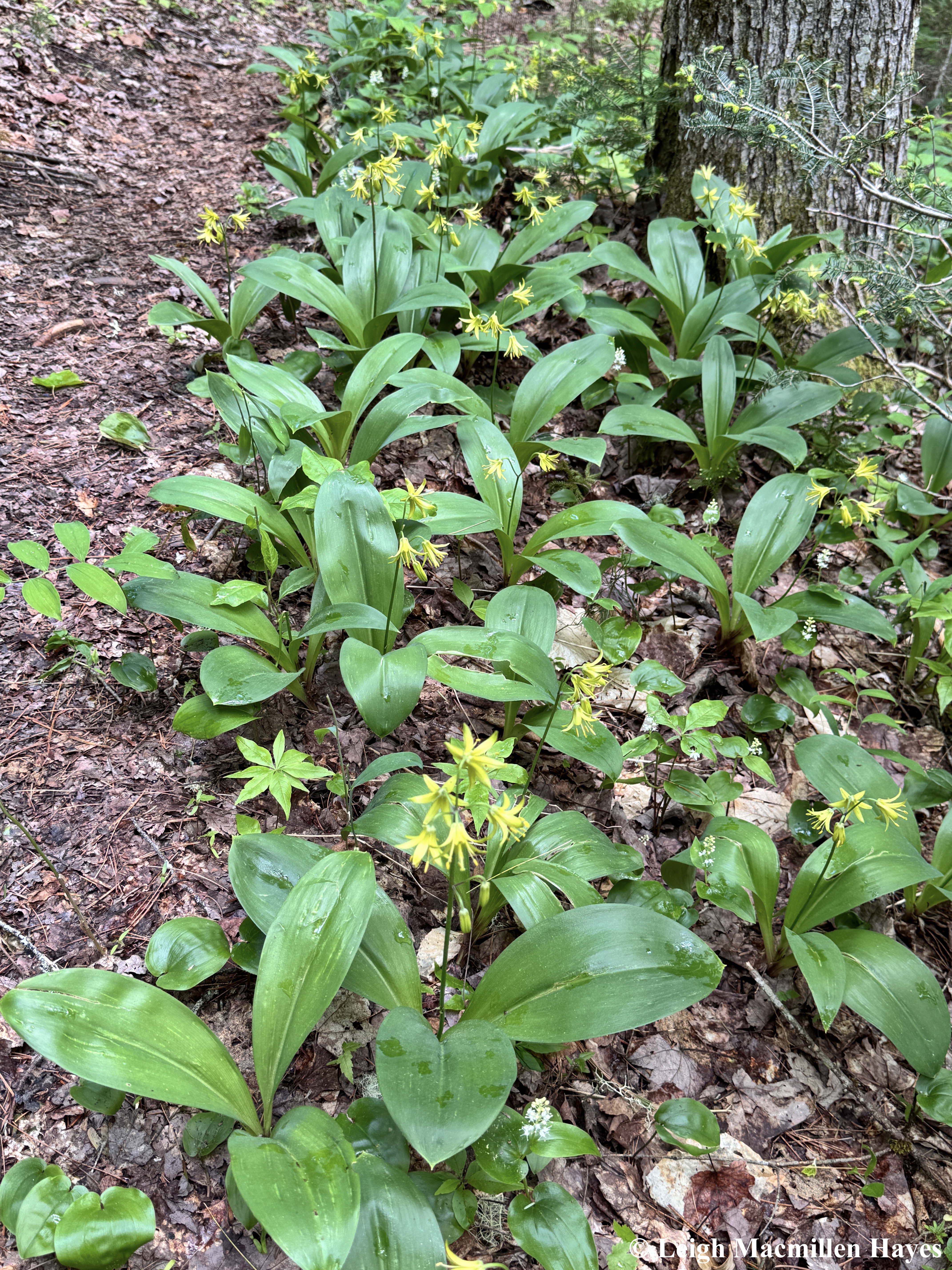
Seemingly everywhere, Clintonia, aka Blue-Bead Lily bloomed, adding specks of sunshine to the path and lighting our way, even on the grayest or rainiest of days. Yes, we even hike on rainy days.
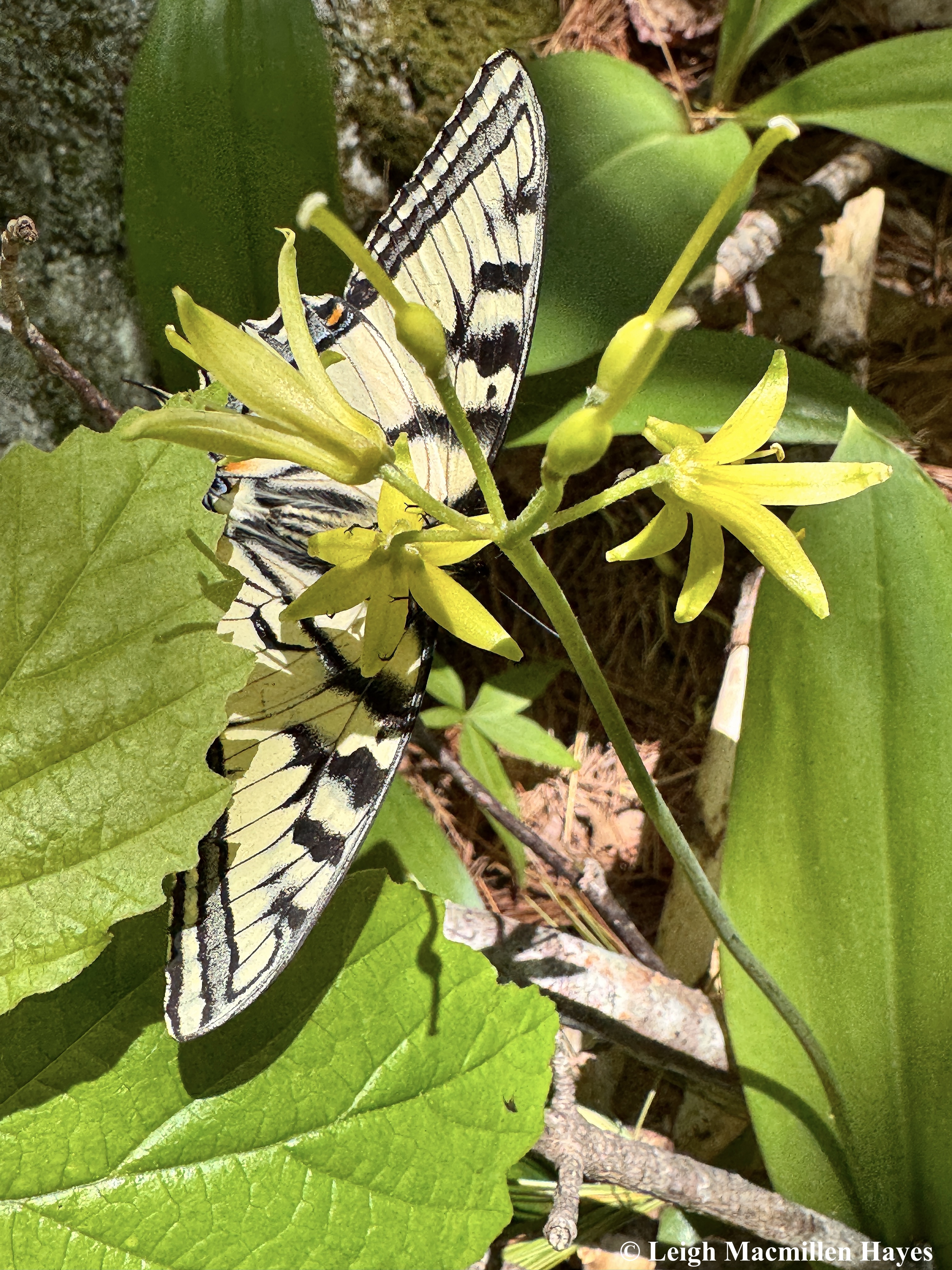
On sunnier days, the Tiger Swallowtails added their own yellow to the equation. Can you see the tiny pretarsi or insect feet of the butterfly as it held on why sucking the flower’s nectar?
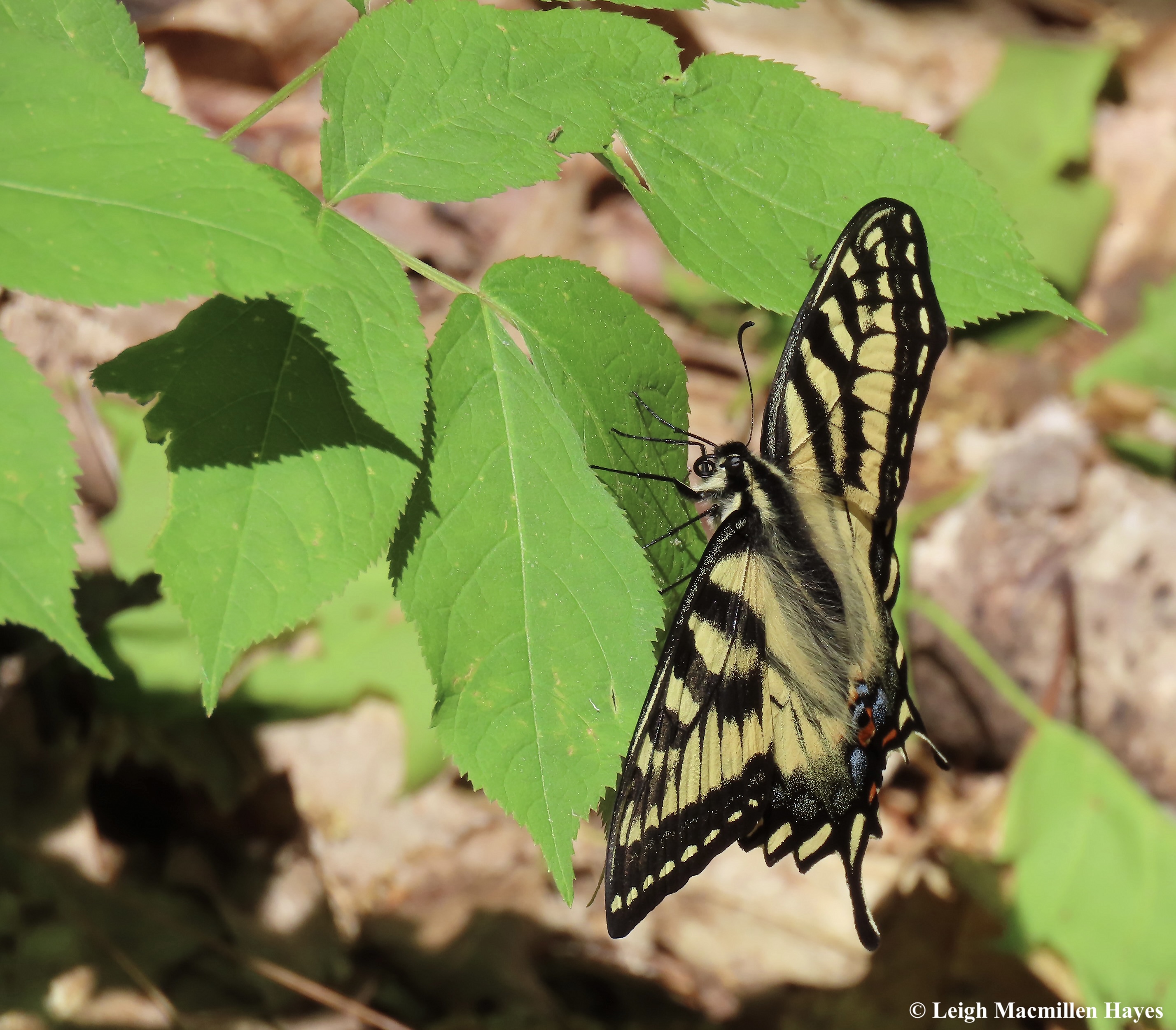
This spring it seems the Tiger Swallowtails are everywhere we travel by foot or truck. What I love about this one is that it was taking a break upon the leaves and you might be able to see its proboscis or siphoning mouthpart coiled up because there was no nectar to seek in that moment.

Right now the Swallowtail butterflies are the largest we’ve seen flying, but during a hike the other day, we spotted one of the smaller ones, this being a Northern Azure feasting upon Black Chokeberry flowers at a summit.

Jack, or rather Jill-in-the-Pulpit, for she needed the extra leaves to help her in her mission of producing seeds, greeted us in various places where the soil was moist including beside the cow path in our woods, where it totally surprised me despite the fact that we’ve lived in this house and wandered about for over thirty years.
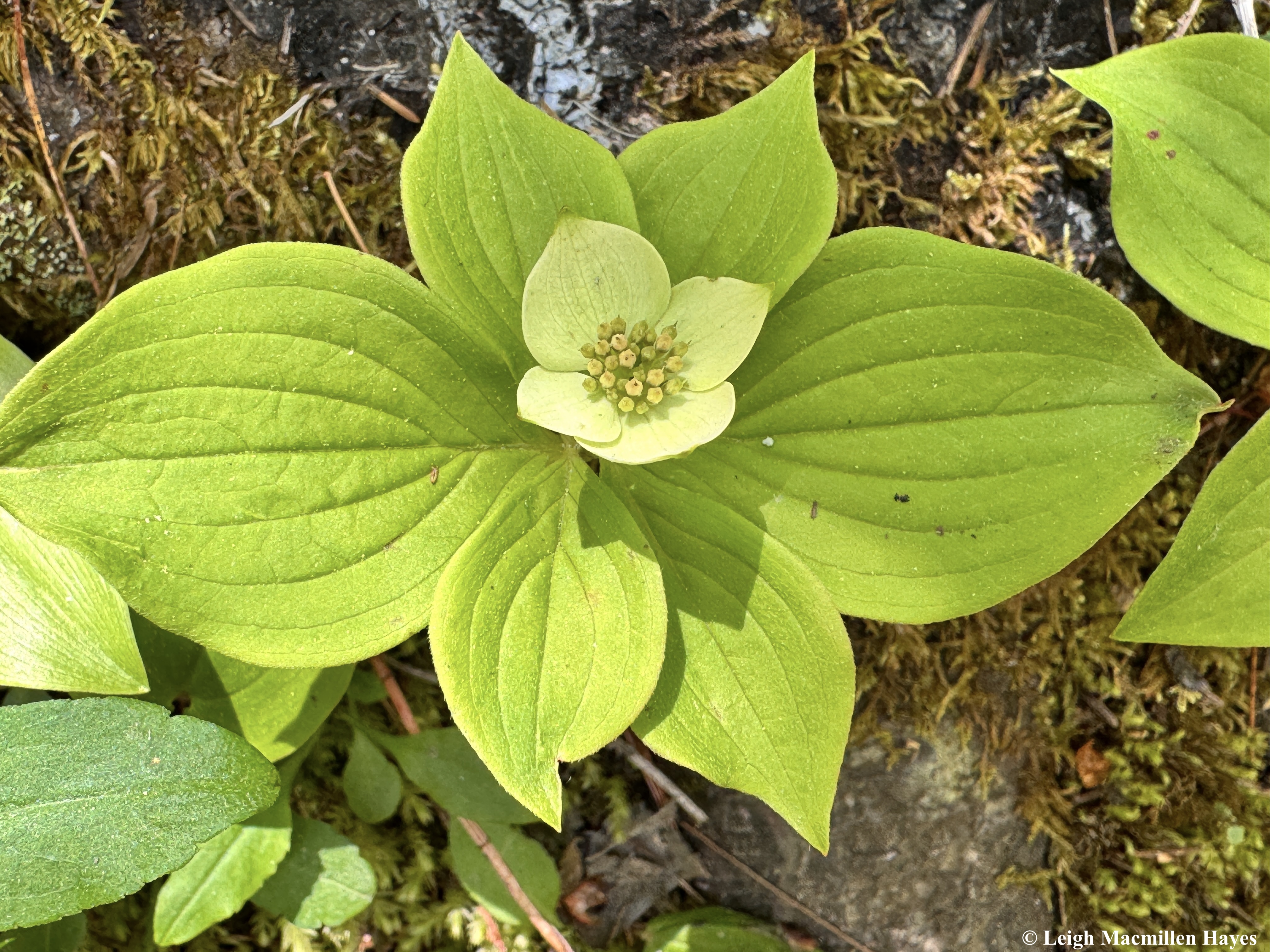
As one week turned to the next, and the flowers that were in full bloom kept changing, suddenly Bunchberry was added to the list. Again, like Jill-in-the-Pulpit, Bunchberry needs two extra leaves in order to have more energy to produce flowers followed by the berried fruits that bunch together in a cluster of bright red. You may look at the veins on those leaves and immediately know the family to which this wee plant belongs–if you guessed Dogwood, you are correct.
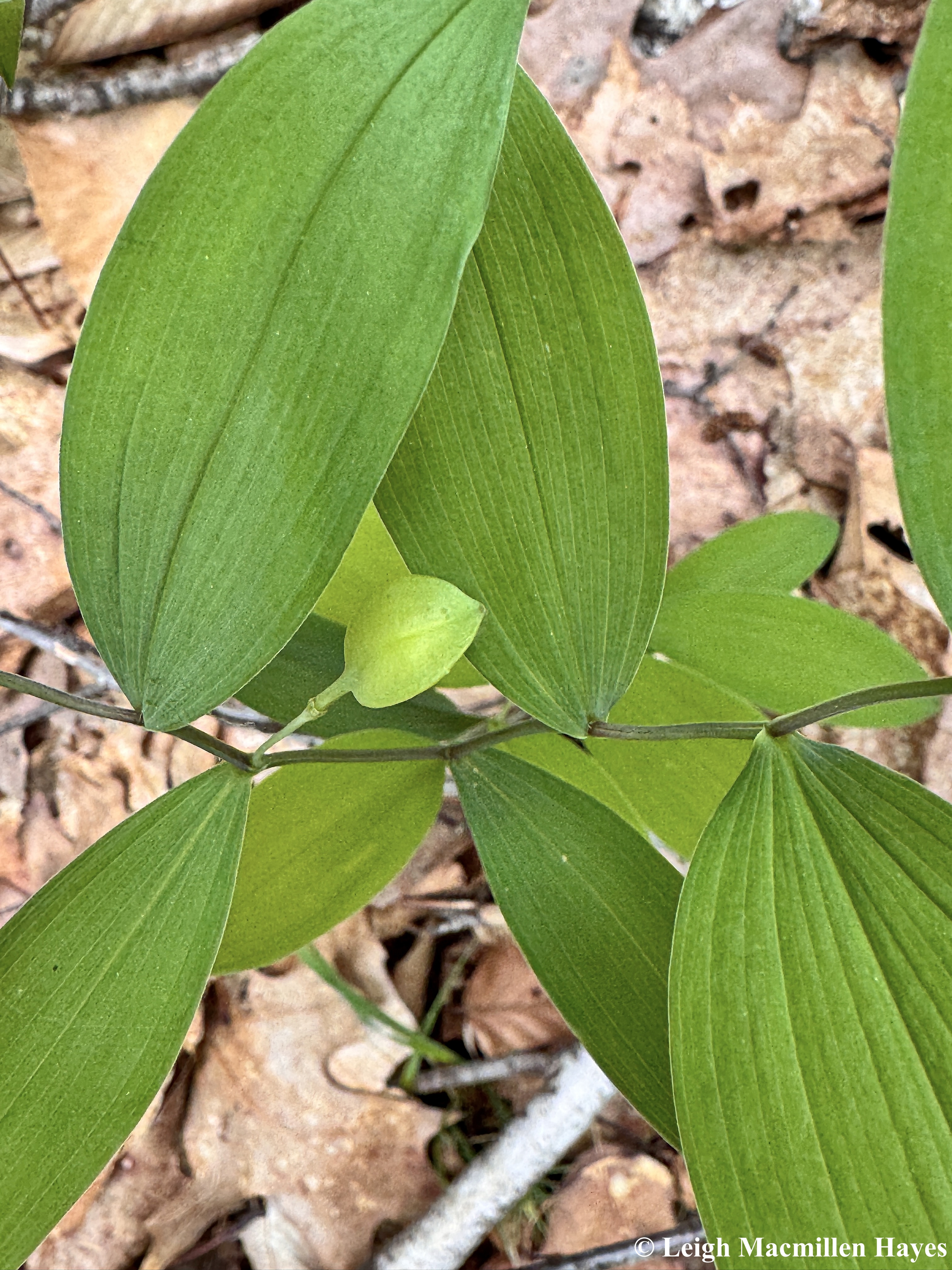
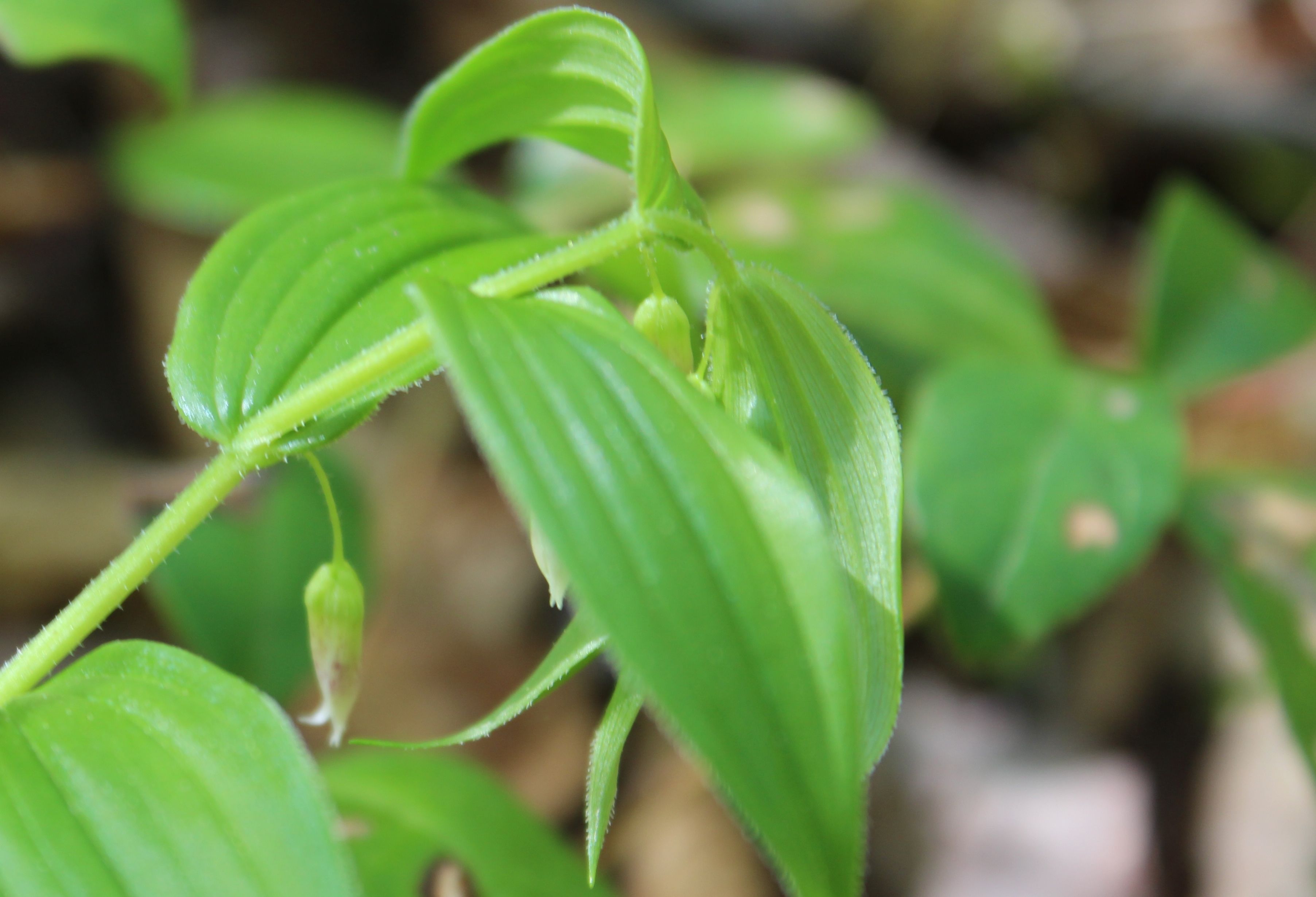
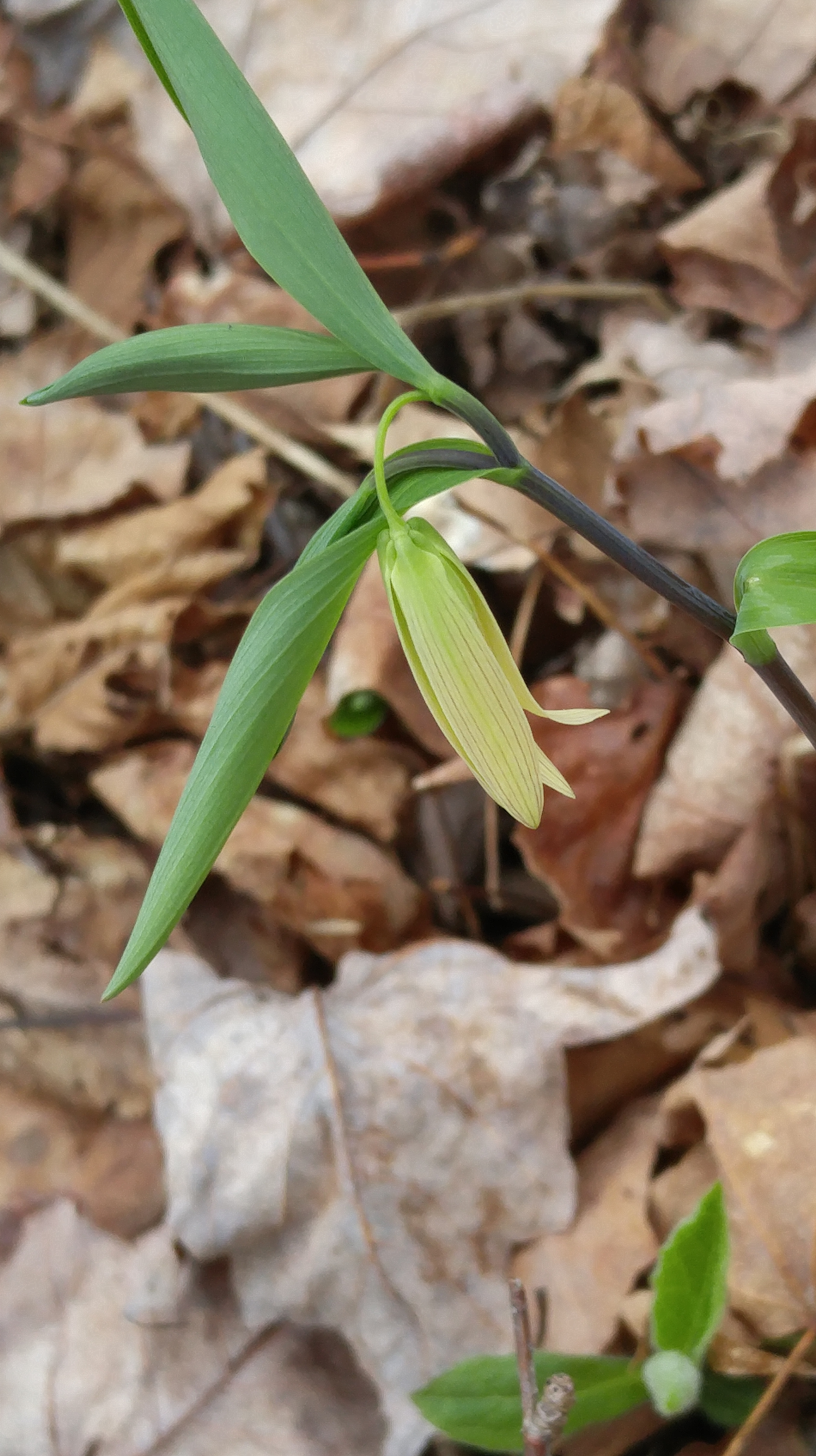
One of the earliest bloomers of spring, has already formed into a fruit, in this case three sided. Meet the Wild Oat of Sessile-leaf Bellwort. It reminds me that in a snap of the fingers, the season passes by much too quickly.

It wasn’t just flowers that marked our journeys. About the same time that we began the latest ritual, dragonflies and damselflies slowly began to emerge, for which we always give great thanks as they gobble up some of the Mosquitoes and Black Flies that so annoy us. This American Emerald had only just made the transformation from aquatic form to terrestrial hours earlier based on the sheen still visible on its drying, but not quiet dried yet, wings.

Much more mature were these two, who had formed the marital wheel in order to canoodle. I knew they were Emerald Dragonflies, but wasn’t sure which species until I searched my guides back at home: Uhler’s Sundragon, a new species for me.

And in at least one spot, some smaller female dragonflies deposited eggs as they tapped the water’s surface with their abdomens. Think of it as Naiads to come, who will live in the water for 1 – 3 years, depending upon species, before climbing out and transforming miraculously into terrestrial fliers.

Being beside water in another place, and looking between tree branches, we spied a Common Merganser taking a bath.
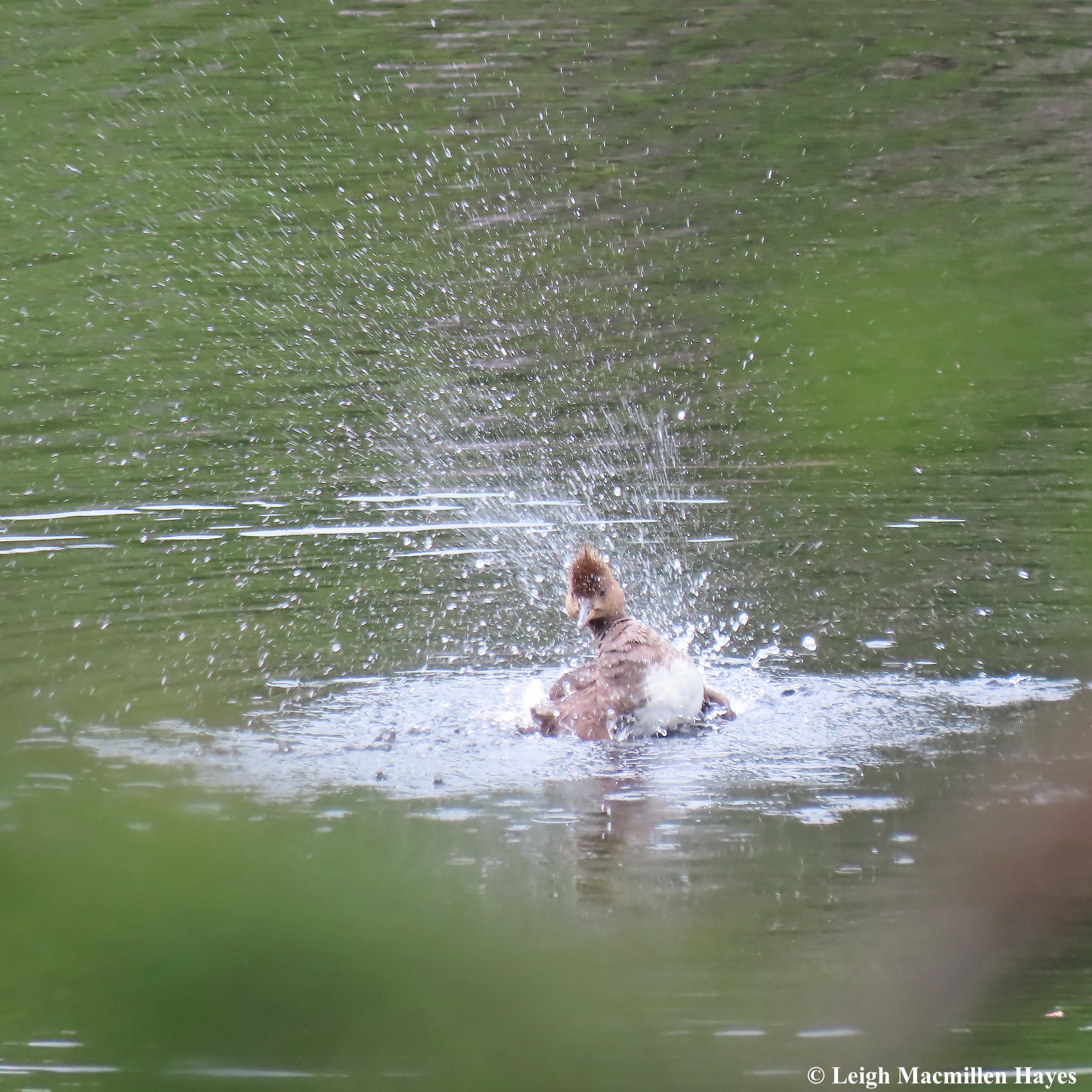
We stood just far enough back, that it didn’t realize it had an audience as it splished and splashed.
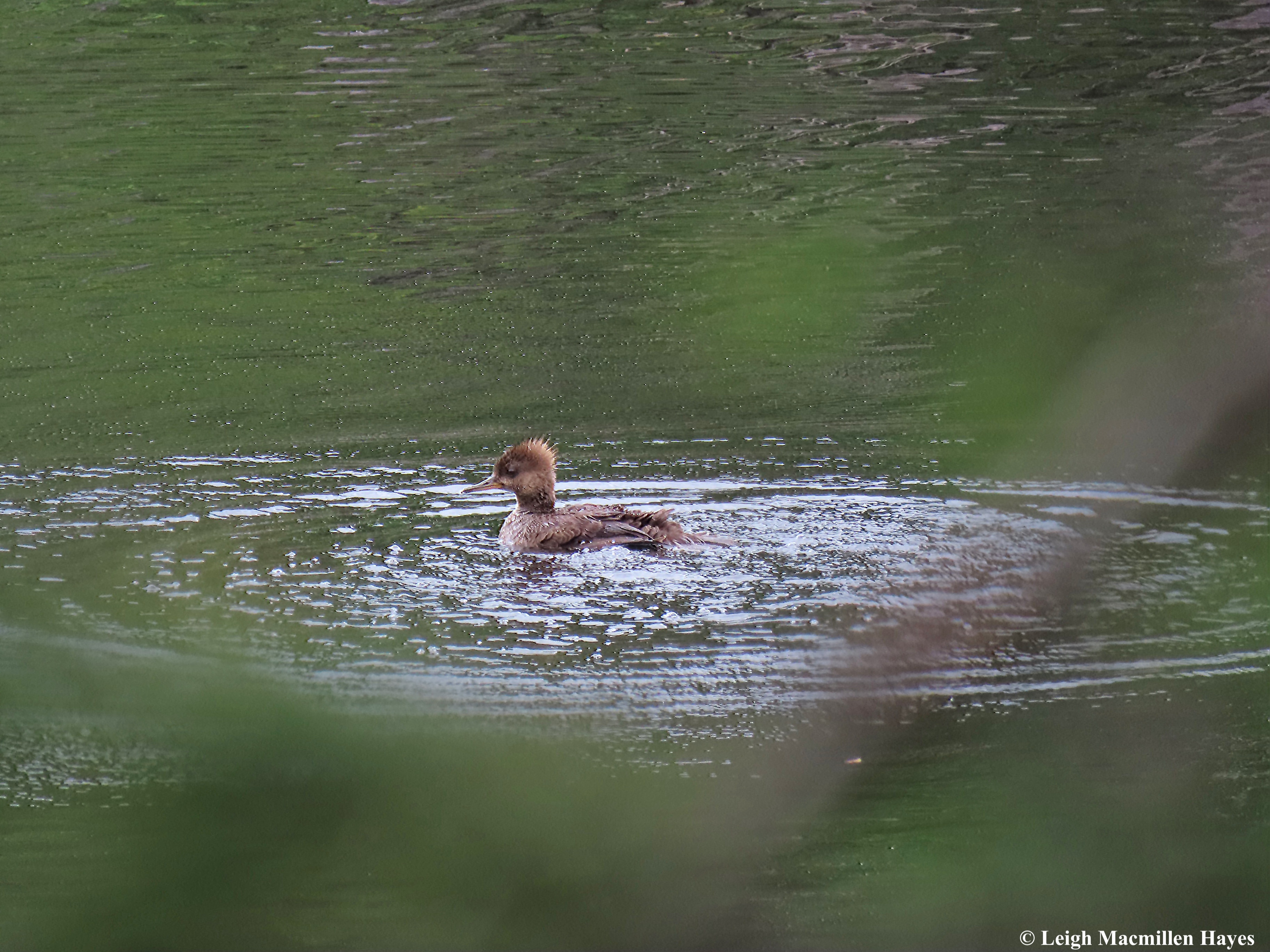
And finally shook itself off, with water spraying everywhere, before it continued on its journey . . . and we did the same.

Basking Painted Turtles became a common sight as well, and this one had the cushiest place upon which to recline, all others being on fallen logs or rocks and boulders in the water.

One, however, that I assume was a female, though I didn’t want to disturb it and get any closer to check the length of its nails, I surmised had been laying eggs or was about to. Our time together was limited so I don’t have the entire story, but she was in a safe place, no matter what.

One of our most unusual sightings as we performed the ritual was spying a Bald Eagle steal a fish from the grip of an Osprey. If you look closely at the center of the photo, you might spot the thief on its get-away mission–it is flying above the picnic tables, about in the middle of the trees.

As it flew over our heads, the Eagle had the audacity to look back to see if the Osprey was hot on its tail. It was. We don’t know how this story ended either, but we assume the Osprey had to cast its fishing line again.
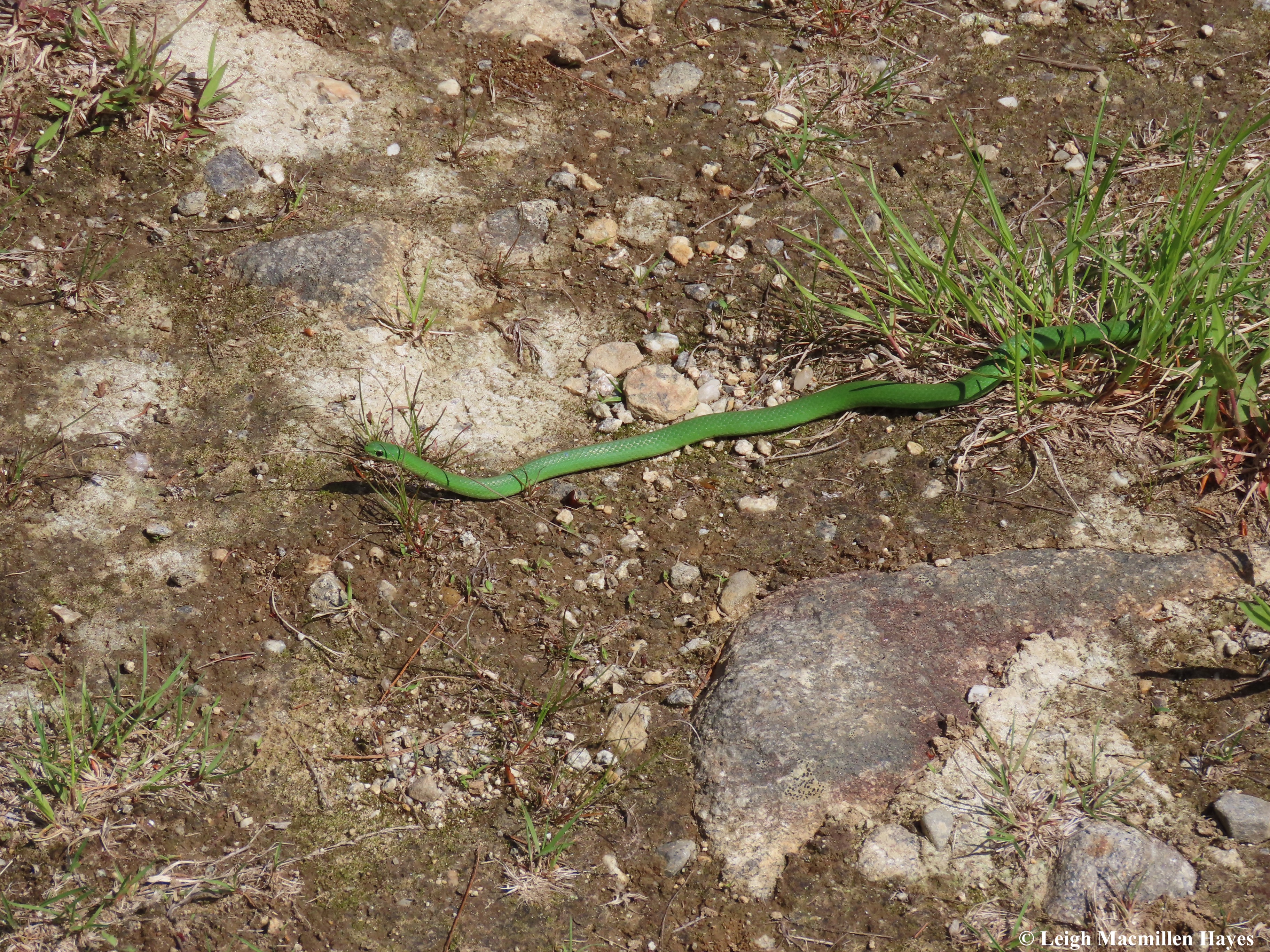
Another fun sighting occurred as we crossed under a powerline on the return trip of a seven mile hike around a river, over to a pond, up a hill behind the pond, and back down and out. Almost the color of the grass that sparsely grew along this section of the trail, a green snake slithered across just after My Guy had stepped that way.
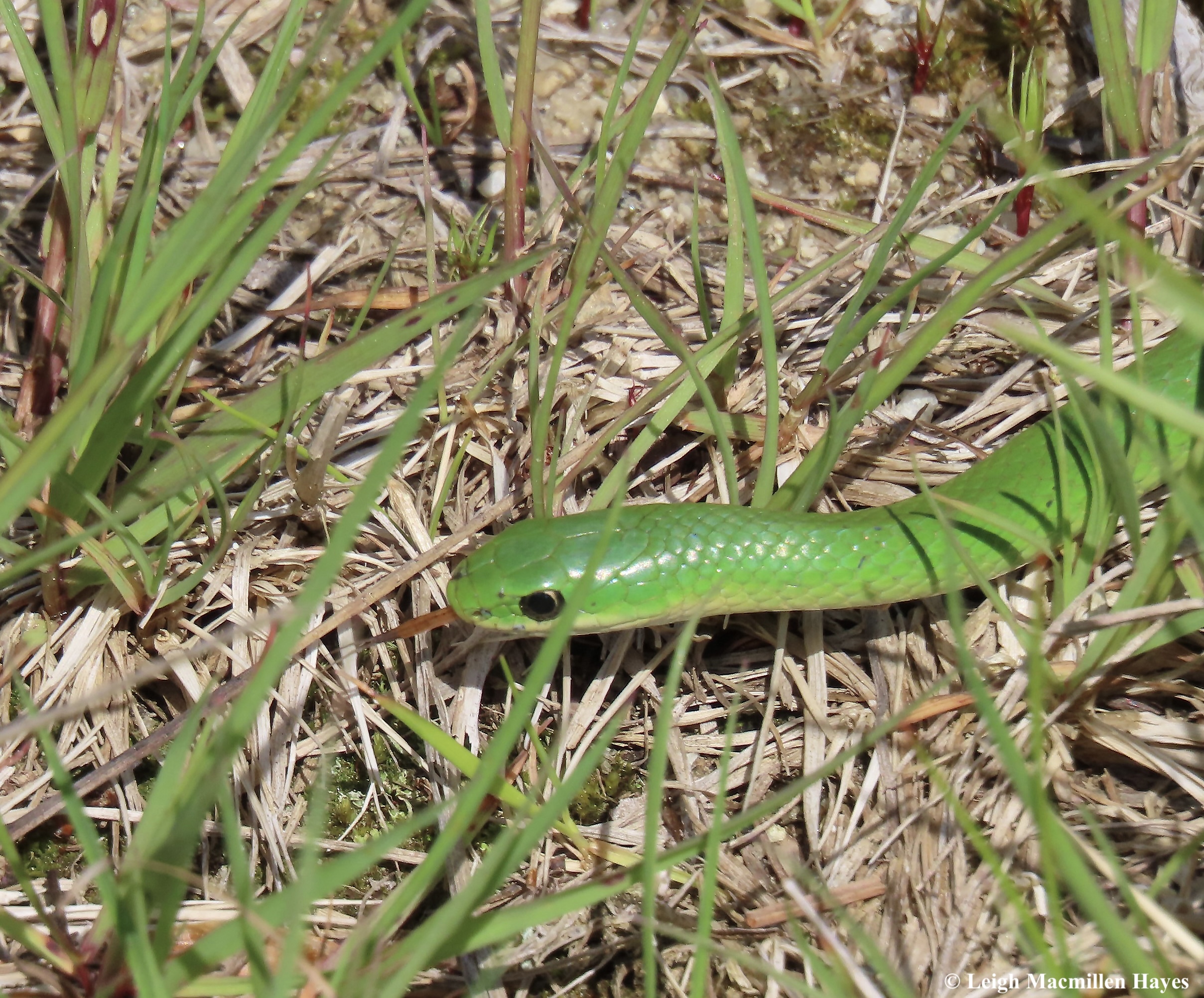
I just love its forked tongue–sensing the trail in snake manner as it did.

The two tines at the tip of the tongue, seen here as it withdrew this sensory organ, help it to smell in stereo and thus find its way and find a meal.

All of these things we saw because of the ritual that we perform every year at this time. It’s one that we now realize involves some greed, but still we feel compelled to do it. We count Lady’s Slippers.

I always thought that orchids were something you received on Prom night and that they grew at the florist. I had no idea that they were actually wildflowers until about thirty years ago. According to Orchids of New England and New York by Tom Nelson & Eric Lamont, Lady’s Slippers are one of 65 species and variants found in our region.

And so they deserved to be counted.

But, oh, how they hide. Do you see the one in the photograph above?

How about now?

Knowing that they can be elusive causes My Guy to slow down for a change. It’s no longer the destination that counts, but rather the number of Pink (and their white variants) flowers that we can spot.
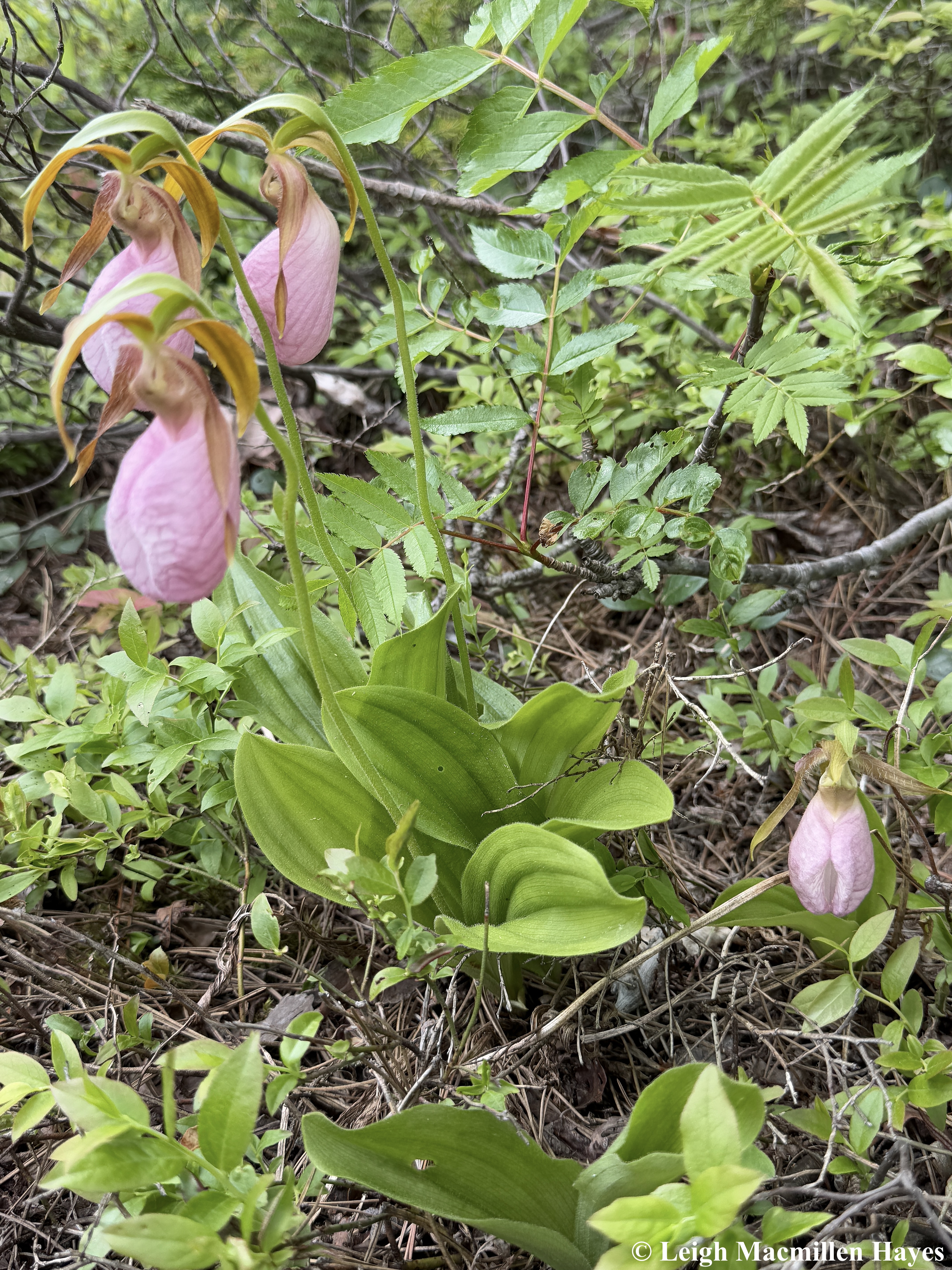
Some are tall, and others quite small. And some are sets of leaves with no flowers yet as in the foreground. We don’t count those.

Here’s the thing about Lady’s Slippers. It takes a long time for a minuscule seed to become a plant. The seeds, developed in capsules, are beyond numerous, but each one has no food source or endosperm. So . . . it must develop a relationship with a Rhizoctonia fungus in the soil to survive. From the fungus the plant gets nutrients for germination and growth. The fungus, in turn, receives nutrients from the orchid’s roots.

BUT . . . all of this takes time. And the presence of the fungus.

Years. First, after at least three years the plant produces a pair of two basal leaves that fold like accordions and remind me of the paper fans we used to make as kids.

One author says it’s another 5 – 10 years before the plant produces a flower; another states 10 – 17. Either way, by the time you spot one, it’s been working for a long time to become a thing of beauty. (And should not be picked or transplanted.)
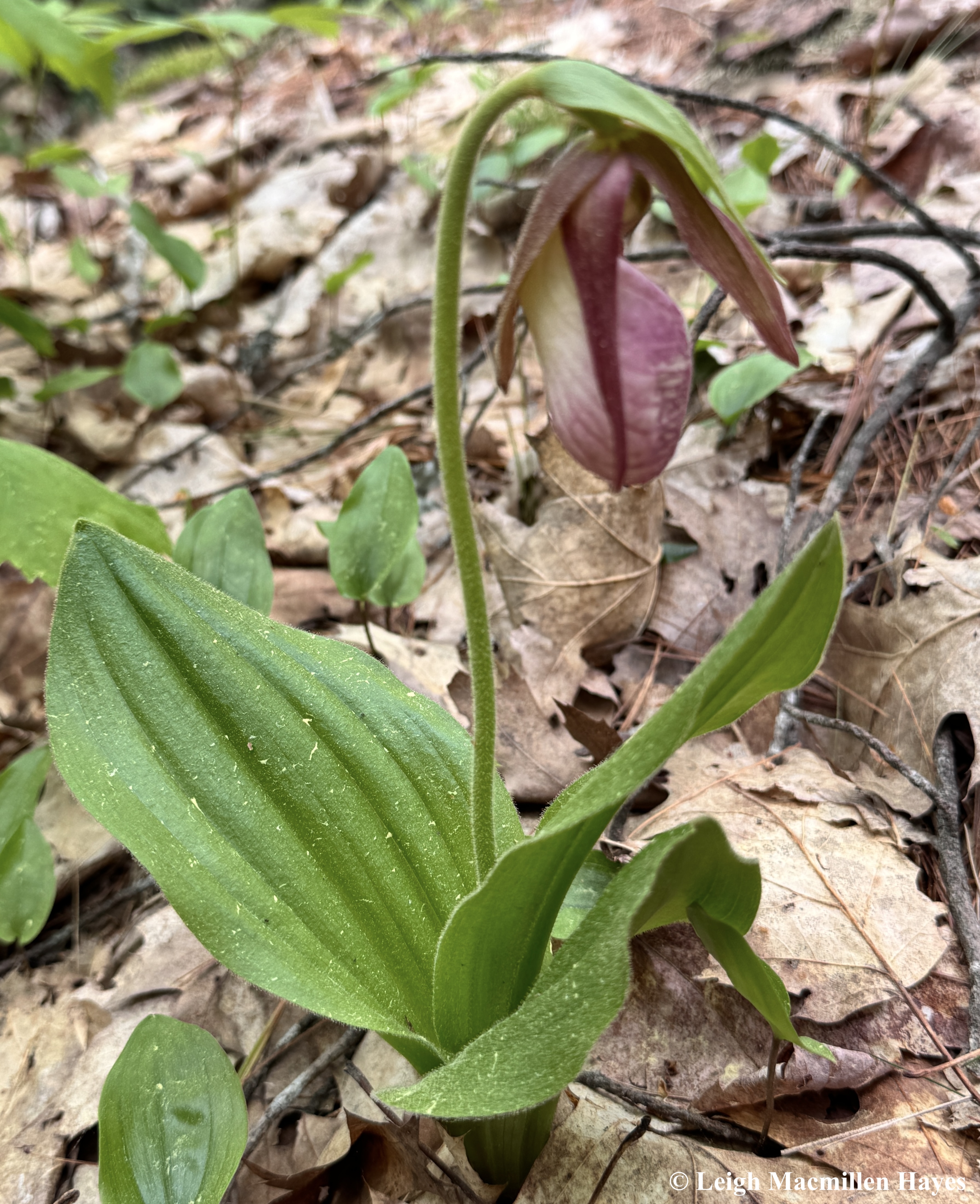
We found one that stymied us for it appeared to have three basal leaves. I can only wonder if there was a second plant there and something happened to its other leaf.

In one spot, we found what we call a bouquet. Sometimes we see three or four grouped together, but in this case 14 plants in bloom.
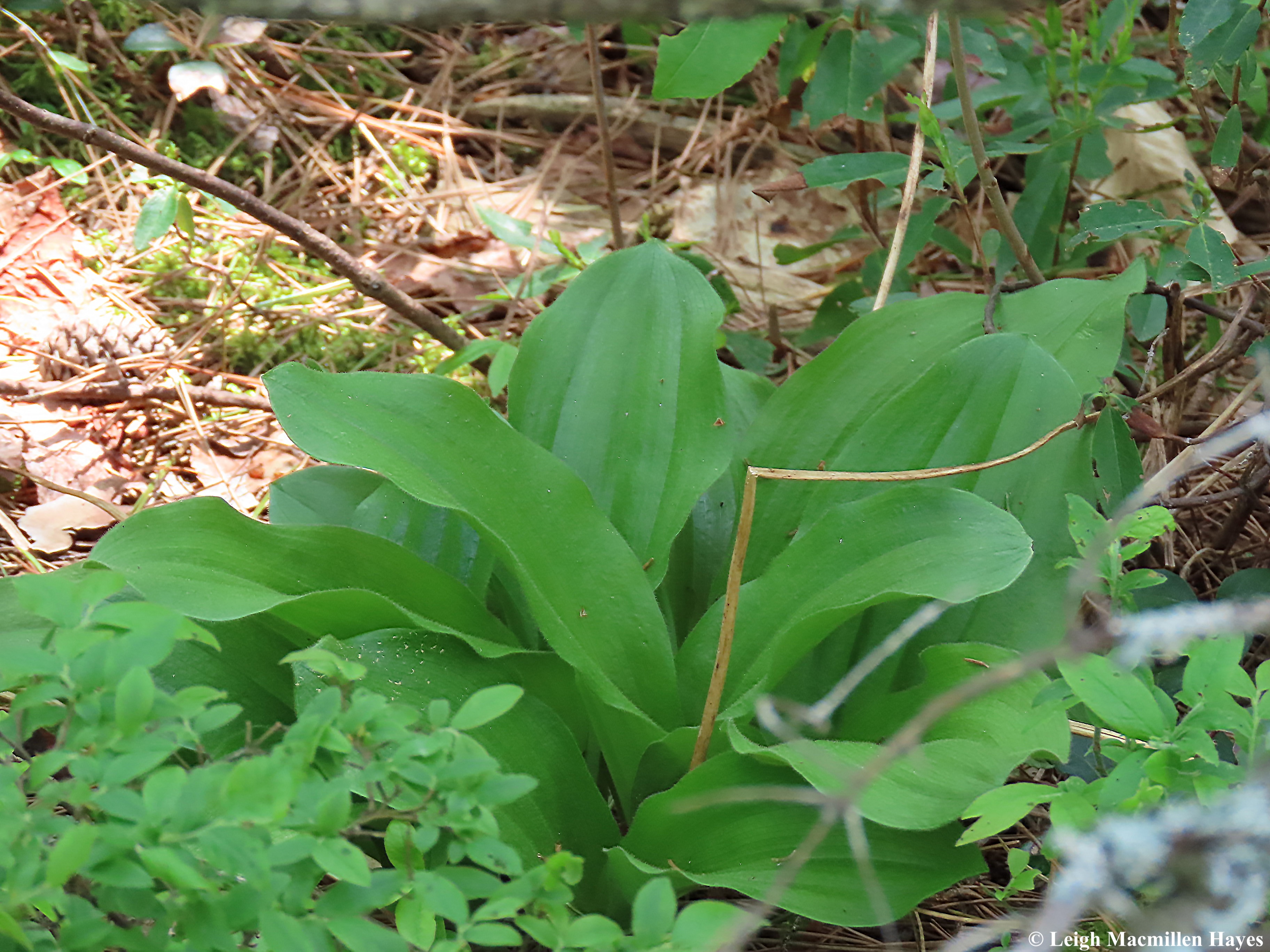
And in another spot where we expected the same, nada. What happened. My Guy was disappointed because this is his favorite and he loves to show it off to anyone who happens to be hiking that way.

We have a theory, though we don’t have scientific knowledge to back it up. But here goes. Last summer, our count was quite high. The previous spring and summer it had rained. A. Lot.

Last year, we experienced a drought. This year fewer flowers in most places that we hiked in the last few weeks. Perhaps less of the fungus?

And sometimes the flowers are spotted growing in a bit of a line, making us think perhaps there is a rotting nurse log beneath the soil. As for soil and habitat, acidic seems to be the favorite and we often find them among Low-bush Blueberries and towering over Reindeer Lichen.

And then there’s pollination: Lady’s-slipper pollination is a curious thing. Bees are lured in by the guide lines to a slit in the front petal, the slipper-like pouch, or flower’s labellum. Once inside, the bee cannot exit the way it entered because the petal structure turns inward.

The exit is at the top of the slipper, but to reach it, the bee must move through a hairy interior and rub against the flower’s stigma, depositing any pollen it may have carried in and brushing against the pollen mass called the pollenia before flying out. It strikes me as being like a house of mirrors. And all I want to do is quickly find my way out.

Some bees get frustrated with the dilemma of discovering there is no nectar and the task of finding the exit and instead chew their way out, which seems to be what happened to this flower.

It looks like the bee frantically tried to escape this one.

I tried to honor them with a painting, but our best way is by counting each and every one. I’m going to share last year’s numbers and this years. Also, this year, we counted along a bunch of other trails than just the Big Three as My Guy refers to the first three for which I have been keeping records since 2000.

Wolfe’s Neck State Park: 2024: 475; 2025: 159

Albany Mountain: 2024: 364; 2025: 411

Sanborn River and Overset Mountain: 2024: 598; 2025: 526

Grand Total of the Big Three: 2024: 1,437; 2025: 1096

Plus these trails all from this year only:

Mount Tom: 25 (but we were there on May 18, and this was the kick-off event that got us going this year; more may have bloomed since then. Actually, after spotting the first one, My Guy wasn’t sure he wanted to count this year, but let me tell you, he still has the greed!)

Mount Tire’m: 31

Proctor Pond Reserve: 41

Kezar River Forest: 63

Narrow Gauge (only 1.5 mile section): 56

Sleigh Trail at Notch View Farm: 44

Home woods: 2

Grand total of all trails: May 18 – June 6: 1,358

Even with the extra trails, the count was down.

But still . . .

Where the Moccasins (Lady’s Slippers) Led Us–up and down many a path with so many wonder-filled moments and sighting along the way. Counting Lady’s Slippers is a ritual that we love to share together and with others.

Savoring Spring

My paths were multiple this weekend as if I was on a quest.

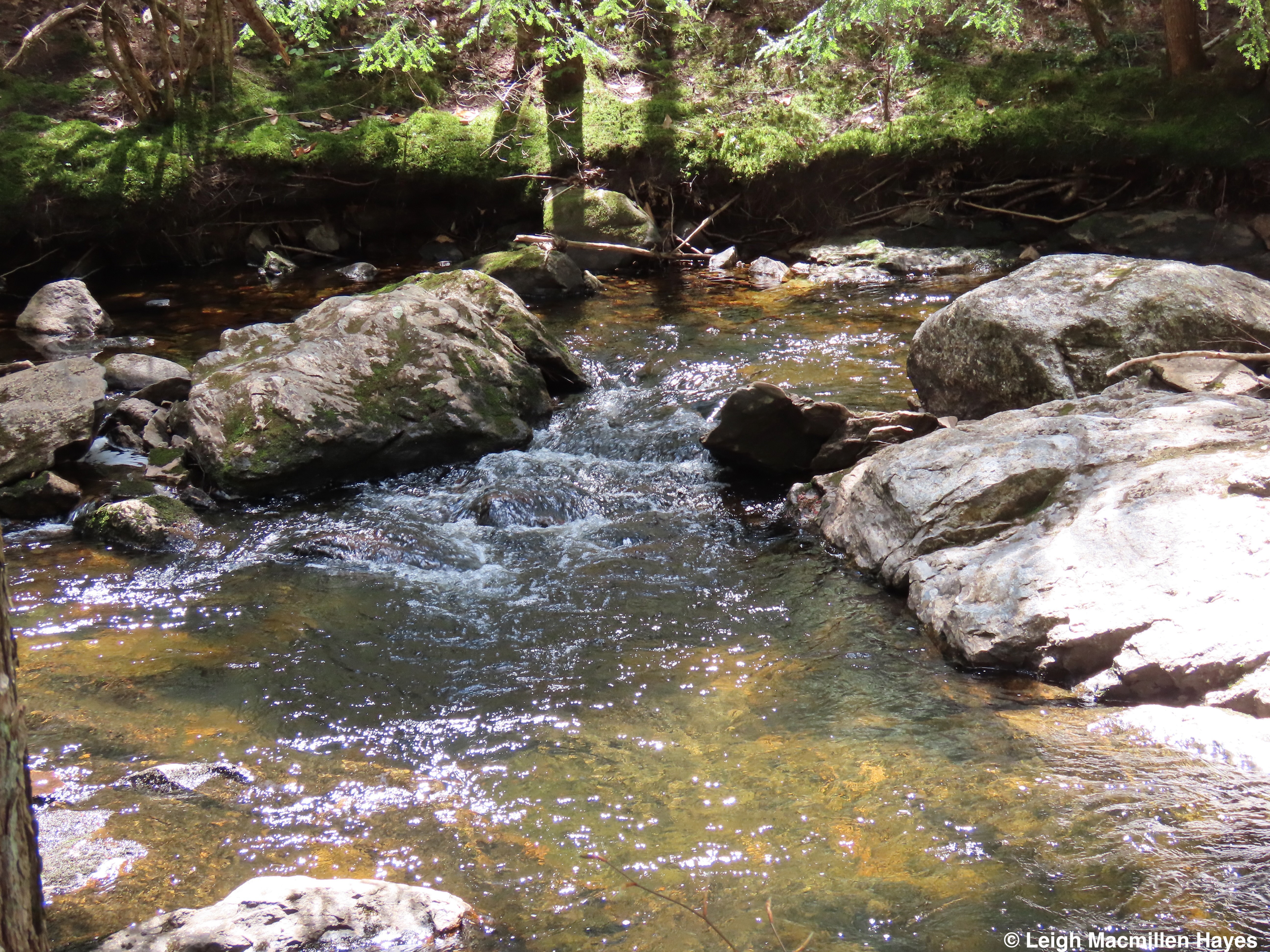
On a bridge over a brook,

down a road through the forest,

beside a bog,

along a boardwalk,

and even following this guy down low and up high.

Together today, we circled another brook (if one can actually circle a brook, but we did),

enjoyed this view from lunch roots,

and dessert on the rocks where we could peek down on said roots.

Though I may have been alone for much of the weekend, I never really was for the bird song, including the conk-er-ies from this male Red-winged Blackbird, accompanied me where ever I hiked.

There were Eastern Chipmunks adding to the chorus as they chortled at me and I chortled back, though I did wonder if life hasn’t always been so easy for this one given the marks on its body and a very short tail.

I watched Painted Turtles bask, despite cooler temperatures, though the air was probably warmer than that of the water.

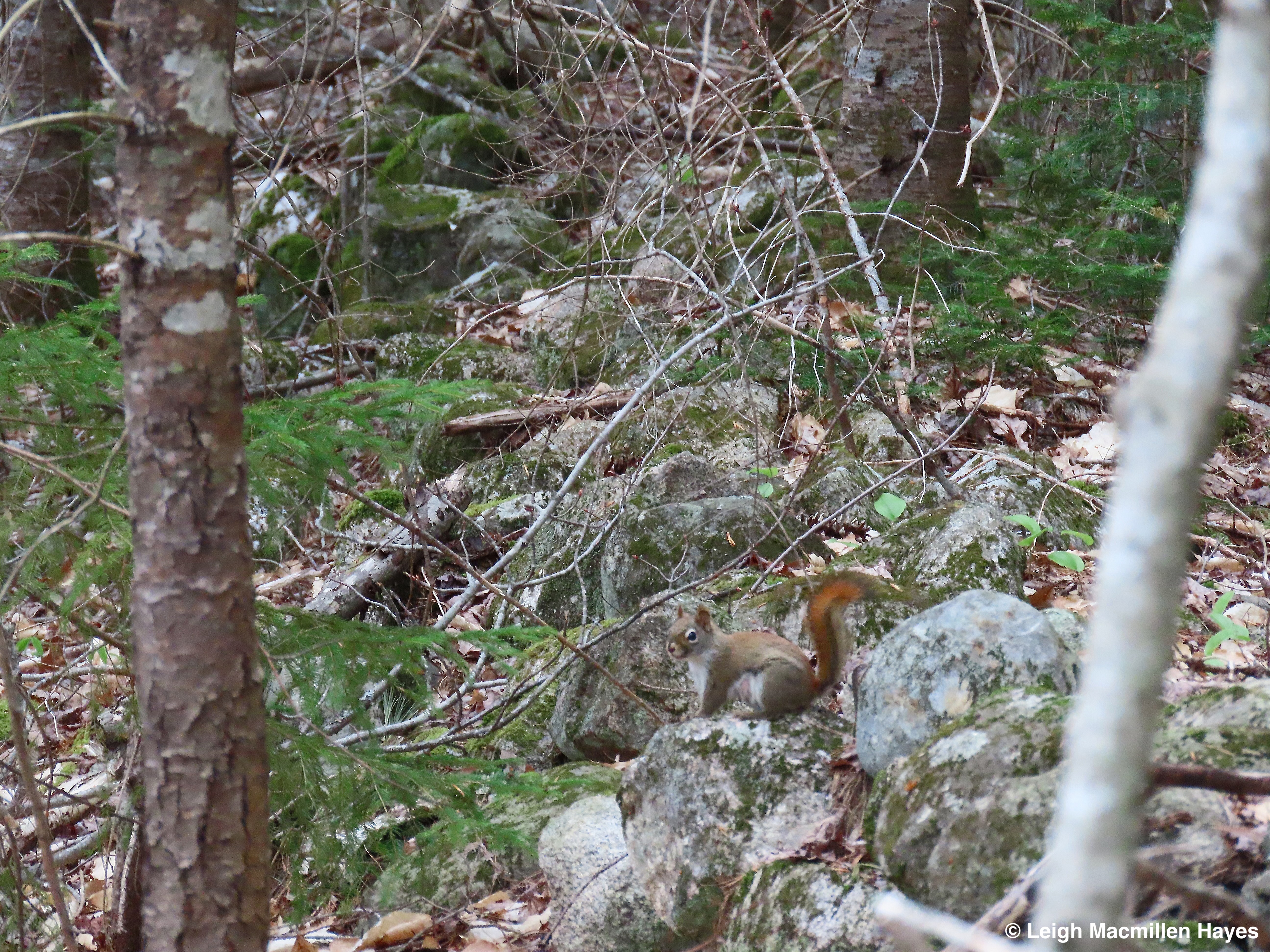
And I was chastised by this Red Squirrel, but really I had done nothing wrong–except to enter his territory without an invitation.

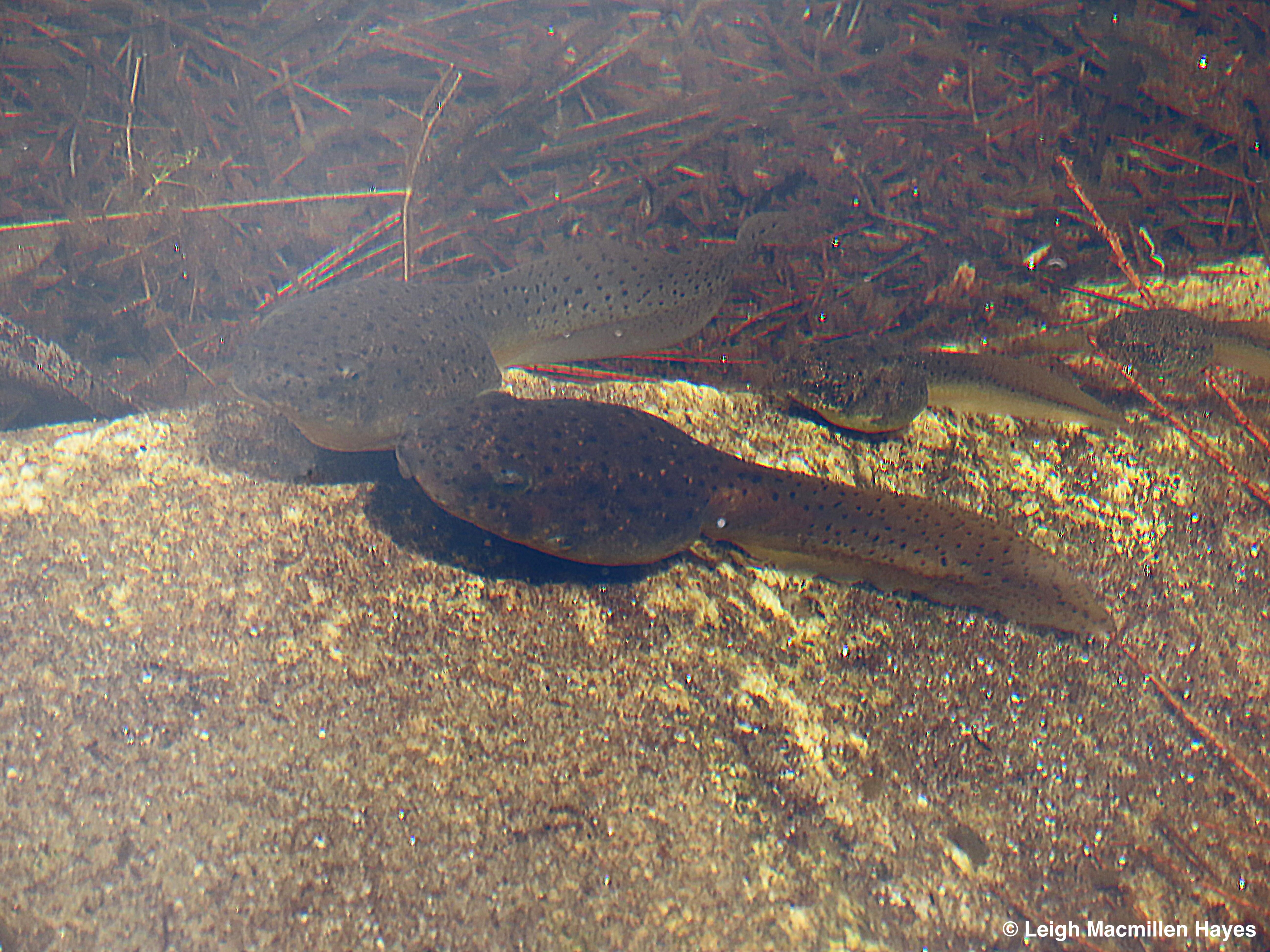
In the depths of the water today, tadpoles. HUGE tadpoles of the Bullfrog sort, which take two years to mature. I spotted tiny hind legs growing beside where the abdomen meets the tail. There were also lots of smaller tadpoles, too big to be Wood Frogs or Pickerel, but I suspected either one-year old Bullfrogs, or perhaps they were Green. Or both.

A few flying insects also brightened the days (and I have to say I’m not referring to Black Flies, which I hardly spotted–and actually caused me concern, for where have the little biters gone?), including this Anglewing butterfly. I can’t name it to species, for it is either a Comma or Question Mark, but never in the time I watched did it pose so that the underwings were visible. Okay, so My Guy and I spotted it today and when I explained to him the difference between the two, the C having a small white comma on its underwing and the QM, a small comma and a dot looking rather like the punctuation mark, he decided it must be an Exclamation Mark instead.

And in the same area, an American Lady added her color to the scene.

Leatherleaf’s bell shaped flowers reminded me of clothing hanging from an outdoor line.

And I’m really beginning to believe there are a trillion Painted Trillium, though I didn’t actually count. There’s something to admire about those olive green leaves and perhaps it’s that we don’t often see that color in nature.

I even spotted a few that chose a different paint palette. I could explain away the color of the leaves by thinking that perhaps they were showing off their anthocyanin, which gives fall leaves their red color and is seen in the spring as well, perhaps serving as a sunscreen for the plant. But the color of the petals was equally amazing, though who knows, maybe it’s common and I was just paying attention to it for the first time. That does happen. A lot.

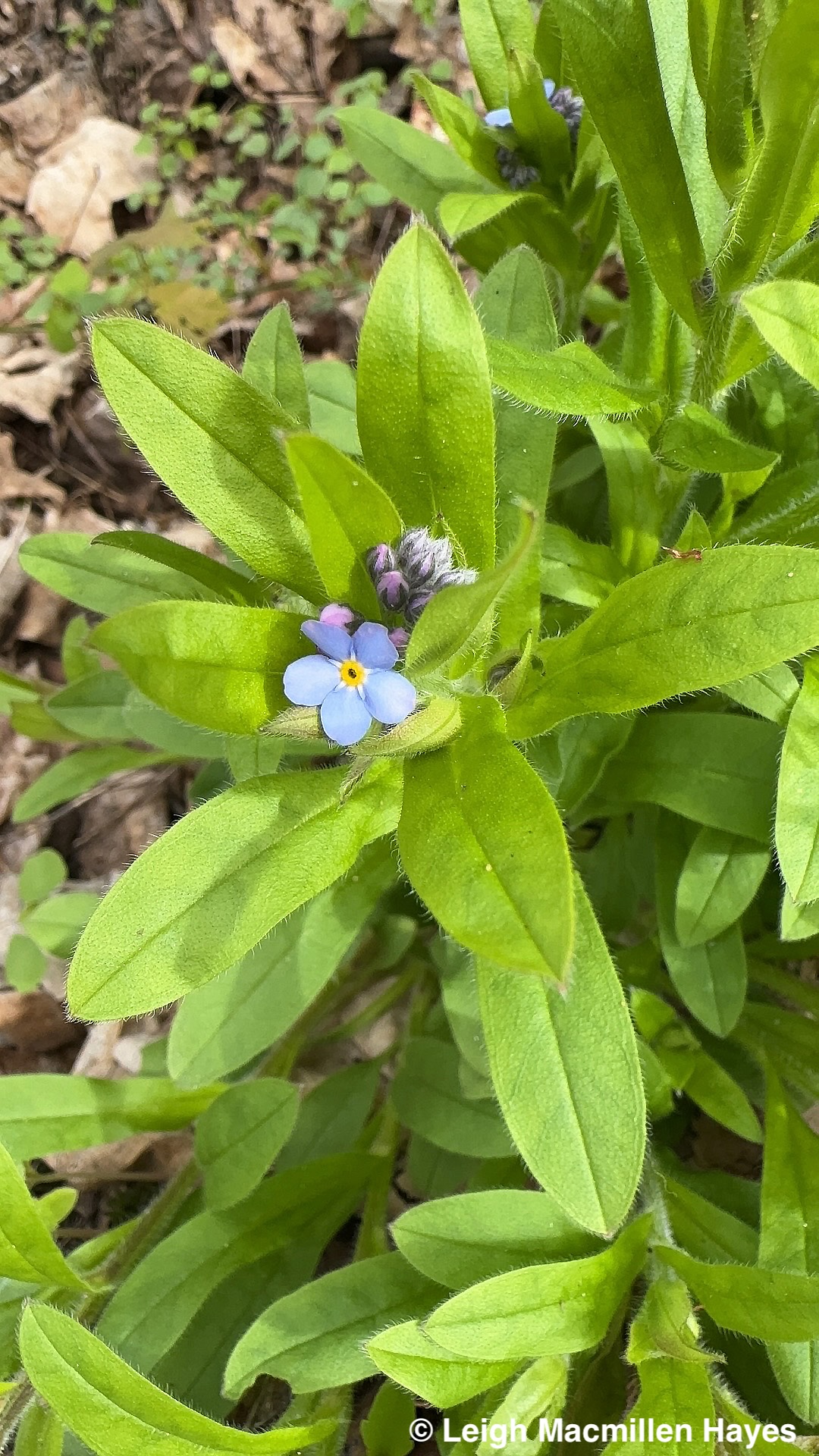
And then there was the amazing blue hue of Forget-Me-Nots. I surely won’t. Forget you that is.

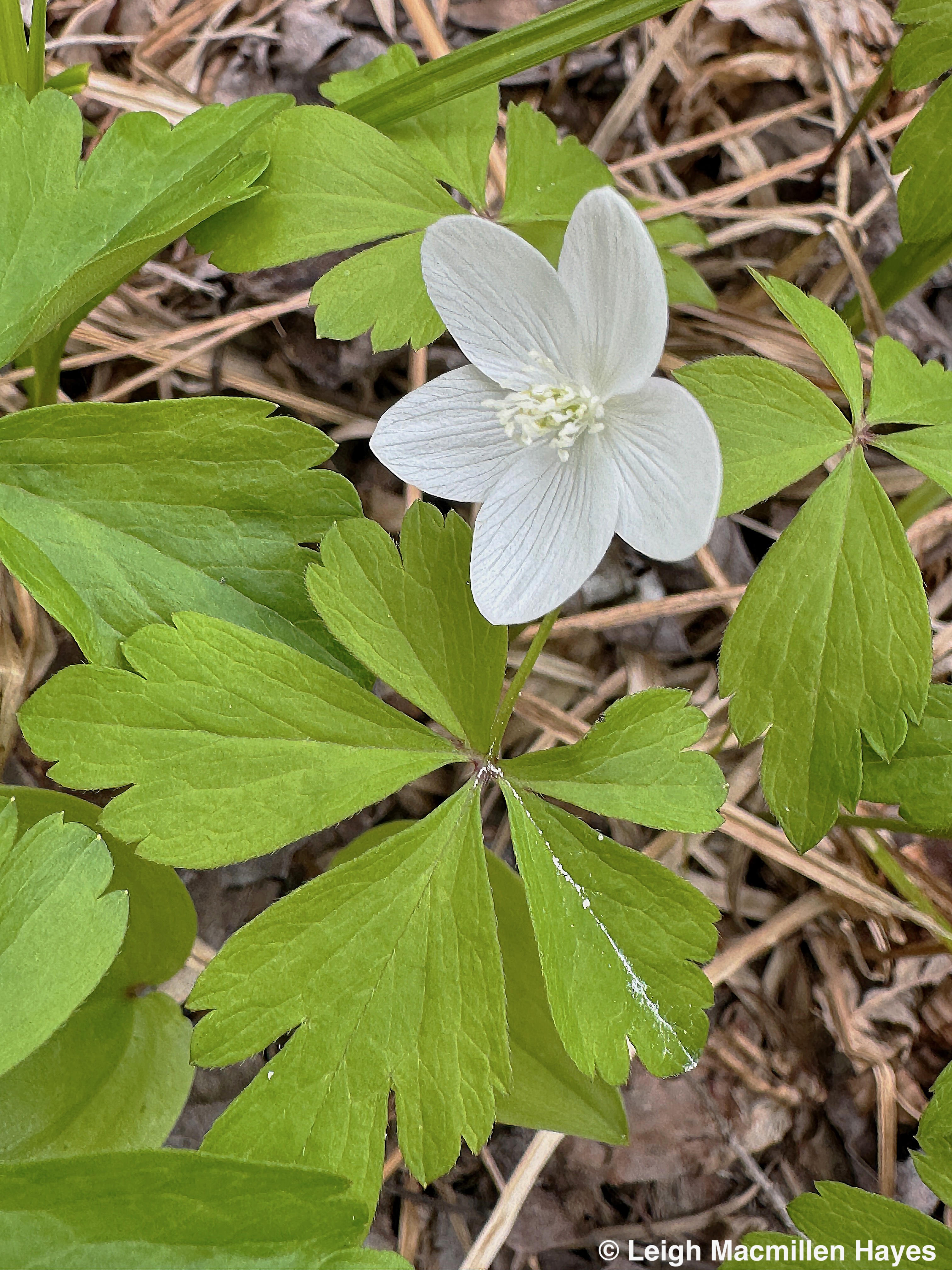
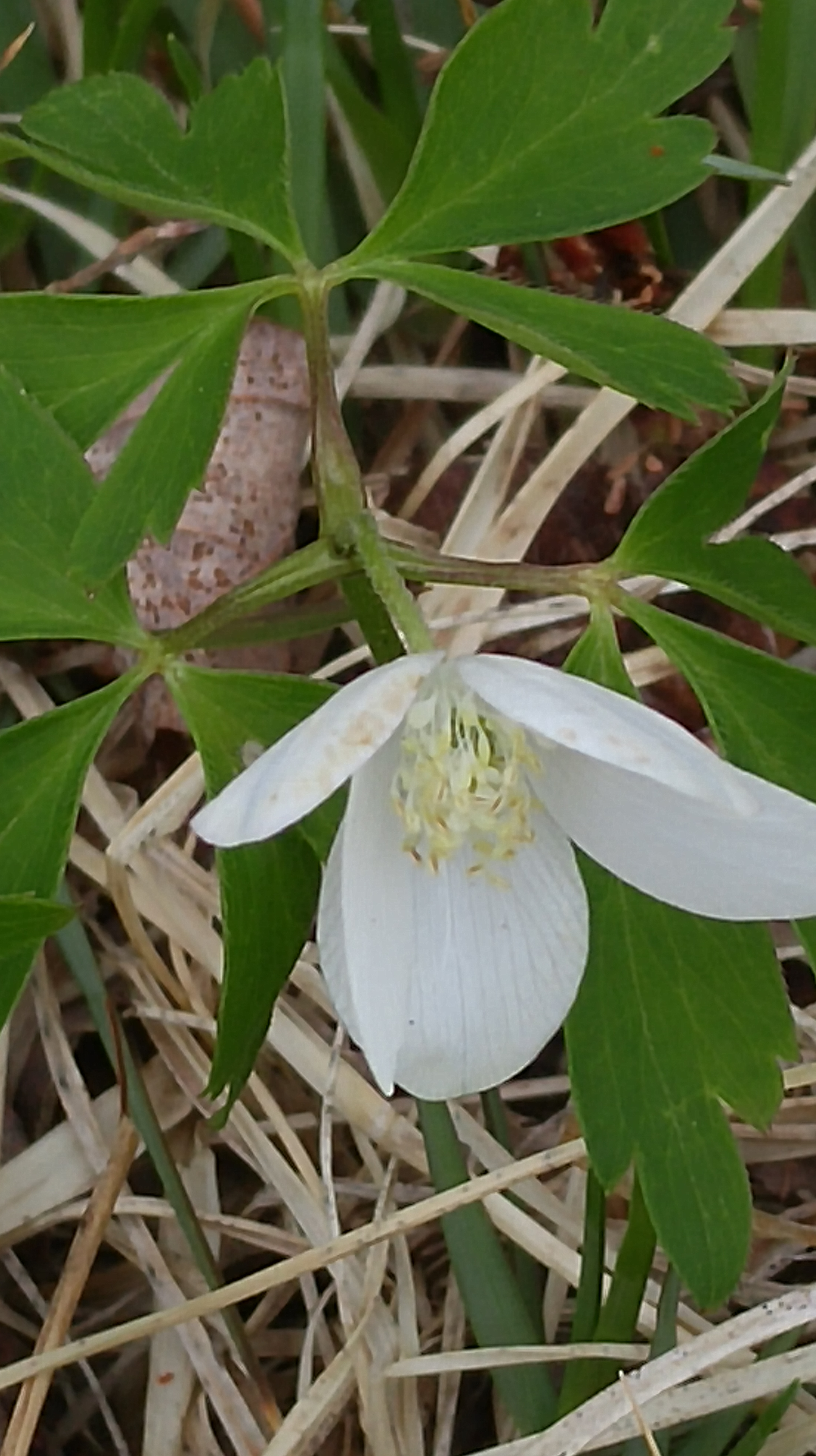
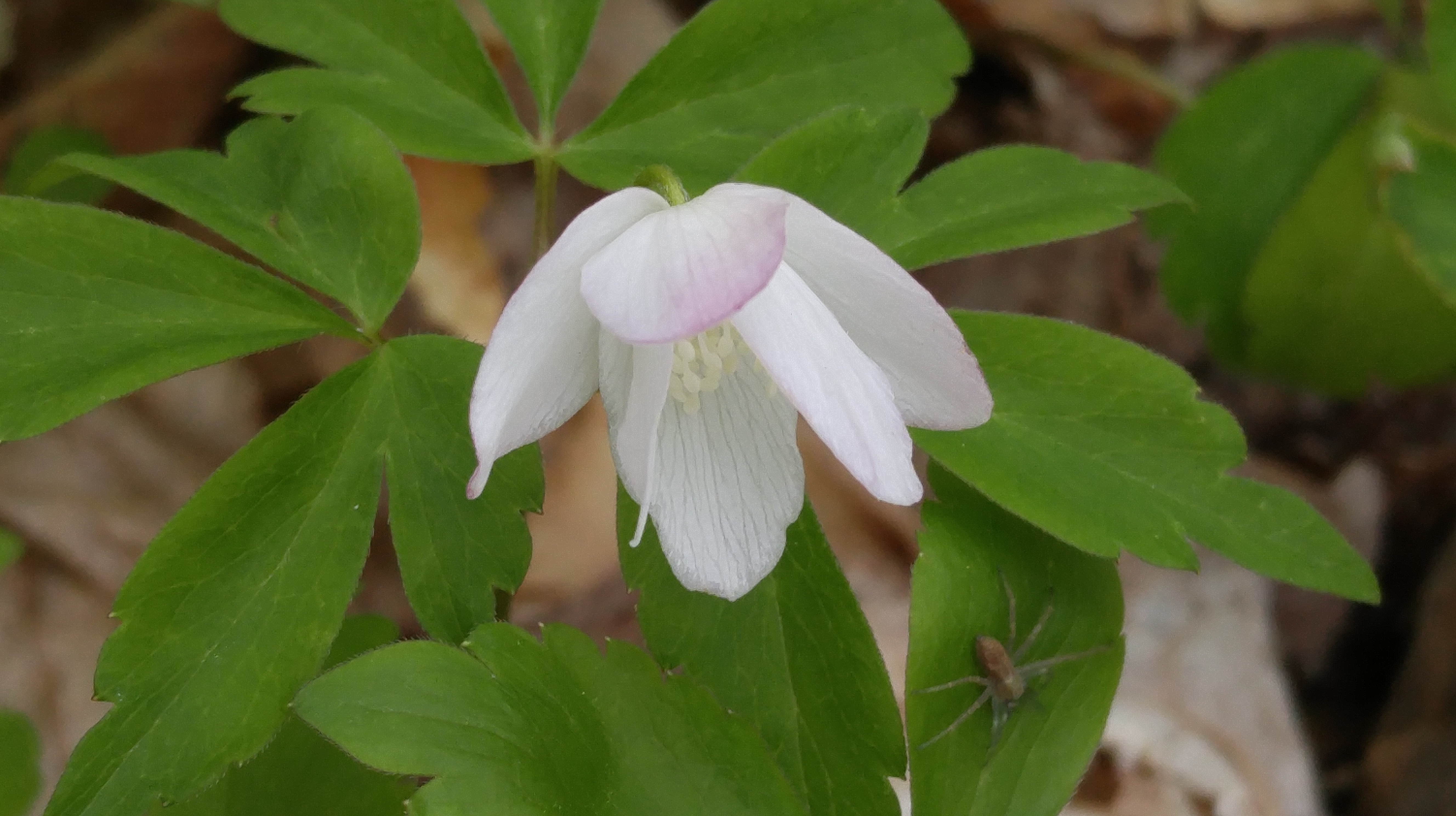
And Wood Anemone, its compound leaves notched, and flowers deeply veined, looking so tender and fragile.

Not looking tender, and hardly fragile, but still beautiful, was the carnivorous Pitcher Plant, of which I paused beside several. I’ve known this particular one for at least twenty years so when I encounter it, I always feel like I’m meeting an old friend. Because I am.

Hiding beneath its lime green leaves, American-Fly Honeysuckle’s delicate flowers did dangle in their manner of two. The shrub always surprises me, though it is a native, but I don’t get to greet it often enough.

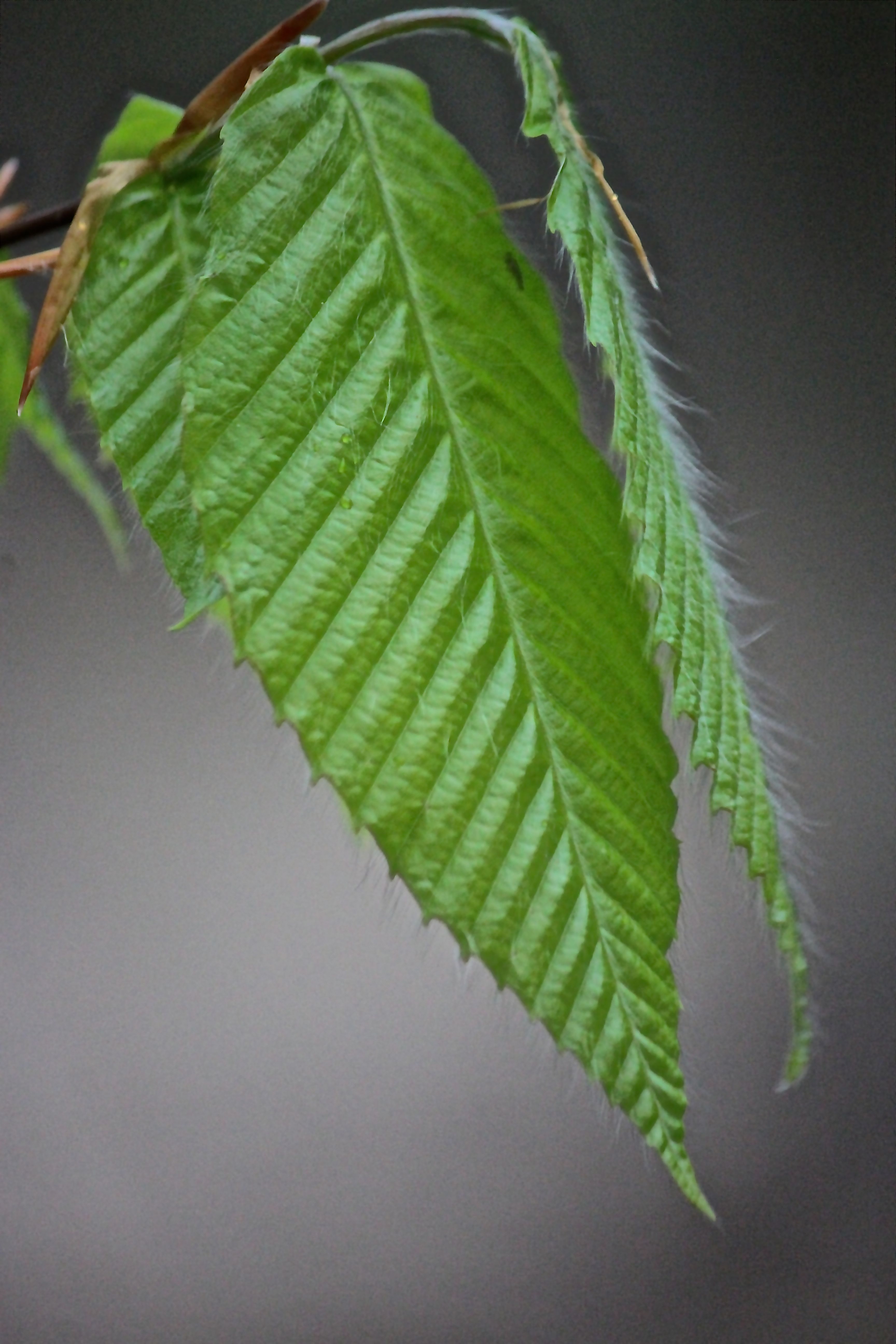
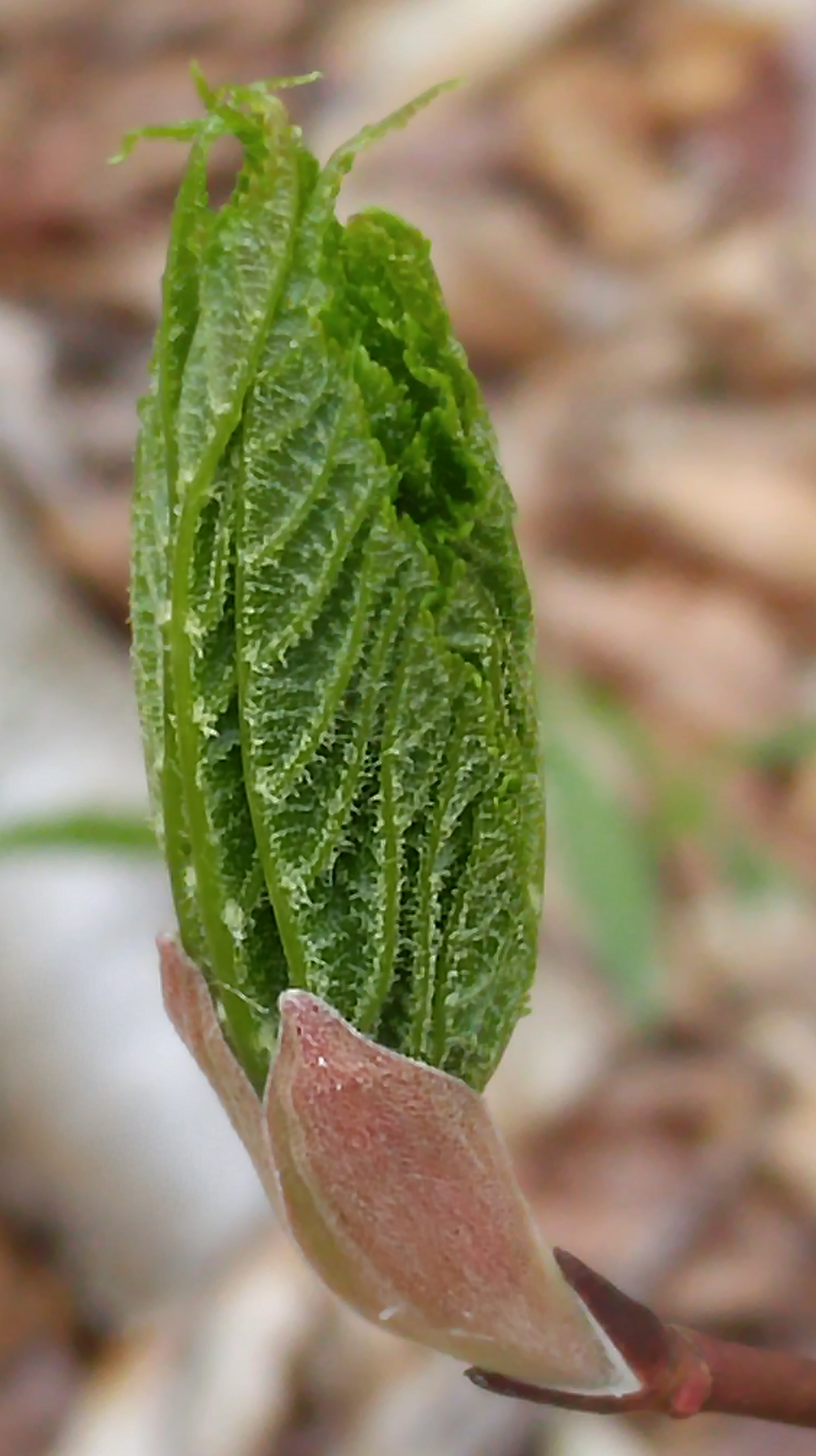
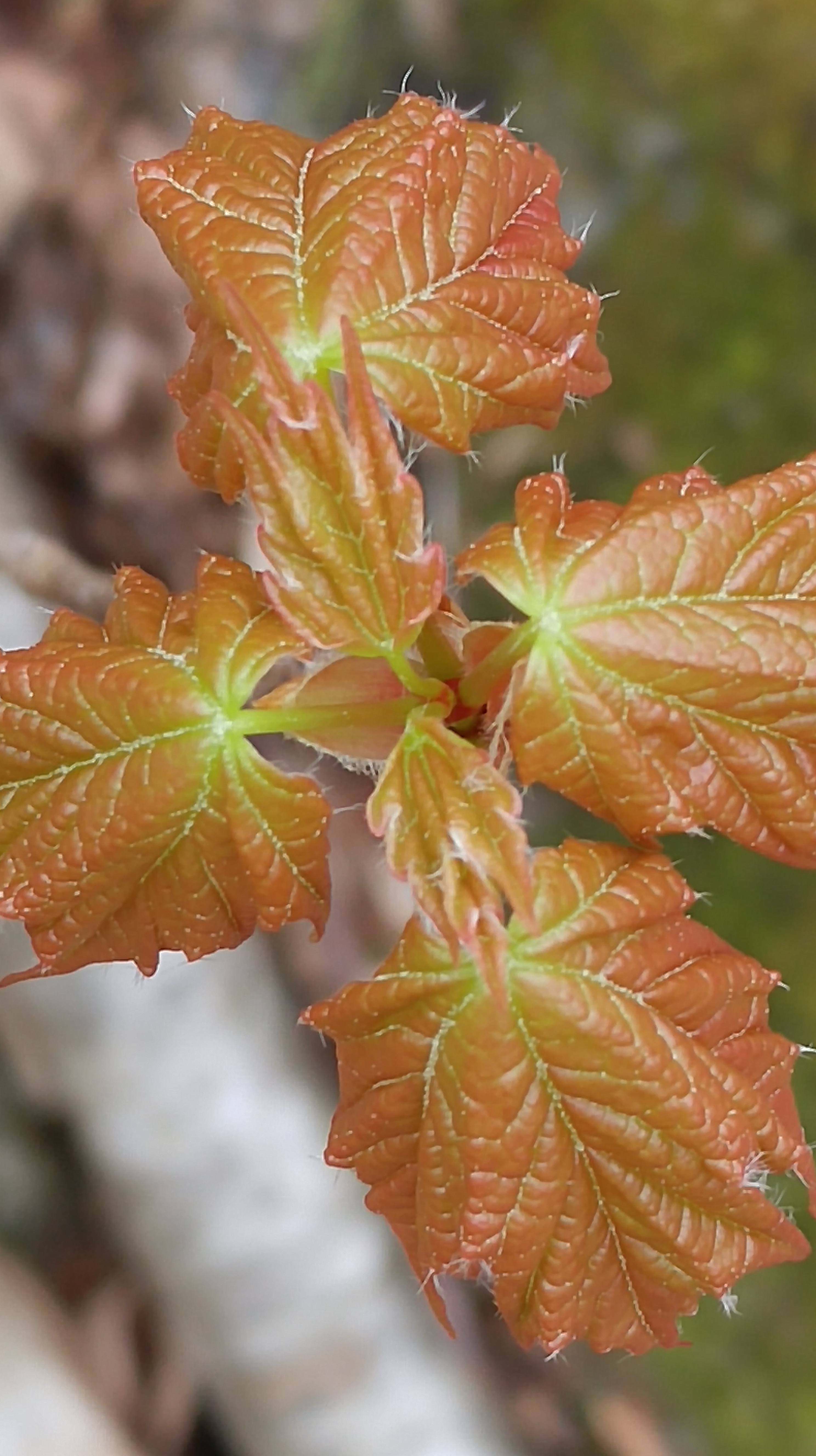
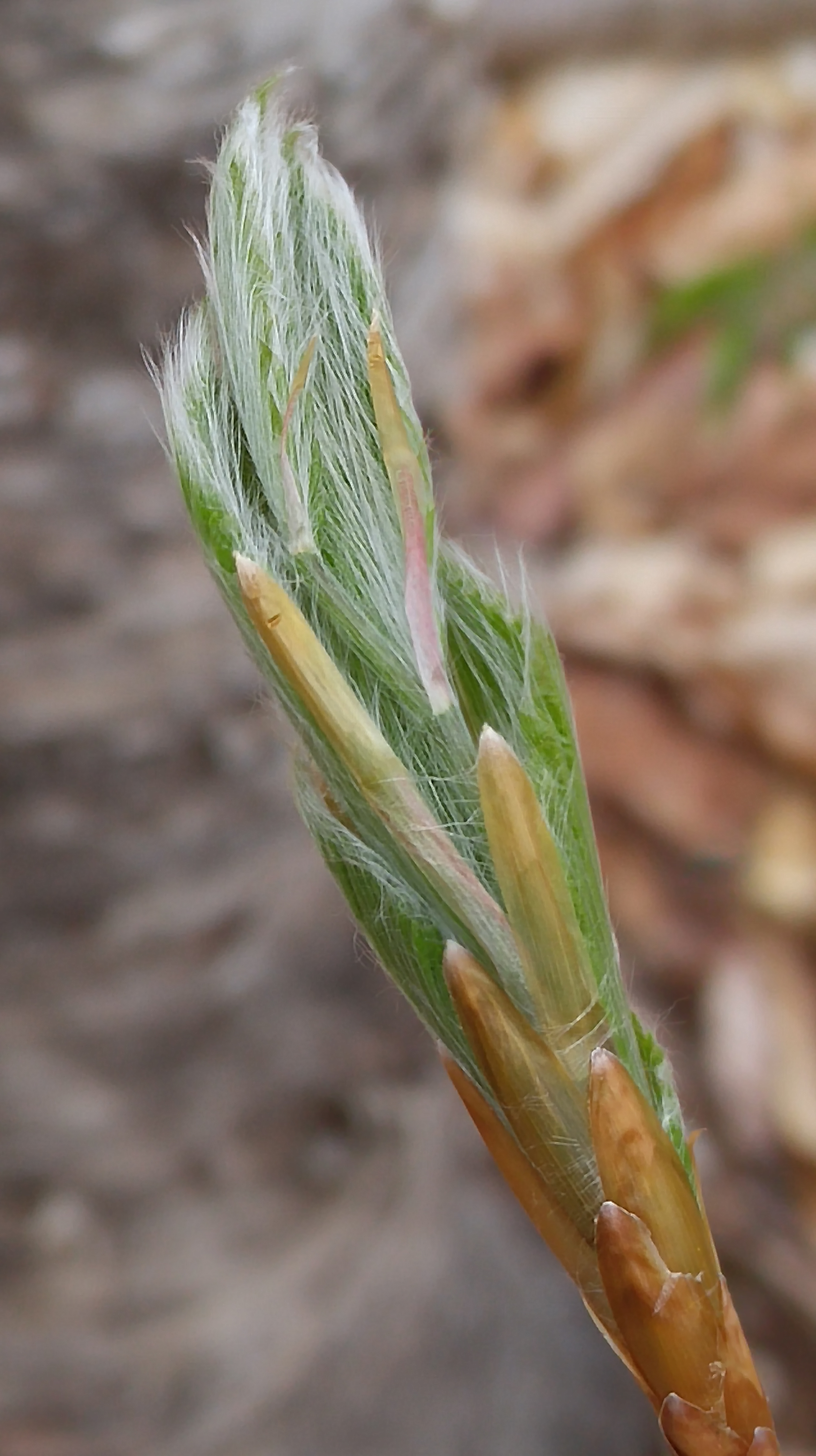
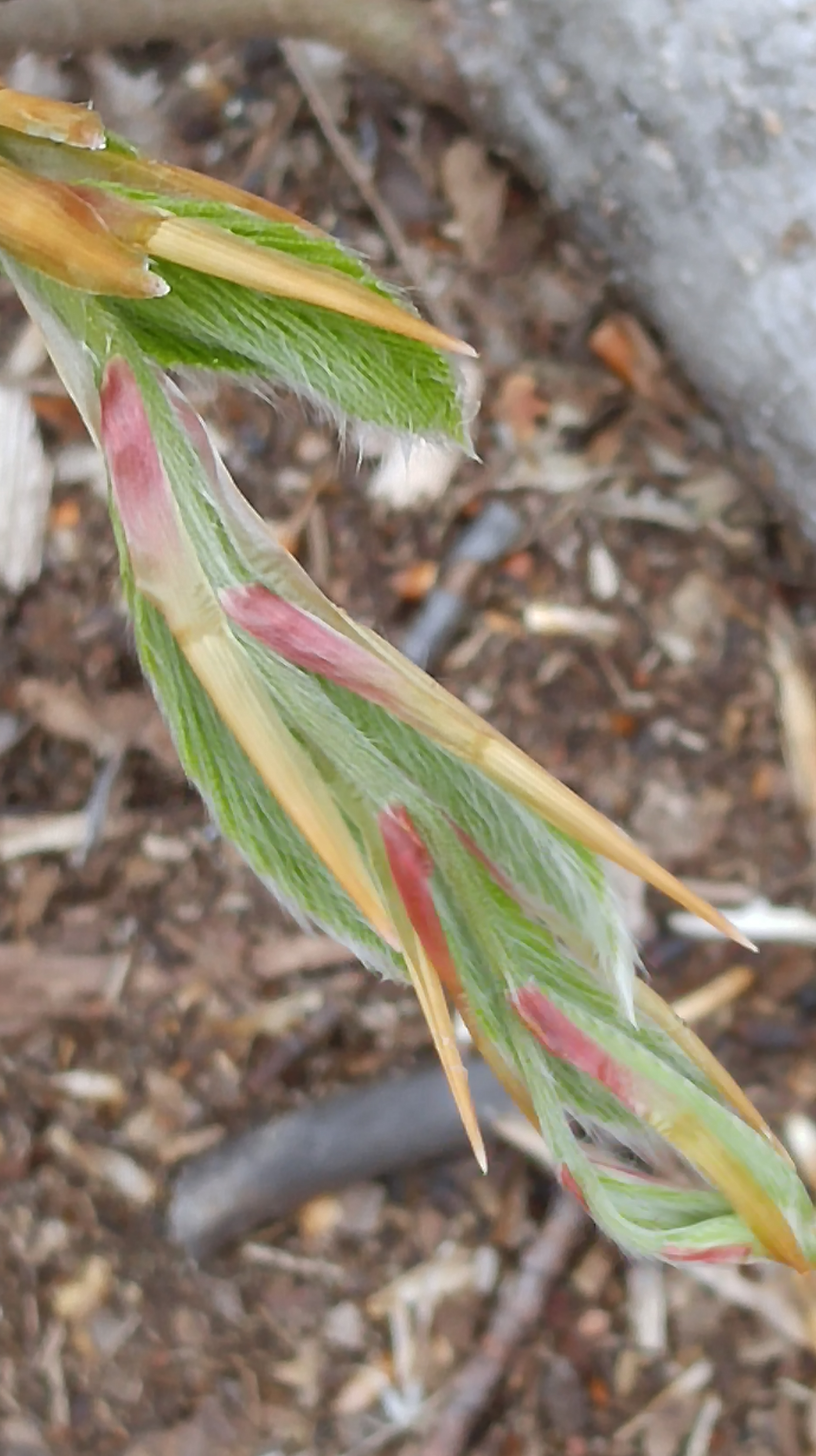
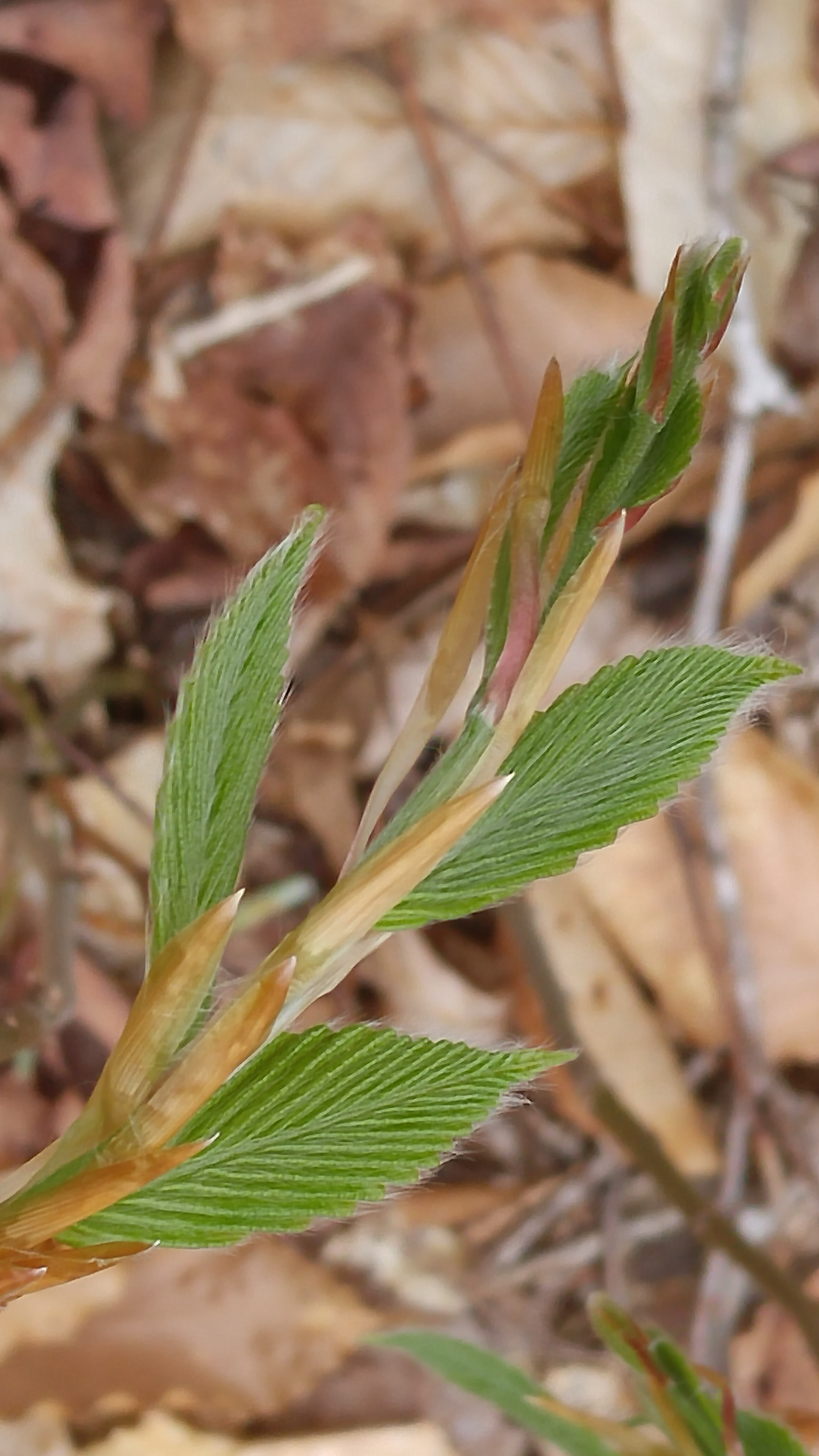
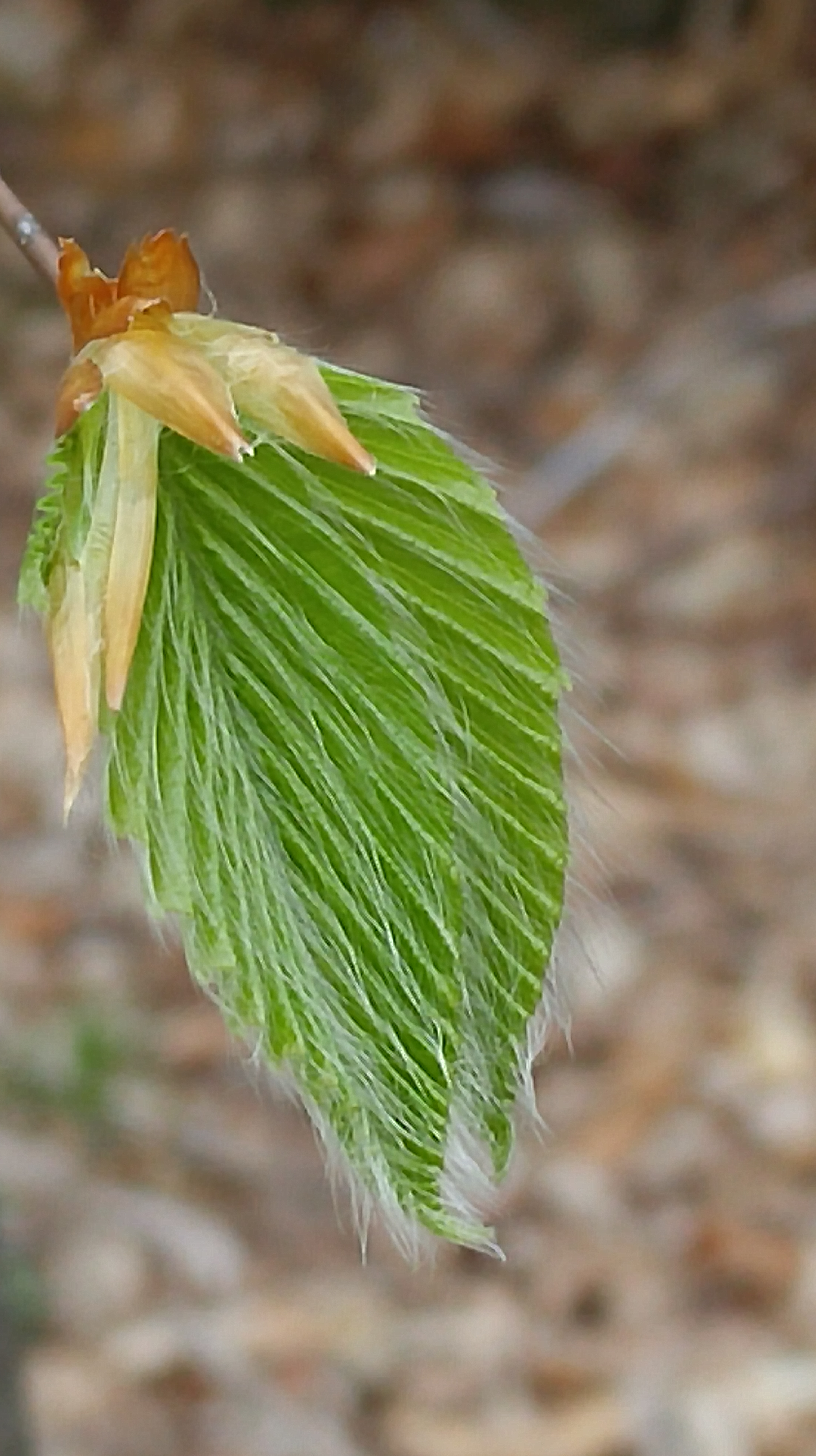
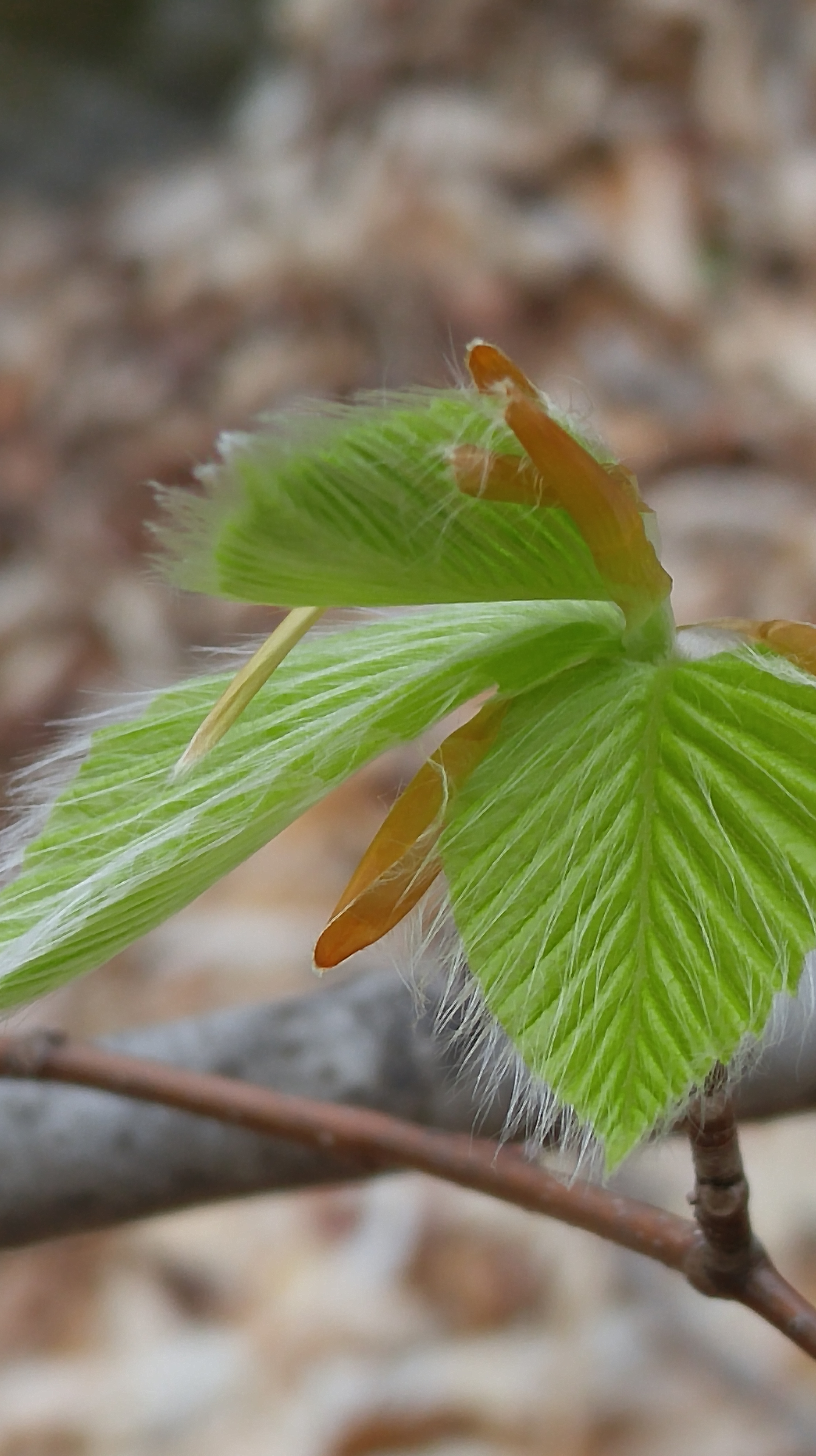
All of these flowers bloom so early because they take advantage of sunlight before leaves emerge. That’s all changing now and in another week it will surely look more like summer around here. What I love about some leaves, especially American Beech, is that they are so hairy to start, and look like they’d make great fringed skirts for fairies. The other thing I became aware of this weekend, was the raindropy sound of their bud scales hitting the ground.

I love winter, but this season to follow is flying by, and already the Trailing Arbutus has reached its waning hour.

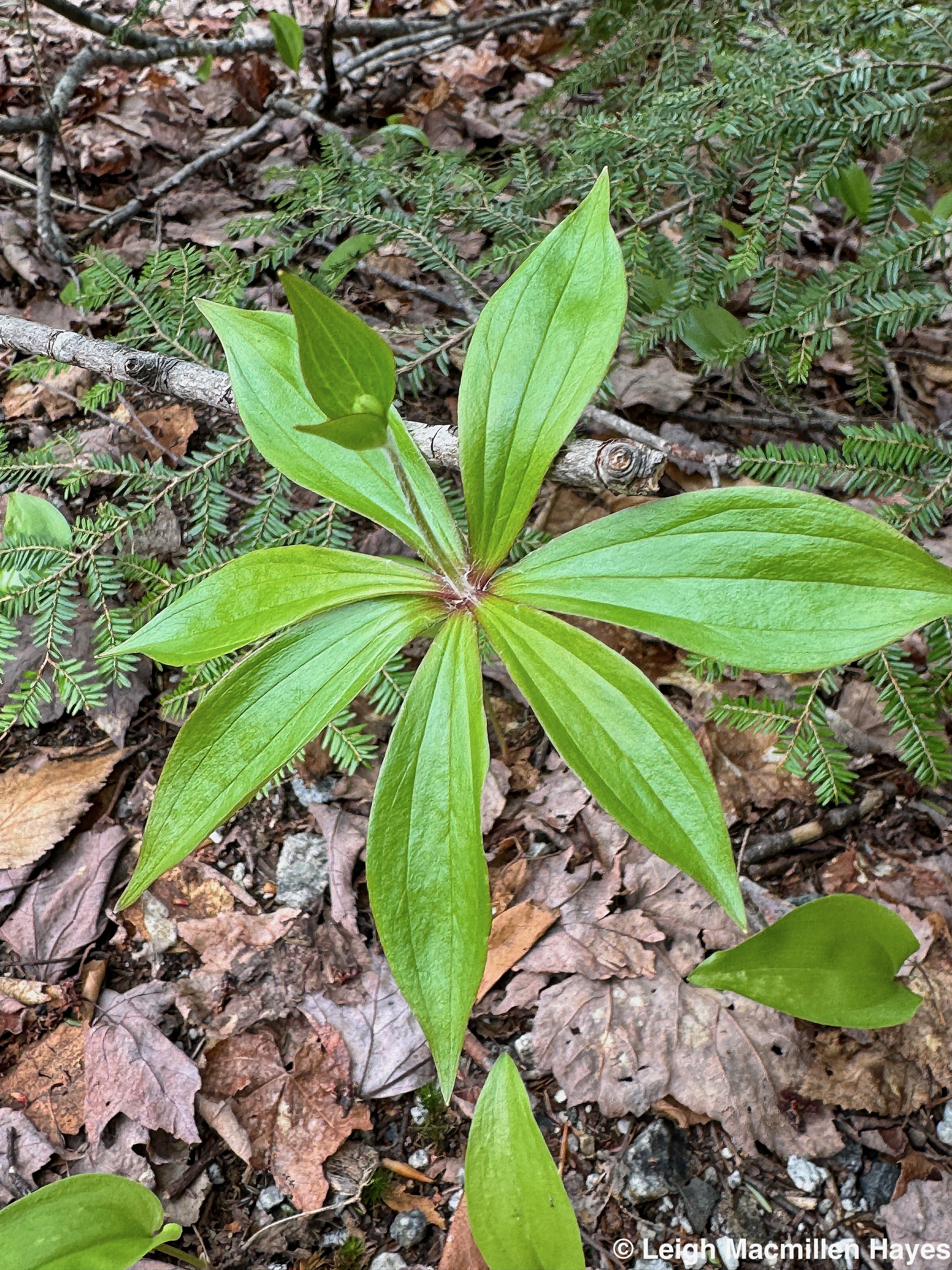
But there is hope in the form of others, like this Indian Cucumber Root, creating a second tier and a bud, and in a few weeks I’ll be seeking out its otherworldly flowers.

I’m savoring spring–before it moves on. I hope you are on the same quest.

Just Another Boring Mountain Mondate

No need to read on. You know it will be photos of today’s finds. Ho hum.

Our day began as it always does, with a shared piece of CraftonMain Lemon Meringue Pie topped with a raspberry, while we sat and watched this pair enjoy a meal of their own. Wait. We don’t always begin with the pie–but sure wish we could. Cardinals, however, have been blessing us with their appearance for years.

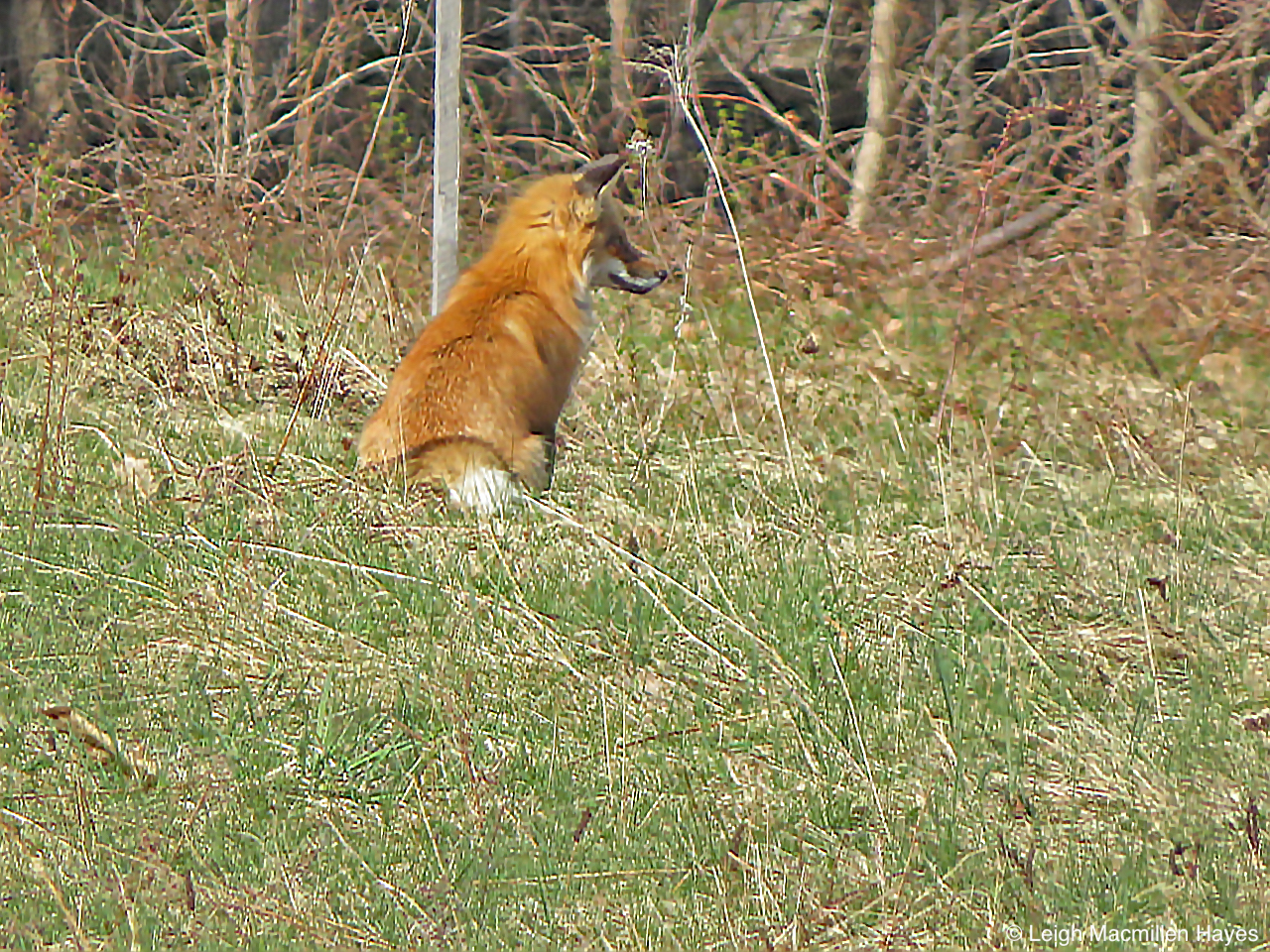
And then there was the sighting of the neighborhood fox in the field beyond our stonewall; it had its eyes on the neighbor’s dogs while we had our eyes on it. Don’t worry, the dogs didn’t become breakfast. In fact, as their mistress began to walk toward the fox (we don’t think she spied it, nor did the dogs or they would have given chase), the fox turned and dashed across the field, over another stonewall and into our woodlot.

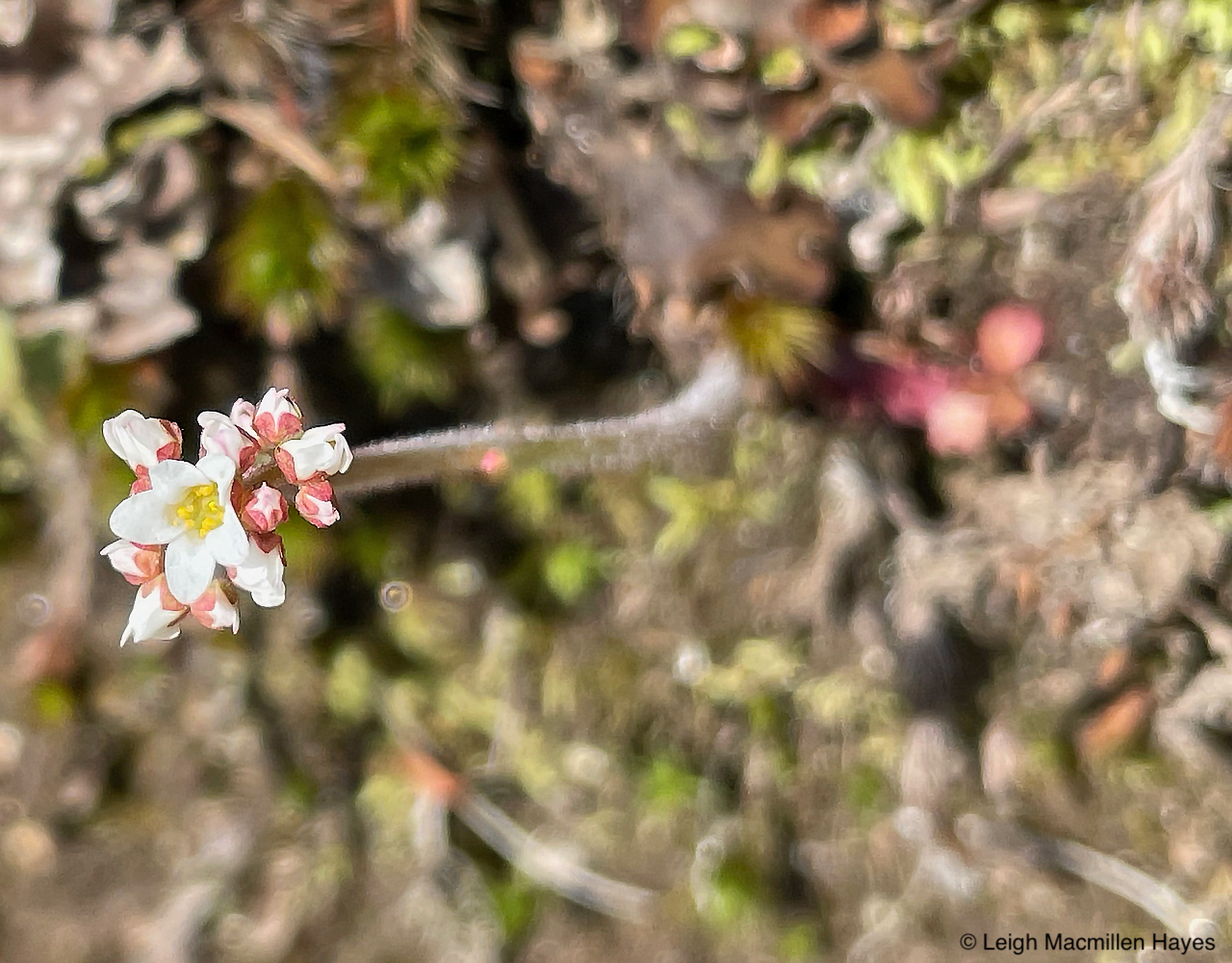
At last, it was time to begin our hike along a trail we haven’t visited since August 2019. Our intention had been to climb it in 2020, but during the first year of the pandemic, it was closed and then we never considered it . . . until this morning. And as we started up, I remembered . . . this is the mountain where the Early Saxifrage grows.

 It’s also known as rockbreaker for its habit of cleaving to the rocks, and perhaps suggested the Latin name–Saxifraga virginiensis. Saxum-rock and frangere-to break.

A funny name for such a diminutive and delicate display.

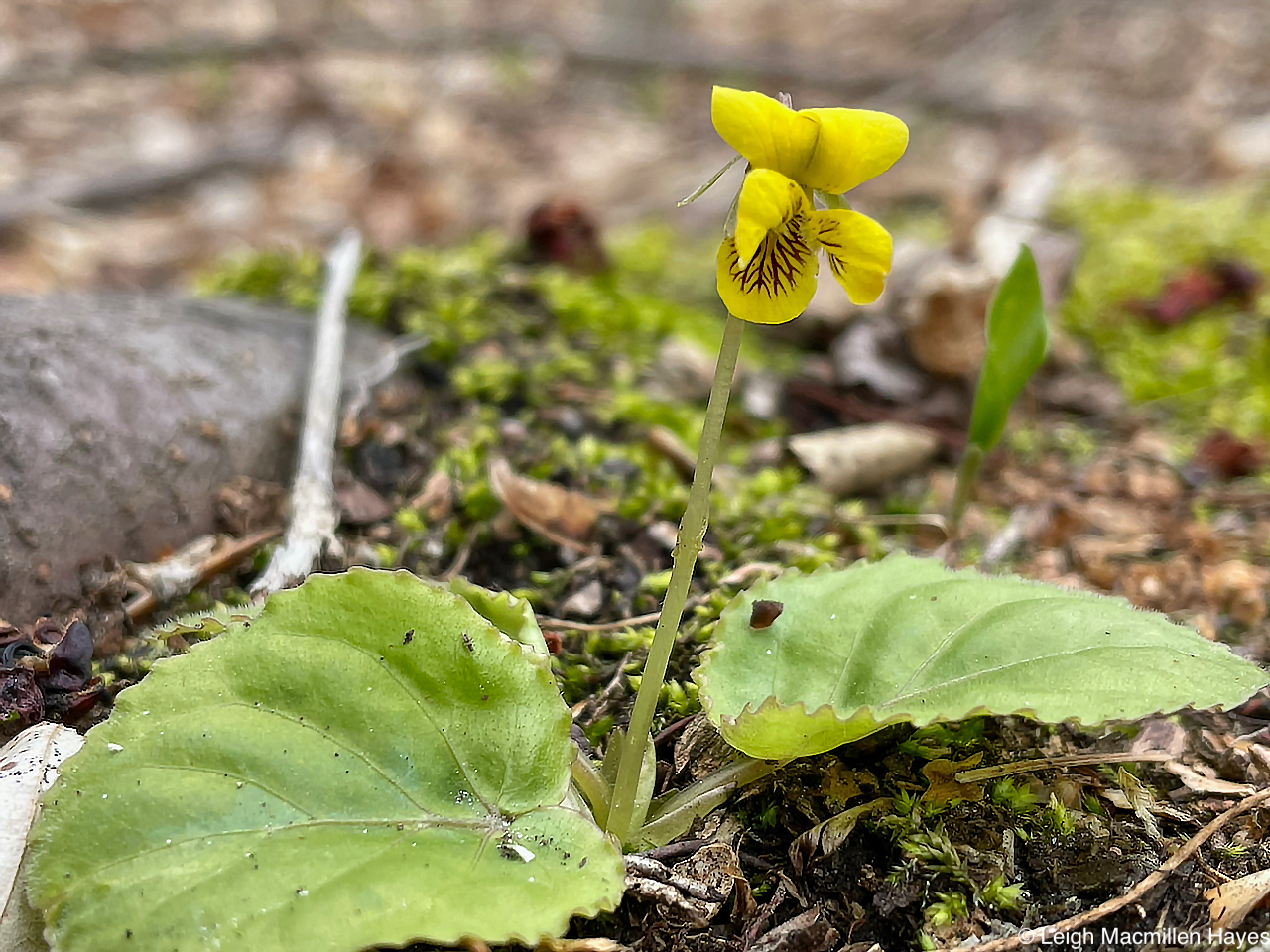
Round-leaved Violet with its scalloped-rimmed leaves more heart shaped than its name suggests also grew along the trail. Spying these tiny offerings of yellow with those incredible magenta runways meant to attract pollinators always brings a smile as if they were meant to brighten the day of all who hike this way.

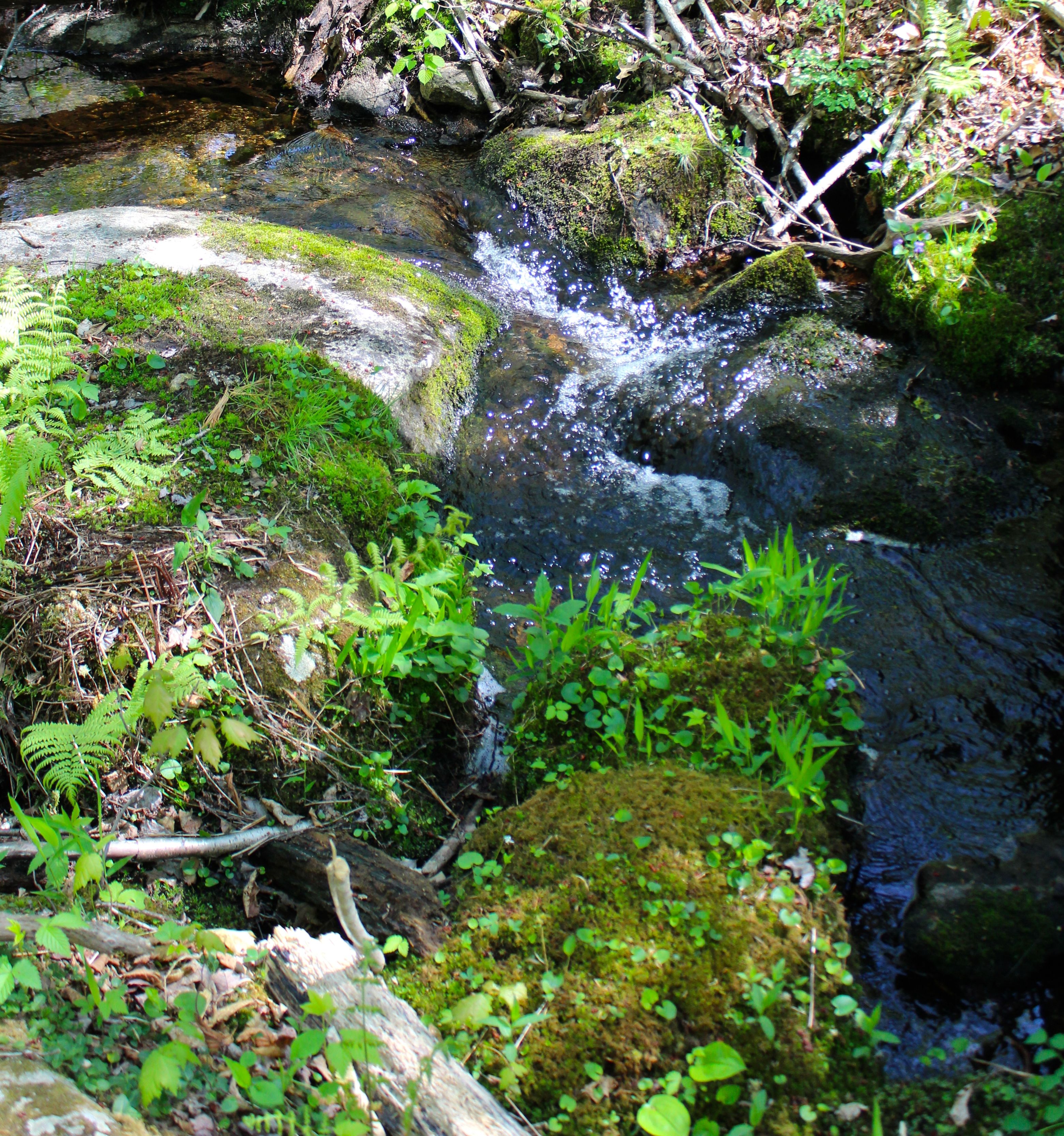
Our journey found us enjoying the sound of the water’s rhythm as we climbed higher . . .

and contemplating each step once we turned away from the brook.

At the summit, the view from lunch rock included a look to the southeast where the sky predicted the forecast of a front moving in.

Meanwhile, our hometown mountain stood out in the sun.

But the grand lady, Mount Washington, was starting to disappear into the clouds.

It was windy and a bit chilly at the summit, but that didn’t stop the Brown Elfin butterfly from flirting with a few others where the blueberries grow.

I also spotted one Spring Azure. Both are rather small butterflies and if you look closely, you might spot that their antennae are patterned white and black.

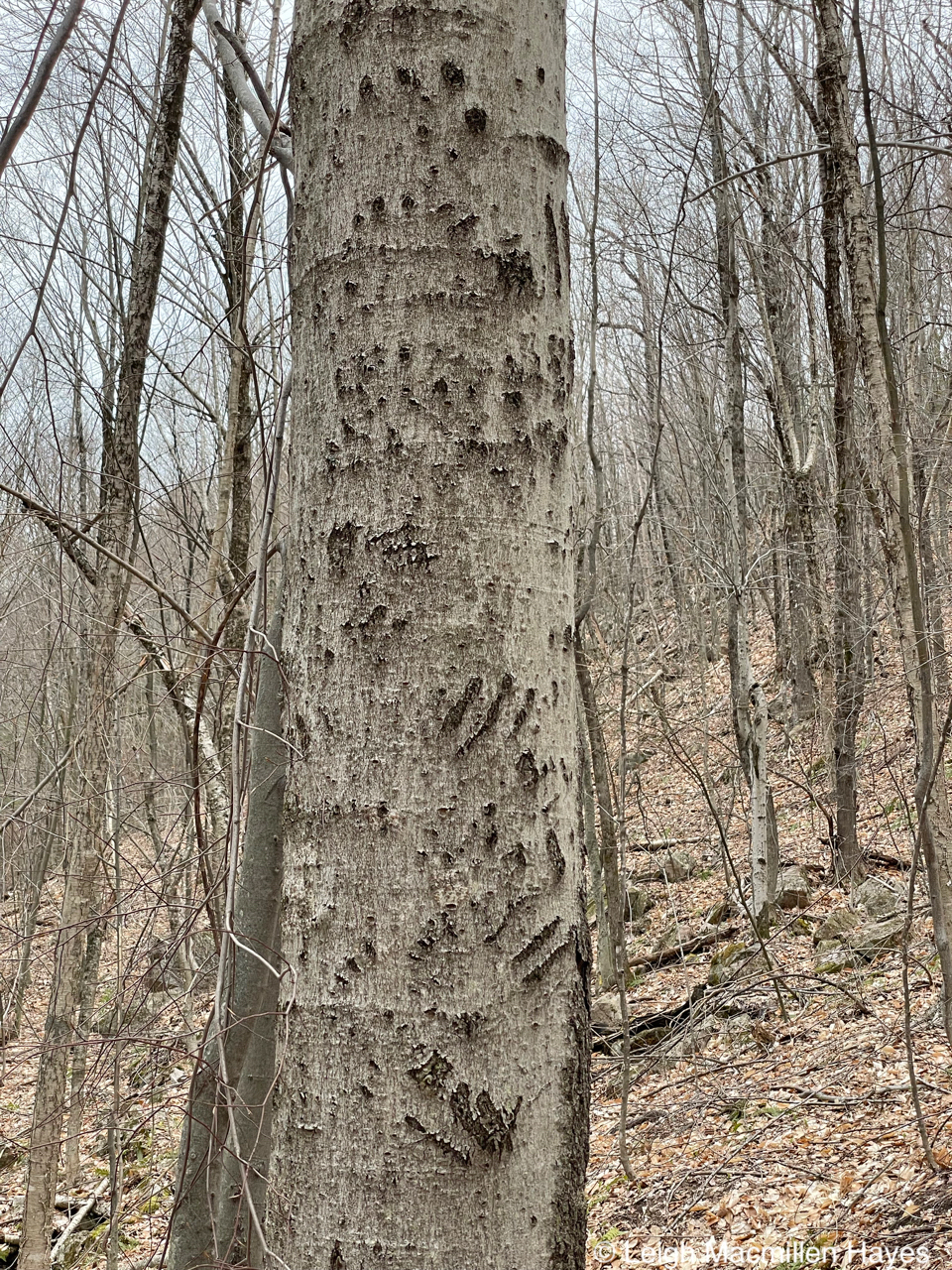
On the way down, we did what we often do–looked for bear claw trees because we know they exist here. And because I know such an activity will slow my guy down. ;-) Bingo. He spotted one that was new to us.

I went in for a closer look and couldn’t believe all the marks on display.

And so I began to circle around the trunk.

One can only imagine the crop of Beech Nuts this tree must have offered.

But enough is enough. It’s just another bear claw tree, after all. Nothing to write home about. Or is it? Think about the bear and the blueberries the Brown Elfin Butterfly will help pollinate and the Beech Nuts the trees will produce and all the connections that will be made, which will include the Cardinals and the Red Fox and the flowers and all that is part of the forest. And be wowed like us. It was hardly just another boring mountain mondate on Burnt Meadow Mountain in Brownfield, Maine.

Thrice the Blessings

My mother always said that things happen in threes. It’s a sentiment that has stuck with me and sometimes even haunted me. But when it is good, it is very, very good. And today was one of those days.

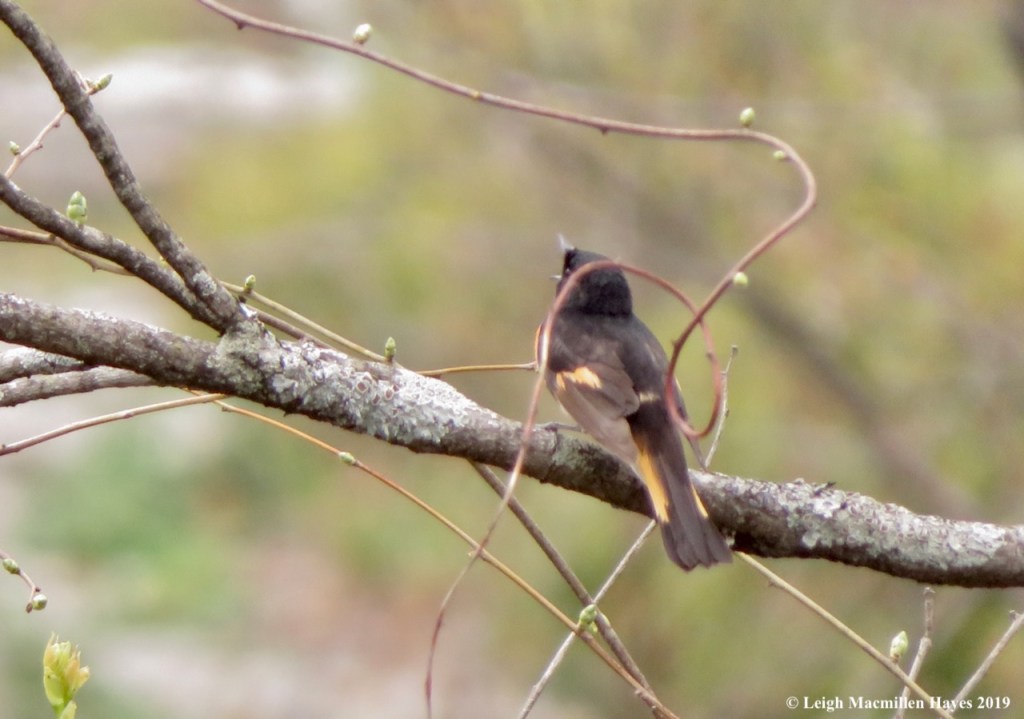
Though it was after noon by the time I stepped into Pondicherry Park in Bridgton, the bird song was on high pitch. The American Redstart’s sweet, yet explosive notes came amidst bursts of acrobatic energy as he flew quickly from one branch to the next and then back again a second later over Stevens Brook.

Twenty feet away, the delightful phrases of the Gray Catbird’s tunes filled the air, but it was his raspy mews that gave away his identity. And suddenly, there he was atop a tangle of shrubs and vines as is his habit. I suspected the nest he shares with his lady was located below.

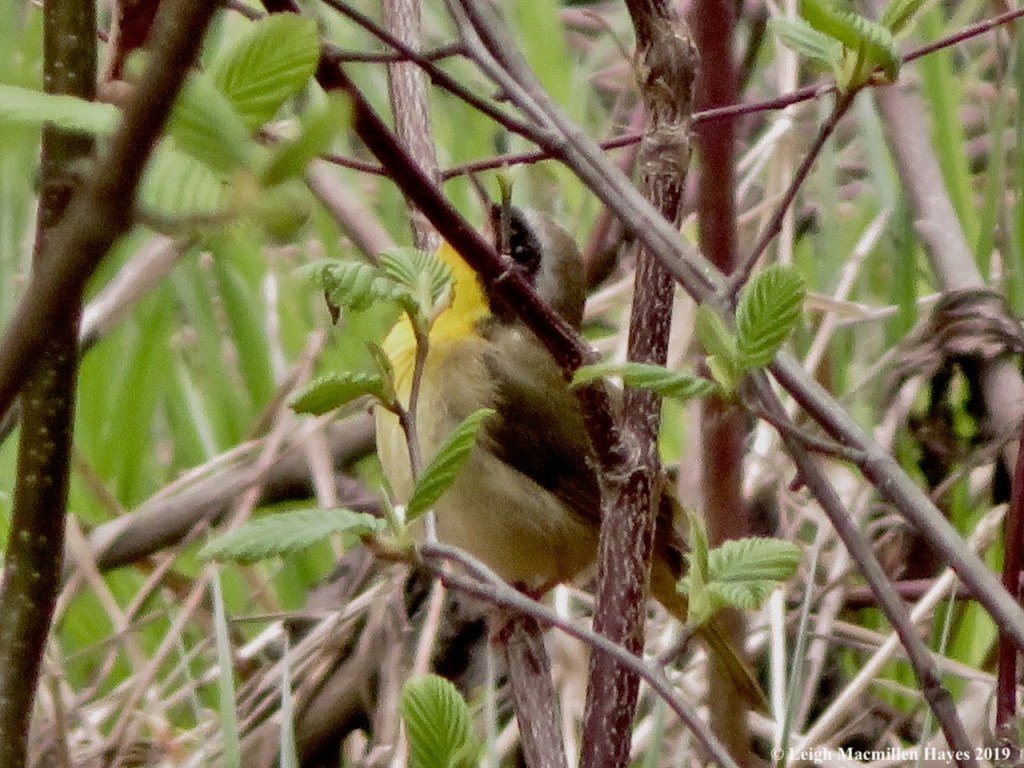
“Wichety, wichety, wichety,” was the give-away song for the Common Yellowthroat, although I do have to say he was much easier to hear than to see.

While the redstart donned the colors of Halloween, the catbird appeared to be a cat in a bird costume, and the yellowthroat was equally disguised with a black mask.

For a few minutes, I stepped off the bridge and followed the Stevens Brook trail where I was met by a delightful surprise. I spied the mottled leaves before the flowers and my heart sang its own tunes with recognition of the species that I didn’t know grew there.

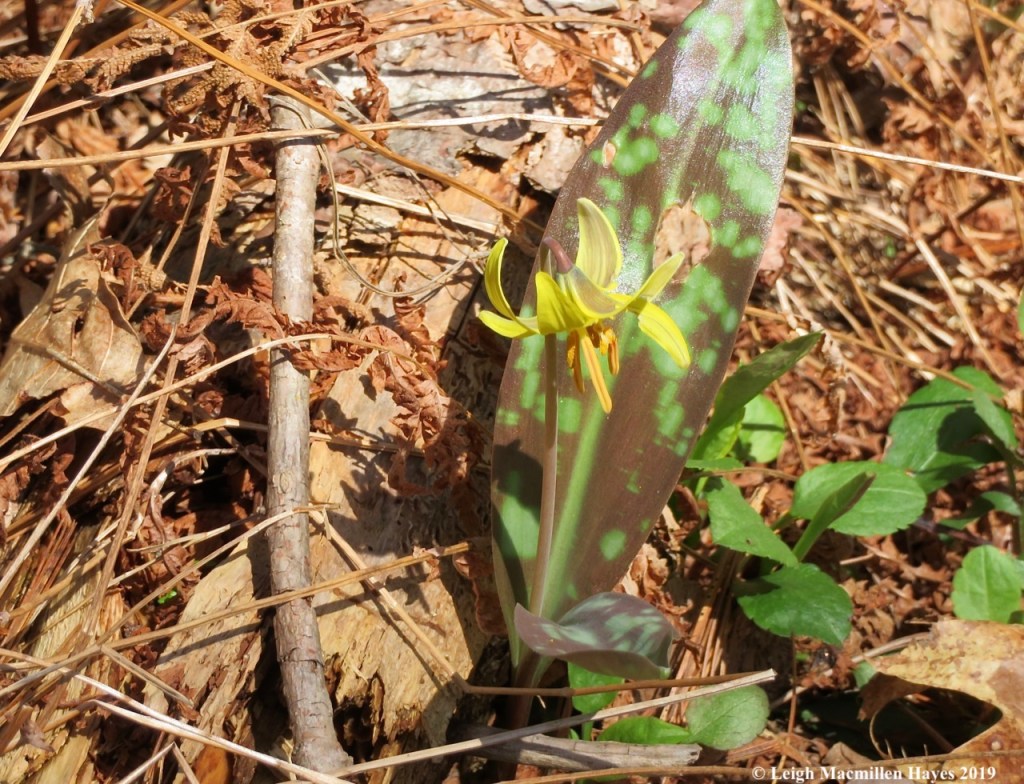
But the Trout Lily flowers were beautiful with a hint of bronze accenting their yellow petals. Do you see the formation? What may look like six petals is actually a configuration known as tepals for it’s difficult to differentiate between the three inner petals and their surrounding three sepals, which had previously enclosed the flower. Ahhh, language.

And within the center core, the pistil (she’s a pistol of a woman) surrounded by six stamen (Stay men), their anthers rusty red with pollen.

Also sometimes agreeing with the division of three were three tiny Goldthread flowers looking all fresh and perky. And their leaves of three parts that remind me of Cilantro.

And then another that knows the number being repeated time and time again: Jack-in-the-Pulpit or Arisaema triphyllum. The “pulpit” from which “Jack” (technically, the “spadix”) preaches stood between two long-stalked, three-parted leaves.

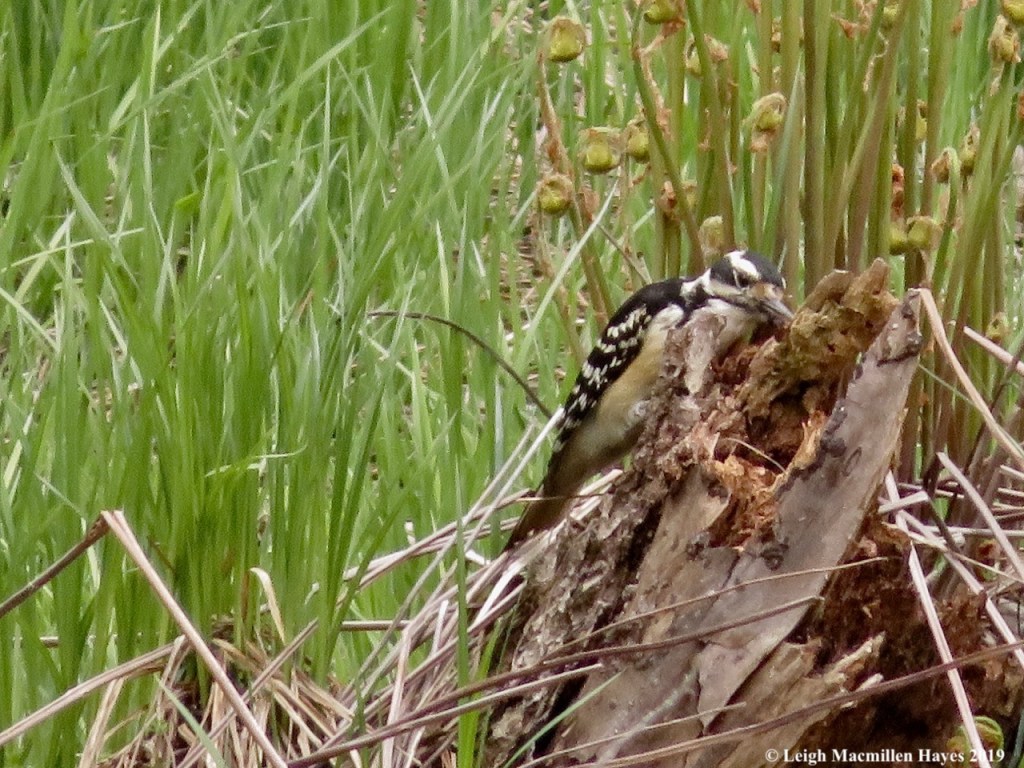
Further along the trail, I watched a female Hairy Woodpecker foraging for insects on stumps and logs.

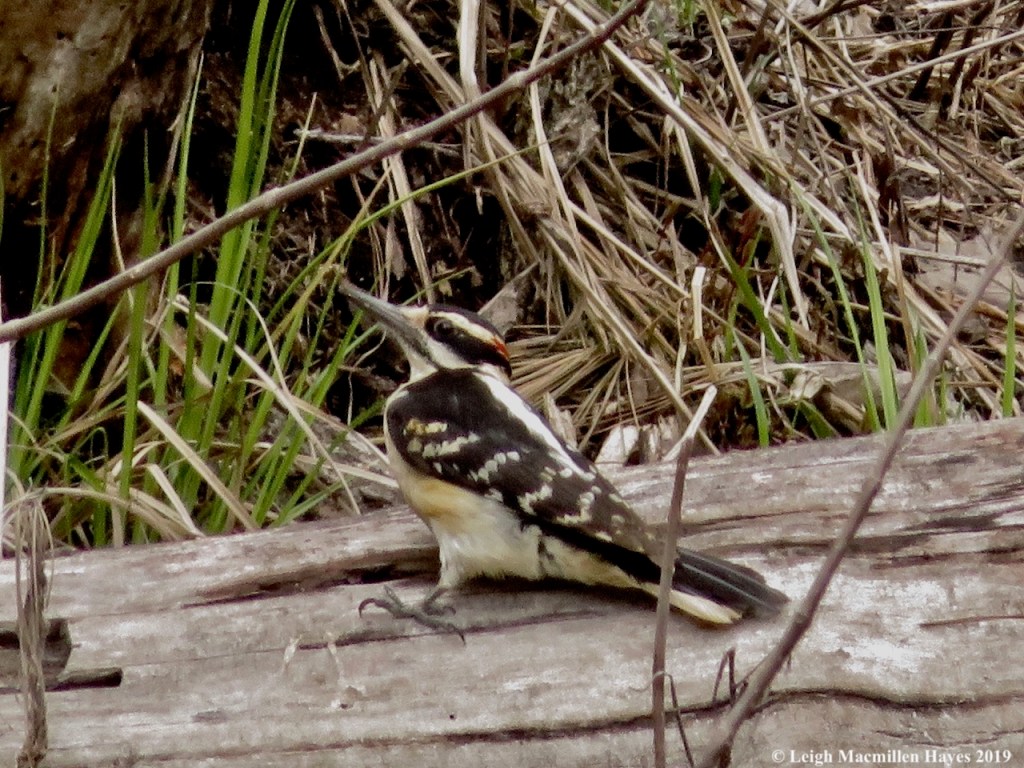
A male I assumed was her guy did the same.

And then, though the colors don’t really show it in this photo, I heard another bird sing and by his white hanky in the pocket (a dash of white on his wings, right Molly?) I think I’ve identified him correctly: Black-throated Blue Warbler.

I was grateful not only for the two that I knew, but also the third that I’m just learning.

Other flowers showed off their structures, like those of the Norway Maple. OK, so the tree is invasive and grows prolifically in the park because it was originally planted as part of the streetscape above, but the fragrant yellow-green flowers blew delicately in the breeze. (As will their seeds soon, and thus the invasion).

Another that grows much less abundantly, but always makes me smile is the Striped Maple, an understory tree. And it too had flowers to share so there is hope for more of this species.

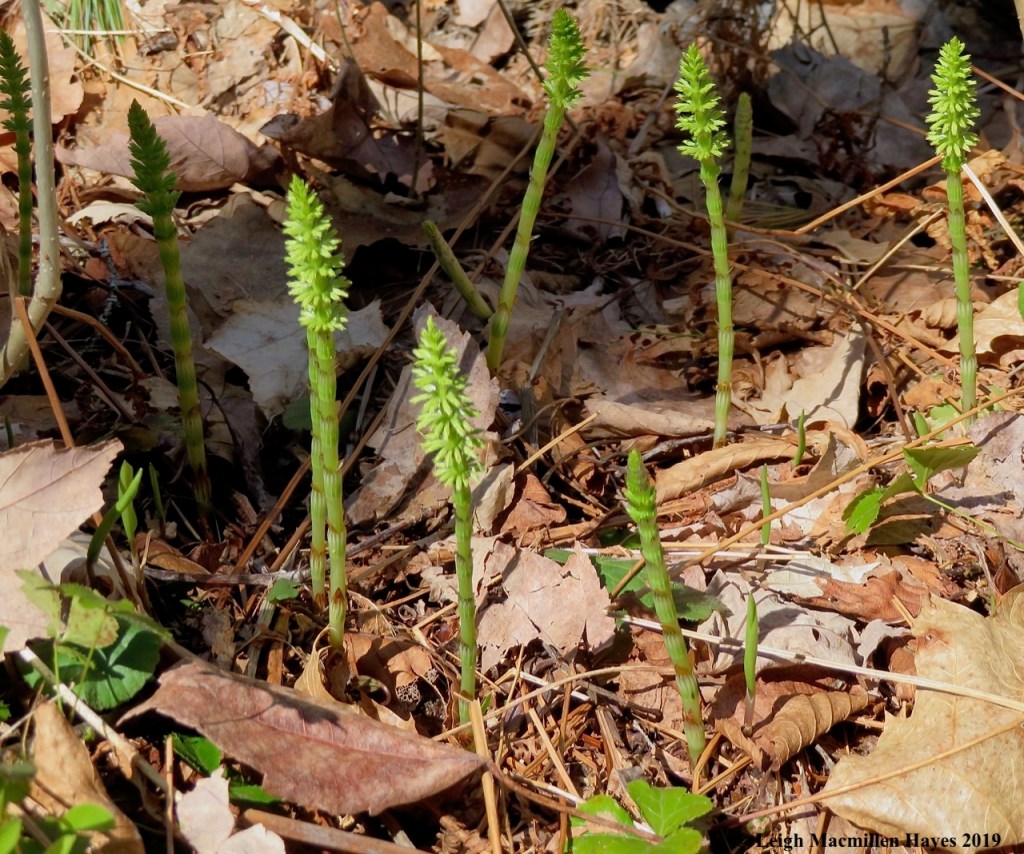
Flowering in a different way was the Woodland Horsetail, an equisetum. Its flower was in the form of a cone at the tip. Once its spores have been shed, the cone will collapse.

Insects also were part of the scene and tis the season of Mayflies, this one a subimago as indicated by the color of its wings. Cloudy wings indicated it was a teenager that had not gone through its final morph.

And then, a Great Black Wasp–its translucent blue wings giving it away in the duff. I tried to get closer, but it took off.

Such was the case also with a Mourning Cloak butterfly, which would have given me three insects to share. Do remember that insects have three pairs of legs–there’s that number again.

At last, several hours after I’d begun, it was time for me to leave Stevens and Willow Brooks behind.

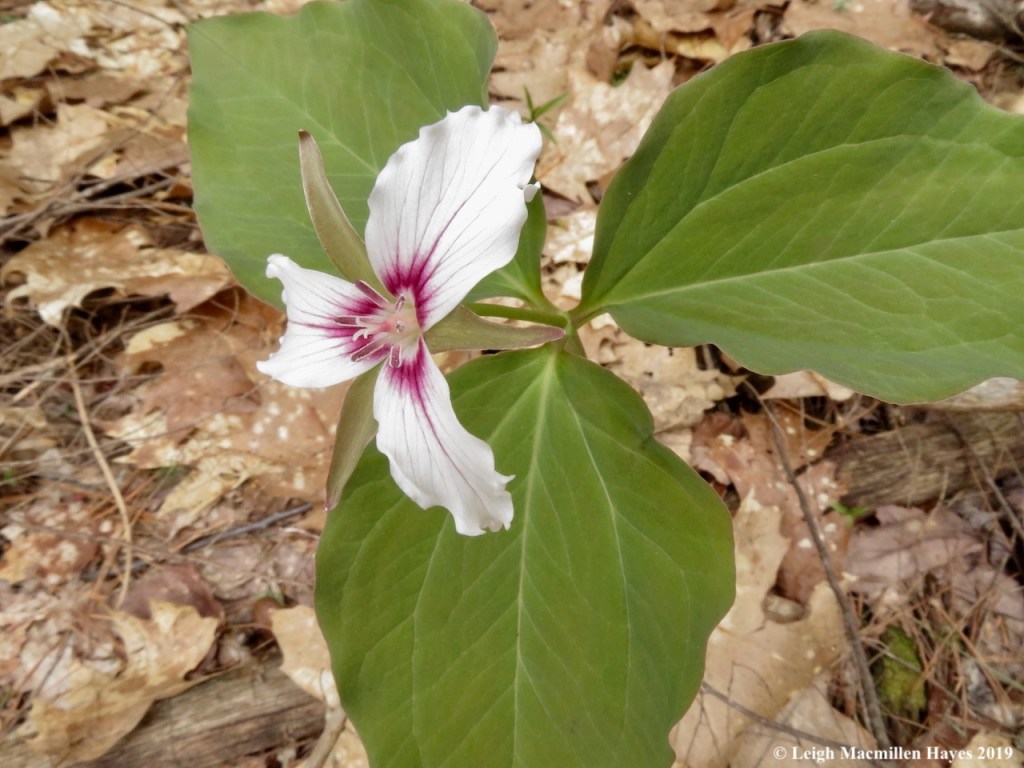
But not until I had a chance to enjoy the beauty of Painted Trillium (Trillium undulatum), which was my initial reason for the journey. Trillium: Latin for tri, refers to the flower parts occurring in threes; llium: Latin for liliaceous, refers to the funnel-shaped flower; and undulatum: Latin reference for wavy, referring to the petals’ wavy margins.

Mom was right. Good things do happen in threes. Along my journey I also had the blessing of chatting with three wonderful women, Becky, Sheila, and Lori.

Thrice the blessings worth a wonder indeed.

LOVE ME, love me: Wolfe’s Neck Woods State Park

It had been four years since we last visited Wolfe’s Neck Woods State Park and that venture took place at the end of November. We must have been Christmas shopping. Today, we were in search of a bug-repellant shirt for me (Spring shopping) and so our journey took us to Freeport. Not being a shopper, it was a quick in and out of the store and then onto Wolfe’s Neck Road.

There’s a 4.4 mile network of trails in this 200-acre park gifted to the State in 1969 by Mr. and Mrs. Lawrence M.C. Smith of Freeport. One of the stand-out features is Googins Island where Osprey have been entertaining visitors for years as they raise their young on a huge platform nest they’ve built high up in a pine. Can you see it?

Here’s a closer view–and I assume (never assume) that Momma was the one sitting on eggs. The nest has been added to each year and though I have no idea of its actual size, Osprey nests can reach 10–13 feet in depth and 3–6 feet in diameter. The depth of this one appeared to be a few feet, but the diameter was substantial.

We followed the trails and enjoyed journeys to the water where we could take in the views of Casco Bay and its islands.

And before our feet, the mix of granite pegmatite and metamorphic rock. As much as my mom always loved to walk along a beach, she was equally enchanted by the rocky coast of Maine and whenever I encounter it, I feel her presence.

I know mom would have appreciated the artistic rendition of waves created by the water and mimicked by the rock.

Again and then again, the trail was interrupted by a set of wooden steps that led us back to the water’s edge.

It was there that we spied the Common Eiders as they floated and fished.

And . . . the first Dandelion blossom of the season–for us, at least. In my modest opinion, Dandelions are under-appreciated and that fact was driven home when my guy asked, “You’re photographing a dandelion?” Yep. Check out each golden ray of sunshine with its five “teeth” representing a petal that forms a single floret. Yes, each petal is a floret. Therefore, the bloom is a composite of numerous florets. And notice how each stigma splits in two and curls. What’s not to love. Oh yeah, and though we didn’t witness it today, the pollinators love them. (SO don’t pull up the dandelions in your yard!)

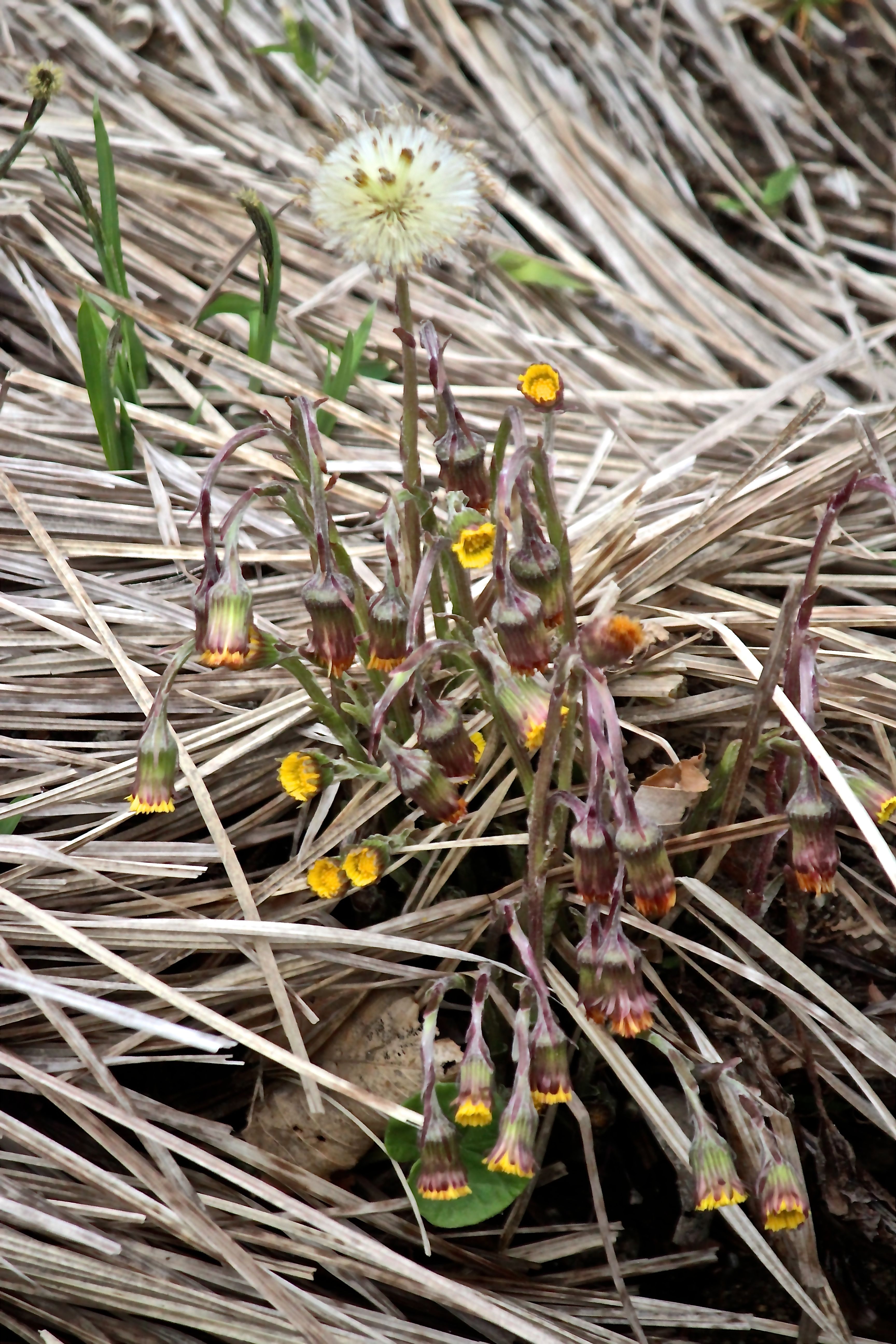
The thing about Dandelions is that they leaf out first and then flower, while their cousins, Coltsfoot, which we also found along the trail, flower first and leaf out later. The wonder of it all.

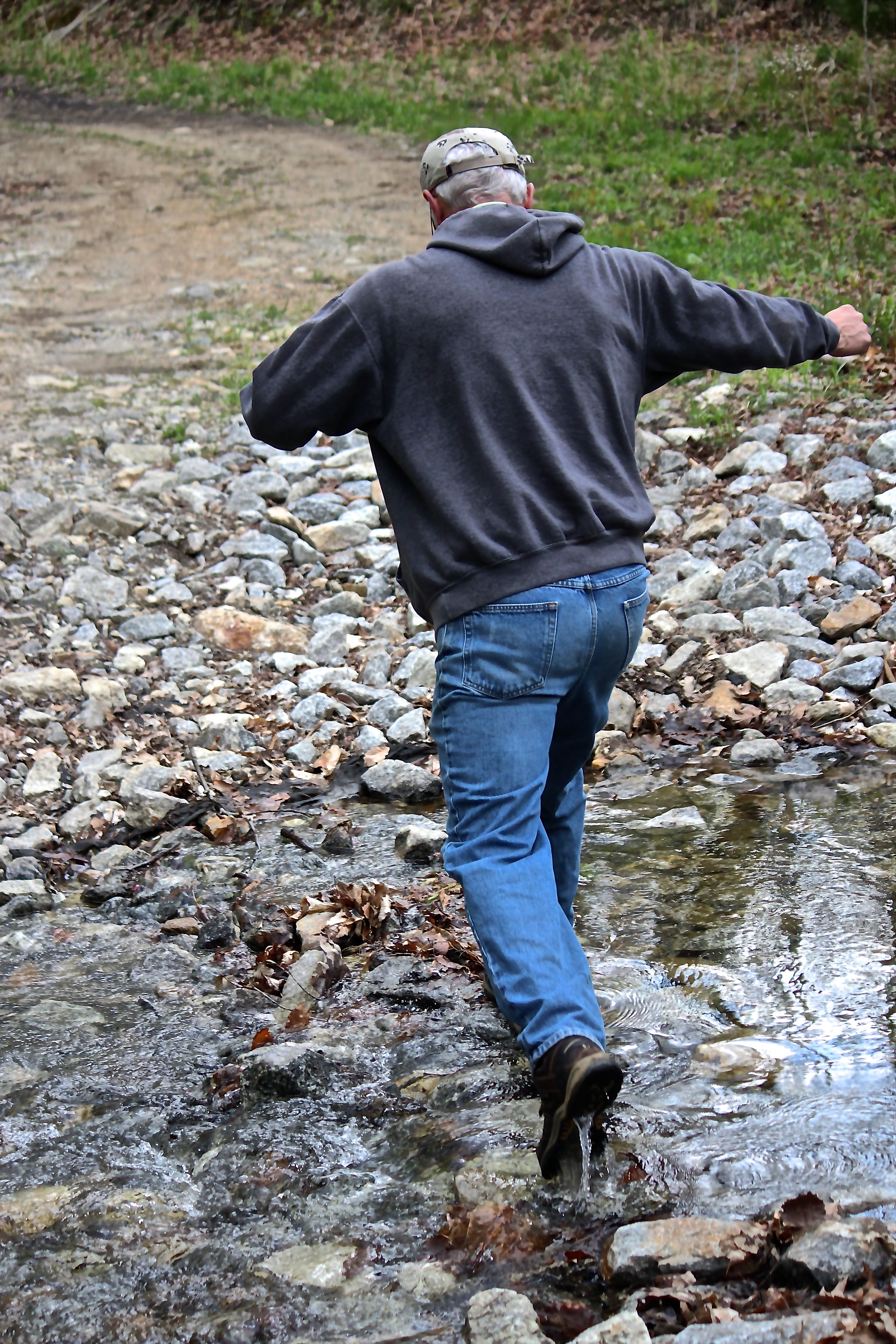
Our journey took us across stepping stones,

along park-like paths (because we were in a park, after all), over roots and rocks, with ups and downs, and even a couple of bog bridges.

The sights along the way included patches of Equisetum, a living fossil. These vascular plants reproduce by spores rather than seeds and dominated the understory of late Paleozoic forests. Just imagine.

While that was a treat, one of my favorite surprises was the patch of Trout Lilies that decorated the forest floor. It’s one I don’t encounter often, but because of its maroon-mottled leaves that remind some of brown or brook trout, I’ve remembered it each time we’ve met.

The nodding flower that could have been a lantern in the forest with its petals and sepals bent backward, exposed six brown stamens hanging low.

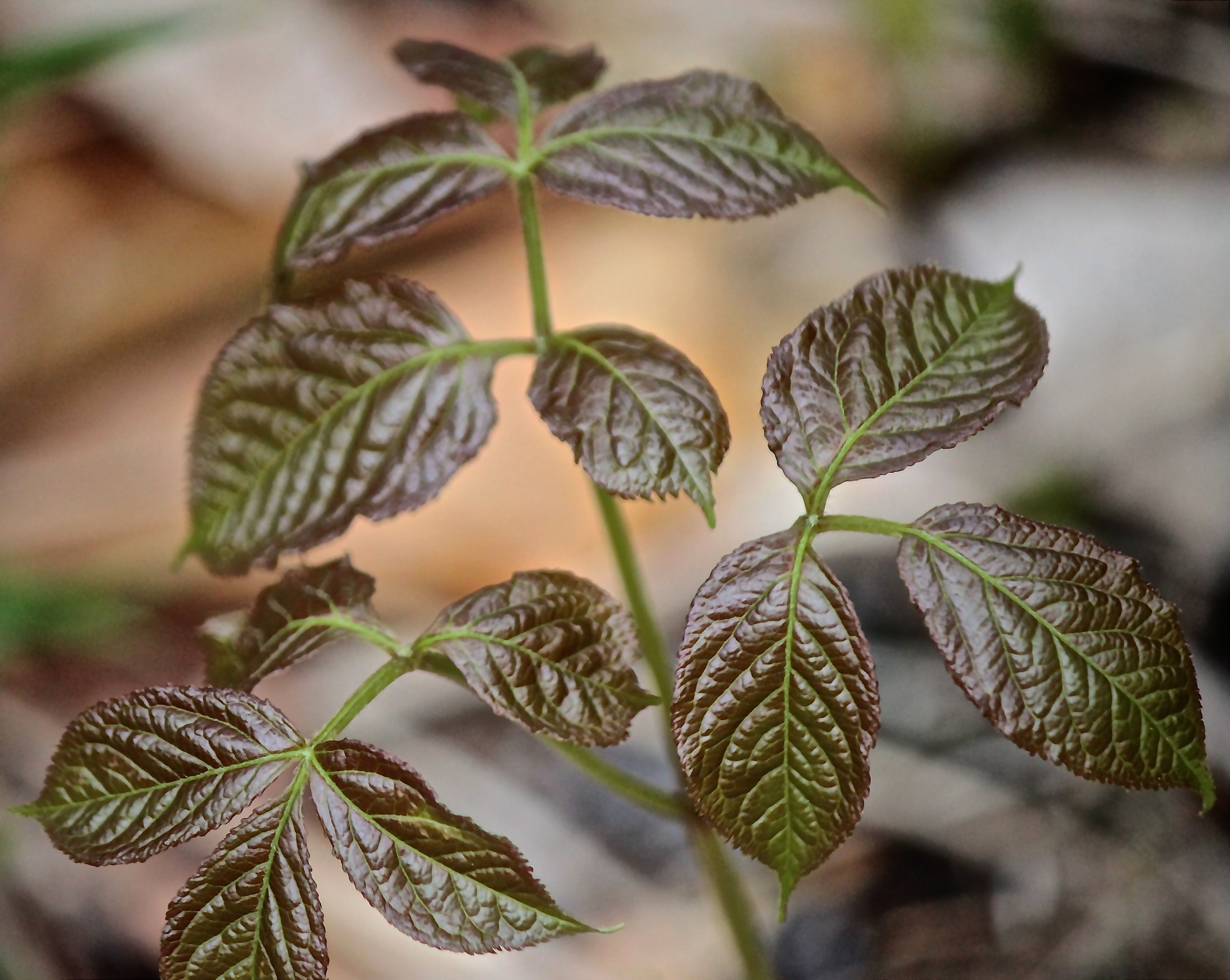
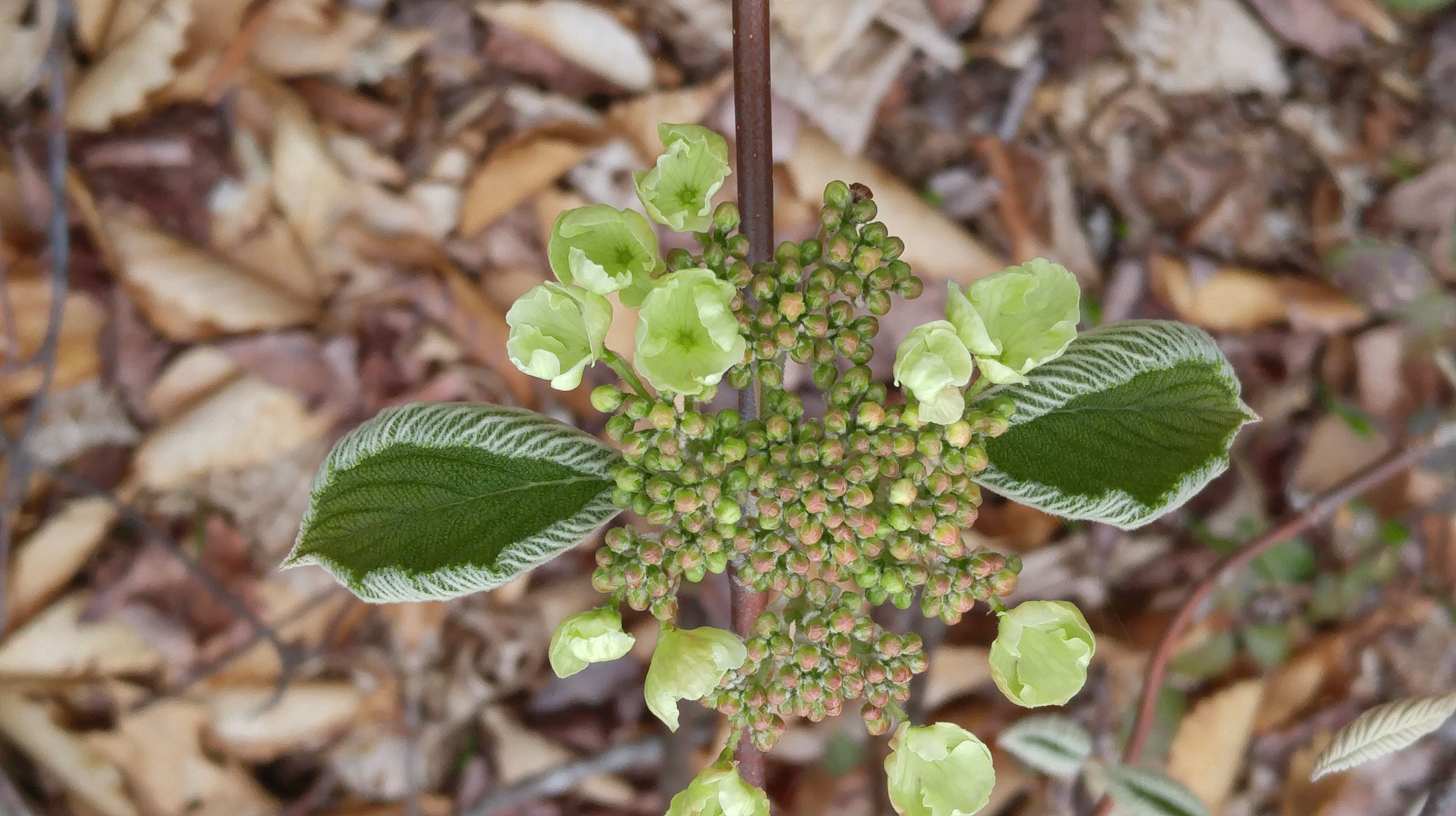
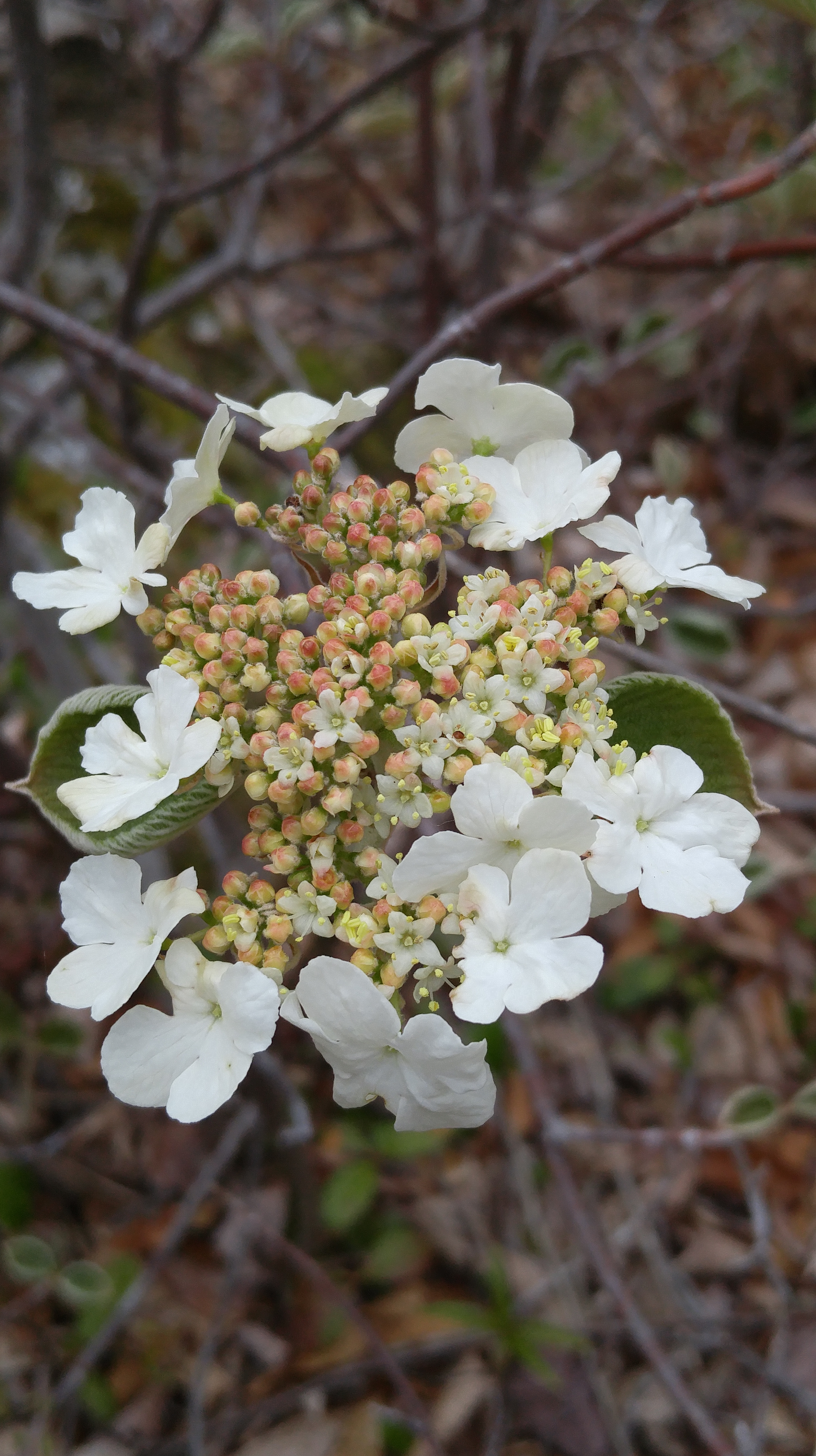
And then, and then, one of my all-time favorites in any season, a Hobblebush, showed off its May glory in new leaves and flowers. Those in our western Maine woods aren’t as advanced yet, but trust that I am watching.
Our journey was quick for we had another commitment, but still . . . we made some wonderful discoveries and especially loved the opportunity to see the Osprey on its nest.

The second in our LOVE ME, love me series had come to an end. Wolfe’s Neck Woods State Park. ✓ Two down, 32 to go!

On Another Day

Today was a perfect day for a hike–cool temps and a breeze kept the bugs at bay. And so my guy and I headed off after lunch with a destination in mind. Backpack–check. Camera–check. Map–check.

And with the latter, it all ended.

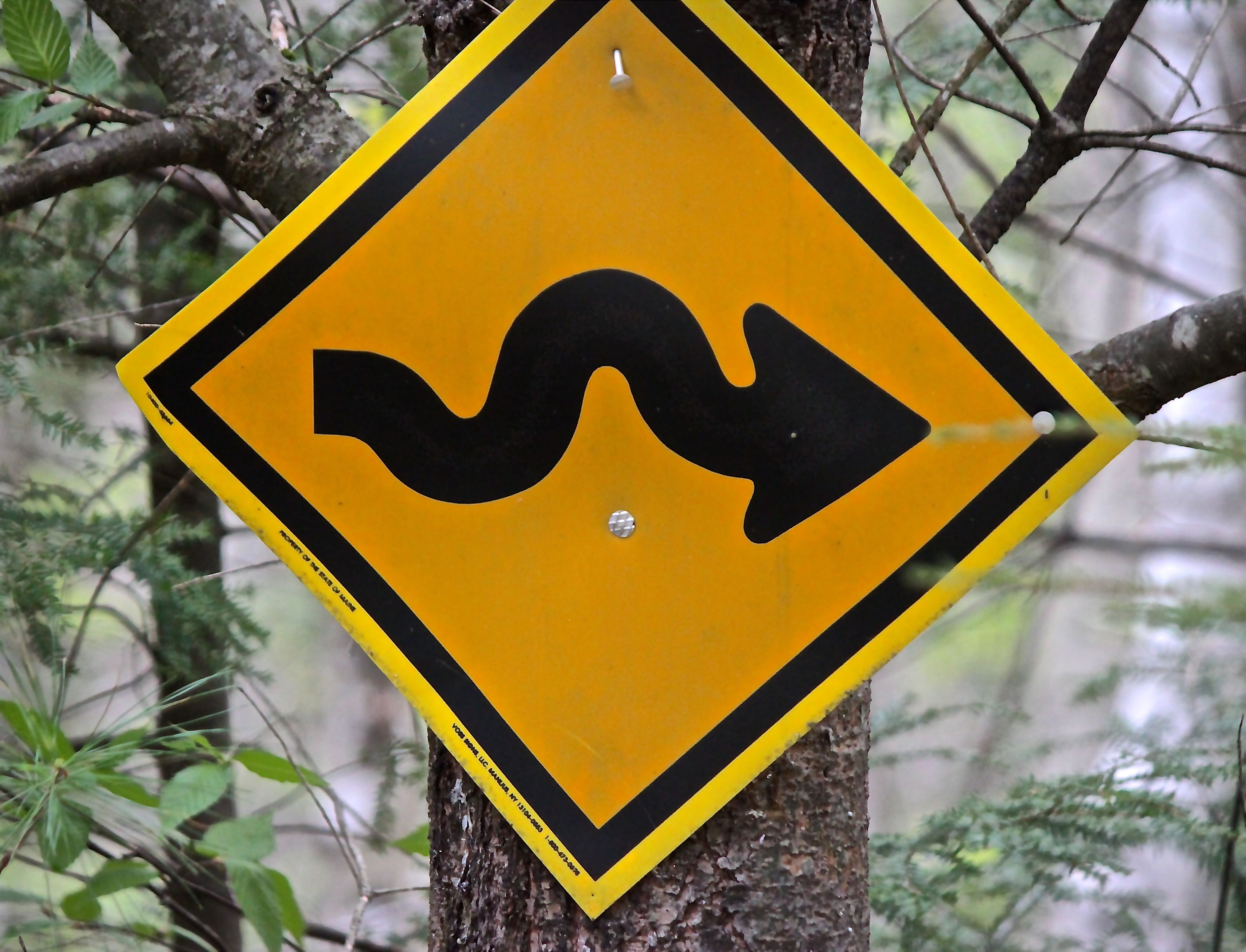
a-squiggly sign

We’d hiked our intended trail once before within the last ten years, but remembered that back then we had a difficult time following it. We were sure, however, that we could find our way today and we did. Until, that is, we reached a junction and read the snowmobile trail signs. Our gut told us to go straight but because we were on a snowmobile trail, the signs listed destinations. We looked at the map, looked at the signs, and convinced ourselves to turn right.

a-hobble 3

And so we journeyed on, enjoying the beauty of hobblebush even as it forced us to do what it was named for–hobble through the undergrowth.

a-hobble 2

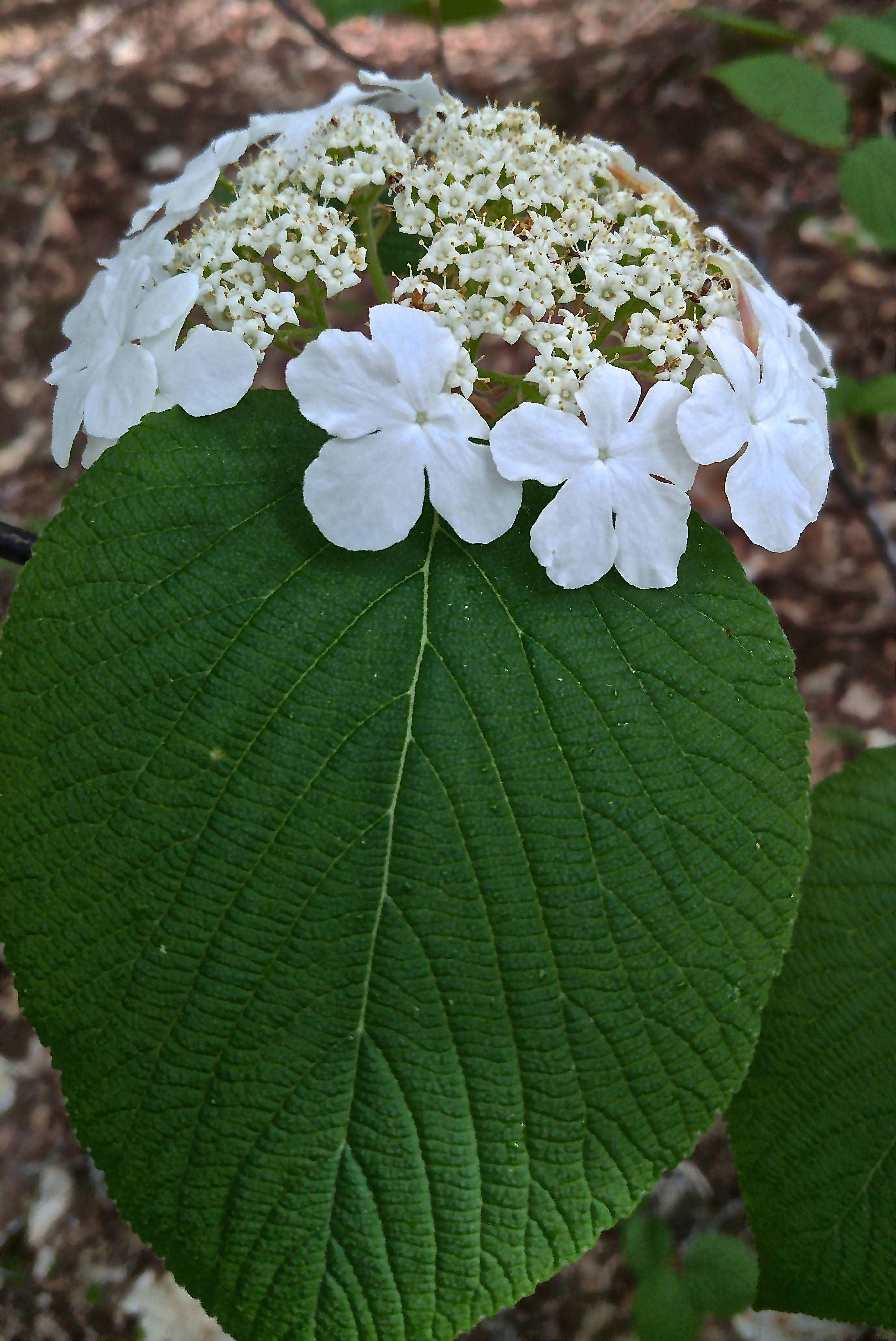
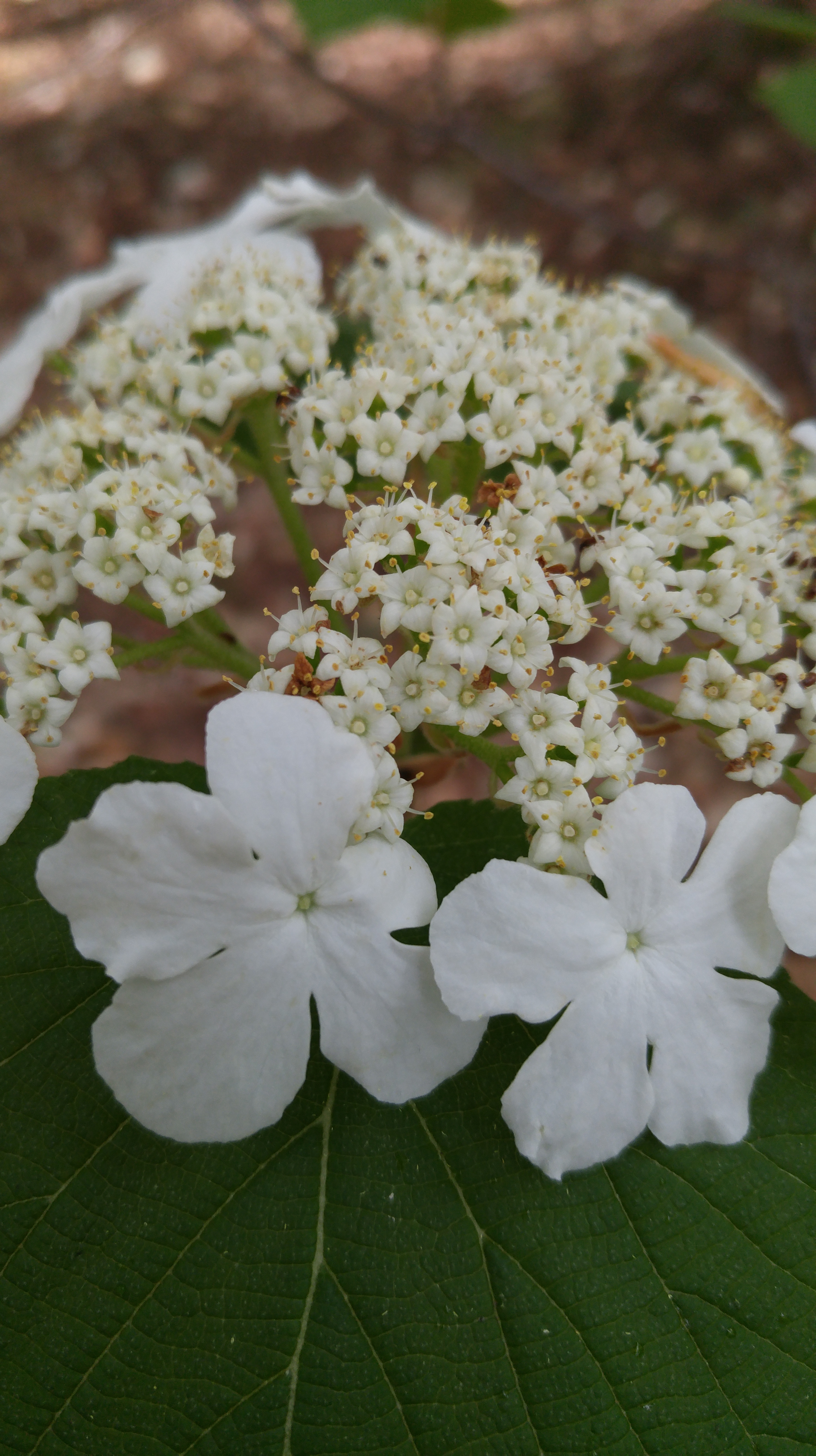
But how could we resist such beauty. Or should I say, how could I resist such beauty–my guy trudged on. I think it’s the complexity of the blossom that intrigued me most–large, five-petaled, sterile flowers encircled petite and fertile, waxy-white flowers. Why big showy flowers surrounding such tiny ones complete with stamens and pistils? Perhaps the outer sentry attract insects for the sake of pollination.
a-round-leaved violet 2

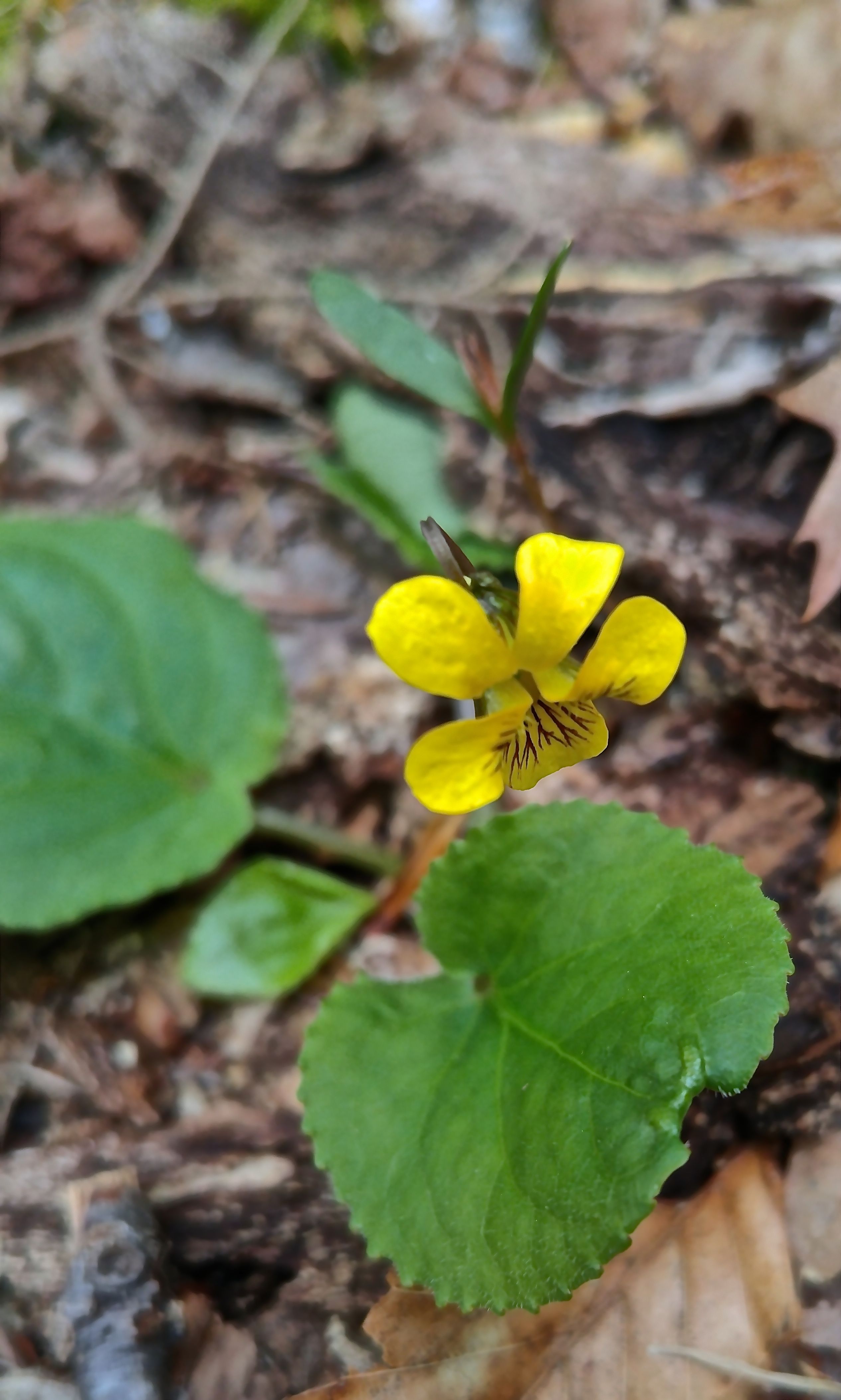
Also thinking about pollination–those purple runway lines of the round-leaved violets.  I’m not a fashion girl, but it’s flowers like this that make me realize you can combine a variety of colors to make a statement.
a-rose twisted stalk

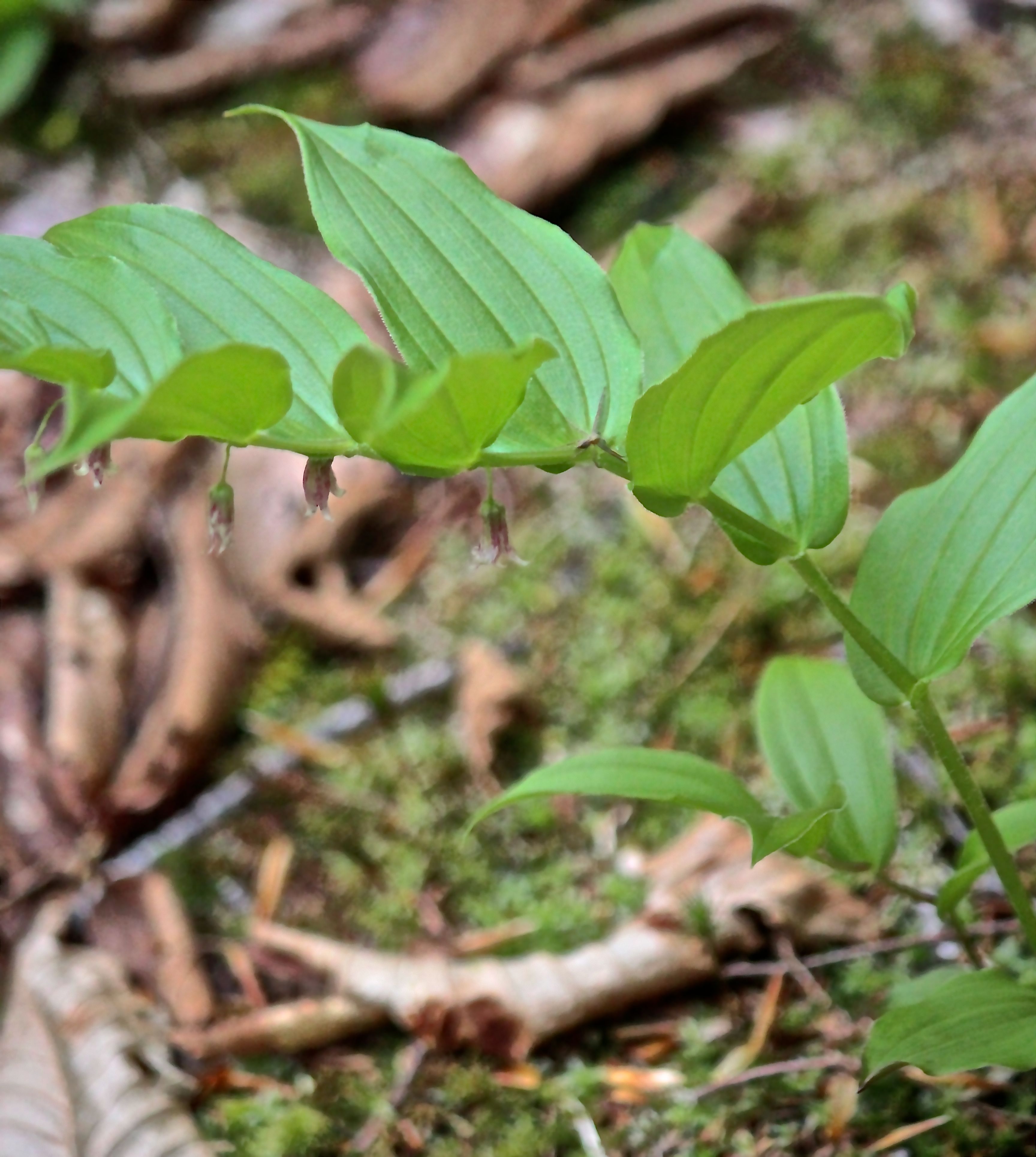
A much more subtle display of color–rose twisted-stalk. Not a great photo, but the  flowers dangled below the twisted stalk. Why rose?  The bell-shaped flowers that occur singly at the leaf axils are pale rose in hue. Why twisted? Because at each leaf junction the stem takes a distinct twist.

a-sarsaparilla

Adding to the subtle color of the season–sarsaparilla. I love the fact that this particular example shows the variety in the finely toothed compound leaves–in this case, two leaves sporting five leaflets, while another consists of three. It’s the three that sometimes gives this plant an undeserved bad rap–leaves of three, leave them be, refers to poison ivy. But this is not P.I. as we used to call it when I was a kid.

a-coltsfoot1

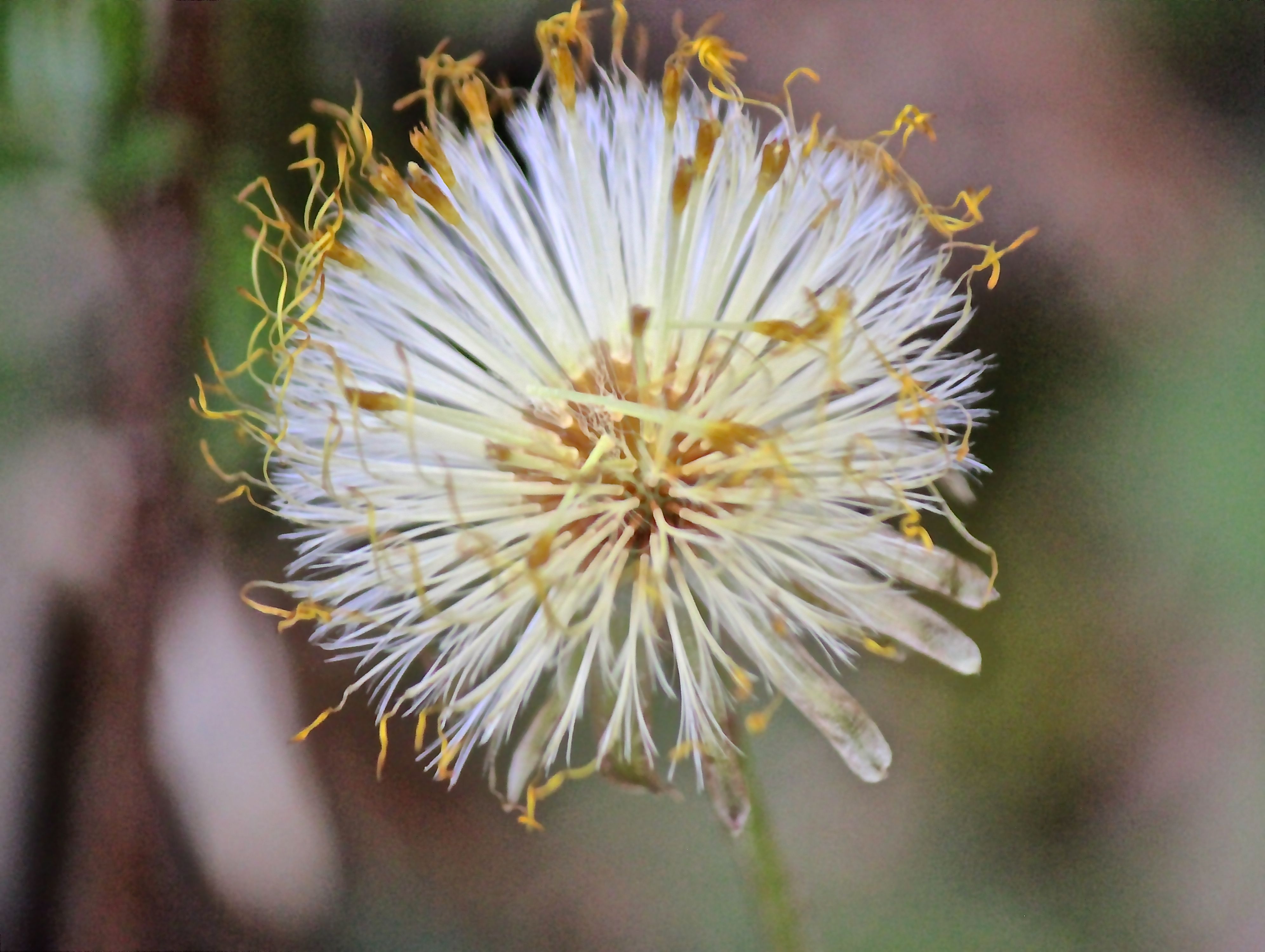
Another sorta look-alike, coltsfoot that resembles a dandelion. The difference–a coltsfoot seed ball retains its flower parts.

a-spring color

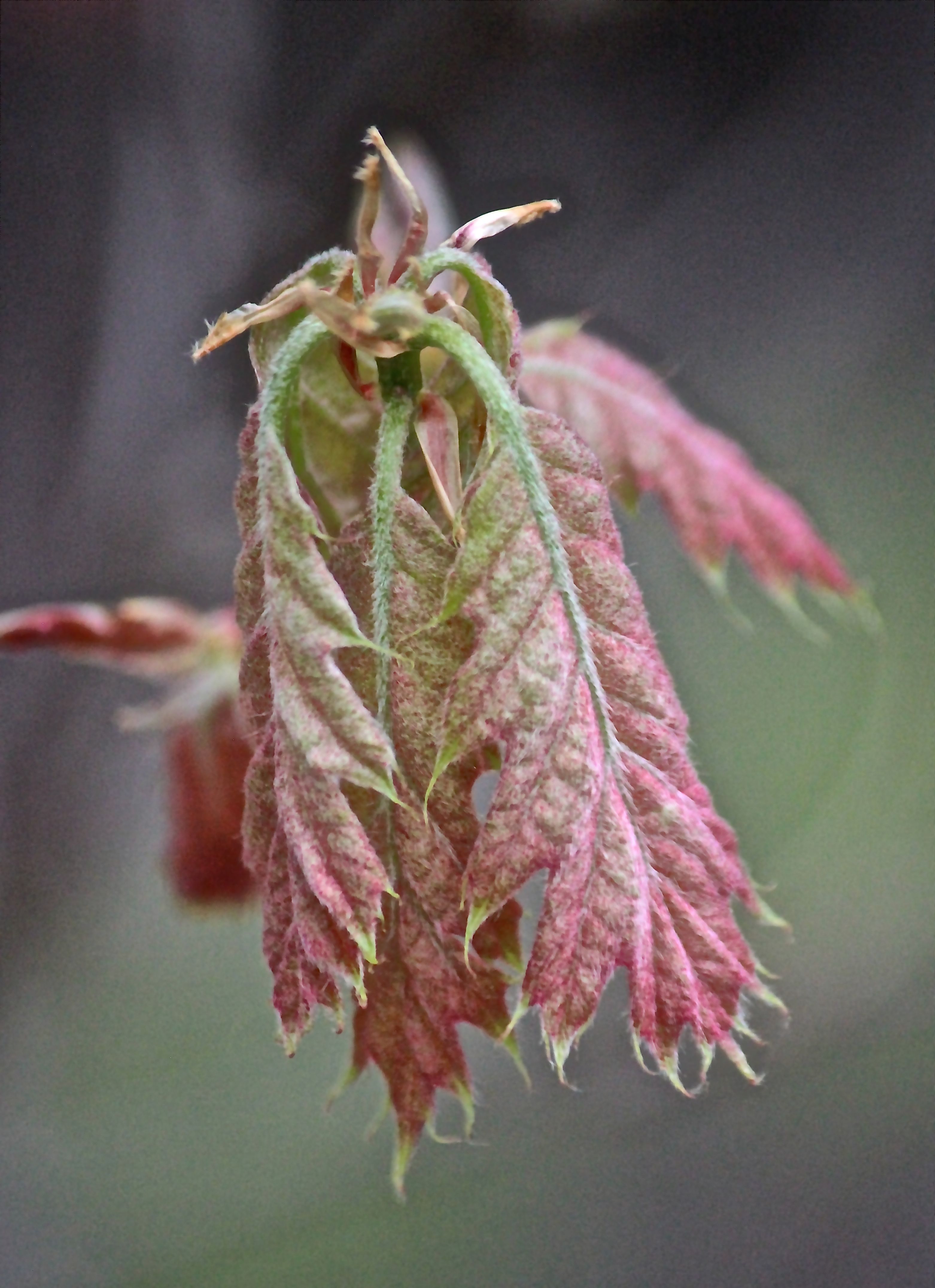
As the tender new leaves emerge, the landscape softens.

a-oak 1

From subtle colors

a-beech 3

to hairy fringes

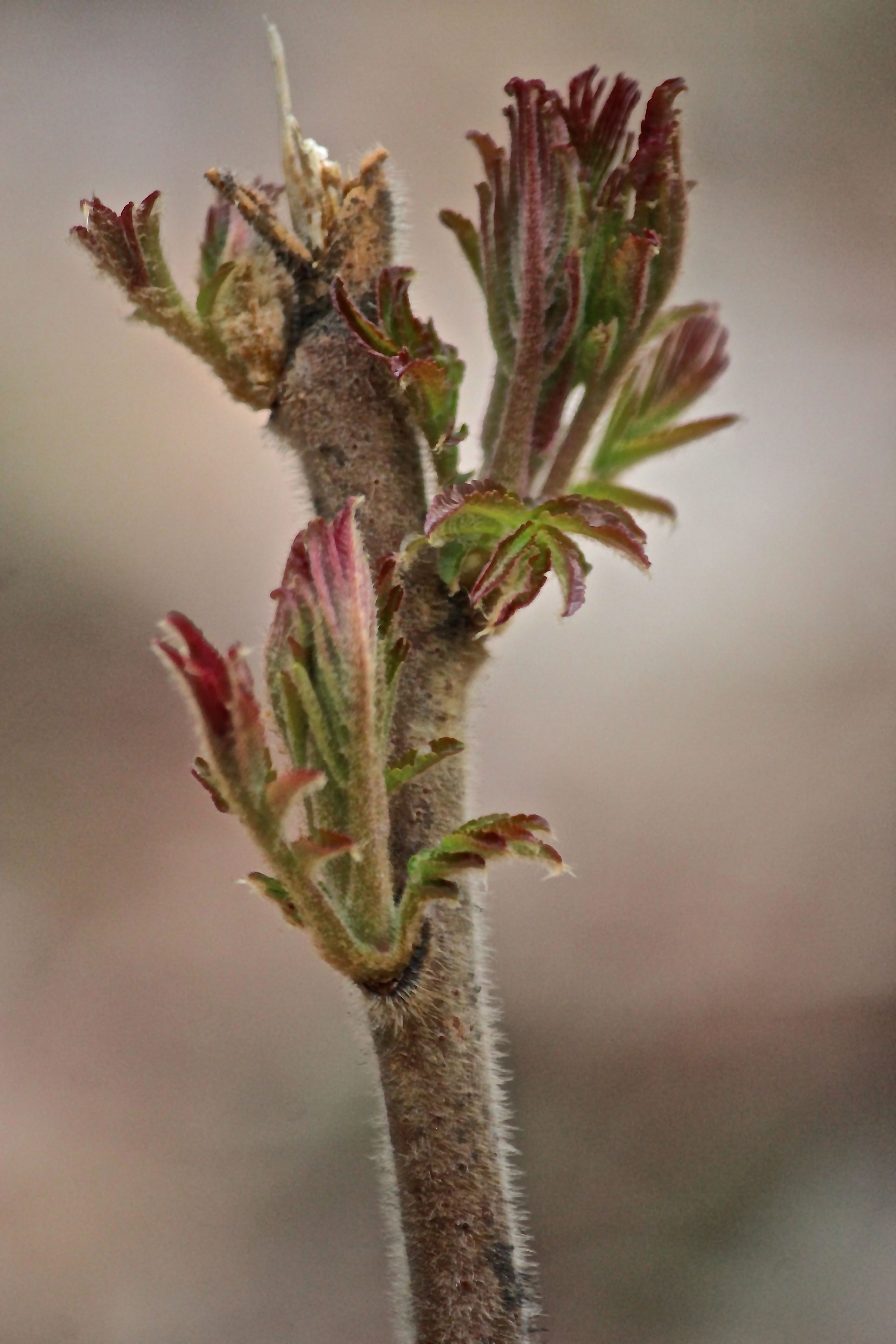
a-sumac 1

and fuzzy coatings, the world embraces a softer point of view.

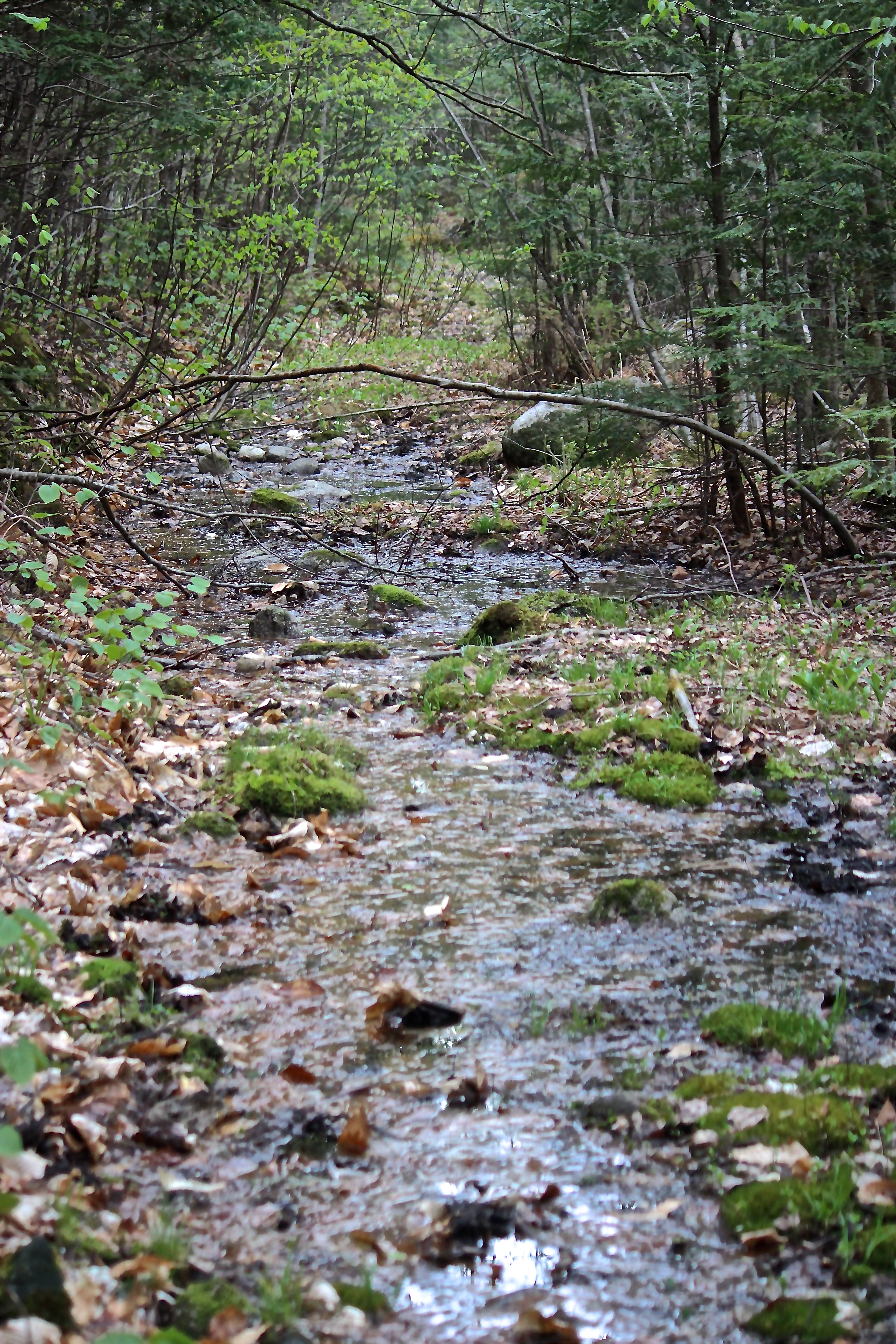
a-wet trail

Though we continued to make delightful discoveries, it was evident that we were on the wrong trail.

a-brook crossing.jpg

After a couple of hours, we turned back.

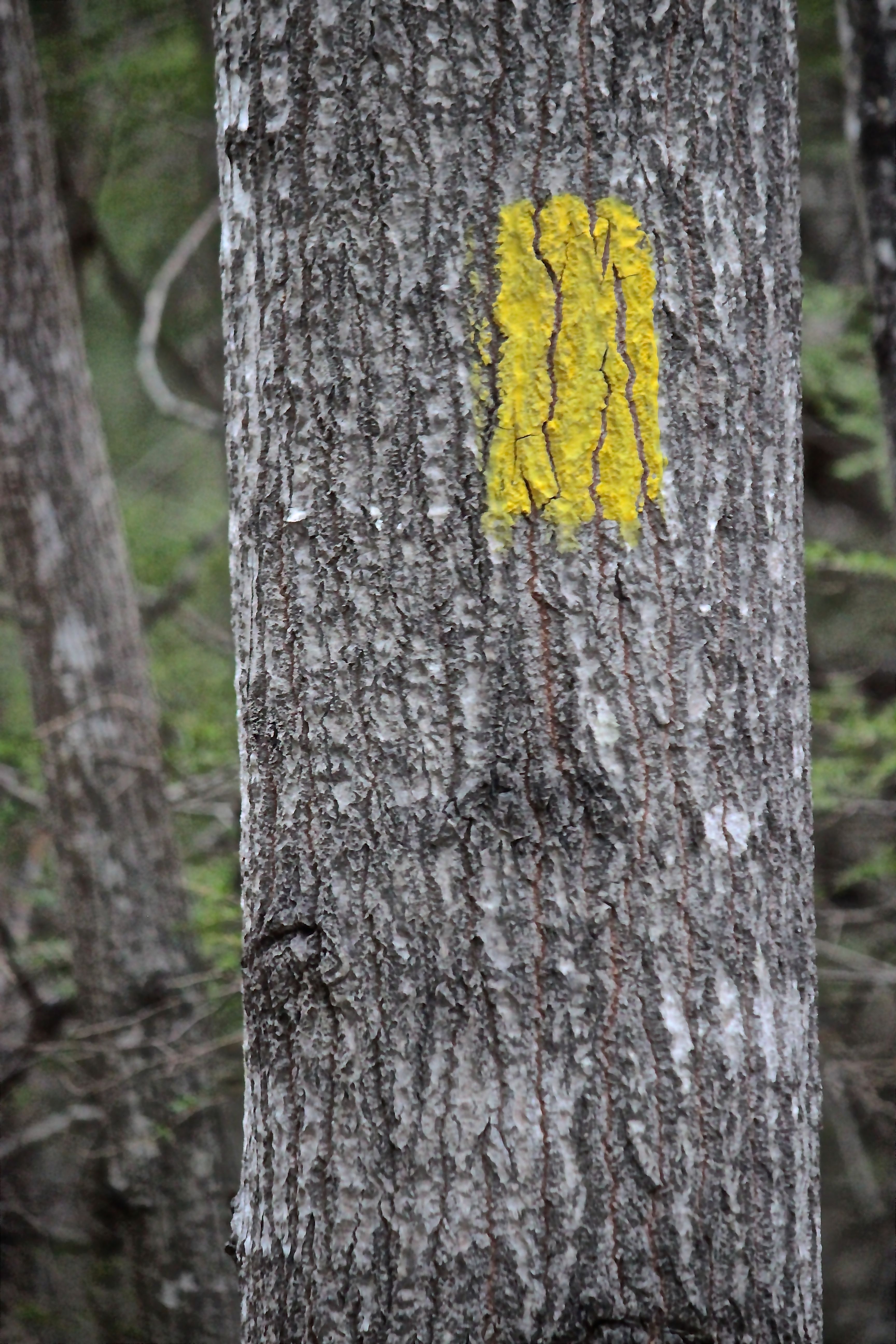
a-trail blaze.jpg

And at the point where we ignored our gut feelings and decided to turn right, we checked on the other trail–and found that it was blazed. Oh well.

We’ll save it for another day.


Spring In Slo-Mo

Spring is so fleeting in Maine. Oh, I know, it lasts the usual three months and the beginning and ending overlap with its seasonal partners, but really . . . one must take time to pause and watch or you’ll miss the most amazing action that occurs in slow motion right outside the window–and beyond.

s-red trill 1

Jinny Mae and I drove beyond today to catch a glimpse of this most splendid season.

s-red trill 10

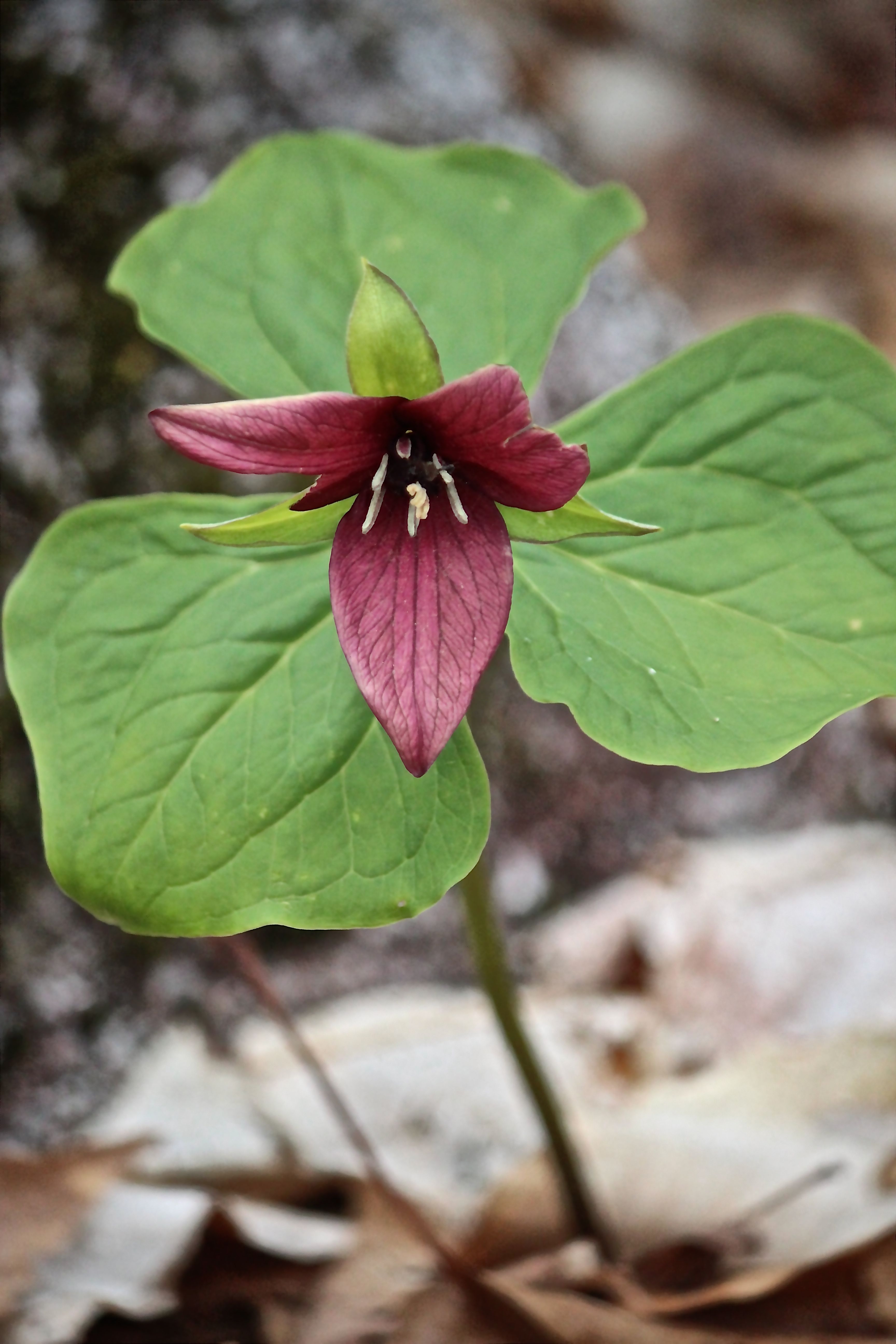
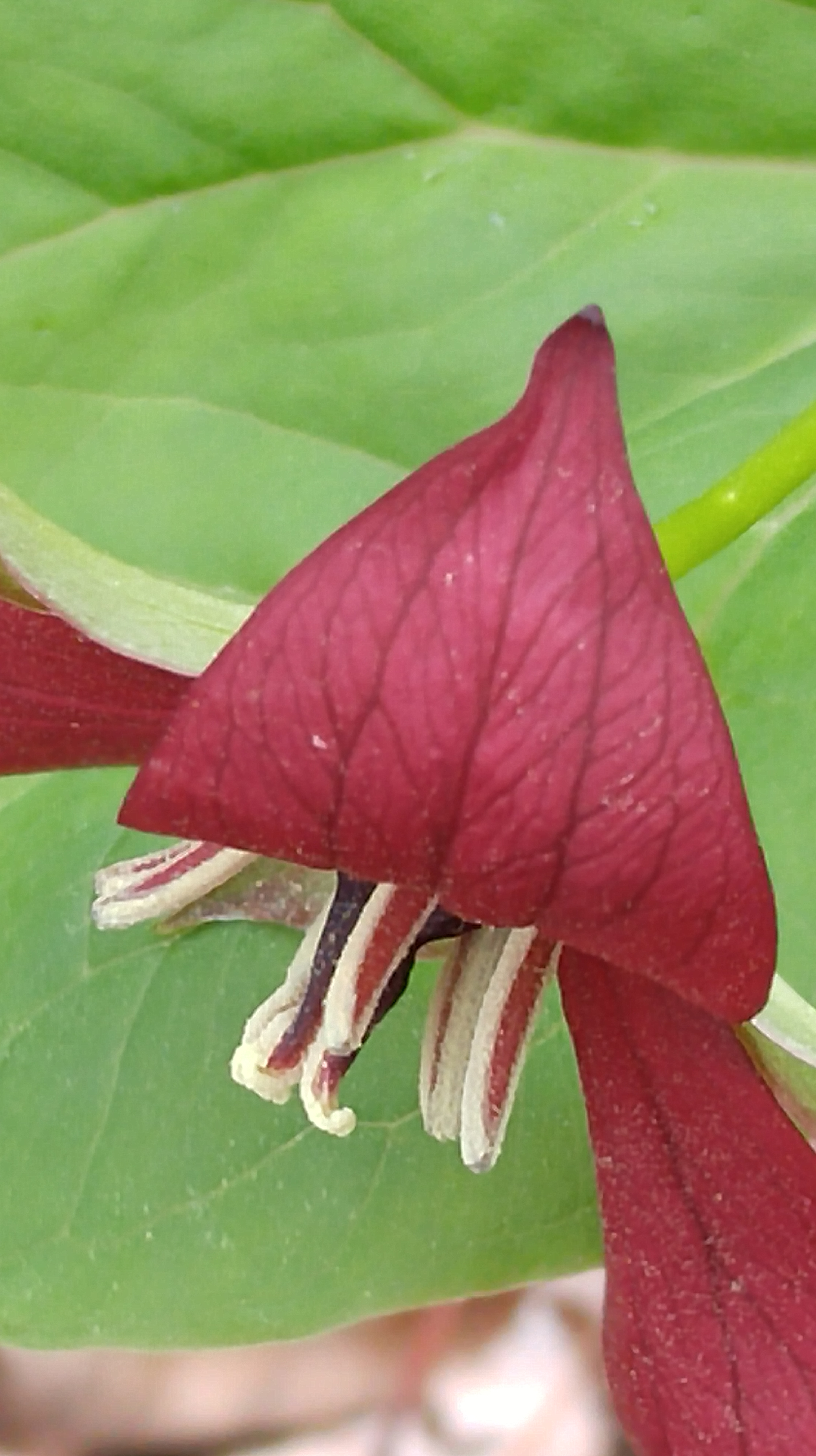
Among the offerings, red trillium also known as stinking Benjamin. The Benjamin part is from benzoin, a mid-16th century word derived from the French benjoin, that refers to “a fragrant gum resin obtained from a tropical tree of eastern Asia, used in medicines, perfumes, and incense.”  It’s been tagged “stinking”  because its nodding flower has an unpleasant odor. We didn’t bother to sniff. We were too busy being wowed by the fact that it surrounded us in great number.

s-red trill 2

That smell, however, is of extreme importance. Along with the flashy coloration, the odor helps to attract pollinators–green flesh-flies that prefer to lay their eggs on rotting meat. Though this isn’t the perfect nursery, the flies assist the plant on the procreative end. And in this spot, stinking Benjamin rules, but I prefer to think of it as red trillium.

s-red trill back

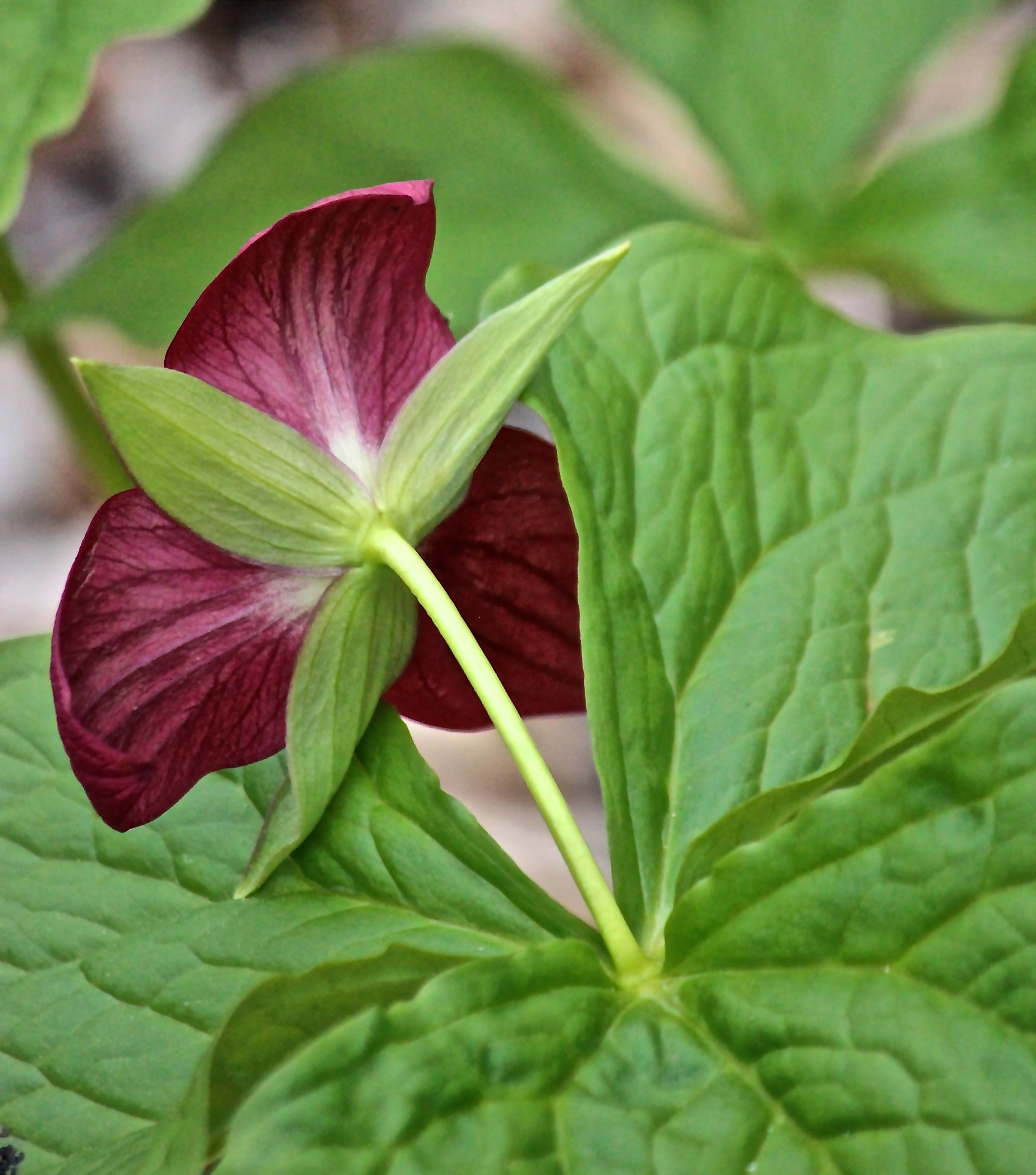
Even from the backside, its design is one to behold.

s-false 1

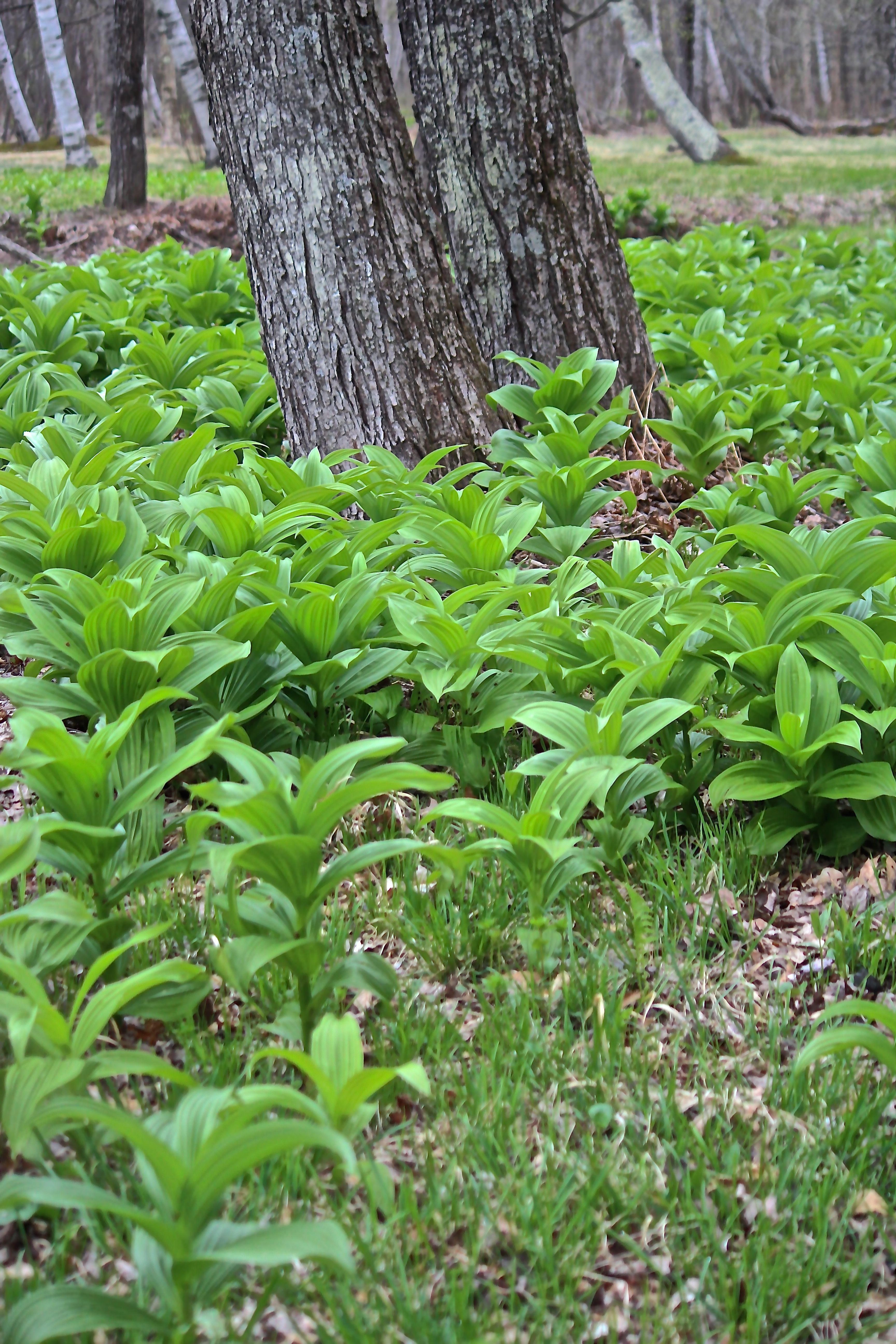
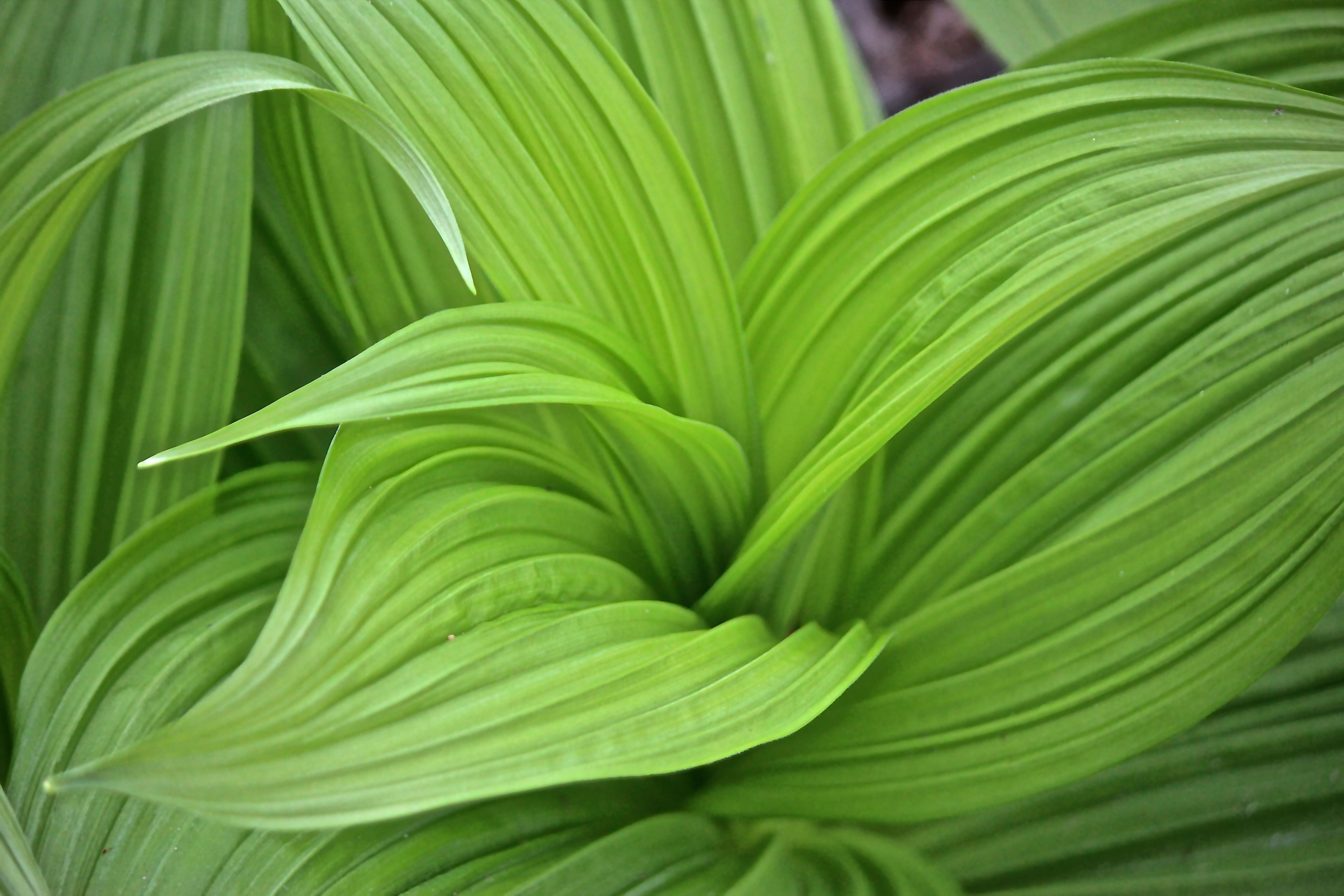
Equally abundant were the leafy structures of false hellebore.

s-fals3e4

I was mesmerized by its pattern.

s-wood 2

Unlike the trillium, wood anemones have little scent.

s-wood 1

Their graceful heads drooped, perhaps because the day threatened rain.

s-bellwort 3

The offerings included sessile-leaved bellwort (aka wild oats),

s-dutchmen1

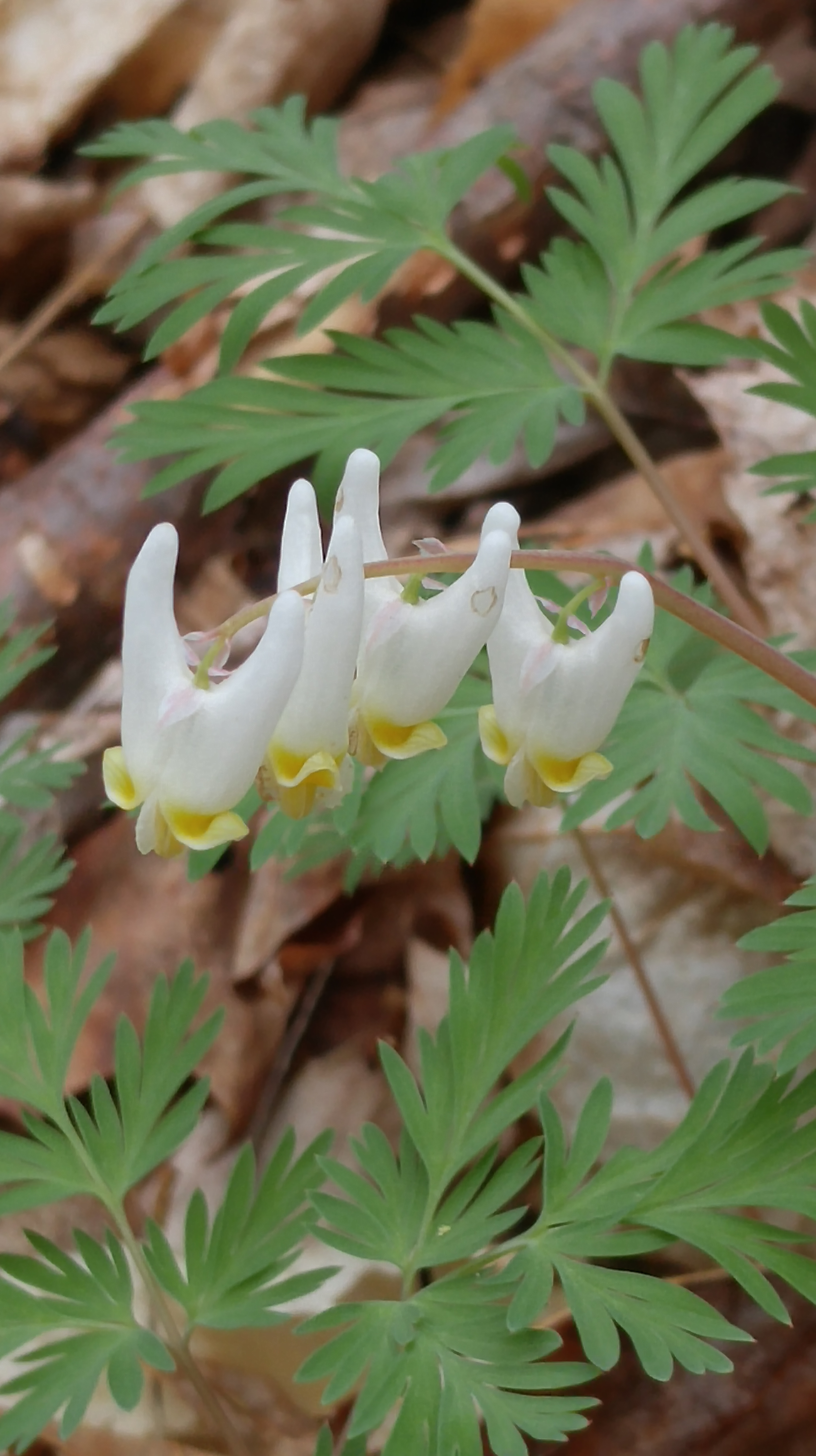
Dutchman’s breeches with leaves as interesting as their flowers,

s-ginseng 2

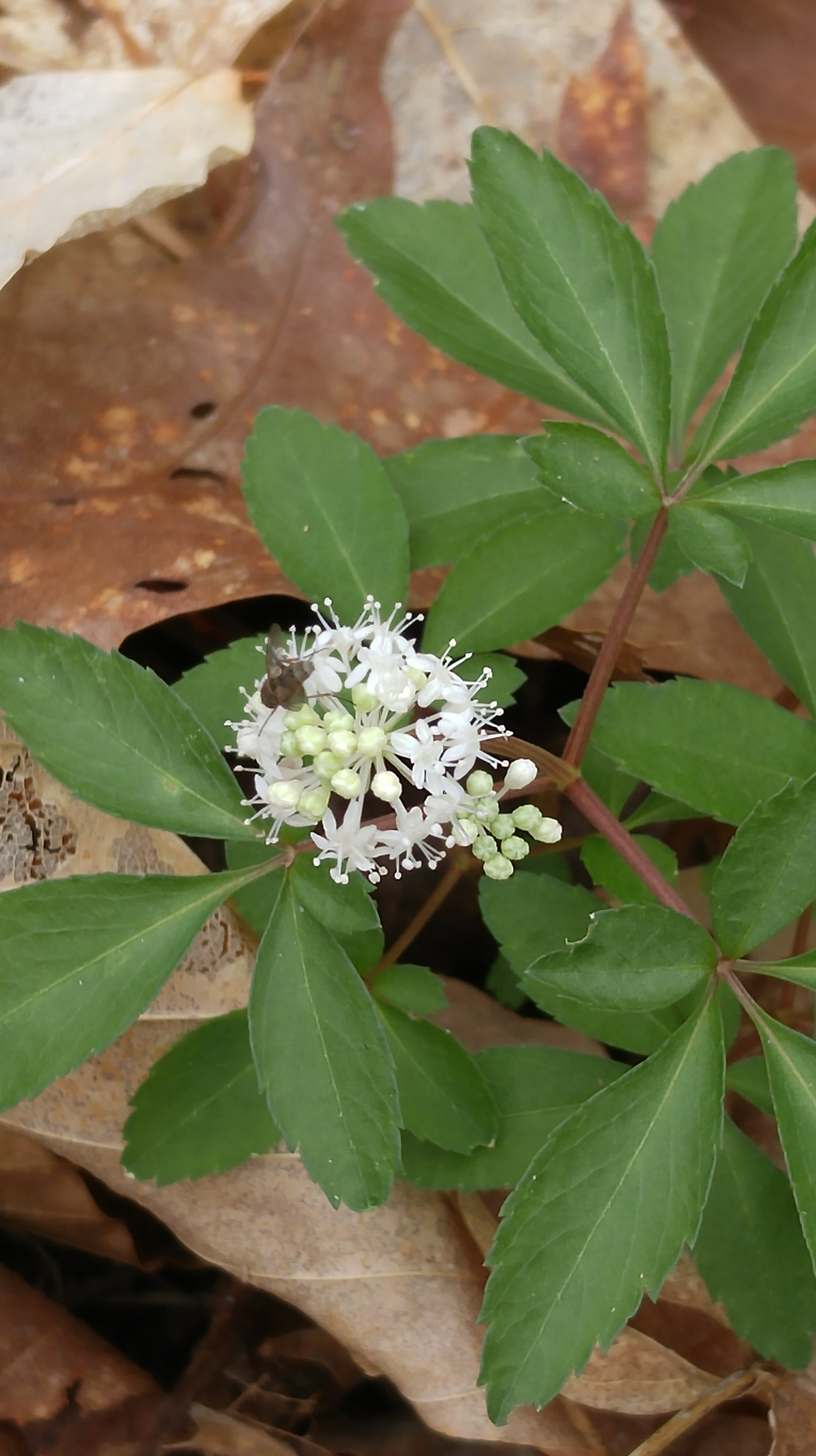
the delicate white flowers of dwarf ginseng,

s-twisted 4

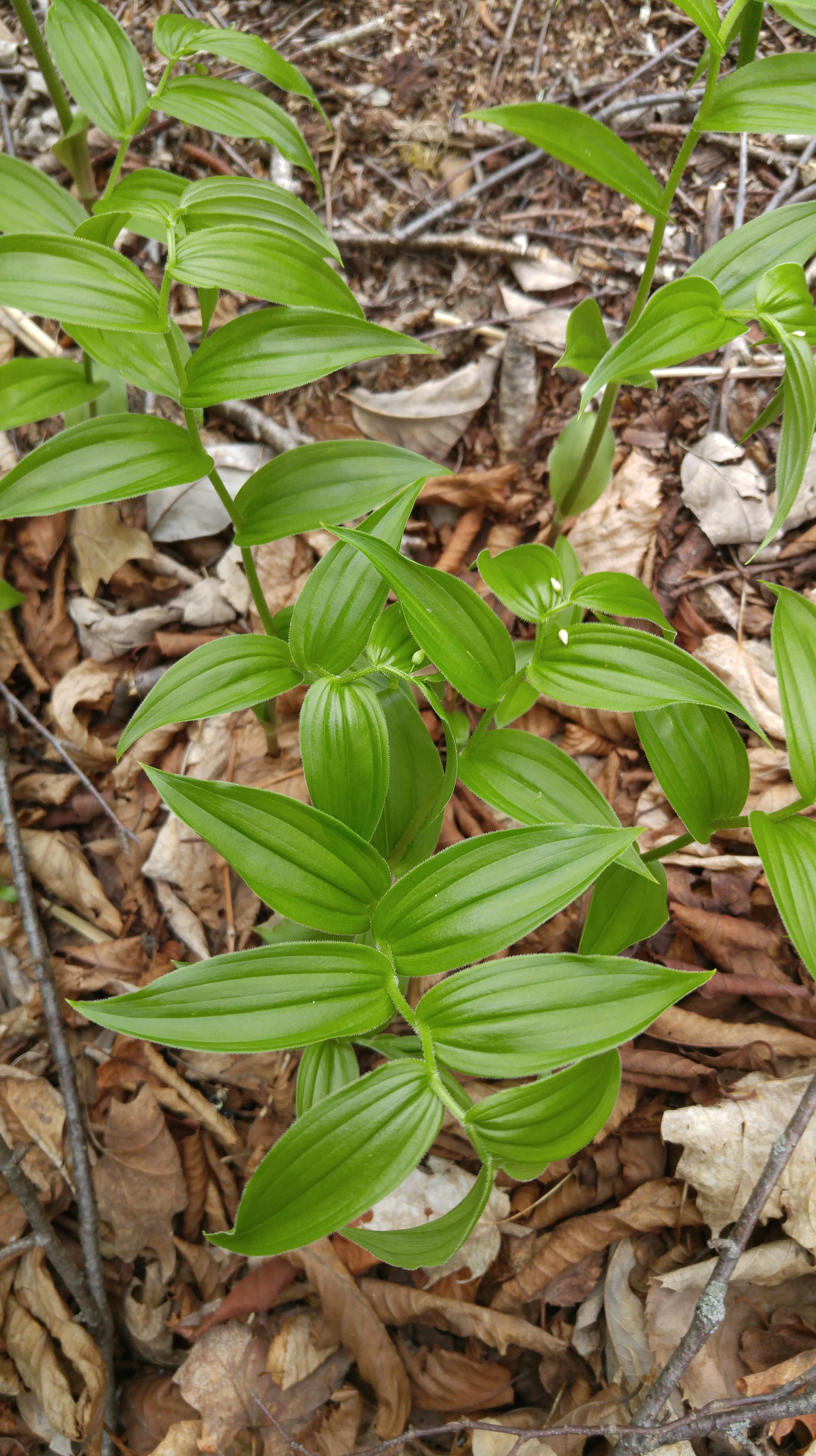
and  zigzag pattern of clasping twisted stalk.

s-twisted1

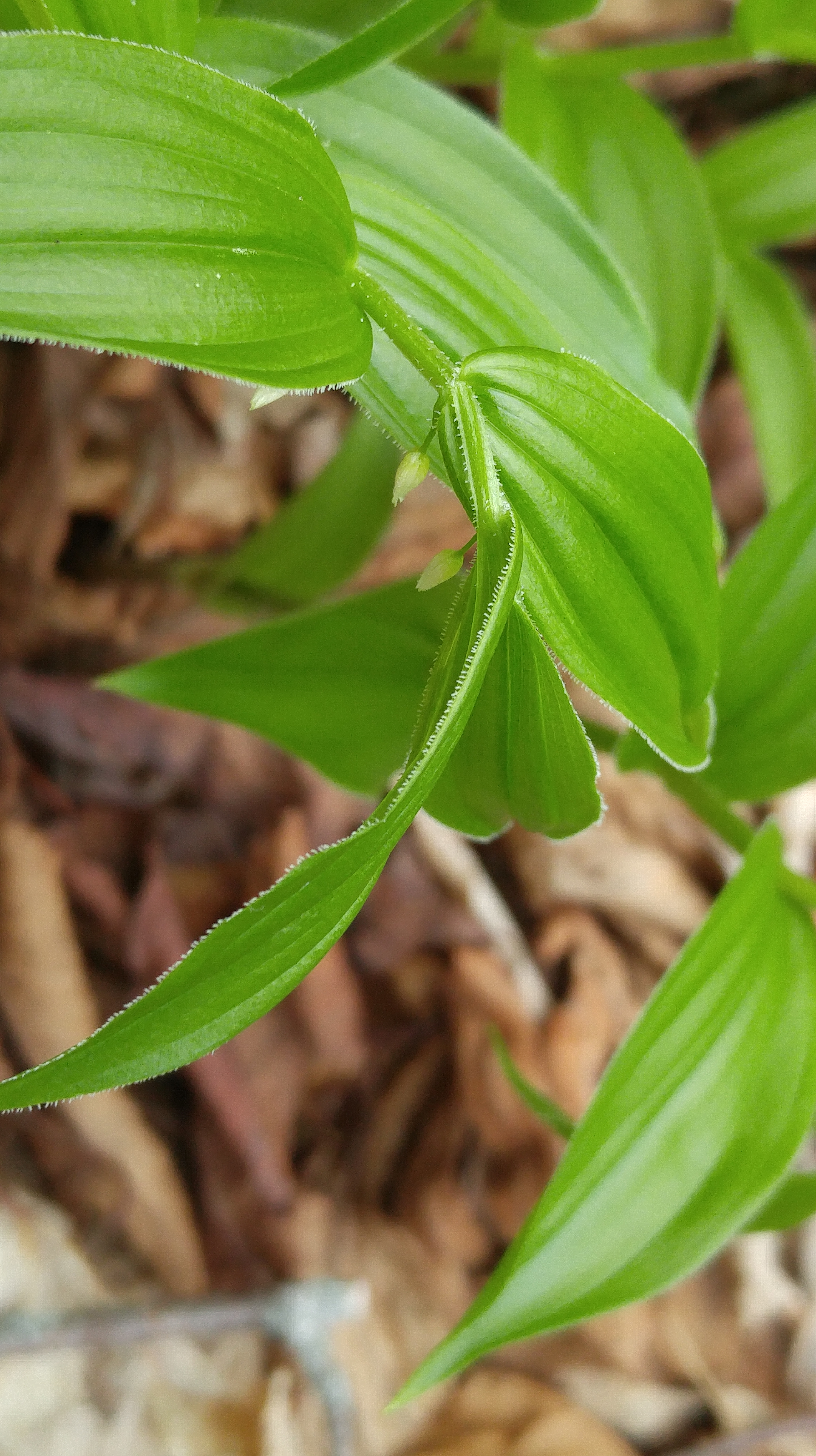
Its key features are minutely-toothed leaf margins, stalkless leaves that clasp the stem, and flowers dangling below.

s-twisted 3

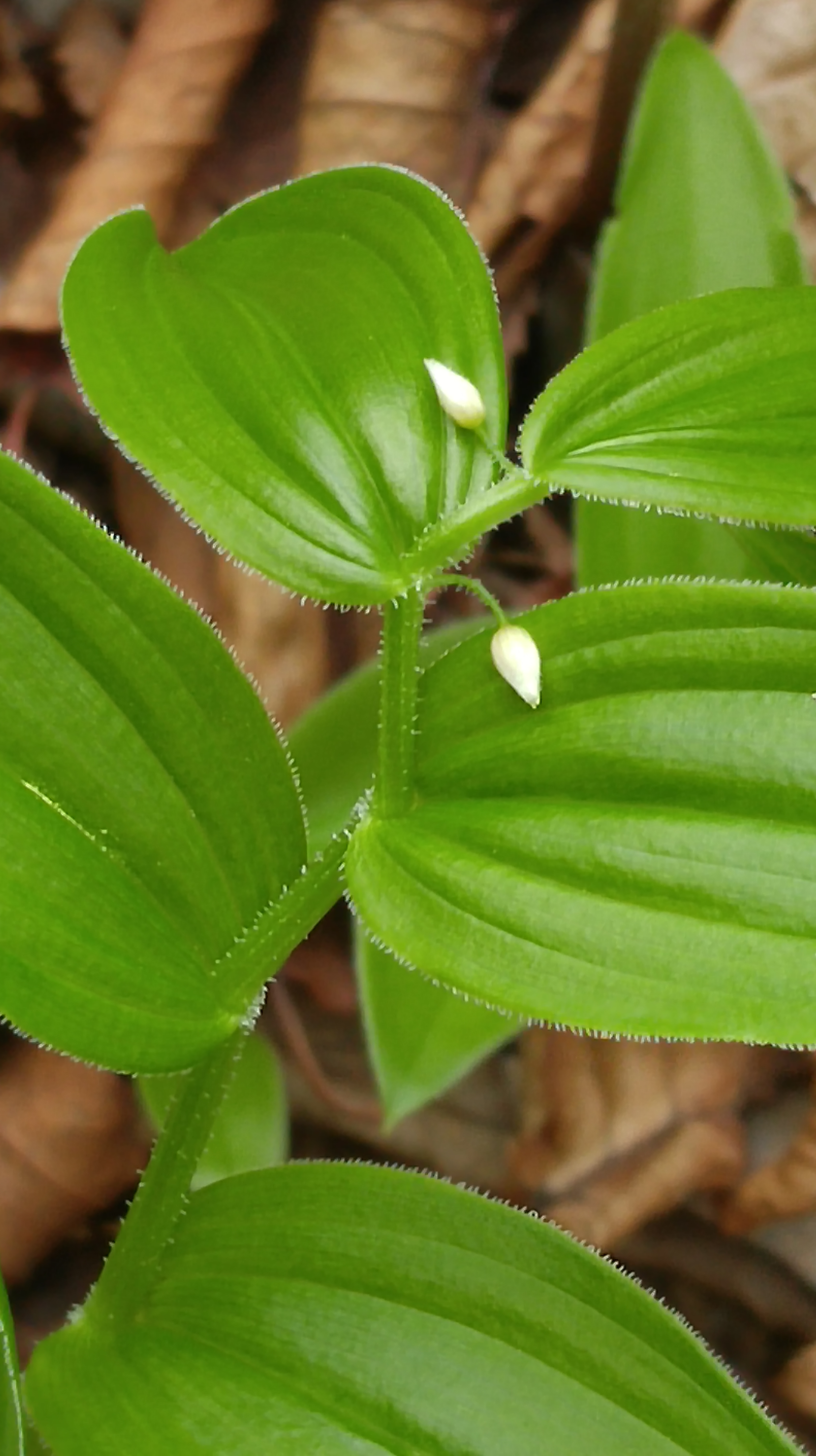
The flowers hadn’t opened, but the closer we got, the more we appreciated its finer details.

s-hobblle 1

Ever so slowly, as is the case in all things, hobblebush flowers began to bloom.

s-hobble2

Outer sterile flowers form a ring around the delicate inner flowers that are fertile. Nature has a way of protecting its own.

s-colts 2

When we first spotted the fluff ball of seeds across the brook, we thought we were looking at dandelions. And then we saw the scaled stalks and lack of leaves. Coltsfoot it is.

s-cinnamon 3

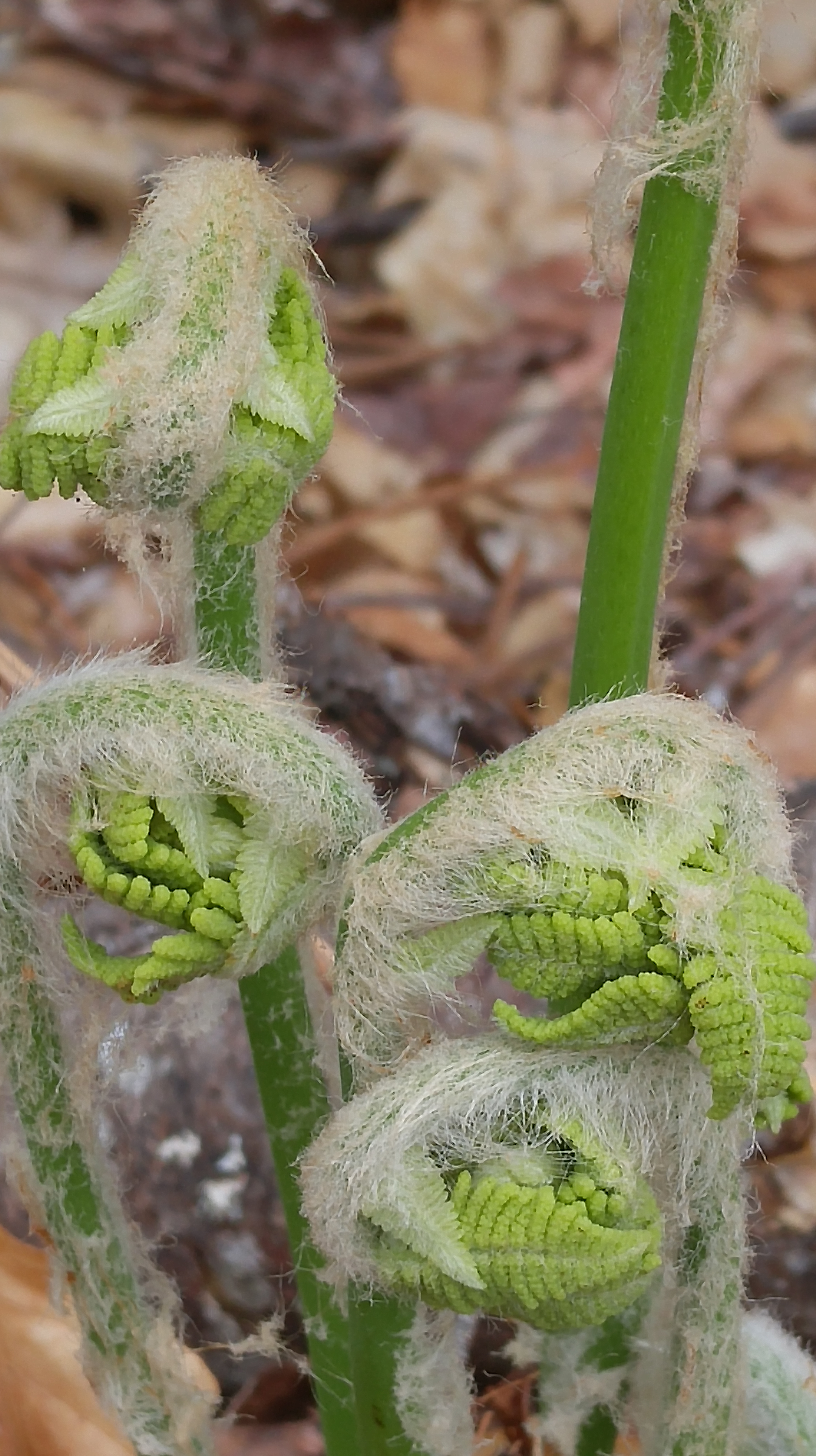
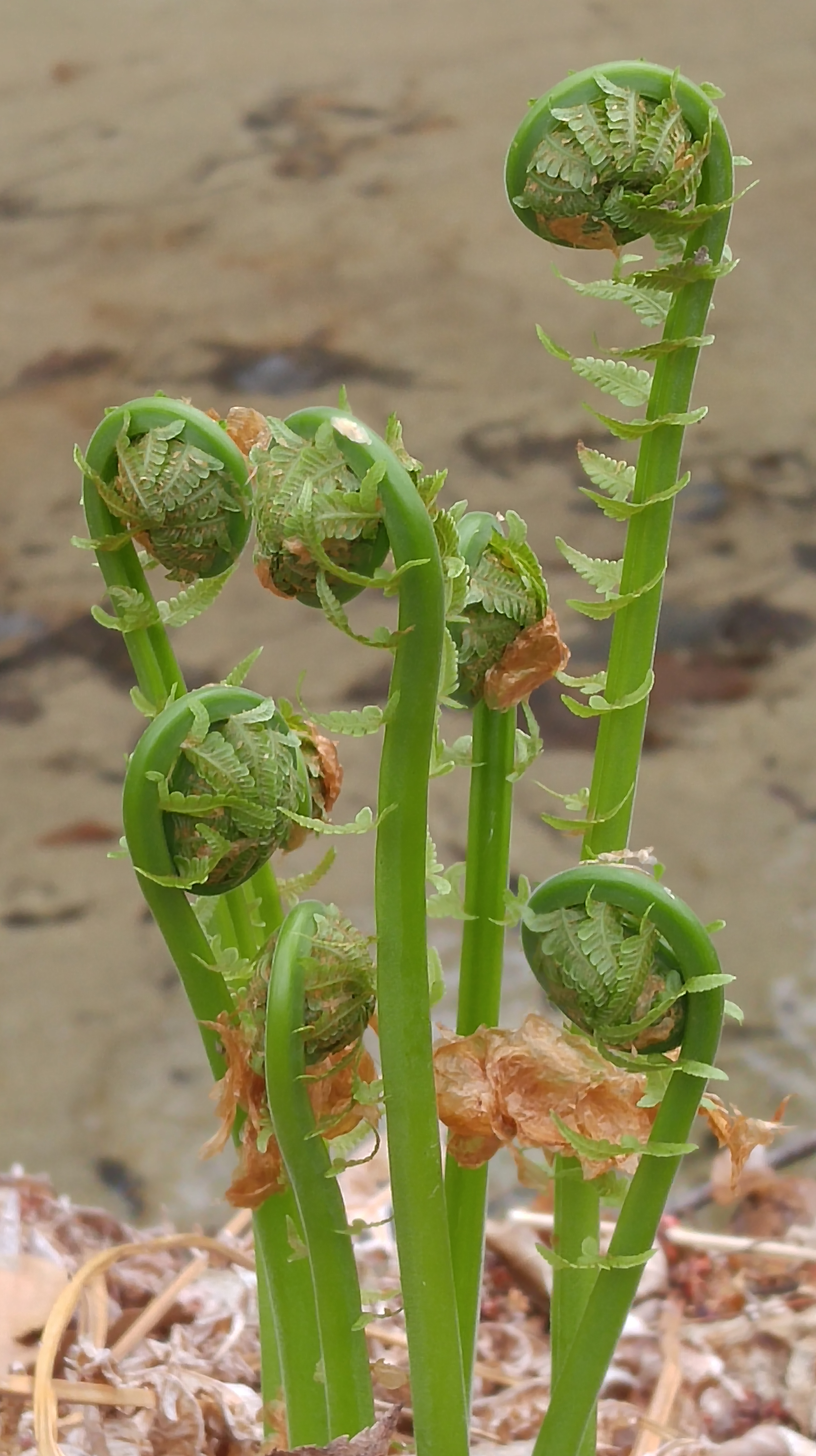
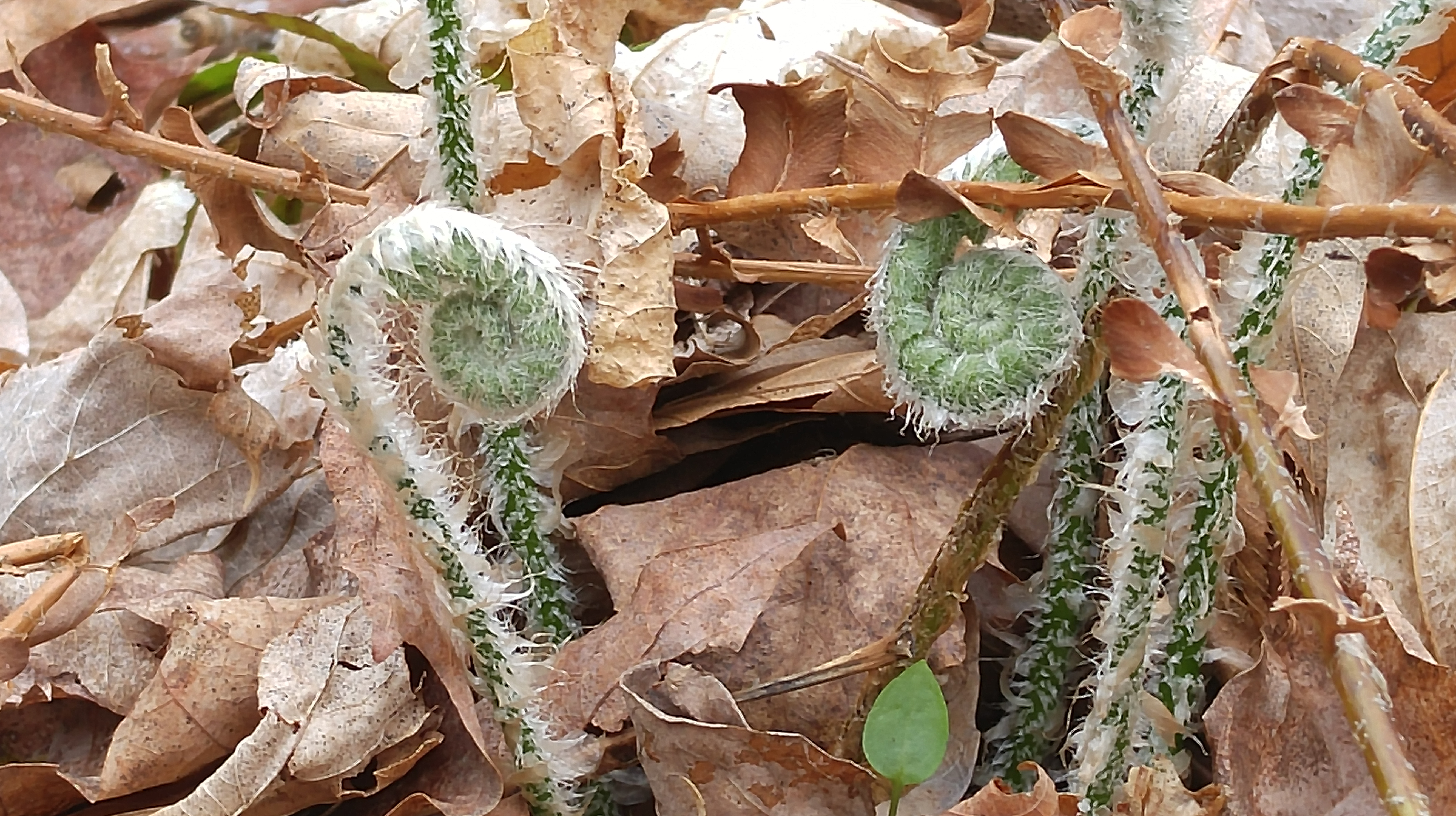
It wasn’t just the flowers that had us getting down on our hands and knees. There was the brownish wool covering of the cinnamon fern.

s-ostrich 1

And the hairless ostrich fern

s-ostrich 2

with its crook-shaped crosier, reminiscent of a bishop’s staff.

s-christmas 2

But my favorite today was one I’d never noticed before.

s-Christmas 4

Oh, I know it’s a Christmas fern, but the tightly-wound, silvery-scaled crosiers were new to me. It was yet another chance for us to wonder how we could have missed something that’s been here all along.

s-striped maple 1

And then we looked up. Well, sort of up. Striped maple leaves slowly opened in the understory.

s-red maple 1

And have you ever noticed that young red maples are a tad hairy along the margin?

s-beech 6

Even hairer, beech leaves.

s-beech 7

All winter long, bud scales enclosed leaves that are now slowly emerging.

s-beech 8

They’re absolutely beautiful in their plaited and hairy state.

s-beech 2

What leaves me wondering (ah, a pun), is the fact that these leaves are so hairy. It seems the hairs are intended to keep insects and others at bay.

s-beech 1

And yet, it won’t be long before the insects discover that beech leaves make a good meal and home.

s-ladybug

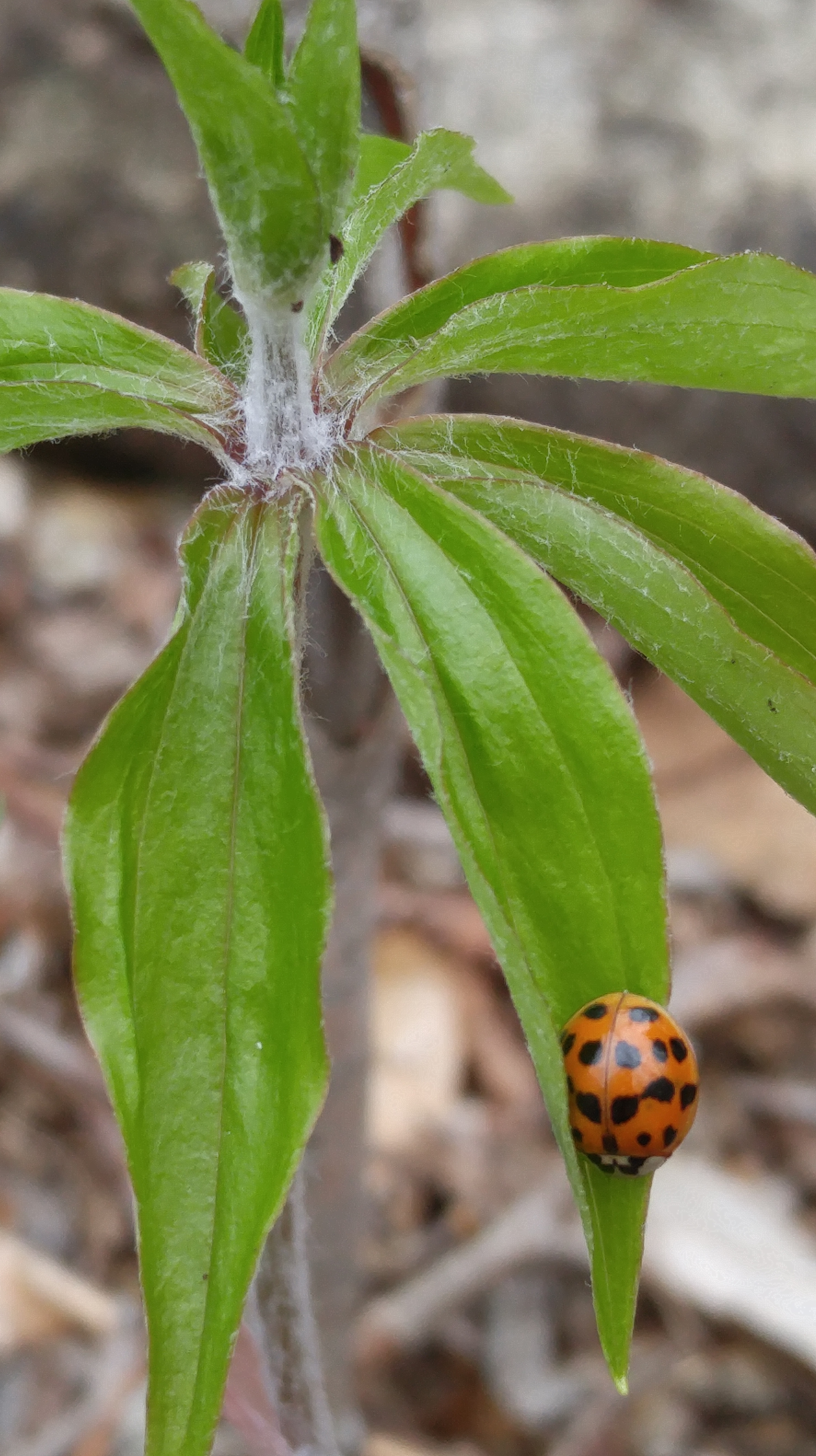
Speaking of insects, we found a ladybug presumably feeding on aphids–already. So why do ladybugs sport  bright orange or red color and distinctive spots? To make them unappealing to predators. They can secrete a foul-tasting fluid from their leg joints–the coloring is therefore intended to shout out,  “I taste awful.”

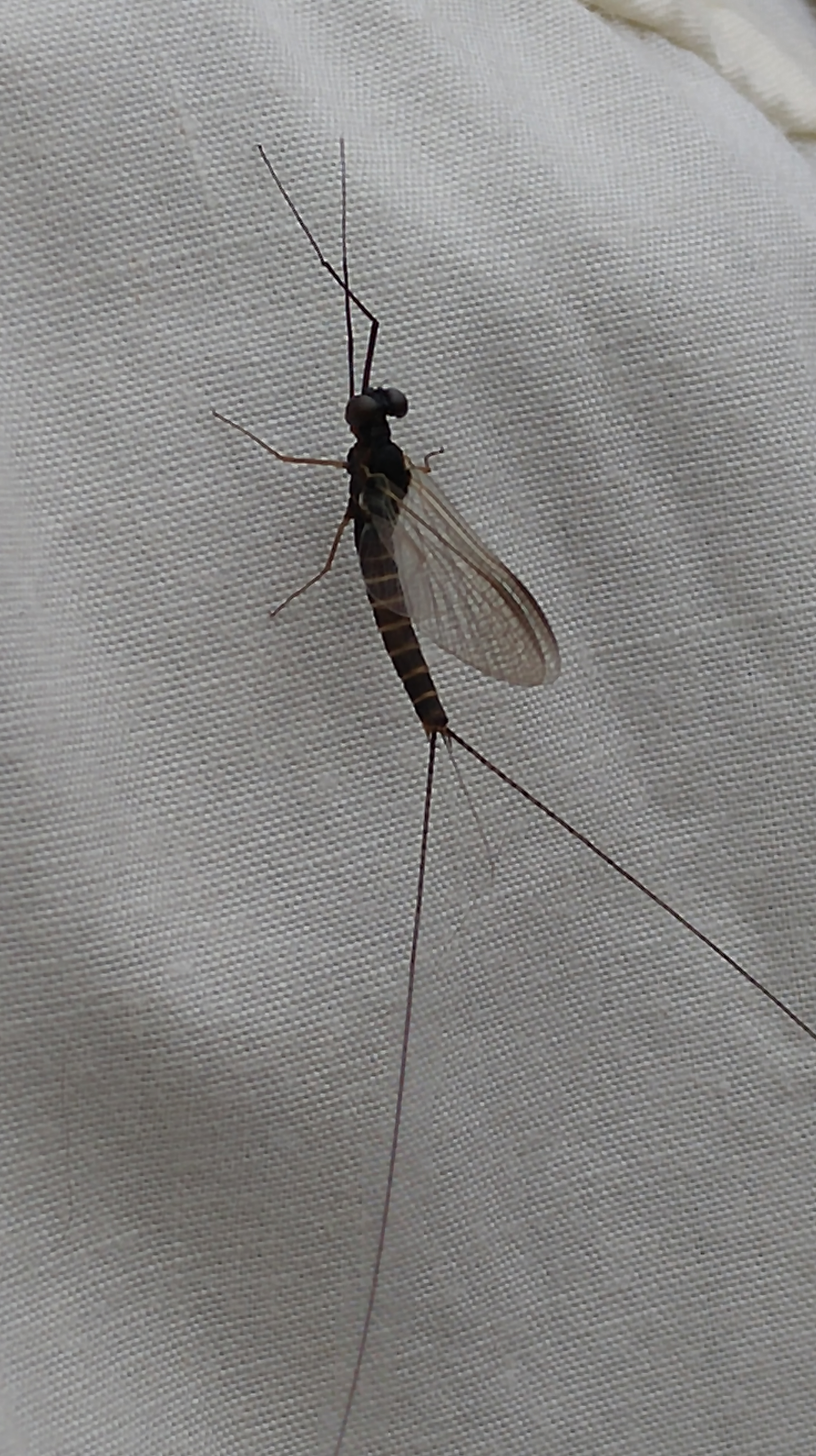
s-Mayfly 1

And Jinny Mae sported her own insect–a Mayfly, known to be more fleeting than spring, landed on her jacket. Oh, and did I mention the black flies? They swarmed our faces, but we practiced mind over matter.

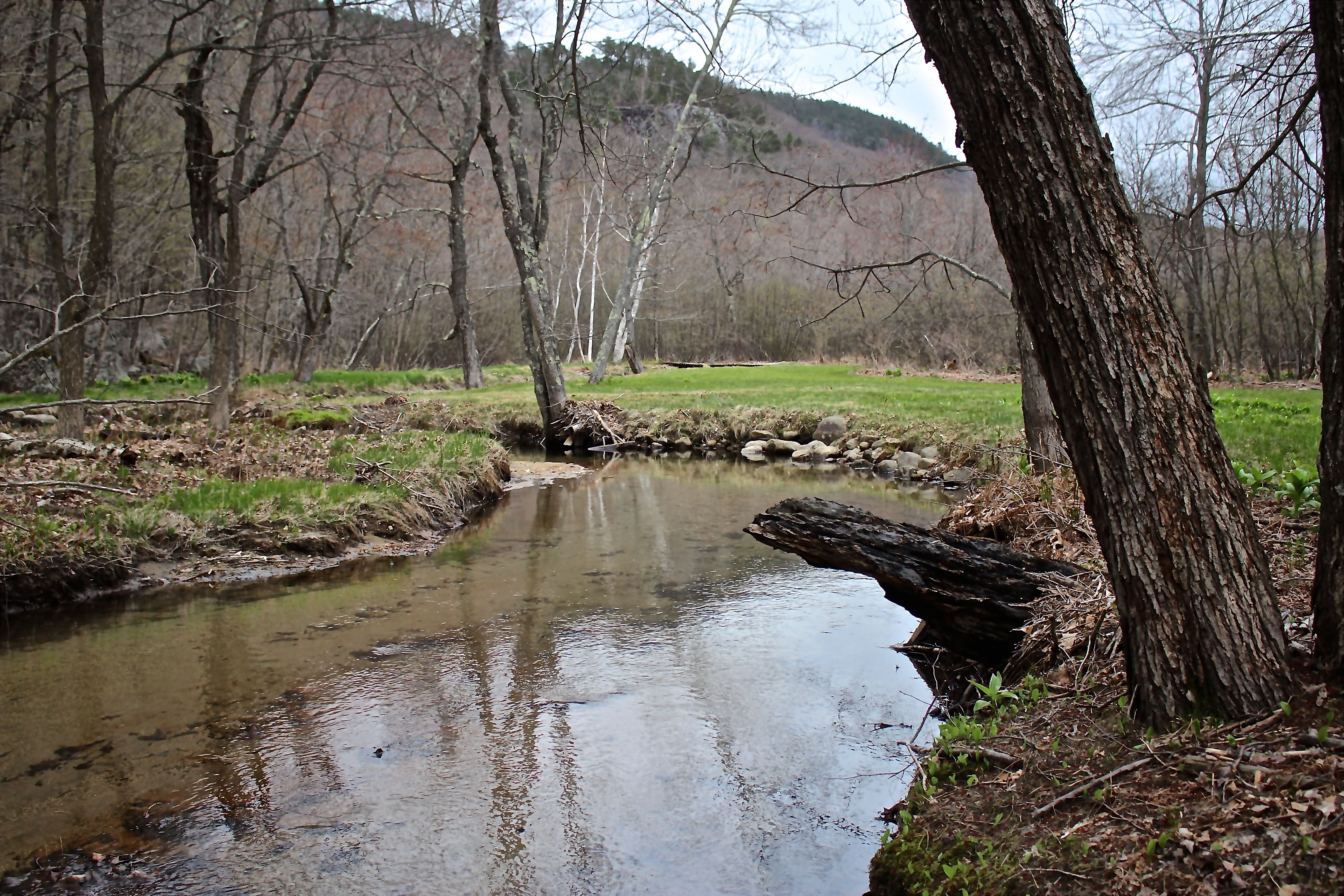
s-brook

We were in one of the most beautiful places on Earth,

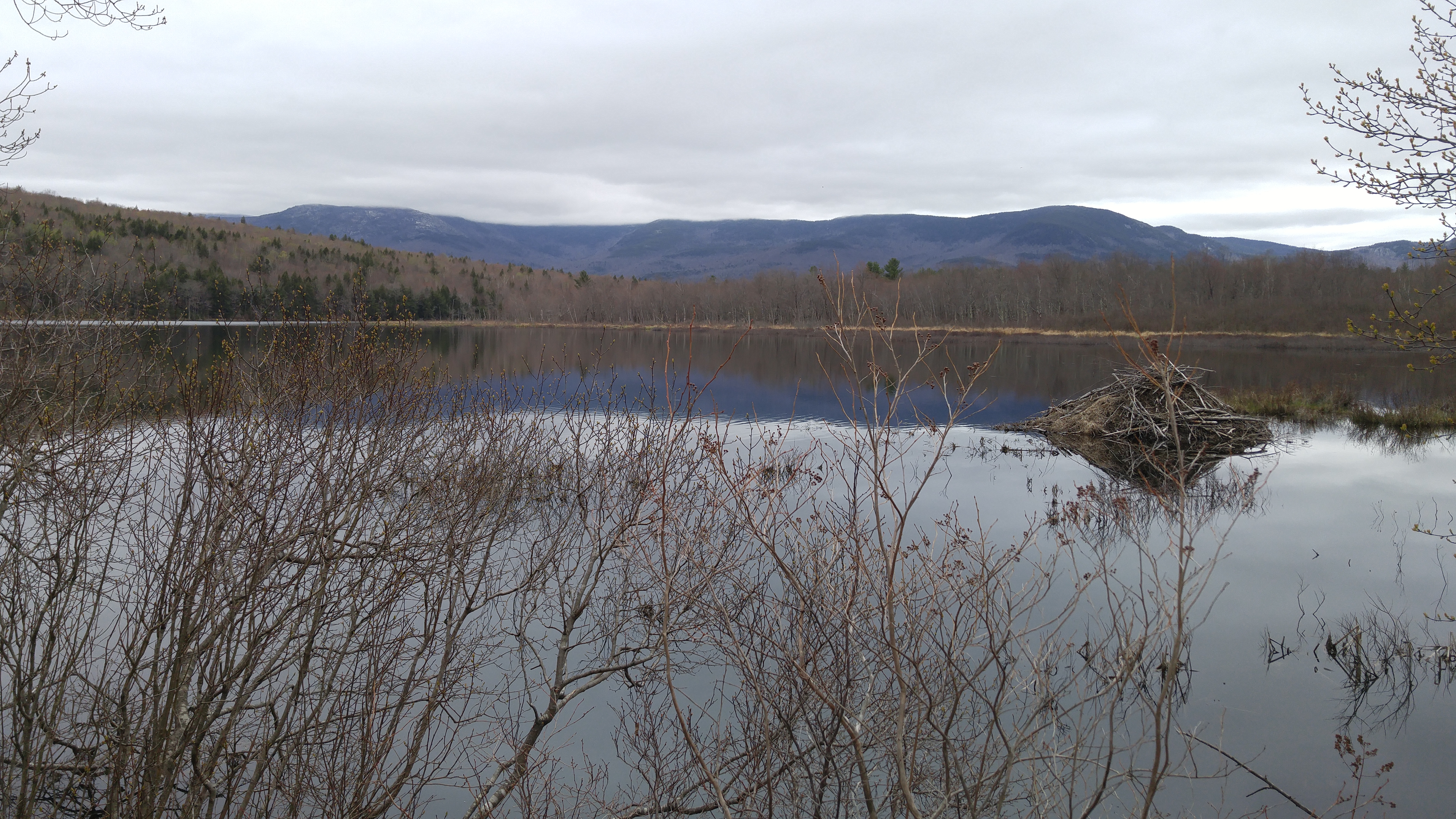
s-shell1

as evidenced by brook,  pond and mountains beyond.

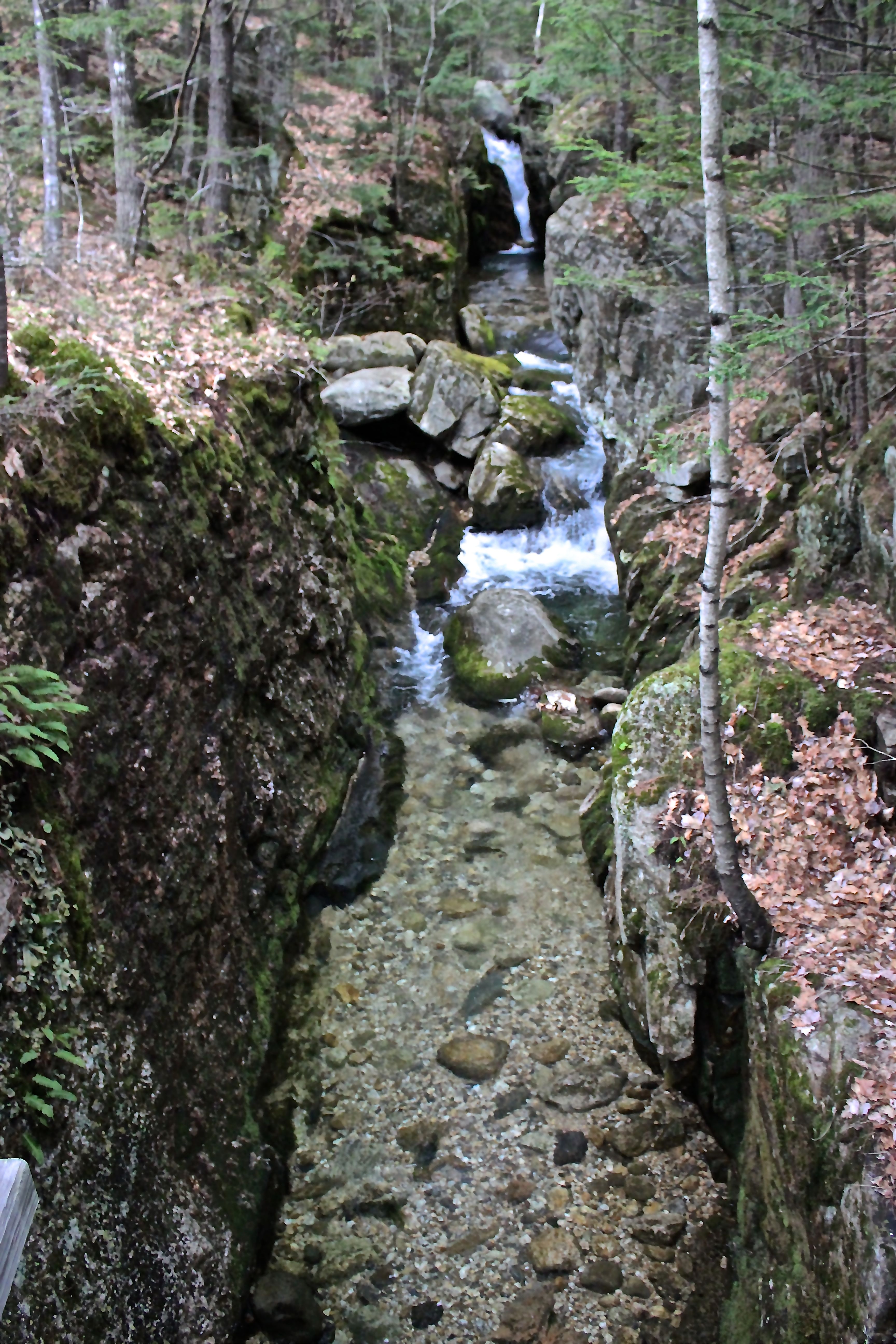
s-gorge 4

And then there was the gorge.

As we watched the water rush through, we gave thanks for a day spent moving in slo-mo to take in all that this fleeting season has to offer in its spring ephemerals.

Bookends

An absolutely gorgeous day in Maine began with a trek around Perky’s Path in Lovell and ended with a visit to the vernal pool behind our house. In between, I had numerous other things to accomplish, but it was the time spent exploring and wondering that added natural bookends to my day.

spring trail

Only a week ago, I was watching flowers and leaves emerge on trees. They still are, but what a difference a week makes. The trail suddenly seems illuminated.

striped maple

Among the shining stars–Striped Maple, known by some as goose foot because of its shape. (It’s also known as nature’s toilet paper.)

witch hazel

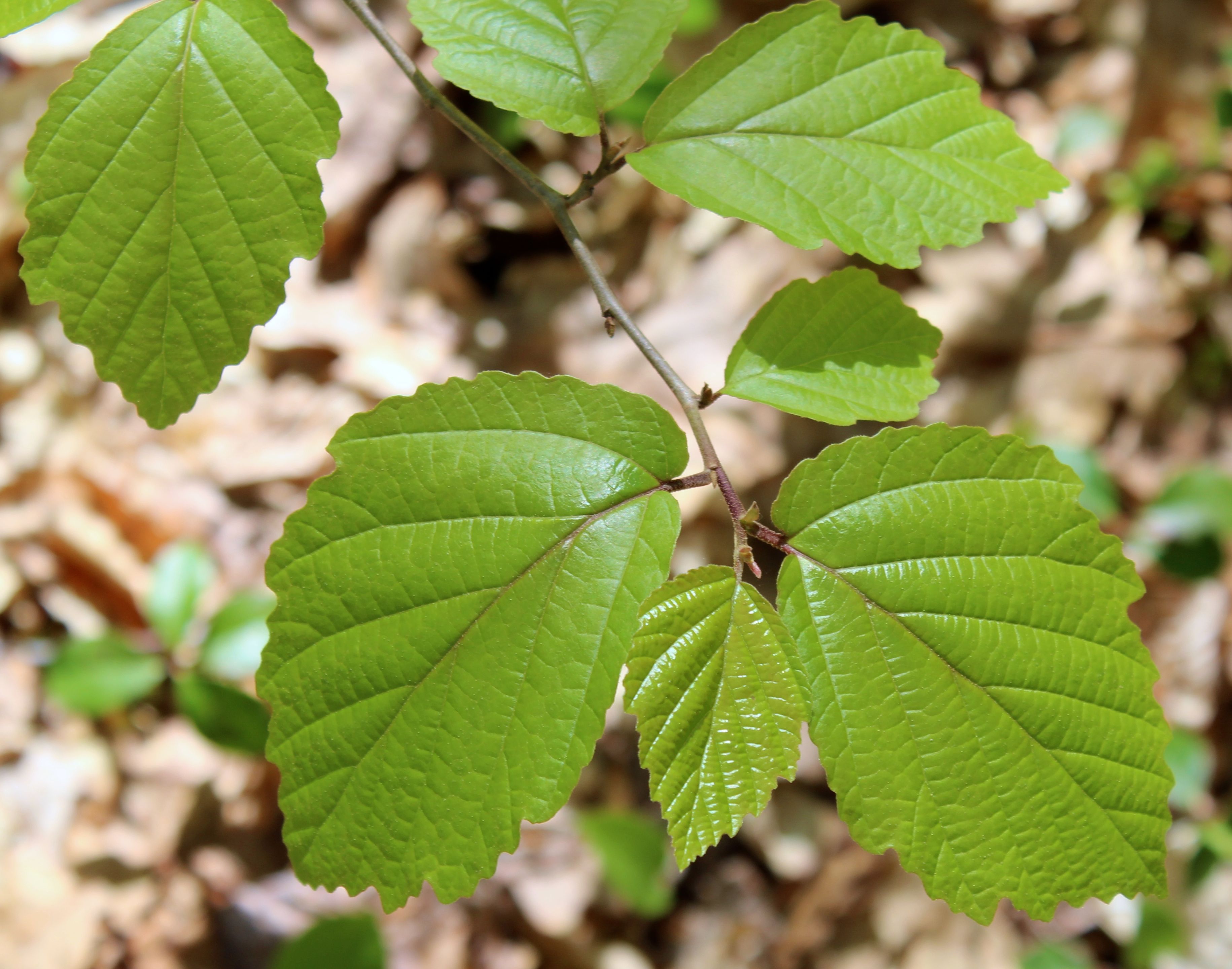
And Witch Hazel, which is easy to identify by its asymmetrical base and scalloped edges.

Red 2

And then there are the spring ephemerals, like this Red Trillium, that must flower before the tree leaves block the sunlight.

pt 2

Painted Trillium was also plentiful. Notice the reason for “tri” in the name? When I taught school, I forced my students to learn word cells–breaking the word down to understand the meaning. Tri=three, llium=referring to liliaceous or the lily family. (They had to learn tri, but llium wasn’t on their list.) I don’t know most of the Latin names, but even a few clues are always helpful.

fs3

Another member of the lily family–Hairy Solomon’s Seal. One characteristic of the lily kin–the parallel leaf veins.

goldthread

One of my favorite spring flowers is Goldthread. It personifies daintiness. While the scalloped, three-lobed leaves remind me of cilantro, Native Americans apparently used it to make tea. So why the common name? The root resembles a golden thread. Simplicity and beauty in a small package.

bunch

And yet to come, Bunchberries.

wild sars flowers

And the greenish white flowers of Wild Sarsaparilla, that grow under the umbrella-like leaves.

hb2

I would be remiss if I didn’t include Hobblebush.

stream

In the winter, friends and I usually find otter tracks and slides by this stream. Today, a variety of life spills forth.

brook

A brook flows from Heald Pond to Bradley Pond, and several years ago the Greater Lovell Land Trust constructed a bench to take in the sights and sounds of this place.

brook2

The view is ever changing.

bridge

Just down the path, a bridge also invites quiet contemplation. (When the black flies aren’t trying to sneak into your eyes, ears and mouth, that is. Protein consumption today? Check)

bridge 2 rock garden

And a rock garden.

swamp

One last look before heading out. Morning has ended.

rhodora

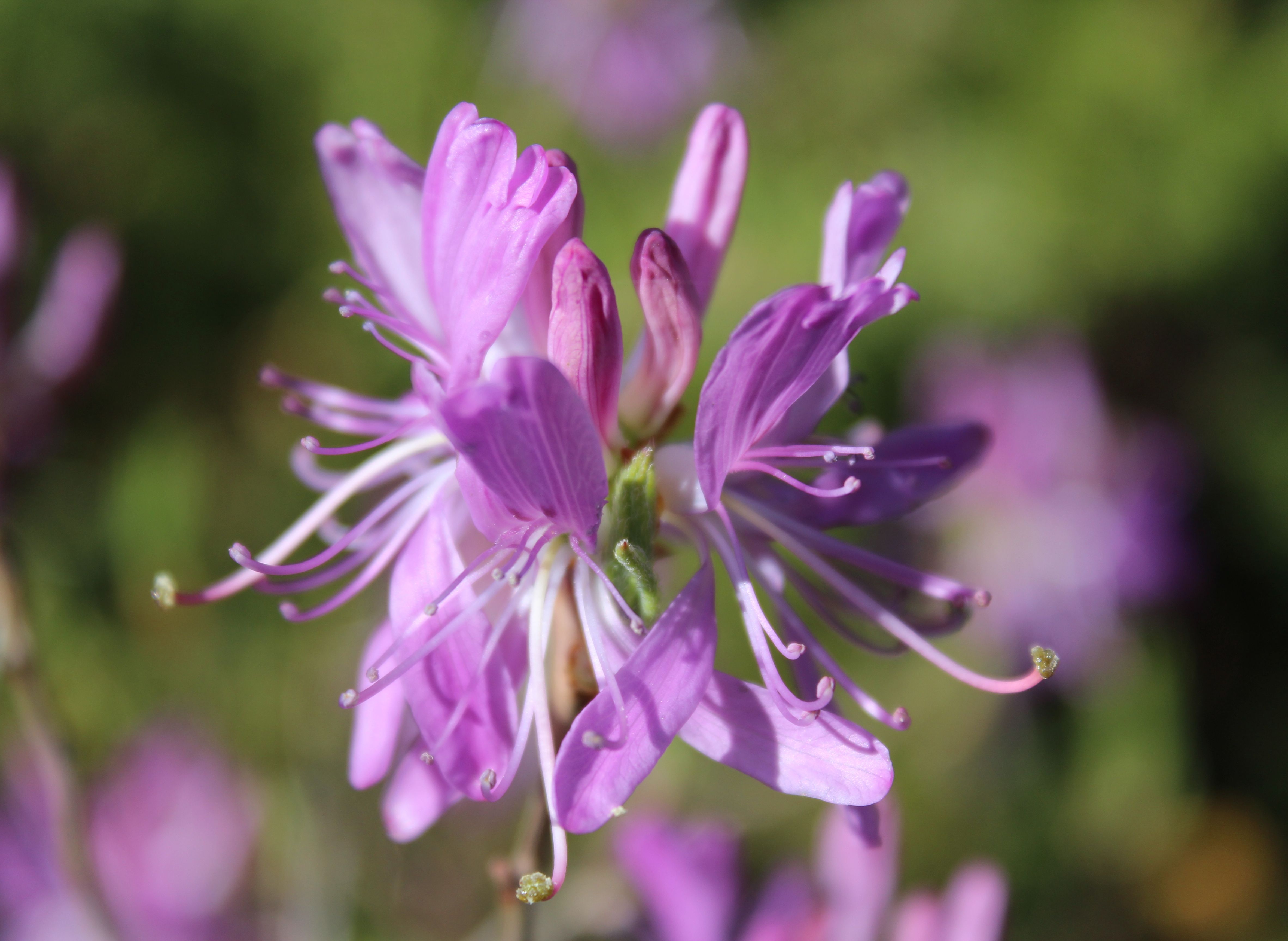
At the other end of my workday, I’m off to the vernal pool. Among a sea of junipers, an explosion of lavender erupts from one Rhodora plant.

bobcat

I’m so glad that the Rhodora attracted my attention, because as I turn from it toward the pool, I realize that a bobcat has walked in the direction of our cowpath.

vp

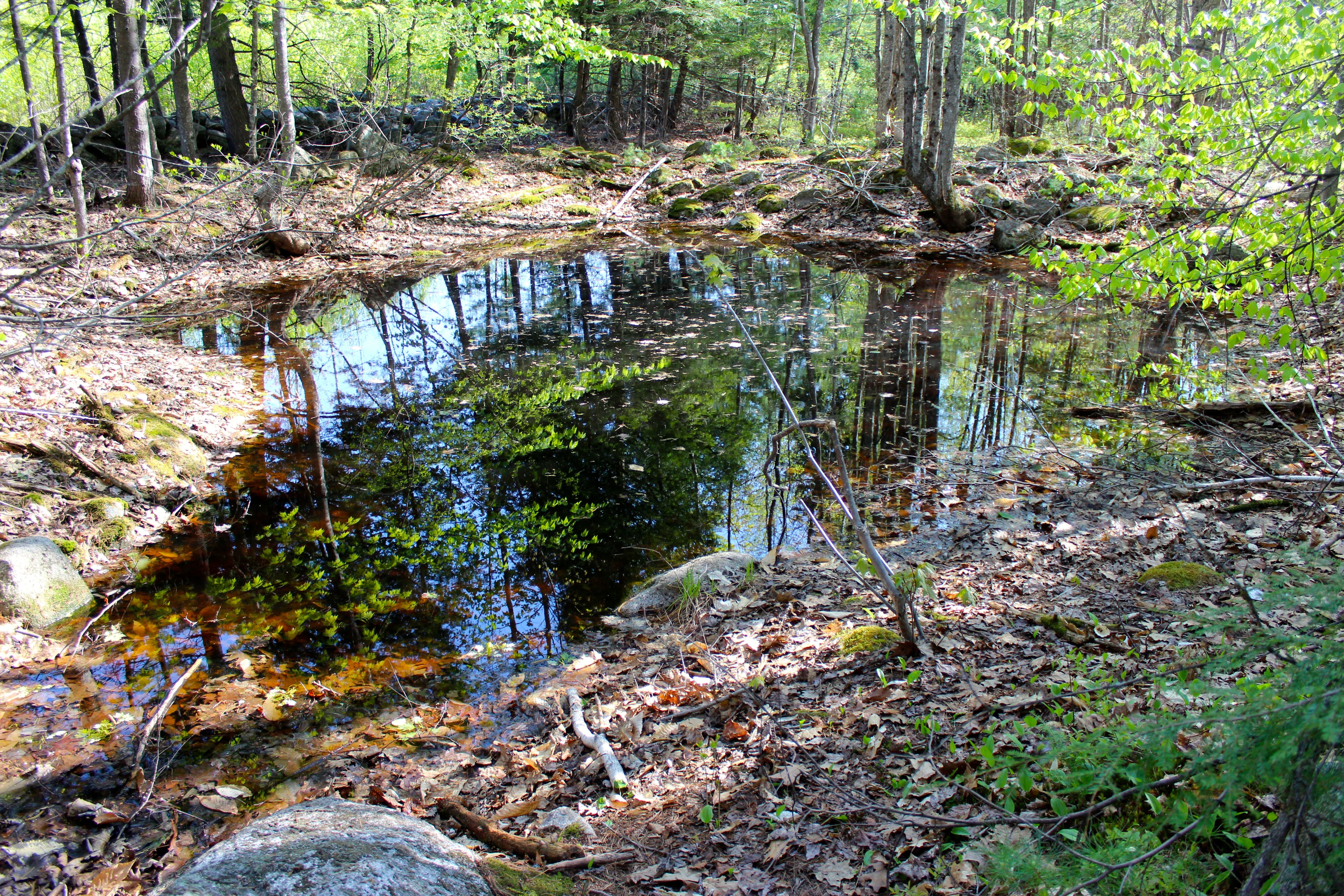
We’ve had little rain in the last few weeks, so while the snowmobile trail still has some muddy spots, the pool is drying up.

sally eggs

Will there be enough water for the spotted salamanders to survive?

water strider

And what will happen to the water striders?

twins

I’ll be curious to see how the tadpoles do. These two appear as bookends for me, holding everything in between in check.

Every day, it’s something new. I feel like I have to start all over again learning the features of this season and I’ll just begin to get it by the time summer rolls around, and then . . . so much more to learn. Though I have plenty of books to guide me, it’s the actual events that are happening right before my eyes that provide the most accurate information.

I’m thankful for any opportunity to wonder and wander, especially at both ends of the day.