One Night, Two Nights, Three Nights…

It was a dark and dreary night. Repeat. It was a dark and dreary night. Repeat. It was a dark and dreary night.

While most folks would choose to stay inside curled up by the fire while drinking a hot toddy, a number of intrepid community scientists ranging in age from 3 to 70+, donned rain gear (even waders) and reflective vests, cleansed hands of soap and moisturizer, grabbed flashlights and headlamps, and met at 7:30pm in the pre-determined locations.

Their mission each night was the same: Help us help frogs and salamanders cross the road to avoid getting squished by vehicles.

The names and ages of participants changed each night, but the leadership remained the same. As Maine Master Naturalists, Dawn Wood (who took the lead on organizing these events and recording data–a daunting task in the rain and dark and with people spread out and shouting numbers and species at her), Hadley Couraud, and I led the way, all three of us providing information about the different critters and their behavior as the evening progressed. All of this was under the umbrella (pun intended–though no one actually had an umbrella) of Loon Echo Land Trust in Bridgton, Maine. Thank you to Maggie Lynn for creating the sign-up forms, advertising the events, and keeping us posted.

The technique was easy. Once we reached the location of the vernal pool, to which amphibians return each year from their upland habitat, we started scanning the road with our lights. It’s amazing how the mica, small rocks, sticks, and lichens can fool us.

It’s equally amazing how much tiny Spring Peepers resemble small rocks. And how stone cold they are when we lift them up. And how they’d rather stay in our hands than return to the cold earth.

We always noted the direction in which they were headed and that’s the side of the road we took them to, even if it didn’t make sense to us. They knew what they were up to and we were there only to try to keep them alive so they could canoodle for a few nights before heading out of the pools and back to the forest.

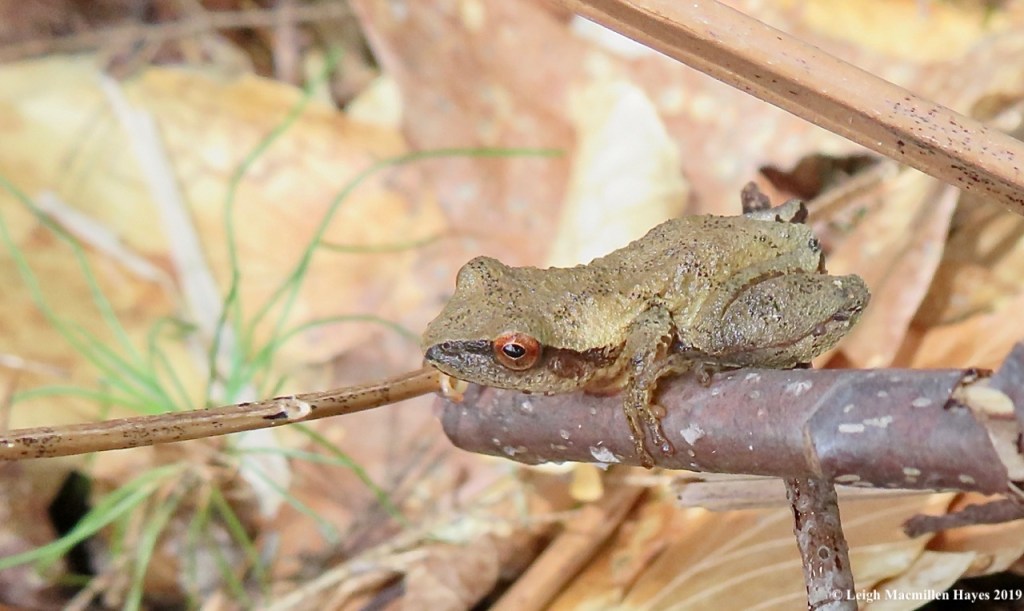
Meet a Spring Peeper up close and personal. Note those little toes, which are actually suction cups of a sort, the better to climb vegetation, especially at the edge of or in a wetland, and then to sing their high-pitched songs that announce the males intention of finding a date. Because of the toe pads, peepers were originally thought to be closely related to Tree Frogs but they have since been reassigned as chorus frogs in the genus Pseudacris, which comes from the Greek pseudes (false) and akris (locust) (think of our Dog Day Cicadas and their raspy love songs in the summer).

The species name, crucifer comes from the Latin cruces, meaning “cross,” so named for the dark X or cross on the frog’s back.

A really cool thing happened that first night. A teenager who lived in the neighborhood where we were scanning the road came out to ask what we were doing. And then he joined us, eager to learn as his family had recently moved here from out of state.
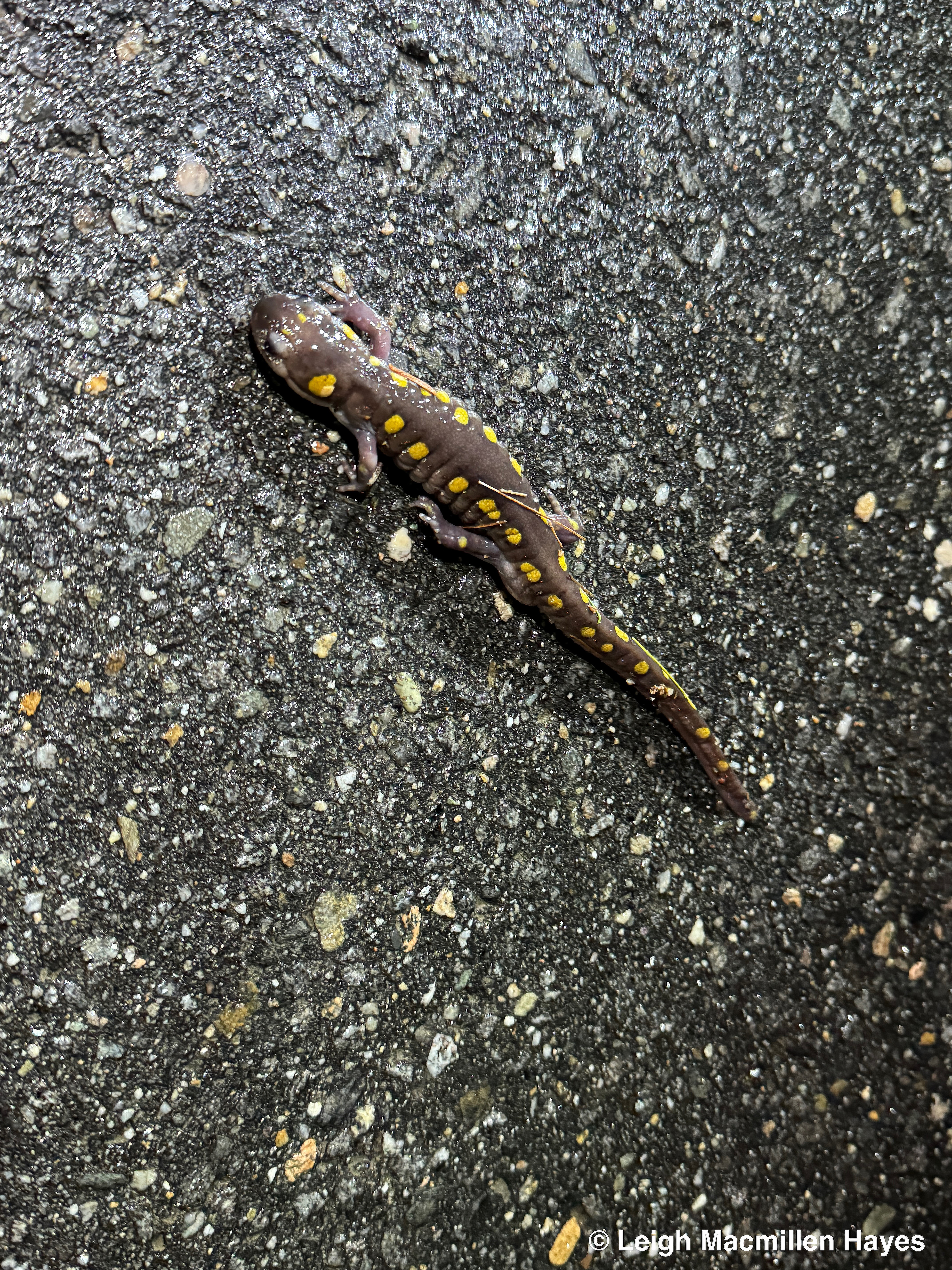
After a Spotted Salamander was saved, he ran home to get his camera and stayed until we finally departed. We had hoped he’d join us the next night at a different location, but wonder if he stayed home to help those on his road instead. Whether or not he did that, we loved his enthusiasm and desire to learn.
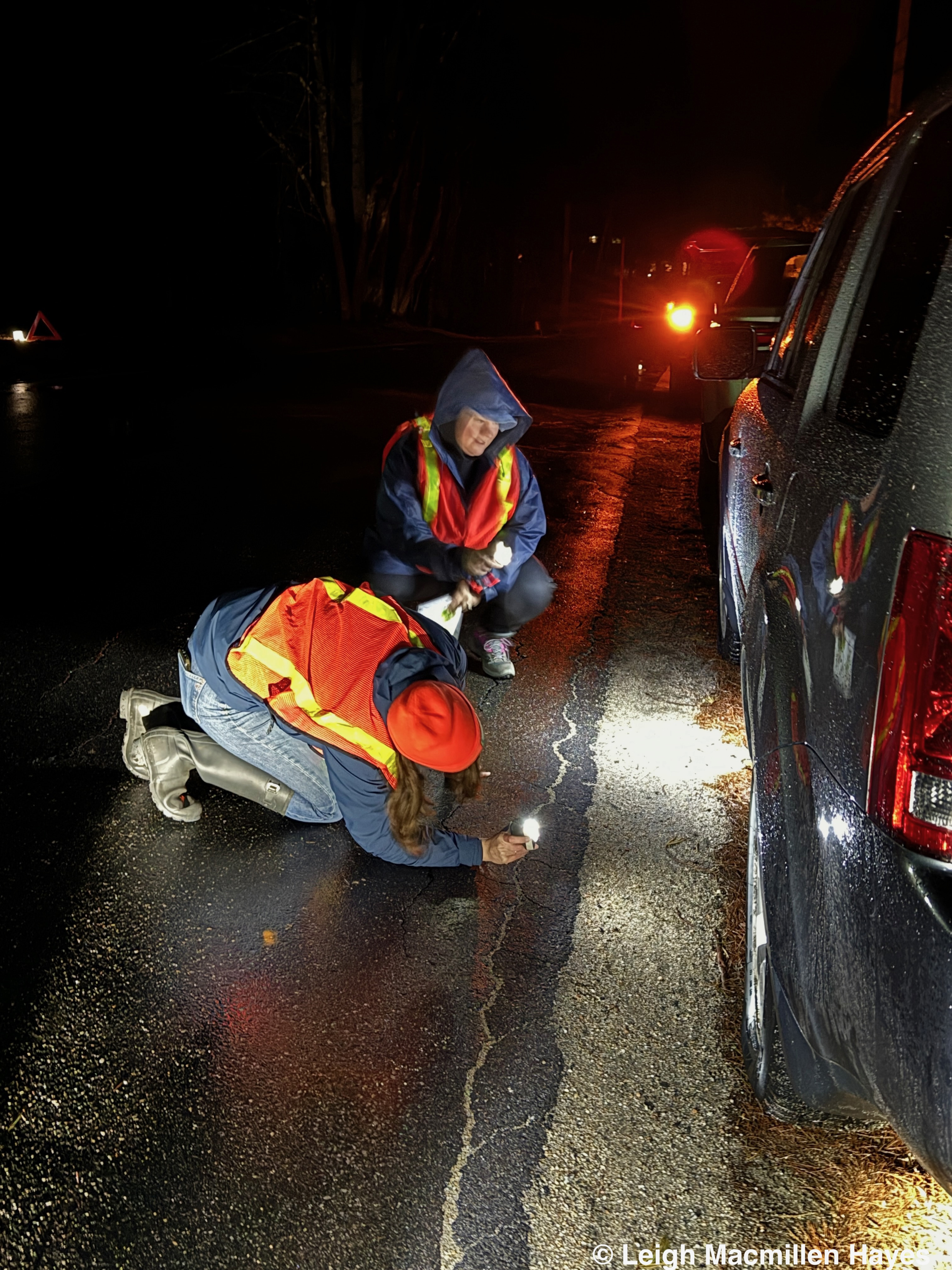
It soon became clear on the first night that we’d parked in the wrong spot, however right it may have seemed because we could get our vehicles off the road. As people started to leave, we all did a check underneath from all angles to make sure tires would not run over any critters by accident.

And sure enough . . . out crawled a Spotted Salamander. Of course, photo calls came first, and then help was offered to get to the other side.
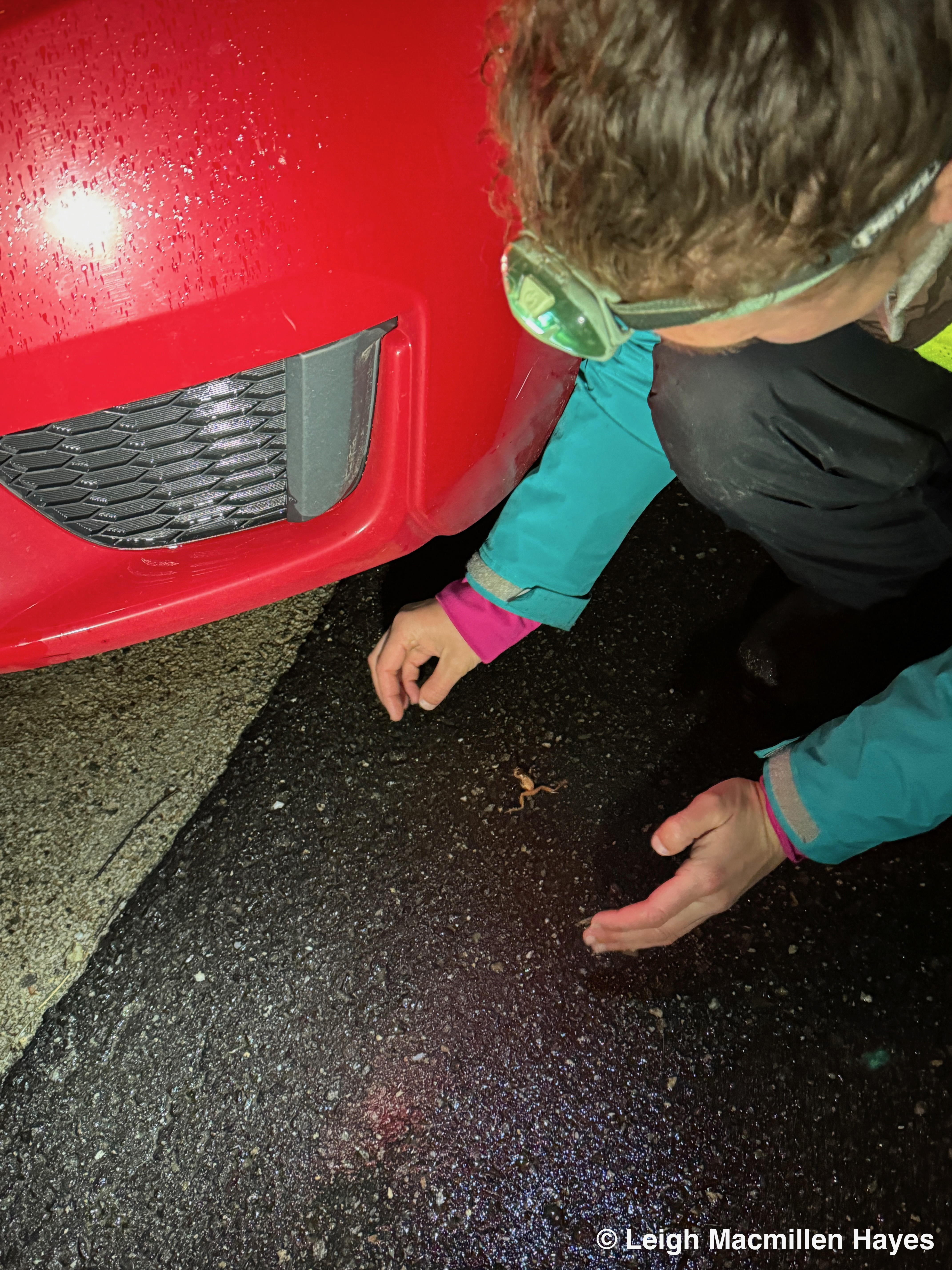
Even teeny, tiny Spring Peepers had to be saved. And we all commented that we didn’t want to know if we did happen to drive over something. Added to that, we noted most of the vehicles only made it a few feet down the road, before the driver stopped and another amphibian was saved. That and the driving was rather erratic since everyone had gained a new understanding of how much action there is on a rainy night.

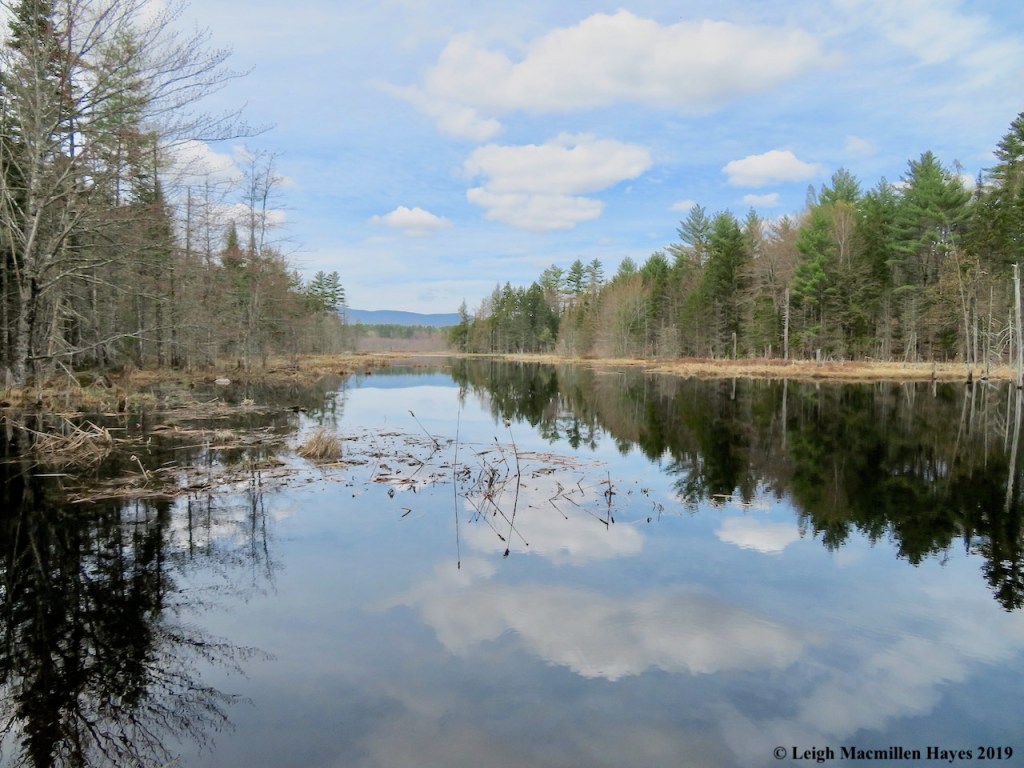
The second night found us in a different location that we actually walked about three quarters of a mile to reach, thus lowering our chances of hitting the critters right near the pool which is located directly beside the road, with a vast wetland on the other side of the street.

Wood Frogs, with their dark masks, typically headed toward the pool, where they’ll spend the next two weeks or so, singing for a mate, embracing her in a technique called amplexus, fertilizing her eggs, and trying again and again, until it’s time to hop out and head into the forest for the next 50 weeks.

Because it was dark, the Wood Frogs didn’t seem to mind our presence too much. Some still sang, or rather “wruck, wrucked” their love songs, and others floated in anticipation or chased each other in hopes of finding a female. We even noted a few egg masses clinging to branches, telling us this pool had been busy for a few days already.

Part of the fun in hosting such an event is sharing it with other people who might not typically head out the door after dark. And then seeing smiles on faces as they encountered the critters for the first time.

A cool find on this night was an Eastern Newt crawling across the road. Perhaps because the pool dries up each summer, this one had overwintered either in the wetland or even the upland before returning on this particular night. It felt like an unusual find on the road, though from what I’ve read, it’s not rare. I have seen many Red Efts, the juveniles of this species, their bodies squished by vehicle tires, on this very road in the fall.

Yet again, it was the Spring Peepers who garnered much of our attention.

And some Spotted Salamanders, though not as many as on the first night.

That said, we were thrilled with each find. And found an easy way to help them was to place the laminated ID card created by Maine Master Naturalist Michael Boardman under their bodies. Now don’t you think this guy is crawling onto the card in search of his ID?

As we prepared to walk back to our vehicles that night, Officer Hammond of the Bridgton Police Department happened along. No, he wasn’t going to arrest us for J-walking, though that’s essentially what we did. He was just stopping by because we’d ask Maggie to let the department know of our whereabouts in case anyone wondered what we were doing, but didn’t slow down to ask us. Traffic was high each of the nights. I’ve been doing this for about 22 years, and this year I felt like we had the most traffic. Most drivers were considerate when they saw the cones (courtesy of Hayes Ace Hardware) and vehicle flashers, plus our headlamps and flashlights. And we were all good at yelling “CAR” each time we saw approaching lights, but there were a few who were annoyed and one even had to lean on the horn after passing through the section of road we walked upon.
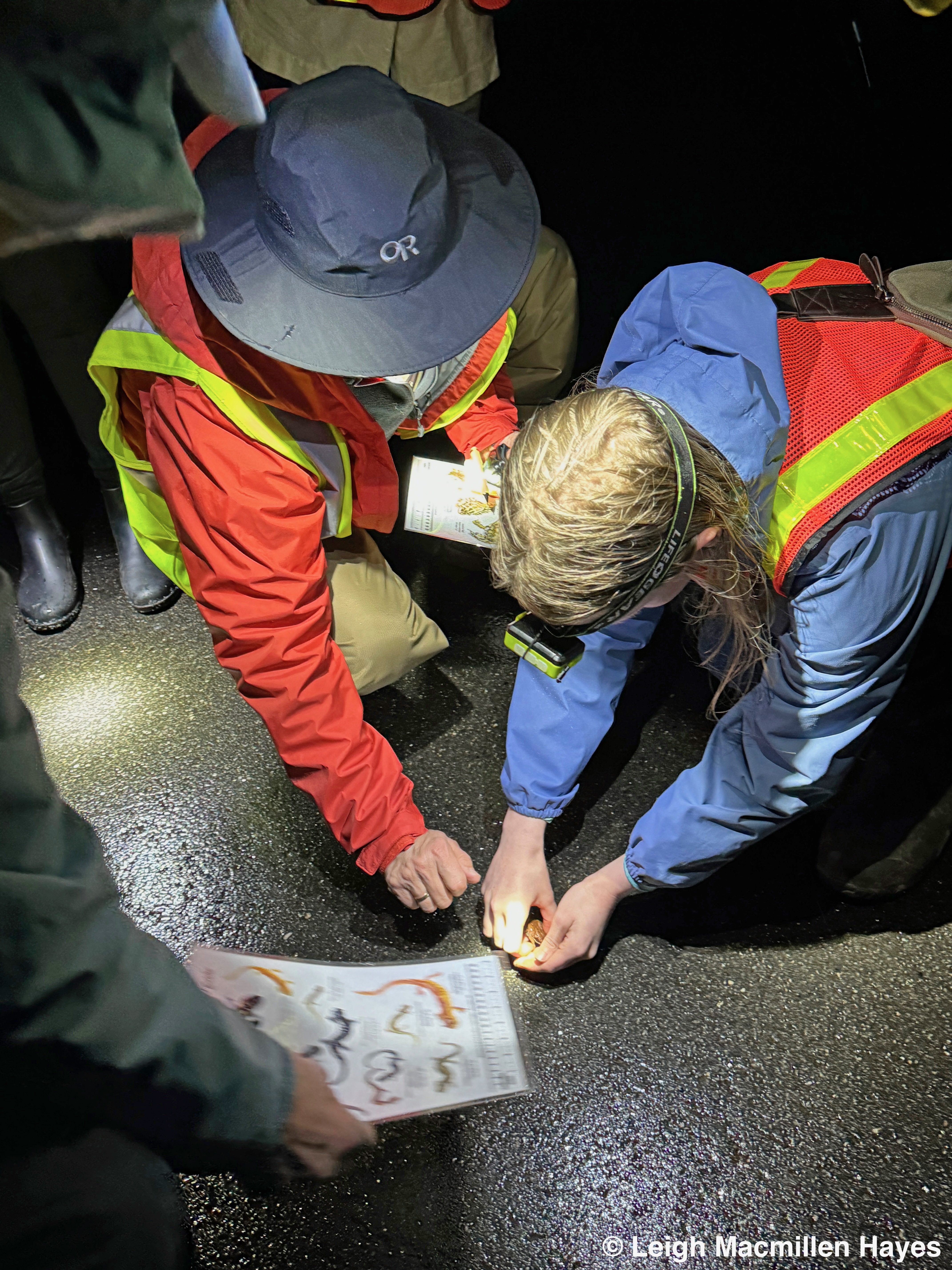
Night three was the warmest, with temps in the 50˚s and little to no rain. In fact, by the time we were heading home, the moon and stars were visible.

But still, the critters crossed and once again we showed new participants of all ages how to ID them and then help them cross the road.

On this final night, we had several teenagers along for the journey. Two of them had actually driven past us on the first night, slowed down, rolled down the window, and asked if we were okay. When we showed them a photo of a Spotted Salamander, they went home and signed up for a chance to help. Their enthusiasm was incredible.

We peered into the pool again and were amazed at the number of swelled Wood Frog egg masses in their communal cluster–as is the Wood Frog fashion. perhaps to take advantage of being warmer when crowded together, and thus evolve quicker. It’s the swelling that told us they’d been laid a few days before as initially their egg masses are maybe the size of a golf ball, but swell as they absorb water over the days to come.
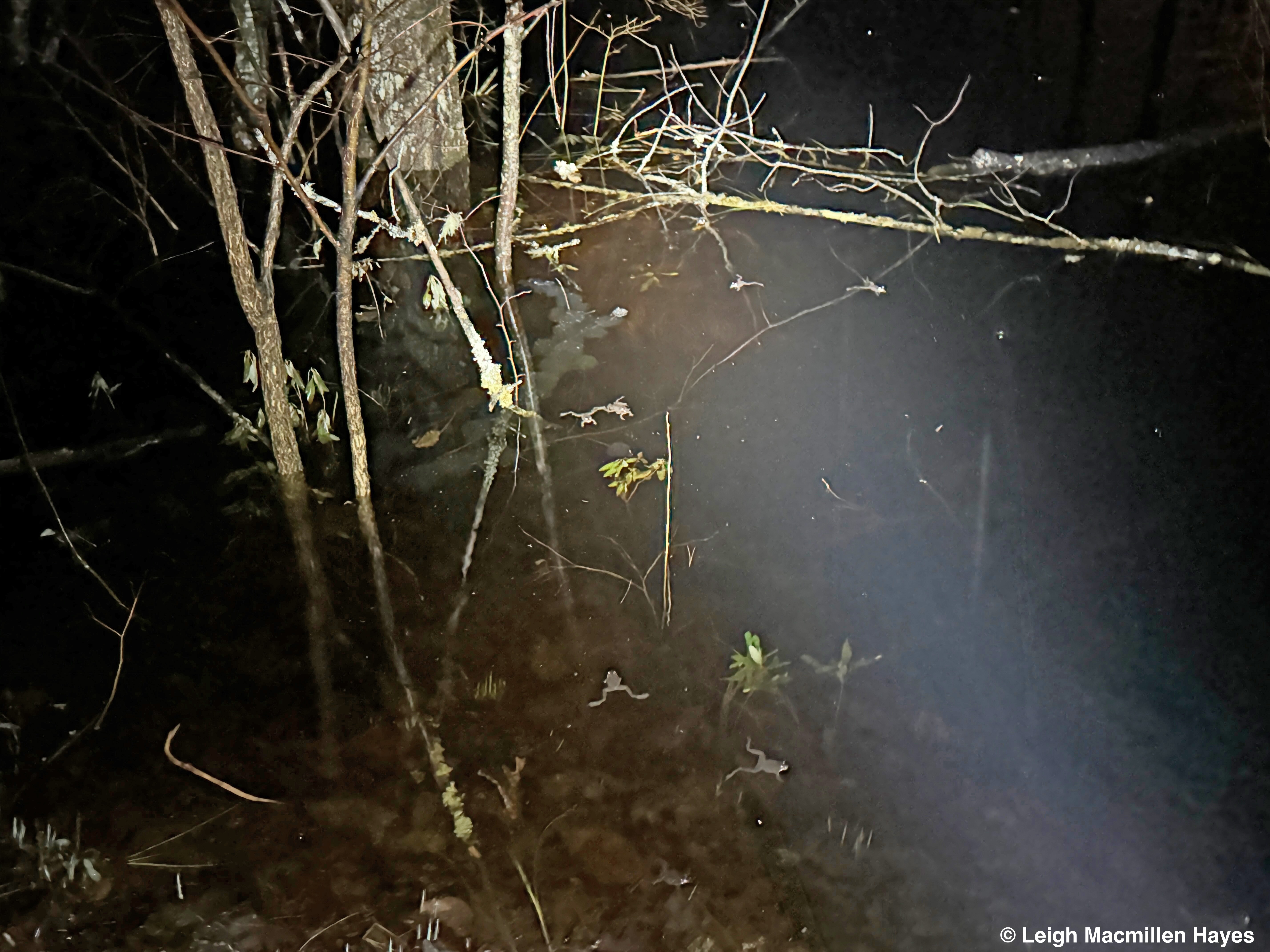
The action was constant and I encourage you to see how many frogs you can find in this photo. It’s almost like the Hidden Picture of Highlights magazine, or Where’s Waldo?

And twice we spotted Spotted Salamanders swimming in the pool, though I really wanted to see a “congress” of salamanders conducting their mating dance. One of these nights.

As we walked out on the third night, about ten feet from each other we spotted two sets of Wood Frogs in amplexus! They couldn’t even wait to find a room, or pool, for that matter!

We quickly, if awkwardly, helped them off the road because we heard that familiar “CAR!”

One night, two nights, three nights . . . turned into one incredible and extended BIG NIGHT migration.

Our results:

April 10, 2024
21 Spotted Salamanders
40 Spring Peepers

April 11, 2024
7 Spotted Salamanders
102 Spring Peepers
75 Wood Frogs
3 Red-backed Salamanders
1 Eastern Newt

April 12, 2024
13 Spotted Salamanders
268 Spring Peepers
62 Wood Frogs
4 Red-backed Salamanders
2 Green Frogs
1 Eastern Newt

For a grand total of 599 critters helped to the other side of the road. We saw a number of squished ones and had to constantly remind ourselves that they will become food for others.

Thank you to the 39 people who joined us during these three nights--you were incredible and we loved hearing stories of how you want to share this with other members of your family and you are already planning to join us next year.
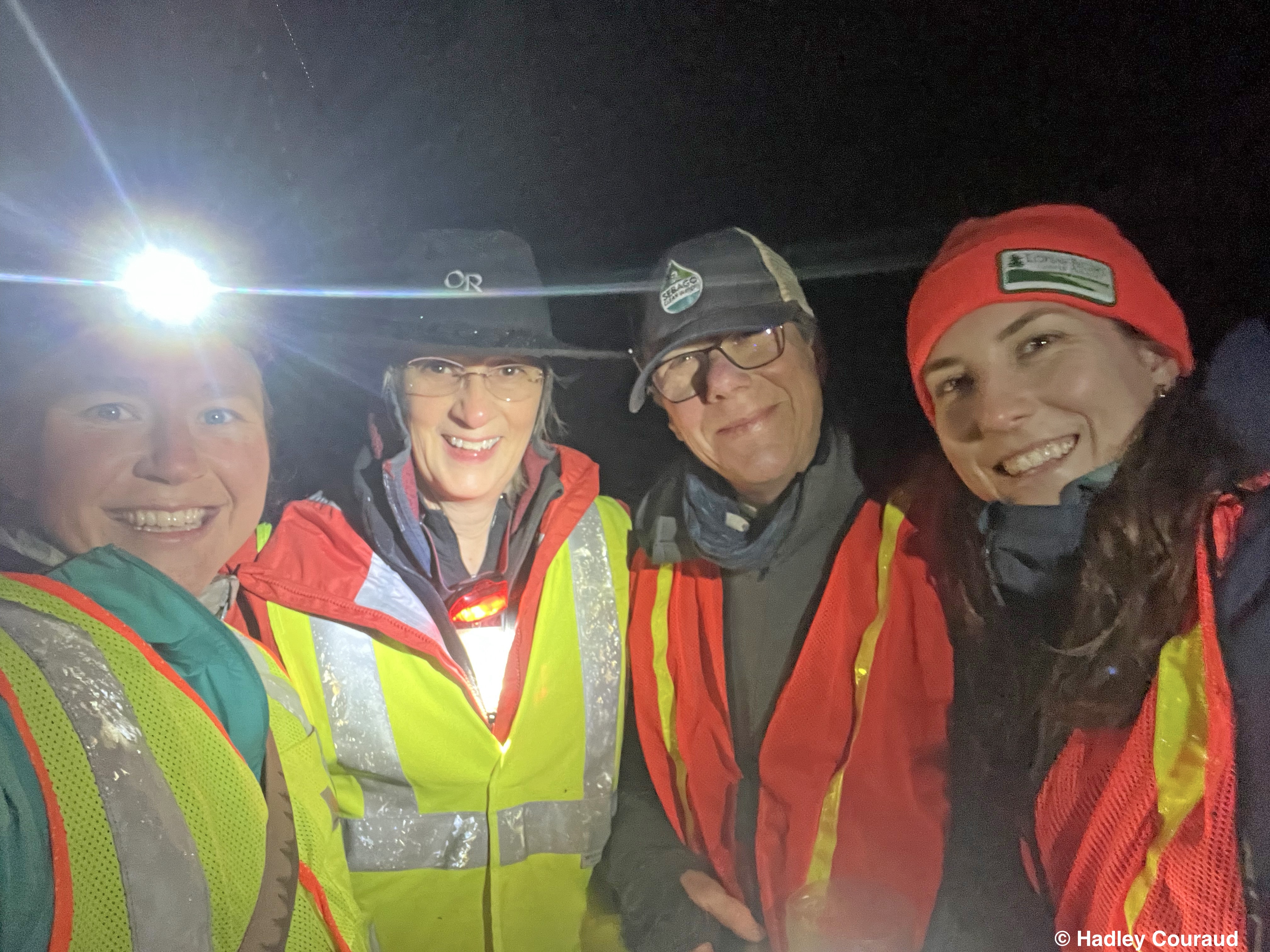
To go out on a rainy night and help amphibians cross the road is special–for the critters and for us. Thank you to Hadley, Dawn, and Maggie–for being the cool swamp critters that you are! And for letting me be part of the club.

BIG NIGHT 2024–one for the books.
Katydid, Didn’t She?

I have the extreme pleasure of being in touch with my first two playmates, the sisters who lived next door, on a somewhat regular basis. And even when we don’t see each other for a long time (Girls, we still owe ourselves a lunch in Newburyport), like any great friendship, we pick right up as if no time has passed.

While they both love the natural world, for that’s where we spent much of our childhood, one in particular frequently shares photos of her finds with me. And so I took her along, riding on my shoulder this morning when I headed out into the rain because I know that she, too, likes rainy days as much as, if not more than sunny days. So does her garden and she’s got a green thumb to envy.

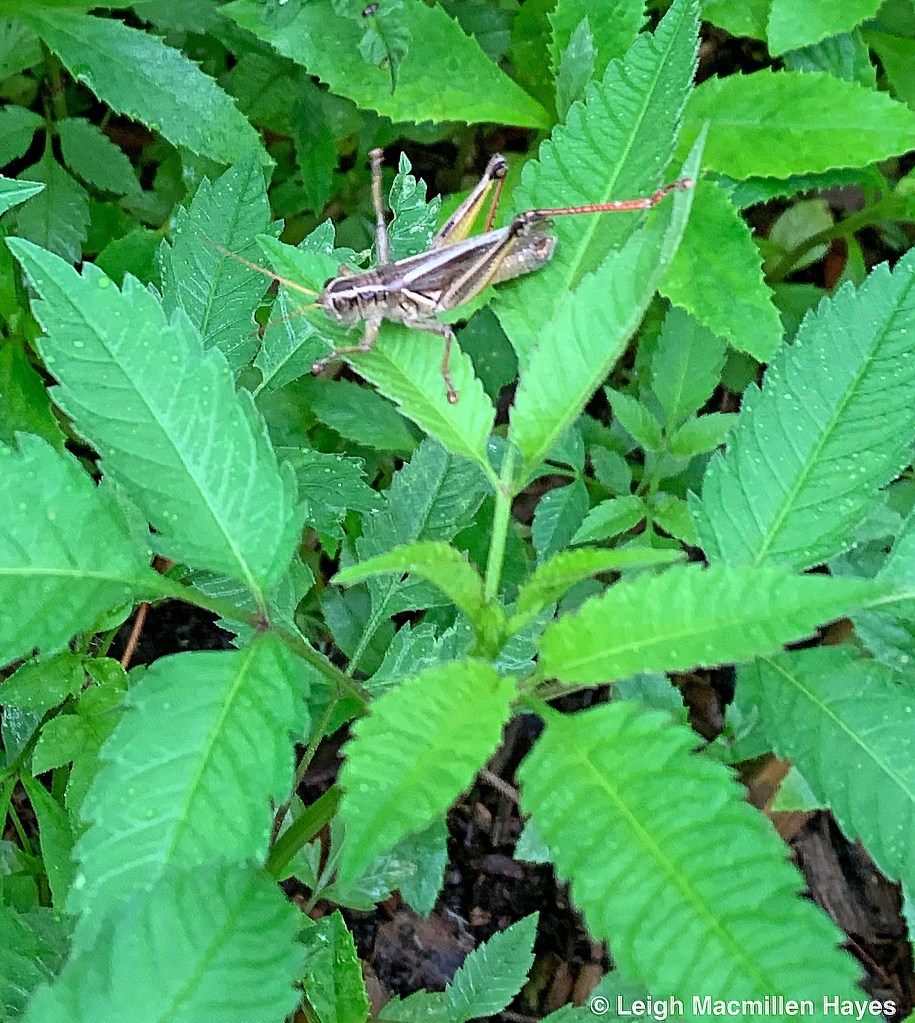
Since my thumbs aren’t great at turning the soil, I support a local farmers’ market and had time to pass waiting for my turn to pick up the pre-ordered produce, bread, chicken, flowers, and treats. Thus, as we started to hike, a grasshopper known for its two stripes greeted us.

Not far along, at the base of a certain pine tree, I showed her the Pippsissewa now in bloom. Not only do I love to say this plant’s name, but the blossoms . . .

oh my. We both squatted for a closer look at the anthers within. And sniffed its sweet scent.

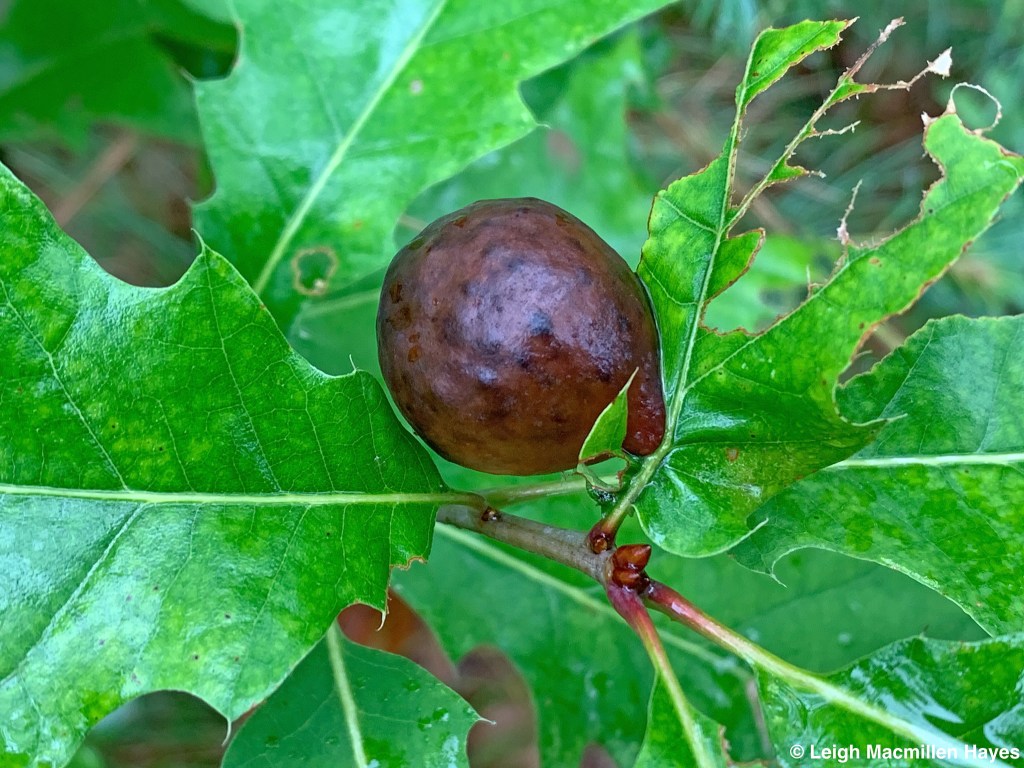
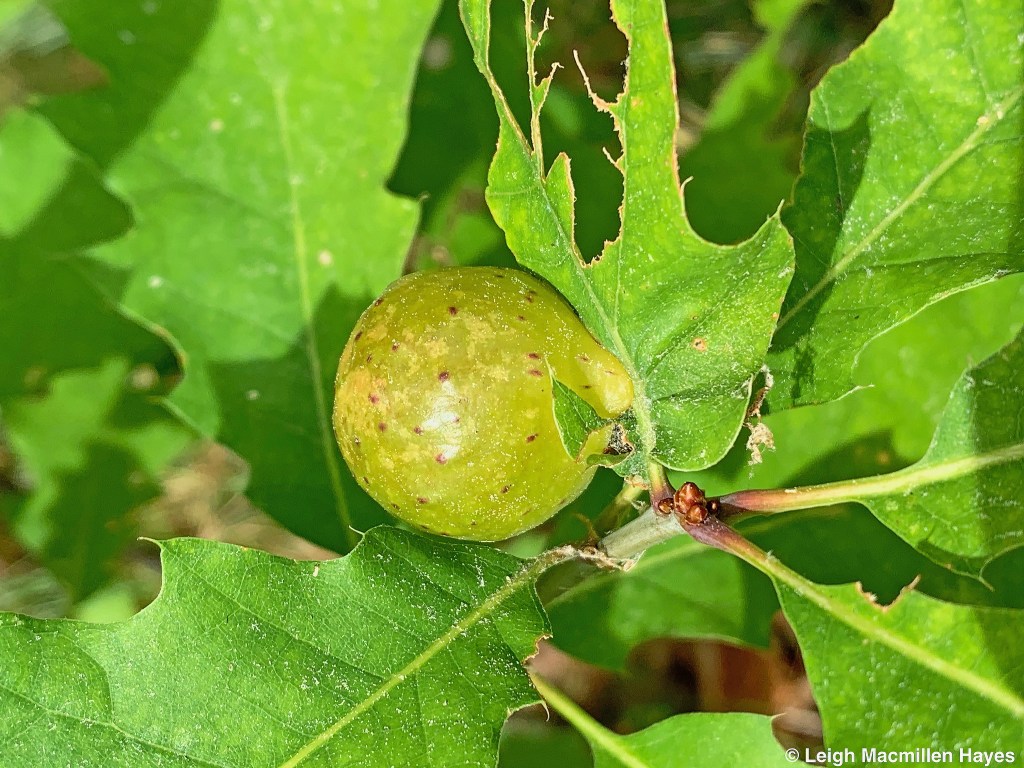
Our next great find was an oak apple gall and of course I had to tell her that a non-stinging and wingless female wasp injected an egg into the veins of the leaf as it was just beginning to grow. Chemicals released by the tiny larvae that developed within altered the growth and over a few weeks, the little orb formed.

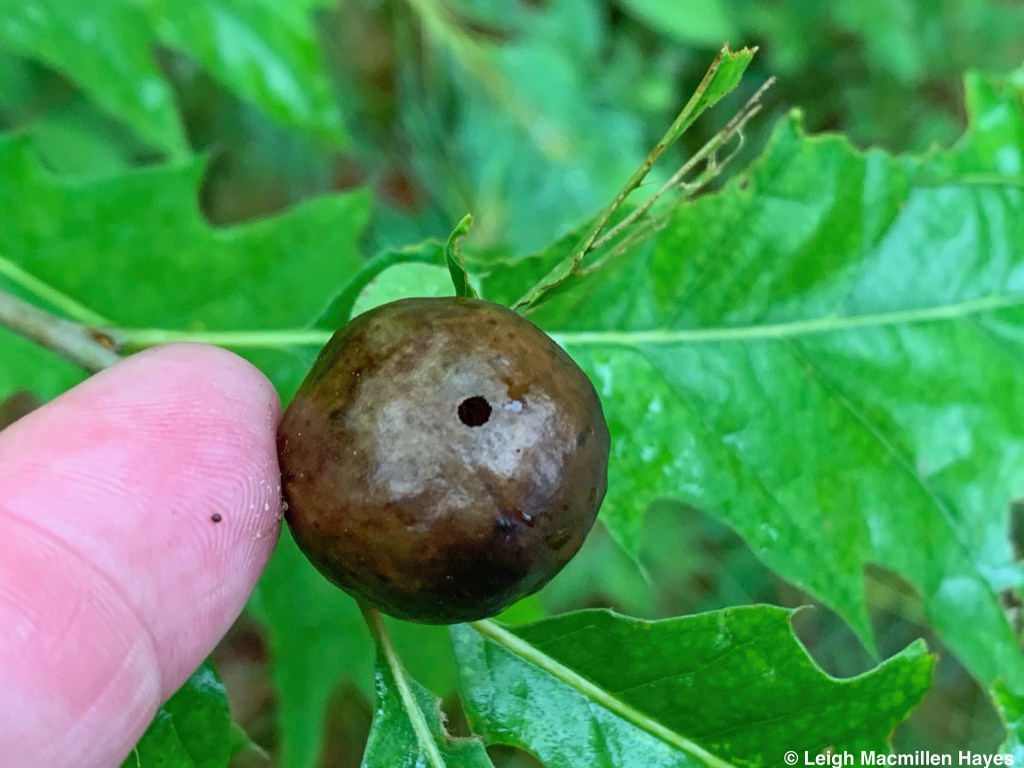
By the circle hole on the underside, I explained that the wasp had pupated and chewed its way out and was probably now feeding on the very roots of the same tree . . . that is if it hadn’t been consumed by birds or small mammals.

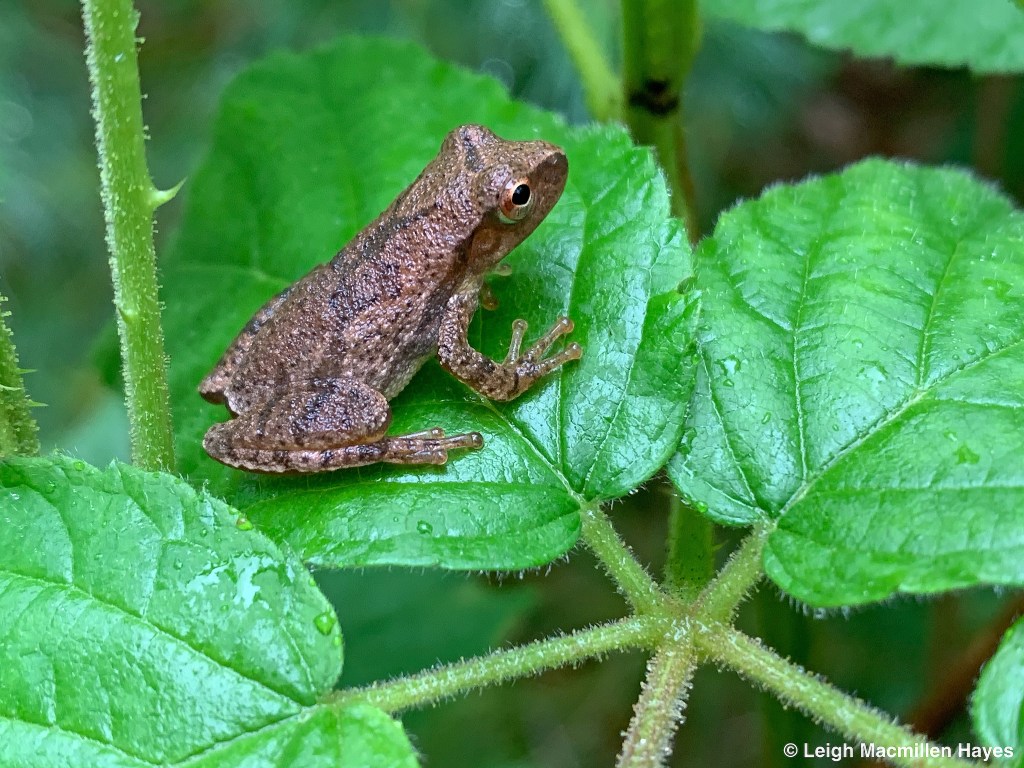
We moved on, but a tiny spot of brown on a berry leaf was the next to beg for our attention. Check out those toes. Sticky toe pads on their webbed feet provide support for these plant and tree climbers known as spring peepers.

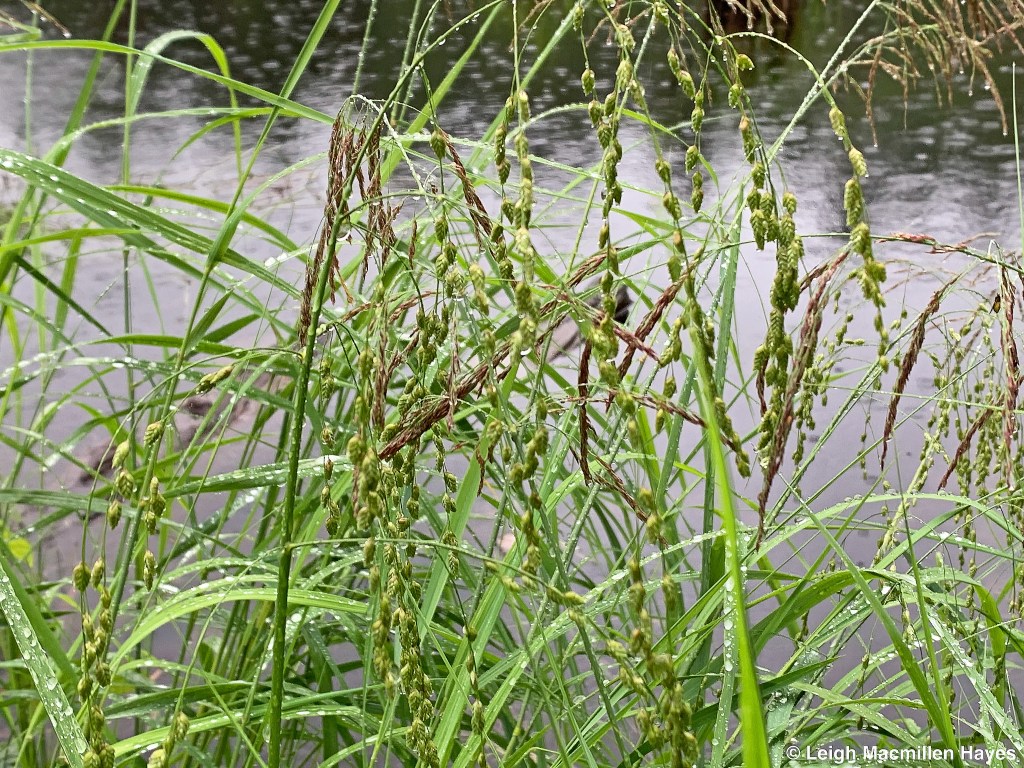
At last we reached a wetland and that’s when the rain really began to fall. And so my friend and I . . . we stood and looked about and enjoyed the raindrops on the grasses and sedges, the water’s surface, and us.

For a while, we left the path, and slipped into the woods, trying to follow a recently created trail, but mostly meandering about in the land where nurse logs provide a start for so many others as they decompose.

As it turned out, that wasn’t the only nursery in town. Once we returned to the trail, which by the way, she was impressed that I could find my way back . . . and so was I, I took her to a nearby meadow where we spotted a momma tending her young’uns.

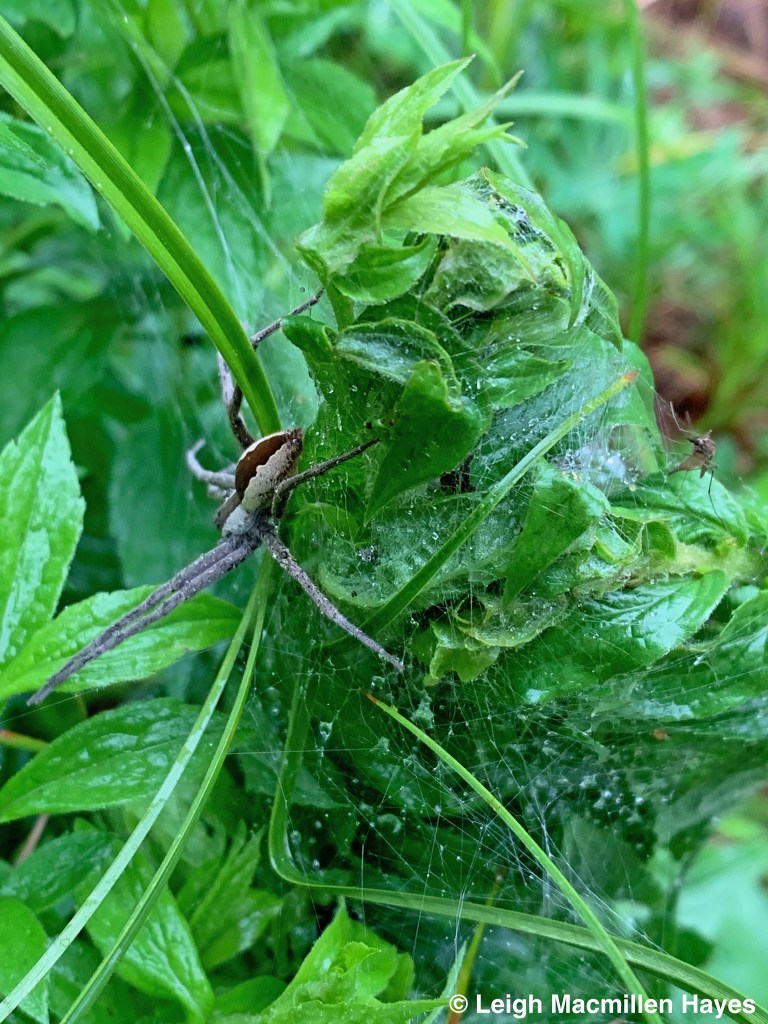
I knew my friend would love this sighting because she not only saves salamanders and deer, but also spiders from any demise. This momma wasn’t so sure about us, however.

As large as she was, we were even bigger so she continued to work on her web to make sure her children stayed safe.

When she wasn’t looking, we did peek inside and saw a few of the babies.

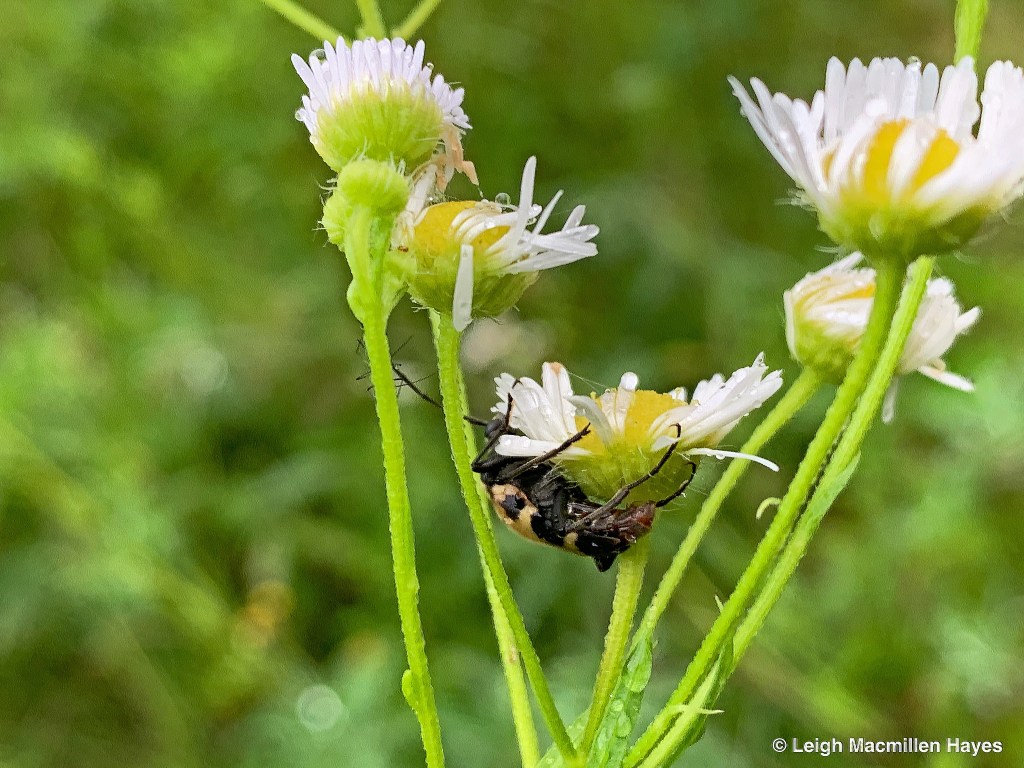
We spotted another spider of a much more diminutive size upon one of the meadow flowers. You might see it, though it is a master of camouflage. Two insects also hung out as if they were trying to stay dry. Though the beetle is quite obvious, a discerning eye will spy the legs of the other.

We had actually gone to the meadow to see the Canada lilies that tickled our fancy for they looked like streetlights in the midst of the rain drops.

All of our finds had been great, but the best one of all . . . a Katydid. My friend’s name is Kate or as she was known when we were kids: Katy. And when quizzed by our moms about who was responsible for something, the rest of us always said, “Katy did it.”

While standing in the meadow today with Kate on my shoulders, my cell phone rang and suddenly I was looking at . . . my dear friend via FaceTime.

“Did I call you, or did you call me?” I asked as I looked at her beautiful and familiar grin while she stood aboard her cabin cruiser on Long Island Sound.

“You tried to Face Time me twice and so I called you back,” she said as she looked a me–soaking wet and rather bedraggled but happy (except maybe for the mosquitoes and deer flies).

I’d been using my phone to snap most of the photos but kept putting it in my pocket and I think I may have inadvertently contacted a few people.

So maybe this one time I did it and not Katy, but forever when I see a Katydid and many other things in the natural world, she’ll be right there with me as we were so many moons ago–Katy got me then and thankfully she still does.

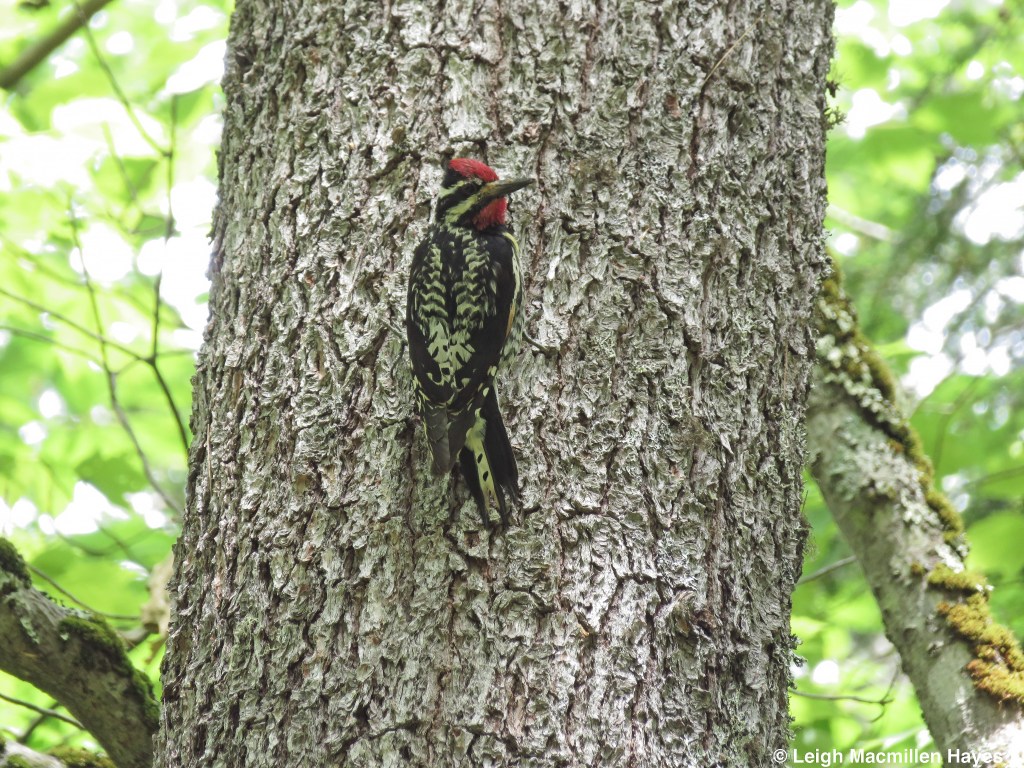
Drawn by the Sapsuckers

This morning’s tramp found me checking on a couple of bird nests. The first, which belonged to a Phoebe family, was empty.

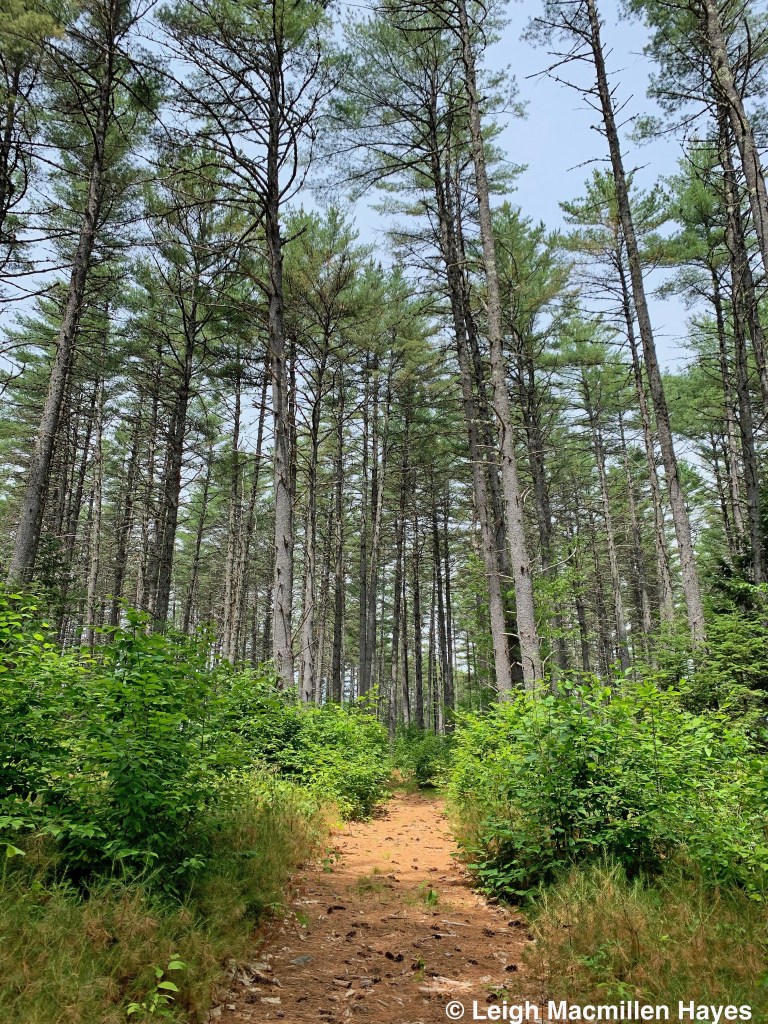
And so I wandered along a path through a cathedral in the pines.

It seemed apropos that I should spy the works of an Oak Apple Gall wasp in such a place for it is believed that circa 800 A.D., monks from a Columban monastery created the Book of Kells and used such galls for their green colorant. The wasp uses it as a place for a larva to pupate.

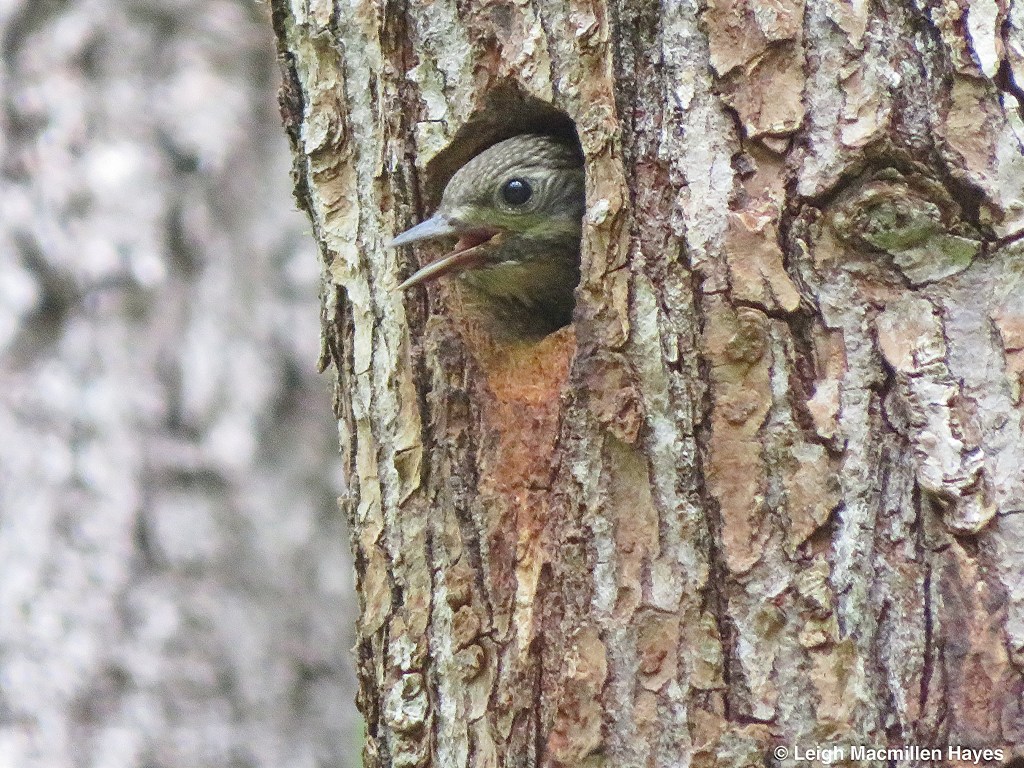
I knew I’d reached the second nest I wanted to check on because from about twenty feet away I could hear the peeps of the babes within. Their father tossed in a meal, much differently than how he was feeding them only a week or two ago when he entered the nest hole every few minutes.

Today, no sooner did he leave when a nestling popped out and begged for more. I watched for a bit and then gravity pulled me in a different direction.

And so I trespassed onto a neighboring property. Well, I don’t think of it as actually trespassing since it’s not posted and I know the owners who have invited me to visit on numerous occasions. They just didn’t know today would be one of those; nor did I until it was. The deer flies buzzed all about my head, but thankfully some old friends in the form of dragonflies (uh oh, here I go again) snatched the pesky insects and then dined.

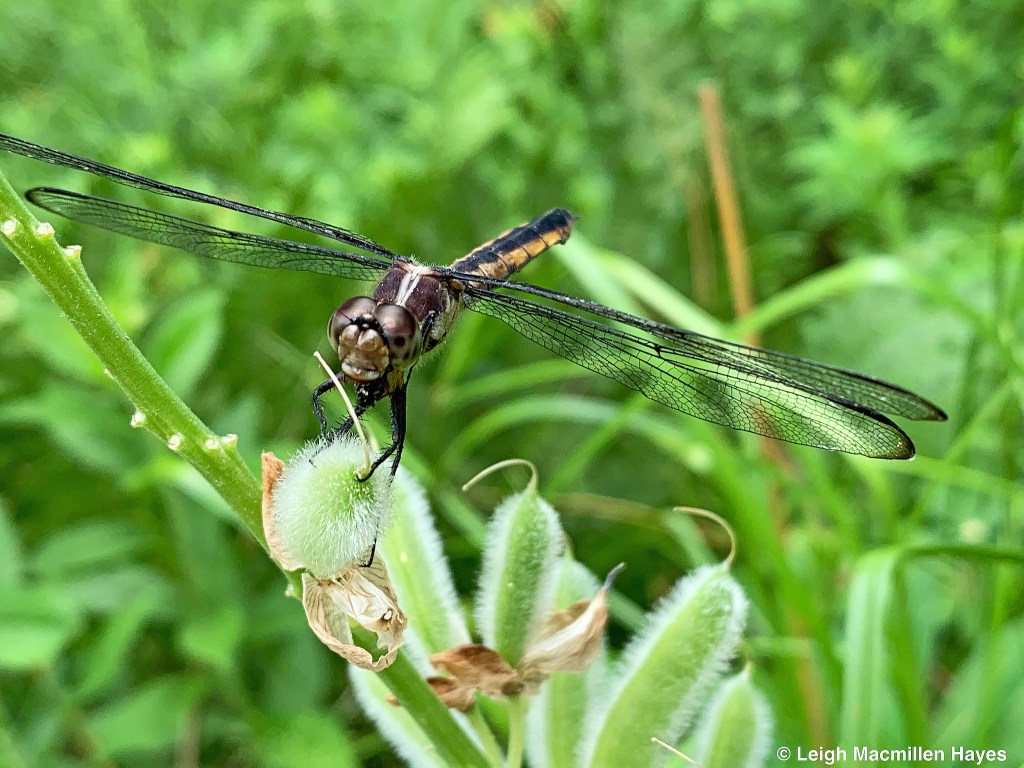
It took a few minutes, but eventually Slaty Blue gobbled every bit of the fly. One down; a gazillion to go.

While the lupines had been in full bloom the last time I visited, today’s flowers of joy were the Milkweeds. Even the ants agreed.

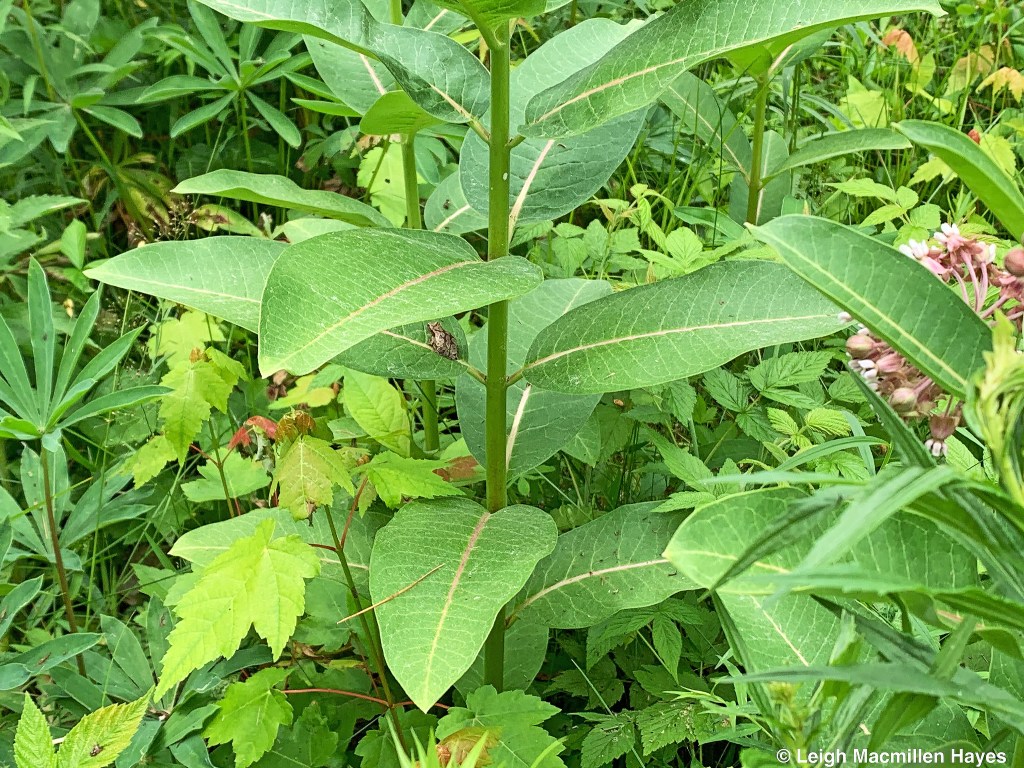
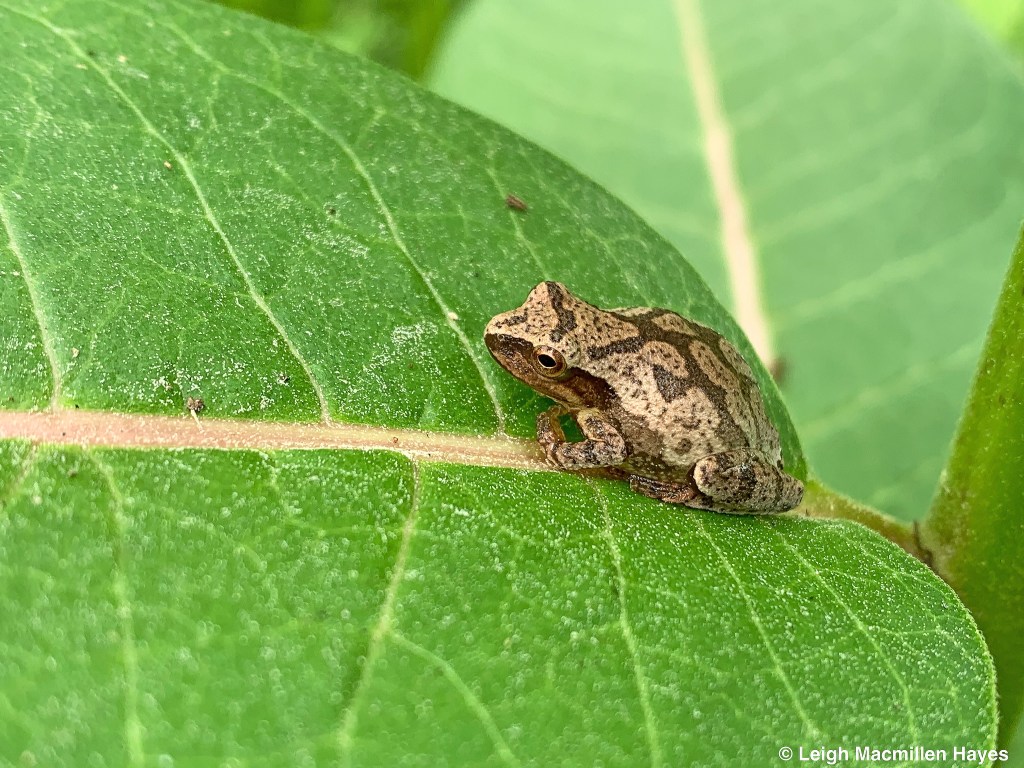
On a leaf below one flowerhead, I noticed something tiny and by the pattern on its back, knew who I was spying.

About the size of a nickel, it was a Spring Peeper. Located about two feet above ground, this little frog could hide from predators all day, waiting to munch on insects and spiders at night. Do you see the X on its back? Its scientific name–Pseudacris crucifer–breaks down to Pseudo (false), acris (locust) and crucifer (cross bearer).

While I continued to admire him, a dash of color brightened the background and then flew down onto the path.

Bedecked in orange and black, it was a Fritillary butterfly. There were actually two today and where the colors of the lupines had passed, the butterflies contributed greatly with their hues.

The Fritillaries weren’t the only adding a dash of color for Eastern Tiger Swallowtails also pollinated the meadow flowers.

Canada Tiger Swallowtails also fly in this part of Maine and so I’m forever trying to remember how to tell the two apart besides size, which doesn’t help when you only see one. The trick, however, is to look at the yellow line on the underside of the forewing. If it isn’t one continuous line as this one wasn’t, then it is the Eastern variety.

I’ve probably completely confused you, but the next will be easy:

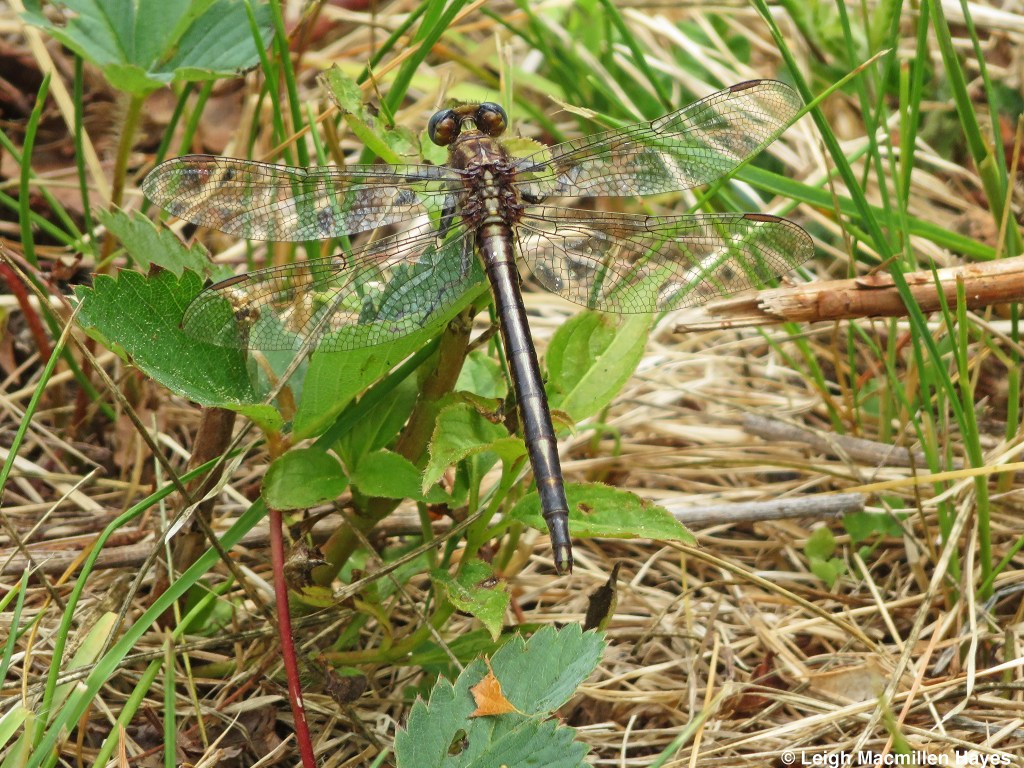
A pop quiz: 1. Who is this? You tell me. (Hint: Emerald family)

2. Who is this? (Hint: Clubtail family)

3. Who is this? (Hint: Skimmer family)

4. Who is this? (Hint: Skimmer family)

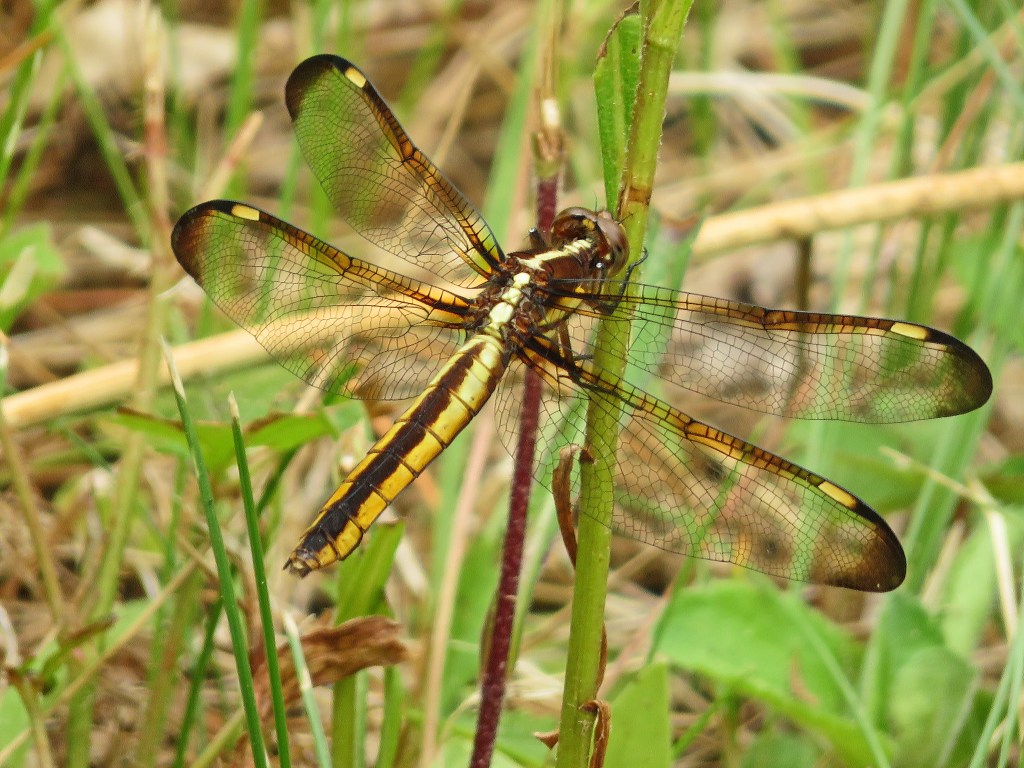
Extra credit if you can identify this lady. (Hint: Skimmer family)

The skimmers are many and each has something unique and lovely to offer. But my greatest thrill today was to encounter this delightful specimen just before I was about to depart the meadow. For those who joined me yesterday as I hunted for the Common Whitetail Skimmer, you may have noted the zigzag pattern on her abdomen. Take a look at the pattern along the abdomen of this beauty. The side spots form a smooth stripe. Her honey, whom I have yet to see, has not only the black patches on the wings, but also white. Who might this be? A Twelve-spotted Skimmer.

Before departing, I checked back on the sapsucker nestlings. Papa was doing the same from a tree about ten feet away. I got the sense he wanted to tell them to be patient and stop begging.

But how can you resist such a baby face? I know I couldn’t.

I gave great thanks to the Yellow-bellied Sapsuckers for drawing me into this place and to Linda and Heinrich Wurm for allowing me to trespass and spy their meadow once again and all that it has to offer.

P.S. Quiz answers: 1. Racket-tailed Emerald; 2. Ashy Clubtail; 3. Spangled Skimmer; 4. Dot-tailed Whiteface; Bonus: female Great Blue Skimmer (a first for me) How did you do?

Cinco de Mayo Maine-style

When Pam asked at the end of our slow tour today what my favorite finds were, I named at least five.

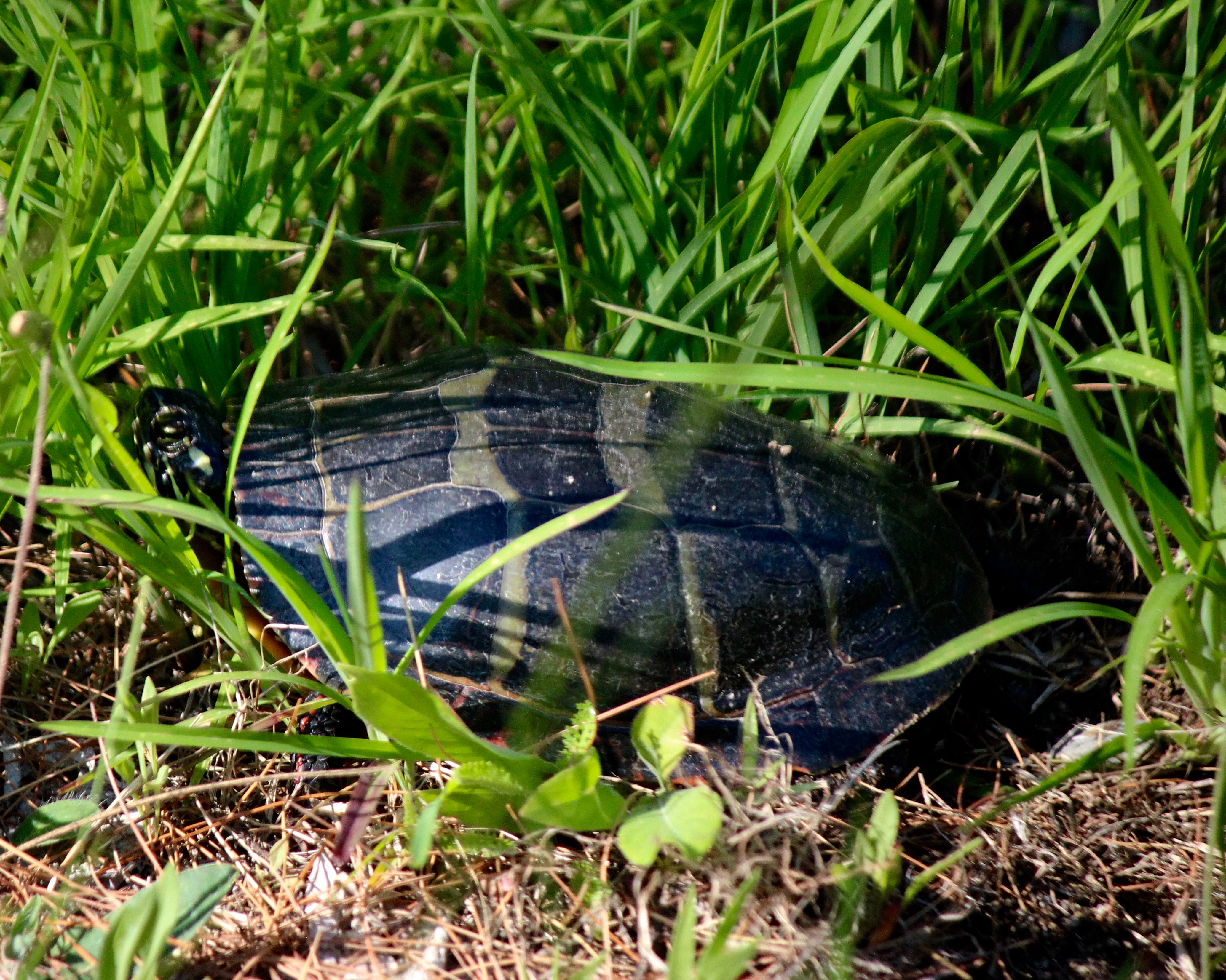
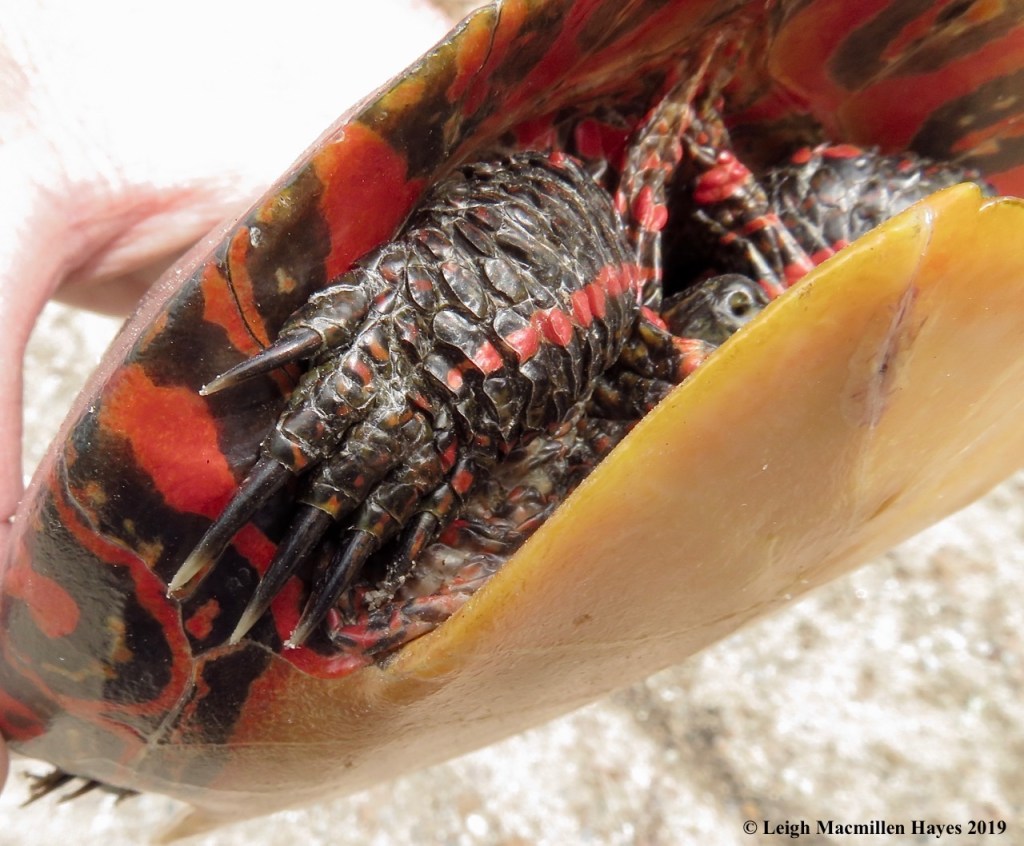
First, there was the Painted Turtle that I spotted on Kezar Lake Road as I drove toward the Greater Lovell Land Trust’s Long Meadow Brook Reserve. After I pulled over and approached him, he did what turtles do and retreated into his shell. Though he wasn’t feeling it, I was in celebration mode, for he represented my first turtle of the season. And I helped him cross the road.

I felt safe calling him a he for males have long fingernails. Can you see him peeking out at me in a not too pleased manner? Can’t say I blame him, but our time together was brief and soon he wandered his way while I wandered mine.

And then, another reason for celebration–Coltsfoot in bloom. I know it’s invasive, but its sunny face and scaly purplish stem that predate its leaves offer a first hint of the season’s promises of colors to come.

Coltsfoot is known by some as Filius ante patrem (the son before the father), because the bright yellow star-like flowers appear and wither before its broad, green leaves are produced.

The next sight to be considered: a small spider that, like the painted turtle, continuously eluded our focus by quickly moving to the opposite side of the beech twig. Can you spy it?

And then there were those tree buds bursting forth with life ready to unfold from within. We were offered a few early glimpses of the future and rejoiced at each sample.

At last we reached Long Meadow Brook, for which the reserve is named. And stood and looked and listened and waited and absorbed. Oh, Pam absorbed some water in her boots thanks to a leak. But she didn’t let that stop her and we each enjoyed the opportunity to let this place soak through our pores for moments that turned into a string of minutes and suddenly an hour had passed.

At long last, we pulled away and began a bushwhack through the woods beside the brook.

In so doing, we found more to celebrate, like a red squirrel refectory upon a rock and we suspected a large hole below the tree trunk and boulder had served as the larder.

Continuing on, we saw mats of black upon moss by another tree and almost wrote it off as perhaps a fungi we hadn’t met before.

But. It. Moved. As we watched, we realized the constant motion was created by springtails writhing en masse. To say it wasn’t creepy would be lying. Likewise we were fascinated and leaned in closer to watch the swarm upon the moss.

Resting nearby, perhaps having just gorged on some of those tiny little morsels, was another reason for celebration–a spring peeper. We spotted two, but heard a hundred million more, each adding its song to the symphony that arose from the wetland. And suddenly, an interval of silence would interrupt the music, and then one male would peep, and the rest would join in again until they arrived at the next rest symbol upon their sheet music.

Others added their own notes to the orchestra, including a couple of White-throated Sparrows that trilled in our midst.

Near the end of our journey, we reached a point where we could see that there was still some snow on the the Bald Face Mountains in Evans Notch, but we spotted a dragonfly and honored Trailing Arbutus flowers and rejoiced. Though our celebration didn’t have a Mexican theme, we still had at least cinco reasons to give thanks from the Painted Turtle to Coltsfoot to Bud Bursts to Squirrel Larders to Creepy Collembola to Spring Peepers to White-throated Sparrows. Really, it was more a Siete de Mayo on this Cinco de Mayo–Maine-style.

Sluggish Moments

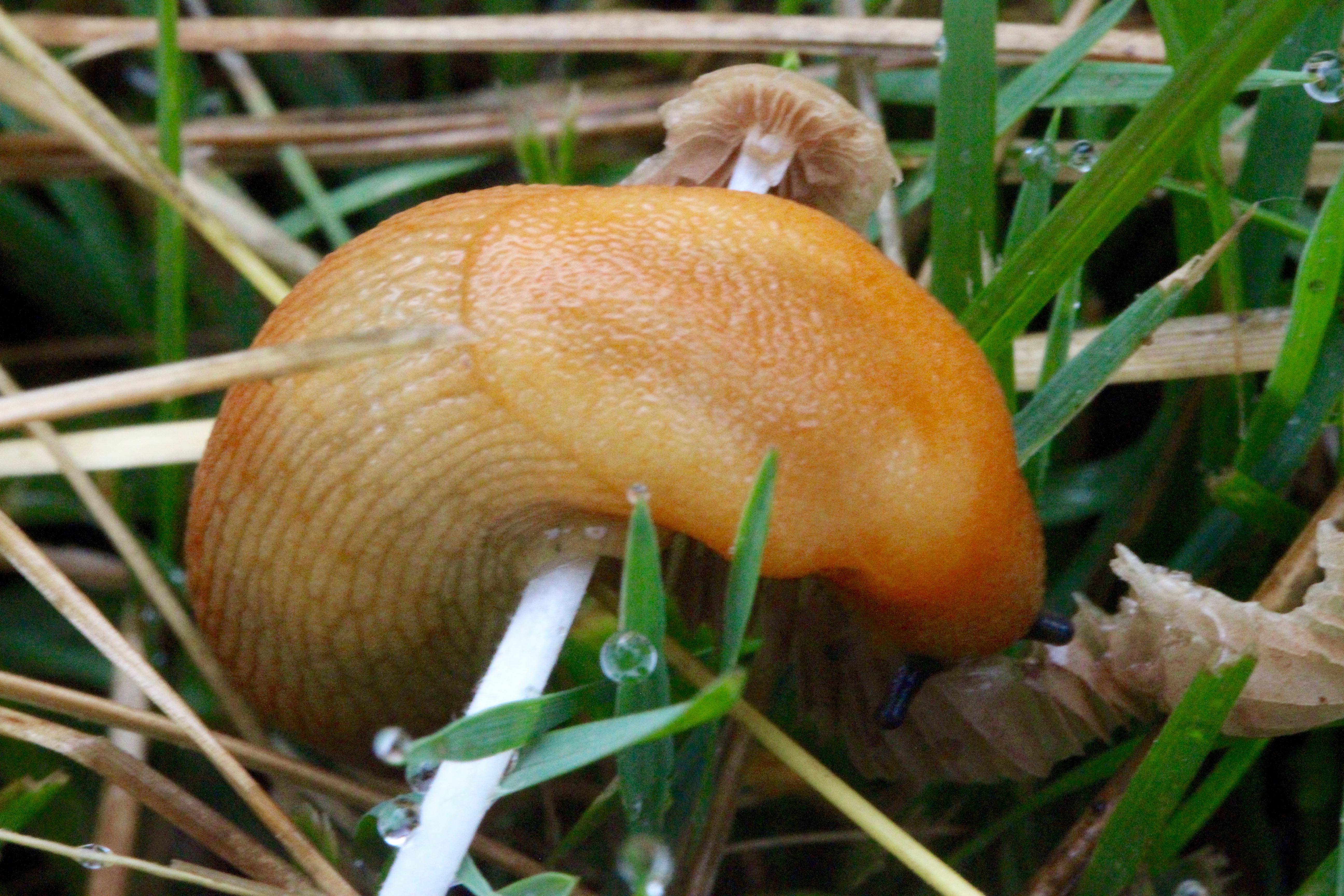
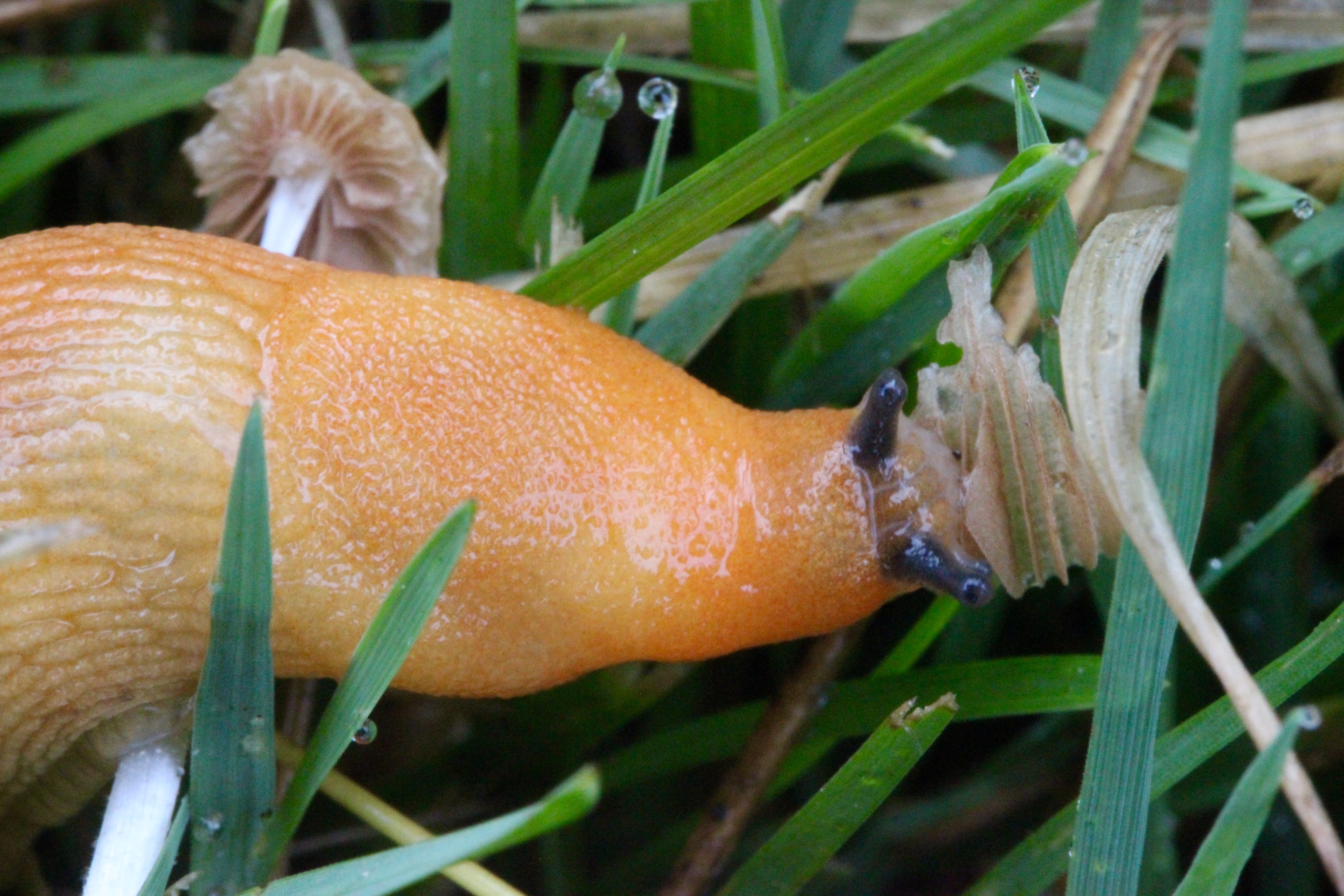
It’s not every day that someone shares time with a slug, but this morning that’s exactly what I did. It had poured until about 5:30am, so the conditions were prime.

4

Actually, I was hunting for a spring peeper that frequents one garden and the grasshoppers that live in another, when a spot of orange caught my attention. And so I bent down for a closer look.

3

A slug is like a snail without a shell, which makes it vulnerable to dehydration. That’s why we only see them foraging on rainy or cloudy days. I suppose we should think of slugs as weather predictors, much the same way common polypody indicates the temperature. Of course, if you look under leaf cover in the garden, you’ll surely find them as well, no matter what the weather is. Cool and damp conditions prevail in their world view.

1

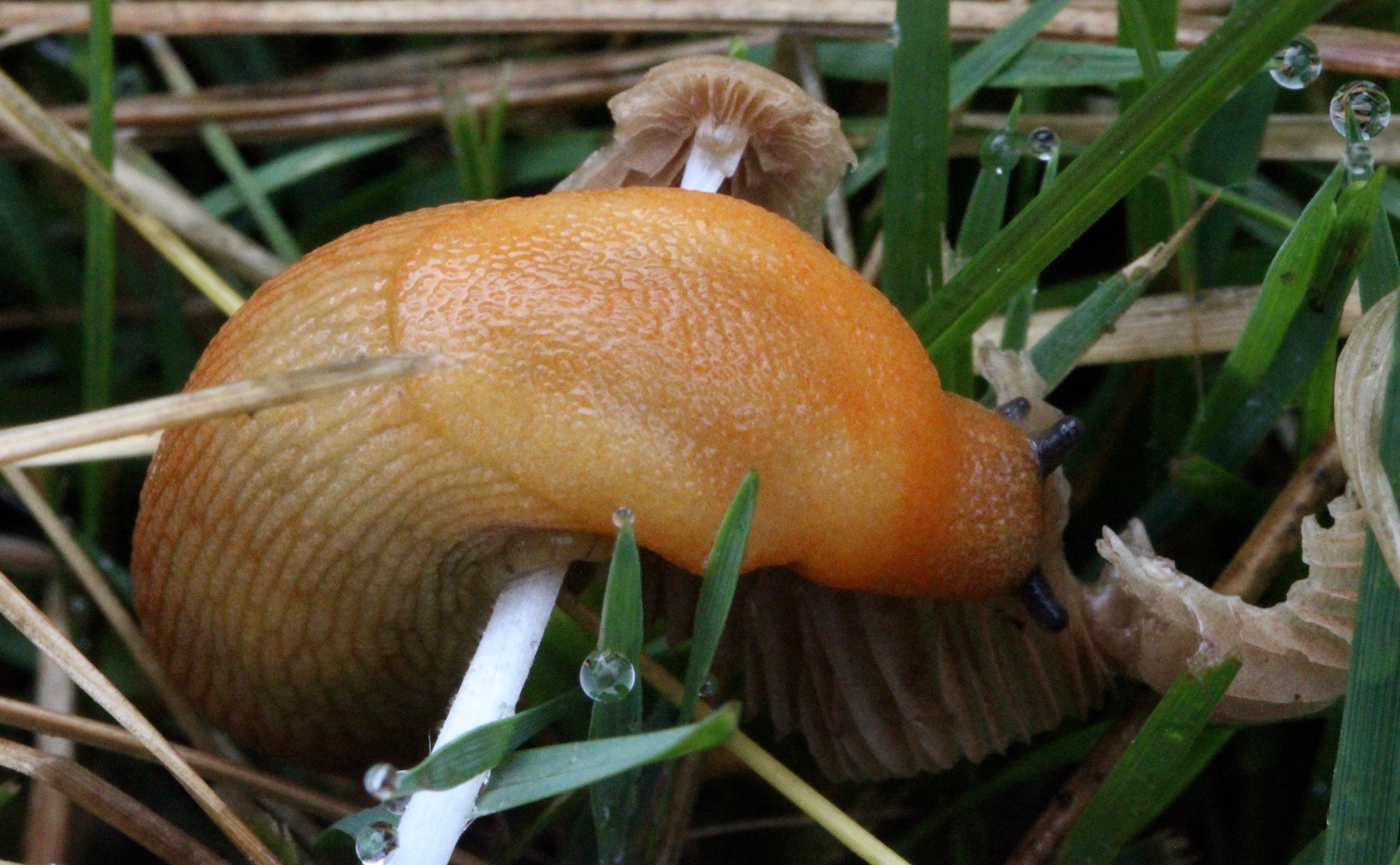
As Mr. Slug munched on a mushroom at my feet, I admired the pattern on his back and thought about my past experiences with slugs. I’ve licked their backs because I’d heard that they release a chemical which works like a natural anesthetic, thus providing a cure for toothaches. The numbness did last for a short period of time. That being said, my nursing friends encouraged me to stop because slugs may also carry parasites. And so I did.

6

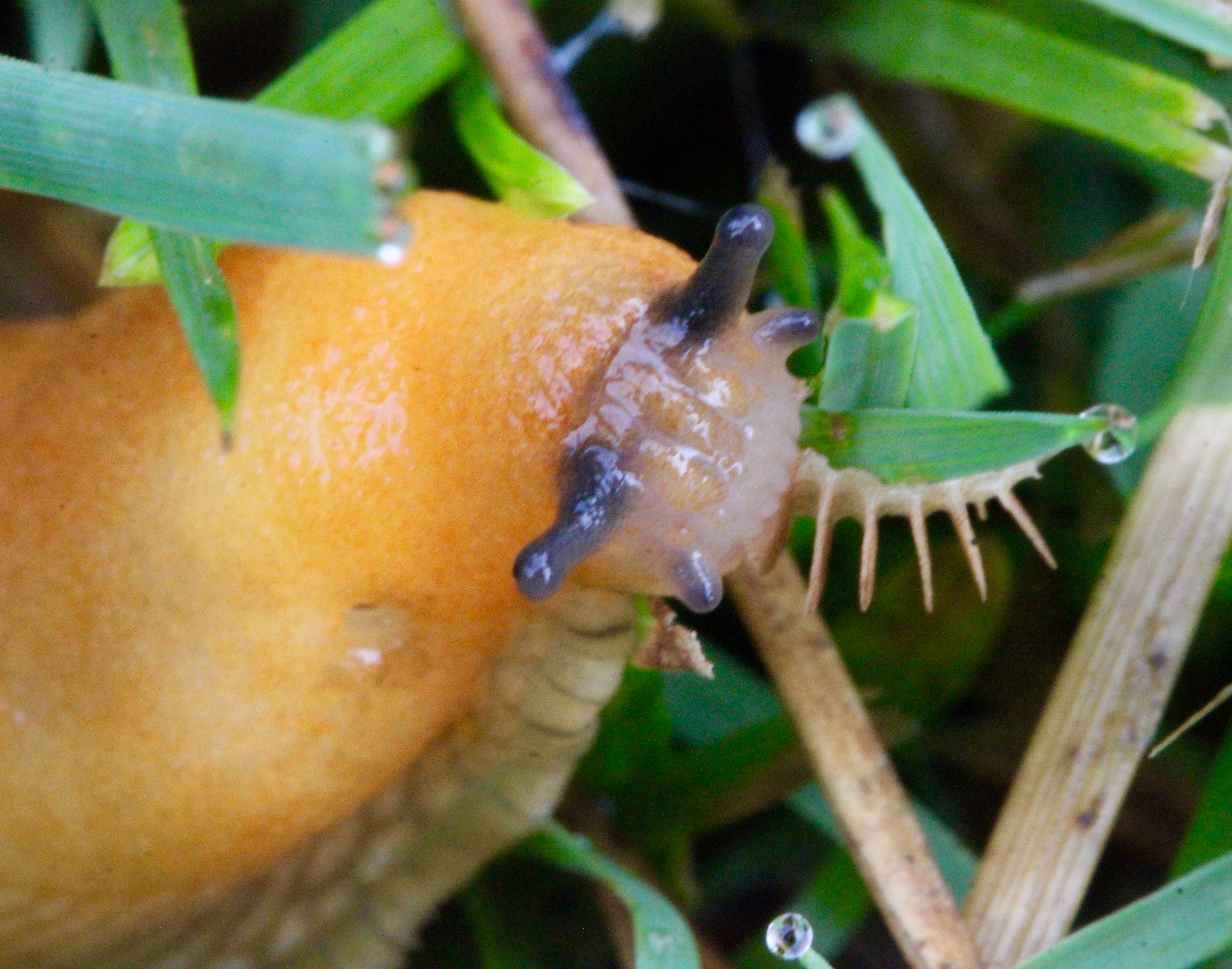
Since I was upclose and personal, I could see Mr. Slug’s two short antennae and even shorter eye stalks. Then there was his accordion-shaped mouth that he used to grasp and shred plant material. At first I thought he sucked it in, but as I watched, I could see the chewing motion.
7

Being a mollusk like a clam or oyster, one might think about sautéing slugs. Or not. Really, I’m surprised my parents never tried that. Dad always sacrificed some beer so Mom could pour it into a tin pan in the garden to attract slugs. It worked–better for her than the slugs who thought they’d found the holy grail only to instead meet their fate. A perfect marinade. Thank goodness Mom and Dad didn’t think of that. But really, though slugs do have a bad reputation because they eat plant material in our gardens, they also play an important role as decomposers–of fungi and lichens and dead insects and plant material, all of which they turn back into soil.
10

And here’s another curious thing about slugs–their mode of transportation. Remember their vulnerability to dehydration? Well, in order to move along they must create a slimy mucous. And so a chemical reaction occurs in their bodies causing them to secrete a sticky, slippery substance. That probably helps in keeping their predators, like toads and snakes and birds, at bay. Once they’ve moved on, it dries up.

9

This morning, after we’d spent about a half hour together, Mr. Slug decide it was time to move on–toward the garden. It’s raining again as the sun sets and he’s probably slip sliding away across the yard in search of another feast.

ant

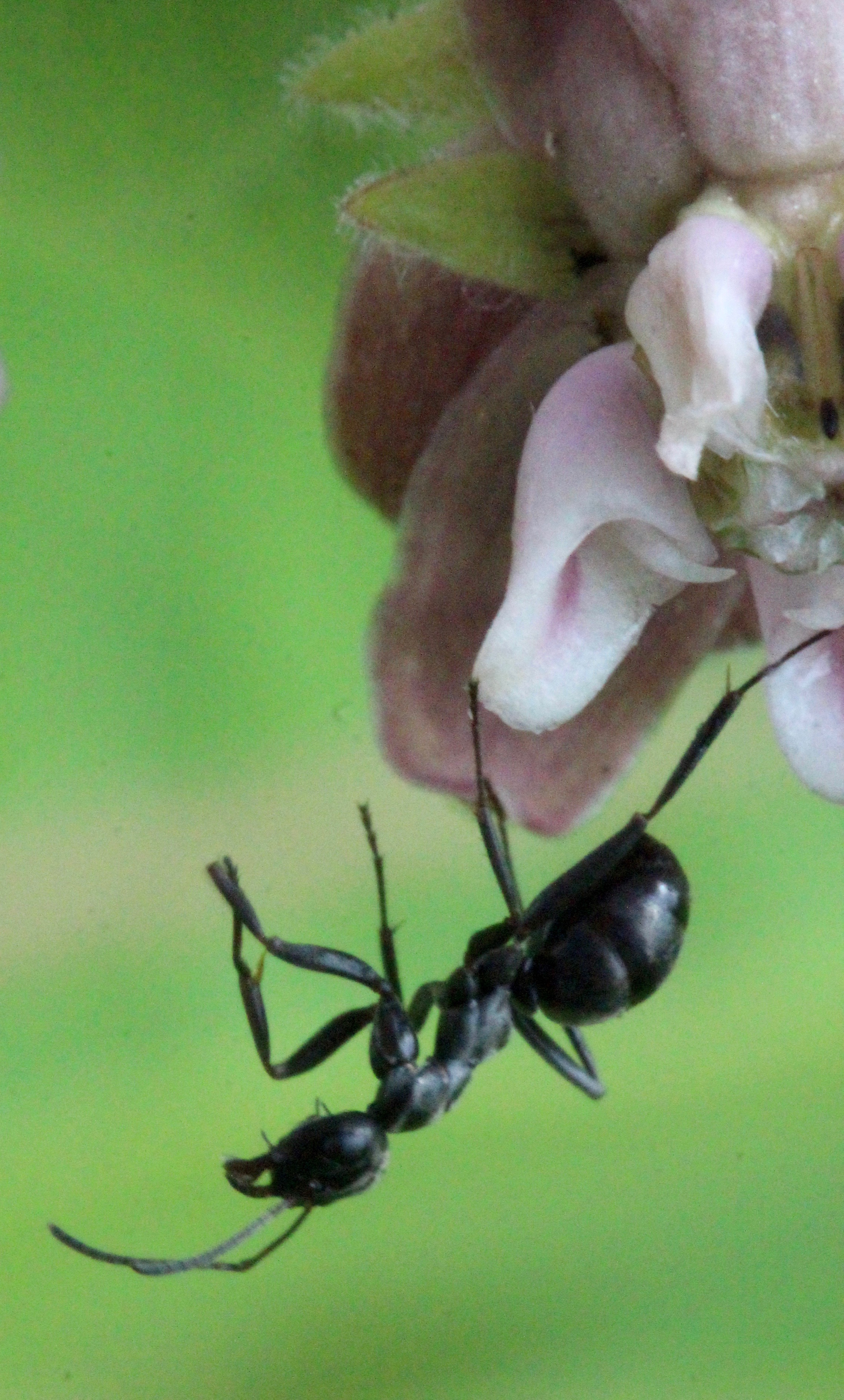
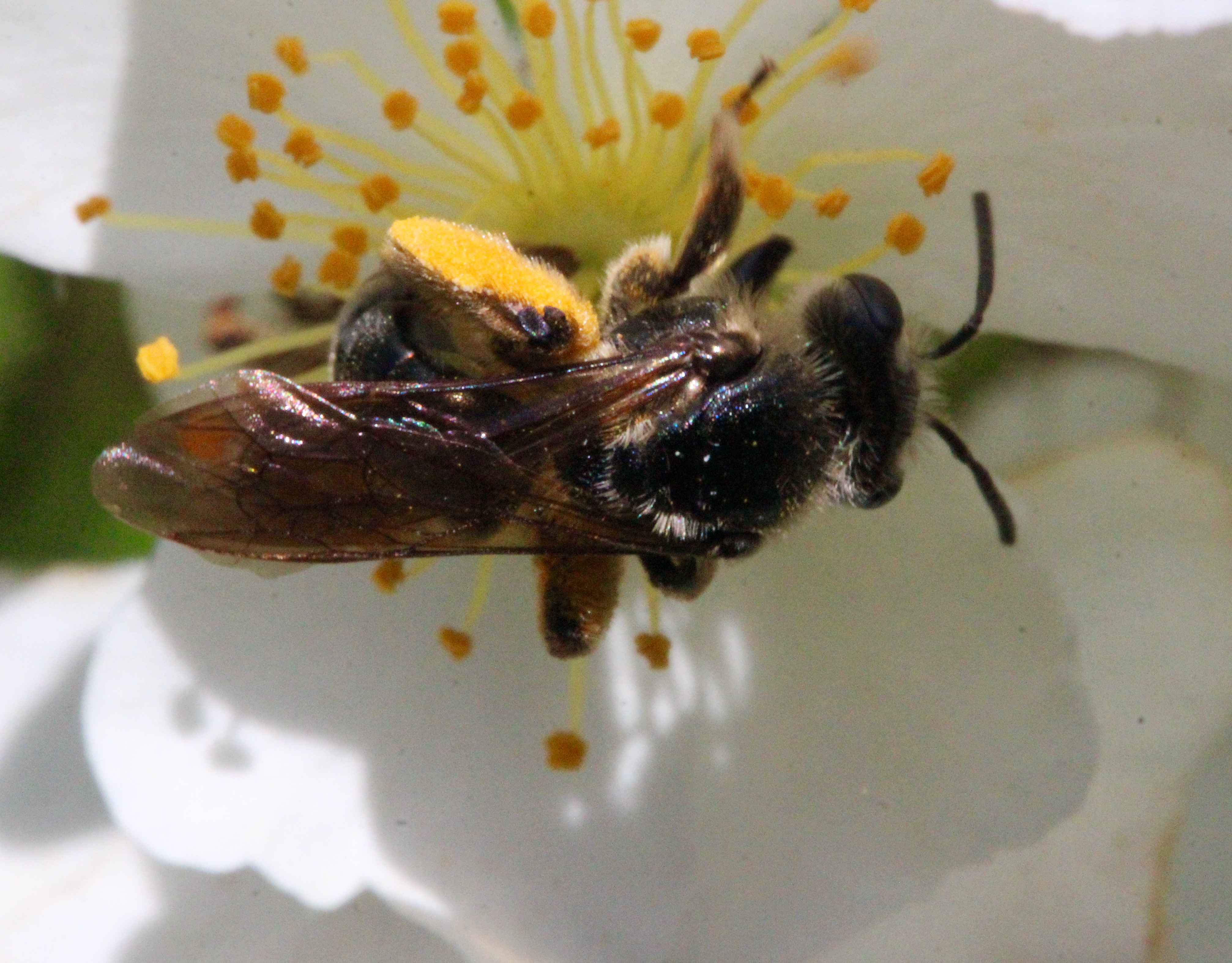
Because you stayed with me through my slug praise, dear reader, I thought you’d enjoy stopping by to wonder about a few pollinators like the ant that visited the milkweed. Did you know that insects get their feet caught in the sticky pollen sacs of the flower? They have to twist and turn as this one did while trying to get out. In the process, their feet get covered with pollen that they carry to the next flower.

bee

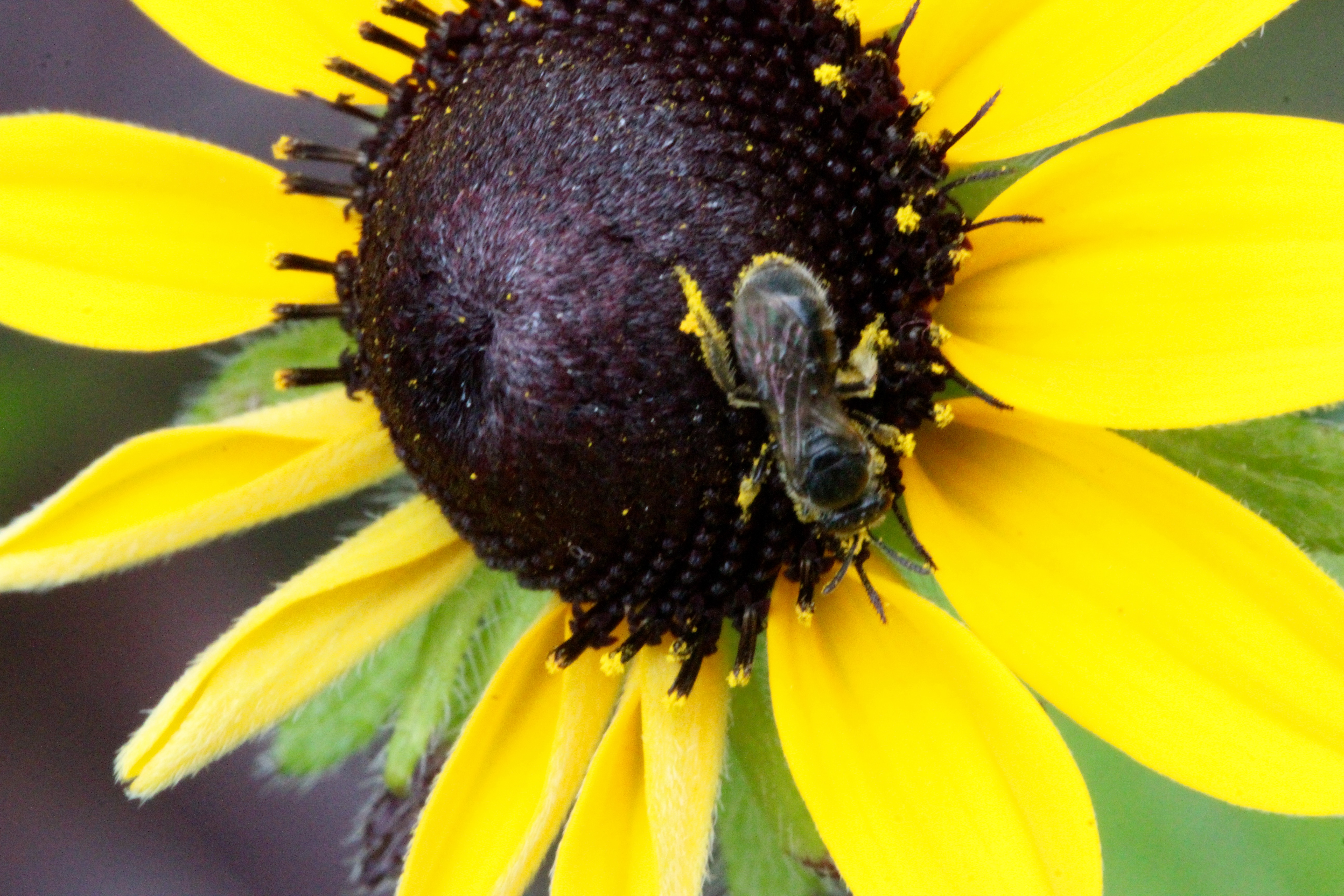
Pollinators come in all shapes and sizes, but I found one who looks like it wears a Halloween costume on a daily basis.

pollen

And this final pollinator of the day–loves to get totally immersed in its job.

I never did find the spring peeper today, and only one grasshopper, but my moments spent wandering and wondering were hardly sluggish.

Fun with Focus

I must confess. I’m a stalker. Of flowers and ferns and leaves and twigs and buds and bark and insects and birds and mammals and tracks and scat and cycles and systems. Of nature. Every day. All day long.

Sometimes I circle round and round, checking on the activity of a particular area over and over again–all the while mentally noting any changes. Minute by minute, day by day, week by week. I can’t help myself. My stalking is addictive. As it should be.

multiflora1

Right now, one of my focal points is the multiflora rosa that blooms in our yard. Yes, we can get into all the reasons why this invasive shouldn’t grow here, but I, too, am an invasive species–my ancestors arrived on a boat, possibly bringing some seeds or roots with them.

fly on multiflora rose

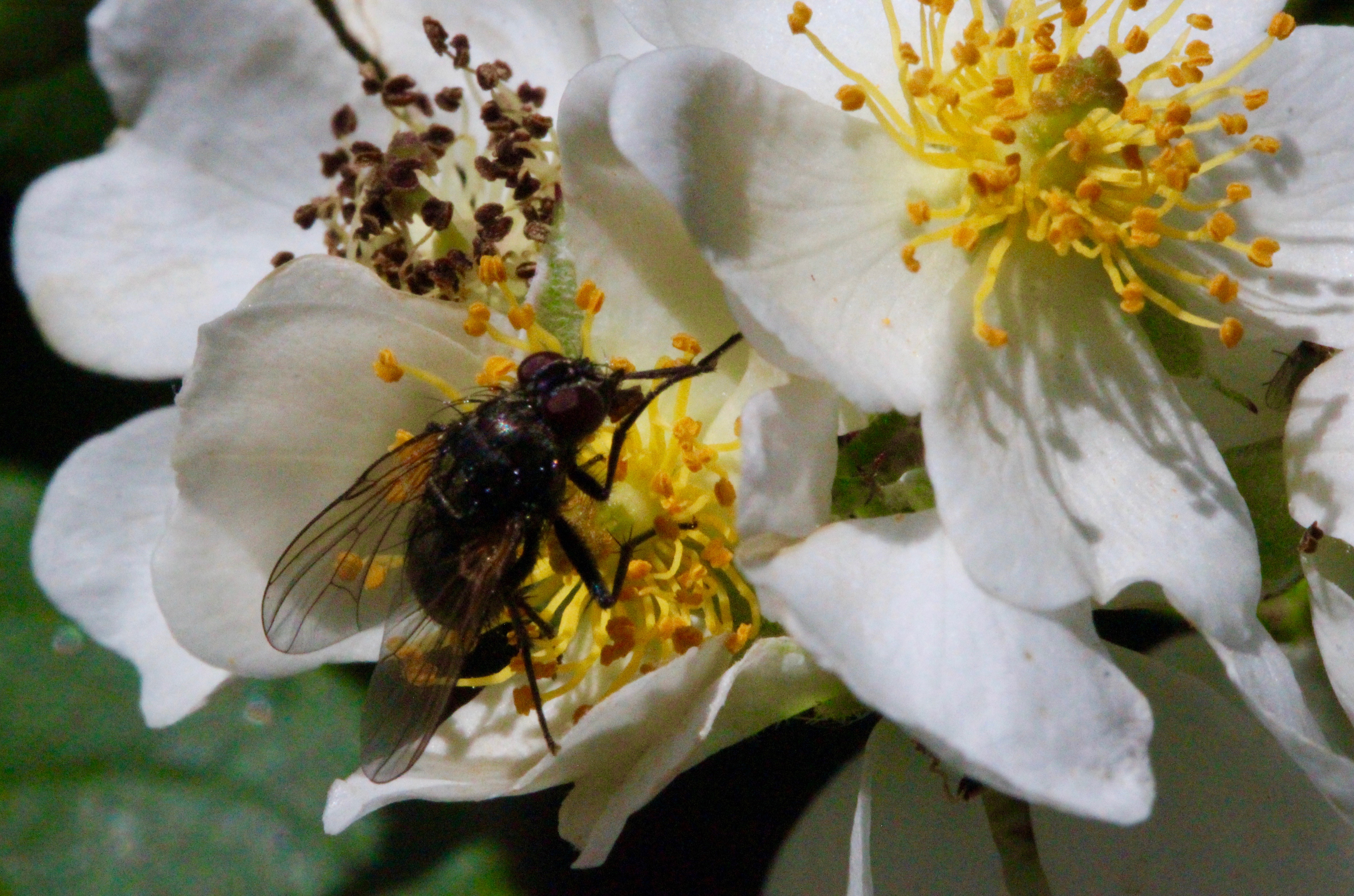
Multiple species pollinate the massive display.

bee on multi

Their pollen sacs bulge as they quickly move from anther to anther.

sawfly larvae

Meanwhile, sawfly larvae munch their way across leaves.

saw 2

Sawfly is another word for wood wasp–certainly makes sense. But right now, their larvae look like caterpillars. Very hungry ones.

spring peeper1

And because I took time to look, I noticed. When I first spied this little guy about the size of a nickel, I thought it was either a small snail or a dried up leaf that. Curiosity pulled me in closer–thank goodness. Located about three feet above ground, this spring paper hid from predators all day, waiting to munch on insects and spiders tonight. I know this shot is sun drenched, but do you see the X on its back? Its name–Pseudacris crucifer–breaks down to Pseudo (false), acris (locust) and crucifer (cross bearer).

grasshopper

I’ve also been stalking the grasshoppers again, much as I did last year. Every day, I’ve noted that they are a wee bit larger–measuring almost an inch. But today, I found a giant among them.

Heal all

Then I went further afield, but to another familiar spot that I frequent. Heal-All blooms there with its square stem and whorls of florets.

heal all 2

The upper part of each floret provides a darker hood over the lower fringed landing platform. I’m surprised I didn’t see any action today. But don’t worry. I’ll keep  stalking.

Lady fern spores

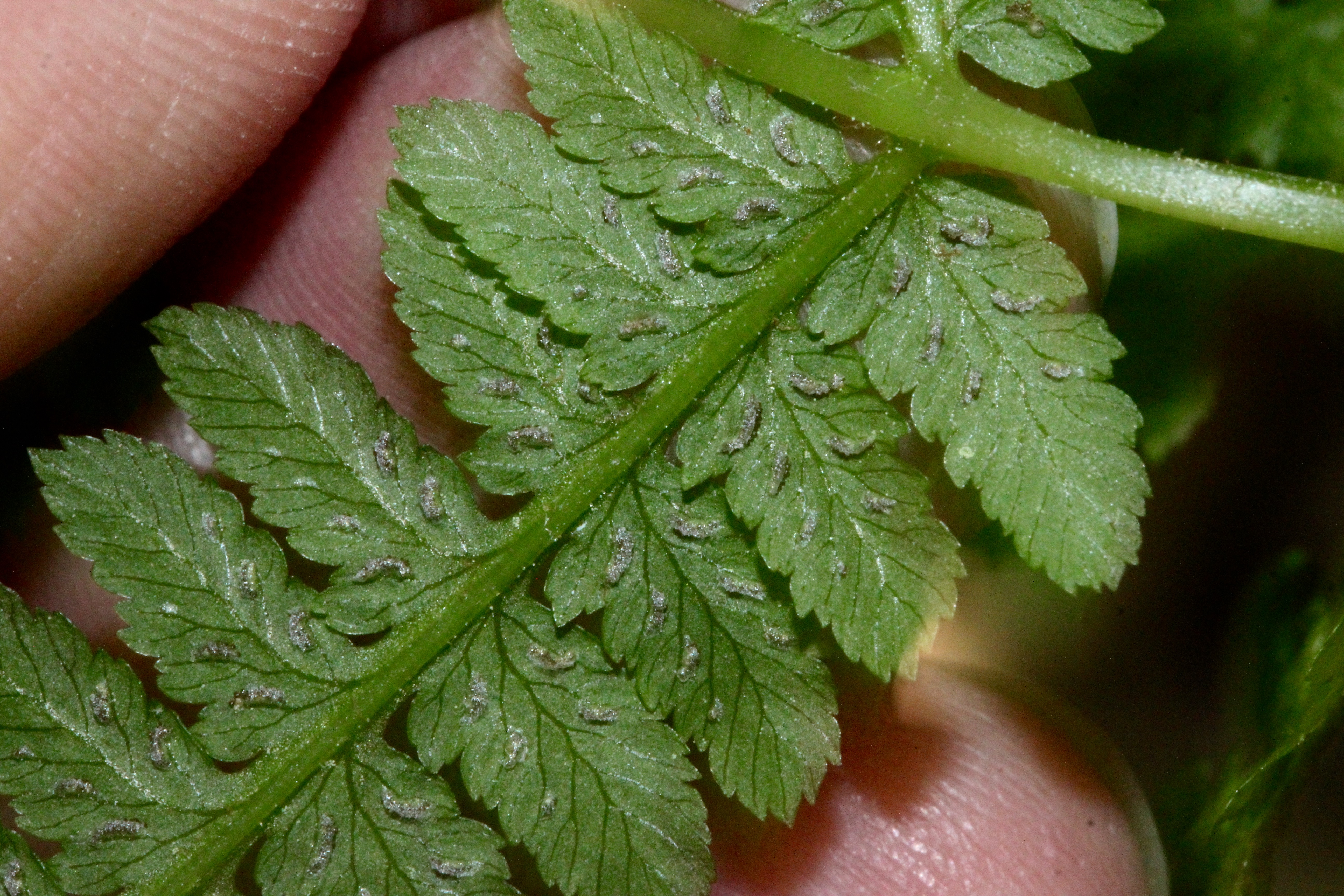
The ferns also drew my attention, like this lady fern, with its graceful appearance and sori in the shape of eyebrows.

hayscented fern

Hay-scented fern offers another lacy look, but the size and shape of its spore cups at the margin of the underside make it easy to recognize. Look underneath. Always.

cinnamon fern 1

While I’m focused on ferns, here’s a clue to differentiate a cinnamon fern from an interrupted fern once if it doesn’t feature a spore stalk. Cinnamon ferns have obvious hairy underarms. Do you see the tuft of hair at the rachis?

interrupted fern

Not quite the same for an interrupted fern. I love the hunt.

royal 2

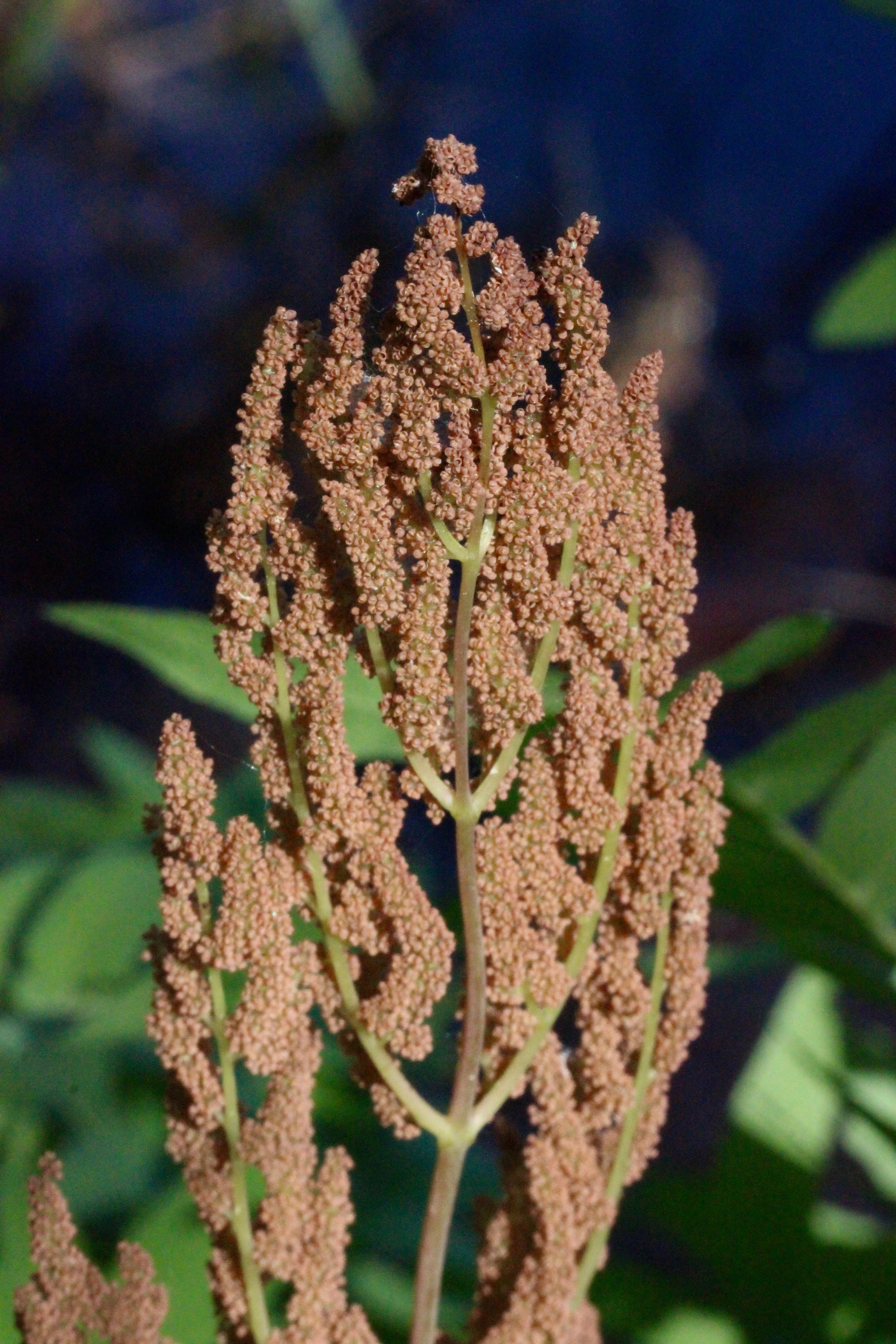
Cinnamon and interrupted ferns are both members of the Osmundaceae family, which also includes royal fern, so named for the fertile frond topped with a crown.

royal crown

Bead-like in structure, the capsules have evolved from their aqua-green color a couple of weeks ago to a rusty shade. Eventually, they’ll turn dark brown after releasing their spores.

exoskeletons

Because I was near water when I spied the royal ferns, I also had the joy of once again stalking exoskeletons that remain where dragonflies emerged. Such a special monument to their metamorphosis.

American toad

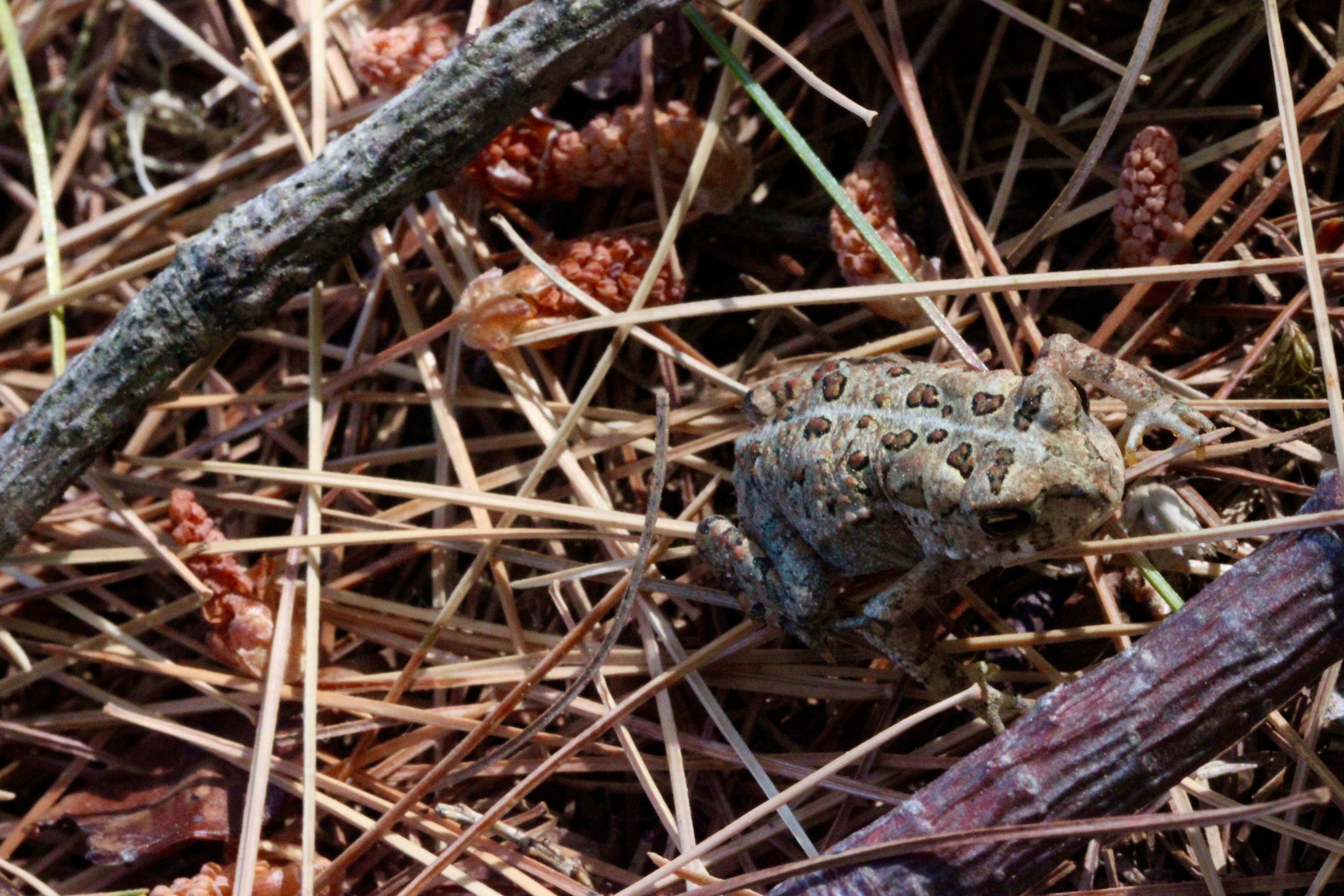
And  . . . young American toads hopped all about at my feet.

turtle 2

But one of my favorite focal points of the day–a painted turtle. She had her own mission–to lay eggs. After I saw her, I noticed another and so I did what any good stalker would do, I circled about the area looking for others. Only the two. But that was enough.

I’d made the two-hour round trip to Portland this morning to pick up my macro-lens that had taken two months to repair–0r so they say. As I got used to using it again, I found myself having fun figuring out the focus. I’ll continue to stalk and continue to learn–on so many levels.